b2o

Search results for: “bruce robbins”

  • Conference Announcement — Neoliberalism, Its Ontology and Genealogy: The Work and Context of Philip Mirowski

    Conference Announcement — Neoliberalism, Its Ontology and Genealogy: The Work and Context of Philip Mirowski

    LIVESTREAMING NOW: WATCH HERE

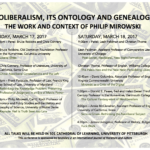
    boundary 2 is pleased to announce Neoliberalism, Its Ontology and Genealogy: The Work and Context of Philip Mirowski, a conference at the University of Pittsburgh. All talks will appear on boundary 2’s YouTube channel after the conference.

    Schedule

    Friday, March 17, 2017

    1:30pm EST – Panel: Bruce Robbins and Chris Connery

    Liberal Elites – Bruce Robbins, Old Dominion Foundation Professor in the Humanities, Columbia University

    China: Neoliberal Constellations and the Left – Chris Connery, Professor of Literature, University of California, Santa Cruz

    3:00pm EST Rethinking the Knowledge Problem: Preserving Professional Judgment in an Era of Metric Power – Frank Pasquale, Professor of Law, Francis King Carey School of Law, University of Maryland

    4:30pm EST – Keynote: Hell is Truth Seen Too Late – Philip Mirowski, Carl E. Koch Professor of Economics and Policy Studies and the History of the Philosophy of Science, University of Notre Dame

    Saturday, March 18, 2017

    9:00am EST – Panel: Leah Feldman and Christian Thorne

    Post-Soviet, Neoliberal, New Right Formations – Leah Feldman, Assistant Professor of Comparative Literature, University of Chicago

    The Paleo-Neo and the New New: Periodizing Liberalism – Christian Thorne, Professor of English, Williams College

    10:45am EST – Mirowski as Critic of the Digital – David Golumbia, Associate Professor of English, Virginia Commonwealth University

    1:30pm EST – The Cultural Fantasy-Work of Neoliberalism – Donald E. Pease, Ted and Helen Geisel Third Century Professor in the Humanities, Dartmouth College

    3:00pm EST – Serious Crises: Rethinking the Neoliberal Subject – Annie McClanahan, Assistant Professor of English, University of California, Irvine

    4:30pm EST – Fuck Work – James Livingston, Professor of History, Rutgers


  • Zachary Samalin: Genealogies of Self-Accusation

    Zachary Samalin: Genealogies of Self-Accusation

    by Zachary Samalin

    Response to Bruce Robbins: On the Non-representation of Atrocity

    This essay was peer-reviewed by the editorial board of b2o: an online journal.

    In his V21 symposium keynote lecture, “Atrocity in the Novel, Atrocity in History,” Bruce Robbins asks whether it is reasonable or instead “unacceptably presentist” to “expect the great epoch of European realism to ‘do’ atrocity in the particular, self-accusing sense” he is interested in examining, in which “‘we’ accuse ourselves of doing something outrageously cruel, collective, and indiscriminate to ‘others.’” “Arguably,” Robbins continues, “such representations only became possible after European civilization had been shocked out of its pre-Copernican complacency by the Holocaust and the rise of anti-colonial movements. In the nineteenth century, those shocks were still to come” (Robbins 2016: 4-5). Perhaps not surprisingly in a room full of Victorian literature specialists, the response to Robbins’ lecture during the question and answer session produced a long list of 19th century works that audience members thought would complicate, enrich, trouble or outright repudiate Robbins’ hypothesis that the literature of the 19th century had yet to achieve a certain form of critical self-consciousness, and so was incapable of indicting political brutality and violence. To the contrary, this audience response seemed to suggest, the archive of 19th century literature is rife with examples of just what Robbins is looking for.

    In the following response to Robbins’ lecture, I want to theorize more specifically the tension between these two seemingly irreconcilable positions, by examining one of Robbins’ central theses about the entwinement of politics and aesthetics—namely, that literature can and perhaps ought to lay claim to a privileged role in the articulation of “civilizational self-accusation,” especially in the context of the atrocities of modern imperialism. The notion that the literary has the capacity to register unwanted self-implication in destructive sociopolitical processes is extremely compelling; but, unlike Robbins, it is also an aesthetic innovation that I have come to associate with various currents in 19th century literature. And yet, as half a century of postcolonial literature and theory has helped us to see, this sophisticated innovation, which allowed for the registration, in narrative form, of undesired conditions of immanence, did little to turn the critical gaze of the 19th century novel outwards, that is, towards the ongoing atrocity of the British empire. When we read the literature of the mid- to late-19th century—Little Dorrit (1857), Notes from Underground (1864), The Belly of Paris (1873)—we don’t find a journalistic subjectivity reporting on the turbulent decades of perpetual war in Algeria, Persia, the Crimea, India, Burma, Vietnam, and China; but we do encounter a complex structure of feeling, beginning to emerge as something articulable, that conceived of modernity as a process of regressive self-destruction and of civilization as something unwanted that would soon sour itself from the inside out. In this respect, the question that Robbins’ lecture raises is to my mind not whether it is too ‘presentist’ to expect Flaubert or Dickens to have offered a critique of atrocity, but rather the enduring, perhaps more disturbing question of what specific forms of ideological blindness kept the novel form from extending the implications of its own socially critical and ethico-political insights to the imperial context?

    The first point to make is that, when it came to its atrocities, 19th century Britain left behind an indisputably immense non-literary paper trail. Certain brutal events in the maintenance of the empire—such as the violent responses to the Morant Bay rebellion (1865) and the Indian revolt (1857-8)—were not only voluminously documented, but debated publicly and at length, and did much to bring to the fore the question of what it means to participate in a putatively modern and morally enlightened national culture. More often than not, as has been well established, such debates served to mask the violence intrinsic to imperialism and capitalism, focusing instead on the extent to which particular episodes of brutality and exploitation represented local failures and setbacks in the ongoing civilizing project of the British Empire. Thus while Governor Eyre came under fire in the aftermath of Morant Bay, the terms of public debate set by the Jamaica Committee did little to overturn the entrenched patterns of racist thought and economic opportunism which helped to prop up the central premises of imperial exploitation (see Holt 1992: 278-312). Like a good deal of the public and official reaction to the documentation of torture at Abu Ghraib prison in our own day, Morant Bay provided a space for a limited articulation of civilizational self-accusation in British public discourse—‘we don’t do that’—but only within a larger self-serving framework of disidentification, disavowal and civilizational (which is to say racial and cultural) arrogance that helped keep the inherent injustice of imperial occupation from taking center stage. Indeed, one limitation of framing critique in reference to specific atrocities made apparent through these examples is that the focus on the event of cruelty and violence runs the risk of obscuring patterns of ongoing or systemic exploitation.

    Yet in their most trenchant form, 19th century critiques of imperialist violence did approach the form of self-critique that Robbins holds up as a more modern ideal. Marx’s criticism of the 1855 Report of the Commissioners for the Investigation of Alleged Cases of Torture in the Madras Presidency is exemplary in this respect (see Rao 2001). The report sought to establish the prevalence of physical torture and brutality as a systemic means of extracting tax revenue within British India for the profit of the East India Company, only to disavow responsibility for that violence and to condemn it, with characteristic outrage and condescension, in the racialized language of barbarism. “Our aim,” the report concludes, “is to guard the Natives against themselves” (Report 1855: 70). As Marx summarized the report, “The universal existence of torture as a financial institution of British India is thus officially admitted, but the admission is made in such a manner as to shield the British Government itself” (Marx [1857]1975: 66). Yet as Marx goes on to observe, “a few extracts from the evidence on which the Madras Report professes to be founded, will suffice to refute its assertion that ‘no blame is due to Englishmen,’” and to document instead the systematically exploitative nature of capitalist imperialism. Far from evidencing the need for colonial paternalism, Marx thought the report ought to raise for the “dispassionate and thoughtful men” of Europe the more self-implicating question of “whether a people are not justified in attempting to expel the foreign conquerors who have so abused their subjects” (Marx 1975: 69). Marx’s indictment of the Madras Report may not be precisely what Robbins has in mind when he argues for the cosmopolitan modernity of civilizational self-accusation as a “very special subset of atrocity-response in which ‘we’ accuse ourselves of doing something outrageously cruel, collective, and indiscriminate to ‘others’” (Robbins 2016: 2)—but if not, it is certainly a close relative.

    While Marx’s writings on India often lapse into a more rigidly developmental-teleological mode, according to which capitalism represents the first step necessary for Asian civilizations to catch up with world history, his observations about the Madras Report do more to highlight the complex ways that the question of identification came in this period to animate the representational dynamic of critique. The difference between the critical language of civilizational self-accusation, as Robbins formulates it, and the exculpatory language of civilizational disavowal, as exemplified by the Madras Report, hinges precisely on such vectors of identification—that is, on a speaker’s imagined participation in a particular ideological community. In this respect, while Robbins observes that “the modern weakening of membership” is a prerequisite for the distance needed to understand atrocity as such, I would argue that the unwanted (but inescapable) identification with destructive processes is in fact the crucial psychosocial component he ought to pursue, rather than the fraying of communal bonds more customarily associated with the onset of modernity (Robbins 2016: 1). Due in large part to a post-Enlightenment legacy that idealizes disinterestedness and objective distance, we have yet to provide even the basic outline of a history for this capacity for unwanted identification.

    Understanding how these two opposite movements—towards a desirable disinterest and an undesired involvement—were fused to one another throughout the 19th century is a significant and unfinished task for scholars of the period, in the first place because their fusion accounts for the antithetical attachments to the impulse to document violence and atrocity that I have been describing. The imperialist impulse to represent violence in order to disavow it as something always perpetrated by an other, or to frame it as an exceptionality that justifies rule, cannot be fully distinguished from the self-implicating impulse to expose that violence as immanent to modernity. This is in part because they share the same language, as reflected by Marx’s insistence that blue books are the only evidence of systemic violence one needs. Though we often think of Marxist thought as working to fill in the gaps in the official discourse, I am suggesting instead that we attend to what Marx presupposes is the radical transparency of the language of domination—the presupposition that violence and exploitation had become self-evident, and were written brazenly on the surface of things in the language of the perpetrators. We might therefore take Robbins’ call to place the writing of atrocity within a longue durée of moral development as an invitation to theorize this intersection of the genealogy of self-accusation and unwanted identification with the historical transformations which allowed atrocity to be written legibly and out in the open, rather than hidden or buried in secret.

    At the same time that we see extensive evidence of such a complex public discourse for engaging atrocity in 19th century Britain, we also know that in different national and cultural contexts, literary and artistic production began to develop a wide array of aesthetic strategies for representing atrocity throughout the 19th century while simultaneously problematizing the presumed security of the disinterested observer. Goya’s Disasters of War come to mind, as does the archive of 19th century photographs that Nathan Hensley and Zahid Chaudhary have recently written about; indeed Hensley has helped us to see precisely how these hermeneutic questions about the representation of violence and its implied spectators remain unanswered in the aftermath of empire (see Chaudhury 2012; Hensley 2013). Similarly, slave narrative and abolitionist literature in the United States—which of course tended not to focus only on specific atrocities but on the systemic and juridical nature of slavery under capitalism—bear directly on Robbins’ claims about the 19th century’s representational capacity for moral indictment. However, I present these not so much as counter-examples, but rather as indices of the more particular absence that Robbins has helped us to identify. We know that British imperial atrocities were voluminously documented and often publicly debated as potentially undermining the civilizational project; and we know that the 19th century saw the development of a more radical social scientific and socially critical discourse of self-accusation, that sprouted up out of an official discourse of disavowal; and, finally, we know as well that other aesthetic traditions in other cultural contexts have done a better job than the British novel at representing atrocities through some form of self-accusation or communal indictment.

    So then one question: What to call this kind of ideological absence or moral-aesthetic caesura? How does it work, and how can we grasp its psychosocial dynamics? I put the question this way, since we have previously relied on the vocabulary of symptom and repression to elaborate precisely these absences. And yet it seems clear, today, as it has for some time, that the tools afforded by the vocabulary of cultural neurosis don’t quite satisfy here, given that we are not dealing with an occluded or concealed discourse of atrocity that “returns” from its repression in the interstices of the literary text, but rather with the more disjointed, more deranged fact that this proliferate and public discourse did not find its fullest expression in the exemplary aesthetic form of the period, that is, in the novel. Why not? My sense is that we still need to sharpen and refine our historical account of the ways in which representation functions vis-à-vis the intolerable, the unwanted, the atrocious, and the unrepresentable—a newly sharpened account of the writing of the disaster that takes into account the different species of blindness and specific patterns of resistance endemic to modern literary forms.

    These caesuras in the political consciousness of the Victorian novel become all the more jarring when we consider that, over the 19th century, literary texts, and perhaps the novel in particular, emerged as the cultural laboratory for testing out Enlightenment ideals and for exposing them as violent or vacuous, as cruelty in themselves—whether in the name of reactionary sentiment or liberalizing social critique or some impulses more nihilistic than either of those. I am thinking of earlier works like Juliette and Gulliver’s Travels just as much as later, increasingly socially engaged texts such as Our Mutual Friend, La Terre, Notes from Underground and Jude the Obscure. Considered from this angle, the literary domain in the 19th century was a sophisticated and complex arena for elaborating a deeply affective experience of unwanted self-implication and inevitable participation in a destructive order, founded on tenuous, inverted values.

    Even if the 19th century did not “possess a public capable of demanding or enforcing scrutiny of ourselves from outside” (Robbins 2016: 24), it is clear to my mind that later authors as diverse as Achebe, Vallejo and Sebald returned to this more nihilistic 19th century conception of literature as a privileged space for giving voice to an unwanted relation of immanence in the destructive processes of modernity. Indeed, the outraged self-accusation Robbins describes, in order to transcend mere bad faith or ressentiment, needs to involve a more disturbing set of identifications than simply seeing oneself as though from without. A literary genealogy of civilizational self-accusation, then, might follow unpredictable lines back through unexpected pages, from the mushroom clouds of the 20th century Robbins begins with to the storm-clouds of the 19th. How can we further specify and describe this negative structure of feeling in the novel, give it a longer history that doesn’t stop and start according to the arbitrary constraints of post-hoc periodization, and which attends to its ever-shifting blind spots and its insights alike?

    References

    Chaudhury, Zahid. 2012. Afterimage of Empire: Photography in Nineteenth Century India. Princeton, NJ: Princeton University Press.

    Hensley, Nathan. 2013. “Curatorial Reading and Endless War.” Victorian Studies 56, no.1: 59-83.

    Holt, Tom. 1992. The Problem of Freedom. Baltimore: Johns Hopkins University Press.

    Marx, Karl. (1857) 1975. “Investigations of Tortures in India.” Reprinted in Marx, The First Indian War of Independence, 1857-1859. Moscow: Progress Publishers.

    Rao, Anupama. 2001. “Problems of Violence, States of Terror: Torture in Colonial India.” Interventions 3, no. 2:186-205

    Report of the Commissioners for the Investigation of Alleged Cases of Torture in the Madras Presidency. 1855. Madras: Fort St. George Gazette Press.

    Robbins, Bruce. “Atrocity as Self-Accusation.” 2016.


    CONTRIBUTOR’S NOTE

    Zachary Samalin is Assistant Professor of English at the University of Chicago.  He is currently working on a manuscript, The Masses Are Revolting: Victorian Culture and the Aesthetics of Disgust.

  • Elaine Hadley: Closing Remarks

    by Elaine Hadley

    This essay was peer-reviewed by the editorial board of b2o: an online journal.

    I wanted to thank the organizers of V21 for asking me to comment and then to host the closing segment of the conference. In some ways, I am the worst possible choice to do so: I’m not a great processor of auditory information, and I have a terrible memory. Luckily, though, I filled a legal pad front and back with notes, and I am going to read them word by word to you, page by page, hoping you can find something to spur you on for one more hour of talk. Just kidding!

    There were many wonderful papers over the past day, and a very smart disposition of panel topics, and every one of you should be congratulated for making the event substantive and engaging. But despite my threats, I will not be attempting a granular recapping of the panels and discussions.  In the spirit of V21, I made my own version of this conference’s manifesto, on the fly, in fifteen minutes. Like the first one, it is a bit provocative and sometimes I say it with love, and sometimes not so much.

    1. Experimentation is good. But what is experimental? Is something experimental only in retrospect, as with Bleak House’s double narrative, or necessarily of the moment, achieved by declaration? Many of you did claim experimentation as an opening gambit. The prevalence of the word “experimental” in the conference implies by contrast something that is not experimental but conventional, or hide-bound. But, truly, as some have noted, both in the manifesto and in the conference, the referents for the conventional are floating signifiers. Experimental seems aligned with the provisional, responsive to a prompt not one’s own; it can turn to essayistic prose rather than argumentative expository prose, but not always, and it is somewhat averse to periodization, but only somewhat. There is also some commitment, though not uniform, to provisionality, to uncertainty. Some presenters downplay a connection between progress and progressive. But insofar as these approaches and aims might be a response to NAVSA (as implied in the manifesto) or to recent trends in the field overall that seem stale, and thus, by now, conventional or predictable, they to some extent remain, surprisingly, Victorianist in several recognizable ways. Which leads me to #2.
    2. Literary Objects are good. In the midst of some smart, and sometimes risky, experimentation there does seem something very conventional to this conference, and there are lots of ways that is ok but still let’s think a bit. To turn to Jesse Rosenthal’s piece on conservation, and put it to use in a different if related direction, it is striking how conservationist some features of the conference’s orientation have been. There is, as some have noted, a deep attachment to the novel genre and, perhaps, to some key canonical texts. As a scholar who has never been much interested in literary form, per se, nor in the history of the novel, I am surprised to see so little interest in textual objects that are not literary or in arguments that do not rely on a persistent focus on textual objects. Much of the desire to detect or declare “rules” for our project as critics, noticeable these past few days, has started there, as if many of you have decided that the most persuasive accounts of our value lie in either a narrow construction of literature or a literary formalist methodology. The one place, notably, where some other texts were apparent was in the Empire panel, also the place where visual images came most fully into the mix, and the very same place where we had a discussion about the relation between what is in a Victorian novel and what it does, and what is not in a Victorian novel and what it cannot do. I found it telling that Bruce Robbins’s desire to talk about the absence of atrocity in the literary record mostly elicited comments from the audience of instances in novels (and less often poems) where atrocity is present, as if we simply cannot accept that our big, baggy monsters do not include everything but the kitchen sink. I do wonder about these foci. As departments retrench, as young people, our students, turn to other media forms far more than textual sources, let alone novels or poems, and as it seems increasingly likely that we might all be teaching, if we continue to teach, in media studies departments or Humanities departments rather than literature departments, let alone in literature departments that have three or four Victorianists, I wonder if our focus on novels, in particular, is a bit myopic, or worse, a structural result of the ever-increasing retrenchments we see all around us—as if small as our audience may be, it is in fact the novels that still have readers. And this line of observation leads me to #3.
    3. After the word “curate,” “form” is fast becoming an irritation to me in my disciplinary conversations. I suspect that “curate,” used voiced in this conference and among my own students, references (no doubt among other things) the emergence of a form of aesthetics, some of it coming from Ranciére, some of it from object theory, perhaps also the digital humanities, and no doubt other sources as well. We need to think about the denotations and connotations of the word curate–its relation to taste, to exclusivity, to consumption: what sorts of claims are we making in our (re)turn to aesthetic judgment? Are our syllabi simply a kind of playlist? And then there is form. Years ago, during an earlier moment of commitment to self-definition in the field, some academics (most of you won’t remember this moment) turned to “imagination” to describe the Humanists’ domain. Needless to say, it didn’t really take. I am equally gloomy about the status of “form” in our efforts to declare what our central contributions are. It references a range of approaches and tools and visions we practice and, yes, enjoy, but it is also a constriction. At times it can exclude, as I think it has to some extent here, other ways into textual and media interpretation—say rhetorical interrogation–and other kinds of knowledge formation. At other times, it functions to occlude the complex problems of its own central assumptions. As it becomes its own project, as it differentiates itself from structuralism or historicism, it seems to me to lose analytical force, let alone function. I detected in the pre-circulated papers and in our discussions, many references to metaphor, to analogy, to analogues and, less referenced but apparent, to allegory. I’m not sure I myself want to spend the next several months clarifying the mechanisms and limitations of these terms, but they remain a problem in our formalist practice as they did with New Historicism.  Relinquishing historicism does not solve that problem.
    4. Optimism and joy and pleasure are good. There is a palpable desire to read and write and convene, to have hope in a future where we might all continue to read and write and convene. For someone raised in a different era, one apparently much more explicitly competitive and individualist, and–so you keep saying–enamored of a hermeneutics of skepticism (guilty as charged), I am genuinely moved by the “collective” spirit, which seems truly genuine, communal and although clearly of a certain generational cohort, welcoming to us older folk. But I am perhaps a wee bit less moved by the occasional need to draw a line between us and them, between good criticism and bad, or literary work of complexity and something else, and in particular between some kind of pedantic historicist labor and, well, fun. As David Kurnick pointed out, sometimes writers aren’t fun to read, and sometimes our work isn’t joyous, and sometimes an intellectual’s labor is to detect and limn pessimism, and, alas, to generate it, too. And then, I cannot think the word “optimism” anymore without recurring to my colleague Lauren Berlant’s phrase “cruel optimism.” By all means let’s find and demonstrate joy and pleasure in our practices, but let’s be careful. The absence of feminist theory, of class, with only a momentary mention of Marx, of something I might call Politics with a big P only emerging momentarily, until Bruce Robbins’s talk, suggests that our joy, and pleasure and optimism need, in the spirit of Victorian self-reflexiveness, to be–if not leavened–at least in conversation with a keen attentiveness to the ways in which our neoliberal moment packages these affects.  This is a critical moment, some might even say a survivalist moment; the power of positive psychology does not seem adequate to the times.
    5. So historicism is not so good. I was struck when reading the V21 manifesto of a certain conflation of two types of historicism. There is first a kind of empiricist, quasi-scientific historicism, often Whiggish and positivist and totalizing at its worst, and then there is the post-68 historicisms ushered into Victorian studies by way of Foucault. As time wears on, no doubt we can see the two approaches as in some sense of a piece– though Foucault did not see his work that way. In many important ways, however, they just aren’t the same, and I still think it important to capture that difference, to take the full force of the intervention of Foucauldian historicism, even if one doesn’t wish to emulate it.  It also seems important to say to a fairly young group of splendid scholars that Victorian studies from its very inception has been a historicist-learning field for all sorts of material and structural reasons: the price of paper, the rise of literacy, and the widespread emergence of research libraries in the nineteenth century has left us with a lot of historical textual evidence. We seem to be ready for transhistorical and transpatial projects that no longer will care about these histories and thus will be able to dispense with that founding moment, to a certain degree.  I am ready to read it, certainly.  But I rather suspect the complexity of what might be called “the history question,” precisely what led me to this field during my graduate years, will hang around.  There is vitality in that concept, even in the V21 group.  And, to be fair, the conference far more than the manifesto has shown that all of you are still grappling nobly and mightily with that big H. Even if grumpily, even if it refuses you joy.

    So, thank you for letting me do this, and thank you so much for letting me be a part of this stimulating event.


    CONTRIBUTOR’S NOTE

    Elaine Hadley is Professor of English at the University of Chicago.  She is the author of Melodramatic Tactics: Theatricalized Dissent in the English Marketplace, 1800-1885 (Stanford UP, 1995), and Living Liberalism: Practical Citizenship in Victorian Britain (University of Chicago Press, 2010).

  • Anna Kornbluh and Benjamin Morgan: Introduction: Presentism, Form, and the Future of History

    Anna Kornbluh and Benjamin Morgan: Introduction: Presentism, Form, and the Future of History

    by Anna Kornbluh and Benjamin Morgan

    This essay was peer-reviewed by the editorial board of b2o: an online journal.

    In the spring of 2015, the V21 Collective launched with a collectively authored manifesto, signed by twenty-two affiliates, which called for the field of Victorian Studies to intensify inquiries into method, aesthetic form, and the contemporary purchase of nineteenth-century thought. The manifesto garnered many responses within and beyond the field, responses that explored the validity of “presentism” as a scholarly ethos; ongoing renovations of formalism as interpretive method; and the continued predominance of historicism within literary and cultural studies of the British nineteenth century. These conversations became the basis for a community of V21 affiliates, which held its first meeting in Chicago in Fall 2015. Twenty-nine mostly early-career Victorianists spoke at the conference, which was anchored by four established scholars within the field: Isabel Hofmyer, Caroline Levine, Bruce Robbins, and Alex Woloch. The event, comprised of workshops, roundtables, and extended periods of open discussion, was attended by over 100 participants from around the country. This special issue represents the collaborative efforts of that community to move forward the conversations and questions catalyzed by V21’s initial intervention. We are honored to partner with boundary 2 Online to bring our experimental symposium format to their experimental publication platform.  The questions that came to organize the symposium and that organize this special issue are unapologetically large: Why read canonical novels today? What ongoing and unmet challenges to conventional disciplinary configurations and field methodologies are posed by the conceptual and political problem of the enormity and persistence of empire? What role can philosophies of history play in invigorating historiographic methodologies?  How can we return major 19th-century theorists including Nietzsche, Marx, and Freud to the center of Victorian Studies?  What are best practices of engaged, consequential, and political literary and cultural criticism today?  For each workshop, shared texts played a central role, foregrounding questions of canonicity, close reading, philosophical commentary, and imperial print culture; the event was thus structured around a project of collective reading that provided a starting point for hypotheses, interventions, and experimental thought. This issue presents in an online print format the spurs toward thought that ignited the symposium, with the hope of stimulating further debate and engagement.

    The conference theme–“Presentism, Form, and the Future of History”–will call to mind some of the liveliest debates in literary studies today: debates about how we read now, about the resurgence of form and formalism, about claims for and against posthistorical and postcritical interpretation, about the viability of the literary-historical period in the context of queer time or deep time. If the stakes of these conversations subtend work in many fields in literary studies, they are especially acute for those whose academic work touches on the nineteenth century. This is a period that is distant enough that it takes some pedagogical work to help students imaginatively inhabit a world where you got your novels in bits and pieces over the course of a year, but close enough that these same students often find great readerly pleasure in minimally annotated Penguin editions. There is something uncanny in this simultaneous proximity and distance which extends to Victorian forms and institutions beyond the novel. To study the nineteenth century is to be struck almost daily by the sense that it never really went away: ours is also a gilded age of income inequality, of financial speculation, of de facto debtor’s prisons, of capitalist exploitation, of global inequity, of misplaced faith in evolutionary psychology, of widespread reliance on coal-based energy. It is strange but true that the best novel about the 2008 financial crisis was written by Anthony Trollope in 1875. And it is equally strange but true that some of the best contemporary writing on television is done by experts on nineteenth-century narrative. The acronym “V21” represents an aspiration to notice these resonances and theorize them more robustly. Victorian studies for the twenty first century, one imagines, would require close attention to the Victorian qualities of the twenty-first century.

    But it is precisely because this is easier said than done, an easy gesture to make in the epilogue of a book or in the opening remarks for a symposium, that the V21 collective decided to make questions about historical consciousness and its unpredictable relationships with literary form central to our first meeting. To begin: what if were were to understand “presentism” not as an error, but as a robust interpretive mode? This is deeply counterintuitive: presentism usually designates a lack of historical consciousness, not a variety of it. Presentism commonly names the deformation of our objects of study in our own image, a failure to live up to the alien historical specificity of past documents and things and ideas. But addressing presentism as a strategy rather than as a mistake allows us to ask whether the reasonable distrust of underdeveloped historical awareness may lead us to retrench too readily in notions of historical difference. We might wonder, with Caroline Levine, whether even those critics most avowedly committed to historicism don’t in fact arrive at their objects of study out of an interest in how those objects, as she puts it, have “implications beyond [their] own time” (Levine 2015: xii). We might also wonder whether some kind of presentism isn’t what has made it possible for Bruce Robbins to bring literary criticism to bear acutely on the social and political matters that concern us most, whether these are cosmopolitanism in the age of globalization or upward mobility in an era when it has become increasingly scarce.

    This was, in part, Foucault’s point when he said that Discipline and Punish aspired to give not a “history of the past” but a “history of the present,” a present then most prominently marked for Foucault by the prison riots of the early 1970s (Foucault 1995: 31). We know what that genealogical project looks like—but what does it mean to speak about “the future of history”? If this phrase might at first sound like nothing more than an unnecessarily convoluted way of saying “now,” it might also begin to remind us of the many theories and philosophies of the temporal strangeness of the contemporary: Benjamin’s angel of history; Jameson’s “always historicize”; Gadamer’s fusion of horizons; Nietzsche’s ruminating cows. Each of these tropes involves an awareness that what it is to think historically cannot be predetermined. V21 has occasionally been labeled “anti-historicist” or slotted into one side of a tired and tiresome history-versus-theory binary, but this strikes us as possible only if one forgets that pastness must always be theorized. What responsible historian or historicist has ever thought of history simply as “the things that happened”? “The future of history” is an invitation to think anew about how our scholarship might resituate and reinterpret the status of the historical. What if, for instance, with Antoinette Burton and Isabel Hofmeyr, one were to come at the history of empire from the seemingly oblique angle of the history of the book? One might arrive not only at a more historically accurate account of empire as a “slow burn” rather than a rise and fall; one might also encounter new models to think with: empire as assemblage; book not as an object but as a dispersed and dispersing event (Burton and Hofmeyr 2014: 23).

    Within a certain idiom, one could rephrase Burton and Hofmeyr’s important point by saying that the British empire and the physical book share the “form” of an assemblage. The stakes of putting it this way would be to make both book and empire disciplinarily available to those whose arena of intellectual expertise is the analysis of form. One name for such people is literary scholars. If we are often seen as disciplinary vagrants with no real home—and even if we often welcome this characterization—it is worth asking who else could conceptualize the inner workings of character space and character systems with the nuance of someone like Alex Woloch: the fine modulations of attention demanded by overpopulated narratives; the structural and syntactical qualities of textual mediations of the real. The analysis of form, as it tarries with internal complexity and structure, can easily become a suspect practice when the term “formalism” is seen as just a shade of meaning away from aestheticism—forgetting the real rather than studying its mediation. But it is exactly for this reason that it is worth reclaiming the value of a way of knowing that has often been understood as the distinctive disciplinary marker of literary studies.

    The first cluster of interventions presented here, under the rubric “Bleak House Today,” addresses the fundamental question of what Victorian literature has to offer the present. The roundtable considers how the novel’s formalizations of temporal dissonance, sound and sonance, virtuality, presence and contemporaneity immanently theorize the historicism-presentism continuum.  The second cluster, “Theorizing the Present,” turns to one of the nineteenth century’s most complex and intriguing treatments of historical consciousness, Nietzsche’s essay “On the Uses and Disadvantages of History for Life.” Across the six pieces published here, Nietzsche comes into view as a writer who both reveals dispositions toward the past to be attachments or passions and, simultaneously, stylistically evades containment within linear history. “The Way We Write Now” presents five short essays that were workshopped by attendees, which share an aspiration to find indirect, utopian, kinky, or recursive paths joining the Victorian and the contemporary. Such paths are found in explorations of the archive as fetish, of the immediacies and repetitions of literary tradition, and of the ecological persistence of the nineteenth century. “Empire and Unfielding” underscores the tension between conventional scholarly fields and the study of empire, staking out experimental field-syntheses and field-traversals through the nexus of book history, close reading, comparative literature, discourse analysis, political theory,  and speaking truth to imperial brutality.  Interventions in this cluster underscore the necessity for juxtaposing the canonical and the marginal, the historical and the literary, the past and the present. Returning to a more familiar academic genre with a keynote lecture, Bruce Robbins offers one model of the very consequentialism missing in the current vogue for factism.  “On the Non-representation of Atrocity” articulates enlarged time scales, comparative criticism, and the social impact of aesthetic representation with situated critique of violence and the ideologies that suborn it; for Robbins, studying representation in the past must conduce to fresh queries of how the present comparably distributes the avowable and the unsayable.  The end of the symposium pivots toward diverse future trajectories of reflection on presentism, form, and the future of history, illuminated by Elaine Hadley.  We hope that this special issue will itself serve as another exhortation to future engagement, as its own opening of speculative possibilities. V21, which welcomes new affiliates, currently facilitates a series of international reading groups, publication clusters, conference streams, syllabus sharing, and book roundtables, and is eager for new debates. We tweet @v21collective.

    References

    Levine, Caroline. 2015. Forms: Whole, Rhythm, Hierarchy, Network. Princeton: Princeton University Press.

    Foucault, Michel. 1995. Discipline and Punish: The Birth of the Prison. New York: Vintage.

    Burton, Antoinette M., and Isabel Hofmeyr. 2014. “Introduction: The Spine of Empire? Books and the Making of an Imperial Commons.” In Ten Books That Shaped the British Empire: Creating an Imperial Commons, edited by Antoinette M. Burton and Isabel Hofmeyr, 1-28. Durham, NC: Duke University Press.


    CONTRIBUTORS’ NOTES

    Benjamin Morgan is Assistant Professor of English at the University of Chicago.  His book The Outward Mind: Materialist Aesthetics in Victorian Science and Literature is forthcoming from the University of Chicago Press.

    Anna Kornbluh is Associate Professor of English at the University of Illinois, Chicago.  She is the author of Realizing Capital: Financial and Psychic Economies in Victorian Form (Fordham UP, 2014) and is currently completing a manuscript The Order of Forms: Realism, Formalism, and Social Space.

  • v21 | special issue

    v21 | special issue

    b2o: an online journal is an online-only, open access, peer-reviewed journal published by the boundary 2 editorial collective, with a standalone Editorial Board.

    Volume 1, Issue 2 (October, 2016)
    Special Issue: v21
    Special Issue editors: Anna Kornbluh and Benjamin Morgan

    Introduction: Presentism, Form, and the Future of History
    Anna Kornbluh and Benjamin Morgan
    I. Bleak House Today
    Bleak House: 19, 20, 21
    Alex Woloch
    A Note on Reading Bleak House
    Elaine Auyoung
    Bleakness
    Elisha Cohn
    Dickens’ Resonance
    David Sweeney Coombs
    On the Genealogy of “Deportment”: Being Present in Bleak House
    Jonathan Farina
    Untimely Dickens
    Emily Steinlight
    Charles Dickens in 1948
    Megan Ward
    II. Theorizing the Present
    Impassioned Objectivity: Nietzsche, Hardy, and the Science of Fiction
    S. Pearl Brilmyer
    Jamming the Historical Machine
    Danielle Coriale
    Too Many Nietzsches
    Eleanor Courtemanche
    Untimely Historicism
    Devin Griffiths
    On the Uses of Nietzsche’s “Uses”
    Matthew Sussman
    Unhistorical Reading and Mutual Playing
    Daniel Wright
    III. The Way We Write Now
    Introduction: Historicism: From the Break to the Loop
    Caroline Levine
    Notes on Presentism and the Cultural Logic of Dissociation
    Carolyn Betensky
    Kink in Time
    Ellis Hanson
    History Repeating
    Anna Kornbluh
    Maintenance Work: On Tradition and Development
    Jesse Rosenthal
    Anthropocene Inscriptions: Reading Global Synchrony
    Jesse Oak Taylor
    IV. Empire and Unfielding
    Introduction
    Tanya Agathocleous
    Jyotirao Phule’s “Slavery”
    Tanya Agathocleous
    Swinburne’s Oxford Notebook: Violence in/as Form
    Nathan K. Hensley
    Emergency Repairs Are Required on All Our Dams
    Joseph Lavery
    The Light of Asia and the Varieties of Victorian Presentism
    Sebastian Lecourt
    Biopolitics and Greater Britain
    Nasser Mufti
    Charles Kickham’s Knocknagow: Or, the Homes of Tipperary
    Mary L. Mullen
    V. Keynote and Responses
    On the Non-Representation of Atrocity
    Bruce Robbins
    Genealogies of Self-Accusation
    Zachary Samalin
    Literary Subjects
    Molly Clark Hillard
    Closing Remarks
    Elaine Hadley


  • b2o: an online journal

    b2o: an online journal

    b2o: an online journal is an online-only, open access, peer-reviewed journal published by the boundary 2 editorial collective, and edited by a standalone Editorial Board.

    b2o: an online journal is published 2 or 3 times each year, with general issues (often featuring pieces on topics of a particularly immediate nature) as well as special topic issues, many of which focus on topics of particular relevance to the online context, and/or feature pieces that take advantage of the affordances of networked digital media. Although collected into 2 or 3 numbered and dated volumes each year, pieces in b2o: an online journal are, when feasible, made available online ahead of their formal publication date.

    b2o: an online journal accepts unsolicited submissions.

    b2o: an online journal Editorial Board includes:

    • Arne De Boever and Christian Thorne, editors
    • David Golumbia (†)
    • Jonathan Arac
    • Charles Bernstein
    • Leah Feldman
    • Stathis Gourgouris
    • R. A. Judy
    • Bruce Robbins
    • Hortense Spillers
    • Henry Veggian
    • Paul Bové, ex officio

    ISSN: 2639-7250 

    Copyright on the contents of b2o: an online journal is held by the boundary 2 Editorial Collective and the authors; please contact us for permissions. 

  • b2 Conference: The Militarization of Knowledge

    On November 13 and 14, 2015, boundary 2 will host a conference at the University of Pittsburgh on The Militarization of Knowledge. This unique event will bring together distinguished scholars from a variety of disciplines. Click here to watch a livestream.

    Our talks will take place at the following times, all Eastern Standard Time.

    FRIDAY, 11/13/15

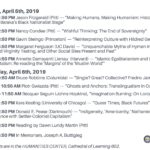
    2pm – Operationalizing Basic Research and Scholarship: A System-of-Systems Approach for the Military Application of Knowledge, Carey Balaban, Professor, Departments of Otolaryngology, Neurobiology, Communication Science & Disorders, and Bioengineering, University of Pittsburgh, Director of Center for National Preparedness

    3:30pm – Terror, Talk, and Political Management, David Simpson, Distinguished Professor of English, UC Davis

    SATURDAY, 11/14/15

    9:30am – Of Partisans and Paranoid Experts: How We Came to Think about Terrorism, Julian Bourg, Associate Professor of History, Boston College

    11am – The Representation of Atrocity, Bruce Robbins, Old Dominion Foundation Professor in the Humanities, Columbia University

    1:15pm – The Militarization of Language, David Golumbia, Associate Professor of English, Virginia Commonwealth University

    2:45pm – Military Aesthetics: Technology, Experience, and Late Modern War, Anders Engberg-Pedersen, Associate Professor of Comparative Literature, University of Southern Denmark

    4pm – Summary Discussion, led by Jonathan Arac, Mellon Professor of English and Director, Humanities Center, University of Pittsburgh, and Anthony Bogues, Asa Messer Professor of Humanities and Critical Theory, Professor of Africana Studies, Brown University; Director, Center for the Study of Slavery and Justice

  • Legacies of the Future

    Legacies of the Future

    On the Life and Work of Edward Said
    – November, 2013:

    Video coverage of boundary 2‘s Fall conference, featuring Joseph Cleary, Aamir Mufti, Nuruddin Farah, Wlad Godzich, Stathis Gourgouris, RA Judy, QS Tong, Jonathan Arac, Donald Pease, Bruce Robbins and Paul Bové.

  • Some of My Best Friends Are Zionists

    Some of My Best Friends Are Zionists

    A film by Bruce Robbins, Some of My Best Friends Are Zionists, featured here in continuation of b2‘s Legacies of the Future: On the Life and Work of Edward Said.

  • boundary 2 | most recent issues

    boundary 2 publishes critical and scholarly materials relating to the study of literature and the humanities in the most important intellectual, literary, and cultural contexts and in a manner fully informed by important developments in theory and method.

    Most Recent Issues

    Contents

    Hala Halim and Ziad Dallal / Introduction: Bandung’s Cultural Afterlives / 1

    Mahmoud Zidan / Richard Wright on the Question of Palestine at Bandung: The Aesthetic of Difference in The Color Curtain / 17

    Elizabeth Bishop / Tashkent Postcards: Algeria’s Literature of Liberation in Languages of the USSR / 47

    Hala Halim / Vignettes of Afro-Asia, 1962: After-Hours Routes and Intertextual Afterlives / 63

    Ziad Dallal / The Third-Worldist Foundations of Mahdi ʿAmil’s Thought / 97

    Haider Shahbaz / The Dream of a Dark Citation / 119

    Elizabeth Benninger / Anti-Imperialist Struggle and the Production of Third-Worldist Solidarity in the Political Theater of Yūsuf al-ʿĀnī and Kateb Yacine / 145

    Stathis Gourgouris / Off-Screen Vision: The Legacy of Teshome Gabriel / 167

    Vijay Prashad / We Are Children of the Nonaligned: Walking with My Friend Samia Zennadi in Algiers / 187

    Naeem Mohaiemen / “Everyone Works Their Own Way” (Revisiting Samia Zennadi) / 197

    Roshan Abbas / Postcolonial Futures, Archival Pasts: Bandung as Cold War Disruption / 205

    Contributors / 221


    Contents

    Bruce Robbins / Report from Columbia / 1

    Alex Dubilet / Foucault, Our Contemporary / 7

    Bradley J. Fest / Grateful and Generous Reading: An Interview with Robert T. Tally Jr. / 49

    Roy Kay / “We Want Cornbread! Give Us Cornbread!”: Reviewing Andrea Swensson’s Deeper Blues / 81

    Contributors / 93


    Contents

    María Josefina Saldaña-Portillo / Three Moments of Speculative Freedom in the Age of the Atlantic Revolutions / 1

    Jason A¯ nanda Josephson Storm / The Hegemony of Genealogy / 27

    Jason Read / Theory of Philosophy or Philosophy of Theory: On Jameson’s The Years of Theory / 85

    Robert T. Tally Jr. / The Politics of Criticism and the Criticism of Politics / 103

    Contributors / 113


    Contents

    In Memoriam: Fredric Jameson (1934–2024) / 1

    Xuenan Cao / Monolingual LLMs in the Age of Multilingual Chatbots / 3

    Christian Thorne / Telling Stories about Climate Change: Maritime Fiction and the Global Novel / 29

    Russ Castronovo / Frozen Subjectivity: Vulnerability and Aesthetics at the End of the World / 79

    Contributors / 105


    Contents

    Arne De Boever / Out on a Limb: Brian Evenson’s Last Days / 1

    Allen Chun / All under Heaven; or, The Evolving World Ethos of a New Greater China / 25

    Anissa Daoudi / Introduction: Narrating and Translating Sexual Violence in Wartime in the Middle East and North Africa (MENA) Region / 49

    Charles Bernstein / Pre-Owned Poems / 65

    Jay Garcia / Richard Wright Theorizes Surrealism / 87 

    Contributors / 105


    Contents

    Tonya M. Foster / Gwendolyn Brooks: Who Ya Talkin’ With? / 1

    Jason Fitzgerald / Amiri Baraka’s Humanist Theater: A Reading of A Black Mass / 31

    Lynne Huffer / Order and Archive: A Foucault Abecedary / 65

    Nadia Bou Ali / The Double Disavowals of Theory’s “Problem Spaces”: Review of Revolution and Disenchantment / 99

    Ayça Çubukçu / David Graeber’s Anthropology of Human Possibilities / 115

    Michael Gallope / The Politics of Alien Listening / 129

    Howard Eiland / Writer and Thinker / 145

    Contributors / 159

  • A boundary 2 symposium

    A boundary 2 Symposium


    Saturday, November 5, 2011 – CL 501


    What Is the Proper Agenda for a Critical Journal?


    9 – 9:50 AM, Ronald Judy, Pittsburgh:  Poetic Socialities:  Signs of a Neo-Humanism


    10 – 10:50 AM, Bruce Robbins, Columbia:  Cosmopolitanism, Time, and Inequality


    11 – 11:50 AM, Aamir Mufti, UCLA:  Real Life:  Lyric and the Critical Imagination


    Lunch


    1 – 1:50 PM, Daniel O’Hara, Temple:  A Poetics of the Imagination


    2 – 2:50 PM, Jonathan Arac, Pittsburgh:  Writing Presentist Historical Criticism


    3 – 3:50 PM, Richard Purcell, CMU:  The University, the Journal, and Proper Education


    4 – 4:50 PM, Daniel Morgan, Pittsburgh:  French Moralism Revisited: Cinephilia and Criticism, Imagination and Ethics

  • "Some of My Best Friends Are Zionists"

    Bruce Robbins has just launched a kickstarter campaign to raise the remaining funds needed to complete film of this title.  Here is the link:  http://www.kickstarter.com/projects/496652315/some-of-my-best-friends-are-zionists-0

    Please contribute.


  • editors' books & major articles

    1. “Imagination in the Box:  Woju’s Realism and the Representation of Xiaosan,” Television, Sex and Society: Analyzing Contemporary Representations.  Continuum; 1 edition (June 14, 2012)  Amazon.
    2. Don Pease, et al., eds.  Re-Framing the Transnational Turn in American Studies (Re-Mapping the Transnational: A Dartmouth Series in American Studies), 2011.
    3. Anthony Bogues, Empire of Liberty:  Power, Desire, and Freedom.  Hanover and London:  Dartmouth University Press, 2010.  http://www.amazon.com/Empire-Liberty-Re-Mapping-Transnational-Dartmouth/dp/1584659319/ref=sr_1_1?s=books&ie=UTF8&qid=1318351990&sr=1-1
    4. Paul A. Bové, “Misprisions of Allegory:  Messianism, Apocalypse, and Allegory,” forthcoming The Field Day Anthology, ed. Seamus Deane, Fall 2010.
    5. Anita Starosta, “Europe in the Mode of As If: Józef Tischner’s Góral Philosophy,” forthcoming in “Philosophizing in/on Eastern Europe,” a special issue of Angelaki: Journal of the Theoretical Humanities 15.3 (2010)
    6. Bruce Robbins and David Palumbo-Liu et al.  Immanuel Wallerstein and the Problems of the World:  System, Scale, Culture.  Duke University Press, 2011.  http://www.amazon.com/Immanuel-Wallerstein-Problem-World-Culture/dp/0822348489/ref=sr_1_1?s=books&ie=UTF8&qid=1318352020&sr=1-1
    7. Jonathan Arac, Impure Worlds:  The Institution of Literature in the Age of the Novel.  NY:  Fordham UP, 2010.  http://www.amazon.com/Impure-Worlds-Institution-Literature-Novel/dp/0823231798/ref=sr_1_1?ie=UTF8&qid=1318351876&sr=8-1

    by Dan O’Hara:

    • “Master of Ceremonies: James Purdy in Moe Villa and Other Stories,”  Hyperion  6, 1  (March 2011), 188-199.
    • “Of Love and Death in Modern Culture: Rereading Doctor Faustus with Freud in Mind,” Soundings  93, 1-2 (Summer), 117-140.
    • “The Vision of Voice in James and Hitchcock: An Experiment in Reading,” With Gina MacKenzie,  boundary 2, 37, 3 (Fall 2010), 167-178.
    • “Beyond Romance: Reading Wallace Stevens With Winnicott on the Objects of Interest,” With Gina MacKenzie, The Wallace Stevens Journal  34, 2 (Fall 2010), 241-246.
    • “Frank Lentricchia’s Creative Quest: Traversing The Modern Writer’s Primary Fantasy, With Gina MacKenzie,  a chapter in Thomas De Piero, ed. Frank Lentricchia, Essays on His Works ( Toranto: Guernica Editions, 2011), 131-144.
    • “ICU,” Poetry Ink  (April 2011), 77

  • About

    About

    boundary 2

    boundary 2: an international journal of literature and culture is a Duke University Press Journal. Since its debut in 1972, boundary 2 has sought to recognize and interrogate new flows of literature, criticism, and theory. Originally dedicated exclusively to postmodernism, boundary 2 expanded its focus in the late 1980s to where it remains today, investigating literature and culture in ways important to a transitional era in media, writing, politics, and ideas. Each issue of the journal approaches problems of literature and culture from a number of politically, historically, and theoretically informed perspectives, offering a diverse range of analyses and intellectually rigorous explorations.

    A typical issue includes long essays, reviews, and shorter, topical interventions. The journal has published special issues devoted to such topics as China After Thirty Years of Reform, American Poetry After 1975, the Sixties and the World Event, Tunisia and the Arab Spring, and Critical Secularism.

    History

    William V. Spanos and Robert Kroetsch founded boundary 2: a journal of postmodern literature at SUNY at Binghamton in 1970, when literary critical study in the United States was in a period of theory-induced ferment. The name boundary 2 referred to, in Spanos’s words, “the moment of transition from the modern to the postmodern, when we leave a boundary and find ourselves in unknown territory, where everything is up for grabs.” The journal’s essential subject matter at that time was postmodern literature—poetry, fiction, and drama that explored postmodernism’s possibilities, and literary criticism and scholarship that attempted to clarify its direction. 

    In 1989, the journal evolved substantially, as editorial operations shifted from SUNY at Binghamton to the University of Pittsburgh under the editorship of Paul A. Bové and with Duke University Press as publisher. The editors and new publisher changed boundary 2’s subtitle to “an international journal of literature and culture,” announcing a shift in focus that would carry the journal forward through the next two-and-a-half decades. Special issues on Edward W. Said, Modern Chinese Literary and Cultural Studies, and Left Conservatism represented the shift, while also confirming boundary 2’s founding commitment to scholarly discussion. Through the nineties and into the 2000s the journal flourished, and it became one of the first humanities journals to be made universally available online through JSTOR. Today, more than forty years since its inception, boundary 2 is edited by Arne De Boever, Leah Feldman, R.A. Judy, Kara Keeling, and Christian Thorne and the journal continues to be a distinguished, provocative forum for scholarship and debate, both within and outside the academy.

    In spring 2016, boundary 2 launched boundary 2 online, a new website that includes, in addition to already existing “the b2 review” (relaunched as “the b2o review”), new reviews and interventions sections, as well as a new journal, b2o: an online journal. The new journal publishes special issues and dossiers edited by members of the editorial board or guest edited, as well as peer-reviewed and non peer-reviewed individual articles, interviews, interventions, and other texts. The journal’s focus is on publishing time-sensitive materials and generating critical online debate.

    Contributors

    The journal masthead is composed of an editorial collective, supported by an editorial board and advisory editors, with representation from around the world, including George Lamming, Wang Hui, Cornel West, Gayatri Spivak, Charles Bernstein, Hortense Spillers, among others. Young and emerging scholars are periodically added to the b2 masthead in the capacity of assistant editors, to augment the journal’s efforts, reform its processes, and renew its energies. Contributors from within all these ranks receive generous space and support to publish their work and pursue scholarship of significant cultural and literary merit.

    Copyright on the contents of boundary 2 is held by the authors and Duke University Press; refer to this page for permissions.

    b2o: an online journal

    b2o: an online journal is an online-only, open access, peer-reviewed journal published by the boundary 2 editorial collective, and edited by a standalone Editorial Board.

    b2o: an online journal is published 2 or 3 times each year, with general issues (often featuring pieces on topics of a particularly immediate nature) as well as special topic issues, many of which focus on topics of particular relevance to the online context, and/or feature pieces that take advantage of the affordances of networked digital media. Although collected into 2 or 3 numbered and dated volumes each year, pieces in b2o: an online journal are, when feasible, made available online ahead of their formal publication date.

    b2o: an online journal accepts unsolicited submissions.

    b2o: an online journal Editorial Board includes:

    • Arne De Boever and Christian Thorne, editors
    • David Golumbia (†)
    • Jonathan Arac
    • Charles Bernstein
    • Leah Feldman
    • Stathis Gourgouris
    • R. A. Judy
    • Bruce Robbins
    • Hortense Spillers
    • Henry Veggian
    • Paul Bové, ex officio

    ISSN: 2639-7250 

    Copyright on the contents of b2o: an online journal is held by the boundary 2 Editorial Collective and the authors; please contact us for permissions.