


This essay is published as part of the b2o Review’s “Stop the Right” dossier.
Rise of the Biological Conservatives:
Or, The Curious Case of Marjorie Taylor Greene
Travis Alexander
One of the issues driving the recent U.S. government shutdown was the planned sunset of so-called “enhanced” Obamacare (ACA) subsidies. Originally introduced in the Covid-era American Rescue Plan of 2021 and then renewed the following year in the Inflation Reduction Act (2022), the enhanced subsidies effectively halved the amount that many Americans who buy their insurance on the public exchanges pay in monthly premiums. If congress doesn’t act to renew them, the enhanced subsides will expire on December 31st. For the approximately five weeks that they held out, Democrats refused to enter into negotiations with Republicans to fund (that is, reopen) the government unless these subsidies were renewed. It’s a familiar drawing of the battle lines.
Less familiar was the identity of one of the rare Republicans who broke with her party on this point: Marjorie Taylor Greene. In early October, Greene wrote on X that she was “absolutely disgusted” with the GOP’s leadership and rank and file over their willingness to let premiums double in the new year:
I’m going to go against everyone on this issue because when the tax credits expire this year my own adult children’s insurance premiums for 2026 are going to DOUBLE, along with all the wonderful families and hard-working people in my district.
In an attempt, perhaps, to placate some in her party, she did append a note that her support of enhanced subsidies hasn’t altered her opposition to providing healthcare to undocumented immigrants hasn’t changed. (Pointing out that this already doesn’t occur is necessary, but it isn’t really my concern here.)
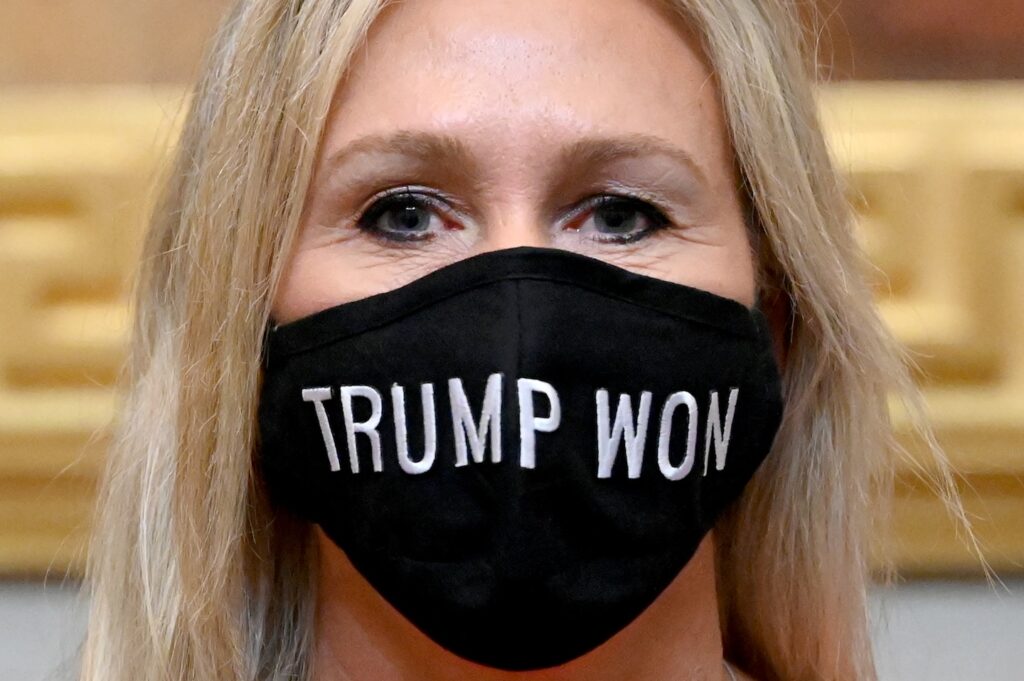
“[G]oing against everyone” in the GOP is a pretty sudden about-face for Greene. The Georgian maverick, after all, appeared on the floor of the House her first day in office in 2021, after the election of Joe Biden, wearing a mask that read “TRUMP WON.” And in the years since, she’s cosponsored resolutions in congress to expunge Trump’s two impeachments. Understandably, then, Vanity Fair and The Guardian have described her, respectively, as “rabidly loyal” to the MAGA movement and “one of Trump’s most loyal foot-soldiers.” Indeed, she’s voted with her party north of ninety percent of the time since arriving in congress.
So, what’s going on? Some speculate that MTG just ran out of space for provocation on the right, having essentially over-farmed that territory long ago. This is the same woman who famously posted on Facebook in 2018 that the deadly California Camp Fire might have been caused by “what looked like lasers or beams of blue light” from “space solar generators” funded by companies linked to the “Rothschild & Co Inc.” This is where MTG’s association with the “Jewish Space Laser” conspiracy came from, despite having never appended the word Jewish itself. (She didn’t really need to.) And of course, though she’s now disavowed it, she was also once a vocal Q Anon proponent—about which, more later. With no cabals of global financiers or pedophiles left to reveal, MTG’s only means of continuing to signal her firebrand status might have been through the sporting adoption of the occasional left-coded position. Alexandra Ocasio-Cortez offers a slightly different spin on this perspective. She suspects it may be MTG’s attempt to punish Trump for refusing to endorse her in the Republican primary for the 2026 Senate race. (The seat is currently held by John Ossoff.) “[S]he has been on a revenge tour ever since,” suspects Ocasio-Cortez. With MTG, any of these accounts could be correct—revenge, self-promotion, or good old iconoclasm.
But I actually think she’s up to something else.
*
Far, in fact, from breaking with the theories of Jewish Space Lasers or pedophile rings, MTG’s Obamacare position actually—as the military theorist von Clausewitz might say—continues them by other means.
What do the Jewish Space Lasers (here standing in for any variety of her comparably colorful obsessions) represent for her but the fantasy that there exists an array of hidden forces preying on and immiserating “real” Americans—like those rural Californians, presumably, who perished in the Camp Fire? MTG’s Jewish Space Lasers reprise in especially distorted and down-market modern form the ancient “blood libel” dating to the twelfth century, according to which dark foreign actors—Jews, specifically—don’t simply manipulate the real Volk as witless puppets, but actually draw vital life force from them. In that ancient mythos, Jews kidnap Christian children whose true, real, healthy blood they use in vampiric rituals to sustain decrepit, ailing, and sickly Jewish life. The Nazis reprised this rhetoric directly in the 1930s, positioning German Jews as parasitically thriving on a body politic of real, authentic Germans after the humiliating defeat (itself a Jewish “stab in the back”) of World War I. Likewise, the dark and duplicitous Rothschilds (“& Co Inc”) in MTG’s conspiratorial theorizing grow wealthier through their extraterrestrial “solar generators” at the expense of the Good Country People burned to death in the pastoral Eden of Paradise, California.
In this way, Jewish Space Lasers are fully of a piece with the Q Anon catechism to which MTG ascribed for some time. Q, too, focused blame for the “American carnage” Trump railed against in his first inaugural address on a cabal of “globalist elites,” often through their puppets in finance, the media, and Hollywood. Like the perpetrators of the blood libel and the German Jews of the Weimar Republic before them, the puppeteers in Q’s dark imagining may be powerful, but they, too, are fundamentally frail, feeble, and morbid. Thus, vampirically, do they require continuous infusions of adrenochrome harvested from helpless American children. While the rhetoric of Q Anon is therefore implicitly antisemitic, the argument I’m after doesn’t require that similarity. (It has, in any case, already been done exhaustively elsewhere.)
What’s more important for my purposes is that the scripture of Q and the Jewish Space Lasers alike allow MTG to paint the portrait of an imperiled and enervated American body. If Tsar Nicholas I could describe the Ottoman Empire as the Sick Man of Europe in the nineteenth century—a phrase pundits subsequently applied to Britain in the 1970s—then MTG seems to view the United States, at present, as a Sick Man on the global stage. In her subscription to this essentially tragic view of recent American history, MTG is far from alone. Notions of American sickness, carnage, and predation animate a wide range of contemporary right-wing thought—from Nick Fuentes and his Groypers to Tucker Carlson, and from Senator Josh Hawley to the late Charlie Kirk.
And thus it makes a certain kind of sense that someone as deep into the MAGA fever realms as MTG would feel a real if cross-pressured craving for the medical safety net represented by Obamacare. According to the Kaiser Family Foundation, enrollees in the Obamacare marketplace are more likely to be represented in Congress by a Republican than a Democrat. (Presumably these would include people like MTG’s own “adult children” whose premiums are set to double, which they wouldn’t were those individuals to receive healthcare through non-Obamacare routes such as from employers.) The same Kaiser report indicates that, since 2020, in the states that Trump would go on to win in 2024, enrollment in the ACA exchanges has grown by 157%, as compared to the 36% by which enrollment has grown in the states Kamala Harris would win in 2024. Without getting buried in the data here, my point is simply that, as even someone as ambivalent to data as MTG cannot fail to see, the “forgotten” people who she champions (e.g., rural or rural-coded whites) need and use Obamacare as much as if not perhaps more than anyone else. And thus supporting Obamacare becomes a way of sustaining them just as much or as crucially—in her way of thinking—as keeping immigrants out of the country, adrenochrome in the bodies of helpless white children, and solar lasers out of the hands of the Rothschilds (“& Co Inc”).
The fact that she’s all but alone within the GOP conference in her advocacy for healthcare subsidies may well reflect the tendency toward vengeance and preening iconoclasm noted by AOC. But the perspective itself is—and here I’ll beg the reader’s forbearance—too logical, or at any rate, consistent, at least relative to her broader political theology, to be dismissed as pure cussed peacocking.
It’s well past time that we see the position cryptically articulated by MTG and those in her ideological orbit as a sub-formation in its own right within the greater MAGA umbrella. I propose to call these the BioCons—short for Biological Conservatives. It would be particularly easy to conflate them with another of the sub-MAGA variant: the so-called NatCons, or National Conservatives. So it’s worth disentangling them at the outset.
*
National Conservatism, as its own website will tell you, names an ideological tendency in conservative politics (in the U.S. and globally) that emphasizes the nation-state, cultural identity, traditional social orders, national sovereignty, and often a skepticism of liberal internationalism, open borders, unfettered global trade, and (what they regard as) the excesses of liberal individualism. High profile NatCons would include Senators Mike Lee (R-UT), Josh Hawley (R-MO), and Eric Schmitt (R-MO), as well as Tucker Carlson. Sociocultural traditionalism is pretty much part and parcel of any constellation in the American right. So really it’s their opposition to liberalized markets and migration policies as well as the so-called “liberal-international order” that sets the Nat Cons apart from their predecessors at the core of the GOP brain trust: the Neocons (people like the late Dick Cheney). In fact, the NatCons mark a break from the entire “fusionist” project begun by (and associated with) William F. Buckley—the “fusing” in question referring to the jointure of interventionist foreign policy abroad laissez faire economics at home.
The NatCons are often mistaken for or confused with a simpler populist spirit in today’s GOP. Because the latter is first and foremost an emotional or aesthetic category—one rooted in the American charismatic tradition more than anything—I don’t think it’s exactly synonymous with the legitimately intellectual moorings of National Conservatism.
The BioCons share the NatCons’ attachment to the state form, cultural traditionalism, sovereign borders, and hostility to multilateralism. But it’s in their fantasies around not just the American body politic but the American body itself—its very corporeality—that the BioCons distinguish their project. Of course, a NatCon might have interests that touch on the flesh and blood body. What, after all, is the opposition to abortion rights if not a bodily interest? What differentiates the NatCon’s opposition to abortion to the BioCon’s, however, is his motivation. Where the NatCon might oppose abortion for its imagined religious heresy, or as an affront to whatever is meant by “traditional family values,” the BioCon—whether she knows it or not—opposes abortion because it imperils the production of more/new American bodies. The BioCon is therefore motivated above all by questions of demography and actuarial probability, even if she’s inclined to narrate these interests—to constituents as well as to themselves—through the residual appeal of tradition and culture. Access to medicine and healthcare—as well as to things like SNAP (ie, the Supplemental Nutritional Assistance Program)—is thus an essential component of the BioCon’s policy platform. All of which, by the way, is not tantamount to a critique of BioConservatism, so much as it’s a description of it. My interest here is taxonomical. It’s to provide a way of disentangling the BioCon’s occasional tendency to take positions that appear progressive from the motivations of the progressive. The latter, of course, no less than the former are often misunderstood by their own proponents.
Humanists might recognize the BioCon as a practitioner of biopolitics rescripted to the unique exigencies (imagined or otherwise) and idiom of the American present. Like the biopoliticians that Michel Foucault traces back to the eighteenth century, today’s BioCons are aimed at maximizing populational aggregates. Indeed, we can find some of this BioConservative spirit elsewhere on the contemporary right, where demographic anxiety–panics about falling birthrate in the “West” (inclusive, curiously, of places like South Korea and Japan)–abound. JD Vance’s fixation on the “childless cat ladies” would supply just one especially salient example. Critics of that comment at the time were surely right in pointing out Vance’s misogyny—that is, its reification of right and wrong modes of femininity. Less theorized was its biopolitical valence. If Vance’s cat ladies transgressed standards of womanhood he’d surely trace back to the Bible, they also deprived the country of more American children. We might well think here, too, of the Right’s unique focus on how forms of gender-affirming care based in hormone therapy can eventuate in infertility. The questionable accuracy of such claims notwithstanding, here too we find a prurient interest in demography. Alongside and encrypted within the BioConservative’s residual misogyny and transphobia, then, is the imperative to make live—here produced through the imperative to reproduce, and to Save the Children so that they may, in their time, do the same. For what it’s worth, the isolationist tendency in MAGA could also be read as an enactment of BioConservatism, inasmuch as the aversion to warfare conservates biological (and therefore, again, demographic) capital. The current allergy within the MAGA politburo among all except the residually neoconservative (e.g., Marco Rubio) to an actual war with Venezuela, supplies a handy example of that speculation.[1]
*
And yet, if biopoliticians seek to maximize population, how do we make sense of MTG’s opposition to immigration and healthcare for immigrants? Wouldn’t a large body of immigrants healthy enough to reproduce actually serve her populational ends, at least as I’ve described them? As theorists as early as Foucault have shown, biopower seeks not only to enlarge but also to normalize populations. That positing of a norm—that is, a median body—necessarily designates bodies who are divergent from it, and indeed, whose increasing divergence, at successive deviations from the mean, actually stands as a threat to the normal body, and in turn to the herd. Thus, as Giorgio Agamben, and, after him, Achille Mbembe remind us, does biopolitics generate bare life and necropolitics. Bodies deemed aberrant are to be managed away—quarantined, segregated, imprisoned, institutionalized, deported, or killed. The Nazis, too, depicted Jews as a living and proximate threat to the health of the German people—bearers of disease, morbidity, and criminal impulsivity. The biopolitician—and therefore, too, the BioConservative—doesn’t simply make live; she also lets die, to recall Foucault’s formulas for capturing biopolitics.
If the “illegal” immigrant, for instance, comes to be imagined as—in himself—a threat to the flourishing of the “American” body, then the withdrawal of his access to healthcare functions as a way of exposing him to death, gore, debility, atmospheric slow death. When he dies, a threat has been subtracted from the commonwealth, just as a tumor is removed. On this account, the BioCons’ hostility to immigrants and domestic undesirables alike enacts rather than contravenes their biopolitical mandate. The same calculus would square the apparent contradiction that the BioConservatives tend to favor liberalized gun control laws and the death penalty. Gun violence and executions do reduce the number of Americans with a pulse. And yet, inasmuch as the kind of Americans disproportionally killed by guns or the state, or, for that matter, by, to put it mildly, uneven Covid precautions, reside—through some intersectional calculus of race and class–outside, in the wake of the “real” American imago, the existence of capital punishment and rampant gun violence serve as crucial technologies in the thanatopolitical armature of normalization.
BioConservatism is a politics constructed around a romance for the American body—a body that’s broken, beset, and bereaved, perhaps, but still salvageable. Because that body stands in dilapidation and disrepair, it would be more accurate to call BioConservatism a gothic romance—the body politic remaining, in its carnage, like the ruined abbeys and ancestral manors of Poe, Stoker, et al. In those tales, the ruin telegraphs a bygone grandeur plowed under by the depredations and degradations of modernity. If partially destroyed, however, it persists as a reminder of Greatness to Make Again. It could be argued, on this account, that all conservatisms, or at least those downstream of what I take to be their lodestar—the repulsed response to the French Revolution by foreign onlookers like Edmund Burke as much as by domestic supporters of the ancient regime like Joseph de Maistre—are, in the sense that they arrive, always belatedly, at a scene of (imagined) loss and set then, to the Arnoldian task of shoring fragments against further ruin, gothic.
Travis Alexander is an Assistant Professor of English at Old Dominion University. His research deals with critical theory, American literature and film, and the health humanities. Writing on these subjects have appeared or are forthcoming in American Literature, Criticism, Cultural Critique, Discourse, Public Culture, and elsewhere. He also writes for non-academic outlets like the Los Angeles Review of Books, Liberties, and Aeon, and he has just completed a book manuscript entitled The Birth of Viropolitics.
[1] My description of the BioConservative—a term that names the biopolitician incubated within the discursive conditions of modern American conservatism—implies the contrapuntal existence of the character we might call the BioProgressive. Although I will have to leave the theorization of the BioProgressive for another time, this would be a character who, likewise, seeks to maximize and normalize a certain kind of life—but for progressive ends. Where the maximizing and normalizing acts of the BioProgressive may in progressive spaces be glossed as plain and simple enactments of objective, altruistic “ethics,” they too would proceed first and foremost from the imperatives of biological optimization. In other words, to cast their acts as virtuous would be as incorrect as the depictions within the MAGA constellation that understand BioConservatism through the residual paradigm of “traditional values.” Where the BioConservative might maximize and normalize life through promoting childbearing (among the native born), maintaining access to healthcare (ditto), and spurning forms of gender affirmation that could imperil fertility, the BioProgressive could be said to derive from the rhizomatic and recombinant spectra of gender and sexuality a species of vitalist maximization in its own right.