This essay is part of “The Argentina Chapter” of the b2o Review‘s dossier “The University in Turmoil: Global Perspectives”.
The Argentina Chapter: An Introduction
Tomás Borovinsky
The texts gathered in this dossier examine how the global crisis of the university acquires a particular intensity in Argentina, a country in which the university has been a central institution of democratic life for more than a century. Around the world, universities have seen their historical sources of legitimacy erode under the pressures of new managerial regimes, standardized evaluation systems, unstable budgets, and a public sphere increasingly hostile to institutions whose value has always depended on duration, autonomy, and the slow accumulation of knowledge. In the Global South, these transformations intersect with structural inequalities and recurrent fiscal crises, sharpening the question of what universities are for—and who they are for.
In Argentina, this global turbulence acquires a singular historical density. Since the late nineteenth century—when figures such as Domingo Faustino Sarmiento promoted a republican, secular, and universalist vision of public education—and mainly since the University Reform of 1918, the public university has functioned as a political form that has articulated autonomy, equality, and intellectual citizenship. As such, it became an engine of social mobility and a key producer of public knowledge, rooted in an Enlightenment conception of education as a right and as a condition for democratic life.
However, the arrival in Argentina in 2023 of an openly anarcho-capitalist government, informed by paleolibertarian ideas, marks the most profound rupture in this trajectory in more than a century. For the first time since 1918, the state not only withdraws material support from the university but also questions the very legitimacy of the institution, recasting it as a moral anomaly sustained by taxation, self government (professors, graduates, and students), and egalitarian values. This conflict crystallizes in an explicit culture war. The university is labeled part of the “casta,” a vestige of statist politics to be overcome. Faculty and researchers—especially in the social sciences and humanities—are accused of indoctrination. And the institution’s own temporality—slow, deliberative, accumulative—is reframed as incompatible with a political project that celebrates acceleration, rupture, and permanent deinstitutionalization. What is at stake is not merely funding but the very possibility of autonomous knowledge production.
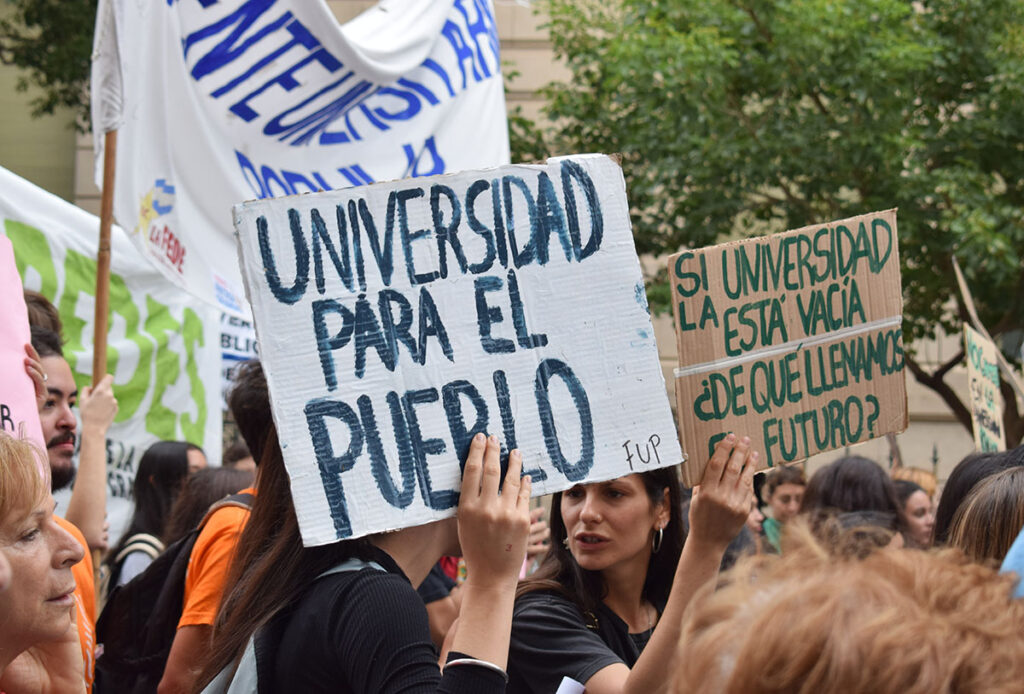
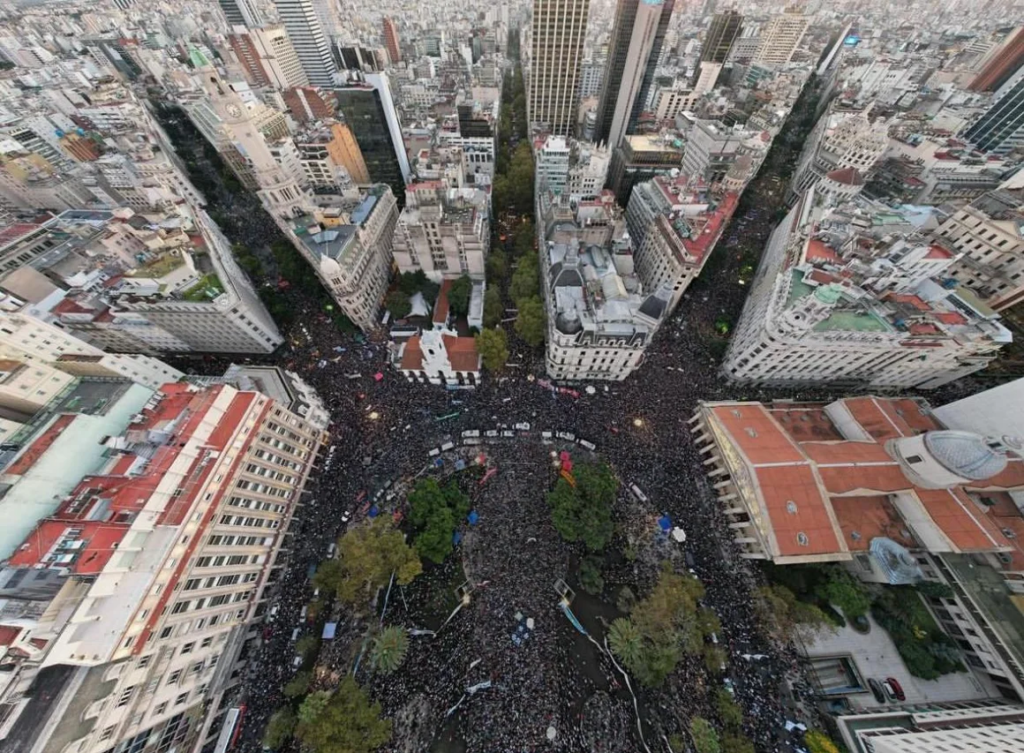
Yet the crisis has also reshaped the university’s political role. The mass mobilizations of 2024 and 2025 showed that, despite the erosion of the old democratic consensus, the public university retains significant social legitimacy. Its defense, however, cannot be reduced to corporatist reflexes. The challenge—as the essays in this dossier argue—is conceptual: how to sustain critical knowledge when expertise itself becomes publicly contested, and how to reinvent the university without abandoning its historical commitments?
Within this confrontation, the Social Sciences and Humanities (SSH) occupy a particularly vulnerable position. The anarcho-capitalist attack seeks to delegitimize them by portraying them as a “useless expense” or an elitist indulgence, contrasted with the supposed “indisputable utility” of the natural sciences. This opposition rests on an impoverished view of knowledge that recognizes only what can be immediately translated into a measurable, marketable, or technically operational product. Against this simplification, the defense of the SSH cannot be reduced to arguments about instrumental utility. Their value is deeper: they are historical practices of collective debate, bearing ethical, political, and critical dimensions, enabling societies to question what is taken for granted, revisit the past, and open possible futures. In a context where speed and efficiency become universal benchmarks, they remind us—as philosophy once insisted—of “the usefulness of the useless.” Their decisive contribution does not lie in producing immediate solutions but in sustaining a society’s capacity to think itself and to build a historical, political, and human “we.”
Taken together, the texts in this chapter of the b2o Review’s dossier “The University in Turmoil: Global Perspectives” suggest that the path forward is not restoration but a vital search for the university’s new formations. At a moment when a global intellectual counterrevolution seeks to delegitimize collective institutions, the Argentine university offers a privileged vantage point from which to rethink what forms of democratic life remain possible. The university, that longstanding repository of promises and conflicts, may once again need to become a laboratory—an institution capable of imagining new modes of learning, participation, and everyday life amid this particular storm, and the ones to follow.
Tomás Borovinsky is a researcher at CONICET (National Scientific and Technical Research Council, Argentina) and a professor at EIDAES–UNSAM (the Interdisciplinary School of Social Sciences at the National University of San Martín). His latest collective volume is ¿Hay algo que no esté en crisis? Arte y pensamiento en la era del cambio acelerado y sin fin (Siglo XXI). He is also the editorial director of the publishing imprint Interferencias (Adriana Hidalgo Editora), focused on contemporary thought, and the editor-in-chief of Supernova, a magazine of ideas and public debate.