


This essay is part of “The Argentina Chapter” of the b2o Review‘s dossier “The University in Turmoil: Global Perspectives”.
The University Experiment in a Reactionary Age
Tomás Borovinsky
The University as a Political Form
In recent decades, universities across the world have been experiencing a global crisis. Their traditional sources of legitimacy have weakened, their funding models are under permanent pressure, and their place in society no longer seems self-evident. While universities in the Global North have been increasingly strained by managerial logics, standardized evaluation systems, and the retreat of humanist ideals, in the Global South those same forces have advanced as well, though within a much more fragile institutional landscape. In both cases, universities have been forced to adapt to a common pressure: to demonstrate efficiency, justify their existence in terms of performance, and submit their intellectual autonomy to external metrics that rarely capture the deeper meaning of academic work.
But in the Global South, these trends are combined with additional dilemmas. The crisis of the university is inseparable from the crisis of the public sphere: budgets that fluctuate with unstable economic cycles, periods of institutional hollowing-out that erode basic capacities, and a persistent dispute over the place of knowledge in societies marked by structural inequalities. Thus, rather than two distinct processes, North and South share a common diagnosis, albeit traversed by material asymmetries. Both face the same question: how to sustain an institution that produces critical knowledge and civic education? However, they do so under very different conditions, where each global pressure acquires a particular density as it embeds itself in unequal political, economic, and social histories.
We are living through a context of public defunding of universities and a retreat of international cooperation more generally. Even institutions such as UNESCO (to mention just one example), which in earlier times were donors and funders of research programs, now compete for funds with the very institutions they once financed.
At the same time, as we will see in the Argentine case in particular—but also globally—we are witnessing the rise of extreme political movements that call the role of universities into question. If the modern university, heir to the Enlightenment, saw itself as a generator of “useful” scientific knowledge but also assumed a critical role vis-à-vis society, today it finds itself besieged by a reactionary tsunami that positions the university as a privileged political enemy.
In Latin America, and this is especially the case in Argentina, the public university is not simply a space for professional training nor (only) a gear in the market: it is a political institution, a device in which, over more than a century, the promises, conflicts, and contradictions of Argentine democratic life have been inscribed. The university “convulsion” in this context cannot be reduced to an administrative or budgetary problem (though it is that as well). Rather, it expresses a dispute over the meaning of the common good and over the place that knowledge occupies in the making of a society.
Part of this specificity has historical roots. In Argentina, the university predates the state and, in a sense, the nation itself. The National University of Córdoba, founded in 1613, and the University of Buenos Aires, created in 1821, belong to a political time much older than the Republic (1853) or the formation of the modern Argentine state (1880). In other words, they are institutions older than the state and the republic that support them today. They accumulate legitimacies, traditions, and social expectations that no political cycle so far has been able to reconfigure fully. Their persistence through dictatorships, democratizations, economic crises, and institutional reconstructions reveals something important: the university is a repository of dreams that outlive time. But how long can that dream endure?
From this vantage point, in Argentina, the university has not been—at least over the last century—a mere educational device. Rather, it has been—and continues to be—a political form, a privileged space in which the democratic promise of Argentine modernity has been imagined, contested, and also embodied. The university articulates autonomy, equality, and intellectual citizenship, and it is a major producer of public knowledge and common goods. In the social imagination, it has been more a horizon of possible social mobility than a machine for reproducing privilege.
As public opinion studies from the University of San Andrés, a private Argentine university, indicate, Argentine science enjoys a very positive image in society.[1] Even in moments of precarization, the university continues to be one of the few sites where the meritocratic ideal still holds, albeit in partial and conflictive ways. Where other institutions have deteriorated or lost credibility, the university—and the scientific system organized around state institutions such as CONICET—continues to operate as a space where equality seems possible, where a certain idea of the future—so fragile in contemporary Argentina—still retains a place.
The Long Century of the Argentine University (1918–2023)
To think about the Argentine university between 1918 and 2023 is to reconstruct a historical cycle in which the university functioned as one of the symbolic and political lungs of the country. Unlike other systems, in Argentina the public university was not limited to the transmission of knowledge: it was a stage on which models of citizenship were projected, disputes over the meaning of the State unfolded, expectations of social mobility took shape, and, above all, an imaginary of equality traversed generations. In a way, this long century constitutes the political biography of the modern Argentine university.
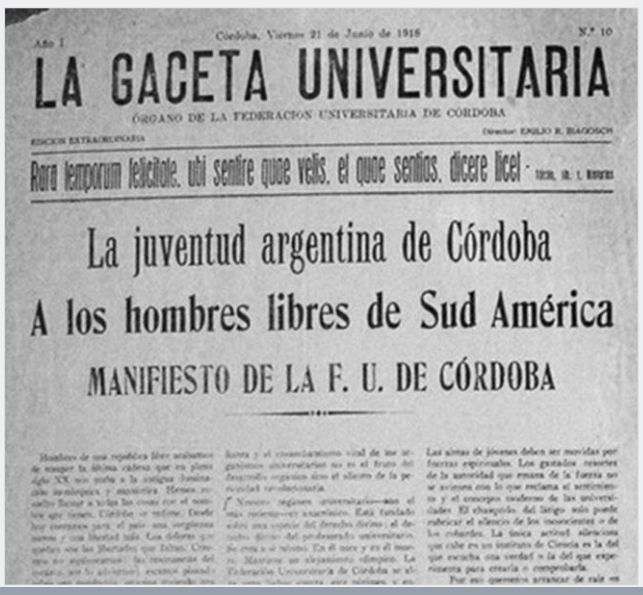
The starting point is 1918. The University Reform of the province of Córdoba was much more than an academic reform: it established a way of understanding the university as a space open to deliberation, equality, and conflict. Co-governance among professors, graduates, and students, together with institutional autonomy, academic freedom, and a distinctive Latin American influence and resonance, introduced a political grammar that continued to radiate throughout the century. The 1918 University Reform emerged as a student insurrection that dismantled the inherited academic order, questioning the concentration of professorial power and the closure of participatory spaces. Its momentum opened the doors to a model of university more receptive to intellectual renewal, with selection mechanisms designed to prevent the stagnation of academic chairs, and with a conception of university life grounded in deliberation and the circulation of new currents of thought. As one of its most emblematic documents states: “Our university system—even the most recent—is anachronistic. It is founded on a kind of divine right: the divine right of the university professorship. It creates itself. It is born in it and dies in it. It maintains an Olympian distance. The University Federation of Córdoba rises up to fight against this system and understands that its life is at stake in doing so. It demands a strictly democratic government and maintains that the demos of the university, sovereignty, the right to self-government, resides principally in the students.”[2]
The Córdoba Reform movement not only reorganized the political life of institutions but also established a generational sensibility that understood the university as a stage for social transformation, capable of projecting debates and demands beyond its own walls. Seen from today, the Reform is not so much an event of the past as an institutional language that made it possible to imagine the university as a place where knowledge circulates without tutelage, where hierarchies must justify themselves, and where power is always already in dispute. This permanent availability of conflict, this “empty place” of power, is one of the most enduring marks of Argentine university culture. As Claude Lefort writes: “where an empty place takes shape, there can be no possible conjunction between power, law, and knowledge.”[3] The university thus lives its internal effervescence while, even as part of the Argentine state, it maintains its autonomy from power.
By the mid-twentieth century, the university entered a period of expansion, modernization, and politicization. Peronism (1945–1955), though in conflict with student organizations, ensured free tuition, and it was followed by the developmentalism of the late 1950s and early 1960s, which sought to turn the university into the engine of the national project. As a consequence, there was budget expansion, new faculties, academic professionalization, and the later creation of CONICET (the National Council for Scientific and Technical Research) as scientific infrastructure.
Understanding the Argentine university also requires taking seriously its intertwining with its scientific system. Since the creation in 1958 of CONICET, inspired by the French CNRS (the French National Centre for Scientific Research) and spanning the natural and exact sciences, the humanities, as well as the medical and economic fields, the country experimented with a singular architecture of knowledge: the university as a generator of knowledge and as a territory for teaching, conversation, and transmission; and CONICET as the structure that organizes research, gives it continuity, and projects it beyond political urgency. There emerged research careers, disciplinary commissions, mixed institutes: an ecosystem that breathes at the rhythm of the universities and, at the same time, gives them a depth that would be impossible without that support. Through crises and expansions, withdrawals and re-launches, CONICET maintained its mission of producing public knowledge. For this reason, speaking of the university in Argentina is never only about classrooms and students: it is about that scientific fabric that grants it historical continuity, social prestige, and a forward direction—even when the country seems to lose it.
However, this technical impulse coexisted with a climate of growing political mobilization. Universities became territories where heterodox Marxisms, popular nationalisms, left-wing Christian movements, new social sciences, and a set of intellectual explorations circulated that exceeded the boundaries of the strictly academic. It was a time in which the militant intellectual, the modernizing scientist, and the student as political actor intersected. This politicized density transformed the university into a central battleground with authoritarian projects: intervention, censorship, expulsions, and episodes such as the “Night of the Long Batons” (1966) were attempts to break a university world that was perceived—rightly—as a hub of critical thought and social organization.
The “Night of the Long Batons” was a turning point in the history of Argentine universities. The intervention of the dictatorship of Juan Carlos Onganía (1966–1970) and the police eviction of UBA (University of Buenos Aires) faculties revealed with absolute clarity the conflict between academic autonomy and state power. The operation interrupted research, dismantled research teams, and occurred at a moment of intense intellectual dynamism in Buenos Aires. Spaces such as the Di Tella Institute—a center for social studies and avant-garde art that, with the return of democracy, would later become a university—functioned as laboratories of artistic, scientific, and technological experimentation. This coexistence between a reformist university and an innovative cultural ecosystem, on the one hand, and a growing state desire for control, on the other, shows that the “Night of the Long Batons” was not an isolated event. It was the collision between two models of modernization: one open and experimental; the other vertical and disciplinary. The episode has since delineated the material and normative limits within which the university can produce knowledge and sustain long-term projects.
This politicization accelerated in the 1970s, when the political radicalization of the Peronist left and the non-Peronist left was persecuted by para-state organizations such as the AAA (Argentine Anticommunist Alliance), until the 1976 military coup placed the university under direct military control. At that point, persecution intensified, censorship was consolidated, and state violence expanded, culminating in executions, kidnappings, and desaparecidos.
With the return of democracy in 1983, the university regained its place as a laboratory of citizenship. Degree programs were reopened, exiled professors returned, institutional projects were reconstituted, and the idea that the public university was part of the democratic pact was restored. It was a period of massification, expansion into the metropolitan periphery, the creation of new national universities, and science and technology policies aimed at rebuilding a system devastated by years of authoritarianism. However, this momentum coexisted with new tensions: growing bureaucratization, internal fragmentation, budgetary difficulties, a crisis of the academic career, and a certain loss of the reformist horizon that had organized university life for half a century. The democratic university expanded access, but it did not always succeed in producing a new intellectual project capable of replacing either the militant ethos of the 1960s or the modernizing one of the 1950s.
In the twenty-first century, the university system experienced an accelerated and unprecedented expansion. New universities in Greater Buenos Aires—a phenomenon already underway in the 1990s—expanded enrollment, and this period was marked by a renewed protagonism of the university in the public agenda. There was an increase in education spending, and investment in science grew steadily. Institutions were created, staffing expanded, and efforts were made to rebuild a scientific system battered by decades of instability and austerity. But this growth had a flip side: an increasingly unequal system between central and peripheral universities, an administrative structure that grew heavier, research circuits strained by precarization, and a proliferation of institutions, degrees, and initiatives that sometimes made it difficult to articulate a shared horizon. The reformist ethos, which in the past had operated as a motor of transformation, began to survive as a defensive gesture against the advance of a managerial culture that tended to turn the university into a collection of indicators and planning documents rather than a shared intellectual project.
Since 1983, the Argentine student landscape has reorganized itself around a plurality of political traditions that alternated in influence. Reformist and social democratic and Peronist leadership marked the early years of the transition, promoting agendas centered on the defense of autonomy, institutional reconstruction, and the expansion of academic rights. Throughout the 1990s and 2000s, Reformist and Peronist student groups and independent formations also occupied important spaces, combining university concerns with broader debates on the role of the state and educational policy. By the early twenty-first century, the growth of left-wing groups—from Trotskyist organizations to new movements emerging from social, feminist, and territorial struggles—reconfigured the landscape, introducing a repertoire of demands tied more closely to critiques of the economic model, the democratization of academic life, and the active defense of the public sphere.
By 2023, however, this long cycle seemed to have reached a turning point. Argentina was marking forty years of democracy (1983–2023) after half a century of dictatorships, authoritarian governments, bans, and political violence (1930–1983). The public university still retained its social legitimacy—surprisingly high for an institution subjected to recurrent crises—but it had lost part of its aura of upward mobility, future, and emancipation. The meritocratic imaginary that sustained it for decades is now eroded by a fragmented society, persistent inequalities, and a climate of political disorientation that affects all state institutions. The democratic consensus that once protected the university is no longer unquestionable: today it must justify itself, defend itself, and perhaps once again reimagine itself.
This exhaustion of the reformist-democratic cycle defines the threshold from which the current offensive against the public university can be understood. And it turns the period from 1918 to 2023 not into a concluded era, but into a legacy now being disputed under new historical conditions.
The Anarcho-Capitalist Offensive: Milei and the War Against Public Education
The arrival of Javier Milei to government in 2023 marks a turning point not only in Argentine history but in that of the Argentine university in particular. For the first time since 1918, the State is not only reducing its material support for public education—something that has happened many times in the past—but is questioning the university’s social role and its very legitimacy. It’s worth noting that Milei comes to power in 2023, the year that marks forty years of uninterrupted democracy and half a century of erratic economic policies (1973–2023) producing a deterioration in people’s living conditions and successive extreme economic crises (1975, 1982, 1989, 2001, 2009, 2018, etc.) under all kinds of regimes and governments: dictatorships and democracies, right-wing or left-wing, statist or neoliberal.
As I noted in a text I wrote with Martín Plot and Daniela Slipak, “2023 was marked by the exhaustion of a democratic regime that made economic uncertainty entirely intolerable and by the emergence of Milei as a leader who articulates critical solutions to the regime born in 1983.”[4] For the first time since 1983, a true outsider—someone outside the traditional political parties and the elite that has governed the Argentine Republic in democracy to varying degrees—had reached power. And it was Milei who knew how to make functional use of the tsunami of public anger that was emerging.[5]
In this context, anarcho-capitalism, in its Argentine version, does not simply aim to cut budgets or reorganize ministries: it seeks to dismantle the very idea of the public as the organizing principle of common life. In this way, the public university—one of the most highly valued institutions of Argentine democracy, as we have shown—becomes a privileged ideological target. What is at stake is not only institutional continuity but the survival of a political-cultural model that associated knowledge, equality, and a shared social project.
This movement is not unique to Argentina. There are resonances, mimicry, and contagion among movements worldwide. In Viktor Orbán’s Hungary, for example, free universities have come under such pressure that the Central European University in Budapest, founded and financed by George Soros, was forced to relocate its operations to Vienna, Austria’s capital. In the United States, radical figures such as J.D. Vance have openly declared that “university professors are the enemy.” Trumpist rhetoric has constructed the university as a polarizing figure through a convergence of dynamics also visible in Argentina: universities and the media are “hostile elites,” producers of a liberal culture deemed decadent or anti-national. The thought of Curtis Yarvin, with his theory of “The Cathedral,”[6] serves as an intellectual matrix for this worldview: the university and journalism appear as cultural devices that reproduce progressive values and block popular sovereignty. Milei feeds on this repertoire and on this global moment: he translates it into the local idiom, blends it with the media logic of provocation, and transforms it into a political program. And he also accelerates that Zeitgeist.
Milei is a believer and an ideologue who jumped from the margins of the intellectual debate to become a global reference point for anarcho-capitalism. This transition—from professional economist to media panelist and later ideological activist—structures his relationship with knowledge: it is not so much a technical debate as a doctrinal alignment that views the public university as a bastion of “statism” to be dismantled. The problem is not only budgetary. It is philosophical: public education appears as a moral anomaly within a worldview that equates freedom with the market and the state with corruption. Ironically, Milei—a global referent of anarcho-capitalism—is a relative newcomer who found in this ideology a framework for measuring and transforming the world.
Within this entire ideological constellation, paleolibertarianism occupies a central place. Milei came to Murray Rothbard’s work relatively late, in 2013, after which he named one of his dogs Murray. Following this epiphany, he would say: “When I finished reading Rothbard I said: ‘For more than 20 years I’ve been deceiving my students. Everything I taught about market structures is wrong. It’s wrong!’”[7] Another of his “idols” is Hans-Hermann Hoppe,[8] from whom he adopts a simultaneous critique of egalitarianism, the welfare state, and liberal democracy—an intellectual framework within which the public university becomes inconceivable: an institution supported by taxes, organized through collegiate bodies, and permeated by egalitarian values that Hoppe identifies as signs of cultural decadence. Milei takes up this matrix but cultivates it within Argentine public and historical debates, explicitly reclaiming Juan Bautista Alberdi (1810–1884), one of the founders of the Argentine constitutional order. Milei argues that the origins of all Argentine evils and of “Argentine decadence” began in 1916: curiously, the year in which “universal suffrage” (for men) was instituted. It is with the arrival of the vote, he claims, that Argentina ceased to be a “world power,” as dictated by the founding myth of the libertarian movement (we call it a myth because although Argentina’s GDP was indeed very high between the late nineteenth and early twentieth century, it is not true that it was a “world power” of any kind). And it is precisely in that democratization process initiated in 1916 that, in 1918, the spark of the aforementioned Argentine University Reform was ignited. Under this anarcho-capitalist logic, the public university is not merely an expense: it is an obstacle to the technocratic reorganization of power and to the ideal of a leader who acts without intermediaries, without checks, and without a public sphere that limits him. Within this framework, the public university—financed by the state, co-governed by professors, graduates, and students and ruled by norms that limit the market—embodies, for this new regime, the epicenter of ideological resistance.
Thus, the offensive against public education must be read in continuity with another idea that Milei repeats insistently: the need to “destroy the State from within.” This formula—which he himself links to his admiration for paleolibertarians, and which echoes the neo-reactionary rhetoric of Silicon Valley—expresses a strategy of accelerated erosion of traditional institutional mechanisms. In this context, the public university appears as a symbol of the kind of state that the regime aims to dismantle: a state with territorial presence, egalitarian vocation, and cultural legitimacy. Rather than administering an education policy, the government seeks to modify the very conditions of possibility for any public knowledge project. The university thus becomes the site where this transformation becomes visible—not because it has been chosen as an enemy, but because it embodies what the new regime seeks to leave behind: the idea that knowledge can be organized collectively and outside the proprietary logic.
The intellectual constellation surrounding Silicon Valley adds a decisive layer to the contemporary offensive against the public university—not only in the United States but also in Argentina under Milei. This is not a unified doctrine but a cultural milieu that associates innovation with deregulation, speed with virtue, and bureaucracy with decadence. Here we find extreme entrepreneurs, technolibertarians, accelerationists, and media figures such as Elon Musk, whose worldview rests on a simple premise: progress occurs best when there are no institutions to moderate it. In this vision, academia functions as a device that is too slow, normative, and attentive to collective procedures. The critique of scientific “slowness,” the exaltation of rapid motion, and the suspicion toward any deliberative instance shape an idea of knowledge in which the university appears as an artifact of the past. Faced with the epic of code, global scale, and technical solutionism, the public university is cast as an anachronistic world, organized in another temporality and faithful to values the new technological order deems obsolete.
The meeting between the Argentine president and Peter Thiel at the Casa Rosada in March 2024—an event of which there are no photos, something that’s unusual for a government that constantly flaunts encounters with “great men”—symbolizes this convergence between technological acceleration and the politics of exception: two different ways of imagining the dismantling of the state converging in a shared anti-public logic.
A more immediate gesture complements this ideological background: the de-hierarchization of expert knowledge. Martin Gurri, author of The Revolt of the Public: The Crisis of Authority in the New Millennium,[9] who, during his visit to Argentina, was struck by Milei’s rise, offers in his book a valuable lens for thinking about the cultural clash between the university and the anti-establishment political activism that in Argentina is dominated by mileísmo. His thesis is simple: we are living through a collision between a Center rooted in the industrial era and a digital Frontier that has not yet constituted itself as an order. The Center is hierarchical and professionalized; the Frontier is fragmentary, egalitarian, and corrosive. What collides are not political actors but two ways of organizing the world. The decisive element in this situation is information. Digital flow breaks the monopoly that sustained modern authority: there are no longer mediators, but a public that chooses, contradicts, ridicules, and multiplies narratives without limit. Any technical decision or expert knowledge can become the subject of suspicion within hours. It is no coincidence that the information age coincides with the rise of conspiracy theories. It is the price of deregulating the truth market. In this context, Gurri situates the university within the Center: a hierarchical institution, guardian of legitimate knowledge, dependent on a vertical chain of validation. The Frontier erodes that regime. It amplifies flaws, exposes errors, and turns criticism into a constant impulse toward dismantling. It is not an organized opposition; it is a multitude without a project of its own. The paradox is that the Frontier destroys more than it can replace. The Center resists out of inertia; the Frontier destabilizes without offering an alternative architecture. The result is a prolonged interregnum: an old order that does not fully recede and a new one that does not fully arrive. In this uncertain space, the university must reconfigure its legitimacy, because authority has ceased to be a value and has become another object of suspicion.
As Gurri said during his visit, “Milei is the most interesting of the populists, because he has a proposal,”[10] thus distinguishing the Argentine president from Donald Trump’s first term. With Trump’s return to power in 2025, Gurri would later say: “Today Trump has a governing program derived from Milei’s influence.”[11]
Within the intellectual ecosystem of the new Latin American right, the philosopher Agustín Laje functions as a strategic popularizer: someone who organizes scattered diagnoses, simplifies them into intervention-ready language, and projects them toward mass audiences. Author of highly circulated books across social media and traditional media—books that attempt to translate global debates on hegemony, subjectivity, and discourse into the local political terrain—Laje, born in 1989, is viewed by many as Milei’s heir and a potential presidential candidate in 2031.
For Laje, drawing on readings from the new right in the Global North, since the late 1960s politics has reorganized itself around the dispute over culture. In his framework, this is not merely a rhetorical intuition but a structural shift: central conflicts are no longer defined by economic distribution but by the struggle over the codes that organize the perception of the world. The left, he argues, grasped this mutation earlier than anyone and oriented its strategy toward identities, language, and social sensibilities. The right, by contrast, remained attached to a technocratic reflex, trusting in the persuasive capacity of economic arguments.
In this landscape, the university occupies a crucial place. As he writes, for example in his book Globalismo: “Western universities function increasingly as apparatuses for legitimizing woke derangement.”[12] For Laje, the university is not merely an educational device: it is an organizer of worldviews, a machinery of symbolic legitimization, and a vector for disseminating interpretive frameworks that then radiate outward into society. Hence his insistence on characterizing it as a space where the ideological direction of the era is defined. According to his diagnosis, a progressive hegemony consolidated in that territory, sustained by critical traditions—from French theory to contemporary feminism—and by transnational funding networks that promote specific agendas.
Regardless of whether one agrees with his reading, Laje crystallizes a climate that permeates much of the new right: the idea that contemporary politics is, above all, a struggle over the production of meaning, and that universities—given their ability to shape languages, expectations, and sensibilities—are one of its decisive arenas.
In its strategy against the university, mileísmo replaces academic debate with media impact, argumentation with performance, evidence with conviction. The criticism of “indoctrinating professors” does not aim to correct content but to disable the very idea that a legitimate sphere of autonomous knowledge production could exist. In this movement, the public university appears as the residue of an order that must be surpassed, a structure that operates according to a temporality incompatible with the immediacy demanded by the new regime. More than a confrontation between two educational models, this is a clash between two conceptions of political time: the university as a space of duration, accumulation, and critique; anarcho-capitalism as the accelerated time of rupture and permanent deinstitutionalization.
Accusations of indoctrination, the denial of scientific knowledge on climate issues (the prohibition of discussing climate topics in official documents), economics (never-implemented economic ideas such as dissolving the central bank), or public health (denial of the usefulness of vaccines), and the systematic reduction of university and scientific budgets all fit within this framework. These are not isolated measures but part of a broader process of reconfiguring the internal enemy. The university no longer appears as a space of education but as an enclave supposedly producing “statist,” “socialist,” or “communist” ideas. Confrontation becomes inevitable: while anarcho-capitalist logic conceives the property-owning individual as the sole legitimate moral unit, the university belongs to an order that affirms the existence of public goods, shared languages, and collective ways of constructing the future.
The clash became visible in the massive university mobilizations of 2024 and 2025, which were among the largest demonstrations of Argentina’s democratic era in recent years. There, the university reappeared as a political subject: open classrooms, assemblies, academic and student communities moving through the streets under the conviction that public education is a right, a common good, and a form of future. This reactivation of the reformist spirit—now defensive rather than expansive—exposed the symbolic dimension of the university: when it is attacked, it reemerges as one of the last places in which a significant part of Argentine society recognizes itself.
Argentina’s public sphere became traversed by a persistent phenomenon: massive mobilizations that overflow any routine reading of social protest. A tide of people that surprised the government itself and produced the first rupture in the official narrative that labels universities as “elitist” or “privileged.” The sheer size of the demonstration in the center of Argentina’s capital—between 400,000 and 800,000 people[13]—forced even traditional opinion leaders who typically support the government to express reservations about its austerity toward universities. Along this trajectory, the marches in defense of the public university and public health occupied a decisive place: not only because of their scale—among the largest since the start of Milei’s presidency—but also because of the kinds of actors they mobilized and the way they revealed the symbolic role these institutions play in Argentine life.
This collective gesture reactivated something that goes beyond the budgetary conflict. It expressed the idea that the public university is not merely a service that deteriorates or improves depending on the year’s budget: it is an institution that organizes life trajectories, defines horizons of mobility, and functions as a republican promise passed across generations. The social pressure had concrete effects. In this context, the National Congress approved a law granting public universities a larger budget, with adjustments for inflation and improvements in scholarships and salaries.[14] President Javier Milei vetoed the measure, arguing that funding sources were not defined. Subsequently, Congress rejected the veto and reinstated the law.[15] Despite this, the government did not implement the allocated funds, prompting universities to take the matter to court. The conflict is now in the judicial realm, and the Executive branch is, in effect, in rebellion against a law approved by both chambers.[16]
But the paradox is evident. The attempt to defund the public university did not diminish its symbolic weight; it placed it at center stage. Where the government sought a cultural rupture, a latent fact emerged: the public university remains one of the broadest consensuses in Argentine society. However, the electoral dynamic followed another path. Despite the confrontation with university and scientific institutions, the government managed to prevail in the October 2025 midterm elections, strengthening its position while advancing its agenda of reducing educational spending.
In this scenario, the Argentine university is situated in a particular zone of tension: it maintains high social legitimacy but operates under a political climate that distrusts its function and structure. The challenge is not only financial but conceptual: sustaining the production of knowledge and critical thought in an environment where the value of academic expertise is publicly disputed and where the figure of the intellectual loses centrality to influencers. The university thus moves between the need to ensure its institutional continuity and the difficulty of maintaining its place as a cultural reference in a country where the coordinates of public debate are being altered. The challenge was described by Michel Foucault when rethinking the question of Enlightenment half a century ago: “I would say that critique is the movement by which the subject grants itself the right to question truth concerning its power effects, and power concerning its truth discourses: critique will be the art of voluntary inservitude, of reflective indocility.”[17]
Defending the University Through More Experimentation
We can read the current crisis of the university not only as an external attack or a misunderstanding, but also as a test of its own experimental capacity. If democracy survives only when it conceives of itself as an open, everyday, and revisable process, the same holds for the university. Following John Dewey and William James, the Brazilian philosopher and Harvard professor Roberto Unger revives the concept of experimentalism. The point is that it is not enough to appeal to past credentials or insist on being “indispensable”: any institution that claims centrality in a time of generalized distrust must once again justify its place. That requires risking new forms of teaching, research, engagement with the broader community, and interaction with the world of work, and accepting that certain inherited rituals and hierarchies, rather than protecting the institution, now make it opaque and unreadable to a significant part of society.
In this sense, the alternative is not between preserving the old model intact or resigning ourselves to its destruction, but between a corporatist defense of the existing order and a reinvention that seeks new legitimacies. An experimentalist university is not one that meekly adapts to managerial language nor one that retreats into nostalgia for the lost welfare state, but one that explores new forms of student and faculty participation, new modes of evaluation, and new ways of producing and circulating knowledge in dialogue with publics who are no longer passive recipients. In a saturated informational ecosystem, authority no longer comes from the scarcity of knowledge but from the capacity to organize shared experiences, to create spaces where conversation has rules but not gag orders. The challenge is precisely this: to recognize that the university can defend itself only if it dares to change. To reimagine it not as a prestigious vestige of the Middle Ages or the twentieth century, but as one of the few places where it is still possible to rehearse—calmly, at least to some degree—forms of democratic life that outside appear overwhelmed by polarization and fury. If the future of democracy depends on combining stable institutions with devices for experimentation and openness, the university is uniquely positioned to embody that tension.
What is at stake, then, is not merely the budgetary continuity of a set of buildings, but the possibility that there exists, in the midst of the storm, a collective laboratory where it still makes sense to learn together what to do with the time that has befallen us. As Unger says once again, “we need a set of decentralized, pluralistic, participatory, and experimental forms of coordination.”[18] For an experimentalist and democratizing response cannot be a “corporate” defense of the “old order.” Our near future will determine whether what we are living through today is a terminal crisis, a decline, or a profoundly vital metamorphosis of the university to come.
Tomás Borovinsky is a researcher at CONICET (National Scientific and Technical Research Council, Argentina) and a professor at EIDAES–UNSAM (the Interdisciplinary School of Social Sciences at the National University of San Martín). His latest collective volume is ¿Hay algo que no esté en crisis? Arte y pensamiento en la era del cambio acelerado y sin fin (Siglo XXI). He is also the editorial director of the publishing imprint Interferencias (Adriana Hidalgo Editora), focused on contemporary thought, and the editor-in-chief of Supernova, a magazine of ideas and public debate.

[1] “Encuesta de satisfacción política y opinión pública”. UdeSA: https://images.udesa.edu.ar/sites/default/files/2025-09/47.%20UdeSA%20ESPOP%20Septiembre%202025_0.pdf
[2] Manifiesto Liminar. La juventud argentina de Córdoba a los hombres libres de Sud América
Manifiesto de la Federación Universitaria de Córdoba – 1918.
https://www.unc.edu.ar/sobre-la-unc/manifiesto-liminar
[3] Lefort, Claude, “¿Permanencia de lo teológico-político?”, en La invertidumbre democrática. Ensayos sobre lo político. Anthropos, Barcelona, 2005.
[4] Borovinsky, Tomás, Plot, Martín and Slipak, Daniela, “Milei y los horizontes de lo político. Crisis de régimen y anhelo de clausura de la incertidumbre democrática”, en Alejandro Grimson, Desquiciados, Buenos Aires, Siglo XXI, 2024, p. 162.
[5] Borovinsky, Tomás, “Tsunamis de ira pública”, junio de 2023, Revista Panamá.
https://panamarevista.com/tsunamis-de-ira-publica/
[6] Yarvin, Curtis, Unqualified Reservations, Passage Press, 2022.
[7] As cited in Stefanoni, Pablo, “Peinado por el mercado”, Revista Anfibia, 2021.
https://www.revistaanfibia.com/javier-milei-el-libertario-peinado-por-el-mercado/
[8] Hoppe, Hans-Hermann, Democracy: The God That Failed, Transactions, 2001.
[9] Gurri, Martin, The Revolt Of The Public And The Crisis Of Authority, Stripe Press, 2018. For further uses of these concepts in the Argentine context, see Borovinsky, Tomás, “Presentación”, La rebelión del público, Interferencias, Buenos Aires-Madrid, 2023.
[10] Entrevista de mayo de 2024 en diario La Nación:
[11] Entrevista de febrero de 2025 en el diario La Nación:
[12] Laje, Agustín, Globalismo. Ingeniería social y control total en el siglo XXI, Harper Collins Publishers, 2024, p. 170.
[13] “Del Congreso a Plaza de Mayo”. Diario La Nación.
[14] Ley de financiamiento universitario. Chequeado.
[15] “El congreso rechaza el veto de Milei”. Diario El País.
[16] “El gobierno no cumple la ley y las universidades irán a la justicia”. Página 12.
https://www.pagina12.com.ar/867490-el-gobierno-no-cumple-la-ley-y-las-universidades-iran-a-la-j/
[17] Foucault, Michel, Sobre la Ilustración, Tecnos, Madrid, 2004, p. 10.
[18] Mangabeira Unger, Roberto, La alternativa de izquierda, Fondo de Cultura Económica, Buenos Aires, 2010, p. 174.