


This essay is a revised and updated translation of “Enthemmte Informalisierung: Talk Radio, Bro-Podcasts und die Ästhetik des Populismus,” WestEnd: Neue Zeitschrift für Sozialforschung 22.2 (2025): 3–24. It is published here as part of the b2o Review’s “Stop the Right” dossier.
Disinhibited Informalization: Talk Radio, Bro Podcasts and the Aesthetics of Populism
Johannes Voelz
The podcasters who helped make Donald Trump appealing to young men during the 2024 campaign are turning away from him one by one. As I write these lines in the spring of 2026, podcast hosts across the ideological spectrum of the right recoil from what Trump’s second presidency has so far delivered. For Tucker Carlson, Nick Fuentes, Candace Owens, and like-minded voices on the farthest reaches of the right, the complaint is that Trump has turned out to be a milquetoast establishment figure: he is blocking the release of the Epstein files, he is not deporting enough immigrants, he is starting instead of ending wars, and he is kowtowing to Israel (flagrant antisemitism is the party line of the so-called Groyper right and seems to be in the process of being adopted by the new mainstream of the Republican Party). Others, including culturally influential but less doctrinaire figures, such as Joe Rogan, Theo Von, and Andrew Schulz, judge him no less severely, if from positions that are politically more ambiguous. Partially, their complaints overlap with those of the far right in demanding strict adherence to “America First”: “I can’t pay for health insurance and we’re gonna spend billions of dollars on a war in a country I can’t even point out on a map,” Schulz ventriloquized an imaginary average American, in March 2026 (Comedy Shorts). Yet, while gleefully joining in the chorus that Israel had hoodwinked the U.S. into attacking Iran, Schulz and many of the other comedy-oriented podcasters simultaneously abhorred Trump’s second presidency because of its political extremism. As Elaine Godfrey has noted in The Atlantic, on their show Flagrant, Schulz and his co-hosts reacted to the brutality of ICE in Minneapolis by “debating whether and how they’d hide migrants from ICE in their homes” (Godfrey).
This shift matters not simply because it appears that the Trump coalition might be collapsing, but because these same podcasters had played a conspicuous role in Trump’s electoral success in 2024. Commentators were quick to identify new techniques of “podcast‑savvy campaigning” and to dub the 2024 race “the podcast elections.”[1] Are we to understand now that the romance between Trump and his former podcast hosts is over and that the medium of the podcast is politically up for grabs? Was its connection with Trumpism accidental? Might a candidate from the opposition end up as the genre’s favorite next time around? Are we to infer, in other words, that podcasts are politically neutral?
As I will argue in this essay, podcasts, and particularly “bro podcasts” – programs catering to young male audiences through extended conversations about martial arts, fitness, and gaming – exemplify a distinctly populist style that is marked by what I call “disinhibited informalization.” By embedding the podcast in the genealogy of political talk radio, and thus in a longer American media history, I will retrace the political style of “disinhibited informalization.” With this genealogy I aim to make it apparent that the podcast is anything but politically unmarked, though it is politically ambiguous. This is because “disinhibited informalization,” as I will explain in the essay’s final passage, is itself a contradictory mélange: While informalization describes a cultural dynamic that is democratic and egalitarian, the added element of disinhibition turns the de-hierarchizing tendency of democracy into a license for aggression against anyone outside the perimeter of equals.
In order to develop this argument, it is helpful to briefly return to the campaign of 2024. Trump’s appearances on so-called “bro podcasts” granted him substantive access to a key voter group and gave him an edge over Kamala Harris. A measurable uptick in support from young men suggests that the strategy indeed bore fruit (Cox 2024).[2] Trump himself publicly credited his son, Barron, with selecting the stops on his podcast tour (Gooding 2024). In the months preceding the election, at least fourteen prominent hosts within the so-called bro podcast sphere featured Trump on their shows, including Lex Fridman, Dan Bongino, Andrew Schulz, Theo Von, and Joe Rogan. According to Forbes, these appearances allowed him to reach an estimated audience of over 120 million listeners, primarily male (this figure also accounts for viewership on YouTube). Trump’s appearance on Theo Von’s podcast alone attracted a combined audience of around 14 million people, while Rogan’s show reached nearly 38 million (Pastis 2024).
Listening in on Trump’s podcast appearances with hindsight, it is indeed striking how radically his laid-back conversations veered from traditional interviews. To be sure, this is not only due to Trump’s knack for breaking with standards of style, but also to the fact that the hosts in question come from the world of sports, comedy, and reality TV rather than from journalism. For Trump himself, the podcast offers a platform for his conversational style of free association that also characterizes his rally performances.[3]
For instance, in August of 2024, Trump’s conversation with Theo Von moves from his sons’ fitness to his memories of the 1971 boxing match between Joe Frazier and Muhammad Ali, on to the topic of drugs. An oft-repeated soundbite from that conversation captures Trump inquiring with genuine interest about the effects of various drugs. Trump may never fully follow scripts, but in these conversations the lack of predictability – indeed, his apparent curiosity in what Von actually has to say – creates a striking impression of authenticity rarely matched by his competitor for office.
In his talk with Joe Rogan, recorded shortly before the election, it is Trump’s string of associations that leads to a similar effect. Trump’s train of thought leads from a description of his reaction to the shots fired at him at a campaign rally in Butler, Pennsylvania, to Abraham Lincoln’s melancholia and his defeat in Civil War battles to Robert E. Lee. He then interweaves his own views on winner and loser mentalities during the Civil War with anecdotes regarding the winners and losers in the show fights of the Ultimate Fighting Championship (UFC). At times, Trump admits to certain personal weaknesses, thus accentuating the sense that he is there for the conversation and not to get out a prefabricated message. At one point he claims that his political inexperience after his first election victory was so complete that he had no idea whom to appoint to his cabinet. At another, he inadvertently admits to losing the 2020 elections: “I won by like, I lost by like, I didn’t lose, but they say I lost, Joe, they say I lost by 22,000 votes” (Roll Call). One might expect such an unintended confession to make the news, yet Joe Rogan simply laughs it off. It’s not the content that counts but the feel of authenticity which the slip-up sustains. While these podcasts, running on for hours on end, are intended to yield short clips that are fit to go viral, in Trump’s case clips most likely do so when they capture moments that are particularly casual and familiar; not when they give away an unintended reveal.
Historicizing Parasociality
A remarkable characteristic of podcasts is its ability to create the impression for listeners to participate in an informal get-together in which time is squandered aimlessly among friends (or, as the case may be, among one’s bros). This effect of mediated intimacy is commonly called “parasociality,” and it places podcasts in a long line of tradition within American media history, which saw one of its peaks in the conservative talk radio of the 1980s and 1990s. Indeed, contemporary bro podcasts echo both aesthetic and ideological features of political talk radio.
The journalistic media coverage regarding podcasts tends to neglect this history, however. Instead, it creates the impression that the phenomenon of parasociality only became a contemporary characteristic through the emergence of the podcast format. In this vein, Andrew Marantz, writing in The New Yorker, speaks of Trump’s “parasocial-media tour” (2025); in her analysis of Joe Rogan’s influence in The Atlantic, Kaitlyn Tiffany similarly writes about the “parasocial, possibly persuasive power” of the podcast format (2024). While academic inquiry into parasociality in communication studies, political sciences, and psychology tends to construct a more historically informed picture, the recent rapid increase of interest in the topic of parasociality studies can likely also be explained through the rise of podcasts (and influencers) (Liebers und Schramm 2023: 21).[4] And those works within the field of parasocial studies which center around the phenomenon of the podcast tend to lack proper historicization. For instance, the communication scholars Lisa Perks and Jacob Turner published an empirical study on people’s motivations for consuming podcasts in 2019. They found that the decisive factor was not interest in the topics discussed, but rather their parasocial interactions and relationships with the hosts (Perks and Turner 2019). Similarly, within the currently emerging field of “podcast studies”, the concept of parasociality is highly prominent. And it similarly lacks the necessary historicization in its treatment of parasocial podcasts. In an overview regarding the current state of research, Hannah McGregor concludes that: “The ability to engage communities is enhanced by some of the defining characteristics of podcast aesthetics, namely their parasocial intimacy – that is, the tendency for listeners to think of their favorite podcast hosts as ‘friends in their ears.’ Compared with radio, podcasts are less likely to adhere to professional production standards, and podcasters tend to be less formal and more ‘chatty’ than radio hosts are” (McGregor 2022).
The term parasociality was first coined by the Chicago sociologists Donald Horton and R. Richard Wohl during the mid-1950s against the backdrop of the rapid proliferation of television. Their co-authored article, “Mass Communication and Para-Social Interaction: Observations on Intimacy at a Distance” (1956), is viewed to this day as a seminal work of parasocial studies. Indeed, it surprises how seamlessly Horton and Wohl’s theoreticization of parasociality as an “illusion of face-to-face relationship with the performer” seems to cover a wide range of medial phenomena pertaining to television, radio, and, indeed, podcasts (Horton und Wohl 1956: 215). Their observations continue to feel apropos because they conceptualized a novel type of actor characteristic of parasocial media. They distinguish this new type of actor from the theater actor, whose real person and fictional role become interfused merely for the duration of the play. By contrast, in the new type, real person and medial role exist in a constant interrelationship with each other: “quizmasters, announcers, ‘interviewers’ in a new ‘show-business’ world – in brief, a special category of ‘personalities’ whose existence is a function of the media themselves” (216). Viewed this way, podcast hosts can be seen as yet another incarnation of the type of medially generated personality best suited to elicit parasocial experiences of “intimacy at a distance.”
Podcasts thus belong to a longer continuum of medial parasociality, even if they cannot simply be collapsed into an eternal recurrence of the same patterns. As I want to show in what follows, the listening experience of the podcast (particularly the bro podcast) inherits key aesthetic properties of political talk radio, which preceded podcasts and now continues alongside them, at times in close entanglement. If the bro podcast is placed within this broader frame, it appears as a media-historical moment that is part of a longer trajectory of populism of a distinctly U.S. American variety, in which democratizing tendencies tend to tip over into the expression of anti-democratic, authoritarian impulses. Not all instances of talk radio and bro podcast programming complete the transition from democratic familiarity to anti-democratic norm-breaking, but the possibility for it is always there. Indeed, it seems to constitute the logic of parasociality on the right.
This kind of historical embedding also shows that contemporary bro podcasts form part of a longer movement toward a sealed-off right‑wing media sphere that defines itself through mistrust of the supposedly biased, “liberal” mainstream media. In a close‑listening analysis of a segment from an early Rush Limbaugh broadcast, I will examine more closely the aesthetics of parasociality in political talk radio. As that analysis will show, the concept of parasociality on its own is insufficient to capture the community‑forming dynamics of the right‑wing media sphere. I will therefore propose supplementing parasociality with the concept of disinhibited informalization, which I develop from the writings of Norbert Elias and Cas Wouters. Only then does the affective ambivalence inherent in medially constructed intimacy come into view. Whether in conservative talk radio or bro podcasts: the casual banter among friends is always permeated by a readiness to symbolically and sometimes physically transgress the boundaries of a vaguely defined other. While that other takes on many different names and faces, its most widely recognized identity is the so-called “liberal mainstream”.
The Emergence of Political Talk Radio in the United States
Talk formats have been part of U.S. radio since the medium’s earliest days, and from the beginning they were marked by a tension between informality and lack of restraint vis-à-vis those considered “other.” In 1930, the Columbia Broadcasting System (CBS) began airing weekly broadcasts of Father Charles Coughlin’s sermons from the Shrine of the Little Flower Church in Royal Oak, Michigan. Coughlin soon became nationally known as the “Catholic radio priest.” As his program grew more political and more inflammatory, CBS declined to renew his contract. Coughlin responded by cobbling together his own nationwide network of stations. Now entirely on his own, he steadily sharpened the tone of his broadcasts. An early emphasis on social justice gradually gave way to open expressions of sympathy for antisemitism and fascism. In step with the America First Committee – whose members contributed articles to Coughlin’s magazine Social Justice (Marcus 1973: 290–92) – he insisted that the United States stay out of the Second World War. During these years, his radio audience grew rapidly. As many as 30 million listeners tuned in each week to hear his Sunday tirades, an audience size that was extraordinary at the time and remains striking even when measured against the peak reach of later talk radio stars and contemporary podcasts (Marcus 1973: 4; Kazin 1998).
Roughly at the same time, between 1933 and 1945, President Franklin D. Roosevelt also discovered the possibilities of radio – much as other governments did, including the Nazi regime, which actively promoted the spread of radio sets in private homes (Sarkowicz 2010). In his “fireside chats,” Roosevelt addressed Americans directly in order to explain his view of the Great Depression, the New Deal, and the Second World War (Roosevelt 1993). These direct appeals were widely taken as proof of the “intimacy” of radio, for understandable reasons: the president’s voice was suddenly sounding in the living rooms of ordinary citizens. By that standard, Roosevelt had never been closer to the people. Yet by contemporary measures, the broadcasts feel surprisingly stiff. Roosevelt read from prepared scripts. What listeners heard was closer to a lecture than to a conversation.
The fact that radio served as a propaganda tool for European fascists and their American sympathizers soon became a source of growing concern for the U.S. government. Political content on radio was increasingly subject to regulation. In 1939, the National Association of Broadcasters issued new guidelines stipulating that airtime for “controversial public issues” could no longer be sold to private producers such as Coughlin. His radio career ended a year later as a result (Marcus 1973: 176). After the United States entered the war, the Federal Communications Commission (FCC) went further. In its Mayflower doctrine of 1941, it banned editorial commentary on political matters from radio altogether: “Radio can serve as an instrument of democracy only when devoted to the communication of information and the exchange of ideas fairly and objectively presented,” the commission declared (qtd. in Hemmer 2016: 114). Only in 1949 did the government revise its stance. The FCC now permitted opinion journalism on the airwaves, but sought to contain propaganda. To that end, it introduced the Fairness Doctrine, which required broadcasters to present contrasting viewpoints on controversial issues (ibid.: 66–67). Although the Fairness Doctrine did not outlaw political talk radio, it effectively confined it to the margins. As historian Nicole Hemmer notes, the doctrine had a chilling effect, rooted in the opacity of its enforcement: “with no clear rules or penalties, some broadcasters steered clear of controversial material, while others used the confusion over the rules to control their content” (ibid.: 67).
Aesthetic and technological innovations helped revive interest in talk radio. Above all, the inclusion of the audience through live call‑ins gave the format new energy. In the late 1960s and early 1970s, some hosts began experimenting with call‑ins as the organizing principle of their programs, using them to build a loyal listenership. At first, they relied mainly on open confrontation between host and caller.
By and large, however, talk radio – especially in its political variant – remained a niche product. In 1983, only fifty‑nine stations in the United States devoted their programming entirely to spoken‑word content. Late‑1970s and early‑1980s talk hosts competed for audiences by, as one writer puts it, “cultivat[ing] audiences by purveying salvation, or sexual fulfillment, or Hollywood gossip, or the road to riches in real estate” (Levin 1987: 14). Most of the industry’s stars in the late 1980s, including Larry King and Sally Jessy Raphael, had broadly left‑of‑center views but rarely voiced them on air (Rosenwald 2019: 1). The few shows that dealt primarily with politics tended to have a clear ideological tilt, yet well into the late 1980s conservative and liberal hosts still shared the same frequencies, thanks to the Fairness Doctrine.
The first comprehensive study of American talk radio, written in the mid‑1980s by political scientist Murray B. Levin, offers a vivid picture of two call‑in shows – one conservative, one liberal – on a Boston station. Levin analyzed 700 hours of programming recorded in 1977 and 1982. On the 1977 tapes he discerned a dominant theme – mistrust – which he read as an early sign of the coming Reagan revolution:
[Programs covered] mistrust of oligarchy, mistrust of permissiveness, mistrust of secular humanism in the schools, mistrust of state action to buttress the underclass. Talk was also preoccupied with emasculation: powerlessness to achieve meaningful political outcomes through elections, powerlessness to combat political corruption, powerlessness to rescue the Protestant ethic and individualism. The callers were angry, bitter, vengeful, and ripe for a conservative patriotic revival. (Levin 1987: 27)
For Levin, this theme of mistrust encouraged listeners to see themselves as powerless victims. In his judgment, “no mass medium in America […] is as eager to transmit the pathos of powerlessness” (ibid.: 20). His tendency to link felt powerlessness to a crisis of masculinity already hints at a direct line from early talk radio to today’s bro podcasts: the negotiation of threatened male dominance becomes a vehicle for expressing mistrust of social elites – and, conversely, mistrust becomes a way of reasserting embattled masculine authority.
Drawing on public‑opinion data, Levin argues that mistrust and (male) powerlessness were shaping the national mood as early as the 1970s. Talk radio simply picked up on these affective structures (see ibid.: 1–12). What emerged was a feedback loop between affect‑driven programming and the rise of conservative politics. By amplifying widely shared mistrust, talk shows accelerated the ascent of the conservative movement around Ronald Reagan. And once Reagan’s election had translated conservative‑reactionary sentiment into a new political reality, Republican deregulation under his administration created the conditions for the spectacular rise of conservative talk radio in the late 1980s and early 1990s (cf. Hemmer 2016: 272) – a development the next section reconstructs in greater detail. Levin’s analysis thus already anticipates the tight entanglement of conservative media and conservative politics that has become so characteristic of our own moment.
The origins of the now‑pervasive mistrust of the supposedly liberal establishment, however, reach further back than Levin suggests. Already in the early years of the Cold War, mistrust served as the lubricant binding conservative politics to conservative media. As Nicole Hemmer notes, the first postwar activists on the right – including publisher Henry Regnery and radio host Clarence Manion – insisted that mainstream media and universities were driven by “liberal bias” (Hemmer 2016: xi). William F. Buckley Jr., later the intellectual leader of the conservative movement, made the alleged liberal prejudice of the universities the polemical centerpiece of his first book, God and Man at Yale: The Superstitions of ‘Academic Freedom’, which caused a stir in 1951.
Since the postwar years, this trope of “liberal bias” has allowed American conservatives to cast themselves as anti‑system outsiders and to derive the coherence of their own position from their negative differentiation from an allegedly entrenched establishment. Even today, the claim that mainstream outlets are freighted with liberal prejudice functions as a binding agent for the right‑wing media sphere. Joe Rogan, Tucker Carlson, and Steve Bannon – to name three highly visible figures from the contemporary right – may differ in many respects and even clash with one another. Yet they are united in their insistence that they stand in opposition to liberal elites.
By positing a fundamental split between the liberal establishment and conservative dissidents, early right‑wing thinkers and media entrepreneurs were already working with a political logic now routinely described as populism (Müller 2016). In this imaginary, the virtuous, authentic people confront a corrupt elite. The latter betray “the people” by using cultural means to enforce a hegemonic consensus of values – summed up and demonized under the heading of liberalism – that is neither shared by the real people nor aligned with their interests. From the late 1980s onward, as political talk radio took off, this populist logic increasingly found expression in the grammar of a political style. The claimed opposition between elites and people translated into a stylistic vocabulary organized along a high/low axis. Along this high/low axis, social space is organized in pairs of opposing categories, such as respectable/vulgar, rule‑bound/spontaneous, affected/authentic, moralizing/humorous. In Pierre Ostiguy’s formulation, populism condenses into a stylistic and social principle of “flaunting the low” (Ostiguy 2017).
By now, the equation of mainstream media with liberal bias has become so deeply entrenched that the right‑wing media sphere has effectively severed itself from the journalistic norms and aspirations that took shape in the first half of the twentieth century. As Yochai Benkler, Robert Faris, and Hal Roberts demonstrate in their study, Network Propaganda (2018), the right‑wing media system now operates in parallel to the rest of the news ecosystem. While the latter, for all its failures, continues to orient itself toward verifiable facts, truth and factual accuracy have largely ceased to perform a steering function on the right. What matters instead is the affirmation of a collective political identity, itself defined by mistrust of “liberal” hegemony and its regime of truth. Benkler and his co‑authors therefore speak of a “propaganda feedback loop,” in which
Ideological positions, interpretations of real‑world events, and partisan talking points are jointly negotiated by elites, partisan media, pundits, and political activists. News media reject the separation of news and opinion, and compete by policing each other for deviance from identity confirmation, not truth. (Benkler et al. 2018: 78–79)
Setting Up Rush Limbaugh’s Rise: Technology, Deregulation, and Democratic Backsliding
Benkler, Faris, and Roberts argue that the media feedback loop described above was set in motion above all by Rush Limbaugh’s success on talk radio and, later, by the rise of Fox News, founded in 1996. For talk radio to become a viable culture industry, however, technological and regulatory changes had to come first. Call‑in shows had existed since the 1960s, but only with the introduction of toll‑free long‑distance calling in 1982 did it become affordable for listeners to participate in programs broadcast across regions or even nationwide (Benkler et al. 2018: 261). Nationwide syndication itself became profitable only after the advent of satellite radio in 1978 (Douglas 2004: 288). And it was the spread of mobile phones that finally gave call‑in formats their breakthrough, making it possible for commuters to pick up the handset on the way to and from work (ibid.: 287).
Even more consequential than these technological shifts, though, was the wave of deregulation during the Reagan and Clinton years. In the early 1980s, under its libertarian chairman Mark Fowler, the FCC relieved broadcasters of the so‑called public service requirement (Levi 2008: 834). Deregulation also relaxed advertising limits and raised the cap on how many stations a single company could own. Compared with what was to come in the 1990s, the initial loosening of ownership rules was still modest: from 1985 on, companies could own up to twenty‑four stations (twelve AM and twelve FM), up from a previous limit of seven each (Douglas 2004: 296).
The first culminating point of this deregulatory push was the repeal of the Fairness Doctrine in 1987. Technically, this decision did not change the rules for individual talk shows, which had already been allowed to adopt clearly partisan positions. What the repeal did allow, however, was the alignment of entire stations along a single political position. The full impact of that move only became apparent nine years later with the Telecommunications Act of 1996, signed by President Bill Clinton. From that point on, companies could acquire an unlimited number of radio stations, and content deregulation fused with ownership deregulation.
The ensuing consolidation transformed the business model of American radio and left its mark on content. The 1996 Act made it possible to distribute the same program nationwide via hundreds, even thousands of stations, opening up a lucrative new line of business for a handful of publicly traded conglomerates. To make this model work, talk radio stations embraced a principle known from U.S. music radio as “format purity”: just as music stations committed to a single format – classic rock, country, jazz, adult contemporary, classical, Top 40 – talk stations now committed, predictably and consistently, to a single ideological stance (Rosenwald 2019: 116–19). Unlike in music radio, however, this did not produce a flowering of diversity. Liberal talk shows virtually disappeared. An attempt to launch a liberal network, Air America, failed in the early 2000s. The large companies that emerged after 1996 – among them iHeartMedia (formerly Clear Channel), Infinity Broadcasting, and Cumulus Media – clustered on the right. This reflected the ideological leanings of some owners and managers, but at least as important was the fact that conservative talk had already proven itself a profitable and relatively low‑risk business. By 2002, these firms together owned nearly 1,700 stations (ibid.: 119). Between 1997 and 2002, they added a host of conservative voices – Sean Hannity, Laura Ingraham, Glenn Beck, Michael Savage, among the best known – and piped their shows through countless local stations around the country (ibid.: 115–16). As a result, talk radio shed its traditional emphasis on local politics and pivoted toward national debates. Hosts, in turn, competed for airtime by outbidding one another in ideological purity. Under conditions of format purity, those who preached the most uncompromising line drew the largest audiences (ibid.: 110). The tone of political talk thus became ever more strident, combative, and radical. The propagandistic feedback loop was now built into the business model of the post‑deregulation radio conglomerates.
Technical innovation and deregulation made the spread of talk radio possible. What turned it into a sensation was the emergence of a star: Rush Limbaugh, who became a figure of identification for millions of Americans and a template for a generation of national talkers. Limbaugh propelled conservative talk radio to a breakthrough at the end of the 1980s and dominated the medium until his death in 2021.
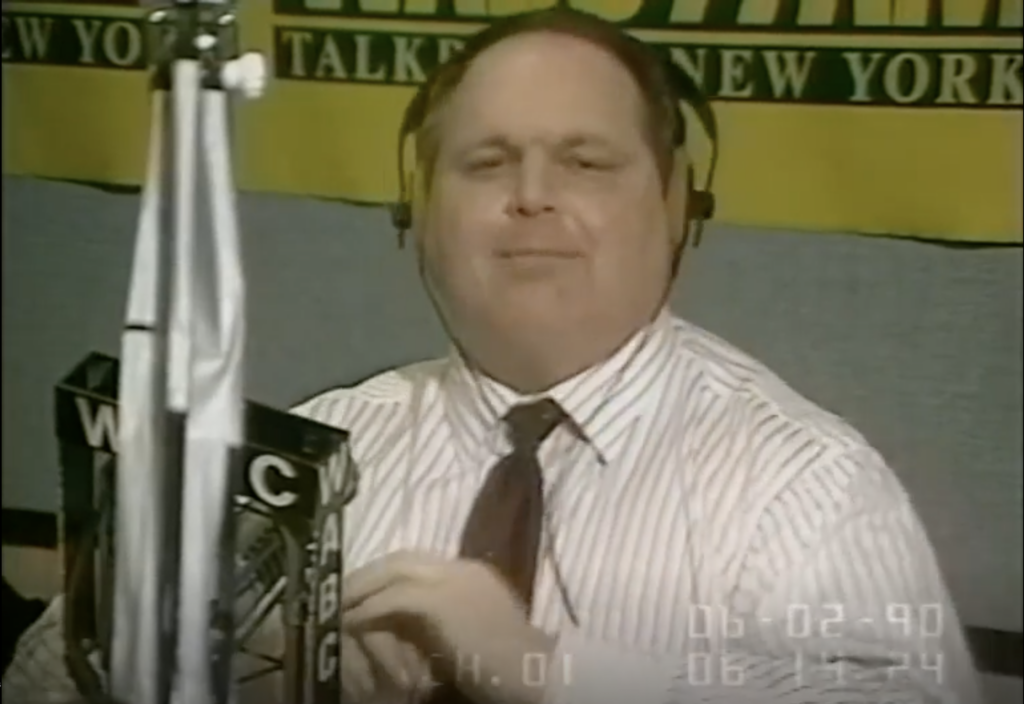
After experimenting with political talk at a local station in Sacramento beginning in 1984, Limbaugh moved to New York, where WABC began carrying his show nationally in 1988. At first, some fifty‑five affiliates aired the program, reaching roughly 300,000 weekly listeners – respectable numbers, but hardly a clear sign that Limbaugh and talk radio were about to remake the national media landscape. By 1993, however, his audience had exploded to some 15 million listeners a week, and by the end of the decade more than a thousand stations were broadcasting his show (Rosenwald 2019: 2).
In addition to his three‑hour daily radio program, Limbaugh hosted a nightly television show from 1992 to 1996, produced by Roger Ailes, who soon thereafter founded Fox News. Many of Limbaugh’s most prominent imitators followed the path Ailes laid out, using Fox as a second platform and ultimately becoming even more visible than radio alone would have allowed. Figures such as Sean Hannity and Mark Levin still operate in this dual mode. Limbaugh, by contrast, walked away from television when his show ended and devoted himself entirely to radio. Even without Fox News, he became a conservative media icon with a fiercely loyal following and considerable influence inside the Republican Party.
Up to his death in 2021, Limbaugh’s show drew around 15 million weekly listeners. Their attachment to him was extraordinary. They listened with a degree of devotion that made the program a settled part of their daily routines. The trust he enjoyed among his audience also translated into economic value. Because he read out the advertisements himself, they were regarded as especially effective, which justified higher ad rates (Douglas 2004: 288). This practice of host‑read ads has since been adopted by contemporary podcasts. The dominant theme of talk radio – mistrust – was thus accompanied by an identificatory trust in the host. The question, then, is how Limbaugh managed to bind trust and mistrust together. To answer it, one has to look more closely at his radio aesthetics.
Close-Listening to Limbaugh’s Aesthetics
After the commercial break, reading the copy himself, Limbaugh comes back like a Top‑40 DJ, with “bumper” music marking the edges of the segment. In this case it is “Rock and a Hard Place,” a driving track from the Rolling Stones’ 1989 album Steel Wheels, a current hit at the time. Limbaugh had spent the 1970s trying his hand as a Top‑40 disc jockey under the pseudonym Jeff Christie, first in Pennsylvania and then in Kansas City. His choice of song already signals how deeply his style is rooted in music radio. So do the words with which he opens the segment: his voice low and gravelly, the language deliberately over the top and self‑parodic, repeated until it feels tattooed into the show’s skin:
Your guiding light for times of trouble, confusion, murkiness, and despair: Rush Limbaugh. [pause] The man whom thousands of women pray their daughter will marry. [pause] In New York, on WABC News Talk Radio 770. Back to the phones! Ray, on Staten Island, hello!
At one level, the function of this entrance is straightforward: listeners are supposed to remember the station, the host, the frequency. But the real aim is broader. With an air of swaggering ease, Limbaugh is setting the tone. What is being transmitted is a mood. The show, listeners are meant to feel, crackles with energy and wit; host and audience get to feel terrific together.
The caller, Ray, knows exactly how to join this atmosphere. He begins, as ritual demands, with “Ditto!” – a term of agreement and fan devotion, part of the show’s insider vocabulary – and naturally expects Limbaugh’s favor. He is not disappointed:
Ray: Yes, good morning, Rush! Multitudinous Dittos, and one major, monster Dodo!
Limbaugh: I better explain that! The Dodo is…
Ray: [laughs out loud]
Limbaugh: See, Kathleen Maloney, the woman with the mask in here earlier, is our News Director, and is a… a… whoo… she, she is a LIB in all caps, and when, um… Ditto means, I love you, I love the show, it’s the best thing that I ever heard. Dodo means, they don’t like her, that’s what that means. So, Ray, thanks for calling, what’s on your mind?
Before the ostensible topic even comes into view, Limbaugh turns the exchange into a small comedy bit. Once Ray has marked himself as an insider and loyalist by using “Ditto” and “Dodo,” Limbaugh seizes the chance to gloss the show’s ritual language for the national audience (this time including C‑SPAN viewers) and to activate the inclusive and exclusive energies those terms carry. The exclusion in this case targets Kathleen Maloney, WABC’s news director (and today a Fox News Radio host), who only minutes earlier had been in the studio as Limbaugh’s liberal sidekick – with flirtation folded in – and who can now, once she has exited, safely be treated as an object of mockery.
Limbaugh turns the division between “us” and “them” into a humorous technique of audience bonding. Over the years he refined this technique, not least through a repertoire of pointed, derisive nicknames – a method adopted not only by other hosts but also by Donald Trump. Brian Rosenwald offers a small inventory: Limbaugh referred to MSNBC as “PMSNBC”; U.S. News & World Report became “U.S. Snooze”; Meet the Press was “Meet the Depressed”; and ABC’s Sam Donaldson was “Sam the sham” (Rosenwald 2019: 128–29).
As the segment continues, Ray introduces his chosen topic, which Limbaugh instantly folds into one of his standard “updates,” complete with recognizable buzzwords, slogans, and theme music. Once again he slips nimbly between the roles of talk host and music DJ. Like a Top‑40 presenter, he relies on recurring signatures that listeners can latch onto and identify with. The more points of recognition, the more easily familiarity takes shape. Limbaugh therefore cuts Ray off quickly, but in a way that feels like affirmation rather than rudeness:
Ray: Well, I wanna talk about this Long Island Rail Road deal. And, when…
Limbaugh: Wait, you mean the “Homeless News”?
Ray: Yes! Yeah.
Limbaugh: Hang on just second, Ray, we’ll let you do the “Homeless Update.” [sings fanfare sound]
Ray: [laughs out loud]
Limbaugh: Listen up! Homeless Update!
Ray: [continues to laugh]
[Music: Clarence “Frogman” Henry, “Ain’t Got No Home,” 1956 rhythm‑and‑blues hit]
Limbaugh: Hang on Ray, don’t do it till I give you the cue, ok?
Ray: Ok!
[Song continues]
Limbaugh: Clarence “Frogman” Henry, from New Orleans.
[Song continues, cued to the refrain: “I’m a lonely boy, I ain’t got no home”]
Limbaugh: Everybody loves this song.
[Song continues]
Limbaugh: Alright, Ray, tell us what you think of the ban on the homeless in the Long Island Rail Road and at Penn Station!
By the time the exchange reaches its ostensible subject, it is already clear that the caller’s perspective will merely echo the host’s. The point is not an exchange of views but mutual confirmation. Ray has marked himself as a devotee, but he still has to prove himself worthy of airtime. To do that he must display humor and intelligence – or what counts as such within the show’s world. Intelligence, here, is coded as sharp‑edged critique that targets not the host but a shared enemy.
Accordingly, Ray opens with a statement of media mistrust. Tellingly, the mistrust is directed at WABC itself, the flagship radio station of the American Broadcasting Company (ABC). In 1990, WABC had already moved to the right as it shifted toward all‑talk programming, but ABC as a whole still counted as part of mainstream media. The caller’s criticism thus presumes that Limbaugh’s show is a kind of alien body within the larger media company; his complaints are carefully not aimed at Limbaugh:
Ray: Ok, well, first of all, what we’ve been told is not the truth. And what I heard on your station on the news earlier was not the truth. What I heard was that the homeless will have to find a new place to go. And in a New York daily newspaper this morning the headline says, “Long Island Railroad Rousts Homeless from Penn Station.” […] And we get the impression from these reports that the homeless have been faced with this impossible problem and that we’re heartless, stockholding, um, Republicans. But if you look at the third paragraph of the story we find that the crackdown will be accompanied by a week of intensive outreach. […] [gets agitated] The story is not that we’re being heartless in throwing these people out, the story is that we’re doing something for them!
Limbaugh: Alright, now here’s what the important point of this is. This man is calling because he knows this show is going to the nation. And he knows this city has its share of criticism, and he thinks it’s unfair. About some of the social problems that exist here. And in truth, he’s right. [Gets agitated] What is going on with the rousting of a… You see, it ought to be that the subways and the train stations are for people who pay their ride. This, you know, people are not down there for the fun of it. This is not Coney Island, and this is not an amusement park. People are getting to and from work, and they have every right, when they’re paying for it, to have it cleaned and unobstructed, and to not be harassed by panhandlers. […] Thanks, Ray, for the call, appreciate it!
[Clarence “Frogman” Henry, “Ain’t Got No Home,” bumper outro]
[WABC jingle, then the hourly world‑news segment]
There is no real dialogic give‑and‑take in this extended passage. Rather, Limbaugh tries briefly to translate the caller’s local grievance for a national audience before dropping the translation effort in favor of a vivid image of everyday life in New York’s stations, allegedly overrun by homeless people who harass commuters and impede their workday. He amplifies and mirrors Ray’s position, and both follow a similar arc of emotional escalation. It isn’t merely punchlines and in‑jokes that reverberate in this echo chamber; caller and host are bound together by tone, pacing, and affect. It is this aesthetic echo that gives the segment its charge. The caller aims to expose what he sees as the mainstream media’s distortion of the problem of homelessness, and he works himself audibly into a state of agitated resentment. Limbaugh does the same, but he never loses control over the form and his affect; he ends the segment with a gracious thank‑you.
The segment, like a pop single, runs under four minutes and closes on the “Homeless News” theme. Radio historian Marc Fisher aptly calls Limbaugh’s show “Top 40‑style talk,” and he notes: “Limbaugh treated each call as a unit of entertainment, paring each one into a relevant, succinct bit that flowed quickly into the next segment” (Fisher 2007: 230).
As this analysis suggests, a typical four‑minute Limbaugh unit follows a recurring structure. On the smallest scale, it consists of two waves of affective intensification, one for the guest and one for the host. First, a case of “deception” by media or elites is exposed with cutting critical flair; then comes the outraged revelation of “what is going on.” A similar two‑phase pattern shapes the entire block: it moves from jokes, laughter, and shared good feeling (phase one) to joint anger and resentment over the topic at hand (phase two), which must be carefully dosed. Only if anger remains under control can the show pivot smoothly into the next unit, which again begins in a joking key.
Two affective registers alternate: jovial, seemingly relaxed camaraderie between host and caller gives way to mistrust, gradually thickening into anger that has to find release. That anger is directed at a diffuse Other whose many faces are, in effect, always the same. Sometimes it is the mainstream press; sometimes Democratic politicians; sometimes feminists or minority advocates; sometimes supporters of redistribution; sometimes climate activists. All serve as momentary incarnations of a chimera that right‑wing talk radio tries to pin down under the name of the “liberal elite.”
Both in style and in political logic, the dramaturgy of Limbaugh’s segments is structurally populist. What counts, in the eyes of the established order, as low and disreputable is ostentatiously paraded and turned against the elites. The transgressive display of anger – pushing past conventional norms of affect control – is itself part of this “flaunting the low” (Ostiguy 2017). At the same time, the show almost never dissolves into pure ranting. Negative emotions are continually counterbalanced by upbeat mutual affirmation. Even the programmatic exhibition of “critical intelligence” – central to the most baroque conspiracy theory – serves to lay bare the hollowness of the standards by which the social elite seeks to cement the hierarchy. The truly sharp minds, the show suggests, are found among those whom the elites try to push to the margins. That, in turn, makes the actual distribution of symbolic status feel all the more like a screaming injustice.
From Parasociality to Disinhibited Informalization
The concept of parasociality does not quite capture the back‑and‑forth of emotions at work here. To be sure, the elements identified by parasocial theory are all present in Limbaugh’s show. Listeners are invited to enter into an imagined face‑to‑face with the host. They spend many hours a week in his company – sometimes more than with their own families – and build up a kind of imagined social relationship with him. As Horton and Wohl already noted,
They ‘know’ such a persona in somewhat the same way they know their chosen friends: through direct observation and interpretation of his appearance, his gestures and voice, his conversation and conduct in a variety of situations. Indeed, those who make up his audience are invited, by designed informality, to make precisely these evaluations – to consider that they are involved in a face‑to‑face exchange rather than in passive observations. (Horton and Wohl 1956: 216)
Parasocial theory reaches its limit, however, when it comes to describing the Janus‑faced quality of this imagined bond. The parasocial tie runs between host and listener. In political talk radio, though, the formation of a “we” is inseparable from the drawing of a line against an “Other” – one of the many incarnations of the specter of the “liberal elite.” This second side of the relationship is systematically neglected in the parasocial model.
Horton and Wohl’s phrase “designed informality” helps us to overcome this blind spot. To do so, one has to conceptualize informality not just as relaxedness (as Horton and Wohl do) but as a process of informalization. The concept of informalization originates with Norbert Elias and his student Cas Wouters. Yet as I want to develop now, their use of the term also needs to be modified in order to capture the dynamics of political talk radio.
For Elias and Wouters, informalization named a process of “functional democratization” visible in many Western European societies over the course of the twentieth century, especially from the 1960s onward (Wouters 1999; Elias 1989). Status differences between social strata – Elias speaks of “established” and “outsiders” – gradually narrowed (Elias and Scotson 1993). This, in turn, transformed norms of conduct. The strict codes of the dominant groups – from dress and language to posture – lost some of their binding force for society as a whole. At the same time, the codes of the “outsiders” gained weight. As long as the shift in power remained moderate enough that the primacy of the established was not fully called into question, they tolerated these changes without mounting a counteroffensive. The result was a broader repertoire of acceptable behaviors, policed less rigidly than before.
Wouters and Elias had recourse to “informalization” in order to reconcile the phenomena of the “permissive society” with their theory of a long-term civilizing process. That long-term process was marked by ever greater self-control. The point of “informalization” was to show that it only appeared that in permissive society, anything was permitted, and that in fact, the permissive society heightened the requirements of self-control. The same model helps illuminate the loose, bantering atmosphere of Limbaugh’s call‑in show and the unstructured, seemingly “authentic” conversational flow of many contemporary podcasts. What one sees in both cases is an increase in equality – host and guest appear to meet at eye level – and a corresponding increase in freedom: everyone can speak in their own idiom, and each person must decide for themselves how to behave appropriately in a given situation (Wouters 1999: 61).
Even so, Elias and Wouters were clear that functional democratization and aesthetic informalization rarely proceed smoothly. Powerful groups – the “established” – do not typically relinquish their dominance without resistance. Elias identified two main defensive responses. Threatened elites can try to shore up the prestige of their own codes of conduct and deny value to the upstarts’ styles of expression. If that fails, they can refuse to acknowledge the new balance of power and retreat into a fantasy world of denial (Elias and Scotson 1993; Elias 1989).[5]
The dynamics of political talk radio, however, reveal a further scenario not accounted for in Elias and Wouters’s theory. In functional democratization, established and outsiders gradually converge in status, and this convergence finds expression in a more informal style. Yet processes of de‑hierarchization do not have to affect all dimensions of status at once. Indeed, some forms of de‑hierarchization depend on the preservation of other hierarchies.
The result is a contradictory picture. On the one hand, talk radio renders the style of the “low” presentable. No matter how wealthy or powerful the studio guests may be – GOP leaders still make the rounds on conservative talk shows – or what class background callers come from, no one is allowed to be too grand for the loose tone or the silly and often crude jokes; no one may shy away from venting. To that extent, informality is a sign of increased equality. On the other hand, talk radio is a meeting of equals only in the sense that these “equals” define themselves against the “liberal elites” and those deemed lazy and unworthy. Here the populist logic on which talk radio’s informalization depends comes into view: the elevation of the “low” is tied to the condition that the “low” remain below. The equals are equals only insofar as they distinguish themselves from Others – from the elites, but also from those they regard as inferior, such as the homeless people in the example above.[6]
Once the relation to these Others is considered, informalization acquires a second, sharply opposed meaning. It now refers not to flexible forms among equals, but to the loosening of norms and the suspension of affect control toward those who are marked with the stigma of mistrust because they stand outside the circle of equals. Relaxation tips into transgression, which may manifest in disrespect or even in harm to the Other. The blurring of boundaries associated with intimacy runs together with a blurring of the boundaries of violence. What emerges is a pattern of disinhibited informalization.
The concept of disinhibited informalization requires some further elaboration. Norbert Elias insisted on distinguishing sharply between informalization and processes of decivilizing. Informalization, he argued, presupposes an increase in affect control under conditions of levelling status differences. Decivilizing, by contrast, is marked by growing status inequality and a corresponding decline in individuals’ affect control (Elias 1989). Such a firm distinction assumes that status hierarchies either uniformly erode or uniformly harden. When, instead, competing hierarchies overlap, hybrid configurations of informalization and decivilizing emerge. Informalization as self‑controlled relaxedness among equals fuses here with informalization as disinhibited transgression toward unequals.[7]
One might object that this double movement of disinhibited informalization captures political talk radio, but not bro podcasts, which are not, strictly speaking, political shows. Did the now widely discernible split between bro podcasters and Donald Trump not already begin in the summer of 2025, when Joe Rogan distanced himself from Trump by conducting a long, strikingly cordial conversation with Bernie Sanders (“The Joe Rogan Experience #2341”)? Does that not suggest that the parasocial informality of bro podcasts can do without the norm‑breaking, disinhibited side of informalization?
As described at the outset of this essay, bro podcasters like Rogan are indeed flexible in their political sympathies; it is not unimaginable that they might one day endorse Democratic candidates. But one precondition would have to be met: those candidates would need to accommodate the populist template of mistrust toward the supposed system elites – including the allegedly biased liberal media. Without this boundary‑drawing against the fantasy of liberal elites, the semantic and affective language of the bro podcast would lose its grammar.
It is no accident that, in his June 2025 conversation with Sanders, Rogan insisted on the Trump campaign’s claim that CBS had meddled unfairly in the 2024 election via 60 Minutes, allegedly by cutting an unflattering remark from Kamala Harris. On closer inspection, the allegation is implausible, but for Rogan it acquired the status of an incontrovertible fact because it fit the already established narrative of liberal bias. To avoid contradicting him outright, Sanders resorted to the polite dodge of saying that he did not recall the details. Even in this conversation, the basic structure of Rogan’s show remained intact: a de‑hierarchized community of agreement can exist only where there is also a latent, and at times quite aggressive, differentiation toward the outside – or, more precisely, toward the “high.” This populist grammar runs like a thread through the history of the right‑wing media sphere and links talk radio in the Limbaugh tradition to today’s bro podcasts.
Johannes Voelz is Professor of American Studies, Democracy, and Aesthetics at Goethe University Frankfurt, Germany. He the author of Transcendental Resistance: The New Americanists and Emerson’s Challenge (University Press of New England, 2010) and The Poetics of Insecurity: American Fiction and the Uses of Threat (Cambridge University Press, 2018). He is the director of a new PhD program, “Aesthetics of Democracy,” funded by the German Research Foundation. Currently he is completing a monograph on the aesthetics of populism.
References
“Al Sharpton knocked on his ass by Roy Innis.” YouTube, uploaded by quicksilver57, 9 June 2013, https://youtu.be/uPWQ4oVP-3Q
Benkler, Yochai, et al. Network Propaganda: Manipulation, Disinformation, and Radicalization in American Politics. Oxford University Press, 2018.
Berry, Jeffrey M., and Sarah Sobieraj. The Outrage Industry: Political Opinion Media and the New Incivility. Oxford University Press, 2014.
Comedy Shorts. “Andrew Schulz On US Going To War With Iran.” Youtube, 3 March, 2026. https://www.youtube.com/watch?v=2yCFN_rDa7s
Cox, Daniel A. “2024 Election Edition: Young Men Swing Toward Trump.” The Survey Center on American Life, 7 Nov. 2024, https://www.americansurveycenter.org/newsletter/2024-election-edition-young-men-swing-toward-trump/.
Douglas, Susan J. Listening in: Radio and the American Imagination. University of Minnesota Press, 2004.
Elias, Norbert. “Zivilisation und Informalisierung.” Studien über die Deutschen: Machtkämpfe und Habitusentwicklung im 19. Und 20. Jahrhundert, edited by Michael Schröter, Suhrkamp, 1989, pp. 33-158.
Elias, Norbert and John L. Scotson. “Zur Theorie von Etablierten-Außenseiter.” Etablierte und Außenseiter. Translated by Michael Schröter, Suhrkamp, 1993, pp. 7-56.
Fisher, Marc. Something in the Air: Radio, Rock, and the Revolution that Shaped a Generation. Random House, 2007.
Godfrey, Elaine. “The Manosphere Turns on Trump.” The Atlantic, 29 March 2026, https://www.theatlantic.com/politics/2026/03/iran-war-trump-maga/686571.
Gooding, Dan. “Barron Trump’s Behind-the-Scenes Work on Donald Trump’s Campaign.” Newsweek, 10 Oct. 2024, https://www.newsweek.com/barron-trump-influence-podcast-appearances-election-campaign-1970119.
Hemmer, Nicole. Messengers of the Right: Conservative Media and the Transformation of American Politics. University of Pennsylvania Press, 2016.
Horton, Donald, and R. Richard Wohl. “Mass Communication and Para-Social Interaction.” Psychiatry, vol. 19, no. 3, 1956, pp. 215-29.
Kazin, Michael. The Populist Persuasion. An American History. Cornell University Press, 1998.
Lacayo, Richard. “Audiences Love to Hate Them.” Time, 9 Jul. 1984, https://content.time.com/time/subscriber/article/0,33009,950118,00.html.
Levi, Lili. “The Four Eras of FCC Public Interest Regulation.” Administrative Law Review, vol. 60, no. 4, 2008, pp. 813–59
Levin, Murray B. Talk Radio and the American Dream. Lexington Books, 1987.
Liebers, Nicole, and Holger Schramm. “The History and Scope of Parasocial Research.” The Oxford Handbook of Parasocial Experiences, edited by Rebecca T. Forster, Oxford University Press, 2023, pp. 13-32.
Marantz, Andrew. “The Battle for the Bros: Young Men Have Gone MAGA. Can the Left Win them Back?” The New Yorker, 24 Mar. 2025.
Marcus, Sheldon. Father Coughlin: The Tumultuous Life of the Priest of the Little Flower. Little, Brown and Company, 1973.
McGregor, Hannah. “Podcast Studies.” Oxford Research Encyclopedia of Literature, 20 June 2022.
Müller, Jan-Werner. Was ist Populismus? Suhrkamp, 2016.
Ostiguy, Pierre. “Populism: A Socio-Cultural Approach.” The Oxford Handbook of Populism, edited by Cristóbal Rovira Kaltwasser, Paul Taggart, Paulina Ochoa Espejo and Pierre Ostiguy, Oxford University Press, 2017, pp. 73-97.
Ostiguy, Pierre and Johannes Völz. “Die Wahl der drei Klassen: Trumps Triumph markiert den Sieg der Geld- über die Bildungselite.” Frankfurter Allgemeine Zeitung, 13 Dec. 2024, p. 11.
Pastis, Stephen. “Here Are the Biggest Moments from Trump’s ‘Bro’ Podcast Tour.” Forbes Online, 29 Oct. 2024, https://www.forbes.com/sites/stephenpastis/2024/10/29/here-are-the-biggest-moments-from-trumps-bro-podcast-tour-ahead-of-joe-rogan-appearance/.
Perks, Lisa G., and Jacob S. Turner. “Podcasts and Productivity: A Qualitative Uses and Gratifications Study.” Mass Communication and Society, vol. 22, no. 1, 2019, pp. 96-116.
Roll Call. “Interview: Joe Rogan Interviews Donald Trump for His Podcast in Austin, Texas – October 25, 2024.” https://rollcall.com/factbase/trump/transcript/donald-trump-interview-joe-rogan-podcast-austin-texas-october-25-2024/.
Roosevelt, Franklin D. FDR’s Fireside Chats, edited by Russell D. Buhite and David W. Levy, Penguin Books, 1993.
Rosenwald, Brian. Talk Radio’s America: How an Industry Took Over a Political Party That Took Over the United States. Harvard University Press, 2019.
“Rush Limbaugh Show Simulcast.” C-Span, 1 June 1990, https://www.c-span.org/video/?12584-1/rush-limbaugh-show-simulcast.
Rusiti, Muharem. “The Joe Rogan Effect: How Podcasts Transformed the 2024 U.S. Presidential Election.” International Politics Group, 15 Jan. 2025, https://www.internationalpoliticsgroup.com/post/the-joe-rogan-effect-how-podcasts-transformed-the-2024-u-s-presidential-election.
Sarkowicz, Hans. “‘Nur nicht langweilig werden…‘. Das Radio im Dienst der nationalsozialistischen Propaganda.” Medien im Nationalsozialismus, edited by Bernd Heidenreich and Sönke Neitzel, Schöningh, 2010, pp. 205-34.
“The Joe Rogan Experience #2341 – Bernie Sanders.” YouTube, uploaded by PowerfulJRE, 24 June 2025. https://youtu.be/mYVzme2fybU?si=Q4Ht2bOsbARA-XUL.
Tiffany, Kaitlyn. “The Only Thing Worse Than Talking to Joe Rogan.” The Atlantic, 9 Nov. 2024.
Voelz, Johannes. “Reading Populism with Bourdieu and Elias” Reading the Social in American Studies, edited by Astrid Franke, Stefanie Müller, and Katja Sarkowsky, Palgrave, 2022, pp. 233-58.
Wouters, Cas. “Amsterdam und Soziologie in den 1960er und 1970er Jahren.” Informalisierung. Norbert Elias’ Zivilisationstheorie und Zivilisationsprozesse im 20. Jahrhundert. Translated by Werner Fuchs-Heinritz, Opladen, 1999, pp. 33-47.
[1] An overview of the topic of “podcast elections” is provided by Muharem Rusiti, “The Joe Rogan Effect: How Podcasts Transformed the 2024 U.S. Presidential Election.”
[2] According to the Associated Press’s VoteCast survey, an approximate 56 percent of young men between the ages of 18 and 29 voted for Trump, compared just 40 percent of young women; Trump received the most support from young men out of all Republican candidates of the past two decades.
[3] For a close analysis of the aesthetics of Trump rallies before and during his first term in office, see Voelz 2018.
[4] Nicole Liebers and Holger Schramm have compiled data regarding the numerical upsurge in empirical parasociality studies: “Whereas we record about 15 publications a year from 2008 to 2013, this number first doubled (2014), then tripled (2018), and even quadrupled (2020) in the following years. This led to nearly 70 new publications of original empirical studies on parasocial experiences published just in the year 2020” (21). Liebers and Schramm suspect the rising use of social media and the novel phenomenon of influencers as likely factors in the proliferation of research.
[5] According to Elias, these defensive reactions culminate in a decivilizing process in which individuals give up their affect control and the fabric of social order begins to unravel.
[6] In a co-authored essay for Frankfurter Allgemeine Zeitung, Pierre Ostiguy and I (2024) have sketched the class structure of contemporary U.S. populism in greater detail by identifying a contest between a moneyed elite and an educational elite. The right‑populist movement casts the educational elite as its primary enemy, while the moneyed elite serves as both aspirational model and protective patron.
[7] I discuss the complex relation between informalization and decivilizing in greater detail in Voelz 2022.