

This text is part of the b2o: an online journal special issue “EXOCRITICISM”, edited by Arne De Boever and Frédéric Neyrat.
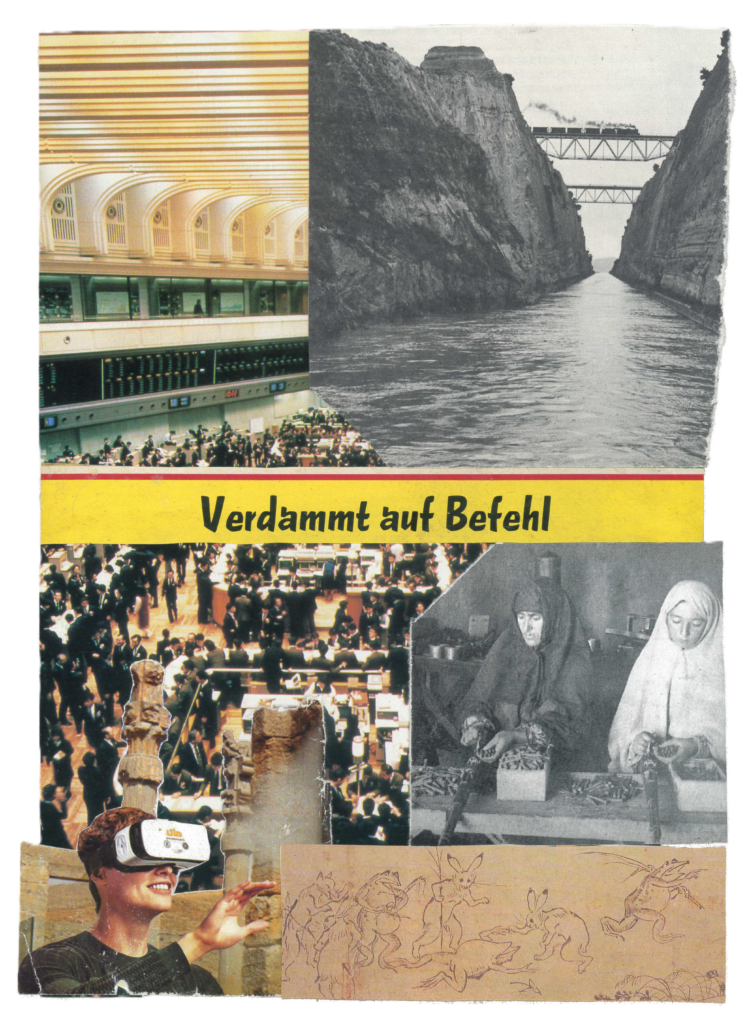

Image: Damned on Demand – Ferdinand Altenburg, 2024
What is Patamathematical Poetry?
Andrew C. Wenaus
When an object has been cognized
attention is turned to it and those
aspects of the object are reached
which attention reveals.
-Catherine Christer Hennix
The poem does not traverse. It is
integrally affirmative – it stands on
the threshold of what it is.
-Alain Badiou
Every word on earth is
in the perfect place.
-Gary Barwin
To the last syllable of recorded time.
-Shakespeare
In this short paper I hope to offer an avenue to creative critique that takes its orientation from Alain Badiou’s question “what does the poem think?”[1] I contend that poetry functions as a mode of cognition whose efficacy exceeds epistemology, enters the domain of trans-sense (not unlike that formulated by Russian Futurian poets Velimir Khlebnikov and Aleksei Kruchenykh), and ultimately invites the conceit of ubiquitous directly correlative semiotics through cooperative human activity. Poetry-thinking is the site which operates as a generative medium capable of reorganizing sense, time, and reality itself, and this orientation motivates the search for a concrete prototype in which poetry can be practiced as thinking itself, a form of articulation designed to operate at the level where sense, structure, and reality are jointly produced. It is this poetry-thinking that I call patamathematics.
Patamathematics is a neologism designating the disciplined convergence of pataphysics, mathematical notation, and pathos (pathematic) within a single operational field. Its function is neither metaphorical nor eclectic; it marks a mode of articulation in which poetic event, formal necessity, and affective orientation are rendered mutually determinate. Part of the process of writing patamathematically involves replacing the variables of mathematical expressions and formulae with words or phrases, thereby allowing linguistic elements to assume the role of formal operators rather than descriptive tokens. Writing poetry in this way is called patamathematical poetry. In this practice, poetic language ceases to serve as illustration and enters into the work of direct correlation via pan-chronology, where signification behaves as a constraint-bearing operation and affect registers as a condition of coherence. Patamathematics thus functions as a concrete technique for binding poetic openness, mathematical rigor, and compassionate orientation to life into a single mode of articulation capable of sustaining intelligibility across various transformations. Ultimately, patamathematics is a process-engineering operation to engage in the co-creation of the material necessary conditions of reality: it contests that the purpose of empirical material analysis and representation is to serve, through collective human activity, the engineering of the ideal.
Patamathematical poetry develops this capacity by aligning poetic articulation with mathematical constraint and affective commitment to life, enabling thought to intervene directly in the structures through which reality attains intelligibility. Within this trans-sensical alignment, causality, potentiality, and retrocausality form a single operational chrono-structure in which future coherence organizes present articulation and stabilizes meaning across time, while negentropic order is sustained and intensified through this temporal coordination. Patamathematics therefore serves the project of engineering reality at the level of its organization, directing articulation toward forms that support shared persistence, coordinated intelligibility, collective flourishing, continuity across generations, and the expansion of life into cosmic scales of organization. That is, the ultimate and ubiquitous project of freedom over necessary conditions: the poetico-material engineering of the ideal. Universal emancipation appears here as the durable expansion of common capacities, grounded in cooperation and shared responsibility for the conditions under which meaning, matter, and life are jointly organized. To think thought worthy of the future, understood simultaneously as a field of possibility and as an organizing attractor, this inquiry advances initial determinations of what patamathematical poetry is and how it contributes to the urgent task of workshopping new methods of thinking oriented toward flourishing under conditions of existential threat, whether arising from climate instability, total war, or nuclear catastrophe, for example, or the longer horizons imposed by astronomical and evolutionary processes. What follows, then, is a proposal for patamathematical poetry to operate as a serious mode of thought capable of confronting the pressing and consequential matters that insistently, even aggressively, face us.
To think the future is to think on the edges of statistical possibilities, to trace pathways of the possible until an instance of stochastic collapse in which meaning can be made within contingent conditions. With each collapse is then the inauguration to, again, think on the edges of combinatorial variations of statistical possibilities contingent on those that came before. This is the essence of V.V. Nalimov’s probabilistic semantics, a remarkably prescient model that concretely articulates a challenge to stabilities of articulation and universal understanding. Nalimov’s In the Labyrinths of Language: A Mathematicians Journey[2] approaches language not as a passive instrument but as an objective form in which consciousness realizes itself. To study language, therefore, is to study thinking in its material embodiment. Against naïve determinism, Nalimov insists that meaning cannot be reduced to fixed definitions: language functions as a probabilistic system in which meanings exist as tendencies rather than rigid units. Probability theory, particularly Bayesian modeling, becomes the appropriate scientific tool for grasping this dynamic. Scientific language represents a “hard” form, striving for unambiguous determination, while poetry reveals the opposite, where meaning proliferates and resists closure. At a deeper level, the apparent discreteness of words dissolves into a continuous semantic field: an objective fluctuation of possibilities. Meaning appears not as a ready-made thing, but as a process, a living movement within language itself, exposing the illusion of purely discrete thought. However, beyond the Bayesian, Nalimov insists that language also insists on creation: poetry. It is not a simple game of statistical probability nor a straightforward logic of cause and effect. So, to shift beyond the repetitions, combinatorics, and hauntological mourning that troubles twenty-first century thought, the future of thinking will require thinking the future into an engineered sculpture of thought; this task rests precisely on the disciplining of the probabilistic model of language. Indeed, while the future of critique requires the hard form of scientific unambiguity operations, it must also offer the openness and resistance to closure understood properly only through poetry.
So, to play with this conceit in a poetic way, the problem can also be considered in reverse: that thought is governed in its present intelligibility by the active determination of the future. If meaning is not merely the result of a local collapse within a pre-given probabilistic field but the condition that renders such a field intelligible at all, then the direction of determination may be reversed. In other words, “the future,” writes Khlebnikov, “casts its shadow over language.”[3] To think the future, in this sense, is not to stand at the edge of an indeterminate set of possibilities awaiting stochastic resolution, but to occupy a position already conditioned by a determination not yet realized, where the present is structured by the very statistical contours of a future that has yet to appear. The future is not what thought moves toward; it is what already exerts pressure upon thought, selecting in advance the very coordinates from which thinking can proceed. Here, retrocausality designates the logical priority of the result over its genesis, such that the end posits the beginning as its own presupposition. What appears as a free play of combinatorial semantic tendencies is thus revealed as a constrained field, shaped by meanings that have not yet stabilized but nevertheless operate as real determinations. This is poetry, since poetry is, after all, always an arrival. It is the articulation, not simply an articulation. In this sense, the collapse into meaning does not simply close a range of possibilities; it establishes, retroactively, which possibilities could ever have been available in the first place. From this perspective, the patamathematical thinker does not generate meaning through probabilistic navigation; rather, meaning produces the thinker as a moment adequate to its own future articulation. The act of thinking the future therefore coincides with the recognition that thought itself is already inscribed within a semantic trajectory whose outcome governs its premises. Meaning does not wait to be made; it advances, imposing its necessity upon the present under the guise of contingency, and compels thought to discover that what it took to be an origin was always already a consequence. Patamathematics, therefore, is at once co-creative and an attractor. Patamathematical poetry is a revolution in thought—in fact, it is not a revolution per se, instead it is absolute reconciliation without finality—and its mathematical ambitions seek to recalibrate what it means to pursue ubiquitous articulation.
Paradoxically, if absolute reconciliation is to be conceived as the articulation of totality, then totality itself must be interrogated according to claims to completion, inventory, or final synthesis (otherwise, it would betray poetry). To articulate totality cannot mean to enumerate all possibilities, since such an enumeration would presuppose a static horizon and thereby negate the probabilistic and retroactive character of meaning already established. Totality, in this sense, designates the intelligibility of form rather than the fullness of content. In other words, totality is the capacity to grasp the system in which possibilities are generated, differentiated, collapsed, and reorganized without ever being exhausted. Totality must be understood as operational. Operational totality does not appear as a finished whole, but as a system capable of articulating and regulating its own incompleteness. Meaning achieves unity here not through closure but through recursive coherence, in which each articulation stabilizes the field of possibilities while simultaneously transforming the conditions of further articulation. Totality, in this sense, functions as an active mode of organization: the capacity of meaning to integrate possibility and retroactivity into a single, self-maintaining process. This synthetic position secures coherence without finality and unity without stasis, and thus constitutes the only form of totality adequate to the dynamics of meaning developed. What must be articulated is not what can be meant by patamathematical poetry, but how meaning as such becomes possible, how it sustains coherence across successive collapses without hardening into determinism. Accordingly, totality is neither empirical nor transcendent. It is trans-sensical. The absolute reconciliation of thought will consist in compelling thought to operate at the level where openness and constraint are articulated as a single process, and where probability appears as a field of organized indeterminacy through which meaning can emerge with coherence. To think totality in this way is to refuse both the comfort of final meanings and the vertigo of endless deferral, and instead to bind thought to the discipline of a system that must remain open in order to remain intelligible. Totality is the condition under which possibility can be continuously and non-arbitrarily renewed, rather than the closure of possibility.
The unity of possibility and retrocausality defines meaning as a self-organizing system that governs its own emergence across time. Which is to say that possibility means the generative openness through which meaning can arise, while retrocausality means the structural pressure by which emergent meaning reorganizes the conditions that made it possible. Together, they form a circuit in which semantic events are produced, stabilized, and reconditioned without appeal to external determination. Each collapse of meaning establishes a local coherence that recalibrates the wider field of possibilities, rendering some pathways intelligible and others obsolete. Thought, within this system, functions as a mediator through which the system momentarily attains determinacy, rather than progressing linearly from given premises. This determinacy is never final; it serves as a constraint that enables further variation rather than arresting it. Meaning thus regulates its own entropy, sustaining continuity without closure. Possibility and retrocausality, taken together, articulate a single dynamic in which meaning persists as an intelligible process precisely by continually transforming the conditions of its own intelligibility: it is, again, trans-sensical.
This conception of meaning exhibits a clear structural affinity with Pierre Teilhard de Chardin’s Omega Point or, on the other hand, Nick Land’s conception of hyperstition, once it is detached from teleological certainty and eschatological completion. As with Omega, a unifying horizon is posited toward which meaning tends, exerting a real organizing pressure on the present. Yet this horizon does not function as a predetermined end-state; it operates as an active attractor that shapes coherence without guaranteeing final convergence. The future, in this configuration, is not a promise of fulfillment but a principle of semantic organization, continuously restructuring the field of possibilities without arresting its movement. Unity emerges not through the elimination of divergence but through its integration into a higher-order coherence. Meaning approaches wholeness asymptotically, through successive articulations that intensify intelligibility while preserving indeterminacy. The theological or demoniacal form persists only at the level of structure, as a tendency toward unity and intelligibility, while all assurances of completion are removed. What remains is a system in which signifier and referent are drawn toward correlations without ever collapsing into a final identity, allowing meaning to sustain itself as an enduring, self-organizing process governed by a future that regulates without concluding.
Consequently, the absolute reconciliation in thought assumes a more exacting formulation when time itself is treated as a fully articulated mathematical structure rather than a merely lived sequence. Within such a framework, retrocausality possesses the same theoretical status as causality: not as an anomaly or metaphor, but as a real organizing dimension of intelligibility. Thought unfolds not only through forward propagation from prior states, but through attractors that exert determination from the side of what is not yet actual. What presents itself phenomenologically as agential, causal deliberation is thereby revealed as the expression of a deeper temporal symmetry, in which future states constrain the space of present operations just as rigorously as past conditions do. Meaning stabilizes because it is drawn toward coherent configurations that have not yet been realized, but already function as formal necessities within the system. Indeterminacy persists, yet it is bounded by these attractors, which shape trajectories without dictating outcomes. The durability of meaning thus depends less on linear accumulation than on the structural alignment of present articulations with future-consistent forms. Thought becomes patamathematical and reaches absolute reconciliation when it learns to operate within this bidirectional temporality, acknowledging that its freedom is contingent as much on future coherence as by past cause. In such a conception, the future actively governs the intelligibility of the present. Much like the poetic logic of the dream, where the sense experience, becoming conscious to the dreamer at the moment of awakening, retroactively determines the content perceived as having preceded it, patamathematics seeks the crystallization of thought through both the creative act of awakening and the realization of its telos.[4]
Under these conditions, the system outlined functions as a genuinely Protean starting point, in Mikhail Epstein’s sense, insofar as it does not merely reinterpret thought but compels its transformation into an operative force capable of organizing the material necessary conditions into the ideal. Patamathematics does not come before or after; once meaning is grasped as a probabilistic–retrocausal system that governs its own emergence, thinking can no longer be confined to reflection or critique; it assumes the character of an imperative to intervene in the very conditions of intelligibility from which actuality unfolds. Operational totality, here, provides the decisive leverage: not a closed synthesis of all that is, but a scalable regime for generating coherence across semantic, technical, and material domains. The articulation of totality becomes inseparable from the construction of attractors: formal and conceptual structures that draw reality toward future-consistent configurations. In this sense, the project ceases to be a merely speculative aspiration and becomes a logical consequence of the system itself. That is, if meaning organizes possibility and retroactively conditions its own past, then to engineer meaning is already to intervene in the real. Thought is no longer positioned within the world as one activity among others; it functions as a control structure through which the world’s own tendencies toward coherence are intensified and redirected. The task is therefore not to complete reality, but to inaugurate it with a higher-order capacity for self-organization, such that the totality of possibilities remains open while increasingly governed by forms adequate to their own future articulation. In the twenty-first century, then the task of thinking, accordingly, no longer lies in the interpretation or changing of the world alone, but in the active engineering of the conditions through which the cosmos itself is and should be organized, sustained, and transformed as a totality.
At this point, the wager implicit in such engineering must be stated clearly. The organization of possibility and retrocausality into an operational totality is not ethically neutral, nor is it a merely technical ambition. It constitutes a gamble on the side of life against dissolution, on the intensification of negentropy against the drift toward entropic exhaustion. Indeed, it is a wager with the necessary conditions of entropy. The promethean task of poetic thinking as a way of reinventing reality itself is not new; indeed, while it has any number of articulations across history, cultures, and languages, the one dearest to this project is articulated by Khlebnikov in his short story, “K”:
have any of you had the experience of gambling not with some specific individual, some John Doe, but with a collective of some kind—if only with the universal will? … your choice of moves is quite unlimited; if the game required it and you could somehow manage it, you could even take a damp sponge and wipe the constellations from the sky, like yesterday’s lesson from the blackboard in school.[5] (Khelbnikov, “K.” 89-90)
To intervene in the universal will is simultaneously to intervene in the conditions of expressive existence since what can be lived, sustained, and shared depends on what can be meaningfully articulated and organized. The aim of the patamathematical gamble is therefore not domination or closure, but emancipation from the necessary conditions of entropy understood at the most general level: the expansion of the space in which beings can appear, act, and persist without being reduced to expendable residues of systemic decay. Indeed, if the game required it, you could wipe away the constellations; but, if the game called for it, you might also weave the most radiantly ideal cosmos from the fabric of thought itself. This gamble carries no guarantees, and no final reconciliation is promised. Yet it affirms that patamathematical thought, by assuming responsibility for the structures it helps bring into being as negentropic countermoves to entropy as the equal opponent, aligns itself with the preservation and amplification of life’s capacity to organize itself against collapse. In this sense, the engineering of meaning and time becomes an ethical commitment to a future where coherence fosters liberation, and the growth of freedom over necessary conditions serves as the foundation for a more abundant and resilient unfolding of life itself. Ultimately, however, to prevent a totalitarian end to the project of total articulation, one must consider the means and mode by which this critical gamble may be played.
Accordingly, the means by which the Khlebnikovian critical gamble resists totalitarian closure must be structurally plural, functioning as a necessity dictated by already established dynamics. This plurality is irreducibly tripartite. The poetic is required as a mode of articulation in which meaning remains generative and open, since intelligibility cannot be exhausted by extensional determination alone. Poetic articulation operates at the level where signification coincides with event, where language participates directly in the production of intelligibility rather than standing apart from it. The mathematical is equally indispensable as the discipline through which necessity, constraint, and non-arbitrary correlation are rendered explicit. Mathematics functions here as the grammar of coherence, enabling probabilistic fields and retrocausal attractors to be articulated with precision and formal clarity. Yet poetry and mathematics together require regulation by an affective orientation that is fully compassionate to life. This affective dimension operates as a material criterion, inscribing negentropic responsibility into the very form of articulation, so that the construction of semantic and temporal attractors intensifies the conditions for persistence and shared flourishing. Where poetic openness, mathematical rigor, and affective responsibility are internally bound, the engineering of meaning proceeds as a living practice of organization. The tripartite structure thus appears as the minimal condition under which totality can be articulated as a system that remains coherent, open, and oriented toward the amplification of life’s capacity to organize itself.
Indeed, the ultimate conceit of patamathematics is that, like the direct semiotic correlations of number, poetry is a noumenal object. Like number, poetry is both infinite and bounded by the imagination; as a result, poetry is yet to be fully articulated. Shelley remarked “that all the poems of the past, present, and future were episodes or fragments of a single infinite poem, written by all the poets on earth.”[6] Whereas Valéry, more ambitiously, insisted that the history of literature should be “the history of the Spirit as the producer and consumer of literature.”[7] These formulations converge: poetry cannot be treated as a secondary reflection or expressive surplus, but must be understood as a constitutive dimension of reality’s own articulation. It is therefore important to note that, according to our conceit, poetry not only reflects nature, but poetry is also itself a real event that emerges from and takes place as part of nature. We write poetry, not only to become cognizant at the thresholds of language, but also in order to become cognized by poetry, as participants in a process through which meaning organizes both thought and world in a single, continuous movement.
Patamathematics offers a singular contribution to this process that seeks to reconcile language with mathematics. The noumenal object of poetry will not be fully articulated by patamathematics alone, since this is the task of all poetry. Patamathematics is, however, a new form of poetry that offers novel coordinate markers of signification in the ongoing process of articulating poetry (both infinite and bounded) as the noumenal object which cannot be subdivided into constitutive parts either material, conceptual, or emotional. Its specificity lies in the way formal constraint and semantic event are brought into direct correlation, allowing articulation to proceed with both precision and openness. Through this correlation, patamathematics does not seek to exhaust poetry, but to sharpen the conditions under which poetry can register its own infinitude without dissolving into indeterminacy. Consider the following patamathematical poem with special attention to its form, “APOKATASTASIS”:
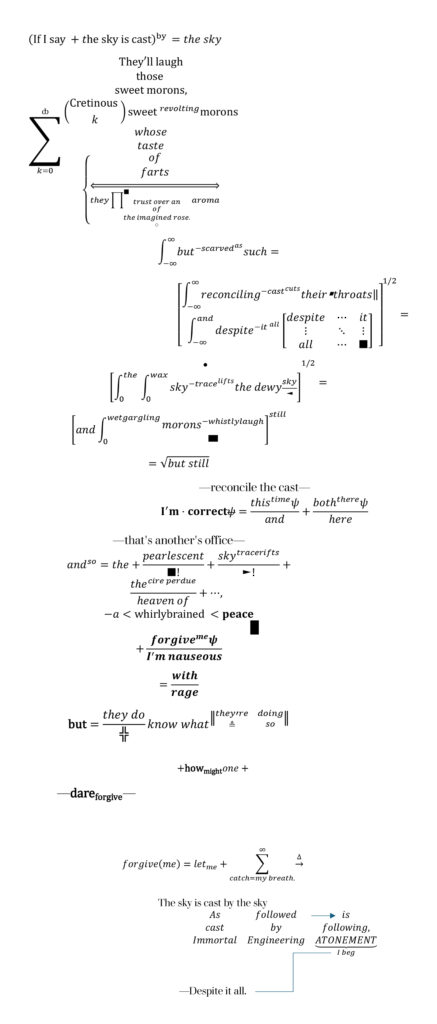

We are not concerned with interpreting its content; instead, our concern is with its form. This is not poetry as representation, nor is it simply art-as-itself. It is poetry insisting absolute correlation. Patamathematics contends that everything (real or ideal) both exists outside the text and is homeomorphic to the text. The dual task of patamathematical poetry is to collectively articulate a vital text that is compossible in its signification to best suit both the conditions of mind-independent-reality and to our conditions of reality. Form, here, functions as an operative field rather than a container for meaning, allowing poetic devices to act as structural transformations within a coherent pan-chronological system. Consider metaphor in this sense: in patamathematical poetry, metaphor does not simply operate according to the rhetorical likeness between vehicle and tenor. It simultaneously offers a novel gradation of absolute particularity. Another example: anastrophe is not simply a rhetorical recombinant; it is at once a time-reversal symmetry and a reversed parametrization of absolute particularity. And so on. A metaphor or anastrophic statement, any poetic and literary device for that matter, not only signifies but also marks an event and localized excitation in the whole of the infinite poem as such, registering a determinate shift in the organization of meaning rather than a merely expressive variation.
In order to merge letter with number, poetry must be infinite. Once an iconic language of infinite expressions comes into being, a task to which patamathematics contributes, we can begin to create, as the 18th-century English materialist philosopher David Hartley imagined:
Since words may be compared to the letters used in algebra, language itself may be termed one species of algebra; and, conversely, algebra is nothing more than the language which is peculiarly fitted to explain quantity of all kinds…Now, if every thing relating to language had something analogous to it in algebra, one might hope to explain the difficulties and perplexities attending the theory of language by the corresponding particular in algebra, where everything is clear, and acknowledged by all that have made it their study.[8]
Or, as another example, a language akin to Andrew Joron’s notion of the Absolute Letter: “the world itself is composed of the letters of the Absolute: anything, real or ideal, that undergoes a self-complicating—ultimately musical—form of motion becomes a sign of the processual emergence of the Infinite within the finite.”[9] This demand for infinity does not indicate boundlessness in a lyrical or expansive sense, but a requirement of formal adequacy imposed by the structure of reality itself. A finite inventory of signs cannot sustain direct correlation with a reality whose articulations remain inexhaustible. Patamathematics reminds us that we need this infinite language, so that we can begin to articulate ourselves, the real, and the ideal with algebraic-linguistic elegance and, ultimately, equivalence. Such equivalence is not identity through resemblance, but coherence through necessity, achieved when linguistic form, mathematical operation, and intelligibility converge within a single regime of articulation.
Once we achieve this, we will not mistake the Borgesian map for the territory; instead, we will merge representation with referent absolutely. This merger does not abolish form but perfects its correlation, such that sign and structure coincide without remainder. Then we will glimpse through the eyes of Hölderlin’s gods whose eyes are forever in flower, “their blissful eyes / Eternally tranquil gaze, Eternally clear.”[10] This reciprocity marks the point at which articulation no longer stands over or against the real, but participates in its self-disclosure. Which is to say, patamathematical poetry is both iconic and vocational. It is iconic insofar as it achieves direct correlation, and vocational insofar as it assigns thought a task within the order it articulates, binding cognition to responsibility through the very clarity it attains.
Since poetry as the noumenal object is both infinite and finite, the ultimate utterance of poetry will be marked by the event at which signifying every possible particle in every combination under conditions of infinite articulation, alongside any possible concept in all potential recombinations will signify all quantities and qualities of the cosmos. This event appears as a logical horizon that regulates poetic articulation at every stage, exerting retrocausal pressure upon present utterance by shaping the conditions of its eventual adequacy. As the regulative absolute noumenal object, poetry’s eventual articulation will mark the totality of time and will signify particulate ubiquity. Time here takes the form of articulated intelligibility, organized through a bidirectional temporality in which causal accumulation from prior utterances and retrocausal constraint from future coherence operate together. In this dynamic, causality designates the incremental contribution of each poetic act, while retrocausality signifies the manner in which future consistent forms select and stabilize intelligibility in the present. In the meantime, all poetic utterance is akin to the atoms in the emergent assemblage of mind independent reality. Each utterance contributes a determinate increment to the organization of the whole, regardless of its scale or local effect, participating in a negentropic process through which coherence is sustained and intensified over time. Therefore, the task of poetry is monumental. Crucially, it is unironic, because poetry here operates under the obligation of participating directly in the causal and retrocausal conditions through which intelligibility is conserved and amplified.
Patamathematics can also be likened to the concept of the technical image introduced by Vilém Flusser (téchnē, as in art, craft, method, practical or mechanical knowledge and imāgō as in likeness, representation, copy, or imitation). For Flusser, the technical image emerges with the invention of photography and shifts attention away from the “crisis of representation,” while redirecting focus toward the technological, chemical, and scientific apparatuses and processes that make the photograph possible in the first place. The technical image ultimately reveals that we must understand processual methodology in order to so much as begin to understand the ulterior object of representation (the referent or content which is represented by the photograph). The decisive move here lies in the displacement of interpretive priority from image to apparatus, from sign to the conditions of its production. Patamathematical poetry performs a similar operation on the poetic word: it operates on the level of the apparatus. Rather than treating language as a transparent medium or an arbitrary system of signs, it exposes the formal procedures through which poetic intelligibility is generated. It bends away from the arbitrariness of language and declares that the qualitative is now on the same trajectory as the quantitative. In doing so, poetic form becomes a site of operational clarity, where affect, structure, and correlation enter into a shared regime of articulation governed by necessity rather than convention.
Given the monumental nature of patamathematical poetry, its task is inherently daunting.[11] Rather than descending into despair, patamathematics seeks to establish an infinite metalanguage, a system of words that can directly correlate with all things and their combinations. This project does not arise from aesthetic excess but from structural necessity. Initially, this endeavor may appear absurd, yet if we accept the premise that poetry represents the noumenal, particulate absolute, we find that its purpose aligns with the telos of poetry itself, suggesting a harmony inherent in its pursuit. This harmony is not the resolution of contradiction but its disciplined organization. In its singularity, which eschews comparison, patamathematical poetry moves closer to distinguishing between the harmonious and the disharmonious, a distinction that may remain resistant to full articulation precisely because it functions as a necessary condition rather than an object of representation. The task is therefore regulative rather than descriptive. The end point of poetry is Hopkins’ “Immortal diamond is immortal diamond.”[12]
Patamathematical poetry is not a science. Nor is mathematics an empirical science. Of course, patamathematical poetry is not mathematics. This distinction is essential to the rigor of the project. The natural sciences analyse the nature of reality with the systemic and formalised system of mathematics; only after this can scientists describe their work through language. Mathematics is more direct, reliable, and elegant than the banana peel slippages of everyday communication. While the natural sciences seek to understand and describe the physical world, mathematics does not claim to do this. Instead, mathematics is a formalised system of studying spaces, qualities, structures, and changes. Mathematics makes cognizant to us spaces, qualities, structures, and changes by establishing relations that hold independently of empirical description. Linguistic definition, by contrast, remains unreliable at best, whereas axiomatic mathematical definitions offer precise and rigorous deductive modalities to establish direct correlations. Patamathematics thus attempts to merge the formalized technical image of mathematical notation with linguistic expression, thereby situating poetic articulation within a regime of operational clarity. In this convergence, patamathematics offers unique insights into the technical imaginary, not by subordinating language to number, but by compelling language to function with mathematical responsibility.
In 1911, Alfred Jarry wrote that pataphysics “is the science of imaginary solutions, which symbolically attributes the properties of objects, described by their virtuality, to their lineaments.” Around this denotational node, other definitions cluster into an incomprehensible totality: pataphysics is to metaphysics as metaphysics is to physics, it describes a supplementary universe, it is the science of exceptions and the particular. Ultimately, however, it is congruent with the alogic of pathos. This congruence is not incidental but structural, since pataphysics operates where formal explanation reaches its limit and must nonetheless continue to function. The pseudo-scientific language of pathos gives pataphysics its operative procedure: to analyse and describe imaginary solutions. The imaginary here is not fantastical; it is the technical imaginary. Through this procedure, pataphysics reveals the occultation of the physical universe (poetry: the noumenal object), bringing into articulation the conditions of intelligibility that, though inaccessible to empirical description and formal deduction, retroactively impose an organizational force that structures them.
While pataphysics is the science of imaginary solutions, mathematician Benjamin Peirce called mathematics the science that renders necessary conclusions, the ultimate articulation of noumenal objects. By equivocating the task of pataphysics and mathematics I suggest that patamathematical poetry is akin to a formal analogue of a scientific solution to the imaginary. That is, patamathematical poetry bypasses the task of semiotic image and renders expression as auto-signification, poetry as necessary, direct semiotic correlation. Imaginary (from image, imāgō) solutions (from solūtiō, that is, loosening, untightening, dissolving, or resolving) means a repetition of likeness or copy of a processual breaking apart in order to make simple and operatively functional. The auto-sign of patamathematics collapses likeness into indexical isomorphism, that is, singular, absolute correlation. While patamathematical poetry may be interpreted as meaningful or aesthetic, and this is certainly a role it performs, it is crucial to stress that the patamathematical poem, as a formal scientific solution to the technical imaginary, offers an autonymic contribution to articulating poetic, apophatic noumenon. That is, patamathematical poetry also renders necessary conclusions.
Just as mathematical operations take place elsewhere from the empiricism of the natural sciences, patamathematics need not concern itself with the pataphysical per se. Its relation to pataphysics is structural rather than thematic. Instead, patamathematics is an analogue to the abstractly slow transition homo sapiens have taken since its inception, an active evolution into the inhuman or ultra-human, understood as a willed transformation from literacy to numeracy. This transition does not abandon language but freely reorganizes it against conditions of formal necessity. Because what patamathematics purports to describe, or execute, seeks both to offer an account of reality and to emerge as mind-independently real, it functions as a practice of hope grounded in structural commitment rather than optimism. Its request is that poetry will continuously be written well after the stage of the human as animal is past. While poetry may articulate the radiance of the horizon, patamathematical poetry will render sky, radiation, and ground, both as sign and referent, semantically isomorphic, binding articulation to the persistence of intelligibility beyond anthropocentric limits.
Patamathematics therefore participates in a human inhuman active evolution, a cosmo ubiquitous and constitutive processualism through which the poesis and mathesis afforded by poetry, science, and mathematical notation simultaneously describe and make the ineffable universe. This process unfolds as articulation that participates directly in the organization of the real, rather than as representation applied to a completed order. The expression of patamathematics is, therefore, poietic in the strict sense, since it brings forth conditions of intelligibility as part of its own operation. It functions as an emergent procedurality through which a writer is animated by a cosmos-executable function that comes to awareness through articulation itself. The writer enters this function as a localized operator within a wider regime of organization, rather than as an external originator. Patamathematics can thus be understood as a knotted supplementary to Kabbalah, approached neither as doctrine nor mysticism, but as a testament to a paradoxical and concentric teleology in which origin and outcome coincide within process. It expresses the movement of matter coming to know itself through an indefinable informational system, which, though independent of the agents who articulate and animate it, retroactively conditions the very forms of consciousness that give it expression. It is, nevertheless, an act of poietic active evolution, through which articulation becomes participation in the universe’s own capacity to organize itself into intelligible form.
Patamathematical poetry emerges from the accretion of matter and organic properties into structurally absolute but operationally open articulation. It appears as the Divine Logos in reverse, a Divine Totality organising the Aleph via an anchored telos. This reversal does not invoke transcendence but formal emergence, where articulation proceeds upward from permutation rather than downward from decree. Patamathematical poetry does not seek a divine origin; instead, its origin emerges from permutations and proceeds according to a teleonomy immanent to material and semantic organization itself. In this sense, logos appears as a consequence rather than a premise, produced through the slow consolidation of correlation across matter, language, and number. At some instant in the deep, diffuse future, all poetry will allay sorrow, and there will indeed appear the aggregate numerical-linguistic-material utterance that will, without terminating becoming, offer its reason for death. This utterance does not abolish finitude but renders it intelligible within total articulation. Christopher Dewdney writes that “the future is simply amnesia in reverse”; patamathematics aids noumenal poetry in its task of organizing matter in order to recollect itself, aligning memory, structure, and possibility into a single operative continuum through which the universe becomes adequate to its own articulation: a mode of critique where freedom unravels necessary conditions.
Patamathematical poetry, though bound by the necessity of written form, unfolds through a disciplined expansion of its own boundaries, revealing a productive tension between structure and dissolution. This tension functions as an operative condition rather than a contradiction. It is neither mere abstraction nor pure concrete reality, but a fusion of both: the dialectical synthesis of the finite and infinite, the material and the ideal. Within this synthesis, form serves as a generator of transformation rather than a terminal constraint. In its unfolding, the poem becomes a locus of potentiality, wherein each permutation appears as both a discrete moment and an inevitable consequence of cosmic calculation. Calculation here designates a process of correlation rather than enumeration. This dialectic moves toward an eventual convergence, a point at which the limits of language are surpassed through articulation rather than negated. Patamathematical poetry, at this stage, becomes operationally aligned with the mathematical laws it seeks to express, not by abandoning sensuous form, but by aligning form with necessity. With this event, language serves as the medium through which the fundamental equation of existence is revealed, and in this revelation, the unutterable totality is articulated as an operative coherence rather than a static whole.
Ultimately, patamathematics thinks the thought that is suspended between mourning and speculative utopianism, and it occupies this suspension as a deliberate methodological posture shaped by retrocausal pressure rather than by affective indecision. It observes meaninglessness as a necessary condition for hope from a clinical yet elegant distance, while situating that hope within a temporal structure in which future coherence actively organizes present articulation. Poetry, understood here as noumenon, is grasped as yet to exist, and thus as a continual pressure exerted from the side of what has not yet appeared, guiding articulation toward the infinite task of absolute signification. Within this framework, retrocausality functions as the logical mechanism through which meaning stabilizes itself in advance of its own realization, while negentropy signifies the commitment to sustaining coherence against dissolution across time. The work of patamathematics therefore proceeds as an alignment with future-consistent forms that regulate present operations without guaranteeing fulfillment, binding articulation to the preservation and intensification of intelligibility as a material condition of life. Humility, in this context, assumes the form of responsibility to these constraints, and Prometheanism is reorganized as participation in the negentropic labour of organizing meaning rather than as a tragic assertion of mastery. And this, of course, is all trans-sense. So, perhaps patamathematical poetry is a monoclinic resignation that taunts apokatastatic dreams. It is transformative: an exercise in and rehearsal of humility by means of Prometheanism – despite it all.
[1] Alain Badiou, “What Does the Poem Think?’ (2014), in The Age of the Poets, and Other Writings on Twentieth-Century Poetry and Prose (Verso, 2008), 23-35.
[2] V.V. Nalimov, In the Labyrinths of Language: A Mathematician’s Journey (iSi Press, 1981), 45-91.
[3] Velimir Khlebnikov, “!Futurian!,” in The King of Time: Velimir Khlebnikov, trans. Paul Schmidt, ed. Charlotte Douglas (Harvard University Press, 1985), 123.
[4] See Pavel Florensky, “The Spiritual Structure of Dreams,” in Iconostasis, trans. Donald Sheehan and Olga Andrejev (St. Vladimir’s Seminary Press, 1996), 33-43.
[5] Velimir Khlebnikov, “K,” in The King of Time: Velimir Khlebnikov, trans. Paul Schmidt, ed. Charlotte Douglas (Harvard University Press, 1985), 90.
[6] Jorge Luis Borges, “Coleridge’s Flower,” in Jorge Luis Borges: Selected Non-Fictions, ed. Eliot Weinberger, trans. Esther Allen, Suzanne Jill Levine, and Eliot Weinberger (New York: Penguin, 2000), 240-242.
[7] Ibid.
[8] David Harley, Observations on Man, His Frame, His Duty and His Expectations (Archive.org), 280-281.
[9] Andrew Joron, The Absolute Letter (Flood Editions, 2017), xi.
[10] Friedrich Hölderlin, “Hyperion’s Song of Fate,” in Friedrich Hölderlin: Selected Poems and Fragments, trans. Michael Hamburger (Penguin Classics, 1998), 27.
[11] Indeed, the collective poem would not be finished for trillions of years.
[12] Gerard Manley Hopkins, “That Nature is a Heraclitean Fire and of the Comfort of the Resurrection,” in Gerard Manley Hopkins: The Major Works, ed. Catherine Phillips (Oxford University Press, 2002), 181.