


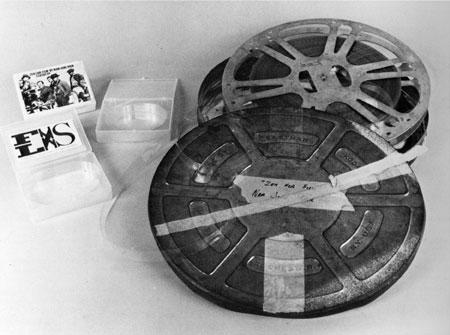
Image: Nam June Paik, Zen for Film.
This post is part of a dossier that features materials that were generated at, or in the aftermath of, the “Experiments in Listening” conference that boundary 2 co-organized with the California Institute of the Arts and the University of Southern California in January 2025.
The Author as Listener: On the Politics of Ben Lerner’s Transcription
Arne De Boever
We have two ears and one mouth so that we can listen twice as much as we speak.
–Epictetus
The crisis of democracy is first and foremost a crisis of listening.
–Byung-Chul Han
Last Words
Ben Lerner’s novel Transcription constitutes itself almost entirely across two extended scenes of listening that make up the first and third parts of the book: “Hotel Providence” and “Hotel Arbez”. In the first, a young father travels to Providence to interview his former mentor Thomas, a genre-dissolving and genre-founding (32) filmmaker who, advanced in age, is making plans to die with dignity in Switzerland. As several reviewers of the novel have noted, Transcription invites us to pick up on the connections between the character of Thomas (whose talk fills up most of the novel’s first part) and (among others) the German writer and filmmaker Alexander Kluge (mentioned in the novel [25]—Thomas has his books lying around, unread, on his couch and floor), who died around the publication of Lerner’s novel at age 94, and is sometimes compared to Jean-Luc Godard, the French nouvelle vague filmmaker who died by assisted suicide in Switzerland at age 91.
The second scene—the third part of the novel—consists of an interview (or perhaps just a conversation; although it is more like an extended monologue) with Max, Thomas’ son, after Thomas has passed away. The reader gathers that the listener—the one who is spoken to–is the same as in the novel’s first part. Max and this listener turn out to have been college friends at Brown University, where Thomas used to teach. Both Max and his interlocutor have young children, girls, who are going through a rough patch: Max’ daughter Emmie is having trouble eating (Thomas, to Max’ irritation, refers to her—referencing Kafka–as a “Hungerkünstler” [47; 50], a “hunger artist”), and his interlocutor’s daughter Eva “is flirting with what the school counselor called ‘school refusal’” (15). Their lives (or at least what we know of them through the novel[1]) appear to be so much alike that you may be forgiven for reading them as interchangeable. Transcription in fact suggests that Thomas, most likely as part of cognitive decline, confuses his former student with his son, unsettling both the student (did he forget that twenty years ago, he was in Switzerland with Thomas to work on a film project? Is Thomas right to accuse him of “tell[ing] this untruth” when he says he’s never been to Switzerland? [48]) but especially the son (“It was as though someone had placed an ice pack against the back of my neck” [129]–did his father somehow forget that they were in Switzerland together?). “I felt”, the son confesses to his friend, “perhaps as intensely as ever—the unheimlich. Maybe the real son would just come downstairs, maybe you were the real son, maybe I was the clone or robot or doppelgänger” (122).
The portrait that emerges of Thomas as a father (and husband) is not flattering: he seems incapable of establishing a personal relation with his son (and perhaps also his wife? she committed suicide when Max was eight), instead always fleeing from the dilemmas of parenting and grand-parenting (and perhaps marriage?) into “some weird allegory, some kind of prose poetry, or an impossible string of references (many of which were probably fictional)”(94)—witness the characterization of his grandchild as a “Hungerkünstler”, some figure from a story by Kafka. At the same time, there are aspects of Thomas’ relationship to his grandchild that are also quite endearing (we hear about him reading a story to her over the phone, and interrupting the reading to play some music by Debussy that fits the tale, 93-94)—and Max acknowledges this (93). The impersonal relationship between father and son—at some point, Max started consistently calling his father Thomas—is driven to a head when Thomas ends up in hospital during Covid, and seems likely to die. Only then, with a nurse holding her iPhone to his father’s ear—listening is once again extremely prominent in these pages–, does Max “as a disembodied voice” (111) allow himself to tell his father about love and forgiveness. Against all expectations, Thomas pulls through—Max receives a call that he is “stable” and that “[h]is vitals are good” (114)–, but Max can’t be sure that his father heard what Max told him over the phone. Somehow incapable of directly asking him, he finds himself “listening for traces” (118) when he goes to see his father after the ordeal, looking for signs that the message actually arrived.
In between these two scenes of listening, and holding them together like a hinge, is the shorter part of the novel, “Hotel Villa Real”. Set in Madrid (familiar to readers of Lerner’s Leaving the Atocha Station) after Thomas’ passing, it takes place on the evening of a symposium in Thomas’ honor where Transcription’s narrator spoke publicly about how his interview with Thomas—and Thomas’ last, it turns out—came about. Although this talk itself is elided in the novel, the reader gathers that it must have presented some version of what we were told in “Hotel Providence”: the story of how the interviewer travelled to Providence to speak with Thomas on the record; of how he dropped his phone—the recording device he was planning to use—in the partially blocked hotel sink, ruining it; and of how he then proceeded to hold the interview anyway, pretending to record it (the extent to which Thomas was aware of this fact seems unclear in the novel, 59). Somehow, our interviewer was incapable of telling Thomas that he’d ruined his phone. What was published, then—Thomas’ last words—could not possibly have been a transcript of an actual conversation, since there was no recording. They could only have been our interviewer’s reconstruction (and reconstruction from memory, since he did not take notes—he was recording, remember?) of what was said. Our interviewer does not find this problematic, given that all published interviews are heavily edited and do not sound like a transcript of their recording (70); but Rosa, the curator who has organized the event at which he spoke, and (according to Rosa) also Thomas’ son Max who attended the event, appear to be “shocked” (72) by this “confession” (74) and by the fact that what they took to be Thomas’ last words are actually not his last words but someone else’s.
“I’m fine”, the narrator hears himself say in response to these accusations, but Rosa didn’t ask him; it seems he is just trying to reassure himself in the face of his growing feelings of authorial guilt.[2] Thomas, though, Rosa acknowledges, would have loved the situation—“would have loved it. Loved the idea that his last published statement was ‘unstable’” (72).
Listening Is Writing
Based on the novel’s title alone, and then further on the fact that its two major parts consist of interviews (of scenes in which someone is being talked to), it seems fair to characterize Transcription as a novel about listening. This is perhaps especially so given that the middle part accuses the interviewer of having concealed the fact that what he published as the record of an act of listening was in fact a document of writing—in other words, that the middle part of the novel seems to clearly privilege listening over writing.
Certainly, the novel sets itself up to be read in this way. In the novel’s first six pages, leading up to the narrator dropping his phone in the sink, we move from (on the train) “I put in my earbuds and began to listen to a talk, recorded in Paris in 1973” (4) to (arriving in Providence) “I still had my earbuds in and I was listening to walking directions” (5), and (checking into the hotel room) “I … turned on the TV and opened the blinds and half listened to the news” (6), to (talking to his daughter Eva on the phone) “‘Yeah,” she said, maybe listening” (8). In addition, the novel notes in these opening pages that “I could hear what sounded like live piano music, but saw no piano” (6); when the narrator needs to call Thomas, he asks himself: “Why was I more nervous about briefly encountering his disembodied voice than spending hours with his embodied one? ‘You should write that down’, Eva said in my head” (7). Such references to listening continue throughout the novel. Everything in the novel appears to be about listening, then, a listening that is not so much made impossible by the destruction of the phone on page 9 but emphatically solicited at this point—as a listening beyond technological recording.
If this is going to be a novel about listening, well, now that we’ve gotten the phone out of the way, the game is really on… Let’s listen. (By contrast, when Max in the third part of the novel actually records his father, he “was only half listening—I’d let my device do the listening”, 124-125).
Recalling Lerner’s navigation of his work between poetry and the novel elsewhere, one might suggest that if the novel is typically thought to offer prose to be read, with poetry giving us song to be listened to, here a novel announces itself perhaps not quite as a song but as prose to be listened to—as something more poetic than a novel.
The move that Lerner makes at that precise moment in Transcription is interesting, and marked (for good measure) by two white lines—and three stars. I quote from page 9:
I somehow knocked the phone into the water.
***
For the duration of this sentence, it was submerged. [my emphasis]
The message couldn’t be any clearer: if this is going to be a novel about listening, Transcription is telling us, it is not the kind that is going to pitch “writing” against “listening”, as Rosa—who is not a writer herself–in the middle part of the novel seems to do, thus guilt-tripping our interviewer/ narrator. Instead, the moment when the phone is knocked into the water is also the moment when “writing” (“For the duration of this sentence”) explicitly appears on the page, as if to help out. You can find moves like this all over Lerner’s oeuvre; you wouldn’t be wrong to characterize them as one of his signature gestures. Another one arrives on page 26, for example, when Thomas offers the narrator coffee (which he does not want or need), and he takes “a fictional sip” (my emphasis). That could mean he’s pretending to sip the coffee, of course; at the same time, however, the coffee is indeed entirely fictional—it is written coffee, a pipe that is not a pipe, as a Belgian surrealist artist already playfully told us long ago. Later, on page 38, when Thomas asks about his daughter, our interviewer responds: “I call her Eva in this book” (my emphasis). Transcription emphatically does not pitch writing against listening, then, but seems to advocate for a close connection of the two. How to write as a listener? Are we perhaps, as listeners, “always already” writing? (I will return to this Derridean locution, “always already”, and the process of deconstruction that it marks, below.)
If all of the previous references to listening were fairly casual (but rich in variation—we are listening, half listening, maybe listening, listening to a voice in our head, et cetera), once Thomas enters into the conversation things frequently get technical. For a filmmaker, i.e. someone who is primarily working in a visual medium, he turns out to be quite obsessed by sounds and voices. As a way to get WWII out of the way in the conversation, he wants to start with his “sound memory” (but what memory is ever “sound”?) of hearing “Hitler’s voice” (36) on the radio in 1934; he recalls it as “rising and rising in pitch”, as if it were “eternally ascending”, impossibly so—like a “Shepard tone”, as Thomas correctly explains (37). From the get-go, and here some may find support for our interviewer’s argument that there is nothing wrong with him having reconstructed his conversation with Thomas from memory, Thomas insists that the interview is not going to be about being “literal”: “We practice literature, not law” (37), as he puts it. (It’s worth noting on this count that Thomas’ son, Max, practices law and that he is thus taking some distance from his son, and situating himself more closely to his doppelgänger, our interviewer/ narrator.) “We begin with the voices” (38), Thomas insists—the voices that are there in the ether, in the air. Some of these, we hear; but Thomas is even more interested in the ones we can’t hear—“there is always music playing that we cannot hear” (39). “Do we have ears to hear?” he asks. “[S]ometimes we listen without them. … There is listening beyond the cochlear, yes?” (39)
One assumes that the interview has already started at this point—the narrator is pretending to be recording—but as far as Thomas is concerned they are still recording onto the “long stretch of black leader” (40), the starting part of a recording tape that doesn’t record. “We remain in the black leader part of the interview” (40), he insists, until they’ve come up with the first question—something that suits the narrator, who would in fact prefer this initial evening conversation to be “the leader” (44) with the real interview following the next day, after he’s gotten himself a new phone. But much that is important to Transcription is already being shared in this part of the interview (it includes, for example the first version of the confusing conversation about “Switzerland”, 43)–and of course all of it appears, mysteriously transcribed, in Lerner’s novel. How can we have a record of what could not have been recorded on this long stretch of black leader? How could this miracle have been brought about?[3]
There are only two conclusions we can draw, within the limits of the fiction at least: either the narrator was bullshitting about dropping his phone in the sink, and the interview took place as planned, was recorded and then dutifully transcribed (and this is why we have the first part of Transcription); or he did indeed drop the phone in the sink, and everything we are reading is transcription from memory, and perhaps thereby approaching “fiction”—which is, let us not forget, the overall form or category in which the interview is presented to us here (as part of “a novel”). But in that case the questions come quickly: does an interview become “fiction” simply because it was not technologically captured, and transcribed from memory? But if such an interview is similar, as the narrator argues, to actually published interviews which are always heavily edited, why do interviews that were technologically captured but heavily edited not enter into the realm of fiction? What, exactly, does or does not constitute the fictional in these cases? And where, exactly, do we locate what we might call “authorship” in them? (An author is considered to have been at work in the first case; but in the second, we talk about editing rather than authoring. As an author who also works as an editor, I admit to having been occasionally confused on this count myself, in particular with texts that need a lot of work. Am I editing them? Am I writing? Editorial mediation vanishes; writerly mediation is marked.)
Once the “interview” is over, the narrator wonders “what I’d do if he [Thomas] asked to see a transcript” (54). Transcription then offers, as a closing reflection and further turn of the screw, the account of our narrator’s breakdown in college, when he suffered from “auditory hallucinations” (56): surely not the most reassuring thing to find out about someone who has just conducted an interview without recording or note-taking. The narrator tells us that Thomas helped him with these hallucinations. But how so? As one may suspect from someone interested in voices audible and inaudible floating in the ether, Thomas helped not by trying to get rid of the hallucinations but by engaging the narrator in an auditory experiment designed to prove that everyone has auditory hallucinations, that all listening is, effectively, a kind of writing—that there is no objective listening or that there is no outside-writing, no outside-the text. Like a psychoanalyst, who does not aim to cure you out of your weirdness but instead starts from the assumption that everyone is weird and that some—their patients—just find that fact harder to handle than others, Thomas starts from the baseline that everyone hallucinates when they listen (and that some just find that fact harder to handle than others). “You see”, Thomas says after having had the narrator hear voices in “a MIDI file” (56) in which they have effectively become inaudible to the human ear, “we all hear phantom voices. It is a question of the right conditions. Or the wrong ones. Unconscious inference, our brain guessing, making us hear what it thinks is likely there. We hear as if. We are together, erring” (57). This is, clearly, the Thomas who loves being “unstable”; it is also the Thomas who keeps insisting in the novel on the social aspect of things, which is tied for him to politics (doing things together). Hearing voices, the narrator is not having a pathological breakdown; he is, rather, tapping into the ether, as we all do. The laughing he hears “in the rustling of dried leaves” (55) (likely another one of the novel’s references to Kafka [68, 95]—in this case to “The Cares of a Family Man” in which the laughter of a creature called Odradek sounds like the “rustling of fallen leaves” [Kafka 428]) is there, as far as Thomas is concerned. Nothing to worry about—you are fine. I don’t know if this is good mentoring, but the narrator does note that he was “helped” by it: helped by the demonstration of the fact that all listening is writing.
Mosaic Authorship, Stone Tablets, and Impeded Speech
It is hard to avoid—and Transcription invites—the associations between a novel that revolves around listening and the sacred, religious (and, if we want to cast the net a bit more widely, spiritual) texts that reveal themselves to be the records of acts of listening, that come about in response to dictation, in which the interviewer/ writer is effectively no more than a medium, but a medium that does not mediate, that merely relays to us, without intervention, the divine word of the one interviewed or listened to, the one doing the dictating (the dictator, if you will… more on the politics of all this later).
How does Transcription operate within these associations? Consider, for example, the first five books of the Bible—the so-called Pentateuch—which were, or so it is believed, dictated by God to Moses. Moses supposedly merely transcribed what God told him, but of course—and especially because this transcription takes place long before the invention of recording devices such as the iPhone—this opens up the entire, and much discussed, question of Mosaic authorship, and the extent to which Moses may have intervened in the words that were passed down to him from God. With Moses and God, we’re not even in the black leader portion of the tape; we’re in a blackness way before that. Transcription presents to us a kind of Mosaic authorship, activating the uncertain borderline between listening and writing not so much with respect to God, but with respect to his stand-in in the novel: the mentor and flawed father (wasn’t God a flawed father as well? Which all-powerful being allows his son to die on the cross?) who survives Covid against all odds—the great artist Thomas.
The association between our interviewer/ narrator and Moses was, for me, immediately evoked by Transcription’s cover, which features what appears to be a stone tablet in the shape of an iPhone. The stone tablets are another famous instance (within the Pentateuch, as a mise-en-abîme) of Moses transcribing God’s dictates—God’s “Ten Commandments”, his “law”. Thomas, of course, does not want to be God, and situates himself on the side of literature rather than law, a position that is perhaps suggested in the Bible itself given that Moses, angered by his people’s worshipping of the golden calf, smashes the first version of the tablets to pieces (and the second version of the law that the Bible offers is not identical to the first, even if God states that “I will write upon the tables the words that were on the first tables, which you broke” [Ex. 34:1]!). Perhaps the entire problem is captured by the fact that Moses, when God initially selects him as his spokesman, argues that the role should go to his brother Aaron instead because he is a bad speaker—“slow of speech and tongue” (Ex. 4:10) and “of uncircumcised lips” (Ex. 6:12), perhaps an indication of a speech impediment, like a stutter or a cleft palate. (The equivalent of this speech impediment in Transcription would be the interviewer/ narrator’s auditory hallucinations. All of us are impeded in our speech, none of our speech is clear. Not even mine, in this text.) Moses is not who you want to choose as your communicator—unless, of course, that is the entire point: that there is something unstable in the divine law, an instability that is to be embraced. Law is always delivered as impeded speech, and thus it begins to approximate literature. It is Thomas who talks about his granddaughter, Emmie, “bowed over her so-called tablet … as if in prayer” (47). Transcription in this context tells us, with respect to the sacred text, that while it may present itself as the record of an act of listening, it is always already a document of writing, with Moses not so much as the vanishing medium but very much as the mediator—it’s a novel that foregrounds mediation (“For the duration of this sentence”, “a fictional sip”, “I call her Eva in this book”, et cetera). Could it be that the Bible does so as well? What may be the consequences of such an insight? From such a point of view, it seems the stone tablet becomes, as Thomas puts it in a discussion about “icon painting”, “a secular detail” (46) rather than a sacred dictate—although “secular detail” is not quite the right name for what Transcription is either. For that, we will have to dig more into the fictioning that the novel does.
The bigger point here then becomes that the word of God, or, in the case of Transcription, the word of Thomas, can never be accessed as such, because all acts of listening are already acts of writing—we cannot listen objectively, there is no listening-outside of writing (as I put it before, evoking Derrida: Transcription’s narrator does so himself when he points out, considering whether the wine he drinks at Thomas’ house is medicine or poison, that there is “a third option”, and that it might be both [34]—this was, of course, exactly Derrida’s point about the pharmakon in his reading of Plato [who is referenced in Transcription two pages later, 36]; more broadly, however, Transcription’s point about listening-as-writing is Derrida’s argument about speech and writing in his Grammatology).[4] From such a perspective, Rosa’s objections to our interviewer/ narrator reconstructing his interview with Thomas from memory—her guilt-tripping him over his authorship—appear naïve, more precisely they appear to be naively invested in the idea, the phantasy, that one could ever really access the word of God/ Thomas. Listening, Transcription argues, never works in this way: it is always already writing. Rosa seems to criticize our interviewer/ narrator’s authorship in favor of some kind of direct access to Thomas’ speech, but really what she is trying to access in this way is just some bigger Author, whose words also could never be directly taken in (because to listen is always already to mediate). Transcription is a meticulously construed criticism of this kind of attitude, which Lerner already discussed in Hatred of Poetry (people hate poetry, he argued there, because it can never realize the virtual, ideal, Platonic Poetry that they want; and so the metaphysians are always left disappointed…). Rosa suffers from a metaphysical affliction, a wanting to get beyond writing to access Thomas/ God directly, immediately. But there is no outside of mediation, Transcription tells us: even a transcription is a form of scription, after all. The mediator never truly vanishes. Instead, it’s authors everywhere.[5]
Political Fiction
This is not to say that Transcription is not rethinking the author and authorship, as no doubt we should in a time when “authoritarianism” has become the political keyword of the present.[6] For while Transcription argues that there is no listening that is not always already writing, it also emphatically makes the reverse point: that writing really is a form of listening. The writer, in Transcription, is emphatically a listener, and most of Transcription’s record is really the record of an act of listening. The novel does not make this point naively, by indulging in the phantasy that there could be a listening without writing; but it makes it nevertheless, in response to an understanding of writing as law-making, dictating, commanding—in short, against an authoritarian understanding of the practice. It seems abundantly clear that Transcription’s narrator wants to present himself as a listener, a listener who is then—due to the ruination of his iPhone—solicited into a listening beyond technological recording, a situation in which (“For the duration of this sentence”), writing will come to his aid to help him deliver a reconstruction from memory (a record) of a conversation, of Thomas’/ God’s speech. On the one hand, this marks an investment in writing; but it’s an investment in a writing that operates in the service of listening, with the author being recast as a “transcriber”, as perhaps more of a poet in relation to a song than as a novelist in relation to prose. Transcription appears to be an activity that takes place somewhere in between the prose of the novel and the song of poetry, a writing-as-listening and listening-as-writing that, as an emphatically social activity, always taking place in the realm of the more-than-one, is arguably also sharply political in a time of the increasingly loud dictates of authoritarianism. Under such contemporary conditions, authorship should be rethought—and Transcription is a novel that takes on this task.[7] As such, and perhaps in spite of appearances, this slim fiction is intensely political, as all of Lerner’s other work.
This becomes perhaps most clear with respect to the notion of fiction that the novel articulates, and that—in the time of fake news and bitterly fought contestations about historical facts—is embedded in these political concerns.[8] Indeed, the transcriber is, perhaps contrary to the naïve understanding of the word, a kind of fictioner. But in what sense?
The key passage for this is likely the narrator’s account of his visit with Anisa–the best friend of his college girlfriend, and to whom he becomes unexpectedly close after he and his girlfriend break up–to the Natural History Museum on the Harvard campus. The museum has a “dimly lit gallery dedicated to the [glass] flowers”, “botanical models made by glass artists—a father and son—from Dresden a century ago” (20). Transcription ends with multiple references to these flowers, including in an epigraph following the narrative’s end, so the novel makes it clear that this is an important passage. There is, of course, the reference to the father-son relationship that is worth noting; in addition, we are dealing here with something very fragile, a fact that is perhaps further underlined by the artists being from Dresden, a city heavily bombed by the allied forces during WWII (overall, this scene evokes the work of W.G. Sebald [perhaps in particular his work On the Natural History of Destruction] who is, in addition to Kluge, a reference in Transcription; Sebald is one of those authors who, as a novelist, rethought writing as listening, offering fiction as a record of acts of listening that are often multiple and embedded within each other—see, for example, Sebald’s prose work Austerlitz, which presents itself as extended record of an act of listening). Finally, however, and most importantly, the narrator’s experience of seeing the flowers leads into a reflection on fiction:
I kept seeing the flowers as organic one instant and as artificial the next, a kind of duck-rabbit effect, not between things the object might represent, but between nature and culture, the given and the constructed. And I carried this new way of looking, or this new hinge in my looking, outside the museum: when my sister dragged me camping, for instance, I was typically unmoved by “unspoiled” mountain views; after the glass flowers, I would see cracks in the rock face as penciled, as a history of small decisions, and then experience the view as beautiful. I could will myself to see the rose and pink of a sunset as applied in touches or stains and then revert to seeing it as natural; and so on. It was with Anisa that I first became conscious of this quiet but crucial technique, somewhere between a child’s game, a CBT exercise, and a religion. Eventually, I’d call this “fiction”. (21)
In between organic and artificial, duck and rabbit, nature and culture, the given and the constructed—let’s add: student and son, medicine and poison, and, of course listening and writing. This is where we are with the fragile, glass flowers, so delicate that around them, visitors are asked “to keep our voices low” (20); this is where we are with Transcription as well, in between the given and the constructed. The interview is supposed to give us the given, but Transcription delivers the message that all interviews are constructed; in fact, all listening constructs, it writes.
Still, writing as a construction does not stand on the other side of the given—“fiction” has something to do with seeing the constructed in the given, and drawing out the given in the constructed. In that sense, it is not law, dictation, or commandment (which are all construction). It listens as it writes (it draws out the given, but the given can never be given). The suggestion appears to be that it is this kind of listening that prevents writing from becoming a lie, such as the lies that Anisa tells the narrator about the life of his ex-girlfriend in New York (50 and further). What we get in the novel, rather, is a plea for the transformative, reality-adjacent practice of fictioning through a writing-practice that is listening-based and transcribes the world between the given and the constructed.[9]
In that sense, Transcription is, like the Hotel Arbez with which it ends, “a complex space. Non-euclidean” (128). As Max eventually explains to the interviewer/ narrator, who must have been there even if he appears to have some difficulty remembering it, the Hotel Arbez is:
The one that’s famous because different parts of the hotel are on different sides of the border. The lower half of the stairs are in France, but, beginning on the seventh step—
You’re in Switzerland. Right. Jesus.
And during the German occupation, the Nazi soldiers could enter the French side of the hotel, but not ascend to the upper rooms, where Max Arbez helped shelter Jews and members of the Resistance. A kind of impossible staircase. Remember we went up, ascended to Switzerland? (128)
Transcription’s fictioning is in between things, the way in which the Hotel Arbez is in between Switzerland and France—and it’s that in-betweenness that enables Max Arbez, one of the Max’s after which Thomas’ son is named (the others are Horkheimer “and my mother’s favorite uncle”; but one may want to throw in here Sebald as well, who preferred to go by Max) to shelter Jews from the Nazis. The return of the phrase “impossible staircase” is interesting as well, because Thomas had used it in part one of the novel to refer to how, in his “sound memory” of Hitler’s speech, his voice appeared to be “eternally ascending, an impossible staircase” (37). “This is a wondrous but terrible fact of our wiring,” Thomas commented then, “how clockwise movement across the pitch class creates this impression” (37). Terrible in the case of Hitler; wondrous in the case of the Hotel Arbez; here too, “it is a question of the right conditions. Or the wrong ones” (57). A fact of our wiring, to be sure—something that “our brains will allow” (37). But also an effect of our writing, our fictioning, our transcription.
This is, perhaps, the closest indication we get of how Transcription, the kind of literature it practices, can save—but not in the way that the sacred text saves. Transcription saves not as a Holy Writ that delivers dictates; it does not save as authoritarianism. Instead, it saves as a writing-listening and listening-writing that exposes the phantasy of all such law-like commandments. The fact that it always inevitably writes does not mean that it lies. Rather, as a construction, Transcription fictions: it highlights the mediator not simply to expose the constructed in the given, but to offer a version of the constructed that can deliver the given, like a glass flower. Delicate and fragile, it asks you to keep your voice low as you approach, so you can listen–which is also to say write–all the better.
Arne De Boever teaches American Studies in the School of Critical Studies at the California Institute of the Arts, where he directed the MA Aesthetics and Politics program for over a decade. He is the author of numerous articles, reviews, and translations, as well as seven books on contemporary comparative fiction and political and aesthetic philosophy. His most recent books are Against Aesthetic Exceptionalism (University of Minnesota Press, 2019), François Jullien’s Unexceptional Thought (Rowman & Littlefield, 2020), Being Vulnerable (McGill-Queen’s University Press, 2023), and Post-Exceptionalism: Art after Political Theology (Edinburgh University Press, 2025). His books Silent Music (co-written with the composer Michael Pisaro-Liu) and Secular Detectives and are forthcoming with Bloomsbury and the University of Nebraska Press respectively.
References
Benjamin, Walter. Illuminations: Essays and Reflections. Ed. Hannah Arendt. Trans. Harry Zohn. New York: Schocken, 1968.
Bradbury, Ray. Fahrenheit 451. New York: Simon and Schuster, 2012.
Coetzee, J.M. and Mariana Dimópulos. Speaking in Tongues. New York: Liveright, 2025.
Derrida, Jacques. Dissemination. Trans. Barbara Johnson. Chicago: University of Chicago Press, 1981.
—. Of Grammatology. Trans. Gayatri Spivak. Baltimore: Johns Hopkins University Press, 1998.
Hölling, Hannah B. Revisions: Zen for Film. New York: Bard Graduate Center, 2015.
Kafka, Franz. The Complete Stories. Ed. Nahum Glatzer. New York: Schocken, 1971.
Lerner, Ben. Leaving the Atocha Station. Minneapolis: Coffee House Press, 2011.
—. 10:04. New York: Faber and Faber, 2014.
—. The Hatred of Poetry. New York, NY: Farrar, Straus and Giroux, 2016.
—. “The Hofmann Wobble: Wikipedia and the Problem of Historical Memory”. Harper’s Magazine December 2023, accessible: https://harpers.org/archive/2023/12/the-hofmann-wobble-wikipedia-and-the-problem-of-historical-memory/.
—. Transcription. New York: Farrar, Straus, and Giroux, 2026.
The Holy Bible. Revised Standard Version. Meridian: New York: 1974.
Sebald, W.G. Austerlitz. Trans. Anthea Bell. New York: The Modern Library, 2001.
—. On the Natural History of Destruction. Trans. Anthea Bell. New York: Random House, 2003.
Stiegler, Bernard. For a New Critique of Political Economy. Trans. Daniel Ross. Cambridge: Polity, 2010.
[1] My impression is that Lerner very carefully sets up this situation as an effect of repeated structural elements in both part one and part three of Transcription; and then also by leaving certain elements within that structure empty, by playing with the fact that fiction does not have to fill in every detail. I appreciated this set-up even more after reading J.M. Coetzee and Mariana Dimópulos’s reflections on this aspect of fiction in the context of their discussion on translation in Speaking in Tongues.
[2] It is probably significant that this guilt about authorship arrives in Madrid, where, in Leaving the Atocha Station, “Adam”—a stand-in for Lerner—“arrives” as an experimental writer. It is, in Lerner’s fiction, the “adamic” birthplace of Lerner’s fictional self as a writer; it is, now, also the place where his authorship is drawn into question.
[3] I am reminded of Nam June Paik’s Zen for Film, which was made some time between 1962 and 1964. For this project, Paik ran transparent empty film leader through a projector, allowing it to collect traces, scratches, dust as the film was played. As Hannah Hölling in her work on the film has pointed out, Zen for Film cannot be seen in the same condition twice, as it is forever and irreparably changing each time it is projected. The film, it is worth noting, was inspired by John Cage’s 4’33’’ composition (four minutes and thirty-three seconds of silence), which was in turn inspired by Robert Rauschenberg’s “White Painting [three panel]”. The link to Cage highlights the connections between Paik’s film—a work of visual art—and the practice of listening to which 4’33’’ drew attention. Like Transcription, all of these works highlight that we see and listen more attentively when we are working “in the leader”, in other words, in a certain kind of silence. I want to thank my student Lukas Mackinney for bringing Paik’s project to my attention in this context.
[4] The other reference that seems relevant here is to Derrida’s student, the philosopher Bernard Stiegler, and his work on what he calls (after Edmund Husserl) “tertiary retentions”, i.e. technologies—like writing or the iPhone—through which speech is recorded. One of Stiegler’s points is that such tertiary retentions do not simply post-date speech but in fact precede it: as children, we start speaking in worlds that are always already recording; in fact, children record before they start speaking. Transcription’s variant of this is that there is no listening without writing, that writing always already pre-dates listening and is operative within it.
[5] This position counters, for example, what Walter Benjamin at the end of his famous essay “The Task of the Translator”, writes about “the Holy Writ”. Benjamin posits there that it is “unconditionally translatable” because it is supposed to be “‘the true language’ in all its literalness and without the mediation of meaning” (82). The position is peculiar, because it insists on the medium—language—in its immediacy—without the mediation of meaning. Language as pure means. This is Benjamin’s understanding of “sacred writings” and their purity. In Transcription, Lerner counters such phantasies of purity or immediacy. I bring up Benjamin on this count because Transcription includes several references to his work.
[6] I want to acknowledge Martín Plot’s thinking about “the author” (versus “the actor”) in the work of Hannah Arendt, and the relevance of this distinction for our theorization of “authoritarianism”. I am tempted to capture such a thought under the title “Authors Against Authoritarianism”.
[7] This is not to say that under different conditions, turning human beings into mere recording devices could not also work against authoritarianism: witness the end of Ray Bradbury’s Fahrenheit 451, where humans are turned into living recordings of great works of literature that are being burnt, for an example of precisely this situation.
[8] That Lerner is interested in these questions is clear elsewhere in his work, for example in his story “The Hofmann Wobble”, which presents us with an author who is using and abusing Wikipedia to rewrite history and promote ideological positions. Transcription signals that it is situated in this vein of thinking when it evokes “the wobble” in its third section (129) to capture Max’s state of mind in his relation to his father.
[9] In Lerner’s 10:04 (Lerner 2014, 244), this idea is expressed through reference to a story that Lerner finds in Giorgio Agamben’s The Coming Community, and that is attributed there to Walter Benjamin, who likely found it somewhere else, namely about how after the arrival of the Messiah, the world will be exactly as it is now, just a little different. The idea returns in Transcription in other ways as well. “It was as though everything in the house had shifted a few millimeters”, Max says in Transcription when he encounters his father after he has survived Covid. “He wasn’t much changed, and yet he was utterly changed” (116).