

This text is part of the b2o: an online journal special issue “EXOCRITICISM”, edited by Arne De Boever and Frédéric Neyrat.
The Essay vs. AI: On the Literary Value of Criticism
Arne De Boever
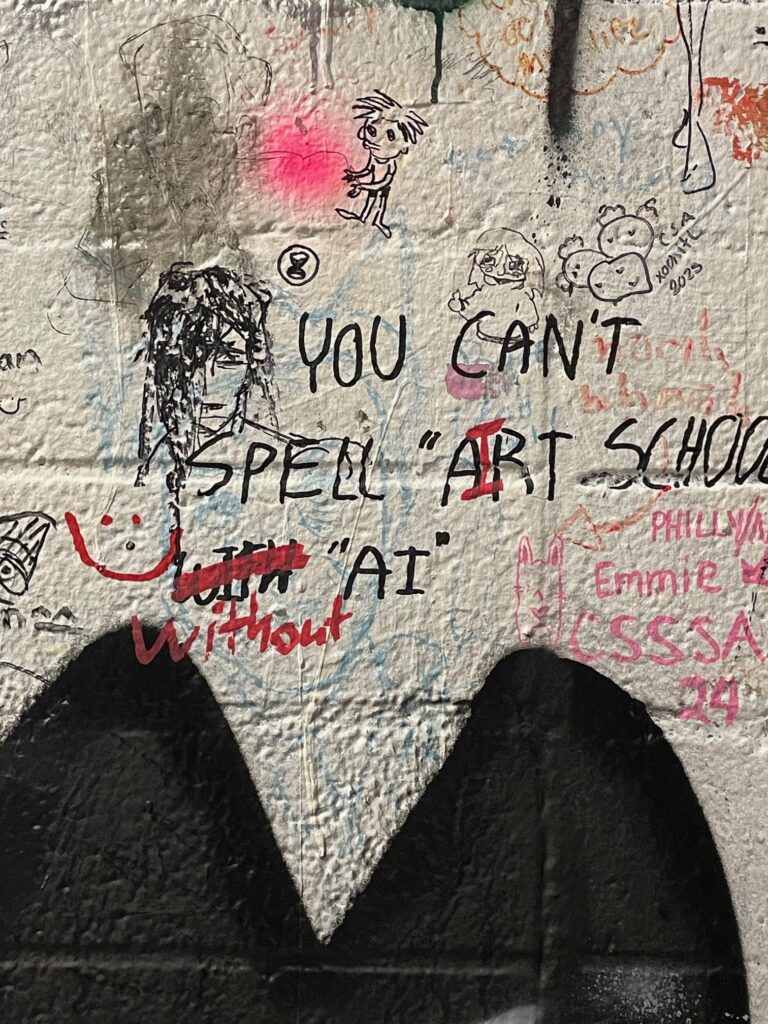
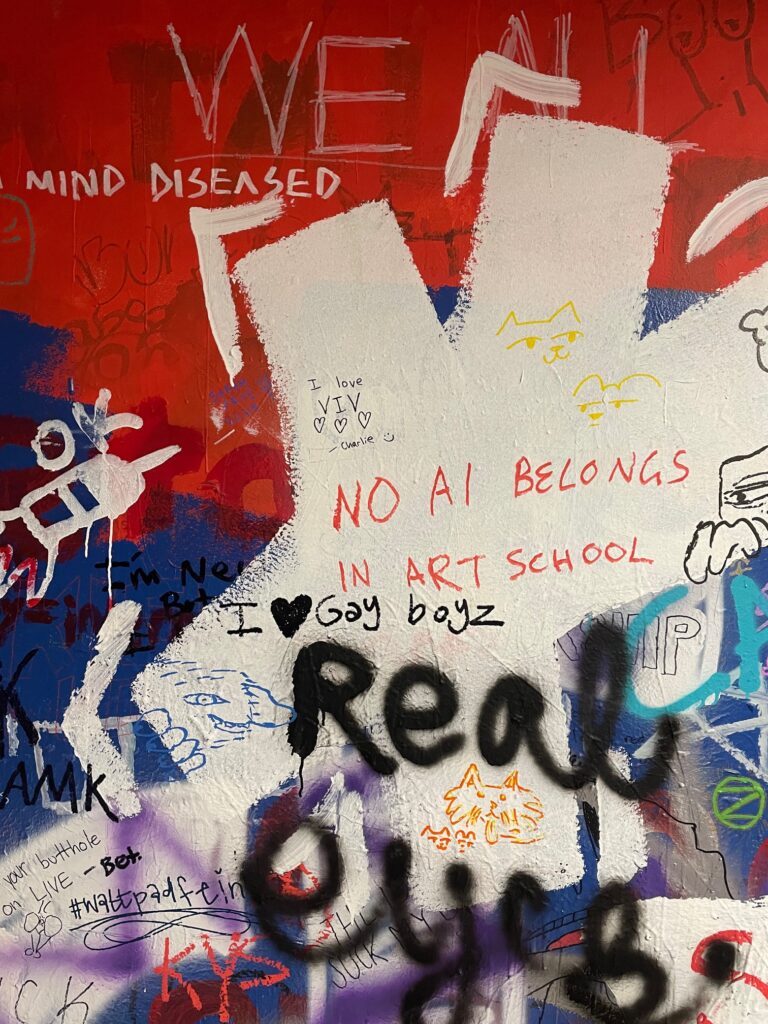
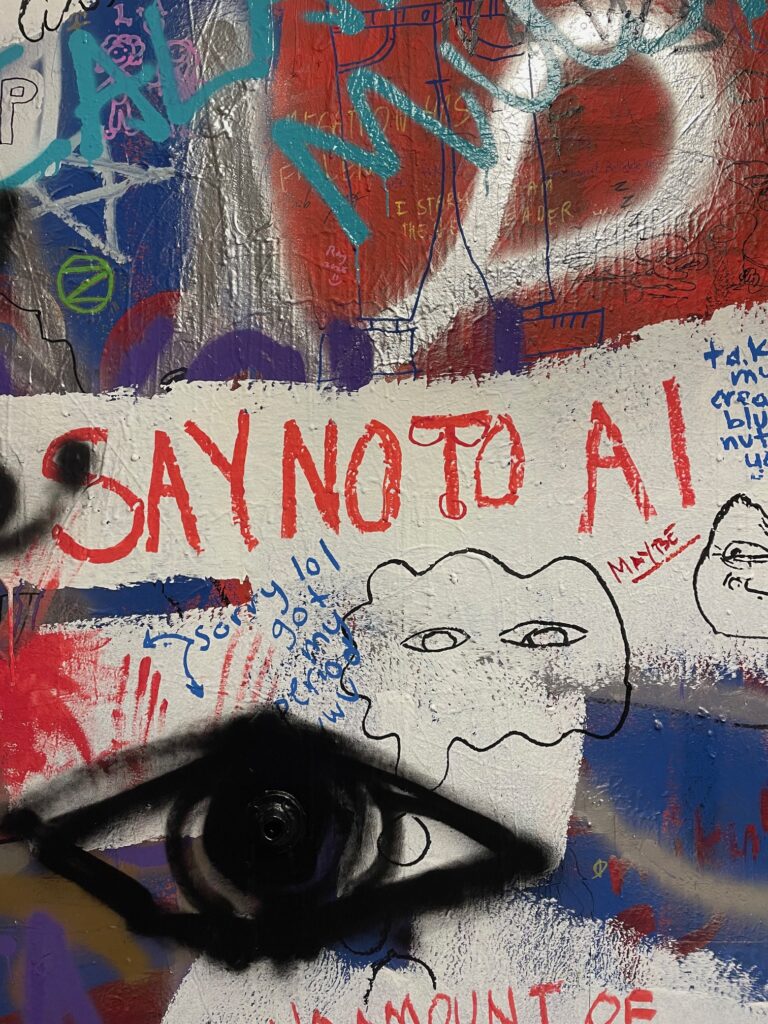
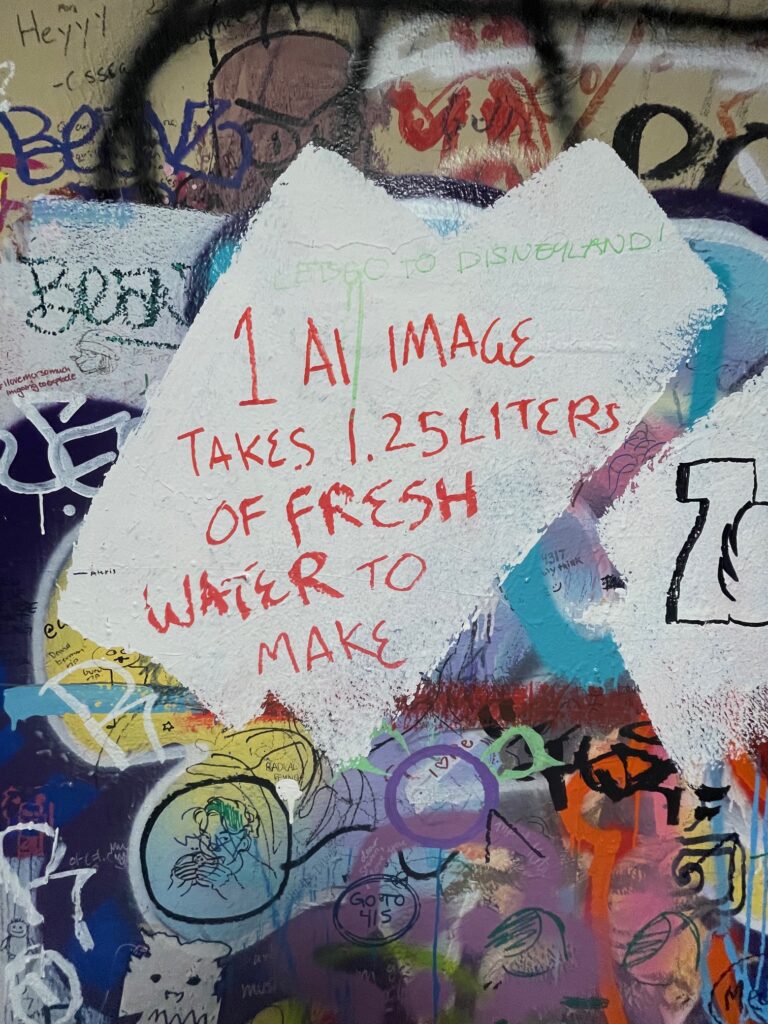
All images are (c) Arne De Boever and were taken by the author in the Sublevel at the California Institute of the Arts.
The critic is always in a secondary position to the poet, but his secondariness is not an inferior position. (Bové 2025, 117)
–Paul Bové, “Critical Poetic Grace”
Opening Questions
How to write criticism in the time of artificial intelligence (AI)?
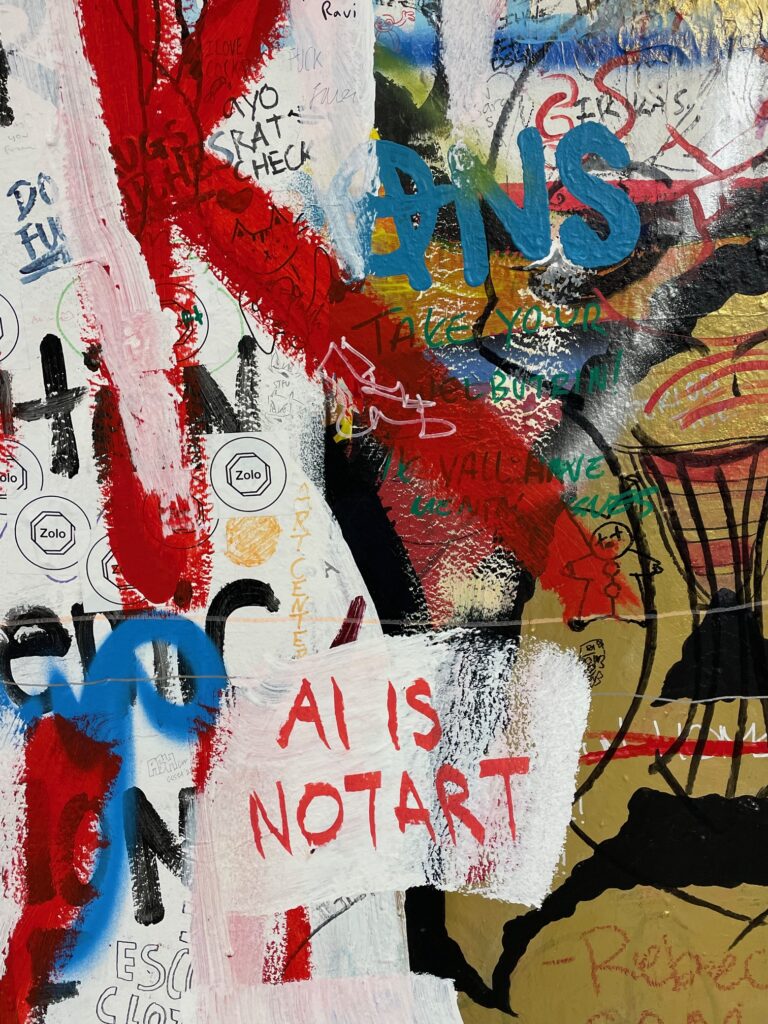

I ask this question as a critic working among literary, visual, and performing artists at an arts college—in other words, as part of a creative community that is, by nature of the work its members are doing, deeply invested in forms. If critics have perhaps forgotten, at times, that they too participate in that practice, the immediate context of my own writing makes it impossible for me to do so and solicits me, on a daily basis and as a key concern of aesthetic education, to think longer and harder about the forms I generate as a critic. While those forms first and foremost seek to say something about the thing that catches my critical attention, they are also undeniably the aesthetic forms of my very own thought, and as such they deserve critical scrutiny, in particular in the time of AI when critical writing, and thus also critical thinking and its objects, appear to be going through an epochal transformation.
Let me clarify from the outset the limits of my project here. I am only interested in thinking about AI in the context of writing criticism—the kind of writing that I consider myself to be doing. There are, obviously, many other contexts for the application of AI; certainly there are many other kinds of writing in which AI may serve a purpose. My position, however, is that when it comes to writing criticism specifically, AI is useful only as a challenge to solicit us into writing against or more precisely outside of (because I am not talking about a writing that’s merely reactive) the kind of writing that AI generates. AI solicits us, I propose, into writing outside of established formats of academic and professionalized prose, familiar from well-recognized scholarly journals.
Exocritics of the world, unite!
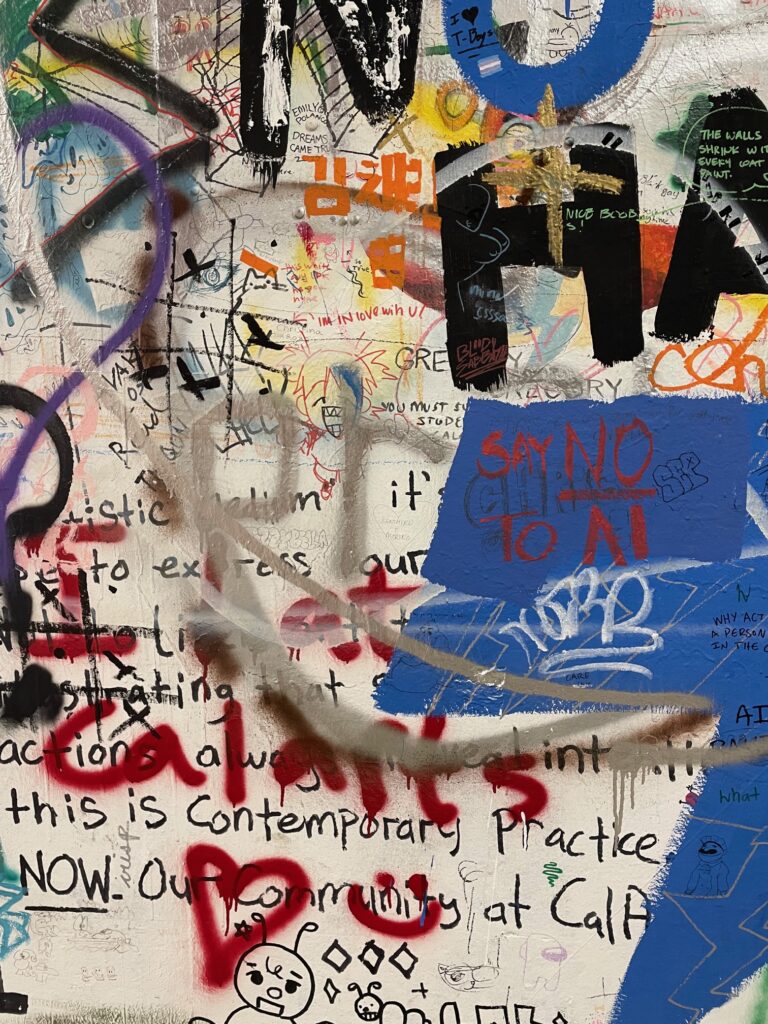
This solicitation, I argue, is for the sake of saving not only thought but thought’s very objects from a dulling standardization and commodification to which, in the time of AI, they are being subjected. Criticism has been in the process of becoming formulaic, and in our time AI is accelerating this process, an acceleration that is further contributing to the demise of the humanities. While AI is accelerating this process today, it should be clear that it precedes the time of AI. Indeed, it is arguably a problem that is part of the institutional history of criticism’s practice—criticism is read and taught typically in academic contexts—, a history that the arrival of AI is making more visible.
No doubt a key word in thinking about all of this is “freedom”. We are living in a time (as Maggie Nelson for example has noted [Nelson]) when “freedom”—freedom of speech, academic freedom, artistic freedom—are once again objects of scrutiny, and my position is that freedom—and in particular intellectual freedom,[1] which is the freedom that is practiced in criticism—is under increased pressure in the time of AI.
So a slightly adjusted version of my opening question might be: how to be intellectually free in the time of AI?
What are the forms of criticism that will enable us to remain intellectually free in the time of AI?[2]
Reading AI
The critical form that I propose to focus on in this reflection about “how to write criticism in the time of AI?” is the essay (instead of the scholarly article). Criticism today, I argue, needs to uncompromisingly seek the nominally modest, humble, and in my own language unexceptional form of the “essay”—from the French “essayer”, “to try”; the tradition of the essay goes back to the 16th-century French thinker Michel de Montaigne, who invented the genre—if it wants to continue being intellectually free. Put negatively, it needs to steer clear from any prescribed, repeatable, and supposedly scientific forms that in their purported objectivity are in fact predictable, formulaic, and adding to the status quo—thus preventing anything truly new from coming about. AI comes to us in the guise of the new, but its relation to the new—as well as other, related terms: creativity, for example—remains contested (as I will discuss).
Leaving criticism aside for a moment, I point to the field of theoretical mathematics, in which AI has solved several long-standing problems, but in ways that practitioners of the discipline consider unsatisfying: because the theories that AI provided lack what they don’t hesitate to characterize as a poetic quality, a beauty they associate with human ways of solving such problems. So they are still looking even if AI has already completed the job. These mathematicians, who look for poetry in theory, need to become our allies—at least to the extent that they intend to leave these beautiful solutions to humans.[3]
The polemical and at face value perhaps somewhat naïve version of my position would be that AI cannot write essays. To be clear, this position is not that AI, for now, cannot write essays. It is stronger than that: I would be positing, categorically, that it will never be able to do so, because the essay as I conceive of it is a particularly human form of intelligence that always realizes itself beyond the limits of what AI can achieve. It will be clear, then, that my turn to the essay is not a nostalgic turn but a futuristic one, in the service of a critico-futurism. We could give a bit of a humorous ring to this: you cannot spell “essay” with “AI”, even if the original French word “essai” ended in “AI”. AI writes ArtIcles.
I write in “woulds” and “coulds” because there is a catch: by presenting the essay in this categorical way, and as tied to human intelligence, I don’t want to make a plea for the exceptionalism of the essay as form of free human thought. I am interested, as I’ve indicated, in the essay as an unexceptionalist form. I may have landed on the form of the essay, but what matters to me here is not some kind of essayistic essentialism, or the essay as the form for human exceptionalism (I write as a humanist but not a human exceptionalist). I am interested, rather, in the challenge to AI-generated writing that the essay enables me to explore. Responding to this challenge may take forms other than the essay as well, even if the essay may be a particularly promising form in this context.
Reading AI-generated articles is a peculiar experience, one that, alas, I am becoming more and more familiar with in a time when the traditional mid-term or end-of-term essay is disappearing—is being outsourced to AI, as Hua Hsu in a recent New Yorker essay on “The End of the Essay” (2025) observed. On the surface, everything in these AI-generated end-of-term papers (let’s not call them essays) or articles seems to be in order. But when applying closer scrutiny, you find that there is just no “there there”. They simply move through the motions, demonstrating a disconcerting lack of voice. A claim is made and while the evidence brought in to support that claim is drawn from the general field of study in which that claim is presented, the relations between the various pieces of evidence just do not add up, or are simply wrong.[4]
On the surface, everything seems to be in order (there are sources! there are [granted, unreferenced] quotes! there is evidence! there is a claim!): but start scratching just a little bit (ask for the reference!), and you quickly lose whatever ground you thought there was under your feet. The AI paper or article is not the product of “reading”. I have some hesitation to characterize it as “writing”, even; doing so would fundamentally shift what I understand by those terms. The AI article—the ArtIcle–truly is an empty shell, the mere appearance of a form of thought—without any actual thought. Its author, an impersonal mask.
Chase it, and you’ll soon end up like Wile E. Coyote.
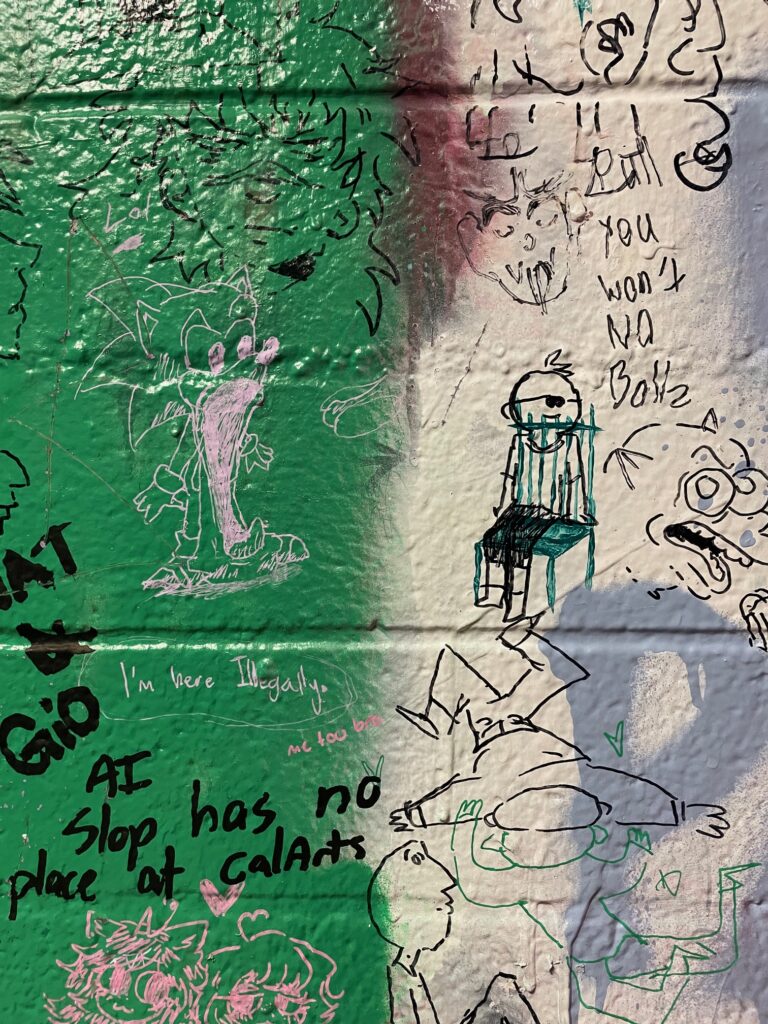
Of course there is still a difference between such an AI article, and academic articles written by humans to share scholarly research and also to fulfill the requirements of an academic degree and academic promotion. But anyone who has read through all of the scholarly articles about, say, a contemporary American novel, will be able to testify to the repetitiveness of the form: again and again, one comes across the same kinds of compositions, frequently presenting the same evidence, reaching perhaps substantially different but similarly sounding conclusions—and of course they are all referencing each other. One has the impression of entering into some kind of nightmarish mirror palace in which versions of the same professional academic are all “echoing”—one of AI’s favorite words, by the way–more or less the same thing. By the time such “echoes” are available to the public eye, they have already passed through the professional machinery of what is called “peer review”: review by so-called specialists, and frequently the authors of other already published articles on the novel in question, who will typically only approve for publication work that more or less resembles their own and demonstrates what they perceive to be the standards of the discipline. Everything here revolves around method and outcomes,[5] around the calculated effects of a hollow procedure that, in the writerly form it takes, stands miles apart from the object on which it is supposed to shed light. There simply is no relation. Granted, we still have here humans who are writing such articles; but we are really only one step removed from the AI article. I have no doubt that many of these humans are already using AI in the service of generating the next line on their CV.
It should always have been obvious where this was going, even if bad criticism alone cannot be blamed for it: in recent months, I have been receiving emails from university presses in both the US and elsewhere asking for my permission to allow companies to train their AI on work of mine that these presses have published—presumably in order to then turn AI into a better academic writer. While it is undoubtedly better to be asked than to simply find out that one’s work was used without one’s consent—and there have already been court cases about such non-consensual use[6]–the payment one can expect to receive from this is minimal, even though the price paid by the presses (who are barely staying afloat in the current anti-academic climate) for closing such deals is great. In the future they imagine, AI will be able to write academic articles and books—we need not bother any longer.[7] This is, and this much should be clear, the outcome of a process that has involved the increased standardization of criticism in the university. Anyone doing their homework and researching already published criticism on this or that novel, for example, will not be able to avoid some irritation at how similar the articles all sound. The AI-generated article is simply the next step in a process that predates it by far.
If AI can appear to us, then, as the miserable outcome of this long institutional history of criticism’s practice, my position is that we are being solicited, today, in the time of AI, to write otherwise.
How to write criticism in the time of AI? By writing criticism in such a way that no AI could. I don’t know if this is possible—but I like the challenge. What kind of writing might such a solicitation have us produce? Time to take this outside.
The Essay
While the problem of writing criticism in the time of AI propels us into an exocriticism and critico-futurism, it has a history. For this, I partly look—without a hint of nostalgia–to a text from 1958 (the text does not mention AI but it’s worth noting that the term was coined in 1956, just a few years previous) as part of the solution. There, an author writes of the essay, formally independent and related to poetry, as evoking “intellectual freedom” (Adorno 3). It dodges prescription, seems to “reflect the leisure of a childlike person”; “luck and play are essential to it” (Adorno 4). Often “classified a trivial endeavor” (Adorno 4), it practices interpretation as radically free speculation, thus preserving the artistic energy of its source material: for “the objective wealth of meanings encapsulated in every intellectual phenomenon demands of the recipient the same spontaneity of subjective fantasy that is castigated in the name of objective discipline” (Adorno 4). The essay has an “aesthetic autonomy” while at the same time it never fully stands aside from its object—“for one can hardly speak of aesthetic matters unaesthetically” (Adorno 5). The “expressive impulse in the presentation”, which the academic article seeks to remove—this is another way of saying that the academic article seeks to get rid of the subject—is preserved and even promoted in the essay, which presents itself as going against the “privilege of the mindless” (Adorno 5). Such a form, and the author presents the essay precisely as a form in his own essay, deliberately works against what the author characterizes as “academic unfreedom” (“akademische Unfreiheit”), a state of academic disciplining in which “intellectual freedom itself becomes unfree and serves the socially preformed needs of its clientele” (Adorno 6).
The author who is speaking here is Theodor Adorno, who understands the academy to be a “repressive order”: “A certificate of competency is required of the mind so that it will not transgress upon official culture by crossing culturally confirmed boundary lines. Presupposed in this is the notion that all knowledge can potentially be converted into science” (Adorno 8). But what was lost in this shift from “philosophy” to “science”? Why did this shift take place? Marcel Proust, Adorno argues, proceeded “scientifically” when he was writing his monumental opus À la recherche du temps perdu [In Search of Lost Time], but the kind of science documented in the work’s seven volumes is “not readily accommodated within science and scholarship”, and this “despite the fact that their claim to objectivity is neither diminished nor abandoned to a vague plausibility” (Adorno 8). The knowledge it presents is that of a man of experience “like the now extinct homme de lettres [man of letters], whom Proust conjures up as the highest form of dilettante” (Adorno 8). A dilettante, then, or also, as Adorno also allows us to put it in the closing lines of his essay—a “heretic” (Adorno 23): that is what the essayist, the critic, is to be in the time of AI.
Adorno, of course, is not writing in the time of AI—he’s just on the cusp of it. Note that Hannah Arendt, in the “Prologue” of her book The Human Condition from 1958, takes the launch of Sputnik in 1957 to reflect on the scientific production of a “future man” as part of a “rebellion against human existence as it has been given”, with science generating “truths” that “will no longer lend themselves to normal expression in speech and thought”, thus necessitating “artificial machines to do our thinking and speaking”. “The question”, as Arendt points out, “is whether we wish to use our new scientific and technical knowledge in this direction” (3). Although Adorno doesn’t appear to be thinking about any of this, I’m suggesting that what he has to say about the essay and its relation to the stodgy forms of academic writing in 1958 nevertheless becomes supremely relevant today, when we are witnessing the outcome—in AI–of certain kinds of standardization in the disciplines that are supposed to enable the free expression of the intellect. It’s as if AI is inscribed in Adorno’s essay just by virtue of its historical context–even if he never mentions it.
Adorno contrasts the essay’s wisdom to the philosophical doctrine, “deeply rooted since Plato, that what is transient and ephemeral is unworthy of philosophy” (Adorno 10); he posits the essay’s “methodically [unmethodical]” (Adorno 13) way of proceeding to Descartes’ obsession—him again!–with the “clear and distinct” (Adorno 14) and suggests it pursues a “kind of learning that remains vulnerable to error” (Adorno 13). It is not analytical; it accepts that not everything in the world is logical; it does not seek to be exhaustive; it “thinks in fragments”; Adorno allows us to characterize it as “fallible and provisional”, and “groping its way” (Adorno 16). To Adorno, it is a kind of thinking in the midst of things. He quotes Max Berise writing that
The person who writes essayistically is the one who composes as he experiments, who turns his object around, questions it, feels it, reflects on it, who attacks it from different sides and assembles what he sees in his mind’s eye and puts into words what the object allows one to see under the conditions created in the course of writing. (Berise qtd. Adorno 17)
Thinking and writing in process, then, rather than rule-based or following some kind of pre-scription. Open, at a distance from “the masterpiece”, the essay finds “happiness” in its hostility to “official critical thought” and pursues “the pleasure principle of thought” (Adorno 21). Its object, Adorno writes “is the new in its newness, not as something that can be translated into the old, existing forms” (Adorno 21). It makes the violations of the orthodoxy of thought visible. This suggests, then, that the new problem of “how to write criticism in the time of AI” can only be written up in the essay form, which is mobile.
A Literary Turn; On Criticism’s Hybridity
The main writer Adorno mentions as an example in this context is “Benjamin” (Walter), but I propose to turn to another Benjamin at this point—the Chilean writer Benjamín Labatut. Labatut rose to fame with his novel When We Cease to Understand the World, published in English translation by the New York Review of Books in 2020. This is a remarkable work about science and history and the people caught up in both, that opens like a work of non-fiction but ends in a more experimental, and clearly creative mode. Its opening chapter, “Prussian Blue”, which ends in the words “a terrible verdure” that served as the book’s original Spanish title (Un verdor terrible), is, at least to this reader, impossible to distinguish from an essay as one might find it in a magazine or even a well-written book of history (in particular, the history of science). There are, of course, no footnotes, no references (even if there are quotations), no bibliography; there isn’t a clear thesis statement or argument, and in that sense the chapter is clearly an “essay” rather than an “article”. But the thing is, in the way it is presented here, it’s neither: it is part of a work of fiction, and thus closer to a short story or a chapter in a novel.
This is, however, where I become interested, and where we begin to dabble in the field of what has come to be called “theory-fiction”: for what happens not just when fiction is presented in this essayistic way, but when criticism appears to us in this fictionalized form? The development of Labatut’s book makes it clear that we are in the realm of fiction—but what does it mean to bring criticism into this realm? Is this a challenge to fiction writers? Is it a challenge to critics? Does this hybrid form address itself to both?
Consider the following three quotes, all in translation:
A wave of suicides swept through Germany in the final months of war. In April 1945 alone, three thousand eight hundred people killed themselves in Berlin. The inhabitants of the small town of Demmin, to the north of the capital, some three hours away, fell prey to collective panic when the retreating German troops destroyed the bridges leading west, leaving them stranded on their peninsula, surrounded by three rivers and defenseless before the dreaded onslaught of the Red Army. Hundreds of men, women and children took their own lives over the course of three days. (Labatut 2020, 10-11)
Today it is hard from an even partly adequate idea of the extent of the devastation suffered by the cities of Germany in the last years of the Second World War, still harder to think about the horrors involved in that devastation. It is true that the strategic bombing surveys published by the Allies, together with the records of the Federal German Statistics Office and other official sources, show that the Royal Air Force dropped a million tons of bombs on enemy territory; it is true that of the 131 towns and cities attacked, some only once and some repeatedly, many were almost entirely flattened, that about 600,000 German civilians fell victim to the air raids, and that three and a half million homes were destroyed, while at the end of the war seven and half million people were left homeless, and there were 31.1 cubic meters of rubble for every person in Cologne and 42.8 cubic meters for every inhabitant in Dresden—but we do not grasp what it all actually meant. (Sebald 2003, 3-4)
Hitler expressed what the average German thought but declined to say, and he did so compellingly and with such conviction as to make it legitimate, and the more people followed him in that direction, realizing that what one thought in one’s own mind yet was perhaps wary of expressing could indeed be expressed, the more legitimate it became. The opinions Hitler expressed were clear and unambiguous, he concealed nothing, and they could easily have been repudiated, he and his party having no power on their own, such power being granted by those who listened to him and who in doing so heard themselves, their own voice of reason, the voice that said this is the lay of the land. That nothing suppressed that voice, those hitherto quiet thoughts, and that the structures to reject such baseness had ceased to operate became Germany’s tragedy. (Knausgaard 2018, 767)
The first is from Labatut’s work of fiction, When We Cease. The second includes the opening lines of the first lecture from W.G. Sebald’s On the Natural History of Destruction—non-fiction. The third is from the sixth volume of Karl Ove Knausgaard’s autobiographical novel My Struggle, which includes a long essay about Hitler and his autobiography Mein Kampf. Read next to each other, they sound alike; there is no marked difference in genre, certainly no clear ontological difference in terms of the reality in which they exist (fiction, in the case of the first; history, in the case of the second; criticism, in the third case, given that it is part of an analysis of Mein Kampf). Matters are complicated further by the fact that Labatut, in the first quote, is referencing fact; that the second quote evidences what I consider to be a characteristic feature of Sebald’s literary style: the way he tends in his fiction to deliver the horrors of history in run-on sentences, piling horror upon horror, as if he were (Walter) Benjamin’s “Angel of History” whose wings have become caught up in the storm of progress, moving forward with his back towards the future, and powerlessly looking back at the pile-on of disasters that we call “history”; and that Knausgaard dishes up a critical text about Mein Kampf as part of an autobiographical novel. I could place a quote from Sebald’s fiction—say, The Rings of Saturn (Sebald 1998)–next to the quote from his lecture, and they would sound exactly the same. And yet, their ontological—and, not unimportant when one is talking about history, epistemic–status is undoubtedly different. We can engage with Sebald’s lecture as making a truth-claim; but the same is not possible with Labatut’s book. To be clear, I do not think this is a problem that is produced by the fact that these quotes reach us here in their English translation. In other words, the lack of difference I highlight is not a flattening effect of their translation (which was accomplished by humans, it is worth noting–not by machines). The quotes point to other questions: How to engage with a work of criticism that is presented as part of a work of fiction, even if it is autobiographical fiction (Knausgaard)? What do these comparisons give us to think about criticism?
To my mind, these questions really landed when Labatut’s The MANIAC was published, just a few years later. On the surface similar to When We Cease, this work presented itself as a triptych, leading with a section about the scientist Paul Ehrenfest that could have been part of When We Cease, and continuing with its longer center-piece (which consists of two major parts) about John (Johnny, in the novel) von Neumann who was the main scientific brain behind the atomic bomb and the development of AI. The first major digression from When We Cease would be the closing third section, which is about the game of Go, one its main players, Lee Sedol, and his famous matches with AlphaGo, an AI that had been taught to play Go. It follows organically from the engagement with von Neumann, but it is still a marked departure from When We Cease and the rest of The MANIAC. If to my mind, the questions raised by When We Cease really landed with The MANIAC, it is because here they are activated in the context of a novelistic engagement with AI. In other words, the reader is being invited to reflect on the particular form of Labatut’s writing in the context of the novel’s discussion of the development of AI, and one gets the sense that when we are reading about AI and the game of Go in the novel’s third part, we are also reading about AI and the novel.
The questions from When We Cease shift at this point: what does it mean to bring criticism in the realm of fiction… in the time of AI? Is this a challenge to fiction writers… in the time of AI? Is it a challenge to critics? Does Labatut’s hybrid form, which continues from When We Cease into The MANIAC, address itself to both? Was Sebald, through the peculiar form he chose for his fiction, trying to tell us something about how to write criticism? Is this part of the interest of his book On the Natural History of Destruction, which is on the surface not part of his fiction, just a work of criticism, but can upon closer consideration not be disentangled from it? Was Sebald by writing criticism in the form of fiction and vice versa perhaps already carving out some place for the human in a form of writing that he foresaw being appropriated by artificial intelligence? He was also a critic—and a critic with a famous hatred for the computer (“when information technology was introduced [at the university], [Sebald] refused to have a PC installed in his office. Sebald never wrote an email and if, to his dismay, he received one, it was printed out and delivered to him by “‘some clown from the Registry’”, as he apparently told a student [Schütte]). How do we read together all of these “data”?
Much has been said about hybrid literary genres, but I want to place the focus here on criticism and ask about criticism’s hybridity. I argue that what these writers—Labatut, but also Sebald, Knausgaard, and others—accomplish as fiction-writers is that they allow criticism to enter into the realm of literary play. It just so happens that in the case of three of these writers, this move takes place as part of a text that engages the history of WWII, and in particular the history of totalitarianism, fascism, Hitler, and (in Sebald’s case) the allied bombings of Germany. Without taking away from the gravity of these events, one surely has to wonder whether the formal choices that these authors are making, were made in any way in response to the historical events that they are relating—in other words, whether the hybrid form of fiction, but also of criticism, that they present was in any way decided upon with these historical events in mind. If we agree—and I don’t think this is a particularly big IF—that these historical events were devastating for humanity, is there then a way in which the decision on these hybrid critical forms was intended to safeguard the humanity that the events under consideration here seemed to want to destroy? Couldn’t writing criticism in this way emerge then as a choice for humanity in the face of the conformism that fascism strove for, a way to defy the uniformity and dulled down standardization and commodification that it sought to put into place? And if we grant, as Labatut’s The MANIAC (among many other sources) invites us to see, the continuation of WWII history with the birth of AI, doesn’t such a gesture become meaningful then, as well, in the time of AI? Couldn’t one say that each of these writers is or was, knowingly or not, proposing a humanistic criticism in the time of AI, and against the kind of writing AI typically produces?[8]
By bringing criticism into the realm of fiction, by practicing it as part of a fictional form, each of these writers is giving us some indication of how to save criticism from AI. We can give many different names to how such saving is accomplished: style may be part of it; humor may be too; with Adorno we may envision a criticism that allows for a certain amount of literary play. This evokes Kant (whom Adorno mentions; Adorno 6), and in particular Friedrich Schiller’s Letters on Aesthetic Education (on whom Adorno stays silent in “The Essay as Form”; Schiller). If we place the emphasis on play as a particularly human quality, however, it’s worth noting that a dying von Neumann, when he is asked “what it would take for a computer, or some other mechanical entity, to begin to think and behave like a human being”, eventually answers that “it would have to understand language, to read, to write, to speak”, adding “that it would have to play, like a child” (Labatut 2023, 263-265).
Understanding language, reading, writing, speaking—now these are the things that critics are typically good at. But do they play? And if AI has, since then, learned to understand language, to read, to write, to speak, has it learned to play? This must be why Labatut’s The MANIAC lands on a riveting section about the game of Go which seems to indicate that clearly, AI is coming close. Leaving aside the debates about whether AlphaGo is truly playing the game, the categorical imperative to critics should be clear: to preserve your thought and the forms of your thought, write a criticism that defies formulas (even if an AI-reproducible formula may be central to it; see Smith 2025), surprises, and can be recognized as something beautiful—like literature.
Theory of the Novel as Criticism
From here, I expand the argument into a speculative thesis: what if we reconsidered the novel, from its origin, as a form of criticism, and looked again at its long and distinguished history to find in it also a history of criticism in literary form? I am thinking of Don Quixote, for example, often considered the first European novel, and typically attributed to Miguel Cervantes de Saavedra. Such an attribution cannot but make one smile, however, since Don Quixote explicitly plays with its authorship: by its own account, the text suggests it was first written in Arabic, by Cide Hamete Benengeli (also referred to in the novel as Cid Mahamate Benengeli), and then translated into Spanish—which is the language in which it reaches us. A little unusually, the work’s translator, however, explicitly appears in the novel as a critic as well, commenting on whether certain sections of the manuscript may be apocryphal, and taking what we should probably call “editorial” decisions about the work as part of their practice of translation. Given that such comments are explicitly written into the novel, the novel cannot but appear to us then as a kind of self-reflexive, self-critical document that is not only a novel but also the work’s first critical commentary, a reading that is intensified in the later parts of the novel, which feature a scholar joining Don Quixote’s crew—a young man who has heard and read about Don Quixote’s adventures, and is eagerly studying them for his dissertation. And so between the first volume of the novel, which was already a form of self-criticism, and the second, the novel generates its own critic, who appears in the novel as a character, heightening the sense of Don Quixote not just as the first novel but as the first work of criticism about a novel as well.
Surely this is what the Argentine author Jorge Luis Borges tapped into when he wrote his “Pierre Menard, Author of the Quixote” story (Borges 1998), about a writer/critic seeking to rewrite the Quixote exactly as it had been written before—but without copying it. Michel Foucault is not wrong when, no doubt with this story in mind, he refers to “the Borges-style play of a commentary which is nothing but the solemn and expected reappearance word for word of the text that is commented on” (Foucault 57), and goes on to spell out the function of criticism like so: “the commentary must say for the first time what had, nonetheless, already been said, and must tirelessly repeat what had, however, never been said” (Foucault 58). The paradoxical sentence (which solves the issue of criticism’s perceived superfluousness) captures something about criticism’s peculiar relation to its object, the way in which it shares in its aesthetic autonomy and evidences an aesthetic autonomy entirely its own: it appears to be able to repeat in an original way what the literary text was nevertheless already saying; it appears to be able to say what had never been said about the literary text in such a way that it seems obvious, a mere repetition.
And it’s not only Borges, of course. Paul Auster makes much of Don Quixote in his “City of Glass”, another novel that reads like a work of fictionalized criticism and revolves around a writer of detective novels called Daniel Quinn (DQ, get it?). It’s worth noting that the novel at some point features Paul Auster, the writer, supposedly engaged in an essay about authorship in Don Quixote, and arguing that it may be the illiterate Sancho Panza who is the real author of the manuscript. (The suggestion echoes Franz Kafka’s little parable, maybe a riddle, or possibly just a joke, titled “The Truth about Sancho Panza” [Kafka].) “City of Glass” is a peculiar detective novel first and foremost because it includes no detectives and no crime: instead, it is filled with writers and readers. The novel really is a work of criticism: a critical commentary, in the form of fiction, on the detective novel as a genre. What could criticism in the time of AI learn from this? If “City of Glass” launched Auster’s career on this count, it is worth highlighting his late book Burning Boy, a work of biography and criticism that in its inventiveness belongs in the domain of literature. One can only be grateful that Auster had it in him, still, to finish it before his untimely death in 2024.
In his Goncourt-winning Compass, a novel that reads like a French doctoral dissertation about orientalism and music (as well as literature), Matias Énard turns to Don Quixote at some point to argue that “the first European novel” was really “the first Arabic novel”, given that it tells us—explicitly—that it was written in Arabic (Énard 436). Énard makes this point, which is also a point about the novel’s own origins as a work of criticism, in a novel—Compass—that itself asks us to reorient ourselves, as a compass would, in the history of the novel towards the novel’s critical components. One of Énard’s other novels, The Banquet of the Gravediggers’ Guild (2023), has a doctoral student in Anthropology as one of its characters—it leads, in fact, with a section narrated from this student’s point of view—and as the novel progresses, it frequently and critically refers back to the hapless student’s attempts to provide an ethnographic account of life in a community in rural France. The suggestion appears to be that the novel somehow can do it better: that the novel as a form is able to perform a kind of writing, grotesquely but gorgeously baroque in the sections of the book that describe the gravediggers’ banquet, that ethnography/anthropology cannot. The student is in contact with his PhD-supervisor throughout the novel, and his Doktorvater is not pleased with his progress. We also hear about his writing being rejected by established journals in the discipline. In the end, the novel embraces this character as a PhD drop-out who falls in love with a local (of course!) and ends up joining her eco-activist cause.[9] But given the erudition of Énard’s writing, which among other things has greatly expanded my culinary vocabulary, the reader can never quite shed the suspicion that Énard’s very own novel somehow comes to stand in for the student’s dissertation, and to replace the scientific knowledge that it was supposed to provide, with another kind of knowledge, not unlike that provided by Marcel Proust’s In Search of Lost Time (by Adorno’s account)—the knowledge of a man of letters, based on a certain kind of experience, but unacceptable (of course!) to the standards of the academic discipline. All of Énard’s writing, which is impressively learned, taps into this suggestion, as if the novel form in his hands is giving us a taste of what criticism may accomplish if it shed its straightjacket and came a little closer to its object—literature.
Other examples abound, with or without reference to Don Quixote: J.M. Coetzee’s Elizabeth Costello; Teju Cole’s Open City; Martin Riker’s The Guest Lecture; Joshua Cohen’s The Netanyahus. Ranging across the literary spectrum, these are all works of fiction that strike one, in some way, as criticism—or, if we flip the perspective around, works of criticism that read like fiction. I will admit having at times wished to be able to write criticism in this way—usually, I am struck by this desire when the academic writing is not going well, when I have become stuck with an argument, or bored by its form. If only I could write this in the form of some kind of fiction, I say to myself, wouldn’t I be able to move this along—“have more fun”, as Coetzee’s Elizabeth Costello puts it (Coetzee 222)—and engage some more readers? Today, these questions are no longer just private, personal ones. They are questions about criticism itself and how it chooses to live—and, if it simply goes on like before, die—in the time of AI. It’s these writers from whom critics ought to learn if they want to put out forms that will stay at least one step ahead of AI.[10]
To write criticism after AI is barbaric. By this, I do not mean, of course, that we can no longer write criticism after AI. I simply mean that we cannot continue to write criticism as before. By echoing Adorno’s famous statement about poetry and Auschwitz in this context, I intend to draw out the genocidal aspects of the AI revolution, which risks to mark the extinction of a people of writing.
Does writing such criticism mean going against disciplines, a certain understanding of scientificity, peer review, established journals and presses, even teachers and what they have to tell us about writing? Yes, it does.
Have the courage to write essays—this is the motto of the kind of Enlightenment that we are going through today, and in which the very possibility of human thought, its forms and its objects, are at the risk of disappearing. It’s by looking at authors like the ones I have just mentioned that criticism will be able to accrue an aesthetic autonomy that it will share with its objects (even though critical aesthetic autonomy is also different from literary aesthetic autonomy) and that it will be able to hold its ground in the time of AI.
Envoi; or: The Bermuda Principles
Recently, a critic called Paul Bové has accused Fredric Jameson, with his infectious compulsion to allegorize, the critic who spoke in imperatives such as “Always historicize!”, of promoting a formulaic criticism that forgets about—even destroys–poetry and joy (Bové 2021). If the solution to the work of art is allegory, if the interpretive method is to “always” historicize, what room is left for the imagination, for the radically free speculation of criticism? It’s as if, in Jameson, critics are turned into artificial intelligences that follow a prescribed set of rules. Does this still have anything to do with the work of art under consideration? What does it say about the academy if such modes of interpretation have become dominant? What intellectual freedom remains under such conditions? These are Bové’s questions, and they become only more urgent in the time of AI. Critics are enabled here with interpretative tools—an instrumentality–that are in reality tightly constraining.
Of course, imperatives—interpretative instrumentality—are tempting, in particular in a time of crisis when people reach for certainties (and Bové makes much of this in his book). It’s an allegory! Always historicize! But the problem is that such certainties only contribute further to the destruction of our objects of thought, our thought, and the writerly forms in which we express it. They mark the end of intellectual freedom.
So by practicing alternative writerly forms of expression, and in particular the form of the essay, we would be writing against such destruction—of thought and its objects. How to write criticism, how to be intellectually free in the time of AI? By writing essays—which is to say—by trying.
Bové, as is well known, was for many years the editor of the journal boundary 2, which had Jameson on its masthead, and in which I too have been involved for quite some time now. As part of our ongoing conversations, Paul recently reminded me that in 1994, he convened the journal’s editorial collective in Bermuda, to discuss the critical project of the journal. The “negatives” that the record from this gathering lists, give a good sense of the kind of essay-writing that the journal, at that time, decided to promote. I quote from “the Bermuda principles”:
- we no longer wish to restrict our work to currently dominant languages and intellectual models;
- we no longer wish to act editorially without a clear-cut agenda, without some established principles for publishing, without definite aims and expectations;
- we no longer wish to accept for publication work which is merely professionally accomplished;
- we no longer wish to be guided by the criteria of interest and importance established by the profession in its practices or by the market-place in its publications;
- we no longer wish to read, as we have been, literally hundreds of unsolicited manuscripts each year, in hope that we will find some “good” materials;
- we no longer accept that a journal should reproduce, distribute, and circulate knowledge;
- the journal must not attempt to reestablish a lost past;
- we no longer believe that we know what the age requires.
The “positives”, as the document acknowledges, are more difficult to articulate, and end up pertaining also to the day-to-day business of running a journal. I offer this list of negatives not because I agree with all of them, but because I think we need them in the time of AI—I do believe our age requires it (this in contradiction to principle 8). I shy away from offering a list of positives because I do not want to spell out what criticism today should look like. But it should, I have argued, develop itself in response to a time when the commodification of its form has reached its apex (following points 3-6), and is in the process of making the critic, their thought, and their thoughts objects, disappear (“Bermuda” reveals itself in these principles, contrary to what we may associate with it, as a name for the struggle against such “disappearance”).
The outcome of such a process, as will be clear, would not only be the end of criticism but the disappearance of a people.
References
Adorno, Theodor. “The Essay as Form”. In: Adorno, Theodor. Notes to Literature: Volume 1. Trans. Shierry Weber Nicholson. New York: Columbia University Press, 1991. 3-23.
Auster, Paul. City of Glass. In: Auster, Paul. The New York Trilogy. New York: Faber and Faber, 1999. 2-132.
—. Burning Boy: The Life and Work of Stephen Crane. New York: Henry Holt, 2021.
Bayard, Pierre. Comment parler des livres que l’on n’a pas lus? Paris: Éditions de Minuit, 2007.
Boever, Arne De. Plastic Sovereignties: Agamben and the Politics of Aesthetics. Edinburgh: Edinburgh University Press, 2016.
Borges, Jorge Luis. Collected Fictions. Trans. Andrew Hurley. London: Penguin, 1998.
boundary 2 collective, “The Bermuda Principles” (sent to me in private correspondence with Paul Bové)
Bové, Paul. “Critical Poetic Grace”. In: Moscardi, Iuri and Sandro-Angelo de Thomasis. The Acts of the Reappearing Pheasant: The Return of Experimental Italian and American Poets and Critics in New York. New York: Agincourt, 2025.
—. Love’s Shadow. Cambridge: Harvard University Press, 2021.
Cervantes, Miguel de. Don Quixote. Trans. John Rutherford. London: Penguin, 2003.
Coetzee, J.M. Elizabeth Costello. New York: Penguin, 2003.
Énard, Mathias. Compass. Trans. Charlotte Mandell. New York: New Directions, 2017.
—. The Annual Banquet of the Gravediggers’ Guild. Trans. Frank Wynne. New York: New Directions, 2023.
Foucault, Michel. “The Order of Discourse”. Trans. Ian McLeod. In: Young, Robert, ed. Untying the Text: A Post-Structuralist Reader. Boston: Routledge, 1981. 48-78.
Houellebecq, Michel. Serotonin. Trans. Shaun Whiteside. New York: Farrar, Straus, and Giroux, 2019.
Hsu, Hua. “What Happens after AI Destroys College Writing?” The New Yorker, 06/30/2025, accessible: https://www.newyorker.com/magazine/2025/07/07/the-end-of-the-english-paper.
Kafka, “The Truth About Sancho Panza”. In: Kafka, Franz. The Complete Stories. Ed. Nahum N. Glatzer. New York: Schocken Books, 1983. 430.
Kant, Immanuel. Critique of the Power of Judgment. Trans. Paul Guyer, Eric Matthews. Cambridge: Cambridge University Press, 2000.
Knausgaard, Karl Ove. My Struggle: Volume 6. The End. Trans. Martin Aiken and Don Bartlett. New York: Archipelago, 2018.
Kornbluh, Anna. The Order of Forms: Realism, Formalism, and Social Space. Chicago: University of Chicago Press, 2019.
Kushner, Rachel. Creation Lake. New York: Scribner, 2024.
Labatut, Benjamin. When We Cease to Understand the World. Trans. Adrian Nathan West. New York: New York Review of Books, 2020.
—. The MANIAC. New York: Penguin, 2023.
Levine, Caroline. Forms: Whole, Rhythm, Hierarchy, Network. Princeton: Princeton University Press, 2015.
Nelson, Maggie. On Freedom: Four Songs of Care and Constraint. Minneapolis: Graywolf, 2021.
Schiller, Friedrich. On the Aesthetic Education of Man. Trans. Reginald Snell. Mineola: Dover, 2004.
Schütte, Uwe. “Out of the Shadows”. Times Higher Education 11/22/2011, accessible: https://www.timeshighereducation.com/features/out-of-the-shadows/417486.article.
Sebald, W.G. The Rings of Saturn. Trans. Michael Hulse. New York: New Directions, 1998.
—. On the Natural History of Destruction. Trans. Anthea Bell. New York: Random House, 2003.
Smith, Zadie. “The Art of The Impersonal Essay”. The New Yorker, 09/22/2025, accessible: https://www.newyorker.com/magazine/2025/09/29/the-art-of-the-impersonal-essay.
[1] By “intellectual freedom”, I simply mean the capacity to think freely.
[2] By posing the question in this way, I situate myself in a field of contemporary criticism—let’s call it “the new formalism”—that has (after deconstruction) revitalized the question of “form” in response to various modalities of criticism and theory that found value in “the formless”. Caroline Levine’s book Forms (2015) and Anna Kornbluh’s The Order of Forms (2019) are two titles associated with this movement, which invites us to think longer and harder about the forms that we, as critics, are putting out into the world. In philosophy, I point to the work of Catherine Malabou, which I have taken up as part of a philosophico-political formalism in my book Plastic Sovereignties (Boever 2016).
[3] As the Chilean writer Benjamín Labatut (to whom I will turn later) shows, however, a fair few of these scientists are also obsessed with getting this kind of beauty out of an artificial intelligence—indeed, that may be their greatest challenge. In Labatut’s novel The MANIAC, this is best illustrated by the chapter “A Thing of Beauty, Not of this Word” from the final part of the book. There, we learn how AlphaGo as part of a 5-game competition with 9-Dan player Lee Sedol makes a surprising, beautiful move—a move that is later compared to one made in a later game by Lee. It’s a move that only 1 out of 10,000 players make, and such moves are typically characterized as intuitive, emerging as if out of a kind of wisdom that only highly experienced go-players have. It is considered a uniquely human move, but here we see an AI making it—and those working on AlphaGo are obsessed with those moments.
[4] I experience this as a horizontal relation between things that one might encounter on a flat plain; the vertical relations between things—for example, the historical way in which they relate; the relief in their relations—disappears; everything is treated as if it is the same, as if it were skimmed off a surface indiscriminately; it’s very strange to read such a text because it’s precisely not how good understanding works: we don’t just superficially connect things but give a vertical account of their relations—when we think and write, we discriminate, we make judgments.
[5] One can see this reflected in grant applications, for example, and the way in which they require you to write up a research project. A good case in point would be the European Research Council grant, which seems to me—through the forms in which it asks applicants to make the case for their research–deeply hostile to humanistic thought.
[6] It was widely reported that Anthropic made a $1.5 billion dollar settlement with authors whose books were used to train its model. President Donald J. Trump made his position clear at a recent gathering about AI: he said that AI companies shouldn’t have to pay authors every time AI learns from their content because “learning isn’t stealing”. The quote can be found in the transcript of Trump’s address from an event titled “Winning the AI Race”, accessible: https://www.techpolicy.press/transcript-donald-trumps-address-at-winning-the-ai-race-event/.
[7] It is unclear to me how academic presses today are assessing the work that is proposed to them for publication in terms of that work’s potential reliance on AI—I have received no communication from university presses about this so far. I have noticed that authors are now being asked, as part of the process of formalizing a publication agreement, to acknowledge whether AI was used for the writing of their book. But it’s unclear to me what the consequences would be of acknowledging the use of AI in the writing process.
[8] Here I offer a marked departure from theory fiction and the techno-fascism with which, through the work of the rightist accelerationist philosopher Nick Land, it has often been associated.
[9] This part of the plot is reminiscent of Rachel Kushner’s novel Creation Lake (2024) and reveals Énard’s text, next to Michel Houellebecq’s Serotonin (2019) as one of its possible but less obvious influences (Houellebecq has a cameo in Kushner’s novel so that influence is explicit).
[10] I have used the word “step” several times in this essay, suggesting that AI merely marks a next step in an ongoing evolution. However, my position is ultimately that what appears to us as a next step is actually the appearance of another plain altogether. The reading that AI is doing is not reading, its writing is not writing. To this, I might add that even its not-reading is not the same as the not-reading that humans are doing. I.e. there is, to me, a marked difference between a student writing a paper about a book they haven’t read, and AI generating a paper about a book they haven’t read. On this last count, I found inspiring Pierre Bayard’s book Comment parler des livres que l’on n’a pas lus (2007). I am grateful to Olivia C. Harrison for this reference and for her generous comments on an earlier version of this essay.