

This post is part of a dossier of texts “On Not Hating the State” that was initially generated for a panel with a similar title, “On (Not) Hating the State”, and organized by Rebecca Oh, at the 2026 American Comparative Literature Association Conference in Montréal.
On Not Hating State Daycare
Christina Lupton
For a few years now I’ve been thinking about the history of British life-writing as a state sponsored activity, something that happens in connection with the victories workers have won over the years: time to attend adult education classes, and to retire in their sixties; time protected by unions, by labor laws around Sundays, or made by state daycare and maternity leave. The idea of a life in which one has a right, not just to live and to work, but to leave a record of having done so has been one of the things protected by the modern state: this has been the focus of my current project.
This paper is taken from the part of that project that focuses on feminist-socialist discussions of women’s labor in the years between 1968 and 1975. These were crucial years in England–as well as the rest of the world–for women diagnosing and articulating the terms of their own oppression. In consciousness raising groups, residential conferences, teach-ins, newsletters and journals, women explored ways to talk, to read, and to write about themselves as workers underpaid in the workplace and not paid at all in the home. The Women’s Liberation Movement that emerged in England in 1970 was a network of local groups that fed ideas and reports to a central committee. National events such as the famously successful Women’s Liberation Conference held at Ruskin College in Feb that year, or the storming a few months later of the London stage at the Miss World Contest, were planned through regional meetings, phone-calls, mailing lists and announced in mimeographed papers with limited circulation. At this same early point in the decade, the Wages for Housework movement, concretized in the publications of Selma James, Mariarosa Dalla Costa, and Silvia Federici, was fueling the demand in Europe and Canada and the UK that women’s domestic work be recognized and rewarded through state income. James was at the helm of that movement in the UK, and her BBC 2 program, “Our Time is Coming Now,” which appeared in 1970, highlighted this aspect of the British Feminist cause. Not all newcomers the Women’s Liberation Movement endorsed the demand for a state income, or the right of women to reject paid employment. But most local women’s groups represented in the archives show a strong uptake of the idea that what women did–at home, with their children–should be described and compensated as a form of work.
As domestic workers, the argument went, women should be able to claim state pensions and welfare payments; they should also be entitled to holidays, and to study leave and to the time given in paid workplaces to union activity. In 1971, this logic helped to fight off, for example, the proposal that UK family allowances be converted to tax credits, which would have made only formally employed parents eligible for them. Dalla Costa’s 1972 words channeled what many women were feeling: “We have worked enough. We have chopped billions of tons of cotton, washed billions of dishes, scrubbed billions of floors, typed billions of words, wired billions of radio sets, washed billions of nappies, by hand and in machines.”[i] “Those who advocate that the liberation of the working-class woman lies in her getting a job outside the home,” wrote James, “are part of the problem, not the solution.”[ii] This line of thinking is echoed in pamphlets and flyers written by women in these regional groups. “It’s time to put an End to Slave Labor” states one flier of a London Group meeting in 1971: “we don’t need more work we need more money. We need the right to work less.”[iii]
These arguments for a woman’s right to state income ran alongside fights to improve women’s access to and experience of being in the workforce. Examples of those influential on this other front would be Juliet Mitchell, whose “Women: The Longest Revolution” had appeared in the New Left Review in 1966, taking aim at the idea of mothering as a full-time job, and Sheila Rowbotham, whose 1969 manifesto, “Women: the Struggle for Freedom,” expressed the frustration of women “struggling to combine badly paid work with bringing up a family,” and “unable to do work for which we’ve been trained.”[iv] Rather than rehashing here the factions of feminism that have emerged and continued along these lines, I want to zoom in here on childcare as an issue that united those fighting for their right to work less with those of women fighting for equal career opportunities. In this micro moment of British feminism, the interests of women who wanted and/or relied upon paid work converged on this point with the interests of middle-class mothers wanting time to participate in their own revolution. In 1970, as now, this made childcare a flashpoint for thinking about what women might need or want from the state: in 2025 in the US, for instance, the promise of universal childcare was a signature part of Zohran Mamdani’s high profile campaign to become mayor of New York, while the state of New Mexico made headlines for offering its citizens this state service.
As a literary critic, what I want to underscore about childcare is the way discourse itself, particularly in the form of parents in conversation with each other and with or against the state, becomes its own case in point for the importance of redistributing childcare. As material activity, it bears the weight of the argument that even women without paid employment have a right to time away from care work. Childcare is not just an issue for women wanting paid work: it affects all parents wanting to study, join a campaign, or represent in writing the condition of their own lives. Childcare, in other words, is intimately connected to the way feminist writing gets done around and about children and their care. The documents I’ll reference do not just describe this view–they are evidence of the state’s role as childcare provider in supporting or impeding the production of women’s writing.
In England in 1968, the struggle to increase and improve the provision of childcare was a cause supported by many. Women who’d come of age in the early 1960s, been pioneers in going to university, training for careers, and having pre-marital sex, were confronting by their late 20’s the burden of care-work as a bottleneck in their own path to equality. A co-written paper, “Childcare and Women’s Liberation,” given at a national feminist conference, complains of the fact that there are only 5 places per 1000 children available in England in 1971.[v] Measured against European states, Britain lagged far behind in supporting middle-class women to pursue careers. This deficit was also apparent to those who had experience of spaces where multi-generational living routinely involved the distribution of care work. Buchi Emecheta, for instance, arrived in England in 1962 expecting to find opportunities for women greater than in her native Nigeria. There she had worked as a librarian at the American Embassy while her mother-in-law looked after her children. But Emecheta found London to be a city full of women occupied with their babies:
… at home in Nigeria, all a mother had to do for a baby was wash and feed him and, if he was fidgety, strap him onto her back and carry on with her work while that baby slept. But in England she had to wash piles and piles of nappies, wheel the child round for sunshine during the day, attend to his feeds as regularly as if one were serving a monster, talk to the child, even if he was only a day old! Oh yes, in England, looking after babies was itself a full-time job.[vi]
While Emecheta found her rights as a woman greater in England, she also found herself dramatically disadvantaged as a mother.
Yet many of these British women Emecheta observes occupied with their children were themselves frustrated by their isolation and limited opportunities to be in the public sphere. In “Why I Want Wages for Housework,” a paper written by a full-time typist, “Helen” expresses the desire “get out of the house…not to bash a typewriter for capitalism, but to be part of the struggle to get rid of capitalism altogether.”[vii] We might think here of the activities and spaces that Nancy Fraser names as the formation of the “feminist subaltern counterpublic”: the “journals, bookstores, publishing companies, film and video distribution networks, lecture series, research centers, academic programs, conferences, conventions, festivals, and local meeting places.”[viii] Writing of the US, and against the limitation of Jurgen Habermas’s model of the official print public sphere, Fraser is mindful here of feminists engaged more directly with matters of domestic and personal experience than Habermas’s state based model recognizes. Yet for women with children in their care, many of those spaces on Fraser’s list were inaccessible. Whether they were funded by the state or not mattered less than the question of whether they came with a creche or stipend that would allow mothers to pay for private childcare.
This need for childcare at feminist meetings and gatherings was met in some ways that can seem to us now to circumvent almost gloriously the need for state involvement. Gay men’s groups, for instance, were sometimes enlisted by feminist groups as a force who could step in to care for children at women’s conferences. The conference held at Ruskin college at Oxford in 1970, in which the male partners of Tufnell Park women’s group staffed the creche, is still held up as exemplary. This image of Stuart Hall still circulates today as illustrative of the victory of the women organizing the event in drawing men into care work:

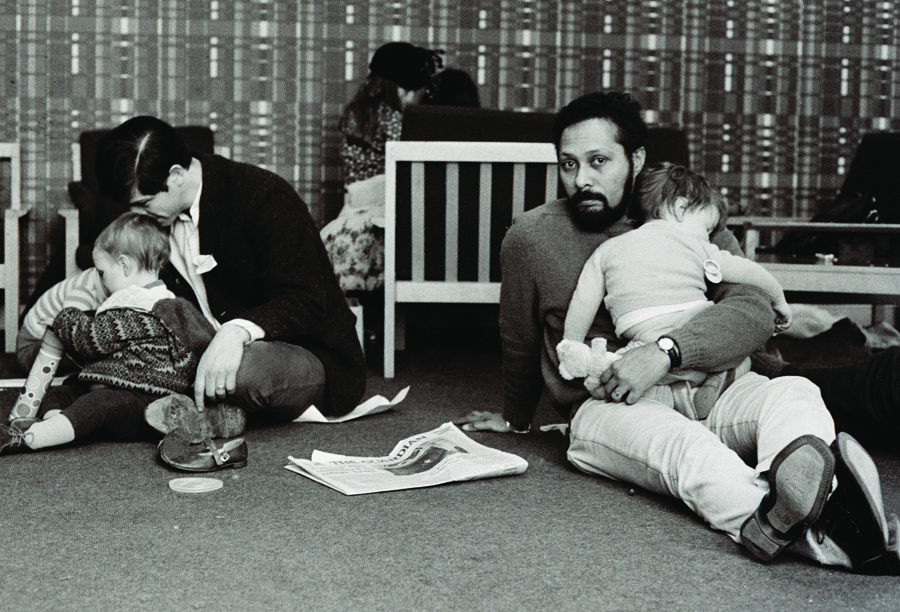
The press statement issued by the organizing collective at the time left “no doubt that these facilities have been an important factor in the range of attendance at the workshop.”[ix] Catherine Hall, Stuart’s partner and a key member of that organizing committee, remembers the Ruskin Conference underscoring “the importance of looking after everybody else’s children, sharing childcare.”[x]
Archives from this time are rich with examples of flyers like these, which show childcare being offered along similar lines, by members of the feminist community:
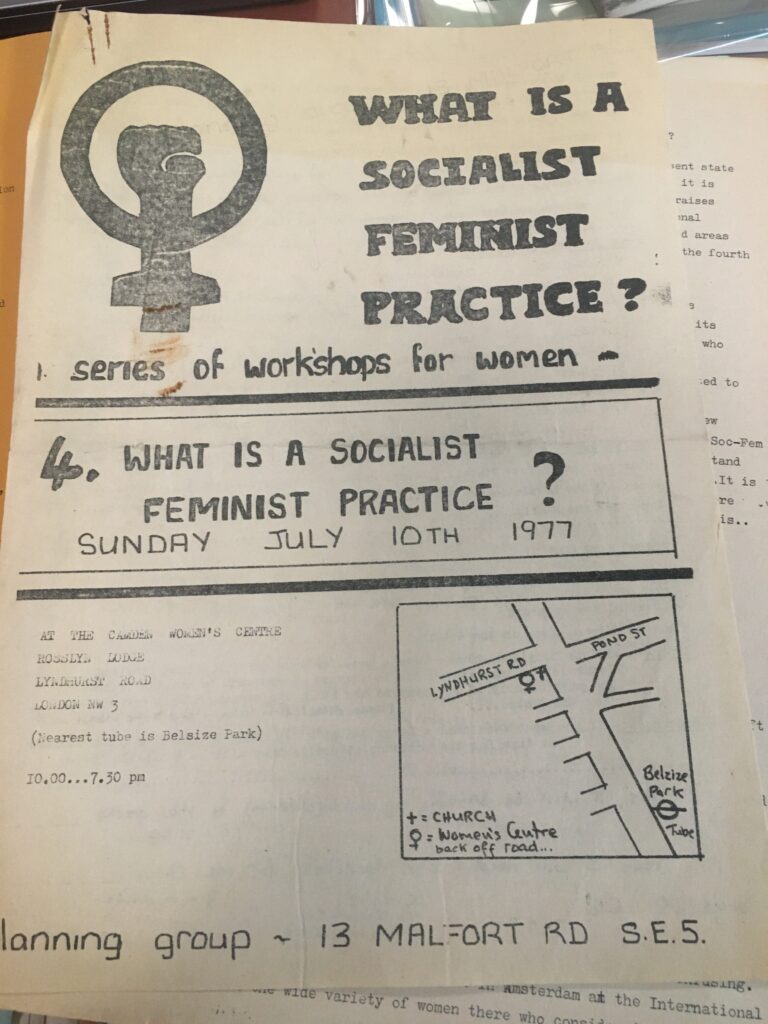

Bishopsgate Institute, Working Class Lives Collection, copyright Camden Women’s Group.
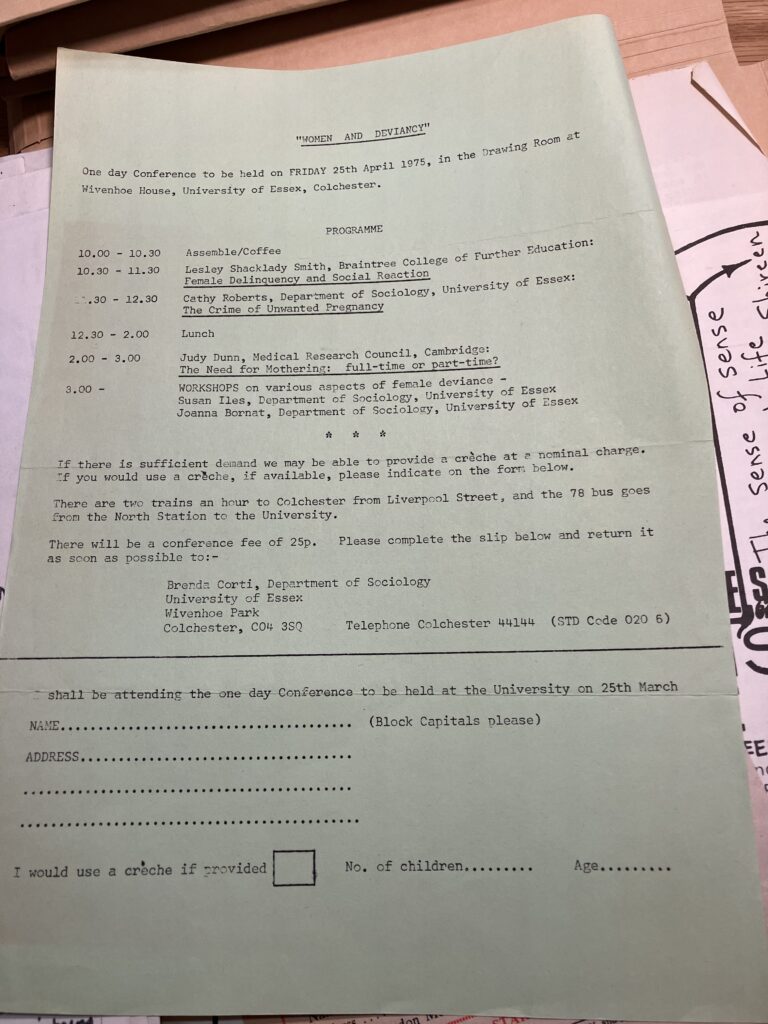
LSE Women’s Library, copyright Brenda Corti.
The perforated form of these documents makes clear a material relation, between the language that was circulating above the line, in the workshops and meetings, and the being labor done under it. That line is a significant marker of care work as something mediates writing — and activism, gathering, and conversation – without being directly expressed in it. Words here are not written by those doing the childcare: that’s the very point. Discourse is a direct result of care being redistributed and shared amongst other people who do the work of care in order to free others up to speak.
It is the uptake of care work by people other than mothers that allows for the ‘perforated’ condition under which all women might have the chance to write, talk, print, attend the conference, etc. after their day’s work. For women trying out their own voices, describing their work situation, or simply talking to others about their experiences, the fact of their children being cared for by others was central to the possibility of them correcting the injustices of gender inequality. “We are four women” begins one paper given at the Ruskin conference, “three of us have kids. On three evenings we asked each other questions…we wanted to write a paper.”[xi] Not only does the writing of that paper depend on where and how the children sleep; presenting it at the conference becomes possible because of the children being cared for elsewhere.
This triangulation–of writing done by and between women because of childcare arrangements that relieve them of their daily work–draws on the logic of the Wages for Housework Movement, which insisted that the unpaid work (of cleaning, feeding, soothing, nursing, education) underwrote all of capitalism’s visible, above-the-lines scenes of productivity. Only men free from having to worry about raising their kids, or reproducing life at home, argued James and Federici and Dalla Costa, could hold jobs that were publicly recognized as productive. By this logic, the distributive logic of the perforation matters to the way we read any scene of production. Whether its words or cars that are being made, unpaid care work underpins that output and activity.
Communally organized childcare was important in this sense to the first years of the women’s liberation movement. Collectivized childcare could free up women to gather, to write, to protest, to be themselves. In her preface to a 1970 collection by the “Power of Women Collective,” Priscilla Allen celebrates the opening of spaces in which women have “a chance to relate to people on a fully human level, not as doormat, sacrificing angel, or cannibalizing matriarch.”[xii] Federici stresses on a similar note that the Wages for Housework movement succeeded most powerfully in giving women the chance to leave their domestic lives behind and “write songs, make posters, analyze the newspapers day after day, and find…life interesting.”[xiii] All this entailed women (or men) supporting other women in being able to take a break from their too routine domestic work. To quote from the newsletter of the “Tough and Tender Collective”: “If we give kids space and time and opportunity to play/shout/paint/run/cry with their friends, we also have more time to do the same with ours.”[xiv]
But even when these scenes of the feminist subaltern counterpublic were private, it was ultimately state daycare that many women saw as the enabling condition of their full access to them. One of the key demands at that Ruskin conference was for 24-hour free daycare. On this front alone, British feminism was inaugurated as a movement whose premises, texts, and cross-class ambitions were intimately entangled, not only with men or with the collective, but with the state. This shift from women experimenting in community-organized childcare to the demand for 24-hour state daycare happened within months of the Ruskin conference. The same women (Sally Alexander, Sheila Rowbotham, Catherine Hall) who had organized and advertised the creche staffed by men, pushed back against the demand to reproduce the model in future gatherings. When Catherine Hall sent out notes about the National Conference in London later that year, the organizing committee was suggesting that women’s groups enlist regional childcare support rather than bringing their children to the city. Marie, writing into the “Mothers in Action Newsletter” describes herself looking for a way not to bring her children:
I would very much like to go to the Lesbian conference in Nottingham next weekend. However I have a problem. Would someone please take care of my kids for the weekend. They are both boys aged twelve and nine. You could stay with them at my home and I could provide food. They really just need someone to be with them.[xv]
The big follow-up to the Ruskin conference, at Skegness in 1971, offered a creche, but was famously hampered by the sheer complexity of organizing family accommodation at what was meant to be a women’s conference.
While the Ruskin conference succeeded in providing its own childcare, it also underscored the fact if working-class women and mothers were really to be included in the movement, a much more comprehensive system of state childcare would be needed. Not only were most working-class fathers unlikely to step up in the way the fathers at the Ruskin conference had, working women were already overburdened by their combination of poorly-paid part-time jobs with a second shift of domestic work. The demand for 24-hour state daycare institutions was written into the Working Women’s Charter, which took its final form in 1974. The charter, debated in working groups in 1971-3, makes a connection, grounded in a recognition of working-class women’s experience, between equal pay and opportunity for women, and the provision of free local-authority nurseries “with extended hours to suit working mothers.”
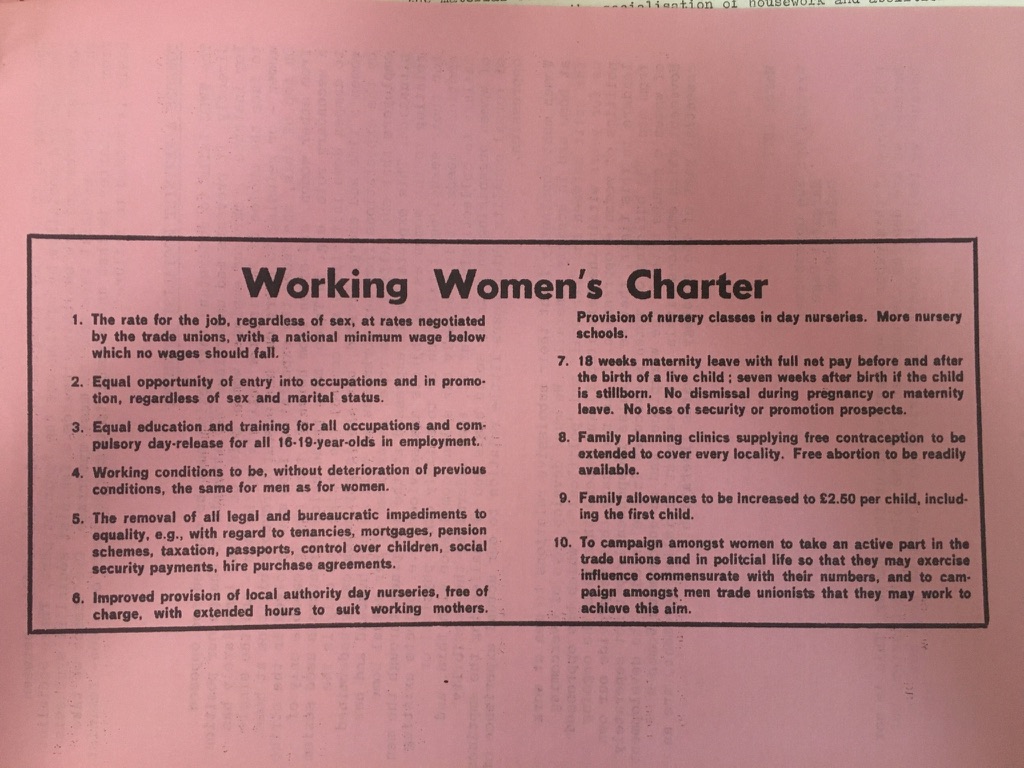

But it also, as its tenth item, emphasizes the fact that working-class women deserve the opportunity to participate in trade unions and ‘political life.’ The 1973 meetings in which the charter itself was discussed made childcare both case and point. Some women felt it wrong that the meetings about the charter did not have creches. Others felt that women had already done enough and had learned their lesson about organizing that service amongst themselves. One pamphlet defending the organization of the campaign meetings without creches states that “one of the fundamental demands of the charter is to fight against the assumption that women are the child-rearers and to fight for adequate child-care facilities.”[xvi] The state is presented here as the only proper agent in freeing up time for gathering and co-writing: the ability of working-class and single-women mothers depends on children being a zone of state responsibility and organization. The minutes of meeting and papers given in those years suggest that women of all classes united around this campaign for state daycare, not just as a way of leveling the professional field, but of allowing mothers to participate–as writers, speakers, activists, and trade union members–on equal grounds in articulating their own position.
This is a case not just of not hating the state, but of leveraging its power into being as a mediator of a public sphere in which women with children and with jobs might participate. The hopes for new childcare institutions that emerged in these conversations were ambitious. They conjured up centers financed by the state but creatively controlled by parents and staff. They involved men doing their fair share of domestic organization, with the arrangement helping to support a shorter working week for all. Childcare centers were also described in many papers as being good for kids, with the social and creative opportunities they could provide outpacing what was possible in the private home. “Sounds too good to be true?” asks one leaflet from the London Nursery Campaign. “Well, that’s up to us; we won’t take what the state is dishing out to us at the moment. It’s time we fought for our rights; nobody else will, and if it means we will change the state, well, we’ll change it.”[xvii]
The axis of change imagined here put women in close negotiation with the state around the care of children in ways we have largely forgotten. But literary critics are well-placed to read and to see how these negotiations played out, in thousands of hours of conversation and dialogue and public speaking, and thousands of pages of talks and newsletters and life narratives that were themselves evidence of the writing that might happen if care work did not fall to the mother alone. In many of these documents, women write and speak in specific reference to the state as allowing them time of work, and as enabling their membership of the public sphere. We see this very directly in the story of Emecheta, who became by 1970 a conscious advocate of the British welfare state as an institution of care. By that point she had three more children born in England and had experienced in mostly positive terms the National Health Service, maternity leave, local authority daycare for her children, access to free adult education at the University of London, and public housing. Her two early autobiographical works, In the Ditch (1972) and Second-Class Citizen (1974), are openly underpinned by the recognition of these state services as vital to her life as a writer. In her study of the twentieth-century British Bildungsroman, Janice Ho describes Emecheta’s representation of the welfare state being driven by an unusual narrative causality in which “Adah’s interior sense of her autonomy and agency proceeds from – rather than precedes – the welfare state’s recognition of her as a citizen.”[xviii] The particularity of this relation really does rest with Emecheta’s interaction as a mother with the state. Her first taste of freedom to write comes with paid maternity leave from her job at the British Library. This is followed by the welfare payments and council housing that allow her to leave her marriage, and the Inner London Education Authority Grant that provides her with time to study while her children are in state daycare. Emecheta’s early columns for the socialist paper The New Statesman perform as a reminder that much feminist writing, particularly by working-class women, should be read in this order, as evidence of a state shouldering some of a women’s traditional workload. The very possibility of a single mother and working immigrant writing her way into that largely middle-class British Feminist movement is the direct result in Emecheta’s own terms of her imbrication in the state.
In the late 1970s and 80s, Emecheta also became the face of the state, by working as a social worker and coordinator in the same North London childcare group that Rowbotham helped to set-up. This organization offered community-based childcare that women had argued earlier in the decade should be funded and facilitated by state-funded lines of employment: “Until we extend the responsibility for raising children beyond the mother to the state, we cannot increase the responsibility of women, nor hope to change the means of production,” writes Sally Alexander in her summary of the minutes to one 1970 meeting of the Tufnell Park Women’s Liberation group.[xix] To read that note in its full force, we need to hear both the limited conversation it records, between middle-class white women who’ve dared to leave their children at home with their babysitters or fathers, and the fuller one it anticipates, of which Emecheta is a part, where a more inclusive discourse would emerge if all children were cared for freely and generously by the state.
Christina Lupton is Professor in the English Department at Rutgers University, and author of several books about the history and experience of reading. Her new project, When Writing Wasn’t Work offers an alternative history of life-writing since the eighteenth-century as a non-professional, working-class practice that has held space open for institutions and experiences distinct from those of labor.
[i] Mariarosa Dalla Costa in The Power of Women and the Subversion of The Community (Falling Water Press, 1972), 45.
[ii] Selma James, “Introduction” The Power of Women and the Subversion of The Community, Ed. Selma James and Mariarosa Dalla Costa (Falling Water Press, 1972), 16.
[iii] LSE Women’s Archive, Sally Alexander Papers, 75AA/2, Folder 6.
[iv] Sheila Rowbotham, “Women: the Struggle for Freedom” Black Dwarf, January 10, 1969.
[v] Childcare and Women’s Liberation, issued by the Wandsworth Brach of the Women’s Liberation Group, LSE Women’s Archive, Sally Alexander Papers, 75AA/1, Folder 1.
[vi] Buchi Emecheta, Second Class Citizen [1974], (Heineman Educational, 1994), 45.
[vii] LSE Women’s Archive, Sally Alexander Papers, 75AA/1, Folder 5.
[viii] Nancy Fraser, “Rethinking the Public Sphere: A Contribution to the Critique of Actually Existing Democracy,” Social Text, No. 25/26 (1990), pp. 56-80; 67.
[ix] Press Statement regarding Ruskin Conference, Feb 1970. LSE Women’s Archive, Sally Alexander Papers, 75AA/1, Folder 1.
[x] Catherine Hall interviewed by Andrew Whitehead, History Workshop Journal, Volume 96, Autumn 2023, pp. 205–213, 212. https://doi.org/10.1093/hwj/dbad019
[xi] “Ruskin College Women’s Weekend: Reflections on Politics of the Family” LSE Women’s Archive, Sally Alexander Papers, 75AA/1, Folder 1.
[xii] Priscilla Allen, Preface to Writings Produced by Women in The Power of Women Collective, June 1973. LSE Women’s Archive, Sally Alexander Papers, 75AA/1, Folder 5.
[xiii] “Interview with Silvia Federici” in Louise Toupin Wages for Housework: A History of an International Feminist Movement, 1972-1977 (UBC Press, 2018, Trans. Kathe Rothe), 241.
[xiv] Pamphlet produced by the “Tough and Tender Collective” LSE Women’s Archive, Sally Alexander Papers, 75AA/2, Folder 4.
[xv] In “Women and Deviancy” newsletter, LSE Women’s Archive, Sally Alexander Papers, 75AA/1, Folder 4.
[xvi] “In Defense of the Working Women’s Charter Campaign – a reply to the paper “Some Fundamental Problems with the WWCC”. Bishopsgate Institute.
[xvii] Nursery Campaign Newsletter, LSE Women’s Archive, Sally Alexander Papers, 75AA/2, Folder 1.
[xviii] Janet Ho, Nation and Citizenship in the Twentieth-Century British Novel (Cambridge University Press, 2018), 144.
[xix] Sally Alexander handwritten notes. LSE Women’s Archive, Sally Alexander Papers, 75AA/2, Folder 3.