


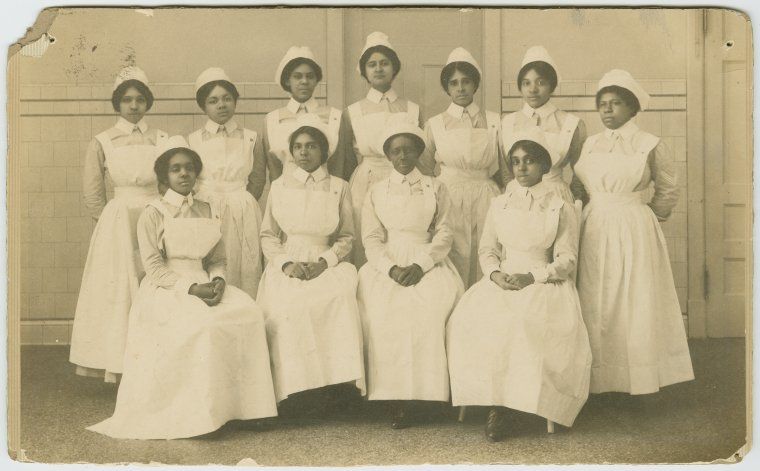
Graduation picture from the Lincoln School of Nurses in 1915. Larsen is second from left in the front row.
This post is part of a dossier of texts “On Not Hating the State” that was initially generated for a panel with a similar title, “On (Not) Hating the State”, and organized by Rebecca Oh, at the 2026 American Comparative Literature Association Conference in Montréal.
The Case of the Disappearing Institution: Reconstruction and the Quicksand of Representation
Lisi Schoenbach
For those of us committed to not hating the state, the problem of convincing others to join us often comes down to an aesthetic problem. Even in our current moment, when institutions, (including universities, regulatory bodies, arts organizations, departments of public health, and organizations designed to promote racial and economic equality) are staggering under the repeated hammer blows of anti-institutionalist oligarchs, it remains a challenge to articulate to the public why such institutions matter or to offer a compelling sense of what is lost when they are broken beyond repair. I call this an aesthetic problem because there appear to be so few aesthetically compelling ways to capture the urgency of defending, building, and rebuilding institutions. The question I want to pose is this: is the state (and its attendant social configurations) unrepresentable or somehow at odds with innovative and exciting aesthetic forms? How might we look to past representational failures or successes in order to develop more aesthetically exciting and engaging ways to capture and articulate the institutional forms on which our collective democratic life depends?
To explore these questions, I’d like to look back to from the 2020s to the 1920s and to the cases of W.E.B. Du Bois, a lifelong institutionalist and advocate for state-building, and Nella Larsen, whose provocatively tragic and beautiful novellas Quicksand and Passing have come to be recognized as two aesthetic jewels of the New Negro Renaissance. Although Larsen and her husband were social acquaintances of Du Bois, and although Du Bois reviewed Quicksand glowingly in The Crisis, calling it “on the whole, the best piece of fiction that Negro America has produced since the heyday of Chesnutt,”[i] Larsen’s novellas could hardly be mistaken for a defense of the institutions that Du Bois had championed. In particular, Quicksand offers a blistering attack on the institutions of education and racial uplift. The question I would like to explore here is how and why a novelist whose own life and career had been made possible by the educational, civil rights, and literary institutions developed in the post-Reconstruction moment, and who could clearly see the urgent need for transformation that her moment demanded, would not only fail to make the case for those institutions; but would in fact relentlessly critique them for their collective hypocrisies, cruelties, and failures.
Larsen’s dazzling but tragically short career as a novelist unfolded during an era in which white supremacist retrenchment had followed fast on the heels of Reconstruction’s promise of racial equality and full democracy. The threat of racial terror continued to define public life for African Americans in the 1920s; although the frequency of lynchings had diminished from their peak in 1892, racial violence, segregation, and discrimination continued to define the decade from the Tulsa race massacre of 1921 forward. The New Negro Renaissance unfolded against this backdrop, and took its place among a variety of social, political, economic, and literary movements, organizations, and institutions that were also responding to urgent needs of the moment. From the Brotherhood of Sleeping Car Porters to Marcus Garvey’s Universal Negro Improvement Organization, to the many literary journals, black-owned and patronized businesses and clubs, tenant’s rights groups, and civil rights organizations that characterized the vibrant urban community of Harlem during this time, the 1920s saw a variety of political, educational, and cultural developments that built on the institutional legacies of Reconstruction and prepared the ground for the Civil Rights movements of the twentieth century.
These projects followed in the footsteps and in the spirit (and sometimes were the literal handiwork) of Du Bois, whose thought provides one of our richest and most comprehensive resources for the project of “not hating the state.” From his valedictory address upon graduating from Fisk in 1888, on “Bismarck,” (Dusk of Dawn, 16) to his late embrace of communism, which he described in his posthumously published autobiography as “a planned way of life in the production of wealth and work designed for building a state whose object is the highest welfare of its people and not merely the profit of a part” (Autobiography, 57), Du Bois unwaveringly celebrated the notion of a strong state that could make “a nation out of bickering peoples.”[ii] Although this concept first emerged in his thought as a mode of constructing a shared black identity patterned on the lessons of Germany, as time went on his vision shifted. Through a series of intellectual encounters with the legacy of Reconstruction, which he understood fundamentally as a state-building project tragically cut short before it had an opportunity to realize its fullest promise, he developed a vision of a “democratic state;” a strong, flexible, and productive set of interlocking social and institutional forms.[iii]
It was precisely its commitment to these institutional forms that had, according to Du Bois, made the project of Reconstruction “(t)he greatest and most important step toward world democracy of all men of all races ever taken in the modern world” (The Gift of Black Folk, 75). Such forms included a wide variety of midrange and non-economic institutions, including federal and state governments, schools, libraries, churches, universities, bureaus, business organizations, and social and community groups. Du Bois’s vision of democratic state-building thus distinguished itself both from iron fist of Bismarckian authoritarianism and from the abstractions and generalities surrounding most theories of the State. It expressed itself through a rich and complex commitment to institutional forms, much like those that flourished in Harlem during the 1920s. Many of these organizations, including the NAACP and its journal, The Crisis, were founded and then guided by Du Bois himself.
Du Bois’s embrace of institutions, as I have argued, is the single most coherent and consistent element of his thought over the course of an incredibly long and complex career, one that spanned more than 75 years and encompassed both his early belief in “the talented tenth” and his later embrace of communism and expatriation to Ghana. Yet Du Bois’s commitment to the varied institutions of education, political advocacy, and literary culture that he learned from, joined, founded, and led was also enabled by those institutions’ unconditional acceptance of him. From childhood, Du Bois was embraced, celebrated, and chosen. He was sent by his community in Great Barrington to study at Fisk, recommended by his professors at Fisk to pursue a graduate degree at Harvard, and then sponsored by fellowship to continue his Ph.D. at the University of Berlin. Although his time at each of these places was marked by challenges, and his accomplishments there demanded fortitude, dignity, and relentless effort, he was nonetheless able to find his place. Even at Harvard, where he struggled socially and was sometimes treated as a curiosity by fellow students, his presence was largely acknowledged as legitimate, and he never wavered in his belief that his degree was an important academic credential that would smooth the path to future success. Even when those around him excluded or underestimated him, he saw himself and was seen by his mentors as a future leader of the race, more or less from the time he was a child. His faith in the meritocratic elements of these institutions was enabled and supplemented by a faith in himself that was continually bolstered by the authority figures around him.
Larsen’s experience could not have been more different. Like Du Bois, Larsen was the product of several HBCUs, educational institutions that were also legacies of Reconstruction, including Fisk and Tuskegee, but her experiences at both places were marred by the sense that she did not belong. She was dismissed from Fisk after a year for rebelling against the strict dress code, an episode echoed by Helga Crane’s decision in Quicksand to leave the fictional Naxos. She enrolled in the Lincoln Hospital and Home Training School for Nurses in New York, where her work was so stellar that she was appointed as head nurse at Tuskegee Institute Hospital. She struggled with the culture of Tuskegee, however, and again left within a year. Years later, on an author’s information sheet for Alfred A. Knopf she described her departure as follows: “[she] accepted a position as Head Nurse of the hospital at Tuskegee Institute – the school founded by Booker T. Washington – but her dislike of the conditions there and the school authorities dislike of her appearance and manner were both so intense that after a year they parted with mutual disgust and relief”[iv] (Davis 110).
Scholars, including Larsen’s biographers, have noted Larsen’s alienation from the two HBCU’s she attended. By all accounts, the problem was not merely the educational philosophy or intellectual environment of either place, but rather their restrictive and conservative social environments, and their explicit and implicit embrace of whiteness as the ultimate standard of success. According to Angela Watkins, “Fisk offered a liberal arts education while Tuskegee focused on industrial education; yet, both schools enforced rigid social practices in their mimicry of ‘civilized’ societies based on Eurocentric ideals. The administration at both schools also emphasized deference to their white benefactors, on whom they relied financially. These experiences inform the narrative for Quicksand, and are the basis for Helga’s disillusionment with Naxos and with educational race leaders” (Watkins, 251).
Behind these principled misgivings lie a more general set of hesitations surrounding institutions, namely their tendency to grow into “a machine,” or a “big knife with cruelly sharp edges ruthlessly cutting all to a pattern, the white man’s pattern” (Larsen, 4). One can discern in Larsen’s language, in this image of a dressmaker cutting a pattern, a critique at once of violence and cruelty and of aesthetic standardization. Certainly Helga’s objections to Naxos are framed in Quicksand in aesthetic terms. When we first meet her, she is alone in a room furnished expensively with Orientalist flair, reading an Orientalist novel, dressed in a “vivid gold and green negligee and glistening brocaded mules” (Larsen, 2). Helga’s exquisite taste, it quickly becomes clear, has made her an outcast in this institutional setting. She longs for beauty and individual self expression and Naxos feels repressive, coercive, colorless, and joyless. This, too, is expressed through Helga’s relationship to fashion:
Clothes had been one of her difficulties in Naxos. Helga Crane loved clothes, elaborate ones. Nevertheless, she had tried not to offend. But with small success, for, although she had affected the deceptively simple variety, the hawk eyes of dean and matrons had detected the subtle difference from their own irreproachably conventional garments. Too, they felt that the colors were queer; dark purples, royal blues, rich greens, deep reds, in soft luxurious woolens, or heavy, clinging silks. And the trimmings—when Helga used them at all—seemed to them odd. Old laces, strange embroideries, dim brocades. Her faultless, slim shoes made them uncomfortable and her small plain hats seemed to them positively indecent. (Larsen, 18)
As I have noted, Helga’s incongruous appearance at Naxos echoes Larsen’s own dismissal from Fisk for dressing inappropriately and her failure to fit in at Tuskegee, which she attributes in part to her “manner and appearance.” However, these passages denote more than a simple disagreement of taste; they represent a modernist sensibility growing out of aestheticism colliding with a doctrinaire Victorian style that continued to “ruthlessly cut all to a pattern” even into the third decade of the twentieth century. The “slim shoes” and “small plain hats,” the “lack of trimming,” the “subtle difference” of Helga’s style all signal modernist style. Although the novel as a whole treats fashion in relation to important questions of objectification, exoticism, and commodification, in these passages we can see that the space of Naxos not only crushes innovative and progressive ideas and denigrates Afrocentric ideas, but that its notions of beauty and of style are outmoded and embarrassing. In this aesthetic failure we see a range of other failures: of attunement to the ideas, feelings, and needs of the people it was designed to serve, for instance, or of consciousness of the “odd,” “strange,” “queer,” and “positively indecent” elements of Helga’s character.[v] Unlike Du Bois, who was noted for his own dapper sense of style, and for whom dandyism added merely an additional touch of professional polish, Larsen’s sense of fashion and refusal to be “irreproachably conventional” was seen as unforgivably transgressive. Punished, disciplined, overworked, and unappreciated, Larsen first retreated from these institutions and later savaged them in her fiction.[vi]
Educational institutions were not the only target of Larsen’s frustration. A similar tone of impatience pervades her treatment of each institution and social form in Quicksand, and can be seen in her disparagement of the (slovenly, poorly dressed) Mrs. Hayes-Rore’s regurgitated speeches on “the race’s ills” and in Anne Grey’s unthinking loyalty to a racial uplift movement that Helga finds exclusionary, conformist, and hypocritical. Exoticized and homesick in Denmark, Helga returns to the United States only to experience yet another disillusionment in the black church, where she finds herself the resented northern emissary of uplift in a rural Alabama community. Each successive social form she seeks betrays and disappoints her. Rather than building stability and futurity or helping to create future generations of leaders, as Du Bois’s institutions promise, these institutions function as technologies for ideological coercion and threaten to punish anything that deviates from their narrowly constructed norms. As Helga is repelled again and again by the conformist, middle class, Victorian aesthetic of these institutions, she is excluded from the project of uplift, left alone to struggle for herself without any community to support her, and ultimately pulled under, doomed by her reproductive life to stasis and convention while her modernist soul continues to yearn for freedom and mobility.
Larsen’s own story is tragic in its own way, but unlike Helga’s it is also thoroughly institutional. After Fisk and after Tuskegee, she worked as a nurse for the New York department of public health (serving during the influenza epidemic), and after her marriage she attended the library school of the New York Public Library and worked in the 135th street branch.[vii] After her divorce and disappearance from the literary scene she returned to her nursing career, working at Gouverneur Hospital, a municipal hospital on New York’s Lower East Side. Her engagement with and dependence on these systems, structures, and forms was more complex than Helga’s. Although she continued to critique the implicit whiteness and narrowmindedness of many institutions, she also owed her professional life and her career as a nurse to the kinds of public institutions that continue to make our collective life and public good possible. Larsen’s work should not be taken as a wholesale rejection of Du Boisian institutionalism then, but as a much-needed complement to Du Bois’s idealistic and often credulous imaginings of institutional forms.[viii] In Larsen’s aesthetic critique lies a substantive and urgent reminder that institutions need constant tending, revising, and remaking or they will fail to speak to the people they were designed to serve. If the institutions of the state are blind to the full richness and variety of the people whose interests they are attempting to represent, then the problem I described at the beginning of this piece denotes more than a failure to make a public case for our necessary institutions. It suggests that the institutions themselves have failed to demonstrate that they can rise to an urgent moment. It is well worth considering these overlapping failures with an eye towards our own moment of institutional collapse and cultural exhaustion.
Lisi Schoenbach is an associate professor of English at the University of Tennessee, where she teaches and works on twentieth-century literature and philosophy, with a particular focus on modernism, pragmatism, and political theory. She is the author of Pragmatic Modernism (Oxford, 2012) and is at work on a second book project, Institutionalism and the Fate of the Public University. Her work has appeared in Modernism/Modernity, The Henry James Review, American Literary History, and The Chronicle of Higher Education.
References
Blain, Keisha N., “Community Politics and Grassroots Activism during the 1920s: An Interview with Shannon King,” December 10, 2015 In, Black Perspectives, blog for the African American Intellectual History Society (https://www.aaihs.org/community-politics/)
Cloutier, Jean-Christophe. “Amiable with Big Teeth: The Case of Claude McKay’s Last Novel.” Modernism/modernity 20, no. 3 (2013): 557-576. https://dx.doi.org/10.1353/mod.2013.0076.
Davis, Thadious. Nella Larsen, Novelist of the Harlem Renaissance: A Woman’s Life Unveiled. Baton Rouge: Louisiana State University Press, 1994.
Du Bois, W.E.B., The Autobiography of W. E. B. Du Bois (The Oxford W. E. B. Du Bois): A Soliloquy on Viewing My Life from the Last Decade of Its First Century. New York: Oxford UP, 2014
Du Bois, W. E. B., Dusk of Dawn: An Essay Toward an Autobiography of a Race Concept. (1940). New York: Oxford University Press, 2014.
Du Bois, W. E. B., The Souls of Black Folk: Essays and Sketches. 1903.New York: Oxford University Press, 2007.
Du Bois, W. E. B., The Gift of Black Folk: The Negroes in the Making of America. 1924.
Oxford UP, 2007.
Du Bois, W. E. B., “Two Novels,” The Crisis, Vol. 35 Issue 6, 1928.
Du Bois, W. E. B., “The field and function of the American Negro college (1933),” in The Education of Black People: Ten Critiques 1906-1960, edited by Herbert Aptheker. Amherst: University of Massachusetts Press, 1973. (pp. 111-133).
Edmondson, Belinda. “Finding Africa in Harlem: Displacement and Belonging in Claude McKay’s Home to Harlem.” In Claude McKay, Home to Harlem, New York: Penguin, 2025.
Hochman, Barbara. “Filling in Blanks: Nella Larsen’s Application to Library School.” PMLA 133, no. 5 (2018): 1172–90. http://www.jstor.org/stable/45179451
Hutchinson, George. In Search of Nella Larsen: A Biography of the Color Line. Cambridge: Harvard University Press, 2006.
Larsen, Nella. Quicksand and Passing, ed. Deborah E. McDowell. New Brunswick, New Jersey: Rutgers University Press, 1986.
Phulwani, Vijay.“A Splendid Failure? Black Reconstruction and Du Bois’s Tragic Vision of Politics.” A Political Companion to W. E. B. Du Bois, edited by Bromell, Nick. UP of Kentucky, 2018, pp. 271–302.
Roffman, Karin. “Nella Larsen, Librarian at 135th Street,” Modern Fiction Studies, Vol. 53, No. 4 (Winter 2007), pp. 752–787.
Singleton, Maura. “The Callings of Nella Larsen,” UVA School of Nursing blog, Flashback Friday, May 24, 2024.https://nursing.virginia.edu/news/flashback-the-callings-of-nella-larsen/
Watkins, Angela. “Progression or Regression of the Black Race?: Historically Black Colleges and Racial Uplift in Nella Larsen’s Quicksand.” Chapter. In African American Literature in Transition, 1920–1930, edited by Miriam Thaggert and Rachel Farebrother, 258–80. African American Literature in Transition. Cambridge: Cambridge University Press, 2022.
[i] “Two Novels” The Crisis, Vol. 35 Issue 6, 1928, p. 22.
[ii] Quoted in Dusk of Dawn. In “The Field and Function of the Negro College,” a graduation address presented at Fisk in 1933, Du Bois elaborated on his inspirational encounter with German culture and identity at the University of Berlin: “And out and around that university of a thousand miles, millions of people shared in its ideal teaching, and did this in spite of caste of birth and poverty, of jostling wealth, because they believed in an ultimate unity which Bismarckian state socialism promised. They sang their national songs and joined in national festivals with enthusiasm that brought tears to the onlooker. And it made you realized the ideal of a single united nation and what it could express in matchless poetry, daring science, and undying music.” (119)
[iii] For a more complete version of this argument, see Lisi Schoenbach, “Institutionalism and the Fate of the Public University,” American Literary History, Volume 33, Issue 3, Fall 2021, Pages 674–690, https://doi.org/10.1093/alh/ajab060
[iv] Quoted in Thadious Davis, Nella Larsen, a Novelist of the Harlem Renaissance: A Woman’s Life. (Baton Rouge: University of Louisiana Press, 1994), 110.
[v] Like Helga, Larsen did not have the support of her family and understood her alienation in these institutional spaces in part as a result of her “mixed” background (“mixed” not just racially, but economically and socially) and her lack of family connections. However, there is no doubt that what was most “strange,” “queer,” and “indecent” about Larsen was quite simply her gender. Without oversimplifying the many differences between Du Bois and Larsen and their stories, we might still acknowledge the narrower range of possibilities for self-expression and self-determination accorded to a woman within these profoundly normative and prescriptive spaces. Larsen’s treatment of Naxos raises larger questions, however, about the way that any non-normative identity might be punished or threatened within such institutions.
[vi] Larsen was certainly not the first, last, or only African American author of the twentieth century to critique HBCU’s and other institutions of racial uplift in these terms; Watkins notes Zora Neal Hurston’s satirical essay titled “The Rise of the Begging Joints” and Wallace Thurman’s critique of “colorism and stereotypes about ‘good breeding’” at HBCU’s in The Blacker the Berry (1929) (Watkins 260). Ralph Ellison’s memorable midcentury treatment of Tuskegee in Invisible Man (1952) shares many of Larsen’s criticisms of universities, social and political movement, and institutions.
[vii] See Hochman, Barbara. “Filling in Blanks: Nella Larsen’s Application to Library School.” PMLA 133, no. 5 (2018): 1172–90. http://www.jstor.org/stable/45179451.
[viii] Du Bois’s own understanding of institutions, including educational institutions, would change quite dramatically in subsequent decades, as his thought shifted away from integration and towards black self-determination. For a brilliant discussion of this transition in the context of his advocacy of black owned economic co-ops, see Phulwani, Vijay.“A Splendid Failure? Black Reconstruction and Du Bois’s Tragic Vision of Politics.” A Political Companion to W. E. B. Du Bois, edited by Bromell, Nick. UP of Kentucky, 2018, pp. 271–302.