

This text is part of the b2o: an online journal special issue “EXOCRITICISM”, edited by Arne De Boever and Frédéric Neyrat.
Elemental History: Zumthor after Hölderlin
Nathan Brown
Perhaps poetry is unexpected truth. It lives in stillness. Architecture’s artistic task
is to give this still expectancy a form.
–Peter Zumthor, Thinking Architecture
Water: Kunsthaus Bregenz
May 9, 2022. Evening in Bregenz. “What springs from pure source is a riddle”:[1] the Bodensee was formed by the Rhine Glacier during the last ice age. Now over its western horizon the sun gleams above a wall of clouds, purpling the hazy amber sky as a swan glides through the water where it gathers into the bay by the town, encountering architecture. Later the surface will be crystalline, intricately faceted under a dense blue darkness stretching out across its expanse toward the last shades of pink sinking over the southern reaches of the Black Forest.
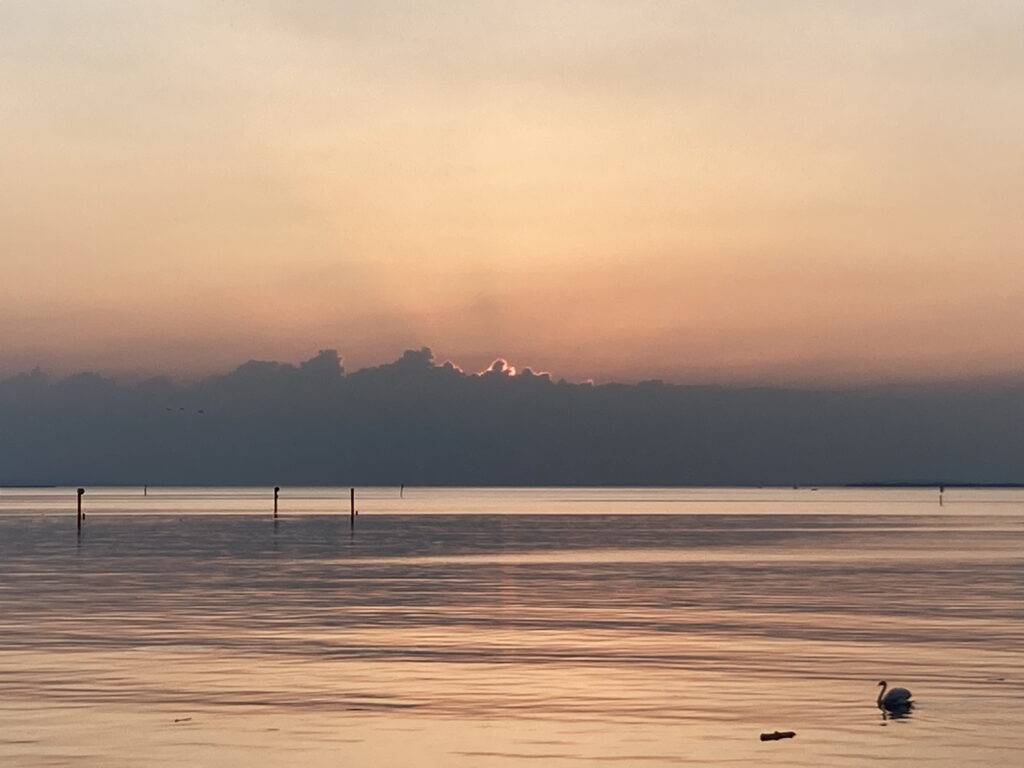

It seems to have been from there, “In dark ivy…at the gate / Of the forest,” that Hölderlin’s hymn to the Rhine looked southeast,
as the golden noon,
Visiting the source, descended
The steps of the Alps,
The godly-built I call them,
In accordance with ancient custom,
The stronghold of the Heavenly, where yet
Many things decided in secret
Still come down to men[2]
The Rhine flows from Lake Toma at 2345m, emerging from the mountains as it passes between Haldenstein and Chur, joining the south shore of the Bodensee just west of Bregenz and flowing out the west end of the lake, over to Basel and up along the Black Forest, past Strasbourg, all the way through Bonn and Cologne, out into the North Sea. One can still grasp the torsion of the landscape Hölderlin evokes at the beginning of the second strophe, the feeling of jagged stones comingling with green trees, the distant woods drawn together with alpine forests and craggy peaks by water rushing violently or settling into the depth of peaceful lakes with the sky overhead, moving through atmospheric transformations of its light:
But now, within the mountains,
Deep under the silver peaks
And under jocund green,
Where the shuddering forests,
And the rock heads look down one over
Another at him, day-long, there
In coldest abyss I heard
The young one wail
For deliverance, his parents heard
With pity how he raved
And accused Mother Earth
And the Thunderer, who begot him,
But mortals fled the place,
For it was dreadful, there lightless he
Thrashed in his chains,
The rage of the demigod
It was the voice of the noblest of rivers,
The free-born Rhine,[3]
I wonder if today Hölderlin’s voice does not feel just as ancient, just as epochally incongruous as the voice of the river did then, raging at the constraints of its birthplace beneath the silver peaks of the Alps. Perhaps it seems even more removed. From the path along the shore of the Bodensee, Kunsthaus Bregenz looks like nothing so much as a cube of glacial ice, glowing with blue-green light on the cusp of the bay as the night falls. In the morning, if it’s bright enough, the interior of the museum will be illuminated only by the light of the sun.
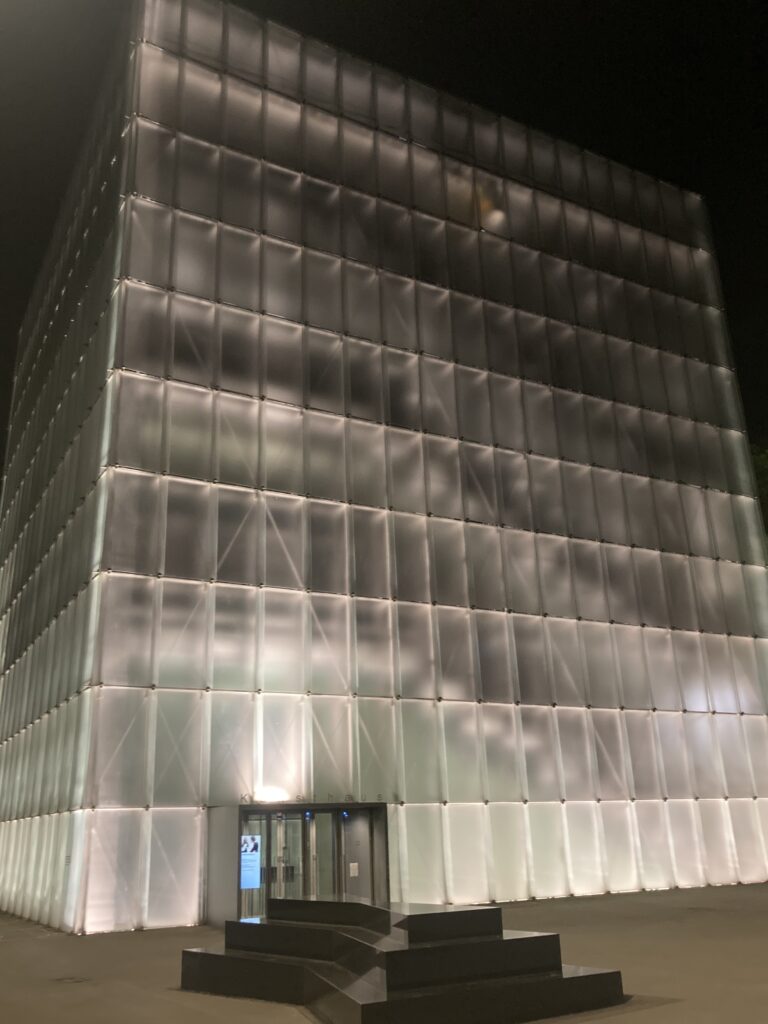
Figure 2, Kunsthaus Bregenz (1989-1997), Photograph by Nathan Brown

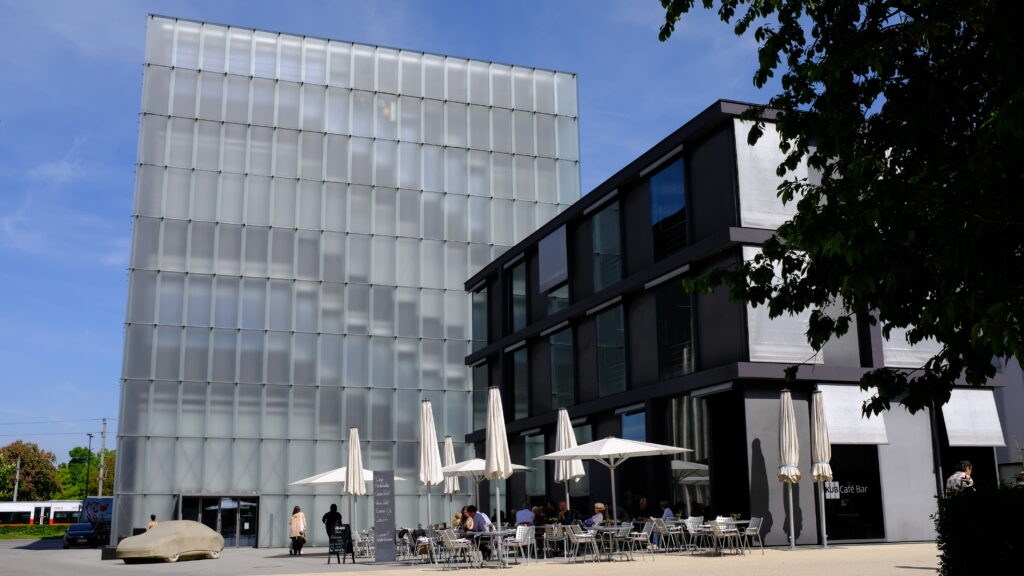

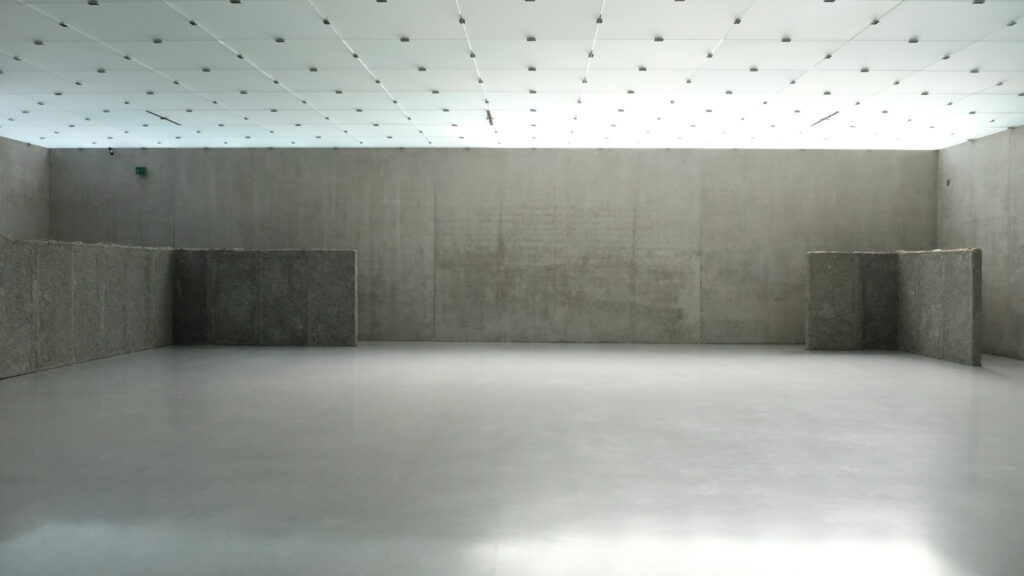
May 10. The light is truly elemental, a substance that seems not only to illuminate space but to coalesce within it, as if it were a volume in which one were suspended, even as if it were holding apart the walls. The geometrical plan of the museum is minimalist, its lighting system elaborate: four stacked floors compose a cube supported by just three weight bearing slabs of exposed concrete, vertically articulating the building and structuring the interior space at perpendicular angles. A glass façade of 712 etched glass panels is divided from the interior frame by an interim corridor, allowing light to filter into empty space above the ceilings of each floor, which are likewise composed of etched glass panels and suspended from concrete two meters above by hundreds of steel rods. There are no windows or glass walls on the upper three floors; you are surrounded by an enclosure of concrete beneath the glass ceilings, articulated by a grid of square panels. Yet light breathes through the panels above, reflects off the smoothly polished terrazzo floors below, pours throughout the space and draws you up each staircase like the opening of another world, even as each level formally replicates the one below.
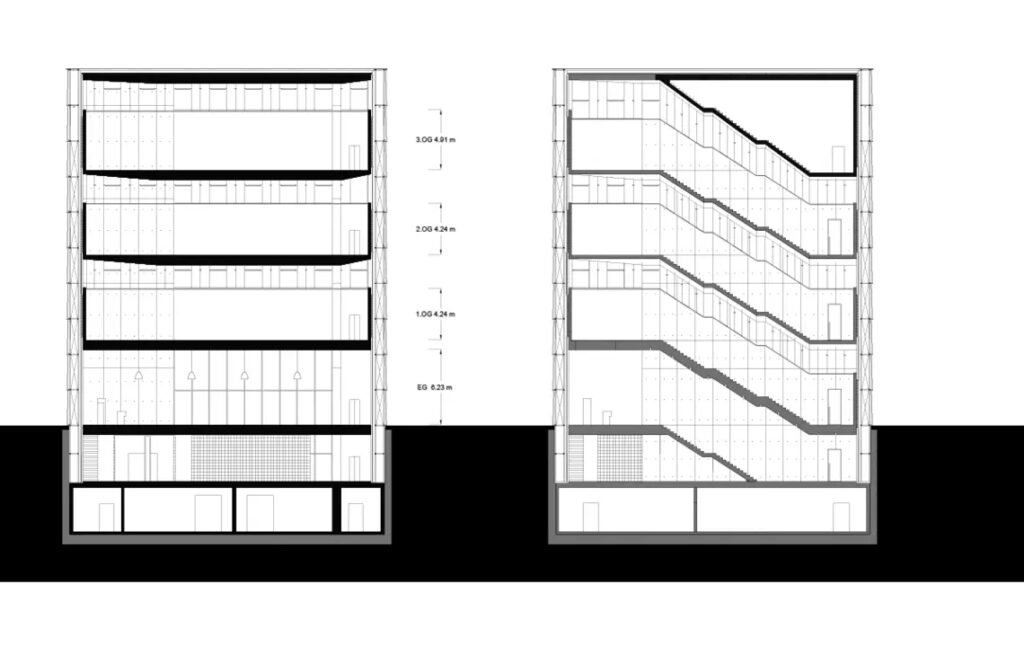

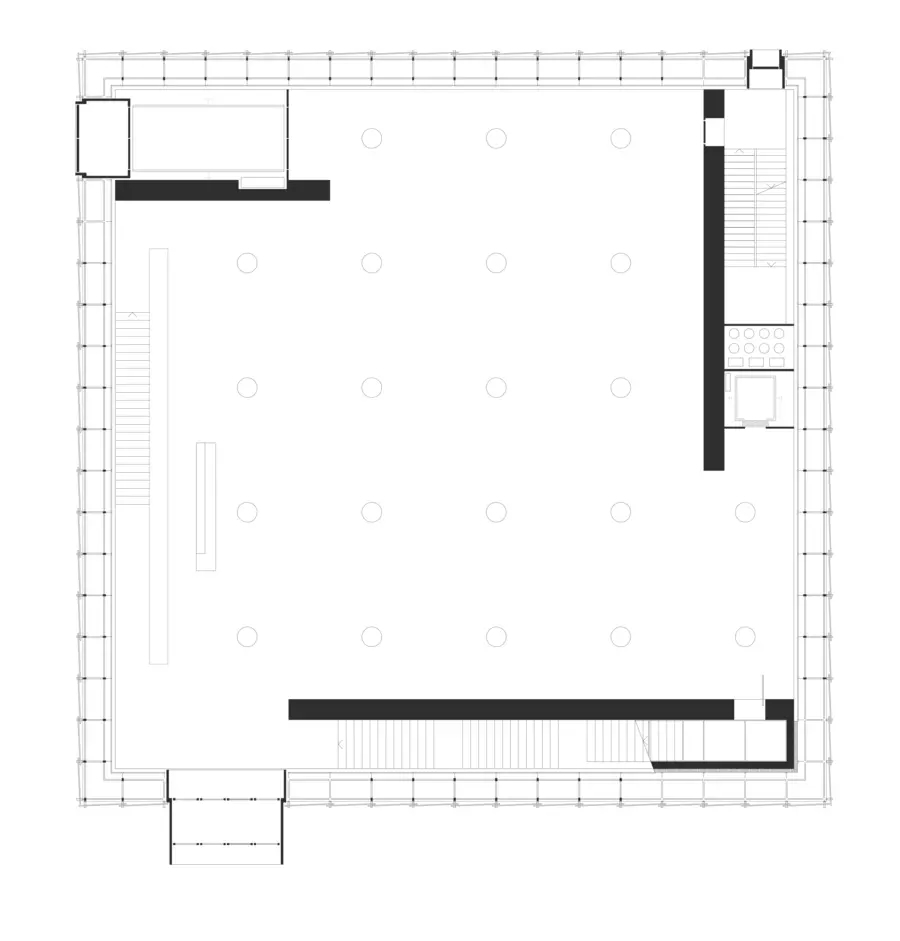
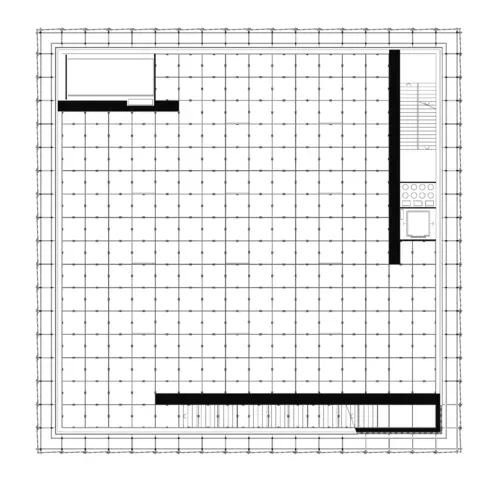
Figure 5, Kunsthaus Bregenz, Architectural Plan, Ground Floor and Upper Floors


Here is Zumthor:
A fine haze floating over the water, a radiance hanging in the air: the light of Lake Constance. Our dream was to capture this light in the spaces of the new art museum in Bregenz….We worked out how the daylight would enter the exhibition spaces laterally. The three shear walls supporting the stacked spaces would provide shading; different daylight zones would evolve and change with the course of the sun. The daylight entering from the sides gives shape and texture to the spaces; and the viewer senses the orientation, the position of the sun, the time of day….Daylight hits etched glass. The etching of the glass diffuses the light evenly. The building façade made of large air-flushed glass panels and the similarly constructed glass ceilings play with this effect. Between these outer and inner glass membranes there is a sealed liner of insulated glass which in the upper stories is hidden by the free-hanging glass panes of the ceilings. This is what gives the impression of light freely entering the exhibition space.[4]
The mood achieved by this architectural concept and its material realization is a state of relaxed yet focused concentration, a desire to remain within a space unlike any other in which one has been. There is a diffusion of one’s attention at first through the play of elements and textures composing each floor—stone, glass, light; rough, smooth, gauzy—and then a gradual and sustained focus on the artworks on the walls or installed in the open expanse of the columnless rooms. One wants to stay: this is the foremost feeling of place in this museum, and in this primary sense the architecture is adequate to the art it exhibits. It may be more beautiful; it may indeed be more significant. But it draws out and inclines attention not only toward itself but through itself toward the work. It is attention of a peculiar gravity—not necessarily somber or severe but, yes, one could say devotional. Prepared by an architectural atmosphere, this comportment is then attuned to works of art.
The space itself is concentrated in these rooms. Not compressed, but dense with ambiguity. Modular repetition lends a sense of seeking and of questioning to the phenomenal field of each floor: what is it I am sensing? What is illuminated not by, but as this light? What is implicit in its relation to stone and glass? Because the mere presence of natural light in so solidly enclosed a space is profoundly unfamiliar, there is a sense that each ascent to a new floor, each repetition of this structure might reveal some new element of its significance. And indeed this is the case. I take my time on each level, sitting with my back against a wall taking in the environment, wandering slowly between different regions of perception, various distributions of the light, concentrating on the artworks, letting my focus shift back to the space, taking photographs which force another relation to light, to reflection, to the intersection of planes and the parallelism of ceiling and floor. Then I walk up a staircase, running my fingers along the sheen of the polished concrete walls on each side of the grey steps, toward the light above, gleaming through the ceiling of the next level. At midday, or in early afternoon, it gets brighter as one rises from floor to floor. One has an intense awareness of the levels beneath, of depth below and of surface above, such that it gradually comes to feel as though one is surfacing as one moves upwards, as though the feeling of suspension conveyed by the modular repetition of this light and these illuminated ceilings is that of body of water in which one is immersed. I am immersed in a volume, moving upward toward light overhead, as if I were rising from the bottom to the surface of a lake.
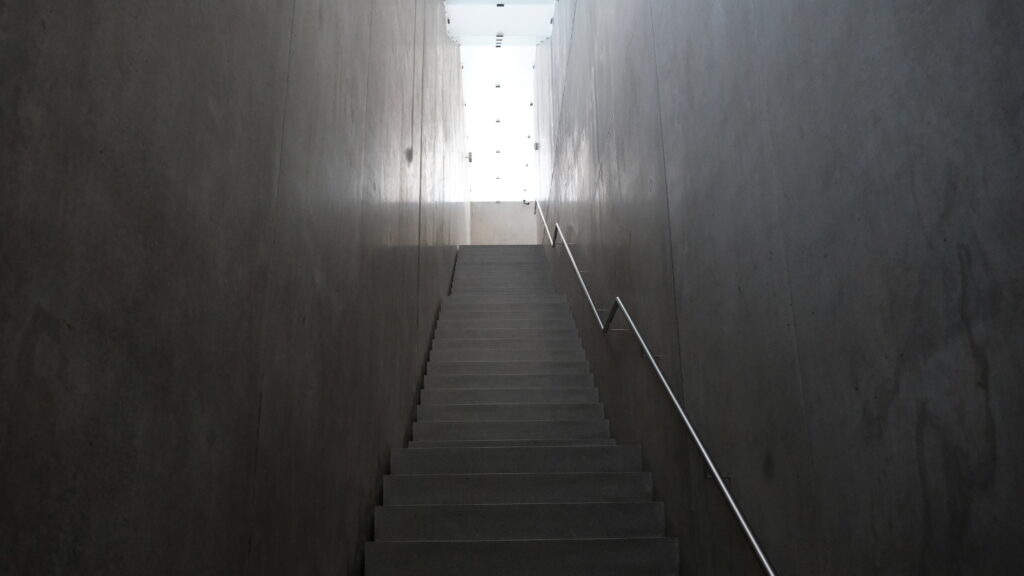
It is the ambience of the light, the surround of its inapparent origin, its filtration and diffusion, that suggests this sense of elemental immersion: not light, but water. One comes slowly to a recognition of what has been achieved. There are no windows, no views, and the Bodensee is nowhere visible from within Kunsthaus Bregenz; rather, the volume of the building itself seems to be within the lake. This is the sense of elemental displacement conveyed by the volume itself: walls enclosing a rectilinear space within a façade, the façade invisible from within; the interior walls invisible from without. From the square outside the museum one can make out the ghostly structure of the staircases through the haze of the etched glass panels. Yet the outline of those staggered, diagonal corridors seems to occupy a void interior. Once inside, there is scarcely a recollection of the outside world, so saturated is the space with phenomenal and psychological interiority, so oriented is one’s sense of spatial directionality to what is above or below.
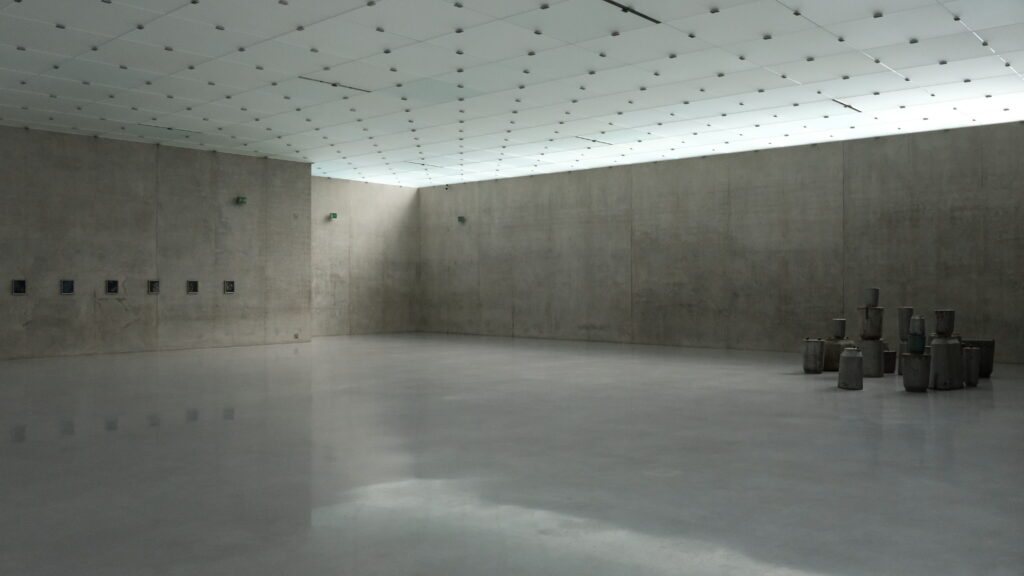
Despite the stony bulk of its concrete walls, this is an unearthly space. Its geometrical rigor and the modular repetition of components combine with the strange diffusion of its light to produce a monadic world, yet one that takes on a curious feeling of synthetic contiguity in relation to the lake. One knows the lake is there, to the north and to the west, just across the road, with the promenade extending from the shore. But one feels the lake surrounding the volume of the building, feels the water even within it, sublated by the substance of the light, such that the sense of a subaquatic world is somehow omnipresent; one breathes within it. The terrazzo floors, poured seamlessly over the slab, are liquid in their consistency and shimmer. Elemental synthesis. There is a feeling of the glacial source, formed into a place one can remain for a while,
And hear, how within
From silver libation bowls
The source streams, poured
By pure hands, as ice crystals
Are touched
By warm rays and overthrown
By gently enlivening light
Peaks of snow drench the Earth
With purest water.[5]
Excursus: Natur
Hölderlin’s “Homecoming: To Relatives” begins with a description of the Alps in proximity to the Bodensee, before later narrating a return to his native Swabia:
Within the Alps it is still bright night and the cloud,
Composing poems full of joy, covers the yawning valley within.
This way, that way, roars and rushes the playful mountain breeze,
Steep down through the fir trees a ray of light gleams and vanishes.
Chaos, trembling with joy, slowly hurries and struggles,
Young in form, yet strong, it celebrates loving strife
Amidst the rocks, it seethes and shakes in its eternal bounds,
For more bacchantically morning rises within.
For the year grows more endlessly there and the holy
Hours, the days, are more boldly ordered and mingled.
Yet the thunderbird notes the time and between
Mountains, high in the air he hovers and calls out the day.
Now in the depths within, the little village also awakens and
Fearless, familiar with heights, looks up from under the peaks.
Divining growth, for already, like lightning, the ancient
Waterfalls crash, the ground steaming beneath the falls,
Echo resounds all about, and the immeasurable workshop,
Dispensing gifts, moves its arm by day and night.[6]
This passage is a key point of entry to Hölderlin’s poetics of the elements, through which he coordinates the relationship between the gods and what he will call, with profoundly self-conscious attention to the act of nomination, “Natur.” The strophe moves through a composition of elemental powers. The cloud, covering the mountain valley, composes poems full of joy. Through the valley the mountain breeze roars and rushes. A ray of light gleams and vanishes through the fir trees. And now Chaos—Hesiodic origin—trembles with joy amidst the rocks, seethes and shakes within eternal bounds in the manner Hölderlin will attribute to the Rhine in his hymn of the same period. Ancient waterfalls crash on steaming ground, and Echo resounds throughout “the immeasurable workshop,” dispensing the gifts of elemental beings—the mountains, the light, the breeze, the waterfalls—through synesthetic resonance. The village wakes into the holy hours, the days, the endlessly developing year of this confluence, “ordered, mingled.” The poem describes heights that are familiar to the village, but where the poet has never been: it transmits the poetizing joy of the cloud even as “bright night” still lingers in the Alps, the darkly gleaming medium of imagination.
The second strophe then turns to the realm and the dispensation of the god—“der reine / Seelige Gott”—who dwells “above the light,” higher still than the height of the peaks familiar to the mountain village,
Meanwhile the silvery heights gleam peacefully above,
Up there the luminous snow is already full of roses.
And still higher up, above the light, dwells the pure
Blissful god rejoicing in the play of holy rays.
Silently he dwells alone, and brightly shines his countenance,
The aetherial one seems inclined to give life
To create joy, with us, as often, when, knowing the measure,
Also knowing those who breathe, hesitant and sparing, the god
Sends true good fortune to towns and houses and gentle
Rain to open the land, brooding clouds, and then you,
Dearest breezes, you gentle springtimes,
And with patient hand brings joy again to those who mourn,
When he renews the seasons, the creative ones, refreshes
And seizes the silent hearts of aging men,
And works down to the depths, and opens and brightens up,
As he loves to do, and now once again a life begins,
Grace blooms, as before, and present spirit comes,
And a joyous courage spreads its wings once more.[7]
The aetherial one—frequently named Father Aether in the poems of this period—bestows life and fortune upon the mortals and “renews the seasons.” The god opens, brightens, refreshes both the earth and “the silent hearts of aging men.” First we encounter the Alps and “the measureless workshop” of elemental composition; then we encounter the god—who dwells alone in silence, yet higher than the light itself—who orders and mixes the elements themselves, inscribing the rhythm of the year. Through the invigorating distribution of elemental essences—rains, breezes, holy rays, the opening and brightening of the depths of the earth—springtime brings joy to those who mourn, life begins, grace blooms, spirit presences, and courage spreads its wings.
In the opening strophes of “Homecoming,” prosopopoeia mediates the relation between physical processes and divine agency. In the first strophe, realist description is blended with allegorical style (Chaos, Echo), while in the second strophe, apostrophe (“you, / dearest breezes, you gentle springtimes”) intimates the animating power of the aetherial one upon the elements and seasons. The Alps are the poetic site of that which dwells on high, where the little village and the towering peaks encounter the mythic powers of creation and the transcendence of the god. Poetry praises the most high, and in the very act of doing so—sublating earth and heaven through the productive negativity of language, transfiguring powers and things through tropes—it lifts them into another medium, into letter and voice, whereby the interiority of feeling emerges from the meaning latent in sense.
But the metaphysical and physical harmony of the scene described here is riven and disoriented in Hölderlin’s mature poetry by the crisis, the turning point, of modernity. In “The Archipelago,” the gods themselves are afflicted with melancholic yearning for those who had venerated them, while the separation of godless mortals from divinity and community is not only a matter of spiritual destitution but of the mode of production:
But the light above, even to this day it speaks to men,
Replete with beautiful significance, and it rings out the Thunderer’s
Voice: do you think of me? and the sorrowing wave of the Sea God
Echoes it back: do you never remember me, as before?
For the heavenly ones like to repose in the feeling heart;
Always, as ever, the inspiriting powers still gladly guide
The striving man and omnipresent Aether
Lives and rests and reigns in the hills of the homeland,
So that a loving people, gathered in the father’s arms,
Be humanly joyful, as ever, and one spirit common to all.
But alas! Our kind wanders in night, dwells as in Orcus,
Godless. And they are forged only
To their own exertion, and each in the roaring workshop
Hears only himself and the brutes labor heavily
With mighty arm, without rest, yet ever and ever
Fruitless, like the Furies, remains the toil of the poor.
Until, awakened from the nightmare, the soul of men
Rises, youthfully glad, and the gracious breath of love,
Again, as often before, upon the flowering children of Hellas,
In a new age over our calmer brows
Blows the spirit of nature, the far-wanderer, again
Silently abiding the god appears in golden clouds.[8]
Here again the elements mediate the relation between gods and men. The gods of the Greek archipelago are in abeyance, but “even to this day” the light “speaks to men”: it calls out the voice of Thunderer, which echoes from the “sorrowing wave” of the Sea God. The mediation of the light and the wave conveys the trace of the gods as the question of their recollection. The gods desire their affective interiorization by a “feeling heart,” in the form of worship. In a more famous passage from “The Rhine,” this desire is described as a need (bedürfen) that takes the form of an exception: their own immortality is enough for the gods, and they have need of one thing: they need “heroes and men / And mortals” because the most blessed feel nothing by themselves (Die Seeligsten nichts fühlen von selbst) and therefore need another to feel on their behalf—to partake of feeling in their name (in der Götter Nahmen / Theilnehmend fühlen ein Andrer / Den brachen sie).[9] Earlier in “The Archipelago” this need for human beings to partake of the divine through affective receptivity depends upon elemental mediation: when the noble mortals of antiquity no longer live beside the Sea God, it is the “hallowed elements” (geweihten / Elemente) which need the hearts of men to feel their glory, as heroes need wreathes.[10]
In “The Archipelago,” “omnipresent Aether” still “lives and rests and reigns” in the geographical site of ancient Greece, and the “inspiriting powers”—“always as ever”—still offer guidance, such that “a loving people, gathered in the father’s arms, / Be humanly joyful, as ever, and one spirit common to all.”[11] But it is precisely at the moment when Hölderlin so achingly evokes “the communism of spirits”[12] that he then delivers his most harrowing description of the industrial division of labor as what Marx will call “a process of separation” (Scheidungsprozess). Whereas there is and ought to be one spirit common to all, “our kind” (unser Geschlecht) is nevertheless historically divided from the social actualization of spiritual equality and community by the social form of a labor process in which “each is forged / only to their own exertion” rather than bound to others. Human beings are reduced to beasts (die Wilden) whose brute strength is figured as a single “mighty arm,” divided from intellectual and spiritual synthesis and laboring without rest: “Fruitless, like the Furies, remains the toil of the poor.”[13] Hölderlin is never more proximate to Marx, contrasting the communism of spirits with the alienation of labor and the strange fruitlessness of labor power expended toward what will come to be understood as the production of surplus value and the accumulation of capital. Note that the “immeasurable workshop” of the elemental processes evoked in the first strophe of the poem, which dispenses gifts and moves its arm day and night, returns here as “the roaring workshop” in which each “hears only himself.” Hölderlin’s historical poetics is bound to his poetics of the elements because the latter involves a pathos of receptivity that should enable us to feel the gods through the elements, and thus enable the gods to partake of this feeling through our feeling hearts, but which is overwhelmed by the sensory oblivion and temporal fruitlessness of the factory. Industrial labor is figured as a nightmare from which the soul will eventually awaken, and the passage concludes with the utopian vision of a new age in which the breath of love will blow the spirit of nature over the relaxed brows of a revived humanity, ready once more to perceive the silently abiding god in the golden clouds.
But if it is “the spirit of nature” that will reawaken humanity to the presence of the gods through the mediation of the elements, we must bear in mind that “Nature” is explicitly thematized as a concept by Hölderlin, as a poetic name, which itself emerges from the “desolate time” of modernity. In “At the Source of the Danube,” the patriarchs and prophets of Asia were the first who knew how to speak to God alone, but these strong ones—rooted on mountains and “fearless before the signs of the world”—are now at rest. Their absence bequeaths a question—from whence?—to which they did not pass on an answer, and to this reticence responds an act of nomination which makes the given new:
But if you,
And this must be said,
All you ancients, would not say, from whence?
We name you, under holy compulsion, we
Nature! name you, and new, as from the bath rises
From you all that is godly born.[14]
Hölderlin’s grammar and syntax are strained to a breaking point. The reference of the question “woher?” is ambiguous, as if to redouble and further complicate the silence of the ancients who did not answer it.[15] The act of nomination—Natur!—is postponed by the attribution of a “holy compulsion” and then by the repetition of the verb “nennen,” before the name itself abruptly intervenes between predicate and subject (“Wir nennen dich, heiliggenöthiget, nennen / Natur! dich wir”). The advent of the name both lags behind and precedes its constitution as grammatical object (“dich…dich”), as if interrupting and rearranging a stutter. Amid these grammatical contortions, the evental articulation of Natur supplements the abeyance of a source: the name stands in for the authoritative transmission of an origin, the absence of which produces its supplementary enunciation. “Nature” seems to refer to phusis: that which is godly born, that which emerges, new, as if from a bath. But here the sentimental signifier (Natur) of the naïve (phusis) self-consciously thematizes the retroactive structure of its historical emergence, its belated nomination of an absent source, and thus it not only posits the source to which it refers, it also knows this act of positing—the production of the name—as the necessity of its belatedness. The enunciation positions the sense of the name as the historical significance of its positing. Phusis would be the immanent emergence of that which has itself as its own end, of that which grows into its growing. But here poiesis is the renewal of what is named by the act of naming, which knows what it makes in the very act of making. “Natur!” answers “woher?” but the source does not proceed the act of nomination: the techne of poetic art is the production of the position—grammatical and historical—in which the name may displace the absence of an ancient source by producing itself as the source of the new.
Grammatically and conceptually, Hölderlin’s poem thus understands that Nature is not a given: Nature is the name of the historical sublation of phusis by poiesis through techne. The advent of the modern, through the default of origin, is inscribed by the signifier “Nature.” The significance of the inscription may be grasped through its relation to the key passage in the fifth strophe of “As on a day of rest…” (Wie wenn am Feiertage…), in which Hölderlin locates the source of the ancient gods themselves in song:
You ask of them? in song their spirit drifts
When from the day’s sun and warm earth
It grows, and storms, those in the air, and others
Long foregathered in the depths of time,
And more meaningful, more resonant for us,
Roam between heaven and earth and among the peoples.
They are the thoughts of the communal spirit,
Coming to rest in the poet’s soul[16]
Should one ask after the gods, it is in Hesiod, in Homer, in Pindar that one may find them. Their presence, historical eclipse, and possible return is not a matter of objective circumstance; it is a matter of the relationship of poetry, of song, to the community. Yet their incorporation into song also stems from the elements: it grows from sun and the earth; it gathers in storms and it roams between heaven and earth as “thoughts of communal spirit” which come to rest in the soul of the poet. The elemental growth and transmission of the spirit of the gods thus has a deeper genesis as well, emerging from storms which are not “those in the air” but “others / Long foregathered in the depths of time.” These are “more meaningful” and “more resonant” for us, replete with hints and presentiments. Here one powerfully senses the indistinction of the historical and the metaphysical in Hölderlin’s poetic thinking: the revolution implicitly roams through the lines as it roams “among the peoples,” even as these storms foregathered in the depths of time may have many other resonances as well. A poet like Hesiod narrates a mythic cosmological genesis that has, as its condition of possibility, a process of physical cosmological genesis, and his poetic activity has historical conditions. “The poet’s soul” gathers these apparently discrepant registers “from the signs and the deeds of the world” and transmits the confluence of their becoming in song. The spirit of the gods—“ Die Allebendigen, die Kräfte der Götter”—is neither “objective” nor “subjective”: it stems from the synthesis of a complex spatio-temporal genesis—physical, metaphysical, historical—communally distributed yet gathered and recorded by a certain kind of soul (that of the poet). The “spirit of the gods” is physically ineffable and historically fragile; the depths of time are inscrutable, and elemental sensations are transient. “But what lasts, the poets establish.”[17]
Hegel’s remarks in his Lectures on Fine Art may help us to think through the stakes of Hölderlin’s lines:
Thus, for example, in the case of the Greeks, art was the highest form in which the people represented the gods to themselves and gave themselves some awareness of the truth. This is why the poets and artists became for the Greeks the creators of their gods, i.e. the artists gave the nation a definite idea of the behaviour, life, and effectiveness of the Divine [Wirken des Göttlichen], or, in other words, the definite content of religion. And it was not as if these ideas and doctrines were already there, in advance of poetry, in an abstract mode of consciousness as general religious propositions and categories of thought, and then later were only clothed in imagery by artists and given an external adornment in poetry; on the contrary, the mode of artistic production was such that what fermented in these poets they could work out only in this form of art and poetry….This is the original true standing of art as the first and immediate satisfaction of absolute spirit.[18]
It is not only that the spirit of the gods may be found in song, but that poetry is, or was, the creator of the gods and therefore of the religious ethos. The gods did not proceed their poetic representation, as content fitted to verse and embellished by figurative language; they were made by poetry, and “this is the original true standing of art as the first and immediate satisfaction of absolute spirit.” Hegel judges, however, that such satisfaction is at an end: “For us art counts no longer as the highest mode in which truth fashions an existence for itself.”[19]
The pathos of Hölderlin’s position is that it accords with Hegel’s historical judgment—“But friend! We have come too late”[20]—yet, given his irrevocable poetic vocation, he cannot abide this verdict. Thus, the vocation of the poetic word will still be the enunciation of the holy, but we have seen that the word enunciated, Natur, has come to occupy the place of the holy insofar as it articulates a historical-conceptual-poetic complex:
But now day breaks! I waited and saw it come,
And what I saw, the Holy be my word.
For she, she herself, older than the ages
And above the gods of Orient and Occident,
Nature is now awakened with clamor of arms,
And from Aether on high to Abyss below
According to fixed law, as before, begotten of holy Chaos,
Inspiration, the all-creating, again
Feels itself anew.[21]
Paul de Man, in his scathing 1955 review of the essays collected in Heidegger’s Erläuterungen zu Hölderlins Dichtung (1950), is right to insist that “The awakening of nature, caused by the poet, is not the immediate manifestation of Being, but the awakening of history that resumes its progress,” and he is right to insist that “for Hölderlin, religious experience is also a mediation.”[22] But de Man’s encounter with Heidegger’s Elucidations would have been more fruitful if he had also acknowledged that Heidegger does not understand “being” as immediate presence, and if he had reconstructed Heidegger’s account of Hölderlin through a more adequate understanding of the ontological difference: the being of beings is not a being, and thus it cannot be understood as present-at-hand; being-qua-being must be thought as a movement of temporal exteriority that ungrounds immediate presentation and is thus the ground of historicity itself. If Heidegger himself may have strayed from clarity on this point in his Hölderlin commentaries, we are nevertheless in a position to reconstruct and understand the sense of the word being on the basis of his most rigorous investigations of the question, whether early or late.[23]
In any case, our own commentary allows us to grasp the event which is narrated and the narration of the event as the confluence of a complex, historical, and highly mediated poiesis. Natur is explicitly willed as a Holy word, and the advent of its application to phenomenality is said to depend upon a waiting of indeterminate duration. Nature is that “she” named as “above the gods of Orient and Occident,” and we have seen that this naming is explicitly thematized as a self-consciously historical and poetic act in “At the Source of the Danube.” “Nature” is awakened “with clamor of arms”: the advent of the name, conceptualizing and historically positing the Absolute, is announced—and the announcement, the annunciation, is registered as a violent event, as the ruptural force of positing. In and through this positing, inspiration (Begeisterung), the all-creating, feels itself anew. As it does so, it lays claim to the purview of the Absolute, from Aether above to Abyss below, through the generative (gezeugt) contradiction between Chaos and Law. The relation between Nature and Inspiration is itself a generative contradiction: each gives rise to the other, through the force of the event of the name. Poiesis is the advent not of the identity of presence but of the generative non-identity of a source, of the contradictory reflexivity of telos. Intervening at the crux of an arduously and intimately constructed historical-conceptual problem, poetic positing makes manifest the force of this non-identity in its effectivity. Poiesis actualizes, activates the implicit contradiction endemic to the modernity of poetry. Natur is the name of that contradiction, yet this is in no sense a deflationary reading: it is because poetry sustains the capacity to construct the context in which an epochal name can take place that it may retain the power Hegel says it has lost. This itself is the deepest contradiction of Hölderlin’s poetic activity: the name of “die älter denn die Zeiten” must be articulated in the poem, and this articulation occurs within the time of the making of the poem itself, within the belated age in which the poet actually lives.
At the core of early German romanticism, we thus find the following structure: Nature is poetically posited—in a highly self-conscious act—as that which confers the power of poetic positing, and this reflexive structure itself emerges from and indexes historical conditions of possibility that are distinctly modern. Again (wieder), “Inspiration, the all-creating … / Feels itself anew.” Inspiration creates the Nature by which it is created. Hence the claim of Hölderlin’s work to centrality amid the development of German Idealism: Natur is not only, at the heart of this development, the signifier of a sentimental rather than naïve orientation; it is not only the ironic signifier of the ungrounding of ground; it is a contingent name made necessary by historical circumstances that will themselves be called a “holy compulsion.” The singular role of the poet among the philosophers is that he not only thinks and theorizes but constructs, through the intricately sited advent of the name, the position of this positing. No longer given, the holy must be made (poiesis), and this making is the reflexive work of a historical complex upon itself as historical and thus embroiled in the contradiction of “the holy” coming to be through the recognition of its dispersion.
The Death of Empedocles is the drama of this contradiction, and it is here that Hölderlin grapples most explicitly with the elemental mediation of the relation between the flight of the gods, the concept of nature, and the historical problem of poetic vocation in modernity. In the figure of Empedocles, Hölderlin finds a figure of separation, of the severance of that unity with the gods enabled by unity with elements—a unity Empedocles is said to have achieved—and of the tragic resolution of this severance through a sacrificial reunification predicated upon the elimination of individuated existence. Within this movement, Natur—to which Hölderlin’s Empedocles dedicates his inaugural hymn—takes on a recondite dialectical significance. It stands in for the Greek phusis, to which Empedocles addressed his ancient poem; thus it designates that which Empedocles theorized, and poetized through his philosophy of the elements, the four roots. Yet the German Natur is also a displacement of the ancient term by a concept which, articulated in the wake of Spinoza and Kant, cannot but be distinctly modern. Thus Natur is not that which Empedocles theorized: it is the sublation of the concept of phusis by a signifier whose sense can only be properly understood through an interpretation of its meaning in the drama at issue: The Death of Empedocles. Through Hölderlin, Empedocles comes to speak a modern tongue, and when he says Natur the word bespeaks, bequeaths, the name of a historical problem: not only the problem of separation from and yearning for integration within the Whole (the sentimental), and not only the problem of separation from the powers and the ethos of the ancients (the modern), but also the problem of how, at the crux of the modern and the sentimental, the conceptual sublation of phusis may be positioned as the hinge joining tragedy and utopia, joining the destiny of separation to the politics of community.
The complex role of the elements in this dialectic is evident in the contradiction between speeches by Mercades, in the Second Version of the drama, and by Empedocles in the First Version. Mercades recounts an “arrogant harangue” (übermüthiges Gerede) he heard Empedocles deliver in the marketplace:
You honor me,
He answered them, and you are right to do so;
For nature cannot say a word;
The sun and air and earth and all her children live
Like strangers to each other, as though
Alone and not belonging.
True, the ever forceful ones
Do wander in the spirit of the gods;
These free, immortal powers of the world
Surround the transitory lives
Of others; and yet
Like plants out in the wild
In untilled ground, in
The womb of gods is sown
The seed of mortals;
Its nourishment is meager; dead the soil
Would seem if that One were not found
To minister it, awakening life,
And mine is the field. In me alone
The mortals and the gods are fused
In force and soul, becoming one.[24]
“For nature cannot say a word” (Denn stumm ist die Natur): according to the hubristic speech of which Empedocles is accused, the elements “live like strangers to each other,” without the conjoining of philosophical thought to poetic speech. “Alone and not belonging,” the separated elements are in need of a synthesis that nature is powerless to achieve: it requires “that One” in whom “The mortals and the gods are fused / In force and soul.” This synthesis depends upon the bestowal of the power of the name: “For I / Befriend the strange,” Empedocles is said to say; “my word bestows / A name on what’s unknown.” Nature would itself seem to be such a name, applied to that which is mute and is nowhere empirically accessible as a determinate being. It is the name of elemental synthesis.
In Act 1 of the First Version, Empedocles recollects his unity with “intimate nature” and laments the condition of “haughty pride” in which he desecrated her shrine (“Das Heiligtum hast du geschändet”).[25] Yet he also weaves inspired descriptions of the Nature he mournfully apostrophizes, drawing together its texture through paeans to “the light of the sky,” “the earnest earth,” “the sacred founds, where quietly / the waters gather,” and “the winds [that] wafted otherwise within my grove.”[26] The unity of Nature is declared lost even as it is composed through elemental poiesis: what is said is that Empedocles has been “abandoned by it all,” but the poetic beauty of the saying itself still evokes the “ancient consonance” of “great nature” (“deinen alten Einklang, große Natur”).[27] Poetic utterance possesses the twofold power to make manifest that consonance, as a consonance of elements, precisely through the articulation of its disruption by hubris and its fall into silence within “my mute and mortifying breast.”[28]
In Act 2, amid his reconciliation with and sacrificial departure from the Agrigentians who had banished him, Empedocles arrives at a reversal of the arrogant harangue reported by Mercades in the Second Version:
Instead of me, when I am far away, let speak
The flowers of the sky, the blossoms of the stars
And those of the earth in thousandfold germination;
Divinely present nature
Needs no speech; no never will she leave you to
Your own devices, if but once she has drawn near.
For inextinguishable is the moment that is hers;
And with her, victorious throughout the ages,
Bestowing blessings from above, fire celestial.
And when the glorious days of Saturn come,
The new, more manly days,
Then think of times gone by, and live a life warmed by
The genius of your fathers’ sayings once again!
To celebrate with you will come, as though invited by
The canticle of vernal light, the all-forgotten world
Of heroes rising from the realm of the shades,
And with the golden clouds of mourning may
Your memories be gathered, joyful ones! about you.—[29]
In the “arrogant harangue” reported by Mercades, nature is mute, and thus it needs the synthetic power of speech to fuse the separated elements. Here, on the other hand, “Divinely present nature / Needs no speech [Rede],” since the flowers of the sky and those of earth may speak (sprechen) in the absence of the philosopher/poet. Nature, whose moment is inextinguishable, will bestow its blessings through “fire celestial,” and “the all-forgotten world / Of heroes” will be “as though invited by / The canticle of vernal light.” Poetry draws together elemental powers through the discursive speech it tells us nature does not need. Yet, as I have argued, “nature” is itself recognized in Hölderlin’s poetry as a name and a concept conferred upon elemental synthesis as that which it produces: i.e. the unity posited by this concept emerges from an act of positing rather than an act of representation. Thus, Natur is the name of the separation of nature from itself as that which “needs no speech”: the separation of nature from phusis. And again, everything here depends upon the precision through which poetry, through which poetic drama, positions signifiers. Poetry produces concepts immanent to its movement, interior to its determinations, through the formally singular distribution of otherwise common words: such would be the dual power of poiesis and techne within the poetic text.
As the sacrificial movement of The Death of Empedocles draws to a close, that synthesis of the elements it calls Natur is positioned as the impossible suture of tragedy and utopia. It is impossible because “all-transforming Nature”[30] cannot play the role it is assigned in the drama. Signifier of subsuming unity, sublating the process of autotelic genesis signified by phusis into the Idea of the whole, it cannot mean what it says, nor say what it means, because it is riven between contradictory imperatives to designate the whole and, in order to say what the whole is, to dissolve it into the enumeration of particulars.[31] Nature is mute, and thus needs speech, but nature needs no speech: it speaks. This mute speech takes the form not of concepts, not of words, but of the phenomena those designate. Consider the great utopian prophecy with which Empedocles takes leave of the polis:
Oh, give yourselves to nature, before she takes you!—
For you have thirsted long for things unfamiliar, and
As though imprisoned in a sickly body the spirit
Of Agrigent is yearning now to slough off the old ways.
So, dare it! your inheritance, what you’ve earned and learned,
The narratives of all your fathers’ voices teaching you,
All law and custom, names of all the ancient gods,
Forget these things courageously; like newborn babes
Your eyes will open to the godliness of nature,
And then your spirit will take flame from
The light of heaven, sweet breath of life
Will then suffuse your breast anew,
And forests full of golden fruits will sway beneath
The wind, and springs will jet from rocks, when
The world’s life, her spirit of peace, embraces you;
She’ll nurse your soul and calm you with a blessed lullaby;
And from the velvet twilight of delight
The green of earth will glisten once again
And mountain and sea and cloud and star,
The noble forces, all heroic brothers bound to you,
Will then appear before your eyes, that like a warrior
Your breast will clamor mightily for deeds, and you
Will dwell within your own grand world, shake hands
With one another, give the word and share the good.
Oh then dear friends—partake of deeds and fame,
Like faithful Dioscuri; each will be the equal of
The others—like slender statues in repose your
New Life will come to rest on well-conceived
Arrangements, letting law tie confederate bonds.
You tutelary spirits of our all-transforming nature! then,
Oh then, you’ll summon all unto your cheerful side, you
Who take your joy in heights and depths,
However toil and luck and sun and rain may
Befall the heart of mortals in their narrow quarters,
You will invite from all the far-flung corners of the world
The liberated peoples to the celebrated festival,
Hospitable! pious! for mortals then will donate lovingly
Their very best; no form of servitude
Will cramp and crush the breast— [32]
According to Empedocles, “the spirit / Of Agrigent is yearning now to slough off the old ways,”and devotion to nature is the means by which this will be achieved. Giving oneself to nature, and thereby courageously forgetting ancient custom, is the act through which “like newborn babes / Your eyes will open to the godliness of nature.” The reflexive structure of this act seems to imply a surrender of political techne to the autotelic unfolding of phusis: giving oneself to nature opens one’s eyes to nature—rather than culture—and this will then give rise to the cultural rebirth of the community: new laws, well-conceived social arrangements, equality, and universal peace will grow from or indeed within immersion in nature, as “new life.”
The utopian logic of this speech is in high tension with the tragic destiny to which the suicidal will of Empedocles testifies. By his own account and that of his followers, Empedocles devoted himself to and was at one with nature; yet precisely this attainment seems to have resulted in its ruination, giving rise not to political wisdom but rather to the hubris through which he elevated himself above the community and declared himself a god, the “lord and master” of nature itself. Moreover, the imperative to “give yourselves to nature, before she takes you!” precisely conveys the suicidal course on which Empedocles is bent: since nature is the concept of the whole, integration into the whole is incompatible with individuated existence. This is the logic of his sacrifice.
Yet what he ends up saying in the midst of his prophecy is also implicitly at odds with its conceptual teleology: it is not “nature” per se but rather golden fruits that sway beneath the wind, springs that jet from rocks, the velvet twilight, the green earth, mountain, sea, cloud, and star—i.e. particular manifestations of the elements, not the immanence of their synthesis—that will “appear before your eyes.” These particulars are precisely what Empedocles will lose when he plunges into Mount Etna: he will surrender the drama of individuation, of determinate existence, to which distinctions among the elements gives rise. Thus his speech may be taken to imply a wisdom its speaker does not quite grasp: address yourselves to the particulars, to the resolutely individuated roots from which they stem, to determinate manifestations of transformation rather than to becoming itself, rather than to the subsuming force of “all-transforming nature.”
~
If I have exercised a certain vigilance with respect to the teleology of the concept of nature, or indeed to the Kantian sense in which nature is an Idea, that is because the question of the relationship between the elements and nature offers an approach to the drama of individuation with broader implications not only for Hölderlin’s poetics, but also for Peter Zumthor’s architecture, and for the modern history of the arts to which they belong in different ways. It is mediation that I see at stake in this question. In Hölderlin’s figurative schema, the gods need mortals to feel the phenomena in order to feel themselves—one might say, in order to exist—and the elements are those essences of phenomenality that mortals feel. Insofar as they are both essences and individuated, they preserve a layer of mediation between being and beings, relating the particular to the universal without dissolving singularities of phenomenal presentation into the whole of becoming.
I would like to read Peter Zumthor’s work as a technically meticulous and soulfully poetic effort to foreground such mediation—elemental mediation—in the field of contemporary architecture. In doing so, I would like as well to bring out the historical stakes of that effort, or at least to limn certain contours of its historical determinations and implications, slowly but surely, in a manner that may only become clear toward the end of this essay. That is to say, long passages in my descriptions and discussion of his work may not seem to be “historical,” but we will see if the approach takes on that character as the breadth of what is at issue in Zumthor’s architecture comes into focus.
The relation of modernism to modernity would alter the terms of the romantic complex with which Hölderlin grapples, and here I can only touch upon this vast intervention through Zumthor’s relation to the architectural modernism of the International Style. It is the industrial production of materials—glass, steel, reinforced concrete—that enables the structural innovations of the International Style, in particular the powers of geometrical abstraction and transparency grounding its disputed, complex, and contextually specific negations of local context—or, if one likes, its contested claims upon the transcendence of history and nature. As Kunsthaus Bregenz demonstrates, Zumthor has thoroughly absorbed the conceptual strengths, the aesthetic achievements, and the technical affordances of his modernist precursors (particularly Mies), yet his work is steeped in regional craft traditions, frequently devoted to the use of local materials, and constitutively informed by site specificity.
Zumthor often reflects on shifts in his architectural formation—from his apprenticeship as a cabinet maker in his father’s workshop, to his modernist education at the College of Applied Arts in Basel and the Pratt Institute in New York, to his eventual recognition of the need to integrate these elements of his training with a historically and geographically specific approach to site and community. He comments on this trajectory in an interview with Mari Lending, published as A Feeling of History:
Looking back, I see that my work and my specific approach to architecture has developed over a long period of time since I received my first modernistic training at the Kunstgewerbeschule Basel, modelled on Bauhaus ideas. Then, design was all about being innovative, about finding new solutions to mostly old problems, about fighting history, even overcoming history. Since then, my approach to design and history has changed a lot. Looking at the world around me now makes me realize: Everything I see is history. Almost everything that surrounds us, our landscapes, villages, and cities, down to our houses and the rooms where we live, is fully of history; we just have to see it. Everything has been made by someone, by people I don’t know, people I have never met, and most of them long dead. Increasingly, that is a reassuring feeling, it makes me feel part of the world.[33]
We will see in our commentaries on Zumthor’s Therme Vals, Kolumba Museum, and Bruder Klaus Field Chapel how deeply and variously this commitment to history informs his practice. For now, we can register not only the recognition of historical determinations that comes to suffuse his work, but also his sense of the effort required to “see” history, to become familiar with the unfamiliarity both of natural history and of what has been made by “people I don’t know, people I have never met, and most of them long dead.”
With his formation in mind, I would argue that Zumthor’s architecture is a signal exemplar of what should be called late modernism. The depth of its immersion in modernist practices is matched by the clarity of its indifference to “postmodernist” fashions, which enables a concentration upon what his training as a cabinetmaker, his study of local craft traditions and the specificity of each site, can bring to the poetic treatment of materials and architectural environments. This late modernist practice involves an important relationship between modernism and romanticism. Hölderlin’s poetry is intensely attuned to the geographical specificity of the regions upon which it meditates and to the communal and existential separations of modernity, which it expresses and transmutes through the pervasive allegory of the flight of the gods. Yet this allegory mythologizes a historical process at the same time that it naturalizes it through the recuperative construction of the concept of Nature—one ultimately riven between tragedy and utopia and thus overburdening the problem of separation with the metaphysical vocation of achieving, through elemental synthesis, the hen kei pan—an overburdening dramatized by the tragic fate of Empedocles.[34]
When he comments on his work, Zumthor sometimes speaks in a way suggesting the persistent temptation of such overburdening. His thinking about the relation between elements, things, and the states of mind transpiring through them must be precisely apprehended while also being delimited in its application to his architecture:
The world is full of signs and information, which stand for things that no one fully understands because they, too, turn out to be signs for other things. Yet the real thing remains hidden. No one ever gets to see it. Nevertheless, I am convinced that real things do exist, however endangered they may be. There are earth and water, the light of the sun, landscapes and vegetation; and there are objects, made by man, such as machines, tools, or musical instruments, which are what they are, which are not mere vehicles for an artistic message, and whose presence is self-evident.
When we look at objects or buildings that seem to be at peace within themselves, our perception becomes calm and dulled. The objects we perceive have no message for us; they are simply there. Our perceptive faculties grow quiet, unprejudiced, and unacquisitive. They reach beyond signs and symbols; they are open, empty. It is as if we could see something on which we cannot focus our consciousness. Here, in this perceptual vacuum, a memory may surface, a memory that seems to issue from the depths of time. Now, our observation of the object embraces a presentiment of the world in all its wholeness because there is nothing that cannot be understood.[35]
“There is nothing that cannot be understood” does not mean that everything is understood. It means that understanding is not what is ultimately at issue: there is nothing that cannot be understood because it is a “presentiment,” not the task of understanding, that surfaces in the psyche. Nevertheless, I think Zumthor oversteps the mark his own work inscribes when he refers the kind of presentiment it produces to “the world in all its wholeness.” What I think he means is that the clearing of the faculties—which grow “quiet, unprejudiced, and unacquisitive”—produces a condition of negative capability in which the observation of the object gives way to the presentiment that the world is not an object, and therefore that “world” is not a phenomenon determinable by the faculty of understanding. Perhaps there is a teleological intimation at issue in the experience Zumthor describes, but I think his remark implicitly confuses what Kant calls an aesthetic idea with what he calls an idea of reason. An idea of reason is “a concept to which no intuition (representation of the imagination) can be adequate”: i.e. it is the concept of a concept, an Idea, such as “the world in all its wholeness.” An aesthetic idea is “the counterpart (pendant) of an idea of reason,” and it is different from the latter insofar as it is a “representation of the imagination that occasions much thinking without it being possible for any determinate thought, i.e. concept, to be adequate to it.” “The world in all its wholeness” is itself a determinate thought, a concept raised to an idea, that is not adequate to the presentiment Zumthor describes, which, I would argue, “give[s] the imagination an impetus to think more, although in an undeveloped way, than can be comprehended in a concept.”[36]
When it is achieved, Zumthor claims, the self-evidence of architectural presentation refers us to elemental essences—earth and water, the light of the sun, landscapes and vegetation—and these, he says, are “real things” that exist, as are technical objects such as machines, tools, and musical instruments. The made is equal to the given insofar as it presents realities that “are not mere vehicles for an artistic message.” These realities may present themselves as “self-evident,” rather than as signs for other things, yet, through the quietness of the perceptual faculties they produce, they also occasion a “perceptual vacuum” in which “a memory may surface, a memory that seems to issue from the depths of time.” Thus, Zumthor describes a state in which what is sufficient to itself produces something other than its presence: a recollective temporality in excess of both subject and object, the surfacing of that which is emphatically not present to a perceptual beholder. The being of beings is not a being—i.e. it is neither a being within the world nor the world in all its wholeness—and might thus be accessed through a presentiment that takes the form of a memory, at the limit of conscious and unconscious activity, rather than through the immediacy of what is there. The self-evidence of mere things or the architectural presentation of elemental essences, when these come to the foreground of our experience, mediate an emergence from “the depths of time,” and because this emergence is mediated, because it passes through elements and things, it is not only ontological but historical. Being and history encounter one another in the passage through aesthetic ideas that arise from determinate presentations.
In the case of Kunsthaus Bregenz, modernist technique allows a treatment of materials that releases and configures elemental potentials which evoke and reconstruct the history and the feeling of the landscape—in particular, the immediate proximity of the Bodensee and the deep history of its glacial formation. It is the signal innovation of the International Style, the curtain wall façade, that enables the building’s unique filtration of natural light into the enclosed spaces of stacked levels through hanging glass ceilings, while weight-bearing elements—the three perpendicular concrete support walls—lend the interior environment its strange combination of massive structural heft and floating, geometrically articulated illumination. The tension between these conveys the sense of elemental suspension that imbues one’s ascent through the modular repetition of levels with the feeling of rising through an aqueous environment, illuminated by the filtration of light from above. The unseen presence of the lake and the unconscious sense of its glacial formation (perhaps registered through the glowing, icy tint of the light) enter the building, creating a mnemonic and phenomenological evocation of history and site through the geometrical and structural affordances of modernist style.
Zumthor notes that materials “can assume a poetic quality in the context of the architectural object, although only if the architect is able to generate a meaningful situation for them, since the materials in themselves are not poetic.”[37] He admires and attempts a precise and sensuous approach to materials “anchored in an ancient, elemental knowledge about man’s use of materials” which can also “expose the very essence of those materials, which is beyond all culturally conveyed meaning.” Materials have innate qualities, an elemental essence, yet it is their formal treatment and structural configuration, the manner in which their preparation is related to use and sensuous experience, and their relation to site and architectural context, that endows them with a poetic significance which is always specific to a particular building:
The sense that I try to instill into materials is beyond all rules of composition, and their tangibility, smell, and acoustic qualities are merely elements of the language we are obliged to use. Sense emerges when I succeed in bringing out the specific meanings of certain materials in my buildings, meanings that can only be perceived in just this way in this one building. If we work towards this goal, we must constantly ask ourselves what the use of a particular material could mean in a specific architectural context.[38]
In Kunsthaus Bregenz, it is the relational treatment of glass and stone surfaces (etching and polishing) in coordination with the structural disposition of steel frame, grid façade, and rectangular supports that activate an elemental mingling of light and volume evocative of the displaced yet circumambient water of the lake, which enters into the poetic significance of the materials. Modernist minimalism, and its structural deployment of geometrical abstraction, enables the sensuous concretion of historically and geographically specific significance drawn from elemental relations and their phenomenal effects.
Returning to moments in the art of modernity that Zumthor’s work incorporates, we might say that the architectural modernism of the International Style overcomes the romantic recourse to Nature as a compensatory metaphysical totality, but it sometimes does so through a hypostatization of Form tending toward abstraction from historical and geographical context and a use of materials sometimes indifferent to site specificity. Like Hölderlin’s romantic poetry, Zumthor’s late modernist architecture takes the expression of elemental essences as a central artistic problem. Yet it finds among the traditions upon which it draws the resources of a double negation: a negation of Nature by geometrical abstraction; a negation of ahistorical Form by craft and by site. In order to understand how this double negation achieves a practice of elemental expression adequate to the demands of a dialectically rigorous late modernism—one that incorporates rather than disavowing the inheritance of both modernism and romanticism—we have to follow Zumthor’s work into Graubünden, and then up the Rhine to Cologne and Wachendorf.
Excursion: Graubünden
Toward Therme Vals. But first we need to survey some of the works that constellate the region, allowing us to frame the achievement of Zumthor’s masterpiece.
May 11. Werkraum Bregenzerwald exemplifies the combination of modernist form and local craft traditions in Zumthor’s architecture. Completed in 2013, its function is to display the work of local artisans of the Bregenzerwald region—cabinetmakers, carpenters, builders, plumbers, metalworkers, graphic artists, goldsmiths, upholsterers, and stove-makers, who formed an affiliation in 1999. As Zumthor writes, “the local artisans wanted to build a craft and design center in their valley…where they could get together and show their craftsmanship to the public, undertake common projects, make furniture collections and material archives available, hold conversations with clients, schedule seminars and workshops, and celebrate special occasions like the Artisans’ Ball with the valley residents.”[39] After a thirty-minute drive southeast through the forest from Bregenz to Andelsbuch, the low profile of the transparent glass showroom and its overhanging dark wooden roof looms into view alongside the road in the center of town, with meadows stretching out from the parking lot behind it into the green hills.
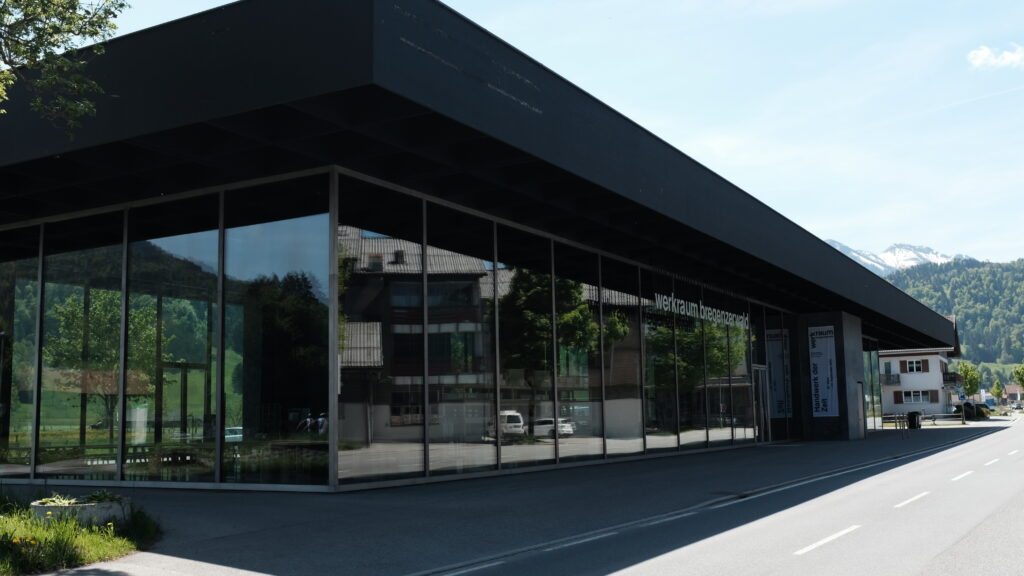
The rectangular parallelepiped of the façade is composed of large panels of clear glass framed by steel beams. It encloses a large open volume, punctuated by dark wooden columns, wrapped with narrow black leather bands along the lower third, and structured by two large concrete blocks which house, in their interior, a stairwell to bathrooms and a kitchen, with another block outside housing an elevator. These stabilize the imposing wooden roof floating overhead and substantially overhanging the rectangular façade, structured by a grid of open squares with dark-blue felt padding inside for acoustics and with lighting and electrical systems set within the frame. The dark terrazzo floor was arduously poured in over a dozen layers without expansion joints or structural articulations to alleviate pressure, thus taking on a uniform consistency and a liquid sheen while acquiring anticipated fault lines over time. The space is vast and flexible, open to a wide variety of configurations for exhibitions and displays, and above all open to the surrounding exterior for events, visually connected with the countryside and the road.
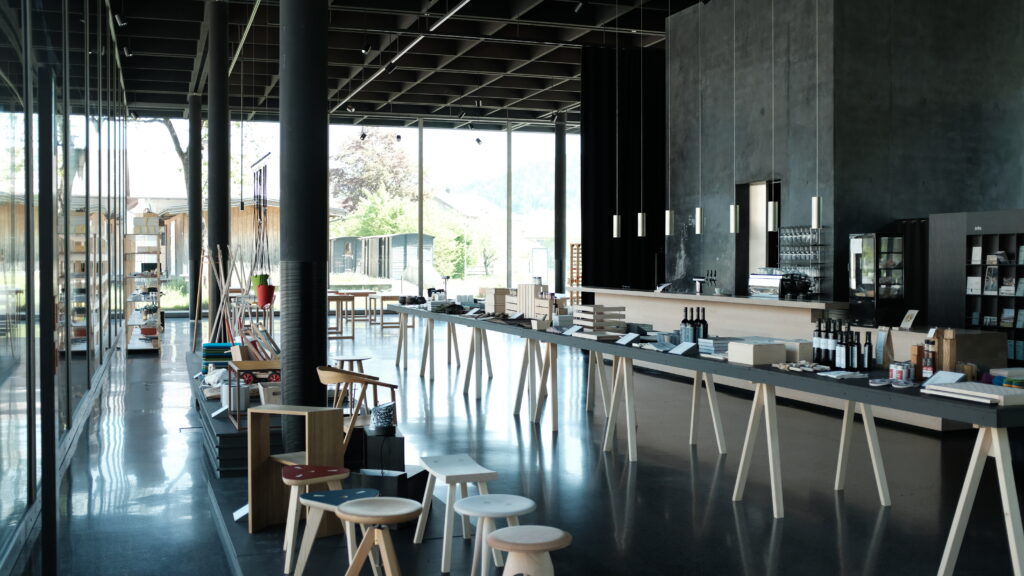
Architecturally, the overhanging dark roof and clear glass box are strongly reminiscent of Mies van Rohe’s 1968 Neue Nationalgallerie in Berlin, and this may be the only Zumthor building one could plausibly describe as “derivative.” But it is differentiated from Mies’s gallery by the important structural role of the large concrete volumes with their interior rooms, and the structural bulk of these lend the building that peculiar tension between mass and lightness also characteristic of Kunsthaus Bregenz, an intermingling of gravity and open space. The Werkraum building, however, does not seek the kind of emotional gravity achieved by the Kunsthaus. Here the darkness of the roof, of the floor, of the columns and their leather wrapping, of the concrete volumes does offer a somber tone, but not one that is psychologically complex or mnemonically evocative. The mood is open yet formal: rationally serious and reflective but not emotionally dense; rather it is conducive to the attentive curiosity appropriate to the commercial character of the building and the informative character of its exhibitions, a mode of attention that is sharp but also convivial and brisk.
The construction of the building and the sourcing of its materials was carried out in collaboration with the local craftspeople whose work it would represent and with whom Zumthor had established relationships during the construction of Kunsthaus Bregenz in the 1990s. Their skill is evident in the detail of the leather wrappings, in the meticulous application of the floor, in the joinery and the lighting. One can acquire a small box of maps as a guide to notable architecture and craft workshops in the region: an homage to the heyday of the International Style thus spirals out toward local traditions carried into the present and intersecting with the prolific range of late modernist architecture throughout Vorarlberg.[40]
May 12. Into Graubünden. I’m staying in Ober Says, a tiny village in the mountains just north of Chur and Haldenstein, where Zumthor’s studio was constructed in the mid-1980s. My neighbor, visible from a balcony overlooking the mountains across the valley, is a charismatic pig who wanders snorting along a path circling the adjacent yard. From the village there’s a path into an open meadow stretching out to a ridge along which I walk to a copse of trees, looking over the valley, where I read Hölderlin for a while in the evening light:
But the handmaids of heaven
Are miraculous,
As is everything born of the gods.
Try taking it by surprise, and it turns
To a dream; try matching it by force,
And punishment is the reward;
Often, when you’ve barely given it
A thought, it just happens.[41]
May 13. From Chur, one passes into Haldenstein across a bridge over the Rhine. Walking toward the north end of the village, one sees the patio garden of Atelier Zumthor (1985-1986) on the right, with cherry trees and a shaded rear façade of glass and wood. The windowless west side of the building rises like the end of a tall shed, yet one whose simplicity is so beautifully rendered its provenance is unmistakable. An exterior shell of long and narrow larch-wood slats, weathered to a matte blue-grey, foregrounds the verticality of the structure and suggests its designer’s apprenticeship as a cabinet maker. Around the corner, the vertical slats of the wooden shell directly meet the road and slope down its incline right along the length of the building, as though having grown into or out of the ground it covers. The formal artistry of the narrow slats blends with the natural tone of the wood and the organicism of the structure’s sloping horizontal asymmetry.
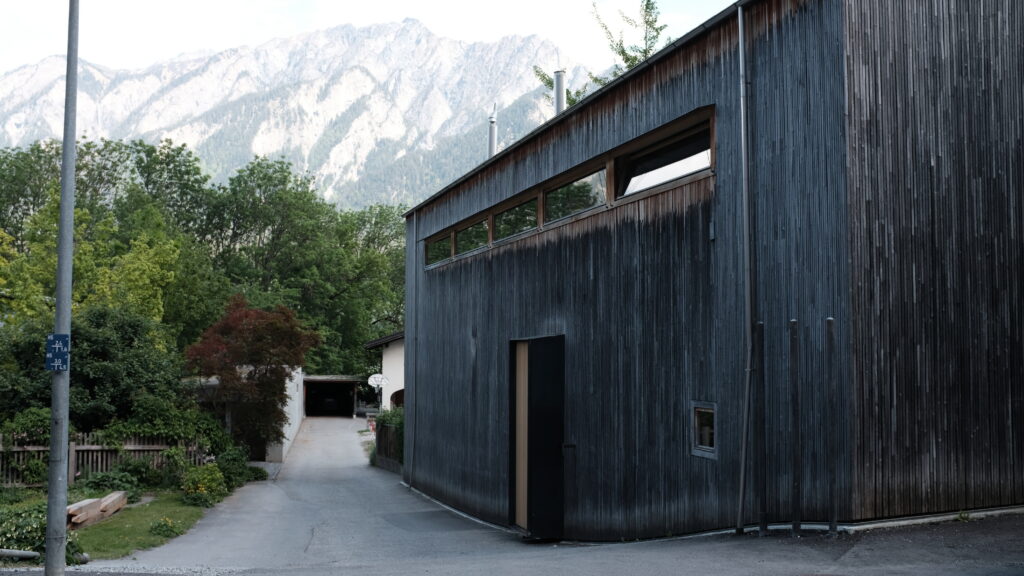
A distinctly small, isolated square window toward the north end matches a regional feature one sees among other alpine homes in the village, but, well above eye-level, a long rectangular strip of narrow windows stretching across the façade again distinguishes the architectural formality of the structure and draws attention to its height. These windows illuminate, from behind, the drawing studio on the second floor, which looks out from the larger windows on the other side to the relative privacy of the garden patio. Beneath the upper windows, near but slightly off center, a black metal rectangle protrudes from the wooden shell, encasing the door within its brooding shelter. This rather alien detail, a floating portal, framing and shielding the only street-side door, marks off the building from the architectural world of the village, and it marks the privacy and reflective interiority of the space as well: this is not the sort of door one knocks on uninvited. One finds again that Stimmung characteristic of Zumthor’s architectural oeuvre: the muted drama of a soulful intelligence—one that is naturally at ease, calmly articulate, refined, confidently composed.
Passing back over to Chur, the Shelter for Roman Architectural Ruins (1985-1986) is a shed-like construction, composed of a permeable sheath of wider, horizontal wooden slats. The two cubes facing the road are each punctuated by a black, protruding metal box that frames a large window. The sheds glow from within when illuminated at night, and the large box windows draw the visitor to gaze inside at the excavated ruins. Around the side, a door frame dramatically protrudes from the shell on the left, first in a vertically articulated, accordion-like extension of the wood, then into a black metal box with a visible, built-in stair step floating just above the ground.
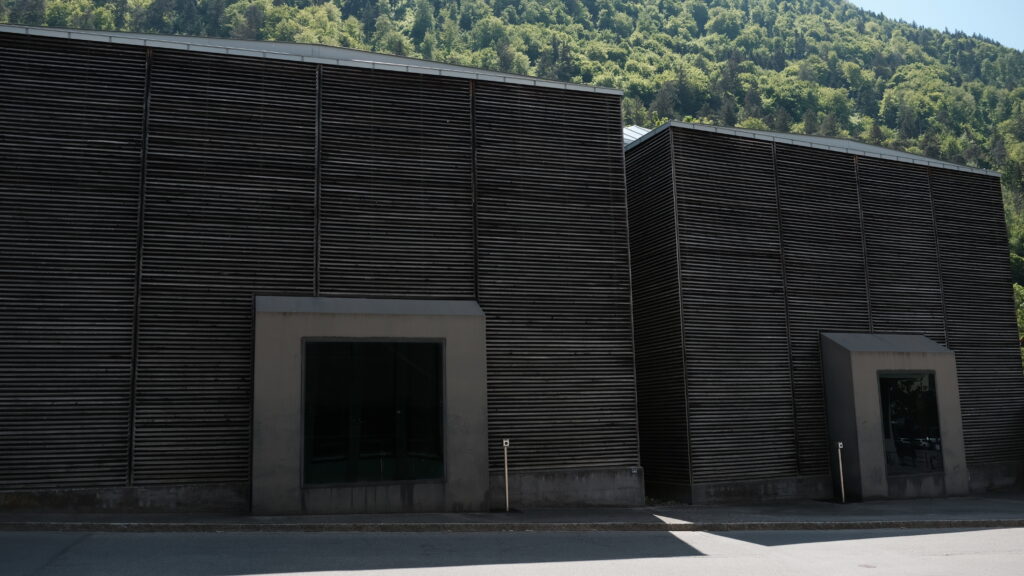
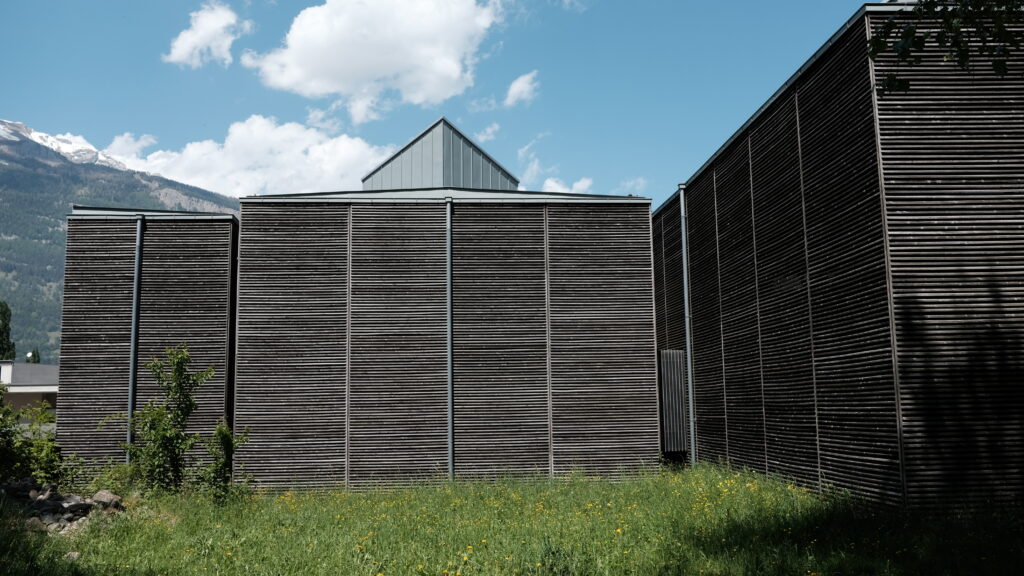
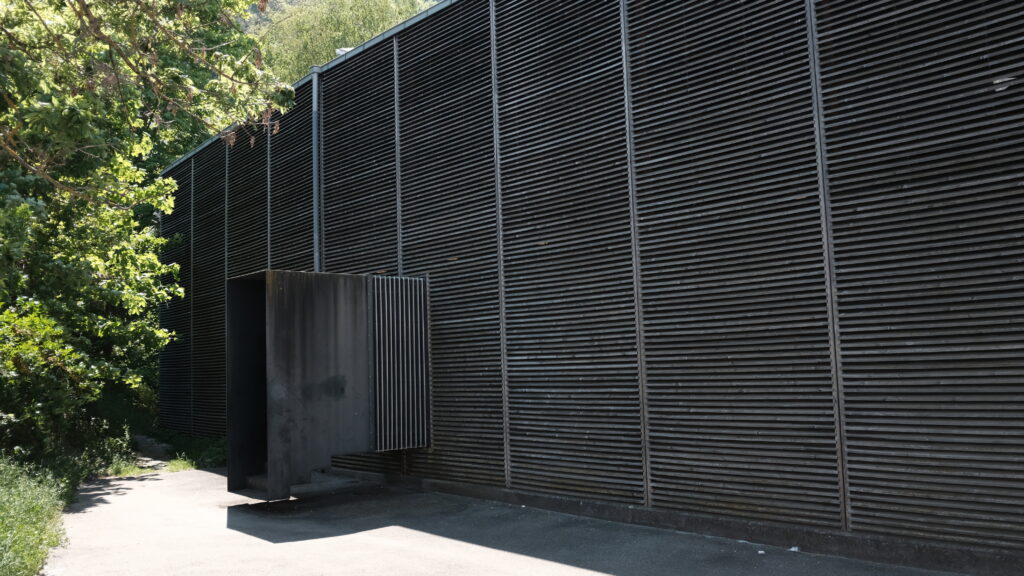
There seems to be an argument at issue in these protruding door frames, or at least a rhetorical figure: these are not only doors but passageways, thresholds extending into exterior space and thus claiming it as part of the interior, as an extension of the interior, and therefore—figurally as well as functionally—as an assertion of interiority. Between exterior and interior, one is meant to undergo a change of state. In terms of program, the protruding door frame also marks directionality: one walks into the first cube and then across a footbridge toward a similar accordion corridor connecting it to the next shed, a passageway visible from the exterior. Above, enormous skylights extend from the roofs and, dramatically, into the interior as recessed diamond boxes (their corners pointing at the sides of the box sheds). One notes that both the Atelier and the Shelter are marked by ornamental flourishes that are nevertheless examples of minimalist commitments: sharply denoted geometrical volumes articulating thresholds between interior and exterior (windows and doors) serve a rhetorical and thematic purpose while strongly conveying a mood—slightly ominous, or at least mysterious, demarcating a gravity inherent to the act of passing between worlds. In order to be noted as thus implicit, it has to be explicitly marked.
Toward the north end of Chur, the Apartments for Senior Citizens (1989-1993) bring the foregrounding of wood by the Atelier and the Shelter back into harmony with stone. The apartments extend as a long, two-story volume equally divided by twenty-two recessed balconies facing east toward the setting sun across the valley. The structure has the feel of a constructivist rectangular plane, extending across a gently sloping incline above a narrower concrete foundation and rounded by a curving path for residents to walk on. The thick stone walls, which dominate the two ends of the rectangular volume, are made of tufa blocks in varying sizes: creamy, porous, warm. The stone blends together with the larch-wood window frames and balcony railings facing across the valley. On the access side of the building, it forms column-like divisions between large windows along both stories of the whole façade, also framed in wood and illuminating corridors and common areas.
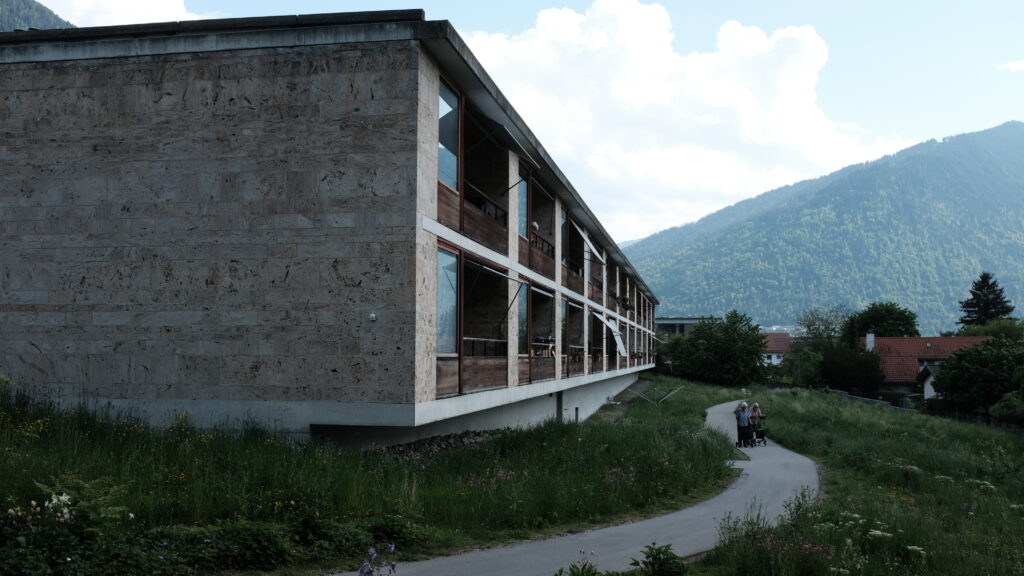
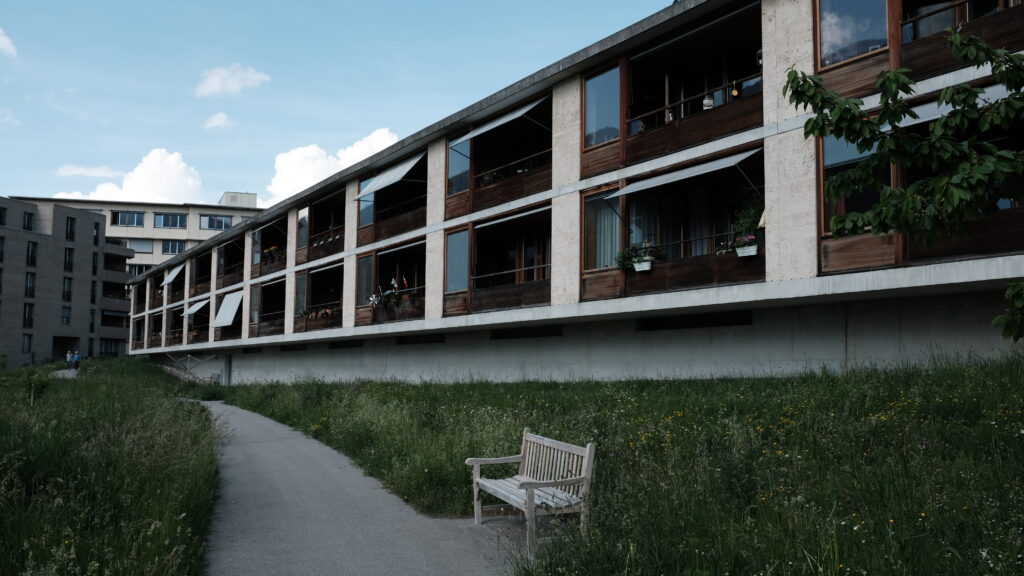
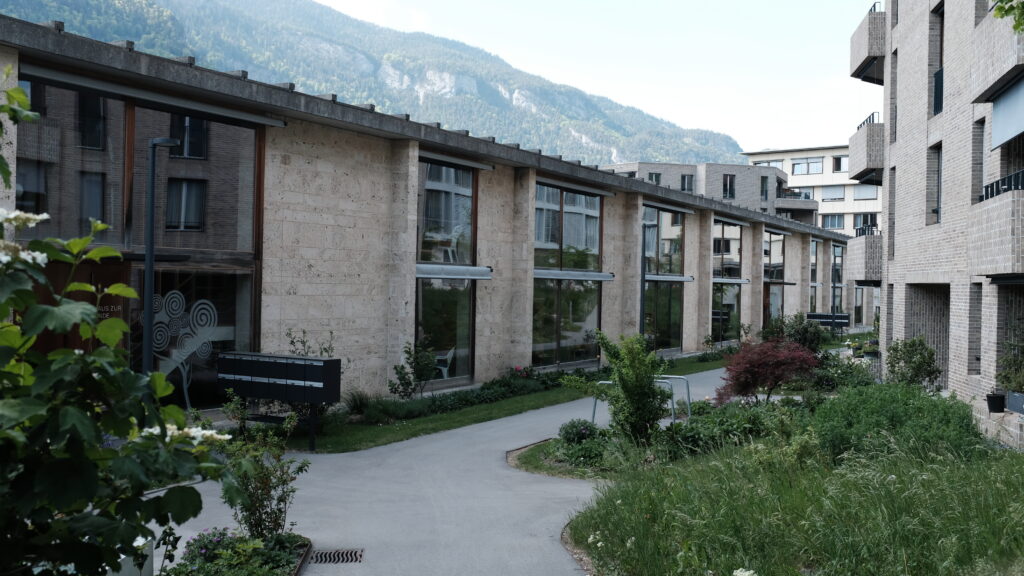
Zumthor notes that “the trio of tufa masonry, exposed concrete ceilings, and larch-wood is familiar to the people in this area; it even has something refined about it, for in Graubünden tufa was once used for important public buildings. The waxed larch-wood floors are made of really thick boards fixed on a lath underlay, and they sound like wood when walked upon.”[42] The low rectilinear extension of the building, the massive solidity of its end walls, the geometrical regularity of its windows and balconies framed in regional materials, and the hanging flower pots and tapestries that come to decorate them create an earnest synthesis of abstraction and vernacular dignity. “The circumstances must have been favorable, for today I realize that we succeeded in building a rather elegant senior citizen’s residence for ordinary people within the framework of the budget granted by the state.”[43]
May 15. St. Benedict Chapel (1985-1988). One must be cautious in attempting to describe this building, trying to state the sense of its presence. Perhaps it is the most evasive, ambiguous, and profound of Zumthor’s works. What is it about this simple chapel that forever anchors in the psyche? Why does it strike one with the emotional singularity of an unprecedented form, imposing an ambiguous demand?
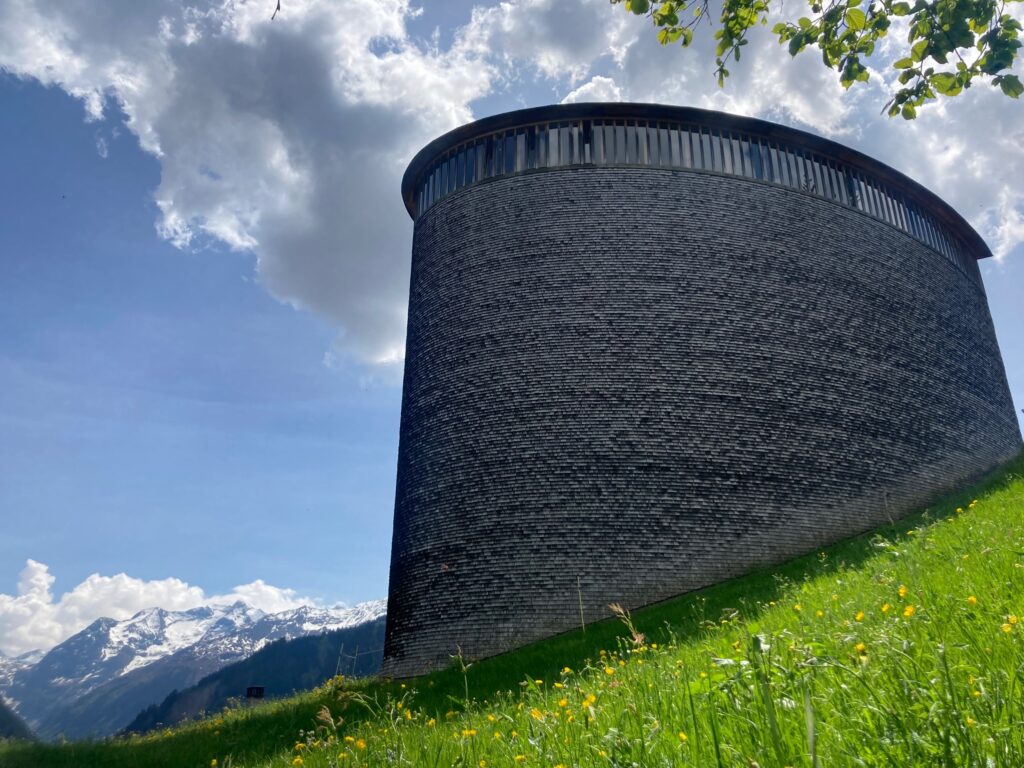
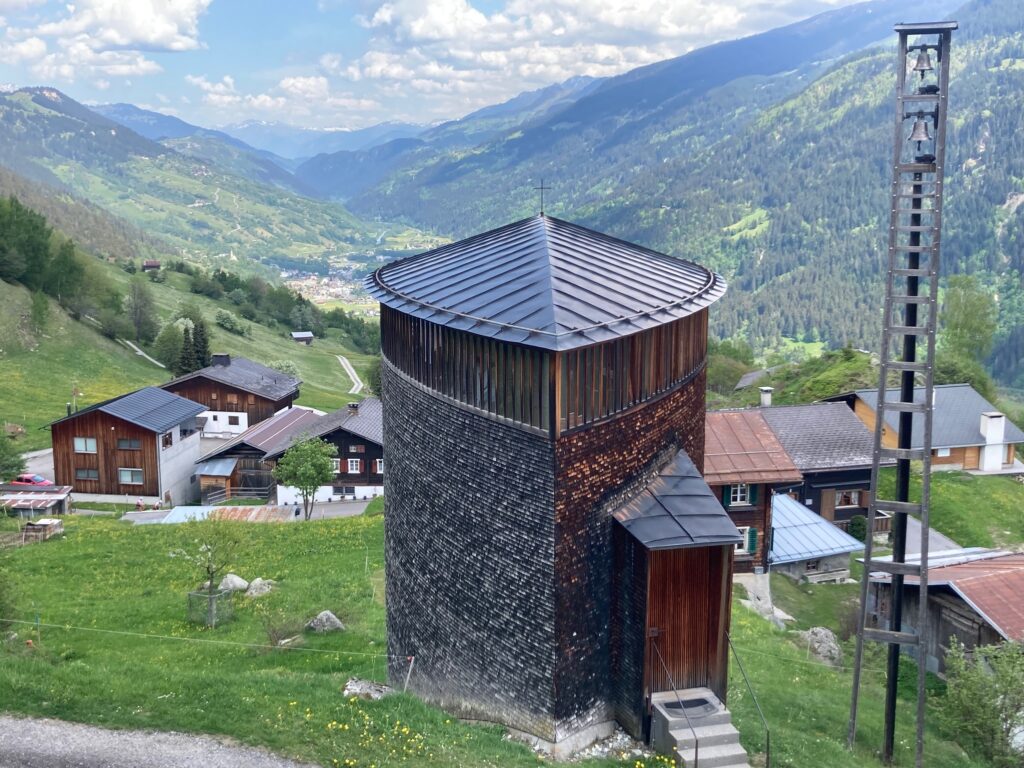
From Chur, one approaches Sumvitg heading west along the highway, then turns up toward the chapel along a narrow, winding road above a valley, hairpin turns leading you into the foothills. One parks near the ruins of the old chapel, destroyed by an avalanche in the early 1980s, its rough stone walls cresting a mound of earth, the contours of its base grounded in the curvature of the slope, extending out toward the expanse of the valley. Further along the upward curving road, then turning up a footpath to the left, Zumthor’s chapel appears against the background of a dense evergreen forest with grey peaks rising above it. Low on the left, with a doorway extending from the narrow end of the building into concrete steps meeting the path, the curvature of the building slopes down the steep hill such that the wider eastern side of the building, down the hill, is twice the height of its narrow western side by the path. The chapel presents a modest entryway, the protruding doorframe angled so as to guide those approaching toward the wooden door composed of narrow vertical slats with a beautiful curved metal handle, extending horizontally above a traditional keyhole notched in a metal square.
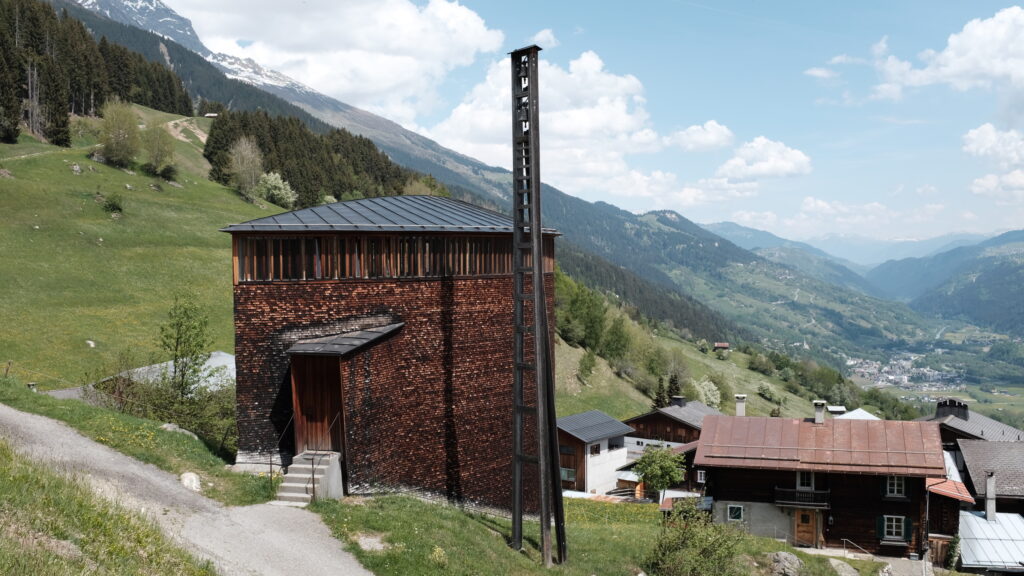
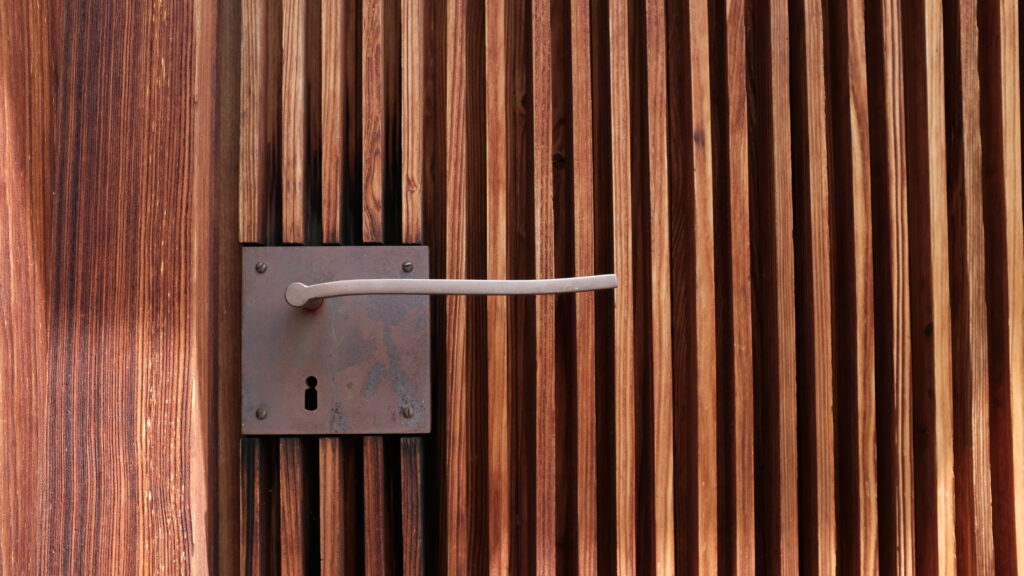
Larch-wood shingles, blending light and dark brown to black, present the curvature of the volume to the eye beneath a ribbon of narrow, vertical windows at the top, delicately divided by narrow wooden slats, opening here and there onto the interior. A slightly arched metal roof above a horizontal ribbon of windows, wooden shingles encasing a sloping volume all the way down to the earth, the door extending organically from the low side of an as-yet indistinct shape, the ladder structure of a fragile wooden bell tower rising vertically beside the front of the building. This is what you see as you approach the chapel, the valley stretching out to the right into distant recesses, ringed by mountains; grey rocks growing out of the hill to the left, grass flowing down into flowering yards and meadows.
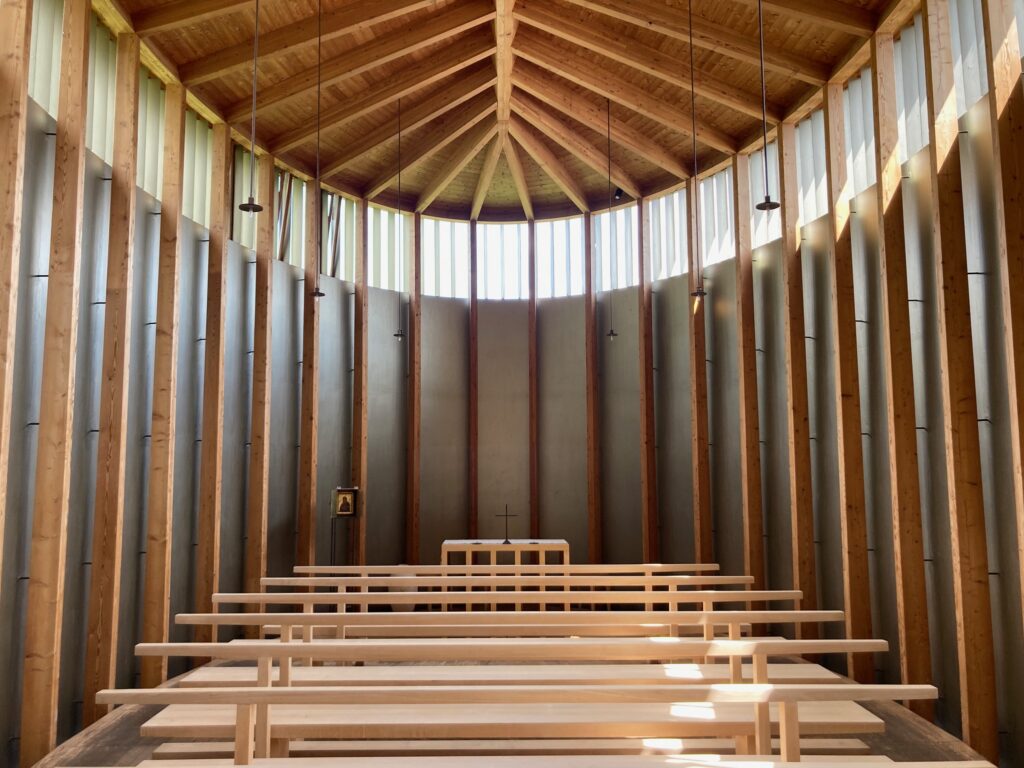
Viewed from the front, the chapel presents a sharp vertical wedge, bending out below the curvature of its roof along its swelling sides. Inside, the interior presents a gestalt of the building’s geometry, grasped piecemeal from outside: the shape of a leaf, or a boat, or a drop of water. From the center of the narthex, one sees a single curve rounding the apse behind a simple altar and widening around a row of light ash wood pews toward the narrow angle of the wedge behind you, closing the shape. On the right side of the pews near the doorway, a copper holy water font, greened inside; a metal cross in the center of the altar; to its left, a Virgin and Child icon housed in a small metal box supported by a delicate metal plinth; worn wooden floors beneath the pews, a beautiful wood beam ceiling above, both made of diagonal boards meeting in the middle of the dewdrop form. Vertical wooden beams, unfinished, rise just inside the curvature of the chapel’s walls like minimal interior buttresses, articulating the space, separated by thin metal rods from a silvery sheath around the walls, which catches the light and the shadow from the ribbon windows above, drawing the unseen outside into the lemniscate curvature of the unified interior space.
Stepping back outside, the building pours you down its northern flank to view it from below, where it rises commandingly above the steep slope of the meadow. The tiny chapel now takes on the disproportion of the sublime. It is as though the figuratively quaint form of the Christian ichthys had grown, as one sought to encompass the entirety of its exterior shape, into a colossal Leviathan, imposing and serene. Viewed at an angle from the northeast, or facing the building straight from the east, where it extends furthest down the hill, its form seems strangely unprecedented, sloping organically down the hill yet rising above it toward the sky, mountain peaks in the background, jutting with imperious command toward the valley, intensely defamiliarizing, as unearthly in its form as was the light of Kunsthaus Bregenz, yet curiously akin to its own environment. Indeed, the chapel protrudes from the hillside like one among the rocks surrounding it, growing out of and punctuating the green meadow with their grey mass. The shingles on the north side of the building have taken on a glowing silvery sheen, like the curved panels around the interior walls. Those on the southern side are a warm brown, flecked with lighter or darker panels and absorbing the gaze just as the grey, shimmering planes on the other side seem to deflect it.
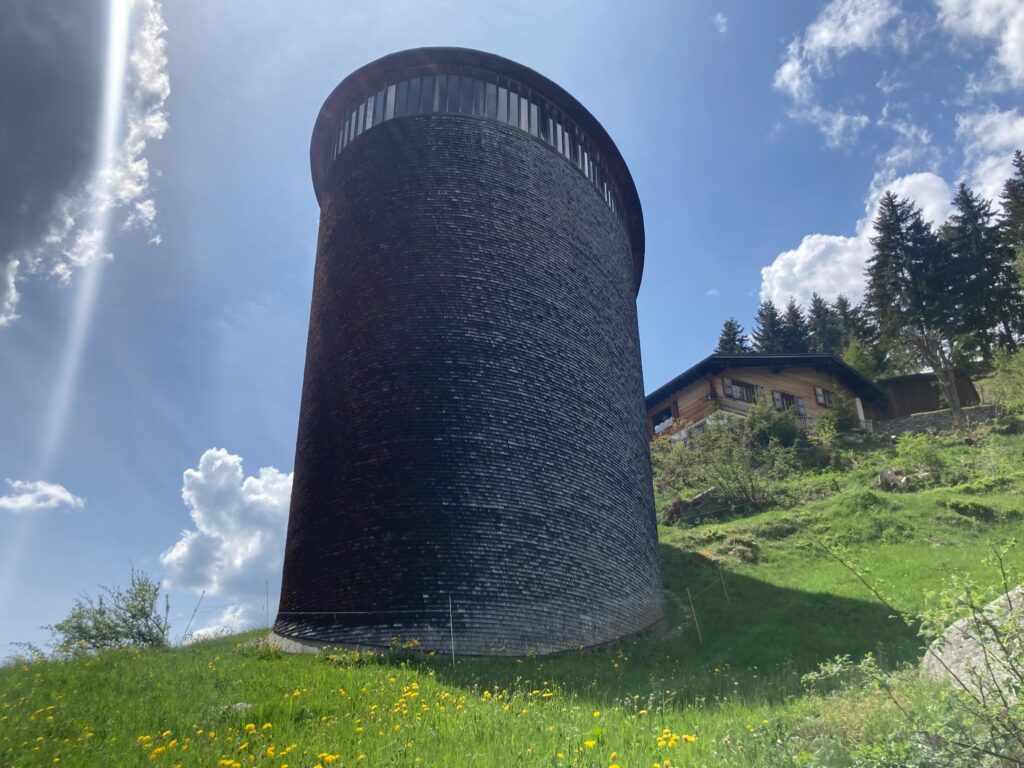
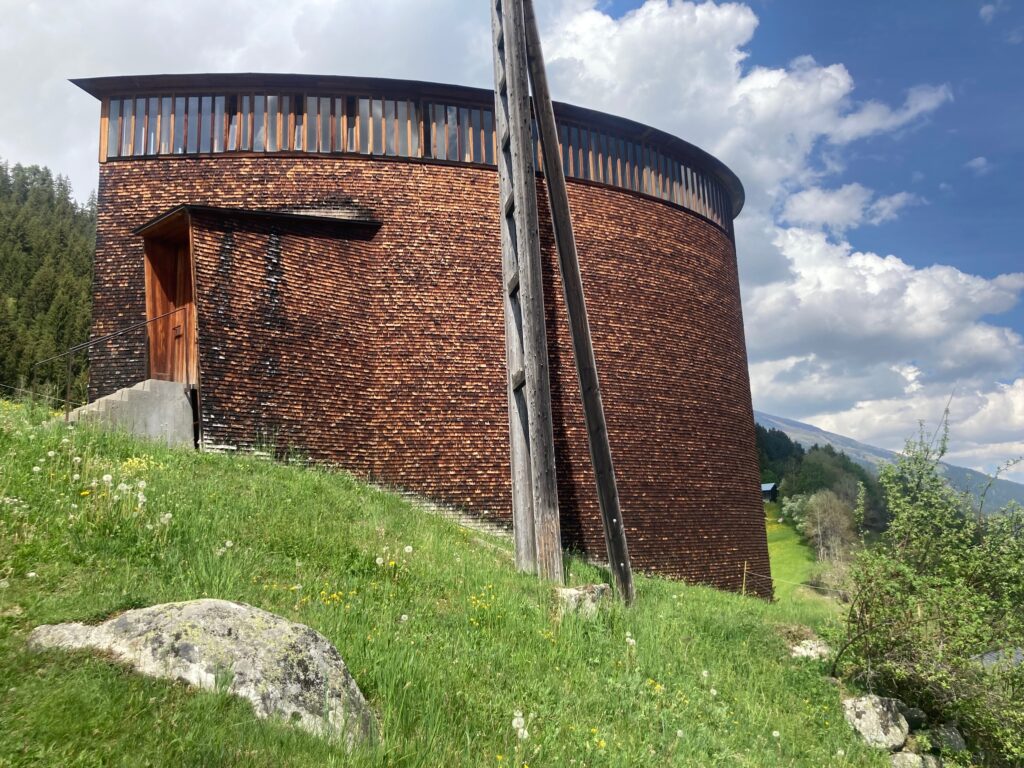
It is of course the rotation of the earth around the sun that determines these phenomenal transitions: shimmering grey, soulful brown, alternating in the round. The ground of these appearances is planetary, and this structure grows from the earth like a beacon of some unrecognizable beyond. One cannot overstate the ominous sense of implausible advent emanating from this form. Yet it seems at the same time earthly, descending modestly down a grassy slope and then looming up from the now sudden height of its rounded eastern wall. Through this strange double sense of humility and grandeur, one feels the earth gathered into a sign of itself, meadow and rock, wildflower and mountain, planet and place, growing from the hillside as a form which resists any referent, even as it invites a proliferation of analogies. Drawing one’s gaze out into the valley, indicating it in a manner implicit in the lengthwise ruins of the older church, yet grasped and radicalized by the sharp incline of this location, the structure designates its own site. That casual drift of the base of the Atelier in Haldenstein down the gradual incline of the slope onto which it was built…something was already there that could enter into the profundity realized here: the earth become unearthly while made manifest as ground. The distinction of the building from the rocks to which it is akin: it is not what the sign means but that it is a sign which is unsettling.
Something of the uncanny imperative of Rilke’s “Archaic Torso of Apollo” speaks through presence of this structure:
We cannot know his legendary head
with eyes like ripening fruit. And yet his torso
is still suffused with brilliance from inside,
like a lamp, in which his gaze, now turned to low,
gleams in all its power. Otherwise
the curved breast could not dazzle you so, nor could
a smile run through the placid hips and thighs
to that dark center where procreation flared.
Otherwise this stone would seem defaced
beneath the translucent cascade of the shoulders
and would not glisten like a wild beast’s fur:
would not, from all the borders of itself,
burst like a star: for here there is no place
that does not see you. You must change your life.[44]
Whereas in Rilke’s poem it is the absent countenance of the sculptural figure that endows the form of its torso with the generative power of the gaze, emanating as if from within, in the case of the Zumthor’s chapel it is the incommensurable harmony of exterior and interior worlds which generates the cognitive and emotional negativity of its form. Explaining his aversion to rectilinear forms in churches, Zumthor writes, “The idea that its exterior form would be defined by a single interior space fascinated me. This is the notion of a simple vessel. I wanted to find a soft, maternal form for my vessel.”[45] Yet the softness of this interior form, the gentle curvature of its enclosure, finds itself not only in harmony but also in tension with the ominous sculptural presence of the exterior, the heft of a massive diagonal volume rising above the valley. Mediating this contradiction, one realizes, is the horizontal plane of the interior floor, shaped by the interior walls yet indifferent to the exterior slope of the hill. Indeed, the floor of the chapel extends from the entry on the west, nearly level with the path outside, to the midpoint of the eastern wall, which slopes down the valley. I.e. the floor, extending above the sloping hillside on interior supports above a stairstep foundation, approximately bisects the verticality of the chapel’s highest wall.
Inside the chapel, with no windows at eye level, the slope into the valley beneath is perceptually and proprioceptively negated; outside the chapel, faced with the curvature and the diagonal, downward flow of its exterior walls, which seem to grow upwards from the slope of the earth, the horizontal stability of its interior surface is difficult to imagine. It is the horizontal plane of the floor—invisible from without, projecting into the invisible valley from within—that engenders and stabilizes the dialectical torque of this structure, the irreconcilability of interior humility and exterior magnificence. Space is actualized as the medium of a dialectical relation between the expansion of distance and the gathering of enclosure, which brings into relation two intimately correlated manifestations of Geist: the expansive exteriority of the world and the sheltered interiority of reflective meditation, each negating the other while nevertheless synthesized by a subject who perceives and who feels—whose body, obdurately located in the space it constitutes and inhabits, comes to know itself as the locus of this synthesis.
Consider the opening strophe of Hölderlin’s “Celebration of Peace”:
The anciently built hall, blessed by custom,
Is aired, filled with heavenly, quietly resounding,
Gently modulating music; glad clouds
Of scent drift over green carpets and,
Far-shining, abundant with ripest fruits
And gold-wreathed chalices,
Well-ordered, a splendid row,
The tables rise on either side
Above the levelled floor.
For, at the evening hour,
Loving guests have pledged
To come here from afar.[46]
Although what is depicted likely has no direct empirical referent—it is the representation of an imagined scene, laden with the artifice of symbolism—the strophe is nonetheless an act of poetic mimesis in the Homeric sense reconstructed by Eric Havelock in Preface to Plato.[47] Poetry, here, is the preservation and transmission of paideia; representation is the mimesis of ethos. Hölderlin sets the table. The guests are expected; they will have their expectations. Readers will read the poem—and this is very much a presentation piece, a program.
The tables themselves are set upon a levelled floor. Thus they balance the gold-wreathed chalices and the bowls of fruit. The tables are wohlangeordnet: they are properly arranged. The hall is altegebaute and Seeliggewohnte: it is aged, well-known, sanctified, welcoming. What is implied here is a system of cultural norms that has been not only properly but “splendidly” (prächtige) adhered to. It’s important to note that it is not particularly relevant, as it certainly was in Homeric epic, whether or not these are the norms of Hölderlin’s own culture: what matters is the representation of an ethos as one’s own. This contingency is one aspect of the “sentimental” disposition of Hölderlin’s modern poetry, a disposition that applies not only to the representation of nature but also to the representation of culture, which may treat the mimesis of tradition as if one belonged to it—as how things ought to be—though it may well stem from another time or another place.
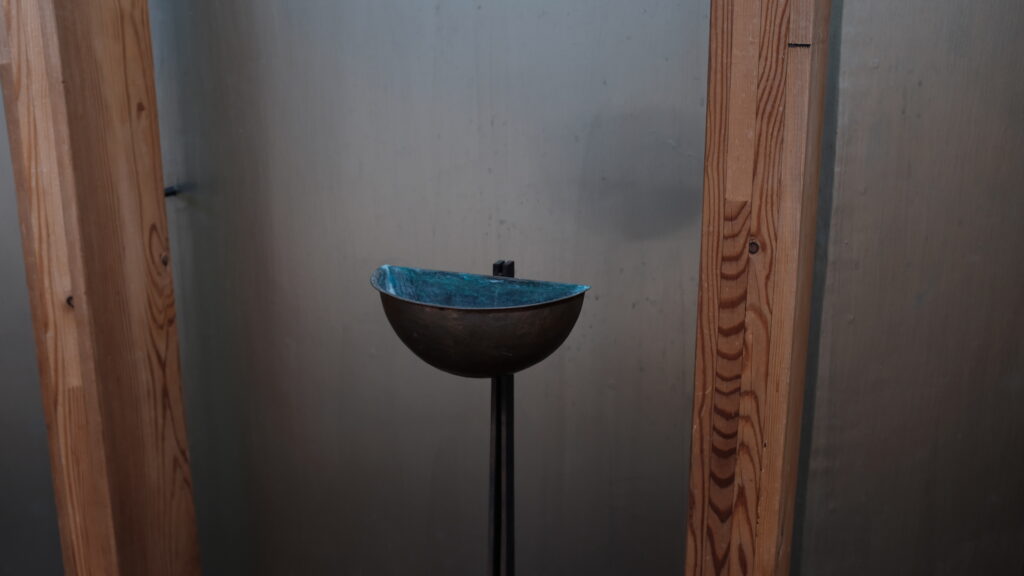
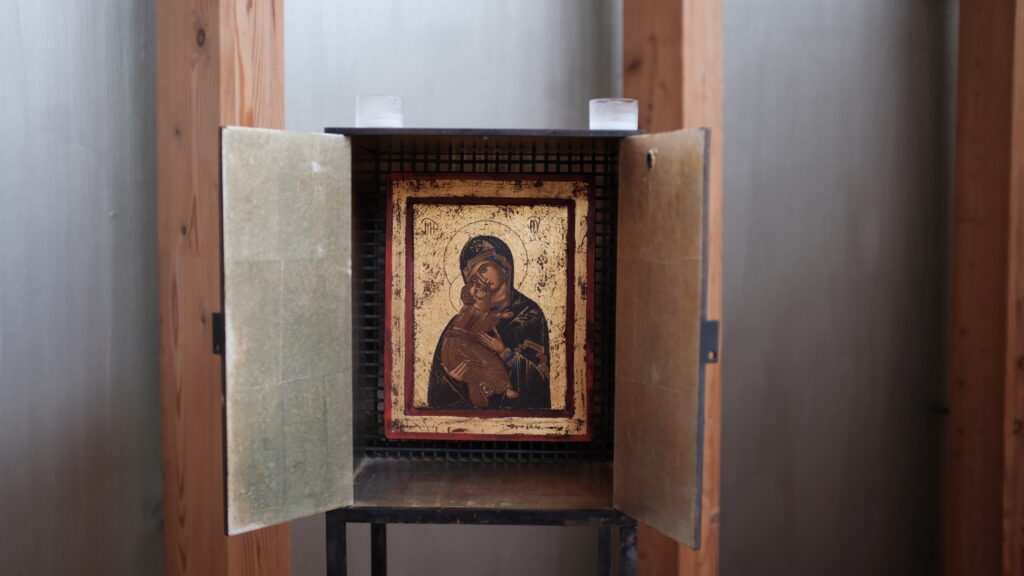
The hall is aired (gelüftet). Architecture is the medium through which the elements enter into the interior space of their intentional deployment, of their constructedness. The passage of air between exterior and interior space seems almost given, least in need of intentional design, yet it is also that element most closely identical to the shape of space itself. The hall, in Hölderlin’s poem, is the interior space of expectation—it designates the site of an arrival from afar—and it is prepared through exposure to exteriority, the air which passes through it. If the incommensurable moods occasioned by the outside and inside of Zumthor’s chapel—the disproportion of the sublime and the simple harmony of the beautiful—emphasize the power of architectural mediation to divide and yet synthesize the given and made, to construct a unitary tension between these, so too do the form and the content of Hölderlin’s strophe. For while its content is the mimesis of ceremonial propriety, “Celebration of Peace” opens with a headnote begging the reader’s patience with the impropriety of its verse, which breaks with regular measures of Hölderlin’s previous odes, elegies, and hexameters. If “some should think such a language too unconventional, I must confess to them: I cannot do otherwise.” The floor of the hall is levelled, but the form of the verse is uneven—and this is the case, Hölderlin insists, insofar as his song stems from nature: “On a beautiful day—they should consider—almost every mode of song [jede Sangart] makes itself heard; and nature, whence it originates, also receives it again.” Just as nature receives every manner of song it gives rise to, so should the unconventional verses Hölderlin cannot help but compose (ich kann nicht anders) be received as participants in the choir of the Whole.
Poetry, unlike architecture, is not subject to the law of gravity. Within the anciently built hall, the floor must be level so that the tables can hold the chalices which hold the wine; they must support the bowls that hold the fruit. The floor of the Zumthor’s chapel may bend and flex, with the slightest incline toward the center, but it must support the altar that holds the cross. Yet space passes through the hall or the chapel, ungrounded, and poetry may include the words “table” or “chalice” in uneven measures without spilling the imagined yet unmentioned wine. Air is said to hover over the Hölderlin’s green carpets; it really does surround Zumthor’s ash wood pews, and every kind of song one may hear on a beautiful day must pass through this elemental medium. Yet air—elemental space—is nevertheless shaped by architectural form as it passes through the valley, around the curvature of the building, or as it circulates within its enclosure. And the song of poetry—unmoored from the gravity of ground—is measured by verse, even if that verse is irregular.
Something about this play between regularity and irregularity, convention and its displacement, is as vital to Zumthor’s chapel as it is to Hölderlin’s opening strophe. Through the dialectic of slope and plane that distinguishes exterior and interior physiognomy, through the uneven earthliness of its foundation and the horizontal projection of its horizontal floor, the chapel foregrounds the give and take of architecture’s negotiation with gravitational force, even as it also foregrounds the shaping of space itself: the rounding of its evanescence, the leeway of light from on high. The disjunction of interior harmony and exterior disproportion nonetheless partakes of the same form, the same contour. What would come to be called free verse—the singularity of Hölderlin’s lines—also involves this play between propriety and disproportion. As the form of the poem—the space it occupies on the page and the song it traces in the air—is shaped by the play between measure and unmeasure, between rhythmic ground, the stability of the left margin, and the gravitationless flux of sound and signifier, the content of the poem tells us that the tension it thus constructs involves an elemental passage between nature and culture, into and out of the shapes we make with the space we are given: “und gelüftet is der altgebaute, / Seeliggewohnte Saal.”
Excursion: Sils Maria
May 16-18. Three days in Sils Maria (Figures 27-28). Green meadows stretching out from the town toward the Lake Sils, circled by meandering wooded paths leading up into the Alps. Hiking up toward the Lunghin Pass—a triple watershed with runoff to the North Sea along the Rhine, to the Mediterranean along the River Po, and to the Black Sea along the Danube—one encounters the Lunginsee, an alpine lake at 2645 meters, which seems a frozen double of the Silsersee far below.
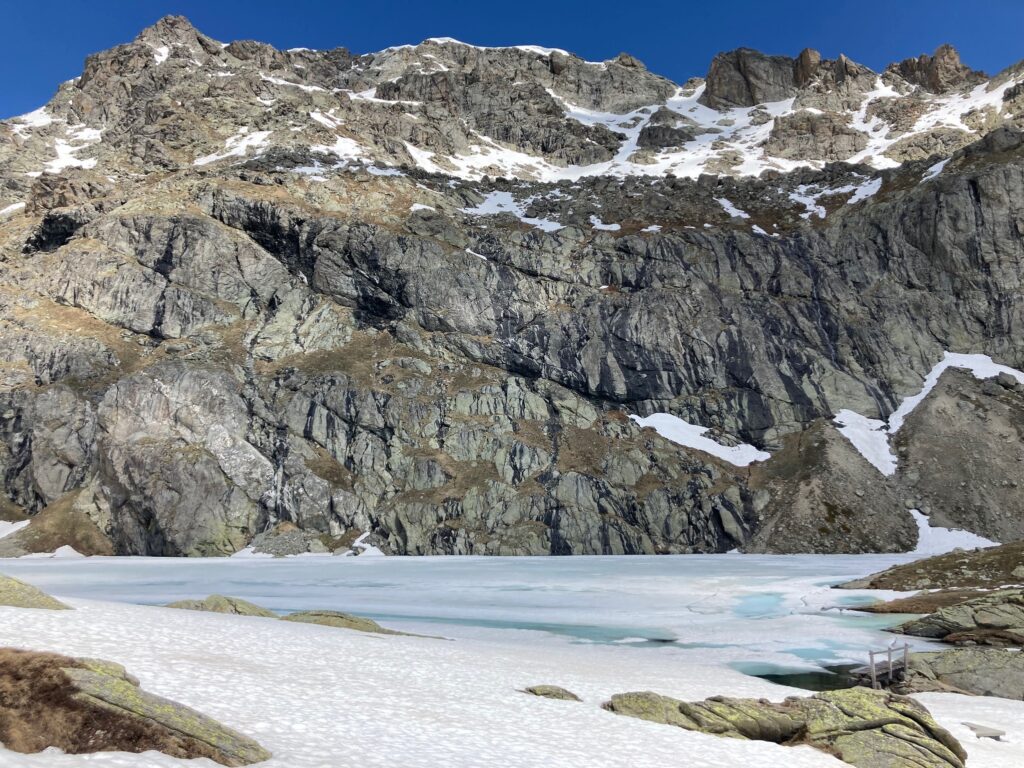
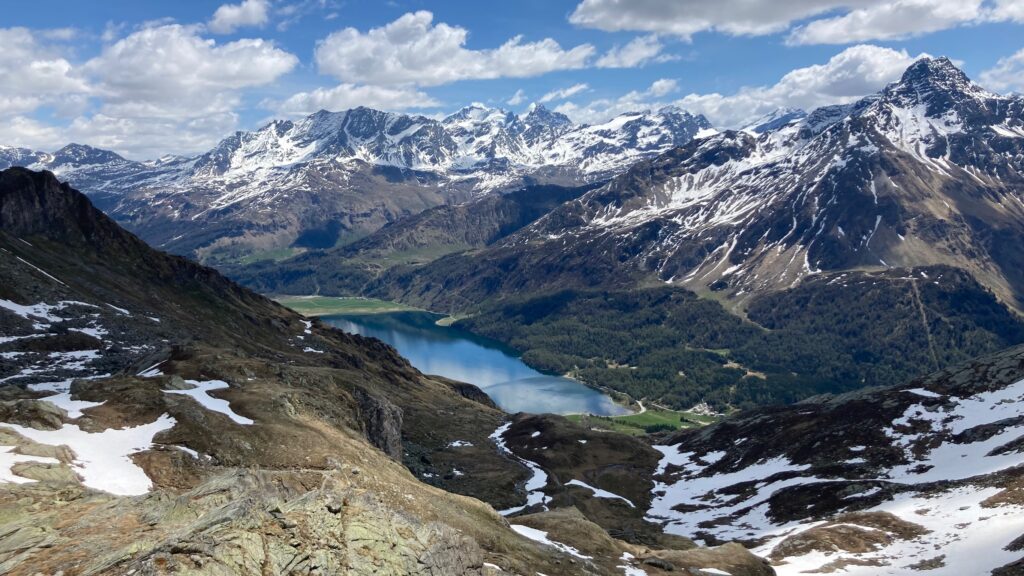
The Lunginsee glows gently with a blue-green hue, nestled among the crags, while the larger lake on the valley floor gleams and reflects the clouds above, drifting in the clarion sky within and across the ring of snow-capped summits. Glances of Enzian along the mountain path, a snowless meadow to lie in the sun; a simple afternoon.
Since around us are heaped
The peaks of time, and the most beloved
Live near, languishing upon
Most separate mountains,
Give us blameless water,
O give us wings, minds most true
To cross over and to return.[48]
A riddle compounding itself just where it finds its solution: it is as though Hölderlin had been here, where blameless water runs down to the source of the Rhine.
Earth: Therme Vals
May 19-22. Therme Vals (1990-1996). From the road below it appears as a huge rectangular plane of grey stone emerging from the side of the valley, fifty-eight meters long and nine meters high, asymmetrically hollowed by rectilinear volumes encasing large dark windows set back from the façade, and also dotted by smaller square windows flush with its surface. Again, one is struck by the sense of a geometrical structure having grown from the earth, monumental and imposing, yet belonging to the ground it recedes into. Above the rectangular façade, grass and wildflowers grow over the roof of the building, merging with the slope of the hillside.
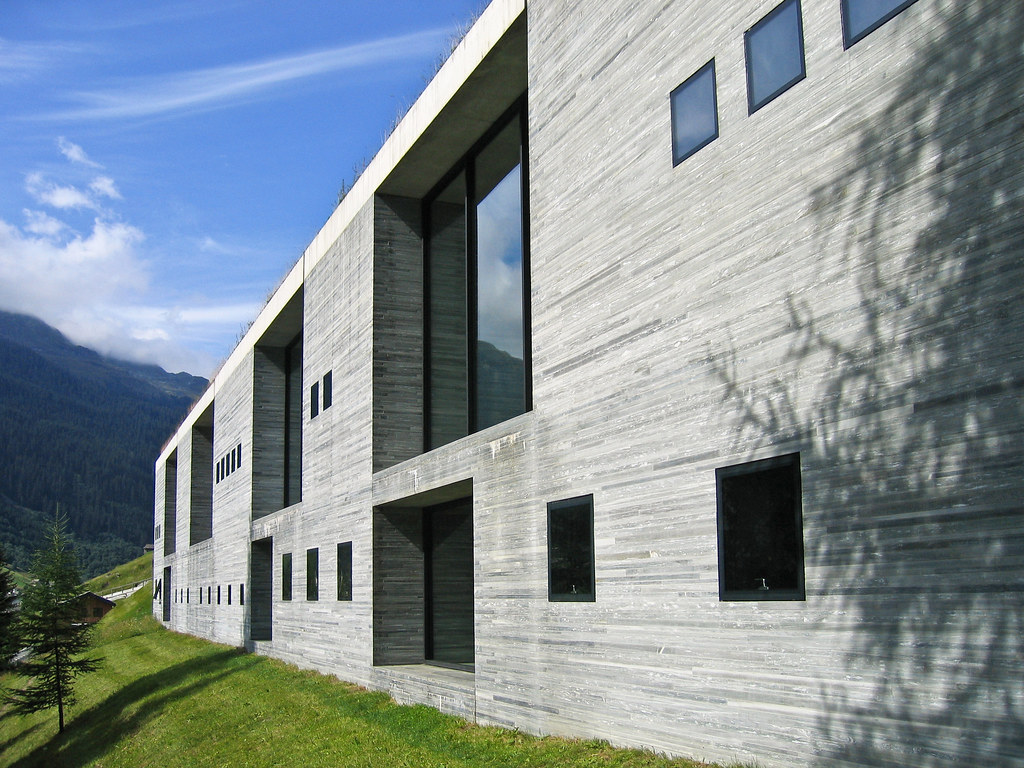
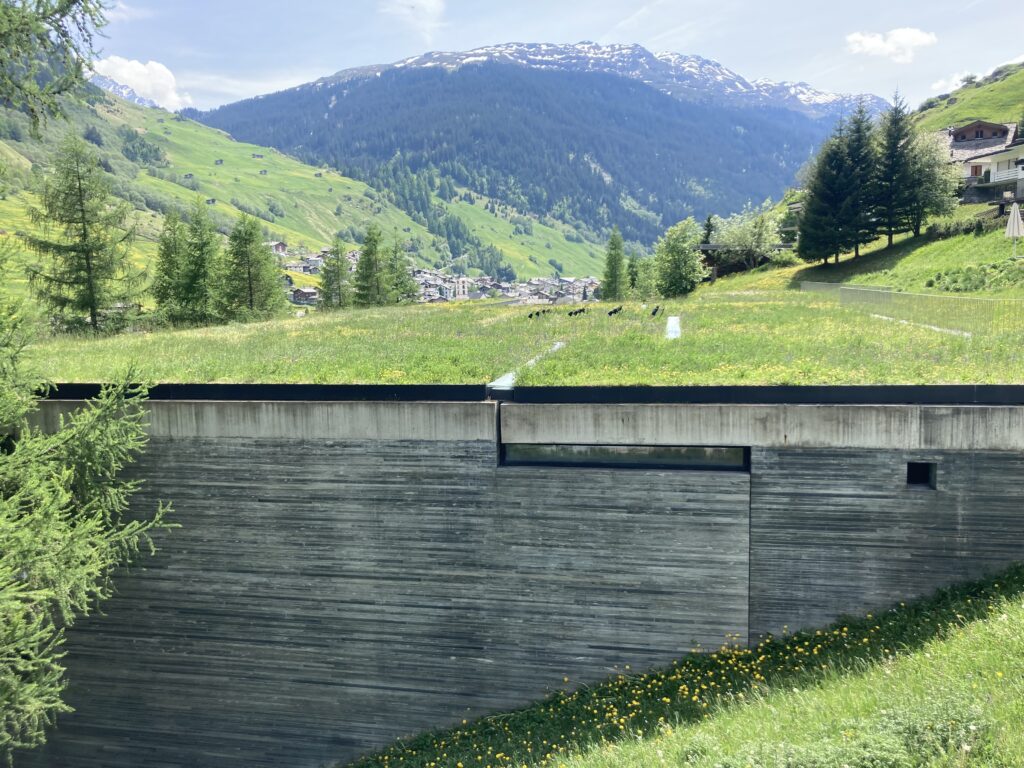
The building is conceived as a single volume, set into the hill and articulated within by fifteen massive blocks that support ceilings up to five meters high. The blocks create meandering paths through the structure while also enclosing different baths and relaxation rooms within their interiors. The environment feels essentially subtractive: one moves through voids and sinks into water. Displacement is not only foregrounded as a somatic, elemental experience, but also as the governing concept of the work. In this sense, architectural concept and elemental sensation are indistinguishable.
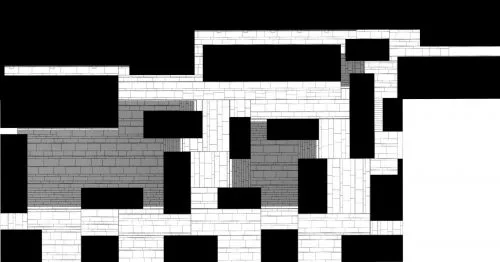

Figure 31, Therme Vals, Plan of Meander and Blocks, Peter Zumthor, Buildings and Projects, Vol. 2
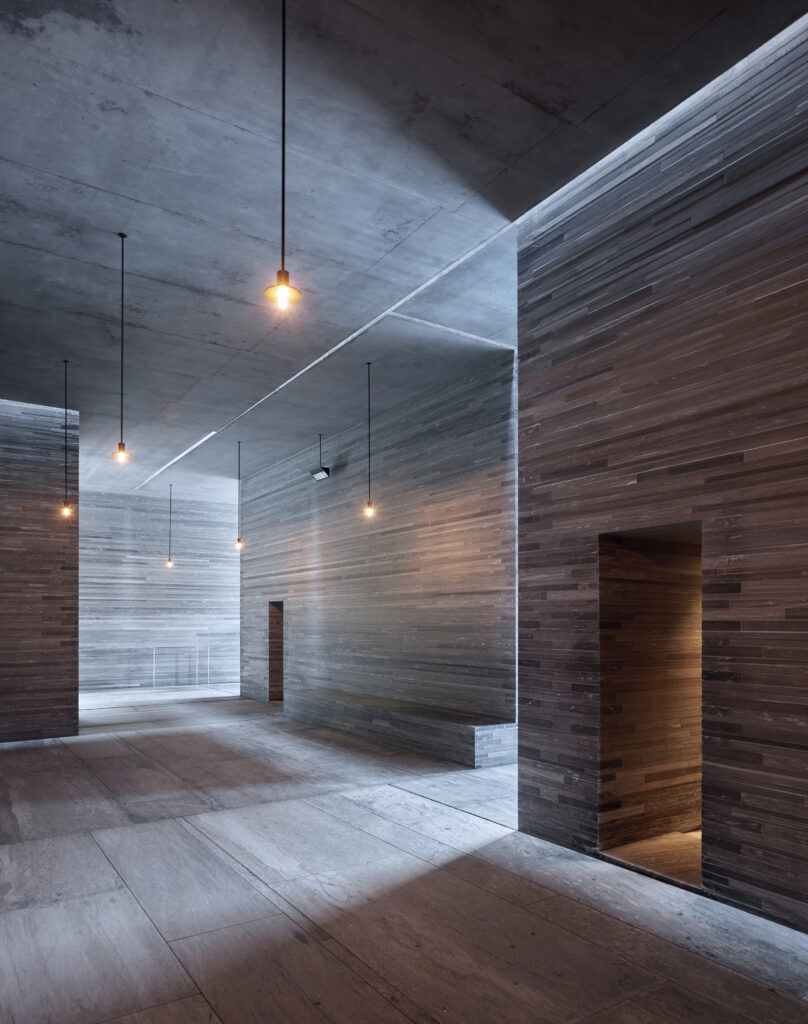
Figure 32, Therme Vals, Meander and Blocks, Photograph by Fabrice Fouillet

The construction of the building’s stone walls involves a deep relationship between architectural form and local site: they are composed of 60,000 deep grey slabs of Vals gneiss, sourced entirely from the quarry just outside the village, cut to varying lengths and stacked in narrow layers, streaked here and there with white quartz and marked by endlessly fascinating occlusions. All the shingles of the roofs in the town are made of this stone. The geometry of the masonry—stacks of sheet after sheet of implacably hard yet narrow, delicately cut gneiss—conveys a sense of gravity and compression, implicitly suggesting the metamorphosis of the original rock, 300 million years old, by the formation of the Alps 50 million years ago, a process resulting into the ridged layering of stacked wedges characteristic of Vals gneiss before it is cut or processed.[49] This sense of compression is offset by the vast empty volumes one moves through in the main space of the building and by the silky texture of the water, as well as by the light seeping in through narrow openings along the edges of the cantilevered concrete ceiling slabs, high overhead and supported by the blocks, as well as through the grid of blue windows in the ceiling above the main interior pool, each illuminated after dark by a lamp stemming from the grass roof outside.
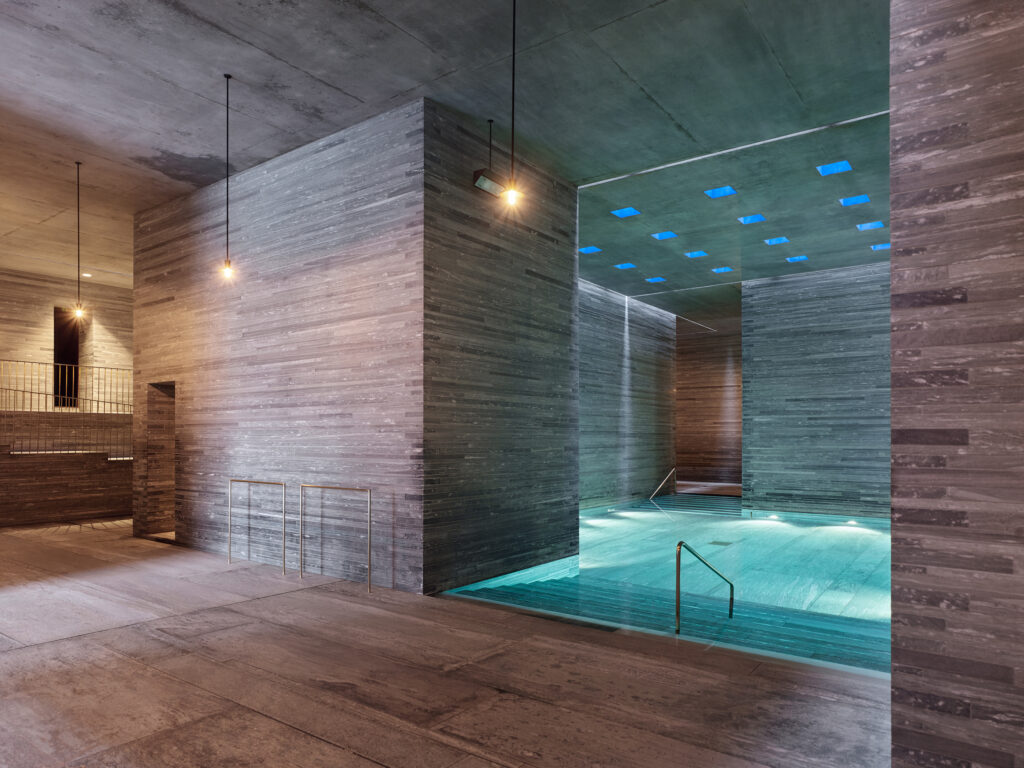
Brass doors and railings lend a rich but muted metallic gleam against the play of blue water and grey walls. In the main outdoor pool, three large, cylindrical brass founts curve overhead, continuously pouring heavy streams of water into the pool, where it cascades over the body and laps into overflow channels along the wall. The floor of the pool is an irregular pattern of rectangular slabs, a grey-blue mosaic flowing into shallow stone steps. In the corridor through which you enter the baths, mineral water flows from spigots at intervals down the concrete walls, staining them with textured shades of ochre and crimson. Dark, glossy wooden cabinets and leather benches warm the changing rooms, and the long staircase through which one enters the vast main space of the baths, slowed by its gradually descending steps, lends a sense of theatricality to the unveiling of their interior world, with its flickering patterns of light across stone and water. The blocks around the central indoor pool form a pinwheel pattern, divided asymmetrically by wide stone steps leading into and out of the water from all four sides. Descending into this vast interior space, one glimpses the large windows looking out onto the valley on the east side, and, below the entry stairs on the right, a narrow corridor of water through which you can swim directly into the outdoor pool, passing under a metallic curtain marking the division of the interior and exterior.
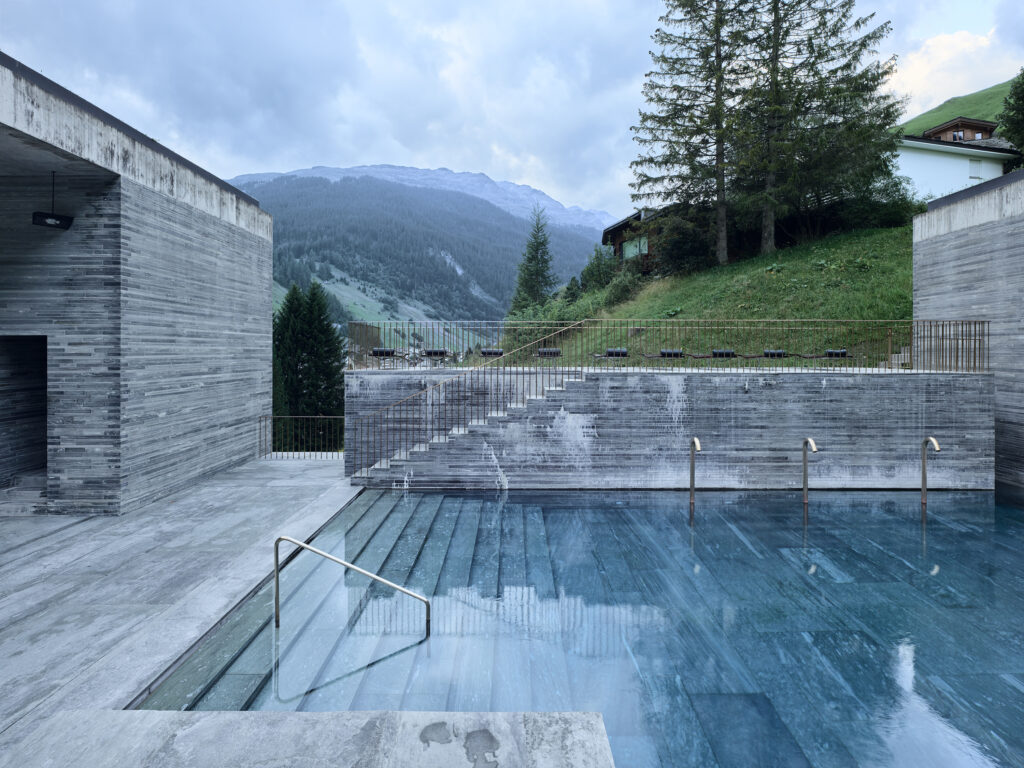
Kunsthaus Bregenz expels the water of the Bodensee from one’s field of vision through the construction of a windowless monad, yet draws the sense of a subaqueous world into the building by the filtration of light through its ceilings. Therme Vals hollows a cavity into the earth, yet everywhere presents the elemental absence of what has been removed through the surrounding compression of layered stone, such that one seems to inhabit the empty space left by removal of these sheets of rock from the nearby quarry. Water mediates the relation between stone and void. It suspends one within the element of that mediation. It also suffuses the air of the steam rooms; the sounds of water pouring into itself or lapping against the walls echo against the stone and through the air. Because the interior is underground, wedged into the hill, one is reminded of the source of the natural thermal springs just above the building, which flow out of the earth into reservoirs below and into the pools. Precisely because one moves through its absence, earth is the elemental dominant of Therme Vals, drawing water, air, light and heat together in the field of its reconstruction as volume.
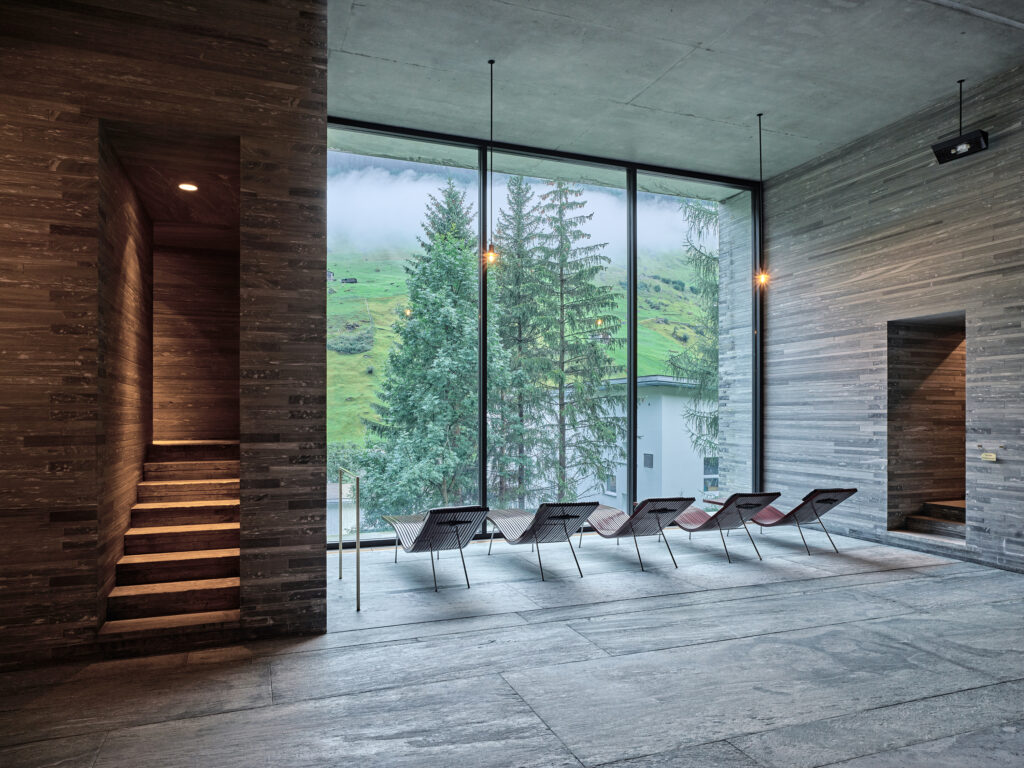
As usual, it is the meticulous treatment of materials that enables an expression of elemental essences: a foregrounding of hardness or mass, of fluidity and immersive depth, of the transmission of sound or the feeling of humidity, of streaming illumination or the play of shadows. But what is singular about Therme Vals is how the complex and flexible choreography of space and experience enables such expression in a manner that is above all dramatic.
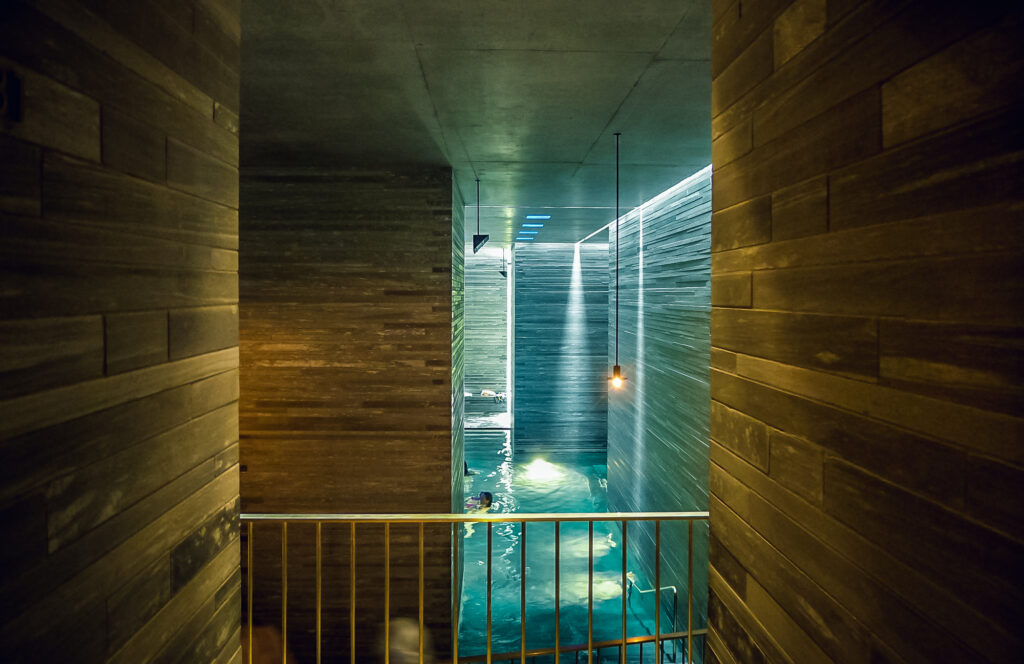

The steam rooms, set deep under the hill in the southwest corner of the building, and easily overlooked as one moves through the space, are emblematic of this dramatic choreography. On blueprints one sees two identical sets of three staggered chambers running parallel, yet each is inaccessible to the other: a shower room at the near end leads into one set of rooms; an identical shower room at the far end leads into the other set of rooms, such that one enters each set from the opposite direction of the other. This layout is only gradually and dimly discovered or reconstructed as one explores this portion of the baths; thus the differential repetition of experiencing the same rooms in different directions conveys, initially, an eerie sense of displaced recognition. In either direction, one steps from the shower rooms through a leather curtain into a chamber about three meters square, thick with steam and illuminated only by a single golden light overhead. To each side there is a solid rectangular block of black basalt rising some three feet off the ground, about two feet wide and seven feet long. One lies on these slabs staring up at the ceiling, watching the steam gather and disperse as it pours into the room below another leather curtain leading into another chamber. One chamber leads to the next, identical except for the increasing density of steam and intensity of heat, until at the back of the third chamber one encounters the source of the heat: a hieratic brass cylinder, rounded at the top, rising from the ground and ringed by brass railings. The progression through these chambers imposes a sense of formal inevitability and lapidary rigor, even as the experiential process is obscure, mysterious, perhaps claustrophobic. Though one knows the high ceilings and the outdoor platform of the baths are around the corner, one feels deeply encased in the earth, even entombed, in the hazy depth of these chambers, their heat resonating through brass as if from the core of the planet.
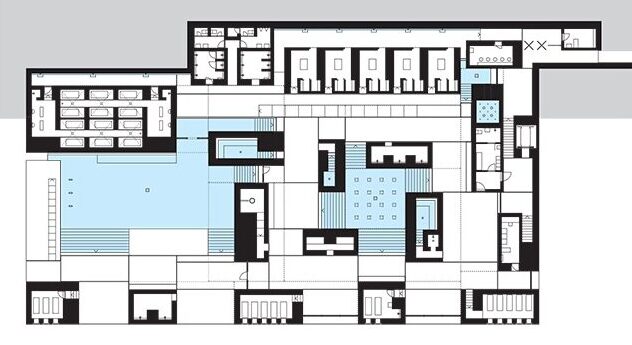
Figure 37, Therme Vals, Floorplan (steam rooms upper left), Peter Zumthor, Buildings and Projects, Vol. 2

As one meanders through the baths, the distinct environments within each block are gradually discovered—the Fire Bath (42 degrees) with its red concrete walls; the small Cold Bath (14 degrees) just across from it, into which one plunges down steps leading into the water from a narrow corridor, surrounded by blue concrete walls; the Flower Bath, with its floating marigold petals and fragrant mist; the Sound Bath, into which one swims around two corners through a narrow water corridor, with its underwater jets rumbling through the high square enclosure of rough stone walls ringed by brass railings just above the surface; the Drinking Stone, with its beautiful brass fountain pouring unfiltered mineral water straight from the warm spring; the Sound Stone, in which one sits or lies in the dark on an upholstered bench listening to a minimalist sound piece by Fritz Hauser, Wanderung (1996), composed especially for this room using sounding stones made by the sculptor Arthur Schneider; the deep quiet of the rest spaces, with their square picture frame windows and the glossy warm sheen of their polished wood lounge chairs. The sense of seeking conveyed by the concatenation of these experiences, their sensory and elemental textures, is indeed “romantic.” Through the artwork, through the exploration of its made form and of the occasions it makes available, through the choreography of natural materials and embodied sensations it constructs, one seeks that confluence of conscious and unconscious activity which is its source and which is transformed by every passage through its determinations.
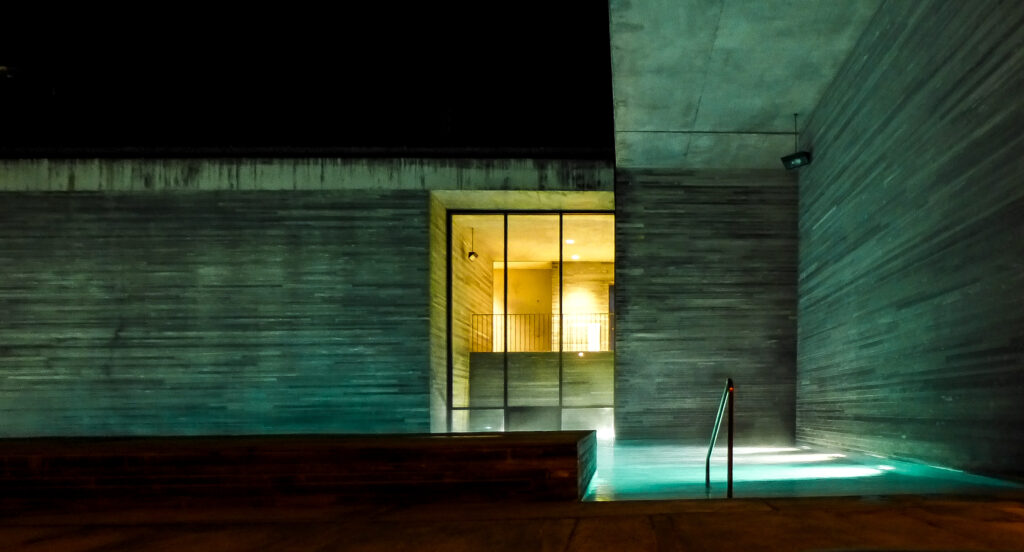

Zumthor emphasizes the manner in which the expression of elemental textures, eventually delivered to phenomenality through meticulous craftsmanship, initially emerged from attention to affordances of site:
We observed the place, its surroundings. We were interested in the stone roofs, their structure reminiscent of reflexes on water. We walked around the village and, suddenly, everywhere there were boulders, big and small walls, loosely stacked rough plates, split material; we saw quarries of different sizes, slopes cut away, and rock formations. Thinking of our baths, of the hot springs pushing out of the earth behind our building site, we found the gneiss in Vals more and more interesting; we started looking at it in greater detail—split, hewn, cut, polished; we discovered the white “eyes” in what is called augen gneiss, the mica, the mineral structures, the layers, the infinitely iridescent tones of grey.[50]
It is the particular structure of this stone that catches the eye and leads to a closer investigation of its properties; it is the stone’s particular situation in this place that begins to inspire architectural ideas. When Zumthor speaks of form, the order of process is similar:
Form is not something we work on—we apply ourselves to all the other things. To sound, noises, materials, construction, anatomy, etc. The body of architecture, in the primary stages, is construction, anatomy: putting things together in a logical fashion. These are the things we apply ourselves to, while at the same time keeping our eye on place, and on use. That is all that is demanded of me—here is the place, on which I may or may not have some influence, and this is the use. We generally create a large model, or a drawing. Usually it’s a model. And sometimes you can see at that stage that it feels right—things are coherent. And then I might look at it and say: sure, it coheres, but it isn’t beautiful. So at the end of the day I actually do take a look at things. What I find is that when things have come out well they tend to assume a form which often surprises me when I finally stand back from the work and which makes me think: you could never have imagined when you started that this would be the outcome.
One begins with materials, with their properties, with place, and with the problem of coherent construction. Beautiful form emerges from the way in which these come together, and through adjustments to their disposition. It does not stem from a priori ideas.[51]
This order of architectural practice matters because it allows unconscious determinations to enter into the process of composition: memories, feelings, sensations that emerge in the investigation of relationships between materials and places. Moreover, this openness to contingencies of process, through the investigation of materials and places, relays the welling up of thoughts and feelings to those who experience the architectural environment. In the case of Therme Vals, Zumthor notes in this respect not only the use of local stone in the buildings of the town, or the rocks dotting the green hillsides, or the source of the spring behind the building site, but also of histories and local structures spanning radically discrepant timescales: an old advertisement for Vals sparkling water featuring an image of “The Vals Valley 80 Million Years Ago,” showing low mounds of earth immersed in a primordial lake, or the cathedral-like interior of the nearby Albigna dam, built with stone and concrete.[52]
Of course, these histories and materials—in the fragility of the emotions they generate—are vulnerable to appropriation. Zumthor describes his move to Graubünden and his purchase of a small farmhouse in Haldenstein, after his studies at the Pratt Institute in New York, as part of his immersion in “the spirit of ’68.” He explains that his political orientation, and that of his friends among Swiss Germans in the late 1960s and 1970s, was set against the relevance of “art” and “design,” and that he was then involved in the Bauernhausforschung project, inventorying farmhouses in Graubünden for some ten years before finally making his way toward a career in architecture.[53] Zumthor speaks of Therme Vals as “purely a project of the community,”[54] and one might view it not only as a personal reconciliation of his locally oriented politics of the late 1960s and early 1970s with his modernist architectural education, but also, more generally, of the communal ethos of that period with the formal possibilities of minimalist abstraction, so resonant in his preparatory studies. “The Thermal Baths in Vals were never envisioned as a marketing product that would attract attention through name recognition or by being an architectural landmark,” he notes. “The overriding concern throughout was the quality of the services: bathing as an experience and a ritual…We architects were able to think the Therme Vals in radical terms because the people in Vals permitted us to think in radical terms.”[55] This was possible because of the income the community drew from sales of sparkling water and because the President of the community-owned hotel and others were able to rally citizens of the village around Zumthor’s project at town meetings.
By 2012, however, the commune was unable to afford necessary renovations of the hotel complex dating from the 1960s, and the spa and hotel were sold to local property developer Remo Stoffel for 7.8 million Swiss francs, concluding a battle for ownership between Stoffel and Zumthor himself.[56] Though it was voted through by the citizens, Zumthor viewed this sale as the end of the communal ethos of the baths: “This project was a social project, me and my wife lived there for almost twenty years with the community and it was owned by the community and was successful. It now belongs to a financial figure who bought all of it and destroyed it. The bath is a landmark so nothing will happen to the bath, but this social project is dead.”[57] Visiting in 2022, it was hard to disagree with that judgment. The Therme remains open to residents of the village at a reduced rate, but, overall, the site operates as a luxury resort, with packages including helicopter flights to an alpine glacier.[58] The beauty of the baths remains inviolable, but the emotional experience of that beauty is indeed compromised by the economic conditions of possibility for accessing it. Though ownership of the baths reverted from Stoffel to the municipality later in 2022, that seems unlikely to change.
Excursion: Swabia
May 24. The source of the Danube is disputed. The river rises from the confluence of the Brigach and the Breg in Donaueschingen, the site marked on the shore by a stone engraved with the distance in kilometers to the Danube delta of the Black Sea, 2779. Symbolically, the Donauquelle is located at a spring on the grounds of the Donaueschingen castle, marked by an ornate circular pool with allegorical statues (1895) by Adolf Heer, and by a small temple where the spring flows into the Brigach beside Schlosspark Donaueschingen. Here elms lean over the river banks, the current sweeps flowing algae toward the confluence with the Breg, and swans swim slowly upstream.
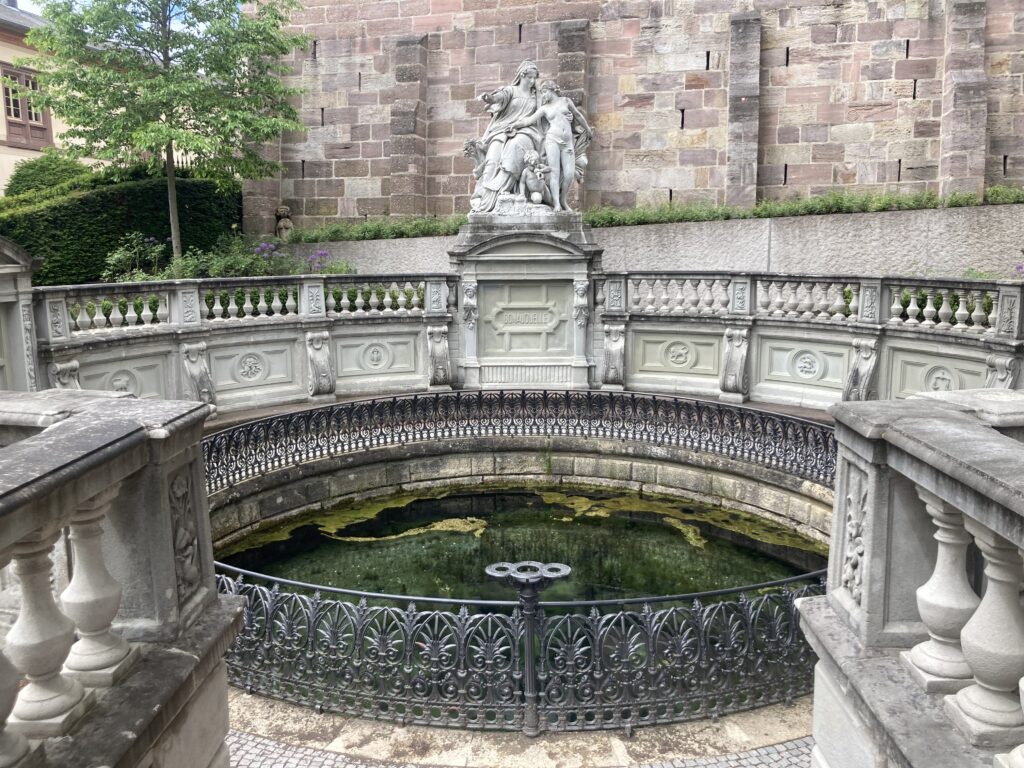
Hydrologically, however, the source of the Danube is the source of the Breg in Furtwangen, which is marked by a humbler plaque claiming it as the Donau-Quelle. In 1981, the Minister of the Interior of Baden-Württemberg declared that the source of the Breg should no longer be named as the source of the Danube on official maps, inflaming a decades-long rivalry between the two towns.
Whatever the case may be, at the site where the flowing water takes on the determinacy of the name—Donau—just where the Breg and the Brigach come together, it is now a highway overpass that dominates the site. As of May 2022, its concrete pillar bore the graffitied inscription ACAB (All Cops Are Bastards) which may be a more apt commentary than allegorical statuary or municipal rancor on the course of the relation between Nature and History in the twenty-first century.
If at the Donautempel one thinks of Hölderlin, watching the swans dip their heads in the holy sober water, here one might think of him being hauled off by the authorities to Authenrieth’s clinic in Tübingen, where he was encouraged to accommodate himself to the way of the world by having a mask strapped to his face to prevent him from screaming. Doch Alles geht so.
May 23. The star-shaped ornament has gone missing, but water still flows continuously from the wooden stem of Heidegger’s rustic fountain into the hollowed log beside the Hütte in Todtnauberg. It’s a lovely place, long grass blowing the wind, wild flowers running downhill into the nestled valley, green Schäferkopf shutter holders peering out from the wood shingle siding. One is not, however, struck by the recessed mystery of the site. It’s a little retreat just outside of town, a second property, not a Brothers Grimm hermitage lodged deep in the forest.
May 25. On the other hand, no matter how familiar one may be with its image or how often one has contemplated the strange destiny it embodies, the Hölderlinturm resonates more powerfully than expected with the beguiling contingency and symbolic weight of its location on the Neckar. Ensconced in mournful willows alongside the Tübingen Stift, where clusters of roses bloom on vines in the courtyard, it sits as well across the river from the Plantanenallee on the Neckarinsel, which leads down to the memorial of Swabian lieder composer Friedrich Silcher (1789-1860), erected by the Nazis in 1941. Silcher’s arrangements of Volkslieder were published in songbooks distributed to German soldiers, like the field volumes of Hölderlin’s poems. Signboards by the monument show photographs of the foundation stone ceremony in 1939: columns of plane trees bedecked with swastika banners. Graffiti on the monument itself reads NAZI DENKMAL.

Stift, Turm, Denkmal—the triangle of a triple catastrophe: the failure of philosophy to cultivate the rational determination of history; the incompatibility of Hölderlin’s social and historical world with the ground of his vocation; the reactionary incorporation of deutsche Gesang into the project of genocidal ethnonationalism. The leaves of the plane trees rustle overhead along the Neckarinsel; the peak of the Turm glistens in the sunlight to the north; here in the courtyard of the Stift, just to the west of the Turm, the vines stem from the earth and rise up the walls—hier ist die Rose, hier tanze. The river murmurs as it passes by. We are on our way up the Rhine to Cologne.
Air: Kolumba Museum
In those days Germany, a hectic flush on its cheeks, was reeling at the heights of its savage triumphs, about to win the world on the strength of the one pact that it intended to keep and had signed with its blood. Today, in the embrace of demons, a hand over one eye, the other staring in horror, it plummets from despair to despair. When will it reach the bottom of the abyss? When, out of this final hopelessness, will a miracle that goes beyond faith bear the light of hope?
–Thomas Mann, Doctor Faustus
In May 1942 Cologne was subjected to the RAF’s first “Thousand Bomber Raid,” in which some 1500 tons of bombs were dropped on the city, destroying much of its medieval core. On June 29, 1943, over ninety percent of the city was left in ruins by British and American bombardments. By the end of the fire bombings inflicted upon German cities toward the end of the war, with massive air raids in October 1944 and March 1945, Cologne was reduced to skeletal remnants presided over by the dark form of its magnificent Cathedral, the construction of which had begun in 1248 and was completed in 1880, now damaged but not destroyed.
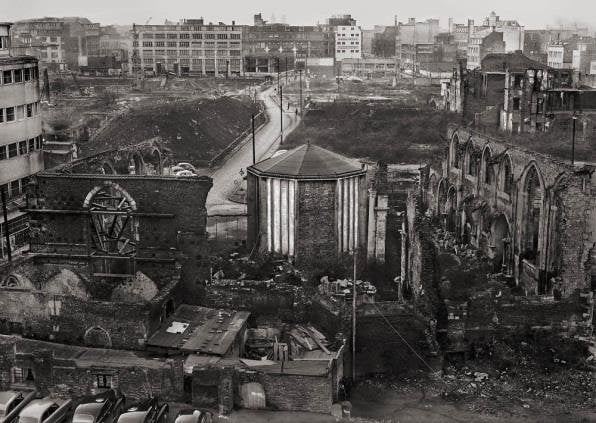

Figure 50, Chapel, “Madonna in den Trümmern” (1947), Gottfried Böhm
Southwest of the Cathedral, St. Kolumba church had lain in ruins since 1943, its original Romanesque structure dating at least to the ninth century, its Gothic renovation from the fifteenth. Parts of several walls remained, preserving the hollow form of their early Gothic arches, along with the base of the Romanesque tower and, standing exposed to the elements at the crumbling northeast pillar of the former nave, a statue of the Virgin and Child—the infant headless, the Mother of God’s downcast eyes gazing diagonally into the rubble. The statue would come to be venerated as the Madonna in the Ruins, and in 1947 Cologne architect Gottfried Böhm was commissioned to build a chapel around it, an octagonal sanctuary completed in 1950 with choir windows by Ludwig Gies installed in 1954. The windows convene flights of angels, nearly abstract grey and beige diagonal planes across the verticality of narrow blue panels, their round yellow faces at once innocent, solicitous, perplexed, as if having just arrived from the heavens to see what might be asked of them in this fractured place, where shelter is so fragile.[59] In 1973, archaeological excavations uncovered vestiges of Roman buildings, along with further traces of the medieval and Gothic churches. Ruins above and ruins below—relics, remnants, riddles, traces of transformation both abrupt and gradual, intentional and unforeseen, catastrophic and callous or tender and careful, replete with imagination, memory, and hope.
May 27. The architecture of Zumthor’s Kolumba Museum seems to breathe, in and out, the dialectic of shelter and exposure with which the site is suffused. Commissioned in 1997 and completed in 2007, the building preserves the walls of the older churches as part of its own, it folds the whole of Böhm’s chapel into its enclosure, and it holds open a space for the archaeological excavation. At the heart of the ground floor is a vast room supported by slender forty-foot pillars rising from the open ground of the excavation, the depths of which are traversed by a zigzag footbridge of red sandalwood with wide, sumptuously polished handrails.
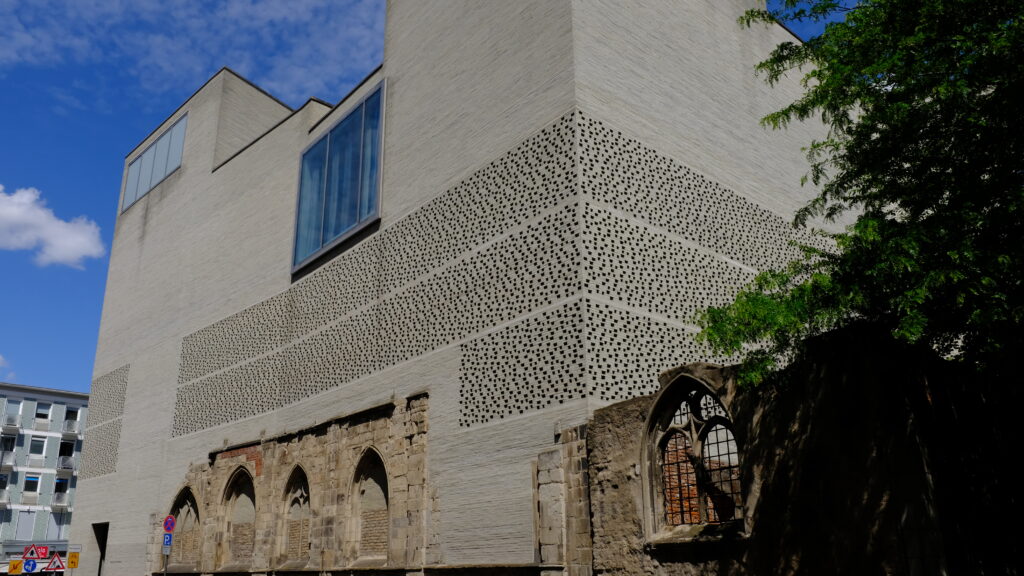

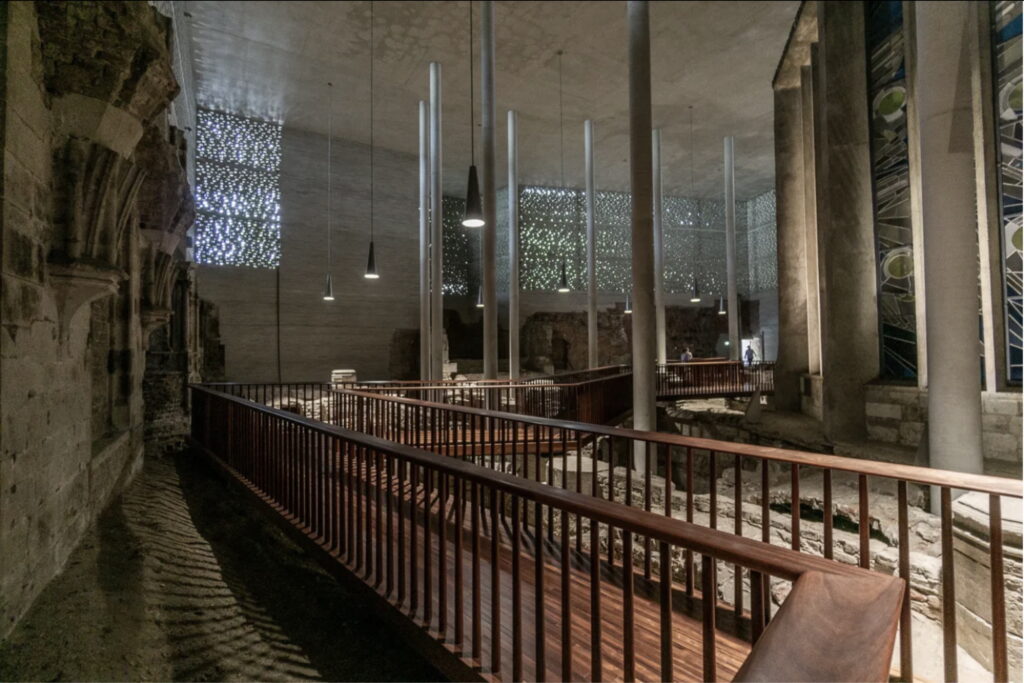
With the ruins below spot-lit by conical pendant lights, descending from the ceiling high overhead, the bridge leads here toward the arches of the medieval ruins, there toward the stained glass windows adorning the octagonal form of the sheltered chapel, allowing one’s gaze to drift down into the ancient stones or up toward perforations high in the warm grey brick work, rising over the older walls, through which light and air flow from outside, illuminating angels in cerulean glass, speckling the matter of centuries, and flickering—absences themselves composing abstract artworks—with intimations of exteriority. The red-brown warmth of the footbridge; the illuminated stones of the open ground; the dark survival of arches and pillars; the lighter grey of the brickwork rising above; the bright blue and yellow of the stained glass: all of these constitute a single space that seems to be composed of fragility and endurance, in which the tension between these amounts to the composition of space itself. In the reflective atmosphere of this room, at once meandering and still, calm and brooding, the openness of space itself seems to be unveiled and protected.
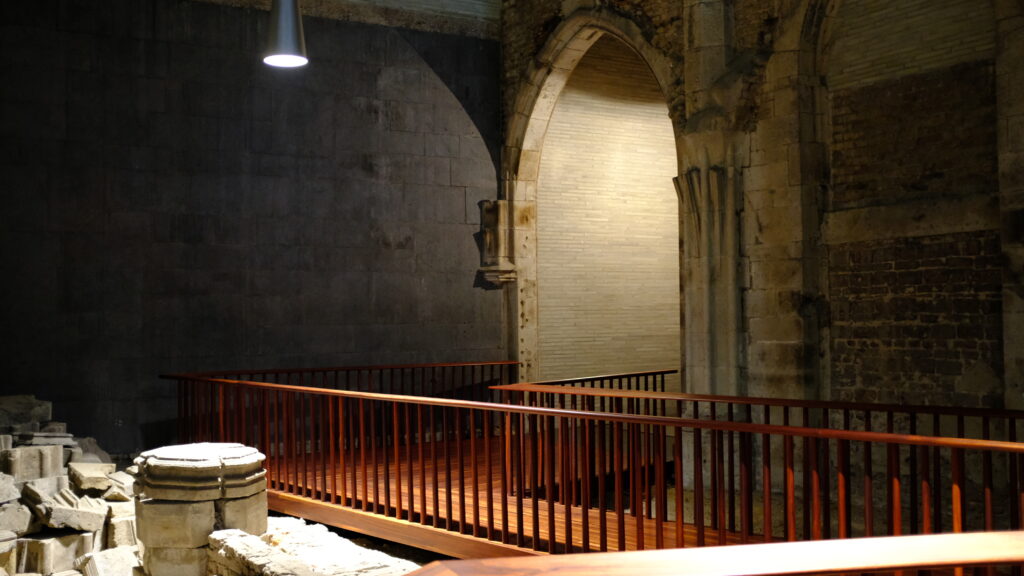
One feels powerfully, yet with a certain lightness of determination, how vulnerable are all our projects to the vicissitudes of history, to the carelessness of our ambitions and the blunt stupidity of violence, how everything that we infuse with form and spirit may collapse back into hunks of matter, a heap of broken fragments, yet may also be recovered, reconstructed, preserved and witnessed—indeed, worshipped. The footbridge ends in an iron gate passing back outside to a small courtyard, enclosed by the gothic walls of the former sacristy and marked by the somber weight of Richard Serra’s sculpture The Drowned and the Saved (Die Untergegangenen und die Geretteten, 1992), its title drawn from Primo Levi and its two L-shaped pieces of forged steel mutually supporting one another to form a horizontal beam.
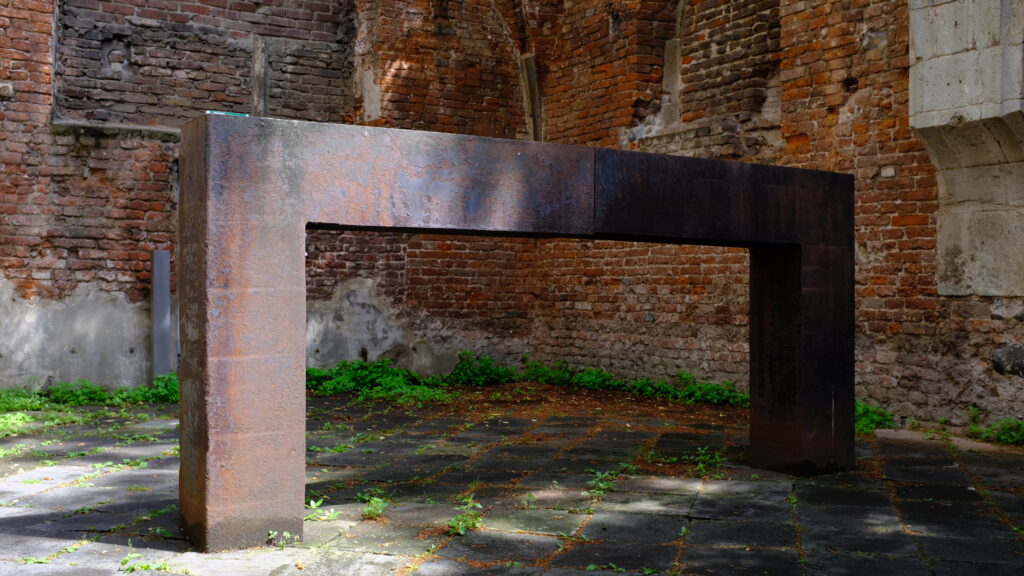
As one approaches Kolumba from the east, walking west from the Rhine along Brükenstrasse, one passes by this courtyard formed of the old sacristy, into which one can see through the empty arch of an original window. One then turns the corner north onto Kolumbastrasse, where the basalt wall of Böhm’s 1956 extension of his chapel remains, built into the massive western facade of the new structure. At the northern edge of the basalt wall, a large, smooth handle is carved directly into the black stone of the door, opening into the chapel where a round basalt altar marks the center of the sanctuary, with the Madonna in the Ruins suspended on the wall between the stained glass windows which one sees in the round from the interior room on other side.
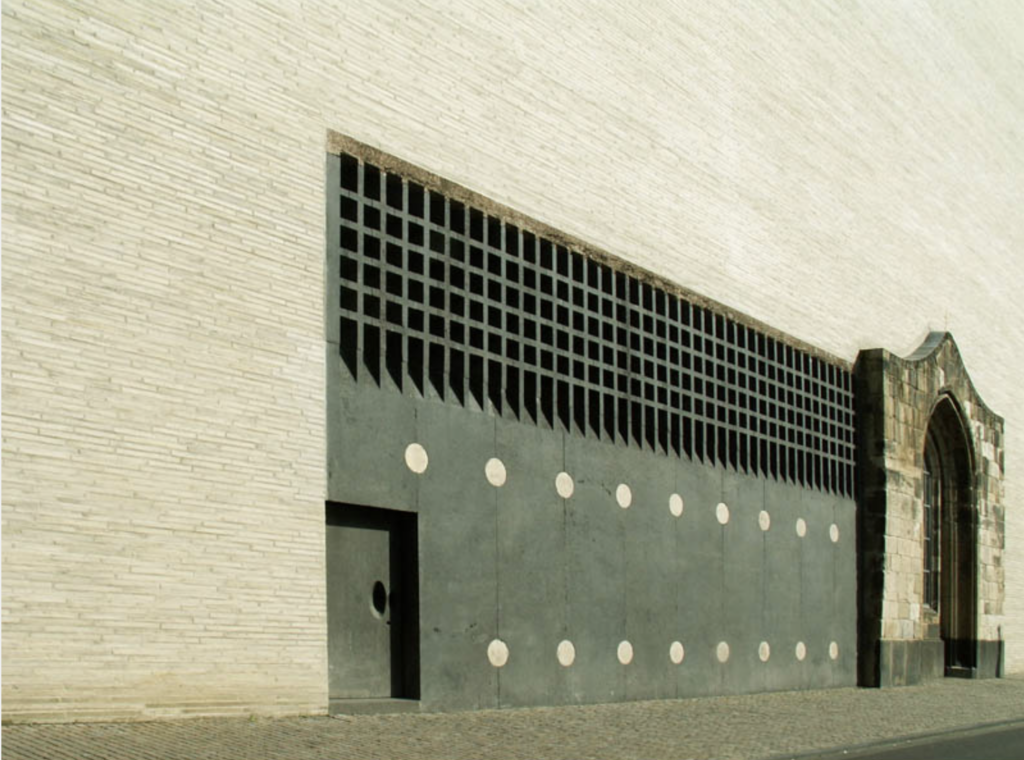

Entering the foyer of the museum, floor-to-ceiling windows on the left look out onto a large open courtyard, occupying the former site of a medieval cemetery, accessible through glass doors with slender rectangular handles wrapped in strips of dark leather. Eleven tall, spindly honey locust trees rise into the open volume, their wispy foliage filtering the light, their narrow trunks demarcating the bed of stones strewn throughout, scattered with chairs to sit and reflect. The southern wall of the courtyard offers a clear view of the brick masonry intersecting with medieval columns and arches.[60] The lower eastern and northern walls are built of rammed concrete, its earthy beige layers conveying, already, a material sense of the sedimented histories one will encounter in the excavation room. A long stone bench, running below the surviving arches, is the permanent plinth of a sculpture by Hans Josephsohn, Large Recumbent Woman, a dark, seemingly charred figure lying on its back gazing up at the sky.
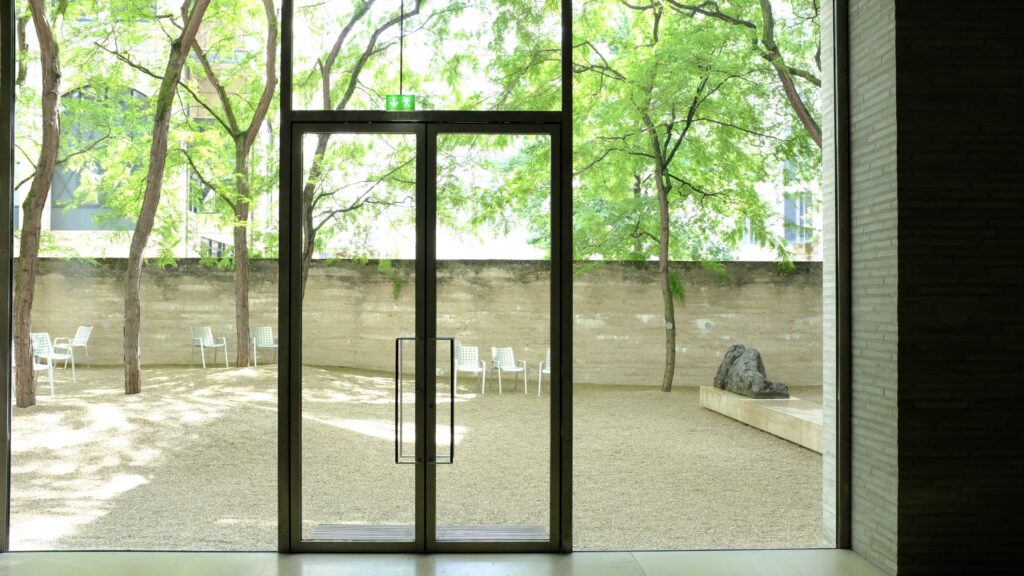
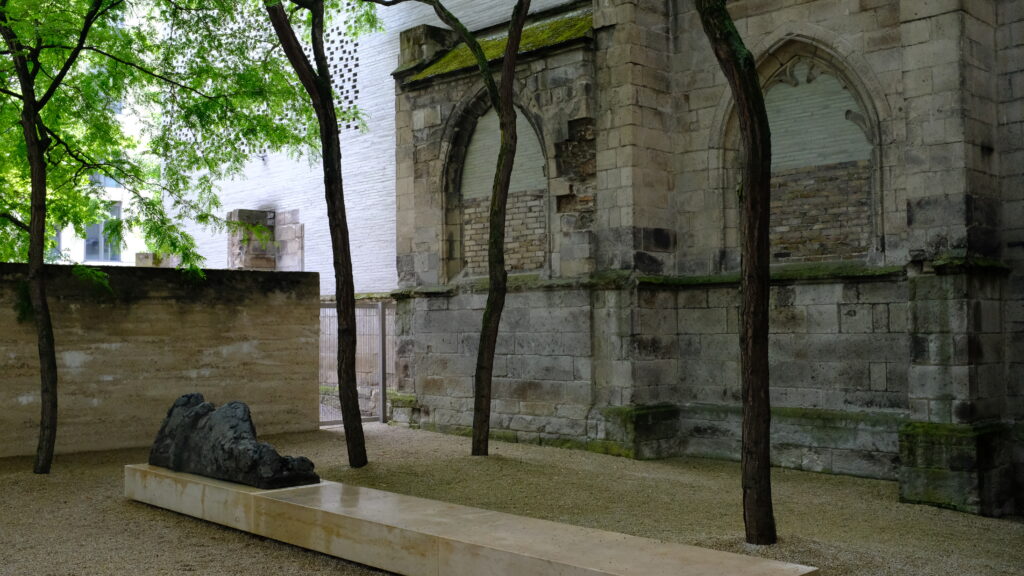
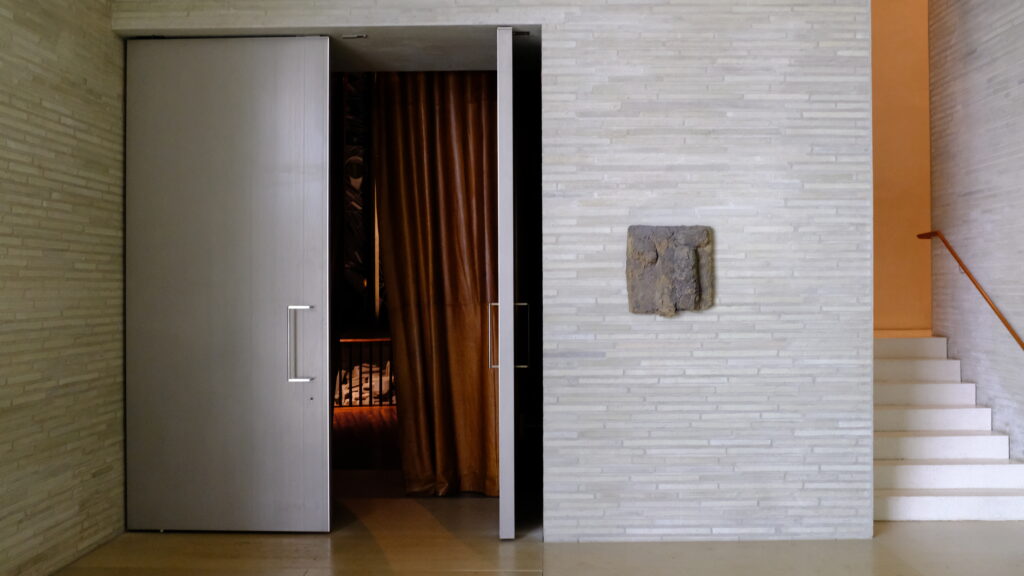
Returning to the foyer, large double doors of metal open onto a small antechamber divided from the excavation room by heavy brown leather curtains. To the right of the doors, a dark narrow staircase leads upward toward a concrete wall, before turning back toward the upper floors. The railings are polished teak, a warm contrast to the steel railings of Kunsthaus Bregenz, just as the warm yellow glow of the lighting so markedly shifts the mood from the turquoise, aqueous illumination of Zumthor’s Bregenz staircases, which poured through the etched glass above. Here the passage from one floor to another is more deeply contemplative, as if to emphasize the predominance of affective interiority over the phenomenal and structural virtuosity of the museum on the Bodensee. The mood is religious, preparing our disposition to encounter the collection of the Archdiocese of Cologne, housed on the levels above. As at Bregenz, the space of the exhibition floors glows with the silky polish of continuous terrazzo poured between lustrous concrete walls. Exterior light from vast yet sparsely interspersed windows gleams around corners, while spot lights illuminate works in display cases of stained laurel grain veneer and starkly outlined rectangular openings in the walls reveal darker interior galleries, slightly raised above the floors of the concourse to mark each passage into these other worlds.
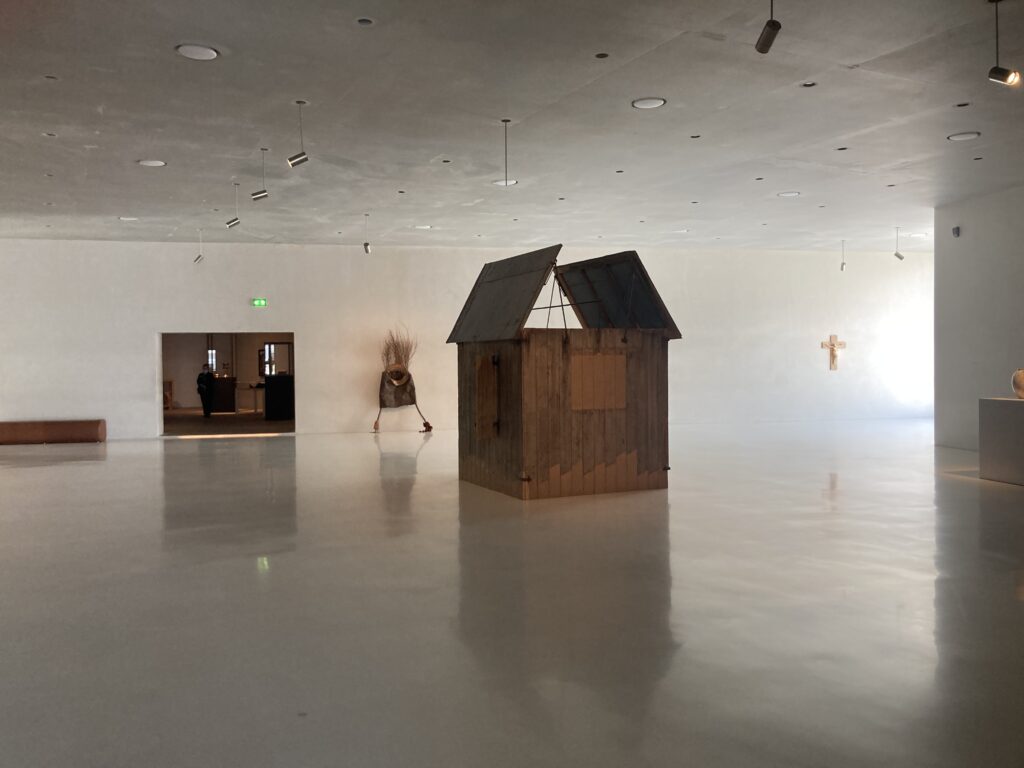
The first level over the ground floor passes above Böhm’s chapel and alongside the double height of the excavation room, lending a sense of spatial contiguity with the vast expanse sheltering the ancient stones. The uppermost floor then covers the entire footprint, curving around the central courtyard and housing one of the museum’s major decorative and emotional flourishes—its reading room. Here the minimalist restraint of the building gives way to relative luxury: walls and ceilings paneled in veneers of kava wood cut along its “pyramids,” vectors and branches of lighter wood decorating the warmth of its brown hue.
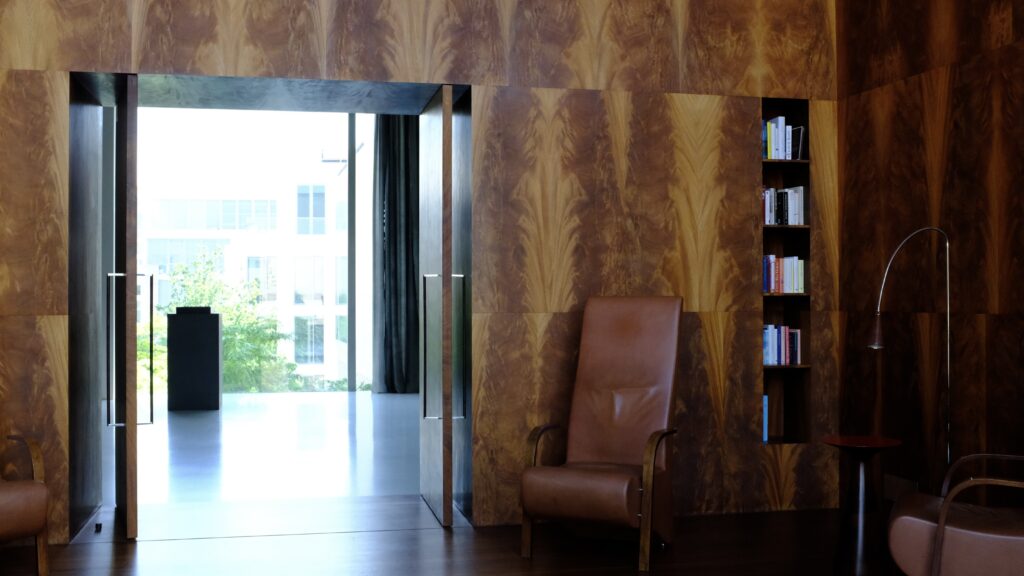
Brown leather chairs and benches rest on mahogany floors beneath delicate pendant lights of circular glass suspended from curving wires which recall, descending from above, the curving trunks of the honey locust trees in the courtyard. A vast window across the whole western expanse of the room illuminates its interior, filtered by grey curtains of light silk, tinted with yellow or pink according to the light. Finally, a room in the northeast corner, the last into which one passes, displays the finest of the museum’s treasures: Stefan Lochner’s gorgeous Madonna with the Violet (c. 1443)—double of the Madonna in the Ruins, beneath, and kin of Lochner’s altarpiece, Adoration of the Magi, housed in the Cathedral and constituting the spiritual center of Cologne. In the northeast corner of the room a large window looks out over the courtyard below toward the Cathedral itself—that stony, obdurate miracle of architectural commitment and historical persistence, its dark spires anointing the impassive sky.
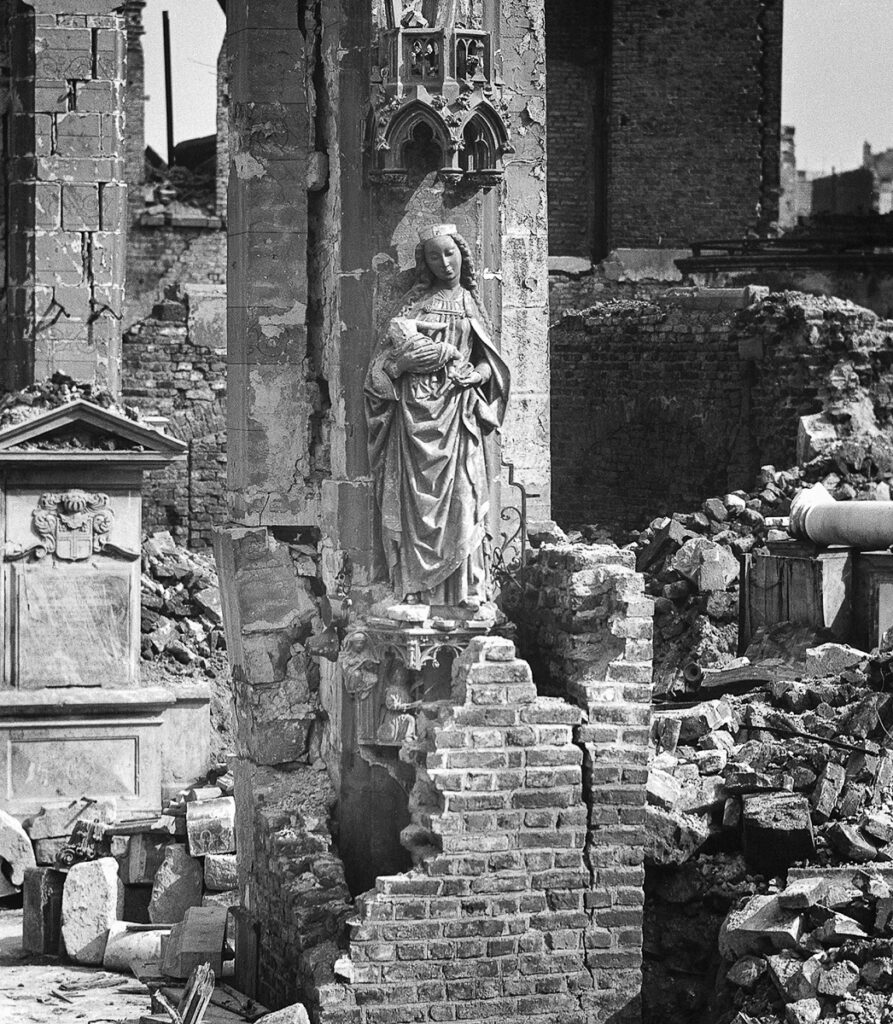
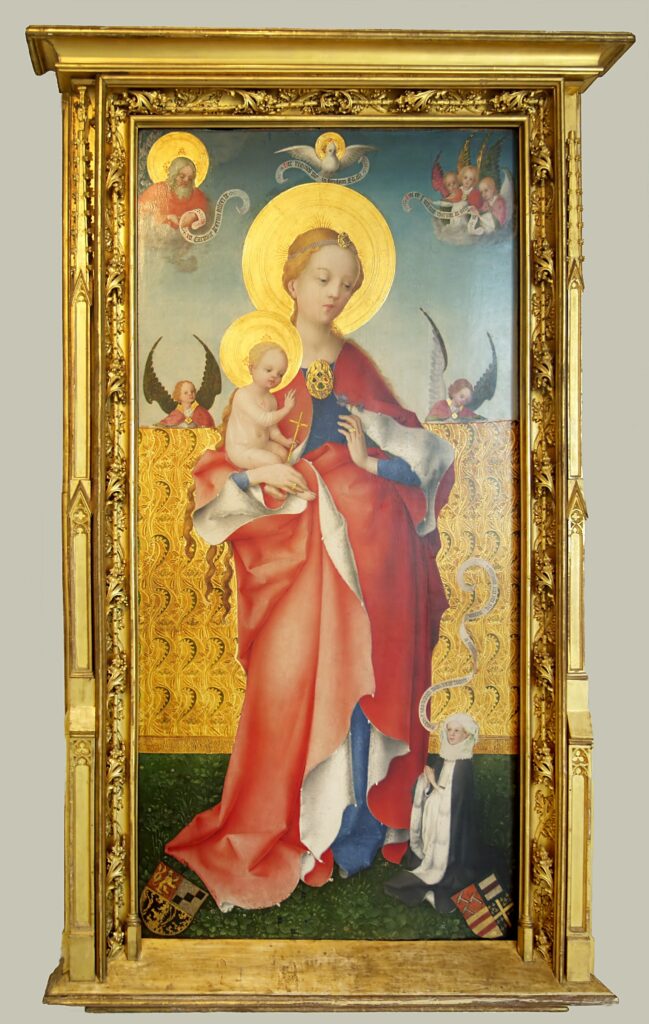
Figures 62 & 63, “Madonna in den Trümmern” and Stefan Lochner, Madonna with the Violet (c.1443)


Fire: Bruder Klaus Field Chapel
May 28. Reduction. Inside the chapel, the charred, serrated, concave indentations of its walls rise toward a teardrop oculus overhead, into which the space inclines as it ascends. This is the primal impression of the enclosure: rough, dark, burnt matter, texturing an ascension toward light that appears as a two-dimensional surface, a shape cut out of the sky, abstract form of the open. A wheel with six spokes extends overhead from the conical walls on a single iron shaft, and dots of light glimmer here and there through small blown-glass spheres, somehow embedded in the rough concrete. This is a very simple space: a unified curve expanding from the triangular steel doorway into an oval room with a lone bench, a rectangular steel votive stand for candles, and, mounted on a narrow stele, the bronze cast of a head resembling Bruder Klaus, whom the chapel venerates. When it rains, water collects in a shallow depression in the center of the lead floor. But in its simplicity, this is a harrowing setting. The gaze inclines inevitably upward, but the soul bends in stricken humility, as if itself scorched by whatever fire blackened the rough-hewn surface of these striated walls.
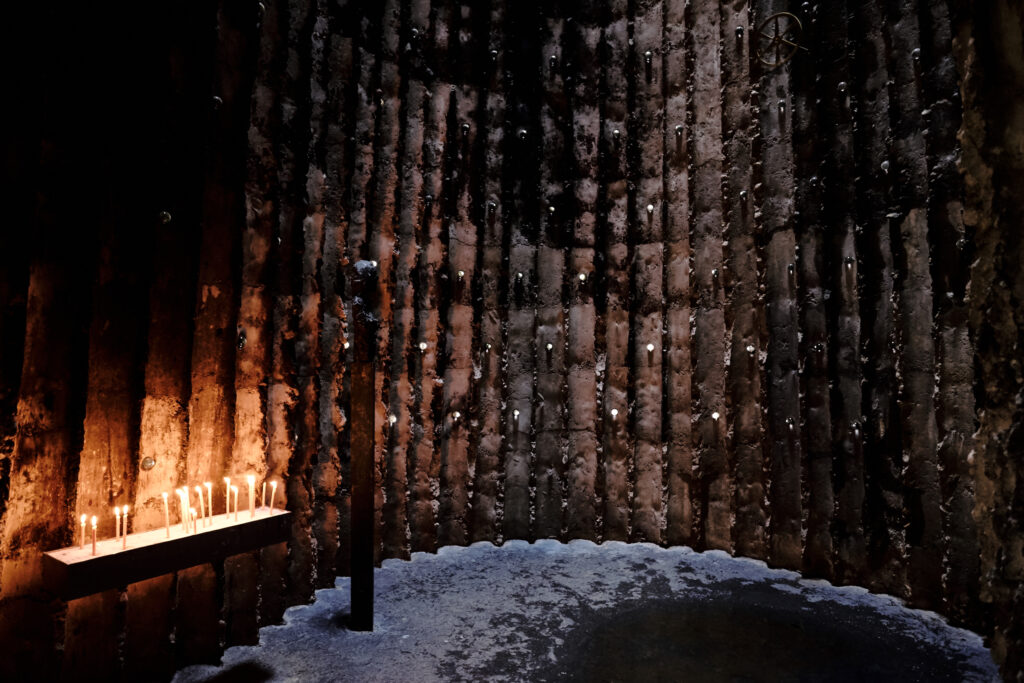
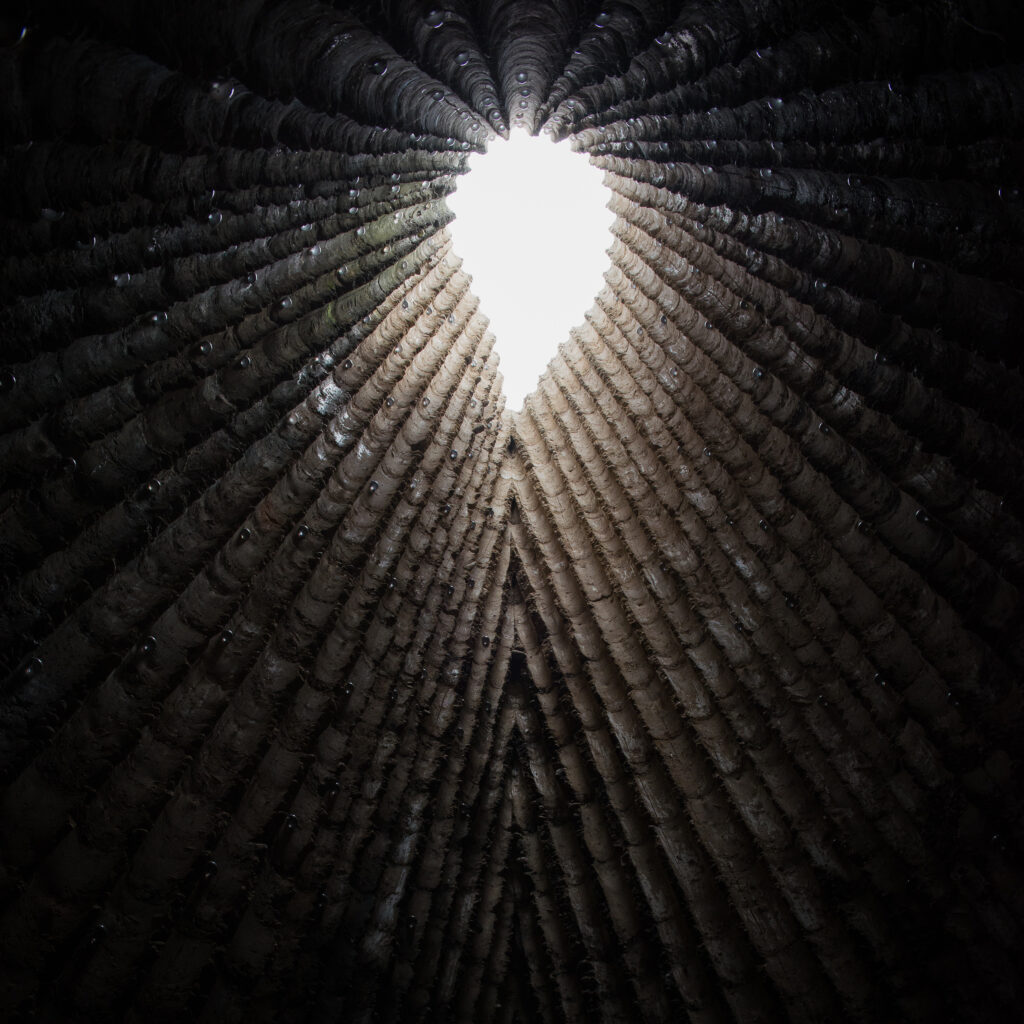

A certain doomed tranquility prevails, a primordial insufficiency to one’s surroundings that still feels, somehow, as though it is enough. An insufficiency sufficient to surrender.
Mein Herr und mein Gott, nimm alles mir, was mich hindert zu Dir.
Mein Herr und mein Gott, gib alles mir, was mich fördert zu Dir.
Mein Herr und mein Gott, nimm mich mir und gib mich ganz zu eigen Dir.
My Lord and my God, take all from me, that keeps me from Thee.
My Lord and my God, give all to me, that brings me to Thee.
My Lord and my God, take me from myself and give me completely to Thee.[61]
Zumthor’s chapel fulfills the most basic, teleological task of Catholic architecture: it inducts the poverty of the soul into the apocalyptic grandeur of its exposure to sacred conflagration. Gently, it overawes.
The exterior form of the building is the sign of that stark grandeur. A monolithic tower rises, twelve meters high in five rigid planes, over the fields outside the village of Wachendorf. The field chapel was commissioned by two farmers, Hermann-Josef and Trude Scheidtweiler, as a place of spiritual contemplation dedicated to Niklaus von Flüe, the ascetic saint and mystic known as Bruder Klaus, who lived from 1417-1487. Zumthor cites the importance of the saint to his mother and the inspiration of his “straightforward, uncompromising character” as personal motivations to take on the project.[62]
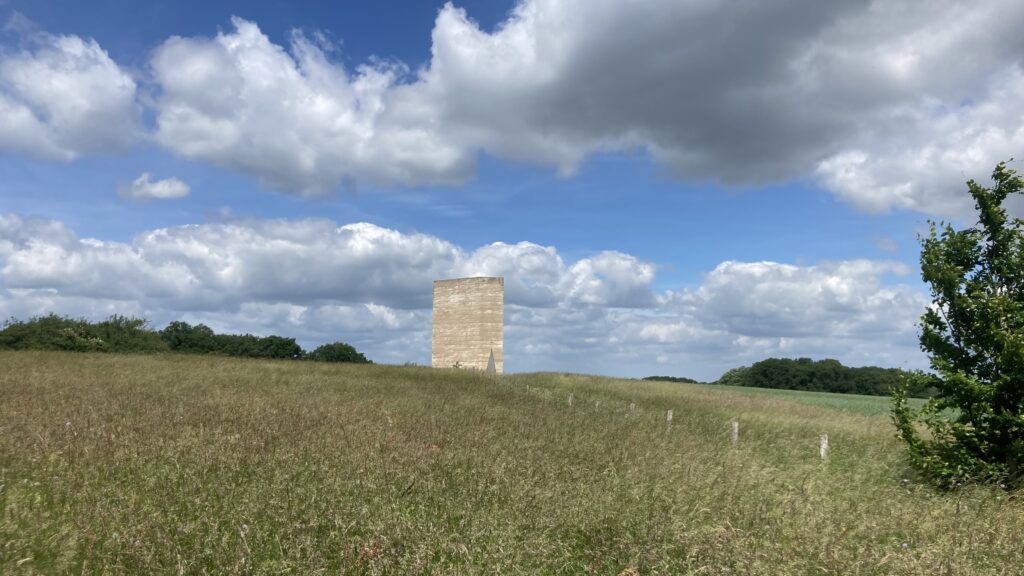
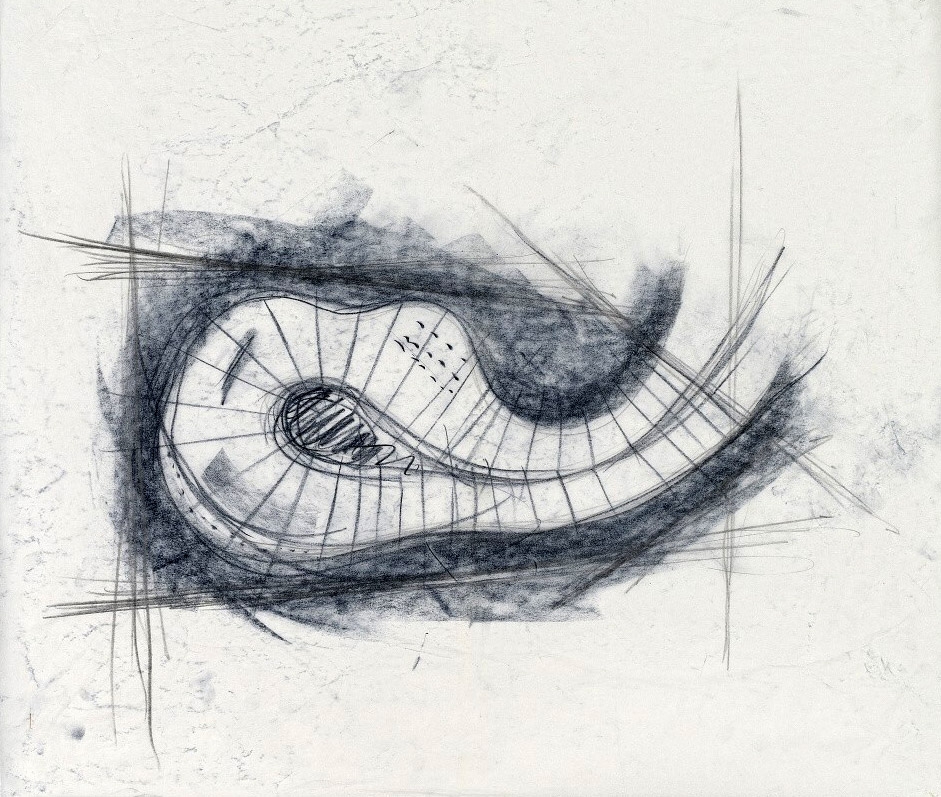

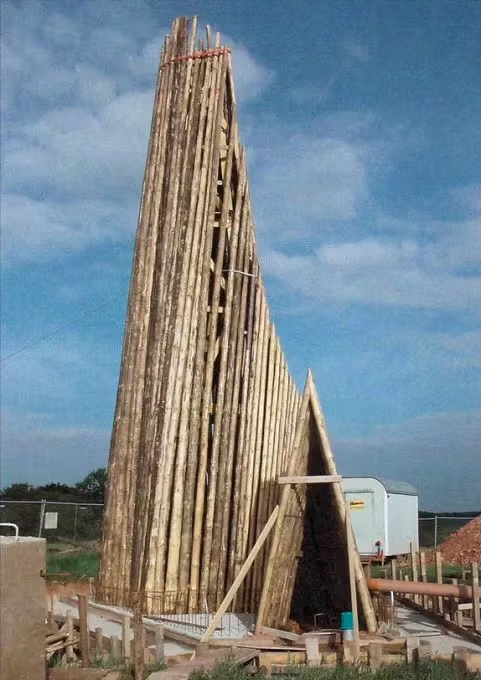
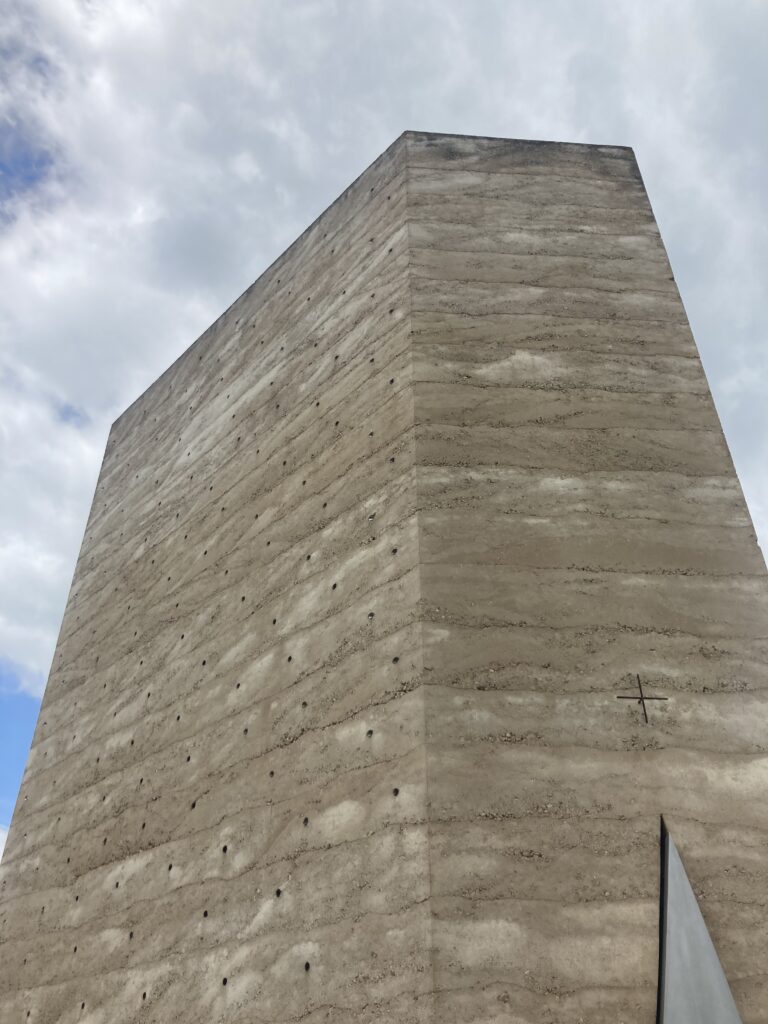
Figure 68, Bruder Klaus Field Chapel, Interior Frame; Figure 69, Rammed Concrete Layers, Photograph by Nathan Brown


Designed over the years Zumthor was also working on Kolumba, the chapel was largely built by the Scheidtweilers and their friends, who cut and trimmed the trunks of 112 pine trees, which were then formed into the teepee-like structure defining the interior space. Concrete was then mixed of local gravel and sand and packed within an irregular pentagonal frame around the timbers in twenty-four rammed layers of 50cm each over twenty-four days of work. When the rammed concrete walls were set—stabilized by hollow steel shuttering ties which would come to hold the blown-glass spheres through which points of light pass to the interior—the interior wooden frame was then burned with a slow fire over three weeks. When the scorched timbers had dried and shrunk away from the walls they were removed, leaving the open oculus above and the charred concave striations which set the tenebrous mood and the serrated texture defining the enclosure. Molten lead was poured for the uneven floor, likewise establishing a sense of the building as wrought in fire, as the cooled form of liquid heat: residue, remainder, and refuge. Yet the steel door which opens onto the curving passageway into the single room is a geometrically regular triangle, abstracting the irregular pyramidal form of the interior structure and also symbolizing the elemental essence of the building: the tetrahedron, formed of four triangles, is the Platonic solid of which fire is composed in the Timaeus.
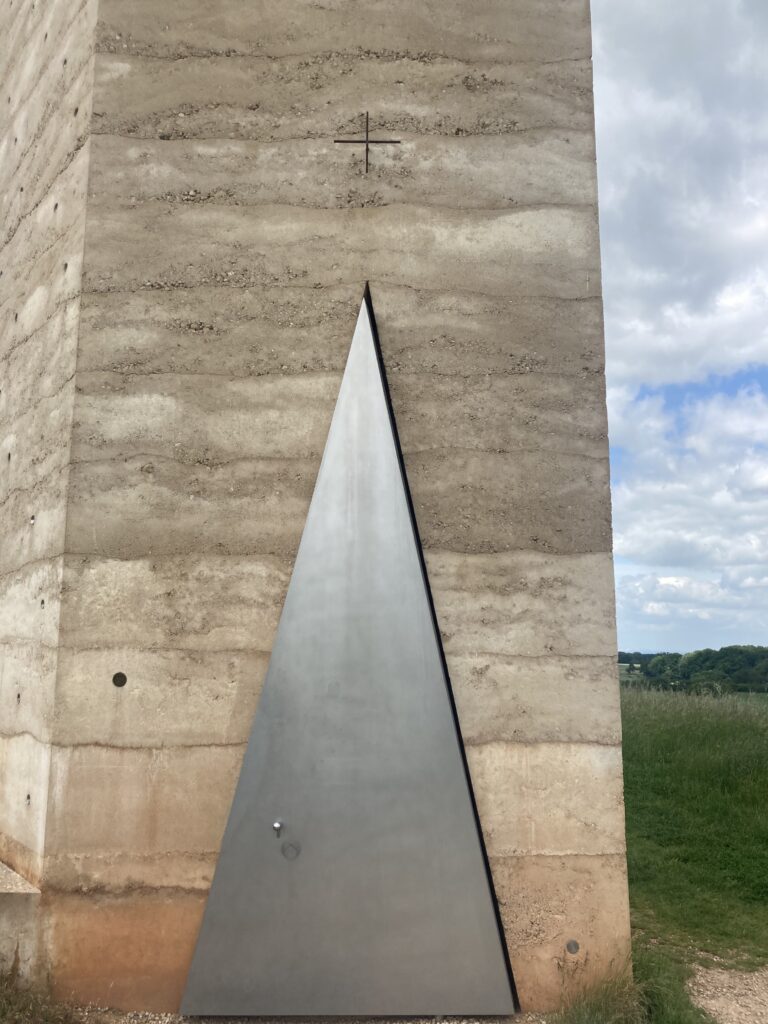

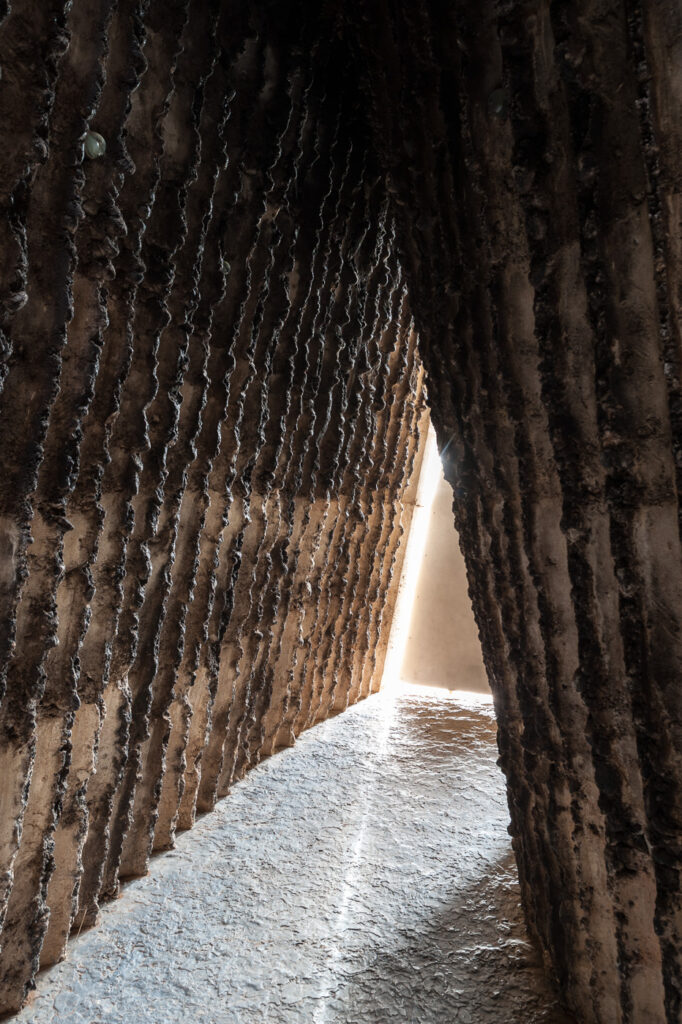
Figure 70, Bruder Klaus Field Chapel, Triangular Door, Photograph by Nathan Brown
Figure 71, Bruder Klaus Field Chapel, Entryway, Photograph by Yuri Palmin

Running one’s hand over the earthy texture of the tower’s layered exterior, one recalls the rammed concrete walls delimiting the courtyard of Kolumba. From that courtyard, one remembers as well the seemingly charred figure, staring up at the sky, of the reclining sculpture by Hans Josephsohn, who also made the stele on which the bronze head is set inside the Bruder Klaus Chapel. Indeed, the chapel in Wachendorf has a recessed yet deeply resonant relation to Kolumba and to the history of Cologne. The fire-bombing of that city unavoidably lingers in the scorched walls and the residual scent of smoke inside the chapel. It is a subtracted obelisk of sorts, the hollow interior pyramid of a vast stone monument commemorating not only a Saint who dreamed of a burst of light inside the womb, but also a city that became a grave of fire. This is a place in which the dead and the unborn rise from beneath the floor, seep in through the hollow ties in the walls, descend from the light above. A space in which the living and the dead may come to seem undifferentiated.
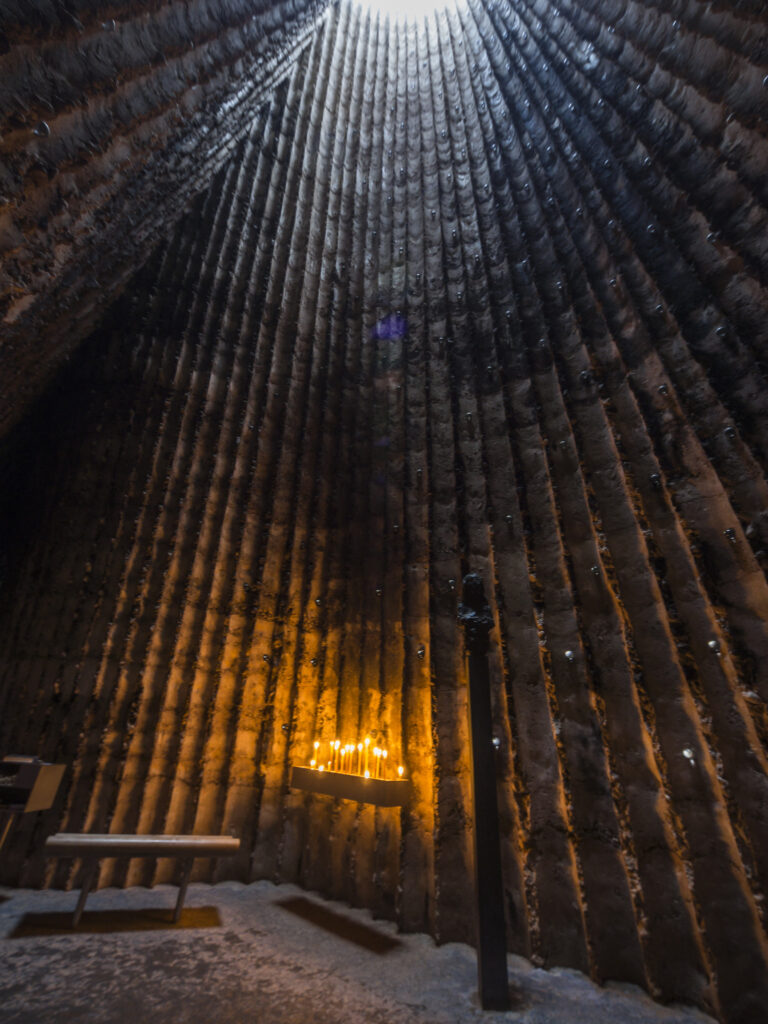
Figure 72, Bruder Klaus Field Chapel, Photograph by Lars-Christian Uhlig

Zumthor speaks in calm tones of his thinking toward the form of this the chapel: “the design became clear and elemental: light and shade, water and fire, material and transcendence, the earth below and the sky above.”[63] Yet there is something here of the extremity from which Hölderlin spoke as one struck not only by Apollo, but also by Dionysus:
So his bolt fell, the poets say,
On Semele’s house when she desired
To see the god unconcealed, and god-struck
She bore holy Bacchus, thunder’s fruit.
And so the sons of the earth now drink
Heavenly fire without danger.
Yet we are bound—o poets!—to stand
Beneath the god’s thunder with bare heads
To seize the Father’s bolt itself
In our hands and pass the heavenly gift,
Folded in song, to the people.
For only if our hearts are pure,
Like children, our hands blameless,
Will the Father’s bolt not sear them,[64]
Dedicated to a Saint, the Bruder Klaus Field Chapel is also a place of meditation and absolution for those of us whose hands are not blameless, which have been seared by a bolt from on high. Folded in song? Poetry speaks, even sings, but the element of which Zumthor’s work is finally composed, the element of architecture, is silence. Here that silence, ripened by decades of architectural practice, has truly been dipped in fire.
Coda: Beyond Happiness
But if you,
And this must be said,
All you ancients, did not say, from whence?
We name you, under holy compulsion, we
Nature! name you, and new, as if from the bath rises
All that is godly born.
Hölderlin writes these lines in the early nineteenth century, one among a generation of epochal thinkers, dreaming of a Swabian republic, of the spread of freedom and equality throughout Europe, of its deepening into something called the communism of spirits, of one’s limited yet indispensable role in a world historical project on the cusp of coming to fruition. The “we” to whom Hölderlin refers names “Nature,” as if for the first time, amid the making of a new history to which the project of aesthetic education would be an essential contribution. Hölderlin does indeed lay claim to nothing less than the identity of phusis, poiesis, and techne. But his life is shattered by the intersection of that claim with historical, existential, and psychological determinations beyond his grasp. Then it is saved by Ernst Zimmer and his family, who give Hölderlin a place to be and a community to be with, a home, there along the banks of the river he loved so well.[65]
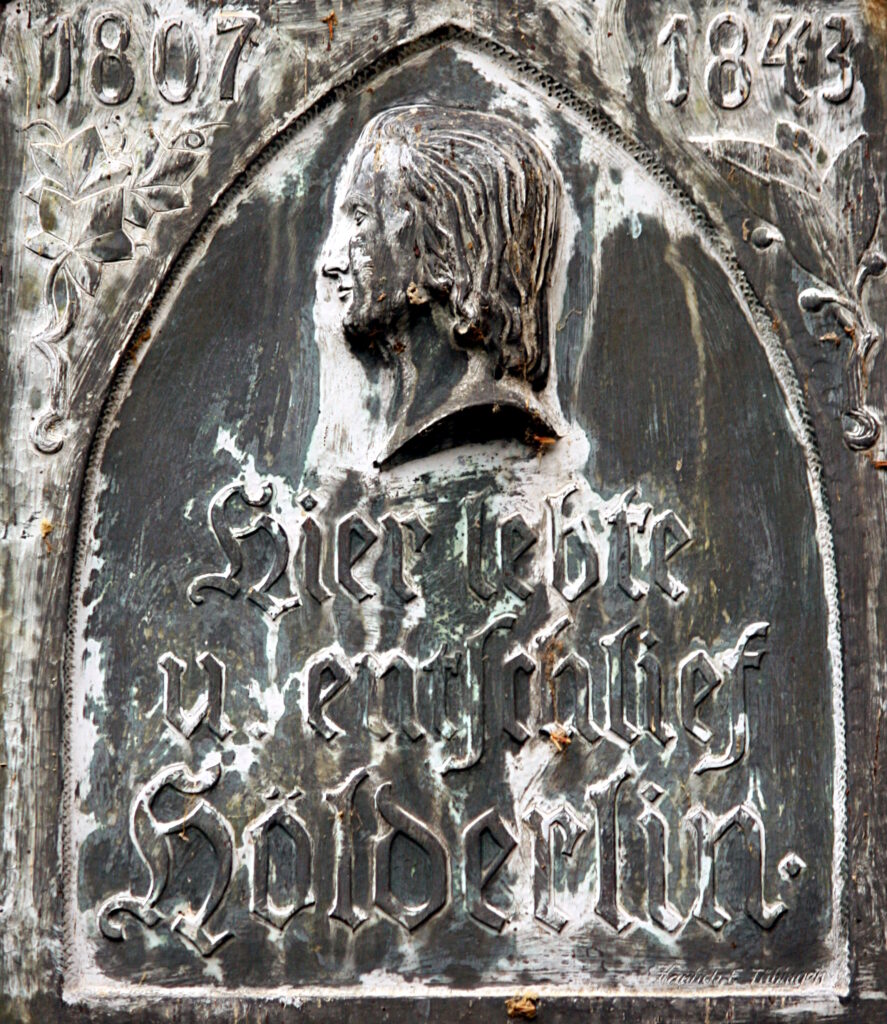
Figure 73, “Here lived and rested Hölderlin,” engraved plaque at the Hölderlinturm

What thou lovest well remains
the rest is dross
What thou lovest well shall not be reft from thee
…
Learn of the green world what can be thy place
In scaled invention and true artistry,[66]
~
nothing matters but the quality
of the affection—
in the end—that has carved the trace in the mind
dove sta memoria [67]
In these lines from the Pisan Cantos, one is meant to feel the weight of the contradiction between Hölderlin’s proto-communist republicanism and the disaster of Pound’s modernist fascism, as well as the difficult correspondence between the beauty of Pound’s verse, the searching free rhythms of Hölderlin’s hymns, and the complex appeal to “nature” and to elemental feeling they develop. Hölderlin’s life and verse were already inscribed in and by the catastrophe of modernity, unfolding through the moment of its most hyperbolic ambitions and simplest hopes. “For this is my keenest hope,” Hölderlin wrote to his brother-in-law, “the belief that keeps me strong and active: our grandchildren will be better than we are, freedom will come one day, and virtue will thrive better in the holy warming light of freedom than in the icy zone of despotism.”[68] His hope has not been realized.
In 1993, Zumthor was commissioned to design the building for an International Exhibition and Documentation Center, “Topography of Terror,” on the site of the former Gestapo-SS headquarters in Berlin. It was to be a three story structure, built as a transparent shell articulated by a bar structure organizing rigid frames, which would constitute the different spaces of the building. The idea was to create a form that “was not meant to symbolize anything” but would rather stand lighly on the terrain and expose the site, including two piles of rubble and the excavated ruins of underground rooms that were used for torture. The ground level of the space would enclose these remainders without commentary, while the two upper levels would be “dedicated to its historical placement and documentation, its role in writing history, to teaching, interpretation, and information.” What is at issue in this twofold design is an effort to preserve the force of material facticity, prior to its explicit framing by representation and narrative. “We wanted to let this historic terrain speak for itself,” Zumthor writes, and here we might locate a commitment to elemental history, to the manner in which history might be felt among earth, stone, air, and light—framed by architecture as “historic terrain” where meaning might emerge from materials prior to discursive orientation.[69]
Immediately encountering practical and theoretical disputes, and eventually undone by difficulties with contractors, inadequate funding, and, according to Zumthor, “political machinations by the Federal Government,” [70] the building was never completed. Partial construction was torn down in 2004, and the unfinished project counts as the major disappointment of Zumthor’s career. Nevertheless, the devastation of the Second World War enters into his work through the museum in Cologne, where elemental traces of ruins do indeed speak for themselves, and in his chapel at Wachendorf, where an interior scarred by fire transmits intimations not only of the spiritual stringency of a saint, but also of the conflagrations of history. If Hölderlin’s romantic poetry draws the sense of the elements into the whole of Natur, while also recognizing the latter as instance of sentimental nomination, Zumthor’s late modernist architecture registers the historical resonance of that romantic project, the complexity of the manner in which elemental feelings mediate the relation between nature and history.
As Kolumba was completed, Peter Zumthor arrived at a simple idea for an expansion of the Los Angeles County Museum of Art, commissioned in 2008 and opening in 2026: a one level museum set between two horizontal concrete slabs, floor and ceiling, the form of which relays the bubbling up of prehistoric tar pits on the site.

The shape of the plan is something like a pool of oil, its sweeping, irregular curvature and vast windows extending over Wilshire Boulevard, where automobiles run untrammeled beneath.
The cars run in a void of utensils
—the powerful tires—beyond
Happiness
Tough rubbery gear of invaders, of the descendants
Of invaders
…
The context is history
Moving toward the light of the conscious[71]
Crude oil below, artworks above—matter formed by spirit and by history—suspended on a single plane between earth and heaven, there to be gawked at, maybe sometimes even seen, truly recognized, by the distracted subjects of late modernity.
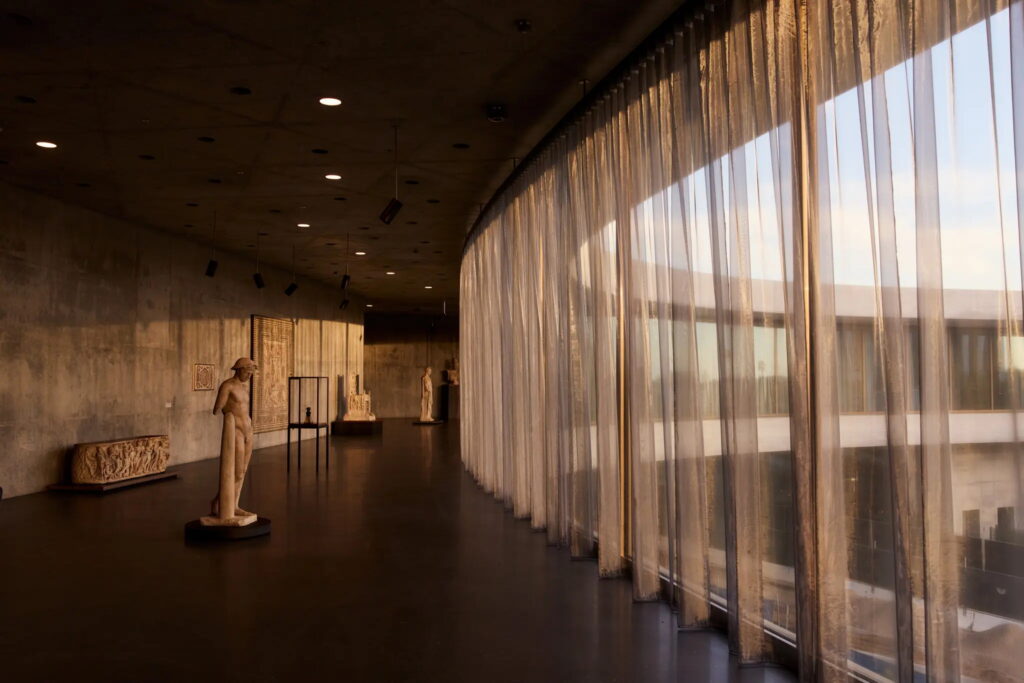
[1] Friedrich Hölderlin, Der Rhein in Hölderlin: Samtliche Werke, Vol. 2.1, ed. Friedrich Beißner (Stuttgart: Verlag W. Kohlhammer, 1951), 143. The Stuttgarter Hölderlin-Ausgabe is cited hereafter StA. Trans. Nathan Brown and Stephen Ross.
[2] Hölderlin, Der Rhein, StA 142. Trans. Nathan Brown and Stephen Ross.
[3] Hölderlin, Der Rhein, StA, 142. Trans. Nathan Brown and Stephen Ross.
[4] Peter Zumthor, Peter Zumthor: Buildings and Projects, 1985-2013, Vol. 1 (1985-1989), ed. Thomas Durisch (Zurich: Verlag Schneidegger & Spiess AG, 2014), 137.
[5] Hölderlin, Die Wanderung, StA 2.1, 138. Trans. Nathan Brown.
[6] Friedrich Hölderlin, “Homecoming,” trans. Keith Hoeller in Martin Heidegger, Elucidations of Hölderlin’s Poetry (New York: Humanity Books, 2000), 25. Translation lightly modified.
[7] Hölderlin, “Homecoming,” trans. Hoeller, 25-26. Translation lightly modified.
[8] Hölderlin, Der Archipelagus, StA 2.1, 110. Trans. Nathan Brown.
[9] Hölderlin, Der Rhein, StA 2.1, 145. Trans. Nathan Brown and Stephen Ross.
[10] Hölderlin, Der Archipelagus, StA 2.1, 104. Trans. Nathan Brown.
[11] Hölderlin, Der Archipelagus, StA 2.1, 110. Trans. Nathan Brown.
[12] In an important article, Joseph Albernaz has made a persuasive case that Hölderlin is the author of the fragmentary text titled “Communismus der Geister,” included by Beissner in the Stüttgarter Ausgabe under the category “Zweifelhaftes” (Doubtful). With David Brazil, Albernaz has also produced a translation of the text into English. See Joseph Albernaz, “The Missing Word of History: Hölderlin and ‘Communism,’” The Germanic Review: Literature, Culture, Theory 97.1 (2022): 7-29. See also Friedrich Hölderlin, “The Communism of Spirits,” trans. Joseph Albernaz and David Brazil, The Germanic Review: Literature, Culture, Theory 97.1 (2022): 5-6.
[13] Hölderlin, Der Archipelagus, StA 2.1, 110. Trans. Nathan Brown.
[14] Hölderlin, Am Quell der Donau, StA 2.1, 128. Trans. Nathan Brown and Stephen Ross.
[15] Beissner offers an attempt at reconstructive paraphrase in the Stuttgarter Ausgabe: “Der erste Satz schließt mit dem Fragewort ‘woher?’ Zu paraphrasieren wäre etwa folgendermaßen: ‘Aber wenn ihr nun, ihr Alten, nicht sagtet, woher, aus welcher inneren Kraft ihr es verstanden habt—was täten wir ohne dieses Wissen, um zum Göttlichen zu finden? Was tun wir, wenn uns die Überlieferung in dieser Hinsicht stumm bleibt? Wir wenden uns dann aus eigenstem Antrieb, “heiliggenötiget,” zur Natur, rufen sie an, beschwören sie, “nennen” sie, und darauf wird uns das Göttlichgeborne aus ihr entsteigen’” (StA II 695f, Friedrich Hölderlin: Sämtliche Gedichte, Ed. Jochen Schmidt, 848.
[16] Hölderlin, Wie wenn am Feiertage…, StA 2.1, 119. Trans. Nathan Brown and Stephen Ross.
[17] Hölderlin, Andenken, StA 2.1, 189. Trans. Nathan Brown and Stephen Ross.
[18] G.W.F. Hegel, Aesthetics: Lectures on Fine Art, Vol. 1, trans. T.M. Knox (Oxford: Clarendon Press, 1975), 102.
[19] Hegel, Aesthetics, 103.
[20] Hölderlin, Brod und Wein, StA 2.1, 93. Trans. Nathan Brown and Stephen Ross.
[21] Hölderlin, Wie wenn am Feiertage…, StA 2.1, 118. Trans. Nathan Brown and Stephen Ross.
[22] Paul de Man, “ Heidegger’s Exegeses of Hölderlin” (1955) in Blindness and Insight, ed. Wlad Godzich, Minneapolis: University of Minnesota Press, 1981, pp. 261, 263. See Martin Heidegger, “As When On a Holiday…” in Elucidations of Hölderlin’s Poetry, trans. Keith Hoeller, Amherst: Humanity Books, 2000, pp. 67-99.
[23] The rigor of Heidegger’s ontological thinking in Being and Time lies in his recognition of ekstatical temporalization as constitutive exteriority: time is the being of beings, which is not a being. The existential analytic is a methodological/ epistemological condition of possibility for the disclosure of temporality as constitutive exteriority, but, in turn, the constitutive exteriority of time comes to be understood as the condition of possibility for there to be the sort of being that can carry out the existential analytic (Dasein). Thus, I view the methodological relation between epistemology and ontology in Being and Time as mutually constitutive, reflexive, and self-grounding: far from failing to get clear of the Dasein-analytic in order to think being-qua-being, the latter is revealed through the former as its own ground. Heidegger’s later thinking of the event is, to a degree, consistent with the ontological findings of Being and Time, but it often gives way on his earlier coordination of the existential analytic (epistemology) with the disclosure of being-qua-being (ontology). Among his later writings, those texts in which I think Heidegger manages to sustain the non-metaphysical ontological reflections of Being and Time include “The Essence of Ground,” “Kant’s Thesis about Being,” and “On the Essence and Concept of Phusis” in Pathmarks, ed. William McNeill (Cambridge: Cambridge University Press, 1998).
[24] Hölderlin, The Death of Empedocles, trans. David Farrell Krell (Albany: SUNY Press, 2008), 117.
[25] Hölderlin, The Death of Empedocles, p. 48.
[26] Hölderlin, The Death of Empedocles, p. 50.
[27] Hölderlin, The Death of Empedocles, p. 51.
[28] Hölderlin, The Death of Empedocles, p. 51.
[29] Hölderlin, The Death of Empedocles, 93. Translation modified.
[30] Hölderlin, The Death of Empedocles, 91.
[31] This is the paradox noted by de Man in his analysis of Baudelaire’s “Correspondances.” See Paul de Man, “Anthropomorphism and Trope in the Lyric” in The Rhetoric of Romanticism (New York: Columbia University Press, 1984), 239-262.
[32] Hölderlin, The Death of Empedocles, 91.
[33] Peter Zumthor and Marie Lending, A Feeling for History (Zurich: Verlag Scheidegger & Spiess AG, 2018), 15.
[34] On the relation of the romantic fragment to the overburdening of literature with the vocation of expressing the infinite in finite form, see Aubrey Wasser, The Work of Difference: Modernism, Romanticism, and the Production of Literary Form (New York: Fordham University Press, 2016), 11-37.
[35] Peter Zumthor, Thinking Architecture (Basel: Birkhäuser Verlag, 2010), 16-17
[36] Immanuel Kant, Critique of the Power of Judgment, trans. Paul Guyer and Eric Matthews (Cambridge: Cambridge University Press, 2000), 5:314.
[37] Zumthor, Thinking Architecture, 10.
[38] Zumthor, Thinking Architecture, 10.
[39] Zumthor, Buildings and Projects, Vol. 5 (2008-2013), 35.
[40] See Arge H.A.T. Bregenzerwald, Umgang Bregenzerwald, Egg: Bregenzerwald Tourismus, 2015; and Otto Kapfinger, Architecture in Vorarlberg Since 1980, Bregenz: Kunsthaus Bregenz, 1999.
[41] Friedrich Hölderlin, “The Migration,” in Hymns and Fragments by Friedrich Hölderlin, trans. Richard Sieburth (Princeton: Princeton University Press, 1984), 67.
[42] Zumthor, Buildings and Projects, Vol. 1, 123.
[43] Zumthor, Buildings and Projects, Vol. 1, 123.
[44] Rainer Maria Rilke, “Archaic Torso of Apollo” in Ahead of All Parting: The Selected Poetry and Prose of Rainer Maria Rilke, edited and translated by Stephen Mitchell (New York: Modern Library, 1995), 67.
[45] Zumthor, Buildings and Projects, Vol. 1, 63.
[46] Hölderlin, Friedensfeier, StA 3, 533. Trans. Nathan Brown.
[47] Eric A. Havelock, Preface to Plato (Cambridge: Belknap Press, 1963).
[48] Hölderlin, Patmos, StA 2.1, 165, translated by Nathan Brown and Stephen Ross.
[49] See Sigrid Hauser’s description of the formation of Vals gneiss in Hauser and Peter Zumthor, Peter Zumthor: Therme Vals (Zurich: Scheidegger & Spiess, 2007), 28.
[50] Peter Zumthor in Hélène Binet and Sigrid Hauser, Peter Zumthor: Therme Vals (Zurich: Verlag Scheidegger & Spiess, 2007), 24.
[51] Peter Zumthor, Atmospheres (Basel: Birkhäuser Verlag, 2006), 69-70.
[52] Peter Zumthor: Therme Vals, 24-25.
[53] Peter Zumthor interviewed by Marc-Christoph Wagner, May 2015, Louisiana Channel, Louisiana Museum of Modern Art: 2015, https://www.youtube.com/watch?v=lufVOqRWpLQ
[54] Peter Zumthor: Therme Vals, 23.
[55] Peter Zumthor: Therme Vals, 180-181.
[56] “Vals Thermal Baths Change Hands,” swissinfo.ch (March 10, 2012), https://www.swissinfo.ch/eng/culture/vals-thermal-baths-change-hands/32267034
[57] Peter Zumthor qtd in Jessica Mairs, “Therme Vals Spa has been Destroyed, says Peter Zumthor,” Dezeen (May 11, 2017), https://www.dezeen.com/2017/05/11/peter-zumthor-vals-therme-spa-switzerland-destroyed-news/
[58] As of June 2024, rates for local residents to access the baths are 50 CHF/day or 35 CHF for children, while rates for other guests are 60 and 50 CHF for the baths alone. Hotel reservations including access to the baths start at over 700 CHF/night in the main hotel or 330 CHF for a room in the adjacent “House of Architects.”
[59] For a timeline of St. Kolumba church and the Kolumba Museum, see Kolumba, ed. Dominik Duka (Prague: Krystal Publishers), 2007.
[60] The handmade bricks with which Kolumba is constructed were designed specifically for the project by Peterson Tegl in cooperation with Peter Zumthor: https://en.petersen-tegl.dk/kolumba/products/
[61] This is the prayer Bruder Klaus, Saint Nicholas of Flüe, the patron saint of Switzerland. See the page for Nicholas of Flüe at The Matheson Trust for the Study of Comparative Religion, https://www.themathesontrust.org/library/nicholas-of-flue-brother-klaus
[62] Zumthor, Buildings and Projects, Vol. 3, pp. 121-122.
[63] Zumthor, Buildings and Projects, Vol. 3, p. 121.
[64] Hölderlin, Wie wenn am Feiertage…, StA 2.1 119-120, trans. Nathan Brown and Stephen Ross.
[65] On Hölderlin’s years in the Turm, see Giorgio Agamben’s, Hölderlin’s Madness: Chronicle of a Welling Life, 1806-1843, trans. Atla L. Price (London: Seagull Books, 2023).
[66] Ezra Pound, The Cantos (New York: New Directions, 1970), 541.
[67] Pound, The Cantos, p. 477.
[68] Hölderlin, letter to Karl Gok, Tübingen, September 1793, Essays and Letters, ed. and trans. Jeremy Adler and Charlie Louth (Penguin, 2009), 17–18.
[69] Zumthor, Buildings and Projects, Vol. 2, 59-61.
[70] Zumthor, Buildings and Projects, Vol. 2, 60.
[71] George Oppen, “Route” in Collected Poems, ed. Michael Davidson (New York: New Directions, 2008), 198.