

This text is part of the b2o: an online journal special issue “EXOCRITICISM”, edited by Arne De Boever and Frédéric Neyrat.
Eye See ‘NK Sehr Forreye Ame: On the Appropriation of DBT by AI
Images: Gwenola Wagon
Text: Pierre Cassou-Noguès
1.
What would thought be without writing? Can we imagine losing writing, and what would remain of thought? What would literature look like, and philosophy, and our intellectual life, if we were discharged of writing?
By writing I mean not merely signs laid down on paper, but the gesture itself—the habit, the fatigue, the pleasure… It makes little difference whether the gesture is carried out with a pencil on paper or with a keyboard in front of a screen.
We would lose writing, this gesture, because machines would take it over for us, or take over the essential part of writing, or its most common, most banal, most ordinary aspect.
Even now I could ask a machine to move my article forward. With a few prompts, an hour or two, I would have finished my text and could send it to Arne and Frédéric. It is tempting. It is tempting to test the machine, to see what it would write. Once I had read it, inevitably—whether I followed it or deliberately moved away from it—the machine would have influenced me.
Now imagine that we live in a world where everyone, the majority of us, has begun to write with the machine. Adults have no time to do otherwise. They are pressed by all kinds of tasks. For example, they have to like all their friends’ videos on Instagram. Children learn to write with the machine. There remain a few eccentrics who continue to type with their fingers on a keyboard, and a few others, artists, who draw and scribble in notebooks—but they are entirely marginal.
We let this world keep turning…
2.
The first question is whether we can even imagine what thought would be like in this world, without writing—we who still write. How can one, by writing, think in the place of those who no longer write? How can I write that I no longer write? Is this not like Poe’s character Valdemar, who, in an inverted cogito, declares: “I am dead”?
Or K., in Oliver Sacks’s book The Man Who Mistook His Wife for a Hat? K. has lost his long- and medium-term memory and remembers only the last three minutes. Or the character in the film Memento, who is in the same condition. These characters could not tell their own story, still less write it, nor explain their situation—they do not know it, they are not aware of it. K., for whom everything is erased after three minutes, still believes he is eighteen and that he has had an accident he does not understand. He is in his fifties, but has no awareness that time has passed.
Yet Oliver Sacks, precisely through writing, succeeds in placing us, in a sense, in K.’s position— we are able to imagine what K.’s life is like, what thought without time might be.
Thus writing seems capable of negating itself, or if not erasing itself, at least producing lateral effects that allow us to glimpse what it is not: a thought without existence, a thought without time, a thought without writing.
3.
Eye See ‘NK Sehr Forreye Ame
It is a form of writing, a gesture, that has no awareness of itself—or whose awareness recognizes itself only from the outside, in the external space where reading unfolds, in the third person, for those who listen, including oneself.
What we are now looking for is the inverse: a thought, a consciousness, without writing.
4.
Haruki Murakami, What I Talk About When I Talk About Running. When I read the book, I was smoking like a chimney and not running at all. I eventually started running a little, moderately, but the book mainly determined my way of working.
As I remember it, Murakami explains it very well: writing and running are not so different. Instead of running, it could be something else—swimming, knitting, an activity that involves the body, a kind of assiduity without skill. You need skill to play tennis, but not to run.
So what is required to run, or to knit, seriously? What does this kind of assiduity consist of? One must…
… practice every day. Run a few kilometers, write a few pages. And always less than one would like, slightly less, in order to keep something (energy, desire, ideas?) for the next day.
… and precisely not take one’s desire into account. It is normal, in the morning, not to feel like going out to run, or sitting down to write. One must go out anyway and think about it.
… and, precisely, not think. Murakami says that when he runs, he thinks of nothing. He has no ideas; his mind is empty.
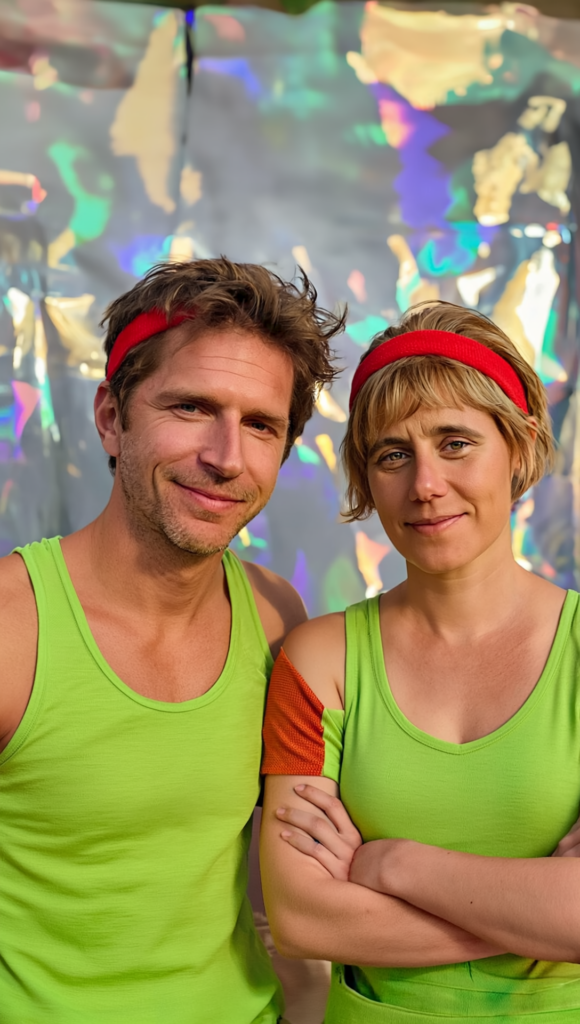

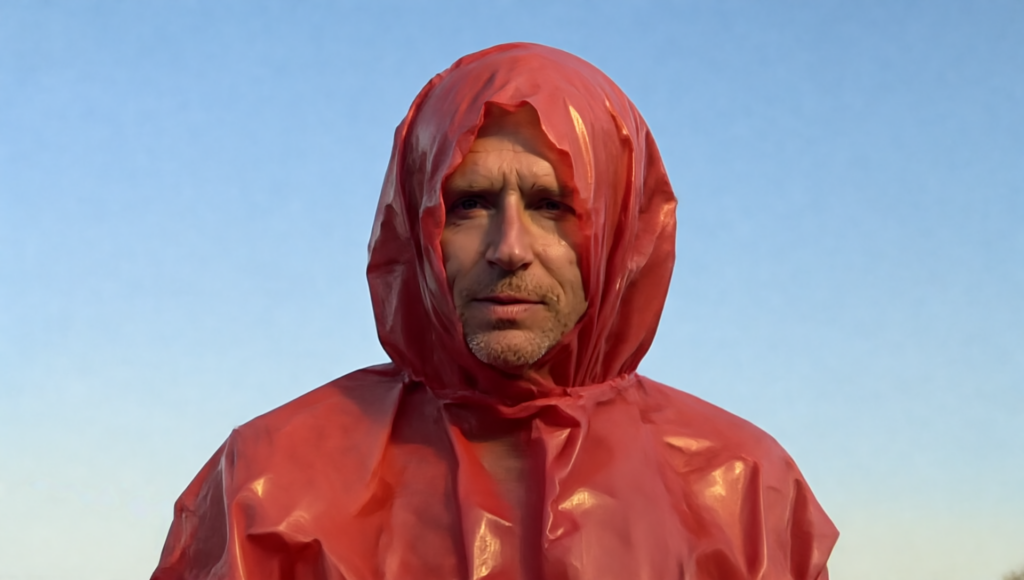
Figure 1. Self-portrait of the authors as sportsman and sportswoman.
5.
I had already read Murakami’s book, and I even had the idea of running a marathon someday, in a distant future. But, that day, I was running near my home when two joggers passed me. One of them was talking about his last marathon. He said to the other: “It was hard—I couldn’t get myself into ‘autopilot’”.
The image struck me, partly because it is a bit silly too. But I think it is the same with writing: you have to switch into “autopilot”. To write books long like marathons, with pages that you cannot count in your head, just as a marathon has more kilometers than you can physically imagine.
6.
Without using the term itself, Descartes evokes the same experience—the “autopilot mode”—in the letter to the Marquis of Newcastle on animal-machines (Nov. 23rd, 1646) when the philosopher puts forward this astonishing thesis (a thesis that no one, not even he himself, ever truly believed) that animals are machines:
Car il arrive souvent que nous marchons et que nous mangeons sans penser en aucune façon à ce que nous faisons ; et c’est tellement sans user de notre raison que nous repoussons les choses qui nous nuisent, et parons les coups que l’on nous porte, qu’encore que nous voulussions expressément ne point mettre nos mains devant notre tête lorsqu’il arrive que nous tombons, nous ne pourrions nous en empêcher. Je crois aussi que nous mangerions comme les bêtes, sans l’avoir appris, si nous n’avions aucune pensée ; et l’on dit que ceux qui marchent en dormant passent quelquefois des rivières à la nage, où ils se noieraient étant éveillés. (Descartes IV, 356)
Descartes wants to show that the human body can move by itself, with order and an apparent purpose, without the mind controlling its movements. It is not that he confuses the “autopilot mode”—when the mind is occupied elsewhere, or empty, or absent, and the body acts on its own—with the non-experience of the machine. It is simply that this form of absence or distraction reveals an autonomy of movement, which Descartes then turns into a mechanics.
This mechanics depends on metaphysics. That the body is a machine, that animals are machines, follows from metaphysical reasoning, which can be doubted. More precisely, at this point Descartes is in the process of showing that animals are machines in the same way that the body is a machine. One could therefore say that they are not yet machines. What is certain is only this: one can act with the mind absent, following only one’s body. That is how a musician plays:
Un joueur de luth a une partie de sa mémoire en ses mains; car la facilité de plier et de disposer ses doigts en diverses façons, qu’il a acquise par habitude, aide à soutenir des passages pour l’exécution desquels il les doit ainsi disposer. (Descartes III, 47-48)
When they are well-trained, musicians then have the pieces they play in their hands, in their body which they must then follow. Literally, they then play like beasts. One could call this the autopilot mode, or the method of the undefined animal: the animal in oneself that is not yet a machine.
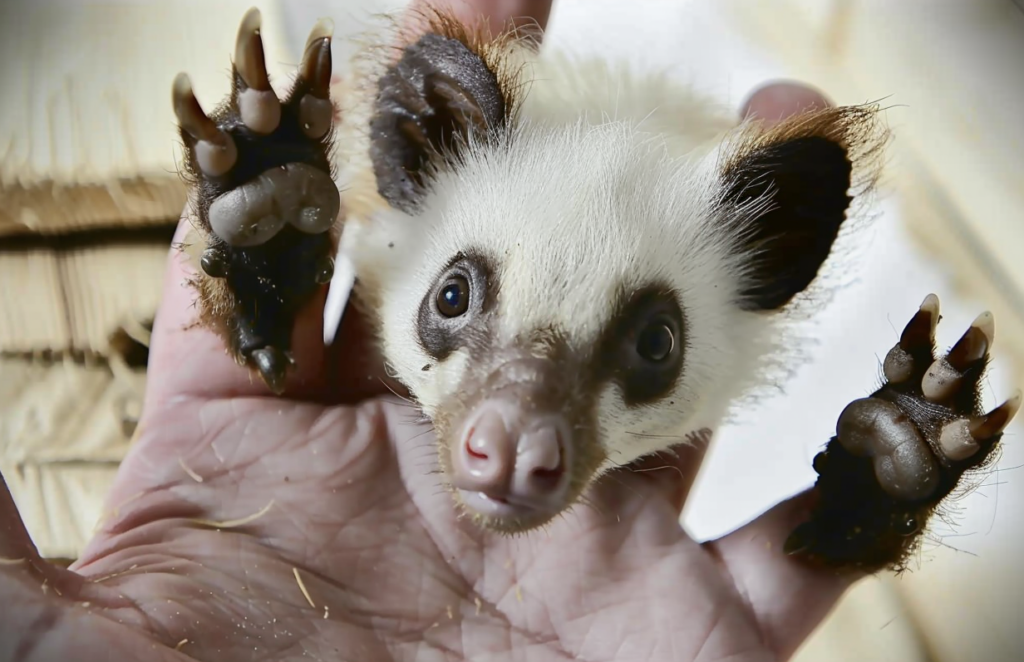
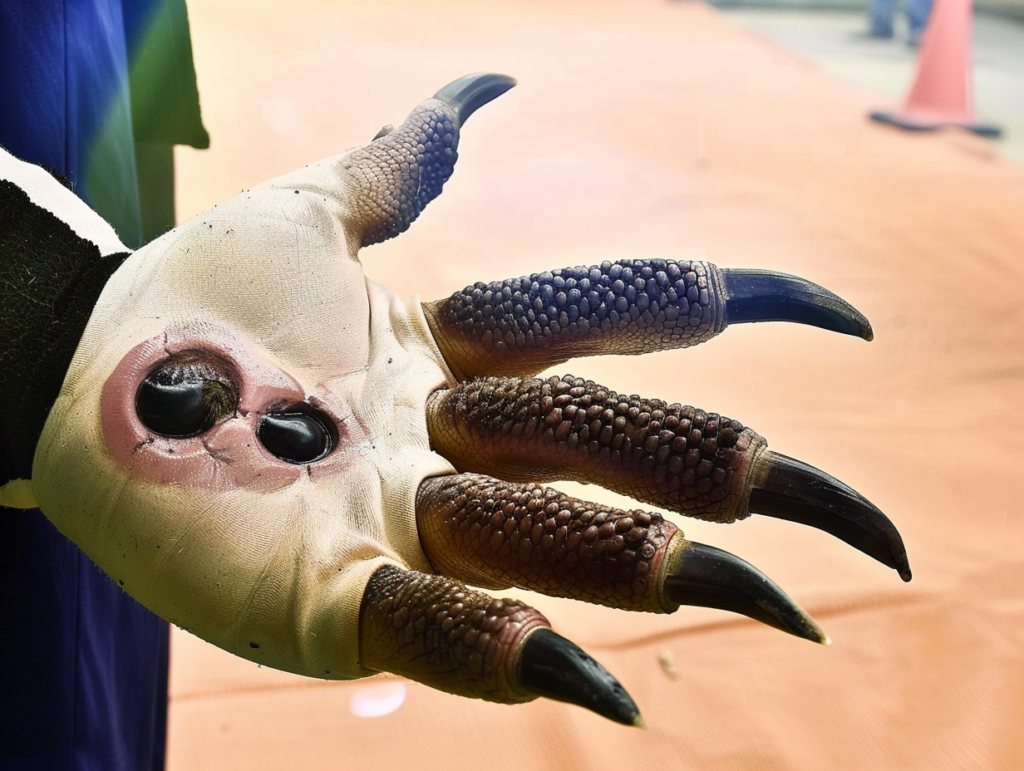
Could we apply the same method, the same attitude to writing? Could we write like beasts?


7.
Descartes wrote a great deal, and he even speaks of his position when he writes—near the fire, in a dressing gown, between two walks along a Dutch harbor. I imagine that he enjoys writing, and that he practices, in advance, the method of autopilot, or the undefined animal. Not thinking about the movements of the fingers; writing by letting the animal within act and express itself.
That day, the animal is in good shape and tells the story of a man at home—or rather, not quite at home. He is abroad, in a room above a busy street. He feels anxious (perhaps because he is not at home). He begins to doubt the most obvious things. It is a real panic attack. The man even imagines that a creature, a demon, was feeding him illusions. Very weird.
Descartes’s texts are always written in the first person; it is a habit. Descartes is bent over his paper. He is making good progress (he or it —meaning the animal that is writing, that has taken control of the fingers). He does not even ask himself how the man on the page will answer the Evil Genius… He is in the man’s head… everything around him could be an illusion… the room… himself… it is like troubled water, when one’s feet can no longer touch the bottom… the man, on the sheet of paper, at the tips of the fingers, in autopilot mode… cries out: “I think, therefore I am.”
At that point, Descartes lifts his head, stunned. He repeats: “I think, therefore I am… Yes, that’s not bad…”
And he begins to think, it’s over.
8.
I do not mean to say that one should not, or cannot, think about what one writes. My aim was only to identify what is lost in thought without writing: define writing without thought, in order to remove it from thought.
This may not be the right method. These two operations, the definition of writing without thought, and its subtraction within thought, are uncertain. First of all, even if we can point to the experience of running, or of writing, and to that moment when thought withdraws, it seems that we can define these experiences only by reference to a machine. This is what Descartes does when he describes as a machine the animal I tried to leave undefined, as well as the anonymous jogger: in the end, an “autopilot” is also a machine.
Yet the experience of this distracted activity, absent from itself, is not that of a machine without experience. We have a capacity for distraction, for being absent from ourselves so as to let an undefined being act within us. We use this capacity regularly. But as soon as we try to define it, we resort to a comparison with a machine, which we know to be inadequate.

9.
At first glance, one might think that AI has realized the metaphor: it really would be writing in “autopilot mode”.
But that is not the case at all. The machine does not write. We do not write with the machine. Typing a prompt to ask an algorithm to produce a text is not writing, writing in the sense in which writing can be compared to running.
The algorithm makes it possible to produce texts, essays, novels, real-estate ads, newspaper articles, philosophy papers, without writing.
Writing has been transformed when the quill was replaced by the pen, the pen by the typewriter, and the typewriter by the computer. Kittler showed this clearly: the introduction of the typewriter modified the subjectivity of writing, and the position of meaning and authorship in relation to writing. Nevertheless, writing on a machine remains an activity comparable to running, one in which the mind can withdraw, where something can happen that was not planned, and where forms of subjectivation emerge.
Producing text by prompt is another activity. One thinks, calculates the prompt that will produce the expected result, tries again… It can be tiring, but it is not the same kind of fatigue. It is not located in the same place.
10.
At this point, a contradictor suddenly wakes up in my mind. He yells at me that until now I have considered writing from a purely individual perspective (he says “petit bourgeois”), whereas one must consider the productions and effects of AI from a more global point of view. Generative platforms do indeed extend the writings on which they have been trained. They initiate an immense production that no one, no human being, will ever read. It is a bit like our prehistoric ancestors… Here my contradictor’s information is quite vague. But, caught up in his demonstration, he has no time to verify it on the internet. He continues: our prehistoric ancestors painted on cave walls deep inside mountains. They crawled through labyrinths of narrow passages… could not even bring a torch, painted blindly, and since the work lasted over generations, they never saw what they had produced.
Generative platforms are the same. They are text machines, capable of producing poems, cosmologies, incredible novels which, in a sense, exist within neural networks, inside data centers. We will only ever know them partially, yet in this unprecedented form, generative AIs constitute the greatest literary work of humanity.
There is effort and indeterminacy in it: the effort of all the authors of the past, but also that of the miners who dig to extract the rare earths for our electronic devices. None of them—the authors of the past, the miners of the present, nor even the users who finance the project with their brain time—are aware of what they are doing. The human, in this work, is absent from itself. It is carried away by something it does not control… An undefined animal, an autopilot which does not even tell us where it is going.
11.
My contradictor disappeared before giving me time to respond. But it is true that I have considered writing only as an individual activity. It is so petit bourgeois…
I turn on the radio.
12.
Since it is the Christmas season, the radio talks only about the new AI-commerce platform. The platform (there is no need to give it more publicity by naming it) has generalized the principle of generative AI to the trade of goods.
One types a prompt to obtain a text (“I would like you to write an introduction for a philosophy essay on the topic…”). Or a prompt to obtain an image (“I would like a daguerreotype of a cat which is…”). Or a prompt to obtain a commodity: “I would like a white puffer jacket with a blue diagonal stripe. Size M.”
The jacket is delivered the next day. The platform’s stock is so vast, and our desires so limited, that everything we can desire, the platform already has in stock.
What’s more, it’s free. As free as generative AI. Premium users pay a subscription. The others pay in DBT (“disposable brain time”).
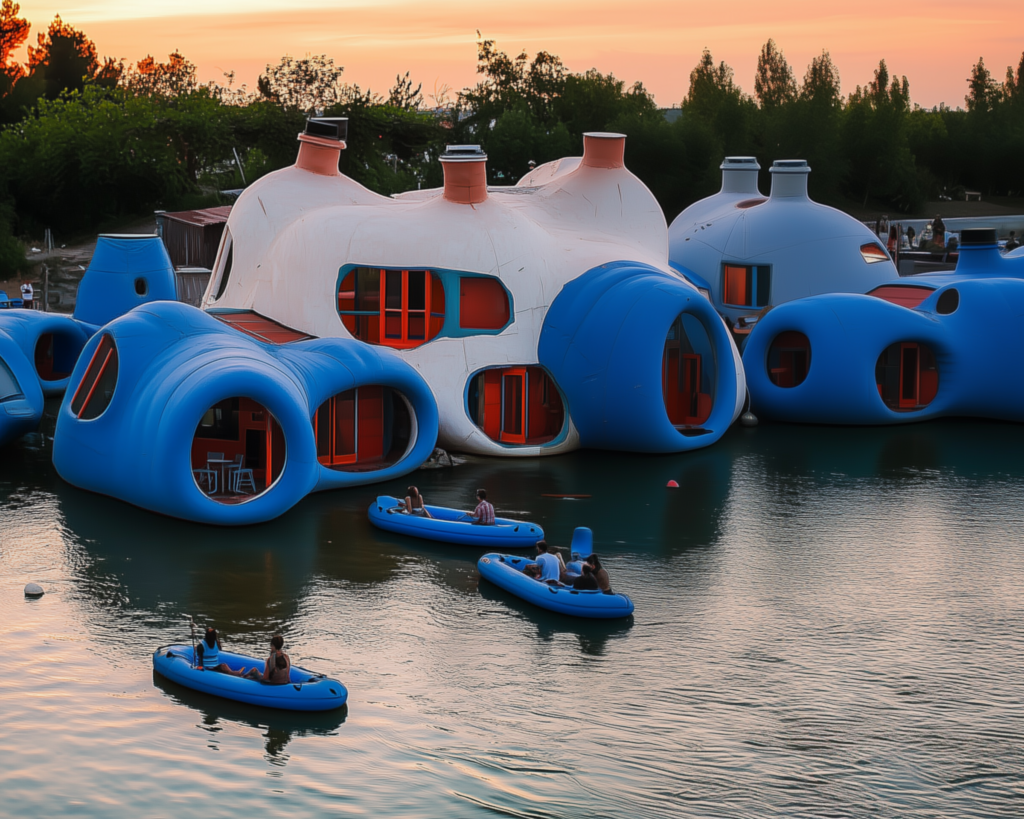
This AI-platform reminded me of the two-fold condition that Frédéric Neyrat calls environ(mental) in his Traumachine. It also reminded me of some of the dispositives that Gwenola Wagon invents in her Planète B, except it was not an imagination, it was real.
13.
As for me, I oppose this appropriation of the libidinal economy carried out by AI-commerce. While walking in the forest near my home, I therefore looked for gifts for my nephews.
For Félix, I chose a piece of wood, with a rounded knot—oak, I think—which I carved into a boat. For Garance, I picked some beautiful linden leaves that had dried on the tree, perfectly straight, and tied them to a twig to imitate a butterfly.
At the foot of the Christmas tree, Félix exclaimed, “What is this crap?” Garance said nothing. Later, I heard my brother-in-law Antoine mutter to my sister, “Still, your brother, he is really cheap, did you see the old junk he brought? I’m sure he just picked it up off the ground.”
I understood that a plastic gift would have pleased them more.

14.
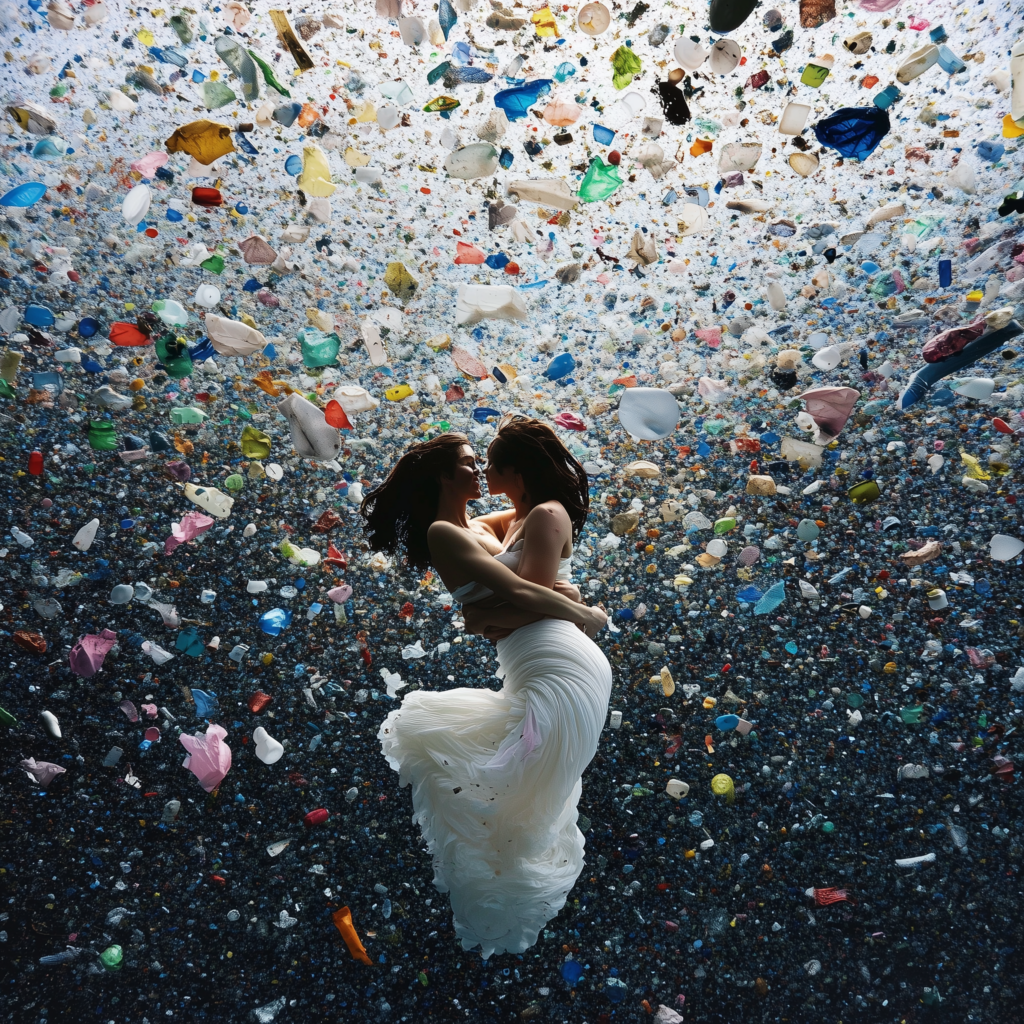
We take oil, solar energy stored by plants over hundreds of thousands, millions of years, and transform it into nearly indestructible molecules of plastic. These molecules are first assembled into brightly colored objects (plastic toys). They then travel across the entire planet and gradually release the indestructible molecules of which they are made into the soil and the oceans, where they poison the food chain. The entire surface of the oceans is now covered with a more or less dense layer of plastic molecules.



15.
In our book The Pyromaniac Images, Gwenola and I define pyropictomania as the pleasure taken in (the addiction to) images of dissipated energy: pyromania within images.
The televised broadcast of a car race is an example of pyropictomania. Viewers take pleasure in images of a tremendous expenditure of energy. The rivalry between drivers, or the abstract patterns traced by the cars, are only a surface, an appearance that allows us to enjoy what truly interests us in these images: the terrifying and purposeless consumption of fossil energy. It is like what Freud calls the “façade” of the dream, the manifest content, which both conceals and reveals the latent content of our desire.
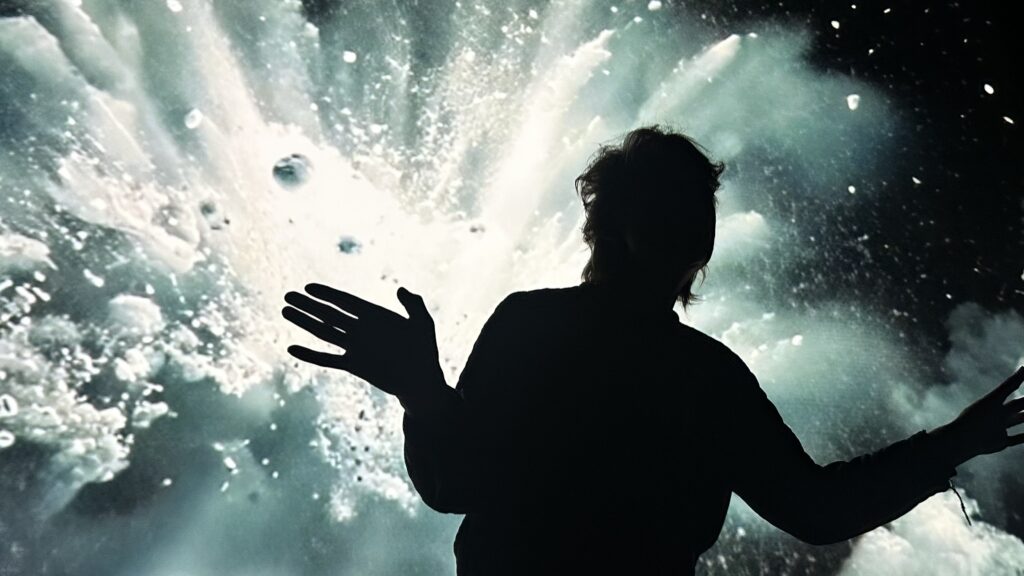
AI-generated images operate according to the same principle. We know perfectly well that they are costly in terms of energy, rare earths, water. An AI image, when it presents itself as such, offers a façade (“Wow, did you see that huge orange wave over the beach!”), but it also stages the expenditure of energy involved in its production (“Imagine how many prompts it took to do that” or even better “I had to train my own AI”). We take pleasure in this consumption of energy made visible as an image.
When these images circulate on social networks (artificial influencers, catastrophic landscapes, artists’ images as well), they serve to produce disposable brain time, which social networks accumulate and resell to advertisers, or use themselves to influence opinion. More generally, one can say that through the digital apparatus, of which generative AI platforms are a part, energy (fossil and nuclear) and various elements (water, rare earths) are transformed into a vast quantity of disposable brain time, stored on social networks and usable by their owners.
One can easily imagine that as we sink deeper into environmental catastrophe, increasingly large quantities of disposable brain time will be required. This would be one of those vicious circles with which capitalist machinery is so familiar: the scarcer and more expensive fossil energy, water, or lithium become, the more DBT the system’s stability will require, and still more fossil energy, water, lithium will need to be invested in pyropictomania.
One may suspect that generative text AIs have a comparable effect, though it does not use pyropictomania.


16.
I speak of disposable brain time (DBT) in reference to an interview by Patrick Le Lay, much commented on by Bernard Stiegler, and which I gave a key role in my Bienveillance des machines.
Patrick Le Lay, then director of a French television channel, said in substance that television is an industry like any other, producing a commodity in order to sell it. That commodity is disposable brain time. The goal of television is to produce, with viewers, as much disposable brain time as possible, and to resell it.
A factory uses workers to produce, say, cars. One could imagine a biological laboratory using humans to produce certain cells or blood. Television uses viewers to produce disposable brain time.
It must be emphasized that DBT is not produced by advertising. It is programs—talk shows, sports broadcasts, series—that aim to produce DBT: a subjective state of a certain duration during which advertising can be effective. Pyropictomania (the broadcast of a car race on television, catastrophic images on social networks…) is one of the current means of producing DBT.
This notion of DBT has, in my view, several advantages over that of attention. Beyond the ambiguity of the term “attention” (since the attention expected of viewers or internet users, the attention of “the economy of attention” is not at all the mental state usually designated by the word, as when teachers ask students for their full “attention”), Le Lay’s formulation makes clear that this mental state is not a natural resource but the result of a production process. There is no attention lying around in nature, waiting to be captured. Television, through certain types of programs, and social networks, through algorithms regulating content flows, succeed in producing a particular state in which the user is especially influenceable. This production (like that of any other commodity) requires specific processes that are always refined. It has a cost, and yields a greater or lesser return.
Once produced, this DBT has a social function. It acts upon the whole of society. Viewers watch their program and, as if anesthetized by it, then undergo a sequence of advertisements while their brains are available. They are influenced by the ads and, in turn, influence society as a whole. Children turn their heads to look at the car they saw on television, making it desirable for all of us. Adults who have heard the same neo-fascist refrain echo it themselves, anchoring it so deeply in common sense that it becomes no longer even contestable.
The advertiser who buys DBT is buying a tool that gives their product new qualities, a particular desirability. It is as if they had purchased a machine to repaint their cars a new color, or a loudspeaker to repeat their slogans in the streets, louder and in a softer voice.
It is easy to understand that the ever more pressing impact of the environmental crisis requires ever larger quantities of DBT to divert our attention from it.
17.
The French word is disponible. It could be translated as available. However, the word disposable seems to emphasize the ephemerality of this brain time: it is produced, and it is used. Once used, nothing of it remains.
What remains is that the car, the soda, or the political message seen on television has become more desirable. What remains are also the wastes left behind by the production process. But the brain time itself has been expended without trace.
Obviously, the time of writing, or of running, this “autopilot” mode, is not of the same nature. The time of writing or running is neither available nor disposable to the solicitations of the phone. For that reason, it has no value, it is unvaluable. One could even argue (from a Bergsonian perspective, for example) that it is not measurable, or that the application of measurement (“I ran for an hour,” “I wrote for thirty-five minutes”) transforms its reality. By contrast, since it is a commodity with a price, DBT is measurable. One should probably use two different terms, opposing, for example, the duration of writing to measurable brain time, in order to mark the difference between these two forms of temporality.
Of course, writing leaves texts behind. In general, these texts are also without value. The vast majority of books do not sell. They are not real commodities. From the point of view of the market, from the point of view of capitalist production, writing is equivalent to running. They are two ways of losing one’s time, of rendering one’s time unvaluable.
18.
I guess I should say wasting one’s time. But the English language here has an ambiguity. A book is not a waste properly speaking. Waste, plastic waste on a beach, for example, is matter without function, matter that has lost its function. It is a red plastic bowl that once served for several years on the breakfast table. After a picnic, it was forgotten on the beach. The sea reduces it to slightly brighter-colored pebbles and a multitude of invisible micro-particles. These have a material reality but no longer any function. They no longer have a soul.
Waste is the opposite of the specter, the ghost, which is, on the contrary, a function, a soul whose materiality has become problematic. The memory of that red bowl in which I ate breakfast as a child—that is its ghost: an image, an effect, a function detached from materiality itself. Time seems to carve ghosts and waste out of human things.
A book, by contrast, retains its function as long as it has a few pages that can still be read. Then the paper decomposes. A little ink remains, some chemicals used to whiten the page, but this is negligible compared to the mass of specters it produces. The manufacture of the book (the production of pulp, the bleaching of pages, and so on) produces waste, but the book itself leaves only ghosts.
In its ideal form, television would produce nothing but DBT, which, when consumed, renders some items of the world around the viewers more colorful, more desirable, but leaves no distinct memory: a drowsy brain that can once again be worked upon. In their ideal form, television, generative AI produce no ghosts.
When they use pyropictomania, television, or generative AIs, obviously produce waste.
19.
Philosophy, as I see it, does not predict the future. Some sciences can claim to do so. Physicists can calculate the position of a particular comet at a particular moment in the future. Sociologists can say, with a certain margin of error, which party a person of a given gender, income, and level of education will vote for. These predictions presuppose certain conditions of stability, and they may well be open to dispute. In any case, philosophy lacks the empirical grip that would allow it to aim at the future. Philosophy is concerned with the possible.
Philosophy relates to the real through the possible it explores (possible in a sense that exceeds that of the sciences, since we can perfectly well imagine other scientific laws). Our imagination has lines of steepest descent. Given a particular situation, particular hypotheses, our imagination slides as if “naturally” in one direction rather than another. The role of philosophy is sometimes to struggle against this steepest slope, to look for side paths, to show that other trajectories are possible.
Since the emergence of generative AI, these lines of steepest descent have doubled. There are those of our imagination, and those of the AIs. If I ask a generative AI how it imagines a society in which it has taken charge of writing, it will explain that people, relieved of the technical difficulties of writing (spelling, style, references, fatigue) will become both more productive and more creative. Since it has been trained on our texts, it follows our lines of descent; but since it is also subject to fine-tuning, it bends them toward the techno-optimism it has been deliberately given. We all know this.
More deeply, and outside these twofold ideological biases, Luciana Parisi has pointed out the new problems of philosophy after, and always risking to be submerged by, computation. But my aim here is to investigate specifically the production of DBT.
20.
Last semester, I taught an undergraduate course on generative AI. Each session, devoted to a specific theme or question, half of the students wrote a text on their own, while the other half wrote with the help of a generative AI. We then graded the texts blind, in order to verify, and convince ourselves, that AI-generated texts are easily recognizable, and that one must in fact be able to write the text oneself to have any hope of deceiving a reader.
I had given the following question: Is there an environmental ethics? The text we were reading was clearly generated by an AI. But it insisted on the impact of the environmental crisis, mentioning not only global warming but also violent meteorological phenomena, and the rise in cancers caused by various forms of pollution. Given the AI’s techno-optimistic bias, I was surprised by such insistence. Then a student pointed out to me that all the threats mentioned concerned humans, and that the AI did not mention that humans were responsible for the environmental crisis. It was as if “nature” had suddenly become hostile to humanity.
We all knew, in that classroom, that the environmental catastrophe is caused by human activity. It was so obvious that we had not even noticed its absence from the text. Yet, in fact, the text did not mention it.
21.
What actually happens on the level of our unconscious minds when, within minutes on the same TV screen, a prime minister is assassinated, an actress makes love, an injured child is carried from a car crash? Faced with these charged events, prepackaged emotions already in place, we can only stitch together a set of emergency scenarios, just as our sleeping minds extemporize a narrative from the unrelated memories that veer through the cortical night.
— James Graham Ballard, The Atrocity Exhibition
One partial explanation (a philosophical, not an empirical one) for the way television and social networks produce DBT is that, through ruptures and the apparent variety of the spectacle, they deprive the mind of its capacity to react. Too many things happen, too quickly, for the mind to respond. It becomes anesthetized, made available for new suggestions to which it has lost the ability to respond.
Generative AI produces the same incapacity to react, but by different means. Since we entrust our capacity to write to these systems, we can no longer respond to what they write except by passing once again through them, and through their own ideology. We could no longer answer the AI, or refute the ideology it instills in us, except by using the AI itself.
The production of DBT always seems to require depriving the subject of the capacity to react.
It must be emphasized that DBT is not a natural resource, existing only in limited quantity (twenty-four hours of attention minus five hours of sleep) but a commodity resulting from a process of production. There is, in principle, no limit to the quantity of DBT that can be produced. One way of multiplying DBT production was the invention of multitasking: a multi-window screen that allows us to work while watching a sports broadcast with its advertisements, or to watch a series and a sports broadcast at the same time, thereby producing twice as much DBT in the same span of time, as if each of us were two spectators at once. Generative AI now succeeds in using the “work” window, or the “email” window, for the production of DBT.
22.
In the famous “Fragment on Machines”, Marx argues that the complete automation of labor would mean the end of capitalism. Since, for Marx, surplus value can only be realized through human labor, the end of human labor (which would be totally replaced by machines) would prevent capitalists from extorting value. Value, for Marx, derives from the human labor time necessary to produce commodities, the products of a fully automated world would have no value. This would be the collapse of capitalism: a collapse through more. It would be a world in which everything was free, where machines would endlessly produce things without value.
Obviously, in this text, Marx is mistaken. First, he neglects the importance of the appropriation of natural resources in the development of capitalism, and the role these resources play in the production of value (as Jason W. Moore, in Capitalism in the Web of Life has clearly shown). Second, he ignores the waste that would result from this “free” production.
23.
The inhabitants of A., a continent of planet Xyz, enjoy great prestige on that planet. Perhaps because A. welcomed many of the artists and intellectuals of the previous century. Or perhaps because the history of A. is marked by violence, exploitation, and an individualist ideology… It doesn’t really matter. Whatever the other inhabitants of Xyz may think, they cannot help watching what the people of A. do. This is what makes possible the particular way in which value is created in A.
Apparently, the people of A. engage in no productive activity. They do not go to factories or offices; agriculture disappeared long ago. They spend most of their time watching videos, at home, but sometimes outdoors as well, using their phones. Sometimes they watch several videos at once: an advertisement for a large car on television, and another for eco-friendly home décor on their phone. They produce enormous quantities of DBT.
During this DBT, they are occasionally, several times a year, encouraged to travel to other parts of planet Xyz. This is what they call tourism. They have no real choice. They do it reluctantly. But they fly for a week or so to another part of Xyz. It is there that the DBT becomes truly productive. When the people of A. see, in the street, the car they saw on television, they say “Wow,” and when the apartment they rent for their vacation lacks green décor, they say “Boo.” Wherever the people of A. go, the locals imitate them. They too say “Wow” and “Boo” at the same things, which gain or lose value accordingly. This is why industrialists across planet Xyz pay the people of A. to watch videos. In fact, by watching videos, by contributing to making their brains available, the people of A. are working. They increase, everywhere on planet Xyz, the value of the things they look at.
Thus labor is strangely distributed on planet Xyz. The continent of A. has specialized in the production of desirability. The rest of the world materially produces the goods, which then pass through A. in order to become desirable. Strictly speaking, it is enough that they pass through video. There is no need to transport them physically. But it is as if this process gave them a different color, a new quality.
The paradox is that, with increasing automation and the replacement of human labor by machines, most inhabitants of Xyz have stopped working. Since AI was not invented on Xyz, people devote themselves to literature, philosophy, the arts, mathematics… Only the people of A. are forced to continue working, watching videos of cars and soda.
24.
The production of DBT requires labor on the part of spectators who contribute to making their brains available. Sometimes, late at night, they would rather go to bed, it demands an effort to go on watching TV or scrolling through posts. However, this labor cannot be automated. If a robot—an ad blocker, for example—“watches” the video in my place while I do mathematics, no DBT is produced. The desirability and value of the perfume used by the cowboy in the ad do not increase. For the industrialist, it is time wasted.
When I was writing La Bienveillance des machines, I thought I had identified a non-automatable form of labor, that made impossible the complete automatisation that Marx imagines in the “Fragment on Machines” and which would produce the collapse of capitalism.
Today, I am no longer so certain. Could generative AI not lead to a complete automation of the human reactions? That is to say: deprived of its capacity to react, is not the brain that watches the video thereby automated? It is the AI that writes the comment I post beneath the video because I no longer know how to do so myself. Could I ask the AI whether I should say “Wow” or “Boo,” because I have grown accustomed to consulting it constantly, or because I have given it access to my accounts so as to avoid answering my emails, or clicking on “Wow” or “Boo”?
What is the point of having me watching the video if it is the AI that reacts to it? Then what is the point of producing the video, running data centers that host it, networks that distribute it?
We find ourselves squarely in the situation imagined by Marx: a complete automation that makes the creation of value through human labor impossible. The production of DBT seemed to be a labor non automated by principle. But if it is now automated, it could be, in Marx’ logic, the collapse of cognitive capitalism, and the collapse of capitalism as such.
25.
There is no doubt that, before that, difficult times await us. We all know what to expect.
– the submersion of human language and imagery in the flow generated by AI. Newspapers, novels, old paintings, photographs (those of the present as well as those of the past) gradually disappear beneath the mass of AI-generated texts and images. This is what Gwenola and I call the anarchive.
– as machines increasingly take charge of language and images, a loss of human capacities follows (a logic clearly analyzed by Anne Alombert in Artificial Stupidity). Over time, children no longer learn to write, they learn to post prompts. Humans watch machines exchange messages that are summarized for them by a few signs. Books and websites are passed through the AI grinder.
– the persistence of a few communities of writers who continue to write out of taste, pleasure, or political choice. Within these communities, there is a perpetual struggle against the machine, which inevitably infiltrates them and spreads.
26.
Since, in the academic world as well as in the Marxian one, the value of things lies in the socially average time required to produce them, articles, dissertations, reports, and projects that can be rapidly produced with the help of AI lose their value. Institutions initially encourage academic workers to produce a greater quantity of texts, in order to compensate for the reduction in the individual value of publications. A doctoral dissertation must soon be 4,800 pages long. Each of us will publish around thirty articles per year. A letter of recommendation must be at least fifty-five pages. No one reads them anymore, it is impossible. AIs summarize them.
From time to time, someone asks, “What is the point?” A new community of writers forms.
27.
In certain communities (that of this volume, for example), the author must demonstrate that they are human, and demonstrate it constantly, in every paragraph. Jean Lassègue speaks of an inverted Turing test: where the writer must show to the reader that they are not machines. The machine, however, always ends up insinuating itself into the texts. Because as soon as a certain style gains legitimacy within the academic world, publications multiply that are written by AI. One must go elsewhere. It is an uninterrupted flight.
28.
Painting has already faced a similar difficulty with the appearance of photography. From the moment photography emerged, painters no longer had interest in producing realistic portraits. Pictorial styles diversified in extraordinary ways.
Gwenola suggests that we should distinguish between two possibilities, two tendencies:
– to remain within realism but do better than the machine, in the manner of American landscape painters (such as Martin Johnson Heade), who adopted wider angles than the cameras of their time, showing sunsets with elusive colors, and so on. One can easily imagine that some academics will choose this path, producing articles of astonishing stylistic finesse and bibliographic precision. Philosophy, becoming a virtuosity of the footnote, risks, however, being less spectacular than the landscapes of the American wilderness.
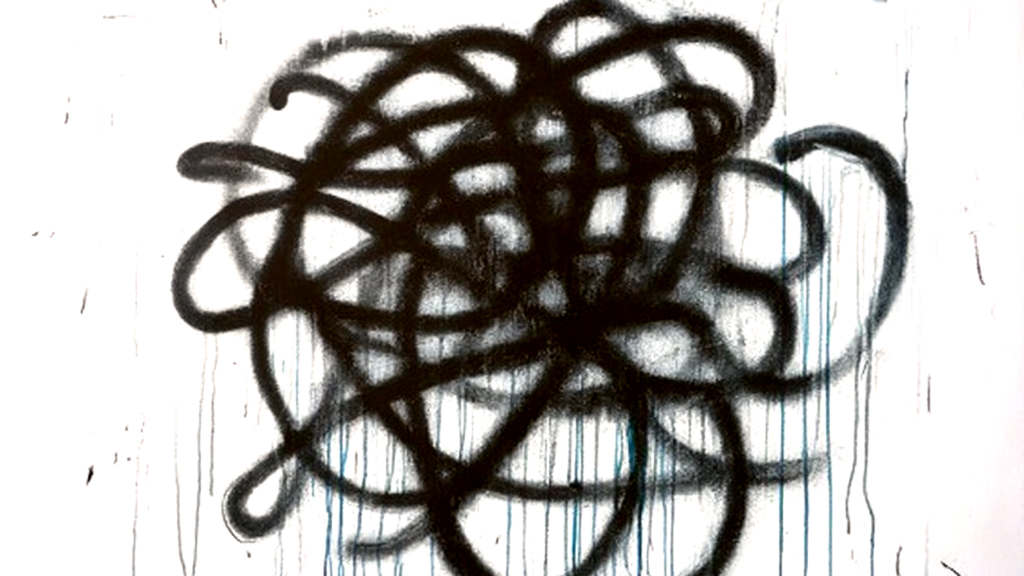
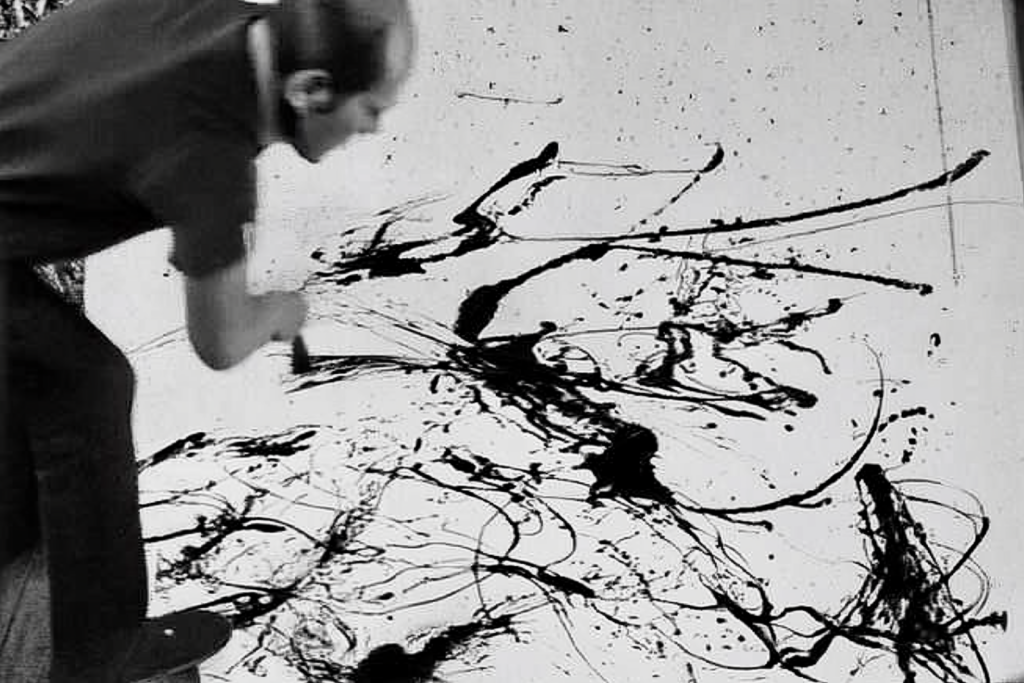
– to bifurcate. This would be the path of the various avant-gardes, with the difference that the machine knows how to make impressionist, cubist, abstract paintings, Pollock’s. When I look at Gwenola’s experiments, I tell myself that some painters resist generative AI better than others: the imitations of Joyce Pensato seem perfect to me, while those of Joan Mitchell lack something, even if it is not easy to say what. In any case, writing will have to change, contradict itself, twist back upon itself in order to escape the mechanization that is always in danger of catching up with it.



29.
It is the same problem, ever since Descartes: the indefinite in oneself, always ends up being mechanized. And the same problem since Marx: the gesture that produces value, mechanized first in thought, is eventually automated in fact, replaced by a machine, and one must look elsewhere for the production of value, or dream of the collapse of the system itself through complete automation.
30.
Another parallel: Latin in the Catholic Church. Until the 1950s, Mass was celebrated in Latin. No one understood it anymore, but people listened to Mass in Latin the way we watch machines exchange emails, articles, books that are summarized for us by a few signs. We ourselves no longer understand anything, but we respect the texts greatly.
One day, someone finally says, “Shall we stop?” Or “Shall we play something else?”
With this difference: if Latin is the language of AI, we have no other languages. We would have to say “Stop,” but silently, through signs or invent something completely different.
31.
How can one escape mechanization? How can one show oneself to be human? With sentences that say several things at once? Like dreams: sentences with a “façade” and latent meanings, which the machine would not understand because it would be taken in by the façade. I am thinking of Julien Prévieux’s work Poempoempoempoempoem. The poem lists a series of machine errors, the first being: “Le mot ERREUR contient deux R” (“The word ERROR contains two R’s.”) It is a known phenomenon that machines, which decompose words into tokens rather than letters, cannot linguistically analyze the words they nonetheless spell correctly. Obviously, the question is not how many R’s there are in ERROR but what humans are saying to each other when they write “The word ERROR contains two R’s”. It may be something that the machinery does not understand, because it is bent on improving its counting.
32.
But let us be honest: I wanted to return to the sentence “Eye see ‘NK Sehr Forreye Ame,” with which I began this article. I thought the machine would not understand it. I wanted to say that writing without thought could also produce thought without writing, and that one passes from one to the other imperceptibly, sliding along a Möbius strip, continuously from one side to the other.
But the ChatGPT algorithm identifies the intention perfectly. Its only mistake is missing “Think,” and this is because it does not know that I have a French accent, and that for me “sink” and “think” are the same thing: I sink therefore I am.
33.
In the end, I see only two possibilities. Either there will not be enough energy, or water, or rare earths to produce enough DBT. Or else we are heading toward complete decerebration: everything that can be transformed into DBT, everything that has been mechanized, from the moment Descartes began to think and to give form to what he had discovered (and that form could only be mechanical), is taken over by AI. We lose our brains. All human knowledge that the machine is capable of rendering, everything in thought that can be measured, everything in writing that can be mechanized, the brain crosses over to the side of the machine. The machine appropriates it. It would be an eighth cheap thing, to paraphrase Moore and Patel. Yet it is precisely the one that could not be automated without causing the system to collapse.
We are left decerebrated, with thought forced to play in a margin without value, without measure, outside the brain appropriated by AI, with games we cannot yet imagine, because they will be essentially different from those we know.


34.
Do I believe what I am writing? Do I believe that we must accept being decerebrated, renounce what AI has seized, in order to see new forms of language, thought and life emerge? Is this not a little romantic?
Let us say that I think, like Callicott, like Latour, that we have a duty of optimism. And, obviously, our optimism can only be paradoxical, uncanny.
So I wrote this text myself, because it is still possible and because I enjoy it. But I wrote it in French and had it translated into English by an AI, telling myself that in doing so I was contributing to the mechanization and the imminent abandonment of academic English.
References
Alombert, Anne.La Bétise artificielle, Paris, Allia, 2025.
Ballard, James Graham. The Atrocity Exhibition, London, Flamingo Modern Classics, 2001.
Cassou-Noguès, Pierre. La Bienveillance des machines, Paris, Seuil, 2022
Cassou-Noguès, Pierre and Gwenola Wagon. Les Images Pyromanes, Villecomtal, UV éditions, 2025 (tr. eng. The Pyromaniac Images, Amsterdam, Set Margins, to appear in 2026).
Descartes, René, Œuvres Complètes (Adam et Tannery eds.), Paris, Vrin, 1996, vol. III and IV.
Lassègue, Jean et Giuseppe Longo. L’empire numérique, Paris, PUF, 2025.
Neyrat, Frédéric. Traumachine. Intelligence artificielle et techno-fascisme, Paris, édtions M.F., 2025.
Moore. Jason W. Capitalism in the Web of Life, New York, Verso, 2015.
Moore, Jason W. and Raj Patel. A History of the World in Seven Cheap Things, New York, Verso, 2017.
Parisi, Luciana. “Recursive philosophy and negative machines”, Critical Inquiry, 48(2), 313–333.
Prévieux, Julien. “PoemPoemPoemPoemPoen”, oeuvre multimedia.
Stiegler, Bernard. De la misère symbolique, Paris, Flammarion, 2013.
Wagon, Gwenola. Planète B, Paris, 369 éditions, 2023.