


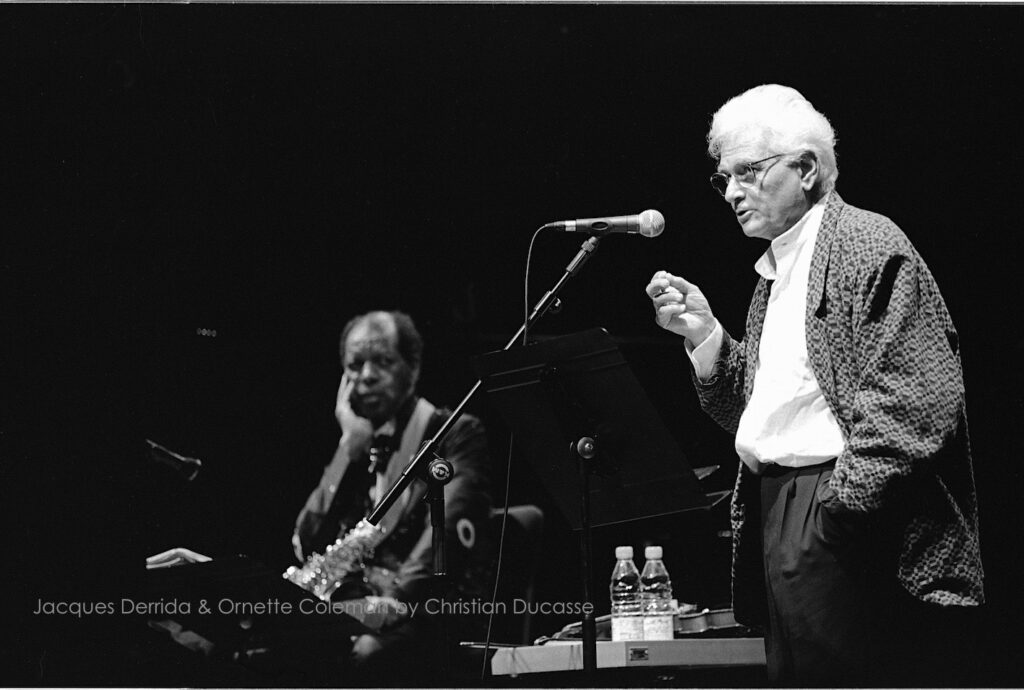
This post is part of a dossier that features materials that were generated at, or in the aftermath of, the “Experiments in Listening” conference that boundary 2 co-organized with the California Institute of the Arts and the University of Southern California in January 2025.
Experiments in Listening: The Shape of Deconstruction to Come[1]
Erin Graff Zivin
Preparing to Improvise
“It is indeed necessary to improvise, it is necessary to improvise well,” Jacques Derrida told a crowd of unsuspecting Ornette Coleman devotees who’d come to hear Coleman perform with German pianist Joachim Kühn at the La Villette Jazz Festival on July 1, 1997.[2] “As all of you see,” he read, “I have here a sort of written score, you think that I am not improvising, well, you are wrong. I am pretending not to improvise, I just pretend, I play at reading, but by improvising.”[3] Derrida’s simultaneous denial and affirmation provoke a question, or a series of questions. Is it possible to know when one (or the other) is improvising? Does deconstruction demand improvisation? What scene of exposure will have taken place, or failed to take place, between philosophy and music?
Coleman’s fans—his listeners—did not react well to the experiment.[4] In fact, the heckling eventually caused Derrida to leave the stage before he’d finished reading (improvising, pretending to read) his text, despite Coleman’s encouragement. “Derrida must have known he was inviting catastrophe,” writes David Wills: “He must have known that the more carefully he contrived the event and organized his theoreticomusical event, the less it would be likely to happen the way he calculated it. He must have known that one can invite an event but not produce it.”[5] Michael Gallope wonders, “did the collaborative failure on the part of the two men mean that they had both misunderstood, or underestimated, a certain incompatibility between philosophy and improvised music?”[6]
While Derrida’s performance might have gone awry (he describes it as a disaster unlike anything that had happened to him in his years of standing before large audiences), I want to suggest that the event (or non-event) enables us to delve further into what I will insist is a necessary-yet-impossible encounter between deconstruction and improvisation: a duet, an encounter that may have needed to fail to be worthy of the name event. How might we ask after its failure and its paradoxical success? Who are we, who am I to decide whether the experiment failed, whether it will have been an event worthy of its name?
Now, it might seem counterintuitive, even obscene, to talk about aesthetic and intellectual practices as ostensibly playful as experimentation at a time when universities in general, and the humanities in particular, are in existential peril and when—both within and outside the walls of the university—xenophobia, totalitarianism, and genocide threaten populations across the globe. It’s not new: experimental art and deconstruction have historically been cast as politically disengaged or ethically irresponsible, corresponding in part to the lack of a coherent, legible ideological position. Yet I want to suggest that it is precisely in a moment of crisis or danger that experimentation is most vital. Black improvisational music emerges from precisely such conditions: material and psychic subjugation and peril produce the necessity of improvisation, experimentation, and risk. The root per- that haunts “experiment” conjures the Latin periculum, alerting us to the danger inherent in such practices.
Those of us who attended Derrida’s lectures and seminars recall the way in which he was constantly forced to improvise responses to questions from colleagues and students—acolytes and critics alike—to think on his feet, as we all do when we stand before a public, exposed. Despite his vast experience doing so, Derrida expressed reticence at being questioned in a certain way, being put on the spot, being forced to improvise answers to questions for which he was not prepared: “It’s not easy to improvise. It’s the most difficult thing to do. Even when one improvises in front of a camera or microphone, one ventriloquizes or leaves another to speak in one’s place the schemas and languages that are already there.”[7] In his public appearances, Derrida repeatedly seems caught between a simultaneous desire for, and fear of, the possibility of improvisation. During the 1992 Oxford Amnesty Lectures, he described the experience of presenting a prepared lecture as feeling “protected,” opting instead for an interview format for which he later expressed regret, the coy smile on his face suggesting otherwise.[8]
Derrida was critical of the cultural tendency Americans had of expecting intelligent, coherent remarks on any given topic: “Here’s a term. Go ahead, action!” Joel Stein describes Derrida’s disappointment when the journalist pulled out a notebook at a 2002 event at Film Forum, turning their conversation into an interview.[9] “He hates when people ask him to be smart about random topics,” Stein explained in a Time magazine article. “Everyone wants him to say something brilliant on love or war or death. ‘It’s frustrating. Especially when you have to improvise,’ he said.”[10] Recall Derrida’s response to the British journalist who asked him to compare deconstruction to the American sitcom Seinfeld: “deconstruction, the way I understand it, does not produce any sitcom.”
Given Derrida’s aversion to a certain kind of improvisation, why would he have claimed to be improvising as he read from his prepared notes on July 1, 1997? What did Derrida hope would happen? How might we determine whether he was improvising or following a script? Musician and writer Dan diPiero emphasizes improvisation’s universality: “there is improvisation anywhere there is contingency, and there is never not contingency.”[11] For his part, composer, pianist, and writer Vijay Iyer claims we are nearly always improvising. “Improvisation seems to encompass most of our behavior,” Iyer writes, suggesting that it may be easier to list behaviors that are not improvised: routines, rehearsals, rituals, recitations, and scripted performances of fully composed works.[12] It is impossible to improvise, Derrida tells us, perhaps thinking of the narrow confines of philosophy; it is nearly impossible not to improvise, DiPiero and Iyer proclaim more generally.
Despite the fact that Derrida would always have been improvising to a degree, as we all do, he must have been particularly terrified that day, as he tested the boundaries of the “genre” of philosophy (a discipline he contested), as he searched for a medium or instrument through which to improvise. He seemed to anticipate this terror when he wrote the opening lines, a mix of French and English: “Qu’est-ce qui arrive? What’s happening? What’s going to happen, Ornette, now, right now? What’s happening to me, here, now, with Ornette Coleman? With you? Who?”[13] I am struck by these composed lines, this preparation for the happening, the impossible but necessary preparation for the arrivant.
As musician and literary scholar Maya Kronfeld has shown, the denial of such preparation, of training and study, of thinking and rehearsal (répétition), the refusal to recognize the hours and days and weeks and months and years of dedication to a craft in general (when not also to a work or a performance in particular) is related to the primitivist view that the music called “jazz” is spontaneous, that it comes from the body, or from nowhere at all.[14] Kronfeld unpacks such primitivist assumptions: citing Miles Davis’s statement “Je ne suis pas un accident,” Kronfeld underscores the invisible process of practice involved in spontaneous forms, what Walton Muyumba calls “tutored spontaneity”[15]
This problem—known all too well by practitioners of Black improvisational music—has been taken up by philosopher and vocalist Fumi Okiji in her 2018 book Jazz as Critique: Adorno and Black Expression Revisited. “Jazz,” she writes, “is understood by the primitivists to come from a people with direct access to a primal human essence all but lost by their European counterparts.”[16] Improvisation thus becomes burdened by fantasies of spontaneity, irrationality, and immediacy, as though the music emerged from instinct rather than from study, rehearsal, repetition, and composition. Kronfeld builds upon and extends Okiji’s argument, emphasizing in her philosophical-musicological theorization of spontaneity the double bind musicians experience in response to competing audience desires and expectations of jazz performance. She writes:
“Questions about improvisation put to musicians after shows by certain well-meaning listeners could be painful because it would take so much work to undo the presuppositions inherent in the question, ‘Were you improvising when you did that?’ To say ‘yes’ would be to capitulate to the primitivist assumption that jazz is a form of nonstructured magic where anything goes; to say ‘no’ would be to give in to the contrary assumption that it’s all planned out in advance.”[17]
Kronfeld hypothesizes further, “It is as if something in the colonial tongues, and their attendant intellectual cultures through which many Americans speak, makes it difficult to specify an intermediary position between a scripted score and the subjective play of ‘anything goes,’ between fixed structure and arbitrary flow.”[18] Well before Okiji’s and Kronfeld’s philosophical inquisitions, composer and saxophonist Gary Bartz had referred to that intermediary position as “informal composition,” rejecting the term “improvisation” altogether: “We’re not improvising, I hate that word. We are composing all the time… When I’m composing a solo I’m thinking compositionally.” In her extensive work on spontaneity, Kronfeld points out that Bartz carries on the legacy of Charles Mingus, who characterized such creative labor as “spontaneous composition,”[19] which she relates to Elvin Jones’s notion of “puttin’ it together.”[20]
When Derrida asked “What’s happening? What’s going to happen, Ornette, now, right now? What’s happening to me, here, now…?” he wondered aloud what was happening out there, but also in here, to “me,” now, to whatever coherent ego might show up in a given place and time, flirting with the very metaphysics of presence he unsettles in his work. Perhaps he’d intuited that he was exposing himself more radically than in a typical exposition, which by that point had become habit. Even when faced by vehement critics, Derrida knew what to expect: each of the previous scenes of improvisation in which he participated (lectures, seminars, conversations, interviews) remained within the relatively safe, known territory of academic and cultural institutions, settings and scenes that he could anticipate, even when he might encounter opposition. The risk was greater at La Villette, there, on stage with Coleman, and he likely sensed that he was out of place, more than ever, or perhaps for the very first time. Derrida could not foresee the rejection by Coleman’s fans, who in turn reacted out of their own unpreparedness: they were not ready to receive Derrida, recalls Peggy Kamuf (who was in attendance that evening), there was no formal introduction or contextualization.[21] So even if Coleman devotees, his listeners, might “expect the unexpected” from Coleman, they clearly did not know what to do with the appearance of a philosopher with whom many may have been unfamiliar. Derrida’s questions paradoxically announced what he did not expect to happen; they functioned as a kind of anti-narration of his own opening, which may have also been his undoing, the unmaking of his “self.”
Assuming that Coleman’s fans had arrived unprepared, we must ask how Coleman and Derrida themselves had prepared for their improvisation, for their experiment. How does one create the conditions of possibility for the event, for the a-venir? This is one of the central questions of Derridean deconstruction and yet, while the philosopher was able to articulate the problem in its fullest complexity in his written work, testing it out performatively—outside of his usual genres, habits, and institutions—proved far riskier. One of the few scholars to both theorize and perform the rapport between deconstruction and improvisation, poet and critic Fred Moten has proposed the neologism “pre-formance” to characterize the prefatory performative utterances that, in his own public lectures, often come to substitute a formal, rehearsed address.[22] When he wants to approach the work of poet and musician Cecil Taylor, Moten describes such anticipatory activity as a “preparing to play” with Cecil.[23] In both cases, the preparation for the event becomes an event in itself.
So how did Derrida prepare to play with Coleman? In my forthcoming book Transmedial Exposure, I revisit the exchange that took place eight days before the performance at La Villette. The original conversation is unavailable to us: although Ornette’s son Denardo filmed it, according to Derrida, neither the recording nor the transcription of the interview, conducted in English, can be found in any archives.[24] In it, the two discuss ideas that hint at an uncanny compatibility between deconstruction and improvisation: the relation between writing and interpretation, language and translation, composition and performance, preparation and event. As part of their discussion of the relation between composition and performance, Coleman relates to Derrida the origin of “Lonely Woman,” the first track on his 1959 The Shape of Jazz to Come, an album title that always struck me as Derridean even before I learned of their exchange. Of course, what I heard resonate in that title was Coleman’s own deconstructive style or method, prior to his exposure to Derrida’s work.[25]
The conversation fascinated me because I couldn’t recall reading an interview with Derrida as the interviewer rather than the interviewee, that is, in the less exposed position. The tone is markedly different from the uncomfortably forceful quality of the prepared remarks he reads, or fails to read, at La Villette, in which he begs—nay, demands—that Ornette “play” his mother’s name.[26] Unlike Derrida, Coleman doesn’t seem put off by the need to improvise, to respond on the spot to Derrida’s questions. The conversation serves as an extended rehearsal or warm-up in which, even if we are not to claim that it replaces the concert as the “event” itself, something “happens.”
When Derrida asks Coleman about the relationship between composition, rehearsal, and improvisation (“What do you think of the relationship between the precise event that constitutes the concert and pre-written music or improvised music? Do you think that pre-written music prevents the event from taking place?”) Coleman replies in the negative, refusing to recognize a contradiction between script and event.[27] Encouraged by this, Derrida pushes on: “Perhaps you will agree with me that the very concept of improvisation verges upon reading since what we often understand by improvisation is the creation of something new, yet something which doesn’t exclude the pre-written framework that makes it possible,” to which Coleman responds telegraphically: “That’s true.”[28] One gets the sense that Derrida is already mentally rehearsing his own performance-to-come.
You may have noticed that I’ve resisted, or avoided, reading the text Derrida prepared, beyond the opening lines. This is not, or not only, because I would not dare to replicate or repeat what Michael Gallope and David Wills have already done. I resist reading that text because it repels me in a way I cannot quite understand.[29] It produces a profound discomfort that no other text of Derrida’s has provoked in me. I feel myself bouncing off that text to the earlier, fragmented, lost, translated and retranslated, impossible conversation or duet between Derrida and Coleman, to Derrida’s relative passivity, his acti-passivity, his unconditional openness to what promises in Coleman, in his music, his (transmedial) philosophy. Despite—or because of—Derrida’s gentle probing, his passive choreography, Coleman emerges as the philosopher of the encounter (of their encounter, but also of the encounter, of the relation, in an unconscious nod to Althusser and Balibar). Ornette is no sovereign: he privileges relationship—the encounter itself—above all else. From and through Derrida’s yielding, or exposure, to Coleman’s genius, emerge the conditions of possibility for the impossible event.[30]
The Deconstruction of Jazz
Jazz is a four-letter word.
Max Roach[31]
Jazz doesn’t mean anything.
Duke Ellington[32]
It’s always been my aim to stay outside any category. That’s my freedom. However, freedom, to me, is the definition of what jazz is, so I can’t say that I’m not a jazz performer.
Nina Simone[33]
I don’t like that word jazz.
Miles Davis[34]
There is no such thing as jazz. There’s only a song and your spirit and your ancestors.
Abbey Lincoln[35]
Don’t call me a jazz musician… The word jazz means n—–, discrimination, second-class citizenship, the back-of-the-bus bit.
Charles Mingus[36]
The word “jazz” has no meaning, it is a made-up word.
Gary Bartz[37]
The encounter between Coleman and Derrida allows us to theorize a certain relation between deconstruction and improvisation, between deconstruction and jazz. Yet the signifier “jazz”—as a genre, as a name—must also be subject to deconstruction. As a mode of conclusion, I’ll consider how the “deconstruction of jazz”—the deconstruction that the music often referred to as “jazz” imagines and instantiates—serves as the music’s simultaneous condition of possibility and impossibility. In his composition “Jazz is a Four-Letter Word,” Grammy-award winning composer, producer, multi-instrumentalist, and writer Nicholas Payton conjures—sonically and textually—the legacy of musicians (Max Roach, Duke Ellington, Nina Simone, Miles Davis, Abbey Lincoln, Charles Mingus, Gary Bartz) who have criticized the signifier “jazz” not only as aesthetically incoherent (too many or too few instances of musical expression are summoned by its call), but as ethically and politically problematic.[38] Opting for the more encompassing expression “Black American Music,” Payton joins and extends the lineage that includes Duke Ellington (who referred to “American music”) and Ahmad Jamal (who spoke of “American classical music”) in their attempt to find a more expansive, less coercive signifier. Kronfeld observes about this legacy of critique from Ellington to Payton: “‘jazz’…is a label that has never once captured what it purports to capture. Indeed, in the context of the United States and its tainted epistemologies, the word ‘jazz’ would just be one of many majoritarian terms whose sense distorts its reference.”[39]
The song “Jazz is a Four-Letter Word” cites and samples the recorded speech of Max Roach, who highlighted the term’s violent history.[40] The label “jazz” belongs to a long history of racist, colonialist exploitation—in the music industry and beyond. As a genre, then, “jazz” is coercive—perhaps, I might add, like all genres. Yet we can think of the music that goes by the name “jazz” as constitutively promiscuous, contaminated—like all genres, if we are to take Derrida’s claim in “The Law of Genre” seriously. A deconstructive (impossible) genre, one that necessarily calls for its own deconstruction. “The deconstruction of jazz,” then, should be understood in and through its double genitive.
In the NPR Tiny Desk performance of “Jazz is a Four-Letter Word”—different in many ways than previous and subsequent versions recorded live and in the studio—Payton samples, loops, and mixes Ellington’s phrase “Jazz doesn’t mean anything” until the signifier “jazz” becomes mere noise.[41] Of course, the phrase itself points in multiple directions: jazz doesn’t mean anything, the music called jazz doesn’t want to say anything, the term “jazz” is meaningless… yet the formal unmaking of the phrase to the point of unintelligibility paradoxically performs another kind of meaning. A rough transcription might look something like this:
Jazz doesn’t mean anything.
Jazz doesn-, Jazz doesn’t mean anything.
Ja-ja-ja-jazz does- ja-ja-jazz doesn’t mean anything.
Ja-ja-ja-jazz does- jazz does- ja-ja-ja-jazz does-
Ja-jazz- d- j-j-jazz-d-
Ja-a-a-d-d-d-
a-a-a-a-a-a-a-a-azz doesn’t mean anything.
In contrast to, say, minimalist composer Steve Reich’s controversial distortion of Black voices in his experimental sound pieces “It’s Gonna Rain” and “Come Out,” Payton’s distortion is generative: the dismantling or deconstruction of the word “jazz” creates the effect of scat, or vocal improvisation commonly found in Black improvisational music. Through the distortion and erasure of the term, it is paradoxically replaced—and survived—by the very thing that is annihilated by the term. In a way it approaches the aporia expressed by Nina Simone, in which the signifier “jazz” both refers to and contradicts “freedom”: the signifier violates the signified, and the signified makes impossible the signifier. This simultaneous making and unmaking, creative destruction or destructive creation, returns us to what is often forgotten or eclipsed in (bad) readings equating deconstruction with destruction, excising the “con,” denying what it creates. A negative labor that is not, that cannot be, nihilistic.
The Shape of Deconstruction to Come
What is the shape of deconstruction to come, of the humanities to come, of the university to come? What are its unpredictable contours, and how might we prepare its path? How might Derrida’s (failed) event or Payton’s deconstruction of “jazz” allow us to think about improvisation, experimentation, and risk not as playful supplements to thought but as conditions of exposure to what exceeds us, to what arrives unexpectedly, belatedly, untimely? One can invite an event but not produce it. To open oneself to the to-come, the à-venir, is not to predict or to control, but to prepare without mastery, to remain exposed to the possibility that something may happen between philosophy and music, writing and performance, self and other—that what happens may expose the fact that these categories are always already contaminated, exposed. Perhaps what deconstruction demands, finally, is another practice of listening: listening for what cannot yet be heard within the scripts, genres, and institutions that organize the present. After the so-called end of the humanities, such experiments—even when they fail—may represent the only possible afterlife.
Erin Graff Zivin is Professor of Spanish and Portuguese and Comparative Literature at the University of Southern California, where she is Director of the Experimental Humanities Lab. In addition to her three books—Anarchaeologies: Reading as Misreading (Fordham UP, 2020), Figurative Inquisitions: Conversion, Torture, and Truth in the Luso-Hispanic Atlantic(Northwestern UP, 2014), and The Wandering Signifier: Rhetoric of Jewishness in the Latin American Imaginary (Duke UP, 2008)—she has edited or co-edited three special journal issues and three books, and published over 50 articles and book chapters on Latin American and comparative literature and media, deconstruction, ethical philosophy, and experimental art and thought. Graff Zivin’s fourth book, Transmedial Exposure: Toward an Experimental Humanities, will be published by Duke University Press in May 2027.
References
Bernstein, Adam. “Nina Simone, Eclectic Soul and Protest Singer, Dies.” Washington Post, April 22, 2003. https://www.washingtonpost.com/archive/local/2003/04/22/nina-simone-eclectic-soul-and-protest-singer-dies/546c2dc2-ac39-40ac-ae0a-f29da56aafa0/.
Bartz, Gary. “Gary Bartz.” Red Bull Music Academy Lecture, 2008. https://www.redbullmusicacademy.com/lectures/gary-bartz-bonn-better-know.
Derrida, Jacques. “Play—The First Name. 1 July 1997.” Translated by Timothy S. Murphy. Genre: Forms of Discourse and Culture 36, no. 2 (2004): 331–40.
Derrida, Jacques, and Ornette Coleman. “The Other’s Language: Jacques Derrida Interviews Ornette Coleman, 23 June 1997.” Translated by Timothy S. Murphy. Genre 37, no. 2 (2004): 319–29.
DiPiero, Dan. Contingent Encounters: Improvisation in Music and Everyday Life. Ann Arbor: University of Michigan Press, 2022.
Dick, Kirby, and Amy Ziering, dirs. Derrida. Sony Pictures Classics, 2002.
Fertel, Randy. Winging It: Improv’s Power and Peril in the Time of Trump. Putnam Valley, NY: Spring Publications, 2024.
Gallope, Michael. “Is Improvisation Present?” In The Oxford Handbook of Critical Improvisation Studies, Volume I, edited by George E. Lewis and Benjamin Piekut, 143–58. Oxford: Oxford University Press, 2016.
Gates Jr., Henry Louis, ed. “Race,” Writing, and Difference. Chicago: University of Chicago Press, 1986.
Gates Jr., Henry Louis. The Signifying Monkey: A Theory of African American Literary Criticism. New York: Oxford University Press, 1988.
Iyer, Vijay. “Improvisation, Action Understanding, and Music Cognition With and Without Bodies.” In The Oxford Handbook of Critical Improvisation Studies, edited by George E. Lewis and Benjamin Piekut, 74–90. Oxford: Oxford University Press, 2016.
Kronfeld, Maya. “The Philosopher’s Bass Drum: Adorno, Jazz and the Politics of Metric Regularity,” Radical Philosophy 2, no. 5 (Autumn, 2019): 34-47.
Kronfeld, Maya. “Rhythmic Concepts and New Knowledge.” b2o: boundary 2 online, 2025. https://www.boundary2.org/2025/05/maya-kronfeld-rhythmic-concepts-and-new-knowledge/.
Kronfeld, Maya. “Spontaneity,” Political Concepts: A Critical Lexicon (Literature Edition), no. 7 (June 2025). https://www.politicalconcepts.org/spontaneity-maya-kronfeld/.
Kronfeld, Maya. “Structure in the Moment: Rhythm Section Responsivity.” Jazz & Culture 4, no. 2 (2021): 1–24. https://www.radicalphilosophy.com/article/the-philosophers-bass-drum.
Lincoln, Abbey. Interview by Sally Placksin. Smithsonian Jazz Oral History Program Collection. December 18, 1996. Archives Center, National Museum of American History, Smithsonian Institution.
Moten, Fred. In the Break: The Aesthetics of the Black Radical Tradition. Minneapolis: University of Minnesota Press, 2003.
Muyumba, Walton M. The Shadow and the Act: Black Intellectual Practice, Jazz Improvisation, and Philosophical Pragmatism. Chicago: University of Chicago Press, 2009.
Nicholas Payton Trio. “Jazz Is a Four-Letter Word.” NPR Music Tiny Desk Concert. YouTube video, August 19, 2019. https://youtu.be/f_dSlxgD2Fo.
Okiji, Fumi. Jazz as Critique: Adorno and Black Expression Revisited. Stanford, CA: Stanford University Press, 2020.
Rockwell, John. “Charles Mingus Dies at 56.” New York Times, January 9, 1979. https://www.nytimes.com/1979/01/09/archives/charles-mingus-56-bass-player-bandleader-and-composer-dead-an.html.
Sawyer, Michael E. “So What: Kind of More or Less Than All Blue(s).” b2o: boundary 2 online, 2025. https://www.boundary2.org/2025/05/michael-e-sawyer-so-what-kind-of-more-or-less-than-all-blues/.
Stein, Joel. “Life with the Father of Deconstructionism.” Time, November 18, 2002. https://time.com/archive/6667704/life-with-the-father-of-deconstructionism/.
Wills, David. “Notes Towards a Requiem: Or the Music of Memory.” Mosaic: An Interdisciplinary Critical Journal 39, no. 3 (2006): 27–46.
Wocke, Brendon. “Derrida at Villette: (An)aesthetic of Space.” University of Toronto Quarterly 83, no. 3 (2014): 739–55. https://doi.org/10.3138/UTQ.83.3.739.
[1] For an elaborated version of this text, see my forthcoming book Transmedial Exposure: Toward an Experimental Humanities, forthcoming with Duke University Press in 2027. I am grateful to Ken Wissoker for his encouragement to publish this “sneak preview.” Special thanks to Eduardo Cadava, Valeria Campos Salvaterra, Anna Kornbluh, and Karen Zumhagen-Yekplé for invitations to present this work at Princeton, PUC-Valparaíso, InterCcECT, and Tulane, and to the participants and attendees of those events—including Gil Anidjar, Geoffrey Bennington, Seth Brodsky, Daniel Hoffman-Schwartz, T.R. Johnson, Axelle Karera, Elissa Marder, V. Mitch McEwen, Gabriela Nouzeilles, Judy Rodríguez, Pedro Segundo, and David Wills—for their wonderful questions and suggestions. I am grateful to Peggy Kamuf for our conversation about the July 1, 1997 concert, to Vijay Iyer and Nicholas Payton for conversations on improvisation and, most especially, to Maya Kronfeld and Michael Sawyer—whose deep and sustained work on and commitment to Black improvisational music has proven vital to my thinking—for their close engagement with this text.
[2] Jacques Derrida participated (with Peter Eisenman) in the design of a garden that would form a part of the Parc de la Villette complex. A performing arts complex overseen by Bernard Tschumi, the project was inspired by deconstructive thought. The garden, conceived by Derrida and Eisenman through the Plantonic notion of khôra, was six times over budget and never built. See Brendon Wocke, “Derrida at Villette: (An)aesthetic of Space.” Special thanks to V. Mitch McEwen for this connection.
[3] Derrida, “Play—The First Name,” 332.
[4] A recording that surfaced on YouTube just before the completion of the present book reveals the crowd’s heckling of Derrida to have begun at around minute four, after which time Coleman joins the philosopher in a strange duet. The public quiets briefly to listen, but begins to clap loudly several minutes later, with some audience members shouting, silencing Derrida for over a minute. The ostensible response of each to the other—the crowd to Derrida, Coleman to the crowd, etc.—shows the public to be part of the experiment, part of the ensemble. Derrida is quiet as the tenth minute approaches, and the public explodes in applause, likely to celebrate his departure from the stage, after which Coleman and Kühn continue to play alone. “‘Qu’est-ce qui arrive?’, JD/OC 1997.” https://youtu.be/hKnER9cnW0A?si=07qlwQEpwY-3da-b.
[5] David Wills, “Notes Towards a Requiem: Or the Music of Memory,” Mosaic: An Interdisciplinary Critical Journal, vol. 39, no. 3 (2006): 44.
[6] Michael Gallope, “Is Improvisation Present?,” The Oxford Handbook of Critical Improvisation Studies, Volume I, ed. George E Lewis and Benjamin Piekut (Oxford: Oxford University Press, 2016), 144. Gallope’s remarkable essay takes the failed encounter between Derrida and Coleman as a point of departure to discuss the unpresentability of the instant in Vladmir Jankélévitch’s philosophy of music.
[7] Unpublished interview from 1982, cited in Kirby Dick and Amy Ziering (dir), Derrida.
[8] It is worth watching 2:50-3:35 here: https://youtu.be/7s8SSilNSXw?si=KG1sTdbM6G-khv9C.
[9] A young Gallope was in attendance at the event Stein witnessed, and proceeded to ask Derrida “What kind of music do you listen to and why do you listen to it?” Stein refers to this question as that which prompted Derrida to discuss the failed experiment at La Villette (Gallope, “Is Improvisation Present?”, 144).
[10] Joel Stein, “Life with the Father of Deconstructionism,” Time, 18 Nov., (2002): https://time.com/archive/6667704/life-with-the-father-of-deconstructionism/. Accessed 19 Feb. 2025.
[11] Dan DiPiero, Contingent Encounters: Improvisation in Music and Everyday Life (Ann Arbor, Michigan: University of Michigan Press, 2022), 163. On the ubiquity of improvisation in the current political moment, see Randy Fertel’s Winging It: Improv’s Power and Peril in the Time of Trump (Spring Publications, 2024).
[12] Vijay Iyer, “Improvisation, Action Understanding, and Music Cognition With and Without Bodies,” The Oxford Handbook of Critical Improvisation Studies, ed. George E. Lewis and Benjamin Piekut, et al (Oxford: Oxford University Press, 2016), 75.
[13] Derrida, “Play—The First Name,” 331.
[14] Maya Kronfeld,“Spontaneity,” (§3 “What Spontaneity Isn’t”) Political Concepts: A Critical Lexicon (Literature Edition), no. 7 (June 2025). https://www.politicalconcepts.org/spontaneity-maya-kronfeld/.
[15] Muyumba 57, quoted in Kronfeld, “Spontaneity.” See also Kronfeld, “Rhythmic Concepts and New Knowledge” b2o: boundary 2 online, (2025): https://www.boundary2.org/2025/05/maya-kronfeld-rhythmic-concepts-and-new-knowledge/. Her forthcoming book, Spontaneous Form: Philosophy, Literature, Jazz, reflects the entirety of this argument. In a different vein, Muyumba identifies the philosophical underpinnings of improvisation in Black writing (Ellison, Baldwin, and Baraka) in his The Shadow and the Act: Black Intellectual Practice, Jazz Improvisation, and Philosophical Pragmatism (Chicago: University of Chicago Press, 2009).
[16] Fumi Okiji, Jazz as Critique: Adorno and Black Expression Revisited (Stanford: Stanford University Press, 2020), 15, quoted in Kronfeld, “Spontaneity” (§3 “What Spontaneity Isn’t”).
[17] Maya Kronfeld, “Structure in the Moment: Rhythm Section Responsivity,” Jazz & Culture, Vol. 4, No. 2, Jazz in the Present Tense (2021): 14.
[18] Kronfeld, “Structure in the Moment,” 14.
[19] Bartz elaborates upon his notion of “spontaneous composition” in conversation with Terence Blanchard in SFJazz Dialogues. See: https://www.sfjazz.org/athome/sfjazz-dialogues/gary-bartz/. Thanks to Nicholas Payton for pointing me in the direction of this interview.
[20] See Kronfeld, “Spontaneity” (§2 “Putting it Together”)
[21] Conversation with Peggy Kamuf, 26 Sept 2024.
[22] Although he has not written on the Derrida-Coleman exchange, Moten may be the brightest and boldest voice of the past decades to imagine—and, more significantly, to perform—the rapport between deconstruction and improvisation. It is not that he was the first thinker to bring a Derridean approach to Black studies. Deconstructive readings abound in critical and scholarly work treating African American literature and other arts. Well before Moten, Henry Louis Gates Jr.’s 1986 edited volume “Race,” Writing, and Difference winked at Derrida’s Writing and Difference (and includes Derrida’s “Racism’s Last Word”), and his 1988 The Signifying Monkey alluded to a Derridean lexicon in order to insert a wrinkle or a fold: the “signifying” that has been at the heart of the Black vernacular tradition, a proto-deconstructive practice embedded in the everyday, in so-called high and low culture. Yet while Gates stands metonymically for a vital yet (and) highly institutionalized African American literary studies, Moten’s Black Study, in its anti-institutionality, its “undercommons” sensibility, is profoundly deconstructive and improvisational in style, method, and theme.
[23] “No reading of… Chinampas. No reading because the understanding of literary experience which (a) reading implies is exceeded in the enactment of what Chinampas is and moves (to), which Chinampas demands: improvisation. And so I have been preparing myself to play with Cecil Taylor, to hear what is transmitted on frequencies outside and beneath the range of reading” (Moten, In the Break, 41).
[24] Derrida, “Play—The First Name,” 337. An incomplete French translation—published in the magazine Les Inrockuptibles—was re-translated into English by Timothy S. Murphy and published as Jacques Derrida and Ornette Coleman, “The Other’s Language: Jacques Derrida Interviews Ornette Coleman, 23 June 1997,” trad. Timothy S. Murphy, Genre 37, 2, (2004): 319–29.
[25] Put another way, perhaps Coleman’s music and Derrida’s deconstructive thinking are fragments of that amphora to which Walter Benjamin alludes in “The Task of the Translator”: each calls into the forest and awaits the echo. Michael E. Sawyer imagines Black improvisational music and literature as fragments of a vessel not unlike the Japanese art form of kintsugi in his essay “So What: Kind of More or Less Than All Blue(s)” (Sawyer, 2025).
[26] “I too am dying to ask Ornette something. He promised me to improvise, like I did, so I have not warned him what I was going to ask him. He doesn’t expect it. So there it is, now I am asking him to make me a gift, an unpredictable gift, of his mother’s first name (could you tell me, as a gift, your mother’s first name?) so that I can call her on all my lines (internal telephone, Tone Dialing, Faxing, Cyber Cyber) and make a declaration of love to her. Even if you don’t pronounce it, that first name, play it, send it to me in music, in saxotelephony, in saxotelephonepiphany” (Derrida, “Play—The First Name,” 340).
[27] Derrida and Coleman, “The Other’s Language,” 322.
[28] Derrida and Coleman, “The Other’s Language,” 322.
[29] David Wills, “Notes Towards a Requiem: Or the Music of Memory,” Mosaic: An Interdisciplinary Critical Journal, vol. 39, no. 3, (2006): 27-46.
[30] When I presented this work to InterCeCT, one of the attendees suggested an inverse interpretation: the conversation is the violent, appropriative event that centers Derrida as deconstructive thinker, while the (failed) performance destabilizes and subverts his authority. I am grateful to all of the participants in that conversation, which enriched and complicated my understanding of the encounter between Derrida and Coleman.
[31] Sampled in Nicholas Payton Trio, “Jazz is a Four-Letter Word,” Youtube, uploaded by NPR Music Tiny Desk Concert, 19 Aug. 2019: https://youtu.be/f_dSlxgD2Fo?si=wvlndyxfBJL75U5u.
[32] Sampled in Nicholas Payton, “Jazz is a Four-Letter Word.”
[33] Quoted in Adam Bernstein, “Nina Simone, Eclectic Soul and Protest Singer, Dies,” Washington Post. 22 Apr. 2003: www.washingtonpost.com/archive/local/2003/04/22/nina-simone-eclectic-soul-and-protest-singer-dies/546c2dc2-ac39-40ac-ae0a-f29da56aafa0/.
[34] Sampled in Nicholas Payton, “Jazz is a Four-Letter Word.”
[35] Abbey Lincoln, Interview by Sally Placksin. Smithsonian Jazz Oral History Program Collection, December 18, 1996, Archives Center, National Museum of American History, Smithsonian Institution.
[36] Quoted in John Rockwell, “Charles Mingus dies at 56.” The New York Times. 9 Jan. 1979: https://www.nytimes.com/1979/01/09/archives/charles-mingus-56-bass-player-bandleader-and-composer-dead-an.html.
[37] “The word ‘jazz’ has no meaning, it is a made-up word. It is not even a real word, and the origins of the word is from the whorehouses in New Orleans where you go to find women… Certainly, it is a negative word and most of the musicians I have been fortunate to be around, such as Duke Ellington, Miles Davis, Max Roach, Minugs, Art Blakey, I could go on, they hate that word. So, I come for that and I hate that word too.” Gary Bartz, “Gary Bartz.” Red Bull Music Academy Lecture (2008): https://www.redbullmusicacademy.com/lectures/gary-bartz-bonn-better-know.
[38] See discussion in Kronfeld, “Structure in the Moment,” 18.
[39] Maya Kronfeld, “The Philosopher’s Bass Drum: Adorno, Jazz and the Politics of Metric Regularity,” Radical Philosophy 2, no. 5 (Autumn, 2019), 39.
https://www.radicalphilosophy.com/article/the-philosophers-bass-drum
[40] See discussion in Kronfeld, “The Philosopher’s Bass Drum,” FN38. Roach can be heard criticizing the term “jazz” in the opening bars of the song, beginning at 15:55. Nicholas Payton Trio, “Jazz is a Four-Letter Word,” Youtube, uploaded by NPR Music Tiny Desk Concert, 19 Aug. 2019: https://youtu.be/f_dSlxgD2Fo?si=wvlndyxfBJL75U5u.
[41] Ellington’s phrase is sampled, looped and distorted beginning at 21:25. Nicholas Payton Trio, “Jazz is a Four-Letter Word,” Youtube, uploaded by NPR Music Tiny Desk Concert, 19 Aug. 2019: https://youtu.be/f_dSlxgD2Fo?si=wvlndyxfBJL75U5u.