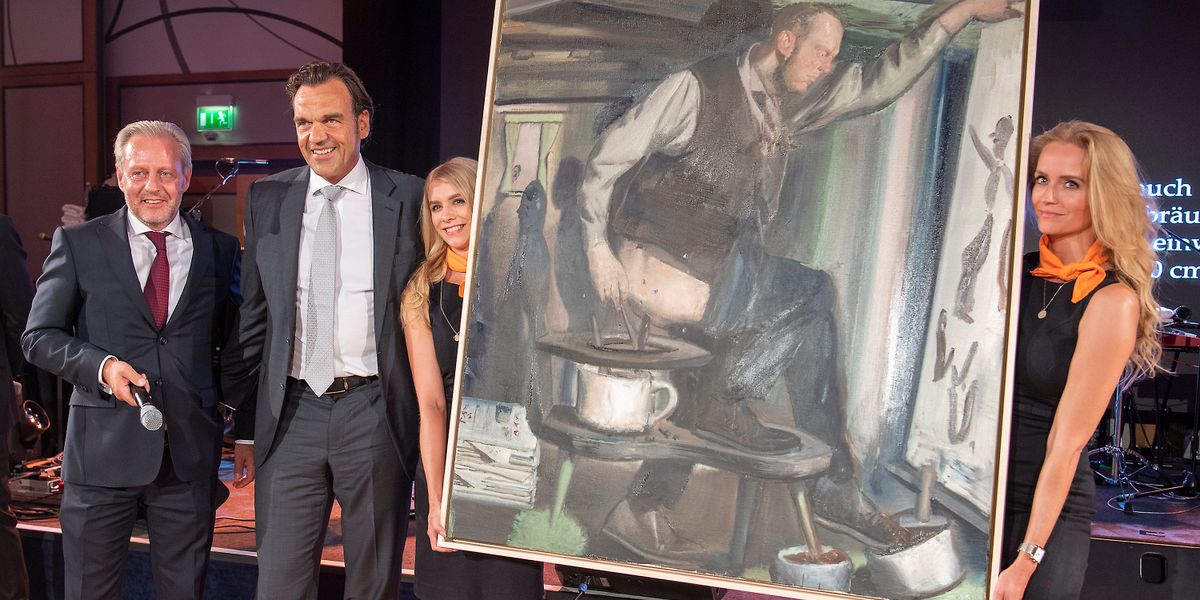
Photograph accessible here.
This article is part of the b2o: an online journal special issue “The Question of Literary Value”, edited by Alexander Dunst and Pieter Vermeulen.
Literary Value is Unexceptional
Arne De Boever
What’s your understanding of literary value?
How would you begin to answer this question?
Tell me what literary value is, and I will tell you about your politics.
I will begin to formulate my answer from within[1] literature, and specifically from within a particular novel, Ben Lerner’s 10:04. 10:04 explicitly takes on the question of literary value and self-consciously, almost in spite of itself, stands out as one of the most important (that is, most valuable) English-language novels of the first two decades of the twenty-first century—indeed, by now you may have grown tired of hearing about it.
The novel includes a scene that features Alena, an artist friend of the novel’s narrator Ben, throwing a piece of an already broken Jeff Koons balloon sculpture onto the hardwood floor of her studio, where it shatters further. “It’s worth nothing” (Lerner 2014, 132), Alena hisses—and indeed, all of the art in her Institute for Totaled Art is what the novel refers to as “zero value” art (129). Specifically, it’s art that due to some kind of damage—sometimes visible, sometimes not—has been deemed to be a total loss by insurance companies. Such art is not destroyed, however, but stored in a warehouse, and Alena has convinced an insurance company to donate some of these works to her institute, where they are displayed as art without value. Clearly, this is a scene in which the financial value of art is destroyed. And it is satisfying, Ben comments, to see “an icon of art world commercialism and valorized stupidity” (131)—a Koons—smashed to pieces.
Consider, however, the sentence that immediately follows Alena’s hissed declaration of zero value: “not for the first time, I wondered”, Ben reflects, “whether Alena was a genius”, some kind of “chthonic deity of vengeance” (132). If the financial value of art is destroyed in this scene, Alena’s downwards gesture is immediately also lifted up, and expressed as another kind of value: the value of a work of genius, even some kind of earthly goddess. While it seems clear what kind of value this scene destroys (namely, financial value), the kind of value that it institutes is—apart from the fact that is not supposed to be financial value—much less clear. Indeed, even its separateness from financial value, which the novel seems to assume, is uncertain: for doesn’t Ben Lerner, by writing about Alena’s Institute for Totaled Art, which is a fictionalized version of the actually existing artist Elka Krajewska’s Salvage Art Institute, bring value to Krajewska’s project—value that will, almost inevitably, at some point translate into financial value again? Through the grants that Krajewska will, in part thanks to Lerner’s writing, be able to get for her project? The honoraria that she will receive for talking about it? The increase in the financial value that her other work might accrue thanks to the attention that the Salvage Art Institute receives, et cetera? And isn’t my very own mortgage in some small part being paid off by the thus seemingly inescapable financial value of Alena’s art, given that I teach 10:04 and receive a salary for my work? So perhaps “the market’s soul” isn’t as easily chased away as 10:04’s narrator Ben, as well as Ben Lerner, suggest (if we can take the essay from Harper’s in which the claim about the market’s soul and “art outside of capitalism” first appeared at face value [Lerner 2013]).
I am interested in the value that this scene, in which the financial value of art is destroyed, also posits. I am particularly interested in how this non-financial value of art is posited: through terms like “genius” and “deity”, which draw from a Romantic and theological register, even if we are told that the deity in question is a “chthonic” one (meaning, from the inner soil of the earth—the ancient Greek underworld).
What’s your understanding of the non-financial value of art?
How would you begin to answer this question?
These are, in the end, questions about the autonomy of art—of the literary, visual, and performing arts. The specific issue I want to consider is: what might be the politics of the answers we give to such questions?
*
Since 10:04 invites us, in this context, to consider the value of contemporary art, a recent debate about value in contemporary art might be instructive. I have in mind the back-and-forth between the painter Neo Rauch and the critic Wolfgang Ullrich about the autonomy of the artist and the work of art, about which I have written elsewhere (Boever 2025).
At the center of this debate is Rauch’s painting “Der Anbräuner” (2019), which is featured at the top of my text. Rauch, a German painter who was born in former GDR (he hails from Leipzig), makes this painting in response to the critic Ullrich (a Wessie), because Ullrich has accused him of peddling a rightist politics in the ways he talks about the autonomy of art. Nostalgic for the days of East Germany (which Rauch perceives as having been colonized by the West and its values—capitalism, multiculturalism, et cetera), Rauch longs even beyond that for the times of the Romantic artist to whom we defer as a kind of genius, outside of the reach of criticism. Rauch makes a clear case for aesthetic autonomy and for the special value of art, but the problem is, according to Ullrich in his engaging little book Feind Bild Werden (“Becoming the Image of the Enemy”), that the terms in which Rauch makes his case have become entangled in the discourse of the political right. There has been what Ullrich terms a “Rechtsverschiebung” (“a shift to the right”) of the idea of autonomous art (Ullrich 2020, 12), which is being articulated today in exceptionalist, theological, and sovereign terms that Ullrich considers problematic (Ullrich uses the word “majesty” in this context [55]). Art and the artist are being talked about as “Kings”: this is the fundamental problem. As Ullrich sees it—and one can think of this as a kind of aesthetic “No Kings” protest—, we need to get back to a leftist articulation of aesthetic autonomy.
But the situation Ullrich encounters is that autonomy, on the left, appears to be out. There, the valuation of art is often not so much made in terms of aesthetic autonomy but through reference to “identities” and “issues”—art-adjacent values that are currently, and perhaps increasingly, used to value art. This is an aesthetic condition that scholars have characterized as “post-autonomous” (see Ullrich 2022), in which the value of art is precisely in dispute at a time when identities and issues seem to be valued more. How this condition relates to previous debates about literature and politics, for example Jean-Paul Sartre’s notions of “committed literature” or “engaged literature” (“littérature engagée” [Sartre 1988]), is something that would need to be assessed—in a longer text—through the lens of debates about Sartre’s text “What is Literature?” and the ontological question it poses, as well as about the notion of aesthetic autonomy and its relation to politics, commitment, and engagement (for example, in the writings of Theodor Adorno [Adorno 1992] and, more recently, Nicholas Brown [Brown 2019]).
What troubles me in this debate is what, using the terminology I have been developing elsewhere, I would characterize as the “exceptionalist” articulation of aesthetic autonomy that we find in it. I suggest we pause, as Lerner’s word “chthonic” invites us to do (for why, of all things, chthonic?), over the justification of aesthetic autonomy through terms like genius, deity, majesty—in short, through the theologico-political register of sovereignty (which, as political commentators left and right are noting, is currently “having a moment” [Nicas 2025]). Certainly when it comes to what Ullrich terms “the rightwards shift of the idea of autonomous art”, this political dimension—central to the history of the political right, as for example Maggie Nelson in the opening pages of her book On Freedom notes (Nelson 2021, 5) —would be difficult to overlook.[2]
At the same time, I will admit that I am also troubled by the post-autonomous position of the contemporary aesthetic left to which, today, such exceptionalism is often seen to respond: a position that risks precisely always subordinating aesthetic autonomy—and by implication, literary value—to the various issues of the day (feminism, climate change, structural racism, et cetera). To be clear, I am not saying that these are unimportant issues. At the same time, whither autonomy under such post-autonomous conditions of valuation? And might not the rightist, exceptionalist articulation of autonomy as we encounter it today be a reaction to the contemporary leftist regime of post-autonomous valuation? Might there not be a way in which post-autonomous valuations of art awaken and reinforce exceptionalist articulations of aesthetic autonomy? Could this not be a part of what constitutes the steady flow of “scandals” (from the Greek “skandalon”, meaning “trap” or “snare”) and “shitstorms” (Han 2017) of our time, in which right and left seem bent on “trapping” and even “canceling” each other again and again, without an end in sight. Did the same issue—autonomy vs. post-autonomy—trouble Sartre’s plea for an engaged literature? If it didn’t, why not? How to get out of this spring snare?
*
When thinking about literary value, the debate between Rauch and Ullrich should probably be a warning case:
1/ Let us not articulate literature value in a way that risks being complicit with non-democratic values on the political right.
2/ At the same time, let’s not allow post-autonomous aesthetics to prevent us from articulating autonomous literary value.
The goal would need to be, or so at least it seems to me, to return to an autonomy discourse that stands separate from both those political formations and insists on the value of literature while at the same time not slipping into aesthetic and political theology, and allowing for the literature-adjacent values that have become prominent in our time. While such a theology may at some point have been considered a thing of the past, it seems to be getting a new lease on life today—under the current political conditions—, and it is worth being attentive to its persistence.
To return to literary value: consider the difference between an academic giving a talk at a university, and a creative writer in the auditorium down the hall reading from their work. Academics don’t typically read from already published work; but the creative writer does just that. Why? No one will come ask for the academic’s autograph after their talk, but the creative writer will sign copies of their books after reading. Why? And then consider the questions: the academic’s audience will come in swinging a hammer, arguing with them about the theses they’ve laid out. As for the creative writer: they get asked questions like … what’s your writing routine? Do you write early in the morning or late at night? Standing up or sitting down? What’s your writing drug of choice? It’s as if these little habits will provide the secret to their genius: if we adopt them ourselves, perhaps we too can be great writers!
I do not offer this compare-and-contrast because I am envious of the creative writer’s treatment. I draw out these differences because they arguably mark the difference between the secular and unexceptional realm of scholarship (no one wants to hear a scholar read from their already published work, no one asks for their autograph, no one wants to become them), and the exceptionalist, theological realm of the literary.[3] Articulations of literary value, I propose, should strive to work against such exceptionalism. Unless, that is, they want to advocate for a politics that, in literary quarters, is typically considered dubious: the politics of genius, deity, majesty—monarchical sovereignty, and all of the abuses for which it sets us up. Tell me I’m exceptional / I promise to exploit you…, as Courtney Barnett has it in “Pedestrian At Best”.
What was it again that Immanuel Kant, in his influential attempt to articulate the autonomy of the aesthetic, said about beauty (in Section 15 of his “Analytic of the Beautiful”)? That it was “Zweckmässigkeit ohne Zweck”, “purposiveness without purpose”, “purposiveness without an end” (Kant 2000, 111). Taking some distance from Kant, might such a formulation—which in Kant provides the framework for aesthetic judgments—provide a key to the position on literary value that I’m trying to articulate?[4] “Wertigkeit ohne Wert”, “Worthiness without worth”, “validity (or maybe valence?) without value”… I like how such a formulation—which would mark a kind of value formalism, and bring value within the realm of beauty—manages to both assert autonomous value and unexceptionalize it by insisting such value is without value. I like how such unexceptionalization foregrounds the genealogy of literary value, in other words, the fact that literary value is the outcome of the performative and crucially collective history of attempts to state such value. Might such a history not be constituting itself around an empty place (to recall the work of the democratic theorist Claude Lefort [Lefort 1986]), as a will to power that can always only temporarily be settled (rather than ontologically locked in)?[5] This is not an argument against attempts to articulate literary value but a reminder that whatever we judge literary value to be (and this of course begs us to reflect further on the exact relationship between judgment and value), it remains without value—a “without” that is an invitation (perhaps even a solicitation or summons) to articulate it again and again.[6] To some, this might sound like the work of secular democracy, as an antidote to political theology.[7] And so I’m looking around me at the state of world, and I’m wondering: Couldn’t there be value in that?
A thesis, then: Literary value is the secular, unexceptional process of such value’s plural-democratic articulation. This understanding of literary value counters theological-exceptional approaches to literature’s “sacredness”.
*
Given the political import of such an approach to literary value—as a secular, unexceptional and plural-democratic process against the theology of the sovereign nation-state[8]—it is not much of a stretch to characterize the work of articulating literary value in this way as a form of what the Palestinian-American scholar Edward Said memorably called “secular criticism” (Said 2010). I close, then, by noting that Said theorizes secular criticism in The World, The Text, and The Critic through a reflection on the critic Erich Auerbach writing in exile. This suggests an exilic understanding of literary value as a notion that, always at a removal from itself, establishes and accrues its value through the process of literary value’s articulation. The repetitiveness of this process can be characterized, in Said’s terms, as “a way of showing that history and actuality are all about human persistence, and not about divine originality” (Said 2000, 113). Literary value is the process—this process’s history, and ongoing, present reality—that reveals the human persistence to articulate literary value.
Whether today, we do this in the melancholic, crisis-mode of Walter Benjamin’s angel of history or with the affirmative, joyful flair of a discipline confident about the value, whatever it may be, of its foundational object of study, makes all the difference.[9]
References
Adorno, Theodor. 1992. “Commitment”. In Notes to Literature, Volume 2, translated by Shierry Weber Nicholson, 76–94. New York: Columbia University Press.
Boever, Arne De. 2025. “Aesthetic Theology: A Politico-Philosophical Investigation”. Philosophy Today 69, no. 1: 25-40.
Bové, Paul. 2021. Love’s Shadow. Cambridge, MA: Harvard University Press.
Brown, Nicholas. 2019. Autonomy: The Social Ontology of Art under Capitalism. Durham: Duke University Press.
Clune, Michael W. 2021. A Defense of Judgment. Chicago: University of Chicago Press.
Han, Byung-Chul. 2017. In the Swarm: Digital Prospects. Translated by Erik Butler. Cambridge, MA: MIT Press.
Kant, Immanuel. 2000. Critique of the Power of Judgment. Translated by Paul Guyer and Eric Matthews. Cambridge, MA: Cambridge University Press.
Kornbluh, Anna. 2019. The Order of Forms: Realism, Formalism, and Social Space. Chicago: University of Chicago Press.
Lefort, Claude. 1986. The Political Forms of Modern Society: Bureaucracy, Democracy, Totalitarianism. Edited and introduced by John B. Thompson. Cambridge, MA: MIT Press.
Lerner, Ben. 2013. “Damage Control: The Modern Art World’s Tyranny of Price”, Harper’s, December. https://harpers.org/archive/2013/12/damage-control/.
—. 2014. 10:04. New York: Faber and Faber.
Nelson, Maggie. 2021. On Freedom: Four Songs of Care and Constraint. Minneapolis: Graywolf.
Ngai, Sianne. 2020. Theory of the Gimmick: Aesthetic Judgment and Capitalist Form. Cambridge, MA: Harvard University Press.
Nicas, Jack. 2025. “Sovereignty is Having a Moment”, New York Times 28 July. https://www.nytimes.com/2025/07/28/briefing/sovereignty-is-having-a-moment.html.
Plot, Martín. 2014. The Aesthetico-Political: The Question of Democracy in Merleau-Ponty, Arendt, and Rancière. New York: Bloomsbury.
Said, Edward. 2010. The World, The Text, and The Critic. Cambridge, MA: Harvard University Press, 2010.
Sartre, Jean-Paul. 1988. “What is Literature?” and Other Essays. Cambridge, MA: Harvard University Press.
Ullrich, Wolfgang. 2020. Feind Bild Werden: Ein Bericht. Berlin: Klaus Wagenbach.
—. 2022. Die Kunst nach dem Ende ihrer Autonomie. Berlin: Klaus Wagenbach.
[1] A polemical opening remark: I refuse to begin from without a literary text. It is perhaps characteristic of the state in which the study of literature has landed today that many if not most answers to the question of literary value begin from without literature, and can proceed almost entirely, if not indeed entirely, without actually reading literary texts. (Why this avoidance? Let us—in comparison—imagine a special issue on, say, the value of philosophy. Which philosopher would begin to address the value of philosophy from without philosophy, for example from a sociological point of view?) How can a discipline that posits the value of its object from without that object survive the current challenges to its existence? Such a discipline seems bound to be subsumed by other disciplines or subdisciplines—sociology, economics, history, media studies, et cetera. To posit literary value from within literature means to resist these developments and come up with better answers.
[2] In discussing her decision to stick with the term “freedom” as the central term for her book, Nelson notes her “long-standing frustration with its capture by the right wing”, a capture that, she goes on to observe, “has been underway for centuries” (Nelson 2021, 5).
[3] There are, of course, star scholars who are able to make the jump from one realm to the other. One can think of a scholar like Judith Butler, for example, who may be signing copies of their work after a talk.
[4] The distance is marked by my confusion of the beautiful and the valuable. It’s worth noting here the marked interest in Kant in contemporary contributions to literary value studies: I am thinking in particular of Ngai 2020 and Clune 2021, but also Kornbluh 2019.
[5] On Lefort as a critic of political theology, see Plot 2014.
[6] I insist here (with a nod to Hannah Arendt) on the pluralism of such an approach, and I distinguish between pluralism and relativism since I deem some articulations of literary value to be better than others. As I see it, pluralism does not come at the cost of judgment, and no judgment is final. As I’ve indicated elsewhere, my position is not simply another plea for horizontalism.
[7] Others may want to reflect this insight economically and criticize how it continues, and even conditions, the generation of literature’s economic value, leading us back to the scene from Lerner’s 10:04 with which I started. On this, see Nathan Taylor’s contribution to this special issue. Much would depend here, of course, on the particular economic or political values that are being valued. I.e. our discussion would need to move from a value formalism to a discussion of specific values proposed.
[8] Please note that I am not arguing against the sovereign nation-state in general—I am arguing against the theology of such a political formation.
[9] This difference is at the heart of Bové 2021. For a different way of thinking value beyond Benjamin’s Angel, see Pieter Vermeulen’s contribution to this issue.