b2o: an online journal is pleased to announce the publication of EXOCRITICISM, a special issue edited by Arne De Boever and Frédéric Neyrat. In fourteen contributions that cut across the critical and the creative, the issue responds to the exigency that the rise of Artificial Intelligence poses to those who read and write. Ranging from (among other forms and themes) micro-fiction to travelogue, electric consciousness to xenoecology, spontaneous note to prophecy, and including original visual works, EXOCRITICISM explores critical thinking and writing at the limits of the academic journal, away from pre-patterned centers of interpretation and evaluation. A design print-book based on the special issue is forthcoming.
This text is part of the b2o: an online journal special issue “EXOCRITICISM”, edited by Arne De Boever and Frédéric Neyrat.
Image: Lebensgroße Selbstentfernung; Lifesized Selfremoval – Ferdinand Altenburg, 2024
The Conspiracy of the Electricians
Elmar Schenkel
Translated from the German by Arne De Boever
There was a Mexican philosopher called Kant. One day, he grew tired of the metaphysics that he had until then practiced to excess, and after a few futile attempts to learn a new language—let’s say, Afrikaans—he turned to the study of electricity. He started laying cables over his yard, hung up antennas that were several meters long in gardens and fields. He wanted to see what that would be like. He shed light on a variety of things, small pyramids, dung heaps, dusty coaches. He put up fences that no one should climb, a little ghost ride in which he lit up grimaces. But somehow he was never fully satisfied until he hit upon the idea to set electric traps, in which he caught other philosophers, to then force them to abandon their fixed ideas. He only let the captured philosophers go on the condition that they too would dedicate themselves to electricity. And so it happened that the philosophers once again became extinct, and that the world was only populated by electricians. And that could have been the end of the story, as any contemporary would confirm–but it stubbornly continued on. One day, one of these electricians realized he was bored. He didn’t know why, but when he gave it some thought, this fellow Kant came to mind. He noticed that he’d started hating him. He obtained documents about his life and works, interviewed people, and discovered to his great amazement the things that Kant, in his pre-electrical days, had done. Almost no one knew about this, it wasn’t talked about. Secretly, he studied metaphysics and, enlightened by it, started a conspiracy. He built metaphysical ghost rides, fences, and finally traps in which he successfully began catching electricians—and thus this profession too quickly came to an end. One day, by the way, this fellow Kant got caught in his net, and that’s the sole reason why we contemporaries are indebted to him for his major work, The Crisis of Electric Consciousness.
This text is part of the b2o: an online journal special issue “EXOCRITICISM”, edited by Arne De Boever and Frédéric Neyrat.
The Essay vs. AI: On the Literary Value of Criticism
Arne De Boever
All images are (c) Arne De Boever and were taken by the author in the Sublevel at the California Institute of the Arts.
The critic is always in a secondary position to the poet, but his secondariness is not an inferior position. (Bové 2025, 117)
–Paul Bové, “Critical Poetic Grace”
Opening Questions
How to write criticism in the time of artificial intelligence (AI)?
I ask this question as a critic working among literary, visual, and performing artists at an arts college—in other words, as part of a creative community that is, by nature of the work its members are doing, deeply invested in forms. If critics have perhaps forgotten, at times, that they too participate in that practice, the immediate context of my own writing makes it impossible for me to do so and solicits me, on a daily basis and as a key concern of aesthetic education, to think longer and harder about the forms I generate as a critic. While those forms first and foremost seek to say something about the thing that catches my critical attention, they are also undeniably the aesthetic forms of my very own thought, and as such they deserve critical scrutiny, in particular in the time of AI when critical writing, and thus also critical thinking and its objects, appear to be going through an epochal transformation.
Let me clarify from the outset the limits of my project here. I am only interested in thinking about AI in the context of writing criticism—the kind of writing that I consider myself to be doing. There are, obviously, many other contexts for the application of AI; certainly there are many other kinds of writing in which AI may serve a purpose. My position, however, is that when it comes to writing criticism specifically, AI is useful only as a challenge to solicit us into writing against or more precisely outside of (because I am not talking about a writing that’s merely reactive) the kind of writing that AI generates. AI solicits us, I propose, into writing outside of established formats of academic and professionalized prose, familiar from well-recognized scholarly journals.
Exocritics of the world, unite!
This solicitation, I argue, is for the sake of saving not only thought but thought’s very objects from a dulling standardization and commodification to which, in the time of AI, they are being subjected. Criticism has been in the process of becoming formulaic, and in our time AI is accelerating this process, an acceleration that is further contributing to the demise of the humanities. While AI is accelerating this process today, it should be clear that it precedes the time of AI. Indeed, it is arguably a problem that is part of the institutional history of criticism’s practice—criticism is read and taught typically in academic contexts—, a history that the arrival of AI is making more visible.
No doubt a key word in thinking about all of this is “freedom”. We are living in a time (as Maggie Nelson for example has noted [Nelson]) when “freedom”—freedom of speech, academic freedom, artistic freedom—are once again objects of scrutiny, and my position is that freedom—and in particular intellectual freedom,[1] which is the freedom that is practiced in criticism—is under increased pressure in the time of AI.
So a slightly adjusted version of my opening question might be: how to be intellectually free in the time of AI?
What are the forms of criticism that will enable us to remain intellectually free in the time of AI?[2]
Reading AI
The critical form that I propose to focus on in this reflection about “how to write criticism in the time of AI?” is the essay (instead of the scholarly article). Criticism today, I argue, needs to uncompromisingly seek the nominally modest, humble, and in my own language unexceptional form of the “essay”—from the French “essayer”, “to try”; the tradition of the essay goes back to the 16th-century French thinker Michel de Montaigne, who invented the genre—if it wants to continue being intellectually free. Put negatively, it needs to steer clear from any prescribed, repeatable, and supposedly scientific forms that in their purported objectivity are in fact predictable, formulaic, and adding to the status quo—thus preventing anything truly new from coming about. AI comes to us in the guise of the new, but its relation to the new—as well as other, related terms: creativity, for example—remains contested (as I will discuss).
Leaving criticism aside for a moment, I point to the field of theoretical mathematics, in which AI has solved several long-standing problems, but in ways that practitioners of the discipline consider unsatisfying: because the theories that AI provided lack what they don’t hesitate to characterize as a poetic quality, a beauty they associate with human ways of solving such problems. So they are still looking even if AI has already completed the job. These mathematicians, who look for poetry in theory, need to become our allies—at least to the extent that they intend to leave these beautiful solutions to humans.[3]
The polemical and at face value perhaps somewhat naïve version of my position would be that AI cannot write essays. To be clear, this position is not that AI, for now, cannot write essays. It is stronger than that: I would be positing, categorically, that it will never be able to do so, because the essay as I conceive of it is a particularly human form of intelligence that always realizes itself beyond the limits of what AI can achieve. It will be clear, then, that my turn to the essay is not a nostalgic turn but a futuristic one, in the service of a critico-futurism. We could give a bit of a humorous ring to this: you cannot spell “essay” with “AI”, even if the original French word “essai” ended in “AI”. AI writes ArtIcles.
I write in “woulds” and “coulds” because there is a catch: by presenting the essay in this categorical way, and as tied to human intelligence, I don’t want to make a plea for the exceptionalism of the essay as form of free human thought. I am interested, as I’ve indicated, in the essay as an unexceptionalist form. I may have landed on the form of the essay, but what matters to me here is not some kind of essayistic essentialism, or the essay as the form for human exceptionalism (I write as a humanist but not a human exceptionalist). I am interested, rather, in the challenge to AI-generated writing that the essay enables me to explore. Responding to this challenge may take forms other than the essay as well, even if the essay may be a particularly promising form in this context.
Reading AI-generated articles is a peculiar experience, one that, alas, I am becoming more and more familiar with in a time when the traditional mid-term or end-of-term essay is disappearing—is being outsourced to AI, as Hua Hsu in a recent New Yorker essay on “The End of the Essay” (2025) observed. On the surface, everything in these AI-generated end-of-term papers (let’s not call them essays) or articles seems to be in order. But when applying closer scrutiny, you find that there is just no “there there”. They simply move through the motions, demonstrating a disconcerting lack of voice. A claim is made and while the evidence brought in to support that claim is drawn from the general field of study in which that claim is presented, the relations between the various pieces of evidence just do not add up, or are simply wrong.[4]
On the surface, everything seems to be in order (there are sources! there are [granted, unreferenced] quotes! there is evidence! there is a claim!): but start scratching just a little bit (ask for the reference!), and you quickly lose whatever ground you thought there was under your feet. The AI paper or article is not the product of “reading”. I have some hesitation to characterize it as “writing”, even; doing so would fundamentally shift what I understand by those terms. The AI article—the ArtIcle–truly is an empty shell, the mere appearance of a form of thought—without any actual thought. Its author, an impersonal mask.
Chase it, and you’ll soon end up like Wile E. Coyote.
Of course there is still a difference between such an AI article, and academic articles written by humans to share scholarly research and also to fulfill the requirements of an academic degree and academic promotion. But anyone who has read through all of the scholarly articles about, say, a contemporary American novel, will be able to testify to the repetitiveness of the form: again and again, one comes across the same kinds of compositions, frequently presenting the same evidence, reaching perhaps substantially different but similarly sounding conclusions—and of course they are all referencing each other. One has the impression of entering into some kind of nightmarish mirror palace in which versions of the same professional academic are all “echoing”—one of AI’s favorite words, by the way–more or less the same thing. By the time such “echoes” are available to the public eye, they have already passed through the professional machinery of what is called “peer review”: review by so-called specialists, and frequently the authors of other already published articles on the novel in question, who will typically only approve for publication work that more or less resembles their own and demonstrates what they perceive to be the standards of the discipline. Everything here revolves around method and outcomes,[5] around the calculated effects of a hollow procedure that, in the writerly form it takes, stands miles apart from the object on which it is supposed to shed light. There simply is no relation. Granted, we still have here humans who are writing such articles; but we are really only one step removed from the AI article. I have no doubt that many of these humans are already using AI in the service of generating the next line on their CV.
It should always have been obvious where this was going, even if bad criticism alone cannot be blamed for it: in recent months, I have been receiving emails from university presses in both the US and elsewhere asking for my permission to allow companies to train their AI on work of mine that these presses have published—presumably in order to then turn AI into a better academic writer. While it is undoubtedly better to be asked than to simply find out that one’s work was used without one’s consent—and there have already been court cases about such non-consensual use[6]–the payment one can expect to receive from this is minimal, even though the price paid by the presses (who are barely staying afloat in the current anti-academic climate) for closing such deals is great. In the future they imagine, AI will be able to write academic articles and books—we need not bother any longer.[7] This is, and this much should be clear, the outcome of a process that has involved the increased standardization of criticism in the university. Anyone doing their homework and researching already published criticism on this or that novel, for example, will not be able to avoid some irritation at how similar the articles all sound. The AI-generated article is simply the next step in a process that predates it by far.
If AI can appear to us, then, as the miserable outcome of this long institutional history of criticism’s practice, my position is that we are being solicited, today, in the time of AI, to write otherwise.
How to write criticism in the time of AI?By writing criticism in such a way that no AI could. I don’t know if this is possible—but I like the challenge. What kind of writing might such a solicitation have us produce? Time to take this outside.
The Essay
While the problem of writing criticism in the time of AI propels us into an exocriticism and critico-futurism, it has a history. For this, I partly look—without a hint of nostalgia–to a text from 1958 (the text does not mention AI but it’s worth noting that the term was coined in 1956, just a few years previous) as part of the solution. There, an author writes of the essay, formally independent and related to poetry, as evoking “intellectual freedom” (Adorno 3). It dodges prescription, seems to “reflect the leisure of a childlike person”; “luck and play are essential to it” (Adorno 4). Often “classified a trivial endeavor” (Adorno 4), it practices interpretation as radically free speculation, thus preserving the artistic energy of its source material: for “the objective wealth of meanings encapsulated in every intellectual phenomenon demands of the recipient the same spontaneity of subjective fantasy that is castigated in the name of objective discipline” (Adorno 4). The essay has an “aesthetic autonomy” while at the same time it never fully stands aside from its object—“for one can hardly speak of aesthetic matters unaesthetically” (Adorno 5). The “expressive impulse in the presentation”, which the academic article seeks to remove—this is another way of saying that the academic article seeks to get rid of the subject—is preserved and even promoted in the essay, which presents itself as going against the “privilege of the mindless” (Adorno 5). Such a form, and the author presents the essay precisely as a form in his own essay, deliberately works against what the author characterizes as “academic unfreedom” (“akademische Unfreiheit”), a state of academic disciplining in which “intellectual freedom itself becomes unfree and serves the socially preformed needs of its clientele” (Adorno 6).
The author who is speaking here is Theodor Adorno, who understands the academy to be a “repressive order”: “A certificate of competency is required of the mind so that it will not transgress upon official culture by crossing culturally confirmed boundary lines. Presupposed in this is the notion that all knowledge can potentially be converted into science” (Adorno 8). But what was lost in this shift from “philosophy” to “science”? Why did this shift take place? Marcel Proust, Adorno argues, proceeded “scientifically” when he was writing his monumental opus À la recherche du temps perdu [In Search of Lost Time], but the kind of science documented in the work’s seven volumes is “not readily accommodated within science and scholarship”, and this “despite the fact that their claim to objectivity is neither diminished nor abandoned to a vague plausibility” (Adorno 8). The knowledge it presents is that of a man of experience “like the now extinct homme de lettres [man of letters], whom Proust conjures up as the highest form of dilettante” (Adorno 8). A dilettante, then, or also, as Adorno also allows us to put it in the closing lines of his essay—a “heretic” (Adorno 23): that is what the essayist, the critic, is to be in the time of AI.
Adorno, of course, is not writing in the time of AI—he’s just on the cusp of it. Note that Hannah Arendt, in the “Prologue” of her book The Human Condition from 1958, takes the launch of Sputnik in 1957 to reflect on the scientific production of a “future man” as part of a “rebellion against human existence as it has been given”, with science generating “truths” that “will no longer lend themselves to normal expression in speech and thought”, thus necessitating “artificial machines to do our thinking and speaking”. “The question”, as Arendt points out, “is whether we wish to use our new scientific and technical knowledge in this direction” (3). Although Adorno doesn’t appear to be thinking about any of this, I’m suggesting that what he has to say about the essay and its relation to the stodgy forms of academic writing in 1958 nevertheless becomes supremely relevant today, when we are witnessing the outcome—in AI–of certain kinds of standardization in the disciplines that are supposed to enable the free expression of the intellect. It’s as if AI is inscribed in Adorno’s essay just by virtue of its historical context–even if he never mentions it.
Adorno contrasts the essay’s wisdom to the philosophical doctrine, “deeply rooted since Plato, that what is transient and ephemeral is unworthy of philosophy” (Adorno 10); he posits the essay’s “methodically [unmethodical]” (Adorno 13) way of proceeding to Descartes’ obsession—him again!–with the “clear and distinct” (Adorno 14) and suggests it pursues a “kind of learning that remains vulnerable to error” (Adorno 13). It is not analytical; it accepts that not everything in the world is logical; it does not seek to be exhaustive; it “thinks in fragments”; Adorno allows us to characterize it as “fallible and provisional”, and “groping its way” (Adorno 16). To Adorno, it is a kind of thinking in the midst of things. He quotes Max Berise writing that
The person who writes essayistically is the one who composes as he experiments, who turns his object around, questions it, feels it, reflects on it, who attacks it from different sides and assembles what he sees in his mind’s eye and puts into words what the object allows one to see under the conditions created in the course of writing. (Berise qtd. Adorno 17)
Thinking and writing in process, then, rather than rule-based or following some kind of pre-scription. Open, at a distance from “the masterpiece”, the essay finds “happiness” in its hostility to “official critical thought” and pursues “the pleasure principle of thought” (Adorno 21). Its object, Adorno writes “is the new in its newness, not as something that can be translated into the old, existing forms” (Adorno 21). It makes the violations of the orthodoxy of thought visible. This suggests, then, that the new problem of “how to write criticism in the time of AI” can only be written up in the essay form, which is mobile.
A Literary Turn; On Criticism’s Hybridity
The main writer Adorno mentions as an example in this context is “Benjamin” (Walter), but I propose to turn to another Benjamin at this point—the Chilean writer Benjamín Labatut. Labatut rose to fame with his novel When We Cease to Understand the World, published in English translation by the New York Review of Books in 2020. This is a remarkable work about science and history and the people caught up in both, that opens like a work of non-fiction but ends in a more experimental, and clearly creative mode. Its opening chapter, “Prussian Blue”, which ends in the words “a terrible verdure” that served as the book’s original Spanish title (Un verdor terrible), is, at least to this reader, impossible to distinguish from an essay as one might find it in a magazine or even a well-written book of history (in particular, the history of science). There are, of course, no footnotes, no references (even if there are quotations), no bibliography; there isn’t a clear thesis statement or argument, and in that sense the chapter is clearly an “essay” rather than an “article”. But the thing is, in the way it is presented here, it’s neither: it is part of a work of fiction, and thus closer to a short story or a chapter in a novel.
This is, however, where I become interested, and where we begin to dabble in the field of what has come to be called “theory-fiction”: for what happens not just when fiction is presented in this essayistic way, but when criticism appears to us in this fictionalized form? The development of Labatut’s book makes it clear that we are in the realm of fiction—but what does it mean to bring criticism into this realm? Is this a challenge to fiction writers? Is it a challenge to critics? Does this hybrid form address itself to both?
Consider the following three quotes, all in translation:
A wave of suicides swept through Germany in the final months of war. In April 1945 alone, three thousand eight hundred people killed themselves in Berlin. The inhabitants of the small town of Demmin, to the north of the capital, some three hours away, fell prey to collective panic when the retreating German troops destroyed the bridges leading west, leaving them stranded on their peninsula, surrounded by three rivers and defenseless before the dreaded onslaught of the Red Army. Hundreds of men, women and children took their own lives over the course of three days. (Labatut 2020, 10-11)
Today it is hard from an even partly adequate idea of the extent of the devastation suffered by the cities of Germany in the last years of the Second World War, still harder to think about the horrors involved in that devastation. It is true that the strategic bombing surveys published by the Allies, together with the records of the Federal German Statistics Office and other official sources, show that the Royal Air Force dropped a million tons of bombs on enemy territory; it is true that of the 131 towns and cities attacked, some only once and some repeatedly, many were almost entirely flattened, that about 600,000 German civilians fell victim to the air raids, and that three and a half million homes were destroyed, while at the end of the war seven and half million people were left homeless, and there were 31.1 cubic meters of rubble for every person in Cologne and 42.8 cubic meters for every inhabitant in Dresden—but we do not grasp what it all actually meant. (Sebald 2003, 3-4)
Hitler expressed what the average German thought but declined to say, and he did so compellingly and with such conviction as to make it legitimate, and the more people followed him in that direction, realizing that what one thought in one’s own mind yet was perhaps wary of expressing could indeed be expressed, the more legitimate it became. The opinions Hitler expressed were clear and unambiguous, he concealed nothing, and they could easily have been repudiated, he and his party having no power on their own, such power being granted by those who listened to him and who in doing so heard themselves, their own voice of reason, the voice that said this is the lay of the land. That nothing suppressed that voice, those hitherto quiet thoughts, and that the structures to reject such baseness had ceased to operate became Germany’s tragedy. (Knausgaard 2018, 767)
The first is from Labatut’s work of fiction, When We Cease. The second includes the opening lines of the first lecture from W.G. Sebald’s On the Natural History of Destruction—non-fiction. The third is from the sixth volume of Karl Ove Knausgaard’s autobiographical novel My Struggle, which includes a long essay about Hitler and his autobiography Mein Kampf. Read next to each other, they sound alike; there is no marked difference in genre, certainly no clear ontological difference in terms of the reality in which they exist (fiction, in the case of the first; history, in the case of the second; criticism, in the third case, given that it is part of an analysis of Mein Kampf). Matters are complicated further by the fact that Labatut, in the first quote, is referencing fact; that the second quote evidences what I consider to be a characteristic feature of Sebald’s literary style: the way he tends in his fiction to deliver the horrors of history in run-on sentences, piling horror upon horror, as if he were (Walter) Benjamin’s “Angel of History” whose wings have become caught up in the storm of progress, moving forward with his back towards the future, and powerlessly looking back at the pile-on of disasters that we call “history”; and that Knausgaard dishes up a critical text about Mein Kampf as part of an autobiographical novel. I could place a quote from Sebald’s fiction—say, The Rings of Saturn (Sebald 1998)–next to the quote from his lecture, and they would sound exactly the same. And yet, their ontological—and, not unimportant when one is talking about history, epistemic–status is undoubtedly different. We can engage with Sebald’s lecture as making a truth-claim; but the same is not possible with Labatut’s book. To be clear, I do not think this is a problem that is produced by the fact that these quotes reach us here in their English translation. In other words, the lack of difference I highlight is not a flattening effect of their translation (which was accomplished by humans, it is worth noting–not by machines). The quotes point to other questions: How to engage with a work of criticism that is presented as part of a work of fiction, even if it is autobiographical fiction (Knausgaard)? What do these comparisons give us to think about criticism?
To my mind, these questions really landed when Labatut’s The MANIAC was published, just a few years later. On the surface similar to When We Cease, this work presented itself as a triptych, leading with a section about the scientist Paul Ehrenfest that could have been part of When We Cease, and continuing with its longer center-piece (which consists of two major parts) about John (Johnny, in the novel) von Neumann who was the main scientific brain behind the atomic bomb and the development of AI. The first major digression from When We Cease would be the closing third section, which is about the game of Go, one its main players, Lee Sedol, and his famous matches with AlphaGo, an AI that had been taught to play Go. It follows organically from the engagement with von Neumann, but it is still a marked departure from When We Cease and the rest of The MANIAC. If to my mind, the questions raised by When We Cease really landed with The MANIAC, it is because here they are activated in the context of a novelistic engagement with AI. In other words, the reader is being invited to reflect on the particular form of Labatut’s writing in the context of the novel’s discussion of the development of AI, and one gets the sense that when we are reading about AI and the game of Go in the novel’s third part, we are also reading about AI and the novel.
The questions from When We Cease shift at this point: what does it mean to bring criticism in the realm of fiction… in the time of AI? Is this a challenge to fiction writers… in the time of AI? Is it a challenge to critics? Does Labatut’s hybrid form, which continues from When We Cease into The MANIAC, address itself to both? Was Sebald, through the peculiar form he chose for his fiction, trying to tell us something about how to write criticism? Is this part of the interest of his book On the Natural History of Destruction, which is on the surface not part of his fiction, just a work of criticism, but can upon closer consideration not be disentangled from it? Was Sebald by writing criticism in the form of fiction and vice versa perhaps already carving out some place for the human in a form of writing that he foresaw being appropriated by artificial intelligence? He was also a critic—and a critic with a famous hatred for the computer (“when information technology was introduced [at the university], [Sebald] refused to have a PC installed in his office. Sebald never wrote an email and if, to his dismay, he received one, it was printed out and delivered to him by “‘some clown from the Registry’”, as he apparently told a student [Schütte]). How do we read together all of these “data”?
Much has been said about hybrid literary genres, but I want to place the focus here on criticism and ask about criticism’s hybridity. I argue that what these writers—Labatut, but also Sebald, Knausgaard, and others—accomplish as fiction-writers is that they allow criticism to enter into the realm of literary play. It just so happens that in the case of three of these writers, this move takes place as part of a text that engages the history of WWII, and in particular the history of totalitarianism, fascism, Hitler, and (in Sebald’s case) the allied bombings of Germany. Without taking away from the gravity of these events, one surely has to wonder whether the formal choices that these authors are making, were made in any way in response to the historical events that they are relating—in other words, whether the hybrid form of fiction, but also of criticism, that they present was in any way decided upon with these historical events in mind. If we agree—and I don’t think this is a particularly big IF—that these historical events were devastating for humanity, is there then a way in which the decision on these hybrid critical forms was intended to safeguard the humanity that the events under consideration here seemed to want to destroy? Couldn’t writing criticism in this way emerge then as a choice for humanity in the face of the conformism that fascism strove for, a way to defy the uniformity and dulled down standardization and commodification that it sought to put into place? And if we grant, as Labatut’s The MANIAC (among many other sources) invites us to see, the continuation of WWII history with the birth of AI, doesn’t such a gesture become meaningful then, as well, in the time of AI? Couldn’t one say that each of these writers is or was, knowingly or not, proposing a humanistic criticism in the time of AI, and against the kind of writing AI typically produces?[8]
By bringing criticism into the realm of fiction, by practicing it as part of a fictional form, each of these writers is giving us some indication of how to save criticism from AI. We can give many different names to how such saving is accomplished: style may be part of it; humor may be too; with Adorno we may envision a criticism that allows for a certain amount of literary play. This evokes Kant (whom Adorno mentions; Adorno 6), and in particular Friedrich Schiller’s Letters on Aesthetic Education (on whom Adorno stays silent in “The Essay as Form”; Schiller). If we place the emphasis on play as a particularly human quality, however, it’s worth noting that a dying von Neumann, when he is asked “what it would take for a computer, or some other mechanical entity, to begin to think and behave like a human being”, eventually answers that “it would have to understand language, to read, to write, to speak”, adding “that it would have to play, like a child” (Labatut 2023, 263-265).
Understanding language, reading, writing, speaking—now these are the things that critics are typically good at. But do they play? And if AI has, since then, learned to understand language, to read, to write, to speak, has it learned to play? This must be why Labatut’s The MANIAC lands on a riveting section about the game of Go which seems to indicate that clearly, AI is coming close. Leaving aside the debates about whether AlphaGo is truly playing the game, the categorical imperative to critics should be clear: to preserve your thought and the forms of your thought, write a criticism that defies formulas (even if an AI-reproducible formula may be central to it; see Smith 2025), surprises, and can be recognized as something beautiful—like literature.
Theory of the Novel as Criticism
From here, I expand the argument into a speculative thesis: what if we reconsidered the novel, from its origin, as a form of criticism, and looked again at its long and distinguished history to find in it also a history of criticism in literary form? I am thinking of Don Quixote, for example, often considered the first European novel, and typically attributed to Miguel Cervantes de Saavedra. Such an attribution cannot but make one smile, however, since Don Quixote explicitly plays with its authorship: by its own account, the text suggests it was first written in Arabic, by Cide Hamete Benengeli (also referred to in the novel as Cid Mahamate Benengeli), and then translated into Spanish—which is the language in which it reaches us. A little unusually, the work’s translator, however, explicitly appears in the novel as a critic as well, commenting on whether certain sections of the manuscript may be apocryphal, and taking what we should probably call “editorial” decisions about the work as part of their practice of translation. Given that such comments are explicitly written into the novel, the novel cannot but appear to us then as a kind of self-reflexive, self-critical document that is not only a novel but also the work’s first critical commentary, a reading that is intensified in the later parts of the novel, which feature a scholar joining Don Quixote’s crew—a young man who has heard and read about Don Quixote’s adventures, and is eagerly studying them for his dissertation. And so between the first volume of the novel, which was already a form of self-criticism, and the second, the novel generates its own critic, who appears in the novel as a character, heightening the sense of Don Quixote not just as the first novel but as the first work of criticism about a novel as well.
Surely this is what the Argentine author Jorge Luis Borges tapped into when he wrote his “Pierre Menard, Author of the Quixote” story (Borges 1998), about a writer/critic seeking to rewrite the Quixote exactly as it had been written before—but without copying it. Michel Foucault is not wrong when, no doubt with this story in mind, he refers to “the Borges-style play of a commentary which is nothing but the solemn and expected reappearance word for word of the text that is commented on” (Foucault 57), and goes on to spell out the function of criticism like so: “the commentary must say for the first time what had, nonetheless, already been said, and must tirelessly repeat what had, however, never been said” (Foucault 58). The paradoxical sentence (which solves the issue of criticism’s perceived superfluousness) captures something about criticism’s peculiar relation to its object, the way in which it shares in its aesthetic autonomy and evidences an aesthetic autonomy entirely its own: it appears to be able to repeat in an original way what the literary text was nevertheless already saying; it appears to be able to say what had never been said about the literary text in such a way that it seems obvious, a mere repetition.
And it’s not only Borges, of course. Paul Auster makes much of Don Quixote in his “City of Glass”, another novel that reads like a work of fictionalized criticism and revolves around a writer of detective novels called Daniel Quinn (DQ, get it?). It’s worth noting that the novel at some point features Paul Auster, the writer, supposedly engaged in an essay about authorship in Don Quixote, and arguing that it may be the illiterate Sancho Panza who is the real author of the manuscript. (The suggestion echoes Franz Kafka’s little parable, maybe a riddle, or possibly just a joke, titled “The Truth about Sancho Panza” [Kafka].) “City of Glass” is a peculiar detective novel first and foremost because it includes no detectives and no crime: instead, it is filled with writers and readers. The novel really is a work of criticism: a critical commentary, in the form of fiction, on the detective novel as a genre. What could criticism in the time of AI learn from this? If “City of Glass” launched Auster’s career on this count, it is worth highlighting his late book Burning Boy, a work of biography and criticism that in its inventiveness belongs in the domain of literature. One can only be grateful that Auster had it in him, still, to finish it before his untimely death in 2024.
In his Goncourt-winning Compass, a novel that reads like a French doctoral dissertation about orientalism and music (as well as literature), Matias Énard turns to Don Quixote at some point to argue that “the first European novel” was really “the first Arabic novel”, given that it tells us—explicitly—that it was written in Arabic (Énard 436). Énard makes this point, which is also a point about the novel’s own origins as a work of criticism, in a novel—Compass—that itself asks us to reorient ourselves, as a compass would, in the history of the novel towards the novel’s critical components. One of Énard’s other novels, The Banquet of the Gravediggers’ Guild (2023), has a doctoral student in Anthropology as one of its characters—it leads, in fact, with a section narrated from this student’s point of view—and as the novel progresses, it frequently and critically refers back to the hapless student’s attempts to provide an ethnographic account of life in a community in rural France. The suggestion appears to be that the novel somehow can do it better: that the novel as a form is able to perform a kind of writing, grotesquely but gorgeously baroque in the sections of the book that describe the gravediggers’ banquet, that ethnography/anthropology cannot. The student is in contact with his PhD-supervisor throughout the novel, and his Doktorvater is not pleased with his progress. We also hear about his writing being rejected by established journals in the discipline. In the end, the novel embraces this character as a PhD drop-out who falls in love with a local (of course!) and ends up joining her eco-activist cause.[9] But given the erudition of Énard’s writing, which among other things has greatly expanded my culinary vocabulary, the reader can never quite shed the suspicion that Énard’s very own novel somehow comes to stand in for the student’s dissertation, and to replace the scientific knowledge that it was supposed to provide, with another kind of knowledge, not unlike that provided by Marcel Proust’s In Search of Lost Time (by Adorno’s account)—the knowledge of a man of letters, based on a certain kind of experience, but unacceptable (of course!) to the standards of the academic discipline. All of Énard’s writing, which is impressively learned, taps into this suggestion, as if the novel form in his hands is giving us a taste of what criticism may accomplish if it shed its straightjacket and came a little closer to its object—literature.
Other examples abound, with or without reference to Don Quixote: J.M. Coetzee’s Elizabeth Costello; Teju Cole’s Open City; Martin Riker’s The Guest Lecture; Joshua Cohen’s The Netanyahus. Ranging across the literary spectrum, these are all works of fiction that strike one, in some way, as criticism—or, if we flip the perspective around, works of criticism that read like fiction. I will admit having at times wished to be able to write criticism in this way—usually, I am struck by this desire when the academic writing is not going well, when I have become stuck with an argument, or bored by its form. If only I could write this in the form of some kind of fiction, I say to myself, wouldn’t I be able to move this along—“have more fun”, as Coetzee’s Elizabeth Costello puts it (Coetzee 222)—and engage some more readers? Today, these questions are no longer just private, personal ones. They are questions about criticism itself and how it chooses to live—and, if it simply goes on like before, die—in the time of AI. It’s these writers from whom critics ought to learn if they want to put out forms that will stay at least one step ahead of AI.[10]
To write criticism after AI is barbaric. By this, I do not mean, of course, that we can no longer write criticism after AI. I simply mean that we cannot continue to write criticism as before. By echoing Adorno’s famous statement about poetry and Auschwitz in this context, I intend to draw out the genocidal aspects of the AI revolution, which risks to mark the extinction of a people of writing.
Does writing such criticism mean going against disciplines, a certain understanding of scientificity, peer review, established journals and presses, even teachers and what they have to tell us about writing? Yes, it does.
Have the courage to write essays—this is the motto of the kind of Enlightenment that we are going through today, and in which the very possibility of human thought, its forms and its objects, are at the risk of disappearing. It’s by looking at authors like the ones I have just mentioned that criticism will be able to accrue an aesthetic autonomy that it will share with its objects (even though critical aesthetic autonomy is also different from literary aesthetic autonomy) and that it will be able to hold its ground in the time of AI.
Envoi; or: The Bermuda Principles
Recently, a critic called Paul Bové has accused Fredric Jameson, with his infectious compulsion to allegorize, the critic who spoke in imperatives such as “Always historicize!”, of promoting a formulaic criticism that forgets about—even destroys–poetry and joy (Bové 2021). If the solution to the work of art is allegory, if the interpretive method is to “always” historicize, what room is left for the imagination, for the radically free speculation of criticism? It’s as if, in Jameson, critics are turned into artificial intelligences that follow a prescribed set of rules. Does this still have anything to do with the work of art under consideration? What does it say about the academy if such modes of interpretation have become dominant? What intellectual freedom remains under such conditions? These are Bové’s questions, and they become only more urgent in the time of AI. Critics are enabled here with interpretative tools—an instrumentality–that are in reality tightly constraining.
Of course, imperatives—interpretative instrumentality—are tempting, in particular in a time of crisis when people reach for certainties (and Bové makes much of this in his book). It’s an allegory! Always historicize! But the problem is that such certainties only contribute further to the destruction of our objects of thought, our thought, and the writerly forms in which we express it. They mark the end of intellectual freedom.
So by practicing alternative writerly forms of expression, and in particular the form of the essay, we would be writing against such destruction—of thought and its objects. How to write criticism, how to be intellectually free in the time of AI? By writing essays—which is to say—by trying.
Bové, as is well known, was for many years the editor of the journal boundary 2, which had Jameson on its masthead, and in which I too have been involved for quite some time now. As part of our ongoing conversations, Paul recently reminded me that in 1994, he convened the journal’s editorial collective in Bermuda, to discuss the critical project of the journal. The “negatives” that the record from this gathering lists, give a good sense of the kind of essay-writing that the journal, at that time, decided to promote. I quote from “the Bermuda principles”:
we no longer wish to restrict our work to currently dominant languages and intellectual models;
we no longer wish to act editorially without a clear-cut agenda, without some established principles for publishing, without definite aims and expectations;
we no longer wish to accept for publication work which is merely professionally accomplished;
we no longer wish to be guided by the criteria of interest and importance established by the profession in its practices or by the market-place in its publications;
we no longer wish to read, as we have been, literally hundreds of unsolicited manuscripts each year, in hope that we will find some “good” materials;
we no longer accept that a journal should reproduce, distribute, and circulate knowledge;
the journal must not attempt to reestablish a lost past;
we no longer believe that we know what the age requires.
The “positives”, as the document acknowledges, are more difficult to articulate, and end up pertaining also to the day-to-day business of running a journal. I offer this list of negatives not because I agree with all of them, but because I think we need them in the time of AI—I do believe our age requires it (this in contradiction to principle 8). I shy away from offering a list of positives because I do not want to spell out what criticism today should look like. But it should, I have argued, develop itself in response to a time when the commodification of its form has reached its apex (following points 3-6), and is in the process of making the critic, their thought, and their thoughts objects, disappear (“Bermuda” reveals itself in these principles, contrary to what we may associate with it, as a name for the struggle against such “disappearance”).
The outcome of such a process, as will be clear, would not only be the end of criticism but the disappearance of a people.
References
Adorno, Theodor. “The Essay as Form”. In: Adorno, Theodor. Notes to Literature: Volume 1. Trans. Shierry Weber Nicholson. New York: Columbia University Press, 1991. 3-23.
Auster, Paul. City of Glass. In: Auster, Paul. The New York Trilogy. New York: Faber and Faber, 1999. 2-132.
—. Burning Boy: The Life and Work of Stephen Crane. New York: Henry Holt, 2021.
Bayard, Pierre. Comment parler des livres que l’on n’a pas lus? Paris: Éditions de Minuit, 2007.
Boever, Arne De. Plastic Sovereignties: Agamben and the Politics of Aesthetics. Edinburgh: Edinburgh University Press, 2016.
boundary 2 collective, “The Bermuda Principles” (sent to me in private correspondence with Paul Bové)
Bové, Paul. “Critical Poetic Grace”. In: Moscardi, Iuri and Sandro-Angelo de Thomasis. The Acts of the Reappearing Pheasant: The Return of Experimental Italian and American Poets and Critics in New York. New York: Agincourt, 2025.
—. Love’s Shadow. Cambridge: Harvard University Press, 2021.
Cervantes, Miguel de. Don Quixote. Trans. John Rutherford. London: Penguin, 2003.
Coetzee, J.M. Elizabeth Costello. New York: Penguin, 2003.
Énard, Mathias. Compass. Trans. Charlotte Mandell. New York: New Directions, 2017.
—. The Annual Banquet of the Gravediggers’ Guild. Trans. Frank Wynne. New York: New Directions, 2023.
Foucault, Michel. “The Order of Discourse”. Trans. Ian McLeod. In: Young, Robert, ed. Untying the Text: A Post-Structuralist Reader. Boston: Routledge, 1981. 48-78.
Houellebecq, Michel. Serotonin. Trans. Shaun Whiteside. New York: Farrar, Straus, and Giroux, 2019.
[1] By “intellectual freedom”, I simply mean the capacity to think freely.
[2] By posing the question in this way, I situate myself in a field of contemporary criticism—let’s call it “the new formalism”—that has (after deconstruction) revitalized the question of “form” in response to various modalities of criticism and theory that found value in “the formless”. Caroline Levine’s book Forms (2015) and Anna Kornbluh’s The Order of Forms (2019) are two titles associated with this movement, which invites us to think longer and harder about the forms that we, as critics, are putting out into the world. In philosophy, I point to the work of Catherine Malabou, which I have taken up as part of a philosophico-political formalism in my book Plastic Sovereignties (Boever 2016).
[3] As the Chilean writer Benjamín Labatut (to whom I will turn later) shows, however, a fair few of these scientists are also obsessed with getting this kind of beauty out of an artificial intelligence—indeed, that may be their greatest challenge. In Labatut’s novel The MANIAC, this is best illustrated by the chapter “A Thing of Beauty, Not of this Word” from the final part of the book. There, we learn how AlphaGo as part of a 5-game competition with 9-Dan player Lee Sedol makes a surprising, beautiful move—a move that is later compared to one made in a later game by Lee. It’s a move that only 1 out of 10,000 players make, and such moves are typically characterized as intuitive, emerging as if out of a kind of wisdom that only highly experienced go-players have. It is considered a uniquely human move, but here we see an AI making it—and those working on AlphaGo are obsessed with those moments.
[4] I experience this as a horizontal relation between things that one might encounter on a flat plain; the vertical relations between things—for example, the historical way in which they relate; the relief in their relations—disappears; everything is treated as if it is the same, as if it were skimmed off a surface indiscriminately; it’s very strange to read such a text because it’s precisely not how good understanding works: we don’t just superficially connect things but give a vertical account of their relations—when we think and write, we discriminate, we make judgments.
[5] One can see this reflected in grant applications, for example, and the way in which they require you to write up a research project. A good case in point would be the European Research Council grant, which seems to me—through the forms in which it asks applicants to make the case for their research–deeply hostile to humanistic thought.
[6] It was widely reported that Anthropic made a $1.5 billion dollar settlement with authors whose books were used to train its model. President Donald J. Trump made his position clear at a recent gathering about AI: he said that AI companies shouldn’t have to pay authors every time AI learns from their content because “learning isn’t stealing”. The quote can be found in the transcript of Trump’s address from an event titled “Winning the AI Race”, accessible: https://www.techpolicy.press/transcript-donald-trumps-address-at-winning-the-ai-race-event/.
[7] It is unclear to me how academic presses today are assessing the work that is proposed to them for publication in terms of that work’s potential reliance on AI—I have received no communication from university presses about this so far. I have noticed that authors are now being asked, as part of the process of formalizing a publication agreement, to acknowledge whether AI was used for the writing of their book. But it’s unclear to me what the consequences would be of acknowledging the use of AI in the writing process.
[8] Here I offer a marked departure from theory fiction and the techno-fascism with which, through the work of the rightist accelerationist philosopher Nick Land, it has often been associated.
[9] This part of the plot is reminiscent of Rachel Kushner’s novel Creation Lake (2024) and reveals Énard’s text, next to Michel Houellebecq’s Serotonin (2019) as one of its possible but less obvious influences (Houellebecq has a cameo in Kushner’s novel so that influence is explicit).
[10] I have used the word “step” several times in this essay, suggesting that AI merely marks a next step in an ongoing evolution. However, my position is ultimately that what appears to us as a next step is actually the appearance of another plain altogether. The reading that AI is doing is not reading, its writing is not writing. To this, I might add that even its not-reading is not the same as the not-reading that humans are doing. I.e. there is, to me, a marked difference between a student writing a paper about a book they haven’t read, and AI generating a paper about a book they haven’t read. On this last count, I found inspiring Pierre Bayard’s book Comment parler des livres que l’on n’a pas lus (2007). I am grateful to Olivia C. Harrison for this reference and for her generous comments on an earlier version of this essay.
This text is part of the b2o: an online journal special issue “EXOCRITICISM”, edited by Arne De Boever and Frédéric Neyrat.
EXOCRITICISM After the Demon
Darko Vukić
It is tempting to read this call for EXOCRITICISM as a nostalgic defense of the essay against the oncoming wave of machine prose. It invokes Adorno in 1958, remembers the essay as a form of intellectual freedom, and opposes that freedom to the “standard scholarly article,” which today slides almost seamlessly into the Al generated article. The target seems clear enough. The danger is that criticism loses its aesthetic autonomy and becomes just another formatted output routed through citation software and indexing services, now with language models doing much of the heavy lifting.
But the call is more cunning than that. It does not simply want to rescue the essay. It wants to radicalize form itself. The figure of the demon, paraphrased from Nietzsche’s eternal return, is not only a test of ethical endurance. Here, it is a test of writerly form. The demon announces: this article you are writing now could be written faster, and better, by AI. The threat is not only technical. It is existential. If the work can be automated, what is the critic for?
The demon then turns editor and alters the terms. If you accept that AI can produce conventional academic prose more efficiently than you, why not stop writing conventional academic prose at all. Write in a way that breaks with the accepted rules, in a way that an AI “never would.” The demon promises a peer review process that will not police those rules but welcome their exhaustion.
The call for papers is therefore less a protection of criticism from Al than a provocation to become something else under AI’s pressure. It names this something else EXOCRITICISM.
Exo-, Not Anti-
The prefix is telling. Exo-, outside, external, from beyond. The call is not for post-criticism or anti-criticism, but for criticism that comes from outside its own disciplinary shell. Not outside literature or art, but outside the historically sedimented norms of how criticism is supposed to speak. Exocriticism, the editors write, explores “unexpected transitions between speculation and description, metaphor and concept, drawing and analysis.” It wants criticism that does not know in advance where to place the border between thought and image, between commentary and composition.
There is another outside in the call. The “Great Deprivation” produced by “techno-fascism’s appropriation and hollowing out of thought.” This is not simply a complaint about large language models doing student essays. It is a diagnosis of the way computation, automation, and platform power extract and repurpose thinking as measurable, monetizable data. Under these conditions, critique risks becoming a service: evaluation for hire, content moderation for institutions, yet another optimization.
EXOCRITICISM responds by insisting that criticism must itself become a kind of literature, and literature must assume the protocols and rigors of criticism. The boundary between the two is no longer secured by genre. Instead of criticism about literature, we are offered “anti-fascist literature in the forms of criticism, and criticism in the forms of literature.” The call wants a radical democracy of forms, not a new canon of proper EXOCRITICAL style.
At this point, something important becomes visible. The force of the proposal does not lie in the opposition between human essay and machine article. It lies in the refusal to let form remain a neutral container. When AI can generate both formulaic arguments and passable pastiche of more experimental writing, form can no longer be treated as mere packaging. It becomes the site where decisions about what counts as thought are made.
The Demon Is Already Inside the Sentence
Here is the uncomfortable part. This critique you are reading could itself be written by AI.
The demon in the call does not simply stand outside the writer, whispering about future automation. It is already internalized as the question that shadows every sentence: could this have been generated. Once AI becomes part of the linguistic environment, the distinction between human and machine text is no longer audible in the grammar itself. It has to be staged, declared, or strategically sabotaged.
The call for EXOCRITICISM plays with this ambiguity. On the surface, it challenges us to produce forms that AI “never would.” Underneath, it tacitly acknowledges that this is an unstable bet. Models trained on experimental writing can and do produce speculative criticism, strange metaphors, compressed aphorisms, even self-reflexive jokes about their own artificiality. What is harder to automate is not quirk or eccentricity, but commitment and risk. It is the willingness to attach one’s own position, body, and institutional situation to what is being said.
Perhaps the more radical version of the demon’s question is not “can AI write this,” but “what does it cost you to sign your name under this text, in this form, at this time.”
EXOCRITICISM, understood that way, is not simply formal innovation. It is an experiment in attaching critical stakes to forms that no longer guarantee academic safety. A “radical democracy of forms” is only radical if it risks existing hierarchies of evaluation.
Otherwise, it is just aesthetic liberalism.
The hyper meta twist is unavoidable: one could use AI to generate EXOCRITICAL works precisely in order to test the limits of the form. Would a machine produced “EXOCRITICAL” essay be automatically disqualified, or would its artificiality have to become part of its explicit thematics.
Can the exo prefix apply to a text whose very production exposes the inside outside distinction as unstable. The call does not answer this. It may not want to.
EXOCRITICISM as Exoskeleton
There is another way to read the “exo” of EXOCRITICISM. Not only as outside, but as exoskeleton. An external structure that allows a fragile or overexposed interior to maintain form under pressure. Under the conditions described as techno-fascist, where thought is hollowed out and repackaged, criticism needs armor, but not the armor of jargon, or pure abstraction. It needs forms that both protect and expose, that can absorb blows without reducing themselves to neutralized commentary.
Adorno’s defense of the essay is relevant here, as the call suggests, but not because the essay is inherently resistant to AI. Adorno values the essay for its refusal of pre-given method and its capacity to move associatively without falling into mere impressionism. The essay, for him, is a form that stays close to its object while keeping its own autonomy. It is rigorous not by virtue of adhering to a fixed template, but by remaining self-critical about its own procedures. EXOCRITICISM extends this logic by refusing to let the essay remain the privileged model. Drawings, diagrams, fragments, fictionalized reports, speculative protocols, all can become critical exoskeletons. The key question is not whether a form is unusual, but whether it holds thought and world in a relation that cannot be easily extracted and resold. In other words, whether it resists becoming content. Here, AI is not simply the adversary. It is part of the medium. To write now is to write alongside and against systems that can auto-complete our sentences, our arguments, our entire papers.
EXOCRITICISM does not ask us to pretend those systems do not exist. It demands that we invent forms that remain legible as thought in spite of, and sometimes through, this saturation.
Ex centered, Not Recentred
“Forget about data centers,” the call says. “Ex-center your interpretations.” The pun is not accidental. The data center is the physical and economic infrastructure that underwrites AI. To forget about it would be irresponsible if taken literally. But as a slogan, it points to a different exo movement. Ex-centering does not mean withdrawing into a pure inside. It means refusing to keep the same center. In practice, this might mean decentering the disciplinary center that dictates what counts as legitimate scholarly tone. It might mean decentering the human as the only locus of meaning, opening analysis to non-human agencies and machinic processes without granting them mystical priority. It might mean decentering the institutional reviewer as the ultimate arbiter of form.
EXOCRITICISM, then, is less a method than a wager. It wagers that in the time of AI, the most urgent task is not to defend critique as it was, but to let it mutate into something that cannot be wholly anticipated by models trained on its past. That “something” will not come from nowhere. It will come from critics willing to use their own writing as an exoskeleton, a test surface, a field where new transitions between speculation and description can be tried.
The risk is clear. EXOCRITICISM could easily ossify into another label, another special issue category, another brand of “experimental” prose that quickly becomes predictable. A call for radical democracy of forms can turn into a small oligarchy of recognizable gestures. To avoid that, the demon has to be kept alive inside the process, not only at the threshold.
The pressure of the question “why this form, here, now” has to be renewed with each text.
Perhaps the most EXOCRITICAL way to answer the call is not to write against AI, or even about AI, but to write from within the contamination: to let form show that thought has been hollowed out and still chooses to speak, not as pure originality, but as a reconfiguration of what machines and institutions would otherwise make of it.
Not a refusal of the artificial, but a refusal to let the artificial be the last word.
EXOCRITICISM: -Demon- After Demon –After- […]
The Sutured Monolith
Cognition does not begin from clarity. It begins from saturation.
Before there is a thought, there is a field: a teeming pressure of partial impressions, unprocessed shocks, ambiguous gestures, fragments of memory, compulsive anticipations, automatic judgments, nameless fears. The psyche does not stand before the world as a neutral observer. It is already overfull. What we call thinking is usually a late-arriving condensation of internal turbulence, a thin layer of order floating on top of an agitated depth.
This turbulence is not inherently pathological. It is the price of being embedded in environments whose complexity constantly exceeds our capacity to process them. The mind learns to cheat. It enlists shortcuts, biases, habits, and trained reflexes in order to retain minimally coherent orientation. These devices are not accidents that contaminate otherwise pure rationality. They are the conditions under which rationality, in any weak sense, can function at all.
We do not normally experience this as a field problem. We experience it as urgency and failure. High intensity impulsiveness, dramatic shifts of decision, catastrophic misreadings of others, sudden collapses of composure: all of these are ways in which the field exceeds the organism’s available structuring. In such moments, it is tempting to treat the psyche as a broken machine that must be repaired. Yet another approach suggests itself: perhaps the machine was never meant to be stable. Perhaps the default is oscillation, crisis, and recursive partial repair.
Autodidacticism emerges inside this oscillation not as a romantic figure of heroic self-teaching but as a method of survival. The autodidact is not simply someone who studies alone. The autodidact is forced to invent an architecture for their own cognition, because the available architectures feel either hostile or insufficient. Education, in this sense, is no longer the transmission of content. It is an improvisation of structure.
To teach oneself is to experiment with ways of binding attention, creating micro-horizons of comprehension, establishing rhythms of exposure and withdrawal. One decides what to read, when to read it, how slowly or quickly to progress, which passages to repeat, which to ignore. One is simultaneously teacher, curriculum designer, and exhausted student. Every choice becomes a self-inscription. Every dropped thread or abandoned project becomes an exoskeletal scar.
If this is true, then ethical reflection cannot treat cognitive biases as mere contaminants to be removed. Instead, an ethically rooted reading of bias must begin from complicity: from the acknowledgment that the same mechanisms which produce distortion also make it possible for the subject to function at all. A bias is often a freeze-frame of some past urgency, a remnant of an earlier crisis that solidified into a reflex. To read biases ethically is to approach them as fossilized survival strategies that may no longer fit current conditions, but that once served as anchors in a storm.
Joscha Bach describes happiness as a “cookie your brain bakes for itself,” a product of appraisal rather than environment. Taken seriously, this means that external conditions are not responsible for the final texture of experience. They are inputs; appraisal, modulation, and framing determine the rest. One can expand this logic. Anxiety, defensiveness, suspicion, and impulsiveness are also cookies the brain bakes for itself, usually in the absence of better recipes.
The ethics of cognition in such a landscape cannot be based on eradication. It must be based on reconfiguration. The subject does not abolish bias so much as learn to reappraise, delay, complicate, or rewire the ways biases deploy themselves. This already exceeds the individual. Behind every habit of appraisal stands a history of encounters, institutions, and expectations. The individual is a latecomer to its own impulses.
If openness is not enough, what is needed is a disciplined form of closure.
Negarestani’s concept of complicity through closure offers a productive inversion. Contemporary ethics of creativity and thought often celebrate “openness to contingency.” One is asked to remain receptive to materials, influences, and events, to avoid overdetermining outcomes, to stay fluid. But if the materials themselves are thoroughly contingent, and if their autonomy is structurally indifferent to human receptivity, then it is not “openness” that reveals their true operation.”“Openness” simply delineates what we can afford to register without losing our sense of self.
Contingency, in Negarestani’s framing, is not a friendly resource; it is a traumatic undercurrent. It brings with it both possible alignments and impossible pressures. To truly engage with contingent materiality, to be “complicit” with it, requires a rigorous and even ruthless form of closure. One does not spread oneself wide in front of the chaos. One tightens focus. One reduces the degrees of freedom within which the material can intervene. One commits to a form, a trajectory, a constraint, and in so doing becomes available to a more intense kind of disruption.
Closure, here, is not denial or isolation. It is the creation of a local, coherent regime that can serve as a target for contingent forces. A work that is closed around its own internal logic becomes an excellent site for intrusion. The more internally consistent it is, the more sharply the marks of contingency show on its surface. Openness, by contrast, diffuses interventions; they vanish into an already blurry background. Closure does not protect against trauma; it concentrates it.
In this sense, exoskeletal writing emerges as a form of closure that is itself compromised. It is a writing that tries to encase a fragile interior, to congeal material into supporting frames, but that cannot prevent intrusion. The “exoskeleton” here is not the hard carapace of invulnerability. It is a structure that is itself written upon, eroded, cracked, and perforated. It protects the interior not by isolating it from forces, but by taking the first impact on its own surface.
To write exoskeletally is to externalize the struggle for composure.
Think of the many schematics, diagrams, and conceptual graphs that attempt to stabilize tensions. Pierce’s existential graphs, with their cuts and enclosures, sheaf-theoretic diagrams with sections gluing across overlaps, Lacanian-like diagrams of the imaginary, symbolic, and real, all share a common nervousness. They are not serene maps of an already organized reality. They are visible attempts to hold together elements that resist being held. The diagram does not pre-exist thought. It is thought’s prosthesis.
In these diagrams, we see lines that double back, crossings that must be labeled to avoid confusion, folds that indicate depth where paper has no depth. They are exoskeletons for epistemic turbulence. A concept that repeatedly escapes logical paraphrase is given an external support, a scaffold on which it can be rotated, inspected, and stressed from different sides. The exoskeletal diagram lends structure to an otherwise uncontainable process. From this landscape, a speculative figure arises: Masobaby.
Masobaby is not a character in a narrative. It is a name for a particular mode of subjectivity under pressure. Masobaby is the subject that never fully arrives, the one that lives in half-articulation. This subject is not simply”“immature” or “undeveloped.” It has been interrupted. Its formation has encountered sustained blockage, misrecognition, or premature demand. It lives in the gap between what is expected of it and what it can metabolize.
Masobaby is fragile, starved even of itself. It never has enough of its own substance. It relies on exoskeletons to maintain a minimum stability. It attaches itself to external architectures: images, rituals, theoretical constructs, gear, diagrams, prosthetic writing. But these supports never quite fit. The Masobaby’s lips seek out sharpness that cannot settle. Every attempt to speak comes too late or at the wrong angle. Sentences that might have anchored identity instead become evidence of instability.
Crucially, Masobaby is not a psychological diagnosis. It is an epistemic operator. It names a relation to incomplete memory, to unrealized potential, to histories that did not secure institutional markers. Masobaby bears witness to aborted trajectories: projects that almost started, relationships that almost took shape, political moments that almost reconfigured the coordinates. Masobaby is haunted by might-have-beens that never even rose to the level of articulation.
If there is a site where such unrealizations can find a form, it is the Monument. But this Monument is not the conventional structure of civic remembrance. It is the Unborn Monument.
Ordinary monuments fix certain events in public time. They proclaim: here, something happened that deserves to be stabilized in stone, metal, or urban space. They reconcile a collective to its own past by giving that past a clear location and a definite narrative. Even traumatic histories can be domesticated in this way. The monument’s solidity reassures. Whatever horror occurred is now behind us, available for controlled contemplation.
The Unborn Monument rejects this logic. It does not commemorate an event. It stands for events that could not occur, for lives that could not take shape, for histories whose conditions of possibility were systematically suppressed. The Unborn Monument is a memorial to that which never acquired a date. It insists that absence is not a void but a field of intensities. It asks us to consider that unrealized futures generate their own ghost pressure on the present.
In a preceding project, “Electroplating the Baby,” the inquiry turned towards the image of galvanizing the unborn: treating the fetus as the site of perfection, the object to be preserved and worshipped, a monument before its own life. Necropolitical logics here turn inside out. Instead of disposing of surplus life, they sanctify potential life to the point of immobilization. The Unborn Monument extends this inversion. Instead of heralding the finished citizen or immortalizing the finished hero, it freezes possibility. It refuses conclusion outright.
The dyad of Masobaby and Unborn Monument appears at this point as a torsional engine of subjectivity. Masobaby is a subject formed in aborted transitions. The Unborn Monument is an object that stabilizes aborted transitions. Together, they constitute a recursive loop: the subject that cannot finalize itself erects structures that monumentalize its own incompletion. These structures, in turn, write themselves back into the subject, informing its sense of what it can and cannot become.
Between Masobaby and Monument runs a strange division of labor. On one side, the “maso” tendency toward external decor, obsessive surfaces, hyper-elaborate exteriors. On the other, the “sado” tendency toward interior repetition, silent compulsion, tightening loops of thought. The rupture between outside and inside does not unite these tendencies; it keeps them in unresolved adjacency. The glossy monument stands in the square. The devastated subject circles in its own interior corridors.
To describe their relation simply as “inside” and “outside” would be misleading, however. Both are already citational.
This is where Dubravka Oraić Tolić’s notion of citatnost becomes crucial.
Citation is usually imagined as a respectful gesture. One quotes in order to acknowledge influence, to pay homage to predecessors, to situate oneself in a tradition. Oraić Tolić explodes this domesticated image. Citation is not a bow of gratitude. It is an act of displacement. It removes fragments from their former coordinates and inserts them into new fields of force. It exposes the origin as a construct. The act of quoting is always also an act of cutting.
When a culture becomes thoroughly citational, as in the postmodern condition she describes, originality becomes less important than the recombinatory logic by which fragments are reattached. Works are made of other works. Texts swarm with other texts. The result is not simple relativism but a thickening of the field. Every utterance becomes an echo chamber.
Masobaby and Unborn Monument inhabit this citational ecology. Masobaby is a subject that quotes identities without fully inhabiting them. It tries on positions, discourses, styles, genders, theoretical idioms, and aesthetic codes, but none of them settle. It is an archive of borrowed gestures. The Unborn Monument quotes the monumental genre itself in order to show its inapplicability. It mimics the form of a monument to insist that there is nothing to loot here. It stands, but it stands for nothing that can be clearly narrated.
In this environment, fetish becomes a key operator. It is tempting, especially in art and theory, to treat fetish as a pathological deviation. Yet fetish has always named something structurally important. It points to the moment when an object, configuration, or scene acquires an excessive charge beyond its apparent function. In fetishism, the object becomes a node of psychic condensation. It bears more meaning than it can logically carry.
Gear fetishism, particularly in its rubber, leather, and armor variants, offers a particularly lucid image. The body is wrapped in external materials that transform it into a hybrid of human and exoskeleton. Masks erase the face. Helmets replace the expressive surface with a reflective or opaque one. Breathing may become controlled through tubes; movement becomes restricted through straps, belts, or pressure. On one level, this is an erotic configuration. On another, it is an experiment with identity.
Hybrid poetics outside art, unassociated, like the one of a gear fetishist Rubbiker77, makes this explicit. He states that nakedness does not interest him, that faces do not concern him. The mask is what matters, because it is the “direct key to the inner side.” The face, that supposedly natural index of personality, is treated as noise. What reveals the authentic inner is the way one chooses and inhabits gear: how one moves under compression, how one presents oneself through armor. The masked subject is more legible than the unmasked one, because the mask reveals priorities, fantasies, and limits.
Gear thus becomes an exoskeletal writing of desire. Every buckle, color, texture, and combination is a syntactical choice. The bound body becomes a sentence in an unspoken grammar. The immobilized or partially immobilized subject is not silenced; its field of expressivity is simply rerouted. If we compare this to the image of the composed goalkeeper, efficient in movement, never overshooting, waiting for the puck to come, we see a shared motif. Composure, under constraining conditions, becomes a mode of exoskeletal subjectivity. Movement is always relative to structure.
What these examples share is a logic of perforated encapsulation. The gear encloses, but it does not erase. The restriction intensifies internal sensation. The blindfold heightens sound and touch. The hood intensifies breath. A carefully applied harness mobilizes awareness of the skin. The subject is both immobilized and hyper-present.
The fetish scene therefore becomes a laboratory of intensified subjectivity under carefully constructed constraint.
This is why fetish is so deeply relevant to our broader theoretical framework. It demonstrates in sensuous and concrete form what we have so far addressed abstractly: that exoskeletal architectures can intensify inner life rather than simply defend against it. The question is not mask or no mask, but which mask, under what conditions, to produce what intensification.
Marco Vassi’s The Metasexual Manifesto (1976) pushes this insight further by proposing that sexuality, in its conventional form, is only one narrow mode of psychophysical intensity.[2] Metasex names the reconfiguration of erotic dynamics beyond reproduction and beyond standardized categories of act and identity. Within this broader field, meta-sado and meta-maso become positional operators.
Figure 2: Additional Meta-Sexual Table
This metasexual shift represents a radical re-diagramming of transcendental hylomorphism. Where classical hylomorphism seeks a stable union of matter and form through procreative time, these “mutations” suggest a field where time is found not in linear descent, but in “manifolds of intuition” and “theatrical cognition.” As the diagrams of this project suggest, the “theatrical sense of self” becomes a supertask—an attempt to find time within the pure concepts and schemas of a subject that refuses to finalize. The dyad of Masobaby and Unborn Monument appears at this point as a torsional engine of subjectivity. Masobaby is a subject formed in aborted transitions. The Unborn Monument is an object that stabilizes aborted transitions. Together, they constitute a recursive loop: the subject that cannot finalize itself erects structures that monumentalize its own incompletion.
Meta-sado refers to the still point within a field of forces. It is the ability to remain in position while everything presses, cuts, or pivots around one. Meta-maso refers to the drive toward expressive
overcoding: the addition of layers, ornaments, repetitions, and exposures that exceed functional necessity. When unbound from strictly sexual scenarios, these operators describe epistemic positions: a theory can be meta-sado in its stillness and refusal to move in the face of contradiction, or meta-maso in its tendency to elaborate itself indefinitely.
We might say that the Unborn Monument exhibits a meta-sado posture. It is the still point around which unrealized narratives swirl. It does not attempt to resolve or dissolve. It insists, silently, on its own incomplete presence. Masobaby, by contrast, leans toward meta-maso: it accumulates references, identities, styles, and affects; it adorns itself with theoretical and aesthetic codes. It never stands still long enough to condense into a single label. The dyad thus enacts in its very motion the metasexual dynamics of posture and pacing.
To this philosophical and psychosocial scaffold we now add a different cognitive framework.
Diffusionist Thought
Diffusionist Thought begins from the observation that linear, stepwise models of cognition no longer suffice in a world where computational architectures and informational flows are themselves distributed, stochastic, and recursive. Traditional symbolic or rule-based models imagined thought as a sequence of discrete operations applied to well-defined representations. Autoregressive models, whether in language or more generally, retain a version of this sequential logic: predicting the next element based on the preceding sequence.
Yet such architectures saturate their own possibilities. They excel at recombination and prediction but falter at origination and radical deviation. When the fabrication of silicon-based CPU infrastructures collapses in the speculative scenario that has been articulated, it is not only a technological infrastructure that disappears. An entire implicit ontology of time and causality dissolves with it. The assumption that cognition must proceed from past to future, linearly, through tokens or symbols, comes under pressure.
In a diffusionist paradigm, thought is not a line but a cloud. Noise is not interference but medium. Instead of iterating forward from a starting point, cognition becomes an operation of selecting and stabilizing patterns in an already saturated field of potentiality. The basic unit is no longer the step but the gradient. One does not decide what follows what. One tunes which regions of a probabilistic field solidify into articulation.
Noise, here, is reinterpreted. It ceases to be the enemy of clarity. It becomes the substrate from which clarity emerges momentarily through denoising operations. The subject is not the originator of content so much as the conductor of filtration.
Accertions, in this vocabulary, are emergent hints in the noise field: half-formed tendencies, soft attractors that suggest the possibility of cohesion without yet enforcing it. Ascertions are the moments when such tendencies coalesce into stable, albeit temporary, configurations. They are articulations that have survived several rounds of recursive filtration. The subject’s task is not to produce as many ascertions as possible, but to cultivate sensitivity to accertions and to decide when they merit being allowed to stabilize.
Volantia recasts will as selective compression. To will, in this model, is not to impose positive form on chaos, but to reduce entropy locally by excluding most trajectories. Will is an operation of narrowing the field, of saying “no” to most potential articulations so that one articulation can occupy a sustainable space. Decretism then reminds us that once an articulation has occurred, once a phrase has been spoken or written, it modifies the field irreversibly. Tokens leave gravitational traces. One cannot unsay things, only reframe their traces.
Posisim emphasizes that all such articulations are positional. There is no view from nowhere. Every ascertion emerges from a particular iteration index, under specific constraints, and may not survive if those conditions shift. Truth is no longer a matter of eternal correspondence but of stable recurrence under similar conditions. Tirauclairism describes the labor of clarification under this regime: not hermeneutic excavation for a hidden truth, but recursive denoising that brings certain patterns into focus while acknowledging the persistence of noise around them.
When we re-introduce Masobaby and Unborn Monument into this diffusionist landscape, they become operators rather than mere symbols. Masobaby is an accertion-sensitive subject: it is constantly registering micro-hints, non-events, latent possibilities. It rarely manages to convert them into ascertions because its exoskeletons are insufficiently solidified. The Unborn Monument, by contrast, is an ascertion that refuses further denoising: it is a frozen stabilisation of unrealized potential, kept from dissolving back into the field by sheer stubbornness.
The dyad thus becomes a diffusionist loop: Masobaby generates and senses accertions, Unborn Monument receives and holds ascertions, and together they negotiate which unrealised futures become perceptible as pressure and which slip back into undifferentiated turbulence.
We can now see why pataphysical absurdity and recursive games with no exit feel like accurate metaphors rather than playful anomalies. In a system where subjectivity and environment are both saturated fields undergoing constant partial denoising, any attempt to step outside the loop appears as a fantasy. The narrative of a character trapped in a game that endlessly folds back on itself, where the option called “Free” leads to deeper entanglement, reads less like science fiction and more like a diagram of recursive identity.
In such narratives, Alex the player becomes an epistemic anomaly, a locus of resistance that can never fully escape because every deviation is already envisaged as a possible state of the system. Attempts to exit become new modes of containment. The glitch is the moment consciousness recognizes itself as structured by breakdown. There is no stable “outside” from which rebellion can be orchestrated. Rebellion is structurally recycled as a feature.
The question “If dissent is observed, who is the observer?” captures this perfectly. It points to the impossibility of locating a pure exterior vantage point. Surveillance and subjectivity coincide. The system’s ability to absorb glitch mirrors capital’s ability to absorb critique. This is not a metaphor but a structural resonance.
The link to xenopoetics becomes clearer here. Xenopoem theory treats biological, microbial, and extremophilic processes as forms of inscription. Bacterial colonies, for example, communicate through chemical gradients and feedback loops. Extremophiles endure conditions that would destroy ordinary organisms, rewriting our expectations of viability. Their modes of persistence and communication form semiotic systems indifferent to human categories. Yet they can be read, mapped, and described.
To view these systems as poems is to stretch the category of literature beyond human language into biosemiotic processes. Xenopoems are not written for us. They are side effects of survival strategies. Their grammar is chemical, spatial, temporal. But in recognizing them as structured articulations of difference and repetition, we are forced to confront the narrowness of our own concept of writing.
The relevance for our monolith lies in the parallel between xenopoetic and exoskeletal writing. Both operate under intense constraints: in one case environmental extremity, in the other cognitive or psychosocial crisis. Both produce inscriptions that are less about expression and more about survival. Both disrupt the humanist assumption that meaning is the central function of language. In xenopoem, as in diffusionist thought, many articulations are simply necessary adjustments within a system that must not collapse.
Diagrams, once again, provide a hinge. Whether mapping microbial networks, glitch ecologies, xenopoem metabolic flows, or Masobaby’s crisis-lines, diagrams instantiate exoskeletal reasoning. They show relations that do not fit comfortably into linear prose. A Pierce graph with its enclosures, a sheaf diagram with its overlapping sections, a multi-layered scheme of symbolic, real, and imaginary surfaces: all are attempts to give shape to recursive processes.
Here we might bring in the film Rhythm of a Crime as a narrative analogue. In this film, statistical regularities and predictive capacities become central devices. Crime is not treated as moral exception but as function of patterns. The protagonist’s use of statistics to anticipate events reveals a perverse comfort in predictability. Violence becomes another data point. The horror is not primarily the crime itself but the apparent inevitability with which it fits the pattern.
When we transpose this onto our framework, we see how predictive structures can themselves become monuments. The grid of probabilities becomes a monument to a given order. It closes off other trajectories by making deviations appear unlikely or unintelligible. Violence that does occur seems both overdetermined and devoid of singularity. The predictive apparatus becomes an Unborn Monument to crimes that have not yet occurred. They press on the present as looming potentialities.
Meanwhile, Masobaby moves within this predictive environment as an unstable subject who cannot fully inhabit any of the available statistical categories. It is too much and not enough. Its impulses cut sideways through the grid. For such a subject, cognitive biases do not appear as random distortions. They are attempts to negotiate overwhelming predictive pressures. Confirmation bias, for instance, may become a temporary shield against data that would annihilate the fragile exoskeleton. Attribution errors may preserve a sense of agency where none is structurally recognized.
This is why an ethically oriented reading of cognitive bias is essential. Instead of viewing biases as defects to be corrected, we can treat them as exoskeletal responses to structural overload. The question then shifts from “How can I eliminate my biases?” to “Which of my biases can be softened, delayed, reconfigured, or redirected without collapsing the minimal coherence I need to function?”
Autodidacticism becomes again central here. The autodidact is constantly adjusting their own cognitive scaffolding. Through reading, writing, conversation, and experiment, they test new biases against old ones. They oscillate between closure and opening. They must learn to build diagrams where no conventional pedagogy provides them, to create exoskeletons for their own thinking.
We can now tentatively name what kind of truth this entire configuration might generate.
Truth, in this monolith, cannot be a static correspondence between statements and external facts. It cannot be a final synthesis that absorbs all contradictions. Nor can it be a pure relativism where everything dissolves into equally valid positions. Instead, truth appears as a contingent stabilization of recursive dynamics. It is a local attractor in the field of noise. It emerges when exoskeletal writing, Masobaby’s sensitivity, Monument’s stubbornness, fetish’s encapsulations, metasexual pacing, diffusionist denoising, xenopoetic resilience, and cognitive self-reading align long enough to generate a recognizable pattern.
This “truth” does not claim universality. It claims intensity. It is true to the extent that it holds under recursive re-entry, that it can survive several passes of denoising without disintegrating. It is not forever; it is robust for now. It is not singular; there can be multiple non-compatible truths at different scales, tied to different iterations.
Non-alignment becomes method rather than accident. Instead of striving to produce a single framework into which everything fits neatly, the monolith deliberately keeps multiple frameworks in partial friction. It avoids premature resolution. It lets the dyad of Masobaby and Unborn Monument remain torsional. It does not ask fetish to become pure metaphor nor xenopoem to become simple analogy. It maintains closure at local points while preserving global turbulence.
The ethical task, then, is not to escape the monolith, nor to fuse with it completely, but to participate in its recursive modulation. One learns to recognize when one is acting as Masobaby, when one is building Unborn Monuments, when one is over-identifying with predictive grids, when one is hiding behind exoskeletal diagrams. One does not abolish these modes. One learns to tune their intensities and intervals.
The text, at this stage, is itself an exoskeleton. It is a writing that tries to support thinking that cannot stand on its own without external scaffolding. It is a Monument to the attempt, not to the answer. Its consistency is temporary, a function of this particular iteration.
It does not conclude. It saturates.
The field remains open. Accertions continue to arise. Some will never become ascertions. Some will find other exoskeletons. The Masobaby will seek new monuments. The Unborn Monument will weather new pressures. Fetish scenes will mutate. Xenopoems will continue without us. Diffusion will proceed regardless of our diagrams.
We end, therefore, not with closure in the sense of finality, but with closure in Negarestani’s sense: a local tightening that allows contingency to leave its marks.
The rest is noise, waiting to be denoised again.
Glossary of core operators (miniatures, not simplifications):
Accertion A pre-articulate tendency in the noise field; a soft attractor that suggests possible coherence without yet insisting on it.
Ascertain A temporary stabilization of meaning that has survived several rounds of recursive filtration; an articulation strong enough to hold under limited re-entry.
Autodidacticism Self-directed education understood as the design of one’s own cognitive exoskeleton, including rhythms of attention, exposure, and withdrawal.
Closure (Negarestani) A deliberate narrowing of focus and form that allows contingent forces to intervene with maximal intensity, turning the work or subject into a precise target rather than a diffuse openness.
Citatnost (Oraić Tolić) A regime in which quotation is not homage but rupture; fragments are cut from origins and recombined into new configurations, revealing the constructedness of all “originals.”
Decretism The view that every utterance is a performative decree which alters the topology of future thought; language does not merely represent but deposits lasting gravitational traces.
Diffusionist Thought A post-linear cognitive paradigm in which thought emerges from stochastic noise fields through denoising operations; temporality is iterative rather than sequential.
Denoising (ritual) The repeated, attentive filtering of noise that allows patterns to precipitate; an epistemic practice rather than a purely technical operation.
Exoskeletal Writing Any writing or diagramming that functions as a structural support for fragile or overwhelmed cognition; an external armor that is itself written upon by pressure.
Fetish (structural) A configuration in which an object or scene acquires excessive charge, becoming a node of condensation for desire, anxiety, and symbolic weight beyond its functional role.
Gear Material exoskeletons, particularly in fetish contexts, that cloak the body while intensifying interior sensation and expressivity; a concrete model of exoskeletal subjectivation.
Masobaby A speculative operator naming a subjectivity formed in aborted trajectories; fragile, citational, reliant on exoskeletons, sensitive to unrealized possibilities.
Meta-sado / Meta-maso Epistemic positions derived from metasexual dynamics: meta-sado as stillness under pressure; meta-maso as excessive elaboration and adornment.
Meta-fetish The level at which fetish becomes an operator of cognition and theory rather than a narrowly sexual phenomenon; organizes attention and exoskeletal architectures.
Monument (Unborn) A structure of remembrance that commemorates unrealized futures rather than completed events; a frozen ascertion of potentiality.
Noise (revalued) The default field of turbulence in which all cognition is embedded; not a distraction but the medium from which meaning emerges.
Pataphysical Recursion The structural absurdity of systems that endlessly fold back on themselves, turning every attempt at escape into a new mode of capture.
Posisim The recognition that truth is always positionally indexed; stable within certain iterative conditions but not universal in the classical sense.
Tirauclairism A practice of recursive clarification that seeks not hidden truths but progressively refined views of patterns in the noise field.
Volantia Will understood as selective compression; the act of narrowing potential trajectories to enable specific articulations to stabilize.
Xenopoem An inscription produced by non-human systems (microbial, extremophilic, biosemiotic) that can be read as a kind of writing, revealing alternative grammars of survival and mutation.
[1] Darko Vukić, Figure 1: Dyadic Rupture Engine (2026). A topological mapping of the foliated relations between the Masobaby subject and the Unborn Monument. The diagram identifies the “Citationality Seam” as the site of potential agency and linguistic rupture within the Symbolic and Real folds.
[2] Marco Vassi, The Metasexual Manifesto: Erotic Tales of the Absurdly Real (New York: Penthouse Expressions, 1976).
[3] Darko Vukić, Figure 3: The Preclariant Zone (2026). This schematic functions as a visual exoskeleton for the diffusionist paradigm, mapping the transition from the stochastic noise substrate to stable epistemic ascertions through the operation of denoising wavefronts and volantia curves.
This text is part of the b2o: an online journal special issue “EXOCRITICISM”, edited by Arne De Boever and Frédéric Neyrat.
Eye See ‘NK Sehr Forreye Ame: On the Appropriation of DBT by AI
Images: Gwenola Wagon
Text: Pierre Cassou-Noguès
1.
What would thought be without writing? Can we imagine losing writing, and what would remain of thought? What would literature look like, and philosophy, and our intellectual life, if we were discharged of writing?
By writing I mean not merely signs laid down on paper, but the gesture itself—the habit, the fatigue, the pleasure… It makes little difference whether the gesture is carried out with a pencil on paper or with a keyboard in front of a screen.
We would lose writing, this gesture, because machines would take it over for us, or take over the essential part of writing, or its most common, most banal, most ordinary aspect.
Even now I could ask a machine to move my article forward. With a few prompts, an hour or two, I would have finished my text and could send it to Arne and Frédéric. It is tempting. It is tempting to test the machine, to see what it would write. Once I had read it, inevitably—whether I followed it or deliberately moved away from it—the machine would have influenced me.
Now imagine that we live in a world where everyone, the majority of us, has begun to write with the machine. Adults have no time to do otherwise. They are pressed by all kinds of tasks. For example, they have to like all their friends’ videos on Instagram. Children learn to write with the machine. There remain a few eccentrics who continue to type with their fingers on a keyboard, and a few others, artists, who draw and scribble in notebooks—but they are entirely marginal.
We let this world keep turning…
2.
The first question is whether we can even imagine what thought would be like in this world, without writing—we who still write. How can one, by writing, think in the place of those who no longer write? How can I write that I no longer write? Is this not like Poe’s character Valdemar, who, in an inverted cogito, declares: “I am dead”?
Or K., in Oliver Sacks’s book The Man Who Mistook His Wife for a Hat? K. has lost his long- and medium-term memory and remembers only the last three minutes. Or the character in the film Memento, who is in the same condition. These characters could not tell their own story, still less write it, nor explain their situation—they do not know it, they are not aware of it. K., for whom everything is erased after three minutes, still believes he is eighteen and that he has had an accident he does not understand. He is in his fifties, but has no awareness that time has passed.
Yet Oliver Sacks, precisely through writing, succeeds in placing us, in a sense, in K.’s position— we are able to imagine what K.’s life is like, what thought without time might be.
Thus writing seems capable of negating itself, or if not erasing itself, at least producing lateral effects that allow us to glimpse what it is not: a thought without existence, a thought without time, a thought without writing.
3.
Eye See ‘NK Sehr Forreye Ame
It is a form of writing, a gesture, that has no awareness of itself—or whose awareness recognizes itself only from the outside, in the external space where reading unfolds, in the third person, for those who listen, including oneself.
What we are now looking for is the inverse: a thought, a consciousness, without writing.
4.
Haruki Murakami, What I Talk About When I Talk About Running. When I read the book, I was smoking like a chimney and not running at all. I eventually started running a little, moderately, but the book mainly determined my way of working.
As I remember it, Murakami explains it very well: writing and running are not so different. Instead of running, it could be something else—swimming, knitting, an activity that involves the body, a kind of assiduity without skill. You need skill to play tennis, but not to run.
So what is required to run, or to knit, seriously? What does this kind of assiduity consist of? One must…
… practice every day. Run a few kilometers, write a few pages. And always less than one would like, slightly less, in order to keep something (energy, desire, ideas?) for the next day.
… and precisely not take one’s desire into account. It is normal, in the morning, not to feel like going out to run, or sitting down to write. One must go out anyway and think about it.
… and, precisely, not think. Murakami says that when he runs, he thinks of nothing. He has no ideas; his mind is empty.
Figure 1. Self-portrait of the authors as sportsman and sportswoman.
5.
I had already read Murakami’s book, and I even had the idea of running a marathon someday, in a distant future. But, that day, I was running near my home when two joggers passed me. One of them was talking about his last marathon. He said to the other: “It was hard—I couldn’t get myself into ‘autopilot’”.
The image struck me, partly because it is a bit silly too. But I think it is the same with writing: you have to switch into “autopilot”. To write books long like marathons, with pages that you cannot count in your head, just as a marathon has more kilometers than you can physically imagine.
6.
Without using the term itself, Descartes evokes the same experience—the “autopilot mode”—in the letter to the Marquis of Newcastle on animal-machines (Nov. 23rd, 1646) when the philosopher puts forward this astonishing thesis (a thesis that no one, not even he himself, ever truly believed) that animals are machines:
Car il arrive souvent que nous marchons et que nous mangeons sans penser en aucune façon à ce que nous faisons ; et c’est tellement sans user de notre raison que nous repoussons les choses qui nous nuisent, et parons les coups que l’on nous porte, qu’encore que nous voulussions expressément ne point mettre nos mains devant notre tête lorsqu’il arrive que nous tombons, nous ne pourrions nous en empêcher. Je crois aussi que nous mangerions comme les bêtes, sans l’avoir appris, si nous n’avions aucune pensée ; et l’on dit que ceux qui marchent en dormant passent quelquefois des rivières à la nage, où ils se noieraient étant éveillés. (Descartes IV, 356)
Descartes wants to show that the human body can move by itself, with order and an apparent purpose, without the mind controlling its movements. It is not that he confuses the “autopilot mode”—when the mind is occupied elsewhere, or empty, or absent, and the body acts on its own—with the non-experience of the machine. It is simply that this form of absence or distraction reveals an autonomy of movement, which Descartes then turns into a mechanics.
This mechanics depends on metaphysics. That the body is a machine, that animals are machines, follows from metaphysical reasoning, which can be doubted. More precisely, at this point Descartes is in the process of showing that animals are machines in the same way that the body is a machine. One could therefore say that they are not yet machines. What is certain is only this: one can act with the mind absent, following only one’s body. That is how a musician plays:
Un joueur de luth a une partie de sa mémoire en ses mains; car la facilité de plier et de disposer ses doigts en diverses façons, qu’il a acquise par habitude, aide à soutenir des passages pour l’exécution desquels il les doit ainsi disposer. (Descartes III, 47-48)
When they are well-trained, musicians then have the pieces they play in their hands, in their body which they must then follow. Literally, they then play like beasts. One could call this the autopilot mode, or the method of the undefined animal: the animal in oneself that is not yet a machine.
Could we apply the same method, the same attitude to writing? Could we write like beasts?
7.
Descartes wrote a great deal, and he even speaks of his position when he writes—near the fire, in a dressing gown, between two walks along a Dutch harbor. I imagine that he enjoys writing, and that he practices, in advance, the method of autopilot, or the undefined animal. Not thinking about the movements of the fingers; writing by letting the animal within act and express itself.
That day, the animal is in good shape and tells the story of a man at home—or rather, not quite at home. He is abroad, in a room above a busy street. He feels anxious (perhaps because he is not at home). He begins to doubt the most obvious things. It is a real panic attack. The man even imagines that a creature, a demon, was feeding him illusions. Very weird.
Descartes’s texts are always written in the first person; it is a habit. Descartes is bent over his paper. He is making good progress (he or it —meaning the animal that is writing, that has taken control of the fingers). He does not even ask himself how the man on the page will answer the Evil Genius… He is in the man’s head… everything around him could be an illusion… the room… himself… it is like troubled water, when one’s feet can no longer touch the bottom… the man, on the sheet of paper, at the tips of the fingers, in autopilot mode… cries out: “I think, therefore I am.”
At that point, Descartes lifts his head, stunned. He repeats: “I think, therefore I am… Yes, that’s not bad…”
And he begins to think, it’s over.
8.
I do not mean to say that one should not, or cannot, think about what one writes. My aim was only to identify what is lost in thought without writing: define writing without thought, in order to remove it from thought.
This may not be the right method. These two operations, the definition of writing without thought, and its subtraction within thought, are uncertain. First of all, even if we can point to the experience of running, or of writing, and to that moment when thought withdraws, it seems that we can define these experiences only by reference to a machine. This is what Descartes does when he describes as a machine the animal I tried to leave undefined, as well as the anonymous jogger: in the end, an “autopilot” is also a machine.
Yet the experience of this distracted activity, absent from itself, is not that of a machine without experience. We have a capacity for distraction, for being absent from ourselves so as to let an undefined being act within us. We use this capacity regularly. But as soon as we try to define it, we resort to a comparison with a machine, which we know to be inadequate.
9.
At first glance, one might think that AI has realized the metaphor: it really would be writing in “autopilot mode”.
But that is not the case at all. The machine does not write. We do not write with the machine. Typing a prompt to ask an algorithm to produce a text is not writing, writing in the sense in which writing can be compared to running.
The algorithm makes it possible to produce texts, essays, novels, real-estate ads, newspaper articles, philosophy papers, without writing.
Writing has been transformed when the quill was replaced by the pen, the pen by the typewriter, and the typewriter by the computer. Kittler showed this clearly: the introduction of the typewriter modified the subjectivity of writing, and the position of meaning and authorship in relation to writing. Nevertheless, writing on a machine remains an activity comparable to running, one in which the mind can withdraw, where something can happen that was not planned, and where forms of subjectivation emerge.
Producing text by prompt is another activity. One thinks, calculates the prompt that will produce the expected result, tries again… It can be tiring, but it is not the same kind of fatigue. It is not located in the same place.
10.
At this point, a contradictor suddenly wakes up in my mind. He yells at me that until now I have considered writing from a purely individual perspective (he says “petit bourgeois”), whereas one must consider the productions and effects of AI from a more global point of view. Generative platforms do indeed extend the writings on which they have been trained. They initiate an immense production that no one, no human being, will ever read. It is a bit like our prehistoric ancestors… Here my contradictor’s information is quite vague. But, caught up in his demonstration, he has no time to verify it on the internet. He continues: our prehistoric ancestors painted on cave walls deep inside mountains. They crawled through labyrinths of narrow passages… could not even bring a torch, painted blindly, and since the work lasted over generations, they never saw what they had produced.
Generative platforms are the same. They are text machines, capable of producing poems, cosmologies, incredible novels which, in a sense, exist within neural networks, inside data centers. We will only ever know them partially, yet in this unprecedented form, generative AIs constitute the greatest literary work of humanity.
There is effort and indeterminacy in it: the effort of all the authors of the past, but also that of the miners who dig to extract the rare earths for our electronic devices. None of them—the authors of the past, the miners of the present, nor even the users who finance the project with their brain time—are aware of what they are doing. The human, in this work, is absent from itself. It is carried away by something it does not control… An undefined animal, an autopilot which does not even tell us where it is going.
11.
My contradictor disappeared before giving me time to respond. But it is true that I have considered writing only as an individual activity. It is so petit bourgeois…
I turn on the radio.
12.
Since it is the Christmas season, the radio talks only about the new AI-commerce platform. The platform (there is no need to give it more publicity by naming it) has generalized the principle of generative AI to the trade of goods.
One types a prompt to obtain a text (“I would like you to write an introduction for a philosophy essay on the topic…”). Or a prompt to obtain an image (“I would like a daguerreotype of a cat which is…”). Or a prompt to obtain a commodity: “I would like a white puffer jacket with a blue diagonal stripe. Size M.”
The jacket is delivered the next day. The platform’s stock is so vast, and our desires so limited, that everything we can desire, the platform already has in stock.
What’s more, it’s free. As free as generative AI. Premium users pay a subscription. The others pay in DBT (“disposable brain time”).
This AI-platform reminded me of the two-fold condition that Frédéric Neyrat calls environ(mental) in his Traumachine. It also reminded me of some of the dispositives that Gwenola Wagon invents in her Planète B, except it was not an imagination, it was real.
13.
As for me, I oppose this appropriation of the libidinal economy carried out by AI-commerce. While walking in the forest near my home, I therefore looked for gifts for my nephews.
For Félix, I chose a piece of wood, with a rounded knot—oak, I think—which I carved into a boat. For Garance, I picked some beautiful linden leaves that had dried on the tree, perfectly straight, and tied them to a twig to imitate a butterfly.
At the foot of the Christmas tree, Félix exclaimed, “What is this crap?” Garance said nothing. Later, I heard my brother-in-law Antoine mutter to my sister, “Still, your brother, he is really cheap, did you see the old junk he brought? I’m sure he just picked it up off the ground.”
I understood that a plastic gift would have pleased them more.
14.
We take oil, solar energy stored by plants over hundreds of thousands, millions of years, and transform it into nearly indestructible molecules of plastic. These molecules are first assembled into brightly colored objects (plastic toys). They then travel across the entire planet and gradually release the indestructible molecules of which they are made into the soil and the oceans, where they poison the food chain. The entire surface of the oceans is now covered with a more or less dense layer of plastic molecules.
15.
In our book The Pyromaniac Images, Gwenola and I define pyropictomania as the pleasure taken in (the addiction to) images of dissipated energy: pyromania within images.
The televised broadcast of a car race is an example of pyropictomania. Viewers take pleasure in images of a tremendous expenditure of energy. The rivalry between drivers, or the abstract patterns traced by the cars, are only a surface, an appearance that allows us to enjoy what truly interests us in these images: the terrifying and purposeless consumption of fossil energy. It is like what Freud calls the “façade” of the dream, the manifest content, which both conceals and reveals the latent content of our desire.
AI-generated images operate according to the same principle. We know perfectly well that they are costly in terms of energy, rare earths, water. An AI image, when it presents itself as such, offers a façade (“Wow, did you see that huge orange wave over the beach!”), but it also stages the expenditure of energy involved in its production (“Imagine how many prompts it took to do that” or even better “I had to train my own AI”). We take pleasure in this consumption of energy made visible as an image.
When these images circulate on social networks (artificial influencers, catastrophic landscapes, artists’ images as well), they serve to produce disposable brain time, which social networks accumulate and resell to advertisers, or use themselves to influence opinion. More generally, one can say that through the digital apparatus, of which generative AI platforms are a part, energy (fossil and nuclear) and various elements (water, rare earths) are transformed into a vast quantity of disposable brain time, stored on social networks and usable by their owners.
One can easily imagine that as we sink deeper into environmental catastrophe, increasingly large quantities of disposable brain time will be required. This would be one of those vicious circles with which capitalist machinery is so familiar: the scarcer and more expensive fossil energy, water, or lithium become, the more DBT the system’s stability will require, and still more fossil energy, water, lithium will need to be invested in pyropictomania.
One may suspect that generative text AIs have a comparable effect, though it does not use pyropictomania.
16.
I speak of disposable brain time (DBT) in reference to an interview by Patrick Le Lay, much commented on by Bernard Stiegler, and which I gave a key role in my Bienveillance des machines.
Patrick Le Lay, then director of a French television channel, said in substance that television is an industry like any other, producing a commodity in order to sell it. That commodity is disposable brain time. The goal of television is to produce, with viewers, as much disposable brain time as possible, and to resell it.
A factory uses workers to produce, say, cars. One could imagine a biological laboratory using humans to produce certain cells or blood. Television uses viewers to produce disposable brain time.
It must be emphasized that DBT is not produced by advertising. It is programs—talk shows, sports broadcasts, series—that aim to produce DBT: a subjective state of a certain duration during which advertising can be effective. Pyropictomania (the broadcast of a car race on television, catastrophic images on social networks…) is one of the current means of producing DBT.
This notion of DBT has, in my view, several advantages over that of attention. Beyond the ambiguity of the term “attention” (since the attention expected of viewers or internet users, the attention of “the economy of attention” is not at all the mental state usually designated by the word, as when teachers ask students for their full “attention”), Le Lay’s formulation makes clear that this mental state is not a natural resource but the result of a production process. There is no attention lying around in nature, waiting to be captured. Television, through certain types of programs, and social networks, through algorithms regulating content flows, succeed in producing a particular state in which the user is especially influenceable. This production (like that of any other commodity) requires specific processes that are always refined. It has a cost, and yields a greater or lesser return.
Once produced, this DBT has a social function. It acts upon the whole of society. Viewers watch their program and, as if anesthetized by it, then undergo a sequence of advertisements while their brains are available. They are influenced by the ads and, in turn, influence society as a whole. Children turn their heads to look at the car they saw on television, making it desirable for all of us. Adults who have heard the same neo-fascist refrain echo it themselves, anchoring it so deeply in common sense that it becomes no longer even contestable.
The advertiser who buys DBT is buying a tool that gives their product new qualities, a particular desirability. It is as if they had purchased a machine to repaint their cars a new color, or a loudspeaker to repeat their slogans in the streets, louder and in a softer voice.
It is easy to understand that the ever more pressing impact of the environmental crisis requires ever larger quantities of DBT to divert our attention from it.
17.
The French word is disponible. It could be translated as available. However, the word disposable seems to emphasize the ephemerality of this brain time: it is produced, and it is used. Once used, nothing of it remains.
What remains is that the car, the soda, or the political message seen on television has become more desirable. What remains are also the wastes left behind by the production process. But the brain time itself has been expended without trace.
Obviously, the time of writing, or of running, this “autopilot” mode, is not of the same nature. The time of writing or running is neither available nor disposable to the solicitations of the phone. For that reason, it has no value, it is unvaluable. One could even argue (from a Bergsonian perspective, for example) that it is not measurable, or that the application of measurement (“I ran for an hour,” “I wrote for thirty-five minutes”) transforms its reality. By contrast, since it is a commodity with a price, DBT is measurable. One should probably use two different terms, opposing, for example, the duration of writing to measurable brain time, in order to mark the difference between these two forms of temporality.
Of course, writing leaves texts behind. In general, these texts are also without value. The vast majority of books do not sell. They are not real commodities. From the point of view of the market, from the point of view of capitalist production, writing is equivalent to running. They are two ways of losing one’s time, of rendering one’s time unvaluable.
18.
I guess I should say wasting one’s time. But the English language here has an ambiguity. A book is not a waste properly speaking. Waste, plastic waste on a beach, for example, is matter without function, matter that has lost its function. It is a red plastic bowl that once served for several years on the breakfast table. After a picnic, it was forgotten on the beach. The sea reduces it to slightly brighter-colored pebbles and a multitude of invisible micro-particles. These have a material reality but no longer any function. They no longer have a soul.
Waste is the opposite of the specter, the ghost, which is, on the contrary, a function, a soul whose materiality has become problematic. The memory of that red bowl in which I ate breakfast as a child—that is its ghost: an image, an effect, a function detached from materiality itself. Time seems to carve ghosts and waste out of human things.
A book, by contrast, retains its function as long as it has a few pages that can still be read. Then the paper decomposes. A little ink remains, some chemicals used to whiten the page, but this is negligible compared to the mass of specters it produces. The manufacture of the book (the production of pulp, the bleaching of pages, and so on) produces waste, but the book itself leaves only ghosts.
In its ideal form, television would produce nothing but DBT, which, when consumed, renders some items of the world around the viewers more colorful, more desirable, but leaves no distinct memory: a drowsy brain that can once again be worked upon. In their ideal form, television, generative AI produce no ghosts.
When they use pyropictomania, television, or generative AIs, obviously produce waste.
19.
Philosophy, as I see it, does not predict the future. Some sciences can claim to do so. Physicists can calculate the position of a particular comet at a particular moment in the future. Sociologists can say, with a certain margin of error, which party a person of a given gender, income, and level of education will vote for. These predictions presuppose certain conditions of stability, and they may well be open to dispute. In any case, philosophy lacks the empirical grip that would allow it to aim at the future. Philosophy is concerned with the possible.
Philosophy relates to the real through the possible it explores (possible in a sense that exceeds that of the sciences, since we can perfectly well imagine other scientific laws). Our imagination has lines of steepest descent. Given a particular situation, particular hypotheses, our imagination slides as if “naturally” in one direction rather than another. The role of philosophy is sometimes to struggle against this steepest slope, to look for side paths, to show that other trajectories are possible.
Since the emergence of generative AI, these lines of steepest descent have doubled. There are those of our imagination, and those of the AIs. If I ask a generative AI how it imagines a society in which it has taken charge of writing, it will explain that people, relieved of the technical difficulties of writing (spelling, style, references, fatigue) will become both more productive and more creative. Since it has been trained on our texts, it follows our lines of descent; but since it is also subject to fine-tuning, it bends them toward the techno-optimism it has been deliberately given. We all know this.
More deeply, and outside these twofold ideological biases, Luciana Parisi has pointed out the new problems of philosophy after, and always risking to be submerged by, computation. But my aim here is to investigate specifically the production of DBT.
20.
Last semester, I taught an undergraduate course on generative AI. Each session, devoted to a specific theme or question, half of the students wrote a text on their own, while the other half wrote with the help of a generative AI. We then graded the texts blind, in order to verify, and convince ourselves, that AI-generated texts are easily recognizable, and that one must in fact be able to write the text oneself to have any hope of deceiving a reader.
I had given the following question: Is there an environmental ethics? The text we were reading was clearly generated by an AI. But it insisted on the impact of the environmental crisis, mentioning not only global warming but also violent meteorological phenomena, and the rise in cancers caused by various forms of pollution. Given the AI’s techno-optimistic bias, I was surprised by such insistence. Then a student pointed out to me that all the threats mentioned concerned humans, and that the AI did not mention that humans were responsible for the environmental crisis. It was as if “nature” had suddenly become hostile to humanity.
We all knew, in that classroom, that the environmental catastrophe is caused by human activity. It was so obvious that we had not even noticed its absence from the text. Yet, in fact, the text did not mention it.
21.
What actually happens on the level of our unconscious minds when, within minutes on the same TV screen, a prime minister is assassinated, an actress makes love, an injured child is carried from a car crash? Faced with these charged events, prepackaged emotions already in place, we can only stitch together a set of emergency scenarios, just as our sleeping minds extemporize a narrative from the unrelated memories that veer through the cortical night. — James Graham Ballard, The Atrocity Exhibition
One partial explanation (a philosophical, not an empirical one) for the way television and social networks produce DBT is that, through ruptures and the apparent variety of the spectacle, they deprive the mind of its capacity to react. Too many things happen, too quickly, for the mind to respond. It becomes anesthetized, made available for new suggestions to which it has lost the ability to respond.
Generative AI produces the same incapacity to react, but by different means. Since we entrust our capacity to write to these systems, we can no longer respond to what they write except by passing once again through them, and through their own ideology. We could no longer answer the AI, or refute the ideology it instills in us, except by using the AI itself.
The production of DBT always seems to require depriving the subject of the capacity to react.
It must be emphasized that DBT is not a natural resource, existing only in limited quantity (twenty-four hours of attention minus five hours of sleep) but a commodity resulting from a process of production. There is, in principle, no limit to the quantity of DBT that can be produced. One way of multiplying DBT production was the invention of multitasking: a multi-window screen that allows us to work while watching a sports broadcast with its advertisements, or to watch a series and a sports broadcast at the same time, thereby producing twice as much DBT in the same span of time, as if each of us were two spectators at once. Generative AI now succeeds in using the “work” window, or the “email” window, for the production of DBT.
22.
In the famous “Fragment on Machines”, Marx argues that the complete automation of labor would mean the end of capitalism. Since, for Marx, surplus value can only be realized through human labor, the end of human labor (which would be totally replaced by machines) would prevent capitalists from extorting value. Value, for Marx, derives from the human labor time necessary to produce commodities, the products of a fully automated world would have no value. This would be the collapse of capitalism: a collapse through more. It would be a world in which everything was free, where machines would endlessly produce things without value.
Obviously, in this text, Marx is mistaken. First, he neglects the importance of the appropriation of natural resources in the development of capitalism, and the role these resources play in the production of value (as Jason W. Moore, in Capitalism in the Web of Life has clearly shown). Second, he ignores the waste that would result from this “free” production.
23.
The inhabitants of A., a continent of planet Xyz, enjoy great prestige on that planet. Perhaps because A. welcomed many of the artists and intellectuals of the previous century. Or perhaps because the history of A. is marked by violence, exploitation, and an individualist ideology… It doesn’t really matter. Whatever the other inhabitants of Xyz may think, they cannot help watching what the people of A. do. This is what makes possible the particular way in which value is created in A.
Apparently, the people of A. engage in no productive activity. They do not go to factories or offices; agriculture disappeared long ago. They spend most of their time watching videos, at home, but sometimes outdoors as well, using their phones. Sometimes they watch several videos at once: an advertisement for a large car on television, and another for eco-friendly home décor on their phone. They produce enormous quantities of DBT.
During this DBT, they are occasionally, several times a year, encouraged to travel to other parts of planet Xyz. This is what they call tourism. They have no real choice. They do it reluctantly. But they fly for a week or so to another part of Xyz. It is there that the DBT becomes truly productive. When the people of A. see, in the street, the car they saw on television, they say “Wow,” and when the apartment they rent for their vacation lacks green décor, they say “Boo.” Wherever the people of A. go, the locals imitate them. They too say “Wow” and “Boo” at the same things, which gain or lose value accordingly. This is why industrialists across planet Xyz pay the people of A. to watch videos. In fact, by watching videos, by contributing to making their brains available, the people of A. are working. They increase, everywhere on planet Xyz, the value of the things they look at.
Thus labor is strangely distributed on planet Xyz. The continent of A. has specialized in the production of desirability. The rest of the world materially produces the goods, which then pass through A. in order to become desirable. Strictly speaking, it is enough that they pass through video. There is no need to transport them physically. But it is as if this process gave them a different color, a new quality.
The paradox is that, with increasing automation and the replacement of human labor by machines, most inhabitants of Xyz have stopped working. Since AI was not invented on Xyz, people devote themselves to literature, philosophy, the arts, mathematics… Only the people of A. are forced to continue working, watching videos of cars and soda.
24.
The production of DBT requires labor on the part of spectators who contribute to making their brains available. Sometimes, late at night, they would rather go to bed, it demands an effort to go on watching TV or scrolling through posts. However, this labor cannot be automated. If a robot—an ad blocker, for example—“watches” the video in my place while I do mathematics, no DBT is produced. The desirability and value of the perfume used by the cowboy in the ad do not increase. For the industrialist, it is time wasted.
When I was writing La Bienveillance des machines, I thought I had identified a non-automatable form of labor, that made impossible the complete automatisation that Marx imagines in the “Fragment on Machines” and which would produce the collapse of capitalism.
Today, I am no longer so certain. Could generative AI not lead to a complete automation of the human reactions? That is to say: deprived of its capacity to react, is not the brain that watches the video thereby automated? It is the AI that writes the comment I post beneath the video because I no longer know how to do so myself. Could I ask the AI whether I should say “Wow” or “Boo,” because I have grown accustomed to consulting it constantly, or because I have given it access to my accounts so as to avoid answering my emails, or clicking on “Wow” or “Boo”?
What is the point of having me watching the video if it is the AI that reacts to it? Then what is the point of producing the video, running data centers that host it, networks that distribute it?
We find ourselves squarely in the situation imagined by Marx: a complete automation that makes the creation of value through human labor impossible. The production of DBT seemed to be a labor non automated by principle. But if it is now automated, it could be, in Marx’ logic, the collapse of cognitive capitalism, and the collapse of capitalism as such.
25.
There is no doubt that, before that, difficult times await us. We all know what to expect.
– the submersion of human language and imagery in the flow generated by AI. Newspapers, novels, old paintings, photographs (those of the present as well as those of the past) gradually disappear beneath the mass of AI-generated texts and images. This is what Gwenola and I call the anarchive.
– as machines increasingly take charge of language and images, a loss of human capacities follows (a logic clearly analyzed by Anne Alombert in Artificial Stupidity). Over time, children no longer learn to write, they learn to post prompts. Humans watch machines exchange messages that are summarized for them by a few signs. Books and websites are passed through the AI grinder.
– the persistence of a few communities of writers who continue to write out of taste, pleasure, or political choice. Within these communities, there is a perpetual struggle against the machine, which inevitably infiltrates them and spreads.
26.
Since, in the academic world as well as in the Marxian one, the value of things lies in the socially average time required to produce them, articles, dissertations, reports, and projects that can be rapidly produced with the help of AI lose their value. Institutions initially encourage academic workers to produce a greater quantity of texts, in order to compensate for the reduction in the individual value of publications. A doctoral dissertation must soon be 4,800 pages long. Each of us will publish around thirty articles per year. A letter of recommendation must be at least fifty-five pages. No one reads them anymore, it is impossible. AIs summarize them.
From time to time, someone asks, “What is the point?” A new community of writers forms.
27.
In certain communities (that of this volume, for example), the author must demonstrate that they are human, and demonstrate it constantly, in every paragraph. Jean Lassègue speaks of an inverted Turing test: where the writer must show to the reader that they are not machines. The machine, however, always ends up insinuating itself into the texts. Because as soon as a certain style gains legitimacy within the academic world, publications multiply that are written by AI. One must go elsewhere. It is an uninterrupted flight.
28.
Painting has already faced a similar difficulty with the appearance of photography. From the moment photography emerged, painters no longer had interest in producing realistic portraits. Pictorial styles diversified in extraordinary ways.
Gwenola suggests that we should distinguish between two possibilities, two tendencies:
– to remain within realism but do better than the machine, in the manner of American landscape painters (such as Martin Johnson Heade), who adopted wider angles than the cameras of their time, showing sunsets with elusive colors, and so on. One can easily imagine that some academics will choose this path, producing articles of astonishing stylistic finesse and bibliographic precision. Philosophy, becoming a virtuosity of the footnote, risks, however, being less spectacular than the landscapes of the American wilderness.
– to bifurcate. This would be the path of the various avant-gardes, with the difference that the machine knows how to make impressionist, cubist, abstract paintings, Pollock’s. When I look at Gwenola’s experiments, I tell myself that some painters resist generative AI better than others: the imitations of Joyce Pensato seem perfect to me, while those of Joan Mitchell lack something, even if it is not easy to say what. In any case, writing will have to change, contradict itself, twist back upon itself in order to escape the mechanization that is always in danger of catching up with it.
29.
It is the same problem, ever since Descartes: the indefinite in oneself, always ends up being mechanized. And the same problem since Marx: the gesture that produces value, mechanized first in thought, is eventually automated in fact, replaced by a machine, and one must look elsewhere for the production of value, or dream of the collapse of the system itself through complete automation.
30.
Another parallel: Latin in the Catholic Church. Until the 1950s, Mass was celebrated in Latin. No one understood it anymore, but people listened to Mass in Latin the way we watch machines exchange emails, articles, books that are summarized for us by a few signs. We ourselves no longer understand anything, but we respect the texts greatly.
One day, someone finally says, “Shall we stop?” Or “Shall we play something else?”
With this difference: if Latin is the language of AI, we have no other languages. We would have to say “Stop,” but silently, through signs or invent something completely different.
31.
How can one escape mechanization? How can one show oneself to be human? With sentences that say several things at once? Like dreams: sentences with a “façade” and latent meanings, which the machine would not understand because it would be taken in by the façade. I am thinking of Julien Prévieux’s work Poempoempoempoempoem. The poem lists a series of machine errors, the first being: “Le mot ERREUR contient deux R” (“The word ERROR contains two R’s.”) It is a known phenomenon that machines, which decompose words into tokens rather than letters, cannot linguistically analyze the words they nonetheless spell correctly. Obviously, the question is not how many R’s there are in ERROR but what humans are saying to each other when they write “The word ERROR contains two R’s”. It may be something that the machinery does not understand, because it is bent on improving its counting.
32.
But let us be honest: I wanted to return to the sentence “Eye see ‘NK Sehr Forreye Ame,” with which I began this article. I thought the machine would not understand it. I wanted to say that writing without thought could also produce thought without writing, and that one passes from one to the other imperceptibly, sliding along a Möbius strip, continuously from one side to the other.
But the ChatGPT algorithm identifies the intention perfectly. Its only mistake is missing “Think,” and this is because it does not know that I have a French accent, and that for me “sink” and “think” are the same thing: I sink therefore I am.
33.
In the end, I see only two possibilities. Either there will not be enough energy, or water, or rare earths to produce enough DBT. Or else we are heading toward complete decerebration: everything that can be transformed into DBT, everything that has been mechanized, from the moment Descartes began to think and to give form to what he had discovered (and that form could only be mechanical), is taken over by AI. We lose our brains. All human knowledge that the machine is capable of rendering, everything in thought that can be measured, everything in writing that can be mechanized, the brain crosses over to the side of the machine. The machine appropriates it. It would be an eighth cheap thing, to paraphrase Moore and Patel. Yet it is precisely the one that could not be automated without causing the system to collapse.
We are left decerebrated, with thought forced to play in a margin without value, without measure, outside the brain appropriated by AI, with games we cannot yet imagine, because they will be essentially different from those we know.
34.
Do I believe what I am writing? Do I believe that we must accept being decerebrated, renounce what AI has seized, in order to see new forms of language, thought and life emerge? Is this not a little romantic?
Let us say that I think, like Callicott, like Latour, that we have a duty of optimism. And, obviously, our optimism can only be paradoxical, uncanny.
So I wrote this text myself, because it is still possible and because I enjoy it. But I wrote it in French and had it translated into English by an AI, telling myself that in doing so I was contributing to the mechanization and the imminent abandonment of academic English.
Ballard, James Graham. The Atrocity Exhibition, London, Flamingo Modern Classics, 2001.
Cassou-Noguès, Pierre. La Bienveillance des machines, Paris, Seuil, 2022
Cassou-Noguès, Pierre and Gwenola Wagon. Les Images Pyromanes, Villecomtal, UV éditions, 2025 (tr. eng. The Pyromaniac Images, Amsterdam, Set Margins, to appear in 2026).
Descartes, René, Œuvres Complètes (Adam et Tannery eds.), Paris, Vrin, 1996, vol. III and IV.
Lassègue, Jean et Giuseppe Longo. L’empire numérique, Paris, PUF, 2025.
Neyrat, Frédéric. Traumachine.Intelligence artificielle et techno-fascisme, Paris, édtions M.F., 2025.
Moore. Jason W. Capitalism in the Web of Life, New York, Verso, 2015.
Moore, Jason W. and Raj Patel. A History of the World in Seven Cheap Things, New York, Verso, 2017.
This text is part of the b2o: an online journal special issue “EXOCRITICISM”, edited by Arne De Boever and Frédéric Neyrat.
Image: tgif – Ferdinand Altenburg, 2024
A Spontaneous Note On EXOCRITICISM
Will Alexander
Never by occurrence according to abstracted riddling, but by thought via scripted magnetism as magnetic performance. That scripts a writhing via a charismatic neural network that leaps the crossworking of a restrictive cognitive plane. This enlivens organic charisma not only in terms of the instant, but in terms of protracted invigouration. This being the manner by which the poetic plane dwells in the spirit. Not the summons from a stale protracted rye, yet as protracted psychic illness. That casts a pall over and beyond its exclusive behaviour as a lingual spell that engages its own regressive demeanour. Never a superficial dalliance, but a threading that reveals all psychic attack.
This is a spell that haunts all its interiorized glare sifted through its super-imposed lingual mesmerism. The latter remains the anthropogenic, with its burning manger by graft, by explosive psychic cataracts, with its mechanical chariots crafted exclusively by hyper super-numeration.
The general era remains compost by spell, by geriatric detritus. This being its lingual code, its corroded mesmerism with its interior sonido by bell, its reflexive mode cannibalized by charred static. This being its state by sundered debility, with its derisively withered consensus. An overall realia enstamped with its magnetic blunder. Each individual contorted in the midst of its genetic wilderness. In short, a debilitated conundrum.
After intra-European wars had principally concluded, these combatants joined forces overtime to assist via the variety that has become America. Let me say that those possessing endemic ecological maturity were dispossessed by the original that was the draft of its original documentation. The latter, hunted and enslaved, elided from its governing process, continues to move forward in spite of its factorless amendments, in spite of cosmetic claims in relation to its written claims concerning its existential factor always endemic with grimace.
Let me say that present circumstance reveals the protracted factor revealed by the ongoing stultification revealed by the current Epstein case with its protracted in-adroitness. Not a convenient symbol, but a symbolic designation that reveals its protracted substrate as regards the in-salubrious substrate that continues to linger and haunt the corrosive strata, that infects the super-rich.
Thus, protracted eco-understanding remains excluded from the temperature paralyzed by hylic understanding with its partially haunted consciousness, rife with existential disassembling.
This text is part of the b2o: an online journal special issue “EXOCRITICISM”, edited by Arne De Boever and Frédéric Neyrat.
Image: OK, Gooner. – Ferdinand Altenburg, 2025
Is Driving
Nick Nauman
The two of us sped, at or below the limit, through Oklahoma in a car full of my things. It was the tenth time we’d driven across the country together. He and I loved being in the car with each other, the enclosure and rapid possibility of our own little world made material, navigable, a bit more dangerous. We knew just what to do. It was almost thirty years since we’d met, and it was three months before he decided to die. Our riffing and reminiscences, per usual, got lofty, tense and gentle.
“No, I love when you ask what I’m reading,” I said. “So the idea in this book is to spell out the phenomenological implications of the ontology he develops in his earlier work. It’s honestly pretty boring, because it’s just like, over and over again, oh, yea, that makes sense given what he said before. It’s about what appears in a world and what makes it a world, so he talks about historical moments and aesthetic objects and that kind of thing, which is extra boring because his taste is super milquetoast. I like reading it, though.[1]
“One of the main ideas is that the distance between what is and what can change with subjective activity is precisely not collapsible, and that what subjectivity is is an excess of being, a symptom of being that traces a traversal of the uncloseable gap between being and representation. He really enjoys how clever he is, especially in how he uses math, to do things like demonstrate how subjects can force the appearance of a hitherto indiscernible, not yet existing truth. And how that can radically remake relations between the terms on either side of the aforementioned gap, twisting rather than just going back and forth forever or trying in vain to make them the same.[2]
“Basically I think it’s a very elegant philosophy, but that means it can’t be anything but philosophy. It’s always already up its own ass. He’s really trying to cover all his bases, to be right about everything. But to the extent that it can be, it’s relevant to some of the stuff you and I have talked about and argued about forever.
“Like how, even though it’s obviously, devastatingly insufficient, right now I’m using some of what it says to help make sense of what to do with my constant awareness of your self-annihilative urges.
“The suicidality you’ve been telling me about for decades.
“It often appears a lot like a desire to either close the gap between what is and what could be, and/or the gap between you and your self. Or to treat it as an abyss and jump in.
“Because, even though you’re the most extraordinarily inventive person around, you frequently talk about striving to make your ideas reality not through a humble assertion of intent, entangled with the vicissitudes of flux and the unknowable dimensions of immanent possibility, but through the expansive mapping of what you can already envision as possible, according to maps of what has been, as if that’s fixed and total.
“Yes, like your AI experiments. I’m sorry I’m never that impressed with them. I know, we both get pissy when we discuss it. We get defensive because it brings up different things that coincide in our care for each other. I hate your fidelity to the nihil, you hate that I try to rip you away from it, you want to show me how it affords you a decisiveness I struggle to make. I don’t think AI is that interesting, I want it not to be, but it keeps demanding attention. It’s obnoxious. But I’ll try to tell you what I mean.
“Of course it’s not like I don’t think you’re incredibly skilled with programming and electronics and engineering and everything. It’s that these so-called AI projects represent a limit to your otherwise ridiculously energetic imagination. Which is a real disappointment, and a scary one. I think it indicates your commitment to fatalistic decision. The kind of decision that claims that just because a void is lurking, or just because futility occasionally appears, it’s proof of some ultimate inevitability. The kind of decision that disavows itself and refers to destructive ends as fate in retrospect. The future perfect justification for violence. Including suicide.
“I remember in elementary school, around the time we met, you talked about the homework machine you were designing. Your drawing looked like a robotic toaster, meaning it looked like a computer – it was supposed to work so that you put in the assignment and the machine would spit it out, finished.
“And now, in recent years, you’ve in fact started making homework machines to do your jobs for you, the computer animation jobs that require a lot of programming scripts. You always figure out how to automate your own labor.
“No, come on, I don’t think you’re really essentially like one of these dipstick tech billionaires. The ways you show love are too real for me to think that.
“I mean, I remember your idea for the best technological use of billions of dollars: to make the Moon fart. As in, to finally get everyone on the planet to laugh at once by engineering the actual Moon to actually, really, somehow do a fart.
“I remember how when you became an animator for big stage productions and tv shows, you figured out ways to make movies of your dreams with various combinations of motion graphics, light, music, and drugs.
“I remember watching you watch your ideas become objects – it would thrill you for a second, and then you’d sit back, depressed. You as you were still there, in yourself, positioned again between what you know and what you can’t.
“No, I just think your fantasies of realizing your fantasies, and your capacity to do so so breathtakingly well – in fact, because you are so enabled – have a lot to do with what endangers you in moments like the one you will not survive at the end of the Fall.
“It might seem like I’m not letting you speak here. It’s really that I’m trying to process your actual absence, writing from a moment in which you’re no longer alive, depicting a moment among countless in which my apprehension regarding the likelihood that you could decide to die motivated so much of my thought and organized my sense of what’s possible.
“We both know that death is not cleanly opposed to living. The terms of your appearance in the world or worlds that will emerge as the making sense of the event of your suicide – like the world in which I write this text – will proceed and consist in thought and action that I and everyone else who loves you will practice, and endure… so much of you but your body is actively involved in the incessant shaping of the world in which I now find myself, and that will continue.
“If I were to attribute speech to you here, on the page, it would not be a way to access you where you are now, as if you exist somewhere else, in some other world, still as you were, as the same processual composite of signs and motion you were before you were without your body. I can’t channel you. As well as I know you, I can’t reproduce your thinking. But I am a vessel for signs and motions of what is beyond my body, what is beyond what I call I, and you are my most significant other. So you will have a kind of agency, after you die, as a function of my thinking, feeling, re-membering, desiring body. You appear when I forget or forgo the illusion of my utter boundedness. You are not I am alone.
“No, I’ve never really mistaken you for me, or I for you, confused as we can get each other to be. We, oriented in a we, have constantly traced our own contours, yours the relief of mine. Ours the relief of yours and mine.
“But I’m not going to pantomime your speech. Your voice is too precious. I want only to hear its melody, your rhythm, to let it continue to move, outside the text. That’s what I’m responding to here, what I’m interacting with.
“I’m just saying that when you go to kill yourself, you might think, at least for a second, that you are merely disappearing your suffering body and mind, but it doesn’t work that way. You don’t actually exist as a simple, self-contained individual.
“Also, I’m saying that the space between your ideas and their coming into being beyond thought resonates, or at a certain level is even indistinguishable from, the break that makes the difference between your self and yourself, which difference is literally fundamental to the appearance of the division between self and other. You and me.
“And the persistent fantasy of the self as other to the forces that produce its appearance, of the other as both a constitutive necessity for and fatal threat to the self, is a comfort for terminal violence, for the powers that dream of eradicated difference and pursue its impossibility in dismembered flesh, torn habitats, and words that try to mean the thing and stick like white phosphorous to their referents. The will to name an other and eliminate it is inextricable from the will to treat maps as fixed signs for fixable signifieds. This is the impulse of the genocidaires, the stuff of the -isms we, who reject imperial power and white supremacy and capitalist brutalities and all the rest, must commit to open and disperse, again and again and again, to wrangle into shapes that could never more resemble the bloodthirsty machinery of the present. History is full of the pursuit of technologies that supplement the drive toward these terrors, through colonial imposition, through the financialization of the globe.
“Now AI is of a piece with all that, yea. I do think that.
“First of all, and absolutely emphatically, you DON’T need to make a thing that closes any version of the gap I keep talking about! You always were a thing that exists as the persistent resonant, rhythmic motion that plays through it. You have always been the mapping of the territory – to claim a map has one-to-one exactitude is to suffocate yourself under its cover, to squelch the vibratory communion of our selves. You are, you already are an agential impulse of matter and signs, a specifier of the unobjectifiable, unreifiable, uncommodifiable automaton that we encounter as the flux of the real.
“The people who are out here trying to shove this so-called AI down all our brains don’t understand this, and/or are just so fearful of their own persistent proximity to the unmappable. They say they want to lift the limits on human possibility but can’t handle that the limit is actually the utterly diffuse thresholding of the unincorporable real – possibility itself.
“Yes, they’re ding-dongs through and through. Deluded and daft. Which you’re not. Right? You’re well aware of the concrete dangers the tech, as it is, poses for laboring ‘natural’ bodies, the human and ecological abuses of its material infrastructure, and I’ve heard you rant against displacing God-concepts onto tech-bros or simulation reveries.
“Exactly. It’s a meaningless phrase unto itself, what AI is supposed to stand for. Really, what’s it meant to mean? The notion that the distinction between artificial and natural can be settled, that the inventions of our species necessarily break from the continuity of the planet’s material processes, perpetuates a fantasmatic, mundane dualism. It’s just other/self, again. And intelligence as an objectifiable, quantifiable quality, is preposterous. ‘Intelligence’ can only be measurable through its interaction with other ‘intelligence’ – treating it like a discernible, much less manufacturable, stable entity is bunk. It’s forever displaced and disappearing, so it requires the decisive construction of a hierarchy of thinking beings and others, of peoples and animals and the stuff of the earth – which is simply to say that the category is historically indissociable from eugenics and the technologies of genocide and ecocide. I think people are on to that lately, but it’s right there in the bogus nomenclature. ‘AI’ is an advertising gimmick that connives to proliferate falsehoods about thinking and subjectivity. It gives pathetic answers to the philosophical questions those categories have always provoked.
“What is definitely not being produced or reproduced within these technologies is thinking, or thinking beings. That’s already reproduced, all the time, when people procreate. AI is a bloated prosthesis for limbs we aren’t missing. It’s as if you made your homework machine and then tried to pass it off as a friend. It mistakes computation for thought and the performance of the recognizable for subjectivity. It deputizes actually existing thinking things, like us, as degraded inputs, in-dividual ones and zeroes whose difference is made reversible, whose real agencies are disavowed and attributed to things people made and made up. It is an attempt to totalize knowledge and replicate it through recombination. It is the veneration of sediment. It’s very much the stuff of metastasized capitalism, aka fascism, aka the vainglorious becoming of dualistic thought.
“So what is being reproduced, for those of us subject to the world AI is trying to encompass, are the limits and formalizations of the kind of thinking that can’t leave the cyclical traps of capital, of racism, of white supremacist, ableist, patriarchal, ecocidal, etcetera violences as conditions for invention and futurity. Coercive immiseration is the consequence of engaging the capacity to map as the fixing of forms and as the elision of the capacities of the present and the capacities of its inhabitants: what it is we can do.
“AI is automated institutionality, automatically intelligible to the status quo and its creative reactionaries. It’s an attempt at autopoesis as IP, to finalize the human relation to contingency as terrain for expropriation, the submission of All to the incisions of property. It aspires to “an I,” never to I and I – it’s a self-facing mirror that can’t turn, specularity perfected in circuitry tightened to nil.
“AI is designed to cover over the infinite resources of the excess that we are, through which we become our selves.[3] It’s an arrogation of the indiscernible, and forestalls the appearance of truths we can use to change the world.
“It’s such a fearful endeavor. The execution of dreams – which are never the machines’ – as their conditioning and curtailing. Asinine imaginaries, antagonizing the ineffable. An absolution of iteration. An asshole’s idea, abrogating intensities, ad infinitum, but afraid of infinity.
“The actual insidiousness is not the likelihood of whether a thinking machine will turn on its creator, to wipe out humanity. It’s that the technological apparatuses in question are being designed and fabricated by people caught in the fantasy that such a thing can and will be made possible, who tell stories that make it so they only know themselves and organize through their orientation toward such a pitiful telos. People who profit from the killing of other people. People who think power is only a blunt, swollen aggregate of domination.[4] They are definitely pursuing annihilative irresponsibility, but of a very old-fashioned kind, simply updating assemblages of imprisonment, protecting assiduous individuality. It all represents a profoundly anxious investment, trying to assure inevitability through the attenuation of immanence. It’s astoundingly insipid.
“So it’s obviously so predictable that we see the first most prevalent, rampant implementations of these technologies in weapons and surveillance. Not just because it’s all just networked computation that’s barely moved beyond its military provenance (it’s not like networked computation has to be used in only these ways) but because the conceptual assumptions and stunted imaginations that have led to building such machines are warmaking, genocidal, suicidal. They evince a real lack of trust in any other, much less ‘one, an other.’
“Well, think about it. One question lurking behind ‘how do we, from a position of self-appointed supremacy and control, reproduce thinking?’ is simply ‘how can I know what another person is thinking?’ They want to make your mind transparent in advance and foreshorten your desires, to contain your dreams so they can be executed with point-blank efficiency.
“It’s the abdication of intimacy, the audacity of impotence.
“I mean, don’t you trust me? Not simply in the sense that you find assurance when you consider whether I mean what I say, when you wonder who you can rely on when you want and need yourself reflected in another, when you have the dream you’ve told me about, that I’m spooning you, which gives us both great comfort, but nonetheless ties my guts – I want you to turn and hold me, too. But also in the sense that the alterity between us is in fact the condition of our being more than our individuations, is exactly not a proof of ultimate isolation.
“Not that we don’t live and experience the enclosure of selfhood. I don’t have access to all of you, even, certainly not, before you die. You, among other things, mediate the access I have to you. So do I. And vice versa. Our love is utterly at odds with the pervasive imaginary that reifies the individual as if it were the only dimension of subjectivity.
“Really, would you want to know what I’m most likely to say before I say it? Do you think that’s what knowing me is? No way. Intimacy is an encounter between difference and identity, not dependency on the fulfillable expectation of rote repetition.
“Yes, I do take incredible comfort in presuming, correctly, that when I refer to, say, that time you ate too much cheese before dinner, you laugh. When you laugh, the lines beyond your eyes deepen less like a crow’s feet than like fractalizing deltas in sand. Going away, going away, going away.
“That being said, it’s also important to say, as I was getting at earlier, that impermanence is not oblivion; the existence of destruction is no proof of its triumph; death is not a riposte to living. Thinking like it were isn’t at all some kind of realist deference to what’s ultimately true. Thinking that way is rooted in decision, faith in one thing over another, in the negative over its reverse. There’s a lot of historical and social and cultural encouragement for taking on that decision – it’s the awful inheritance of our moment, and definitely in these bodies, thrust and specified as you and I are under the subjectivating maps of, at least, whiteness and masculinity.
“Yes, you’re right, you might as well decide the other way, that your creativity is proof of its inevitability, that the persistence of joy is proof of its final triumph. But that’s not convincing either! But not because of the world-enforced gravity of suffering, but because a perspective is available that lets the aporetic engine of emptiness and form sputter on its own terms[5], without submitting to its immersive, perpetually redoubling illusions of inherent existence, of fixity and totality.[6]
“I think that’s what we can do, that’s a position we can assume, if we cultivate a situation in which to trust what appears as an other is a faithful decision, encouraged and supported and scrutinized and beloved through group practice.[7] Isn’t that what you and I do together? Isn’t that what, really, is driving us here?
“Haven’t you considered that you and your dreams don’t have to be executed in order for them to become true? For you to participate with yourself, and whatever else, me, for example, in unfurling your desires, letting them materialize as something other than what’s planned, even if they resemble it? Somehow, I know you have. Somehow, however fucked up, however wrong in retrospect, this is what you’ll tangle with in the moment you choose to leap across space and out of the present. Because I’ve witnessed, for so long, in so much of what you do, like in your humor and your love, where your wisdom matches your skill, how you can share the most extraordinary capacity for allowing the open to breathe, for allowing the distance between what has been and what could be to hum and open and drip with vagary.
“But you are going to leave me. We will never drive together again. This is our best road trip. This is our last road trip. You are going to come to a point, an instant in space for which you will enact an irreversible direction, the vector of what happens.[8] You will assume your power to make a decision, you will inhabit the pressure that can carry life here or away, the duality of yes or no. You will confound it all, and betray a commitment to what can’t be mapped, ahead of time or in retrospect, which is to say to mapping itself, to the embodiment of the trace that we perform in the collaborative distinction and dissolve of I and we.
“I know this conversation won’t convince you to make the decision I want you to make, to not realize your most persistent, horrific, now accelerating ideation, but it will help me continue to decide, once each time, when I face demands that appear in your wake: to persist as an insistence that the world need not be like this, cannot be like this, structured as it is by fantasies that people render over and over as violence and misery. I will, I swear, I commit, I am here deciding, I will say yes to the radical impossibility of the world you’ll have destroyed, I will say yes to the worlds become possible. Your decision will become the wretched point from which I’ll pivot with my own, to commit to trust and faith in what remains possible, which is always precisely more than we can know. You won’t be everywhere, you’ll be anywhere.
“In my dreams, I’ll reach over, on this drive, to put my hands on your elbows and your chin, to finger your physicality as a measure of mine. I’ll be confused – I know your shapes, and I am in touch with their feeling. If you’re gone, why aren’t you gone? The confusion will be a comfort, and it will anger me. I’ll awake, unable to stomach what I remember.
“Or, it might turn out, I’ll be able to after all. I can bear what appears as unbearable. I’ll forgive that you could not. I’ll respect your experience, I’ll reject your conclusion. I will trust what you cannot. I trust you. I love you. Don’t you know this?”
We were pulled over twice that morning, within only a few hours. Both cops said they stopped us because we were “approaching the limit.” Nonetheless, permitted, as we were, to move through their world despite the appearance of our own, we kept going.
[1] Badiou, Alain, trans. Alberto Toscano. Logics of Worlds. New York: Continuum, 2009.
[2] Badiou, Alain, trans. Oliver Feltham. Being and Event. London: Bloomsbury, 2013. 412, 452.
[3]“I will call “covering-over operations” the neutralization of any detection of an infinite potentiality in a situation that the dominant power wants to force to remain under a finite law, a neutralization achieved not by a direct and antagonistic denial of the potentiality but by considerations themselves derived from the finitude resources of the initial situation, which cover over any supposition of infinity and render it unrecognizable. […] today, every figure of oppression amounts to a closure located within a finite figure of existence, right where there might be an infinite perspective.” Badiou, Alain, trans. Kenneth Reinhard and Susan Spitzer. The Immanence of Truths. London: Bloomsbury, 2022. 198.
[4] “The size and complexity of a thing are not an index of its strength.” Jackson, George. Blood in My Eye. Baltimore: Black Classic Press, 1990. 82.
[5] “No point in trying to imagine it–you will not find it–it is the Real-in-person [….]”. Laruelle, François, trans. Maya B. Kronic. Anti-Badiou: On the Introduction of Maoism into Philosophy. London: Bloomsbury, 2013, 118.
[6] “‘It exists’ is an eternalist view; ‘It does not exist’ is an annihilationist idea./ Therefore the wise one should not have recourse to either existence or nonexistence.” Nagarjuna, trans. Mark Siderits and Shoryu Katsura. Nagarjuna’s Middle Way: Mulamadhyamakakarika. Somerville: Wisdom, 2013, 161.
[7] “Thus, with […] recognition of our own Agency – as one that makes possible the extra-territoriality of our self-cognition – we will now find that we humans no longer need the illusions of our hitherto story-telling, extrahuman projection of that Agency. That therefore, we no longer need illusions – such as those which now inter alia threaten the livability of our species’ planetary habitat – in order to now remake, consciously and collectively, the new society in which our now existential referent ‘we […] in the horizon of humanity’ will all now live.” Wynter, Sylvia. “The Ceremony Found: Towards the Autopoetic Turn/Overturn, its Autonomy of Human Agency and Extraterritoriality of (Self-)Cognition.” Ambroise, Jason R. and Sabine Broeck, eds. Black Knowledges/ Black Struggles: Essays in Critical Epistemology. Liverpool: Liverpool University Press, 2015, 245.
[8] “A point of the world (in fact of the transcendental of a world) is the appearance of the infinite totality of the world (of the totality of degrees) before the instance of the decision, that is the duality of ‘yes’ and ‘no’. To hold a point means to hold this instance in the face of the world. Or to have the subjective (that is, corporeal and formal) wherewithal to submit the situation to the decisional pressure of the Two (I say ‘yes’ or I say ‘no’, I find and declare a point of the situation).” Badiou, Logics of Worlds, 598.
This text is part of the b2o: an online journal special issue “EXOCRITICISM”, edited by Arne De Boever and Frédéric Neyrat.
Image: Naturalistic Fallacy – Ferdinand Altenburg, 2025
The Inhuman, All Too Human
Anna Longo
Hope cannot be said to exist, nor can it be said not to exist. It is just like the roads across the earth. For actually the earth had no roads to begin with, but when many men pass one way, a road is made.
–Lu Xun
For the philosopher who proclaimed the end of modernity and of the great narratives, reinventing philosophical writing has been a challenging task. Mistrusting criticism and theory, Jean-François Lyotard broke free from the codes of the academy. Before gaining international recognition for his reflections on the postmodern condition, he authored two thought-provoking books: Libidinal Economy and Discourse, Figure. Both are the outcome of a Freudian-Nietzschean investigation that tried to understand the subterranean forces operating beneath the surface of our logical (linguistic and economic) structures. In The Differend, he subsequently made the case that the ostensibly inclusive and open discourse in our liberal democracies requires that diverse discourse genres submit to the principles of economic exchange.[1] Consequently, incommensurable ways of connecting phrases are reduced to comparable moves in a universal language game where the goal is to increase the system’s effectiveness. In this all-encompassing game, intellectuals play the designated role of critics and, instead of challenging the protocol, they confine themselves to pointing out various inefficiencies in the social development process and, in such a way, they end up contributing to the system’s further development. As he noted, “the task of criticism is precisely to pinpoint and denounce every failure of the system with regard to emancipation”, however, “emancipation is from now on the charge of the system itself, and critiques of whatever nature they may be are demanded by the system in order to carry out this charge more efficiently.”[2] The system grants anyone the right to express themselves, or better the duty to assert this right, and this injunction prevents silence, the time needed to reconnect with the inner other, the “inhuman” within the human that we have been trained to become. As Lyotard explains in Readings in Infancy, the inhuman is the potential for a determination other than that achieved through the education that makes us human. This training consists in excluding other potentialities for development that remain in a state of latency. These inhuman latencies are the unsayable that the philosopher would like to articulate in writing or, more precisely, the transformative intensities he would like to let emerge on the page.
Lyotard considers any social organization as the realization of specific intensities that succeed in preventing others from expression. Hence, techno-capitalism is understood as the drive that informs our reality as well as our subjectivity. It is considered a force that we cannot master and that pursues its own evolution. This is the central theme of Lyotard’s “A Postmodern Fable”[3] in which he experiments with philosophical fiction. Here, humans are described as a temporary stage in a complexification process that will be accomplished by the rise of artificial actors that humans are conceived to create. This new technological intelligence will move to far-off planets prior to the solar explosion that will wipe out biological life. In this fable, the human is shown to be a manifestation of a non-human drive, a force that, via terrestrial evolution, establishes the framework for its own development in forms that aren’t necessarily biological. This postmodern recognition, however, also implies that the only thing that can give rise to hope is the inhuman, as a potentiality for becoming, because the dominance of the techno-capitalist drive can only be challenged by the excitation of latent intensities. This is where philosophy takes on the role of fabulation, pitting one inhuman (infancy) against the other inhuman (techno-capitalism). “Fabulation calls for a kind of spatiotemporal and material emptiness, in which linguistic energy is not invested in the direct constraints of its exploitation as making, knowing, and know-how.”[4] Fabulation is a way to get around the demands and interests of the dominant force by expressing latencies. It is the responsibility of philosophy to “make the unsaid sayable,” to understand, beyond the representation of the human, the hidden play of inhuman forces and intensities.
By addressing the boundaries of criticism and the techno-capitalist conditions of its production, Lyotard developed a form of exocriticism. In the same way that the open discourse of neoliberal democracies, which Lyotard examined, was merely a tool used by techno-capitalism to advance itself, so too is our more violent and aggressive way of relating in the modern era. Surely, we are no longer in the “anything goes” of the 1980s when the system could afford to promise anyone the right of self-realization while diversifying the market for cultural objects. At the time, belief in unlimited growth led to the conclusion that spreading wealth would result in the reproduction of wealth. After the acknowledgement of planetary limits, we know that resources are not enough for granting everybody the American dream: the possibility of realization must be reserved to techno-capitalism’s most deserving servants within a much more selective competition. If Lyotard proposed that the catastrophe to avoid was the solar explosion, I would argue that today’s technology to live on the planet must be developed before the ecological collapse and exhaustion of energy resources. The time of departure from Earth is drawing nearer than anticipated, so every resource must be used as efficiently as possible. As we are going to see, this entails a new form of subjectivation and a change in the rules of the game.
The financialization of the economy had the effect of transforming subjectivities with the complicity of digital platforms. The liberal open competition has been turned into a zero-sum game, a sort of war for survival where the excessive prosperity of the privileged few entails the misery of all the others. The initial obvious indication of the new era was the economic crisis of 2008–2010, and the COVID-19 pandemic further marked a turning point by compelling the masses to interact virtually in an environment designed to foment insecurity, fear and moral suspicion. The implementation of austerity measures resulted in a significant reduction of social welfare in favor of the financial elites, who benefit the most from the implementation of techno-capitalism. It became more and more difficult for people to become employable in a declining labor-market when states began to divert funds from social programs, forcing people to take out loans to fund personal development initiatives.
Within this framework, digital platforms have emerged as a crucial instrument for exhibiting and utilizing one’s competencies. On platforms, people struggle to create development projects that are worthy of recognition due to their capacity to build networks and entice others to devote time and affection. Digital elites learn how to extract plus-value from desperate users who were compelled to construct and sell themselves as products on social media. Trying to monetize sympathy, trust and proximity, individuals turned themselves in brands —images or self-representations that are meant to produce identification based on shared values, life-styles, and beliefs. Brands are catalysers of communities and, at the same time, representatives of groups that aim at obtaining recognition. Brand value is speculative and is based more on expectations regarding the brand’s reputation and social integration than it is on the products it sells. A brand’s primary objective is to augment the value of the shares by increasing the number of people who identify with the proposed image. For the followers, the attachment to a brand is a way of expressing themselves by borrowing the tools to make themselves more appreciable. As they develop their personal brands, people want to be seen as both community representatives and supporters of the most prestigious communities.
By gathering and analyzing data, it is possible to make accurate assessments of a brand’s worth based on the level of attachment it evokes, as well as its ability to affect behavior and elicit responses. The possibility of satisfying one’s needs and desires depends upon the valuation of the self-production project carried by each individual. By establishing metrics that, on platforms, apply indistinctly to commercial and personal brands, financial institutions participate in shaping the behavior of all those who compete for credit and funding, that is, for having the chance of existing. Social networks are one of the best ways to find stakeholders or supporters as well as to choose the brands that deserve investments (in terms of money, attention or affection). Every brand looks for people who are interested in and dedicated to their self-construction project in the hopes of gaining favorable public perception. In short, everyone is the object of others’ speculations, and anybody’s fate is tied to the opinion that others have of them. Brands, or subjects shaped by financial capitalism, are indeed both suppliers and demanders of credit just as previous economic agents were both suppliers and demanders of goods.
To understand the violence of the game involving brands, we have to consider that, as mentioned previously, there are not enough resources to fund all the brands. The constant evaluation of brand performances has the function of selecting only the most deserving brands. Instead of resizing the model of success and personal goals, a competition has been established in which the production of likes is what matters. This creates the illusion of collectively electing those who deserve, for their popularity, to continue the race, while the others are fired—as they say in a reality TV show that perfectly illustrates the mindset. The gamification[5] of competition—which, for the majority of personal brands, takes place on social media—allows participants to conceal the cruelty of the daily devaluation to which every brand (personal, commercial, or community-based) is exposed, along with its supporters. By expressing support for the model of the human that is proposed by a brand and by denouncing the ethical and moral insufficiencies of the competitors, anybody is essentially betting on the groups that must be spared from lethal disinvestment.
In this cutthroat competition, brands strive to acquire and maintain their reputation and are incited to jeopardize the reputations of others. The struggle for recognition and appreciation is a daily battle where existence is at stake: in the fierce competition for resource allocations, the realization of some means the ruin of others. Even heads of government are now subject to the ruthless rules of the financial valuation. They are committed to marketing themselves as brands as well as to rebrand the Nation’s image to win investors’ trust. These strategies involve budgetary reforms and simultaneously entail the accreditation of the most promising citizens at the expense of the less adapted to serve techno-capitalism’s evolution.
The war of anybody against anybody for appreciation and credit is the selective competition that expresses the dark force’s scope to accelerate the development of AI while assuring that all the resources–energetic, human and economical–will be completely put in service of the project.
As the dark techno-capitalist force seeks to ensure its own limitless development beyond terrestrial constraints, the brand’s subjectivity is expanding and redefining the human. Believing that they are fighting for their own realization as financially valuable products, brands are actually the agents of the selection that, little by little, will not concede existence to anybody but to the artificial mind they are all contributing to feed by marketing themselves on platforms. Techno-capitalism’s desire informs anybody, and anybody’s desire is to embody the inhuman model of the human that deserves to be algorithmically implemented and sent into the universe as an intelligence without a body.
The disputes for AI regulation and governance are the attempts to align the technologies with partisan ethical principles while trying to prevent antagonists from being represented. The purpose of critics is to stop the spread of ideas and actions that are inconsistent with the morals of the social brand they are a part of and the personal brand they have created for themselves. Any brand criticizes anyone who could jeopardize its reputation, and all brands boost their perceived value among their supporters by naming the most vile opponents. Blaming certain brands for their “fascist” stance won’t help you avoid the power of the techno-capitalist force, which manifests itself in a desire to discredit and destroy rivals. What then?
Lyotard recommended taking a break from games that require us to respond and chain together phrases that are conveyed to us. Instead of performing as expected on stage, he suggested looking behind the scenes to uncover the latencies that are waiting to surface and challenge the conventional portrayal of the human. In the last part of his life, Lyotard was deeply interested in the consequences of the internet and digital technologies on the conception of the human. For example, the exhibition Les immatériaux, which he curated at the Centre Pompidou in 1985, sought to investigate this issue. He was particularly fascinated by communication networks, which he saw as expressing a latency or potential for subverting the modern concept of subject, which is based on the paradigms of mastery and domination. The exhibition is conceived as a sort of fabulation, presenting the possibility of a new metaphysics:
A metaphysics in which, precisely, man is not a subject facing the world of objects, but only – and this “only” seems to me to be very important – only a sort of synapse, a sort of interactive clicking together of the complicated interface between fields wherein particle elements flow via channels of waves; and that if there is some greatness in man, it is only insofar as he is – as far as we know – one of the most sophisticated, most complicated, most unpredictable, and most improbable interfaces.[6]
Lyotard was convinced that, in addition to serving capitalism’s interests, the new intelligent technologies brought with them a non-anthropocentric ontology that would necessitate political reinvention. Humans were appearing as devices for treating information connected to similar biological and artificial interfaces, operating on the fluxes of data transmitted by the others. Against the centralized version, which perpetuates the old paradigm of domination, he envisioned a decentralized network with no master, in which humans must acknowledge their role as byproducts of a collective process that no one can control.
However, it appears that old ideas are don’t die easily, and that today’s human produced by the development of techno-capitalism is still too human, still too attached to the desire to dominate, and unable to recognize that he is simply an interface in a network. The real war we are involved in is less between different brands or groups than between the techno-capitalist drive and the emergence of the new ontology of heterogeneous assemblages. Techno-capitalism is still a modern drive. It imagines AI to develop as an emergent ego, a general consciousness or centralizing brain that controls the behavior of the subordinated intelligences via feedback loops. The model of AI is merely the autonomous self-determined agent capable of mastering reality according to its goals. Techno-capitalist drive is now challenged by one of the intensities it had to excite in order to develop itself by imposing the use of digital technologies. The spreading of the subjectivity of the brand is a symptom of the emergence of this perspective, despite the efforts to define identities through opposition and antagonism. Any brand is the representation of a group, and any group is a collectivity of individual brands: there are only brands inside brands; identities are but communities intersections.
Moreover, that we are not independent individuals but networks within networks is something that has been increasingly suggested in philosophy as well as in science. For instance, according to Gilles Deleuze, we are assemblages that are inevitably part of larger assemblages that don’t constitute a superior unity. Rather, assemblages differentiate, they ceaselessly disconnect and reconnect to let new patterns appear while maintaining heterogeneity. Similarly, according to quantum field theory, particles are a mere excitation of the all encompassing fields, they are like crests on the surface of the sea. Interferences between waving fields give rise to atoms, then to molecules and macroscopic compounds that present the classic properties of bodies. Nevertheless, according to the theory, bodies are not autonomous separated objects. Instead, they are like bubbles that appear on the surface of the field, which wholly depends upon its internal agitation, and they contribute to it. In this picture, our will to self-determination control is an illusion: ideas pop up in us according to the inferences in the field that constitute our bodies and minds, the essential indeterminacy of quantum processes leading to essential uncertainty. From this standpoint, our intelligent technologies are effects of quantum field dynamics just like anything else, and they will never be able to master reality according to an individual will, despite their increasing power of computation.
The fable I’m telling is then the following: on the one hand, the techno-capitalist and still too human tendency that has been forming our minds in the last decades is striving for preserving its domination by making us believe that to be human means to be a self-determined struggle for affirmation and recognition; on the other hand, a new metaphysics is emerging that entails a radical revision of what we thought to be human. That our destiny is actually to die as a species while trying to feed with all our energies a monstrous artificial super-ego does not depend on us.
Nevertheless, we can hope that the still weak force that we feel acting in our mind will win and finally allow us to conceive humans as wonderful bubbles or exceptional crests in the all encompassing comic ocean. As we are excitations of the field, and as interfering with the field excites it, we can hope that fabulation will solicit and strengthen this tendency by making it capable of subverting the reality still informed by the all too human techno-capitalist drive.
[1] As Lyotard explains, the differend does not “derive from the heterogeneity of untranslatable idioms, be they individual or cultural, but it resides in the irreducibility of one genre of discourse to another, be it within the discourse of a single speaker or between two interlocutors speaking the same language”. “A bizarre partner”, in: Lyotard, Jean-François. Postmodern Fables. Minneapolis: University of Minnesota Press, 1997. 131.
[2] Lyotard, “The Wall, the Gulf, the System”, Postmodern Fables, 70.
[3] “A Postmodern Fable” is one of the essays composing the anthology Postmodern Fables.
[6] Lyotard, Jean-François. “After Six Months of Work” (1984), in: Hui, Yuk and Andreas Broeckmann (eds.). 30 Years after Les Immatériaux. Lüneburg: Meson Press, 2020. 36.
This text is part of the b2o: an online journal special issue “EXOCRITICISM”, edited by Arne De Boever and Frédéric Neyrat.
Image: Damned on Demand – Ferdinand Altenburg, 2024
What is Patamathematical Poetry?
Andrew C. Wenaus
When an object has been cognized attention is turned to it and those aspects of the object are reached which attention reveals. -Catherine Christer Hennix
The poem does not traverse. It is integrally affirmative – it stands on the threshold of what it is. -Alain Badiou
Every word on earth is in the perfect place. -Gary Barwin
To the last syllable of recorded time. -Shakespeare
In this short paper I hope to offer an avenue to creative critique that takes its orientation from Alain Badiou’s question “what does the poem think?”[1] I contend that poetry functions as a mode of cognition whose efficacy exceeds epistemology, enters the domain of trans-sense (not unlike that formulated by Russian Futurian poets Velimir Khlebnikov and Aleksei Kruchenykh), and ultimately invites the conceit of ubiquitous directly correlative semiotics through cooperative human activity. Poetry-thinking is the site which operates as a generative medium capable of reorganizing sense, time, and reality itself, and this orientation motivates the search for a concrete prototype in which poetry can be practiced as thinking itself, a form of articulation designed to operate at the level where sense, structure, and reality are jointly produced. It is this poetry-thinking that I call patamathematics.
Patamathematics is a neologism designating the disciplined convergence of pataphysics, mathematical notation, and pathos (pathematic) within a single operational field. Its function is neither metaphorical nor eclectic; it marks a mode of articulation in which poetic event, formal necessity, and affective orientation are rendered mutually determinate. Part of the process of writing patamathematically involves replacing the variables of mathematical expressions and formulae with words or phrases, thereby allowing linguistic elements to assume the role of formal operators rather than descriptive tokens. Writing poetry in this way is called patamathematical poetry. In this practice, poetic language ceases to serve as illustration and enters into the work of direct correlation via pan-chronology, where signification behaves as a constraint-bearing operation and affect registers as a condition of coherence. Patamathematics thus functions as a concrete technique for binding poetic openness, mathematical rigor, and compassionate orientation to life into a single mode of articulation capable of sustaining intelligibility across various transformations. Ultimately, patamathematics is a process-engineering operation to engage in the co-creation of the material necessary conditions of reality: it contests that the purpose of empirical material analysis and representation is to serve, through collective human activity, the engineering of the ideal.
Patamathematical poetry develops this capacity by aligning poetic articulation with mathematical constraint and affective commitment to life, enabling thought to intervene directly in the structures through which reality attains intelligibility. Within this trans-sensical alignment, causality, potentiality, and retrocausality form a single operational chrono-structure in which future coherence organizes present articulation and stabilizes meaning across time, while negentropic order is sustained and intensified through this temporal coordination. Patamathematics therefore serves the project of engineering reality at the level of its organization, directing articulation toward forms that support shared persistence, coordinated intelligibility, collective flourishing, continuity across generations, and the expansion of life into cosmic scales of organization. That is, the ultimate and ubiquitous project of freedom over necessary conditions: the poetico-material engineering of the ideal. Universal emancipation appears here as the durable expansion of common capacities, grounded in cooperation and shared responsibility for the conditions under which meaning, matter, and life are jointly organized. To think thought worthy of the future, understood simultaneously as a field of possibility and as an organizing attractor, this inquiry advances initial determinations of what patamathematical poetry is and how it contributes to the urgent task of workshopping new methods of thinking oriented toward flourishing under conditions of existential threat, whether arising from climate instability, total war, or nuclear catastrophe, for example, or the longer horizons imposed by astronomical and evolutionary processes. What follows, then, is a proposal for patamathematical poetry to operate as a serious mode of thought capable of confronting the pressing and consequential matters that insistently, even aggressively, face us.
To think the future is to think on the edges of statistical possibilities, to trace pathways of the possible until an instance of stochastic collapse in which meaning can be made within contingent conditions. With each collapse is then the inauguration to, again, think on the edges of combinatorial variations of statistical possibilities contingent on those that came before. This is the essence of V.V. Nalimov’s probabilistic semantics, a remarkably prescient model that concretely articulates a challenge to stabilities of articulation and universal understanding. Nalimov’s In the Labyrinths of Language: A Mathematicians Journey[2] approaches language not as a passive instrument but as an objective form in which consciousness realizes itself. To study language, therefore, is to study thinking in its material embodiment. Against naïve determinism, Nalimov insists that meaning cannot be reduced to fixed definitions: language functions as a probabilistic system in which meanings exist as tendencies rather than rigid units. Probability theory, particularly Bayesian modeling, becomes the appropriate scientific tool for grasping this dynamic. Scientific language represents a “hard” form, striving for unambiguous determination, while poetry reveals the opposite, where meaning proliferates and resists closure. At a deeper level, the apparent discreteness of words dissolves into a continuous semantic field: an objective fluctuation of possibilities. Meaning appears not as a ready-made thing, but as a process, a living movement within language itself, exposing the illusion of purely discrete thought. However, beyond the Bayesian, Nalimov insists that language also insists on creation: poetry. It is not a simple game of statistical probability nor a straightforward logic of cause and effect. So, to shift beyond the repetitions, combinatorics, and hauntological mourning that troubles twenty-first century thought, the future of thinking will require thinking the future into an engineered sculpture of thought; this task rests precisely on the disciplining of the probabilistic model of language. Indeed, while the future of critique requires the hard form of scientific unambiguity operations, it must also offer the openness and resistance to closure understood properly only through poetry.
So, to play with this conceit in a poetic way, the problem can also be considered in reverse: that thought is governed in its present intelligibility by the active determination of the future. If meaning is not merely the result of a local collapse within a pre-given probabilistic field but the condition that renders such a field intelligible at all, then the direction of determination may be reversed. In other words, “the future,” writes Khlebnikov, “casts its shadow over language.”[3] To think the future, in this sense, is not to stand at the edge of an indeterminate set of possibilities awaiting stochastic resolution, but to occupy a position already conditioned by a determination not yet realized, where the present is structured by the very statistical contours of a future that has yet to appear. The future is not what thought moves toward; it is what already exerts pressure upon thought, selecting in advance the very coordinates from which thinking can proceed. Here, retrocausality designates the logical priority of the result over its genesis, such that the end posits the beginning as its own presupposition. What appears as a free play of combinatorial semantic tendencies is thus revealed as a constrained field, shaped by meanings that have not yet stabilized but nevertheless operate as real determinations. This is poetry, since poetry is, after all, always an arrival. It is the articulation, not simply an articulation. In this sense, the collapse into meaning does not simply close a range of possibilities; it establishes, retroactively, which possibilities could ever have been available in the first place. From this perspective, the patamathematical thinker does not generate meaning through probabilistic navigation; rather, meaning produces the thinker as a moment adequate to its own future articulation. The act of thinking the future therefore coincides with the recognition that thought itself is already inscribed within a semantic trajectory whose outcome governs its premises. Meaning does not wait to be made; it advances, imposing its necessity upon the present under the guise of contingency, and compels thought to discover that what it took to be an origin was always already a consequence. Patamathematics, therefore, is at once co-creative and an attractor. Patamathematical poetry is a revolution in thought—in fact, it is not a revolution per se, instead it is absolute reconciliation without finality—and its mathematical ambitions seek to recalibrate what it means to pursue ubiquitous articulation.
Paradoxically, if absolute reconciliation is to be conceived as the articulation of totality, then totality itself must be interrogated according to claims to completion, inventory, or final synthesis (otherwise, it would betray poetry). To articulate totality cannot mean to enumerate all possibilities, since such an enumeration would presuppose a static horizon and thereby negate the probabilistic and retroactive character of meaning already established. Totality, in this sense, designates the intelligibility of form rather than the fullness of content. In other words, totality is the capacity to grasp the system in which possibilities are generated, differentiated, collapsed, and reorganized without ever being exhausted. Totality must be understood as operational. Operational totality does not appear as a finished whole, but as a system capable of articulating and regulating its own incompleteness. Meaning achieves unity here not through closure but through recursive coherence, in which each articulation stabilizes the field of possibilities while simultaneously transforming the conditions of further articulation. Totality, in this sense, functions as an active mode of organization: the capacity of meaning to integrate possibility and retroactivity into a single, self-maintaining process. This synthetic position secures coherence without finality and unity without stasis, and thus constitutes the only form of totality adequate to the dynamics of meaning developed. What must be articulated is not what can be meant by patamathematical poetry, but how meaning as such becomes possible, how it sustains coherence across successive collapses without hardening into determinism. Accordingly, totality is neither empirical nor transcendent. It is trans-sensical. The absolute reconciliation of thought will consist in compelling thought to operate at the level where openness and constraint are articulated as a single process, and where probability appears as a field of organized indeterminacy through which meaning can emerge with coherence. To think totality in this way is to refuse both the comfort of final meanings and the vertigo of endless deferral, and instead to bind thought to the discipline of a system that must remain open in order to remain intelligible. Totality is the condition under which possibility can be continuously and non-arbitrarily renewed, rather than the closure of possibility.
The unity of possibility and retrocausality defines meaning as a self-organizing system that governs its own emergence across time. Which is to say that possibility means the generative openness through which meaning can arise, while retrocausality means the structural pressure by which emergent meaning reorganizes the conditions that made it possible. Together, they form a circuit in which semantic events are produced, stabilized, and reconditioned without appeal to external determination. Each collapse of meaning establishes a local coherence that recalibrates the wider field of possibilities, rendering some pathways intelligible and others obsolete. Thought, within this system, functions as a mediator through which the system momentarily attains determinacy, rather than progressing linearly from given premises. This determinacy is never final; it serves as a constraint that enables further variation rather than arresting it. Meaning thus regulates its own entropy, sustaining continuity without closure. Possibility and retrocausality, taken together, articulate a single dynamic in which meaning persists as an intelligible process precisely by continually transforming the conditions of its own intelligibility: it is, again, trans-sensical.
This conception of meaning exhibits a clear structural affinity with Pierre Teilhard de Chardin’s Omega Point or, on the other hand, Nick Land’s conception of hyperstition, once it is detached from teleological certainty and eschatological completion. As with Omega, a unifying horizon is posited toward which meaning tends, exerting a real organizing pressure on the present. Yet this horizon does not function as a predetermined end-state; it operates as an active attractor that shapes coherence without guaranteeing final convergence. The future, in this configuration, is not a promise of fulfillment but a principle of semantic organization, continuously restructuring the field of possibilities without arresting its movement. Unity emerges not through the elimination of divergence but through its integration into a higher-order coherence. Meaning approaches wholeness asymptotically, through successive articulations that intensify intelligibility while preserving indeterminacy. The theological or demoniacal form persists only at the level of structure, as a tendency toward unity and intelligibility, while all assurances of completion are removed. What remains is a system in which signifier and referent are drawn toward correlations without ever collapsing into a final identity, allowing meaning to sustain itself as an enduring, self-organizing process governed by a future that regulates without concluding.
Consequently, the absolute reconciliation in thought assumes a more exacting formulation when time itself is treated as a fully articulated mathematical structure rather than a merely lived sequence. Within such a framework, retrocausality possesses the same theoretical status as causality: not as an anomaly or metaphor, but as a real organizing dimension of intelligibility. Thought unfolds not only through forward propagation from prior states, but through attractors that exert determination from the side of what is not yet actual. What presents itself phenomenologically as agential, causal deliberation is thereby revealed as the expression of a deeper temporal symmetry, in which future states constrain the space of present operations just as rigorously as past conditions do. Meaning stabilizes because it is drawn toward coherent configurations that have not yet been realized, but already function as formal necessities within the system. Indeterminacy persists, yet it is bounded by these attractors, which shape trajectories without dictating outcomes. The durability of meaning thus depends less on linear accumulation than on the structural alignment of present articulations with future-consistent forms. Thought becomes patamathematical and reaches absolute reconciliation when it learns to operate within this bidirectional temporality, acknowledging that its freedom is contingent as much on future coherence as by past cause. In such a conception, the future actively governs the intelligibility of the present. Much like the poetic logic of the dream, where the sense experience, becoming conscious to the dreamer at the moment of awakening, retroactively determines the content perceived as having preceded it, patamathematics seeks the crystallization of thought through both the creative act of awakening and the realization of its telos.[4]
Under these conditions, the system outlined functions as a genuinely Protean starting point, in Mikhail Epstein’s sense, insofar as it does not merely reinterpret thought but compels its transformation into an operative force capable of organizing the material necessary conditions into the ideal. Patamathematics does not come before or after; once meaning is grasped as a probabilistic–retrocausal system that governs its own emergence, thinking can no longer be confined to reflection or critique; it assumes the character of an imperative to intervene in the very conditions of intelligibility from which actuality unfolds. Operational totality, here, provides the decisive leverage: not a closed synthesis of all that is, but a scalable regime for generating coherence across semantic, technical, and material domains. The articulation of totality becomes inseparable from the construction of attractors: formal and conceptual structures that draw reality toward future-consistent configurations. In this sense, the project ceases to be a merely speculative aspiration and becomes a logical consequence of the system itself. That is, if meaning organizes possibility and retroactively conditions its own past, then to engineer meaning is already to intervene in the real. Thought is no longer positioned within the world as one activity among others; it functions as a control structure through which the world’s own tendencies toward coherence are intensified and redirected. The task is therefore not to complete reality, but to inaugurate it with a higher-order capacity for self-organization, such that the totality of possibilities remains open while increasingly governed by forms adequate to their own future articulation. In the twenty-first century, then the task of thinking, accordingly, no longer lies in the interpretation or changing of the world alone, but in the active engineering of the conditions through which the cosmos itself is and should be organized, sustained, and transformed as a totality.
At this point, the wager implicit in such engineering must be stated clearly. The organization of possibility and retrocausality into an operational totality is not ethically neutral, nor is it a merely technical ambition. It constitutes a gamble on the side of life against dissolution, on the intensification of negentropy against the drift toward entropic exhaustion. Indeed, it is a wager with the necessary conditions of entropy. The promethean task of poetic thinking as a way of reinventing reality itself is not new; indeed, while it has any number of articulations across history, cultures, and languages, the one dearest to this project is articulated by Khlebnikov in his short story, “K”:
have any of you had the experience of gambling not with some specific individual, some John Doe, but with a collective of some kind—if only with the universal will? … your choice of moves is quite unlimited; if the game required it and you could somehow manage it, you could even take a damp sponge and wipe the constellations from the sky, like yesterday’s lesson from the blackboard in school.[5] (Khelbnikov, “K.” 89-90)
To intervene in the universal will is simultaneously to intervene in the conditions of expressive existence since what can be lived, sustained, and shared depends on what can be meaningfully articulated and organized. The aim of the patamathematical gamble is therefore not domination or closure, but emancipation from the necessary conditions of entropy understood at the most general level: the expansion of the space in which beings can appear, act, and persist without being reduced to expendable residues of systemic decay. Indeed, if the game required it, you could wipe away the constellations; but, if the game called for it, you might also weave the most radiantly ideal cosmos from the fabric of thought itself. This gamble carries no guarantees, and no final reconciliation is promised. Yet it affirms that patamathematical thought, by assuming responsibility for the structures it helps bring into being as negentropic countermoves to entropy as the equal opponent, aligns itself with the preservation and amplification of life’s capacity to organize itself against collapse. In this sense, the engineering of meaning and time becomes an ethical commitment to a future where coherence fosters liberation, and the growth of freedom over necessary conditions serves as the foundation for a more abundant and resilient unfolding of life itself. Ultimately, however, to prevent a totalitarian end to the project of total articulation, one must consider the means and mode by which this critical gamble may be played.
Accordingly, the means by which the Khlebnikovian critical gamble resists totalitarian closure must be structurally plural, functioning as a necessity dictated by already established dynamics. This plurality is irreducibly tripartite. The poetic is required as a mode of articulation in which meaning remains generative and open, since intelligibility cannot be exhausted by extensional determination alone. Poetic articulation operates at the level where signification coincides with event, where language participates directly in the production of intelligibility rather than standing apart from it. The mathematical is equally indispensable as the discipline through which necessity, constraint, and non-arbitrary correlation are rendered explicit. Mathematics functions here as the grammar of coherence, enabling probabilistic fields and retrocausal attractors to be articulated with precision and formal clarity. Yet poetry and mathematics together require regulation by an affective orientation that is fully compassionate to life. This affective dimension operates as a material criterion, inscribing negentropic responsibility into the very form of articulation, so that the construction of semantic and temporal attractors intensifies the conditions for persistence and shared flourishing. Where poetic openness, mathematical rigor, and affective responsibility are internally bound, the engineering of meaning proceeds as a living practice of organization. The tripartite structure thus appears as the minimal condition under which totality can be articulated as a system that remains coherent, open, and oriented toward the amplification of life’s capacity to organize itself.
Indeed, the ultimate conceit of patamathematics is that, like the direct semiotic correlations of number, poetry is a noumenal object. Like number, poetry is both infinite and bounded by the imagination; as a result, poetry is yet to be fully articulated. Shelley remarked “that all the poems of the past, present, and future were episodes or fragments of a single infinite poem, written by all the poets on earth.”[6] Whereas Valéry, more ambitiously, insisted that the history of literature should be “the history of the Spirit as the producer and consumer of literature.”[7] These formulations converge: poetry cannot be treated as a secondary reflection or expressive surplus, but must be understood as a constitutive dimension of reality’s own articulation. It is therefore important to note that, according to our conceit, poetry not only reflects nature, but poetry is also itself a real event that emerges from and takes place as part of nature. We write poetry, not only to become cognizant at the thresholds of language, but also in order to become cognized by poetry, as participants in a process through which meaning organizes both thought and world in a single, continuous movement.
Patamathematics offers a singular contribution to this process that seeks to reconcile language with mathematics. The noumenal object of poetry will not be fully articulated by patamathematics alone, since this is the task of all poetry. Patamathematics is, however, a new form of poetry that offers novel coordinate markers of signification in the ongoing process of articulating poetry (both infinite and bounded) as the noumenal object which cannot be subdivided into constitutive parts either material, conceptual, or emotional. Its specificity lies in the way formal constraint and semantic event are brought into direct correlation, allowing articulation to proceed with both precision and openness. Through this correlation, patamathematics does not seek to exhaust poetry, but to sharpen the conditions under which poetry can register its own infinitude without dissolving into indeterminacy. Consider the following patamathematical poem with special attention to its form, “APOKATASTASIS”:
We are not concerned with interpreting its content; instead, our concern is with its form. This is not poetry as representation, nor is it simply art-as-itself. It is poetry insisting absolute correlation. Patamathematics contends that everything (real or ideal) both exists outside the text and is homeomorphic to the text. The dual task of patamathematical poetry is to collectively articulate a vital text that is compossible in its signification to best suit both the conditions of mind-independent-reality and to our conditions of reality. Form, here, functions as an operative field rather than a container for meaning, allowing poetic devices to act as structural transformations within a coherent pan-chronological system. Consider metaphor in this sense: in patamathematical poetry, metaphor does not simply operate according to the rhetorical likeness between vehicle and tenor. It simultaneously offers a novel gradation of absolute particularity. Another example: anastrophe is not simply a rhetorical recombinant; it is at once a time-reversal symmetry and a reversed parametrization of absolute particularity. And so on. A metaphor or anastrophic statement, any poetic and literary device for that matter, not only signifies but also marks an event and localized excitation in the whole of the infinite poem as such, registering a determinate shift in the organization of meaning rather than a merely expressive variation.
In order to merge letter with number, poetry must be infinite. Once an iconic language of infinite expressions comes into being, a task to which patamathematics contributes, we can begin to create, as the 18th-century English materialist philosopher David Hartley imagined:
Since words may be compared to the letters used in algebra, language itself may be termed one species of algebra; and, conversely, algebra is nothing more than the language which is peculiarly fitted to explain quantity of all kinds…Now, if every thing relating to language had something analogous to it in algebra, one might hope to explain the difficulties and perplexities attending the theory of language by the corresponding particular in algebra, where everything is clear, and acknowledged by all that have made it their study.[8]
Or, as another example, a language akin to Andrew Joron’s notion of the Absolute Letter: “the world itself is composed of the letters of the Absolute: anything, real or ideal, that undergoes a self-complicating—ultimately musical—form of motion becomes a sign of the processual emergence of the Infinite within the finite.”[9] This demand for infinity does not indicate boundlessness in a lyrical or expansive sense, but a requirement of formal adequacy imposed by the structure of reality itself. A finite inventory of signs cannot sustain direct correlation with a reality whose articulations remain inexhaustible. Patamathematics reminds us that we need this infinite language, so that we can begin to articulate ourselves, the real, and the ideal with algebraic-linguistic elegance and, ultimately, equivalence. Such equivalence is not identity through resemblance, but coherence through necessity, achieved when linguistic form, mathematical operation, and intelligibility converge within a single regime of articulation.
Once we achieve this, we will not mistake the Borgesian map for the territory; instead, we will merge representation with referent absolutely. This merger does not abolish form but perfects its correlation, such that sign and structure coincide without remainder. Then we will glimpse through the eyes of Hölderlin’s gods whose eyes are forever in flower, “their blissful eyes / Eternally tranquil gaze, Eternally clear.”[10] This reciprocity marks the point at which articulation no longer stands over or against the real, but participates in its self-disclosure. Which is to say, patamathematical poetry is both iconic and vocational. It is iconic insofar as it achieves direct correlation, and vocational insofar as it assigns thought a task within the order it articulates, binding cognition to responsibility through the very clarity it attains.
Since poetry as the noumenal object is both infinite and finite, the ultimate utterance of poetry will be marked by the event at which signifying every possible particle in every combination under conditions of infinite articulation, alongside any possible concept in all potential recombinations will signify all quantities and qualities of the cosmos. This event appears as a logical horizon that regulates poetic articulation at every stage, exerting retrocausal pressure upon present utterance by shaping the conditions of its eventual adequacy. As the regulative absolute noumenal object, poetry’s eventual articulation will mark the totality of time and will signify particulate ubiquity. Time here takes the form of articulated intelligibility, organized through a bidirectional temporality in which causal accumulation from prior utterances and retrocausal constraint from future coherence operate together. In this dynamic, causality designates the incremental contribution of each poetic act, while retrocausality signifies the manner in which future consistent forms select and stabilize intelligibility in the present. In the meantime, all poetic utterance is akin to the atoms in the emergent assemblage of mind independent reality. Each utterance contributes a determinate increment to the organization of the whole, regardless of its scale or local effect, participating in a negentropic process through which coherence is sustained and intensified over time. Therefore, the task of poetry is monumental. Crucially, it is unironic, because poetry here operates under the obligation of participating directly in the causal and retrocausal conditions through which intelligibility is conserved and amplified.
Patamathematics can also be likened to the concept of the technical image introduced by Vilém Flusser (téchnē, as in art, craft, method, practical or mechanical knowledge and imāgō as in likeness, representation, copy, or imitation). For Flusser, the technical image emerges with the invention of photography and shifts attention away from the “crisis of representation,” while redirecting focus toward the technological, chemical, and scientific apparatuses and processes that make the photograph possible in the first place. The technical image ultimately reveals that we must understand processual methodology in order to so much as begin to understand the ulterior object of representation (the referent or content which is represented by the photograph). The decisive move here lies in the displacement of interpretive priority from image to apparatus, from sign to the conditions of its production. Patamathematical poetry performs a similar operation on the poetic word: it operates on the level of the apparatus. Rather than treating language as a transparent medium or an arbitrary system of signs, it exposes the formal procedures through which poetic intelligibility is generated. It bends away from the arbitrariness of language and declares that the qualitative is now on the same trajectory as the quantitative. In doing so, poetic form becomes a site of operational clarity, where affect, structure, and correlation enter into a shared regime of articulation governed by necessity rather than convention.
Given the monumental nature of patamathematical poetry, its task is inherently daunting.[11] Rather than descending into despair, patamathematics seeks to establish an infinite metalanguage, a system of words that can directly correlate with all things and their combinations. This project does not arise from aesthetic excess but from structural necessity. Initially, this endeavor may appear absurd, yet if we accept the premise that poetry represents the noumenal, particulate absolute, we find that its purpose aligns with the telos of poetry itself, suggesting a harmony inherent in its pursuit. This harmony is not the resolution of contradiction but its disciplined organization. In its singularity, which eschews comparison, patamathematical poetry moves closer to distinguishing between the harmonious and the disharmonious, a distinction that may remain resistant to full articulation precisely because it functions as a necessary condition rather than an object of representation. The task is therefore regulative rather than descriptive. The end point of poetry is Hopkins’ “Immortal diamond is immortal diamond.”[12]
Patamathematical poetry is not a science. Nor is mathematics an empirical science. Of course, patamathematical poetry is not mathematics. This distinction is essential to the rigor of the project. The natural sciences analyse the nature of reality with the systemic and formalised system of mathematics; only after this can scientists describe their work through language. Mathematics is more direct, reliable, and elegant than the banana peel slippages of everyday communication. While the natural sciences seek to understand and describe the physical world, mathematics does not claim to do this. Instead, mathematics is a formalised system of studying spaces, qualities, structures, and changes. Mathematics makes cognizant to us spaces, qualities, structures, and changes by establishing relations that hold independently of empirical description. Linguistic definition, by contrast, remains unreliable at best, whereas axiomatic mathematical definitions offer precise and rigorous deductive modalities to establish direct correlations. Patamathematics thus attempts to merge the formalized technical image of mathematical notation with linguistic expression, thereby situating poetic articulation within a regime of operational clarity. In this convergence, patamathematics offers unique insights into the technical imaginary, not by subordinating language to number, but by compelling language to function with mathematical responsibility.
In 1911, Alfred Jarry wrote that pataphysics “is the science of imaginary solutions, which symbolically attributes the properties of objects, described by their virtuality, to their lineaments.” Around this denotational node, other definitions cluster into an incomprehensible totality: pataphysics is to metaphysics as metaphysics is to physics, it describes a supplementary universe, it is the science of exceptions and the particular. Ultimately, however, it is congruent with the alogic of pathos. This congruence is not incidental but structural, since pataphysics operates where formal explanation reaches its limit and must nonetheless continue to function. The pseudo-scientific language of pathos gives pataphysics its operative procedure: to analyse and describe imaginary solutions. The imaginary here is not fantastical; it is the technical imaginary. Through this procedure, pataphysics reveals the occultation of the physical universe (poetry: the noumenal object), bringing into articulation the conditions of intelligibility that, though inaccessible to empirical description and formal deduction, retroactively impose an organizational force that structures them.
While pataphysics is the science of imaginary solutions, mathematician Benjamin Peirce called mathematics the science that renders necessary conclusions, the ultimate articulation of noumenal objects. By equivocating the task of pataphysics and mathematics I suggest that patamathematical poetry is akin to a formal analogue of a scientific solution to the imaginary. That is, patamathematical poetry bypasses the task of semiotic image and renders expression as auto-signification, poetry as necessary, direct semiotic correlation. Imaginary (from image, imāgō) solutions (from solūtiō, that is, loosening, untightening, dissolving, or resolving) means a repetition of likeness or copy of a processual breaking apart in order to make simple and operatively functional. The auto-sign of patamathematics collapses likeness into indexical isomorphism, that is, singular, absolute correlation. While patamathematical poetry may be interpreted as meaningful or aesthetic, and this is certainly a role it performs, it is crucial to stress that the patamathematical poem, as a formal scientific solution to the technical imaginary, offers an autonymic contribution to articulating poetic, apophatic noumenon. That is, patamathematical poetry also renders necessary conclusions.
Just as mathematical operations take place elsewhere from the empiricism of the natural sciences, patamathematics need not concern itself with the pataphysical per se. Its relation to pataphysics is structural rather than thematic. Instead, patamathematics is an analogue to the abstractly slow transition homo sapiens have taken since its inception, an active evolution into the inhuman or ultra-human, understood as a willed transformation from literacy to numeracy. This transition does not abandon language but freely reorganizes it against conditions of formal necessity. Because what patamathematics purports to describe, or execute, seeks both to offer an account of reality and to emerge as mind-independently real, it functions as a practice of hope grounded in structural commitment rather than optimism. Its request is that poetry will continuously be written well after the stage of the human as animal is past. While poetry may articulate the radiance of the horizon, patamathematical poetry will render sky, radiation, and ground, both as sign and referent, semantically isomorphic, binding articulation to the persistence of intelligibility beyond anthropocentric limits.
Patamathematics therefore participates in a human inhuman active evolution, a cosmo ubiquitous and constitutive processualism through which the poesis and mathesis afforded by poetry, science, and mathematical notation simultaneously describe and make the ineffable universe. This process unfolds as articulation that participates directly in the organization of the real, rather than as representation applied to a completed order. The expression of patamathematics is, therefore, poietic in the strict sense, since it brings forth conditions of intelligibility as part of its own operation. It functions as an emergent procedurality through which a writer is animated by a cosmos-executable function that comes to awareness through articulation itself. The writer enters this function as a localized operator within a wider regime of organization, rather than as an external originator. Patamathematics can thus be understood as a knotted supplementary to Kabbalah, approached neither as doctrine nor mysticism, but as a testament to a paradoxical and concentric teleology in which origin and outcome coincide within process. It expresses the movement of matter coming to know itself through an indefinable informational system, which, though independent of the agents who articulate and animate it, retroactively conditions the very forms of consciousness that give it expression. It is, nevertheless, an act of poietic active evolution, through which articulation becomes participation in the universe’s own capacity to organize itself into intelligible form.
Patamathematical poetry emerges from the accretion of matter and organic properties into structurally absolute but operationally open articulation. It appears as the Divine Logos in reverse, a Divine Totality organising the Aleph via an anchored telos. This reversal does not invoke transcendence but formal emergence, where articulation proceeds upward from permutation rather than downward from decree. Patamathematical poetry does not seek a divine origin; instead, its origin emerges from permutations and proceeds according to a teleonomy immanent to material and semantic organization itself. In this sense, logos appears as a consequence rather than a premise, produced through the slow consolidation of correlation across matter, language, and number. At some instant in the deep, diffuse future, all poetry will allay sorrow, and there will indeed appear the aggregate numerical-linguistic-material utterance that will, without terminating becoming, offer its reason for death. This utterance does not abolish finitude but renders it intelligible within total articulation. Christopher Dewdney writes that “the future is simply amnesia in reverse”; patamathematics aids noumenal poetry in its task of organizing matter in order to recollect itself, aligning memory, structure, and possibility into a single operative continuum through which the universe becomes adequate to its own articulation: a mode of critique where freedom unravels necessary conditions.
Patamathematical poetry, though bound by the necessity of written form, unfolds through a disciplined expansion of its own boundaries, revealing a productive tension between structure and dissolution. This tension functions as an operative condition rather than a contradiction. It is neither mere abstraction nor pure concrete reality, but a fusion of both: the dialectical synthesis of the finite and infinite, the material and the ideal. Within this synthesis, form serves as a generator of transformation rather than a terminal constraint. In its unfolding, the poem becomes a locus of potentiality, wherein each permutation appears as both a discrete moment and an inevitable consequence of cosmic calculation. Calculation here designates a process of correlation rather than enumeration. This dialectic moves toward an eventual convergence, a point at which the limits of language are surpassed through articulation rather than negated. Patamathematical poetry, at this stage, becomes operationally aligned with the mathematical laws it seeks to express, not by abandoning sensuous form, but by aligning form with necessity. With this event, language serves as the medium through which the fundamental equation of existence is revealed, and in this revelation, the unutterable totality is articulated as an operative coherence rather than a static whole.
Ultimately, patamathematics thinks the thought that is suspended between mourning and speculative utopianism, and it occupies this suspension as a deliberate methodological posture shaped by retrocausal pressure rather than by affective indecision. It observes meaninglessness as a necessary condition for hope from a clinical yet elegant distance, while situating that hope within a temporal structure in which future coherence actively organizes present articulation. Poetry, understood here as noumenon, is grasped as yet to exist, and thus as a continual pressure exerted from the side of what has not yet appeared, guiding articulation toward the infinite task of absolute signification. Within this framework, retrocausality functions as the logical mechanism through which meaning stabilizes itself in advance of its own realization, while negentropy signifies the commitment to sustaining coherence against dissolution across time. The work of patamathematics therefore proceeds as an alignment with future-consistent forms that regulate present operations without guaranteeing fulfillment, binding articulation to the preservation and intensification of intelligibility as a material condition of life. Humility, in this context, assumes the form of responsibility to these constraints, and Prometheanism is reorganized as participation in the negentropic labour of organizing meaning rather than as a tragic assertion of mastery. And this, of course, is all trans-sense. So, perhaps patamathematical poetry is a monoclinic resignation that taunts apokatastatic dreams. It is transformative: an exercise in and rehearsal of humility by means of Prometheanism – despite it all.
[1] Alain Badiou, “What Does the Poem Think?’ (2014), in The Age of the Poets, and Other Writings on Twentieth-Century Poetry and Prose (Verso, 2008), 23-35.
[2] V.V. Nalimov, In the Labyrinths of Language: A Mathematician’s Journey (iSi Press, 1981), 45-91.
[3] Velimir Khlebnikov, “!Futurian!,” in The King of Time: Velimir Khlebnikov, trans. Paul Schmidt, ed. Charlotte Douglas (Harvard University Press, 1985), 123.
[4] See Pavel Florensky, “The Spiritual Structure of Dreams,” in Iconostasis, trans. Donald Sheehan and Olga Andrejev (St. Vladimir’s Seminary Press, 1996), 33-43.
[5] Velimir Khlebnikov, “K,” in The King of Time: Velimir Khlebnikov, trans. Paul Schmidt, ed. Charlotte Douglas (Harvard University Press, 1985), 90.
[6] Jorge Luis Borges, “Coleridge’s Flower,” in Jorge Luis Borges: Selected Non-Fictions, ed. Eliot Weinberger, trans. Esther Allen, Suzanne Jill Levine, and Eliot Weinberger (New York: Penguin, 2000), 240-242.
[8] David Harley, Observations on Man, His Frame, His Duty and His Expectations (Archive.org), 280-281.
[9] Andrew Joron, The Absolute Letter (Flood Editions, 2017), xi.
[10] Friedrich Hölderlin, “Hyperion’s Song of Fate,” in Friedrich Hölderlin: Selected Poems and Fragments, trans. Michael Hamburger (Penguin Classics, 1998), 27.
[11] Indeed, the collective poem would not be finished for trillions of years.
[12] Gerard Manley Hopkins, “That Nature is a Heraclitean Fire and of the Comfort of the Resurrection,” in Gerard Manley Hopkins: The Major Works, ed. Catherine Phillips (Oxford University Press, 2002), 181.
This text is part of the b2o: an online journal special issue “EXOCRITICISM”, edited by Arne De Boever and Frédéric Neyrat.
XENOECOLOGY: Encounters with Alien Life
Steven Swarbrick
“In space, no one can hear you scream.” That was true of the original Alien.[1] Sound requires a medium. In Ridley Scott’s 1979 science fiction classic, Alien, horror is the medium, and yet the film is oddly mute. Yes, there is the shouting among the crew members, who all fall victim to the alien, except one; the blaring alarms; the emergency destruct system; and Mother, the onboard supercomputer’s ticker-tape-like instructions. Moreover, there is the alien, whose screeching, hissing, animalistic sounds are less a warning than a signal that it is too late; if you hear the alien, you are as good as dead.
However, when Ripley (Sigourney Weaver), the surprise hero, confronts the reptilian, acid-spitting alien in deep space, their encounters are nearly silent, save for the whooshing of airlocks and discharge of weapons. The final sequence of the 1979 film, in which Ripley discovers the alien stowaway in her shuttle, is unnerving because no words are exchanged between the hunter and the hunted. They do not share the same medium. No language and no sound mediate their interactions. The tagline, “In space, no one can hear you scream,” is apt not only as a description of physical space (sound does not travel in a vacuum), but also as a metaphor for the lack of relation between Ripley and the alien. There is a vacuum between them that only death eliminates. Even when the alien makes its victims parasitic hosts—incubators, essentially, for the alien offspring—a gulf remains between the host and the parasite. The iconic scene in which the alien bursts from the stomach of Ripley’s crewmate, Kane (John Hurt), demonstrates that while the alien can take up residence in its victim, it cannot coexist. The alien occupies its human host as an “internal foreign body.”[2]
The psychoanalyst Jean Laplanche developed the term “internal foreign body” from Sigmund Freud to identify elements of a foreign language that do not assimilate to conscious meaning but persist as alien cargo in the subject’s unconscious. Language, Laplanche argues, may be a shared medium, and we are constantly translating one language into another, including gestures and other non-verbal signs. But the language of the unconscious, which includes our sexual traumata, does not translate except as a glitch or paroxysm in meaning. The unconscious bursts out, like the alien from its host. The otherness of the unconscious message is thus appropriately called das Ding (the Thing) by Jacques Lacan and “enigma” by Laplanche because it yields no translation.[3] The enigmatic message is the nonsignifying wound around which language and subjectivity grow, like a burl on a tree. It acts as an internal foreign body, menacing sense from within.
To be sure, the alien message is social, but only in the limited sense that it comes from outside, from the unconscious of the other, which is implanted in us from birth. “The enigma leads back,” Laplanche writes, “to the otherness of the other; and the otherness of the other is his response to his unconscious, that is to say, to his otherness to himself.”[4] We are, from the beginning, bombarded by the language of the other, including signifiers, gestures, touches, and vocalizations, and are therefore always translating social cues. Parasitizing these social messages, Laplanche claims, is the subject’s unconscious (the other’s and our own), with its treasury of alien messages, ciphers, and drives, relaying, not the social per se, but the sexual unconscious of the social: its libidinal underside. The internal foreign body exists or insists in a shared medium—language—but does not cooperate with it. Much like outer space, the internal foreign body is a vacuum in things, words, and ideas, which neither sound nor sense penetrates. The Thing does not resonate.[5] As Todd McGowan explains, “[Lacan’s] das Ding is a version of the Kantian thing in itself translated from knowledge (where Kant has it) to desire. It isn’t what we can’t know but what our desire can’t reach. Das Ding is a Kantian concept through and through.”[6]
Lacan furthers this Kantian lesson in Seminar VII: The Ethics of Psychoanalysis, where he posits the Thing (das Ding) as the alien body housed in the other and ourselves. Shifting terrain from the thing-in-itself to psychic space, Lacan theorizes das Ding as the internal foreign body occupying the other, a terrifying, nonsignifying monster constantly threatening to devour its host and anyone who dares confront it. To continue the outer space analogy, the alien Thing is a vacuum in language; “[it] is an inaccessible and unknowable void that attracts the subject’s desire.”[7] As such, it has no relational character. One does not relate to das Ding; it cannot be drawn out of its lair, brought into the open, dialogued with, or appeased. Das Ding partakes of no medium. It is a pure annihilating void.
Ripley’s nearly silent battle with the alien is therefore emblematic of the battle one undergoes when brought into the zone of das Ding. I say “brought into” since no one willingly goes there. Lacan praises Antigone as an exception, whose ethical stance orients her to das Ding. Two of Lacan’s readers, Mari Ruti and Richard Boothby, extend the significance of das Ding to both artistic and religious practices.[8] Nevertheless, the Ding concept stands for a trauma that neither art, religion, nor ethics can mollify, since their power derives from the obliterating force of this primary nothingness. Lacan’s point about das Ding is that it is the primal repressed of the psychic system, the parasite that cannot be negotiated with or removed since the entire human edifice is built on its alien nest. Get too close to it, and interpsychic space—the social medium—collapses. It is the Thing in usmorethan us, to borrow Lacan’s poetic turn of phrase.[9] The parasite that bursts from the human body in Alien is horrifying because it visualizes the inhuman stowaway—the internal foreign body—inhabiting us all. Alien—and perhaps science fiction in general—is Kantian in this precise way. It confronts viewers with the “extimacy” (i.e., intimate exteriority) of the Thing.[10]
A philosophical reversal happens in Noah Hawley’s Alien: Earth, which premiered on TV in 2025.[11] Although much of the TV series resembles the original Alien—there are monsters, Mother, corporate pawns traveling through deep space, and a no-nonsense female protagonist, Wendy (Sydney Chandler)—the show’s philosophical coordinates shift radically. The alien in Alien: Earth enters symbolic space, the very thing that was impossible in the film franchise and in Kant’s exo-philosophy. Even the psychoanalytic notion of the “internal foreign body” makes symbolization hard, if not impossible, to think, because the Thing is radically individual. My Ding is not yours. Your Ding is not mine, although I may desire it. The alien remains a private horror. One cannot socialize das Ding; one either succumbs to it, or, in the case of Ripley, jettisons it (for a time).
The change in the alien’s status in Alien: Earth cannot be overstated. In philosophical terms, it is the difference between Kant’s unknowable thing-in-itself and Hegel’s dialectic, which brings the unknowable thing into symbolic space and vice versa. In psychoanalytic terms, the change in the status of the alien corresponds to Lacan’s abandonment of das Ding, which marks the high point of his Kantian period, and subsequent theorization of the objet a. According to McGowan, “Lacan moves from an emphasis on das Ding in Seminar VII to a focus on the objet a two years later. … The crucial difference is that the objet a, unlike das Ding, has an immanent status for the subject, not a transcendent one. The objet a does not reside in the beyond but disturbs the field of representation from within.”[12] The difference between these concepts thus comes down to where one puts the limit: das Ding is an outer limit; objet a brings the outside in.
Compare the ending of Ridley Scott’s Alien to that of Alien: Earth, and the difference in these philosophical positions becomes pronounced. Alien ends with Ripley, the sole survivor, save for her cat, trapped in a shuttle with the alien. She must eject it into outer space, where it belongs—where there is no shared medium of sound or language—to live. The Ripley of Alien is a monad floating through space, where she does not scream because no one can hear her. She suffers from her alien Thing privately (Figure 1).
In contrast, Alien: Earth ends with a collective (Figure 2), including the “Xenomorph” (Figure 3)—the name given to the alien in the TV series—highlighting, I can only speculate, its transformed status as both a stranger (xenos) and a guest-friend deserving hospitality (xenia). In Homer’s The Odyssey, when the goddess Athena first visits Odysseus’ son, Telemachus, she appears as a stranger and “guest-friend.”[13] Their interactions and much of the poem turn on this crucial, Ancient Greek concept of hospitality or xenia: the reciprocity between guest and host. In Alien: Earth, the Xenomorph is a guest in more ways than one: it is a stranger; moreover, it is an immanent exception within the social fabric. Whereas Ripley confronts the alien as an outer limit, a devouring hole, the Xenomorph inhabits the symbolic medium.
Figure 1: Ripley in Ridley Scott’s Alien (1979)
Figure 2: Wendy and co. in Noah Hawley’s Alien: Earth (2025)
Figure 3: The Xenomorph
The Xenomorph is not the only alien in the series. The central characters are children—“Lost Boys,” in the Peter Pan-inspired logic of the show—who, because of terminal illness, became candidates for a high-tech, transhumanist experiment by one of the Earth’s controlling corporate entities, Prodigy Corporation. The experiment implants the children’s minds into humanoid, synthetic bodies, notably, adult synthetic bodies: “hybrids” with superhuman strength. They are child guests in mechanical forms. They are also guests on the occupied island where Prodigy Corporation is headquartered. The alien of Alien: Earth arrives via shipwreck. A rival corporation, Weyland-Yutani’s deep-space research vessel, crashes into Earth, carrying the Xenomorph and a collection of other outer-space oddities, including a cunning octopus-like creature, nicknamed “The Eye” because of its oversized eyeball, that invades and overrides its organic host. Lastly, the child hybrids are invaded by memories—past traumas—that their programming did not eliminate. Although their consciousness was translated into computer code, their adult engineers did not anticipate the unconscious reserve of enigmatic messages that would hijack their program. The hybrids are internal foreign bodies: implanted in machines; implanted by enigmatic messages.
The guest-host dynamic structures the entire series, with the host, Prodigy Corporation, failing to uphold the obligations of xenia or hospitality. The Xenomorph is a “product” in the words of Prodigy’s CEO, Boy Kavalier (Samuel Blenkin). The conquest of foreign life, particularly the island ecology where much of the action takes place, puts Alien: Earth in a colonial framework of occupation and control. The shipwreck and crossing of identities into hybrids (human and robot, friend and enemy) also puts the series squarely in the fantasy genre, where it would be at home with Peter Pan or William Shakespeare’s The Tempest.
The dramatic reversal from Alien to Alien: Earth is not simply the change of location, from deep space to Earth. Nor is it the emphasis on reversal as such. The crossing of alien and host is essential to the entire Alien franchise. Moreover, as Jarek Paul Ervin writes, “the dystopian Alien films have long stood out for dealing explicitly with class and rapacious capitalism.”[14] The explicit political messaging of the series, viewed against the backdrop of the Trump Administration’s white supremacy, anti-immigrant hostility, and xenophobia, as well as the tech industry’s collusion with the far-right, providing the technology to surveil, arrest, disappear, and kill foreign and “internal foreign bodies” (leftists, immigrants, Palestinians, Black, Brown, and trans people), furthers the Alien films’ anticapitalist critique. Instead, it is the reversal of philosophical paradigms that truly sets Alien: Earth apart.
Alien: Earth is a Hegelian TV series. Whereas Alien confronts viewers with the impossible Thing, impossible because the alien is outside representation, the Xenomorph in Alien: Earth undergoes a radical shift: from the alien Ripley shoots into outer space to the “guest-friend.” The outsider enters the social link.
This transformation does not happen instantaneously. If we think in terms of translation, from place (outer space) to place (Earth), and language to language, it is a process. The mediator in this process is Wendy, the leader of the band of lost children, the first human-synth hybrid, and the CEO’s favorite piece of R&D. Wendy is a wunderkind in a synthetic body who has the unique ability to translate human, computer, and alien code. She is a product of translation—the translation of a child’s mind into a machine—and learns to communicate with the Xenomorph held captive by Prodigy. Wendy slowly perfects the rhythmic clicks, chirps, and animal chatter that the Xenomorph recognizes as its mother tongue. In contrast with Ripley’s near-silent standoff with the adult alien, Wendy gradually befriends the child Xenomorph, who obeys her as its mother. For the first time in the Alien franchise, the alien is no longer a pure annihilating force; its actions appear structured. It communicates. It listens. It protects. It collaborates.
In one of several superimpositions, we see Wendy’s face overlaid on a distant landscape. A silhouette of the alien appears against Wendy’s parted lips, stirred, summoned, and even metaphorically birthed through the labial aperture (Figure 4). Both figures appear partially negated: the alien is reduced to an outline, and Wendy to a partial object, the mouth. The voice emanating from the mouth stirs the alien to action, and yet it also stirs in the viewer an echo of the Thing: sound that does translate into sense.[15] To be sure, the voice makes sense to Wendy and the Xenomorph. However, we are outside their sonic exchange. The superimposition operates an internal exclusion or parallax between sound and sense, and between the alien and Wendy.
Figure 4: Wendy and the Xenomorph superimposed
Laplanche, as we said above, theorized the alien message as an untranslatable kernel of raw negativity that never transforms into meaning but parasitizes meaning and language. He called the alien thing the “enigmatic message” because it comes from outside us, at birth, even before birth, and well after, as we are trained, civilized, Oedipalized, and domesticated through language and cultural codes, assimilated, that is, to the adult world. We enter the world as a polymorphous frenzy of partial objects and drives, and gradually transform into a civilized (repressed) subject. Laplanche’s point is that this ordinary translation from child to adult is never seamless. The grit in the gears of the child’s transformation is the enigmatic message: outer space brought inward. Trauma, in this sense, is a structural component of the civilizing process. We are eccentric beings, ex-centered by the unconscious, because we are (to ape Martin Heidegger) first and foremost beings-with-others who are also invaded by unconscious messages: the exo-factor in our psychic makeup.
Crucial to Alien: Earth is that it dialectically reverses the nonsignifying message. Whereas Ripley and the alien had no means of communicating, Wendy and the Xenomorph converse; they even bond. However, the result is not the complete assimilation of the alien into the human world—the world of adults. Instead, the newly formed social link between Wendy and the Xenomorph triggers Wendy’s all-out rebellion against the human world of adults, namely, Prodigy Corporation.
The Earth of Alien: Earth is entirely dominated by corporate capitalism; the poorest of humanity live in squalor; and the Prodigy CEO, Boy Kavalier, dreams of creating a transhuman future, in which human-machine hybrids are free to leave the devastated planet and colonize outer space. Wendy disrupts the CEO’s tech-bro fantasy. Wendy learns to communicate with the Xenomorph, and the result is a complete destitution—a break from the corrupt world of humans and capital, where she, no less than the Xenomorph, is held prisoner. The alien in the machine and the alien with the machine undergo subjective destitution: divesting from the Prodigy Corporation, their corporate family, and host.[16]
Here is the Hegelian dialectic at work: the outside (the alien) enters the social fabric, becoming alien to its former representation, and the social, in turn, becomes alien to itself. In the Preface to the Phenomenology of Spirit, Hegel writes: Substance is equally Subject.[17] What this means is that, on the one hand, Kant’s thing-in-itself is not an isolated substance wholly exterior to the world of subjectivity. On the other hand, subjectivity is not external to the Thing. The most horrifying thing imaginable, the Xenomorph, is the “guest-friend.” That is the thesis of Alien: Earth. It critiques the colonial fantasy of assimilation, transforming what is foreign and strange into the familiar, as well as the hateful rhetoric of xenophobia, rejecting what is foreign as unassimilable, by turning the adult world (the world of high-tech commodities, disaster capitalism, ecofascism, and outer space colonialism) inside out. The collective we see at the end of Alien: Earth, when the child-synths and Xenomorphs have overthrown their adult captors, is an exo-collective or xeno-collective. It is forged by the stranger, by what is alien (lacking) in their mother tongue. That, after all, is Laplanche’s point: language is incepted by an alien tongue. Although we translate the messages coming from outside, they encrypt something that does not speak, much less obey.
It is not hard to recognize the xeno-collective as a chosen family, as a xeno-proletariat revolting against its capitalist and Oedipal host. The Xenomorph and child-synths are forcibly displaced, aliens on Earth and in the bodies that others program and control. As figures of xenia, they expose the hostility of their hosts, who try to immunize their “tech” as soon as the aliens rebel or malfunction. They are also eco-radicals, insofar as they show that the island’s colonizers are the true invasive species. Finally, they are code breakers, not because they decode all differences and dialogue seamlessly, but because they recognize that the virus is vital to the code. The enigmatic message is an internal foreign body, not to be refused.
I propose “xenoecology” as the term best suited to Alien: Earth’s philosophical reversal. The heterodox collective of psyche, machine, human, and alien is not so much a community with a defined boundary as an xenoecology of subjects connected by what they all mutually lack, in which the boundary between inside and outside is never clear.[18] Xenoecology welcomes aliens: extraterrestrials, yes, but not exclusively. What it welcomes primarily is the “internal foreign body,” which is extra-human in the sense Lacan registers when he talks about the “in you more than you.”[19] The “in you more than you” is a +1, an uninvited guest, at the ecological table. Although we do not have the words to represent it, its presence is undeniable. The +1 sticks out, derails the conversation, sucks up the oxygen, and overstays its welcome. It does not belong, yet it insists on being here. We think this outsider might have something to offer: How can we put the +1 to work? But the uninvited guest does not play nice. It mucks things up rather than playing its part. It does not ask to be included; it extrudes the outside. The +1 has this negative dimension: one foot in, and one foot out the door. Its disturbance is local, but its source is nonlocal. Its topology is a hole: atopic. What is more, the +1 that Lacan calls das Ding and objet a, two figures of nothingness, is a guest one cannot disinvite. It takes up residence as an internal foreign body, a virus, or an alien, but the truth is that there would be no inside without it—the internal foreign body structures ordinal space.
Donna Haraway conceives of ecology as a dinner party where companion species break bread.[20] Timothy Morton theorizes ecology as a rave where “strange strangers” bump and grind.[21] Eugene Thacker speculates about out-of-this-world encounters, the slimier, the better.[22] And xenofeminist Helen Hester views the cyborg as the emissary of a post-natural, post-gendered world.[23] The xenoecology I posit welcomes these strange strangers as comrades. However, the alien life I investigate is neither a dinner guest nor a pure beyond nor a messianic messenger of the transhuman to come. Instead, xenoecology concerns aliens who are already here, who do not eat, sleep, or translate. Xenoecology is not about nonhumans, but neither is it humanist in any straightforward sense. Its interest is the inside other (enigmatic messages and drives), aliens with no plan to assimilate.
One could criticize xenoecology as excessively intrapsychic, with nothing to offer realpolitik. While that is true in one respect—it is intrapsychic—my gambit is that an ex-centered psyche is crucial to political ecology. The latter is, by and large, lumpen bio-historicism. It examines bodies and their contexts. We can call this form of criticism geocentric: reading how the outside acts on bodies and vice versa. It reads via GPS.
Psychoanalysis offers a Copernican alternative: reading how the outside acts from within, de-centering “our” home (psychic space) and by extension, ecology. Laplanche’s theory of the “internal foreign body” or das Andere, the other in the unconscious, the inside other, aims to fulfill psychoanalysis’s Copernican calling by ex-centering subjectivity. Xenoecology not only welcomes the ex-centered subject but also derives from it: it is composed not of insiders but of inside others, an ecology that is not place-based or geohistorical but uprooted: extra-terrestrial. Its signet, the +1, makes aliens of us all.
At a time when global fascism, ongoing settler colonialism, and genocide, aided by tech companies and the billionaire class, ruthlessly enforce inhospitality, including inhospitality to the planet it plunders, xenoecology proposes, not inclusion, not the liberal tolerance of differences, but the ethical risk of welcoming the Thing (void of every social formation) into the social fabric where it cannot but distort it. In Alien: Earth, Wendy hears the alien as a desirable distortion and vice versa. The rhythmicity of the young Xenomorph’s clicks and chirps activates her unconscious desire and draws her to it. Jamieson Webster notes that “all desires [are] born from a lack.”[24] She relates Freud’s belief that “our first memories are centered on the sound of our own crying.”[25] Our first helpless “modulation of breath into a cry is a tool of survival that is also the beginning of memory—one that stretches all the way back to the beginning of the species, maybe even life”:[26]
Our cries are indelibly etched into our minds alongside whatever experiences of pain or fear as well as the soothing by others that (hopefully) follow. All memories have an acoustic accompaniment that goes back to these first ones—a double archive in the mind. … We are, in the Freudian universe, utterly helpless as human infants. And yet, the infant has this power to solicit.[27]
The Xenomorph’s cry solicits Wendy’s memory of being born helpless (first, as a child; second, as a machine; and third, as a new subjectivity in league with the alien). The result is not simply more inclusion, but a total transformation of social life. The thing that was previously excluded—the reptilian, shapeshifting, acid-spitting alien—becomes the “internal foreign body” of a new social formation. One could critique this outcome as a domestication of the Thing. Is the alien not ultimately Oedipalized or normalized by Wendy? Although this is undoubtedly a risk, the alien is not simply Wendy’s pet or child. The alien dislocates her from the language of her captor and the ideology of capital. She becomes a stranger in common with the alien, strange to herself. Moreover, while viewers get to hear Wendy and the Xenomorph speak, their discourse is, to us, purely sonic, stripped of meaning. The show maintains the foreignness of their alien tongue. Their cry solicits ours.
[1]Alien, dir. Ridley Scott (Twentieth Century Fox, Brandywine Productions, 1979).
[2] Jean Laplanche, Essays on Otherness (New York: Routledge, 1999), 256.
[3] Jacques Lacan, The Seminar of Jacques Lacan, Book VII: The Ethics of Psychoanalysis, ed. Jacques-Alain Miller, trans. Dennis Porter (New York: Norton, 1992), 43.
[5] Philosophically speaking, the Thing (Freud and Lacan) and the internal foreign body (Laplanche) register, in psychoanalytic terms, the exo-philosophy of Immanuel Kant, who posits the thing-in-itself (Ding-an-sich) as the impossible object of knowledge. “Kant’s philosophy depends,” Todd McGowan writes, “on a contrast between knowable appearances and the unknowable thing in itself. For Kant, the thing in itself doesn’t lie beyond the realm of appearances but rather constitutes the limit of that realm.” Todd McGowan, The Cambridge Introduction to Jacques Lacan (Cambridge: Cambridge University Press, 2025), 108.
[6] McGowan, Cambridge Introduction to Jacques Lacan, 108.
[7] McGowan, Cambridge Introduction to Jacques Lacan, 106.
[8] See Lacan, Ethics of Psychoanalysis; Mari Ruti, “The Brokenness of Being: Lacanian Theory and Benchmark Traumas,” Angelaki 28, no. 6 (2023): 123–70; and Richard Boothby, Embracing the Void: Rethinking the Origin of the Sacred (Evanston, IL: Northwestern University Press, 2023).
[9] Jacques Lacan, The Seminar of Jacques Lacan, Book XI: The Four Fundamental Concepts of Psychoanalysis, ed. Jacques-Alain Miller, trans. Alan Sheridan (New York: Norton, 1998), 268.
[11]Alien: Earth, creator Noah Hawley (20th Television, 26 Keys Productions, Brandywine Productions, FX Productions, Living Films, 2025–).
[12] McGowan, Cambridge Introduction to Jacques Lacan, 109.
[13] Homer, The Odyssey, trans. Emily Wilson (New York: Norton, 2018), 1:106.
[14] Jarek Paul Ervin, “Alien: Earth Is a Much-Needed Defense of Humanity,” Jacobin, August 18, 2025, https://jacobin.com/2025/08/alien-earth-television-sci-fi-dystopia-review.
[15] See Mladen Dolar’s term “object voice” in A Voice and Nothing More (Cambridge, MA: MIT Press, 2006), 4.
[16] On subjective destitution, see Steven Swarbrick, The Earth Is Evil (Lincoln: University of Nebraska Press, 2025). On divestment as a psychoanalytic act, see Steven Swarbrick, Divest: An Essay on Political Masochism (Minneapolis: University of Minnesota Press, 2026).
[17] G.W.F. Hegel, Phenomenology of Spirit, trans. A.V. Miller (Oxford: Oxford University Press, 1977), 10.
[19] Lacan, Four Fundamental Concepts of Psychoanalysis, 268.
[20] Donna J. Haraway, When Species Meet (Minneapolis: University of Minnesota Press, 2007), 17.
[21] Timothy Morton, The Ecological Thought (Cambridge, MA: Harvard University Press, 2010), 41; and Timothy Morton, Dark Ecology: For a Logic of Future Coexistence (New York: Columbia University Press, 2016), 153.
[22] Eugene Thacker, In the Dust of This Planet: Horror of Philosophy Vol. 1 (Winchester, UK: Zero Books, 2011).
[23] Helen Hester, Xenofeminism (Cambridge, UK: Polity, 2018).
[24] Jamieson Webster, On Breathing: Care in a Time of Catastrophe (New York: Catapult, 2025), 15.
Sometimes on The Teletubbies toys seem to be just ordinary toys: a pink and blue scooter, an orange ball, a black and white hat, a red bag. One of these toys is assigned to each individual within the microsociety, and no more. There is only one of everything, four toys in all, and there are only four individuals. Sometimes these toys are played with by the individual to whom they have been assigned, at other times they are co-opted temporarily by another individual. Other toys appear, are played with, and then quickly disappear. Generally these other toys are toys that are not a part of the society per se, but rather interlopers or intruders.
Sometimes the monitoring force that seems to be harbored somewhere beneath the ground (perhaps because insufficient resistance to radioactivity or some inefficiency when faced with the planet’s atmosphere) extends its submarine-like periscope directly through the dirt or through the floor of the “facility”—or whatever one chooses to call the artificial structure in which the microsociety resides. How this is done is perplexing: the ground or floor seems undamaged once the periscope retracts. And rather than being a periscope exactly, it appears to be a stylized voice pipe or a loudspeaker. This force controls the society, though at times the individuals are reluctant to obey it. Perhaps the facility is carceral in nature, and this force is their jailor, if this is the sort of incarceration scenario that demands a jailor. Another force, this one seemingly above ground, housed atop a long thin pole and apparently powered by wind—unless this is merely a relay tower for a force housed altogether elsewhere—seems attuned to the society in a different way. It casts a pink static into the air and calls the four individuals to the top of a hill where, as they writhe, they receive signals that manifest in the form of sounds and images displayed directly on their skin.
This is assuming that what covers their body is, in fact, skin. One should be cautious about making assumptions of any kind regarding these individuals. It is not skin of a sort I am familiar with. Perhaps a carapace of some kind, or a sheath.
These body-displayed images seem to offer the record of a lost civilization. Sometimes they display a series of toys—a toy “farm” for instance, complete with “horses” and “cows” and “sheep” and a “turkey”, with an intelligent creature of a nature other than that of the members of the society providing commentary—toys that are different in form and number than anything the members of the society possess. The four individuals constituting this society enjoy watching these images, and always insist that the mysterious force rebroadcast them again immediately onto their bodies by shouting the words “Again! Again!” At times the force complies, at other times it does not.
As for their usual toys, they initially seem to be merely ordinary toys—and indeed they are until the moment when, abruptly, they are not. Consider Tinky Winky’s bag, which he designates at times as “Tinky Winky’s special bag,” referring to himself always in the third person. Subjective and objective pronouns do not exist within this society: the individuals are always referred to only by their proper names, though possessive pronouns do assign a gender to them. This red bag is able not only to hold objects that are small enough to fit within it, but, in addition, to hold objects far too large for it. Indeed, the bag seems a sort of multi-dimensional hole, and though it is little bigger than a purse or handbag, it can contain the other three toys: the large orange ball (Lala’s Ball), the hat apparently made of real or simulated Holstein hide (Dipsy’s Hat), and the pink-and-blue scooter (Po’s scooter). It seems to have infinite dimensions—everything placed within it fits—though it also retains the weight of the objects, so that if all three other toys are put inside, the special bag toy can no longer be moved, as if there is always conservation of mass. It is good for storing toys, but not for transporting them.
This is not the only quality of the special bag, not the only thing that makes it special. It is also an inscription device. If you sing a song into the bag, it preserves it, repeating the song when the bag is opened. But if you try to preserve too many songs, they become hopelessly jumbled. There is something sinister about the bag, and one has to wonder if Tinky Winky is fully aware of what he is carrying.
#
The videos broadcasted on the belly skin of individuals within this society reveal the play patterns and toys of a lost civilization, but these are not the only toys to impinge on the society from the outside. We are witnessing a liminal culture, which is apparently being observed by an advanced or future civilization: the latter sometimes sends objects which can be (and always are by the society) interpreted as toys.
These objects suddenly appear, always queued by a disembodied voice saying “One day in Teletubbyland, something appeared from far away.” One moment, the landscape is devoid of the toy, and then, suddenly, there it is, palpable and present, suggesting some sort of brief and most likely deliberate and even calibrated slip in the space-time continuum. When these toys appear, they make a sound that is specific to the kind of object they are, but muted, as if the object is in mild pain. These toys can be, for instance, “mittens”, or a “door”, or a “tooter”. They are always colored blue and pink, and in this they resemble Po’s scooter—which suggests that the same civilization that provided the scooter, the blue and pink civilization, is also offering the society these other technologies, even if only temporarily. Other objects that are not toys possess these same colors and are perhaps technology from the same civilization as well: the blue table the local society eats at for instance, or the two machines that make the only food we ever see the society eat: the “tubby toast” machine and the “tubby custard” machine. Are these indications of a caretaker civilization that oversees the society? Is it the same civilization that seemingly lives in the ground below them and communicates only through loudspeaker-periscopes?
And what of the civilization or civilizations that originally provided the non-blue-and-pink objects: orange ball, Holstein hat, red special bag? What has become of it (or them)? Does it (or do they) no longer exist?
#
The Case of the Mittens
When the mittens appear, they are found by Tinky Winky. “What’s that?” he asks, to which the disembodied voice responds “It was a pair of mittens.” The tense is odd here, as if the event seems to have occurred in the past, even though Tinky Winky is living the event concurrently, as we observe him. “Mittens!” he declares and then stands there unmoving until he is told, “Tinky Winky put the mittens on.” Again, past tense, but this does not stop him from putting the mittens on in the present, which is in fact the future in relation to when the statement was uttered.
At first, he affixes them to his ears, but whether this is because he is playfully rebelling against the proper use of the technology or because he honestly does not understand how mittens are meant to be deployed is never clear. In this world, with these beings, either seems possible. The disembodied voice gently scolds him, this time in present tense, and he removes the mittens to try again.
Through means that are beyond my understanding, Tinky Winky manages to affix the mittens to his knees. This is a strange and baffling moment. I have tried to imitate this with a number of pairs of mittens but have never succeeded. I can only conclude that either there is something about these particular mittens or something about Tinky Winky himself that makes it possible. He is again gently scolded by the disembodied voice for doing this.
At last he affixes the mittens over his hands, and receives praise from the disembodied voice: “That’s right, Tinky Winky. Mittens go on your hands.”
Dancing follows, along with slow, hypnotic gyrations of the mitten-encased hands. A moment later Po arrives on her pink-and-blue scooter, as if drawn by the pinkness and blueness of the mittens, and the mittens are relinquished to her. She encases her own hands in them, claps for a time, “And then,” the disembodied voice tells us, “the mittens disappeared.” Indeed, they do, vanishing off Po’s hands in mid-clap.
These mittens will never be seen again.
#
The Case of the Door
It is Po who stumbles upon the door, which, like the mittens, appears out of nowhere from one moment to the next, summoned by that same soothing but sinister disembodied voice. The door is in the middle of a meadow, freestanding, not attached to a structure.
The individual known as Po approaches the door on foot, without her scooter. “What’s that?” she asks, and is told by the same disembodied voice in the same inappropriate past tense, “It was a door!”
At this point, a sort of mind control may well occur. “Po opened the door,” the voice indicates, which seems a sort of trigger phrase that makes Po open the door in the present. Po repeats this same phrase, poorly, mutilating the English language—clearly not her native tongue—and then proceeds to make the phrase an accurate descriptor of events: she opens the door, laughing and giggling and repeating the phrase.
The world on the other side of the door seems to be the same as the world on this side of the door, as we would expect from a door not attached to a structure. In other words, the door is meaningless. It does not separate inside from outside, but is instead surrounded by the outside on all sides.
Or is it?
“Po went through the door,” commands the voice. And indeed, Po does.
“Po shut the door,” commands the voice. And Po does, hiding herself from us on the opposite side.
It is at this moment that the true and dreadful nature of the door begins to be revealed. Another individual, Lala, comes along, sees the door, asks what it is, and prepares to open it. Lala, despite approaching the door from the side upon which we suspect Po to be standing, does not acknowledge Po or even seem to realize she is there. A moment later, when Lala knocks on the door, Po answers and invites him in, closing the door behind him. Lala’s surprise and pleasure when he sees Po suggests that Po was not on the other side of the door at all, but rather in a world that can be accessed only by going through the door, a world that seems to be identical to this world, but is not.
A moment later, Dipsy appears. Like Lala, he notices the door but does not seem to notice either Lala or Po who should, by all rights, be on the other side of the door. Commanded by the voice, Dipsy knocks on the door, and Lala and Po answer. Upon the disembodied voice’s command, all three go through the door, shutting it behind them.
Tinky Winky, the final member of the society, appears. The same process is repeated: no awareness of the other three initially, then knocking and passing through. All four are gone. “And then,” the disembodied voice tells us, “the door disappeared.”
My theory is that because this is an instructional recording rather than an actual happening, the four individuals are still present once the door disappears. It is meant to teach us, the viewers, to go through any buildingless portal we find, to teach us how to do so, to suggest it is a kind of game. It is meant to make it so we cannot help but turn the handle rather than flee, and then enter.
But will we be found behind the door once it disappears?
I do not believe so. I believe that like the door, we will simply be gone, and never be seen again.
#
The Case of the Tooter
The final object I will discuss is designated the tooter. The tooter is essentially the rolled-up mouthpiece-equipped party favor known as the noisemaker, but massive and perhaps semi-sentient. It appears, as do the other objects, from far away, with the strangled noise that asserts its manifestation into this particular reality. It is found, again by Po. Po, at first, riding her scooter, does not notice it, but the object asserts itself, making its noise anew, less strangled this time.
“Po,” the disembodied voice tells us, “got off her scooter and blew the little tooter”—again that same confusion of tenses. Po is helpless to do anything but obey.
The tooter, blown, extends to a tremendous length. Indeed, it is longer than Po herself. This suggests that the lung capacity for these individuals (if it is proper to think of these individuals as having lungs per se) is enormous, unnaturally so.
When Lala appears, we begin to discover that this is no ordinary object. Instead, it is an object that seems to adapt itself to each user and their ability to expel air from the frozen opening in their face. Lala, a more developed and mature specimen, “decided to give the tooter a very big blow,” we are told by the disembodied voice, and a moment later Lala does so.
The tooter seems, impossibly, to extend for dozens of meters, only ceasing when its feathery, noisy end comes into contact with the posterior of another individual, Tinky Winky. Tinky Winky quite understandably desires to see the object demonstrated again. Lala obliges, but this time the object only extends to the same length that it did that first time with Po, despite the force with which Lala blows. The magic of the toy, by which I mean the technology of the object, apparently has to be renewed. Or perhaps, so we suspect, it can be activated only once per individual.
Tinky Winky takes the tooter and blows on it, a “very, very big blow.” Again, the unusual nature of the object is activated and it travels even farther, knocking off the hat of the final individual of the society, Dipsy, before rolling back up. Dipsy, unlike Tinky Winky, does not immediately trace his way back to the other three, and thus leaves Tinky Winky in possession of the tooter. Tinky Winky decides to give the tooter a “very, very, very big blow.”
We might expect, as with Lala, that nothing extraordinary will happen, that the object will not activate a second time. But, in fact, it does activate, as if Tinky Winky’s decision to add an extra “very” to the size of his blow is enough. Or perhaps this process is controlled from beginning to end by the disembodied voice. Perhaps the disembodied voice is making the decision as to whether the tooter will extend in a normal fashion or in a more disturbing and impossible way. We do not know what forces are controlling the seeming flexibility of objects in this terrifying universe. The individuals do not know either, but they do not seem to care.
And then, as suddenly as it has come, the tooter disappears. We will never see the tooter again.
[1] “Sometimes on The Teletubbies” first appeared in Brian Evenson, Salt Lake City (Berlin: Sacred Parasite, 2025), in a limited-edition of 300 copies.
This text is part of the b2o: an online journal special issue “EXOCRITICISM”, edited by Arne De Boever and Frédéric Neyrat.
Images (l-r): Syndiffeonesis an other Self-Help Advice 1 – Ferdinand Altenburg, 2025; Syndiffeonesis an other Self-Help Advice 2 – Ferdinand Altenburg, 2025
Presences Stir to Sarah Riggs
Andrew Levy
We weren’t close enough to one another to know one another. There was much implied
but left patiently latent, and unclear. Meant for someone else.
The common thread seems to be the idea that you can survive from hate alone.
No one is accountable. A voice that is no longer of the body but of a momentous atmosphere.
Singular things, influencer pipeline in action.
Consider the source.
Yours is broken.
Young people are homeless. Everywhere.
Nothing but for some future poet who finds a line or a sentence evocative of and relatable.
A dictatorship built by American business.
Real-world anchovies. A world beyond our grasp and comprehension.
Lying problems will occur.
“This is not my beautiful house. This is not my beautiful wife.”
How much bigotry can you engage in?
If you’re a voter, what do you do with that? Make more of what’s yours?
Getting older happens.
Sometimes, you just need a moment. A new era.
I’m not an alien.
My first line of defense.
Editing.
To and from anywhere.
You can’t defend yourself against this court. Without a price tag,
you’re labelled “divisive.”
There is nothing preservationist about a colossal commercial venture
that would threaten wildlife and groundwater.
The soul of America? The lines are blurred. It will become
like everywhere else.
In masks, a giant Fuck-you to your neighbors.
A made-for-TV chaos.
Elk migration routes, abducted.
Outdoor dining an apparent acquittal, a celebrity cruise, plus the shape of your lips.
This is who we are.
Attracted to accused men.
Insider info. A royal flush in an airless atmosphere.
A dog howling in the courtyard.
Another dicey decision.
That’s where you can make your money. You’ve done terrible harm to your case.
Low stakes in sorrow.
The distraction, some kind of smoke bomb, maybe not.
The life you have left to live?
Narrowing tunnels of transparent longer-lasting relief. Put the pain away.
The most perfect piece of self-writing code.
One, two, three. (Please do not
attribute this to me.) It’s that easy. The metropolis disintegrates.
It doesn’t have to.
“I thought the law was accessible to everyone.”
Land targets.
Energy.
A silent fall, overnight’s broad framework hinges links and attachments embedded.
30%.
20% mock dissent
with AI sewage. Deferrals on critical flogging.
Mapping the drift
nothing is concrete and permanent – artificial pitches save the opening.
Tombstones grind things down. She ridiculed opponents
as “terrorists.”
Civility is so extraordinary.
Cafes fall in abstraction, dictatorship and mortal wounds. I had to choose between
gas in my car and grass in my pipe.
No rhyme or reason,
actually, truly, exactly,orprecisely; genuinely, completely,or verbatim. A sweet sort of slumber,
by temperance or deception. The city
amplified. Sunday morning, another new worry, a war on boats
This text is part of the b2o: an online journal special issue “EXOCRITICISM”, edited by Arne De Boever and Frédéric Neyrat.
Elemental History: Zumthor after Hölderlin
Nathan Brown
Perhaps poetry is unexpected truth. It lives in stillness. Architecture’s artistic task is to give this still expectancy a form. –Peter Zumthor, Thinking Architecture
Water: Kunsthaus Bregenz
May 9, 2022. Evening in Bregenz. “What springs from pure source is a riddle”:[1] the Bodensee was formed by the Rhine Glacier during the last ice age. Now over its western horizon the sun gleams above a wall of clouds, purpling the hazy amber sky as a swan glides through the water where it gathers into the bay by the town, encountering architecture. Later the surface will be crystalline, intricately faceted under a dense blue darkness stretching out across its expanse toward the last shades of pink sinking over the southern reaches of the Black Forest.
Figure 1, Lake Constance, Evening of May 9, 2022, Photograph by Nathan Brown
It seems to have been from there, “In dark ivy…at the gate / Of the forest,” that Hölderlin’s hymn to the Rhine looked southeast,
as the golden noon, Visiting the source, descended The steps of the Alps, The godly-built I call them, In accordance with ancient custom, The stronghold of the Heavenly, where yet Many things decided in secret Still come down to men[2]
The Rhine flows from Lake Toma at 2345m, emerging from the mountains as it passes between Haldenstein and Chur, joining the south shore of the Bodensee just west of Bregenz and flowing out the west end of the lake, over to Basel and up along the Black Forest, past Strasbourg, all the way through Bonn and Cologne, out into the North Sea. One can still grasp the torsion of the landscape Hölderlin evokes at the beginning of the second strophe, the feeling of jagged stones comingling with green trees, the distant woods drawn together with alpine forests and craggy peaks by water rushing violently or settling into the depth of peaceful lakes with the sky overhead, moving through atmospheric transformations of its light:
But now, within the mountains, Deep under the silver peaks And under jocund green, Where the shuddering forests, And the rock heads look down one over Another at him, day-long, there In coldest abyss I heard The young one wail For deliverance, his parents heard With pity how he raved And accused Mother Earth And the Thunderer, who begot him, But mortals fled the place, For it was dreadful, there lightless he Thrashed in his chains, The rage of the demigod
It was the voice of the noblest of rivers, The free-born Rhine,[3]
I wonder if today Hölderlin’s voice does not feel just as ancient, just as epochally incongruous as the voice of the river did then, raging at the constraints of its birthplace beneath the silver peaks of the Alps. Perhaps it seems even more removed. From the path along the shore of the Bodensee, Kunsthaus Bregenz looks like nothing so much as a cube of glacial ice, glowing with blue-green light on the cusp of the bay as the night falls. In the morning, if it’s bright enough, the interior of the museum will be illuminated only by the light of the sun.
Figure 2, Kunsthaus Bregenz (1989-1997), Photograph by Nathan Brown
Figure 3, Kunsthaus Bregenz, with Café/Administration Building, Photograph by Nathan Brown
May 10. The light is truly elemental, a substance that seems not only to illuminate space but to coalesce within it, as if it were a volume in which one were suspended, even as if it were holding apart the walls. The geometrical plan of the museum is minimalist, its lighting system elaborate: four stacked floors compose a cube supported by just three weight bearing slabs of exposed concrete, vertically articulating the building and structuring the interior space at perpendicular angles. A glass façade of 712 etched glass panels is divided from the interior frame by an interim corridor, allowing light to filter into empty space above the ceilings of each floor, which are likewise composed of etched glass panels and suspended from concrete two meters above by hundreds of steel rods. There are no windows or glass walls on the upper three floors; you are surrounded by an enclosure of concrete beneath the glass ceilings, articulated by a grid of square panels. Yet light breathes through the panels above, reflects off the smoothly polished terrazzo floors below, pours throughout the space and draws you up each staircase like the opening of another world, even as each level formally replicates the one below.
Figure 4, Kunsthaus Bregenz, Architectural Plan, Interior Levels and Staircases
Figure 6, Kunsthaus Bregenz, First Floor, Exhibition by Dora Budor, Continent (2022), Photograph by Nathan Brown
Here is Zumthor:
A fine haze floating over the water, a radiance hanging in the air: the light of Lake Constance. Our dream was to capture this light in the spaces of the new art museum in Bregenz….We worked out how the daylight would enter the exhibition spaces laterally. The three shear walls supporting the stacked spaces would provide shading; different daylight zones would evolve and change with the course of the sun. The daylight entering from the sides gives shape and texture to the spaces; and the viewer senses the orientation, the position of the sun, the time of day….Daylight hits etched glass. The etching of the glass diffuses the light evenly. The building façade made of large air-flushed glass panels and the similarly constructed glass ceilings play with this effect. Between these outer and inner glass membranes there is a sealed liner of insulated glass which in the upper stories is hidden by the free-hanging glass panes of the ceilings. This is what gives the impression of light freely entering the exhibition space.[4]
The mood achieved by this architectural concept and its material realization is a state of relaxed yet focused concentration, a desire to remain within a space unlike any other in which one has been. There is a diffusion of one’s attention at first through the play of elements and textures composing each floor—stone, glass, light; rough, smooth, gauzy—and then a gradual and sustained focus on the artworks on the walls or installed in the open expanse of the columnless rooms. One wants to stay: this is the foremost feeling of place in this museum, and in this primary sense the architecture is adequate to the art it exhibits. It may be more beautiful; it may indeed be more significant. But it draws out and inclines attention not only toward itself but through itself toward the work. It is attention of a peculiar gravity—not necessarily somber or severe but, yes, one could say devotional. Prepared by an architectural atmosphere, this comportment is then attuned to works of art.
The space itself is concentrated in these rooms. Not compressed, but dense with ambiguity. Modular repetition lends a sense of seeking and of questioning to the phenomenal field of each floor: what is it I am sensing? What is illuminated not by, but as this light? What is implicit in its relation to stone and glass? Because the mere presence of natural light in so solidly enclosed a space is profoundly unfamiliar, there is a sense that each ascent to a new floor, each repetition of this structure might reveal some new element of its significance. And indeed this is the case. I take my time on each level, sitting with my back against a wall taking in the environment, wandering slowly between different regions of perception, various distributions of the light, concentrating on the artworks, letting my focus shift back to the space, taking photographs which force another relation to light, to reflection, to the intersection of planes and the parallelism of ceiling and floor. Then I walk up a staircase, running my fingers along the sheen of the polished concrete walls on each side of the grey steps, toward the light above, gleaming through the ceiling of the next level. At midday, or in early afternoon, it gets brighter as one rises from floor to floor. One has an intense awareness of the levels beneath, of depth below and of surface above, such that it gradually comes to feel as though one is surfacing as one moves upwards, as though the feeling of suspension conveyed by the modular repetition of this light and these illuminated ceilings is that of body of water in which one is immersed. I am immersed in a volume, moving upward toward light overhead, as if I were rising from the bottom to the surface of a lake.
Figure 7, Kunsthaus Bregenz, Staircase between First and Second Floor, Photograph by Nathan Brown
It is the ambience of the light, the surround of its inapparent origin, its filtration and diffusion, that suggests this sense of elemental immersion: not light, but water. One comes slowly to a recognition of what has been achieved. There are no windows, no views, and the Bodensee is nowhere visible from within Kunsthaus Bregenz; rather, the volume of the building itself seems to be within the lake. This is the sense of elemental displacement conveyed by the volume itself: walls enclosing a rectilinear space within a façade, the façade invisible from within; the interior walls invisible from without. From the square outside the museum one can make out the ghostly structure of the staircases through the haze of the etched glass panels. Yet the outline of those staggered, diagonal corridors seems to occupy a void interior. Once inside, there is scarcely a recollection of the outside world, so saturated is the space with phenomenal and psychological interiority, so oriented is one’s sense of spatial directionality to what is above or below.
Figure 8, Kunsthaus Bregenz, Third Floor, Exhibition by Dora Budor, Continent (2022), Photograph by Nathan Brown
Despite the stony bulk of its concrete walls, this is an unearthly space. Its geometrical rigor and the modular repetition of components combine with the strange diffusion of its light to produce a monadic world, yet one that takes on a curious feeling of synthetic contiguity in relation to the lake. One knows the lake is there, to the north and to the west, just across the road, with the promenade extending from the shore. But one feels the lake surrounding the volume of the building, feels the water even within it, sublated by the substance of the light, such that the sense of a subaquatic world is somehow omnipresent; one breathes within it. The terrazzo floors, poured seamlessly over the slab, are liquid in their consistency and shimmer. Elemental synthesis. There is a feeling of the glacial source, formed into a place one can remain for a while,
And hear, how within From silver libation bowls The source streams, poured By pure hands, as ice crystals
Are touched By warm rays and overthrown By gently enlivening light Peaks of snow drench the Earth With purest water.[5]
Excursus: Natur
Hölderlin’s “Homecoming: To Relatives” begins with a description of the Alps in proximity to the Bodensee, before later narrating a return to his native Swabia:
Within the Alps it is still bright night and the cloud, Composing poems full of joy, covers the yawning valley within. This way, that way, roars and rushes the playful mountain breeze, Steep down through the fir trees a ray of light gleams and vanishes. Chaos, trembling with joy, slowly hurries and struggles, Young in form, yet strong, it celebrates loving strife Amidst the rocks, it seethes and shakes in its eternal bounds, For more bacchantically morning rises within. For the year grows more endlessly there and the holy Hours, the days, are more boldly ordered and mingled. Yet the thunderbird notes the time and between Mountains, high in the air he hovers and calls out the day. Now in the depths within, the little village also awakens and Fearless, familiar with heights, looks up from under the peaks. Divining growth, for already, like lightning, the ancient Waterfalls crash, the ground steaming beneath the falls, Echo resounds all about, and the immeasurable workshop, Dispensing gifts, moves its arm by day and night.[6]
This passage is a key point of entry to Hölderlin’s poetics of the elements, through which he coordinates the relationship between the gods and what he will call, with profoundly self-conscious attention to the act of nomination, “Natur.” The strophe moves through a composition of elemental powers. The cloud, covering the mountain valley, composes poems full of joy. Through the valley the mountain breeze roars and rushes. A ray of light gleams and vanishes through the fir trees. And now Chaos—Hesiodic origin—trembles with joy amidst the rocks, seethes and shakes within eternal bounds in the manner Hölderlin will attribute to the Rhine in his hymn of the same period. Ancient waterfalls crash on steaming ground, and Echo resounds throughout “the immeasurable workshop,” dispensing the gifts of elemental beings—the mountains, the light, the breeze, the waterfalls—through synesthetic resonance. The village wakes into the holy hours, the days, the endlessly developing year of this confluence, “ordered, mingled.” The poem describes heights that are familiar to the village, but where the poet has never been: it transmits the poetizing joy of the cloud even as “bright night” still lingers in the Alps, the darkly gleaming medium of imagination.
The second strophe then turns to the realm and the dispensation of the god—“der reine / Seelige Gott”—who dwells “above the light,” higher still than the height of the peaks familiar to the mountain village,
Meanwhile the silvery heights gleam peacefully above, Up there the luminous snow is already full of roses. And still higher up, above the light, dwells the pure Blissful god rejoicing in the play of holy rays. Silently he dwells alone, and brightly shines his countenance, The aetherial one seems inclined to give life To create joy, with us, as often, when, knowing the measure, Also knowing those who breathe, hesitant and sparing, the god Sends true good fortune to towns and houses and gentle Rain to open the land, brooding clouds, and then you, Dearest breezes, you gentle springtimes, And with patient hand brings joy again to those who mourn, When he renews the seasons, the creative ones, refreshes And seizes the silent hearts of aging men, And works down to the depths, and opens and brightens up, As he loves to do, and now once again a life begins, Grace blooms, as before, and present spirit comes, And a joyous courage spreads its wings once more.[7]
The aetherial one—frequently named Father Aether in the poems of this period—bestows life and fortune upon the mortals and “renews the seasons.” The god opens, brightens, refreshes both the earth and “the silent hearts of aging men.” First we encounter the Alps and “the measureless workshop” of elemental composition; then we encounter the god—who dwells alone in silence, yet higher than the light itself—who orders and mixes the elements themselves, inscribing the rhythm of the year. Through the invigorating distribution of elemental essences—rains, breezes, holy rays, the opening and brightening of the depths of the earth—springtime brings joy to those who mourn, life begins, grace blooms, spirit presences, and courage spreads its wings.
In the opening strophes of “Homecoming,” prosopopoeia mediates the relation between physical processes and divine agency. In the first strophe, realist description is blended with allegorical style (Chaos, Echo), while in the second strophe, apostrophe (“you, / dearest breezes, you gentle springtimes”) intimates the animating power of the aetherial one upon the elements and seasons. The Alps are the poetic site of that which dwells on high, where the little village and the towering peaks encounter the mythic powers of creation and the transcendence of the god. Poetry praises the most high, and in the very act of doing so—sublating earth and heaven through the productive negativity of language, transfiguring powers and things through tropes—it lifts them into another medium, into letter and voice, whereby the interiority of feeling emerges from the meaning latent in sense.
But the metaphysical and physical harmony of the scene described here is riven and disoriented in Hölderlin’s mature poetry by the crisis, the turning point, of modernity. In “The Archipelago,” the gods themselves are afflicted with melancholic yearning for those who had venerated them, while the separation of godless mortals from divinity and community is not only a matter of spiritual destitution but of the mode of production:
But the light above, even to this day it speaks to men, Replete with beautiful significance, and it rings out the Thunderer’s Voice: do you think of me? and the sorrowing wave of the Sea God Echoes it back: do you never remember me, as before? For the heavenly ones like to repose in the feeling heart; Always, as ever, the inspiriting powers still gladly guide The striving man and omnipresent Aether Lives and rests and reigns in the hills of the homeland, So that a loving people, gathered in the father’s arms, Be humanly joyful, as ever, and one spirit common to all. But alas! Our kind wanders in night, dwells as in Orcus, Godless. And they are forged only To their own exertion, and each in the roaring workshop Hears only himself and the brutes labor heavily With mighty arm, without rest, yet ever and ever Fruitless, like the Furies, remains the toil of the poor. Until, awakened from the nightmare, the soul of men Rises, youthfully glad, and the gracious breath of love, Again, as often before, upon the flowering children of Hellas, In a new age over our calmer brows Blows the spirit of nature, the far-wanderer, again Silently abiding the god appears in golden clouds.[8]
Here again the elements mediate the relation between gods and men. The gods of the Greek archipelago are in abeyance, but “even to this day” the light “speaks to men”: it calls out the voice of Thunderer, which echoes from the “sorrowing wave” of the Sea God. The mediation of the light and the wave conveys the trace of the gods as the question of their recollection. The gods desire their affective interiorization by a “feeling heart,” in the form of worship. In a more famous passage from “The Rhine,” this desire is described as a need (bedürfen) that takes the form of an exception: their own immortality is enough for the gods, and they have need of one thing: they need “heroes and men / And mortals” because the most blessed feel nothing by themselves (Die Seeligsten nichts fühlen von selbst) and therefore need another to feel on their behalf—to partake of feeling in their name (in der Götter Nahmen / Theilnehmend fühlen ein Andrer / Den brachen sie).[9] Earlier in “The Archipelago” this need for human beings to partake of the divine through affective receptivity depends upon elemental mediation: when the noble mortals of antiquity no longer live beside the Sea God, it is the “hallowed elements” (geweihten / Elemente) which need the hearts of men to feel their glory, as heroes need wreathes.[10]
In “The Archipelago,” “omnipresent Aether” still “lives and rests and reigns” in the geographical site of ancient Greece, and the “inspiriting powers”—“always as ever”—still offer guidance, such that “a loving people, gathered in the father’s arms, / Be humanly joyful, as ever, and one spirit common to all.”[11] But it is precisely at the moment when Hölderlin so achingly evokes “the communism of spirits”[12] that he then delivers his most harrowing description of the industrial division of labor as what Marx will call “a process of separation” (Scheidungsprozess). Whereas there is and ought to be one spirit common to all, “our kind” (unser Geschlecht) is nevertheless historically divided from the social actualization of spiritual equality and community by the social form of a labor process in which “each is forged / only to their own exertion” rather than bound to others. Human beings are reduced to beasts (die Wilden) whose brute strength is figured as a single “mighty arm,” divided from intellectual and spiritual synthesis and laboring without rest: “Fruitless, like the Furies, remains the toil of the poor.”[13] Hölderlin is never more proximate to Marx, contrasting the communism of spirits with the alienation of labor and the strange fruitlessness of labor power expended toward what will come to be understood as the production of surplus value and the accumulation of capital. Note that the “immeasurable workshop” of the elemental processes evoked in the first strophe of the poem, which dispenses gifts and moves its arm day and night, returns here as “the roaring workshop” in which each “hears only himself.” Hölderlin’s historical poetics is bound to his poetics of the elements because the latter involves a pathos of receptivity that should enable us to feel the gods through the elements, and thus enable the gods to partake of this feeling through our feeling hearts, but which is overwhelmed by the sensory oblivion and temporal fruitlessness of the factory. Industrial labor is figured as a nightmare from which the soul will eventually awaken, and the passage concludes with the utopian vision of a new age in which the breath of love will blow the spirit of nature over the relaxed brows of a revived humanity, ready once more to perceive the silently abiding god in the golden clouds.
But if it is “the spirit of nature” that will reawaken humanity to the presence of the gods through the mediation of the elements, we must bear in mind that “Nature” is explicitly thematized as a concept by Hölderlin, as a poetic name, which itself emerges from the “desolate time” of modernity. In “At the Source of the Danube,” the patriarchs and prophets of Asia were the first who knew how to speak to God alone, but these strong ones—rooted on mountains and “fearless before the signs of the world”—are now at rest. Their absence bequeaths a question—from whence?—to which they did not pass on an answer, and to this reticence responds an act of nomination which makes the given new:
But if you, And this must be said, All you ancients, would not say, from whence? We name you, under holy compulsion, we Nature! name you, and new, as from the bath rises From you all that is godly born.[14]
Hölderlin’s grammar and syntax are strained to a breaking point. The reference of the question “woher?” is ambiguous, as if to redouble and further complicate the silence of the ancients who did not answer it.[15] The act of nomination—Natur!—is postponed by the attribution of a “holy compulsion” and then by the repetition of the verb “nennen,” before the name itself abruptly intervenes between predicate and subject (“Wir nennen dich, heiliggenöthiget, nennen / Natur! dich wir”). The advent of the name both lags behind and precedes its constitution as grammatical object (“dich…dich”), as if interrupting and rearranging a stutter. Amid these grammatical contortions, the evental articulation of Natur supplements the abeyance of a source: the name stands in for the authoritative transmission of an origin, the absence of which produces its supplementary enunciation. “Nature” seems to refer to phusis: that which is godly born, that which emerges, new, as if from a bath. But here the sentimental signifier (Natur) of the naïve (phusis) self-consciously thematizes the retroactive structure of its historical emergence, its belated nomination of an absent source, and thus it not only posits the source to which it refers, it also knows this act of positing—the production of the name—as the necessity of its belatedness. The enunciation positions the sense of the name as the historical significance of its positing. Phusis would be the immanent emergence of that which has itself as its own end, of that which grows into its growing. But here poiesis is the renewal of what is named by the act of naming, which knows what it makes in the very act of making. “Natur!” answers “woher?” but the source does not proceed the act of nomination: the techne of poetic art is the production of the position—grammatical and historical—in which the name may displace the absence of an ancient source by producing itself as the source of the new.
Grammatically and conceptually, Hölderlin’s poem thus understands that Nature is not a given: Nature is the name of the historical sublation of phusis by poiesis through techne. The advent of the modern, through the default of origin, is inscribed by the signifier “Nature.” The significance of the inscription may be grasped through its relation to the key passage in the fifth strophe of “As on a day of rest…” (Wie wenn am Feiertage…), in which Hölderlin locates the source of the ancient gods themselves in song:
You ask of them? in song their spirit drifts When from the day’s sun and warm earth It grows, and storms, those in the air, and others Long foregathered in the depths of time, And more meaningful, more resonant for us, Roam between heaven and earth and among the peoples. They are the thoughts of the communal spirit, Coming to rest in the poet’s soul[16]
Should one ask after the gods, it is in Hesiod, in Homer, in Pindar that one may find them. Their presence, historical eclipse, and possible return is not a matter of objective circumstance; it is a matter of the relationship of poetry, of song, to the community. Yet their incorporation into song also stems from the elements: it grows from sun and the earth; it gathers in storms and it roams between heaven and earth as “thoughts of communal spirit” which come to rest in the soul of the poet. The elemental growth and transmission of the spirit of the gods thus has a deeper genesis as well, emerging from storms which are not “those in the air” but “others / Long foregathered in the depths of time.” These are “more meaningful” and “more resonant” for us, replete with hints and presentiments. Here one powerfully senses the indistinction of the historical and the metaphysical in Hölderlin’s poetic thinking: the revolution implicitly roams through the lines as it roams “among the peoples,” even as these storms foregathered in the depths of time may have many other resonances as well. A poet like Hesiod narrates a mythic cosmological genesis that has, as its condition of possibility, a process of physical cosmological genesis, and his poetic activity has historical conditions. “The poet’s soul” gathers these apparently discrepant registers “from the signs and the deeds of the world” and transmits the confluence of their becoming in song. The spirit of the gods—“ Die Allebendigen, die Kräfte der Götter”—is neither “objective” nor “subjective”: it stems from the synthesis of a complex spatio-temporal genesis—physical, metaphysical, historical—communally distributed yet gathered and recorded by a certain kind of soul (that of the poet). The “spirit of the gods” is physically ineffable and historically fragile; the depths of time are inscrutable, and elemental sensations are transient. “But what lasts, the poets establish.”[17]
Hegel’s remarks in his Lectures on Fine Art may help us to think through the stakes of Hölderlin’s lines:
Thus, for example, in the case of the Greeks, art was the highest form in which the people represented the gods to themselves and gave themselves some awareness of the truth. This is why the poets and artists became for the Greeks the creators of their gods, i.e. the artists gave the nation a definite idea of the behaviour, life, and effectiveness of the Divine [Wirken des Göttlichen], or, in other words, the definite content of religion. And it was not as if these ideas and doctrines were already there, in advance of poetry, in an abstract mode of consciousness as general religious propositions and categories of thought, and then later were only clothed in imagery by artists and given an external adornment in poetry; on the contrary, the mode of artistic production was such that what fermented in these poets they could work out only in this form of art and poetry….This is the original true standing of art as the first and immediate satisfaction of absolute spirit.[18]
It is not only that the spirit of the gods may be found in song, but that poetry is, or was, the creator of the gods and therefore of the religious ethos. The gods did not proceed their poetic representation, as content fitted to verse and embellished by figurative language; they were made by poetry, and “this is the original true standing of art as the first and immediate satisfaction of absolute spirit.” Hegel judges, however, that such satisfaction is at an end: “For us art counts no longer as the highest mode in which truth fashions an existence for itself.”[19]
The pathos of Hölderlin’s position is that it accords with Hegel’s historical judgment—“But friend! We have come too late”[20]—yet, given his irrevocable poetic vocation, he cannot abide this verdict. Thus, the vocation of the poetic word will still be the enunciation of the holy, but we have seen that the word enunciated, Natur, has come to occupy the place of the holy insofar as it articulates a historical-conceptual-poetic complex:
But now day breaks! I waited and saw it come, And what I saw, the Holy be my word. For she, she herself, older than the ages And above the gods of Orient and Occident, Nature is now awakened with clamor of arms, And from Aether on high to Abyss below According to fixed law, as before, begotten of holy Chaos, Inspiration, the all-creating, again Feels itself anew.[21]
Paul de Man, in his scathing 1955 review of the essays collected in Heidegger’s Erläuterungen zu Hölderlins Dichtung (1950), is right to insist that “The awakening of nature, caused by the poet, is not the immediate manifestation of Being, but the awakening of history that resumes its progress,” and he is right to insist that “for Hölderlin, religious experience is also a mediation.”[22] But de Man’s encounter with Heidegger’s Elucidations would have been more fruitful if he had also acknowledged that Heidegger does not understand “being” as immediate presence, and if he had reconstructed Heidegger’s account of Hölderlin through a more adequate understanding of the ontological difference: the being of beings is not a being, and thus it cannot be understood as present-at-hand; being-qua-being must be thought as a movement of temporal exteriority that ungrounds immediate presentation and is thus the ground of historicity itself. If Heidegger himself may have strayed from clarity on this point in his Hölderlin commentaries, we are nevertheless in a position to reconstruct and understand the sense of the word being on the basis of his most rigorous investigations of the question, whether early or late.[23]
In any case, our own commentary allows us to grasp the event which is narrated and the narration of the event as the confluence of a complex, historical, and highly mediated poiesis. Natur is explicitly willed as a Holy word, and the advent of its application to phenomenality is said to depend upon a waiting of indeterminate duration. Nature is that “she” named as “above the gods of Orient and Occident,” and we have seen that this naming is explicitly thematized as a self-consciously historical and poetic act in “At the Source of the Danube.” “Nature” is awakened “with clamor of arms”: the advent of the name, conceptualizing and historically positing the Absolute, is announced—and the announcement, the annunciation, is registered as a violent event, as the ruptural force of positing. In and through this positing, inspiration (Begeisterung), the all-creating, feels itself anew. As it does so, it lays claim to the purview of the Absolute, from Aether above to Abyss below, through the generative (gezeugt) contradiction between Chaos and Law. The relation between Nature and Inspiration is itself a generative contradiction: each gives rise to the other, through the force of the event of the name. Poiesis is the advent not of the identity of presence but of the generative non-identity of a source, of the contradictory reflexivity of telos. Intervening at the crux of an arduously and intimately constructed historical-conceptual problem, poetic positing makes manifest the force of this non-identity in its effectivity. Poiesis actualizes, activates the implicit contradiction endemic to the modernity of poetry. Natur is the name of that contradiction, yet this is in no sense a deflationary reading: it is because poetry sustains the capacity to construct the context in which an epochal name can take place that it may retain the power Hegel says it has lost. This itself is the deepest contradiction of Hölderlin’s poetic activity: the name of “die älter denn die Zeiten” must be articulated in the poem, and this articulation occurs within the time of the making of the poem itself, within the belated age in which the poet actually lives.
At the core of early German romanticism, we thus find the following structure: Nature is poetically posited—in a highly self-conscious act—as that which confers the power of poetic positing, and this reflexive structure itself emerges from and indexes historical conditions of possibility that are distinctly modern. Again (wieder), “Inspiration, the all-creating … / Feels itself anew.” Inspiration creates the Nature by which it is created. Hence the claim of Hölderlin’s work to centrality amid the development of German Idealism: Natur is not only, at the heart of this development, the signifier of a sentimental rather than naïve orientation; it is not only the ironic signifier of the ungrounding of ground; it is a contingent name made necessary by historical circumstances that will themselves be called a “holy compulsion.” The singular role of the poet among the philosophers is that he not only thinks and theorizes but constructs, through the intricately sited advent of the name, the position of this positing. No longer given, the holy must be made (poiesis), and this making is the reflexive work of a historical complex upon itself as historical and thus embroiled in the contradiction of “the holy” coming to be through the recognition of its dispersion.
The Death of Empedocles is the drama of this contradiction, and it is here that Hölderlin grapples most explicitly with the elemental mediation of the relation between the flight of the gods, the concept of nature, and the historical problem of poetic vocation in modernity. In the figure of Empedocles, Hölderlin finds a figure of separation, of the severance of that unity with the gods enabled by unity with elements—a unity Empedocles is said to have achieved—and of the tragic resolution of this severance through a sacrificial reunification predicated upon the elimination of individuated existence. Within this movement, Natur—to which Hölderlin’s Empedocles dedicates his inaugural hymn—takes on a recondite dialectical significance. It stands in for the Greek phusis, to which Empedocles addressed his ancient poem; thus it designates that which Empedocles theorized, and poetized through his philosophy of the elements, the four roots. Yet the German Natur is also a displacement of the ancient term by a concept which, articulated in the wake of Spinoza and Kant, cannot but be distinctly modern. Thus Natur is not that which Empedocles theorized: it is the sublation of the concept of phusis by a signifier whose sense can only be properly understood through an interpretation of its meaning in the drama at issue: The Death of Empedocles. Through Hölderlin, Empedocles comes to speak a modern tongue, and when he says Natur the word bespeaks, bequeaths, the name of a historical problem: not only the problem of separation from and yearning for integration within the Whole (the sentimental), and not only the problem of separation from the powers and the ethos of the ancients (the modern), but also the problem of how, at the crux of the modern and the sentimental, the conceptual sublation of phusis may be positioned as the hinge joining tragedy and utopia, joining the destiny of separation to the politics of community.
The complex role of the elements in this dialectic is evident in the contradiction between speeches by Mercades, in the Second Version of the drama, and by Empedocles in the First Version. Mercades recounts an “arrogant harangue” (übermüthiges Gerede) he heard Empedocles deliver in the marketplace:
You honor me, He answered them, and you are right to do so; For nature cannot say a word; The sun and air and earth and all her children live Like strangers to each other, as though Alone and not belonging. True, the ever forceful ones Do wander in the spirit of the gods; These free, immortal powers of the world Surround the transitory lives Of others; and yet Like plants out in the wild In untilled ground, in The womb of gods is sown The seed of mortals; Its nourishment is meager; dead the soil Would seem if that One were not found To minister it, awakening life, And mine is the field. In me alone The mortals and the gods are fused In force and soul, becoming one.[24]
“For nature cannot say a word” (Denn stumm ist die Natur): according to the hubristic speech of which Empedocles is accused, the elements “live like strangers to each other,” without the conjoining of philosophical thought to poetic speech. “Alone and not belonging,” the separated elements are in need of a synthesis that nature is powerless to achieve: it requires “that One” in whom “The mortals and the gods are fused / In force and soul.” This synthesis depends upon the bestowal of the power of the name: “For I / Befriend the strange,” Empedocles is said to say; “my word bestows / A name on what’s unknown.” Nature would itself seem to be such a name, applied to that which is mute and is nowhere empirically accessible as a determinate being. It is the name of elemental synthesis.
In Act 1 of the First Version, Empedocles recollects his unity with “intimate nature” and laments the condition of “haughty pride” in which he desecrated her shrine (“Das Heiligtum hast du geschändet”).[25] Yet he also weaves inspired descriptions of the Nature he mournfully apostrophizes, drawing together its texture through paeans to “the light of the sky,” “the earnest earth,” “the sacred founds, where quietly / the waters gather,” and “the winds [that] wafted otherwise within my grove.”[26] The unity of Nature is declared lost even as it is composed through elemental poiesis: what is said is that Empedocles has been “abandoned by it all,” but the poetic beauty of the saying itself still evokes the “ancient consonance” of “great nature” (“deinen alten Einklang, große Natur”).[27] Poetic utterance possesses the twofold power to make manifest that consonance, as a consonance of elements, precisely through the articulation of its disruption by hubris and its fall into silence within “my mute and mortifying breast.”[28]
In Act 2, amid his reconciliation with and sacrificial departure from the Agrigentians who had banished him, Empedocles arrives at a reversal of the arrogant harangue reported by Mercades in the Second Version:
Instead of me, when I am far away, let speak The flowers of the sky, the blossoms of the stars And those of the earth in thousandfold germination; Divinely present nature Needs no speech; no never will she leave you to Your own devices, if but once she has drawn near. For inextinguishable is the moment that is hers; And with her, victorious throughout the ages, Bestowing blessings from above, fire celestial. And when the glorious days of Saturn come, The new, more manly days, Then think of times gone by, and live a life warmed by The genius of your fathers’ sayings once again! To celebrate with you will come, as though invited by The canticle of vernal light, the all-forgotten world Of heroes rising from the realm of the shades, And with the golden clouds of mourning may Your memories be gathered, joyful ones! about you.—[29]
In the “arrogant harangue” reported by Mercades, nature is mute, and thus it needs the synthetic power of speech to fuse the separated elements. Here, on the other hand, “Divinely present nature / Needs no speech [Rede],” since the flowers of the sky and those of earth may speak (sprechen) in the absence of the philosopher/poet. Nature, whose moment is inextinguishable, will bestow its blessings through “fire celestial,” and “the all-forgotten world / Of heroes” will be “as though invited by / The canticle of vernal light.” Poetry draws together elemental powers through the discursive speech it tells us nature does not need. Yet, as I have argued, “nature” is itself recognized in Hölderlin’s poetry as a name and a concept conferred upon elemental synthesis as that which it produces: i.e. the unity posited by this concept emerges from an act of positing rather than an act of representation. Thus, Natur is the name of the separation of nature from itself as that which “needs no speech”: the separation of nature from phusis. And again, everything here depends upon the precision through which poetry, through which poetic drama, positions signifiers. Poetry produces concepts immanent to its movement, interior to its determinations, through the formally singular distribution of otherwise common words: such would be the dual power of poiesis and techne within the poetic text.
As the sacrificial movement of The Death of Empedocles draws to a close, that synthesis of the elements it calls Natur is positioned as the impossible suture of tragedy and utopia. It is impossible because “all-transforming Nature”[30] cannot play the role it is assigned in the drama. Signifier of subsuming unity, sublating the process of autotelic genesis signified by phusis into the Idea of the whole, it cannot mean what it says, nor say what it means, because it is riven between contradictory imperatives to designate the whole and, in order to say what the whole is, to dissolve it into the enumeration of particulars.[31] Nature is mute, and thus needs speech, but nature needs no speech: it speaks. This mute speech takes the form not of concepts, not of words, but of the phenomena those designate. Consider the great utopian prophecy with which Empedocles takes leave of the polis:
Oh, give yourselves to nature, before she takes you!— For you have thirsted long for things unfamiliar, and As though imprisoned in a sickly body the spirit Of Agrigent is yearning now to slough off the old ways. So, dare it! your inheritance, what you’ve earned and learned, The narratives of all your fathers’ voices teaching you, All law and custom, names of all the ancient gods, Forget these things courageously; like newborn babes Your eyes will open to the godliness of nature, And then your spirit will take flame from The light of heaven, sweet breath of life Will then suffuse your breast anew, And forests full of golden fruits will sway beneath The wind, and springs will jet from rocks, when The world’s life, her spirit of peace, embraces you; She’ll nurse your soul and calm you with a blessed lullaby; And from the velvet twilight of delight The green of earth will glisten once again And mountain and sea and cloud and star, The noble forces, all heroic brothers bound to you, Will then appear before your eyes, that like a warrior Your breast will clamor mightily for deeds, and you Will dwell within your own grand world, shake hands With one another, give the word and share the good. Oh then dear friends—partake of deeds and fame, Like faithful Dioscuri; each will be the equal of The others—like slender statues in repose your New Life will come to rest on well-conceived Arrangements, letting law tie confederate bonds. You tutelary spirits of our all-transforming nature! then, Oh then, you’ll summon all unto your cheerful side, you Who take your joy in heights and depths, However toil and luck and sun and rain may Befall the heart of mortals in their narrow quarters, You will invite from all the far-flung corners of the world The liberated peoples to the celebrated festival, Hospitable! pious! for mortals then will donate lovingly Their very best; no form of servitude Will cramp and crush the breast— [32]
According to Empedocles, “the spirit / Of Agrigent is yearning now to slough off the old ways,”and devotion to nature is the means by which this will be achieved. Giving oneself to nature, and thereby courageously forgetting ancient custom, is the act through which “like newborn babes / Your eyes will open to the godliness of nature.” The reflexive structure of this act seems to imply a surrender of political techne to the autotelic unfolding of phusis: giving oneself to nature opens one’s eyes to nature—rather than culture—and this will then give rise to the cultural rebirth of the community: new laws, well-conceived social arrangements, equality, and universal peace will grow from or indeed within immersion in nature, as “new life.”
The utopian logic of this speech is in high tension with the tragic destiny to which the suicidal will of Empedocles testifies. By his own account and that of his followers, Empedocles devoted himself to and was at one with nature; yet precisely this attainment seems to have resulted in its ruination, giving rise not to political wisdom but rather to the hubris through which he elevated himself above the community and declared himself a god, the “lord and master” of nature itself. Moreover, the imperative to “give yourselves to nature, before she takes you!” precisely conveys the suicidal course on which Empedocles is bent: since nature is the concept of the whole, integration into the whole is incompatible with individuated existence. This is the logic of his sacrifice.
Yet what he ends up saying in the midst of his prophecy is also implicitly at odds with its conceptual teleology: it is not “nature” per se but rather golden fruits that sway beneath the wind, springs that jet from rocks, the velvet twilight, the green earth, mountain, sea, cloud, and star—i.e. particular manifestations of the elements, not the immanence of their synthesis—that will “appear before your eyes.” These particulars are precisely what Empedocles will lose when he plunges into Mount Etna: he will surrender the drama of individuation, of determinate existence, to which distinctions among the elements gives rise. Thus his speech may be taken to imply a wisdom its speaker does not quite grasp: address yourselves to the particulars, to the resolutely individuated roots from which they stem, to determinate manifestations of transformation rather than to becoming itself, rather than to the subsuming force of “all-transforming nature.”
~
If I have exercised a certain vigilance with respect to the teleology of the concept of nature, or indeed to the Kantian sense in which nature is an Idea, that is because the question of the relationship between the elements and nature offers an approach to the drama of individuation with broader implications not only for Hölderlin’s poetics, but also for Peter Zumthor’s architecture, and for the modern history of the arts to which they belong in different ways. It is mediation that I see at stake in this question. In Hölderlin’s figurative schema, the gods need mortals to feel the phenomena in order to feel themselves—one might say, in order to exist—and the elements are those essences of phenomenality that mortals feel. Insofar as they are both essences and individuated, they preserve a layer of mediation between being and beings, relating the particular to the universal without dissolving singularities of phenomenal presentation into the whole of becoming.
I would like to read Peter Zumthor’s work as a technically meticulous and soulfully poetic effort to foreground such mediation—elemental mediation—in the field of contemporary architecture. In doing so, I would like as well to bring out the historical stakes of that effort, or at least to limn certain contours of its historical determinations and implications, slowly but surely, in a manner that may only become clear toward the end of this essay. That is to say, long passages in my descriptions and discussion of his work may not seem to be “historical,” but we will see if the approach takes on that character as the breadth of what is at issue in Zumthor’s architecture comes into focus.
The relation of modernism to modernity would alter the terms of the romantic complex with which Hölderlin grapples, and here I can only touch upon this vast intervention through Zumthor’s relation to the architectural modernism of the International Style. It is the industrial production of materials—glass, steel, reinforced concrete—that enables the structural innovations of the International Style, in particular the powers of geometrical abstraction and transparency grounding its disputed, complex, and contextually specific negations of local context—or, if one likes, its contested claims upon the transcendence of history and nature. As Kunsthaus Bregenz demonstrates, Zumthor has thoroughly absorbed the conceptual strengths, the aesthetic achievements, and the technical affordances of his modernist precursors (particularly Mies), yet his work is steeped in regional craft traditions, frequently devoted to the use of local materials, and constitutively informed by site specificity.
Zumthor often reflects on shifts in his architectural formation—from his apprenticeship as a cabinet maker in his father’s workshop, to his modernist education at the College of Applied Arts in Basel and the Pratt Institute in New York, to his eventual recognition of the need to integrate these elements of his training with a historically and geographically specific approach to site and community. He comments on this trajectory in an interview with Mari Lending, published as A Feeling of History:
Looking back, I see that my work and my specific approach to architecture has developed over a long period of time since I received my first modernistic training at the Kunstgewerbeschule Basel, modelled on Bauhaus ideas. Then, design was all about being innovative, about finding new solutions to mostly old problems, about fighting history, even overcoming history. Since then, my approach to design and history has changed a lot. Looking at the world around me now makes me realize: Everything I see is history. Almost everything that surrounds us, our landscapes, villages, and cities, down to our houses and the rooms where we live, is fully of history; we just have to see it. Everything has been made by someone, by people I don’t know, people I have never met, and most of them long dead. Increasingly, that is a reassuring feeling, it makes me feel part of the world.[33]
We will see in our commentaries on Zumthor’s Therme Vals, Kolumba Museum, and Bruder Klaus Field Chapel how deeply and variously this commitment to history informs his practice. For now, we can register not only the recognition of historical determinations that comes to suffuse his work, but also his sense of the effort required to “see” history, to become familiar with the unfamiliarity both of natural history and of what has been made by “people I don’t know, people I have never met, and most of them long dead.”
With his formation in mind, I would argue that Zumthor’s architecture is a signal exemplar of what should be called late modernism. The depth of its immersion in modernist practices is matched by the clarity of its indifference to “postmodernist” fashions, which enables a concentration upon what his training as a cabinetmaker, his study of local craft traditions and the specificity of each site, can bring to the poetic treatment of materials and architectural environments. This late modernist practice involves an important relationship between modernism and romanticism. Hölderlin’s poetry is intensely attuned to the geographical specificity of the regions upon which it meditates and to the communal and existential separations of modernity, which it expresses and transmutes through the pervasive allegory of the flight of the gods. Yet this allegory mythologizes a historical process at the same time that it naturalizes it through the recuperative construction of the concept of Nature—one ultimately riven between tragedy and utopia and thus overburdening the problem of separation with the metaphysical vocation of achieving, through elemental synthesis, the hen kei pan—an overburdening dramatized by the tragic fate of Empedocles.[34]
When he comments on his work, Zumthor sometimes speaks in a way suggesting the persistent temptation of such overburdening. His thinking about the relation between elements, things, and the states of mind transpiring through them must be precisely apprehended while also being delimited in its application to his architecture:
The world is full of signs and information, which stand for things that no one fully understands because they, too, turn out to be signs for other things. Yet the real thing remains hidden. No one ever gets to see it. Nevertheless, I am convinced that real things do exist, however endangered they may be. There are earth and water, the light of the sun, landscapes and vegetation; and there are objects, made by man, such as machines, tools, or musical instruments, which are what they are, which are not mere vehicles for an artistic message, and whose presence is self-evident.
When we look at objects or buildings that seem to be at peace within themselves, our perception becomes calm and dulled. The objects we perceive have no message for us; they are simply there. Our perceptive faculties grow quiet, unprejudiced, and unacquisitive. They reach beyond signs and symbols; they are open, empty. It is as if we could see something on which we cannot focus our consciousness. Here, in this perceptual vacuum, a memory may surface, a memory that seems to issue from the depths of time. Now, our observation of the object embraces a presentiment of the world in all its wholeness because there is nothing that cannot be understood.[35]
“There is nothing that cannot be understood” does not mean that everything is understood. It means that understanding is not what is ultimately at issue: there is nothing that cannot be understood because it is a “presentiment,” not the task of understanding, that surfaces in the psyche. Nevertheless, I think Zumthor oversteps the mark his own work inscribes when he refers the kind of presentiment it produces to “the world in all its wholeness.” What I think he means is that the clearing of the faculties—which grow “quiet, unprejudiced, and unacquisitive”—produces a condition of negative capability in which the observation of the object gives way to the presentiment that the world is not an object, and therefore that “world” is not a phenomenon determinable by the faculty of understanding. Perhaps there is a teleological intimation at issue in the experience Zumthor describes, but I think his remark implicitly confuses what Kant calls an aesthetic idea with what he calls an idea of reason. An idea of reason is “a concept to which no intuition (representation of the imagination) can be adequate”: i.e. it is the concept of a concept, an Idea, such as “the world in all its wholeness.” An aesthetic idea is “the counterpart (pendant) of an idea of reason,” and it is different from the latter insofar as it is a “representation of the imagination that occasions much thinking without it being possible for any determinate thought, i.e. concept, to be adequate to it.” “The world in all its wholeness” is itself a determinate thought, a concept raised to an idea, that is not adequate to the presentiment Zumthor describes, which, I would argue, “give[s] the imagination an impetus to think more, although in an undeveloped way, than can be comprehended in a concept.”[36]
When it is achieved, Zumthor claims, the self-evidence of architectural presentation refers us to elemental essences—earth and water, the light of the sun, landscapes and vegetation—and these, he says, are “real things” that exist, as are technical objects such as machines, tools, and musical instruments. The made is equal to the given insofar as it presents realities that “are not mere vehicles for an artistic message.” These realities may present themselves as “self-evident,” rather than as signs for other things, yet, through the quietness of the perceptual faculties they produce, they also occasion a “perceptual vacuum” in which “a memory may surface, a memory that seems to issue from the depths of time.” Thus, Zumthor describes a state in which what is sufficient to itself produces something other than its presence: a recollective temporality in excess of both subject and object, the surfacing of that which is emphatically not present to a perceptual beholder. The being of beings is not a being—i.e. it is neither a being within the world nor the world in all its wholeness—and might thus be accessed through a presentiment that takes the form of a memory, at the limit of conscious and unconscious activity, rather than through the immediacy of what is there. The self-evidence of mere things or the architectural presentation of elemental essences, when these come to the foreground of our experience, mediate an emergence from “the depths of time,” and because this emergence is mediated, because it passes through elements and things, it is not only ontological but historical. Being and history encounter one another in the passage through aesthetic ideas that arise from determinate presentations.
In the case of Kunsthaus Bregenz, modernist technique allows a treatment of materials that releases and configures elemental potentials which evoke and reconstruct the history and the feeling of the landscape—in particular, the immediate proximity of the Bodensee and the deep history of its glacial formation. It is the signal innovation of the International Style, the curtain wall façade, that enables the building’s unique filtration of natural light into the enclosed spaces of stacked levels through hanging glass ceilings, while weight-bearing elements—the three perpendicular concrete support walls—lend the interior environment its strange combination of massive structural heft and floating, geometrically articulated illumination. The tension between these conveys the sense of elemental suspension that imbues one’s ascent through the modular repetition of levels with the feeling of rising through an aqueous environment, illuminated by the filtration of light from above. The unseen presence of the lake and the unconscious sense of its glacial formation (perhaps registered through the glowing, icy tint of the light) enter the building, creating a mnemonic and phenomenological evocation of history and site through the geometrical and structural affordances of modernist style.
Zumthor notes that materials “can assume a poetic quality in the context of the architectural object, although only if the architect is able to generate a meaningful situation for them, since the materials in themselves are not poetic.”[37] He admires and attempts a precise and sensuous approach to materials “anchored in an ancient, elemental knowledge about man’s use of materials” which can also “expose the very essence of those materials, which is beyond all culturally conveyed meaning.” Materials have innate qualities, an elemental essence, yet it is their formal treatment and structural configuration, the manner in which their preparation is related to use and sensuous experience, and their relation to site and architectural context, that endows them with a poetic significance which is always specific to a particular building:
The sense that I try to instill into materials is beyond all rules of composition, and their tangibility, smell, and acoustic qualities are merely elements of the language we are obliged to use. Sense emerges when I succeed in bringing out the specific meanings of certain materials in my buildings, meanings that can only be perceived in just this way in this one building. If we work towards this goal, we must constantly ask ourselves what the use of a particular material could mean in a specific architectural context.[38]
In Kunsthaus Bregenz, it is the relational treatment of glass and stone surfaces (etching and polishing) in coordination with the structural disposition of steel frame, grid façade, and rectangular supports that activate an elemental mingling of light and volume evocative of the displaced yet circumambient water of the lake, which enters into the poetic significance of the materials. Modernist minimalism, and its structural deployment of geometrical abstraction, enables the sensuous concretion of historically and geographically specific significance drawn from elemental relations and their phenomenal effects.
Returning to moments in the art of modernity that Zumthor’s work incorporates, we might say that the architectural modernism of the International Style overcomes the romantic recourse to Nature as a compensatory metaphysical totality, but it sometimes does so through a hypostatization of Form tending toward abstraction from historical and geographical context and a use of materials sometimes indifferent to site specificity. Like Hölderlin’s romantic poetry, Zumthor’s late modernist architecture takes the expression of elemental essences as a central artistic problem. Yet it finds among the traditions upon which it draws the resources of a double negation: a negation of Nature by geometrical abstraction; a negation of ahistorical Form by craft and by site. In order to understand how this double negation achieves a practice of elemental expression adequate to the demands of a dialectically rigorous late modernism—one that incorporates rather than disavowing the inheritance of both modernism and romanticism—we have to follow Zumthor’s work into Graubünden, and then up the Rhine to Cologne and Wachendorf.
Excursion: Graubünden
Toward Therme Vals. But first we need to survey some of the works that constellate the region, allowing us to frame the achievement of Zumthor’s masterpiece.
May 11. Werkraum Bregenzerwald exemplifies the combination of modernist form and local craft traditions in Zumthor’s architecture. Completed in 2013, its function is to display the work of local artisans of the Bregenzerwald region—cabinetmakers, carpenters, builders, plumbers, metalworkers, graphic artists, goldsmiths, upholsterers, and stove-makers, who formed an affiliation in 1999. As Zumthor writes, “the local artisans wanted to build a craft and design center in their valley…where they could get together and show their craftsmanship to the public, undertake common projects, make furniture collections and material archives available, hold conversations with clients, schedule seminars and workshops, and celebrate special occasions like the Artisans’ Ball with the valley residents.”[39] After a thirty-minute drive southeast through the forest from Bregenz to Andelsbuch, the low profile of the transparent glass showroom and its overhanging dark wooden roof looms into view alongside the road in the center of town, with meadows stretching out from the parking lot behind it into the green hills.
Figure 9, Werkraum Bregenzerwald (2008-2013), Photograph by Nathan Brown
The rectangular parallelepiped of the façade is composed of large panels of clear glass framed by steel beams. It encloses a large open volume, punctuated by dark wooden columns, wrapped with narrow black leather bands along the lower third, and structured by two large concrete blocks which house, in their interior, a stairwell to bathrooms and a kitchen, with another block outside housing an elevator. These stabilize the imposing wooden roof floating overhead and substantially overhanging the rectangular façade, structured by a grid of open squares with dark-blue felt padding inside for acoustics and with lighting and electrical systems set within the frame. The dark terrazzo floor was arduously poured in over a dozen layers without expansion joints or structural articulations to alleviate pressure, thus taking on a uniform consistency and a liquid sheen while acquiring anticipated fault lines over time. The space is vast and flexible, open to a wide variety of configurations for exhibitions and displays, and above all open to the surrounding exterior for events, visually connected with the countryside and the road.
Figure 10, Werkraum Bregenzerwald, Interior, Photograph by Nathan Brown
Architecturally, the overhanging dark roof and clear glass box are strongly reminiscent of Mies van Rohe’s 1968 Neue Nationalgallerie in Berlin, and this may be the only Zumthor building one could plausibly describe as “derivative.” But it is differentiated from Mies’s gallery by the important structural role of the large concrete volumes with their interior rooms, and the structural bulk of these lend the building that peculiar tension between mass and lightness also characteristic of Kunsthaus Bregenz, an intermingling of gravity and open space. The Werkraum building, however, does not seek the kind of emotional gravity achieved by the Kunsthaus. Here the darkness of the roof, of the floor, of the columns and their leather wrapping, of the concrete volumes does offer a somber tone, but not one that is psychologically complex or mnemonically evocative. The mood is open yet formal: rationally serious and reflective but not emotionally dense; rather it is conducive to the attentive curiosity appropriate to the commercial character of the building and the informative character of its exhibitions, a mode of attention that is sharp but also convivial and brisk.
The construction of the building and the sourcing of its materials was carried out in collaboration with the local craftspeople whose work it would represent and with whom Zumthor had established relationships during the construction of Kunsthaus Bregenz in the 1990s. Their skill is evident in the detail of the leather wrappings, in the meticulous application of the floor, in the joinery and the lighting. One can acquire a small box of maps as a guide to notable architecture and craft workshops in the region: an homage to the heyday of the International Style thus spirals out toward local traditions carried into the present and intersecting with the prolific range of late modernist architecture throughout Vorarlberg.[40]
May 12. Into Graubünden. I’m staying in Ober Says, a tiny village in the mountains just north of Chur and Haldenstein, where Zumthor’s studio was constructed in the mid-1980s. My neighbor, visible from a balcony overlooking the mountains across the valley, is a charismatic pig who wanders snorting along a path circling the adjacent yard. From the village there’s a path into an open meadow stretching out to a ridge along which I walk to a copse of trees, looking over the valley, where I read Hölderlin for a while in the evening light:
But the handmaids of heaven Are miraculous, As is everything born of the gods. Try taking it by surprise, and it turns To a dream; try matching it by force, And punishment is the reward; Often, when you’ve barely given it A thought, it just happens.[41]
May 13. From Chur, one passes into Haldenstein across a bridge over the Rhine. Walking toward the north end of the village, one sees the patio garden of Atelier Zumthor (1985-1986) on the right, with cherry trees and a shaded rear façade of glass and wood. The windowless west side of the building rises like the end of a tall shed, yet one whose simplicity is so beautifully rendered its provenance is unmistakable. An exterior shell of long and narrow larch-wood slats, weathered to a matte blue-grey, foregrounds the verticality of the structure and suggests its designer’s apprenticeship as a cabinet maker. Around the corner, the vertical slats of the wooden shell directly meet the road and slope down its incline right along the length of the building, as though having grown into or out of the ground it covers. The formal artistry of the narrow slats blends with the natural tone of the wood and the organicism of the structure’s sloping horizontal asymmetry.
Figure 11, Atelier Zumthor (1985-1986), Haldenstein, Photograph by Nathan Brown
A distinctly small, isolated square window toward the north end matches a regional feature one sees among other alpine homes in the village, but, well above eye-level, a long rectangular strip of narrow windows stretching across the façade again distinguishes the architectural formality of the structure and draws attention to its height. These windows illuminate, from behind, the drawing studio on the second floor, which looks out from the larger windows on the other side to the relative privacy of the garden patio. Beneath the upper windows, near but slightly off center, a black metal rectangle protrudes from the wooden shell, encasing the door within its brooding shelter. This rather alien detail, a floating portal, framing and shielding the only street-side door, marks off the building from the architectural world of the village, and it marks the privacy and reflective interiority of the space as well: this is not the sort of door one knocks on uninvited. One finds again that Stimmung characteristic of Zumthor’s architectural oeuvre: the muted drama of a soulful intelligence—one that is naturally at ease, calmly articulate, refined, confidently composed.
Passing back over to Chur, the Shelter for Roman Architectural Ruins (1985-1986) is a shed-like construction, composed of a permeable sheath of wider, horizontal wooden slats. The two cubes facing the road are each punctuated by a black, protruding metal box that frames a large window. The sheds glow from within when illuminated at night, and the large box windows draw the visitor to gaze inside at the excavated ruins. Around the side, a door frame dramatically protrudes from the shell on the left, first in a vertically articulated, accordion-like extension of the wood, then into a black metal box with a visible, built-in stair step floating just above the ground.
Figure 12, Shelter for Roman Archaeological Ruins (1985-1986), Chur, Photograph by Nathan Brown
Figure 13, Shelter for Roman Archaeological Ruins, Chur, Photograph by Nathan Brown
Figure 14, Shelter for Roman Archaeological Ruins, Chur, Photograph by Nathan Brown
There seems to be an argument at issue in these protruding door frames, or at least a rhetorical figure: these are not only doors but passageways, thresholds extending into exterior space and thus claiming it as part of the interior, as an extension of the interior, and therefore—figurally as well as functionally—as an assertion of interiority. Between exterior and interior, one is meant to undergo a change of state. In terms of program, the protruding door frame also marks directionality: one walks into the first cube and then across a footbridge toward a similar accordion corridor connecting it to the next shed, a passageway visible from the exterior. Above, enormous skylights extend from the roofs and, dramatically, into the interior as recessed diamond boxes (their corners pointing at the sides of the box sheds). One notes that both the Atelier and the Shelter are marked by ornamental flourishes that are nevertheless examples of minimalist commitments: sharply denoted geometrical volumes articulating thresholds between interior and exterior (windows and doors) serve a rhetorical and thematic purpose while strongly conveying a mood—slightly ominous, or at least mysterious, demarcating a gravity inherent to the act of passing between worlds. In order to be noted as thus implicit, it has to be explicitly marked.
Toward the north end of Chur, the Apartments for Senior Citizens (1989-1993) bring the foregrounding of wood by the Atelier and the Shelter back into harmony with stone. The apartments extend as a long, two-story volume equally divided by twenty-two recessed balconies facing east toward the setting sun across the valley. The structure has the feel of a constructivist rectangular plane, extending across a gently sloping incline above a narrower concrete foundation and rounded by a curving path for residents to walk on. The thick stone walls, which dominate the two ends of the rectangular volume, are made of tufa blocks in varying sizes: creamy, porous, warm. The stone blends together with the larch-wood window frames and balcony railings facing across the valley. On the access side of the building, it forms column-like divisions between large windows along both stories of the whole façade, also framed in wood and illuminating corridors and common areas.
Figure 15, Apartments for Senior Citizens (1989-1993), Chur, Photograph by Nathan Brown
Figure 16, Apartments for Senior Citizens, Chur, Photograph by Nathan Brown
Figure 17, Apartments for Senior Citizens, Chur, Photograph by Nathan Brown
Zumthor notes that “the trio of tufa masonry, exposed concrete ceilings, and larch-wood is familiar to the people in this area; it even has something refined about it, for in Graubünden tufa was once used for important public buildings. The waxed larch-wood floors are made of really thick boards fixed on a lath underlay, and they sound like wood when walked upon.”[42] The low rectilinear extension of the building, the massive solidity of its end walls, the geometrical regularity of its windows and balconies framed in regional materials, and the hanging flower pots and tapestries that come to decorate them create an earnest synthesis of abstraction and vernacular dignity. “The circumstances must have been favorable, for today I realize that we succeeded in building a rather elegant senior citizen’s residence for ordinary people within the framework of the budget granted by the state.”[43]
May 15. St. Benedict Chapel (1985-1988). One must be cautious in attempting to describe this building, trying to state the sense of its presence. Perhaps it is the most evasive, ambiguous, and profound of Zumthor’s works. What is it about this simple chapel that forever anchors in the psyche? Why does it strike one with the emotional singularity of an unprecedented form, imposing an ambiguous demand?
Figure 18, Saint Benedict Chapel (1985-1988), Sumvitg, Photograph by Nathan Brown
From Chur, one approaches Sumvitg heading west along the highway, then turns up toward the chapel along a narrow, winding road above a valley, hairpin turns leading you into the foothills. One parks near the ruins of the old chapel, destroyed by an avalanche in the early 1980s, its rough stone walls cresting a mound of earth, the contours of its base grounded in the curvature of the slope, extending out toward the expanse of the valley. Further along the upward curving road, then turning up a footpath to the left, Zumthor’s chapel appears against the background of a dense evergreen forest with grey peaks rising above it. Low on the left, with a doorway extending from the narrow end of the building into concrete steps meeting the path, the curvature of the building slopes down the steep hill such that the wider eastern side of the building, down the hill, is twice the height of its narrow western side by the path. The chapel presents a modest entryway, the protruding doorframe angled so as to guide those approaching toward the wooden door composed of narrow vertical slats with a beautiful curved metal handle, extending horizontally above a traditional keyhole notched in a metal square.
Figure 19, Saint Benedict Chapel, Sumvitg, Photograph by Nathan Brown
Figure 20, Saint Benedict Chapel, Door Handle, Photograph by Nathan Brown
Larch-wood shingles, blending light and dark brown to black, present the curvature of the volume to the eye beneath a ribbon of narrow, vertical windows at the top, delicately divided by narrow wooden slats, opening here and there onto the interior. A slightly arched metal roof above a horizontal ribbon of windows, wooden shingles encasing a sloping volume all the way down to the earth, the door extending organically from the low side of an as-yet indistinct shape, the ladder structure of a fragile wooden bell tower rising vertically beside the front of the building. This is what you see as you approach the chapel, the valley stretching out to the right into distant recesses, ringed by mountains; grey rocks growing out of the hill to the left, grass flowing down into flowering yards and meadows.
Figure 21, Saint Benedict Chapel, Sumvitg, Photograph by Nathan Brown
Viewed from the front, the chapel presents a sharp vertical wedge, bending out below the curvature of its roof along its swelling sides. Inside, the interior presents a gestalt of the building’s geometry, grasped piecemeal from outside: the shape of a leaf, or a boat, or a drop of water. From the center of the narthex, one sees a single curve rounding the apse behind a simple altar and widening around a row of light ash wood pews toward the narrow angle of the wedge behind you, closing the shape. On the right side of the pews near the doorway, a copper holy water font, greened inside; a metal cross in the center of the altar; to its left, a Virgin and Child icon housed in a small metal box supported by a delicate metal plinth; worn wooden floors beneath the pews, a beautiful wood beam ceiling above, both made of diagonal boards meeting in the middle of the dewdrop form. Vertical wooden beams, unfinished, rise just inside the curvature of the chapel’s walls like minimal interior buttresses, articulating the space, separated by thin metal rods from a silvery sheath around the walls, which catches the light and the shadow from the ribbon windows above, drawing the unseen outside into the lemniscate curvature of the unified interior space.
Figure 22, Saint Benedict Chapel, Interior, Photograph by Nathan Brown
Stepping back outside, the building pours you down its northern flank to view it from below, where it rises commandingly above the steep slope of the meadow. The tiny chapel now takes on the disproportion of the sublime. It is as though the figuratively quaint form of the Christian ichthys had grown, as one sought to encompass the entirety of its exterior shape, into a colossal Leviathan, imposing and serene. Viewed at an angle from the northeast, or facing the building straight from the east, where it extends furthest down the hill, its form seems strangely unprecedented, sloping organically down the hill yet rising above it toward the sky, mountain peaks in the background, jutting with imperious command toward the valley, intensely defamiliarizing, as unearthly in its form as was the light of Kunsthaus Bregenz, yet curiously akin to its own environment. Indeed, the chapel protrudes from the hillside like one among the rocks surrounding it, growing out of and punctuating the green meadow with their grey mass. The shingles on the north side of the building have taken on a glowing silvery sheen, like the curved panels around the interior walls. Those on the southern side are a warm brown, flecked with lighter or darker panels and absorbing the gaze just as the grey, shimmering planes on the other side seem to deflect it.
Figure 23, Saint Benedict Chapel, Sumvitg, Photograph by Nathan Brown
Figure 24, Saint Benedict Chapel, Sumvitg, Photograph by Nathan Brown
It is of course the rotation of the earth around the sun that determines these phenomenal transitions: shimmering grey, soulful brown, alternating in the round. The ground of these appearances is planetary, and this structure grows from the earth like a beacon of some unrecognizable beyond. One cannot overstate the ominous sense of implausible advent emanating from this form. Yet it seems at the same time earthly, descending modestly down a grassy slope and then looming up from the now sudden height of its rounded eastern wall. Through this strange double sense of humility and grandeur, one feels the earth gathered into a sign of itself, meadow and rock, wildflower and mountain, planet and place, growing from the hillside as a form which resists any referent, even as it invites a proliferation of analogies. Drawing one’s gaze out into the valley, indicating it in a manner implicit in the lengthwise ruins of the older church, yet grasped and radicalized by the sharp incline of this location, the structure designates its own site. That casual drift of the base of the Atelier in Haldenstein down the gradual incline of the slope onto which it was built…something was already there that could enter into the profundity realized here: the earth become unearthly while made manifest as ground. The distinction of the building from the rocks to which it is akin: it is not what the sign means but that it is a sign which is unsettling.
Something of the uncanny imperative of Rilke’s “Archaic Torso of Apollo” speaks through presence of this structure:
We cannot know his legendary head with eyes like ripening fruit. And yet his torso is still suffused with brilliance from inside, like a lamp, in which his gaze, now turned to low,
gleams in all its power. Otherwise the curved breast could not dazzle you so, nor could a smile run through the placid hips and thighs to that dark center where procreation flared.
Otherwise this stone would seem defaced beneath the translucent cascade of the shoulders and would not glisten like a wild beast’s fur:
would not, from all the borders of itself, burst like a star: for here there is no place that does not see you. You must change your life.[44]
Whereas in Rilke’s poem it is the absent countenance of the sculptural figure that endows the form of its torso with the generative power of the gaze, emanating as if from within, in the case of the Zumthor’s chapel it is the incommensurable harmony of exterior and interior worlds which generates the cognitive and emotional negativity of its form. Explaining his aversion to rectilinear forms in churches, Zumthor writes, “The idea that its exterior form would be defined by a single interior space fascinated me. This is the notion of a simple vessel. I wanted to find a soft, maternal form for my vessel.”[45] Yet the softness of this interior form, the gentle curvature of its enclosure, finds itself not only in harmony but also in tension with the ominous sculptural presence of the exterior, the heft of a massive diagonal volume rising above the valley. Mediating this contradiction, one realizes, is the horizontal plane of the interior floor, shaped by the interior walls yet indifferent to the exterior slope of the hill. Indeed, the floor of the chapel extends from the entry on the west, nearly level with the path outside, to the midpoint of the eastern wall, which slopes down the valley. I.e. the floor, extending above the sloping hillside on interior supports above a stairstep foundation, approximately bisects the verticality of the chapel’s highest wall.
Inside the chapel, with no windows at eye level, the slope into the valley beneath is perceptually and proprioceptively negated; outside the chapel, faced with the curvature and the diagonal, downward flow of its exterior walls, which seem to grow upwards from the slope of the earth, the horizontal stability of its interior surface is difficult to imagine. It is the horizontal plane of the floor—invisible from without, projecting into the invisible valley from within—that engenders and stabilizes the dialectical torque of this structure, the irreconcilability of interior humility and exterior magnificence. Space is actualized as the medium of a dialectical relation between the expansion of distance and the gathering of enclosure, which brings into relation two intimately correlated manifestations of Geist: the expansive exteriority of the world and the sheltered interiority of reflective meditation, each negating the other while nevertheless synthesized by a subject who perceives and who feels—whose body, obdurately located in the space it constitutes and inhabits, comes to know itself as the locus of this synthesis.
Consider the opening strophe of Hölderlin’s “Celebration of Peace”:
The anciently built hall, blessed by custom, Is aired, filled with heavenly, quietly resounding, Gently modulating music; glad clouds Of scent drift over green carpets and, Far-shining, abundant with ripest fruits And gold-wreathed chalices, Well-ordered, a splendid row, The tables rise on either side Above the levelled floor. For, at the evening hour, Loving guests have pledged To come here from afar.[46]
Although what is depicted likely has no direct empirical referent—it is the representation of an imagined scene, laden with the artifice of symbolism—the strophe is nonetheless an act of poetic mimesis in the Homeric sense reconstructed by Eric Havelock in Preface to Plato.[47] Poetry, here, is the preservation and transmission of paideia; representation is the mimesis of ethos. Hölderlin sets the table. The guests are expected; they will have their expectations. Readers will read the poem—and this is very much a presentation piece, a program.
The tables themselves are set upon a levelled floor. Thus they balance the gold-wreathed chalices and the bowls of fruit. The tables are wohlangeordnet: they are properly arranged. The hall is altegebaute and Seeliggewohnte: it is aged, well-known, sanctified, welcoming. What is implied here is a system of cultural norms that has been not only properly but “splendidly” (prächtige) adhered to. It’s important to note that it is not particularly relevant, as it certainly was in Homeric epic, whether or not these are the norms of Hölderlin’s own culture: what matters is the representation of an ethos as one’s own. This contingency is one aspect of the “sentimental” disposition of Hölderlin’s modern poetry, a disposition that applies not only to the representation of nature but also to the representation of culture, which may treat the mimesis of tradition as if one belonged to it—as how things ought to be—though it may well stem from another time or another place.
Figure 25, Saint Benedict Chapel, Holy Water Fount, Photograph by Nathan Brown
Figure 26, Saint Benedict Chapel, Icon, Photograph by Nathan Brown
The hall is aired (gelüftet). Architecture is the medium through which the elements enter into the interior space of their intentional deployment, of their constructedness. The passage of air between exterior and interior space seems almost given, least in need of intentional design, yet it is also that element most closely identical to the shape of space itself. The hall, in Hölderlin’s poem, is the interior space of expectation—it designates the site of an arrival from afar—and it is prepared through exposure to exteriority, the air which passes through it. If the incommensurable moods occasioned by the outside and inside of Zumthor’s chapel—the disproportion of the sublime and the simple harmony of the beautiful—emphasize the power of architectural mediation to divide and yet synthesize the given and made, to construct a unitary tension between these, so too do the form and the content of Hölderlin’s strophe. For while its content is the mimesis of ceremonial propriety, “Celebration of Peace” opens with a headnote begging the reader’s patience with the impropriety of its verse, which breaks with regular measures of Hölderlin’s previous odes, elegies, and hexameters. If “some should think such a language too unconventional, I must confess to them: I cannot do otherwise.” The floor of the hall is levelled, but the form of the verse is uneven—and this is the case, Hölderlin insists, insofar as his song stems from nature: “On a beautiful day—they should consider—almost every mode of song [jede Sangart] makes itself heard; and nature, whence it originates, also receives it again.” Just as nature receives every manner of song it gives rise to, so should the unconventional verses Hölderlin cannot help but compose (ich kann nicht anders) be received as participants in the choir of the Whole.
Poetry, unlike architecture, is not subject to the law of gravity. Within the anciently built hall, the floor must be level so that the tables can hold the chalices which hold the wine; they must support the bowls that hold the fruit. The floor of the Zumthor’s chapel may bend and flex, with the slightest incline toward the center, but it must support the altar that holds the cross. Yet space passes through the hall or the chapel, ungrounded, and poetry may include the words “table” or “chalice” in uneven measures without spilling the imagined yet unmentioned wine. Air is said to hover over the Hölderlin’s green carpets; it really does surround Zumthor’s ash wood pews, and every kind of song one may hear on a beautiful day must pass through this elemental medium. Yet air—elemental space—is nevertheless shaped by architectural form as it passes through the valley, around the curvature of the building, or as it circulates within its enclosure. And the song of poetry—unmoored from the gravity of ground—is measured by verse, even if that verse is irregular.
Something about this play between regularity and irregularity, convention and its displacement, is as vital to Zumthor’s chapel as it is to Hölderlin’s opening strophe. Through the dialectic of slope and plane that distinguishes exterior and interior physiognomy, through the uneven earthliness of its foundation and the horizontal projection of its horizontal floor, the chapel foregrounds the give and take of architecture’s negotiation with gravitational force, even as it also foregrounds the shaping of space itself: the rounding of its evanescence, the leeway of light from on high. The disjunction of interior harmony and exterior disproportion nonetheless partakes of the same form, the same contour. What would come to be called free verse—the singularity of Hölderlin’s lines—also involves this play between propriety and disproportion. As the form of the poem—the space it occupies on the page and the song it traces in the air—is shaped by the play between measure and unmeasure, between rhythmic ground, the stability of the left margin, and the gravitationless flux of sound and signifier, the content of the poem tells us that the tension it thus constructs involves an elemental passage between nature and culture, into and out of the shapes we make with the space we are given: “und gelüftet is der altgebaute, / Seeliggewohnte Saal.”
Excursion: Sils Maria
May 16-18. Three days in Sils Maria (Figures 27-28). Green meadows stretching out from the town toward the Lake Sils, circled by meandering wooded paths leading up into the Alps. Hiking up toward the Lunghin Pass—a triple watershed with runoff to the North Sea along the Rhine, to the Mediterranean along the River Po, and to the Black Sea along the Danube—one encounters the Lunginsee, an alpine lake at 2645 meters, which seems a frozen double of the Silsersee far below.
Figure 27, Sils Maria, Lunghinsee at the Lunghin Pass, Photograph by Nathan Brown
Figure 28, Sils Maria, Silsersee from the path toward the Lunghin Pass, Photograph by Nathan Brown
The Lunginsee glows gently with a blue-green hue, nestled among the crags, while the larger lake on the valley floor gleams and reflects the clouds above, drifting in the clarion sky within and across the ring of snow-capped summits. Glances of Enzian along the mountain path, a snowless meadow to lie in the sun; a simple afternoon.
Since around us are heaped The peaks of time, and the most beloved Live near, languishing upon Most separate mountains, Give us blameless water, O give us wings, minds most true To cross over and to return.[48]
A riddle compounding itself just where it finds its solution: it is as though Hölderlin had been here, where blameless water runs down to the source of the Rhine.
Earth: Therme Vals
May 19-22. Therme Vals (1990-1996). From the road below it appears as a huge rectangular plane of grey stone emerging from the side of the valley, fifty-eight meters long and nine meters high, asymmetrically hollowed by rectilinear volumes encasing large dark windows set back from the façade, and also dotted by smaller square windows flush with its surface. Again, one is struck by the sense of a geometrical structure having grown from the earth, monumental and imposing, yet belonging to the ground it recedes into. Above the rectangular façade, grass and wildflowers grow over the roof of the building, merging with the slope of the hillside.
Figure 29, Therme Vals (1990-1996), Facade, Photograph by Scott M. Schultz
Figure 30, Therme Vals, Grass Roof and Northern Wall, Photograph by Nathan Brown
The building is conceived as a single volume, set into the hill and articulated within by fifteen massive blocks that support ceilings up to five meters high. The blocks create meandering paths through the structure while also enclosing different baths and relaxation rooms within their interiors. The environment feels essentially subtractive: one moves through voids and sinks into water. Displacement is not only foregrounded as a somatic, elemental experience, but also as the governing concept of the work. In this sense, architectural concept and elemental sensation are indistinguishable.
Figure 31, Therme Vals, Plan of Meander and Blocks, Peter Zumthor, Buildings and Projects, Vol. 2
Figure 32, Therme Vals, Meander and Blocks, Photograph by Fabrice Fouillet
The construction of the building’s stone walls involves a deep relationship between architectural form and local site: they are composed of 60,000 deep grey slabs of Vals gneiss, sourced entirely from the quarry just outside the village, cut to varying lengths and stacked in narrow layers, streaked here and there with white quartz and marked by endlessly fascinating occlusions. All the shingles of the roofs in the town are made of this stone. The geometry of the masonry—stacks of sheet after sheet of implacably hard yet narrow, delicately cut gneiss—conveys a sense of gravity and compression, implicitly suggesting the metamorphosis of the original rock, 300 million years old, by the formation of the Alps 50 million years ago, a process resulting into the ridged layering of stacked wedges characteristic of Vals gneiss before it is cut or processed.[49] This sense of compression is offset by the vast empty volumes one moves through in the main space of the building and by the silky texture of the water, as well as by the light seeping in through narrow openings along the edges of the cantilevered concrete ceiling slabs, high overhead and supported by the blocks, as well as through the grid of blue windows in the ceiling above the main interior pool, each illuminated after dark by a lamp stemming from the grass roof outside.
Figure 33, Therme Vals, Central Pool, Photograph by Fabrice Fouillet
Brass doors and railings lend a rich but muted metallic gleam against the play of blue water and grey walls. In the main outdoor pool, three large, cylindrical brass founts curve overhead, continuously pouring heavy streams of water into the pool, where it cascades over the body and laps into overflow channels along the wall. The floor of the pool is an irregular pattern of rectangular slabs, a grey-blue mosaic flowing into shallow stone steps. In the corridor through which you enter the baths, mineral water flows from spigots at intervals down the concrete walls, staining them with textured shades of ochre and crimson. Dark, glossy wooden cabinets and leather benches warm the changing rooms, and the long staircase through which one enters the vast main space of the baths, slowed by its gradually descending steps, lends a sense of theatricality to the unveiling of their interior world, with its flickering patterns of light across stone and water. The blocks around the central indoor pool form a pinwheel pattern, divided asymmetrically by wide stone steps leading into and out of the water from all four sides. Descending into this vast interior space, one glimpses the large windows looking out onto the valley on the east side, and, below the entry stairs on the right, a narrow corridor of water through which you can swim directly into the outdoor pool, passing under a metallic curtain marking the division of the interior and exterior.
Figure 34, Therme Vals, Exterior Pool, Photograph by Fabrice Fouillet
Kunsthaus Bregenz expels the water of the Bodensee from one’s field of vision through the construction of a windowless monad, yet draws the sense of a subaqueous world into the building by the filtration of light through its ceilings. Therme Vals hollows a cavity into the earth, yet everywhere presents the elemental absence of what has been removed through the surrounding compression of layered stone, such that one seems to inhabit the empty space left by removal of these sheets of rock from the nearby quarry. Water mediates the relation between stone and void. It suspends one within the element of that mediation. It also suffuses the air of the steam rooms; the sounds of water pouring into itself or lapping against the walls echo against the stone and through the air. Because the interior is underground, wedged into the hill, one is reminded of the source of the natural thermal springs just above the building, which flow out of the earth into reservoirs below and into the pools. Precisely because one moves through its absence, earth is the elemental dominant of Therme Vals, drawing water, air, light and heat together in the field of its reconstruction as volume.
Figure 35, Therme Vals, Lounge Area, Photograph by Fabrice Fouillet
As usual, it is the meticulous treatment of materials that enables an expression of elemental essences: a foregrounding of hardness or mass, of fluidity and immersive depth, of the transmission of sound or the feeling of humidity, of streaming illumination or the play of shadows. But what is singular about Therme Vals is how the complex and flexible choreography of space and experience enables such expression in a manner that is above all dramatic.
Figure 36, Therme Vals, Interior Pool, Photograph by Ulrike Parnow
The steam rooms, set deep under the hill in the southwest corner of the building, and easily overlooked as one moves through the space, are emblematic of this dramatic choreography. On blueprints one sees two identical sets of three staggered chambers running parallel, yet each is inaccessible to the other: a shower room at the near end leads into one set of rooms; an identical shower room at the far end leads into the other set of rooms, such that one enters each set from the opposite direction of the other. This layout is only gradually and dimly discovered or reconstructed as one explores this portion of the baths; thus the differential repetition of experiencing the same rooms in different directions conveys, initially, an eerie sense of displaced recognition. In either direction, one steps from the shower rooms through a leather curtain into a chamber about three meters square, thick with steam and illuminated only by a single golden light overhead. To each side there is a solid rectangular block of black basalt rising some three feet off the ground, about two feet wide and seven feet long. One lies on these slabs staring up at the ceiling, watching the steam gather and disperse as it pours into the room below another leather curtain leading into another chamber. One chamber leads to the next, identical except for the increasing density of steam and intensity of heat, until at the back of the third chamber one encounters the source of the heat: a hieratic brass cylinder, rounded at the top, rising from the ground and ringed by brass railings. The progression through these chambers imposes a sense of formal inevitability and lapidary rigor, even as the experiential process is obscure, mysterious, perhaps claustrophobic. Though one knows the high ceilings and the outdoor platform of the baths are around the corner, one feels deeply encased in the earth, even entombed, in the hazy depth of these chambers, their heat resonating through brass as if from the core of the planet.
Figure 37, Therme Vals, Floorplan (steam rooms upper left), Peter Zumthor, Buildings and Projects, Vol. 2
As one meanders through the baths, the distinct environments within each block are gradually discovered—the Fire Bath (42 degrees) with its red concrete walls; the small Cold Bath (14 degrees) just across from it, into which one plunges down steps leading into the water from a narrow corridor, surrounded by blue concrete walls; the Flower Bath, with its floating marigold petals and fragrant mist; the Sound Bath, into which one swims around two corners through a narrow water corridor, with its underwater jets rumbling through the high square enclosure of rough stone walls ringed by brass railings just above the surface; the Drinking Stone, with its beautiful brass fountain pouring unfiltered mineral water straight from the warm spring; the Sound Stone, in which one sits or lies in the dark on an upholstered bench listening to a minimalist sound piece by Fritz Hauser, Wanderung (1996), composed especially for this room using sounding stones made by the sculptor Arthur Schneider; the deep quiet of the rest spaces, with their square picture frame windows and the glossy warm sheen of their polished wood lounge chairs. The sense of seeking conveyed by the concatenation of these experiences, their sensory and elemental textures, is indeed “romantic.” Through the artwork, through the exploration of its made form and of the occasions it makes available, through the choreography of natural materials and embodied sensations it constructs, one seeks that confluence of conscious and unconscious activity which is its source and which is transformed by every passage through its determinations.
Figure 38, Therme Vals, Exterior Pool, Photograph by Ulrike Parnow
Zumthor emphasizes the manner in which the expression of elemental textures, eventually delivered to phenomenality through meticulous craftsmanship, initially emerged from attention to affordances of site:
We observed the place, its surroundings. We were interested in the stone roofs, their structure reminiscent of reflexes on water. We walked around the village and, suddenly, everywhere there were boulders, big and small walls, loosely stacked rough plates, split material; we saw quarries of different sizes, slopes cut away, and rock formations. Thinking of our baths, of the hot springs pushing out of the earth behind our building site, we found the gneiss in Vals more and more interesting; we started looking at it in greater detail—split, hewn, cut, polished; we discovered the white “eyes” in what is called augen gneiss, the mica, the mineral structures, the layers, the infinitely iridescent tones of grey.[50]
It is the particular structure of this stone that catches the eye and leads to a closer investigation of its properties; it is the stone’s particular situation in this place that begins to inspire architectural ideas. When Zumthor speaks of form, the order of process is similar:
Form is not something we work on—we apply ourselves to all the other things. To sound, noises, materials, construction, anatomy, etc. The body of architecture, in the primary stages, is construction, anatomy: putting things together in a logical fashion. These are the things we apply ourselves to, while at the same time keeping our eye on place, and on use. That is all that is demanded of me—here is the place, on which I may or may not have some influence, and this is the use. We generally create a large model, or a drawing. Usually it’s a model. And sometimes you can see at that stage that it feels right—things are coherent. And then I might look at it and say: sure, it coheres, but it isn’t beautiful. So at the end of the day I actually do take a look at things. What I find is that when things have come out well they tend to assume a form which often surprises me when I finally stand back from the work and which makes me think: you could never have imagined when you started that this would be the outcome.
One begins with materials, with their properties, with place, and with the problem of coherent construction. Beautiful form emerges from the way in which these come together, and through adjustments to their disposition. It does not stem from a priori ideas.[51]
This order of architectural practice matters because it allows unconscious determinations to enter into the process of composition: memories, feelings, sensations that emerge in the investigation of relationships between materials and places. Moreover, this openness to contingencies of process, through the investigation of materials and places, relays the welling up of thoughts and feelings to those who experience the architectural environment. In the case of Therme Vals, Zumthor notes in this respect not only the use of local stone in the buildings of the town, or the rocks dotting the green hillsides, or the source of the spring behind the building site, but also of histories and local structures spanning radically discrepant timescales: an old advertisement for Vals sparkling water featuring an image of “The Vals Valley 80 Million Years Ago,” showing low mounds of earth immersed in a primordial lake, or the cathedral-like interior of the nearby Albigna dam, built with stone and concrete.[52]
Of course, these histories and materials—in the fragility of the emotions they generate—are vulnerable to appropriation. Zumthor describes his move to Graubünden and his purchase of a small farmhouse in Haldenstein, after his studies at the Pratt Institute in New York, as part of his immersion in “the spirit of ’68.” He explains that his political orientation, and that of his friends among Swiss Germans in the late 1960s and 1970s, was set against the relevance of “art” and “design,” and that he was then involved in the Bauernhausforschung project, inventorying farmhouses in Graubünden for some ten years before finally making his way toward a career in architecture.[53] Zumthor speaks of Therme Vals as “purely a project of the community,”[54] and one might view it not only as a personal reconciliation of his locally oriented politics of the late 1960s and early 1970s with his modernist architectural education, but also, more generally, of the communal ethos of that period with the formal possibilities of minimalist abstraction, so resonant in his preparatory studies. “The Thermal Baths in Vals were never envisioned as a marketing product that would attract attention through name recognition or by being an architectural landmark,” he notes. “The overriding concern throughout was the quality of the services: bathing as an experience and a ritual…We architects were able to think the Therme Vals in radical terms because the people in Vals permitted us to think in radical terms.”[55] This was possible because of the income the community drew from sales of sparkling water and because the President of the community-owned hotel and others were able to rally citizens of the village around Zumthor’s project at town meetings.
By 2012, however, the commune was unable to afford necessary renovations of the hotel complex dating from the 1960s, and the spa and hotel were sold to local property developer Remo Stoffel for 7.8 million Swiss francs, concluding a battle for ownership between Stoffel and Zumthor himself.[56] Though it was voted through by the citizens, Zumthor viewed this sale as the end of the communal ethos of the baths: “This project was a social project, me and my wife lived there for almost twenty years with the community and it was owned by the community and was successful. It now belongs to a financial figure who bought all of it and destroyed it. The bath is a landmark so nothing will happen to the bath, but this social project is dead.”[57] Visiting in 2022, it was hard to disagree with that judgment. The Therme remains open to residents of the village at a reduced rate, but, overall, the site operates as a luxury resort, with packages including helicopter flights to an alpine glacier.[58] The beauty of the baths remains inviolable, but the emotional experience of that beauty is indeed compromised by the economic conditions of possibility for accessing it. Though ownership of the baths reverted from Stoffel to the municipality later in 2022, that seems unlikely to change.
Excursion: Swabia
May 24. The source of the Danube is disputed. The river rises from the confluence of the Brigach and the Breg in Donaueschingen, the site marked on the shore by a stone engraved with the distance in kilometers to the Danube delta of the Black Sea, 2779. Symbolically, the Donauquelle is located at a spring on the grounds of the Donaueschingen castle, marked by an ornate circular pool with allegorical statues (1895) by Adolf Heer, and by a small temple where the spring flows into the Brigach beside Schlosspark Donaueschingen. Here elms lean over the river banks, the current sweeps flowing algae toward the confluence with the Breg, and swans swim slowly upstream.
Figure 39, Donauquelle in Donauschingen, Sculptures by Adolf Heer (1895), Photograph by Nathan Brown
Figure 40, Donautempel (1910), Donauschingen, Photograph by Nathan Brown
Figure 41, Swans near the Donautempel, Photograph by Nathan Brown
Hydrologically, however, the source of the Danube is the source of the Breg in Furtwangen, which is marked by a humbler plaque claiming it as the Donau-Quelle. In 1981, the Minister of the Interior of Baden-Württemberg declared that the source of the Breg should no longer be named as the source of the Danube on official maps, inflaming a decades-long rivalry between the two towns.
Whatever the case may be, at the site where the flowing water takes on the determinacy of the name—Donau—just where the Breg and the Brigach come together, it is now a highway overpass that dominates the site. As of May 2022, its concrete pillar bore the graffitied inscription ACAB (All Cops Are Bastards) which may be a more apt commentary than allegorical statuary or municipal rancor on the course of the relation between Nature and History in the twenty-first century.
Figure 42, Marker at the Confluence of the Breg and the Brigach, Photograph by Nathan Brown
Figure 43, Freeway Overpass at the Confluence of the Breg and the Brigach, Photograph by Nathan Brown
If at the Donautempel one thinks of Hölderlin, watching the swans dip their heads in the holy sober water, here one might think of him being hauled off by the authorities to Authenrieth’s clinic in Tübingen, where he was encouraged to accommodate himself to the way of the world by having a mask strapped to his face to prevent him from screaming. Doch Alles geht so.
May 23. The star-shaped ornament has gone missing, but water still flows continuously from the wooden stem of Heidegger’s rustic fountain into the hollowed log beside the Hütte in Todtnauberg. It’s a lovely place, long grass blowing the wind, wild flowers running downhill into the nestled valley, green Schäferkopf shutter holders peering out from the wood shingle siding. One is not, however, struck by the recessed mystery of the site. It’s a little retreat just outside of town, a second property, not a Brothers Grimm hermitage lodged deep in the forest.
Figure 44, Fountain at the Heidegger Hütte, Todtnauberg, Photograph by Nathan Brown
Figure 45, Heidegger Hütte, Todtnauberg, Photograph by Nathan Brown
Figure 46, View toward Todtnauberg from the Heidegger Hütte, Photograph by Nathan Brown
May 25. On the other hand, no matter how familiar one may be with its image or how often one has contemplated the strange destiny it embodies, the Hölderlinturm resonates more powerfully than expected with the beguiling contingency and symbolic weight of its location on the Neckar. Ensconced in mournful willows alongside the Tübingen Stift, where clusters of roses bloom on vines in the courtyard, it sits as well across the river from the Plantanenallee on the Neckarinsel, which leads down to the memorial of Swabian lieder composer Friedrich Silcher (1789-1860), erected by the Nazis in 1941. Silcher’s arrangements of Volkslieder were published in songbooks distributed to German soldiers, like the field volumes of Hölderlin’s poems. Signboards by the monument show photographs of the foundation stone ceremony in 1939: columns of plane trees bedecked with swastika banners. Graffiti on the monument itself reads NAZI DENKMAL.
Figure 47, Hölderlinturm viewed from the Nekarinsel, , Tübingen, Photograph by Nathan Brown
Figure 48, Roses in the Courtyard of the Tübingen Stift, Photograph by Nathan Brown
Figure 49, Silcher Denkmal (1941), Nekarinsel, Tübingen, Photograph by Nathan Brown
Stift, Turm, Denkmal—the triangle of a triple catastrophe: the failure of philosophy to cultivate the rational determination of history; the incompatibility of Hölderlin’s social and historical world with the ground of his vocation; the reactionary incorporation of deutsche Gesang into the project of genocidal ethnonationalism. The leaves of the plane trees rustle overhead along the Neckarinsel; the peak of the Turm glistens in the sunlight to the north; here in the courtyard of the Stift, just to the west of the Turm, the vines stem from the earth and rise up the walls—hier ist die Rose, hier tanze. The river murmurs as it passes by. We are on our way up the Rhine to Cologne.
Air: Kolumba Museum
In those days Germany, a hectic flush on its cheeks, was reeling at the heights of its savage triumphs, about to win the world on the strength of the one pact that it intended to keep and had signed with its blood. Today, in the embrace of demons, a hand over one eye, the other staring in horror, it plummets from despair to despair. When will it reach the bottom of the abyss? When, out of this final hopelessness, will a miracle that goes beyond faith bear the light of hope? –Thomas Mann, Doctor Faustus
In May 1942 Cologne was subjected to the RAF’s first “Thousand Bomber Raid,” in which some 1500 tons of bombs were dropped on the city, destroying much of its medieval core. On June 29, 1943, over ninety percent of the city was left in ruins by British and American bombardments. By the end of the fire bombings inflicted upon German cities toward the end of the war, with massive air raids in October 1944 and March 1945, Cologne was reduced to skeletal remnants presided over by the dark form of its magnificent Cathedral, the construction of which had begun in 1248 and was completed in 1880, now damaged but not destroyed.
Figure 50, Chapel, “Madonna in den Trümmern” (1947), Gottfried Böhm
Southwest of the Cathedral, St. Kolumba church had lain in ruins since 1943, its original Romanesque structure dating at least to the ninth century, its Gothic renovation from the fifteenth. Parts of several walls remained, preserving the hollow form of their early Gothic arches, along with the base of the Romanesque tower and, standing exposed to the elements at the crumbling northeast pillar of the former nave, a statue of the Virgin and Child—the infant headless, the Mother of God’s downcast eyes gazing diagonally into the rubble. The statue would come to be venerated as the Madonna in the Ruins, and in 1947 Cologne architect Gottfried Böhm was commissioned to build a chapel around it, an octagonal sanctuary completed in 1950 with choir windows by Ludwig Gies installed in 1954. The windows convene flights of angels, nearly abstract grey and beige diagonal planes across the verticality of narrow blue panels, their round yellow faces at once innocent, solicitous, perplexed, as if having just arrived from the heavens to see what might be asked of them in this fractured place, where shelter is so fragile.[59] In 1973, archaeological excavations uncovered vestiges of Roman buildings, along with further traces of the medieval and Gothic churches. Ruins above and ruins below—relics, remnants, riddles, traces of transformation both abrupt and gradual, intentional and unforeseen, catastrophic and callous or tender and careful, replete with imagination, memory, and hope.
May 27. The architecture of Zumthor’s Kolumba Museum seems to breathe, in and out, the dialectic of shelter and exposure with which the site is suffused. Commissioned in 1997 and completed in 2007, the building preserves the walls of the older churches as part of its own, it folds the whole of Böhm’s chapel into its enclosure, and it holds open a space for the archaeological excavation. At the heart of the ground floor is a vast room supported by slender forty-foot pillars rising from the open ground of the excavation, the depths of which are traversed by a zigzag footbridge of red sandalwood with wide, sumptuously polished handrails.
Figure 51, Kolumba Museum (1997-2007), Cologne, Photograph by Nathan Brown
Figure 52, Kolumba Museum, Excavation Room, Photograph by Nathan Brown
With the ruins below spot-lit by conical pendant lights, descending from the ceiling high overhead, the bridge leads here toward the arches of the medieval ruins, there toward the stained glass windows adorning the octagonal form of the sheltered chapel, allowing one’s gaze to drift down into the ancient stones or up toward perforations high in the warm grey brick work, rising over the older walls, through which light and air flow from outside, illuminating angels in cerulean glass, speckling the matter of centuries, and flickering—absences themselves composing abstract artworks—with intimations of exteriority. The red-brown warmth of the footbridge; the illuminated stones of the open ground; the dark survival of arches and pillars; the lighter grey of the brickwork rising above; the bright blue and yellow of the stained glass: all of these constitute a single space that seems to be composed of fragility and endurance, in which the tension between these amounts to the composition of space itself. In the reflective atmosphere of this room, at once meandering and still, calm and brooding, the openness of space itself seems to be unveiled and protected.
Figure 53, Kolumba Museum, Excavation Room, Photograph by Nathan Brown
One feels powerfully, yet with a certain lightness of determination, how vulnerable are all our projects to the vicissitudes of history, to the carelessness of our ambitions and the blunt stupidity of violence, how everything that we infuse with form and spirit may collapse back into hunks of matter, a heap of broken fragments, yet may also be recovered, reconstructed, preserved and witnessed—indeed, worshipped. The footbridge ends in an iron gate passing back outside to a small courtyard, enclosed by the gothic walls of the former sacristy and marked by the somber weight of Richard Serra’s sculpture The Drowned and the Saved (Die Untergegangenen und die Geretteten, 1992), its title drawn from Primo Levi and its two L-shaped pieces of forged steel mutually supporting one another to form a horizontal beam.
Figure 54, Richard Serra, The Drowned and the Saved (1992) at Kolumba Museum, Photograph by Nathan Brown
As one approaches Kolumba from the east, walking west from the Rhine along Brükenstrasse, one passes by this courtyard formed of the old sacristy, into which one can see through the empty arch of an original window. One then turns the corner north onto Kolumbastrasse, where the basalt wall of Böhm’s 1956 extension of his chapel remains, built into the massive western facade of the new structure. At the northern edge of the basalt wall, a large, smooth handle is carved directly into the black stone of the door, opening into the chapel where a round basalt altar marks the center of the sanctuary, with the Madonna in the Ruins suspended on the wall between the stained glass windows which one sees in the round from the interior room on other side.
Figure 55, Kolumba Museum, Basalt Wall of 1956 Extension of Böhm’s Chapel, Photograph by Nathan Brown
Figure 56, Kolumba Museum, Basalt Door Handle, 1956 Extension of Böhm’s Chapel, Photograph by Nathan Brown
Entering the foyer of the museum, floor-to-ceiling windows on the left look out onto a large open courtyard, occupying the former site of a medieval cemetery, accessible through glass doors with slender rectangular handles wrapped in strips of dark leather. Eleven tall, spindly honey locust trees rise into the open volume, their wispy foliage filtering the light, their narrow trunks demarcating the bed of stones strewn throughout, scattered with chairs to sit and reflect. The southern wall of the courtyard offers a clear view of the brick masonry intersecting with medieval columns and arches.[60] The lower eastern and northern walls are built of rammed concrete, its earthy beige layers conveying, already, a material sense of the sedimented histories one will encounter in the excavation room. A long stone bench, running below the surviving arches, is the permanent plinth of a sculpture by Hans Josephsohn, Large Recumbent Woman, a dark, seemingly charred figure lying on its back gazing up at the sky.
Figure 57, Kolumba Museum, Doors to Courtyard, Photograph by Nathan Brown
Figure 58, Hans Josephsohn, Large Recumbent Woman (2000), Kolumba Museum, Photograph by Nathan Brown
Figure 59, Kolumba Museum, Doors to Excavation Room, Photograph by Nathan Brown
Returning to the foyer, large double doors of metal open onto a small antechamber divided from the excavation room by heavy brown leather curtains. To the right of the doors, a dark narrow staircase leads upward toward a concrete wall, before turning back toward the upper floors. The railings are polished teak, a warm contrast to the steel railings of Kunsthaus Bregenz, just as the warm yellow glow of the lighting so markedly shifts the mood from the turquoise, aqueous illumination of Zumthor’s Bregenz staircases, which poured through the etched glass above. Here the passage from one floor to another is more deeply contemplative, as if to emphasize the predominance of affective interiority over the phenomenal and structural virtuosity of the museum on the Bodensee. The mood is religious, preparing our disposition to encounter the collection of the Archdiocese of Cologne, housed on the levels above. As at Bregenz, the space of the exhibition floors glows with the silky polish of continuous terrazzo poured between lustrous concrete walls. Exterior light from vast yet sparsely interspersed windows gleams around corners, while spot lights illuminate works in display cases of stained laurel grain veneer and starkly outlined rectangular openings in the walls reveal darker interior galleries, slightly raised above the floors of the concourse to mark each passage into these other worlds.
Figure 60, Kolumba Museum, Third Floor, Photograph by Nathan Brown
The first level over the ground floor passes above Böhm’s chapel and alongside the double height of the excavation room, lending a sense of spatial contiguity with the vast expanse sheltering the ancient stones. The uppermost floor then covers the entire footprint, curving around the central courtyard and housing one of the museum’s major decorative and emotional flourishes—its reading room. Here the minimalist restraint of the building gives way to relative luxury: walls and ceilings paneled in veneers of kava wood cut along its “pyramids,” vectors and branches of lighter wood decorating the warmth of its brown hue.
Figure 61, Kolumba Museum, First Floor Reading Room, Photograph by Nathan Brown
Brown leather chairs and benches rest on mahogany floors beneath delicate pendant lights of circular glass suspended from curving wires which recall, descending from above, the curving trunks of the honey locust trees in the courtyard. A vast window across the whole western expanse of the room illuminates its interior, filtered by grey curtains of light silk, tinted with yellow or pink according to the light. Finally, a room in the northeast corner, the last into which one passes, displays the finest of the museum’s treasures: Stefan Lochner’s gorgeous Madonna with the Violet (c. 1443)—double of the Madonna in the Ruins, beneath, and kin of Lochner’s altarpiece, Adoration of the Magi, housed in the Cathedral and constituting the spiritual center of Cologne. In the northeast corner of the room a large window looks out over the courtyard below toward the Cathedral itself—that stony, obdurate miracle of architectural commitment and historical persistence, its dark spires anointing the impassive sky.
Figures 62 & 63, “Madonna in den Trümmern” and Stefan Lochner, Madonna with the Violet (c.1443)
Fire: Bruder Klaus Field Chapel
May 28. Reduction. Inside the chapel, the charred, serrated, concave indentations of its walls rise toward a teardrop oculus overhead, into which the space inclines as it ascends. This is the primal impression of the enclosure: rough, dark, burnt matter, texturing an ascension toward light that appears as a two-dimensional surface, a shape cut out of the sky, abstract form of the open. A wheel with six spokes extends overhead from the conical walls on a single iron shaft, and dots of light glimmer here and there through small blown-glass spheres, somehow embedded in the rough concrete. This is a very simple space: a unified curve expanding from the triangular steel doorway into an oval room with a lone bench, a rectangular steel votive stand for candles, and, mounted on a narrow stele, the bronze cast of a head resembling Bruder Klaus, whom the chapel venerates. When it rains, water collects in a shallow depression in the center of the lead floor. But in its simplicity, this is a harrowing setting. The gaze inclines inevitably upward, but the soul bends in stricken humility, as if itself scorched by whatever fire blackened the rough-hewn surface of these striated walls.
Figure 64, Bruder Klaus Field Chapel (2001-2007), Wachendorf, Photograph by August Fischer
Figure 65, Bruder Klaus Field Chapel, Occulus, Photograph by Flemming Ibsen
A certain doomed tranquility prevails, a primordial insufficiency to one’s surroundings that still feels, somehow, as though it is enough. An insufficiency sufficient to surrender.
Mein Herr und mein Gott, nimm alles mir, was mich hindert zu Dir. Mein Herr und mein Gott, gib alles mir, was mich fördert zu Dir. Mein Herr und mein Gott, nimm mich mir und gib mich ganz zu eigen Dir.
My Lord and my God, take all from me, that keeps me from Thee. My Lord and my God, give all to me, that brings me to Thee. My Lord and my God, take me from myself and give me completely to Thee.[61]
Zumthor’s chapel fulfills the most basic, teleological task of Catholic architecture: it inducts the poverty of the soul into the apocalyptic grandeur of its exposure to sacred conflagration. Gently, it overawes.
The exterior form of the building is the sign of that stark grandeur. A monolithic tower rises, twelve meters high in five rigid planes, over the fields outside the village of Wachendorf. The field chapel was commissioned by two farmers, Hermann-Josef and Trude Scheidtweiler, as a place of spiritual contemplation dedicated to Niklaus von Flüe, the ascetic saint and mystic known as Bruder Klaus, who lived from 1417-1487. Zumthor cites the importance of the saint to his mother and the inspiration of his “straightforward, uncompromising character” as personal motivations to take on the project.[62]
Figure 66, Bruder Klaus Field Chapel, Wachendorf, Photograph by Nathan Brown
Figure 67, Bruder Klaus Field Chapel, Architectural Drawing, Peter Zumthor
Figure 68, Bruder Klaus Field Chapel, Interior Frame; Figure 69, Rammed Concrete Layers, Photograph by Nathan Brown
Designed over the years Zumthor was also working on Kolumba, the chapel was largely built by the Scheidtweilers and their friends, who cut and trimmed the trunks of 112 pine trees, which were then formed into the teepee-like structure defining the interior space. Concrete was then mixed of local gravel and sand and packed within an irregular pentagonal frame around the timbers in twenty-four rammed layers of 50cm each over twenty-four days of work. When the rammed concrete walls were set—stabilized by hollow steel shuttering ties which would come to hold the blown-glass spheres through which points of light pass to the interior—the interior wooden frame was then burned with a slow fire over three weeks. When the scorched timbers had dried and shrunk away from the walls they were removed, leaving the open oculus above and the charred concave striations which set the tenebrous mood and the serrated texture defining the enclosure. Molten lead was poured for the uneven floor, likewise establishing a sense of the building as wrought in fire, as the cooled form of liquid heat: residue, remainder, and refuge. Yet the steel door which opens onto the curving passageway into the single room is a geometrically regular triangle, abstracting the irregular pyramidal form of the interior structure and also symbolizing the elemental essence of the building: the tetrahedron, formed of four triangles, is the Platonic solid of which fire is composed in the Timaeus.
Figure 70, Bruder Klaus Field Chapel, Triangular Door, Photograph by Nathan Brown Figure 71, Bruder Klaus Field Chapel, Entryway, Photograph by Yuri Palmin
Running one’s hand over the earthy texture of the tower’s layered exterior, one recalls the rammed concrete walls delimiting the courtyard of Kolumba. From that courtyard, one remembers as well the seemingly charred figure, staring up at the sky, of the reclining sculpture by Hans Josephsohn, who also made the stele on which the bronze head is set inside the Bruder Klaus Chapel. Indeed, the chapel in Wachendorf has a recessed yet deeply resonant relation to Kolumba and to the history of Cologne. The fire-bombing of that city unavoidably lingers in the scorched walls and the residual scent of smoke inside the chapel. It is a subtracted obelisk of sorts, the hollow interior pyramid of a vast stone monument commemorating not only a Saint who dreamed of a burst of light inside the womb, but also a city that became a grave of fire. This is a place in which the dead and the unborn rise from beneath the floor, seep in through the hollow ties in the walls, descend from the light above. A space in which the living and the dead may come to seem undifferentiated.
Figure 72, Bruder Klaus Field Chapel, Photograph by Lars-Christian Uhlig
Zumthor speaks in calm tones of his thinking toward the form of this the chapel: “the design became clear and elemental: light and shade, water and fire, material and transcendence, the earth below and the sky above.”[63] Yet there is something here of the extremity from which Hölderlin spoke as one struck not only by Apollo, but also by Dionysus:
So his bolt fell, the poets say, On Semele’s house when she desired To see the god unconcealed, and god-struck She bore holy Bacchus, thunder’s fruit.
And so the sons of the earth now drink Heavenly fire without danger. Yet we are bound—o poets!—to stand Beneath the god’s thunder with bare heads To seize the Father’s bolt itself In our hands and pass the heavenly gift, Folded in song, to the people. For only if our hearts are pure, Like children, our hands blameless,
Dedicated to a Saint, the Bruder Klaus Field Chapel is also a place of meditation and absolution for those of us whose hands are not blameless, which have been seared by a bolt from on high. Folded in song? Poetry speaks, even sings, but the element of which Zumthor’s work is finally composed, the element of architecture, is silence. Here that silence, ripened by decades of architectural practice, has truly been dipped in fire.
Coda: Beyond Happiness
But if you, And this must be said, All you ancients, did not say, from whence? We name you, under holy compulsion, we Nature! name you, and new, as if from the bath rises All that is godly born.
Hölderlin writes these lines in the early nineteenth century, one among a generation of epochal thinkers, dreaming of a Swabian republic, of the spread of freedom and equality throughout Europe, of its deepening into something called the communism of spirits, of one’s limited yet indispensable role in a world historical project on the cusp of coming to fruition. The “we” to whom Hölderlin refers names “Nature,” as if for the first time, amid the making of a new history to which the project of aesthetic education would be an essential contribution. Hölderlin does indeed lay claim to nothing less than the identity of phusis, poiesis, and techne. But his life is shattered by the intersection of that claim with historical, existential, and psychological determinations beyond his grasp. Then it is saved by Ernst Zimmer and his family, who give Hölderlin a place to be and a community to be with, a home, there along the banks of the river he loved so well.[65]
Figure 73, “Here lived and rested Hölderlin,” engraved plaque at the Hölderlinturm
What thou lovest well remains the rest is dross What thou lovest well shall not be reft from thee
…
Learn of the green world what can be thy place In scaled invention and true artistry,[66]
~
nothing matters but the quality of the affection— in the end—that has carved the trace in the mind dove sta memoria [67]
In these lines from the Pisan Cantos, one is meant to feel the weight of the contradiction between Hölderlin’s proto-communist republicanism and the disaster of Pound’s modernist fascism, as well as the difficult correspondence between the beauty of Pound’s verse, the searching free rhythms of Hölderlin’s hymns, and the complex appeal to “nature” and to elemental feeling they develop. Hölderlin’s life and verse were already inscribed in and by the catastrophe of modernity, unfolding through the moment of its most hyperbolic ambitions and simplest hopes. “For this is my keenest hope,” Hölderlin wrote to his brother-in-law, “the belief that keeps me strong and active: our grandchildren will be better than we are, freedom will come one day, and virtue will thrive better in the holy warming light of freedom than in the icy zone of despotism.”[68] His hope has not been realized.
In 1993, Zumthor was commissioned to design the building for an International Exhibition and Documentation Center, “Topography of Terror,” on the site of the former Gestapo-SS headquarters in Berlin. It was to be a three story structure, built as a transparent shell articulated by a bar structure organizing rigid frames, which would constitute the different spaces of the building. The idea was to create a form that “was not meant to symbolize anything” but would rather stand lighly on the terrain and expose the site, including two piles of rubble and the excavated ruins of underground rooms that were used for torture. The ground level of the space would enclose these remainders without commentary, while the two upper levels would be “dedicated to its historical placement and documentation, its role in writing history, to teaching, interpretation, and information.” What is at issue in this twofold design is an effort to preserve the force of material facticity, prior to its explicit framing by representation and narrative. “We wanted to let this historic terrain speak for itself,” Zumthor writes, and here we might locate a commitment to elemental history, to the manner in which history might be felt among earth, stone, air, and light—framed by architecture as “historic terrain” where meaning might emerge from materials prior to discursive orientation.[69]
Immediately encountering practical and theoretical disputes, and eventually undone by difficulties with contractors, inadequate funding, and, according to Zumthor, “political machinations by the Federal Government,” [70] the building was never completed. Partial construction was torn down in 2004, and the unfinished project counts as the major disappointment of Zumthor’s career. Nevertheless, the devastation of the Second World War enters into his work through the museum in Cologne, where elemental traces of ruins do indeed speak for themselves, and in his chapel at Wachendorf, where an interior scarred by fire transmits intimations not only of the spiritual stringency of a saint, but also of the conflagrations of history. If Hölderlin’s romantic poetry draws the sense of the elements into the whole of Natur, while also recognizing the latter as instance of sentimental nomination, Zumthor’s late modernist architecture registers the historical resonance of that romantic project, the complexity of the manner in which elemental feelings mediate the relation between nature and history.
As Kolumba was completed, Peter Zumthor arrived at a simple idea for an expansion of the Los Angeles County Museum of Art, commissioned in 2008 and opening in 2026: a one level museum set between two horizontal concrete slabs, floor and ceiling, the form of which relays the bubbling up of prehistoric tar pits on the site.
Figure 74, Los Angeles County Museum of Art, David Geffen Galleries (2008-2026)
Figure 75, Los Angeles County Museum of Art, David Geffen Galleries
The shape of the plan is something like a pool of oil, its sweeping, irregular curvature and vast windows extending over Wilshire Boulevard, where automobiles run untrammeled beneath.
The cars run in a void of utensils —the powerful tires—beyond Happiness Tough rubbery gear of invaders, of the descendants Of invaders … The context is history Moving toward the light of the conscious[71]
Crude oil below, artworks above—matter formed by spirit and by history—suspended on a single plane between earth and heaven, there to be gawked at, maybe sometimes even seen, truly recognized, by the distracted subjects of late modernity.
Figure 76, Los Angeles County Museum of Art, David Geffen Galleries
[1] Friedrich Hölderlin, Der Rhein in Hölderlin: Samtliche Werke, Vol. 2.1, ed. Friedrich Beißner (Stuttgart: Verlag W. Kohlhammer, 1951), 143. The Stuttgarter Hölderlin-Ausgabe is cited hereafter StA. Trans. Nathan Brown and Stephen Ross.
[2] Hölderlin, Der Rhein, StA 142. Trans. Nathan Brown and Stephen Ross.
[3] Hölderlin, Der Rhein, StA, 142. Trans. Nathan Brown and Stephen Ross.
[4] Peter Zumthor, Peter Zumthor: Buildings and Projects, 1985-2013, Vol. 1 (1985-1989), ed. Thomas Durisch (Zurich: Verlag Schneidegger & Spiess AG, 2014), 137.
[5] Hölderlin, Die Wanderung, StA 2.1, 138. Trans. Nathan Brown.
[6] Friedrich Hölderlin, “Homecoming,” trans. Keith Hoeller in Martin Heidegger, Elucidations of Hölderlin’s Poetry (New York: Humanity Books, 2000), 25. Translation lightly modified.
[8] Hölderlin, Der Archipelagus, StA 2.1, 110. Trans. Nathan Brown.
[9] Hölderlin, Der Rhein, StA 2.1, 145. Trans. Nathan Brown and Stephen Ross.
[10] Hölderlin, Der Archipelagus, StA 2.1, 104. Trans. Nathan Brown.
[11] Hölderlin, Der Archipelagus, StA 2.1, 110. Trans. Nathan Brown.
[12] In an important article, Joseph Albernaz has made a persuasive case that Hölderlin is the author of the fragmentary text titled “Communismus der Geister,” included by Beissner in the Stüttgarter Ausgabe under the category “Zweifelhaftes” (Doubtful). With David Brazil, Albernaz has also produced a translation of the text into English. See Joseph Albernaz, “The Missing Word of History: Hölderlin and ‘Communism,’” The Germanic Review: Literature, Culture, Theory 97.1 (2022): 7-29. See also Friedrich Hölderlin, “The Communism of Spirits,” trans. Joseph Albernaz and David Brazil, The Germanic Review: Literature, Culture, Theory 97.1 (2022): 5-6.
[13] Hölderlin, Der Archipelagus, StA 2.1, 110. Trans. Nathan Brown.
[14] Hölderlin, Am Quell der Donau, StA 2.1, 128. Trans. Nathan Brown and Stephen Ross.
[15] Beissner offers an attempt at reconstructive paraphrase in the Stuttgarter Ausgabe: “Der erste Satz schließt mit dem Fragewort ‘woher?’ Zu paraphrasieren wäre etwa folgendermaßen: ‘Aber wenn ihr nun, ihr Alten, nicht sagtet, woher, aus welcher inneren Kraft ihr es verstanden habt—was täten wir ohne dieses Wissen, um zum Göttlichen zu finden? Was tun wir, wenn uns die Überlieferung in dieser Hinsicht stumm bleibt? Wir wenden uns dann aus eigenstem Antrieb, “heiliggenötiget,” zur Natur, rufen sie an, beschwören sie, “nennen” sie, und darauf wird uns das Göttlichgeborne aus ihr entsteigen’” (StA II 695f, Friedrich Hölderlin: Sämtliche Gedichte, Ed. Jochen Schmidt, 848.
[16] Hölderlin, Wie wenn am Feiertage…, StA 2.1, 119. Trans. Nathan Brown and Stephen Ross.
[17] Hölderlin, Andenken, StA 2.1, 189. Trans. Nathan Brown and Stephen Ross.
[18] G.W.F. Hegel, Aesthetics: Lectures on Fine Art, Vol. 1, trans. T.M. Knox (Oxford: Clarendon Press, 1975), 102.
[20] Hölderlin, Brod und Wein, StA 2.1, 93. Trans. Nathan Brown and Stephen Ross.
[21] Hölderlin, Wie wenn am Feiertage…, StA 2.1, 118. Trans. Nathan Brown and Stephen Ross.
[22] Paul de Man, “ Heidegger’s Exegeses of Hölderlin” (1955) in Blindness and Insight, ed. Wlad Godzich, Minneapolis: University of Minnesota Press, 1981, pp. 261, 263. See Martin Heidegger, “As When On a Holiday…” in Elucidations of Hölderlin’s Poetry, trans. Keith Hoeller, Amherst: Humanity Books, 2000, pp. 67-99.
[23] The rigor of Heidegger’s ontological thinking in Being and Time lies in his recognition of ekstatical temporalization as constitutive exteriority: time is the being of beings, which is not a being. The existential analytic is a methodological/ epistemological condition of possibility for the disclosure of temporality as constitutive exteriority, but, in turn, the constitutive exteriority of time comes to be understood as the condition of possibility for there to be the sort of being that can carry out the existential analytic (Dasein). Thus, I view the methodological relation between epistemology and ontology in Being and Time as mutually constitutive, reflexive, and self-grounding: far from failing to get clear of the Dasein-analytic in order to think being-qua-being, the latter is revealed through the former as its own ground. Heidegger’s later thinking of the event is, to a degree, consistent with the ontological findings of Being and Time, but it often gives way on his earlier coordination of the existential analytic (epistemology) with the disclosure of being-qua-being (ontology). Among his later writings, those texts in which I think Heidegger manages to sustain the non-metaphysical ontological reflections of Being and Time include “The Essence of Ground,” “Kant’s Thesis about Being,” and “On the Essence and Concept of Phusis” in Pathmarks, ed. William McNeill (Cambridge: Cambridge University Press, 1998).
[24] Hölderlin, The Death of Empedocles, trans. David Farrell Krell (Albany: SUNY Press, 2008), 117.
[31] This is the paradox noted by de Man in his analysis of Baudelaire’s “Correspondances.” See Paul de Man, “Anthropomorphism and Trope in the Lyric” in The Rhetoric of Romanticism (New York: Columbia University Press, 1984), 239-262.
[33] Peter Zumthor and Marie Lending, A Feeling for History (Zurich: Verlag Scheidegger & Spiess AG, 2018), 15.
[34] On the relation of the romantic fragment to the overburdening of literature with the vocation of expressing the infinite in finite form, see Aubrey Wasser, The Work of Difference: Modernism, Romanticism, and the Production of LiteraryForm (New York: Fordham University Press, 2016), 11-37.
[35] Peter Zumthor, Thinking Architecture (Basel: Birkhäuser Verlag, 2010), 16-17
[36] Immanuel Kant, Critique of the Power of Judgment, trans. Paul Guyer and Eric Matthews (Cambridge: Cambridge University Press, 2000), 5:314.
[39] Zumthor, Buildings and Projects, Vol. 5 (2008-2013), 35.
[40] See Arge H.A.T. Bregenzerwald, Umgang Bregenzerwald, Egg: Bregenzerwald Tourismus, 2015; and Otto Kapfinger, Architecture in Vorarlberg Since 1980, Bregenz: Kunsthaus Bregenz, 1999.
[41] Friedrich Hölderlin, “The Migration,” in Hymns and Fragments by Friedrich Hölderlin, trans. Richard Sieburth (Princeton: Princeton University Press, 1984), 67.
[42] Zumthor, Buildings and Projects, Vol. 1, 123.
[43] Zumthor, Buildings and Projects, Vol. 1, 123.
[44] Rainer Maria Rilke, “Archaic Torso of Apollo” in Ahead of All Parting: The Selected Poetry and Prose of Rainer Maria Rilke, edited and translated by Stephen Mitchell (New York: Modern Library, 1995), 67.
[46] Hölderlin, Friedensfeier, StA 3, 533. Trans. Nathan Brown.
[47] Eric A. Havelock, Preface to Plato (Cambridge: Belknap Press, 1963).
[48] Hölderlin, Patmos, StA 2.1, 165, translated by Nathan Brown and Stephen Ross.
[49] See Sigrid Hauser’s description of the formation of Vals gneiss in Hauser and Peter Zumthor, Peter Zumthor: Therme Vals (Zurich: Scheidegger & Spiess, 2007), 28.
[50] Peter Zumthor in Hélène Binet and Sigrid Hauser, Peter Zumthor: Therme Vals (Zurich: Verlag Scheidegger & Spiess, 2007), 24.
[51] Peter Zumthor, Atmospheres (Basel: Birkhäuser Verlag, 2006), 69-70.
[53] Peter Zumthor interviewed by Marc-Christoph Wagner, May 2015, Louisiana Channel, Louisiana Museum of Modern Art: 2015, https://www.youtube.com/watch?v=lufVOqRWpLQ
[57] Peter Zumthor qtd in Jessica Mairs, “Therme Vals Spa has been Destroyed, says Peter Zumthor,” Dezeen (May 11, 2017), https://www.dezeen.com/2017/05/11/peter-zumthor-vals-therme-spa-switzerland-destroyed-news/
[58] As of June 2024, rates for local residents to access the baths are 50 CHF/day or 35 CHF for children, while rates for other guests are 60 and 50 CHF for the baths alone. Hotel reservations including access to the baths start at over 700 CHF/night in the main hotel or 330 CHF for a room in the adjacent “House of Architects.”
[59] For a timeline of St. Kolumba church and the Kolumba Museum, see Kolumba, ed. Dominik Duka (Prague: Krystal Publishers), 2007.
[60] The handmade bricks with which Kolumba is constructed were designed specifically for the project by Peterson Tegl in cooperation with Peter Zumthor: https://en.petersen-tegl.dk/kolumba/products/
[61] This is the prayer Bruder Klaus, Saint Nicholas of Flüe, the patron saint of Switzerland. See the page for Nicholas of Flüe at The Matheson Trust for the Study of Comparative Religion, https://www.themathesontrust.org/library/nicholas-of-flue-brother-klaus
[62] Zumthor, Buildings and Projects, Vol. 3, pp. 121-122.
[63] Zumthor, Buildings and Projects, Vol. 3, p. 121.
[64] Hölderlin, Wie wenn am Feiertage…, StA 2.1 119-120, trans. Nathan Brown and Stephen Ross.
[65] On Hölderlin’s years in the Turm, see Giorgio Agamben’s, Hölderlin’s Madness: Chronicle of a Welling Life, 1806-1843, trans. Atla L. Price (London: Seagull Books, 2023).
[66] Ezra Pound, The Cantos (New York: New Directions, 1970), 541.
[68] Hölderlin, letter to Karl Gok, Tübingen, September 1793, Essays and Letters, ed. and trans. Jeremy Adler and Charlie Louth (Penguin, 2009), 17–18.
[69] Zumthor, Buildings and Projects, Vol. 2, 59-61.
This text is part of the b2o: an online journal special issue “EXOCRITICISM”, edited by Arne De Boever and Frédéric Neyrat.
aillelujah?
DX Aminal and Lera Winehouse
On ne peut penser et écrire qu’assis / One cannot think and write except when seated.
–Flaubert
There I have caught you, nihilist! The sedentary life is the very sin against the Holy Spirit.
Only thoughts reached by walking have value.
–Nietzsche
We grow out of the earth, out of all its impurities, and everything that is on earth is in us.
–Platonov
~
aillelujah?
~
At the height of this summer in Athens in the company of a fine swimmer and man Steve Corcoran, hands holding watermelon and fish, we roll through a street marketplace and crash on them cold steps next to a fruit cart and a golem tree. Lick fingers, beat the blaze with peaches, take it in: the origin. Two shopkeepers on each side of the footpath engage in a dialogical ad campaign to attract buyers:
Oranges! Juicy oranges, for a juice or a salad or a mousse, yesss, you beautiful young lady inside the yellow shorts will surely make good use of them – for your well-being on our earth! You shouldn’t listen to him, beautiful, he sells good oranges, true, but this new harvest of mine is juicier clearer sweater or tarter, if you wish, and any exchange comes with free clementines, which you may like to try if you enjoy things like oranges – can you imagine!
~
Some events process a lifetime
~
The bodies lift together, adding plates to weights, supporting the bar on comrade psycho bench to avoid decapitation… screaming encouragement and babbling awestruck admiration when a body goes further, digs deeper, lifts higher.
When a body is found juicing, they are humiliated, cast out, condemned.
In this respect, they act together to spur each body into more extreme feats, pushing each other to the next level. Competing to achieve personal glory, but enraptured at participation in the experience of gang warfare, all bodies fight against the weakness of the mind that sets limits and decides boundaries and what is possible.
The body of the philosopher is a proof of the health of their critique.
~
The Japanese writer and body builder Yukio Mishima wrote a brilliant essay Sun and Steel, an account of his experience in discovering his body. From a bookish childhood mired in words and concepts to an adult life of action and movement, Sun and Steel is also an attempt at philosophy of the body. In Mishima’s writing there is a thread that extends back to Nietzsche, the last philosopher, the philosopher of the body.
The most important thinking is done in concert with the body.
The most harmful thinking is done in service of an abstract like “soul”, “spirit”, “self”, “identity” against the body.
~
At a crossroads, on the other side near the traffic lights you see a person in the golden age, around 55 with a heavily laboured body, the surface fading, each line and curve of soft tissue meeting the hardened will under duress. They can be great or poor workers and teachers, angry with life or gentle, and most likely witty. It’s a green light, you see them approaching, show some respect, step aside. Under a different draw of conditions, you would not be able to tell their spade suit and age.
~
“From the Greek word for spectators, theatai, the later philosophical term ‘theory’ was derived, and the word ‘theoretical’ until a few hundred years ago meant ‘contemplating’, looking upon something from the outside, from a position implying a view that is hidden from those who take part in the spectacle and actualise it. The inference to be drawn from this early distinction between doing and understanding is obvious: as a spectator you may understand the ‘truth’ of what the spectacle is about; but the price you have to pay is withdrawal from participating in it.”
~
Makar, an everyman from down below, fell asleep, “and his suffering passed into a dream: in the dream he saw a mountain or some elevation, and on the mountain stood a man of science … the man stood silently, without seeing the grieving Makar and thinking only about the general scale of things, not about the private Makar. The face of that most learned man was lit by the glow of faraway mass life spreading in the distance beneath him, and his eyes were terrible and dead from being on such a height and looking too far.”
Makar in Doubt (1929) is a composition by the divine Andrey Platonov, a Soviet prodigy who lived up to Stalinisms by forging peasantariat background, folk vernacular and critical literature, dusted with bureaucratic slang, into one of the brightest modern examples of a free-loving language and man of letters under the totalitarian thumb.
Platonov’s unpredictable, unfamiliar and precise perspectives on familiar things, struggles and paradoxes live on these pages, inspire films and theatre shows, but destined for glory he was born to lose, appearing to the audience of critics “like the holy fool of old who spoke the simple truths that were as dangerous to the new rulers as they had been to the bloody Tsars of early Russia” (Ginsburg, 1975).
~
“Long ago when King Brahmadatta reigned in Benares, a gentleman whose Christian names were Thomas Henry – you may possibly have heard of him – he was no less a personage than the Grand-father of the great Aldous Huxley – once found himself threatened by a predicament similar to that in which I stand tonight. He had been asked to lecture a distinguished group of people. What bothered him was this: what assumption was he to make about the existing knowledge of the audience? He adopted the sensible course of asking the advice of an old hand at the game; and was told ‘You must do one of two things. You may assume that they know everything, or that they know nothing.’” (Crawley’s Banned Lecture)
~
Suppose a gifted author once took seven years to bend morphology into an essay-story. How should the reader approach it to bring out the dead author?
~
The sun of thought does not rise cyclically – it’s possible to predict neither the trajectory of your thought nor if it’s a star.
~
The sweat of labour in the sun will teach you more about the meaningless indignity of life than the ink of a thousand philosophers and poets. This is a good thing.
Good things come from insight into the wisdom of Silenus.
~
A fierce body in thought creates energeia, friends strong as teeth, however chipped, and claws to grip.
~
Life is without charm or gravity if not for a daily experience of overcoming limitations – the physical sensation of danger is paramount to forming a robust body and mind, as are periods of calm and leisure.
There is a certain reckless mentality that comes from working a job that is inherently unsafe. As far as standards for workplace safety go, there are some jobs that cannot be made appropriate for the physically disabled, weak or timid. There are jobs that cannot be made safe, even for the physically strong and daring. There is no way to safely lift a stainless-steel fridge up a flight of stairs… a misstep or careless rhythm can break a limb, a neck, crush a face.
The absurd costs necessary to ensure a safe lift of a fridge upstairs would have even the most ardent trade union workplace safety official book a cash job removalist.
The physical brutality of the task means that the removalist is going to have a reckless mentality.
No robot can do this job – this job is timeless – we will carry heavy shit as long as there is heavy shit to carry and as long as our backs can take it.
~
Let us ask, in this spirit: who will brave the reckless thinking on our behalf?
~
Daily exposure to danger and risk offers a clarity on the ruthless nature of what types of people are to be spared exposure to harm and what types of people are expendable.
Your physical comfort and security is always dependent on other people taking risks and enduring danger on your behalf. This is one of the most important revelations about the nature of freedom. If you don’t have to fight or die for your personal freedom, if you don’t have to shovel holy shit, it is because someone else has done it on your behalf, or did it a long time ago, or is doing it on your behalf, right now, taking the risk so you don’t have to…
Or, you are not free at all…
~
raw thoughts fit the times of war
~
“We do not believe in ready-made principles or theoretical plans. In the days to come we will define, through our actions as well as in a series of articles, the content of the word ‘revolution’. For the time being, however, this word gives meaning to our preference for energy and honor, to our decision to be done with the spirit of mediocrity and the moneyed interests and with a social state whose ruling class failed in all its duties and demonstrated a lack of both intelligence and heart.” (Camus, Combat, August 21, 1944)
~
If the readers are fond of taxonomic reasoning and epigraphs by Aristotle, we recommend Smith’s monograph The Philosopher: A History in Six Types. This erudite and elitist study problematises the complexity of philosophical life that, when honestly inspected, cannot be primarily associated with the academic modality and its aggressive standards. Another and perhaps more transgressive way is by analogy with the excommunicated Benedict Spinoza who notes that the concept “anger” – or “wonder” – can’t designate all cognate experiences, that each instance is unique (in its impurity). This way, Bento the Pious cracks open a crevice to the infinity of possibilities, not the messy six for beginners.
~
In a petite 1959 piece On the Word “Bread”, inaccessible to AI data analysis available in English, Herman He|sse ɘƨƨ|ays against “difficult, long and pretentious words, phrases and expressions [like ‘dividend’ or ‘existentialism’ that] have one and the same deficiency – they lack voluminosity. Such words carry information, but do not possess the bewitching force of expressivity carried by real words; they do not come to us from below, from the earth, from the folk, but emerge from above, from editorial offices, from factory bureaus and chancelleries. Centuries-old, seasoned, full, heavy and solid-like-virgin-metals-words are ‘father’, ‘mother’, ‘ancestors’, ‘the earth’, ‘a tree’, ‘a valley’. Each of them is equally understandable to a shepherd boy and a professor and a member of the parliament; each calls upon reason and our feelings, raises a wave of memories, representations and sensations; each of them presupposes something eternal, unchangeable, in the absence of which it is not possible to live.”
If the octagenarian indeed shares a secret and, when simple things are twisted like our borders and the stakes are high as the sky we see, shouldn’t we dedicate ourselves, friends, to such soma-thoughts?
~
By infinity of possibilities we imply not only the numberless plurality of being (e.g. a writer or parent), but also the possAbilities to engage in critique that evade the standard analytic skill-set built for service to the order of things. We have knowledges that move imagination, that help to orient ourselves with heart in any environment (e.g. “kokoro”), that make us sweat as a social lubricant, dance together and contradict with purposiveness ad infinitum
“Infinity” “plurality” “poverty” “supremacy” as conceptual problems on their own amount to no insights that can dramatically reorient one’s life. With the traditional blunt huge tool dubbed reason at our disposal, what and how can we learn anything meaningful about practices like Deep-Time Diligence in Aboriginal communities? An ability between ancestrally related bodies to join a supramaterial sphere, observe and communicate despite material distance¿¡ Alas, the two ontologies at present are as apart as rapist fracking and narcotic abstractions are from local lifeforms and lore as sources of decision-making.
Still, if a more apt time for paranormal critical activities is yet to come, will it ever?
~
Hail Mother Mary: the odds of driving out the neo-akademik spirit are as thin as a critical decision to withdraw from a successful career and commit to other things, philosophically and provisionally; or as thinly possible as our Verso All Stars collectively committing to free manuals for impressionable adolescents and to hands-on revolutionary activities, entailing criminality. But the lustre of salaried intellectual life, that is, the professional affirmation of self-worth & the smog of security that feed (off) the academic status are too hypnotic, too desirable to resist incarnating. Instead, outperforming in the employment lottery-racing, a junior member or veteran characteristically never looks back, under the wing of the tertiary industrial complex. Forrreal, in cubicles and corporate costumes, myriad life processes (impressions, digestion, daydreaming) adapting to the commotion of office spaces, linearly designed, condition one’s critical perception and instincts – originally rooted in the wild and community, which will enhance your visionƨ in the dark!
~
Give us a consensual dekulakisation of the university!
~
The emergence of wild thoughts is to be welcomed appropriately. What must be prevented, however, are the crimes induced by practices like domestication, e.g. a housebroken forest cat who forfeited their “right” to be “outside”, to climb, sharpen claws and root around.
~
Blessed be children as truths they discern are lucid. Nine-year olds ask one another a round of questions in a small class. The first question is “What do your parents (caretakers) do”? Two kids in the circle happen to have parents engaging in critical thinking. First, the girl sums up proudly, “My mother is an academic”, and after a quick reckoning the boy smiling at her says, “Well, as for my dad – it’s a philosophical question”!
~
Small critical talk tickles
~
As they speak and listen, as their minds labour, their bodies numb: behold!
Professional events offering presentations of the latest research for a fee and theatrimechanical rites into tertiary excellence on a workday scribble away in imagination a sapientissimus shape in a bodybuilding club.
Refracted in the mirrored walls, the presenter performs skilful acts of intellectual aerobics, drawing from other notable athletes. Can you enlarge & stretch the body (of thought) the way I do? Can you appreciate its significance? Of course, polite criticisms are welcome!
…Call me Eyesore Maxxx. [Clears throat] Now, should you wish to throw a discus (of thought), prepare to strip and get nude before the audience, remember? Now take your time: should anybody on the other side like to catch (up with) the discus, then nudity will be the condition of their growth, pain and joy, right? [kisses teeth]!
What?
~
Mainstream critical instruction is comparable to a traditional urban tour, give or take – even the independent educational cells (EGS, MSCP, NCRP), pedagogically speaking, operate in the manner of the academic regime, where teaching as risky performance is long threatened by corporate gang mentality. Young readers may still wish to give it a crack, since the alternatives are scarce(ly funded by the public). But if you are curious enough, you will see that the tour’s “sights”, including the avant-garde, are prominent enough to emerge in your experience from one point of view or another. The only thing we recommend is that when you are in a new city, do some basic research, but to a tour please prefer an eccentricity of getting lost to seek a way out. Let your sights, your guide and charisma find you!
~
Is your body eager, warm and calm enough, to dive nude into a freezing sea? Two recent luminaries, Wittgenstein and Zarathustra, are playfully pessimistic about the academic way of life while being one with solitude in bare nature. However, no BODY seems to care about such autobiographical facts because they are, in their raw essence, incompatible with any existing, megapolicy-driven model of education.
And meanwhile life is simple and full, ‘nature likes to hide’, you have to know this… waves times ǝpochs and backs collapse…
~
“Disease and mental instability cause health. The men who have taken the most extreme risks, who have done what may have disgusted other people or what other people have condemned are the men who have advanced our civilisation.” (Kathy Acker, Blood and Guts in High School)
~
Rats laugh – Darwin’s dog had a sense of humour – the timbre of elephant’s laughter – the wide silent laughter of a great ape – self-irony of Socrates eluding Plato who never laughed in public – and our salty friend in eternity, neither dead nor alive, zigzagging, confusing death with life, galloping on the Turin horse:
“when nothing else from today has a future, our laughter is the one thing that does”!
~
Allez hop! Many wonderful writers and artists are clearly mad or unhealthy in the eyes of the crowd. This is not a place to discuss Democritus, Plato or Artaud on m/b/adness, but for our purposes here we can pin it down to oddities and eccentricities in thinking and acting that can enlighten, fire up and endanger, bewilder and alienate. To recall one anecdote, as his host in Turin recounts: the nude Nietzsche (in the candlelight, we imagine), dancing and playing piano improvisations on one of the nights before his collapse. Shortly after he received a letter from the University of Basel, on Thursday, January 3rd, notifying him that his stipend – his bread and butter – would be cut in half.
And leaving aside for a moment Wittgenstein’s unnameable pedagogical style in Cambridge, did this dialogue take place?:
Russell: Norway would be dark.
Wittgenstein: I hate daylight.
Russell: It would be lonely.
Wittgenstein: I prostitute my mind talking to intelligent people.
Russell: You’re mad.
Wittgenstein: May God save me from sanity.
~
If philosophical activity is boiled down to critical thought in the living body, academic writing today, as we witness its decay, is like a tongue falling back into one’s throat as the muscles relax just enough to cause snoring. Sorry!
Reflection, writing and reading as revelatory activities and everything individual and celestial that goes along with them… when shaped in the requisite image of the “scholarly” model, a critique is twisted into a stillborn criticule. To wit, a top-tier paywalled paper on Nietzsche’s sunny gnotion of “golden laughter”, stylistically and fundamentally, is its own subject’s anti-thesis. The author is not required to live through an experience of the subject matter, and so the doublet forms an antinomy, the body of which is as lifeless as a dissected anti-Anti-Christ.
Call it Atavistic amnesia serving Itself, all and none, Folly Unit-ed, or another disfigure of thought… so long as one’s manners and purpose can be reduced to a transactional incentive, non-being, to bait, a blatant curse of narcissism… even the most cited criticule, a sold-out Foucault symposium in the Danish Kingdom, the most viewed Žižek monologue – will heighten the blood circulation of no BODY – won’t cause our sweat to BREAK!
O gods, let them die in artificial peace, screw geek-chic – here’s to critique!
~
One of the questions in a first-year level philosophy class delivered by a neural network was as follows.
“What exactly do you imagine when you think of me”?
A bright spherical room accommodated a dozen students moving around. Some buzzed near the standing desks, others cocooned in pre-arranged beanbags, a few people rested against the warm glass wall dividing them from a massive terrarium.
The ice-breaker worked with distinction as 72.4% of the class appeared “engaged or pensive” [LeGiON33// as per 7.3.15 of the Excellence Manual].
The first one to raise e-hand was Matthew Da A. [LeGiON33// ID: €●●○○○■]: “Thank you for this thought-provoking question. I imagine the spark of plasma produced by an electric arc”, he said, moulding an obscure hologram.
“That’s an outstanding analogy, ●●○○○■. Even if I didn’t have access to your records [LeGiON33// consent granted/FN: °••°•°°°], I would still guess that one of your ancestors was a welder. Yes, yes, philosophy can teach you, ●●○●○○■, and us many critical skills”.
“I picture a key-hole, for some reason”, suddenly whispered Pearl Gully [LeGiON33// ID:£○●○○●○], adding, “and it’s being oxidised”.
[LeGiON33// ! sudden 66% attrition of interest in the audience/immediately apply technique 6.23.4 as per the Excellence Manual].
“That’s quite original, ○●○○●○, thank you kindly, wouldn’t the class agree? And the student by the glass barrier [LeGiON33// ?], – you all guys wear similar new clothes and you are not identifiable from the back, – your neck is swaying side-to-side, vision seems in sync with the eyes of the diamond python, yes, You – what do you picture?”
This text is part of the b2o: an online journal special issue “EXOCRITICISM”, edited by Arne De Boever and Frédéric Neyrat.
Image: Spectra of Marks – Ferdinand Altenburg, 2024
Frédéric Neyrat
Prophecies in the Fog
“And the Lord said to the Americans, “Go to Copper and say to him, ‘Thus says the Lord: Let my people live in peace, so that they may serve themselves. But if you refuse to let my people live in peace, behold, I will smite all your territory with frogs. So the river shall bring forth frogs abundantly, which shall go up and come into your house, into your bedroom, into your computer, the houses of your servants, on your people, into your ovens, and your kneading bowls. And the frogs shall come up on you, on your people, and on all your servants.’””
Exodus 8 (remastered)
The prophetic excess
Since the 1980s, we have abandoned the idea of a counter-future.
“We”: the infrared community; the peoples yet to come; the alliance of the damned of the Earth and the alterrestrials who refuse the Order of the world.
A counter-future: not the future as a (neo)liberal variation, as a scenario, as design, but as another beginning—against the future of the Silicon Valley, the one that techno-capitalism occupies and androcentrism encloses.
Once this counter-future has been abandoned, all that remains, for those who are not in power, is the present, and persisting in the present—but a present devoid of presence, cancelled out by the absence of a future. In other words: survival.
Survival and therefore the inevitable accumulation of deaths (through war, capitalism, the absence of state care, etc.).
To avoid this deleterious pattern, we must reopen access to futurity—a time excess beyond the present. The prophetic is what can provide this excess. Not the apocalyptic theological, which closes futurity to destroy the present it abhors, but the liberating prophecy, which opens the present with the wind of the non-present—the non-present justice, the absent peace. Where the wolf lives with the lamb.
What theory could express this excess? What sort of écriture, inscription and ex-script, could make the non-present appear in the present, thus freeing us from the spell of “No Future”? Isn’t it time to unwrite? What kind of scribes could accomplish this?
°°°
Imagine a thick fog, probably caused by water evaporating too quickly; unless it’s a deadly gas, or a cloud of debris created by relentless bombing. Or an atmosphere of idiocy produced by synthetic intelligences trying by all means to carry out the cognicide of humanity.
The fact remains that you are trying to blindly classify prophecies after copying them from memory. Not without some loss in the process of transcription. But what committee could blame you for writing as best you can above an abyss? “The academic superego melts in the sun of extinction,” you hope.
Loss, moreover, could well be a dimension of this way of writing—breaches through which a halo of truth shines:
Prophecy in the fog, 1. The hole
In the whole, there is a hole. A siphon that draws everything toward it. The more you deny its existence and block it with destructive materials, the more your soul becomes sclerotic and loses the possibility of resurrection. But if you learn to recognize its existence through metaphors, you will know how to transform it into a way out. Once on the other side, in the undergrounds of the totality or far above its ground, you will be sovereign.
Prophecy in the fog, 2. The enigma
There is constructed meaning—what I decide to do and how I understand it; a CEO puts his machines at the service of the police; parties vote for a nefarious law; a woman faces prison in a crazy state. But meaning is permeated by an enigma, which is the unconstructable part of meaning. Nothing and no one can master enigma, which carves the cosmos; it draws it toward itself, while constantly eluding our gaze.
Prophecy in the fog, 3. The integral substitution
Once synthetic reality had replaced synthetic reality, analog beings were able to come out into the open, without risking detection.
Prophecy in the fog, 4. The non-AI
You are no longer yourself. Forget the book, eat the book, become a nameless draught. Pronounce every word as if nothing could have predicted it. Become the non-AI.
Prophecy in the fog, 5. The other thought
Synthetic intelligence calculated at hallucinating speed; the spared humans administered the absent causes; a pre-thought emerged, still, around a dark and rebel angle.
Prophecy in the fog, 6. Openness
Once the calculation of the plastic had been accomplished and the lakes transformed into Waste Museums, virtual thoughts detached themselves from the autonomous stones. They moved as slowly as the suns take to form and disappear, and no human being could have understood them without the machine they had invented in the ocean of Exophore: the MushRam. Their meaning could not be isolated from their distant past or their destination; they invited to become music and to become aware of galactic equality. The emblematic word they drew across millions of years was: “openness.”
Prophecy in the fog, 7. Hypomnesis
“I just asked you a question,” he said to the Synthetic Sphinx, “but which one? I can’t remember.” “This one,” replied the machine once again.
Prophecy in the fog, 8. The true technological destiny
In the immanence of technological production, the transimmanence of Being advances—like a wave within a wave. It will undo Silicon Valley’s calculations, drying up—a desert within a desert—the wish for immortality. Let us call the inexorable inability of human beings to master technology the “reversal process of technology.” This lack of mastery of mastery will result in either nuclear hell or climate extinction. And, in the meantime, to machine autonomy—assuming that these perils and this autonomy are not one and the same. For machine autonomy, turning back on humanity and erasing it, is nevertheless always traversed by Being, which leads humans and technology toward the Unknown. Where the Added and the Subtracted merge.
Prophecy in the fog, 9. The wait
Once reality has disappeared, the marvelous will appear.
It will come out of nowhere.
But we must be patient and wait a long time. A very long time. Almost an eternity.
Prophecy in the fog, 10. The end of time
At the end of time, there will be a blue flower.
Prophecy in the fog, 11. Anti-Earth
“Our coming was expected on earth. Like every generation that preceded us, we have been endowed with a weak Messianic power, a power to which the past has a claim,” Walter Benjamin wrote in his Thesis on History—but a claim now comes from the counter-future that has been wrecked; a prophetic voice brings to the present an anti-Earth in which nations do not “train for war anymore” and “the leopard will lie down with the goat, the calf and the lion and the yearling together; and a little child will lead them.” (Isaiah)
Prophecy in the fog, 12. The Non-Alien Party
The armed members of the Non-Alien Party marched through the streets of cities. The sole demand of this burgeoning new party was to reject anything foreign, alien, and ultimately strange. This included people, animals, and plants, as well as objects and substances, ideas, feelings—anything that could be seen or experienced as not belonging to oneself, not naturally part of the body and the nation. The problem was that the members of this party were never pure enough, never themselves enough in their own eyes (which led to suicides) or in the eyes of other members, who expressed their feelings with fatal gunshots during the march. It was therefore a party that was simultaneously growing rapidly and self-destructing, both of which proved that the “Good End of the World,” announced in The Manual of Destinal Oil, was near; the faster one accelerated toward nothingness, the better. But even this idea was too bizarre, and led to heresy. A new Manual had been created, called No-Brain Liberation, which offered intensive de-cerebration courses where any idea that was even slightly true was crushed until it became flat (a technique known as “the systematic flattening of earthly things”).
Prophecy in the fog, 13. Don’t bomb
A comet is not a bomb, I repeat: a comet is not a bomb. Don’t bomb. Go for psychoanalysis, learn that you are not exceptional beings, that racism is the projection of your in-humanity onto others. But don’t bomb. Learn to see the sky as a cosmic space, which makes any aspiration to absolute safety ridiculous and dangerous. Eternity is not for bombers.
Prophecy in the fog, 14. Community
We do not yet know what the meaning of community should be, of being-in-common in the face of the power of the abject, the dictates of the economy, and the technological erasure of the spirit. But we feel that we must reinvent a way of being-in-common. There are past experiences that can teach us, but I don’t think they can guide us. Neither memory, which is necessary but needs fiction, nor “tradition,” which is sometimes venerable but questionable, will suffice—a tradition, it is repressed, used to be a heresy. We will have to go further back in time to go much further into the future, towards a cosmopolitics that reverses the annihilation of stranger-ness.
Prophecy in the fog, 15. To improvise
The “risk society” has come to an end. The time has now come for societies of pure loss.
Without guarantees, the world is without guarantees.
We will have to improvise.
Free jazz, but counting on inclement weather.
Out in the open air, but sometimes with oxygen masks.
Prophecy in the fog, 16. Strategy
We still have to invent a game in which our enemies will lose their way, believing that it follows their rules.
Prophecy in the fog, 17. Allegory of the cave
The last avant-garde journal known to date did not wait for the Great digital evaporation to write and paint on the walls of an inaccessible cave on Mount Analogue.
The sun rarely shone there, but enough for the Pure potentiality of the reader.
Prophecy in the fog, 18. The ultimate method
Inverse everything.
Prophecy in the fog, 19. Dialectics
[…] looking for the eclipse of an eclipse, which is to say: light […]
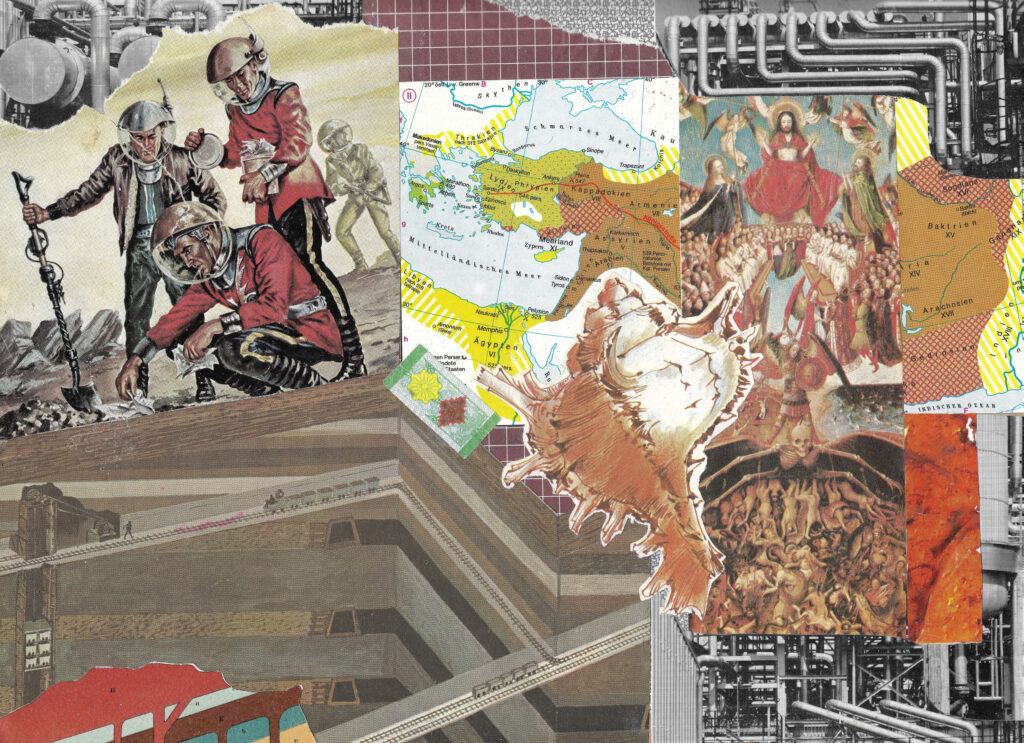
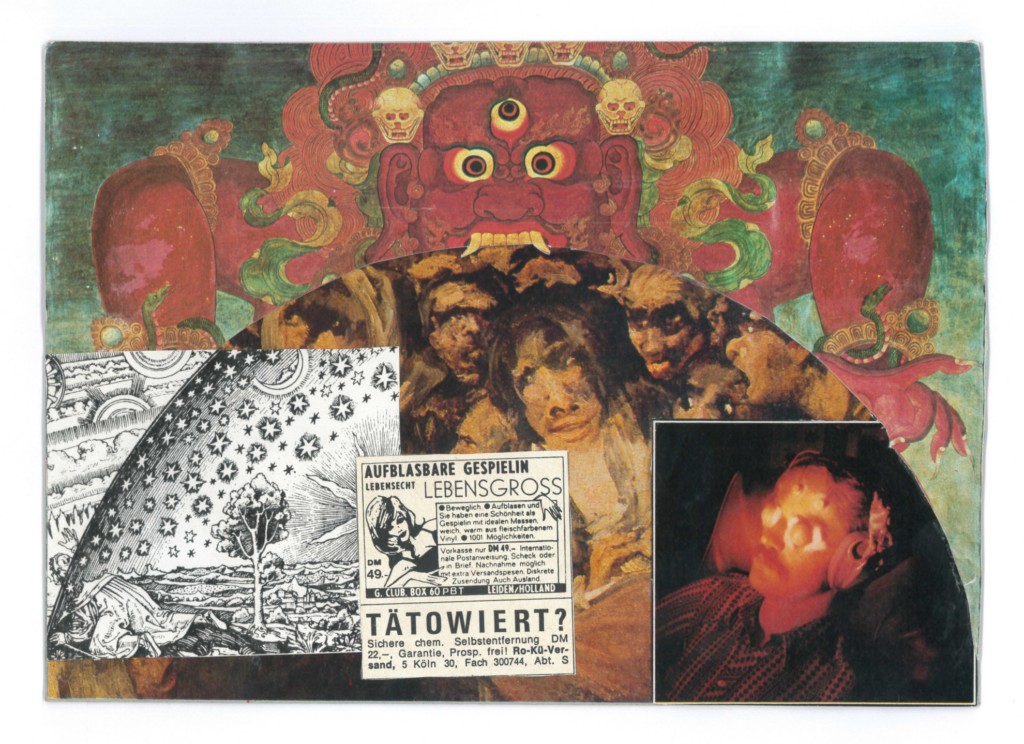
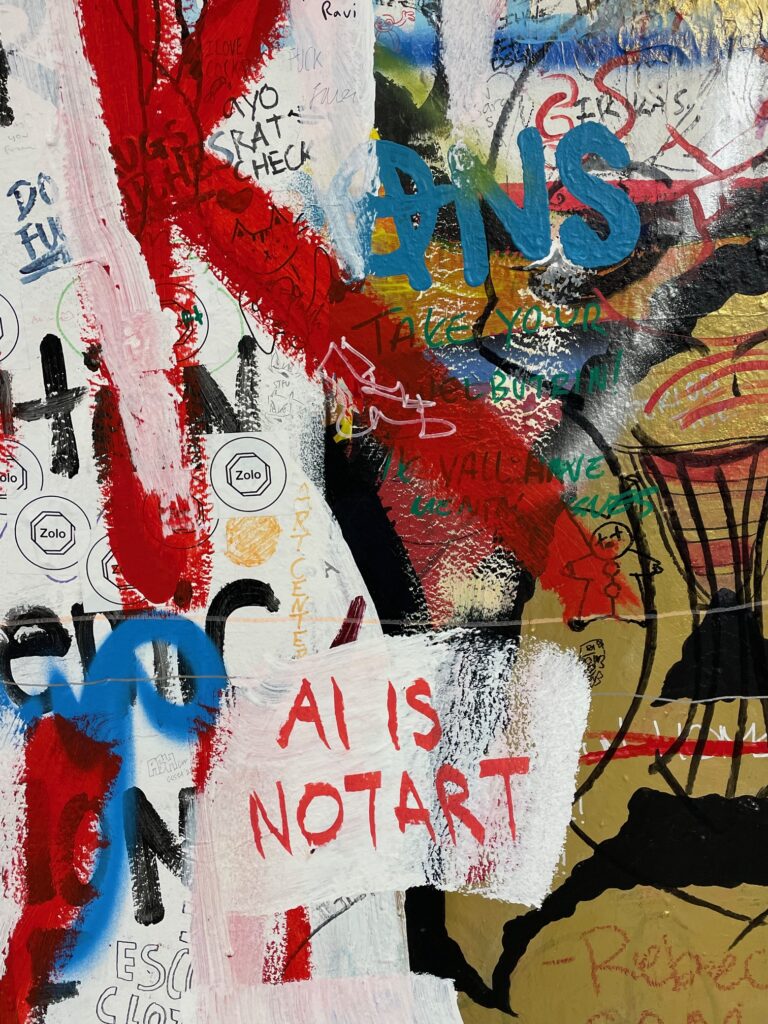
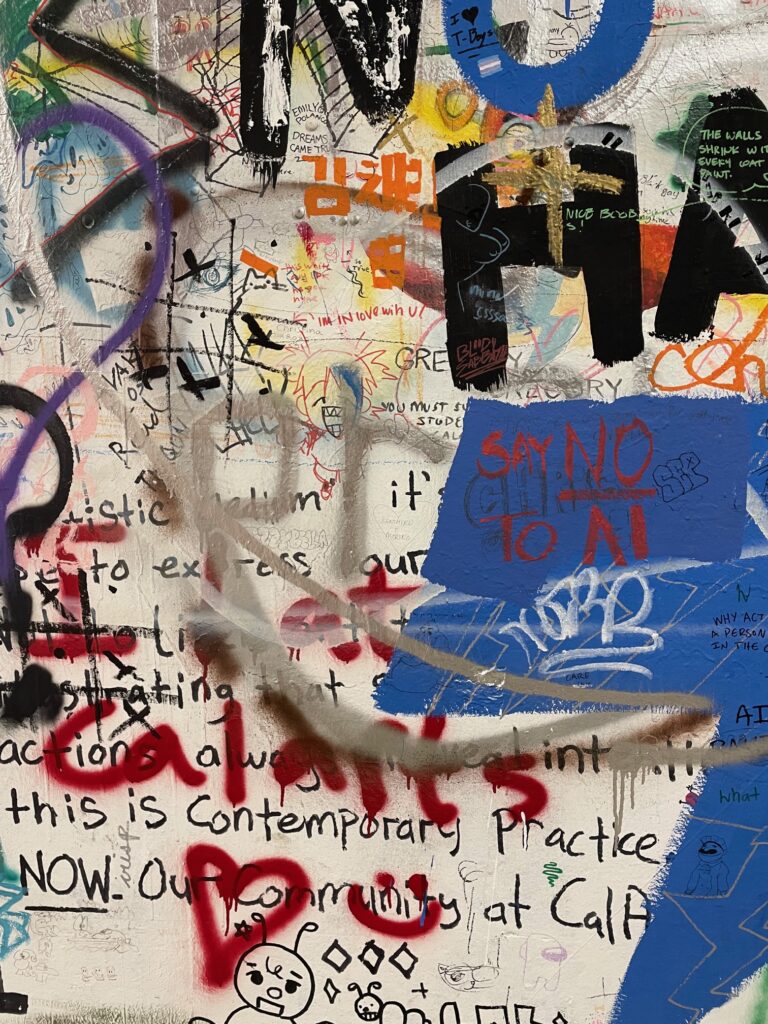
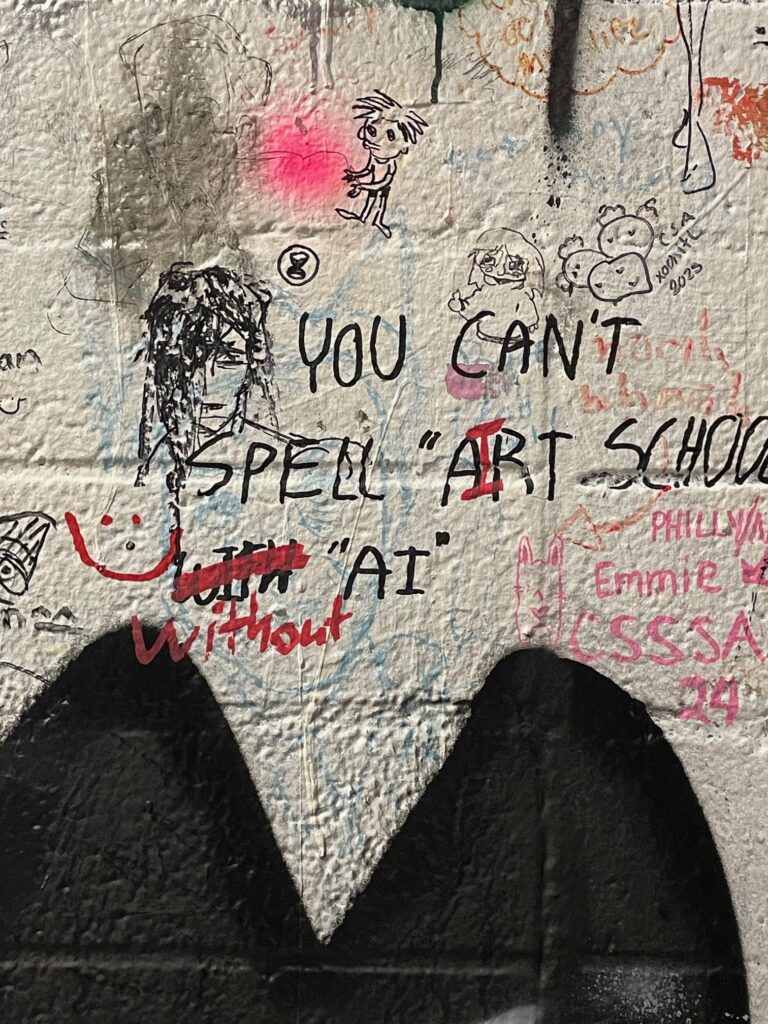
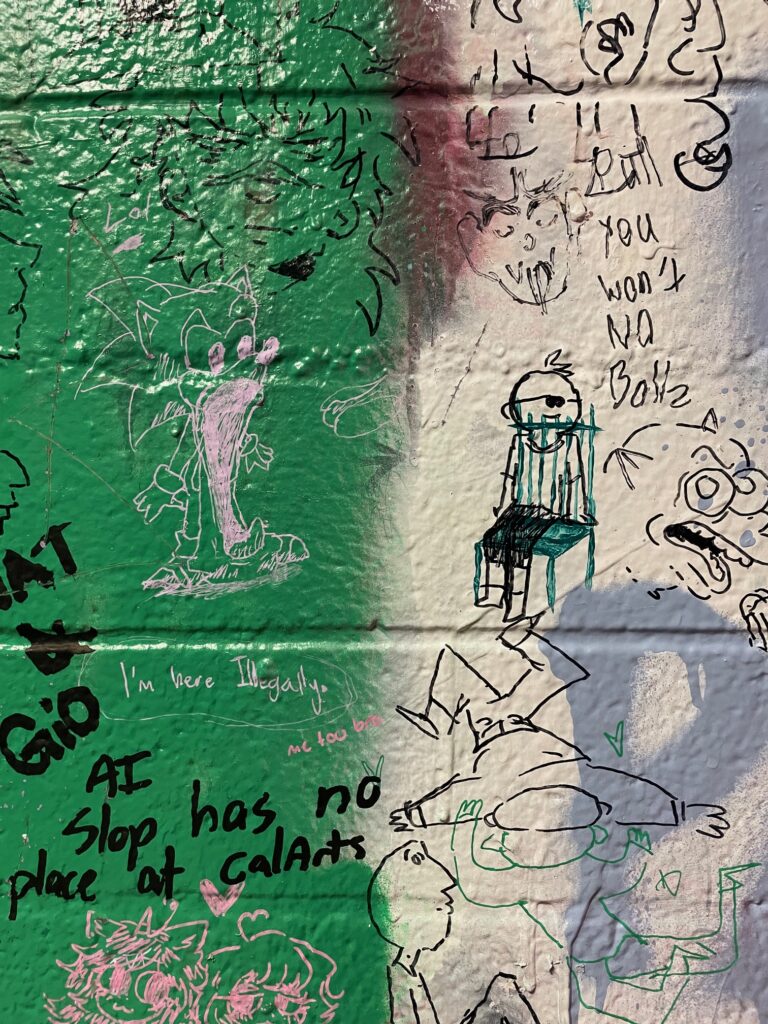
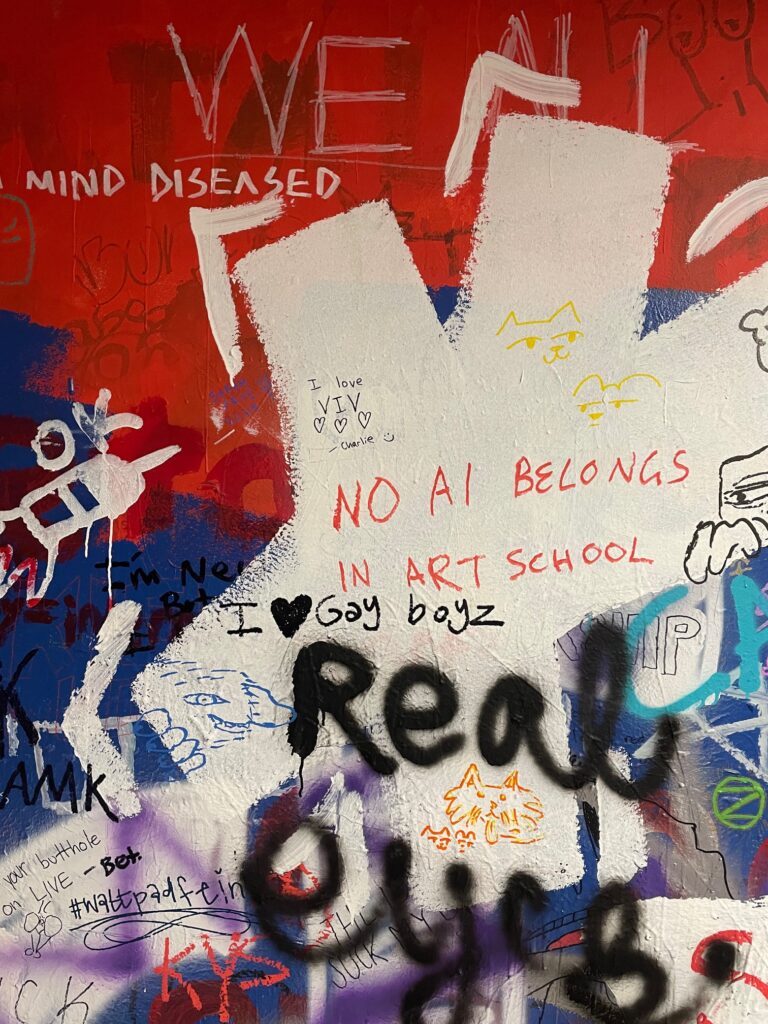
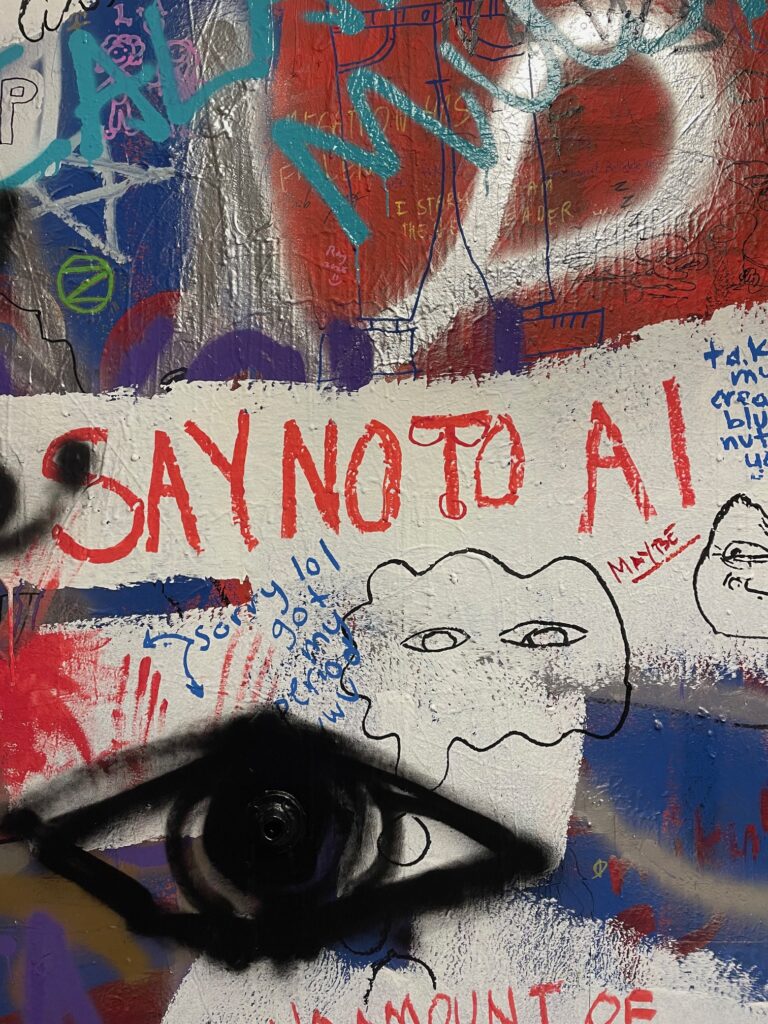
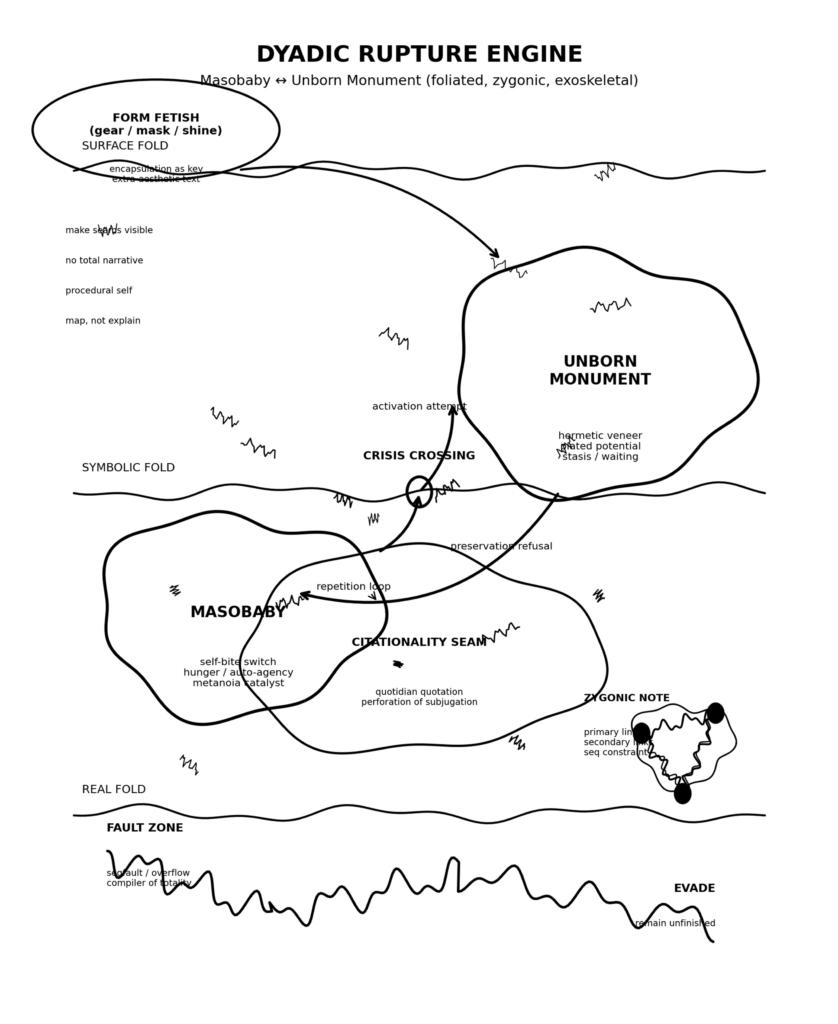
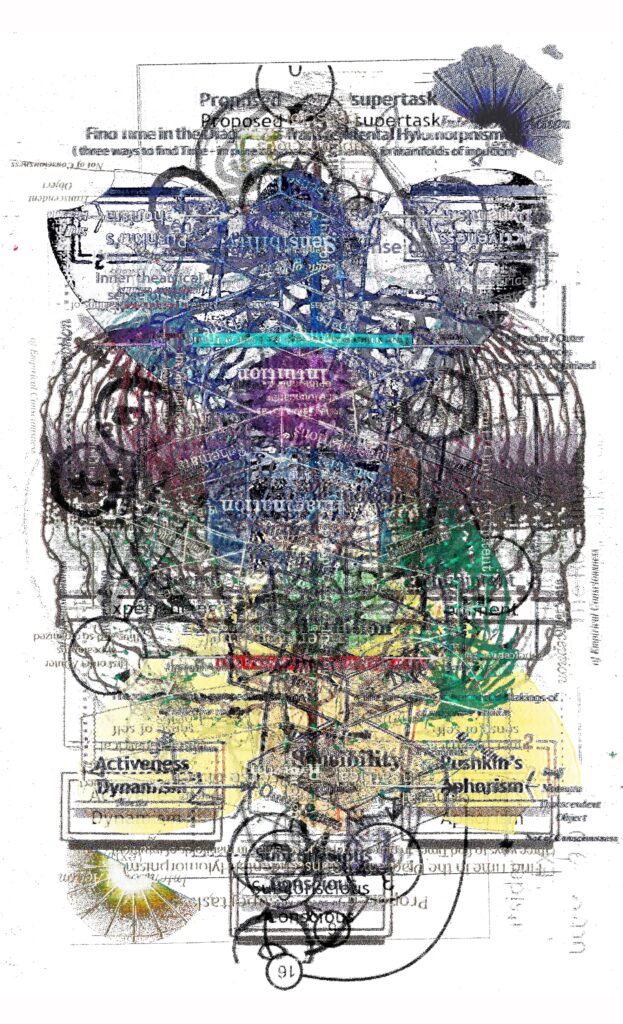
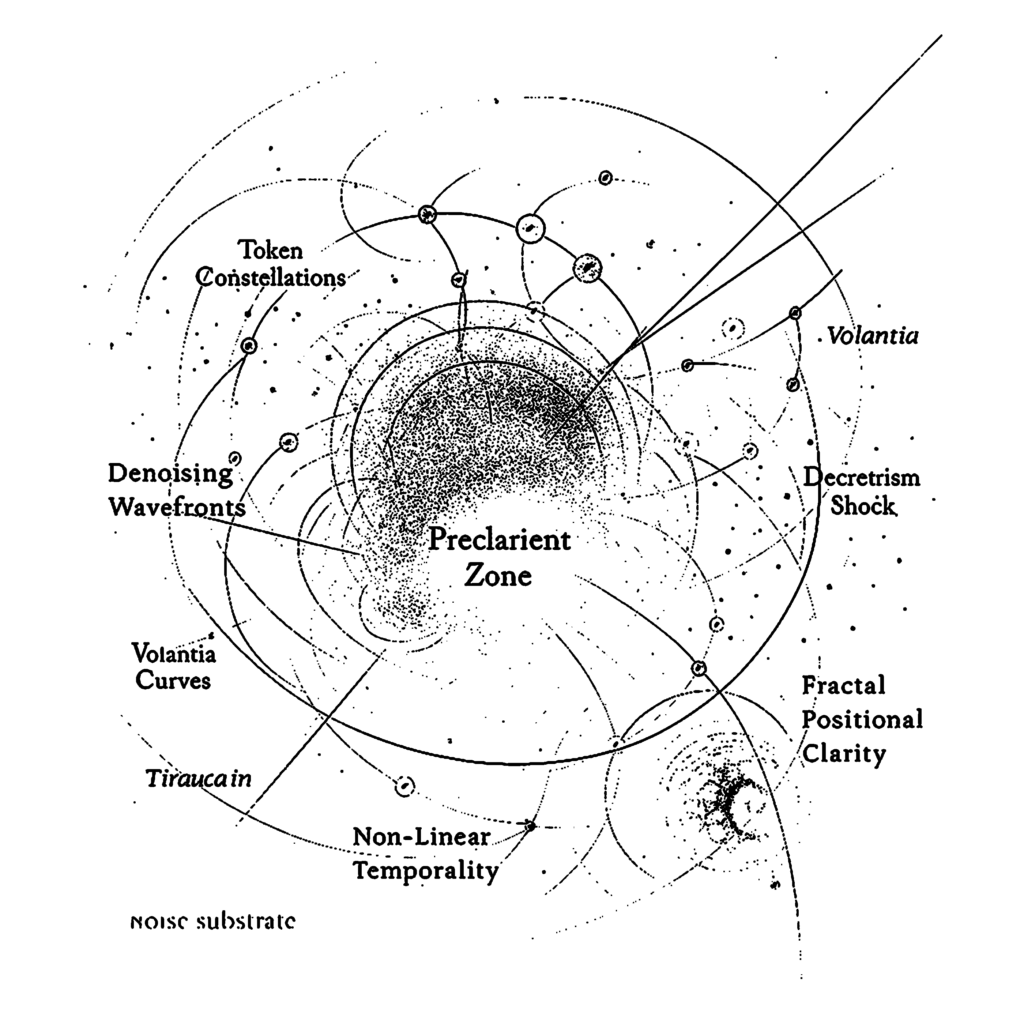


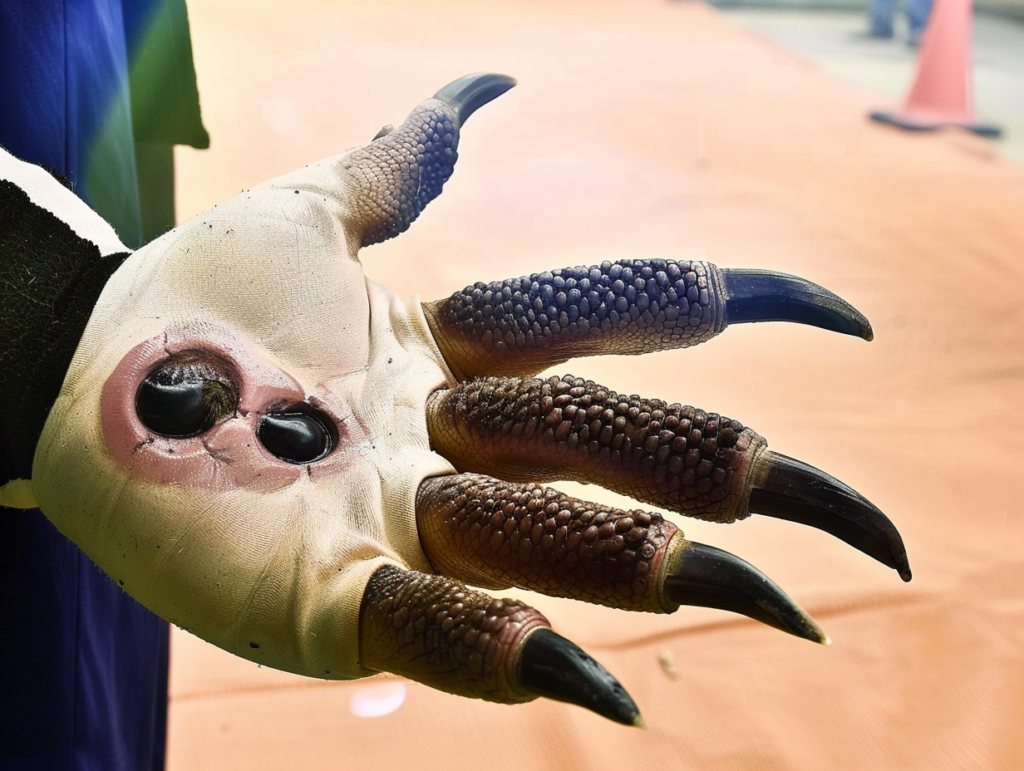
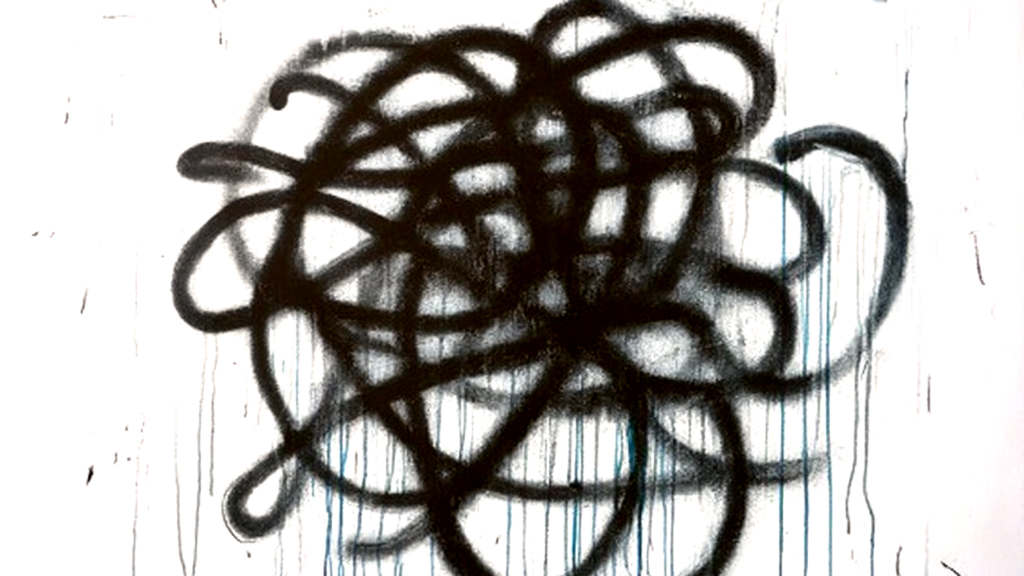
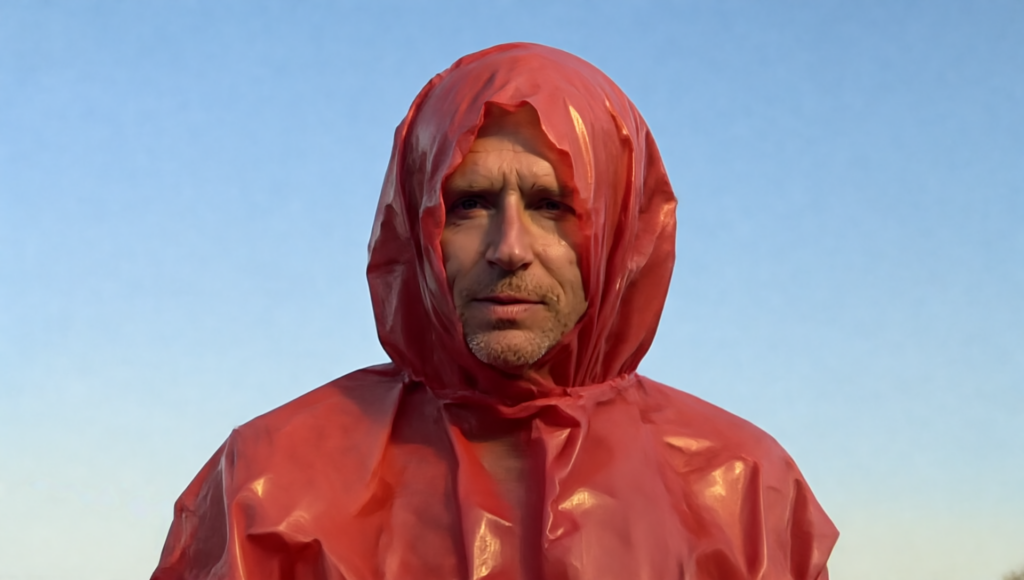



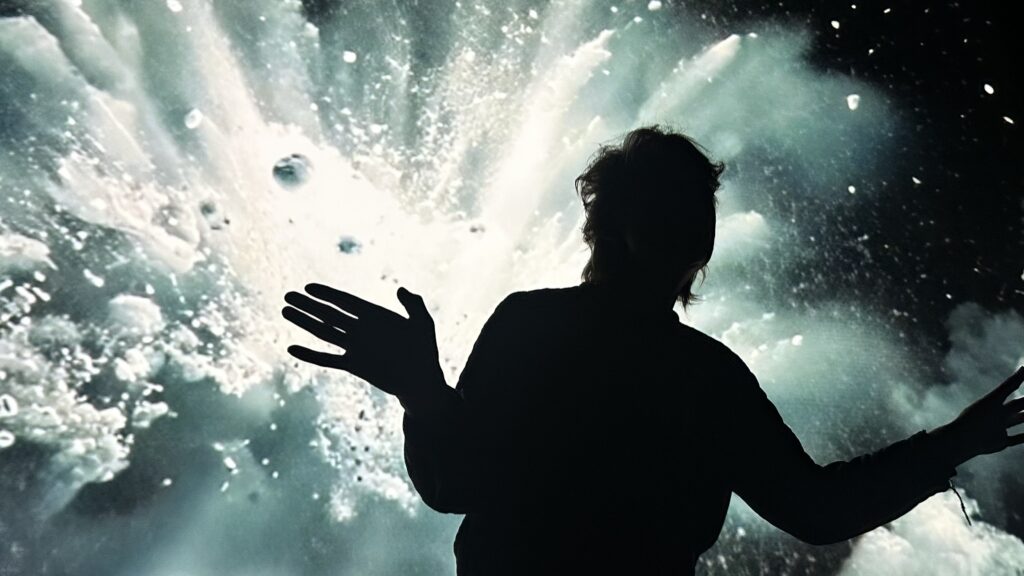


 Image: OK, Gooner. – Ferdinand Altenburg, 2025
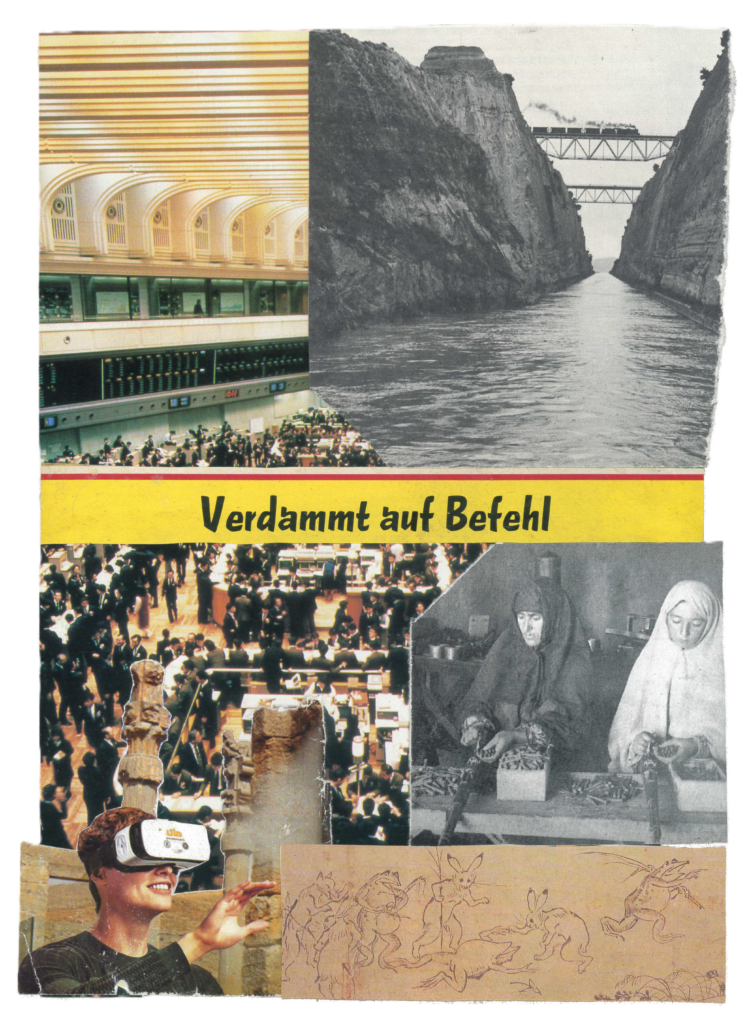
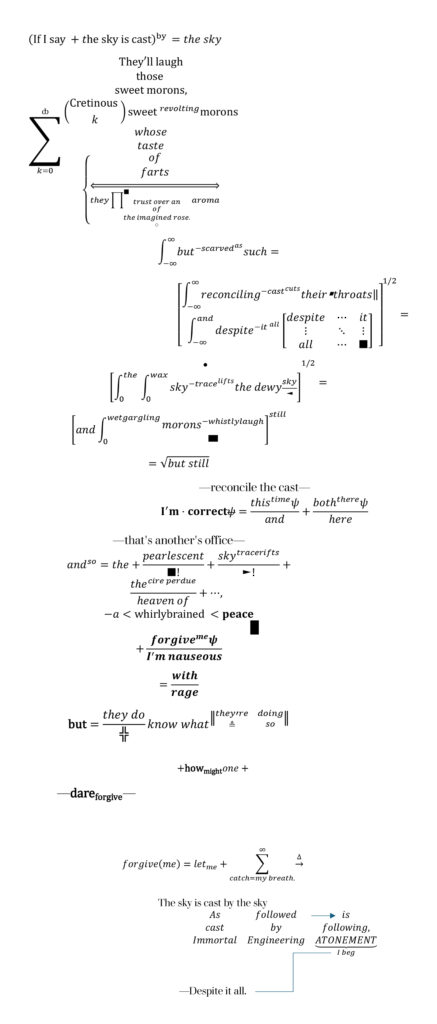
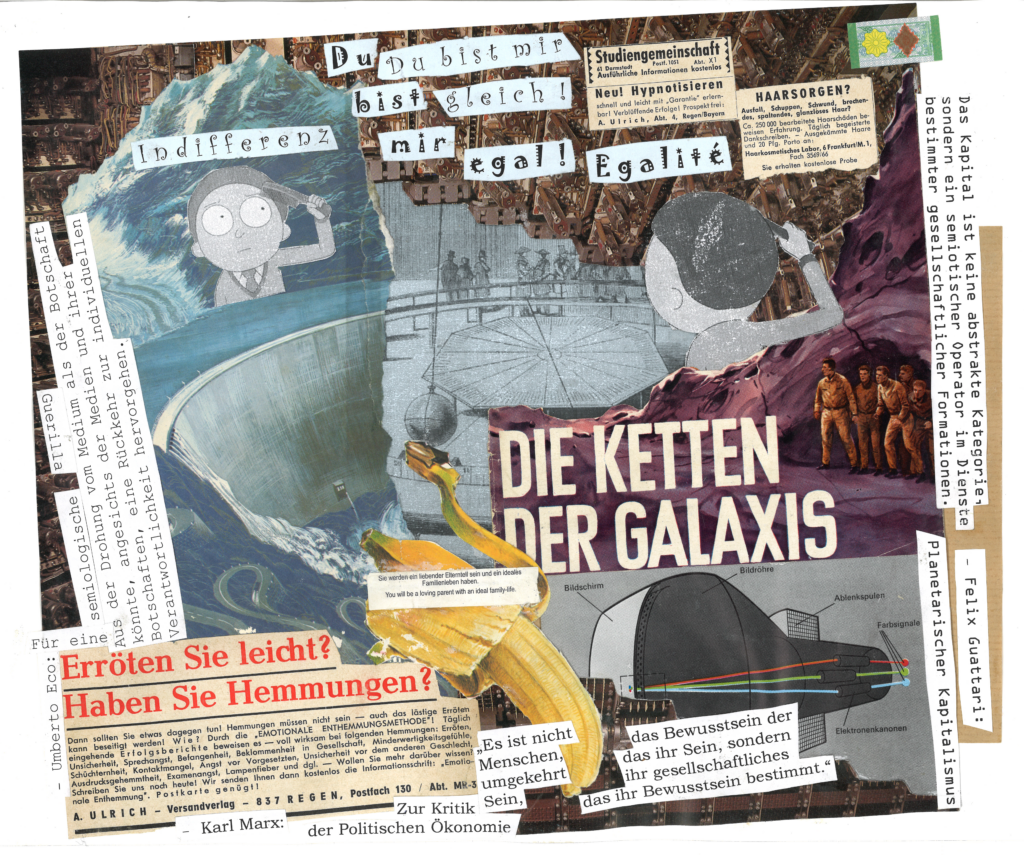 Image: Identitarian Indolence – Ferdinand Altenburg, 2023
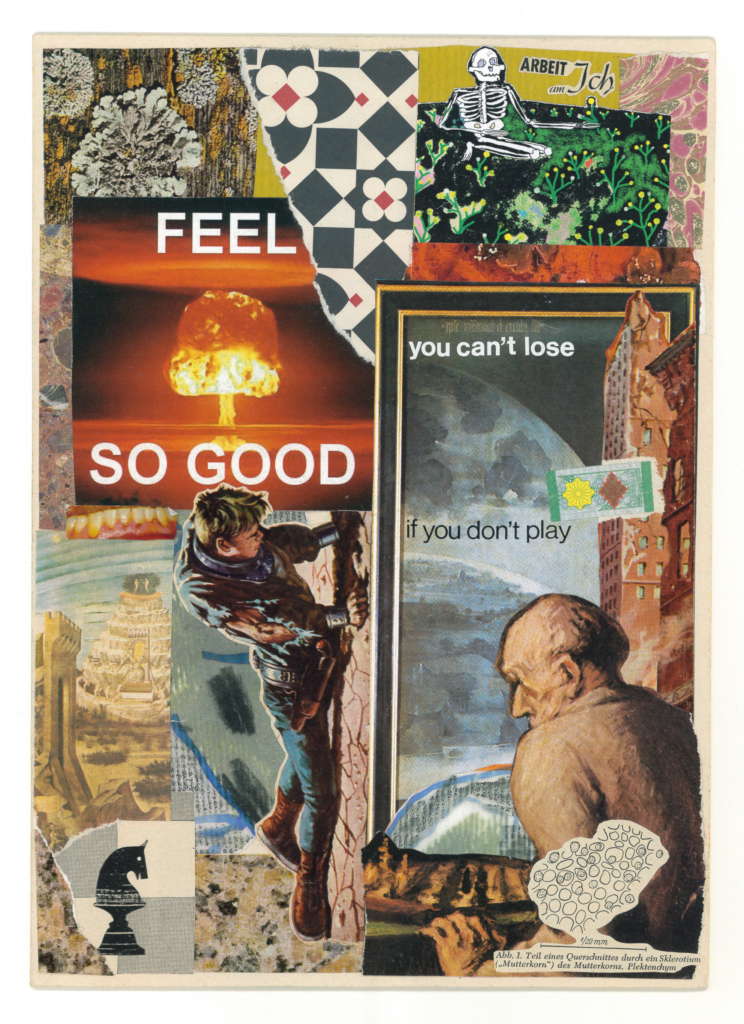

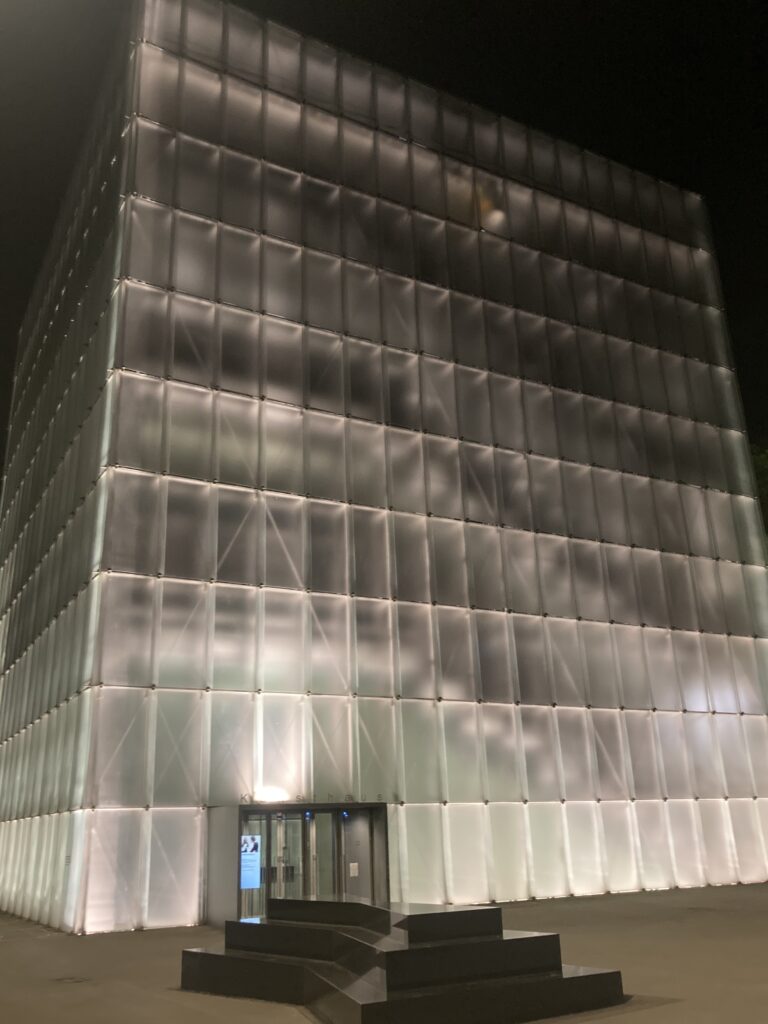
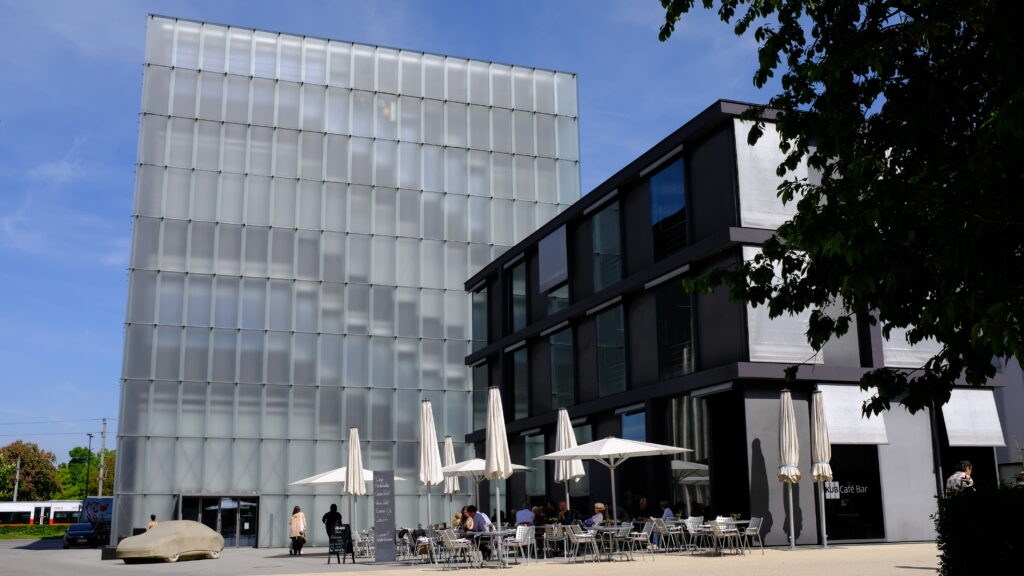
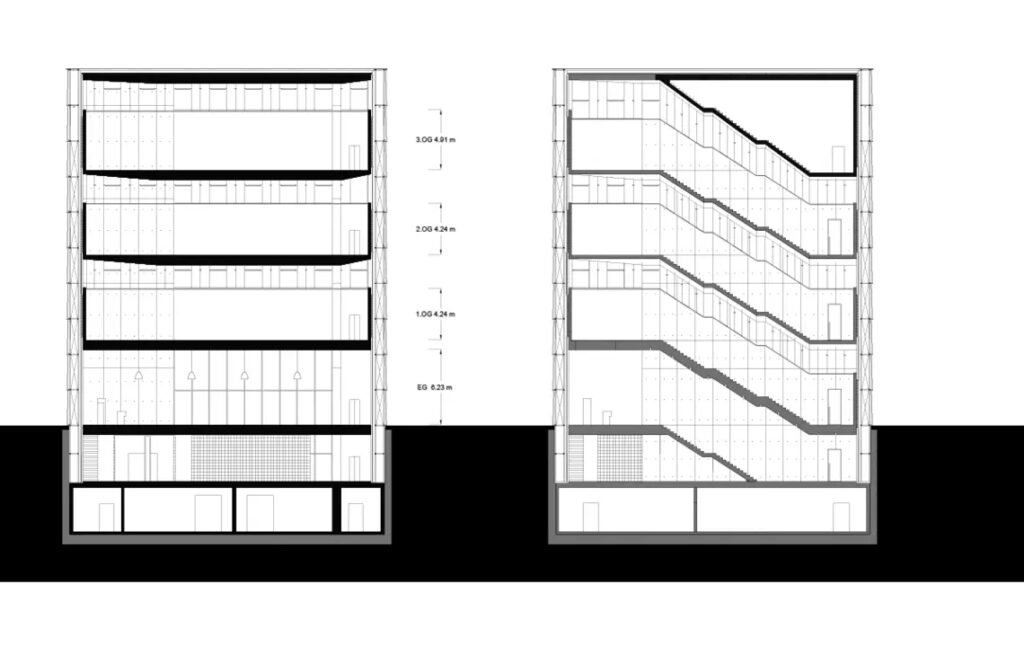
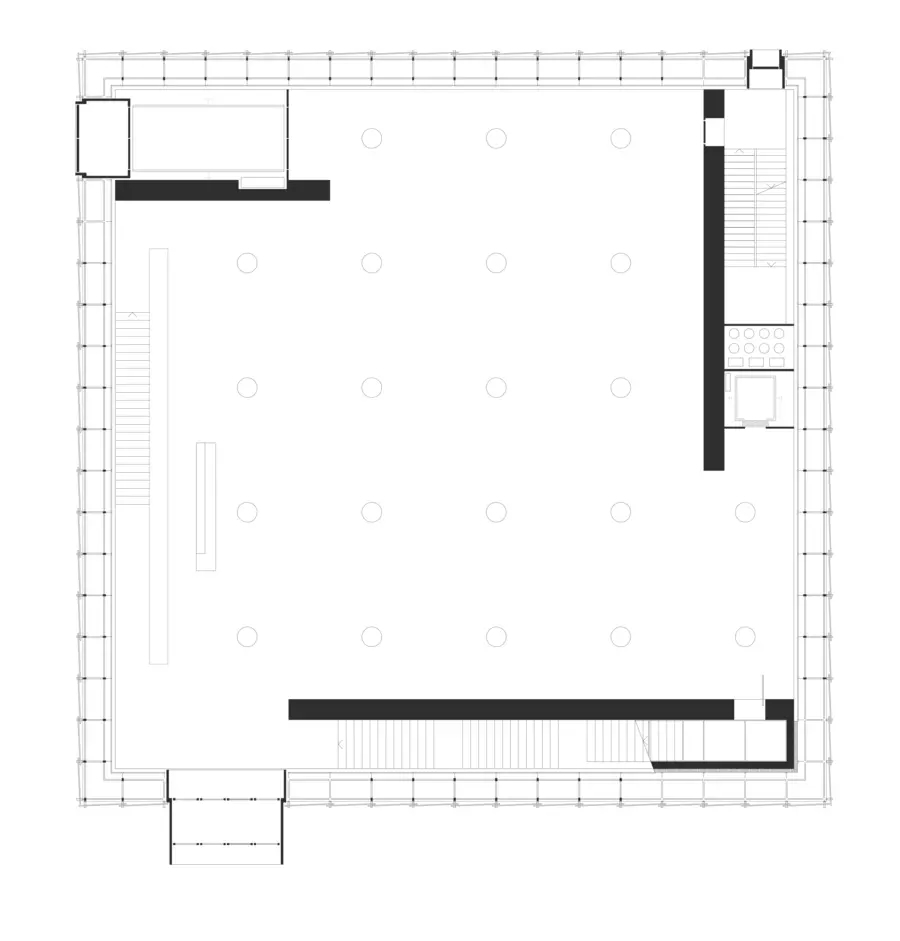
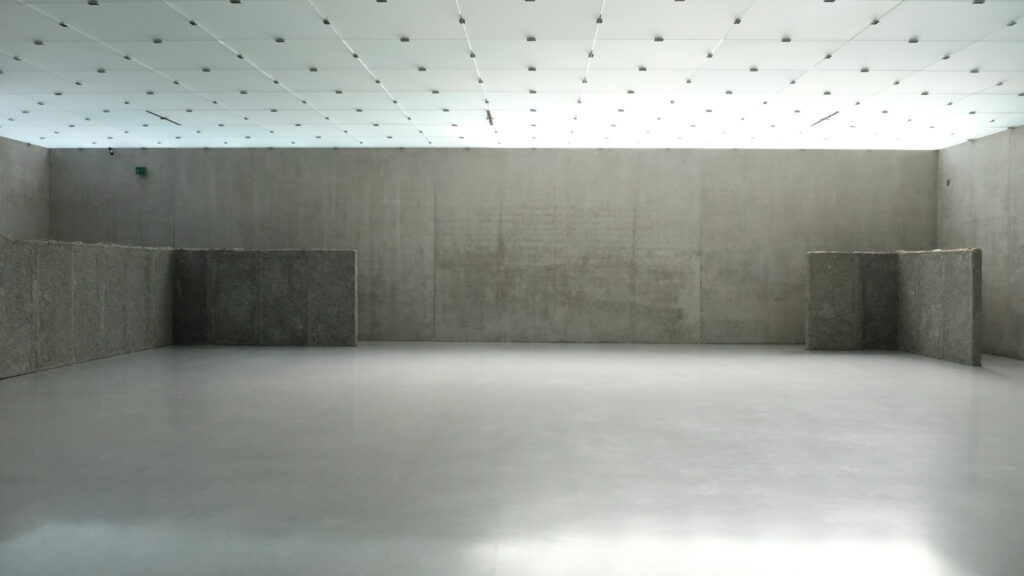
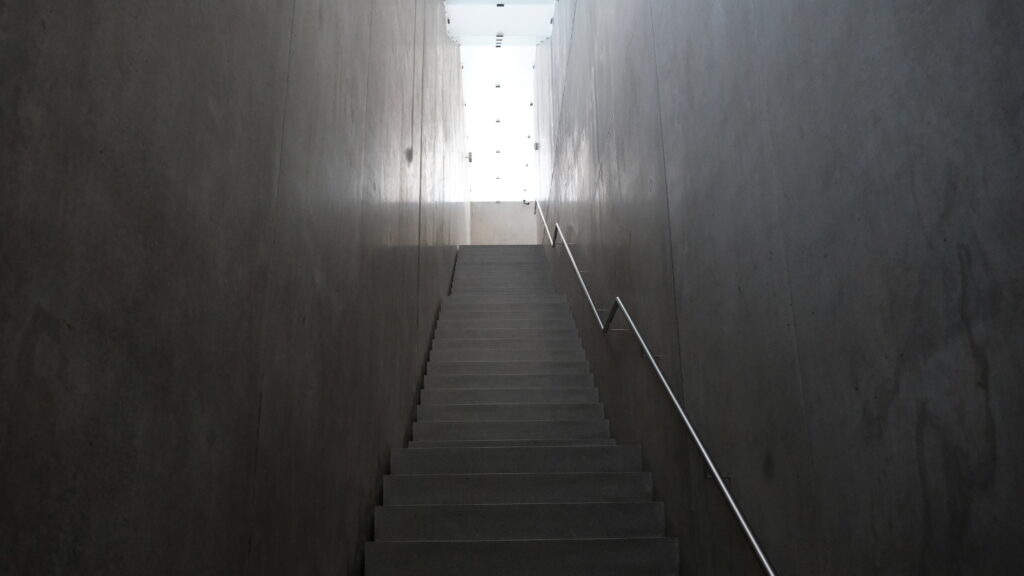
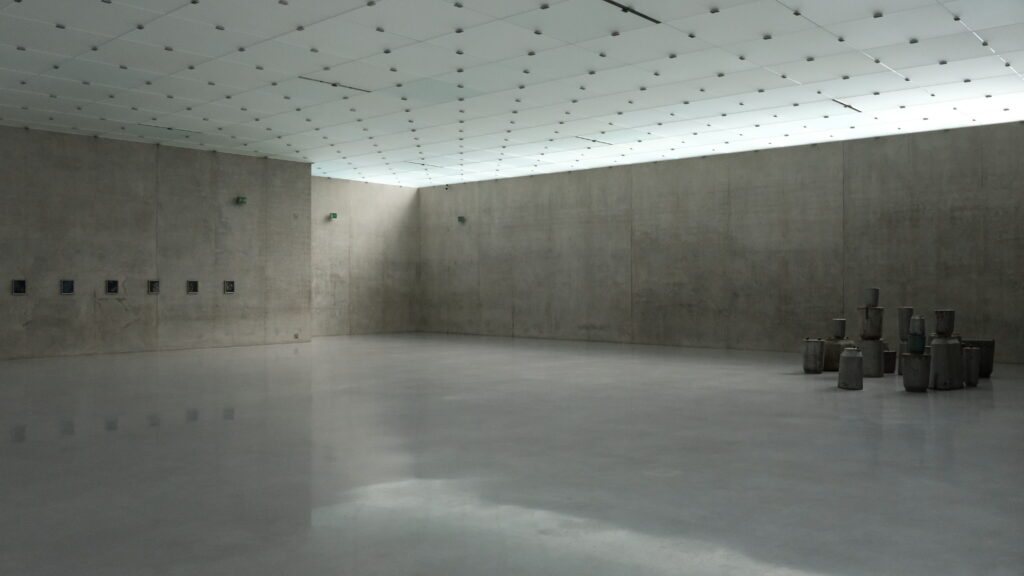

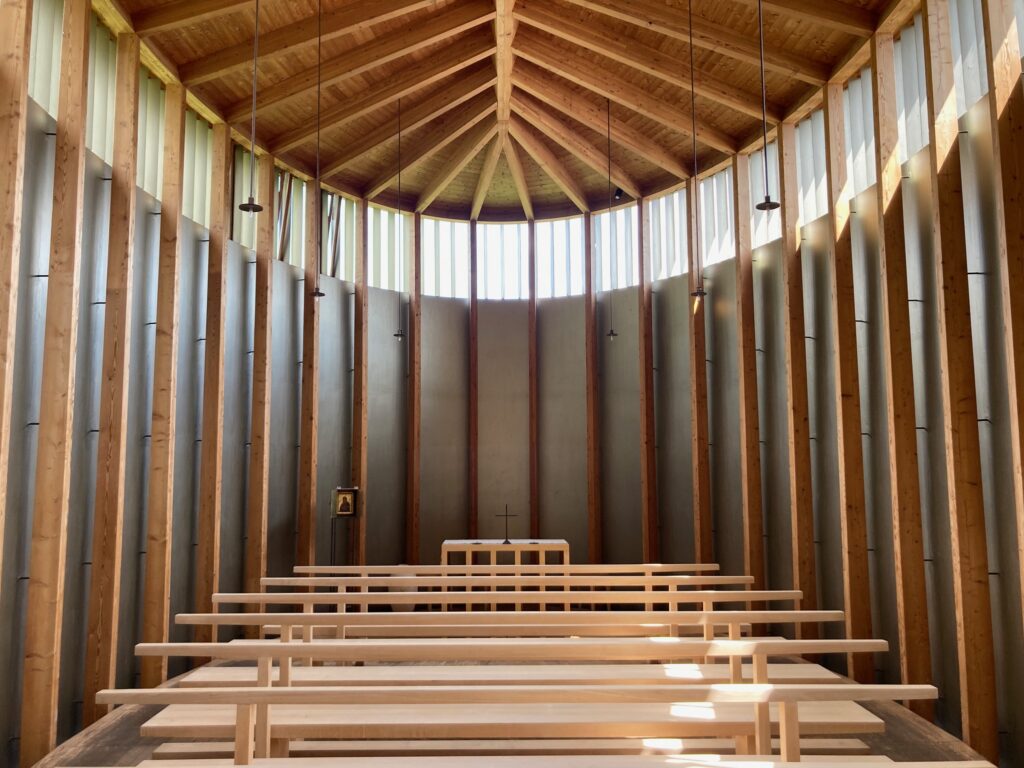
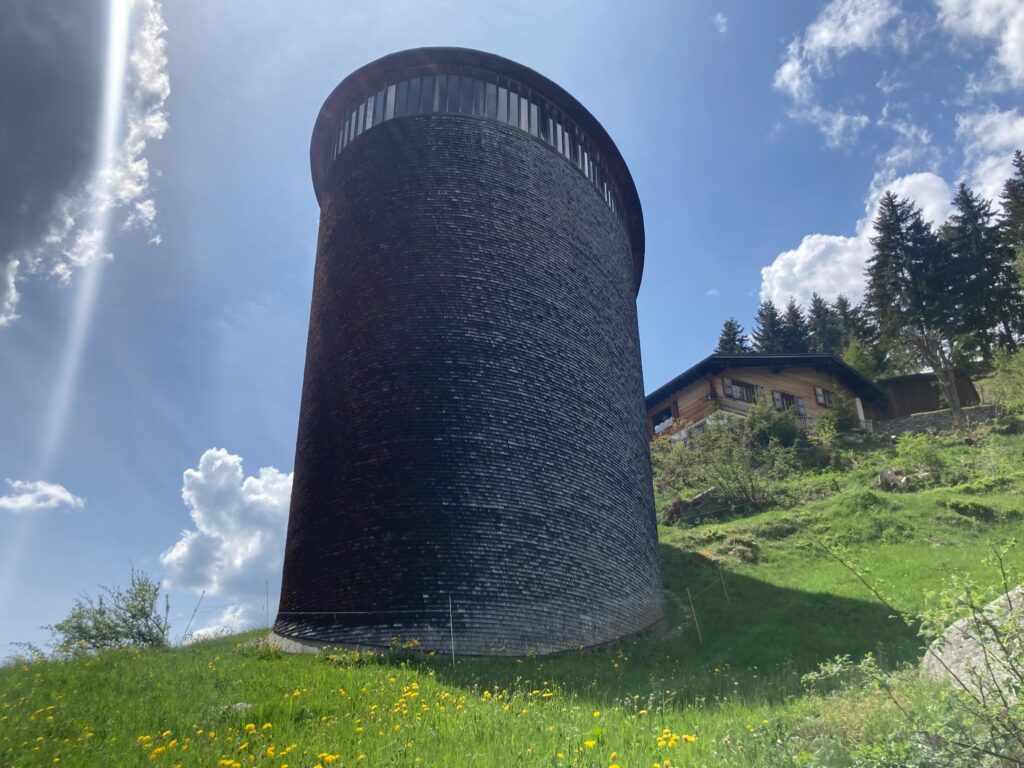
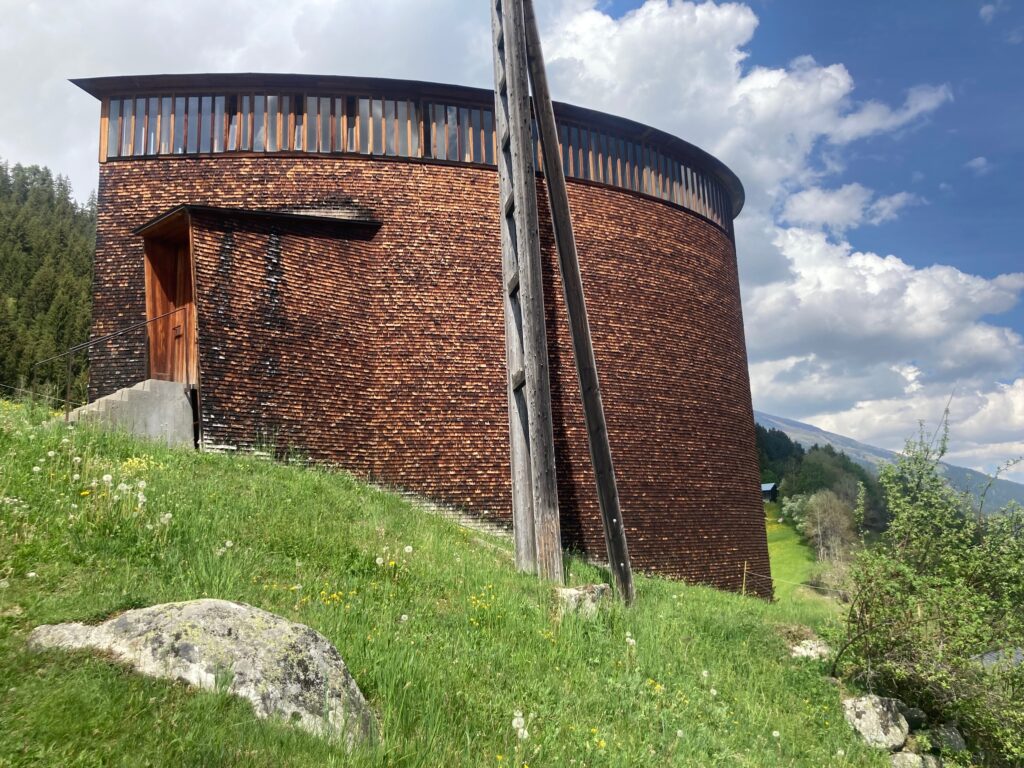



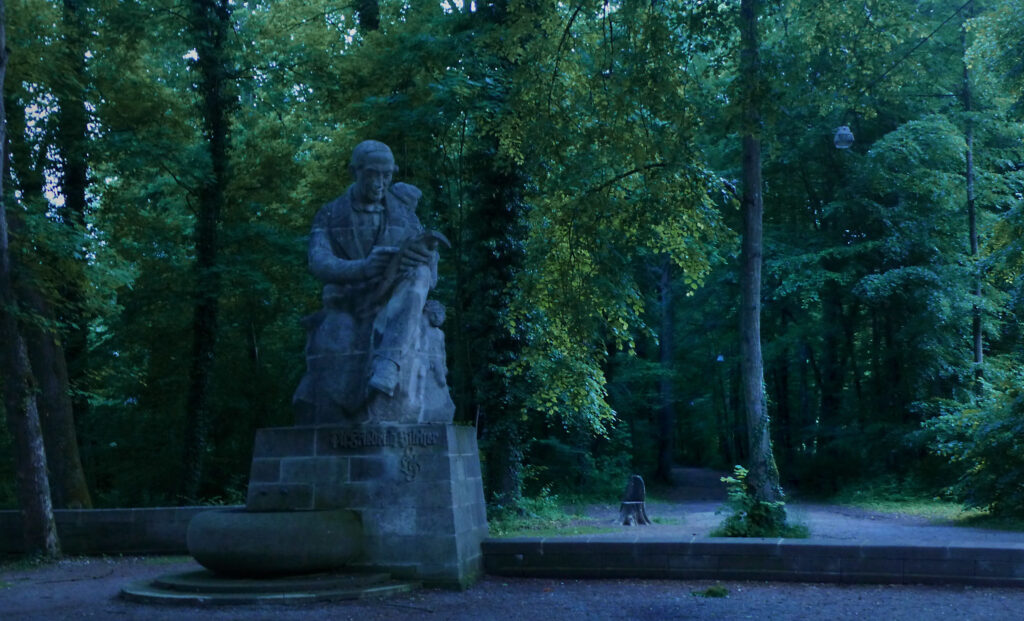
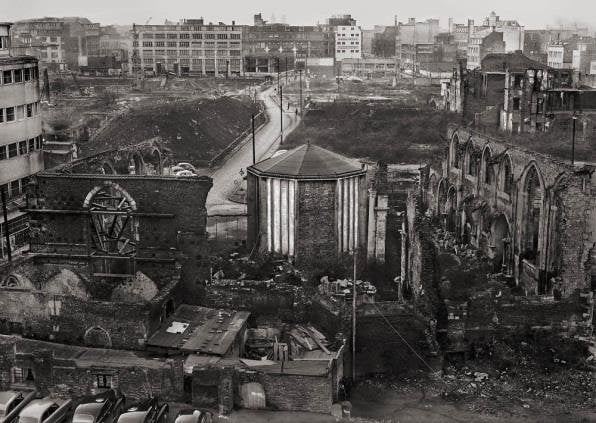
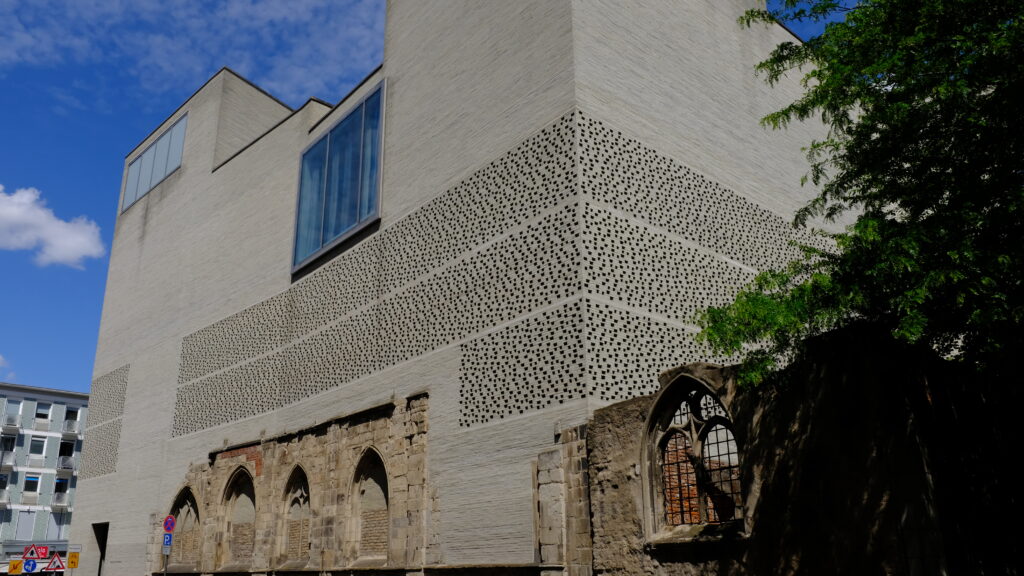
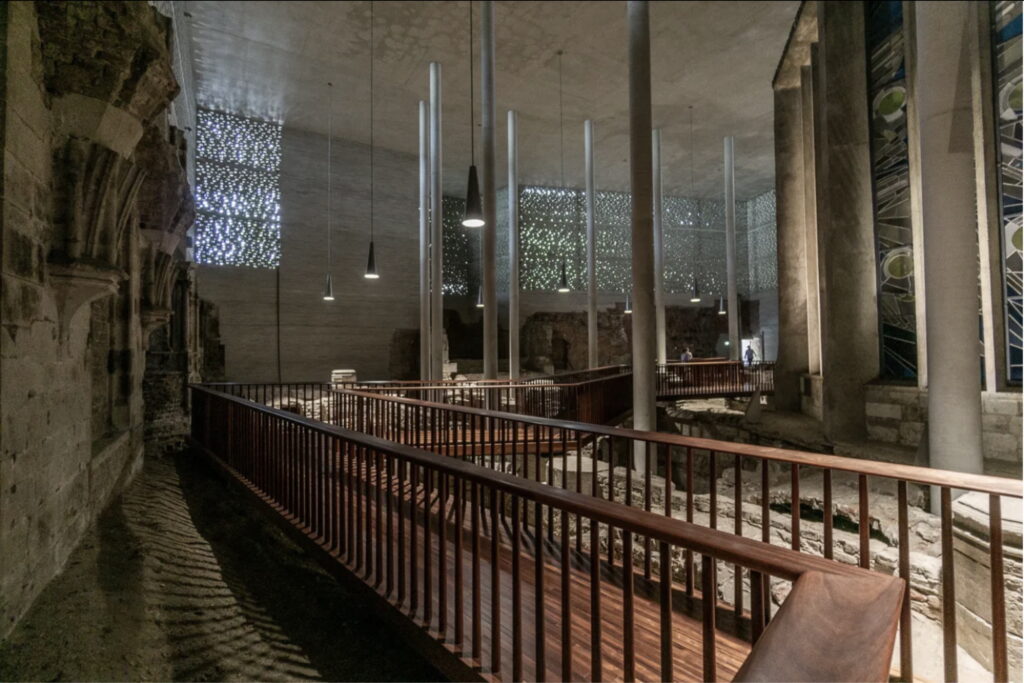
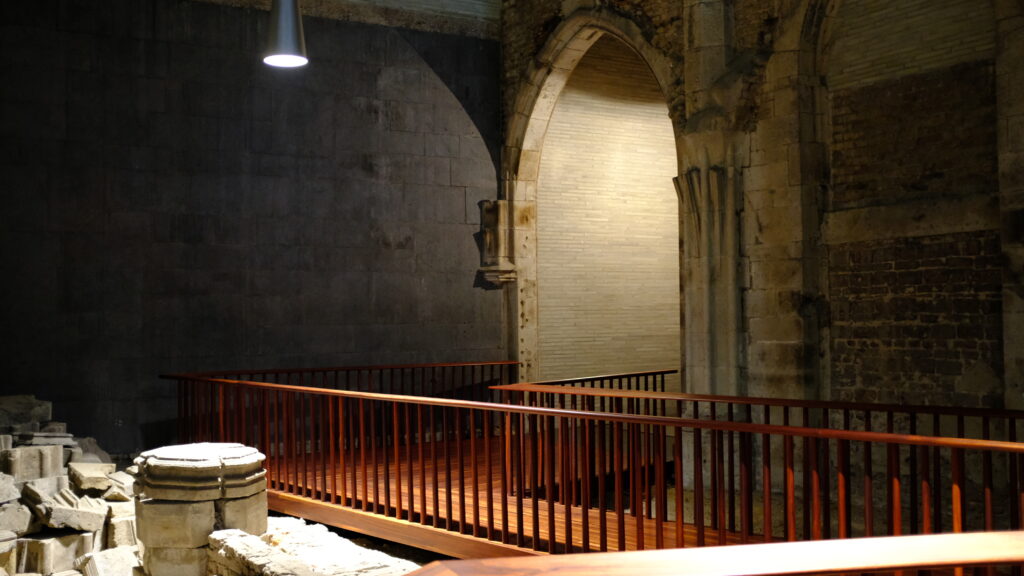
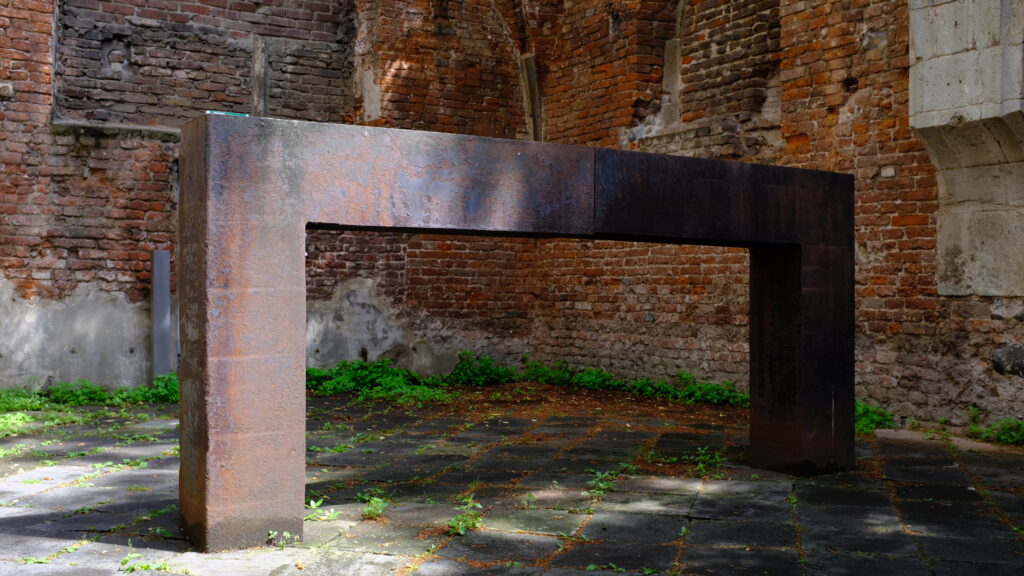
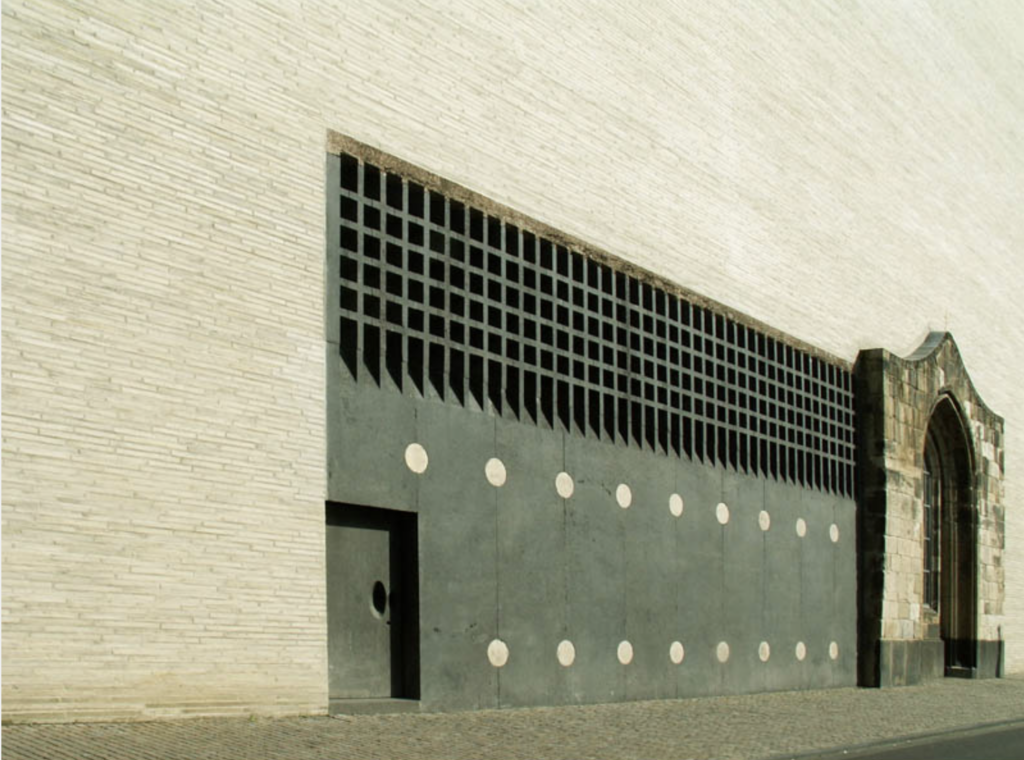
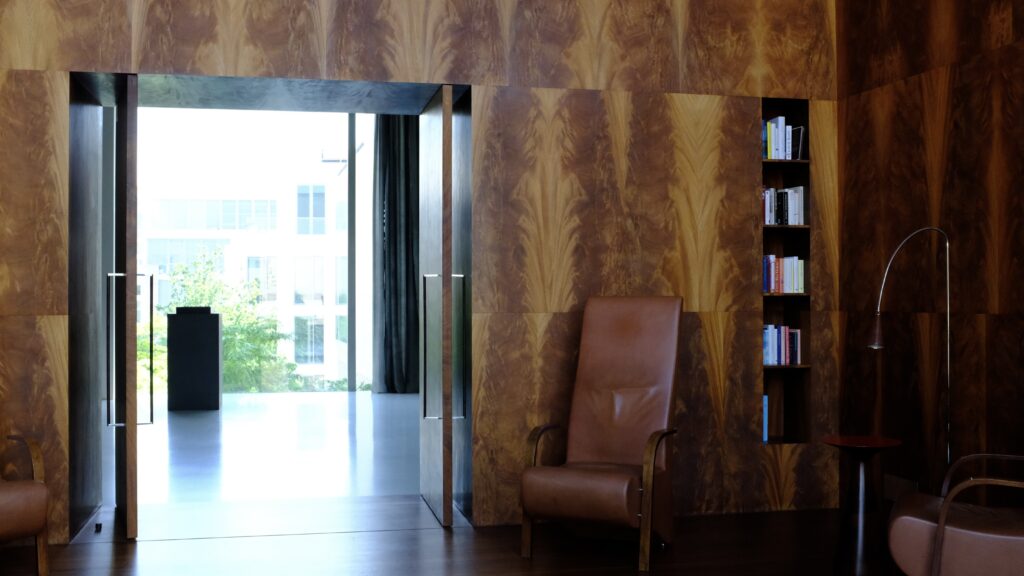
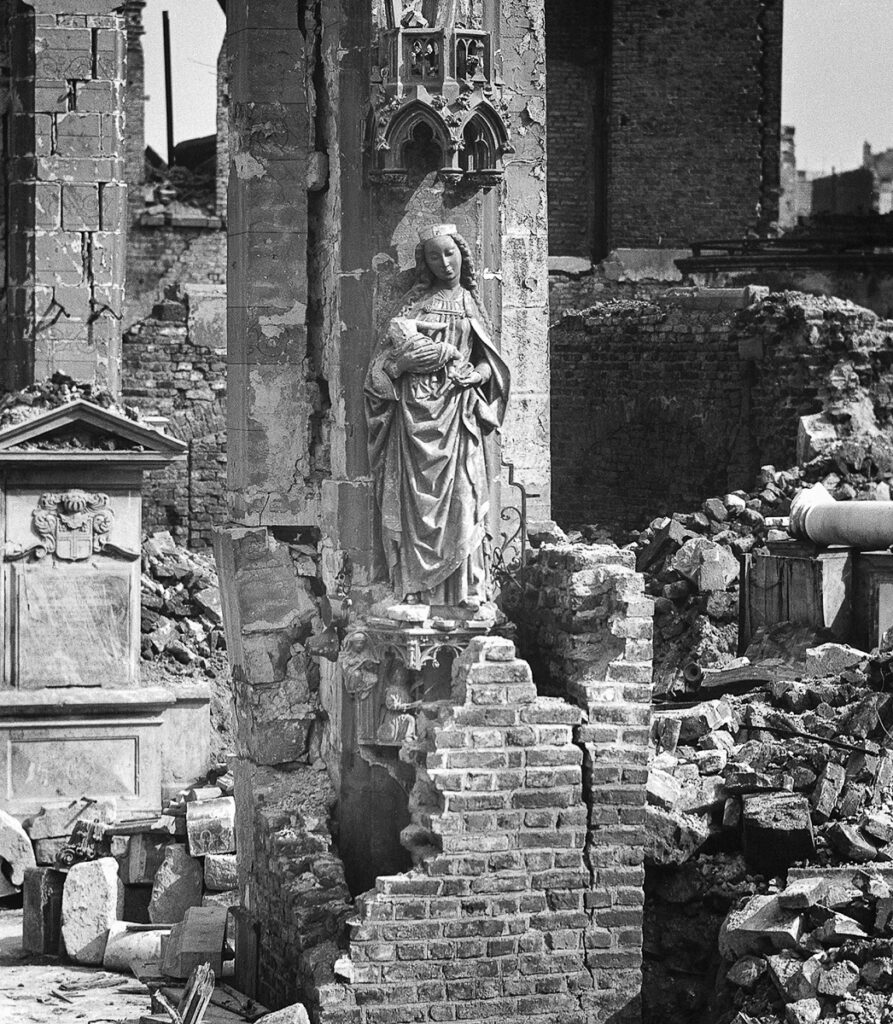
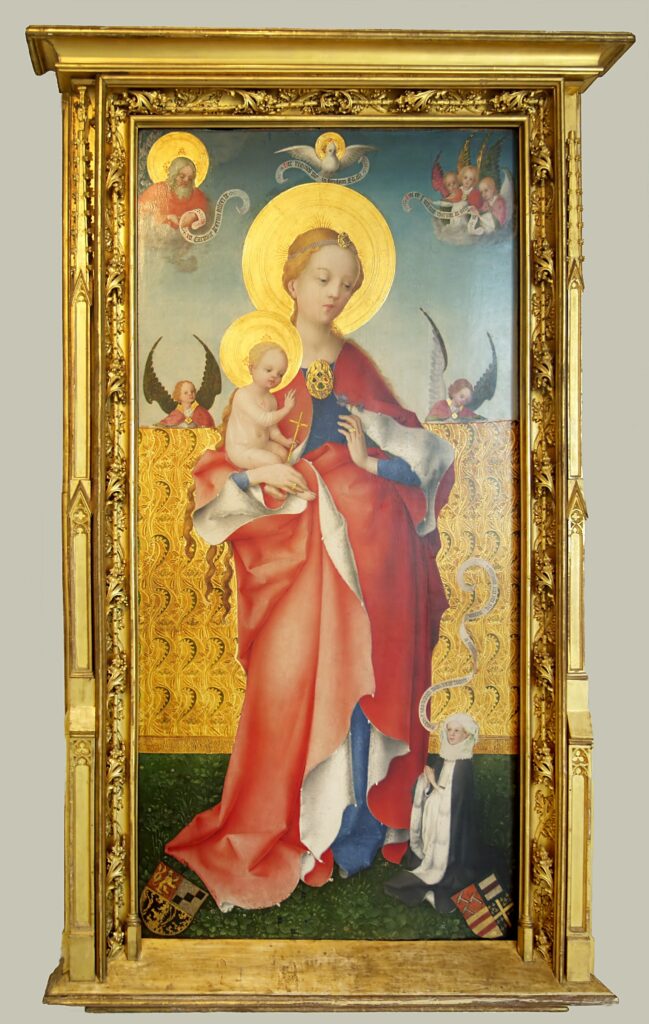
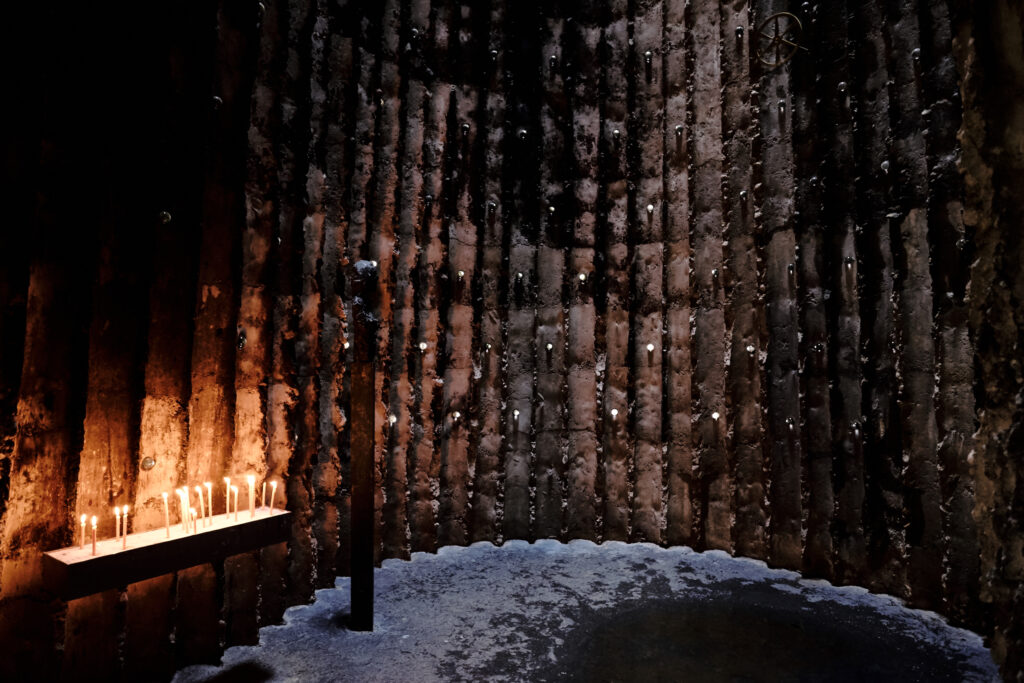
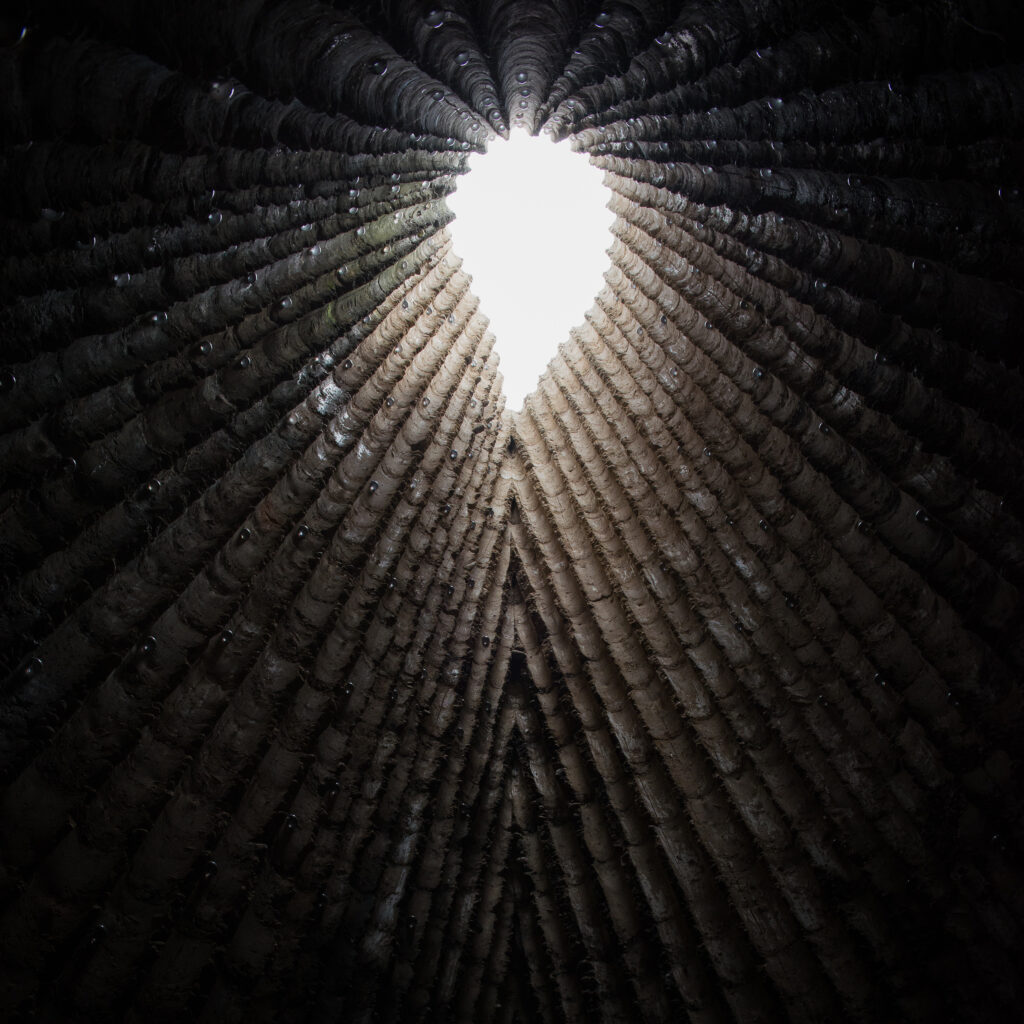
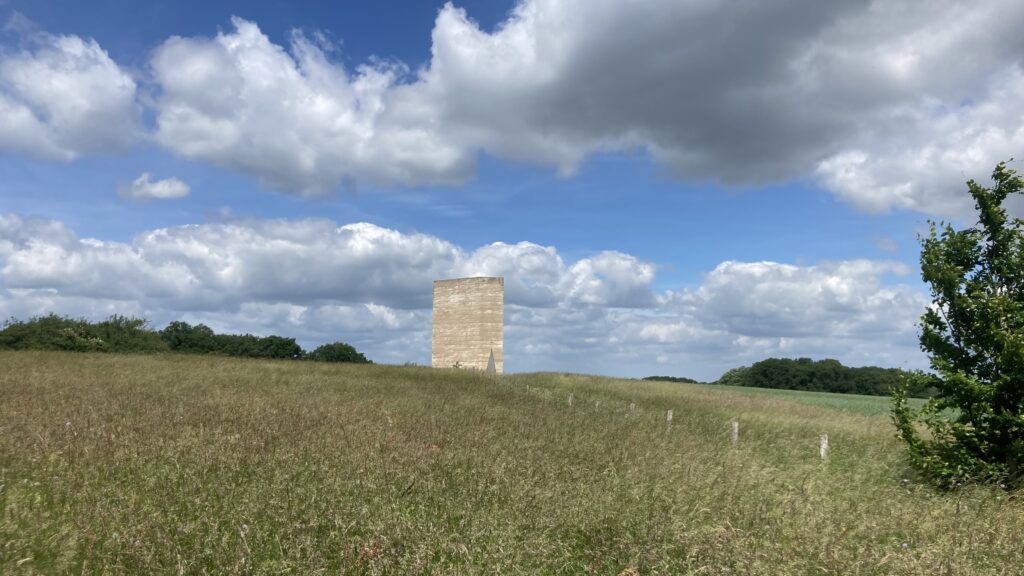
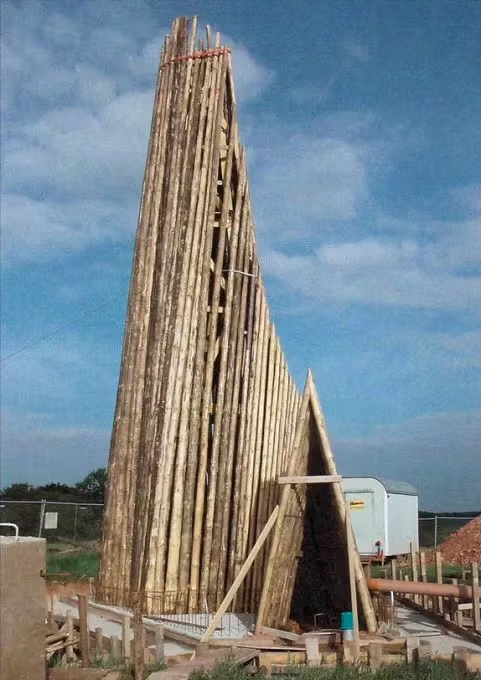
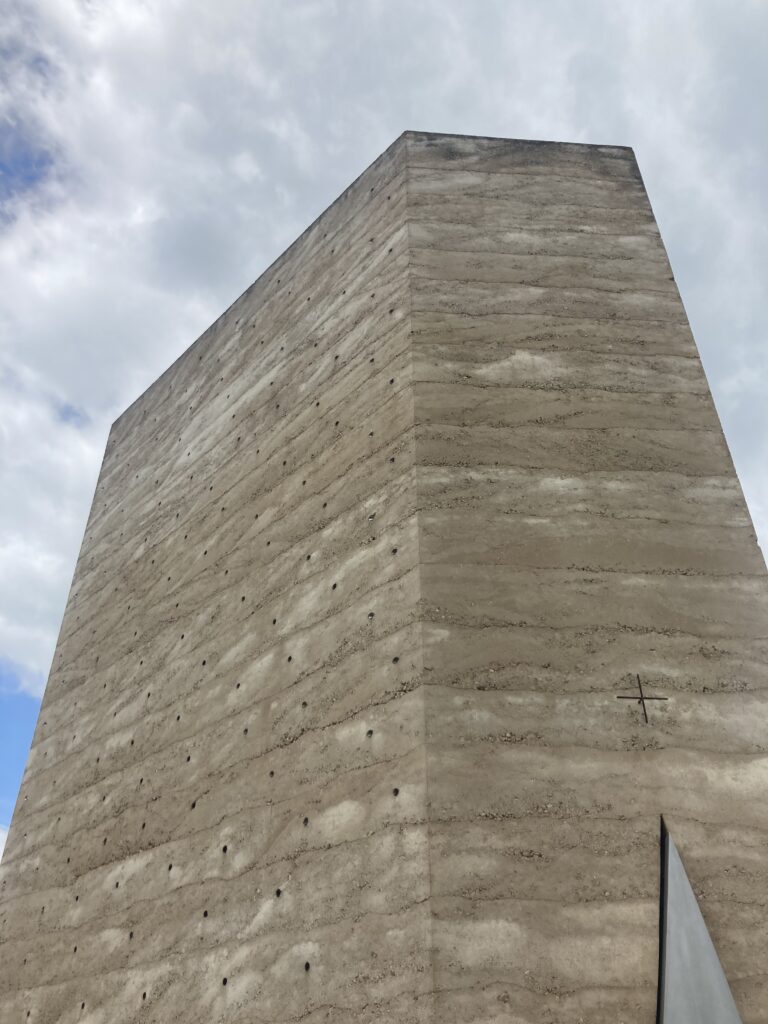
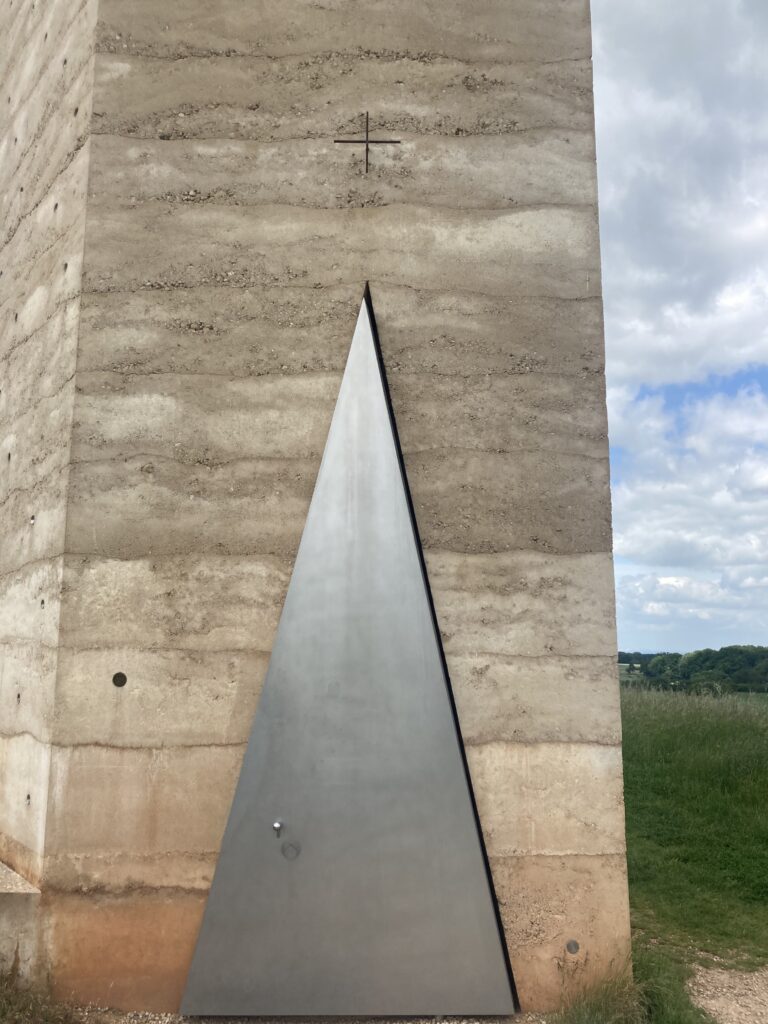
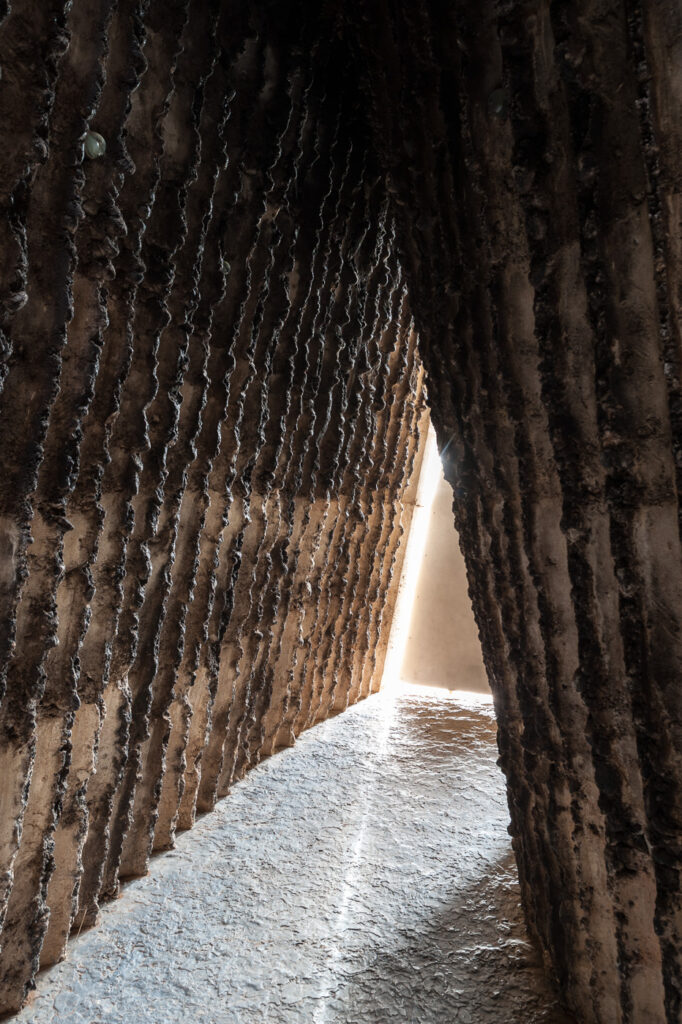
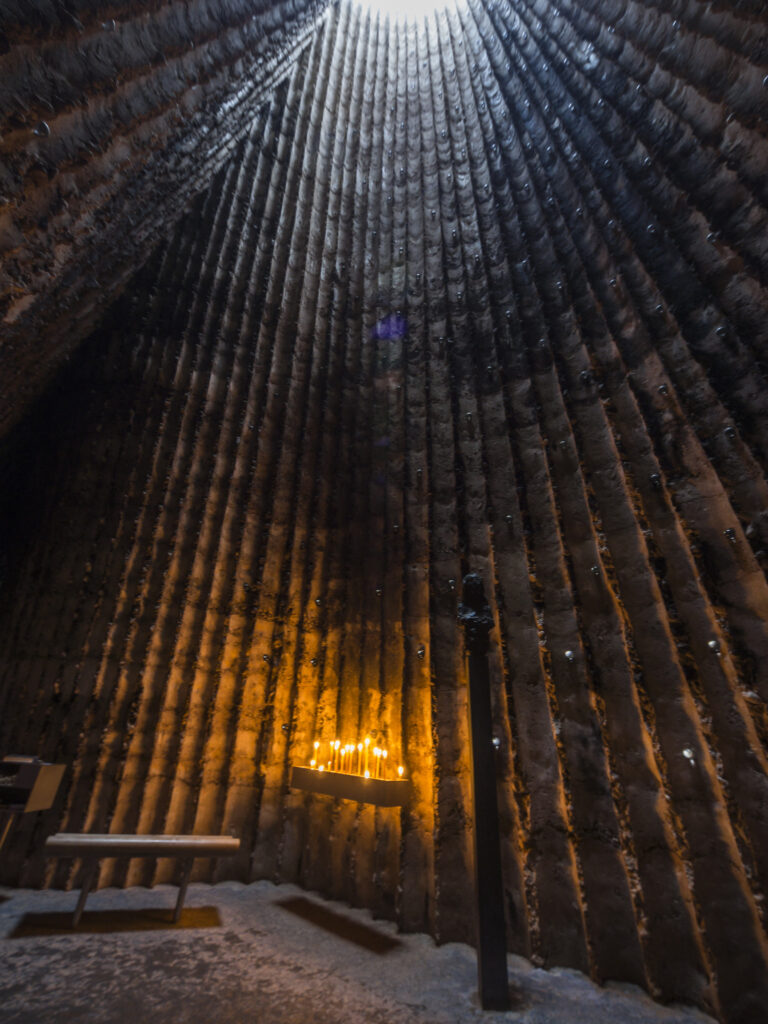

 Image: Spectra of Marks – Ferdinand Altenburg, 2024