Life Wisdom: Learning from Kluge and Kiefer
Bruce Robbins
A Review of Alexander Kluge and Anselm Kiefer, Intelligence Is the Art of Remaining Faithful under Shifting Circumstances. Trans. Alexander Booth. London: Seagull, 2025.
When the German writer and filmmaker Alexander Kluge died on March 25, 2026 at the age of 94, a translation of his exchange with the painter Anselm Kiefer had just been published. Also just published, or perhaps just about to be published—when someone dies, the chronology gets blurred—was Ben Lerner’s novel Transcription. Lerner had joined up with Kluge in the astonishing collaboration The Snows of Venice (2017): early poems by Lerner inspiring texts by Kluge, which inspired further texts by Lerner. The collection is illustrated with artwork by painter Gerhard Richter, Kluge himself, and others. Presumably Lerner did not anticipate when he gave the manuscript of Transcription to his publisher that its publication would coincide with Kluge’s death. But in the character of Thomas, who does die in the course of the novel but does not share all his details with Kluge, Lerner nevertheless delivers a heartbreakingly beautiful portrait of the artist. Any English speaker who desires an introduction to Kluge’s many-sided work could go there first.
As a novelist, Lerner won’t let the reader forget that the artist is also a parent, which is to say condemned to emotional imperfection. I did not know Kluge well enough to judge whether Thomas’s tendency to always retreat into “some weird allegory, some kind of prose poetry, or an impossible string of references (many of which were probably fictional)” (94) from painful dilemmas of parenting and grandparenting was true of Kluge as well. What I recognized immediately in Thomas were Kluge’s gentleness, his experience of being bombed as a child, and his tendency to hear angels in voices on the radio. I recognized, too, the love of dreams, and changing eye-colors, and cave painting. What I would have liked to see more of in Thomas was Kluge’s ability to make art and politics converge in unpredictable ways. Lerner has proven himself politically inventive as well, for example in his perhaps-autobiographical, auto-fictional story about the political hacking of Wikipedia, “The Hofmann Wobble”.
Consider how this—the convergence of art and politics—happens in Kluge. A young woman walks in slow motion across the screen. The camera, motionless, watches her pass from across the street. Then a voice-over stops the action, and the camera zooms in. First, on a swath of her dress. Where was the fabric manufactured? The camera moves to her boots—same question. To her handbag—what is the history behind its making? Leather craft, we are told, goes back to the Middle Ages. There are histories behind everything we have been seeing: the building in the background, the intercom on the door, the company that invented the intercom, the door lock, the grating in the sidewalk, partially blocked up, the brightly-colored signs on the wall marking the presence of gas and water pipes under the street, along with the amenities they enable, the dried-up chewing gum and the cigarette butts in the cracks between the cobblestones, the cobblestones themselves.
The histories come fast and furious. It’s hard to focus on any one of them. If what you want is to watch the woman, you will be disappointed. Still, the total effect is weirdly entertaining. The film seems to be about capitalism, and there is no doubt that it disapproves, but the disapproval doesn’t leap out at you. Discovering the hidden background of things doesn’t always provoke the expected indignation. You might even say that it brings with it a perverse kind of pleasure.
The Russian filmmaker Sergei Eisenstein had a plan to adapt Marx’s Capital. In 1929 he went to Paris to meet with the author of Ulysses to discuss the project. The film, Eisenstein thought, had to put everyday life at the center, as James Joyce did. For example, Eisenstein would not film the stock exchange as part of the project. Joyce was not interested, however, and the movie didn’t get made. But in 2008 Kluge took the project in hand. A memorable part of it, a collaboration with Tom Tykver available from the Kluge archive at Cornell, is the deep dive into the objects surrounding the young woman on the sidewalk. It’s entitled “All Objects Are Enchanted People.”
The title is not a bad translation of what Marx in Capital called the fetishism of the commodity, the process that allows me to forget, lifting a sack of rice or unpacking a new laptop, the lives and labors of invisible people far away that brought the commodity here to my hands. By making the labors and the lives visible again, Marx wanted to define the fetishism of the commodity and demystify it. Demystification is not quite right, however, as a description of Intelligence Is the Art of Remaining Faithful under Shifting Circumstances, another collaboration with an artist, reveals. Kluge, a philosopher in the lineage of the Frankfurt School and a filmmaker sometimes described as the German Jean-Luc Godard, enters into dialogue here with the celebrated German painter Anselm Kiefer (b. 1945). The book is more interested in life wisdom than Capital is and less interested in demolishing falsehoods as a way of life. It makes you realize, however, that demolishing falsehoods is only part of what Marx was up to in Capital. In the background of that book too, there is a vision of how life might be lived.
***
This dialogue between Kluge and Kiefer is entitled (you may need reminding—I did) “Intelligence Is the Art of Remaining Faithful under Shifting Circumstances.” Borrowed from the German Romantic poet Friedrich Hölderlin, that title is paradoxical enough to count as advice on how to live. It implies that there is no principled way of reconciling principles with changing circumstances. Since circumstances can be relied upon to change, especially political circumstances, it follows that remaining faithful to your principles can only be achieved by the practice of an art (Kunst) and that art cannot itself hew to absolute principles. Artists should therefore expect to be criticized by political allies who think their principles have been violated, and both Kluge and Kiefer have been. The tone of their book, however, is not defensive. And it invites the reflection that, since the art in question is intelligence itself, it can be practiced equally by people who are not professional artists. One moral for the rest of us is that, however overwhelming the urgencies of the present, it’s useful to stock up on knowledge of the lives and labors of the artists, writers, and thinkers of the past, however distant. Or, as Kluge puts it: “I faithfully memorize—with music in operas, without music in storytelling and with particular relish in film and visual art—all the errors which have been made and the experience they contain. These will-o’-the-wisps are more trustworthy than all of the rules of wisdom.”
Quality time spent in the company of the dead will send you back to your principles, however indirectly. An example: Immanuel Kant remaining faithful to the French Revolution despite bad news from Paris about the guillotine. Another example, also from the French Revolution: the woman in Beethoven’s Fidelio who, faithful to her lover, rescues him from death amidst seemingly incomprehensible shifts in ruling regime. Life wisdom: revolutions, like lovers, are not easy to be faithful to. Faithfulness requires the exercise of intelligence.
Kluge and Kiefer’s book is a treasure-house of plot sketches and anecdotes, many on the brink of breaking into parable. One might describe it as a companion, though not in the usual reference-book sense of a “companion-to-X”. Intelligence offers friendly companionship to those of us who are struggling in isolation (and who isn’t?) to remain faithful to our principles.
Kiefer was born in the small southern German city of Donaueschingen, which is credited by some as the source of the Danube. The Wikipedia entry on the city does not mention that it was devastated by an Allied bombing raid on March 4, 1945, four days before Kiefer’s birth. As the book reminds us, he was born in a bomb shelter. A month later, on April 8th, the city of Halberstadt, where the 13-year-old Kluge was living, was largely destroyed by another air raid, leaving some two to three thousand of his neighbors dead. Kiefer was too young to remember the bombing, but he would have heard stories. It seems likely that these two contemporary German masters were drawn together by common memories of a hometown devastated from the air.
Kluge published about the bombing in different forms, including a short, collage-like, somewhat absurdist book. Air Raid has been accused of heartlessness for its failure to empathize sufficiently with the victims. It dramatically omits his personal feelings about being bombed. It’s as if the occasion was too big for personal feelings; in Transcription, Lerner makes much of this emotional evasiveness in Thomas. Much of Kiefer’s painting, famous for its mixing of paint with materials like straw, ash, and sand, could also be seen as a reference both to the Holocaust and to the bombing. It reproduces a haunting atmosphere of ruination, most often without revealing who or what is bring haunted or mourned. It’s easier to see Kiefer’s career as aiming to cut through the complacencies and euphemisms of the “Wirtschaftswunder,” the economic miracle of Germany’s post-war recovery, and to insist on (to paraphrase Kluge) the blood and horror lying at the bottom of all good things. But that is not the only sense that has been made of him. Was he pointing his finger at the Nazis? Or (as German romanticism has always tended to suspect) blaming modern technology? His Norse gods and dark green forests left the question open. Of course, any German artist who dared step into the minefield of Holocaust memory, and did so by returning to the seemingly anachronistic genre of representational painting, would have to expect controversy even if he did not begin his career, at age twenty-four, with a series of photographs in which he gives a sarcastic “Heil Hitler” salute at different locations in Europe.
In a review of Air Raid, Katie Trumpener notes that Kluge’s early films were on the receiving end of feminist critique for their depiction of post-war women as bumbling and confused. It’s true that Air Raid, too, does close-ups of women in the midst of the bombing of Halberstadt who cannot take in what is happening around them: the ticket-taker at the local cinema who tries to tidy up with a broom after half the building has been blown away, the mother of three who tries to protect her three small children from the falling bombs with a random sheet of tin. But no one in Halberstadt, male or female, can make much sense of what is happening. The same is true in the aftermath, when the war is over (the war ended shortly after the bombing, which served no military purpose) and an American investigator asks the locals who is to be blamed for the mass killing. The Americans? The Nazis? War as such?
The question was of some interest to me when I first read Kluge’s book some years ago, as I had recently discovered that a squadron of B-17s that bombed Halberstadt on April 8th, 1945 was commanded by my father, Captain Eugene Rabinowitz. (I write about this in Atrocity: A Literary History [2025], and, now that I think of it, in other places as well). When I had the good luck to meet Kluge in 2016 and talk about all this, he steered the conversation gently toward other acts of violence in the more distant past. My notes from that meeting also include some poetry, though I can’t remember who it was from: “Like a tornado touching down, the dream selects its sleeper.” (In Transcription too, Thomas has much to say about dreams.) As a motive for reflecting on the distant past, present violence in its most tornado-like aspect sends me back to my own dreams and sleeper-like passivity, but also to the project of filming Capital: how deep into the background of objects does one want or need to go? Is there a point where one goes too deep—so deep as to lose the thread of present indignation?
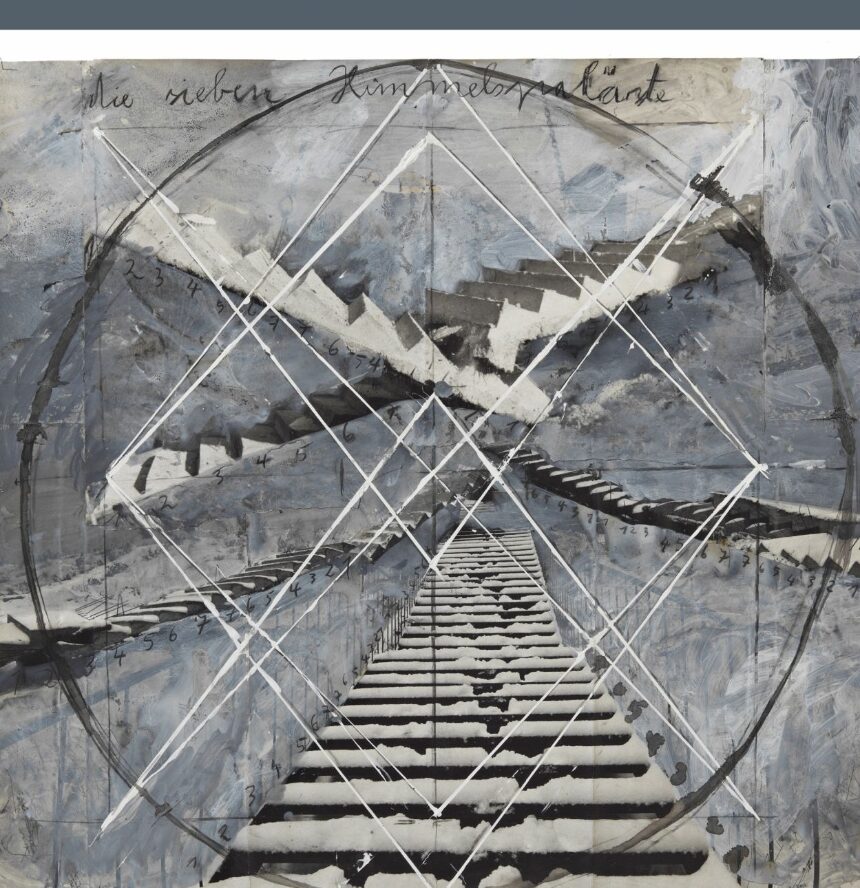
Kiefer’s mentor, Joseph Beuys, had tried to “do” Auschwitz without human figures, relying instead on objects like a dead rat, vials of fat, and moldy sausage. The assemblage allowed for considerable uncertainty of interpretation. Like Beuys, Kiefer is experimental in his recourse to materials, but he is unafraid to paint human figures, even mythological ones like Wagner’s Nibelungen that the Nazis seemed to have rendered taboo even for would-be satirists. Was this a humanizing of Germany, critics asked, a covert participation in Germany’s rightward turn, a step toward national reconciliation with the horrors of the past? Maybe not. Andreas Huyssen understands Kiefer’s imagery as either deliberately ironic or as performing a necessary working through, given that, in spite of the Nazis, the imagery still carries emotional weight. Many of the black-and-white illustrations in Intelligence are fabulous, but they are perhaps not the best way for the uninitiated to catch up on either the irony or the working through. I would watch the Wim Wenders documentary, Anselm, instead. Film, Kluge’s other medium, is better able than a book to transmit the scale of Kiefer’s massive architectural sculptures, as monumental as the Nazi structures they satirically echo. A book is a small thing, physically speaking. Still, it is Kiefer who in the opening pages praises the book as a physical object: “I don’t think Noah’s ark was full of animals, but books” (2). And the colorlessness of his visual contributions to Intelligence is not an accident attributable to the costs of book publication. The grayness is intentional.
In deference to Paul Celan, Kiefer shows us dark, dead sunflower stalks in a snowy field with no sun. As the Wenders documentary reveals, he burns straw and undergrowth on a wall using a flame-thrower and the wall becomes a painting. In an assemblage, sunlight shines on empty white dresses, the heads replaced by bricks, plastic cases, books, barbed wire. In another painting, metal rods stick out of cracked slabs of concrete, the ruins of some habitation. After Gaza, Kiefer’s work has come to seem less commemorative than prophetic.
Intelligence foregrounds Kiefer’s Celan-inspired Margarete/ Shulamith series, where as Huyssen observes, Kiefer’s remembrance of the Holocaust comes through brilliantly. Those paintings are a tribute to the poetry of Celan, the Romanian-Jewish German-language poet who lost his parents in the Holocaust and himself survived one of the forced labor camps. They reference in particular Celan’s most famous poem “Todesfuge”, “Death Fugue”:
Black milk of dawn we drink you at night
we drink you at noon death is a master from Deutschland
we drink you evenings and mornings we drink and drink
death is a master from Deutschland his eye is blue
he strikes you with lead bullets his aim is true
a man lives in the house your golden hair Margarete
he sets his dogs on us he gifts us a grave in the air
he plays with the snakes and dreams death is a master from Deutschland
your golden hair Margarete
your ashen hair Shulamit
In one painting you see a German woman’s blonde hair against a dark, barren landscape. In another you see a Jewish woman’s black hair superimposed on a memorial to the German war dead. “Mother,” Celan wrote in “Wolfbohne”, “they are writing poems.” It is good that art continues, adapting our principles and our circumstances, even if, as here, the artistic act is pitifully incommensurable with its occasion.
***
Besides family memories of the Allied bombing, the two artists are also joined by the pleasure they both take in large time scales. “What moves me about Anselm Kiefer’s work (and has led to our collaboration),” Kluge writes, “is the timespan of over 300 years (oftentimes over 3,000 or even 40,000 years) in which its actuality moves” (110). Both artists show a confidence that time spent in deep or mythic background will not be wasted. I noticed a leaden B-17 in an assemblage that Kiefer had labeled “The Argonauts.” Intelligence features a daisy chain of poets, starting with Pindar, the archaic (that is, pre-classical) Greek poet whose poetry is saturated in an era when the Olympian gods had not yet taken over. Hölderlin, who translated Pindar, also influenced Celan. Kiefer pays tribute to all three. And Kluge ends the book by recalling the potentiality embodied in Pindar’s centaurs, a potentiality which persists despite “the Big Five in Silicon Valley, those modern usurpers who are building a new Valhalla on an imaginary stage by Richard Wagner” (203). Today’s world is much like the world ruled by Zeus. But enchantment has not disappeared. “Nothing has been irrevocably decided. No reason for fatalism” (203).
In Transcription, a child’s seemingly incurable eating disorder—labelled an “art of hunger” by Thomas in one of his evasive moves–does what a novelist is obliged to do: it brings the temptation of hopelessness closer to the everyday life of people today who purchase and read novels. Like Lerner, Karl Ove Knausgaard is another novelist who has spent years contemplating a great artist. In his 2020 profile of Kiefer, entitled “Into the Black Forest With the Greatest Living Artist,” Knausgaard does not try to refute Kiefer’s greatness, but he does include a reference to bad parenting and he notes–whether at his own expense or at Kiefer’s is unclear—that Kiefer sometimes does not seem to know his name, and sometimes seems to have forgotten him altogether. In Transcription too, Thomas sometimes treats the Lerner avatar as an old friend and sometimes just as cheerfully confuses him with someone else. Is this blitheness a characteristic of the great artist, or of the artist as seen by the novelist? Or might it be an instance of life wisdom, the art of remaining faithful under shifting circumstances that Kluge and Kiefer discuss? The eating disorder in Transcription, it’s worth noting, is eventually cured by the application, perhaps intelligent and perhaps merely lucky, of parental indifference. Perhaps indifference, then, is part of what’s needed to stay the course.
Bruce Robbins is Old Dominion Foundation Professor in the Humanities at Columbia University. He has authored several books, among them Criticism and Politics: A Polemical Introduction (Stanford, 2022). He is a long-time member of the b2 and b2o editorial boards.