A Review of Resurrection by Bi Gan
Joséphine Haillot
Often, at a certain stage of artistic maturity, filmmakers turn their gaze back upon the history of film. They hold up a mirror to the 7th art and inspect its techniques and forms: what cinema has been, what it is, what it might yet become, attempting to compose a history of the medium from within, inscribing their own work into a genealogy, sketching the outline of a manifesto. Jean-Luc Godard’s Histoire(s) du cinéma is a grand instance of such an endeavor. Through a palimpsest of film fragments, the twentieth century is drawn from the visual archive it produced.
In Resurrection, Bi Gan, like Godard, reaches for the longue durée. Onscreen, at once a history of cinema and a history of modern China, the two unroll conjoined—the nation cutting moving images to fit its silhouette, moving images refashioning nationhood. Bi Gan, however, eschews Godard’s essayistic, documentary register. Instead, he embraces the narrative form. He imagines a world in which humanity has traded the unconscious drifts of sleep for immortality. Only a rare few still possess the capacity to dream—outliers known as deliriants. The film follows one of them, an anonymous fugitive who seeks refuge by leaping from one cinematic remnant to another, slipping through time, sharing the same faculty as the nameless protagonist of La Jetée (1962).
Resurrection traces a chronological arc across six vignettes: a prologue, an epilogue, and, in-between, four short films. Spanning from the first opium war (1839-1842) to the present day, each chapter registers a new phase in the making of Chinese modernity: British occupation and the end of the Qing dynasty, the Chinese civil war and the Second Sino-Japanese War, the Cultural Revolution, Dengism and the Reform era, the Socialist Market Economy period, and Xi Jinping’s techno-nationalism. This sequencing also resonates with the conventional periodization of Chinese film history into successive “generations” of filmmakers, each emerging from a particular historical moment. Beyond this historical progression, the six-chapter structure gestures toward another order, the Buddhist doctrine of the six sense organs and the six consciousnesses. Bi Gan ventures here a theory of cinema that confronts the problem of perception—the nature of experience, the formation of consciousness—by turning to a philosophical and religious tradition rooted in Asia. He unsettles the dominant Western paradigms that have long organized film theory, from Merleau-Ponty’s phenomenology of spectatorship to Bazin’s ontology of the moving image, Arnheim’s gestaltist approach of animated pictures, and Metz’s semiological analysis of film.
Between the tableaux, time-lapse shots of burning candles interrupt the narrative, wicks collapsing into pools of wax. Far from decorative, the image invokes a Buddhist account of continuity. When King Milinda asks the monk Nāgasena what is reborn if there is no self, Nāgasena answers with an analogy: one flame lights another. What passes on is not substance but causation, leaving imprints that condition a new stream of consciousness, neither identical nor wholly different. In Resurrection, the history of cinema and the history of China unfold along two overlaid understandings of time: the dialectical progression of historical materialism and the Buddhist image of successive ignitions.
The Deliriant represents cinema’s constant rebirth and metamorphosis—a plasticity that tips into monstrosity. It figures as a Western graft: an alien, infectious body trailing in the wake of British and French occupation.
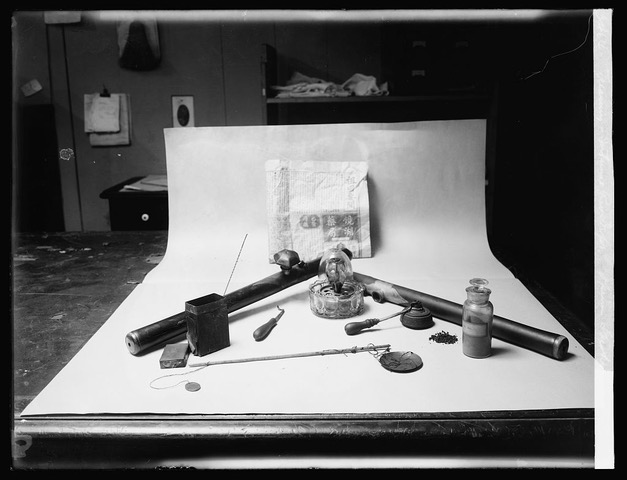
In the overture, the Deliriant emerges as a figure from early horror cinema—pale, dark-eyed, and eerie, like Edison’s Frankenstein (1910) or Murnau’s Nosferatu (1922). His back splits open to reveal a projector wired into his spine. Enslaved, the Delirant is confined in a subterranean chamber buried at the heart of an opium den, a replica of the expressionist architecture of The Cabinet of Dr. Caligari (1920). The Deliriant is sustained by poppy blossoms and produces “poppy tears” for the den’s patrons. The trapdoor to his cell doubles as a phenakistoscope, one of those proto-cinematic machines that prefigures the cinématographe. On its spinning surface, an opium seed morphs into a skull. The Deliriant appears as a byproduct of the Opium Wars, twin to the narcotic that underwrote Western intrusions within the Middle Kingdom. A woman—named Big Other (大她者) after the Lacanian concept—rescues him and restores the projector lodged in his back. Her intervention signals a turning point: wrested from colonial custody, cinema is reimagined within Chinese society and its symbolic order. Once repaired, the film glides into a reenactment of L’Arroseur arrosé (1895). Transplanted from its French garden into a luxuriant landscape of wildflowers, the medium becomes organic to China: nourished and naturalized in its new ground.
In anthracite tones and sharp chiaroscuro lighting, the second segment adopts the visual style of 1930s–1940s film noir, as cinema enters the age of sound. It tells a spy story: after a composer dies, the Deliriant steals a theremin and sheet music believed to contain a cipher. The chase leads through a ruined train station, a space that recalls Shanghai’s “Bloody Saturday” of August 28, 1937, when Japanese air raids destroyed the South Railway Station.[1] There, in this devastated landscape, the Deliriant is caught off guard as he lies asleep in the baroque-carved bed of a motionless railcar, its faded glamor redolent of the Orient Express’s opulence. He is arrested and interrogated. He hangs suspended by the arms in the basement of an administrative building. The lash falls across his back, his body sways above a circular drain reminiscent of the round hatch that sealed him inside the opium den. The image doubles back on itself, creating a motif of continuity and rupture: from the Opium Wars and the waning Qing dynasty to the Republic of China, the civil war between the Guomintang and the Communists, and the Second Sino-Japanese War, in which Shanghai occupied a combustible place.
The second vignette depicts a brutal era of transition for both China and cinema. By the 1930s in Shanghai, movie theaters flourished, attracting young audiences as Hollywood films dominated screens and spurred local industry growth. Leading Chinese studios like Lianhua and Mingxing adapted the American studio model and reshaped its aesthetics to reflect Shanghai’s turbulent modernity. With its procession of gangsters, detectives, and femmes fatales, Hollywood provided archetypes with which Shanghai filmmakers addressed what agitated the city: The Goddess (1934) and Street Angel (1937) depict the grind of urban poverty, the merciless struggle between leftist and far-right forces, and the mounting threat of Japanese aggression. Yet, after the Nationalists seized Shanghai in 1927, they instituted a stringent system of censorship, subjecting books, newspapers, and films to scrutiny as presumed vehicles of moral decay.[2] Just released from Western geôles, the Deliriant—alias Cinema—finds himself swept up once more, this time by the nameless bureaucratic and violent apparatus the detective works for. Intelligence gathering, kidnappings, torture, assassinations—methods that echo those of the Military Bureau of Statistics and Investigation—the Nationalist secret police, which played a ruthless role in the repression of Communists. For the Nationalists, the Deliriant is no mere entertainer but a vessel for subversion, infused with progressive and non-traditional values—western, if not Communist ideas. Pushed to his physical limits, he offers a bargain: he will lead the detective to the place where he has stashed the score and the theremin—an abandoned house lined with mirrors, a derelict labyrinth of refractions. In a replay of the climactic “maze of mirrors” scene from The Lady from Shanghai (1947), images multiply and fracture. As film reels struck, restruck, the Delirant splinters into a thousand doubles, each reflection becoming another. Beyond containment, he vanishes into his own infinite reproduction.
The Deliriant wakes in the back of a moving truck, rattling along a wintry mountain road. Once a Buddhist monk and now forced into labor by the Red Guards, he is returned to his former temple with orders to destroy its relics as part of the Cultural Revolution’s campaign against old traditions. Assigned to guard the desecrated temple overnight and suffering from a severe toothache, he hears a voice instructing him to extract his aching tooth with a fragment from a shattered statue. Upon doing so, a demon resembling his father emerges. The Deliriant confesses to euthanizing his ill father using poisonous potatoes. The Demon traces two ideograms on the fountain’s surface, covered by green lentils: bitterness and sweetness (“甘” and “苦). Later, the Deliriant inscribes them again with pieces of wood upon the frozen earth of the temple garden; they gradually disappear beneath the fall of snow.
The film conjures the style of revolutionary Model Operas with its costumes and rural settings, but lacks their clear moral dichotomy. There is no virtuous revolutionary set against a villain—no landlord, bourgeois traitor, or Japanese imperialist. Even the opposition between the monk, figure of the old order, and the Red Guards, agents of the new, doesn’t stand in a sharp ideological divide, the evil and the good. What emerges instead is a tale of ambiguity and in-betweenness, a meditation on Cultural Revolution cinema: a cinema that sought to sever ties with pre-revolutionary iconography to purify itself through auto-critique and a radical tabula rasa, ultimately forfeiting its capacity for dialectic. Bitterness and sweetness, past and present, loss and gain, propaganda and art all intermingle. At dawn, beneath the temple gate that marks the separation between the sacred and the profane, the Deliriant finally reckons with duality.
The fourth vignette begins almost exactly as the third. Playing on continuity and rupture, it opens on a visual echo—much like the round cell door and the circular drain sutured in the first two episodes. In medias res, the Deliriant wakes in the back of a moving truck. Whereas in the third tableau cinema traveled from a metropolitan area toward the rural hinterland, he now makes the return journey: the 1980s witnessed a re-centering of narrative cinema on the urban, attuned to the new rhythms that animate Chinese cities following Dengist reform. The Deliriant returns as a small-time con artist, freshly arrived in town and already devising a scheme. Refusing to partner with two coarse thugs, he instead recruits a young orphan girl. He trains her in card tricks and drills her in a covert language of cues: a choreography of signals she must memorize for every card. One of these codes relies on scent. Finally ready, he brings her before an old, wealthy man who has placed an advertisement in the newspaper seeking someone with supernatural abilities. As she is blindfolded, the old man presents to her a blackened metal box filled with ashes—the remains of a letter lost in the fire that killed his daughter. He asks the girl to “read” what has turned to dust. She recites a message addressed to an absent father. After being paid for their services, the Deliriant resolves to leave town alone, abandoning the girl behind. At the bus station, as he decides to turn back, the two thugs reappear. They rob him, a blade flashes, he bleeds out to death.
The vignette deals with the question of transmission. It stages the passing on of a technique, the apprenticeship of illusion: the sleights of hand the Deliriant teaches the girl find their analogue in the cinematic craft, which, since its earliest days, has spun legerdemain from montage cuts.[3] In 1978, the Beijing Film Academy reopened after the Cultural Revolution, training the cohort that became the Fifth Generation.[4] As the Deliriant initiates the orphan into the art of deception, so Chinese cinema in the Reform era relearns its language, renewing itself by piecing together its lineage beyond the socialist realism of the Mao era. The vignette also turns to another form of transmission—not of knowledge, but of capital. The old man stands in for the Chinese Nomenklatura: the state apparatus and its command economy that provisioned film production throughout the Cultural Revolution. The Deliriant secures money only after staging a demonstration, letting the old man assess the girl’s magical talents as though submitting a film project to a state commission for approval.
Though the Deliriant also makes money with side hustles: he runs a scatter of small ventures, diversifying his petty-crook business to keep himself afloat. His con runs parallel to the broader liberalization of the Reform era, when getihu—individual household entrepreneurs—burgeons favoring the development of an interstitial economy.[5] Similarly, film production slipped into a hybrid system, combining state ownership with market incentives, that left room for informal, gray-market activities: the studios were expected to cover part of production costs through box-office revenue, keeping surplus beyond quotas.[6] But as the Deliriant learnt at his expense, competition seeps in where state funding once sufficed. In the new economic order, the two thugs he refused to associate with return as predatory business rivals, stripping him of both cash and life. Despite this tragic turn, a note of hope lingers. As the old man becomes convinced of her extraordinary gift, the girl comes to believe in it: what began as a hocus-pocus scam takes on the texture of reality. In other words, cinema—handed down to a new generation—recovers its generative force, its power to estrange the spectators, long constrained by the aesthetic stricture of Maoist doctrine.
1999, on the eve of the new millennium. The Deliriant smokes alone on the docks. A gang of youngsters roars in on motorbikes. Hidden behind a concrete pylon, he watches unnoticed as they toy with a man, before hoisting him up by the arms and abandoning him there—the image reverberating backward to the second vignette, where the Deliriant himself hung suspended. Once again, Bi Gan threads a motif across time. Binding the civil-war era to the late 1990s, it urges the spectator to ask what makes the two epochs alike, however irreducibly different. In the 1940s, Shanghai cinema teemed with noir tales of mafia, spies, detectives, and seductresses. In the last years of the 20th century, the underworld and its catalogue of opaque characters resurfaces: Hong Kong gangster movies—Johnnie To, Andrew Lau, John Woo—illegally flood the mainland thanks to video compact disc (VCD).
Watching the hazing as if it were a film, the Deliriant fails to notice he has entered the frame. On the pylon, like shadow play, a projection, the profile of a woman. The watcher is watched. And we, the audience watch this nesting of spectatorships and spectacles. Unaware of all the eyes on him, the Deliriant rifles through the hanging man’s pockets; on the ground lie broken VCD players and hundreds of shiny discs. She steps out and whispers her name, Tai Zhaomei—a name she shares with a Taiwanese pop singer. Glinting like a disco ball, VCDs line the walls of a karaoke bar—the hideout of a triad boss who traffics contraband Taiwanese records—where the Deliriant has followed Tai Zhaomei.
She belongs to the godfather—produced and sold by him like a pirated disc. The metaphor—linking underground film distribution to human trafficking—turns literal when the Deliriant realizes the boss is a vampire, and Tai Zhaomei his blood child, condemned to a nocturnal life of exploitation. As he is bitten, she sings “Magnolia Flower”[7] (by Tai Zhaomei), an homage to the karaoke scene of Xiao Wu (1998), the debut feature of Jia Zhangke.[8] Leading figure of the Sixth Generation, Jia examines the social consequences of rapid modernization and globalization in contemporary China and brought Chinese cinema to international film festivals, where it began to compete with the more widely circulated auteur cinemas of Taiwan (Tsai Ming-liang), and of Hong Kong (Wong Kar-wai)—an ambition that Bi Gan undoubtedly shares.
This fifth tableau stages an impossible love story between mainland Chinese cinema and the cinemas and pop music of Taiwan and Hong Kong: it ends in tragedy. At daybreak, the lovers flee together on a boat whose shape alludes to the barge transporting Lenin’s statue in Ulysses’ Gaze (1995). Their embrace captures the optimism of China in the early 2000s, amid accelerating integration into global capitalism. Though, the couple also rushes toward death: now that she turned him into a vampire, the sunrise promises annihilation rather than renewal. The scene has a double-edge, forward-looking and elegiac. Like Lenin’s statue, which signals the collapse of the USSR, it mourns the disappearance of old communist China. It also laments a way of watching movies: the VCDs that democratized access to films sped up the decline of movie theaters.[9] A bitter-sweet chronicle of triumph and loss. In filigree, Bi Gan draws the idiograms of vignette 3.
The film circles back. The “Big Other” washes the Deliriant’s corpse and prepares him like a mortuary cosmetologist, applying prosthetics to remake him as the monster from the opium den. She then slides him into a strange morgue cooler that resembles both a funeral lantern and a fantasized data tower. The final shot pulls back to the rear of a miniature movie theater, a wax diorama slowly melting into darkness. What form will cinema assume in the age of digital platforms and AI?
Number one at the box office, Resurrection achieved a rare feat for Chinese arthouse cinema, seducing mainstream audiences.[10] While it fulfilled its ambition at home—demonstrating that Chinese cinema is as monumental and self-reflexive as its Western counterpart and may offer new breath to the 7th art—it proved less successful abroad. Described, with a touch of Orientalism, as mysterious and enigmatic, the film exposed the persistence of an insular Western critical gaze—even as China stands as the leading global power.
Before beginning her Ph.D in Romance Studies at Cornell University, Joséphine Haillot received an M.A. in Art History and Literature from the École des Hautes Études en Sciences Sociales (EHESS). She was an invited researcher at the Cinémathèque française (2019-2021). Her current research focuses on representations of working-class life and the wider problematic of class consciousness in French film and literature after 1989; drawing on intellectual history, socialist thought, psychoanalysis, and media theory to investigate the cultural residues of posthistoire from the fall of Berlin Wall to the crisis of neoliberalism.
[1] “Bloody Saturday” is the name given to the black-and-white picture taken on August 28, 1937. The image shows a baby crying amid the bomb-shattered ruins of the Shanghai South Railway Station. Testimony to Japanese wartime violence, the photograph provoked waves of outrage abroad.
[2] Wakeman, “Licensing Leisure,” 21.
[3] https://www.youtube.com/watch?v=W8oP9FdFL_o
[4] Angus W. K. Lam, review of Reinventing China: A Generation and Its Films, by Paul J. A. Clark, China Perspectives, no. 63 (January–February 2006), published December 20, 2006, accessed February 23, 2026.
[5] Mark Dodd Jacobs, Market China: An Historical and Institutional Analysis of a Chinese Marketplace and Its Market Environment (Ph.D. diss., Cornell University, 2010), 21.
[6] Ying Zhu, Chinese Cinema during the Era of Reform: The Ingenuity of the System (Westport, CT: Praeger, 2003).
[7] https://open.spotify.com/intl-fr/track/5RzLI8SXLZmSZc18z5Qc5C?si=cfb8b19f3f2d41ea
[8] https://youtu.be/vWgTfOAnYYY?t=1861
[9] https://news.qq.com/rain/a/20230623A06T1500
[10] https://variety.com/2025/film/box-office/china-box-office-bi-gan-resurrection-1236590546/