The b2o Review is a non-peer reviewed publication, published and edited by the boundary 2 editorial collective and specific topic editors, featuring book reviews, interventions, videos, and collaborative projects.
an essay byCharles Bernstein
~
In November 2014, my wife, Susan Bee, and I visited Lodz and Warsaw, Poland, for the first time, along with our friend, the poet Tracie Morris. Susan’s mother was born in Lodz, moving to Berlin when she was around five. When I spoke at the American centers at the University of Lodz and Warsaw, I acknowledged standing on the ground of a great experiment from the decade before I was born, which aimed to expel difference in order to increase harmony through sameness, but the move toward homogenization versus miscegenation is powerful in the Americas as well, since the poetics of the Americas is the continuation of European poetics by other means.
When I explore the poetics of representation of the Systematic Extermination Process, I said in Warsaw, I don’t do so as an American looking at Poland and Germany but as someone whose intellectual and cultural foundations are European. I feel it as much my story as anyone else now alive and that a part of European culture destroyed here lives on with me, in and as an American, and is expressed through a commitment to the syncretic and miscegenated poetics of Americas.
The aversion of an originary or authentic or correct language is foundational for the poetics of Americas and makes a sharp contrast with those European (and American) nationalists that place a single language as fundamental to national or literary identity or who work to police national identities in ways that go beyond being born in a place, which, unlike in parts of Europe, is sufficient for U.S. citizenship. Several years ago, at the urging of my daughter, my father-in-law, who was born and grew up in Berlin, tried to reclaim his German citizenship under repatriation laws. His request was denied because he had never actively claimed this citizenship during the Nazi period, when he was a teenager. He was told that he was Polish, the country of origin of his parents. But he would be unable to claim Polish citizenship because, for that, knowledge of Polish is required; Yiddish was not then, nor is it now, considered a proper language of this nation, which was just the problem in the first place, now compounded. (As long as monoculture laws stand in Poland, the stain of the destruction of the Jews will be ineradicable.)
The power of American poetry comes from the mixing of many languages and the resistance to the dominance of any one language, including English – or anyway and one kind of English. As I argue in “The Poetics of the Americas” in My Way: Speeches and Poems, it is the overturning of standard English by second languages and vernacular/dialect speakers that defines American poetry, which is not to say that there is no resistance to this idea in America.
The question of who owns a nation or a people is not, of course, just one of language. We can say in the U.S. that Occupy Wall Street raised the specter of the one percent whose control is through cultural tolerance combined with economic dominance. But the closer analogy in the U.S. for the systematic extermination process here is the mass incarceration of African-American young men, stripping them of opportunities to fully participate in American cultural and economic life.1 In Poland, you have about 224 prisoners per 100,000 people, in the US it’s over 750 but for some age groups of black men it’s over 10,000, one in nine people in that population. More than one in three young black men without a high school diploma is currently behind bars.2
In Warsaw, we found an extraordinary new museum created as if from ashes. POLIN: The Museum of the History of Polish Jews is a site-specific work, situated on the ground of the Jewish Ghetto and as such serving as a memorial as well as a tribute to those who fought in the uprising. The museum’s main entrance is directly across from the more traditional and figurative “Monument to the Ghetto Heroes”, which was erected in 1948. The meaning of the museum is fundamentally connected to its location: as we descended into the core exhibition on the lower level, a ghostly presence makes itself felt and was a constant, and welcome, companion. This is a museum not of artifacts but of the historical record. POLIN overwhelms not with abstract splendor or holocaust memorial kitsch (as in the statue in front of Berlin’s Friedrichstrasse station, of children going off to “camp” as if the camp was “summer” and not “death”).3 This is a museum of deep, or thick, description. In place of sentimental, monumental, or abstract gestures of loss, icons that mark an absence, POLIN, in its core exhibition, curated by Barbara Kirchenbaum-Gimlet, provides a superfluity of what was present to substantiate (and transubstantiate) what has been lost. The museum is a not a funeral pyre but a living archive of what the Jews called Po-Lan when they arrived in the Middle Ages. And it succeeds in making indelible the presence of the Jews in and as Poland: not an eradicated blip in Polish history but as ineradicable thread in the fabric of Poland. Ineradicable even after being eradicated. As in Poe’s “Tell-tale Heart” –– under the floorboards that seem to seal us off from the ground, is a beating heart –– or here, let’s just say, once the floor board that covers the ground is removed, a vast underground cavern is revealed, as deep as the world and as wide as possibility. This cavern is not filled with broken rocks or statuettes of forlorn children. As we look into it more closely, we can see that it is a book.
Jane Eisner’s “Chasing Ghosts, Reviving Spirits: The Fall and Rise of Poland’s Jews” provides account of a trip to Poland at the same time as ours; and, indeed, Eisner’s experiences were close to ours.4 A number of Polish commentators on this article lamented the author’s failure to blame the Nazi’s for the systematic extermination of the Polish Jews or that she failed to acknowledged the horrific suffering of many Polish people during the war. As Benjamin might have said, history is written by the (self-) righteous. He made me do it. POLIN brings the horse of denial to the water but it doesn’t make it drink. In that sense, the museum is programmatically gentle, a wise choice. There is much documentation of the role the Jewish ghetto police played in the extermination process. As for Polish complicity, there is a small placard that notes, with a bloodless tone, that Poles had their own battles to fight and their own everyday lives to live; most stood by and did nothing. (And that leaves out the active participation, and profit, on part of many Poles but also the active resistance on the part of some others.) Daddy, what did you do during the war? POLIN starkly documents the continuing anti-Semitic terror in Poland during what the Poles call the “Communist time”: under this new post-Nazi regime, most of the remaining Polish Jews left Poland – but not to the Poles but rather to what was left of them. The Jewish extermination in Poland was a Polish extermination or, let’s just say, the blood is mixed on the ground. It’s not a blame game, it’s a change game.
I SURVIVED THE MUSEUM OF THE HISTORY OF POLISH JEWS
On our final evening in Warsaw, we went to see the last remains of all the Jewish Ghetto, with bullet-ridden walls over which stenciled words say “never forget” and “truth.” There was one small peephole on a stone wall, similar to Duchamp’s peephole for “Étant donnés.” The view opened onto a dark, stagnant alley, caught in a time neither now nor then, a liminal space haunted by its own aching hollowness. On the other side of the alley was a window with a flickering light; someone was still there, barely there. In a year this last remnant of the ghetto will be covered over with new, chic shops, where perhaps you will be able to buy a figurine of an old Jew floating in amber. Maybe the one we nearly saw in the ghostly light that last night.
_____
notes:
1. The House I Live In, a 2012 film by Eugene Jarecki, makes a compelling case for this analogy.Back to the essay
3. One of the Kindertransport Sculptures by Frank Meilser, “Trains to Life – Trains to Death” (2008): “Standing at the Friedrichstrasse Railway Station this bronze sculpture commemorates 1.6 million children murdered in the Holocaust and 10,000 children whose lives were saved by being granted entry into England in 1938.” The site includes images and a line of Meisler’s Jewish kitsch figurines. Ten thousand divided by 1.6 million comes to .00625 (but whose counting?).Back to the essay
Of all the dangers looming over humanity no threat is greater than that posed by the Luddites.
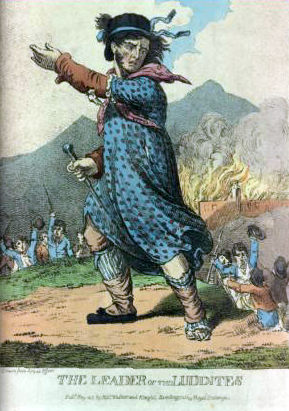
If the previous sentence seems absurdly hyperbolic, know that it only seems that way because it is, in fact, quite ludicrous. It has been over two hundred years since the historic Luddites rose up against “machinery hurtful to commonality,” but as their leader the myth enrobed General Ludd was never apprehended there are always those who fear that General Ludd is still out there, waiting with sledge hammer at the ready. True, there have been some activist attempts to revive the spirit of the Luddites (such as the neo-Luddites of the late 1980s and 1990s) – but in the midst of a society enthralled by (and in thrall to) smart phones, start-ups, and large tech companies – to see Luddites lurking in every shadow is a sign of either ideology, paranoia, or both.
Yet, such an amusing mixture of unabashed pro-technology ideology and anxiety at the possibility of any criticism of technology is on full display in the inaugural “Luddite Awards” presented by The Information Technology and Innovation Foundation (ITIF). Whereas the historic Luddites needed sturdy hammers, and other such implements, to engage in machine breaking the ITIF seems to believe that the technology of today is much more fragile – it can be smashed into nothingness simply by criticism or even skepticism. As their name suggests, the ITIF is a think tank committed to the celebration of, and advocating for, technological innovation in its many forms. Thus it should not be surprising that a group committed to technological innovation would be wary of what it perceives as a growing chorus of “neo-Ludditism” that it imagines is planning to pull the plug on innovation. Therefore the ITIF has seen fit to present dishonorable “Luddite Awards” to groups it has deemed insufficiently enamored with innovation, these groups include (amongst others): The Vermont Legislature, The French Government, the organization Free Press, the National Rifle Association, and the Electronic Frontier Foundation. The ITIF “Luddite Awards” may mark the first time that any group has accused the Electronic Frontier Foundation of being a secret harbor for neo-Ludditism.
Unknown artist, “The Leader of the Luddites,” engraving, 1812 (image source: Wikipedia)
The full report on “The 2014 ITIF Luddite Awards,” written by the ITIF’s president Robert D. Atkinson, presents the current state of technological innovation as being dangerously precarious. Though technological innovation is currently supplying people with all manner of devices, the ITIF warns against a growing movement born of neo-Ludditism that will aim to put a stop to further innovation. Today’s neo-Ludditism, in the estimation of the ITIF is distinct from the historic Luddites, and yet the goal of “ideological Ludditism” is still “to ‘smash’ today’s technology.” Granted, adherents of neo-Ludditism are not raiding factories with hammers, instead they are to be found teaching at universities, writing columns in major newspapers, disparaging technology in the media, and otherwise attempting to block the forward movement of progress. According to the ITIF (note the word “all”):
“what is behind all ideological Ludditism is the general longing for a simpler life from the past—a life with fewer electronics, chemicals, molecules, machines, etc.” (ITIF, 3)
Though the chorus of Ludditisim has, in the ITIF’s reckoning, grown to an unacceptable volume of late, the foundation is quick to emphasize that Ludditism is nothing new. What is new, as the ITIF puts it, is that these nefarious Luddite views have, apparently, moved from the margins and infected the larger public discourse around technology. A diverse array of figures and groups from figures like environmentalist Bill McKibben, conservative thinker James Pethokoukis, economist Paul Krugman, writers for Smithsonian Magazine, to foundations like Free Press, the EFF and the NRA – are all tarred with the epithet “Luddite.”The neo-Luddites, according to ITIF, issue warnings against unmitigated acceptance of innovation when they bring up environmental concerns, mention the possibility of jobs being displaced by technology, write somewhat approvingly of the historic Luddites, or advocate for Net Neutrality.
While the ITIF holds to the popular, if historically inaccurate, definition of Luddite as “one who resists technological change,” their awards make clear that the ITIF would like to add to this definition the words “or even mildly opposes any technological innovation.” The ten groups awarded “Luddite Awards” are a mixture of non-profit public advocacy organizations and various governments – though the ITIF report seems to revel in attacking Bill McKibben he was not deemed worthy of an award (maybe next year). The awardees include: the NRA for opposing smart guns, The Vermont legislature for requiring the labeling of GMOS, Free Press’s support of net neutrality which is deemed as an affront to “smarter broadband networks,” news reports which “claim that ‘robots are killing jobs,” the EFF is cited as it “opposes Health IT,” and various governments in several states are reprimanded for “cracking down” on companies like Airbnb, Uber and Lyft. The ten recipients of Luddite awards may be quite surprised to find that they have been deemed adherents of neo-Ludditism, but in the view of the ITIF the actions these groups have taken indicate that General Ludd is slyly guiding their moves. Though the Luddite Awards may have a somewhat silly feeling, the ITIF cautions that the threat is serious, as the report ominously concludes:
“But while we can’t stop the Luddites from engaging in their anti-progress, anti-innovation activities, we can recognize them for what they are: actions and ideas that are profoundly anti-progress, that if followed would mean a our children [sic] will live lives as adults nowhere near as good as the lives they could live if we instead embraced, rather than fought innovation.” (ITIF, 19)
Credit is due to the ITIF for their ideological consistency. In putting together their list of recipients for the inaugural “Luddite Awards” – the foundation demonstrates that they are fully committed to technological innovation and they are unflagging in their support of that cause. Nevertheless, while the awards (and in particular the report accompanying the awards) may be internally ideologically consistent it is also a work of dubious historical scholarship, comical neoliberal paranoia, and evinces a profound anti-democratic tendency. Though the ITIF awards aim to target what it perceives as “neo-Ludditism” even a cursory glance at their awardees makes it abundantly clear that what the organization actually opposes is any attempt to regulate technology undertaken by a government, or advocated for by a public interest group. Even in a country as regulation averse as the contemporary United States it is still safer to defame Luddites than to simply state that you reject regulation. The ITIF carefully cloaks its ideology in the aura of terms with positive connotations such as “innovation,” “progress,” and “freedom” but these terms are only so much fresh paint over the same “free market” ideology that only values innovation, progress and freedom when they are in the service of neoliberal economic policies. Nowhere does the ITIF engage seriously with the questions of “who profits from this innovation?” “who benefits from this progress?” “is this ‘freedom’ equally distributed or does it reinforce existing inequities?” – the terms are used as ideological sledgehammers far blunter than any tool the Luddites ever used. This raw ideology is on perfect display in the very opening line of the award announcement, which reads:
“Technological innovation is the wellspring of human progress, bringing higher standards of living, improved health, a cleaner environment, increased access to information and many other benefits.” (ITIF, 1)
One can only applaud the ITIF for so clearly laying out their ideology at the outset, and one can only raise a skeptical eyebrow at this obvious case of the logical fallacy of Begging the Question. To claim that “technological innovation is the wellspring of human progress” is an assumption that demands proof, it is not a conclusion in and of itself. While arguments can certainly be made to support this assumption there is little in the ITIF report that suggests the ITIF is willing to engage in the type of critical reflection, which would be necessary for successfully supporting this argument (though, to be fair, the ITIF has published many other reports some of which may better lay out this claim). The further conclusions that such innovation brings “higher standards of living, improved health, a cleaner environment” and so forth are further assumptions that require proof – and in the process of demonstrating this proof one is forced (if engaging in honest argumentation) to recognize the validity of competing claims. Particularly as many of the “benefits” ITIF seeks to celebrate do not accrue evenly. True, an argument can be made that technological innovation has an important role to play in ushering in a “cleaner environment” – but tell that to somebody who lives next to an e-waste dump where mountains of the now obsolete detritus of “technological innovation” leach toxins into the soil. The ITIF report is filled with such pleasant sounding “common sense” technological assumptions that have been, at the very least, rendered highly problematic by serious works of inquiry and scholarship in the field of the history of technology. As classic works in the scholarly literature of the Science and Technology Studies field, such as Ruth Schwartz Cowan’s More Work for Mother, make clear “technological innovation” does not always live up to its claims. Granted, it is easy to imagine that the ITIF would offer a retort that simply dismisses all such scholarship as tainted by neo-Ludditism. Yet recognizing that not all “innovation” is a pure blessing does not represent a rejection of “innovation” as such – it just recognize that “innovation” is only one amongst many competing values a society must try to balance.
Instead of engaging with critics of “technological innovation” in good faith, the ITIF jumps from one logical fallacy to another, trading circular reasoning for attacking the advocate. The author of the ITIF report seems to delight in pillorying Bill McKibben but also aims its barbs at scholars like David Noble and Neil Postman for exposing impressionable college aged minds to their “neo-Luddite” biases. That the ITIF seems unconcerned with business schools, start-up culture, and a “culture industry” that inculcates an adoration for “technological innovation” to the same “impressionable minds” is, obviously, not commented upon. However, if a foundation is attempting to argue that universities are currently a hotbed of “neo-Ludditism” than it is questionable why the ITIF should choose to signal out two professors for special invective who are both deceased – Postman died in 2003 and David Noble died in 2010.
It almost seems as if the ITIF report cites serious humanistic critics of “technological innovation” as a way to make it seem as though it has actually wrestled with the thought of such individuals. After all, the ITIF report deigns to mention two of the most prominent thinkers in the theoretical legacy of the critique of technology, Lewis Mumford and Jacques Ellul, but it only mentions them in order to dismiss them out of hand. The irony, naturally, is that thinkers like Mumford and Ellul (to say nothing of Postman and Noble) would have not been surprised in the least by the ITIF report as their critiques of technology also included a recognition of the ways that the dominant forces in technological society (be it in the form of Ellul’s “Technique” or Mumford’s “megamachine”) depended upon the ideological fealty of those who saw their own best interests as aligning with that of the new technological regimes of power. Indeed, the ideological celebrants of technology have become a sort of new priesthood for the religion of technology, though as Mumford quipped in Art and Technics:
“If you fall in love with a machine there is something wrong with your love-life. If you worship a machine there is something wrong with your religion.” (Art and Technics, 81)
Trade out the word “machine” in the above quotation with “technological innovation” and it applies perfectly to the ITIF awards document. And yet, playful gibes aside, there are many more (many, many more) barbs that one can imagine Mumford directing at the ITIF. As Mumford wrote in The Pentagon of Power:
“Consistently the agents of the megamachine act as if their only responsibility were to the power system itself. The interests and demands of the populations subjected to the megamachine are not only unheeded but deliberately flouted.” (The Pentagon of Power, 271)
The ITIF “Luddite Awards” are a pure demonstration of this deliberate flouting of “the interests and demands of the populations” who find themselves always on the receiving end of “technological innovation.” For the ITIF report shows an almost startling disregard for the concerns of “everyday people” and though the ITIF is a proudly nonpartisan organization the report demonstrates a disturbingly anti-democratic tendency. That the group does not lean heavily toward Democrats or Republicans only demonstrates the degree to which both parties eat from the same neoliberal trough – routinely filled with fresh ideological slop by think tanks like ITIF. Groups that advocate in the interest of their supporters in the public sphere (such as Free Press, the EFF, and the NRA {yes, even them}) are treated as interlopers worthy of mockery for having the audacity to raise concerns; similarly elected governmental bodies are berated for daring to pass timid regulations. The shape of the “ideal society” that one detects in the ITIF report is one wherein “technological innovation” knows no limits, and encounters no opposition, even if these limits are relatively weak regulations or simply citizens daring to voice a contrary opinion – consequences be damned! On the high-speed societal train of “technological innovation” the ITIF confuses a few groups asking for a slight reduction of speed with groups threatening to derail the train.
Thus the key problem of the ITIF “Luddite Awards” emerges – and it is not simply that the ITIF continues to use Luddite as an epithet – it is that the ITIF seems willfully ignorant of any ethical imperatives other than a broadly defined love of “technological innovation.” In handing out “Luddite Awards” the ITIF reveals that it recognizes “technological innovation” as the crowning example of “the good.” It is not simply one “good” amongst many that must carefully compromise with other values (such as privacy, environmental concerns, labor issues, and so forth), rather it is the definitive and ultimate case of “the good.” This is not to claim that “technological innovation” is not amongst values that represent “the good,” but it is not the only value – treating it as such lead to confusing (to borrow a formulation from Lewis Mumford) “the goods life with the good life.” By fully privileging “technological innovation” the ITIF treats other values and ethical claims as if they are to be discarded – the philosopher Hans Jonas’s The Imperative of Responsibility (which advocated for a cautious approach to technological innovation that emphasized the potential risks inherent in new technologies) is therefore tossed out the window to be replaced by “the imperative of innovation” along with a stack of business books and perhaps an Ayn Rand novel, or two, for good measure.
Indeed, responsibility for the negative impacts of innovation is shrugged off in the ITIF awards, even as many of the awardees (such as the various governments) wrestle with the responsibility that tech companies seem to so happily flaunt. The disrupters hate being disrupted. Furthermore, as should come as no surprise, the ITIF report maintains an aura that smells strongly of colonialism and disregard for the difficulties faced by those who are “disrupted” by “technological innovation.” The ITIF may want to reprimand organizations for trying to gently slow (which is not the same as stopping) certain forms of “technological innovation,” but the report has nothing to say about those who work mining the coltan that powers so many innovative devices, no concern for the factory workers who assemble these devices, and – of course – nothing to say about e-waste. Evidently to think such things are worthy of concern, to even raise the issue of consequences, is a sign of Ludditism. The ITIF holds out the promise of “better days ahead” and shows no concern for those whose lives must be trampled upon in the process. Granted, it is easy to ignore such issues when you work for a think tank in Washington DC and not as a coltan miner, a device assembler, a resident near an e-waste dump, or an individual whose job has just been automated.
The ITIF “Luddite Awards” are yet another installment of the tech world/business press game of “Who’s Afraid of General Ludd” in which the group shouting the word “Luddite” at all opponents reveals that it has a less nuanced understanding of technology than was had by the historic Luddites. After all, the Luddites were not opposed to technology as such, nor were they opposed to “technological innovation,” rather, as E.P. Thompson describes in The Making of the English Working Class:
“What was at issue was the ‘freedom’ of the capitalist to destroy the customs of the trade, whether by new machinery, by the factory-system, or by unrestricted competition, beating-down wages, undercutting his rivals, and undermining standards of craftsmanship…They saw laissez faire, not as freedom but as ‘foul Imposition”. They could see no ‘natural law’ by which one man, or a few men, could engage in practices which brought manifest injury to their fellows.” (Thompson, 548)
What is at issue in the “Luddite Awards” is the “freedom” of “technological innovators” (the same-old “capitalists”) to force their priorities upon everybody else – and while the ITIF may want to applaud such “freedom” it is clear that they do not intend to extend such freedom to the rest of the population. The fear that can be detected in the ITIF “Luddite Awards” is not ultimately directed at the award recipients, but at an aspect of the historic Luddites that the report seems keen on forgetting: namely, that the Luddites organized a mass movement that enjoyed incredible popular support – which was why it was ultimately the military (not “seeing the light” of “technological innovation”) that was required to bring the Luddite uprisings to a halt. While it is questionable whether many of the recipients of “Luddite Awards” will view the award as an honor, the term “Luddite” can only be seen as a fantastic compliment when it is used as a synonym for a person (or group) that dares to be concerned with ethical and democratic values other than a simple fanatical allegiance to “technological innovation.” Indeed, what the ITIF “Luddite Awards” demonstrate is the continuing veracity of the philosopher Günther Anders statement, in the second volume of The Obsolescence of Man, that:
“In this situation, it is no use to brandish scornful words like ‘Luddites’. If there is anything that deserves scorn it is, to the contrary, today’s scornful use of the term, ‘Luddite’ since this scorn…is currently more obsolete than the allegedly obsolete Luddism.” (Anders, Introduction – Section 7)
After all, as Anders might have reminded the people at ITIF: gas chambers, depleted uranium shells, and nuclear weapons are also “technological innovations.”
Works Cited
Anders, Günther. The Obsolescence of Man: Volume II – On the Destruction of Life in the Epoch of the Third Industrial Revolution. (translated by Josep Monter Pérez, Pre-Textos, Valencia, 2011). Available online: here.
Mumford, Lewis. The Myth of the Machine, volume 2 – The Pentagon of Power. New York: Harvest/Harcourt Brace Jovanovich, 1970.
Mumford, Lewis. Art and Technics. New York: Columbia University Press, 2000.
Thompson, E.P. The Making of the English Working Class. New York: Vintage Books, 1966.
Not cited but worth a look – Eric Hobsbawm’s classic article “The Machine Breakers.”
_____
Zachary Loeb is a writer, activist, librarian, and terrible accordion player. He earned his MSIS from the University of Texas at Austin, and is currently working towards an MA in the Media, Culture, and Communications department at NYU. His research areas include media refusal and resistance to technology, ethical implications of technology, alternative forms of technology, and libraries as models of resistance. Using the moniker “The Luddbrarian,” Loeb writes at the blog LibrarianShipwreck, where this post first appeared. He is a frequent contributor to The b2 Review Digital Studies section.
We live in an age of heterogenous anarchism. Contingency is king. Fluidity and flux win over solidity and stasis. Becoming has replaced being. Rhizomes are better than trees. To be political today, one must laud horizontality. Anti-essentialism and anti-foundationalism are the order of the day. Call it “vulgar ’68-ism.” The principles of social upheaval, so associated with the new social movements in and around 1968, have succeed in becoming the very bedrock of society at the new millennium.
But there’s a flaw in this narrative, or at least a part of the story that strategically remains untold. The “reticular fallacy” can be broken down into two key assumptions. The first is an assumption about the nature of sovereignty and power. The second is an assumption about history and historical change. Consider them both in turn.
(1) First, under the reticular fallacy, sovereignty and power are defined in terms of verticality, centralization, essence, foundation, or rigid creeds of whatever kind (viz. dogma, be it sacred or secular). Thus the sovereign is the one who is centralized, who stands at the top of a vertical order of command, who rests on an essentialist ideology in order to retain command, who asserts, dogmatically, unchangeable facts about his own essence and the essence of nature. This is the model of kings and queens, but also egos and individuals. It is what Barthes means by author in his influential essay “Death of the Author,” or Foucault in his “What is an Author?” This is the model of the Prince, so often invoked in political theory, or the Father invoked in psycho-analytic theory. In Derrida, the model appears as logos, that is, the special way or order of word, speech, and reason. Likewise, arkhe: a term that means both beginning and command. The arkhe is the thing that begins, and in so doing issues an order or command to guide whatever issues from such a beginning. Or as Rancière so succinctly put it in his Hatred of Democracy, the arkhe is both “commandment and commencement.” These are some of the many aspects of sovereignty and power as defined in terms of verticality, centralization, essence, and foundation.
(2) The second assumption of the reticular fallacy is that, given the elimination of such dogmatic verticality, there will follow an elimination of sovereignty as such. In other words, if the aforementioned sovereign power should crumble or fall, for whatever reason, the very nature of command and organization will also vanish. Under this second assumption, the structure of sovereignty and the structure of organization become coterminous, superimposed in such a way that the shape of organization assumes the identical shape of sovereignty. Sovereign power is vertical, hence organization is vertical; sovereign power is centralized, hence organization is centralized; sovereign power is essentialist, hence organization, and so on. Here we see the claims of, let’s call it, “naïve” anarchism (the non-arkhe, or non foundation), which assumes that repressive force lies in the hands of the bosses, the rulers, or the hierarchy per se, and thus after the elimination of such hierarchy, life will revert so a more direct form of social interaction. (I say this not to smear anarchism in general, and will often wish to defend a form of anarcho-syndicalism.)At the same time, consider the case of bourgeois liberalism, which asserts the rule of law and constitutional right as a way to mitigate the excesses of both royal fiat and popular caprice.
We name this the “reticular” fallacy because, during the late Twentieth Century and accelerating at the turn of the millennium with new media technologies, the chief agent driving the kind of historical change described in the above two assumptions was the network or rhizome, the structure of horizontal distribution described so well in Deleuze and Guattari. The change is evident in many different corners of society and culture. Consider mass media: the uni-directional broadcast media of the 1920s or ’30s gradually gave way to multi-directional distributed media of the 1990s. Or consider the mode of production, and the shift from a Fordist model rooted in massification, centralization, and standardization, to a post-Fordist model reliant more on horizontality, distribution, and heterogeneous customization. Consider even the changes in theories of the subject, shifting as they have from a more essentialist model of the integral ego, however fraught by the volatility of the unconscious, to an anti-essentialist model of the distributed subject, be it postmodernism’s “schizophrenic” subject or the kind of networked brain described by today’s most advanced medical researchers.
Why is this a fallacy? What is wrong about the above scenario? The problem isn’t so much with the historical narrative. The problem lies in an unwillingness to derive an alternative form of sovereignty appropriate for the new rhizomatic societies. Opponents of the reticular fallacy claim, in other words, that horizontality, distributed networks, anti-essentialism, etc., have their own forms of organization and control, and indeed should be analyzed accordingly. In the past I’ve used the concept of “protocol” to describe such a scenario as it exists in digital media infrastructure. Others have used different concepts to describe it in different contexts. On the whole, though, opponents of the reticular fallacy have not effectively made their case, myself included. The notion that rhizomatic structures are corrosive of power and sovereignty is still the dominant narrative today, evident across both popular and academic discourses. From talk of the “Twitter revolution” during the Arab Spring, to the ideologies of “disruption” and “flexibility” common in corporate management speak, to the putative egalitarianism of blog-based journalism, to the growing popularity of the Deleuzian and Latourian schools in philosophy and theory: all of these reveal the contemporary assumption that networks are somehow different from sovereignty, organization, and control.
To summarize, the reticular fallacy refers to the following argument: since power and organization are defined in terms of verticality, centralization, essence, and foundation, the elimination of such things will prompt a general mollification if not elimination of power and organization as such. Such an argument is false because it doesn’t take into account the fact that power and organization may inhabit any number of structural forms. Centralized verticality is only one form of organization. The distributed network is simply a different form of organization, one with its own special brand of management and control.
Consider the kind of methods and concepts still popular in critical theory today: contingency, heterogeneity, anti-essentialism, anti-foundationalism, anarchism, chaos, plasticity, flux, fluidity, horizontality, flexibility. Such concepts are often praised and deployed in theories of the subject, analyses of society and culture, even descriptions of ontology and metaphysics. The reticular fallacy does not invalidate such concepts. But it does put them in question. We can not assume that such concepts are merely descriptive or neutrally empirical. Given the way in which horizontality, flexibility, and contingency are sewn into the mode of production, such “descriptive” claims are at best mirrors of the economic infrastructure and at worse ideologically suspect. At the same time, we can not simply assume that such concepts are, by nature, politically or ethically desirable in themselves. Rather, we ought to reverse the line of inquiry. The many qualities of rhizomatic systems should be understood not as the pure and innocent laws of a newer and more just society, but as the basic tendencies and conventional rules of protocological control.
a review of Dana Goldstein, The Teacher Wars: A History of America’s Most Embattled Profession (Doubleday, 2014)
by Audrey Watters
~
Teaching is, according to the subtitle of education journalist Dana Goldstein’s new book, “America’s Most Embattled Profession.” “No other profession,” she argues, ”operates under this level of political scrutiny, not even those, like policing or social work, that are also tasked with public welfare and are paid for with public funds.”
That political scrutiny is not new. Goldstein’s book The Teacher Wars chronicles the history of teaching at (what has become) the K–12 level, from the early nineteenth century and “common schools” — that is, before before compulsory education and public school as we know it today — through the latest Obama Administration education policies. It’s an incredibly well-researched book that moves from the feminization of the teaching profession to the recent push for more data-driven teacher evaluation, observing how all along the way, teachers have been deemed ineffectual in some way or another — failing to fulfill whatever (political) goals the public education system has demanded be met, be those goals be economic, civic, or academic.
As Goldstein describes it, public education is a labor issue; and it has been, it’s important to note, since well before the advent of teacher unions.
The Teacher Wars and Teaching Machines
To frame education this way — around teachers and by extension, around labor — has important implications for ed-tech. What happens if we examine the history of teaching alongside the history of teaching machines? As I’ve argued before, the history of public education in the US, particularly in the 20th century, is deeply intertwined with various education technologies – film, TV, radio, computers, the Internet – devices that are often promoted as improving access or as making an outmoded system more “modern.” But ed-tech is frequently touted too as “labor-saving” and as a corrective to teachers’ inadequacies and inefficiencies.
It’s hardly surprising, in this light, that teachers have long looked with suspicion at new education technologies. With their profession constantly under attack, many teacher are worried no doubt that new tools are poised to replace them. Much is said to quiet these fears, with education reformers and technologists insisting again and again that replacing teachers with tech is not the intention.
And yet the sentiment of science fiction writer Arthur C. Clarke probably does resonate with a lot of people, as a line from his 1980 Omni Magazine article on computer-assisted instruction is echoed by all sorts of pundits and politicians: “Any teacher who can be replaced by a machine should be.”
Of course, you do find people like former Washington DC mayor Adrian Fenty – best known arguably via his school chancellor Michelle Rhee – who’ll come right out and sayto a crowd of entrepreneurs and investors, “If we fire more teachers, we can use that money for more technology.”
So it’s hard to ignore the role that technology increasingly plays in contemporary education (labor) policies – as Goldstein describes them, the weakening of teachers’ tenure protections alongside an expansion of standardized testing to measure “student learning,” all in the service finding and firing “bad teachers.” The growing data collection and analysis enabled by schools’ adoption of ed-tech feeds into the politics and practices of employee surveillance.
Just as Goldstein discovered in the course of writing her book that the current “teacher wars” have a lengthy history, so too does ed-tech’s role in the fight.
As Sidney Pressey, the man often credited with developing the first teaching machine, wrote in 1933 (from a period Goldstein links to “patriotic moral panics” and concerns about teachers’ political leanings),
There must be an “industrial revolution” in education, in which educational science and the ingenuity of educational technology combine to modernize the grossly inefficient and clumsy procedures of conventional education. Work in the schools of the school will be marvelously though simply organized, so as to adjust almost automatically to individual differences and the characteristics of the learning process. There will be many labor-saving schemes and devices, and even machines — not at all for the mechanizing of education but for the freeing of teacher and pupil from the educational drudgery and incompetence.
Or as B. F. Skinner, the man most associated with the development of teaching machines, wrote in 1953 (one year before the landmark Brown v Board of Education),
Will machines replace teachers? On the contrary, they are capital equipment to be used by teachers to save time and labor. In assigning certain mechanizable functions to machines, the teacher emerges in his proper role as an indispensable human being. He may teach more students than heretofore — this is probably inevitable if the world-wide demand for education is to be satisfied — but he will do so in fewer hours and with fewer burdensome chores.
These quotations highlight the longstanding hopes and fears about teaching labor and teaching machines; they hint too at some of the ways in which the work of Pressey and Skinner and others coincides with what Goldstein’s book describes: the ongoing concerns about teachers’ politics and competencies.
The Drudgery of School
One of the things that’s striking about Skinner and Pressey’s remarks on teaching machines, I think, is that they recognize the “drudgery” of much of teachers’ work. But rather than fundamentally change school – rather than ask why so much of the job of teaching entails “burdensome chores” – education technology seems more likely to offload that drudgery to machines. (One of the best contemporary examples of this perhaps: automated essay grading.)
This has powerful implications for students, who – let’s be honest – suffer through this drudgery as well.
Goldstein’s book doesn’t really address students’ experiences. Her history of public education is focused on teacher labor more than on student learning. As a result, student labor is missing from her analysis. This isn’t a criticism of the book; and it’s not just Goldstein that does this. Student labor in the history of public education remains largely under-theorized and certainly underrepresented. Cue AFT president Al Shanker’s famous statement: “Listen, I don’t represent children. I represent the teachers.”
But this question of student labor seems to be incredibly important to consider, particularly with the growing adoption of education technologies. Students’ labor – students’ test results, students’ content, students’ data – feeds the measurements used to reward or punish teachers. Students’ labor feeds the algorithms – algorithms that further this larger narrative about teacher inadequacies, sure, and that serve to financially benefit technology, testing, and textbook companies, the makers of today’s “teaching machines.”
Teaching Machines and the Future of Collective Action
The promise of teaching machines has long been to allow students to move “at their own pace” through the curriculum. “Personalized learning,” it’s often called today (although the phrase often refers only to “personalization” in terms of the pace, not in terms of the topics of inquiry). This means, supposedly, that instead of whole class instruction, the “work” of teaching changes: in the words of one education reformer, “with the software taking up chores like grading math quizzes and flagging bad grammar, teachers are freed to do what they do best: guide, engage, and inspire.”
Again, it’s not clear how this changes the work of students.
So what are the implications – not just pedagogically but politically – of students, their headphones on staring at their individual computer screens working alone through various exercises? Because let’s remember: teaching machines and all education technologies are ideological. What are the implications – not just pedagogically but politically – of these technologies’ emphasis on individualism, self-management, personal responsibility, and autonomy?
What happens to discussion and debate, for example, in a classroom of teaching machines and “personalized learning”? What happens, in a world of schools catered to individual student achievement, to the community development that schools (at their best, at least) are also tasked to support?
What happens to organizing? What happens to collective action? And by collectivity here, let’s be clear, I don’t mean simply “what happens to teachers’ unions”? If we think about The Teacher Wars and teaching machines side-by-side, we should recognize our analysis of (our actions surrounding) the labor issues of school need to go much deeper and more farther than that.
_____
Audrey Watters is a writer who focuses on education technology – the relationship between politics, pedagogy, business, culture, and ed-tech. She has worked in the education field for over 15 years: teaching, researching, organizing, and project-managing. Although she was two chapters into her dissertation (on a topic completely unrelated to ed-tech), she decided to abandon academia, and she now happily fulfills the one job recommended to her by a junior high aptitude test: freelance writer. Her stories have appeared on NPR/KQED’s education technology blog MindShift, in the data section of O’Reilly Radar, on Inside Higher Ed, in The School Library Journal, in The Atlantic, on ReadWriteWeb, and Edutopia. She is the author of the recent book The Monsters of Education Technology (Smashwords, 2014) and working on a book calledTeaching Machines. She maintains the widely-read Hack Education blog, on which an earlier version of this review first appeared.
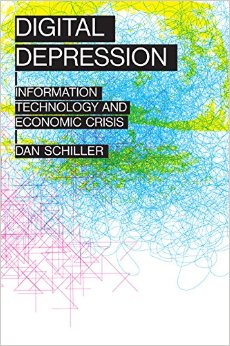
a review of Dan Schiller, Digital Depression: Information Technology and Economic Crisis (University of Illinois Press, 2014)
by Richard Hill
~ Disclosure: the author of this review is mentioned in the Acknowledgements section of the reviewed book.
Computers and telecommunications have revolutionized and disrupted all aspects of human activity, and even behavior. The impacts are broad and profound, with important consequences for governments, businesses, non-profit activities, and individuals. Networks of interconnected computer systems are driving many disruptive changes in business practices, information flows, and financial flows. Foremost amongst those networks is the Internet, much of which is global, or at least trans-national.
According to some, the current governance arrangement for the Internet is nearly ideal. In particular, its global multi-stakeholder model of governance has resulted in a free and open Internet, which has enabled innovation and driven economic growth and well-being around the world. Others are of the view that things have not worked out that well. In particular, the Internet has resulted in mass surveillance by governments and by private companies, in monopolization, commodification and monetization of information and knowledge, in inequitable flows of finances between poor and rich countries, and in erosion of cultural diversity; further, those with central positions of influence have used it to consolidate power and to establish a new global regime of control and exploitation, under the guise of favoring liberalization, while in reality reinforcing the dominance and profitability of major corporations at the expense of the public interest, and the overarching position of certain national interests at the expense of global interests and well being. [1]
Dan Schiller’s book helps us to understand how rational and well-informed people can hold such diametrically opposing views. Schiller dissects the history of the growth of recent telecommunications networks and shows how they have significantly (indeed, dramatically) affected economic and political power relations around the world. And how, at the same time, US policies have consistently favored capital over labor, and have resulted in transfers of vast sums from developing countries to developed countries (in particular through interest on loans).
Participants wearing Edward Snowden and Chelsea Manning masks at 2013 Berlin protests against NSA PRISM program (image source: Wikipedia)
Schiller documents in some detail how US policies that ostensibly promote the free flow of information around the world, the right of all people to connect to the Internet, and free speech, are in reality policies that have, by design, furthered the geo-economic and geo-political goals of the US, including its military goals, its imperialist tendencies, and the interests of large private companies based (if not always headquartered, at least for tax purposes) in the US. For example, strict copyright protection is held to be consistent with the free flow of information, as is mass surveillance. Cookies and exploitation of users’ personal data by Internet companies are held to be consistent with privacy rights (indeed, as Schiller shows, the US essentially denies the existence of the right to personal privacy for anything related to the Internet). There should be no requirements that data be stored locally, lest it escape the jurisdiction of the US surveillance apparatus. And very high profits and dominant positions in key Internet markets do not spark anti-trust or competition law investigations, as they might in any other industry.
As Schiller notes, great powers have historically used communication systems to further their economic and strategic interests, so why should the US not so use the Internet? Thus stated, the matter seems obvious. But the matter is rarely thus stated. On the contrary, the Internet is often touted as a generous gift to the world’s people, able to lift them out of poverty and oppression, and to bring them the benefits of democracy and (or) free markets. Schiller’s carefully researched analysis is thus an important contribution.
Schiller provides context by tracing the origins of the current financial and economic crises, pointing out that it is paradoxical that growing investments in Information and Communication Technologies (ICTs), and the supposed resultant productivity gains, did not prevent a major global economic crisis. Schiller explains how transnational corporations demanded liberalization of the terms on which they could use their private networks, and received then, resulting in profound changes in commodity chains, that is, the flow of production of goods and services. In particular, there has been an increase in transnational production, and this has reinforced the importance of transnational corporations. Further, ICTs have changed the nature of labor’s contribution to production, enabling many tasks to be shifted to unskilled workers (or even to consumers themselves: automatic teller machines (ATMs), for example, turn each of us into a bank clerk). However, the growth of the Internet did not transcend the regular economy: on the contrary, it was wrapped into the economy’s crisis tendencies and even exacerbated them.
Schiller gives detailed accounts of these transformations in the automotive and financial industries, and in the military. The study of the effect of ICTs on the military is of particular interest considering that the Internet was originally developed as a military project, and that it is currently used by US intelligence agencies as a prime medium for the collection of information.
Schiller then turns to telecommunications, explaining the very significant changes that took place in the USA starting in the late 1970s. Those changes resulted in a major restructuring of the dominant telecommunications playing field in the US and ultimately led to the growth of the Internet, a development which had world-wide effects. Schiller carefully describes the various US government actions that initiated and nurtured those changes, and that were instrumental in exporting similar changes to the rest of the world.
Next, he analyzes how those changes affected and enabled the production of the networks themselves, the hardware used to build the networks and to use them (e.g. smartphones), and the software and applications that we all use today.
Moving further up the value chain, Schiller explains how data-mining, coupled with advertising, fuels the growth of the dominant Internet companies, and how this data-mining is made possible only by denying data privacy, and how states use the very same techniques to implement mass surveillance.
Having described the situation, Schiller proceeds to analyze it from economic and political perspectives. Given that the US was an early adopter of the Internet, it is not surprising that, because of economies of scale and network effects, US companies dominate the field (except in China, as Schiller explains in detail). Schiller describes how, given the influence of US companies on US politics, US policies, both domestic and foreign, are geared to allowing, or in fact favoring, ever-increasing concentration in key Internet markets, which is to the advantage of the US and its private companies–and despite the easy cant about decentralization and democratization.
The book describes how the US views the Internet as an extraterritorial domain, subject to no authority except that of the US government and that of the dominant US companies. Each dictates its own law in specific spheres (for example, the US government has supervised, up to now, the management of Internet domain names and addresses; while US companies dictate unilateral terms and conditions to their users, terms and conditions that imply that users give up essentially all rights to their private data).
Schiller describes how this state of affairs has become a foreign policy objective, with the US being willing to incur significant criticism and to pay a significant political price in order to maintain the status quo. That status quo is referred to as “the multi-stakeholder model”, in which private companies are essentially given veto power over government decisions (or at least over the decisions of any government other than the US government), a system that can be referred to as “corporatism”. Not only does the US staunchly defend that model for the Internet, it even tries to export it to other fields of human activity. And this despite, or perhaps because, that system allows companies to make profits when possible (in particular by exploiting state-built infrastructure or guarantees), and to transfer losses to states when necessary (as for example happened with the banking crisis).
Schiller carefully documents how code words such as “freedom of access” and “freedom of speech” are used to justify and promote policies that in fact merely serve the interests of major US companies and, at the same time, the interests of the US surveillance apparatus, which morphed from a cottage industry into a major component of the military-industrial complex thanks to the Internet. He shows how the supposed open participation in key bodies (such as the Internet Engineering Task Force) is actually a screen to mask the fact that decisions are heavily influenced by insiders affiliated with US companies and/or the US government, and by agencies bound to the US as a state.
As Schiller explains, this increasing dominance of US business and US political imperialism have not gone unchallenged, even if the challenges to date have mostly been rhetorical (again, except for China). Conflicts over Internet governance are related to rivalries between competing geo-political and geo-economic blocks, rivalries which will likely increase if economic growth continues to be weak. The rivalries are both between nations and within nations, and some are only emerging right now (for example, how to tax the digital economy, or the apparent emerging divergence of views between key US companies and the US government regarding mass surveillance).
Indeed, the book explains how the challenges to US dominance have become more serious in the wake of the Snowden revelations, which have resulted in a significant loss of market share for some of the key US players, in particular with respect to cloud computing services. Those losses may have begun to drive the tip of a wedge between the so-far congruent goals of US companies and the US government
In a nutshell, one can sum up what Schiller describes by paraphrasing Marx: “Capitalists of the world, unite! You have nothing to lose but the chains of government regulation.” But, as Schiller hints in his closing chapter, the story is still unfolding, and just as things did not work out as Marx thought they would, so things may not work out as the forces that currently dominate the Internet wish they will. So the slogan for the future might well be “Internet users of the world, unite! You have nothing to lose but the chains of exploitation of your personal data.”
This book, and its extensive references, will be a valuable reference work for all future research in this area. And surely there will be much future research, and many more historical analyses of what may well be some of the key turning points in the history of mankind: the transition from the industrial era to the information era and the disruptions induced by that transition.
_____
1. From item 11 of document WSIS+10/4/6 of the preparatory process for the WSIS+10 High Level Event, which provided “a special platform for high-ranking officials of WSIS (World Summit on the Information Society) stakeholders, government, private sector, civil society and international organizations to express their views on the achievements, challenges and recommendations on the implementation” of various earlier internet governance initiatives backed by the International Telecommunications Union (ITU), the United Nations specialized agency for information and communications technologies, and other participants in the global internet governance sphere.
a response byArif Dirlik
~ Susan Buck-Morss’ essay, “Democracy: An Unfinished Project,”1 provides occasion for reflecting on a challenge that faces contemporary radical criticism in North America and Europe: how to reconcile the universalist goals that are the legacies of Euromodernity to radical thinking with the demands of cultural voices emanating from newly-empowered societies that make their own claims on modernity, especially when contradictions between the two seem irreconcilable? Buck-Morss’ discussion navigates through questions thrown up by this dilemma with finesse, engaging critiques of Euromodernity without relinquishing its promises, which demand recognition even by those who would reject it. The title would have reflected the content of the essay more fully had it been elongated to: “Democracy: An Unfinished Project: A Critique of Davut Ahmutoglu’s Project of Islamic Modernity.” Ahmet Davutoglu, Minister of Foreign Affairs when the article was written, just recently has been elevated to the post of Prime Minister of the Republic of Turkey. He is a politician with academic credentials. Author of studies on Islamic politics, international strategy and modernity, he displays a strong philosophical bent in his writings which is important for understanding his policies as well….He believes that “ontological differences” between “Islam” and “the West” call for an “alternative modernity” based on Islamic principles. Like the AKP(Justice and Development Party) and others in the Islamic movement, he seeks to roll back the secularist policies instituted by the Republic after 1923, and to restore to Turkey the glory and power of the Ottoman Empire….
Buck-Morss offers telling critiques of these claims ….Given the venue (a conference in Istanbul) where the article was first presented as a paper, it may be understandable that the author would go about some of her arguments in a roundabout way, skirting issues that might be too venturesome into sensitive territory of national sentiment. While Buck-Morss offers a political reading of claims to an Islamic modernity, what is missing from the discussion is the actual practice of politics. In her addendum she takes note of the Gezi protests of June 2013 that intervened between the initial presentation and the final publication of the paper. She apparently did not think these events and their outcomes to be sufficiently important to introduce them into a more directly political reading of the claims made for Islamic modernity by the likes of Davutoglu who, as a leading member and brain-trust of his party, had no qualms about the suppression of that broad-based democratic movement, instigated by government disregard for public sentiment in its promotion of neo-liberal economic agenda….
Buck-Morss is primarily interested in Davutoglu’s “reliance on certain Western methodologies, specifically twentieth-century German phenomenology.” This may unduly credit with philosophical intent a political operator whose “political analysis,” according to Turkish scholar Behlul Ozkan, “remains on the level of prophecy rather than prognosis,” and whose “pseudoscientific” ideas are “based on inspiration related to historical destiny rather than rational thought.” Ozkan writes that “Davutoglu’s writings reveal his central concern to be not values but power politics.” The most visible imprint of Western sources on his thinking is geopolitical.
The discussion only indirectly hints at the alliance between neoliberal global capitalism and claims to unchanging religious or more broadly “cultural” identities that characterizes the ideology of the Islamic leadership in Turkey—as of all the societies that have found new economic and political opportunities within the context of global capitalism and the seeming decline in Euro/American hegemony, most importantly, the People’s Republic of China…. In those societies descended from empires that for long ruled large parts of the world earning them the title of “civilizations,” newfound power and influence have triggered what may best be described as nostalgia for future reproduction of past glories…. Ethical values claimed for various civilizations may serve as a cover for but barely disguise the privatization of public resources, creation of new class divisions, the concentration of wealth in ever fewer hands, and the sacrifice of public interest and rights to the interests of ruling elites in the name of development that is characteristic of global capitalism in general….The point here is not whether these cultural traditions deserve respect, or have anything to contribute to global futures. The point is rather that what they have to contribute is to be judged not by the texts they claim for their origins or abstract claims about civilizations detached from history, but by the historical outcomes of activity conducted in their name. And the outlook presently is not all that promising.
_____
notes: 1. boundary 2, 41.2 (Summer 2014): 71-98. In-text references are from this text. Back to the essay
a review byPeter Gengler
~
The failure of interwar Central Europe’s democracies remains fertile ground for scholars in the 21st century. In particular, the Weimar Republic’s promises and failures, its vibrant intellectual and artistic communities, and its ultimate collapse in 1933 continue to fascinate and haunt academics and lay audiences alike. Weimar Germany remains the object of intense interest given the barbarity that followed its demise, yet it also serves as a compelling warning about the fragility of democracy.
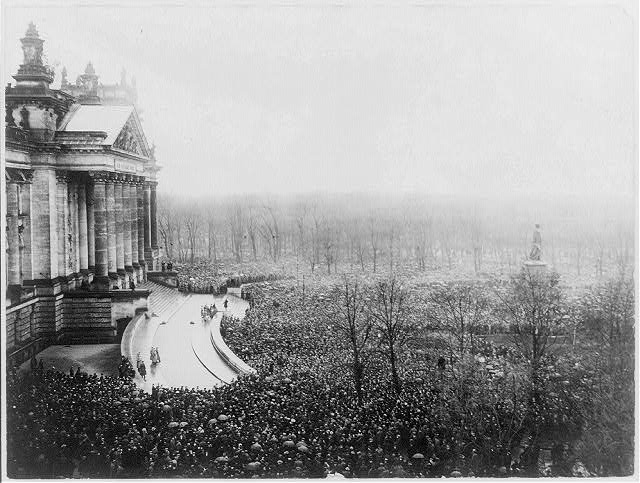
Stefan Jonsson’s Crowds and Democracy examines the tumultuous years between 1918 and 1933 in an original and bold manner, contributing fresh insights to what could otherwise prove a hackneyed subject. In particular, the study’s creative approach and analysis of “the masses” contributes to the literature on Germany’s and Austria’s interwar politics and culture, and more generally raises provocative questions about the challenges of participatory politics, democratic representation, and the individual’s relationship to these processes. Indeed, as Jonsson points out, Europe’s austerity programs and the public outrage, manifested in the recent resurgence of nationalist right-wing parties and fascist movements in the European Union, demand a renewed focus on interwar social movements.
Stefan Jonsson’s background, training, and research interests suit him well for the type of multidisciplinary investigation that he attempts here. He received his Ph.D. in literature from Duke University, and currently is a professor of ethnic studies at Linköping University in Sweden. The subject of Crowds and Democracy continues Jonsson’s previous work, in which he charted the European understanding of the masses from 1789 to 1989. 1 The monograph under review explores 1920s Austrian and German mass psychology, crowd theory, and the idea of “the masses” not simply as intriguing phenomena, but rather as problems in their own right caused and produced by mass mobilization, the social sciences and arts, and the ambivalences of democracy. Given the author’s expertise and familiarity with different disciplines, Crowds and Democracy combines and commands the literature and theories of literary criticism, philosophy, and intellectual and cultural history in an impressive and authoritative way.
Jonsson traces the trajectory of the discourse and idea of “the masses,” concentrating on the years between 1918 and 1933. Each chapter represents a sort of case study as he analyzes the works of intellectuals or artists who are symbolic of a particular school of thought or new direction in scholarship. Jonsson thus shows how the meaning of “the mass” became a subject of investigation after the 1890s by mass psychology and mass sociology. This widely accepted notion held that the mass represented the opposite of bourgeois individuality, organization, education, masculinity, and positive qualities in general—the crowd was defined through negation. This assumption nevertheless gave way to a variety of views that attributed rationality to the crowds and sought to understand their internal dynamics, seeing “the masses” as a social formation in their own right.
Jonsson shows how, despite their increased scrutiny of the masses, German and Austrian intellectuals by the 1920s were no clearer on comprehending the phenomenon and coming up with a suitable theory for understanding it and that by this time no consensus on who constituted the mass and why they were so prevalent in interwar politics existed, though the dominant opinion among sociologists was that they were a symptom of crisis and instability—the “alarm bells of history” (84). These social movements were an “allegory,” Jonsson contends, “evoked by the need to mark powers of change that appeared to govern the world of modernity…the masses connoted a dimension of social existence that caused fear and anxiety precisely because it disrupted the horizon of values and meanings through which class and gender identities had until then been affirmed, cultural hierarchies secured, and social order constituted” (112).
Though they aroused great trepidation, during the 1920s the idea of “the masses” saw greater contestation as well. Indeed, Jonsson concludes that “[t]o enter the cultural landscape of interwar Germany and Austria is to encounter competing views, theories, and images of crowds” (179), each with varying agendas and presumptions that constructed an image of them reflecting socialist egalitarianism and promises of a democratic society to cultural pessimism and fears of bedlam and anarchy. In short, Jonsson’s study seeks to trace the epistemological foundations of “the mass” in European thought.
Complicating this study further, Jonsson argues that the discourses on the masses in interwar Europe actually revolved around the problem of democracy. The period saw a proliferation of contesting ideologies, each with a different view of how to constitute society and the polity. Between the poles of revolution and fascism, thinkers articulated various visions of the crowds that reflected the fractured political landscape. “The masses,” therefore, could be constructed in an exclusionary way or in such a manner that they heralded promises of a better future; the throngs of people heightened fears of proletarian revolution or inspired political action. “The masses” therefore touched on the fundamental problem of democracy: how to embody and speak for the people, how to organize them, and how to represent society as a whole. As Jonsson concludes, these social movements “were never anything more, and at the same time never anything less, than the signs and symptoms of unresolved problems concerning the adequate political, cultural, and aesthetic representations of socially significant passions and political desires” (253).
There are a great many achievements that Jonsson can lay claim to. First and foremost, one cannot help but admire the wealth of material that Jonsson mines. Delving into novels, art, philosophy, historiography, and sociology, the author authoritatively marshals a wide range of sources and subjects them to astute analysis. A number of scholars ranging from the fields of literature, cultural studies, history, the social sciences, film, and art will find intriguing insights and benefit from the lens through which Jonsson reads this vast collection of materials.
Historians of Germany will also be pleased that Jonsson’s treatment of the Weimar period was nuanced and avoided notions of an inevitable collapse into dictatorship. Moreover, Crowds and Democracy is not encumbered by the fascist specter. Jonsson quite rightly asserts that democracy in the interwar period—though crisis-ridden—cannot be reduced to Hitler’s rise to power. Thus, it is refreshing that Nazism is not the predominant focus. Though it may seem obvious for specialists, Weimar was not defined by fascism and the republic should be treated in its own right. Jonsson’s interpretation takes into account the crises and dangers facing the fledgling democracies, but he also is careful to differentiate his account by judiciously discussing the emancipatory ambitions within Germany’s and Austria’s first republics.
Jonsson’s erudite treatment of the sociological profession in the interwar period is another remarkable feature of this study. Readers will be charmed with the ease and clarity with which Jonsson disseminates the writings of scholars such as Georg Simmel, Theodor Geiger, or Leopold von Wiese. The sections of the book concentrating on intellectual history convincingly demonstrate how the idea of “the masses” developed and how sociologists and thinkers contended with what was considered the core issue of the day. Moreover, Jonsson differentiates between the actual phenomenon of mass politics and the “idea” that was constructed by these intellectuals, with all of their presumptions and biases. The result is stimulating, as Jonsson places theorists in dialogue with one another and shows how European intellectual thought, psychoanalysis, and philosophy developed between 1918 and 1933.
Despite these achievements, Crowds and Democracies also suffers from some deficiencies. To begin with, one wonders what audience Jonsson attempted to reach. The book’s intellectual density means that few beyond academia will find it accessible. Simply put: this is not an easy read. The long and meticulous analyses and focus on theory require an engaged and informed reader, especially since some of the historical context—while generally correct—is nevertheless cursory and assumes a reader well versed in Central European history.
The organization, structure, and style of the book are also somewhat distracting. Generally, Jonsson’s study follows the trajectory of the discourse on “the masses” chronologically, but often subchapters elucidate a particular theme that requires back-tracking. The book essentially is a collection of essays, with the result that taken together, the book meanders and contains redundancies. Sprawling chapters ranging between 50 to over 70 pages could have been broken up more effectively. The argumentative thread is also not always clear; 47 pages in, the author is still explaining what his book will do and how it will be structured. The unclear organizing principle and diffused arguments and objectives detract from the overall work. The lack of a bibliography is also disconcerting. Crowds and Democracy would have benefited from greater organizational clarity and a sustained and coherent argument, thereby guiding readers through an already challenging intellectual terrain more carefully.
These criticisms of style aside, there are also some shortcomings with Jonsson’s argument. His claim that “few authors have connected the theme of the masses to Weimar history in any deeper sense” (xv) implies that this book seeks to remedy this gap in the literature. Yet while Jonsson succeeds in his discussion of how “the masses” were viewed, he does not fully accomplish his goal of unifying the discourse on mass movements and the actual phenomenon itself. What we are left with is a study of how intellectual and cultural elites contended with “the mass” theoretically and aesthetically. This does not reveal, however, what goals mass politics had and what ideologies drove them. We have little sense of the dynamics of the social movements, what strategies they pursued, or the self-perception of these entities. Jonsson’s argument assumes that the perceptions of Weimar luminaries—as astute or revealing as they may be—had a profound influence on the construction and instrumentalization of the concept of “the masses.” But this phenomenon was not a mere academic or cultural construction. As the author himself points out numerous times, mass politics were a real and defining feature of the interwar period.
A greater attention on what animated and inspired the crowd would have been of great relevance for the central issue at hand: how “the masses” were imagined and perceived. For instance, taking into account the role of the 1917 Russian Revolution as inspiration for some and specter for others would have both explained the aspirations and fears that Bolshevism unleashed in Germany and which informed how elites viewed mass politics. Not only was the prospect of a proletarian revolution the source for socialist ambitions, it also fueled the animosities of reactionaries who dreaded such an uprising. The intellectual content of the various völkisch movements, the desires for a Volksgemeinschaft, and the inspiration of Mussolini not only motivated rightwing factions, they also had a profound effect on how contemporaries viewed the crowds in the streets. Yet all of this is muted in Jonsson’s study, so that his connection of “the masses” to Weimar history is limited. As intriguing as the observations of sociologists and artists may be, it nevertheless fails to give the crowd agency and in any case is a very narrow focus. In short: a greater attention to the actual crowds and not just how they were perceived could have fleshed out the concept “the masses” more thoroughly. A firmer historical grounding would have only added to this study. 2 As it stands, from a historian’s perspective this book suffers from a lack of tangibility and empiricism, and offers only limited insight into the phenomenon of mass politics and Weimar political and cultural history.
A second shortcoming with Jonsson’s argument concerns his methodology. The claim that discussion of mass politics was ubiquitous and seen as a bellwether for the modern age would have found greater resonance by broadening the analysis beyond cultural elites. It is questionable how central the thinkers chronicled in this study were to the public discourse of the era. Jonsson admirably outlines the contours of the theoretical construction of “the masses” and meticulously documents how they were viewed. Yet missing is a whole other discourse beyond the ivory towers of academia and the artistic community which contemplated the political stakes. How much of this debate depended on Freud, Musil, Adorno, or any number of other notable thinkers, some of whom wrote in exile or never even finished their analyses? Sources such as newspapers or materials of politicians engaged in mass mobilization would have enriched Jonsson’s study of how contemporaries viewed this phenomenon and capitalized on it or struggled against it. He does analyze socialist publications such as the Arbeiter-Illustrierte Zeitung, but a greater use of similar source types would have bolstered his argument. What about the NSDAP publication, The Völkischer Beobachter? Jonsson focuses on rightwing thinkers such as Ernst and Friedrich Gerhard Jünger for another viewpoint on mass politics, but surely other, more widely disseminated sources could have benefitted Jonsson’s study.
Overall, Jonsson has approached the interwar period in a fresh and creative way, demonstrating that the struggle to represent and understand the masses reflected the instability of democracy and the perplexity of the modern individuality. Whether seeing masses as signals of cultural decline or promises of a new, egalitarian society, Jonsson admirably shows how the sweeping political and social changes after 1918 shook European thought to its core. It is not just a unique history of Weimar, but also an understudied aspect of the ambivalence of democracy and the problems of democratic representation. Intellectual historians, sociologists, and scholars of art and cinema will find Crowds and Democracy a rewarding read. Nevertheless, beyond specialists, this book will not find a wide readership, and those seeking to better understand Central European political or cultural history would be better served by starting with more empirical studies.
_____
Peter Gengler is a Ph.D. candidate studying modern German history at the University of North Carolina at Chapel Hill. His dissertation is on expellee interest group politics and the construction and instrumentalization of expulsion narratives in public discourse in the Federal Republic of Germany between 1944 and 1970. From 2014 to 2016, Peter will be conducting dissertation research in Germany with support of the German Academic Exchange (DAAD) and the Berlin Program.
_____
notes:
1. Stefan Jonsson, A Brief History of the Masses: Three Revolutions (New York: Columbia University Press, 2008). Back to the essay
2. For excellent historical studies of Weimar, consult Detlev Peukert, The Weimar Republic: The Crisis of Classical Modernity (New York: Hill and Wang, 1992); Heinrich August Winkler, Weimar, 1918-1933: die Geschichte der ersten deutschen Demokratie (Munich: Beck, 1993); Peter Gay, Weimar Culture: The Outsider as Insider (New York: Norton, 2001); and Eric Weitz, Weimar Germany: Promise and Tragedy (Princeton: Princeton University Press, 2007). Back to the essay
Nelson Mandela died on December 5, 2013. Tony Bogues, a member of the boundary 2 Collective, was in South Africa, watching the endless coverage of the news and of Mandela’s life. Bogues had met Mandela during his time with the Jamaican government of Michael Manley, and he has spent considerable time working in South Africa, especially in Cape Town, on questions of freedom, archives, African and African Diaspora intellectual history, and political thought.
At least one generation of intellectuals had stood against apartheid and reflected on Mandela as a political figure of freedom and liberation. Mandela never produced anything equivalent to the political writings of a Gramsci, Fanon, or Césaire. Because of the media and the global support for the struggles he led, Mandela acquired a resonance with effects across the globe. His career, with all its changes, posed challenges for thinking about politics.
It seemed right that boundary 2 should take notice of Mandela and his influence. We decided to gather responses to Mandela as a political figure. b2 issued a call for very brief papers from several spots on the globe and from different generations. Our contributors have given us reason to feel this attempt was a success.
an essay byArif Dirlik
~
In 1997, the British government handed Hong Kong over to the People’s Republic of China(PRC) after 150 years of colonial rule. Some observers at the time could not but wonder if Hong Kong would be absorbed and remade by the behemoth to the north, or transform with its proverbial dynamism “the motherland” that already was undergoing radical change. The popular uprising under way in Hong Kong is the most recent indication that the question was not an idle one. The answer is yet to come.
Hong Kong investments and technology played an important part in the 1980s in laying the ground for the PRC’s economic take-off. The “special economic zones” that were set up in Guangdong province at the beginning of “reform and opening” as gateways to global capitalism (while keeping the rest of the country immune to its effects) were intended to take advantage of the dynamic capitalism of neighboring Hong Kong. And they did. To this day, Guangdong leads the rest of the country in industrial production and wealth. It also heavily resembles Hong Kong with which it shares a common language and, despite three decades of separation after 1949, common cultural characteristics. Hong Kong has continued to play a crucial part in the country’s development.
It has been a different matter politically. Since the take-over in 1997 the leadership in Beijing has left no doubt of its enthusiasm for the oligarchic political structure that was already in place before the end of colonial rule. The many freedoms and rule of law Hong Kong people enjoyed were less appealing to a regime that preferred a population obedient to its strictures and a legal system more pliable at the service of Communist Party power. Already in the 1980s, Hong Kong people’s doubts about unification with the “motherland” were obvious in the exodus of those who could afford to leave to places like the United States, Canada and Australia. The exodus speeded up following the Tiananmen tragedy in 1989 which put to rest any hopes that reforms might open up a greater space for political freedoms. The colony practically disqualified itself as any kind of political inspiration for the Mainland with the enthusiastic participation of Hong Kongers in the Tiananmen movement leading up to the June Fourth massacre, and annual commemorations thereafter of the suppression of the student movement. In the early 1990s the Party under Deng Xiaoping settled on the example of Singapore as a model more attuned to its own authoritarian practices.
The same reasons that made the regime suspicious of Hong Kong people for their “lack of patriotism” due to the legacies of colonialism have made Hong Kong into an inspiration as well as a base for radical critics of the regime struggling for greater freedom and democracy on the Mainland. The take-over of 1997 was under the shadow of Tinanmen, but even so few would have imagined at the time that within two decades of the celebrations of the end of colonialism and “return” to the motherland, protestors against Beijing “despotism” would be waving British flags. Once the initial enthusiasm for “liberation” was over, Hong Kongers rediscovered as the source of their “difference” the colonial history which in nationalist historiography appeared as a lapse in the nation’s historical, a period of humiliation remembered most importantly to foster nationalist sentiment. PRC democracy activists such as the jailed Nobel Prize winner Liu Xiaobo have drawn the ire of the regime for suggesting that Hong Kong’s freedoms and democratic sentiments were legacies of colonial acculturation that Mainlanders had missed out on.
Current protests have their origins in a consciousness born of the anxieties provoked by the prospect of unification in the 1980s and 1990s, and even though both the Mainland and Hong Kong have changed radically in the intervening period, the Hong Kong identity that assumed recognizable contours at the time is a fundamental driving force of the protests. The immediate issue that has provoked the protests—call for universal suffrage in the selection of the chief executive and legislative council of the Special Administrative Region—harks back to the Basic Law of 1984 agreed upon by the British and the PRC as a condition of unification. The Basic Law stipulated that Hong Kong would be subject internally to its own laws for fifty years after the take-over under a system of “one country, two systems,” with its own chief executive and a legislature elected by an election committee representing various functional constituencies in a corporatist arrangement. The arrangement openly favored the corporate and financial ruling class in Hong Kong which in turn was prepared to align its interests with those of the Communist regime in a mutually beneficial relationship. The Hong Kong Special Administrative Region (SAR) was something of a political counterpart to the “special economic zones”—an exception that was granted not to compromise national sovereignty but as an act of sovereign power. In all matters pertaining to governance and the law, the SAR would be accountable to the National People’s Congress (NPC) in Beijing. Hong Kong was granted representation in the NPC which, like all representation in that body, has served more to consolidate central control than to allow for the democratic airing of public opinion and grievances.
“One country, two systems” was an unstable structure. It was important to the PRC for patriotic reasons to put an end to the colonialism at its doorstep and retrieve territory lost a century and a half ago. But some compromise with the departing British was unavoidable given the strategic importance to the new project of development of the global corporate and financial hub that was Hong Kong. The autonomy granted to Hong Kong was subject to the good faith of the Beijing government. What might happen if the PRC no longer needed this hub seemed like a remote contingency in the 1980s, but already by the 1990s there was talk of the rise of Shanghai as a competitor. It is not out of the question that the present unrest which may undermine faith in Hong Kong as a corporate and financial center is not entirely undesirable to the regime now that preparations have been completed to launch a new financial center in Shanghai.
A similar uncertainty attended the issue of governance under the system. The Basic Law held out the possibility of democratic government and universal suffrage in Hong Kong subject to circumstances to be determined by the NPC. It nourished hopes in democracy, but reserved for Beijing final say on when and how democracy was to be exercised. There were no guarantees that full democracy would be granted if Hong Kongers invited the displeasure of the government in Beijing—or circumstances within the country made it undesirable. This is the immediate issue in the current protests (along with public dissatisfaction with the current chief executive, Leung Chun Ying who, like his two predecessors since 1997, is widely viewed as a Beijing puppet). To Hong Kong democracy advocates, the offer of universal suffrage is a mockery of the promise of full democracy when the choices are limited to candidates carefully selected by an electoral commission packed with Beijing loyalists.
The take-over in 1997, and the circumstances of its negotiation, had one very significant consequence that in likelihood was unanticipated: the politicization of Hong Kong society. Hong Kong long had a reputation as a cultural and political “desert.” The British colonial regime was successful in diverting popular energies to the struggle for everyday existence, and for those who could, the pursuit of wealth. At the height of the Cultural Revolution on the Mainland in 1967, labor disputes erupted into riots against the colonial government led by pro-Beijing leftists. But sustained political activity dates back to the negotiations surrounding the take-over, especially the mobilization instigated by the Tiananmen movement in Beijing. Politics over the last twenty-five years has revolved around the assertion of a Hong Kong identity against dissolution into the PRC. As a new political consciousness has found expression in the efflorescence of a Hong Kong culture in film and literature, the latter has played no little part in stimulating political activity. Ironically, while the goal of “one country, two systems” was to ease Hong Kong into the PRC, the very recognition of the differences of Hong Kong from the rest of the country would seem to have underlined the existence of a Hong Kong identity that differentiated the former colony from the rest of PRC society.
Current protests have focused attention on issues of governance. Far more important are the social tensions and the economic transformations that lend urgency to protestors’ demand for political recognition and rights. One important indication is the part young people—teenagers—have played in the protests. Joshua Wong, who has emerged as a leader, is seventeen years old, which means that he was born in 1997, the year of the take-over.
The generation Wong represents has come of age in a society subject to deepening social and economic problems. The wealth gap in Hong Kong is nothing new, but as elsewhere in the world, inequality has assumed critical proportions with increased concentration of wealth in the hands of the elite allied with Beijing. Since 1997, the experience of marginalization has been intensified with the inundation of the city by Mainlanders with their newfound wealth which has increased prices of commodities, put pressures on public services––including housing, health and education––and introduced new cultural fissures. Some Hong Kong businesses prefer Mainland customers on whose business they have come to be dependent. In the 1990s, Mainlanders living in Hong Kong used to complain about the prejudice they suffered from Hong Kongers with their pretensions to superior cultural sophistication. That has been reversed. Even the most uncouth Mainlanders are likely to look down on Hong Kongers for not being authentically Chinese, which typifies PRC attitudes toward Chinese populations elsewhere. While Hong Kongers complain about “locusts” from the North, a very-unConfucian Beijing University professor descended from Confucius refers to Hong Kongers as “bastards” contaminated by their colonial past. The central government in Beijing, sharing the suspicious of southerners of its imperial predecessors, is engaged in efforts to discourage the use of Cantonese while instilling in the local population its version of what it means to be “Chinese.” We may recall that the present protests were preceded two years ago by successful protests against Beijing-backed efforts to introduce “patriotic” education to Hong Kong schools. It is not that Hong Kong people are not patriotic. They are very patriotic indeed. But their patriotism is mediated by their Hong Kong identity, a very product of the take-over that Beijing would like to erase.
The upheaval in Hong bears similarities to “Occupy” movements elsewhere in the economic issues that inform it. It also has its roots in the special circumstances of Hong Kong society, and its relationship to Beijing. The movement may be viewed as the latest chapter in a narrative that goes back to the 1980s, the emergence of a neoliberal global capitalism of which the PRC has been an integral component, and the Tiananmen movement which was one of the earliest expressions of the social and political strains created by shifts in the global economy. The demands for democracy in the protests are clearly not merely “political.” Democracy is important to the protestors not only as a means to retrieving some control over their lives, but also to overcome inequality. The authorities in Beijing are quite aware of this link. A Law professor from Tsinghua University in Beijing who also serves as an advisor on Hong Kong affairs just recently announced that democracy would jeopardize the wealthy who are crucial to the welfare of Hong Kong’s capitalist economy. It may seem ironic that a Communist Party should be devoted to the protection of wealthy capitalists, but that is the reality of contemporary PRC society that the protestors are struggling against.
The protests are also the latest chapter in the formation of a Hong Kong identity which assumed urgency with the prospect of return to the “motherland” in the 1980s. This, too, is a threat to a regime in flux that finds itself threatened by identity claims among the populations it rules over. It seems superfluous to say that allowing the people of Hong Kong the self-rule they demand would have adverse consequences in encouraging separatism among the various ethnic groups already in rebellion against the regime, and further stimulate democracy activists among the Han population. Hitherto pro-Beijing Guomindang leader in Taiwan, Ma Ying-jeou, has recently voiced his opposition to unification under the “one country, two-systems” formula.
It would probably take something of a miracle for the protest movement in Hong Kong to achieve its stated goals. Rather than risk a Tiananmen style confrontation, the authorities have taken a wait-and-see attitude, waiting for the movement to spend its force, or opponents to force it to retreat. There are signs already that the movement has run its course in clashes between the protestors and members of the general public weary of the disruption of life and business. It is suspected that the attackers included members of Triad gangs. Whom they might be serving is, for the moment, anybody’s guess.
What the next chapter might bring is uncertain, to say the least. It is unlikely that a movement that has been in the making for two decades will simply fade away into oblivion. The problems it set out to resolve are very real, and offer little sign of resolution, and the movement has proven its resilience through the years. The distinguished scholar of Hong Kong-Mainland relations at the City University of Hong Kong, Joseph Cheng Yu-shek,who is also an advocate of democracy, stated in a recent interview that, “All the protesters here and Hong Kong people know it is extremely unlikely the Chinese leaders will respond to our demands…. We are here to say we are not going to give up, we will continue to fight on. We are here because as long as we fight on, at least we haven’t lost.”