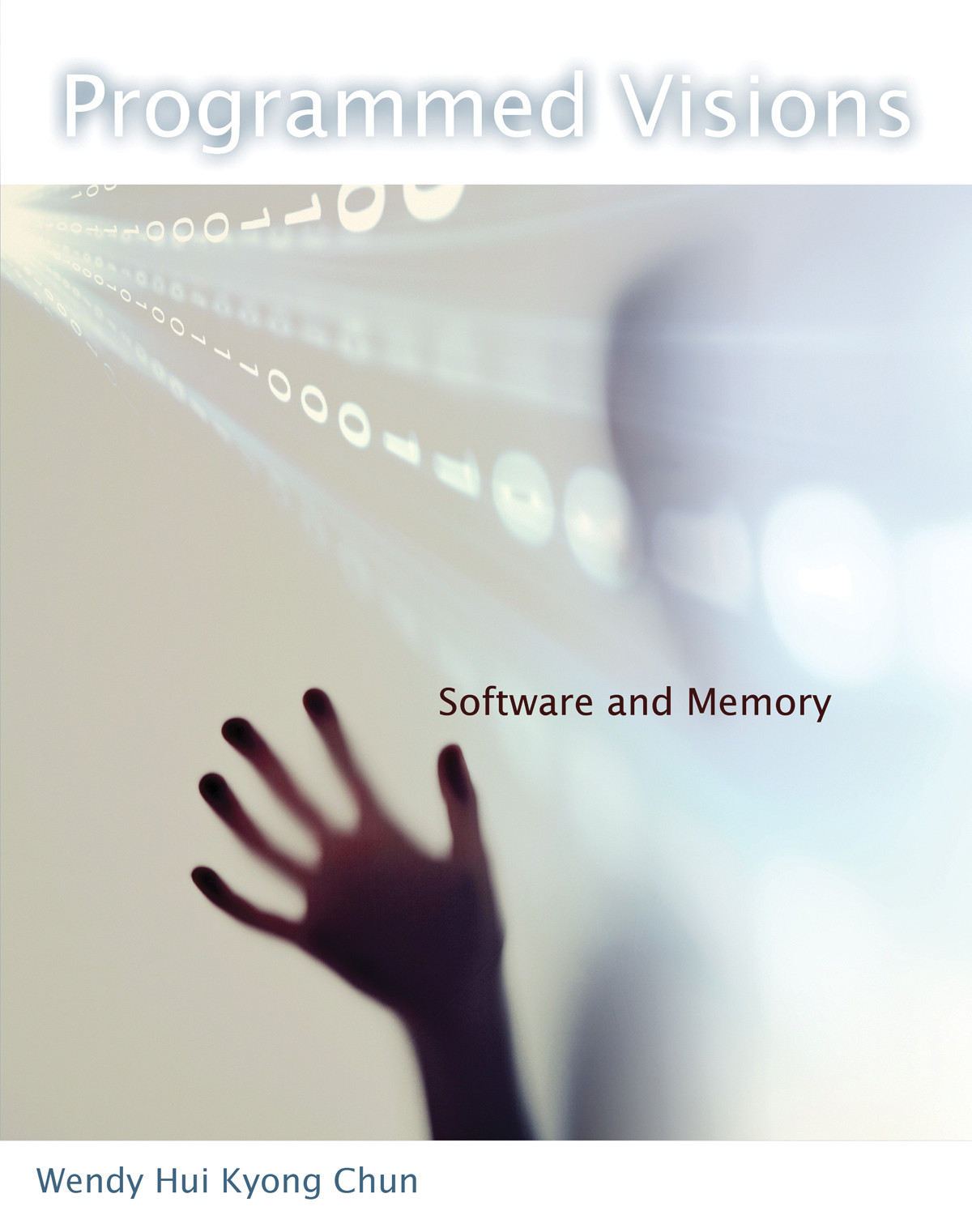
 a review of Wendy Chun, Programmed Visions: Software and Memory (MIT Press, 2013)
by Zachary Loeb
~
Type a letter on a keyboard and the letter appears on the screen, double-click on a program’s icon and it opens, use the mouse in an art program to draw a line and it appears. Yet knowing how to make a program work is not the same as knowing how or why it works. Even a level of skill approaching mastery of a complicated program does not necessarily mean that the user understands how the software works at a programmatic level. This is captured in the canonical distinctions between users and “power users,” on the one hand, and between users and programmers on the other. Whether being a power user or being a programmer gives one meaningful power over machines themselves should be a more open question than injunctions like Douglas Rushkoff’s “program or be programmed” or the general opinion that every child must learn to code appear to allow.
Sophisticated computer programs give users a fantastical set of abilities and possibilities. But to what extent does this sense of empowerment depend on faith in the unseen and even unknown codes at work in a given program? We press a key on a keyboard and a letter appears on the screen—but do we really know why? These are some of the questions that Wendy Hui Kyong Chun poses in Programmed Visions: Software and Memory, which provides a useful history of early computing alongside a careful analysis of the ways in which computers are used—and use their users—today. Central to Chun’s analysis is her insistence “that a rigorous engagement with software makes new media studies more, rather than less, vapory” (21), and her book succeeds admirably in this regard.
The central point of Chun’s argument is that computers (and media in general) rely upon a notion of programmability that has become part of the underlying societal logic of neoliberal capitalism. In a society where computers are tied ever more closely to power, Chun argues that canny manipulation of software restores a sense of control or sovereignty to individual users, even as their very reliance upon this software constitutes a type of disempowerment. Computers are the driving force and grounding metaphor behind an ideology that seeks to determine the future—a future that “can be bought and sold” and which “depends on programmable visions that extrapolate the future—or more precisely, a future—based on the past” (9).
Yet, one of the pleasures of contemporary computer usage, is that one need not fully understand much of what is going on to be able to enjoy the benefits of the computer. Though we may use computer technology to answer critical questions, this does not necessarily mean we are asking critical questions about computer technology. As Chun explains, echoing Michel Foucault, “software, free or not, is embodied and participates in structures of knowledge-power” (21); users become tangled in these structures once they start using a given device or program. Much of this “knowledge-power” is bound up in the layers of code which make software function, the code is that which gives the machine the directions—that which ensures that the tapping of the letter “r” on the keyboard leads to that letter appearing on the screen. Nevertheless, this code typically goes unseen, especially as it becomes source code, and winds up being buried ever deeper, even though this source code is what “embodies the power of the executive, the power of enforcement” (27). Importantly, the ability to write code, the programmer’s skill, does not in and of itself provide systematic power: computers follow “a set of rules that programmers must follow” (28). A sense of power over certain aspects of a computer is still incumbent upon submitting to the control of other elements of the computer.
Contemporary computers, and our many computer-esque devices (such as smart phones and tablets), are the primary sites in which most of us encounter the codes and programming about which Chun writes, but she takes lengths to introduce the reader to the history of programming. For it is against the historical backdrop of military research, during the Second World War, that one can clearly see the ways in which notions of control, the unquestioning following of orders, and hierarchies have long been at work within computation and programming. Beyond providing an enlightening aside into the vital role that women played in programming history, analyzing the early history of computing demonstrates how as a means of cutting down on repetitive work structured programming emerged that “limits the logical procedures coders can use, and insists that the program consist of small modular units, which can be called from the main program” (36). Gradually this emphasis on structured programming allows for more and more processes to be left to the machine, and thus processes and codes become hidden from view even as future programmers are taught to conform to the demands that will allow for new programs to successfully make use of these early programs. Therefore the processes that were once a result of expertise come to be assumed aspects of the software—they become automated—and it is this very automation (“automatic programming”) that “allows the production of computer-enabled human-readable code” (41).
As the codes and programs become hidden by ever more layers of abstraction, the computer simultaneously and paradoxically appears to make more of itself visible (through graphic user interfaces, for example), while the code itself recedes ever further into the background. This transition is central to the computer’s rapid expansion into ever more societal spheres, and it is an expansion that Chun links to the influence of neoliberal ideology. The computer with its easy-to-use interfaces creates users who feel as though they are free and empowered to manipulate the machine even as they rely on the codes and programs that they do not see. Freedom to act becomes couched in code that predetermines the range and type of actions that the users are actually free to take. What transpires, as Chun writes, is that “interfaces and operating systems produce ‘users’—one and all” (67).
Without fully comprehending the codes that lead from a given action (a user presses a button) to a given result, the user is positioned to believe ever more in the power of the software/hardware hybrid, especially as increased storage capabilities allow for computers to access vast informational troves. In so doing, the technologically-empowered user has been conditioned to expect a programmable world akin to the programmed devices they use to navigate that world—it has “fostered our belief in the world as neoliberal: as an economic game that follows certain rules” (92). And this takes place whether or not we understand who wrote those rules, or how they can be altered.
This logic of programmability may be linked to inorganic machines, but Chun also demonstrates the ways in which this logic has been applied to the organic world as well. In truth, the idea that the organic can be programmed predates the computer; as Chun explains “breeding encapsulates an early logic of programmability… Eugenics, in other words, was not simply a factor driving the development of high-speed mass calculation at the level of content… but also at the level of operationality” (124). In considering the idea that the organic can be programmed, what emerges is a sense of the way that programming has long been associated with a certain will to exert control over things be they organic or inorganic. Far from being a digression, Chun’s discussion of eugenics provides for a fascinating historic comparison given the way in which its decline in acceptance seems to dovetail with the steady ascendance of the programmable machine.
The intersection of software and memory (or “software as memory”) is an essential matter to consider given the informational explosion that has occurred with the spread of computers. Yet, as Chun writes eloquently: “information is ‘undead’; neither alive nor dead, neither quite present nor absent” (134), since computers simultaneously promise to make ever more information available while making the future of much of this information precarious (insofar as access may rely upon software and hardware that no longer functions). Chun elucidates the ways in which the shift from analog to digital has permitted a wider number of users to enjoy the benefits of computers while this shift has likewise made much that goes on inside a computer (software and hardware) less transparent. While the machine’s memory may seem ephemeral and (to humans) illegible, accessing information in “storage” involves codes that read by re-writing elsewhere. This “battle of diligence between the passing and the repetitive” characterizing machine memory, Chun argues, “also characterizes content today” (170). Users rely upon a belief that the information they seek will be available and that they will be able to call upon it with a few simple actions, even though they do not see (and usually cannot see) the processes that make this information present and which do or do not allow it to be presented.
When people make use of computers today they find themselves looking—quite literally—at what the software presents to them, yet in allowing this act of seeing the programming also has determined much of what the user does not see. Programmed Visions is an argument for recognizing that sometimes the power structures that most shape our lives go unseen—even if we are staring right at them.
* * *
With Programmed Visions, Chun has crafted a nuanced, insightful, and dense, if highly readable, contribution to discussions about technology, media, and the digital humanities. It is a book that demonstrates Chun’s impressive command of a variety of topics and the way in which she can engagingly shift from history to philosophy to explanations of a more technical sort. Throughout the book Chun deftly draws upon a range of classic and contemporary thinkers, whilst raising and framing new questions and lines of inquiry even as she seeks to provide answers on many other topics.
Though peppered with many wonderful turns of phrase, Programmed Visions remains a challenging book. While all readers of Programmed Visions will come to it with their own background and knowledge of coding, programming, software, and so forth—the simple truth is that Chun’s point (that many people do not understand software sufficiently) may make many a reader feel somewhat taken aback. For most computer users—even many programmers and many whose research involves the study of technology and media—are quite complicit in the situation that Chun describes. It is the sort of discomforting confrontation that is valuable precisely because of the anxiety it provokes. Most users take for granted that the software will work the way they expect it to—hence the frustration bordering on fury that many people experience when suddenly the machine does something other than that which is expected provoking a maddened outburst of “why aren’t you working!” What Chun helps demonstrate is that it is not so much that the machines betray us, but that we were mistaken in our thinking that machines ever really obeyed us.
It will be easy for many readers to see themselves as the user that Chun describes—as someone positioned to feel empowered by the devices they use, even as that power depends upon faith in forces the user cannot see, understand, or control. Even power users and programmers, on careful self-reflection may identify with Chun’s relocation of the programmer from a position of authority to a role wherein they too must comply with the strictures of the code presents an important argument for considerations of such labor. Furthermore, the way in which Chun links the power of the machine to the overarching ideology of neoliberalism makes her argument useful for discussions broader than those in media studies and the digital humanities. What makes these arguments particularly interesting is the way in which Chun locates them within thinking about software. As she writes towards the end of the second chapter, “this chapter is not a call to return to an age when one could see and comprehend the actions of our computers. Those days are long gone… Neither is this chapter an indictment of software or programming… It is, however, an argument against common-sense notions of software precisely because of their status as common sense” (92). Such a statement refuses to provide the anxious reader (who has come to see themselves as an uninformed user) with a clear answer, for it suggests that the “common-sense” clear answer is part of what has disempowered them.
The weaving of historic details regarding computers during World War II and eugenics provide an excellent and challenging atmosphere against which Chun’s arguments regarding programmability can grow. Chun lucidly describes the embodiment and materiality of information and obsolescence that serve as major challenges confronting those who seek to manage and understand the massive informational flux that computer technology has enabled. The idea of information as “undead” is both amusing and evocative as it provides for a rich way of describing the “there but not there” of information, while simultaneously playing upon the slight horror and uneasiness that seems to be lurking below the surface in the confrontation with information.
As Chun sets herself the difficult task of exploring many areas, there are some topics where the reader may be left wanting more. The section on eugenics presents a troubling and fascinating argument—one which could likely have been a book in and of itself—especially when considered in the context of arguments about cyborg selves and post-humanity, and it is a section that almost seems to have been cut short. Likewise the discussion of race (“a thread that has been largely invisible yet central,” 179), which is brought to the fore in the epilogue, confronts the reader with something that seems like it could in fact be the introduction for another book. It leaves the reader with much to contemplate—though it is the fact that this thread was not truly “largely invisible” that makes the reader upon reaching the epilogue wish that the book could have dealt with that matter at greater length. Yet, these are fairly minor concerns—that Programmed Visions leaves its readers re-reading sections to process them in light of later points is a credit to the text.
Programmed Visions: Software and Memory is an alternatively troubling, enlightening, and fascinating book. It allows its reader to look at software and hardware in a new way, with a fresh insight about this act of sight. It is a book that plants a question (or perhaps subtly programs one into the reader’s mind): what are you not seeing, what power relations remain invisible, between the moment during which the “?” is hit on the keyboard and the moment it appears on the screen?
_____
Zachary Loeb is a writer, activist, librarian, and terrible accordion player. He earned his MSIS from the University of Texas at Austin, and is currently working towards an MA in the Media, Culture, and Communications department at NYU. His research areas include media refusal and resistance to technology, ethical implications of technology, alternative forms of technology, and libraries as models of resistance. Using the moniker “The Luddbrarian” Loeb writes at the blog librarianshipwreck. He has previously reviewed The People’s Platform by Astra Taylor and Social Media: A Critical Introduction by Christian Fuchs for boundary2.org.
Back to the essay