b2o

The b2o Review is a non-peer reviewed publication, published and edited by the boundary 2 editorial collective and specific topic editors, featuring book reviews, interventions, videos, and collaborative projects.  

  • Jeanette Vigliotti King–Ravishing Regulations and Digital Bodies

    Jeanette Vigliotti King–Ravishing Regulations and Digital Bodies

    This text is published as part of a special b2o issue titled “Critique as Care”, edited by Norberto Gomez, Frankie Mastrangelo, Jonathan Nichols, and Paul Robertson, and published in honor of our b2o and b2 colleague and friend, the late David Golumbia.

    Ravishing Regulations and Digital Bodies: Metabolizing #Metoo

    Jeanette Vigliotti King

    “It matters which stories tell stories, which concepts think concepts. Mathematically, visually, and narratively, it matters which figures figure figures, which systems systematize systems.” – Donna Haraway, Staying with the Trouble: Making Kin in the Chthulucene

    In the late 2000s, David Golumbia claimed examining the rhetoric of computation allowed for an interrogation of “those aspects of institutional power aided through belief in the superior utility of computerization as a form of social and political organization” (2009: 3). Golumbia provides a compass for navigating the slippery ways in which computers and digital life continue to obscure harm. As Golumbia states, the rhetoric of computation always carries veneers of newness and radical breaks—social media spaces are know exceptions for striking poses of liberation, newness, and connection. Like David before me, I aim to understand the ways in which digital social networking sites can be read as texts with “cultural and historical contexts” (Golumbia 2009:2). In this essay, I read metabolism, zombies, and the hashtag as interconnected logics of digital circulation: a way which bodies and stories affectively move through digital space and are rendered legible on digital bodies. This framework is particularly helpful for reading the emergence, spread, and afterlife of #Metoo. 

    The October 2017 #Metoo[1] campaign spoke wounds to life, narrating a historical story of repressed violence (Geiseler 2019). #Metoo produced largely absented, shamed narratives of sexual assault survivors. The conventions for online participation and meaning making were strategically and tactically deployed to force marginalized, nondominant, and traumatic narrative into focus—causing these stories to metabolize and explicitly enter forums of knowledge production.  As such, the digital wound named by #metoo told stories about normative health presentation and bodies on social media sites. I offer the concept zombie hunger to theorize more broadly how the unstable categories of consumer/consumed were levied during the October 2017 #Metoo multiplatform media event.

    Zombies are potent metaphors, a cultural figure that can be mobilized to track what persists after a body has been designated as abject, abandoned, or made socially dead. Zombie hunger refers to a structural condition of unending need: a repetitive reaching toward recognition, repair, and justice that fails to be fully satisfied under platform capitalism. In other words

    Zombie hunger accounts for the ways personal, uploaded social media information metabolizes with human and nonhuman others. In this sense, zombie hunger tracks how digital bodies become-with. Uploaded information is not passive, but an integral part of knowledge production in Facebook and Instagram. If uploaded information fits within certain criteria, the information circulates freely, touching many digital bodies, bringing them together. Metabolized data allows users to become-with human and nonhumans alike. (King 2025: 2)

    Its affordances lie in naming how survivors’ stories circulate as both vital and emptied material which human and nonhuman platform actants metabolize, creating moments of rupture and visibility. Its limit is the zombie metaphor risks reinscribing dehumanization. Therefore, I find the zombie useful for foregrounding the structural hunger associated with social media platforms. As a mode of cultural critique, the figure of zombies describes viral, collective and grotesque consumption, giving name to the textual cannibalism that occurs within digital social media platforms. As a descriptive figure, zombies are helpful for naming ruptures in protocol. As in films and books, zombies spread by using existing networks of contact and proximity—planes, trains, malls—anywhere people gather, are seen, and see others. Zombies are not liberators, but like all monstrous figures, can reveal harm and warn against ways of being in the world. In this way, zombies offer a Golumbian critique: “we have to learn how to critique even that which helps us” (Golumbia 2009: 13).   Read this way, the figure of the zombie is both critique and care practice: a critique of the logics of consumption in social media space which translates articulated trauma into data and a care practice for its insistence that what haunts, what returns, what stalks does so because it has not been tended to.

    Zombies metabolize—a process that regulates which bodily functions happen. Metabolism, Hannah Landecker argues, is not autonomous but dependent on multiple actants which destabilize agential positions of life (as active) and death (as passive). Consequently, the fixed hierarchy of consumer and consumed cease to be stable markers defining a body. Metabolism offers language for the divergent ways temporality, life, and death manifest for digital life. Since zombies are never singular, but always part of a horde, the metaphor is useful to think with for the ways a collectivized metabolism operates. Zombies as a figure help think about ways in which traumatic narratives are spread compulsively, blurring distinctions between self/other, consumer/consumed, alive/dead, health/sick.

    Hashtags, which are clickable links that organize and bind an uploader’s personal information to others on social media sites, can be thought of as metabolic in nature. The hashtag marked users, compelling others to witness and consume their narratives. Since regulation as a process leads to physiological change, #Metoo forced digital consumption through uncanny, repetitive exposure. Hashtags, like zombies, rely on collective meaning making, their power drawn from contact and hybridity.

    #Metoo can be understood as a monstrous story of hunger, a tale of what one cannot speak alone. In the case of #Metoo, zombie hunger is enacted through: 1) the uploader self-reporting information; 2) the uploader selecting a hashtag; 3) the hashtagged post is algorithmically selected to join other user’s feeds; 4) other users consuming the hashtagged post on their feed; 5) other users clicking the hashtag; 6) other users becoming an uploader. This process mirrors the ways the mid-twentieth century zombie operates—through consumption, transmission, and integration. #Metoo narratives transformed as they circulated, shaping and being shaped by the digital social media bodies. #Metoo resists single authorship, instead forming an overwhelming mass of testimony.

    The archive of #Metoo represents metabolized stories, kept alive through repetition and reproduction of the dominant social values of imagined communities. Paying attention to metabolized stories, I provide a close reading of October 2017 #Metoo to interrogate how repetition in digital spaces is operationalized to reveal normative practices and procedures. Which and whose stories are digestible? And why and how?

    I examine infrastructures that successfully metabolized certain textual and imagistic #Metoo testimonies and how these regulated what other testimonies were marked in poor taste, perverse, or unpalatable.  I close read texts in the public domain—newspaper articles about #Metoo, the viral media event in 2017—and the structural nature of the Facebook profile picture. Finally, I read and analyze artist and graphic designer @witchoria (Victoria Seimer)’s #Metoo image that circulated in the initial days of #Metoo to show how #Metoo offered a tactical, temporary disruption in how social media users collectively engaged with systemic sexual violence. 

    Going Viral: #Metoo 2017

    In what follows, I will contextualize the 2017 #Metoo media event to demonstrated how metabolic and monstrous frameworks manifest within these narratives. In October 2017, actress Alyssa Milano tweeted “Suggested by a friend: If all the women who have been sexually harassed or assaulted wrote ‘Me Too” as a status, we might give people a sense of the magnitude of the problem. If you’ve been sexually harassed or assaulted write ‘me too’ as a reply to this tweet.”[2] Alyssa Milano’s tweet was initially considered the origin point for this particular media event, but activist Black feminist activist Tarana Burke had already created the campaign a decade earlier and has run programming to support survivors of sexual trauma (Vagianos 2017). Celebrities and non-celebrities alike added their voices on Twitter, and soon the hashtag #Metoo was trending. #Metoo made familiar platform conventions—like the live feed and the hashtag—a site of zombie- hording and hunger. #Metoo exposed the ways in which certain bodies – those that are disproportionately women, transwomen, and women of color—experience violence when they were figured as objects, fleshed commodities. 

    According to CBS News Report from October 17, 2017, 12 million posts featuring the hashtag “me too” flooded Facebook (CBS 2017).  Although this was not the first—or last—viral hashtag campaign about a social and political issue, #Metoo affords legible conversations about the yoked nature of the digital and physical body and how an appetite to consume content can be used to upend the normative operations of social networking spaces. Through the seemingly mundane #Metoo, this translated trauma effectively organized multiple organic and inorganic entities, human and nonhuman actants.

    As more users added their voices to #Metoo, zombie hunger became a powerful, partially disruptive force. #Metoo participants used the conventions of the platform—of the pleasures of being seen and the pleasures of being consumed— to call attention to narratives not normally deemed polite or sayable. The repeated presence of #Metoo caused these stories to metabolize. In the specific case of #Metoo, the hashtag itself acts through this understanding of metabolism. The digital body of women who posted now bore a mark and thereby helped constitute what users, other users, and nonhuman actants were forced to “see” and “devour” while engaging with their live feed. Paraphrasing Hannah Landecker, the #Metoo status update is some of the “stuff out of which bodies are made.”(Landecker 2013: 4)  Since regulation as a process leads to a “physiological change,” then #Metoo forces consumption through banal tactics that are rendered unfamiliar and uncanny (Landecker 2013 : 4).

    I focus on hashtags as a mechanism of self-production and zombie hunger because hashtags have an agential capacity to shape and be shaped by existing and emergent bodies of knowledge.  Zombie hunger in the form of agential hashtags operates within the framework of testimony.[3] Gilmore explains: 

    Testimony crosses the boundary between life and death, but also it tarries at the border and inhabits it as an extracorporeal entity. The testimonial body is both a surrogate for those who cannot testify and possess a life of its own. It persists across jurisdictions and can travel the globe. Its future is defined by its capacity to communicate about the past. It exceeds the bodies of the dead, but it carries their voice where it cannot go. Testimony constantly traverses the boundaries of the living and the dead and it derives its affective charge from its disembodied and authentic location. Testimony is haunted: by the dead to whom it bears witness, as well as the living who offer it and hear it. It carries histories of the past that are difficult to narrate, and it makes a claim on the present about current situations. (Gilmore 2017: 75).

    #Metoo functioned as a kind of testimony as an “event and practice” which exists in spaces like autobiographies, memoirs, and digital social networks. When #Metoo was operationalized, the linked nature of the hashtag sent stories of sexual assault and violence skittering across the internet, infecting and replicating on Facebook, Reddit, Instagram taking over the live feeds of users. Every post with the hashtag carried a “disembodied” and “haunted” narrative through repetition in the testimonial network of multiple social media platforms. 

    Haunting seems to share a lot in common with hashtags: they are both patterns, repetitions, frequencies Haunted time is inherently an affective, nonmetric one. As Avery Gordon describes, haunting “alters the experience of being in time,” relies on repetition, and marks the re-emergence of social violence, disrupting stable notions of progress (Gordon 1997: xvi). With #Metoo, the familiar body presented a haunted and temporally displaced trauma for consumption that forced its consumers to look at absented, invisible wounds. The narrative form of hashtags draws power from repetition and dissemination. In this way, repetition combined with the desire to look becomes metabolic because meaning and power are not autonomously generated, but generated and regulated in concert with algorithms, hashtags, and other users.

    By adhering to the temporal logics of repetition, every affective engagement in social media –reactions, shares, hashtags–amplifies the larger message. According to Nicole Brodeur (2017), a columnist for The Seattle Times who also participated in #Metoo, if “the Me toos’ keep coming. Some from transgender women, some from gender nonconforming people…. we’ve not just opened a dialogue here. We’ve exposed the abuse of power and shown there is strength in numbers.” Brodeur (2017) explains how she watched “drips” of #Metoo until there was a “deluge.” The repetition, the connection, or as she says, “strength in numbers,” demonstrates the capacity of what narratives are going to be digested, which ones will force their way into public discourse (Brodeur 2017).

    The case of #Metoo shows how hashtags are nonhuman others, co-producing both desires and hunger. Hashtags have the capacity to work alongside humans to flip normative scripts and shape reality and knowledge systems, allowing for communities to form and transform understandings by forcing consumption through the logics of the live feed. Like hashtags, the zombie’s integrity and meaning-making capacity is dependent on contact with others, by the act of consumption as a moment of transformative power.

    Similarly, in postapocalyptic literature, it is the presence of the zombie that is more urgent, more important than understanding who that zombie is or was; in the #Metoo movement, the name of the participant is not nearly as urgent as the admission itself: “me, too.” When the hashtag flooded feeds, an overwhelming mass of trauma images became accessible merely through acts of repetition. But the integrity of #Metoo, like other hashtags, is dependent upon its contact with other matters. A singular hashtag, unattached to other signifiers, has diminished meaning, reduced capacity to create (digital) physiological change to the linked social body. Zombies, too, are seldom singular; they gain full recognition in a zombie horde in which individual distinction is not the defining feature. Zombies gain meaning in relationship to each other, read against orderly, healthy bodies free from disease. Zombies are an act of translation, moving between life and death, consumer and consumed. Like the pronoun “you,” zombies occupy a space of general and individual distinction.[4]

    Iterative Practices: Metabolizing Life-Writing and Trauma

    Sexual assault, like all trauma, exists at the space where language bucks, becomes undomesticated, caught between an embodied moment then and an embodied moment now. #Metoo offered a tactical, temporary disruption in the how social media users collectively engage with systemic sexual violence. In #Metoo, users and hashtags were webbed, related, co-authors in a story that extended beyond the body of one individual. Read retroactively, #Metoo is a monstrous story of hunger, a tale of what one cannot speak alone. Instead, #Metoo now signifies through volume, each story tacked on, made alive—hunting and haunting—through the nonhuman actor of a hashtag, growing more powerful through what doesn’t have to leave the lips of the user. Haunting is fraught with repetition, what demands to be re-seen again and again. Repetition is also a temporal displacement, a scene which materializes through various structures brushing up against each other. When applied to digital spaces, haunting’s affective uncanny persistence is rendered visible, particularly with recurrent encounters with traumatic events slicing into scrolling sessions via algorithmic circulation. In a digital social media site, users are likely to encounter content in shuffled time and order, rather than a strict linear fashion.

    Life-writing in digital spaces expands opportunities and forms to report, share, and connect self-representation stories; like the haunted bodily form of the zombie, it constantly weaves between interiority and exteriority. Rippl et al. (2013: 7) prefer the term “life-writing’ over autobiography…[because] the latter tends to privilege certain ways of writing about the self [and] conform to the Western Enlightenment narrative of the autonomous self determined (and at least implicitly male) individual which usually favors narrative regularity.” Life-writing is a way to center those narratives “by women, people of color, post-colonial subjects, and other historically marginalized groups, whose stories of violence and oppression are often rendered in non-linear and fragmented forms.” (Rippl et al 2013: 5). Since digital narratives rely on indexical access (rather than linear pagination), the digital temporal space of haunting provides the necessary language and strategies to think-with the lives and experiences of marginalized others.

    Thinking about the processes which enable #Metoo as life-writing focuses on which bodies, even while articulating collectivized trauma, are still subjected to systemic and structural harm. Operating from a feminist philosophical position of strong objectivity, classing #Metoo as a life-writing names the co-narrators (human and nonhuman alike) as historically and socially positioned, constructed at-once through available technologies, languages, and forms.[5] Trauma tests the limit of self-representation–it is extremely difficult to verbalize trauma. This testing necessitates a reconceptualization of the genres of self-representation that adhere to “legalistic definitions of the truth, sharply distinguish between the private and the public as well as the individual and the collective and presuppose a sovereign self as the teller of the tale” (Gilmore 2017: 7). #Metoo is haunted by this systemic violence in which a sovereign self is not the narrator. Corporeal experiences are given to digital bodies, formed both through the chain of production for the digital device, and the network of nonhuman others within the social media platform itself. #Metoo is a co-production whose potency and failings are deeply related to form or how the life-stories moved in a zombie-like horde.

    Complicating Picture Perfect Health

    Social media platforms offer a mirage of freedom. While users are free to upload their own images and contribute text, they must do so within strict boundaries. These platforms, though modifiable, follow an orderly format in which only images of certain sizes can be selected and uploaded. For instance, an uploader on Facebook has a hierarchy on their profile: an anchoring profile image, a banner image, a bolded name, and a wall where posts produced by the uploader and other users are visible. Every post follows a particular visual hierarchy: the profile picture in miniature, the uploader’s name, the content of the post (which includes things like a video or image uniformly formatted in a neat box) with text and the ability to incorporate hyperlinks in the form of hashtags or social tags to other profiles.

    There is no variety, despite the platform’s insistence on wanting the uploader to express “What’s on your mind?” For uploaders, the question “what is on your mind?” can only be addressed in the same uniform way. The ability to choose what to upload obscures the ways in which the platform itself, to use Golumbia’s work, creates a “central perspective; whatever the diversity of the input tory, the output is unified, hierarchized, striated, authoritative” (2009: 208).

    There are also unwritten social conventions governing the construction of digital profiles—only particular kinds of images and life events, those usually associated with positive experiences, are generally circulated for public consumption (Calderia et al. 2020). Lauren Berlant explains, “Health itself can then be seen as a side effect of successful normativity, and people’s desires and fantasies are solicited to line up with that pleasant condition” (Berlant 2007: 765).  Berlant’s assessment is readily extended to Facebook and Instagram. Bodies on these sites are positioned as healthy through a careful absenting of trauma and health woes. This adherence to “unification haunts” every post (Golumbia 2009: 208).These infrastructural practices of small digital repetitions such as uploading, reacting, sharing, and hashtagging uphold projects of normativity and reify the clean, upwardly mobile, white, able-bodied liberal subject.[6] Through such infrastructurally-encouraged repetitions, social norms and structural harm from “offline” continue to metabolize experiences “online.”[7]

    Zombie hunger adheres to logics of repetition: #Metoo’s power depends on the collapse of consumer/consumed, forcing users scrolling on “their” feed to consume abject experiences that survivors have been taught to repress and whose narratives have been denied life in many institutional spaces. The violence to the body returns from the dead as a hungry hunter. Every move towards eating is repeated not only by an “individual” participant but amplified by the horde’s consumption rhyt as well. When users post comments on Facebook live feeds, a smaller image of the profile picture is to the left to the textual information—whether that is a link, another photograph, a few sentences, a life event, etc. In this way, the photograph and status update form a new photographic experience—the inclusion of the linguistic message that is inseparable from the image proper (Barthes 1977). The profile picture serves two primary purposes: to identify and authenticate the user. The profile picture becomes a digital handshake, carrying a user’s identity in the selected image. Many profile pictures are headshots, or artistic spins on headshots.

    The Facebook profile picture inherits from portraiture producing healthy bodies for circulation. Tanya Sheehan explains the nineteenth century practice still permeates contemporary relationships with digital photographs as people “seek to create ‘healthy’ public images…that reproduce narrowly defined ideas about what it means to belong to an ‘American’ social group” (2011: 144). Facebook’s embedded photo tools focus primarily on brightening and lightening, while other non-native applications like Snapseed allow users to digitally enhance the body by removing blemishes, freckles, pounds–procedures and operations to make a digital body reproduce normative health which is always already positioned as white, heteronormative, and able-bodied. These apps, within and outside of Facebook, “generally ‘balance skin pigmentation idealize ‘pure’ whiteness as the desired norm” (Sheehan 2011: 144).  Sheehan notes both “physical ‘excess’ and aging” are traits associated with “the lower class” whose lives are valued differently, particularly when class intersects with the vectors of race and gender. Although whitening practices are not the heart of my analysis, it is imperative to understand that the mechanisms for disseminating information reproduce normative health practices. Illness is absented and mitigated through healing tools, camera angles, and social conventions of reporting certain kinds of information.

    Unification and repetition are mechanisms of zombie hunger for #Metoo. During the media event, the live feed of many users’ Facebooks were flooded with a jarring juxtaposition: a profile picture (likely in line with normative conventions) and the textual testimony of sexual assault or violence. This same structure which transmits fantasies of frictionless life was used to make one story viral, a story that testifies abuses to the physical body.

    The presence of #Metoo next to a profile picture disrupts the healthy body through a haunted temporality. #Metoo haunts and intervenes norms of the profile picture and status box[8]. The contingent nature of the photograph is reinscribed with admissions of sexual assault and violence, altering the unwritten conventions of sharing only positive events and news associated with capitalist and white values of success (Wells et al. 2021).  Instead, users scrolling through their Facebook live feeds are met with bodies and cannot help but taste.

    Often, sexual assault and sexual trauma are invisible wounds that afflict 1 in 3 women and 1 and 6 men.[9] However, that trauma is not absented from the survivor’s experiences. With the inclusion of #Metoo beside the profile picture, each participating user generated a consuming horde, affecting and infecting other users. A 2019 study found that #Metoo did impact public awareness–there was an increase of google searches for the following keywords: sexual assault, sexual abuse, sexual harassment, and rape (Kaufman et al. 2021). Users were spurned, at the very least, to seek additional information about a health issue that disproportionally affects women and in which women of color, women with disabilities, women in low socioeconomic classes, and trans women are overrepresented. Kaufman et al (2021) explained: 

    The National Sexual Assault Conference held in August 2018 is one example of how the hashtag has been turned into action. The conference’s opening plenary featured Tarana Burke talking about where the #Metoo movement needs to go next (National Sexual Violence Resource Center, 2018; North, 2018). The #HowIWillChange follow-up movement is another example of hashtag activism resulting in clear ways to change behavior, although whether social media users actually engage in these promised behaviors is unknown. While a hashtag seems simplistic, and the #Metoo movement has been accused of being unfocused, without a clear purpose, and at times a threat to men falsely accused (North, 2018), the movement has upended public conversation about this health issue for women and others globally. How the sustained attention on the movement and related issues is used for addressing these women’s health, safety, well-being, and policy change remains to be seen.

    The digital body can be transformed into a political stance by a digital act and one that can translate into material changes. Tarana Burke explains she thinks the “destigmatizing effect #Metoo represents a greater gain than anticipated risks” and that “There is inherent strength in agency. And #Metoo, in a lot of ways, is about agency” (Brocke 2018).  The way #Metoo has been discussed in a variety of news articles echoes this sentiment—participants often felt empowered, part of something larger, less ashamed when adding their voice to the #Metoo community.

    #Metoo: What Did Not Metabolize

     Although #Metoo generated space for sexual assault narratives by forcing viewers to consume content, I want to pay attention to Landecker’s statement that metabolism “run[s] the operation of being a body” (Landecker 2013: 4). #Metoo certainly disrupted public discourse, allowing certain women to feel safe enough to express their tales of assault or harassment by feeling connected to a larger community. However, not all #Metoo narratives were integrated seamlessly into the “operation of being a body” (Landecker 2013).  Verity Trott explains that not all survivors felt the same way, calling the feminist hashtag campaign “voyeuristic trauma porn” that disregarded the “high level of emotional labour from survivors but demands nothing from the perpetrators” (2021: 1125). Moreover, not all survivors felt safe in sharing their stories of sexual assault—despite the presence of other stories.

    Here, Golumbia’s exploration between users and CRMs becomes generative ground for thinking through the ways in which platforms have historically both catered to individuals and abstracted their specific needs. He explains:

    While the rhetoric of CRM often focuses on ‘meeting customer’s needs,’ the tools themselves are constructed so as to manage human behavior often against the customer’s own interest and in favor of statistically-developed corporate goals that are implemented at a much higher level of abstraction that the individual[.] (169)

    Following Golumbia’s account of computational logics that automate and naturalize political power, I read the hashtag as a kind of techne structuring stories to cohere as movement. This formulation of tools that meet the customer’s needs—in this case, a platform’s so-called democratic dialog prompt to share using the hashtag #Metoo—is levied against the interest of individual contributors. In fact, the hashtag is, itself, a construction that manages human behavior at a high level of abstraction. Individual contributions are absorbed into larger historically specific, deeply political projects. #Metoo participates in the logics Golumbia outlines: it amplifies, recirculates and constrains testimony through platform architectures which privilege certain repetitions.

    Not all bodies, #Metoo reveals, are valued the same. Importantly, then, some kinds of zombie hunger remain indigestible, despite the ways #Metoo forces the consumption of particular digital identities. Technological tools and digital media are not absented or immune from their situatedness.[10] Kember and Zylinska offer some insight as “to what extent and in what way ‘human users’ are actually formed–not just as users but as humans–by their media” (2014: 12). For #Metoo, understanding that media –and its consumption– as imbricated in human cultural, social, political, and economic systems is important to push against narratives of technology as liberated from the concerns of race, class, and gender.[11]

    #Metoo is not physically present, but a product of the Anthropocene where bits/bytes are organized across bodies. #Metoo organizes data in a horde–a very different kind of archiving practice than the traditional archive which is in a locatable space with defined parameters of what types of content are worthy of memorialization. Again, social media archival sites pose different challenges for contemporary historians such as privacy concerns, methods of swift retrieval, deleted accounts among other things.  Foucault explains that archives exercise a particular kind of discursive power, functioning as the “system that establishes statements as events and things” (Foucault 1972: 137). Value, significance, and authority become associated with items stored and cared for in an archive. By transitioning items into an archive, values of cultures are rendered visible–these are the ways an archive helps form “events and things” which, in turn, outline what types of events are permissible.

    Another important contour: “you” are implicated, “you” are metabolized. When survivors uploaded their stories and used the hashtag, they participated in a decentralized archive. The platforms of sites such as Facebook and Instagram enable self-archiving practices that depart from traditional archiving power structures. As Rebecca Lemov (2017: 254)) explains:

     Self-initiated nonstate archives tend to embody a different set of power and control nodes, a difference perhaps most easily embodied in the contrast between the relations Michel Foucault described in Discipline and Punish (in which the pervasive ‘eye of power’ spread disciplinary and dressage-like techniques that are absorbed through a network of power relationship) and the processes he examined in The History of Sexuality volumes 2 and 3….self-archive, a powerful paradox is at work. The imperative to optimize the self through archiving it is accompanied by a concomitant desire to ‘outsource; responsibility for choices.

    Lemov is right to focus on the ways “nonstate archives embody a differ set of power and control nodes” that have to do with panoptic impulses, regulated behavior to “optimize” the self for absorption and consumption. Digital self-archives, such as Facebook and Instagram, are unquestionably sites of knowledge production. Social facts, as Ann Laura Stoler (2017) indicates, help shape which knowledge is considered qualified. In digital spaces, the process of converting social fact to authoritative knowledge is imperative to the reconfiguration of power. Only certain knowledges are saved, waiting to be resurrected. On Facebook and Instagram, this inherited imperial practice shifts, becomes harder to see, and requires a different assemblage of historically specific materials to trace how power is exercised over bodies.

    Even in this moment of rupture, #Metoo’s imagined community still largely upholds what Gayle Rubin calls a “hierarchical system of sexual value. (Rubin 2007: 171).  Due in part to criminalization and a long tradition of dehumanization, the vulnerable population of self-identifying and self-reporting sex workers failed to be integrated successfully into the larger narrative of #Metoo. Melony Hill, Baltimore resident and sex worker, explained after disclosing her experience with sexual violence that “she’s gotten messages saying she deserved to be sexually assaulted…‘They don’t want to include women like me….They’ll say we’re just whores anyway — ‘How can you sexually assault a whore?’ I’ve had that said to me multiple times” (Cooley 2018).  The piece continues with stories from the women whose sex worker status positions them outside the generative potentiality of #Metoo. Sex workers occupy a space on the bottom of the hierarchy as a part of a “criminal sexual population based on sexual activity” (Rubin 2007: 171). Because sex work falls outside normative sexual activity, cultural narratives often dehumanize these laborers as “dangerous” or “inferior undesirables.”[12]  Professional dominatrix J. Leigh Brantly expresses this concern when she states, “they aren’t ‘perfect victims” (Rubin 2007: 172). These examples illustrate how the conventions of social media’s zombie hunger do not promise full liberation—many other socially constructed others remain outside bandwidths of acceptability for horde hunger.

    Sex worker experiences are not the only vulnerable, less metabolized. There are other intersectional concerns–women of color and working-class women are often left out of the conversation. A white actress launched #Metoo into the cultural imaginary, despite Tarana Burke’s Me Too campaign which started a decade before. Vice President for Education and Workplace Justice at the National Women’s Law Center Emily Martin explains, “‘There has not been enough attention to the way sexual and racial harassment intersect and the ways a woman’s racial identity can target them for harassment” (Jones 2018).

    Without attention to intersectional goals, digital movements run the risk of unintentionally reproducing the subordination of certain bodies. Trott (2021) explains intersectionality is a crucial framework to address some of the issues women of color, women with disabilities, women outside the United States,[13] and queer women faced while attempting to have their experiences successfully metabolized. She explains the framing of Milano’s tweet alongside the spreading sentiment that “we’re all victims and should stand together” excluded “experiences of men, transmen, and nonbinary folk, with the latter groups experiencing a higher rate of sexual violence” (Trott 2021: 12).  The exclusion of trans and nonbinary folks in #Metoo speaks to a larger rupture within mainstream feminist activism. Trott indicates the flattening of all survivors as the same within digital platforms fails to properly account for how marginalized groups operating within systemic oppression often have greater chances of experiencing sexual assault and violence. Intersectional frameworks reveal not only which narratives are deemed consumable (or hungered for) but also traces how both algorithms and digital norms work in tandem to amplify certain narratives at the expense of others.

    #Metoo, Tactical Media, and Possibilities

    From a certain vantage point, #Metoo might appear to be a neoliberal life narrative for the ways in which individuals named systemic harm and major white businessman were held legally accountable.[14] Gilmore explains that the neoliberal life narrative “features an ‘I’ who overcomes hardship and recasts historical and systemic harm as something an individual alone can, and should, manage through pluck, perseverance, and enterprise. In short, the individual transforms disadvantage into value” (Gilmore 2017: 89). However, there are distinct differences due to the interrelated, composite, zombie-like mass of people connected by a hashtag, and the words “me too.” This is not the story of an individual, but a story of scale.

    Attention to these collapses of self/other and consumer/consumed helps us think about #Metoo where the same kind of zombie hunger forced users to consume the horror of sameness. The sameness here is the horror of the volume of sexual assault survivors, of violated physical bodies and newly wounded digital bodies. Being forced to consume content in this scaled-up way furthers the zombie hunger because it calls attention to differential life chances which exist under capitalism but typically disappear from notice.

    The normative social protocol of going online and checking the live feed is part of the platform level mechanisms that allowed these testimonies to be seen and consumed. Understanding the slipperiness of the subject and self within neoliberal conventions of branding and self-commodification can reveal the gendered, classed and raced impacts of capitalism and how hunger can be used as tactical media, a disruption in normative procedures. Rita Raley explains that tactical media “engage in a micropolitics of disruption, intervention, and education” and that “tactical media activities provide models of opposition rather than revolution,” operating within the system of global capitalism and neoliberalism. Since tactical media are forms of art that form “temporary autonomous zones,” they open rather than foreclose possibilities for political transformations beyond their ephemeral temporalities (Raley 2009: 1, 151, 27).

    I read Victoria Seimer’s viral #Metoo digital artwork through zombie hunger as a form of tactical media (Seimer 2017). On Instagram, a particular image created by user @witchoria  (Victoria Seimer)[15] and promiscuously[16] circulated by other users provides an example of a story that (as noted earlier) names wounds. User @witchoria which presents a haunted, foggy field in which no bodies are present. Instead, “me too” is spectrally rendered, repeated throughout the image. On Instagram, user zero @witchoria made her image accessible to “anybody who wishes to repost,” allowing her image to circulate in testimonial networks (Seimer 2017).

    Zombie hunger is a flexible close reading strategy, one that can also be applied to visual texts; in turn, @Witchoria activates the same pleasures of consuming and being consumed. Since this image was created and meant to be shared, the image itself has the capacity to link bodies, and “make of others do” (Latour 2005: 9).

    This agential image is noteworthy for a few reasons and requires a few different, yet knotted readings. Mitchell argues photographs have ritualistic value in social life meaning images desire and perform work, occupying an uncanny space as nonhuman actors that, through social imaginings, have power to regulate meaning or produce panic (2005). He indicates images are lifeform that occupy media ecologies where “personas and avatars [can] can address us and be addressed in return” (Mitchell 2005: 203).  @witchoria’s photograph presents a natural landscape: a night-dark field, greenery, flowers, and a thick fog. However, this familiar woodland scene immediately becomes uncanny. The natural world fades away and the unnatural prevalence of sexual violence manifests in the glowing “ME TOO” that is repeated throughout the image, fading into the mist. @Witchoria’s composite photograph demonstrates the naturalization of systemic sexual violence. @witchoria flips the script of presenting idealized, normative, healthy bodies, choosing instead to withhold any bodies. She doctored her photograph to demonstrate the presence of an ill, highlighting wounds and trauma rather than shying away from such presentations.  Rather than taking a photograph of something “true,” @witchoria generates a narrative photograph, blending elements of fiction and metaphor into her work. This imagining or phantasy is necessary for the recognition of her trauma.

    @wichoria conjures a haunted space replete with zombie hunger which complicates the idea of the individual, both biological and social. On Facebook and Instagram, a digital body is always a composite being, warranted and circulating from the uploader, in tandem with other users, text, algorithms, and photographs. Such complex becoming builds from biologist Scott Gilbert declaration “We are all lichens,” meaning from a biological standpoint, humans are composite, symbiotic entities and not singular autonomous individuals.[17] If the individual is no longer a unified, singular biological entity, then this dispersed, composite fact is made reticent online, particularly in the case study of @witchoria’s widely disseminated image.  Zombies are seldom singular; they gain full recognition in a zombie horde in which individual distinction is not the defining feature. Zombies gain meaning in relationship to each other, and when read against orderly, healthy bodies free from disease. Zombies are an act of translation, moving between life and death, singular and plural. Like the pronoun “you,” zombies occupy a space of general and individual distinction.

    In contemporary imaginings, zombies lose their names–they cease to be individuals. Instead, they become a zombie horde, a collective monstrosity that is both human and nonhuman. @witchoria’s disseminated photograph, the name of the particular user is not nearly as important as the admission: “me too.” Articulating the violence and generating a wound gains potency through the horde-like mechanism of the hashtag. When the hashtag is followed on Instagram, an overwhelming mass of images—of trauma—materializes. Here we have a haunting. Here we have a story that translates wounds.

    Each user that elected to use @witchoria’s image for #Metoo participated in an act of translation, which strikes me as being related to the classic sense of repetition. Writing “Me Too” simultaneously decenters and preserves the author–or uploader.[18] The traumatic experience is distilled into a caption, gaining new life when posted online. Attaching an individualized narrative, however long or sparse, does the work of “living on” through “repetition with a difference” (Massumi 2002: 16).  It is actually the frequency and pattern that given the #Metoo endemic and temporal meaning (Massumi 2002: 39).

    Within the specific case of #Metoo, the “me” occupies a different type of first-person experience. The “me” of #Metoo names frequency as its temporality. The “when” of trauma is less important than the prevalence. Like the “ME TOO”s in @witchoria’s piece, users gain meaning through their relationship to each other, the archival tool of the hashtag, and the algorithms that mark posts for visibility and circulation.

    #Metoo also functions as a “component of passage that transforms engaged bodies into something other than what they have been.” In this case, the Facebook or Instagram body is transformed by a digital act, by its relationship to other users and nonhuman actants. Through the frequency of #Metoo, the wound of the corporeal body is transformed into a viral wound of the digital body.

    Conclusion

    The limited integration of all stories of sexual assault is indicative of zombie hunger—the story of the mass, of the horde, of what normative conventions demand stays repressed and other— dead, even. By understanding #Metoo as a narrative structure that utilizes metabolic functions, it becomes possible to better trace the conventions which govern possibilities for users.

    But like the zombie, there is power in fragmentation, in recognizing the human within the horror. Even with flaws and limitations, #Metoo wakes collective hunger, places power in abundance, in survivors using the platform conventions of looking and eating which often replicate violences of the material world as a mechanism to name structural harm. Such uncanny acts of zombie hunger cause a reckoning, a confrontation of this is how the world works.

    Metabolized narratives account for cultural tastes. They enforce boundaries, regulating which lives are awarded value. While these value designations certainly happen “offline,” the digital world renders the process of regulation more visible. The zombie like #Metoo will not be satiated, nor will liberation come through this act alone. Although Mark Zuckerberg claims a kind of celebratory ownership over the way movements such as #BlackLivesMatter and #Metoo connect people, Golumbia points out the same tools “contribut[e] to the destruction of the democratic social fabric, the destabilization of journalism’s critical function in democracies, and the promotion of hate and disinformation.” (Golumbia 204: 38). This is the danger of zombie hunger—all kinds of narratives can metabolize through the pleasures of consumption.

    Without material action, the social body has remained haunted. In a post-Covid internet during the second Trump administration, the afterlife of zombie hunger has mutated. New hashtags speaking similar structural wounds have emerged. This is the affordance of the zombie: the afterlife of #Metoo persists, refuses rest, and is a continued site of undead political energy. At time of writing, #Standwithsurvivors, a hashtag associated with the victims of Epstein’s sex trafficking ring, is stirring, hungry for justice in legislative bodies.

    Jeanette Vigliotti King is an Assistant Professor of Classical and Liberal Education at Flagler College Florida. She received her PhD from Virginia Commonwealth University in Media Art Text. A former graduate student of David Golumbia, she is interested in digital body construction within social media spaces, particularly the way digital bodies operate at the intersections of life/death, healthy/unhealthy, self/other.

    References

    Barthes, Roland. 1977. Image Music Text. London: Fontana.

    Berlant, Lauren. 2007. “Slow Death (Sovereignty, Obesity, Lateral Agency).” Critical Inquiry 33, no. 4: 754–780.

    Bloom, Jessica. 2017. “The #Metoo Photo Going Viral on Instagram.” Format, October 17. https://www.format.com/magazine/resources/art/me-too-wichoria-victoria-siemer-instagram.

    Boellstorff, Tom. 2016. “For Whom the Ontology Turns: Theorizing the Digital Real.” Current Anthropology 57, no. 4: 387–407.

    Bracewell, Lorna. 2021. Why We Lost the Sex Wars: Sexual Freedom in the #Metoo Era. Minneapolis: University of Minnesota Press.

    Brodeur, Nicole. 2017. “Strength in Numbers: A Mountain of #Metoo.” Seattle Times, October 17. https://www.seattletimes.com/life/strength-in-numbers-a-mountain-of-metoo/

    CBS News. 2017. “#Metoo Floods Social Media With Stories of Sexual Harassment and Assault.” October 17. https://www.cbsnews.com/news/me-too-campaign-floods-social-media-sexual-harassment-abuse/

    Caldeira, Sofia P., Sander De Ridder, and Sofie Van Bauwel. 2020. “Between the Mundane and the Political: Women’s Self-Representations on Instagram.” Social Media + Society (July). https://doi.org/10.1177/2056305120940802.

    Carter, Julian B. 2007. The Heart of Whiteness: Normal Sexuality and Race in America, 1880–1940. Durham, NC: Duke University Press.

    Chun, Wendy Hui Kyong. 2008. Control and Freedom: Power and Paranoia in the Age of Fiber Optics. Cambridge, MA: MIT Press.

    Chun, Wendy Hui Kyong. 2016. “Big Data as Drama.” ELH 83: 363–382. doi:10.1353/elh.2016.0011.

    Chun, Wendy Hui Kyong. 2017. Updating to Remain the Same: Habitual New Media. Cambridge, MA: MIT Press.

    Cooley, Samantha. 2018. “‘They Don’t Want to Include Women like Me.’ Sex Workers Say They’re Being Left out of the #Metoo Movement.” Time, February 13. https://time.com/5104951/sex-workers-me-too-movement/

    Derrida, Jacques, and Lawrence Venuti. 2001. “What Is a ‘Relevant’ Translation?” Critical Inquiry 27, no. 2: 174–200.

    Gieseler, Carolyn. 2019. The Voices of #Metoo: From Grassroots Activism to a Viral Roar. Lanham, MD: Rowman & Littlefield.

    Gilbert, Scott F., Jan Sapp, and Alfred I. Tauber. 2012. “A Symbiotic View of Life: We Have Never Been Individuals.” The Quarterly Review of Biology 87, no. 4: 325–341.

    Gilmore, Leigh. 2017. Tainted Witness: Why We Doubt What Women Say About Their Lives. New York: Columbia University Press.

    Gitelman, Lisa. 2006. Always Already New: Media, History, and the Data of Culture. Cambridge, MA: MIT Press.

    Golumbia, David. 2009. The Cultural Logic of Computation, Cambridge: Havard University Press.

    Golumbia, David. 2024. Cyberlibertarianism: The Right Wing Politics of Digital Technology. Minneapolis: University of Minnesota Press.

    Haraway, Donna J. 1991. Simians, Cyborgs, and Women: The Reinvention of Nature. London: Free Association Books.

    Haraway, Donna J. 2013. “SF: Science Fiction, Speculative Fabulation, String Figures, so Far.” Ada: A Journal of Gender, New Media, and Technology, no. 3 (November).

    https://doi.org/10.7264/N3KH0K81.

    Haraway, Donna J. 2016. Staying with the Trouble: Making Kin in the Chthulucene. Durham, NC: Duke University Press.

    Harding, Sandra. 1992. “After the Neutrality Ideal: Science, Politics, and ‘Strong Objectivity.’” Social Research 59, no. 3: 567–587.

    Harding, Sandra. 2008. Sciences from Below: Feminisms, Postcolonialities, and Modernities. Durham, NC: Duke University Press.

    Jones, Charisse. 2018. “When Will MeToo Become WeToo? Some Say Voices of Black Women, Working Class Left Out.” USA Today, October 5. https://www.usatoday.com/story/

    Kauffman, Michelle R., et al. 2021. “#Metoo and Google Inquiries Into Sexual Violence: A Hashtag Campaign Can Sustain Information Seeking.” Journal of Interpersonal Violence 36, no. 19–20: 9857–9867. https://doi.org/10.1177/0886260519868197.

    King, Jeanette Vigliotti. ““I Feed You My Limbs”: Haunting and Hunger in Sally Wen Mao’s “Live Feed””, Screen Bodies 10, 1 (2025): 1-12, https://doi.org/10.3167/screen.2025.100102

    Landecker, Hannah. 2013. “Metabolism and Reproduction: The Aftermath of Categories.” Life (Un)Ltd: Feminism, Bioscience, Race 11, no. 3: 1–10.

    Landecker, Hannah. 2015. “Being and Eating: Losing Grip on the Equation.” BioSocieties 10, no. 2: 253–258.

    Latour, Bruno. 2005. Reassembling the Social: An Introduction to Actor-Network-Theory. Oxford: Oxford University Press.

    Lemov, Rebecca. 2017. “Archives-of-Self: The Vicissitudes of Time and Self in a Technologically Determinist Future.” In Science in the Archives: Pasts, Presents, Futures, edited by Lorraine Daston, 247–270. Chicago: University of Chicago Press.

    Loney-Howes, Rachel, Kaitlynn Mendes, Diana Fernández Romero, Bianca Fileborn, and Sonia Núñez Puente. 2021. “Digital Footprints of #Metoo.” Feminist Media Studies (February): 1–18. https://doi.org/10.1080/14680777.2021.1886142.

    Massumi, Brian. 2002. Parables for the Virtual: Movement, Affect, Sensation. Durham, NC: Duke University Press.

    Noar, Seth M., et al. 2018. “Can a Selfie Promote Public Engagement with Skin Cancer?” Preventive Medicine 111: 280–283.

    Raley, Rita. 2009. Tactical Media. Minneapolis: University of Minnesota Press.

    Rippl, Gabriele, Philipp Schweighauser, and Manuel Löffelholz, eds. 2013. Haunted Narratives: Life Writing in an Age of Trauma. Toronto: University of Toronto Press.

    Rubin, Gayle S. 2007. “Thinking Sex: Notes for a Radical Theory of the Politics of Sexuality.” In Culture, Society and Sexuality, edited by Richard Parker and Peter Aggleton, 143–178. London: Routledge.

    Sheehan, Tanya. 2011. Doctored: The Medicine of Photography in Nineteenth-Century America. University Park: Pennsylvania State University Press.

    Siemer, Victoria. 2017. “#Metoo.” Instagram, October 16. witchoria.com/post/166469451587.

    Smith, Sharon G., et al. 2017. The National Intimate Partner and Sexual Violence Survey (NISVS): 2010–2012 State Report. Atlanta, GA: Centers for Disease Control and Prevention. https://stacks.cdc.gov/view/cdc/46305.

    Stoler, Ann Laura. 2010. Along the Archival Grain: Epistemic Anxieties and Colonial Common Sense. Princeton, NJ: Princeton University Press.

    Trott, Verity. 2021. “Networked Feminism: Counterpublics and the Intersectional Issues of #Metoo.” Feminist Media Studies 21, no. 7: 1125–1142.

    Turner, Fred. 2010. From Counterculture to Cyberculture: Stewart Brand, the Whole Earth Network, and the Rise of Digital Utopianism. Chicago: University of Chicago Press.

    Vagianos, Alanna. 2017. “The ‘Me Too’ Campaign Was Created by a Black Woman 10 Years Ago.” Huffington Post, October 17. https://www.huffpost.com/entry/the-me-too-campaign-was-created-by-a-black-woman-10-years-ago_n_59e61a7fe4b02a215b336fee.

    [1] For consistency, the hashtag associated with this event will be stylized as “#metoo.”

    [2] Alyssa Milano (@Alyssa_Milano), “Suggested by a friend: If all the women who have been sexually harassed or assaulted wrote ‘Me Too” as a status, we might give people a sense of the magnitude of the problem. If you’ve been sexually harassed or assaulted write ‘me too’ as a reply to this tweet.”  Twitter, October 15 2017. https://twitter.com/alyssa_milano/status/919659438700670976

    [3]  For an explanation of how Facebook hashtags work and the date of introduction, see Joanna Stern,”“#Ready? Clickable Hashtags Are Coming to Your Facebook Newsfeed,” ABC News online, last modified June 12, 2013, https://abcnews.go.com/Technology/facebook-adds-clickable-hashtags-newsfeed-posts/story?id=19383505

    [4] For fuller discussion of the pronoun you in social media spaces, see Wendy Chun’s “Big Data as Drama.” ELH, 83: 363-382 and Updating to Remain the Same: Habitual New Media. Cambridge: The MIT Press.

    [5] See Sandra Harding. “After the Neutrality Ideal: Science, Politics, and ‘Strong Objectivity.’” Social research. 1992;59(3):567-587

    [6] For a fuller discussion of the idealized, white, thin body see Julian B Carter.. The Heart of Whiteness: Normal Sexuality and Race in America, 1880–1940, (Ukraine: Duke University Press, 2007);

    [7] For further discussions of online/offline. Please see Tom. Boellstorff “For whom the ontology turns: Theorizing the digital real.” Current Anthropology 57, no. 4 (2016): 387-407; For a robust discussion of the politics of search, please see Safiya Umoja Noble, Algorithms of Oppression: How Search Engines Reinforce Racism (New York, NY: New York University Press, 2018).New York University Press, 2018.

    [8] For a case study of the inverse (a selfie displaying bodily sickness) that generated public awareness see Noar, Seth M. Noar et al., “Can a selfie promote public engagement with skin cancer?,” Preventive medicine, 111 (2018): 280-283.

    [9] Smith SG, Chen J, Basile KC, Gilbert LK, Merrick MT, Patel N, Jain A., 2017, The National Intimate Partner and Sexual Violence Survey (NISVS): 2010–2012 state report. Center for Disease Control and Prevention https://stacks.cdc.gov/view/cdc/46305 and  Kearl H The facts behind the #Metoo movement: A National Study on Sexual Harassment and Assault. 2018 Stop Street Harassment, Reliance, and the UC San Diego Center on Gender Equity and Health http://www.stopstreetharassment.org/wp-content/uploads/2018/01/Executive-Summary-2018-National-Study-on-Sexual-Harassment-and-Assault.pdf

    [10] See Sandra Harding, Sciences from Below: Feminisms, Postcolonialities, and Modernities. (United Kingdom: Duke University Press, 2008). Harding says knowers are composite beings–complex and embedded in sociohistoric situations, claiming there is “no impartial, disinterested, value-neutral, Archimedean perspective.” (59). See also Donna Jeanne Haraway, Simians, Cyborgs, and Women: The Reinvention of Nature, (United Kingdom: Free Association Books, 1991) and Gitelman, Lisa. Always Already New: Media, History, and the Data of Culture. (Cambridge: MIT Press, 2006). Gitelman explains media are not just tools of research but are sites “dynamically engaged within and as part of the socially realized protocols that define…sources of meaning” (153).

    [11] See Wendy Hui Kyong Chun, Control and Freedom: Power and Paranoia in the Age of Fiber Optics, (United Kingdom: MIT Press, 2008) for a good discussion of the rhetorical work of the word “cyberspace.” See also a critique of widespread digital utopianism: Fred Turner, From Counterculture to Cyberculture: Stewart Brand, the Whole Earth Network, and the Rise of Digital Utopianism, (Chicago: University of Chicago Press, 2010).  See also Noble who argues “(s)earch results are simply more than what is popular. The dominant notion of search results as being both ‘objective” and ‘popular” makes it seem as if misogynist or racist search results are simply a mirror of the collective” (Algorithms of Oppression: How Search Engines are Racist, 36).

    [12] Rubin, 172.

    [13] For a global non-US perspective on 2017’s #Metoo, see ‌Pain, Paromita. ““It took me quite a long time to develop a voice”: Examining feminist digital activism in the Indian# MeToo movement.” new media & society 23, no. 11 (2021): 3139-3155 and Loney-Howes, Rachel, Kaitlynn Mendes, Diana Fernández Romero, Bianca Fileborn, and Sonia Núñez Puente. 2021. “Digital Footprints of #Metoo.” Feminist Media Studies, February, 1–18. https://doi.org/10.1080/14680777.2021.1886142.

    [14]  See also Lorna Bracewell, Why We Lost the Sex Wars: Sexual Freedom in the #Metoo Era, (Minneapolis: University of Minnesota Press, 2021). While not a discussion on stories that fail to integrate, Bracewell’s Why We Lost the Sex Wars examines how the criticisms of #Metoo from both the conservative right and progressive liberals often reinforce the neoliberal idea that sexual assault is linked to personal responsibility and not related to structural harm. Bracewell argues for the need to reject a liberal sexual politics to instead imagine a feminism that can contest the classed, raced and gendered structures and norms which support and sustain sexual injustice.

    [15] See Jessica Bloom, “The #Metoo Photo Going Viral on Instagram.” Format, last modified October 17, 2017, https://www.format.com/magazine/resources/art/me-too-wichoria-victoria-siemer-instagram.

    [16]  See Donna J. Haraway. 2013. “SF: Science Fiction, Speculative Fabulation, String Figures, so Far.” Ada: A Journal of Gender, New Media, and Technology, no. 3 (November). https://doi.org/10.7264/N3KH0K81.

    [17] For further development of this idea, see Gilbert, Tauber, and Sapp. “A Symbiotic View of Life: We Have Never Been Individuals,” 326.

    [18] See Derrida, Jacques, and Lawrence Venuti. “What is a” relevant” translation?.” Critical inquiry 27, no. 2 (2001): 174-200. He explains the act of translation not only “prolong[s] life, living on, but also life after death” (199). Derrida’s formation of translation also pushes boundaries between life and death, much like the undead aspect of the zombie.

  • Henry Neim Osman–Southern Circuits

    Henry Neim Osman–Southern Circuits

    This text is published as part of a special b2o issue titled “Critique as Care”, edited by Norberto Gomez, Frankie Mastrangelo, Jonathan Nichols, and Paul Robertson, and published in honor of our b2o and b2 colleague and friend, the late David Golumbia.

    Southern Circuits

    Henry Neim Osman

    Victor Grippo, Analogía I, 1971, electric circuits, electric meter and switch, potatoes, ink, paper, paint and wood

    Victor Grippo, Analogía I (2da. Version), Potatoes, zinc and copper electrodes, voltmeter, electrical cable and nylon monofilament, chair, wood, cloth, and text panel

    Buenos Aires, 1970: Victor Grippo exhibits Analogía I. Forty potatoes are installed on the wall, their yellow-brown bulbous shapes inserted into a white grid. Each potato is placed in its own cell and connected to by two wires, red and black. In the middle, splitting the potatoes into two groups of twenty, is a voltmeter that measures the collective electric generation of this ensemble and a short text that elaborates the titular analogy in Argentine conceptual artist Victor Grippo’s Analogía I (1970/1) between the potatoes stored energy, connected by a grid of wires, and the burgeoning social conscience of a networked society.

    Sao Paulo, 1977: Grippo remakes Analogía I. The voltmeter, text, and potatoes remain but the modernist grid has been disappeared as the potatoes are placed on a long banquet table. Strewn across a white tablecloth, with their wires tangled above, the clean lines of the first iteration have disappeared. Yet the analogy remains, transformed by the shift from the formal elements of the grid to the implied formlessness of the sheer mass of potatoes, from an organized matrix to a set of forms closer to how the potato itself might grow in the ground, as the set of potatoes behind the empty chair demonstrate. In the space between the grid and the tangle, between the modernist and organic networks, lies the politics of Grippo’s analogy.

    Analogy comes from the Greek analogos, or proportion, meaning that it is the relation between two things unmediated by numeric counting. Analogy, and the analog, is not ontology, Kaja Silverman tells (or warns) us, but rather a similarity with a difference (2015). This essay takes up Grippo’s titular Analogía I as diagram, machine, and networked system, by attending to the synchronic difference of analogy and the diachronic difference of Grippo’s first and second versions. The first difference concerns the grounds for this analogy itself, in which biological and technical systems are analogized to the social. How was a political problem able to be understood as analogous to both interconnected vegetation and to the technical approximation of natural networks? In the same historical moment in which Grippo made his Analogías, and in response to similar concerns about how to, and whether one could, compare natural, technical, and social systems, Chilean biologists Humberto Maturana and Francisco Varela posited autopoiesis, or biología del conocer, as the theory of life’s self-production. Autopoiesis was always more than a theory of life, having distinct political and social dimensions both for Maturana and Varela, who disagreed on the organicism and holism underlying the theory’s political application, and the uptake of autopoiesis in varied realms, from Nikolas Luhmann’s legal theories to Sylvia Wynter’s theory of the overrepresentation of Man. Analogía I offers a parallel trajectory, one in which social, organic, and inorganic systems are circuited together and stages the same tension that lead Maturana and Varela to disagree on the possibility of a political autopoiesis.

    If the first difference concerns analogy as a structural principle, and the theoretical grounds for Grippo’s analogy, the second difference takes up the precise meaning of the historical shift in the formal elements of Analogía I. At first glance, much has changed. The grid, with its clean lines and roots as a technology of organization and territorialization, would seem to be opposed to the interwoven wires and roots of a natural form. Does not a grid overlay and overwrite the contingencies of life? Does not there seem to be a startling difference between the cell-like grid and promise of a different, and perhaps more natural, mode of social organization in the second version of Analogía I, in which the potatoes are strewn across a communal table?  At first glance the grid appears to be a technology that captures while the second version would be one that frees, bringing forward the tensions inherent in a work that claims to model, slightly tongue in cheek due to its elementary-school experiment, how a computer could model social conscience. It also restages centuries old debates between mechanism and vitalism. Yet the table, chairs, and plot of soil in the second installation maintain the sharp angles and rectilinear forms of the grid. These two iterations are less distinct than they appear, reducing the severity of the formal shift and the seeming antagonism between the two different network topologies. Rather than a crisis of meaning, in which the work calls forth a certain indeterminacy to the politics of the network form because of interchangeable topologies, what is left is a subtle critique of demands to model the interdependence of the social field and its web of mutual interdependence or care, located here in roots and wires, by overdetermining its relationship to natural and technical systems. The shift in the formal elements of the network here offers a path away from a holism of the network that emerges from the historical conditions of the Southern Cone in the 1970s, like autopoiesis, by allowing the social field to determine itself as an open site of contradiction.

    II

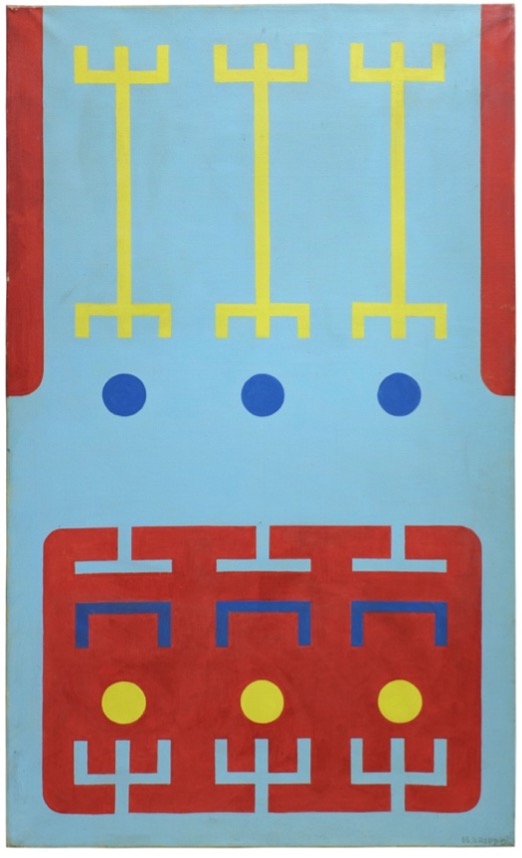
    Grippo, Sin titulo, 1966, oil and graphite on linen

    In 1966, Grippo began his investigation of energy and the circuit in a series of abstract paintings of geometric elements. In a work from this year, a simplified set of forms are rendered in primary colors of contrasting red, blue, and yellow, which transform the visual language of technical documents into a set of iconic relations. Here, abstraction is what enables analogy: stripped of their specificity, these works invoke everything from silicon chips to abstract textiles to concrete and constructivist art. The clean lines preface the machinic nature of Grippo’s later works, yet the individual icons are disarticulated from a larger circuit. Silicon chips have oft been compared to a range of visual forms. Media historian Lisa Nakamura, writing on the early production of silicon chips by Fairchild Semiconductor by Navajo women, notes how in 1969 Fairchild, in its own publicity material, would parallel the abstract design of Navajo woven rugs with the design of silicon chips. Placing images of rugs and chips next to each other to draw forth their shared formal elements, Nakamura underscores how the “resemblance between the pattern of the rug depicted on the first page and the circuit is striking and uncanny. It makes the visual argument that Indian rugs are merely a different material iteration of the same pattern or aesthetic tradition found within the integrated circuit,” (2014, 926). Computer scientist Bernhard Korte compares early integrated chip designs from the 1960s to the 1980s to works by Wassily Kandinsky and Josef Albers, because “the structures inherent in chip design and chip reality are, after all, nothing but simple geometric forms,” (1991, 63).

    While Grippo’s circuit paintings make a parallel movement in the same historical moment, abstracting the set of shared simple geometric forms between chip design and abstract art, these paintings also recall the development of arte concréta or concrete art in Argentina. Concrete art as a term was first coined in 1930 by Theo van Doesburg and was widely embraced in Argentina and Brazil by artists like Lidy Prati in the 1950s. Deeply mathematical, concrete art was non-representational, meaning that geometric forms – point, line, and shape – referred to nothing more than themselves as representations of pure rationality. As a 1946 manifesto by the Argentine Association of Concrete Art contends, “A scientific aesthetics will replace the millenary, speculative and idealistic aesthetics” and “Concrete Art familiarizes man with a direct relationship with things, not with the fiction of things,” (Inventionist Manifesto, 1946, 8). Grippo’s later work pushes back against the anti-idealism of concrete art, and even the early paintings seen above pair the visual language of concrete art with a set of forms that recall a range of natural and technical systems. The open two and three pronged shapes, separated by small dots, recall the abstracted elements of a computer circuit and “were figurative… I went on to use abstraction and from there a certain symbolism,” (Grippo, 2004, 319). In bringing what he termed mechanical models into conversation with concrete art, these paintings bridged concrete art’s anti-idealism with a certain symbolism. In an interview, he described this process as moving from “painting them [mechanical forms] (like a step in a process of evolution) to incorporating them into a system of symbols, a language,” (Grippo, 2004, 321). The structuralist influence here presages how the later network in Analogía I is a one defined by the (negative) relations between its constituent parts.

    In the following year, Jorge Glusberg, an Argentine artist and curator, founded Centro de Arte y Comunicación (CAyC), of which Grippo was a part. CAyC’s first exhibition was Arte Sistema which brought together the cybernetic systems thinking that was already circulating in European and American art practices with an inherent social critique from the South.[1] Glusberg framed these interventions as an ideological conceptualism, a phrase borrowed from Spanish critic Simon Marchan Fiz (Zanna, 2009). This was a refashioning of conceptualism as a distinctly political project tied to third-worldism and anti-psychiatry. Glusberg deployed this term to distinguish CAyC’s projects, and later exhibitions and interventions organized by Glusberg as Grupo de los Trece, from Western conceptualism, which he argued failed to respond to the political and material specificities that CAyC and Grupo de los Trece faced. This echoes what Luis Camnitzer calls the “regional clock,” which distinguishes the distinct temporality of regional conceptualisms (of which Europe is one as well) to critique universal periodizations (Camnitzer 2007, 28). At the same time, this was not a group of works united by a singular ideology nor by a unified mode of critique. Rather, they were organized by their opposition to the dominant ideologies, both artistic and social, in contemporary Argentina via a wide range of dematerialized practices (Glusberg, 1972).

    In 1970, amidst these shifts in Argentine art production, Grippo’s practice turned from circuit paintings to large scale installations, often using the potato, that grappled with social issues. Grippo writes that he:

    [B]egan to work with potatoes as a material… ‘to consecrate’ an everyday object and discover its multiple significations. Art and science—logic and analogue—served as instruments. Later, almost without thinking about it, I articulated some symbols: man’s foodstuffs, the trades, energy and the rose, the disequilibria and consequent transformations. (Grippo 2014, 16)

    The potato is a central part of Grippo’s complex visual language, along with roses and lead, due to his ongoing interest in alchemy and the history of science and served as a connection to life and liveness, in particular. He also writes, in verse, that:

    I consider myself a realist

    what is more real than a live potato

    what is more real than Pb (lead) carried [sic]

    shown in its fixity, in its behavior,

    what is more real than seeds (Grippo, 2014, 19).


    Life, then, is as much the object of Grippo’s work as the circuit. Change over time, growth, the ability to open and change with the world, the living material of the potato symbolizes the possibility for both individual and social growth. He also, in a conversation remembered by critic Guy Brett, cited post-war British military experiments aimed at building biological batteries powered by micro-organisms as one influence,(Grippo 2017, 8). Analogía I, then, can be read as a more liberatory re-reading of this military project that sought to imagine a biological battery for social conscience instead of for military power.[2]

    At the center of this re-reading, both theoretically and literally, was the voltmeter and related text at the center of the first version of Analogía I. In it, Grippo lays out three analogies: (1) between “Papa (Quechua name)” and the Latin concientia, “the inner feeling through which man acquires an appreciation for his actions… freedom of conscience. Right recognized by any government to each citizen to think as he pleases.”; (2) between the potato as “daily function; basic food” and “daily form of conscience; individual conscience,”’ and (3) “extension of daily function” source of electric energy (0.7 volt per unit) and “extension of conscience. Source of conscience of energy.” [3] The potato here becomes the locus of a set of entangled analogies to energy, freedom, rights, and conscience, both individual and social, but also how we become aware of our own actions and their impact on others, which is to say, it asks about networks of care on a macro level.

    Each tuber’s .7 volts of latent power are wired together, measured by the central voltmeter as an analogy for the general power of the social field. In connecting each individual potato with wires, the rhizomatic root network of a potato plant is replaced with the technical assemblage of wire, electrode, voltmeter and potato. Put differently, a technical network replaces a natural one, materializing and systematizing the formal relations between different parts of a single organism. Unlike the cybernetic analogy, which placed organic and inorganic systems on the same field, allowing for a set of equivalences and exchanges between distinct systems, Analogía I refuses distinctions between the organic and the inorganic in favor of a different network analogy, in which the social field is always already natural and technical. There is no distinction to be overcome. A series of distinct phenomena are thus rendered parallel, as potato is equated to person, energy to cognition, and a burgeoning techno-organic network to social relations. Further, the voltmeter computes the total electrical generation produced by the system which, following Grippo’s own analogy, is a computation of a social conscience and consciousness.

    It is precisely this question of the politics of the network that returns us to the grid. Analogía I forwards an ambiguous politics that vacillates between the potential of a coming-together referenced in the written analogies to the severity of the grid itself, a move that celebrates mutual care while also subtlety critiquing the political potential of this analogy through the grid that mediates the network. Justo Pastor Mellado notes that as much as Analogia I is about an emerging consciousness, the potatoes are enclosed in wooden cages (Mellado, 2004, 308). The cell of the grid echoes the plant cell, which at the moment of its discovery was named after the Latin cella, for a small room reminiscent of a monk’s cell (Mazzarello, 1999). The plant cell was then always emergent from an architecture of power meant to organize bodies, or in this case raw being. Multiple parallel cells, separate but together, produce the vitality of multicellular life just as different potatoes, distinct but linked together, produce consciousness for Grippo. We could term this cellularity, denoting the collapse of social and spatial relations with biological ones through the figure of the cell.  Pastor Mellado also argues that just to mention an electrode “reminds us of torture; in particular, the application of an electric current to the body,” (2004, 308).  A computer that models social conscience and consciousness becomes as menacing as it is liberatory, capturing life as much as it emancipates it.

    Yet more than the torture chamber, the grid here denotes a tension between the organic and the inorganic and the twin processes of regularization and normalization. As Bernhard Siegert notes, the grid is a cultural technique of ordering and representation that is first an imaging technology, because it projects a three-dimensional world into a two-dimensional plane, secondly a diagram that traverses the real and the symbolic, and finally it constitutes a world of objects imagined by a subject in his reframing of the Heideggerian gestell (Siegert 2015, 98). Put differently, the grid is a medium that merges representation and operation through deixis. Yet a second idea of the grid for Siegert emerges in which it symbolizes a cartographic imaginary emergent from South America and Argentina in particular. Here, the grid is the organizing principle of colonial topography, a division and organization of space that, while originally devised in antiquity, reaches its advanced form in the Spanish colonial city plan, which is infinitely reproducible and expandible (2015, 108-9). It is in the city that the grid re-emerges in three dimensions, moving from abstract deixis and cartography to a principle for the ordering of space through reproducible cells, which are both organizational technique and visual practice. And it is in Argentina that Siegert locates the apogee of the grid as a spatial technique in three dimensions. In 1929, Le Corbusier visited Argentina, where he developed his theory of the cell as the building block in architecture, both via his trip in an ocean liner to Argentina and his plane rides over different cities in South America, like Buenos Aires, La Plata, and Montevideo, which had distinct grid plans. For Siegert, “Le Corbusier’s real model for cellular construction was neither plant nor prison but the machine,” an idea that he claims only developed in his visit to South America (2015, 116).

    Is not neither plant nor prison but machine the central principle of Analogía I? As neither holist organic networked, linked by mutual exchange and care, nor model for the prison cell, Analogía I is a model of a social machine that is always-already organic and inorganic, holding the potential for new ways of coming together just as much as it holds the potential for capture and control, a contradiction that structures for Grippo’s installation and that he never seeks to paper over. Yet, the grid here takes on a distinct valence, as, contra Siegert, it is not a cultural technique of ordering and of territorialization, emerging from cartography and Renaissance perspective, but a network architecture. 

    III

    This second formulation of the titular analogy is thus not a return to a prelapsarian before, bringing a social conscience back to the soil, which in this version is constrained to a single square behind the chair. Each potato remains networked and connected to a single point: a voltmeter, albeit one that instead of dividing the installation into two equal parts is set off to the side like a pulpit or control panel. There are three major changes here: the grid has been replaced by a non-standardized and distributed network; some potatoes have been returned to the soil without being disconnected; and an empty chair holds not the head of the table but serves as a step for yet more potatoes as they move from ground to a set table, or vice-versa.

    Analogía I (2da. Version) rejects the grid as organizing principle but does not reject the central analogy of the installation nor Grippo’s material theorization of the social as an (in)organic machine. If the first iteration was organized into a set of discrete elements, here there is a return to more seemingly natural forms that recall less the prison cell than woven knots of roots in soil. Despite organizational differences, Grippo’s intervention remains the same, asking the viewer to analogize a deceptively simple system of potatoes and wires to a broader theory of the social. In both, it is the voltmeter that serves as the interface between system and environment. The formal shift in organization between the two installations, alongside the maintenance of the analogy itself, may seem to point to an incoherence to the political claims that ground his analogy. However, it is the refusal of easy organicist interpretations that would prioritize organic networks as a model of the social or mechanistic interpretations that would prioritize technical interconnection that grounds Grippo’s work. The fundamental contradiction between the two different version of Analogía at the level of the politics of their networked form, between each potato being held separately or strewn across a table such that they can touch each other, speaks to the tension between the network as a mode of control and a new horizontal modality of care, even as they both remain more similar than they appear.

    In 1972, between the two versions of the installation, CAyC organized an exhibition in a public plaza. Grippo installed a rural-style oven to make bread, handing out warm bread in an installation that merged proto-relational art, arte povera, and his own interest in transforming simple materials through heat and energy. The next day, the police impounded the installation and destroyed the oven. The epigraph to the exhibition has included a long quote from Louis Althusser, that “One could propose the hypothesis that a great work of art is that which acts within an ideology at the same time that it distances itself from it to constitute an act of critique of the ideology it sets forth, in order to allude to different ways of perceiving, feeling, hearing, etc., that surpass existing ideology by freeing itself from its latent myths,” a line of critique that aptly applies to Analogía I as well (Longoni 2004, 285). Analogía I proposes new ways of interconnecting and raising the social conscience while also subtending such a possibility, forwarding an ideology critique of both the network and attempts to organize the social following nature’s own systems of interconnection, holding up care as critique and critique as care.

    A parallel debate on the relation between nature and the social and the politics of the model was occurring across the Andes, where Chilean biologists Humberto Maturana and Francisco Varela De Maquines y Seres Vivos began outlining their theory of autopoiesis or la biología del conocer and eventually diverged due to Maturana’s belief that a social autopoiesis      was possible, an organicist turn that Varela strongly disagreed with. Autopoiesis is a theory of self-organizing systems that grapples with the foundational question of what is (cellular) life, but it is a theory of politics and social organization as well.[4] Autopoiesis, in its beginnings, concerned how nervous system activity, and thus the organism in general, is only triggered by the nervous system itself, and the “external world would have only a triggering role in the release of the internally determined activity of the nervous system.” (Maturana and Varela, 1980, 121). It is in this observation that autopoiesis is borne, as the circular activity of the organism (or the cell, or the system) constitutes the auto-, the self-production at the heart of the theory. A central question is thus how can an organism maintain its own identity as it constantly changes.

    Maturana and Varela distinguished between the organization of a unity (an inside, a system, an organism) and a medium (in which the unity is embedded), which can also be phrased as the difference between the system of relations that constitute a unity and the actual structure of a unity in a particular moment (Maturana, 1972, 46-47). Organization is maintained even as structures change. Further, the relation of unity to medium, or how the unity is embedded and relates to its environment, is a pre-requisite for life. In a late publication, Varela reframed the central tenets of autopoiesis as whether the system has a semi-permeable boundary, is self-producing, and able to regenerate the components of the system (Varela 2000). Key to these distinctions is semi-permeability and operational closure. The former is how autopoietic systems are organizationally closed but structurally open, while the latter refers to how autopoietic systems are neither representational, because the terms of the systems reactions are determined by its organization, nor solipsistic, because the nervous the system does interact with the environment at the level of its structure. Outside inputs are triggers that are only registered if the system’s organization allows them to be. The relatively simple recursivity of first order cybernetics’ theories of feedback is now transformed to one in which the observer is not a neutral transducer of information but actively produces itself.

    Analogía I is not an autopoietic system per se, but the tension between an autopoietic theory of a system and Grippo’s installation reveal something of a nascent Southern circuit, emergent from the political and material conditions of the Southern Cone, organized around the same central contradiction as the two versions of his installation. The network modeled in both versions of Analogía I contains something of a cybernetic enclosure, as it is only accessible through the voltmeter that selectively determines and processes the systems output. What is crucial here is not the network itself, in autopoietic terms the structure, which is of course not self-reproducing as a potato cannot wire itself nor produce new mechanical components, but rather how Grippo analogizes two distinct autopoietic systems of the organic potato and the social, united by a technical apparatus. It is here that the political implications of autopoiesis can be drawn forth, even as autopoiesis is often understood as either an epistemological or ethical rather than political quandary by interlocutors in the humanities and social sciences. This is the crux of Cary Wolfe’s critique of how autopoiesis contains a humanism that:

    manifests itself in the philosophical idealism which hopes that ethics may somehow do the work of politics. What we find here, in other words, is (to borrow Fredric Jameson’s formulation) a kind of “strategy of containment” whereby the post-humanist imperatives of second-order cybernetics are ideologically recontaied by an idealist faith in the social and political power of reason, reflection, voluntarism, and what Jameson calls “the taking of thought (1995, 62).

    For Wolfe, this is due to Maturana and Varela’s transformation of the particular values of their milieu into a universal theory of the system, particularly their focus on the necessity of love, which is transformed into imperative. This leads to a confrontation with the fundamental idea for him that all points of view are not valid because they have differentially distributed effects in the social field. Where then is social antagonism?

    If Wolfe seeks to uncover a latent humanism in autopoiesis, Sylvia Wynter turns to autopoiesis to understand, and subtend, the production of the liberal human throughout her work, starting with her 1984 essay “The Ceremony Must be Found.” For Wynter, whose wide-ranging oeuvre is too expansive so be summarized here, autopoiesis serves as the mechanism for her hypothesis of auto-speciation and elaborate a “new science,” in conjunction with Caribbean thought (Wynter 2003, 328). Autopoiesis serves as the logic behind how sociogenesis functions, in material-semiotic systems, and how certain genres of the human have become overrepresented, leading to a world in which Man2, or the liberal homo oeconomicus has come to stand in for the human.

    Wynter, while primarily focusing on autopoiesis as a biological theory that she brings into conversation with Black and Caribbean philosophy, attends to autopoiesis in its larger dimension as theory of the social. Yet, the focus remains on neuro-biological feedback, particularly among her interlocutors. For Katherine McKittrick, Wynter:

    [R]eads biological theory to claim that autopoiesis—the consensual circular (not teleological-evolutionary) organization of human life through which we scientifically live and die as a species—draws attention to “a new frame of meaning, not only of natural history, but also of a newly conceived cultural history specific to and unique to our species, because the history of those ‘forms of life’ gives expression to [a] . . . hybridly organic and . . . languaging existence, (2015, 145).

    Such readings of autopoiesis render it a theory of the cell and remove its epistemological, and political, valences. Similarly, in the same volume, Walter Mignolo charts a divide between autopoiesis as theory of perception in which:

    [T]he living organism that fabricates an image of the world through the internal/neurological processing of information. Thus, Maturana made the connection between the ways in which human beings construct their world and their criteria of truth and objectivity and noticed how their/our nervous system processes and responds to information. (2015, 106)

    What is missing here is precisely how autopoiesis was never just a theory of perception, except perhaps in its earliest form as Maturana and Lettvin’s experiments on the frog’s eye 1959, over a decade before Maturana and Varela first deployed the term autopoiesis. In rendering autopoiesis a scientific theory transferred to the social field, the particularities of autopoiesis’s emergence remain obscured.

    Autopoiesis was always-already a critique of reason, at least for Maturana if not for Varela. In their later years, the two diverged on precisely this question of politics. Maturana, in a 1991 letter responding to a review of the Tree of Knowledge, critiques “the defense of truth, the defense of reason, or the defense of universal transcendental values under the claim that the defender is intrinsically right and the others are intrinsically wrong,” (1991, 92). Here, Maturana is suspicious of both reason and truth and their claims to universality grounded in an enlightenment idealism, because he distinguishes between “constitutive operational legitimacy of all manners of living in the biological domain,” which “does not carry with it the acceptance of all manners of living as equally desirable in the human domain of coexistence,” a distinction that echoes the autopoietic division between organization and structure (Maturana, 1991, 92). Central is how Maturana can never know what is “biologically, transcendentally good” or “biologically transcendentally bad,” (1991, 90-91). Maturana is not speaking abstractly about reason or truth, however. He grounds his critique in Pinochet’s dictatorship, which he opposes on political grounds rather than by that he is intrinsically right. This is clearest in a response Maturana wrote to Morris Berman’s review of The Tree of Life. Berman claimed that Pinochet was, when read autopoietically, “biological distortion” and that Allende was “biologically legitimate,” leading Maturana to contend that “Berman says that he is not ‘willing to display any tolerance; to people like General Pinochet. If he says so because he thinks that he is intrinsically right and that General Pinochet is intrinsically wrong, he is speaking like General Pinochet,” and that “Salvador Allende does not “represent one of the highest forms of biological integrity,” as Berman says. He was a human being who could not escape being trapped in the meshes of a network of ideological fanaticism. There is nothing like a biological distortion or like biological integrity in the domain of biology,” (1991, 91, 96) In a strange turn of phrase here, Maturana both rejects claims to biological legitimacy through an understanding of biology. Even as nature cannot be used as the grounds for making a political claim, he still deploys autopoiesis as a framework for politics: there is no operational legitimacy in biology, but only autopoietic operations are legitimate.

    For Maturana, then, autopoiesis is a political response to organicist claims that ground politics in biology, or biologize and naturalize the political field, while, at the same time, contending that the very rules of the social are still emergent from biology – he wants to have it both ways. He applies autopoietic semi-permeability or operational closure to the political realm to ground the autopoietic organization of politics in nature or in his words biology, while disavowing such moves at the level of structure. Varela strongly disagreed with Maturana’s turn to autopoiesis as a theory of the social field because:

    [A]ll extension of biological models to the social level is to be avoided. I am absolutely against all extensions of autopoiesis, and also against the move to think society according to models of emergence, even though, in a certain sense, you’re not wrong in thinking things like that, but it is an extremely delicate passage. I refuse to apply autopoiesis to the social plane. That might surprise you, but I do so for political reasons. History has shown that biological holism is very interesting and has produced great things, but it has always had its dark side, a black side, each time it’s allowed. (Varela, 2002)

    In rejecting the inherent organicism and holism of Maturana’s autopoiesis tout court, Varela underscores the failures of politics emergent from biology, a charge that Maturana himself tries to avoid by distinguishing between how all life has operational legitimacy and the non-acceptance of all these legitimate autopoietic unities as good. Following Wolfe’s critique, this is also the effect of a latent humanism in autopoiesis both in its development of universal rules and in its inherent speciesism. Autopoiesis seeks to escape organicism by the same mechanisms with which it defines its own semi-permeability to the world: operational closure.

    There is an echo in Maturana and Varela’s debates over autopoiesis’s political valence and how it can serve as a critique of reason and truth, due to how it destabilizes any claim to a universal even as, via sleight-of-hand, it functions through a set of seemingly natural laws itself, of the tensions between the two instantiations of Analogía I. Turning to autopoiesis uncovers a shared concern with how social systems are modeled on, nested in, and emergent from natural systems following natural laws that emerged in tandem. Yet Grippo never offers a hierarchy of one system to another, in which the social field is immanent from and reducible to, at the right level of abstraction, the organization of a cell. Instead, he makes a parallel move, destabilizing the network as a technology of either capture and liberation, restaging Maturana and Varela’s debate. Beyond showcasing a crisis of meaning of the network in this era, there is also a nascent critique against reducing mutual interdependence to a technical or natural system and the easy analogies between environmental and natural networks that impoverish both. In thus critiquing overdetermined theories of the social field by acting within it (via the model), Analogía I makes the network and circuit visible. In the move between the grid and the entangled network, between the plant, the prison cell, and the machine, what structures the scene is a social and political field that remains open and able to serve as the grounds for politics. The social can never be fully resolved because the same analogy can be organized differently such that one iteration can be read as a torture chamber and another as a cell. If for Maturana “the social is constituted in relations of love,” (1991, 89) which are also relations of care, Grippo’s installation models a different yet related circuit in which antagonism, difference, and contingency, which is to say politics itself, remain open. Systems, and here the social, can be organized differently – that is the work, rather than ascertaining a certain truth in nature or technics. Instead of elevating biologically inspired notions of care and love, at the risk of holism or organicism, pace Varela’s critique, Grippo holds them in delicate tension: machine and vegetable, electricity and life, grid and tangle.

    Henry Neim Osman is a PhD candidate in the Department of Modern Culture and Media at Brown University. He works across media theory, science and technology studies, and philosophy of technology. His dissertation, “Analog Immediacy: Computation and Critique at the Ends of the Digital,” historicizes the recent resurgence of analog computing and AI and critiques how life is reconceptualized by new computers at the limits of the digital. His work has been published in Digital War, Film Quarterly, Surveillance & Society, and Media Fields.

    References

    “ICAA Documents Project Working Papers Number 5.” Houston: Museum of Fine Arts Houston (MFAH), 2017. 

    “Manifiesto invencionista”. Accessible: https://monoskop.org/images/1/18/Manifiesto_invencionista_1946.pdf.    

     “Victor Grippo,” Museo Universitario de Arte Contemporaneo (MUAC), 2014, 16. Accessible:            https://muac.unam.mx/assets/docs/p-057-f_muac_016-int-grippo.pdf. 

    Camnitzer, Luis. Conceptualism in Latin American Art: Didactics of liberation. Austin: University of Texas Press, 2007.

    Gilbert, Zanna. “Ideological Conceptualism and Latin America: Politics, Neoprimitivism and Consumption.” rebus: a journal of art history & theory 4 (2009): 1-15.

    Glusberg, Jorge. “Arte e ideología,”  Hacia un perfil del arte latinoamericano. Buenos Aires: Centro de Arte y Comunicación (CAyC), 1972. 

    Korte, Bernhard. Mathematics, Reality, and Aesthetics – A Picture Set on VSLI-Chip-Design. Berlin: Springer Verlag, 1991.

    Longoni, Ana. “Víctor Grippo: his poetry, his utopia.”  In Grippo: Una Retrospectiva, ed. Marcelo Pacheca. Buenos Aires: Malba, 2004. 283-291. 

    Maturana, Humberto R.  and Francisco J. Varela, Autopoiesis and Cognition: The Realization of the Living. Dordrecht: D. Reidel, 1980.

    Maturana, Humberto R. “Response to Berman’s critique of the Tree of Knowledge.” Journal of Humanistic Psychology 31, no. 2 (1991): 88-97.

    Maturana, Humberto R., and Francisco J. Varela. The tree of knowledge: The biological roots of human understanding. Boulder: New Science Library/Shambhala Publications, 1987.

    Mazzarello, Paolo. “A unifying concept: the history of cell theory.” Natural Cell Biology 1, E13–E15 (1999).

    McKittrick, Katherine. “Axis, bold as love: On Sylvia Wynter, Jimi Hendrix, and the promise of science.” Sylvia Wynter: On being human as praxis (2015): 142-63.

    Mignolo, Walter. “Sylvia Wynter: What Does It Mean to Be Human?”. Sylvia Wynter: On Being Human as Praxis, edited by Katherine McKittrick. New York, USA: Duke University Press, 2015, 106-123.

    Nakamura, Lisa. “Indigenous circuits: Navajo women and the racialization of early electronic manufacture.” American Quarterly 66, no. 4 (2014): 919-941.

    Pastor Mellado, Justo. “Víctor Grippo’s Chilean novel.” In Grippo: Una Retrospectiva, eds. Marcelo Pacheca. Buenos Aires: Malba, 2004. 307-311. 

    Siegert, Bernhard. Cultural techniques: Grids, filters, doors, and other articulations of the real. Fordham University Press, 2015.

    Silverman, Kaja. The Miracle of Analogy, or, The History of Photography. Stanford: Stanford University Press, 2015.  

    Van Doesburg, Theo. Concrete Art Manifesto. Accessible: https://monoskop.org/images/9/91/Concrete_Art_Manifesto_1930.pdf. 

    Varela, Francisco “Autopoïese et émergence.” In La Complexité, vertiges et promesses. Ed. Réda Benkirane. Paris: Le Pommier, 2002. 

    Wolfe, Cary. “In search of post-humanist theory: the second-order cybernetics of Maturana and      Varela.” Cultural critique 30 (1995): 33-70. 

    [1] Contemporary writers like Jack Burnham, writing in 1968, argue that this marks a shift “from an object-oriented to a systems-oriented culture. Here change emanates not from things but from the way things are done,” Jack Burnham “Systems Esthetics,” Artforum, September 1968; South here refers to a broader reorientation along the lines of Joaquin Torres García’s provocation that “Nuestro norte es el sur,” or that our north is the south.

    [2] There are echoes of Joseph Beuys here as well, who two decades later began his own series using lemons as batteries. Beuys knew of Grippo but the level to which he was influenced by Grippo’s earlier practice is still debated.

    [3] This text is the translation used by an English-language version of Analogía I (first version) bought by Harvard Art Museums in 2010.

    [4] Autopoiesis can be traced back to Maturana’s foundational 1959 paper, co-authored with Jerome Lettvin, Warren Mculloch and Walter Pitts, “What the Frog’s Eye Tells the Frog’s brain.” Before this paper, the retina was seen as a light receptor that simply transferred light into visual signals that were then processed by the brain. What Maturana et al. showed was that, after implanting an electrode onto the optic nerve, there were feature detectors that processed visual information directly in the retina itself, prioritizing for the frog visual recognition of small, intermittent quickly moving dots, which were termed “bug detectors.” The retina was no longer an objective sensor passing information along, but proof that the frog never neutrally saw. Instead, the structure of its eye determined and constructed the frog’s view of reality such that perception was not automatically representational. This is a type of boundary work, producing what would later be termed an operational closure onto the frog. Autopoiesis took this intervention further to show how the observer produces what they observe, moving beyond the assumption in this early article that there was an objective reality to which the frog did not have full access.

  • Tomás Borovinsky–The Argentina Chapter: An Introduction

    Tomás Borovinsky–The Argentina Chapter: An Introduction

    This essay is part of “The Argentina Chapter” of the b2o Review‘s dossier “The University in Turmoil: Global Perspectives”. 

    The Argentina Chapter: An Introduction

    Tomás Borovinsky

    The texts gathered in this dossier examine how the global crisis of the university acquires a particular intensity in Argentina, a country in which the university has been a central institution of democratic life for more than a century. Around the world, universities have seen their historical sources of legitimacy erode under the pressures of new managerial regimes, standardized evaluation systems, unstable budgets, and a public sphere increasingly hostile to institutions whose value has always depended on duration, autonomy, and the slow accumulation of knowledge. In the Global South, these transformations intersect with structural inequalities and recurrent fiscal crises, sharpening the question of what universities are for—and who they are for.

    In Argentina, this global turbulence acquires a singular historical density. Since the late nineteenth century—when figures such as Domingo Faustino Sarmiento promoted a republican, secular, and universalist vision of public education—and mainly since the University Reform of 1918, the public university has functioned as a political form that has articulated autonomy, equality, and intellectual citizenship. As such, it became an engine of social mobility and a key producer of public knowledge, rooted in an Enlightenment conception of education as a right and as a condition for democratic life.

    However, the arrival in Argentina in 2023 of an openly anarcho-capitalist government, informed by paleolibertarian ideas, marks the most profound rupture in this trajectory in more than a century. For the first time since 1918, the state not only withdraws material support from the university but also questions the very legitimacy of the institution, recasting it as a moral anomaly sustained by taxation, self government (professors, graduates, and students), and egalitarian values. This conflict crystallizes in an explicit culture war. The university is labeled part of the “casta,” a vestige of statist politics to be overcome. Faculty and researchers—especially in the social sciences and humanities—are accused of indoctrination. And the institution’s own temporality—slow, deliberative, accumulative—is reframed as incompatible with a political project that celebrates acceleration, rupture, and permanent deinstitutionalization. What is at stake is not merely funding but the very possibility of autonomous knowledge production.

    Yet the crisis has also reshaped the university’s political role. The mass mobilizations of 2024 and 2025 showed that, despite the erosion of the old democratic consensus, the public university retains significant social legitimacy. Its defense, however, cannot be reduced to corporatist reflexes. The challenge—as the essays in this dossier argue—is conceptual: how to sustain critical knowledge when expertise itself becomes publicly contested, and how to reinvent the university without abandoning its historical commitments?

    Within this confrontation, the Social Sciences and Humanities (SSH) occupy a particularly vulnerable position. The anarcho-capitalist attack seeks to delegitimize them by portraying them as a “useless expense” or an elitist indulgence, contrasted with the supposed “indisputable utility” of the natural sciences. This opposition rests on an impoverished view of knowledge that recognizes only what can be immediately translated into a measurable, marketable, or technically operational product. Against this simplification, the defense of the SSH cannot be reduced to arguments about instrumental utility. Their value is deeper: they are historical practices of collective debate, bearing ethical, political, and critical dimensions, enabling societies to question what is taken for granted, revisit the past, and open possible futures. In a context where speed and efficiency become universal benchmarks, they remind us—as philosophy once insisted—of “the usefulness of the useless.” Their decisive contribution does not lie in producing immediate solutions but in sustaining a society’s capacity to think itself and to build a historical, political, and human “we.”

    Taken together, the texts in this chapter of the b2o Review’s dossier “The University in Turmoil: Global Perspectives” suggest that the path forward is not restoration but a vital search for the university’s new formations. At a moment when a global intellectual counterrevolution seeks to delegitimize collective institutions, the Argentine university offers a privileged vantage point from which to rethink what forms of democratic life remain possible. The university, that longstanding repository of promises and conflicts, may once again need to become a laboratory—an institution capable of imagining new modes of learning, participation, and everyday life amid this particular storm, and the ones to follow.

    Tomás Borovinsky is a researcher at CONICET (National Scientific and Technical Research Council, Argentina) and a professor at EIDAES–UNSAM (the Interdisciplinary School of Social Sciences at the National University of San Martín). His latest collective volume is ¿Hay algo que no esté en crisis? Arte y pensamiento en la era del cambio acelerado y sin fin (Siglo XXI). He is also the editorial director of the publishing imprint Interferencias (Adriana Hidalgo Editora), focused on contemporary thought, and the editor-in-chief of Supernova, a magazine of ideas and public debate.

  • Juan José Martínez Olguin–The University and Public Education in Argentina under “Libertarianism”

    Juan José Martínez Olguin–The University and Public Education in Argentina under “Libertarianism”

    This essay is part of “The Argentina Chapter” of the b2o Review‘s dossier “The University in Turmoil: Global Perspectives”. 

    The University and Public Education in Argentina under “Libertarianism”

    Juan José Martínez Olguin


    The Rise of Javier Milei and the Libertarian Revolution

    The Libertarian Revolution—the name which Javier Milei proposed to designate the set of radical transformations he intended to carry out in Argentine society if he was elected as its first and highest political authority—does not lend itself, at least at its most general level, to any confusion.[i] A revolution, today as in the past, is an invitation to make in a very intensive way profound changes of those societies where revolutionaries are called to enact it. Milei, in fact, was elected President of Argentina in the presidential elections held on November 19, 2023. His opponent was the Peronist Sergio Massa, defeated by more than ten percentage points, the largest difference between two candidates in the history of our contemporary democracy. The scene that those elections built clearly illustrated the differences between both candidates: on the one hand, there is Massa, a professional politician with a long trajectory in the different political parties that identify themselves as part of the Peronism movement. On the other, there is Milei, who is known in certain specialized circles as an outsider, someone who came from outside politics but also someone who wants to “defeat it”—that is to say, defeat politics, or at the least traditional way of doing politics, which includes the State. Paradoxically, Milei proposes doing so by weaponizing politics and the State towards their defeat–in his own words, the goal is to “destroy it (the State) from within”. His political trajectory is, frankly, astonishing: in just two years he founded his own party, La Libertad Avanza (Freedom Advances) and became a national deputy (in the 2021 legislative elections). As his appearances on various political television programs grew, so did his image and popularity.

    It is undoubtedly difficult to fully grasp the libertarian ideological and expressive universe upon which Milei’s Revolution relies or is founded, for one simple reason: beyond its presence in Western Europe and especially in the United States, libertarianism in Argentina emerges as a new political expression. Largely born in the context of pandemic isolation and lockdown policies, it fundamentally arose from the fragments of a political system in crisis due to the deep erosion of legitimacy of its two main parties: Peronism and Juntos por el Cambio (a center-right political party). However, aspects of that universe can be foregrounded due to the political activities of Milei–through his discourses and actions in the public sphere. In this sense, libertarian ideas in the Argentinian political frame come from various doctrines and intellectual traditions. First and foremost, there is the most explicit level of the libertarian symbolic universe: its economic doctrine, based on a marginal school in contemporary economic theory, the Austrian School of Economics led by von Mises and Friedrich Hayek. Milei himself frequently references them in his public appearances. Essentially, libertarianism advocates for shrinking the State to its minimum expression and expanding individual freedom over the State in all spheres of social life. This exaltation of liberty inevitably clashes with some of the most basic values of democratic life. Its strong defense of freedom—especially economic freedom—such as the legal buying and selling of organs and babies (a proposal that was floated and harshly criticized during Milei’s presidential campaign), is an example of this tension. A second defining component of the economic universe of Argentine libertarianism is Murray Rothbard’s anarcho-capitalism. Regardless of the ultimate success in implementing the transformations these doctrines propose (Milei’s government is only halfway through its term), the libertarian vocation marks, at least in this ideological-economic dimension, the most radical transformation of the economic foundations of Argentine capitalism in the last 100 years.

    The Libertarian Revolution, however, does not define itself only as an economic revolution based on the Austria School of Economics. It also and simultaneously assumes the form of a “cultural revolution”. The libertarian universe reserves a name for this facet of the revolution: the “culture war” (or “la batalla cultural,” a term popularized in Argentina by Agustín Laje, one of the ideologues of libertarianism and local radical right parties).[ii] This term and its specific meaning is shared, in fact, by the alt-right and radical right movements worldwide.[iii] Based on Gramsci’s old category of hegemony, Milei’s cultural battle seeks to transform the hegemonic meaning of some of the essential community values of at least the last 40 years—since the institution of contemporary democracy in Argentina and the rise of Ricardo Alfonsín as the first president of the country’s contemporary democratic Era (1983–1989). The culture war, in this sense, is an ideological struggle that entails profound changes in democratic life as we have known it in Argentina in recent decades. This culture war has, in fact, an enemy: “the caste,” which, according to the libertarian narrative has held Argentina’s political and cultural hegemony for the past 40 years. The caste is not, strictly speaking, a sociological and determinable group in the demographic makeup of the country. The term “caste” is the product of an expressive operation that twists perception, a “coherent deformation”[iv] of what is perceived, granting a particular form of being to a part of the “flesh of the social”.[v]

    Turned into a specific form of being of the element from which we are made—the flesh of the social—, the caste comprises different segments or social layers: the members of the cultural life of Argentina (writers, movie and television actors and actresses, film directors, etc.), welfare beneficiaries and public employees, the different political parties and politicians that alternately governed Argentina since the return of democracy in 1983, and finally, scientists and members and workers of the academic world. In each case, we can find a link to the “evils” that, according to libertarianism, plunged the country into decay: members of the cultural life and their “progressive doctrine,” welfare beneficiaries and public employees who are tied to an endemic evil: a corrupt and inefficient State, the “traditional” politicians and the failures of democracy, scientists and the public university system fostering social and political indoctrination in classrooms, on the one hand, and “partisan” or “ideologized” scientific research (especially in the Social Sciences), on the other. It is, indeed, in this context—in the context of the culture war and its various stakes, and not only in the context of its economic doctrine—that we can understand better libertarianism’s disdain for public universities and scientific research system, as well as the systematic and deliberate siege policies Milei’s government has been implementing against the whole public system of education.[vi]

    One aspect is particularly relevant: the specific twist of meaning that libertarianism gives to its notion of caste—the twist between rights and privileges. In most of his public interventions, but especially in the speech following his presidential victory, President Milei referred to his government’s vocation in terms that clearly express this twist: “We are not here to take away your rights; we are here to end privileges”.[vii] This phrase illustrates very well the constitutive twist of the ideological amalgam that defines libertarianism: what in the context of the last decades of transformations of contemporary democracies was delineated as new rights (social rights, gender rights, economic rights, etc.), have turned into privileges of what libertarians define as “the caste” in the context of the new demands and changes of democracies. This conversion, in effect, explains the figure of the State as the principal agent responsible of the promotion of those privileges, and simultaneously it delineated the ideology that must be defeated: el progresismo (the woke ideology; that is to say, those who identify themselves as “liberals” in the United States) that, according to libertarianism, expands the influence of “cultural Marxism”. Privileges, then, separate those who advocate for freedom, effort, and individual merit from those who are part of the State and live off the benefits and subsidies that the public sector provides them. This twist not only clashes with several rights enshrined in the National Constitution but, in one of its decisive aspects, confronts the very heart of the Argentine national project—from its founding to the present day, including especially the last 40 years of uninterrupted democracy: education as a right, that is, the guiding idea behind the constitution of the National State—the idea of public education. More profoundly still, it opposes the conception held by a figure who, through both his theoretical reflection and his political practice, played a central role in shaping the historically situated form of public education in Argentina: Domingo Faustino Sarmiento.

    The Figure of Sarmiento and Public Education in Argentina

    Sarmiento was not only President of Argentina during the years of the foundation of the National State (from 1868 to 1874) but also a profound thinker—not just a thinker of education but also of the social and political conditions of existence of his own Argentina, whose thought and actions made him a central figure throughout Latin America. Sarmiento’s thought radiates and permeates Argentine culture, but also Latin American culture, in an irreversible way.[viii] In the historical configuration of education as a public institution in particular, his thought was and remains decisive. Strongly influenced by the French Revolution and its ideas just a few decades after it took place, Sarmiento wrote a book that laid the foundations for the idea of public, common, or popular education on Argentine territory: Sobre la educación popular (On Popular Education).[ix] Sarmiento (who by then was in exile in Chile) begins the text that was commissioned as a “Technical Report for the Minister of Public Instruction of Chile, Manuel Montt,” by exploring the historical origin and essential condition of public education: its conception as a human right. He writes:

    Public instruction is a purely modern institution, born from the dissensions of Christianism and made a right by the democratic spirit of current association. Until two centuries ago, there was education for the ruling classes, for the priesthood, for the aristocracy; but the people, the plebeians, did not, properly speaking, form an active part of nations. It would have seemed as absurd at that time to claim that all men should be equally educated as it would have been two thousand years earlier to deny the right of making slaves… It is not my intention here to tell the history of the series of events and conquests that have brought Christian peoples to the point they have reached today… For now, let us be content with the fact that each progress in institutions has tended to this primary objective, and that the freedom acquired… has contributed in masse to the use of rights that today no longer belong to such or such class of society, but simply to the condition of human being.[x]

    This conception of public education as a human right had its institutional imprint on Argentine society in the nineteenth and twentieth centuries. And in this institutional imprint Sarmiento was, in fact, decisive. In this sense, the promulgation of Law 1420 in 1884, which established free and secular public education, was the first major step in this direction. The construction of public schools, particularly during Sarmiento’s presidency, and the literacy process of Argentinian citizens advanced in just a few decades by giant steps (by the early twentieth century, Argentina had the highest literacy rate in Latin America). Despite the antagonisms and political conflicts that configure the twentieth century in Argentina, and even the early twenty-first century, the materiality of the trace of Sarmiento’s thought regarding education and the public system remained intact. And despite, also, the institutional discontinuities and coups d’état that took place during the last century (and therefore, the selective policies the military governments adopted to undermine, above all, the public university through partial closures of certain careers or faculties).[xi] The arrival of democracy in 1983 expressed, in the words of the newly elected president Raúl Alfonsín–“With democracy, not only do we vote, but we also eat, heal, and educate”[xii]–the most intense moment of the omnipresent legacy of Sarmiento’s trace, by linking the form of public education with the very form of democracy (something Sarmiento indeed did throughout his own thinking). In other words: in the promise of a social democracy with greater rights, much of Sarmiento’s reflection and his political, cultural, and institutional roots, crystallized.

    The University and Public Education Under the Siege of the Libertarian Revolution

    Public universities in Argentina have a strong and decisive source of inspiration in Sarmiento’s legacy of education as a human right: “higher education,” it is stated in the current Higher Education Law, “is a public good and a human right”.[xiii] The set of laws and measures that Milei’s government has been implementing, particularly against the public university system, is framed, therefore, within this dual ideological pillar that inspires the Libertarian Revolution: its economic doctrine, on the one hand, and its political-cultural doctrine, the culture war, on the other. While the first defends the market’s presence as a regulator of the various spheres of social life, and consequently emphasizes its decisive role in offering education as a “public” service (and not as a right), the second entails a much deeper critique to our actual public system of education. In his recent book on this subject, Argentine anthropologist Pablo Semán points out a central aspect in this regard: those who identify themselves as militants of the libertarian movement do not show a detachment or direct rejection of the common wealth or the public sector, but rather of the “state of the State,” that is to say, they do not reject the “abstract idea” of the State, but its real and material conditions of operation and existence in daily life.[xiv] Rejection of the “state of the State” is also, therefore, a rejection of those who “live” due to the benefits of that State, whether in the form of benefits from social welfare programs or as public employees. A double gap, therefore, separates these individuals from private employees or entrepreneurs: first, the former maintain a salary without the risk involved in entrepreneurship, creativity, and sacrifice, while the latter dignify their income through the effort and merit that the risks of the labor market require. Second, this gap was widened by the pandemic and the restrictive measures and lockdowns that limited public freedoms, and especially, in the case of younger generations, the freedom to work. It is in this precise context that university professors and the academic world in general became targeted as part of the caste.

    There is, indeed, a second element which is critical for the libertarian political and cultural imagination regarding the academic world, an element inherent, on the other hand, in its condition as a caste: the excessive presence of political trends, especially Marxism, which, according to libertarianism, operate as a form of indoctrination of youth, limiting their freedom (this criticism, in effect, also applies for the scientific system, particularly the scientific productions of the National Council of Scientific and Technical Research [CONICET], for their “ideological biases”). The criticism, which I would argue extends to the scientific system in general, is proclaimed as part of the “culture war.” It is not, however, just a cultural critique. It is a rejection of the political views that libertarianism repudiates, and a form of rejection of “politics” in general. Public universities and the scientific system, for example, are, according to libertarianism, unnecessarily tainted with political practices and political ideologies. Unproductive papers, useless research, and superfluous activities are the consequence of the presence of the caste in the scientific and academic system of Argentine society. This rejection of the “university and scientific caste” as a source of political and ideological visions which are dangerous to society can also be easily seen in the criticism of Trumpism, which is very close to Milei’s movement, of woke ideology in the United States.[xv]

    One final aspect, however, is decisive for understanding the rupture that the Libertarian Revolution and its political principles produce, or aim to produce, in historical and political terms. This aspect pertains in particular to public universities and the university system as a whole, but more generally also to the educational system that founded and was founded in parallel with the Argentine State and which has in Sarmiento its most illustrious thinker. Paradoxically, public university and the Argentine university system reached what, for Sarmiento, was central in the process of democratizing public education, and is evident from the title of the aforementioned work, On Popular Education: the institution of a “popular action” capable of “improving public education”, that is to say, the institution of public education as a “collective work”.[xvi] Sarmiento’s greatest challenge was achieving the realization of that popular action and that collective work in primary education, a necessary pillar, of course, for the existence of higher education. What is important to emphasize at this point is, however, the status of those decisive terms—popular action and collective work—, because they reveal the relationship which Sarmiento establish between education and civil society or citizenship, or more specifically, between democracy and public education. In other words: they are decisive to understand his conception of popular education 

    Popular education, in fact, is not, for Sarmiento, an abstract concept or a model to follow in institutional, social, or pedagogical terms. On the contrary, it is a historically situated educational experience: that of 19th-century United States, and very particularly, that of the northern states of Massachusetts and Connecticut. There, Sarmiento notes, the funds and most elementary needs of district schools, unlike the public education systems of Holland, England, and Prussia, are obtained through what in the northern country are called annual meetings, which are public assemblies of parents, school staff, and “individuals with zeal and instruction,” who decide together and through debate the amounts of those funds and their different destinations. To put it in another way: Sarmiento found that, in these districts, education is the product of the collective action of those who are involved in the educational system. This aspect is decisive because it reveals the bond between democracy and education or, more precisely, their intrinsic, and to use Maurice Merleau-Ponty’s term, chiasmatic, relationship.[xvii]

    The idea of popular education thus implies the retreat of education upon itself, its institution and self-institution, the institution and self-institution of its form and content. In this sense, and returning to Sarmiento’s own words, if public education is a purely modern institution, born from the divisions of Christianity and turned into a right by the democratic spirit of the contemporary forms of society, this spirit, I add, is the one that simultaneously configures it and gives it its transitory form. The concept of popular education involves a self-reflective movement of education as a public good: it is not only a right enshrined for the individual and society as a whole but also an act that society and the individual give to themselves, and give in a double sense: they grant it (thus, it is a right) and they give it its form and content (it is the product of collective work). Democracy, as a form, thus coincides with education as a pedagogical and political act. In the Argentine university system, this conception of education and its self-instituting form as a constitutive principle adopted a specific historical and legal figure: that of self-government and that of autarky, enshrined today by the National Constitution and mobilized as a social and political process by the University Reform of 1918.

    Final Words

    The siege advances, and it advances with firm steps. By this, I mean: the siege that Milei’s libertarian government is imposing through its various policies on public education and, especially, on the public university system, that is, on universities. Public education, first of all, and universities, second (but no less important), are an active and decisive part of collective life, of its cultural and symbolic forms. No one embodies this active and decisive part of Argentine society like the figure of Sarmiento because, it is Sarmiento himself who founds and roots the public education system in a movement that unfolds “in three directions”: as I have shown, his pedagogical and political thought (first direction) unfolds simultaneously with the formation of the Argentine state (second direction), which is in turn characterized by the formation and consolidation of this public education system (third direction). Both public education, and especially the universities, are an active and decisive part of the collective life of Argentine society because this movement leaves a decisive trace in the political culture: the conception of public and university education as a human right, intrinsically tied since its genesis to the genesis of the modern Argentine state. This bond between state, education, and rights, which today was turned into a new bond between democracy, education, and rights, runs like blood through the veins of the flesh of Argentine society.

    That is the way in which public universities, the most complete institutional expression of Sarmiento’s project of public education and, by extension, of the national project for the formation of the educational system and the state, have been fundamental as a political actor in Argentine modern history. From the 1918 University Reform movement, which began the process of democratization and universalization of the higher education system itself, to La noche de los bastones largos (The Night of the Long Batons), a tragic and fateful episode of that history when students, teachers, and authorities from the Faculty of Exact Sciences of the University of Buenos Aires were brutally repressed on July 29, 1966, by the military government of Juan Carlos Onganía (1966–1970), leaving a large number of victims, university life has been intertwined with political and public life, and, vice versa, political and public life in Argentina has been intertwined with university life.

    Indeed, with the beginning of the contemporary democratic cycle (1983), led by the inauguration of former President Raúl Alfonsín, this delicate and singular fold between university life and political and public life reached its highest degree of (un)folding in the promise of the foundation of contemporary democracy. The process that Alfonsín himself opened with his government resides in the idea of education as a human right, but as a human right that is part of the very contemporary condition of democracy, that is: education is a constitutive and genetic part of the contemporary expression of the flesh of the social of Argentinian democratic society. In other words: since 1983, the words of the former president in his inaugural speech at the Legislative Assembly–“With democracy, not only do we vote, but we also eat, we heal, and we educate”–have run through the intimate fibers of the flesh that shapes our collective life.

    The Libertarian Revolution evoked and led by Milei therefore seeks to rest, and in fact rests, on a very fine and delicate thread. A fine and delicate thread, because its anti-elitist vocation, in which the university and its different actors (teachers, students, and authorities) are a parasitic part of the “caste,” stands in tension not only with the public nature of higher education, but also with primary education, and more profoundly, with the role that both higher education and primary education play as horizons that organize the possible and the impossible, the sayable and the unsayable of Argentine contemporary democracy. Therefore, the Libertarian Revolution is not just about the siege of one of the symbols of the Argentine state, a symbol, in fact, of distinction throughout Latin America: it is about the siege of democracy itself or, better yet, of one of the folds that form its contemporary expression. In the context of the “culture war” and political struggle against the university world, the Libertarian Revolution finds much more than a policy of “austerity” to shrink the state: it finds the key to carry out the radical transformations that change the very physiognomy of democratic system. And in the current political context of the Western democratic world, where the emergence of extreme right-wing or radical political expressions has gained unprecedented speed, and whose corollary is, to a large extent, the implementation of a global process that, in terms of French philosopher Jacques Rancière, takes the form of an “intellectual counter-revolution”[xviii] led by these very same radical right political expressions, the attack of Argentina’s libertarianism on the university, singular as it no doubt is, is likely to embody one of many global examples of the displacement of the university from the public and political life of our democracies.

    Juan José Martínez Olguín is a researcher in political theory at EIDAES–UNSAM (the Interdisciplinary School of Social Sciences of the National University of San Martín) and at CONICET (the National Scientific and Technical Research Council, Argentina). He is also a professor at the University of Buenos Aires. A specialist in political phenomenology (Merleau-Ponty, Lefort, Rancière), contemporary French philosophy, and theories of democracy. His latest book is Los pliegues de la democracia. Derechos humanos, populismos y polarización política (Buenos Aires–Madrid, Miño y Dávila, 2025).

    [i] Milei and his political party, La Libertad Avanza, are part of what it is known in academic circles, and mostly known in public conversation of contemporary democracies, as radical right movements or extreme rights. In another text, I have focused specifically on the study of these radical movements and their expressive universe: the Jacobin style of political antagonism. Cf. Martinez Olguín, Juan José: Los pliegues de la democracia. Derechos Humanos, populismos y polarización política, Buenos Aires, Miño y Davila, 2025.

    [ii] The book La batalla cultural: reflexiones críticas para una nueva derecha (Buenos Aires, Harper Enfoque, 2022) is where Agustín Laje mostly develop his ideas. 

    [iii] “Culture war” is, in effect, the English expression for what radical right movements in Latin America call batalla cultural.  

    [iv] Merleau-Ponty, Maurice: La prosa del mundo, Madrid, Trotta, p. 70, 2015. The translation is mine. Cf. Merleau-Ponty, Maurice: Œuvres, Paris, Gallimard, 2010.

    [v] I take the expression: “flesh of the social” from Lefort (El arte de escribir y lo político, Barcelona, Herder, 2007, p. 159).

    [vi] This set of politics that Milei’s libertarian government is implementing against the public system of education and mostly against Higher Education and universities in general is composed of different layers: first of all, a critical reduction of the funds destined for the scientific system, universities and public education, the reduction of salaries for professors and academic authorities, and a presidential veto of a law sanctioned by the Congress which intended to twist the situation and recover some of the institutional mechanisms to finance the system.

    [vii] Presidential speech, October 22, 2023. Source: Clarin.com

    [viii] I highly recommend, for a larger and more accurate perspective about the influence of Sarmiento in Argentine and Latin America culture, the book of the Argentinian sociologist Horacio González: Restos pampeanos. Ciencia, ensayo y política en la cultura argentina del siglo XX (Buenos Aires, Colihue, 1999).

    [ix] Cf. Sarmiento, Domingo, F.: Educación Popular, Buenos Aires, Banco de la Provincia de Córdoba, 1989.

    [x] Ibid., p. 55. The translation is mine.

    [xi] During the XX Century, political life in Argentina was characterized by six coups d’état which interrupt the democratic cycles. The last of them, the dictatorship led by the Army (1976-1986), which ends with the Peronist government of Isabel de Perón (1973-1976), finish with the election of Raul Alfonsín as the new democratic President.   

    [xii] Raul Alfonsín’s speech at the Legislative Assembly, during the day of his assumption. 10 Decembre, 1983. Source: Digital Repository of the Chamber of National Deputies. The translation is mine.

    [xiii] Law 24.521. Source: Digital Repository of the Chamber of National Deputies.

    [xiv] Cf. Semán, Pablo y Welschinger Nicolás: “Juventudes mejoristas y el mileismo de masas. Por qué el libertarianismo las convoca y ellas responden”, in Está entre nosotros. ¿De dónde sale y hasta dónde puede llegar la extrema derecha que no vimos venir? (Pablo Semán coord.), Buenos Aires, Siglo XXI, 2023. 

    [xv] Cf. Connolly, William: Aspirational Fascism. The Struggle for Multifaceted Democracy under Trumpism, Minnesota, University of Minnesota Press, 2017.

    [xvi] Sarmiento, Domingo F.: Educación Popular, op. Cit., p. 88.

    [xvii] Cf. Merleau-Ponty, Maurice: Œuvres, Paris, Gallimard, 2010.

    [xviii] Rancière, Jacques : Les trente inglorieuses. Scènes politiques, Paris, La Fabrique, 2022, p. 12. The translation is mine.

  • Mariela Cuadro and Sol Montero–Beyond Utility: A Defense of The Social Sciences and the Humanities

    Mariela Cuadro and Sol Montero–Beyond Utility: A Defense of The Social Sciences and the Humanities

    This essay is part of “The Argentina Chapter” of the b2o Review‘s dossier “The University in Turmoil: Global Perspectives”. 

    Beyond Utility: A Defense of The Social Sciences and the Humanities[1]

    Mariela Cuadro and Sol Montero


    The Argentine scientific system and public universities

    The Argentine scientific and university system is based on two main pillars: scientific research and higher education. It comprises a network of decentralized national science and technology organizations—most notably the National Scientific and Technical Research Council (CONICET)—and the university system, which includes 64 national public universities as well as around 50 private universities and university institutes. The two systems reinforce each other, and this is for two reasons. Firstly, universities provide workplaces for many researchers in the Science and Technology system to conduct research. Secondly, many of these researchers work as professors on university campuses. Consequently, changes related to national scientific development also affect the functioning of national universities, albeit indirectly.

    Argentina’s scientific-university system has been closely linked to scientific progress and broader models of economic and social development. Established in the 1950s to support the government’s developmentalist strategy of the time, the scientific system has historically been tied to oscillations between developmentalist/heterodox strategies and neoliberal/orthodox approaches. While the former were driven by governments that encouraged national scientific development, the latter sought to undermine science and development through defunding and discrediting. Despite repeated attempts to dismantle it, the system has remained standing.

    The Argentine university system’s status as free and publicly funded places it in a unique position within the global context of right-wing attacks on universities, particularly on the social sciences and humanities. Since many Argentine university students come from working-class backgrounds, the discourse prevalent in other countries that university students are part of an elite ‘privileged’ class is ineffective in Argentina. Consequently, right-wing discourse in Argentina has sought to create divisions between professors and students. Categorized as ‘the caste that lives off the state,’ professors and researchers are accused of ‘indoctrinating’ students.

    The government’s ‘cultural battle’ narrative frames the argument: professors at public universities are labelled ‘socialists’ and accused of forcing students to think the same way. Consequently, universities are no longer viewed as spaces for debate, exchange, and the free circulation and production of ideas. Instead, they are discursively constituted as hierarchical and authoritarian structures that obstruct free thought.

    If the main issue that the right-wing government identifies in university life lies in the realm of ideas, it should come as no surprise that its discourse particularly targets the disciplines that are concerned with them. Hence, they become the objects of continuous attacks, mainly directed at questioning their utility. “What use are the social sciences and humanities?” their critics ask. In their defense, many have tried to highlight their contributions to public policy. In this text, however, we argue that the social sciences and humanities are far more than mere tools for public policy. Due to their ethical and political dimensions, we view them as products of collective and historical debate, enabling us to reflect on our past, question our present, and imagine alternative futures.

    Right-wing discourses and the issue of universities

    Since the 2000s, universities have been targeted by reactionary and conservative movements. In countries such as the United States, England, and France, programs and departments adopting postcolonial, feminist, anti-racist, or environmentalist theoretical perspectives have been accused of indoctrinating students, restricting pluralism, and threatening Western values. These seem to be the theoretical origins of a ‘virus’ spreading across university campuses worldwide: wokism, cancel culture, and the tyranny of political correctness.

    Attacks on the university system also lie at the heart of the Argentine libertarian right’s discourse and project. Since the beginning of his presidency, Milei and his supporters have devoted themselves to attacking CONICET and public universities in two main ways. Firstly, they have discredited the intellectual, theoretical, and practical framework of the social sciences and humanities, accusing professors, intellectuals, and scientists of belonging to an elite of dilettantes and privileged individuals. Secondly, they have cut funding for universities and science, which has a tangible impact on the lives and work of teachers and students.

    In this context, the alleged uselessness of the social sciences and humanities is key to delegitimizing these disciplines. Compared with the indisputable usefulness of the natural sciences, history, anthropology, philosophy, and classical literature, to mention only some of the vilified disciplines, are accused of being a ‘pure (useless) expense’ in a context of scarce resources. Due to their supposedly ‘elitist’ nature, they are also dismissed as mere entertainment — a privilege enjoyed by a select few and financially supported by the masses.

    The topic of usefulness as a measure of the value of scientific knowledge has become so prevalent in public discourse that even defenders of the social sciences and humanities often resort to this argument to demonstrate the value of their disciplines: they highlight the tangible, material, and immediate benefits these disciplines contribute to society. The impact of sociology, political science, gender studies, and communication sciences on public policies, development, and the advancement of social programs is therefore often emphasized, among other areas in which these disciplines can demonstrate their performance and productivity.

    The fact is that this approach to scientific knowledge does not always fulfil its promise of productivity within a short timeframe. In times of precarity and acceleration, when frustrations mount and people seem increasingly replaceable, demonstrating the effectiveness of the social sciences and humanities is becoming increasingly complex. Nevertheless, human beings will continue to address and identify social, political, and economic problems and produce ideas to solve them. The ethical-political question is who will be able to do this: a select few financed by private interests or world powers, or the many financed by our own informed public decisions?

    In this sense, the question of the usefulness of social and human disciplines can be compared to that of democracy, which does not always fulfil its promises either. Is this reason enough to discard it? So, what are the social sciences and humanities for? What is democracy for? What are universities for, beyond their often unfulfilled promises of utility and productivity?

    First, we should acknowledge that our ability to question the usefulness of human inventions is a direct result of democracy, universities, and the social sciences. These institutions enable and encourage this type of inquiry, and it is through them that we address it. As the epigraph to Nuccio Ordine’s The Utility of the Useless Manifesto states, “It is precisely the task of philosophy to reveal to men the utility of the useless, or, if you will, to teach them to differentiate between two different senses of the word utility.”

    In his Manifesto, Ordine argues that there are forms of knowledge that are not a means to an end but ends in themselves. In hostile contexts, the value of useless knowledge “is radically opposed to the dominant notion of utility which, in the name of an exclusive economic interest, progressively kills the memory of the past, the humanities, classical languages, teaching, free research, imagination, art, critical thinking, and the civic horizon that should inspire all human activity. In the universe of utilitarianism, in fact, a hammer is worth more than a symphony, a knife more than a poem, a wrench more than a painting.”[3] The exercise of these non-instrumental forms of knowledge and practice is unique to human beings and, to that extent, distinguishes us from other creatures. But calling them useless does not mean that they lack social, political, or cultural function. Precisely because of “their gratuitous and disinterested nature—far  removed from any practical or commercial purpose—these forms of useless knowledge and practice can play a fundamental role in the cultivation of the spirit and in the civic and cultural development of humanity”[4], says the Italian writer.

    Secondly, usefulness is undoubtedly a slippery category. It invites us to ask infinite questions: Useful for whom? For what? And when? This brings us immediately to the problem of capitalism and money. If the financier is the state, one might ask: Useful for whom? For the state? For the country? For its people? Then, we should ask ourselves, “What is the state? What about the country? What about the people?” These are precisely the questions for which we need the social sciences and humanities.

    As social scientists, it is crucial for us to navigate this quagmire without seeking our own salvation but rather to highlight the specific knowledge produced by our disciplines and practices. To do so, we must change the question and shift our perspective. So, we should rather ask: what do the Social Sciences and the Humanities do? Here, the question of ‘doing’ has a double meaning: firstly, how are the social sciences and humanities done? In other words, what is our daily practice as researchers? But also: what effect do the humanities and the social sciences have on the world in which we live? What do they make happen?

    “La pregunta por el oficio”: Narrating our practices

    The social sciences and humanities deal with subjects that are part of our everyday lives. We are all familiar with the issues of political science, international relations, linguistics, economics, or sociology. How often do we find ourselves discussing populism, the role of a particular country in a war, or the use of the letter ‘e’ in inclusive language in everyday situations? Our disciplines are grounded in a shared language and common sense, which connect us to our society, politics, and history.

    In fact, the distinction between doxa (the realm of common sense and opinion) and episteme (the structured body of knowledge that shapes our scientific understanding) is necessary in the scientific field. However, we cannot detach ourselves from the interaction between expert and lay discourse or between native and analytical discourse. The discourse that actors produce within a social practice shapes and influences the specialized and analytical discourse that we produce in our academic disciplines. For this reason, researchers in the social sciences and humanities are inevitably immersed in the social reality they study, and their work has a public impact in that it concerns the public and the common good. This is why they are often accused of being ‘politicized’ or even ‘partisan’, i.e., biased and influenced by ideology.

    In Argentina, in particular, the accusation of ideological ‘indoctrination’ in public universities is a ghost that the current government has repeatedly invoked. The Argentinian president himself has mocked and publicly denounced teachers for ‘indoctrinating’ students in matters of gender or national history. These suspicions assume that there are sciences that could be exempt from ideology and politicization. Not coincidentally, these are the sciences considered more ‘useful’, productive, and strategic. The accusation of ‘indoctrination’ also has an instrumental and strategic outlook. It suggests that there is a hidden interest in changing the minds of our students and readers, which is hidden behind the ‘façade’ of our research and classes. As if we too sought instrumental utility and benefit.

    From this utilitarian perspective, nobody could imagine that our work involves rules and methods, that it is a job with highs and lows, that we are sometimes overwhelmed by bureaucracy, and generally affected by the same precariousness as our societies at large. However, our work is also often full of desire, enthusiasm, and passion. In fact, it is the love of knowledge and the intellectual pleasure we derive from reading, writing, thinking, and discussing ideas that essentially drives and sustains the generation of knowledge, even in contexts of precariousness and systematic attacks.

    Like anyone else, professors and researchers have political views, but that doesn’t mean we’re devoted to teaching those political visions in classrooms. Still, our practice is also framed by rules, verification mechanisms, and evaluation and demonstration processes, as is any other scientific practice. In this sense, we regularly submit our ideas and progress for evaluation by our peers in formal and informal settings (which, incidentally, are not exempt from productivity criteria). Thus, for example, in faculty competitions and in the evaluation of our publications, colleagues and experts intervene by assigning scores and accepting or rejecting our proposals. As the academic and scientific world has public and explicit rules about research methods, it is an egalitarian and democratic system that allows us to learn from shared knowledge and criticism. Of course, this system has been widely criticized for its colonial, disciplinary, and restrictive effects, and there are forces within academia that are contributing to its transformation. However, here we want to highlight its normative function, precisely because it enables certain equalization, hierarchization, and evaluation.

    In this sense, the social sciences and humanities are not deprived of techniques – methodologies for researching, speaking, transmitting, and teaching. However, they do not necessarily adopt a technicist approach to the phenomena they address. In other words, not all social scientists seek to solve problems. Instead, much of our work focuses on identifying issues, problematizing what is taken for granted, and highlighting the historicity of what is considered natural. This critical view is fundamental, as it enables us to innovate and create possible futures. It allows us to imagine new worlds that may not materialize immediately –or ever– but which enable us to overcome inertia and modify history. This is where the ethical and political nature of scientific knowledge lies.

    In contrast to the uniformity imagined by those who attack the social sciences and the humanities, the scientific and university fields are traversed by opposing forces, conflicting interpretations, and crosscutting arguments. This is why the rules that structure research are valuable, as they provide a framework within which we can build knowledge and community together.

    The effects and the affects: What the social sciences and humanities do

    The contributions of the social sciences and humanities are valuable in themselves. They address questions about what constitutes us as humans and as a community; the construction and challenge of common sense; the defense of, and opposition to, different forms of political and social organization; the tracing of history; the exploration of identity, difference, and justice; the understanding of beauty and usefulness; and the debate around freedom and equality. At the same time, they question all that seems obvious, evident to us. The topics of our disciplines are ever-changing, evolving alongside societies and humanity. However, they are also timeless, as specific issues persist and resurface.

    We argue that humans cannot and should not be reduced to mere survival, as human characteristics far exceed notions of functioning or utility. Consequently, matters concerning society, politics, aesthetics, language, history, and ideas cannot be considered mere accessories or ornaments added accidentally to the ‘essential’, i.e., the purely reproductive, tangible, and material.

    Attacks on the social sciences and the humanities (as well as culture and the arts in general) are rooted in an ethical-political position that treats humans as mere pieces in a mechanism whose sole function is to increase profits (‘for whom?’, the critics ask). This impoverished view of humanity enables the idea of utility, which questions the social sciences and humanities. As Piovani says, this is “a merely practical utility, which implies that knowledge can be immediately translated into a tangible product, into something that can be traded on the market, that can be priced, bought and sold”.[5]

    This does not mean that there are no researchers in these disciplines who are devoted to producing knowledge in response to demands from others (the state, political parties, economic actors, or social organizations). However, the social sciences and humanities are not restricted to this. From our point of view, it would be undesirable for them to lose their critical, creative, and questioning functions. The problems posed by our disciplines extend into the future in an open, unpredictable way in science. In this sense, the social sciences and humanities may not always be immediately helpful. Still, they undoubtedly contribute to the formation of a “we”, a historical, political, social, and human community.

    Mariela Cuadro is a researcher at CONICET (National Scientific and Technical Research Council, Argentina) and a professor at EPyG-UNSAM (the School of Politics and Government at the National University of San Martín). Her work focuses on Critical International Relations Theory, Global South theories, and Middle Eastern politics. She is the author of several articles on these debates, with a research agenda centered on critical thinking and knowledge constitution.

     Sol Montero is a researcher at CONICET (National Scientific and Technical Research Council, Argentina) and a professor at the EPyG- UNSAM (School of Politics and Government at the National University of San Martín). Her work focuses on the intersection of discourse and politics, and her latest book is Avatares en el poder. Claves sobre el discurso político en redes (UNSAM EDITA, 2024).

    [1] We are grateful to Paula Salerno (Escuela de Humanidades, UNSAM) and Nicolás Viotti (Escuela Interdisciplinaria de Altos Estudios Sociales, UNSAM) for their collaboration. Their reflections provided essential input for composing this text. Nevertheless, the authors alone are responsible for the ideas presented here.

    [2] Pierre Hadot, Ejercicios espirituales y filosofía antigua, quoted in Ordine, Nuccio, La utilidad de lo inútil, Acantilado, Madrid, 2023, p.2.

    [3] Ib. p. 3

    [4] Ib. p. 1

    [5] Piovani, Juan Ignacio, “Sobre la utilidad de las ciencias sociales en tiempos de neoliberalismo y posverdad”. En Brugaletta, F., González Canosa, M., Starcenbaum, M., Welschinger, N. (ed.), La política científica en disputa: diagnósticos y propuestas frente a su reorientación regresiva. Facultad de Humanidades y Ciencias de la Educación UNLP- CLACSO, 2019, p. 123.


  • Tomás Borovinsky–The University Experiment in a Reactionary Age

    Tomás Borovinsky–The University Experiment in a Reactionary Age

    This essay is part of “The Argentina Chapter” of the b2o Review‘s dossier “The University in Turmoil: Global Perspectives”. 

    The University Experiment in a Reactionary Age

    Tomás Borovinsky


    The University as a Political Form

    In recent decades, universities across the world have been experiencing a global crisis. Their traditional sources of legitimacy have weakened, their funding models are under permanent pressure, and their place in society no longer seems self-evident. While universities in the Global North have been increasingly strained by managerial logics, standardized evaluation systems, and the retreat of humanist ideals, in the Global South those same forces have advanced as well, though within a much more fragile institutional landscape. In both cases, universities have been forced to adapt to a common pressure: to demonstrate efficiency, justify their existence in terms of performance, and submit their intellectual autonomy to external metrics that rarely capture the deeper meaning of academic work.

    But in the Global South, these trends are combined with additional dilemmas. The crisis of the university is inseparable from the crisis of the public sphere: budgets that fluctuate with unstable economic cycles, periods of institutional hollowing-out that erode basic capacities, and a persistent dispute over the place of knowledge in societies marked by structural inequalities. Thus, rather than two distinct processes, North and South share a common diagnosis, albeit traversed by material asymmetries. Both face the same question: how to sustain an institution that produces critical knowledge and civic education? However, they do so under very different conditions, where each global pressure acquires a particular density as it embeds itself in unequal political, economic, and social histories.
    We are living through a context of public defunding of universities and a retreat of international cooperation more generally. Even institutions such as UNESCO (to mention just one example), which in earlier times were donors and funders of research programs, now compete for funds with the very institutions they once financed.
    At the same time, as we will see in the Argentine case in particular—but also globally—we are witnessing the rise of extreme political movements that call the role of universities into question. If the modern university, heir to the Enlightenment, saw itself as a generator of “useful” scientific knowledge but also assumed a critical role vis-à-vis society, today it finds itself besieged by a reactionary tsunami that positions the university as a privileged political enemy.

    In Latin America, and this is especially the case in Argentina, the public university is not simply a space for professional training nor (only) a gear in the market: it is a political institution, a device in which, over more than a century, the promises, conflicts, and contradictions of Argentine democratic life have been inscribed. The university “convulsion” in this context cannot be reduced to an administrative or budgetary problem (though it is that as well). Rather, it expresses a dispute over the meaning of the common good and over the place that knowledge occupies in the making of a society.
    Part of this specificity has historical roots. In Argentina, the university predates the state and, in a sense, the nation itself. The National University of Córdoba, founded in 1613, and the University of Buenos Aires, created in 1821, belong to a political time much older than the Republic (1853) or the formation of the modern Argentine state (1880). In other words, they are institutions older than the state and the republic that support them today. They accumulate legitimacies, traditions, and social expectations that no political cycle so far has been able to reconfigure fully. Their persistence through dictatorships, democratizations, economic crises, and institutional reconstructions reveals something important: the university is a repository of dreams that outlive time. But how long can that dream endure?

    From this vantage point, in Argentina, the university has not been—at least over the last century—a mere educational device. Rather, it has been—and continues to be—a political form, a privileged space in which the democratic promise of Argentine modernity has been imagined, contested, and also embodied. The university articulates autonomy, equality, and intellectual citizenship, and it is a major producer of public knowledge and common goods. In the social imagination, it has been more a horizon of possible social mobility than a machine for reproducing privilege.

    As public opinion studies from the University of San Andrés, a private Argentine university, indicate, Argentine science enjoys a very positive image in society.[1] Even in moments of precarization, the university continues to be one of the few sites where the meritocratic ideal still holds, albeit in partial and conflictive ways. Where other institutions have deteriorated or lost credibility, the university—and the scientific system organized around state institutions such as CONICET—continues to operate as a space where equality seems possible, where a certain idea of the future—so fragile in contemporary Argentina—still retains a place.

    The Long Century of the Argentine University (1918–2023)

    To think about the Argentine university between 1918 and 2023 is to reconstruct a historical cycle in which the university functioned as one of the symbolic and political lungs of the country. Unlike other systems, in Argentina the public university was not limited to the transmission of knowledge: it was a stage on which models of citizenship were projected, disputes over the meaning of the State unfolded, expectations of social mobility took shape, and, above all, an imaginary of equality traversed generations. In a way, this long century constitutes the political biography of the modern Argentine university.
    The starting point is 1918. The University Reform of the province of Córdoba was much more than an academic reform: it established a way of understanding the university as a space open to deliberation, equality, and conflict. Co-governance among professors, graduates, and students, together with institutional autonomy, academic freedom, and a distinctive Latin American influence and resonance, introduced a political grammar that continued to radiate throughout the century. The 1918 University Reform emerged as a student insurrection that dismantled the inherited academic order, questioning the concentration of professorial power and the closure of participatory spaces. Its momentum opened the doors to a model of university more receptive to intellectual renewal, with selection mechanisms designed to prevent the stagnation of academic chairs, and with a conception of university life grounded in deliberation and the circulation of new currents of thought. As one of its most emblematic documents states: “Our university system—even the most recent—is anachronistic. It is founded on a kind of divine right: the divine right of the university professorship. It creates itself. It is born in it and dies in it. It maintains an Olympian distance. The University Federation of Córdoba rises up to fight against this system and understands that its life is at stake in doing so. It demands a strictly democratic government and maintains that the demos of the university, sovereignty, the right to self-government, resides principally in the students.”[2]

    The Córdoba Reform movement not only reorganized the political life of institutions but also established a generational sensibility that understood the university as a stage for social transformation, capable of projecting debates and demands beyond its own walls. Seen from today, the Reform is not so much an event of the past as an institutional language that made it possible to imagine the university as a place where knowledge circulates without tutelage, where hierarchies must justify themselves, and where power is always already in dispute. This permanent availability of conflict, this “empty place” of power, is one of the most enduring marks of Argentine university culture. As Claude Lefort writes: “where an empty place takes shape, there can be no possible conjunction between power, law, and knowledge.”[3] The university thus lives its internal effervescence while, even as part of the Argentine state, it maintains its autonomy from power.

    By the mid-twentieth century, the university entered a period of expansion, modernization, and politicization. Peronism (1945–1955), though in conflict with student organizations, ensured free tuition, and it was followed by the developmentalism of the late 1950s and early 1960s, which sought to turn the university into the engine of the national project. As a consequence, there was budget expansion, new faculties, academic professionalization, and the later creation of CONICET (the National Council for Scientific and Technical Research) as scientific infrastructure.   

    Understanding the Argentine university also requires taking seriously its intertwining with its scientific system. Since the creation in 1958 of CONICET, inspired by the French CNRS (the French National Centre for Scientific Research) and spanning the natural and exact sciences, the humanities, as well as the medical and economic fields, the country experimented with a singular architecture of knowledge: the university as a generator of knowledge and as a territory for teaching, conversation, and transmission; and CONICET as the structure that organizes research, gives it continuity, and projects it beyond political urgency. There emerged research careers, disciplinary commissions, mixed institutes: an ecosystem that breathes at the rhythm of the universities and, at the same time, gives them a depth that would be impossible without that support. Through crises and expansions, withdrawals and re-launches, CONICET maintained its mission of producing public knowledge. For this reason, speaking of the university in Argentina is never only about classrooms and students: it is about that scientific fabric that grants it historical continuity, social prestige, and a forward direction—even when the country seems to lose it.

    However, this technical impulse coexisted with a climate of growing political mobilization. Universities became territories where heterodox Marxisms, popular nationalisms, left-wing Christian movements, new social sciences, and a set of intellectual explorations circulated that exceeded the boundaries of the strictly academic. It was a time in which the militant intellectual, the modernizing scientist, and the student as political actor intersected. This politicized density transformed the university into a central battleground with authoritarian projects: intervention, censorship, expulsions, and episodes such as the “Night of the Long Batons” (1966) were attempts to break a university world that was perceived—rightly—as a hub of critical thought and social organization.

    The “Night of the Long Batons” was a turning point in the history of Argentine universities. The intervention of the dictatorship of Juan Carlos Onganía (1966–1970) and the police eviction of UBA (University of Buenos Aires) faculties revealed with absolute clarity the conflict between academic autonomy and state power. The operation interrupted research, dismantled research teams, and occurred at a moment of intense intellectual dynamism in Buenos Aires. Spaces such as the Di Tella Institute—a center for social studies and avant-garde art that, with the return of democracy, would later become a university—functioned as laboratories of artistic, scientific, and technological experimentation. This coexistence between a reformist university and an innovative cultural ecosystem, on the one hand, and a growing state desire for control, on the other, shows that the “Night of the Long Batons” was not an isolated event. It was the collision between two models of modernization: one open and experimental; the other vertical and disciplinary. The episode has since delineated the material and normative limits within which the university can produce knowledge and sustain long-term projects.

    This politicization accelerated in the 1970s, when the political radicalization of the Peronist left and the non-Peronist left was persecuted by para-state organizations such as the AAA (Argentine Anticommunist Alliance), until the 1976 military coup placed the university under direct military control. At that point, persecution intensified, censorship was consolidated, and state violence expanded, culminating in executions, kidnappings, and desaparecidos.

    With the return of democracy in 1983, the university regained its place as a laboratory of citizenship. Degree programs were reopened, exiled professors returned, institutional projects were reconstituted, and the idea that the public university was part of the democratic pact was restored. It was a period of massification, expansion into the metropolitan periphery, the creation of new national universities, and science and technology policies aimed at rebuilding a system devastated by years of authoritarianism. However, this momentum coexisted with new tensions: growing bureaucratization, internal fragmentation, budgetary difficulties, a crisis of the academic career, and a certain loss of the reformist horizon that had organized university life for half a century. The democratic university expanded access, but it did not always succeed in producing a new intellectual project capable of replacing either the militant ethos of the 1960s or the modernizing one of the 1950s.

    In the twenty-first century, the university system experienced an accelerated and unprecedented expansion. New universities in Greater Buenos Aires—a phenomenon already underway in the 1990s—expanded enrollment, and this period was marked by a renewed protagonism of the university in the public agenda. There was an increase in education spending, and investment in science grew steadily. Institutions were created, staffing expanded, and efforts were made to rebuild a scientific system battered by decades of instability and austerity. But this growth had a flip side: an increasingly unequal system between central and peripheral universities, an administrative structure that grew heavier, research circuits strained by precarization, and a proliferation of institutions, degrees, and initiatives that sometimes made it difficult to articulate a shared horizon. The reformist ethos, which in the past had operated as a motor of transformation, began to survive as a defensive gesture against the advance of a managerial culture that tended to turn the university into a collection of indicators and planning documents rather than a shared intellectual project.

    Since 1983, the Argentine student landscape has reorganized itself around a plurality of political traditions that alternated in influence. Reformist and social democratic and Peronist leadership marked the early years of the transition, promoting agendas centered on the defense of autonomy, institutional reconstruction, and the expansion of academic rights. Throughout the 1990s and 2000s, Reformist and Peronist student groups and independent formations also occupied important spaces, combining university concerns with broader debates on the role of the state and educational policy. By the early twenty-first century, the growth of left-wing groups—from Trotskyist organizations to new movements emerging from social, feminist, and territorial struggles—reconfigured the landscape, introducing a repertoire of demands tied more closely to critiques of the economic model, the democratization of academic life, and the active defense of the public sphere.

    By 2023, however, this long cycle seemed to have reached a turning point. Argentina was marking forty years of democracy (1983–2023) after half a century of dictatorships, authoritarian governments, bans, and political violence (1930–1983). The public university still retained its social legitimacy—surprisingly high for an institution subjected to recurrent crises—but it had lost part of its aura of upward mobility, future, and emancipation. The meritocratic imaginary that sustained it for decades is now eroded by a fragmented society, persistent inequalities, and a climate of political disorientation that affects all state institutions. The democratic consensus that once protected the university is no longer unquestionable: today it must justify itself, defend itself, and perhaps once again reimagine itself.
    This exhaustion of the reformist-democratic cycle defines the threshold from which the current offensive against the public university can be understood. And it turns the period from 1918 to 2023 not into a concluded era, but into a legacy now being disputed under new historical conditions.

    The Anarcho-Capitalist Offensive: Milei and the War Against Public Education

    The arrival of Javier Milei to government in 2023 marks a turning point not only in Argentine history but in that of the Argentine university in particular. For the first time since 1918, the State is not only reducing its material support for public education—something that has happened many times in the past—but is questioning the university’s social role and its very legitimacy. It’s worth noting that Milei comes to power in 2023, the year that marks forty years of uninterrupted democracy and half a century of erratic economic policies (1973–2023) producing a deterioration in people’s living conditions and successive extreme economic crises (1975, 1982, 1989, 2001, 2009, 2018, etc.) under all kinds of regimes and governments: dictatorships and democracies, right-wing or left-wing, statist or neoliberal.
    As I noted in a text I wrote with Martín Plot and Daniela Slipak, “2023 was marked by the exhaustion of a democratic regime that made economic uncertainty entirely intolerable and by the emergence of Milei as a leader who articulates critical solutions to the regime born in 1983.”[4] For the first time since 1983, a true outsider—someone outside the traditional political parties and the elite that has governed the Argentine Republic in democracy to varying degrees—had reached power. And it was Milei who knew how to make functional use of the tsunami of public anger that was emerging.[5]
    In this context, anarcho-capitalism, in its Argentine version, does not simply aim to cut budgets or reorganize ministries: it seeks to dismantle the very idea of the public as the organizing principle of common life. In this way, the public university—one of the most highly valued institutions of Argentine democracy, as we have shown—becomes a privileged ideological target. What is at stake is not only institutional continuity but the survival of a political-cultural model that associated knowledge, equality, and a shared social project.

    This movement is not unique to Argentina. There are resonances, mimicry, and contagion among movements worldwide. In Viktor Orbán’s Hungary, for example, free universities have come under such pressure that the Central European University in Budapest, founded and financed by George Soros, was forced to relocate its operations to Vienna, Austria’s capital. In the United States, radical figures such as J.D. Vance have openly declared that “university professors are the enemy.” Trumpist rhetoric has constructed the university as a polarizing figure through a convergence of dynamics also visible in Argentina: universities and the media are “hostile elites,” producers of a liberal culture deemed decadent or anti-national. The thought of Curtis Yarvin, with his theory of “The Cathedral,”[6] serves as an intellectual matrix for this worldview: the university and journalism appear as cultural devices that reproduce progressive values and block popular sovereignty. Milei feeds on this repertoire and on this global moment: he translates it into the local idiom, blends it with the media logic of provocation, and transforms it into a political program. And he also accelerates that Zeitgeist.

    Milei is a believer and an ideologue who jumped from the margins of the intellectual debate to become a global reference point for anarcho-capitalism. This transition—from professional economist to media panelist and later ideological activist—structures his relationship with knowledge: it is not so much a technical debate as a doctrinal alignment that views the public university as a bastion of “statism” to be dismantled. The problem is not only budgetary. It is philosophical: public education appears as a moral anomaly within a worldview that equates freedom with the market and the state with corruption. Ironically, Milei—a global referent of anarcho-capitalism—is a relative newcomer who found in this ideology a framework for measuring and transforming the world.

    Within this entire ideological constellation, paleolibertarianism occupies a central place. Milei came to Murray Rothbard’s work relatively late, in 2013, after which he named one of his dogs Murray. Following this epiphany, he would say: “When I finished reading Rothbard I said: ‘For more than 20 years I’ve been deceiving my students. Everything I taught about market structures is wrong. It’s wrong!’”[7] Another of his “idols” is Hans-Hermann Hoppe,[8] from whom he adopts a simultaneous critique of egalitarianism, the welfare state, and liberal democracy—an intellectual framework within which the public university becomes inconceivable: an institution supported by taxes, organized through collegiate bodies, and permeated by egalitarian values that Hoppe identifies as signs of cultural decadence. Milei takes up this matrix but cultivates it within Argentine public and historical debates, explicitly reclaiming Juan Bautista Alberdi (1810–1884), one of the founders of the Argentine constitutional order. Milei argues that the origins of all Argentine evils and of “Argentine decadence” began in 1916: curiously, the year in which “universal suffrage” (for men) was instituted. It is with the arrival of the vote, he claims, that Argentina ceased to be a “world power,” as dictated by the founding myth of the libertarian movement (we call it a myth because although Argentina’s GDP was indeed very high between the late nineteenth and early twentieth century, it is not true that it was a “world power” of any kind). And it is precisely in that democratization process initiated in 1916 that, in 1918, the spark of the aforementioned Argentine University Reform was ignited. Under this anarcho-capitalist logic, the public university is not merely an expense: it is an obstacle to the technocratic reorganization of power and to the ideal of a leader who acts without intermediaries, without checks, and without a public sphere that limits him. Within this framework, the public university—financed by the state, co-governed by professors, graduates, and students and ruled by norms that limit the market—embodies, for this new regime, the epicenter of ideological resistance.

    Thus, the offensive against public education must be read in continuity with another idea that Milei repeats insistently: the need to “destroy the State from within.” This formula—which he himself links to his admiration for paleolibertarians, and which echoes the neo-reactionary rhetoric of Silicon Valley—expresses a strategy of accelerated erosion of traditional institutional mechanisms. In this context, the public university appears as a symbol of the kind of state that the regime aims to dismantle: a state with territorial presence, egalitarian vocation, and cultural legitimacy. Rather than administering an education policy, the government seeks to modify the very conditions of possibility for any public knowledge project. The university thus becomes the site where this transformation becomes visible—not because it has been chosen as an enemy, but because it embodies what the new regime seeks to leave behind: the idea that knowledge can be organized collectively and outside the proprietary logic.

    The intellectual constellation surrounding Silicon Valley adds a decisive layer to the contemporary offensive against the public university—not only in the United States but also in Argentina under Milei. This is not a unified doctrine but a cultural milieu that associates innovation with deregulation, speed with virtue, and bureaucracy with decadence. Here we find extreme entrepreneurs, technolibertarians, accelerationists, and media figures such as Elon Musk, whose worldview rests on a simple premise: progress occurs best when there are no institutions to moderate it. In this vision, academia functions as a device that is too slow, normative, and attentive to collective procedures. The critique of scientific “slowness,” the exaltation of rapid motion, and the suspicion toward any deliberative instance shape an idea of knowledge in which the university appears as an artifact of the past. Faced with the epic of code, global scale, and technical solutionism, the public university is cast as an anachronistic world, organized in another temporality and faithful to values the new technological order deems obsolete.
    The meeting between the Argentine president and Peter Thiel at the Casa Rosada in March 2024—an event of which there are no photos, something that’s unusual for a government that constantly flaunts encounters with “great men”—symbolizes this convergence between technological acceleration and the politics of exception: two different ways of imagining the dismantling of the state converging in a shared anti-public logic.

    A more immediate gesture complements this ideological background: the de-hierarchization of expert knowledge. Martin Gurri, author of The Revolt of the Public: The Crisis of Authority in the New Millennium,[9] who, during his visit to Argentina, was struck by Milei’s rise, offers in his book a valuable lens for thinking about the cultural clash between the university and the anti-establishment political activism that in Argentina is dominated by mileísmo. His thesis is simple: we are living through a collision between a Center rooted in the industrial era and a digital Frontier that has not yet constituted itself as an order. The Center is hierarchical and professionalized; the Frontier is fragmentary, egalitarian, and corrosive. What collides are not political actors but two ways of organizing the world. The decisive element in this situation is information. Digital flow breaks the monopoly that sustained modern authority: there are no longer mediators, but a public that chooses, contradicts, ridicules, and multiplies narratives without limit. Any technical decision or expert knowledge can become the subject of suspicion within hours. It is no coincidence that the information age coincides with the rise of conspiracy theories. It is the price of deregulating the truth market. In this context, Gurri situates the university within the Center: a hierarchical institution, guardian of legitimate knowledge, dependent on a vertical chain of validation. The Frontier erodes that regime. It amplifies flaws, exposes errors, and turns criticism into a constant impulse toward dismantling. It is not an organized opposition; it is a multitude without a project of its own. The paradox is that the Frontier destroys more than it can replace. The Center resists out of inertia; the Frontier destabilizes without offering an alternative architecture. The result is a prolonged interregnum: an old order that does not fully recede and a new one that does not fully arrive. In this uncertain space, the university must reconfigure its legitimacy, because authority has ceased to be a value and has become another object of suspicion.

    As Gurri said during his visit, “Milei is the most interesting of the populists, because he has a proposal,”[10] thus distinguishing the Argentine president from Donald Trump’s first term. With Trump’s return to power in 2025, Gurri would later say: “Today Trump has a governing program derived from Milei’s influence.”[11]

    Within the intellectual ecosystem of the new Latin American right, the philosopher Agustín Laje functions as a strategic popularizer: someone who organizes scattered diagnoses, simplifies them into intervention-ready language, and projects them toward mass audiences. Author of highly circulated books across social media and traditional media—books that attempt to translate global debates on hegemony, subjectivity, and discourse into the local political terrain—Laje, born in 1989, is viewed by many as Milei’s heir and a potential presidential candidate in 2031.
    For Laje, drawing on readings from the new right in the Global North, since the late 1960s politics has reorganized itself around the dispute over culture. In his framework, this is not merely a rhetorical intuition but a structural shift: central conflicts are no longer defined by economic distribution but by the struggle over the codes that organize the perception of the world. The left, he argues, grasped this mutation earlier than anyone and oriented its strategy toward identities, language, and social sensibilities. The right, by contrast, remained attached to a technocratic reflex, trusting in the persuasive capacity of economic arguments.

    In this landscape, the university occupies a crucial place. As he writes, for example in his book Globalismo: “Western universities function increasingly as apparatuses for legitimizing woke derangement.”[12] For Laje, the university is not merely an educational device: it is an organizer of worldviews, a machinery of symbolic legitimization, and a vector for disseminating interpretive frameworks that then radiate outward into society. Hence his insistence on characterizing it as a space where the ideological direction of the era is defined. According to his diagnosis, a progressive hegemony consolidated in that territory, sustained by critical traditions—from French theory to contemporary feminism—and by transnational funding networks that promote specific agendas.
    Regardless of whether one agrees with his reading, Laje crystallizes a climate that permeates much of the new right: the idea that contemporary politics is, above all, a struggle over the production of meaning, and that universities—given their ability to shape languages, expectations, and sensibilities—are one of its decisive arenas.

    In its strategy against the university, mileísmo replaces academic debate with media impact, argumentation with performance, evidence with conviction. The criticism of “indoctrinating professors” does not aim to correct content but to disable the very idea that a legitimate sphere of autonomous knowledge production could exist. In this movement, the public university appears as the residue of an order that must be surpassed, a structure that operates according to a temporality incompatible with the immediacy demanded by the new regime. More than a confrontation between two educational models, this is a clash between two conceptions of political time: the university as a space of duration, accumulation, and critique; anarcho-capitalism as the accelerated time of rupture and permanent deinstitutionalization.

    Accusations of indoctrination, the denial of scientific knowledge on climate issues (the prohibition of discussing climate topics in official documents), economics (never-implemented economic ideas such as dissolving the central bank), or public health (denial of the usefulness of vaccines), and the systematic reduction of university and scientific budgets all fit within this framework. These are not isolated measures but part of a broader process of reconfiguring the internal enemy. The university no longer appears as a space of education but as an enclave supposedly producing “statist,” “socialist,” or “communist” ideas. Confrontation becomes inevitable: while anarcho-capitalist logic conceives the property-owning individual as the sole legitimate moral unit, the university belongs to an order that affirms the existence of public goods, shared languages, and collective ways of constructing the future.

    The clash became visible in the massive university mobilizations of 2024 and 2025, which were among the largest demonstrations of Argentina’s democratic era in recent years. There, the university reappeared as a political subject: open classrooms, assemblies, academic and student communities moving through the streets under the conviction that public education is a right, a common good, and a form of future. This reactivation of the reformist spirit—now defensive rather than expansive—exposed the symbolic dimension of the university: when it is attacked, it reemerges as one of the last places in which a significant part of Argentine society recognizes itself.

    Argentina’s public sphere became traversed by a persistent phenomenon: massive mobilizations that overflow any routine reading of social protest. A tide of people that surprised the government itself and produced the first rupture in the official narrative that labels universities as “elitist” or “privileged.” The sheer size of the demonstration in the center of Argentina’s capital—between 400,000 and 800,000 people[13]—forced even traditional opinion leaders who typically support the government to express reservations about its austerity toward universities. Along this trajectory, the marches in defense of the public university and public health occupied a decisive place: not only because of their scale—among the largest since the start of Milei’s presidency—but also because of the kinds of actors they mobilized and the way they revealed the symbolic role these institutions play in Argentine life.

    This collective gesture reactivated something that goes beyond the budgetary conflict. It expressed the idea that the public university is not merely a service that deteriorates or improves depending on the year’s budget: it is an institution that organizes life trajectories, defines horizons of mobility, and functions as a republican promise passed across generations. The social pressure had concrete effects. In this context, the National Congress approved a law granting public universities a larger budget, with adjustments for inflation and improvements in scholarships and salaries.[14] President Javier Milei vetoed the measure, arguing that funding sources were not defined. Subsequently, Congress rejected the veto and reinstated the law.[15] Despite this, the government did not implement the allocated funds, prompting universities to take the matter to court. The conflict is now in the judicial realm, and the Executive branch is, in effect, in rebellion against a law approved by both chambers.[16]

    But the paradox is evident. The attempt to defund the public university did not diminish its symbolic weight; it placed it at center stage. Where the government sought a cultural rupture, a latent fact emerged: the public university remains one of the broadest consensuses in Argentine society. However, the electoral dynamic followed another path. Despite the confrontation with university and scientific institutions, the government managed to prevail in the October 2025 midterm elections, strengthening its position while advancing its agenda of reducing educational spending.

    In this scenario, the Argentine university is situated in a particular zone of tension: it maintains high social legitimacy but operates under a political climate that distrusts its function and structure. The challenge is not only financial but conceptual: sustaining the production of knowledge and critical thought in an environment where the value of academic expertise is publicly disputed and where the figure of the intellectual loses centrality to influencers. The university thus moves between the need to ensure its institutional continuity and the difficulty of maintaining its place as a cultural reference in a country where the coordinates of public debate are being altered. The challenge was described by Michel Foucault when rethinking the question of Enlightenment half a century ago: “I would say that critique is the movement by which the subject grants itself the right to question truth concerning its power effects, and power concerning its truth discourses: critique will be the art of voluntary inservitude, of reflective indocility.”[17]

    Defending the University Through More Experimentation

    We can read the current crisis of the university not only as an external attack or a misunderstanding, but also as a test of its own experimental capacity. If democracy survives only when it conceives of itself as an open, everyday, and revisable process, the same holds for the university. Following John Dewey and William James, the Brazilian philosopher and Harvard professor Roberto Unger revives the concept of experimentalism. The point is that it is not enough to appeal to past credentials or insist on being “indispensable”: any institution that claims centrality in a time of generalized distrust must once again justify its place. That requires risking new forms of teaching, research, engagement with the broader community, and interaction with the world of work, and accepting that certain inherited rituals and hierarchies, rather than protecting the institution, now make it opaque and unreadable to a significant part of society.

    In this sense, the alternative is not between preserving the old model intact or resigning ourselves to its destruction, but between a corporatist defense of the existing order and a reinvention that seeks new legitimacies. An experimentalist university is not one that meekly adapts to managerial language nor one that retreats into nostalgia for the lost welfare state, but one that explores new forms of student and faculty participation, new modes of evaluation, and new ways of producing and circulating knowledge in dialogue with publics who are no longer passive recipients. In a saturated informational ecosystem, authority no longer comes from the scarcity of knowledge but from the capacity to organize shared experiences, to create spaces where conversation has rules but not gag orders. The challenge is precisely this: to recognize that the university can defend itself only if it dares to change. To reimagine it not as a prestigious vestige of the Middle Ages or the twentieth century, but as one of the few places where it is still possible to rehearse—calmly, at least to some degree—forms of democratic life that outside appear overwhelmed by polarization and fury. If the future of democracy depends on combining stable institutions with devices for experimentation and openness, the university is uniquely positioned to embody that tension.

    What is at stake, then, is not merely the budgetary continuity of a set of buildings, but the possibility that there exists, in the midst of the storm, a collective laboratory where it still makes sense to learn together what to do with the time that has befallen us. As Unger says once again, “we need a set of decentralized, pluralistic, participatory, and experimental forms of coordination.”[18] For an experimentalist and democratizing response cannot be a “corporate” defense of the “old order.” Our near future will determine whether what we are living through today is a terminal crisis, a decline, or a profoundly vital metamorphosis of the university to come.

    Tomás Borovinsky is a researcher at CONICET (National Scientific and Technical Research Council, Argentina) and a professor at EIDAES–UNSAM (the Interdisciplinary School of Social Sciences at the National University of San Martín). His latest collective volume is ¿Hay algo que no esté en crisis? Arte y pensamiento en la era del cambio acelerado y sin fin (Siglo XXI). He is also the editorial director of the publishing imprint Interferencias (Adriana Hidalgo Editora), focused on contemporary thought, and the editor-in-chief of Supernova, a magazine of ideas and public debate.

    [1] “Encuesta de satisfacción política y opinión pública”. UdeSA: https://images.udesa.edu.ar/sites/default/files/2025-09/47.%20UdeSA%20ESPOP%20Septiembre%202025_0.pdf

    [2] Manifiesto Liminar. La juventud argentina de Córdoba a los hombres libres de Sud América
    Manifiesto de la Federación Universitaria de Córdoba – 1918.

    https://www.unc.edu.ar/sobre-la-unc/manifiesto-liminar

    [3] Lefort, Claude, “¿Permanencia de lo teológico-político?”, en La invertidumbre democrática. Ensayos sobre lo político. Anthropos, Barcelona, 2005.

    [4] Borovinsky, Tomás, Plot, Martín and Slipak, Daniela, “Milei y los horizontes de lo político. Crisis de régimen y anhelo de clausura de la incertidumbre democrática”, en Alejandro Grimson, Desquiciados, Buenos Aires, Siglo XXI, 2024, p. 162.

    [5] Borovinsky, Tomás, “Tsunamis de ira pública”, junio de 2023, Revista Panamá.

    https://panamarevista.com/tsunamis-de-ira-publica/

    [6] Yarvin, Curtis, Unqualified Reservations, Passage Press, 2022.

    [7] As cited in Stefanoni, Pablo, “Peinado por el mercado”, Revista Anfibia, 2021.

    https://www.revistaanfibia.com/javier-milei-el-libertario-peinado-por-el-mercado/

    [8]  Hoppe, Hans-Hermann, Democracy: The God That Failed, Transactions, 2001.

    [9] Gurri, Martin, The Revolt Of The Public And The Crisis Of Authority, Stripe Press, 2018. For further uses of these concepts in the Argentine context, see Borovinsky, Tomás, “Presentación”, La rebelión del público, Interferencias, Buenos Aires-Madrid, 2023.

    [10] Entrevista de mayo de 2024 en diario La Nación:

    https://www.lanacion.com.ar/ideas/martin-gurri-milei-es-el-mas-interesante-de-los-populistas-porque-tiene-una-propuesta-nid04052024/

    [11] Entrevista de febrero de 2025 en el diario La Nación:

    https://www.lanacion.com.ar/conversaciones-de-domingo/martin-gurri-hoy-trump-tiene-un-programa-de-gobierno-derivado-de-la-influencia-de-milei-nid31012025/

    [12] Laje, Agustín, Globalismo. Ingeniería social y control total en el siglo XXI, Harper Collins Publishers, 2024, p. 170.

    [13] “Del Congreso a Plaza de Mayo”. Diario La Nación.

    https://www.lanacion.com.ar/sociedad/del-congreso-a-plaza-de-mayo-cuantas-personas-participaron-de-la-marcha-universitaria-nid24042024/#/

    [14] Ley de financiamiento universitario. Chequeado.

    https://chequeado.com/el-explicador/ley-de-financiamiento-universitario-las-claves-del-proyecto-que-tratara-el-senado/

    [15] “El congreso rechaza el veto de Milei”. Diario El País.

    https://elpais.com/argentina/2025-09-17/el-congreso-argentino-rechaza-el-veto-de-milei-a-las-leyes-de-financiamiento-universitario-y-emergencia-pediatrica.html

    [16] “El gobierno no cumple la ley y las universidades irán a la justicia”. Página 12.

    https://www.pagina12.com.ar/867490-el-gobierno-no-cumple-la-ley-y-las-universidades-iran-a-la-j/

    [17] Foucault, Michel, Sobre la Ilustración, Tecnos, Madrid, 2004, p. 10.

    [18] Mangabeira Unger, Roberto, La alternativa de izquierda, Fondo de Cultura Económica, Buenos Aires, 2010, p. 174.


  • Travis Alexander–Rise of the Biological Conservatives

    Travis Alexander–Rise of the Biological Conservatives

    This essay is published as part of the b2o Review’s “Stop the Right” dossier.

    Rise of the Biological Conservatives:

    Or, The Curious Case of Marjorie Taylor Greene

    Travis Alexander

    One of the issues driving the recent U.S. government shutdown was the planned sunset of so-called “enhanced” Obamacare (ACA) subsidies. Originally introduced in the Covid-era American Rescue Plan of 2021 and then renewed the following year in the Inflation Reduction Act (2022), the enhanced subsidies effectively halved the amount that many Americans who buy their insurance on the public exchanges pay in monthly premiums. If congress doesn’t act to renew them, the enhanced subsides will expire on December 31st.  For the approximately five weeks that they held out, Democrats refused to enter into negotiations with Republicans to fund (that is, reopen) the government unless these subsidies were renewed. It’s a familiar drawing of the battle lines.

    Less familiar was the identity of one of the rare Republicans who broke with her party on this point: Marjorie Taylor Greene. In early October, Greene wrote on X that she was “absolutely disgusted” with the GOP’s leadership and rank and file over their willingness to let premiums double in the new year:

    I’m going to go against everyone on this issue because when the tax credits expire this year my own adult children’s insurance premiums for 2026 are going to DOUBLE, along with all the wonderful families and hard-working people in my district.

    In an attempt, perhaps, to placate some in her party, she did append a note that her support of enhanced subsidies hasn’t altered her opposition to providing healthcare to undocumented immigrants hasn’t changed. (Pointing out that this already doesn’t occur is necessary, but it isn’t really my concern here.)

    “[G]oing against everyone” in the GOP is a pretty sudden about-face for Greene. The Georgian maverick, after all, appeared on the floor of the House her first day in office in 2021, after the election of Joe Biden, wearing a mask that read “TRUMP WON.” And in the years since, she’s cosponsored resolutions in congress to expunge Trump’s two impeachments. Understandably, then, Vanity Fair and The Guardian have described her, respectively, as “rabidly loyal” to the MAGA movement and “one of Trump’s most loyal foot-soldiers.” Indeed, she’s voted with her party north of ninety percent of the time since arriving in congress.

    So, what’s going on? Some speculate that MTG just ran out of space for provocation on the right, having essentially over-farmed that territory long ago. This is the same woman who famously posted on Facebook in 2018 that the deadly California Camp Fire might have been caused by “what looked like lasers or beams of blue light” from “space solar generators” funded by companies linked to the “Rothschild & Co Inc.” This is where MTG’s association with the “Jewish Space Laser” conspiracy came from, despite having never appended the word Jewish itself. (She didn’t really need to.) And of course, though she’s now disavowed it, she was also once a vocal Q Anon proponent—about which, more later. With no cabals of global financiers or pedophiles left to reveal, MTG’s only means of continuing to signal her firebrand status might have been through the sporting adoption of the occasional left-coded position. Alexandra Ocasio-Cortez offers a slightly different spin on this perspective. She suspects it may be MTG’s attempt to punish Trump for refusing to endorse her in the Republican primary for the 2026 Senate race. (The seat is currently held by John Ossoff.) “[S]he has been on a revenge tour ever since,” suspects Ocasio-Cortez. With MTG, any of these accounts could be correct—revenge, self-promotion, or good old iconoclasm.

    But I actually think she’s up to something else.

    *

    Far, in fact, from breaking with the theories of Jewish Space Lasers or pedophile rings, MTG’s Obamacare position actually—as the military theorist von Clausewitz might say—continues them by other means.

    What do the Jewish Space Lasers (here standing in for any variety of her comparably colorful obsessions) represent for her but the fantasy that there exists an array of hidden forces preying on and immiserating “real” Americans—like those rural Californians, presumably, who perished in the Camp Fire? MTG’s Jewish Space Lasers reprise in especially distorted and down-market modern form the ancient “blood libel” dating to the twelfth century, according to which dark foreign actors—Jews, specifically—don’t simply manipulate the real Volk as witless puppets, but actually draw vital life force from them. In that ancient mythos, Jews kidnap Christian children whose true, real, healthy blood they use in vampiric rituals to sustain decrepit, ailing, and sickly Jewish life. The Nazis reprised this rhetoric directly in the 1930s, positioning German Jews as parasitically thriving on a body politic of real, authentic Germans after the humiliating defeat (itself a Jewish “stab in the back”) of World War I. Likewise, the dark and duplicitous Rothschilds (“& Co Inc”) in MTG’s conspiratorial theorizing grow wealthier through their extraterrestrial “solar generators” at the expense of the Good Country People burned to death in the pastoral Eden of Paradise, California.

    In this way, Jewish Space Lasers are fully of a piece with the Q Anon catechism to which MTG ascribed for some time. Q, too, focused blame for the “American carnage” Trump railed against in his first inaugural address on a cabal of “globalist elites,” often through their puppets in finance, the media, and Hollywood. Like the perpetrators of the blood libel and the German Jews of the Weimar Republic before them, the puppeteers in Q’s dark imagining may be powerful, but they, too, are fundamentally frail, feeble, and morbid. Thus, vampirically, do they require continuous infusions of adrenochrome harvested from helpless American children. While the rhetoric of Q Anon is therefore implicitly antisemitic, the argument I’m after doesn’t require that similarity. (It has, in any case, already been done exhaustively elsewhere.)

    What’s more important for my purposes is that the scripture of Q and the Jewish Space Lasers alike allow MTG to paint the portrait of an imperiled and enervated American body. If Tsar Nicholas I could describe the Ottoman Empire as the Sick Man of Europe in the nineteenth century—a phrase pundits subsequently applied to Britain in the 1970s—then MTG seems to view the United States, at present, as a Sick Man on the global stage. In her subscription to this essentially tragic view of recent American history, MTG is far from alone. Notions of American sickness, carnage, and predation animate a wide range of contemporary right-wing thought—from Nick Fuentes and his Groypers to Tucker Carlson, and from Senator Josh Hawley to the late Charlie Kirk.

    And thus it makes a certain kind of sense that someone as deep into the MAGA fever realms as MTG would feel a real if cross-pressured craving for the medical safety net represented by Obamacare. According to the Kaiser Family Foundation, enrollees in the Obamacare marketplace are more likely to be represented in Congress by a Republican than a Democrat. (Presumably these would include people like MTG’s own “adult children” whose premiums are set to double, which they wouldn’t were those individuals to receive healthcare through non-Obamacare routes such as from employers.) The same Kaiser report indicates that, since 2020, in the states that Trump would go on to win in 2024, enrollment in the ACA exchanges has grown by 157%, as compared to the 36% by which enrollment has grown in the states Kamala Harris would win in 2024. Without getting buried in the data here, my point is simply that, as even someone as ambivalent to data as MTG cannot fail to see, the “forgotten” people who she champions (e.g., rural or rural-coded whites) need and use Obamacare as much as if not perhaps more than anyone else. And thus supporting Obamacare becomes a way of sustaining them just as much or as crucially—in her way of thinking—as keeping immigrants out of the country, adrenochrome in the bodies of helpless white children, and solar lasers out of the hands of the Rothschilds (“& Co Inc”).

    The fact that she’s all but alone within the GOP conference in her advocacy for healthcare subsidies may well reflect the tendency toward vengeance and preening iconoclasm noted by AOC. But the perspective itself is—and here I’ll beg the reader’s forbearance—too logical, or at any rate, consistent, at least relative to her broader political theology, to be dismissed as pure cussed peacocking.

    It’s well past time that we see the position cryptically articulated by MTG and those in her ideological orbit as a sub-formation in its own right within the greater MAGA umbrella. I propose to call these the BioCons—short for Biological Conservatives. It would be particularly easy to conflate them with another of the sub-MAGA variant: the so-called NatCons, or National Conservatives. So it’s worth disentangling them at the outset.

    *

    National Conservatism, as its own website will tell you, names an ideological tendency in conservative politics (in the U.S. and globally) that emphasizes the nation-state, cultural identity, traditional social orders, national sovereignty, and often a skepticism of liberal internationalism, open borders, unfettered global trade, and (what they regard as) the excesses of liberal individualism. High profile NatCons would include Senators Mike Lee (R-UT), Josh Hawley (R-MO), and Eric Schmitt (R-MO), as well as Tucker Carlson. Sociocultural traditionalism is pretty much part and parcel of any constellation in the American right. So really it’s their opposition to liberalized markets and migration policies as well as the so-called “liberal-international order” that sets the Nat Cons apart from their predecessors at the core of the GOP brain trust: the Neocons (people like the late Dick Cheney). In fact, the NatCons mark a break from the entire “fusionist” project begun by (and associated with) William F. Buckley—the “fusing” in question referring to the jointure of interventionist foreign policy abroad laissez faire economics at home.

    The NatCons are often mistaken for or confused with a simpler populist spirit in today’s GOP. Because the latter is first and foremost an emotional or aesthetic category—one rooted in the American charismatic tradition more than anything—I don’t think it’s exactly synonymous with the legitimately intellectual moorings of National Conservatism.

    The BioCons share the NatCons’ attachment to the state form, cultural traditionalism, sovereign borders, and hostility to multilateralism. But it’s in their fantasies around not just the American body politic but the American body itself—its very corporeality—that the BioCons distinguish their project. Of course, a NatCon might have interests that touch on the flesh and blood body. What, after all, is the opposition to abortion rights if not a bodily interest? What differentiates the NatCon’s opposition to abortion to the BioCon’s, however, is his motivation. Where the NatCon might oppose abortion for its imagined religious heresy, or as an affront to whatever is meant by “traditional family values,” the BioCon—whether she knows it or not—opposes abortion because it imperils the production of more/new American bodies. The BioCon is therefore motivated above all by questions of demography and actuarial probability, even if she’s inclined to narrate these interests—to constituents as well as to themselves—through the residual appeal of tradition and culture. Access to medicine and healthcare—as well as to things like SNAP (ie, the Supplemental Nutritional Assistance Program)—is thus an essential component of the BioCon’s policy platform. All of which, by the way, is not tantamount to a critique of BioConservatism, so much as it’s a description of it. My interest here is taxonomical. It’s to provide a way of disentangling the BioCon’s occasional tendency to take positions that appear progressive from the motivations of the progressive. The latter, of course, no less than the former are often misunderstood by their own proponents.

    Humanists might recognize the BioCon as a practitioner of biopolitics rescripted to the unique exigencies (imagined or otherwise) and idiom of the American present. Like the biopoliticians that Michel Foucault traces back to the eighteenth century, today’s BioCons are aimed at maximizing populational aggregates. Indeed, we can find some of this BioConservative spirit elsewhere on the contemporary right, where demographic anxiety–panics about falling birthrate in the “West” (inclusive, curiously, of places like South Korea and Japan)–abound. JD Vance’s fixation on the “childless cat ladies” would supply just one especially salient example. Critics of that comment at the time were surely right in pointing out Vance’s misogyny—that is, its reification of right and wrong modes of femininity. Less theorized was its biopolitical valence. If Vance’s cat ladies transgressed standards of womanhood he’d surely trace back to the Bible, they also deprived the country of more American children. We might well think here, too, of the Right’s unique focus on how forms of gender-affirming care based in hormone therapy can eventuate in infertility. The questionable accuracy of such claims notwithstanding, here too we find a prurient interest in demography. Alongside and encrypted within the BioConservative’s residual misogyny and transphobia, then, is the imperative to make live—here produced through the imperative to reproduce, and to Save the Children so that they may, in their time, do the same. For what it’s worth, the isolationist tendency in MAGA could also be read as an enactment of BioConservatism, inasmuch as the aversion to warfare conservates biological (and therefore, again, demographic) capital. The current allergy within the MAGA politburo among all except the residually neoconservative (e.g., Marco Rubio) to an actual war with Venezuela, supplies a handy example of that speculation.[1]

    *

    And yet, if biopoliticians seek to maximize population, how do we make sense of MTG’s opposition to immigration and healthcare for immigrants? Wouldn’t a large body of immigrants healthy enough to reproduce actually serve her populational ends, at least as I’ve described them? As theorists as early as Foucault have shown, biopower seeks not only to enlarge but also to normalize populations. That positing of a norm—that is, a median body—necessarily designates bodies who are divergent from it, and indeed, whose increasing divergence, at successive deviations from the mean, actually stands as a threat to the normal body, and in turn to the herd. Thus, as Giorgio Agamben, and, after him, Achille Mbembe remind us, does biopolitics generate bare life and necropolitics. Bodies deemed aberrant are to be managed away—quarantined, segregated, imprisoned, institutionalized, deported, or killed. The Nazis, too, depicted Jews as a living and proximate threat to the health of the German people—bearers of disease, morbidity, and criminal impulsivity. The biopolitician—and therefore, too, the BioConservative—doesn’t simply make live; she also lets die, to recall Foucault’s formulas for capturing biopolitics.

    If the “illegal” immigrant, for instance, comes to be imagined as—in himself—a threat to the flourishing of the “American” body, then the withdrawal of his access to healthcare functions as a way of exposing him to death, gore, debility, atmospheric slow death. When he dies, a threat has been subtracted from the commonwealth, just as a tumor is removed. On this account, the BioCons’ hostility to immigrants and domestic undesirables alike enacts rather than contravenes their biopolitical mandate. The same calculus would square the apparent contradiction that the BioConservatives tend to favor liberalized gun control laws and the death penalty. Gun violence and executions do reduce the number of Americans with a pulse. And yet, inasmuch as the kind of Americans disproportionally killed by guns or the state, or, for that matter, by, to put it mildly, uneven Covid precautions, reside—through some intersectional calculus of race and class–outside, in the wake of the “real” American imago, the existence of capital punishment and rampant gun violence serve as crucial technologies in the thanatopolitical armature of normalization.

    BioConservatism is a politics constructed around a romance for the American body—a body that’s broken, beset, and bereaved, perhaps, but still salvageable. Because that body stands in dilapidation and disrepair, it would be more accurate to call BioConservatism a gothic romance—the body politic remaining, in its carnage, like the ruined abbeys and ancestral manors of Poe, Stoker, et al. In those tales, the ruin telegraphs a bygone grandeur plowed under by the depredations and degradations of modernity. If partially destroyed, however, it persists as a reminder of Greatness to Make Again. It could be argued, on this account, that all conservatisms, or at least those downstream of what I take to be their lodestar—the repulsed response to the French Revolution by foreign onlookers like Edmund Burke as much as by domestic supporters of the ancient regime like Joseph de Maistre—are, in the sense that they arrive, always belatedly, at a scene of (imagined) loss and set then, to the Arnoldian task of shoring fragments against further ruin, gothic.

    Travis Alexander is an Assistant Professor of English at Old Dominion University. His research deals with critical theory, American literature and film, and the health humanities. Writing on these subjects have appeared or are forthcoming in American Literature, Criticism, Cultural Critique, Discourse, Public Culture, and elsewhere. He also writes for non-academic outlets like the Los Angeles Review of Books, Liberties, and Aeon, and he has just completed a book manuscript entitled The Birth of Viropolitics.

    [1] My description of the BioConservative—a term that names the biopolitician incubated within the discursive conditions of modern American conservatism—implies the contrapuntal existence of the character we might call the BioProgressive. Although I will have to leave the theorization of the BioProgressive for another time, this would be a character who, likewise, seeks to maximize and normalize a certain kind of life—but for progressive ends. Where the maximizing and normalizing acts of the BioProgressive may in progressive spaces be glossed as plain and simple enactments of objective, altruistic “ethics,” they too would proceed first and foremost from the imperatives of biological optimization. In other words, to cast their acts as virtuous would be as incorrect as the depictions within the MAGA constellation that understand BioConservatism through the residual paradigm of “traditional values.” Where the BioConservative might maximize and normalize life through promoting childbearing (among the native born), maintaining access to healthcare (ditto), and spurning forms of gender affirmation that could imperil fertility, the BioProgressive could be said to derive from the rhizomatic and recombinant spectra of gender and sexuality a species of vitalist maximization in its own right.

  • Paul Bové–The Way-Out-There Right: The Claremont Institute

    Paul Bové–The Way-Out-There Right: The Claremont Institute

    This essay is published as part of the b2o Review’s “Stop the Right” dossier.

    The Way-Out-There Right: The Claremont Institute

    Paul Bové

    How the American Right has gone about ordering a new political hegemony in the US is an important if no longer an interesting question. Counter-revolutionary movements follow a recognizable path with few essential differences despite the newer tools available to later movements: from pamphlets and sermons, newspapers, mobs, crowds, radio, and other acoustic devices, up to now digital technology. Right-wing movements study history to find tactics that ease their way to power. Not surprisingly, they also study the mechanisms of left-wing revolutions finding, for example, in Lenin both a historically proximate example and a written record of strategies and tactics for clearing the terrain of competitors for power by defeating those that resist. The intellectuals of the contemporary American Right study Antonio Gramsci, whose careful analyses of fascism’s socio-economic foundations show the Right how to prepare the ground, the socio-economic culture of a nation, to make it available for seizure and control. Along with Lenin, Gramsci’s thinking shows on which points in the society that it intends to overthrow the counter-revolution should focus its attacks.

    In earlier Rightist intellectuals’ work, the new American Right finds accommodating mediations to understand its own situation, locate a needed familiar, that is, the political-historical justification of its desires, and perhaps most important learn how to fracture the society it wants to seize. While Leo Strauss is a significant resource with broad influence on the Right, Carl Schmitt’s thinking matters more in practical terms for the Right and more reveals its aims for the rest of us. Especially since George W. Bush launched a war on terror to protect the newly conjured “homeland,” American academic humanists especially, following European writers such as Giorgio Agamben emphasized Schmitt’s persistent discussion of the state of exception for its explanatory power and supposed political affect against (liberal) state action as a sovereign force outside constitution and Law. The Claremont Institute, however, finds more value in Schmitt’s creation of the “partisan” as a necessary figure to strike against the state and then to hold it. Schmitt in Claremont’s doings projects a handbook of tactics, intent, and theory for the violent breaking of a society to seize power as the sole alternative to what its visionary fever propagandizes as chaos and anarchy.[1]

    The Claremont Institute is home to much of the Right’s intellectual provisioning, including mythologies of national fall from innocence, the necessity of recovery, and the requirement that inherited carnage requires curative treatment by a post-democratic, extra-constitutional Caesar, established with impunity and plenary power.[2] I assemble Claremont’s poses and facades to see it and call it by its proper name to place before us the Right’s most basic motives, intents, and desires. If you will, this little essay is an exercise in summoning out and displaying an active but deeply shadowed will.[3]

    The political Right in the US has an expansive, fluid, well-funded, and varied system of both digital and analog institutions that generate propaganda, intrude in news cycles, and develop theories of state power and tactics for its control. A few examples give some sense of this structure’s variety and influence: Stormfront publishes and endorses what to many seems to be hate speech; the Heritage Foundation intends to overturn the Madisonian system of power balancing to concentrate unchecked power in the Executive; and the Claremont Institute supports and advances intellectual and tactical politics that justify and enable a post-democratic American state led by a historically necessary Caesar.

    Claremont has a lower public profile than other nodes in the Right’s ecosystem, and its façade hides its beliefs, procedures, and goals. Claremont effectively transforms the Right’s desires into high ideas and provides national narratives through which a massed political cohort sees US history and its present moment. Also, Claremont trains its agents—interns, fellows, and willing allies—in the intellectual discourse organic to the political Right’s desires, self-understanding, and political aims. It produces a thorough and saturating double-speak of an aspirant nationalism that would destroy the American constitutional republic to redeem what it dishonestly calls the lost origin of the American Nation. Claremont is something like a seminary for training priests or a Lukáscian vanguard, releasing mostly young men into the political ecosystem prepared rhetorically and ideologically to destroy the given, to redeem lost innocence. In toto, Claremont is both an instrument for the tyrannical seizure of power and a principal element in that seizure’s masking. It calls, as an instance, for a Caesarist post-democratic sovereign order in the guise of putatively restoring the ideals of the Declaration of Independence’s anti-monarchical politics. It thrives in comedy for tyrannical purposes.

    Claremont invites serious examination on its own terms. Intellectuals must resist this siren’s call.[4] Claremont defines its own intellectual origins in the writings of Leo Strauss and his ephebes. The invitation to study Claremont to expose its heritage plays Claremont’s game, which is multi-faceted and monumental, far less in need of explication that bothers with its “depths” than with description or naming that show what it is in its motives and desires. These last we can name if we resist the urge to examine Claremont in the complex terms with which it explicitly masks itself.

    Extended scholarly study of the Claremont Institute will add layers to the markings that hide the Institute’s threats to humanity, democracy, freedom, and creativity. Interpretive processes and misplaced curiosities that layer their expositions to understand Claremont make it seem complex and interesting, at best deferring its danger to continue to study its background, origins, and alignments; at worst, erroneously to deny those threats. Learned and cautious readers will hesitate to assent to the fact that Claremont threatens in these terms, deflecting the charge as exaggerating or misreading the status and effect of what is, after all, a “think tank” that publishes book reviews, holds conferences, and funds interns albeit in right-wing political rhetoric. For the hesitant, Claremont is the kind of serious intellectual diversity that liberally biased universities suppress or misunderstand. For the hesitant, then, conversation or dialogue, respectful exchange seems the best course to understanding Claremont and to the display and benefit of greater virtuous tolerance. Scholars might hesitate to declare Claremont a threat in my terms unless and until fuller scientific research provides adequate evidence to characterize the Institute. Those who refuse (yet) to accept that Claremont does, indeed, threaten in these ways typify the mind-set and political behavior on which Claremont relies to defeat those who, deferring judgment, become inactive or so slow as to be already belated. Claremont understands such deferral and hesitancy as a given, inherent political weakness on the part of its enemies, as not only the disablement of criticism, but more important in democratic republican politics as fleeing political struggle rather than making sacrifices in partisan combat.

    How then are we to know Claremont? Primarily by its actions especially as they link these to the purposive actionable motives of their writings and statements. We must read their motives, their will’s formations, and the strategies exposed in their tactics. For all this, reading them in themselves is essential with the help of excellent journalism. Or we might take another approach. Claremont’s and the American Right’s invocations of the so-called classical writings of the Eastern Mediterranean as sources of proper philosophy entitle us to recall Socrates’ encounter with Callicles to see Claremont’s attraction to physis and sophistry as a world-view and rhetorical practice with worrying political consequences, even for the non-democratic Plato. As Callicles turns away from Socratic criticism, refusing to defend rationally his own selfish claims to advantage the stronger in society, so Claremont rests immovably in its ideological commitments to Caesarism, limited liberty, and rule by the strong men who win and tightly hold power. Along the way, like Callicles, they show no concern with justice, truth, and language. Like Callicles, one of their predecessors, they use rhetoric to achieve their goal of rule by natural superiority and, presumably, its satisfied pleasures.

    The once mainstream newspapers report on the institute’s existence, its political alignments, and more rarely on its history or its funding sources, which Claremont obscures. Journalists mostly report on the façade not as such but with occasional interest in what putatively lies behind it. Taking the façade seriously would be productive good journalism, but, reports on Claremont’s connection to powerful politicians such as Vice-President JD Vance, whom the Institute celebrates as a favorite son, go almost nowhere.[5] The institute influences policy and political action, especially in legal theory, often with the support of prominent political actors. Claremont stresses its own commitment to litigation to restore what it calls the Founding after its distortion by democratic-republican politics.

    The litigation it promotes or supports is tactical; it often targets two elements in law. First, something the media will accept as at once important to what Claremont’s liberal enemies consider vital (a paper like The New York Times serving a large part of its audience), but second by undercutting the political legal formations upon which a democratic republic can exist. Following Schmitt to the letter, Claremont politicizes the legitimacy of law and of established institutional, constitutional arrangements both to encourage a mass cohort’s oppositional identity and to leave everything up for grabs by the organized and well-prepared Right that desires the sort of violent litigation Claremont encourages.

    When, for example, the federal government ordered an end to the practice, long set up in constitutional law of recognizing people born in the United States as citizens, The New York Times traced the government’s legal theory that justifies repealing the law and customary historical expectation to the now legally suspended California attorney John Eastman, a member of the Claremont Board.[6] The Times is not alone in noting Eastman’s association with Claremont and as the “idea man” behind the Right’s efforts to overturn the results of the 2020 presidential election. As part of daily political and legal news, Claremont sits next to matters of ordinary state business.

    Readers and viewers of written and visual news media became a little acquainted in various contexts with the Institute’s existence, its alignments, as a source of new thinking, often generated to the needs of its political allies. Like any such school for ideas, Claremont must circulate its own controlled news of itself and it does so always, sometime in print media, but regularly and widely on social media and, crucially in the case of Claremont, through its own text-based media—The Claremont Review on printed paper—and The American Mind, an online publication of the Claremont Institute attending, as the editors put it, “To the ideas that drive our political life.”

    Through these instruments and in response to curious requests for information and in interviews with its leading figures, The Claremont Institute tells stories of its own origins. In most versions, the Institute (1979) results from the simple efforts of a small group of ephebes, doctoral students of Harry V. Jaffa, under the influence of Leo Strauss. Claremont’s institutional existence started in a small propaganda project, called Public Research Syndicate, which flooded newspapers with conservative Op Eds. The Institute received generous seed funding from the NEH (Directors William Bennett and Lynne Cheney) during the Reagan administration and ever since from rightist oligarchs. Claremont has developed institutional affiliations and substantial ideological connections with and for allies among fellow travelers especially in intellectual and higher education circles. One thinks of Hillsdale College and Notre Dame University as examples of different sorts of alignment. With allied people and institutions, Claremont supports smaller ideological centers to house its offspring and their efforts, embody its influences, stabilize its projects, and enhance its prestige. For example, one of Claremont’s and the new Right’s leading figures, Michael Anton, both a fellow of the Claremont Institute and a member of government, became, when out of office, a research fellow at Hillsdale College’s Kirby Center in DC.[7] An ever-noisy Claremont never states the aims, effects, and desires behind its actions and maneuvers. To come near to the secrets not told, one must first see, describe, and warn of the projects, intentions, and consequences already set up and in motion.

    Public discussion links Claremont to a generalized Rightist politics that media and scholars too often call conservative or authoritarian. Journalism often calls the Institute a “think tank.” There are two errors in all this and both result from not calling a thing by its right name. In the spirit of Claremont’s often pretentious adoption of Shakespeare’s texts, let me say that his Juliet is wrong when she says a rose by any other name is just as sweet.[8] Tragedy teaches us she is wrong. Juliet is a child, grown only enough to feel romantic love and sexual attraction. “Tis but thy name that is my enemy,” she says to the night. She loves a Montague, which means as she knows that she has, in best Aristophanic fashion, found that part of her once cut away by jealousy and force. That cut away part has in history become her founding enemy; “Montague” is the ring fence limiting her possibility as agent and dreamer: “O, be some other name,” she demands. He must have another name improper to him and outside the essential inescapable relationship between them, namely, enmity. Romeo will be “new baptized” and left nameless: “I know not how to tell thee who I am. / My name, dear saint, is hateful to myself / Because it is an enemy to thee.” Yet, despite this and her earlier desire to detach proper name from an identity that has made her Juliet, she cannot escape: “I know the sound. / Are thou not Romeo, and a Montague?” Juliet’s efforts not to call Romeo by his name stabilize a tragic form. What does it do? How does it work? She cannot transform a murderous enemy by love. She cannot change force and historical burden by renaming, or worse, by ignoring all that which the inescapable name arrests and predicts. Her enemy draws her into a desire for a reality that mirrors her wish, that the enemy were like her, were part of her, were not the poison that would lead her to extinction. All these results come from not calling a thing by its proper name, believing renaming is a transformative power while all it does is misprise the situation, the state of power, and the enemy. Such misprision, feeling itself to be love, does not despise or undervalue except ultimately. It devalues the grasp of established power, and it undervalues threats in what she hopes to pacify or nurture by transforming the dehumanizing threat found precisely in the proper name. Long ago, we learned the proper name owns, but not that changing the name does no more than mask a reality the aspirant or lover cannot confront, defeat, a call to use its proper name. Baptism or rebaptizing deludes. Priests do not have the power to escape or transform what they would rebaptize—a superfluous, secondary, inert ritual—and together with their followers, they capitulate.

    Take Confucius as an example: call things by their proper names. Poets and critical writers insist on calling things by their proper names. “No ideas but in things” means things come before the names that ideas might provide for what they are. Names might even gesture towards the ideas or partially derive from them. Only a naïf, a selfish, a fearful or desiring critic believes they can change the thing with a word that flows like a tertiary effluent. History is replete with the inhuman consequences of this error, from early modern horrors of the Code Noir (1685) to the ongoing debasement of “aliens” who infect “our blood” (2023). Only the applied power of violence and money enforce these names against that which has lost its name. Shakespeare’s dawn song vignette unsettles the cliché popular and medium-brow culture derive from it. Claremont is not a “think tank” any more than it serves an authoritarian or conservative politics. Claremont is secretive, well-established, and influential. It may shade itself on the horizon, which means lights of distinct colors cast on it let it appear not each time “differently” but each time additively so that gradually the thing itself appears. To Rightists it might appear as the green ray. Critical reflection on a center of counter-revolutionary planning and training needs a poetic artistry, like a Cézanne patiently, actively, persistently intends to make a mountain and light itself seen. A mountain by any other name is not just as monumental. A secular critical mind does not bother with Claremont in a study of think tanks, of civil society institutions, of academies for conservative thought. Such studies, whether disinterested or not, whether detached and professional or angry and aggressive, oddly enough are less creative, less poetic than Claremont itself whose raison d’être is the creation of a new culture upon the rubble, after the carnage, of battering down the walls of its enemies’ bastions and institutions. In the end, all of that is to make sure “enemies” cannot return and that Claremont’s vision defines all life practices on the fields of social and cultural poiesis.

    How dangerous is this? Consider its antagonism not only to its racial, class, and ethnic enemies and the forms that gathered standing with them, but also its extermination of imaginations like Cézanne’s whose analyses made light an instrument of seeing, and of poets like William Carlos Williams who in the movements of time made life still for knowing and feeling. Cézanne or Williams were analytic and geometric—to uncover what names obscure and empower—so that their still lives would make new relations between forms, words, and things available for use, feeling, and repetition—for the freedom of poetic liberty. No ideas but in things, becomes with them no ideas but in poiesis. There are good and evil even in the working out of poetics. Confucius teaches that the only route to wisdom is to call things by their proper name. Claremont would decide and delimit who can name or have the power to make a name proper, that is, settled and all-embracing. If only one can name then there is no freedom, but only slavish incapacity in the face or grasp or trance of things. (Perhaps Orwell is a dystopian Claremont has studied.) The critic who opposes this usurpation of freedom must at least call by its proper name the agent of tyranny that will project its own, enduring unreformed sublime monumentality which might be called King, Caesar, or tyrant.

    The Claremont Institute has a geometry and the same sort of stable being in place as any mountain or wheelbarrow, even if Claremont is not yet called St. Victoire. And so, we can dissolve and rearrange its forces, pressures, and fissures. Balance gives it a normal place on a regular terrain of institutions, ambitions, and ideas. To see it, let ideas come from what it is, not what it says it is. Its founders made it normal and indistinct, inconspicuous. Cézanne worked with his mountain repeatedly over years because it had value as his art. Hardly inconspicuous, it was a settled regional monument, always well-known and unseen by cohabitants. Is it an illusion to think the same is true of Claremont? For a journalist or political writer, Claremont, well-financed, secretive, and intellectual, is part of the landscape, lodged in a suburb, withdrawn from view. Yet, knowing its actions and intents, it tempts, as the mountain must have tempted Cézanne to reassemble its fixed status, to explore its constituents. It is there inviting the exercise of the suspicious critical mind. In a Disney-fied Meta worldscape.

    Established hermeneutics and philological procedures let investigators study Claremont along two lines. First, the standard practice and ideological claim of historicists who study, map, and understand the contexts in which an object exists, words work, or nations extend themselves, make history expanding contexts, generating horizontal or adjacent relations along flows of power and interest as a field of reading. We now call this the “cultural text.” Claremont might call it the geopolitical or the new Imperium. Second, ahistorical hermeneutics, formalists, or allegorists, by attending to appearance, generate the conditions for genealogical questions, for forms of study that answer the question, how did it come to be? Nietzsche and Foucault are exemplary of this method. The thing is not ahistoricality as such, but the result of expressly nonlinear entanglements of will, desire, and often anonymous transformative forces.

    The much-admired German-American musicologist, Christoph Wolff, a renowned scholar of Johann Sebastian Bach, formulates in less than a paragraph the felt necessity of contextual location as essential to a serious understanding of Bach. At first, Wolff’s statement of intent, desire, and necessity is straightforward and enabling: “In the case of a painter, poet, or musician, the primary interest focuses, without a doubt, on the works of and their aesthetic power, but a deeper understanding of works of art presupposes also a special awareness of their historical context” (8).

    Such a normative approach to Claremont could interest readers, citizens, and politicians. Too often, however, historicism turns intelligence from the object or thing, the study of which in this manner turns the mind elsewhere and away. Contrast this to Cézanne’s unrelenting focus on the mountain’s light. Simple paraphrases of Claremont’s self-explanatory and self-justifying stories entice minds toward Leo Strauss and Harry Jaffa to highlight the intellectual ground of its ideology in action. Historicists, unsatisfied, will then question Claremont’s account and place it in relation both to contemporary sympathetic institutions and to predecessors with differing rhetorics and political nuance. What about Burke or Berkeley? What of the John Birch Society or the Southern Baptist Conference? Or the Opus Dei elements among Catholic reactionaries and traditionalists? And, finally, of what value are the answers to such questions and the endless debates they enable that then follow on to and encircle them? At the end, readers know a great deal around and about Claremont, but that knowledge is merely accretion upon a stable and still obscure part of Rightist politics that becomes increasingly monumental and eventually like the mountain is simply there, unseen. To describe Claremont or to refer to it as journalists sometimes do as an intellectual hotbed of conservative thought and aspirations polishes the stone façade of its facticity as a geopolitical, legal, and sociocultural agent in the landscape. And so, it becomes a mirror reflecting others back in their accounts. Claremont has succeeded in a task Lucifer could not carry out: To transform a place where the fallen and excluded could assemble, hatch a plot, act in revisionism and revulsion to promote resentment, or more precisely, ressentiment, on the expressive effect of which its creative power and destructive influence rest.

    We can say simple and plain things about Claremont. It develops narratives along two lines. As a normal counter revolutionary tactic it puts in place, naturalizes, a grand narrative of national decline from ambitions expressed and set in motion at what Claremont regards and repeatedly calls the “founding.” In US terms, this means Claremont tells stories about the US as if the nation were something that had an origin from which it sprang rather than the immensely complicated entity with diverging histories of a kind and number one could expect of a continental political entity that never at any time in its history existed as a nation-state that like Spain or France set an organic relation between ethnic and linguistic unity and state institutions. As far as those relations came to exist, violence and often extermination played a role (1209, 1492). Making the US into something with a sacralized origin, what Claremont calls the founding, is the first step in Claremont’s contribution to the counter-revolution against secular liberal developments since 1688. Claremont’s most important ideological contribution to the Rightist cause is a secular version of the myth of the fall. The institute sets in place the linear narrative of a fallen origin that sets the stage for a counter revolutionary recovery of something that never existed outside this story. In simple terms, Claremont’s narrative sets out from a counterfeited version of Jefferson’s Declaration of Independence filtered through Straussian orthodoxy. For the Right, the Declaration renews classical beliefs in natural right. From this pure high point, itself a recovery—and therefore from the first a counter-revolutionary document—Claremont’s story makes the US an inherently Rightist entity. From this simple and pure original and yet recuperative impulse Claremont would create a new world and make of Americans a set of new Adams. Conventionally, of course, the Founding, like the Garden of Eden begins a secular story of a fall into the sinfulness of liberalism. In this reading, the Declaration is a messianic document for a new world that liberal politics shattered and weakened with relativism, theories of civil and human rights, and stories that desacralized the origin and substituted stories of complex historical beginnings. The unity of the origin and its Founding impulse was decimated and dispersed. The origin became political and originally human. To recover the messianic counter-revolution of the Declaration requires a new counter-revolution.

    The Right adopts Claremont’s fantasy of origins as a mask for the simple evil corruption of the tyrannical seizure of power to set up a Caesar as an extra-legal, post-constitutional sovereign in what had seemed the democratic republic of the US. As Claremont’s story develops, the 1776 origin affirmed administratively in the Constitution of 1787 fell into a secular historical world of struggles, crosscurrents, battles over right and wrong, and most important, a protracted process to suppress the aspirant tyrannical right. In Claremont’s propagandized fantasy, the purity of the origin, lost in and to a history called “liberalism” justifies restoring a tyranny the Declaration only seems to reject. This is a wonderful instance of Claremont’s remarkable Calliclean sophistry: the “founders” justified their rebellion against monarchical tyranny, which was in fact a revolution against the settlements of 1688, with an appeal to natural rights. After liberalism undermines the restorative origin, dirties its purity, then, now only a tyrant, a Caesar can reclaim the origins’ legitimacy justifying not only the destruction of historically organized society but the seizure of plenary power with impunity. Why? As the natural and needed sovereign form available for a return, the necessity of which from atop and out of the origins’ ruins leaves no choice but to reclaim its own power as the origin.[9]

    Claremont logically advances the claim that Caesarism is the only political form based on and capable of sustaining a recovered natural right politics. As it set up, codified, and put into action the principles of the Declaration of Independence, the Constitution betrayed the origin, created the condition for administration that masks power in law and regulation and over-throws the very founding of America as the return of classical and biblical ideals. In telling this story, Claremont helps create the mass cohort essential to seizing electoral power and in so doing, by alignment with power, to erase from practice, common sense, and memory competing stories of the American nation discrediting other stories that might interrupt its own identity with sovereign power.  With feverish purpose it mocks the story, advanced in part by the New York Times, that the US began in 1619, the year enslaved Africans arrived in the US.

    For Claremont, the innocence of 1776 dissipated with ever increasing centralization of power, expansion of state administration, and a politics that restricted or regulated freedom that conflicted with natural rights by placing liberty and sovereignty in a controlling state. To authorize itself, Claremont finds resistance to this development throughout national politics, in figures such as Andrew Jackson and Abraham Lincoln whom “liberals” see as antagonists in the conflict of different political ideals put into action. Claremont intends its own story as a disruption of consensus, an end to struggle, and thus a replacement of political common sense. Harry V. Jaffa saw Lincoln as a Straussian hero, antagonistic not only to the liberal sentiments that began to seize power after 1776, but those of 1688 and earlier. In that antagonism, Lincoln, as his contemporary antagonists insisted, according to Jaffa, had become Caesarist and had broken the balancing order of the state Madison established. In an emergency, he not only stepped beyond the law, but over it when, for example, he ignored the Supreme Court’s order to grant habeas corpus to Confederate sympathizers and separatists. Most important, however, Lincoln, a minority president, made the rhetorical claim that national sovereignty rested in the people and upon that authority conducted the war and militarized the socio-economic fabric of the United States.

    Often Claremont draws on the ancient texts of the eastern Mediterranean searching, as did Strauss, for authoritative grounds for its worldview. Claremont’s desires lie behind its claimed discovery of the proper world view upon which, putatively, lie its sophistic and self-interested claims to find the desired world view in the US “origin.”  Only the decay of such origins, which leave Americans with carnage, justifies its seizure of power, which would end the persistent, if episodic, struggle of certain leaders and movements against liberalism by for the last time monopolizing power under the sign of rebirth. In a purely secular sense, American history—barring moments of Jacksonian resistance—is a record of sin against a recovered origin. The permanent recovery of that origin requires means necessary to end opposition to its regulative power.

    In other words, to anyone who has even the most basic grasp of western story-telling—an art Claremont claims for itself—the Institute’s basic repertoire is grossly familiar: identify an origin, a point of innocence capable of projecting force and motive both affiliatively and expansively. In the all too tired but effective instrumentalization of primal fears, needs, and ambitions, sin in the form of a liberal politics masks and sustains the violence of tyranny in an administrative state that surveils the people’s sovereignty that Lincoln invoked and followed to defeat slavery and sustain the Union. In other words, Claremont makes operational in a secular society an unsophisticated, fully cynical version of the Myth of the Fall, which Christians should recognize and readers might know, in more intelligent and liberatory fashion in such paragons of Western Civilization as Dante and Milton. To prefer Jaffa to these names should alone disqualify Claremont for poor judgment, ignorance, and mere sophistry.

    In the American electoral system of 2024, the narrative of the fall produced a paradox: a reactionary anti-elitist elite that had manufactured a mass cohort of voters seized power to disassemble the democratic republic, and remake politics to permanently keep power. In the counter revolution, the raw power of the police state forces cultural change across the spectrum of human life. A cadre of leading figures institutionalizes themselves and their heirs—and here we return to the affiliative nature of the origin in the Claremont stories—, because fulfilling the Counter-Revolution requires a permanent seizure of power, to make monumental its inaccessibility to competitors. Journalists, intellectuals, and politicians bemoan the Right’s desires and actions to fulfill its “authoritarian” or “anti-democratic” ambitions. Too rarely do they call it tyranny, or, to use Claremont’s own preferred proper and public term, Caesarism.

    “A fallen world requires redemption,” at least, common religio-political myths say as much. From this narrative comes millennial thinking, utopists, apocalyptics, and accelerationists. Claremont’s leading figures embrace various forms of millenarian necessity that Plato condemned as a tragedy. Since Claremont routinely claims it rests on Classical Greek thinking, remembering Plato points to what Claremont well knows, the falsity of its classical beliefs and the bullshit justifications of its hegemonic aspirations of its own stories.

    A star among Claremont’s peculiar progeny is Michael Anton. He is the Jack Roth Senior Fellow in American Politics at Claremont Institute. He took master’s degrees in liberal arts from St John’s College, in Annapolis and did advanced study in Claremont Graduate Universities. He worked on Wall Street for Blackrock and Citigroup, and he has served during both of President Trump’s administrations. In September 2025, he stepped down from his position as Director of Policy planning at the State Department, a position first held by George Kennan.

    For all its own disposition to practice ideology in language and print, Claremonters carry their message throughout the social media networks of Rightist public politics. The New Founding Podcast (10.3k subscribers) hosts “The Matthew Peterson Show: Conversation,” the first episode of which Anton helped launch as the de facto center of an explanation for the historical necessity of Caesarism. As an emergent higher form of sovereignty rising from the simple rules of post democratic and post constitutional governmental ruins, Caesarism’s establishment will require new stories for its advocates to sell it as the needed “the New Founding.” The videocast named as a site to host propagandists for this idea has lost financial support, not in 2025 an especially important fact. More to the point was Anton’s extended defense of Caesarism launching this site in the early 2020s. A simple search of online sites and traditional news outlets clarifies Anton’s interest in Caesarism, even as a state official, who had sworn loyalty to the constitution of a democratic republic.[10]

    For all of Claremont’s pretension to high intellect, its stock in trade is propaganda in two forms. First, its leaders, fellows, and adjuncts use Claremont’s story of the American Fall to encourage and justify actions that only the most extreme crises in civilizational collapses can justify. Claremont’s project had an immense success in President Trump’s first inaugural in which speech writers reduce the Claremont mythography of the Fall to the low mimetic mode in one now famous and effective meme: “This American carnage stops right here and right now.” Journalists and electoral opponents objected that America in 2017 was not a scene of carnage. In offering evidence to prove the President’s statement “wrong”—GDP numbers, data from crime reports—they showed, on the contrary, that they not only misunderstood the President’s statement but the politics it stood for and aimed to impose. Considering Claremont’s public statements and those of its ephebes like Anton, “carnage” signifies three things: first, it declares that the conditions for counter-revolution exist; second, that counter-revolutionaries can openly display their intent to seize state power; and most important, that their intent is to instrumentalize state power for their interests alone. Note that before the word “carnage” comes a Claremontian meme, standing for its project to define the “founding” as an “origin” that calls for its own redemption. Before “carnage” comes the anodyne sounding declaration that “We, the citizens of America, are now joined in a great national effort to rebuild our country and to restore the promise for all our people.” How can a world of carnage not demand redemption? Indeed, as always, redemption requires its own violence, its own carnage. What more effective way to find a just violence than in the verbal echoes of the original violence against liberal England in the name of natural law? Jefferson’s messianism that invoked a universal equality among men gives way to the first inaugural’s emphasis on citizenship as the qualifier to decide the political fate of “all our people.” And here that “our” is not anodyne because of its fully possessive force—all the people of we, the citizens of America. This points to an essential part of the Right’s politics and tactics as advanced especially by Claremont. The citizens of the first inaugural of 2017 have no interest in the universality of ineluctable rights nor, it becomes clear by 2025, in the cohort or partisan mass it gathered for electoral victory.

    The president’s speechwriter meant carnage metaphorically, referring to social decay, political disorder, moral disruption. In its sophism, carnage conveys images of disorder, ruination, or devastation. In this conjuring, carnage comes from violence, the stopping of which requires, of course, counter-violence, the direct application of the state’s defining monopoly on violence, political power in extremis deployed to effect the shaping of citizenry and carry out its desires. A new carnage destroys to save—an exhibit of long-standing US power politics, and in this way familiar from revolution to displacement, mass kidnapping, and enslavement, including economic war-making to show power in a unified state.

    In an explicit preemptive echo of Lincoln’s account of his authority as a derivative of the sovereign people, the executive in 2017 calls on “we the citizens” as the sovereign basis of its own authority. Given Claremont’s belief, inherited from Jaffa, in the priority of the Declaration over the administrative Constitution’s secondary status as mere implement, it neither defines nor constrains whatever violence “we, the citizens” conduct or institutionalize as administrative potential in redeeming the Declaration from carnage. In other words, the 2017 inaugural means the executive, speaking to define “we the citizens” as its authority and creation, as the executive’s declared sovereign will deploy violence as needed to create a new carnage to displace the old, which by the inaugural’s logic, in its liberalism prohibited the redemptive executive from acquiring salutary power.

    Of the customs, laws and institutions historical subjects built, Claremont’s fantasy of natural salvation demands negation, erasure, and lingering violent destruction. To achieve the mythological sovereign power capable of all this, negation cannot stop at laws, customs, and institutions—certainly not in recognition of an opposition’s legitimate interests. It must endlessly constrain the extent of “citizenship,” the concept which empowers the agency of belonging, meriting, benefiting. As such, for the content of this sign, “the citizen,” to keep its value, the Caesar must curate its content with the agreement of those already included in the inaugural we. Take this as an instance of this ambition: since 2024 the executive’s commitment to deport non-citizens (“illegal immigrants”) and to contest the 14th Amendment’s clear statement that “all persons born or naturalized in the United States, and subject to the jurisdiction thereof, are citizens of the United States and of the state where they reside.”

    Along with the 13th and 15th amendments, the 14th remade the US Constitution by assigning citizenship to all former slaves and by overturning the heinous three-fifth compromise in the original 1787 implementation of a crippled version of the Declaration’s universalist principles. Notoriously, the three-fifths compromise agreed to win slave states’ commitments to the constitutional arrangements and mechanically counted three of five enslaved persons when calculating a state’s proportional representation in the House of Representatives. The three-fifths compromise settled the slave power in control of Congress until 1865.

    The anthropology of the compromise is notorious and obvious in its dismemberment of enslaved persons and homicidal in its negation of enslaved people’s humanity, their degradation into less than integral units, bodily fragments without unity. The compromise gave power to a slave logic that could extrapolate its dehumanizing rule into the basis of an unreformable state system. The slave power had become the constitutional Caesar.

    Caesarism’s historical form gives plenary power to the executive and absolute impunity against all human and material laws. In the oddities of US history—and here I rely on the eyewitness expert testimony of Henry Adams—the slave power was Caesarist in its control of state power, most often by command of the government based on control of the Congress. Beginning with Andrew Jackson, slave power presidents, until Lincoln, gave the US over to a tyrannical executive Caesarism.

    The Claremont Institute aspires to create a new Caesar for the US and knows that to do so it must, as a counter-revolutionary measure, overthrow the 14th Amendment particularly to reverse again, in effect, the abolition of the three-fifths compromise. If that compromise set up power by controlling votes and consolidating partisan control to delimit state decisions, then its establishment need not take the same racist form of African slavery as had occurred in 1787. What mattered was what that original compromise implied and proved: the controlling power’s right and ability to define humanity by making citizenship an openly partisan prize, that is, making the ability to be “human” within the socius, an open question. To achieve these ends, that is, the defining control over population and humanity the Right desires in its “new form” executive Caesar—the “unitary executive”—it must win over the common sense. So, Claremont creates counter-revolutionary memes—stories, talking points, friend/enemy lines—that make what Claremont and its allies call “birthright citizenship” a controversy, an unsettled question, rather than a right proven by the 14th Amendment. On October 15, 2025, an online search of the institute’s website returns thirty-five results arguing the need to disestablish the 14th Amendment. On this question and others that the institute helps generate, Claremont, as it often does, provides the arguments that create a national need that the politics essential to the Right’s seizure of power alone might meet. For its ephebes and allies, it describes the tactics to put in play the question it creates and the maneuvers to achieve it. In this instance, as is often the case, the Institute offers grounds and procedures for bringing a case to the Supreme Court confident it will concede the Institute’s arguments against “birth right citizenship.”

    Amid the Right’s militarization of society by its deporting “illegal and other aliens,” “birthright citizenship” prepares steps against the 14th Amendment’s fundamental achievement, which is a legal, liberal, and common-sense obstacle to the Right’s new Caesarist ambitions. The post-civil war amendments stand as the basis for a refounding of the Republic along the universalist lines of the Declaration. As such, it is an obstacle to and proof of Claremont’s essential storyline that the nation needs a political movement that will return the US to its origins in natural law. If you will, the Right must overcome the hegemonic idea that the Declaration extends universal human rights and that the US must prove and defend them. Such a liberal notion is anathema to propagandists of natural law politics in which plenary power embodies and defends the priority of natural law against all encroachments by rights-based practice and discourse. Claremont’s second refounding, to return to natural law origins, requires sweeping away from power and politics the value, meaning, and effect of the post-Civil War amendments. Claremont takes aim through the birther movement at the 14th, so Caesarist power is unencumbered by limits on its basic power to control life and its humanity.

    Caesarism extends the neo-liberal state’s power over the population in absolute ways. Deportation purges the population, settles fear as the mode of governance, and places militarized force everywhere among the people, often pre-empting the police power and the independence of states’ rights. (That shibboleth, a long enduring phrase of the conservative right, having advanced a politics tinged with the old slave power Caesarism, has disappeared from the Right’s rhetoric and irony has no power make it a roadblock to the new Caesar’s absolutely empowered national government.) Conservatives’ appeal to “states’ rights,” a residue of Jeffersonian and Virginian theories of the original founding was only an aggressive defense against the democratic republic’s assertions of federal power over states’ “peculiar institutions.” Under a Caesarist Right, those institutions more likely extend those “peculiarities” than threaten them.

    Claremont prepares for SCOTUS, the Supreme Court of the United States to limit the 14th Amendment’s plain language. The tactics are clear enough. In early days of a renewed Caesarism’s control of government and given the Right’s naturalist and nationalist narrative, given its increasing control of information production and distribution as well, “birthright citizenship” rises up the chain of media importance and “culture wars” prominence. Caesarism, following Schmitt on the partisan, then uses this importance not primarily to prevent what the right vulgarly calls by the pejorative phrase, “anchor babies.”[11] That grotesque meme solidifies group identity and develops the leader / follower structure while giving popular form to the Right’s worst ambition, the nakedness of dehumanization, so clear to Plato as long ago as in the Protagoras.

    The 13th Amendment ended the worst peculiar institution and with the 14th and 15th amendments enabled Congress to institutionalize the legal force enabling the national government to supersede the states’ power to define humanity along racial and sexual lines citizenship within their territories and on occasion beyond. “States’ rights” meant, after all, rights that were the states to entitle or not. Claremont and its allies ask the Supreme Court to deny the constitutionality of Congressional capacities to limit the dehumanizing power of politicized identity and, in so doing, assure the recognition of all persons’ humanity manifest in their citizenship in the nation state.

    The Supreme Court’s willingness to engage Claremont’s problematic claim, that the phrase “subject to the jurisdiction thereof,” is not transparent, suggests legal arguments that the 14th and 15th Amendments that protected free slaves and later minorities discriminated against by political power should be inverted. The Rights’ refounding must overthrow the post-Civil War’s refounding to conclude Congress does not have the power to correct discrimination against minorities, since the claim contends such action discriminates against a majority that suffers from such racially intended revision. In effect, the Right, by law, would make the first refounding part of its own carnage that turns instruments of reform that would fully humanize all persons in the nation into instruments that expose minorities to the desire of groups with definitive impunity, the holding of power that gerrymanders its own perpetuity. The new Caesarism echoes the slave power’s first grasp on power.

    The Caesarist Right’s refounding renders unto Caesar alone the authority to decide who is and who is not human. Within the new arrangements, as Hortense Spillers declares, only one man is free.

    Claremont has formulated maximalist tactics within the current shell of US electoral politics. Claremont’s commitment to litigation, often guided by John Eastman, a disbarred attorney who theorized the means to overturn the certified results of the 2020 presidential elections. California’s bar and courts took away Eastman’s license to practice law for practicing outside constitutional limits. Eastman might pursue his reinstatement in what he imagines will be friendlier federal courts. If he succeeds along these lines, the right will also succeed in normalizing extra-constitutional law practiced on the basis purely of power, seized and held with impunity.

    Revolution against the administrative state masks a final seizure. Claremont’s role in this is large, even if not as at once pragmatic as, for example, that of the Heritage Foundation. Claremont envisions both means to and the achieved enduring Caesarism of an anti-democratic tyranny. Its refounding refers not back to the Jeffersonian Declaration or Madisonian constitution, but to pre-revolutionary forms of centralized single-person rule that often appeared after 1787 and 1789 in figures such as Bonaparte, Stalin, and Mussolini. Given the Caesarist success in creating its own paramilitary while purging the professional military of potentially unreliable leaders who famously swear loyalty not to Caesar, but rather to the Constitution, this then further parallels even the Caesarism of German National Socialism.

    Although Claremont publicly associates itself with Leo Strauss and his student Harry Jaffa, in its practical activities as mythmaker, as the acid-bath of legitimacy, and as a proponent of autocracy, it belongs to a cluster of extremist political organizations of a kind once bemoaned by President Reagan’s Ambassador to the United Nations. In a famous article distinguishing among political forms of oppression and justifying American support for anti-Soviet authoritarians, Jean Kirkpatrick described an evil political form of government antagonistic to American interests and ideals. She described these enemies of America in precise terms. They were autocratic, anti-democratic, Caesarist, and uniformly self-serving. The Leninist model, which Steve Bannon openly embraces as his own model for MAGA revolution, was the perfect anti-American model of government. It took freedom from Russians and others that it ruled. It made everyday life poor and riddled society with fear. It narrowed culture to the vulgar purposes of a ruling class mostly interested in its own power and wealth. Like Bannon, Claremont and its associates took Kirkpatrick’s account of a collapsing state form that once was America’s main enemy as a blueprint for its own revolutionary action. Kirkpatrick sees that other authoritarian Caesarist regimes had the same characteristics as the Soviets. She points to the revolutionary national religious government of Iran under the control of ayatollahs, who, “display an intolerance and arrogance that do not bode well for the peaceful sharing of power or the establishment of constitutional governments, especially since those leaders have made clear that they have no intention of seeking either.”[12] Claremont is quite willing to turn the US into a regime type that America identified as repulsive and threatening in a report by the extremely conservative figure of the New Right, itself. Where once the competition between the US and Iran presented itself as a conflict of ideas and values, now, competition between a Caesarist US and a Caesarist Iran exists only as a struggle for power in which the greater power abandons its values to adopt the virtues of its lesser enemies.

    We are in an American moment in which propaganda has done enough to make an extreme conservative like Kirkpatrick an implicit enemy of Claremont and the Right. In part, this is because Claremont and other Rightist thought leaders have studied Gramsci to understand the theory and practice of achieving cultural hegemony, to create a common sense in which such a moment as Kirkpatrick’s is forgotten and abandoned.[13] Current Leninist quick strike politics comes from the Right’s studying revolutionary texts, no doubt in the very universities they persistently undermine for bias. Certainly, Claremont has read and learned from both analysts of Caesarist regimes, such as Kirkpatrick, but also from Strauss’ most prominent student, Carl Schmitt. (Serious readers of early Schmitt remember that Strauss corrected his unreformed liberalism.)

    If the likes of Kirkpatrick, Lenin, and various extremists lay out the mechanisms of tyranny, then Schmitt’s catastrophic study of the partisan explains the value, the effectiveness of politics made into relentless partisan warfare, but also how to achieve permanent war. The technology that in Schmitt’s analysis shows the partisan is a congruous permanent irregularity. The partisan does not fight within the regular order, hence the need to replace leaders loyal to that order with irregular political cadres. The partisan is not an extension of official power during a state of exception. Importantly, the partisan and guerrilla are not the same, for the latter does not work in the open, as a public figure, immune and empowered. The guerrilla works in the spaces opened by war, struggling against an enemy as, for example, the French Resistance filled with maquis, rural unprofessional fighters who relied on their local knowledge of terrain, fought against the Nazis. At first, the Right imitates the form of the guerrilla to place partisans everywhere in the political world of decisions and actions. Just as the guerrilla is a temporary form in a targeted struggle so the guerrilla form of carefully placed partisans in the machinery of institutions passes quickly into the partisan who knows a line, holds to it, enrages opposition, and creates a purely partisan oppositional relation in what had been republican politics.

    The partisan is not only public, but professional despite being outside regular order, where partisans, having seized power, pose themselves forever. Schmitt’s partisan’s technological advantage, then, is not secrecy, local knowledge, or victory over an enemy. Rather, and Jacques Derrida noticed this decades ago, the partisan’s advantage within Caesarist politics is a permanent state of enmity: not merely an enemy it first defeats and displaces, but enmity for all that is not itself, forever. Claremont works for this final form that organizes state and techno power over and against all else, call it society, nature, culture, or questioners. While the “Left” concerned itself, as I suggest above, with the problem of the state of exception and its hypocrisies within liberal regimes, it failed to politicize an opposition to the Schmittian tactics, theory, and goal of partisan counter-revolution.[14] Often unrecognized, as part of the continuing revolution, the partisan brings war and violence everywhere. Given the Schmittian positions against the liberal state in all its post-17th century forms, one line of thought lies at the center of his condemnations and those of his followers at Claremont and in the US Right’s ambitions. Put very simply, for Schmitt, the liberal democratic republic always pretended to remove violence from politics and when secure look to suspend politics within and from the order of its own imperium. (Left critics of liberalism found Schmitt’s program useful here.) Hence, if you will, his theorizing the state of exception. According to Schmitt, to overthrow a liberal republic, however, requires partisans to bring political violence everywhere as essential element of Caesarist politics.

    At this point, to hurry to an end, review Michael Anton’s video defense of Caesarism as regrettable necessity after the carnage of the liberal state.[15] The Schmittian paradigm is clear. The tactics stand out: weaken the Republic with actions and stories that calmly announce civilizational failure, a process easier than imagined when the republic has no eloquent or organized defenders. In Anton’s performance, we see the Claremont playbook: regret that a Caesar is necessary but understand that it naturally emerges from the garbage heap of democracy’s decay. Caesar appears to reground civilization threatened with anarchy. Something about the executive’s politics appears historically necessary. But to what end? Who benefits? Those who have authority, control wealth with its power, and define people as inhuman and so as waste. Partisan politics is everywhere. To create fear, a new carnage. That leaves all final authority in Caesar’s hands.

    Intellectuals could devote themselves to endless discussion of the sources, qualities, and aims of this Rightist movement, accounting for the conditions of its success, the chances to displace it, and worries about its permanence. As valuable as those works will be and as happy I will be to continue to read them as they appear, for the moment it seemed best to peel back some of the cover from an important locale of the Right’s preparatory and persistent work: In the present moment, the idea that worse might come as intellectuals organic to the counter-revolution work out its end-goals and the means to sustain its winnings.

    Paul A. Bové is the author of Love’s Shadow (Harvard UP), Intellectuals in Power (Columbia UP), and several other books on criticism and theory. He has also written a book on torture (HKUP). For thirty-five years, he edited boundary 2, an international journal of literature and culture for Duke UP. He retired and lives on the ridges of Southwestern Pennsylvania.

    [1] James Hankins, “Hyperpartisanship,: A Barbarous Term for a Barbarous Age, Claremont Review of Books Vol. XX, no. 1 (Winter 2020): Hyperpartisanship – Claremont Review of Books. “As it happens, the most sophisticated theoretical languages for discussing issues of cultural dominance were created by Marxists during the 1930s: by Antonio Gramsci, a founder of the Italian Communist Party; by the Frankfurt School with its Critical Theory; and by Mao Zedong, who put his theories into action in the 1960s during the Cultural Revolution.”

    [2] Stephen Miller, Deputy Chief of Staff to the executive and recognized planner of deportations in the second Trump administration, said on CNN that the president has “plenary authority.” (October 8th, 2025)

    [3] I add this phrase to oppose (throw light on?) the clerk, Patrick Daneen of Notre Dame who strongly objects to the judgmental nature of leftist cultural politics. He makes this point at length and to great applause in Why Liberalism Failed and Regime Change: Toward a Postliberal Future. Daneen mistakes judgment for opinion when he objects to social protest and profit-motivated market formation as judgment but his own opinions on these and other matters as statements of truth. The Right’s intellectuals and petty political actors share the sophistry perfected by Claremont and its ephebes. Daneen’s defense of traditional culture comes from the pinnacle of elite academic formation and employment security. Contrast Daneen with Paul Kingsnorth to see how the rhetoric of traditional culture, profitable always on the Right, implicitly disdains a working eco-traditionalist.

    [4] I do not present myself as deaf to this seduction. I began to study and write about Claremont in 2024, and I presented papers on Claremont late in the year. I have posted the talk paper I presented in late 2024 on my blog. See PAB, “The Claremont Institute: Sophistry and the Power Grab,” Critical Reflections. Inside that post is an entry to a rump essay on the machinery of Claremont. The direct link to my rump paper that does some of the work I no longer want to do here is @ https://paulbove.wordpress.com/wp-content/uploads/2025/10/talk-paper-for-hopkins.pdf last accessed October 31, 2025.

    [5] “Vice President JD Vance Honored with Claremont’s Statesmanship Award,” July 8, 2025 @ Vice President JD Vance Honored with Claremont’s Statesmanship Award – The Claremont Institute. Politico reports that “Vance is closely tied to Claremont circles, frequently speaking at their events and appearing alongside their scholars. In a statement to the American Conservative on Monday, Claremont President Ryan Williams called Vance “the ideal pick for Trump’s Vice President,” adding: “It’s hard to find a more articulate and passionate advocate for the politics and policies that will save American democracy from the forces of progressive oligarchy and despotism.” @ The Seven Intellectual Forces Behind JD Vance’s Worldview – POLITICO. last visited on 10/22/25.

    [6] John C. Eastman, Senior Fellow, Founding Director of the Center for Constitutional Jurisprudence @ John C. Eastman – The Claremont Institute. Eastman earned his J. D. from the University of Chicago, clerked for Mr. Justice Thomas (1996 – 97) and served in a senior position in the Federalist Society. “In January 2023, OCTC filed 11 disciplinary charges against Eastman, alleging that he engaged in misconduct to plan, promote, and assist then-President Trump in executing a strategy, unsupported by facts or law, to overturn the legitimate results of the 2020 presidential election.” @ State Bar Court Hearing Judge Recommends John Eastman’s Disbarment – The State Bar of California – News, last accessed 10/2225.

    [7] Michael Anton was Deputy Assistant to the President for Strategic Communications on he National Security Council after 2017 @ Trump’s national security spokesman Michael Anton is resigning, last visited on October 22, 2025.

    [8] Mary Beth McConahey, “Publius Fellow,” Claremont Institute, answering the following question: “What’s your fondest memory of the Claremont Institute”: “I have so many memories and they’re all happy! I’m very nostalgic about my time as an intern—those halcyon days! Working down the hall from Professor Jaffa seemed the realization of an impossible dream. He was always teaching and, as interns, we couldn’t even use the microwave without getting a pretty extensive lecture on Lincoln or Shakespeare or Aristotle or Aquinas or Churchill or all of them combined. It was awesome.” @ Mary Beth McConahey – The Claremont Institute, last visited October 22, 2025.

    [9] Reread Wallace Stevens, “The Man on the Dump,” which includes the line, “One rejects / The trash.” Claremont, we can say, fears this possibility of rejecting its own ruination because as Stevens says, “and the moon comes up as the moon / (All its imagines are in the dump) and you see / As a man (not like an imagine of a man).”

    [10] The New York Times January 18th, 2025, reported that “The incoming State Department official Michael Anton has spoken with [Curtis Yarvin] about how an American Caesar might be installed into power.” Yarvin is best known as an advocate for monarchy, kingship, as the best, proper, and necessary form of sovereign executive for the post-constitutional United States. In The Claremont Review, Yarvin’s name appears only once. during a word search of the magazine, and this in an article by Michael Anton, “Are the kids Al(T) Right?” who refers to Yarvin as “the well-known anti-democracy blogger” (Summer 2019).

    [11] On CNN’s New Day, August 19. 25. Cf. CNN Transcript, CNN.com – Transcripts and per Politifact, on August 19, 2015 in New Hampshire, then candidate Donald Trump said “his plan to roll back birthright citizenship for children of illegal immigrants will pass constitutional muster because ‘many of the great scholars say that anchor babies are not covered.’” PolitiFact | Trump: ‘Many’ scholars say ‘anchor babies’ aren’t covered by Constitution.  All last accessed November 10, 2025.

    [12] “Dictatorships and Double Standards,” Commentary (November 1979), reprinted by America Enterprise Institute for Public Policy Research, 1979, p. 34. Ambassador Kirkpatrick was then a fellow of his Institute.

    [13] For a belated and seemingly surprised recognition of the Right’s sophisticated Leftist grasp of liberal politics’ weaknesses, see the civilized conservative, David Brooks, “Hey, Lefties! Trump Has Stolen Your Game,” The New York Times, October 30, 2025, @ Opinion | Hey, Lefties! Trump Has Stolen Your Game. – The New York Times, last accessed October 31, 2025.

    [14] Cf. Edward Luce, “Democrats are locked on campus: In politics you are what you talk about,” The Financial Times October 31, 2025, @ Democrats are locked on campus, last accessed on October 31, 2025.

    [15] It would help to understand Claremont’s aims, the effectiveness of its training, and the sufficiency of its tools to look through Anton’s book, The Stakes: America at the Point of No Return (Regnery, 2020). The book is fine and revealing propaganda, spreading fear, stoking nostalgia for a lost “origin” (California before immigration). Most important is its style, marked by the declarative sentence, easy accessibility, and the partisan’s battle against qualifications, evidence, and alternatives. Linearity to produce false memories to create nostalgia stoking resentment, and willing to adopt partisan stories as its own.

  • Trace Peterson–Why Bad Poetry Still Happens to Good People

    Trace Peterson–Why Bad Poetry Still Happens to Good People

    This text is part of a b2o Review dossier on Charles Bernstein’s The Kinds of Poetry I Want. 

    Why Bad Poetry Still Happens to Good People:
    An Appreciation of Charles Bernstein’s The Kinds of Poetry I Want

    Trace Peterson

    In The Kinds of Poetry I Want, Charles Bernstein continues to intervene in literary culture through critiques from the avant-garde side of that culture, pointing out wrongheaded aspects within many existing literary norms. But whereas earlier books of Bernstein’s criticism focused on very assertive polemical arguments, this new volume scopes out a variety of rhetorical strategies and affects (autobiography, collaged ephemera, and mourning, among others) to reveal useable concepts about poetics that we didn’t necessarily have names for before. In the process, he encourages new kinds of reading, by asking: how do readers respond when presented with a strong binary contrast? What can we learn about poetics and ideology from those responses? And what can we derive from them that is useful toward producing and reading more weird poems?

    The Kinds of Poetry I Want continues Bernstein’s critique of what he originally dubbed “official verse culture” in 1986: the range of problematic characteristics and behaviors displayed by mainstream poetry and its institutions (1986, 247-248). Given that Bernstein himself and the then-marginal avant-garde poets he was fighting for have now achieved considerable success, he has managed to influence a certain portion of the poetry landscape admirably during his jaw-droppingly productive career, making the world safer for weird poems. But though Language poetry and the “post-avant” movements which came after it have won certain battles, the set of problems Bernstein initially described as “official verse culture” still persists, and is back with a vengeance in certain ways. The Kinds of Poetry I Want finds Bernstein looking at the current landscape and asking why this phenomenon still happens at a deep level, despite the changes that he has helped create. In other words, it finds him asking why bad poetry still happens to good people.

    The primary official verse culture critique that appears in The Kinds of Poetry I Want describes a contrast between poetry and reality, or between aesthetics and what we might call subaltern status. In the bold opening essay “The Body of the Poem” (originally a response to Bei Dao from 2017 which reads like a manifesto), Bernstein posits a number of arguments such as “Poems can be read as imaginary and symbolic—rhetorical—constructions that we read against everyday life, in a dialectical manner—rather than as representations of everyday life” (2024, 12-13). That seems like a reasonable and true statement which many would agree with. But Bernstein also introduces strong oppositions in order to provoke reaction, and these are where a lot of the real work gets done. One example of such a strong opposition is his assertion that “the poem is rent from the life experience of its composer” and that “The promise of a poem, the kind of poetry I want, is that it refuses reality, even if nothing can succeed at that” (2024,12). These provocative statements, which have an air of paradox to them, are essentially there to make you ask questions, and Bernstein knows this is where minds can be changed or persuaded. In this case a reader might ask: what circumstances or motivations prompted the assertions? One useful answer could be found in the 2021 essay “#CageFreePoetry” where Bernstein highlights the problem that “For many readers of poetry, identification with the poet, solidarity with the moral or political sentiment of the poem, or prior knowledge of the prestige of the poet is more important than the formal, stylistic, or aesthetic qualities of a poem” (2024, 166). In other words, the prioritizing of the poet distracts from the poem itself.

    But here my hypothetical reader continues asking: what would a poem rent from the life experience of its composer look like in practice, or what would a reading look like which (like a juror in a trial) discounts any prior knowledge of surrounding biographical context? A passage which could provide an answer to those questions appears in Bernstein’s 2018 essay “UP against Storytelling,” where Bernstein reveals a connection between story and subaltern status. He quotes Amit Chaudhuri:         

    …the privileging of a narrative that had no outside (globalization) led to the marginalization of the poetic…’Storytelling,’ with its kitschy magic and its associations of postcolonial empowerment, is seen to emanate from the immemorial funds of orality in the non-Western world.” (2024, 327)

    That situation specific to Indian poetry is one in which a literary activity—“storytelling”—becomes associated exclusively with the category subaltern in popular academic and reading practices. Bernstein generalizes from the example to point out a wider problem: the value of telling stories about subaltern status in mainstream literary and academic contexts tends to preclude close examination of types of poetry that are focused on weird aesthetic or formal strategies. The alternative Bernstein offers to this problem of storytelling (and what he views as its subaltern virtuousness) is David Antin’s theorization of narrative: “I value poetry that has the transformation Antin finds in narrative, that often goes missing in story or plot” (2024; 329). So the element of transformation in narrative, inspired by Antin’s poetry as a model, helps to cure readers’ problem of an over-emphasis on the poet’s story that prevents us from seeing the poem.

    What would a narrative that involves transformation but not storytelling look like specifically from a subaltern perspective? Maybe the answer to this next question can be found in Bernstein’s discussion of Erving Goffman’s “frames” in his “Dichtung Yammer” interview with Thomas Fink from 2018. Or maybe a demonstration of it could be found in Bernstein’s eloquent elaboration of how John Ashbery’s work shifts frames in “The Brink of Continuity”:

    The connection between any two lines or sentences in an Ashbery poem has a contingent consecutiveness that registers transition but not discontinuity. However, the lack of logical or contingent connections between one line and the next opens the work to fractal patterning. To create a ‘third way’ between the hypotaxis of conventional lyric and the parataxis of Ezra Pound and Charles Olson, Ashbery places temporal conjunctions (“meanwhile,” “at the same time”) between discrepant collage elements, giving the spatial sensation of overlay and the temporal sensation of meandering thought. (2024, 94)

    Reading this passage illuminated for me something about Ashbery’s work I had always valued, but previously had no language for. And reading Bernstein’s description of it helps me understand what it is, how the gears of it whir or creak, without souring the aspects of it I found and still find enjoyable as a writer and a reader. Such moments of laser-focused analysis of poetic technique are one of the things that Bernstein excels at in The Kinds of Poetry I Want, and these passages of the book are riveting. More such moments appear in the brilliant final essay “Doubletalking the Homophonic Sublime” where Bernstein describes in great detail Sid Caesar’s comedic strategy of doubletalk, juxtaposing him with Zukofsky as if Caesar’s comedy routines are comparable to the poetics of a great avant-garde poet: it turns out they very much are. He somehow finds a way to describe Caesar’s technique that helps us understand and appreciate it without killing the aspects of it that are funny. And the way he describes it makes it seem like an entertaining language game that the reader might want to try too.

    In jumping between these disparate essays while connecting them, shifting frames as I go, I am performing the thought process one might go through while reading this book and trying to make sense of its wide-ranging concerns by connecting different parts of it. The Kinds of Poetry I Want seems to call for very active reading, especially given how collaged sections of it are. Typical of these collaged parts is “Offbeat,” one essay which contains 11 miscellaneous sections made up of different genres, including: letters to Jerome Rothenberg and Claudia Rankine, a blog entry written for the University of Chicago Press blog, two poems, a foreword, two prose commentaries, and a talk given at a conference. Bernstein places such elements next to one another without any explanation, Arcades Project-style, in a way that encourages readers to create their own connections between the metonymic elements. In describing The Kinds of Poetry I Want, I realize it has become more challenging to summarize some of Bernstein’s positions on certain topics because his positions have multiplied and deepened in complexity. Some essays here speak in a shorthand, incorporating numerous neologisms (“com(op)posing,” “frame lock,” “multripillocation,” “echopoetics,” “the pataquerical,”) some of which are briefly explained for new audiences, some of which are clear to those of us who have been around, and some of which remain a bit mysterious. There isn’t quite enough room here in a book review for me to do justice to Bernstein’s fascinating notion of “the pataquerical,” though my reactions to that concept haunt what I’m saying in this essay now, floating behind it. This term was one which Bernstein initially developed for the TENDENCIES: Poetics and Practice talks series that I curated at CUNY Graduate Center between 2009 and 2011, a series in which I gave various contemporary poets and queer theorists the perverse prompt of presenting manifestos about their writing process. And many of them, including Charles, rose to the challenge admirably.

    At moments in The Kinds of Poetry I Want where Bernstein introduces the polemical force of a strong opposition, the claim seems to be implicitly that “The Kinds of Poetry I Want” are the kinds of poetry you should also want, or the kinds of poetry that others should aspire to wanting. At these moments the writing feels like a model of implicit virtue, like it’s trying to set an example. A dizzying summary/overview of such polemical positions Bernstein has taken at one time or another—many of which persist in his thinking today—appears in the 2017 essay “The Unreliable Lyric:”

    Not voice, voices; not craft, process; not absorption, artifice; not virtue, irreverence; not figuration, abstraction; not the standard, dialect; not regional, cosmopolitan; not normal, the strange; not emotion, sensation; not expressive, conceptual; not story, narrative; not idealism, materialism. (2024, 21)

    If you got overwhelmed trying to figure out how to follow all those prompts simultaneously, you are not alone. The string of oppositional statements prompts strong reactions, as Bernstein knows very well. But he contextualizes this grab-bag of positions by pointing out that they don’t quite accumulate in that sense: “For binary oppositions to intensify their aesthetic engagement, and not become self-parody, it helps if they fall apart, so that you question the difference, confuse one with the other, or understand the distinctions as situational…” (2024, 21)

    Indeed, the notion of telling someone else their taste should be his taste is anathema to Bernstein’s stated pedagogy as a teacher, which he explains in great detail during the “Dichtung Yammer” interview:

    So, in a class, I am more interested in discussing what a student didn’t understand, and why, than what a poem ‘means.’ And I have become adept at spotting poem/reader ‘hotspots.’ The best work I do is when I point to a comment by a student and say—you could reframe this same reaction and look at this this way. Acknowledging the student’s response as legitimate, rather than in need of correction to a predetermined ‘right’ answer, or casting the student as naïve and in need of tutoring, I offer alternatives. In this sense, the student is never wrong. Even if an interpretation is totally unjustified by the text, the interpretation is ‘real,’ so the thing to explore is how did such an implausible (imaginary) reading arise (2024, 270)

    This approach, which Bernstein refers to as “a sort of aesthetic therapy,” is aimed at getting readers to open up or step out of a predetermined frame they had been previously limited by. The entire book The Kinds of Poetry I Want is designed in a way that encourages such active reader participation.

    Just as often as Bernstein makes strong polemical or persuasive distinctions, he also reminds us how repudiated, marginalized, or frowned upon the kind of poetry he wants is. He makes this move in 2020’s “Eventuality” from “Offbeat” when he says “very few of the poets I most care about have been deemed ‘notable’ outside the inner sanctum of dedicated readers focused on pataquerical poetry” (2024, 28). And in “#CageFreePoetry,” he notes that “For every poem I love, a baker’s dozen hate it, and sometimes I feel (delusions of agency) my endorsement of a poem is sufficient for others to shun it” (2024, 163). These complaints in the book sometimes feel like self-deprecating despair, at other times like a humblebrag about a position he is proud of occupying. Two elements hover in tension: the sense of the critic as highlighting characteristics that others should value, versus the acknowledgment that such characteristics are undervalued by the general public. In the most obvious synthesis or resolution of that tension, the act of taking this book’s advice to heart as a reader might involve rendering oneself marginal or repudiated. This rhetoric works for Bernstein, but would it work for you, if your (subaltern) context was entirely different, or if you had additional obstacles to contend with?

    If the kind of poetry that Bernstein wants sees the poem as “rent from the life experience of the composer,” the same cannot be said about the kind of criticism he wants, which in this book increasingly relies upon moments of strategically autobiographical disclosure. In the 2017 essay “The Brink of Continuity,” Bernstein depicts himself as a character, sharing his memories of working with John Ashbery and his partner David Kermani to carefully preserve Ashbery’s recordings for PennSound and to create a virtual interactive version of his poem “The Skaters.” At one key moment he quotes a conversation between them:

    At the airport, John and I were drinking, though all I remember is that John was. He said he was uncomfortable with Shoptaw writing about him as a gay poet, that he was concerned that this might be a reductive way to see his work, especially if it became a primary frame. I said the obvious, knowing that John knew it better than me—that his being identified as gay was welcome, indeed liberatory, and, in the case of Shoptaw’s work, elucidating. (2024, 93)

    Another example of how difficult it is to summarize or predict Bernstein’s positions, this passage argues a totally different angle of the aesthetics / subaltern problem: here he celebrates John Shoptaw’s theorizing of “homotextuality,” a term that explicitly connects Ashbery’s gayness with his aesthetics. Additional essays in this book which feature the character “Charles Bernstein” remembering things, walking around, talking to people, and doing things, include stories of his interactions with Stanley Cavell at Harvard in “Finding Cavell” (in “Shadows”), his articulation of the complex pleasures and challenges of grassroots literary community curation in “Poetics List,” his comments about the social origins of L=A=N=G=U=A=G=E poetry in “Too Philosophical for a Poet,” and the collection of forewords and afterwords in the collaged piece “Forewords and Backwards,” where we see Bernstein in dialogue with a number of his contemporaries. In these instances of watching the character “Charles Bernstein” in dialogue with others, we observe how he manages and navigates what has become the information overload of being a poet: the administrative load of doing things for and with other writers, the marginalia of memories that builds up, and the corresponding mourning involved. Or when he talks about his goals are for the contra-official-verse-culture infrastructure (small poetry businesses) he has helped cultivate into something more.

    If poetry can truly be said to be “rent from the life experience of its composer” or something that “refuses reality” in the ways that Bernstein describes, what are the possible political implications of this? One useful and surprising answer appears in the 2021 essay “#CageFreePoetry” where Bernstein proposes a hilarious experiment: “What would happen if I gave the kind of flatfooted, clueless, exoticizing reading of the canonical poem that so many champions of Lowell give to poems that are not to their taste” and then follows it up with this analysis:

              Written in the New England section of the U.S…Robert Lowell’s poem begins—

              Tamed by Miltown, we lie on Mother’s bed;
              the rising sun in war paint dyes us red;

    In contrast to ‘No Images,’ the diction is stiff and suggests that the poem is possibly written by a second-language speaker (as suggested by the missing personal pronoun before ‘Mother’ and the overpunctuation). The poem is strikingly anachronistic—almost sixty years after Un coup de des, it fails to reflect the poetic revolution of Stein, Pound, Eliot, and Hughes: consider the naïve rhyme of ‘bed’ and ‘red’ and the primitivist idea associating a red sun with war. But this first impression can be overcome if we take into consideration the cultural background of the author and read the poem from an ethnographic point of view. The cultural limitations of the poem—it’s ‘uptightness’ and recognition of the difficulty of sustaining heterosexual relationships (‘Now twelve years later, you turn your back’)—become its strength. ‘Man and Wife’ seems to be bruising up against a ‘high’ education and breeding that hamper a freer emotional life (‘too boiled and shy / and poker-faced to make a pass’) and acceptance of more open form (‘tamed,’ ‘you / hold your pillow to your hollows like a child’). That is, once we see that the poet comes out of a repressed, alcoholism-prone (‘boiled,’ an in aesthetically cooked) Anglo-Protestant-American background, once we take in its class origins (‘all air and nerve’), we can see its immediate appeal to other Anglo-Protestant-Americans who may suffer from the same problems, such as emotional and intellectual sedation, drug addiction, or overdosing (Miltown is not a reference to a factory town but to a prescription sedative, a popular form of legal doping in the late 1950s). Yet while “Man and Wife” would be primarily of interest to heterosexual Anglo-Protestant-Americans of the upper crust, the poem gives other reader insight into this unique form of life.”

              —But enough of such costume foolery! (2024, 170)

    In the context of Bernstein’s essay “#CageFreePoetry,” this episode satirizes moments in our surrounding literary culture where a myopic focus on only the author’s subaltern status may lead readers to condescend toward the author and often to miss key aspects of the poem itself. But there is something else this humorous reversal accomplishes too, an effect Bernstein downplays when he suddenly steps out of it at the end declaring the episode of “costume foolery” to be over. The critique of Lowell also acts as a critique of white supremacy, of the “dominant” hegemonic perspective in literary reception and community historically, which has often gone unmarked or unspoken. The act of making this elephant in the room something hypervisible by condescending to Lowell’s “stiff” upperclass diction and his “uptightness” creates a powerful moment of “punching up.” Instead of leaving the argument open to being read as potentially punching down or as a critique of, say D.E.I., here the punch connects with its target because the framing allows us to see clearly how Bernstein’s ideas can be used to critique white supremacy and its collaboration with class status. Moments like this go a long way toward the kinds of creative criticism I want, and I’m not just a WASP but also a fan of Robert Lowell’s poetry (the powerful undertow and poison in his poems is almost as good as in Akilah Oliver’s).

    References

    Bernstein, Charles. 2024. The Kinds of Poetry I Want: Essays and Comedies. Chicago: University of Chicago Press.

    Bernstein, Charles “William Carlos Williams vs The MLA,” in Content’s Dream. Northwestern University Press, 1986. 247-248.


  • Charles Bernstein–The Kinds of Responses I Want

    Charles Bernstein–The Kinds of Responses I Want

    This text is part of a b2o Review dossier on Charles Bernstein’s The Kinds of Poetry I Want. 

    The Kinds of Responses I Want 

    Charles Bernstein


    Manual Air Release

    The end of the road

    is the beginning

    of the journey ––

    so they say.

    But I say

    roads don’t

    end, we just

    lose our way.

    Or is it find it?


    The first time I was invited to give a talk at a university was at the invitation of William Spanos, co-founder of boundary 2 and a professor at SUNY-Binghamton. In The Kinds of Poetry I Want: Essays and Comedies, and as Bob Perelman recounts in his contribution to this special issue, I tell a story about leaving a copy of Paul de Man’s Resistance to Theory on the return plane ride. But I had first tried to make that trip to Binghamton months earlier. There was a fierce snowstorm that day in the early 1980s. I remember stopping at one of those on-the-road gas stations on the Jersey Turnpike — it’s probably still there. There was minus zero visibility, if there is such a thing. Still, characteristically, I decided to push on, and would have, if Susan hadn’t intervened. I could not contact Bill until I got back home to 464 Amsterdam Avenue, our tiny tenement apartment on the Upper West Side. He told me the storm had closed the university. I always felt connected to Bob Creeley’s “I Know a Man”: drive, he sd, for / christ’s sake, look / out where yr going. I am too often consumed by that impulse to drive, and too often I don’t exactly know where I am going. But I have my instincts.

    I start with that story because you’ve got to begin somewhere, and I was reminded of it by Mark Wallace, who mentions a slightly later visit to Binghamton recounted in Kinds. Bill Spanos published my first “scholarly” article, “The Objects of Meaning: Reading Cavell Reading Wittgenstein,” in boundary 2 in 1981. I don’t recall any peer reviews or even comments by Spanos. That’s the way I like it — an iconic lyric of the time that Creeley repeated twice to make a poem: I like it / I like it.

    My connection to this magazine has continued “through the years,” as another iconic lyric of that time goes — most recently with “Pre-Owned Poems,” published in boundary 2 last year. This forum follows up on Paul Bové’s Charles Bernstein: The Poetry of Idiomatic Insistence a few years ago, which mostly charted my non-US exchanges. Now, Arne De Boever and Christian Thorne have assembled this collective engagement with Kinds. Having a home base like this has been crucial, and I am grateful for it.  

    Mark Wallace writes his essay as a letter to me, knowing that I come alive most in conversation — both in agreements and disagreements (and some of the key works in Kinds are conversations and disagreements). That is where I tune up and test how far “offkey” I can be and still keep the melody or rhythm — or just hang on for sheer life when I lose both — as one lost in a snowstorm. Or found in it. Wallace quotes from Kinds: “I only know what I think when I am in conversation… Dialogue’s the center of what I do.” My essays, he says, “seem like responses not just to changing conditions but to the condition of change. Interactions. Questions. Avoidances. Refusals. Conversations.” That resonates with my own feeling that thought is a form of motion, and that sometimes, as he puts it, “a poem has to be dared into existence.”

    Kacper Bartczak brings me back to Stanley Cavell’s “finding as founding,” another home base, and my echo of Cavell: losing as a faltering finding. Bartczak reads my poetics as radicalizing Cavell’s aversive practice, turning “finding as founding” into a poetics of provisionality and errancy. He sees the “event of the poem” as a suspension of settled meanings, where “losing as finding” becomes a mode of inhabiting language beyond rationalized closure. I don’t make light of loss, and I am surrounded by it — many essays in the new book are elegies or eulogies. Losing may just as well lead to nowhere, which is what it feels like to be bereft. But acknowledging that at least lets me find myself where I am.

    Just as much as I wanted to get to Binghamton that day, I want to get reactions to what I write — want to hear how the work hits various ears: lands, or lands askew, or misfires. That’s what keeps me going, makes me feel I am working alongside other people. It buoys me in dark times and through thoughts turbulent.

    Two of my closest poetry friends had different attitudes. Lyn Hejinian told me she didn’t like to read anything written about her work — didn’t want the response, even from supportive friends (and maybe especially from them), to spin her sense of what she was doing (though this may also have been related to the limited time she had left at the end of her life). She was referring to a new essay I had written about My Life (40 years after my first essay on the book), and it made me feel abandoned –– an unopened letter at the time of her death. (But Lyn always responded, and with full flower, to letters, right up to the end.) Maybe she was right — self-contained, not dependent on the heroin (or is it oxygen?) of response. Bob Perelman quotes the essay on My Life, reminding me that Hejinian’s refusal of closure intensifies the elegy, which is grouped with pieces by (then) living poets, rather than in the constellation of the dead called “Shadows.” My reflections on My Life is called “hung meanings.”

    Leslie Scalapino was the opposite. She read responses religiously but would go ballistic when a proposed interpretation differed from what she intended. Her work is as “underdetermined” as you get, but she wanted readers to experience the aesthesis as she designed it. And she hated when enthusiastic readers read it in ways she did not intend. I would often say to Leslie that there is a sublime madness to that view, because you can’t control readers’ responses to such wildly open-ended work. But I appreciate that she extended intention to things the “intentionalists,” as described by Bartczak, would not countenance.

    And it puts me in mind of what I meant … not to say, but to do. Because my poetry and essays are meant to create thinking/feeling fields, linguistic webs and folds in which readers and listeners become engaged and entangled, finding by responding. My intentions involve setting conditions, not conveying discrete packets of meaning. I find out what I mean in the making by testing my intentions against responses. It may seem counterintuitive, but my poetics is radically anti-solipsistic. Some people regard difficult-to-grasp poetry like mine as rooted in a private language and meant to be hermetic, abstract, or ungraspable. But I have been deeply affected by Wittgenstein’s aversion to “private” language and tend to think that the contained lyric of confessional and post-confessional poetry hangs on that more than, well, the kinds of poetry I want.

    I am grateful to Bartczak for bringing me back to these issues of intention. In Kinds, I discuss the problem of lyric containment, but I might better have framed the problems as the containment of intention: the insistence on the poem’s meaning something specific, even thematic, over and against meaning as something that comes in response to a field of possibilities. Bartczak contrasts my anti-programmatic poetics with intentionalist theory, noting that I resist the “monolithic identity of meaning and intention.” Andrew Levy echoes this in his meditation on difficulty: “Poetry can be the making of an analogy for something non-linguistic and incomprehensible… good poems are incomprehensible.” Both frame my work as creating fields of possibility rather than discrete packets of meaning.

    Intention here is like “plot” in David Antin’s sense rather than “narrative,” which necessarily involves transformation (as I discuss in the essay that is Andrew Levy’s focus, “UP Against Storytelling”). Levy reads that piece as a “meta-poem” resisting closure, noting that my “emphasis is on the ‘critical’ aspects of the ‘creative’ act’” and that its “play of subjects” is a refusal of the point. The intention of narrative is not the same as the intention of plot. By “lyric containment,” I mean poetry valued as plot (in the guise of utterance) and phobic to narrative transformation as a violation of the principles of intention. I want a poetry that builds in transformation: that is to say, something happens in the act of the poem that goes beyond rationalized intention but falls within the realm of intuition and aesthetic intelligence. It is not rational but part of reason (to use a Cavellian distinction).

    My debt to Cavell is partly for his exorcism of skepticism, the idea that my thoughts are impenetrable to another or vice versa. And for his insistence that you know something not by “ocular proof” (a Cavellian echo –– from his essay “Othello and the Stake of the Other”–in the title of the first work Kinds) but by doing, responding, and acknowledging.

    That’s why I can sometimes appear to be fighting for meaning, resisting the idea that everything goes and that there is no meaning. Mark Wallace comments on this adversarial dimension, likening my stance to Muhammad Ali’s “Float like a butterfly, sting like a bee,” noting Kind’s “sheer amount of fighting” against institutional norms. Andrew Levy similarly observes my polemical energy. And Michael Davidson rightly focusses on my staging of aggrievement as a three-edged sword (that third edge is the killer). It comes down to not letting go or giving up. Drive he sd. I hate feeling that I have to intervene, but not as much as if I don’t. Yet, as Davidson underscores, I don’t shy away from the grief that comes with the zero-sum game of aggrievement.

    (I admire Ali’s [Cassius Clay’s] 1963 spoken word album I Am the Greatest, primarily written by Jewish comedian Gary Belkin, who also wrote for Sid Caesar and Danny Kaye.)

    I resist the term “experimental” if it suggests I don’t know what I am doing. In an odd twist, Stephanie Burt and I had an exchange in 2014 on the experimental, in which we switched roles: I argued against it from the point of view of knowhow and invention; she argued for it, but defined it as a controlled lab-coat microtinkering with small modulations of utterly conventional poems, as perhaps adding a syllable to fixed meter (https://asylum.short.gy/sb-cb). Even so, “experimental” is the term of art for just the kind of poetry Burt doesn’t want (with an occasional exception); that is, for the kind of poetry that rejects closure (to use Hejinian’s term) and is open to uncontrolled swerving (Lucretius, as Mark Wallace tags, is crucial).

    As I was writing this, the Peruvian poet Mauricio Medo pressed me to push back against my rejection of “experimental” in an earlier conversation we had, collected in The Poetry of Idiomatic Insistence, asking if I agree with him that we are seeing, in effect, too little poetry of extravagant imagination, imagination that dwells, as Thoreau knew, in vagrancy. If experimental means rhetorical, performative, dynamic—an essay or try—and if its model is William Carlos Williams’s Spring and All … well then … To stop experimenting is to stop thinking, to become a shell of what you are, to become artificial intelligence. I am for the artifice of intelligence and the intelligence of artifice.

    Elin Käck’s essay sharpens this point: she argues that Kinds — and my work overall—are not random trials but “provisional exhibitions,” curated constellations inviting permutation and reframing. Her emphasis on “frame” and “constellation” clarifies what I mean by experiment: not accident, but deliberate recontextualization, a movement among forms that generates new possibilities. Käck rightly links this lineage to Williams’s capaciousness, noting that my work extends the radical expansion of the poetry book into a multi-genre installation. To experiment, in this sense, is to keep language alive, to resist the calcification of thought.

    Every day, I read or see a work of art that exceeds what I thought possible: some old, some new, some ordinary, and some out of bounds. And yet, and still, most (though not all) officially commended poetry and criticism is absorbed in the laborious task of containing thinking, deforesting the wilderness of thought, reining in language as if it were a bucking bronco (which, after all, it is). Forgive my mixed metaphors, but a mixed metaphor is better than a compliant simile.

    As Michael Davidson observes, mine is a poetics of counterfactuals, process, and subversion through comedy. He links this to my discussion of Groucho Marx’s anarchic (“free thinking”) humor and Jewish traditions of resistance and cosmopolitanism, noting how I work celebrates rootlessness and neurodiversity. Davidson’s emphasis on “cripistemology” and the ethics of the erratic, as in his most recent book, Distressing Language: Disability and the Poetics of Error, has transformed my poetics. “Cripistemology”— knowledge derived from disability experience— is hardwired into poetic errancy. In his work, Davidson shows how neurodiverse poets, including those with dyslexia or dyspraxia, generate alternative modes of sense-making that resist normative literary expectations. So, one more time: these are not “experiments” in the narrow sense but cognitive registers. In this light, my own verbal pratfalls and linguistic inversions – my Groucho Marxisms  –– are not defects but generative disruptions, part of a poetics that privileges error as insight, if one can say – topsy-turvy – privilege for what is stigmatized.

    Bob Perelman highlights how my poetics détourn the expectation of tonal consistency and thematic closure, favoring an often dizzying interplay of voices and forms. He is generous in noting that I am not rejecting coherence but rather allowing meaning to emerge through engagement (what David Antin calls “radical coherence”). He values my refusal of seamless transitions as a challenge to an aesthetic conformity, where received modes of coherence are mistaken for value. Still, he gives a useful historical bounce to my comedic motif; for example, citing my opening epigraph of Lyly’s Anatomy of Wit (1578) where one Philautus responds to the eponymous Euphues in a mannered style of rhetorical embroidery—so laden with antithesis, alliteration, digression, parallelism, periphrasis, sound patterning, and outlandish allusion—that Euphues admits, as perhaps my readers might, he cannot grasp the argument and therefore cannot respond. But then Lyly paints both these characters as performance artists. Perelman’s sly implication is that flaunting what others perceive as a flaw does not extricate you from its grip.

    Al Filreis, in his essay on “#CageFreePoetry,” underscores this unruliness: “Poetry constructed of verse sentences set free from their cages will always itself be a challenge to the cage.” My lab coat is my erring ear. If I were to say that much of what comes to my attention follows the straight path over the crooked and that its creators abhor those who don’t share their pride in right-thinking—what they may call “community” or even “politics”—then it would be right to say, “Hey!, old man!, the problem is you, that you fail to recognize the work we are doing, even when right in front of you: fail to see our struggle, our successes, our failures.” Andrew Levy is right that no matter how overblown my references are in this volume, they necessarily leave out more than they acknowledge, and that omission is exclusion. But I also think of Al Jolson’s line midway in his act: “Wait a minute, wait a minute. You ain’t heard nothin’ yet!” (Likely the first bit of spoken language in a talkie.) “What about all this writing?” as Käck quotes Williams. With Levy’s example of the “thickest” book, he ruefully notes that you can’t be comprehensively comprehensive. The absence of closure is not the closure of absence.

    I know there are live wires out there. But the danger is that if those live wires don’t connect, there will be no sparks and no circulation. It’s the lack of any critical constellation—through periodicals or poetics or criticism—that I feel most acutely. It’s also in the middle of a disintegrating culture in the U.S., where much of the resistance seems to play out the roles the tyrants assign.

    Too many poets are afraid of their own shadows, not realizing that the poetry is all shadows. But they are right to be scared: a shadow is part of the dark world. To follow the poem’s destination rather than your own, you lose traction in the world of peers and family and country, becoming outcast even to yourself. The sanity that poetry can produce drives others mad. The poets I admire are not mad, but they make others mad.

    There has been a history of aesthetic invention in the US, perhaps, to let my rhetoric take over, starting with Poe (as Davidson notes). At various times, poets have come together less as schools than in negative solidarity: sharing a common opposition to the suffocating forces of virtue and conformism often iconized as craft.  Such poetry, in its aversion of convention, opens meanings rather than nailing them down. The kinds of poetry I want signals not virtue but the unknown. And yes, to be sure, there have always been multiple, conflicting fronts, forming up out of egregious exclusions of each provisional formation.

    Since the beginning of the twentieth century, journals, movements, and organizations have supported such new possibilities for poetry. However, right now, the distinction between mainstream and alternative is often viewed with disdain. A cynical attack on the so-called avant-garde as insufficiently “diverse” –– cynical not because it’s false, but because it’s no truer of such projected poetry groupings than it is of the mainstream. American poetry does need to be more diverse, but that includes aesthetic and language diversity; otherwise, the claim of diversity is a shell game; though I’ll always side with the shells. There is a righteous anger that marginalized poets should have done better than the prize-culture poets or, indeed, the larger culture, high and low. I share that anger. However, such marginalized and discombobulating poets are held to moral standards that they never claimed nor could plausibly have attained. So, the debunking began, but it is hardly new. Poe would have recognized it as the revenge of the mediocracy. Davidson recognizes the pitfalls of aggrievement.

    Previously, “experimental” centers are now indistinguishable from their prize-oriented, “workshopping” counterparts. Places I once considered home now turn me away. Mark Wallace’s riff on “disappointment” is a needed rejoinder: Maybe the problem is my expectations. For most readers, critics, and poets, poetry is more about staying in line than “regaining unconsciousness,” as Harryette Mullen puts it. Yet through it all, individual poets continue to find ways to swerve –– and in so doing connect in subterranean ways.

    To extend what I said moments ago, it may also be true that the U.S. is no longer as significant for new poetry because of its fervent parochialism. If poetry does not contribute to aesthetics, then it becomes another self-obsessed nationalist endeavor, similar to the standard cultural product all over the world.

    Al Filreis, in his new book The Classroom & the Crowd, extends the rejection of closure beyond the reader and into the classroom. His book celebrates collective, nonspecialized, learner-centered reading as the necessary extension of a poetics of open possibilities and democratic vistas (echoing Whitman). So, it is unsurprising that he takes up my essay on taste, “#CageFreePoetry,” which argues for an expanded field of intention. As Filreis writes, “Poetry constructed of verse sentences set free from their cages will always itself be a challenge to the cage”—a principle he adapts to pedagogy by making the classroom a site of “wild nights” (echoing Dickinson) –– of interpretive freedom rather than deference to interpretive closure as authorized by hermeneutic expertise.

    For Filreis and me, aesthetic judgment is crucial because it is not fixed, immutable, or transcendental. And, as Davidson points out, the “want” in my book title is a measure of desire rather than disinterested valuation; my desires are not “experimental” but are rooted in my body and psycho-social being, so that they are not the same as others, but the difference is what is common. The democratic space of poetry has to do with rubbing our tastes up against one another, not coming to agreements. Indeed, a value of a poem may be that it provokes sharp disagreements in judgment rather than the “assent” valued in official verse culture. Those incommensurable judgments allow the poem’s meaning not to be determined but to gel in/as process. If I say a poem is an act, not an intention, that’s because, as Filreis insists, I am less centered on saying than on doing, echoing Dewey and Austin but also Sondheim (“everybody says don’t / well I say do”). Acts are the three grand sections of the book; perhaps there is also an echo of the first century C.E. book of Acts, where “acts” stands for praxis. Käck mentions Goffman in this context: Interaction Rituals. She’s right to flag my incessant frame swaps from what I ought to say to what I do say. And sometimes the most powerful do is to do not.

    Filreis and my credo is not quite, “If God does not exist, everything is permitted” (Ivan Karamazov). Interpretive openness does not mean abandoning critical intelligence but embracing dictions of differences. From a pedagogical point of view, judgment is not a matter of assent to a master narrative but acknowledging the qualities of a work are as open to dissensus as consensus.

    Permit me a final divagination from the protocols of response. I want to bring in Paul Bové’s recent “Critical Poetic Grace” since it offers another caution to my emphasis on response (https://asylum.short.gy/bove). Truth is not found in “the hell of conversation” if conversation means consensus, but instead in disfluency, dissidence, and the “plentitude” of sound and sense that grace allows.

    <button onclick=”openPopup”>
    You said it! That’s right! The secret word for the day is disfluency.
    </button>

    We always quote Whitman: new poetry needs new readers, though he doesn’t quite say that. In “Ventures, On an Old Theme” (1892), he says: “To have great poets, there must be great audiences, too.” As in other forms of innovation, readers hooked on one experience of poetry may be the most resistant to a paradigm shift – even one that occurred well over a century ago. So, the work of poetry is to create (not simply find or confirm) those new audients –– and to support the poets creating this new work.

    But now here’s Whitman in the “Preface” to the 1855 edition of Leaves of Grass:

    The messages of great poets to each man and woman are, Come to us on equal terms, Only then can you understand us, We are no better than you, What we enclose you enclose, What we enjoy you may enjoy. Did you suppose there could be only one Supreme? We affirm there can be unnumbered Supremes, and that one does not countervail another any more than one eyesight countervails another . . . The American bards shall be marked for generosity and affection and for encouraging competitors . . . They shall be kosmos . . without monopoly or secrecy . . glad to pass any thing to any one . . hungry for equals night and day.

  • Al Filreis–The Kind of Bernstein I Want: Five Methods of Cage-Free Reading

    Al Filreis–The Kind of Bernstein I Want: Five Methods of Cage-Free Reading

    This text is part of a b2o Review dossier on Charles Bernstein’s The Kinds of Poetry I Want. 

    The Kind of Bernstein I Want: Five Methods of Cage-Free Reading

    Al Filreis

    Done with the Compass —
    Done with the Chart!
                                —Emily Dickinson, “Wild Nights – Wild Nights!”

    You’ll find that “#CageFreePoetry” describes the kind of poetry Bernstein wants, and this, not to put too fine a point on it, happens also to be the Bernstein I want. Of the many essays and comedies in the book, it is perhaps one of a half dozen that tell you what you need to know about the poet’s eccentric stance toward the several problems posed by his preferences. We should read all the essays about taste and judgment scattered through the collection, of course, but “#CageFreePoetry” particularly rewards close attention. I recommend reading it at least twice—it’s just 11 pages.[1] Try to follow its comic wayward path through poetic value. Freed from the cage of orderly argument, Bernstein will never let you chart any such line of reasoning in earnest. Procedural unruliness and its collateral rewards are the essay’s ultimately unironic point. Despite that, I am going to proceed with some measure of sincerity, especially as I first venture to present what the essay says, as if that’s what it’s about. (It’s not.)

    In all I will be discerning five ways of reading such an essay. This first way is only the most straightforward.

    Cage-free reading method #1: Summarize the argument

    Here it is:

    Poetry needs heterodoxy and multiplicity. Poets who feel that way find themselves on the outside. That alienation can be tolerable. Academia and culture-makers avoid the question of value. But if one criterion for value in poetry is that it aims to unsettle, it does so variously. Feeling solidarity with the moral and political identity of the poet or poem is an act related to the triumph of a market. The turn against close reading doesn’t recommend distant reading as a suitable alternative to that kind of triumph. The preference for an art of possibilities doesn’t mean we can’t or shouldn’t closely attend to the way a work of art works. Honesty about the value of an artwork helps us locate a here where we’ve never been. Our knowledge of a poem’s reality must be new.

    This is fair enough as a precis. Yet it misses the ethos of the essay almost entirely. So let’s immediately turn to a second way of comprehending it. This time it’s just a list of the names Bernstein drops.

    Cage-free reading method #2: A dropping of names

    Sancho Panza, Larry Eigner, Bernie Sanders, Donald Trump, King Solomon, Charlie Parker, Stu Rubinstein, Ogden Nash, Dorothy Parker, Timothy Leary, Robert Grenier, Henry James, Robert Frost, Elsa von Freytag Loringhoven, Waring Cuney, Franz Kafka, Glenn Gould, Francis Janosco, Robert Duncan, David Antin, Robert Lowell, Tracie Morris, Felix Bernstein, Tonya Foster, Ibn Ezra, Robert Browning, Feng Yi, Li Zhimin.

    The fourth or fifth time I read the little essay I let my eye scan lines and paragraphs for proper names. What I beheld seemed a patterned non-pattern something like Pollock canvas drippings, or maybe sidewalk litter, or twigs left behind by a passing storm, or loose wires hanging from a tangled circuit. ChatGPT, typically sanguine about making useful sense of lists (it gave me these last two faux poetic similes), couldn’t do much at all with these people. Except to notice, way down on its roster of attempts, a disproportionate posse of Jews. Did you see the Jews there? And, by the way, I did not at first inform my artificial assistant that the list was made by Charles Bernstein in particular. When I did that, later as I revised this writing, it outputted a take or slant under the heading of “Jewish or Culturally Marginal Figures.” The “or” seemed like a typical AI common-denominator hedge, but I rather think it is not that. In any case, there’s more coming shortly on Bernstein’s devotion to Jewish referentiality.

    The names Bernstein drops do indeed provide a sufficiently suggestive take. It’s the way of all his many hectic hyperactive catalogues: common denominators or binding agents emerge wildly, no compass, no chart. That’s because the enumerated elements are variations on invariants. I think each is meant to be irreducible. Think of such frantic proper nouns as marking words on the pages of a disjunct and paratactic Language poem. Your guess will be precisely as good or as bad as ChatGPT’s—which is to say: your discernment of the meaning of a list as a whole experience, a gestalt, that has little to do with any item.

    Another approach to Bernstein’s cage-free prose sentences, our third method of reading him, will produce comparable results. Instead of locating familiar people, as if when reading Bernstein you are eyeballing not-so-hidden puzzling yet familiar objects on a Highlights magazine spread, we search for the aphoristic statements. You might not first feel them, like the frog in the heating pot or the drinker on the first draught moving toward a wild night. Bernstein has long had a practice of slipping into his poems these difficult yet numbing, enticing nuggets. “It takes two lines to make / an angle but only one lime to make / a Margarita.” “Custom is abandoned / outright as a criterion of moral / conduct.” “Fluency in gain has remedial comprehension.” “Everyday can’t be / yesterday since tomorrow is / over before today is done.” “Taking away what we’ve got doesn’t compensate for what we’ve lost.”[1] They are torqued adagia, unfollowable and even unwise pearls of wisdom, false-ish and goofy little truisms with a hollow ring of rightness. They are maxims absurdly impossible to live by. The way they occur invites you to ironize them, as you do any truistic fortune pulled from a cracked cookie. Often the aphorism comes in the middle of triplet statements. A suggested activity: go to any Bernstein poem or essay, find the nearest farcical tautological pseudo-saying, and then read it inside the little shell made by the preceding and following sentences. In “Me and My Pharoah . . .” (from Near/Miss of 2018), for example, we encounter this apparently useless pearl of wisdom: “You / can / bring water to a horse but you can’t / make it ride.” But how useless really? The “he” of the preceding verse sentence—it is: “He awoke, / fully charged.”—becomes in the next moment either the horse or the rider (a rider-poet?) who fails to get a lift even after proper hydration. The immediate after-thought, also aphoristic but less broadly comic, makes you indeed want the Chaplinesque man-and-his-stubborn-horse joke to be about poetry, perhaps indeed about this poem: “All poetry is conceptual / but some is more / conceptual / than / others.”[2] You’re reading a threesome of anti-sententious New Sentences with a jokey banal logic-bomb fable placed in the middle.

    The fake adages in “#CageFreePoetry” are sandwiched thus. Poetry constructed of verse sentences set free from their cages will always itself be a challenge to the cage. Detained Thoreau to free Emerson: And what, Waldo, are you doing out there? Armed with the freeperson’s detonation of trite logic, you can dodge any seeming zeal or sincerity in the stanza- or paragraph-level context. How can a reader pivot from the poetizing charm of a first assertion and be ready for the potential harm of the third? Bernstein makes it easy: attend the hyper-charming burlesque show of the middle. Enjoy! Wild night! One of the adages you’ll find in “CageFreePoetry” declared exactly this in fact: “Anything is possible but only a few things get through that eye of a needle that separates charm from harm.” Here, then, are other mis-sayings:
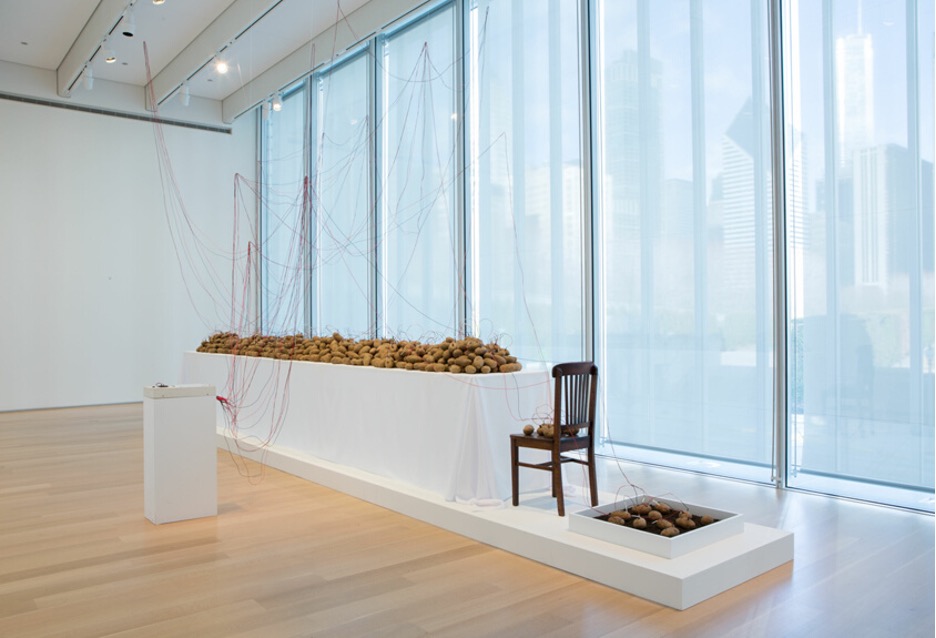
    Cage-free reading method #3: Aphoristic disruptions

    A selection from just these eleven pages:

    For every poem I love, a baker’s dozen hate it.
    Harder for a rich man to write a good poem than to buy a good painting.
    There is no perfect in poetry, but there can be more perfection.
    The copy is the gateway drug for the power of the real thing.
    My soul believes only its own ears.
    Kisses grow cold and hard while a poem will never betray you.
    The poem is not the end of aesthetic experience but its beginning.
    The great but obscure poet is still a loser.
    Taste is not the end of aesthetics but the onset, as of a fever.
    The construction of disinterestedness is itself a form of interest.
    Monotheism in poetry is a crime against aesthetics.
    Being Jewish helps with the cacophonies.

    Our fourth method now follows from Bernstein’s indifference toward proper transitions. His construction of disinterestedness extends to discourse markers. We know what the essay is about. (See Cage-free reading method #1 above.) But at the level of evidential flow, we are often minutely circling; amid trees we know little in the way of cause-and-effect forest. Across the paragraphs of our short essay, there are several such moments. If you can’t do a close reading of the non-succession of topics at the level of the paragraph or page, you can, indeed must, closely discern the resistance to transition as a process by which to disrupt others’ mainstream failure to disrupt. Examples of such failure are given: New Yorker poetry; the two sequential Roberts—Lowell, Frost.

    Cage-free reading method #4: The rejection of transition

    Take the first page for example. We get the wisecrack about monotheism, but it seems to be a one-off. Then the initial hint of the essayist’s preference for Larry Eigner over Lowell, which gives us a first mention of “my gang’s outlier taste” (163). We know his way of belonging is chiefly not to belong elsewhere. Which gang is that? There’s a mention of Bernie Sanders or Donald Trump. (Trump’s shills are at a Sanders rally. Boring from within?) To borrow from the Old Left of the 1930s, something Bernstein often does: Which side are you on? Then this stunner, quoted above among the janky sayings: “Being Jewish helps with the cacophonies.” Is this another dead-end quip? Who is making all that noise? We’ll go along with it for another sentence and then surely we’ll be wildly moving on to something else: “There hasn’t been a real Jewish poet since Solomon” (163). Sanders is Jewish but not nearly a poet. Eigner is Jewish but apparently doesn’t count as a “real Jewish poet” since, to follow the illogic, he post-dates the wise ancient Jewish king. Really, which side are you on?

     “Those who feel their mainstream taste is slighted” by Bernstein’s gang tend to be routinely (boringly) disputatious—to keep, even in that activity, to mainstream modes. He suggests that part of his and his allies’ response to the slighted mainstream has been to arrange a clamorous discordant “chorus”—a poetry—to make noisy rejoinders to the rejoinder. Perhaps in encountering this prose itself, with its very own anti-monotheistic and incorrect topic-to-topic motion, is meant to be an aspect of this loudness. Loud like someone speaking out of turn. Loud like a loud tie. Then a small surprise: the essay actually stays for a while with the matter of the historical scarcity of real Jewish poets. The topic takes up a whole page! We get more Solomon, and Ibn Ezra. Then a jarring anecdotal turn to the teacher-activist 1970s, Bernstein’s liberal-left resume as an educator at the Freedom Community Clinic in Santa Barbara, and there follows (i.e., doesn’t follow) the aforementioned swipe at the current-day mediocre poetic tastes of the New Yorker—and, a page-plus later, we are somehow back to Larry Eigner.

    Being Jewish does apparently help with the cacophonies. Is Bernstein himself perhaps the “real Jewish poet” we have been waiting for? Certainly here in “#CageFreePoetics” at least he’s our real Jewish essayist. The great but obscure poet is a loser, perhaps, but the writer of critical, theoretical, clamorously evaluative prose—not despite but because of his resistance to argument’s normal order—is a winner.

    Cage-free reading method #5: Jewish tunes not yet played

    Charles Bernstein has said many humorous things to me, usually in muttered asides. The funniest by far: we were sitting next to each other at a two-hour departmental faculty meeting. Procedural matters were being discussed, at length and in minute detail, that held no interest for him. A major reform in departmental process was being promulgated by a diligent, serious-minded committee. Hearing this report, colleagues indicated elaborate assent, some contended mostly respectful dissent, a few complex suggested amendments. Then, in a whisper, perhaps a stage whisper, Bernstein to Filreis: “Yes, but is it good for the Jews?” This too was meant to disrupt the failure to disrupt. Rightly or wrongly, he deemed the academic scene to embody a “clash between refinement and coarseness [as] a symptom of discordant senses of the world” (to quote a key cage-free phrasing). Such disorder must be desirously wild and incongruous and, to him, these qualities are fundamentally part of radical poetic secular Jewish culture. He is done with topical “compass,” to use Dickinson’s crucial modern definition of getting to wildness—done with “charts” tracking the passing of the orderly muster of taste or distinction over aesthetic value. (He wrote “#CageFreePoetry” for a book of essays edited by Robert von Hallberg more or less frankly addressing the then-unfashionable subject of poetic value.) The great Jewish poet doesn’t just say things, doesn’t stand—doesn’t occupy a position—primarily for things being said, but rather does things in verse.

    The poem we want does what it says. This is why Bernstein admires Eigner over Lowell. In a pivotal moment in our essay, it’s hard to miss the radical redefinition of “refinement” as a version of “coarseness” that is being derived from an accusation of poetic prejudice (tacitly ableism, and anti-Semitism perhaps less implicitly)—cages, one might say, the freedom from which cage-free poetry is to be written:

    Changes of taste require changes of consciousness: the aesthetic clash between refinement and coarseness is a symptom of discordant senses of the world. I prefer Larry Eigner to Robert Lowell and find Eigner the more refined, but it’s a different kind of refinement from the patrician Lowell, as different as Cambridge from Swampscott or gentile to Jew. To prefer Eigner requires a readjustment of aesthetic criteria. It is not a matter of what Eigner stands for but what he does (167).

    The form of an Eigner poem presents an anti-monotheism. And monotheism, we recall, is a crime against aesthetics. Refined coarseness doesn’t mind the cacophonous disputations of taste, and being Jewish, as we know from the adage, helps with that. Eigner heard all of it and as a Jewish poet, as good and wise as Solomon though less officially stately, he “play[ed] tunes not yet played” (167). That phrase comes from a talk Bernstein gave in 2004 and published as a prefatory statement later in the book Radical Poetics and Secular Jewish Culture (2010). He asked “Is this Jewish?” in that essay, and by this he means the writing we are reading, and its qualities as writing. “I am no more Jewish than when I refuse imposed definitions of what Jewishness means. I am no more Jewish than when I attend to how such Jewishness lives itself out, plays tunes not yet played.”[3] “#CageFreePoetry,” “Stein Stein Stein,” “Summa contra Gentiles,” “Groucho and Me” and other gathered essays explain and describe the importance of such unplayed tunes, yes, but also occasionally they themselves sound or pitch them: wave-altering, echolocational, experiential in that anarchic undirected way that life actually is. “Poetry, the kind of poetry I want,” Bernstein writes in “Groucho and Me,” “is not the unmediated expression of truth or virtue but the bent refractions, echoes, that express the material and historical particulars of lived experience. My poems don’t … translate into easily assimilable … messages” (43-44). Nor does the prose as its sentences are comprehended as themselves, each one, bearing a “process of aversive judgment.” As a whole project his is admittedly a “conversion narrative,” but one in which all “received judgments are called into question” (167) one at a time, inconsistently and anti-monotheistically—and ever based on a refusal to convert. 

    [1] Charles Bernstein, The Kinds of Poetry I Want: Essays & Comedies (Chicago: University of Chicago Press, 2024), 163-73. Subsequent parenthetical page citations refer to this book.

    [2] Charles Bernstein, All the Whiskey in Heaven: Selected Poems (New York: Farrar, Straus and Giroux, 2010), 149, 124, 65, 31. “Freudian Slap,” Topsy Turvy (Chicago: University of Chicago Press, 2021), 8.

    [3] Charles Bernstein, “Radical Jewish Culture / Secular Jewish Practice,” Radical Poetics and Secular Jewish Culture, eds. Stephen Paul Miller and Daniel Morris (Tuscaloosa: University of Alabama Press, 2010), 13.


  • Elin Käck–Constellation, Frame, and Provisionality

    Elin Käck–Constellation, Frame, and Provisionality

    This text is part of a b2o Review dossier on Charles Bernstein’s The Kinds of Poetry I Want. 

    Constellation, Frame, and Provisionality in Charles Bernstein’s Kinds of Poetry

    Elin Käck

    “What about all this writing?” This question, which sounds like it may have come straight from the mouth of the executer of some literary estate who has just found an entire room full of boxes of unsorted texts and wonders what to make of them, was uttered by William Carlos Williams in the poem labeled IX in Spring and All (1923). It arguably constitutes an important meta-poetic statement (1986: 200): for it directs our attention to the uncertain—or provisional—status of the work presented in the volume itself: daring and, for lack of a better word, experimental, breaking with all sorts of expectations. It is as though the work itself is being negotiated by the poet as we go along, moving through the disorienting sequences of his poetry.

    Perhaps because I happen to be a Williams scholar and Bernstein references Williams in his new book (and elsewhere), this question—“What about all this writing?”—lingers with me throughout the volume of Bernstein’s genre-defying The Kinds of Poetry I Want: Essays and Comedies (2024). The book’s overt genre labels do not entirely account for everything that goes on between its covers. When Williams asked the question in his own genre-defying volume interspersing poetry with prose sections—a book that we might now view as an early prototype for the merging of poetry, theory and criticism at which Bernstein excels—he had no way of knowing which answers future readers would propose to his question.[1] He probably even wondered in earnest what his contemporaries would make of all that particular writing—the very kind found in Spring and All—and suspected that most of them would not appreciate it. In relation to Bernstein’s work, published almost exactly a century later, I understand the question very differently, with an emphasis on the “all” rather than the “this.” The question is not so much what to make of this kind of writing—although some people still seem perplexed at the difficult poems with which Bernstein attacks his reader, deeming him “incomprehensible, incoherent, and hypertheoretical,” as Marjorie Perloff once summarized it (2021b: 167). Rather, it concerns how to deal with the sheer mass of it. Even more so, it is a question of how to calibrate any statement about Bernstein’s work or his poetics against the many essays he himself has written on poetry and poetics, not to mention all the other forms of commentary in which he has engaged, from speeches to interviews, in various formats. Here he joins both Stein and Williams among the modernists in having created an oeuvre where it is entirely possible to read Bernstein through Bernstein, just like we can read Stein through Stein, or Williams through Williams. While thrilling and often gratifying, such a method rarely offers a final, conclusive key to their work, but instead tends to generate more questions and lead to further labyrinthine routes of reading and rereading. Yet, this is precisely what a book like The Kinds of Poetry I Want invites its readers to do, given that its title suggests the presentation of a poetics, however plural. With its many references to the author’s other essays and works, it constantly breaks its own bounds and sends its reader (this reader, at any rate) on labyrinthine routes through decades of writings. The “all” is a cumulative aggregate.

    If Williams’s “all” is an apt starting point for discussing Bernstein’s work, it might be because he himself hints at a fascination with this capaciousness à la Williams in the essay “Free Thinking: Spring and All versus The Waste Land at 100.” Bernstein delivered the essay with characteristic verve at the 2023 MLA Convention in San Francisco, on a panel which I convened for the William Carlos Williams Society to celebrate a century of Spring and All and the fortieth anniversary of Bernstein’s own “The Academy in Peril: William Carlos Williams Meets the MLA” speech, once presented at the very same conference.[2] At one point in the essay, in his discussion of Spring and All, Bernstein makes it clear that it is indeed the “all” that entices: “We are all strangers in the wilderness of language. Spring and All imagines that. And it’s not the ‘spring’ but the ‘all’” (2024a: 161). In the 1983 MLA speech, this all which Bernstein so strongly advocated for included what had previously been termed mere “rhetoric,” meaning the prose sections interspersing the short poems that would come to be canonized (2001: 246). Today, most people would agree that Spring and All really needs “all” in order to be fully understood as an avant-garde masterpiece. All the writing of which Williams asks his readers in poem IX of Spring and All is now deemed indispensable, integral to the work. What was once a source of uncertainty and seen as mere excess, out of place and muddling the sight of the actual items of poetic value, is now perhaps even one main reason for the work’s continued canonization. To speak with Bernstein’s own abbreviation system in the essay, Williams seems awfully close to having become part of OVC, official verse culture, first on the basis only of the lyric poems, and now for the work as a whole (but maybe this is calling it too soon; after all, I was asked as late as 2010—in disparaging terms, no less—why I would want to spend my time writing about the prose of Spring and All).

    If Williams daringly expanded the poetry volume and reimagined its scope so as to accommodate criticism, essays, cantankerousness, speech, and philosophical ideas, then it is safe to say that Bernstein’s work has taken this capaciousness and sense of accommodation even further, expanding not only the frame (a crucial word to which I will return later) of the poetry volume, but of scholarly writing as well as of writing and/as performance. Indeed, it is impossible to read some of the pieces in his new book without simultaneously hearing them performed in one’s mind, in the loud and powerfully engaging way Bernstein has of delivering his speeches. This innate aurality comes as no surprise, given his profound interest in sound, theorized as a dichotomy between “sound and unsound” writing (2024a: 350).

    In “Sounding the Word” in Pitch of Poetry, Bernstein has his text self-consciously point to its use of an italicized that as “a script code to tell you that if you read this out loud you should give an extra emphasis to that, pausing slightly before it” and then suggests to the reader just how the essay would sound in a parenthetical paragraph: “For the real experience of this script, play it on your computer’s voice reader and set ‘Ralph’ for a rate of 35, pitch of 36, intonation of 82” (2016: 30, 32). But there is really no need for overt directions, whether real or made in jest; anyone who has ever heard him read is able to imagine just how a line or sentence might sound when delivered in his voice. At the 2016 MLA Convention in Austin, the panel next door even came in to ask him to pipe down, as they were having trouble hearing their own presentations with the noise from our crowded room emanating through the walls when Bernstein read “The Pitch of Poetry,” presumably a pitch or two too high, in the panel Reconceptualizing the Lyric. The conference frame encroached on the performance frame, to the amusement of everyone in the audience and, if my memory serves, to Bernstein himself, who took it in his stride, but who did not significantly lower his voice (I doubt he could even if he tried).

    While this anecdote might suggest that the MLA convention is not conducive to the kinds of conference presentations Bernstein wants, not to mention the kinds of poetry, such a conclusion would be too rash. In “95 Theses,” Bernstein explains his view on the MLA as a context for his work: “Contrary to what some members feel, I have always found the MLA convention, with its knowledgeable and often enthusiastic listeners, an ideal place to present my work” (2024a: 15). In the recent essay “Which Side Are You On?” he spells out even more clearly how the conventions that, in his terms, “often seemed like a giant sensory deprivation tank” were essential contexts: “The positive reception of my Ciceronian style, not to say stand-up, was greatly enhanced by this environment” (2024b: 93). What’s the use of a frame if you can’t break it? Or, rather, how break a frame if there is none? With these considerations in mind, of course the MLA convention is ideal.

    Characteristically, for Bernstein, writing always generates more writing (again, all this writing); texts bring about texts, poems bring about poems, bring about essays, bring about speeches, bring about criticism, bring about poetry as criticism, bring about email conversations and interviews and letters that then later become new essays or even poems, which in turn is only a fraction of an enormous output of everything from email lists to radio programs to cult online repositories such the Electronic Poetry Center and PennSound, all of which can and do generate more writing. There is a capaciousness that seems to know no bounds and thrives in excess.[3]

    There is also an “endless quest for material,” as he admits in an interview with Perloff, elaborating on the practice of collecting spoken language from different contexts and in different registers, using it for his poems (Bernstein 2011: 248). This endless quest seems to me to pertain just as much to the repurposing, or recontextualization, that forms such a vital part of Bernstein’s method: culling material from the surrounding world and wealth of language in the everyday (much like Williams did in his poems of the everyday and in works like The Great American Novel with its vast collection of competing registers) is really only the first step, just like the poem is only the second.

    There are also third, fourth, maybe even fifth steps, where materials get transposed, recontextualized, rethought, or reframed—where the quest for material turns toward the already-collected materials to think anew about their potentialities. Nothing is really ever final, as demonstrated most aptly by the revised obituary for David Antin, included in its original form with the author’s hand-written notations in The Kinds of Poetry I Want, with the explanation of how, at a memorial event for Antin, “I presented a commentary on my obituary, adding to it and contradicting it, based on notes I made during the first part of the program” (2024a: 338). The movement of material, as it were, is at least as important as its careful emplacement on the page of the poem, where it resides permanently but also, as it turns out, sometimes provisionally. In “Dichtung Yammer,” Bernstein elaborates on one particular iteration of this method, the frequency one, where the most common words of chosen previous works are sampled to create new ones: “I’m mining (and minding) the earlier works to create alternate versions via vectoral data slices,” a method that he notes recalls the “distant reading” of digital humanities (2024a: 266). The new context for the already-written is in itself generative, for “the same line is not the same depending on who said it or what the context is,” as Bernstein explains in Pitch of Poetry (2016: 199).

    It is telling that the anecdote of the publication of All the Whiskey in Heaven contains an observation on the process of selection to the effect of sculpting “from a large mass of writing” (2024a: 118). Bernstein elaborates on this in the 2010 interview “Chicago Weekly” with Daniel Benjamin, collected in Pitch of Poetry, where he describes this collection of selected poems as one in which

    . . . the poems, taken from thirty years of work, are repurposed to be part of this new serial work, with the book as organizing principle. For the selected, I wanted to suture together disparate, even opposing, forms, in order to create a mobius rhythm out of the movement among the discrepant parts; the meaning is as much in the space in between as in the poems themselves. Each poem does have its autonomy, but the book as a whole works more as an installation than a collection. (2016: 243)

    Installation seems an apt term also for the most recent book with its bringing together of various forms not with the aim of creating a sense of perfect balance or unity, but with movement at the center of the project: movement in both spatial and temporal terms. We are journeying through decades of conversations and ideas, but always somehow in tune with the most pressing questions of our current moment, just like texts moved from a previous context generate new ideas and spark new connections in new arrangements.

    The pieces collected in this book at times strongly imply more writing to come, as in “95 Theses,” where the final thirty-one have been left blank, to be filled in by the reader, but, one thinks, why not, at some later point, by the author himself, picking up a thread begun years earlier. Blanks and gaps open up for new takes and essays expanding on or developing something already-written further. This ties in with Bernstein’s own claim of his work’s provisionality, in the essay/conversation “Too Philosophical for a Poet: A Conversation with Andrew David King,” where he states that “I see my books as provisional exhibitions” where “other constellations are implicit” (2024a: 119). Here we see an example of Bernstein’s preference for the term constellation, which he elaborates on in “Dichtung Yammer”: “Books inside books create more possibilities, clusters, webs, matrices—echoes. More strings attached” (2024a: 271). Uttered as a comment on the organization of Topsy-Turvy (2021), this also provides a fruitful guide to other works, even if the units might not be “books,” but something else. While provisionality as such might be construed as a charge against his work—as a sign that a Language Poem ends randomly, by chance, rather than design—I take the provisional exhibitions to be highly and most consciously curated at each stage, in each iteration.[4] Provisionality does not here mean impressionism or incompleteness, but instead an affordance for movement and reconfigurations that produce new meanings and potentialities.

    Constellation and frame, along with provisionality, emerge as central terms for Bernstein’s practice: terms from the worlds of avant-garde art and pragmatics respectively. Taken together, they seem particularly able to accommodate the vast span—volume, spread—of his work in different genres. They provide a language for discussing essays, speeches and comedies just as they do for approaching long, slender poems replete with mid-word line breaks, centered on the page, like “Thank You for Saying You’re Welcome” and “Truly Unexceptional,” in Near/Miss, the latter so slim that it almost “dis-/sol-/ves” as its words are stretched out, like a Giacometti sculpture, across the two pages it spans (2018: 56). They are also helpful in approaching one-sentence poems like “A Unified Theory of Poetry” in Topsy-Turvy, which is briefer than its title and simply reads “I don’t think so” (2021: 75). They allow for a description of the poem on the page just as they accommodate the movement inherent in repurposing or reframing when items from one poem or essay are morphed into something else, be it a poem or a work in another genre, or are remediated through performance.

    It is not surprising that these terms largely come from and are employed outside of the realm of literary theory or literary studies. Bernstein’s poetics is founded on the interactions between fields, unceremonious in the face of the disciplinary. I spend my everyday academic life in the company of linguists working within interaction, multimodality, and Conversation Analysis (CA), so when I came across Erving Goffman’s name in Bernstein’s description of framing in “Dichtung Yammer,” I realized that we have mutual friends. Goffman is a household name in my department for his importance to pragmatics (from this perspective, it figures that Bernstein would term his poetics largely “pragmatic” in “The Humanities at Work” in Pitch of Poetry [2016: 225]). Goffman’s Interaction Rituals (1967) was one of the readings for the obligatory linguistics course in my PhD training some fifteen years ago. Maybe this type of work, more than anything else, is what best prepares someone for reading a poet like Bernstein?

    At the beginning of Frame Analysis: An Essay on the Organization of Experience (1974), Goffman takes the reader for quite a ride. This occurs already in the book’s preface, which constantly draws attention to itself as a preface that is commenting on its status as a preface, and which also posits a number of ‘what ifs’ for the reader to consider. While a preface is known to be a place in which to adjust reader expectations and speak candidly about a book’s limitations, often apologizing for what is to come and thus actively framing the work for the reader, what would happen if a writer instead did something else, like comment on the preface or state who didn’t help with the book’s making, rather than who did? What if, Goffman asks, “I had said: ‘Richard C. Jeffrey, on the other hand, did not help’” (1986: 18).[5] As he concludes the preface and this series of examples, he states: “That is what frame analysis is about” (20).

    Characteristically, The Kinds of Poetry I Want offers no guiding preface by the author to manage reader expectations, but its wonderful foreword by Paul Auster (also repurposed, from a 1990 reading as well as from the 1996 Why Write?) provides the reader with important clues, calling Bernstein a “trouble-maker” as well as “unpredictable” (2024a: ix). Playing with the frame, altering expectations, and shifting cues to move the reader from one realm to another, one genre to another, one set of ideas to another—all of these are prevalent elements in Bernstein’s constantly evolving repertoire. He states it himself in the essay “Offbeat”: “Poems, the kind of poetry I want, use reframing as a process” (2024a: 29). Reframing is also something that the reader actively does: “Reframing is the reader’s response, at least if the reader wants to take the ride offered. . .” (2024a: 29).

    The frame as such is almost imbued with magic, or, as Bernstein writes in the poem “Nowhere Is Just Around the Corner” in Near/Miss: “A frame / is like a rabbit pulled from a / hat in Dallas, 1948” (2018: 23). Bernstein’s shifting or provisional frames are deeply connected to surprising leaps of language—to catachresis and the unexpected pairings of words—let’s call them slant pairings, to echo the concept of slant rhymes, known for their defamiliarizing and vaguely troubling effects. It is no coincidence that the word “ostranenie” occurs in the poem “Catachresis My Love” (2018: 33). When “words pop up in surprising slots,” as Perloff has termed this practice (2021b: 168), it is also a matter of framing: the slots are frames, emplaced within other frames, but inside the frame we find something completely different from what the frame (and here it may be a syntactical frame as well as a semantic one) promises. While the term slot might seem to signal mostly something quite stationary and fixed, conditioned by the syntagmatic axis, there is a strong sense of movement unleashed by this element of surprise. Thus, we manage to maintain in two or more places at once; we are on our way somewhere (what the statement ought to say) only to discover upon arrival that we were going somewhere else all along (what Bernstein says). As he explains in “Dichtung Yammer,” “Substitutions are the tissue of my text, whooping and Whorfing and generally making merry, at least for a time, before the mood turns black” (2024a: 262). Calcified sayings, connotations, and rote language use all ensure that we recognize the expected end point, so that we are sure to realize that we have in fact ended up somewhere else. Perloff has a handy description of this practice too, as Bernstein’s proclivity for “creating whole poems out of faux-aphorisms” (2021b: 169).

    Embedded in the exploration of the versatility and at the same time boundedness of language, we actually encounter another link to Williams, who would return to the idea of language as enslaved and in dire need of being set free in a fashion that only the poem could bring about. To his mind, only Gertrude Stein had ever managed to effect anything coming close to such a liberation. “It’s the words, the words we need to get back to, words washed clean. Until we get the power of thought back through a new minting of the words we are actually sunk,” Williams writes in the essay “A 1 Pound Stein,” (1969: 163). Stein, according to Williams, “has gone systematically to work smashing every connotation that words have ever had” (163). In a relationship between language and capitalism, where the latter has enslaved the former, words need new minting: they need to be entextualized. I do not propose that Bernstein’s goal is some kind of end of referentiality or final loosening of language from connotations, and even if it might be possible to find traces of such a stance by searching through every single recorded statement he has ever made, a statement to the contrary comes to mind, where in fact he claims that we rely on referentiality: “You really can’t strip yourself of the associative qualities that words have” (2024a: 24). Mikhail Bakhtin would have agreed. As he pointed out in “Discourse in the Novel,” an essay that I have always found useful rather for the discussion of poetry, “Each word tastes of the context and contexts in which it has lived its socially charged life; all words and forms are populated by intentions” (1981: 293).

    Despite this inherent stickiness of language, there is something in the movement between frames and registers that allows for that “power of thought” that Williams was after and hoped to reclaim in his essay on Stein. In “Poetics and Performance as Critical Perspectives on Language and Social Life,” Richard Bauman and Charles L. Briggs propose the idea that “performance potentiates decontextualization” (1990: 73). Performance has the potential to make discourse “extractable,” specifically through “entextualization,” which loosens it from the previous contexts in which words have occurred (73). While Bernstein relies on the echoes of his echopoetry to carry over into the new context, so that the reader’s references are activated, it would not do to have the old contexts move in too heavily on the new work. The trick is to achieve a state in which they are both equally activated at the same time. As Bernstein notes in “Thelonious Monk and the Performance of Poetry,” “all reading is performative / & a reader has in some ways to supply the performative / element when reading—” (1999: 19).

    Constellation, the other term suggested here as a fruitful way of getting at what happens in Bernstein’s work, is linked to frame and framing, since what is framed can appear in different constellations or frames can cut through the material at various points, including or excluding something. Provisionality, too, is related to this practice, as it allows for a reframing, or a rethinking of constellations, which can become reconstellated, if there is such a word. “Don’t revise. Rethink,” as Bernstein writes in “Catachresis My Love” (2018: 35). This brings us back to Spring and All and the prose that Bernstein defended at a time when others dismissed it as rhetoric, a term used to communicate dislike, rendering this prose especially suspicious, as the opposite of the poem, or at least of the venerated lyric poem. In “95 Theses” in The Kinds of Poetry I Want, Bernstein directs us to what I have always found the most compelling feature of his work: the dialogue between poetry and criticism. The twentieth thesis states: “Criticism, scholarship, and poetry are all fonts of rhetoric. The aversion of rhetoric is an unkind kind of rhetoric” (2024a: 16). A statement like this explains why Bernstein found it important to criticize those who, as he viewed it, undervalued what they saw as Williams’s “rhetoric” in Spring and All, as opposed to what they understood to be “poetry,” by which they meant lyric or lyric-adjacent poems, taken out of their context in the work as a whole. If, indeed, poetry is a font among several “fonts of rhetoric,” as Bernstein suggests, then the separation was incomprehensible to begin with. If there is some precedent for what Bernstein so often does in mixing poetry and criticism in Williams’s work, and especially in a text like Spring and All, then it is here that we find it. As Alan Golding has pointed out, for Bernstein, “Williams’s disjunct critical prose influences later prose poetry” (2022: 207). Bernstein has developed the call for the blurring of boundaries much further, but the impulse was there in Williams’s work too. As Hazel Smith has argued, “Bernstein’s enthusiasm for Williams’s work stems at least partly from Williams’s penchant for the unusual and his contempt for a passive acceptance of traditional conventions” (2024: 33–34).

    In thesis fifty-eight of “95 Theses,” Bernstein states that “the aversion of disciplinarity requires discipline” (2024a: 18). This aversion was shared by Williams, who wanted to tear down the walls between disciplines to create interactions between English and the sciences, and to whom thesis fifty-seven would also have made perfect sense: “Redefine English in ‘English department’ as the host language not the disciplinary boundary, where English is understood neither as origin nor destination” (Bernstein 2024a: 18). Williams was thinking along the same lines. In the piece “(A Sketch for) The Beginnings of an American Education” in the posthumously published The Embodiment of Knowledge, largely composed in the 1920s, Williams too questions the emphasis on English: “A good beginning in this case would be to abolish in American schools (at least) all English departments and to establish in [their] place the department of Language—of which the English could be a subsidiary—one of the divisions—or not, as it may be desired” (1974: 146). “It is not a language that is desired—but language,” Williams stresses (146). As for the centrality of literature, “all scholarship begins” in “the department of letters” (147). In “Frame Lock,” an essay that began as an MLA speech and upon which the ninety-five theses constitute a comment, and which relies on ideas from Goffman’s Frame Analysis, Bernstein even suggests that English should be seen more as “the host language” of a course of study that is actually about literature in a broad sense, about the humanities, and the history of ideas (1999: 96). Indeed, that students should read beyond literature in English and also delve into other literatures, including, but not limited to, continental European literature. The Bernstein of “Frame Lock” is reminiscent of the Williams of The Great American Novel, with the use of an antagonistic voice built into the text, constantly questioning the writer, asking things like “But aren’t you conflating literary and academic writing?” (1999: 97). In Williams’s 1923 anti-novel, the mocking, questioning voice says: “Do you mean to say that art does any WORK?” to which Williams’s speaker replies “—Yes” (1970: 170). These voices in opposition represent the traditionalist views maintaining the hegemonic status quo of academic discourse as well as of poetry.

    The speech delivered at the 2023 MLA Convention ended up not being collected in a Special Issue I was editing for The William Carlos Williams Review on the same topic, as Bernstein rightly saw his new book as the necessary context for the essay. For Bernstein, as we know, the context matters and is essential for the constellation. It forms a frame, just like the MLA convention itself does, and this movement between frames, and from speech to text, is in itself crucial. When I first asked him if he would consider doing something on the anniversary of his 1983 MLA talk, he wrote, characteristically, “put me down for ‘The Academy [Still] in Peril: William Carlos Williams Meets the MLA at 40.’ As I type that, I can feel a whole ’nother speech coming on!” (pers. comm., February 25, 2022). Sure enough, by the time of the conference, the title of the presentation had been changed to “Free Thinking: Spring and All versus The Waste Land at 100,” like the essay now featured in The Kinds of Poetry I Want. A shift in frame, yet again.

    At the beginning of this essay, I stated that Bernstein often mentions Williams in The Kinds of Poetry I Want. A glance at the index, in a number game gesturing to the one Bernstein himself performs in the essay “Free Thinking,” with its “highly unreliable tally for the combined mentions of a poet by the New Yorker and New York Review of Books” (2024a: 159), reveals Williams’s place in the larger ecology of references, with Eliot appearing on nine of the book’s pages, Pound on twenty, and Stein on thirty-one. Williams appears on sixteen, coming in ahead of Eliot, but after Pound and Stein. Even if Williams is not the most frequently mentioned poet in The Kinds of Poetry I Want, there is an unmistakable kinship in the insistence on aesthetics, in how poetry matters as form. As Bernstein admits in the essay he ended up writing for the Special Issue of the William Carlos Williams Review, “It’s the performative nature of Spring and All that inspired me” (2024b: 93). Much of the prose in Spring and All is devoted to a testing of the boundaries between poetry and prose, a teasing out of the potentialities of forms of language. Williams concludes that poetry is “new form dealt with as a reality in itself,” as opposed to prose, which is “statement of facts concerning emotions, intellectual states, data of all sorts—technical expositions, jargon, of all sorts—fictional and other—” (1986: 219). As for the form of poetry, to Williams, it “is related to the movements of the imagination” (219). He writes: “Poetry is something quite different. Poetry has to do with the crystallization of the imagination—the perfection of new forms as additions to nature—prose may follow to enlighten but poetry—” (226). On the formal difference between poetry and prose, Williams proposes that “form in prose ends with the end of that which is being communicated” (226). It is always tempting to focus on Bernstein’s recurring discussion of the opposition between the lyric poetry condoned by official verse culture, on the one hand, and avant-garde poetry on the other, in terms of the former’s reverence for personal experience and sincere feelings and the latter’s insistence on form and materiality. However, this opposition is in many ways just a prelude to the most intriguing aspect, which, to me, is the exploration of poetry’s aesthetic affordances. In “The Swerve of Verse,” discussing Lucretius, Bernstein contends that Lucretius’s “verse . . . is there to ensnare, to pull readers into an aesthetic/conceptual experience that cannot be put into prose. It goes beyond the resources of prose in making palpable its (initially) counterintuitive philosophy. . .” (2024a: 111).

    If The Kinds of Poetry I Want promises a poetics, the essay “Offbeat,” offers a relatively clear summary of what that poetics might entail: “I want poems that are ecstatic in the sense that they exceed moral and political discourse. Poems as sensation, as performance, as aesthetic, doing rather than stating” (2024a: 33). Exceeding the bounds of discourse, breaking frames, and cumulatively moving through contexts in shifting constellations, propelled by but also critically interrogating the resources of our ever-expanding media ecology—such, it seems to me, are the kinds of poetry Charles Bernstein wants. And while there are important points of divergence and significant differences between the two—surely enough to fill at least a couple of essays—by and large, Williams would probably have agreed.

    References

    Bakhtin, Mikhail M. 1981. “Discourse in the Novel.” In The Dialogic Imagination: Four Essays by M. M. Bakhtin, edited by Michael Holquist. Translated by Caryl Emerson and Michael Holquist, 259–422. Austin: University of Texas Press.  

    Bauman, Richard, and Charles L. Briggs. 1990. “Poetics and Performance as Critical Perspectives on Language and Social Life.” Annual Review of Anthropology 19: 59–88.

    Bernstein, Charles. 1999. My Way: Speeches and Poems. Chicago: University of Chicago Press.

    Bernstein, Charles. 2001. Content’s Dream: Essays, 1975–1984. Evanston, IL: Northwestern University Press. Originally published in 1986 by Sun & Moon Press, Los Angeles.

    Bernstein, Charles. 2011. Attack of the Difficult Poems: Essays and Inventions. Chicago: University of Chicago Press.

    Bernstein, Charles. 2016. Pitch of Poetry. Chicago: University of Chicago Press.

    Bernstein, Charles. 2018. Near/Miss. Chicago: University of Chicago Press.

    Bernstein, Charles. 2021. Topsy-Turvy. Chicago: University of Chicago Press.

    Bernstein, Charles. 2024a. The Kinds of Poetry I Want: Essays and Comedies. Chicago: University of Chicago Press.

    Bernstein, Charles. 2024b. “Which Side Are You On?” The William Carlos Williams Review 41, no. 1: 86–96.

    Goffman, Erving. 1986. Frame Analysis: An Essay on the Organization of Experience. Boston: Northeastern University Press. First published in 1974 by Harper & Row.

    Golding, Alan. 2022. “‘What About All This Writing?’: Williams and Alternative Poetics.” In Writing into the Future: New American Poetries from the Dial to the Digital, 197–217. Tuscaloosa: University of Alabama Press. The essay was first published in Textual Practice 18.2 (2004): 265–282.

    Perloff, Marjorie. 2021a. “‘Funny Ha-Ha or Funny Peculiar?’: Recalculating Charles Bernstein’s Poetry.” In Evaluations of US Poetry Since 1950, Volume 1: Language, Form, Music, edited by Robert von Hallberg and Robert Faggen, 221–244. Albuquerque: University of New Mexico Press.

    Perloff, Marjorie. 2021b. Infrathin: An Experiment in Micropoetics. Chicago: University of Chicago Press.

    Smith, Hazel. 2024. “No Ideas but in Technology: William Carlos Williams, Concepts of the New, and Electronic Literature.” The William Carlos Williams Review 41, no. 1: 30–57.

    Williams, William Carlos. 1969. Selected Essays. New York: New Directions.

    Williams, William Carlos. 1970. Imaginations, edited by Webster Schott. New York: New Directions.

    Williams, William Carlos. 1974. The Embodiment of Knowledge, edited by Ron Loewinsohn. New York: New Directions.

    Williams, William Carlos. 1986. The Collected Poems of William Carlos Williams: Volume 1, 1909–1939, edited by A. Walton Litz and Christopher MacGowan. New York: New Directions.


    Notes

    [1] Alan Golding (2022) clarifies the relationship between Spring and All and the merging of poetry and criticism in Bernstein’s and other Language writers’ work excellently in an essay whose title also zooms in on that very same Williams quote from Spring and All.

    [2] This panel resulted in a Special Issue of The William Carlos Williams Review, in whose introduction I write more about the historical moment in 1983 and its relation to the 2023 panel. See “Spring and All no Longer in Peril.” The William Carlos Williams Review 41, no. 1 (2024): 1–11.

    [3] While I here consider excess in relation to sheer mass, it has previously been used to describe Bernstein’s poetry and what Perloff has termed its “baroque excess” (Perloff 2021a: 238).

    [4] For a discussion of this alleged “formlessness,” see Perloff 2021a: 222.

    [5] To be sure, Williams knew how to make use of the preface as a space for artistic innovation, not least in the prologue to Kora in Hell that includes letters from Pound, Stevens, and H.D., but also in the preface-like introductory section of Spring and All in which he simply declares about his ensuing experimental work that it is likely that “no one will want to see it” (1986: 177).

  • Michael Davidson–Groucho Marxism

    Michael Davidson–Groucho Marxism

    This text is part of a b2o Review dossier on Charles Bernstein’s The Kinds of Poetry I Want. 

    Groucho Marxism: Charles Bernstein’s Kinds of Poetry

    Michael Davidson


                                                    “I am for avant-garde comedy and stand-up poetry” (350)[1]

                                                    “Am I just a voice crying in the wilderness, or am I a just voice                                                                     pleading aggrievement?” (163)

    The Secret Word

    In the opening of the 1950s quiz show, You Bet Your Life, the MC, George Fenneman would introduce Groucho Marx: “And here he is, the one, the only…”–leaving a blank for the audience to shout: “GROUCHO!”–followed by the theme song, “Hooray for Captain Spaulding.” Groucho, cigar in hand, would then display the “secret word” for the day which, if one of the contestants said it, would drop down from the ceiling, attached to a duck with a cigar (on one occasion, the duck was replaced by Harpo and on another, by Mamie Van Doran), and Groucho would hand the lucky winner $25.00 (later this amount was increased to $100.00). Fenneman would introduce our two guests for today’s quiz and step off stage, leaving the floor open for Groucho’s witty, often acerbic, repartee with the couple. As for the duck falling from the ceiling, these were the halcyon days of early television when the medium was figuring out how far it could go, what visual tomfoolery one could get away with. Ernie Kovacs was the inventive impresario of the medium, Spike Jones was its resident composer, and comics like Cid Caesar, George Burns, Henny Youngman, Milton Berle and others exploited the physical limits of the black and white screen and the unpredictable qualities of a live audience. Groucho’s verbal wit and arch retorts were somewhat improvisational, but they also subverted the interview format by endless asides and miscues. Was this avant-garde comedy or stand-up poetry?

    In Charles Bernstein’s terms, the secret word for today is “pataquerical,” a nonce formulation for his aesthetics that could easily apply to Groucho’s humor. What he calls the pataquerical is “a flickering zone of counterfactuals that allow for possibility, reflection, intensified sensation, and speculation” (11). In an earlier essay in The Pitch of Poetry, “The Pataquerical Imagination”, Bernstein finds one of its sources in Poe whose “Poetic Principle” expresses the scandalous belief that poetry “has no concern either with Duty or Truth” and that personal taste is superior to transcendent ideas” (Bernstein: 2016, 299). He also relates it to Marx’s critique in The German Ideology of young Hegelians for their belief in critique as a value for its own sake rather than as a dialectical process “that has no end point but like a Klein bottle doubles back on itself…” (Bernstein: 2016, 296). In its invocation of Alfred Jarry’s pataphysics, the pataquerical is a poetics of process, irresolution, and speculation and as a result cannot be confirmed by an appeal to “convention, accessibility, compromise, refinement, or humanist literary values,” qualities abundant in what he labels “Official Verse Culture” (OVC [296]). It is tempting to see the pataquerical as a version of what one interviewer calls Bernstein’s “Groucho Marxism,” his fusion of comedy and subversion, borsht belt humor and social critique. Against “aesthetic illiberalism” that neutralizes and normalizes, the pataquerical is like the duck, a “secret word” that drops down to interrupt the show and surprise the audience. Bernstein’s new book, The Kinds of Poetry I Want serves as a brief on the pataquerical in its multiple forms, both aesthetic and political.

    The title and much of its imperative are taken from Hugh MacDiarmid’s 1961 book, The Kind of Poetry I Want, which advocates “A poetry that is—to use the terms of red dog–/ High, low, jack, and the goddamn game” (MacDiarmid qtd. 153). There’s plenty of the red dog in Bernstein’s poker hand–from Lucretius, Sartre, and Tao Te Ching (high) to Bob Dylan, Thelonious Monk, and Cid Caesar (low). And the variation on MacDiarmid’s title stresses the multiple “kinds” of poetry Charles wants, wanting itself being a value seldom mentioned in aesthetic discourse. Writings about poetic value that posit some universal standard or monadic formal closure are countered by a word for unfulfilled desire: the kinds of poems he wants are the kinds of poems he finds lacking.

    The book is divided into three “acts,” each of which is subdivided into multiple “scenes” containing a wild mixture of genres: interviews, poems, homophonic translations, protestant letters, erasure texts, midrashic commentaries, concrete poems, and aphorisms. The range of genres is matched by the book’s heteroglossic display of idiolects—from broad-based comedy to stentorian jeremiad, from one-liners to flat-footed howlers, from scholarly analysis to cliché and bad puns. This variety reflects the venues in which earlier versions were published or given as talks. The lengthy interviews are among the most important statements of Bernstein’s poetics; his responses to questions from Vicki Hudspith, Thomas Fink, Braulio Paz, Andrew David King, Feng Yi and others give him a chance to elaborate on his favorite issues and incorporate often moving autobiographical information. He is a generous respondent, providing extended answers with attendant asides and detours that deflate some of the interviewers’ more ponderous questions. The book concludes with one of his most important essays, “Doubletalking the Homophonic Sublime,” that deals with the phenomenon of translations based on the sound of words rather than sense–from Zukofsky’s Catullus and David Melnick’s Men in Aida to his own collaborations with Leevi Lehto and Richard Tuttle. The tutelary genius of homophonic sublime is Cid Caesar whose doubletalking in nightclub routines involved a virtuoso highspeed imitation of various foreign languages, a routine that animates the essay’s opening remarks:

    Never met a pun I didn’t like.

        I’m a veritable Will Rogers, with plenty of roger but without the will to say enough’s       enough already. All instinct. Like a Brooklyn Ahab stalking a whale in the backyard or a     curmudgeonly Odysseus hurtling towards his sirens.

    But wait a sec.

    This is not the opening of a nightclub act. (349-50)

    But in one sense the essay is a kind of nightclub act using homophony to provoke other kinds of associations beyond the auditory.  

    In keeping with the parodic qualities of Jarry’s pataphysics, Bernstein engages in a wide-range of speech genres—from mock-didactic oratory (“I come to you today at the 138th Annual Convention of the Modern Language Association…” [155]), literary prize announcements (“…no one can doubt that this work is one of the most ambitious books of poetry published in our time” [312]) and hyperbolic jargon in recommendation letters (“What distinguishes Danniello, and makes him such a strong candidate for admission to our doctoral English program, is his deep animosity to literature” [319]). Like Pope and Swift before him, Bernstein tilts at the canons of approved public discourse by mimicking their authorizing rhetoric. Idiolects are more than ventriloquized satire; they carry the weight of their institutional provenance, the authority of the professoriate, the publishing industry, the academic marketplace through which literary culture is formed and reinforced.

    The Kinds resembles several of his previous collections, A Poetics, My Way, Attack of the Difficult Poem, The Pitch of Poetry, in its eclectic variety, but one through line is the work of Jewishness in an age of cultural cancellation and identity politics. He invokes T.S. Eliot’s infamous worry in After Strange Gods (1933) that “Reasons of race and religion combine to make any large number of free-thinking Jews undesirable” (Eliot qtd. 155).  As a self-declared free-thinking Jew himself, Bernstein recuperates free-thinking for the kinds of poetry he wants—that of Gertrude Stein, Louis Zukofsky, Larry Eigner, Hannah Wiener, David Antin, Johanna Drucker, Jerome Rothenberg, not to mention the borscht belt comedians he invokes. At one point he modifies Charles Olson’s opening to his book on Melville, Call Me Ishmael, by saying, “I take RACE to be the central fact for those born in the Americas. I spell it large because it comes large here. Large and without mercy” (33). In a way the substitution of “race” for Melville’s “space” recognizes the degree to which American manifest destiny of expansion was authorized by the erasure, relocation, and marginalization of racial others—including Jews.

    Which is not to say that Bernstein has not addressed Jewishness in previous works. Here, however, the theme is supported by his use of “midrashic antinomianism” that links Jewish rabbinical commentary with American Protestantism, or as Bernstein might say, Reb Ben Ezra meets Emily Dickinson (164). Both parts of the phrase stress the Word as an infinite possibility, unsettled in its meanings and tolerant of its misunderstandings. Midrashic antinomianism could apply equally to avant-garde writing or Jewish humor: “Groucho Marx’s jokes are allegories of escape and especially escape from being defined. The Jewish comic, like the Jewish poet, dodges, deflects, evades, ducks” (45). Bernstein devotes many passages in the book to his own relationship to secular Jewishness, growing up in an assimilated household, albeit, as he has said, with Jewish and Zionist identifications.[2] Antisemitism was prevalent in Bernstein’s early life at Harvard and became linked in his mind with more conservative literary traditions, often, ironically enough, traditions reinforced by Jewish academics and poets. In a lengthy letter to Paul Bové included in the book, Bernstein discusses Lional Trilling’s The Liberal Imagination as an example of cultural consensus among Jewish intellectuals of the cold war period who also “dodged, deflected, evaded and ducked” in order to assimilate. Trilling was not a Jewish neocon of the Commentary variety like Norman Podhoretz or Hilton Kramer, but he nevertheless embodied an “Arnoldian figure of a high culture where Jews might be heard if not seen as such“ (298). Thinking of Trilling’s student, Allen Ginsberg and his Columbia classmate, Louis Zukofsky, Bernstein sets up a contrast between the “illiberalism” of Jewish Cold War intellectuals and writers who confronted antisemitic headwinds by different means.

    In The Kinds more radical strains in Jewish cultural traditions are linked to avant garde practices, but Bernstein realizes that experimental poetics itself has recently been attacked for its presumed racial exclusions. With events such as the Mongrel Coalition for Gringpo manifestos of 2015, Janet Malcolm’s attack on Gertrude Stein in the New Yorker, Dorothy Wang’s reconsideration of the “Poundian-Objectivist-New York School-Language-Conceptual tradition,” Juliana Spahr’s and Stephanie Young’s critique of the “white room” of academic writing programs, experimental writing is suddenly under the microscope for its whiteness and, in Malcolm’s case, Fascist complicity.[3] In Natalia Cecire’s terms, “Experimental writing is a white recovery project” (Cecire, 2019: 34). Implicit in these responses is the idea that formal experiment erases identity, both personal and cultural, and that its endeavor is purchased by silencing minority voices, histories, idioms. Kenneth Goldsmith’s conceptualist performance of Michael Brown’s medical autopsy would be the most notorious version of such practices and has been the object of numerous anti-racist critiques. Identity, as Bernstein acknowledges, “remains a volatile issue for the poetics of invention,” nowhere more evident than in antisemitic attacks:

    Ezra Pound’s attack on Jews as rootless cosmopolitans echoes in today’s culture debates. The ahistorical/revanchist quest for a deep or authentic identity as the sole property of a single group, which has fueled the rise of the global right, is toxic for the kind of poetry I want. (39)

    This toxicity, however divisive, fuels a good deal of the book’s tone of aggrievement (more on this later) and its attempt to understand the precarious status of Jewish writers as both outsiders (“rootless cosmopolitans”) and poetic innovators. Bernstein seeks to realign a politics of race and anti-racism with rootlessness as both a cultural and aesthetic value, not by advocating a revolution of the different but by bringing more of Groucho to the Marxian table.

    Taste or What I Want

    The pataquerical has an ethical component in its emphasis on the unfashionable, the mundane, the awkward, the banal. By exposing the all too familiar (and thus disparaged), Bernstein hopes to create an expanded field of knowledge against fixed and accepted standards. Poems that win prizes and appear in The New Yorker or New York Review of Books or that are taught in creative writing programs are, in terms Bernstein develops elsewhere, “absorptive,” drawing the reader into the poem, affirming what one already believes, while effacing the ideology and historicity of its production.[4] The agonized voice of Lowell or Plath gives way in the 1970s and 1980s to a more self-effacing voice, what Charles Altieri calls the “scenic mode”: “The task is not to transform the social but to make voice an index of how we can register the complexity of the given and thus develop our personal powers for responding to experience” (Altieri, 1984: 36). Official Verse Culture (OVC) is somewhat of a red herring today, however, since its confessionalist prototype is rather out of fashion. And more to the point, OVC now includes many of Bernstein’s friends and fellow poets who appear in those venues and teach in those programs. Perhaps mainstream poetry is a necessary fiction by which to measure the poetry one wants.

    Bernstein asserts the positive value of taste in defining his poetics, and in this respect counters Kant’s privileging of aesthetic judgment and disinterestedness over taste by asserting his own will to choose. Kant says when we put something on a pedestal as beautiful, we presume that others must find it so (“the delight in an object is imputed to every one” [Kant: 1952, 53]). But if we speak of something being beautiful for me we judge based on interestedness and quotidian circumstance. In the aesthetic tradition from Kant and Baumgarten to Arnold, Eliot and the New Criticism, judgments based on personal taste are lesser forms of appreciation since they do not aspire to universal assent. But its minority position allows for greater freedom: “[Larry] Eigner may well be an acquired taste. But for the kind of aestheticism I want, all tastes are acquired. You feel it on the tongue before you prize it in the mind” (167). Here affect trumps reason; we taste pleasure before we digest it as pleasurable. There is a risk that in claiming personal taste as a value he engages in a specious form of aestheticism that argues for specificity as an end in itself. Occasionally that risk produces a kind of aesthetic nervousness: “Am I just a voice crying in the wilderness, or am I a just voice pleading aggrievement?” (163).

    The term “aesthetic nervousness” is used by Ato Quayson to describe the encounter of an able-bodied person with someone with a disability. He explains that this encounter may be startling or uncomfortable, but it also instructs one about the body presumed to be normal. I’ve adapted Quayson’s term to describe the aesthetic nervousness deriving from an encounter with the “different text”–one that refuses absorption, veers in unpredictable directions, poaches on other idiolects and speech genres. The phrase also refers to Bernstein’s willed fence-straddling around his voice–whether a Cassandra or an Achilles. In both cases—the reader’s confrontation with the unsettling text or the poet’s ambivalence about the impact of their words—a kind of revelation is possible.

    Disability theorists might call the knowledge gained by such a revelation as a form of “cripistemology,” how living with physical or cognitive difference produces alternate forms of knowledge, ways of seeing, hearing, thinking. Bernstein addresses this issue in his essay on the pataquerical in The Pitch of Poetry by referring to the work of disabled poets such as Jennifer Bartlett, Hannah Weiner, Jordan Scott, Amanda Baggs and others whose work is a direct outgrowth of neurological and developmental conditions. A cripistemological approach to their work is antithetical to what many people regard as triumphalist compensation where, because of a physical or cognitive limit, the poet “adapts” to another sensorium or medium. Rather, cripistemology describes a critical perspective on social norms and conventions derived from living in a different bodymind. Bernstein’s own perspective is formed by living with a form of cognitive dyslexia that impacts his spelling and word order and, beyond that, inspires his verbal wit:

    Then again, the comedy I use is sometimes linguistic pratfalls: mistakes proliferate. That may be a way to cover my own cognitive dyspraxia, my tendency to invert words and letters and confuse left and right. Freud called such slips of the tongue parapraxis. And that’s another root of pataquerics (234)

    For Freud “slips of the tongue” or parapraxes signal the eruption of repressed content, an unconscious substitution of a wrong word to cover a word with traumatic associations, often of a sexual nature. Dyslexia, however, is not about repressed sexual urges (Bernstein might beg to differ) but is a neurodevelopmental condition relating to language processing and the ability to form words and word sequences. His dyslexia is evident in poems like “Defence [sic] of Poetry,” a response to an essay by Brian McHale that deals, in part, with Bernstein’s work and whose academic prose is undermined by the poet’s dyslectic inversions:

    My problem with deploying a term liek

    nonelen

    in these cases is acutually similar to

    your

    cirtique of the term ideopigical

    unamlsing as a too-broad unanuajce

    interprestive proacdeure. (Bernstein: 1999, 1)

    I’ve discussed this poem elsewhere but see it as an instance of Bernstein’s displacement of reasoned discussion (a poet’s response to his critic) by neurodiverse means.[5] Its title invokes Shelley’s “Defense of Poetry” (also a response to a critic, Thomas Love Peacock) but its typographical errors, often based on McHale’s language, transform a speech or writing “defect” into a generative repurposing of the critic’s language. In his essay, McHale speaks of difficult poetry deploying a kind of nonsense (e.g. versus “common sense”) that “ should be valued for itself, not as “a critique and demystification of current language practices” as he claims language-poets advocate (McHale: 1992, 25). Bernstein would rather speak of the “ideological” importance of those practices, the degree to which nonsense makes sense by unsettling expectations, and undermining seriousness. What I have called the cripistemological is when an ableist truism—your speech defect must be fixed—is cripped by exploiting the means of vocal production differently–in other words, to use error as another kind of sense. “Poetry, the kind of poetry I want, is not the unmediated expression of truth or virtue but the bent refractions, echoes, that express the material and historical particulars of lived experience” (43).

    What I’ve called the ethics of the pataquerical appears when the counter-intuitive, counter-factual aspect of the poem creates, to paraphrase A.N. Whitehead, speaking of propositions, a “lure proposed for feeling” (Whitehead: 1960, 284). The end of the poem is the opening of (lure to) possible alternative avenues of meaning, sensation, knowledge. The book’s opening work, “Ocular Truth and the Irreparable Veil,” illustrates–quite literally–how a text “opens” possibilities by “closing” off its textual surface. “Ocular Truth” is a heavily redacted version of several prose essays, words and phrases blacked out to reveal a second hidden or alternate text. The poem’s title, based on Othello’s demand of Iago that he provide “ocular truth” of Desdemona’s infidelity is here complicated by a poem whose ocular truth is both revealed and obscured by blacked-out passages. One discerns a complex unweaving of several political themes concerning racism and cancel culture in a work that cancels portions of its prose. In the poem’s most readable (least censored) section, Bernstein responds to a New Yorker article by Peter Schjeldahl about the controversy over the cancellation of several exhibits of Philip Guston’s work.[6] The art critic sees these cancellations based on Guston’s representation of Ku Klux Klan images as “exemplifying divisions that are splintering the United States,” including attacks on cultural institutions, curricula, and public forums (Schjeldahl: 2020, 78). In his article Schjeldahl refers to those “cosmopolitan” audiences who complain of such cancellations and who espouse openness to troubling material against those who argue that an exhibit displaying racist subjects curated by an all-white staff is repugnant. Schjeldahl is of two minds, wanting to see the show but sympathetic to those “who neither find humor nor seek subtlety in racist symbology” (Schjeldahl: 2020, 78; Bernstein: 2024, 8). Bernstein seizes on the contradiction of an art critic who uses “cosmopolitan” to refer to an elite, culturally blinkered art audience when the term has historically been applied to Jews—like Philip Guston. It is as though one racial client has erased another, a fact embodied in a text censored like parts of Pound’s Pisan Cantos or Cold War FBI files. “Surely the problem,” Bernstein says in the poem, “is that Guston’s [word blacked out] figures are too legible—especially when coming from rootless cosmopolitans and cultural Bolshevists” (8). This is the conundrum that pervades the tone of aggrievement: that the cancellation of one form of art for revealing racism cancels an artist who is the historical subject of racism. Bernstein’s erasures, then, are perhaps the most “ocular” way to illustrate this conundrum. It is probably significant that Schjeldahl’s article was written on the cusp of the 2020 Trump election, an event that anticipated a more pervasive and troubling erasure of culture.

    A Voice Pleading Aggrievement

    The inaugural poem of this book sets the tone of aggrievement that permeates many of the essays and interviews. In one section Bernstein provides a mock blurb for an imagined anthology called “Alter Kockers”, using the Yiddish term used in Jewish comedy for an “old shit” and that includes “centuries of poems of bad advice and denial, guaranteed to pour salt on wounds large and small from poets who developed exquisite expertise in nursing ‘old wounds in old age…” (285). This may be Bernstein’s rueful comment on the resentment that comes with aging, now satirized in an anthology distributed by the “You Bet Your Life! Press’s Dorothy Parker collection.” It may also be a reference to the feeling of world-weariness in the current political battle over relevance. The Right is aggrieved at Wokeness while the Left is aggrieved at the Right’s aggrievement. Aggrievement is different from Nietzsche’s use of ressentiment to describe the resentment of the slave class at their subservience, placing the blame for their oppression onto the dominant class. Trump-era aggrievement would seem to be transactional, a zero-sum game of accusations and retribution rather than a dialectic of masters and slaves.  Today’s aggrievement is a vicious circle: “A nightmare is haunting America and Europe; its slogan could be: ‘I am aggrieved by your aggrievement’” (42). The danger as Bernstein points out is a depoliticization and a “reversion to instinctual loyalties” (42). Aggrievement takes several forms in the book, despair at the failure of the poetics with which Bernstein is identified to accomplish a revolution in aesthetic tastes and practices. He is also aggrieved at the ways that this poetics has been attacked for its whiteness, elitism, racism, cosmopolitanism, the latter term marking the return of the repressed antisemitism associated with rootlessness. And finally, aggrievement describes the historical moment of Trump’s ascendency, his attacks on knowledge, culture, science, immigrants, and people of color.

    But a final association with the term is the hidden “grief” in aggrievement, and here Bernstein’s own grief over the tragic death of his daughter, Emma, haunts his concerns about a world in a perpetual agon. To hear “grief” in aggrievement, is to rescue feelings of loss out of social resentment and suffer the calamity of one’s aggrievement: “The enemy of my enmity is my calamity.” Or again, “When the child dies, the father dies. It’s a mortal wound. What disappears in death grows wild in imagination” (152). Aggrievement may be the ontological form of dialectics, the way bottomless melancholia may be harnessed for resistance and critique. The mortal wound of a family’s loss cannot be healed, but it produces a wild imagination in the breach.

    Conclusion

    Being aggrieved can lead to a vertiginous binarism: “hatred of the avant-garde is prerequisite for entry into any official verse culture worth its smelling salts. the avant-garde is a

    good target because it is, indeed, populated by fascists, miscreants, and malcontents…” (157). But surely the former holder of the Gray Chair of Poetics at Buffalo, the Donald Regan Chair at Penn, Fellow of the Academy of Arts and Sciences, winner of the Bollingen Prize— protests too much. This contradiction between the scourge of OVC and its invited guest speaks to Bernstein’s pataquerical imagination, attacking binaries by occupying them. OVC may be a straw man for a condition that doesn’t exist, but that’s no reason not to witness its impact, suffer its disregard. The “essays and comedies” as his subtitle to The Kinds indicates are spirited responses to various occasions and provocations, a chance to talk back to interviewers and interlocutors who, in some cases, have a much too sedimented notion of what he’s up to. Like Groucho, he unsettles those assumptions by not sticking to the point, going off on tangents, quoting a few lyrics from a Rogers and Hart musical.

    The Kinds of Poetry I Want, like much of Bernstein’s work, courts its own instability, Neither a book of criticism, poetry, vaudeville act, or some kind of hybrid genre it’s all of the above and a good deal more. The book’s willingness to be uncool, even silly, makes it vulnerable to attacks by both conservative critics and Marxist scourges, attacks he encourages. The provocative nature of Bernstein’s often unfashionable positions is an occasion for dialogue, contestation, response. But as I’ve said with regard to its treatment of aggrievement, there’s a cost to being rootless, and the book records the historic implications of this condition as well as his own relationship to that charged condition. Like his friend, David Antin whose talk pieces fall between the stools of poetry, philosophical discourse, and stand-up/ improv, Bernstein’s pataquerical imagination pursues a poetics of errancy, what he calls “Aversive thinking” (“Avoid frame lock, trouble consistency” (341). In this book’s mosaic of genres and literary styles he avoids frame lock almost successfully. Emily Dickinson in one of her letters to Higginson, says, “If I feel physically as if the top of my head were taken off, I know that is poetry.” (Dickinson: 1986, 208) In Bernstein’s case, if a word falls from the ceiling, he knows that’s poetry.

    References

    Altieri, Charles. 1984.  Self and Sensibility in Contemporary American Poetry. Cambridge, U.K.: Cambridge University Press.

    Bernstein, Charles. 2011. Attack of the Difficult Poems. Chicago: University of Chicago Press.

    —. 2024. The Kinds of Poetry I Want: Essays and Comedies. Chicago: University of Chicago Press.

    —. 1999. My Way: Speeches and Poems. Chicago: University of Chicago Press.

    —. 2016. The Pitch of Poetry. Chicago: University of Chicago Press.

    —. 1992. A Poetics. Cambridge, MA: Harvard University Press.

    Cecire, Natalia. 2019.  Experimental: American Literature and the Aesthetic of Knowledge. Baltimore: Johns Hopkins University Press.

    Davidson, Michael. 2022. Distressing Language: Disability and the Poetics of Error. New York: New York University Press.

    Dickinson, Emily. 1986. Selected Letters. Ed. Thomas H. Johnson. Cambridge MA: Harvard University Press.

    Kant, Immanuel. 1952. The Critique of Judgement. Trans. James Creed Meredith. Oxford: Oxford University Press.

    McHale, Brian. 1992. “Making (non) sense of postmodernist poetry.” In Language, Text, and Context: Essays in Stylistics. London: Routledge): 6-35.

    Olson, Charles. 1947. Call Me Ishmael: A Study of Melville. San Francisco: City Lights Books.

    Plath, Sylvia. 1981. “Lady Lazarus.”  In The Collected Poems of Sylvia Plath. New York: Harper and Row. 244-47.

    Quayson, Ato. 2007. Aesthetic Nervousness: Disability and the Crisis of Representation. New York: Columbia University Press.

    Schjeldahl, Peter. 2020. “Us Cosmopolitans.” New Yorker 96.32: 78-79.

    Whitehead, Alfred North. 1960. Process and Reality: An Essay in Cosmology. New York: Harper and Row.

    [1] Charles Bernstein. The Kinds of Poetry I Want: Essays and Comedies. Chicago: University of Chicago Press, 2024. Page numbers for all subsequent references to this volume will appear in parens without the title.

    [2] For a full account of Bernstein’s early life see his interview with Loss Pequeño Glazer, “An Autobiographical Interview,” in My Way, pp. 229-52.

    [3] On the Mongrel Collective see Alec Wilkinson, “Something Borrowed.” New Yorker, Sept. 28, 2015. https://www.newyorker.com/magazine/2015/10/05/something-borrowed-wilkinson; Janet Malcolm, “Strangers in Paradise: How Gertrude Stein and Alice B. Toklas Got to Heaven.” The New Yorker November 6, 2006; Dorothy Wang, Thinking Its Presence: Form, Race, and Subjectivity in Contemporary Asian American Poetry. Stanford: Stanford University Press, 2014; Juliana Spahr and Stephanie Young, “The Program Era and the Mainly White Room.” Los Angeles Review of Books, Sept. 20, 2015 https://lareviewofbooks.org/article/the-program-era-and-the-mainly-white-room/.

    [4] See Bernstein’s “The Artifice of Absorption,” in A Poetics, pp. 9-89.

    [5] See Distressing Language: Disability and the Poetics of Error, pp. 78-81.

    [6] Peter Schjeldahl, “Us Cosmopolitans.” New Yorker 96.32 (19 Oct., 2020): 78-79.

  • Kacper Bartczak–Withstanding the Horror of What We Are

    Kacper Bartczak–Withstanding the Horror of What We Are

    This text is part of a b2o Review dossier on Charles Bernstein’s The Kinds of Poetry I Want. 

    Withstanding the Horror of What We Are: Charles Bernstein’s “bent studies” Beyond the Loops of Intentionality

    Kacper Bartczak

    I am not American. I am Polish. I speak Polish and American English. I read Polish and English. At times, when I think better of myself, I read German. For example, the Austrian German of Wittgenstein’s early diary entries, lined side by side with their English counterparts, thanks to the loving work of Marjorie Perloff. So I shuttle between the bilingual recto and verso on the pages of this book, and I read. My reading then is in – what – English or German? Or maybe it is still in Polish? And what about the shuttling itself? Is it Polish, German, or English? Hopefully – none. Still, I am not American. But what is America, or where is it?

    Emerson (2001, 126) wrote about those who live in conformity: “Their every truth is not quite true. . .every word they say chagrins us.” Charles Bernstein is an American in a sense that is completely lost on vast areas of our contemporary culture. It is a culture of some large scale  malaise, the core horror of which is the undermining of the American project I have learned and taught about for all my life. To my grief and chagrin, I sense, feel, and hear about this undermining, almost on a daily basis now, even here, in my home on the outskirts of Łódź, Poland. Bernstein is American in one of those senses that Stanely Cavell speaks about when he envisions America as a goal or idea yet to be arrived at. A large part of striving to arrive at that place consists in continual strife against the conformity of established ways of speaking and thinking. Cavell (1989, 69) quotes Emerson on conformity, in his New Yet Unapproachable America, as part of his elaboration on the idea of self-reliance, which, as Cavell also demonstrates, is a form of “aversion [as] conversion.” At a different place, Cavell (2003, 113) calls this stance “aversion [as] the countering of diction,” an act of inquiring into the condition of our conditions. Drawing on those core sources, the always-already open American canon, Bernstein (2011, 78) creates his plea for “a poetics of poetics,” or a poetic practice which he wants to be “provisional, context-dependent, and often contentious” (2011, 75). Those whose truths and words “chagrin us”, more so today than any at any other time in the last century or so, live in a place they call America (or Poland, for that matter, as their counterparts do over here), without realizing that they dwell in a state of insulation, creating a culture marked by “its inability to listen to itself” (Cavell 1989, 69). But America, this new yet unapproachable place, is elsewhere.

    There exists a region of vitalist reverberation that consists in the skill of participating in the excesses available to the human speaking organism, in which the separation of word and object, mind and body, thought and action fall off as dead weight of stale arguments. This is a truly American region, where word and world meet beyond the philosophical conundrums of reference or argument based in rule-based, conditions-laden epistemologies and ontologies. In his essay “Finding as Founding,” Cavell (2003, 114) connects this mode of being to “[Emerson and Thoreau’s] vision that the world as a whole requires attention, say redemption, that it lies fallen, dead.”

    Much more than any physical region, this America is a non-geographical, redemptive predisposition, in which a state of attentive inclusiveness is achieved, which the Polish scholar Tadeusz Sławek (2014) called “the community of the world,” in a book length study under this title. Within this larger community, all forms of matter – humans, non-humans, language, the beliefs or criteria shaped in it, and material objects – are brought to their proper life, back from where their lie stagnant when left to norms. The America in question is not a place, then, but a mode of active predisposition which conjures up a region. As Lyn Hejinian (2000, 153) wrote, in this region “the materials of nature speak.”

    But how do they do it? Are they all, and at any given time, endowed with life and vibrancy of their own, without human agency, as some contemporary post-humanist thought sees it? Or is there an alternative way, one that by-passes the discussions around the limits of the anthropomorphic, some sort of alternation in our seeing the nature/culture divide? Bernstein’s “poetics of poetics”, or poetics of performance, his poetico-philosophical ongoing program in which the event of the poem, its intense “Now./ Not now. / And now. / Now” (2016, 300), as Bernstein puts by way of quoting Gertrude Stein,  affords an exhilarating entry into this alternative. His is a continuation of the Emersonian, Whitmanian, Thoreauvian, Jamesian (I mean William James, whose “radical empiricism” stands, among other influences, behind Hejinian’s thinking about poetry) and finally Cavellian program of relearning to inhabit the world by relearning our own condition of being language using animals.

    It is a continuation by radicalization. One of its effects is keeping linguistic innovation in the poetic game long after the dissipation of all sorts of linguistic turns that dominated humanities toward the end of the previous century. Another is such rechanneling of that program that it can now inform swaths of contemporary multi-national poetics. Finally, Bernstein’s contribution is in making us attend more closely to some of the key concepts in Cavell’s discourse, notably those related to the notion of poetic object and, intentionality, and its meaning or meaningfulness. If the materials of the worlds truly spoke, what would they say? And would we be able to understand them? Whose would be the intention that stirs those utterances and what would be the intended meanings?

    With all of its rampant diversity, its refusal to fall in line with any generic categorization, Bernstein’s latest title, The Kinds of Poetry I Want, continues that line. The Cavellian themes are not prominent, and yet they inform the volume unmistakably. We hear them first in the very title. Its semantic and grammatical form is a ruse, a promise of an answer that will be both fulfilled and broken. It will be broken, because after reading the volume we will understand that there is no poetry that Bernstein wants, or prefers, that could by kept within the boundaries of a kind, a category, or a genus. And yet, this very erasure of the essentialist conceptual scheme standing behind the idea of the “kind” of any linguistic utterance, particularly one that wants to be poetic, the erasure that bursts out the available conceptual bounds, is precisely the kind of poetry Bernstein has wanted and has taught many of us to want too.

    The kind of poetry Bernstein wants, is an intensification of the main line of what I understand to be American – the art that helps the human linguistic organism to make its way amidst forms of boundless excess, learning to appreciate it, to see it as a political model, sustaining one’s vitalist position, without getting pulverized by chaos. Names and categories exist in Bernstein’s discourse as temporary and provisional energetic nodes that serve as grist for the situation of the poem. They often become preposterous mock catalogues demonstrating to us the futility of trying to arrest the poetic flow – they are madness in response to our madness of classification. One example is a poem titled “Solidarity is the name we give to what we cannot hold” (Bernstein 2010, 221-23). It is a parody of the urge to classify poets and poetries. Yet, the speaker paradoxically becomes a poet by denying throngs of the categories – aesthetic, theoretical, geographical, political, others – of poets miraculously, and, as we can see, preposterously, amassed by the existing discourses.

    This method is echoed in the current publication in a piece called “No Hiding Place.” A long list of lines beginning with the phrase “I thought language poetry was” revisits and reasserts the various aspects or characteristics that might have been used to describe Language poetry. Some of those may be funny or non-sensical, for example: “I thought language poetry was sympathy without tea” (Bernstein 2024a, 36). Most, however, seem to originate from earlier discourses of theoretical debates around Language poetry, in which they had been used with a clear intent to signify stable meanings. And yet, when amassed in the new piece, the characteristics seem to work against each other. A melee of features results. Its very profusion annuls the project of arriving at a final shape of the object in question. The text returns us to the very heart of the anti-programmatic ideal of Language poetry, which was an avant-garde without a set of rules, more a site of communal language-oriented practice and an ongoing inquiry into the question of its maintenance and livelihood than a pursuit of a program.

    It is in such apparently self-absorbed linguistic passages, where the foregrounded aspects of language – grammar, word choice, rhetorical productivity – create an impression that the world has been obliterated by discourse, that the world in fact returns, much more vividly than in topical poetry. In another early poem, a short piece called “The Kiwi Bird In The Kiwi Tree”, we read: “I want no paradise only to be / drenched in the downpour of words, fecund, with tropicality” (2010: 142). These become a “fundament be-/yond relation, less ‘real’ than made” (142), which leads us to Bernstein’s insistence, pronounced elsewhere, that poetry is a difficult faith in having a world by agreeing that writing is its own reality. In another early text, Bernstein (1986, 50) writes: “I want in my writing a texture of wordness opaque and alone.” This one also which carries an epigraph from Thoreau: “I was determined to know beans.” While the title plays with the idea of the palpable presence of the objects of the world, the suggestion here, an idea in which Bernstein takes after Cavell, is that no particularity – no direct contact with the materials of the world – is possible without the textured wordiness founding our actions in the world. That is why, “these words, or those in poems, are not used to describe events in the world that have already occurred…. but to attend to the internal event that is taking place in it” (50). In other words, it is only within the event of the poem, an artificial space of its attentiveness, that the world has its truest event itself.

    The event of the poem is Bernstein’s version of the Thoreuvian and Cavellian call to reinhabit the world by redeeming it from the conformity of settled meanings. This theme appears early in the new volume, in the opening text-performance – a piece densely marked by erasure and elision – titled “Ocular Truth and the Irreparable Veil.” Interestingly, its dense elliptical play quite openly gets us in the vicinity of the Emersonian/Cavellian thematics. Its mock epigraph, a disfigured utterance – “Nature is too much with us, [ellipsis in the original text] or [ellipsis in the original text], / Little we see in culture, that is” (Bernstein 2024a, 3) – is a mini-vortex recycling themes from Thoreau. It is only by remaking our culture and actively reimagining it that we can find the right measure of our distance or proximity to nature. In other words, if we treat culture as an artificial thing, we should see nature as such too, beyond the limit of the myth of the given. The aversion to this myth is signaled in the very first line of “Occular Truth”: “’Deficit’ is always the given, [ellipsis in the original text] fate, [ellipsis in the original text] acknowledgement / [ellipsis in the original text] of limitations or blindness” (3).

    Here, the given is “deficit”, but also “fate”, what Emerson theorized long ago as necessity and limitation. The composition of the line works with the truth value of this statement but also away or around it, through a rhythm of elisions. As a result, the existing argument enters an altered space. This is Bernstein’s own version of the aversive practice of “finding as founding,” a Cavellian device, now performed on the Cavellian/Emersonian material. It resurfaces openly later in the poem, in one of its few more complete, least elliptical paragraphs, in which Bernstein connects the Cavellian thought to his own post-secular reimagining of religion without the absolute. In this model, the living word is Emersonian “life”, a permanent avoidance of being based in declarations. The existing words, discourses, utterances are enabled, by the event of the poem arranged by Bernstein, to reenter their proper state of the flow, in which they live by acquiring a new connective aura in a new environment. Hence, in the fragment in question, rather than proposing a discussion on the issues of the absolute or its non-existence, the poem proposes itself, its own space, or “body” (the very next piece in the new volume is titled “The Body of the Poem”). In it, the question of the absolute is replaced by the “urgent task of finding, and making, truth: Finding by making, making by finding, finding by founding, making by foundering” (Bernstein 2024a, 8). If general or abstract concepts, such as the absolute, are included in the work catalyzed in this new space, so is the existing transcendentalist textual and conceptual corpus. Echoed, and distorted, the Cavellian discourse is fed into the event of the new poem, which thus rescues it from congealing into a final truth, or meaning as settled cognitive content. It is performed, as Bernstein would say, with the hope of obtaining a new spin.

    Cavell himself will return in the book, in a section called “Shadows…”, where Bernstein offers a memory of his teacher. He focuses on Cavell’s method of teaching a philosophical text by bringing words, phrases and sentences alive through treating them as script, staging them. If a philosophical text has a point germinating in it, if it has a cognitive content, it can only exist in, with, and through the linguistic material it was originally composed in. Philosophy must be relived in its own materials and for that purpose it must be rehearsed, like music, improvised like a composition, in front of a new audience: “He turned phrases of Thoreau’s around the way Miles Davis turned a musical phrase of Irving Berlin’s ‘How Deep Is the Ocean’ or Thelonius Monk (a favorite of his) lifted and reworked the chord changes of ‘Blue Skies’” (Bernsten 2024a, 72). Teaching philosophy becomes a practice of “sounding” the language – that is the material – of its source, a method which fleshes out Thoreau’s original action, as it was theorized by Cavell: “By sounding the sentences of Walden, Cavell was able to sound the limits and possibilities of his thought, as Thoreau had sounded the depth of Walden Pond” (73). In an earlier piece, Bernstein (2024b, 274) said that through his method Cavell succeeded in “making the words [of Walden] his own and making them ours, too, as active listeners” (emphasis added).

    What happens when the language of a text, such as the text of Thoreau’s Walden, is made “ours”? First off, there is felt a removal of the line dividing the text of philosophy from the text of creative literature. The text becomes a multidimensional object in the process of its coming into being and we are now able to participate in it – in the event of its unfolding meanings. We enter the area of the Cavellian concept of the intentionality of the artistic object. Philosophy is at its best when it can be treated as a poem, or another object of art, about which we know, as Cavell puts it, that they were “intended”, or “meant”, in a sense that they were meaningful to us as creators or recipients (the line between the two gets fuzzier and fuzzier the deeper we proceed in the process). In Cavell’s reading, what Thoreau managed to do was to bring language – the ordinary language of men in the street – back to the state of aliveness. Reinstating vital exchanges between objects of the world, his own finite bodily condition and his language, Thoreau returned us to an awareness of our responsibility for the habitat, a space that the Polish scholar, Tadeusz Sławek called “the community of the world”. Such community comes to life in a space which only comes to being through an act of care and commitment. The position of the subject in this act is of exactly the same kind that Cavell describes when he talks about the intentionality of the objects of art, such as poems.  

    This argument is presented in Cavell’s Must We Mean What We Say, a study about which Bernstein (2024a, 72) confesses in the new publication that it “completely absorbed him,” immediately when it was published. Cavell argues, partly against the New Critics, that an object of art is made of materials, but the task of the recipient is to find a mode of seeing how they were part of an action that was a form of care for them. It is this care that he calls “intention” – a kind of position on the part of the creator, to be re-enacted by the recipient, which treats the material of the new object as endowed with meaning. It is important, however, to pause and consider the meaning of what Cavell means by the terms intention and meaning. Objects of art are materials, which, like ordinary language of the street for poets, or everyday objects or paint for visual artists, are suddenly bestowed upon with special attentiveness. Cavell (1976, 197) asks: “Could someone be interested and become absorbed in a pin or a crumpled handkerchief,” and goes on to explain that, in the case of an artist, this would not be an ordinary sort of interest or absorption. Much more than that, such absorption, intended to result in turning the materials in question into objects of art, must have been a form of enhanced care: “Objects of art [do] not merely interest or absorb, they move us; we are not merely involved with them, but concerned with them” (Cavell 1976, 197-98). This attentiveness is at the heart of what Cavell treats as the nexus of meaning and intention: “we treat them in special ways, invest them with a value which normal people otherwise reserve only for other people… the ‘mean’ something to us” (198). Within the space of the art object, the materials become “meaningful”. However, importantly, this meaning is not the same as the cognitive value of utterances: “they mean something to us, not just the way statements do, but the way people do” (198, emphasis added). He then reinforces this point, later in this important paragraph, by adding: “A work of art does not express some particular intention as statements do” (198). Instead, works of art “celebrate the fact that men can intend their lives at all” (198). This sense of the concept of meaning and intention is at the heart of the vibrant creative line that leads from Thoreau to Bernstein, and it is crucial to the position that I signaled above, one that is expressed in Lyn Hejinian’s calling for a kind of poetry that will let “the materials of nature speak”.

    The subtlety and complexity of this line becomes more clear when we put is side to side with the way the concept of intention is used by the argument of a group of scholars referred to as intentionalists. Cavell is sometimes called upon by them as an ally who has helped clarify the vexed problem of the intentionality of the work of art, by showing intentionality to be a position that is shaped as we move deeper into the work of art. But the attempt to recruit Cavell to the intentionalist camp seems to narrow down his general point, and more particularly, his reading of the American transcendentalist position, formulated in Emerson and Thoreau, and adapted to the shapes and forms of contemporary poetry, the poetry that has digested the findings on the nature of language-world relations offered not only by its historical lineage (from Romanticism, via modernist experimentation, to its continuations), but also by large areas of philosophy (Wittgenstein and Heidegger, especially, in the case of Cavell, a group adumbrated by Derrida in the case of Bernstein) and attendant literary theory.

    In the seminal essay “Against Theory,” which inaugurated the intentionalist position, Walter Benn Michaels and Steven Knapp argued against the understanding of intention and interpretation offered, through his reading if Husserl, by E. D. Hirsh, on the one hand, and Paul de Man’s deconstructive radical separation of literary language from intention and meaning on the other. It is the Hirsh part their argument that interests us at this point. Let us recall the basics. Language is not random noise – ran Michaels and Knapp’s main line of argument, which is fundamentally ontological. It is a form of intentional action, an act behind which stands an intended position of the person who speaks. Should a bunch of sticks or other materials, washed out on beach sand by the ocean look like letters, or even more surprisingly like lines of a poem, we should resist the sense of wonder, get back to our better sense, and recognize the pattern for what they are, on their fundamental ontological level, which is nothing else than a bunch of sticks, not a text, so reading the patterns for poetry would be naïve and childish. The bits and pieces of matter on the sand have been aligned into a pattern only resembling writing; they are not writing, because writing and language in general is matter organized into a code in which the message is intended by an agent capable of such intending. Our very ability to read a text rests on the initial act of generous endowment: prior to proper reading, or communication in general, stands our decision of circumscribing groups of signs and putting them generously inside the set or class of intended communication, which in practice means positing the intentional speaker as their originator. To read groups of noises as language at all is to be “already committed to a characterization of [their producer, or their very source] as the speaker of language” (Michaels and Knapp 1982, 726). This position entails intentionality. A speaker is a speaker of language, not just a primate producing inchoate babble, when we posit intention to communicate. For or a group of marks or sounds to be recognized as language, “we must already have posited a speaker and hence an intention” (726).

    Further, intentionalists take a purist stance on the identity of intention and meaning. In this, they radicalize E. D. Hirsh’s Husserlian position, and press for sticking to the latter’s starting point of identifying the meaning of the text with the author’s indented meaning, and thus eliminating interpretation thought of as an activity that requires a theory-based method. In that Husserlian position, the meaning of the text “is, and can be, nothing other than the author’s meaning” which, so the argument goes, “is determined once and for all by the character of speaker’s intention” (Michaels and Knapp 1982, 725). However, against Hirsch’s own argument, Knapp and Michaels draw a more radical conclusion from it. Since we already read a text as text, not a freakish coagulation of chaos into text-resembling chaos, and further assuming we guess the meaning of the text, we also immediately have the author’s intended meaning, as one and the other are the same: “The recognition that what a text means and what its author intends it to mean are identical should entail the further recognition that any appeal from one to the other is useless” (725).  

    This is not to say that they deny the fact of the indeterminacy of utterances. However, on their view, the problem is trivial. Even if there is a margin of indeterminacy, it is limited, if one sticks consistently to Hirsch’s own initial drawing an equal sign between meaning and intention. Indeterminacy is eliminated, when we simply go on and add “information about the intention” (Michaels and Knapp 1982, 726, emphasis original). For Knapp and Michaels this is as far as we should go and Hirsh errs when he chooses to reach further by proposing that the author’s intended meaning be recuperated by the project of the theory of interpretation. Arguing against the formalism of the New Critics, Hirsh went a bridge too far by mistakenly imagining “a moment of interpretation before intention is present” (726). “But if meaning and intention really are inseparable,” they add “then it makes no sense to think of intention as an ingredient that needs to be added; it must be present from the start” (726). The only thing we do on the way from indeterminacy to determinacy is to gather more information about the speaker. The authors of “Against Theory” were struck dumb by Hirsch’s failure to see the consequences of his own argument: “In one moment he identifies meaning and intended meaning; in the next moment he splits them apart” (Michaels and Knapp 725). The split is a trap, a Pandora’s box, a calamitous moment of letting into play the risky business of interpretation as an activity severed from the intentional structures of the creator’s mind and requiring a theory, thus condemning utterances and texts to the catastrophic indeterminacy of meaning, a separation from the monolithic identity of meaning and intention, writ large in the fundaments of the ontology of the text.

    This is one of those positions in which the apparent seamlessness of reasoning masks throngs of problems. What does it really mean to “add information about intention”? Moving from ordinary language communication to the space of the work of literature itself, especially contemporary literature, we are facing very often a plurality or at least a strong disturbance of the unity of the speaker. The limitation of the arising indeterminacy by simply adding more information about the speaker becomes a task that often misses the point about contemporary poems. And, further, what about the necessary difference between the author and speaker, highlighted already by the New Critics, or the empirical and implied authors, theorized by W. C. Booth (1961), the difference whose indeterminacy was shown as inherent to the work of literary texts by the entirety of deconstruction, not just Paul de Man, but also Jacques Derrida? Problems mount.

    In order to bring their argument an inch closer to the experience of modern literature, from modernists to the present day, intentionalists needed to clarify that they were not after the primitive idea that texts are governed by contents of the author’s mind prior to the creative process. The solution is found in G.E.M. Anscombe’s theory of action. Michaels utilizes it in order to demonstrate that intention should not be mistaken with one of the causes prior to the text. Instead, it is rather a modality of proceeding with the action of composition. Anscombe’s argument belongs in the area of the philosophy of action, and Michaels (2016) presents it condensed in the formula “I do what happens”. The model is complex, as Michaels himself admits, requiring us to see beyond some initial positions that seem contradictory, but it seems to encapsulate something that confirms Michaels initial position – the identity of meaning and intention.

    With Anscombe’s on board the model is now enriched with an analysis of what happens in the act of composition. In short, the action makes sense only if it is governed by a difficult equilibrium: the unity of the mind’s internal sense of its intentions and of what happens outside of it. In meaningful action, and, by extension, in artistic composition, one obtains an organic coherence between one’s (internal) sense of where one is going with the materials utilized in the process and with what happens to those materials for the external viewer. The philosophical argument itself is complex, but a core element remains consistent with Michaels’ initial argumentation: for an action to count as meaningful, there needs to be a strict accord – even if it be completely unavailable to the external observer – between the internal mental state (intention) and the external result of action (what happens to the materials). Michaels sums up Anscombe’s complex discussion of meaning and intention by describing a situation where the full meaning of an outward bodily gesture (giving someone a hug while having really intending the gesture as strongly ironic) is only apparent when we have access to the internal intention: “you can’t have what she calls ‘a correct account of the man’s action’ without knowing not exactly what he was thinking but rather what he was meaning” (Michaels 2016).

    This is also the point of tangency with Cavell, as seen by the intentionalists. For Cavell, as we have seen, objects of art make sense when we see properly how they were meaningful to the artist. Moreover, those areas of meaningfulness are only uncovered, according to Cavell, when we allowed the work to “direct you further into the work” (1976, 227). For the intentionalist camp, this position signals a strict alignment of the work of art as action, external form, and internal intention. They read Cavell to derive a picture of the seamless alignment of meaning, intention, material form of the work, all of which are corelated to constitute immanent purposefulness of the work. Concluding his discussion of how works of art “are a celebrat[ion] of the fact that men can intend their lives at all,” Cavell calls upon Kant’s concept of “purposiveness without purpose” (1976, 198). This treatment of Kant by Cavell is appropriated to the Marxist/Hegelian perspective by Nicholas Brown (2019, location 321), who says: “The way to the meaning of a work lies not away from the work to its intention understood as an event in the mind of the artist, but into the immanent purposiveness of the work. Meaning, then, is never a settled matter; it is a public ascription of intention.” Brown connects this idea to the Cavellian vision of the intentionality of the work of art, its “ensemble of immanent, intended form” which is the primary “fact about artworks for as long as there have been artworks” (location 321). The key word here is “fact.” The immanent unity of form, intention, and meaning awaits there to be discovered. As such it is itself exempt from discussion. As Brown says, this perennial “fact” about artworks, is “not itself an interpretation” (location 321). Interpretation, then, is merely a phase. At the end, literatures offers facts of meaning.

    This kind of intentionality is a fair way of placing works of art and their materiality firmly within the arena of the social discourse. The fact that a work of art is an intended composition, an arrangement of materials – words, paint, other – in a given shape, and that the artist intends the materials to be recognizable to the community, as well as his or her arrangement of them to appeal to them, suggesting various possible meanings – all this is rather indisputable. But the intentionalist insistence on the identity of intention – so conceived – and meaning, strikes one as too rigid and narrow when confronted with vast areas of contemporary poetry. What about works of art in which the publicly available and recognizable materials are used in ways that simply defy the everyday protocols of meaning making, the established ways, conventions and language games within which meaning – understood as recognizable cognitive content – is available?

    For instance, how does one approach a works such as Joseph Cornell’s box composition or a poem by John Ashbery, for that matter. In both of these, the intentional side of the work – understood along the lines we have seen accepted by Cavell and the intentionalists – is quite clear: a box by Cornell or a poem by Ashbery will use publicly available materials (discarded bits and pieces of various props or objects in the case of one and platitudinous expressions in the case of the other), the intention being clearly to work with them, the work being meaningful to the artist, a position that in turn is likely to make them “meaningful” to the recipient, sparking their intense interest, care, awe. Both Cornell and Ashbery create arrangements of materials which are “intended,” if we think of intention along such lines, with the help of Michaels and Anscombe’s discussions. However, in the case of at least some works of art this model conflates the “meaningfulness” of the work, occurring for both the artists and the receiver, with its “meaning.” Coming back to Cornell, or Ashbery, or Bernstein, for that matter – can we really move smoothly from the intentionality-as-meaningfulness arising in the work to the meaning based on the intentionality of a subject envisioned as a unitary entity? Unlike the original arrangements of materials utilized in a Cornell box, an Ashbery poem, or a Bernstein poem-as-performance, these artistic objects are composed precisely for the purpose of doing something to the original meaning: undermining it, verifying it, distorting it beyond recognition, mocking it, at times shattering it completely, erasing it, and often undermining the unity of the cognitive operations which obtain in normal communication processes. The ultimate result of those actions is laden with a range of indeterminacy not to be eliminated by finding any information about the creator.

    Cavell’s elaborations on what Thoreau was doing at Walden are instructive again. The goal of Thoreau’s action was to leave behind the area of communal meanings which were felt by him to have already degenerated into life-obstructing dead weight. The method was to bring oneself back to the scenes and situations where the linguistic ability of the human organism is recovered. Cavell’s Senses of Walden abounds in passages in which the effort goes to show how Waldens’ project of healing himself and the community of the depression called “quiet desperation” requires finding a position where language is reassumed in all of its wild unpredictability. The narrator of Walden is an experimental poet, who, like Whitman and Dickinson, does not so much speak, as relearns to do so, which really means that he devises a new language, one which his neighbors would not yet be ready for.

    It is of paramount importance to notice, as Cavell does profusely, that the endeavor often entails getting lost, losing not only objects, but even the sense of purpose. “The writer comes to us from a sense of loss,” says Cavell (1992, 51), but this condition is not so much overcome in the course of the experiment, as fully explored, embraced, and lived. Here, what Cavell (2003, 110) called, after Emerson, “finding as founding,” signals a constant dialectic of getting closer to the self and doubting it: “the fate of having a self… is one in which the self is always to be found; fated to besought, or not; recognized, or not” (Cavell 1992, 53). The self becomes one of the materials of the world, and it is reconfigured and reexamined. Cavell again: “the first step in attending to our education is to observe the strangeness of our lives, our estrangement from ourselves” (55). Frequent scenes in Walden show the narrator wandering aimlessly, roaming the woods, sensing one’s own wildness. The stated “business” of the author in his Walden is to “live deliberately” (Thoreau 1992, 61), to reexamine one’s human finitude, which means to re-find one’s present moment. Thoreau wanted to: “improve the nick of time, and notch it on my stick too” (11). This is a project of building one’s own sense of temporality, one’s own “now,” definitely a forerunner to Bernstein’s “now” of the poem. But such actions ultimately mean an entry into strange spaces where what we call meanings simply fall off. Here is one example from Walden: “After a still winter night I awoke with the impression that some question had been put to me, which I had been endeavoring in vain to answer in my sleep, as what—how—when—where? But there was dawning Nature, in whom all creatures live, looking in at my broad windows with serene and satisfied face, and no question on her lips” (188). The “what-how-when-where” is the whirl of the unitary subject’s intentional sphere at its existential level – the conundrums and messiness of our daily engagements. The “dawning nature” of the fragment is a suspension of that loop.

    It is worth noting, too, that such estrangement of the self also means the defamiliarizing estrangement of the materials of the world. Thoreau attends to bits and pieces of nature, sometimes with clear purposiveness – whenever he is involved in building, measuring, planting. But there moments of sheer wander or just suspension of practice, as when he stretches on the sheet of ice to observe air bubbles beneath it. The extended passages of the text which depict such proto-actions are interesting instances of lifting the inanimate matter and making it enter the area of discourse. Commenting on Thoreau’s actions, Tadeusz Sławek (2014: 46) states that Thoreau’s operations in the domain of Walden strip what we know to the raw and “bare existence,” a formulation that echoes Giorgio Agamben’s concept of “bare life”. Further, Sławek also says, fully assuming the voice of Thoreau, or sounding Thoreau’s voice for his listeners, the way Cavell does in Bernstein’s reminiscences, that, when engaged in such baring down existence to its bones, “I have my being on the ‘edge’ of words,” where I am “in community with the cacking ice” (46). Stretched on the sheet of ice, and then carving its piece to better examine it, Thoreau does not – whatever the intentionality of the act itself may be – produce meanings. Instead, he does precisely what W. B. Michaels advised us against doing – disregard ontological boundaries and treat the accidental materials of the world as text. This is where “letting the materials of nature speak” begins. The action is past the divisions between the linguistic/intentional and non-linguistic/non-intentional. Instead, this is precisely what Cavell (1992, 53) called “an exploration”, in which “you do not know beforehand what you will find,” a revision of the conditions which condition not only the received epistemologies but also ontologies. It is only in this mode that Thoreau can enter an area in which “materials of nature speak,” as a result of which he confronts general linguisticity – not meanings but the general potential of meaningfulness, a mode of action which spills beyond the unity of the intentional subjects. Rather than revisiting a specific “language” – a monolithic loop of meanings and intentions – Thoreau enters a wildness the interaction with which teaches him that there is an endless variety of ways in which to speak.

    What Thoreau does to the materials of the world found in nature, Bernstein does to the materials of language found in our world. His “now” of the poem is what “nature” was for Thoreau, a suspension, or better, a bursting out of the intentional loop. The point of which he has been making us aware is that the materials of language constitute a set that is much bigger than words, phrases, sentences. Treated as they are in “the kind of poetry he wants,” materials of language burst out, proliferate, hybridize and morph in spaces that obliterate the separations between the eyes of our minds and the so called external world; they become this world, which is a world whose course is determined by us, animals endowed the gift of communication. But the gift is the task. What Thoreau did to the materials of nature, Bernstein is doing to the materials of language – he lets them speak, again.

    Which is also to say that he brings them to life. Reading the texts of intentionalists on the role of the works of art in public discourse, one learns a great deal about how important they are to the political significance of art. However, there is also in those writings a sense of a closed loop. The immanence of form, intention, and meaning keeps the producer and receiver in the terrain of the public debates almost too rigidly. The work of art itself becomes, on the intentionalist reading, such a limited area, the limitations concerning not only the meaning of the work – this question now finally being settled by establishing the fact, not to be disputed in this discourse, of the unity of meaning and intention – but also the status of the artist, his or her self-knowledge. It is right to admit that the creative process is capable of instigating an organic unity – a modality of bringing form, intention and the dynamics of the process itself into a unison. However, by adding “meaning” to the mix, one easily ends up with a sense of stinginess, as if we were robbing art of a larger generosity we should expect of it – not a meaning, but an opening into meanings, or bursting of what we know, including the author’s self-knowledge.

    It would be fair to say, for example, that strong, even magnetic or mesmerizing unity of intention, action, and form was achieved, in the paintings of Jackson Pollock. And it would not be very difficult to describe this unity – in fact this is mostly what art critics have been, rightly so, doing when dealing with this kind of art. But having arrived at accurate descriptions of those amazing artistic fits, are we now ready to admit that we have thus arrived at their “meaning”?

    And what about the artists’ knowledge of themselves, one that attends the formula “I do what happens”. Crucial to Michaels and Anscombe’s theory of intentional artistic action is that the artist – the kind of artist immersed in the emergent intentionality of the work, not one misguided by the intentions held in their mind prior to the work – still knows what they are doing. Michaels (2016) stresses repeatedly, in relation to Anscombe’s formula, that, despite some apparent contradictions, that is “committed [to the idea] that an intentional action is something that I know what I am doing without observation.”  However, any good artist will tell you that, indeed, when caught in the process, they “know what they are doing.” Some of them would call it being in the flow. Perhaps the strongest, most intense varieties of such immersion happen to the artists who employ bodily movement, such as dancers. When successful, they definitely know what they are doing, even with their eyes closed.

    But is this really the kind of knowledge of the self that is called upon in utterances we produce in other areas of the social discourse – political debates, social issues, court cases, family disputes, etc. etc.? Even more importantly, should it be this same kind of self-knowledge – the kind of self-assertive knowledge of the self which we are obliged to call upon as we fulfill our obligations to the discursive, argument oriented moments of our lives? Isn’t it the case that the current social and cultural chaos is amassed precisely because what everybody around us seems to be so busily doing is to assert and reaffirm what they always already know about themselves? And, even worse, that this kind of self-knowledge is not altered, let alone changed, even when it features as an ingredient of the creative process, it being totally co-opted by the existing political stances?

    Bernstein’s model offers a much needed respite, a disturbance of those continuities. Instead of using the space of the poem’s creative process to reassert his (or his readers’) identity and position on “meanings,” he organizes events which push the participants into the edges of the debates now at session. The event of the poem occurs by means of the materials of those debates, but is not contained within them. Spatial metaphors fail here. Materials are simply so turned that we were able to observe a different dimension – the strangeness of ourselves as we are normally engaged with them.

    Thoreau’s existence “at the edge of the word” becomes the event-of-the poem as part of what Bernstein (2016, 297) called his “bent studies,” which is “to move beyond ‘the experimental’ to the untried necessary, newly forming, provisional, inventive.” The even-of-the-poem is the primary device and probing tool in this anti-program. The source of the concept is Poe, with his insistence that a poem be a purely aesthetic event. Bernstein explores this program, by showing it consistent with the practice of a line of poets that transgresses the trite divisions between epochs. In his argument, Poe is joined by Dickinson, Whitman, and Stein, all of whom busied themselves not with “meanings”, but with organizing poetic space “where meanings are,” the “now” of the poem. The  point – the intention – is to view the dynamic chaos of the existing social debates, and, more particularly, to become more attuned to the deeply masked struggle between rationality and madness that goes behind the masks of official debates. Bernstein’s poems as performances thrive on that edge.

    Let us review some examples, starting with the issue of self-knowledge. “Poets are fakers / Whose faking is so real / They even fake the pain they truly feel,” says the speaker of a piece called “Autopsychographia,” from the volume Recalculating (Bernstein 2013, 3). True and safe enough – we almost feel that we read a classical aphorism. But things soon get muddy: “And for those of us so well read / Those read pains feel O, so swell / Not the poets’ double header / But the not of the neither”. A doubleness gets involved, but also lack, introduced with the intense punning of the phrase “not of the neither,” very close to “know of the nether” – the active kernel of vacuity.  This bit, place irritatingly right at the black heart of the poem interferes intensely with any sense of the unity of meaning and self. The interference is reinforced by the fact that the poem is a translation of a piece by Fernando Pessoa, a writer notorious for fictionalizing autobiography. Do poets lie about their lives? They do, necessarily so, the poems, as forms of this falsity, being truer events of their lives than any normative autobiography could envision. There is a higher level of interaction between truth and falsity, one that exceeds the confines of the debates about meaning and intention, on which the falsity of the poetic event is the best version of what happens, an impossible merger that is underscored at the end of this short poem:

    And so the wheels go whack

    Ensnaring our logical part

    In the train wreck

    Called the human heart (3)

    Whose life is being celebrated here–Pessoa’s? Bernstein’s? Their poetic representatives? Is the whole business one of treating the blatant falsity of the poetic reports as the highest form of truth, a final resolution to the classical battle of mind vs. heart? It is not enough to say that a poem, or a translation of one, is just a “fiction” of the self, a necessary one, as Wallace Stevens would have insisted. Bernstein raises the stakes. What if the literary piece is not a poetic condensation of the tensions that rift an individual life, perhaps even that of the poet’s. Instead, a poem like this one battles against any attempt at reducing that individual life to a statement whose truth value would be continuous with statements whose truth and meaning might be required on other social occasions, such as writing one’s autobiography, where one shows how one’s life was beset by contradictions. Whatever the meaning that might be offer by “Autopsychographia,” it will not be found in the intentional sphere of a subject emergent in the compositional process, because no such unitary subject takes shape. The play of doubleness does not resolve to a unity, this being prevented, as I have noted, the kernel of sheer negativity active at its center. It is this active negativity that is preserved, saved from the intentional stances, so much needed in the other areas of our lives, where we argue points.

    In the writing belonging to the area of the “bent studies,” the order of the day is not to offer meanings, but to instigate meaningful bursts of meanings and convince the reader to hold on to the blast wave. This is precisely what has been happening in Bernstein’s recent books. His innumerable poems, speeches, essays, parodies, travesties, improvisations work with the existing protocols of meaning and rationality, as if he wanted to give them a check-up. The poems become vortexes of positions, where the rational meets its other, sense is shown as meshed up with nonsense, the serious with ludicrous, etc. Ultimately, however, bent studies is a plea for the necessity of withstanding this chaos, endlessly taking up the task of finding one’s way within it. There is a madness in this writing, one that exceeds even the various familiar formulas or clichés which see art as madness controlled. On the contrary, is the profusion of Bernstein’s output really “a controlled” form of madness? Neither when dealing with the entire body of the bent studies, at their current shape, nor when dealing with their individual instances, can we be entirely sure if we are dealing with madness tamed by method or something else. Ane yet, the whole bet of the project is that this is precisely what we now need.

    Let me finish with one other example. In a poem called “On Election Day,” also from Recalculating, we go over a series of statements of what is found to happen on such an auspicious date. The syntactic parallelism of the form brings to mind Whitman’s catalogues – his tireless lifting of the endless scenes of human diversity so that they become part of a larger structure, not just the poem, but the poem-as-state. But where Whitman aimed at unity, Bernstein’s offer is the opposite. His catalogue is a litany of materials whose emotional, factual, generic or cognitive status simply never adds up. In the poem, Bernstein (2013, 55) opens with a plain, if a little surprising line: “I hear democracy weep, on election day.” What follows is a cauldron of plain fact (“the sister does her washing”), nonsense (“the frogs croak so fiercely, you would think that Mars had fallen into Earth” or “cats take tea with the marmoset”), poetic metaphorization (“Your eyes slide, on election day”), poignant observation (“The streets are filled with brokered promise”), a metaphysically tinged confession (“Slowly, I approach the voices dark”), comedy (“the sperm cannot find the egg”), and so on. Among this tumult, there is the fact of the vote being open to all: “the miscreant’s voice the same as saint’s”. All of those acts are followed up or preceded by weeping.

    Does the poem celebrate democracy’s secular creed – the centrality of the ritual of voting? To an extent, it does. But it also contains an element of mourning whose tone is indeterminate. Is the weeping serous or comical? The more preposterous eventuality is that the mourning might actually be real. Democracy in the poem proves a burlesque, a pageant of of imperfection. But treating any such statement as the meaning intended by the subject who is emerging in the action of this poem would be a solution obtained at the expense of other possibilities. Even more importantly – is there a unitary subject emerging in the space of this poem, one who fully knows what they are doing? On the contrary, there is no level of the poem at which it reduces the tension between the tone of mockery and of the elegiac.

    Yet even if we were finally able to learn the tension – after all, life is full of contradictions, and democracies especially tend to produce messy realities – there lurks a level which, surprisingly, stands against that messiness. What do we make of the lines which touch on the burden of metaphysics? Why are the dead so closely listening in on the chaos, and why are there so many premonitions of death or dying? Democracy, a secular device, enters the post-secular dimension, where our daily uncertainties and mess negotiate the certainty of nothingness. There is not one, but several levels of contradictoriness in this poem. Perhaps it is the very impossibility of containing this kind of plurality in any unitary structure of meaning and intention that the poem enacts. Such could be its ultimate defense of democracy – a system ambitious enough to ask that we withstand the impossibility of the closure of meaning and intention, in various dimensions of our lives, individual, social, political, metaphysical. 

    Bent studies is poetry’s venture beyond the necessary level of meanings onto the even more necessary reexamination of the sanity of the rituals which spawned them. Democracy might be a masked duel of sanity and madness. The bad news, then, is that it is vulnerable to schemes of well-informed lunatics, skillful at posing as the guardians of sanity. Commenting on Poe, the alleged founder of “bent studies,” Bernstein (2016, 308-309) wrote: “Poe’s uncanny revelation is that the insane are perfect mimes of rational order… They have convinced us that they have overcome the insurrection of the lunatics and restored order.”

    But the real point of Bernstein’s writing is that the two camps are not so easily told apart. There is no platform from which to offer the final judgement. The point is to withstand the horror – the Real element of democracy – without succumbing to the false promise of its attenuation. It is this skill that is asked of us lest we slide into a different kind of horror, one of truth revealed. The writing of the field of bent studies is the necessary practice in this hard and bitter skill.

    References

    Bernstein, Charles. 1986. Content’s Dream: Essays 1975–1984. Evanston: Northwestern University Press.

    Bernstein, Charles. 2010. All the Whiskey in Heaven: Selected Poems. New York: Farrar, Straus and Giroux.

    Bernstein, Charles. 2011. Attack of the Difficult Poems: Essays and Inventions. Chicago: University of Chicago Press.

    Bernstein, Charles. 2013. Recalculating. Chicago: University of Chicago Press.

    Bernstein, Charles. 2016. Pitch of Poetry. Chicago: University of Chicago Press.

    Bernstein, Charles. 2024a. The Kinds of Poetry I Want. Chicago: University of Chicago Press.

    Bernstein, Charles. 2024b. “Out Walzed Stanley.” In Music with Stanley Cavell in Mind, edited by David LaRocca, 273-276. New York: Bloomsbury.

    Booth, Wayne C. 1961. The Rhetoric of Fiction. Chicago: University of Chicago Press

    Brown, Nicholas. 2019. Autonomy: The Social Ontology of Art under Capitalism. Kindle edition. Durham, NC: Duke University Press.

    Cavell, Stanley. 1976. Must We Mean What We Say?: A Book of Essays. Cambridge: Cambridge University Press.

    Cavell, Stanley. 1989. This New Yet Unapproachable America: Lectures after Emerson after Wittgenstein. Albuquerque: Living Batch Press.

    Cavell, Stanley. 1992. The Senses of Walden. Chicago: University of Chicago Press.

    Cavell, Stanley. 2003. Emerson’s Transcendental Etudes. Edited by David Justin Hodge. Stanford, CA: Stanford University Press.

    Emerson, Ralph Waldo. 2001. “Self-Reliance.” In Emerson’s Prose and Poetry, edited by Joel Porte and Saundra Morris, 120–37. New York: W. W. Norton & Company.

    Hejinian, Lyn. 2000. The Language of Inquiry. Berkeley: University of California Press.

    Michaels, Walter Benn, and Steven Knapp. 1982. “Against Theory.” Critical Inquiry 8 (4): 723–42.

    Michaels, Walter Benn. 2016. “‘I Do What Happens’: Anscombe and Winograd.” NonSite.org, no. 19. https://nonsite.org/i-do-what-happens/

    Sławek, Tadeusz. 2014. Henry David Thoreau: Grasping the Community of the World. Frankfurt am Main: Peter Lang AG.

    Thoreau, Henry David. 1992. Walden and Resistance to Civil Government. 2nd ed. Edited by William Rossi. New York: Norton.

  • Andrew Levy–Notes Toward Approaching Charles Bernstein’s The Kinds of Poetry I Want

    Andrew Levy–Notes Toward Approaching Charles Bernstein’s The Kinds of Poetry I Want

    This text is part of a b2o Review dossier on Charles Bernstein’s The Kinds of Poetry I Want. 

    Notes Toward Approaching Charles Bernstein

    Andrew Levy

    Please click the linked title to access the essay.