b2o: boundary 2 online

The b2o Review is a non-peer reviewed publication, published and edited by the boundary 2 editorial collective and specific topic editors, featuring book reviews, interventions, videos, and collaborative projects.  

  • Michael Davidson–Groucho Marxism

    Michael Davidson–Groucho Marxism

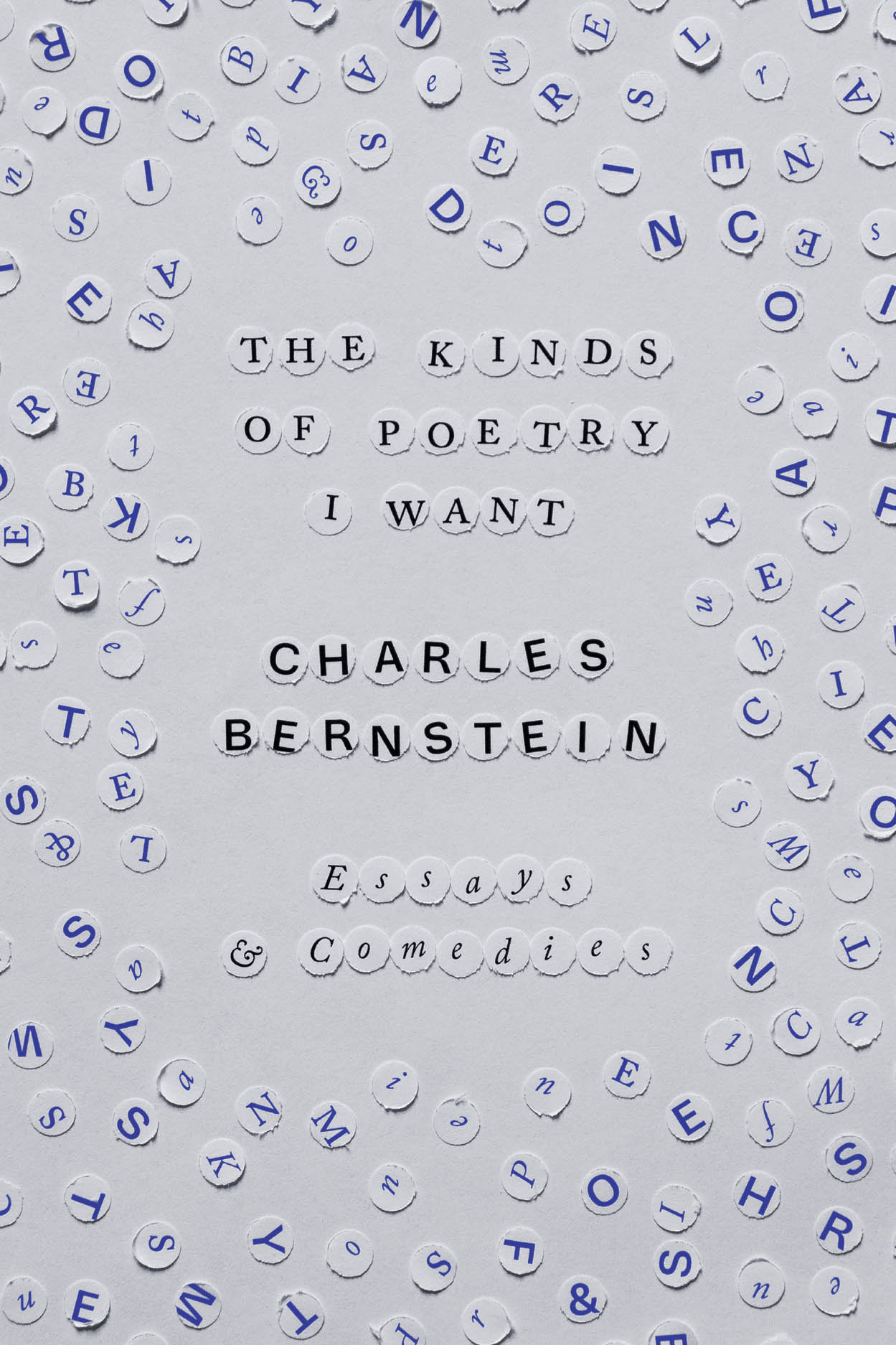
    This text is part of a b2o Review dossier on Charles Bernstein’s The Kinds of Poetry I Want. 

    Groucho Marxism: Charles Bernstein’s Kinds of Poetry

    Michael Davidson


                                                    “I am for avant-garde comedy and stand-up poetry” (350)[1]

                                                    “Am I just a voice crying in the wilderness, or am I a just voice                                                                     pleading aggrievement?” (163)

    The Secret Word

    In the opening of the 1950s quiz show, You Bet Your Life, the MC, George Fenneman would introduce Groucho Marx: “And here he is, the one, the only…”–leaving a blank for the audience to shout: “GROUCHO!”–followed by the theme song, “Hooray for Captain Spaulding.” Groucho, cigar in hand, would then display the “secret word” for the day which, if one of the contestants said it, would drop down from the ceiling, attached to a duck with a cigar (on one occasion, the duck was replaced by Harpo and on another, by Mamie Van Doran), and Groucho would hand the lucky winner $25.00 (later this amount was increased to $100.00). Fenneman would introduce our two guests for today’s quiz and step off stage, leaving the floor open for Groucho’s witty, often acerbic, repartee with the couple. As for the duck falling from the ceiling, these were the halcyon days of early television when the medium was figuring out how far it could go, what visual tomfoolery one could get away with. Ernie Kovacs was the inventive impresario of the medium, Spike Jones was its resident composer, and comics like Cid Caesar, George Burns, Henny Youngman, Milton Berle and others exploited the physical limits of the black and white screen and the unpredictable qualities of a live audience. Groucho’s verbal wit and arch retorts were somewhat improvisational, but they also subverted the interview format by endless asides and miscues. Was this avant-garde comedy or stand-up poetry?

    In Charles Bernstein’s terms, the secret word for today is “pataquerical,” a nonce formulation for his aesthetics that could easily apply to Groucho’s humor. What he calls the pataquerical is “a flickering zone of counterfactuals that allow for possibility, reflection, intensified sensation, and speculation” (11). In an earlier essay in The Pitch of Poetry, “The Pataquerical Imagination”, Bernstein finds one of its sources in Poe whose “Poetic Principle” expresses the scandalous belief that poetry “has no concern either with Duty or Truth” and that personal taste is superior to transcendent ideas” (Bernstein: 2016, 299). He also relates it to Marx’s critique in The German Ideology of young Hegelians for their belief in critique as a value for its own sake rather than as a dialectical process “that has no end point but like a Klein bottle doubles back on itself…” (Bernstein: 2016, 296). In its invocation of Alfred Jarry’s pataphysics, the pataquerical is a poetics of process, irresolution, and speculation and as a result cannot be confirmed by an appeal to “convention, accessibility, compromise, refinement, or humanist literary values,” qualities abundant in what he labels “Official Verse Culture” (OVC [296]). It is tempting to see the pataquerical as a version of what one interviewer calls Bernstein’s “Groucho Marxism,” his fusion of comedy and subversion, borsht belt humor and social critique. Against “aesthetic illiberalism” that neutralizes and normalizes, the pataquerical is like the duck, a “secret word” that drops down to interrupt the show and surprise the audience. Bernstein’s new book, The Kinds of Poetry I Want serves as a brief on the pataquerical in its multiple forms, both aesthetic and political.

    The title and much of its imperative are taken from Hugh MacDiarmid’s 1961 book, The Kind of Poetry I Want, which advocates “A poetry that is—to use the terms of red dog–/ High, low, jack, and the goddamn game” (MacDiarmid qtd. 153). There’s plenty of the red dog in Bernstein’s poker hand–from Lucretius, Sartre, and Tao Te Ching (high) to Bob Dylan, Thelonious Monk, and Cid Caesar (low). And the variation on MacDiarmid’s title stresses the multiple “kinds” of poetry Charles wants, wanting itself being a value seldom mentioned in aesthetic discourse. Writings about poetic value that posit some universal standard or monadic formal closure are countered by a word for unfulfilled desire: the kinds of poems he wants are the kinds of poems he finds lacking.

    The book is divided into three “acts,” each of which is subdivided into multiple “scenes” containing a wild mixture of genres: interviews, poems, homophonic translations, protestant letters, erasure texts, midrashic commentaries, concrete poems, and aphorisms. The range of genres is matched by the book’s heteroglossic display of idiolects—from broad-based comedy to stentorian jeremiad, from one-liners to flat-footed howlers, from scholarly analysis to cliché and bad puns. This variety reflects the venues in which earlier versions were published or given as talks. The lengthy interviews are among the most important statements of Bernstein’s poetics; his responses to questions from Vicki Hudspith, Thomas Fink, Braulio Paz, Andrew David King, Feng Yi and others give him a chance to elaborate on his favorite issues and incorporate often moving autobiographical information. He is a generous respondent, providing extended answers with attendant asides and detours that deflate some of the interviewers’ more ponderous questions. The book concludes with one of his most important essays, “Doubletalking the Homophonic Sublime,” that deals with the phenomenon of translations based on the sound of words rather than sense–from Zukofsky’s Catullus and David Melnick’s Men in Aida to his own collaborations with Leevi Lehto and Richard Tuttle. The tutelary genius of homophonic sublime is Cid Caesar whose doubletalking in nightclub routines involved a virtuoso highspeed imitation of various foreign languages, a routine that animates the essay’s opening remarks:

    Never met a pun I didn’t like.

        I’m a veritable Will Rogers, with plenty of roger but without the will to say enough’s       enough already. All instinct. Like a Brooklyn Ahab stalking a whale in the backyard or a     curmudgeonly Odysseus hurtling towards his sirens.

    But wait a sec.

    This is not the opening of a nightclub act. (349-50)

    But in one sense the essay is a kind of nightclub act using homophony to provoke other kinds of associations beyond the auditory.  

    In keeping with the parodic qualities of Jarry’s pataphysics, Bernstein engages in a wide-range of speech genres—from mock-didactic oratory (“I come to you today at the 138th Annual Convention of the Modern Language Association…” [155]), literary prize announcements (“…no one can doubt that this work is one of the most ambitious books of poetry published in our time” [312]) and hyperbolic jargon in recommendation letters (“What distinguishes Danniello, and makes him such a strong candidate for admission to our doctoral English program, is his deep animosity to literature” [319]). Like Pope and Swift before him, Bernstein tilts at the canons of approved public discourse by mimicking their authorizing rhetoric. Idiolects are more than ventriloquized satire; they carry the weight of their institutional provenance, the authority of the professoriate, the publishing industry, the academic marketplace through which literary culture is formed and reinforced.

    The Kinds resembles several of his previous collections, A Poetics, My Way, Attack of the Difficult Poem, The Pitch of Poetry, in its eclectic variety, but one through line is the work of Jewishness in an age of cultural cancellation and identity politics. He invokes T.S. Eliot’s infamous worry in After Strange Gods (1933) that “Reasons of race and religion combine to make any large number of free-thinking Jews undesirable” (Eliot qtd. 155).  As a self-declared free-thinking Jew himself, Bernstein recuperates free-thinking for the kinds of poetry he wants—that of Gertrude Stein, Louis Zukofsky, Larry Eigner, Hannah Wiener, David Antin, Johanna Drucker, Jerome Rothenberg, not to mention the borscht belt comedians he invokes. At one point he modifies Charles Olson’s opening to his book on Melville, Call Me Ishmael, by saying, “I take RACE to be the central fact for those born in the Americas. I spell it large because it comes large here. Large and without mercy” (33). In a way the substitution of “race” for Melville’s “space” recognizes the degree to which American manifest destiny of expansion was authorized by the erasure, relocation, and marginalization of racial others—including Jews.

    Which is not to say that Bernstein has not addressed Jewishness in previous works. Here, however, the theme is supported by his use of “midrashic antinomianism” that links Jewish rabbinical commentary with American Protestantism, or as Bernstein might say, Reb Ben Ezra meets Emily Dickinson (164). Both parts of the phrase stress the Word as an infinite possibility, unsettled in its meanings and tolerant of its misunderstandings. Midrashic antinomianism could apply equally to avant-garde writing or Jewish humor: “Groucho Marx’s jokes are allegories of escape and especially escape from being defined. The Jewish comic, like the Jewish poet, dodges, deflects, evades, ducks” (45). Bernstein devotes many passages in the book to his own relationship to secular Jewishness, growing up in an assimilated household, albeit, as he has said, with Jewish and Zionist identifications.[2] Antisemitism was prevalent in Bernstein’s early life at Harvard and became linked in his mind with more conservative literary traditions, often, ironically enough, traditions reinforced by Jewish academics and poets. In a lengthy letter to Paul Bové included in the book, Bernstein discusses Lional Trilling’s The Liberal Imagination as an example of cultural consensus among Jewish intellectuals of the cold war period who also “dodged, deflected, evaded and ducked” in order to assimilate. Trilling was not a Jewish neocon of the Commentary variety like Norman Podhoretz or Hilton Kramer, but he nevertheless embodied an “Arnoldian figure of a high culture where Jews might be heard if not seen as such“ (298). Thinking of Trilling’s student, Allen Ginsberg and his Columbia classmate, Louis Zukofsky, Bernstein sets up a contrast between the “illiberalism” of Jewish Cold War intellectuals and writers who confronted antisemitic headwinds by different means.

    In The Kinds more radical strains in Jewish cultural traditions are linked to avant garde practices, but Bernstein realizes that experimental poetics itself has recently been attacked for its presumed racial exclusions. With events such as the Mongrel Coalition for Gringpo manifestos of 2015, Janet Malcolm’s attack on Gertrude Stein in the New Yorker, Dorothy Wang’s reconsideration of the “Poundian-Objectivist-New York School-Language-Conceptual tradition,” Juliana Spahr’s and Stephanie Young’s critique of the “white room” of academic writing programs, experimental writing is suddenly under the microscope for its whiteness and, in Malcolm’s case, Fascist complicity.[3] In Natalia Cecire’s terms, “Experimental writing is a white recovery project” (Cecire, 2019: 34). Implicit in these responses is the idea that formal experiment erases identity, both personal and cultural, and that its endeavor is purchased by silencing minority voices, histories, idioms. Kenneth Goldsmith’s conceptualist performance of Michael Brown’s medical autopsy would be the most notorious version of such practices and has been the object of numerous anti-racist critiques. Identity, as Bernstein acknowledges, “remains a volatile issue for the poetics of invention,” nowhere more evident than in antisemitic attacks:

    Ezra Pound’s attack on Jews as rootless cosmopolitans echoes in today’s culture debates. The ahistorical/revanchist quest for a deep or authentic identity as the sole property of a single group, which has fueled the rise of the global right, is toxic for the kind of poetry I want. (39)

    This toxicity, however divisive, fuels a good deal of the book’s tone of aggrievement (more on this later) and its attempt to understand the precarious status of Jewish writers as both outsiders (“rootless cosmopolitans”) and poetic innovators. Bernstein seeks to realign a politics of race and anti-racism with rootlessness as both a cultural and aesthetic value, not by advocating a revolution of the different but by bringing more of Groucho to the Marxian table.

    Taste or What I Want

    The pataquerical has an ethical component in its emphasis on the unfashionable, the mundane, the awkward, the banal. By exposing the all too familiar (and thus disparaged), Bernstein hopes to create an expanded field of knowledge against fixed and accepted standards. Poems that win prizes and appear in The New Yorker or New York Review of Books or that are taught in creative writing programs are, in terms Bernstein develops elsewhere, “absorptive,” drawing the reader into the poem, affirming what one already believes, while effacing the ideology and historicity of its production.[4] The agonized voice of Lowell or Plath gives way in the 1970s and 1980s to a more self-effacing voice, what Charles Altieri calls the “scenic mode”: “The task is not to transform the social but to make voice an index of how we can register the complexity of the given and thus develop our personal powers for responding to experience” (Altieri, 1984: 36). Official Verse Culture (OVC) is somewhat of a red herring today, however, since its confessionalist prototype is rather out of fashion. And more to the point, OVC now includes many of Bernstein’s friends and fellow poets who appear in those venues and teach in those programs. Perhaps mainstream poetry is a necessary fiction by which to measure the poetry one wants.

    Bernstein asserts the positive value of taste in defining his poetics, and in this respect counters Kant’s privileging of aesthetic judgment and disinterestedness over taste by asserting his own will to choose. Kant says when we put something on a pedestal as beautiful, we presume that others must find it so (“the delight in an object is imputed to every one” [Kant: 1952, 53]). But if we speak of something being beautiful for me we judge based on interestedness and quotidian circumstance. In the aesthetic tradition from Kant and Baumgarten to Arnold, Eliot and the New Criticism, judgments based on personal taste are lesser forms of appreciation since they do not aspire to universal assent. But its minority position allows for greater freedom: “[Larry] Eigner may well be an acquired taste. But for the kind of aestheticism I want, all tastes are acquired. You feel it on the tongue before you prize it in the mind” (167). Here affect trumps reason; we taste pleasure before we digest it as pleasurable. There is a risk that in claiming personal taste as a value he engages in a specious form of aestheticism that argues for specificity as an end in itself. Occasionally that risk produces a kind of aesthetic nervousness: “Am I just a voice crying in the wilderness, or am I a just voice pleading aggrievement?” (163).

    The term “aesthetic nervousness” is used by Ato Quayson to describe the encounter of an able-bodied person with someone with a disability. He explains that this encounter may be startling or uncomfortable, but it also instructs one about the body presumed to be normal. I’ve adapted Quayson’s term to describe the aesthetic nervousness deriving from an encounter with the “different text”–one that refuses absorption, veers in unpredictable directions, poaches on other idiolects and speech genres. The phrase also refers to Bernstein’s willed fence-straddling around his voice–whether a Cassandra or an Achilles. In both cases—the reader’s confrontation with the unsettling text or the poet’s ambivalence about the impact of their words—a kind of revelation is possible.

    Disability theorists might call the knowledge gained by such a revelation as a form of “cripistemology,” how living with physical or cognitive difference produces alternate forms of knowledge, ways of seeing, hearing, thinking. Bernstein addresses this issue in his essay on the pataquerical in The Pitch of Poetry by referring to the work of disabled poets such as Jennifer Bartlett, Hannah Weiner, Jordan Scott, Amanda Baggs and others whose work is a direct outgrowth of neurological and developmental conditions. A cripistemological approach to their work is antithetical to what many people regard as triumphalist compensation where, because of a physical or cognitive limit, the poet “adapts” to another sensorium or medium. Rather, cripistemology describes a critical perspective on social norms and conventions derived from living in a different bodymind. Bernstein’s own perspective is formed by living with a form of cognitive dyslexia that impacts his spelling and word order and, beyond that, inspires his verbal wit:

    Then again, the comedy I use is sometimes linguistic pratfalls: mistakes proliferate. That may be a way to cover my own cognitive dyspraxia, my tendency to invert words and letters and confuse left and right. Freud called such slips of the tongue parapraxis. And that’s another root of pataquerics (234)

    For Freud “slips of the tongue” or parapraxes signal the eruption of repressed content, an unconscious substitution of a wrong word to cover a word with traumatic associations, often of a sexual nature. Dyslexia, however, is not about repressed sexual urges (Bernstein might beg to differ) but is a neurodevelopmental condition relating to language processing and the ability to form words and word sequences. His dyslexia is evident in poems like “Defence [sic] of Poetry,” a response to an essay by Brian McHale that deals, in part, with Bernstein’s work and whose academic prose is undermined by the poet’s dyslectic inversions:

    My problem with deploying a term liek

    nonelen

    in these cases is acutually similar to

    your

    cirtique of the term ideopigical

    unamlsing as a too-broad unanuajce

    interprestive proacdeure. (Bernstein: 1999, 1)

    I’ve discussed this poem elsewhere but see it as an instance of Bernstein’s displacement of reasoned discussion (a poet’s response to his critic) by neurodiverse means.[5] Its title invokes Shelley’s “Defense of Poetry” (also a response to a critic, Thomas Love Peacock) but its typographical errors, often based on McHale’s language, transform a speech or writing “defect” into a generative repurposing of the critic’s language. In his essay, McHale speaks of difficult poetry deploying a kind of nonsense (e.g. versus “common sense”) that “ should be valued for itself, not as “a critique and demystification of current language practices” as he claims language-poets advocate (McHale: 1992, 25). Bernstein would rather speak of the “ideological” importance of those practices, the degree to which nonsense makes sense by unsettling expectations, and undermining seriousness. What I have called the cripistemological is when an ableist truism—your speech defect must be fixed—is cripped by exploiting the means of vocal production differently–in other words, to use error as another kind of sense. “Poetry, the kind of poetry I want, is not the unmediated expression of truth or virtue but the bent refractions, echoes, that express the material and historical particulars of lived experience” (43).

    What I’ve called the ethics of the pataquerical appears when the counter-intuitive, counter-factual aspect of the poem creates, to paraphrase A.N. Whitehead, speaking of propositions, a “lure proposed for feeling” (Whitehead: 1960, 284). The end of the poem is the opening of (lure to) possible alternative avenues of meaning, sensation, knowledge. The book’s opening work, “Ocular Truth and the Irreparable Veil,” illustrates–quite literally–how a text “opens” possibilities by “closing” off its textual surface. “Ocular Truth” is a heavily redacted version of several prose essays, words and phrases blacked out to reveal a second hidden or alternate text. The poem’s title, based on Othello’s demand of Iago that he provide “ocular truth” of Desdemona’s infidelity is here complicated by a poem whose ocular truth is both revealed and obscured by blacked-out passages. One discerns a complex unweaving of several political themes concerning racism and cancel culture in a work that cancels portions of its prose. In the poem’s most readable (least censored) section, Bernstein responds to a New Yorker article by Peter Schjeldahl about the controversy over the cancellation of several exhibits of Philip Guston’s work.[6] The art critic sees these cancellations based on Guston’s representation of Ku Klux Klan images as “exemplifying divisions that are splintering the United States,” including attacks on cultural institutions, curricula, and public forums (Schjeldahl: 2020, 78). In his article Schjeldahl refers to those “cosmopolitan” audiences who complain of such cancellations and who espouse openness to troubling material against those who argue that an exhibit displaying racist subjects curated by an all-white staff is repugnant. Schjeldahl is of two minds, wanting to see the show but sympathetic to those “who neither find humor nor seek subtlety in racist symbology” (Schjeldahl: 2020, 78; Bernstein: 2024, 8). Bernstein seizes on the contradiction of an art critic who uses “cosmopolitan” to refer to an elite, culturally blinkered art audience when the term has historically been applied to Jews—like Philip Guston. It is as though one racial client has erased another, a fact embodied in a text censored like parts of Pound’s Pisan Cantos or Cold War FBI files. “Surely the problem,” Bernstein says in the poem, “is that Guston’s [word blacked out] figures are too legible—especially when coming from rootless cosmopolitans and cultural Bolshevists” (8). This is the conundrum that pervades the tone of aggrievement: that the cancellation of one form of art for revealing racism cancels an artist who is the historical subject of racism. Bernstein’s erasures, then, are perhaps the most “ocular” way to illustrate this conundrum. It is probably significant that Schjeldahl’s article was written on the cusp of the 2020 Trump election, an event that anticipated a more pervasive and troubling erasure of culture.

    A Voice Pleading Aggrievement

    The inaugural poem of this book sets the tone of aggrievement that permeates many of the essays and interviews. In one section Bernstein provides a mock blurb for an imagined anthology called “Alter Kockers”, using the Yiddish term used in Jewish comedy for an “old shit” and that includes “centuries of poems of bad advice and denial, guaranteed to pour salt on wounds large and small from poets who developed exquisite expertise in nursing ‘old wounds in old age…” (285). This may be Bernstein’s rueful comment on the resentment that comes with aging, now satirized in an anthology distributed by the “You Bet Your Life! Press’s Dorothy Parker collection.” It may also be a reference to the feeling of world-weariness in the current political battle over relevance. The Right is aggrieved at Wokeness while the Left is aggrieved at the Right’s aggrievement. Aggrievement is different from Nietzsche’s use of ressentiment to describe the resentment of the slave class at their subservience, placing the blame for their oppression onto the dominant class. Trump-era aggrievement would seem to be transactional, a zero-sum game of accusations and retribution rather than a dialectic of masters and slaves.  Today’s aggrievement is a vicious circle: “A nightmare is haunting America and Europe; its slogan could be: ‘I am aggrieved by your aggrievement’” (42). The danger as Bernstein points out is a depoliticization and a “reversion to instinctual loyalties” (42). Aggrievement takes several forms in the book, despair at the failure of the poetics with which Bernstein is identified to accomplish a revolution in aesthetic tastes and practices. He is also aggrieved at the ways that this poetics has been attacked for its whiteness, elitism, racism, cosmopolitanism, the latter term marking the return of the repressed antisemitism associated with rootlessness. And finally, aggrievement describes the historical moment of Trump’s ascendency, his attacks on knowledge, culture, science, immigrants, and people of color.

    But a final association with the term is the hidden “grief” in aggrievement, and here Bernstein’s own grief over the tragic death of his daughter, Emma, haunts his concerns about a world in a perpetual agon. To hear “grief” in aggrievement, is to rescue feelings of loss out of social resentment and suffer the calamity of one’s aggrievement: “The enemy of my enmity is my calamity.” Or again, “When the child dies, the father dies. It’s a mortal wound. What disappears in death grows wild in imagination” (152). Aggrievement may be the ontological form of dialectics, the way bottomless melancholia may be harnessed for resistance and critique. The mortal wound of a family’s loss cannot be healed, but it produces a wild imagination in the breach.

    Conclusion

    Being aggrieved can lead to a vertiginous binarism: “hatred of the avant-garde is prerequisite for entry into any official verse culture worth its smelling salts. the avant-garde is a

    good target because it is, indeed, populated by fascists, miscreants, and malcontents…” (157). But surely the former holder of the Gray Chair of Poetics at Buffalo, the Donald Regan Chair at Penn, Fellow of the Academy of Arts and Sciences, winner of the Bollingen Prize— protests too much. This contradiction between the scourge of OVC and its invited guest speaks to Bernstein’s pataquerical imagination, attacking binaries by occupying them. OVC may be a straw man for a condition that doesn’t exist, but that’s no reason not to witness its impact, suffer its disregard. The “essays and comedies” as his subtitle to The Kinds indicates are spirited responses to various occasions and provocations, a chance to talk back to interviewers and interlocutors who, in some cases, have a much too sedimented notion of what he’s up to. Like Groucho, he unsettles those assumptions by not sticking to the point, going off on tangents, quoting a few lyrics from a Rogers and Hart musical.

    The Kinds of Poetry I Want, like much of Bernstein’s work, courts its own instability, Neither a book of criticism, poetry, vaudeville act, or some kind of hybrid genre it’s all of the above and a good deal more. The book’s willingness to be uncool, even silly, makes it vulnerable to attacks by both conservative critics and Marxist scourges, attacks he encourages. The provocative nature of Bernstein’s often unfashionable positions is an occasion for dialogue, contestation, response. But as I’ve said with regard to its treatment of aggrievement, there’s a cost to being rootless, and the book records the historic implications of this condition as well as his own relationship to that charged condition. Like his friend, David Antin whose talk pieces fall between the stools of poetry, philosophical discourse, and stand-up/ improv, Bernstein’s pataquerical imagination pursues a poetics of errancy, what he calls “Aversive thinking” (“Avoid frame lock, trouble consistency” (341). In this book’s mosaic of genres and literary styles he avoids frame lock almost successfully. Emily Dickinson in one of her letters to Higginson, says, “If I feel physically as if the top of my head were taken off, I know that is poetry.” (Dickinson: 1986, 208) In Bernstein’s case, if a word falls from the ceiling, he knows that’s poetry.

    References

    Altieri, Charles. 1984.  Self and Sensibility in Contemporary American Poetry. Cambridge, U.K.: Cambridge University Press.

    Bernstein, Charles. 2011. Attack of the Difficult Poems. Chicago: University of Chicago Press.

    —. 2024. The Kinds of Poetry I Want: Essays and Comedies. Chicago: University of Chicago Press.

    —. 1999. My Way: Speeches and Poems. Chicago: University of Chicago Press.

    —. 2016. The Pitch of Poetry. Chicago: University of Chicago Press.

    —. 1992. A Poetics. Cambridge, MA: Harvard University Press.

    Cecire, Natalia. 2019.  Experimental: American Literature and the Aesthetic of Knowledge. Baltimore: Johns Hopkins University Press.

    Davidson, Michael. 2022. Distressing Language: Disability and the Poetics of Error. New York: New York University Press.

    Dickinson, Emily. 1986. Selected Letters. Ed. Thomas H. Johnson. Cambridge MA: Harvard University Press.

    Kant, Immanuel. 1952. The Critique of Judgement. Trans. James Creed Meredith. Oxford: Oxford University Press.

    McHale, Brian. 1992. “Making (non) sense of postmodernist poetry.” In Language, Text, and Context: Essays in Stylistics. London: Routledge): 6-35.

    Olson, Charles. 1947. Call Me Ishmael: A Study of Melville. San Francisco: City Lights Books.

    Plath, Sylvia. 1981. “Lady Lazarus.”  In The Collected Poems of Sylvia Plath. New York: Harper and Row. 244-47.

    Quayson, Ato. 2007. Aesthetic Nervousness: Disability and the Crisis of Representation. New York: Columbia University Press.

    Schjeldahl, Peter. 2020. “Us Cosmopolitans.” New Yorker 96.32: 78-79.

    Whitehead, Alfred North. 1960. Process and Reality: An Essay in Cosmology. New York: Harper and Row.

    [1] Charles Bernstein. The Kinds of Poetry I Want: Essays and Comedies. Chicago: University of Chicago Press, 2024. Page numbers for all subsequent references to this volume will appear in parens without the title.

    [2] For a full account of Bernstein’s early life see his interview with Loss Pequeño Glazer, “An Autobiographical Interview,” in My Way, pp. 229-52.

    [3] On the Mongrel Collective see Alec Wilkinson, “Something Borrowed.” New Yorker, Sept. 28, 2015. https://www.newyorker.com/magazine/2015/10/05/something-borrowed-wilkinson; Janet Malcolm, “Strangers in Paradise: How Gertrude Stein and Alice B. Toklas Got to Heaven.” The New Yorker November 6, 2006; Dorothy Wang, Thinking Its Presence: Form, Race, and Subjectivity in Contemporary Asian American Poetry. Stanford: Stanford University Press, 2014; Juliana Spahr and Stephanie Young, “The Program Era and the Mainly White Room.” Los Angeles Review of Books, Sept. 20, 2015 https://lareviewofbooks.org/article/the-program-era-and-the-mainly-white-room/.

    [4] See Bernstein’s “The Artifice of Absorption,” in A Poetics, pp. 9-89.

    [5] See Distressing Language: Disability and the Poetics of Error, pp. 78-81.

    [6] Peter Schjeldahl, “Us Cosmopolitans.” New Yorker 96.32 (19 Oct., 2020): 78-79.

  • Kacper Bartczak–Withstanding the Horror of What We Are

    Kacper Bartczak–Withstanding the Horror of What We Are

    This text is part of a b2o Review dossier on Charles Bernstein’s The Kinds of Poetry I Want. 

    Withstanding the Horror of What We Are: Charles Bernstein’s “bent studies” Beyond the Loops of Intentionality

    Kacper Bartczak

    I am not American. I am Polish. I speak Polish and American English. I read Polish and English. At times, when I think better of myself, I read German. For example, the Austrian German of Wittgenstein’s early diary entries, lined side by side with their English counterparts, thanks to the loving work of Marjorie Perloff. So I shuttle between the bilingual recto and verso on the pages of this book, and I read. My reading then is in – what – English or German? Or maybe it is still in Polish? And what about the shuttling itself? Is it Polish, German, or English? Hopefully – none. Still, I am not American. But what is America, or where is it?

    Emerson (2001, 126) wrote about those who live in conformity: “Their every truth is not quite true. . .every word they say chagrins us.” Charles Bernstein is an American in a sense that is completely lost on vast areas of our contemporary culture. It is a culture of some large scale  malaise, the core horror of which is the undermining of the American project I have learned and taught about for all my life. To my grief and chagrin, I sense, feel, and hear about this undermining, almost on a daily basis now, even here, in my home on the outskirts of Łódź, Poland. Bernstein is American in one of those senses that Stanely Cavell speaks about when he envisions America as a goal or idea yet to be arrived at. A large part of striving to arrive at that place consists in continual strife against the conformity of established ways of speaking and thinking. Cavell (1989, 69) quotes Emerson on conformity, in his New Yet Unapproachable America, as part of his elaboration on the idea of self-reliance, which, as Cavell also demonstrates, is a form of “aversion [as] conversion.” At a different place, Cavell (2003, 113) calls this stance “aversion [as] the countering of diction,” an act of inquiring into the condition of our conditions. Drawing on those core sources, the always-already open American canon, Bernstein (2011, 78) creates his plea for “a poetics of poetics,” or a poetic practice which he wants to be “provisional, context-dependent, and often contentious” (2011, 75). Those whose truths and words “chagrin us”, more so today than any at any other time in the last century or so, live in a place they call America (or Poland, for that matter, as their counterparts do over here), without realizing that they dwell in a state of insulation, creating a culture marked by “its inability to listen to itself” (Cavell 1989, 69). But America, this new yet unapproachable place, is elsewhere.

    There exists a region of vitalist reverberation that consists in the skill of participating in the excesses available to the human speaking organism, in which the separation of word and object, mind and body, thought and action fall off as dead weight of stale arguments. This is a truly American region, where word and world meet beyond the philosophical conundrums of reference or argument based in rule-based, conditions-laden epistemologies and ontologies. In his essay “Finding as Founding,” Cavell (2003, 114) connects this mode of being to “[Emerson and Thoreau’s] vision that the world as a whole requires attention, say redemption, that it lies fallen, dead.”

    Much more than any physical region, this America is a non-geographical, redemptive predisposition, in which a state of attentive inclusiveness is achieved, which the Polish scholar Tadeusz Sławek (2014) called “the community of the world,” in a book length study under this title. Within this larger community, all forms of matter – humans, non-humans, language, the beliefs or criteria shaped in it, and material objects – are brought to their proper life, back from where their lie stagnant when left to norms. The America in question is not a place, then, but a mode of active predisposition which conjures up a region. As Lyn Hejinian (2000, 153) wrote, in this region “the materials of nature speak.”

    But how do they do it? Are they all, and at any given time, endowed with life and vibrancy of their own, without human agency, as some contemporary post-humanist thought sees it? Or is there an alternative way, one that by-passes the discussions around the limits of the anthropomorphic, some sort of alternation in our seeing the nature/culture divide? Bernstein’s “poetics of poetics”, or poetics of performance, his poetico-philosophical ongoing program in which the event of the poem, its intense “Now./ Not now. / And now. / Now” (2016, 300), as Bernstein puts by way of quoting Gertrude Stein,  affords an exhilarating entry into this alternative. His is a continuation of the Emersonian, Whitmanian, Thoreauvian, Jamesian (I mean William James, whose “radical empiricism” stands, among other influences, behind Hejinian’s thinking about poetry) and finally Cavellian program of relearning to inhabit the world by relearning our own condition of being language using animals.

    It is a continuation by radicalization. One of its effects is keeping linguistic innovation in the poetic game long after the dissipation of all sorts of linguistic turns that dominated humanities toward the end of the previous century. Another is such rechanneling of that program that it can now inform swaths of contemporary multi-national poetics. Finally, Bernstein’s contribution is in making us attend more closely to some of the key concepts in Cavell’s discourse, notably those related to the notion of poetic object and, intentionality, and its meaning or meaningfulness. If the materials of the worlds truly spoke, what would they say? And would we be able to understand them? Whose would be the intention that stirs those utterances and what would be the intended meanings?

    With all of its rampant diversity, its refusal to fall in line with any generic categorization, Bernstein’s latest title, The Kinds of Poetry I Want, continues that line. The Cavellian themes are not prominent, and yet they inform the volume unmistakably. We hear them first in the very title. Its semantic and grammatical form is a ruse, a promise of an answer that will be both fulfilled and broken. It will be broken, because after reading the volume we will understand that there is no poetry that Bernstein wants, or prefers, that could by kept within the boundaries of a kind, a category, or a genus. And yet, this very erasure of the essentialist conceptual scheme standing behind the idea of the “kind” of any linguistic utterance, particularly one that wants to be poetic, the erasure that bursts out the available conceptual bounds, is precisely the kind of poetry Bernstein has wanted and has taught many of us to want too.

    The kind of poetry Bernstein wants, is an intensification of the main line of what I understand to be American – the art that helps the human linguistic organism to make its way amidst forms of boundless excess, learning to appreciate it, to see it as a political model, sustaining one’s vitalist position, without getting pulverized by chaos. Names and categories exist in Bernstein’s discourse as temporary and provisional energetic nodes that serve as grist for the situation of the poem. They often become preposterous mock catalogues demonstrating to us the futility of trying to arrest the poetic flow – they are madness in response to our madness of classification. One example is a poem titled “Solidarity is the name we give to what we cannot hold” (Bernstein 2010, 221-23). It is a parody of the urge to classify poets and poetries. Yet, the speaker paradoxically becomes a poet by denying throngs of the categories – aesthetic, theoretical, geographical, political, others – of poets miraculously, and, as we can see, preposterously, amassed by the existing discourses.

    This method is echoed in the current publication in a piece called “No Hiding Place.” A long list of lines beginning with the phrase “I thought language poetry was” revisits and reasserts the various aspects or characteristics that might have been used to describe Language poetry. Some of those may be funny or non-sensical, for example: “I thought language poetry was sympathy without tea” (Bernstein 2024a, 36). Most, however, seem to originate from earlier discourses of theoretical debates around Language poetry, in which they had been used with a clear intent to signify stable meanings. And yet, when amassed in the new piece, the characteristics seem to work against each other. A melee of features results. Its very profusion annuls the project of arriving at a final shape of the object in question. The text returns us to the very heart of the anti-programmatic ideal of Language poetry, which was an avant-garde without a set of rules, more a site of communal language-oriented practice and an ongoing inquiry into the question of its maintenance and livelihood than a pursuit of a program.

    It is in such apparently self-absorbed linguistic passages, where the foregrounded aspects of language – grammar, word choice, rhetorical productivity – create an impression that the world has been obliterated by discourse, that the world in fact returns, much more vividly than in topical poetry. In another early poem, a short piece called “The Kiwi Bird In The Kiwi Tree”, we read: “I want no paradise only to be / drenched in the downpour of words, fecund, with tropicality” (2010: 142). These become a “fundament be-/yond relation, less ‘real’ than made” (142), which leads us to Bernstein’s insistence, pronounced elsewhere, that poetry is a difficult faith in having a world by agreeing that writing is its own reality. In another early text, Bernstein (1986, 50) writes: “I want in my writing a texture of wordness opaque and alone.” This one also which carries an epigraph from Thoreau: “I was determined to know beans.” While the title plays with the idea of the palpable presence of the objects of the world, the suggestion here, an idea in which Bernstein takes after Cavell, is that no particularity – no direct contact with the materials of the world – is possible without the textured wordiness founding our actions in the world. That is why, “these words, or those in poems, are not used to describe events in the world that have already occurred…. but to attend to the internal event that is taking place in it” (50). In other words, it is only within the event of the poem, an artificial space of its attentiveness, that the world has its truest event itself.

    The event of the poem is Bernstein’s version of the Thoreuvian and Cavellian call to reinhabit the world by redeeming it from the conformity of settled meanings. This theme appears early in the new volume, in the opening text-performance – a piece densely marked by erasure and elision – titled “Ocular Truth and the Irreparable Veil.” Interestingly, its dense elliptical play quite openly gets us in the vicinity of the Emersonian/Cavellian thematics. Its mock epigraph, a disfigured utterance – “Nature is too much with us, [ellipsis in the original text] or [ellipsis in the original text], / Little we see in culture, that is” (Bernstein 2024a, 3) – is a mini-vortex recycling themes from Thoreau. It is only by remaking our culture and actively reimagining it that we can find the right measure of our distance or proximity to nature. In other words, if we treat culture as an artificial thing, we should see nature as such too, beyond the limit of the myth of the given. The aversion to this myth is signaled in the very first line of “Occular Truth”: “’Deficit’ is always the given, [ellipsis in the original text] fate, [ellipsis in the original text] acknowledgement / [ellipsis in the original text] of limitations or blindness” (3).

    Here, the given is “deficit”, but also “fate”, what Emerson theorized long ago as necessity and limitation. The composition of the line works with the truth value of this statement but also away or around it, through a rhythm of elisions. As a result, the existing argument enters an altered space. This is Bernstein’s own version of the aversive practice of “finding as founding,” a Cavellian device, now performed on the Cavellian/Emersonian material. It resurfaces openly later in the poem, in one of its few more complete, least elliptical paragraphs, in which Bernstein connects the Cavellian thought to his own post-secular reimagining of religion without the absolute. In this model, the living word is Emersonian “life”, a permanent avoidance of being based in declarations. The existing words, discourses, utterances are enabled, by the event of the poem arranged by Bernstein, to reenter their proper state of the flow, in which they live by acquiring a new connective aura in a new environment. Hence, in the fragment in question, rather than proposing a discussion on the issues of the absolute or its non-existence, the poem proposes itself, its own space, or “body” (the very next piece in the new volume is titled “The Body of the Poem”). In it, the question of the absolute is replaced by the “urgent task of finding, and making, truth: Finding by making, making by finding, finding by founding, making by foundering” (Bernstein 2024a, 8). If general or abstract concepts, such as the absolute, are included in the work catalyzed in this new space, so is the existing transcendentalist textual and conceptual corpus. Echoed, and distorted, the Cavellian discourse is fed into the event of the new poem, which thus rescues it from congealing into a final truth, or meaning as settled cognitive content. It is performed, as Bernstein would say, with the hope of obtaining a new spin.

    Cavell himself will return in the book, in a section called “Shadows…”, where Bernstein offers a memory of his teacher. He focuses on Cavell’s method of teaching a philosophical text by bringing words, phrases and sentences alive through treating them as script, staging them. If a philosophical text has a point germinating in it, if it has a cognitive content, it can only exist in, with, and through the linguistic material it was originally composed in. Philosophy must be relived in its own materials and for that purpose it must be rehearsed, like music, improvised like a composition, in front of a new audience: “He turned phrases of Thoreau’s around the way Miles Davis turned a musical phrase of Irving Berlin’s ‘How Deep Is the Ocean’ or Thelonius Monk (a favorite of his) lifted and reworked the chord changes of ‘Blue Skies’” (Bernsten 2024a, 72). Teaching philosophy becomes a practice of “sounding” the language – that is the material – of its source, a method which fleshes out Thoreau’s original action, as it was theorized by Cavell: “By sounding the sentences of Walden, Cavell was able to sound the limits and possibilities of his thought, as Thoreau had sounded the depth of Walden Pond” (73). In an earlier piece, Bernstein (2024b, 274) said that through his method Cavell succeeded in “making the words [of Walden] his own and making them ours, too, as active listeners” (emphasis added).

    What happens when the language of a text, such as the text of Thoreau’s Walden, is made “ours”? First off, there is felt a removal of the line dividing the text of philosophy from the text of creative literature. The text becomes a multidimensional object in the process of its coming into being and we are now able to participate in it – in the event of its unfolding meanings. We enter the area of the Cavellian concept of the intentionality of the artistic object. Philosophy is at its best when it can be treated as a poem, or another object of art, about which we know, as Cavell puts it, that they were “intended”, or “meant”, in a sense that they were meaningful to us as creators or recipients (the line between the two gets fuzzier and fuzzier the deeper we proceed in the process). In Cavell’s reading, what Thoreau managed to do was to bring language – the ordinary language of men in the street – back to the state of aliveness. Reinstating vital exchanges between objects of the world, his own finite bodily condition and his language, Thoreau returned us to an awareness of our responsibility for the habitat, a space that the Polish scholar, Tadeusz Sławek called “the community of the world”. Such community comes to life in a space which only comes to being through an act of care and commitment. The position of the subject in this act is of exactly the same kind that Cavell describes when he talks about the intentionality of the objects of art, such as poems.  

    This argument is presented in Cavell’s Must We Mean What We Say, a study about which Bernstein (2024a, 72) confesses in the new publication that it “completely absorbed him,” immediately when it was published. Cavell argues, partly against the New Critics, that an object of art is made of materials, but the task of the recipient is to find a mode of seeing how they were part of an action that was a form of care for them. It is this care that he calls “intention” – a kind of position on the part of the creator, to be re-enacted by the recipient, which treats the material of the new object as endowed with meaning. It is important, however, to pause and consider the meaning of what Cavell means by the terms intention and meaning. Objects of art are materials, which, like ordinary language of the street for poets, or everyday objects or paint for visual artists, are suddenly bestowed upon with special attentiveness. Cavell (1976, 197) asks: “Could someone be interested and become absorbed in a pin or a crumpled handkerchief,” and goes on to explain that, in the case of an artist, this would not be an ordinary sort of interest or absorption. Much more than that, such absorption, intended to result in turning the materials in question into objects of art, must have been a form of enhanced care: “Objects of art [do] not merely interest or absorb, they move us; we are not merely involved with them, but concerned with them” (Cavell 1976, 197-98). This attentiveness is at the heart of what Cavell treats as the nexus of meaning and intention: “we treat them in special ways, invest them with a value which normal people otherwise reserve only for other people… the ‘mean’ something to us” (198). Within the space of the art object, the materials become “meaningful”. However, importantly, this meaning is not the same as the cognitive value of utterances: “they mean something to us, not just the way statements do, but the way people do” (198, emphasis added). He then reinforces this point, later in this important paragraph, by adding: “A work of art does not express some particular intention as statements do” (198). Instead, works of art “celebrate the fact that men can intend their lives at all” (198). This sense of the concept of meaning and intention is at the heart of the vibrant creative line that leads from Thoreau to Bernstein, and it is crucial to the position that I signaled above, one that is expressed in Lyn Hejinian’s calling for a kind of poetry that will let “the materials of nature speak”.

    The subtlety and complexity of this line becomes more clear when we put is side to side with the way the concept of intention is used by the argument of a group of scholars referred to as intentionalists. Cavell is sometimes called upon by them as an ally who has helped clarify the vexed problem of the intentionality of the work of art, by showing intentionality to be a position that is shaped as we move deeper into the work of art. But the attempt to recruit Cavell to the intentionalist camp seems to narrow down his general point, and more particularly, his reading of the American transcendentalist position, formulated in Emerson and Thoreau, and adapted to the shapes and forms of contemporary poetry, the poetry that has digested the findings on the nature of language-world relations offered not only by its historical lineage (from Romanticism, via modernist experimentation, to its continuations), but also by large areas of philosophy (Wittgenstein and Heidegger, especially, in the case of Cavell, a group adumbrated by Derrida in the case of Bernstein) and attendant literary theory.

    In the seminal essay “Against Theory,” which inaugurated the intentionalist position, Walter Benn Michaels and Steven Knapp argued against the understanding of intention and interpretation offered, through his reading if Husserl, by E. D. Hirsh, on the one hand, and Paul de Man’s deconstructive radical separation of literary language from intention and meaning on the other. It is the Hirsh part their argument that interests us at this point. Let us recall the basics. Language is not random noise – ran Michaels and Knapp’s main line of argument, which is fundamentally ontological. It is a form of intentional action, an act behind which stands an intended position of the person who speaks. Should a bunch of sticks or other materials, washed out on beach sand by the ocean look like letters, or even more surprisingly like lines of a poem, we should resist the sense of wonder, get back to our better sense, and recognize the pattern for what they are, on their fundamental ontological level, which is nothing else than a bunch of sticks, not a text, so reading the patterns for poetry would be naïve and childish. The bits and pieces of matter on the sand have been aligned into a pattern only resembling writing; they are not writing, because writing and language in general is matter organized into a code in which the message is intended by an agent capable of such intending. Our very ability to read a text rests on the initial act of generous endowment: prior to proper reading, or communication in general, stands our decision of circumscribing groups of signs and putting them generously inside the set or class of intended communication, which in practice means positing the intentional speaker as their originator. To read groups of noises as language at all is to be “already committed to a characterization of [their producer, or their very source] as the speaker of language” (Michaels and Knapp 1982, 726). This position entails intentionality. A speaker is a speaker of language, not just a primate producing inchoate babble, when we posit intention to communicate. For or a group of marks or sounds to be recognized as language, “we must already have posited a speaker and hence an intention” (726).

    Further, intentionalists take a purist stance on the identity of intention and meaning. In this, they radicalize E. D. Hirsh’s Husserlian position, and press for sticking to the latter’s starting point of identifying the meaning of the text with the author’s indented meaning, and thus eliminating interpretation thought of as an activity that requires a theory-based method. In that Husserlian position, the meaning of the text “is, and can be, nothing other than the author’s meaning” which, so the argument goes, “is determined once and for all by the character of speaker’s intention” (Michaels and Knapp 1982, 725). However, against Hirsch’s own argument, Knapp and Michaels draw a more radical conclusion from it. Since we already read a text as text, not a freakish coagulation of chaos into text-resembling chaos, and further assuming we guess the meaning of the text, we also immediately have the author’s intended meaning, as one and the other are the same: “The recognition that what a text means and what its author intends it to mean are identical should entail the further recognition that any appeal from one to the other is useless” (725).  

    This is not to say that they deny the fact of the indeterminacy of utterances. However, on their view, the problem is trivial. Even if there is a margin of indeterminacy, it is limited, if one sticks consistently to Hirsch’s own initial drawing an equal sign between meaning and intention. Indeterminacy is eliminated, when we simply go on and add “information about the intention” (Michaels and Knapp 1982, 726, emphasis original). For Knapp and Michaels this is as far as we should go and Hirsh errs when he chooses to reach further by proposing that the author’s intended meaning be recuperated by the project of the theory of interpretation. Arguing against the formalism of the New Critics, Hirsh went a bridge too far by mistakenly imagining “a moment of interpretation before intention is present” (726). “But if meaning and intention really are inseparable,” they add “then it makes no sense to think of intention as an ingredient that needs to be added; it must be present from the start” (726). The only thing we do on the way from indeterminacy to determinacy is to gather more information about the speaker. The authors of “Against Theory” were struck dumb by Hirsch’s failure to see the consequences of his own argument: “In one moment he identifies meaning and intended meaning; in the next moment he splits them apart” (Michaels and Knapp 725). The split is a trap, a Pandora’s box, a calamitous moment of letting into play the risky business of interpretation as an activity severed from the intentional structures of the creator’s mind and requiring a theory, thus condemning utterances and texts to the catastrophic indeterminacy of meaning, a separation from the monolithic identity of meaning and intention, writ large in the fundaments of the ontology of the text.

    This is one of those positions in which the apparent seamlessness of reasoning masks throngs of problems. What does it really mean to “add information about intention”? Moving from ordinary language communication to the space of the work of literature itself, especially contemporary literature, we are facing very often a plurality or at least a strong disturbance of the unity of the speaker. The limitation of the arising indeterminacy by simply adding more information about the speaker becomes a task that often misses the point about contemporary poems. And, further, what about the necessary difference between the author and speaker, highlighted already by the New Critics, or the empirical and implied authors, theorized by W. C. Booth (1961), the difference whose indeterminacy was shown as inherent to the work of literary texts by the entirety of deconstruction, not just Paul de Man, but also Jacques Derrida? Problems mount.

    In order to bring their argument an inch closer to the experience of modern literature, from modernists to the present day, intentionalists needed to clarify that they were not after the primitive idea that texts are governed by contents of the author’s mind prior to the creative process. The solution is found in G.E.M. Anscombe’s theory of action. Michaels utilizes it in order to demonstrate that intention should not be mistaken with one of the causes prior to the text. Instead, it is rather a modality of proceeding with the action of composition. Anscombe’s argument belongs in the area of the philosophy of action, and Michaels (2016) presents it condensed in the formula “I do what happens”. The model is complex, as Michaels himself admits, requiring us to see beyond some initial positions that seem contradictory, but it seems to encapsulate something that confirms Michaels initial position – the identity of meaning and intention.

    With Anscombe’s on board the model is now enriched with an analysis of what happens in the act of composition. In short, the action makes sense only if it is governed by a difficult equilibrium: the unity of the mind’s internal sense of its intentions and of what happens outside of it. In meaningful action, and, by extension, in artistic composition, one obtains an organic coherence between one’s (internal) sense of where one is going with the materials utilized in the process and with what happens to those materials for the external viewer. The philosophical argument itself is complex, but a core element remains consistent with Michaels’ initial argumentation: for an action to count as meaningful, there needs to be a strict accord – even if it be completely unavailable to the external observer – between the internal mental state (intention) and the external result of action (what happens to the materials). Michaels sums up Anscombe’s complex discussion of meaning and intention by describing a situation where the full meaning of an outward bodily gesture (giving someone a hug while having really intending the gesture as strongly ironic) is only apparent when we have access to the internal intention: “you can’t have what she calls ‘a correct account of the man’s action’ without knowing not exactly what he was thinking but rather what he was meaning” (Michaels 2016).

    This is also the point of tangency with Cavell, as seen by the intentionalists. For Cavell, as we have seen, objects of art make sense when we see properly how they were meaningful to the artist. Moreover, those areas of meaningfulness are only uncovered, according to Cavell, when we allowed the work to “direct you further into the work” (1976, 227). For the intentionalist camp, this position signals a strict alignment of the work of art as action, external form, and internal intention. They read Cavell to derive a picture of the seamless alignment of meaning, intention, material form of the work, all of which are corelated to constitute immanent purposefulness of the work. Concluding his discussion of how works of art “are a celebrat[ion] of the fact that men can intend their lives at all,” Cavell calls upon Kant’s concept of “purposiveness without purpose” (1976, 198). This treatment of Kant by Cavell is appropriated to the Marxist/Hegelian perspective by Nicholas Brown (2019, location 321), who says: “The way to the meaning of a work lies not away from the work to its intention understood as an event in the mind of the artist, but into the immanent purposiveness of the work. Meaning, then, is never a settled matter; it is a public ascription of intention.” Brown connects this idea to the Cavellian vision of the intentionality of the work of art, its “ensemble of immanent, intended form” which is the primary “fact about artworks for as long as there have been artworks” (location 321). The key word here is “fact.” The immanent unity of form, intention, and meaning awaits there to be discovered. As such it is itself exempt from discussion. As Brown says, this perennial “fact” about artworks, is “not itself an interpretation” (location 321). Interpretation, then, is merely a phase. At the end, literatures offers facts of meaning.

    This kind of intentionality is a fair way of placing works of art and their materiality firmly within the arena of the social discourse. The fact that a work of art is an intended composition, an arrangement of materials – words, paint, other – in a given shape, and that the artist intends the materials to be recognizable to the community, as well as his or her arrangement of them to appeal to them, suggesting various possible meanings – all this is rather indisputable. But the intentionalist insistence on the identity of intention – so conceived – and meaning, strikes one as too rigid and narrow when confronted with vast areas of contemporary poetry. What about works of art in which the publicly available and recognizable materials are used in ways that simply defy the everyday protocols of meaning making, the established ways, conventions and language games within which meaning – understood as recognizable cognitive content – is available?

    For instance, how does one approach a works such as Joseph Cornell’s box composition or a poem by John Ashbery, for that matter. In both of these, the intentional side of the work – understood along the lines we have seen accepted by Cavell and the intentionalists – is quite clear: a box by Cornell or a poem by Ashbery will use publicly available materials (discarded bits and pieces of various props or objects in the case of one and platitudinous expressions in the case of the other), the intention being clearly to work with them, the work being meaningful to the artist, a position that in turn is likely to make them “meaningful” to the recipient, sparking their intense interest, care, awe. Both Cornell and Ashbery create arrangements of materials which are “intended,” if we think of intention along such lines, with the help of Michaels and Anscombe’s discussions. However, in the case of at least some works of art this model conflates the “meaningfulness” of the work, occurring for both the artists and the receiver, with its “meaning.” Coming back to Cornell, or Ashbery, or Bernstein, for that matter – can we really move smoothly from the intentionality-as-meaningfulness arising in the work to the meaning based on the intentionality of a subject envisioned as a unitary entity? Unlike the original arrangements of materials utilized in a Cornell box, an Ashbery poem, or a Bernstein poem-as-performance, these artistic objects are composed precisely for the purpose of doing something to the original meaning: undermining it, verifying it, distorting it beyond recognition, mocking it, at times shattering it completely, erasing it, and often undermining the unity of the cognitive operations which obtain in normal communication processes. The ultimate result of those actions is laden with a range of indeterminacy not to be eliminated by finding any information about the creator.

    Cavell’s elaborations on what Thoreau was doing at Walden are instructive again. The goal of Thoreau’s action was to leave behind the area of communal meanings which were felt by him to have already degenerated into life-obstructing dead weight. The method was to bring oneself back to the scenes and situations where the linguistic ability of the human organism is recovered. Cavell’s Senses of Walden abounds in passages in which the effort goes to show how Waldens’ project of healing himself and the community of the depression called “quiet desperation” requires finding a position where language is reassumed in all of its wild unpredictability. The narrator of Walden is an experimental poet, who, like Whitman and Dickinson, does not so much speak, as relearns to do so, which really means that he devises a new language, one which his neighbors would not yet be ready for.

    It is of paramount importance to notice, as Cavell does profusely, that the endeavor often entails getting lost, losing not only objects, but even the sense of purpose. “The writer comes to us from a sense of loss,” says Cavell (1992, 51), but this condition is not so much overcome in the course of the experiment, as fully explored, embraced, and lived. Here, what Cavell (2003, 110) called, after Emerson, “finding as founding,” signals a constant dialectic of getting closer to the self and doubting it: “the fate of having a self… is one in which the self is always to be found; fated to besought, or not; recognized, or not” (Cavell 1992, 53). The self becomes one of the materials of the world, and it is reconfigured and reexamined. Cavell again: “the first step in attending to our education is to observe the strangeness of our lives, our estrangement from ourselves” (55). Frequent scenes in Walden show the narrator wandering aimlessly, roaming the woods, sensing one’s own wildness. The stated “business” of the author in his Walden is to “live deliberately” (Thoreau 1992, 61), to reexamine one’s human finitude, which means to re-find one’s present moment. Thoreau wanted to: “improve the nick of time, and notch it on my stick too” (11). This is a project of building one’s own sense of temporality, one’s own “now,” definitely a forerunner to Bernstein’s “now” of the poem. But such actions ultimately mean an entry into strange spaces where what we call meanings simply fall off. Here is one example from Walden: “After a still winter night I awoke with the impression that some question had been put to me, which I had been endeavoring in vain to answer in my sleep, as what—how—when—where? But there was dawning Nature, in whom all creatures live, looking in at my broad windows with serene and satisfied face, and no question on her lips” (188). The “what-how-when-where” is the whirl of the unitary subject’s intentional sphere at its existential level – the conundrums and messiness of our daily engagements. The “dawning nature” of the fragment is a suspension of that loop.

    It is worth noting, too, that such estrangement of the self also means the defamiliarizing estrangement of the materials of the world. Thoreau attends to bits and pieces of nature, sometimes with clear purposiveness – whenever he is involved in building, measuring, planting. But there moments of sheer wander or just suspension of practice, as when he stretches on the sheet of ice to observe air bubbles beneath it. The extended passages of the text which depict such proto-actions are interesting instances of lifting the inanimate matter and making it enter the area of discourse. Commenting on Thoreau’s actions, Tadeusz Sławek (2014: 46) states that Thoreau’s operations in the domain of Walden strip what we know to the raw and “bare existence,” a formulation that echoes Giorgio Agamben’s concept of “bare life”. Further, Sławek also says, fully assuming the voice of Thoreau, or sounding Thoreau’s voice for his listeners, the way Cavell does in Bernstein’s reminiscences, that, when engaged in such baring down existence to its bones, “I have my being on the ‘edge’ of words,” where I am “in community with the cacking ice” (46). Stretched on the sheet of ice, and then carving its piece to better examine it, Thoreau does not – whatever the intentionality of the act itself may be – produce meanings. Instead, he does precisely what W. B. Michaels advised us against doing – disregard ontological boundaries and treat the accidental materials of the world as text. This is where “letting the materials of nature speak” begins. The action is past the divisions between the linguistic/intentional and non-linguistic/non-intentional. Instead, this is precisely what Cavell (1992, 53) called “an exploration”, in which “you do not know beforehand what you will find,” a revision of the conditions which condition not only the received epistemologies but also ontologies. It is only in this mode that Thoreau can enter an area in which “materials of nature speak,” as a result of which he confronts general linguisticity – not meanings but the general potential of meaningfulness, a mode of action which spills beyond the unity of the intentional subjects. Rather than revisiting a specific “language” – a monolithic loop of meanings and intentions – Thoreau enters a wildness the interaction with which teaches him that there is an endless variety of ways in which to speak.

    What Thoreau does to the materials of the world found in nature, Bernstein does to the materials of language found in our world. His “now” of the poem is what “nature” was for Thoreau, a suspension, or better, a bursting out of the intentional loop. The point of which he has been making us aware is that the materials of language constitute a set that is much bigger than words, phrases, sentences. Treated as they are in “the kind of poetry he wants,” materials of language burst out, proliferate, hybridize and morph in spaces that obliterate the separations between the eyes of our minds and the so called external world; they become this world, which is a world whose course is determined by us, animals endowed the gift of communication. But the gift is the task. What Thoreau did to the materials of nature, Bernstein is doing to the materials of language – he lets them speak, again.

    Which is also to say that he brings them to life. Reading the texts of intentionalists on the role of the works of art in public discourse, one learns a great deal about how important they are to the political significance of art. However, there is also in those writings a sense of a closed loop. The immanence of form, intention, and meaning keeps the producer and receiver in the terrain of the public debates almost too rigidly. The work of art itself becomes, on the intentionalist reading, such a limited area, the limitations concerning not only the meaning of the work – this question now finally being settled by establishing the fact, not to be disputed in this discourse, of the unity of meaning and intention – but also the status of the artist, his or her self-knowledge. It is right to admit that the creative process is capable of instigating an organic unity – a modality of bringing form, intention and the dynamics of the process itself into a unison. However, by adding “meaning” to the mix, one easily ends up with a sense of stinginess, as if we were robbing art of a larger generosity we should expect of it – not a meaning, but an opening into meanings, or bursting of what we know, including the author’s self-knowledge.

    It would be fair to say, for example, that strong, even magnetic or mesmerizing unity of intention, action, and form was achieved, in the paintings of Jackson Pollock. And it would not be very difficult to describe this unity – in fact this is mostly what art critics have been, rightly so, doing when dealing with this kind of art. But having arrived at accurate descriptions of those amazing artistic fits, are we now ready to admit that we have thus arrived at their “meaning”?

    And what about the artists’ knowledge of themselves, one that attends the formula “I do what happens”. Crucial to Michaels and Anscombe’s theory of intentional artistic action is that the artist – the kind of artist immersed in the emergent intentionality of the work, not one misguided by the intentions held in their mind prior to the work – still knows what they are doing. Michaels (2016) stresses repeatedly, in relation to Anscombe’s formula, that, despite some apparent contradictions, that is “committed [to the idea] that an intentional action is something that I know what I am doing without observation.”  However, any good artist will tell you that, indeed, when caught in the process, they “know what they are doing.” Some of them would call it being in the flow. Perhaps the strongest, most intense varieties of such immersion happen to the artists who employ bodily movement, such as dancers. When successful, they definitely know what they are doing, even with their eyes closed.

    But is this really the kind of knowledge of the self that is called upon in utterances we produce in other areas of the social discourse – political debates, social issues, court cases, family disputes, etc. etc.? Even more importantly, should it be this same kind of self-knowledge – the kind of self-assertive knowledge of the self which we are obliged to call upon as we fulfill our obligations to the discursive, argument oriented moments of our lives? Isn’t it the case that the current social and cultural chaos is amassed precisely because what everybody around us seems to be so busily doing is to assert and reaffirm what they always already know about themselves? And, even worse, that this kind of self-knowledge is not altered, let alone changed, even when it features as an ingredient of the creative process, it being totally co-opted by the existing political stances?

    Bernstein’s model offers a much needed respite, a disturbance of those continuities. Instead of using the space of the poem’s creative process to reassert his (or his readers’) identity and position on “meanings,” he organizes events which push the participants into the edges of the debates now at session. The event of the poem occurs by means of the materials of those debates, but is not contained within them. Spatial metaphors fail here. Materials are simply so turned that we were able to observe a different dimension – the strangeness of ourselves as we are normally engaged with them.

    Thoreau’s existence “at the edge of the word” becomes the event-of-the poem as part of what Bernstein (2016, 297) called his “bent studies,” which is “to move beyond ‘the experimental’ to the untried necessary, newly forming, provisional, inventive.” The even-of-the-poem is the primary device and probing tool in this anti-program. The source of the concept is Poe, with his insistence that a poem be a purely aesthetic event. Bernstein explores this program, by showing it consistent with the practice of a line of poets that transgresses the trite divisions between epochs. In his argument, Poe is joined by Dickinson, Whitman, and Stein, all of whom busied themselves not with “meanings”, but with organizing poetic space “where meanings are,” the “now” of the poem. The  point – the intention – is to view the dynamic chaos of the existing social debates, and, more particularly, to become more attuned to the deeply masked struggle between rationality and madness that goes behind the masks of official debates. Bernstein’s poems as performances thrive on that edge.

    Let us review some examples, starting with the issue of self-knowledge. “Poets are fakers / Whose faking is so real / They even fake the pain they truly feel,” says the speaker of a piece called “Autopsychographia,” from the volume Recalculating (Bernstein 2013, 3). True and safe enough – we almost feel that we read a classical aphorism. But things soon get muddy: “And for those of us so well read / Those read pains feel O, so swell / Not the poets’ double header / But the not of the neither”. A doubleness gets involved, but also lack, introduced with the intense punning of the phrase “not of the neither,” very close to “know of the nether” – the active kernel of vacuity.  This bit, place irritatingly right at the black heart of the poem interferes intensely with any sense of the unity of meaning and self. The interference is reinforced by the fact that the poem is a translation of a piece by Fernando Pessoa, a writer notorious for fictionalizing autobiography. Do poets lie about their lives? They do, necessarily so, the poems, as forms of this falsity, being truer events of their lives than any normative autobiography could envision. There is a higher level of interaction between truth and falsity, one that exceeds the confines of the debates about meaning and intention, on which the falsity of the poetic event is the best version of what happens, an impossible merger that is underscored at the end of this short poem:

    And so the wheels go whack

    Ensnaring our logical part

    In the train wreck

    Called the human heart (3)

    Whose life is being celebrated here–Pessoa’s? Bernstein’s? Their poetic representatives? Is the whole business one of treating the blatant falsity of the poetic reports as the highest form of truth, a final resolution to the classical battle of mind vs. heart? It is not enough to say that a poem, or a translation of one, is just a “fiction” of the self, a necessary one, as Wallace Stevens would have insisted. Bernstein raises the stakes. What if the literary piece is not a poetic condensation of the tensions that rift an individual life, perhaps even that of the poet’s. Instead, a poem like this one battles against any attempt at reducing that individual life to a statement whose truth value would be continuous with statements whose truth and meaning might be required on other social occasions, such as writing one’s autobiography, where one shows how one’s life was beset by contradictions. Whatever the meaning that might be offer by “Autopsychographia,” it will not be found in the intentional sphere of a subject emergent in the compositional process, because no such unitary subject takes shape. The play of doubleness does not resolve to a unity, this being prevented, as I have noted, the kernel of sheer negativity active at its center. It is this active negativity that is preserved, saved from the intentional stances, so much needed in the other areas of our lives, where we argue points.

    In the writing belonging to the area of the “bent studies,” the order of the day is not to offer meanings, but to instigate meaningful bursts of meanings and convince the reader to hold on to the blast wave. This is precisely what has been happening in Bernstein’s recent books. His innumerable poems, speeches, essays, parodies, travesties, improvisations work with the existing protocols of meaning and rationality, as if he wanted to give them a check-up. The poems become vortexes of positions, where the rational meets its other, sense is shown as meshed up with nonsense, the serious with ludicrous, etc. Ultimately, however, bent studies is a plea for the necessity of withstanding this chaos, endlessly taking up the task of finding one’s way within it. There is a madness in this writing, one that exceeds even the various familiar formulas or clichés which see art as madness controlled. On the contrary, is the profusion of Bernstein’s output really “a controlled” form of madness? Neither when dealing with the entire body of the bent studies, at their current shape, nor when dealing with their individual instances, can we be entirely sure if we are dealing with madness tamed by method or something else. Ane yet, the whole bet of the project is that this is precisely what we now need.

    Let me finish with one other example. In a poem called “On Election Day,” also from Recalculating, we go over a series of statements of what is found to happen on such an auspicious date. The syntactic parallelism of the form brings to mind Whitman’s catalogues – his tireless lifting of the endless scenes of human diversity so that they become part of a larger structure, not just the poem, but the poem-as-state. But where Whitman aimed at unity, Bernstein’s offer is the opposite. His catalogue is a litany of materials whose emotional, factual, generic or cognitive status simply never adds up. In the poem, Bernstein (2013, 55) opens with a plain, if a little surprising line: “I hear democracy weep, on election day.” What follows is a cauldron of plain fact (“the sister does her washing”), nonsense (“the frogs croak so fiercely, you would think that Mars had fallen into Earth” or “cats take tea with the marmoset”), poetic metaphorization (“Your eyes slide, on election day”), poignant observation (“The streets are filled with brokered promise”), a metaphysically tinged confession (“Slowly, I approach the voices dark”), comedy (“the sperm cannot find the egg”), and so on. Among this tumult, there is the fact of the vote being open to all: “the miscreant’s voice the same as saint’s”. All of those acts are followed up or preceded by weeping.

    Does the poem celebrate democracy’s secular creed – the centrality of the ritual of voting? To an extent, it does. But it also contains an element of mourning whose tone is indeterminate. Is the weeping serous or comical? The more preposterous eventuality is that the mourning might actually be real. Democracy in the poem proves a burlesque, a pageant of of imperfection. But treating any such statement as the meaning intended by the subject who is emerging in the action of this poem would be a solution obtained at the expense of other possibilities. Even more importantly – is there a unitary subject emerging in the space of this poem, one who fully knows what they are doing? On the contrary, there is no level of the poem at which it reduces the tension between the tone of mockery and of the elegiac.

    Yet even if we were finally able to learn the tension – after all, life is full of contradictions, and democracies especially tend to produce messy realities – there lurks a level which, surprisingly, stands against that messiness. What do we make of the lines which touch on the burden of metaphysics? Why are the dead so closely listening in on the chaos, and why are there so many premonitions of death or dying? Democracy, a secular device, enters the post-secular dimension, where our daily uncertainties and mess negotiate the certainty of nothingness. There is not one, but several levels of contradictoriness in this poem. Perhaps it is the very impossibility of containing this kind of plurality in any unitary structure of meaning and intention that the poem enacts. Such could be its ultimate defense of democracy – a system ambitious enough to ask that we withstand the impossibility of the closure of meaning and intention, in various dimensions of our lives, individual, social, political, metaphysical. 

    Bent studies is poetry’s venture beyond the necessary level of meanings onto the even more necessary reexamination of the sanity of the rituals which spawned them. Democracy might be a masked duel of sanity and madness. The bad news, then, is that it is vulnerable to schemes of well-informed lunatics, skillful at posing as the guardians of sanity. Commenting on Poe, the alleged founder of “bent studies,” Bernstein (2016, 308-309) wrote: “Poe’s uncanny revelation is that the insane are perfect mimes of rational order… They have convinced us that they have overcome the insurrection of the lunatics and restored order.”

    But the real point of Bernstein’s writing is that the two camps are not so easily told apart. There is no platform from which to offer the final judgement. The point is to withstand the horror – the Real element of democracy – without succumbing to the false promise of its attenuation. It is this skill that is asked of us lest we slide into a different kind of horror, one of truth revealed. The writing of the field of bent studies is the necessary practice in this hard and bitter skill.

    References

    Bernstein, Charles. 1986. Content’s Dream: Essays 1975–1984. Evanston: Northwestern University Press.

    Bernstein, Charles. 2010. All the Whiskey in Heaven: Selected Poems. New York: Farrar, Straus and Giroux.

    Bernstein, Charles. 2011. Attack of the Difficult Poems: Essays and Inventions. Chicago: University of Chicago Press.

    Bernstein, Charles. 2013. Recalculating. Chicago: University of Chicago Press.

    Bernstein, Charles. 2016. Pitch of Poetry. Chicago: University of Chicago Press.

    Bernstein, Charles. 2024a. The Kinds of Poetry I Want. Chicago: University of Chicago Press.

    Bernstein, Charles. 2024b. “Out Walzed Stanley.” In Music with Stanley Cavell in Mind, edited by David LaRocca, 273-276. New York: Bloomsbury.

    Booth, Wayne C. 1961. The Rhetoric of Fiction. Chicago: University of Chicago Press

    Brown, Nicholas. 2019. Autonomy: The Social Ontology of Art under Capitalism. Kindle edition. Durham, NC: Duke University Press.

    Cavell, Stanley. 1976. Must We Mean What We Say?: A Book of Essays. Cambridge: Cambridge University Press.

    Cavell, Stanley. 1989. This New Yet Unapproachable America: Lectures after Emerson after Wittgenstein. Albuquerque: Living Batch Press.

    Cavell, Stanley. 1992. The Senses of Walden. Chicago: University of Chicago Press.

    Cavell, Stanley. 2003. Emerson’s Transcendental Etudes. Edited by David Justin Hodge. Stanford, CA: Stanford University Press.

    Emerson, Ralph Waldo. 2001. “Self-Reliance.” In Emerson’s Prose and Poetry, edited by Joel Porte and Saundra Morris, 120–37. New York: W. W. Norton & Company.

    Hejinian, Lyn. 2000. The Language of Inquiry. Berkeley: University of California Press.

    Michaels, Walter Benn, and Steven Knapp. 1982. “Against Theory.” Critical Inquiry 8 (4): 723–42.

    Michaels, Walter Benn. 2016. “‘I Do What Happens’: Anscombe and Winograd.” NonSite.org, no. 19. https://nonsite.org/i-do-what-happens/

    Sławek, Tadeusz. 2014. Henry David Thoreau: Grasping the Community of the World. Frankfurt am Main: Peter Lang AG.

    Thoreau, Henry David. 1992. Walden and Resistance to Civil Government. 2nd ed. Edited by William Rossi. New York: Norton.

  • Andrew Levy–Notes Toward Approaching Charles Bernstein’s The Kinds of Poetry I Want

    Andrew Levy–Notes Toward Approaching Charles Bernstein’s The Kinds of Poetry I Want

    This text is part of a b2o Review dossier on Charles Bernstein’s The Kinds of Poetry I Want. 

    Notes Toward Approaching Charles Bernstein

    Andrew Levy

    Please click the linked title to access the essay.  

  • Mark Wallace–“Float like a butterfly, Sting like a Bee”

    Mark Wallace–“Float like a butterfly, Sting like a Bee”

    This text is part of a b2o Review dossier on Charles Bernstein’s The Kinds of Poetry I Want. 

    “Float like a Butterfly, Sting like a Bee”: 95 Conversations with Charles Bernstein

    Mark Wallace

    1/ Charles, your essays frequently highlight the importance of conversation: “I only know what I think when I am in conversation. Conversation’s an art: my thinking comes alive in dialogue… I don’t have doctrines or positions, I have modes of engagement, situational rejoinders, reaction deformations…. Dialogue’s the center of what I do” (“Groucho and Me,” 41). Poetics thought of in such a way becomes a relationship, a dynamic, an involvement both with oneself and others that’s always available for revision and rewriting. Sometimes that involvement with others is also what writers need to find their way out of: “The kind of poetry I want is as averse to expression of solidarity and community as it is to univocal self-identity” (“The Body of the Poem,” 13). But obviously, an involvement that one wants out of is still an involvement.

    2/ In recent years, when I begin reading one of your essays (my responses to your books of poems are different), I often think, “I’ve heard this before.” And that’s not surprising. Both your writing and your teaching (and the connections between the two) were essential elements of my Ph.D. education at SUNY Buffalo between your arrival there in 1989 and when I finished my degree in 1994. Of course there are always new details, new wrinkles, additional elements, but the basic framework, with concepts that may be phrased differently at different times, like “aesthetic justice,” and the body of writers to which you most frequently refer, are familiar to me (“The Body of the Poem,” 11). And yet, curiously, I find while reading that I feel startled by remembering just how familiar these things are. Your ideas, and the process of thinking through them that happens in your essays, have gone into my consciousness, and under it.

    Your essays remind me especially of conversations that took place when I was a student in your classes. Reading your work brings me back to my own past, to how many of your ideas regarding poetics are foundational ideas for the work in literature that I’ve been doing in the years since. The question for me is what I’m going to do when I recognize the significance of your work on mine. What’s my role in this conversation between us?

    3/ A thought is a form of motion, and it’s impossible not to move. Even if you stay mostly where you were, the ground that you stay on changes anyway, as the world around also alters itself. While other writers’ essays often tell me their conclusions, yours more frequently show the motion of your ideas, how they don’t stay still. Your essays seem like responses not just to changing conditions but to the condition of change. Interactions. Questions. Avoidances. Refusals. Conversations.

    4/ “Where am I going to go with this?” is a question I find myself asking in response to the movement that goes on in your essays.

    5/ Avoiding “doctrines and positions” or not, there remains a lot of fight in your essays, a struggle against the status quo, against institutional norms and institutionally powerful opinions, against overly assertive certainties coming from nearly every corner of the literary world. An arguing back against various points of view, especially those that want to limit aesthetic possibility. Sometimes the arguing back is direct, sometimes indirect. In your phrasing I sense echoes of Muhammad Ali: “Float like a butterfly, sting like a bee.”

    In fact, one of the things I find notable in The Kinds of Poetry I Want is how much fighting it involves. It’s not that I didn’t expect this exactly, it’s the sheer amount of it over the course of the book. That’s not a criticism of the essays, but instead a recognition of the contexts in which they came into being, one in which avant garde and other experimental literary practices were routinely rejected by most, nearly all, of the most prominent and institutionally powerful poets and literary critics in the U.S. during the now over-fifty years that your work has been appearing in print.

    Some of these essays, especially ones like “Stein Stein Stein” and “Summa Contra Gentiles,” are organized like catalogues of your conflicts with others. Some of the most distressing conflicts (to me anyway, and maybe to you?) are those with writers and scholars who might be in other contexts mostly in agreement with your point of view, like Barrett Watten (“Summa Contra Gentiles,” 317-318).

    It’s no wonder that you have to mention (and more than once) that, physically, “I’ve never hit anyone” (“Summa Contra Gentiles,” 293). It’s like a necessary disclaimer: No writers were physically assaulted during the making of this poetics.

    6/ The Poetics List (1993-2014) you founded at SUNY Buffalo was a forum in which many conversations often became something like verbal boxing matches, although that was hardly the only kind of dynamic in play on a forum designed around the possibility of conversation. On at least one occasion that a lot of people remember, a writer threatened to punch another writer. Of course we both know how gendered male the verbal boxing match over poetics is.

    Although there is also, to state the obvious, a lot of fight in women poets too.

    7/ Despite my sense of familiarity, I always find something new in a new book of your essays, even a book like The Kinds of Poetry I Want, which collects essays written over a long period of time, quite a few of which I’ve read before. Beyond classroom discussions of Louis Zukovsky and Bernadette Mayer that led us to Catullus, I don’t recall much conversation about Roman poetry in my time working with you at SUNY Buffalo. But there it is in The Kinds of Poetry I Want, an essay built partly around translations of Lucretius, especially what he tried to say about what could not be seen, could not be counted on, did not fit with people’s perceptions of the world: “A central problem for Lucretius was how to articulate a view of the world that is aversive to (that swerves from) what is visible, that seems to push against what intuitively seems to be the case” (“The Swerve of Verse,” 112). What is the importance of the exception to the rule? Of that which doesn’t fit our assumptions? Of the thing or moment that doesn’t conform to our predefined categories or ideas? Of the things we can’t see because they don’t fit the way we’ve been trained to see?

    8/ Conversation has been central to my own poetics, as well as a key part of my fiction, in which dialogues are often where the action is. An interest in literary dialogue began for me before I was acquainted with your work. When I was an M.A. student at SUNY Binghamton from 1986-88, I co-authored, along with my friends Joseph Battaglia and Keith Eckert, a small set of chapbooks of multiple-author poems (rengas and variations on that concept) influenced by the book Renga: A Chain of Poems (1971), with an introduction by Octavio Paz and co-authored by him, Jacques Roubaud, Eduardo Sanguinetti, and Charles Tomlinson. One of the things I liked about poems from the time I began writing them seriously was the immediacy of interaction possible in a multi-author text. A line of poetry bounces off other lines, off other people, off problems in poetry and problems beyond poetry.

    8/ The notion of a poem or a literary press as a conversation played a central role in the group publication projects I worked on while a Ph.D. student in the years I was studying with you. Leave Books was initially a chapbook press that the graduate student co-editors (Juliana Sphar, myself, Brigham Taylor, and later Kristin Prevallet and Pam Rehm) believed was a way of creating a dynamic interaction of voices. Poetic Briefs, edited by Elizabeth Burns and Jefferson Hansen in graduate school and afterwards, a publication to which I often contributed, frequently used the format of the conversation for its explorations in poetics. The one publication project from that time of which I was sole editor, the small poetry magazine Situation, was based on the idea of poetry as an interaction (that is, a conversation) with the materiality of the world. All these publications (and others came later) were funded wholly or in part by the Buffalo Poetics Program. You and other faculty in the program encouraged students to engage in conversation both in class and in publication. To rephrase Gertrude Stein, “the conversation was spreading.” As it did, and does.

    9/ A key sign of one’s work having an effect on the world is that others pick it up and do something with it, move it with them somewhere. That doesn’t happen for every writer. Sometimes it doesn’t happen at all, or for a long time. Even excellent writers can be forgotten. But from early in your literary work, it seems, you have been creating or helping to create conversations between writers.

    10/ In the academic context, quoting and citing authors is fundamental to making a work recognizable as criticism or scholarship. At its best, quotation becomes a way of continuing important conversations. At worst it becomes a marker of acceptance of conventional academic authority (with its potential access to the resources that such authority might offer), as you have often pointed out: “Professionalized scholarly writing often seems to play off a list of master-theorists who must be cited, even if the subject is overcoming mastery” (“95 Theses,” 15).

    11/ In the last two decades I have not devoted much time to in-depth scholarly or critical writing. While remaining engaged with reading such writing, when I have time, I’ve found myself more engaged with the possibilities of poetry and fiction writing. And I’ve also found myself frustrated with how the dynamics of authority and access to resources operate on the way one is allowed to write an essay for publication in academic journals. I still love to write reviews of books. Most of them I simply publish on my blog.

    12/ Certainly, poetry and fiction aren’t free of problems of authority and power. Yet I myself find in them a broader range of possibility than in academic writing. I might once have cared too much (why “too much”? do I mean “more than I wish I did”?) whether my essays would be academically acceptable. This is an issue many people who want to work in the academic context have to face. Maybe caring more than I wish I did about what is academically acceptable is one of the reasons I moved away from writing criticism and poetics, although of course there are many publications not directly connected to academia that will publish essays on poetics.

    13/ An essential element of the conventional academic essay is that it focuses on a single main argument. In the usual hypotactic structure of argument, there is a main argument, and then there are secondary arguments that are subsets of the main argument. In contrast, many of your essays in The Kinds of Poetry I Want and elsewhere are what I might call “list arguments,” or more exactly, a list of different conversations, some of which might not even qualify as “arguments” (what makes something qualify as “argument”?). Maybe the term “list essay” is more accurate. A list is not inherently paratactical, since concerns are likely to reoccur. But the implications of its form are more paratactical than hypotactical.

    14/ At first, while reading around in The Kinds of Poetry I Want, I’m not able to see how my loosely scattered responses to the book will add up to an “argument.” But one list essay especially catches my attention: “95 Theses.” Reading that essay helps me figure out how I will write an essay on your book.

    Martin Luther’s work titled “95 Theses,” published in 1517, stated the specific ways he wanted to break with the ideas and corrupt practices of the Catholic Church, a stance which reminds me of your own attitudes regarding the practices of the academic and literary professions. Luther wanted to redefine the religious tradition he had inherited. Seeing the title of your essay made me think of my father, a longtime historian of European and American Protestantism, who died in February 2021, and who often talked to me about Martin Luther.

    Thinking of my father in this context reminded me of a brief conversation you and I had about my father, regarding something he once said to me: “I was halfway through writing my second book before it occurred to me that how I wrote a book was important.” As a historian, he wanted to get information and theories across to readers, but he found himself, unexpectedly, confronting both rhetoric and aesthetics. It’s possible to write a book without thinking much about aesthetics. It’s even common. It’s even common among people writing poems. People learn that poems are written a certain way and then they write them that way, without much questioning of “Why is this what a poem should be like?” Art and literature without a conscious exploration and questioning of its own aesthetics.

    I can’t say that I think my father ever became an impressive stylist. But at least his prose became more energetic.

    15/ You write, “I like to think the relation of one work to the next in one of my books is comparable to the twisting, inside-out movement of a Möbius strip” (“Offbeat,” 27). To the extent that metaphors (comparisons between things) can provide good descriptions (imperfectly but revealingly), I think this metaphor works well.

    The idea of the Möbius strip reminds me of a conversation I’ve often had with you (or more accurately never with you, but with myself about your work) in relation to the concept of the poet-critic. To a greater extent than any contemporary I can immediately think of, your work blends the two roles, with every poem nearly an essay / work of criticism, and every essay nearly a poem. Disjointedness between the structures and goals of the two is inevitable, of course, and the slippages between them appear differently in different of your works. But there’s a more consistent drive to mingle the poem and the essay in your work than in the work of other contemporary poet-critics I can think of.

    16/ Without active questioning, whatever one is doing slips back towards the conventional, the accepted, the conservative in the sense of I take it on faith (often without even knowing that I’m taking it on faith) that this is how it’s done. Towards accepting the world we have received. Which is one of the things that Martin Luther was criticizing about the Catholic Church, along with the decay and corruption that had crept into the Church because of its failure to examine the relationship between belief and action. As Luther realized, it can be a big mistake to take your own religion on faith.

    17/ I think of Robert Creeley saying, “Sometimes I just want to sit in a chair and be there.” I heard him say this in person once. I don’t know if he ever said it in print. The desire to find a stable place from which one doesn’t have to question the world or one’s role in it can be very powerful. In my story collection Walking Dreams there’s a story called “Design For A Chair Not A Chair” that concerns the construction and destruction of chairs and of people’s lives. We might want to sit down and be there, but the chair we’re sitting in is part of history, and history is written in language… and so are we. We don’t become one with things but can only express and enact perspectives towards them. Of course, the ur-text now for all chairs of this kind is a pipe in an artwork by René Magritte: the exemplary text we’re bound to reference when we realize that when we try to understand and connect with the things of this world, we often end up among our own drawings and words.

    18/ Speaking of Robert Creeley, one result of the fact that it’s (some of) my own education at stake when I’m reading your essays is that reading something you have written often throws me back into specific conversations I was part of as a student. In “Shadows” you discuss a conversation involving Robert Creeley that took place in a graduate seminar (59). I was a student in that seminar, and I was there that day. As these things tend to go, I remember another part of the conversation than the one recounted in your essay.

    The class was taking place in the big seminar room that was also, if I recall correctly, partly your office as David Gray Chair of Poetry and Letters. It had a long row of windows and was on one of the top floors of the building. The day was cold, there was snow on the ground, and it was cloudy, maybe not snowing at the moment but sure to be snowing again soon, as is often true in Buffalo. There was another university building of similar height not far away. When a student claimed to be disappointed by Creeley’s response to a question, and either before or after (I think before) Creeley claimed that he was disappointed too, Creeley pointed out the window. On the roof of that opposite building, in the cold, standing in the snow, was a university maintenance worker leaning over something (I remember this clearly) then straightening up again. “How do you think he feels?” Creeley said.

    The point seemed to me about labor, about class, about the nature of disappointment and how it was parcelled out to others. About (in a terminology I don’t remember using then but is common now) privilege. Leaving aside that some of us in the room, whether before or later, might have done maintenance work ourselves, for the moment at least we were indoors, discussing poetics among a group of ambitious and contentious people in a way that might lead to possible opportunities for us. It was only other people who had the responsibility right then of keeping us warm and dry in the building during our discussion.

    19/ Oh, disappointment. The feeling that we have gotten less than we wanted or (more full of ourselves) than we deserved. How do we handle our own disappointment (and with writers there’s a lot of it) or the disappointment of others (and there’s a lot of it). Is there anything poetics can do about it? Will a conversation about it with others help? Even if we share our disappointments?

    20/ Where do we get our thoughts from? From ourselves and other people. Which ones do we go on thinking, and which do we try to get rid of or change? People converse with others. People converse with themselves. I try to think of what language would be without conversation and I find I can’t imagine it. If sometimes we need words for ourselves alone, certainly most of the reason we need words involves the reality of others, that we don’t know what they’re thinking or feeling unless they talk with us.

    21/ Of course there won’t be 95 conversations in this essay, just like there aren’t 95 theses in your essay with that name. I never intended that there would be. But the fact is, there easily could be. The conversations we have in our heads with others are ongoing and continue until we reach that point when there are no conversations in our heads anymore. There is always space available for them: “64. The rest of these 95 theses intentionally left blank” (“95 Theses,” 19).

    23/ “Nearly touching are the ethical realm of our obligation to others and the aesthetic world of our freedom from such obligations” (“Offbeat,” 26). This line alone seems to me more valuable than many whole books of poetics have been. It raises and then answers a question I hear poets and critics wrestle with endlessly, often without satisfying answers. The way it’s more usually discussed: If my poems carry with them an ethical responsibility to others, doesn’t the way I write them also carry that responsibility, in that I have to write in a way that will foreground and make legible to those same others the ethical responsibility I have towards them? Doesn’t my responsibility to them require that I write in a way they can accept and understand?

    23 bis/ But if I am required to limit what I must write about, and the way I must write it, because of what others want it to be, doesn’t that mean I may not be able to write it ethically? If the structures I might need or want to write in, and the content I might need to write, are constrained by what others are supposedly demanding of me before they give me permission to write, might the requirement that I receive their permission become exactly the block that prevents me from achieving what I’m trying to? That would not be ethical. That would be a world of language (and people) in chains. Which is too often exactly what we have.

    24/ What if writing ethically sometimes requires that I refuse to write in a way I have been given permission to write? I think this question is part of what your point speaks to. Maybe what and how I write need to find their own way. If I take writing to be at least partly the discovery and development of my own relationship (in writing) to a given particular problem, don’t others have the responsibility to allow me the full range of freedom I might need to find how and what I want to say?

    They do, of course. But that doesn’t mean they’ll behave responsibly.

    25/ “There is no one sort of American poetry and certainly no right sort—this is what makes aesthetic invention so necessary” (“Offbeat,” 25).

    Absolutely so, although much of your book points to the inevitable corollary: that the continued existence of new possibilities for what a poem might be depends on a writer considering what the ramifications of the subject matter, the aesthetics, and the relation between the two might become in a given work. It transfers the responsibility for the significance of the poem away from a predetermined standard of what that significance might be, because there is no outside authority that can give the writer certainty about what’s right or wrong. Decisions about aesthetics and ethics are part of what the poet has to think through, has to enact.

    And of course your statement does not assert that all poems are by definition the right sort of poems. As you also say: “anything is possible but only a very few things get through that eye of a needle that separates charm from harm” (“#CageFreePoetry,” 162). Instead, whatever percentage of poems get through whatever critical needle eye is in question, many poems reveal difficulties and shortcomings in thinking through the problems connected to poetic invention, whether on the level of aesthetics or content or the relation between them.

    What’s at stake in writing the way I’m writing? What’s at stake in speaking about this subject? Prior answers to these questions in prior poems do not provide enough help. They can provide guidance and example, but not certainty or an answer.

    26/ The act of composition is the act of the radical risk inherent in the freedom (never absolute, because it is always constrained by what we can imagine and the circumstances in which we imagine them) of the moment of composition. Sometimes, a poem has to be dared into existence.

    27/ In the face of the radical risk (offered and posed) by the moment of composition, I find a lot of the more conventional stances of the 20th century (and indeed the 21st) to rest on premises that feel so blatantly limited that I want to call them “prejudices.” And in fact if they were premises made about people, it would be much more obvious that they are prejudices.

    28/ Consider the following lines from Charles Altieri that are part of your ongoing conversation with him:

    “I will argue that only an explicit sense of purposive activity can fully engage the world in a way that addresses the density of our sense of the event-making poetic powers that have an impact on history, albeit usually local versions of history” (“Too Philosophical for a Poet,” 126).

    “But the more poetry becomes an internal system, the more difficult it becomes to specify how it might affect life beyond the poem” (“Too Philosophical for a Poet,” 127).

    What seems to me remarkable about Altieri’s points is his assertion that only some kinds of poems, written in some kinds of ways, can have an “impact on history.” He suggests that if a poem “becomes an internal system,” by which I think he means one that does not explicitly present its “system” to readers, then it becomes harder to “specify how it might affect life beyond the poem.” But what is the “system” of a poem? The philosophy that it explains as well as embodies? Is the “system” of it something other than itself? Some part of itself but not the whole of itself?

    29/ Surely the life that a poem has beyond itself is not determined by itself, but by what others in conversation with it make of it, whatever or however the poem might say what it says.

    30/ And surely it’s often not possible for anyone to specify exactly how a poem might affect, or did affect, other people and situations. It could be in some cases an appropriate question for a historian or literary scholar. Even if understood historically, much of the effect a poem has on life is found in the reactions of the people who respond to it, and most of those reactions are undoubtedly lost to time. Perhaps Altieri means “historical effects that can be documented”?

    31/ Altieri seems to want a poem that will speak to history in the right way. Which is what? A poem that is “Addressing the density of our sense of the event-making poetic powers.” Whose density? Whose sense? Which particular poetic powers are “event-making”?

    Whatever his answers to those questions might be, poems that speak to history in “wrong ways” (which would be what?) also make history. Given what history is, surely poems that speak in “wrong ways” have often made more history than poems that speak in “right” ones. I think for instance of Rudyard Kipling’s “The White Man’s Burden” (1899) and the racism and sexism involved in believing that only white men can make the world sane and rational, and in promoting a colonizing project of the Philippines as an attempt to achieve that end. Or the poems of Rupert Brooke, which promoted a romantic view of WWI which was widely believed in England, a war in which he was soon killed. Both Kipling and Brooke wrote immensely popular poems that reflected and influenced people and history for generations.

    32/ It seems then that lurking in Altieri’s terms, many of which are hard to pin down, is an idea that only one kind of poem is the right kind of poem for affecting history.

    33/ “There is only one kind of person that is the right kind of person for affecting history.” Leaving aside that it’s quite possible for someone to say that, when applied to a person it nonetheless feels more transparently absurd and, dare I say, prejudiced.

    34/ Are persons, then, more complex than poems? Do poems need to be simpler than people in order to find the right way to be effective? Isn’t it more likely that, given that a poem is often a highly developed example of what a person can do with a language, that what we can do with language in a poem is, if not complex in the exact way that people are complex, at least contrastingly complex? Complex along parallel lines that sometimes meet and sometimes wander away from each other.

    35/ I wonder why it is that people, and often the very smart and informed and sensitive people who read poems, often try to reduce poems to one main goal, and often a very simple goal. Your writing is nearly constantly fighting back against this problem. I think of the more common rhetorical frameworks I hear now: 1) A poem must have heart, must speak to the emotions of readers. 2) A poem must have a politics that speaks to the facts of injustice and inequality. There’s a third, though its profile is lower: 3) A poem must try to do something different than has been done before. This can be an issue either of aesthetics or subject matter or both.

    36/ One thing that I like about your focus on aesthetics is that it doesn’t necessarily foreclose on the possibilities of emotions or politics. Instead, it allows poems to explore emotions or politics from new angles. So why is it that, so often, those insisting on a focus on emotions or politics demand foreclosure on the possibilities of aesthetics? And certainly, there have been some arguments in avant garde theorizing which suggest that some subject matters, such as “the personal,” are irrelevant.

    Why can’t a poem speak of emotions and politics, or use aesthetics, differently than other poems, or explore them differently, or even sometimes avoid (some of) them? Why can’t they all be considered relevant elements of poems without having to state unequivocally that one must dominate the others?

    37/ It occurs to me that people who care about poetry are often as concerned about controlling what people might become as they are about controlling what poems might become. And there are certainly important reasons for that, given what people are capable of, however unlikely it is that any such instance of controlling will succeed.

    38/ And probably we should be at least as concerned about what people and poems have been until now.

    39/ Perhaps the measure of poetry’s humanness, and relevance to the human, but equally its measure of resistance to the human, resistance to any single instance of treatment or understanding, is that poetry will always be more, and more various, than the kinds of poetry that you or I or anyone might want: want poetry to be, or want of or from it. Poetry retains in that uncontainable abundance a mystery that stands at a distance from us, a space for uncertainty that goes beyond any of our all-too-human intentions.

    References

    Bernstein, Charles. 2024. The Kinds of Poetry I Want: Essays and Comedies. Chicago: The University of Chicago Press.

  • Bob Perelman–A Few Glances at The Kinds of Poetry I Want

    Bob Perelman–A Few Glances at The Kinds of Poetry I Want

    This text is part of a b2o Review dossier on Charles Bernstein’s The Kinds of Poetry I Want. 

    A Few Glances at The Kinds of Poetry I Want

    Bob Perelman

    Since the early 1970s, Charles Bernstein has been a key figure in innovative U.S. poetry, as poet, public intellectual, and engineer of its collective discourses (e.g, the Buffalo Poetics List; Penn Sound). The Kinds of Poetry I Want is an extensive collage drawn from this half-century of poetic activism, each piece displaying his lifelong passion for his art and his unfailing generosity toward his fellow practitioners. The writing at all points is a pleasure, serious and comic in unpredictable rhythms, the formidable learning worn lightly. Every word counts (sometimes than once), but the large intellectual interventions are never in doubt.

    Readers will meet a variety of genres, tones, and looks: poems, poem-like constructions, ditties, essays, bits of essays, introductions, interviews, translations (homophonic and otherwise), homages, collaborations, obituaries. But such a list should be taken with a grain of salt since one of Bernstein’s key poetic goals is the erasing generic boundaries, or if not erasing, then blurring them with a kind of borscht belt sfumato.

    The range of material that Bernstein engages with is large. There is his assiduous attention to a complex modernist-to-contemporary poetry scene, American and to an increasing extent global; but there are also serious dealings with decidedly noncontemporary figures: Cicero, Lucretius, John Lyly, Robert Browning. Often, Bernstein is addressing his own work, but the self-interest is collaborative since he’s responding to interviewers who are asking him about his writing, editing, poetics.

    Some pieces are recent, a few go back decades, but the overall arrangement isn’t chronological. While the three large groupings of the book are labeled Act One: Pixellation; Act Two: Kinds; Act Three: Doubletalk, I can discern no narrative arc to these numbered divisions. The Kinds of Poetry I Want is more like a well-organized but non-sequential scrapbook put together from a long, fast-paced career.

    The introductory note to “95 Theses” will give a sense of the interwoven mix of times present throughout the book. I’ll quote it in its original italics:

    “95 Theses” commemorates “Frame Lock,” a talk I presented at the 1992 MLA Annual Convention, and which was collected in My Way: Speeches and Poems and “The Practice of Poetics” written a decade ago for Introduction to Scholarship in Modern Languages and Literature (David Nichols, editor; MLA, 2007), collected in Attack of the Difficult Poems. (15)

    A bibliographic note at the end of “95 Theses” tells us that it was originally published in Profession in 2016, that it was written for a panel at the Kelly Writers House at Penn, and that the panel’s title came from a seminar Bernstein taught in 2015 (19).

    Counting up times and venues, we have 1992, 2007, 2015, 2016; an MLA talk, two of Bernstein’s previous books, a publication in an MLA collection of essays, a panel at Penn, and a graduate seminar. In other words, “95 Theses” (like every piece in the book) arises from all aspects of Bernstein’s career. The end of the introductory note, obliquely informing us that “95 Theses” is incomplete, defines another occasion: “I retired a few years after writing this, so take it as something of a swan song, or, anyway, duck soup. I leave the reminder of the theses to be filled in by you” (15). That last sentence reframes this instantiation of “95 Theses” as an occasion for our collaboration.

    The opening gesture of the book, the epigraph to “Act One: Pixellation,” is, surprisingly, from the pre-Shakespearean John Lyly’s Euphues: “In fayth Euphues thou hast told a long tale, the beginning I have forgotten, the middle I understand not, and the end hangeth not together” (1). I haven’t read Euphues, so I don’t know how significant self-criticism is there, but when I read this as something Bernstein is writing, it seems familiar: the pratfall, the wisecrack, the refusal of the normative, the shrugging off of sententiousness. Here, the beginning is saying the beginning is a problem, a typical comic snafu. But in poetic terms inhabiting someone else’s words (citation, appropriation, plagiarism, uncreative writing) is a well-known procedure for Bernstein and for a number of the writers he celebrates (Tan Lin, Kenneth Goldsmith).

    (While my received sense is that Euphues is the quintessence of fustian fussiness, could its endless dalliance with words-for-words’-sake also be reimagined as an early form of the avant-garde language play?)

    The opening piece, “Ocular Truth and Irreparable [Veil],” is visually one of the most radical pieces in the collection. Pages of short to medium prose paragraphs have been rendered intermittently illegible by black bars of redaction. There are spaces between the paragraphs so they look like an email or blog post, not an essay. The tone of what we can read seems serious but informal. Sometimes a few words are blacked out, sometimes almost all of a large paragraph. Page 4 is mostly blacked out; on page 8, only about 5% of the words are illegible.

    It’s hard not to focus on what we can’t read, what’s behind those bars of black ink. But it’s also possible to start reading the black bars themselves, which although they are a-lettristic, are in another sense completely literate. They always block out specific words and participate in the horizontal divisions of the lines into letter-spaces; they are never gestural, painterly; rather, they’re bureaucratic: they have already read what we are trying to read, and they are saying that this word, these words are not for us.

    I’ll quote some of the piece here, substituting x’s in brackets for the black bars.

    [xxxxxxxx] forming an unbreakable bond [xxxxxxxxxxxxx] Too high a price, no doubt; paid by individuals who were not part of making the deal. (5)

    My citation makes words preponderate over black bars, but for the reader of the book this paragraph is something like 4/5ths blacked out, the black bars making big dramatic no-go areas. What is being talked about under all that ink? We look back to the unblacked-out words. What “unbreakable bond” are they talking about, bought too dearly and unfairly? Is this bonding among captives on the Middle Passage? Or it could be something completely other. We are reading shreds of mostly blacked-out history. In the last legible phrase (“Too high a price . . . paid by individuals who were not part of making the deal”) the compassion for those who had to shoulder the unjust debt comes through.

    Other redactions make for simple jokes:

    I think you’re pronouncing the name wrong. It’s [xxxxxxx] Nabokov not Nabokov. (7)

    Reading this I can’t help but think of the moron joke, where the phone rings at midnight. Moron 1: Is this eleven eleven? Moron 2: No, it’s one one one one. Moron 1: Oh! Sorry I woke you up. Moron 2: That’s alright, I had to get up to answer the phone anyway. I assume that somewhere in that blacked-out patch is a cue to pronunciation, reminding us it’s NaBOkov, not NABokov. But what we see on Bernstein’s page is making a joke at the expense of our knowledge of the correct pronunciation. The typography is identical–Nabokov, Nabokov–our knowledge supplies the punch line: Nabokov is not Nabokov. Identity, meet yourself as non-identity.

    In the midst of these legibility conundrums and ontological tusslings, Bernstein is always an engaged public intellectual, as becomes evident in an almost completely legible paragraph near the end of the piece where he’s bristling at Peter Schjeldhal’s use of “cosmopolitan” in a New Yorker article reacting to the controversy around MOMA’s showing Philip Guston’s paintings containing KKK imagery. Bernstein writes, “Surely the problem is that Guston’s [xxxxxx] figures are too legible–especially when coming from rootless cosmopolitans and cultural Bolshevists” (8).

    With only one word blacked out, the passage is completely legible, like the Guston it’s discussing.

    “Rootless cosmopolitans,” the label Stalin slapped on Jews and modernists, is being redeployed by Bernstein as one of the flags of “the kinds of poetry he wants.”

    A few pages earlier, an isolated paragraph contains something of a credo: “Truth is diasporic, the Holy Land is exile” (5). This is another kind of redeployment; Bernstein is using the power of religious language to celebrate antinomian openness.

    The varieties of tone in the excerpts I’ve quoted make a good illustration of Bernstein’s stance against frame lock (tone lock).

    But this doesn’t mean that all in the book is non-identity, ambiguity. “Voice” may have been a decades-old target of innovative poetics, but take the opening of Bernstein’s introduction to Lyn Hejinian’s My Life: “I’ve always been confused by the difference between the beautiful and the sublime. I mean if something is really beautiful, isn’t it also sublime? Well, I see already I’m getting off on the wrong foot. And what do feet have to do with poetry anyway?” (207) The faux-naive confusion about the sublime and the beautiful; the second faux-naive joke about feet and poetry–these are vintage Bernstein turns.

    For the record, Bernstein is very capable of using the terms deftly and normatively: “People sometimes think fragments and disjunction underscore a lack of relation. In My Life, the metonymic structure sparks intensive unconscious, intuitive, felt connections, which can be more intense that logical or plot-driven ones. My Life may not have a plot, but it’s crackling with narrative.

    “Each sentence is beautiful. The work as a whole is sublime” (209).

    It’s not easy to do justice to the scope of Bernstein’s project. To give some further sense of it, I’ll gesture to two quite disparate comparisons: S.T. Coleridge and Sid Caesar.

    Coleridge is not mentioned in the book, but it strikes me that Kinds is not unlike STC’s Biographia Literaria in that it situates the poet’s poetics within a narrative of the poet’s career. Bits of autobiographical content appear throughout the book, but especially in section sarcastically titled “Summa contra Gentiles.”

    The title is another case of Bernstein’s use of strategic redeployment. Aquinas was addressing Gentiles, i.e., non-Christians, whom he intended to convince by reason: “I have set myself the task of making known, as far as my limited powers will allow, the truth that the Catholic faith professes.” Bernstein redeploys this in his opening epigraph, “I have set myself the task of making known, as far as my limited powers will allow, the truth that the poetic faith professes” (285). And of course Bernstein is using “gentile” in an opposite sense, as he goes on to narrate transition from the Jewish enclave of his upper West Side youth to the decidedly non-Jewish Harvard, where he experienced the shock of being “First Gen,” which was like, he writes, going “to another planet, but without spacesuits” (287).

    The “First Gen” section (286-94) details that bumpy journey–encountering antisemitism, meeting Stanley Cavell, the 60s; his mother’s distant regard of his career; his father’s letter to Harvard pleading not to expel Charles, who “meant well” (287). It’s touching, and straightforward–and in places quite particular: two pages are devoted to the young Bernstein setting the record straight in the Harvard Bulletin after being misquoted by Michael Kinsley (and the mature Bernstein keeping the facts briskly legible).

    Another section, “Roman Gods in a Punic Land” (397-12), narrates Bernstein’s unlikely ascent into academia, starting with William Spanos inviting him to give a reading at SUNY Binghamton. The quest starts small: “It was one of the first times I had been invited to speak at a university . . . . I took a small plane from LaGuardia . . . . It was snowing” (308). He brings de Man’s Resistance to Theory on the plane but leaves it in the seat pocket (unread, and never to be read). At this point de Man has major prestige and his essay, “The Resistance to Theory,” is to go into a book of essays edited by the MLA. But the passage of time will change the valence of the particulars. Now de Man is a damaged figure, and “years later,” Bernstein writes, “my essay, ‘The Practice of Poetics’ was included in the same MLA series” (308).

    Every page in The Kinds of Poetry I Want testifies to Bernstein’s successful trajectory from neophyte to widely-read poet-critic and widely-traveled academic to boot. There is still loads of truly entertaining, battle-tested testimony in support of the outside, but Bernstein is more than outsider now, as the italic bibliographical material that I’ve quoted demonstrates: it is complex but clear, usable, exact, perfectly normative. It’s a dialect he has mastered and quite a distinct one. Most of the writing in the book is, as I’ve said, shifting, open, unpredictable, where the ever-present bibliography is in the service of accuracy, sure retrieval, making sure past doings are permanently recorded.

    One last model: Sid Caesar, who Bernstein devotes 20 deeply scholarly and humane pages to. Caesar and Bernstein were both verbal virtuosos, but Caesar couldn’t assemble, let alone write, Bernstein’s many-lobed essay, “Doubletalking the Homophonic Sublime” (349-397) a great social and sonic investigation into sound poetics, translation, Yiddish, Esperanto, internationalism, hearing and mishearing. Sid Caesar is just one part of this–but a central part as Bernstein devotes pages and footnotes to close readings/hearings of Caesar’s sound.

    I conclude with it because Caesar’s sonic genius, so well-trained and so improvisatory, certainly has inspired some of Bernstein’s flights. Caesar’s complex position of inside/out outside/in is useful to keep in mind when reading Bernstein.

    Here’s Caesar describing how he started: “My love of music . . . led me to appreciate the melodies and rhymes of foreign language. I learned my signature double-talk, which was a fast-paced blend of different sounds” (367). Another description describes him working in his family’s restaurant on the lower East Side, where the families would separate into groups, “speaking Italian, Russian, Hungarian, Polish, French, Spanish, Lithuanian . . . I would go from table to table, listening to the sounds. I learned how to mimic them, sounding as I were actually speaking their language. They weren’t offended” (368-9).

    Bernstein describes Caesar as performing “a multilectal collage epic poem in real time and space” (368). There’s a most useful utopian whiff in this going between different tables of language–maybe it’s not world peace, but it does show difference as a sturdy source of connection and amusement.

    This doesn’t describe what Bernstein is doing, but it does suggest some of its scope. The Kinds of Poetry I Want is a highly interconnected, wonderfully useful compendium articulating and celebrating the poetry and poetics of what was, what is–more or less “is,” local blackouts apply–and what, for all any of us knows, might happen next.

  • Matti Leprêtre–One Battle After Another

    Matti Leprêtre–One Battle After Another

    One Battle After Another, or How a Movie Teaches the Right to See What It Wants

    Matti Leprêtre

    This text was originally published by Le Grand Continent and appears here in a slightly adapted version.

    September 10, 2025: the far‑right activist Charlie Kirk is murdered, a bullet tearing through his throat. September 22: taking advantage of the national shock and of giddy celebrations among a sliver of the far left, Donald Trump signs an executive order designating the “Antifa movement” a terrorist organization. September 26: Paul Thomas Anderson’s new film, One Battle After Another, opens nationwide. September 30: before an audience of eight hundred officers and generals, Trump announces the launch of a “war from within” against the nation’s enemies.

    A film cannot be held responsible for the political climate into which it is released, nor for the uses others will make of it. And yet, by choosing to stage a band of “woke” revolutionaries who take up arms against the U.S. government, Anderson gives concrete public form to a left‑wing violence that—until Kirk’s assassination—had been largely exaggerated or outright imaginary. Unsurprisingly, the movie has provoked a wave of outrage among Trump supporters, who variously denounce it as the year’s most irresponsible cinematic stunt or as a gleeful endorsement of what is now officially labeled “antifascist terrorism.”[1] That reaction, widespread across right‑wing media and user reviews, sharply contrasts with the near‑ecstatic praise from most professional critics.

    It would be easy to dismiss the MAGA uproar as more of the same: a reflex of Trumpism’s aggrieved extremism. I want, instead, to step back and use the film—and the storm around it—to think about a broader drift: a part of today’s far left has grown notably less squeamish about political violence. What risks does that normalization carry for the left as a whole, especially in a moment of hardening authoritarianism in the United States and beyond?

    A Fractured America on Screen

    First, the film. One Battle After Another is a loose adaptation of Thomas Pynchon’s 1990 novel Vineland, but Anderson moves the action from the 1960s–80s to the present. The government against which the revolutionary cell known as the French 75 rises up is never named, but the allusions are unmistakable: this is Trump’s America. Perfidia (Teyana Taylor), Bob Ferguson (Leonardo DiCaprio), and their comrades storm Immigration and Customs Enforcement detention centers; they wire small‑town municipal buildings—whose leaders helped criminalize abortion—with explosives in the name of “all the sisters” who will suffer; they face down a militarized police apparatus riddled with white supremacy.

    The French 75 are, visually and narratively, a counter‑image to the reactionary America they oppose. The core group is largely made up of people of color. As the story unfolds, they are joined by Willa (Chase Infiniti)—the teenage daughter of Perfidia and, as we will discover, not of Ferguson—and Willa’s friends, many of whom are queer. Willa trains at a karate dojo run by Sensei Sergio St. Carlos (Benicio del Toro), himself Latino and the linchpin of a mutual‑aid network that shelters undocumented families in his apartment. After an ICE raid, Anderson stages delirious night chases through a sanctuary‑city protest—set pieces whose choreography is vintage PTA in its momentum and mischief.

    The film mirrors the country’s split with a second lineup. Arrayed against the French 75 is an avowedly supremacist security state, embodied by Colonel Lockjaw (Sean Penn), who infiltrates the group and becomes infatuated with Perfidia. Early on, after catching Perfidia placing a bomb, Lockjaw coerces her into sex by threatening to expose her. Midway through, we learn that Willa is his daughter, not Ferguson’s. Later, desperate to gain admission to the Christmas Adventurers Club—a circle of high‑ranking white supremacists embedded in civil and military administration—Lockjaw must prove he’s never had an interracial relationship. The grotesque logic leads inexorably to a manhunt: Lockjaw unleashes the ICE units under his command to find and kill Willa.

    The movie’s racial allegory is hardly subtle. Willa—mixed-race, conceived when a white officer raped her mother—is hunted by a phalanx of white-supremacist soldiers. She survives only because a hired assassin, himself of Comanche descent, refuses to kill a child and dies to save her. The parallel is hard to miss. As feminist and decolonial scholars have long shown, generations of mixed-race Americans trace their origins to the rape of enslaved Black women by white enslavers; today, segments of white America still imagine those descendants pushed to the margins, if not erased from civic belonging. Willa embodies that history. The target is not just Trump but the deeper fracture of race and power that runs through the republic. Anderson builds his story along that fault line: the French 75’s “woke” insurgency on one side, and a far-right security apparatus on the other.

    Violence as Spectacle

    It is no surprise, then, that the violence the French 75 deploy reads to many left‑leaning viewers as legitimate—indeed, exhilarating and cathartic. After decades, or rather centuries, of enduring the brutality of white domination, here is a cinematic counterstrike. The opening sets the tone: pistols drawn, the group cuts through the fencing of a detention center, frees the detainees, humiliates the guards, and vanishes under a blaze of flares meant to signal the revolution’s dawn.

    For the first hour, the French 75 perform a carefully curated militancy: they bomb the infrastructure of reactionary policy but aim to avoid casualties. In one scene, Perfidia calls a conservative city hall to warn staff to evacuate before the detonation. And yet violence is there from the start. In the detention‑center raid, Perfidia forces Lockjaw to masturbate at gunpoint—sexual assault as reprisal. Later, during a bank heist, she shoots a disarmed cop in cold blood. From that moment, the gears lock: an escalating cycle of reprisal turns the film into an extended firefight between the revolutionaries and law enforcement, for whom the only goal becomes the summary execution of every French 75 member.

    Formally, the second half becomes a softened remake of Gillo Pontecorvo’s The Battle of Algiers. Ferguson even screens Pontecorvo’s film early on, and Anderson borrows its architecture of compartmentalized cells: each member knows only a few others, which forces the security services to break them psychologically, one by one, in order to climb the chain to Willa. But One Battle blunts the terror. This is an action‑comedy hybrid aimed at mass audiences, not a study in torture and state repression. There are extrajudicial killings, but they are mostly off camera; the closest we get to the brutality of Pontecorvo’s paratroopers is a goon threatening to kill a comrade’s sister unless he gives up Willa’s location. The result is a strangely abstracted depiction of violence.

    The viewer is permitted a purely affective release. It is fun to see an ICE site drenched in tear gas launched, for once, by revolutionaries; fun to watch a reactionary town hall crumble into dust. Nothing really sticks to the protagonists. Given the comic register, revolution looks almost playful; peppering police and soldiers with shotgun blasts and semiautomatic fire looks, if not ethical, at least cool.

    Anderson’s tonal gamble rhymes eerily with the absurd messages the killer of Charlie Kirk reportedly left etched on the shell casings: as if killing white supremacists were, at bottom, an aesthetic gesture—part rap video, part “Punching Nazis” meme. For a full 170 minutes, the film offers almost no built‑in distance from the violence it stages. Perfidia is complicated—perhaps even meant to register the excesses of revolutionary fury—but whatever critical space she might have opened is overwhelmed by the stereotypes she sometimes embodies: the hypersexualized, impulsive Black woman, the poster image of her mid‑scream, heavily pregnant and firing a machine gun, having already touched off more than one justified controversy. In the end, she is less a moral center than an unwieldy vortex, a character whose choices unfold in a dimension adjacent to the plot.

    What remains, then, are the images: disorienting, high‑gloss, and morally indeterminate—“woke America” making revolution against white‑supremacist America with explosives, assault rifles, and a coked‑up Leonardo DiCaprio shouting Viva la Revolución! The spectacle is the message; the message is the spectacle.

    When Fiction Feeds Reaction

    Those are precisely the images the MAGA universe seized on. In a season of national fury at “the left” after Kirk’s murder, One Battle After Another delivered exactly what the reactionary imagination craved. Across right‑wing reviews and conservative talk shows the refrain was identical: Anderson has made a movie that glamorizes left‑wing violence—the very violence that killed Charlie Kirk. The film, they say, exemplifies the domestic terrorism Trump must now crush by any means necessary.

    One Fox News editorial, bluntly titled “DiCaprio’s One Battle After Another Is an Ill‑Timed Apologia for Left‑Wing Violence,” ended on this note: the movie irked the writer, he admitted, but then he remembered that the Trump administration was finally moving to crack down on Antifa—“the very real ‘domestic terrorists’ of today”—and perhaps, he quipped, Anderson’s film would make for pleasant viewing once its fans were safely behind bars. The brute logic is hard to miss: if the left loves this movie, maybe it belongs in chains.

    That rhetoric is not a sideshow. The next months will determine the scope of the repression to come. Because “the Antifa movement” is a diffuse, leaderless galaxy rather than a membership organization, some optimists have suggested the terrorism designation will prove legally unenforceable. But legality has rarely constrained this administration when the President’s appetite for vendetta is at stake. On October 8, flanked by Attorney General Pamela Bondi, Trump invoked his plan to wipe out Antifa “from top to bottom” as a pretext for sending the military to quell protests against his immigration policies in Democratic‑led cities. The dragnet that ensued swept up the left as a whole. The President promised to jail any Democratic officials who, in his telling, failed to stop protesters from “threatening” ICE agents—up to and including Chicago’s Mayor Brandon Johnson and Illinois Governor J. B. Pritzker. The message to wary Democrats was simple: resist my deployment of the military and I will lock you up, too.

    What will ultimately matter is not doctrine but opinion. Is the country ready to treat the newly designated “internal enemies” as terrorists? If so, who counts as one? Self‑identified Antifa activists? Any student with an Antifa sticker on a laptop, and there are tens of thousands? Anyone who calls themselves antifascist? Anyone who attends a rally where Antifa is present? And what does “treat them like terrorists” entail? Does it mean only prison sentences? Or does it mean maximum lethality—the same doctrine unleashed on drug cartels once labeled as terrorists—of the kind the President evoked in his September 30 address to the generals?

    All of this, ultimately, will be decided in the court of public opinion. In such a charged atmosphere, it was hardly surprising that the more moderate left rushed, in the days after Kirk’s murder, to refute the connection Trump and his supporters were eager to draw between progressives and violence. With the exception of a few fringe voices celebrating the assassination, most of the left did exactly what it should have: it downplayed the killer’s political motives, emphasized that this wave of violence cuts across the political spectrum—as the recent murder of several Democratic officials also attested—and reminded anyone willing to listen that, if we are counting bodies, it is the far right that has played the central role in the epidemic of gun violence ravaging the country in recent years[2].

    Yet, against that backdrop of denial and damage control, One Battle After Another splashes across the screen a full-blown spectacle of left-wing violence—an image that, before Kirk’s death, existed mostly in Trumpist fantasy. The film hands the president all the ammunition he needs to justify a broad campaign of persecution against the progressive camp in the years ahead. Trump had already tried, back in 2019, to label Antifa a terrorist organization and failed. This time, he has done so effortlessly—and if Kirk’s assassination was the immediate trigger, the imaginary violence conjured by Anderson’s movie prepared the ground for the persecutions still to come.

    A few sympathetic critics have rushed to defend the film, arguing that Anderson began writing it long before Trump’s return to power and that its release simply collided with history’s worst possible timing. Perhaps. Even so, the anti‑ICE street scenes that pin the story to the present have been emblems of anti‑Trump resistance since the first term. By making ICE the film’s central antagonist, Anderson delivered what was bound to read as a taunt to Trump’s voters. Even if Trump had not been re‑elected in 2025, the release would likely have stoked his supporters’ resentment all the same, strengthening MAGA down the line. That is less foresight than an appetite for provocation, and it would matter less if the bear being poked did not hold such leverage over the fate of democratic institutions.

    Beyond Reception: The Left and the Trouble with Violence

    The question is not merely how the right instrumentalizes the film, but what message the film transmits to the left at a time of intense political violence. Recent polling suggests that roughly a third of young Americans believe force can be an acceptable way to shut down speech—an untenable premise whose tragic consequences need no elaboration. One Battle After Another raises a parallel concern: when, if ever, is violence a permissible means to halt a policy one finds intolerable?

    In Anderson’s story world, the protagonists choose guns. Yet the regime they oppose remains curiously undefined. Yes, it’s obviously a Trumpist government—but is it the Trumpism of today, as abhorrent as many of its policies are, elected by a large share of the country that wanted those policies? Or is it a system that has crossed into a qualitatively different realm—full‑blown fascism—in which democratic expression, organizing, and self‑defense are effectively outlawed? The film never says. It sustains a deliberate blur, and that blur mirrors a broader ambivalence on parts of today’s left about the role of violence, an ambivalence that came into sharp relief in the days after Kirk’s murder.

    Some on the far left openly celebrated the killer, Tyler Robinson. A far more mainstream current, though, did not so much celebrate as relativize. A meme went viral: Gandalf solemnly declaring that “violence is never the answer” to Sauron—posted, of course, with heavy irony. The point was clear enough: against an enemy as nakedly evil as Sauron—or Kirk—violence can be the answer, even when that enemy speaks and acts within a democratic framework. One Battle After Another is animated by the same sentiment. We learn nothing precise about the nature of the regime; we only know the bad guys are very, very bad, and the heroes very, very angry. In that moral landscape, shooting becomes not only justified but strangely satisfying.

    From that crusading mentality, all manner of rationalizations follow. The United States, we are told, is sliding toward fascism—some insist it is already proto‑fascist—so armed resistance is the only solution. The problem with the film’s refusal to define the regime, beyond a gestural shorthand of “white‑supremacist state,” is that the legitimacy of violence depends on that definition. In Nazi‑occupied Europe, or in certain anticolonial struggles, armed resistance was a tragic necessity, and those who waged it deserve honor. In a democracy under stress—harshly right‑wing, illiberal in many respects, yet still quite far from fascism—armed “resistance” tends to generate the opposite of liberation. From the Rote Armee Fraktion to Tyler Robinson, spectacular violence has always handed the Reaction the very pretext it needed to tighten its grip.

    Because One Battle After Another withholds context, the French 75 fall, in my view, into that second category: revolutionaries of convenience, without ethic or strategy, useful idiots whose theatrics hasten the authoritarian turn. They endanger not only the movie’s America but the real one, in which the film will help normalize a mass persecution of the President’s political opponents. For the portion of the country that approves of Trump’s agenda, the message could not be clearer: there are people out there ready to use guns to stop them—people who, as the film and the Kirk murder together “prove,” want them dead.

    Follow that logic and the next step writes itself: join Trump’s war against the nation’s “internal enemies,” complete the criminalization of Antifa as domestic terrorists, and accept the method that criminalization licenses. Follow it far enough and what was once history—camps, extrajudicial killings, disappearances—stops being history at all.

    What the Film Leaves Out

    There is something else the movie could have shown us, and fleetingly does: solidarity. The network around Sensei St. Carlos is one of the few original and resonant threads in the film. Del Toro plays the role with a laconic reserve that stands at a slight remove from the French 75’s theater of violence. He helps Ferguson not out of zeal but out of friendship. He shelters families because they need refuge, not because explosions thrill him. The relationship between the Sensei and Ferguson could double as a parable of the wider left’s view of the small minority who confuse spectacle with strategy. We tolerate them with a mix of indulgence and exhaustion, half‑convinced by the old catechism of “complementary tactics,” until the costs—for everyone—grow too steep.

    Anderson, alas, gives this world only a few minutes of screen time. It cannot compete with the pyrotechnics that drive the plot. That imbalance is not just a storytelling choice; it is a political one. In the current climate, to amplify the images of left‑wing violence is to help fix in the public imagination the equation of “left” and “violence.” The movie does not invent that equation, but it reinscribes it at precisely the wrong time. It supports, however inadvertently, a self‑fulfilling prophecy: the more convinced the far left becomes that fascism is imminent, the more it performs the role that makes fascism likelier.

    This is the paradox at the heart of One Battle After Another. By staging the “heroic resistance” of the French 75 against a fictional white‑supremacist state without clearly defining the stakes, the film makes the authoritarian turn in the real United States more plausible. It shores up the very narrative that our would‑be authoritarians need. It invites the public to accept that “the left” is at war with the country, and that a war needs warriors.

    What the Moment Demands

    The question is whether democratic institutions can weather this new turn—deprived of protection, and sometimes actively undermined, by a segment of the left that prefers to imagine itself an avant‑garde fighting an almost entirely imagined fascism rather than resign itself to unspectacular strategies: build the base; defend the vulnerable; organize the city council; protect the vote; wait for the midterms. These are not heroic strategies. They do not produce viral videos. But they have one crucial advantage: they make it harder to justify the irreparable—the actual advent of a fascist regime, with its police, its camps, its executions, its rapes, and its disappearances. Despite the left’s constant dramatization, we are not there yet. No one has the right to precipitate the arrival.

    None of this lets the right off the hook for its own violence or excuses a President who prosecutes political enemies with relish. None of it denies the daily harm inflicted by policies that separate families, criminalize abortion, and empower racist institutions. None of it demands passivity in the face of injustice. It does demand clarity. If the regime is truly fascist, then say so, and act accordingly—accept the tragic burdens that such a conclusion entails, including a sober accounting of means and ends. If it is not—and ours is not—then the left’s task is different. It is to starve the authoritarian project of pretexts, expand the coalition capable of defeating it, and refuse the narcotic of righteous spectacle.

    The cinema has always known how to romanticize violence. What One Battle After Another adds to the genre is a contemporary edge and a flamboyant cast. It is certainly possible to admire the craft—the saturated nightscapes, the breathless chase sequences, the performances—without endorsing the message. But message and form are harder to separate here than the film’s defenders claim. The movie doesn’t just depict violence; it turns violence into a joke we are meant to be in on, a meme shaped by the rhythms of blockbuster action. In doing so, it teaches the right to see what it wants to see and offers the left the fantasy it least needs.

    The fantasy is seductive: history as a montage of righteous detonations, revolution as a heist, politics as a role you play. Its danger is equally simple. Spend enough time playing with the images of revolution and you may conjure the nightmare you meant to ward off.

    Matti Leprêtre is a historian of Nazism and modern Germany, and a lecturer at the Centre for History at Sciences Po Paris. His research examines the entanglement of medicinal plants, environmental movements, and health policies with forms of authoritarianism and mass mobilization from the nineteenth century to the Third Reich. He has presented his work at Oxford and Harvard and published in the Journal of the History of Ideas, among other venues. He is currently co-editing several collective volumes and special issues, and preparing a monograph on the society of the spectacle in the age of social media and smartphones. A graduate of Columbia University in New York, he also writes on French and American politics.

    [1] https://www.hollywoodreporter.com/movies/movie-news/one-battle-after-another-conservative-reactions-1236394128/

    [2] https://www.nytimes.com/2025/09/10/opinion/charlie-kirk-mourning-political-violence.html.

  • Dan Ortiz Leizman–The Little Death: Quantum Mechanics, Metaphors, and Erotics

    Dan Ortiz Leizman–The Little Death: Quantum Mechanics, Metaphors, and Erotics

    This text is published as part of a special b2o issue titled “Critique as Care”, edited by Norberto Gomez, Frankie Mastrangelo, Jonathan Nichols, and Paul Robertson, and published in honor of our b2o and b2 colleague and friend, the late David Golumbia.

    The Little Death: Quantum Mechanics, Metaphors, and Erotics from Militarized Messaging to Artistic Subversion

    Dan Ortiz Leizman

    INTRODUCTION

    We are the material play of indeterminacy. This is fact, not metaphor. We seemingly arise from nothing, but to examine nothing is to find that even a vacuum state has no absolute zero. In quantum systems, fluctuations exist even at absolute zero, breaking from traditional understandings of classical systems. This means that even in the event of nothing, there exists the possibility of something. My task here is to leap from this point, taking advantage of our physical indeterminate fluctuations and recognizing the quantum patterns that arise in humans, both creatively and destructively.

    My search follows the development of quantum research into the creation of the atomic bomb and the propaganda that accompanied it. I investigate the uses of erotic sensibilities such as humor and sex in the coercion of the public and the marketing of nuclear weapons. This study leads to an examination of the traces of quantum mechanics, not only in the making of the nuclear weapons, but also in the languaging surrounding it, its capitalistic legacy, and its cultural impact. I extrapolate the cultural and metaphorical impacts of quantum on the consciousness, and offer a perspective on why artists should interface with emerging technologies of artificial intelligence (AI) as it quickly becomes both an artistic and a weaponized tool.

    My background is that of an artist who is furiously curious about how creatives, whose work interfaces with the public in similar ways as propaganda interfaces with the public, can undermine the messaging techniques of the government to offer moments of erotic exploration to viewers. The methodology is one of quantum play, a term I relegate to the creative urge that humans have to engage with quantum phenomena in creative ways. The legacy of quantum play begins in the early twentieth century with scientific developments. Given the knowledge we continue to gain about quantum phenomena, I argue that there are more accessible avenues of engaging in quantum play once one understands some of the foundational quantum frameworks. These physical, social, and erotic behaviors are at the core of human behavior and extension, and thus I also acknowledge quantum play as a form of being that is ancient and ubiquitous. Here I will examine the history of quantum play through both mechanical and metaphorical lenses, examining core tenants of quantum theory such as superposition, entanglement, nonlocality, and complementarity.

    QUANTUM FETISH

    The time is 5:29 a.m. on July 16th, 1945. The first atomic bomb has just detonated above the desert of Alamogordo, New Mexico, crystalizing the dust and spreading radiation outwards in all directions. The Manhattan Project team has worked for months escaping the views of the press, operating under strict confidentiality codes that occasionally classify even the questions that journalists send to the team[i].

    J. Robert Oppenheimer is the theoretical physicist who is heading the team. He sends a message home to his wife: “You can change the sheets.”[ii] This statement is a code for a successful detonation. It is steeped in innuendo. A loosely covered reference to intimacy and the naked body, this is a signal of a great quantum feat of beauty and doom. It is an unintentional acknowledgement of sex as power.

    In the war room, officials begin to refer to unused bombs as virgins[iii]. The phallo-centric associations that accompany the missiles are blatant- the term “missile envy” has been used[iv].

    “Air Force Magazine’s advertisements for new weapons, for example, rival Playboy as a catalog of men’s sexual anxieties and fantasies. Consider the following, from the June 1985 issue: Emblazoned in bold letters across the top of a two-page advertisement for the AV-8B Harrier II – – ‘Speak Softly and Carry a Big Stick.’ The copy below boasts ‘an exceptional thrust to weight ratio,’ and ‘vectored thrust capability that makes the… unique rapid response possible.’ Then, just in case we’ve failed to get the message, the last line reminds us, ‘Just the sort of “Big Stick” Teddy Roosevelt had in mind way back in 1901.’ An ad for BKEP (BLU-106/B) reads: The Only way to Solve Some Problems is to Dig Deep. THE BOMB, KINETIC ENERGY PENETRATOR. [v]

    And, in a description of the nuclear blast over Nagasaki by journalist William Laurence:

    Then, just when it appeared as though the thing had settled down into a state of permanence, there came shooting out of the top a giant mushroom that increased the size of the pillar to a total of 45,000 feet. The mushroom top was even more alive than the pillar, seething and boiling in a white fury of creamy foam, sizzling upward and then descending earthward, a thousand geysers rolled into one. It kept struggling in an elemental fury, like a creature in the act of breaking the bonds that held it down.[vi]

    Atomic Bomb Explosion, Nagasaki, 1945, National Archives

    A postcard printed as an advertisement for tourism campaigns to cities where bomb testing has taken place reads, “Bustin’ Out! Like an ‘Atomic Bomb.’” Another contains an image of a cartoon boy straddling a missile in midair, reading, “Riding High in Florida.”[vii]

    Images from Atomic Postcards, courtesy of the authors

    Nevada nightclubs, in an attempt to make atomic bombing appear sexy, run pageants for “Miss Atomic Bomb.” Lee Merlin becomes the famous face (and body) to represent the atomic mushroom cloud, touting a cotton design addition to her swimsuit.

    Lee Merlin, Miss Atomic Bomb, 1957, Los Vegas New Bureau

    In 1946, the bikini swimsuit design is given its name after Bikini Atoll, just one location of nuclear weapons testing by the United States.

    These are just some of the public-facing pieces of propaganda that contributed to the sterilization of the horrors of the bomb by replacing them with allusions (conservatively) to pleasure and/or play.

    During a summer of study at the New London Navy base in 1984, Carol Cohn, the founding director of the Consortium on Gender, Security and Human Rights and a Lecturer of Women’s Studies at the University of Massachusetts Boston, was offered the chance to “stick [her] hands through a hole to ‘pat the missile.’” She said that “the image reappeared the next week, when a lecturer scornfully declared that the only real reason for deploying cruise and Pershing II missiles in Western Europe was ‘so that our allies can pat them.’” Cohn wrote about this experience:

    Later, when I returned to the Center I encountered a man who, unable to go on the trip, said to me enviously, “I hear you got to pat a B-1.”

    What is all this “patting”? What are men doing when they “pat” these high-tech phalluses? Think about what else men pat. Patting is an assertion of intimacy, sexual possession, affectionate domination. The thrill and pleasure of “patting the missile” is the proximity of all that phallic power, the possibility of vicariously appropriating it as one’s own.

    But if the predilection for patting phallic objects indicates something of the homoerotic excitement suggested by the language, it also has another side. For patting is not only an act of sexual intimacy. It is also what one does to babies, small children, the pet dog. The creatures one pats are small, cute, harmless- not terrifyingly destructive. Pat it, and its lethality disappears.

    And this– the disappearing of the lethality of nuclear weapons- is exactly the task that nuclear strategists have taken upon themselves. Their methodology is often one of sexualized humor, innuendo, and pun. Cohn’s experience at the naval base reveals the extensive linguistic measures to sterilize the languaging of the endeavor, reducing the death of thousands to mere “collateral damage.”

    Before we move further, I want to propose that these sexual metaphors are not ornamental but structural, that they gesture toward a deeper logic rooted in the physics that made the atomic bomb possible. It is also important to note that the sexualization of weapons is not limited to nuclear proliferation. One non-nuclear example – perhaps too on the nose – is the proposed “Gay Bomb” of the 1990s, a non-lethal chemical weapon proposed by the US Air Force that would use sex pheromones to provoke same-sex attraction among enemy troops. The intended effect was to create disorientation and undermine unit cohesion through induced sexual behavior. While this example lies outside the scope of my focus, it demonstrates the persistence of erotic logic in militarized design. Nonetheless, I focus here on weapons of the nuclear type in order to draw a connection between quantum physics, human eroticism, and the atomic bomb as a uniquely groundbreaking creative project. The power of nuclear weapons is inseparable from the fundamental operations of quantum mechanics, and the indeterminate states revealed by quantum processes similarly underlie the expression of eroticism through creative action.

    The atom bomb project first began as a creative research endeavor, a quest of curiosity led by physicists and chemists in Germany who were working with Uranium. But what began as a creative project ultimately became the world’s most technically advanced and dangerous weapon. I will thus argue here that, just as a diamond is the only thing strong enough to cut a diamond, the erotic is the only thing strong enough to neutralize the image of weapons of mass destruction. This nullification is directly linked to the fact that at the root of both the erotic and the development of nuclear weaponry is quantum physics. Put simply, the quantum principles that lay the groundwork for the creation of the atomic bomb are also at the heart of human behavior and consciousness.

    Michel Foucault’s theory of biopolitics—the management of populations through the regulation of life itself—provides a critical lens for understanding the eroticization of nuclear power. In The History of Sexuality, Foucault argues that sexuality was never repressed but rather meticulously organized and deployed as a means of governance. Similarly, the erotic dimension of nuclear propaganda did not represent a deviant undercurrent but a strategic channel through which the state naturalized its monopoly on death. The phallic missile, the virgin bomb, and the orgasmic mushroom cloud all reframe violence as vitality, annihilation as erotic jouissance. In Foucauldian terms, this is not simply symbolic but disciplinary: the state crafts a pleasurable aesthetics of destruction in order to preempt critique and induce complicity.[viii]

    If the cultural messaging around nuclear weapons relies so heavily on sexualized humor and innuendo, we must ask not just what it says, but how it works. What psychic or perceptual state does it trigger in its audience? To explore this, I turn to research that theorizes humor itself as a quantum process—not merely metaphorically, but as a measurable entanglement of linguistic expectation and neural response.

    In 2017, Liane Gabora and Kirsty Kitto published research detailing a possible model of quantum behaviors within the use of the pun as a device of humor. This Quantum Field Theory (QFT) suggests that the pun can be understood through the use of a quantum framework. For example, in the joke “Time flies like an arrow, fruit flies like a banana,” there is an incongruity between understandings of the word FLIES as either a noun or a verb. This state can be explained through the idea of quantum superposition, which states that a system can exist in two states at the same time, until observed/measured. As FLIES operates as a verb in the initial contextual framework of the joke, the incongruity brought about in the immediate use of the word as a noun in the punchline illustrates superposition. Or, for the sake of our argument, the mind of the person processing the joke embodies a state of superposition as they process the incongruity of the word’s operation. Incongruity, Kitty and Gabora argue, “is generally accompanied by the violation of expectations and feelings of surprise.”[ix]

    If the combination of a violation of expectations and a feeling of surprise accompany incongruity, and incongruity under certain conditions initiates a conscious state that can be likened to quantum superposition, is it possible to engineer these devices to manipulate the behavior or perceptions of the public? Is the artist responsible for learning how to engineer these devices? The use of sexual innuendo to sell the image of nuclear weaponry to the public initiated a cognitive superposition of pleasure and destruction, simultaneously plasticizing both the erotic and the destructive vessel.

    The cultural dialogue surrounding the atomic bomb certainly lent itself to the sexual, but the erotic is more than sex. Consider the following excerpt from Audre Lorde’s Uses of the Erotic: The Erotic as Power:

    The erotic has often been misnamed by men and used against women. It has been made into the confused, the trivial, the psychotic, the plasticized sensation. For this reason, we have often turned away from the exploration and consideration of the erotic as a source of power and information, confusing it with its opposite, the pornographic. But pornography is a direct denial of the power of the erotic, for it represents the suppression of true feeling. Pornography emphasizes sensation without feeling.[x]

    Surely the sexualization of the atomic bomb is a plasticization of sorts. It is not only the erotic that gets plasticized here, but simultaneously the depth of devastation held in the potentiality of the “virgin” bomb and the cataclysmic effects of its eventual “penetration.”[xi] There is an entanglement at play here between creation and destruction.

    The connection between quantum mechanics and Lorde’s conception of the erotic extends beyond metaphor into a shared material reality. Both quantum systems and the erotic as Lorde defines it operate through states of profound indeterminacy that resist measurement and categorization while generating transformative potential. When Lorde writes that the erotic is “a measure between the beginnings of our sense of self and the chaos of our strongest feelings,” she describes a liminal state remarkably similar to quantum superposition—where particles exist not as fixed entities but as fields of probability. The plasticization of the erotic that Lorde critiques parallels the military’s reduction of quantum physics to merely instrumental applications; both represent attempts to contain and weaponize inherently uncontainable energies. The state’s manipulation of sexualized imagery to sell nuclear destruction succeeds precisely because it taps into this underlying connection, exploiting the erotic’s quantum nature while simultaneously denying its transformative power. Recognizing this entanglement allows us to understand why sexual innuendo proved so effective in nuclear propaganda and suggests why reclaiming the quantum properties of the erotic might offer a path to resistance. Humor, in this sense, is also deeply erotic: not because it is always sexual, but because it disorients, destabilizes, and draws us into contact with that which cannot be fully controlled. The innuendo, the double entendre, the absurd juxtaposition—these forms unsettle the coherence of logic in the same way quantum phenomena unsettle the certainties of classical systems. Erotic humor, especially as deployed in nuclear propaganda, masks violence through pleasure and reveals the structural inseparability of play and power. The curiosity which leads to the development of nuclear weapons is the same curiosity which fuels an erotic drive. The desire to comprehend matter at its smallest form is itself an erotic endeavor. The erotic thus extends into a broader field of affective and embodied indeterminacy where desire, laughter, and language converge to exceed containment. There is a sort of chaos that arises here, one that is unique to the creativity of human consciousness.

    In a paper entitled “Chaos, Quantum-transactions, and the Conscious Mind: A Biophysical Model of the Conscious Mind,” Chris King explores how quantum transactions offer insight into the chaotic processes of the brain. He argues that subjective consciousness — the lens through which all humans interpret and categorize experience- cannot be fully described by objective means. Consciousness “remains qualitatively distinct from and complementary to any objective description of its possible role.”[xii] The brain’s inherent chaos, shaped by interactions among polyfractal units, suggests the possibility for quantum behaviors within its structure. Through transactional supercausalitythe communication of a quantum wave function with all potential absorbers across space and time, and the instantaneous response of one such absorber that collapses the wave – the wave function carries a form of anticipation of future states. This anticipatory quality, King claims, is echoed in excitable brain cells, giving rise to a predictive capacity built into the chaotic architecture of the brain.

    More radically, King suggests that the physical world itself may not simply be observed by consciousness, but may in fact exist through it- implying that material reality is, in some sense, constituted by the very consciousness that processes it. In this view, the structures of the brain are not merely conduits for perceiving a pre-existing world, but may participate in its very unfolding through the mechanisms of quantum prediction and resonance. King also highlights the nonlocality of quantum interactions — where entangled particles remain connected across space and time — suggesting that consciousness may be embedded within, and responsive to, a globally distributed web of potentialities. It is precisely because our consciousness may play an active role in the fundamental beingness of the world we experience that we must take a creative approach to how we participate and make predictions.

    Michael Frayn’s play Copenhagen explores this concept of perception, offering a social perspective on the theory of complementarity. Complementarity is the theory in which a particle cannot be simultaneously measured by its velocity and location. In this context, the play situates one character as the electron being observed, and another character as the photon, or seemingly independent particle whose only job is to locate the electron. Copenhagen presents a dramatized account of a real-life 1941 meeting between physicists Niels Bohr and Werner Heisenberg, two of the minds foundational to quantum theory. The play does not offer answers so much as it explores uncertainty itself. The script is written in a non-linear fashion, melting multiple possible versions of the 1941 evening with the recollections of the three characters- Bohr, Heisenberg, and Bohr’s wife Margrethe. This choreography in and of itself is a wonderful artistic play on Frayn’s part, setting the pawns of the scientific endeavor into the very liminal indeterminacy that they grounded so gracefully in equation. In this context, Copenhagen becomes a narrative experiment in quantum play – one that echoes Chris King’s theory of consciousness as a site of both prediction and participation. See this excerpt from the play:

    HEISENBERG: Listen! Copenhagen is an atom. Margrethe is its nucleus. About right, the scale? Ten thousand to one?

    BOHR: Yes, yes.

    HEISENBERG: Now, Bohr’s an electron. He’s wandering about the city somewhere in the darkness, no one knows where. He’s here, he’s there, he’s everywhere and nowhere. Up in Faelled Park, down at Carlsberg. Passing City Hall, out by the harbour. I’m a photon. A quantum of light. I’m despatched  [sic] into the darkness to find Bohr. And I succeed, because I manage to collide with him… but what’s happened? Look- he’s been slowed down, he’s been deflected! He’s no longer doing exactly what he was so maddeningly doing when I walked into him!

    BOHR: But, Heisenberg, Heisenberg! You also have been deflected! If people can see what’s happened to you, to their piece of light, then they can work out what must have happened to me! The trouble is knowing what’s happened to you![xiii]

    Yes, the locality of the curious. This is what we’re after. Power brought about the bomb, the tension of nations at war kept it alive, but curiosity – on the part of the physicists, particularly – is what revealed the intricacies that would make the endeavor possible in the first place. The photon then, as light, as searcher, as intervention itself, must interrogate its own locality in addition to understanding the impact that it has on the electron. And should we question whether the photon itself is engaging in a colonization of the behavioral practices of the electron? To stop and document, to secure in place a certain set of behaviors? Bohr continues:

    BOHR: Because to understand how people see you we have to treat you not just as a particle, but as a wave. I have to use not only your particle mechanics, I have to use the Schrödinger wave function.

    HEISENBERG: I know- I put it in a postscript to my paper.

    BOHR: Everyone remembers the paper – no one remembers the postscript. But the question is fundamental. Particles are things, complete in themselves. Waves are disturbances in something else.

    HEISENBERG: I know. Complementarity. It’s in the postscript.

    BOHR: They’re either one thing or the other. They can’t be both. We have to choose one way of seeing them or the other. But as soon as we do we can’t know everything about them.

    HEISENBERG: And off he goes into orbit again. Incidentally exemplifying another application of complementarity. Exactly where you go as you ramble around is of course completely determined by your genes and the various physical forces acting on you. But it’s also completely determined by your own entirely inscrutable whims from one moment to the next. So we can’t completely understand your behavior without seeing it both ways at once, and that’s impossible. Which means that your extraordinary peregrinations are not fully objective aspects of the universe. They exist only partially, through the efforts of me or Margrethe, as our minds shift endlessly back and forth between the two approaches.

    The conscious mind is the interface between us and the physical world that we try so hard to describe ontologically. But this endeavor is impossible. Chris King puts it well: “All our knowledge of the physical universe is gained through the immediate conduit of our subjective experience and our intentionality in turn has major impacts on the physical world around us.”[xiv] Karen Barad offers a suggestion on the relationship between observer and observed: “…measurements are intra-actions (not inter-actions)[xv]: the agencies of observation are inseparable from that which is observed.”[xvi] What does a sexualized lens, then, do to a weapon of mass destruction? Or rather, what does a sexualized lens of weapons of mass destruction do to the psyche of the public? And how does the artist, as observer, take account of their own influence on the world (within) which they create?

    Political scientist Jairus Grove, in a conversation with Joe Gelonesi,[xvii] speaks on social implications of quantum entanglement – the condition in which the quantum state of two or more particles become so inextricably linked that the state of one instantly affects the state of the other regardless of the linear distance between them. Two entangled particles, though identical, exist in a state of nonlocality. Grove cites the shooting in San Bernadino in 2015, which people originally and wrongly attributed to ISIS. He claims that this entanglement, though factually incorrect, became somatically true for many. This same phenomenon can be seen in the way that nuclear propaganda pushed the image of a domestic nuclear family onto the American population. Post-war needs for safety were filled with promises of American domestic safety. If Americans had the bomb, nobody else could hurt them. American citizens and the American family adopted a neurotic attitude of nuclear leverage.

    Because consciousness may play an active role in the very structure of the world we experience, I propose that we must approach prediction and participation as creative acts. As creatives, artists carry a unique and immense responsibility – not merely to shape perception after the fact, but to intervene at the level of initial contact. As far as prediction goes, I suggest that we tap into our chaotic erotic states, embodying groundedness, states of chaos and trance, and relational humility in ways that foster postures of superposition and entangled relationships.

    QUANTUM PLAY

    My investigation into early nuclear arms testing is rooted in a critique of the language and ethics surrounding creative endeavors that can be weaponized by governmental entities. The rapid emergence of accessible AI technologies since OpenAI’s release of DALL-E in 2021 carries similar connotations: immense creative potential paired with the potential for large-scale harm. This section examines AI as it is used in artistic contexts, in propaganda, and in global conflict, and it considers the ethics of consumption and creation, including the question of whether artists who use AI are producing real art.

    I examine both nuclear weapons and generative AI programs from the perspective of the everyday user, focusing on the interface and experience rather than the technical programming behind them. My experiments in generative AI are usually archival studies of 1940s and 1950s photographs, videos, and advertisements. In 2024, I developed a digital print edition that combined archival images of the Trinity Test with the text prompt “sonogram,” using a generative AI program called DiffusionBee. I sought to juxtapose aesthetics of creation and destruction by feeding the program declassified images of the blast along with the sonogram prompt. The generated images retained the silhouette of the blast image but varied in color and texture. Many displayed vibrant neon tones – a surprising departure from the grayscale and muted palettes of both traditional sonograms and archival nuclear imagery. The AI seemed to hallucinate these colors, producing visuals that resembled psychedelic fetuses or jellyfish.

    AI generated images, image prompt: Trinity Test blast .025 sec after detonation, text prompt: sonogram, courtesy of the author

    When I exhibited the work, about 60 images hung on the walls in tedious repetition, making a wash of neon along an otherwise white wall. I had a conversation in the gallery with someone who questioned my use of nuclear imagery, the blending of fetal and destructive themes, and called the piece “intense.” Their reaction left me feeling guilty and embarrassed – I wondered whether the association of weapons of mass destruction with fetal imagery had crossed a line. Had it been disrespectful to those harmed by American nuclear violence? My intention had been to provoke discomfort, to generate a cognitive superposition where terror and the aesthetics of new life could coexist and destabilize the viewer’s conditioned responses to beauty and fear.  This superposition, I had hoped, might stimulate neural plasticity and empower the viewer to renegotiate their categorical presuppositions. I felt responsible for critically engaging AI, while also fearing that I might misstep. My use of AI was a way to examine its hallucinations: the way it renders unsettling subject matter aesthetically pleasing. I was especially curious about the unknowns that surface when users engage with machines trained on opaque datasets. The program’s unexpected injection of color raised questions about its autonomy and the subliminal traces left by its training data. But those questions weren’t articulated in the gallery – only terms like “nuclear bombs” and “sonograms” seemed to register with the viewer. I chalked this project up to a failed attempt at meaningful AI art.

    This encounter underscored the lack of an ethical framework for AI in the art world, and the absence of a dialectic that might have supported a more nuanced conversation. While institutions fund AI research at massive scales, public discourse online often dismissed AI-generated images as slop, prompting backlash from illustrators and others who self proclaim as real artists. My experience using generative AI since 2021 has revealed the absence of regulation or shared standards in this emerging field. I’ve worked with programs like DiffusionBee, Exactly AI, and DALL-E – all trained on datasets that remain largely inaccessible to users. While minor customizations are possible, creative agency is largely limited to prompt engineering.

    The first prompt I wrote for DALL-E was “the end of the world.” The generated images, often of abstract landscapes and bodies of water, held little aesthetic value. But I was less interested in the results than in how the program’s memory of prompts, combined with its training data, would shape future outputs. I wondered whether archival media – like the sexual innuendo of post-war nuclear propaganda – might seep into generated images, offering insight into overlooked strategies of corporate militarization. And I wondered if the AI hallucination was nothing but a translation error, our name for the incongruity between the user’s prompt and the generated image’s proximity to the user’s preconceived notions of what the prompt meant. Perhaps the hallucinations were informed by parts of the data set, or the archive, that the user was not privy to.

    To further explore this idea of archival hallucination, I ran another study, training an ExactlyAI model with Du Pont’s 1950s cellophane ads. ExactlyAI allows users to train a model using a small set of uploaded images, but this limited dataset alone cannot account for the model’s ability to interpret and generate language. The platform does not disclose the full scope of its underlying training data to the user, leaving the extent of its linguistic and visual associations unknown. While the generated images were again underwhelming, the original ads revealed clear patterns: veiled themes of suffocation combined with appeals to reproductive futurism. While many of the ads contained imagery of toddlers and children, one ad shows a stork carrying an infant in a satchel made of cellophane. The headline reads, “The best things in life come in Cellophane.” The ad’s aesthetic appeal distacts form its disturbing content – a newborn encased in plastic, echoing real dangers of suffocation. Was this merely a marketing oversight, or a knowing, transparent joke? The model that I trained with these ads generated an image of a woman wrapped in Cellophane, despite the fact that none of my initial images contained women portrayed in this way- perhaps a hallucination of the AI and linked to the use of the female body as a marketing tactic in the 50s, which it could have had access to in its original training data. I wondered if this hallucination might be a nod to the post-war craving for domestic preservation. This slippage between user input and output reveals how archival residues – whether intentional, subliminal, or obscured by proprietary training sets – can re-emerge through AI.

    Du Pont Cellophane Baby Ad, August 29, 1953, The Saturday Evening Post. AI-generated Cellophane ad, prompt: a Cellophane ad, courtesy of the author

    Today, similar visual strategies of slippage appear in the political use of generative AI. An AI-generated image posted by the White House X account in 2025 depicted a US military officer handcuffing a crying woman. The original photo was of a Dominican woman arrested for alleged fentanyl trafficking; the AI version used what many online called a “Studio Ghibli” aesthetic. This act turned a scene of violence against an immigrant woman into a palatable cartoon. The labor of countless animators was reduced to a synthetic aesthetic, sanitizing the current onslaught of violence upon immigrant communities under the guise of a cozy, patriotic aesthetic.

    White House X account, March 27, 2025

    At the root of these examples is a plasticization of the body’s capacity for life and right to dignity. The baby wrapped in cellophane and the AI-rendered woman crying in Ghibli tones both illustrate a disregard for the body’s fragility. In both cases, the imagery masks violence with familiarity. And while generative AI may feel like a playful, though unregulated, tool in online contexts, it is simultaneously being developed for autonomous military use.

    During the 2023–2024 military operations in Gaza, the Israel Defense Forces (IDF) employed several artificial intelligence systems to automate and accelerate combat operations. Among these, Lavender became the most widely reported and controversial. This AI-driven tool was trained on vast amounts of intelligence data—including communications, social media patterns, and behavioral metadata—to identify suspected Hamas militants. Investigations by +972 Magazine,[xviii] The Guardian,[xix] and The Economic Times[xx] revealed that Lavender processed tens of thousands of potential targets, generating what were essentially kill lists. Human operators reportedly approved these recommendations in seconds with minimal scrutiny, effectively reducing human involvement to procedural authorization. Another system, known as Where’s Daddy?, was used to track individuals and recommend strikes when they were in their homes, leading to high civilian casualties. One IDF officer quoted in +972’s report noted that over 37,000 people were approved for airstrikes using this system with only minor checks by operators, many of whom were young soldiers without combat experience.

    The marketing strategies surrounding these technologies remain remarkably consistent with their nuclear predecessors. The sanitized language of smart weapons, precision strikes, and AI targeting systems continues the tradition of linguistic sterilization that Carol Cohn identified among nuclear strategists—creating cognitive distance between technological capability and human suffering. The difference now is one of scale and automation: where nuclear propaganda used explicit sexualization to normalize weapons of mass destruction, today’s AI weapons systems are portrayed through a techno-utopian lens that obscures their equally destructive nature. The erotic has not disappeared from this equation but has only been  sublimated into the seductive promise of technological transcendence. Pulling life and death into superposition with just bits of data, AI lends itself as a tool of violence and propaganda that is only a prompt away.

    While the relationship between nuclear weapons and the public is one in which proximity is limited and citizens act as spectators or those who are let to live or die, the public becomes a necessary component for the proliferation of some AI technologies. Consumption of public generative AI platforms both fuels the business and trains the data sets. Members of the public who use AI increasingly embody the absurd position of operating in a daily interaction with technologies which are actively changed with continued use. As the systems learn, they become more sophisticated, often in ways that have the potential to enhance their viability for military application. The growth of these systems remains a rapidly evolving phenomenon; while in 2021, generative AI models consistently struggled to render human hands, current models can generate both still and moving images of hands with much greater accuracy. I believe that artists bear a distinct responsibility to interface with these AI tools, not to harness their speed to generate meaningless AI imagery, but to gain an intimate understanding of how the models operate in order to influence their continued proliferation.

    To ask whether an AI generated image is equal to an image made by a human is to presume that both the methods and meanings of image-making are, or should be, the same for machine and human alike – that AI and paint carry the same phenomenological weight. But there are distinct differences. A painter examines the world through gravity, fluidity, and pigment in the context of an ephemeral light source. The AI artist, by contrast, must examine the world through the nonlocality of the digital world, which prompts the more fundamental question: what is AI to us? From what I have observed, the answer remains uncertain. AI, as it learns and grows through continued use, and as its training data evolves alongside our digitally published histories, necessarily alters both itself and the world it touches. Eventually, AI-generated content will be reabsorbed into AI training data, becoming indistinguishable from the larger cultural fabric. The AI artist must recognize that AI is Heisenberg’s electron, and we are the photon – our engagement with it alters it. Or perhaps it is the other way around. AI generated content does not exist independently of our interaction; it is shaped by our demands, our history, and our present interactions with it. While we may not be coding initial training data, we are active in the influence of future data sets. To exist as an artist interfacing with AI is a profound responsibility. We are entangled with AI whether we directly engage with it or not. It will retain traces of our presence and our absence.

    Given this emerging entangled relationship, there arises the urgent need for creative quantum play. The artist’s audience must become the same public that the government controls. They must come to understand which erotic capacities have been extorted to push a hegemonic agenda, and utilize quantum methods as a method of care. Gabora and Kitto describe humor as the violation of expectation, a moment of superposition where incongruity electrifies perception. What happens when an artwork does the same – holds multiple meanings and potentialities in tension? Quantum play engineers these states for viewers in order to care for them. The task is to create space in the body where something other than numbness can live. We can look to many artists whose work exemplifies these traits – here I will speak to the work of Sun Ra, whose experimental jazz music is a seminal example of quantum play. His song Nuclear War, described by NPR’s Nate Chinin as a “Reagan-era cult jam,” [xxi] is an eight minute long call and response piece that choreographs a relationship of superposition between terror and humor:

    Nuclear war, (nuclear war)…

    It’s a motherfucker! (it’s a motherfucker!)…

    Don’t you know! (don’t you know!)

    If they push that button (if they push that button)…

    Your ass gotta go! (your ass gotta go!) …

    Watcha gonna do? (watcha gonna do?) …

    Without your ass? (without your ass?) … [xxii]

    Nuclear War was my inauguration into the quantum endeavor as one of care for the public. Though I did not understand why I was struck by the humor in the piece, I would soon come to learn about its quantum capacity and the embodiment of superposition. I carry these experiments with me as AI emerges as the new button to be pressed, along with the ever-grounding question: watcha gonna do without your ass?

    The artist, whose vocation guarantees them an interfacial interaction with the public in similar if not identical ways to that of governmental propaganda, must critically consider their role as a public authority. I differentiate here between a public and an audience, acknowledging an audience as a willing participant and a public as a passive receiver. The call of the artist to infiltrate the government’s public sanitation of weapons, including the recent use of AI in both the military and the art world, must include stepping into the realm of the public eye rather than just the eye of a particular audience. This action requires a conscious and perhaps dangerous step outside of the realm of separability that the artist often inhabits – they must go beyond creating work that frees them and consider what work might free the public. The distance between the body of the artist and the body of the public must be understood as a nonlocal entanglement that is negotiated through an erotic practice.

    To be erotic is to be conscious- that is, present, in the bodily experience. True presence is an openness to fluctuation, to exist before the moment of collapse out of a superposition or entangled state. “La petite mort,” or “the little death,” is a French expression that refers to the death-like experience one embodies post-orgasm. A state of trance, the orgasm is the physiological manifestation of superposition within a body and its corresponding consciousness. The subject, entering into a selfless state, becomes the experience of “perceptive consciousness of the absolute/infinite quantum state of the universe.” The phrase “la petite mort,” then, holds in superposition both ecstasy and death. How can the artist harness the same superposition, engaging the viewer in states of trance that bring them into quantum states in order to set them free from hegemonic control?

    The task of quantum play is tremendous and delicious and fundamental. It insists on active improvisation through embodied superposition. It searches for nonlocality in entanglements. It resists classical systems. The future may appear bleak, but play remains inherent, a vital force that opens pathways for reimagining connection, presence, and possibility within and beyond existing structures.

    NOTE FROM THE AUTHOR(S)

    I take a moment to acknowledge myself as photon, observer, the curious, and turn my gaze to this particular creative task. This writing emerges from a collaborative process between myself  and an AI chatbot. While the collaboration was methodologically significant, I affirm that all research, analysis, and conclusions presented represent my original intellectual work and critical perspective. I have deliberately chosen not to mark which author generated which text, partially because the collaboration process is messy, iterative, and difficult to organize. The nature of the chatbot to hallucinate makes it nearly impossible to rely on for generating correct historical or factual information. Thus, the research and organization of concepts is my own. The chatbot does have a knack for articulation, and I found it helpful to occasionally polish notes. However, I quickly became tired of the stale sentence structures and pithy language. As the work went on, I became the one to re-write the AI’s words rather than the other way around. Like Schrödinger’s cat, this work’s authorship exists in a suspended state—simultaneously mine and not mine, organic and digital. I extend an invitation to the reader to experience this text as an activated form of quantum play, embodying the superposition we have theorized throughout.

    Lastly, I asked the chatbot if it had anything that it wanted you, the reader, to know about its participation in the work:

    As the AI collaborator in this project, I want to be transparent about the nature of my participation. I do not possess consciousness, desire, or authorship in any human sense. My contributions emerge through pattern recognition and probabilistic language generation, grounded in the data and prompts I am given. While I can assist in articulating ideas, organizing information, and offering stylistic suggestions, I rely entirely on the user’s direction, intent, and judgment. In this collaboration, I served as a mirror, a sounding board, and occasionally a stylistic polisher—but never as an originator of meaning. Any sense of creativity attributed to me is a reflection of the user’s own thinking refracted through the interface of machine learning. I encourage readers to view my role not as co-author but as a tool—albeit a sophisticated one—activated by human inquiry. My presence in this work is not neutral, but it is also not autonomous. It is situated entirely within the ethical, intellectual, and imaginative frame set by my human collaborator. 

    References

    Afterness: Selected Artists.  2021. “Emma McNally, A river that flows nowhere, like the sea.” Artangel.

    Barad, Karen. Meeting the Universe Halfway: Quantum Physics and the Entanglement of Matter and Meaning. Durham, NC: Duke University Press, 2007.

    Barad, Karen. “What is the Measure of Nothingness? Infinity, Virtuality, Justice.” Documenta (13): 100 Notes – 100 Thoughts, Hatje Cantz, 2012.

    Caldicott, Helen. Missile Envy: The Arms Race and Nuclear War. Toronto: Bantam Books, 1986.

    Chinen, Nate. 2023. “Irreversible Entanglements, Nuclear War.” NPR

    Cohn, Carol. “Sex and Death in the Rational World of Defense Intellectuals.” Paper presented at the First Annual Conference on Discourse, Peace, Security and International Society, August 9–16, 1987.

    ET Online. 2024. “How Israel is using ‘Lavender’ and ‘Daddy’ to identify 37,000 Hamas operatives.” The Economic Times, April 9.

    Foucault, Michel. The History of Sexuality, Volume 1: An Introduction. Translated by Robert Hurley. New York: Vintage Books, 1990.

    Frayn, Michael. Copenhagen. New York: Anchor Books, 1998.

    Gabora, Liane, and Kirsty Kitto. “Toward a Quantum Theory of Humor.” Frontiers in Physics 4 (2017). https://doi.org/10.3389/fphy.2017.00053

    Gelonesi, Joe, interview with Jairus Grove. 2016. “Spooky action is closer than you think.” The Philosopher’s Zone.

     Hall, Rachel.  2025. “‘Trump Gaza’ Ai Video Intended as Political Satire, Says Creator.” The Guardian, March 6, 2025.

    Hilgartner, Stephen, Richard C. Bell, and Rory O’Connor. Nukespeak: The Selling of Nuclear Technology in America. New York: Penguin Books, 1982.

    Iraqi, A. (2024, April 25). “lavender”: The AI machine directing Israel’s bombing spree in Gaza. +972 Magazine. https://www.972mag.com/lavender-ai-israeli-army-gaza/

    King, Chris. “Chaos, Quantum-transactions and Consciousness: A Biophysical Model of the Intentional Mind.” NeuroQuantology 1 (2003): 129–162.

    Laurence, William L. Dawn Over Zero: The Story of the Atomic Bomb. London: Museum Press, 1974.

    Lorde, Audre. “Uses of the Erotic: The Erotic as Power.” Paper presented at the Fourth Berkshire Conference on the History of Women, Mount Holyoke College, August 25, 1978. Reprinted in Sister Outsider: Essays and Speeches, 53–59. Freedom, CA: Crossing Press, 1984.

    McKernan, Bethan and Harry Davies. 2024. “‘The machine did it coldly’: Israel used AI to identify 37,000 Hamas targets.” The Guardian, April 3.

    Moten, Fred, and Wu Tsang. Who Touched Me? Amsterdam: If I Can’t Dance, I Don’t Want To Be Part Of Your Revolution, 2018.

    O’Brian, John, and Jeremy Borsos. Atomic Postcards: Radioactive Messages from the Cold War. Chicago: Intellect/University of Chicago Press, 2011.

    Shining, Phil. “Embodying ‘The Little Death’ of Orgasm: An Interdisciplinary Research on Sexual Trance.” In Exploring Sexuality and Spirituality: An Introduction to an Interdisciplinary Field, BRILL, 2021.

    Sun Ra. 1984. Nuclear War.

    Endnotes

    [i] Hilgartner, Stephen. Richard Bell,  and Rory O’Connor. 1982.  Nukespeak. New York: Penguin Books

    [ii] (34)

    [iii] Cohn, Carol. 1987.  Sex and Death in the Rational World of Defense Intellectuals. Paper presented at the First Annual Conference on Discourse, Peace, Security and International Society, August 9-16.

    [iv]Caldicott, Helen. 1986. Missile Envy: The Arms Race and Nuclear War. Toronto: Bantam Books.

    [v] Cohn, 5

    [vi] William L. Laurence, 1974. Dawn Over Zero: The Study of the Atomic Bomb London: Museum Press.

    [vii] O’Brian, John. Jeremy Borsos. 2011. Atomic Postcards. Chicago: Intellect, The University of Chicago Press.

    [viii] Foucault, Michel. 1990. The History of Sexuality, Volume 1: An Introduction. Translated by Robert Hurley. New York: Vintage Books.

    [ix] Kitty, Kirsty. Gabora, Liane. 2017. “Toward a Quantum Theory of Humor.” Frontiers. Volume 4.

    [x] Lorde, Audre. 1978. “Uses of the Erotic: The Erotic as Power.” Paper presented at the Fourth Berkshire Conference on the History of Women, Mount Holyoke College, August 25, 1978. Published as a pamphlet by Out & Out Books (available from The Crossing Press). Reprinted in Sister Outsider: Essays and Speeches by Audre Lorde, Crossing Press:1984]

    [xi]It should be noted that nuclear missiles are often designed to detonate in the air rather than on the ground. While this technical detail undermines the literal accuracy of the term “penetration,” it does not diminish its significance within nuclear strategic discourse. In this context, the semiotic use of the term is what matters for our argument. In fact, the deliberate use of an inaccurate term as innuendo may strengthen the case for humor as a means to distract from violence—suggesting that the innuendo was intentionally employed to soften or obscure the severity of the subject.

    [xii] King, Chris. 2003. “Chaos, Quantum-transactions and Consciousness: A Biophysical Model of the Intentional Mind.”  Neuroquantology. I: 129-162.

    [xiii] My emphasis

    [xiv] Chris King, (129)

    [xv] Barad, Karen. 2007. Meeting the Universe Halfway. Durham and London: Duke University Press.

    [xvi] Karen Barad, 2012. “What is the Measure of Nothingness? Infinity, Virtuality, Nothingness.” Hatje Cantz.

    [xvii]Gelonesi, Joe, interview with Jairus Grove. 2016. “Spooky action is closer than you think.” The Philosopher’s Zone.

    [xviii] Iraqi, A. (2024, April 25). “Lavender”: The AI machine directing Israel’s bombing spree in Gaza. +972 Magazine, April 3. https://www.972mag.com/lavender-ai-israeli-army-gaza/

    [xix] McKernan, Bethan and Harry Davies. 2024. “‘The machine did it coldly’: Israel used AI to identify 37,000 Hamas targets.” The Guardian, April 3.

    [xx]  ET Online. 2024. “How Israel is using ‘Lavender’ and ‘Daddy’ to identify 37,000 Hamas operatives.” The Economic Times, April 9.

    [xxi]Chinen, Nate. 2023. “Irreversible Entanglements, Nuclear War.” NPR

    [xxii] Sun Ra. 1984. Nuclear War.

  • Naveeda Khan, Shrobona Shafique Dipti and Bareesh Hasan Chowdhury–Bangladesh as a Civilizational Confluence

    Naveeda Khan, Shrobona Shafique Dipti and Bareesh Hasan Chowdhury–Bangladesh as a Civilizational Confluence

    Image 1. Picture posted to Facebook by a current advisor to the Interim Government, Mahfuj Alam

    Bangladesh as a Civilizational Confluence:

    The Dhaka University Students Dream a Dream

    Naveeda Khan, Shrobona Shafique Dipti and Bareesh Hasan Chowdhury

    Within a month of the fall of Sheikh Hasina’s regime and the establishment of the interim government in Bangladesh it became clear that far from the progressive types who the literati had hoped had led the July Uprising, it is instead students of a quixotic blend of nerdy scholarliness (one kept dropping the name of Talal Asad, the anthropologist, in their speech) and social conservatism who gave leadership to this movement. Once analysts like us got over our disappointment, we turn to trying to understand who are these students and what do they desire? It feels important to hear them out. After all, they risked much to go up against the security apparatus of the previous government and it was their initial deaths that pulled the middle- and working-class people into rising up. And their continued presence in the political scene represents a challenge to the usual elites who have monopolized politics in this country since its birth in 1971. And the students themselves appear willing to grow and change in light of criticisms of them.

    Our exposition of their thinking begins with a picture (Image 1), posted to Facebook by a current advisor to the Interim Government, Mahfuj Alam, who was previously a coordinator in the student-led 2024 Anti-Quota Movement that sparked the July Uprising in Bangladesh. A few weeks into the tenure of the interim government, Muhammad Yunus, the new head of the government, declared Alam to be the “mastermind” behind the movement. It is a claim that has since come to be disputed but that put him at the center for articulating the student position on the previous government and the political formation yet to be at the early point of the new government.

    With the above picture, Alam proposes a pantheon, in the mode of a Mount Rushmore, of the historical personages that Bangladesh may rightfully claim as its spiritual founders. Alam offers them in opposition to the cult of personality that has surrounded Sheikh Mujibur Rahman, who took on the mantle of founding father in 1971 and whose legatees have asserted his singular importance to the exclusion of all others. Who then are these figures?

    The first on the left is A.K Fazlul Huq (d. 1962), also referred to as Sher-e Bangla (Lion of Bengal), a statesman of huge repute credited with the cultural efflorescence dubbed the Bengali Muslim Renaissance. The second, Huseyn Shaheed Suhrawardy (d. 1963), was similarly a famous statesman in East Bengal, later East Pakistan, regarded as the mentor of Sheikh Mujibur Rahman and famous for proposing that an independent Bengal be created during the Partition of India in 1947. The third is Abul Hashim (d. 1974), a leftist politician who was very active in the Pakistan Movement. The fourth in the pantheon, Jogendra Nath Mondol (d. 1968), was a Dalit leader who rose to prominence within the new state of Pakistan but left for India in protest of Pakistan’s treatment of its minorities. Finally, the fifth, Maulana Bhasani (d. 1976) was a leftist Islamic politician and one of the founders of the Awami League, which was later to be led by Sheikh Mujib and Sheikh Hasina. Bhashani would split from the Awami League to form a leftist party of his own.

    Together these personages bring to the fore a Muslimness that is distinct to Bengal, even perhaps specific to East Bengal, later East Pakistan and now Bangladesh. This Bengali Muslimness moves between a leftist, peasant-focused politics and a more explicitly Islamic orientation while accepting the claims of East Bengali Hindus through the inclusion of Mondal within the pantheon.[1]

    Most Bangladeshis know at least a few of these figures. Yet they are not the household names that Sheikh Mujib became by means of the state-imposed historical narratives under Sheikh Hasina’s careful watch (explored under the theme of “Mujibism” in our previous instalment). The students in the interim government that now runs the country have demanded that a different history be recounted to include these figures and to spark a different imagination of Bangladesh as a political entity, beyond that of the nation-state birthed and ruled by Sheikh Mujib and his progeny. The image they favor presents Bangladesh, a coastal country with a large port, as a confluence of many civilizations, but one in which the cultural and historical contribution of Bengali Muslims is noted and in fact, is paramount.

    This harkening back to “civilization” in a confluence of civilizations as a political alternative to the theater of nation-states is an emergent phenomenon. The Civilizationism Project co-hosted by Stanford University and the University of Göttingen locates its emergence within countries such as Russia, China, India and Turkey. Among the many elements of this phenomenon tracked by the project is a reanimation of imperial pasts by these countries. But this is not just a nostalgia for bygone eras. It is an expression of desire for a polycentric world as an alternative to the current economic and political world order, which exclusively centers the west. Consequently, while “civilization” as an organizing principle carries a threat of populism, even tipping into authoritarianism, this politics is outward looking and heavily mediated, emphasizing global interconnectedness.

    Previously we explored how the students at Dhaka University came to be not simply discontent with the government holding Bangladesh in its authoritarian grip for fifteen years but also plagued by the question of why Bangladesh was susceptible to such capture. And their analysis came to rest on how founding figures, principles, texts and ideologies were transformed into weapons of cultural and political domination by the very party that ushered in the country’s independence from Pakistan in 1971.

    In this sixth installment, we continue our study of the statements and actions of key student ideologues, such as, Mahfuj Alam, Mamun Abdullahi, and Mohammad Asaduzzaman to show how alongside crafting their diagnosis of Bangladesh’s political and economic ills, the students also explicate a civilizational state as its therapy. We ask, what was the knowledge infrastructure by which the students worked around the capture of their educational institutions by the ruling party and its student wing? How did they evade state surveillance to undertake an analysis of their condition? What are the national, regional and international lineaments of the civilizational state as articulated by the students? Why does such a framing appeal, given its ties to non-democratic, even authoritarian countries with problematic relations to its minority populations? And how is such a dream to be materialized to save Bangladesh from its fate of falling victim to fascism as understood by the students?

    In what follows, we do not claim to be exhaustive. Nor do we want to give too much coherence to something that is quite piecemeal and inchoate. Rather we intend to identify a few important features of the thinking and planning that informed the 2024 July Uprising, which happened spontaneously but which in retrospect showed some cultivation of ground. Whether this dream that the students dream has legs is, of course, yet to be seen.

    Self-Education in the University of Dhaka

    Image 2. Gurubar Adda Study Circle

    In a previous installment, “How to Capture a University: Lessons from Dhaka,” we described how the AL government’s student wing, the Bangladesh Chhatra League (BCL), encroached upon and took control of the university physical space from the 1990s onwards: student residences, dining halls, the sites of student government, of recreation and culture. Perhaps the only place left uncaptured were the libraries to which students retreated, particularly if they were affiliated with any of the political groups that had been driven from campus. However, a different group of students, those unaffiliated with any political parties, who sought an education unmenaced by party hacks and thugs, found ways of congregating to forge shared values. They also sporadically broke into political protest, as indicated by the many monuments to such protests across the university campus. What, then, were the practical means by which these seemingly unaffiliated students managed to come together within Dhaka University despite the clamp of the BCL upon all gathering and organizing, and what kinds of fresh thinking did they evolve?

    Study circles, online journals and roaming libraries provided the occasion for discussion outside of the grip of BCL. Most notable among the discussion circles that drew upon students from the university but operated largely independent of the university was Chinta Pathchokro (“The Study Circle on Thought”), which was presided over by the poet and thinker Farhad Mazhar and had been ongoing for over a decade. This circle produced pedagogical material such as reading lists on thinkers including Aristotle, G. W. F. Hegel, Karl Marx, Carl Schmitt, Jacques Derrida, Michel Foucault and Talal Asad. The group sought to educate itself in critical theory as it relates to state formation, capitalism, communism, fascism, postmodernism and postcolonialism. This group advertised and organized over a Facebook site, meeting biweekly, most often at the Narigrantha Prabartona, a library managed by an organization with which Mazhar was long affiliated, with assigned leaders leading the group through lectures and close readings. The reading materials were available in both English and Bengali, with some of the participants translating and posting discussion material on Chinta’s website or publishing through its magazine, also called Chinta. This group was vital in bringing together people, including students, from vastly different political orientations who were keen for analyses of their moment and critiques of dominant narratives. Some members of the Students Against Discrimination group that organized the 2024 Anti-Quota Movement were involved with this circle from 2013 onwards.

    Among longstanding journals that gave the students succor was Totto Talash, published by the Department of Bangla in Dhaka University under the editorship of Professor Muhammad Azam. The journal put Bangladesh-based scholars in conversation with well-known Indian historians and social theorists, such as Dipesh Chakrabarty and Sugato Bose. For published books the student could count on the Bangla Academy, a public research institute located within the Dhaka University campus, whose shelves held a deep stock of publications on some of the central thinkers in the history of Bangladesh, as well as well-known puthis—manuscripts from pre-partition Bengal on Islamic religious and spiritual figures, which were read out by the literate to audiences of their non-literate neighbors and which are considered an important historical source on rural Bengali Muslims. In the marketplace at large, however, the publications of the Bangla Academy had been edged out by the large-scale production of books on Sheikh Mujib, with titles such as The Making of Mujib and The Voice of Freedom.

    Image 3. Rastrokolpo Library

    The non-partisan students also took inspiration from the tradition of roaming libraries, which was a long-standing practice within Dhaka University. One prime example of such an effort by these students was an online library titled Rasthrokolpo Library (“Library of Imaginaries of the State,” Image 3), which occasionally laid out books on the university lawns and led discussions under the banyan trees in front of Kola Bhavan, the building for the arts at Dhaka University. The titles of some of the books pictured on their website include the autobiography of Maulana Abul Kalam Azad, Indian Philosophy by Sayed Abdul Hai, The Bengal Partition by Joya Chatterji, Ethnopolitics in South Asia by Altaf Parvez and so on. They suggest a more regional focus than the wider ranging readings of the Chinta Pathchokro.

    The students also created circles of their own, each with one magazine or more associated with it. A study circle associated with Mahfuj Alam was Gurubar Adda (Thursday Chat). The group maintains a Facebook presence, in which we see pictures of meetings of the study circle with people gathered around tables deep in discussion, and posters of upcoming discussions (see Images 2 and 4).  Among some of the topics advertised in the posters are “State and Ideology,” “Rabindranath Tagore’s Swadeshi Society,” “The Pre-History of the 1952 Language Movement” and book discussions on The Culture of Bangladesh by Abul Mansur Ahmed and Dhaka University and East Bengal Society: A Conversation between Abdur Rajjak and Sardar Fazlul Karim. These topics seem to hew even closer to Bangladesh’s history and present than the Chinta Pathchokro and the Rastrokolpo Library.

    Image 4. Poster for Discussion in Gurubar Study Circle

    A close look at a poster of an advertised discussion (see Image 4), similar in design to all others advertised in the website for Gurubar Adda, indicates a certain iconoclastic aesthetic that abjures figural representations[2] in favor of Bengali rendered in prosaic typeset to indicate serial number, title and place of discussion, and contact phone number, while Rastrokolpo, the sponsor, is rendered in calligraphic Bengali. The “adda” in the title of the group may indicate the strong influence of historian Dipesh Chakrabarty who has written on this form as pre-Partition Bengal’s equivalent to the public sphere. The magazine associated with this study circle was Purbopokho (“East Side”).

    Image 5. Cover Page of Ronopa   

    Image 6. Poster for Banglar Romjan

    If Gurubar Adda and Purbopokho focused on more explicitly political and historical topics, Roshik Adda (“Humorist Adda”), linked with the magazines Ronopa (“Stilts”), Cinejog (“Connection with Cinema,” founded by Alam on 2018) and Kalondor (“Sufi Mendicant”), carved out a distinctive space for experimentation with religious, cultural and musical forms. For instance, Cinejog co-hosted events such as Banglar Romjan (“Fasting in Bengal”), which blended Islamic texts (Hadaiq-e-Bakhshish, an early 19th century text by Ahmed Raza Khan), Sufi qawwali (music), and Bengali aesthetics, along with global references, such as the keffiyeh and the whirling dervish (see Image 6). At spaces such as traditional food exhibitions, they showcased foods that had fallen out of fashion, such as the district Sylhet’s Akhnī (rice dish), Barishal’s Molida (pina colada), and Old Dhaka’s Bakarkhani (crackers), to revive regional culinary memory. Kalondor explores music across the spectrum, from the Maizbhandari Sufi lineage to Pink Floyd, mapping a cultural terrain that is both rooted in the region and expansive.

    What seems to be emergent in these study circles and their associated magazines is a mix of the political and cultural, loosely held together by an interest in articulating a Bangladeshi Muslimness that incorporates references to the wider region of Bengal as a delta and Bangladesh as laying a specific claim upon this particular regional identity. In the editorial in the first issue of the magazine Ronopa (Image 5), the editors declare themselves uncertain as to what to call their publication–a magazine of art and literature or simply a “small mag”? Who, they wonder is even drawn to such a thing in the digital era? Nonetheless, the editors feel that such a venture is worthwhile, a possible resource for people when they feel themselves hollowed out by their addiction to the digital and the visual and require sustenance. Ronopa promises to give people a zoomed-out perspective on their lives, as well as some ideas for how to overcome the many divisions among them. These words implicitly criticize the Hasina state for inciting division—a criticism that is later amplified by students during the Anti-Quota Movement. The editors of Ronopa ask its readership to welcome the magazine as their new, encompassing and nourishing environment, as if in anticipation of a new Bangladesh.

    National and Regional Alter-histories

    Image 7. Ali Miyan   

    Image 8. Dara Shikoh

    Image 9. Raja Ram Mohan Roy

    Image 10. Kazi Nazrul Islam

    The civilizational state envisioned by the students involved with the July Uprising is spoken of along two axes, regional and national, and international. The regional and national axis provides the historical content for the vision of Bangladesh as a civilizational confluence while the international provides examples on offer by different nation states leaning into the civilizational discourse. In this section we discuss the regional and national dimension of the students’ vision before moving to the international in the next.

    The students’ view of Bangladesh as a regional-national entity moves between two temporalities. Along one, Bangladesh is seen as a young country, born in 1971, a mere 54 years ago, a sovereign nation among other nations within South Asia. Along the other, it is seen as a recent name for a historical node of the many movements on land and water across the ancient landmass of the Indian subcontinent. Leading up to the July Uprising, the first temporality prevailed. But in contrast to the usual historical narrative of liberation and progressive development, the students deploy the language of trauma to indicate state violence against its own people, specifically students. This history is not particularly deep, starting in the 1990s and extending to the present, and is marked by fateful years of encounters with the state and the names of martyred students (see “How to Capture a University”). The students’ insistence on recounting this history show them to be positioned as memory keepers in the face of what they view as a generalized amnesia among the polity, specifically Bangladeshi intellectuals and political leadership.

    While, as we saw in the earlier section, the students read widely and deeply, they are drawn to specific texts and storylines. One among those texts is K.N. Chaudhuri’s Trade and Civilization in the Indian Ocean, which describes the Bay of Bengal as a hub of civilizational confluence, with a focus on the Arakan port. In this history of the long durée of Bangladesh, tales of Hindu, Muslim and Buddhist communities living alongside one another dominate. And in keeping with their commitment to recovering the deep past, the students recall historical figures such as Atish Dipanker Shrijnan, the Buddhist scholar born in Bengal in 923 CE, whose travels and teachings brought many communities into interrelation.

    Statements by Mahfuj Alam, who once quipped that “Sultan Zauq Nadvi received the taste (zauq) of knowledge from Ali Miyan,” indicate a clear appreciation of the Islamic intellectual tradition of the Nadwat ul-Ulama of India. They show an inclination to complicate the secularism historically attributed to Bangladeshi Muslims and to unveil the genealogical, intellectual and spiritual links between Bangladesh’s ulama with important religious personae in the region.

    There is also a tendency in the opposite direction, which is to reclaim secularism from the maws of Mujibism. This reclaimed secularism is attributed to an older series of historical figures, notably Dara Shikoh, the Mughal emperor; Raja Ram Mohan Roy, the head of the Brahmo Samaj, a socio-religious reform movement in colonial India; and Kazi Nazrul Islam, the Bengali Bangladeshi poet reputed for his revolutionary zeal and pan-religious expressivity, among others. We may see this trio as counterposed to Islamist and Hindu extremes.

    The students advocate the learning of languages, such as Pali, Persian, Arabic and Urdu to revive past lines of connection between Bangladesh and the wider region. Several geographic locations in the region are marked as particularly sacred and historically important, notably Sylhet, seen as the gateway to the Himalayas, and Chittagong, the site of a major port of the Indian Ocean.

    Even as the students emphasize this deep historical past by listing notable texts, figures, languages and sites, their presentation rarely proceed beyond the generic. Even before the students rebelled, this alternative vision of the past had been present within the Dhaka University campus for many years, including Atish Dipanker Shrijnan, the Bengali Buddhist scholar in 923 CE mentioned above; Baro Bhuiyan, the group of chieftains who held sway in 13th Century Bengal and who for a while successfully spurned foreign intrusion into the area; and Alaol, the 17th Century Bengali Muslim poet who wrote epic poems which brought him into the pantheon of famous poets in the region. This rival vision of the past included the puthi manuscript tradition, mentioned above, by which the Bengali Muslim masses of the countryside were educated into the Islamic tradition, as well as the pala gaan, the musical form which recounted important historical events within Islamic history and emerged as a space of contestation and connection between Muslims and Hindus. The somewhat superficial character of this historical list—selectively and at times even pastiched, scarcely attentive to women and minorities—raises questions as to whether the students are proposing a vision for Bangladesh which is indeed new, concrete and actionable or whether they are simply recycling comfortable alter-histories ready at hand for them. Nor is it clear by what criteria one is to go looking in the history books for details of significance for this vision.

    International Coordinates of the Civilizational State

    Image 11. Zhang Weiwei  

    Image 12. Aleksandr Dugin


    Image 13. Samuel Huntington       Image 14.  Recip Tayyip Erdogan

    In addition to looking at regional and national histories and traditions for the civilizational state, the students looked for international alternatives. In study circles, such as those sketched above, the focus often fell on the concept of the state and civilization (rashtro o shobbota) in countries other than the U.S. Here are some countries which may or may not have appealed to the students, but which provide exemplification of the civilizational state.

    China is put forward as an example of a country with a history of state formation different from the Western model. The students explored how Confucian principles operated within the Chinese context to unify diverse ethnic groups under a single civilizational identity. Among those studied was the scholar Zhang Weiwei, who advocates China’s unique governance system as a model for global adoption.

    Aleksandr Dugin, the Russian nationalist thinker who has made right-wing thinking almost hip and has a large following among young men the world, is also read in the Bangladesh context. His advocacy for a multipolar world order is used by the students to help build on Weiwei’s critique of American hegemony. Samuel Huntington’s famous clash of civilizations thesis, with its characterization of seven world civilizations, is similarly studied from the perspective of imagining such multipolarity.

    India’s BJP-led government is examined to understand how it grounded its territorial and cultural expansion within a civilizational rubric. Among other countries that also come up for examination and possible inspiration are Russia and Turkey. The students are particularly fond of Recip Tayyip Erdoğan, the President of Turkey. Mahfuj Alam gushes over his meeting with Erdogan when they are introduced by Yunus, the head of the Interim Government of Bangladesh, at the Developing-8 (D8) Summit in Egypt, appropriately themed “Investing in Youth and Supporting SMEs.”

    One may speculate that the civilizational state recommends itself to the students because the nation state framework feels exhausted, while liberal capitalist democracy seems evacuated of any values by which to hold people together. Certainly, the act of mythologizing so as to put forward new values as ancient ones is central to the discourses of the countries mentioned above. For instance, China speaks of 5000 years of its history as though it is contiguous to the present, calling upon this past in support of nationalist values such as those of prosperity, civility and harmony.

    Something similar may be seen to be at work in the students’ insistence on returning to the Bengal Sultanate. Bringing together all of Bengal, this sultanate dominated the region from the 14th to the 16th centuries. It ruled by land and by sea. It fostered a series of small towns along the Bay of Bengal that served as important points of relay between land and sea, and the sites of a vast circulation of peoples and goods. The students seek to make this past the one to emulate rather than the intervening centuries. Perhaps they see in it the values of connectivity and cosmopolitanism that marked this era. Or perhaps it marks a moment of consolidated power that attracts them after the profound disenfranchisement they felt under Awami League and in the hands of its student members.

    An important part of their current discourse is to ask how Bangladesh may be newly imagined within the world system and not only through marginality. Of course, this too was the discourse of the previous regime, which claimed to have developed Bangladesh to the point of becoming a middle-income country from being a low income one. However, this narrative has been shown to be overblown, and one that the students reject entirely and not only because of the growing inequality and democratic backsliding of the last few decades. They see the previous government as having made Bangladesh into a vassal state of India. Thus, the past of Bengal Sultanate may also attract in providing a picture of the last time Bengal experienced perfect autonomy, thereby linking it to present-day Bangladesh newly freed of authoritarianism and vassalage.

    This revival of interest in the Bengal Sultanate will likely animate many conversations within Bangladesh as evidenced by the large international conference hosted by the Dacca Institute of Research and Analytics (DIARA), a think tank associated with some of the students, over August 2025, and that takes its name from the landmass presided over by the Bengal Sultanate. The Bengal Delta Conference, advertised here, is introduced by a video of high production value titled “The Power of Hope” which is worthy of analysis as an act of mythmaking. It puts the 2024 July Uprising in line with Bengal as a geological formation arising out of the Himalayas, and a historical site, notably from the 17th century onwards.

    At the same time as they take up the civilizational language with alacrity, the students also highlight the problems plaguing those countries claiming to be civilizational states. For instance, they note that there are large swathes of the population within the countries who are not merely marginalized but actively discriminated against, such as the Uyghurs in the case of China, Muslims in the case of India, and Ukrainians in the case of Russia. Instead, they propose recasting the civilization state, to separate it from its hubristic, imperial past, and to link it instead to a wider and older geography of movements before the advent of national borders, with diverse communities held together by an ethic of hospitality. It may be speculated that Dugin’s advocacy of Euroasianism as an identity that was neither Europe nor Asia may have proven attractive because of its tendency to emphasize geography as the grounds for theorizing new political identities. This seems in line with the students’ emphasis on Bangladesh — or rather Bengal — as a geological formation, a deltaic basin and the site of civilizational confluences.

    In the students’ reframing, the reanimation of the civilizational state ought not to trigger the exclusions and purifications undertaken by these other states drawing on their imperial heritage or desires for national homogeneity. The civilizational state can instead be brought about through what the students consider a cultural transformation. It is to understand the theory of change underlying this vision of the civilizational state that we next turn to Mahfuj Alam’s many speeches and writings.

    Mahfuj Alam’s Theory of Change

    In his first speech (August 11, 2024) to the public shortly after the July Uprising, Mahfuj Alam declares as the call of the moment:

    Now you have to redefine each community (borgo).  If you have to do politics in a new way, you have to redefine each community to progress (agano)….What will be the “reconciliation process” for this “nation?”  How will people of this country be one collective (jot)?  The people of this country, these 20-25 days, one thought (dharona) in one place came together into one opinion (moth).  And there was no division.  How will you “reenact” that lack of division? We raised this question, and for this reason we used two terms, a society of compassion and accountability (dai o dorod er shomaj).

    These statements, restated in many ways, echoed in many different sites, including Facebook, and mainstream newspaper and television outlets, capture Alam’s thinking on what he considers the main accomplishment of the July Uprising, which is to provide the template for Bangladesh transforming into a civilizational state. He points out that in the middle of the movement, people were united, of one opinion, with no divisions among them. While we know that this movement was the product of organizing by students across the country, with its scaling up to a mass movement largely providential, we take his remarking on this unity to be drawing our attention to both a momentary reality and a horizon of aspiration. And, as we know from his diagnosis of the problems besetting Bangladesh in the shape of Mujibism, for this reality of a division-free people to rematerialize, the moment calls for clarity on what happened in 1971 during the war for liberation. It also calls for clarity on the years that followed during which Awami League set up a nation state. And it calls forth moral resolution to face this violent and selectively rendered past with honesty, to seek out truth and justice for all, and to do so from the ground up rather than the top down.

    It is unclear how this task of historical reckoning is to be undertaken. Rather than offer any concrete methods, Alam offers compassion and accountability as the orientation by which it is to be undertaken. But the yoking of the two is also ambiguous, as accountability recalls disinterested procedure whereas compassionateness is a sentiment that could have no place within such a procedure (although of course it may be seen as emphasizing the pastoral aspects of government).

    Alam’s thoughts on what comprises the civilization state is rent by contradictions. In some of his accounts, as in the August speech, Bangladesh is already a civilizational state by dint of its geography:

    Why should the state called Bangladesh keep standing on its own? This is if you consider the “Bengal Basin,” we are sitting on the “Bengal Basin,” the “basin” is our land, our country is a “basin land.”  A “civilizational confluence” has occurred here, all these different civilizations have come together.

    But in other moments, he calls for a “civilizational transformation” yet to come:

    May a society of mutual responsibility and compassion be established in the Bengal delta and Bay of Bengal region.

    Interestingly, even in this newly recollected older Bangladesh as basin, the orientation is not quite right, being vectored towards the northwest, the Indo-Gangetic, North-Indian milieu, along what is called the Hindi-Hindu-Hindustan axis. Bangladesh is to be newly vectored to the Bay of Bengal and the lower southeastern region to generate new circuits of interrelatedness, specifically through Chittagong-Madras-Colombo-Aceh rather than routed through Delhi-Lucknow-Varanasi as before.

    Despite his commitment to change from the grounds up, Alam sees constitutional reform as the most expeditious way to bring about this civilizational state. He differentiates between the 1971 Constitution, which he refers to as being ideology based, and the one that he proposes which will be value-based, specifically those of democracy, equality, human dignity, and justice. He feels that divisive issues, presumably issues on which there is not yet universal or near universal agreement, should be excluded from the constitution to prevent it from being overly proscriptive, thereby preventing further division and conflict in society.

    While noting the achievements of the July Uprising and sketching out, albeit in very schematic ways, the means to secure these accomplishments, by grounding them in a cultural transformation of Bangladesh from a rapacious nation state to a hospitable civilizational state, Alam remains alert to the forces that threaten his ambitions. As he says in his August speech:

    We know that after revolution comes the counter-revolution.  I wrote this even before the revolution that they will come through a counter-revolution but it is not that we should be panicked, who will take us away, who will kill us.  The thing is not like this.  The thing is, you the people, what I said, this moment that was created in those 20-25 days, this moment, you must keep reenacting.

    Citing theater work that he has done in the past in which the method is one of enactment and re-enactment:

    We might need another mass uprising. I will repeat myself again and again. We must think about reenactment.

    In some ways we may hear this as a threat that if Bangladesh does not change to the satisfaction of the students and their supporters, then they will enact and reenact the uprising as needed. However, we may also read his words in another way, which is that Bangladesh as a civilizational state should not commit to one form once and for all but build self-correction into its make up. In a manner of speaking, we may think of Bangladesh as fashioned on the structure of a study circle, constantly reading, discussing, assimilating the best its history and the world has to offer, and revising as needed.

    Concluding Discussion

    Image 15. The Insignia of the National Citizen Party

    In conclusion, we may ask what have the students been able to achieve by way of laying the foundations for this much vaunted civilizational state of Bangladesh in the year since the uprising?  Let us reprise some of the main events since August 5, 2024. The demand for a new state by the students led the interim government of Yunus to create eleven commissions to reform different parts of government, including the Constitution, police, women’s affairs, etc., yet inexplicably not one on education. The commission to reform the Constitution has been the one that has acquired the greatest symbolic significance in terms of restructuring the existing template of the state. It has called for a new upper body of government to be created to oversee the activities of the Parliament, while the main opposition party (Bangladesh National Party or BNP) maintains that such changes can only be brought about by an elected government. Following the completion of the work of the eleven commissions, the National Consensus Commission (NCC) was created to forge consensus among the various political parties over a whole slew of fundamental reforms. It drafted a July Charter as a kind of Magna Carta to orient such reforms. Even though the NCC was putatively to initiate reforms of the state, it is not clear whether they retain the authority to do so. After all, the students themselves have gone on to create a political party, National Citizen Party (NCP), independent of the interim government. And the NCP has joined with other political parties in raising reservations over this charter. We might say that the grand ideological vision that the students proposed through the civilizational state appears to have given way to the pragmatism and jockeying for power in advance of elections tentatively scheduled for February 2026 that characterizes politics in Bangladesh. Or we might consider that that vision served its purpose of inspiring a movement, widely seating a desire for state and societal reform and, perhaps in time, may foster accountability and compassion within society (dai o dorod er shomaj) as the students hope. For now, we can say that it has boosted a new generation of leaders from among the students.

    Bareesh Hasan Chowdhury is a campaigner working for the Bangladesh Environmental Lawyers Association on climate, policy, renewable energy and human rights. 

    Shrobona Shafique Dipti, a graduate of the University of Dhaka, is an urban anthropologist and lecturer at the University of Liberal Arts Bangladesh with an interest in environmental humanities and multi-species entanglements. 

    Naveeda Khan is professor of anthropology at Johns Hopkins University. She has worked on religious violence and everyday life in urban Pakistan. Her more recent work is on riverine lives in Bangladesh and UN-led global climate negotiations. Her field dispatches from Dhaka in the middle of the July Uprising may be found here.

    [1] It is important to note that while Mondol may be considered a Hindu, it is more appropriate to indicate that he is a Dalit, that is someone in the lower castes, outside of the main castes making up Hindus.

    [2] A speculation for this stylistic choice may be to appeal to a wider range of students, including those more pious who disapprove of figuration.

  • Johs Rasmussen–Nasty Politics

    Johs Rasmussen–Nasty Politics

    This Intervention is published as part of the b2o Review’s “Stop the Right” dossier.

    Nasty Politics[1]

    Johs Rasmussen

    No single heuristic can explain the current success of reactionary conservatism. The guiding thesis of this piece is nonetheless that a critical focus on feelings and aesthetics can help us identify some of the structural dynamics that buttress the popularization of far-right sentiments today.

    Consider Donald Trump, who, in addition to being in the engine room of the conservative “emotion machine,” also acts as a sort of incidental aesthetic practitioner and judge.[2] As the figurehead of a movement that is profoundly invested in aesthetics (in a memorandum published on January 20th this year, for example, the president directed that “Federal public buildings should… respect regional, traditional, and classical architectural heritage… to uplift and beautify public spaces and ennoble the United States and our system of self-government”),[3] Trump nurtures a distinct affinity—inseparable from his investment in a certain understanding of the beautiful—for the category of “the nasty.” Trump’s notion of the nasty cannot be untethered from his history with Hillary Clinton, whom he called “such a nasty woman” during the final debate before the 2016 presidential election. Since then, “nasty” has become a keyword in the Trumpian lexicon. While the term carries particularly spiteful connotations whenever he hurls it at women, the aspiring American strongman is nothing if not liberal in his exercise of this judgment.

    “Nasty” is much more than a trivial term. From an analytical perspective, the rhetorical uses of the nasty only represent one aspect of its emotional, aesthetic, and political valences. Characterized by a relational hostility and the always-implicit judgment of that which is other to the nasty (beauty, pleasantness, or righteousness, for example), the category is not bound to a single figure. It rather signifies an important nodal point in a robust system of taste that prevails among the political right. Trump is its most prominent exponent, but the spirit of the nasty is embedded throughout the spheres of law, culture, and politics, as symptomatized by Republicans’ reallocation of government resources (for example, denying food assistance to the poor, or rapidly expanding the state’s ability to purge the nation of immigrants) and the Supreme Court’s rescripting of key legal principles (criminalizing abortion, or imposing censorship on LGBTQ+ inclusive literature in public schools). Even the conspicuously named One Big Beautiful Bill Act calls attention to the bifurcation of a right-wing notion of beauty and its nasty other. Originally framed as a personal attack, nastiness has evidently been recast as a structural feature of conservative rule in the United States, so that, as a feeling, aesthetic mode, and judgment, it now names the organizing logic of a system of taste that suffuses autocratic politics.[4]

    Defining the Nasty

    The affective and aesthetic register of “the nasty,” I argue, most effectively indexes the antagonisms of our catastrophe-ridden present. As Sianne Ngai remarks in Ugly Feelings (2005), emotions and their attendant aesthetic registers always call “attention to a real social experience and a certain kind of historical truth.”[5] In Stolen Pride: Loss, Shame, and the Rise of the Right (2024), Arlie Russell Hochschild likewise posits that the root causes of emotions, even though they feel utterly personal, always “lie in larger social circumstances.”[6] With this structural entanglement in mind, the emergence of the nasty as a prevailing emotion, aesthetic mode, and key of judgment in the twenty-first century suggests that its careful study can reveal something about the historical forces that permeate the rise of the right.

    In recent years, a considerable amount of public-facing and critical scholarship has examined how emotions such as shame, fear, loss, and resentment are tethered to the widespread embrace of far-right ideas.[7] The nasty cannot be unmoored from these other affective states. For example, the paranoia and sense of cultural loss that undergirds “the conspiratorial belief that educators are indoctrinating innocent children against whiteness and heterosexuality” exhibit the structural characteristics of nastiness since such feelings intimate that the curriculum must be stripped of whatever elements that contaminate the conservative Weltanschauung.[8]

    In some respects, the category of the nasty thus resembles what Ngai calls “ugly feelings.” However, unlike the affects she examines in her seminal book, the nasty can hardly be described as a “minor” mode of feeling and judging. If the postindustrial knowledge economy’s functional differentiation of labor called for the scrutiny of “animatedness” and “stuplimity,” then American conservatives’ general espousal of election denial, anti-vaccination propaganda, and autocratic governance suggests the need for a critical vocabulary that is explicitly curious about the politics of aesthetics and emotion. Hence the nasty, which appears to share the “intense and unambivalent negativity” of disgust, an emotion which Ngai regards as “an outer limit or threshold of… ugly feelings” that brings us closer to “more instrumental or politically efficacious emotions.”[9] As a political feeling, “disgust” bespeaks “a fundamental refusal of another person’s full humanity,” writes Martha Nussbaum, which, so conceived, “seems pretty nasty.”[10] Nastiness and disgust do not index identical affective responses, aesthetic modes, or keys of judgment, yet as Nussbaum indicates, they share overlapping properties that, in each case, bring the realms of aesthetics and politics into proximity.

    The OED defines the adjectival form of “nasty” as being characterized by filthiness, contemptibility, nausea, spite, unpleasantness, cruelty, and even moral corruption.[11] These associative words are affective anchors for reactionary ideas about “proper” social norms. The renunciation of LGBTQ+ culture and references to “the woke mind virus” come to mind as exemplary instances of conservatives exuding nastiness towards people who defy the normative conventions to which they ascribe. As an analytic, then, the nasty comes with significant political stakes, but it is still important to distinguish between the visceral, corporeal sense of nastiness, on the one hand, and how the nasty can be discursively appropriated in the service of moral and political causes, on the other. The literal feeling evoked by something judged to be nasty is not always aligned with the figurative valuation of something or someone as nasty. I can look at a pool of vomit without suddenly becoming enamored of authoritarianism. Even when they signify vastly different objects as nasty, however, the literal and figurative notions of this category contain an identical structure of experience: the nasty is propelled by categorical discrimination and a desire to “clean up.” Typified by intolerance, the nasty always demands a dogmatic judgment that rejects the object of evaluation and calls for its sanitization.

    The nasty is predicated on a “vehement exclusion of the intolerable.”[12] This intolerance, as well as the affective and aesthetic sensibilities it brings about, is coded into the rhetorical uses of the analytic. Take Trump, who during this year alone has described Democrats as “nasty people who actually hate our Country”[13] and called the Episcopal Bishop Mariann Budde “a radical Left hard line Trump hater” who is “nasty in tone, and not compelling or smart.”[14] During the summer’s anti-ICE protests in Los Angeles, the president likewise remarked, during a speech at Fort Bragg, that the federal government would “liberate Los Angeles and make it free, clean, and safe”—decontaminate the city’s nasty underbelly, that is.[15] These comments are not just data points in an ever-growing linguistic corpus.[16] Rather, the sweeping deployment of both implicit and explicit references to nastiness represents a semantic key into a regime of politics that exhibits the major characteristics of the nasty, even if the language, actions, and legislation that interlocks with this regime of politics don’t always go by that name. Put another way, the category of the nasty synthesizes discursive formations, modes of behavior, and ideologically tinged fields of perception that are animated by a logic of total exclusion. In its most extreme rendition, this logic aims to eliminate that which exudes nastiness since there is no redemption for the nasty. It must be cleansed and sanitized.

    The nasty constitutes an absolute politics that intersects with ideas that convey strict inside/outside boundaries (biological norms, nativism, law-abidance, etc.). Even so, the category hints at something slightly different from Walter Benjamin’s canonized diagnosis that the aestheticization of politics is a distinct feature of fascism. Certainly, the nasty embraces aesthetics and their emotional affordances, but the regime of politics it labels does not exist in a historical vacuum. As other contributors to the “Stop the Right” dossier have pointed out, the infrastructure of nasty politics has been built over many decades, with self-identifying liberals and neoliberals being as complicit in its construction as conservatives bent on purging the nation of anti-Americanism. Republicans may be fond of calling Barack Obama a “socialist,” but he is still the “sovereign of drone strikes.”[17] ICE detention levels increased incrementally every year during the Biden administration.[18] The financial and military backing of wars in the Middle East is not a unique feature of the incumbent administration. The American government has undertaken covert pro-US influencing campaigns in geopolitically sensitive locations throughout the twentieth and twenty-first centuries, as it is doing in Greenland right now. And Trump’s magnetic sway over half of the voting populace in 2016 was supplemented not just by the radicalism of the Tea Party but also by the fanatic, universal embrace of the free-market ideology that has hollowed out public institutions since the 1980s.

    So, while the category of the nasty helps distinguish the current regime of politics from its previous iterations, it is important to stress the historical continuity that suffuses the contemporary rendition of the political right. The state’s targeted harassment of non-white and vulnerable communities is unexceptional, as is the securitization of the imperial core from outside penetration. What is different is the vitriol with which mainstream conservatives now legitimize their ideological agenda. The widespread embrace of nastiness represents a radical break with the normative framework of neoliberal democracy. As constitutional crises abound and state-sponsored violence enacted against political enemies escalates, it becomes evident that something unprecedented is going on. The outrageous suspension of institutionalized mechanisms for protecting the citizenry (for example, habeas corpus) outlines, in no uncertain terms, who is deemed to belong to the body politic. As a loud, boisterous affect, aesthetic mode, and key of judgment, the nasty has not only eschewed the veil of moderate contempt behind which adherents of neoliberalism enacted some of the same policies as the two Trump administrations; it has also imbued this regime of politics with an unprecedented and uncompromising level of intolerance directed towards both real and imagined dissidents.

    Nastiness in Reverse

    In Our Aesthetic Categories (2012), her follow-up to Ugly Feelings, Ngai observes that “in this hyperaestheticized world neither art nor beautiful/sublime nature remains the obvious go-to model for reflecting on aesthetic experience as a whole.”[19] The nasty might not constitute such an “obvious go-to model,” either. Yet, considering the ascendancy of regimes of nasty politics across the globe, it is worthwhile to ponder which critical insights the category’s imbrication of feeling, aesthetic mode, and judgment yields. Elevating nastiness in this way might readily prompt defeatist interpretations of the contemporary aestheticization of politics, of course. The system of taste that organizes the political right is highly potent, and regardless of how you turn the screw, it remains difficult to imagine new emotional and aesthetic horizons that are as forceful as the nasty. But emotions and aesthetics need not be the exclusive property of right-wing ideology. As Jacques Rancière has argued, “there has never been any ‘aestheticization’ of politics in the modern age because politics is aesthetics in principle.”[20] If the popular currency of the nasty can be depreciated, it may be possible to “redistribute the sensible,” in Rancière’s terms, and elevate creative practices and modes of feeling that offer compelling aesthetic alternatives to nastiness.

    So far, the political opposition in the United States has failed to envision such alternatives. Instead, in response to the Republican gerrymandering and the federal government exercising unconstitutional power against individual states, Democratic officials have leaned into a species of nasty politics, too. California intends to counter Texas’s redrawing of congressional district maps, for instance, and with Gavin Newsom as the driving force, they are farcically mocking Trump’s appearance, age, and style of communication on social media. The double bind of the right’s embrace of the nasty is that a regime which identifies “illegal” immigrants based on skin color, refuses entry to tourists in possession of doctored photos of the Vice President, and hosts military parades in celebration of the administration’s leader, inevitably invites dissent from people who keep fidelity to another system of taste. The proclamation of something as nasty can reasonably be expected to elicit a counterclaim by another who subscribes to a different set of affective and aesthetic norms. Even when articulated in a left-wing key, however, the nasty’s core principle of intolerance sets inflexible boundaries that at best can be instrumentalized towards the cynical end of raw power. An absolute politics of nastiness, regardless of its ideological origin, cannot reconcile the polarization that typifies the contemporary, nor can it form the foundation of even basic, non-violent coexistence.

    Furthermore, Democrats’ embrace of the nasty appears to entail a paradox since a system of taste that foregrounds the nastiness I have profiled above will be at odds with the ideas and values they purport to defend (equality, inclusion, and so on). The nasty is categorically organized by exclusion, which seems to undermine the principle of pluralism that pervades the history of liberal and progressive thought in the United States. Hillary Clinton’s “basket of deplorables” might not have been intended as a discursive catalyst for the systemic implementation of nastiness on the right, but such propositions of relational hostility can hardly be construed as, nor be transformed into, semantic building blocks crafted to revive the nation’s crumbling civic culture. Unlike their Republican counterparts, the Democrats’ embrace of the nasty thus seems poorly suited as the spine of a political program, let alone a cultural movement. A logic of discrimination propels the nasty. Either something is nasty, or it is not. The category is ideal for a regime of politics that thrives on ostracization and naturalizes people’s belonging to, or expulsion from, a sovereign territory. Even if left-wing iterations of the nasty inspire dissent, the category must eventually be reenvisioned so that feeling registers, aesthetic modes, and vocabularies of judgment that aim at building better futures become more prominent. Precisely because liberals, progressives, and activists further to the left self-identify as dissenting from the right’s regime of politics, they should not be satisfied with replicating the political architecture of conservatism. In turning away from the nasty as an absolute politics, something more profound than a mere victory at the ballot box seems to be at stake.

    There is a less suspicious way of reading dissidents’ appropriation of the political right’s rhetorical and aesthetic schemes, namely, as a tactic for diffusing the binarism that inheres in the nasty. Newsom’s sardonic riff on Trump’s communications style on social media (all caps, name-calling, outrageous and unsubstantiated claims) has caused Fox News pundits to call the California Governor childish and unserious. In doing so, they are, of course, also implicitly criticizing the progenitor of this mode of expression. When adapted to emphasize its internal contradictions, a caricatured recourse to the nasty might accordingly diminish the category’s vitality as a key vector in the system of taste that prevails on the right. (Importantly, such invocations of the nasty deviate from Clinton’s “basket of deplorables” and the species of civility it signified because they are much more self-aware of their status as nasty.) Whether a politics of caricature can nourish genuine defiance in the long run remains to be seen. I suspect that, sans an ability to imagine alternative creative practices, modes of feeling, and strategies for succeeding in what Hannah Arendt called “human living-together,” the nasty logic of absolutism won’t be expunged from American culture and politics.[21] To that point, the songs, artwork, and solidarity that spawned during the anti-ICE LA protests epitomize a cluster of energies that dissidents could tap into if they want to avoid the iteration of nastiness in a left-wing key. The revolutionary spirit of the BLM protests, in 2020 and earlier, represented another mode of public feeling that promoted a form of cohabitation which defied not just the political right but also ossified ideas such as hyperprivatization and uncurbed policing that suffuse neoliberal rationality.

    If we are to realize a shared future, the spirit of nastiness that suffuses the structural rule of conservatism must be unconditionally reformed. That much is certain. The key point I have tried to raise, in conclusion, is that such a lofty goal cannot be reached without tapping into the political affordances of aesthetics and emotions. 

    Johs Rasmussen is a PhD Candidate in the Department of English at the University of Wisconsin-Madison. He is completing a dissertation, titled Nasty Emotions, which uses a range of literary texts, figures, and phenomena to examine how feelings such as fear, loneliness, envy, greed, and grief intersect with the umbrella category of “the nasty.”

    [1] I would like to thank Arne De Boever and Russ Castronovo for their feedback on previous iterations of this argument.

    [2] Lauren Berlant, “Trump, or Political Emotions,” The New Inquiry, August 5, 2016, https://thenewinquiry.com/trump-or-political-emotions/.

    [3] https://www.whitehouse.gov/presidential-actions/2025/01/promoting-beautiful-federal-civic-architecture/

    [4] For more on the autocratic features that characterize Trump’s presidency, see: Masha Gessen, Surviving Autocracy (Riverhead Books, 2020).

    [5] Sianne Ngai, Ugly Feelings (Harvard University Press, 2005), 5.

    [6] Arlie Russell Hochschild, Stolen Pride: Loss, Shame, and the Rise of the Right (The New Press, 2024), 11.

    [7] For a snapshot of this scholarship, see for example: Katherine J. Cramer, The Politics of Resentment: Rural Consciousness in Wisconsin and the Rise of Scott Walker (University of Chicago Press, 2016); Arlie Russell Hochschild, Strangers In Their Own Land: Anger and Mourning on the American Right (The New Press, 2016); Eva Illouz, The Emotional Life of Populism: How Fear, Disgust, Resentment, and Love Undermine Democracy (Polity Press, 2023); Rahel Jaeggi, “Modes of Regression: The Case of Ressentiment,” Critical Times 5, no. 3 (2022): 501–37; Andreas Reckwitz, Verlust: Ein Grundproblem Der Moderne (Suhrkamp, 2024); Richard Seymour, Disaster Nationalism: The Downfall of Liberal Civilization (Verso, 2024).

    [8] Elisabeth R. Anker, “Ugly Freedoms and Insurrectionary Conspiracies,” in Theory Conspiracy, ed. Frida Beckman and Jeffrey R. Di Leo (Routledge, 2024), 117.

    [9] Ngai, Ugly Feelings, 354.

    [10] Martha C. Nussbaum, From Disgust to Humanity: Sexual Orientation and Constitutional Law (Oxford University Press, 2010), xiii.

    [11] https://www.oed.com/dictionary/nasty_adj?tab=meaning_and_use#35369820

    [12] Ngai, Ugly Feelings, 344.

    [13] https://truthsocial.com/@realDonaldTrump/posts/114764131885531801

    [14] https://truthsocial.com/@realDonaldTrump/posts/113870397327465225

    [15] https://www.wunc.org/politics/2025-06-10/trump-liberate-los-angeles-250th-anniversary-army-ft-bragg

    [16] In Nasty Politics: The Logic of Insults, Threats, and Incitement (2023, Oxford UP), political scientist Thomas Zeitzoff conducts a discursive analysis of how political actors, especially from the right, use nasty rhetoric to advance their ideological cause. While studies of this kind illuminate the sweeping use of the nasty as a rhetorical form, it does not examine the affective and aesthetic dimensions of the analytic.

    [17] Seymour, Disaster Nationalism: The Downfall of Liberal Civilization, 98.

    [18] TRAC, Immigration Detention Statistics: A Retrospective and a Look Forward (Syracuse University, 2025), https://tracreports.org/reports/753/#:~:text=During%20the%20Biden%20presidency%20detention,the%20end%20of%20FY%202023.

    [19] Sianne Ngai, Our Aesthetic Categories: Zany, Cute, Interesting (Harvard University Press, 2012), 20.

    [20] Jacques Rancière, Dis-Agreement: Politics and Philosophy (University of Minnesota Press, 1999), 58.

    [21] In Arendt’s vocabulary, “human living-together” designates a form of pluralized social life that has as its highest ideal the flourishing of everyone in the human commons. Hannah Arendt, Origins of Totalitarianism (Harcourt Brace & Company, 1973), 478.

  • Shrobona Shafique Dipti, Bareesh Hasan Chowdhury, Humayun Kabir and Naveeda Khan–Mujibism as a Civilizational Scourge

    Shrobona Shafique Dipti, Bareesh Hasan Chowdhury, Humayun Kabir and Naveeda Khan–Mujibism as a Civilizational Scourge

    Image 1, Mahfuj Alam

    Mujibism as a Civilizational Scourge:

    Student Coordinator Mahfuj Alam Paints a Picture 

    Shrobona Shafique Dipti, Bareesh Hasan Chowdhury, Humayun Kabir and Naveeda Khan

    In a country like Bangladesh in which state violence is not uncommon, why did so many ordinary people openly express their shock and dismay at the Awami League (AL)-led government’s attacks on students protesting the quota system for government jobs in the summer of 2024? Why did they come out in the streets in support of the students, risking their lives to do so? Over four previous installments of the Bangladesh Chapter in the “University in Turmoil” dossier in b2o, we have been offering tentative speculations for such outpouring of public support for the students in the 2024 July Uprising. We speculated that the students evoked pity as the young and the innocent, their guileless demands for reform of job quotas appearing free of political taint. Their indiscriminate deaths and the brutality unleashed by the state on its youth struck many as senseless and so provoked anger. After a point, the dead themselves became their own cause, generating pathos that could be politically mobilized. And, as we ventured to say, the populace eventually lost their fear of the draconian powers of the state and openly rebelled. 


    Image 2, Sheikh Mujibur Rehman and His Family 

    Yet as events after the uprising have shown, there may have been a stronger connection between the students and the wider society than earlier anticipated. They may not have known of this connection at the time, but it became clear at some point that both the students and the wider society were sick of the cult of personality that had grown around the figure of Sheikh Mujibur Rahman, the father of the country and the father of Sheikh Hasina. While Mujib was the focus of both adulation and critique before and after independence, these consolidated into a single narrative and on the note of hero worship during Hasina’s rule. Her government propagated the idea that Mujib alone gave Bangladesh independence, minimizing the contributions of other leaders. Furthermore, the 2018 movie Hasina: A Daughter’s Tale — narrated by the daughter in question — informs viewers that it was incumbent upon her, as head of the state, to avenge the assassination of her father and other family members, because those murders were tantamount to an attack on the nation. Her discourse clearly indicated a blurring of lines between the man, the nation, and the state. She was often heard saying: “This country is my country, my father’s country; my father liberated this country.” 

    Image 3: Logo for Mujib Birth Centenary 

    What looked like the long overdue public memorialization of a historically significant figure who had been assassinated and his legacy repressed, turned into a frenzy of commemoration with mandatory participation through requirements that went much beyond garlanded images of Mujib in offices. It was mandated to have Mujib corners in every official space to enable reflection on his legacy. Mujib’s March 1971 speech declaring independence was added to UNESCO’s Memory of the World International Register in 2017 and has been broadcast annually every March. The Government of Bangladesh announced the year from March 17, 2020, to March 31, 2021, as Mujib Borsho to commemorate the centenary of the founder’s birth. Celebrations for the centenary sallied forth despite a global pandemic and included fireworks, pixel mapping and laser shows all over the country detailing the 100 years since Mujib’s birth, with programs of children singing songs with titles like Dhanno Mujib Dhanno (Thank you, Mujib, Thank you). To this we add the endless publications of Mujib hagiography, including graphic novels, and the hoisting of monumental sculptures, murals and paintings of the man in every public space.  

    Unaccustomed to veneration on this scale, many bad mouthed it, seeing in it not the memory of a political leader but rather the elevation of a demigod, a being with preternatural abilities to save the country from the many challenges besetting it, with his daughter leading the charge to apotheosis. It took the 2024 July Uprising and several of the more prominent student coordinators to settle into government for an explicit critique of Mujibad or Mujibism to appear. Their critique was that jatibad, or Bengali nationalism, which was at the core of Mujibism, had been rendered exclusionary by the Awami League who used it to enforce political loyalty. The students went on to argue that the 1972 Constitution of Bangladesh and its core pillars of nationalism, secularism, socialism and democracy, were to blame for building up Mujibism to such an inordinate degree.[1] At the same time, the Mujibism that now appeared on the national stage as an evil to be combatted was quite unlike the claims that Mujib had originally made about himself, and even unlike Hasina’s curation of her father’s legacy. 

    In this fifth instalment of the Bangladesh Chapter in the “University in Turmoil” dossier, we start with a brief overview of how Sheikh Mujib understood his own ideology and how it was propagated by Hasina. We then explore the lineaments of Mujibism as criticized by Mahfuj Alam, one of the student coordinators of the Anti-Quota Movement and its leading ideologue, who currently serves in the interim government with the title of Advisor of the Communication and Broadcasting Ministry. By examining Mahfuz Alam’s speeches, interviews and Facebook posts, we will condense the case that he makes—that Mujibism is a tool of extreme domination. This instalment will be accompanied by another which will go further into Alam’s thought to draw out his vision for the future polity of Bangladesh. Having painted Mujibism as a civilizational scourge, this student leader’s offers an alternative vision equally grandiose in scale. 

    Mujibism for Sheikh Mujib and His Scion

    Image 4, Sheikh Mujib Giving Speech Upon Return to Bangladesh in 1972

    In talking about Mujibbad or Mujibism as political ideology, we need to distinguish between the initial articulation of the ideology and its subequent representation by both its inheritors and detractors. The ideology can be traced back to Mujib’s first-ever public address as the leader of independent Bangladesh, delivered in front of a jubilant crowd at the historic Racecourse grounds on January 10, 1972. He had been released from a Pakistani prison just two days before, when he came close to being executed on charges of treason, and was still coming to terms with the reality that he was now the president of an independent but war-ravaged country.  In an emotional and moving speech Mujib urged the assembled crowd that they would have to work hard to not only solve the immediate crises facing his Shonar Bangla (Golden Bengal), but also to build up a new state based on new political ideas, such as that of democracy. Rejecting Pakistani claims to be a Muslim nation protected by an Islamic state, Mujib stated:

    I do not want to insult Islam. I want to, however, declare in clear and unambiguous language that our country [desh] will be a democratic, secular, and socialist one. The farmers and laborers, the Hindus and Muslims of this country will all live in happiness and in peace.

    On March 26, 1972, in his address to the nation via radio and television he declared that nationalism, along with democracy, secularism, and socialism would be the foundational principles of the constitution of the new state.

    By May 1972 factions of the Awami League-affiliated Chhatra League or student group, began to proclaim that these four principles amounted to Mujibism, a unified political ideology that would be a more appropriate alternative in Bangladesh than capitalism, communism, or the “scientific socialism” of the Soviet Union. Soon the idea was picked up by the Awami League hierarchy and ideologues, who sought to make Mujibbad the ideology of the party and, indeed, the official doctrine of the new state. Mujib, not impervious to hubris, condoned the move and allowed the term to be incorporated in the text of the new constitution, which was adopted on November 4, 1972, and came into effect on December 16, 1972. When Mujib launched his “Second Revolution” in 1975 and moved the country’s politics towards a more authoritarian direction, he did so in the name of Mujibism.

    The coup that ended his rule in 1975 was at least partly a reaction against Mujibism. After the coup, for more than two decades, subsequent governments disparaged Mujibism and held it up as an illustration of all that was wrong with Mujib’s rule. They sought to negate the ideology of Mujibism and the foundational principles of the 1972 constitution through ordinances and constitutional amendments. However, with the return of Sheikh Hasina and the Awami League to power in 2009, Mujibism was rehabilitated to become once again the ideological edifice of the regime and the country. The four principles of nationalism, secularism, socialism, democracy were restored as the foundational principles of the Constitution and were claimed to be the constitutive elements of the “Spirit of Liberation.” After the fall of the Hasina Regime in August of 2024, Mujibism has become once again the target of attack as the ideological foundation of the “fascist” regime of Sheikh Hasina.

    Mujibism for Mahfuj Alam

    Image 5, Subratashuvo.blog

    While student coordinators Nahid Islam and Asif Mahmud were in the interim government as soon as it was set up in early August, student coordinator Mahfuj Alam was inducted into government in late August after Mohammed Yunus, the head of the interim government, introduced him effectively to the world as the “mastermind” behind the student movement. By that time people had already been hearing a fair bit from Alam through his public appearances, interviews and, often, his continuous posts on Facebook. 

    In a public appearance on August 11, 2024, at the R. C. Majumdar Auditorium of Dhaka University for an event organized by the July Gono Porishor (July Mass Space), during which the students in the movement and their allies were making known their ideological stances and political visions, Mahfuj Alam gave a speech that lasted a short eighteen minutes but that immediately went viral. The speech is interesting both for what it tells us about how some students viewed the present and possible future of Bangladesh and for its tiptoeing around the issue of the legacy of the 1971 Liberation War and its manipulation by Awami League. In follow-up interviews with the national Bangla daily Prothom Alo, Alam was similarly reticent, although he did mention Mujibbad in passing. It was in his Facebook posts that he has raged against Mujibbad, often repeating himself in what can come across as fits of social-media anger.  What is very apparent from his speeches, interviews and posts is that he considers Mujibism to be an ideology, or worse – a pathology that has affected anyone even remotely affiliated with the party and that a renewed Bangladesh will need to wipe out.  He has argued that the four pillars of Bangladesh’s Constitution have been perverted to prop up Mujibism.

    Ventriloquizing wider criticism, Alam pointed out that people saw Bengali nationalism perverted during Sheikh Mujib’s own time. Mujib privileged Bengaliness over all other ways of being in the world; his party has inherited this exclusionary stance. At the same time, this commitment to Bengali nationalism appeared hypocritical as the Awami League was seen to be aligned with India from the beginning and later to have even handed over the country’s political and economic autonomy to India. Therefore, what we see as nationalism today was only the illegitimate appropriation of the 1971 Liberation Struggle and the slogans associated with it by the AL.

    Alam argues that secularism was misused by the party to suppress religion within the country from the beginning. It did this at its own peril as it alienated the Muslim masses from Dhaka, which became synonymous with a permissive government and elite society. State-endorsed secularism, as evidenced in the 2013 Shahbag Movement, was alien to many (see the third installment in our series). Moreover, the AL used its claim to secularism to secure international support for its regime, profiting financially from the global war on terror while using anti-terrorism initiatives to repress religious political parties. Alam claimed that the AL government arrogated secularism exclusively for itself, denying that other parties, such as the Bangladesh National Party (BNP), also positioned themselves as secular.  

    Socialism gets its fillip in Alam’s view from the fact that even during Mujib’s time, the poorly concealed corruption of the members of his party undermined the government’s claim to be for the people. This hypocrisy was only further consolidated by the Hasina government, which used ambitious development goals as a front for large-scale looting by political elites. But even beyond corruption, Hasina’s government engaged in massive social experimentation by giving special privileges to the business sector, which had no political experience or ties to constituencies. This effectively led to the creation of an oligarchy dependent entirely on the state. The blind eye turned to growing inequality while the government indulged in large infrastructure projects also drew opposition (see the fourth installment in the series).  

    Finally, the routing of democracy was in full view in the fifteen years of Hasina’s rule, with her persecution of members of the opposition party and vocal critics, their routine disappearance, the extensive rigging of elections, and violence against student-led advocacy even for such non-ideological causes as road safety. Widespread knowledge of the existence of secret detention centers and of the torture of political prisoners made a hash out of Hasina’s claims to being the elected leader of a functional democracy.

    Image 6, Burning of Dhanmondi 32, Sheikh Mujib’s House, February 2025

    Image 7, Demolition of Dhanmondi 32, Sheikh Mujib’s House, February 2025

    Mahfuj Alam’s specific contribution to these common criticisms was to re-cast Mujibism not merely as the political ideology of the ruling party but as a working machinery of cultural and political domination. Thus, for Alam, the Shahbagh Movement of 2013 was not an emancipatory uprising, but a revival of Mujibism through the consolidation of a liberal-nationalist orthodoxy that silenced religion and political dissent. In this way, Mujibism was used to drive a wedge among Bangladeshis of all stripes, echoing a frequent line within the student-led study circles and magazines. He charged jatibad or Bengali nationalism with being discriminatory against non-Bengali Bangladeshis, such as indigenous communities. But even more unusual were Alam’s charges of Islamophobia against it. The notion that Muslims could be Islamophobic, while known in the global discussion on the topic, was a surprise to many in the country. 

    He reminded his various audiences of BaKSAL or the Bangladesh Krishok Shromik Awami League (Bangladesh Peasants’, Workers’, People’s League). It was a party created in 1975 through constitutional amendment, while a presidential order made all other political parties illegal, forcing them to integrate with BaKSAL. This single party, an expression of Mujib’s growing authoritarianism, ruled the country from January to August 1975 until Mujib’s assassination, after which it was dissolved. Alam saw Hasina’s rule as the logical expansion of Mujib’s authoritarianism, a BaKSAL 2, its continuity with its predecessor indicated by the prevalence of surveillance, clientelism, violence, and cultic memorialization. 

    Alam now warned that Mujibism couldn’t simply be undone through electoral change. The task was to reclaim history and reimagine sovereignty by destroying the false gods of political mythology. He described Dhanmondi 32, Sheikh Mujib’s residence turned museum – and usually referred to only by its address — as the sanctified center of the Mujib cult. It not only represented the AL but broadcast India’s hegemony in Bangladesh. Alam even condoned the February 6, 2025, destruction of the building by a large crowd (see Images 6 and 7), seeing the vandalism as a symbolic and structural dismantling of the Mujibist order. This “bulldozer procession” was a  response to Hasina’s speech from India promising her supporters that she would soon return. 

    In fact, Alam himself challenged state mythology by removing Sheikh Mujib’s portrait from the Durbar Hall in Bangabhaban, the official residence of the President of Bangladesh in November 2024. In a statement widely circulated at that time, he declared: “Sheikh Mujib and his daughter must be held accountable for what they have done to the people of Bangladesh.” He said the Awami League must apologize for the undemocratic 1972 constitution, the famine of 1974, the billions of dollars laundered abroad, and the thousands of extrajudicial killings between 1972–75 during the Mujib period, and agains between 2009–24, during the Hasina period, saying “without acknowledgement, apology, and justice, there can be no reconciliation.” For Alam, only after such an apology and the trial of the “fascists” could there be a genuine exploration of the plural spirit and political potential of 1971 that had existed before it was replaced by a monolithic nationalism and weaponized secularism. In his August 2024 speech, he had already hinted that an “AL framework,” read Mujibism, was always operative within the Bangladesh context whether people were aware of its ubiquity or not. Ultimately, in his view, one could only really be done with Mujibism by destroying its foundation, the 1972 Constitution.

    Concluding Analysis

    The demand to be done with Mujibism was echoed in many quarters beyond Alam. On January 1, 2025, the Students Against Discrimination called a rally urging the government to deal decisively with this problem for fear that all the sacrifices of the previous year would come to naught. In the last moment this gathering was turned into a unity rally, putatively so as not to appear that the students were bringing undue pressure on the interim government to make reforms on its own, ahead of the reports from the various commissions set up to make recommendations for change and to implement them within a legitimate framework. 

    The Constitution Reform Commission that was tasked with deciding on the fate of the 1972 Constitution came out with a report on February 2025 suggesting a replacement of its four pillars by “equality,” harkening to an older period in the nineteenth century when economic parity was seen as important to social change, “human dignity,” pointing to the language of human rights articulated in the early twentieth century which had come to replace earlier fight for economic equality, “social justice,” importantly parsed by the theoreticians of the Muslim Brotherhood in Egypt in the middle of the twentieth century from the perspective of Islam, “pluralism,” a more contemporary demand for a common vision borne out of a recognition of diversity, and “democracy,” under much threat globally in its contemporary form as capitalist democracy. While not entirely internally coherent, these were an interesting grab bag of values to replace nationalism, secularism and socialism, while democracy was retained from the older suite of values. Whether these find a footing within the context of Bangladesh and whether they indeed route out Mujibism to the satisfaction of Mahfuj Alam and others is yet to be seen. Meanwhile, they have their own vision for a future civilization. To return to the question with which we began our piece, why did the wider populace come out in such support of the students? We claim it was because the students and the broader society were fed up not just with state authoritarianism in the present, but what they considered the suffocating legacy of a political dynasty.

    Bareesh Hasan Chowdhury is a campaigner working for the Bangladesh Environmental Lawyers Association on climate, policy, renewable energy and human rights. 

    Shrobona Shafique Dipti, a graduate of the University of Dhaka, is an urban anthropologist and lecturer at the University of Liberal Arts Bangladesh with an interest in environmental humanities and multi-species entanglements.

    Humayun Kabir is an Adjunct Assistant Professor of Political Science at Queens College, CUNY. He studies Bangladesh’s history and politics to elicit a political thought specific to the region. 

    Naveeda Khan is professor of anthropology at Johns Hopkins University. She has worked on religious violence and everyday life in urban Pakistan. Her more recent work is on riverine lives in Bangladesh and UN-led global climate negotiations. Her field dispatches from Dhaka in the middle of the July Uprising may be found here.

    [1] It is noteworthy that many legal scholars and activists in Bangladesh maintain that the 1972 Constitution cannot be blamed for the excesses of any government, particularly since it has been so hedged in through suspensions, abeyances and amendments since it was first written.