b2o: boundary 2 online

b2o: an online journal is an online-only, peer-reviewed journal published by the boundary 2 editorial collective, with a standalone Editorial Board.

  • Ryan Bishop — Frictionless Sovereignty: An Introduction

    Ryan Bishop — Frictionless Sovereignty: An Introduction

    This essay has been peer-reviewed by “Frictionless Sovereignty” special issue editor (Ryan Bishop), and the b2o: An Online Journal editorial board.

    The Treaty of Westphalia in 1648 codified a modern notion of the nation-state that neatly aligned sovereignty with territorial claims and integrity, generating the “common sense” or a priori configuration of rights, land and governance.[1] Although essentially a colonial model of state formation exported globally from Europe, this common sense understanding of sovereignty remains necessary for states and governments to enter into agreements with each other and in international organizations despite the ideal correspondence upon which it depends having been rarely achieved in practice. It has become the fiction of sovereignty upon which geopolitics trades and operates. Notwithstanding its fractured and inconsistent application, fragile formations, and incessant reliance on violence and arbitrary implementation, it is the keystone for international order and supposedly “civilized” geopolitics. Operating as a social contract or agreement between states, the concept of sovereignty provisionally prevents interference from other states while conferring the legitimation of laws within the nation-state, providing international recognition of statehood and offering the only political formation capable of legitimately enacting violence. Sovereignty as a political technology emergent from and reliant on a complex nexus of relations–including political, spatial, temporal, economic, strategic, legal, technological (in multiple senses)–has resulted in an uneven jumble through which states seek to enact or assert control over borders, financial systems, military action, violence, land (as well as seas and sea beds), the movement of money/people/data, and upon occasion human or environmental rights. Nonetheless, the assertion of sovereign right, as both a conceit and a fact, might be the only quality–though tautological–that designates sovereignty as such.

    This introduction to the special issue “Frictionless Sovereignty” explores some frames and prompts for the special issue’s titular concept, which emerges from the empirical conditions listed above related to planetary computation and a reading of these systems through works on sovereignty by Giorgio Agamben, Georges Bataille, Jean Baudrillard, Benjamin Bratton, Jacques Derrida, Stuart Elden, Michel Foucault, Catherine Malabou, Achille Mbembe, Fred Moten, Carl Schmitt, Sylvia Wynter, and others such as Arne De Boever (2016) and Dimitris Vardoulakis (2013) (both included in this special issue). The special issue seeks to consider the implications of their arguments for the scales at which frictionless sovereignty might seem to be in operation. The papers included in this special issue develop, challenge and modify the concept in light of technology, urbanism, artworks, aesthetics, bodies and mobilities/borders, blackness, imaginaries of empty spaces and over-determined geopolitical territorialization. At the same time, the papers broach the question of whether or not sovereignty is necessarily the best conceptual apparatus for examining the issues operative within the frictionless domains of systems and computations. Clearly sovereignty as a conceit operates within and justifies geopolitical claims, economic regimes, migration, data flows and planetary computation, but might it just be a placeholder for, or distraction from, other forces in action? Might sovereignty be the rationale for enacting the desires embodied in and realized through both the frictionless and the chokepoints of friction, such that we could swap adjective and noun to make it “the sovereign frictionless”?

    To be clear, frictionless sovereignty is essentially a dream, a desire, an ideal, an aspiration, a phantasm, a goal for different entities heady with the power of neoliberal markets, urban human teleologies, nature as standing reserve, anthropocentric history, transitive grammar, and tele-control in which a subject (either individual, state, military, corporation, multi-agent entity) can dictate and manipulate an object without reversibility of that dynamic. An important tenet for frictionless sovereignty can be found in the following formulation: maximum benefit with minimum responsibility. Although immaterial in its essence, this imaginary is undergirded by, generated by and accelerated through complexly multiplying materialities that link in strategic and fundamentally contradictory ways with the desires to which they give rise. The role of finance and the leveraging of inequity, as well as its effects from certain public discursive domains in the sites that most benefit from this frictionless and rapid flow of money, as AbdouMaliq Simone reminds us, is key: “Here, the logics and mechanisms of financialization, for example, are adept at suturing value generating relationships among discrepant raw materials, manufacturing sites, consumption markets, and cultural backgrounds situated in wildly divergent locations and without regard to historical distinctions” (2019).

    If all sovereignty is a phantasm, or “a delusion,” a self-referential term with more imaginary than ontological purchase, then frictionless sovereignty is but one of the more recent versions of that phantasm. And it is so for a few specific, interrelated reasons and qualities: teletechnologies that rapidly conflate time duration and spatial distance, the continuation of Cold War geopolitical claims on the planet as globe coupled with claims for state rights on entities and actions in discontiguous territory, the near complete domination of economics by neoliberal capitalist markets, the elevation of the ideal of the individual as agent (in spite of a lack of agency at every turn) replicated in discursive domains and governmental policies, total surveillance of populations, ease of movement of certain kinds of bodies, imaginaries dominated by domination, the intensification of bourgeois comfort into unproblematic existence, human culture positioning itself as supposed master of nature as extractive resource for exploitation and greed, the rapid deterritorialization and reterritorialization of state and individual interests, selective adherence to international norms and laws by nation-states and corporate actors, corporations acting with the rights of individuals: rights that are denied abstract actors such as nature and indeed most citizens/individuals (except in the legalistic formulations) and many others. Writing of the full control over global capital upon which so much of frictionless sovereignty depends, Achille Mbembe argues “Now that everything is a potential source for capitalization, capital has made a world of itself: a hallucinatory phenomenon of planetary dimensions that produces on a grand scale, subjects who are simultaneously calculating, fictional and delirious” (2019). The intimate co-dependence of actors on differing scales operates within and through the mutually reinforcing hallucinatory properties of capital and sovereignty, of gain and triumph, of code and control, of mastery and subservience.

    The shift from an epoch of domination (slavery, obedience, alienation) to a more distributed system of hegemony, “in which everyone becomes both a hostage and accomplice of global power” (Baudrillard 7) finds analogy in the shift from the sovereign power of the monarch to that of the people, of the epochal mode of biopolitics, as articulated by Foucault and Agamben. The latter epoch occurs with the dissolution, distribution and perhaps dilution of sovereignty to the citizens in democratic regimes. Dimitris Papadopoulos and Vassilis Tsianos ask the pertinent question “How to do sovereignty without people?” in the title of their 2007 boundary 2 piece. The “subjectless condition of postliberal power” is exactly the domain of Baudrillard’s hegemony. This hegemony, which is also the neoliberal order of globalism, has been infinitely accelerated by planetary computation and the increased operation of multi- and polyscalar autonomous remote sensing systems working together by design and accident on planetary scales and beyond (see Bishop and Bratton). Emergent from military technologies that freed centralized command from a specific corporeal presence and thus allowing it to be everyone at once, tightly controlling the chain of command remotely, these current teletechnologies provide data gathering, oversight and remote control of those materials and personnel deemed worthy of attention and direction. The accidental exo-planetary mega-structure of planetary computational platforms and the rapidly expanding ring of satellites surveilling the planet and transmitting wireless data about it, further entrenches the hegemony of the epoch that Baudrillard labels as our own.

    Another way of thinking about the end game or overarching purpose of these global computational systems might lead us to pick up a strand of questioning objects/systems along the lines of “What does a brick want?” (Louis Kahn), or “What do images want?” (W.J.T. Mitchell), or “What do simulations want?” (Sherry Turkle). So we can ask “What does sovereignty want?” And in the current moment, the question might be answered, even if somewhat glibly: to be frictionless. How and when this specific ease of engagement is enacted, however, becomes precisely what is up for grabs. The frictionless, too, might simply be or mean impunity, selective responsibility, unilateral benefit, strategic historical memory, willed amnesia and a full-scale discursive and material agenda to become “an id on a tricycle”, to quote Ishmael Reed about Reagan-era America.

    The Frictionless

    Frictionless sovereignty is either an oxymoron or a redundancy. Perhaps it is both. It is oxymoronical because sovereignty requires some sort of resistance–some force or other, some state or territorial challenge, some excess or breach–which would serve as a challenge to legitimize the authority and necessity of that sovereignty while thus proving its authority through its triumph over resistance. The formulation of frictionless sovereignty is redundant because the notion of the sovereign is that which operates self-evidently within its domain, that which can enact its will with impunity (God on earth, or at least God in the marketplace, or the market as god or unquestionable transcendental). More importantly frictionless sovereignty is an imaginary, a goal, born out of inherited notions of the sovereign subject operating in representational democratic governments, codified and fuelled by transitive grammar and semantics, and manifested by tele-technologies that allow for the manipulation of the material world at a distance. In its role as desirable ideal, it shares qualities, aspirations and technics of the supposed teleology of the urban human form as the highest achievement in the history of humanity, an achievement that operates on the frictionless absorption of nature and the rural by the urban to furnish human existence within it.

    However, “this imaginary of the frictionless is set within a world of highly differentiated possibilities of friction,” as AbdouMaliq Simone notes. “In some parts of the Global South, particularly, it is not clear who is in charge, who can deploy the signs of overarching authority, and where multiple sovereignties come and go across the same territories of operation, always in intensive operations of friction—where friction itself is the object to be managed more than population or territory” (2019). The frictions and fissures that result from and impinge upon this current mode of mobile, transnational imaginaries about sovereignty are as much the focus of this special issue as the unimpeded operations are. This imaginary exemplifies the “delusion” of sovereignty, as articulated by Joan Cocks, with the difference that the delusion of control central to sovereignty is delimited in her account to physical space (2014). The extensiveness of frictionless sovereignty’s delusion eludes such spatial constraints and as such contains echoes of metaphysical freedoms that harken back to pre-Enlightenment politico-theocratic regimes, thus releasing nostalgia coupled with a false sense of historical continuity.

    As such Fred Moten’s description of “the illusory coherence in/and spatio-temporal constitution of sovereignty” points toward the extensiveness and insubstantiality of frictionless sovereignty (2017). As a delusional concept that operates nonetheless with great purchase and resonance, (frictionless) sovereignty traffics in the geopolitical apophenia Moten points to: a coherence between disparate entities and patterns/relations hallucinated by a shared set of “common sense” assumptions about individuals, states, territory, governance and control (cp. Hansen and Stepputat 2005). Frictionless sovereignty leverages these assumptions while simultaneously deploying critiques of them to strategically create sceptical engagement even in the act of embrace: a strategy deployed often by far-right nationalist agendas. The first step that extracts the spatio-constitution of sovereignty from any justification for claims of sovereign rights (and acts taken in the name of said sovereignty) is liberatory; however, it is also reconstitutive of the cynical support systems perpetuating the frictionless, as sovereignty moves from state-centric formulations as its primary site and source. Vardoulakis (in his contribution to this special issue) succinctly bundles these paradoxical and strategically selective foci of frictionless sovereignty into an evocation of Kant’s rhetorical and analytic readings of antinomy. The anti-nomos, against a nomos, resident in the term’s etymology proves useful for frictionless claims to sovereignty that are against the law of the nomos upon which its claims depend while also generative of a substitute, as-if nomos. The antinomy, crucially without a medial term, functioning in frictionless sovereignty as it pertains to a (potential) waning of authority in the face of authoritarianism (cp. Vardoulakis), is thesis and anti-thesis (as Kant laid them out in the Critique) but without dialectic resolution in any kind of transcendental. Nonetheless, the self-contradictory nature of sovereign claims under these conditions asserts resolution by claimant needs, goals, desires, evanescent memory and a general inability on the part of those who suffer from said claims to respond in a sustained and effective manner.

    The quality of the “frictionless” is one desired and fostered by decades of neoliberal economics and social values–free flow of goods, images, ideas, information, capital, natural resources, raw materials, and people (at least some). The facilitation or impeding of movement characterizes much of sovereign claim and legitimacy from the establishment of borders and trade routes and sea rights from early modernity to the present and is pivotal for an understanding of “frictionless sovereignty” as the organizing topos of this special issue. The desire for sovereign entities to govern and regulate or steer (as in the Greek term kybernetic) flows of people, finance, goods, images and information in the name of its own benefit helps legitimate the sovereignty of the sovereign agent operative within planetary systems and other global operations. Despite exceptional efforts, all kinds of phenomena evade this sovereign desire, not the least dauntingly prevalent and corrosive to sovereignty itself being pollution and epidemics. Nonetheless, sovereign claims as dictation of movement telescopes our inherited understanding of the term to something far more amorphous, porous and ephemeral than public discursive use would suggest. Friction overtakes the frictionless at the border, as we seem to witness more and more every day. Friction is the main quality Brexit, for example, would impose on the European Union’s administrative and bureaucratic say in the UK’s affairs, policies and laws, especially on citizen movement. It is thus mobilized by populist claims to nation rights when engaging alterity or international governing bodies. Similarly but in an altogether different register, the public good or social/collective good becomes the friction in the frictionless sovereignty of the mobile sovereign subject who places individual well being and gain over all else, which is the essence of neoliberal economic rationale. At yet another register, artistic works proffer modes of friction while deploying the tools of the frictionless against itself, with aesthetics drawing attention to the unavoidable politics of its operation.

    We can look for frictionless sovereignty and its attempted operation at differing but interrelated scales: the individual as sovereign subject (especially with citizenship options available through online platforms and libertarian ideals); the state and thus the Truman Doctrine enacted seamlessly (or so it seems) at a distance made possible by teletechnologies resultant in the flow of information, goods, money and military action (Grossräume or “spheres of influence” with state sovereignty detached in selective ways from land or territory); at the corporate level and at the level of other organizational actors such as those autonomous remote sensing systems for surveillance, profit, military action or soft power influence, including planetary computations loosely tethered to national governments. These scales do not operate in isolation nor are they hermetically sealed. Each one replicates, reiterates and affirms the others through their operations and the desires that drive them.

    Unsettling Grossräume

    “Poor Schmitt: The Nazis said blood and soil. He understood soil. The Nazis meant blood.”—Hannah Arendt (marginalia 211, cited in Jurkevics)

    Frictionless sovereignty passes through political institutions and bodies, territorial state claims and territorial integrity like neutrinos through human corporeal integrity. Neutrinos treat humans as the ghost realm, translucent and transparent. The same holds for frictionless sovereignty in relation to proclamations of inviolable statehood, territorial integrity and meaningful borders.

    Territory, Stuart Elden claims, is a political technology (2013). Schmitt argued that the British, from 1815, brought this technology to the sea, providing a sense of abstract space to waterways and claims of international law to that which had no spatial ordering principle. But many historians of maritime law and sea routes argue such juridical ordering occurred much earlier. Charles I, for example, extended “the Sea of England” to the coasts of the Continent and laid claim to “absolute sovereignty” for the Crown of all the waters in between (Fulton 5-11). In his decidedly unsentimental and thorough The Sovereignty of the Sea, Thomas Wemyss Fulton details English claims to oceanic sovereignty as necessary for national defence, but also for plunder, dual justification operative in ever expansive decrees beginning as early as early as the first half of the 17th century. The arguments made for spatial control of the ocean and its byways in abstracted form offered positions similar to that taken later by US in the Truman Doctrine. Similarly, the abstract sense of space migrated from the groundless ground of the sea to that of air space and from air space back to territory through precision targeting of the earth from the sky, creating as Cornelia Vismann notes, the deterritorialized no man’s land bereft of order operational during World War I, dubbing it “the primordial scene of the nomos” (62).

    Clearly planetary computation, as well as polyscalar autonomous remote sensing systems, function in the same way because many of those targeting and surveillance systems are in fact the same. Trying to sort through the juridical jumble of the post World War II geopolitical sphere, Schmitt distinguished between space-powers (nomos tethered to land and not abstracted necessarily into cartographic territory) and air-powers, which described the Cold War emergence of the US global regime. His desire was to reterritorialize sovereignty, much as we witness today in the nationalist resurgence of a specific stripe of sovereignty. The fetishization of land and land rights as foundational for sovereignty finds one important culmination in Schmitt’s nomos, which is itself undermined by Heine’s pithy description of the Torah as “the portable Fatherland” of the Jews, thus permanently delinking sovereignty from land and anchoring it in language, community, religion, culture, practices. As a result, according to Sloterdijk, the “space-between-us” and the medial relations that allow us to think ourselves as “us” predates the land in which we live or how we imagine that space (2017: 125-127).

    The firm yet remarkably malleable relationship between private ownership and sovereignty narrates state concepts differentiating land from territory. Individuals can own land, but states control territory (see Elden 2013) and territory is comprised of individual property holders of individual land tracts conjoined to become state territory, with individuals and state having differing rights in relation to the same piece of geographic land. Rousseau, in his “Discourse on Inequality,” notes that in the 18th century rulers no longer refer to themselves as being King of peoples but of land, of a state. Thus to dwell in the territory is to be subject to sovereignty and to acknowledge explicitly (or not) the subservience to larger bureaucratic and institutional powers often predicated on transcendental ideological claims that can result in fealty or resentment.

    The emergence of Cold War blocs and the Truman Doctrine, which essentially stated that anything on the globe held potential security concerns for the US, prompted Schmitt to further his theories about the Grossräume, deterritorialized “spheres of influence” rather than direct territorial annexation. Related to and developed out of sea trade, mercantilism and rationalizations for colonial control, the Grossraum has links with “soft power” and other modes of tele-control over space, populations, infrastructure, activities and more importantly their noetic possibilities to imagine shaping the world in the nation-state’s sovereign image. The Westphalian state, indispensably rooted in territory and borders, was from the outset a fiction of transgression, with transgression being the means by which it articulated sovereignty and control. It constituted a secular version of the earlier political theology substituting internal organizations (from the people) for divine authority. This vision of the state is undermined by international trade alliances, pacts and organizations, but also by planetary computation and total real-time global surveillance. Moreover, it was accompanied by a re-emergence of the retrograde political theology that wishes to reconstitute pre-modern geo-jurisdictional domains, or the hallucinations thereof (Bratton 380). The post-Cold War moment, according to Elden, is characterized by an assertion in the United Nations charter that “territorial integrity” proves essential to thinking international norms of sovereignty while simultaneously being challenged. The UN charter puts it thus: “territorial preservation seen as non-negotiable; territorial sovereignty as entirely contingent” (2010). The seemingly paradoxical division of land, territory and sovereignty contained within this summary of the charter indicates an elasticity within the constitution of sovereign claims beneficial to the phantasm of frictionless sovereignty.

    The historical role of colonies in articulations of sovereignty and in relation to Grossräume is long, complex and ineluctable. On the one hand the colony undermines the sovereign state through discontiguous land claims (the failure of territorial preservation and integrity from within and through the state) while, on the other hand, the colony reifies state sovereignty through its tele-control of lands and peoples for the purposes of state exploitation and the extraction of value. The 19th century saw claims of occupation by state entities that had once been the province of private colonial societies two centuries earlier (Schmitt 215) and were precursors to full occupation in name and deed, especially on the African continent. The legal muddles emergent from such claims were further confused by the US and Asian countries entering the fray, leading to an international set of treaties intended to convert the Age of Discovery into the Age of Civilization (with all of the hubris these phrases announced in universalist upper case abstractions). The Congo Conference of 1884-5 that seemingly settled the matter ended with the infamous words of King Leopold of Belgium, sounding eerily like Marlow’s Company in Conrad’s novel: “Civilization opens up the only part of the globe it has not yet reached, piercing the darkness, enveloping the entire population. That is, I wager to say, a crusade worthy of this century of progress” (qtd. in Schmitt 21). We do not need to belabour the horror of these tropes of discovery or civilization or progress, but their self-proclaimed justification cuts an historical path through to the Truman Doctrine, Cold War pacts and contemporary frictionless sovereignty regimes: the teletechnological reach of military and finance to interfere with and intervene in the world at a whim with the sole purposes of institutional control, value extraction and power display.

    Contra Schmittian terra-based biases for sovereignty claims based upon its supposedly obdurate solidity, a number of theorists (e.g. Ross Exo Adams, John Agnew, Joe Painter and Paul Virilio) have argued that territory and networks, beginning as early as the 16th century, could be understood as being one and the same. All forms of political organization or polity, claims Agnew, “from hunter-gatherer tribes to nomadic kinship structures to city-states, territorial states, spheres of influence, alliances, trade pacts, seaborne empires” occupy some form of space and thus space-spanning networks exercise non-territorially determined sovereignty, in both hierarchical and distributed organizational patterns (2005: 441). Networks in this instance are multiple and include trading routes on land and water, to air in the recent past and present, to communications, to colonial connections, to labor agreements to digital media. These too can be de facto territory in the manner of distributed Grossräume, decoupling territory from bounded state land. When networks count as territory for state actors, frictionless sovereignty cannot be far behind.

    China’s massive “One Belt, One Road” initiative (RBI) begun in 2013 offers such a networked, distributed, tentacular set of infrastructural and noetic sovereign claims. The “Silk Road Economic Belt” provides an overland set of linkages and the “Maritime Silk Road” offers the same over-water. The belt links mainland PRC to South Asia, the Middle East, and forking off to Africa and Europe. The road connects the South China Sea and the Indian Ocean toward the same large geographical areas using coastal portals, all with the grand plan of continuing the PRC’s soft power stance as champion of the developing world as established by Mao in 1949. The RAND Corporation’s 2018 analysis of the project interprets the entire endeavour as driven by China’s concerns about security, an attempt to bolster continued economic growth, increased global influence, intensified international investment along with PRC citizens living abroad, and challenges to US and European influence in areas residing in Western geopolitical grey zones of minimal interest (2018: xiii-xvi).

    The simple, “common-sense,” equation of land to territory and thus to sovereignty is further complicated by the dynamic and processual nature of the earth itself, of the ground on which the claims are grounded. Not only do the atmosphere and bodies of water, along with their complex interactions as well as the mountains of data generated about their interactions, create challenges for sovereign claims due to their volumetric dimensions and strategic operations within them from air space control to ocean petroleum or metals or even DNA/biological extraction, but also in the polymorphic forms of deserts that move and reconstitute boundaries. Ice masses, for example, contain the geochemical content of water coupled with the phenomenological and experiential qualities of land (Bruun and Steinberg 158). Hydrothermal activities are constantly reshaping the seabed and depositing chemicals of potential value ripe for exploitation. Similarly, the constitution of the land itself is not simply the crust of the geo- in geopolitical assumptions, but a heaving and vital combination of biomass, phytomass, geological strata compiled over aeons of tectonic alterations and mobility. These elements of our planet that strike our senses as solid and stable, of course, ebb and flow in constant processes of metamorphoses, as Empedocles, Hesiod, Lucretius and Ovid philosophically and poetically evoked. The deep time effects of these processes have left numerous chemical geographies that further challenge sovereignty claims when they become the source of extractive industries and large scale terra-forming and terra-altering economies and projects. Selectively choosing state or non-state interactions and claims of control on such a roiling, entangled set of geological, biological, chemical interactive processes and trajectories constitutes the willed lacunae of frictionless sovereignty. Some of terra-altering’s others are the formations one finds at the polar caps, or in ice islands, or the littorals, or volcanic areas… areas that are the sprinters on the geological scales compared to the imputed stolidity and stability of terra firma. Their protean nature is infinitely faster, and therefore more easily legible to humans, than the landmasses that yield “terraforming” imaginaries, planetary design and default claims of territorial integrity and sovereignty.

    Epochal Shifts on the Way to Frictionless Sovereignty

    In his 1576 “Discourse on Voluntary Servitude,” Etienne de la Boétie raises several questions about differing epochs of sovereign control. Michel de Montaigne’s friend wonders about both those who wish to exact domination on others as well as about the masses that willingly submit to such conditions. He writes:

    I should like merely to understand how it happens that so many men, so many villages, so many cities, so many nations, sometimes suffer under a single tyrant who has no other power than the power they give him; who is able to harm them only to the extent to which they have the willingness to bear with him; who could do them absolutely no injury unless they preferred to put up with him rather than contradict him.

    But if a hundred, if a thousand endure the caprice of a single man, should we not rather say that they lack not the courage but the desire to rise against him, and that such an attitude indicates indifference rather than cowardice? When not a hundred, not a thousand men, but a hundred provinces, a thousand cities, a million men, refuse to assail a single man from whom the kindest treatment received is the infliction of serfdom and slavery, what shall we call that? (de la Boétie 7-8)

    De la Boétie answers these questions with the observation that people serve a tyrant because that is what they want: they do it of their own volition. This is the departure point for, and embrace of, domination. The thrust of his argument is not to encourage rebellion or revolution, necessarily, but to remind subjects “that any domination is illegitimate” and wholly given through acquiescence. He held no respect for sovereignty or sovereigns, and perhaps less so for those who voluntarily acquiesced to these regimes (Lotringer 28).

    Using this apt text in his introduction to Baudrillard’s posthumous essay “From Domination to Hegemony,” Sylvère Lotringer contextualizes Baudrillard’s epochal argument for regimes of sovereign control and claims. “In order to grasp how globalization and global antagonism works,” Baudrillard writes, “we should distinguish carefully between domination and hegemony” (33). The master/slave relationship is the quintessential domination model, replete with alienation and force along with a “violent history of oppression and liberation” (33). The symbolic relationship of domination and dominated disappears with the liberation of the slave: “the emancipation of the slave” also included “the internalization of the master by the emancipated slave” which sets the stage for hegemony. The shift marks a move from direct to indirect, distributed and abstract control. With hegemony, realized through networks of virtual technologies and movement, total exchange at a horizontal (frictionless?) plane allows distinctions between domination and dominated to dissipate into the systems that deliver everyone into their operation. It returns us, Baudrillard says, to cybernetics in its original form: kubernetikè, which is the art of governing. The two paradigms are almost antithetical: “the paradigms of revolution, transgression, subversion (domination) and the paradigm of inversion, reversion, auto-liquidation (hegemony)” (34). Domination has an outside from which it can be overthrown. Hegemony can only be altered–“inverted or reversed”–from within it (38).

    Baudrillard’s hegemony maps fairly neatly onto, and reveals the multiple self-serving operations, of frictionless sovereignty, down to the constitution of the human as sovereign species steering a course to the Anthropocene. He writes that “we could even say that the hegemony of global power [in geopolitics] resembles the absolute privilege of the human species over all others” (47). This very sense of self-proclaimed privilege enacts frictionless sovereignty and guarantees its furtherance and perpetuation. As the human stands in smug privilege to other species in the epoch of hegemony and frictionless sovereignty, so stands the subject in relation to the demands of the munus–that is, a position of defiant immunity from said demands. The immune position of the sovereign proclaims to be both above the law and the law itself: a position constituted by the law but which does not pertain to the sovereign.

    Although the epochal conversion of domination to hegemony as outlined by Baudrillard is clear enough, especially in its realization of the frictionless imagination, we should not ignore the desire for friction, for antagonism, even in the shape of something that might be feared, envied, desired and repulsed all at the same time in a stabilizing/destabilizing ambivalence. As mentioned, multiple examples exist: pollution, disease, disparate access to frictionless systems and benefits resulting in economic inequity, revanchant nationalism, religious fundamentalism, terrorism, migration/refugees, pestilence, specific aesthetic projects (art, literature, music, theatre, dance) and other phenomena that would seem to render ambiguous the neat boundaries between domination and hegemony. Just as bodies become consistent sites and objects of value extraction, with their attendant intimacies and creative possibilities for change and innovation, they also require both free rein and intricate controls. Frictionless sovereignty often factors individuals and their bodies as control objects or sites of profit, elements of the smooth running systems flowing in uniform directions, rather than the disruptive tricksters they clearly can be and often are.

    Some Contexts

    The primary context that the individual papers address is the large body of critical theoretical work on sovereignty (e.g. Agamben, Arendt, Bataille, Baudrillard, Derrida, Elden, Foucault, Malabou, Mbembe, Moten, Schmitt, Wynter, to name a few). Although sustained close readings of these varied theoretical positions–pivotal and essential in the current moment–is beyond the scope of the special issue, the frames nonetheless are integral to the arguments and analyses operative throughout. All of the pieces emerged from and in dialogue with these important writings and specific sustained engagements feature in each article. Literature from a number of relevant fields also play an integral in contextualizing this special issue, including from political science, literary studies, cultural geography, legal studies, maritime law, visual culture and migration studies.

    A secondary context can be found in the study of polyscalar autonomous remote sensing systems and their effects on some elements of political philosophical thought relevant to understandings of sovereignty: autos (self), nomos (law) and munus (gift and burden, obligation to others in a community) (Beck and Bishop, Bishop, Bratton, and Gabrys). These inquiries led directly to thinking sovereignty in relation to friction and the frictionless. Although encoded and constructed for different functions and to operate in separate domains, the tele-technological operations of these systems occur through the same combination of software platforms, sensing devices, machine-to-machine interfaces, autonomous monitoring and acting capacities, real-time tele-technologies, automated detection and responsive action components, and widely-distributed sensory data used by a range of agents. Remote sensing systems like the Planetary Skin Institute, Central Nervous System for the Earth (using Smart Dust), and many others work with and feed into the new geopolitical formations operative through planetary computation and platforms. These have reconfigured the autos, nomos and munus in ways still inchoate, emergent and contradictory, providing a deterritorialization and reterritorialization of hybrid governmentalities. As noted earlier, the processes of relating land, territory and de-/re-territorialization to sovereignty are complex and consistently being reshaped from the early part of the 20th century (especially in military terms with the emergence of War Zones and No Man’s Land) to the present (see Elden, Vismann, Virilio, Bratton, Bishop and others). These systems replicate, intensify and accelerate these complicated relations upon which claims of sovereignty reside. For all the supposed efficacies of remote sensing, planetary computation and computational infrastructures tracking and generating various state and corporate interests, the persistent transgression of many traditional territorial claims for statehood and sovereignty become placed in question through the enactment of this contemporary form of sovereignty. At the same time, the reification of borders in specific sites confronts the proliferation of fuzzy borders, places of incessant contestations and ambiguity that result in sites partially authorized, represented and knowable.

    A tertiary context is that of the realm of aesthetic production as a site capable of evoking conditions of friction and the frictionless within the operation of sovereignty. As addressed in several papers in this issue (Bishop and Roy, De Boever, Hayden, Hegarty, and Owen), the production of aesthetic subjectivities and works of so-motivated art is not without its contradictions and capacity for reinforcing the very concerns the works purport to critique. As with any challenge to the nomos, as Umberto Eco reminds us with the genre of parody, they can often simply rearticulate and reinscribe the power of the dominant ideological narrative and infrastructures of hegemony they attempt to resist, challenge, question or elude. This quandary resides as an integral component of the works addressed in this special issue and bespeaks its import as well at a level of self-reflexivity that might inadvertently participate in or perpetuate the sovereign phantasm in the operation of critique. The formation of aesthetic subjectivities as a putatively non-coercive form of control–as the power to release life from the hold of frictionless sovereignty–say, for heuristic purposes here, in neo-Romantic registers of Bildung, or, in the vector of the postcolonial with the recuperation of effaced civilizational symbolics–might also be viewed as a constitutive element of the sovereign phantasm. However, we might not but be able to play that game.

    With the possibility of frictionless systems of planetary computation possibly being the source for this expression of sovereignty–as in a drone as smart weapon taking a life not at the direction of a human controller but by software determination that allows the smart weapon to choose a given target–then we return in the current moment to a kind of politico-theological formulation of sovereignty: one predicated on the death penalty and the capacity to take life. The strike need not be the result of a smart weapon but also a remotely controlled one, as exemplified by the 2020 assassination by the Trump administration of the Iranian General and government official Qassem Soleimani; or the accidental deaths of hundreds from the Obama administration’s escalation of tactical drone warfare. Whether the weapon acts on its own predetermined software analytics, or hits the intended “legitimate” target or others as “collateral damage,” frictionless sovereignty puts the “tele-” (at a distance) into the politico-theological potentiality of sovereign action and justification. It becomes the horizontal reach across verified territorial control and rights into the vertical enactment of sovereign control from afar. This is but an extension of the Cold War erasure of sovereignty claims caused by ICBM’s that so shook International Relations scholars and policy-makers (not to mention their polities) in the middle part of the 20th century. The difference in the present is that such actions concurrently produce the retrograde pre-modern geo-jurisdictional domains that accompany planetary computation in a reclamation of national sovereignty predicated on the earlier “right to let live, right to kill” biopolitics outlined by Foucault. If the guillotine marks the move from politico-theological sovereignty to collective state-based sovereignty in an epochal shift, the technologies that make frictionless sovereignty possible mark the movement to new geopolitical formations as yet inchoate but fully operational, as yet indeterminate but robustly imagined, as yet obscure but uncomfortably realized.

    The papers that comprise this special issue address various theoretical implications of frictionless sovereignty through three overlapping and interrelated frames: visualizing sovereignty, technology and urbanism, and sovereignty at the scale of aesthetics. Some papers address the frictionless formally–the pursuit thereof or its undoing via artistic processes that enact friction (Bishop and Roy, Hayden, and Owen), the artistic and geopolitical examination of territories that exist, at least in the popular imaginary, as empty or unmarked by lines of sovereignty or clearly articulated through national and transnational juridical regimes (Bishop and Roy, Brebenel, and Hegarty), as well as of city and rural spaces in which such lines multiply overlap, albeit across differently dimensioned strata (Bishop and Simone, and Brebenel). Others engage with bio-ontological positioning via blackness and the strategic mobilization of sovereignty claims as integral to a proper politicization of sovereignty in its contemporary guises and for imaginary futures (Brebenel, De Boever, Bishop and Simone), or through antinomies of sovereignty played out in the tensions resultant from the weakening of political authority in the face of rising authoritarianism (Vardoulakis). In so doing, the papers in different and complementary ways invite reflection on the possibilities and preconditions of artistic and other interrogations of the biophysical imperative of sovereignty to transform life, its limited capacities to do so, and a seemingly growing indifference toward that imperative, serving as it does other aims and interests: those of the frictionless.


    Ryan Bishop is Professor of Global Art and Politics at the Winchester School of Art, University of Southampton. His most recent book is Technocrats of the Imagination: Art, Technology and the Military-Industrial Avant-garde (co-authored with John Beck, 2020), and he is co-editor of Cultural Politics (Duke UP) and its book series “A Cultural Politics Book” (Duke UP).


    References

    Agnew, John (2005) “Sovereignty Regimes: Territoriality and State Authority in Contemporary World Politics.” Annals of the Association of American Geographers, 95:2, 437-461.

    Baudrillard, Jean (2010) The Agony of Power, trans. Ames Hodges, intro. Sylvère Lotringer. Los Angeles: Semiotext(e).

    Bishop, Ryan (2018) “Felo de se: The Munus of Remote Sensing.” boundary 2 45:4, 41–63.

    Bratton, Benjamin (2015) The Stack: On Software and Sovereignty. Cambridge MA and London: MIT Press.

    Bruun, Johanne and Philip Steinberg (2018) “Placing Territory on Ice: Militarisation, Measurement and Murder in the High Arctic” in Kimberley Peter, Philip Steinberg and Elaine Stratford (eds.) Territory Beyond Terra. London: Rowan and Littlefield, pp. 147-164.

    Cocks, Joan (2014) On Sovereignty and Other Political Delusions. London: Bloomsbury.

    De Boever, Arne (2016) Plastic Sovereignties: Agamben and the Politics of Aesthetics. Edinburgh: Edinburgh University Press.

    de la Boétie, Etienne (1942) Discourse on Voluntary Servitude, trans. Harry Kurz. NY: Columbia University Press.

    Derrida, Jacques. (2009) The Beast and the Sovereign, vol. I, trans. Geoffrey Bennington. Chicago and London: University of Chicago Press.

    Elden, Stuart (2010) “Reading Schmitt Geopolitically: Nomos, Territory, Grossraum” Political Philosophy May/June  https://www.radicalphilosophy.com/article/reading-schmitt-geopolitically.

    Elden, Stuart. (2013) The Birth of Territory. Chicago and London: University of Chicago Press.

    Fulton, T.W. (1911) The Sovereignty of the Sea. Edinburgh and London: William Blackwood and Sons.

    Gabrys, Jennifer (2016) Program Earth: Environmental Sensing Technology and the Making of a Computational Planet. Minneapolis and London: University of Minnesota Press.

    Hansen, Thomas Blom and Finn Stepputat (eds.) (2005) Sovereign Bodies: Citizens, Migrants and States in the Postcolonial World. Princeton: Princeton University Press.

    Jurkevics, Anna (2017) “Hannah Arendt Reads Carl Schmitt’s The Nomos of the Earth: A dialog on Law and Geopolitics from the Margins.” European Journal of Political Theory 16:3, 345-366.

    Lotringer, Sylvère (2010) “Introduction” in The Agony of Power, trans. by Ames Hodges, intro by Sylvère Lotringer. Los Angeles: Semiotext(e), pp. 1-33.

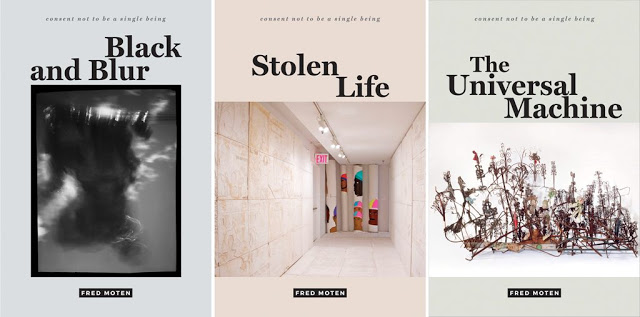
    Moten, Fred (2017) Black and Blur: (consent not to be a single being). Durham: Duke University Press.

    Papadopoulos, Dimitris and Vassilis Tsianos (2007) “How to Do Sovereignty without People? The Subjectless Condition of Postliberal Power.” boundary 2 34:1, 135-172.

    RAND Corporation, 2018, “At The Dawn of the Belt and Road: China in the Developing World.” https://www.rand.org/content/dam/rand/pubs/research_reports/RR2200/RR2273/RAND_RR2273.pdf.

    Redfield, Marc “Aesthetics, Sovereignty, Biopower: From Schiller’s Über die ästhetische Erziehung des Menschen to Goethe’s Unterhaltungen deutscher AusgewandertenRomantic Circles (website), 2018. http://www.rc.umd.edu/praxis/biopolitics/html/praxis.2012.redfield.html#back7.

    Rousseau, Jean-Jacques (1984) A Discourse on Inequality, trans. by Maurice Cranston. London: Penguin Classics.

    Schmitt, Carl (2006) The Nomos of the Earth, trans. by G.L. Ulmen. New York: Telos Press.

    Simone, AbdouMaliq (2019) Personal correspondence.

    Sloterdijk, Peter (2017) Not Saved: Essays after Heidegger, trans. Ian Alexander Moore and Chris Turner. Cambridge: Polity.

    Vardoulakis, Dimitris (2013). Sovereignty and Its Other: Toward the Dejustification of Violence. New York: Fordham University Press.

    Vismann, Cornelia (2010) “Starting from Scratch: Concepts of Order in No Man’s Land,” in Bernd-Rudiger Hüppauf (ed.) War, Violence and the Modern Condition.

    Berlin: De Gruyter, pp. 46-64.

    [1] I am grateful to all the contributors to this issue for comments on and contributions to this introduction to it, as well as for their collaboration at all stages and for their individual contributions. The editorial group at boundary 2 and b2o have helped steer the special issue in ways that have benefited the whole immensely. Jussi Parikka is owed special thanks for his input on drafts of the introduction. Any and all problems or mistakes in the piece, though, remain my own.

     

  • Moira Weigel — Palantir Goes to the Frankfurt School

    Moira Weigel — Palantir Goes to the Frankfurt School

    Moira Weigel

    This essay has been peer-reviewed by “The New Extremism” special issue editors (Adrienne Massanari and David Golumbia), and the b2o: An Online Journal editorial board.

    Since the election of Donald Trump, a growing body of research has examined the role of digital technologies in new right wing movements (Lewis 2018; Hawley 2017; Neiwert 2017; Nagle 2017). This article will explore a distinct, but related, subject: new right wing tendencies within the tech industry itself. Our point of entry will be an improbable document: a German language dissertation submitted by an American to the faculty of social sciences at J. W. Goethe University of Frankfurt in 2002. Entitled Aggression in the Life-World, the dissertation aims to describe the role that aggression plays in social integration, or the set of processes that lead individuals in a given society to feel bound to one another. To that end, it offers a “systematic” reinterpretation of Theodor Adorno’s Jargon of Authenticity (1973). It is of interest primarily because of its author: Alexander C. Karp.[1]

    Karp, as some readers may know, did not pursue a career in academia. Instead, he became the CEO of the powerful and secretive data analytics company, Palantir Technologies. His dissertation has inspired speculation for years, but no journalist or scholar has yet analyzed it. Doing so, I will argue that it offers insight into the intellectual formation of an influential network of actors in and around Silicon Valley, a network articulating ideas and developing business practices that challenge longstanding beliefs about how Silicon Valley thinks and works.

    For decades, a view prevailed that the politics of both digital technologies and most digital technologists were liberal, or neoliberal, depending on how critically the author in question saw them. Liberalism and neoliberalism are complex and contested concepts. But broadly speaking, digital networks have been seen as embodying liberal or neoliberal logics insofar as they treated individuals as abstractly equal, rendering social aspects of embodiment like race and gender irrelevant, and allowing users to engage directly in free expression and free market competition (Kolko and Nakamura, 2000; Chun 2005, 2011, 2016). The ascendance of the Bay Area tech industry over competitors in Boston or in Europe was explained as a result of its early adoption of new forms of industrial organization, built on flexible, short-term contracts and a strong emotional identification between workers and their jobs (Hayes 1989; Saxenian 1994).

    Technologists themselves were said to embrace a new set of values that the British media theorists Richard Barbrook and Andy Cameron dubbed the “Californian Ideology.” This “anti-statist gospel of cybernetic libertarianism… promiscuously combine[d] the free-wheeling spirit of the hippies and the entrepreneurial zeal of the yuppies,” they wrote; it answered the challenge posed by the social liberalism of the New Left by “resurrecting economic liberalism” (1996, 42 & 47). Fred Turner attributed this synthesis to the “New Communalists,” members of the counterculture who “turn[ed] away from questions of gender, race, and class, and toward a rhetoric of individual and small group empowerment” (2006, 97). Nonetheless, he reinforced the broad outlines that Barbrook and Cameron had sketched. Turner further showed that midcentury critiques of mass media, and their alleged tendency to produce authoritarian subjects, inspired faith that digital media could offer salutary alternatives—that “democratic surrounds” would sustain democracy by facilitating the self-formation of democratic subjects (2013). 

    Silicon Valley has long supported Democratic Party candidates in national politics and many tech CEOs still subscribe to the “hybrid” values of the Californian Ideology (Brookman et al. 2019). However, in recent years, tensions and contradictions within Silicon Valley liberalism, particularly between commitments to social and economic liberalism, have become more pronounced. In the wake of the 2016 presidential election, several software engineers emerged as prominent figures on the “alt-right,” and newly visible white nationalist media entrepreneurs reported that they were drawing large audiences from within the tech industry.[2] The leaking of information from internal meetings at Google to digital outlets like Breitbart and Vox Popoli suggests that there was at least some truth to their claims (Tiku 2018). Individual engineers from Google, YouTube, and Facebook have received national media attention after publicly criticizing the liberal culture of their (former) workplaces and in some cases filing lawsuits against them.[3] And Republican politicians, including Trump (2019a, 2019b), have cited these figures as evidence of “liberal bias” at tech firms and the need for stronger government regulation (Trump 2019a; Kantrowitz 2019).

    Karp’s Palantir cofounder (and erstwhile roommate) Peter Thiel looms large in an emerging constellation of technologists, investors, and politicians challenging what they describe as hegemonic social liberalism in Silicon Valley. Thiel has been assembling a network of influential “contrarians” since he founded the Stanford Review as an undergraduate in the late 1980s (Granato 2017). In 2016, Thiel became a highly visible supporter of Donald Trump, speaking at the Republican National Convention, donating $1.25 million in the final weeks of Trump’s campaign for president (Streitfeld 2016a), and serving as his “tech liaison” during the transition period (Streitfeld 2016b). (Earlier in the campaign, Thiel had donated $1 million to the Defeat Crooked Hillary Super PAC backed by Robert Mercer, and overseen by Steve Bannon and Kellyanne Conway; see Green 2017, 200.) Since 2016, he has met with prominent figures associated with the alt-right and “neoreaction”[4] and donated at least $250,000 to support Trump’s reelection in 2020 (Federal Election Commission 2018). He has also given to Trump allies including Missouri Senator Josh Hawley, who has repeatedly attacked Google and Facebook and sponsored multiple bills to regulate tech platforms, citing the threat that they pose to conservative speech.[5]

    Thiel’s affinity with Trumpism is not merely personal or cultural; it aligns with Palantir’s business interests. According to a 2019 report by Mijente, since Trump came into office in 2017, Palantir contracts with the United States government have increased by over a billion dollars per year. These include multiyear contracts with the US military (Judson 2019; Hatmaker 2019) and with Immigrations and Customs Enforcement (ICE) (MacMillan and Dwoskin 2019); Palantir has also worked with police departments in New York, New Orleans, and Los Angeles (Alden 2017; Winston 2018; Harris 2018).

    Karp and Thiel have both described these controversial contracts using the language of “nation” and “civilization.” Confronted by critical journalistic coverage (Woodman 2017, Winston 2018, Ahmed 2018) and protests  (Burr 2017, Wiener 2017), as well as internal actions by concerned employees (MacMillan and Dwoskin, 2019), Thiel and Karp have doubled down, characterizing the company as “patriotic,” in contrast to its competitors. In an interview conducted at Davos in January 2019, Karp said that Silicon Valley companies that refuse to work with the US government are “borderline craven” (2019b). At a speech at the National Conservatism Conference in July 2019, Thiel called Google “seemingly treasonous” for doing business with China, suggested that the company had been infiltrated by Chinese agents, and called for a government investigation (Thiel 2019a). Soon after, he published an Op Ed in the New York Times that restated this case (Thiel 2019b).

    However, Karp has cultivated a very different public image from Thiel’s, supporting Hillary Clinton in 2016, saying that he would vote for any Democratic presidential candidate against Trump in 2020 (Chafkin 2019), and—most surprisingly—identifying himself as a Marxist or “neo-Marxist” (Waldman et al. 2018, Mac 2017, Greenberg 2013). He also refers to himself as a “socialist” (Chafkin 2019) and according to at least one journalist, regularly addresses his employees on Marxian thought (Greenberg 2013). On one level, Karp’s dissertation clarifies what he means by this: For a time, he engaged deeply with the work of several neo-Marxist thinkers affiliated with the Institute for Social Research in Frankfurt. On another level, however, Karp’s dissertation invites further perplexity, because right wing movements, including Trump’s, evince special antipathy for precisely that tradition.

    Starting in the early 1990s, right-wing think tanks in both Germany and the United States began promoting conspiratorial narratives about critical theory. The conspiracies allege that, ever since the failure of “economic Marxism” in World War I, “neo-“ or “cultural Marxists” have infiltrated academia, media, and government. From inside, they have carried out a longstanding plan to overthrow Western civilization by criticizing Western culture and imposing “political correctness.” To the extent that it attaches to real historical figures, the story typically begins with Antonio Gramsci and György Lukács, goes through Max Horkheimer, Theodor Adorno, and other wartime émigrés to the United States, particularly those involved in state-sponsored mass media research, and ends abruptly with Herbert Marcuse and his influence on student movements of the 1960s (Moyn 2018; Huyssen 2017; Jay 2011; Berkowitz 2003).

    The term “Cultural Marxism” directly echoes the Nazi theory of “Cultural Bolshevism”; the early proponents of the Cultural Marxism conspiracy theory were more or less overt antisemites and white nationalists (Berkowitz 2003). However, in the 2000s and 2010s, right wing politicians and media personalities helped popularize it well beyond that sphere.[6] During the same time, it has gained traction in Silicon Valley, too.  In recent years, several employees at prominent tech firms have publicly decried the influence of Cultural Marxists, while making complaints about “political correctness” or lack of “viewpoint diversity.”[7]

    Thiel has long expressed similar frustrations.[8] So how is it that this prominent opponent of “cultural Marxism” works with a self-described neo-Marxist CEO? Aggression in the Life World casts light on the core beliefs that animate their partnership. The idiosyncratic adaptation of Western Marxism that it advances does not in fact place Karp at odds with the nationalist projects that Thiel has advocated, and Palantir helps enact. On the contrary, by attempting to render critical theoretical concepts “systematic,” Karp reinterprets them in a way that legitimates the work he would go on to do. Shortly before Palantir began developing its infrastructure for identification and authentication, Aggression in the Life-World articulated an ideology of these processes.

    Freud Returns to Frankfurt

    Tech industry legend has it that Karp wrote his dissertation under Jürgen Habermas (Silicon Review 2018; Metcalf 2016; Greenberg 2013). In fact, he earned his doctorate from a different part of Goethe University than the one in which Habermas taught: not at the Institute for Social Research but in the Division of Social Sciences. Karp’s primary reader was the social psychologist Karola Brede, who then held a joint appointment at Goethe University’s Sociology Department and at the Sigmund Freud Institute; she and her younger colleague Hans-Joachim Busch appear listed as supervisors on the front page. The confusion is significant, and not only because it suggests an exaggeration. It also obscures important differences of emphasis and orientation between Karp’s advisors and Habermas. These differences directly shaped Karp’s graduate work.

    Habermas did engage with psychoanalysis early in his career.  In the spring and summer of 1959, he attended every one of a series of lectures organized by the Institute for Social Research to mark the centenary of Freud’s birth (Müller-Doohm 2016, 79; Brede and Mitscherlich-Nielsen 1996, 391). He went on to become close friends and even occasionally co-teach  (Brede and Mitscherlich-Nielsen 1996, 395) with one of the organizers and speakers of this series, Alexander Mitscherlich, who had long campaigned with Frankfurt School founder Max Horkheimer for the funds to establish the Sigmund Freud Institute and became the first director when it opened the following year. In 1968, shortly after Mitscherlich and his wife, Margarete, published their influential book, The Inability to Mourn, Habermas developed his first systemic critical social theory in Knowledge and Human Interests (1972). Nearly one third of that book is devoted to psychoanalysis, which Habermas treats as exemplary of knowledge constituted by the “critical” or “emancipatory interest”—that is, the species interest in engaging in critical reflection in order to overcome domination. However, in the 1970s, Habermas turned away from that book’s focus on philosophical anthropology toward the ideas about linguistic competence that culminated in his Theory of Communicative Action; in 1994, Margarete Mitscherlich recounted that Habermas had “gotten over” psychoanalysis in the process of writing that book (1996, 399). Karp’s interest in the theory of the drives, and in aggression in particular, was not drawn from Habermas but from scholars at the Freud Institute, where it was a major focus of research and public debate for decades.

    Freud himself never definitively decided whether he believed that a death drive existed. The historian Dagmar Herzog has shown that the question of aggression—and particularly the question of whether human beings are innately driven to commit destructive acts—dominated discussions of psychoanalysis in West Germany in the 1960s and 1970s. “In no other national context would the attempt to make sense of aggression become such a core preoccupation,” Herzog writes (2016, 124). After fascism, this subject was highly politicized. For some, the claim that aggression was a primary drive helped to explain the Nazi past: if all humans had an innate drive to commit violence, Nazi crimes could be understood as an extreme example of a general rule. For others, this interpretation risked naturalizing and normalizing Nazi atrocities. “Sex-radicals” inspired by the work of Wilhelm Reich pointed out that Freud had cited the libido as the explanation for most phenomena in life. According to this camp, Nazi aggression had been the result not of human nature but of repressive authoritarian socialization. In his own work, Mitscherlich attempted to elaborate a series of compromises between the conservative position (that hierarchy and aggression were natural) and the radical one (that new norms of anti-authoritarian socialization could eliminate hierarchy entirely; Herzog 2016, 128-131). Klaus Horn, the long-time director of the division of social psychology at the Freud Institute, whose collected writings Karp’s supervisor Hans-Joachim Busch edited, contested the terms of the disagreement. The entire point of sophisticated psychoanalysis, Horn argued, was that culture and biology were mutually constitutive and interacted continuously; to name one or the other as the source of human behavior was nonsensical (Herzog 2016, 135).

    Karp’s primary advisor, Karola Brede, who joined the Sigmund Freud Institute in 1967, began her career in the midst of these debates (Bareuther et al. 1989, 713). In her first book, published in 1972, Brede argued that “psychosomatic” disturbances had to be understood in the context of socialization processes. Not only did neurotic conflicts play a role in somatic illness; such illness constituted “socio-pathological” expressions of an increase in the forms of repression required to integrate individuals into society (Brede 1972). In 1976, Brede published a critique of Konrad Lorenz, whose bestselling work, On Aggression, had triggered much of the initial debate with Alexander Mitscherlich and others at the Institute, in the journal Psyche (“Der Trieb als humanspezifische Kategorie”; see Herzog 2016, 125-7).  Since the 1980s, her monographs have focused on work and workplace sociology, and on the role that psychoanalysis should play in critical social theory. Individual and Work (1986) explored the “psychoanalytic costs involved in developing one’s own labor power.” The Adventures of Adjusting to Everyday Work (1995) drew on empirical studies of German workplaces to demonstrate that psychodynamic processes played a key role in professional life, shaping processes of identity formation, authoritarian behavior, and gendered self-identity in the workplace. In that book, Brede criticizes Habermas for undervaluing psychoanalytic concepts—and unconscious aggression in particular—as social forces. Brede argues that the importance that Habermas assigned to “intention” in Theory of Communicative Action prevented him from recognizing the central role that the unconscious played in constituting identity, action, and subjectivity (1995, 223 & 225). At the same time, she was editing multiple volumes on psychoanalytic theory, including feminist perspectives in psychoanalysis, and in a series of journal articles in the 1990s, developed a focus on antisemitism and Germany’s relationship to its troubled history (Brede 1995, 1997, 2000).

    During his time as a PhD student, Karp seems to have worked very closely with Brede. The sole academic journal article that he published he co-authored with her in 1997. (An analysis of Daniel Goldhagen’s bestselling 1996 study, Hitler’s Willing Executioners, the article attempted to build on Goldhagen’s thesis by characterizing a specific, “eliminationist” form of antisemitism that Karp and Brede argued could only be understood from the perspective of Freudian psychoanalytic theory; see Brede and Karp 1997, 621-6.) Karp wrote the introduction for a volume of the Proceedings of the Freud Institute, which Brede edited (Brede et al. 1999, 5-7). The chapter that Karp contributed to that volume would appear in his dissertation, three years later, in almost identical form. Karp’s dissertation itself also closely followed the themes of Brede’s research.

    Aggression in the Life World

    The full title of Karp’s dissertation captures its patchwork quality: Aggression in the Life-World: Expanding Parsons’ Concept of Aggression Through a Description of the Connection Between Jargon, Aggression, and Culture. “This work began,” the opening sentences recall, “with the observation that many statements have the effect of relieving unconscious drives, not in spite, but because, of the fact that they are blatantly irrational” (Karp 2002, 2). Karp proposes that such statements provide relief by allowing a speaker to have things both ways: to acknowledge the existence of a social order and, indeed, demonstrate specific knowledge of that order while, at the same time, expressing taboo wishes that contravene social norms. As result, rather than destroy social order, such irrational statements integrate the speaker into society while also providing compensation for the pains of being integrated. To describe these kinds of statements Karp indicates that he will borrow a concept from the late work of Adorno: “jargon.” However, Karp announces that he will critique Adorno for depending too much on the very phenomenological tradition that his Jargon of Authenticity is meant to criticize. Adorno’s concept is not a concept at all, Karp alleges, but a “reservoir for collecting Adorno-poetry” (Sammelbecken Adornoscher Dichtung) (2002, 58). Karp’s own goal is to clarify jargon into an analytical concept that could then be incorporated into a classical sociological framework. As synecdoche for classical sociology, Karp takes the work of Talcott Parsons.

    The second chapter of Karp’s dissertation, a reading and critique of Parsons, had appeared in the Freud Institute publication, Cases for the Theory of the Drives. In his editor’s introduction to that volume, Karp had stated that the goal of their group had been to integrate psychoanalytic concepts in general and Freud’s theory of the drives in particular into frameworks provided by classical sociology. The volume begins with an essay by Brede on the failure of sociology as a discipline to account for the role that aggression plays in social integration. (Brede 1999, 11-45, credits Georg Simmel with having developed an account of the active role that aggression played in creating social cohesion; more on that below.) Karp reiterates Brede’s complaint, directing it against Parsons, whose account of aggression he calls “incomplete” or “watered down” (2002, 11). In the version that appears in his dissertation, several sections of literature review establish background assumptions and describe what Karp takes to be Parsons’ achievement: integrating the insights of Émile Durkheim and Sigmund Freud. Taking, from Durkheim, a theory of how societies develop systems of norms, and from Freud, how individuals internalize them, Parsons developed an account of culture as the site where the integration of personality and society takes place.

    For Parsons, pace Karp, culture itself is best understood as a system constituted through “interactions.” Karp credits Parsons with shifting the paradigm from a subject of consciousness to a subject in communication—translating the Freudian superego into sociological form, so that it appears, not as a moral enforcer, but as a psychic structure communicating cultural norms to the conscious subject. Yet, Karp protests that there are, in fact, parts of personality not determined by culture, and not visible to fellow members of a culture so long as an individual does not deviate from established norms of interaction. Parsons’ theory of aggression remains incomplete on at least two counts, then. First, Karp argues, Parsons fails to recognize aggression as a primary drive, treating it only as a secondary result that follows when the pleasure principle finds itself thwarted. Karp, by contrast, adopts the position that a drive toward death or destruction is at least as fundamental as the pleasure principle. Second, because Parsons defines aggression in terms of harms to social norms, he cannot explain how aggression itself can become a social norm, as it did in Nazi Germany. For an explanation of how aggressive impulses come to be integrated into society, Karp turns instead to Adorno.

    In Adorno’s Jargon of Authenticity, Karp found an account of how aggression constitutes itself in language and, through language, mediates social integration (2002, 57). Adorno’s lengthy essay, which he had originally intended to constitute one part of Negative Dialectics, resists easy summary. The essay begins by identifying theological overtones that, Adorno says, emanate from the language used by German existentialists—and by Martin Heidegger in particular. Adorno cites not only “authenticity,” but terms like “existential,” “in the decision,” “commission,” “appeal,” and “encounter,” as exemplary” (3). While the existentialists claim that such language constitutes a form of resistance to conformity, Adorno argues that it has in fact become highly standardized: “Their unmediated language they receive from a distributor” (14). Making fetishes of these particular terms, the existentialists decontextualize language in several respects. They do so at the level of the sentence—snatching certain, favored words out of the dialectical progression of thought as if meaning could exist without it. At the same time, the existentialist presents “words like ‘being’ as if they were the most concrete terms” and could obviate abstraction, the dialectical movement within language. The function of this rhetorical practice is to make reality seem simply present, and give the subject an illusion of self-presence—replacing consciousness of historical conditions with an illusion of immediate self-experience. The “authenticity” generated by jargon therefore depends on forgetting or repressing the historically objective realities of social domination.

    Beyond simply obscuring the realities of domination, Adorno continues, the jargon of authenticity spiritualizes them.  For instance, Martin Heidegger turns the real precarity of people who might at any time lose their jobs and homes into a defining condition of Dasein: “The true need for residence consists in the fact that mortals must first learn to reside” (26). The power of such jargon—which transforms the risk of homelessness into an essential trait of Dasein—comes from the fact that it expresses human need, even as it disavows it. To this extent, jargon has an a- or even anti-political character: it disguises current and contingent effects of social domination into eternal and unchangeable characteristics of human existence. “The categories of jargon are gladly brought forward, as though they were not abstracted from generated and transitory situations but rather belonged to the essence of man,” Adorno writes. “Man is the ideology of dehumanization” (48). Jargon turns fascist insofar as it leads the person who uses it to perceive historical conditions of domination—including their own domination—as the very source of their identity. “Identification with that which is inevitable remains the only consolation of this philosophy of consolation.” Adorno writes. “Its dignified mannerism is a reactionary response to the secularization of death” (143, 144).

    Karp says at the outset that his goal is to make Adorno’s collection of observations about jargon “systematic.” In order to do so, he approaches the subject from a different perspective than Adorno did: focused on the question of what psychological needs jargon fulfills. For Karp, the achievement of jargon lies in its “double function” (Doppelfunktion). Jargon both acknowledges the objective forces that oppress people and allows people to adapt or accommodate themselves to those same forces by eternalizing them—removing them from the context of the social relations where they originate, and treating them as features of human existence in general. Jargon addresses needs that cannot be satisfied, because they reflect the realities of living in a society characterized by domination, but also cannot be acted upon, because they are taboo. For Karp, insofar as jargon is a kind of speech that designates speakers as belonging to an in-group, it also expresses an unconscious drive toward aggression. In jargon we see the aggression that drives individuals to exclude others from the social world doing its binding work. It is on these grounds that Karp argues that aggression is a constitutive part of jargon—its ever-present, if unacknowledged, obverse.

    Karp grants that Adorno is concerned with social life. The Jargon of Authenticity investigates precisely the social function of ontology, or how it turns “authenticity” into a cultural form, circulated within mass culture. Adorno also alludes to the specifically German inheritance of jargon—the resemblance between Heidegger’s celebration of völkisch rural life and Nazi celebration of the same (1973, 3). Yet, Karp argues, Adorno does not provide an account of how a deception or illusion of authenticity came to be a structure in the life-world. Even as he criticizes phenomenological ontology, Adorno relies on a concept of language that is itself phenomenological. Echoing critiques by Axel Honneth (1991) of Horkheimer and Adorno’s failures to account for the unique domain of “the social,” Karp turns to the same thinkers Karola Brede used in her article on “Social Integration and Aggression”: Sigmund Freud and Georg Simmel.

    In that article, Brede develops a reading that joins Freud and Simmel’s accounts of the role of the figure of “the stranger” in modern societies. In Civilization and its Discontents, Brede argues, Freud described “strangers” in terms that initially appear incompatible with the account Simmel had put forth in his famous 1908 “Excursus on the Stranger.” Simmel described the mechanisms whereby social groups exclude strangers in order to eliminate danger—thereby controlling the “monstrous reservoir of aggressivity” that would otherwise threaten social structure. (The quote is from Parsons.) Freud wrote that, despite the Biblical commandment to love our neighbors, and the ban on killing, we experience a hatred of strangers, because they make us experience what is strange in us, and fear what in them cannot be fit into our cultural models. Brede concludes that it is only by combining Freudian psychodynamics with Simmel’s account of the role of exclusion in social formation that critical social theory could account for the forms of violence that dominated the history of the twentieth century (Brede 199, 43).

    Karp contrasts Adorno with both Freud and Simmel, and finds Adorno to be more pessimistic than either of these predecessors. Compared to Freud, who argued that culture successfully repressed both libidinal and destructive drives in the name of moral principles, Karp writes that Adorno regarded culture as fundamentally amoral. Rather than successfully repressing antisocial drives, Karp writes, late capitalist culture sates its members with “false satisfactions.” People look for opportunities to express their needs for self-preservation. However, since they know that their needs cannot be fully satisfied, they simultaneously fall over themselves to destroy the memory of the false fulfillment they have had. Repressed awareness of the false nature of their own satisfaction produces the ambient aggression that people take out on strangers.

    For Simmel, the stranger is part of all modern societies, Karp writes. For Adorno, the stranger extends an invitation to violence. Jargon gains its power from the fact that those who speak, and hear, it really are searching for a lost community. The very presence of the stranger demonstrates that such community cannot be simply given; jargon is powerful precisely in proportion to how much the shared context of life has been destroyed.  It therefore offers a “dishonest answer to an honest longing” for intersubjectivity, gaining strength in proportion to the intensity the need that has been thwarted (Karp 2002, 85).  Wishes that contradict social norms are brought into the web of social relations (Geflecht der Lebenswelt), in such a way that they do not need to be sanctioned or punished for violating social norms (91). On the contrary, they serve to bind members of social groups to one another.

    Testing Jargon

    As a case study to demonstrate the usefulness of his modified concept of jargon, Karp takes up a notorious episode in post-wall German intellectual history: a speech that the celebrated novelist Martin Walser gave in October 1998, at St. Paul’s Church in Frankfurt. The occasion was Walser’s acceptance of the 1998 Peace Prize of the German Book Trade. The novelist had traveled a complex political itinerary by the late 1990s. Documents released in 2007 would uncover the fact that as a teenager, during the final years of the Second World War, Walser joined the Nazi Party and fought as a member of the Wehrmacht. But he first became publicly known as a left-wing writer. In the 1950s, Walser attended meetings of the informal but influential German writer’s association Gruppe 47 and received their annual literary prize for his short story, “Templones Ende”; in 1964 he attended the Frankfurt Auschwitz trials, where low ranking officials were charged and convicted for crimes that they had perpetrated during the Holocaust. In his 1965 essay about that experience, “Our Auschwitz,” Walser insisted on the collective responsibility of Germans for the horrors of the Nazi period; indeed he criticized the emphasis on spectacular cruelty at the trial, and in the media, to the extent that this emphasis allowed the public to maintain an imaginary distance between themselves and the Nazi past (Walser 2015, 217-56). Walser supported Social Democratic Party member Willy Brandt for Chancellor and even joined the German Communist Party during that decade. By the 1980s, however, Walser was widely perceived to have migrated back to the right. And when he gave his speech “Experiences Composing a Sermon” on the sixtieth anniversary of Kristallnacht, he used the occasion to attack the public culture of Holocaust remembrance. Walser described this culture as a “moral cudgel” or “bludgeon” (Moralkeule).

    “Experiences Composing a Sermon” adopts a stream of consciousness, rather than argumentative, style in order to explain why Walser refused to do what he said was expected of him: to speak about the ugliness of German history. Instead, he argued that no further collective memorialization of the Holocaust was necessary. There was no such thing, he said, as collective or shared conscience at all: conscience should be a private matter. Critics and intellectuals he disparaged as “preachers” were “instrumentalizing” and “vulgarizing” memory, when they exhorted the public constantly to reflect on the crimes of the Nazi period. “There is probably such a thing as the banality of good,” Walser quipped, echoing Hannah Arendt (2015, 513). He did not spell out what ends he thought that these “preachers” aimed to instrumentalize German guilt for. He concluded by abruptly calling on the newly elected president Roman Herzog, who was in attendance, to free the former East German spy, Rainer Rupp, from prison. Walser’s speech received a standing ovation—though not, notably, from Ignatz Bubis, then the president of the Central Council of Jews in Germany, who was also in attendance. The next day, in the Frankfurter Allgemeine Zeitung, Bubis called the speech an act of “intellectual arson” (geistiges Brandstiftung). The controversy that followed generated a huge amount of debate among German intellectuals and in the German and international media (Cohen 1998). Two months later, the offices of the Frankfurter Allgemeine Zeitung hosted a formal debate between the two men. It lasted for four hours. FAZ published a transcript of their conversation in a special supplement (Walser and Bubis 1999).

    In February and March 1999, Karola Brede delivered two lectures about the controversy at Harvard University, which she subsequently published in Psyche (2000, 203-33). Brede examined both the text of Walser’s original speech and the transcript of his debate with Bubis in order to determine, first, why Walser’s speech had been received so enthusiastically, and second, whether Walser, despite eschewing explicitly antisemitic language, had in fact “taken the side of anti-Semites.” In order to explain why Walser’s speech had attracted so much attention, Brede carried out a close textual analysis. She found that, although Walser had not presented a very cogent argument, he had successfully staged a “relieving rhetoric” (Entlastungsrhetorik) that freed his audience from the sense of awkwardness or self-consciousness that they felt talking about Auschwitz in public and replaced these negative feelings with a positive sense of heightened self-regard. Brede argued that Walser used jargon, in the sense of Adorno’s “jargon of authenticity,” in order to flatter listeners into thinking that they were taking part in a daring intellectual exercise, while in fact activating anti-intellectual feelings. (In a footnote she recommended an “unpublished paper” by Karp, presumably from his dissertation, for further reading; Brede 2000, 215). She concluded that indeed Walser had taken the side of antisemites because, in both his speech and his subsequent debate with Bubis, he constructed a point of identification for listeners (“we Germans”) that systematically excluded German Jews (203). By organizing his speech entirely around “perpetrators” and the “critics” who shamed them, Walser elided the perspective of the Nazi’s victims. Invoking Simmel’s essay on “The Stranger” again, Brede argued that Walser’s behavior during his debate with Bubis offered a model of how unconscious aggression could drive social integration through exclusion. Regardless of what Walser said he felt, to the extent that his rhetoric excluded Bubis from his definition of “we Germans” as a Jew, his conduct had been antisemitic.

    In the final chapter of his dissertation, Karp also offers a reading of Walser’s prize acceptance speech, arguing that Walser made use of jargon in Adorno’s sense. Like Brede, Karp bases his argument on close textual analysis. He catalogs several specific literary strategies that, he says, enabled Walser to appeal to the unconscious or repressed emotions of his listeners without having to convince them. First, Karp tracks how Walser played with pronouns in the opening movement of the speech in order to eliminate distance and create identification between himself and his audience. Walser shifted from describing himself in the third person singular (the “one who had been chosen” for the prize) to the first-person plural (“we Germans”). At the same time, by making vague references to intellectuals who had made public remembrance and guilt compulsory, Walser created the sensation that he and the listeners he has invited to identify with his position (“we”) were only responding to attacks from outside—that “we” were the real victims. (In her article, Brede had quipped that this narrative of victimhood “could have come from a B-movie Western”; Brede 2000, 214). Through this technique, Karp writes, Walser created the impression that if “we” were to strike back against the “Holocaust preachers,” this would only be an act of self-defense.

    Karp stresses that the content of “Experiences Composing a Sermon” was less important than the effect that these rhetorical gestures had of making listeners feel that they belonged to Walser’s side. In the controversy that followed Walser’s acceptance speech, critics often asked which “intellectuals” he had meant to criticize; these critics, Karp says, missed the point. It was not the content of the speech, but its form, that mattered. It was through form that Walser had identified and addressed the psychological needs of his audience. That form did not aim to convince listeners; it did not need to. It simply appealed to (repressed) emotions that they were already experiencing.

    For Adorno, the anti-political or fascist character of jargon was directly tied to the non-dialectical concept of language that jargon advanced. By eliminating abstraction from philosophical language, and detaching selected words from the flow of thought, jargon made absent things seem present. By using such language, existentialism attempted to construct an illusion that the subject could form itself outside of history. By raising historically contingent experiences of domination to defining features of the human, jargon presented them as unchangeable. And by identifying humanity itself with those experiences, it identified the subject with domination.

    Karp does not demonstrate that Walser’s “jargon” performed any of these functions, precisely. Rather, he focuses on the psychodynamics motivating his speech. Karp proposes that the pain (Leiden) that Walser’s speech expressed resembled the “domination” (Zwang) that Adorno recognized in jargon. While Adorno’s jargon made the absent or abstract seem present, through an act of linguistic fetishization, Walser’s jargon embodied the obverse impulse: to wish the discomfort created by the presence of history’s victims away.

    Karp is less concerned with the history of domination, that is, than with Freudian drives. For Adorno, the purpose of carrying out a determinate negation of jargon was to create the conditions of possibility for critical theory to address the real needs to which jargon constituted a false response. For Karp, the interest of the project is more technical: his goal is to uncover forms and patterns of speech that admit aggression into social life and give it a central role in consolidating identity. By combining culturally legitimated expressions with taboo ones, Karp argues, Walser created an environment in which his controversial opinion could be accepted as “obvious” or “self-evident” (selbstverständlich) by his audience. That is, Walser created a linguistic form through which aggression could be integrated into the life-world.

    Unlike Adorno (or Brede), Karp refrains from making any normative assessment of this achievement. His “systematization” of the concept of jargon empties that concept of the critical force that Adorno meant for it to carry. If anything, the tone of the final pages of Aggression in the Life-World is forgiving. Karp concludes by arguing that Walser was not necessarily aware of the meaning of his speech—indeed, that he probably was not. By allowing his audience to express their taboo wishes to be done with Holocaust remembrance, Karp writes, Walser convinced them that, “these taboos should never have existed.” Then he cuts to his bibliography.

    Grand Hotel California Abyss

    The abruptness of the ending of Aggression in the Life-World is difficult to interpret. At one level, Karp’s apparent lack of interest in the ethical and political implications of his case study reflects his stated goals and methods. From the beginning, he has set out to reveal that the social is constituted through acts of unconscious aggression, and that this aggression becomes legible in specific linguistic interactions, rather than to evaluate the effects of aggression itself. Reading Walser, Karp explicitly privileges form over content, treating the former as symptomatic of unstated meanings and effects. Granting the critic authority over the text he is analyzing, such an approach presumes the author under analysis to be ignorant, if not innocent, of what he really has at stake; it treats conscious attitudes and overt arguments as holding, at most, a secondary interest. At another level, the banal explanations for Karp’s tone and brevity may be the most plausible. He was writing in a non-native language; like many graduate students, he may have finished in haste.[9] In any case, his decision to eschew the kinds of judgments made by both his subject, Adorno, and his mentor, Brede is striking—all the more so because Karp is descended from German Jews and “grew up in a Jewish family” (Karp 2019a). This choice reflects a different mode of engagement with critical theory than scholars of either digital media or digitally mediated right-wing movements have observed.

    Historians have shown that the Frankfurt School critiques of mass media helped shape the idea that digital media could constitute a more democratic alternative. Fred Turner has argued that the research Adorno conducted on the role of radio and cinema in shaping the authoritarian personality, as well as the proximity of Frankfurt School scholars to the Bauhaus and other practicing artists, generated a set of beliefs about the democratic character of interactivity (Turner 2013). Orit Halpern is more critical of the essentially liberal assumptions of media and technology critique in which she, too, places Adorno (2015, 18-19). However, like Turner, Halpern identifies the emergence of interactivity as a key epistemic shift away from the Frankfurt School paradigm that opposed “attention” and “distraction.”  Cybernetics redefined the problem of “spectatorship” by transforming the spectator from an individual into a site of perceptions and cognitions—an “interface or infrastructure for information processing.” Where radio, cinema, and television had promoted conformity and passivity, cybernetic media promised to facilitate individual choice and free expression (2015, 224-6).

    More recently, critics and scholars attempting to account for the phobic fascination that new right-wing movements show for “cultural marxism” have analyzed it in a variety of ways. The least sophisticated take at face value the claims of “alt-right” figures that they are only reacting to the ludicrous and pernicious excesses of their opponents.[10] More substantial interpretations have described the far right fixation on the Frankfurt School as a “dialectic of counter-Enlightenment” or form of “inverted appropriation.” Martin Jay (2011) and Andreas Huyssen (2017, 2019) both argue that the attraction of critical theory for the right lies in the dynamics of projection and disavowed recognition that it sets in motion. As Huyssen puts it, “wider circles of American white supremacists and their publications… have been drawn to critique and deconstruction because, on those traditions, they project their own destructive and nihilistic tendencies” (2017).

    Aggression in the Life World does none of these things. Karp’s dissertation does not take up the critiques of mass media or the authoritarian personality that were canonized in the Anglo-American world at all, much less use them to develop democratic alternatives. Nor does it project its own penchant for destruction onto its subjects. In contrast with the “lunatic fringe” (Jay, 30) Karp does not carry out an “inverted appropriation” of critical theory, so much as a partial one.  He adapts Frankfurt School concepts for technical purposes, making them more instrumentally useful to the disciplines of sociology or social psychology by abstracting them from their contexts. In the process, he also abandons the Frankfurt School commitment to emancipation. It is at this level of abstraction that his neo-Marxism—from which Marx and materialism have all but disappeared—can coexist with the nationalism that he and Thiel invoke to defend Palantir.

    I asked at the beginning of this paper what beliefs Karp shares with Peter Thiel and what their common commitments might reveal about the self-consciously “contrarian” or “heterodox” network of actors that they inhabit. One answer that Aggression in the Life World makes evident is that both men regard the desire to commit violence as a constant, founding fact of human life. Both also believe that this drive expresses itself in social forms like language or group structure, even if speakers or group members remain unaware of their own motivations. These are ideas that Thiel attributes to the work of the eclectic French theorist René Girard, with whom he studied at Stanford, and whose theories of mimetic desire, scapegoating, and herd mentality he has often cited. In 2006 Thiel’s nonprofit foundation established an institute to promote the study of Girard and support the further development of mimetic theory; this organization, Imitatio, remains one of the foundation’s three major projects (Daub 2020, 97-112).

    The text that Karp chose to analyze, as his case study, also shares a set of concerns with Thiel’s writings and statements against campus multiculturalism and political correctness; Walser’s speech became a touchstone of debates about historical memory in Germany, in which the newly imported Americanism politische Korrektheit circulated widely. In his dissertation, Karp does not celebrate Walser’s taboo speech in the same way that Thiel and his associates have sometimes celebrated violations of speech norms.[11] However, he does assert that jargon, and the unconscious aggression that it expresses, plays a role in the formation of all social groups, and refrains from evaluating whether Walser’s jargon was particularly problematic. Of course, the term “jargon” itself became a commonplace during the U. S. culture wars in the 1980s and 1990s, used to accuse academics and university administrators who purported to be speaking for vulnerable populations of in fact deploying obscure terms to aggrandize themselves. Thiel and his co-author David O. Sacks devote a chapter of The Diversity Myth to an account of how the vagueness of the word “multiculturalism” enabled activists and administrators at Stanford to use it in this manner (1995, 23-49). The idea that such terms express ressentiment and a will to power is consistent with the theoretical framework that Karp went on to develop.

    Ironically, by attempting to expunge jargon of its subjective or impressionistic content, Karp renders it less materially objective. Rather than locating jargon in specific experiences of modernity, he transforms it into an expression of drives that, because they are timeless, are merely psychological. Karp makes a version of the eternalizing move that Adorno criticizes in Heidegger, in other words. Rather than elevating precarity into the essence of the human, Karp makes aggressive violence the substance of the social. In the process, he empties the concept of jargon of its critical power. When he arrives at the end of Walser’s speech, a speech that Karp characterizes as consolidating community based on unspeakable aggression, he can conclude only that it was effective.

    A still greater irony in retrospect may be how, in Karp’s telling, Adorno’s jargon anticipates the software tools Palantir would develop. By tracing the rhetorical patterns that constitute jargon in literary language, Karp argues that he can reveal otherwise hidden identities and affinities—and the drive to commit violence that lies latent in them. By looking back to Adorno, he points toward a possible critique of big data analytics as a kind of authenticity jargon. That is, a way of generating and eternalizing false forms of selfhood. In data analysis, the role of the analyst is not to demystify and dispel reification. On the contrary, it is precisely to fix identity from its digital traces and to make predictions on the basis of the same. For Adorno, jargon is a form of language that seems to authenticate identity—but only seems to. The identities it makes available to the subject are based on an illusion that jargon sustains by suppressing the self-difference that historicity introduces into language. The illusion it offers is of timeless “human” experience. It covers for domination insofar as it makes the human condition—or rather, human conditions as they are at the time of speaking—appear unchangeable.

    Big data analytics could be said to constitute an authenticity jargon in this sense: although they treat the data set under analysis as having something like an unconscious, they eliminate the temporal gaps and spaces of ambiguity that drive psychoanalytic interpretation. In place of interpretation, data analytics substitutes correlations that it treats simply as given. To a machine learning algorithm that has been trained on data sets that include zip codes and rates of defaulting on mortgage payments, for instance, it does not matter why mortgagees in a given zip code may have been more likely to default in the past. Nor will the algorithm that recommends rejecting a loan application necessarily explain that the zip code was the deciding factor. Like the existentialist’s illusion of immediate experience these procedures generate an aura of incontestable self-evidence.

    As in Adorno, here, the loss of particular contexts can serve to conceal, and thus perpetuate, domination. Algorithms take the histories of oppression embedded in training data and project them into the future, via predictions that powerful institutions then act on. If the identities constituted in this way are false, the reifications they generate do real work, and can cause real harm. And yet, to read these figures historically is to recognize that they need not come true. This is not an interpretive path that Karp pursues. But for those of us concerned about the relationship between digital technologies and justice, this repressed insight of his dissertation is the most critical to follow.

    _____

    Moira Weigel is a Junior Fellow at the Harvard Society of Fellows and an editor and cofounder of Logic Magazine. She received her PhD from the combined program in Comparative Literature and Film and Media Studies at Yale University in 2017.

    Back to the essay

    _____

    Notes

    [1] Translations from German are mine unless otherwise noted.

    [2] In 2017, when activists doxxed the founder of the neofascist blog the Right Stuff and the antisemitic podcasts Fash the Nation and The Daily Shoah, who went by the alias Mike Enoch, they revealed that he was in fact a programmer named Michael Peinovich (Marantz 2019, 275-9). Curtis Yarvin, who wrote a widely read blog advocating the end of democracy under the name Mencius Moldbug, also worked as a software engineer (Gray 2017). Several journalists have documented the interest that figures in or adjacent to the tech industry evince with Yarvin’s Neoreaction (NRx) or Dark Enlightenment (Gray 2017; Goldhill 2017). Prominent white nationalist media entrepreneurs also claim to have substantial followings in the tech industry. In 2017, Andrew Anglin told a Mother Jones reporter that Santa Clara County was the highest source of inbound traffic to his website, The Daily Stormer; Chuck Johnson said the same about his (now defunct) website Got News (Harkinson 2017). In response to an interview question about his “average” supporter, the white nationalist Richard Spencer claimed that, “many in the Alt-Right are tech savvy or actually tech professionals” (Hawley 2017, 78).

    [3] James Damore, the engineer who wrote the July 2017 memo, “Google’s Ideological Echo Chamber,” and was subsequently fired, toured the right wing speaking circuit (Tiku 2019, 85-7). Brian Amerige, the Facebook engineer who identified himself to the New York Times in July 2018 as the creator of a conservative group on Facebook’s internal forum, Workplace, and then left the company, did the same (Conger and Frankel 2018). Shortly after, it was reported that Oculus cofounder Palmer Luckey’s departure from the company in 2017 had also been driven by conflicts with management over his support of Donald Trump (Grind and Hagey 2018); Luckey has since publicly claimed to speak on behalf of a silent majority of “tech conservatives” (Luckey 2018). Arne Wilberg, a long time recruiter of technical employees for Google and YouTube, filed a reverse discrimination suit in 2018, alleging that he had been fired for “opposing illegal hiring practices… systematically discriminating in favor of job applicants who are Hispanic, African American, or female, against Caucasian and Asian men” (Wilberg v. Google 2018). Most recently, in August 2019, The Wall Street Journal reported that the former Google engineer Kevin Cernekee had been fired in 2017 in retaliation for expressing “conservative” viewpoints on internal listservs (Copeland 2019). Former colleagues subsequently published screenshots showing that, among other things, Cernekee had proposed raising money for a bounty for finding the masked protestor who punched Richard Spencer at the Presidential inauguration in 2017 using WeSearchr, the now-defunct fundraising platform run by Holocaust “revisionist” Chuck C. Johnson. They also shared screenshots showing that Cernekee had defended two neo-Nazi organizations, The Traditionalist Workers Party and Golden State Skinheads, suggesting that they should “rename themselves to something normie-compatible like ‘The Helpful Neighborhood Bald Guys’ or the ‘Open Society Institute’” (Wacker 2019; Tiku 2019, 84). Like Damore, Amerige, and Wilberg, Cernekee received national media coverage.

    [4] For instance, emails that BuzzFeed reporter Joe Bernstein obtained from Breitbart.com stated that Thiel invited Curtis Yarvin to watch the 2016 election results at his home in Hollywood Hills, where he had previously hosted Breitbart tech editor Milo Yiannopoulos; New Yorker writer Andrew Marantz reported running into Thiel at the “DeploraBall” that took place on the eve of Trump’s inauguration (2019, 47-9).

    [5] Thiel supported Hawley’s campaign for Attorney General of Missouri in 2016 (Center for Responsive Politics); in that office, Hawley initiated an antitrust investigation of Google (Dave 2017) and a probe into Facebook exploitation of user data (Allen 2018). Thiel later donated to Hawley’s 2018 Senate campaign (Center for Responsive Politics); in the Senate, Hawley has sponsored multiple bills to regulate tech platforms (US Senate 2019a, 2019b, 2019c, 2019d, 2019e, 2019f, 2019g). These activities earned him praise from Trump at a White House Social Media Summit on the theme of liberal bias at tech companies, where Hawley also spoke (Trump 2019a).

    [6] Pat Buchanan devoted a chapter to the subject, entitled “The Frankfurt School Comes to America,” in his 2001 Death of the West. Breitbart editor Michael Walsh published an entire book about critical theory, in which he described it as “the very essence of Satanism” (Walsh 2016, 50). Andrew Breitbart himself devoted a chapter to it in his memoir (Breitbart 2011, 113). Jordan Peterson more often rails against “postmodernism,” or “political correctness.” However, he too regularly refers to “Cultural Marxism”; at time of writing, an explainer video that he produced for the pro-Trump Epoch Times, has tallied nearly 750,000 views on YouTube (Peterson 2017).

    [7] The memo that engineer James Damore circulated to his colleagues at Google presented a version of the Cultural Marxism conspiracy in its endnotes, as fact. “As it became clear that the working class of the liberal democracies wasn’t going to overthrow their ‘capitalist oppressors,’” Damore wrote, “the Marxist intellectuals transitioned from class warfare to gender and race politics” (Conger 2017). The group that Brian Amerige started on Facebook Workplace was called “Resisting Cultural Marxism” (Conger and Frankel 2018).

    [8] The Stanford Review, which Thiel founded late in his sophomore year and edited throughout his junior and senior years at the university, devoted extensive attention to questions of speech on Stanford’s campus, which became a focal point of the US culture wars and drew international media attention when the academic senate voted to (slightly) revise its core curriculum in 1988 (see Hartman 2019, 227-30). In 1995, with fellow Stanford alumnus (and later PayPal Chief Operating Officer) David O. Sacks, Thiel published The Diversity Myth, a critique of the “debilitating” effects of “political correctness” on college campuses that, among other things, compared multicultural campus activists to “the bar scene from Star Wars” (xix). In 2018 he moved to Los Angeles, saying that political correctness in San Francisco had become unbearable (Peltz and Pierson 2018; Solon 2018) and in 2019 Founders Fund, the venture capital firm where he is a partner, announced that they would be sponsoring a conference to promote “thoughtcrime” (Founders Fund 2019).

    [9] Aggression in the Life World is significantly shorter than either of the other two dissertations submitted to the sociology department at Frankfurt that year: Margaret Ann Griesese’s The Brazilian Women’s Movement Against Violence clocked in at 314 pages, and Konstantinos Tsapakidis, Collective Memory and Cultures of Resistance in Ancient Greek Music at 267; Karp’s is 129.

    [10] Angela Nagle (2017) put forth an extreme version of this argument, arguing that the excesses of “social justice warrior” identity politics provoked the formation of the alt-right and that trolls like Milo Yiannopoulos were only replicating tactics of “transgression” that had been pioneered by leftist intellectuals like bell hooks and institutionalized on liberal campuses and in liberal media. Kakutani similarly argued that the Trumpist right was simply taking up tactics that the relativism of “postmodernism” had pioneered in the 1960s (2018, 18).

    [11] In The Diversity Myth Sacks and Thiel describe on instance of resistance to the Stanford speech code, which was adopted in May 1990 and revoked in March 1995, as heroic. The incident took place on the night of January 19, 1992, when three members of the Alpha Epsilon Pi fraternity, Michael Ehrman, Keith Rabois, and Bret Scher, were walking home from a party through one of Stanford’s residential dormitories. Rabois, then a first year law student, began shouting slurs at the home of a resident tutor in the dormitory, who had been involved in the expulsion of Ehrman’s brother Ken from residential housing four years earlier, after Ken called the resident tutor assigned to him a “faggot.” “Faggot! Hope you die of AIDS!” Rabois shouted. “Can’t wait until you die, faggot.” He later confirmed and defended these statements in a letter to the Stanford Daily. “Admittedly, the comments made were not very articulate, nor very intellectual nor profound,” he wrote. “The intention was for the speech to be outrageous enough to provoke a thought of ‘Wow, if he can say that, I guess I can say a little more than I thought.” The speech code, which had not until that point been used to punish any student, was not used to punish Rabois; however, Thiel and Sacks describe the criticism of Rabois from administrators and fellow students that followed as a “witch hunt” (1995, 162-75). Rabois subsequently transferred to Harvard but later worked with Thiel at PayPal and later as a partner at Founders Fund. More recently, the blog post that Founders Fund published to announce the Hereticon conference cited in Footnote 8, described violating taboos on speech as its goal: “Imagine a conference for people banned from other conferences. Imagine a safe space for people who don’t feel safe in safe spaces. Over three nights we’ll feature many of our culture’s most important troublemakers in the fields of knowledge necessary to the progressive improvement of our civilization” (2019).

    _____

    Works Cited

  • Anthony Bogues — Writing About Empire in the Nineteenth Century Caribbean (Review of Christopher Taylor’s Empire of Neglect)

    Anthony Bogues — Writing About Empire in the Nineteenth Century Caribbean (Review of Christopher Taylor’s Empire of Neglect)

    by Anthony Bogues

    Review of Christopher Taylor, Empire of Neglect: The West Indies in the Wake of British Liberalism (Duke University Press, 2018).

    To write about Empire today is of some significance. To connect Empire to the practices of nineteenth century British liberalism is critical. Christopher Taylor’s Empire of Neglect, which argues that in British colonial policy, “liberal freedom becomes a form of liberal neglect,” Taylor, 2018, 3) is thus already doing important work. That it does this through a critical literary lens marks an opening for those of us who think that critical scholarship currently demands an interdisciplinary approach. In the field of political thought/political theory the writings of Uday Metha, Jennifer Pitts and others have laid some grounds for thinking about the ideology of liberalism and its entanglements with the various European  colonial projects, particularly the British and French colonial empires. In these studies, the Caribbean—despite being one of the early centers of British colonial rule and site of several conflicts and territorial transfers from one colonial power to the next — is often elided. And, all of this is strange since the Caribbean before the late 1870s scramble for Africa was the venue from which many theories about blackness were formulated. One only has to read Jefferson’s Notes on Virginia to see the copious references to the Jamaican colonial administrator and historian Edward Long’s three volumes on the history of Jamaica published in 1774. Jamaica was considered in the eighteenth century the “best jewel in the British Diadem.” And even after the abolition of slavery there was continued British preoccupation with these former slave societies.

    Nineteenth century British political ideas and thought in general were deeply engaged with the Caribbean in the aftermath of the abolition of the slave trade in 1807 and then the ending  of the formal social system of racial plantation slavery in 1838. In the words of the 1839 “Memorandum of the West Indian Assemblies” from the Colonial Office, the new key concern for the British colonial policy was the “institutions of the colonies and the new rights given to the negroes” (Cited in Bogues 2018, 156). These rights, which purported to make the once enslaved black population subjects but not citizens would become a contested terrain. All of this was not accidental once we recall that John Stuart Mill argued in Liberty that “despotic government” was acceptable for the colonies until they had arrived at a stage where they could be offered self-government. In this tutelage model of rule, what I have called elsewhere the “ladder of civilization,”(Bogues 2005, 217) there was a profound set of distinctions between being a subject and citizen. Included in these distinctions were issues of suffrage and conception of capacity. The conceptions of capacity meant several things including: political self-rule, mastery over the self, and forms of rationality, all summed in the word character.[i] This conception of capacity became a key element of Anglophone Caribbean anti-colonial  thought so that in many of the writings of the newly formed black intelligentsia during this period the frame for anti-colonial thinking was around them having the capacity for self-rule. However, a key issue issue would be who was judging who and therefore what did the color of capacity look like? Part of the strength of Empire of Neglect is to point to how capacity was a problematic terrain of anti-colonial thinking.

    Liberalism and colonialism

    Often times, in our general thinking about liberalism and empire we focus on the main political thinkers of the period. Yet, as Empire of Neglect reminds us, liberalism was not only wrought through theoretical work; it was constructed as well by colonial practices. And here one is thinking about what colonial power did and how these deeds were then formulated back into liberalism and where that did not happen, how liberalism would create sites of difference in which might was right. Liberalism therefore was not an ideology and theory without practices, but rather within forms of colonial rule it was one in which colonial practice shaped political ideas. Therefore, to tell a more complex story of the history of political thought requires us to probe practices of thought because in any ideological configurations there is a profound relationship between the deed and the word. In trying to grapple with British liberalism in the mid-nineteenth century it behooves us to grapple with the critical issue that faced British colonial power at that time. So one might read Empire of Neglect as working through a form of rule which British colonial policy sought to enact. In the case of the Caribbean, colonial rule was a complex matter  because the colonies were slave colonies. Within some Caribbean slave colonies there were local white legislative assemblies that governed the territories. All slave colonies were run by a colonial governor who worked in tandem with the British colonial office that set colonial policy based on British parliamentary decisions. In such contexts violence as an technology of rule was the order of the day.

    As stated before, after the abolition of slavery, the crucial question for British colonial policy and politics was: how were these colonies to be ruled now that slavery was abolished? One current of this preoccupation was expressed in the phrase the “new rights of the negroes.” By the 1850s this preoccupation about how the colonies should be ruled became a driver of British colonial policy towards the Caribbean. A figure who represented this drive and wrote many essays about this as an Oxford professor of political economy was Herman Merivale. His essays and speeches brought him some public acclaim and he moved from Oxford to become colonial secretary in the British colonial office.[ii] In the lecture “Colonies without slaves or convicts,” Merivale noted that “the economical objects of colonization are two only: First, to furnish means of bettering their condition to the unemployed, ill–employed, portion of  the people of the mother country. Secondly, to create a new market for the trade of the mother country” (Merivale 1842, 33). To create a new market for British trade required creating new subjects who were not slaves. For this to happen, Merivale recommended that the “duties of the colonial government … seem to arrange themselves under two heads – protection and civilization” (155). The idea of this form of rule, which I have called elsewhere “pastoral coloniality” (Bogues 2018, 156) was at the core of British rule of the Caribbean colonies in the immediate post abolition period. This did not mean that when deemed necessary by the colonial governor, the conventional practices of colonial power—that might was right–did not operate, clearly discernible by the actions of Governor Eyre in the aftermath of the 1865 Morant Bay Rebellion.[iii] Also, the black Jamaican was not simply a subject of the British colonial crown but he or she was in the words of Anthony Trollope, “a creole Negro.” This invented subject was in the mind of many British colonial officials different from continental Africans, a difference characterized by Trollope as one made possible by the close proximity of the African enslaved in the Caribbean living closely with and in societies with Europeans (See: Trollope 1860).

    The British Caribbean colonies from the abolition of slavery onwards were therefore former slave societies in gestation. Within this context, the Afro-Caribbean person operated on dual grounds partly shaped by the color-class codes of the period. On the one hand, there was the construction of the black ex-slave subject as a “Christian Black.”[iv] This was a subject who would wear the coat of Victorian respectability and who could, in the end and over time, might  be considered “civilized.” On the other hand, there were the ways in which many former black slaves created alternative subjectivities as they constituted new forms of culture and alternative Afro-Caribbean religious forms.[v] These latter subjectivities would never be and could never be considered civilized.

    An important aspect of the Empire of Neglect is its concern with the figure of the respectable black, the “Christian Black.” Taking its title from the poem England in the West indies; A Neglected and Degenerating Empire by the poet George Reginald Margetson, who hailed from St Kitts, the core arguments of Empire of Neglect are about the ways in which “the Jamaican ex-slave navigated  the institution of black life as worthless…[and how] ex-slaves moved through worthlessness to find another horizon of social being that they associated with empire (27). In this argument there is a concern for “imperial belonging” on the part of these ex-slaves. Taylor develops this argument through different readings including that of a pamphlet of an absentee white planter and the novel of Trinidadian intellectual Michel Maxwell Philip. The over-arching point of this book is to illustrate how Caribbean political imageries were constituted in relation to the rise of forms of anti-colonial nationalism as the “political horizon of Caribbean writing.” Yet, I pause here. I do so because black subjectivities in post-slavery Caribbean societies were not homogenous even within the newly emergent black intelligentsia. Because while there was black imperial belonging, there was another current of anti-colonialism one in which forms of black nationalism under various symbolic orders of Afro Caribbean religious-politico forms would appear. Alongside these counter-symbolic forms were mass actions so that in Jamaica in 1884 there was black mass anger which frightened the colonial authorities and by 1895 the dockworkers went on massive strike, one which Dr Robert Love perhaps the most radical black intellectual  in the Caribbean at the time suggested was a new marker. All of this pushed the British colonial authorities to increase Indian and Chinese indenture labor schemes. In recalling these moments while Empire of Neglect opens up the space for us to grapple with the complexities of “imperial belonging,” one might also attend to other archives and figures, such as the ordinary Caribbean ex-slave who sought to create different forms of belonging other than that which primarily rested upon an imperial imaginary. Empire of Neglect makes it clear that central to the emergence of a certain kind of Caribbean nationalism is J.J. Thomas’s work and his seminal book Froudacity.

     JJ Thomas and the struggle for recognition

    Empire of Neglect engages adroitly with the reception of J.J. Thomas’s work in Caribbean intellectual and political history. Following Empire of Neglect, I want to reread Froudacity as a complex anti-colonial text, one in which there is a longing for Britishness or recognition from the British colonial power of capacity, and within this capacity, a desire for some form of Caribbean self-government. In his writings on Thomas, Rupert Lewis makes clear that “the book marks a state of mind that is in direct transition to the ideas which later became known as Garveyism” (Lewis, 54). At the core of this complexity was Thomas’s idea that the Black Anglo-Caribbean person was equal to any British white person. It was an argument about capacity and the readiness of the colonies for forms of internal self-government, if not full independence.[vi] In his 1969 introduction to the republication of Thomas’s book, C.L.R. James noted that James Anthony Froude, the British professor who wrote the book The English in the West Indies: The Bow of Ulysses, to which Thomas had responded, had embarked on this project because he was part of the British intelligentsia opposed to any form of West Indian self-government. Thomas, who read the book in Grenada, wrote a series of articles in response to Froude’s travelogue.[vii]

    Christopher Taylor provides us with a nuanced and excellent read of Froudacity. He writes, “Froudacity did not simply cut ties with the empire … it also cut ties with the empire centered political and literary tradition” (232). In one sense, I think this is an accurate assessment, but in another, I wonder if we can think further about the complexity of this kind of anti-colonial thought, predicated as it was on  the idea that “we were ready.” On whose terms were we [the Caribbean] ready for self rule? And more importantly, who was ready? Thomas, while exposing the anti-black racism of Froude, simultaneously agrees with one of the markers of anti-black racism of the period, the ways in which the West understood the black sovereign power of the Haitian republic. One nineteenth century current of anti-black racism was the “Haitian Fear.” The idea of black sovereignty expressed through the dual Haitian revolution shook the colonial world. The idea of Haiti, was the worst nightmare for colonial powers and American slave masters.[viii] Liberalism feared Haiti. Many a liberal abolitionist believed that Haiti was the worst example of black freedom. Froude was not an exception to this and raged against the black republic. Thomas, while vindicating the black self, wrote in repose to this anti-black rage, “we saw them free, but perfectly illiterate barbarians, impotent to use the resources of their valour.” In this statement, he repeats what some black figures at the time felt about Haiti. Attempting to mitigate this sentiment, Thomas noted that part of the political difficulties in Haiti had been generated by the mulatto social grouping (Thomas 54). His ambivalences towards Haiti were rooted in a certain respectable black subjectivity created by British colonial power. Here we should remember that Thomas was a schoolmaster. Such a figure was at the pinnacle of what was then considered the “Christian Black.” But Thomas was a complex figure because he wrote the very first defense of the black vernacular languages of the Caribbean and his book, Creole Grammar, remains the starting point for creole linguistics in the Anglophone Caribbean.

    In the final chapter of his book, Thomas makes it clear that “the extra – African millions in the Western Hemisphere” will make a significant contribution to what he considers as human development. Interestingly, he deploys the American reconstruction period as an example of this, but elides the racial terror of the period. In all of this, Thomas was attempting to stake out a different ground for Caribbean anti-colonialism and the capacity of the black Caribbean person.[ix] Froude had written that within the Caribbean “there are no people here in the sense of the word and  the islands [were] becoming nigger warrens” (Cited in Thomas, 19). J.J. Thomas, learned schoolmaster and respectable Black, was not only deeply offended by this, but in his act of writing in defense of the capacity of the Caribbean black ex-slave, began to formulate the idea of a nation. I would argue that for him, as well for his work, Creole Grammar was in part illuminating capacity, making it clear that this nation in gestation had a language.[x]

    Thus, Taylor’s book, in teasing out a sentiment of “imperial belonging,” makes a signal contribution by bringing Thomas as an example of this kind of current. I would argue that this was one hall mark of this Caribbean black intelligentsia—a deep anti-racism combined with a sense of belonging to the British empire while desiring all the rights of citizenship. Thus even in his advocacy for a modicum of internal self-government within the juridical context of a crown colony, Thomas appeals to fact that the black Caribbean subject as outgrown “ the stage of political tutelage” (215). But this capacity or political readiness was not an argument for full independence but rather a call for fuller internal political participation and the end to crown colony government. Perhaps nowhere is this kind of advocacy most pronounced than in the writings of T. E. S. Scholes, an extraordinary figure who wrote two volumes attacking the idea of Black inferiority, The Glimpses of the Ages, or the Superior and Inferior Races So  Called, Discussed in the Light of Science and History (1905/1907). Before that he had written the important political economy pamphlet in 1897, “The Sugar Questions of the West Indies.”[xi]

    One of the major contributions of Empire of Neglect is to illuminate the political economy circumstances that Thomas and others inhabited. In the eighteenth century, colonial Britain operated economically through a closed system of mercantilism. One effect of industrialization, a process facilitated enormously by Caribbean plantation slavery was the demand by another set of British economic elites for free trade. In such a context the economic frame became a balance between the overseas sale to foreign regions of manufactured goods. Critical to that was the access to raw materials and finance. All this meant that the Caribbean colonies were no longer jewels in the British colonial crown. Thus, the matter of how to rule the newly emancipated ex-slaves occurred within an economic situation in which the core drives of colonial power had shifted from plantation slavery to imperial colonial control and command over new lands, as well as to the construction of the figure of the native in Africa and elsewhere. To put this in another way, deploying Stuart Hall, the conjecture had shifted. Yet, we know that in these kinds of shifts the old does not die but is reworked into new forms. One strength of Empire of Neglect is to mark this historic shift.

    It is safe to say that many Afro-Caribbean persons felt the shift but paid no attention. I would argue that, in part, this was due to the growing importance in the late nineteenth century and the early twentieth century of the banana trade, and the emergence of the United States as an economic presence in the region. And here we should recall that by December 1823, the US had promulgated the Monroe doctrine. The doctrine made it clear that Europe should no longer seek new colonies in the Western Hemisphere. It was a clear sign of the beginning of US hegemonic power in the region. By the late nineteenth and early twentieth century the so-called respectable Afro-Caribbean individual would still look to Britain as a place where he or she could make a mark. Thus, for example, between 1931 and 1932 C.L.R. James would first consider migrating to London, while Garvey and Sylvester Williams years earlier would think about moving to the US. One could argue that the migratory patterns of the Caribbean, even as British subjects, was largely directed toward Central America and the US before London recalling that West Indian labor was critical for the building of the Panama Canal and the revitalization of the sugar industry in Cuba in the early 20th century. So, while there were migratory movements in the late 19th and 20th centuries which social grouping went where is an important fact. Here the issue was not so much geography but rather the sense of the neglectful distance, which colonial Britain had so carefully cultivated. So we have a paradox: the Anglophone Caribbean person  was still constituted as a  British colonial subject and yet those black Caribbean political  subjects, who were preoccupied with forms of black consciousness, would find themselves in the US and while they belonged to empire, and also seeing themselves  as part of the Black world.[xii]

    The rule of Crown Colony

    Empire of Neglect provides an important alternative view of the emergence of Caribbean anti-colonialism and its nineteenth century context. One of the central features of British colonial rule in the Caribbean in the aftermath of the Jamaican Morant Bay rebellion in 1865 was the enactment of crown colony government. This form of juridical rule meant that the local white legislative assemblies were abolished. Some of the arguments for their abolishment circled around the sense that sooner rather later the emerging black intelligentsia would begin to clamor for rights and representation in the assemblies. From as early as the 1840s the colonial secretary of state wrote the following letter: “From all I can hear it seems certain that before long the negro population will obtain a preponderating influence in the Assby…[thus] the authority of the Crown should be for the protection of the higher classes be somewhat strengthened” (Cited in Hart, 66). But there were many complexities involved here. How was a liberal colonial government to treat the former black slaves as subjects? What did it mean to be subjects and not citizens? How was rule to be constituted over a black intelligentsia which was rapidly emerging in part through missionary education? Within this context this intelligentsia created forms of anti – racism. A feature of these forms was the ground for racial equality. It meant that the black Caribbean had the capacity for internal self rule. It also meant that as a black diaspora they were better equipped in their minds to redeem Africa.[xiii] This kind of anti-racism in the understanding of many of these figures was compatible with being a citizen of the British colonial empire. Therefore, in many instances their struggles circled around what was considered to be the features of the rights of this citizenship. In this sense one aspect of colonial rule and domination had created a Caribbean black native for whom empire was a form of rule in which they had rights. It is from this perspective that for them empire was neglectful.

    By the 1930s, this kind of anti-colonialism would congeal into forms of creole nationalism, a form of political nationalism which would focus on constitutional independence.[xiv] The various currents within this form of anti-colonial nationalism would eschew the ordinary black Jamaican and Caribbean person. For the ordinary black Caribbean person forms of black radical nationalisms dominated life, either through religious practices such as Rastafarianism, through the work of black prophets like Alexander Bedward, or through radical political organizations like the Poor Man’s Land Improvement Association.[xv]

    These various forms of anti-colonial nationalisms would tussle with each other even after constitutional independence in the 1960’s and would remain in a political alliance for a brief moment during the Michael Manley regime of the 1970s.[xvi] The importance of Empire of Neglect is that it allows us to revisit a historical period of Caribbean history when the conjuncture was in flux. In its close readings of some of the key texts of the period, it reminds us of another historiography of thought that demands our attention. Finally, it makes plain that the Caribbean continued to be a crucial site, even if a neglected one, for nineteenth century Imperial Britain. In all of this, the Caribbean created various forms of anti-colonial ideas and practices. These included radical anti-colonial ideas that drew from Afro-Caribbean alterative epistemological practices. In moments of what C.L.R. James would call the “fever and fret” of the times, these radical practices would challenge both colonial and post-colonial state formations and its ways of life (James xi). In thinking about mapping the intellectual history and political thought of the region, writers like J.J. Thomas and Maxwell Philips became key figures. However, in the words of Bob Marley, the half is still to be told. Empire of Neglect, in this way, gives us an excellent rendering of the figure of the respectable “Christian black” and his desire for racial vindication and self-government. It is a necessary book.


    Anthony Bogues is the Asa Messer Professor of Humanities and Critical Theory and  the inaugural director of the Center for the Study of Slavery and Justice at  Brown University. He is also a visiting professor  and curator at the University of Johannesburg. The author/editor of nine books, he has curated exhibitions in USA, Caribbean, and South Africa. He is currently working on a book titled Black Critique and editing with Bedour Algraa a volume on Sylvia Wynter’s work. He is the co-convener of an Africanand African Diasporic contemporary art project/platform on Black Lives today titled, Imagined New.


    [i] For a discussion of this see Stefan Collini, “The Idea of Character in Victorian Political Thought” Transactions of the Royal Historical Society, vol 35, fifth series (1985) 29-50.

    [ii]  For a discussion about the writings of Merivale, liberalism and nineteenth century Jamaica see Bogues 2018, 150-173.  Merivale’s lectures were published as Lectures on colonization and Colonies, delivered before the University of Oxford in1839, 1840 and 1841 (London 1842). As well it should be noted that there is a rich Caribbean historiography  which argues that the political contours of the Caribbean were put in place during this period. Emerging from this historiography is the concept posited by Rex Nettleford of the “battle for space.” The argument rests on the idea that within the Anglophone Caribbean there is not a revolutionary political tradition but rather a rebellious one which circles around contestations for space within society. For a historical account of these battles see, Moore and Johnson 2004. One of the most impressive historical text on the practices of the British Empire is Catherine Hall’s Civilizing Subjects: Metropole and Colony in the English Imagination 1830-1867 (2002).

    [iii] Of course, the debate within the Jamaica committee then led by John Stuart Mill was indicative of a divide about how to rule the Caribbean. Mill and his colleagues including Charles Darwin argued that the killing of the leadership of the rebellion by the colonial governor without due legal process of trial was an abrogation of the rights of British-Jamaican subjects. Thomas Carlyle and Charles Dickens argued otherwise.

    [iv] The idea of the “Christian Black” emerged out of studies of nineteenth century post-slavery Jamaica and complicated the imperial  narrative by foregrounding the role of British missionaries sent to Jamaica and the British Caribbean to train the ex-slave in Christianity and civilization. For a discussion of this concept see Russell, 51-58.

    [v] For a discussion of these Afro-Caribbean religious forms see Curtin 1955.

    [vi] It should be noted that at the core of C.L.R. James’s pamphlet, “The Case for West Indian Self Government” (1933) is the central political argument that West Indians were ready for self-rule. It was an argument against the colonial office which at that time made clear that there was need for more years of preparation before the region could be self-governing.

    [vii] It is important to note that Froude and Trollope were travel writers and both had written on South Africa and the Caribbean. Thomas’s response therefore should also be seen as a nationalist response to the colonial gaze which dominated European travel writing at that time.

    [viii] For a discussion of this vision of Haiti see the essays in the collection in eds. Dillon and Drexler 2016.

    [ix] I think in these views that the anti-colonial figure from Trinidad who follows closely some of the lines of thinking that Thomas lays down is Henry Sylvester Williams who was born in Trinidad in 1869 and by 1897 had formed the African Association in London. In 1901 he and W.E.B. Du Bois organized the first Pan African congress in London. Thomas’s thought moved from a focus on an emancipated ex-slave population to then consider the African diaspora. Williams began by thinking about blacks in the Caribbean and then moved to continental Africa. It is important to note that he lived for a time in Cape Town, South Africa.

    [x] For a full and careful reading of J.J. Thomas’s life and work see Smith 2002.

    [xi] For a good description of T. E. S. Scholes see Bryan, 47-67.

    [xii] It is interesting to note that Garvey seeks to build the UNIA in the US and that George Padmore comes to the US to study at Howard University where he joins the Communist Party before going to Moscow.

    [xiii] The idea of the “redemption of Africa” by the African diaspora in the Caribbean has a long history which includes figures of the Haitian revolution like Baron de Vastey, the writer and political personality whose 1814 text is critical in any study of the revolution. I would argue that  J.J. Thomas and others belonged to this current who believe that one of the obligations of the African diaspora is to “redeem Africa.” One does not understand the ways in which Africa becomes a signifier in the work of Garvey without not locating it inside this political tradition.

    [xiv]  I would argue that this kind of anti-racism would then merge  with a  Brown Jamaican nationalism which emerges with the formation of Sandy Cox and  Alexander Dixon’s  organization National Club  and the newspaper  Our Own, which began publication in July 1910. In Grenada in 1883 the newspaper Grenada People also began to advocate for a modicum of self rule and that blacks  should be allowed the right to vote and be  represented.

    [xv] For a discussion of nationalism in Jamaica see Bogues,  “ Nationalism and Jamaican Political  Thought’ in Kathleen Monteith & Glen Richards ( eds ) Jamaica in Slavery and Freedom: History , Heritage and Culture.  2002, 363-388. For a discussion of the leader of the Poor Man Land Improvement Association see, Rumble 1974. For a exemplary  novel that examines the ideas and work of Alexander Bedward see Miller 2016.

    [xvi] There has been intense discussion and debate about these nationalisms and how the 1970’s was a transformative moment, from constitutional independence to decolonization, as well as ar national liberation. This is part of a critical oral history project in political thought of the 1970’s that is currently underway in the Caribbean.  In the eyes of many,  this kind of  project is required to fill the gaps of the numerous the scholarly works of the period. Such a project also reimages what kinds of archives can and should be engaged in circumstances when a society is in deep flux and change.


    Works Cited:

    Merivale, Herman. 1842. Lectures on colonization and Colonies, delivered before the University of Oxford in 1839, 1840 and 1841. London: Longman, Brown, Green, and Longman.

    Bogues, Anthony. “John Stuart Mill and the “Negro Question” Race, Colonialism and the Ladder of Civilization.” In Andrew Valls, Race and Racism in Modern Philosophy Cornell University Press, 2005.

    Bogues, Anthony. “Liberalism, Colonial Power, Subjectivities and the Technologies  of Pastoral Coloniality: The Jamaica Case” in Tim Barringer & Wayne Modest, Victorian Jamaica  Duke University Press, 2018

    Elizabeth Dilion & Michael Drexler. The Haitian Revolution and the Early United States University of Pennsylvania Press, 2016.

    Miller, Kei. 2016. August Town. London: Weidenfeld and Nicolson.

    Moore, Brian and Michelle Johnson. 2004. Neither Led nor Driven: Contesting British Colonial Imperialism in Jamaica, 1865-1920. Kingston: University of West Indies Press.

    Richard Hart. From Occupation to Impendence ; A Short History of the Peoples of the English Speaking Caribbean (London: Pluto Press, 1998) p. 66.   

    Rumble, Robert. 1974. “As told to Robert Hill & Richard Small : The Teaching of Robert Rumble – A Jamaican Peasant Leader.” In Education and Black Struggle: Notes from the Colonized World. Cambridge: The Harvard Educational Review.

    Smith, Faith. 2002. Creole Recitations, J.J. Thomas and Colonial Formation in the Late 19th century Caribbean. Charlottesville: University of Virginia Press.

    Taylor, Christopher. 2018. Empire of Neglect. Durham: Duke University Press.

    Thomas, J.J. 1969. Froudacity. London: New Beacon Books.

    Trollope, Anthony. 1860. The West Indies and the Spanish Main. London: Chapman and Hall.

    Russell, Horace. 1983. “The Emergence of the Christian Black: The Making of a Stereotype.” Jamaica Journal, 16.1: 51-58.

  • Andrew Zimmerman — Decolonizing Decolonization (Review of Adom Getachew’s Worldmaking after Empire)

    Andrew Zimmerman — Decolonizing Decolonization (Review of Adom Getachew’s Worldmaking after Empire)

    by Andrew Zimmerman

    A review essay on Adom Getachew, Worldmaking after Empire: The Rise and Fall of Self-Determination (Princeton, NJ: Princeton University Press, 2019).

    In Worldmaking after Empire Adom Getachew demonstrates how scholars might decolonize political theory by examining the political theory of decolonization. She works against the narrative, widespread in both popular and scholarly discourse, in which decolonization ironically completes, rather than rejects, the colonial project. It is a narrative in which colonized Africans, Asians, Indigenous Americans, and Pacific Islanders learn to demand national self-determination only from their colonizers, learn from those who oppress them to demand their freedom. By winning national sovereignty and independence, this common narrative suggests, colonized people did not overthrow but rather completed their European tutelage.[i] That narrative ultimately extends the colonial misrepresentation of conquest, oppression, and exploitation as beneficence. Worldmaking after Empire rejects this false and pernicious account. Its important contribution is then to analyze a body of decolonial political theory without recapitulating what Dipesh Chakrabarty has called the “‘first in Europe, then elsewhere’ structure of global historical time.”[ii]

    Eurocentric misrepresentations of decolonization typically credit US President Woodrow Wilson with the call for national self-determination, though this portrayal strains even so basic a feature of historical interpretation as chronology. Wilson, rather, appropriated Lenin’s earlier call for national self-determination in an effort to replace communist decolonial solidarity with a warmed over colonial “civilizing mission” perhaps best embodied in the “mandates” of  the League of Nations in Africa, the Middle East, and the Pacific. This has been clear even to scholars in the Global North at least since Arno Mayer’s 1959 Political Origins of the New Diplomacy and Gordon Levin’s 1968 Woodrow Wilson and World Politics, though it was, of course, obvious to intellectuals and activists in the Global South from the beginning.[iii] Wilson’s anti-Black racism, including his drive to introduce segregation into the U.S. Federal Government, was no anomaly to an otherwise consistent democratic internationalism. Whatever the shortcomings of Lenin’s own vision of decolonization and anti-racism, Lenin’s Marxism and his writings on the national question remained central to decolonial and anti-racist struggles around the world at least through the twentieth century.[iv]

    Who today could look for the origins of global anti-imperialism and anti-racism in the liberal internationalism of Woodrow Wilson and South African Jan Smuts rather than in the Black internationalism of Marcus Garvey, W.E.B. Du Bois, and so many others? Who would today see the League of Nations, with its declaration that the territories of the former German and Ottoman Empires would be placed under a “sacred trust of civilization” as anything but a cruel parody of decolonization? Many scholars, in fact: the Eurocentric view of decolonization that these views embody remains powerfully entrenched in ongoing neocolonial projects by the Global North. The United Nations, moreover, continued much of the frankly colonial internationalism of the League until enough colonies won their independence to use their voting powers as independent states to transform the United Nations, at least in its pronouncements.

    It is in this moment, Getachew shows, that intellectuals of the Global South, building on the longstanding, intertwined anti-imperialist traditions of Black and Communist internationalisms, worked out a theory of colonialism and decolonization that colonizers could not, as Wilson had done, assimilate to their own racial, political, and epistemological order.

    Getachew laid out her decolonial approach to theory in an important 2016 article on interpretations of the Haitian Revolution. She showed how the common view that the Haitian Revolution universalized the republican ideals of the French Revolution does so only by rendering the Haitian Revolution “neither Haitian nor revolutionary.”[v] This still common view strips the Haitian Revolution of much of its history in order to serve as the ironic completion of some other history, the history of its former colonizers and enslavers. That narrative of ironic completion is also the one that Getachew overturns in Worldmaking After Empire, in which decolonization completes, rather than overthrows, the project of colonial tutelage. In fact, as Getachew argues, the anti-racist universalism of the enslaved was a rejection of, and remains an alternative to, the racist universalism of the enslavers.

    In  a similar vein, Worldmaking After Empire presents the decolonial internationalism of the Global South not only as historical challenge to the imperialist world system, but also as a model of continuing importance for decolonizing the broad tradition of Eurocentric theory that emerged with that imperialist world system. The book reveals, moreover, the way thinkers of decolonial internationalism drew on the earlier anti-racist universalism of the enslaved

    Worldmaking After Empire focuses on a cohort of decolonizing intellectuals, most of whom became heads of post-colonial states. These philosopher sovereigns and internationalists include Nnamdi Azikiwe of Nigeria, Kwame Nkrumah of Ghana, Eric Williams of Trinidad and Tobago, Michael Manley of Jamaica, and Julius Nyerere of Tanzania. For each of these thinkers, decolonization did not mean full participation of their nations within the world system of European imperialism, for they already fully participated in that world system — as colonies. The imperialist world system, that is, already included their nations as subordinate members and was even predicated on that subordination. The politics of decolonization called, rather, for the creation of a fundamentally different world system, one predicated on equality rather than inequality, cooperation rather than exploitation, emancipation rather than oppression. Decolonization, Getachew agrees with much recent scholarship, did not aim at national autarky; it only appeared to do so to those who could not imagine an international system other than imperialism.

    The first transformation that Getachew focuses on is UN Resolution 1514, passed by the new postcolonial powers over the abstentions of the United States and other European colonial powers. The Resolution transformed the “principle of equal rights and the self-determination of peoples” from a distant goal, avowed but not pursued by the UN, into a language of sovereignty for present-day anti-colonial fighters and leaders. Resolution 1514 declared “the subjection of peoples to alien subjugation, domination and exploitation constitutes a denial of fundamental human rights.” This did not simply force the United Nations to endorse immediate decolonization but also transformed the meaning of decolonization. Colonialism was no longer just rule by a foreign nation. It also included domination and exploitation, the racist order of colonial rule. The framers of Resolution 1514 and the other thinkers of decolonization whom Getachew analyzes understood colonialism as a world system whose dismantling involved the transformation of regional and international economies.

    Getachew offers an illuminating analysis of two efforts to put this this decolonial internationalism into place: the first were the efforts at creating regional federations spearheaded by President Kwame Nkrumah of Ghana and Prime Minister Eric Williams of Trinidad and Tobago. These projects foundered on concerns of potential member states to protect their own sovereignty and the sovereignty of minority nationalities within multiethnic states. The second project was that for a New International Economic order (NIEO), which would have replaced the unequal exchange characteristic of the colonial world order with a decolonial system of equal exchange. This led to two important intellectual centers of decolonial thought: the New World Group of Jamaica and the Dar es Salaam school of Tanzania. But, drawing on work of Johanna Bockman, Getachew shows how the kinds of structural adjustments to the world economy that the NIEO demanded were undermined by IMF-imposed structural adjustments that drove Jamaica and Tanzania and much of the Global South into new forms of poverty and dependence.[vii]

    But while neither of these attempts succeeded in realizing a democratic, decolonial world system, the project of decolonizing political theory, including its original analysis of colonialism, remains as valid and urgent as ever. By revealing the profound and original political thought at the heart of these particular decolonial projects, Getachew makes clear that particular shortcomings of particular initiatives do not mean that decolonization was itself a failure, though this is a staple of much hegemonic thinking in the Global North. In this, World Making after Empire also participates in the project of decolonizing political theory.

    Getachew shows how decolonial theorists employed the history of Atlantic slavery to support their argument that colonialism was not simply foreign rule, but rather the global systems of racism and exploitation that continued even after formal decolonization. Works such as C.LR. James’s Black Jacobins, Eric Williams’s Capitalism and Slavery, and W.E.B. Du Bois’s Black Reconstruction make the history of the overthrow of slavery in the Americas central to anti-colonial struggles. The history of Atlantic slavery was also important for the colonial internationalism of Woodrow Wilson, as his own white supremacist history of the Civil War and Reconstruction makes clear.

    Getachew reveals, in one of the more surprising turns in her account, the important role that the history of the United States played in decolonial internationalist thought. One would hardly expect the thinkers Getachew discusses to look for positive models in the history of a nation that was arguably the most powerful enemy of the decolonial internationalism they advocated, and certainly one of the longest-lived and most powerful slave societies in the Americas. But, as Getachew shows, Nkrumah and Williams in fact turned to the U.S. Federalists and the U.S. Constitution for models of the federation of their own formerly colonized states.

    For Getachew this was neither Eurocentrism, nor an attempt by Nkrumah and Williams to defend themselves against one of their likely enemies by clothing their own projects in its stated ideals. Nkrumah and Williams figured, in Getachew’s words, “the postcolonial predicament as a recurring political problem and the federal idea as replicable answer.”

    But the anti-Black racism of the United States also continued to play a role in fighting against the democratic internationalism of decolonization. We thus see Daniel Patrick Moynihan, turning from his infamous culture of poverty account of supposed African American matriarchy to a screed against decolonization that is perhaps equally worthy of infamy. Neither the colonizers nor the decolonizers were pro- or anti- American, for the interpretation of the Americas was an agonistic field in which imperialists and anti-imperialists struggled.

    Getachew describes an anti-imperialist political theory that posits a world system that is neither a particularistic “no” nor a universalizing “yes” to the imperialist world system. Worldmaking after Empire proposes a number of interpretive tools to help understand decolonization instead as a form of global political thought that is different but not derivative from imperialist globalization. Rather than completions and universalizations of European theory, we see a struggle of appropriations and counterappropriations: Wilson appropriating from Lenin, the framers of Resolution 1514 appropriating from the UN, Nkrumah and Williams appropriating from the Federalists, for example.

    Getachew is of course not the first scholar to call for decolonizing theory. It is worth contrasting her approach with the earlier, and still influential, approach of the Subaltern Studies Group. Ranajit Guha and Dipesh Chakrabarty have each called on scholars to refuse to place popular, subaltern politics, into either the colonizers’ narrative arc of modernization or the decolonizing elites’ narrative of national liberation.[viii] Getachew reminds us that the two competing narratives should not be characterized as  imperialist internationalism and anti-imperialist nationalism, but rather as competing internationalisms on an agonistic field defined by racism and anti-racism, appropriation and counterappropriation. But, to borrow a question from Gayatri Spivak, can the subaltern speak in the political-theoretical landscape that Getachew offers?[ix] That is, is there a place in the intense struggle between colonial and decolonial internationalisms for varieties of subaltern politics that are amenable neither to the colonial nor the postcolonial elites? There is, of course, no necessary contradiction between the two approaches to decolonizing theory, Getachew’s and that of the Subaltern Studies Group. They are, perhaps, supplemental and mutually illuminating partial accounts.

    Decolonization was never, of course, political theory in isolation. Decolonial war making has always accompanied decolonial “Worldmaking.” Frantz Fanon argued that attempts “to settle the colonial problem around the negotiating table,” without combat, preserve the colonial class and international structures that true decolonization requires.[x] But by showing the ways that anti-colonial political theory offered a world diametrically opposed to the world of the colonizers, not simply a nationalist rejection of that world, Getachew suggests that even around Fanon’s “negotiating table” there was already a fundamental enmity. That is what makes this theory political.[xi] By decolonizing decolonization, Adom Getachew not only offers an important analysis of a group of political theorists who continue to be marginalized in our Eurocentric academies, but also calls on us to continue their projects of decolonial worldmaking.


    Andrew Zimmerman is professor of history at the George Washington University. He is the author of Alabama in Africa: Booker T. Washington, the German Empire, and the Globalization of the New South (Princeton, 2010) and the editor of Karl Marx and Friedrich Engels, The Civil War in the United States (International Publishers, 2016). He is currently writing a history of the US Civil War as a transnational revolution titled “A Very Dangerous Element.” Many of his publications can be found here.


    [i] Perhaps the best recent version of this common narrative is Erez Manela, The Wilsonian Moment: Self-Determination and the International Origins of Anticolonial Nationalism (New York: Oxford University Press, 2007). Getachew discusses this text on 192n19.

    [ii] Dipesh Chakrabarty, Provincializing Europe: Postcolonial Thought and Historical Difference (Princeton: Princeton University Press, 2000), 7.

    [iii]Arno J. Mayer, Political Origins of the New Diplomacy, 1917-1918, Yale Historical Publications. Studies 18 (New Haven: Yale University Press, 1959); N. Gordon Levin, Woodrow Wilson and World Politics: America’s Response to War and Revolution (New York: Oxford University Press, 1968). On the decolonial response to the version of national self-determination offered by Wilson and the League, see Marilyn Lake and Henry Reynolds, Drawing the Global Colour Line: White Men’s Countries and the International Challenge of Racial Equality (Cambridge: Cambridge University Press, 2008).

    [iv] See, for one account spanning much of the century, Harry Haywood’s splendid Black Bolshevik: Autobiography of an Afro-American Communist (Chicago: Liberator Press, 1978).

    [v] Adom Getachew, “Universalism After the Post-Colonial Turn: Interpreting the Haitian Revolution,” Political Theory 44, no. 6 (December 1, 2016): 821–45, 823.

    [vii] Johanna Bockman, “Socialist Globalization against Capitalist Neocolonialism: The Economic Ideas behind the New International Economic Order,” Humanity 6, no. 1 (March 16, 2015): 109–28.

    [viii] Ranajit Guha, “On the Prose of Counter-Insurgency,” in Selected Subaltern Studies (New York: Oxford University Press, 1988), 45–86; Chakrabarty, Provincializing Europe.

    [ix] Gayatri Chakravorty Spivak, “Can the Subaltern Speak?,” in Marxism and the Interpretation of Culture, ed. Cary Nelson and Lawrence Grossberg (Urbana: University of Illinois Press, 1988), 271–313.

    [x] Frantz Fanon, “On Violence,” in The Wretched of the Earth, trans. Richard Philcox (New York: Grove, 2004), 1–62, 23.

    [xi] In the sense of the political put forward by Carl Schmitt, The Concept of the Political, trans. George Schwab (1932; Chicago: University of Chicago Press, 2007).

  • The Global Plantation: An Exchange between Adom Getachew and Christopher Taylor

    The Global Plantation: An Exchange between Adom Getachew and Christopher Taylor


    In the Spring of 2019, Adom Getachew and Chris Taylor co-taught a seminar on “The Global Plantation.” In the following exchange, Getachew and Taylor consider the pedagogical, disciplinary, and theoretical challenges that emerge out of attempts to think about the plantation an adequately global, transnational, or postcolonial fashion.—Leah Feldman

    Dear Adom,

    I hope you are in good health. Let’s talk about the plantation.

    I want to begin with a question that is at once pedagogical and conceptual. In our course, we read key texts and concepts of canonical European political theory alongside various histories of, and historical material drawn from, the plantation. Under the rubric of “Property,” we spent a class on Locke’s Treatises; in subsequent classes we read Walker’s Appeal, John Jea’s slave narrative, scholarship on colonial property relations, and so on. One of the things that struck me, across all of our units, is the minimal presence that the plantation as a nameable institution maintains in the European political-theoretical texts that we selected to emblematize concepts. Locke, for instance, doesn’t use the term once in the Second Treatise. And I think that this observation can be scaled up: the plantation really isn’t a named object or institution in European political theory through the eras of slavery and emancipation. The terms “planting” or “plantation” do pop up to name the sovereign act of establishing colonies, as in Bacon or Harrington; in Gonzalo’s speech in The Tempest, “plantation” names the possibility of founding utopia. But, generally speaking, European political theory through the eras of slavery and abolition doesn’t really think about, think from, or refer to the institutional form or political-social relation of the plantation, and certainly not with anything like the robustness with which it will think about and from topoi such as the family, say, or civil society. This is perhaps an ongoing problem; consider the frequent Caribbeanist complaint that Agamben takes the camp, not the plantation, as the paradigm of modernity.

    Obviously, any given corpus of texts won’t talk about lots of things, and I’m not interested in saying that European political philosophers should have thematized the plantation—as if, say, Hegel’s Philosophy of Right is fatally compromised because the plantation doesn’t appear as a moment in the development of the ethical state. I’m not lamenting or castigating an absence, or diagnosing a disavowal. My question is more something like this: Once we posit (or accept) the exorbitance of the plantation from the referential world of European political theory, what nonetheless can be thought or is made thinkable through a staging of their encounter? This was, I suppose, the premise of our course, but it was a hard premise to maintain in pedagogical practice. Generally, we thought about the plantation via a metonymy, through political theory’s omnipresent figure of the slave. I think this caused a kind of pedagogical wobble in our class, inasmuch as its object continually risked replacement. But I’m curious how you—if you agree with my rather inflationary claim—think about the plantation’s minimal referential place in European political theory from the eras of slavery and abolition. One set of questions I could pose would be broadly symptomatic: What might this absence tell us about political theory, its composition of its proper objects, and perhaps the composition of its canon? I don’t think these questions adequately get at what interested us in the course or what interests us in our research. So, maybe the better question to pose to you: What analytic, methodological, conceptual, or political possibilities are opened up by this absence? What happens to our reading practices when we force a relation despite a deficit of reference?

    Best,

    Chris

    **

    Dear Chris,

    Hope you are doing well.

    Thanks for getting us started.

    You raise important questions about the absence of the plantation in the history of European political thought. I want to first take up the problem of cannon composition and the reading practices that emerge alongside this composition. It is first important to note that both the subfield of political theory and its canon from roughly Plato to Nietzsche are very much products of the mid-twentieth century. Think here of the books that inaugurated the canon and the field—George Sabine’s History of Political Theory (1937), Leo Strauss’s Natural Right and History (1953), and Sheldon Wolin’s Politics and Vision (1960). (I leave aside here Quentin Skinner’s Foundations of Modern Political Thought (1978) both because it is later and because I think it is responding to this earlier set of framings.) I think the construction of the canon does a number of things to the kind of reading practices we employ. We are taught (and often also teach) the texts of this canon as part of a tradition that has as its primary object questions of order, justice and legitimacy within a bounded political unit. We also read these texts for a straightforward set of prescriptions or to identify what they authorize or don’t authorize. We discussed this most concretely in the case of Locke and slavery and the long-standing debate about whether one can find support for or against the transatlantic slave trade and chattel slavery in the Second Treatise. As you show in your forthcoming article “Divine Servitude against the Work of Man: Dispossessive Subjects and Exoduses to and from Property,” however, we might be better served by thinking through the connection between chapter 4 (on slavery) and 5 (on property) of the Second Treatise. In this exercise too we will not find a justificatory theory of slavery, but we can locate a way of thinking about self-ownership and property that came to dominate debates about slavery.

    There has been currents in the field of political theory that have resisted the set of approaches I identify above and for these last two decades this has inaugurated a whole body of scholarship on the place of empire and the extra-European world in canonical texts.[1] I think these interventions have done much to reconfigure the cannon to show how conquest, enslavement and colonization were central preoccupations for canonical figures and to diagnose the rhetorical and ideological strategies by which this centrality was also occluded.

    We took a different approach. We didn’t read Locke, Hobbes, Hegel and Marx because approached in the right way or with the right frame the plantation would appear. Instead we read these authors as figures who wrestled with the concepts of property, sovereignty and labor alongside the historical development of the colonial plantation an institutional form that also was a site in which these same concepts emerged and were contested. Rather than think of this historical parallelism as an occasion to unearth a tighter connection, we took it as an invitation to read these two spaces together. The consequence for our reading of canonical texts of political theory was to resist reading them as instantiations of a fully articulated systems of thought, but as also sites where these concepts are worked over and contested. Like the plantation itself, these texts of political theory were scenes of conceptual instability, rhetorical effects, and theoretical generativity.

    In my view our class was less concerned with reading for a theory of the plantation than reading around the plantation. What I mean by this is that we were really interested in maintaining the plantation as a concrete form while attending to the set of theoretical conundrums and possibilities it opened. At its core, the plantation as a concrete form is an institution for the large-scale production of agricultural commodities. But beginning from this, the plantation emerged from the first day of class as a complex politico-economic unit. Reading around was a strategy of taking up one dimension of the plantation say the ways it structures labor and thinking through how this reframes or reorients out conceptualization of the plantation. The upshot of reading around was to be theoretical promiscuous, to draw from a variety of genres, disciplines and historical moments in ways that helped us theorize its place in the development of the modern world and the specific kinds of political conundrums and possibilities it makes visible. With regards to the canonical texts of political theory, viewing them as one set of resources that are enabling in certain respects and require supplementation in other ways is a refreshing and I think liberating approach to the study of the history of political thought.

    I don’t mean to suggest that this strategy was very stable or fully realized in the course. At its center was this effort to simultaneously maintain concretion and theoretical abstraction. I should pause and say that insisting on the plantation as a concrete institution was an effort to avoid a tendency to read it as a metaphor or metonym for racialized enclosure. At the same we turned to the plantation for its theoretical generativity, for the ways that it could offer new ways of conceiving property, sovereignty or labor.

    Perhaps the instability of this exercise or the limits of a “reading around” contributed to our falling back on to the figure of slave—a figure that perhaps due to its omnipresence in political theory makes the encounter between concretion and abstraction less like an encounter. (Though that too might generate its own dilemmas.) In our course this reversion back to the figure of the slave took a couple of forms. First many of our texts were drawn from the Anglophone Atlantic world of the late 17th to the early 19th century. Second, within this focus the plantation itself often dissolved as the object of analysis. Our most productive conversations centered on texts like Maria Stewart’s “A Lecture on African Rights and Liberty” and David Walker’s Appeal, article IV, John Jea’s The Life, History, and Unparalleled Sufferings of John Jea and James Williams’s A Narrative of Events and Robert Wedderburn’s Axe Laid to the Root. To varying degrees, but in all of these texts, the plantation itself is not the site of extended reflection or critique.

    Beyond the question of text selection, the way in which the plantation collapses into the slave raises two questions. The first is about the relationship historical and otherwise between the plantation and chattel slavery. On the one hand, the plantation lives on well after the abolition of chattel slavery. At the same time, there is perhaps ways in which its emergence with chattel slavery in the Americas structures the plantation in ways that we are constantly drawn to this historical instantiation. Second, I wonder about the conceptual incoherence or instability of the plantation itself. Does falling back to the slave index the theoretical slipperiness of the plantation?

    One place though where this displacement didn’t occur is our engagement with the New World Group. Our mutual interest in the work of figures like Lloyd Best, George Beckford, and Kari Polanyi Levitt prompted the course and our ongoing conversations. In their work you find a very explicit effort to theorize the plantation and you find often a recourse to Weberian ideal type theorization. (You see this earlier too in Edgar Thompson’s The Plantation.) I find the parsimonious conceptualization really attractive. It trains us to stay with the plantation itself, to think concretion and abstraction simultaneously. I take one of the central aims of their project to be building social and economic theory that can be generalizable from specific experiences and trajectories of the plantation economies of the Caribbean. This work comes out of a 1960 critique of the limits of development economics and so much of their work stays within the frame of economics. But as Best himself, notes at the end of his 1968 essay “Outlines of a Pure Plantation Economy,” theorizing plantation societies requires not only a reconsideration of the economics, but a “drastic lowering” of the disciplinary boundaries between sociology, economic history, political science, economics, anthropology. What do you make of the New World Group’s commitment to producing a theory of the plantation, to generating conceptual coherence? What do you find productive and limiting in their approach to the study of the plantation? What kinds of questions does the humanistic study of the plantation elevate or make available that might otherwise be occluded?

    Look forward to hearing your thoughts,

    Adom

    **

    Dear Adom,

    Please excuse my delayed reply. I want to pause on a phrasing you used to describe how we tried to read: We weren’t “reading for a theory of the plantation” so much as we were “reading around the plantation.” I think this is right on, and I guess my recourse to perhaps dead-end questions of canon or disciplinary formation owes to my excitement over and frustration with the necessity of reading-around. Reading-around might be something like an ecological hermeneutic, a way of thinking about what happens to political-theoretical or politico-economic concepts when they are environed within the uncited scene of the plantation. This doesn’t require assumptions about logical or chronological priority: e.g., the plantation provides the paradigm of sovereignty, the plantation developed the modern regime of property, and so on. The idea was rather more like: What happens to a particular conceptualization of X when planted in this soil? The work of this interpretive mode is, as you say, much different than reading through concepts for the plantation, or some component of the plantation world. Reading-for is, I think, fated to a methodology that is by turns hyper-historicist and allegorical. Hegel was reading this newspaper through these dates; “Lord and Bondsman” should thus be read as an abstracted encoding of the Haitian Revolution. Locke was writing chapter five of the second treatise in the summer of 1682, when he was also at work on the constitution of the Carolinas; his theory of property is thus always already a colonial theory of property. It’s not that I think such arguments are wrong, or that such endeavors are valueless. My issue is that this method or mode always risks reproducing a still-entrenched division of labor wherein (post)colonial worlds acquire epistemic value only upon mediation or filtration through the pen of a European Master Thinker—a situation of metropolitan value-addition that Lloyd Best called the “Muscovado Bias.” Reading-around creates space for thought to happen elsewhere, even if our thinking with or recomposition of this thinking is almost irreducibly speculative.

    There’s something else I want to emphasize and open up in your account of reading-around, and the way the mode wants to conjugate the concrete and the abstract. You want to “insist” on the plantation as a concrete institution,” and this insistence on the concrete entails a definitional insistence, too. “At its core,” you write, the plantation “is an institution for the large-scale production of agricultural commodities.” You make these two points—that the plantation is a concrete institution, and that its purposive priority is extensive agricultural commodity production—“to avoid a tendency to read it as a metaphor or metonym for racialized enclosure.” This stood out to me for a couple of reasons. Part of what you’re marking, I think, is a hiatus between politico-moral uses of history and the study of it. I’m thinking here, in part, of the lowkey debate between Angela Davis and Ruth Wilson Gilmore, with the former seeing the prisoner as metaphorically and materially continuous with the slave and the latter refusing that identification, for various compelling reasons. Gilmore refuses the identification because it risks obfuscating the local, quite recent developments that spurred mass incarceration; at the same time, she wants us to see the prison as the punitive institution of non-work, as a kind of warehousing of human surplus. To an extent, then, Gilmore’s strategy is to relinquish the moral and affective charge the comes through the metaphorical identification or metonymic re-placement of slave and prisoner, and she wants to do this so that we may better specify the institutional dynamics and meta-institutional logics that produce and reproduce the golden gulag. What’s at stake for you in holding onto the plantation in its concreteness, as an institution oriented toward mass commodity production undertaken by racialized and generally bonded laborers? What’s at stake for you in differentiating this institutional form from the other kinds of racialized enclosure for which it might serve as a metaphorical figure or metonymical antecedent?

    I’m asking this question to get at another that you raised. We wanted to read around the plantation, to stay within its concrete space, but we really wound up spending a lot of time theorizing (through) slavery. I’m not sure if this classroom recourse indexes anything about the conceptual coherence or stability of the plantation, to be honest. Most people in a US seminar room will have a repertoire of images, ideas, and thoughts about slavery, whatever the adequacy of this repertoire to histories of slavery. The representational repertoire around the plantation is much smaller, and likely to be tethered to slavery anyhow. Shifting from classroom expedients to just knowing things, though, I don’t think that the plantation is a slippery analytic object, provided that one doesn’t take it as an object susceptible to simple indicative predications. It becomes slippery, I think, the moment one wants to say something like, “The plantation is a unit of enterprise that produces primary agricultural goods for a foreign market with coerced labor and low levels of technical investment.” I think confusion becomes inevitable at that point; the is is too static. The world system moves, and the plantation moves with it—at least, that’s what I read Tomich as arguing. And, yeah, in this regard, the New World Group is indispensable. As you put it in your forthcoming essay on the New World Group and Walter Rodney, the NWG group worked with two methodological aims in mind: specification (of the Caribbean plantation economy) and comparativity (to non-Euro-American, Third World sites and histories). Like you, I tend to find the ideal-type constructions limiting, but I get it: the desire is to stabilize the outlines of an analytic object in time. When we did Best’s “Outline of a Pure Plantation Model,” I think all of us in the room tacitly maintained a compact that we would not even try with the symbolic logic stuff. But, you know, at the end of the essay Best self-mockingly—but for me productively—restates his text’s method of presentation: “The foregoing statement has been cast roughly and with some inconsistency and repetition, in histoire raisonnée, in an accounting formulation and then in slightly more formal economics.” That is, he more or less serializes three forms of representation in order to specify the shifting constraints, imperatives, and dynamics that compose the plantation (and a broader plantation economy) through time. I think what we get here is an image of the plantation as an institution that’s continuously transforming, whether from immanent or world-systemic pressures, and rarely in directions of its own choosing. The representational schema might seem abstracted (at least, to me), but they illuminate moments in the concrete life of the plantation, how it grows with (concrescere) and decomposes within the world-system due to various forces it can’t control.

    One of the things that I love about their mode of theorizing is the extent to which the NWG displaces the decades-old scholarly problem regarding the capitalist character of the plantation. In Best’s hands, I think, one sees that the plantation economy is installed within a broader capitalist world-system but is unable to operate within that world-system as other firms or regional economic blocs might. So, I think the ideal-typical thrust of their modeling allows us to see the law-like regularities that shaped the dynamics of an institution central to the life of capitalism in the “hinterlands” of the world-system–which is to say that it allows us to see the plantation as structurally subordinated to the global law of value but structurally precluded from adapting to it as either imperial/national economies or individual firms in the core might, would, or could. For me, this clears a great deal of epistemic space, and allows us to think about how capitalism’s mode of appearance shifts in the plantation world without altering the capitalist character of the plantation. For instance, as I argue in Empire of Neglect, the fantasy of the chivalrous, hospitable, paternalistic planter was not in any way antithetical to capitalism; the supplementary presence of the planter was required to offset the conditions of incalculability (per Hall) that made a mess of any attempt to generate a rational accountancy of the plantation. Planter paternalism (an ideology that wasn’t nearly as developed in the British West Indies as it would be in the US) is a thin moral corollary to a far more robustly articulated planter hyper-empiricism, which was itself just the epistemological transcription of a managerial and accountancy problematic: for a variety of reasons, planters couldn’t rationally plan, couldn’t systematize things, and so someone had to be there to embody flexible authority and responsiveness. Pulling back, the NWG offers humanists a structural but dynamic account of the weird, dual character that plantations inhabit in the works of planters, pro-slavery ideologues, and abolitionists alike. I think of it as the planter’s two bodies: unfailingly sovereign, irreducibly precarious.

    Let me end by going back to the conclusion of Best’s essay. Like you, I love his insistence that the plantation requires an interdisciplinary approach. Part of his writ for this claim is that the plantation scrambles scales: “the distinction between macro and micro dissolves. The firm incorporates into its behaviour the properties of the general institutional framework and the resource situation, etc.; and the relations of the typical firm with the outside world describe the market form. Thus, for the Caribbean, at any rate, the theory of the firm, the theory of international economy and the theory of growth and development seem to require a single cogent statement. Related to this, the barriers between sociology, political science, economic history, anthropology and economics, as such, need a drastic lowering.”

    This strikes me as a singularly important insight. Tethered to it is his demand that academic economics be rethought on the pedagogical level; economic history and the history of economic thought, he insists, needs to acquire a greater prominence in postcolonial economics classrooms. So, there are two things at work here. First, Best wants–or plantation economy requires–a genuinely political economy. Second, the capacity to articulate this theory requires a refamiliarization with economic history and, as he will continue, with the history of economic thought. Within our institution, I don’t think either of us has the fantasy that the econ department is going to really turn to history any time soon. But we both work with economic history and the history of economic thought. How are you thinking about and with the plantation in the new research you are conducting? How does it draw upon or depart from the NWG’s aspiration toward a cohering account of The Plantation?

    looking forward!

    Chris

    **

    Hi Chris,

    Thanks for pushing on the discussion of concretion, especially through the debate between Davis and Gilmore. Partly at stake for me too is holding open a space between, as you put it, the “politico-moral uses of history and the study of it,” especially in the context of the classroom. Many of our students came to the class with an interest and investment in the ways the plantation can be thought as an antecedent or metonym for racialized enclosure more broadly and the contemporary carceral state, in particular. I don’t think this is necessarily wrong and I certainly identity with the political project it seeks to ground, but two things worry me about the move. First, when viewed primarily as the ur-form of racialized enclosure, the kinds of politically and theoretically generative tensions that Best and others open are harder to make visible and take up. Against their effort to stay (analytically) with the plantation, to specify the object in time, the metaphoric invocation of the plantation tends to draw us to the task of mapping various forms of exit from the plantation. In staying with the plantation, we can better track the simultaneous sovereignty and precarity the total institution of the plantation engenders or the combination of its being embedded in a global economy, while relying on demonetized subsistence farming, which open up ways to read the plantation beyond enclosure. The thing I have learned most from your work, especially your article, “The Plantation Road to Socialism,” is that attending to the competing and conflictual dimensions of the plantation illuminates modes of black futurity that exceed the idioms of escape and exit. I will come back to this. Second, I worry that when framed as an antecedent or metaphor for the carceral, its contemporaneity and co-presence disappear. A couple of months before we started teaching the class, In these Times reported on labor struggles in Honduran plantations where workers demanded union rights and compliance with domestic and international labor standards.[2] The worry here is that the plantation’s persistence as a site of a particular regime of labor process is occluded when the carceral is posited as its current iteration or instantiation. I think this also grounds my questions around the relationship between the plantation and chattel slavery as least as taken up in our class. Our mutual interests and orientations gravitated the course toward the Anglo-Atlantic world and we were clear we didn’t want to do an area studies inflected approach where the ‘global’ of our title would mean tracking as many geographic and historical iterations of the plantation as possible. Still, I wonder how we might have better captured or incorporated the durability of the plantation and its labor processes.

    Embedded in the Davis and Gilmore debate, as I read it, is not only a distinction between the study of history from its moral-political invocation but also a question about what forms of narration and what choices of historical rendering might best serve their shared political project of abolition. I take Gilmore to be pointing not just to the disanalogies between slave and prisoner, but also arguing that however morally powerful such an analogy might be, it comes at the expense of distorting the specific political and economic conundrums that attend the carceral state (especially the problem of institutional “non-work”). In other words, the concern here is that the analogy constrains our political imaginaries by obscuring what the moral and political problem of the carceral is. This is just to say I am not wedded to a strict separation between moral-political use and the study of history as such. I think ultimately such a strict separation is not really possible so the question then is how to think about the relationship between the two. I think what opening space between them offers is an occasion to consider more systematically and explicitly the imaginative and strategic choices involved in the emplotment of history and its mobilization.

    This leads me in a roundabout way to the New World Group. Largely situated within development economics and writing at a moment when the developmental postcolonial state is already in crisis, their intervention is in part an effort to disrupt a set of analogies that grounded the developmental model. Whether in the anti-communist, Cold War rendering of W.W. Rostow’s Theories of Economic Growth or in Arthur Lewis’s more considered “Economic Development with Unlimited Supplies of Labour,” the developmental model located the postcolonial world as an antecedent to the North Atlantic, on the path to replicating a universal model of development. What the NWG offers in this context is a specification of the emergence of plantation economies that undoes this historical modeling. This to be sure is a project they share with the interventions of dependency and world systems theorists. But through an exploration of the plantation, they show us how one specific vector of unequal integration in the world system generates divergent trajectories from the North Atlantic as well as for plantation societies across the Third World. Key to this move, as you note, is that they point us toward a view of “the plantation as structurally subordinated to the global law of value but structurally precluded from adapting to it as either imperial/national economies or individual firms in the core might, would, or could.”

    I am drawn to the NWG for their commitment to building social and political theory from the postcolonial world. Their journal, New World Quarterly, which was published between 1963 and 1972, exemplifies this commitment. Though concerned primarily with the Caribbean, it featured articles from across the Americas and Africa. In its pages, they strove to simultaneously take up the shared predicaments of decolonization and they did so in the model of interdisciplinarity that Best recommends at the end of his essay.

    Working within political theory, the idea of political theory from the postcolonial world is still a much-needed intervention. The discipline tends to take its categories of analysis as universal and imagines the global preponderance of its terms (sovereignty, for example) and institutions (the state) are proof of that universality. But this misses the imperial process that produced an uneven and differentiated integration into the world system, the ways for instance that the historical development of the postcolonial state disrupts our assumptions about the relationship between domestic and international. When imperial entanglements are more squarely examined as they have been over the last two decades, the field still takes it primary referent or addressee to be European political thought. You have already pointed to the limits of approaches that tend toward the historicist or allegorical. But even where Caribbean thought is brought to bear, for instance in the invocation of Eric Williams’s Capitalism and Slavery or C.L.R James’s Black Jacobins in the new histories of capitalism, the central question remains explicating the colonial origins of British/European industrialization and modernity.

    To some extent, my first book, Worldmaking after Empire, exemplifies the pitfalls of this strategy. It employs anticolonial thought and a recasting of the history of decolonization to primarily engage contemporary normative theorists of international order. There were a variety of theoretical, political and professional reasons that led me to this set of choices, but as I now contend with the ways the book has been taken up, I wonder about the costs of such an approach. Namely, I think that what got lost was an effort to grapple with the legacies and afterlives of decolonization for the postcolonial world itself. I encountered the New World Group as I was finishing the book and what they modeled for me was an effort to conceptualize on their own terms the processes that have given rise to the political predicaments of the postcolonial world. Just as Best writes he has “taken the view that economic theory in the underdeveloped region at any rate, can profit by relaxing its unwitting pre-occupation with the special case of the North Atlantic countries,” I wonder what political-theoretic question might be opened for me if I were to forgo my unwitting preoccupation with speaking back to the field of political theory.

    I think of the NWG as part of a broader project of mid-twentieth century Third World social science, which includes institutions like the University of Dar es Salaam, and the Council for the Development of Social Science Research in Africa, based in Dakar. In each of these contexts, social theorists grappled with the limits of inherited categories and sought to develop a theoretical vocabulary adequate to the distinctive trajectories of the postcolonial world. The neoliberal counterrevolution that marked the collapse of radical social and political projects in the Third World would also have devastating consequences for these emerging efforts to outline a new social and political theory. This cartography of mid-century Third World social science—its nodes of convergence, networks of circulation, and theoretical insights—has yet to be mapped. Ultimately, I think recovering these intellectual genealogies allows us to reimagine what a global political theory requires. Rather than a debate about the expansion of canon to include non-Western thinkers or to locate the global/imperial within the history of political thought (both important debates in their own right), the example of the NWG orients us toward the aim of theorizing the specific histories and trajectories of non-Western politics.

    As I turn to a new project, I am interested in following the NWG’s lead on this question of specifying the processes, institutions and ideology by which the unequal integration of the postcolonial world in a global economy was effected. In Worldmaking, I argued that we should understand empire as less a question of alien rule than a structure of unequal integration that produces a racialized form of international hierarchy. Yet, I squarely focused on sovereignty as the primary site on which the structure of unequal integration is enacted. I want to turn in future work to the terrain of political economy and especially to the labor question. Picking up an under-explored thread, an anticolonial argument that labor conditions in African colonies amounted to an extension of slavery, I want to return to the nineteenth century to excavate the emergence of the colonial labor regimes that would be the object of this anticolonial critique. Specifically, I want to think with the chronological overlap between emancipation in the Americas and imperial expansion in Africa in order to examine the distinctive form of empire that emancipation engendered. I start with the justification of British imperial expansion in Africa as an anti-slavery and humanitarian project. Rather than focus on the false or flawed universalism of this justification, I am interested in thinking through its effects—a position you also take in Empire of Neglect. At this early stage, I think this will involve tracing how ideologies and strategies from the transition to free labor in the Americas were appropriated and taken up for the project of fashioning African colonial subjects as productive laborers. One vector of this transmission was the transposition of the plantation in new colonial contexts. Writing about colonial Tanzania, Rodney writes, “plantation production of sisal, rubber and cotton constituted the earliest and most important of the colonial economic activities of German East Africa.” The post-emancipation global life of the plantation, as reconstructed in an essay by Kris Manjapra, is, I think, a key component to understanding the political economy of unequal integration. But, this project will also require attending to contexts where plantations did not take root. For instance, unlike in German (and later British) East Africa, the colonial state and private corporations were never able to establish plantations in British west African colonies like the Gold Coast where peasant production of cocoa remained dominant. Still even here, the NWG models a way of examining peripheral economies as sites that are subsumed in the global economy while also containing competing and alternative trajectories.

    If I am focused on the structures of conscription to a global economy that the plantation engenders, I read you as trying to work out how the plantation’s uneven relationship to the world system also makes it a fruitful terrain to trace radical and subaltern alternatives to capitalism. You have developed this line of argument in the “The Plantation Road to Socialism” and in “The Refusal of Work.” How did you come to see political possibility in the plantation? What’s at stake for you in recovering these possibilities? And how do you think about something like the plantation road to socialism in relation to the renewed attention to visions of black freedom centered on flight and marronage?

    Adom

    **

    Hi Adom,

    I so want that mid-century cartography of Third World social science to be mapped, and then the map to be disseminated. You know, I was trying to quickly recall what George Beckford’s BA was in, only to quickly encounter the fact that he doesn’t have a Wikipedia page. (A different set of Beckfords with a much different set of ties to Jamaica, however, do.) Epistemic loss—or maybe episticide, really—is such a weirdly compounding phenomenon.

    My interest in thinking about the political possibilities of the plantation comes from two problematics, I think. As I noted previously, I am drawn to the NWG for the ways that their work displaces or suspends the historico-theoretical desire to specify the genetic relationship between capitalism and slavery. This is a personal shorthand for the fact that I am increasingly frustrated with the scholarship grouped under the brand of “the new history of capitalism.” My frustration owes in part to the very claim to novelty, which Peter Hudson has blisteringly addressed. But I’ve come to realize that the real source of my frustration is that I have a hard time figuring out the political aim or uptake of this work. These genetic accounts of capitalism are, in so many ways, reproducing the various kinds of transition debates that have flared up throughout the global intellectual history of Marxism and that are, really, coextensive with the development of Marxism. These debates, as scholastically Marxological as they might have been, were almost always oriented toward practical political questions that various Marxist and socialist and communist parties confronted in determining paths forward, coalitions to build across sectors and classes, strategies for national or regional linking or delinking, and so on. It is hard for me to emplot the new histories of capitalism within a similar field of political contention or ambition. Of course, that owes in part to the absence of anything like a robust, power-wielding commie left in the US, and it’s symptomatic that the sole political demand that can come out of this work is that of state-backed reparations. I am entirely for reparations, but I don’t think such a measure is in any way dependent upon tethering capitalism’s origins to slavery. In a kind of flat, silly way, my desire to think the plantation and its once-possible socialist futures is a desire to recall the actual political stakes of previous transition debates: to identify capitalism’s trajectories in order to develop strategies for dismantling it. Capitalism might be a narrative endpoint in left historiography, but it should never be the epistemological or political terminus of the story one tells.

    The second source of my interest in thinking through the political possibilities of the plantation comes from my weird reading of a long line of anthropologists, economic historians, and theorists who take up the topos of enslaved people’s provision grounds or plots. Sylvia Wynter’s “Novel and History, Plot and Plantation” has always been one of my favorite essays, and, for Wynter, the figures of plot and plantation mark an agon between use value and exchange value, between relatively autonomous labor and racial-capitalist domination. Wynter describes the plot as fostering a use value-centered “folk culture,” one that “became a source of cultural guerilla resistance to the plantation system.” I think that’s probably the standard way of thinking about the function of the plot: it’s a space of fugitive independence, of self-direction. What I find interesting, though, is that, for Wynter, this agon between plot and plantation cannot assemble itself into a perfect opposition. Describing plot and plantation as “two poles which originate in a single historical process,” Wynter inscribes the enslaved or the emancipated agricultural prole in a space of ambivalence: “Since he worked on the plantation and was in fact the Labour, land and capital, he was ambivalent between the two.” Ken Post (another woefully under-appreciated thinker) makes a similar point. For Post, the slave plantation “in fact articulated two complementary (but antagonistic) modes of production,” planter-directed cash-crop production and enslaved-directed provision production. In the wake of emancipation, and on the basis of the provision ground system, “a free peasantry came into existence before any fully-articulated capitalist social formation had replaced that of slavery,” “a non-capitalist element within a capitalist articulation.”

    I find all of this brilliant; and it’s on the basis of this brilliance that I think the plantation should be rethought. The plot, as Wynter and Post both suggest, cannot simply be opposed to the plantation because 1) it was posited by the plantation as the latter’s means of demonetizing subsistence and because 2) it provided the material scaffolding of the plantation. This is to say, then, that the plantation, as an ordinary part of its functioning, as a necessary part of its reproduction, immanently generated “a non-capitalist element.” We don’t normally think of the plantation in these terms—especially when the critical emphasis of the new history of capitalism is on North Atlantic capital formation and accumulation through the plantation. Meanwhile, the currency of keywords like “marronage” and “fugivitity” tend to presume that black political thought begins with the negation of the plantation, in a spatial and cognitive elsewhere. And that is absolutely a fair presumption. But I found myself drawn to a question: Is there a tradition of black political thought that strives to expand and generalize the non-capitalist elements immanently generated within the plantation system? Is there a tradition of black communist or anarchist thought that refuses the sequence of plantation slave to peasant producer to agrarian proletariat to some communist society to come, one that wants to leap from the plantation to the commune?

    In a certain sense, then, I’m wondering if it is possible to think the plantation, or the plantation/plot assemblage, in ways similar to that of the late Marx on the Russian peasant commune or Mariategui on the Incan allyu—as a material and social form that contains immanent potentials, different than those of a world subsumed into liberal property relations, for communization. Robert Wedderburn is the punchiest pre-emancipation thinker on this, I think: he imagines emancipation as the scaling up of the provision plot, but also as the abolition of private property, the wage-form, and, in general, the mediation of access to goods through labor time. Wedderburn was a Spencean socialist (even as he radicalizes Spence), but I think one can also glean the existence of a plantation imaginary in post-emancipation subalterns as well. In my “Plantation Road to Socialism” piece, for instance, I look back at the petition from the peasants of St Ann’s Parish in Jamaica, the one that prompted the disastrous “Queen’s Advice” missive that in turn helped catalyze the Morant Bay Rebellion. I first returned to the petition after many years, as I was considering opening Empire of Neglect with what I remembered as the petition’s staging of empire loyalism. The loyalism is absolutely there, but the substance of the petition kind of shocked me: What the petitioners more or less requested was land and capital to form a plantation, one that would be collectively labored upon and collectively run. So, I’ve found myself becoming more and more interested in black collectivization movements in the post-emancipation world, trying to think about how this tendency toward collectivization sublated and sought to repurpose elements of the plantation order. Katherine’s Franke’s Repair is quite solid on this, and she lets us think about the post-emancipation order as heavily marked by the state’s active interdiction of black movements toward collectivizing land holding—which might be to say, the state’s active interdiction of the black counter-plantation.

    Part of what’s at stake for me here is my desire to build a genealogy of black refusals of the equation of freedom with “free labor,” waged labor, market-mediated exchange, and even smallholding. I’m hardly the first to do this, and I won’t be the last, but I think recalling that possessive individualism was not the sole horizon of enslaved and freed people’s expectations of freedom is a good thing to do regularly. Moreover, I’m interested in building a genealogy of black refusals of possessive individualism in a way that is neither voluntarist nor mystical but is rather articulated to a different political-economic ordering, or at least a vision of a different political-economic ordering. Part of this vision, I’m suggesting, drew upon and repurposed elements of the plantation. This is most visible in the kinds of collectivization efforts I discussed above, but it also percolates through various strata of post-emancipation history. Consider, for instance, the kinds of plantation nostalgia that get articulated with what seems like a strange frequency in the WPA slave narratives. A lot of this nostalgia is tethered to the plantation’s recollected satisfaction of subsistence needs and desires. It doesn’t really matter to me if any given plantation in fact provided the alimentary satisfactions that, say, Henry Barnes of Alabama recalls when he wistfully declares, “Sometimes I wishes dat I could be back to de ol’ place, ‘coze us did hab plenty to eat[.]” Rather, what I see here is the figure of the plantation being invested as an alternative moral and distributive order—one that strongly and starkly contrast to the New Deal state’s exclusion of agricultural laborers from its redistributive remit.

    My new work on the plantation is weird in part because I’m holding onto the term and thinking about the institution’s imbrication in freedom imaginaries in the Americas–even as, per Tomich, and really almost anyone, the coercion of labor is the “lowest common denominator of all plantation labor.” Your new work is shifting, conceptually, from concerns of sovereignty and state autonomy to labor and coercion, which, for me, puts the conceptual problem of freedom on the table. What happens to the freedom concept as colonial agents attempt to world African colonial space through post-emancipation American institutions? Is freedom a meaningful concept for you here? At the same time, I’m wondering where your thinking is on the plantation, unequal integration, and racial formation. How does thinking about the plantation’s transnational diffusion as a mechanism of colonial governance shift our understanding of the processes of racialization–regionally, nationally, globally?

    **

    Hi there,

    This is really great. The idea that the plantation “immanently generated ‘a non-capitalist element’” helps me think beyond earlier debates about the capitalist or non-capitalist character of the plantation (Laclau, Mandle, etc) and the recent return to the concept of primitive accumulation in which some of those earlier debates are restaged. Stuart Hall, partly responding to Laclau and others, argues for reading colonial and postcolonial context as “an articulation between two modes of production structured in some relation of dominance.” I find articulation a helpful way to think about the co-constitution and co-dependence of capitalist social relations and non-capitalist social forms but this formulation still suggests an exteriority usefully overcome in your reading of Post and Wynter where the non-capitalist element is not only internal to the plantation but also generated by it. I think this view can only really hold in the New World and the Caribbean in particular which Lloyd Best characterizes as a pure-plantation model. This might not hold in South Asian and African societies where the plantation did not fully displace existing social relations but was parasitic on them. This potential difference indicates what could productive about a genealogy of Third World social science. Beyond overcoming episticide, it can offer conceptual resources to trace the multiple trajectories of an institution like the plantation across the global south.

    One of my aspirations in turning to the plantation’s global diffusion and working through labor instead of sovereignty is to rethink the history of race and racialization. As you know I have been teaching Equiano regularly for the last couple of years and I am always struck by the moment he first names blackness. It occurs when he encounters the Atlantic Ocean for the first time and is brought on to a slave ship. Equiano describes being “filled with astonishment” at the sight of the sea and the ship. Reversing the tropes of colonial discourse, he worries that “those white men with horrible looks, red faces, and loose hair” might be cannibals. And he comes to understand himself as part of the “multitude of black people of every description chained together.” Hazel Carby offers a great reading of this scene as complex account of racialization and racial consciousness in a 2009 essay “Becoming Racialized Subjects.”

    But influenced by Jemima Pierre’s work, I wonder about the ways in which this scene and its various iterations in black letters sutures race and blackness in particular to the site of the ship and the moment of diaspora. Not in an effort to displace this moment, but rather to expand the sites of racial formation, I want to think about the ways the plantation functions as a race-making institution. I want to follow Equiano back to the African continent to the brief moment where he imagines the colonization scheme in Sierra Leone and the deployment of “free” African labor on plantations as a possible alternative to new world slavery.

    In thinking this question through the collusion of emancipation and imperial expansion, I am deeply influenced by the work of Thomas Holt, Saidiya Hartman, Andrew Zimmerman and others who have, in different ways, examined the remaking of race and racialized coercion after the end of slavery. As Hartman puts it in Scenes of Subjection, black labor is produced through modes of coercion that “exceeded the coercion immanent in capital labor relations.” For imperial administrators and international civil servants between the late 19th and mid-twentieth centuries, the deployment of extra-economic coercion was both justified as necessary in the tropics and rhetorically distanced from chattel slavery. I am interested in the ways that race emerges from the structures of coercion and also serves to stabilize them. I also want to return to the what where anticolonial critics like W.E.B Du Bois, George Padmore and others tried to name this specificity of black labor by returning to and rewriting the history of slavery. I am struck by chapter 1 of Du Bois’s Black Reconstruction—the Black Worker where he grasps to name what made black labor a distinctive form. Asking “What did it mean to be a slave?” he finds “its analogues today in the yellow, brown, and black laborer in China and India, in Africa, in the forests of the Amazon…” He makes this connection even more explicit in Darkwater where he writes, “Today instead of removing laborers from Africa to distant slavery, industry built on a new slavery approaches Africa to deprive the natives of their land, to force them to toil, and to reap all the profit for the white world.” The “Negro Worker” of Padmore’s journal would in this come to name discrepant and raced categories of labor that could not full assimilated to the figure of proletariat.

    Though I am not sure exactly where it will lead, I want to think through how one might plot different visions of freedom from the subject position of the Negro Worker. I hope to pursue the question with three guiding orientations in mind. First, having left the terrain of formal international politics and state sovereignty, I hope to be more attuned to freedom projects that are articulated on “a lower frequency” that might not take the form of organized and institutional politics, that while ephemeral and fleeting offer conceptual resources for reimagining freedom. If in Worldmaking, I charted how critique of colonial labor as slavery grounded project of postcolonial statehood, this project opens up space to consider the alternative trajectories of such a critique and to offer a critical vantage point on the ways the postcolonial states deployed and reinforced the coercive logics it inherited. Second, I want to attend more closely to the erasures and lapses that made available the category of Negro Worker. I want to attend more closely to the underlying assumption about politics and economic transformation that underwrite the projects of Du Bois and Padmore. This too informed by Hartman who illustrates that the heroic vision in Du Bois’s general strike obscures black women’s sexual and reproductive labors. Finally, after rereading Andrew Sartori’s Liberalism in Empire in our class, I want to try and hold at bay my own desires to find certain kinds of resistance among my subjects, to be open to the multiple ways colonized people secured something akin to freedom even if compromised and limited.

    I hope this gives you a sense of the questions and framing I am thinking with even if the substance of the project has yet to be fill. Ultimately, I would like this examination of colonial labor and its legacies to inform the on-going debates about the contemporary transformation of work. By provincializing the proletariat as the primary or dominant figure of labor, it attunes us less to the decline and crisis of the wage laborer than to the prior problem of dispossession and thereby makes it possible to chart the multiple ways that that dispossession is lived.

    That’s all from me for now. Look forward to picking up the threads here in person soon.

    Adom

    Adom Getachew is a Neubauer Family Assistant Professor of Political Science at the University of Chicago, and author of Worldmaking after Empire: The Rise and Fall of Self-Determination.

    Chris Taylor is associate professor of English at the University of Chicago, and the author of Empire of Neglect: The West Indies in the Wake of British Liberalism. Taylor is currently working on a book project entitled: The Voluntary Slave: Atlantic Modernity’s Impossible Subject.”

    [1] The study of empire now forms a rich subfield of political theory. Early texts in this field include Richard Tuck, The Rights of War and Peace: Political Thought and the International Order from Grotius to Kant (Oxford: Oxford University Press, 1999); Uday Mehta, Liberalism and Empire: A Study in Nineteenth Century British Liberal Thought (Chicago: University of Chicago, 1999), Sankar Muthu, Enlightenment against Empire (Princeton: Princeton University Press, 2003); Jennifer Pitts, A Turn to Empire: The Rise of Imperial Liberalism in Britain and France (Princeton: Princeton University Press, 2005), Karuna Mantena, Alibis of Empire: Henry Maine and the Ends of Liberal Imperialism (Princeton: Princeton University Press, 2010).

    [2] See: http://inthesetimes.com/working/entry/21743/honduras_farmworkers_plantations_fruit_fyffes_labor_irish_fair_trade

  • Diletta De Cristofaro — ‘Every day is like Sunday’: Reading the Time of Lockdown via Douglas Coupland

    Diletta De Cristofaro — ‘Every day is like Sunday’: Reading the Time of Lockdown via Douglas Coupland

    This essay is a part of the COVID-19 dossier, edited by Arne De Boever.

    by Diletta De Cristofaro

    We’ve all seen a number of quarantine reading lists recommending post-pandemic novels for their resonance with the present moment and uncanny foreshadowing of the coronavirus. And yet, despite having access to a vast repertoire of these narratives – I’ve spent the last ten years researching and writing about post-apocalyptic fiction – the post-apocalyptic image I keep returning to is less about eerie parallels between a fictional pandemic and COVID-19 and more about capturing the lived experience of the crisis, specifically, the lived experience of time in lockdown.

    In Douglas Coupland’s post-apocalyptic novel Girlfriend in a Coma (1998), a pandemic of deadly sleep kills everyone except for a group of friends. Their life becomes so monotonous that time blurs into a perpetual Sunday, an image that Coupland draws from Morrissey’s ‘Every Day Is Like Sunday’, a song about walking on a beach after a nuclear war. As a character explains,

    Every day is like Sunday. Nothing ever happens. We watch videos. Read a few books. Cook food that comes out of boxes or cans. No fresh food. The phone never rings. Nothing ever happens. No mail. The sky stinks – when everybody died, they left the reactors and the factories running. It’s amazing we’re still even here.

    Feeling stuck in an undifferentiated time that doesn’t seem to flow, the boredom and restlessness produced by the endless repetition of mundane routines, an ominous threat encroaching – these elements capture the essence of how time feels in lockdown. Coupland himself, commenting on life in lockdown in March, has gone back to this image, posting a tweet in the style of his ‘Slogans for the Twenty-First Century’ that reads ‘Every day of the week is now Sunday.’

    As is the case with all resources under capitalism, time is, of course, unevenly distributed. Some might have more ‘free’ time in lockdown. Others, especially those juggling a full-time remote job with full-time childcare, might experience intense time pressure. And yet, there is a widespread feeling of the lockdown as a time that is not only undifferentiated but stagnating, a waiting time between the pre- and the post-pandemic world (whatever shape this might take) that stretches indefinitely and slows down, almost unbearably. Capturing this feeling, a popular tweet speaks of March – the month in which COVID-19 brought about lockdowns in most countries – in geological terms: ‘Experts say we may be as little as two days away from finally leaving the March Age. The next epoch is provisionally being called “April,” and is also expected to last 5-10 million years’.

    Time in lockdown feels stuck, as, to go back to Coupland’s image, nothing of note ever seems to happen inside our homes (and indeed, we hope that some things will carry on not happening, like being infected, losing loved ones, or our job). Filled as we are with mounting dread and grief over the virus and its consequences, the time of the lockdown is a time that we can only attempt to kill, more or less successfully, through activities that resemble those carried out by the characters in Girlfriend in a Coma. They ‘watch videos. Read a few books. Cook food’, just as we do yoga with Adriene, read the classics, or bake sourdough bread.

    This feeling of the lockdown as an amorphous and stagnating stretch of time is the product of a traumatic duration with no clear end in sight. As Frank Kermode discussed in The Sense of an Ending, we use endings to give structure and meaning to time but, at present, endings are hard to fathom. Nobody knows how long the COVID-19 pandemic will last and, even if lockdowns were to be relaxed in the near future, as indeed it’s beginning to happen in some countries, they might have to be reinstated further down the line because of new waves of infection. In this indeterminate duration, the only certain thing is that many will die and suffer, and not only from the virus itself, but from conditions it produces or exacerbates, such as domestic violence, mental health difficulties, unemployment, and the many ramifications of the economic downturn. ‘We are in the middle and the end is not in sight. We are waiting, which is among most people’s least favorite thing to do, when it means noticing that you have taken residence in not knowing’, Rebecca Solnit has recently observed.

    But what Coupland’s ‘Every day is like Sunday’ image also offers is a prompt to reflect on how we structure and value time under late capitalism and, in turn, on how the structures and values we attach to time in contemporary everyday life may help us understand our unease with time in lockdown.

    Coupland returns to the uncomfortable feeling of time blurring into a perpetual Sunday in the glossary that closes another of his post-apocalyptic novels, Player One (2010). Originally delivered as Massey Lectures, Player One is a novel in five hours that takes place as a peak oil apocalypse unfolds and that is inherently concerned, as much of Coupland’s oeuvre is, with exploring the contemporary condition. In the entry ‘Dimanchophobia’ (from ‘dimanche’, French for Sunday), Coupland discusses our society’s ‘Fear of Sundays, not in a religious sense but, rather, a condition that reflects fear of unstructured time’. Dimanchophobia is sometimes referred to as Sunday neurosis by psychologists like Viktor Frankl who, in Man’s Search for Meaning, writes of ‘that kind of depression which afflicts people who become aware of the lack of content in their lives when the rush of the busy week is over and the void within themselves becomes manifest’. Coupland maintains that dimanchophobia is a ‘mental condition created by modernism and industrialism’. Thus, we can infer that the ‘unstructured time’ at the core of the condition diagnosed by Coupland is the time not geared towards work and capitalist productivity.

    Sundays, and by extension weekends, are, after all, typically supposed to be time for rest, for recreation, free from the structures – and strictures – of labor. As Craig Harline writes in Sunday: A History of the First Day from Babylonia to the Super Bowl, ‘after 1800 or so, when industrialization introduced its long and rigid hours, its fixed workplace, and its discipline of the clock, the line between work time and free time became more distinct, and it was basically drawn around Sunday’.

    But in contemporary society, which celebrates productivity as its core value and worships hustle culture, the line between work time and free time is becoming increasingly blurred, courtesy also of digital devices that allow us to take work with us everywhere we go and be always available. Sunday time, understood as a stand-in for free time, is exactly the type of time that we are encouraged to see, at worst, as meaningless or even a hindrance and, at best, as valuable only insofar as it is allows us to recharge and prepare for the busy week ahead through leisure activities (the more these are aimed towards self-improvement the better), as well as activities of maintenance (e.g. cleaning the house, batch cooking) and care (e.g. family time). Maintenance and care are of course work too but, by virtue of being often unpaid, racialized, and gendered activities (the second shift discussed by Arlie Russell Hochschild), they are more easily relegated into the less meaningful and valuable sphere of ‘free’ time. Coupland’s dimanchophobia thus speaks to an entrenched sense that only productive time – time as organized by, and for, paid labor, or at least labor that carries with it the promise of future profit – is valuable and meaningful.

    Despite seemingly paving the way for capital’s dream of labor taking over every aspect of our lives, since we now do all of our work and non-work activities in the same few rooms and, with spatial boundaries collapsing, temporal boundaries between work and leisure should be more easily eroded too, the lockdown is a time that resists being organized primarily by, and for, labor. This is a time of widespread sickness, furlough, redundancy, and unemployment, where many are prevented from working, and even those who are working remotely face different rhythms. Full-time jobs clash with full-time childcare for some. Others are forced to live 24/7 in cramped spaces that are simply not conducive to work at all. Not to mention the psychological toll the pandemic is taking on all of us, which is inevitably affecting our ability to focus on work.

    Coupland’s ‘Every day is like Sunday’ image captures how the lockdown confronts us with a time that is less structured by labor and populated by activities that typically characterize our ‘free’ time, but also helps us frame our ambiguous feelings, dimanchophobic as it were, towards this time. We feel stuck in an unending Sunday-esque time that we have been conditioned to ‘fear’ and consider less meaningful and valuable than work time.

    We might even feel guilty about our lack of focus and productivity during the lockdown. Hardly surprisingly, a society that seeks to condition us to ‘fear’ Sundays and value time only when productive and judiciously invested in making us better late-capitalist subjects is now keen to instill in us the fear of the lockdown as potentially wasted time. Tips on how to work from home more effectively and lists of productive things to do with our newly-found ‘free’ time abound. All the while, supposedly inspiring social media posts remind us that Shakespeare wrote King Lear and Newton invented calculus under quarantine, and that ‘If you don’t come out of this quarantine with: (1) a new skill, (2) your new side hustle started, (3) more knowledge – You never lacked time, you lacked discipline!’.

    Resisting these calls for productivity and the dimanchophobia they reinstate is important. Dimanchophobia is instrumental in bringing about what Coupland terms ‘jeudism’ (from jeudi, French for Thursday) in The Age of Earthquakes: A Guide to the Extreme Present (2015), written with Shumon Basar and Hans Ulrich Obrist. ‘In the future every day will be Thursday’, Coupland posits, ‘We’re all working to the grave, and life will be one perpetual fast-food job of the soul. The weekend? Gone. And we all pretty much know it in our bones’. Jeudism evokes the terrifying prospect of a future of perpetual work as the logical culmination of late capitalism’s pervasive precarity and erosion of the boundaries between work and leisure time, an erosion that dimanchophobia only facilitates.

    For a while now, I’ve had as my laptop’s background one of Coupland’s ‘Slogans for the Twenty-First Century’ recently exhibited at Somerset House’s ‘24/7: A Wake-Up Call for Our Non-Stop World’. Against our non-stop world’s imperatives for incessant productivity, the slogan uncompromisingly demands ‘I want my time back’. I first came across this slogan as I was preparing to take part in UK Higher Education’s 2019-20 industrial action. ‘I want my time back’ encapsulated my main reason for joining the strike: excessive workloads, made only worse by the pressures placed on those who, like me, are part of the sector’s increasingly precarious workforce, make it very hard to have time for anything other than work. The final few days of the 2020 wave of industrial action took place just as COVID-19 was declared a pandemic, with pickets and rallies being called off. Yet, if we are to transform our world for the better after COVID-19, it will be important to continue this fight beyond Higher Education and demand free, non-commodified, and unproductive time back against capital’s imperatives and dimanchophobia.


    Diletta De Cristofaro is an academic based in the UK and the author of The Contemporary Post-Apocalyptic Novel: Critical Temporalities and the End Times (Bloomsbury). You can find out more about her work on her website.

  • David Lloyd — Justice Deferred: Palestine, Settler Colonialism and International Law (Review of Ronit Lentin’s Traces of Racial Exception and Noura Erakat’s Justice for Some)

    David Lloyd — Justice Deferred: Palestine, Settler Colonialism and International Law (Review of Ronit Lentin’s Traces of Racial Exception and Noura Erakat’s Justice for Some)

    by David Lloyd

    Review of Ronit Lentin, Traces of Racial Exception: Racializing Israeli Settler Colonialism (London: Bloomsbury Academic, 2018). ix + 268 pp. and Noura Erakat, Justice for Some: Law and the Question of Palestine (Stanford: Stanford University Press, 2019). xiii + 331 pp.

    For some decades now, Israeli propaganda (or hasbara) has managed to keep in play two quite contradictory self-descriptions that serve at once to obscure and to legitimate its ongoing subjugation of Palestinians through occupation, strangulating siege, dispossession and settlement, discrimination and collective punishment, not to mention its regular use of lethal force. Though each and every one of these routine practices has been found to be in violation of a panoply of international laws and human rights conventions, Israel and its supporters continue to repeat, with increasing vociferousness the more the facts challenge them, their shopworn incantation of these bipolar narratives: Israel is a normal (if admittedly “flawed”) democracy, indeed, the “only democracy in the Middle East”; Israel is an exception, claiming the right to exceptional allowances because of its precarious location in what President Obama liked to call, with the folksy affectation with which he was wont to disavow the racist formations of his post-racial epoch, “a very tough neighborhood” (Obama 2010). At other times, Israel also claims to be an exception because of its miraculous dispensation, as an improbable achievement that must be treasured as no other state on account if its fulfillment of a centuries-old desire for return enshrined in biblical prophecy. Less often openly acknowledged is that Israel maintains a perpetual state of exception, in its exercise of brutal sovereign power over its Palestinian subjects, deploying a variety of special or emergency powers some of which date back to the British Mandate and the origins of the Zionist settlement, while others are its own inventions.

    Ronit Lentin and Noura Erakat pull apart these familiar myths about Israel in two very different but often converging books. In Traces of Racial Exception: Racializing Israeli Settler Colonialism, Lentin explores at length the nature of what she understands as Israel’s racial state, bringing to bear a succession of intersecting analytical approaches, from the theory of exception to settler colonial and race critical paradigms, testing the extent to which Israel, far from being an exception, conforms to and largely reproduces quite typical elements of the settler colonial and racial state. Her extensively documented book, which draws on the now vast body of scholarship on Palestine/Israel and Zionism as well as on detailed and exemplary accounts of specific Israeli actions against Palestinian communities, synthesizes those approaches into a compelling account of “Israeli-Zionist rule over Palestine.” This account presents “a three-pronged critical engagement with Israel’s settler colonial racial regime in Palestine: first, a state of exception; second, a racial state; and third, a settler colony”, a triad to which, in Chapter 5, she adds a critical gender analysis that undoes that equally perduring myth of Israel as a model of gender equality and LGBTQ rights.

    A “normal” state of exception is understood as a temporary suspension of the rule of law to deal with one or other emergency. When Walter Benjamin famously noted that for the oppressed, the “state of emergency” is the rule, he may not have had Palestine in mind (Benjamin 2003: 392). But Lentin persuasively shows in her first chapter that, in relation to its Palestinian subject population, “Israel has been in a permanent state of exception, which means that in Israel exception is the rule.” [31] This leads her to find the standard accounts of the state of exception as “a space devoid of law” [47], largely drawn from Giorgio Agamben’s readings of legal theorist Carl Schmitt, to be “ultimately inadequate to theorize the state of Israel.” [31] In the first place, “the law, far from being suspended, actually works in the service of the racial state.” [30] By the same token, she later points out, “theories of exception and bare life are inadequate in theorizing the embodied centrality of race in the Palestinian context.” [119]

    Thinking of Israel not simply as enacting a state of exception in order to deal with security issues—as its advocates usually claim—but as a systematically racial state that regulates its subject population by way of racialized categories allows Lentin to show how the Israeli exception works not by the suspension but by the proliferation of laws. The military regime of occupation in the West Bank, indeed, daily performs “the constant production of exceptions” and the arbitrary use of categorizations such as “security threats” that make precarity and unpredictability the norm for Palestinians. Her analysis interestingly corresponds to the late Nasser Hussain’s theses in “Hyperlegality”, where he showed that far from representing a state of exception, the current global war on terror—for which Israel has offered a prime laboratory—should be seen as in continuity with colonial practices that constantly generated legal categories for its subject people, like “criminal tribes”, in order to manage and control whole populations (Hussain 2007). “Security threats”, “infiltrators”, “absentees” all function similarly to subject Palestinians to a regime of ongoing collective punishment, both within Israel and in Gaza and on the West Bank.

    The regime of military occupation and of domestic discriminatory laws within Israel[1] clearly does not apply to Israel’s Jewish citizens, including the settlers illegally located on the West Bank and in occupied East Jerusalem. At the end of this chapter, Lentin briefly considers the question as to whether Israel is an apartheid state, given its own policies of Hafrada (separation or segregation).  It’s important to note, since quibbles about the applicability of the comparison with South Africa have often deliberately confused the issue, that the question depends not on a loose or strict analogy with that apartheid regime, but on the legal definition of apartheid as a crime against humanity given by the Rome Statute of the International Criminal Court, that is, “inhumane acts … committed in the context of an institutionalized regime of systematic oppression and domination by one racial group over any other racial group or groups and committed with the intention of maintaining that regime” (Rome Statute 2002).  By that definition, as Noura Erakat shows at greater length in Justice for Some [213-8], Israel’s is indubitably an apartheid regime, whether or not its practices coincides in every respect with those of South Africa under white supremacist rule.

    In some respects, it could be said that to speak of the modern state as a “racial state” is virtually an oxymoron: almost every modern state governs through categories that are either racial or function in quasi-racial ways. Lentin seeks to define more precisely what kind of racial state Israel is, and the logic behind its “dehumanizing racial classifications [that] emanate from the aim of ensuring that Jewish Israelis live at the expense of the Palestinian other(s).” [88] Although she acknowledges that  this dehumanization is based on “separation, segregation and self-segregation” [88], Lentin’s emphasis falls more on the analysis of Israel as a settler colonial entity, beginning with early Zionism’s explicit understanding of its enterprise as a colonial project of settlement and expansion down to currently ongoing efforts to dispossess and displace—or “transfer”, as the Israeli euphemism has it—the indigenous Palestinian population.[2] Her devastating account of the origins of Zionism within the context of European racial nationalism not only substantiates her argument about “the centrality of race to theorizing Zionist settler colonialism”, but also brings out the eugenicist obsessions that underlie its ideology. This clearly informs Israel’s virulent anti-Arab racism, but Lentin shows that the Zionist belief in the necessity for the colonization of Palestine “to ‘regenerate’ diaspora Jewry by creating the racially superior ‘New Jew’” [84] persists in the continuing racial discrimination against the Mizrahim or Arab Jews and African-origin Jews in Israel. As Lentin also shows in Chapter 5, this eugenicist logic also informs the profoundly masculinist features of contemporary Israeli society that persist in the face of its official proclamations of gender equality and LGBTQ friendliness. Ironically, even as critics of Israel or anti-Zionists are accused of anti-Semitism [101-3], Zionism itself turns out to have a deeply embedded disdain for “Jewish characteristics”—as one early Zionist put it, “in order to be a good Zionist, one has to be a bit of an antisemite.” [97]

    Of course, the notion that colonization carries a regenerative force both for the colonizers and for the land itself is a widespread tenet of settler colonial ideology. Lentin’s analysis of Israel as a settler colony is persuasive precisely because it shows so well how the typical dynamics of settler societies account for Israel’s peculiar, but hardly exceptional, intertwining of eugenicist racism, segregation, and legalized discrimination. Apartheid is fundamental to settler colonial domination as is the dispossession and displacement of the native population. Lentin’s careful genealogy of the application of the settler colonial framework to the case of Israel is exemplary in its acknowledgement of the pioneering Palestinian contribution to that theorizing, from the insufficiently known Constantine Zurayk to Fayez Sayegh’s crucial Zionist Colonization in Palestine [62-4], even as she draws on the more recent theoretical work of Patrick Wolfe and Lorenzo Veracini. Despite the outrage that naming Israel’s identity as a settler colony arouses in some circles, early Zionists, as Lentin shows, would scarcely have disavowed the appellation. Despite the old canard about “a land without people for a people without a land”, Zionists have always been committed to that essential aspect of settler colonial projects, the deliberate displacement, or, as Wolfe famously put it, the elimination of the native. While some settler colonies, like Algeria or South Africa, required the native population to work the land and resources from which they had been displaced, Israel—not least on account of its ethno-majoritarian ideology—has constantly sought the disappearance or erasure of the Palestinian demographic majority. Its belated arrival on the colonial scene, just as the decolonizing movement was taking shape around the world, hampered and delayed its execution of that project, but, as Lentin shows in great detail throughout Traces of Racial Exception, the gradual but determined displacement of Palestinians from their own historic lands continues apace. One might say, indeed, that if Israel does indeed impose a permanent state of exception on the Palestinian people, that may be precisely what makes it a typical settler colony: the settlers, no matter how powerful they may be, retain the siege mentality that their determination to eliminate the native as an existential threat generates and sustains. As Memmi long ago observed, that also explains the inexorable rightward drift of the settler society: “every colonial nation carries the seeds of fascist temptation in its bosom” (Memmi 1967: 62).[3]

    Lentin’s work, indeed, has the great value of exemplifying how theoretically stringent work that seeks to furnish a framework for understanding complex but hardly incomprehensible phenomena also carries with it a certain predictive power: her painstaking supplementation of given theoretical models with other ones gradually assembles an analytical framework that combines, not eclectically but systematically, the means by which the “Israeli exception” can be comprehended. But she also allows us to see the rationale for tendencies that, for example, liberal Zionists may lament but cannot explain. If one buy the line that Israel is a modern democracy, flawed as it may be, its actual practices and steadily expansionist drive to dispossess the Palestinians—currently heading toward full annexation of the West Bank—can only seem like aberrations wishfully hoped to be temporary. Lentin’s analysis allows us to see how they emerge quite logically from the nature of the Zionist settler colonial state. That makes Traces of Racial Exception a work that will become indispensable to anyone seeking to understand and, optimally, to organize against Israeli apartheid.

    While Lentin emphasizes throughout Traces of Racial Exception the proliferation of legal terms and measures through which Israel maintains its settler colonial regime, Noura Erakat’s Justice for Some: Law and the Question of Palestine unfolds the terrain of international law on which the struggle for legitimacy has been fought for over a century. While its focus on the legal history that so deeply informs the fate of Palestine may make it seem daunting to the lay person, it is in fact a rich and compelling work that unfolds a story that at times has all the fascination of a court room drama. That is especially so in its chapters on the PLO’s legal maneuvers to achieve UN Recognition—the high point of the narrative from the Palestinian perspective—or the dismal account of the Oslo Accords that shows how abysmally the PLO leadership failed to understand the US and Israel’s maneuvering and, worse still, its reluctance to listen to the expert advice of its own legal counsel. The story that Erakat tells across this brilliant and finely documented book is crucial for anyone concerned with the Palestinian struggle and its outcomes to read. In general, the defense of Palestinian right against their constant violation by Israel, and in particular the claims of the BDS movement, have largely been articulated through appeals to international law and humanitarian conventions. But it is not always the case that the uses and, possibly more importantly, the pitfalls of the legal arguments are well understood. In that respect, Erakat’s painstaking accounting of Palestinian and Israeli legal and extra-legal maneuvers makes for an invaluable cautionary tale, alerting us to “the potential risks, and benefits, of appeals to international law.” [4]

    The risk of any appeal to international law, less as a body of doctrine—as Erakat shows throughout—than as the framework for a set of practices and negotiation, lies in its status as “a derivative of a colonial order”, a “sordid origin” that both ensures “an asymmetry of rights and duties among international actors” and makes it “structurally detrimental to former colonies, peoples still under colonial domination, and individuals who lack nationality or who, like refugees, have been forcibly removed from their state and can no longer invoke its protection.” [6-7] Nowhere is the maxim that “the rule of law is not synonymous with justice” [5] more telling than in the case of the Palestinians, who continue to insist on their rights under the law in face of decades of legally sanctioned erasure as a people with sovereign rights. This is not least because the peculiar modes of exceptionality that Israel has over and again claimed for itself constitute (as Lentin also observes), less a suspension of law than—to invoke Walter Benjamin again—a form of law-making violence (Benjamin 1996: 240-1).  Israel regularly asserts “that its unprecedented conditions authorize it to create new law for itself and everyone else” [183]. Israel’s capacity to make law in its very breach is one of the patterns that this book illuminates, but the lesson it offers is not for all that a counsel of despair in the face of massive disparities of power and access to rights; it is, rather, that in spite of the asymmetry of their respective positions both Palestine and Israel have succeeded at different moments in using international law to open up “legal opportunities” [4]. The condition of doing so is the recognition of “the imbrication of law and politics” [4]: without generating autonomous political movements and mobilizing the force they can exert, the weaker party cannot seize and exploit whatever legal opportunity the framework of international laws and conventions may offer.

    The ramifications of the asymmetry in the Palestinian case stem most evidently from the fact that Israel has been recognized as a state whereas Palestine has yet to gain that status. This enables Israel to declare, in various forms and at different times, the sovereign exception that constitutes “a zone of exceptional lawmaking wherein political necessity determines applicable law.” [15] But the inverse of that condition is that Palestinians, long “erased”, as Erakat puts it, both by British Mandate policies and by Zionist denials of their “juridical status” as a nation-people [39], could also be rendered legal non-subjects. As she shows in some detail in Chapter 2, in consequence of the post-1967 occupation of the West Bank, “the Palestinians would be suspended in limbo as non-citizens of Israel and as non-sovereigns under occupation, completely subject to Israel’s discretionary whims.” [63] Israel’s insistent claim that its actions are justified by “political necessity” continually trumps in practice the global consensus that it has in multiple ways violated international law and that its regime of occupation is in fact subject to the terms and regulations of the Geneva Conventions. Since there is “no general enforcement mechanism in the international sphere” [82], Israel’s capacity, with US backing, to continue to create and impose “facts on the ground”, whether through direct military violence or “under the veneer of legality” and special regulations [84], continues unabated alongside its steady incorporation of the occupied territory.

    Nonetheless, Palestinians have not been without agency in the sphere of international law and two chapters of Justice for Some relate the ways in which the PLO proved able both to seize and to squander legal opportunities. Chapter 3, tellingly entitled “Pragmatic Revolutionaries”, shows how the PLO under Yasser Arafat firstly succeeded in modifying international and humanitarian law regarding armed conflicts in order to establish the legitimacy of its own use of force and thus “to challenge the criminalization of its armed struggle”. This in turn led to its ability, through its diplomatic work with the UN, “to establish itself as an embryonic sovereign with the ability to exercise a monopoly on violence and a right to use it on behalf of an entire people.” [109] This considerable victory, largely won in the context of and in solidarity with recent and ongoing decolonizing struggles, would in turn open the way to General Assembly recognition, in the 1974 Resolution 3236, of ‘the Palestinian right to self-determination and to ‘national independence and sovereignty,’ as well as the right of refugees to return to their homes and property.” [120] Affording to Palestine non-member status at the General Assembly, the subsequent Resolution 3237 “definitively settled the question of Palestinian peoplehood” and its representation by the PLO, thus effectively reversing Israeli efforts to erase the Palestinians as a nation. [121]

    The successful passage of these resolutions in the face of major-power resistance, Erakat argues, not only demonstrated both the Palestinian capacity to create new international law and “the lawmaking authority of the global South” [122], but also the effectiveness of grounding legal strategy in political struggle and organizing. Nonetheless, she is alert to the dangers secreted in the ends achieved by the PLO: its legal work at the UN “exacerbated the tension between its vision for revolution and the vision for statehood” [111] That tension would play out catastrophically in the tragedy of the Oslo Accords nearly twenty years later, as Erakat shows in her dismaying account of the negotiations that led, in the view of many Palestinians, to the sacrifice of a struggle for liberation that had been significantly advanced by the First Intifada and its decentralized networks of popular initiatives, all for the sake of nominal political recognition and authority. In her view, in entering the peace process, a much-weakened PLO with diminished legitimacy “strove to save itself.” [139] The subsequent 25 years of endlessly deferred “final status” negotiations that have enabled Israel’s covert annexation of increasing segments of the West Bank, let alone the continuing violence of its occupation and siege of Gaza, have sufficiently borne home the fiasco of Oslo. Erakat analyzes in painful detail the now familiar concessions that the PLO made along the way, but also offers a compelling analysis of the willful failures of its legal and political strategies, “failures that reflected its leadership’s lack of appreciation for the law, and particularly for the law’s strategic malleability.” [159] Furthermore, what the PLO in effect sacrificed, to obtain a “ghettoized sovereignty” [171] and “a patchwork arrangement over Palestinian civil affairs and natural resources” [163], was its capacity to continue to appeal to international law. In effect, it returned the Palestinian cause to the purview of a “sovereign exception”, engendering “a specialized legal framework” that “suspended all applicable international law and norms in order to achieve an unfettered political resolution” from which Israel alone would benefit. [164] Subsequent decades have shown just how capable Israel has been in exploiting the legal and political opportunities that Oslo opened up for it.

    If the PLO proved for a moment capable of creating new international law, the Oslo Accords largely ceded that initiative to Israel. Chapter 5, “From Occupation to Warfare” focuses on the ways Israel has succeeded in delegitimating the hard won recognition of the Palestinian right to resistance [180] and in legitimating its own, increasingly regular violence against its subject populations, including its “extralegal, arbitrary, and summary executions, which are prohibited in law.” [178] The main and highly instructive logic that Erakat unfolds, a logic that goes not only to Israel’s conduct under the cover of “anti-terrorist” actions but also to the counter-insurgency tactics of the United States and other major powers, is summed up in a succinct subtitle: “The Malleability of Law: A Violation Can Also Be a Proposition.” [183] Having first “exceptionalized its in fact nonexceptional confrontations with Palestinians” [180], whose occasional and sporadic resort to violence fell far short of formal armed conflict, Israel was able to expand its right to use force outside the restrictive framework of existing laws of occupation. It did so by claiming to be in a conflict with terrorism “analogous to war” [181], an imprecise terminology that permitted it to claim “that no existing body of law had adequately contemplated the conflict between states and terrorists.” [182] In the upshot, its assertion “that its unprecedented conditions authorize it to create new law for itself and everyone else” [183, my emphasis] throws a critical light on “the nature of international law as a living instrument that is continually made, implemented, broken and remade.” [183] As Erakat goes on to show in examining the legal as well as military collaboration between the United States and Israel in the “global war against terror”, they together “shaped the customary [international] law regulating the use of force against terrorism” [191] thus seeking to “determine the law for all other states.” [193] Violations become customary practices and eventually constitute new customary norms. It has long been remarked that Israel wantonly exploits Palestine as a laboratory for counter-insurgency techniques and military hardware; Erakat shows that in its lawless use of violence it has been no less successful as a laboratory for international law in the service of colonial domination.

    Like Lentin, Erakat concludes her book with reflections on the failure of that framework for the peace process to which the international community has for so long paid lip service, the two-state solution that projects an independent sovereign state of Palestine on a much reduced land-base alongside that of Israel. As she says, that prospect is “obsolete”. [211] In practice, Israel’s legal maneuvers have had “an unintended consequence: it oversees an apartheid regime.” [213] In this, clearly, she agrees with the analysis that Lentin offers, including in her recognition that apartheid is the logical “consequence of Israel’s settler colonial ambitions.” [217] And, like Lentin, she recognizes in the BDS strategy a possible alternative to the armed struggle which, although it “remains available to occupied Palestinians as a matter of legal right” is, “as a matter of strategy … counterproductive and dangerous.” [227] BDS has shaped “new political space” precisely by deploying nonviolent tactics that appeal to international law and human rights norms. In other words, it supplies the political campaign that Erakat has shown to be essential to any legal strategy. At the same time, she perceives BDS as “a necessary but insufficient tactic” in a liberation movement that cannot be only for equality, but must entail “a struggle against settler-colonial dominance.” [231] This requires, she argues “a discerning political program” if the movement is not to confuse “the equivocating tendencies of a human rights framework with a practice of decolonization.” [233]

    This is by no means to abandon the still essential work of the boycott movement, but it is to ask that we see in the moral force that it exerts a counter-violence that reaches beyond the framework of law and rights it draws on. Such a line of argument leads her to differ from Lentin’s commitment to “one truly democratic state for all” [170] and to argue—in a way that extends her perception of the tension between a vision of decolonization and a vision of statehood—for a process of decolonization that would displace any outcome framed within the limits of the state form. Erakat’s final pages compellingly force the question as to whether “a state-centric legal order that sanctifies the sovereignty of settler states [can] rectify and stem ongoing possession and native erasure”. [235] That is the urgent task this crucial book prescribes to anyone, and not only to Palestinians, who feels the limits of state-sanctioned conceptions of law and their remoteness from any effective concept of justice. It asks us to imagine and shape a political future beyond anything that the nation-state can offer. Palestine has always offered radical hope to those engaged in emancipatory struggles globally in the form of samud, its persistence in resistance. Erakat suggests that, beyond the often dismal horizon of the present, it also offers a vision and a means to life in common forged in the crucible of dispossession and abandonment. This is a vision worth carrying forward and a project that demands to be pursued.


    David Lloyd is Distinguished Professor of English at the University of California Riverside. His most recent book is Under Representation: The Racial Regime of Aesthetics (New York: Fordham University Press, 2019).


    Works Cited

    Adalah, “Discriminatory Laws in Israel”, https://www.adalah.org/en/law/index. Accessed April 15, 2020.

    Benjamin, Walter, “Critique of Violence,” translated by Edmund Jephcott, in Selected Writings, vol. 1, 1913–1926, edited by Marcus Bullock and Michael W. Jennings. Cambridge, MA: Harvard University Press, 1996,  236-252.

    Benjamin, Walter. “On the Concept of History”, Harry Zohn, trans, in Selected Writings, Volume 4, 1938-40. Edmund Jephcott and others, trans. Howard Eiland and Michael W. Jennings, eds. Cambridge, MA: Harvard University Press, 2003, 389-400.

    Hussain, Nasser. “Hyperlegality”, New Criminal Law Review, 10.4 (2007): 514-531.

    Memmi, Albert. The Coloniser and the Colonised, trans. Howard Greenfield (Boston: Beacon Books, 1967).

    Obama, Barack, “Interview of the President by Yonit Levi, Israeli TV”, July 7, 2010. https://obamawhitehouse.archives.gov/the-press-office/interview-president-yonit-levi-israeli-tv  Accessed April 15, 2020.

    Rome Statute of the International Criminal Court. 2002.  https://www.icc-cpi.int/resource-library/documents/rs-eng.pdf. Accessed April 15, 2020.

    [1] Adalah,  the Legal Center for Arab Minority Rights in Israel, maintains a database of  over 60 such laws, “Discriminatory Laws in Israel”: https://www.adalah.org/en/law/index. Accessed April 15, 2020.

    [2] Article 7 of the Rome Statute also defines “Deportation or forcible transfer of population” as such a crime. https://www.icc-cpi.int/resource-library/documents/rs-eng.pdf

    [3] Given that the United States functions as Israel’s current mother country”—a function that Zionists have historically sought to supply through alliances with the dominant imperial power of any epoch, we might do well to attend to Memmi’s warning that “the colonialist is the seed of corruption in the mother country” (Memmi 1967: 64). Lentin discusses the close alliance between Netanyahu’s Israel and contemporary US white supremacist and ethno-nationalist movements, and with right-wing governments globally, on pp.  99-101.


  • Mimi Howard — Ontology’s Exhaust (Review of Fred Moten’s consent not to be a single being)

    Mimi Howard — Ontology’s Exhaust (Review of Fred Moten’s consent not to be a single being)

    This essay has been peer-reviewed by the b2o editorial collective

    by Mimi Howard

    In Freiburg 1919, Martin Heidegger explained in a lecture on phenomenology that everyone in the room had a functional relationship to a lectern that stands before him. It is not simply a box but an object that occasions a particular etiquette, something that calls forth certain rituals of social conduct. In a boiler-plate illustration of perspectivism, Heidegger then asked the room to imagine that a “Senegalese Negro” is suddenly planted before them. This troubles the whole arrangement, Heidegger claimed, because he would not know what to make of this lectern at all. Further, there is no way for Heidegger to access his perception, given that “my seeing and that of the Senegalese Negro [Senegalneger]  are totally disparate [grundverschieden]” (Heidegger 1987, 72).

    The German lectern, a neat stand-in for the enterprise of knowledge production, is possibly meaningful, is a possible object of phenomenological description, only because its value is culturally determined according to pre-existing conditions into which ‘we’ have been ‘thrown’. But something else is at work here. When Heidegger performs this self-imposed delimitation of phenomenology’s remit, blackness gets figured as the horizon-line of philosophical inquiry, marking out a constitutive edge where the study of ‘things in themselves’ falls short, fails to answer a question, or ceases to formulate one. Such epistemic failures flag up the relation between phenomenology and ontology, the region of inquiry towards which Heidegger’s would turn in later work, largely in attempt to address precisely the fundamental underlayers of experience that are resistant, or unavailable, to phenomenological description.

    In the past years, Fred Moten has been concerned with parsing the interrelation between blackness and ontology, tacitly interrogating the legacy of Frantz Fanon’s famous claim that “ontology—once it is finally admitted as leaving existence by the wayside—does not permit us to understand the being of the black man” (Fanon 1986). Fanon’s insights have been a provocative starting point for black studies in recent years, particularly for Afro-pessimist thinkers like Jared Sexton and Frank B. Wilderson. According to their purview, blackness is contained precisely within the impasse that Fanon described, within a “political ontology” whose ground is always-already constituted by a refusal of the “being of the black man.” As Wilderson has put it, black people are thereby assigned to “a structural position of noncommunicability” that countersigns the safeguarding of ideal subject-citizens (Wilderson 2010).

    The Afro-pessimistic appeal to political ontology has arisen alongside similar tendencies in ‘continental’ political philosophy. Since at least the end of the post-war period, political theorists have struggled with the problem of how to ground their analyses after the expulsion of God, progressivist history, and Enlightenment reason from the philosophical toolkit. In th­­­­­e intervening decades, the task at hand has been to cobble together a framework that holds onto some faith in political praxis while rejecting the predication of that praxis on some transcendental a priori. Heidegger’s ontology has been revived as an antidote to this absence of bannisters (to use Hannah Arendt’s famous phrase). His schematization of groundlessness, contingency, and non-identity of the subject has proven a powerful paradigm for partisans of post-foundationalism. This resurgence of Heideggerian ontology has gained traction enough to have some declare an ‘ontological turn’ (Marchart et al., 2017).

    Political ontology has been especially attractive to some anti-liberal theorists for a few reasons. (As Bruno Bosteel’s has noted, though many political ontologists claim to be leftist, there is nothing formally emancipatory about an ontological approach to politics.) From a methodological perspective, toward traditional questions about liberty, justice, or the good life, a political-ontological framework allows for spontaneous human action to become the center of analysis. Ontology ostensibly shifts the political-philosophical gaze towards the conflictual, dynamic, and improvisatory nature of politics ‘on the ground’, serving as rejoinder to liberal political philosophy and its hawk-eye view of the State and its Citizens. In contrast to this liberal paradigm, political ontologists declare a low threshold for what constitutes political action, and thereby pluralize the kinds of possible political subjects. In the words of one if its preeminent theorists: “Every action becomes politics when it at least is touched by antagonism” (Marchart 2010, quoted in Saar 2012).

    The ontological character of antagonism is equally important to the Afro-pessimistic framework. According to Wilderson’s influential paradigm, the historical appearance of slavery develops a new “ontological category” whereby political discourses became predicated on grammars of antagonism, “forging a symbiosis between the political ontology of the Human and the social death of Blacks” (Wilderson 2010). Ontology’s refusal to think blackness is thereby inextricable from structural, historical anti-blackness. Yet, in agonistic tandem, Moten has wondered whether the turning of Fanon’s insight into the basis of a ‘political ontology’ has a productive function; if it boxes itself into, and to some extent supports, the world of the “artificial, officially assumed position” it would want to rebuke (Moten 2013a, 741).

    To endorse a political ontology that describes the refusal of black being is to support an epistemological regime that participates in co-creating the world after political theory’s image (citizens, power, sovereignty, etc.). Without throwing Afro-pessimism’s envisioning of anti-black racism by the wayside, Moten asks if it is possible to depose the reigning political-ontological framework, a framework wherein “blackness and antiblackness remain in brutally antisocial structural support of one another like the stanchions of an absent bridge of lost desire.” (Moten 2013a, 749). Ontology, from Moten’s standpoint, is not just unable to think antiblackness, but rather produced and given by that incapacity. His task, contra Fanon and contemporary theorists, is then to “refuse subjection to ontology’s sanction against the very idea of black subjectivity,” by exhausting ontology itself (Moten 2013a, 749). What would it mean, Moten asks, “to desire the something other than transcendental subjectivity that is called nothing?” (Moten 2013a, 778)

    This intervention, and injunction, to ‘exhaust’ ontology’s special claim to ‘the political’ is sustained by Moten’s approach to a form of theoretical writing that re-formulates the task of critical philosophy, while also contesting political ontology’s ‘pessimistic’ aversion to Marxist tradition, showing that one need not dispense with dialectics in favor of static Manichaeism. The following review attempts to trace (by no means comprehensively) how Moten has continued to unfold this argument over the course of more than a decade of writing, collected in the recently-published three-volume series consent not to be a single being (2018), paying particular attention to the way that he intervenes in debates in contemporary political and critical theory.

    ***

    consent not to be a single being, titled after a phrase of Édouard Glissant’s, ranges across an impressive number of disciplines: black studies, performance studies, aesthetics, phenomenology, ontology, ethnomusicology, jazz history, comparative literature, critical theory, etc. Without announcing its intervention as interdisciplinary–Moten deftly renders discipline beside the point. Instead, his “devotional practice” explicitly proceeds with heart, not quite stopping long enough to fix upon, objectify, or possess the shifting locus of study. The goal, in fact, is the contrary. As he writes in the preface to the trilogy’s opener Black and Blur, this is a celebration of the “animaterial operation-in-exhabitation of diffusion and entanglement, marking the displacement of being and singularity” that is blackness (BB, xiii).

    As Deleuze and Guattari would have it, liberated desire is difficult to pin down. Unlike popular desire, encoded by the flows of capitalism, liberated desire eludes authority and escapes the “impasse of private fantasy” (Deleuze & Guattari, 2009). Desire’s amorphous capacity is its genius—to get plugged into different outlets, to reemerge through collective expression. You know it, in other words, when you don’t see it. Moten’s books capture something similar. His is a language that resists appropriation but has, paradoxically, become companionable to a great many projects. (One wonders how many reading groups have indebted themselves to Moten and collaborator Stefano Harney’s idea of the “undercommons”; few figures are as dear to activists, academics, and artists alike.) Ultimately, the zeal for Moten says as much about him as it does about our moment—desire for a politics beyond sanctioned discourse, sociality salvaged from social media, and, maybe most of all, some vindication that the lives we create under the noses of capital might already imagine another world.

    Harney and Moten’s The Undercommons (2013), a widely shared and beloved book, was marked by an activist lyricism (“I just need you to recognize that this shit is killing you, too, however much more softly, you stupid motherfucker”). The essays of cntbsb similarly pair philosophical questioning with sonorous phrasing. Though Moten aligns himself with the black radical tradition, his particular voice is reminiscent of none of its famous luminaries. Thankfully the right to write like he does is never made the subject of its own analysis. Unlike with Derrida or Spivak or Lacan or Heidegger, resistance to clarity is not in the service of a meta-point about the trace of writing, or the restaging of knowledge’s limit. Rather, as with the jam session, everything is already going on at once. As readers, we’re along for the ride; feeling out the repetitions until they become concepts behind our backs, carrying provisional definitions until they get displaced, rejigged, and transformed anew from page to page.

    On the whole, the series is a veneration of friendship and the unproprietary nature of thought. Moten continually lays his cards on the table, and his co-conspirators are called out in the body of the text: he’s “thinking along with” Hartman, “moving by way of” Mackey, “being taught” by Miyoshi and José (Muñoz)—indeed, in an interview, Moten has called this writing a form of name-dropping (Moten 2004).[1] But it’s also an ode to adversaries. We’re told at one point that “Mingus was a genius at showing contempt” (BB, 88) and perhaps the same can be said of Moten himself. Contemporary thinkers like Bryan Wagner, Catherine Malabou, and Eric Santner, Giorgio Agamben are put at affable risk. Paul Gilroy receives exasperated rebuttal in a particularly memorable footnote. Neither do earlier thinkers like Immanuel Kant, Hannah Arendt, Emmanuel Levinas, and Fanon emerge unscathed. They do emerge, however, irreparably transformed.

    cntbsb is not the product of one Fred Moten, but the result of an evolution across fifteen-odd years, written for a variety of academic and artist publications that display Moten’s ability to shift genre. Still, each of the books have, if not a particular focus, then something of a mood. Black and Blur concerns the status of creative life (especially visual and musical art) under capitalism. Stolen Life breathes force into the philosophy of subjectivity and acts as a sustained struggle with the kinds of philosophical questions that also animate a range of black thinkers. The Universal Machine offers a rigorous deconstruction of post-war phenomenological thought, pivoting around brilliant engagements with Emmanuel Levinas, Hannah Arendt, and Frantz Fanon. Taken together, the series amounts to a powerful argument for black study—as an analytic, an impetus, a mode, the collective shout from a radical vista, whose bellow requires nothing less than “passionate response” (Moten 2003).

    ***

    Primarily concerned with art, literature, music, performance, and the black radical tradition, Moten’s Black and Blur picks up where In the Break: The Aesthetics of the Black Radical (2003) left off. There are certainly some points of overlap—Cecil Taylor, Charles Mingus, Cedric Robinson and Immanuel Kant are important figures in both. But Black and Blur is not just a continuation, it’s also a corrective. Moten tells us at the outset that the essays collected in the entire series are an attempt to figure out what’s wrong with the opening sentence of In the Break: “the history of blackness is a testament to the fact that objects can and do resist.” That sentence, over which Moten claims to have suffered in the intervening fifteen or so years, should have read: “Performance is the resistance of the object. The history of blackness is a testament to the fact that objects can and do resist.”

    What exactly has changed here? Parsing the difference brings us back to the disagreement that Moten has staged with Afro-pessimism. Moten concedes that his original statement “blackness is x” submits to the claim that the study of blackness must necessarily move within the political-ontological field that has already defined blackness as objectivity. In the Afropessimist Frank Wilderson’s words, there is an unbridgeable gap between the ontological status of “the Human as an alienated and exploited subject” and of “Blacks as accumulated and fungible objects” (Wilderson 2010). This realist dichotomy necessarily undergirds any study or analysis of black life. Moten doesn’t totally disagree. He says that the “weight of anti-blackness upon the general project of black study” is also the very thing that animates and enables the “devotional practice” that he wants to put forth (BB, viii).

    Still, this is something more than devotional practice. Moten writes:

    to be committed to the anti- and ante- categorical predication of blackness—even as such engagement moves by way of what Mackey calls “an eruptive critique of predication’s rickety spin rewound as endowment,” even in order to seek the anticipatory changes that evade what Sadiya Hartman calls “the incompatible predications of the freed”—is to subordinate, by a measure so small that it constitutes measure’s eclipse, the critical analysis of anti-blackness to the celebratory analysis of blackness.” (B&B, viii, emphasis added).

    Herein lies the double movement of Moten’s (corrected) project. First he treats critically, and committedly, the way in which blackness is predicated through anti-blackness, but also turns (as Marx did Hegel) that construction on its head. What if, after Nathaniel Mackey, predication was spun back around, so that the ground of the political ontology that gives blackness through anti-blackness could be shifted? This inversion consists in subordinating Afro-pessimism (the critical analysis of anti-blackness), to Moten’s black optimism (the celebratory analysis of blackness). Celebration, then, means seeing how black art predicates. “Mobilized in predication,” Moten writes, “blackness mobilizes predication not only against but also before itself” (BB, viii). One need not begin with the ontological given of anti-blackness then, but see how blackness comes prior to the givenness, how it gives the given.

    Illustrating this ‘anoriginality’ by way of movement through black art, literature, and music propels the book forward. The opening chapter “Not-in-Between” is representative here, a kind of synecdoche that contains threads of the argument that are woven through the rest of the text. He moves through Patrice Lumumba, C. L. R James, and Cedric Robinson to outline nothing less than a new post-colonial philosophy of history. Moten takes James’s The Black Jacobins as a form of history-writing that theorizes its own limits by interweaving lyric with the official discourse of historical narrative. James’s lyricism marks the entry of a kind of black radical corrective to Hegelian historical struggle—a transfiguration of “dialect into dialectic.” Moten argues that James’s historico-radical writing is embodied in such “ancient and unprecedented phrasing,” which mark the impossibility of a “return to Africa that is not antifoundationalist but improvisatory of foundations” (BB, 13). Of course, Moten is describing his own combination of verse and prose here too, employing form to ask how one can tell a story without origins, without grounds (and without ontological predication).

    Unlike the other two books in consent not to be, Black and Blur consists of many short chapters, some of which were originally written as essays for artist monographs. It’s no coincidence that this is the book has already been taken up by the art world—understandably hungry for something different amidst the long reign of Adorno. Thankfully, Moten has a lot to offer by way of new theoretical horizons, and Adorno explicitly forms the antagonistic point of departure. In one chapter, Adorno’s dismissal of popular music as the functionalist “culinary” byproduct of capital is swallowed up by Moten’s analysis of two cultural products: “Ghetto Superstar” (1998), a single performed by Pras, ODB, and Mya, as well as an attendant novel co-written by Pras and kris ex. The book version contains a scene that mimics almost precisely Louis Althusser’s famous description of interpellation. The protagonist Diamond St. James recognizes an old security guard at his high-school, now community cop, but doesn’t allow himself to be ‘interpellated’ and gives the officer a fake number. In this refusal, Moten argues that Diamond is the “sentient, sounding object of a powerful gaze” and as such a prime example of what Moten has been interested in since In the Break: the “becoming-object of the object, this resistance of performance that is (black) performance.” (BB, 33).

    This celebration of the object’s resistance forms the basis of Moten’s disagreement with Adorno. Moten later contests Adorno’s distaste for the infiltration of cinematic qualities–repetition, syncopation, and sequence–into music with an appreciation of Glen Gould’s “montagic” performance an actor and pianist. Yet another chapter continues this line of thought, but this time in tandem with photographic representations of black female bodies. Here Moten takes issue with Adorno’s definition of music as the only ‘temporal’ art, aiming to show how the resistance of the photographic subject embodies the lapse of time through fugitivity. Summing up the thrust of both his debt and contest to Adorno’s aesthetics, Moten responds to Adorno’s famous distaste for jazz exclaiming: “How unfortunate for Adorno that the music one most loathes might best exemplify the fugitive impetus one most loves!” (BB, 85)

    After the first half of the book, a kind of breakdown occurs—signaling that the contestation with Adorno is over and we’ve moved (by measure’s eclipse) from the critique of anti-blackness into celebration. The pace runs a bit quicker, with a new numbering scheme that unites subsections through chapters, and formalizes the assembly-like character of the whole enterprise. Now come texts dealing more particularly with the artwork, music, and literature of contemporary figures: Theaster Gates, Thornton Dial, Adrian Piper, Oscar Zeta Acosta, Ben Hall, Rakim, and many others. This is where the party begins, and where Moten is dealing explicitly with what celebration means: “Celebration lets being-special go, but under an absolute duress” he writes. Moten argues that the artwork has no tendency towards redemption, promises no final salvation. Rather art’s worth lies in the permission it grants to cross oneself out, to activate and realize Marx’s living commodity in a way he never imagined—to be, or become, “a changing object called object changers” (BB, 222).

    Is this perhaps too optimistic, too crudely dialectical a view of what black art can do? Moten anticipates such contentions in the preface. Speaking to his (pessimistic) detractors, he writes:

    Some have been content to invoke the notion of the traumatic event and its repetition to preserve the appeal to the very idea of redress even after it is shown to be impossible. This is the aporia some might think I seek to fill by invoking black art. Jazz does not disappear the problem; it is the problem, and will not disappear. (BB, xii)

    Black & Blur is not about recovery, redress, and rejoicing. It is certainly not about ‘uplift’ (the idea is a focus of a chapter in Stolen Life). It is about dwelling in the aporia of slavery as a “philosophically-induced conundrum,” a problem that has been made so by unjustifiable “metaphysical and mechanical assumptions.” Blackness is a problem, Moten tells us, which derives not from “redress’s impossibility” as Afro-pessimists would have it, but rather from the obliteration of commonplace formulations, the overall inordinacy of thought’s self-expression. It is art’s task to illuminate that inordinacy; and it’s the duty of black study to celebrate its effort.

    ***

    Stolen Life takes thought’s limitation as its starting point. After Cedric Robinson’s definition of the black radical tradition as a contestation of Enlightenment, Moten moves through an interrogation of staid philosophical standards to unleash a “radical social imaginary” that flies in the face of traditional political theory. As he writes, wants to effect “the reversal of an all-but-canonical valorization of the political over the social” (SL, xii). Much of the book has to do then with sociality and learning, including an essay drawn from a letter to one of his classes. Another concerns the task of black study. Another powerfully asserts the role of the academy in the Boycott, Divestment, Sanctions movement.

    A rare low moment in the series occurs with Moten’s Derridean paean to Avital Ronell. Moten presents fragments of their near-misses and close calls; first as colleagues at Berkeley and, flashing-forward, today at New York University (where Ronell will, amid protest, resume her position this Fall). There is an explicit uneasiness thematized here, and one wonders toward what end, exactly? Moten notes that he’s “embarrassed” to be talking about himself when he should be writing about Ronell, but he’s “incapable of that separation” between him and her. Comparisons between Ronell and his mother abound, complete with Freudian slippages. “All that was just to say that I never have been and never will be either willing or able to separate myself from this paragraph,” Moten writes in close before quoting Ronell’s Telephone Book (SL, 239). Even disregarding the recent revelations of Ronell’s abuse of professorial power, there’s something unsavory here. Surely lots of Moten’s project has to do with the attempt to inject something like care into intellectual life – but at what cost? The essay serves as a reminder that Moten’s intervention takes place against the backdrop of systemic complicity and corruptions in academia; something can’t simply be addressed with “embarrassed” Derridean adoration, but with institutional safety and support that explicitly refuses charismatic models of intellectual intimacy.

    Nonetheless, the Ronell episode does not detract much from the main event. If Adorno was the primary target of Black & Blur, Moten is more occupied with Kant’s legacy here. Phantom-like, he also occupies Kant, moving within him to tease out his grittiest internal contradictions and limits, showing the breakage of the outside into his system of philosophical criticism. Moten speaks to the legacy of modern philosophy more generally, with its concomitant models of freedom, justice, knowledge, transcendental subjectivity, cosmopolitanism—the “metaphysical and mechanical presuppositions” whose overturning were prepared in Black and Blur. As he writes in the preface, blackness “anticipates and discomposes the harsh glare of clear-eyed (supposedly, impossibly) originary correction, where enlightenment and darkness, blindness and insight, hypervisibility, converge in the open obscurity of a field of study and a line of flight” (SL, x). Philosophical tradition can be neither corrected nor redeemed; but it can be probed to open out the lines of flight, forms of resistance, that emerge from the parallaxing gaze of black study.

    Moten richly thematizes this interplay in the remarkable first chapter “Knowledge of Freedom,” altered from an article originally published in 2004. Following the work of Winfried Menninghaus, he looks at how Kant’s definition of reason admits the existence of an irrational surplus; a notion of rational understanding that requires we “clip the wings” of imagination. According to Moten’s gloss, this sacrifice leads Menninghaus to identify a “politics of curtailment” and policing in Kant that shows how the latter also apprehends “the prior resistance (unruly sociality, anarchic syntax, extrasensical poetics) to that politics it calls into being” (SL, 2). Moten is interested in how Kant is playing himself. He writes:

    To engage Kant, our enemy and our friend, is to be held and liberated by the necessity of alternative frequencies, carrying signal and noise, that thinking blackness–which is what it is to be given to the reconstruction of imposition–imposes upon him as well. An already-given remix of the doctrinal enunciation of the end is amplified and he becomes our open instrument. (SL, 10)

    How does blackness put pressure on Kant, and how is that pressure self-imposed and presupposed by Kant himself? Sitting with Kant’s philosophy of race can release an alternate frequency of blackness that enables another possible definition of freedom, one that acts in resistance to critical regulation. There is, Moten proposes, a “radical sociality of the imagination” that acts as the spectral prelude to Kant’s carceral philosophy.

    By ventriloquizing a “black chant” through Kant, Moten puts forth a vision of what critical theorists might call immanent critique. As Titus Stahl has recently put it, this is the kind of critique that derives “the standards it employs from the object criticized,” an attractive tool of successive generations of Critical Theorists given that it does not need to theorize norms into existence. Thus, immanent critique does not imbue the theorist with the superpower of an Archimedean moral vantage point, but rather uses those immanent to society as a way to parcel out critical judgements (Stahl 2013). Moten writes, in echo: “all that intellectual descent neither opposes nor follows from dissent but, rather, gives it a chance.” We would do well to see the ways in which our inherited concepts give us the tools for dissension.

    Moten is, however, resistant to the ways in which critique has also been a vehicle for “sovereign regulation and constitutive correction.” As he writes in the preface, “certain critico-redemptive projects” are content to “submit to a poetics of condensation and displacement when blackness, which already was an was always moving and being moved, stakes its claim as normativity’s condition” (SL, x). In riposte to critical theory, and to Kantian criticism, Moten is asking us where normativity comes from, and if we should truly like to use it as a moral measure. As he states powerfully throughout the book and series, the very conditions for norms and values are predicated and figured through the thought of blackness as pathogen, generativity, irrationality and formlessness. The question then, is of seeing “how the generative breaks into the normative discourses that it found(ed)” (SL, xi), of seeing the escape, insurgency, and “irreducible sociality” of black life which both disrupts and gives the given paradigm.

    Moten sharpens this point by pitting himself against historicizing theorists like Bryan Wagner, who has looked at what blackness comes to mean against the backdrop of the law. Wagner has argued that blackness indicates a certain set of qualities that appear when looking at its juridical regulation. As with the appraisal of Afro-pessimist political ontology, Moten argues that there is a category mistake going on. “Being black in Wagner’s more self-contained Fanonian formulation is an anti- or non-subjective condition” that precludes one from having standing in the world system (SL, 24). According to Moten, Wagner et al. have forgotten what Heidegger called the ontological difference between Being and beings, or more precisely, what Chandler calls the paraonotological difference between blackness and black people. “Wagner writes,” Moten says, “from a position that many contemporary critics now occupy, a position structured by this presumed incapacity for ontological resistance.” Such a presumption, or assumption of rigidity, allows theorists to suspend the analysis of ontology and forego any inquiry into “the pressure that blackness puts on both ontology and relation” (SL, 24).

    To get at this pressure, Moten invokes Chandler’s paraontological difference to show that the actual standing (the “facticity”) of black people is not the same as the ways in which blackness is seen through the eyes of the state. “The history of blackness,” Moten writes, “can be traced to no such putatively, and paradoxically, originary critical or legal activity. (SL, 28). Following Frege and Mackey’s “eruptive critique of predication’s rickety spin rewound as endowment,” Moten suggests that there is instead something called blackness “that has, itself, in turn, been altered by that to which it refers”—a referent that exists before its naming, a primordial and shifting being – of displacement, generativity, and fugitivity (SL 23). Amid a long lineage of debates in black studies about the status about what kind of ‘thing’ blackness ‘is’, whether it is in Michelle Wright’s words “in the eyes of the beholder or the performer,” Chandler’s paraonotological difference permits both readings simultaneously (Wright 2015).

    Still, an unfathomable task remains; that of trying to imagine a phenomenology that moves beyond the relational polarity between self and other, subject and object, sovereign and citizen. These are the binaries that also organize political philosophy, and the ways in which we can possibly imagine ‘agents’ in the first place. Moten notes that the dismantling of such categories has been the focus of a number of thinkers, including Fanon and Merleau-Ponty, Agamben, and most recently Catherine Malabou. Malabou (along with others in the New Materialist vein) has sought to dethrone the concept sovereignty from political philosophy by collapsing the split between the “King’s two bodies,” between the material and transcendental. Yet as Moten persuasively argues, Malabou’s reliance on biology or neuroscience has also inadvertently allowed her theory of “plasticity” to reinscribe the brain as ‘sovereign’ over the body. Who gets to have a body in any case? Who are the ‘we’ who possess ourselves over and against our own bodies? Borrowing instead from Hortense Spiller’s distinction between the body and the flesh, Moten presents a notion of flesh-in-displacement, a kind of reinvigoration or reanimation of (a warily-) humanist materialism. Perhaps we don’t need new-fangled philosophical tools at all, but rather a phenomenology that could finally take seriously the so-called thing in itself that it claims to study.

    ***

    The Universal Machine sets the task of re-imagining post-war phenomenology. It is, in Moten’s words, a “monograph discomposed,” a (Deleuzian) “swarm” containing three essays on Levinas, Arendt and Fanon (UM, ix). In a lucent intervention into the history and legacy of twentieth-century philosophy, Moten returns to those thorny subjects and objects that had troubled him in Stolen Life, whittling phenomenology into an estranging shape rather than discarding it completely. Mobilizing an idea of swarm—an composite of ontology, phenomenology, and politics—Moten’s aim is then a semi-reparative one: “not so much antithetical to the rich set of variations of phenomenological regard; rather, it is phenomenology’s exhaust and exhaustion” (UM, ix).

    Moten gives exhaust provisional form. It is embodied by figures who have put forth a “dissident strain in modern phenomenology.” Edmund Husserl, he claims, is phenomenology’s exhaust, so too are Levinas, Arendt, and Fanon. That’s to say that their thinking takes place beyond subjectivity’s pale; they “operate under the shadow of a question concerning humanity that they cannot assume” (UM, xi). As with his critique of Kant’s legacy, Moten argues that phenomenology provides us with all the tools we need to think otherwise. It’s just a matter, after Deleuze’s explication, of exhausting the possible through the art of “the combinatorial” (Deleuze 1995).

    The opening chapter of the book takes flight from a remarkable epigraph. In an interview concerning his relation to Heidegger and the phenomenological tradition, Emmanuel Levinas remarks that “the Bible and the Greeks present the only serious issues in human life; everything else is dancing. I think these texts are open to the whole world. There is no racism intended” (UM, 1). In keeping with Deleuze’s combinatorial spirit, Moten considers the implications of this claim in several different directions. First, he asseses Levinas’s Eurocentric conception of the Other, which is tethered to Levinas’s tautological belief in the heritage of the Bible and the Greeks. Levinas’s famous face-to-face encounters, Moten writes, “are mediated by a highly circumscribed textual canon and by whatever force is deployed to open the world to the texts that he declares are open to the world.” (UM, 19).

    Moten further explores the consequences of Levinas’s “unintended racism” by looking at the very status of intention in phenomenology. Though phenomenology usually concerns the ‘intentionality’ of human consciousness towards an object – were are always conscious ‘of’ something, or have an experience ‘of’ something – Moten argues that racism resides precisely in a “fundamental unintendeness,” or the failure of phenomenology to attend to the humanity of things (UM, 17). Moten’s injunction to ‘return to the thing’ thereby draws upon other recent attempts to overcome a supposedly recalcitrant Cartesian dualism, especially among theorists working on the proximity between human and animal life like Giorgio Agamben and Eric Santner.

    Yet Moten objects to what Santner has conceptualized as “creaturely life”:

    If Agamben and Santner are right to suggest an interplay, at the border, between inside and outside, then perhaps it would be, as it were more right to consider that the internal and the external presuppose one another within the general field—or, if you will, the borderless surround, the common underground–of the out from outside. My point is the necessity of imagining a productive difference, a political differing, a differential city or city-ing, that is irreducible to the distinction between friend and enemy. (UM, 41)

    Santner, pace Agamben and Heidegger, views the creaturely as the “threshold” at which point life takes on a biopolitical intensity. Moten, in contrast, wants to “identify not with the creaturely life but the stolen life of imagining things” (UM, 57). Moten’s identification permits a different vision; not of a life animated by its entrance into ‘the political,’ but a life that refuses being called into being by a sovereign power. “There is,” he writes, “an insistent previousness that evades the natal occasion of the state’s interpellative call” (UM, 44). In rehearsal of his general dissatisfaction with political ontology, Moten is interested, he clarifies, in “what there is before the throw, before the call” (UM, 34), and demonstrates that this prior refusal  is thinkable by engaging with the black radical tradition, conspicuously absent from Agamben’s corpus.

    By way of Moten’s discussion of natality, the space of the political, friends and enemies, we also move, necessarily, towards Hannah Arendt. The second chapter presents a vision of her blurred beyond recognition. Building on recent work concerning the force of racism in Arendt’s thought, Moten’s criticism of Arendt is roughly organized through two sets of letters written by her. The first is to Mary McCarthy, in which Arendt privately bemoans the threat posed when “Negros demand their own curriculum without the exacting standards of white society” (UM, 72, letter quoted in Young-Bruehl 2004). This sentiment was also given public form in Arendt’s 1959 essay “Reflections on Little Rock,” which she opens by discussing the famous image of Elizabeth Eckford on her way to school. Arendt writes (and Moten claims we ought to speak of her in the present tense given her hold on American intellectual and political life today), “Under no circumstances would I expose my child to conditions which made it appear as though it wanted to push its way into a group where it was not wanted” (UM, 75).

    Moten discusses Eckford’s performance in relation to a performance piece by artist Adrian Piper in 1970, in which she entered famed art bar Max’s Kansas City, letting herself be absorbed into the environment as a “silent, secret, passive object” (Piper quoted in UM, 81), Moten shows that Arendt is incapable of thinking the transformative capacity of dwelling, as Piper does, in a “sly alterity.” What Arendt opposes, and refuses to see, in short, is black study. This was made explicit in On Violence when she expressed a distaste for so-called “soul courses.” But, as Moten argues, this is not just a curricular dispute. Arendt’s opposition is also connected to the ways in which she valorizes and emblematizes a certain kind of intelligence. She insists being intelligent is a moral matter—as she famously said, we have to “think what we are doing.”

    This insistence, Moten claims, is connected to yet another: Arendt’s dogged belief that there is something called “politics” that it needs to be thought of in particular ways. A letter written to James Baldwin, in the aftermath of the publication of his “Down at the Cross: Letter from a Region in My Mind” in the 1960s illustrates this. Despite calling his essay a “political event of a very high order,” Arendt claims that Baldwin’s faith in love is misplaced— “in politics,” she writes, “love is a stranger” (UM, 84). Love is not a political concept, Arendt argues. Moten retorts: Baldwin was not a political theorist.

    By this point, we are unsure if something called politics can possibly exist, a practice and ritual that would be unthinkable without the presupposition of the modern liberal paradigm. As Moten asks, can political theory ever be severed from Kantian categories—from a critical, critically-delimited notion of what reason itself can do aside from ‘putting itself on trial’? What if our frameworks for interpretation are presumptive beyond repair? The breakdown of all of these questions resounds in a powerful denouement. Moten shifts from the Arendtian polis to the undercommon social realm, by way of a formal innovation that he sometimes calls aesthetic/poetic sociology, or social poetics. It is a turn towards appreciating and celebrating the activities which occur at the “underbreath” of the polis, activities that threaten the “normative order the city can be said to have agreed upon” (UM, 103).  It is a science (or art?) of looking at relations of nonrelationality.

    I’m wary, at moments, that Moten’s aesthetic-sociological backdoor depends upon the strawman of a totalizing ‘political sphere’ as its counterimage, presented here in terms of rhetorical reliance upon, or a willful caricature of, Arendt as its systematic theorist. This leaves Moten to the simple task of transvaluating the values, flipping Arendt’s hatred of sociality into the non-normativity we should celebrate. (If we want to do away with political ontology, let’s do away too with the idea of an ontological polis!) We are perhaps left to wonder if this approaches a dichotomous political order, achieved in a similar if anterior way to the political ontological equilibrium of Afro-pessimistic realism. If phenomenology is the thing to be revived here, the relation between law and lawlessness, polis and undercommon, could stand to be a bit more dialectical. Does Moten’s thought have room for Geist, or has he rejected a speculative moment in favor of reflection, or perhaps what he calls celebration—the (non-relational) movement, as Hegel described it, from nothing to nothing?

    In his embrace of sociology, Moten’s enters into a tradition stretching from Simmel, through Lukács, Adorno, and Habermas, that, as Gillian Rose has pointed out, is haunted by a problematic Kantian-esque construal of ‘the social’ as a value (Wert) in and for itself. By focusing instead on the production of subjective meanings that re-present  actuality, sociology (aesthetic, Marxist or otherwise) suppresses the capacity to present actuality; lacking a concept of material contradictions (in law, media, or property relations), it forecloses upon the possibility of conceiving transformative social activity (see Rose 1981).

    Moten seems mostly to sense the threat of a non-transfromative sociological pitfall, particularly in the final chapter of the book on Frantz Fanon. In contradistinction to Fanon’s “sociogeny,” the phenomenological tracing of development through social factors, Moten claims his “sociology” (taking after Du Bois) is explicitly about the “sociopoetic cognizance of the real presence of the people in and at their making, where that retrospective ascription of absence that Fanon’s inhabitation of the problematic of damnation…is given in and to a lyrical, analytic poetics of the process of revolutionary transubstantiation” (UM, 228). Sociology as analytic poetics, rather than social analysis full-stop, would seem somewhat to resolve Rose’s concerns about transformative (or transubstantive) activity, but perhaps by falling back on an aestheticized notion of political process (which has a problematic history of its own).

    Moten’s discussion of Fanon here is a lightly amended version of his 2013 essay on Afro-pessimism. It groups together the most urgent concerns in the book, if not the series on the whole: the interrelation of ontology, (stolen) social life, and the resistance of the object. Beginning with Fanon’s project of “narrating the history of his own becoming-object,” Moten argues that Fanon disturbs the Heideggerian distinction between das Ding and Dasein. Moten, however, is “most interested in” the beings that are always escaping the ontological binary, who unsettle the very possibility of being accounted for. Moten, in other words, wants to argue for that the problem of the inadequacy of ontology to blackness is actually a problem about the inadequacy of “already given ontologies” (UM, 150). The lived, ontic, social life of blackness is, Moten argues, in constant demand for a different way of articulating being that lives in the impossibility of origins.

    Moten’s capacious thinking in this final volume of his series—about foundations, origins, “the political,” Schmittian residues, the impossibility of political theory, and Heidegger’s legacy—also dovetails with recent trends in contemporary European political thought that I mentioned at the beginning of this essay. By way of conclusion, I consider how cntbsb provides powerful critique of some of those tendencies.

    ***

    Despite the flurry of interest, there has been little consensus about what political ontology stands for. Its usage remains broad, having been applied to thinkers like Judith Butler and Charles Taylor alike; it can also appear in ‘strong’ or ‘weak’ forms depending on who you’re looking at. In an attempt to weld together some common traits, Marchart has argued that political ontology, at a metaphilosophical level, inquires after the “fundamental ontological presuppositions that inform political research and theory” (Marchart 2018). It appears, more particularly, when thinkers claim that politics has a structural analogy with Heidegger’s “ontological difference” between Being and beings (Sein and Seinendem).

    Pace Carl Schmitt, thinkers like Jean-Luc Nancy, Alain Badiou, Ernesto Laclau, and Giorgio Agamben argue that there is a difference between ‘the political’ and ‘politics’ (le politique/une politique, das Politische/die Politik). Like Heidegger’s Sein, ‘the political’ is what is ineluctably given; it is marked by conflict, exclusion, or better yet by “antagonism” (the term Marchart prefers). Thus, any action against the given or ‘the political’, thinking included, constitutes a political intervention, and constitutes a political subject. In this regard, political ontology emphasizes the latent political nature of every social being.

    In compendiums on political ontology, or in the work of theorists they describe, there has been no mention of a similar turn to political ontology in black studies, and its critical function in Afro-pessimism. When political ontology is said to have any relevance to ‘ontic’ matters it is usually, following Heidegger, linked ecological concerns only. How one can think antagonism without centering that concept around an analysis of race, gender, or class is a question that proponents of political ontology have yet to satisfyingly answer, and maybe one that they don’t want to get tied up in at all. One of the self-proclaimed advantages of political ontology is, apparently, that it can transcend the “relativism” and “identity politics” that have taken hold of leftist imaginary in recent years (Strathausen 2009).

    Excepting its distaste for the ontic, Moten’s intervention illuminates yet another reason that we might want to be skeptical of political ontology. If Marchart is concerned with the ontological presuppositions that undergird political theory, Moten is concerned with the inverse. How does political theory, or ‘politics’, as a mode of thought concerned with regulating difference, antagonism, the production of an Other, give ontology its grounding? To re-appropriate Heidegger, how is ontology occasioned by a phenomenological refusal to understand Black being? If ontology cannot but move from its denial of world, perhaps its absorption into politics does nothing more than preserve the “officially assumed position.”

    This is not to fully discount political ontology in either its continental or Afro-pessimisitic iterations. From Moten’s perspective, there is at least value there as a descriptive framework, as a way of illuminating projects of emancipation that fly by the official eye. But, must political theory – understood properly as: “the remains of hope” – be content to simply interpret the world? Political ontology stalls within the realm metatheoretical description, securing itself as tantamount to an emancipatory opening. Moten offers, on the other hand, a necessarily partial, unfinished conception of theory that can only be met on another side by aesthetics, by poetry, by praxis. For Moten, Marx’s old distinction between interpretation and change remains at play; political ontology clings glibly onto one side of the phrase.


    Mimi Howard is a PhD candidate in Politics at the University of Cambridge, writing a dissertation on method and critique in 20th-century German political philosophy.

    Acknowledgements

    To our Lesekreis “Rehearsal” (Berlin), and to Merve Fejzula for her insightful thoughts and edits.


    Works Cited (aside from reviewed work)

    Agamben, Giorgio. 2017. The Omnibus Homo Sacer. Stanford: Stanford University Press.

    Deleuze, Gilles and Felix Guattari. 2009. “Capitalism: A Very Special Delirum.” In Chasosophy ed. Sylvere Lotringer. New York: Semiotexte.

    ———. “The Exhausted.” 1995. Trans. Anthony Uhlmann. SubStance 24. 3: 3-28.

    Chandler, Nahum Dimitri. 2000. “Originary Displacement.” boundary 2 27.3: 249-286.

    Fanon, Frantz. 1986. Black Skin, White Masks. Trans. Charles Lam Markmann. London: Pluto Press.

    Heidegger, Martin. 1971. “…Poetically Man Dwells…” in Poetry, Language, Thought, trans. Albert Hofstadter. New York: Harper & Row.

    ———. 1987. Zur Bestimmung der Philosophie: Gesamtausgabe 56/57. Frankfurt am Main: Vittorio Klostermann.

    Marchart, Olivier. 2018. Thinking Antagonism: Political Ontology after Laclau. Edinburgh: Edinburgh University Press.

    ———. and  Mihaela Mihai, Lois McNay, Aletta Norval, Vassilios Paipais, Sergei Prozorov, Mathias Thaler. 2017. “Democracy, critique and the ontological turn,” Contemporary Political Theory 16.4: 501-531.

    Moten, Fred and Charles Henry Rowell. 2004. “’Words don’t go there’: An Interview with Fred Moten,” Callaloo 27.4: 954-966.

    ———. 2013a. “Blackness and Nothingness (Mysticism in the Flesh),” The South Atlantic Quarterly 112.4:  737–80.

    ———. and Stefano Harney. 2013b. The Undercommons: Fugitive Planning and Black Study. Brooklyn: Autonomedia.

    Rose, Gillian. Hegel contra Sociology. 1981. London: Athlone.

    Saar, Martin. 2012. “What is Political Ontology?” Krisis 1: 79-83.

    Stahl, Titus. 2013. Immanente Kritik. Elemente einer Theorie sozialer Praktiken. Frankfurt am Main: Campus Verlag.

    Strathausen, Carsten ed. 2009. A Leftist Ontology: Beyond Relativism and Identity Politics. Minneapolis: University of Minnesota Press.

    Taylor, Paul C. 2013. “Bare Ontology and Social Death.” Philosophical Papers 42.3: 369-389.

    Wilderson, Frank B. 2010. Red, White and Black. Durham & London: Duke University Press.

    Wright, Michelle W. 2015. Physics of Blackness: Beyond the Middle Passage. Minneapolis: University of Minnesota Press.

    [1] “In the end, that’s probably all my writing is—dropping names and droppin’ things, like Betty Carter.” In Charles Henry Rowell and Fred Moten, “’Words don’t go there’: An Interview with Fred Moten,” Callaloo 27.4 (2004), 954-966.

  • Jonathan Ratcliffe — Rebooting the Leviathan: NRx and the Millennium

    Jonathan Ratcliffe — Rebooting the Leviathan: NRx and the Millennium

    Jonathan Ratcliffe

    This essay has been peer-reviewed by “The New Extremism” special issue editors (Adrienne Massanari and David Golumbia), and the b2o: An Online Journal editorial board.

    Recently something rather unexpected happened. Curtis Yarvin began writing again. A decade ago, back in the spotty youth of the internet when blogs meant something, Yarvin, a Silicon Valley computer programmer, made a cult name for himself under the nom de plume of reactionary political philosopher Mencius Moldbug. Often memed, frequently cited as an important ancestor of the “alt-right” (but largely left unread) and father of the online political movement known as NRx/neo-reaction (which has been declared dead endlessly since at least 2013), Moldbug may well be the only notable political philosopher wholly created by and disseminated through the internet.

    In his journey from Austrian Economics to attempting to update early modern absolute monarchy for the information age, Yarvin regularly churned out tens of thousands of word screeds on his blog Unqualified Reservations (UR) about the need to privatise the state and hand it over to an efficient CEO monarch to keep progressives out, the Christian roots of progressivism, and encomia to nineteenth century Romantic Thomas Carlyle. All of this was so liberally coated in rhetorical irony and Carlylean bombast that it was often difficult to tell what was supposed to be serious and what was not. Moldbug was among the first to discover the power of reactionary post-irony, though these days of course, playing long-read rhetorical games to affect ideological change seems a rather primitive affair. The work of post-irony can now be compressed into a couple of memes very easily.

    Between 2007 and 2010 Moldbug was immensely prolific. Thereafter UR petered off as Yarvin turned his efforts increasingly towards developing a blockchain-based data-storage scheme called Urbit.[1] By 2014, when Moldbug began to become a household name across the internet as the social media platforms were increasingly politicised, Moldbug was pretty much finished writing. In April 2016 UR was wrapped up with a “Coda” declaring that it had “fulfilled its purpose.” The same month attendees threatened to withdraw from the LambdaConf computing conference because the “proslavery” Yarvin would be speaking at it (Towsend 2016).[2] To this Yarvin (2016a) wrote a reply insisting on the innocence of his Moldbuggian stage as simply a matter of curiosity about ideology. The same year in an open Q&A session about Urbit on Reddit, Yarvin (2016b) was more than happy to answer some questions about Moldbug and defend both projects as parts of a dual mission to democratise the current monopolies controlling the internet and to dedemocratise politics for the sake of enlightened monopoly.

    In early 2017, following Trump’s election, rumours began to circulate that Yarvin was in communication with Steve Bannon, though nothing came of this (Matthews 2017b). Around the same time Yarvin was quoted as supporting single-payer healthcare (Matthews 2017a). News also surfaced that Yarvin was on a list of people to be thrown off Google’s premises, should he ever make a visit (Atavisionary 2018). Then, early in 2019, Yarvin (2019a) quit Urbit after seventeen years on the project, causing some to wonder whether Moldbug might now make a return. Old rumours also began to get about the place that Yarvin was behind Nietzschean Twitter reactionary Bronze Age Pervert (BAP), especially after Yarvin passed a copy of BAP’s book Bronze Age Mindset to Trumpist intellectual Michael Anton (2019) with the insistence that this was what “the kids” are into these days. And now Yarvin has started publishing again, under his own name, a decade on from the salad days of UR. On the 27th of September 2019 the first of a five-part essay for the conservative Claremont Institute’s The American Mind landed, titled “The Clear Pill.”

    If Moldbug/Yarvin is famous for one thing, it is that he’s the fellow who put the symbol of the “red pill” into reactionary discourse. The “Clear Pill” promises to be a reset of ideology in which progressivism, constitutionalism and fascism will each receive an “intervention” through their own language and values to show up how “ineffectual” each is (Yarvin 2019b). Thus far this “clear pill” sounds all rather typically Moldbuggian–for Yarvin it has always been about resetting the state and the rhetoric of undoing brainwashing. Anyone passingly familiar with the oeuvre of Moldbug knows that Yarvin is more than capable of speaking all three of these political dialects reasonably well, even if, as Elizabeth Sandifer (2017) astutely notes, Moldbug is so deep in neoliberal TINA, he is unable to take Marxism seriously as a contemporary opponent at all. For Moldbug the American liberal pursuit of equality was always more “communist” than the USSR, which is to say, paranoid reactionary hyperbole aside, that he only ever regarded Marxism as an early phase of progressivism.

    And yet, six months on from the first part of the “Clear Pill”, only a second of the promised five parts has thus far been published. Part two (Yarvin 2019c), or “A Theory of Pervasive Error” appeared on the 25th of November, and, so one might surmise, even the most die-hard Moldbug-fans must have found it somewhat lacking. The initial purpose of the piece seems to be to outline a theory of human desire that utilises the Platonic language of thymos (courageous spirit), but ends up sounding far closer to a Neo-Darwinian Hobbes than anything else. Human beings are petty and selfish beasts, we are encouraged to believe. The essay meanders on until it finally arrives at the simple old Moldbuggian point that because liberal “experts” in governance and science have a touted monopoly on truth, they should not automatically be trusted. That’s it. By taking such the long way around to say something so simple and banal, the result is more than a little anticlimactic. Perhaps after all these years the bounce has gone out of Yarvin’s bungy; his lemonade has gone flat.

    The only other piece to appear on The American Mind from Yarvin since “A Theory of Pervasive Error” has not been part of this “Clear Pill” series, but a stand-alone essay published on the 1st of February 2020 titled “The Missionary Virus”. In this Yarvin argues that the recent coronavirus pandemic offers an unparallel opportunity to dismantle American “internationalism” and reboot a politically and culturally multi-polar world while economic globalisation continues. Imagine, Yarvin asks the reader, what it would be like if the virus did not go away and the travel bans lasted not a month, but a decade, or centuries. One thing can be said about this essay that cannot be said of the “Clear Pill” so far – at very least it is entertaining. Perhaps parts three to five of the “Clear Pill” will actually say something interesting after all.

    Indeed there are all sorts of questions that are still left unanswered. Will the crescendo of part five simply restate the need to privatise governance and let the market system work? Will Yarvin take some drastic new turn or even disown Moldbug? Will he finally acknowledge eccentric death-cultist Nick Land, who, for the best part of this decade has largely been the “king” of NRx as a political ideology? We must wait and see.

    ***

    Obviously, a great many people of all manner of political bents will be lining up to release their takes on the “Clear Pill” when it is finally done and dusted. I most certainly will be among them because, sad to say, I’ve been trying to work out Moldbug/Yarvin for years now. It’s very easy to brush him off as something archaic and nasty and even structurally predictable–a little racist ghoul who wants a CEO emperor–a desublimation of the Silicon Valley unconscious, a monstrous giving the game away about the fears and imperial pretensions of our techno-optimist masters. On this account Moldbug is very, very important indeed. Ten years ago, for Moldbug the solution was as simple as handing over California to Steve Jobs to run as a business, because Steve Jobs is very good at solving problems. The Moldbuggian wedge (esp. 2008a) was the belief that in the US, the two elite groups are “Brahmin” progressive intellectuals (who are bad) and the pragmatic businessmen (who are good), which is bizarrely very close to the recent terminology (but not ideology) of Thomas Piketty’s research (2018) on American and European elites in the Post-War Period.

    Nevertheless, today the remnants of Moldbuggery as an ideology seem to spend their time bemoaning “woke capital”–that those with the talents and power to make something like Moldbug’s “patchwork” of privatised city states come true all seem to be believers in the various progressive gender and racial talking points of the present. But here’s the thing–Moldbug was never one to spend his time huffing and puffing about gender politics like just so many of his tradcath monarchist and other old school reactionary fans do, who somehow seem to imagine him as some new Joseph de Maistre. In spite of his night terrors about ghetto warlords and migrant invasion (see: Moldbug 2007d, 2008a), Moldbug/Yarvin always made efforts to appeal to “open-minded progressives”–there will always be room in the “patchwork” for dope and death metal (2008c); a privatised California’s welfare system of dividends would be so good it’d give the sick bionic wings (2008b: 99); prison in the future will be replaced by being put to sleep forever in VR (2009e); the American Empire sucks because it pretends that the world is made of independent countries, but rather than improving things, it keeps them as quashed clients and puppets (esp. 2008b).

    But what if Moldbug always-already was “woke capital?” As I have written at length elsewhere (Ratcliffe 2018a, 2018b), the godawful possibility is that Mencius Moldbug was a kind of political basilisk that once thought, cannot be unthought–that he is a left liberal arriving from a cursed future, the obscene image of the juggernaut of hyper-capital with a human face haphazardly sutured to the front of it, like one of those awful homemade Thomas the Tank animations one finds at the bottom of YouTube at three in the morning. Although she doesn’t mention Moldbug, Vicky Osterweil’s diagnosis of a Silicon Valley liberal “left fascism” decidedly hits the nail on the head concerning certain aspirations of Amazon and friends to buy up whole towns and to remake the globe:

    Rather than invoke Herrenvolk principles and citizenship based on blood and soil, these left fascists will build nations of “choice” built around brand loyalty and service use. Rather than citizens, there will be customers and consumers, CEOs and boards instead of presidents and congresses, terms of service instead of social contracts. Workers will be policed by privatized paramilitaries and live in company towns. This is, in fact, how much of early colonialism worked, with its chartered joint-stock companies running plantation microstates on opposite sides of the world. Instead of the crown, however, there will be the global market: no empire, just capital. (Osterweil 2017)

    Does this not sound so terribly Moldbuggian that it makes the skin itch? Against this sort of thing what is needed is a healthy combination of strong local communities committed to telling Google and Amazon to shove it–or whatever else it is that might succeed them–matched with commitments by governments to break up these companies and prevent private police forces. Even better would of course be nationalisation of these companies and handing them over to worker-control. Nonetheless, the dismal old Guild Socialist localist in me finds contemporary dreams of simply nationalising the miserable and soulless infrastructure of our present, such as we find in recent texts like The People’s Republic of Walmart (Phillips and Rozworski 2019), not only supremely vulgarian, but at present as unlikely as the possibility that the neo-reactionaries will ever get their future of a consciously reactionary world governed by Megacorps.

    For now, at least, we’re all stuck with the political and corporate monopolies we let happen–none of us can “head for the exit,” not even the Zuck. We’re all locked in the same room together. Leviathan is not going to be letting anyone’s people go, not for all the hyperstitional meme magic of a couple of cut-price Twitter occultists thinking that NRx v.2.0 is simply supporting all secession movements and waiting for a rich papa to make the private state a reality. Liberalism is a jealous “Mortalle God,” as its primordial violent father Thomas Hobbes would say. As we will see later, Hobbes remains the most important figure for understanding NRx, its “woke” corpocratic mirrored other, and liberalism in general.

    The possibility of the “left fascist” Moldbug draws out attention to the oft-overlooked fact that there was more than one Moldbugpolitik outlined on UR over the years. I think I’ve managed to isolate at least three strains thus far. Moldbug 1 is the Moldbug we’ve been talking about. This is the “neocameralist” of the 2008 “Open Letter to Open-Minded Progressives” who is simply trying to make anarcho-capitalist Hans Hermann Hoppe’s “patchwork” of private states sound cooler by adding some extra monarchy aesthetics and criticism of the American Empire (Moldbug 2008b). This is the Moldbug from which (with an added injection of race and IQ sorcery and the removal of Carlyle in favour of Malthus) Nick Land builds his variant of NRx. You have ideology as a parasitic virus, the powerlessness of populist reaction, open borders chaos, shiny futuristic city states. While this Moldbug might on the surface look like he is all about the sovereign One–the single absolute ruler–the “king” is of course simply someone hired by a body of shareholders to get their city to make money. If the mediaeval Christian monarch had “two bodies”–one mortal and the other his immortal perpetuation down the generations–then the immortal body of the Moldbuggian CEO is that of the corporate personhood of the joint stock company behind the scenes. You may go to sleep for hundreds of years, but when you wake up Wayland-Yutani will still be there.

    Moldbug 2, from the “Gentle Introduction,” on the other hand, is the Moldbug (2009d) of what its section 9d calls “The Plinth”: an unabashed attempt to theorise a vanguard party like Hitler’s or Lenin’s with cells everywhere and then simply taking over government. This is the “populist” Moldbug that Nick Land doesn’t want you to know about, though some of the more “trad” reactionaries have been interested in it, as I have discussed in the past on my Mechanical Owl blog (Ratcliffe 2018a, 2018b). Moldbug 2 is a total departure from Moldbug 1 because the earlier version seemed so adamantly convinced that popular reaction in America is instantly crushed by the liberal media: it is “a mile wide and an inch thick … like taking on the Death Star with a laser pointer” (2008b, 116). One wonders what Moldbug 2 thinks of Trumpism and its effectiveness thus far.

    Then we come to Moldbug 3. This is a strange theocratic Moldbug (2013) we find in a single late post on UR, in which he praises the political coherence and mass appeal that Christian reactionaries in the US such as Lawrence Auster sometimes seem to possess. We are told by Moldbug that because of this it is highly likely that “when our dark age ends and the kings return, if ever, it will be under any banner but the Cross,” which of course the tradcaths have endlessly cut and pasted across the internet without context. What is most interesting about Moldbug 3 is that Moldbug/Yarvin is an avowed atheist “secular humanist.” In the post in question he even writes about telling his daughter that God is just Santa for grown-ups. It is, however, not so uncommon to find atheist reactionaries who believe that Christianity has an important utility as a “social technology”–whether for supporting patriarchy, keeping Islam at bay or providing a collective myth that can be used to bolster nationalism.

    Nonetheless, this Moldbug 3 stands in stark contrast to the main Moldbuggian discourse we find in the 2007-8 Moldbug 1 in which Christianity is found historically to be the root behind “progressivism.” Moldbug 1 (2008b, 58 & 104-7) is especially fond of colourful language about American political history as “creeping Calvinism,” “Quaker thuggery” and “applied Christianity” concerning the pursuit of equality and universalism. This is perhaps why I keep coming back to Moldbug and giving him the time of day. Moldbug 1’s only truly remarkable idea was his grand narrative about millenarianism and modern liberal politics. Millenarianism is the idea of the imminent (and immanent) arrival of a “Third Age” of Christianity in which the world becomes a realm of plenty and universal equality after the old order is scoured from the Earth by the Apocalypse. As Revelation 21:4 promises: “And God shall wipe away all tears from their eyes; and there shall be no more death, neither sorrow, nor crying, neither shall there be any more pain: for the former things are passed away.” As we will see below, such notions have had a profound formative effect on the progress narratives of modernity.

    Moldbug 1 avidly believed that progressivism is the mainstream American political tradition, a “W-Force” child of Calvinist and Quaker universalism that developed through the seventeenth century British Whigs. In a very early blog entry entitled “Universalism: Post-War Progressivism as a Christian Sect” Moldbug claims:

    Universalists, as descendants of Calvin’s postmillenial eschatology, are in the business of building God’s kingdom on Earth. (The original postmillennialists believed that once this kingdom was built, Christ would return–a theological spandrel long since discarded.) The city-on-a-hill vision is a continuous tradition from John Winthrop to Barack Obama. In Britain, the closely-related Evangelical movement used the term “New Jerusalem,” which I’m afraid never really made it across the pond, but expresses the vision perhaps best of all… What’s really impressive about Universalism is the way in which this messianic teenage fantasy power-trip has attracted, and continues to attract, so many people who don’t believe at all in the spirit world, only smoke weed on the weekends, and think of themselves as sensible and down-to-earth. Of course, the belief that all Universalist ideals can be justified by reason alone is a necessary condition. But Christian apologists have been deriving Christianity from pure reason since St. Augustine. You’d think these supposedly-skeptical thinkers would be a little more skeptical. (Moldbug 2007a)

    Moldbuggian rhetoric aside, it is difficult to find anything shocking about the millenarian ancestry of progressive thought. But then again it is not 2007 and thankfully our collective social neck is not quite as gormlessly bearded as it once was. I think it is a dashed good thing indeed that there is a long history of marvellous radical Christians like the Baroque Levellers and Diggers of the Civil War who “turned the world upside down” (Hill 1991), the Anabaptists of Thomas Müntzer who called for the princes to be killed (Cohn 1962), and even earlier, mediaevals like John Ball, who famously asked during the Peasant’s Revolt “When Adam delved and Eve span, who then was a Gentleman?” One cannot do nigh on two millennia of something and not have it rub off in a myriad of strange ways, even if the End always seems to defer and remain not yet. America especially is no exception to this.

    As Jonathan Kirsch (2006, 185) in his astounding History of the End of the World pertinently puts it, America is the land of two millenarian “tectonic plates” that developed out of the radical protestant belief that the New World was where the New Israel would be built. The first plate, that of aspirations towards theocratic “dominionism” and purchasers of rapture insurance is the obvious one and remains primordial. The other, however, increasingly secularised from the 17th century under the belief that America was the exceptionalist future land of techno-commercial and social progress. The “two plates” give us all the worst parts of Moldbug 3 and Moldbug 1, the theocrat often predictably accompanied by the vilest forms of prosperity theology and racism and so too the Silicon Valley techno-optimist. But this weird mutant geology also gives us the only force Moldbug could really be scared of, the ghost of a radical “applied Christianity.” The gap between Moldbug 1 and Moldbug 3 must be drawn out in consideration of hidden theological core of NRx itself. So too will I suggest that to attempt to recuperate and come to love the Moldbuggian accusation of “Quaker thuggery” might be a very useful idea indeed.

    ***

    There is nothing odd at all about the notion that a great deal of modern values are secularised theological ones. Nearly a century ago now Max Weber (1976) and R. H. Tawney (1948) famously had a great deal of insightful things to say about Anglo-American Calvinism, the protestant work ethic, and the spirit of capital. Moldbug, curiously, mentions Weber only once to my knowledge, concerning the ruler and “charisma” (Moldbug 2009a), yet somehow manages to avoid having to talk about the theological ancestry of his own very American arch-capitalist belief system. For that matter, he never says anything about one of the most frequently-cited (but generally rather shallowly analysed) heroes of monarchist reactionaries, Carl Schmitt.[3] In the 1920s Schmitt (2005) launched the field of juridical genealogical investigation called “political theology” that declared that the modern secular ruler is modelled on the voluntarist God of Ockham who acts with trans-rational potentia absoluta (absolute power) to create a miraculous “state of exception” during emergencies.

    Through leftist thinkers such as Giorgio Agamben (esp. 2011) and Roberto Esposito (2015) “political theology” has undergone a revival in recent years, exploring the political-theological genealogies of subjects such as neoliberal economism, personhood, human rights, ownership, victim-blaming and imperialism. So too from Ernst Bloch (2000) and Walter Benjamin (1940) to Slavoj Žižek (with Gunjevic 2012) there has long been a recognition of the Jewish and Christian apocalyptic and universalist roots of Marxism. From the more conservative side, not only Schmitt, but Oswald Spengler (1926) in his discourse on “Faust” and “Gothic Christianity,” Eric Voegelin (2000a) on “Gnosticism,” and Carl Löwith (1949) too, all had a great number of valuable things to say about the history of secularisation and the pursuit of the millennium. Thus, when NRx torchbearer Nick Land claimed in a 2017 interview for reactionary podcast Red Ice Radio that “hardly anyone, still, has really begun to dig down into [the destiny of Western Christianity’s] contemporary relevance” concerning leftist universalisms (Land and Palmgren 2017, 27m.20s-28m.10s), it is hard to think how Land could be any more incorrect if he tried.

    But from where did Moldbug get his “creeping Calvinism” thesis? I have often wondered if it was from Eric Voegelin, who occasionally garners a passing mention or two in American “paleocon” circles. Voegelin (2000b, 71-2 & 185-7) argued that in the Anglosphere something very strange had happened after the Reformation, a “Second Reformation” in which the newer branches of Protestantism, such as Wesleyanism and Methodism, had been instrumental in the push towards democratisation through their belief in social equality and community participation. This, so Voegelin believed, had immunised the Anglosphere against the worst of Fascism, Communism and Positivism compared with continental Europe. Voegelin (2000b, 61-2), however, was also very much aware of the less savoury aspects of this “Second Reformation.” The idea of building a totalising community of elect believers could end up in the sort of paranoid pressure cooker epitomised by Calvinist Geneva, or many of the other “perfectionist” efforts that we find in early America attempting to build the New Israel. It is a startling idea indeed to ponder whether the American reactionary religious commune and the experimental hippie commune might be two sides of the same coin of “election.” Even stranger would be to wonder if the inverse of the language of theocratic “dominionism” is that of egalitarian social justice.

    Nonetheless, the only mention Yarvin has ever made of Voegelin was during his apologia of Moldbug in relation to the LambdaConf scandal (2016a). Here Voegelin is invoked in relation to his thesis that the variety of Christian thought that has informed so many of modernity’s “political religions” is Gnostic–that is, it makes a claim to totalising knowledge of reality and its manipulability in order to replace God with its own unshakeable race of supermen as the agents of history. To Voegelin in order to produce his total system, the Gnostic, whether Positivist, Fascist, Marxist or Liberal, must forbid the asking of questions about doctrine and must selectively forget extremely obvious problems that could get in the way of remaking the world. As Yarvin (2016a) quotes him:

    In the Gnostic dream world…non-recognition of reality is the first principle. As a consequence, types of action that would be considered as morally insane because of the effects that they will have will be considered moral in the dream world. (Voegelin 2000a, 226)

    Voegelin continues that the gap between the real and the desired world is then used to project the immorality onto some other for not behaving in accordance with the thinker’s personal fantasies. Yarvin (2016a) utilises this to claim that what he finds real may seem like a daydream to others and vice versa.  Now, all this may well have simply been Yarvin attempting to find an obscure thinker he liked to feed back to left liberals the cliché cultural relativism and perspectivism he believed they would accept. There’s little chance anyone would have accepted the idea that it’s okay to be reactionary simply on the basis of it’s just, like, my opinion, man. The thought that deep down “free speech advocate” Curtis Yarvin (as his reply to his critics titles him) might really be Richard Rorty saying we’re all numinously entitled to our own truths and will just live together in pragmatic tolerance is rather hilarious. Moreover, it is hard to believe that he could possibly read Voegelin so badly as to think that he’s saying that we are all supposed to be deluded like this. To Voegelin, who was a highly complex Christian Platonic realist, this sort of consciousness was a very bad thing indeed.

    Rather, the earliest articulations one might find of Moldbug’s “creeping Calvinism” thesis (2007a, 2007b) seem to come from a different place, from a previously undeveloped libertarian discourse that anarcho-capitalist Murray Rothbard had conspiratorially hinted at in “World War I as Fulfillment: Power and the Intellectuals”:

    Also animating both groups of progressives was a postmillennial pietist Protestantism that had conquered “Yankee” areas of northern Protestantism by the 1830s and had impelled the pietists to use local, state, and finally federal governments to stamp out “sin,” to make America and eventually the world holy, and thereby to bring about the Kingdom of God on earth. The victory of the Bryanite forces at the Democratic national convention of 1896 destroyed the Democratic Party as the vehicle of “liturgical” Roman Catholics and German Lutherans devoted to personal liberty and laissez faire and created the roughly homogenized and relatively non-ideological party system we have today. After the turn of the century, this development created an ideological and power vacuum for the expanding number of progressive technocrats and administrators to fill. In that way, the locus of government shifted from the legislature, at least partially subject to democratic check, to the oligarchic and technocratic executive branch. (Rothbard 1989)

    Can we trust Rothbard as an historian? When American libertarianism began to self-consciously develop after WWII and create for itself a grand narrative against the dominant Keynesian economic consensus of the time, it fixated on and hypertrophied conservative beliefs that the New Deal and events leading up to it were the Fall and betrayal of a “real America” of laissez faire and free trade, transforming the Gilded Age into a primaeval Golden Age now lost. In the earliest stages of his thought, Moldbug 1 simply seems to be working from this rather typical right-wing American position. He even insists (2008b, 193) that should 1908 America suddenly appear in the middle of the Atlantic Ocean, it would be able to outcompete 2008 America hands down. Nonetheless, Rothbard appears to have opened up the religious dimension as an answer for this Fall to Moldbug. In early Moldbug 1 (2007a, 2007b) the Fall is augmented with obscure conservative texts on the role played by the evangelical churches in encouraging the New Deal, occasionally supplemented by more mainstream sources now forgotten.

    For instance, in the June 2007 UR post “A Short History of Ultracalvinism,” we find a small 16th of March 1942 article from Time magazine cited, titled ‘American Malvern” that reports on “the high spots of organized U.S. Protestantism’s super-protestant new program for a just and durable peace after World War II.” These include “Complete abandonment of U.S. isolationism…International control of all armies & navies…A universal system of money so planned as to prevent inflation and deflation… Autonomy for all subject and colonial peoples” (with much better treatment for Negroes…).” Should it be at all shocking that the churches, both liberal and conservative, ever had a key role to play in encouraging the idea of a beneficent American imperialism? No, I do not think it is, not a jot. Moldbug, however, simply takes the article to indicate that in the intervening half century Time “has become as stupid as its audience,” the implication being that the average reader in 1942 would have been as suspicious as 2007 post-Iraq II Moldbug about America’s global “civilising mission.” Let us not forget that the tiny isolationist paleoconservative movement of people like Pat Buchanan was only rediscovered by Moldbug, Richard Spencer and others following the collapse of faith in the myths of neo-con missionary interventionism with Iraq War II. As Moldbug (2008b, 6) says at the start of his “Open Letter,” in recognition of both the openly religious and crypto-religious faith behind interventionism, the American military was now busy “doing donuts on the road to Damascus.”

    Having been led by Rothbard back to the 19th century in search for a solution to the Fall, Moldbug then decided to go back much further into the 17th century to trace a history of protestant radicals undermining the power of the absolute monarch. Moldbug’s actual evidence for this period is very thin. We find Hooker’s complaints about non-conformists, but that is about it. One might expect Moldbug to cite something like Christopher Hill’s The World Turned Upside Down (1991) on the relevance of 17th century British radical non-conformism to twentieth century politics or the astounding appendix on the pantheistic and free-love heresies of the Ranters in the 1962 edition of Norman Cohn’s The Pursuit of the Millennium. He never does.

    But why is Moldbug so interested in early modern absolutism? This he seems to have acquired from anarcho-capitalist Hans Hermann Hoppe’s anti-democratic screed Democracy: The God That Failed (2007) in which monarchism is celebrated for being simply the vast private ownership of land. The absolute ruler is thus reinvented as the ultimate capitalist landlord, the perfect model for creating a future world of privatized territories. One is strongly reminded of Xenophon’s Oeconomicus in which the Persian Great King is represented as simply a very big and powerful homesteader in a world of patriarchal homesteaders. Nevertheless, the fact should remain that Austrian Economics is infamous for its beliefs that capitalism has always existed and that economics began not in primitive accumulation or ritualized gift economies, but in barter. There are no changes in economic modes for the Austrian, and the long history of the temple in the development of money, loans and credit is completely ignored. The eternal foe is simply those who would threaten the natural right of the eternal “rugged individualist’s” private property.

    Thus, for Moldbug, the history of modernity is reinvented as a wrong turn–the rise of Christian radical egalitarian movements through the Whig Party who sought to undermine the rights of the absolute ruler as private owner. One wonders what Moldbug would make of Carl Schmitt’s (2009) marvelous Hamlet or Hecuba in which Shakespeare’s character is found to reflect the absolutist James I as a weak decision-maker being undermined by the growing forces of piratical capital. For Schmitt modern techno-capitalism’s desire to “neutralise” political violence requires the quashing of the absolute ruler of decision. But then again, Moldbug seems absolutely blind to ever having to ask about the mercantile aspects of the birth of radical, egalitarian “creeping Calvinism” that Tawney in particular addressed so well. He is never able to realise, even in his belief that the American elite is the radical universalist intellectuals versus the merchants, that genealogically much of this is an “inhouse” Anglo political-theological problem.

    The way Moldbug sweetens the anti-democratic rhetoric of Hoppe is with recourse to Thomas Carlyle. Although now largely unread, Carlyle was one of the most widely-popular political and historical authors of the 19th century, infamous for his impassioned appeals against laissez faire abandonment of the poor to poverty and starvation (see esp. Carlyle 1915, esp. 85-6; Carlyle 1971,  71-84). Carlyle’s answer to these problems was better rulers, Great Men, whom he could find in abundance and celebrate in just about every other period of history except his own. This caused Carlyle to become increasingly bitter and apocalyptic as time wore on, leading to what Voegelinian Richard Bishirjian (1976) aptly identifies as a thoroughly “Gnostic” outlook in search of some kind of soterical God-man ruler to save the world from chaos and to bring about the millennium.

    While it is obvious that Yarvin loves Carlyle for his florid language (who doesn’t?), the real appeal seems to be his paternalism, the conviction that the true Great Man should care for those who are subservient to him. Moldbug 1 especially wants you to know that he cares, that in 2008 the Great Man looks like Steve Jobs because Steve Jobs is cool and cares too. When Moldbug (2008b, 117) argues that black Americans living in the ghetto should be forcibly re-educated in panopticon communities, this is because he cares compared with liberals who have abandoned them to crime and welfare. The obvious model here is Carlyle’s (1915, 302-33) “Negro Question” speech, in which he had insisted to his shocked 19th century liberal audience that he really did care when he argued that freed blacks in the Caribbean should be forced to labour for their masters for their own moral good rather than living on cheap pumpkins.

    One should emphasise that Moldbug’s affection for Carlyle is in strict contrast to the few other libertarians who seem to have ever heard of him, predictably regarding him as a feudal remnant, a bad guy who defended slavery, compared with noble 19th c. laissez faire liberals (e.g. Levy 2000). On the slavery question, Moldbug (2009b) can certainly admit that his beloved Carlyle wasn’t “perfect,” but perhaps only because he dismissed the “financial” side of things. Yet, just when we might be expecting Moldbug to try to fold chattel slavery into some kind of wretched anarcho-capitalist discourse that it was just another form of harmless voluntary wage labour all along (and he does very nearly get there), he instead takes a sharp turn towards romanticising feudal hierarchy and comparing it to the strict efficiency of Japanese companies. In a direct homage to Carlyle we find him castigating liberalism for allowing Haiti to become a failed state. Nonetheless, Moldbug is, without a doubt, a “proslavery” thinker: he even believes some people (especially those with a low IQ) are “natural slaves,” but this shouldn’t mean that they need to be treated cruelly. The new corporate Great Men feudalists of the 21st century will treat them very nicely, thank you very much indeed.

    It is ponderously obvious that Silicon Valley has long possessed a penchant for believing that its “thought leaders” are of equal historical importance to the Great Men of the past, as is evidenced by the great sea of pulpy awfulness on learning the business secrets of Julius Caesar and Genghis Khan that spills out of the self-help section of crummy bookstores everywhere. Most notable is former student of anthropologist René Girard and NRx-ally Peter Thiel’s gormless Zero to One (2014) that pulls no punches in comparing today’s entrepreneurs and celebrities to sacred kings. Seen in this context, Moldbug is doing very little that is original. It’s certainly easy to scoff at the notion of Divus Marcus Zuccus and so on, but, as has been emphasised, one should not underestimate for a moment the possibility of a Silicon “left fascism” with its garish attempt at appearing kind and “progressive.” It is perhaps not necessarily that our Silicon masters literally wish they were pharaoh, but, far worse, that perhaps they think that they already benevolently determine the direction of the world and should simply branch out slowly into governance in order to formalise it for its own good. Maybe like Carlyle they’ll even pay their wage-slave chattels the compliment of saying how handsome and cheerful they think they look when put to work for a pittance with no toilet breaks. Hang on–Amazon already does that.

    ***

    What Moldbug is doing with his discourse on “creeping Calvinism” is not a “secularisation thesis” in the manner of Weber, wherein one is simply looking for the roots of current social formations, however dour they might be, or a “political theology” as Schmitt and his Foucauldian leftist successors do, wherein it is often debated whether an “exit” to the political-theological machine is even possible. What Moldbug is doing is part and parcel with a certain kind of Enlightenment ideological discourse and genealogical fallacy–compare anything to a religion, you demystify and delegitimise it; if you find that something actually has religious roots this is thus even better for delegitimising it as fantasy. One only need think of John Gray’s Black Mass (2007), written around the same time Moldbug was actively blogging, in which the Christian millenarian ancestry of modern ideologies from Communism and Anarchism to the American liberal “end of history” all testify to the idea that progress is a rather worthless religious delusion.

    Perhaps this sort of thing is simply a vulgar attempt to “own the libs” by rubbing in the educated leftist sceptic’s face the idea that he is a religious lunatic. As an educated leftist religious lunatic, I am not fazed one iota by this. One could simply stop here and say no more, but what Moldbug (and Gray) are up to has in itself very particular crypto-theological roots worth discussing. Both Moldbug and Gray are deployers of a cynical materialism most clearly presaged in Thomas Hobbes’s need to cut down the competing religious claims of his dissonant age of Behemoth (Civil War) by reinforcing the image of man as little more than a dangerous animal that needs to be kept in line. Man is a wolf to man; life is nasty, brutal and short under the state of nature. For Gray the political religions have been a psychotic disaster unable to grasp Neo-Darwinian cosmic indifference. Climate change is the only real Apocalypse, likely to bring what fellow climate-cynic James Lovelock calls “global decline into a chaotic world ruled by brutal war lords on a devastated Earth” (Lovelock 2007, 154; cf. Gray 2007, 202). For Moldbug the Behemoth is instead liberal naïveté about “open borders.” He wants to tell you that America is run by a “Cathedral” of crazed post-Christian hippies who are so blinded by their ideological “blue pill” called “Millennium” (2008b, 241), that they cannot possibly understand that what they are doing is dangerous. The perfect Hobbesian Moldbuggism is perhaps found in Yarvin’s Urbit “Ask Me Anything” session on Reddit of all places:

    I think that when we use the word “human” we often really mean “angel.” So, yes: we are all subhuman. Black people included. I’m not just saying this: I think the main flaw of 20th-century political systems is that they’re designed to govern angels. If you plan for apes and allow for angels, I think you get a much better result (especially when there’s a Y chromosome in the mix). (Yarvin 2016b)

    What hard cruel realism! Surely Yarvin is the modern sceptical Hobbes speaking the truth to the deluded, just as Hobbes’ works were blamed in parliament for being a cause of God’s wrath visiting England in the form of the Great Fire of 1666! But, strangely, Moldbug has close to nothing to say about Hobbes, except perhaps a passing comment or two that in the 17th c. as a materialist he was the “leftist” compared with the divine right absolutism of his contemporaries such as Robert Filmer (Moldbug 2009c). Amusingly some Ur-Catholic reactionary thinkers have considered Moldbug little more than a godless “leftist” for his materialism and have compared him explicitly to Hobbes (Charlton 2013; cf. Nostalgebraist 2016). Several centuries earlier of course the idea of an absolute monarch on the basis of divine right would have been regarded as equally radical and heretical for its usurpation of the authority of the church and the complex myriad of local political institutions, as John Milbank (2019) has recently pointed out to the NRx and “post-liberal” crowd at Jacobite. But then again Moldbug has nothing to say about the Middle Ages at all. History starts with absolutism as though it had always been in place.  More than anything this should draw our attention back, once again, to the fact that Moldbug 1’s claim to “Jacobitism” is all shallow aesthetics to stitch together Hoppe and Silicon Valley aspirations towards governance. Nonetheless, Moldbug cannot escape from Hobbes and his legacy so easily.

    As John Milbank and Adrian Pabst (2015, 22-24) argue, in the tradition of Tawney’s secularisation thesis on British Calvinism and capitalism, with Hobbes what we see is not some new cynical variant of a reborn version of antique materialism, but the materialist rendering of the Anglo Calvinist belief in absolute human depravity and selfishness. This attitude developed from the rising emergence of a society that had uprooted and alienated agricultural labour, professionalised governance and established its grip on the New World primarily through piracy. Man is a very fallen and wicked little animal indeed to the cynical leveller and this, so Milbank and Pabst claim, continues to haunt the Anglo mindset through John Locke, Bernard Mandeville and Thomas Malthus, down to liberal selfishness in the present. That which appears sceptical and “realist” concerning human nature stems from a debased Christianity that cannot imagine the human soul to have anything good in it at all but a selfishness that might be put to use making contracts, consuming and perishing.

    This alternative aspect of “creeping Calvinist” especially seems to leak out of Nick Land’s “Dark Enlightenment” (2013 pt1) of “Hobbesian undercurrents” like there’s no tomorrow. So too his race and IQ “naturalism” and neo-reactionary deity Gnon (Nature or Nature’s God) that punishes those who go against the “nature of things.” Land’s decades-long revulsion and boredom with the human and demonology of entities like Cthelll (2011, 498-9), the primaevally wounded world-soul of the Earth passing on its misery and horror to all its children, were already more than half-way there. If anything, this earlier more bombastic, body-horror-obsessed phase of Land’s thought has always smacked to me of the worst of Christian “vale of tears” masochism, as epitomised in Luther’s hyperbole that the Earth is “a gaping anus,” the “Devil’s arse,” a “worm bag” and a “rotten chicken’s crop” because of its domination by evil merchants. Perhaps Norman O. Brown’s (1959, 222-7) old Freudian political theology was correct to read in these sentiments of Luther’s the origin of the protestant work ethic and its fixation with accumulation as an extended “anal stage”–a masochistic falling in love with the world as shit. Land’s attempts in the 90s to embrace the consciously worst aspects of neoliberal TINA to its masochistic limits simply seems to recycle this process.

    By now just about everyone with an internet connection is familiar with Land’s (2017a) eccentric views that the forces of capital are the real agent of history, some kind of “intelligent” insentient egregore. Nonetheless, as Jean-Pierre Dupuy (2014, 91-101) has argued in Economy and the Human Future there is something very similar to the dominant neoliberal view of the almighty economy today and the Calvinist belief in predestination–that only God knows who is saved and who is damned and that any and all human good and bad works are powerless before it. Land is torn between, on one hand. a kind of deterministic triumphalism sneering at any and all mass action as failed (2016), and, on the other hand, a kind of deep terror that salvation is very unlikely indeed–that the Anglosphere will collapse under immigrant invasion, that high IQ states with low birth-rates are “IQ shredders” (2017b), and that only some fantastical vision of “Neo-China” completing the system of cyberpunk idealism can make up for this. That, or simply the weak theurgy of “hyperstition”: trying to force memes into reality under the bizarre belief that what one is actually doing is bootstrapping an already-realised future that is retrojectively invading the present.

    It is very much worth noting that while Land may have developed this invasion from the future idea from watching too many sci-fi films (see: Reynolds 2009), as Catherine Pickstock (2013, 55-8) has observed this retrojective motion is an integral part of his old hero Gilles Deleuze’s cosmology in Difference and Repetition (1994). Here, so she noted, “difference” bootstraps itself by invading from the future in a blatantly theurgical gesture reliant on mediaeval millenarian Joachim of Fiore’s belief in a Third Age that completes history (Deleuze 1994, 296-7; cf. Pickstock 2013, 57). Land, so one might say, seems to have exchanged the fantasy of pure difference in favour of all too ponderous identity in the form symbols like cyborgs, post-human supermen and AI overlords. These were symbols cooked up in the atmosphere of the Post-War Boom, when people were a great deal more confident that both Paradise and imminent Judgement Day were at hand; but then, like the millennium, these have remained put off, not yet, for all the rumours otherwise. That scholar of “Accelerationism” Benjamin Noys (2014, 63) made reference to Norman Cohn’s (1962) study of millenarianism Pursuit of the Millennium when he referred to Land’s ideas as “apocalyptic acceleration” was very much on the right track.

    Land has a long history of being a hyperbolic contrarian, a sort of pantomime Satanist of theory. Elizabeth Sandifer (2017) has even considered whether the entire thing, from Land’s early left cyber-anarchism in the 1990s to his embrace of neo-reaction in the early 2010s, is one long postmodern “dirty joke.” Maybe Land became a neo-reactionary simply because he had run out of edge to lord, so to speak, and decided it was worth LARP-ing the evil capitalist Kantian white man attempting to immunise himself from the world he was pillaging, as Land’s first famous essay “Kant, Capital and the Prohibition of Incest” (Land 2011, 55-80) set out to oppose. Perhaps resentment for the cyberpunk future not arriving as quickly as he had imagined in the 90s was what led him to the “Dark Enlightenment’s” (2013 pt 1) condemnation of the welfare state as the chief means of the capacity for capital to waste itself rather than liberating technology. This self-wasting (though not on welfare) in order to cheat liberation with “antiproduction” was one of the few instances in which Deleuze and Guattari (1983, 262) took Freud’s dread “death instinct” seriously, it being Land’s (2011, 123-44 & esp. 261-88) pet cause for reinsertion into their work in the 1990s. Maybe Land dwelt so much on the “death instinct” that he ended up turning Deleuze and Guattari’s Reichian-Rousseauian rejection of Death back towards a more Freudian-Hobbesian position out of fear of human beastliness cancelling the future. All manner of things might be posed, but Land seems to have a strict policy of not explaining his shift, instead claiming that he was always an anarcho-capitalist all along and that much of his early work was simply naïve.

    ***

    Thus, one thing then seems clear about NRx. It wants to tell you that human beings are fallen and dangerous creatures and that “progressivism” naively and conveniently forgets this fact. But does it really? Let us turn things around for a moment. It is very easy to acknowledge that the old meme of conservatism and reaction being based entirely in irrational fear and ignorance is a popular one, evidenced, obviously, by recourse to the shorthand of bigotry as -phobias. However, when I have put it to common or garden progressive types that they also seem to draw a great deal of their politics from threat perception and fear (climate change, the return of fascism, theocrats, that bigoted language is implicitly violent), one is often met with the reply that yes, but these threats are real. Out come the charts, out come the think-pieces and rarely is anyone ever convinced that anything but strategic silence and bad faith is at work. From all sides the world is filled with a great tribal refrain of “But why don’t you take X seriously? It is very dangerous!” “Because they do and they are terrible people who believe other terrible things.”

    The internet is very good at endlessly reminding us of the existence of this species of communicational deadlock, but it is an aspect of human being that has existed long before the electronic “echo chamber.” For Schmitt (2005) this is the “friends vs enemies” division of the political-theological emergency, a great irrational Two based in the dualism of God and his people versus the Other. Thinkers such as Roberto Esposito (2015) have gone to great lengths to try to deconstruct this Two and its violent aspects–to the point of eccentrically claiming that to rid ourselves of it, the whole concept of “personhood” (theological and legal) would have to be done away with first. Esposito never tells us what such a “depersonalised” world in which all thought, guilt, authority and existence is deprivatised would look like. It seems almost impossible to imagine such a thing. Instead we remain stuck with incommensurate claims to the “right side of history” imagining that the apocalyptic day shall eventually come on which the Other is, at very least ideologically, completely eradicated.

    This faith lies at the core of Moldbug’s “Open Letter” (2008b) and its dreams that his reactionary future will be so well-run, hi-tech, luxuriant and happy that socially “progressive” ideas will be reduced to the position that reactionary ones held in 2008: if not a hilarious lost cause, then something virulently dangerous that must be suppressed. In our era when it is often lamented, especially by the Left, that it has become impossible to conceive of a “different world,” perhaps the goad towards imagining such things again should be that the reactionary right is frequently not quite as afflicted by the omnipresent fear of recuperation and failure. Cross this with Silicon Valley techno-optimism, and no matter how ridiculous or facetious Moldbug’s visions of VR prisons or handing over the state to airline pilots to privatise it might seem (2008b, 216-7), the fact remains that he was naïve enough to stake a claim on the future when hardly anyone else would dare do such things. That should be concerning (and perhaps a little shameful).

    But how did Moldbug get there? Social habitus of course plays a very important part in the formation of the political Two in our age. This is especially obvious regarding NRx, which seems mostly peopled by college-educated middle-class white guys reacting with boredom towards the largely left liberal cultural pod in which they have been raised and educated. Reaction promises a totally different series of moral imperatives and threat-perceptions, an exciting virgin land untouched by hardly a soul smarter than a rock since the days of Real Existing Fascism. The mixture of excitement and resentment at the fact that a whole ideological continent had long been reduced to Neo-Nazis in the trailer park was palpable in Moldbug writing a decade before the “alt-right.” At the opening of his early declaration of a search for a new politics, entitled “A Formalist Manifesto,” Moldbug says:

    My beef with progressivism is that for at least the last 100 years, the vast majority of writers and thinkers and smart people in general have been progressives. Therefore, any intellectual in 2007, which unless there has been some kind of Internet space warp and my words are being carried live on Fox News, is anyone reading this, is basically marinated in progressive ideology. (Moldbug 2007c)

    Even though a complex reactionary news-ecosystem now exists, there still remains a profound need for reaction to distance itself from the image of the conservative as the angry uncle shouting at Fox. As a friend once put it–you piss off anarchists by telling them to move to Somalia, you piss off Marxists by telling them to move to North Korea, you piss off Neo-Reactionaries by telling them to move to Alabama.

    Nonetheless, a particularly curious side-effect of this acting out against “the libs” is the fact that Moldbug, like a great many reactionaries today lurching between fantasies of some Sorosian League of Doom and “clownworld,” can never make his mind up whether his “Brahmin” enemies are evil geniuses trying to unite “high and low against the middle” by teaming up with “Dalit” POCs to replace white America (2008a), or zombified morons unable to perceive that: “History is not over. Oh, no. We are still living it. Perhaps we are in the positions of the French of 1780 or the Russians of 1914, who had no idea that the worlds they lived in could degenerate so rapidly into misery and terror” (2008b, 264-5). Thus, it will be particularly interesting to see which threats Yarvin will acknowledge in the rest of the “Clear Pill” as the Real upon which to found his touted new alternative to Progressivism, Constitutionalism and Fascism. Will he concede things to each of these ideologies? Can we imagine a Yarvin who believes in catastrophic climate change, “the great replacement” conspiracy and civic nationalism all at once? That one would not be hard at all to imagine, nor a Yarvin of slavery with UBI, nor a Yarvin that simply repeated everything from between Moldbugs 1-3 all at once. However, it is highly likely that the “new” alternative will simply be another modification on the same basic ingredients of authoritarian capitalism, and it is on this matter that we should draw this essay to a close.

    Perhaps the soberest approach to Yarvin/Moldbug would be to contextualise him as but one example on a growing list of specimens of the now obvious American “libertarian-to-alt-right pipeline,” in which one might enrol the Tea Party and a fair slab of the recent US “alt-right” (especially the Hoppe enthusiasts), but also things much older. Perhaps we can find rumours of it first in Thomas Hobbes’s belief that if the monarch of Leviathan is installed to keep the religious factions down then supply and demand will simply make everything work out: “The Value of all things contracted for, is measured by the Appetite of the Contractors: and therefore the just value is that which they be contracted to give” (1651, 208). A number of thinkers including George Dyson (1997, 159) and Philip Ball (2004, 34 & 221) have taken note of this line in Hobbes and consider it possibly the first example of economics represented as an autopoetic system. But, of course, one can only “let the market system work” under the authoritarian conditions that neutralise selfish, violent human brutes into homines oeconomici.

    This machine is the “lizardbrain” of liberalism, a reactive Calvinist mess terrified of what men might do if the market were not there to tame them. The libertarian inversion of this, to find the market eternal and the state a parasite, is a marvellous delusion indeed, and one of very recent invention that is belied by the fact that the movement so easily flirts with authoritarianism and even outright Fascism when it gets frightened. The Austrian Economics dons Ludwig Mises and F.A. Hayek were more than happy to shill for both Mussolini’s promise of a “free market stage” and Augusto Pinochet’s brutishness under the belief that at very least a temporary dictatorship to keep out the communists was not an entirely bad idea (Robin 2013). Nonetheless, of course the libertarian refrain always remains that Fascism is a leftist qua collectivist movement. No one wants to be left holding that hot potato any more than the mainstream American libertarian scene is willing to acknowledge the problem that the work of Hoppe keeps on churning out self-titled “fascists” dreaming of playing Pinochet and “physically removing” people.

    For instance, in early 2017 there was a great internal furore among American libertarians over the Hoppe Caucus’s invitation of Richard Spencer to the 2017 International Students For Liberty Conference. This ended in a punch up and several of the website Liberty Conservative’s writers being “doxxed” by self-titled “Antifa libertarians” for covering the event (Lucente 2017). In October 2017 in a speech titled “Libertarianism, the Alt-Right and AntiFa” Hoppe responded by simultaneously expressing his disappointment in Spencer’s embrace of “white nationalist socialism” and commending the “alt-right”–in spite of its ideological disorganisation–for its ethnocentrism, belief in natural hierarchy, refusal to be cowed by Antifa, and distrust of academia. As far as Hoppe was concerned, much of the “alt-right” seemed part and parcel with the tradition of American “paleoconservatives” such as Pat Buchanan and thinkers like Moldbug, links with whom he admits have earned him “several honourable mentions” from the SPLC over the years. Moreover, in early 2018, following concerns by the Mises Institute over the white nationalism of an upcoming book titled White, Right and Libertarian, for which Hoppe had agreed to write a foreword, Hoppe retracted the foreword and distanced himself from the author (Rachels 2018).

    What can we make of all this? Should we concentrate on the phylum of reaction that is clearly fascism qua hypertrophied authoritarian capitalism and desire to get a better look at its subspecies, we find ourselves caught in a strange triangle of a sort. On one side we have NRx as a Utopian patchwork of shining privatised Neo-Singapores, as Moldbug 1 and Land would seem to desire. On another side by the sort of shiny Google “left fascism” of “woke capital” Land and his minions would obviously abhor. On a third we have good old fashioned, blood-soaked Pinochetian brutalism, Leviathan with its sword raised. In this triangle no single side can be folded into another–each continues to haunt the others. It would be too easy to turn them into a spectrum running Left Fascist-M1-Pinochet in increasingly open brutality, but this would of course obfuscate the “niceness” that the information age society of cybernetic control likes to affect through technological means of repression in order to appear to soften the blow (including futuristic fantasies of VR prisons).

    In this we should not pass over the fact, once again, of the plurality of Moldbugs. Moldbug 2 is far closer to Pinochet, as too would Moldbug 3 very likely be. The Landian accelerationist “patchwork” vision of things doesn’t stand a chance in hell of existing because there’s nothing to support its fantasies of secessionism, not even in some tiny imagined gap between the US Empire’s decline and some Neo-Chinese Empire rising. Nonetheless, “left fascism” will certainly have a go at eating the world given half a chance, even if it must beg the existing liberal Leviathan to turn a blind eye, for Leviathan increasingly cannot do without the informatic monopolies of Google and friends to maintain governance. So too, one can never underestimate the possibility that at some point the “libertarian-to-alt-right pipeline” will bring forth something truly nasty, blunt and simple in the manner of a Pinochet in America and that it is only likely that it will lean on a certain sort of cold, cruel Calvinist Christianity in order to support itself.

    It is against both of these forces that one would do well to look back over the counter history of “creeping Calvinism” and “Quaker thuggery,” for, in America at least, Christianity still retains the power to build images of alternative worlds, some hellish, some paradisiacal. That the American Left in the second half of the 20th century was so keenly and myopically willing to abandon Christianity as something primitive and irredeemable, fit only for the bigots, is perhaps one of the most politically foolish decisions ever made. Back in the 1960s epochal thinkers like Norman Brown (1959) and Theodor Roszak (1973) understood well that they were the inheritors of the tradition of radical non-conformists like William Blake. This was soon forgotten in efforts to be as far away as possible from anything even vaguely mystical for fear of its commercial recuperation, lifestylism and naïveté.

    OrbGang meme
    Figure 1. OrbGang meme
    OrbGang meme
    Figure 2. OrbGang meme

    But strangely, this old spectre recently re-appeared again in the online “Orbgang” meme-factory of Democratic presidential candidate Marianne Williamson that managed to unite all sorts of people across political, racial, age, gender and religious spectra (Figure 1, Figure 2). More than any public figure in recent memory Williamson with her message of politics-as-love and Course in Miracles embodies a bizarre distillation of the weirdest aspects of non-conformist Christianity that could only still be cooked up in America. It’s very easy, of course, to put down Williamson as a New Age hack and a joke (though the memes about her are a great deal of fun and we do live in a meme-war economy in these times). But one rarely finds a New Age hack interested in politics, let alone one with practical proposals on matters such as reparations and climate change to the left of just about all of her competitors. Williamson was always very unlikely to get anywhere, and the American Left were particularly cruel to her. But one does wonder whether something very powerful could be done against our age’s overwhelming atmosphere of pessimism, fear, jealousy and bad faith if the powers of both Christian and post-Christian love, harmony and mercy could be harnessed once again for political purposes.

    _____

    Jonathan Ratcliffe was educated by mad Guénonians, holds a doctorate in Mongolian Studies from the Australian National University, and writes the occasional piece on political theology. He blogs at Mechanical Owl.

    Back to the essay

    _____

    Notes

    [1] Back in mid-2017 the main page for the Urbit website contained the very Moldbuggian libertarian motto that: “If Bitcoin is money and Ethereum is law, Urbit is land.” This seems to have been removed as part of an overall renovation of the page between then and now–likely following Yarvin’s departure. One should also note Moldbug’s (2010a) old idea of Feudle, a feudal search engine where the trustworthiness of information was controlled by tiers of experts.

    [2] Also note that in 2015 Yarvin’s invitation to another conference, Strange Loop, was cancelled. This drew a fair amount of momentary media attention. See Auerbach (2015) in Slate, and, for comparison, Bokhari (2015) in Breitbart on the issue.

    [3] Perhaps the most profound difference in vocabulary between Moldbug and Carl Schmitt is that while both of them take the sovereign absolute ruler to be the superior form of government, Schmitt of course regards this as “the political” historically threatened by attempts to neutralise it using religion, technology, metaphysics. In comparison Moldbug (2008b esp. 55, 2010b) is avidly against “politics,” which is what happens once more than a few people are involved in the decision-making process. Moldbug even as a quasi-Platonic scheme of degeneration of a sort. Imperium in imperio (absolute sovereignty of the ruler) passes from the decisionism of a monarch “…to oligarchy, oligarchy to aristocracy, aristocracy to democracy, democracy to mere anarchy” (2010b). Schmitt fears a world without conflict; Moldbug fears chaos.

    _____

    Works Cited


  • D. Gilson — From Haiti to Georgia, With Skulls and Scotch (Review of Colin Dayan’s In the Belly of Her Ghost)

    D. Gilson — From Haiti to Georgia, With Skulls and Scotch (Review of Colin Dayan’s In the Belly of Her Ghost)

    This review has been peer-reviewed by the b2o editorial board.

    a review of Colin Dayan, In the Ghost of her Belly (LARB 2019)

    by D. Gilson

    Death hung around my house. No way around fate, that’s what my mother told me.

    “Once something bad happens, it will happen again.”

    “My mother’s indifference dismantled my life,” Colin Dayan writes in her new memoir, for “out of the dust and confusion of my childhood, only the desire to escape emerges” (109). In the Belly of Her Ghost (LARB True Stories, 2018) is at turns a gentle meditation on escape and a violent exorcism of that constant, thrumming, haunting Oedipal yank, that tide that brings us back again and again to our mothers. Or, as Saeed Jones ends his own recent memoir, How We Fight for Our Lives (2019), “Our mothers are why we are here” (190). They are, he’s right. How could we, whether we want to or not, ever escape them?

    The market of mother-fixated memoirs bubbles over. These include those written by celebrities, such as Melissa Rivers’ The Book of Joan: Tales of Mirth, Mischief, and Manipulation (2015) and Wishful Drinking (2008) by Carrie Fisher. The seminal of the literary memoir itself has often been mother-obsessed, such as Mary Karr’s The Liar’s Club (1995) and Jeannette Walls’ The Glass Castle (2005). Also, gorgeous tomes that break with conventional form, such as the graphic Are You My Mother: A Comic Drama (2012) by Alison Bechdel, or the comic-reveling Running With Scissors (2002) from Augusten Burroughs. There are lyric meditations on mothers in prosody coming from poets, such as Saeed Jones’ aforementioned How We Fight for Our Lives (2019) and The Long Goodbye (2008) by Meghan O’Rourke. There are those memoirs penned by the children of famous literary mothers, like Searching for Mercy Street: My Journey Back to My Mother (1994) by Linda Gray Sexton and I’m Supposed to Protect You From All This (2016) by Nadja Spiegelman. And this is all not to mention the glut of memoirs by mothers themselves.

    This list is hardly exhaustive, though even in its brevity, it begs the question: do we need another memoir about a mother, however extraordinary the circumstances between mother and child might have been. I might have been wont to answer, “Probably not,” but then Colin Dayan’s trailblazing memoir arrived in my mailbox, and I’ve been forced to reverse this impulsive answer completely. For Dayan’s slim memoir “doesn’t read like a conventional narrative,” Jane Tompkins explains in her Los Angeles Times review of the book, “It’s about a woman who tries to exorcise the ghost of her deceased mother through writing.” Tompkins is right; In the Belly of Her Ghost is an inherited reckoning. But I want to take the space offered by this longer review to talk about the book’s delightfully complicated existence. For “I know that I will never be free of the past,” Dayan chants, “that it will never quit feeding on the present” (79). Thank God we get to live in Dayan’s menacing, always-feeding, gorgeous, complicated present, a present that cannot shake off the past.

    Namely, I believe Colin Dayan’s In the Belly of Her Ghost generatively complicates four questions to which too many memoirs offer ready-made answers: 1) what is a mother? 2) what is a child? 3) what is race? and 4) what is the act of creative nonfiction-ing?


    I: What is a mother?

    “What has availed

    Or failed?

    Or will avail?

    —Robert Penn Warren, “Question and Answer”

    Penn Warren’s poem is not about mothers or mothering or being mothered. But the questions he asks offer us an interesting entry into considering how the mother functions as a narrative device. Many memoirs celebrate the triumphant mother, the one who has availed; mourn the disastrous mother, the one who has failed; or imagine alternative pasts or futures of the one who will avail. In the Belly of Her Ghost offers no simple progenitor for us to instantly recognize and digest. Instead, Dayan offers us a complex figure who defies our recognition, queers it, and makes us re-approach the mothers in our own lives and in the other texts we consume. Aren’t we all always, after all, consuming mothers one or another? Or perhaps, instead, we find ourselves being consumed?

    “Who was the sacrifice,” Dayan wonders, “my mother or me?” (43) The question comes early, but haunts the life, and afterlife, of the memoir, for sacrifice is always central to how Dayan and her mother relate, at times failing to relate, to one another. “As a child, I was in awe of the woman,” Dayan begins, “She laughed at me, screamed at me. She shunned me, but now, dead, she stays close. Sometimes she comes down the wall like a spider” (3). But who was this woman-cum-spider, and who is she still? The web of her identity confuses Dayan, and thus us, and draws one in. This mother was born in Haiti and could never, or would never, articulate her biracialness, though so much of her life was spent attempting to pass for white in public, while privately conjuring the songs of her childhood Caribbean home. Soon after this mother’s family immigrated to New York, she, aged 17, went on a date with man twenty years her senior. This man, “took her to the circus. He tried to teach her to ride horses and eat mussels” (7). Dayan never knows if her mother wanted to go with her father to the circus in the first place, but

    That same year, my mother traveled from Brooklyn to a honeymoon in Mexico. They traveled around for two years, then to Nashville and, finally, to Atlanta. The South must have seemed to her like a cross between Haiti and New York. ‘I would have been an actress,’ she told me. ‘Then I met your father.’ But she never stopped acting. She lived to be looked at. (8)

    By the time Dayan joined this cross-cultural family – her mother, a biracial Haitian immigrant, and her father, a Jewish immigrant from X – they were living in the cultural capital of the Jim Crow South. They were passing for white, or an acceptable shade of off-white, a type of sacrifice in and of itself that allowed them access to many, if not all, of Atlanta’s institutions. The family’s origin was thus muddled. For “in the south,” Dayan argues, “domesticity and chatter and ease are almost always accompanied by something gross. The sweetest memory depends on the shattered life of whatever is granted neither leisure nor mercy” (30).

    We are almost always seeking out our origins, often to our betterment, and often to our detriment. In August of 2019, The New York Times launched the 1619 Project in observation of the 400th anniversary of the first African slaves arriving to Point Comfort, Virginia; the project “aims to reframe the country’s history, understanding 1619 as our true founding, and placing the consequences of slavery and the contributions of black Americans at the very center of the story we tell ourselves about who we are.” This is a worthwhile endeavor, to be sure. Conversely, in late 2018 Democratic presidential contender Elizabeth Warren joined a swath of white Americans taking home DNA tests – such as Ancestry or 23andMe – in attempt to prove valid her claims of “authentic” Native American heritage; CNN reports that Stanford geneticist Carlos Bustamante, who analyzed Warren’s results, “places Warren’s Native American ancestor between six and 10 generations ago, with the report estimating eight generations.” Such focus on race’s chimerical and arbitrary nature is dangerous. Or to echo Cherokee Nation Secretary of State Chuck Hoskin, Jr., “Using a DNA test to lay claim to any connection to the Cherokee Nation or any tribal nation, even vaguely, is inappropriate and wrong. It… [dishonors] legitimate tribal governments and their citizens, whose ancestors are well documented and whose heritage is proven.” On the one hand, our search for our very origin can be a productive act of cultural and artistic reckoning; and on the other, our search can lead us to the abyss of reinforcing the appropriative violence that is certainly one of our American heritages.

    Thankfully, Dayan’s In the Belly of Her Ghost does not become the former. And though it is certainly an origin story, the book succeeds, in part, because I believe Dayan is seeking not her origin, per se, but to understand, and to reckon with, the remaining ghost of her mother, or mothers, because, she writes, “the dead remain hidden in us. But from time to time they make themselves known” (127). I say mothers in the plural in the most literal sense possible. For yes, Dayan’s biological mother was the Haitian woman passing for white in Atlanta, the thwarted actress, the doll in a beaded gown who would pass by (and through) Dayan’s ear singing Sinatra or bits of songs in the haunting lilt of French Creole. But there was another mother in Dayan’s life, the one I find too few reviews of the book have given her due. This mother was the charged with keeping the household in order like a fine-tuned engine. This mother was a black woman named Lucille.

    “Only two people mattered to me, and they are still on my mind,” Dayan writes (31). One was Thomas, the family’s yardman. And the other? “Lucille, the woman who raised me,” Dayan admits, “and, I almost wrote, ‘the love of my life’” (31). Whereas Dayan’s biological mother was, in many ways, a ghostly figure moving violently through Dayan’s childhood, Lucille offered corollary: “Lucille gave me joy… She taught me the kind of dread that as also desire: the longing to go out of this world and know what can’t be seen” (33). The caricature of the black “mammie” is all-too alive and well in Southern literature; one need only look as far back as Kathryn Stockett’s 2009 book The Help, which became a star-studded film. But even if Lucille might become such a caricature in lesser hands, in Dayan’s thoughtful, careful prose she is the mother Dayan needed — not perfect, but not ghostly, which is to say, present.

    “Lucille told me bedtime stories,” (36) Dayan explains, and “she saved me from the Lord’s fury, even though she scared the living daylights out of me” (40). This both-and-ness, the story teller and the fear maker, existed holistically in the relationship between Lucille and Dayan, a mixture I suspect should exist between every mother and child, especially those of the American South. And lest we forget: though Lucille was black, it is clear Dayan was not exactly white, no matter how hard her biological mother tried to hide this fact. Lucille, thankfully to Dayan, did not try to hide this fact, but let the color of their lives pass over them as if it was a quilt not to be hidden away in the humid heat of Atlanta. Lucille “must have known my mother was not really white,” Dayan explains, “but it didn’t matter anyway, and she called me her baby. It was all confused.” The memoir relishes in that confusion – particularly of who is the mother, and of what race even means at every corner – and it is the better for relishing in that very space of perplexity.

    And as with her biological mother, Dayan continues to be haunted by Lucille, too, a haunting that places the woman less as family servant, and more as competing matriarch, even in her various reincarnations in the afterlife. “Lucille died,” Dayan writes, “My story begins. She was never gone, but stayed with me in the dirt or in the wind, surprising me just when I thought I had survived the night terrors… She came before me just as she told me she would” (39).

    It is perhaps easy to read both mothers as failing, and indeed, in many ways they “fail.” But they also persist, and as Jack Halberstam argues, “if success requires so much effort, then maybe failure is easier in the long run and offers different rewards” (2011: 3). Dayan’s matriarchal origins are so out-of-focus, they fail on the level of absolute knowledge; but is that a failure? Or instead, does the slippery nature of motherhood in In the Belly of Her Ghost offer us different, perhaps better, rewards? In short, yes, resoundedly yes. Or as Dayan’s mother tells her, “We’re in a hole. I cannot exactly catch onto the rope to get out without hurting you. So we’ll never find each other, but maybe there are other ways to make our lives mean something when words are dead” (139). In the Belly of Her Ghost offers us a completely unique and appropriately complex vocabulary to discuss mothers, mothering, and motherhood, a vocabulary we lack because the words are coming to us already dead, and the book, in its conjuring of the ghostly, brings them back to life. And as the slim volume centralizes the ghostliness of mothers, it also brings into question the existence of children.


    II: What is a child?

    “Between the dark and the daylight,

    When the night is beginning to lower,

    Comes a pause in the day’s occupations,

    That is known as the Children’s Hour.”

    —Henry Wadsworth Longfellow, “The Children’s Hour”

    Longfellow argues, oddly enough for the nineteenth century, that the night and all its mysteries belong to children. The night, that time full of mystery, yes, but also the unknown, and the unknown danger, and the unknown danger that you know is there and yet cannot name. In In the Belly of Her Ghost, Colin Dayan works in this lineage, queering the line between child and adult, daughter and mother at every turn.

    And what is Dayan’s childhood, or better said, how do we come to spiritually experience it? For as Longfellow argues, Dayan’s childhood is lived “between the dark and the daylight.” We know Dayan’s childhood is perpetual, as she is always haunted by both her mother and Lucille, despite how much she ages. And despite where she visits or lives — Philadelphia, New York, Paris, Haiti, Nashville — it is always and forever a Southern childhood of Atlanta. For Dayan, and thus for us, that Southerness is palpable; “pussy and possum,” she writes, almost prays, “that’s about as close as I can get to my sense of the South: sticky, hot, and unusually cruel” (24). The comparison to other great Southern memoirs — especially Dorothy Allison’s semi-autobiographical Bastard Out of Carolina—would be easy to make, given Dayan’s shared focus on the potential and often simultaneous beauty and cruelty of Southern childhoods in their specificity. But whereas Bastard and other memoirs of the Southern canon enlighten readers to that particular brand of Southern poverty, Dayan offers us a unique vision of childhood in the South that I’ve yet to experience: one where glamour is always on the edges.

    Glamour rests on the edges like the photographs that punctuate In the Belly of Her Ghost, photographs that, in essence, spawn the writing of the memoir itself, which originates with Dayan receiving her mother’s earthly possessions and sifting through them (almost like a spider, the creatures that also punctuate the memoir). One photograph shows Dayan and mother on the flagstone patio of their northeast Atlanta home. “We look uncomfortable,” Dayan writes, “caught in a pose that tries to appear natural when everything about it is strained” (110). Dayan is dressed in a ballerinas’ outfit, replete with tutu and tiara, a look we are led to believe was not her usual finery. But then there’s her mother, within whom, Dayan describes, a grace and “lightness takes shape, as my eye follows her legs, taut and lean under her tight skirt, up to the hip casually slung, to the right arm, with bangles on the wrist and a cigarette held loosely in her hand” (110). It’s the picture, quite literally, of mid-twentieth-century Southern metropolitan elegance. But of course, for both mother and daughter, that elegance comes at a cost of mysterious measure: “the eyes are strained,” Dayan continues describing her mother, “too much of the eyebrow is plucked, and the face, though beautiful, looks dead, the smile held too long” (110-111). The cost, I suspect, as is the cost in many passing narratives of the American South in particular, is the desire to both belong and to be. Or as Dayan’s father tells her earlier with a sigh, “it’s no good to be too strange in a country you love” (8).

    Lucille and Dayan’s mother are not the only ghosts we reckon with here. That child in the ballerina get up, or that same child frying chicken in the kitchen with Lucille, or singing “Dixie” in Mrs. Guptill’s fifth grade class, later to irritate her parents and Lucille by taking the side of Civil Rights activists, that child that is Dayan herself, we reckon with her ghost, too, even though Dayan makes clear that “I hate my own nostalgia, [for] it goes against the grain of everything I believe in” (69). But what do we have beyond our nostalgia in the very act of writing a memoir? How do we answer the question of the children we were, and in many ways, will always be? This perpetual child is complex, admittedly, or as Kathryn Bond Stockton contends, “what a child ‘is’ is a darkening question. The question of the child makes us climb into a cloud… leading us, in moments, to cloudiness and ghostliness surrounding children as figures in time” (2009: 2). In the Belly of the Ghost forces us to face this cloudiness, this ghostliness, however, and shows us that we are all, as Dayan models, children or figures fallen out of time.

    Dayan allows us to unpack, consider closely, and make altars of her mother’s things alongside her because she’s not only a child fallen out of time, but, as Dayan confesses, she always “longed for [Mother’s]things as if they might magically transform my childhood irrelevance” (140). We are allowed to journey with her in attempt to transform the very tropes of childhood in literature itself. We are led, all-too-often, to believe that childhood itself is something we grow out of and shed; what is the twisted moral of Peter Pan, after all, if not that we all, every last one of us, must grow up? In the Belly of Her Ghost offers the lingering ghostliness of childhood to which Bond Stockton alludes. It is as if, Dayan seems to be learning, and thus we alongside her, we are playing dress up with decaying clothes, and yet clothes that never leave us entirely. Such as a heavily beaded outfit of her mother’s Dayan finds in a box after her mother’s death. “Things, like ghosts, know what they want,” Dayan writes when she finds the “evening gown and jacket, covered in blue and white sequins… I remembered how it held her body in its weight and beauty. The dress was more alive than my mother’s smile” (141). But when Dayan gives the dress to Goodwill, the dress, her mother, her childhood, is not done with her: “I walked back to the garage. There on the floor lay a small sequined belt. I picked it up and held my mother’s tight little waist in my hand. It is not easy to tell a ghost story that is not meant to frighten” (141). Childhood, like the belt, like the act of playing dress up, wants us to return to it, to be haunted by it, however frightening that prospect might be.

    Here, Dayan revels in the ghostliness of her childhood. She continues to live it, to face it, to make more and more life out of it. In the Belly of Her Ghost is “an elegy with a covert manifesto of hope,” Andrea Luka Zimmerman writes. This revelry, of both elegy and hope for the child that was, and yet, remains, is a necessary performance that too many memoirs are unable or not willing to take on. For this mixed-race child of immigrants always and forever on the edges of glamour and ruin is story that needs to be told.


    III: What is race?

    “The poet invents heroic moments where the pale black ancestor stands up

    on behalf of the race… She can see silent spaces

    but not what they signify, graphite markings in a forester’s code.”

    —Elizabeth Alexander, “Race”

    For those of us in the American South, whether by birth or migration, by choice or by necessity, and whether white or black or otherwise, we know race is key, albeit unstable centrality of our identity. Likewise, Roderick A. Ferguson contends that when “analyzed in terms of subjectivity, race helps to locate the ways in which identities are constituted” (207). Races constituted as non-white, at the height of Jim Crow in the South, nonetheless, are particularly analyzed and re-analyzed, subject to a haunting that will follow the body from birth well beyond death. Colin Dayan’s search for the ghost of her family’s — and thus her own — race is perhaps the squeaky mechanism that she must oil again and again. The pulley that, no matter how much she greases it, will not turn smoothly. In this way, In the Belly of Her Ghost becomes both a narrative of passing and of diaspora.

    Dayan’s mother, at the bequest of her wealthy husband — a prominent business owner of Atlanta society, perhaps despite his Jewishness — publicly played down her Haitian identity. Thus, her passing as white became a timely desire for Southern ease in the 1940s, ‘50s, and ‘60s. Or as Dayan writes, “this denial of her history was not anything like a grab for white power and privilege, but rather a casual act performed in exchange for a lifestyle of luxury, which just happened to be white,” adding that “this false if stylish veneer killed her spirit and destroyed any chance for happiness” (9). Though it perhaps “destroyed any chance for happiness,” it provided afternoons of sitting with friends in fabulous dresses drinking cocktails and listening to Frank Sinatra. Nights at The Standard Club, an Atlanta golf course and dinner society. But on the flipside of her easy white life, Dayan’s mother had in her employ two distinctly black bodies: Lucille and Thomas. “I hear my mother ringing the bronze bell my father brought back from Czechoslovakia in 1946,” Dayan remembers, “In the morning when she awakened, she called for Lucille to bring her breakfast in bed” (32). So of course, the mother’s passing had a cost not only for herself, but also for those around her, her competing matriarch Lucille, who could never pass as white, especially. But what strikes me in In the Belly of Her Ghost now is the effect her mother’s passing had on Dayan herself.

    This young Dayan, who craved, I believe, consciously or not, to align herself with the non-white bodies surrounding her. The Freedom Riders on television. The lunch counter protesters downtown near her father’s store. The Birmingham preachers on the radio. And of course, her other mother, Lucille, with whom Dayan created a secret, exclusive, and magical world all of their own. For, as Dayan recalls, Lucille

    figured I was in the enviable position of being not too white or too black, which meant that I could find out more things about such people than she could. That’s how we lived: she told me secrets about how to win the fight and sent me out into the world not exactly like bait, but pretty close to it, like an expendable spy. We waited. Waited until I got old enough to be mostly on my own, and by that time, as she knew, I’d have learned my lesson about which kind of people to fear, when to hate, and when to brawl. (114)

    For what are spies if not those who can pass (and what are children if not expendable)? As odd as it may be to claim, part of the magic—that strange concoction of glamour and tragedy always on the edges—of Dayan’s childhood is her role as expendable spy, the one who watches the world around her burn, figurative like Sherman’s Atlanta, and wraps herself “in a bundle of quotations…amulets stored up against my mother’s hatred and what I feared was a curse put on me” (45). For despite living in a seemingly white household, those curses brought from Haiti were always within arm’s reach.

    Thus, that house was not only a house of passing, but a house, too, of diaspora. For as Jonathan Boyarin and Daniel Boyarin argue, “diaspora offers an alternative ‘ground’ to that of the territorial state for the intricate and always contentious linkage between cultural identity and political organization” (10). If we think of the nuclear family as an analogue for the territorial state (and on the very micro level, the family surely is, especially a family like Dayan’s with its often warring factions), then cultural identity and political organization were always in flux, at war, and fluid in such a household containing a removed father, an always-acting mother, a set-in-her-ways alternative mother, and a ghostly child, all of whom were constituted of different races. It became a site of diaspora, though one difficult, perhaps impossible, to explain. As Dayan admits, “It is difficult to explain the kind of distortion that such incongruous mixing ushered into my life. I found myself a willing prey to such inconsistency, torn between a singular, sad fantasy of the South and the need to keep on walking on the wrong side of white devils. Either way, I remained haunted by the chimaera of whiteness” (73). Such unclear but persistent haunting marks a very contemporary form of diaspora, for as Brent Hayes Edwards explains, “seen through the lens of diaspora… traditional, even paradigmatic concerns… are thrown into question or rendered peripheral” (78). Whereas Dayan’s parents might have found themselves, as non-white immigrants themselves, aligned with the mid-twentieth-century Civil Rights movements, they rejected their own diaspora. Dayan, however, even as a child, allowed herself to live in that place called Other, in alignment with Lucille, the mother she loved.

    And this diasporic life is not something that leaves Dayan as she ages. “Now that I’ve returned to the South,” she writes, having moved to Nashville to become the Robert Penn Warren Professor at Vanderbilt, “an old fear beckons. That’s why Lucille keeps coming back to me. The white men are still tall and proud and their eyes bold and fearless… Their gaze takes me to a place of comfort that I don’t understand” (115). She doesn’t understand that place is a return to the racial questions of her childhood, perhaps, though she concludes that it is “something that gives me a respite from sensing that I don’t belong, that I am not right in my skin… I have a hunch that it has a lot to do with terror. [Those white men] still do not like me” (116). I suspect she will never understand. But I also suspect that this non-understanding of racial being is, in large part, what produced In the Belly of Her Ghost, so in a way, I pray Dayan never reaches the fulfillment of knowing.


    IV: What is nonfiction-ing?

    “Most nonfiction writers will do well to cling to the ropes of simplicity and clarity.”

    —William Zinsser, On Writing Well

    For those of us who teach memoir and creative nonfiction more generally, we’ve likely invoked William Zinsser, that monarch of our genre, a duke, perhaps, many times. I certainly have, telling my students, especially in the beginning stages of their sequence of creative writing workshops, to always aim for simplicity and clarity. That it is of paramount importance that your read always, at any moment, understand what is happening. We are not wrong to do this. Young writers often need to focus on simplicity, particularly of sentence structure, and clarity, particularly as they are often wont to, at the learned age of 19 or 20, explore the deep mysteries of their lives upon the page. So on the one hand, we quote William Zinsser and move on to talk about “the best” ways to plot an essay. And though this is sound advice for the beginning writer, as soon as we cross that line from novice to whatever-it-is-we-are-calling-ourselves-who-toil-and-then-publish this murky genre called nonfiction, we often through this advice right out the window (a cliché I would likely tell one of my students to strike).

    Let me confess: there are moments within In the Belly of Her Ghost where I am utterly confused. “She answers me,” Dayan writes of her mother, long after her mother’s death, long after the professor is tucked into her Nashville home, “Still, in the morning, hanging by a thread at the edge of the window, she moves when I call her, ‘Hey, mother,’ with a lilt and depth that surprise me” (154). There is a photo of a spider, perhaps twisting in the light coming through that window by which she has built her web, that follows this paragraph. And where most writers would position the spider as a metaphor for their mother, Dayan believes the spider is her mother herself.

    This is a surprising move, but one that fills me, so unexpectedly, with an unbridled joy that I cannot adequately express. Within the world of academic creative writers, it is not sexy to admit to a spiritual practice, especially one that, like Dayan’s, is constituted by parts of Christianity and mysticism. Most of us, it seems, are atheists, perhaps agnostics, and our un-belief is legion within the Ivory Tower. But on a very guttural level, I find myself questioning my un-belief through reading and re-reading In the Belly of Her Ghost, for Dayan succeeds in making so beautiful the thing I thought I had lost: that the ghosts of our pasts can haunt us and in turn, comfort us, however oddly, and make us never truly alone. Which is, in a way, a path to which we might, as Dayan so superlatively demonstrates here, approach the act of creative nonfiction-ing itself.

    Dayan starts in failure, writing of her mother, and of her own writerly self:

    As a child, I was in awe of the woman. She laughed at me, screamed at me. She shunned me, but now, dead, she stays close. Sometimes she comes down the wall like a spider.

    For years I’ve been writing her story. Much of it remains incomplete, pages with titles like “The Lady with Camellias,” “A Daughter’s Lament,” or “Blues in the Night.” I tried in vain to forget her, but she has stayed around as close to me as my breath, hovering like dust hanging in the air. (3)

    But as we’ve already seen, failure has its own unique benefits. By starting in failure, we are forced, thankfully, to take the spiritual journey this slim memoir requires of us. Lucille told Dayan the year before she died that “you can find God in an outhouse hole” (39). I believe, and how strange it is to even use that verb in this sense, that you can find God in In the Belly of Her Ghost. The ghost story Dayan so fears she is writing only to fright has, in surprising ways a levity we offered in our position as readers, hovering above the photos and the appropriately scattered collection of memories, the talisman and the bits of song in Creole and English, the devil’s bargains and the lord’s surprises and grit of things described so clearly we can almost feel them rough against our thusly bared skin.

    Madison Smartt Bell writes of the memoir that “here for the first time [Dayan] turns her rigorous intellect toward her own life, onto her vexed relationship with her mother and subsequent suffering.” Smartt Bell is certainly not wrong, and he joins a chorus of reviewers and blurbers offering similar praise; but I’m thankful for the space this long review essay has provided me because I think most reviewers have overlooked the utter, strange, often funny joys that also underlie the book. The turning of motherhood, and childhood, and race, and the very act of memoir on its head, spinning us something new, a stunning web into which we find ourselves, luckily, caught.


    REFERENCES

    Boyarin, Jonathan and Daniel Boyarin. 2002. Powers of Diaspora: Two Essays on the Relevance of Jewish Culture. Minneapolis: University of Minnesota Press.

    Dayan, Colin. 2018. In the Belly of Her Ghost. Los Angeles: LARB True Stories.

    Edwards, Brent Hayes. 2014. “Diaspora.” In Keywords for American Cultural Studies, edited by Bruce Burgett and Glenn Hendler. 76-78. New York: New York University Press.

    Ferguson, Roderick A. 2014. “Race.” In Keywords for American Cultural Studies, edited by Bruce Burgett and Glenn Hendler. 207-211. New York: New York University Press.

    Halberstam, Jack. 2011. The Queer Art of Failure. Durham, NC: Duke University Press.

    Jones, Saeed. 2019. How We Fight for Our Lives: A Memoir. New York: Simon & Schuster.

    Stockton, Kathryn Bond. 2009. The Queer Child, or Growing Sideways in the Twentieth Century. Durham, NC: Duke University Press.