Volume 8, Issue 1 (May 2026)
Special Issue: EXOCRITICISM
Special Issue editors: Arne De Boever and Frédéric Neyrat
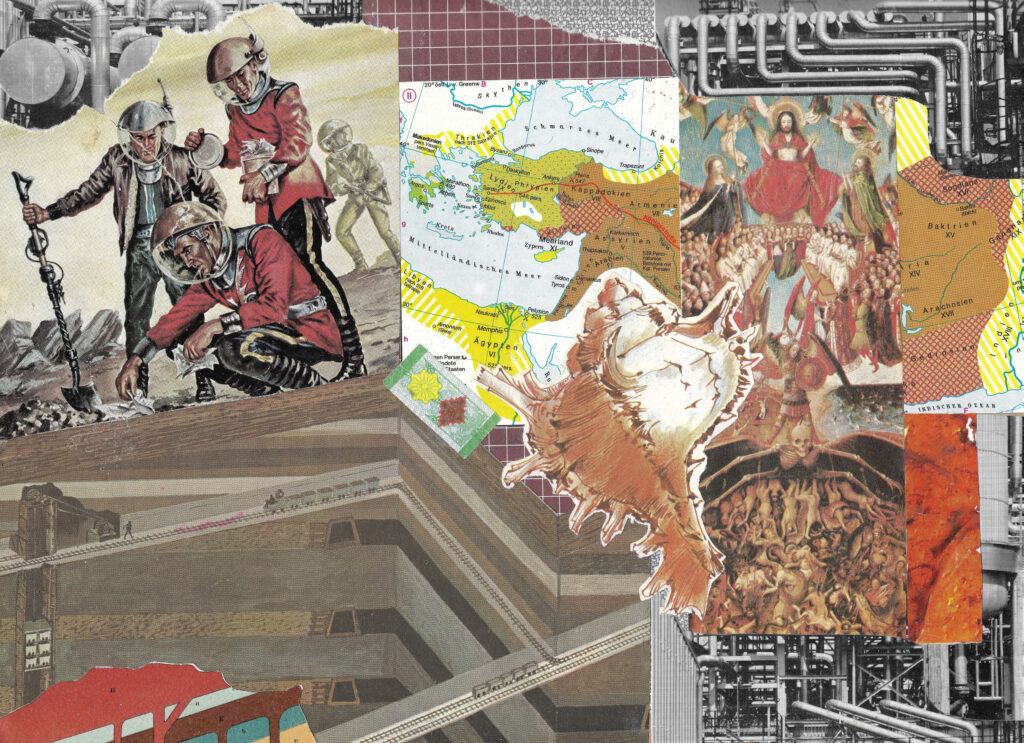
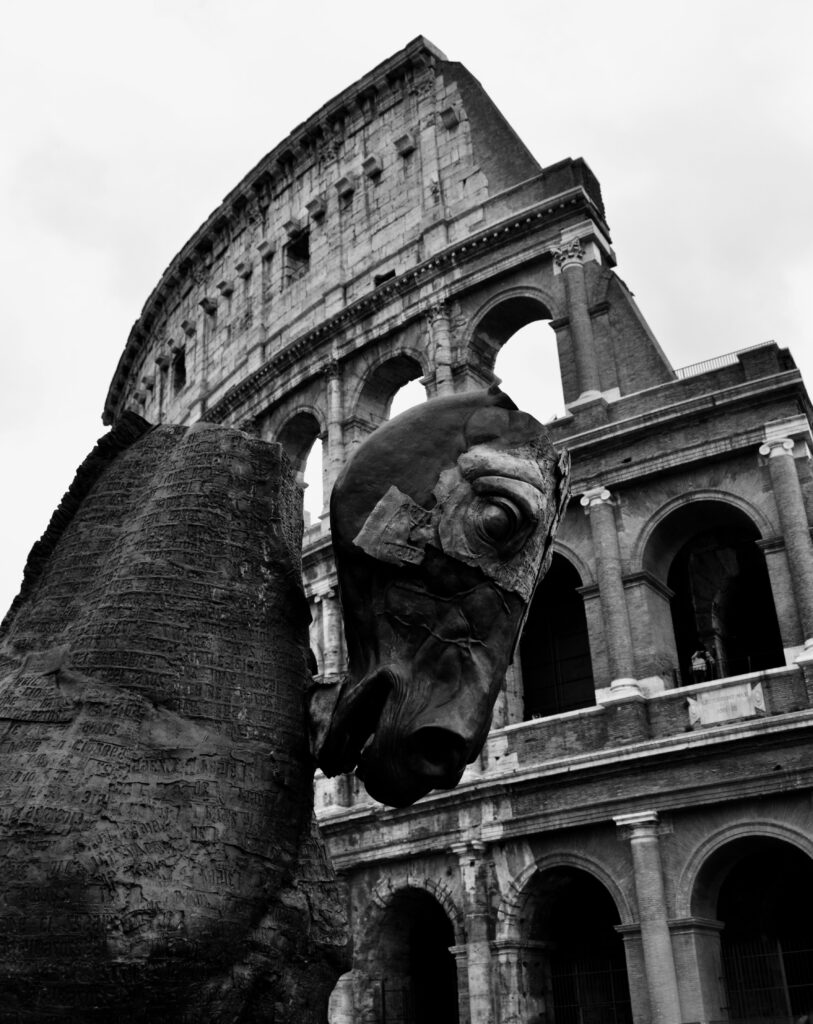
Image: 978-0980544008 – Ferdinand Altenburg, 2024
b2o: an online journal is an online-only, free-to-read, peer-reviewed journal published by the boundary 2 collective, with a stand-alone editorial board.
This special issue is brought to b2o by Arne De Boever and Frédéric Neyrat. EXOCRITICISM was born out of a call for papers (reproduced here, in broken-up form, in the Table of Contents) that was first circulated among writers who we thought might be susceptible to it. Out of a large number of submissions received, De Boever and Neyrat then selected fourteen contributions, which (for reasons that are discussed across the contributions) were not sent out for peer review. They were, however, lightly edited by both De Boever and Neyrat in preparation for publication. Each contribution follows a style-guide that its author deemed appropriate for their particular project.
The collage featured on this landing page, as well as those published with several of the contributions, are by Ferdinand Altenburg.
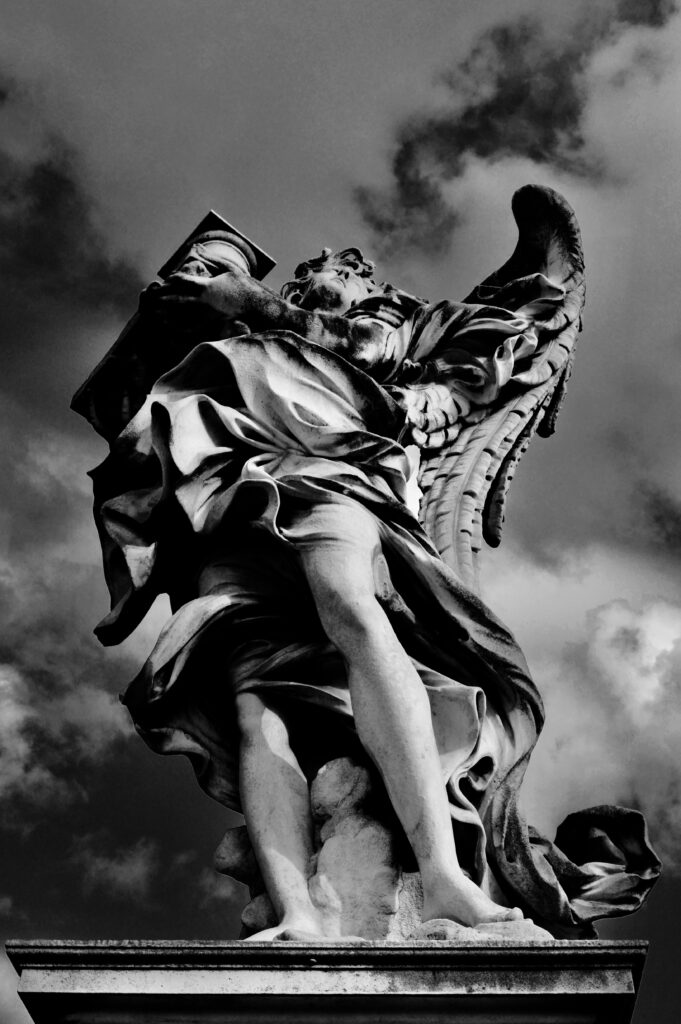
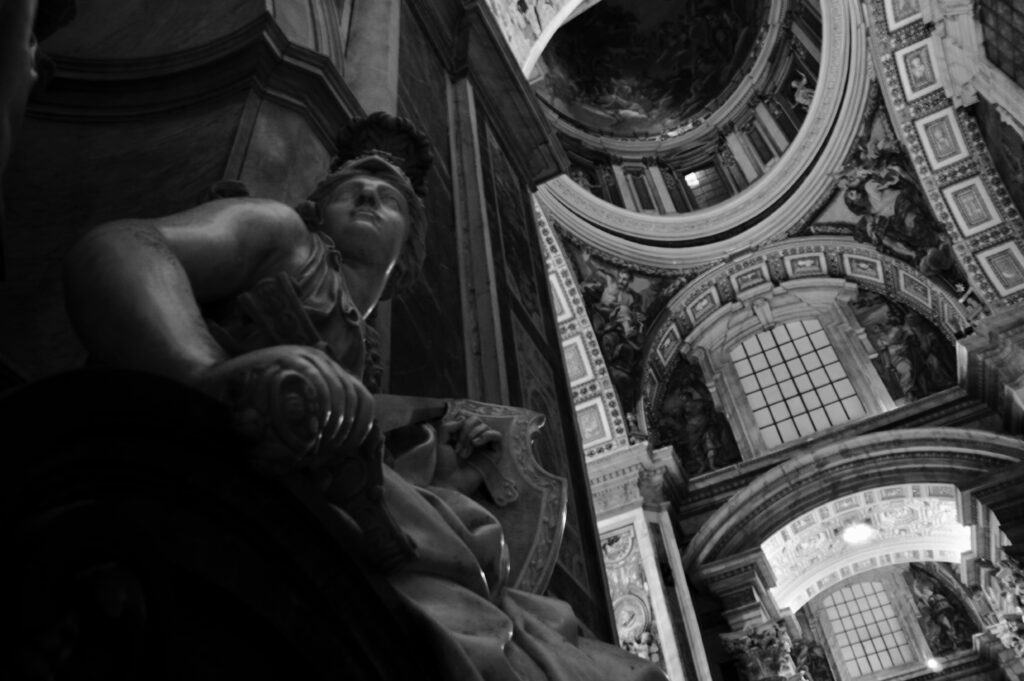
The photographs in the Table of Contents are by Michael Sawyer:
Angel © Michael E. Sawyer
Watchtower © Michael E. Sawyer
Gambit © Michael E. Sawyer
A book based on this special issue and designed by Naveen Hattis will be published by Research and Practice Lab Press.
Table of Contents
I. Exigency
How to write criticism when artificial intelligence tends to write for us? In 1958, two years after the term AI was coined, Theodor Adorno (of all people) makes the case for the essay—as opposed to the standard scholarly article–as a writerly form through which the critic can be intellectually free. While Adorno does not mention AI, it is not a big step from the standard scholarly article to the AI-generated article. The two are part of a same history that is marked by the loss of a critical form that would share some aesthetic value with its object, and demonstrate its own aesthetic autonomy. If the essay is one form through which such criticism may be achieved, what others might we generate in the time of AI?
Elmar Schenkel, “The Conspiracy of the Electricians”
Arne De Boever, “The Essay vs. AI: On the Literary Value of Criticism”
Darko Vukić, “EXOCRITICISM After the Demon”
Pierre Cassou-Noguès (text), Gwenola Wagon (images), “Eye See ‘NK Sehr Forreye Ame: On the Appropriation of DBT by AI”
Will Alexander, “A Spontaneous Note On EXOCRITICISM”
Nick Nauman, “Is Driving”
Anna Longo, “The Inhuman, All Too Human”
II. Intervention
What if, some day or night, a demon were to tell you that this article as you are writing it now can be written faster, and better, by AI? And what if this demon were to then challenge you to now write your text differently, in a way that breaks with the accepted rules of academic prose—in a way that an AI never would? What if this demon promised you a peer review process that would not enforce such rules but welcome their retirement? Would you throw yourself down onto the floor and gnash your teeth and curse the demon who spoke thus? Or have you once experienced a tremendous moment when you would have answered them: “You are the editor I have always desired, and never have I heard a better call for papers?”
Andrew Wenaus, “What is Patamathematical Poetry?”
Steven Swarbrick, “XENOECOLOGY: Encounters with Alien Life”
Brian Evenson, “Sometimes on The Teletubbies”
Andrew Levy, “Presences Stir”
Nathan Brown, “Elemental History: Zumthor after Hölderlin”
DX Aminal and Lera Winehouse, “aillelujah?”
Frédéric Neyrat, “Prophecies in the Fog”
III. Outro
In this special issue, editorial demons Arne De Boever and Frédéric Neyrat have published what they call works of EXOCRITICISM. These works explore the unexpected transitions between speculation and description, metaphor and concept, drawing and analysis in response to the Great Deprivation that is produced by techno-fascism’s appropriation and hollowing out of thought. EXOCRITICISM is anti-fascist literature in the forms of criticism, and criticism in the forms of literature. EXOCRITICISM calls for a radical democracy of forms, their an-archist emergence—their untimely communism. Far from marking the end of the essay, this issue proposes that our time marks its new beginning.
FORGET ABOUT DATA CENTERS
EX-CENTER YOUR INTERPRETATIONS
Contributor Biographies
Having risen well over his 50th book, Will Alexander has, along with Byron Baker, authored a book in three volumes entitled Anonymous Stellar Ravines. Baker erupted with 347 abstracted visuals that Alexander has approached individually and provided with an endemic definition of each work. Along with these volumes, a new book of aphorisms is appearing from Station Hill Press in upstate New York as Alexander continues his quest for the creative altitudes. He is currently poet-in-residence at Beyond Baroque Literary Arts Center in Venice, California. He resides in Los Angeles.
Ferdinand Altenburg is a student of Daniel Richter at the Academy of Fine Arts Vienna. Pictorially, he metabolizes theoretical traditions, popular culture, and political discourse into traces of associative coprolite. By aligning aspects of the shitpost with tactics of semiological guerrilla, his work explores the potential for collectivizing the significatory means of production through autopoietically individualizing operations of subjectification.
Arne De Boever teaches American Studies in the School of Critical Studies at the California Institute of the Arts, where he directed the MA Aesthetics and Politics program for over a decade. He is the author of numerous articles, reviews, and translations, as well as seven books on contemporary comparative fiction and political and aesthetic philosophy. His most recent books are Against Aesthetic Exceptionalism (University of Minnesota Press, 2019), François Jullien’s Unexceptional Thought (Rowman & Littlefield, 2020), Being Vulnerable (McGill-Queen’s University Press, 2023), and Post-Exceptionalism: Art after Political Theology (Edinburgh University Press, 2025).
Nathan Brown is Professor of English and founding director of the Centre for Expanded Poetics at Concordia University, Montreal. He is the author of Baudelaire’s Shadow: On Poetic Determination (2026), Rationalist Empiricism: A Theory of Speculative Critique (2021), and The Limits of Fabrication: Materials Science, Materialist Poetics (2017), all with Fordham University Press. His translation of Baudelaire’s The Flowers of Evil was published by Verso in 2025.
Pierre Cassou-Noguès is full professor in the philosophy department at university Paris 8. Gwenola Wagon is an artist and a full professor at university Paris 1. Together, alone or with various collectives, they explore the contemporary imaginaries in relation to the technological mutations and the environmental crisis. Gwenola Wagon has recently published Planète B (369 éditions, 2023): a fictive narrative about the big boss B of a platform named A. Pierre Cassou-Noguès has just published: Trait de côte. Un voyage philosophique à vélo (Philosophie magazine éditions, 2026). Their joint book The Pyromaniac Images should appear in English at Set Margins in 2026.
Brian Evenson has published over two dozen books, most recently the story collection Good Night, Sleep Tight (2024). His collection Song for the Unraveling of the World (2019) won the Shirley Jackson Award and the World Fantasy Award and was a finalist for the Los Angeles Times’ Ray Bradbury Prize. Other books include the story collections None of You Shall Be Spared (2023), The Glassy, Burning Floor of Hell (2021) and A Collapse of Horses (2016). His novel Last Days won the 2009 ALA-RUSA award. The Wavering Knife (2004)won the IHG Award. He has received three O. Henry Prizes, an NEA fellowship, and a Guggenheim Award. He lives in Los Angeles and teaches at CalArts.
Andrew Levy is the author of fifteen collections of poetry and prose, including Artifice in the Calm Damages, Don’t Forget to Breathe, a novella, Nothing Is in Here, and a nano-science memoir, Cracking Up. His work has appeared in numerous American and international magazines and anthologies, including The Gertrude Stein Awards in Innovative American Poetry, Telling It Slant: Avant-Garde Poetics of the 1990s, 60 Contemporary American Poets, and Resist Much, Obey Little – Inaugural Poems to The Resistance. From 1997-2008 he co-edited the poetry journal Crayon with Roberto Harrison, and he is currently Professor of English at CUNY.
Anna Longo is a philosopher affiliated with the university Paris Cité. Her research interests include philosophy of technology, metaphysics and aesthetics. Her last books are Le jeu de l’induction: automatisation de la connaissance et réflexion philosophique (Mimesis 2022) et Deleuze: une philosophie de la multiplicité (Ellipses 2024).
Nicholas Nauman works as a writer, musician, and cook.
Professor in the English department of UW-Madison, Frédéric Neyrat is a French-American philosopher with an expertise in environmental humanities, contemporary theory, and technology studies. He is co-editor of the electronic platform Alienocene that charts the burgeoning field of Planetary humanities. Recently, he published The Unconstructable Earth: An Ecology of separation (Fordham, 2018), Le Cosmos de Walter Benjamin (Kimé, 2022), La Condition planétaire (Les Liens qui Libèrent, 2025), and Traumachine: Intelligence Artificielle et Techno-Fascisme (MF, 2025). Website: Atopies.
Michael Sawyer is Professor of African American Literature & Culture in the Department of English at the University of Pittsburgh. He has authored four books: An Africana Philosophy of Temporality: Homo Liminalis (Palgrave, 2018), Black Minded: The Political Philosophy of Malcolm X (Pluto, 2020), Sir Lewis (Grand Central Publishing/Legacy Lit, 2025), and The Door of No Return: Being-As-Black (Temple University Press, 2026). He is also the editor of the forthcoming Malcolm X in Context (Cambridge University Press) and the co-editor of Cambridge’s New Elements of Black Thought Series. He is the co-editor of the Journal of French and Francophone Philosophy and on the editorial boards of Political Concepts: A Critical Lexicon, Critical Times, and the PMLA Advisory Committee.
Elmar Schenkel was born in 1953 near Soest in Westphalia. After visiting professorships at the University of Massachusetts, Freiburg and Constance, he was Professor of English Literature at the University of Leipzig until 2019. He has published travel books on Japan, Romania, Russia, India and the USA, as well as books of poetry and prose and a number of collections of essays (among others with Klett-Cotta, C.H. Beck, S. Fischer). His biography of Joseph Conrad came out in 2007. His academic work focusses on the relationship between literature, science and religion. Mauerrisse (Cracks in the Wall) was awarded the Jürgen Ponto Förderpreis in 1985 by Golo Mann. In 2011-12 he was writer in residence in Cața/ Transsilvania. His most recent works concentrate on Asian and Western encounters as well as on Nietzsche, on whom he published a book showing Nietzsche’s impact in cultures around the world. He is also the author of children’s stories. His Magical Globe was translated into Chinese, while his early stories were published in Farsi. His short prose and aphorisms were published in two books in Russia. He also works as a painter and directs the Leipzig Society for Comparative Mythology. He is a free-lance contributor to Frankfurter Allgemeine Zeitung.
Steven Swarbrick is Associate Professor of English at Baruch College, City University of New York. He is the author of The Environmental Unconscious: Ecological Poetics from Spenser to Milton (2023), The Earth Is Evil (2025), and Divest: An Essay on Political Masochism (2026) and a coauthor of Negative Life: The Cinema of Extinction (2024).
Darko Vukić is an interdisciplinary artist, writer, and curator based in Vienna. Working across sound, installation, performance, and theoretical practice, he investigates the entanglements of language, technology, and embodiment to reconsider agency, perception, and identity. His research-driven work unfolds through immersive and hybrid forms that treat language as both medium and process.
Andrew C. Wenaus is a literary theorist, poet, writer, and composer. He is Assistant Professor in the Department of English and Writing Studies and Associate Professor at the Centre for the Study of Theory and Criticism at the University of Western Ontario. His research engages experimental writing as a site for rethinking futurity, with particular attention to post-national cosmism, xenopoetics, and emerging theoretical models of communism.
Lera Winehouse & DX Aminal bonded a decade ago in Melbourne at a lecture leading to a bar — Nietzsche, Dostoevsky and True Detective were in the mix. They share Latvian heritage and a love of the OUTSIDE: in shared preference for physical labour over desk work, in affection for misfits. in 2023, they co-created mongrel matter, a publishing collective focusing on demonstrous philosophy and lifestyle; our open book projects include Aesthetic Literacy vol.1-3 (2023-24), Philosophy of Final Words (2025), Nietzsche on the Horse (May 2026), Artists & Philosophers as Criminals (July 2026), Oracular Style in Philosophy & Literature (2027) and Born to Lose (2027).