
b2o

Search results for: “bruce robbins”

  • Arne De Boever–The Author as Listener: On the Politics of Ben Lerner’s Transcription

    Arne De Boever–The Author as Listener: On the Politics of Ben Lerner’s Transcription

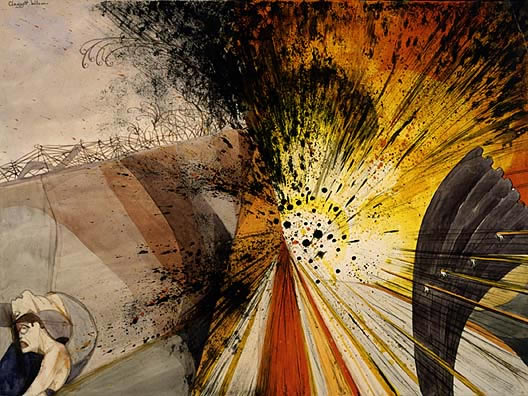
    Image: Nam June Paik, Zen for Film

    The Author as Listener: On the Politics of Ben Lerner’s Transcription

    Arne De Boever


    We have two ears and one mouth so that we can listen twice as much as we speak.

    –Epictetus

    The crisis of democracy is first and foremost a crisis of listening.

    –Byung-Chul Han


    Last Words

    Ben Lerner’s novel Transcription constitutes itself almost entirely across two extended scenes of listening that make up the first and third parts of the book: “Hotel Providence” and “Hotel Arbez”. In the first, a young father travels to Providence to interview his former mentor Thomas, a genre-dissolving and genre-founding (32) filmmaker who, advanced in age, is making plans to die with dignity in Switzerland. As several reviewers of the novel have noted, Transcription invites us to pick up on the connections between the character of Thomas (whose talk fills up most of the novel’s first part) and (among others) the German writer and filmmaker Alexander Kluge (mentioned in the novel [25]—Thomas has his books lying around, unread, on his couch and floor), who died around the publication of Lerner’s novel at age 94, and is sometimes compared to Jean-Luc Godard, the French nouvelle vague filmmaker who died by assisted suicide in Switzerland at age 91.

    The second scene—the third part of the novel—consists of an interview (or perhaps just a conversation; although it is more like an extended monologue) with Max, Thomas’ son, after Thomas has passed away. The reader gathers that the listener—the one who is spoken to–is the same as in the novel’s first part. Max and this listener turn out to have been college friends at Brown University, where Thomas used to teach. Both Max and his interlocutor have young children, girls, who are going through a rough patch: Max’ daughter Emmie is having trouble eating (Thomas, to Max’ irritation, refers to her—referencing Kafka–as a “Hungerkünstler” [47; 50], a “hunger artist”), and his interlocutor’s daughter Eva “is flirting with what the school counselor called ‘school refusal’” (15). Their lives (or at least what we know of them through the novel[1]) appear to be so much alike that you may be forgiven for reading them as interchangeable. Transcription in fact suggests that Thomas, most likely as part of cognitive decline, confuses his former student with his son, unsettling both the student (did he forget that twenty years ago, he was in Switzerland with Thomas to work on a film project? Is Thomas right to accuse him of “tell[ing] this untruth” when he says he’s never been to Switzerland? [48]) but especially the son (“It was as though someone had placed an ice pack against the back of my neck” [129]–did his father somehow forget that they were in Switzerland together?). “I felt”, the son confesses to his friend, “perhaps as intensely as ever—the unheimlich. Maybe the real son would just come downstairs, maybe you were the real son, maybe I was the clone or robot or doppelgänger” (122).

    The portrait that emerges of Thomas as a father (and husband) is not flattering: he seems incapable of establishing a personal relation with his son (and perhaps also his wife? she committed suicide when Max was eight), instead always fleeing from the dilemmas of parenting and grand-parenting (and perhaps marriage?) into “some weird allegory, some kind of prose poetry, or an impossible string of references (many of which were probably fictional)”(94)—witness the characterization of his grandchild as a “Hungerkünstler”, some figure from a story by Kafka. At the same time, there are aspects of Thomas’ relationship to his grandchild that are also quite endearing (we hear about him reading a story to her over the phone, and interrupting the reading to play some music by Debussy that fits the tale, 93-94)—and Max acknowledges this (93). The impersonal relationship between father and son—at some point, Max started consistently calling his father Thomas—is driven to a head when Thomas ends up in hospital during Covid, and seems likely to die. Only then, with a nurse holding her iPhone to his father’s ear—listening is once again extremely prominent in these pages–, does Max “as a disembodied voice” (111) allow himself to tell his father about love and forgiveness. Against all expectations, Thomas pulls through—Max receives a call that he is “stable” and that “[h]is vitals are good” (114)–, but Max can’t be sure that his father heard what Max told him over the phone. Somehow incapable of directly asking him, he finds himself “listening for traces” (118) when he goes to see his father after the ordeal, looking for signs that the message actually arrived.

    In between these two scenes of listening, and holding them together like a hinge, is the shorter part of the novel, “Hotel Villa Real”. Set in Madrid (familiar to readers of Lerner’s Leaving the Atocha Station) after Thomas’ passing, it takes place on the evening of a symposium in Thomas’ honor where Transcription’s narrator spoke publicly about how his interview with Thomas—and Thomas’ last, it turns out—came about. Although this talk itself is elided in the novel, the reader gathers that it must have presented some version of what we were told in “Hotel Providence”: the story of how the interviewer travelled to Providence to speak with Thomas on the record; of how he dropped his phone—the recording device he was planning to use—in the partially blocked hotel sink, ruining it; and of how he then proceeded to hold the interview anyway, pretending to record it (the extent to which Thomas was aware of this fact seems unclear in the novel, 59). Somehow, our interviewer was incapable of telling Thomas that he’d ruined his phone. What was published, then—Thomas’ last words—could not possibly have been a transcript of an actual conversation, since there was no recording. They could only have been our interviewer’s reconstruction (and reconstruction from memory, since he did not take notes—he was recording, remember?) of what was said. Our interviewer does not find this problematic, given that all published interviews are heavily edited and do not sound like a transcript of their recording (70); but Rosa, the curator who has organized the event at which he spoke, and (according to Rosa) also Thomas’ son Max who attended the event, appear to be “shocked” (72) by this “confession” (74) and by the fact that what they took to be Thomas’ last words are actually not his last words but someone else’s.

    “I’m fine”, the narrator hears himself say in response to these accusations, but Rosa didn’t ask him; it seems he is just trying to reassure himself in the face of his growing feelings of authorial guilt.[2] Thomas, though, Rosa acknowledges, would have loved the situation—“would have loved it. Loved the idea that his last published statement was ‘unstable’” (72).

    Listening Is Writing

    Based on the novel’s title alone, and then further on the fact that its two major parts consist of interviews (of scenes in which someone is being talked to), it seems fair to characterize Transcription as a novel about listening. This is perhaps especially so given that the middle part accuses the interviewer of having concealed the fact that what he published as the record of an act of listening was in fact a document of writing—in other words, that the middle part of the novel seems to clearly privilege listening over writing.

    Certainly, the novel sets itself up to be read in this way. In the novel’s first six pages, leading up to the narrator dropping his phone in the sink, we move from (on the train) “I put in my earbuds and began to listen to a talk, recorded in Paris in 1973” (4) to (arriving in Providence) “I still had my earbuds in and I was listening to walking directions” (5), and (checking into the hotel room) “I … turned on the TV and opened the blinds and half listened to the news” (6), to (talking to his daughter Eva on the phone) “‘Yeah,” she said, maybe listening” (8). In addition, the novel notes in these opening pages that “I could hear what sounded like live piano music, but saw no piano” (6); when the narrator needs to call Thomas, he asks himself: “Why was I more nervous about briefly encountering his disembodied voice than spending hours with his embodied one? ‘You should write that down’, Eva said in my head” (7). Such references to listening continue throughout the novel. Everything in the novel appears to be about listening, then, a listening that is not so much made impossible by the destruction of the phone on page 9 but emphatically solicited at this point—as a listening beyond technological recording.

    If this is going to be a novel about listening, well, now that we’ve gotten the phone out of the way, the game is really on… Let’s listen. (By contrast, when Max in the third part of the novel actually records his father, he “was only half listening—I’d let my device do the listening”, 124-125).

    Recalling Lerner’s navigation of his work between poetry and the novel elsewhere, one might suggest that if the novel is typically thought to offer prose to be read, with poetry giving us song to be listened to, here a novel announces itself perhaps not quite as a song but as prose to be listened to—as something more poetic than a novel.

    The move that Lerner makes at that precise moment in Transcription is interesting, and marked (for good measure) by two white lines—and three stars. I quote from page 9:

    I somehow knocked the phone into the water.

    ***

    For the duration of this sentence, it was submerged. [my emphasis]

    The message couldn’t be any clearer: if this is going to be a novel about listening, Transcription is telling us, it is not the kind that is going to pitch “writing” against “listening”, as Rosa—who is not a writer herself–in the middle part of the novel seems to do, thus guilt-tripping our interviewer/ narrator. Instead, the moment when the phone is knocked into the water is also the moment when “writing” (“For the duration of this sentence”) explicitly appears on the page, as if to help out. You can find moves like this all over Lerner’s oeuvre; you wouldn’t be wrong to characterize them as one of his signature gestures. Another one arrives on page 26, for example, when Thomas offers the narrator coffee (which he does not want or need), and he takes “a fictional sip” (my emphasis). That could mean he’s pretending to sip the coffee, of course; at the same time, however, the coffee is indeed entirely fictional—it is written coffee, a pipe that is not a pipe, as a Belgian surrealist artist already playfully told us long ago. Later, on page 38, when Thomas asks about his daughter, our interviewer responds: “I call her Eva in this book” (my emphasis). Transcription emphatically does not pitch writing against listening, then, but seems to advocate for a close connection of the two. How to write as a listener? Are we perhaps, as listeners, “always already” writing? (I will return to this Derridean locution, “always already”, and the process of deconstruction that it marks, below.)

    If all of the previous references to listening were fairly casual (but rich in variation—we are listening, half listening, maybe listening, listening to a voice in our head, et cetera), once Thomas enters into the conversation things frequently get technical. For a filmmaker, i.e. someone who is primarily working in a visual medium, he turns out to be quite obsessed by sounds and voices. As a way to get WWII out of the way in the conversation, he wants to start with his “sound memory” (but what memory is ever “sound”?) of hearing “Hitler’s voice” (36) on the radio in 1934; he recalls it as “rising and rising in pitch”, as if it were “eternally ascending”, impossibly so—like a “Shepard tone”, as Thomas correctly explains (37). From the get-go, and here some may find support for our interviewer’s argument that there is nothing wrong with him having reconstructed his conversation with Thomas from memory, Thomas insists that the interview is not going to be about being “literal”: “We practice literature, not law” (37), as he puts it. (It’s worth noting on this count that Thomas’ son, Max, practices law and that he is thus taking some distance from his son, and situating himself more closely to his doppelgänger, our interviewer/ narrator.) “We begin with the voices” (38), Thomas insists—the voices that are there in the ether, in the air. Some of these, we hear; but Thomas is even more interested in the ones we can’t hear—“there is always music playing that we cannot hear” (39). “Do we have ears to hear?” he asks. “[S]ometimes we listen without them. … There is listening beyond the cochlear, yes?” (39)

    One assumes that the interview has already started at this point—the narrator is pretending to be recording—but as far as Thomas is concerned they are still recording onto the “long stretch of black leader” (40), the starting part of a recording tape that doesn’t record. “We remain in the black leader part of the interview” (40), he insists, until they’ve come up with the first question—something that suits the narrator, who would in fact prefer this initial evening conversation to be “the leader” (44) with the real interview following the next day, after he’s gotten himself a new phone. But much that is important to Transcription is already being shared in this part of the interview (it includes, for example the first version of the confusing conversation about “Switzerland”, 43)–and of course all of it appears, mysteriously transcribed, in Lerner’s novel. How can we have a record of what could not have been recorded on this long stretch of black leader? How could this miracle have been brought about?[3]

    There are only two conclusions we can draw, within the limits of the fiction at least: either the narrator was bullshitting about dropping his phone in the sink, and the interview took place as planned, was recorded and then dutifully transcribed (and this is why we have the first part of Transcription); or he did indeed drop the phone in the sink, and everything we are reading is transcription from memory, and perhaps thereby approaching “fiction”—which is, let us not forget, the overall form or category in which the interview is presented to us here (as part of “a novel”). But in that case the questions come quickly: does an interview become “fiction” simply because it was not technologically captured, and transcribed from memory? But if such an interview is similar, as the narrator argues, to actually published interviews which are always heavily edited, why do interviews that were technologically captured but heavily edited not enter into the realm of fiction? What, exactly, does or does not constitute the fictional in these cases? And where, exactly, do we locate what we might call “authorship” in them? (An author is considered to have been at work in the first case; but in the second, we talk about editing rather than authoring. As an author who also works as an editor, I admit to having been occasionally confused on this count myself, in particular with texts that need a lot of work. Am I editing them? Am I writing? Editorial mediation vanishes; writerly mediation is marked.)

    Once the “interview” is over, the narrator wonders “what I’d do if he [Thomas] asked to see a transcript” (54). Transcription then offers, as a closing reflection and further turn of the screw, the account of our narrator’s breakdown in college, when he suffered from “auditory hallucinations” (56): surely not the most reassuring thing to find out about someone who has just conducted an interview without recording or note-taking. The narrator tells us that Thomas helped him with these hallucinations. But how so? As one may suspect from someone interested in voices audible and inaudible floating in the ether, Thomas helped not by trying to get rid of the hallucinations but by engaging the narrator in an auditory experiment designed to prove that everyone has auditory hallucinations, that all listening is, effectively, a kind of writing—that there is no objective listening or that there is no outside-writing, no outside-the text. Like a psychoanalyst, who does not aim to cure you out of your weirdness but instead starts from the assumption that everyone is weird and that some—their patients—just find that fact harder to handle than others, Thomas starts from the baseline that everyone hallucinates when they listen (and that some just find that fact harder to handle than others). “You see”, Thomas says after having had the narrator hear voices in “a MIDI file” (56) in which they have effectively become inaudible to the human ear, “we all hear phantom voices. It is a question of the right conditions. Or the wrong ones. Unconscious inference, our brain guessing, making us hear what it thinks is likely there. We hear as if. We are together, erring” (57). This is, clearly, the Thomas who loves being “unstable”; it is also the Thomas who keeps insisting in the novel on the social aspect of things, which is tied for him to politics (doing things together). Hearing voices, the narrator is not having a pathological breakdown; he is, rather, tapping into the ether, as we all do. The laughing he hears “in the rustling of dried leaves” (55) (likely another one of the novel’s references to Kafka [68, 95]—in this case to “The Cares of a Family Man” in which the laughter of a creature called Odradek sounds like the “rustling of fallen leaves” [Kafka 428]) is there, as far as Thomas is concerned. Nothing to worry about—you are fine. I don’t know if this is good mentoring, but the narrator does note that he was “helped” by it: helped by the demonstration of the fact that all listening is writing.

    Mosaic Authorship, Stone Tablets, and Impeded Speech

    It is hard to avoid—and Transcription invites—the associations between a novel that revolves around listening and the sacred, religious (and, if we want to cast the net a bit more widely, spiritual) texts that reveal themselves to be the records of acts of listening, that come about in response to dictation, in which the interviewer/ writer is effectively no more than a medium, but a medium that does not mediate, that merely relays to us, without intervention, the divine word of the one interviewed or listened to, the one doing the dictating (the dictator, if you will… more on the politics of all this later).

    How does Transcription operate within these associations? Consider, for example, the first five books of the Bible—the so-called Pentateuch—which were, or so it is believed, dictated by God to Moses. Moses supposedly merely transcribed what God told him, but of course—and especially because this transcription takes place long before the invention of recording devices such as the iPhone—this opens up the entire, and much discussed, question of Mosaic authorship, and the extent to which Moses may have intervened in the words that were passed down to him from God. With Moses and God, we’re not even in the black leader portion of the tape; we’re in a blackness way before that. Transcription presents to us a kind of Mosaic authorship, activating the uncertain borderline between listening and writing not so much with respect to God, but with respect to his stand-in in the novel: the mentor and flawed father (wasn’t God a flawed father as well? Which all-powerful being allows his son to die on the cross?) who survives Covid against all odds—the great artist Thomas.

    The association between our interviewer/ narrator and Moses was, for me, immediately evoked by Transcription’s cover, which features what appears to be a stone tablet in the shape of an iPhone. The stone tablets are another famous instance (within the Pentateuch, as a mise-en-abîme) of Moses transcribing God’s dictates—God’s “Ten Commandments”, his “law”. Thomas, of course, does not want to be God, and situates himself on the side of literature rather than law, a position that is perhaps suggested in the Bible itself given that Moses, angered by his people’s worshipping of the golden calf, smashes the first version of the tablets to pieces (and the second version of the law that the Bible offers is not identical to the first, even if God states that “I will write upon the tables the words that were on the first tables, which you broke” [Ex. 34:1]!). Perhaps the entire problem is captured by the fact that Moses, when God initially selects him as his spokesman, argues that the role should go to his brother Aaron instead because he is a bad speaker—“slow of speech and tongue” (Ex. 4:10) and “of uncircumcised lips” (Ex. 6:12), perhaps an indication of a speech impediment, like a stutter or a cleft palate. (The equivalent of this speech impediment in Transcription would be the interviewer/ narrator’s auditory hallucinations. All of us are impeded in our speech, none of our speech is clear. Not even mine, in this text.) Moses is not who you want to choose as your communicator—unless, of course, that is the entire point: that there is something unstable in the divine law, an instability that is to be embraced. Law is always delivered as impeded speech, and thus it begins to approximate literature. It is Thomas who talks about his granddaughter, Emmie, “bowed over her so-called tablet … as if in prayer” (47). Transcription in this context tells us, with respect to the sacred text, that while it may present itself as the record of an act of listening, it is always already a document of writing, with Moses not so much as the vanishing medium but very much as the mediator—it’s a novel that foregrounds mediation (“For the duration of this sentence”, “a fictional sip”, “I call her Eva in this book”, et cetera). Could it be that the Bible does so as well? What may be the consequences of such an insight? From such a point of view, it seems the stone tablet becomes, as Thomas puts it in a discussion about “icon painting”, “a secular detail” (46) rather than a sacred dictate—although “secular detail” is not quite the right name for what Transcription is either. For that, we will have to dig more into the fictioning that the novel does.

    The bigger point here then becomes that the word of God, or, in the case of Transcription, the word of Thomas, can never be accessed as such, because all acts of listening are already acts of writing—we cannot listen objectively, there is no listening-outside of writing (as I put it before, evoking Derrida: Transcription’s narrator does so himself when he points out, considering whether the wine he drinks at Thomas’ house is medicine or poison, that there is “a third option”, and that it might be both [34]—this was, of course, exactly Derrida’s point about the pharmakon in his reading of Plato [who is referenced in Transcription two pages later, 36]; more broadly, however, Transcription’s point about listening-as-writing is Derrida’s argument about speech and writing in his Grammatology).[4] From such a perspective, Rosa’s objections to our interviewer/ narrator reconstructing his interview with Thomas from memory—her guilt-tripping him over his authorship—appear naïve, more precisely they appear to be naively invested in the idea, the phantasy, that one could ever really access the word of God/ Thomas. Listening, Transcription argues, never works in this way: it is always already writing. Rosa seems to criticize our interviewer/ narrator’s authorship in favor of some kind of direct access to Thomas’ speech, but really what she is trying to access in this way is just some bigger Author, whose words also could never be directly taken in (because to listen is always already to mediate). Transcription is a meticulously construed criticism of this kind of attitude, which Lerner already discussed in Hatred of Poetry (people hate poetry, he argued there, because it can never realize the virtual, ideal, Platonic Poetry that they want; and so the metaphysians are always left disappointed…). Rosa suffers from a metaphysical affliction, a wanting to get beyond writing to access Thomas/ God directly, immediately. But there is no outside of mediation, Transcription tells us: even a transcription is a form of scription, after all. The mediator never truly vanishes. Instead, it’s authors everywhere.[5]

    Political Fiction

    This is not to say that Transcription is not rethinking the author and authorship, as no doubt we should in a time when “authoritarianism” has become the political keyword of the present.[6] For while Transcription argues that there is no listening that is not always already writing, it also emphatically makes the reverse point: that writing really is a form of listening. The writer, in Transcription, is emphatically a listener, and most of Transcription’s record is really the record of an act of listening. The novel does not make this point naively, by indulging in the phantasy that there could be a listening without writing; but it makes it nevertheless, in response to an understanding of writing as law-making, dictating, commanding—in short, against an authoritarian understanding of the practice. It seems abundantly clear that Transcription’s narrator wants to present himself as a listener, a listener who is then—due to the ruination of his iPhone—solicited into a listening beyond technological recording, a situation in which (“For the duration of this sentence”), writing will come to his aid to help him deliver a reconstruction from memory (a record) of a conversation, of Thomas’/ God’s speech. On the one hand, this marks an investment in writing; but it’s an investment in a writing that operates in the service of listening, with the author being recast as a “transcriber”, as perhaps more of a poet in relation to a song than as a novelist in relation to prose. Transcription appears to be an activity that takes place somewhere in between the prose of the novel and the song of poetry, a writing-as-listening and listening-as-writing that, as an emphatically social activity, always taking place in the realm of the more-than-one, is arguably also sharply political in a time of the increasingly loud dictates of authoritarianism. Under such contemporary conditions, authorship should be rethought—and Transcription is a novel that takes on this task.[7] As such, and perhaps in spite of appearances, this slim fiction is intensely political, as all of Lerner’s other work.

    This becomes perhaps most clear with respect to the notion of fiction that the novel articulates, and that—in the time of fake news and bitterly fought contestations about historical facts—is embedded in these political concerns.[8] Indeed, the transcriber is, perhaps contrary to the naïve understanding of the word, a kind of fictioner. But in what sense?

    The key passage for this is likely the narrator’s account of his visit with Anisa–the best friend of his college girlfriend, and to whom he becomes unexpectedly close after he and his girlfriend break up–to the Natural History Museum on the Harvard campus. The museum has a “dimly lit gallery dedicated to the [glass] flowers”, “botanical models made by glass artists—a father and son—from Dresden a century ago” (20). Transcription ends with multiple references to these flowers, including in an epigraph following the narrative’s end, so the novel makes it clear that this is an important passage. There is, of course, the reference to the father-son relationship that is worth noting; in addition, we are dealing here with something very fragile, a fact that is perhaps further underlined by the artists being from Dresden, a city heavily bombed by the allied forces during WWII (overall, this scene evokes the work of W.G. Sebald [perhaps in particular his work On the Natural History of Destruction] who is, in addition to Kluge, a reference in Transcription; Sebald is one of those authors who, as a novelist, rethought writing as listening, offering fiction as a record of acts of listening that are often multiple and embedded within each other—see, for example, Sebald’s prose work Austerlitz, which presents itself as extended record of an act of listening). Finally, however, and most importantly, the narrator’s experience of seeing the flowers leads into a reflection on fiction:

    I kept seeing the flowers as organic one instant and as artificial the next, a kind of duck-rabbit effect, not between things the object might represent, but between nature and culture, the given and the constructed. And I carried this new way of looking, or this new hinge in my looking, outside the museum: when my sister dragged me camping, for instance, I was typically unmoved by “unspoiled” mountain views; after the glass flowers, I would see cracks in the rock face as penciled, as a history of small decisions, and then experience the view as beautiful. I could will myself to see the rose and pink of a sunset as applied in touches or stains and then revert to seeing it as natural; and so on. It was with Anisa that I first became conscious of this quiet but crucial technique, somewhere between a child’s game, a CBT exercise, and a religion. Eventually, I’d call this “fiction”. (21)

    In between organic and artificial, duck and rabbit, nature and culture, the given and the constructed—let’s add: student and son, medicine and poison, and, of course listening and writing. This is where we are with the fragile, glass flowers, so delicate that around them, visitors are asked “to keep our voices low” (20); this is where we are with Transcription as well, in between the given and the constructed. The interview is supposed to give us the given, but Transcription delivers the message that all interviews are constructed; in fact, all listening constructs, it writes.

    Still, writing as a construction does not stand on the other side of the given—“fiction” has something to do with seeing the constructed in the given, and drawing out the given in the constructed. In that sense, it is not law, dictation, or commandment (which are all construction). It listens as it writes (it draws out the given, but the given can never be given). The suggestion appears to be that it is this kind of listening that prevents writing from becoming a lie, such as the lies that Anisa tells the narrator about the life of his ex-girlfriend in New York (50 and further). What we get in the novel, rather, is a plea for the transformative, reality-adjacent practice of fictioning through a writing-practice that is listening-based and transcribes the world between the given and the constructed.[9]

    In that sense, Transcription is, like the Hotel Arbez with which it ends, “a complex space. Non-euclidean” (128). As Max eventually explains to the interviewer/ narrator, who must have been there even if he appears to have some difficulty remembering it, the Hotel Arbez is:

                The one that’s famous because different parts of the hotel are on different sides of the border. The lower half of the stairs are in France, but, beginning on the seventh step—

                You’re in Switzerland. Right. Jesus.

                And during the German occupation, the Nazi soldiers could enter the French side of the hotel, but not ascend to the upper rooms, where Max Arbez helped shelter Jews and members of the Resistance. A kind of impossible staircase. Remember we went up, ascended to Switzerland? (128)

    Transcription’s fictioning is in between things, the way in which the Hotel Arbez is in between Switzerland and France—and it’s that in-betweenness that enables Max Arbez, one of the Max’s after which Thomas’ son is named (the others are Horkheimer “and my mother’s favorite uncle”; but one may want to throw in here Sebald as well, who preferred to go by Max) to shelter Jews from the Nazis. The return of the phrase “impossible staircase” is interesting as well, because Thomas had used it in part one of the novel to refer to how, in his “sound memory” of Hitler’s speech, his voice appeared to be “eternally ascending, an impossible staircase” (37). “This is a wondrous but terrible fact of our wiring,” Thomas commented then, “how clockwise movement across the pitch class creates this impression” (37). Terrible in the case of Hitler; wondrous in the case of the Hotel Arbez; here too, “it is a question of the right conditions. Or the wrong ones” (57). A fact of our wiring, to be sure—something that “our brains will allow” (37). But also an effect of our writing, our fictioning, our transcription.

    This is, perhaps, the closest indication we get of how Transcription, the kind of literature it practices, can save—but not in the way that the sacred text saves. Transcription saves not as a Holy Writ that delivers dictates; it does not save as authoritarianism. Instead, it saves as a writing-listening and listening-writing that exposes the phantasy of all such law-like commandments. The fact that it always inevitably writes does not mean that it lies. Rather, as a construction, Transcription fictions: it highlights the mediator not simply to expose the constructed in the given, but to offer a version of the constructed that can deliver the given, like a glass flower. Delicate and fragile, it asks you to keep your voice low as you approach, so you can listen–which is also to say write–all the better.

    Arne De Boever teaches American Studies in the School of Critical Studies at the California Institute of the Arts, where he directed the MA Aesthetics and Politics program for over a decade. He is the author of numerous articles, reviews, and translations, as well as seven books on contemporary comparative fiction and political and aesthetic philosophy. His most recent books are Against Aesthetic Exceptionalism (University of Minnesota Press, 2019), François Jullien’s Unexceptional Thought (Rowman & Littlefield, 2020), Being Vulnerable (McGill-Queen’s University Press, 2023), and Post-Exceptionalism: Art after Political Theology (Edinburgh University Press, 2025). His books Silent Music (co-written with the composer Michael Pisaro-Liu) and Secular Detectives and are forthcoming with Bloomsbury and the University of Nebraska Press respectively.

    References

    Benjamin, Walter. Illuminations: Essays and Reflections. Ed. Hannah Arendt. Trans. Harry Zohn. New York: Schocken, 1968.

    Bradbury, Ray. Fahrenheit 451. New York: Simon and Schuster, 2012.

    Coetzee, J.M. and Mariana Dimópulos. Speaking in Tongues. New York: Liveright, 2025.

    Derrida, Jacques. Dissemination. Trans. Barbara Johnson. Chicago: University of Chicago Press, 1981.

    —. Of Grammatology. Trans. Gayatri Spivak. Baltimore: Johns Hopkins University Press, 1998.

    Hölling, Hannah B. Revisions: Zen for Film. New York: Bard Graduate Center, 2015.

    Kafka, Franz. The Complete Stories. Ed. Nahum Glatzer. New York: Schocken, 1971.

    Lerner, Ben. Leaving the Atocha Station. Minneapolis: Coffee House Press, 2011.

    —. 10:04. New York: Faber and Faber, 2014.

    —. The Hatred of Poetry. New York, NY: Farrar, Straus and Giroux, 2016.

    —. “The Hofmann Wobble: Wikipedia and the Problem of Historical Memory”. Harper’s Magazine December 2023, accessible: https://harpers.org/archive/2023/12/the-hofmann-wobble-wikipedia-and-the-problem-of-historical-memory/.

    —. Transcription. New York: Farrar, Straus, and Giroux, 2026.

    The Holy Bible. Revised Standard Version. Meridian: New York: 1974.

    Sebald, W.G. Austerlitz. Trans. Anthea Bell. New York: The Modern Library, 2001.

    —. On the Natural History of Destruction. Trans. Anthea Bell. New York: Random House, 2003.

    Stiegler, Bernard. For a New Critique of Political Economy. Trans. Daniel Ross. Cambridge: Polity, 2010.  

    [1] My impression is that Lerner very carefully sets up this situation as an effect of repeated structural elements in both part one and part three of Transcription; and then also by leaving certain elements within that structure empty, by playing with the fact that fiction does not have to fill in every detail. I appreciated this set-up even more after reading J.M. Coetzee and Mariana Dimópulos’s reflections on this aspect of fiction in the context of their discussion on translation in Speaking in Tongues.

    [2] It is probably significant that this guilt about authorship arrives in Madrid, where, in Leaving the Atocha Station, “Adam”—a stand-in for Lerner—“arrives” as an experimental writer. It is, in Lerner’s fiction, the “adamic” birthplace of Lerner’s fictional self as a writer; it is, now, also the place where his authorship is drawn into question.

    [3] I am reminded of Nam June Paik’s Zen for Film, which was made some time between 1962 and 1964. For this project, Paik ran transparent empty film leader through a projector, allowing it to collect traces, scratches, dust as the film was played. As Hannah Hölling in her work on the film has pointed out, Zen for Film cannot be seen in the same condition twice, as it is forever and irreparably changing each time it is projected. The film, it is worth noting, was inspired by John Cage’s 4’33’’ composition (four minutes and thirty-three seconds of silence), which was in turn inspired by Robert Rauschenberg’s “White Painting [three panel]”. The link to Cage highlights the connections between Paik’s film—a work of visual art—and the practice of listening to which 4’33’’ drew attention. Like Transcription, all of these works highlight that we see and listen more attentively when we are working “in the leader”, in other words, in a certain kind of silence. I want to thank my student Lukas Mackinney for bringing Paik’s project to my attention in this context.

    [4] The other reference that seems relevant here is to Derrida’s student, the philosopher Bernard Stiegler, and his work on what he calls (after Edmund Husserl) “tertiary retentions”, i.e. technologies—like writing or the iPhone—through which speech is recorded. One of Stiegler’s points is that such tertiary retentions do not simply post-date speech but in fact precede it: as children, we start speaking in worlds that are always already recording; in fact, children record before they start speaking. Transcription’s variant of this is that there is no listening without writing, that writing always already pre-dates listening and is operative within it.

    [5] This position counters, for example, what Walter Benjamin at the end of his famous essay “The Task of the Translator”, writes about “the Holy Writ”. Benjamin posits there that it is “unconditionally translatable” because it is supposed to be “‘the true language’ in all its literalness and without the mediation of meaning” (82). The position is peculiar, because it insists on the medium—language—in its immediacy—without the mediation of meaning. Language as pure means. This is Benjamin’s understanding of “sacred writings” and their purity. In Transcription, Lerner counters such phantasies of purity or immediacy. I bring up Benjamin on this count because Transcription includes several references to his work. 

    [6] I want to acknowledge Martín Plot’s thinking about “the author” (versus “the actor”) in the work of Hannah Arendt, and the relevance of this distinction for our theorization of “authoritarianism”. I am tempted to capture such a thought under the title “Authors Against Authoritarianism”.

    [7] This is not to say that under different conditions, turning human beings into mere recording devices could not also work against authoritarianism: witness the end of Ray Bradbury’s Fahrenheit 451, where humans are turned into living recordings of great works of literature that are being burnt, for an example of precisely this situation.

    [8] That Lerner is interested in these questions is clear elsewhere in his work, for example in his story “The Hofmann Wobble”, which presents us with an author who is using and abusing Wikipedia to rewrite history and promote ideological positions. Transcription signals that it is situated in this vein of thinking when it evokes “the wobble” in its third section (129) to capture Max’s state of mind in his relation to his father.

    [9] In Lerner’s 10:04 (Lerner 2014, 244), this idea is expressed through reference to a story that Lerner finds in Giorgio Agamben’s The Coming Community, and that is attributed there to Walter Benjamin, who likely found it somewhere else, namely about how after the arrival of the Messiah, the world will be exactly as it is now, just a little different. The idea returns in Transcription in other ways as well. “It was as though everything in the house had shifted a few millimeters”, Max says in Transcription when he encounters his father after he has survived Covid. “He wasn’t much changed, and yet he was utterly changed” (116). 
  • Racheal Fest — What Will Modernism Be?

    Racheal Fest — What Will Modernism Be?

    by Racheal Fest

    This essay has been peer-reviewed by the boundary 2 editorial collective. 

    The absence of imagination had itself to be imagined.

    — Wallace Stevens, “The Plain Sense of Things”

    US academics have expanded “modernism.” In a founding PMLA article, Douglas Mao and Rebecca Walkowitz (2008) gather under the rubric “The New Modernist Studies” (NMS) a range of contemporary scholarly activities they argue expand both modernism’s canon and the methods scholars employ when they examine it. More recently, Sean Latham and Gayle Rogers (2015) consolidate these practices and give them a history in Modernism: The Evolution of an Idea. As a look at these documents of self-presentation reveals, scholars loosely affiliated with NMS often imagine their academic work opposes from the left contemporary forces that produce inequality in the US and beyond. This essay reviews these documents and asks whether or not the expansionist methods the New Modernist Studies endorses can fulfill the political desires its practitioners share. It takes up a version of the self-reflexive project Raymond Williams urged upon a previous generation of oppositional academics. “[C]ultural theory,” Williams wrote in 1986, “which takes all other cultural production as its appropriate material, cannot exempt itself from the most rigorous examination of its own social and historical situations and formations, or from a connected analysis of its assumptions, propositions, methods, and effects” (Williams [1986] 1989, 163). Williams encouraged critics, scholars, and historians of culture who believed they carried out radical work to train their field’s critical resources upon their own activities.

    The New Modernist Studies deserves attention of this kind not only because its practitioners claim they have transformed the study of early-twentieth-century literary and cultural texts. NMS also typifies some of the guiding methods, values, and goals that animate contemporary literary studies across subfields. Because the study of literature in US universities emerged at once alongside and by way of the poems and novels we associate with modernism, NMS’s practitioners perform again for the present what has become a familiar scholarly gesture. To reflect upon the nature and value of modernism, critical histories of the term indicate, has been to reflect upon—and to make a case for one view of—the nature and value of academic and critical literary activity itself.[1] Although critics and scholars devoted primarily to this period no longer lead the profession, modernists share with others across subfields (and perhaps, disciplines) the hope that US academic activity might have broader social and political effects. Many also share the sense that a primary way to produce desired effects is to expand canons and revise conservative methods previous generations of literary critics established. If these common assumptions sometimes serve, rather than counter, the state and market interests that perpetuate contemporary inequality across economic and identity categories, as I suggest in what follows they may, the field might embrace alternative approaches across areas of specialization.[2] A troubling gulf separates the progress narratives left academics proliferate for a privileged audience of peers and students inside the US university from the narratives of increasing inequality that today pervade other domains of life in the US and beyond.[3] Recognizing this gulf might encourage oppositional critics to think beyond the self-regulating and self-justifying habits of professional life.

    The New Modernist Studies

    The New Modernist Studies, according to Mao and Walkowitz (2008), describes as “modernist” an increasingly broad set of materials. Over “the past decade or two,” they explain, “all period-centered areas of literary scholarship have broadened in scope,” and so “modernist literary scholarship” has likewise expanded in “temporal, spatial, and vertical directions” (737). Along a “temporal” axis, such scholars as Susan Stanford Friedman extend modernism’s reach beyond the late nineteenth and early twentieth centuries.[4] Jahan Ramazani and others associated with a “transnational turn” (744) attempt to “make modernism less Eurocentric by including or focusing on literary production outside Western Europe” (739). Still others—those who expand scholarship along society and culture’s “vertical” axes—no longer understand modernism as “a movement by and for a certain kind of high (cultured mandarins) as against a certain kind of low” (738). These scholars examine “reportage,” “propaganda,” and “news” alongside artworks and objects of mass culture (746).[5]

    Mao and Walkowitz suggest these diverse practices together constitute a common oppositional project. The New Modernist Studies aims to “disrupt” and alter the conservative methods for organizing and evaluating literary texts that dominated US literary studies in the past (738). When Mao and Walkowitz celebrate monographs that emphasize “modernism’s entanglement . . . with . . . feminism, socialism, nationalism, and other programs of social change” (737) or colleagues who “encounter[r] with fresh eyes and ears” artworks “by members of marginalized social groups” (738), they indicate powerful desires for social, political, and economic equality, at home and abroad, drive the disciplinary transformations NMS sanctions.

    As some of the major studies Mao and Walkowitz cite make clear, many NMS scholars hope their expansive activities will serve broader left agendas of this kind not only within the discipline of literary studies, but also, outside of the university. A moment in Jahan Ramazani’s acclaimed study, A Transnational Poetics (2009), exemplifies this desire. Ramazani gives new expression to the anti-nationalist and anti-colonial dreams such modernist writers as Claude McKay, Aimé Césaire, and Frantz Fanon first voiced when he describes what motivates his book:

    I write from within the early twenty-first-century US academy, when the most consequential nationalism in the world is American, when assumptions about civilizational differences sometimes underwrite political discourse and even projections of US military forces abroad. Under these circumstances . . . the usefulness of . . . pluralizing and creolizing our models of culture and citizenship, should not be underestimated. . . . A nuanced picture of cross-national and cross-civilizational fusion and friction is badly needed today, and denationalized disciplines in the humanities may help provide it, however limited their extra-institutional reach. (48–49)

    Ramazani hopes his scholarship contributes to vital efforts contemporary state violence requires of those who would combat it. He wants to counter imperial logics that devalue difference across the globe and in so doing license the US state to ruthlessly pursue its own interests. Literary scholars, he argues, might serve this project for equality by expanding, diversifying, and “denationalizing” their own disciplines inside US universities. This moving call for political change represents NMS’s determination to produce from inside of literary studies the new ways of thinking and being contemporary conditions demand.

    At the same time, however, Ramazani registers an anxiety that today pervades both the New Modernist Studies and literary studies in general. Ramazani is confident increasingly plural “models of culture and citizenship,” such as those he finds in the poems of the past and present, can counter the ways of thinking he believes perpetuate global inequities. And yet, he wonders whether or not he and other academics can finally contribute to this “extra-institutional” project when they revise disciplinary practices. When Ramazani emphasizes his position “within the early-twenty-first-century US academy”—he works inside a department (University of Virginia’s Department of English) and within one or more subfields (“modernist” and “postcolonial” poetry) of an already specialized area of study (literary studies)—he does so in order to at once identify his sphere of influence and to express doubts about the final significance of the activities he carries out within it. He speaks passionately for a disciplinary change his political commitments inspire, but he also worries about the restricted reach of the change he proposes.

    If we take seriously this consummate anxiety—and the urgency of the social and economic inequalities critics want to redress demands we do—we might pick up where Ramazani leaves off and investigate its sources more fully. To do so, I turn now to Modernism: The Evolution of an Idea, NMS’s longest and most ambitious document of self-presentation. Latham and Rogers’s book at once introduces the series, “New Modernisms,” which the authors edit for Bloomsbury’s academic imprint, and tells a story about professional progress that culminates in the New Modernist Studies. It develops an extended version of the narrative of expansion Mao and Walkowitz first sketched and fills in the academic history necessary to understand it. I believe a critical reading of this history, which tracks alongside NMS’s celebrated expansion a tandem movement of contraction, helps explain literary studies’ broader disquiet.

    What “Modernism” Was and Is

    Modernism: The Evolution of an Idea is the most recent contribution to the special genre of articles and monographs academics have dedicated to defining modernism.[6] It also gives an overview of this genre. The book describes and organizes the twentieth century’s many accounts of modernism before endorsing in conclusion the New Modernist Studies’ expanded vision of it. The writers display deep and wide expertise as they move nimbly over more than a century’s worth of fraught material. They offer students and colleagues a thorough overview of the debates that have constituted the field they call “modernist studies.”

    A new version of the genre’s definitional question—first posed by Harry Levin (1960) in the essay “What Was Modernism?”—guides the book. In their introduction and conclusion, Latham and Rogers ask: “What is modernism?” (1). Posing the question this way prepares them to develop a response importantly different from those previous critics generated. “Modernism” is no longer a proper noun, as it was for Levin’s generation, so readers know right away the authors will not try to describe a period’s dominant style and make big claims about Western life based upon it. By asking what modernism is, Latham and Rogers remind readers the term shares with all such constructions its perpetually unfinished character, and critics will always have to define it anew to serve present interests. They thus break with an earlier generation of critics Maurice Beebe (1974) typifies when he extends to readers mourning “the passing of the greatest literary age since the Renaissance” this small comfort: “we can now define Modernism with confidence that we shall not have to keep adjusting our definition in order to accommodate new visions and values” (1076).

    In order to answer their question anew for twenty-first century readers—as Latham and Rogers do in their fourth and final chapter on the New Modernist Studies—the authors tell us first what modernism used to be. They begin with the term’s emergence in the late nineteenth and early twentieth centuries. At first, they explain, “modernism” circulated widely, freely, and polemically among “writers, artists, and thinkers around the world,” all of whom “believed that something was happening, that the established conventions of realism, representation, and poetic form seemed to be failing in the face of new experiences, new audiences, and new things” (8). Usual suspects T. S. Eliot, Ezra Pound, James Joyce, and others argued in this period over modern art’s nature and value, in part, Latham and Rogers emphasize, as a way to secure a legacy for their own experimental works.

    Latham and Rogers next describe what we might understand to be the original contraction upon which their narrative of expansion depends. In chapter two, “Consolidation,” academics step in to settle artists’ charged, vital, and international quarrels. By the mid-twentieth century, the authors explain, the so-called New Critics moved modernism’s artworks out of the “bohemian garrets and ateliers” from which they had emerged and installed them in “college classrooms and student anthologies” (19). Borrowing a figure from Joyce, Latham and Rogers say this generation of critics understood modernism to be “a ‘strandentwining cable’ that weaves together a distinct group of writers and artists around shared aesthetic practices” (7). The New Critics and their kin, in other words, revered an exclusionary canon of difficult, formally sophisticated, and willfully apolitical literary works (mostly) white European and American men composed. In so doing, they “silenc[ed] the voices of artists marginalized by gender, race, sexuality, and geography” (207).

    “Iron Filings,” Latham and Rogers’s third chapter (named for a figure they take from Pound), maps the slow demise of this conservative vision. The authors explain how critics writing in the 1970s and 1980s—Edward W. Said, Raymond Williams, Fredric Jameson, and others populate their account—first challenged from the left the modernist canon and its attendant sense of art’s autonomy. The chapter glosses work by “feminists,” “Marxists,” “black modernists,” and “postmodernists” (103–49). These groups, Latham and Rogers argue, began “to move modernism away from the relative autonomy of aesthetic difficulty and toward a broader engagement with political and social issues that inhere within an increasingly global modernity” (14). Scholars and critics came to examine diverse texts and develop worldly and historical views of art. Latham and Rogers laud these efforts and find in them the origins for the work the New Modernist Studies advances.[7] These earlier oppositional efforts do not satisfy them, however. This generation, they argue, still focused too often upon the virtues of difficult, formally experimental texts elites composed, failed to privilege works for “identitarian” reasons (8), or promulgated esoteric theories of language with dubious claims to legitimacy (14).

    Enter the New Modernist Studies. This loosely affiliated movement, Latham and Rogers explain in their final chapter, emerged in the 1990s to overcome these failures and complete the oppositional project. NMS of course does so by expanding modernism’s materials along the spatial, temporal, and vertical axes Mao and Walkowitz name. Contemporary scholars let speak, on syllabi and in academic journals, those diverse voices literary studies once silenced. They devote increased attention to “women’s experiences of modernity” (161), promote “new awareness of the multiple ways in which homosexuality and queerness defined and constituted many of the works we now call ‘modernist’” (163), and treat race as a vital “part of a larger network of forces, practices, and identities” (168). As part of the same effort to displace elite texts, NMS makes new archives available to period specialists. It “attempt[s] to synthesize rather than to bracket or isolate forms of cultural expression across multiple media and throughout the world” (149–50). Examining a range of media forms, NMS scholars believe, unseats literature as an exclusive activity and affirms that other texts deserve critical attention. NMS scholars also continue to explore art’s many entanglements with history’s forces.

    When Latham and Rogers ask themselves one last time the book’s guiding question—“what is modernism?”—they answer it in a way they believe does justice to the radical openness these expanded practices affirm. They leave readers with this “desultory, if nevertheless provocative answer: ‘We don’t know’” (206). The New Modernist Studies, they say, accepts that “there is, finally, no right way to define modernism, just as there is finally no right way to carve up the rich multiplicity of human expression” (207–8). Because the New Modernist Studies is neither a movement nor a method, but rather “the collective work of thousands of scholars,” it generates conclusions that have been and are likely to be in the future “ultimately incommensurable” (149). The book’s final Whitmanian gesture accepts these contradictions in order to applaud expansion itself as a final good. NMS dispenses with the canon, the period container, and the category of the literary as identifiable features of the object it investigates. In so doing, contemporary scholars believe they fulfill a narrative of advancement earlier critics set in motion, but could not complete. According to the New Modernist Studies, fundamental indeterminacy itself constitutes a decisive victory for the left.

    This is a happy story. US academics have today completed a project decades in the making, and the left has at last triumphed inside humanities departments. And yet, as canons, periods, and materials have expanded inside US literary studies, the same narrative of inclusion and progress has not unfolded outside the university, as the 2016 US election made clear. If NMS’s practitioners hope the transformations for which they work within their field can contribute to broader political, social, and economic projects for equality, the radical divergence of these two chronologies might provoke oppositional scholars to examine anew the conviction that indeterminacy is itself a self-evident and absolute good. (This is not to suggest literary studies produced, or alone might have prevented, current emergencies. The profession’s progressive victory narrative simply sounds an eccentric note against the right’s rise.)

    A figure Latham and Rogers select to represent the New Modernist Studies helps us identify one possible source for this distressing incongruity and thus points the way to alternative projects. In their final chapter, the authors describe the new core exhibition Catherine Grenier curated for Paris’s Centre Pompidou in 2013. Under Grenier’s direction, they write, the Pompidou has traded its “canonical and almost exclusively Eurocentric understanding of modernism”—and the modes of display conventional to it—for a new logic of exhibition:

    Crucially, the museum abandons a narrative of development and opts instead simply to display as diverse an array of materials on the walls as it can. Picassos rub shoulders with architectural models from Brazil, Japanese prints, and paintings by the Moroccan artist Farid Belkahia—all placed against wallpaper made from hundreds of little magazines. (150–51)

    This exhibition style, Latham and Rogers believe, represents something essential about the current state of their field. It signals “we are in an ‘interrogatory’ moment that invites us to ask anew about the range, constitution, and value of modernism” (151). A viewer standing before this display, in other words, stands in the figural space the contemporary modernist scholar occupies.

    This figure should be familiar to expert readers of modern discourses. A genealogy of artists, critics, and philosophers proliferated versions of it in the late nineteenth and early twentieth centuries. (Marx and Nietzsche give two of the most famous accounts[8]). When Latham and Rogers invoke it here, they remind readers contemporary US academics confront under their own peculiar circumstances the prototypical dilemma “modern” minds face. The scholar stands before his materials as Walter Benjamin’s ([1940] 1968) “angel” stands before history’s ruins or as Wallace Stevens’s ([1942] 1997b) “Man on the Dump” straddles culture’s dross. To be “modern,” figures of this kind suggest, is to be aware one is a historical being that creates a future out of a past by evaluating materials in the present. It is also to face perpetually the crushing problems proper to this condition, among them, the knowledge that whatever sense one makes of the past will itself one day end up on history’s junk heap.

    The figure Benjamin invents to exemplify this dilemma, the “angel of history,” differs from the cheerful twenty-first-century modernist Latham and Rogers find in the museum, gazing raptly at the walls. The contrast is instructive. In “Theses on the Philosophy of History,” Benjamin’s angel, a trope for the radical or oppositional historian of culture, experiences the modern subject’s constituting crisis. He looks back upon a past that fills his entire perceptual field, a past he perceives as a “pile of debris” that “grows skyward” (257). As he gazes upon history’s ruins, he experiences a deep and awful longing. He wants nothing more than to “stay, awaken the dead, and make whole what has been smashed” (257–58). Confronted with a disorganized mass of cultural relics that overwhelms him, the radical historian must decide what to do with these materials in order to serve present needs. He wants desperately to make sense of, and in so doing redeem for the present, the violent and destructive chaos of human activity we call history.

    Tragically, though, a twofold danger frustrates the oppositional historian’s efforts. He knows, first, that the objects of the past that appear before him, many of which other historians regard as evidence of progress, do not enter his field of attention untouched by powerful interests. On the contrary, the same conditions of brutal inequality he hopes to oppose produce and pass along the “cultural treasures” others believe signal advancement (256). The historian therefore regards with suspicion both privileged works and the means by which they are “transmitted from one owner to another” (256). He believes that “even the dead will not be safe” from ruling interests, so he tries to wrest from them both revered and disdained objects (255).

    At the same time as the radical historian struggles to protect the dead, he also struggles to protect himself. While the angel attempts to recover out of the past resources for the present, a “storm irresistibly propels” him “into the future to which his back is turned” (258). The angel cannot easily reinterpret or redeem the ruins because, catastrophically, he is enmeshed himself within the very history he wants to grasp and transform. Just as cruel interests produce, organize, and preserve history’s materials for their own purposes, so too do present conflicts and conditions always over-determine the radical historian’s work. As Benjamin puts it, the “same threat hangs over both [the content of the tradition and its receivers]: that of becoming a tool of the ruling classes” (255). (This is in part why Benjamin imagines only a messianic figure, who stops time, can complete the revolutionary historian’s effort.[9])

    As Latham and Rogers’s version of this figure indicates, the contemporary scholar of modernism faces with satisfaction the conditions the angel meets with horror and yearning. This is in part because, by its own account, the New Modernist Studies believes it has fulfilled Benjamin’s charge to protect the dead from ruling interests. While Latham and Rogers are critical of Theodor Adorno and those friends of Benjamin’s who “effectively helped build the modernist canon and affirmed its terms,” they are grateful to Benjamin because he “offered a set of tools and perspectives for undoing that work” (106–7). The New Modernist Studies believes it has secured, in the figurative space of the institution the museum signifies, what Benjamin’s angel desperately wanted—time and venue to stay and awaken the dead, to recover and let sound out of the past’s ruinous violence excluded songs.

    If the New Modernist Studies protects the dead from ruling interests, however, it does not protect itself. NMS does not recognize, as Benjamin insists oppositional critics and scholars must, that it faces the same danger as do its objects. As the New Modernist Studies fulfills Latham and Rogers’s disciplinary progress narrative of expansion, it also completes the book’s corresponding narrative of contraction. The story about modernism’s enlargement, Latham and Rogers explicitly say, is also a story about its total “institutionalization and professionalization” (134). While some artists and critics in the early twentieth century “conceptualized [modernism] as a site of resistance to modernity’s regulatory and routinizing practices,” Latham and Rogers write, modernism has by 2015 “become part of an institutional system” (15). Today, modernism is, among other things, “an institutionalized profession, self-regulating and fitted somewhat uncomfortably between the nineteenth century and the always-moving present” (207). NMS finds “its strongest support and articulations in the institutions of academia: conferences, journals, scholarly organizations, and course catalogs” (156). The profession, in other words, with its self-directed procedures for formal training, publication, and credentialing, furnishes the domain within which NMS’s progress narrative can register as meaningful.

    Attention to the contraction upon which expansion depends reveals a profound contradiction legitimates the New Modernist Studies. As scholars have worked to extend modernism’s materials and to abandon dated claims about art’s independence from political and economic forces, they have at the same time embraced the apparent autonomy the profession seems to tender those (increasingly few) humanities academics universities employ. (Latham and Rogers [2015] note the number of tenure-track positions for specialists in modernism US universities advertise has declined in recent years [157]). The profession creates a seemingly sovereign space in which a fortunate few can freely play over an extended set of materials.

    Inside this apparently secure and exclusive domain, the fundamental indeterminacy Latham and Rogers hail as itself an achievement for the left performs another function entirely. Undirected expansion turns out to be a condition for the possibility of professional activity in the present. “Modernist studies,” Latham and Rogers explain, “has been strengthened by the lack of resolution over what exactly modernism is. A perpetual ‘definitional crisis’ has been a boon, in other words, to the wide-ranging debates about the field’s nature, boundaries, and contents” (151). This permanent emergency enables academics to produce scholarship an audience of like-minded period specialists will value. The authors celebrate the remarkable volume of discourse academics continue to publish out of the field’s authorizing crisis: “Even in the troubled world of academic publishing, studies of modernism, anthologies of modernist texts, introductions to the movement, essay collections on modernism and its formation, and other such texts have flourished since the mid-1990s, far outpacing the analogous publications in the 1960s and 1970s that helped entrench the field in universities” (156). The New Modernist Studies finally presents itself as an interminable (and profitable) set of classificatory squabbles elites with common aims perpetuate, but need not resolve, inside protected institutions.

    This insular vision of US intellectual activity is not exactly new, and its consequences are not newly dangerous. In the well-known essay “Reflections on American ‘Left’ Literary Criticism,” Edward W. Said (1983) warned literary critics that the so-called “culture wars” of the 1970s and 1980s might not produce the outcomes across culture and society rival factions on the right and left desired.[10] Drawing upon Antonio Gramsci’s prison writings, Said (1983) argued universities, as institutions located within “civil society,” cannot furnish a protected vantage point from which critics on the left might attack state and market interests (175). The concept of “culture,” as Raymond Williams (1983) has demonstrated, emerged in tandem with and as an instrument of the nation-state. Therefore, Said argues, a critic “acting entirely” within the traditionally restricted humanist “domain” of the “literary specialist” does not destroy, but rather “confirms the culture and the society enforcing those restrictions” (175). This “confirmation,” Said writes, “acts to strengthen the civil and political societies whose fabric is culture itself” (175). When academics conceive of literary criticism as an adversarial activity one can pursue within an autonomous professional space, then, culture’s indissoluble relationship to power ensures that activity paradoxically reinforces “the whole enterprise of the State” (175). The autonomous view of literary studies NMS propagates is an updated version of the one Said challenges.[11]

    Benjamin’s fable suggests oppositional scholars and critics who want to promote contemporary change should not be satisfied with this limited view of intellectual activity. To renew a vision of modernism responsive to contemporary inequality, scholars would have to expand more than their visions of the past. They would also have to expand their views of the present.[12] An expansion of this kind would multiply modernist studies’ materials along two new horizons. In addition to past artworks, modernist studies would explicitly consider, first, how ruling interests produce inequality in the present, and second, how its own relationship to those interests influences its activity. A disciplinary program such as NMS would have to begin with and attend to the logics, structures, and institutions that contribute to ongoing inequality, violence, and injustice, not only inside the discipline, but also more broadly, and then ask how its specialized activities might best transform these. Because liberating voices inside elite spaces has not countered inequalities the consequences of which those excluded from those spaces feel most acutely, literary studies might now begin with its expanded materials and ask anew what, more specifically, scholars might do with them.

    If these expanded practices guided the field’s historical work, modernist studies might be better positioned to pose and respond to its constituting question—what is modernism? Right now, the field’s leading experts do not believe they need to resolve among themselves answers to it. Perhaps this is because the question is not today an urgent one for radical or progressive movements, or worse, perhaps ruling interests have already seized the question in its moment of danger. We might ask then, not what modernism is or was, but instead what modernism would have to be for it to matter again what it is. How might we look anew at modernism in a way that will best serve our oppositional desires in the present so that we might shape the more equitable futures we want? What vision of modernism can help us best respond to our world? What will modernism be?

    What “Modernism” Might Be

    Because Benjamin encourages us to take a more expansive view of the conditions that produce contemporary inequality both within and outside of the university when we pose enormous questions of this kind, I want to develop one tentative response by adopting the approach he recommends. After the financial collapse of 2008, many critics of arts and culture writing from the left have come to use the word “neoliberalism” to describe the forces that produce inequality today in the US and beyond.[13] The term has its strengths and limitations. It is simultaneously capacious and specific, so it can name both contemporary economic and political conditions and the popular ways of thinking that fabricate them. At the same time, it often circulates too capaciously. Philosopher of economics Philip Mirowski (2013) reproaches left intellectuals, for instance, who “bandy about attributions of ‘neoliberalism’ as a portmanteau term of abuse when discussing grand phenomena often lumped together under the terminology of ‘globalization’ and ‘financialization’ and ‘governmentality’” (29). In an attempt to avoid this practice, I want to define this abstraction more precisely before I consider how it might help us reevaluate NMS’s progress narrative and develop a revised sense of what modernism might need to be. To do so, I rely upon the more particular sense of the word Mirowski (2013) offers in his recent account of the financial crisis and its aftermath, Never Let a Serious Crisis Go to Waste. Because Mirowski places at the center of his definition a view of epistemology he argues helps produce contemporary inequality, his account is of special interest to those who hope academic activities might counter ruling forces.

    For Mirowski (2013), neoliberalism is both a “program” right-wing intellectuals and elites operating across a network of public and private institutions developed over the course of the twentieth century (29) and a “worldview [that] has sunk its roots deep into everyday life, almost to the point of passing as the ‘ideology of no ideology’” (28). His bracingly critical and deeply historical book-length account of this program and worldview includes the familiar tenets we most often associate with the term. Neoliberalism, Mirowski explains, insists “market society must be treated as a ‘natural’ and inexorable state of mankind” (55); it “redefine[s] the shape and functions of the state” to better serve market interests (56); it regards “inequality of economic resources and political rights not as an unfortunate by-product of capitalism, but as a necessary functional characteristic of [an] ideal market system” (63); it maintains “corporations can do no wrong” (64); and so on. This program produces inequalities that cut across economic and identity categories. It sanctions the strong domestic police state activists hold responsible for the mass incarceration and frequent extra-judicial killings of African-American men, for instance (Mirowski 65–66).[14]

    Mirowski argues the specific “epistemological commitments” that ensured this program’s ascendency continue to guarantee its future, even in the wake of the devastating global crisis that should have delegitimized it (333). In service of the view that markets best organize human life, Mirowski argues, elites “deploy ignorance as a political tool” (12). He offers this interpretation of the role ignorance plays in economist and neoliberal pioneer Friedrich Hayek’s worldview:

    For Hayek, the conscious attempt to conceive of the nature of public interest is the ultimate hubris, and to concoct strategies to achieve it is to fall into Original Sin. True organic solidarity can obtain only when everyone believes (correctly or not) they are just following their own selfish idiosyncratic ends, or perhaps don’t have any clear idea whatsoever of what they are doing, when in fact they are busily (re)producing beneficent evolutionary regularities beyond their ken and imagination. Thus, ignorance promotes social order, or as he said, “knowledge and ignorance are relative concepts.” (81) 

    Because Hayek and those who share his views believe markets establish a transcendentally sanctioned order human reason, imagination, and will can only complicate and destroy, Mirowski argues they “strive to preserve and promote doubt and ignorance,” as many economists unwittingly did after 2008 (81). Motivated by this view of knowledge’s nature and value, recent policies have started to eliminate or weaken such knowledge producing institutions as the university by “put[ting] them on commercial footing” (82).[15] Doing so undercuts the critical, theoretical, and imaginative activities in which the humanities (and, just as vitally, the sciences[16]) conventionally offer training. These activities now seem, from this popular perspective, deleterious to omnipotent economic systems, and therefore, to human life. Policies of this kind deny “that it is even possible to speak truth to power, or that one can rationally plan social goals and their attainment” (Mirowski 82).

    At the same time, and paradoxically, Mirowski argues elites themselves have relied over the course of the twentieth century upon precisely those modes of knowledge production, theoretical planning, critical rigor, and imagination they denounce in order to construct market-friendly policies and to build cultures of consent around their notions of freedom, human life, and education. Friedman, Hayek, George Stigler, and others associated with the influential and international Mont Pèlerin Society cultivated robust, diffuse, and persistent networks for pursuing creative and epistemological activity inside think tanks, universities, corporations, and state institutions (37-38). As a tactic for consolidating power, neoliberal policies strategically deny opponents access to those resources they utilize to gain and safeguard influence (83).

    This epistemological paradigm, experts in modernism will recognize, imperils Benjamin’s figure. The very historical self-awareness writers and artists working in the late-nineteenth and early-twentieth centuries associated with being “modern,” in other words, today threatens to disappear. The idea that we might understand and evaluate present political and economic conditions and invent together ways to transform them is under pressure. While US and European elites continue to deploy such terms as “modernization” and “modernity” in what Fredric Jameson (2002) calls “a fundamental political discursive struggle” to guarantee free-market capitalism seems reality’s natural telos (9), they also tactically foreclose certain so-called “modern” ways of thinking others might use to resist current realities. As Mirowski argues, contemporary discourses in part shore up power by denying above all that human activity—be it political, imaginative, or intelligent—can help shape better futures.

    A range of practices inside knowledge-producing institutions such as the university contribute to this popular view. US economics, for instance, leaves historical circumstances out of its models, as Thomas Piketty (2014) argues (573–74), or psychology joins with evolutionary biology to prove timeless drives motivate men to purchase luxury vehicles (Sundie et al. 2010).[17] Scholars of culture might counter these tactics from within literary studies if we imagine we are in conversation, not only with our colleagues and our field’s bygone giants, but also with other producers of knowledge across epistemological institutions.[18] Work of this kind would complement interdisciplinary research contemporary scholars already pursue—Latham and Rogers emphasize an “interdisciplinary foundation” grounds the New Modernist Studies (168)—but it would also differ importantly from it. In addition to adopting approaches other fields generate, as many interdisciplinary projects now do, literary studies might challenge the epistemological assumptions that license inequality and violence across fields and identify instead the alternate views of those creative, imaginative, and intelligent human activities neoliberalism attempts to monopolize and conceal that humanities traditions hold out to us.

    Some such views, of course, contribute to transcendental worldviews new versions of which continue to foster inequality. Scholars therefore would not be able to return to the romantic or classically humanist ways of thinking about art theorists of the posthuman warn us are dangerously outmoded.[19] Rather, critics might recover and defend, before they disappear, literary visions of the tandem powers and limits of human activity historically conceived, in Benjamin’s sense. Professional readers of modernist texts are uniquely suited to contribute to projects of this kind because late-nineteenth- and early-twentieth-century writers and artists conceived in increasingly secular, material, and historical ways precisely those creative and imaginative capabilities popular discourses currently deny.[20]

    I turn in conclusion to one such conception. Over the course of a long career, Wallace Stevens developed in verse and prose a potent vision of the capabilities and limitations of human imagination. I want to conclude with Stevens because the demise of the canon NMS achieves—a necessary and vital destruction—enables us to look anew not only at previously excluded materials. It also invites us to see in new ways those now liberated from their advantaged places within a hierarchy Raymond Williams (1987) worried had captured imagination’s radical potential. Because many of us share the sense that lesser known works recently recovered (or, as in the case of the heretofore unknown Claude McKay novel a graduate student at Columbia University found in the archives, discovered[21]) deserve more robust attention, I want to demonstrate how the alternative mode of expansion I am proposing can also help us see previously favored figures in newly apposite ways. (As a tradition of African American writing that moves from Frederick Douglass to Toni Morrison and Claudia Rankine emphasizes, violent hierarchies also disfigure, though differently, those who claim a place at the top.[22]) The field’s pervasive view of Stevens has long been over-determined by such popular misreadings of his poems and essays as those Harold Bloom published in the 1970s.[23] Bloom misrepresents Stevens by insisting he adheres to the willfully ahistorical, autonomous, and unworldly understanding of art Bloom is one of the last US critics to prefer.

    Stevens offers one version of his vision of imagination in a poem he composed on the eve of the Second World War, “Extracts from Addresses to the Academy of Fine Ideas.” The poem gives an early sense of what later works—most famously, Notes Toward a Supreme Fiction and “The Noble Rider and the Sound of Words”—elaborate more fully, but it has the virtue, for my purposes, of lovingly antagonizing the same institutional audience I have just suggested literary studies might imagine for itself. “Extracts” assembles scraps taken from lectures and notes a speaker addresses to an audience with a stake in epistemological questions.

    The poem’s wry title, as usual, opens onto a subject that turns out to be deadly serious. In the first section, Stevens’s speaker establishes before an academic audience of bearded “Messieurs” a dichotomy readers of Stevens will recognize is fundamental to his project. The speaker contrasts a “wrinkled ros[e]” made of “paper” (227) with “the blood-rose living in its smell” (228). He entreats his audience to consider the relationship between the two categories of being for which these flowers stand, categories which go elsewhere in Stevens’s oeuvre by the familiar names “imagination” and “reality.” At first, the speaker seems melancholy as he remarks the differences between the blooms. The paper rose is “false” and it is “dust,” even if it makes for us “brilliant” sounds (228). The blood-rose might be “silent,” but it is vibrant, pungent, and alive in the “sun and rain” (228).

    Immediately, though, we realize Stevens does not establish this difference in order to privilege plant over paper, or reality over imagination, and his elegy gives way to affirmation. Ours, he tells the academy, “is an artificial world,” and the “rose of / Paper is of the nature of its world” (228). What we might call reality—the “sea,” the “mountains,” and the “sky”—is “so many written words” (228). We cannot, then, experience a world of necessity unmediated by or independent of the language we use to describe and know it, because this language shapes our perceptions of what we encounter. We must therefore accept that “the false and the true are one” (228).

    For Stevens, who here differs from such contemporaries as Eliot (a villain in the poem), understanding the interdependence of these two categories need not engender melancholy. The very notion that we can know the blood-rose, or the real, without exercising our human faculties seems to Stevens a dangerous fantasy, one he sees emerge out of transcendental traditions. (This essay’s epigraph formulates most simply this insight.) “The rainy rose belongs / To naked men, to women naked as rain,” and we have never truly been these men and women (228). “Where,” the speaker asks, “is that summer warm enough to walk / . . . Beyond the knowledge of nakedness, as part / Of reality, beyond the knowledge of what / Is real, part of a land beyond the mind?” (228). This rhetorical question suggests humans never could access the paradise of ignorance Christian traditions project into the species’ distant past. This is not because we sinners once traded for knowledge’s paltry spoils the immortality ignorance guaranteed. It is rather because the difficult environments we inhabit on earth—cold, poisonous, dirty—require finite, self-aware beings to know them, and change them, and change ourselves to suit them. In order to do so, the speaker makes clear, we have relied upon what the paper rose represents: intelligence and imagination.

    Stevens’s speaker thus asks the academy to renounce any fiction that requires its acolytes cleave epistemological and creative human activity from “reality” and its imagined fulfillments. He entreats his interlocutors to repudiate promises that ignorance can produce a paradise of the real. As the sections that follow demonstrate, Stevens has in mind Plato’s idealism, monarchy’s divine right, and the old world’s monotheisms, systems that make the same seductive promises contemporary “free-market fundamentalism” does (Krugman 2010). Stevens at once challenges these monumental metaphysical systems and suggests we attempt to better understand the character and purpose of the human faculties by which we invented them, faculties without which we can neither know, nor make, reality.

    The final section of “Extracts” models such an attempt. Here is the speaker’s closing plea to the institution of fine ideas:

    If earth dissolves

                Its evil after death, it dissolves it while

                We live. Thence come the final chants, the chants

                Of the brooder seeking the acutest end

                Of speech: to pierce the heart’s residuum

                And there to find music for a single line,

                Equal to memory, one line in which

                The vital music formulates the words.


    Behold the men in helmets borne on steel,

    Discolored, how they are going to defeat. (233-34)

    Stevens concludes the poem with a careful vision of the tandem possibilities and limitations of human creative power. Earth, here a figure for the conditions of necessity the constraints of time and space produce, “dissolves evil” when death erases, and does not oblige an everlasting soul to harbor forever, life’s accumulated injuries. If we accept our own finitude in this way—“Be tranquil in your wounds,” Stevens (after Whitman) bids us (229)—we can turn our attention to the earthly powers we do possess, powers that help us “dissolve evil . . . while we live.” These are our “final chants,” the songs, stories, and ideas we make out of the conditions of mortality we cannot transcend. We compose and perfect these chants, not only because we are intelligent, brooding over what words will satisfy the mind, but also because we are sensuous. Sounds please us. When we hear “the vital music,” we know we have found the material for beliefs that “pierce,” and thereby shape, us (234).

    Yet, even as the poem rises in the end to this fever pitch of human celebration, its final chant leaves us with the brutal image of soldiers “going to defeat.” This concluding volta serves a composite function. It warns us, as Stevens (1997) will again in the coda to Notes Toward a Supreme Fiction, that the songs of belief and knowledge we invent can stir us to violence. (“How gladly with proper words the soldier dies, / If he must, or lives on the bread of faithful speech,” the Notes concludes [352]). In so doing, Stevens undercuts the good/evil dichotomy he has developed and emphasizes we can use our saving faculties to produce the same pain they can alleviate. The final couplet also leaves us with an image of precisely that from which the poem suggests we cannot turn away. Our chants comfort us while we live, but we must keep before us our own mortality in order to truly understand what we are and can do. This tempered conclusion at once affirms human creative power and admits, with humility, our profound and irreducible limitations. Stevens neither elevates to divine status intelligence and imagination, as some romantics did, nor denies these faculties influence our lives on earth, as do some contemporary discourses.

    This vision cautions us to remain wary of explanations that promise an unknowable set of forces that operate beyond our control can best organize our lives and insists instead that humans are historical beings. Within limits, in other words, we shape out of the past, by way of our creative and critical activities, both the selves we are and the worlds we know. By affirming this vision (which Stevens is only one among many modernists, canonical and marginal, to leave us), and by sharpening it against those views that oppose it, we can seize at the moment it threatens to disappear a historical sense of ourselves. When we privilege this historical view of the human, we need not nostalgically return to and affirm the destructive and arrogant humanism that long licensed the West’s colonial violence and initiated environmental devastation. Rather, views such as Stevens’s can help us pursue in revitalized ways the increasingly material and historical search for self-understanding modernist genealogies value. Because a posthuman view of the species would still have to be able to explain the species’ historical activities, writers who describe these seem as important as ever.

    As Benjamin’s vision of the angel warns, oppositional criticism cannot be programmatic, so reading Stevens this way offers no final, reproducible answer to this essay’s title question. It is merely one attempt to mobilize in the face of the conditions that produce inequality today the resources of the past. Because the New Modernist Studies is satisfied simply to expand its store of past materials, it does not encourage scholars to open out of modernism’s discourses specific and identifiable ways of thinking the left might rely upon when it tries to oppose from within the university the forces that produce social and economic disparity. Indeterminacy ensures NMS can continue as an influential, autonomous, and relatively lucrative institutional force, in part because it does not encourage critics to oppose power. Its foundational indeterminacy (“we don’t know”) seems to complement and mirror, rather than to contest, the broader attitude toward epistemological and creative human activity upon which ruling interests strategically insist. When elite discourses attempt to control and conceal the critical and creative practices humanities disciplines previously cultivated, academic trends that do not value these practices can come to suit elite interests.

    To ameliorate these shortcomings, contemporary scholars need not necessarily flee the university or contritely devote themselves to public outreach projects. All institutional work is not identical. Mirowski’s epistemological reading of contemporary inequality suggests one of the most oppositional acts a scholar or critic can today perform is to insist—from inside and across the creative, critical, and knowledge-producing fields currently under attack—that historical activity is ongoing and vital.


    References

    Altieri, Charles. 2012. “How the ‘New Modernist Studies’ Fails the Old Modernism.” Textual Practice 26, no. 4: 763–82.

    Anderson, Chris. 2008 “The End of Theory: The Data Deluge Makes the Scientific Method Obsolete.” Wired. June 23. https://www.wired.com/2008/06/pb-theory/.

    Beebe, Maurice. 1974. “What Modernism Was.” Journal of Modern Literature 3, no. 5: 1065–84.

    Benjamin, Walter. (1940) 1968. “Theses on the Philosophy of History.” In Illuminations, edited by Hannah Arendt, translated by Harry Zohn, 253–64. New York: Schocken Books.

    Bloom, Harold. 1976. Poetry and Repression: Revisionism from Blake to Stevens. New Haven, CT: Yale University Press.

    Bové, Paul A. 2010. “Misprisions of Utopia: Messianism, Apocalypse, and Allegory.” Field Day Review 6: 71–93.

    Brzezinski, Max. 2011. “The New Modernist Studies: What’s Left of Political Formalism?” Minnesota Review 76: 109–25.

    Capehart, Jonathan. 2015. “From Trayvon Martin to ‘Black Lives Matter.’” Washington Post. February 27. www.washingtonpost.com/blogs/post-partisan/wp/2015/02/27/from-trayvon-martin-to-black-lives-matter/.

    Churchill, Suzanne W. 2006. The Little Magazine Othersand the Renovation of Modern American Poetry. Burlington, VT: Ashgate.

    Coleridge, Samuel Taylor. (1817) 1985. Biographia Literaria. Vol. 7 of The Collected Works of Samuel Taylor Coleridge. Edited by James Engell and W. Jackson Bate. Princeton: Princeton University Press.

    Friedman, Susan Stanford. 2001. “Definitional Excursions: The Meanings of Modern/Modernity/Modernism.” Modernism/modernity 8, no. 3: 493–513.

    ———. 2015. Planetary Modernisms: Provocations on Modernity Across Time. New York: Columbia University Press.

    Harvey, David. 2005. A Brief History of Neoliberalism. New York: Oxford University Press.

    Howarth, Peter. 2012. “Autonomous and Heteronomous in Modernist Form: From Romantic Image to the New Modernist Studies.” Critical Quarterly 54, no. 1: 71– 80.

    Jameson, Fredric. 2002. A Singular Modernity: Essays on the Ontology of the Present. New York: Verso.

    Jauss, Hans Robert. (1970) 2005. “Modernity and Literary Tradition.” Translated by Christian Thorne. Critical Inquiry 31, no. 2: 329–64.

    Josipovici, Gabriel. 2010. Whatever Happened to Modernism? New Haven, CT: Yale University Press.

    Kermode, Frank. 1986. “Modernisms.” London Review of Books 8, no. 9: 3–6.

    Krugman, Paul. 2010. “When Zombies Win.” “The Opinion Pages.” The New York Times. December 19. www.nytimes.com/2010/12/20/opinion/20krugman.html.

    Latham, Sean and Gayle Rogers. 2015. Modernism: The Evolution of an Idea. New York: Bloomsbury.

    Lee, Felicia R. 2012. “New Novel of Harlem Renaissance is Found.” New York Times. September 14. www.nytimes.com/2012/09/15/books/harlem-renaissance-novel-by-claude-mckay-is-discovered.html.

    Levin, Harry. 1960. “What Was Modernism?” The Massachusetts Review 1, no. 4: 609–30.

    Lichtblau, Eric. (2016). “US Hate Crimes Surge 6%, Fueled by Attacks on Muslims.” New York Times. November 14. http://www.nytimes.com/2016/11/15/us/ politics/fbi-hate-crimes-muslims.html.

    Mao, Douglas and Rebecca Walkowitz, eds. 2006. Bad Modernisms. Durham: Duke University Press.

    ———. 2008. “The New Modernist Studies,” PMLA 123, no. 3: 737–48.

    Marx, Karl. (1852) 1963. The Eighteenth Brumaire of Louis Bonaparte. New York: International Publishers.

    Mirowski, Philip. 2013. Never Let a Serious Crisis Go to Waste: How Neoliberalism  Survived the Financial Meltdown. New York: Verso.

    Morrison, Toni. 1987. Beloved. New York: Vintage.

    Nietzsche, Friedrich. (1876) 1997. “On the Uses and Disadvantages of History for Life.” In Untimely Meditations, translated by R. J. Hollingdale, 57–124. New York: Cambridge University Press.

    Piketty, Thomas. 2014. Capital in the Twenty-First Century. Translated by Arthur Goldhammer. Cambridge, MA: Belknap Press of Harvard University Press.

    Ramazani, Jahan. 2009. A Transnational Poetics. Chicago: University of Chicago Press.

    Readings, Bill. 1997. The University in Ruins. Cambridge, MA: Harvard University Press.

    Robbins, Bruce. 1985. “Modernism and Professionalism: The Case of William Carlos Williams.” In On Poetry and Poetics, edited by Richard Waswo, 191–205. Tubingen: Gunter Narr Verlag.

    Said, Edward W. 1983. “Reflections on American ‘Left’ Literary Criticism.” In The World, the Text, and the Critic, 158–177. Cambridge, MA: Harvard University Press.

    ———. 1993. Culture and Imperialism. New York: Vintage.

    ———. 2000. “Presidential Address 1999: Humanism and Heroism.” PMLA 115, no. 3: 285–91.

    ———. 2004. Humanism and Democratic Criticism. New York: Columbia University Press.

    Stevens, Wallace. (1942) 1997a. “Extracts from Addresses to the Academy of Fine Ideas.” Parts of a World, in Collected Poetry and Prose, 227–234.

    ———. (1942) 1997b. “The Man on the Dump.” Parts of a World, in Collected Poetry and Prose, 184–85.

    ———. (1951) 1997. “The Noble Rider and the Sound of Words.” The Necessary Angel, in Collected Poetry and Prose, 643–65.

    ———. (1955) 1997. “The Plain Sense of Things.” The Rock, in Collected Poetry and Prose, 428.

    ———. 1997. Collected Poetry and Prose. Edited by Frank Kermode and Joan Richardson. New York: Library of America.

    Sundie, Jill. M., Douglas T. Kenrick, Vladas Griskevicius, Joshua M. Tybur, Kathleen D. Vohs, and Daniel J. Beal. (2010). “Peacocks, Porsches, and Thorstein Veblen: Conspicuous Consumption as a Sexual Signaling System.” Journal of Personality and Social Psychology. November 1.

    Toomer, Jean. (1923) 2011. Cane. Edited by Rudolph P. Byrd and Henry Louis Gates, Jr. New York: W. W. Norton.

    United States Department of Labor. 2016. “Equal Pay.” December 12. https://www.dol.gov/featured/equalpay.

    V21 Collective. 2016. “Manifesto of the V21 Collective: Ten Theses.” December 12. http://v21collective.org/manifesto-of-the-v21-collective-ten-theses/.

    Wellek, René. 1985. “Literary Modern?” Review of Genealogy of Modernism, by Michael Levenson. The New Criterion 3, no. 9: 76.

    Wicke, Jennifer. 2001. “Appreciation, Depreciation: Modernism’s Speculative Bubble.” Modernism/modernity 8, no. 3: 389–403.

    Williams, Raymond. 1983. Culture and Society: 1780-1950. New York: Columbia University Press.

    ———. (1986) 1989. “The Uses of Cultural Theory.” The Politics of Modernism: Against the New Conformists, 163–176.

    ———. (1987) 1989. “When Was Modernism?” in Politics of Modernism: Against the New Conformists, 31–35.

    ———. 1989. The Politics of Modernism: Against the New Conformists. New York:Verso.

    Whitman, Walt. (1855) 1996. Leaves of Grass. In Whitman: Poetry and Prose, edited by Justin Kaplan, 1–146. New York: Library of America.

    Williams, William Carlos. (1923) 1970. Spring and All. Imaginations. New York: New Directions. 85–151.

    Epigraph taken from Wallace Stevens ([1955] 1997).

    Notes 

    [1] For a range of representative instances, see Robbins (1985), “Modernism and Professionalism: the Case of William Carlos Williams”; Williams ([1987] 1989), “When Was Modernism?”; Stanford Friedman (2001), “Definitional Excursions: The Meanings of Modern/Modernity/Modernism”; Jameson (2002), A Singular Modernity: Essays on the Ontology of the Present; and Josipovici (2010), Whatever Happened to Modernism?

    [2] A number of critics have challenged the New Modernist Studies and its assumptions from various perspectives. See Wicke (2001), “Appreciation, Depreciation: Modernism’s Speculative Bubble”; Jameson (2002); Brzezinski (2011), “The New Modernist Studies: What’s Left of Political Formalism?”; Altieri (2012), “How the ‘New Modernist Studies’ Fails the Old Modernism”; Howarth (2012), “Autonomous and Heteronomous in Modernist Form: From Romantic Image to the New Modernist Studies.”

    [3] In the US, for instance, inequality is today pervasive across categories of class, race, gender, and sexuality. Piketty (2014) compares rates of income disparity in the US in the early 2010s to those “in France and Britain during the Ancien Regime” (263). A 2010–11 survey indicates “the top decile own 72 percent of America’s wealth” (257). Capehart (2015) tracks recent instances of race violence in the US and the emergence of activist counter-movements. The United States Bureau of Labor (2016) reports US “women working full time only make about 79% of what men earn,” indicating one ongoing gender disparity liberal feminist movements often target.

    [4] Friedman’s (2015) book, Planetary Modernisms: Provocations on Modernity Across Time, pursues this “expansive” tendency to the limits of its logic. Friedman argues “modernism” might describe all “aesthetic movements or specific instances that innovatively engage with the specific modernities of their space/time/culture, particularly . . . those whose forms as well as content push against or reinvent inherited conventions” (190). She suggests critics might consider modernist such figures as the sixth-century Chinese poet Du Fu, whose formal innovations responded to changing political and economic conditions under the Tang Dynasty.

    [5] See Churchill (2006) and Mao and Walkowitz, eds. (2006).

    [6] For key works in this definitional genre, see Levin (1960), “What Was Modernism?”; Maurice Beebe (1974), “What Modernism Was”; Williams ([1987] 1989), “When Was Modernism?”; Friedman (2001), “Definitional Excursions: The Meanings of Modern/Modernity/Modernism”; Josipovici (2010), What Ever Happened to Modernism?

    [7] When Latham and Rogers (2015) rely upon a language of “networks” as a way to explain art’s place in the “world,” for instance, they indicate Edward W. Said is one important influence for NMS (149). Said (1983) encouraged critics with radical ambitions to scrutinize any “art-for-art’s-sake theory” that insists “the world of culture and aesthetic production subsists on its own, away from the encroachments of the State and authority” and to study instead the “network” of “affiliation” that “enables a text to maintain itself as a text” (169, 174).

    [8] Marx ([1852] 2004) describes historical consciousness and its challenges this way: “Men make their own history, but they do not make it just as they please; they do not make it under circumstances chosen by themselves, but under circumstances directly encountered, given and transmitted from the past. The tradition of all the dead generations weighs like a nightmare on the brain of the living” (15). A few years later, Nietzsche ([1876] 1997) writes: A “human being … cannot learn to forget but clings relentlessly to the past: however far and fast he may run, this chain runs with him” (61). See Jauss ([1970] 2005) for a critical etymology of the term “modern.” Jauss traces the different modes of historical consciousness it has named over the course of Western history.

    [9] See Paul A. Bové (2010), “Misprisions of Utopia: Messianism, Apocalypse, and Allegory,” for a challenge to the utopian, messianic element fundamental to Benjamin’s vision of history.

    [10] Said (1983) characterizes his moment—acerbically—this way: “Indeed, what distinguishes the present situation is, on the one hand, a greater isolation than ever before in recent American cultural history of the literary critics from the major intellectual, political, moral, and ethical issues of the day and, on the other hand, a rhetoric, a pose, a posture (let us at last be candid) claiming not so much to represent as to be the afflictions entailed by true adversarial politics. A visitor from another world would surely be perplexed were he to overhear a so-called old critic calling the new critics dangerous. What, this visitor would ask, are they dangers to? The state? The mind? Authority?” (160).

    [11] Said’s later work responds explicitly to these transformations. See, for instance, Said (1993; 2000; 2004).

    [12] US academics specializing in Victorian literature and culture have recently called for “presentist” approaches. See V21 Collective (2016).

    [13] Critics regularly rely upon the vision of neoliberalism anthropologist David Harvey (2005) develops in his rigorous and accessible A Brief History of Neoliberalism. The term has a long history, as Harvey demonstrates, but its popularity as an explanatory cipher for current political and economic conditions among intellectuals and activists who are not specialists in economics increased after 2008.

    [14] For a timeline of recent events, see Capehart (2015).

    [15] For an early account of the transformations corporate interests have inaugurated within the university, see Readings (1997).

    [16] The same ways of thinking are transforming disciplinary paradigms in the social and natural sciences. See Anderson (2008).

    [17] Sundie et al. (2010) claim to prove “conspicuous consumption is driven by men who are following a lower investment (vs. higher investment) mating strategy and is triggered specifically by short-term (vs. long-term) mating motives” (1).

    [18] During the “culture wars,” conservative humanists opposed critics on the left who wanted to expand the canon and privilege politics. Although this conservative position has virtually disappeared within humanities departments, contemporary scholars continue to claim as their primary antagonists the New Critics and the deconstructionists, figures from literary studies’ past. It remains vital to reflect upon professional practices so that our methods serve the projects we value—and again, historical self-consciousness teaches us this labor will be perpetual—but literary critics might better accomplish this if we cultivate simultaneously a more critical view of our discipline within a system of other disciplines, many of which endorse and promulgate views of the human and of history radically different from those many experts in culture often sanction.

    [19] A number of complementary and overlapping discourses put pressure on the category of the “human” as a means of pursuing a radical or progressive politics for democracy, liberty, and equality. These include the “posthumanist” projects we associate with Michel Foucault, Gilles Deleuze, and their inheritors, which attempt to destroy transcendental and ontotheological humanisms, and “posthuman” projects we associate with critics such as Donna Harraway, N. Katharine Hayles, and Ursula K. Heise, which assume humans have entered a new stage of being defined by technological innovation, biological change, and environmental catastrophe. These very different discursive formations both attempt to conceive the human anew in increasingly material terms and to trade anthropocentric models of the universe for more complex ones.

    [20] Samuel Taylor Coleridge’s ([1817] 1985) Biographia Literaria is an originary text for an Anglophone genealogy of poetry and poetics preoccupied with the nature and function of human imagination and intelligence. For a few key texts that pursue these questions in the US, see Walt Whitman’s ([1855] 1996) Leaves of Grass; Jean Toomer’s ([1923] 2011) Cane; and William Carlos Williams’s ([1923] 1970) Spring and All.

    [21] See Lee (2012).

    [22] Toni Morrison (1987) renders this violence in the novel, Beloved (234). Stevens also uses racist language in some of his letters and poems. See Hayes (2014) for a nuanced engagement with Stevens’s failures.

    [23] Bloom (1976) presents Stevens as an American transcendentalist in Poetry and Repression: Revisionism from Blake to Stevens.