a review of Judy Wajcman, Pressed for Time: The Acceleration of Life in Digital Capitalism (Chicago, 2014) by Zachary Loeb
~
Patience seems anachronistic in an age of high speed downloads, same day deliveries, and on-demand assistants who can be summoned by tapping a button. Though some waiting may still occur the amount of time spent in anticipation seems to be constantly diminishing, and every day a new bevy of upgrades and devices promise that tomorrow things will be even faster. Such speed is comforting for those who feel that they do not have a moment to waste. Patience becomes a luxury for which we do not have time, even as the technologies that claimed they would free us wind up weighing us down.
Yet it is far too simplistic to heap the blame for this situation on technology, as such. True, contemporary technologies may be prominent characters in the drama in which we are embroiled, but as Judy Wajcman argues in her book Pressed for Time, we should not approach technology as though it exists separately from the social, economic, and political factors that shape contemporary society. Indeed, to understand technology today it is necessary to recognize that “temporal demands are not inherent to technology. They are built into our devices by all-too-human schemes and desires” (3). In Wajcman’s view, technology is not the true culprit, nor is it an out-of-control menace. It is instead a convenient distraction from the real forces that make it seem as though there is never enough time.
Wajcman sets a course that refuses to uncritically celebrate technology, whilst simultaneously disavowing the damning of modern machines. She prefers to draw upon “a social shaping approach to technology” (4) which emphasizes that the shape technology takes in a society is influenced by many factors. If current technologies leave us feeling exhausted, overwhelmed, and unsatisfied it is to our society we must look for causes and solutions – not to the machine.
The vast array of Internet-connected devices give rise to a sense that everything is happening faster, that things are accelerating, and that compared to previous epochs things are changing faster. This is the kind of seemingly uncontroversial belief that Wajcman seeks to counter. While there is a present predilection for speed, the ideas of speed and acceleration remain murky, which may not be purely accidental when one considers “the extent to which the agenda for discussing the future of technology is set by the promoters of new technological products” (14). Rapid technological and societal shifts may herald the emergence of a “acceleration society” wherein speed increases even as individuals experience a decrease of available time. Though some would describe today’s world (at least in affluent nations) as being a synecdoche of the “acceleration society,” it would be a mistake to believe this to be a wholly new invention.
Nevertheless the instantaneous potential of information technologies may seem to signal a break with the past – as the sort of “timeless time” which “emerged in financial markets…is spreading to every realm” (19). Some may revel in this speed even as others put out somber calls for a slow-down, but either approach risks being reductionist. Wajcman pushes back against the technological determinism lurking in the thoughts of those who revel and those who rebel, noting “that all technologies are inherently social in that they are designed, produced, used and governed by people” (27).
Both today and yesterday “we live our lives surrounded by things, but we tend to think about only some of them as being technologies” (29). The impacts of given technologies depend upon the ways in which they are actually used, and Wajcman emphasizes that people often have a great deal of freedom in altering “the meanings and deployment of technologies” (33).
Over time certain technologies recede into the background, but the history of technology is of a litany of devices that made profound impacts in determining experiences of time and speed. After all, the clock is itself a piece of technology, and thus we assess our very lack of time by looking to a device designed to measure its passage. The measurement of time was a technique used to standardize – and often exploit – labor, and the ability to carefully keep track of time gave rise to an ideology in which time came to be interchangeable with money. As a result speed came to be associated with profit even as slowness became associated with sloth. The speed of change became tied up in notions of improvement and progress, and thus “the speed of change becomes a self-evident good” (44). The speed promised by inventions are therefore seen as part of the march of progress, though a certain irony emerges as widespread speed leads to new forms of slowness – the mass diffusion of cars leading to traffic jams, And what was fast yesterday is often deemed slow today. As Wajcman shows, the experience of time compression that occurs tied to “our valorization of a busy lifestyle, as well as our profound ambivalence toward it” (58), has roots that go far back.
Time takes on an odd quality – to have it is a luxury, even as constant busyness becomes a sign of status. A certain dissonance emerges wherein individuals feel that they have less time even as studies show that people are not necessarily working more hours. For Wajcman much of the explanation is related to “real increases in the combined work commitments of family members as it is about changes in the working time of individuals” with such “time poverty” being experienced particularly acutely “among working mothers, who juggle work, family, and leisure” (66). To understand time pressure it is essential to consider the degree to which people are free to use their time as they see fit.
Societal pressures on the time of men and women differ, and though the hours spent doing paid labor may not have shifted dramatically, the hours parents (particularly mothers) spend performing unpaid labor remains high. Furthermore, “despite dramatic improvements in domestic technology, the amount of time spent on household tasks has not actually shown any corresponding dramatic decline” (68). Though household responsibilities can be shared equitably between partners, much of the onus still falls on women. As a busy event-filled life becomes a marker of status for adults so too may they attempt to bestow such busyness on the whole family, but busy parents needing to chaperone and supervise busy children only creates a further crunch on time. As Wajcman notes “perhaps we should be giving as much attention to the intensification of parenting as to the intensification of work” (82).
Yet the story of domestic, unpaid and unrecognized, labor is a particularly strong example of a space wherein the promises of time-saving technological fixes have fallen short. Instead, “devices allegedly designed to save labor time fail to do so, and in some cases actually increase the time needed for the task” (111). The variety of technologies marketed for the household are often advertised as time savers, yet altering household work is not the same as eliminating it – even as certain tasks continually demand a significant investment of real time.
Many of the technologies that have become mainstays of modern households – such as the microwave – were not originally marketed as such, and thus the household represents an important example of the way in which technologies “are both socially constructed and society shaping” (122). Of further significance is the way in which changing labor relations have also lead to shifts in the sphere of domestic work, wherein those who can afford it are able to buy themselves time through purchasing food from restaurants or by employing others for tasks such as child care and cleaning. Though the image of “the home of the future,” courtesy of the Internet of Things, may promise an automated abode, Wajcman highlights that those making and selling such technologies replicate society’s dominant blind spot for the true tasks of domestic labor. Indeed, the Internet of Things tends to “celebrate technology and its transformative power at the expense of home as a lived practice.” (130) Thus, domestic technologies present an important example of the way in which those designing and marketing technologies instill their own biases into the devices they build.
Beyond the household, information communications technologies (ICTs) allow people to carry their office in their pocket as e-mails and messages ping them long after the official work day has ended. However, the idea “of the technologically tethered worker with no control over their own time…fails to convey the complex entanglement of contemporary work practices, working time, and the materiality of technical artifacts” (88). Thus, the problem is not that an individual can receive e-mail when they are off the clock, the problem is the employer’s expectation that this worker should be responding to work related e-mails while off the clock – the issue is not technological, it is societal. Furthermore, Wajcman argues, communications technologies permit workers to better judge whether or not something is particularly time sensitive. Though technology has often been used by employers to control employees, approaching communications technologies from an STS position “casts doubt on the determinist view that ICTs, per se, are driving the intensification of work” (107). Indeed some workers may turn to such devices to help manage this intensification.
Technologies offer many more potentialities than those that are presented in advertisements. Though the ubiquity of communications devices may “mean that more and more of our social relationships are machine-mediated” (138), the focus should be as much on the word “social” as on the word “machine.” Much has been written about the way that individuals use modern technologies and the ways in which they can give rise to families wherein parents and children alike are permanently staring at a screen, but Wajcman argues that these technologies should “be regarded as another node in the flows of affect that create and bind intimacy” (150). It is not that these devices are truly stealing people’s time, but that they are changing the ways in which people spend the time they have – allowing harried individuals to create new forms of being together which “needs to be understood as adding a dimension to temporal experience” (158) which blurs boundaries between work and leisure.
The notion that the pace of life has been accelerated by technological change is a belief that often goes unchallenged; however, Wajcman emphasizes that “major shifts in the nature of work, the composition of families, ideas about parenting, and patterns of consumption have all contributed to our sense that the world is moving faster than hitherto” (164). The experience of acceleration can be intoxicating, and the belief in a culture of improvement wrought by technological change may be a rare glimmer of positivity amidst gloomy news reports. However, “rapid technological change can actually be conservative, maintaining or solidifying existing social arrangements” (180). At moments when so much emphasis is placed upon the speed of technologically sired change the first step may not be to slow-down but to insist that people consider the ways in which these machines have been socially constructed, how they have shaped society – and if we fear that we are speeding towards a catastrophe than it becomes necessary to consider how they can be socially constructed to avoid such a collision.
* * *
It is common, amongst current books assessing the societal impacts of technology, for authors to present themselves as critical while simultaneously wanting to hold to an unshakable faith in technology. This often leaves such texts in an odd position: they want to advance a radical critique but their argument remains loyal to a conservative ideology. With Pressed for Time, Judy Wajcman, has demonstrated how to successfully achieve the balance between technological optimism and pessimism. It is a great feat, and Pressed for Time executes this task skillfully. When Wajcman writes, towards the end of the book, that she wants “to embrace the emancipatory potential of technoscience to create new meanings and new worlds while at the same time being its chief critic” (164) she is not writing of a goal but is affirming what she has achieved with Pressed for Time (a similar success can be attributed to Wajcman’s earlier books TechnoFeminism (Polity, 2004) and the essential Feminism Confronts Technology (Penn State, 1991).
By holding to the framework of the social shaping of technology, Pressed for Time provides an investigation of time and speed that is grounded in a nuanced understanding of technology. It would have been easy for Wajcman to focus strictly on contemporary ICTs, but what her argument makes clear is that to do so would have been to ignore the facts that make contemporary technology understandable. A great success of Pressed for Time is the way in which Wajcman shows that the current sensation of being pressed for time is not a modern invention. Instead, the emphasis on speed as being a hallmark of progress and improvement is a belief that has been at work for decades. Wajcman avoids the stumbling block of technological determinism and carefully points out that falling for such beliefs leads to critiques being directed incorrectly. Written in a thoroughly engaging style, Pressed for Time is an academic book that can serve as an excellent introduction to the terminology and style of STS scholarship.
Throughout Pressed for Time, Wajcman repeatedly notes the ways in which the meanings of technologies transcend what a device may have been narrowly intended to do. For Wajcman people’s agency is paramount as people have the ability to construct meaning for technology even as such devices wind up shaping society. Yet an area in which one could push back against Wajcman’s views would be to ask if communications technologies have shaped society to such an extent that it is becoming increasingly difficult to construct new meanings for them. Perhaps the “slow movement,” which Wajcman describes as unrealistic for “we cannot in fact choose between fast and slow, technology and nature” (176), is best perceived as a manifestation of the sense that much of technology’s “emancipatory potential” has gone awry – that some technologies offer little in the way of liberating potential. After all, the constantly connected individual may always feel rushed – but they may also feel as though they are under constant surveillance, that their every online move is carefully tracked, and that through the rise of wearable technology and the Internet of Things that all of their actions will soon be easily tracked. Wajcman makes an excellent and important point by noting that humans have always lived surrounded by technologies – but the technologies that surrounded an individual in 1952 were not sending every bit of minutiae to large corporations (and governments). Hanging in the background of the discussion of speed are also the questions of planned obsolescence and the mountains of toxic technological trash that wind up flowing from affluent nations to developing ones. The technological speed experienced in one country is the “slow violence” experienced in another. Though to make these critiques is to in no way to seriously diminish Wajcman’s argument, especially as many of these concerns simply speak to the economic and political forces that have shaped today’s technology.
Pressed for Time is a Rosetta stone for decoding life in high speed, high tech societies. Wajcman deftly demonstrates that the problems facing technologically-addled individuals today are not as new as they appear, and that the solutions on offer are similarly not as wildly inventive as they may seem. Through analyzing studies and history, Wajcman shows the impacts of technologies, while making clear why it is still imperative to approach technology with a consideration of class and gender in mind. With Pressed for Time, Wajcman champions the position that the social shaping of technology framework still provides a robust way of understanding technology. As Wajcman makes clear the way technologies “are interpreted and used depends on the tapestry of social relations woven by age, gender, race, class, and other axes of inequality” (183).
It is an extremely timely argument. _____
Zachary Loeb is a writer, activist, librarian, and terrible accordion player. He earned his MSIS from the University of Texas at Austin, and is currently working towards an MA in the Media, Culture, and Communications department at NYU. His research areas include media refusal and resistance to technology, ethical implications of technology, infrastructure and e-waste, as well as the intersection of library science with the STS field. Using the moniker “The Luddbrarian,” Loeb writes at the blog Librarian Shipwreck and is a frequent contributor to The b2 Review Digital Studies section.
“We hate the people who make us form the connections we do not want to form.” – Simone Weil
1. Repairing Our Common Home
When confronted with the unsettling reality of the world it is easy to feel overwhelmed and insignificant. This feeling of powerlessness may give rise to a temptation to retreat – or to simply shrug – and though people may suspect that they bear some responsibility for the state of affairs in which they are embroiled the scale of the problems makes individuals doubtful that they can make a difference. In this context, the refrain “well, it could always be worse” becomes a sort of inured coping strategy, though this dark prophecy has a tendency to prove itself true week after week and year after year. Just saying that things could be worse than they presently are does nothing to prevent things from deteriorating further. It can be rather liberating to decide that one is powerless, to conclude that one’s actions do not truly matter, to imagine that one will be long dead by the time the bill comes due – for taking such positions enables one to avoid doing something difficult: changing.
A change is coming. Indeed, the change is already here. The question is whether people are willing to consciously change to meet this challenge or if they will only change when they truly have no other option.
The matter of change is at the core of Pope Francis’s recent encyclical Laudato Si’ (“Praise be to You”). Much of the discussion around Laudato Si’ has characterized the document as being narrowly focused on climate change and the environment. Though Laudato Si’ has much to say about the environment, and the threat climate change poses, it is rather reductive to cast Laudato Si’ as “the Pope’s encyclical about the environment.” Granted, that many are describing the encyclical in such terms is understandable as framing it in that manner makes it appear quaint – and may lead to many concluding that they do not need to spend the time reading through the encyclical’s 245 sections (roughly 200 pages). True, Pope Francis is interested in climate change, but in the encyclical he proves far more interested in the shifts in the social, economic, and political climate that have allowed climate change to advance. The importance of Laudato Si’ is precisely that it is less about climate change than it is about the need for humanity to change, as Pope Francis writes:
“we cannot adequately combat environmental degradation unless we attend to causes related to human and social degradation.” (Francis, no. 48)
And though the encyclical is filled with numerous pithy aphorisms it is a text that is worth engaging in its entirety.
Lest there be any doubt, Laudato Si’ is a difficult text to read. Not because it is written in archaic prose, or because it assumes the reader is learned in theology, but because it is discomforting. Laudato Si’ does not tell the reader that they are responsible for the world, instead it reminds them that they have always been responsible for the world, and then points to some of the reasons why this obligation may have been forgotten. The encyclical calls on those with their heads in the clouds (or head in “the cloud”) to see they are trampling the poor and the planet underfoot. Pope Francis has the audacity to suggest, despite what the magazine covers and advertisements tell us, that there is no easy solution, and that if we are honest with ourselves we are not fulfilled by consumerism. What Laudato Si’ represents is an unabashed ethical assault on high-tech/high-consumption life in affluent nations. Yet it is not an angry diatribe. Insofar as the encyclical represents a hammer it is not as a blunt instrument with which one bludgeons foes into submission, but is instead a useful tool one might take up to pull out the rusted old nails in order to build again, as Pope Francis writes:
“Humanity still has the ability to work together in building our common home.” (Francis, no. 13)
Laudato Si’ is a work of intense, even radical, social criticism in the fine raiment of a papal encyclical. The text contains an impassioned critique of technology, an ethically rooted castigation of capitalism, a defense of the environment that emphasizes that humans are part of that same environment, and a demand that people accept responsibility. There is much in Laudato Si’ that those well versed in activism, organizing, environmentalism, critical theory, the critique of technology, radical political economy (and so forth) will find familiar – and it is a document that those bearing an interest in the aforementioned areas would do well to consider. While the encyclical (it was written by the Pope, after all) contains numerous references to Jesus, God, the Church, and the saints – it is clear that Pope Francis intends the document for a wide (not exclusively Catholic, or even Christian) readership. Indeed, those versed in other religious traditions will likely find much in the encyclical that echoes their own beliefs – and the same can likely be said of those interested in ethics with our without the presence of God. While many sections of Laudato Si’ speak to the religious obligation of believers, Pope Francis makes a point of being inclusive to those of different faiths (and no faith) – an inclusion which speaks to his recognition that the problems facing humanity can only be solved by all of humanity. After all:
“we need only take a frank look at the facts to see that our common home is falling into serious disrepair.” (Francis, no. 61)
The term “common home” refers to the planet and all those – regardless of their faith – who dwell there.
Nevertheless, there are several sections in Laudato Si’ that will serve to remind the reader that Pope Francis is the male head of a patriarchal organization. Pope Francis stands firm in his commitment to the poor, and makes numerous comments about the rights of indigenous communities – but he does not have particularly much to say about women. While women certainly number amongst the poor and indigenous, Laudato Si’ does not devote attention to the ways in which the theologies and ideologies of dominance that have wreaked havoc on the planet have also oppressed women. It is perhaps unsurprising that the only woman Laudato Si’ focuses on at any length is Mary, and that throughout the encyclical Pope Francis continually feminizes nature whilst referring to God with terms such as “Father.” The importance of equality is a theme which is revisited numerous times in Laudato Si’ and though Pope Francis addresses his readers as “sisters and brothers” it is worth wondering whether or not this entails true equality between all people – regardless of gender. It is vital to recognize this shortcoming of Laudato Si’ – as it is a flaw that undermines much of the ethical heft of the argument.
In the encyclical Pope Francis laments the lack of concern being shown to those – who are largely poor – already struggling against the rising tide of climate change, noting:
“Our lack of response to these tragedies involving our brothers and sisters points to the loss of that sense of responsibility to our fellow men and women upon which all civil society is founded.” (Francis, no. 25)
Yet it is worth pushing on this “sense of responsibility to our fellow men and women” – and doing so involves a recognition that too often throughout history (and still today) “civil society” has been founded on an emphasis on “fellow men” and not necessarily upon women. In considering responsibilities towards other people Simone Weil wrote:
“The object of any obligation, in the realm of human affairs, is always the human being as such. There exists an obligation towards every human being for the sole reason that he or she is a human being, without any other condition requiring to be fulfilled, and even without any recognition of such obligation on the part of the individual concerned.” (Weil, 5 – The Need for Roots)
To recognize that the obligation is due to “the human being as such” – which seems to be something Pope Francis is claiming – necessitates acknowledging that “the human being” is still often defined as male. And this is a bias that can easily be replicated, even in encyclicals that tout the importance of equality.
There are aspects of Laudato Si’ that will give readers cause to furrow their brows; however, it would be unfortunate if the shortcomings of the encyclical led people to dismiss it completely. After all, Laudato Si’ is not a document that one reads, it is a text with which one wrestles. And, as befits a piece written by a former nightclub bouncer, Laudato Si’ proves to be a challenging and scrappy combatant. Granted, the easiest way to emerge victorious from a bout is to refuse to engage in it in the first place – which is the tactic that many seem to be taking towards Laudato Si’. Yet it should be noted that those whose responses are variations of “the Pope should stick to religion” are largely revealing that they have not seriously engaged with the encyclical. Laudato Si’ does not claim to be a scientific document, but instead recognizes – in understated terms – that:
“A very solid scientific consensus indicates that we are presently witnessing a disturbing warming of the climate system.” (Francis, no. 23)
And that,
“Climate change is a global problem with grave implications: environmental, social, economic, political and for the distribution of goods. It represents one of the principal challenges facing humanity in our day. Its worst impact will probably be felt by developing countries in the coming decades.” (Francis, no. 25)
However, when those who make a habit of paying no heed to scientists themselves make derisive comments that the Pope is not a scientist they are primarily delivering a television-news-bite-ready-quip which ignores that the climate Pope Francis is mainly concerned with today’s social, economic and political climate.
As has been previously noted, Laudato Si’ is as much a work of stinging social criticism as it is a theological document. It is a text which benefits from the particular analysis of people – be they workers, theologians, activists, scholars, and the list could go on – with knowledge in the particular fields the encyclical touches upon. And yet, one of the most striking aspects of the encyclical – that which poses a particular challenge to the status quo – is way in which the document engages with technology.
For, it may well be that Laudato Si’ will change the tone of current discussions around technology and its role in our lives.
At least one might hope that it will do so.
Image source: Photo of Pope Francis, Christoph Wagener via Wikipedia, with further modifications by the author of this piece.
“refer to a system that has necessarily to do with a concept of God or with idols or even to a system perceived as religion, but to any group-shared system of thought and action that offers the individual a frame of orientation and an object of devotion.” (Fromm, 135 – italics in original)
Though the author of Laudato Si’, obviously, ascribes to a belief system that has a heck-of-a-lot to do “with a concept of God” – the main position of the encyclical is staked out in opposition to the rise of a “group-shared system of thought” which has come to offer many people both “a frame of orientation and an object of devotion.” Pope Francis warns his readers against giving fealty and adoration to false gods – gods which are as appealing to atheists as they are to old-time-believers. And while Laudato Si’ is not a document that seeks (not significantly, at least) to draw people into the Catholic church, it is a document that warns people against the religion of technology. After all, we cannot return to the Garden of Eden by biting into an Apple product.
It is worth recognizing, that there are many reasons why the religion of technology so easily wins converts. The world is a mess and the news reports are filled with a steady flow of horrors – the dangers of environmental degradation seem to grow starker by the day, as scientists issue increasingly dire predictions that we may have already passed the point at which we needed to act. Yet, one of the few areas that continually operates as a site of unbounded optimism is the missives fired off by the technology sector and its boosters. Wearable technology, self-driving cars, the Internet of Things, delivery drones, artificial intelligence, virtual reality – technology provides a vision of the future that is not fixated on rising sea levels and extinction. Indeed, against the backdrop of extinction some even predict that through the power of techno-science humans may not be far off from being able to bring back species that had previously gone extinct.
Technology has become a site of millions of minor miracles that have drawn legions of adherents to the technological god and its sainted corporations – and while technology has been a force present with humans for nearly as long as there have been humans, technology today seems increasingly to be presented in a way that encourages people to bask in its uncanny glow. Contemporary technology – especially of the Internet connected variety – promises individuals that they will never be alone, that they will never be bored, that they will never get lost, and that they will never have a question for which they cannot execute a web search and find an answer. If older religions spoke of a god who was always watching, and always with the believer, than the smart phone replicates and reifies these beliefs – for it is always watching, and it is always with the believer. To return to Fromm’s description of religion it should be fairly apparent that technology today provides people with “a frame of orientation and an object of devotion.” It is thus not simply that technology comes to be presented as a solution to present problems, but that technology comes to be presented as a form of salvation from all problems. Why pray if “there’s an app for that”?
In Laudato Si’, Pope Francis warns against this new religion by observing:
“Life gradually becomes a surrender to situations conditioned by technology, itself viewed as the principle key to the meaning of existence.” (Francis, no. 110)
Granted, the question should be asked as to what is “the meaning of existence” supplied by contemporary technology? The various denominations of the religion of technology are skilled at offering appealing answers to this question filled with carefully tested slogans about making the world “more open and connected.” What the religion of technology continually offers is not so much a way of being in the world as a way of escaping from the world. Without mincing words, the world described in Laudato Si’ is rather distressing: it is a world of vast economic inequality, rising sea levels, misery, existential uncertainty, mountains of filth discarded by affluent nations (including e-waste), and the prospects are grim. By comparison the religion of technology provides a shiny vision of the future, with the promise of escape from earthly concerns through virtual reality, delivery on demand, and the truly transcendent dream of becoming one with machines. The religion of technology is not concerned with the next life, or with the lives of future generations, it is about constructing a new Eden in the now, for those who can afford the right toys. Even if constructing this heaven consigns much of the world’s population to hell. People may not be bending their necks in prayer, but they’re certainly bending their necks to glance at their smart phones. As David Noble wrote:
“A thousand years in the making, the religion of technology has become the common enchantment, not only of the designers of technology but also of those caught up in, and undone by, their godly designs. The expectation of ultimate salvation through technology, whatever the immediate human and social costs, has become the unspoken orthodoxy, reinforced by a market-induced enthusiasm for novelty and sanctioned by millenarian yearnings for new beginnings. This popular faith, subliminally indulged and intensified by corporate, government, and media pitchmen, inspires an awed deference to the practitioners and their promises of deliverance while diverting attention from more urgent concerns.” (Noble, 207)
Against this religious embrace of technology, and the elevation of its evangels, Laudato Si’ puts forth a reminder that one can, and should, appreciate the tools which have been invented – but one should not worship them. To return to Erich Fromm:
“The question is not one of religion or not? but of which kind of religion? – whether it is one that furthers human development, the unfolding of specifically human powers, or one that paralyzes human growth…our religious character may be considered an aspect of our character structure, for we are what we are devoted to, and what we are devoted to is what motivates our conduct. Often, however, individuals are not even aware of the real objects of their personal devotion and mistake their ‘official’ beliefs for their real, though secret religion.” (Fromm, 135-136)
It is evident that Pope Francis considers the worship of technology to be a significant barrier to further “human development” as it “paralyzes human growth.” Technology is not the only false religion against which the encyclical warns – the cult of self worship, unbridled capitalism, the glorification of violence, and the revival tent of consumerism are all considered as false faiths. They draw adherents in by proffering salvation and prescribing a simple course of action – but instead of allowing their faithful true transcendence they instead warp their followers into sycophants.
Yet the particularly nefarious aspect of the religion of technology, in line with the quotation from Fromm, is the way in which it is a faith to which many subscribe without their necessarily being aware of it. This is particularly significant in the way that it links to the encyclical’s larger concern with the environment and with the poor. Those in affluent nations who enjoy the pleasures of high-tech lifestyles – the faithful in the religion of technology – are largely spared the serious downsides of high-technology. Sure, individuals may complain of aching necks, sore thumbs, difficulty sleeping, and a creeping sense of dissatisfaction – but such issues do not tell of the true cost of technology. What often goes unseen by those enjoying their smart phones are the exploitative regimes of mineral extraction, the harsh labor conditions where devices are assembled, and the toxic wreckage of e-waste dumps. Furthermore, insofar as high-tech devices (and the cloud) require large amounts of energy it is worth considering the degree to which high-tech lifestyles contribute to the voracious energy consumption that helps drive climate change. Granted, those who suffer from these technological downsides are generally not the people enjoying the technological devices.
And though Laudato Si’ may have a particular view of salvation – one need not subscribe to that religion to recognize that the religion of technology is not the faith of the solution.
But the faith of the problem.
3. Laudato Si’ as Critique of Technology
Relatively early in the encyclical, Pope Francis decries how, against the background of “media and the digital world”:
“the great sages of the past run the risk of going unheard amid the noise and distractions of an information overload.” (Frances, no. 47)
Reading through Laudato Si’ it becomes fairly apparent who Pope Francis considers many of these “great sages” to be. For the most part Pope Francis cites the encyclicals of his predecessors, declarations from Bishops’ conferences, the bible, and theologians who are safely ensconced in the Church’s wheelhouse. While such citations certainly help to establish that the ideas being put forth in Laudato Si’ have been circulating in the Catholic Church for some time – Pope Francis’s invocation of “great sages of the past…going unheard” raises a larger question. How much of the encyclical is truly new and how much is a reiteration of older ideas that have gone “unheard?” In fairness, the social critique being advanced by Laudato Si’ may strike many people as novel – particularly in terms of its ethically combative willingness to take on technology – but it may be that the significant thing about Laudato Si’ is not that the message is new, but that the messenger is new. Without wanting to decry or denigrate Laudato Si’ it is worth noting that much of the argument being presented in the document could previously be found in works by thinkers associated with the critique of technology, notably Lewis Mumford and Jacques Ellul. Indeed, the following statement, from Lewis Mumford’s Art and Technics, could have appeared in Laudato Si’ without seeming out of place:
“We overvalue the technical instrument: the machine has become our main source of magic, and it has given us a false sense of possessing godlike powers. An age that has devaluated all its symbols has turned the machine itself into a universal symbol: a god to be worshiped.” (Mumford, 138 – Art and Technics)
The critique of technology does not represent a cohesive school of thought – rather it is a tendency within several fields (history and philosophy of technology, STS, media ecology, critical theory) that places particular emphasis on the negative impacts of technology. What many of these thinkers emphasized was the way in which the choices of certain technologies over others winds up having profound impacts upon the shape of a society. Thus, within the critique of technology, it is not a matter of anything so ridiculously reductive as “technology is bad” but of considering what alternative forms technology could take: “democratic technics” (Mumford), “convivial tools” (Illich), “appropriate technology” (Schumacher), “liberatory technology” (Bookchin), and so forth. Yet what is particularly important is the fact that the serious critique of technology was directly tied to a critique of the broader society. And thus, Mumford also wrote extensively about urban planning, architecture and cities – while Ellul wrote as much (perhaps more) about theological issues (Ellul was a devout individual who described himself as a Christian anarchist).
With the rise of ever more powerful and potentially catastrophic technological systems, many thinkers associated with the critique of technology began issuing dire warnings about the techno-science wrought danger in which humanity had placed itself. With the appearance of the atomic bomb, humanity had invented the way to potentially bring an end to the whole of the human project. Galled by the way in which technology seemed to be drawing ever more power to itself, Ellul warned of the ascendance of “technique” while Mumford cautioned of the emergence of “the megamachine” with such terms being used to denote not simply technology and machinery but the fusion of techno-science with social, economic and political power – though Pope Francis seems to prefer to use the term “technological paradigm” or “technocratic paradigm” instead of “megamachine.” When Pope Francis writes:
“The technological paradigm has become so dominant that it would be difficult to do without its resources and even more difficult to utilize them without being dominated by their internal logic.” (Francis, no. 108)
Or:
“the new power structures based on the techno-economic paradigm may overwhelm not only our politics but also freedom and justice.” (Francis, no. 53)
Or:
“The alliance between the economy and technology ends up sidelining anything unrelated to its immediate interests.” (Francis, no. 54)
These are comments that are squarely in line with Ellul’s comment that:
“Technical civilization means that our civilization is constructed by technique (makes a part of civilization only that which belongs to technique), for technique (in that everything in this civilization must serve a technical end), and is exclusively technique (in that it excludes whatever is not technique or reduces it to technical forms).” (Ellul, 128 – italics in original)
A particular sign of the growing dominance of technology, and the techno-utopian thinking that everywhere evangelizes for technology, is the belief that to every problem there is a technological solution. Such wishful thinking about technology as the universal panacea was a tendency highly criticized by thinkers like Mumford and Ellul. Pope Francis chastises the prevalence of this belief at several points, writing:
“Obstructionist attitudes, even on the part of believers, can range from denial of the problem to indifference, nonchalant resignation or blind confidence in technical solutions.” (Francis, no. 14)
And the encyclical returns to this, decrying:
“Technology, which, linked to business interests, is presented as the only way of solving these problems,” (Francis, no. 20)
There is more than a passing similarity between the above two quotations from Pope Francis’s 2015 encyclical and the following quotation from Lewis Mumford’s book Technics and Civilization (first published in 1934):
“But the belief that the social dilemmas created by the machine can be solved merely by inventing more machines is today a sign of half-baked thinking which verges close to quackery.” (Mumford, 367)
At the very least this juxtaposition should help establish that there is nothing new about those in power proclaiming that technology will solve everything, but just the same there is nothing particularly new about forcefully criticizing this unblinking faith in technological solutions. If one wanted to do so it would not be an overly difficult task to comb through Laudato Si’ – particularly “Chapter Three: The Human Roots of the Ecological Crisis” – and find a couple of paragraphs by Mumford, Ellul or another prominent critic of technology in which precisely the same thing is being said. After all, if one were to try to capture the essence of the critique of technology in two sentences, one could do significantly worse than the following lines from Laudato Si’:
“We have to accept that technological products are not neutral, for they create a framework which ends up conditioning lifestyles and shaping social possibilities along the lines dictated by the interests of certain powerful groups. Decisions which may seem purely instrumental are in reality decisions about the kind of society we want to build.” (Francis, no. 107)
Granted, the line “technological products are not neutral” may have come as something of a disquieting statement to some readers of Laudato Si’ even if it has long been understood by historians of technology. Nevertheless, it is the emphasis placed on the matter of “the kind of society we want to build” that is of particular importance. For the encyclical does not simply lament the state of the technological world, it advances an alternative vision of technology – one which recognizes the tremendous potential of technological advances but sees how this potential goes unfulfilled. Laudato Si’ is a document which is skeptical of the belief that smart phones have made people happier, and it is a text which shows a clear unwillingness to believe that large tech companies are driven by much other than their own interests. The encyclical bears the mark of a writer who believes in a powerful God and that deity’s prophets, but has little time for would-be all powerful corporations and their lust for profits. One of the themes that ran continuously throughout Lewis Mumford’s work was his belief that the “good life” had been overshadowed by the pursuit of the “goods life” – and a similar theme runs through Laudato Si’ wherein the analysis of climate change, the environment, and what is owed to the poor, is couched in a call to reinvigorate the “good life” while recognizing that the “goods life” is a farce. Despite the power of the “technological paradigm,” Pope Francis remains hopeful regarding the power of people, writing:
“We have the freedom needed to limit and direct technology; we can put it at the service of another type of progress, one which is healthier, more human, more social, more integral. Liberation from the dominant technocratic paradigm does in fact happen sometimes, for example, when cooperatives of small producers adopt less polluting methods of production, and opt for a non-consumerist model of life, recreation and community. Or when technology is directed primarily to resolving people’s concrete problems, truly helping them live with more dignity and less suffering.” (Francis, no. 112)
In the above quotation, what Pope Francis is arguing for is the need for, to use Mumford’s terminology, “democratic technics” to replace “authoritarian technics.” Or, to use Ivan Illich’s terms (and Illich was himself a Catholic priest) the emergence of a “convivial society” centered around “convivial tools.” Granted, as is perhaps not particularly surprising for a call to action, Pope Francis tends to be rather optimistic about the prospects individuals have for limiting and directing technology. For, one of the great fears shared amongst numerous critics of technology was the belief that the concentration of power in “technique” or “the megamachine” or the “technological paradigm” gradually eliminated the freedom to limit or direct it. That potential alternatives emerged was clear, but such paths were quickly incorporated back into the “technological paradigm.” As Ellul observed:
“To be in technical equilibrium, man cannot live by any but the technical reality, and he cannot escape from the social aspect of things which technique designs for him. And the more his needs are accounted for, the more he is integrated into the technical matrix.” (Ellul, 224)
In other words, “technique” gradually eliminates the alternatives to itself. To live in a society shaped by such forces requires an individual to submit to those forces as well. What Laudato Si’ almost desperately seeks to claim, to the contrary, is that it is not too late, that people still have the ability “to limit and direct technology” provided they tear themselves away from their high-tech hallucinations. And this earnest belief is the hopeful core of the encyclical.
Ethically impassioned books and articles decrying what a high consumption lifestyle wreaks upon the planet and which exhort people to think of those who do not share in the thrill of technological decadence are not difficult to come by. And thus, the aspect of Laudato Si’ which may be the most radical and the most striking are the sections devoted to technology. For what the encyclical does so impressively is that it expressly links environmental destruction and the neglect of the poor with the religious allegiance to high-tech devices. Numerous books and articles appear on a regular basis lamenting the current state of the technological world – and yet too often the authors of such texts seem terrified of being labeled “anti-technology.” Therefore, the authors tie themselves in knots trying to stake out a position that is not evangelizing for technology but at the same time they refuse to become heretics to the religion of technology – and as a result they easily become the permitted voices of dissent who only seem to empower the evangels as they conduct the debate on the terms of technological society. They try to reform the religion of technology instead of recognizing that it is a faith premised upon worshiping a false god. After all, one is permitted to say that Google is getting too big, that the Apple Watch is unnecessary, and that Internet should be called “the surveillance mall” – but to say:
“There is a growing awareness that scientific and technological progress cannot be equated with the progress of humanity and history, a growing sense that the way to a better future lies elsewhere.” (Francis, no. 113)
Well…one rarely hears such arguments today, precisely because the dominant ideology of our day places ample faith in equating “scientific and technological progress” with progress, as such. Granted, that was the type of argument being made by the likes of Mumford and Ellul – though the present predicament makes it woefully evident that too few heeded their warnings. Indeed a leitmotif that can be detected amongst the works of many critics of technology is a desire to be proved wrong, as Mumford wrote:
“I would die happy if I knew that on my tombstone could be written these words, ‘This man was an absolute fool. None of the disastrous things that he reluctantly predicted ever came to pass!’ Yes: then I could die happy.” (Mumford, 528 – My Works and Days)
Yet to read over Mumford’s predictions in the present day is to understand why those words are not carved into his tombstone – for Mumford was not an “absolute fool,” he was acutely prescient. Though, alas, the likes of Mumford and Ellul too easily number amongst the ranks of “the great sages of the past” who, in Pope Francis’s words, “run the risk of going unheard amid the noise and distractions of an information overload.”
Despite the issues that various individuals will certainly have with Laudato Si’ – ranging from its stance towards women to its religious tonality – the element that is likely to disquiet the largest group is its serious critique of technology. Thus, it is somewhat amusing to consider the number of articles that have been penned about the encyclical which focus on the warnings about climate change but say little about Pope Francis’s comments about the danger of the “technological paradigm.” For the encyclical commits a profound act of heresy against the contemporary religion of technology – it dares to suggest that we have fallen for the PR spin about the devices in our pockets, it asks us to consider if these devices are truly filling an existential void or if they are simply distracting us from having to think about this absence, and the encyclical reminds us that we need not be passive consumers of technology. These arguments about technology are not new, and it is not new to make them in ethically rich or religiously loaded language; however, these are arguments which are verboten in contemporary discourse about technology. Alas, those who make such claims are regularly derided as “Luddites” or “NIMBYs” and banished to the fringes. And yet the historic Luddites were simply workers who felt they had the freedom “to limit and direct technology,” and as anybody who knows about e-waste can attest when people in affluent nations say “Not In My Back Yard” the toxic refuse simply winds up in somebody else’s back yard. Pope Francis writes that today:
“It has become countercultural to choose a lifestyle whose goals are even partly independent of technology, of its costs and its power to globalize and make us all the same.” (Francis, no. 108)
And yet, what Laudato Si’ may represent is an important turning point in discussions around technology, and a vital opportunity for a serious critique of technology to reemerge. For what Laudato Si’ does is advocate for a new cultural paradigm based upon harnessing technology as a tool instead of as an absolute. Furthermore, the inclusion of such a serious critique of technology in a widely discussed (and hopefully widely read) encyclical represents a point at which rigorously critiquing technology may be able to become less “countercultural.” Laudato Si’ is a profoundly pro-culture document insofar as it seeks to preserve human culture from being destroyed by the greed that is ruining the planet. It is a rare text that has the audacity to state: “you do not need that, and your desire for it is bad for you and bad for the planet.”
Laudato Si’ is a piece of fierce social criticism, and like numerous works from the critique of technology, it is a text that recognizes that one cannot truly claim to critique a society without being willing to turn an equally critical gaze towards the way that society creates and uses technology. The critique of technology is not new, but it has been sorely underrepresented in contemporary thinking around technology. It has been cast as the province of outdated doom mongers, but as Pope Francis demonstrates, the critique of technology remains as vital and timely as ever.
Too often of late discussions about technology are conducted through rose colored glasses, or worse virtual reality headsets – Laudato Si’ dares to actually look at technology.
And to demand that others do the same.
4. The Bright Mountain
The end of the world is easy.
All it requires of us is that we do nothing, and what can be simpler than doing nothing? Besides, popular culture has made us quite comfortable with the imagery of dystopian states and collapsing cities. And yet the question to ask of every piece of dystopian fiction is “what did the world that paved the way for this terrible one look like?” To which the follow up question should be: “did it look just like ours?” And to this, yet another follow up question needs to be asked: “why didn’t people do something?” In a book bearing the uplifting title The Collapse of Western Civilization Naomi Oreskes and Erik Conway analyze present inaction as if from the future, and write:
“the people of Western civilization knew what was happening to them but were unable to stop it. Indeed, the most startling aspect of this story is just how much these people knew, and how unable they were to act upon what they knew.” (Oreskes and Conway, 1-2)
This speaks to the fatalistic belief that despite what we know, things are not going to change, or that if change comes it will already be too late. One of the most interesting texts to emerge in recent years in the context of continually ignored environmental warnings is a slim volume titled Uncivilisation: The Dark Mountain Manifesto. It is the foundational text of a group of writers, artists, activists, and others that dares to take seriously the notion that we are not going to change in time. As the manifesto’s authors write:
“Secretly, we all think we are doomed: even the politicians think this; even the environmentalists. Some of us deal with it by going shopping. Some deal with it by hoping it is true. Some give up in despair. Some work frantically to try and fend off the coming storm.” (Hine and Kingsnorth, 9)
But the point is that change is coming – whether we believe it or not, and whether we want it or not. But what is one to do? The desire to retreat from the cacophony of modern society is nothing new and can easily sow the fields in which reactionary ideologies can grow. Particularly problematic is that the rejection of the modern world often entails a sleight of hand whereby those in affluent nations are able to shirk their responsibility to the world’s poor even as they walk somberly, flagellating themselves into the foothills. Apocalyptic romanticism, whether it be of the accelerationist or primitivist variety, paints an evocative image of the world of today collapsing so that a new world can emerge – but what Laudato Si’ counters with is a morally impassioned cry to think of the billions of people who will suffer and die. Think of those for whom fleeing to the foothills is not an option. We do not need to take up residence in the woods like latter day hermetic acolytes of Francis of Assisi, rather we need to take that spirit and live it wherever we find ourselves.
True, the easy retort to the claim “secretly, we all think we are doomed” is to retort “I do not think we are doomed, secretly or openly” – but to read climatologists predictions and then to watch politicians grouse, whilst mining companies seek to extract even more fossil fuels is to hear that “secret” voice grow louder. People have always been predicting the end of the world, and here we still are, which leads many to simply shrug off dire concerns. Furthermore, many worry that putting too much emphasis on woebegone premonitions overwhelms people and leaves them unable and unwilling to act. Perhaps this is why Al Gore’s film An Inconvenient Truth concludes not by telling people they must be willing to fundamentally alter their high-tech/high-consumption lifestyles but instead simply tells them to recycle. In Laudato Si’ Pope Francis writes:
“Doomsday predictions can no longer be met with irony or disdain. We may well be leaving to coming generations debris, desolation and filth.” (Francis, no. 161)
Those lines, particularly the first of the two, should be the twenty-first century replacement for “Keep Calm and Carry On.” For what Laudato Si’ makes clear is that now is not the time to “Keep Calm” but to get very busy, and it is a text that knows that if we “Carry On” than we are skipping aimlessly towards the cliff’s edge. And yet one of the elements of the encyclical that needs to be highlighted is that it is a document that does not look hopefully towards a coming apocalypse. In the encyclical, environmental collapse is not seen as evidence that biblical preconditions for Armageddon are being fulfilled. The sorry state of the planet is not the result of God’s plan but is instead the result of humanity’s inability to plan. The problem is not evil, for as Simone Weil wrote:
“It is not good which evil violates, for good is inviolate: only a degraded good can be violated.” (Weil, 70 – Gravity and Grace)
It is that the good of which people are capable is rarely the good which people achieve. Even as possible tools for building the good life – such as technology – are degraded and mistaken for the good life. And thus the good is wasted, though it has not been destroyed.
Throughout Laudato Si’, Pope Francis praises the merits of an ascetic life. And though the encyclical features numerous references to Saint Francis of Assisi, the argument is not that we must all abandon our homes to seek out new sanctuary in nature, instead the need is to learn from the sense of love and wonder with which Saint Francis approached nature. Complete withdrawal is not an option, to do so would be to shirk our responsibility – we live in this world and we bear responsibility for it and for other people. In the encyclical’s estimation, those living in affluent nations cannot seek to quietly slip from the scene, nor can they claim they are doing enough by bringing their own bags to the grocery store. Rather, responsibility entails recognizing that the lifestyles of affluent nations have helped sow misery in many parts of the world – it is unethical for us to try to save our own cities without realizing the part we have played in ruining the cities of others.
Pope Francis writes – and here an entire section shall be quoted:
“Many things have to change course, but it is we human beings above all who need to change. We lack an awareness of our common origin, of our mutual belonging, and of a future to be shared with everyone. This basic awareness would enable the development of new conviction, attitudes and forms of life. A great cultural, spiritual and educational challenge stands before us, and it will demand that we set out on the long path of renewal.” (Francis, no. 202)
Laudato Si’ does not suggest that we can escape from our problems, that we can withdraw, or that we can “keep calm and carry on.” And though the encyclical is not a manifesto, if it were one it could possibly be called “The Bright Mountain Manifesto.” For what Laudato Si’ reminds its readers time and time again is that even though we face great challenges it remains within our power to address them, though we must act soon and decisively if we are to effect a change. We do not need to wander towards a mystery shrouded mountain in the distance, but work to make the peaks near us glisten – it is not a matter of retreating from the world but of rebuilding it in a way that provides for all. Nobody needs to go hungry, our cities can be beautiful, our lifestyles can be fulfilling, our tools can be made to serve us as opposed to our being made to serve tools, people can recognize the immense debt they owe to each other – and working together we can make this a better world.
Doing so will be difficult. It will require significant changes.
But Laudato Si’ is a document that believes people can still accomplish this.
In the end Laudato Si’ is less about having faith in god, than it is about having faith in people.
_____
Zachary Loeb is a writer, activist, librarian, and terrible accordion player. He earned his MSIS from the University of Texas at Austin, and is currently working towards an MA in the Media, Culture, and Communications department at NYU. His research areas include media refusal and resistance to technology, ethical implications of technology, infrastructure and e-waste, as well as the intersection of library science with the STS field. Using the moniker “The Luddbrarian,” Loeb writes at the blog Librarian Shipwreck, on which an earlier version of this post first appeared. He is a frequent contributor to The b2 Review Digital Studies section.
a review of Charlie Brooker, writer & producer, Black Mirror (BBC/Zeppotron, 2011- )
by Zachary Loeb
~
Depending upon which sections of the newspaper one reads, it is very easy to come away with two rather conflicting views of the future. If one begins the day by reading the headlines in the “International News” or “Environment” it is easy to feel overwhelmed by a sense of anxiety and impending doom; however, if one instead reads the sections devoted to “Business” or “Technology” it is easy to feel confident that there are brighter days ahead. We are promised that soon we shall live in wondrous “Smart” homes where all of our devices work together tirelessly to ensure our every need is met even while drones deliver our every desire even as we enjoy ever more immersive entertainment experiences with all of this providing plenty of wondrous investment opportunities…unless of course another economic collapse or climate change should spoil these fantasies. Though the juxtaposition between newspaper sections can be jarring an element of anxiety can generally be detected from one section to the next – even within the “technology” pages. After all, our devices may have filled our hours with apps and social networking sites, but this does not necessarily mean that they have left us more fulfilled. We have been supplied with all manner of answers, but this does not necessarily mean we had first asked any questions.
If you could remember everything, would you want to? If a cartoon bear lampooned the pointlessness of elections, would you vote for the bear? Would you participate in psychological torture, if the person being tortured was a criminal? What lengths would you turn to if you could not move-on from a loved one’s death? These are the types of questions posed by the British television program Black Mirror, wherein anxiety about the technologically riddled future, be it the far future or next week, is the core concern. The paranoid pessimism of this science-fiction anthology program is not a result of a fear of the other or of panic at the prospect of nuclear annihilation – but is instead shaped by nervousness at the way we have become strangers to ourselves. There are no alien invaders, occult phenomena, nor is there a suit wearing narrator who makes sure that the viewers understand the moral of each story. Instead what Black Mirror presents is dread – it holds up a “black mirror” (think of any electronic device when the power on the screen is off) to society and refuses to flinch at the reflection.
Granted, this does not mean that those viewing the program will not flinch.
[And Now A Brief Digression]
Before this analysis goes any further it seems worthwhile to pause and make a few things clear. Firstly, and perhaps most importantly, the intention here is not to pass a definitive judgment on the quality of Black Mirror. While there are certainly arguments that can be made regarding how “this episode was better than that one” – this is not the concern here. Nor for that matter is the goal to scoff derisively at Black Mirror and simply dismiss of it – the episodes are well written, interestingly directed, and strongly acted. Indeed, that the program can lead to discussion and introspection is perhaps the highest praise that one can bestow upon a piece of widely disseminated popular culture. Secondly, and perhaps even more importantly (depending on your opinion), some of the episodes of Black Mirror rely upon twists and surprises in order to have their full impact upon the viewer. Oftentimes people find it highly frustrating to have these moments revealed to them ahead of time, and thus – in the name of fairness – let this serve as an official “spoiler warning.” The plots of each episode will not be discussed in minute detail in what follows – as the intent here is to consider broader themes and problems – but if you hate “spoilers” you should consider yourself warned.
[Digression Ends]
The problem posed by Black Mirror is that in building nervous narratives about the technological tomorrow the program winds up replicating many of the shortcomings of contemporary discussions around technology. Shortcomings that make such an unpleasant future seem all the more plausible. While Black Mirror may resist the obvious morality plays of a show like The Twilight Zone, the moral of the episodes may be far less oppositional than they at first seem. The program draws much of its emotional heft by narrowly focusing its stories upon specific individuals, but in so doing the show may function as a sort of precognitive “usage manual,” one that advises “if a day should arrive when you can technologically remember everything…don’t be like the guy in this episode.” The episodes of Black Mirror may call upon viewers to look askance at the future it portrays, but it also encourages the sort of droll inured acceptance that is characteristic of the people in each episode of the program. Black Mirror is a sleek, hip, piece of entertainment, another installment in the contemporary “golden age of television” wherein it risks becoming just another program that can be streamed onto any of a person’s black mirror like screens. The program is itself very much a part of the same culture industry of the YouTube and Twitter era that the show seems to vilify – it is ready made for “binge watching.” The program may be disturbing, but its indictments are soft – allowing viewers a distance that permits them to say aloud “I would never do that” even as they are subconsciously unsure.
Thus, Black Mirror appears as a sort of tragic confirmation of the continuing validity of Jacques Ellul’s comment:
“One cannot but marvel at an organization which provides the antidote as it distills the poison.” (Ellul, 378)
For the tales that are spun out in horrifying (or at least discomforting) detail on Black Mirror may appear to be a salve for contemporary society’s technological trajectory – but the show is also a ready made product for the very age that it is critiquing. A salve that does not solve anything, a cultural shock absorber that allows viewers to endure the next wave of shocks. It is a program that demands viewers break away from their attachment to their black mirrors even as it encourages them to watch another episode of Black Mirror. This is not to claim that the show lacks value as a critique; however, the show is less a radical indictment than some may be tempted to give it credit for being. The discomfort people experience while watching the show easily becomes a masochistic penance that allows people to continue walking down the path to the futures outlined in the show. Black Mirror provides the antidote, but it also distills the poison.
That, however, may be the point.
[Interrogation 1: Who Bears Responsibility?]
Technology is, of course, everywhere in Black Mirror – in many episodes it as much of a character as the humans who are trying to come to terms with what the particular device means. In some episodes (“The National Anthem” or “The Waldo Moment”) the technologies that feature prominently are those that would be quite familiar to contemporary viewers: social media platforms like YouTube, Twitter, Facebook and the like. Whilst in other episodes (“The Complete History of You,” “White Bear” and “Be Right Back”) the technologies on display are new and different: an implantable device that records (and can play back) all of one’s memories, something that can induce temporary amnesia, a company that has developed a being that is an impressive mix of robotics and cloning. The stories that are told in Black Mirror, as was mentioned earlier, focus largely on the tales of individuals – “Be Right Back” is primarily about one person’s grief – and though this is a powerful story-telling device (and lest there be any confusion – many of these are very powerfully told stories) one of the questions that lingers unanswered in the background of many of these episodes is: who is behind these technologies?
In fairness, Black Mirror would likely lose some of its effectiveness in terms of impact if it were to delve deeply into this question. If “The Complete History of You” provided a sci-fi faux-documentary foray into the company that had produced the memory recording “grains” it would probably not have felt as disturbing as the tale of abuse, sex, violence and obsession that the episode actually presents. Similarly, the piece of science-fiction grade technology upon which “White Bear” relies, functions well in the episode precisely because the key device makes only a rather brief appearance. And yet here an interesting contrast emerges between the episodes set in, or closely around, the present and those that are set further down the timeline – for in the episodes that rely on platforms like YouTube, the viewer technically knows who the interests are behind the various platforms. The episode “The Complete History of You” may be intensely disturbing, but what company was it that developed and brought the “grains” to market? What biotechnology firm supplies the grieving spouse in “Be Right Back” with the robotic/clone of her deceased husband? Who gathers the information from these devices? Where does that information live? Who is profiting? These are important questions that go unanswered, largely because they go unasked.
Of course, it can be simple to disregard these questions. Dwelling upon them certainly does take something away from the individual episodes and such focus diminishes the entertainment quality of Black Mirror. This is fundamentally why it is so essential to insist that these critical questions be asked. The worlds depicted in episodes of Black Mirror did not “just happen” but are instead a result of layers upon layers of decisions and choices that have wound up shaping these characters lives – and it is questionable how much say any of these characters had in these decisions. This is shown in stark relief in “The National Anthem” in which a befuddled prime minister cannot come to grips with the way that a threat uploaded to YouTube along with shifts in public opinion, as reflected on Twitter, has come to require him to commit a grotesque act; his despair at what he is being compelled to do is a reflection of the new world of politics created by social media. In some ways it is tempting to treat episodes like “The Complete History of You” and “Be Right Back” as retorts to an unflagging adoration for “innovation,” “disruption,” and “permissionless innovation” – for the episodes can be read as a warning that just because we can record and remember everything, does not necessarily mean that we should. And yet the presence of such a cultural warning does not mean that such devices will not eventually be brought to market. The denizens of the worlds of Black Mirror are depicted as being at the mercy of the technological current.
Thus, and here is where the problem truly emerges, the episodes can be treated as simple warnings that state “well, don’t be like this person.” After all, the world of “The Complete History of You” seems to be filled with people who – unlike the obsessive main character – can use the “grain” productively; on a similar note it can be easy to imagine many people pointing to “Be Right Back” and saying that the idea of a robotic/clone could be wonderful – just don’t use it to replicate the recently dead; and of course any criticism of social media in “The Waldo Moment” or “The National Anthem” can be met with a retort regarding a blossoming of free expression and the ways in which such platforms can help bolster new protest movements. And yet, similar to the sad protagonist in the film Her, the characters in the story lines of Black Mirror rarely appear as active agents in relation to technology even when they are depicted as truly “choosing” a given device. Rather they have simply been reduced to consumers – whether they are consumers of social media, political campaigns, or an amusement park where the “show” is a person being psychologically tortured day after day.
This is not to claim that there should be an Apple or Google logo prominently displayed on the “grain” or on the side of the stationary bikes in “Fifteen Million Merits,” nor is it to argue that the people behind these devices should be depicted as cackling corporate monsters – but it would be helpful to have at least some image of the people behind these devices. After all, there are people behind these devices. What were they thinking? Were they not aware of these potential risks? Did they not care? Who bears responsibility? In focusing on the small scale human stories Black Mirror ignores the fact that there is another all too human story behind all of these technologies. Thus what the program riskily replicates is a sort of technological determinism that seems to have nestled itself into the way that people talk about technology these days – a sentiment in which people have no choice but to accept (and buy) what technology firms are selling them. It is not so much, to borrow a line from Star Trek, that “resistance is futile” as that nobody seems to have even considered resistance to be an option in the first place. Granted, we have seen in the not too distant past that such a sentiment is simply not true – Google Glass was once presented as inevitable but public push-back helped lead to Google (at least temporarily) shelving the device. Alas, one of the most effective ways of convincing people that they are powerless to resist is by bludgeoning them with cultural products that tell them they are powerless to resist. Or better yet, convince them that they will actually like being “assimilated.”
Therefore, the key thing to mull over after watching an episode of Black Mirror is not what is presented in the episode but what has been left out. Viewers need to ask the questions the show does not present: who is behind these technologies? What decisions have led to the societal acceptance of these technologies? Did anybody offer resistance to these new technologies? The “6 Questions to Ask of New Technology” posed by media theorist Neil Postman may be of use for these purposes, as might some of the questions posed in Riddled With Questions. The emphasis here is to point out that a danger of Black Mirror is that the viewer winds up being just like one of the characters : a person who simply accepts the technologically wrought world in which they are living without questioning those responsible and without thinking that opposition is possible.
[Interrogation 2: Utopia Unhinged is not a Dystopia]
“Dystopia” is a term that has become a fairly prominent feature in popular entertainment today. Bookshelves are filled with tales of doomed futures and many of these titles (particularly those aimed at the “young adult” audience) have a tendency to eventually reach the screens of the cinema. Of course, apocalyptic visions of the future are not limited to the big screen – as numerous television programs attest. For many, it is tempting to use terms such as “dystopia” when discussing the futures portrayed in Black Mirror and yet the usage of such a term seems rather misleading. True, at least one episode (“Fifteen Million Merits”) is clearly meant to evoke a dystopian far future, but to use that term in relation to many of the other installments seems a bit hyperbolic. After all, “The Waldo Moment” could be set tomorrow and frankly “The National Anthem” could have been set yesterday. To say that Black Mirror is a dystopian show risks taking an overly simplistic stance towards technology in the present as well as towards technology in the future – if the claim is that the show is thoroughly dystopian than how does one account for the episodes that may as well be set in the present? One can argue that the state of the present world is far less than ideal, one can cast a withering gaze in the direction of social media, one can truly believe that the current trajectory (if not altered) will lead in a negative direction…and yet one can believe all of these things and still resist the urge to label contemporary society a dystopia. Doom saying can be an enjoyably nihilistic way to pass an afternoon, but it makes for a rather poor critique.
It may be that what Black Mirror shows is how a dystopia can actually be a private hell instead of a societal one (which would certainly seem true of “White Bear” or “The Complete History of You”), or perhaps what Black Mirror indicates is that a derailed utopia is not automatically a dystopia. Granted, a major criticism of Black Mirror could emphasize that the show has a decidedly “industrialized world/Western world” focus – we do not see the factories where “grains” are manufactured and the varieties of new smart phones seen in the program suggest that the e-waste must be piling up somewhere. In other words – the derailed utopia of some could still be an outright dystopia for countless others. That the characters in Black Mirror do not seem particularly concerned with who assembled their devices is, alas, a feature all too characteristic of technology users today. Nevertheless, to restate the problem, the issue is not so much the threat of dystopia as it is the continued failure of humanity to use its impressive technological ingenuity to bring about a utopia (or even something “better” than the present). In some ways this provides an echo of Lewis Mumford’s comment, in The Story of Utopias, that:
“it would be so easy, this business of making over the world if it were only a matter of creating machinery.” (Mumford, 175)
True, the worlds of Black Mirror, including the ones depicting the world of today, show that “creating machinery” actually is an easy way “of making over the world” – however this does not automatically push things in the utopian direction for which Mumford was pining. Instead what is on display is another installment of the deferred potential of technology.
The term “another” is not used incidentally here, but is specifically meant to point to the fact that it is nothing new for people to see technology as a source for hope…and then to woefully recognize the way in which such hopes have been dashed time and again. Such a sentiment is visible in much of Walter Benjamin’s writing about technology – writing, as he was, after the mechanized destruction of WWI and on the eve of the technologically enhanced barbarity of WWII. In Benjamin’s essay “Eduard Fuchs, Collector and Historian ” he criticizes a strain in positivist/social democratic thinking that had emphasized that technological developments would automatically usher in a more just world, when in fact such attitudes woefully failed to appreciate the scale of the dangers. This leads Benjamin to note:
“A prognosis was due, but failed to materialize. That failure sealed a process characteristic of the past century: the bungled reception of technology. The process has consisted of a series of energetic, constantly renewed efforts, all attempting to overcome the fact that technology serves this society only by producing commodities.” (Benjamin, 266)
The century about which Benjamin was writing was not the twenty-first century, and yet these comments about “the bungled reception of technology” and technology which “serves this society only be producing commodities” seems a rather accurate description of the worlds depicted by Black Mirror. And yes, that certainly includes the episodes that are closer to our own day. The point of pulling out this tension; however, is to emphasize not the dystopian element of Black Mirror but to point to the “bungled reception” that is so clearly on display in the program – and by extension in the present day.
What Black Mirror shows in episode after episode (even in the clearly dystopian one) is the gloomy juxtaposition between what humanity can possibly achieve and what it actually achieves. The tools that could widen democratic participation can be used to allow a cartoon bear to run as a stunt candidate, the devices that allow us to remember the past can ruin the present by keeping us constantly replaying our memories yesterday, the things that can allow us to connect can make it so that we are unable to ever let go – “energetic, constantly renewed efforts” that all wind up simply “producing commodities.” Indeed, in a tragic-comic turn, Black Mirror demonstrates that amongst the commodities we continue to produce are those that elevate the “bungled reception of technology” to the level of a widely watched and critically lauded television serial.
The future depicted by Black Mirror may be startling, disheartening and quite depressing, but (except in the cases where the content is explicitly dystopian) it is worth bearing in mind that there is an important difference between dystopia and a world of people living amidst the continued “bungled reception of technology.” Are the people in “The National Anthem” paving the way for “White Bear” and in turn setting the stage for “Fifteen Million Merits?” It is quite possible. But this does not mean that the “reception of technology” must always be “bungled” – though changing our reception of it may require altering our attitude towards it. Here Black Mirror repeats its problematic thrust, for it does not highlight resistance but emphasizes the very attitudes that have “bungled” the reception and which continue to bungle the reception. Though “Fifteen Million Merits” does feature a character engaging in a brave act of rebellion, this act is immediately used to strengthen the very forces against which the character is rebelling – and thus the episode repeats the refrain “don’t bother resisting, it’s too late anyways.” This is not to suggest that one should focus all one’s hopes upon a farfetched utopian notion, or put faith in a sense of “hope” that is not linked to reality, nor does it mean that one should don sackcloth and begin mourning. Dystopias are cheap these days, but so are the fake utopian dreams that promise a world in which somehow technology will solve all of our problems. And yet, it is worth bearing in mind another comment from Mumford regarding the possibility of utopia:
“we cannot ignore our utopias. They exist in the same way that north and south exist; if we are not familiar with their classical statements we at least know them as they spring to life each day in our minds. We can never reach the points of the compass; and so no doubt we shall never live in utopia; but without the magnetic needle we should not be able to travel intelligently at all.” (Mumford, 28/29)
Black Mirror provides a stark portrait of the fake utopian lure that can lead us to the world to which we do not want to go – a world in which the “bungled reception of technology” continues to rule – but in staring horror struck at where we do not want to go we should not forget to ask where it is that we do want to go. The worlds of Black Mirror are steps in the wrong direction – so ask yourself: what would the steps in the right direction look like?
[Final Interrogation – Permission to Panic]
During “The Complete History of You” several characters enjoy a dinner party in which the topic of discussion eventually turns to the benefits and drawbacks of the memory recording “grains.” Many attitudes towards the “grains” are voiced – ranging from individuals who cannot imagine doing without the “grain” to a woman who has had hers violently removed and who has managed to adjust. While “The Complete History of You” focuses on an obsessed individual who cannot cope with a world in which everything can be remembered what the dinner party demonstrates is that the same world contains many people who can handle the “grains” just fine. The failed comedian who voices the cartoon bear in “The Waldo Moment” cannot understand why people are drawn to vote for the character he voices – but this does not stop many people from voting for the animated animal. Perhaps most disturbingly the woman at the center of “White Bear” cannot understand why she is followed by crowds filming her on their smart phones while she is hunted by masked assailants – but this does not stop those filming her from playing an active role in her torture. And so on…and so on…Black Mirror shows that in these horrific worlds, there are many people who are quite content with the new status quo. But that not everybody is despairing simply attests to Theodor Adorno and Max Horkheimer’s observation that:
“A happy life in a world of horror is ignominiously refuted by the mere existence of that world. The latter therefore becomes the essence, the former negligible.” (Adorno and Horkheimer, 93)
Black Mirror is a complex program, made all the more difficult to consider as the anthology character of the show makes each episode quite different in terms of the issues that it dwells upon. The attitudes towards technology and society that are subtly suggested in the various episodes are in line with the despairing aura that surrounds the various protagonists and antagonists of the episodes. Yet, insofar as Black Mirror advances an ethos it is one of inured acceptance – it is a satire that is both tragedy and comedy. The first episode of the program, “The National Anthem,” is an indictment of a society that cannot tear itself away from the horrors being depicted on screens in a television show that owes its success to keeping people transfixed to horrors being depicted on their screens. The show holds up a “black mirror” to society but what it shows is a world in which the tables are rigged and the audience has already lost – it is a magnificently troubling cultural product that attests to the way the culture industry can (to return to Ellul) provide the antidote even as it distills the poison. Or, to quote Adorno and Horkheimer again (swap out the word “filmgoers” with “tv viewers”):
“The permanently hopeless situations which grind down filmgoers in daily life are transformed by their reproduction, in some unknown way, into a promise that they may continue to exist. The one needs only to become aware of one’s nullity, to subscribe to one’s own defeat, and one is already a party to it. Society is made up of the desperate and thus falls prey to rackets.” (Adorno and Horkheimer, 123)
This is the danger of Black Mirror that it may accustom and inure its viewers to the ugly present it displays while preparing them to fall prey to the “bungled reception” of tomorrow – it inculcates the ethos of “one’s own defeat.” By showing worlds in which people are helpless to do anything much to challenge the technological society in which they have become cogs Black Mirror risks perpetuating the sense that the viewers are themselves cogs, that the viewers are themselves helpless. There is an uncomfortable kinship between the tv viewing characters of “The National Anthem” and the real world viewer of the episode “The National Anthem” – neither party can look away. Or, to put it more starkly: if you are unable to alter the future why not simply prepare yourself for it by watching more episodes of Black Mirror? At least that way you will know which characters not to imitate.
And yet, despite these critiques, it would be unwise to fully disregard the program. It is easy to pull out comments from the likes of Ellul, Adorno, Horkheimer and Mumford that eviscerate a program such as Black Mirror but it may be more important to ask: given Black Mirror’s shortcomings, what value can the show still have? Here it is useful to recall a comment from Günther Anders (whose pessimism was on par with, or exceeded, any of the aforementioned thinkers) – he was referring in this comment to the works of Kafka, but the comment is still useful:
“from great warnings we should be able to learn, and they should help us to teach others.” (Anders, 98)
This is where Black Mirror can be useful, not as a series that people sit and watch, but as a piece of culture that leads people to put forth the questions that the show jumps over. At its best what Black Mirror provides is a space in which people can discuss their fears and anxieties about technology without worrying that somebody will, farcically, call them a “Luddite” for daring to have such concerns – and for this reason alone the show may be worthwhile. By highlighting the questions that go unanswered in Black Mirror we may be able to put forth the very queries that are rarely made about technology today. It is true that the reflections seen by staring into Black Mirror are dark, warped and unappealing – but such reflections are only worth something if they compel audiences to rethink their relationships to the black mirrored surfaces in their lives today and which may be in their lives tomorrow. After all, one can look into the mirror in order to see the dirt on one’s face or one can look in the mirror because of a narcissistic urge. The program certainly has the potential to provide a useful reflection, but as with the technology depicted in the show, it is all too easy for such a potential reception to be “bungled.”
If we are spending too much time gazing at black mirrors, is the solution really to stare at Black Mirror?
The show may be a satire, but if all people do is watch, then the joke is on the audience.
_____
Zachary Loeb is a writer, activist, librarian, and terrible accordion player. He earned his MSIS from the University of Texas at Austin, and is currently working towards an MA in the Media, Culture, and Communications department at NYU. His research areas include media refusal and resistance to technology, ethical implications of technology, infrastructure and e-waste, as well as the intersection of library science with the STS field. Using the moniker “The Luddbrarian,” Loeb writes at the blog Librarian Shipwreck. He is a frequent contributor to The b2 Review Digital Studies section.
a review of William E. Connolly, The Fragility of Things: Self-Organizing Processes, Neoliberal Fantasies, and Democratic Activism (Duke University Press, 2013)
by Zachary Loeb
~
Mountains and rivers, skyscrapers and dams – the world is filled with objects and structures that appear sturdy. Glancing upwards at a skyscraper, or mountain, a person may know that these obelisks will not remain eternally unchanged, but in the moment of the glance we maintain a certain casual confidence that they are not about to crumble suddenly. Yet skyscrapers collapse, mountains erode, rivers run dry or change course, and dams crack under the pressure of the waters they hold. Even equipped with this knowledge it is still tempting to view such structures as enduringly solid. Perhaps the residents of Lisbon, in November of 1755, had a similar faith in the sturdiness of the city they had built, a faith that was shattered in an earthquake – and aftershocks – that demonstrated all too terribly the fragility at the core of all physical things.
The Lisbon earthquake, along with its cultural reverberations, provides the point of entry for William E. Connolly’s discussion of neoliberalism, ecology, activism, and the deceptive solidness of the world in his book The Fragility of Things. Beyond its relevance as an example of the natural tremors that can reduce the built world into rubble, the Lisbon earthquake provides Connolly (the Krieger-Eisenhower Professor of Political Science at the Johns Hopkins University), a vantage point from which to mark out and critique a Panglossian worldview he sees as prominent in contemporary society. No doubt, were Voltaire’s Pangloss alive today, he could find ready employment as an apologist for neoliberalism (perhaps as one of Silicon Valley’s evangelists). Like Panglossian philosophy, neoliberalism “acknowledges many evils and treats them as necessary effects” (6).
Though the world has changed significantly since the mid-18th century during which Voltaire wrote, humanity remains assaulted by events that demonstrate the world’s fragility. Connolly councils against the withdrawal to which the protagonists of Candide finally consign themselves while taking up the famous trope Voltaire develops for that withdrawal; today we “cultivate our gardens” in a world in which the future of all gardens is uncertain. Under the specter of climate catastrophe, “to cultivate our gardens today means to engage the multiform relations late capitalism bears to the entire planet” (6). Connolly argues for an “ethic of cultivation” that can show “both how fragile the ethical life is and how important it is to cultivate it” (17). “Cultivation,” as developed in The Fragility of Things, stands in opposition to withdrawal. Instead it entails serious, ethically guided, activist engagement with the world – for us to recognize the fragility of natural, and human-made, systems (Connolly uses the term “force-fields”) and to act to protect this “fragility” instead of celebrating neoliberal risks that render the already precarious all the more tenuous.
Connolly argues that when natural disasters strike, and often in their wake set off rippling cascades of additional catastrophes, they exemplify the “spontaneous order” so beloved by neoliberal economics. Under neoliberalism, the market is treated as though it embodies a uniquely omniscient, self-organizing and self-guiding principle. Yet the economic system is not the only one that can be described this way: “open systems periodically interact in ways that support, amplify, or destabilize one another” (25). Even in the so-called Anthropocene era the ecosystem, much to humanity’s chagrin, can still demonstrate creative and unpredictable potentialities. Nevertheless, the ideological core of neoliberalism relies upon celebrating the market’s self-organizing capabilities whilst ignoring the similar capabilities of governments, the public sphere, or the natural world. The ascendancy of neoliberalism runs parallel with an increase in fragility as economic inequality widens and as neoliberalism treats the ecosystem as just another profit source. Fragility is everywhere today, and though the cracks are becoming increasingly visible, it is still given – in Connolly’s estimation – less attention than is its due, even in “radical theory.” On this issue Connolly wonders if perhaps “radical theorists,” and conceivably radical activists, “fear that coming to terms with fragility would undercut the political militancy needed to respond to it?” (32). Yet Connolly sees no choice but to “respond,” envisioning a revitalized Left that can take action with a mixture of advocacy for immediate reforms while simultaneously building towards systemic solutions.
Critically engaging with the thought of core neoliberal thinker and “spontaneous order” advocate Friedrich Hayek, Connolly demonstrates the way in which neoliberal ideology has been inculcated throughout society, even and especially amongst those whose lives have been made more fragile by neoliberalism: “a neoliberal economy cannot sustain itself unless it is supported by a self-conscious ideology internalized by most participants that celebrates the virtues of market individualism, market autonomy and a minimal state” (58). An army of Panglossian commentators must be deployed to remind the wary watchers that everything is for the best. That a high level of state intervention may be required to bolster and disseminate this ideology, and prop up neoliberalism, is wholly justified in a system that recognizes only neoliberalism as a source for creative self-organizing processes, indeed “sometimes you get the impression that ‘entrepreneurs’ are the sole paradigms of creativity in the Hayekian world” (66). Resisting neoliberalism, for Connolly, requires remembering the sources of creativity that occur outside of a market context and seeing how these other systems demonstrate self-organizing capacities.
Within neoliberalism the market is treated as the ethical good, but Connolly works to counter this with “an ethic of cultivation” which works not only against neoliberalism but against certain elements of Kant’s philosophy. In Connolly’s estimation Kantian ethics provide some of the ideological shoring up for neoliberalism, as at times “Kant both prefigures some existential demands unconsciously folded into contemporary neoliberalism and reveals how precarious they in fact are. For he makes them postulates” (117). Connolly sees a certain similarity between the social conditioning that Kant saw as necessary for preparing the young to “obey moral law” and the ideological conditioning that trains people for life under neoliberalism – what is shared is a process by which a self-organizing system must counter people’s own self-organizing potential by organizing their reactions. Furthermore “the intensity of cultural desires to invest hopes in the images of self-regulating interest within markets and/or divine providence wards off acknowledgment of the fragility of things” (118). Connolly’s “ethic of cultivation” appears as a corrective to this ethic of inculcation – it features “an element of tragic possibility within it” (133) which is the essential confrontation with the “fragility” that may act as a catalyst for a new radical activism.
In the face of impending doom neoliberalism will once more have an opportunity to demonstrate its creativity even as this very creativity will have reverberations that will potentially unleash further disasters. Facing the possible catastrophe means that “we may need to recraft the long debate between secular, linear, and deterministic images of the world on the one hand and divinely touched, voluntarist, providential, and/or punitive images on the other” (149). Creativity, and the potential for creativity, is once more essential – as it is the creativity in multiple self-organizing systems that has created the world, for better or worse, around us today. Bringing his earlier discussions of Kant into conversation with the thought of Whitehead and Nietzsche, Connolly further considers the place of creative processes in shaping and reshaping the world. Nietzsche, in particular, provides Connolly with a way to emphasize the dispersion of creativity by removing the province of creativity from the control of God to treat it as something naturally recurring across various “force-fields.” A different demand thus takes shape wherein “we need to slow down and divert human intrusions into various planetary force fields, even as we speed up efforts to reconstitute the identities, spiritualities, consumption practices, market faiths, and state policies entangled with them” (172) though neoliberalism knows but one speed: faster.
An odd dissonance occurs at present wherein people are confronted with the seeming triumph of neoliberal capitalism (one can hear the echoes of “there is no alternative”) and the warnings pointing to the fragility of things. In this context, for Connolly, withdrawal is irresponsible, it would be to “cultivate a garden” when what is needed is an “ethic of cultivation.” Neoliberal capitalism has trained people to accept the strictures of its ideology, but now is a time when different roles are needed; it is a time to become “role experimentalists” (187). Such experiments may take a variety of forms that run the gamut from “reformist” to “revolutionary” and back again, but the process of such experimentation can break the training of neoliberalism and demonstrate other ways of living, interacting, being and having. Connolly does not put forth a simple solution for the challenges facing humanity, instead he emphasizes how recognizing the “fragility of things” allows for people to come to terms with these challenges. After all, it may be that neoliberalism only appears so solid because we have forgotten that it is not actually a naturally occurring mountain but a human built pyramid – and our backs are its foundation.
* * *
In the “First Interlude,” on page 45, Connolly poses a question that haunts the remainder of The Fragility of Things, the question – asked in the midst of a brief discussion of the 2011 Lars von Trier film Melancholia – is, “How do you prepare for the end of the world?” It is the sort of disarming and discomforting question that in its cold honesty forces readers to face a conclusion they may not want to consider. It is a question that evokes the deceptively simple acronym FRED (Facing the Reality of Extinction and Doom). And yet there is something refreshing in the question – many have heard the recommendations about what must be done to halt climate catastrophe, but how many believe these steps will be taken? Indeed, even though Connolly claims “we need to slow down” there are also those who, to the contrary, insist that what is needed is even greater acceleration. Granted, Connolly does not pose this question on the first page of his book, and had he done so The Fragility of Things could have easily appeared as a dismissible dirge. Wisely, Connolly recognizes that “a therapist, a priest, or a philosopher might stutter over such questions. Even Pangloss might hesitate” (45); one of the core strengths of The Fragility of Things is that it does not “stutter over such questions” but realizes that such questions require an honest reckoning. Which includes being willing to ask “How do you prepare for the end of the world?”
William Connolly’s The Fragility of Things is both ethically and intellectually rigorous, demanding readers perceive the “fragility” of the world around them even as it lays out the ways in which the world around them derives its stability from making that very fragility invisible. Though it may seem that there are relatively simple concerns at the core of The Fragility of Things Connolly never succumbs to simplistic argumentation – preferring the fine-toothed complexity that allows moments of fragility to be fully understood. The tone and style of The Fragility of Things feels as though it assumes its readership will consist primarily of academics, activists, and those who see themselves as both. It is a book that wastes no time trying to convince its reader that “climate change is real” or “neoliberalism is making things worse,” and the book is more easily understood if a reader begins with at least a basic acquaintance with the thought of Hayek, Kant, Whitehead, and Nietzsche. Even if not every reader of The Fragility of Things has dwelled for hours upon the question of “How do you prepare for the end of the world?” the book seems to expect that this question lurks somewhere in the subconscious of the reader.
Amidst Connolly’s discussions of ethics, fragility and neoliberalism, he devotes much of the book to arguing for the need for a revitalized, active, and committed Left – one that would conceivably do more than hold large marches and then disappear. While Connolly cautions against “giving up” on electoral politics he does evince a distrust for US party politics; to the extent that Connolly appears to be a democrat it is a democrat with a lowercase d. Drawing inspiration from the wave of protests in and around 2011 Connolly expresses the need for a multi-issue, broadly supported, international (and internationalist) Left that can organize effectively to win small-scale local reforms while building the power to truly challenge the grip of neoliberalism. The goal, as Connolly envisions it, is to eventually “mobilize enough collective energy to launch a general strike simultaneously in several countries in the near future” even as Connolly remains cognizant of threats that “the emergence of a neofascist or mafia-type capitalism” can pose (39). Connolly’s focus on the, often slow, “traditional” activist strategies of organizing should not be overlooked, as his focus on mobilizing large numbers of people acts as a retort to a utopian belief that “technology will fix everything.” The “general strike” as the democratic response once electoral democracy has gone awry is a theme that Connolly concludes with as he calls for his readership to take part in helping to bring together “a set of interacting minorities in several countries for the time when we coalesce around a general strike launched in several states simultaneously” (195). Connolly emphasizes the types of localized activism and action that are also necessary, but “the general strike” is iconic as the way to challenge neoliberalism. In emphasizing the “the general strike” Connolly stakes out a position in which people have an obligation to actively challenge existing neoliberalism, waiting for capitalism to collapse due to its own contradictions (and trying to accelerate these contradictions) does not appear as a viable tactic.
All of which raises something of prickly question for The Fragility of Things: which element of the book strikes the reader as more outlandish, the question of how to prepare for the end of the world, or the prospect of a renewed Left launching “a general strike…in the near future”? This question is not asked idly or as provocation; and the goal here is in no way to traffic in Leftist apocalyptic romanticism. Yet experience in current activism and organizing does not necessarily imbue one with great confidence in the prospect of a city-wide general strike (in the US) to say nothing of an international one. Activists may be acutely aware of the creative potentials and challenges faced by repressed communities, precarious labor, the ecosystem, and so forth – but these same activists are aware of the solidity of militarized police forces, a reactionary culture industry, and neoliberal dominance. Current, committed, activists’ awareness of the challenges they face makes it seem rather odd that Connolly suggests that radical theorists have ignored “fragility.” Indeed many radical thinkers, or at least some (Grace Lee Boggs and Franco “Bifo” Berardi, to name just two) seem to have warned consistently of “fragility” – even if they do not always use that exact term. Nevertheless, here the challenge may not be the Sisyphean work of activism but the rather cynical answer many, non-activists, give to the question of “How does one prepare for the end of the world?” That answer? Download some new apps, binge watch a few shows, enjoy the sci-fi cool of the latest gadget, and otherwise eat, drink and be merry because we’ll invent something to solve tomorrow’s problems next week. Neoliberalism has trained people well.
That answer, however, is the type that Connolly seems to find untenable, and his apparent hope in The Fragility of Things is that most readers will also find this answer unacceptable. Thus Connolly’s “ethic of cultivation” returns and shows its value again. “Our lives are messages” (185) Connolly writes and thus the actions that an individual takes to defend “fragility” and oppose neoliberalism act as a demonstration to others that different ways of being are possible.
What The Fragility of Things makes clear is that an “ethic of cultivation” is not a one-off event but an ongoing process – cultivating a garden, after all, is something that takes time. Some gardens require years of cultivation before they start to bear fruit.
_____
Zachary Loeb is a writer, activist, librarian, and terrible accordion player. He earned his MSIS from the University of Texas at Austin, and is currently working towards an MA in the Media, Culture, and Communications department at NYU. His research areas include media refusal and resistance to technology, ethical implications of technology, infrastructure and e-waste, as well as the intersection of library science with the STS field. Using the moniker “The Luddbrarian,” Loeb writes at the blog Librarian Shipwreck. He is a frequent contributor to The b2 Review Digital Studies section.
Of all the dangers looming over humanity no threat is greater than that posed by the Luddites.
If the previous sentence seems absurdly hyperbolic, know that it only seems that way because it is, in fact, quite ludicrous. It has been over two hundred years since the historic Luddites rose up against “machinery hurtful to commonality,” but as their leader the myth enrobed General Ludd was never apprehended there are always those who fear that General Ludd is still out there, waiting with sledge hammer at the ready. True, there have been some activist attempts to revive the spirit of the Luddites (such as the neo-Luddites of the late 1980s and 1990s) – but in the midst of a society enthralled by (and in thrall to) smart phones, start-ups, and large tech companies – to see Luddites lurking in every shadow is a sign of either ideology, paranoia, or both.
Yet, such an amusing mixture of unabashed pro-technology ideology and anxiety at the possibility of any criticism of technology is on full display in the inaugural “Luddite Awards” presented by The Information Technology and Innovation Foundation (ITIF). Whereas the historic Luddites needed sturdy hammers, and other such implements, to engage in machine breaking the ITIF seems to believe that the technology of today is much more fragile – it can be smashed into nothingness simply by criticism or even skepticism. As their name suggests, the ITIF is a think tank committed to the celebration of, and advocating for, technological innovation in its many forms. Thus it should not be surprising that a group committed to technological innovation would be wary of what it perceives as a growing chorus of “neo-Ludditism” that it imagines is planning to pull the plug on innovation. Therefore the ITIF has seen fit to present dishonorable “Luddite Awards” to groups it has deemed insufficiently enamored with innovation, these groups include (amongst others): The Vermont Legislature, The French Government, the organization Free Press, the National Rifle Association, and the Electronic Frontier Foundation. The ITIF “Luddite Awards” may mark the first time that any group has accused the Electronic Frontier Foundation of being a secret harbor for neo-Ludditism.
Unknown artist, “The Leader of the Luddites,” engraving, 1812 (image source: Wikipedia)
The full report on “The 2014 ITIF Luddite Awards,” written by the ITIF’s president Robert D. Atkinson, presents the current state of technological innovation as being dangerously precarious. Though technological innovation is currently supplying people with all manner of devices, the ITIF warns against a growing movement born of neo-Ludditism that will aim to put a stop to further innovation. Today’s neo-Ludditism, in the estimation of the ITIF is distinct from the historic Luddites, and yet the goal of “ideological Ludditism” is still “to ‘smash’ today’s technology.” Granted, adherents of neo-Ludditism are not raiding factories with hammers, instead they are to be found teaching at universities, writing columns in major newspapers, disparaging technology in the media, and otherwise attempting to block the forward movement of progress. According to the ITIF (note the word “all”):
“what is behind all ideological Ludditism is the general longing for a simpler life from the past—a life with fewer electronics, chemicals, molecules, machines, etc.” (ITIF, 3)
Though the chorus of Ludditisim has, in the ITIF’s reckoning, grown to an unacceptable volume of late, the foundation is quick to emphasize that Ludditism is nothing new. What is new, as the ITIF puts it, is that these nefarious Luddite views have, apparently, moved from the margins and infected the larger public discourse around technology. A diverse array of figures and groups from figures like environmentalist Bill McKibben, conservative thinker James Pethokoukis, economist Paul Krugman, writers for Smithsonian Magazine, to foundations like Free Press, the EFF and the NRA – are all tarred with the epithet “Luddite.”The neo-Luddites, according to ITIF, issue warnings against unmitigated acceptance of innovation when they bring up environmental concerns, mention the possibility of jobs being displaced by technology, write somewhat approvingly of the historic Luddites, or advocate for Net Neutrality.
While the ITIF holds to the popular, if historically inaccurate, definition of Luddite as “one who resists technological change,” their awards make clear that the ITIF would like to add to this definition the words “or even mildly opposes any technological innovation.” The ten groups awarded “Luddite Awards” are a mixture of non-profit public advocacy organizations and various governments – though the ITIF report seems to revel in attacking Bill McKibben he was not deemed worthy of an award (maybe next year). The awardees include: the NRA for opposing smart guns, The Vermont legislature for requiring the labeling of GMOS, Free Press’s support of net neutrality which is deemed as an affront to “smarter broadband networks,” news reports which “claim that ‘robots are killing jobs,” the EFF is cited as it “opposes Health IT,” and various governments in several states are reprimanded for “cracking down” on companies like Airbnb, Uber and Lyft. The ten recipients of Luddite awards may be quite surprised to find that they have been deemed adherents of neo-Ludditism, but in the view of the ITIF the actions these groups have taken indicate that General Ludd is slyly guiding their moves. Though the Luddite Awards may have a somewhat silly feeling, the ITIF cautions that the threat is serious, as the report ominously concludes:
“But while we can’t stop the Luddites from engaging in their anti-progress, anti-innovation activities, we can recognize them for what they are: actions and ideas that are profoundly anti-progress, that if followed would mean a our children [sic] will live lives as adults nowhere near as good as the lives they could live if we instead embraced, rather than fought innovation.” (ITIF, 19)
Credit is due to the ITIF for their ideological consistency. In putting together their list of recipients for the inaugural “Luddite Awards” – the foundation demonstrates that they are fully committed to technological innovation and they are unflagging in their support of that cause. Nevertheless, while the awards (and in particular the report accompanying the awards) may be internally ideologically consistent it is also a work of dubious historical scholarship, comical neoliberal paranoia, and evinces a profound anti-democratic tendency. Though the ITIF awards aim to target what it perceives as “neo-Ludditism” even a cursory glance at their awardees makes it abundantly clear that what the organization actually opposes is any attempt to regulate technology undertaken by a government, or advocated for by a public interest group. Even in a country as regulation averse as the contemporary United States it is still safer to defame Luddites than to simply state that you reject regulation. The ITIF carefully cloaks its ideology in the aura of terms with positive connotations such as “innovation,” “progress,” and “freedom” but these terms are only so much fresh paint over the same “free market” ideology that only values innovation, progress and freedom when they are in the service of neoliberal economic policies. Nowhere does the ITIF engage seriously with the questions of “who profits from this innovation?” “who benefits from this progress?” “is this ‘freedom’ equally distributed or does it reinforce existing inequities?” – the terms are used as ideological sledgehammers far blunter than any tool the Luddites ever used. This raw ideology is on perfect display in the very opening line of the award announcement, which reads:
“Technological innovation is the wellspring of human progress, bringing higher standards of living, improved health, a cleaner environment, increased access to information and many other benefits.” (ITIF, 1)
One can only applaud the ITIF for so clearly laying out their ideology at the outset, and one can only raise a skeptical eyebrow at this obvious case of the logical fallacy of Begging the Question. To claim that “technological innovation is the wellspring of human progress” is an assumption that demands proof, it is not a conclusion in and of itself. While arguments can certainly be made to support this assumption there is little in the ITIF report that suggests the ITIF is willing to engage in the type of critical reflection, which would be necessary for successfully supporting this argument (though, to be fair, the ITIF has published many other reports some of which may better lay out this claim). The further conclusions that such innovation brings “higher standards of living, improved health, a cleaner environment” and so forth are further assumptions that require proof – and in the process of demonstrating this proof one is forced (if engaging in honest argumentation) to recognize the validity of competing claims. Particularly as many of the “benefits” ITIF seeks to celebrate do not accrue evenly. True, an argument can be made that technological innovation has an important role to play in ushering in a “cleaner environment” – but tell that to somebody who lives next to an e-waste dump where mountains of the now obsolete detritus of “technological innovation” leach toxins into the soil. The ITIF report is filled with such pleasant sounding “common sense” technological assumptions that have been, at the very least, rendered highly problematic by serious works of inquiry and scholarship in the field of the history of technology. As classic works in the scholarly literature of the Science and Technology Studies field, such as Ruth Schwartz Cowan’s More Work for Mother, make clear “technological innovation” does not always live up to its claims. Granted, it is easy to imagine that the ITIF would offer a retort that simply dismisses all such scholarship as tainted by neo-Ludditism. Yet recognizing that not all “innovation” is a pure blessing does not represent a rejection of “innovation” as such – it just recognize that “innovation” is only one amongst many competing values a society must try to balance.
Instead of engaging with critics of “technological innovation” in good faith, the ITIF jumps from one logical fallacy to another, trading circular reasoning for attacking the advocate. The author of the ITIF report seems to delight in pillorying Bill McKibben but also aims its barbs at scholars like David Noble and Neil Postman for exposing impressionable college aged minds to their “neo-Luddite” biases. That the ITIF seems unconcerned with business schools, start-up culture, and a “culture industry” that inculcates an adoration for “technological innovation” to the same “impressionable minds” is, obviously, not commented upon. However, if a foundation is attempting to argue that universities are currently a hotbed of “neo-Ludditism” than it is questionable why the ITIF should choose to signal out two professors for special invective who are both deceased – Postman died in 2003 and David Noble died in 2010.
It almost seems as if the ITIF report cites serious humanistic critics of “technological innovation” as a way to make it seem as though it has actually wrestled with the thought of such individuals. After all, the ITIF report deigns to mention two of the most prominent thinkers in the theoretical legacy of the critique of technology, Lewis Mumford and Jacques Ellul, but it only mentions them in order to dismiss them out of hand. The irony, naturally, is that thinkers like Mumford and Ellul (to say nothing of Postman and Noble) would have not been surprised in the least by the ITIF report as their critiques of technology also included a recognition of the ways that the dominant forces in technological society (be it in the form of Ellul’s “Technique” or Mumford’s “megamachine”) depended upon the ideological fealty of those who saw their own best interests as aligning with that of the new technological regimes of power. Indeed, the ideological celebrants of technology have become a sort of new priesthood for the religion of technology, though as Mumford quipped in Art and Technics:
“If you fall in love with a machine there is something wrong with your love-life. If you worship a machine there is something wrong with your religion.” (Art and Technics, 81)
Trade out the word “machine” in the above quotation with “technological innovation” and it applies perfectly to the ITIF awards document. And yet, playful gibes aside, there are many more (many, many more) barbs that one can imagine Mumford directing at the ITIF. As Mumford wrote in The Pentagon of Power:
“Consistently the agents of the megamachine act as if their only responsibility were to the power system itself. The interests and demands of the populations subjected to the megamachine are not only unheeded but deliberately flouted.” (The Pentagon of Power, 271)
The ITIF “Luddite Awards” are a pure demonstration of this deliberate flouting of “the interests and demands of the populations” who find themselves always on the receiving end of “technological innovation.” For the ITIF report shows an almost startling disregard for the concerns of “everyday people” and though the ITIF is a proudly nonpartisan organization the report demonstrates a disturbingly anti-democratic tendency. That the group does not lean heavily toward Democrats or Republicans only demonstrates the degree to which both parties eat from the same neoliberal trough – routinely filled with fresh ideological slop by think tanks like ITIF. Groups that advocate in the interest of their supporters in the public sphere (such as Free Press, the EFF, and the NRA {yes, even them}) are treated as interlopers worthy of mockery for having the audacity to raise concerns; similarly elected governmental bodies are berated for daring to pass timid regulations. The shape of the “ideal society” that one detects in the ITIF report is one wherein “technological innovation” knows no limits, and encounters no opposition, even if these limits are relatively weak regulations or simply citizens daring to voice a contrary opinion – consequences be damned! On the high-speed societal train of “technological innovation” the ITIF confuses a few groups asking for a slight reduction of speed with groups threatening to derail the train.
Thus the key problem of the ITIF “Luddite Awards” emerges – and it is not simply that the ITIF continues to use Luddite as an epithet – it is that the ITIF seems willfully ignorant of any ethical imperatives other than a broadly defined love of “technological innovation.” In handing out “Luddite Awards” the ITIF reveals that it recognizes “technological innovation” as the crowning example of “the good.” It is not simply one “good” amongst many that must carefully compromise with other values (such as privacy, environmental concerns, labor issues, and so forth), rather it is the definitive and ultimate case of “the good.” This is not to claim that “technological innovation” is not amongst values that represent “the good,” but it is not the only value – treating it as such lead to confusing (to borrow a formulation from Lewis Mumford) “the goods life with the good life.” By fully privileging “technological innovation” the ITIF treats other values and ethical claims as if they are to be discarded – the philosopher Hans Jonas’s The Imperative of Responsibility (which advocated for a cautious approach to technological innovation that emphasized the potential risks inherent in new technologies) is therefore tossed out the window to be replaced by “the imperative of innovation” along with a stack of business books and perhaps an Ayn Rand novel, or two, for good measure.
Indeed, responsibility for the negative impacts of innovation is shrugged off in the ITIF awards, even as many of the awardees (such as the various governments) wrestle with the responsibility that tech companies seem to so happily flaunt. The disrupters hate being disrupted. Furthermore, as should come as no surprise, the ITIF report maintains an aura that smells strongly of colonialism and disregard for the difficulties faced by those who are “disrupted” by “technological innovation.” The ITIF may want to reprimand organizations for trying to gently slow (which is not the same as stopping) certain forms of “technological innovation,” but the report has nothing to say about those who work mining the coltan that powers so many innovative devices, no concern for the factory workers who assemble these devices, and – of course – nothing to say about e-waste. Evidently to think such things are worthy of concern, to even raise the issue of consequences, is a sign of Ludditism. The ITIF holds out the promise of “better days ahead” and shows no concern for those whose lives must be trampled upon in the process. Granted, it is easy to ignore such issues when you work for a think tank in Washington DC and not as a coltan miner, a device assembler, a resident near an e-waste dump, or an individual whose job has just been automated.
The ITIF “Luddite Awards” are yet another installment of the tech world/business press game of “Who’s Afraid of General Ludd” in which the group shouting the word “Luddite” at all opponents reveals that it has a less nuanced understanding of technology than was had by the historic Luddites. After all, the Luddites were not opposed to technology as such, nor were they opposed to “technological innovation,” rather, as E.P. Thompson describes in The Making of the English Working Class:
“What was at issue was the ‘freedom’ of the capitalist to destroy the customs of the trade, whether by new machinery, by the factory-system, or by unrestricted competition, beating-down wages, undercutting his rivals, and undermining standards of craftsmanship…They saw laissez faire, not as freedom but as ‘foul Imposition”. They could see no ‘natural law’ by which one man, or a few men, could engage in practices which brought manifest injury to their fellows.” (Thompson, 548)
What is at issue in the “Luddite Awards” is the “freedom” of “technological innovators” (the same-old “capitalists”) to force their priorities upon everybody else – and while the ITIF may want to applaud such “freedom” it is clear that they do not intend to extend such freedom to the rest of the population. The fear that can be detected in the ITIF “Luddite Awards” is not ultimately directed at the award recipients, but at an aspect of the historic Luddites that the report seems keen on forgetting: namely, that the Luddites organized a mass movement that enjoyed incredible popular support – which was why it was ultimately the military (not “seeing the light” of “technological innovation”) that was required to bring the Luddite uprisings to a halt. While it is questionable whether many of the recipients of “Luddite Awards” will view the award as an honor, the term “Luddite” can only be seen as a fantastic compliment when it is used as a synonym for a person (or group) that dares to be concerned with ethical and democratic values other than a simple fanatical allegiance to “technological innovation.” Indeed, what the ITIF “Luddite Awards” demonstrate is the continuing veracity of the philosopher Günther Anders statement, in the second volume of The Obsolescence of Man, that:
“In this situation, it is no use to brandish scornful words like ‘Luddites’. If there is anything that deserves scorn it is, to the contrary, today’s scornful use of the term, ‘Luddite’ since this scorn…is currently more obsolete than the allegedly obsolete Luddism.” (Anders, Introduction – Section 7)
After all, as Anders might have reminded the people at ITIF: gas chambers, depleted uranium shells, and nuclear weapons are also “technological innovations.”
Works Cited
Anders, Günther. The Obsolescence of Man: Volume II – On the Destruction of Life in the Epoch of the Third Industrial Revolution. (translated by Josep Monter Pérez, Pre-Textos, Valencia, 2011). Available online: here.
Mumford, Lewis. The Myth of the Machine, volume 2 – The Pentagon of Power. New York: Harvest/Harcourt Brace Jovanovich, 1970.
Mumford, Lewis. Art and Technics. New York: Columbia University Press, 2000.
Thompson, E.P. The Making of the English Working Class. New York: Vintage Books, 1966.
Not cited but worth a look – Eric Hobsbawm’s classic article “The Machine Breakers.”
_____
Zachary Loeb is a writer, activist, librarian, and terrible accordion player. He earned his MSIS from the University of Texas at Austin, and is currently working towards an MA in the Media, Culture, and Communications department at NYU. His research areas include media refusal and resistance to technology, ethical implications of technology, alternative forms of technology, and libraries as models of resistance. Using the moniker “The Luddbrarian,” Loeb writes at the blog LibrarianShipwreck, where this post first appeared. He is a frequent contributor to The b2 Review Digital Studies section.
a review of Wendy Chun, Programmed Visions: Software and Memory (MIT Press, 2013)
by Zachary Loeb
~
Type a letter on a keyboard and the letter appears on the screen, double-click on a program’s icon and it opens, use the mouse in an art program to draw a line and it appears. Yet knowing how to make a program work is not the same as knowing how or why it works. Even a level of skill approaching mastery of a complicated program does not necessarily mean that the user understands how the software works at a programmatic level. This is captured in the canonical distinctions between users and “power users,” on the one hand, and between users and programmers on the other. Whether being a power user or being a programmer gives one meaningful power over machines themselves should be a more open question than injunctions like Douglas Rushkoff’s “program or be programmed” or the general opinion that every child must learn to code appear to allow.
Sophisticated computer programs give users a fantastical set of abilities and possibilities. But to what extent does this sense of empowerment depend on faith in the unseen and even unknown codes at work in a given program? We press a key on a keyboard and a letter appears on the screen—but do we really know why? These are some of the questions that Wendy Hui Kyong Chun poses in Programmed Visions: Software and Memory, which provides a useful history of early computing alongside a careful analysis of the ways in which computers are used—and use their users—today. Central to Chun’s analysis is her insistence “that a rigorous engagement with software makes new media studies more, rather than less, vapory” (21), and her book succeeds admirably in this regard.
The central point of Chun’s argument is that computers (and media in general) rely upon a notion of programmability that has become part of the underlying societal logic of neoliberal capitalism. In a society where computers are tied ever more closely to power, Chun argues that canny manipulation of software restores a sense of control or sovereignty to individual users, even as their very reliance upon this software constitutes a type of disempowerment. Computers are the driving force and grounding metaphor behind an ideology that seeks to determine the future—a future that “can be bought and sold” and which “depends on programmable visions that extrapolate the future—or more precisely, a future—based on the past” (9).
Yet, one of the pleasures of contemporary computer usage, is that one need not fully understand much of what is going on to be able to enjoy the benefits of the computer. Though we may use computer technology to answer critical questions, this does not necessarily mean we are asking critical questions about computer technology. As Chun explains, echoing Michel Foucault, “software, free or not, is embodied and participates in structures of knowledge-power” (21); users become tangled in these structures once they start using a given device or program. Much of this “knowledge-power” is bound up in the layers of code which make software function, the code is that which gives the machine the directions—that which ensures that the tapping of the letter “r” on the keyboard leads to that letter appearing on the screen. Nevertheless, this code typically goes unseen, especially as it becomes source code, and winds up being buried ever deeper, even though this source code is what “embodies the power of the executive, the power of enforcement” (27). Importantly, the ability to write code, the programmer’s skill, does not in and of itself provide systematic power: computers follow “a set of rules that programmers must follow” (28). A sense of power over certain aspects of a computer is still incumbent upon submitting to the control of other elements of the computer.
Contemporary computers, and our many computer-esque devices (such as smart phones and tablets), are the primary sites in which most of us encounter the codes and programming about which Chun writes, but she takes lengths to introduce the reader to the history of programming. For it is against the historical backdrop of military research, during the Second World War, that one can clearly see the ways in which notions of control, the unquestioning following of orders, and hierarchies have long been at work within computation and programming. Beyond providing an enlightening aside into the vital role that women played in programming history, analyzing the early history of computing demonstrates how as a means of cutting down on repetitive work structured programming emerged that “limits the logical procedures coders can use, and insists that the program consist of small modular units, which can be called from the main program” (36). Gradually this emphasis on structured programming allows for more and more processes to be left to the machine, and thus processes and codes become hidden from view even as future programmers are taught to conform to the demands that will allow for new programs to successfully make use of these early programs. Therefore the processes that were once a result of expertise come to be assumed aspects of the software—they become automated—and it is this very automation (“automatic programming”) that “allows the production of computer-enabled human-readable code” (41).
As the codes and programs become hidden by ever more layers of abstraction, the computer simultaneously and paradoxically appears to make more of itself visible (through graphic user interfaces, for example), while the code itself recedes ever further into the background. This transition is central to the computer’s rapid expansion into ever more societal spheres, and it is an expansion that Chun links to the influence of neoliberal ideology. The computer with its easy-to-use interfaces creates users who feel as though they are free and empowered to manipulate the machine even as they rely on the codes and programs that they do not see. Freedom to act becomes couched in code that predetermines the range and type of actions that the users are actually free to take. What transpires, as Chun writes, is that “interfaces and operating systems produce ‘users’—one and all” (67).
Without fully comprehending the codes that lead from a given action (a user presses a button) to a given result, the user is positioned to believe ever more in the power of the software/hardware hybrid, especially as increased storage capabilities allow for computers to access vast informational troves. In so doing, the technologically-empowered user has been conditioned to expect a programmable world akin to the programmed devices they use to navigate that world—it has “fostered our belief in the world as neoliberal: as an economic game that follows certain rules” (92). And this takes place whether or not we understand who wrote those rules, or how they can be altered.
This logic of programmability may be linked to inorganic machines, but Chun also demonstrates the ways in which this logic has been applied to the organic world as well. In truth, the idea that the organic can be programmed predates the computer; as Chun explains “breeding encapsulates an early logic of programmability… Eugenics, in other words, was not simply a factor driving the development of high-speed mass calculation at the level of content… but also at the level of operationality” (124). In considering the idea that the organic can be programmed, what emerges is a sense of the way that programming has long been associated with a certain will to exert control over things be they organic or inorganic. Far from being a digression, Chun’s discussion of eugenics provides for a fascinating historic comparison given the way in which its decline in acceptance seems to dovetail with the steady ascendance of the programmable machine.
The intersection of software and memory (or “software as memory”) is an essential matter to consider given the informational explosion that has occurred with the spread of computers. Yet, as Chun writes eloquently: “information is ‘undead’; neither alive nor dead, neither quite present nor absent” (134), since computers simultaneously promise to make ever more information available while making the future of much of this information precarious (insofar as access may rely upon software and hardware that no longer functions). Chun elucidates the ways in which the shift from analog to digital has permitted a wider number of users to enjoy the benefits of computers while this shift has likewise made much that goes on inside a computer (software and hardware) less transparent. While the machine’s memory may seem ephemeral and (to humans) illegible, accessing information in “storage” involves codes that read by re-writing elsewhere. This “battle of diligence between the passing and the repetitive” characterizing machine memory, Chun argues, “also characterizes content today” (170). Users rely upon a belief that the information they seek will be available and that they will be able to call upon it with a few simple actions, even though they do not see (and usually cannot see) the processes that make this information present and which do or do not allow it to be presented.
When people make use of computers today they find themselves looking—quite literally—at what the software presents to them, yet in allowing this act of seeing the programming also has determined much of what the user does not see. Programmed Visions is an argument for recognizing that sometimes the power structures that most shape our lives go unseen—even if we are staring right at them.
* * *
With Programmed Visions, Chun has crafted a nuanced, insightful, and dense, if highly readable, contribution to discussions about technology, media, and the digital humanities. It is a book that demonstrates Chun’s impressive command of a variety of topics and the way in which she can engagingly shift from history to philosophy to explanations of a more technical sort. Throughout the book Chun deftly draws upon a range of classic and contemporary thinkers, whilst raising and framing new questions and lines of inquiry even as she seeks to provide answers on many other topics.
Though peppered with many wonderful turns of phrase, Programmed Visions remains a challenging book. While all readers of Programmed Visions will come to it with their own background and knowledge of coding, programming, software, and so forth—the simple truth is that Chun’s point (that many people do not understand software sufficiently) may make many a reader feel somewhat taken aback. For most computer users—even many programmers and many whose research involves the study of technology and media—are quite complicit in the situation that Chun describes. It is the sort of discomforting confrontation that is valuable precisely because of the anxiety it provokes. Most users take for granted that the software will work the way they expect it to—hence the frustration bordering on fury that many people experience when suddenly the machine does something other than that which is expected provoking a maddened outburst of “why aren’t you working!” What Chun helps demonstrate is that it is not so much that the machines betray us, but that we were mistaken in our thinking that machines ever really obeyed us.
It will be easy for many readers to see themselves as the user that Chun describes—as someone positioned to feel empowered by the devices they use, even as that power depends upon faith in forces the user cannot see, understand, or control. Even power users and programmers, on careful self-reflection may identify with Chun’s relocation of the programmer from a position of authority to a role wherein they too must comply with the strictures of the code presents an important argument for considerations of such labor. Furthermore, the way in which Chun links the power of the machine to the overarching ideology of neoliberalism makes her argument useful for discussions broader than those in media studies and the digital humanities. What makes these arguments particularly interesting is the way in which Chun locates them within thinking about software. As she writes towards the end of the second chapter, “this chapter is not a call to return to an age when one could see and comprehend the actions of our computers. Those days are long gone… Neither is this chapter an indictment of software or programming… It is, however, an argument against common-sense notions of software precisely because of their status as common sense” (92). Such a statement refuses to provide the anxious reader (who has come to see themselves as an uninformed user) with a clear answer, for it suggests that the “common-sense” clear answer is part of what has disempowered them.
The weaving of historic details regarding computers during World War II and eugenics provide an excellent and challenging atmosphere against which Chun’s arguments regarding programmability can grow. Chun lucidly describes the embodiment and materiality of information and obsolescence that serve as major challenges confronting those who seek to manage and understand the massive informational flux that computer technology has enabled. The idea of information as “undead” is both amusing and evocative as it provides for a rich way of describing the “there but not there” of information, while simultaneously playing upon the slight horror and uneasiness that seems to be lurking below the surface in the confrontation with information.
As Chun sets herself the difficult task of exploring many areas, there are some topics where the reader may be left wanting more. The section on eugenics presents a troubling and fascinating argument—one which could likely have been a book in and of itself—especially when considered in the context of arguments about cyborg selves and post-humanity, and it is a section that almost seems to have been cut short. Likewise the discussion of race (“a thread that has been largely invisible yet central,” 179), which is brought to the fore in the epilogue, confronts the reader with something that seems like it could in fact be the introduction for another book. It leaves the reader with much to contemplate—though it is the fact that this thread was not truly “largely invisible” that makes the reader upon reaching the epilogue wish that the book could have dealt with that matter at greater length. Yet, these are fairly minor concerns—that Programmed Visions leaves its readers re-reading sections to process them in light of later points is a credit to the text.
Programmed Visions: Software and Memory is an alternatively troubling, enlightening, and fascinating book. It allows its reader to look at software and hardware in a new way, with a fresh insight about this act of sight. It is a book that plants a question (or perhaps subtly programs one into the reader’s mind): what are you not seeing, what power relations remain invisible, between the moment during which the “?” is hit on the keyboard and the moment it appears on the screen?
_____
Zachary Loeb is a writer, activist, librarian, and terrible accordion player. He earned his MSIS from the University of Texas at Austin, and is currently working towards an MA in the Media, Culture, and Communications department at NYU. His research areas include media refusal and resistance to technology, ethical implications of technology, alternative forms of technology, and libraries as models of resistance. Using the moniker “The Luddbrarian” Loeb writes at the blog librarianshipwreck. He has previously reviewed The People’s Platform by Astra Taylor and Social Media: A Critical Introduction by Christian Fuchs for boundary2.org.
a review of Christian Fuchs, Social Media: A Critical Introduction
by Zachary Loeb
~ Legion are the books and articles describing the social media that has come before. Yet the tracts focusing on Friendster, LiveJournal, or MySpace now appear as throwbacks, nostalgically immortalizing the internet that was and is now gone. On the cusp of the next great amoeba-like expansion of the internet (wearable technology and the “internet of things”) it is a challenging task to analyze social media as a concept while recognizing that the platforms being focused upon—regardless of how permanent they seem—may go the way of Friendster by the end of the month. Granted, social media (and the companies whose monikers act as convenient shorthand for it) is an important topic today. Those living in highly digitized societies can hardly avoid the tendrils of social media (even if a person does not use a particular platform it may still be tracking them), but this does not mean that any of us fully understand these platforms, let alone have a critical conception of them. It is into this confused and confusing territory that Christian Fuchs steps with his Social Media: A Critical Introduction.
It is a book ostensibly targeted at students. Though when it comes to social media—as Fuchs makes clear—everybody has quite a bit to learn.
By deploying an analysis couched in Marxist and Critical Theory, Fuchs aims not simply to describe social media as it appears today, but to consider its hidden functions and biases, and along the way to describe what social media could become. The goal of Fuchs’s book is to provide readers—the target audience is students, after all—with the critical tools and proper questions with which to approach social media. While Fuchs devotes much of the book to discussing specific platforms (Google, Facebook, Twitter, WikiLeaks, Wikipedia), these case studies are used to establish a larger theoretical framework which can be applied to social media beyond these examples. Affirming the continued usefulness of Marxist and Frankfurt School critiques, Fuchs defines the aim of his text as being “to engage with the different forms of sociality on the internet in the context of society” (6) and emphasizes that the “critical” questions to be asked are those that “are concerned with questions of power” (7).
Thus a critical analysis of social media demands a careful accounting of the power structures involved not just in specific platforms, but in the larger society as a whole. So though Fuchs regularly returns to the examples of the Arab Spring and the Occupy Movement, he emphasizes that the narratives that dub these “Twitter revolutions” often come from a rather non-critical and generally pro-capitalist perspective that fail to embed adequately uses of digital technology in their larger contexts.
Social media is portrayed as an example, like other media, of “techno-social systems” (37) wherein the online platforms may receive the most attention but where the, oft-ignored, layer of material technologies is equally important. Social media, in Fuchs’s estimation, developed and expanded with the growth of “Web 2.0” and functions as part of the rebranding effort that revitalized (made safe for investments) the internet after the initial dot.com bubble. As Fuchs puts it, “the talk about novelty was aimed at attracting novel capital investments” (33). What makes social media a topic of such interest—and invested with so much hope and dread—is the degree to which social media users are considered as active creators instead of simply consumers of this content (Fuchs follows much recent scholarship and industry marketing in using the term “prosumers” to describe this phenomenon; the term originates from the 1970s business-friendly futurology of Alvin Toffler’s The Third Wave). Social media, in Fuchs’s description, represents a shift in the way that value is generated through labor, and as a result an alteration in the way that large capitalist firms appropriate surplus value from workers. The social media user is not laboring in a factory, but with every tap of the button they are performing work from which value (and profit) is skimmed.
Without disavowing the hope that social media (and by extension the internet) has liberating potential, Fuchs emphasizes that such hopes often function as a way of hiding profit motives and capitalist ideologies. It is not that social media cannot potentially lead to “participatory democracy” but that “participatory culture” does not necessarily have much to do with democracy. Indeed, as Fuchs humorously notes: “participatory culture is a rather harmless concept mainly created by white boys with toys who love their toys” (58). This “love their toys” sentiment is part of the ideology that undergirds much of the optimism around social media—which allows for complex political occurrences (such as the Arab Spring) to be reduced to events that can be credited to software platforms.
What Fuchs demonstrates at multiple junctures is the importance of recognizing that the usage of a given communication tool by a social movement does not mean that this tool brought about the movement: intersecting social, political and economic factors are the causes of social movements. In seeking to provide a “critical introduction” to social media, Fuchs rejects arguments that he sees as not suitably critical (including those of Henry Jenkins and Manuel Castells), arguments that at best have been insufficient and at worst have been advertisements masquerading as scholarship.
Though the time people spend on social media is often portrayed as “fun” or “creative,” Fuchs recasts these tasks as work in order to demonstrate how that time is exploited by the owners of social media platforms. By clicking on links, writing comments, performing web searches, sending tweets, uploading videos, and posting on Facebook, social media users are performing unpaid labor that generates a product (in the form of information about users) that can then be sold to advertisers and data aggregators; this sale generates profits for the platform owner which do not accrue back to the original user. Though social media users are granted “free” access to a service, it is their labor on that platform that makes the platform have any value—Facebook and Twitter would not have a commodity to sell to advertisers if they did not have millions of users working for them for free. As Fuchs describes it, “the outsourcing of work to consumers is a general tendency of contemporary capitalism” (111).
While miners of raw materials and workers in assembly plants are still brutally exploited—and this unseen exploitation forms a critical part of the economic base of computer technology—the exploitation of social media users is given a gloss of “fun” and “creativity.” Fuchs does not suggest that social media use is fully akin to working in a factory, but that users carry the factory with them at all times (a smart phone, for example) and are creating surplus value as long as they are interacting with social media. Instead of being a post-work utopia, Fuchs emphasizes that “the existence of the internet in its current dominant capitalist form is based on various forms of labour” (121) and the enrichment of internet firms is reliant upon the exploitation of those various forms of labor—central amongst these being the social media user.
Fuchs considers five specific platforms in detail so as to illustrate not simply the current state of affairs but also to point towards possible alternatives. Fuchs analyzes Google, Facebook, Twitter, WikiLeaks and Wikipedia as case studies of trends to encourage and trends of which to take wary notice. In his analysis of the three corporate platforms (Google, Facebook and Twitter) Fuchs emphasizes the ways in which these social media companies (and the moguls who run them) have become wealthy and powerful by extracting value from the labor of users and by subjecting users to constant surveillance. The corporate platforms give Fuchs the opportunity to consider various social media issues in sharper relief: labor and monopolization in terms of Google, surveillance and privacy issues with Facebook, the potential for an online public sphere and Twitter. Despite his criticisms, Fuchs does not dismiss the value and utility of what these platforms offer, as is captured in his claim that “Google is at the same time the best and the worst thing that has ever happened on the internet” (147). The corporate platforms’ successes are owed at least partly to their delivering desirable functions to users. The corrective for which Fuchs argues is increased democratic control of these platforms—for the labor to be compensated and for privacy to pertain to individual humans instead of to businesses’ proprietary methods of control. Indeed, one cannot get far with a “participatory culture” unless there is a similarly robust “participatory democracy,” and part of Fuchs’s goal is to show that these are not at all the same.
WikiLeaks and Wikipedia both serve as real examples that demonstrate the potential of an “alternative” internet for Fuchs. Though these Wiki platforms are not ideal they contain within themselves the seeds for their own adaptive development (“WikiLeaks is its own alternative”—232), and serve for Fuchs as proof that the internet can move in a direction akin to a “commons.” As Fuchs puts it, “the primary political task for concerned citizens should therefore be to resist the commodification of everything and to strive for democratizing the economy and the internet” (248), a goal he sees as at least partly realized in Wikipedia.
While the outlines of the internet’s future may seem to have been written already, Fuchs’s book is an argument in favor of the view that the code can still be altered. A different future relies upon confronting the reality of the online world as it currently is and recognizing that the battles waged for control of the internet are proxy battles in the conflict between capitalism and an alternative approach. In the conclusion of the book Fuchs eloquently condenses his view and the argument that follows from it in two simple sentences: “A just society is a classless society. A just internet is a classless internet” (257). It is a sentiment likely to spark an invigorating discussion, be it in a classroom, at a kitchen table, or in a café.
* * *
While Social Media: A Critical Introduction is clearly intended as a text book (each chapter ends with a “recommended readings and exercises” section), it is written in an impassioned and engaging style that will appeal to anyone who would like to see a critical gaze turned towards social media. Fuchs structures his book so that his arguments will remain relevant even if some of the platforms about which he writes vanish. Even the chapters in which Fuchs focuses on a specific platform are filled with larger arguments that transcend that platform. Indeed one of the primary strengths of Social Media is that Fuchs skillfully uses the familiar examples of social media platforms as a way of introducing the reader to complex theories and thinkers (from Marx to Habermas).
Whereas Fuchs accuses some other scholars of subtly hiding their ideological agendas, no such argument can be made regarding Fuchs himself. Social Media is a Marxist critique of the major online platforms—not simply because Fuchs deploys Marx (and other Marxist theorists) to construct his arguments, but because of his assumption that the desirable alternative for the internet is part and parcel of a desirable alternative to capitalism. Such a sentiment can be found at several points throughout the book, but is made particularly evident by lines such as these from the book’s conclusion: “There seem to be only two options today: (a) continuance and intensification of the 200-year-old barbarity of capitalism or (b) socialism” (259)—it is a rather stark choice. It is precisely due to Fuchs’s willingness to stake out, and stick to, such political positions that this text is so effective.
And yet, it is the very allegiance to such positions that also presents something of a problem. While much has been written of late—in the popular press in addition to by scholars—regarding issues of privacy and surveillance, Fuchs’s arguments about the need to consider users as exploited workers will likely strike many readers as new, and thus worthwhile in their novelty if nothing else. Granted, to fully go along with Fuchs’s critique requires readers to already be in agreement or at least relatively sympathetic with Fuchs political and ethical positions. This is particularly true as Fuchs excels at making an argument about media and technology, but devotes significantly fewer pages to ethical argumentation.
The lines (quoted earlier) “A just society is a classless society. A just internet is a classless internet” (257) serve as much as a provocation as a conclusion. For those who ascribe to a similar notion of “a just society” Fuchs book will likely function as an important guide to thinking about the internet; however, to those whose vision of “a just society” is fundamentally different from his, Fuchs’s book may be less than convincing. Social Media does not present a complete argument about how one defines a “just society.” Indeed, the danger may be that Fuchs’s statements in praise of a “classless society” may lead to some dismissing his arguments regarding the way in which the internet has replicated a “class society.” Likewise, it is easy to imagine a retort being offered that the new platforms of “the sharing economy” represent the birth of this “classless society” (though it is easy to imagine Fuchs pointing out, as have other critics from the left, that the “sharing economy” is simply more advertising lingo being used to hide the same old capitalist relations). This represents something of a peculiar challenge when it comes to Social Media, as the political commitment of the book is simultaneously what makes it so effective and that which threatens the book’s potential political efficacy.
Thus Social Media presents something of a conundrum: how effective is a critical introduction if its conclusion offers a heads-and-tails choice between “barbarity of capitalism or…socialism”? Such a choice feels slightly as though Fuchs is begging the question. While it is curious that Fuchs does not draw upon critical theorists’ writings about the culture industry, the main issues with Social Media seem to be reflections of this black-and-white choice. Thus it is something of a missed chance that Fuchs does not draw upon some of the more serious critics of technology (such as Ellul or Mumford)—whose hard edged skepticism would nevertheless likely not accept Fuchs’s Marxist orientation. Such thinkers might provide a very different perspective on the choice between “capitalism” and “socialism”—arguing that “technique” or “the megamachine” can function quite effectively in either. Though Fuchs draws heavily upon thinkers in the Marxist tradition it may be that another set of insights and critiques might have been gained by bringing in other critics of technology (Hans Jonas, Peter Kropotkin, Albert Borgmann)—especially as some of these thinkers had warned that Marxism may overvalue the technological as much as capitalism does. This is not to argue in favor of any of these particular theorists, but to suggest that Fuchs’s claims would have been strengthened by devoting more time to considering the views of those who were critical of technology, capitalism and of Marxism. Social Media does an excellent job of confronting the ideological forces on its right flank; it could have benefited from at least acknowledging the critics to its left.
Two other areas that remain somewhat troubling are in regards to Fuchs’s treatment of Wiki platforms and of the materiality of technology. The optimism with which Fuchs approaches WikiLeaks and Wikipedia is understandable given the dourness with which he approaches the corporate platforms, and yet his hopes for them seem somewhat exaggerated. Fuchs claims “Wikipedians are prototypical contemporary communists” (243), partially to suggest that many people are already engaged in commons based online activities and yet it is an argument that he simultaneously undermines by admitting (importantly) the fact that Wikipedia’s editor base is hardly representative of all of the platform’s users (it’s back to the “white boys with toys who love their toys”), and some have alleged that putatively structureless models of organization like Wikipedia’s actually encourage oligarchical forms of order. Which is itself not to say anything about the role that editing “bots” play on the platform or the degree to which Wikipedia is reliant upon corporate platforms (like Google) for promotion. Similarly, without ignoring its value, the example of WikiLeaks seems odd at a moment when the organization seems primarily engaged in a rearguard self-defense whilst the leaks that have generated the most interest of late has been made to journalists at traditional news sources (Edward Snowden’s leaks to Glenn Greenwald, who was writing for The Guardian when the leaks began).
The further challenge—and this is one that Fuchs is not alone in contending with—is the trouble posed by the materiality of technology. An important aspect of Social Media is that Fuchs considers the often-unseen exploitation and repression upon which the internet relies: miners, laborers who build devices, those who recycle or live among toxic e-waste. Yet these workers seem to disappear from the arguments in the later part of the book, which in turn raises the following question: even if every social media platform were to be transformed into a non-profit commons-based platform that resists surveillance, manipulation, and the exploitation of its users, is such a platform genuinely just if to use it one must rely on devices whose minerals were mined in warzones, assembled in sweatshops, and which will eventually go to an early grave in a toxic dump? What good is a “classless (digital) society” without a “classless world?” Perhaps the question of a “capitalist internet” is itself a distraction from the fact that the “capitalist internet” is what one gets from capitalist technology. Granted, given Fuchs’s larger argument it may be fair to infer that he would portray “capitalist technology” as part of the problem. Yet, if the statement “a just society is a classless society” is to be genuinely meaningful than this must extend not just to those who use a social media platform but to all of those involved from the miner to the manufacturer to the programmer to the user to the recycler. To pose the matter as a question, can there be participatory (digital) democracy that relies on serious exploitation of labor and resources?
Social Media: A Critical Introduction provides exactly what its title promises—a critical introduction. Fuchs has constructed an engaging and interesting text that shows the continuing validity of older theories and skillfully demonstrates the way in which the seeming newness of the internet is itself simply a new face on an old system. While Fuchs has constructed an argument that resolutely holds its position it is from a stance that one does not encounter often enough in debates around social media and which will provide readers with a range of new questions with which to wrestle.
It remains unclear in what ways social media will develop in the future, but Christian Fuchs’s book will be an important tool for interpreting these changes—even if what is in store is more “barbarity.”
_____
Zachary Loeb is a writer, activist, librarian, and terrible accordion player. He earned his MSIS from the University of Texas at Austin, and is currently working towards an MA in the Media, Culture, and Communications department at NYU. His research areas include media refusal and resistance to technology, ethical implications of technology, alternative forms of technology, and libraries as models of resistance. Using the moniker “The Luddbrarian” Loeb writes at the blog librarianshipwreck. He previously reviewed The People’s Platform by Astra Taylor for boundary2.org. Back to the essay
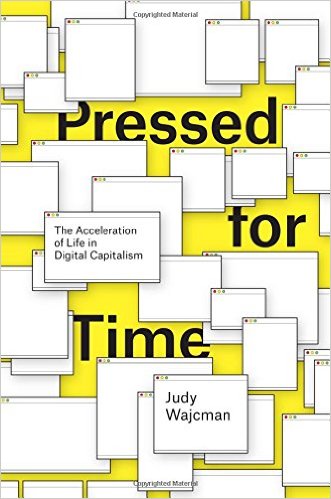
 a review of Judy Wajcman, Pressed for Time: The Acceleration of Life in Digital Capitalism (Chicago, 2014)