A Review of Stathis Gourgouris’s Lessons in Secular Criticism
In Spring 2013, boundary 2 published a special issue, Antinomies of the Postsecular, which assessed the so-called “turn to religion” in the humanities and social sciences. Under the movement term “postsecularism,” this academic turn to religion, commends itself as a necessary response to “the return of religion” as a social and political force in contemporary life. Whether such a “return” has actually occurred and what is at stake in making this assertion was the subject of b2’s special issue. The goal of the contributors to Antinomies of the Postsecular, as editor Aamir Mufti explained in his introduction, was to expose “the internal conceptual incoherence” of postsecularism as “an emergent orthodoxy” and to question the “political affiliations” of secularism’s critics, as revealed “by their treatment of modern religiosity” (3, 4).
One major source of incoherence is postsecularism’s account of secularization as a closed process with an expiration date for religion. By this misreading of Weber, to cite one of postsecularism’s bugbears, secularization is an abject failure. The global persistence of religion, which b2’s issue acknowledges as a neutral historical fact, is mistakenly interpreted as a resurgence or revival pressing up from cultures in resistance to secularism. The latter is conceived as an anti-popular and imperialistic instrument of domination, having its sources in European Enlightenment and the hubris of Western reason. Genealogical critiques of Enlightenment/secularism add to the irony of secularization’s alleged failure by detecting ghosted forms of “the sacred,” having Christian derivation, within reason’s self-understanding and within the liberal political imaginaries that rationalism underwrites. Reason is indebted to that which it disavows and tries to sequester; it was doomed to misprize the intimate entanglement of religion with culture and politics. Reacting to this misbegotten rule of reason, postsecularists resort to “culturalism”: shielding religion from external judgment by defending it as an expression of profoundly rooted local sensibilities (or, in more Foucauldian language, “practices” and “discourses”) buffering subjectivities against modernizing deracination and disciplinary schemes. Post-secularism’s attack on the ways that the Western liberal states have inscribed and bounded religion(s) thus frames these problems, which are certainly worthy of address, such that the secular is undermined as a source of analytical questioning while religion is insulated as a source of identity, filiation, and empowerment. Whatever the merits of this understanding of “the return to religion” – b2’s contributors found few – the conclusions that it reaches align post-secularism with some strange bedfellows: the anti-secular positions of religious fundamentalisms and conservative political theologies as well as those of religiously inflected liberation movements. Post-secularists may not seek some of these political affiliations and may even find them undesirable in many particulars, but their reading of modernity’s ailments finds enemies in common. Proponents of skepticism and intellectual consensus, for example, can find themselves on the defensive because they have the effrontery to throw acids on a people’s traditional beliefs.
Stathis Gourgouris, one of the scholars featured in Antinomies of the Postsecular, has elaborated his case against postsecularism in Lessons in Secular Criticism (Fordham, 2013), the first of a planned triptych that will include The Perils of the One and Nothing Sacred. Professor of Comparative Literature and Director of the Institute for the Comparative Literature and Society at Columbia University, Gourgouris comes to this project well-equipped by his previous works, the books Dream Nation: Enlightenment, Colonization, and the Institution of Modern Greece (Stanford 1996), Does Literature Think? Literature as Theory for an Antimythical Era (Stanford, 2003), Freud and Fundamentalism (Fordham 2010); his translations of sociologist Cornelius Castoriadis (who is an intellectual touchstone for Gourgouris in this book); his two essays for Antinomies of the Post-Secular, one of which, “Why I Am Not a Post-Secularist,” is reproduced here; and his heated debate with Saba Mahmood in The Immanent Frame, which was one of the highlights of the on-line journal’s 2008 exchange, “Is Critique Secular?”
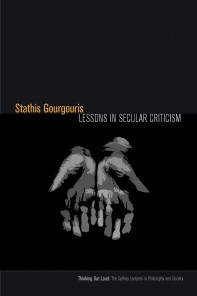
The “secular criticism” in Gourgouris’s title has its provenance in Edward Said’s The World, the Text, and the Critic (1983), and his set of “lessons” (in the post-structuralist sense of the leçon, or ceaselessly thinking reflexively) can be seen as extending b2’s ongoing task of theorizing what Said meant by his conjoining of “secular” and “critique.” For Gourgouris, the two are inextricable, the first in its worldly orientation making possible the articulation of the second. Secular criticism is “an experimental, often interrogative practice, alert to contingencies and skeptical toward whatever escapes the worldly”; particularly, it is skeptical toward any notion of “authority that is assumed to emerge from elsewhere,” toward any knowledge “presented as sovereign, unmarked by whatever social-historical institution actually possesses it” (13, 64, xiv). These knowledges include discourses of secularism that would make any legal-political boundary between religion and the state rest on a metaphysical distinction between the secular and the religious wrongly conceived as essences. This is Gourgouris’s key dialectical movie: to preserve the secular as a practice and as “a space” that makes the practice possible, it must be defined over and beyond the limitations imposed on it by both academic post-secularism and secularism as an institutional power.
Lessons is organized into six chapters, the first half breaking down flawed conceptions of the secular and the second half building Gourgouris’ case that secular criticism is necessary if we are to imagine more democratic societies than we presently know. Chapter One, “The Poiein of Secular Criticism,” disputes anthropologist Talal Asad’s effort to draw a lineage for the notion of critique that traces it to Platonic and Christian traditions. Asad discovers in critique a displaced religious attitude: a quest after and veneration of the Truth, abstracted from an image of God but still bearing the imprint of monotheism, for the Truth of the critic is unalterable, inalienable, and singular (8). In other words, Said’s fearless intellectual inherits a practice of thinking made possible by religious/mystical modes of contemplation and rigorous ascesis of the subjective. For Gourgouris, the irony Asad relishes in this situation is willfully produced by his genealogy, which does not so much trace continuities as force analogies between worldly criticism and a “theological desire.” For the analogy to function, it requires a representation of “secular” criticism (Asad would effectively put Said’s adjective in scare quotes) as the effort to clear man’s thinking for the revelation of “a hypergood.”
Gourgouris instead sees critique as an activity like poiesis. Here Gourgouris is returning in capsule form to the theory of poetics that he develops at length in Does Literature Think? In that work, through meticulous close readings of Sophocles, Flaubert, Benjamin, Kafka, Celan, Genet, and DeLillo, Gourgouris models poesis as a unique kind of cognition that requires the making of things not thought before, and that in making these things also unmakes what is given: “to form is to make form happen, to change form (including one’s own)”(11). Poiesis is a making of the new and unmaking of the known materials of society (discourses, images, narratives) that potentiates far-reaching self-alteration: “things that may indeed appear to be impossible in the present time . . . cannot be said to be generically impossible, impossible for all time” (26). As Gourgouris proceeds, poiesis is valuable because its most sophisticated artistic products dramatize what critique also endeavors to enact: autonomy (auto-nomos), understood here not as reason’s free submission to “the hypergood,” but as the questioning, historicizing, and pluralizing of the authorities (epistemological, political) to which self-altering subjects give only provisional consent.
In trying to define secular criticism away from Said, Asad erroneously conceives it as a quest after a transcendental. The uncovered Truth, in this conceptualization, becomes a law given to the self from elsewhere, like a command from the almighty. In Gourgouris’s estimation, Asad makes the critic’s relation to reason heteronomous. Heteronomy, which receives greater elaboration in Chapter Four, is both a structure of decision and a state of alienation. In contrast to autonomy, heteronomy describes a structure in which “the law” (the reason for deciding) is given externally, from the other. For Gourgouris, all law is self-generated out of the social imaginaries of existing communities. Heteronomy therefore cannot exist except in a state where the law has been othered, occulted in a beyond that is made more real, more authoritative in being both beyond and more real, than the humble state in which men direct their own affairs. Whenever humans sever themselves from this worldly state of decision-making and institute an absolute other for sanctioning what they do, they have created a heteronomous structure. Under the self-alienated conditions of heteronomy, decisions take the form of a command/obedience structure, in which one listens rather than questions. Any transcendental is, intrinsically, something that commands, even though it is produced by the humans who obey it.
Having countered Asad’s attempt to impose a heteronomous structure on critique, Gourgouris’s second chapter proceeds to ferret out the transcendental in secularism. By the latter, Gourgouris refers to an institutional term representing “a range of prospects in the exercise of power,” particularly as pertains to state mechanisms (28-29). A priori and dogmatic substantiations of secularism Gourgouris deems “metaphysical,” and this adjective functions similarly to “transcendental” in the book’s proliferative terminology. However, there is a subtle reason for the differentiation that proves important. The “metaphysical” ends up being the name for any non-theistic statement of transcendental first principles; it designates whatever is taken to be an incontestable foundation, without confounding the notional foundation with the sacred of theology or religion (29). A metaphysic and a divine law are each, in application, heteronomous, but the former is “a set of principles that posit themselves independently of historical reality” rather than something held sacred that eternal God has posited (30). It is crucial for Gourgouris to provide these dual definitions, for his opponents, Talal Asad and anthropologist Saba Mahmood , discern secularism’s metaphysical layers only to theologize them for the purpose of revealing modernity’s disavowed religious substrata: “It is one thing to speak of the metaphysics of secularism and another to equate secularism with religion” (34).
An example of one of the “metaphysics” on which secularism rests would be the pre-social individual theorized by classical liberalism. It is the sanctity of this individual, god-like in his agency, his clarity, and his identity with himself, that secularism is often said to protect from religious intolerance. In contrast, Gourgouris sees this figure of bourgeois enlightenment caught up in the self-altering forces unleashed by a still ongoing process of secularization. The form of autonomy that secularization bares for view is thoroughly social in character (44). To be autonomous is not to give oneself the law, but, as citizens, to give the law to ourselves. It is as social members that we decide what the law is; to be autonomous is to not only to give ourselves the law, but also to recognize ourselves interrogating the law together. Catholic philosopher Charles Taylor, who emerges as another opponent in Gourgouris’ Chapter Two (titled “De-Transcendentalizing the Secular”), has also famously argued against the reified idea of the individual in classical liberalism. However, he believes that our modern social imaginaries have built such protective carapaces around the self that we have difficulty experiencing an outside to its liberal representation. In well-known formulations, he has described the modern self as too “buffered” against any motivations that can be confused with enchantment. As a result, modern man – for all his sense of self-mastery – is actually dispossessed, haunted by a God-reference that has been voided of transcendence, though modern man still needs the transformational openness that God once provided. In other words, Taylor does not theologize the secular, as do Asad and Mahmood, but he does see it as impoverished. Gourgouris objects to “Taylor’s whole framework of valuation and determination,” and he pivots to Taylor’s A Secular Age (2007) for the purpose of redefining alterity without resort to a “heteronomous” position outside history (43). Taylor is wrong to say that moderns need transcendence in order to experience a liberating otherness. Recalling his theory of poiesis, Gourgoruis argues that the otherness is something created by the self in its working upon the materials it finds within the world. This otherness is “immanent,” emerging from within autonomy, and involves no inrushing from a space beyond history: “The immanence of autonomy does not mean closure in a purely self-referential or self-sufficient signification . . . . Autonomy is nonsensical as a permanent state, as the property of a thing, which is why it has nothing to do with the imaginary of self-possession or the legacy of possessive individualism that is the crux of liberal law” (44). That Taylor cannot see the possibility of human satisfaction in autonomous self-alteration, whether achieved via politics, art, or eros, is a measure of his melancholic appraisal of the worldly: “Taylor cannot fathom that fullness, total plenitude and fulfillment, can be found in the finite and the fragile, in the ephemeral and the mortal, in the uncertain and the passing” (41). It is Gourgouris’ task, in his third chapter, “Why I Am Not a Post-Secularist,” to defend the sufficiency of the finite and the mortal to answer human striving and imagining.
“I am not a post-secularist,” he states with bald conviction, “because I am an atheist.” This first line begins the most eloquent of all the book’s chapters. Within its concentrated length, Gourgouris not only provides a vigorous case for atheism against its cultured despisers, but also builds his case that only a secular space, oriented toward a future in which the distinction theism/atheism will no longer matter, can produce the conditions for radical democratic politics to thrive. Since the second point is one that Gourgouris will amplify in subsequent chapters, I will also defer addressing it here and focus for the time being on his case for atheism. In marked contrast to the New Atheists, Gourgouris does not bother with demolishing proofs of God or citing evidence pointing up the absurdity of biblical accounts of creation or belief in miracles. To quote Wallace Stevens, Gourgouris plainly looks out from a horizon in which the gods are “dispelled in mid-air and dissolve[d] like clouds,” and makes “no cry for their return.” God’s death is a Christian idea. Outside the Christian imaginary, where Gourgouris places himself, the de-sacralization of society inflicts no melancholia – no divine haunting, absence, or silence, none of the governing motifs of writings that have seen in modernity a state of ruination. At the same time, there is nothing heroic in Gourgouris’s atheism either, for the question of God’s existence is no great either-or in his thought. The question is “irrelevant” to the secular consciousness he wishes others to imagine with him: “It would mean to live not as if God does not exist but to live as if God does not matter” (69). Rather than a ruined world doddering from shorn foundations, Gourgouris finds in a terrene of finite things, and ineluctable death, much cause for “wonder.” The word, connecting philosophy and myth in Greek, links aesthetic pleasure and speculation in Gourgouris’s usage; the experience of wonder felt in the human encounter with what is new and extraordinary discredits miracles, for it leads to questioning. Furthermore, it replaces the need for such beliefs with the pleasure taken in curiosity and in creative acts of pattern-making that give a feeling of intelligibility to reality. Reaching back to the Greeks as a touchstone, Gourgouris treats hubris as a passion imperceptibly sliding behind wonder that he condones in advance of its appearance as a specifiable motive. Hubris is conventionally the other to Truth, but Gourgouris prefers its risks to heteronomy (76). Still, there is a tragic element in Gourgouris’ account of a desacralized world. It stems not, as in pessimistic readings of Greek tragedy, from the defiance of a transcendental order. It is the “irredeemably sad” recognition that autonomy is possible only under conditions of impermanence. History is radically open-ended and shaped solely by human self-determination, and that very limitlessness is not circumscribed by death, but extended by it, for death denaturalizes all humanly constructed boundaries (106). The lucidity for which Gourgouris calls in these passages recalls Camus’s tragic humanism, except that Gourgouris’ never passes through despair.
Atheism, then, is tragic autonomy, attuned to the wonder as well as the mutability of finite existence and undaunted by the Christian proposition of the death of God. While I agree with Gourgouris that Christianity makes God’s death central to salvation history, I do not believe that he accurately represents this event’s theological significance within orthodox belief. Moreover, I believe that he unnecessarily dualizes the Christian and Greek imaginaries.
To take up the first objection, Gourgouris mistakenly summarizes dogma as such: “God dies so that he may be resurrected, simple as that. The instrumental outcome is all that matters (the abolition of sin happens with the Resurrection, not Crucifixion), and the reality of God’s death – God’s suicide, to be exact, vanishes behind the interminable ritual repetition of a mythical spectacle” (73). This misconstrues how atonement is supposed to be effectuated. Paul, Anselm, Athanasius are touchstones here, but no systematic Christian theologian dissociates the Atonement from the Crucifixion or argues that redemption only becomes possible with the Resurrection. The Crucifixion always entails the Resurrection, and the Resurrection always implies the Crucifixion, and they always work together to accomplish salvation. Certainly in the doctrine of Atonement there are relative degrees of emphasis between the Western and Eastern Churches, and between Protestantism, Catholicism, and Eastern Orthodoxy. In Eastern Orthodoxy, there are many more icons of the Resurrection, as there is a greater stress on deification, or theosis, in the teachings of the Byzantine and Russian churches. It is interesting, further, to compare the iconographical emphasis of the Orthodox (focus on the risen and transfigured Christ, as in the Pantocrator icon) versus Catholics (focus on the suffering and broken Christ) versus Protestants (typically, an empty cross, which combines the meanings of both the former). Nonetheless, in each tradition, soteriology depends on the joint significance of the Crucifixion and the Resurrection: they work in tandem, never in isolation or separated by time. I have continued on this matter at some length not because it undermines Gourgouris’s case for atheism – it does not – but because he handles Christian thought somewhat ham-fistedly. Occasionally, his animus is wittily abrasive, as in his hilariously irreverent description of Christ as a reanimated zombie; but he can ride roughshod over subtleties and sometimes make neglectful over-generalizations.
This leads me to the second objection. Gourgouris opposes the Christian imaginary to the Greek in a manner that needlessly dualizes them and downplays the practice of religion among the ancient Greeks. Part of the problem here stems from Gourgouris’s tendency to celebrate what was thinkable in the Greek imaginary versus what is typical of the Christian imaginary. The “thinkable” here is an idea that I am interpolating from Castoriadis, whose own reflections on the ancient Greeks are clearly an influence on Gourgouris. Put baldly, the thinkable refers to what is possible to formulate and speak out of a social imaginary at given point and time in its history. The thinkable need not be typical and, indeed, may be inassimilable to conventional, inherited thought. The Christian imaginary Gourgouris sees in broad strokes: the mystification of authority, the darkening of antiquity, the denial of death, heteronomous dogma. In the Greek imaginary, contrastingly, Gourgouris finds the capacity, not everywhere actualized but available, for wonder, lucidity, democracy, and autonomy. This sampling of the ancient Greeks accentuates their modernity, but it occludes quite a bit that would destabilize Gourgouris’ binary of enlightened Greek versus regressive Christian. As E. R. Dodds reminded us some time ago in his classic, The Greeks and the Irrational, religion was robust even in the age of democracy and the great tragedians. Beliefs persisted in daemons, magic, soothsaying, oracles, and mystery cults. Animals were still sacrificed to the gods regularly as part of the civic calendar in Athens, and citizens made use of sacred images in public places of worship. Festivals, prayers, and processions still took place. Despite secularization among the philosophes, new religions like Orphism and Pythagoreanism developed in the 4th century, and Socrates was executed, among other reasons, for impiety. Or does Gourgouris limit his version of the Greek imaginary to the elements of modernity in the Classical Age and the Ionian Enlightenment?
The answer comes indirectly through Chapter Four, which connects poiesis and autonomy, themes of chapters 1-3, to ontology and politics, which will cascade into the book’s fifth and sixth chapters. The modernity of the Greek imaginary lies not in its rationalism, but in the polis and in the arts, where autonomy was a self-consciousness project. The project did not require the disenchantment of myth, as superstition or error, so much as its appropriation for poetic self-creation, as Gourgouris makes clear in Does Literature Think? With threads to this earlier book, Chapters Four and Five of Lessons in Secular Criticism, “Confronting Heteronomy” and “The Void Occupied Unconcealed,” go to a fascinating place conceptually, a rethinking of idolatry that extends its domain to transcendence, even if Gourgouris gets the reader there by way of a disputable theory about the operation of myth on the Athenian stage. The claims that he makes for an expanded sense of idolatry, as distinguished from myth, prepare for the criticism that he mounts of socialist philosopher Claude Lefort’s famous essay on democracy, “The Persistence of the Theologico-Political?” (1980).
In Gourgouris’s reading of classical Greek theater, myths were not only the narrative sources for tragedy, but also the stuff for mythographic reflection performed by the dramas. Myth, as he describes it in Does Literature Think? (2003), was a material means for Greek dramatists and their public audiences to reflect on the groundlessness of human creation (the making and unmaking of forms in history) where there is no divine anthropogony to teleologize nomos. In “Confronting Heteronomy,” he imports Castoriadis’s ontology to describe what both take to be the Greeks’ insight into the chaos of Being against which humans generate their societies and authorize them. Being was, is, and always will be disunited (105). Its differentiation “permeates all existence and thus precipitates the conditions for human beings to realize that (1) there is a necessity for nomos, for otherwise life is defeated by its own meaninglessness; and (2) this necessity does not confine humans to a de facto subjugation to nomos because it opens the way for them to create meaning and the frameworks of meaning” (106). Societies, however always occlude the generative chaos against which humans give form to their lives. The sacred’s chief function, in fact, is to mask the chaos of Being. The sacred is fundamentally distinguished from mythic imagining as Gourgouris defines it in Does Literature Think? Whereas myth is metapoetic, the sacred is the ossification of myth and its fusion with religious authority. Whereas myth tarries fearlessly with non-being as it produces figures of self-othering, the sacred throws up idols. Gourgouris does not except iconoclastic monotheisms from the accusation of idolatry; the more transcendental the image of the divine, the more cunning an idol it is. A complete image ban still produces an idol because its transforms non-representability into a sign of a latent absolute. To conceptualize idolatry this way is to sap the power of both blasphemy and iconoclasm as these have been practiced in Islam, Judaism, and Christianity. Monotheistic religions authenticate themselves by producing counter-sacreds whose images they can then desacralize. Applying Gourgouris’ logic, they are deflecting from their own cores of idolatry: in the religion of the heretic, they show the chaos of Being in order to make necessary the transcendental structure that conceals it again.
Nationalism and statism are also forms of idolatry that certify themselves with religious motifs and images. In turning to Lefort’s widely cited 1980 essay, Gourgouris intends to rescue its insights into the groundlessness of democracy while criticizing its pessimistic account of secularization. Gourgouris’s goal is to stave off post-secularist agendas that have seized on “The Persistence of the Theologico-Political?” – just as they have Nazi jurist Carl Schmitt’s Political Theology – to delineate a theological desire within democracy that yearns for the symbolic structure of Christianity. Lefort observes a rupture between democratic political imaginaries and those of pre-modern Europe. In the latter, the state was symbolized by the king, a God-man having two bodies, one earthly/mortal and the other supernatural/immortal. In this corporatist representation, the state was embodied as the sovereign One: an infallible, omnipotent unity transcending the political subjects who die for it. The theological analog of this symbolism, of course, was the Incarnation. Democracies cannot sustain the corporatist representation of the state since the dēmos – the multitude – is sovereign and the autonomous practice of democratic politics decenters power, institutionalizes conflict. In the revolutionary moment, the markers of unity and certainty in the old imaginary dissolve, leaving democracy poised generatively upon the void between the real and the timeless One, which is now seen for the phantasm that it always was. Gourgouris affirms Lefort’s central insight that democracy “is the historical regime whose radical characteristic is to stage its internal conflicts openly for itself” in a space of power that is denuded of “the symbolic constitution of authority because, quite literally, there is no body in power” (Lessons 132). However, he objects when Lefort tries to explain why post-revolutionary societies revert to some form of the pre-modern political imaginary, in which power is once again authenticated by its mediating relation, in the body of the One, to a ground externalized as something sacred or metaphysical. According to Lefort, the tendency within democracies to become fissiparous and the horror of the void itself bring about a crisis that partially re-sacralizes politics: “Lefort seems to entertain the idea of a sort of recurrent desecularization, a sort of reincarnation of the religious in the midst of the void” (137, 138). In the West, the form these representational metempsychoses take is derivative from the Christian Incarnation, since this is the exemplary model from the past. Gourgouris intervenes here to say that what Lefort describes is not the recovery of any specifically Christian content. It is simply a reversion to idolatry, the old desire to conceal the “condition of radical uncertainty” that is our human lot (140). In place of the idol of the One, he proposes a continual disruption of symbolic representation in favor of “the uninterrupted visibility of the dēmos,” revealed again and again in all of its “multiplicity” and “internal antagonism” (143).
Gourgouris thus calls for a poetic intervention in the symbolic field that will alter inherited political imaginaries so that the dēmos can see and reflect on its self-constitutive role, its struggle internally to find a political ground for renewed consent to the law that it gives itself in an undetermined historical process. To construct and sustain the form of “governmentality” that Gourgouris here imagines would require not only novel institutions but also the reconfiguration of mass media technologies and an end to entrenched patterns of consumer addiction. He follows the articulation of this mammoth task with a sixth chapter, “Responding to the Deregulation of the Political,” that moves from the analysis of post-secularism to a meditation on the promise of the recent global assembly movements, such as Occupy, the Arab Spring in the Middle East, and the Indignant Citizens Movement in Spain and Greece. These groups, we are to understand, enact the politics of secular criticism through their withdrawal of consent to neo-liberal capital and their demand instead for direct democracy.
Gourgouris’s hopeful speculations on the world movement for democracy return the text to his advocacy for “a politics of wonder,” a new politics combining skepticism and utopia for which atheism (as he defines it in Chapter 3) is best-fitted (Lessons 83). Crucially, Gourgouris’s atheism imagines its own obsolescence at a point beyond which the question of belief and quarrels over the secular versus the religious will have become irrelevant to the ways that people live with each other. In the meantime, however, it aims, in the mode of secular critique, to overthrow both the sacred of religion and dogmatic appeals to Reason in order to attack heteronomy in every guise. Only autonomy (as critique, poiesis, law-making, and self-instituting imaginary) can produce democracy as yet untried. Though Gourgouris, to his great credit, takes blinkered secularism as well as religion as threats to autonomy, I would like to turn, before closing, to his case that religion’s deference to divine power withers emancipatory politics.
To review, Gourgouris argues that religion restricts decision-making to a command-obedience structure in which the believer defers to a heteronomous authority. This power might be embodied in a hieratic office or a disembodied, transcendent and unrepresentable. Although Gourgouris tends to speak of religion categorically, he seems to object particularly to Abrahamic monotheisms, in which the language of sovereign God and redeemed subject, whether taken metaphorically or literally, implies a horizon of non-questioning and fealty to belief. (One wonders how successfully Gourgouris could apply the command-obedience model to polytheistic religions, like Shinto or Hindu, non-theistic religions like Buddhism, or pantheistic ones like Taoism.) Gourgouris does not exempt liberation theologies from his criticism of the command-obedience structure even though they may be aligned with populist or anti-imperialist movements. In a tributary of his quarrel with Saba Mahmood in Chapter Two, for example, he states: “I would never doubt, for instance, the revolutionary inspiration that liberation theology once gave to certain oppressed societies . . . . But as I have said several times, this does not mean that, come postinsurgency time, the time of self-determination, a politics based on religious command can institute modes of social autonomy – at least in known history this has never happened”(49-50). In the last instance, the religious “command” prevents people from seeing that they alone give authorization to their self-determination. Gourgouris follows this characterization with an arresting statement: “This is not to say, I repeat, that emancipatory politics cannot emerge from within a religious language. But it is to say that if it does, it must place this very language in question; it must deauthorize this language as command” (50). This remark, suggesting how religious language might revise itself to become viable for Gourgouris’s politics, comes as a surprise given the force of his secular convictions, but it is worth following up.
Let’s take for example James Cone’s God of the Oppressed, a classic of liberation theology. I do not intend it to be representative of its tradition, but illustrative of the incoherence that emerges when old language is unimaginatively combined with a revolutionary-reform message. Jostling with each other, we see the following formulations: “Divine freedom . . . . expresses God’s will to be in relation to creatures in the social context of their striving for the fulfillment of humanity” (175); “[H]uman beings are free only when that freedom is grounded in divine revelation” (182); “God is the sovereign ruler and nothing can thwart God’s will to liberate the oppressed”(196). On the one hand, Cone describes God entering history to strive alongside the poor and the disenfranchised in their struggle with entrenched, monopolized power and its ideology; God joins in all aspects of this conflict, which entails a prophetic critique of Christendom’s complicity in racism and social inequality. On the other hand, God is pictured as an omnipotent sovereign who controls providential history and on whom human freedom depends for its realization. Gourgouris might quarrel with both sides of Cone’s formulation, but he would most certainly object to the second, and rightly so given his premises. The self-interrogative act of self-determination is seemingly annulled by language that places sovereignty with God, here an absolute power that transcends the merely earthly powers of the oppressor. One could say apologetically that Cone is simply using inherited biblical language as inspired rhetoric to buttress an unswerving ethical commitment, but this rhetorical reading not only naturalizes what is supernatural in Cone’s text, it also preserves the objectionable notion that commitment (in this case, to justice) requires certainty of such sustained subjective intensity that, if necessary, it should be produced by belief in an unassailable authority. It is precisely the power to generate “subjective normative intensities,” or the Jamesian “will-to-believe,” that fashionably anti-liberal critics like Stanley Fish prize in religions and find lacking in “weak” or “indifferent” secularism. However, the religious command, in producing the strong, insistent form of belief that seems so attractive to those who see uncertainty as an impediment to commitment, can also become a mechanism for silencing internal dissent and steeling belief in the urgency of the belief. Such a mindset one can hardly imagine coping with the social heterogeneity that any democratic politics worthy of the name must include in its reflection.
I am not convinced, as Gourgouris seems to be, that monotheisms always produce the heteronomous subject that I have just described, but history indicates that the second is highly correlated with the first, especially when the religion – be it Christian, Jewish, or Muslim in identity – draws its impetus from the refusal of modernization. Taking seriously the impediments to autonomy that Gourgouris finds in the mindset fostered by (monotheistic) religious language, it is worth, for the sake of secular criticism, opening a conversation with theologies that have intentionally weakened the modeling of the divine and human relationship on sovereign-to-subject. There is the rich yet unfairly maligned tradition of theological modernism, which augmented certain trends in religious liberalism toward immanence. Contemporary with the end of the modernist movement, Dietrich Bonhoeffer, a pastor of the anti-Nazi Confessing Church in Germany, spent the months in prison prior to his execution writing about “a world come of age,” a world in which man had won “autonomy,” a world that did not need false religious obligations or inhibitions, that did not need a God conceived as the beyond of our cognitive faculties. The kind of command-obedience structure that Gourgouris calls heteronomous Bonhoeffer, in his prison letters, denounces as “phariseeism” and “religious methodism” (Letters 362). Cognizant also of the authoritarian impulses in his own religious tradition, Bonhoeffer feared the cultural temptation in the West to make a leap back toward “the heteronomy” of the Middle Ages (Letters 360). Rather than submit to this temptation himself, Bonhoeffer stresses in the letters not God as “sovereign” but God as “sufferer,” for only this God could enter a world that no longer had need of an omnipotent being that explains everything and wills everything (361). More recently, the varieties of “process theology,” “weak theology,” “secular theology,” and “a/theology” represented in the figures of David Ray Griffin, James Cobb, James Caputo, and Mark C. Taylor have worked in distinct ways to enlarge space for human agency and response while smashing as idols religious and metaphysical certitudes. Influenced by the ontology of Alfred North Whitehead, Griffin and Cobb deny divine perfection and truth, and emphasize God’s temporality as well as man’s. Bridging the post-liberal theologies of Bonhoeffer and Paul Tillich (who famously urged his contemporaries to be unafraid to let “the God of theism” disappear “into the anxiety of doubt”) and Derridean post-structuralism’s sensitivity to contingency and context, Caputo defines God not as a person but as an ever breaking “event” that awakens human desire for something namelessly undeconstructible and always yet to come; this event relativizes all the logics and structures of the world, including those of religion. Taylor describes a nearly featureless God that animates networks of creative processes in nature and culture, structuring and de-structuring them according to “no mind or Logos,” but coming restlessly to consciousness in humans; this idea of the divine cannot be the object of faith, the metaphysical foundation of decision, or the limit to human interpretation (After God 346). Like Caputo, Taylor wants to transform the language of religion and not only attach old language to democratic causes. I should mention that some of these thinkers begin from premises (man as homo religiosus, the death of god as ongoing event, the spiritual underpinnings of secularism) against which Gourgouris has compellingly raised his voice, but they have shown greater capacity for dialogue, self-criticism, and nimbleness of thought than culturalist proponents of the post-secular.
Modish attention to demographic trends pointing up the statistical vitality of religion should not guarantee respect for belief or earn providential auguries of religion’s imperishability. One hundred years from now our world may be substantially more secular than it is now and atheism a preferential option for most of the population. Yet, in our contemporary conjuncture, it would be unnecessary and perhaps even detrimental to exclude from one’s theorization of a new democratic politics the religious liberals, humanists, progressives, and liberationists who could be its allies in the struggle against “the scorched earth policies of global financial capitalism” (xviii). Though with deep reservations, Gourgouris hints that it might be possible for people with a variety of religious as well as secular philosophical views to work toward common political goals and values so long as they avoid heteronomous formulations of belief. His book would have benefitted from taking into account already existing resources in theology for weakening the sovereign-to-subject language of traditional god talk. Notwithstanding this omission and some distortions in his dualizing of Greeks and Christians, he makes an essential intervention in the post-secularism debates by pointing out, through a range of deft responses to key texts, the laziness of intellectuals’ defenses of religious self-righteousness and declarations of secularization’s failure. More incisively still, he exposes the fallacy of conflating secular criticism with institutionalized secularism, and of tethering the latter to theology. Anyone seeking to comprehend the high stakes in the so-called “turn to religion” will find Lessons in Secular Criticism a most bracing read.
________
Jason Stevens has taught at Harvard University and the University of Maryland, Baltimore County, and he has been a fellow of the National Humanities Center (Durham, NC). His work focuses on mid-late 20th century American literature and U. S. cultural and intellectual history, with emphases on the intersections of fiction, popular culture, religion, and ethnicity. His first book was God-Fearing and Free: A Spiritual History of America’s Cold War (Harvard University Press 2010). His writings have also appeared in boundary 2, American Literature, Literature/Film Quarterly, and The Immanent Frame. In 2014-2015, he is a fellow at the Center for the Humanities, University of Pittsburgh, where he has been completing a book project on American film noir and making preparations for the international conference, “Protestantism on Screen” (Wittenberg, June 2015), of which he is co-sponsor.
_______
Notes