b2o: boundary 2 online

  • Brian Meeks: Jamaican Roads Not Taken: or a Big “What If” in Stuart Hall’s Life

    Brian Meeks: Jamaican Roads Not Taken: or a Big “What If” in Stuart Hall’s Life

    by Brian Meeks

    This essay has been peer-reviewed by the b2o editorial collective. It is part of a dossier on Stuart Hall. 

    A Lost Moment

    There is an intriguing quote in Kuan-Hsing Chen’s 1996 interview with Stuart Hall, in which Stuart, in response to Chen’s question/comment “But you never tried to exercise your intellectual power back home”,  responds:

    There have been moments when I have intervened in my home parts. At a certain point, before 1968, I was engaged with dialogue with the people I knew in that generation, principally to try to resolve the difference between a black Marxist grouping and a black nationalist tendency. I said, you ought to be talking to one another. The black Marxists were looking for the Jamaican proletariat, but there were no heavy industries in Jamaica; and they were not listening to the cultural revolutionary thrust of the black nationalists and Rastafarians, who were developing a more persuasive cultural, or subjective language. But essentially, I never tried to play a major political role there. (Morley and Chen 1996:501-2; see also MacCabe 2008:17)

    He explains this through his recognition that he had found both a personal space – marriage to Catherine – and a political space, as a collaborator in the British New Left and that Jamaica herself, in the transition to independence, had become a somewhat different society, breaking with the past, making it somewhat easier for him to leave and that these were coincident with the domestic and political changes in his own life.

    This conscious sense of not seeking to intervene in a changed political space with which he no longer felt intimately familiar was captured when both Tony Bogues (Bogues 2015: 177-193) and I met with Stuart separately in 2003 to encourage him to attend the Centre for Caribbean Thought’s conference that we were planning in his honor the following year.  His response to both of us was that, yes, he was born in Jamaica, but it would be difficult to describe himself as a ‘Caribbean intellectual’ and therefore, was it appropriate to include him in a series of conferences honoring key contributors to Caribbean thought?  In the end we managed to convince him to attend and that being from the Caribbean and with much of his critical formation occurring here, he was very much a Caribbean intellectual. The 2004 conference turned out to be a remarkable event (see Meeks 2007) in which Hall ‘came home’ and found, as it were, not only his Jamaican and Caribbean audience, but that there was already some younger scholars who were drawn to his work. On balance though, beyond the cognoscenti, Hall’s work was in the period after 1968 to which he referred – the period of the popular upsurge of radical politics in the region – right up until the moment of our conference, still largely unknown. I knew of  Stuart as a brilliant Jamaican because he had been my Dad’s classmate at Jamaica College and as one of the School’s Rhodes Scholars, I recognized his name inscribed along with that of Norman Manley and others on the long blackboards outside the neo-gothic Simms building at school. But it was not until the mid-Eighties that I had heard anything about his work and I read my first Hall article long after finishing my PhD thesis in 1988.

    Thus, aside from the tantalizing intervention quoted above, his name and more so his thinking, were largely unknown to the generation of Sixty-Eight, those who were tossed into politics after the infamous exclusion of Walter Rodney on his return home to Kingston from the 1968 Montreal Congress of Black Writers (see Austin 2013:22).  The intense, one-day Black Power riots which followed the police tear-gassing of the student protest in support of Rodney, signaled the beginning of a decade and a half process of radicalization which led to the 1970 ‘Black Power Revolution’ in Trinidad and Tobago, the election of the Michael Manley government in Jamaica in 1972 and the Grenada Revolution of 1979-1983. (See Ryan and Stewart 1995; Quinn 2014)

    The Generation of Sixty-Eight

    Another famous Anglo-Caribbean expatriate thinker of the Left – C.L.R. James – was certainly better known and influenced a generation of Caribbean scholars, (Meeks and Girvan 2010:4) but in terms of a substantial impact on the theoretical orientation, form, strategy and tactics of the burgeoning movement, Jamesian ideas were, at best, marginal.[1] (Mars 1998:31-61) There was the Antigua Caribbean Liberation Movement (ACLM) in Antigua, under the leadership of the Jamesian Tim Hector and the Working People’s Alliance (WPA) in Guyana, where Rodney himself, before his assassination (in 1980), Rupert Roopnarine, Eusi Kwayana and others, sought to build a more independent left.  Other Jamesian tendencies included the Revolutionary Marxist Collective (RMC) in Jamaica, the New Beginning Movement (NBM) in Trinidad and the Movement for Assemblies of the People (MAP) in Grenada. Only MAP would emerge to play a central role in the evolving political landscape, but only after its merger with JEWEL (Joint Endeavour for Welfare, Education and Liberation) to form the Marxist-Leninist New Jewel Movement (NJM), later to become the vanguard party of the Grenadian Revolution.

    Thus, by the mid-Seventies, most of the independent, radical trends had either been eclipsed by or converted to one or another variant of what I refer to here as ‘Caribbean Marxism-Leninism’. I use this notion in order both to avoid a simplistic reductionism of compressing all Marxist trends and simultaneously to tease out and identify the specific characteristics of the parties and movements which came to dominate the Caribbean Left. These parties included the Cheddi Jagan-led People’s Progressive Party (PPP) of Guyana, which had held office and been excluded from power twice by the British, but remained bedeviled by the ethnic question and its partisan rootedness in the East Indian bloc; (see Palmer, 2010) the Movement for National Liberation (MONALI) in Barbados; the Youlou Liberation Movement (YULIMO) in St Vincent; the Workers Revolutionary Movement (WRM) in St Lucia and the Dominica Liberation Movement (DLM). However, the two most significant, aside from the PPP, were the Workers Party of Jamaica (WPJ) and the NJM.

    The WPJ, despite dominating what constituted the Jamaican Left outside of Manley’s governing People’s National Party (PNP), failed to gain any significant electoral support in the elections-driven Jamaican political system. It nonetheless accumulated significant influence through its almost hegemonic control over a generation of activist students and scholars at the University of the West Indies Mona campus, its informal linkages to the left in the PNP regime and most importantly and in the end most damagingly, its close connections and influence within the NJM.  The NJM for its part, not only became part of the opposition alliance following the 1976 elections, but the leader of the Party, Maurice Bishop became the constitutional Leader of the Opposition. Three years later, with the successful overthrow of the Eric Gairy regime, Bishop would become Prime Minister of the People’s Revolutionary Government (PRG) of Grenada for the next four and a half years. The Grenadian Revolution ended tragically with open divisions surrounding questions of leadership in the Party leading to the October 1983 arrest of Bishop, his release by an incensed crowd of supporters, his attempt to wrest control of the military fort, a clash with the military which remained loyal to the Party and his execution along with some of his closest supporters, at the hands of his own soldiers. (See Meeks 1993; Lewis 1987; Marable 1987; Puri 2011 and Scott 2014)

    This tragic and unprecedented end to the Grenadian Revolution which also signaled the demise of an organized and vibrant Caribbean left, has led to heated, often recriminatory interventions seeking to explain and understand how it could have happened.  Most analyses, including, I admit, my own, focus more on personalities, leadership, structures and the supporting or denying of purported conspiracies. Thus, Bobby Clarke, not untypically, blames Bernard Coard, Bishop’s Deputy Prime Minister, whom he argues, without further elaboration of this emotive notion and its applicability in this context, had been influenced by the ‘Stalinist’ Trevor Munroe (Meeks 2014:113). In one of the more thoughtful attempts to come to terms with the tragic sequence of events, G.K. Lewis, however, along with recognizing the dangers inherent in military overthrows and ‘the mixture of revolution and armed force’ (Lewis 1987:162) also raises warnings about the danger of mechanically applying Leninist approaches to party organization in entirely different historical contexts to that of Russia in 1917. (167)

    It is in the spirit of Lewis’s attempt to understand the theoretical weaknesses and lacunae in the NJM and by implication in Caribbean Marxism-Leninism[2]  that I want to proceed with the following hypothetical exercise, by counterpoising critical features of Caribbean Marxism-Leninism with Stuart Hall’s career-long and profoundly humanist engagement with Marxism through the avenue of the conjuncture.  I want to suggest that it was precisely a perspective like Hall’s that might have provided an effective counterpoint to the damaging, authoritarian features of Caribbean Marxism-Leninism. An approach like his was missing in Jamaica and this absence contributed to the de facto emergence of particularly wooden and dogmatic theories that came to dominate the Jamaican and other critical components of the Caribbean Left and contributed in no small measure to the tragedy of the Grenada Revolution.

    Hall’s Core

    I begin by suggesting that unlike positions taken by Rojek and certainly Mills in his critique of Hall’s approach to race (see Rojek 2003; Meeks 2007:120-148) and despite recognizing an evolution, particularly a shift from an earlier more Gramscian inflection to a later, more discursive approach, there is an evident and consistent[3] core to Hall’s oeuvre that includes the following elements:

    1. Unlike some post-Marxian perspectives, Hall throughout his mature writing continues to place critical importance on capital and of ‘material conditions’ generally, in the shaping of the contemporary world. Thus in his 1988 essay “The Toad in the Garden; Thatcherism Among the Theorists”, while recognizing that there is no “univocal” way in which class interests are expressed, he nonetheless underlines that “…class interest, class position, and material factors are useful, even necessary, starting points in the analysis of any ideological formation.” (Hall 1998: 45) And in his 2007 interview with Colin MacCabe, he reminds him of the importance of the tendencies in capital to concentrate wealth and shape intellectual expression: “…global capitalism is an incredibly dynamic system. And it’s capable of destroying one whole set of industries in order to create another set. Incredible. This is capitalism in its most global, dynamic form, but it is not all that secure. It’s standing on the top of huge debt and financial problems. And I can’t believe those problems won’t come eventually to find their political, critical, countercultural, intellectual expression. We’re just in the bad half of the Kondratiev cycle!” (MacCabe 2008:42)
    2. Nonetheless, he discounts the mechanical notion of any direct cause and effect relationship between material conditions and so-called superstructural spheres. Social and cultural life, Hall has consistently argued, is not only mediated and articulated away from the ‘forces of production’, but particularly in the contemporary era of intensified media engagement, the internet and the image, this autonomy is even more enhanced. “This approach replaces the notion of fixed ideological meanings and class-ascribed ideologies with the concepts of ideological terrains of struggle and the task of ideological transformation. It is the general movement in this direction, away from an abstract general theory of ideology, and towards the more concrete analysis of how, in particular historical situations, ideas ‘organize human masses, and create the terrain on which men move, acquire consciousness of their position, struggle etc.” (Hall 1996: 41)
    3. Specifically, in relation to classes and organized systems of domination, he opposes the mechanical approach inherent in certain Marxisms, which assume an automatic connection, for instance, between working classes and socialist ideas, or ruling classes and ruling ideas. Hegemony, Hall insists, emerge through complex processes of articulation and interpellation: “Ideas only become effective if they do, in the end, connect with a particular constellation of social forces. In that sense, ideological struggle is part of the general social struggle for mastery and leadership – in short for hegemony. But ‘hegemony’ in Gramsci’s sense requires, not the simple escalation of a whole class to power, with its fully formed ‘philosophy’, but the process by which a historical bloc is constructed and the ascendancy of that bloc is secured. So the way we conceptualize the relationship between ‘ruling ideas’ and ‘ruling classes’ is best thought in terms of the processes of ‘hegemonic domination’. (43-4)
    4. He is fully appreciative of and utilizes effectively Gramsci’s notion of organic philosophy as the contradictory yet critically important way of thinking utilized by ‘ordinary’ people. This philosophy or common sense, he asserts, has within it elements of conservatism and of progress towards something new, and by implication must be engaged with from an approach of critical respect. “But what exactly is common sense? It is a form of ‘everyday thinking’ which offers us frameworks of meaning with which to make sense of the world. It is a form of popular, easily-available knowledge which contains no complicated ideas…It works intuitively, without forethought or reflection. It is pragmatic and empirical…” (Hall and O’Shea 2013:8) This approach, I suggest, is at the heart of Hall’s outlook, because it not only suggests his deep respect for ordinary people and their perspectives, but underwrites his open, non-hierarchical approach to politics.
    5. Closely wedded to this and elaborated in more detail in his iconic essay ‘What is this Black in Black Popular culture’ is a consistent anti-essentialist grain. The essay is itself a paean against the elevating of racial or cultural blackness as a bulwark against racism. Hall first argues that we need to deconstruct racism itself and appreciate that it is not static in order to also appreciate that anti-racist thinking cannot afford to become a victim of the same essentialist thinking that makes racism abhorrent: “The moment the signifier ‘black’ is torn from its historical, cultural and political embedding and lodged in a biologically constituted racial category, we valorize, by inversion, the very ground of the racism we are trying to deconstruct”. (Morley and Chen 1996: 472)
    6. Hall’s perspective is always elaborated through an approach that can be called ‘thinking through the conjuncture’. Again, he usefully adopts Gramsci’s notion of the social conjuncture as the array of articulated social forces, ideas and culturally tendencies in a given moment, as a particularly effective and robust lens with which to view and understand contemporary reality. It allowed him, captured most famously with Martin Jacques in his characterization of ‘New Times’ to appreciate the changing social relations in Britain in the Eighties and to theorize and predict the rise of Thatcherism and Neo-Liberalism: “If ‘post-Fordism’ exists then it is as much a description of cultural as of economic change. Indeed, that distinction is now quite useless. Culture has ceased (if ever it was-which I doubt) to be a decorative addendum to the ‘hard world’ of production and things, the icing on the cake of the material world. The word is now as ‘material’ as the world. Through design, technology and styling, ‘aesthetics’ has already penetrated the world of modern production. Through marketing, layout and style, the ‘image’ provides the mode of representation and fictional narrativization of the body on which so much of modern consumption depends. Modern culture is relentlessly material in its practices and modes of production. (233)
    7. I end with Hall’s far less referenced perspectives on international politics, which are critically important for our purposes. These were forged at the time of the crushing by the Soviet Army of the Hungarian Revolution (see Blackburn 2014: 77; Derbyshire, 2012) and the Khrushchev revelations concerning the brutal, authoritarian nature of Stalin’s rule. These I suggest, inoculated him against any romantic view of the Soviet Union as the fountainhead of ‘really existing socialism’ and any illusion that the USSR was the automatic bulwark of defense against imperialism for the newly independent countries. It also forced him, along with many of his generation who formed the British New Left, on to the back foot in order to rethink Marxism from the ground up, without a set of already successful prescriptions just waiting to be applied and with a willing and able physician standing ready in the wings.

    We can best summarize the heart and essence of Hall’s work through the words of one of his critics. Despite his expressed reservations as to whether his academic preoccupations could ever be converted into a genuine praxis, Chris Rojek nonetheless generously proposes that “Hall’s politics favors widening access, exercising compassion, encouraging collaboration and achieving social inclusion”. (Rojek 2003: 193) Many of these features were either absent or incorporated into hierarchies of authority and exclusion in both the theoretical approaches and application of 1970s Caribbean Marxism-Leninism.

    Caribbean Marxism-Leninism

    To begin with Hall’s international perspectives first, it is fair to say that Caribbean Marxism-Leninism, if nothing else, held a remarkably un-historic view of the Soviet Union, leaping across time from the glory moments of the 1917 October Revolution, via the Red Army’s heroic defense and victories against Nazi Germany to the contemporary (1970s-80s) period. Elided entirely is mention of the brutality of collectivization, the Stalin show trials, Trotsky’s assassination or any reference to Khrushchev’s revelations about Stalin after his death. No mention, of course, is made of the Hungarian events or of the much more contemporary Czechoslovakian Spring and Soviet invasion of 1968. Two quotes from Trevor Munroe’s booklet Social Classes and National Liberation, derived from a series of ‘socialism lectures’ given to students in the early Seventies, suggests the tone and tenor of the times. In relation to the significance of the Soviet Union:

    The Russian Revolution, therefore, did these three things: mash down the colonial system, mash down feudal exploitation and mash down capitalist exploitation in one-sixth of the world in October of 1917; and on those foundations began to build a new life, a new society in which no class lived on the backs of the labor of any other class…The great October Socialist Revolution broke forever and ever the monopoly of the capitalist class on power and when I say power, I mean every kind of power. (Munroe 1983: 29-30)

    And on the relationship between ‘socialism’ (i.e. the Soviet Union and its allied countries) and the National Liberation Movement:

    The very existence of socialism is the biggest help to the National Liberation Movement, even when the leaders of particular countries under imperialism completely reject and are totally against socialism, it is still the biggest help to the whole area of National Liberation…Therefore, we say that the alliance between socialism and National Liberation is a natural thing because socialism is the biggest force against imperialism and imperialism is the block to National Liberation. (33)

    Looking back now on this simplistic, severely edited version of history to which many young, otherwise thoughtful students and young people in the Caribbean were so easily won, the search for the reasons as to why is not easily answered, but among them I suggest:

    1. The decisive defeat of the Left in Jamaica in the Fifties with the expulsion of the four leaders of that tendency (the Four H’s) from the PNP. This effectively silenced debates around Marxism and its role in national liberation for two decades (see Bertram 2016:231-240) and particularly at a moment in the fifties when Hall and many others were forging their radical perspective, but in the full glare of Hungary and of Khrushchev’s famous speech.
    2. The banning of Left-Wing literature in Jamaica in the Sixties, which made virtually all radical literature contraband, along with the emerging Black Power literature (and tragi-comically, Anna Sewell’s novel ‘Black Beauty’ among them!)
    3. The re-emergence of legal Marxist literature in the Seventies, following the election of Manley to power in 1972, but with titles and ideas drawn almost exclusively from the Soviet presses, Novosti and Progress. Thus, works by Brutents, Ulyanovsky and others on national liberation and the role of the Socialist countries, which were written precisely to eliminate swathes of contemporary history, were the only easily available literature and became the dominant sources of information for this eager and thirsty generation.
    4. The example of neighboring Cuba in which the Soviet Union had given generous support was interpreted as an exemplary instance of ‘proletarian internationalism’ and in which it was assumed that the Soviet Union would replicate this assistance in each and every instance in which there was a revolution against imperialism.
    5. The stance of Maoist China particularly in its attitude to liberation movements in this period is also relevant. As the potential alternative pole of “really existing socialism”, China might have provided an option for radically oriented youth to coalesce around. However, on almost all the touchstone questions, whether support for North Vietnam, choice of allies in the liberation movements against Portuguese colonialism, or solidarity with the Cuban Revolution, the Chinese supported positions and movements which seemed to place them on the wrong side of history. The default position was support for the Soviets, who were solidly behind Vietnam, the Cubans, the MPLA, FRELIMO, the PAIGC and others.

    The overall effect of this was the emergence of an intellectual mindset which was less concerned with the fine-grained understanding of the local situation, the broad terrains of ideological struggle and how these interacted with the international, (indeed, a Hallian, conjunctural approach,) as it was convinced that the arrow of history had already been launched and was on its straight and accurate flight.  From such a vantage point, events were already overdetermined by the revealing truths of Marxism-Leninism and the social and political leaps and advances of really existing socialism. All that was required was to make the local revolution, if a revolutionary situation emerged and join the stream of the victorious worldwide socialist and national liberation movements.

    In contrast to Hall’s conception of organic philosophy and the need to respectfully engage in a conversation, with the inevitable elements of give and take, Caribbean Marxism-Leninism overtly adopted the notion that the majority of the working class was backward, both culturally and ideologically and thus needed to be taught and guided by the advanced elements. So, in the WPJ booklet The Working Class Party: Principles and Standards the conclusion is drawn that:

    So the first thing we need to understand about the position of the working class in capitalist society and the effects of capitalism on the working class and on the working people is that the system itself makes the vast sections of the working class backward at the same time as it makes a small section advanced. (Munroe 1983: 15)

    This led inevitably to the corollary that the party, the vanguard, had to be the instrument to bring consciousness to the majority of backward workers, best exemplified in Maurice Bishop’s oft-quoted 1982 “Line of March for the Party” speech to NJM cadres:

    And the fifth point, the building of the Party, because again it is the Party that has to be at the head of the process, acting as representatives of the working people and in particular, the working class. That is the only way it can be because the working class does not have the ideological development or experience to build socialism on its own. The Party has to be there to ensure that the necessary steps and measures are taken. And it is our primary responsibility to prepare and train the working class for what their historic mission will be later on down the road. That is why the Party has to be built and built rapidly, through the bringing in the first sons and daughters of the working class. (Seabury and McDougall 1984: 73)

    Reading this speech again after many years, its deeply patronizing essence is even more evident. Indeed, Bishop’s invocation here goes beyond the typical vanguardist argument, in the suggestion that the party in this instance is not just the vehicle of the advanced workers, but a substitute for them, until such time as they can be brought into the organization and educated up to the required advanced standing. If there is any central feature then of Caribbean Marxism-Leninism that might be teased out for closer scrutiny, it is this hierarchical structuring of levels of consciousness with its implications of the necessity for tutelage and guidance, not only from the advanced workers – the more ‘Leninist’ formulation – but in the absence altogether of ‘advanced workers’ from the party, that is the undisguised tutelage of the intellectual stratum. Surely, this leads as night follows day, to the Grenada crisis of 1983. The Party derogated the right to modify its leadership structure at will, including the effective demoting of the leader and Prime Minister to joint leader, without any reference to the population and to what it might think. This led to a series of events which have been adequately discussed elsewhere and need not be repeated, marching in lockstep fashion, to Bishop’s death, the US-led invasion and the end of radical Caribbean politics for a generation.

    What If?

    As this short essay began, somewhere during the Nineteen Sixties, Stuart Hall took a decision to lay his bed permanently in the United Kingdom, where he helped to build the formidable discipline of cultural studies at Birmingham, thereby influencing a generation of scholars in the UK and contributing immeasurably to critical global political and cultural discourse in Britain, Europe, the USA and beyond. The enigmatic question of course, which can never be answered, is what would have been the outcome had he brought his formidable intellect and his remarkably fluid and democratic theoretical approaches to bear on his own Jamaica of the 1960s, the very country in which a popular upheaval with region-wide consequences was ignited in 1968. What would the radical movement of the Seventies have looked like with a Stuart Hall contending with some of the more dogmatic, hierarchical and wooden perspectives that came to dominate in the radical Jamaican space? Perhaps it might have made little difference, (as indeed was the case with CLR James and his supporters across the Anglophone Caribbean) as the international environment may well have weighed decisively in favor of the rise of pro-Soviet, Marxist-Leninist tendencies that did, in fact briefly gain momentum and enjoyed their moment in the sun. But perhaps with his prestige and fluency and his possessing the undoubted, if ironic cachet of being a Rhodes Scholar, Stuart Hall, returning from the United Kingdom, might have been taken seriously and might have influenced the emergence of a more flexible, open, radical and popular movement in Jamaica. What would this have meant for the course of events in that country and more so, for the entire Caribbean, including, most of all Grenada, where the Gairy regime had created a political opening and the groundwork had already been laid for more insurrectionary forms? History evidently didn’t follow this course, but it is worthwhile to muse about the far-reaching consequences if it had.

    Brian Meeks is professor and chair of Africana Studies at Brown University. He has published many books and edited collections on Caribbean Revolutions, Caribbean thought and questions of hegemony and power in contemporary Caribbean politics. He taught at the University of the West Indies, Mona campus for many years.

    References

    Austin, David. 2010. “Vanguards and Masses: Global lessons from the Grenadian Revolution.” In Learning from the Ground Up: Global Perspectives on Social Movements and Knowledge Production edited by Aziz Choudry and Dip Kapoor, 173-189. New York: Palgrave Macmillan.

    Austin, David. 2013. Fear of a Black Nation: Race, Sex and Security in Sixties Montreal. Toronto: Between the Lines.

    Bertram, Arnold. 2016. N.W. Manley and the Making of Modern Jamaica. Kingston. Arawak Publications.

    Bishop, Maurice. 1984. “Line of March for the Party.” In The Grenada Papers, edited by Paul Seabury and Walter A. McDougall, 59-88. San Francisco: Institute for Contemporary Studies.

    Blackburn, Robin. 2014. “Stuart Hall: 1932-2014.” New Left Review 86, March-April 75-93.

    Bogues, Anthony. 2015. “Stuart Hall and the World We Live In.” Social and Economic Studies 64:2, 177-193.

    Chen, Kuan-Hsing. 1996. “The Formation of a Diasporic Intellectual: An Interview with Stuart Hall.” Stuart Hall: Critical Dialogues in Cultural Studies, edited by David Morley and Kuan-Hsing Chen, 501-2. London and New York: Routledge.

    Clarke, Robert. 2014. “Statement on Grenada by Robert “Bobby” Clarke October 14, 2009.” Cited in Brian Meeks Critical Interventions in Caribbean Politics and Theory, 113. Jackson. University Press of Mississippi.

    Derbyshire, Jonathan. 2012. “Stuart Hall: We Need to Talk About Englishness.” New Statesman August 23 www.newstatesman.com

    Girvan, Norman. 2010. “New World and its Critics.” In The Thought of New World: The Quest for Decolonisation, edited by Brian Meeks and Norman Girvan. Ian Randle Publishers: Kingston and Miami.

    Hall, Stuart and Allan O’Shea. 2013. “Common Sense Neoliberalism.” Soundings, 55, Winter. 8-24.

    Hall, Stuart. 1988. “The Toad in the Garden: Thatcherism among the Theorists”. In Marxism and the Interpretation of Culture edited by Carey Nelson and Lawrence Grossberg, 35-73. Urbana and Chicago: The University of Illinois Press.

    Hall, Stuart. 1996. “The Meaning of New Times.” In Stuart Hall: Critical Dialogues. Morley and Chen eds. 225-237.

    Hall, Stuart. 1996. “The Problem of Ideology: Marxism without Guarantees.” In Stuart Hall: Critical Dialogues in Cultural Studies, edited by David Morley and Kuan-Hsing Chen, 25-46. London and New York: Routledge.

    Hall, Stuart. 1996. “What is this Black in Black Popular Culture?” In Stuart Hall: Critical Dialogues. Morley and Chen eds. 465-475.

    Lewis, Gordon K. 1987. Grenada: The Jewel Despoiled. Baltimore and London: The Johns Hopkins University Press.

    MacCabe, Colin. 2008. “An Interview with Stuart Hall: December 2007.” Critical Quarterly 50 nos. 1-2.

    Marable, Manning. 1987. African and Caribbean Politics: from Kwame Nkrumah to Maurice Bishop. London: Verso.

    Mars, Perry. 1998. Ideology and Change: The Transformation of the Caribbean Left. Kingston: The University of the West Indies Press.

    Meeks, Brian ed. 2007. Culture, Politics, Race and Diaspora: The Thought of Stuart Hall. Kingston: Ian Randle Publishers and London: Lawrence and Wishart.

    Meeks, Brian. 1993. Caribbean Revolutions and Revolutionary Theory: An Assessment of Cuba, Nicaragua and Grenada. London and Basingstoke: Macmillan Caribbean.

    Meeks, Brian. 1996. Radical Caribbean: from Black Power to Abu Bakr. Kingston: The University of the West Indies Press.

    Mills, Charles. 2007. “Stuart Hall’s Changing Representation of “Race.” In Culture, Politics, Race and Diaspora: The Thought of Stuart Hall, edited by Brian Meeks, 120-148, Kingston: Ian Randle publishers.

    Munroe, Trevor. 1983. Social Classes and National Liberation in Jamaica. Kingston: Workers Party of Jamaica.

    Puri, Shalini. 2014. The Grenadian Revolution in the Caribbean Present: Operation Urgent Memory. New York: Palgrave Macmillan.

    Quinn, Kate ed. 2014. Black Power in the Caribbean. Gainesville Fl. The University Press of Florida.

    Rojek, Chris. 2003. Stuart Hall. Cambridge: Polity Press.

    Ryan, Selwyn and Taimoon Stewart eds. 1995. The Black Power Revolution 1970: A Retrospective. Trinidad: ISER.

    Scott, David. 2014. Omens of Adversity: Tragedy, Time, Memory, Justice. Durham: Duke University Press.

    Notes

    [1] James’s notions of a non-vanguardist, spontaneous movement of the people had some initial influence particularly through the Antiguan, Grenadian and Trinidadian movements, but as I have argued elsewhere, James had no developed strategy for insurrection, beyond the advocacy of popular spontaneous uprising. When an insurrectionary situation arose, as in Grenada between 1974 and 1979, the NJM therefore turned to the old playbook of the underground vanguard, which turned out to be an effective tool for overthrowing the Gairy regime, but not for popular rule in the aftermath. The other factor was the clearly compelling international situation, in which, in the seventies Cuba, based on booming sugar prices seemed to be thriving, the Vietnamese had liberated their country and the liberation movements had achieved independence through guerrilla warfare in Angola, Guinea Bissau and Mozambique. All were led by Marxist-Leninist parties, raising significantly the cachet of this trend. See Meeks 1996: 72 ;1993: 178 and Austin 2010: 173-189)

    [2] I want to nuance Perry Mars’s argument in which he suggests that the weaknesses that led to the demise of the Caribbean Left lay more in questions of leadership, than ideology. There is much truth and indeed, I am invested in the argument that it was the leadership and its failures which contributed immeasurably to the crisis in Grenada with its debilitating impact on the Left in general. However, the role of ideology has been underplayed, or presented as a stock word or phrase, such as ‘Leninism’ or sometimes even ‘Pol Potism’ which unfortunately is a lazy alternative to more careful analysis. Ideology in the end informed the leadership and shaped the framework and boundaries of their decision-making. It thus needs far more careful scrutiny in the new round of scholarship that will eventually appear on this period. (Mars 1998: 162)

    [3] Both Chris Rojek and Charles Mills can be considered as among Hall’s more respectful critics, acknowledging what they consider his important theoretical advances yet remaining weary as to whether, in the case of Rojek, his emphases on difference and anti-essentialism have not undercut the ability of his project to have an impact on real political life. Rojek asks, “Can difference be the basis for effective political agency?” (Rojek 2003:187) Charles Mills’ misgivings include the suggestion that Hall’s fabled eclecticism, in seeking, for instance, to utilize both Gramscian notions of hegemony with its implications of a dominant class/bloc and Foucauldian notions of dispersed power, may in the end be incompatible. He pleads “How could it be possible to test and verify or falsify a theoretical mélange with so many conflicting components?” (Meeks 2007: 141) the detailed exploration of these genuine questions certainly remains legitimate, but go somewhat beyond the purposes of this short engagement.
  • Victoria J. Collis-Buthelezi: On Stuart Hall and the Caribbean

    Victoria J. Collis-Buthelezi: On Stuart Hall and the Caribbean

    by Victoria J. Collis-Buthelezi

    This essay has been peer-reviewed by the b2o editorial collective. It is the first entry in a dossier on Stuart Hall. 

    As an itinerant Caribbean scholar, I have been profoundly shaped by Stuart Hall. Much of this is legible to me, but so much is not; Hall’s mode of intellectual practice (conjuncture, strategy, contingency, articulation) imprinted on many of us as if by osmosis. My generation of anglophone Caribbean children were taught literature of the Caribbean for O’Levels; we were introduced to Shakespeare through The Tempest, encouraged to read it from our postcolonial, national situation. Kamau Brathwaite’s nation-language informed our literary education; C. L. R. James’s “literary history” of the Haitian Revolution shaped our engagement with West Indian History; and Hall’s notion of what he has called the “cultural question” permeated our social studies. These were not the only intellectuals who shaped my generation’s schooling in the 1990s, but I name them to give some sense of the difference between the anglophone Caribbean schoolroom of my own generation from those of previous generations. We were at least a decade into independence.[i] If nothing else, Hall should live in the pantheon of anglophone Caribbean (West Indian) intellectual-activists I was taught to revere as child. When C. L. R. James passed away in 1989 I was not yet a teenager, but I remember the nation[ii] mourning. Pride seemed to burst forth from every chest about how far one of our bright boys[iii] had gone. There was a sadness that he was no longer amongst us, even if many of my generation struggled to reconcile the image of the frail man we saw on Trinidad and Tobago Television[iv] (TTT) with Pan-African revolt or the vigor of West Indian cricket at its revolutionary zenith. This kind of celebration of a local boy (or girl) who makes it overseas is not uncommon in small places, island spaces, “Caribbean Spaces” (Kincaid 1988; Boyce Davies 2013). As calypsonian David Rudder told us in his Windies anthem for the 1987 Cricket World Cup, “Rally Round the West Indies,” we live in “a divided world that don’t need islands no more”; so asserting Caribbean identity and filiality is about claiming intellectual, metaphysical, and geographic space as it shifts, translocates or erodes in our present. But if in 1989 there seemed to be ample space allotted for mourning James as a Caribbean intellectual, in 2014 the scene of mourning for Hall, a great island scholarship boy himself, was more subdued.

    At the 2013 Callaloo conference (held at Oxford University, where Hall was a Rhodes Scholar in 1951) the question was posed if another C. L. R. James were possible.[v] The question, I think, was about the conditions of possibility in the Caribbean (at home and in diaspora?) for such another intellectual to emerge. The reply was no. I wondered why not. Was Stuart Hall not such a one? I remembered the Channel Four interview Hall did of James; it could be read as a kind of passing of the torch from one to the next, James to Hall. It was clearly born of more than a desire to ask a few questions of the man for a curious British public. If that imperative was there, there was also what can be understood to be the desire to talk to another son of the (anglophone) Caribbean soil, familiar with that terrain before independence and the nation-state. A profoundly, uniquely Caribbean moment.[vi] Hall after all was a radical Caribbean intellectual who was arguably Jamesian in a way—deeply knowledgeable on a range of subjects but whose breadth of inquiry is born of a “particular” Caribbean time and place.[vii] Without making this about some kind of closed monarchy with the crown passing from James to Hall to Sylvia Wynter to … I want to think about what figures such as they, but namely Hall and James, mean to the region, and the ways in which they seemed unable to find room for themselves in their island homelands, especially as intellectuals. If these island-spaces incubated their curiosity and promiscuous reading, they were also not the spaces in which they seemed to think that their radical and black radical politics could be sustained. Often this has been understood to say something about the UK and the US in the case of James, and the UK in the case of Hall. Not wrongly so; there were British anti-immigrant policies that resulted in case of the Mangrove Nine in 1970—in which nine West Indian immigrants were charged for protesting police brutality and the targeting of the West Indian restaurant, Mangrove—or the Brixton Riots of the 1980s, 1990s and most recently 2011. As part of the Windrush generation—the West Indian immigrants who moved the UK in the 1950s and ‘60s—Hall came comfortably into himself as a racialized subject alongside many of his fellow windrushers. It is not that he was unaware of racial difference before, but Hall himself acknowledged, he could not easily have been a radical black man in Jamaica. There he was brown, even if too dark for his own mother’s comfort.

    Unlike Hall, Wynter and James attempted return; that is, they traveled back to the (anglophone) Caribbean to make lives for themselves, not only to visit family and friends. Born in 1901, James left Trinidad for England in 1932. Between 1958 to 1962 James resettled in Trinidad at the invitation of his then friend and former student at Queen’s Royal College (QRC), Eric Eustace Williams, author of Capitalism and Slavery (1944) and the first prime minister of independent Trinidad.[viii] he left shortly before Trinidad and Tobago gained independence as a result of their falling out, largely over the collapse of the West Indian Federation (Williams having withdrawn his support with the infamous line that primary school children of my generation had to memorize: “one from ten leaves nought”).[ix] In spite of this, James remained active in Trinidad politics until 1968 and continued to hold a place in the hearts of the people of Trinidad and Tobago, returning for a year in 1980. In the 1980s the people of Trinidad campaigned for the government to honor James with a house, and in 1989 his remains were returned to Trinidad and he was laid to rest in state in Tunapuna, the eastern corridor town where he had been born (Cudjoe 1992: 124).

    Wynter and Hall are born within a few years of each other, in 1928 and 1932 respectively. In 1963, Wynter was appointed assistant lecturer in Hispanic Literature at the University of the West Indies, Mona; she stayed until 1974, when she leaves for a visiting professorship at the University of California, San Diego and then a permanent post at Stanford University in Afro-American Studies and Spanish Literature from 1977. For Wynter, the growing chasm between her intellectual interest and the curricula in Spanish at UWI  made staying untenable; in the US she could teach to the intellectual questions uppermost on her mind (Wynter 2000: 172 – 3).

    I want use the occasion of this dossier commemorating Stuart Hall to think about his place in what we might call the canon of Caribbean thought. As I use the word “canon” in relation to Hall my mind’s eye conjures an image of the great man somewhat discomforted by the supposition that that term could have anything to do with him or his work. Though he began as a literary scholar, Hall left literary studies as a formal home for his intellectual work quite early on in his career—with something like the English literary “canon” at least one of the impetuses of such a change of course. Here I mean canon not in terms of content but a structure of relations. The word “canon” confers authority, power, hierarchy; it deems some texts valuable and worthy of scholarship (those within its borders) and others less valuable (those without its borders). In fact, it is to Hall as one of the progenitors of Cultural Studies, of course, that many of us in literary studies interested in cultural production (not accommodated by the canon, whatever that may be) are indebted. The rise of Cultural Studies helped open up space in most humanities’ disciplines to cross-pollinate our objects of study and challenge our conditions of knowledge production; one could contemplate new media and urban, street culture from literature and sociology. Without question Hall’s stint as editor of New Left Review (1960 – 1962) and authoring and editing texts such s Culture, Media, Language: Working Papers in Cultural Studies, 1972 – 79 (1980), Policing the Crisis: Mugging, the State and Law and Order (1980), and others cemented his place at the heart of the global re-imagining of the university and the humanities from the 1960s – 1980s and gave us new vocabularies for social and cultural critique. Certainly there are many perspectives from which to think through Hall’s body of work and his legacy for the scholars, activists, and every-folk who read him or simply inhabit a world in which terms like “cultural identity, race, and ethnicity” are givens. That these are categories with which we work in today’s humanities, that there is something under the rubric of “cultural studies,” owes much to Hall’s labor. Yet as “cultural studies” itself seems embattled and work on identity, increasingly is denigrated as “identity politics” and even passé, I wonder what the future of such scholarship is. With Hall there was always the assumption of the incomplete work; the article, the radio interview, sites of the unfinished and the urgent, of contingency.

    I am not sure it is fair of me to push the two—Hall with his commitment to the conjuncture, the contingent or “without guarantees” and canon—together. I persevere with canon though, mindful of Hall’s own claim that before Marx hated capitalism “he admired it and respected it”; it was his admiration and respect for it that got him beyond capitalism as it were (Hall 1983: 39). Hall’s admiration, love even, of canonical English literature and literary studies is central to his move beyond it into sociology of literature and cultural studies, maintaining a commitment to the “cultural questions” (Hall, “Politics,” 1997: 146).  I do so because at the heart of this, I think, is question of what is considered valuable to thinking Caribbean or uniquely Caribbean thought as opposed to that of an elsewhere. In other words, “to think something like ‘Caribbean studies’ is already to be inside, to be in a conversation with … what the Caribbean supposedly is, supposedly was” (Scott 2013: 1)[x] My simple premise here is that Hall is not always understood “to be inside…in conversation with” the Caribbean as such. Even when deemed “an extension of” James, Hall is never quite read as Caribbean as much or unquestioningly as the former (Hall 1997).[xi] The question I want to ask then is: what “is…was” the Caribbean of Hall’s work? In asking this question I am taking Hall at his word “that the interest never goes away, the interest in the Caribbean and the interest in race” never dissipated for him, even if it was not always “the most prominent and visible part of [his] work” (Hall, “Politics,” 1997: 155). In my attempt to grapple with Hall’s Caribbean I want to explore two moments that bring the toe together. First, his participation in the conference for Rex Nettleford held in Jamaica in 1996 and his interview in the first issue of Small Axe, to which I have just referred, and immediately after his passing.

    I

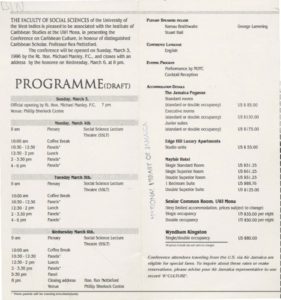
    In March 1996 the first Conference on Caribbean Culture was hosted by the faculty of Social Sciences of the University of the West Indies (UWI) and the Institute of Caribbean Studies at the university’s Mona Campus. The conference was held in honor of the choreographer, historian, and then pro vice-chancellor of UWI, Rex Nettleford.[xii] Supposedly eight leading intellectuals were invited to give plenaries, though the program only lists Kamau Brathwaite, Stuart Hall, and George Lamming. The others were: Rex Nettleford himself, Lloyd Best, Erna Brodber, Edward Seaga, and George Rohlehr (Chevannes 1997: iii; see Figure 1. “Draft Program”).

    Figure 1. “Draft Program”

    Michael Manley was to open the conference. The Caribbean Quarterly published their addresses in its March-June 1997 issue as “The Plenaries: Conference On Caribbean Culture In Honour Of Professor Rex Nettleford,”[xiii] with Gordon Rohlehr’s piece replaced by Michael Manley’s (Chevannes 1997: vi). Along with Barry Chevannes’s introduction are the following essays: George Lamming’s opening address, in which Lamming gave an overview of Caribbean/Antillean thought and letters and thanked Nettleford for his contribution to thinking Caribbean culture and making space for a “roots”-derived Caribbean culture; Lloyd Best’s “Independent Thought and Caribbean Freedom: Thirty Years Later”; Stuart Hall’s “Caribbean Culture: Future Trends”; Kamau Brathwaite’s “Rex Nettleford and the Renaissance of Caribbean Culture”; Erna Brodber’s “Re-engineering Blackspace”; Edward Seaga’s “The Significance of Folk Culture in the Development of National Identity”; Rex Nettleford’s “The Continuing Battle for Space—the Caribbean Challenge Final Session”; and, Michael Manley’s “Rex Nettleford: A Revolutionary Spirit.” Thus by the special issue, if not at the conference, two former prime ministers of Jamaica—Edward Seaga and Michael Manley—come together with the poet Brathwaite, the novelists Lamming and Brodber, the literary and cultural critic Rohlehr, Nettleford himself, and Hall. Who is Hall here in this milieu?

    The plenary papers, as they appear in Caribbean Quarterly, make it is clear that not only was Nettleford the person that the gathering was meant to celebrate, but that “culture,” the question of culture, the Caribbean cultural question was also the star. It was the return of culture as a worthy object of study and site of intellectual discourse in the region. That unique gathering of intellectual stars each in their own right:

    represented a powerful symbol of culture coming (back) in from the cold where it had been thrown out by a social science that had lost its bearing and wandered far afield in realms of vanguardism and name-calling; represented, in the thoughtful pronouncement of the Griot Kamau Brathwaite, a healing. (Chevannes 1997: iii)

    The “healing” to which Chevannes referred can be understood as the denigration of the arts and culture—whether highbrow (novels, poetry, art, drama, dance not too identifiable with the laboring classes) or low (kaiso, reggae, steel drums, tassa etc)—and the concomitant valorization of economics, history (of a certain kind) and social sciences meant to credentialize the civil service. Of the eight essays only three do not specifically speak to this moment of reconciliation—Brodber’s, Seaga’s and Manley’s (iii). Seaga seems to have received a different brief from the others. Barry Chevannes, then head of sociology and the main organizer of the conference, explains in his introduction that everyone, except Seaga, was asked to speak to “any issue they felt to be of importance.” Seaga was given a strict brief as “an anthropologist” and “a promoter of native art forms…to address the question of the role of the folk in the formation of national identity” (iii). Seaga, as such, makes no reference to Nettleford or what others seem to view as the rebirth of the cultural in the Caribbean context, at least of the anglophone Caribbean context. Brodber tackles the question of completing the emancipation begun in 1834/8; so that while her interest is in the “Caribbean cultural” as it were, it is less in the study of culture in the Caribbean and the social sciences as much as the place of culture in liberating black people (Brodber 1997: 70 – 81). Manley speaks of the two groups (social scientists and cultural practioners/critics) coming together for the conference, but never mentions that they were ever divided (Manley 1997: 96 – 100); the split between the two groups features in all other submissions.

    In Kamau Brathwaite’s own words, the conference was a Caribbean first:

    [The] first time in our 500 yrs of post Columbian history that we have such a happenin—there was P R in 1958, Carifesta 72 in Guyana & these are LANDMARKS too, but        mainly as PERFORMANCES—distillations & enactments—of the culture. This is the first time we have a concentrated comprehensive reflexion on it. Put together, the two streams strands events begin create an IMAGE of ourselves.(Brathwaithe 1997: 36)

    If the conference were a ritual undertaken for healing, it was not to heal the rift between disciplines, but actual persons, namely “Nettleford & the social scientists, who, as this Conference indicates, have come the long road backround to a recognition—i hope—of the centrality of culture to our functional reality & where how why we are ourselves in the world” (50).

    George Lamming explained it thus:

    the West Indian historian is not an active and informing influence in the popular consciousness. The language of economic advisers conveys little or no meaning to people outside their immediate circle of colleagues. Novelists function without a substantial and      continuing reading class—even among the certified graduates of the region’s university. This literature has hardly aroused the active interest of many who make up the political intelligentsia. (Lamming 1997: 12)

    Social science (economists) and culture (historians or novelists) suffer from a split; the economists are incomprehensible to though who are not economists and the novelists rarely write for those at home in the region as they do not provide a reliable and regular readership.

    In “Independent Thought and Caribbean Freedom: Thirty Years Later,”[xiv] Lloyd Best argued that what was needed was a turn to the creative arts, for only they “will here open up the philosophical as well as the scientific questions” (Best 1997: 24). He submitted that the crisis that beset the social sciences as the twenty-first century was to emerge was:

    a failure at the bottom of which is the epistemological question. How do the Caribbean people learn about themselves and for their own purposes with the resources they now have? How does a community,a tribe, a race, a State, a nation, a people, save itself from impending damnation? How does a culture escape from itself? How does a system generate its own fertility?

    The first thing would be to plumb the dimensions of our own predicament. In the  case of the social sciences, had we fixed the manifestations of dislocated personality, plantation economy, segmented multi-ethnic society and submerged subversive culture in their common historical matrix, I doubt we would have had to follow the disciplinary specializations of the European tradition, multiplied the overheads, and confused the heads of the students in the bargain—by compelling them to add Marshallian or Keynesian economics to Parsonian, Weberian or Marxian sociology, to Malinovskyesque anthropology and to the Westminster political science of Mill, all of which are premised on a different set of institutions—all of which are set in a different landscape. You can see why I am advocating an extra-disciplinary approach, a Caribbean approach. (Best 1997: 24)

    Best’s contention seems to be that such a split between the social sciences and the arts in the Caribbean occurred because the model of the university and knowledge production was simply transplanted from the UK, with no real consideration as to how to grow a Caribbean derived model. Attention and genuine incorporation of the creative arts and the humanities across (higher) education was his proposed solution.

    But if Nettleford, culture, and a new moment of significance for cultural in the Caribbean are the chief, named protagonists, Hall seems an implied one. Lloyd Best names Hall as one of his predecessor, declaring that though

    [t]he whole world knows my great teachers…to have been Gocking, Demas, Brathwaite and James…What even Stuart Hall may not know is that it all began at Richmond Road in Oxford where Demas was his [Hall’s] housemate and where Stuart’s New Left Review … I make bold to say we need other conferences mounted on the work of both William Demas and Stuart Hall … (17)

    Best makes known the hitherto little known fact that his own thought is indebted to Hall. Best is, of course, one of the most widely read anglophone Caribbean scholars as knowing the Caribbean condition; and there he stood, during this quintessentially, uniquely moment in the study of culture from/in the Caribbean paying homage to Hall, calling for a similar (conference on Caribbean Culture?) in honor of Hall’s work.

    Yet in his essay, “Caribbean Culture: Future Trends,” perhaps fittingly, meant to gesture at the next frontier, the next conjuncture, he seems to refuse that potential moment of canonization. By the time Hall gave his plenary, Best had already given his; this is evidenced by Hall’s assertion that he “think[s] about these questions in the context of rereading that marve[l]ous essay to which interestingly Lloyd Best referred this morning” (Hall 1997: 25). After thanking Nettleford for the invitation and his scholarship, Hall commences, telling his audience that he was “asked to say something about the future and in that context it has to be something about how Caribbean culture travels, it being itself the product of an enforced travelling, but also well travelled” (25). He stages his distance from that Caribbean scene, perhaps reminding the audience of what Best may have made them forget for the time:

    I have got to figure out how to talk about that because I have lived out of the region for most of my adult life and therefore what I have observed at close hand and worked amongst our people from the Caribbean, from the African Caribbean Diaspora, especially, who helped undertake a second migration, a ‘double diasporization’, I would call it. (25)

    He will not make mention of his time on Caribbean Voices, the BBC program that gave most of the writers now considered synonymous with (modern) anglophone Caribbean literature—V. S. Naipaul, Andrew Salkey, Samuel Selvon, Derek Walcott, George Lamming—work for Caribbean periodicals such as Bim or Savacou. Erased are the frequent trips he made to Jamaica (home?) from the 1970s onward (after the cultural revolution of the 1960s makes brown, middle class existence no longer easy or tenable).[xv] The documentaries on the Caribbean expunged. His participation in the Caribbean Artists Movement (CAM, 1966 – 1972) unmentioned (See Walmsley 1992). In fact, according to Anne Walmsley’s account of the second CAM conference (August 31 – September 2, 1968), Hall’s contribution shaped much of the rest of the conference. At least two of these show Hall thinking the Caribbean with diaspora. The first being that, “[t]he Afro-West Indian has had a kind of clarification of experience in the last decade in Britain that the West Indian at home, with the neocolonial regimes, has not had.” Secondly, his contention, following John La Rose, that “the West Indian had been obliged to define himself in global terms, in terms of movements of black peoples throughout the world” (164). Thus in 1968 we begin to hear the outlines of engagement with diaspora, race, and articulation in relation to the anglophone Caribbean community(ies) in the UK, years before Policing the Crisis or “Race, Articulation, and Societies Structured in Dominance.”[xvi]

    But in 1996, Hall refuses any of these enunciations that would give his audience definitive and consistent confirmation of his investment in the Caribbean. Instead he wants to use diaspora to problematize theorizations of Caribbean “roots” and “routes” (Hall 1997: 27). It is the “discrepancy between some of the ways in which we still think about culture and in which we still live and practise it” that Hall chooses, “want[s],” to address in his plenary (27).

    He ends, provocatively, informing us that only through “retranscription (by resignification)” can diasporic culture occur and sustain itself (33). He urges his audience to hold on to

    … a notion of the diasporic which lives with the notion of dissemination, of the        scattering. The seed has gone out. It is not going to come back to its original ecology. It now has to learn to live in new climates in other soils. It has to learn to resist pests that it never resisted before.

    The one thing you do not get in nature is a clone. It’s not given to repeat itself as it   was, because to repeat itself would be to die. It’s going to use its new ecology to construct a culture of a different kind. It is going to live with dissemination. It knows that unless we have made the return to our symbolic home in our hearts and minds we will never know who we are, but it knows at the same time that you can’t go home again. (33; italics mine)

    What does it mean that one “can’t go home again?” And how to apply that to the discussion of Caribbean culture that is its scene of presentation?

    II

    I don’t want to psychologize Hall, but I want to put in conversation his notion of being unable to “go home again” and his interview for the first issue of Small Axe that Hall would have given shortly after this address.[xvii] The interview stages a much more explicit set of interventions about the Caribbean as a formative space for Hall and an object of his study. It is possible that this is more function of genre. It allows for another kind of engagement it is by definition dialogic, two people looking for each other; the plenary on Caribbean Culture calls for a kind of declaration of a self and subjectivity that is less provisional.  In another 1997 interview, Caryl Phillips asks him how he feels about the Caribbean, and Hall speaks of “home” in less definitive terms than the final lines of “Caribbean Culture: Future Trends.” “No,” he says to Phillips:

    I don’t feel detachment from [the Caribbean]. I maintain that terrible ambiguity about home. I never know it. I never know what question I’m being asked when I’m asked about home. On the other hand, when I go home I know it’s not my home. And I know it’s not my home principally because it’s a small place and all the people that I was at school with are still there, and all have had a different life from mine, I can literally see the divergence. I can’t possibly recapitulate the way in which they have lived the first 30 years of independence. I didn’t live them like that. It’s not an odd question of whether you can be friends or not, it just, it’s formed us differently. (Hall 1997)

    Hall here is ambiguous about the Caribbean, Jamaica, as his home. It is not simply that he is unsure of his answer; he is uncertain of what he is being asked when asked of the Caribbean as “home.”

    As far as Caribbean scholarship the Small Axe interview ushers in a moment. Hall’s is the first interview of a series of interviews of Caribbean intellectuals born in the 1920s, 1930s, and 1940s that Scott undertakes.[xviii] It appears in the first issue of a journal that has forged a frontier zone in the field over the last while (in two years it will be twenty). At its inception, this moment of birth of which Hall is made a part, the journal was meant to “fashio[n] a vernacular idiom of criticism,” taking up the charge from older outfits such as Lloyd Best’s New World Quarterly and Kamau Brathwaite’s Savacou. Interestingly, Hall was a part of each—Best claims his in this 1996 moment as a kind of third (if silent) parent; Hall attended the conferences of the Caribbean Artists Movement and wrote for Savacou; and he is chosen as the first Caribbean intellectual to be interviewed for Small Axe.

    There is a fascinating elliptical moment in the interview; allow me to quote from it at length:

    David Scott (DS): … Clearly there you are thinking about the Caribbean. This is     the middle to late ‘70s, yes. What is prompting that rethinking of the Caribbean?

    Stuart Hall (SH): Well I suppose what is prompting it is the sense that ll that was   bubbling up in the ‘60s has had a very profound impact on Caribbean societies. It’s a very different place. And its a place that I can re-ground in my o[w]n mind in a way that I’d sort of decided that I couldn’t re-ground the old Caribbean like that. By the ‘70s I start to come back more often. Mainly to visit family. I don’t come back for official purposes. There is a long period in the ‘60s when having taken the decision I don’t come very much.

    DS: Do you lecture here when you come back in the ‘70s?

    SH: Hardly ever.

    DS: Is your work known among intellectuals here?

    SH: No, no. Not very much. And it doesn’t feel relevant to me to tell them about it.

    DS: No, sure, that I can understand. But certainly the way . . . .

    SH: They still don’t . . . .

    DS: I know they still don’t . . . .

    SH: I’m not complaining about it.

    DS: Yes, but I am. (Hall, “Politics,” 1997: 155)

    Here is Hall, interviewed for the first issue of Small Axe, a journal committed to a critical tradition in Caribbean studies, largely concerned with Caribbean thought. This set of exchanges between Hall and Scott is riddled with the unsaid. Scott keeps the question of the (anglophone) Caribbean ever present; Hall seems to want this. If Hall’s address of the future of study of Caribbean Culture does not disavow that “[i]t is perhaps too little remembered … that Stuart Hall is a Jamaican and a West Indian whose work has been informed by some of the journeys and debates that constitute this region as a zone of history, culture, and politics,” he does do so in the interview (Hall, “Politics,” 1997: 141). Yet much as the interview tells us about Hall’s development as a (anglophone) Caribbean intellectual and his sustained interest in the region, the ellipses perform a withholding that makes the answer to our very question of Hall’s place in the canon of Caribbean thought, most especially the “why” of it, elusive. And, perhaps, even an acceptance of his lot as a kind of second-class citizen in the pecking order of the home-based academy. What was intended to follow “the way”? Don’t they still do? Is it the way that Hall is marginalized in the region, or the way that he is celebrated elsewhere? Is it that “intellectuals here” still don’t read him, or acknowledge him? The first suggests lack of awareness, knowledge of Hall and his work, his theoretical interventions; the latter suggests a refusal that articulates critique either of scholarly practice (either in terms of concepts or the general eclecticism of Hall’s oeuvre) or geographic location (that he never settles and works from back home and in this way in strong contrast to Lloyd Best, Rex Nettleford, Barry Chevannes and even Brathwaite and Lamming who work from ‘home’ for periods).

    III

    Let us leave the 1996 conference and interview for a moment and look at the ways in which Hall has been memorialized since his passing. By now it should go without saying that I am interested in the ways in which he has, or has not been, honored from the Caribbean or Caribbean-centered spaces and platforms.

    In her review for the Caribbean Review of Books of John Akomfrah’s documentary, The Stuart Hall Project, Annie Paul writes:

    It never fails to astonish me how little Hall and his path-breaking work are known back here in the Caribbean, where he comes from—in Jamaica, where he was born and raised, for instance, he’s a complete nonentity. For those not in the know: Hall is a globally renowned intellectual (an “intellectual rock star,” as one publication has referred to him), a founding editor of New Left Review, and more famously the main progenitor of the influential field of cultural studies. Arising in the 1960s, this interdisciplinary juggernaut that signalled the advent of postmodern scholarship rapidly gained popularity, dealing a body-blow to traditional academic disciplines from sociology to political science to literature, and completely rewriting the scope of intellectual work worldwide. That it only arrived at the University of the West Indies in the 1990s is a measure of what a well-kept secret Hall remains in these parts. (Paul 2013)

    Paul, of course, is correct: Hall’s scholarship so profoundly influenced the ways in which we study human experience globally—in terms of subjectivity, power, identity formation, home and diaspora to name but a few—yet continues to be “a well-kept secret in [the Caribbean]”; and this persistent secrecy around Hall is a barometer of something. The paucity of elegies, eulogies or memorials in Caribbean or Caribbean-centric outlets since his passing continues the occlusion of Hall from the region and tells us something not only about Hall’s own sense of who he was, and where he belonged in relation to the island of his birth, but also speaks to his Caribbean legacy, his place in Caribbean thought, and what exactly the Caribbean is now, maybe what it is becoming.

    By my count five pieces emerged from the Caribbean or Caribbean-focused sources after Hall’s homegoing. These were: two obituaries; an announcement by the Trinidad and Tobago Film Festival as well as a free screening of The Stuart Hall Project (the Tuesday after he passed);[xix] a moving, searing letter from the editor of Small Axe (Scott 2014) and a special section of that same journal titled “The Gift of Stuart Hall”; and a tribute from the Centre for Caribbean Thought. I want to focus on those that speak explicitly to Hall and the Caribbean.

    In their tribute from the Centre for Caribbean Thought, Brian Meeks, Anthony Bogues and Rupert Lewis, assert:

    that Hall did not  return “home” like … George Lamming, or Sylvia Wynter (who returned for a while) and others did not mean that he was not Caribbean. What it meant was that the Caribbean was now working through a different geographical and cultural location. (Bogues, Lewis & Meeks 2014: 128)

    This was preceded by Meeks’s singular celebration of Hall almost a week before in the Jamaica Gleaner, “Rediscovering Stuart Hall” (Meeks 2014). He tries to attend to the relatively subdued nature of the local response, or lack thereof, in the week of Hall’s passing. Meeks explains that it “should not, maybe, be surprising” that there is such quiet (it took local newspaper several days to pick up the news) as Hall had not lived in Jamaica in over six decades (Meeks 2014). But, for Meeks, Hall’s diasporic existence has little to do with Jamaicans’ ignorance of him, rather such lack of awareness “says more of national inattention to ideas and the people who generate them.” He ends with an invitation to the Hall’s alma mater, Jamaica College, or the government to honor Hall.

    But in “Stuart Hall Roots an Legacy” Carolyn Cooper, professor of literary and cultural studies at UWI, Mona, goes directly to the question of Hall having never returned home. Writing in Jamaican patois, in Chaka-Chaka Spelling and again in Prapa-Prapa Spellin, she brings the question of Hall’s place of domicile to the fore. She asks:

    So wa mek Stuart Hall never come back a yard? Im did visit. But im live out im life a Inglan. Inna 1997, im do one interview wid Caryl Phillips, one next Oxford man weh     born a St Kitts an go a England when im a four month ‘old’. Phillips aks Hall di said same question: “The time you were leaving Oxford—1957—was exactly the same time that there was a potential for great change in the Caribbean. It was the beginning of the short-lived federation among the islands. Why did you choose not to go back?” Hall gi two answer: “There was no need to hurry back, because by then federation was a dead idea.” Dead fi true. An CARICOM no hearty to dat … See di next answer ya: “But there’s a second reason which is more personal. You see, I came from this peculiar coloured middle class in Jamaica which was oriented toward Britain … I didn’t want to go back to that. To have a job as a lawyer with my family close at hand, watching over me, I couldn’t bear it. I’d always meant to go home, but I’d always had reservations about becoming a member of that class.”

    Di problem a no so-so class. Plenty colour did mix up inna it. Hall do one next interview inna 2007 wid one journalist, Tim Adams. Hear wa im seh: “I was always the blackest member of my family and I knew it from the moment I was born. My sister said: ‘Where did you get this coolie baby from?’ Not black baby, you will note, but low-class Indian.” Seet deh now! Good ting Stuart Hall never bodder come back ya so. Im might as well tan a England.[xx]

    For Cooper Hall’s legacy is haunted by the incomplete return. It is not that Hall’s ideas were too big for ‘home’ as Meeks hints, but rather there it is color and class questions that disrupt Hall’s return at least in 1957. In this way his not a Caribbean existence simply in another geographic location, but a flight from the color politics of Jamaica, an escape.

    For his part Hall does offer several, varied reasons for his decision to settle in the UK. If Caryl Phillips is told that it had everything to do with the death of the West Indian Federation, Hall makes plain his unwillingness (like Claude McKay’s Bita Plant[xxi]) to be sucked into brown, respectable middle class society. He also speaks of the ‘problem’ of his own skin color—decidedly darker than other members of his family—in terms of having easy relations with his family (most of whom were of lighter skin color). In other words Hall might not disagree with Cooper that the question was not only one of class, but profoundly of color.

    Yet it seems to me that there is also something of a discomfort, a worry in that earlier moment of the 1996 conference that may add another dimension. In other words, I want to take Hall at his word that the interest, his interest, in the Caribbean never goes away. And, if so, the seeming finality of his “Caribbean Culture: Future Trends” suggests that he can never be a Caribbean intellectual, he can never really be part of that canon. At the same time I think there is a desire (expressed in the dialogic spaces of the interviews) to suture, to make a return.

    As editor of Caribbean Reasonings: Culture, Politics, Race, and Diaspora—The Thought of Stuart Hall and one of the organizers of the third Caribbean Reasonings conference held in 2004 in honor of Hall out of that collection emerged, Meeks has been integral in plotting Hall’s return to the intellectual terrain of contemporary Jamaica and the Caribbean academy. In his introduction to that collection, Meeks contends that it was only after giving the keynote for the conference, and receiving a standing ovation, that, Meeks writes in his introduction to the text, “Hall, after more than half a century, had at last, come home” (Meeks 2007).

    If that conference was the coming to fruition of what Lloyd Best suggested in 1996, that Hall and his work be the subject of a conference meant to honor him, it was also a retake on that earlier moment in which Hall’s name was placed on the roll under Caribbean intellectual and he stayed clear of answering too loudly in the affirmative. In his talk to the 2004 conference in his honor he tells the crowd that he nearly back out; what business did he have at that point in his career to claim “to be a Caribbean intellectual?” (Hall 2007). But rather than attempt to shake off the label like so many participles of dust, Hall took hold of it, laid claim to it. I would not say that he did so at last, because I suspect in his quieter more private moments he may have accepted the label (remember his time with the Caribbean Artists Movement?). Instead I will say that this talk is the occasion for him to do so publicly, in the haloed halls of the University of the West Indies. Here Hall revises the origin myths about how Cultural Studies started; in essence he leaves literature and turns to Cultural Studies because he “had to confront the problem of trying to understand what Caribbean culture was and what my relationship” (Hall 2007). He may not have a deep investment in the postcolonial project of “nation-building,” but in that regard he is not alone—many of his generation bemoaned the nation state. It is not only that Hall becomes black in there, but he forges community with fellow West Indians he may never have doon amongst other West Indians:

    London streets — one more turn in the story of the Middle Passage and a critical moment in the formation of another displaced black diaspora — I resolved to go back, to read, read about, try to understand and to make a part of me the culture which had made me and from which I could never — and no longer wished — to escape. (Hall 2007)

    He speaks of himself as one of many other Jamaicans and anglophone Caribbean folk making their way in that work, rather than an isolated, rare individual. Diaspora becomes a kind of double-bind that ties on to home and the world, here and there. Diaspora here is not only that state which induces and produces a kind of homelessness, it also makes home. Diaspora not a way to disavow one home as one tries, if never succeeding valiant in the effort, to make another one’s new home. It is an uneven and imbalanced dance between the locations. It is in this understanding of diaspora Hall finds his Caribbean. Or rather lets the rest of us see it; he has been wrestling with it all the while, the interest always there. His entire career becoming in some ways “[his] very long way of trying to answer the question, in what sense can [he] be ‘a Caribbean intellectual’?” (Hall 2007).

    Travel well.

    Contributor’s Note

    Victoria J. Collis-Buthelezi is lecturer of African Diaspora and African literature and theory in the English Department at the University of Cape Town. Her current book project is Empire, Nation, Diaspora: The Making of Modern Black Intellectual Culture.

    References

    Best, Lloyd. 1997. “Independent Thought and Caribbean Freedom: Thirty Years Later,” in special issue “The Plenaries: Conference on Caribbean Culture in Honour of Professor          Rex Nettleford.” Caribbean Quarterly, 43, no. 1/2: 16 – 24.

    __________.. 1997. “The Vocation of a Caribbean Intellectual: An Interview with Lloyd Best,”             interview by David Scott. Small Axe 1: 119 – 139.

    __________.. 1967. “Independent Thought and Caribbean Freedom,” New World Quarterly      (Croptime): 13 – 35.

    Bogues, Anthony, Rupert Lewis and Brian Meeks. 2014. “Stuart Hall, Caribbean Thought and the World We Live in.” Caribbean Quarterly, 60, no. 1: 128.

    __________.. 2002. “Michael Manley, Equality and the Jamaican Labour Movement,” in special           issue” Michael Manley: A Voice at the Workplace,” Caribbean Quarterly, 48, no. 1: 77 – 93.

    Brathwaite, Kamau. 1997. “Rex Nettleford and the Renaissance of Caribbean Culture,” in special issue “The Plenaries: Conference on Caribbean Culture in Honour of Professor Rex Nettleford.” Caribbean Quarterly, 43, no. 1/2: 34 – 69.

    Brodber, Erna. 1997. “Re-engineering Blackspace,” “The Plenaries: Conference on Caribbean Culture in Honour of Professor Rex Nettleford,” Caribbean Quarterly, 43, no. 1/2: 70 – 81.

    Chevannes, Barry. 1997. “Introduction” to special issue “The Plenaries: Conference on       Caribbean Culture in Honour of Professor Rex Nettleford,” Caribbean Quarterly, 43, no.1/2: iii – vi.

    Cooper, Carolyn. “Stuart Hall Roots an Legacy.” Jamaica Gleaner, jamaica-gleaner.com/gleaner/20140216/cleisure/cleisure3.html, accessed December 20, 2014.

    Cudjoe, Selwyn R. 1992. “C. L. R. James Misbound.” Transition, no. 58: 124 – 136.

    Hall, Stuart. 2007. “Epilogue: Through the Prism of an Intellectual Life,” in Caribbean        Reasonings: Culture, Politics, Race, and Diaspora—The Thought of Stuart Hall, edited by Brian Meeks, Kingston and Miami: Ian Randle Publishers. Kindle ebook.

    _________.  1997. “Politics, Strategy, Contingency: An Interview with Stuart Hall,” by David       Scott. Small Axe, no. 1: 141 – 159.

    _________. 1997. “Caribbean a Culture: Future Trends,” in special issue “The Plenaries:    Conference On Caribbean Culture in Honour of Professor Rex Nettleford.” Caribbean    Quarterly, 43, no. 1/2: 25 – 33.

    _________. 1997. Interview with Caryl Phillips. Bomb: A Quarterly Arts and Culture Magazine   58, http://bombmagazine.org/article/2030/stuart-hall, accessed August 28, 2015.

    _________. 1983. “For a Marxism without Guarantees.” Australian Left Review 83: 38 – 43.

    _________. 1980. “Race, Articulation, and Societies Structured in Dominance,” in Sociological      Theories: Race and Colonialism. Paris: UNESCO, 16–60.

    Lamming, George. 1997. “Opening Address,” in special issue “The Plenaries: Conference on Caribbean Culture in Honour of Professor Rex Nettleford.” Caribbean Quarterly, 43, no. 1/2: 1 – 15.

    Manley, Michael. 1997. “Rex Nettleford: A Revolutionary Spirit,” in special issue “The      Plenaries: Conference On Caribbean Culture In Honour Of Professor Rex Nettleford.”            Caribbean Quarterly, 43, no. 1/2: 96 – 100.

    Meeks, Brian. February 12, 2014. “Rediscovering Stuart Hall.” Jamaica Gleaner, jamaica-gleaner.com/gleaner/20140212/cleisure/cleisure1.html, accessed December 20, 2014.

    _________. 2007. “Introduction: Return of a Native Sun,” in Caribbean Reasonings: Culture, Politics, Race, and Diaspora—The Thought of Stuart Hall, edited by Brian Meeks, . Kingston and Miami: Ian Randle Publishers. Kindle ebook.

    Paul, Annie. 2013. “Towards the Next Conjuncture.” Caribbean Review of Books,   caribbeanreviewofbooks.com/crb-archive/30-november-2013/towards-the-next-           conjecture/, accessed May 20, 2015.

    Walmsey, Anne. 1992. Caribbean Artists Movement, 1966 –1972: A Literary and Cultural History. London and Port of Spain: New Beacon Books.

    Wynter, Sylvia. 2000. “The Re-enactment of Humanism: An Interview with Sylvia Wynter,” interview by David Scott. Small Axe, no. 8: 119 – 207.

    Seaga, Edward. 1997. “The Significance of Folk Culture in the Development of National     Identity,” in special issue “The Plenaries: Conference on Caribbean Culture in Honour of Professor Rex Nettleford.” Caribbean Quarterly, 43, no. 1/2: 82 – 89.

    Scott, David. 2014. “The Last Conjuncture.” Small Axe, 18, no. 2 44: vii – x.

    _________. 2013. “On the Question of Caribbean Studies,” introduction to special issue on “What is Caribbean Studies?” Small Axe, Volume 17, Number 2 41: 1 – 7.

    _________. 2005. Interview with Stuart Hall. Bomb: A Quarterly Arts and Culture Magazine 90,   http://bombmagazine.org/article/2711/david-scott, accessed July 10, 2015.

    “Draft Program.” 1996. Conference on Caribbean Culture in Honour of Professor Rex Nettleford.

    “Film Festival Hosts Free Tribute Screening of The Stuart Hall Project.” 2014. http:// www.ttfilmfestival.com/2014/02/festival-hosts-free-tribute-screening-stuart-hall-project/ .

    Notes

    [i] The island nation-states of the Caribbean gained independence between 1962 (Jamaica and Trinidad andTobago) and 1983 (St. Kitts and Nevis).

    [ii] The Republic of Trinidad and Tobago.

    [iii] James did not win a scholarship to study in the UK as Norman Manley, Eric Williams, Stuart Hall, or many others would, but I include him in this number because he was one of those students (and then teacher) of the prestigious island schools who would have been expected to win one of the island scholarship—a middle-class/lower middle-class boy, as he describes himself in the BBC Channel Four interview he did with Stuart Hall (See James, “C. L. R. James in conversation with Stuart Hall,” Channel 4, 1983-85).

    [iv] The only television station in Trinidad and Tobago until 1991.

    [v] Hortense Spillers asked this of Anthony ‘Tony’ Bogues during his keynote.

    [vi] They spoke of George Padmore and the work he and James did together in the African Bureau.

    [vii] I use “particular” thinking of James’s invocation of the word in his history of the first Pan-African Conference of 1900 in reference to the actions and history of Henry Sylvester Williams as convenor of the conference and a Caribbean intellectual. See James 1984: 236-250.

    [viii] At QRC James also taught V. S. Naipaul.

    [ix] Eric E. Williams says this after Jamaica pulls out of the West Indian Federation in order to justify Trinidad and Tobago’s withdrawal thereafter.

    [x] Scott’s term of choice (represented by the ellipsis in my citation above) is “archive”; he refers to an “archive of thinking” around what Caribbean means. He writes:

    I mean to press the idea, in other words, that to think something like “Caribbean studies” is already to be inside, to be in a conversation with, one dimension or another of the archive of thinking about what the Caribbean supposedly is, supposedly was. (2013: 1)

    Archive, I think, does not quite get at what interests me on the question of Stuart Hall and the Caribbean because as much as archives are products of power, there is some sense that within an archive traces might exist, the archive might hold sources the value of which change over time. The canon on the other hand may change content over time, but that which is within is that which is authorized in particular ways; the archive can contain within its borders items that are not deemed valuable, but that sit there as if waiting to be discovered. In other words, Hall’s work may sit within a Caribbean archive, but it is not considered canonical in Caribbean scholarship.

    [xi] In this essay, to distinguish between the two 1997 interviews I cite Hall’s interview in Small Axe as Hall, “Politics” 1997 and his interview Bomb with Caryl Phillips as Hall 1997.

    [xii] Nettleford remained would become vice-chancellor of UWI (its first graduate to do so) just two years later in 1998 until 2004.

    [xiii] Selected literature papers were also compiled for another special issue of Caribbean Quarterly from the conference. See Caribbean Quarterly, Volume 43, Number 4, Conference on Caribbean Culture in Honour of Professor Rex Nettleford The Literature Papers: A Selection (December 1997).

    [xiv] This is Best’s return to his 1967 piece in the New World Quarterly, “Independent Thought and Caribbean Freedom.” See Lloyd Best, “Independent Thought and Caribbean Freedom.” New World Quarterly (Croptime 1967): 13 – 35.

    [xv] Brown here refers to the mulatto elite. See Anthony Bogues, “Michael Manley, Equality and the Jamaican Labour Movement,” in special issue” Michael Manley: A Voice at the Workplace,” Caribbean Quarterly, 48, no. 1, (2002): 77–93.

    [xvi] See Stuart Hall, “Race, Articulation, and Societies Structured in Dominance,” in Sociological Theories: Race and Colonialism (UNESCO, 1980), reprinted in Black British Cultural Studies: A Reader, ed. Houston A. Baker, Manthia Diawara, and Ruth H. Lindeborg (Chicago: University of Chicago Press, 1996), 16–60.

    [xvii] The interview is dated March 6, 1996. The draft program for the conference show three plenaries scheduled on: Monday, March 4; Tuesday, March 5; and Wednesday March 6 (See “Conference on Caribbean Culture Registration Brochure,” National Library of Jamaica). Hall would have given his plenary on on of those days, those most likely not in the morning slot as scheduled in the draft program since he refers to Best’s paper having been given in morning before his own.

    [xviii] Lloyd Best’s interview also features in the first issue of the journal, and before Hall’s in pagination, but in conversation with Hall again in 2005, Scott says that this was the first interview he did of Hall’s generation of intellectuals for Small Axe. See David Scott, interview with Stuart Hall, Bomb: A Quarterly Arts and Culture Magazine 90 (Winter 2005), http://bombmagazine.org/article/2711/david-scott, accessed July 10, 2015.

    [xix] See http://www.ttfilmfestival.com/2014/02/festival-hosts-free-tribute-screening-stuart-hall-project/ . The documentary has yet to be screened in Jamaica.

    [xx] Translation:

    So what made Stuart Hall never come back home? He visited. But he lived out his life in England. In 1997, he did an interview with Caryl Phillips, another Oxford man who was born in St. Kitts and went to England when he was four months ‘old.’ Phillips asked Hall the same question: “The time you were leaving Oxford—1957—was exactly the same time that there was a potential for great change in the Caribbean. It was the beginning of the short-lived federation among the islands. Why did you choose not to go back?” Hall gave two answers: “There was no need to hurry back, because by then federation was a dead idea.” Dead in truth. An CARICOM is no better … Look at the next answer:  “But there’s a second reason       which is more personal.  You see, I came from this peculiar coloured middle class in Jamaica which was oriented toward Britain … I didn’t want to go back to that. To have a job as a lawyer with my family close at hand, watching over me, I couldn’t bear it. I’d always meant to go home, but I’d always had reservations about becoming a member of that class.”

    The problem is not so much class. Plenty color issues are mixed in. Hall did another interview in 2007 with another journalist, Tim Adams. Listen to what he said: “I was always the blackest member of my family and I knew it from the moment I was born. My sister said: ‘Where did you get this coolie baby from?’ Not black baby, you will note, but low-class Indian.” See there now! Good thing Stuart Hall never bothered to come back here so. He might as well tan in England.

    [xxi] See Claude McKay. Banana Bottom. New York: Harcourt Brace, 1933.

  • Announcement: Sean’s Russia Blog

    Announcement: Sean’s Russia Blog

    boundary 2 editor Nancy Condee is director of the Center for Russian and East European Studies (REES) at the University of Pittsburgh. Recently, REES announced that Sean’s Russia Blog has become a major addition to the center’s resources and electronic presence. Hosted by Sean Guillory, Digital Scholarship Curator at REES, Sean’s Russia Blog is an invaluable web source that features interviews with writers, filmmakers, academics, and policy figures from Russia, the US, and elsewhere. It joins such US web resources as NYU Jordan Center’s All the Russias blog, David Johnson’s Johnson’s Russia List at GWU’s Elliott School, or Maxim Trudolyubov’s The Russia File at the Kennan Institute (Wilson Center).

    Sean’s Russia Blog provides hour-long interviews ranging from Russian LGBTQ and New Left Activism to The Early Russian Empire and Reforging Roma into New Soviet Gypsies. Subscribers will find something for any vector of curiosity: interested in Russian Punk RockThe Stillbirth of the Soviet Internet?  The Political Life of VodkaGangs in Russia? To subscribe, search Sean’s Russia Blog in your favorite podcast app or go directly to seansrussiablog.org.

  • Jimmy Fazzino – Inside the Whale: William Burroughs and the World

    Jimmy Fazzino – Inside the Whale: William Burroughs and the World

    by Jimmy Fazzino

    This essay has been peer-reviewed by the boundary 2 editorial collective


    A Tale of Two Whales

    Call Me Burroughs: A Life, Barry Miles’s landmark biography of William S. Burroughs, takes its name from a 1965 spoken word album, the first of many Burroughs would record over the course of his long and prolific life. Miles, then a co-owner of London’s Indica Bookshop, was in charge of the album’s UK distribution. “He made more records than most rock groups,” writes Miles (2013: 629). And later in life this “literary outlaw”[1] would become a rock star of sorts. Returning to the United States in 1974 after a quarter century of living abroad, he followed Allen Ginsberg’s example and began a “new career” of public readings (514). These engagements helped solidify Burroughs’s status as a countercultural icon; they also showcased the performative dimensions of his work. For those familiar with Burroughs’s singular drawl, which became even more pronounced onstage, it is impossible to read him without hearing that voice. It haunts the page. Burroughs is a master ventriloquist, inhabited by many personae, whose voice is best understood as a construction and, at times, a put-on. Establishing a sense of critical distance between author and performance, not easy to do when Burroughs’s performances are so incredibly convincing, is crucial for grasping his project as a writer. In a 1974 interview with David Bowie for Rolling Stone, he indicates the ultimate stakes of this project while gesturing toward a deeper performativity of writing when he says, “Writing is seeing how close you can come to making it happen, that’s the object of all art,” adding, “I think the most important thing in the world is that the artists should take over this planet because they’re the only ones who can make anything happen.”[2]

    It is fitting that Miles should borrow his book’s title from Burroughs, repurposing what was already an adaptation of the most famous opening line in all of US literature. This nod to the détournement of Burroughs’s writing practices, epitomized by the “cut-up” experiments of the 1960s, is also an implicit argument for Burroughs’s place in literary history. When Beat Generation writers—and the question of whether Burroughs was a “Beat” inevitably arises—get talked about at all in relation to literary history, they are usually confined to a distinctly American tradition stemming from nineteenth-century American Renaissance writers like Melville. (Burroughs did share an appreciation for Melville with Jack Kerouac and Allen Ginsberg, and when the latter two were students at Columbia, the English faculty happened to include Raymond Weaver, who had discovered the unpublished manuscript of Billy Budd and helped restore Melville’s reputation.) Beat writing continues mainly to be read and studied “domestically”—that is to say, as a latter-day manifestation of Emersonian individualism, Whitmanian populism and frankness, and Thoreau’s anti-materialist gospel.

    Burroughs himself consistently rejected the Beat label, but if public disavowal were enough, then one would have to exclude Kerouac and many others besides. Miles’s biography in no way privileges or gives prominence to the Beat years, treating them as one phase among many in the long, strange trajectory of Burroughs’s life. Miles does trace an evolution in the author’s thoughts regarding the Beat movement, writing that while “previously he had always distanced himself from the Beat Generation,” upon his return to the States, “He now claimed Kerouac as a friend, even though they had been estranged for the last decade of Kerouac’s life. He recognized Ginsberg’s role in shaping his career and helped him to rehabilitate the Beat Generation and give it its rightful place—as Allen saw it—in the pantheon of American letters.” Burroughs had by this time become an “elder statesman” (Miles 2013: 513) of the whole counterculture that the Beats helped launch.

    One of Burroughs’s earliest sustained attempts at writing, the 1945 novella And the Hippos Were Boiled in Their Tanks, he cowrote with Kerouac, and his eventual career as a writer is practically unthinkable without the support of Allen Ginsberg, Burroughs’s first agent and his most vociferous booster. In fact, most of the early work (classics like Junky and Naked Lunch) has its origins in letters to Ginsberg. Ultimately, such questions as “was Burroughs a Beat?” should be a secondary concern, although I happen to think that he can be productively read alongside Kerouac and Ginsberg, Diane di Prima and Amiri Baraka, Gregory Corso, Philip Lamantia, and a host of writers and artists called, however equivocally, “Beat.” In my own work this has meant a more careful reckoning of the transnational sources and contexts of the Beat movement as a whole.

    The Beats traveled widely and produced some of their most important works abroad. (Ginsberg: Kaddish, Kerouac: Mexico City Blues, Gregory Corso: Happy Birthday of Death, which includes the epochal poem “Bomb,” Burroughs: Junky, Queer, Naked Lunch, the Nova trilogy, just to name a few). This distance from home is precisely what opens up a space for all sorts of unexpected connections and crossings to arise in their work. And it turns out that Beat writers were profoundly engaged with the world at large, particularly colonial, postcolonial, and third world. Living and writing in places like Morocco, Mali, India, and Latin America (and centers of imperial power like Paris and London) at the great moment of decolonization across the globe, the Beats were more than just tourists. They could be very attuned to the immediate and usually fraught political situations unfolding around them, although it takes a certain kind of worlded reading practice to unearth these subterranean concerns in their work. For Burroughs in particular, it seems that his calling as a writer is predicated on leaving the United States behind. He turns out to be Ahab, not Ishmael, and the quest for his white whale—the “final fix,” as he first calls it in Junky (1953)—leads him all over the world.

    Accordingly, some of the best recent scholarship on writers in the Beat orbit has taken a transnationalist approach of one kind or another. This includes Timothy Gray’s (2006) Gary Snyder and the Pacific Rim and Rachel Adams’s (2009) Continental Divides. Adams argues that Kerouac is a quintessentially “continental” writer, while Hassan Melehy (2016) figures Kerouac as a Deleuzian nomad of the Québécois diaspora in Kerouac: Language, Poetics, and Territory. Todd Tietchen’s (2010) Cubalogues examines the impact that Castro’s Cuba had on Lawrence Ferlinghetti, LeRoi Jones, and Allen Ginsberg, all of whom visited the island in the years just following the revolution, and Brian Edwards’s (2005) Morocco Bound addresses the topic of Cold War orientalism in part by locating Burroughs’s Tangier writing within a persistent set of tropes surrounding Arab North Africa and demonstrating the ways in which Burroughs both exceeds and gets “trapped” by orientalist discourse. A number of related currents in Beat studies have converged in the volume The Transnational Beat Generation, edited by Nancy M. Grace and Jennie Skerl (2012), and collectively they lead to these conclusions: the Beats represent a transnational literary and cultural movement par excellence, and the study of Beat writing can shed new light not just on the transnationalism of US literary history but on the meaning of the transnational itself.

    So Miles’s title might turn out to be a red herring altogether. What if the whale in question isn’t the one who destroyed the Pequod but the one who swallowed up the prophet Jonah—the same one George Orwell invokes in his 1940 essay “Inside the Whale”? Chiefly a meditation on the proper relationship between art and politics in an age of totalitarianism, Orwell’s essay singles out for praise the work of American expatriate writer Henry Miller, who stands in sharp contrast to the “committed” writers of the day. In both spirit and style, Miller is a forerunner of the Beat Generation. Fans of Kerouac’s Big Sur (where Miller lived for two decades) are likely to regard their missed dinner date (Kerouac got drunk that night and never made it out of San Francisco) as one of the great lost opportunities of American letters. Along with Howl and Naked Lunch, Miller’s Tropic of Cancer became another milestone in the fight against censorship in the United States when the US Supreme Court declared it not obscene in 1964. Because of their affinities, Miller gets read in similar, and similarly reductive, ways as the Beats, and Orwell’s essay sets the tone for these later readings. It also points beyond them, offering by extension a fresh way to look at Beat writing in general and Burroughs’s work in particular. Finally, Orwell’s whale suggests an idiosyncratic image of transnationalism as worlding and a means of navigating some of the impasses that have grown up around the so-called “transnational turn” in the humanities.

    Like Miller, Orwell had lived dead broke in Paris in the early 1930s, but his description of the experience in Down and Out in Paris and London is more akin to the reportage of Orwell’s own Road to Wigan Pier than to anything in Tropic of Cancer. That notwithstanding, he admired Miller’s work and championed it at a time when Miller was known only to a cognoscenti, who, like T. S. Eliot, had gotten hold of a copy printed in France by Jack Kahane’s Obelisk Press. (After the war, his son Maurice Girodias changed the name to Olympia Press and would go on to publish The Naked Lunch, as the 1959 first edition of Burroughs’s novel was called.) In his essay on Miller, Orwell frames his discussion of Miller with the story of their first meeting. It was 1936, and Orwell was on his way to Spain to serve the Republican cause, which Miller bluntly told him was “the act of an idiot.” Orwell recounts, “He could understand anyone going there from purely selfish motives, out of curiosity, for instance, but to mix oneself up in such things from a sense obligation was sheer stupidity” (2009: 129-30).

    After Spain, where Orwell was branded a Trotskyite and a fascist and forced to flee, he comes to agree, or at least sympathize, with Miller’s basic position. Moreover, he concludes that a literature of utter passivity and complete acceptance is far preferable, and more honest, than high-minded and resolutely political writing from the likes of Auden and Spender. In a world of such turmoil and flux, any art attaching itself to a cause, or worse yet a party, is doomed to failure. To capture the full extent of Miller’s detachment, Orwell borrows an image that Miller himself once used to describe good friend Anaïs Nin: he compares her “to Jonah in the whale’s belly.” Orwell writes:

    And however it may be with Anaïs Nin, there is no question that Miller himself is inside the whale. All his best and most characteristic passages are written from the angle of Jonah, a willing Jonah. Not that he is especially introverted—quite the contrary. In his case the whale happens to be transparent. Only he feels no impulse to alter or control the process that he is undergoing. He has performed the essential Jonah act of allowing himself to be swallowed, remaining passive, accepting.

    “Short of death,” Orwell calls this “the final, unsurpassable stage of irresponsibility” (132), but the implication is that sometimes irresponsibility is more principled than its opposite. The complexity of Orwell’s figuration lies in the dialectical twist whereby Miller is trapped in the belly of the whale, but the whale is transparent. I want to formulate things slightly differently and instead say that he is inside the whale, but the whale happens to contain the entire world. Read against the grain of its original intent, the whale becomes an image not of separation but of worlded connectedness. It points to an alternative, monist strain of worlded thought that appears everywhere in Beat writing and runs counter to the Beats’ supposed isolationism and indifference to the wider world.

    Ahab’s white whale as blank screen or “empty cipher” is akin to what some critics fear has become the transcendent sameness of the transnational. The prominent Americanist Donald Pease speaks for them when he remarks that in its rise to become a dominant paradigm transnationalism writ large has “exercised a monopoly of assimilative power that has enabled it to subsume and replace competing spatial and temporal orientations—including multicultural American studies, borderlands critique, and postcolonial American studies—within an encompassing geopolitics of knowledge” (2011: 1). Worse yet, this shift toward the “unmarked” space of the transnational mirrors and recapitulates the same global flows of capital and corporate power that transnationalist critics want to interrogate (10).[3] Transnationalism as worlding, however, with its counter-hegemonic animus, its emphasis on materiality, on local histories and lived experience, and its attention to the always uneven encounter between the local and the global, is particularly well-suited to retain the lessons of older critical formations, especially postcolonial theory. With roots in Spivak’s planetarity and Said’s global-materialist outlook, worlding privileges precisely those “peripheralized geographies and diasporic populations” that, for Pease, have been marked and marginalized by the transnational (10).

    Miller’s whale is more like worlding’s messy immanence—its belly a subterranean space that supplies what Ginsberg has called “the bottom-up vision of society” (in Raskin 2004: xiv), or what cultural historian David Pike characterizes as “the view from below” (2005: 8-12). The world as such is an oppositional term that upholds the local and the contingent in the face of the deracinating transcendence of global space. At its core, worlding entails a dialectic of near and far; it adopts the in-between-ness of James Clifford’s “translocal” sense of cultural adaptation (see in particular 1997) and Rob Wilson’s global/local (Wilson and Dissanayake 1996; Wilson 2000). Lawrence Buell (2007) associates these shifting spatial scales with the planetary “ecoglobalism” of environmental writers and activists, for the world/planet is fundamentally an ecological vision of a world-organism: earth as ecos (“home”) and lived space. Via the Beat ecopoetics of Gary Snyder, the etymology of “eco-” as oikos (house, family) is made worldly and worlded in Earth House Hold, Snyder’s 1969 collection of “Technical Notes and Queries to Fellow Dharma Revolutionaries.” That is to say, the lived, material experience of the near-at-hand (one’s “household”) is, in Snyder’s conception, the necessary ground upon which one might imagine communal ties that run much deeper than the nation (oikos as earth/planet). The world, then, becomes a necessary “third term,” as Christopher Connery has labeled it (2007: 3), preserving the local within the global as it confronts the relentless logic of East-West, colonialism-nationalism, communist-capitalist, self-other.

    Along with Spivak and Said, Immanuel Wallerstein and his pathbreaking “world-systems analysis” are part of a recognizable and increasingly consolidated canon of worlded thought. I want to hold on to their classic formulations of the worlded world even as I open up to a more expansive genealogy that comprises poetry, philosophy, and the sciences in addition to literary and cultural theory and criticism. Wallerstein makes a crucial distinction when defining “world-system.” He writes that “a world-system not is the system of the world, but a system that is a world and that can be, most often had been, located in an area less than the entire globe” (2004: 98). The world indicated by Wallerstein’s world-system is neither identical to nor coterminous with the world as empirical object (Wallerstein uses “globe” to mean the latter). It is thus a non-totalizing totality, a totality in the Marxian sense: that is to say, a critical concept that functions descriptively but also works to denaturalize what it describes. Just as our “species-being” is determined by, yet exceeds, the “totality of social relations” under the prevailing economic system. As Lukács points out, for Marx the totality itself is dialectical; it is precisely the universality of capitalism that sets the stage for the universal liberation of proletarian revolution. (Transferring things from base to superstructure, Peter Bürger will make an analogous argument when he writes that it is only after the Aestheticists declare the supremacy of “art for art’s sake” that avant-garde movements like Dada can come along and attempt to negate any distinction between art and life.) Wallerstein’s differentiation between a conceptual world and an empirical globe points to the dual nature of world as both physical and figural, topological and tropological. And the space opened up by this distinction is what makes the worlded imaginary possible.

    The Marxian world-system as non-totalizing totality means that civilization progresses in dialectical fashion from one world to the next (e.g., from the feudal world to the capitalist world). But what if multiple worlds, an infinite number of worlds, can exist simultaneously? This is the conclusion to draw from the work of biologist and proto-posthumanist Jakob von Uexküll, whose concept of Umwelt (environment, life-world) posits that each species’s sensorium is fundamentally unique and constitutes a world unto itself. In Uexküll’s most enduring work, A Foray into the Worlds (Umwelten) of Animals and Humans (1934), he asks readers to take an imaginary stroll with him:

    We begin such a stroll on a sunny day before a flowering meadow in which insects buzz and butterflies flutter, and we make a bubble around each of the animals living in the meadow. The bubble represents each animal’s environment and contains all the features accessible to the subject. As soon as we enter into one such bubble, the previous surroundings of the subject are completely reconfigured. Many qualities of the colorful meadow vanish completely, others lose their coherence with one another, and new connections are created. A new world arises in each bubble. (2010: 43 [emphasis added])

    The author will emphasize the salutary estrangement involved in such a pursuit when he writes, “Only when we can vividly imagine this fact [of the “bubbles”] will we recognize in our own world the bubble that encloses each and every one of us on all sides” (70). Uexküll’s perspective, which radically decenters human consciousness and imagines a dense, rhizomic web of inputs and interactions among all life forms, is picked up by Gilles Deleuze and Félix Guattari in A Thousand Plateaus and has come back to the fore in the field of animal studies and among today’s theorists of a posthuman biopolitics.

    This talk of worlds and bubbles is strangely reminiscent of Leibniz even, whose rationalist abstractions seem miles away from Uexküll’s empiricist phenomenology. Yet Leibniz’s “monad” is but the metaphysical counterpart to Uexküll’s model of ecological interdependence. On the surface, the self-sufficient monad—a substance without windows or doors, as Leibniz puts it—seems to be an image of extreme isolation, but the exact opposite is true. His “monadology” only works because we live in a universe where everything is connected to everything else and everything affects everything else; transculturally speaking, it is a version of Indra’s net. The philosopher writes, “This interconnection or accommodation of all created things to each other, and each to all the others, brings it about that each simple substance [i.e., monad] has relations that express all the others, and consequently, that each simple substance is a perpetual, living mirror of the universe” (1989: 220). Leibniz also plays on the tension between singularity and multiplicity inherent in the monad, and like Uexküll he is interested in perspective, writing, “Just as the same city viewed from different directions appears entirely different and, as it were, multiplied perspectively, in just the same way it happens that, because of the infinite multitude of simple substances, there are, as it were, just as many different universes, which are, nevertheless, only perspectives on a single one, corresponding to the different points of view of each monad” (221).

    In “Inside the Whale,” Orwell ponders the idea of “books that ‘create a world of their own,’ as the saying goes”—books that, like Tropic of Cancer, “open up a new world not by revealing what is strange, but by revealing what is familiar” (2009: 11). Burroughs’s Junky presents itself as exposé of the junk world (where there are not only junky habits and junky lingo but junk time and “junk cells” with their own “junk metabolism”). Ginsberg plays up this junk world in an early preface he wrote for the novel, which he promises will reveal a “vast underground life” and a “world of horrors.” The final pages of Junky prepare readers for the yagé world, which will soon become the world of Interzone in Naked Lunch, and so on. These are all instantiations of a “world-horizon come near” that Rob Wilson writes about in The Worlding Project (2007: 212). The zero degree formulation of the world-horizon in Beat writing is Dean Moriarty’s ecstatic “It’s the world! My God! It’s the world!” near the end of Kerouac’s On the Road, uttered after Sal and Dean cross the Mexican border. Such sweeping gestures always run the risk of erasing difference in the name of an essential oneness across time and space, but their sublime expansiveness is what also leads Beat writers to a more grounded or “situated” understanding of their world-historical moment of decolonization and Cold War geopolitics. This is especially true for Burroughs, whose worlded imaginary gives rise to complex textual geographies.

    Worlding Burroughs

    Barry Miles has been a prolific chronicler of the counterculture. I first encountered his work when I read The Beat Hotel: Ginsberg, Burroughs, and Corso in Paris, 1957–1963 (2000). His still authoritative account of the Beats in Paris, much of which gets reprised in the “City of Light” section of Call Me Burroughs, has proven indispensable to understanding those years of fertile experiment at 9 rue Gît-le-Coeur, especially Burroughs’s intense collaboration with painter and writer Brion Gysin, whom he had met in Tangier but didn’t really connect with until Paris. Despite the earlier book’s strengths, in Beat Hotel Miles makes a key claim that seems to me to encapsulate the most reductive tendencies of so much Beat scholarship. Describing Burroughs’s experience of Paris and his refusal to humor Ginsberg by joining him on trips to museums and sightseeing excursions, Miles writes that “his was more a landscape of ideas, and in many ways he could have been living anywhere” (2000: 160). A theme running through Beat Hotel figures Paris as a missed opportunity for Burroughs and the other Beat writers living there. It turns out, for example, that Burroughs was oblivious to the presence of the Lettrist/Situationist group who also made the Latin Quarter their base of operations and were engaging in similarly provocative textual experiments. The parallel evolution of the cut-up method alongside the Situationist practice of détournement is really quite remarkable, evidence that the Beats were soaking up similar energies and looking to common ancestors in Dada and Surrealism.

    The “landscape of ideas” thesis becomes more problematic when applied to Burroughs’s oeuvre. It means that a prominent setting like the Interzone of Naked Lunch gets read as a nightmarish abstraction or drug-induced hallucination rather than the satirical depiction of Tangier in the years immediately preceding and following Moroccan independence that it is. Since Miles’s Beat Hotel was first published, scholarship on Burroughs has made a spatial turn mirroring the “transnational turn” in literary and cultural studies more broadly. Brian Edwards, Oliver Harris, Allen Hibbard, and others have recently sought to restore a sense of place to the study of Burroughs’s work. These developments are echoed in the structure of Call Me Burroughs, which suggests a spatial turn in Miles’s thinking as well. His biography is organized chiefly by locale, with discrete sections on St. Louis (where Burroughs was born and raised), Mexico, New York, Tangier, London, and Lawrence, Kansas (where he lived for sixteen years before his death there in 1997), making Call Me Burroughs an itinerary as much as a chronology of the author’s life and work.

    Call Me Burroughs is not the first biography of the author that Miles has written. That would be William Burroughs: El Hombre Invisible, a slimmer volume published in 1992 that serves as a blueprint for the later book. (Miles inherited the project to write a follow-up from Burroughs’s longtime agent and partner James Grauerholz, who had compiled a vast archive but could not complete the undertaking.) The moniker refers to the persona Burroughs acquired while strung out on opiates in Tangier. In Call Me Burroughs, Miles writes:

    He was famously known as el hombre invisible to the Spanish boys in Tangier; this came from a conscious effort on his part to blend in so well that people would not see him, as well as the fact that, in his junk phase, he was gray and spectral-looking. … Bill practiced getting from the Villa Muniria to the place de France without being seen. He walked down the street, his eyes swiveling, checking everybody out. … Sometimes he could get through a whole line of guides without anyone seeing him, which in Tangier is a very good test. (2013: 296)

    The invisible Burroughs is unattached, non-aligned, and where Miles might have used the image to show how it gives the author’s work from and about Tangier a greater critical purchase, which it certainly does, Miles uses it instead to paper over the complexities of Burroughs’s attitude toward the momentous events that were unfolding around him. It is odd that in a book that assumes a kind of politics on Burroughs’s part—tied to a critique of power and language (its “viral” carrier) and a sincere belief in the potential of transgressive writing practices like the cut-up method “to do something about it” (335)—mostly sidesteps the much-debated question of the author’s “Moroccan politics.” In the pages just preceding the description of Burroughs cited above, Miles quotes a long passage from Naked Lunch dealing with the rise of nationalism in Morocco; he also quotes from the complicated and richly performative “Jihad Jitters” letter to Ginsberg (dated October 29, 1956, also the date of Tangier’s integration into Morocco—i.e., the end of the International Zone). But rather than follow this up with an acknowledgement of the difficult issues being raised in these texts, Miles cuts to el hombre invisible and thus performs a disappearing act of his own.

    Readers of Naked Lunch are vexed by what seems like the author’s inability or unwillingness to confront the realities of Moroccan independence and the end of the International Zone. Those who read Naked Lunch through the earlier Yage Letters, as the palimpsestic nature of both texts demands, may instead see a complex engagement with colonial legacies in the Maghreb and around the world. Initially conceived as “Naked Lunch, Book III: In Search of Yage” (Junky and Queer were books I and II), Burroughs’s epistolary account details his 1953 trek through the upper Amazon in search of the mythical hallucinogen ayahuasca, or yagé.[4] He arrived in Bogotá in the midst of Colombia’s long-simmering civil war, and Yage Letters is full of barely concealed political content. The centerpiece of Yage is Burroughs’s expansive, even utopian, ayahuasca vision of a great Composite City “where all human potentials are spread out in a vast silent market” (2006: 50). Language and imagery from the Composite City sequence will reappear throughout his later works, notably in Naked Lunch, where the passage is reproduced nearly verbatim; the Composite City becomes the Interzone while still retaining its earlier referents and resonances from Yage. South America becomes North Africa, and similar examples proliferate across an oeuvre that, as Burroughs once told an interviewer, is “all one book” (1989: 86). Recognizing these resonances and mapping the composite geographies and composite texts they produce just might be the key to answering some persistently thorny questions that surround Burroughs’s work.

    Burroughs’s Moroccan politics are equivocal, to be sure, but in Yage Letters he displays no such ambiguity. Through Lee, his epistolary alter ego, Burroughs repeatedly expresses his solidarity with the Liberals against the Conservatives, whom he aligns with the “dead weight of Spain” (2006: 10). The predation described throughout Yage is characteristically, for Burroughs, set in sexual terms but represents world-historical forces, which appear as the not-so-hidden underbelly of Wallerstein’s world-system, or a sinister variation on Wai Chee Dimock’s “deep time.” After his first, failed trek into Colombia’s Putumayo region, Burroughs recounts:

    On my way back to Bogota with nothing accomplished. I have been conned by medicine men (the most inveterate drunk, liar and loafer in the village is invariably the medicine man), incarcerated by the law, rolled by a local hustler (I thought I was getting that innocent backwoods ass, but the kid had been to bed with six American oil men, a Swedish Botanist, a Dutch Ethnographer, a Capuchin father known locally as The Mother Superior, a Bolivian Trotskyite on the lam, and jointly fucked by the Cocoa Commission and Point Four). Finally I was prostrated by malaria. (16)

    Not only have the power relations between predator and prey been inverted in Burroughs’s getting ripped off by the “local hustler,” but in one long parenthetical aside he lays bare the entire colonial and postcolonial history of oppression and exploitation in the Americas: economic, political, religious, and otherwise. And by including the “Swedish Botanist” and “Dutch Ethnographer” in his litany, he even foregrounds the notion of scientific knowledge as an epistemological violence that his own narrative is attempting to circumvent. It should come as no surprise that he recasts this history in terms of sexual violation. Both as an individual—“I thought I was getting that sweet backwoods ass”—and as an American citizen, Burroughs, through the persona (Lee) that emerges in his narration of Yage, writes himself into this chronicle of domination and abuse. The force of Burroughs’s critique derives in equal measure from his complicity and from the critical distance provided by his status as an “exile.”

    At one point in the narrative, prevented from leaving the town of Puerto Asís while his tourist card is set in order, Lee muses, “If I was an active Liberal what could I do … aside from taking the place over at gun point? (2006: 22-23), implying that he is one in spirit or sympathy and that it wouldn’t take much to force him over the line. Later on in Yage Burroughs writes, “What we need is a new Bolivar who will really get the job done” (38). Burroughs’s statement is echoed in a (real) letter written to Ginsberg from South America: “Wouldn’t surprise me if I ended up with the Liberal guerillas” (1994: 159) which also anticipates his “Jihad Jitters” routine. Reflecting on the possibility of rioting and revolution in the streets of Tangier in a letter to Ginsberg dated October 29, 1956, Burroughs writes, “If they stage a jihad I’m gonna wrap myself in a dirty sheet and rush out to do some jihading of my own” (339).[5] He tells him earlier in the letter, “The possibility of an all-out riot is like a tonic, like ozone in the air. … I have no nostalgia for the old days in Morocco, which I never saw. Right now is for me” (337), and in a subsequent dispatch meant to allay Kerouac’s fears about his upcoming trip to Morocco, he presses, “I will say it again and say it slow: TANGER IS AS SAFE AS ANY TOWN I EVER LIVE IN. … ARABS ARE NOT VIOLENT. … Riots are the accumulated, just resentment of a people subjected to outrageous brutalities by the French cops used to strew blood and teeth over a city block in the Southern Zone” (349). At moments like these Burroughs is clearly sympathetic to the Moroccans’ anticolonial aspirations and their right to self-determination, but he can also be cynical and mocking. In Naked Lunch he portrays imagined riots as grotesque orgies of violence, yet even here Burroughs’s kaleidoscope of obscene violence is meant, as it was for Beat hero Antonin Artaud, to shock his audience out of its moral complacency and to confront the West with its original sin of imperialism.

    Thinking transnationally means thinking about and beyond borders of all kinds, and Burroughs’s work keeps transgression front and center. Transnationalism as worlding is interested in transgressive acts; at the same time, it seeks to be transgressive: counterhegemonic, reading against the grain, writing against Empire and globalization transcendent. These last are tricky business, as Pease and others have noted, and a worlded critique needs to account for its own entanglements. Where transgression is concerned, one must ask who has the privilege, authority, and power to transgress—who gets denied passage, is the crossing undertaken willingly, and to what ends? Derrida claims in Rogues that transgression and sovereignty are always linked, and Beat writers, primarily though by no means exclusively white and male and carrying US passports, were at liberty to move about in the world in a way that most others are not. But it turns out that by and large the Beats were hip to these dynamics as well, making strategic use of their privilege in order to thematize cultural difference and comment incisively on Cold War geopolitics.

    The performance of transgression is a productive way to read Burroughs because for him crossing physical borders always seems to precipitate other kinds of breakthroughs. In particular, Burroughs’s “travel writing” throws into sharp relief legacies of western imperialism and the United States’ expanding postwar footprint abroad: every travelogue is also about home. Travel writing in the West came into its own during the age of discovery and is closely linked to colonialism and the modern world-system.[6] In Yage Letters, the author describes being mistaken for “a representative of the Texas Oil Company traveling incognito” and thus “treated like visiting royalty.” He explains that the “Texas Oil Company surveyed the area a few years ago, found no oil and pulled out. But everyone in the Putumayo believes the Texas Company will return. Like the second coming of Christ” (2006: 24). What reads as a statement mocking the childlike faith of the locals is in fact directed against a long history of exploitation and oppression, an unbroken chain from the Spanish missionaries to United Fruit. And while he doesn’t seem to mind the benefits his mistaken identity afford him—he fails to correct anyone, after all—he uses these instances of misprision to launch a critique of US military and economic policy in Latin America.

    In Burroughs’s writing, the author’s own privilege is consistently figured in the recurring type of the “ugly American,” a stock character who first appears in the routines of Queer and manifests a particularly virulent form in Naked Lunch with the characters Clem and Jody. But even where they appear identical with the author himself, the ugly American remains a textual construction on Burroughs’s part. As Oliver Harris argues, Burroughs is playing the ugly American. It may come off all too naturally, but it is a performance nonetheless. In Call Me Burroughs Miles writes about Burroughs’s long-held belief that he was inhabited by what he called the “ugly spirit,” a malevolent force that pursued him like a ghost. Miles’s biography opens, in fact, with a sweat lodge ceremony performed late in Burroughs’s life to try to rid him of the spirit once and for all. Burroughs felt that his was an especially difficult case, as Miles recounts:

    Burroughs had warned the shaman of the challenge before the ceremony: He “had to face the whole of American capitalism, Rockefeller, the CIA … all of those, particularly Hearst.” Afterward he told Ginsberg, “It’s very much related to the American Tycoon. To William Randolph Hearst, Vanderbilt, Rockefeller, that whole stratum of American acquisitive evil. Monopolistic, acquisitive evil. Ugly evil. The ugly American. The ugly American at his ugly worst. That’s exactly what it is.” (2013: 2)

    The ugly spirit corresponds on a psychic level to an ugly nation rapaciously at work in the world. “Particularly Hearst” indicates a theme Burroughs often sounds (Henry Luce a common variation): a news monopoly made all the more insidious by his conviction that to control information is to shape reality. The force of Burroughs’s critique derives from the fact that he doesn’t hesitate to implicate himself along the way. A scion of the Burroughs family (his grandfather invented the adding machine), his monthly allowance meant that he was at liberty to pursue writing as a career. Burroughs’s maternal uncle Ivy Lee is “considered to be the founder of public relations” and counted John D. Rockefeller Jr. and Joseph Goebbels among his clients and advisees (12-13). Coming to terms with these personal histories meant grappling with the cause and effect of American power in an American century.

    The most profound forms of transgression in Burroughs are textual and have to do with the denaturing of form and genre. Yage Letters is exemplary here as well: although its epistolary presentation promises a direct, unvarnished account of the author’s ordeal in the Amazon, those reading Yage for vicarious drug kicks are likely to be disappointed. The book is about much more, and the “letters” mask a fiction. Large portions of the text did originate in real missives sent to Allen Ginsberg, as did much of Burroughs’s early work—he once notably told Ginsberg, referring to Naked Lunch, “Maybe the real novel is letters to you” (1994: 217)—but by the time Yage is finally published by City Lights in 1963, the text has been thoroughly cut-up and rearranged and redacted. Like so much of the author’s corpus, it has also been marked by a good deal of contingency. Burroughs settled on the epistolary after trying out other forms and genres. One early draft resembled an ethnographic report, and the “final” version of Yage still bears the traces of ethnography, which he lampoons to great effect.

    Burroughs had studied anthropology as a graduate student at Harvard in the 1930s and later took classes in Mesoamerican archaeology at Mexico City College. While in South America he even accompanied renowned Harvard ethnobotanist Richard Schultes on one of his Amazon expeditions. It was with Schultes that Burroughs records his first experience taking yagé, and an early, non-epistolary draft of the Yage manuscript looks very much like ethnography. Through this lens, Junky begins to read like ethnography as well (from a participant observer, no less), this one dealing with the heroin subcultures of New York and New Orleans. And readers will recognize something of the anthropological in Burroughs’s later depictions of Interzone, in “The Mayan Caper” episode from The Soft Machine (1966) and in his catalog of The Cities of the Red Night in that later novel.

    Like Junky, whose prologue declares, “There is no key, no secret someone else has that he can give you,” Yage reveals and withholds simultaneously; Burroughs “scientific” account of ayahuasca and the rituals surrounding it may be as much a fiction as the letters themselves. Its opening lines suggest as much: Lee begins, “I stopped off here [Panamá] to have my piles out. Wouldn’t do to go back among the Indians with piles I figured” (2006, 3). With this frank admission, suggests Harris, the narrator immediately relinquishes any claim to objective distance or impartiality in what follows (2006a: xxv). At a deeper level, what this too-personal tale calls into question is the entire notion of scientific objectivity and transparent ethnographic knowledge. With Yage Burroughs anticipates the breakthroughs of poststructuralist anthropology by some years, whose practitioners (e.g., James Clifford, Clifford Geertz) would seek to account for the power differential inherent in the relationship between observer and subject, questioning the ideological assumptions that shape all knowledge of the Other.[7]

    For many, “Beat politics” means Allen Ginsberg chanting Hare Krishna at a Vietnam War demonstration. In this context Burroughs’s ethos appears as a non-politics of absolute rejection or disciplined disavowal—the “Absolute ZERO” ([1960] 2001: 208) of the junky that Deleuze fixates on. But, as Deleuze knows, the greatest so-called nihilists (Dostoevsky, Nietzsche come to mind) are the most profoundly affirmative, and Burroughs does not share Ahab’s will to death. His affirmation lies in the performative creation of transgressive communities like the whole “wild boys” mythology of the late 1960s and the queer utopias imagined in Cities of the Red Night (1981). In Miles’s biography, Burroughs’s project extends well beyond the written word and emerges as a transformational politics of the everyday. His remark to Bowie that “the artists should take over this planet because they’re the only ones who can make anything happen” is a version of Bürger’s “integration of art into the praxis of life”—the avant-garde attempt to redefine both art and politics simultaneously.

    At the heart of Burroughs’s work is a constant vigilance against “Control” in all its aspects. Significantly, these are often figured by Burroughs as a kind of colonization, whether it be the parasite of language (his famous “word virus”), possession by the “ugly spirit,” or a more historically situated encounter. Cities of the Red Night, a beautiful and important book that Burroughs worked on through much of the 1970s, tells the story a loose confederation of sixteenth-century outlaws bent on toppling Spanish and British rule in the Americas. The novel’s layered plot unfolds in the present as well, where a shadowy organization plots world domination from its South American headquarters, and I am again reminded of Artaud, who envisioned a first production of the Theatre of Cruelty to be called The Conquest of Mexico and justified it by writing, “Ce sujet a été choisi … à cause de son actualité” (This subject has been chosen … because it is of the present moment” ([1938] 1964: 196). Poised upon the world-historical moment of decolonization—the constant “present” of Burroughs’s writing—Burroughs is perfectly positioned to launch a postcolonial critique of Empire’s new hegemony.

    Miles’s biography came at a propitious moment in Burroughs and Beat studies. In 2014 Burroughs’s centennial year was marked with museum and gallery exhibitions, readings, performances, film screenings, and several major conferences, all proof of his continued relevance not just in the literary world but also among visual and performance artists, musicians, filmmakers, and troublemakers of all kinds. For scholars of Burroughs’s work, the past decade has seen a flowering of historically minded, materially grounded, and theoretically capacious criticism. This has in large measure been made possible by the assiduous research and recovery work of editors, archivists, and critics including Miles, James Grauerholz, Bill Morgan, and especially Oliver Harris, whose recent string of “redux” editions is making legible the labyrinthine textual histories of so much of what Burroughs wrote. Amid these developments, and despite some missed opportunities, Call Me Burroughs will deservedly become the standard reference on the author’s life for scholars and fans alike. Its greatest contribution lies in uncovering the experiences and above all the places that animated a body of work as significant as that of anyone writing in the latter half of the twentieth century.

    *          *          *          *          *

    Notes

    [1] The epithet refers to Ted Morgan’s early biography, Literary Outlaw: The Life and Times of William S. Burroughs, first published in 1988.

    [2] Bowie, who based his Ziggy Stardust aesthetic in part on Burroughs’s 1969 novel The Wild Boys, is among the many musicians inspired by Burroughs.

    [3] Whether one agrees with Pease’s basic contention—and more is at stake, after all, than disciplinary boundaries—probably has something to do with whether one agrees with Hardt and Negri that globalization and Empire’s new order are in fact liberatory because diffuse power engenders proliferating sites and modes of resistance while the totalizing pressure of capital’s global reach brings us that much closer to universal emancipation.

    [4] “Naked Lunch, Book III” is the title Burroughs gave when he published the “Composite City” letter in Black Mountain Review in 1953. See Oliver Harris 2006b for a complete textual history.

    [5] October 29, 1956, also happened to be the date of Tangier’s official reintegration into a newly independent Morocco and the end of the International Zone.

    [6] It was during the Enlightenment that Denis Diderot and the philosophes began to see the critical potential of the travelogue: Diderot’s Supplément au voyage de Bougainville (1772) purports to “supplement” the just-published Voyage autour du monde by Louis-Antoine de Bougainville, the first Frenchman to circumnavigate the globe.

    [7] James Clifford has written about “ethnographic surrealism,” particularly in relation to Georges Bataille and the Documents group.

    References

    Adams, Rachael. 2009. Continental Divides: Remapping the Cultures of North America. Chicago: University of Chicago Press.

    Artaud, Antonin. (1938) 1964. Le théâtre et son double. Paris: Gallimard.

    Buell, Lawrence. 2007. “Ecoglobalist Affects: The Emergence of US Environmental Imagination on a Planetary Scale.” In Shades of the Planet: American Literature as World Literature, edited by Wai Chee Dimock and Lawrence Buell, 227-48. Princeton, NJ: Princeton University Press, 2007.

    Burroughs, William. (1960) 2001. “Postscript … Wouldn’t You?” In Naked Lunch: The Restored Text, edited by James Grauerholz and Barry Miles, 207-10. New York: Grove.

    ——. 1994. Letters, Vol. 1: 1945-1959. Edited by Oliver Harris. New York: Penguin.

    ——. 1989. Conversations with William S. Burroughs. Edited by Allen Hibbard. Jackson: University Press of Mississippi.

    Burroughs, William, and David Bowie. 1974. “Beat Godfather Meets Glitter Mainman.” Interview by Craig Copetas, Rolling Stone, February 28. www.rollingstone.com/music/news/beat-godfather-meets-glitter-mainman-19740228.

    Burroughs, William, and Allen Ginsberg. 2006. The Yage Letters Redux. Edited by Oliver Harris.

    Clifford, James. 1997. Routes: Travel and Translation in the Late Twentieth Century. Cambridge, MA: Harvard University Press.

    Connery, Christopher L. 2007. “Worlded Pedagogy in Santa Cruz.” Introduction to The Worlding Project: Doing Cultural Studies in the Era of Globalization, edited by Rob Wilson and Christopher L. Connery, 1-11. Santa Cruz, CA: New Pacific.

    Edwards, Brian. 2005. Morocco Bound: Disorienting America’s Maghreb, from Casablanca to the Marrakech Express. Durham, NC: Duke University Press.

    Grace, Nancy M., and Jennie Skerl, eds. 2012. The Transnational Beat Generation. New York: Palgrave.

    Gray, Timothy. 2006. Gary Snyder and the Pacific Rim: Creating Countercultural Community. Iowa City: University of Iowa Press.

    Harris, Oliver. 2006a. Introduction to Burroughs and Ginsberg, Yage Letters, ix-lii.

    ——. 2006b. “Not Burroughs’ Final Fix: Materializing The Yage Letters,” Postmodern Culture 16, no. 2. http://muse.jhu.edu/journals/postmodern_culture/v016/16.2harris.html.

    Leibniz, Gottfried Wilhelm. 1989. “The Principles of Philosophy, or, the Monadology.” In Philosophical Essays, translated by Roger Ariew and Daniel Garber, 213-25. Indianapolis: Hackett.

    Melehy, Hassan. 2016. Kerouac: Language, Poetics, and Territory. London: Bloomsbury.

    Miles, Barry. 2000. The Beat Hotel: Ginsberg, Burroughs, and Corso in Paris, 1957-1963. New York: Grove.

    ——. 2013. Call Me Burroughs. New York: Twelve.

    Orwell, George. 2009. All Art Is Propaganda: Critical Essays. Boston: Mariner.

    Pease, Donald E. 2011. “Introduction: Re-mapping the Transnational Turn.” In Re-framing the Transnational Turn in American Studies, edited by Winfred Fluck, Donald E. Pease, and John Carlos Rowe, 1-47. Hanover, NH: Dartmouth College Press.

    Pike, David. 2005. Subterranean Cities: The World Beneath Paris and London, 1800-1945. Ithaca, NY: Cornell University Press.

    Raskin, Jonah. 2004. American Scream: Allen Ginsberg’s Howl and the Making of the Beat Generation. Berkeley: University of California Press.

    Snyder, Gary. 1969. Earth House Hold: Technical Notes and Queries to Fellow Dharma Revolutionaries. New York: New Directions.

    Tietchen, Todd. 2010. The Cubalogues: Beat Writers in Revolutionary Havana. Gainesville: University Press of Florida.

    Uexküll, Jakob von. 2010. A Foray into the Worlds of Animals and Humans. Translated by Joseph D. O’Neil. Minneapolis: University of Minnesota Press.

    Wallerstein, Immanuel. 2004. World-Systems Analysis: An Introduction. Durham, NC: Duke University Press.

    Wilson, Rob. 2000. Reimagining the American Pacific, from South Pacific to Bamboo Ridge and Beyond. Durham, NC: Duke University Press.

    ——. 2007. “Afterword: Worlding as Future Tactic.” In The Worlding Project: Doing Cultural Studies in the Era of Globalization, edited by Rob Wilson and Christopher L. Connery, 209-23. Santa Cruz, CA: New Pacific.

    Wilson, Rob, and Wimal Dissanayake, eds. 1996. Global/Local: Cultural Production and the Transnational Imaginary. Durham, NC: Duke University Press.

  • Matt Seybold – Ain’t Nothing Like The Real Thing? Maybe.: A Review of Alison Shonkwiler’s “The Financial Imaginary: Economic Mystification and the Limits of Realist Fiction” and Peter Knight’s “Reading the Market: Genres of Financial Capitalism in Gilded Age America”

    Matt Seybold – Ain’t Nothing Like The Real Thing? Maybe.: A Review of Alison Shonkwiler’s “The Financial Imaginary: Economic Mystification and the Limits of Realist Fiction” and Peter Knight’s “Reading the Market: Genres of Financial Capitalism in Gilded Age America”

    Alison Shonkwiler, The Financial Imaginary: Economic Mystification & The Limits of Realist Fiction (University of Minnesota Press, 2017)


    Peter Knight, Reading the Market: Genres of Financial Capitalism in Gilded Age America (Johns Hopkins University Press, 2016)

    Reviewed by Matt Seybold

    Matthew Arnold spends much of Civilization in the United States (1888) savaging the nation’s literary tastes. Arnold derides “the glorification of  ‘the average man,’” the “addiction to ‘the funny man,’ who is a national misfortune,” and, in case it isn’t abundantly clear who he’s talking about, “the Quinionian humour of Mr. Mark Twain, so attractive to the Philistine of the more gay and light type” (Arnold 1888: 92, 177). Twain read Arnold’s book shortly after it was published and felt “a friendly word was needed in our defense” (Clemens 1888: 5). This he offered in an open letter to the President of Yale University.

    The conceit of the letter is that the honorary degree Yale had recently awarded him is “sufficient” to relieve Twain of the temptation to publicly rebuke Arnold. He speculates as to what kind of immodest and unbecoming things he “might” have said, but “since you have rehabilitated us it is not necessary” (5), he writes, just before copying this “private” correspondence to his local Hartford Courant. From there the letter circulated virally through the newspapers Arnold had recently recriminated, as Twain knew it would, further feeding the native “addiction” to his sarcastic wit.

    It is a master class in the art of trolling.

    But the Yale letter also contains a sincere apologia for the brand of literature appearing in the U.S. periodicals Arnold denounced, like Atlantic Monthly. Twain’s letter was ingeniously designed to “remind the world that ours is a useful trade, a worthy calling” with “one serious purpose, one aim, one specialty, and it is constant to it – the deriding of shams, the exposure of pretentious falsities, the laughing of stupid superstitions out of existence…whoso is by instinct engaged in this sort of warfare is the natural enemy of royalties, nobilities, privileges, and all kindred swindles, and the natural friend of human rights and human liberties” (5).

    In the final two decades of his career, as his celebrity continued to grow, Twain pursued this singular purpose more aggressively, focusing especially on the shams and pretentions of colonialism and cultural imperialism. It was as if Matthew Arnold’s face was pasted to his dartboard. Many of his fellow novelists, some of whom he expressly trained in “this sort of warfare,” took their fight to a “kindred swindle,” and even won a few skirmishes against the likes of J. P. Morgan and J. D. Rockefeller. The concurrence of muckraking realism and progressive political economy at the turn of the twentieth century is a notable example of how “the novel has,” as Alison Shonkwiler puts it, “at various times in its history, aimed to destabilize capitalist reality” (Shonkwiler 2017: xxx).

    Both Shonkwiller, in The Financial Imaginary (2017), and Peter Knight, in Reading the Market (2016), present U.S. literature engaged in a “sort of warfare” with financialization. It is not, as one might expect, a conflict driven by difference. Rather, it is a dispute over shared territory, a border war mobilized by concordances in how financiers and novelists “think,” as Shonkwiler frames it; that is, how they deal with the representational limitations imposed upon them by their prescribed mediums, their imagined audiences, and their own subjectivities. Knight shows how genres of financial capitalism, from the ticker tape itself to conspiracy theories aimed at influencing investment patterns, depend upon readers whose literacy is developed through popular forms. Financial media must, therefore, borrow liberally from familiar narratives, both fictional and factual, until the reading habits of the nation are no longer “merely a passive reflection of an existing economic reality but part of the cultural armature that helps create it” (Knight 2016: 15).

    Crucial to both accounts is the inherent “fictiveness,” “fictionality,” and “fictitiousness” of finance. The imaginative and speculative pretexts to literary and financial forms create grounds for analogies between them. Both scholars explore these parallels, but are most interested in whether (and how) the mutual territory of the literary and financial imaginary endows literature, particularly realist literature, with the capacity to reveal and resist the totalizing forces of financialization. Because of the overlap between these crafts, Shonkwiler argues, critical readers of novels may be better prepared to interrogate financial forms. Knight shows that nineteenth-century fiction writers sought to create competing representations of the financial economy to expose and unsettle the “cultural armature” upon which it rests.

    For Shonkwiler, it is a kamikaze “sort of warfare.” Novelists have increasingly been willing to highlight the counterfactuality and constructedness of their own works, and by doing so reveal the counterfactuality and constructedness of other mediums, like financial products, which prefer to evade such transparency. For Twain and Henry James, the demystification of British cultural imperialism was achieved in part by ridiculing the romantic precedents to their own preferred genre: the novel. In many of the “economic novels” of 1890s and 1900s, realists would exchange the romantic hero as object of demystification for what Shonkwiler calls “economic virtue,” the strained effort to “maintain the integrity of the self in the face of gambling temptations” (2). Knight traces the manufacture of such virtue through corporate publicists’ and neoclassical economists’ efforts to glorify greed with shallow appropriations of Adam Smith, efforts pilloried in Upton Sinclair’s The Moneychangers (1908) and Frank Norris’s The Octopus  (1901).

    According to Shonkwiler, that generation of economic novels “marks the historical end of one kind of capitalist realism, where market value is grounded in character, and the beginning of another kind of capitalist realism, where character and history are both grounded in the market” (29). Most of her book focuses on this second kind. Post-45 novels may not be conventionally associated with realism, but possess “the persistence of a realist narrative impulse towards demystification” (xii). The novels of Don DeLillo, Richard Powers, and Jane Smiley “revive the premodernist interest in demystification” (xv) while remaining characteristically postmodern in their mimetic and metafictional disembowelings, which make them more effective “tools to critique finance and to resist the narrowings of its imaginary” (127). These novelists are experts at drawing attention to the intentional ambiguity, abstraction, arbitrariness, elusion, and contradiction in their own works. When they depict financialization, they bring that expertise to bear.


    Shonkwiler and Knight agree that financialization relies on processes of mystification and abstraction which have reached an absurd precipice in recent years. “Structural pressures of abstraction…that were emergent in the nineteenth century,” Shonkwiler writes, “are now fully articulated in the twenty-first” (xx). Since 2008 finance has been an emperor with no clothes. The fictiveness of finance capital now stands so ludicrously exposed that even those who benefit from its sustained pretenses seem shocked that their imaginary wealth continues to reproduce itself and be accepted in exchange for commodities and political favors. They are reduced, as Leigh Claire la Berge has shown, to increasingly outrageous affectations of counterintuitive intelligence. If the public recognizes the financial system is as automated and autarchic as it seems in the works of contemporary muckrakers like Michael Lewis and Matt Taibbi, the persuasive illusions of economic virtue which justify their compensation and, indeed, their existence, are jeopardized. “If we’re so rich, why aren’t I smart” is the logos of 21st-century banking executives.

    Knight focuses on how the elaborate representational and rhetorical architecture of finance capitalism, now crumbling, was erected. Even when reading nineteenth-century novels, Shonkwiler describes finance in the “fully articulated” terms of our late stage, with a critical eye towards how the well-intentioned efforts of earlier generations of realists failed to adequately antagonize the ascendant hegemon. Theodore Dreiser, for instance, accepts fictive finance and the rhetoric of economic virtue with an ambivalence that is easily read as endorsement. While Knight also regards texts of the Gilded Age as productively conversant with financialization in the New Gilded Age, which has “reached a level of abstraction and opacity that is hard to comprehend, let alone regulate” (255), aside from his introduction and epilogue, he remains embedded in the emergent financial culture of the nineteenth century. His hope is to support critiques of contemporary financialization by “demystify[ing] the logically prior notion of the market as an entity that is both abstract and yet curiously animated” (12). He tracks a series of market metaphors common to financial genres of the Gilded Age explicitly designed to combat the impression that financial wealth is purely imaginary.

    Knight’s interpretation of familiar literary works – William Dean Howells’s Rise of Silas Lapham (1885), Herman Melville’s The Confidence-Man (1857), Edith Wharton’s House of Mirth (1905) – would fit naturally into Shonkwiler’s account, as he shows them allegorizing the dematerialization of U.S. economic infrastructure via securitization. But Knight is more insistent on how these novels and other popular literary forms competed with a series of new mediums and genres created explicitly to depict the “financescape” (10). Several populist publications – James Gordon Bennett’s “Money Market” columns, Puck magazine’s political cartoons, and sensational memoirs of market immorality – were designed to both profit from the public fascination with finance and warn readers that finance was a rigged game. Others – counterfeit detectors, stock-picking manuals, pseudo-scientific economic pamphlets, and bucket shop advertisements – enticed amateur investors by presenting speculation as Americanization: a challenging, democratic enterprise. Becoming a market “insider,” like becoming American (at least according to Theodore Roosevelt and Andrew Carnegie), was simply a matter of effort and ingenuity. Anybody could learn how to “read the market” through newspapers reports, government documents, tip sheets, and, above all, the ticker tape.

    Through Knight’s account we see how the fictions of finance were perpetuated despite being persistently interrogated by literary forms, some evolving expressly to pursue that purpose. The warfare between popular literature and Wall St. has been waged in US for as long as either has been a recognizable institution. Many of the authors closely associate with US literary realism were keenly aware that they were losing ground. As Edith Wharton recalls it, even after decades exploring “the deep connection between the personal and financial realms” in the era of emerging capitalist hegemony, Henry James felt he was only scratching the surface of this “impenetrable mystery” (Knight 2016: 190). Knight argues that the elusiveness which frustrated James was produced not only by the sometimes purposeful complexity and obscurity of rapidly-developing securities markets, financial institutions, and commercial relationships, but also by finance capital’s propensity to invent and inspire new methods and mediums expressly to confuse and compete with existing modes of representation.


    In the final scene of James’s “The Real Thing” (1892), a pair of penniless aristocrats, having failed as figure models for a series of dimestore novels the narrator is illustrating, beg to be kept on as hired help, replacing the housekeeper and valet who have proven superior impersonators of noble characters in spite of their rank. Pressed nearly to starvation, Major Monarch and Lady Monarch, lacking any marketable trade, are reduced to pleading for menial employment. “If my servants were my models, my models might be my servants,” the narrator muses, “They would reverse the parts” (NY Sun 1892: 2). It is an almost perfect allegory for the triumph of capitalism over the feudal system. Almost.

    James expects US readers to relish the parable of a transatlantic marketplace that annihilates titles and evaluates everybody according to the exchange value of their labor. His image of high-toned Monarchs “emptying my slops” strikes a burlesque note appropriate to the U.S. newspapers in which the story was syndicated. But the triumphalism of “The Real Thing” is marred by the evident regret expressed in the story’s final lines.

    As the illustrator pays the Monarchs “a sum of money to go away,” he admits that despite the expense and delay caused by their worthless attempts to serve him, he is “content to have paid the price – for the memory” (2). This narrator, like James, recognizes that the death of aristocracy is also the destruction of the patronage system that sustained literary and visual art in Europe for half a millennium. In its absence, artists will be forced to submit to the demands of the masses, demands unlikely to be aligned with the tastes and talents of the artist over the course of a long career. The narrator, for instance, would prefer to paint portraits, but can only make an adequate living by drawing and, even in this medium, is limited by the preferences of publishers rushing to satisfy U.S. consumers clamoring, ironically, for romantic tales of feudal Europe.

    With this hint of nostalgic sympathy for the Monarchs, James signals both reluctant acceptance of the ascendant logic of capitalism and reticence about the future it promises. When the Monarchs initially propose that their gentility is “the real thing,” it seems a comically desperate cry of entitlement. But James does not let his readers revel in the tidy poetic justice of the Monarchs coup de grace. Instead he provokes them to submit their new world order to the same litmus test. Is exchange capital any more durably precious than hereditary titles? Is a society divided by wealth any less arbitrarily organized? When a financial oligarch claims to possess “the real thing,” does his claim have any more intrinsic merit?

    The St. Louis Dispatch was apparently so frustrated by the irreconcilability of James’s remorseful final lines with the fable of American Exceptionalism promised by the preceding episode, they “corrected” the final word of the story, changing memory to money. The tautological phrase thus produced – “to have paid the price – for the money” (STL Post-Dispatch: 26) – is transactional, rather than existential. In James’s manuscript, “price” is metaphorical, referring to potential damage done to the illustrator’s marketability by subtle aesthetic alterations precipitated by sympathizing too deeply with the Monarchs. “Price” in the Post-Dispatch version asserts a strict relationship between the “sum of money” paid to get rid of the Monarchs and the profits to be generated by securing a contract for additional books in the popular series. The Post-Dispatch, in a word, rescues the narrator’s economic virtue, his native allegiance to the laissez-faire logic of neoclassical economics, a logic which insists that faith in future returns is sound justification for financial decisions, that individuals are exchangeable “human resources,” and that the correlation between private accumulation and public benefit need not be carefully interrogated.

    As with Shonkwiler’s reading of “The Jolly Corner”(1909), in “The Real Thing” James “presents a problem of defining self-interest at a moment when older forms of economic selfhood appear superannuated” (Shonkwiler 2017: 13). He stood, in 1892, at the intersection of two epochs, one organized by the divine right of kings, the other by the divine justice of markets. That the delusion of the former seemed apparent and absurd did not ensure that devotion to the latter was any more rational.  James was unenthusiastic about the “science” of capitalism and the society it promised, but he was appropriately awed by the popularity and persuasive power of its fictions.

    Reading The Market and The Financial Imaginary are part of a subfield of post-2008 econo-literary criticism which appears, as Shonkwiler poetically puts it, “deep in the ‘autumn’ stage of the American century” (xxi). We stand, in this epochal moment, revolted by the steady march of market imperialism and its associated atrocities and hypocrisies, as apparent to us as King Leopold and Edward VII’s were to James and Twain. These scholars also provoke us, however, to turn a skeptical eye towards the Utopian promises of finance capitalism’s would-be usurpers. It remains uncertain “whether the logic of abstract value and equivalence can be coopted for less violent and antisocial ends” (xxi). What new simulacra and ideological abstractions will successfully make themselves personal and persuasive?

    Knight emphasizes Wharton’s claim that James “often bewailed to me his total inability to use the ‘material,’ financial and industrial, of modern American life” (Knight 2016: 176). But James’s oeuvre shows that he did in fact mine an extraordinary amount of material from this supposedly inaccessible territory. The continuous and often comical breaches of patriarchal decorum by obscenely wealthy Americans are the means by which James shows the erosion of European class structures. That which once seemed the very essence of reality, a set of coded behaviors by which power relationships were performed and understood by the powerful, came to signify nothing except the obsolescence of those who cared about those codes.

    Finance offered an alternative code. It offered an “impersonal market,” as Knight puts it, “made intelligible by concretizing its abstractions” (256). That financial representations of reality are frequently delegitimized by crises of economic confidence during which “all that had been taken as solid and dependable melt[s] so quickly into thin air” (170) does not necessarily make its claim to realism any more or less specious than what preceded it, or what follows. Or, as Shonkwiler reminds us: “It is important to forestall the conclusion that more abstract means less real” (Shonkwiler 2017: xxiv).


    Matt Seybold is Assistant Professor of American Literature & Mark Twain Studies at Elmira College and co-editor of the forthcoming Routledge Companion to Literature & Economics.


    Clemens, Samuel. 1888. “Mark Twain Accepts.” Hartford Courant, June 29.

    James, Henry. 1892. “The Real Thing.” New York Sun, April 10.

    James, Henry. 1892. “The Real Thing.” St. Louis Post-Dispatch, April 10.

    Knight, Peter. 2016. Reading the Market: Genres of Financial Capitalism in Gilded Age America. Baltimore: Johns Hopkins.

    Le Berge, Leigh Claire. 2014. Scandals and Abstractions: Financial Fiction of the Long 1980s. New York: Oxford.

    Shonkwiler, Alison. 2017. The Financial Imaginary: Economic Mystification & the Limits of Realist Fiction. Minneapolis: University of Minnesota.

  • Tom Eyers – The Matter of Poetry: A Review of Nathan Brown’s “The Limits of Fabrication: Materials Science, Materialist Poetics”

    Tom Eyers – The Matter of Poetry: A Review of Nathan Brown’s “The Limits of Fabrication: Materials Science, Materialist Poetics”

    by Tom Eyers

    The Limits of Fabrication: Materials Science, Materialist Poetics
    New York: Fordham University Press, 2017

    If there is a million dollar question in contemporary theory, it is that of materialism. To declare oneself a materialist remains an attractive proposition, and this despite the tangled confusions that have attended the term since the Ancients. There is something dashing about its implications, although any core definition, even any vaguely related set of appropriate objects or applications, remains stubbornly elusive. Materialism, especially in our flighty anxious present, promises something hard-edged, impatient of airy abstractions – the irony being, of course, that this most apparently earthy of terms seems able only to generate ever more windy attempts to pin it down. Historically, it is most often defined according to what it is not, and this is appropriate enough. There has always been something suspiciously thrusting, positive and hubristic about the idealisms, with their over-eager willingness to propose and impose system upon system, and the various materialisms have most often taken shape in flinty opposition to just such empire building.

    This is not to say that materialist philosophers have lacked ambition. Karl Marx, the most recognizable and influential materialist in history, came close to proposing an all-embracing schema for interpreting the general movements of human history, scolding Hegel for downplaying the inconveniences of economy and physicality to human history-making, but reproducing the latter’s theoretical capaciousness all the same. If it is fairly easy, if not without controversy, to identify what the ‘material’ in Marxism is – in shorthand, the historically variable productive processes that shape how human beings live and labor – it is rather more difficult to imagine a ‘materialist poetics’. While poetry may aspire to capture something of the density of living matter within the looser folds of literary language – think, among many other possible examples, of the Romantics’ wrangling with the apparently imperturbable autonomy of nature, of Ponge’s poetics of mid-sized objects – it is less clear that the ‘stuff’ of poetry, figural language, can in any non-analogous sense be considered ‘material’.

    Of course, materialisms have rarely been concerned only with matter understood as more or less synonymous with the physical. Materialists have more often located characteristics one usually associates with the material in domains that cannot entirely be reduced to the latter. Marx finds in the manner in which human beings perpetually become through labor a combination of historical permanence and flexibility, one that equally characterizes the physical stuff upon which they work, and through which they are able to achieve a kind of relative autonomy. Viewed from such a vantage, the elusive linguistic compressions that make up modern and contemporary poetry seem evanescent, impermanent, allusive, if not quite ‘ideal’. Nathan Brown’s superb and energizing first book is not the first to attempt to square this circle, of course. There are those for whom deconstruction at its most fastidious approached something like a literary materialism, insofar as it trained its gaze on those aspects of meaning-making in literature that seemed most intransigent, those moments of figural contradiction that refused to yield to any smooth or final translation of non-sense to sense. Marxist literary theory would seem another fruitful source. Since Althusser, and especially since Pierre Macherey provided the elaborated Althusserian literary theory that Althusser never quite did, Marxist critics have been wary of too quickly reading the sturdiness of the economic base into the apparently more ephemeral products of literary culture. Instead, and cannily, the likes of Jameson and Eagleton have found in literary form itself intimations of historical conflict that might more conventionally be sought in political-economic contextualizations of literary content. It is dismaying, given this rich history, that recent, ostensibly Marxist literary-critical readings of, say, the neoliberal, have tended toward just such vulgar historicisms, so wary of a caricatured-in-advance aestheticism that they neglect the very matter of their chosen object of study, literary language itself.

    To his credit, Brown largely leaves such polemics to one side, preferring to immanently build a poetics of fabrication from the ground up, tracing suggestive parallels between 20th and 21st century avant-garde poetry and materials science. It would do this book a disservice to describe it as a creative reinvention and defense of close reading, not least because the latter has more often obscured the material density of the words on the page than it has illuminated it. Nonetheless, the hard theoretical labor of reading that Brown performs, sweeping from the granular to the scalar, should come to place in stark relief the reigning common sense in literature departments, where the too-easy task of doing history badly has proven far more attractive than any knotty reckoning with the density of the literary signifier. In a virtuosic account of the cross-cutting history of nanoscale carbon chemistry and Ronald Johnson’s ‘architectural’ long poem ARK, Brown quotes the following capitalized line of Johnston’s: “TO GO INTO THE WORDS AND EXPAND THEM”. (142) If a pithy summation of Brown’s practice of reading were possible, it would read something like this: ‘go into the words’, not to extract any pre-ordained ideality of sense, and neither to dwell nostalgically on their ‘literariness’, but rather to expand them, to identify their intersections with practices of fabrication that might at first blush seem entirely unrelated.  To read materially in this way is not just to recognize the constructedness of poetry, its crystals and nanotubes and grains, although this is crucial enough, but also to expand such a materiality through creative articulation with other sites of construction.

    To be clear, such articulations very rarely occur in this book by means of any simple, contextualist, or symmetrical glomming of literature onto historical or scientific correlates. Instead, this is a book that takes mediation seriously, that resists the now-commonplace assumption that literary artifacts must by default have everything to do with whatever contemporaneous historical event or framework the scholar has decided to foreground. What brings Johnson and carbon chemistry into agonistic dialogue, for instance, is the ambiguous and complicating intervention of a third figure, Buckminster Fuller. Those familiar with Johnson’s poetry will recognize the affinity – the poet has described his verse as “literally an architecture…fitted together with shards of language, in a kind of cement music”. (Johnson quoted in Brown, 99) But there is more at stake here than the mere recognition of a common architecturality across science and recent avant-garde poetry. Brown is equally attuned to the evasive ideologies that couple with these constructions: “At the center of this story”, Brown writes in his chapter on Johnson, “will be the concept (the ideology, in fact) of ‘design’ and its relation to a certain idealist concept of ‘nature’ and the ‘nature poem’”. (99) While idealized conceptions of nature significantly predate even the Romantics, the adhesion of such notions to the ideologeme of ‘design’, itself a trope that in its (post)modern guise tends to be assiduously scrubbed of anything so messy as manufacture, is rather more recent. Brown locates one root of this problematic in Buckminster Fuller’s writings, where design is figured as eternal, as universal, and as exemplarily accessible. He then traces an opposing trend also emerging from Black Mountain College, that of Olson’s ‘objectism’. If Fuller understands the materials of fabrication as being “just exactly where they want to be” (112), the poet instead affirms the ‘proper confusions’ of objects, their giving out onto a fragmentation resistant to the universal. Johnson, in turn, insists on similar tensions between “whole systems and the materials of which they are composed”. (131)

    If these intertwined histories of fabrication and the production of ideology are compelling in their own right, Brown is at his best when he registers the materialities of sound and inscription that are particular to poetry, the better to reveal with due emphasis what the matter of poetry does, over against other forms of materiality. There are times reading this book when the particular curvature and atomicity of poetic materiality is rather lost in the mix, as Brown offers example after example of how one practice – nanotechnology, say – accords with, or helps reorient, our understanding of another – poetry. Some of these case studies could profitably have been left in the archive. But for all that, Brown is a strikingly inventive reader, and there emerges across his book a powerful, if largely implicit, theory of materialist reading that rivals the accompanying account of materialist poetic and scientific practice. Take, for instance, the reading of Emily Dickinson that appears in the book’s Prologue. A line of Dickinson’s poem ‘I cannot live with You’ catches Brown’s eye. The line reads ‘You there – I  – here –‘.

    One finds, of course, those characteristic Dickinsonian dashes, but more than this, “[the poem] is composed entirely of deictic terms, or shifters. The dash is a minimal graphemic unit – pen touching down on paper with an instant’s pressure, leaving the barest trace of furtive contact. Shifters are the piezoelectric transducers of grammar – minutely sensitive to the voltage of voice, expanding to generate an apparent fusion of body, language, world at the interface of the tongue’s tip: ‘there’”. (5).  Gradually, the substantiality of that ‘I’ and that ‘You’ seem less important than what Brown refers to as the ‘paragrammatic’, and, one might add, insistently material transformations at the level of the line:

    In Dickinson’s line, the paragram operates on a scale below that of even the letter and the phoneme – indeed, below the level of the grapheme. The second half of the line, ‘-I – here – ‘, might be taken to emerge from the subgraphemic elements of ‘there’. Dickinson’s ‘t’ transforms into ‘I’ as the crossbar of the former splits in half to form dashes that both separate and conjoin the vertical stroke of ‘I’ with the remainder of this rupture, ‘there’”. (10).

    Ultimately, “grasping this potential significance of the line demands that we read an invisible, subgraphemic dimension of writing operating prior to signification”. (10) These ostensibly invisible elements of transformation are what, for Brown, link materialist poetics to materials science; “to situate these at the limits of fabrication is to open a space between ‘there’ and ‘here’ in which we are approached by bodies and words, in which the poetic image gives way onto invisible structures, wherein text passes over into texture”. (10)

    While Brown’s claims here have something in common with all that became bound up with the slogan ‘the materiality of the signifier’, fanning out from French theory of the 1960s, it is rare indeed to see the stakes of the claim unfolded with such finesse and to the fullest of its consequences. It is rarer still to encounter reading pitched at this level of granularity and sensitivity, impervious to the lures of over-contextualization or the widespread fetish for content over form. One wants to know, nonetheless, what the rapid zooms in and out of multiple scales here, from close-ups of the poetic line to widescreen trans-historical tracings, would look like were the question of causality explicitly asked, not at the level of shared metaphors or suggestive parallels but rather according to the very different ontological properties that inhere in the vastly divergent materials that capture Brown’s attention.

    From one angle, this is the very question that animates the book, and Brown provides the reader with numerous examples of the transformations of space that the sciences and literature alike are able to induce. Moreover, the problem has an irreducibly political charge. If, as Joshua Clover has claimed, Language poetry and other recent avant-gardes bought their meticulous attention to the minutiae of language at the expense of thinking the ramifications of political totality[1], Brown is concerned to locate a poetics that would be both micro and macro, nano and cosmological. In a bravura chapter on Shanxing Wang’s 2005 collection ‘Mad Science in Imperial City’, Brown finds in its attempted “mathematical formalization of historical processes” (217) a poetic suturing of time and space, drawing together the urban imaginaries of Beijing circa Tiananmen Square and New York following 9/11. More than this, Wang’s collection takes up other oppositions that its initial concern with divergent scales opens up, most pertinently for Brown those between intellectual and manual labor, between the abstract and the concrete – these, one infers, to be understood as implicated in the contrast between the infinitesimally small and the yawningly vast that materials science is especially concerned to explore. Ultimately, Sohn-Rethel’s extension of Marx’s concept of ‘real abstraction’ provides a lens through which Brown is able to historicize the shift in spatial and material imaginaries that Wang’s history-spanning poetry pictures.

    And yet, the materialities that compose urban geographies, the nanomaterial, poetry, or collectivities of labor, are anything but equivalent. If one of the characteristics that different forms of matter, in all of their variant forms, may be said to share is a certain resistance, a capacity to elude attempts at their refabrication or repurposing, it may be this most common aspect of materiality that is unwittingly minimized in Brown’s account. To fully foreground this would be to ponder just how that resistance is overcome; how it is that the very different forms of matter in question resonate upon one other or, just as likely, how they are ultimately fated not to do so. The dialectical peculiarity of this logic should not be lost: the characteristic that unites different manifestations of the material, that of resistance, is also that which singularizes, which precludes the formation in material actuality of the very totality that one is nonetheless rightfully enjoined, in theory, to map. One would, in brief, have liked at the level of this book’s concept-production a little more of the spatial noise and constitutive resistance suggested in these lines by Charles Olson, a signal source for Brown:

    In the five hindrances men and angels
    stay caught in the net, in the immense nets
    which spread out across each plane of being, the multiple nets
    which hamper at each step of the ladders as the angels
    and the demons
    and men
    go up and down
    (‘As the Dead Prey Upon Us’ in The Collected Poems of Charles Olson: Excluding the ‘Maximus’ Poems, (Berkeley: University of California Press, 1997), 389).

    Leaving aside the post-theistic, ghostly metaphysic that shapes these famous lines, we find a numerical order and a structured kind of spatial disorder in combination here, such that vertical nets and horizontal ladders both enable and disable one another. The nets within which men and angels are caught are immense, and yet somehow limiting; a different order of space, the ladders upon which angels, demons and men ascend, intersects the nets while also being hampered by them. Hindrance and expansiveness; hindrance, perhaps, as expansiveness. Such limitations to possibility are also, potentially, conditions of possibility, and they are not given a sufficient shake in Brown’s otherwise capacious, sometimes too capacious, attention to the movements between various domains of material construction.

    For all that, Brown’s practice of reading is tuned to detect precisely such contradictions and aporias, and he often does so beautifully at the level of the line. Nonetheless, the vaulting ambition that supercharges his historical claims occasionally renders artificially smooth what are, one suspects, rather rougher and more incomplete moments of connection and disconnection between the scientific and the poetic, between the minute and the gargantuan. At any rate, this is one of the very finest works of speculative poetics to emerge in quite some time, and one hopes that its highly creative deviations from the historicist-contextualist hegemony in literary studies will spark equally incandescent acts of theoretical disobedience in its wake.

    [1] Brown cites this claim on page 222, and takes it seriously. There is certainly something to it, but the argument risks ignoring the over-determined imbrication of historical-political archival work and formal alchemy to be found, for instance, in the Language poetry of Ron Silliman, all the better to boost more recent, performatively militant verse as uniquely and purely radical. I have tried to situate the ambiguous but powerfully formalized political imaginary of Silliman and others in the fifth chapter of my Speculative Formalism: Literature, Theory, and the Critical Present, (Evanston, Il.: Northwestern University Press, 2017). The danger, of course, is any recrudescent nostalgia for modernist, pseudo-formalist invocations of literariness, something that the Language poets, admittedly, were often prone to.

    Tom Eyers is Associate Professor of Philosophy at Duquesne University.

  • Olivier Jutel – Donald Trump’s Libidinal Entanglement with Liberalism and Affective Media Power

    Olivier Jutel – Donald Trump’s Libidinal Entanglement with Liberalism and Affective Media Power

    by Olivier Jutel

    ~

    This essay has been peer-reviewed by the b2o editorial board

    Introduction

    The emergence of Donald Trump as president of the United States has defied all normative liberal notions of politics and meritocracy. The decorum of American politics has been shattered by a rhetorical recklessness that includes overt racism, misogyny, conspiracy and support for political violence. Where the Republican Party, Fox News, Beltway think-tanks and the Koch brothers have managed their populist base through dog-whistling and culture wars, Trump promises his supporters the chance to destroy the elite who prevent them from going to the end in their fantasies. He has catapulted into the national discourse a mixture of paleo-conservatism and white nationalism recently sequestered to the fringes of American politics or to regional populisms. Attempts by journalists and politicians during the campaign to fact-check, debunk and shame Trump proved utterly futile or counter-productive. He revels in transgressing the rules of the game and is immune to the discipline of his party, the establishment and journalistic notions of truth-telling. Trump destabilizes the values of journalism as it is torn between covering the ratings bonanza of his spectacle and re-articulating its role in defence of liberal democracy. I argue here that Trump epitomizes the populist politics of enjoyment. Additionally liberalism and its institutions, such as journalism, are libidinally entangled in this populist muck. Trump is not simply a media-savvy showman: he embodies the centrality of affect and enjoyment to contemporary political identity and media consumption. He wields affective media power, drawing on an audience movement of free labour and affective intensity to defy the strictures of professional fields.

    Populism is here understood in psychoanalytic terms as a politics of antagonism and enjoyment. The rhetorical division of society between an organic people and its enemy is a defining feature of theoretical accounts of populism (Canovan 1999). Trump invokes a universal American people besieged by a rapacious enemy. His appeals to “America” function as a fantasy of social wholeness in which the country exists free of the menace of globalists, terrorists and political correctness. This antagonism is not simply a matter of rhetorical style but a necessary precondition for the Lacanian political “subject of enjoyment” (Glynos and Stavrakakis 2008: 257). Trump is an agent of obscene transgressive enjoyment, what Lacan calls jouissance, whether in vilifying immigrants, humiliating Jeb Bush, showing off his garish lifestyle or disparaging women. The ideological content of Trump’s program is secondary to its libidinal rewards or may function as one and the same. It is in this way that Trump can play the contradictory roles of blood-thirsty isolationist and tax-dodging populist billionaire.

    Psychoanalytic theory differs from pathology critiques of populism in treating it as a symptom of contemporary liberal democracy rather than simply a deviation from its normative principles. Drawing on the work of Laclau (2005), Mouffe (2005) and Žižek (2008), Trump’s populism is understood as the ontologically necessary return of antagonism, whether experienced in racial, nationalist or economic terms, in response to contemporary liberalism’s technocratic turn. The political and journalistic class’s exaltation of compromise, depoliticization and policy-wonks are met with Trump promises to ‘fire’ elites and his professed ‘love’ of the ‘poorly educated’. Trump’s attacks on the liberal class enmeshes them in a libidinal deadlock in that both require the other to enjoy. Trump animates the negative anti-fascism that the liberal professional classes enjoy as their identity while simultaneously creating the professional class solidarity which animates populist fantasies of the puppet-masters’ globalist conspiracy. In response to Trump’s improbable successes the Clinton campaign and liberal journalism appealed to rationalism, facts and process in order to reaffirm a sense of identity in this traumatic confrontation with populism.

    Trump’s ability to harness the political and libidinal energies of enjoyment and antagonism is not simply the result of some political acumen but of his embodiment of the values of affective media. The affective and emotional labour of audiences and users is central to all media in today’s “communicative capitalism” (Dean 2009). Media prosumption, or the sharing and production of content/data, is dependent upon new media discourses of empowerment, entrepreneurialism and critical political potential. Fox News and the Tea Party were early exemplars of the way in which corporate media can utilize affective and politicized social media spaces for branding (Jutel 2013). Trump is an affective media entrepreneur par excellence able to wrest these energies of enjoyment and antagonism from Fox and the Republican party. He operates across the field whether narcissistically tweeting, appearing on Meet the Press in his private jet or as a guest on Alex Jones’ Info Wars. Trump is a product of “mediatiaztion” (Strömbäck and Dimitrova 2011), that is the increasing importance of media across politics and all social fields but the diminution of liberal journalism’s cultural authority and values. As an engrossing spectacle Trump pulls the liberal field of journalism to its economic pole of valorization (Benson 1999) leaving its cultural values of a universal public or truth-telling isolated as elitist. In wielding this affective media power against the traditional disciplines of journalism and politics, he is analogous to the ego-ideal of communicative capitalism. He publicly performs a brand identity of enjoyment and opportunism for indeterminate economic and political ends.

    The success of Trump has not simply revealed the frailties of journalism and liberal political institutions, it undermines popular and academic discourses about the political potential of social/affective media. The optimism around new forms of social media range from the liberal fetishization of data and process, to left theories in which affect can reconstitute a democratic public (Papacharissi 2015). Where the political impact of social media was once synonymous with Occupy Wall Street, the Arab Spring and direct democracy we must now add Donald Trump’s populism and the so-called ‘alt-right’. While Trump’s politics are thoroughly retrograde, his campaign embodies what is ‘new’ in the formulation of new media politics. Trump’s campaign was based on a thoroughly mediatized constituency with very little ground game or traditional political machinery, relying on free media coverage and the labour of social media users. Trump’s campaign is fuelled by ‘the lulz’ which translates as the jouissance of hacker nerd culture synonymous with the “weird Internet” of Twitter, 4-Chan and message boards. For Trump’s online alt-right army he is a paternal figure of enjoyment, “Daddy Trump” (Yiannopoulos 2016), elevating ritualized transgression to the highest reaches of politics. Trump’s populism is a pure politics of jouissance realized in and through the affective media.

    Populism and Enjoyment

    The value of an obscene figure like Donald Trump is that he demonstrates a libidinal truth about right wing populist identity. It has become a media cliché to describe Donald Trump as the id of the Republican party. And while Trump is a uniquely outrageous figure of sexual insecurity, vulgarity and perversion, the insights of psychoanalytic theory extend far beyond his personal pathologies.[1] It should be stated that this psychoanalytic reading is not a singular explanation for Trump’s electoral success over and above racism, Clinton’s shockingly poor performance (Dovere 2016), a depressed Democratic turnout, voter suppression and the electoral college. Rather this is an analysis which considers how Trump’s incoherence and vulgarity, which are anathema to normative liberal politics, ‘work’ at the level of symbolic efficiency.

    The election of Trump has seemingly universalized a liberal struggle against the backward forces of populism. What this ‘crisis of liberalism’ elides is the manner in which populism and liberalism are libidinally entangled. Psychoanalytic political theory holds that the populist logics of antagonism, enjoyment and jouissance are not the pathological outside of democracy but its repressed symptoms, what Arditi borrowing from Freud calls “internal foreign territory” (2005: 89). The explosion of emotion and anger which has accompanied Trump and other Republican populists is a return of antagonism suppressed in neoliberalism’s “post-political vision” (Mouffe 2005: 48). In response to the politics of consensus, rationalism and technocracy, embodied by Barack Obama and Clinton, populism expresses the ontological necessity of antagonism in political identity (Laclau 2005). Whether in left formulations of the people vs the 1% or the nationalism of right wing populism, the act of defining an exceptional people against an enemy represents “political logic tout court” (Laclau: 229). The opposition of a people against its enemy is not just a rhetorical strategy commonly defined as the populist style (Moffitt 2016), it is part of the libidinal reward structure of populism.

    The relationship between antagonism and enjoyment is central to the psychoanalytic political theory approach to populism employed by Laclau, Žižek, Stavrakakis and Mouffe. The populist subject is the psychoanalytic “subject of enjoyment” (Glynos & Stavrakakis:  257) shaped by trauma, irrational drives and desires. Populist ontology is analogous to Lacanian “symbolic castration” in which the child’s failure to fulfill a phallic role for the mother “allows the subject to enter the symbolic order” (Žižek 1997: 17). Populism embodies this fundamental antagonism and sense of lost enjoyment. Populist identity and discourse are the perpetually incomplete process of recapturing this primordial wholeness of mother’s breast and child. It is in this way that Trump’s ‘America’ and the quest to ‘Make America Great Again’ is not a political project built on policy, but an affective and libidinal appeal to the lost enjoyment of a wholly reconciled America. America stands in as an empty signifier able to embody a sub-urban community ideal, military strength or the melding of Christianity and capitalism, depending upon the affective investments of followers.

    In the populist politics of lost enjoyment there is a full libidinal identification with the lost object (America/breast) that produces jouissance. Jouissance can be thought of as a visceral enjoyment which that defies language as in Barthes’ (1973) notion of jouissance as bliss. It is distinct from a discrete pleasure as it represents an “ecstatic release” and transgressive “absolute pleasure undiluted” by the compromises with societal constraints (Johnston 2002). Jouissance is an unstable excess, it cannot exist without already being lost. ‘America’ as imagined by Trump has never existed and “can only incarnate enjoyment insofar as it is lacking; as soon we get hold of it all its mystique evaporates!” (Stavrakakis 2007: 78). However this very failure produces an incessant drive and “desire structured around the unending quest for the lost, impossible jouissance” (Glynos and Stavrakakis: 261). Donald Trump may have won the White House but it is unclear whether American greatness has been restored, delayed or thwarted, as is the nature jouissance. The Trump campaign and presidency embodies jouissance as “pleasure in displeasure, satisfaction in dissatisfaction” (Stavrakakis: 78). With a dismal approval rating and disinterest in governing Trump has taken to staging rallies in order to rekindle this politics of jouissance. However the pleasure generated during the campaign has been lost. Matt Taibbi described the diminishing returns of jouissance among even his most devoted followers who turn out “for the old standards” like “lock her [Clinton] up” (2017) and are instead subjected to a narcissistic litany of personal grievances.

    The coalescence of libidinal energy into a populist movement depends on what Laclau calls an affective investment (2005) in a ‘people’ whose enjoyment is threatened. The shared affective experience of enjoyment in being part of the people is more important than any essential ideological content. In populist ontology ‘the people’ is a potent signifier for an organic virtue and political subjectivity that is seemingly pure. From Thomas Jefferson’s ode to the yeoman farmer, the Tea Party’s invocation of the producerist tradition and the humanism of Bernie Sanders[2] there is a belief in the people as the redeemer of politics. However for Laclau this people is always negatively defined by an antagonistic enemy, whether “mobs in the city” (Jefferson 1975: 216), liberal government, Wall Street or ‘Globalists.’ Trump’s promise to make America great again is at once destiny by virtue of the people’s greatness, but is continually threatened by the hand of some corrupting and typically racialized agent (the liberal media, George Soros, China or Black Lives Matter). In this way Trump supporters ‘enjoy’ their failure in that it secures an embattled identity, allows them to transgress civic norms and preserve the illusory promise of America.

    Within the field of Lacanian political theory there is rift between a post-Marxist anti-essentialism (Lacalau, 2005, Mouffe, 2005) which simply sees populism as the face of the political, and a Lacanian Marxism which retains a left-political ethic as the horizon of emancipatory politics (Žižek, 2008, Dean, 2009). With the ascent of populism from the margins to the highest seat of power it is essential to recognize what Žižek describes as the ultimate proto-fascist logic of populism (Žižek, 2008). In order to enjoy being of the people, the enemy of populism is libidinally constructed and “reified into a positive ontological entity…whose annihilation would restore balance and justice” (Žižek 2008: 278). At its zenith populism’s enemy is analogous to the construct of the Jew in anti-semitism as a rapacious, contradictory, over-determined evil that is defined by excessive enjoyment. Following Lacan’s thesis that enjoyment always belongs to the other, populist identity requires a rapacious other “who is stealing social jouissance from us” (Žižek 1997: 43). This might be the excessive enjoyment of the Davos, Bohemian Grove and ‘limousine-liberal’ elite, or the welfare recipients, from bankers, immigrants and the poor, who ‘enjoy’ the people’s hard earned tax dollars. For the populists enjoyment is a sense of being besieged which licenses a brutal dehumanization of the enemy and throws the populist into an self-fecund conspiratorial drive to discover and enjoy the enemy’s depravity. Alex Jones and Glenn Beck have been key figures on the populist right (Jutel 2017) in channelling this drive and reproducing the tropes of anti-semitism in uncovering the ‘globalist’ plot. In classic paranoid style (Hofstader 1965), this elite is often depicted as occultist[3] and in league with the lumpen-proletariat to destroy the people’s order.

    Trump brings a people into being around his brand and successful presidential in personifying this populist jouissance. He is able to overcome his innumerable contradictions and pull together disparate strands of the populist right, from libertarians, evangelicals, and paleo-conservatives to white nationalists, through the logic of jouissance. The historically high levels at which evangelicals supported the libertine Trump (Bailey 2016) were ideologically incongruous. However the structure of belief and enjoyment; a virtuous people threatened by the excessive enjoyment of transgender rights, abortion and gay marriage, is analogous. The libidinal truth of their beliefs is the ability to enjoy losing the culture wars and lash out at the enemy. Trump is able to rail against the elite not in spite of his gaudy billionaire lifestyle but because of it. As Mudde explains, populism is not a left politics of reflexivity and transformation aimed at “chang[ing] the people themselves, but rather their status within the political system” (2004: 547). He speaks to the libidinal truth of oligarchy and allows his followers to imagine themselves wielding the power of the system against the elite (as also suggested by Grusin 2017, especially 91-92, on Trump’s “evil mediation”). When he appeared on stage with his Republican rivals and declared that he had given all of them campaign contributions as an investment, it was not an admission of culpability but a display of potency. There is a vicarious enjoyment when he boasts as the people’s plutocrat “when they [politicians] call, I give. And you know what? When I need something from them…I call them, and they are there for me” (Fang 2016).

    Populist politics is not a means to a specific policy vision but enjoyment as its own end, even if Trump’s avarice runs counter to the people’s rational self-interest. The lashing out at women and immigrants, the humiliation of Jeb Bush, telling Chris Christie to ‘get on the plane’, the call to imprison Hillary Clinton, all offer a release of jouissance and the promise to claim state power in the name of jouissance. When he attacks Fox News, the Republican party and its donors he is betraying powerful ideological allies for the principle of jouissance and the people’s ability to go to the end in their enjoyment. The cascading scandals that marked his campaign (boasting of sexual assault, tax-dodging etc) and provoked endless outrage among political and media elites, function in a similar way. Whatever moral failings it marks him as unrestrained by the prohibitions that govern social and political behaviour.

    In this sense Trump’s supporters are invested in him as the ego-ideal of the people, who will ‘Make America Great Again’ by licensing jouissance and whose corruption is on behalf of the people. In his classic study of authoritarianism and crowds, Freud describes the people as having elevated “the same object in the place of their ego ideal and have consequently identified themselves with one another in their ego” (1949: 80). Trump functions in this role not simply as a figure of obscene opulence and licentiousness but in a paternalistic role among his followers. His speeches are suffused with both intolerance and professions of love and solidarity with the populist trope of the forgotten man, however disingenuous (Parenti 2016). Freud’s theory of the leader has rightly been criticized as reducing the indeterminacy of crowds to simply a singular Oedipal relation (Dean 2016). However against Freud’s original formulation Trump is not the primordial father ruling a group “that wishes to be governed by unrestricted force” (Freud: 99) but rather he is the neoliberal super-ego of enjoyment “enjoining us to go right to the end” (Žižek 2006: 310) in our desires. This libidinal underside is the truth of what Lakoff (2016) identifies as the “strict father” archetype of conservatism. Rather than the rigid moral frame Lakoff suggests subjects, this obscene father allows unrestrained transgression allowing one to “say things prohibited by political correctness, even hate, fight, kill and rape” (Žižek 1999: 6). Milo Yiannopolous’ designation of Trump as the ‘Daddy’ of the alt-right perfectly captures his role as the permissive paternal agent of jouissance.

    In an individuated polity Trump’s movement sans party achieves what can be described as a coalescence of individual affective investments. Where Freud supposes a totalizing paternal figure, Trump does not require full identification and a subsumption of ego to function as a super-ego ideal. This is the way to understand Trump’s free-form braggadocio on the campaign trail. He offers followers a range of affective points of identification allowing them to cling to nuggets of xenophobia, isolationism, misogyny, militarism, racism and/or anti-elitism. One can disregard the contradictions and accept his hypocrisies, prejudices, poor impulse control and moral failings so long as one is faithful to enjoyment as a political principle.

    The Liberal/Populist Libidinal Entanglement

    In order to understand the libidinal entanglement of liberalism and populism, as embodied in the contest between Trump and Clinton, it is necessary to consider liberalism’s conception of the political. Historical contingency has made liberalism a confused term in American political discourse simultaneously representing the classical liberalism of America’s founding, progressive-era reformism, New Deal social-democracy, the New Left and Third Way neo-liberalism. The term embodies the contradiction of liberalism identified by CB MacPherson as between the progressive fight to expand civil rights and simply the limited democracy of a capitalist market society (1977). The conflation of liberalism and the left has occurred in the absence of a US labour party and it has allowed Third Way neo-liberals to efface the contribution of 19th century populists, social-democrats and communists to progressive victories. The fractious nature of the 2016 Democratic primary process where the Democratic Party machinery and liberal media organs overwhelming supported Hillary Clinton against Bernie Sanders and a youthful base openly identifying as “socialist”, has laid bare the conflation of liberalism and the left. In this way it makes sense to speak of liberalism and neoliberalism interchangeably in contemporary American politics.

    Liberal politics disavows the central premise of psychoanalytic theory, that political identity is based on antagonism and enjoyment. Mouffe (2005) describes its vision of politics as process-oriented with dialogue and rational deliberation between self-interested parties in search of true consensus. And while the process may not be seemly there are no ontological obstacles to consensus merely empirical blockages. One can see this in Hillary Clinton’s elevation of the ‘national conversation’ as an end in and of itself (McWhorter 2016). While this may contribute to a democratic culture which foregrounds journalism and ‘the discourse’, it presents politics, not as the antagonistic struggle to distribute power, access and resources, but simply as the process of gaining understanding through rational dialogue. This was demonstrable in the Clinton campaign’s strategy to rebuff Trump’s rhetorical recklessness with an appeal to facts, moderation[4] and compromise. With the neoliberal diminution of collective identities and mass vehicles for politics, the role of politics becomes technocratic administration to expand individual rights as broadly as possible. Antagonism is replaced with “a multiplicity of ‘sub-political’ struggles about a variety of ‘life issues’ which can dealt with through dialogue” (Mouffe: 50). It is in this way that we can understand Clinton’s performance of progressive identity politics, particularly on social media,[5] while being buttressed by finance capital and Silicon Valley.

    The Trump presidency does not simply obliterate post-politics, it demonstrates how populism, liberalism and the journalistic field are libidinally entangled. They require one another as the other in order to make enjoyment in political identity possible. The journalist Thomas Frank has identified in the Democrats a shift in the mid-1970s, from a party of labour to highly-educated professionals and with it a fetishization of complexity and process (2016a). The lauding of expertise as depoliticized rational progress produces a self-replicating drive and enjoyment as one can always have more facts, compromise and dialogue. In this reverence for process the neoliberal democrats can imagine and enjoy the transcendence of the political. Liberal journalism’s new turn to data and wonk-centric didacticism, embodied in the work of Nate Silver and in the online publication Vox, represents this notion of post-politics and process as enjoyment. Process then becomes the “attempt to cover over [a] constitutive lack…through continuous identificatory acts aiming to re-institute an identity” (Glynos and Stavrakakis: 261). For neo-liberal Democrats process is a fetish object through which they are fulfilled in their identity.

    However try as they might liberals cannot escape their opponent and the political as a result of the inter-subjective dimensions of enjoyment. Those outside the dialogic process are seen as “old-fashioned ‘traditionalists’ or, more worryingly, the ‘fundamentalists’ fighting a backward struggle against the forces of progress” (Mouffe: 50). Where liberalism sees Trump as a dangerous xenophobe/fundamentalist, Bernie Sanders functions as a traditionalist clinging to an antagonistic political discourse and a universalist project (social democracy). Sanders’ universalism was widely criticized as undermining particular identity struggles with Clinton chiding him that ‘Breaking up the banks won’t end racism’. Thomas Frank systematically tracked the response of the Washington Post editorial page to the Sanders campaign for Harper’s Magazine and detailed a near unanimous “chorus of denunciation” of Sanders’ social democracy as politically “inadmissible” (2016b).

    The extent of the liberal/populist co-dependency was revealed in a Clinton campaign memo outlining the “Pied-Piper” strategy to elevate Trump during the Republican primary as it was assumed that he would be easier to beat than moderates Rubio and Bush (Debenedetti 2016). For liberalism these retrograde forces of the political provide enjoyment, virtue and an identity of opposing radicals from all sides, even as populism continues to make dramatic advances. The contradiction of this libidinal entanglement is that the more populism surges the more democrats are able to enjoy this negative and reactive identity of both principled anti-fascism and a cultural sophistication in mocking the traditionalists. The genre of Daily Show late night comedy, which has been widely praised as a new journalistic ideal (Baym 2010), typifies this liberal enjoyment[6] with populists called out for hypocrisy or ‘eviscerated’ by this hybrid of comedy and rational exposition. Notably John Oliver’s show launched the ‘Drumpf’ meme which was meant to both mock Trump’s grandiosity and point out the hypocrisy of his xenophobia. What the nightly ‘skewering’ of Trump by SNL, The Daily Show and Stephen Colbert’s Tonight Show achieves is the incessant reproduction of identity, widely shared on social media and other liberals sites like Huffington Post, that allows liberals an enjoyment of cultural sophistication in defeat.

    Immediately after the election of Trump SNL made a bizarre admission of this liberal over-identification with its negative identity. Kate McKinnon, who impersonated Hillary Clinton on SNL, began the show in character as Clinton while performing the late Leonard Cohen’s sombre ballad ‘Hallelujah’. Here the satirical character meant to provide the enjoyment of an ironic distance from political reality speaks for an overwrought full identification with liberalism through the cultural politics of late night comedy providing liberals what Rolling Stone called ‘catharsis after an emotionally exhausting’ election (Kreps 2016). Writer and comedian Matt Christman has described this as an elevation of comedians analogous to the conservative fetish of ‘The Troops’ (Menaker 2016). There is a fantasy of political potency and virtue embodied in what Žižek might call these ‘subjects supposed to eviscerate’ who wield power in our place.

    In the 2016 US Presidential elections, liberalism failed spectacularly to understand the political and to confront its own libidinal investments. While the Clinton campaign did manage to bring certain national security Republicans and moderates to her side in the name of consensus, this reproduced the populist imaginary of a class solidarity of the learned undermining The People’s natural order. Hillary Clinton’s vision of meritocracy included a diverse Silicon Valley cabinet (Healy 2016) and the leadership of “real billionaires.”[7] Meanwhile Trump spoke of the economy in antagonistic terms, using China and the globalist conspiracy to channel a sense of lost community and invert the energies of class conflict. Trump, the vulgar tax-dodging billionaire, is preferable to a section of working class voters than a rational meritocracy where their class position is deserved and their fate to learn code or be swept away by the global economy. Friedrich von Hayek wrote that the virtue of the market as a form of justice is that it relies on “chance and good luck” (1941: 105) and not simply merit. However erroneous this formulation of class power, it allows people to accept inequality as based on chance rather than an objective measure of their value. In contrast to Clinton’s humiliating meritocracy, Trump’s charlatanism, multiple bankruptcies and steak infomercials reinscribe this principle of luck and its corollary enjoyment.

    The comprehensive failure of liberal post-politics did not simply extend from the disavowal of antagonism but the fetishization of process. The party’s lockstep support of the neoliberal Clinton in the primary against the left-wing or ‘traditionalist’ Sanders created an insular culture ranging from self-satisfied complacency to corruption. The revelations that the party tampered with the process and coordinated media attacks on Sanders’ religious identity (Biddle 2016) fundamentally threatened liberal political identity and enjoyment. This crisis of legitimacy necessitated another, more threatening dark political remnant of history in order to restore the fetish of process. Since this moment liberals, in politics and the media, have relied on Russia as an omnipotent security threat, coordinating the global resurgence of populism and xenophobia and utilizing Trump as a Manchurian candidate and Sanders as a useful idiot.[8] This precisely demonstrates the logic of fetishist disavowal, liberals know very well that process has been corrupted but nevertheless “they feel satisfied in their [fetish], they experience no need to be rid of [it]” (Žižek 2009: 68). For the liberal political and media class it is easier to believe in a Russian conspiracy of “post-truth politics” than it is to confront one’s own libidinal investments in rationalism and consensus in politics.

    Affective Media Power and Jouissance

    The success of Trump was at once a display of journalistic powerlessness, as he defied predictions and expectations of presidential political behaviour, and affective media power as he used access to the field to disrupt the disciplines of professional politics. The campaigns of Clinton and Trump brought into relief the battle over the political meaning of new and affective media. For Clinton’s well-funded team of media strategists and professional campaigners data would be the means by which they could perfect the politics of rationalism and consensus. Trump’s seemingly chaotic, personality driven campaign was staked on the politics of jouissance, or ‘the lulz’, and affective identification. Trump represented a fundamental attack on the professional media and political class’ notions of merit and the discourse. And while his politics of reaction and prejudice are thoroughly retrograde, he is completely modern in embodying the values of affective media in eliciting the libidinal energies of his audience.

    By affective media I am not simply referring to new and social media but the increasingly universal logic of affect at the heart of media. From the labour of promoting brands, celebrities and politicians on social media to the consumption of traditional content on personalized devices and feeds, consumption and production rely upon an emotional investment, sense of user agency, critical knowingness and social connectivity. In this sense we can talk about the convergence of affect as a political economic logic of free labour, self-surveillance and performativity, and the libidinal logic of affective investment, antagonism and enjoyment. Donald Trump is therefore a fitting president for what Jodi Dean calls communicative capitalism (2009) in which capital subsumes personalized affective drives in circuits of capital. He exemplifies the super-ego ideal of communicative capitalism and its individuating effects as a narcissist who publicly ‘enjoys’ life and leverages his fame and media stakes to whatever end whether real estate, media contract negotiations or the presidency.

    The success of Trump’s populism and the contradictory responses he drew from establishment media must be understood in terms of the shifts of media political economy and the concurrent transformation of journalistic values. Journalism has staked its autonomy and cultural capital as a profession on the principle that it is above the fray of politics, providing objective universal truths for a public “assumed to be engaged in a rational process of seeking information” (Baym 2010: 32). Journalism is key to the liberal belief in process, serving a technocratic gatekeeping role to the public sphere. These values are libidinal in the sense that they disavow the reality of the political, are perpetually frustrated by the economic logic of the field, but nevertheless serve as the desired ideal. Bourdieu describes the field of journalism as split between this enlightened liberalism and the economic logic of a “populist spontaneism and demagogic capitulation to popular tastes” (Bourdieu 1998: 48). This was neatly demonstrated in the 2016 election when CBS Chairman Les Moonves spoke of Trump’s campaign to investors; “It may not be good for America, but it’s damn good for CBS” (Collins 2016). The Trump campaign and presidency conform to the commercial values of the field, providing the volatility and spectacle of reality television, and extraordinary ratings for cheap-to-produce content. Faced with these contradictions journalists have oscillated between Edward R. Murrow-esque posturing and a normalization of this spectacle.

    Further to this internal split in the field between liberal values and the economic logic of the Trump spectacle, the process of “mediatization” (Strömbäck and Dimitrova, 2011) explains the centrality of affective media to public political life. With neo-liberal post-politics and the diminution of traditional political vehicles and identities, media is the key public space for the autonomous neoliberal subject/media user. The media is ubiquitous in “producing a convergence among all the fields [business, politics, academia] and pulling them closer to the commercial pole in the larger field of power” (Benson 1999: 471). In this way media produces symbolic capital, or affective media power, with which media entrepreneurs can make an end-run around the strictures of professional fields. Trump is exemplary in this regard as all of his ventures, whether in real-estate, broadcasting, social media or in politics, rely upon this affective media power which contradicts the traditional values of the field. The inability of the journalistic and political fields to discipline him owes to both his transcendence of those fields and the indeterminacy of his actions. Trump’s run may well have been simply a matter of opportunism in an attempt to accrue media capital for his other ventures, whether in renegotiating his NBC contract or putting pressure on the Republican party as he has done previously.

    The logic of Trump is analogous to the individuated subject of communicative capitalism and the injunction to throw yourself into circulation through tweets and posts, craft your brand and identity, expand your reach, become and object of desire and enjoy. He exemplifies mediatized life as “a non-stop entrepreneurial adventure involving the pursuit of multiple revenue streams predicated on the savvy deployment of virtuosic communicative and image skills” (Hearn 2016: 657). Trump is able to bypass the meritocratic constraints of professional fields through the affective identification of a loyal audience in his enjoyment and brand. His long tenure on national television as host of The Apprentice created precisely the template by which Trump could emerge as a populist ego-ideal in communicative capitalism. He is a model of success and the all-powerful and volatile arbiter of success (luck) in a contest between ‘street-smart’ Horatio Algers and aspiring professionals with impeccable Ivy-League resumes. The conceit of the show, which enjoyed great success during some of America’s most troubled economic times, was the release of populist enjoyment though Trump’s wielding of class power. With the simple phrase ‘you’re fired’ he seemingly punishes the people’s enemy and stifles the meritocracy by humiliating upwardly mobile, well-educated social climbers.

    Trump’s ability to channel enjoyment and “the people” of populism relies upon capturing the political and economic logic of affect which runs through contemporary media prosumption (Bruns 2007). From the superfluousness of clickbait, news of celebrity deaths and the irreverent second-person headline writing of Huffington Post, affect is central to eliciting the sharing, posting and production of content and user data as “free labour” (Terranova 2004). Trump’s adherence to the logic of affective media, combined with a willing audience of affective labour, is what allowed him to defy the disciplines of the field and party, secure disproportionate air-time and overcome a 4-to-1 advertising deficit to the Clinton campaign (Murray 2016). The Trump campaign had a keen sense of the centrality of affect in producing the spectacle of a mass movement, often employing ‘rent-a-crowd’ tactics, to using his staff as a cheer squad during public events. In a manner similar to the relationship between the Tea Party and Fox News (Jutel 2013) the performance of large crowds produced the spectacle that secured his populist authenticity. While Fox effectively brought the Tea Party into the fold of traditional movement conservatism, through lobbying groups such as Freedom Works, Trump has connected his mainstream media brand with the online fringes of Brietbart, Info Wars and the so-called ‘alt-right’. It is from this space of politicized affective intensity that users perform free labour for Trump in sharing conspiracies, memes and personal testimony all to fill the empty signifier ‘Make America Great Again’ with meaning. Trump’s penchant for entertaining wild conspiracies has the effect of sending his online movement into a frenzied “epistemological drive” (Lacan 2007: 106) to uncover the depths of the enemy’s treachery.

    Where the Trump campaign understood the media field as a space to tap antagonism and enjoyment, for Hillary Clinton the promise of new media and its analogue ‘big data’ were a means to perfect communication and post-politics. Clinton was hailed by  journalists for assembling “Silicon Valley’s finest” into the “largest” and “smartest” tech team in campaign history (Lapowsky 2016). Where Clinton employed over 60 mathematicians using computer algorithms to direct all campaign spending, “Trump invested virtually nothing in data analytics” seemingly imperilling the future of the Republican party (Goldmacher 2016). The election of Trump did not simply embarrass the New York Times and others who made confident data-driven projections of a Clinton win (Katz 2016), it fundamentally undermined the liberal “technology fetish” (Dean 2009: 31) of new media in communicative capitalism. Where new media enthusiasts view our tweets and posts as communicative processes which empowers and expands democracy, the reality is a hyper-activity masks the trauma and “larger lack of left solidarity” (Dean 2009: 36). Trump is not simply the libidinal excess born of new forms of communication and participation, he realizes the economic logic and incentives of new media prosumption. The affective labour of Trump supporters share a connective tissue with the clickfarm workers purchased for page likes, the piece-meal digital workers designing promotional material or the Macedonian teenagers who circulate fake news on Facebook for fractions of a penny per click (Casilli 2016). Trump reveals both an libidinal and political economic truth nestled in the promise of new mediatized and affective forms of politics.

    The clearest demonstration of affective media as a space of enjoyment and antagonism, as opposed to liberal-democratic rationalism, is the rise of the so-called ‘alt-right’ under Trump. In journalistic and academic discourses, new media cultures defined by collaboration and playful transgression are seen as the inheritance of liberalism and the left. From Occupy Wall Street to the Arab Spring, affect is deemed central to enabling new democratizing public formations (Grusin 2010, Papacharissi 2016). The hacker and nerd cultures which proliferate in the so-called ‘weird internet’ of Twitter, Reddit and 4chan have been characterized as “a force for good in the world” (Coleman 2014: 50). Deleuzian affect theory plays a key role here in rejecting the traumatic and inter-subjective dimensions of enjoyment for a notion of affect, whose transmission between mediatizaed bodies, is seen as creating ‘rational goals and political effects’ (Stoehrel and Lindgren 2014: 240). Affect is the subcultural currency of this realm with ‘lulz’ (jouissance) gained through memes, vulgarity and trolling.

    However as the alt-right claim the culture of the “youthful, subversive, underground edges of the internet” (Bokhari and Yiannopoulos 2016) it is apparent that a politics of affective media is not easily sublimated for anything other than the circular logic of jouissance. It was in fact the troll ‘weev’, profiled in Coleman’s book on Anonymous as the archetypal troll, who claims to have launched ‘Operation Pepe’ to turn the Pepe the frog meme into a ubiquitous form of alt-right enjoyment as a prelude to race war (Sklar 2016). Trolling defines the alt-right and exemplifies the intractability of the other in enjoyment. Alt-righters might enjoy brutally dehumanizing their opponents in the purest terms of racism, anti-semitism and misogyny, but this is coupled with an obsessive focus on ‘political correctness’ on college campuses, through to pure fascist and racist nightmares of miscegenation and the other’s enjoyment. It should be clear that we are in the realm of pathological enjoyment and violent libidinal frustration particularly as the alt-right overlaps with the “manosphere” of unbridled misogyny and obsession with sexual hierarchies (Nagle 2017). The term “cuckseravtive” has become a prominent signifier of derision and enjoyment marking establishment conservatives as cuckolded or impotent, clearly placing libidinal power at the centre of identity. But it is also self-consciously referencing the genre of inter-racial ‘cuckold’ pornography in which the racial other’s virility is a direct threat to their own potency (Heer 2016). With the rise of the alt-right to prominence within internet subcultures and the public discourse it should be clear that affect offers no shortcuts to a latent humanism but populism and the logic of jouissance.

    Conclusion

    The election of Donald Trump, an ill-tempered narcissist uniquely unqualified for the role of US President, does not simply highlight a breakdown of the political centre, professional politics and the fourth estate. Trump’s populism speaks to the centrality of the libidinal, that is antagonism and enjoyment, to political identity. His vulgarity, scandals and outbursts were not a political liability for Trump but what marked him as an antagonistic agent of jouissance able to bring a people into being around his candidacy. In his paeans to lost American greatness he elicits fantasy, lost enjoyment and the antagonistic jouissance of vilifying those who have stolen “America” as an object of enjoyment. Trump’s own volatility and corruption are not political failings but what give the populist the fantasy of wielding unrestrained power. This overriding principle of jouissance is what allows disparate strains of conservatism, from evangelicals, paleo-conservatives and the alt-right, to coalesce around his candidacy.

    The centrality of Trump to the emergence of a people echoes Freud’s classic study of the leader and crowd psychology. He is a paternal super-ego, referred to as ‘Daddy’ by the alt-right, around which his followers can identify in themselves and each other. However rather than a figure of domination he embodies the neoliberal injunction to enjoy. In a political space of mediatized individuation Trump provides followers with different points of affective identification rather than subsumption to his paternal authority.  His own improbable run to the presidency personified the neo-liberal ethic to publicly enjoy, become an object of desire and ruthlessly maximise new opportunities.

    The response to Trump by the liberal political and media class demonstrates the libidinal entanglement between populism and neo-liberal post-politics. The more Trump defies political norms of decency the more he defined the negative liberal identity of urgent anti-fascism. The ascendance of reactionary populism from Fox News, the Tea Party and Trump has been meet in the media sphere with new liberal forms of enjoyment from Daily Show-style comedy to new authoritative data-driven forms of journalism. The affinity between Hillary Clinton and elite media circles owes to a solidarity of professionals. There is a belief in process, data and consensus which is only strengthened by the menace of Trump. The retreat to data functions as an endless circular process and fetish object which shields them from the trauma of the political and liberalism’s failure. It is from this space that the media could fail to consider both the prospects of a Trump presidency and their own libidinal investment in technocratic post-politics. When the unthinkable occurred it became necessary to attribute to Trump an over-determined evil encompassing the spectre of Russia and domestic fifth columnists responsible for a ‘post-facts’ political environment.

    Affective media power was central to Trump’s ascendance. Where journalists and the Clinton campaign imagined the new media field as a space for rationalism and process, Trump understood its economic and political logic. His connection to an audience movement, invested in him as an ego-ideal, allowed him to access the heights of the media and political fields without conforming to the disciplines of either. He at once defines the field through his celebrity and performances which generated outrageous, cheap-to-produce content with each news cycle, while opening this space to the pure affective intensity of the alt-right. It is the free labour of his followers which produced the spectacle of Trump and filled the empty signifier of American greatness with personal testimonies and affective investments.

    Trump’s pandering to conspiracy and his unyielding defiance of decorum allowed him to function as a paternal figure of enjoyment in affective media spaces. Where new media affect theory has posited a latent humanist potential, the emergence of Trump underlines the primacy of jouissance. In the alt-right the subcultural practices of trolling and ‘the lulz’ function as a circular jouissance comprised of the most base dehumanization and the concomitant racial and sexual terror. New media have been characterized as spaces of playful transgression however in the alt-right we find a jouissance for its own end that clearly cannot be sublimated into emancipatory politics as it remains stuck within the inter-subjective dimensions of enjoyment. Jodi Dean has described the effects of communicative capitalism as producing a ‘decline of symbolic efficiency’ (2010: 5), with new communicative technologies failing to overcome neoliberal individuation. Left attempts to organize around the principles of affective media, such as Occupy, remain stuck within discursive loops of misrecognition. Trump’s pure jouissance is precisely the return of symbolic efficiency that is most possible through a politics of affective media.

    _____

    Olivier Jutel (@OJutel) is a lecturer in broadcast journalism at the University of the South Pacific in Fiji. His research is concerned with populism, American politics, cyberlibertarianism, psychoanalysis and critical theory. He is a frequent contributor to Overland literary journal .

    Back to the essay

    _____

    Notes

    [1] While one should avoid constructing Trump as an enemy of pure jouissance, analogous to the enemy of populism, the barefaced boasts of sexual predation are truly horrific (see Stuart 2016).

    [2] While Laclau holds that all political ruptures have the structure of populism I believe it is important to distinguish between a populism, which constructs an overdetermined enemy and a fetishized people, against a politics which delineates an enemy in ethico-political terms. Bernie Sanders clearly deploys populist discourse however the identification of finance capital and oligarchy as impersonal objective forces place him in solidly in social-democratic politics.

    [3] The most widely circulated conspiracy to emerge from the campaign was ‘Pizzagate’. Fed by Drudge Report, Info Wars and a flurry of online activity the conspiracy is based on the belief that the Wikileaks dump of emails from Clinton campaign chairman revealed his complicity in a satanic paedophilia ring run out of Comet Pizzeria in Washington D.C. A YouGov/Economist poll found that 53% of Trump voters believed in the conspiracy (Frankovic 2016).

    [4] Having secured a primary victory against the left-wing Bernie Sanders, Clinton’s general election tact consisted principally of appealing to moderate Republicans. Democrat Senate Leader Chuck Schumer explained the strategy; “For every blue-collar Democrat we lose in Western Pennsylvania, we will pick up two moderate Republicans in the suburbs in Philadelphia, and you can repeat that in Ohio, Illinois and Wisconsin” (Geraghty 2016). While a ruinous strategy it appealed to notions of a virtuous, rational political centre.

    [5] In the build-up to the Michigan primary contest, and with the Flint water crisis foregrounded, Clinton’s twitter account posted a network diagram which typifies the tech-rationalist notion of progressive politics. The text written by staffers stated “We face a complex, intersectional set of challenges. We need solutions and real plans for all of them” (Clinton 2016). The diagram pictured interrelated concepts such as “Accountable Leadership”, “Environmental Protection”, “Investment in Communities of Color”. The conflation of intersectional discourse with network-speak is instructive. Politics is not question of ideology or power but managing social complexity through expert-driven policy solutions.

    [6] This form of satire is well within the confines of the contemporary liberal conception of the political. John Stewart’s pseudo political event “The Rally to Restore to Sanity” is instructive here as it sought primarily to mock right-wing populists but also those on the left who hold passionate political convictions (Ames, 2010). What is more important here than defeating the retrograde politics of the far-right is maintaining civility in the discourse.

    [7] At a campaign stop in Palm Beach, Florida Clinton stated that “I love having the support of real billionaires. Donald gives a bad name to billionaires” (Kleinberg 2016)

    [8] The Russia narrative was aggressively pushed by the Clinton campaign in the aftermath of the shock defeat. In Allen and Parnes’ behind the scenes book of the campaign they describe a failure to take responsibility with “Russian hacking…the centre piece of her argument” (2017: 238). While Russia is certainly an autocratic state with competing interests and a capable cyber-espionage apparatus, claims of Russia hacking the US election are both thin and ascribed far too much explanatory power. They rely upon the analysis of the DNC’s private cyber security firm Crowdstrike and a report from the Director of National Intelligence that was widely been panned by Russian Studies scholars (Gessen 2017; Mickiewicz 2017). Subsequent scandals concerning the Trump administration have far more to do with their sheer incompetence and recklessness than a conspiracy to subvert American democracy.

    _____

    Works Cited


  • Dan DiPiero – Improvising What?: A Review of Georgina Born, Eric Lewis, and Will Straw’s “Improvisation and Social Aesthetics”

    Dan DiPiero – Improvising What?: A Review of Georgina Born, Eric Lewis, and Will Straw’s “Improvisation and Social Aesthetics”

    by Dan DiPiero

    Throughout the history of Western European musical aesthetics, improvisation has been largely derided or else ignored outright, enjoying “a status of literally zero value in the Western economy of musical ‘works’” (Iyer 2014).1 In marked contrast, the emerging field of critical improvisation studies has worked not only to highlight the universal importance of improvisation in musical cultures, but also to expand what we understand by improvisation in the first place.

    Improvisation and Social Aesthetics is one of the latest examples of critical scholarship on improvisation, a collection of essays that began as a 2010 conference of the same name. Both the conference and the book emerged from what was the Improvisation, Community, and Social Practice (ICASP) research project, and which is now the International Institute for Critical Studies in Improvisation, the intellectual home of critical improvisation studies.2 In general, the book interrogates a double relation between its two key terms: it argues on one hand that improvisation embodies and is reflective of social aesthetics. The latter idea is posed here as an intervention into the canonical Western understanding of aesthetics, an intervention that argues that aesthetic perception, judgment, and action is embedded in, constitutive of, affected by socio-cultural discourses, relationships, and practices. At the same time, the notion of a social aesthetics helps to understand what is at stake when thinking improvisation in a more rigorous and less colloquial usage.

    In order to accomplish that, the editors– Georgina Born, Eric Lewis, and Will Straw– begin by demonstrating how the work in this collection operates according to a different understanding of aesthetics than those which have emerged from Western philosophy. As they write in their introduction “What is Social Aesthetics?”, the Western musical valorization of composition (as a “work” of art) over improvisation (as a real-time performance) is reflective of the broader aesthetic paradigm that the their book targets. In the same way that a composition is seen as an autonomous “object” that transcends the individual particularities of a given performance, Western aesthetic values have similarly concerned themselves with the possibility of “objective” valuations that remain true regardless of who is experiencing that art (which is another way of understanding improvisation’s low position in Western aesthetic theory). For Born, Lewis, and Straw this system of thinking

    resulted in theories that are peculiarly barren of nuance, unable to understand actual aesthetic attitudes, and blind to how such social relations as those pertaining to class, race, ethnicity, religion, gender, sexuality, or nationality, and the histories and power relations in which they are entwined, as well as the socialites animated by art objects and events, inflect aesthetic experience–often in ways that precisely deny that they are so inflected (Born et al. 2017, 2).

    In contrast to such theories, which invariably privilege atomism (individual works of art, individual auteurs, individual perceivers), “social aesthetics” is a concept intended to foreground the collective, social, and improvisatory nature of perception and pleasure. Unlike relational aesthetics, which avoids sociological questions by focusing on “sociality as an end in itself” (Born, 38), social aesthetics seeks to understand all the myriad ways in which artistic practices are already socially engaged.3 Both the people making artworks and the people perceiving them are people with particular bodies and histories, and they interact in various modalities. Even a single painter is painting with an aesthetic sensibility, artistic technique, and subjective perspective shaped in social situations; moreover, that artist will eventually engage in new socialities when her work is shown. Social aesthetics recognizes the difference between these engagements at the same time that it recognizes each of them as essential to theorizing aesthetics. Neither artworks nor our understanding of them exist in a vacuum; instead, they are situated within networks of assumptions that are shared among groups of people, which are also malleable.

    This argument will be familiar to those versed in cultural studies, sociology, anthropology, or ethnomusicology, “…where there is a long tradition of viewing…music as culture…as something that people do, as opposed to being a work-based object” (Monson, 2010). What is new here is that social aesthetics makes an explicit call for perspectives from those other disciplines, and that it uses such perspectives to ask different questions. “A social aesthetics is, then, less concerned with demarcating a class of aesthetically valuable objects that it is with explaining how and why a given set of objects or experiences…is judged to be valuable…” (Born et al., 3). While the introduction to this book proposes a new understanding of aesthetics, the essays themselves demonstrate examples of where such an approach could lead. As with the notion of improvisation itself, readers should expect to find the appeal in this book in the diverse applications and understandings presented in its essays, rather than in a unified theory. Additionally, because of the focus on multiple examples of artistic production, this collection is more about nuancing the understanding of aesthetics as it relates to artistic practices than it is about exploring, returning to, or reinvigorating the original sense of aesthetics as a study of sense perception and the totality of human experience.4

    Returning to the question of improvisation, one of the most valuable aspects of this collection is the various ways in which it foregrounds the fact that improvisation is in fact a question. In other words: “All of the contributors are aware of the dangers that arise from the very outset in discussing improvisation, whose definition and limits remain contested” (Born et al., 10). While the notion of improvisation as a line of flight in a stratified world has produced compelling work (especially in applied cases), this collection takes seriously the possibility that improvisation is no guarantee of egalitarianism or freedom of any sort, that improvisation itself is a multiple and contingent phenomenon. For instance, in her contribution, “After Relational Aesthetics,” Georgina Born argues that many of the broad theoretical statements about improvisation’s transformative potential do not take into account the full range of music’s social entanglements, and that this failure is what allows the easy association between improvisation and freedom. Born writes that such utopian arguments “invariably draw their inspiration from three sources” which, in her view, are selective in their understanding of music’s sociality: “the social phenomenology of Alfred Schutz (1964); the post-Foucauldian stance of Jacques Attali’s Noise (1985)…; and the writings of Christopher Small (1998)” (44). In drawing on these texts, Born argues, one specific type of social interaction involved in improvisation–the microsocial–is elevated at the expense of others. Born argues that music, which has “no material essence but a plural and distributed material being” (44) must therefore be understood across four planes of social interaction, rather than just one. The microsocial relates to the first plane, the “most apparent,” which consists of the “immediate microsocialities of musical performance and practice and in the social relations embodied in musical ensembles and associations” (43). In other words, the microsocial consists of the social dynamics among performing musicians, or the interactions and relationships inherent to music-making. The argument that improvisation can be associated with egalitarian social practices emerges from the way in which improvisers collectively negotiate a piece of music, as opposed to classical musicians (for example), who, in the Western tradition, follow the various kinds of instructions that are laid before them (as well as the corresponding hierarchies implicit in the social arrangements between conductor, composer, and various musicians).5 Theoretical statements emerging from only this first plane–as if it exists in isolation–“tend to be idealized and to occlude several additional ways that music…meditate[s] and [is] mediated by social processes”(13). For instance, while it might be true that a jazz ensemble collectively negotiates an improvised musical performance, drawing emancipatory conclusions from that immediate scene does not take into account the larger structures of power that prevent women from being taken seriously as jazz musicians, that prevent women from being present in that microsocial scene in the first place. To guard against such conclusions, Born’s essay spells out a theoretical approach for doing the work that, in many ways, emerges from this collection as a whole–that is, work that seeks to understand all of the ways in which improvisation is implicated within sociality, both in how improvisation is social, and in how the social is improvisatory.

    In order to situate microsocial investigations within a broader framework, Born proposes a total of four planes of musical mediation.6 In addition to the microsocial (the first plane), she also introduces a second plane, in which music “has the power to animate imagined communities”; a third plane, in which “music refracts wider social relations, from the most concrete to the most abstract of collectivities” (e.g. “the nation,” “social hierarchies,” “or the social relations of class, race, religion, ethnicity, gender, or sexuality.”); and the fourth, in which music is “bound up on the broader institutional forces that provide the basis for its production” (43). From all of these perspectives, Born hopes to “provide a measure of rigor for those concerned with theorizing art’s multiple social mediations” (57). Because music is a uniquely slippery kind of “object,” it is all too easy for writers to privilege one or more of these “social moments”–or else to glide between them–without recognizing the potential differences that such differences make. Born’s efforts to clarify and nuance what we talk about when we talk about music should prove extremely productive for future studies.

    Additionally, Born’s nuanced analysis of such “moments” of improvisation reinforce the arguments in the introduction regarding the multiple understandings of improvisation itself. In other words, if the microsocially-derived and idealized characterization of improvisation remains dominant, it is still one understanding among many.7 Improvisation is a more complicated notion than its colloquial invocations would imply, and it cannot be reduced to a set of binaries (free vs restricted, creative vs habitual, etc.). The essays included in Improvisation and Social Aesthetics–for example Darren Wershler’s “Kenneth Goldsmith and Uncreative Improvisation” and Winfried Siemerling’s “Social Aesthetics and Transcultural Improvisation”–take this premise seriously, and situate it squarely at the center of the questions that they pose. Improvisation, like all artistic practices, means different things to different people at different times in different places, and between those improvising as performers and those improvising as listeners.

    It is, then, the differences in how the term ‘improvisation’ may be employed, and the ways in which practices, discourses, and cultures of improvisation diverge or are in tension, that are of greatest interest, since they point to the radically contingent nature of improvisation as it is understood and empractised, and as it has developed historically in relation to specific artistic media (11).

    An example of such a difference is explored by Ingrid Monson in her essay “From the American Civil Rights Movement to Mali.” Here, Monson shows through her ethnographic work in Mali that while the idea of improvisation as a practice of community-making is shared between Mali and the West, there are no such parallels in terms of the West’s use of “sonic dissonance and avant-garde experimentalism as a sign of social and cultural critique” (89).  In other words, improvisation, like any artistic practice, is not a technique, method, or skill that emerges in the same way across cultures (or genres, locations, moments); rather, how it is practiced and how those practices are understood become specific to certain communities and discourses over time. By detailing and comparing the contours of these discourses, Monson is able to break away from a monolithic view of improvisation in a manner that also takes into account Born’s call to move beyond the microsocial:

    My discomfort with uncritical claims for the creation of new social relations through music has led me to take the position that ensemble improvisation is not inherently egalitarian or emancipatory; instead it offers only the potential for such human interaction…Whatever microsocial claims we make for musical process as modeling the social relations we would like to achieve, in other words, need to be tempered by a larger understanding of power and social hierarchy (83).8

    Both Born and Monson’s essays belong to the first section in this book, “The Social and the Aesthetic.” Accordingly, both essays show the diverse ways in which improvisation and social aesthetics–two seemingly unrelated concepts–are in fact deeply implicated in one another. The second section, “Genre and Definition”, shows this relation by exploring the ways in which understandings of genre both express certain social commitments and further constitute them. Genre, in other words, provides another lens through which to understand how and why improvisation comes to be understood according to the definitions particular to a generic discourse at a given moment (however unstable they may prove).

    As an example of how genre figures into social aesthetics, David Brackett’s essay “The Social Aesthetics of Swing in the 1940s” identifies the different connotations improvisation contained simultaneously within a plural discursive environment. Here, Brackett uses a specific case study to show what others have also argued concerning Jacques Rancière’s aesthetic theory: namely, that in its focus on European high culture, it does not account for the multiple, competing, coexisting regimes of sense through which popular culture moves, nor does it account for the ways in which those works shift through such social mediation.9 Rather than understanding the social aesthetics of swing as situated strictly in Rancière’s aesthetic regime of art, Brackett argues that tracks like “Tuxedo Junction” operate within

    simultaneous and competing artistic and aesthetic regimes that had been enshrined in music industry practice since the 1920s with three main categories: popular/mainstream (implying a white, bourgeois audience), race music (implying an African American audience), and old-time/hillbilly music (implying a white, middle-and upper-class audience) (119).

    While a genre and a regime of sense are not synonymous, they are still tied up in one another, since the generic distinction shapes, at least in part, the sense according to which musical criteria are interpreted. In his essay, Brackett analyzes two interpretations of “Tuxedo Junction”–one by African American bandleader Erskine Hawkins and one by white musician Glenn Miller–to show the ways in which

    differences in approaches to improvisation and other musical elements were often correlated with the social position of the recordings, the fluidity of their circulation, the size of their audience, and their access to various modes of dissemination (120).

    In other words, it is not just that the different uses of improvisation affected listener’s racial perceptions of the performances, but also that these perceptions corresponded to larger generic categories (“race records” among them) that carried certain material consequences for how the music circulated. In showing how the material, ideological, and aesthetic intertwine in specific ways, Brackett demonstrates how the “large categories used by the U.S. music industry…map certain aspects of musical style onto categories of group identification” (130). The question of whether improvisation is perceived as either present or absent (where and how), as well as the question of what such absence or presence might signify, are circumscribed by the understandings these regimes permit. And, as with Eric Lewis’ examination of perceptions of the Association for the Advancement of Creative Musicians (AACM) in 1960s Paris, the perceived significance of improvisation often bears directly on questions of racial identity, with musical and generic demarcations that were entangled with perceptions of race and of collective subjectivities. Thus, once again, improvisation is not a transcendental notion but one which is understood contingently, as it associated with other concepts from within a regime of sense. Both Lewis and Brackett’s essays demonstrate not only that this is true, but how and with what consequences.

    The linkages that exist between improvisation and racial identities–one of the most central concerns in contemporary cultural studies on jazz–sets the tone for the third section in this collection, “Sociality and Identity.” Here, Lisa Barg discusses the queer sociality of Billy Strayhorn’s arranging practices; Tracey Nicholls examines improvisation in the visual art criticism of bell hooks; and Marion Froger explores how improvisation functioned as a signifier within the discourse of French New Wave cinema. The latter two essays (along with Zoë Svendsen’s “The Dramaturgy of Spontaneity”) in particular bring to the fore the “very different senses that the term [improvisation] has accrued in relation to particular media and art forms, their cultures of production, and their communities of practice” (11). For instance, where Nicholls locates improvisation in bell hooks’ aesthetics of everyday life objects, Froger details the ways in which improvisation was employed by various participants (actors and directors) and the ways in which it was perceived by various parties (audiences, tradespeople, et al.) working in film. In demonstrating the specific ways in which improvisation is understood, located, perceived, and discussed between these media, Nicholls and Froger continue the discussion from the previous section viz a viz improvisation’s multiple manifestations, at the same time that such negotiations are invoked in the service of foregrounding questions of identity. Improvisation as practiced always carries particular connotations for the performers and the perceivers; just as improvisation carries different aesthetic implications from genre to genre, it also carries different implications for the individual and collective identities of the improvisers and the audiences in question.

    The final section of the collection, titled “Performance,” focuses on the myriad social relations involved in live performance, the real-time active process that distinguishes improvisation from other art objects (or at least, which allows improvisation to direct attention to the real-time active processes involved in all artistic production). In this section, to touch on one final theorization between improvisation and social aesthetics, consider Susan Kozel’s essay “Devices of Existence.”

    In this essay, Kozel uses two separate dance performances–Small Acts and IntuiTweet–to show that improvisation, always occurring through the body, is social by virtue of what the French phenomenologist Maurice Merleau-Ponty would term inter-corporeality, where “perception, agency, and subjectivity in general take place as a body opened up to the bodies of other” (284).  Kozel draws a link between Merleau-Ponty’s notion of subjectivity as being constructed intracorporeally and improvisation as an inherently intercorporeal practice. From this, she theorizes improvisation along the lines of a Rancièrean aesthetics, as a “mode of being” rather than one of “doing.”10 Improvisation, in short, is a Merleau-Pontian mode of being in which we are connected to each other and to the world through the body. Subjectivity, for Merleau-Ponty, is constructed through this element-in-common, an opening towards the other in which we are both seeing and seen, toucher and touched, in which we experience the common world both together (in it) and separately (from our own viewpoint), self-reflexively but never omnisciently. In the same way, when we improvise, we are touching the external world, and the others who compose it; we cannot distinguish strictly where we end and the world begins, just as we cannot distinguish which of our connected hands is the toucher and which is the touched. Both improvisation and subjectivity consist in a being-with, in a connection to our element in common. When we improvise, we are touching the world through which interaction and improvisation occur. How we exist in the world is therefore “fundamentally improvisational in that I am forever acting and responding, without really having a starting point in one or the other…” (284).

    This quote from Kozel is specific in its conceptualization of improvisation as an “ontological” and “experiential” mode of navigating the word; it is also general in that it reprises the central focus of this book: “Improvisation is a mode of social interaction” (285). Here, rather than focusing on the ways in which improvisation is understood discursively or practically in a given time and place, Kozel focuses on the improvisatory nature of life itself, pushing the outer limits of how we understand this multivalent practice. At the same time, this understanding still links itself with the notion of the social–that is, if improvisation is more synonymous with being as such, it is in part because being is always being-with.

    Improvisation is perhaps the creative practice that most obviously demonstrates the social and collective aspects that constitute (ultimately) all artistic practices, and perhaps all experience in general. Again, improvisation both embodies (is reflective of) and elucidates (reflects back on) the social aesthetics of both art, and, in this final sense, of life itself. Improvisation and Social Aesthetics is a means of demonstrating different approaches to these various understandings of improvisation, with projects that both investigate improvisation and which use improvisation to investigate. Like the other IICSI publications, it forms an indispensable collection that cracks open a site for more rich and interdisciplinary work.

    References

    Attali, Jacques. Noise: The Political Economy of Music. 1985. Minneapolis: University of Minnesota Press.

    Berlant, Lauren. 2017. “Big Man.” Social Text. Accessed August 10. https://socialtextjournal.org/big-man/.

    Born, Georgina, Eric Lewis, and Will Straw. 2017. Improvisation and Social Aesthetics. Durham: Duke University Press.

    Certeau, Michel de. 2013. The Practice of Everyday Life. Berkeley: University of California Press.

    DJ Spooky and Vijay Iyer. 2013. “Improvising Digital Culture” in People Get Ready: the Future of Jazz Is Now! edited by Ajay Heble and Rob Wallace, 225-243. Durham: Duke University Press.

    Iyer, Vijay. “Theorizing Improvisation Syllabus.” 2017. Facebook post. Accessed August 10, 2017.

    Highmore, Ben. 2011. “Bitter After Taste: Affect, Food, and Social Aesthetics.” in The Affect Theory Reader, edited by Melissa Gregg, and Gregory J. Seigworth, 118-137. North Carolina: Duke University Press.

    Monson, Ingrid, in conversation with Georgina Born, Elizabeth Jackson, Eric Lewis, and Jason Stanyek at the “Social Aesthetics Conference,” IICSI McGill Colloquium, Montreal. 2010.

    Nettl, Bruno. 1974. “Thoughts on Improvisation: A Comparative Approach.” The Musical Quarterly 60 (1): 1-19.  http://www.jstor.org/stable/741663

    Ranciere, Jacques. 2004. Disagreement: Politics And Philosophy. Translated by Julie Rose. Minneapolis: University of Minnesota Press.

    Rockhill, Gabriel. 2011. “Rancière’s Productive Contradictions: From the Politics of Aesthetics to the Social Policity of Artistic Practice.” Symposium 15 (2): 28-56. doi:10.5840/symposium201115227

    Thompson, Scott. “The Pedagogical Imperative of Musical Improvisation”. Critical Studies in Improvisation/Études critiques en improvisation 3(2).

    Notes

    1. This is not the same as claiming that improvisation has not been practiced or valued at any point in Western art music; improvisation clearly figured heavily in pre-Romantic musical practices, but did so in such a way that its separation from other musical activities–composition and performance–was not clear-cut. It is with the rise of Romantic conceptions of genius and the composition as a work of art that such distinctions take over. Generally speaking, insofar as such distinctions remain commonplace, this Romantic aesthetic tradition is still dominant.

    2. See: http://improvisationinstitute.ca

    3. Born discusses her understanding of Nicholas Bourriaud’s Relational Aesthetics in the first chapter of this book as “engaging” but ultimately beholden to “reductive generalizations.” Moreover, relational aesthetics explicitly dismisses sociology and similar disciplines, concerning itself with one particular type of sociality generated by contemporary art, rather than the myriad ways in which social practices figure in making and experiencing artworks.

    4. Although some of that work is done intermittently throughout the book. In particular, see Kozel, “Devices of Existence.” For more on the distinction between these senses of the aesthetic, see Highmore, 2011.

    5. Perhaps the most well-known of these arguments is that of Jacques Attali in Noise (Attali 1985). While his argument does focus on broader societal formations, Born’s critique still holds in that Attali’s contentions on behalf of free improvisation are based on inter-group musical dynamics.

    6. “Moreover, the four planes are irreducible to one another, yet they are articulated in contingent and nonlinear ways through relations of conditioning, affordance, or causality. It is precisely the mutual mediations of and complex articulations among the four planes that enable musical assemblages to engender certain kinds of socio-musical experience that are also forms of aesthetic experience, as well as offering the potential for experimentation with those diverse modes of social aesthetic experience” (43).

    7. One of the more prevalent colloquial uses of improvisation is referenced by Lauren Berlant in relation to her notion of “genre flailing” (Berlant, 2017). On the 2016 Presidential election, she writes, “In a crisis we engage in genre flailing so that we don’t fall through the cracks of knowledge and noise into suicide or psychosis. In a crisis we improvise like crazy, where “like crazy” is a little too non-metaphorical. Plus, when crisis is ordinary, flailing…can be fabulously unimaginative, a litany of lists of things to do, to pay attention to, say, to stop saying, to discipline and sanction. Prefab frames are a lot of what there is to fling because as the powerful hunker down into phrases that become acts, so must the freshly vulnerable find some phrases too, anchoring and transformative.” Far from a “non-rigorous” notion of improvisation, Berlant’s usage simply points to the existence of the many understandings contained in this word. This quotation is useful in illustrating a notion of improvisation that is non-idealized in at least two senses: first, that it is “unimaginative” or repetitive (which decouples improvisation from originality) and second, that it is more reflexive or reactionary than it is the herald of newly imagined futures. In other words, we improvise when something goes wrong. This usage also has some resonances with Michel De Certeau’s use of the word (De Certeau, 2013).

    8. I would also note here that even a provisional focus on the emancipatory potential of microsocial interactions is predicated on a kind of sensory consensus, one which I would argue should not in actuality be taken for granted. The ostensibly horizontal, anti-hierarchical, or smooth space of an improvising group should not, in my view, be read as fundamentally different from any other kind space of musical interaction for at least three reasons: first, because as Nicholas Cook points out in this collection (he is supported by other, earlier arguments–see Nettl 1974; Thompson 2008) the distinction between improvised and non-improvised music is far from clear or steadfast; second, because the musicians in an improvising scenario are still operating based on a set of affordances over which they have limited to no control; and third, because these musicians operate based on a kind of consensus that is assumed but is in fact radically contingent. In Rancière’s terms, those playing together are already those equals who recognize or are in a position to recognize the sounds of the others as speech, rather than noise. The utopian microcosm of musical interaction is such because it contains not a radical politics but no politics at all; it is the place of consensus, of parapolitics, an isolated community of equals operating “freely” within a police order. (For more on these terms, see Rancière 2004.)

    9. Notably, see Rockhill 2011.

    10. In this sense, Kozel’s understanding of improvisation resonates with one proposed by Vijay Iyer, in which improvisation is more synonymous with experience itself than it is a particular behavior. Significantly, this is an understanding that cuts against the grain of many of the most well-known claims made on behalf of improvisation. On Iyer’s view, improvisation cannot be understood as, for instance, inherently (or extrinsically) egalitarian or emancipatory unless we somehow intervene in the definition; nor would improvisation be limited to a kind of “making-do” in adverse circumstances. If life itself is improvised, then emancipatory, flailing, and also overtly evil deeds are all equally the purview of improvisation. In other words, we would have to take seriously the possibility that improvisation is a power harnessed not only by anti-capitalist humanitarians, but also by the “Dick Cheneys” and the “Haliburtons” of the world (quoted in DJ Spooky, 2013). As Iyer puts it, “they’re improvising, too” (227).


  • Daniel T. O’Hara – “There Will Be No Peace”: Edward Mendelson’s “Early Auden, Later Auden”

    Daniel T. O’Hara – “There Will Be No Peace”: Edward Mendelson’s “Early Auden, Later Auden”

    Edward Mendelson, Early Auden, Later Auden: A Critical Biography (Princeton UP, 2017)

    Reviewed by Daniel T. O’Hara

    This essay has been peer-reviewed by the boundary 2 editorial collective. 

    Edward Mendelson’s Early Auden, Later Auden: A Critical Biography combines with minor revisions, as its author notes in the new preface, the two earlier separate volumes published eighteen years apart in 1981 and 1999, respectively. Of specific revisions, the most important is the addition of a postscript about Auden’s “secret life.” This does not consist of sensational or lurid adventures, but of Auden’s selfless, quiet giving and other acts of unannounced and otherwise unremembered charity. However, although updating scholarship where needed, including references to a recently discovered journal (2004) from August-November 1939 and eliminating as much repetition as possible, this one volume edition contains the earlier ones pretty much as they were. This includes introductions overviewing each volume to come, hefty numbered parts delineating and subdividing periods into chapters in Auden’s life and career of his English and then American affiliations. Auden spent his summers after World War II first in Ischia, an island off the coast of Naples, and then beginning in 1958 in Kirchstetten, a village that is forty kilometers from Vienna. He would winter usually in New York City, unless he was teaching around the USA at different universities and colleges for a term or two (one up to three years), from the University of Michigan to Swarthmore College. For five years in the second half of the 1950s he was the Professor of Poetry at Oxford, for three-week periods in the fall semesters. Oxford made allowances for Auden’s needing to be in New York to make money with his many and diverse prose projects of reviews, articles, prefaces, essays, editorial and anthology work. Mendelson’s separate biographies ended with epilogues wrapping up each of the original installments, and as the reader notes, they remain in place here. This all makes for a monumental, not to say magisterial 895-page tome by the literary executor of the Auden estate.

    Of Mendelson’s many remarkable accomplishments, it is the shift he makes in how we view and value the divide in the career between early English and later American Auden that stands out. When in 1981 the first volume appeared, it was the early English modernist Auden who was still loudly celebrated, with the later American Auden as progressively never quite measuring up, whether seen as a Christian existentialist humanist or postmodernist poet. To be sure, there were recognized rare virtuoso exceptions in the later work, such as a handful of lyrics (“The Shield of Achilles” [1955] being one famous instance) and perhaps Caliban’s final prose poetry address to the audience in “The Sea and the Mirror” (1944), done in the late most baroque style of Henry James’ The Golden Bowl and The American Scene. But also, then the later Auden was seen as progressively becoming lost both in the quixotic quest for creating a truly modern epic poem (his “For the Time Being” and “the Age of Anxiety” being viewed at that time as being wholly abstract and prolix failures); and in the la-la-land of Californian or more generally American popular culture, with all those lax poetic lines in the loose verse of the final five years of his life so filled with obviously narcissistic self-references. Mendelson, ever the smart partisan of the later Auden, has now won the battle, and reading this one-volume compilation makes the reader feel its rightness even more. Just as he had demonstrated in Early Auden (1981) that the English modernist “masterpieces,” however delightful or provocative at the time, such as “The Watershed” (as later named by Auden), were in fact more gamesmanship and puzzles than they needed to be, conflating Conradian spies and “secret sharers” with cruising gay lovers in Laura Riding/Thomas Hardy-like lines and enjambments; so, too, he revealed in Later Auden (1999) that the American Auden contained not only some of his greatest poetry, in original innovations in traditional styles of the canzone, the sestina, and the Italian sonnet, but simply some of the greatest poetry created in the twentieth-century, concerned like no other poets in the West were at the time with the worldly history and possible global future of the city, of citizenship, and of civilization itself.  This is not to say that Mendelson presents his critical perspective polemically, but in fact, he presents it as modulating, in response to the process of reading the poems themselves, so that he can say in his new Preface honestly: “If I were to rewrite the two books today, they would be even more admiring of their subject than they already are” ( ix).

    To see his achievement on behalf of the later “American” Auden, we must turn to “The Murderous Birth,” Chapter VIII in Part One “Vision and After” of the “Later Auden,” which is largely an elaborate original reading of “The Sea and the Mirror: A Commentary on Shakespeare’s The Tempest” (1944). I realize some of the irony using the nationalizing descriptors, of course, but as I hope to show, in tweaking a bit Mendelson’s reading of Caliban as Jamesian, the American label holds even truer than it at first appears.

    The kernel of Mendelson’s reading arises amid summarizing what Auden did for himself in writing “The Sea and the Mirror”:

    By writing “The Sea and the Mirror” as a series of monologues for fictional characters borrowed from Shakespeare, Auden could write autobiographically in a deeper and more comprehensive way than ni his first-person lyrics. He expressed a different aspect of himself in each character, without masking that aspect behind a self-consciously public face. . . . To think his death I thought myself alive. The murder that never quite occurs in “The Sea and the Mirror” [as Sebastian notes], was [really not in the play but] a murder that repeatedly did not quite occur in the thirty-five years of Auden’s life (534; author’s italics).

    What Mendelson means, and he supports this nugget of evidence by a prior step-by-step presentation and elucidation of supporting imagery from other poems, criticism, letters, notes, and so on, is suddenly and finally revealed in a brief rather blurted out note of intended consolation to Beata Wachstein, one of Elizabeth Mayer’s two daughters, who had recently suffered a miscarriage. Mendelson describes the note as “commiserating on her miscarriage in a blithe tone that concealed the private depths of his theme” (534). He then cites the note itself, linking it to one of Caliban’s most diabolic formulations addressed to the audience for this imagined performance of Shakespeare’s play, after which we the readers listen to the actors still apparently in character making sense of their magical experiences:

    “‘Just a note to say how sorry I am about your misfortune, and to wish you better luck next time. My mother had a miscarriage before me, for which I cannot be sorry, because if she hadn’t, perhaps I shouldn’t exist.’ Or, as he has Caliban say [as Mendelson interpolates here]: ‘We should not be sitting here now, washed, warm, well-fed . . . unless there were others who are not here . . . others who have not been so fortunate, others who did not succeed in navigating the narrow passage’” (535).

    For Mendelson, Auden confesses in this note to the final piece of the fateful nightmare scenario in which, somehow even before his conception, Auden, as Sebastian does with his living brother in the play, thought his unborn sibling’s death in order “to think myself alive.” This murderous cogito explains, Mendelson concludes, the presence of the life-long phantasm of obsessive guilt and ironic self-consciousness haunting the life and the work, taking the form in “The Sea and the Mirror” as Prospero’s cursed slave, Caliban. Auden’s own original sin is then this murderous birth because his very conception required the displacement into a miscarriage of the lost completely innocent child that was thus not to have been born.

    This bizarre paradox of repressed unconscious thinking is actually a now rare but once more familiar rhetorical figure, that of metalepsis or transumption. Harold Bloom brought it to critical attention in his theory of the anxiety of influence more than forty years ago, but it has now largely faded from discussion. Basically, it is the revisionary trope of displacing a prior reality, even as a later reality thereby may assume the imaginary position of creating and revising this prior reality. Just as Auden by giving Shakespeare’s Caliban the image of the late James’ voice, his style of speaking in his writing, so, too, Auden would displace both James thereby and at least Shakespeare’s original invention in this instance, albeit not Shakespeare himself, though certainly surpassing Browning’s revision in “Caliban on Setebos.”

    The cost of such flagrant lying against time is guilt primarily at the strongly violent, transgressive, even homicidal wishes involved in such post-romantic or modern revisionism in which the belated poet imprisons the precursor in the former’s chosen invention, thereby making the precursor over into the later poet’s creature. Mendelson sees such guilt in terms of the consequences of these transgressive or murderous wishes, following Auden’s lead, even as he recognizes it as delusional in actuality, except when it comes to Auden’s ambivalence about his own homosexuality. Mendelson concludes that Auden’s negative feelings about being gay arise from and compound the guilt he assumes for his impossible murder of his miscarried potential sibling, as if this extreme negativity proved he was divine or demonic, after all:

    In his darkest imaginings about himself, [Auden] connected his illusory sense of guilt about his own birth with his inescapable sense of guilt about his homosexuality, his sense of it as criminal and isolating. The crime was that his sexuality was itself a punishment for an earlier crime. The obscure offense against childbirth that he had committed by being born was now punished . . . by another obscure offense against childbirth. (535)

    Caliban, of course, becomes Auden’s revisionary vehicle for this transumptive metaphoric transformation. He is an instance of what I would more specifically call the revisionary phantasm. This is the autobiographical fiction representing the wish for divine power vis a vis others, known and unknown, in everyone, anyone. This mega-personification or giant form and the scenario accompanying it stands for the power of art to influence and determine the identities of others, those known personally or otherwise.

    Whether Mendelson’s reading is entirely fair to Auden—is the revisionary autobiographical phantasm and its scenario throughout the critical commentary Auden’s or Mendelson’s?–it does point (on the poet’s part) to a system of belief in daemons (a la Yeats and Goethe—or Plutarch?), spirits of genius with feelings for or, more likely against, the poet, as in “There Will Be No Peace” (1956):

         Though mild clear weather

                                   Smile again on the shore of your esteem

                                   And its colours come back, the storm has changed you:

                                   You will not forget, ever,

                                   The darkness blotting out hope, the gale

                                   Prophesying your downfall.


                                   You must live with your knowledge.

                                   Way back, beyond, outside of you are others,

                                   In moonless absences you never heard of,

                                   Who have certainly heard of you,

                                   Beings of unknown number and gender:

                                   And they do not like you.


                                   What have you done to them?

                                   Nothing? Nothing is not an answer:

                                   You will come to believe – how can you help it? –

                                   That you did, you did do something;

                                   You will find yourself wishing you could make them laugh,

                                   You will long for their friendship.


                                   There will be no peace.

                                   Fight back, then, with such courage as you have

                                   And every unchivalrous dodge you know of,

                                   Clear on your conscience on this:

                                   Their cause, if they had one, is no thing to them now;

                                   They hate for hate’s sake (Auden: Collected Poems [1991], 617).

    This is a remarkably lucid presentation of the nameless, faceless sources of guilt that so often in the poet’s life—or even prior to his birth–can be given something of a local habitation and a name, an embryonic figuration of personhood (at least), which then serves repeatedly as stand-in for the driven nature of the career. When we combine this belief in the daemonic, in daemons—as part of whichever psychologizing system or allegorizing psychomachia we follow Auden into reformulating this visionary belief in genius—we just may begin to hear another more familiar American voice than James’ reverberating now on Auden’s moonless night—rather than under the original “pale sagging moon”—that is flooding the shore with reiterations of “the sea”:

    Delaying not, hurrying not, 

    Whisper’d me through the night, and very plainly before day-break, 

    Lisp’d to me the low and delicious word death, 

    And again death, death, death, death, 

    Hissing melodious, neither like the bird nor like my arous’d child’s heart, 

    But edging near as privately for me rustling at my feet, 

    Creeping thence steadily up to my ears and laving me softly all over, 

    Death, death, death, death, death. 

    Which I do not forget, 

    But fuse the song of my dusky demon and brother, 

    That he sang to me . . . on Paumanok’s gray beach, 

    With the thousand responsive songs at random, 

    My own songs awaked from that hour, 

    And with them the key, the word up from the waves, 

    The word of the sweetest song and all songs, 

    That strong and delicious word which, creeping to my feet, 

    (Or like some old crone rocking the cradle, swathed in sweet garments, bending aside,) 

    The sea whisper’d me (Whitman [2002]: 253).

    Auden, as a radical anti-romantic modernist, was to be sure no fan of Whitman’s, just as he was not fond of the other romantics (American or British); but then, given Whitman’s large embrace of his “brother” Death, whose proper name or “word,” Whitman eagerly speaks as himself, and Auden’s dread of the specter of the potential sibling he “murdered” so he could be born originally–if one credits Mendelson’s argument fully—how could one expect otherwise? In the land of the id, Mendelson shows us learning so well from Freud and some of his most maverick followers, all contradictions are possible, equally true or false, at any one time.

    Beyond this familiar point (to Auden), however, there is a more salient one. Auden, seventy or more years before our time with its post-colonialist sensitivities, underscores via Caliban’s address to the audience–to the readers—how the liberal minded benefactors of those impoverished and sacrificed in wars and other preventable events must be held publicly accountable as any rabid imperialist, is also guilty up to the hilt: “We should not be sitting here now, washed, warm, well-fed, in seats we have paid for, unless there were others who have not here; our liveliness and good humour, such as they are, are those of survivors, conscious that there are others who have not been so fortunate, others who did not succeed in navigating the narrow passage . . . .” (Auden, Collected Poems 1991, p. 428). Why? Perhaps, as we have learned, thanks to Mendelson’s monumental achievement, because there is no peace. Or, so Antonio, Prospero’s Iago-like brother, would confirm as he sings to himself at the end of the speeches of the other characters, who don’t know they are actors right before Caliban, who does know, begins his address to the imagined audience of actual readers (us):

    One link is missing, Prospero,

    My magic is my own;

    Happy Miranda does not know

    The figure that Antonio,

    The Only One, Creation’s O

    Dances for Death alone

    (Auden [1991]: 422)

    Condescending mercy ever breeds no justice, as Prospero will ever discover, it appears, and no justice means for sure no peace can be forthcoming from any of our demons.

    References

    Auden, W. H. 1991. Collected Poems. Ed. Edward Mendelson. London: Faber and Faber.

    Mendelson, Edward. 2017.Early Auden, Later Auden: A Critical Biography.  New Preface.

    Princeton: Princeton University Press.

    Whitman, Walt. 2002. Leaves of Grass and Other Writings. Norton Critical Editions. Ed.

    Michael Moon. New York: W.W. Norton.