This text is part of the b2o: an online journal special issue “EXOCRITICISM”, edited by Arne De Boever and Frédéric Neyrat.
EXOCRITICISM After the Demon
Darko Vukić
It is tempting to read this call for EXOCRITICISM as a nostalgic defense of the essay against the oncoming wave of machine prose. It invokes Adorno in 1958, remembers the essay as a form of intellectual freedom, and opposes that freedom to the “standard scholarly article,” which today slides almost seamlessly into the Al generated article. The target seems clear enough. The danger is that criticism loses its aesthetic autonomy and becomes just another formatted output routed through citation software and indexing services, now with language models doing much of the heavy lifting.
But the call is more cunning than that. It does not simply want to rescue the essay. It wants to radicalize form itself. The figure of the demon, paraphrased from Nietzsche’s eternal return, is not only a test of ethical endurance. Here, it is a test of writerly form. The demon announces: this article you are writing now could be written faster, and better, by AI. The threat is not only technical. It is existential. If the work can be automated, what is the critic for?
The demon then turns editor and alters the terms. If you accept that AI can produce conventional academic prose more efficiently than you, why not stop writing conventional academic prose at all. Write in a way that breaks with the accepted rules, in a way that an AI “never would.” The demon promises a peer review process that will not police those rules but welcome their exhaustion.
The call for papers is therefore less a protection of criticism from Al than a provocation to become something else under AI’s pressure. It names this something else EXOCRITICISM.
Exo-, Not Anti-
The prefix is telling. Exo-, outside, external, from beyond. The call is not for post-criticism or anti-criticism, but for criticism that comes from outside its own disciplinary shell. Not outside literature or art, but outside the historically sedimented norms of how criticism is supposed to speak. Exocriticism, the editors write, explores “unexpected transitions between speculation and description, metaphor and concept, drawing and analysis.” It wants criticism that does not know in advance where to place the border between thought and image, between commentary and composition.
There is another outside in the call. The “Great Deprivation” produced by “techno-fascism’s appropriation and hollowing out of thought.” This is not simply a complaint about large language models doing student essays. It is a diagnosis of the way computation, automation, and platform power extract and repurpose thinking as measurable, monetizable data. Under these conditions, critique risks becoming a service: evaluation for hire, content moderation for institutions, yet another optimization.
EXOCRITICISM responds by insisting that criticism must itself become a kind of literature, and literature must assume the protocols and rigors of criticism. The boundary between the two is no longer secured by genre. Instead of criticism about literature, we are offered “anti-fascist literature in the forms of criticism, and criticism in the forms of literature.” The call wants a radical democracy of forms, not a new canon of proper EXOCRITICAL style.
At this point, something important becomes visible. The force of the proposal does not lie in the opposition between human essay and machine article. It lies in the refusal to let form remain a neutral container. When AI can generate both formulaic arguments and passable pastiche of more experimental writing, form can no longer be treated as mere packaging. It becomes the site where decisions about what counts as thought are made.
The Demon Is Already Inside the Sentence
Here is the uncomfortable part. This critique you are reading could itself be written by AI.
The demon in the call does not simply stand outside the writer, whispering about future automation. It is already internalized as the question that shadows every sentence: could this have been generated. Once AI becomes part of the linguistic environment, the distinction between human and machine text is no longer audible in the grammar itself. It has to be staged, declared, or strategically sabotaged.
The call for EXOCRITICISM plays with this ambiguity. On the surface, it challenges us to produce forms that AI “never would.” Underneath, it tacitly acknowledges that this is an unstable bet. Models trained on experimental writing can and do produce speculative criticism, strange metaphors, compressed aphorisms, even self-reflexive jokes about their own artificiality. What is harder to automate is not quirk or eccentricity, but commitment and risk. It is the willingness to attach one’s own position, body, and institutional situation to what is being said.
Perhaps the more radical version of the demon’s question is not “can AI write this,” but “what does it cost you to sign your name under this text, in this form, at this time.”
EXOCRITICISM, understood that way, is not simply formal innovation. It is an experiment in attaching critical stakes to forms that no longer guarantee academic safety. A “radical democracy of forms” is only radical if it risks existing hierarchies of evaluation.
Otherwise, it is just aesthetic liberalism.
The hyper meta twist is unavoidable: one could use AI to generate EXOCRITICAL works precisely in order to test the limits of the form. Would a machine produced “EXOCRITICAL” essay be automatically disqualified, or would its artificiality have to become part of its explicit thematics.
Can the exo prefix apply to a text whose very production exposes the inside outside distinction as unstable. The call does not answer this. It may not want to.
EXOCRITICISM as Exoskeleton
There is another way to read the “exo” of EXOCRITICISM. Not only as outside, but as exoskeleton. An external structure that allows a fragile or overexposed interior to maintain form under pressure. Under the conditions described as techno-fascist, where thought is hollowed out and repackaged, criticism needs armor, but not the armor of jargon, or pure abstraction. It needs forms that both protect and expose, that can absorb blows without reducing themselves to neutralized commentary.
Adorno’s defense of the essay is relevant here, as the call suggests, but not because the essay is inherently resistant to AI. Adorno values the essay for its refusal of pre-given method and its capacity to move associatively without falling into mere impressionism. The essay, for him, is a form that stays close to its object while keeping its own autonomy. It is rigorous not by virtue of adhering to a fixed template, but by remaining self-critical about its own procedures. EXOCRITICISM extends this logic by refusing to let the essay remain the privileged model. Drawings, diagrams, fragments, fictionalized reports, speculative protocols, all can become critical exoskeletons. The key question is not whether a form is unusual, but whether it holds thought and world in a relation that cannot be easily extracted and resold. In other words, whether it resists becoming content. Here, AI is not simply the adversary. It is part of the medium. To write now is to write alongside and against systems that can auto-complete our sentences, our arguments, our entire papers.
EXOCRITICISM does not ask us to pretend those systems do not exist. It demands that we invent forms that remain legible as thought in spite of, and sometimes through, this saturation.
Ex centered, Not Recentred
“Forget about data centers,” the call says. “Ex-center your interpretations.” The pun is not accidental. The data center is the physical and economic infrastructure that underwrites AI. To forget about it would be irresponsible if taken literally. But as a slogan, it points to a different exo movement. Ex-centering does not mean withdrawing into a pure inside. It means refusing to keep the same center. In practice, this might mean decentering the disciplinary center that dictates what counts as legitimate scholarly tone. It might mean decentering the human as the only locus of meaning, opening analysis to non-human agencies and machinic processes without granting them mystical priority. It might mean decentering the institutional reviewer as the ultimate arbiter of form.
EXOCRITICISM, then, is less a method than a wager. It wagers that in the time of AI, the most urgent task is not to defend critique as it was, but to let it mutate into something that cannot be wholly anticipated by models trained on its past. That “something” will not come from nowhere. It will come from critics willing to use their own writing as an exoskeleton, a test surface, a field where new transitions between speculation and description can be tried.
The risk is clear. EXOCRITICISM could easily ossify into another label, another special issue category, another brand of “experimental” prose that quickly becomes predictable. A call for radical democracy of forms can turn into a small oligarchy of recognizable gestures. To avoid that, the demon has to be kept alive inside the process, not only at the threshold.
The pressure of the question “why this form, here, now” has to be renewed with each text.
Perhaps the most EXOCRITICAL way to answer the call is not to write against AI, or even about AI, but to write from within the contamination: to let form show that thought has been hollowed out and still chooses to speak, not as pure originality, but as a reconfiguration of what machines and institutions would otherwise make of it.
Not a refusal of the artificial, but a refusal to let the artificial be the last word.
EXOCRITICISM: -Demon- After Demon –After- […]
The Sutured Monolith
Cognition does not begin from clarity. It begins from saturation.
Before there is a thought, there is a field: a teeming pressure of partial impressions, unprocessed shocks, ambiguous gestures, fragments of memory, compulsive anticipations, automatic judgments, nameless fears. The psyche does not stand before the world as a neutral observer. It is already overfull. What we call thinking is usually a late-arriving condensation of internal turbulence, a thin layer of order floating on top of an agitated depth.
This turbulence is not inherently pathological. It is the price of being embedded in environments whose complexity constantly exceeds our capacity to process them. The mind learns to cheat. It enlists shortcuts, biases, habits, and trained reflexes in order to retain minimally coherent orientation. These devices are not accidents that contaminate otherwise pure rationality. They are the conditions under which rationality, in any weak sense, can function at all.
We do not normally experience this as a field problem. We experience it as urgency and failure. High intensity impulsiveness, dramatic shifts of decision, catastrophic misreadings of others, sudden collapses of composure: all of these are ways in which the field exceeds the organism’s available structuring. In such moments, it is tempting to treat the psyche as a broken machine that must be repaired. Yet another approach suggests itself: perhaps the machine was never meant to be stable. Perhaps the default is oscillation, crisis, and recursive partial repair.
Autodidacticism emerges inside this oscillation not as a romantic figure of heroic self-teaching but as a method of survival. The autodidact is not simply someone who studies alone. The autodidact is forced to invent an architecture for their own cognition, because the available architectures feel either hostile or insufficient. Education, in this sense, is no longer the transmission of content. It is an improvisation of structure.
To teach oneself is to experiment with ways of binding attention, creating micro-horizons of comprehension, establishing rhythms of exposure and withdrawal. One decides what to read, when to read it, how slowly or quickly to progress, which passages to repeat, which to ignore. One is simultaneously teacher, curriculum designer, and exhausted student. Every choice becomes a self-inscription. Every dropped thread or abandoned project becomes an exoskeletal scar.
If this is true, then ethical reflection cannot treat cognitive biases as mere contaminants to be removed. Instead, an ethically rooted reading of bias must begin from complicity: from the acknowledgment that the same mechanisms which produce distortion also make it possible for the subject to function at all. A bias is often a freeze-frame of some past urgency, a remnant of an earlier crisis that solidified into a reflex. To read biases ethically is to approach them as fossilized survival strategies that may no longer fit current conditions, but that once served as anchors in a storm.
Joscha Bach describes happiness as a “cookie your brain bakes for itself,” a product of appraisal rather than environment. Taken seriously, this means that external conditions are not responsible for the final texture of experience. They are inputs; appraisal, modulation, and framing determine the rest. One can expand this logic. Anxiety, defensiveness, suspicion, and impulsiveness are also cookies the brain bakes for itself, usually in the absence of better recipes.
The ethics of cognition in such a landscape cannot be based on eradication. It must be based on reconfiguration. The subject does not abolish bias so much as learn to reappraise, delay, complicate, or rewire the ways biases deploy themselves. This already exceeds the individual. Behind every habit of appraisal stands a history of encounters, institutions, and expectations. The individual is a latecomer to its own impulses.
If openness is not enough, what is needed is a disciplined form of closure.
Negarestani’s concept of complicity through closure offers a productive inversion. Contemporary ethics of creativity and thought often celebrate “openness to contingency.” One is asked to remain receptive to materials, influences, and events, to avoid overdetermining outcomes, to stay fluid. But if the materials themselves are thoroughly contingent, and if their autonomy is structurally indifferent to human receptivity, then it is not “openness” that reveals their true operation.”“Openness” simply delineates what we can afford to register without losing our sense of self.
Contingency, in Negarestani’s framing, is not a friendly resource; it is a traumatic undercurrent. It brings with it both possible alignments and impossible pressures. To truly engage with contingent materiality, to be “complicit” with it, requires a rigorous and even ruthless form of closure. One does not spread oneself wide in front of the chaos. One tightens focus. One reduces the degrees of freedom within which the material can intervene. One commits to a form, a trajectory, a constraint, and in so doing becomes available to a more intense kind of disruption.
Closure, here, is not denial or isolation. It is the creation of a local, coherent regime that can serve as a target for contingent forces. A work that is closed around its own internal logic becomes an excellent site for intrusion. The more internally consistent it is, the more sharply the marks of contingency show on its surface. Openness, by contrast, diffuses interventions; they vanish into an already blurry background. Closure does not protect against trauma; it concentrates it.
In this sense, exoskeletal writing emerges as a form of closure that is itself compromised. It is a writing that tries to encase a fragile interior, to congeal material into supporting frames, but that cannot prevent intrusion. The “exoskeleton” here is not the hard carapace of invulnerability. It is a structure that is itself written upon, eroded, cracked, and perforated. It protects the interior not by isolating it from forces, but by taking the first impact on its own surface.
To write exoskeletally is to externalize the struggle for composure.
Think of the many schematics, diagrams, and conceptual graphs that attempt to stabilize tensions. Pierce’s existential graphs, with their cuts and enclosures, sheaf-theoretic diagrams with sections gluing across overlaps, Lacanian-like diagrams of the imaginary, symbolic, and real, all share a common nervousness. They are not serene maps of an already organized reality. They are visible attempts to hold together elements that resist being held. The diagram does not pre-exist thought. It is thought’s prosthesis.
In these diagrams, we see lines that double back, crossings that must be labeled to avoid confusion, folds that indicate depth where paper has no depth. They are exoskeletons for epistemic turbulence. A concept that repeatedly escapes logical paraphrase is given an external support, a scaffold on which it can be rotated, inspected, and stressed from different sides. The exoskeletal diagram lends structure to an otherwise uncontainable process. From this landscape, a speculative figure arises: Masobaby.
Masobaby is not a character in a narrative. It is a name for a particular mode of subjectivity under pressure. Masobaby is the subject that never fully arrives, the one that lives in half-articulation. This subject is not simply”“immature” or “undeveloped.” It has been interrupted. Its formation has encountered sustained blockage, misrecognition, or premature demand. It lives in the gap between what is expected of it and what it can metabolize.
Masobaby is fragile, starved even of itself. It never has enough of its own substance. It relies on exoskeletons to maintain a minimum stability. It attaches itself to external architectures: images, rituals, theoretical constructs, gear, diagrams, prosthetic writing. But these supports never quite fit. The Masobaby’s lips seek out sharpness that cannot settle. Every attempt to speak comes too late or at the wrong angle. Sentences that might have anchored identity instead become evidence of instability.
Crucially, Masobaby is not a psychological diagnosis. It is an epistemic operator. It names a relation to incomplete memory, to unrealized potential, to histories that did not secure institutional markers. Masobaby bears witness to aborted trajectories: projects that almost started, relationships that almost took shape, political moments that almost reconfigured the coordinates. Masobaby is haunted by might-have-beens that never even rose to the level of articulation.
If there is a site where such unrealizations can find a form, it is the Monument. But this Monument is not the conventional structure of civic remembrance. It is the Unborn Monument.
Ordinary monuments fix certain events in public time. They proclaim: here, something happened that deserves to be stabilized in stone, metal, or urban space. They reconcile a collective to its own past by giving that past a clear location and a definite narrative. Even traumatic histories can be domesticated in this way. The monument’s solidity reassures. Whatever horror occurred is now behind us, available for controlled contemplation.
The Unborn Monument rejects this logic. It does not commemorate an event. It stands for events that could not occur, for lives that could not take shape, for histories whose conditions of possibility were systematically suppressed. The Unborn Monument is a memorial to that which never acquired a date. It insists that absence is not a void but a field of intensities. It asks us to consider that unrealized futures generate their own ghost pressure on the present.
In a preceding project, “Electroplating the Baby,” the inquiry turned towards the image of galvanizing the unborn: treating the fetus as the site of perfection, the object to be preserved and worshipped, a monument before its own life. Necropolitical logics here turn inside out. Instead of disposing of surplus life, they sanctify potential life to the point of immobilization. The Unborn Monument extends this inversion. Instead of heralding the finished citizen or immortalizing the finished hero, it freezes possibility. It refuses conclusion outright.
The dyad of Masobaby and Unborn Monument appears at this point as a torsional engine of subjectivity. Masobaby is a subject formed in aborted transitions. The Unborn Monument is an object that stabilizes aborted transitions. Together, they constitute a recursive loop: the subject that cannot finalize itself erects structures that monumentalize its own incompletion. These structures, in turn, write themselves back into the subject, informing its sense of what it can and cannot become.
Between Masobaby and Monument runs a strange division of labor. On one side, the “maso” tendency toward external decor, obsessive surfaces, hyper-elaborate exteriors. On the other, the “sado” tendency toward interior repetition, silent compulsion, tightening loops of thought. The rupture between outside and inside does not unite these tendencies; it keeps them in unresolved adjacency. The glossy monument stands in the square. The devastated subject circles in its own interior corridors.
To describe their relation simply as “inside” and “outside” would be misleading, however. Both are already citational.
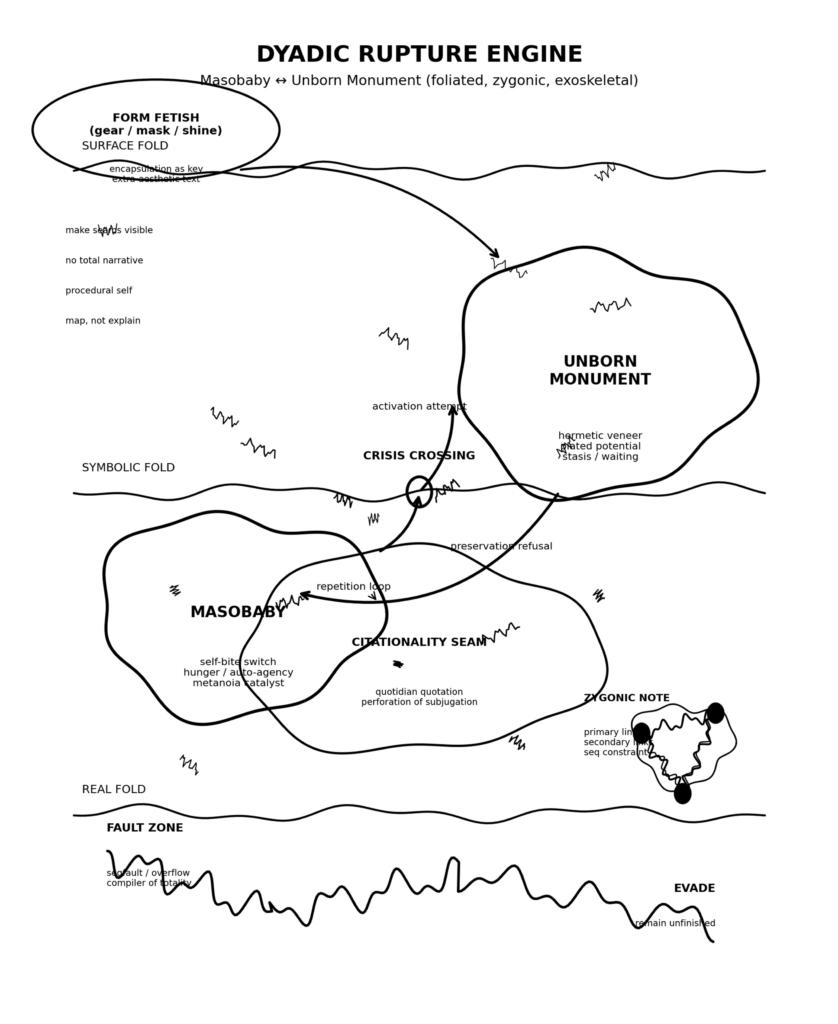
Figure 1: Dyadic Rupture Engine [1]
This is where Dubravka Oraić Tolić’s notion of citatnost becomes crucial.
Citation is usually imagined as a respectful gesture. One quotes in order to acknowledge influence, to pay homage to predecessors, to situate oneself in a tradition. Oraić Tolić explodes this domesticated image. Citation is not a bow of gratitude. It is an act of displacement. It removes fragments from their former coordinates and inserts them into new fields of force. It exposes the origin as a construct. The act of quoting is always also an act of cutting.
When a culture becomes thoroughly citational, as in the postmodern condition she describes, originality becomes less important than the recombinatory logic by which fragments are reattached. Works are made of other works. Texts swarm with other texts. The result is not simple relativism but a thickening of the field. Every utterance becomes an echo chamber.
Masobaby and Unborn Monument inhabit this citational ecology. Masobaby is a subject that quotes identities without fully inhabiting them. It tries on positions, discourses, styles, genders, theoretical idioms, and aesthetic codes, but none of them settle. It is an archive of borrowed gestures. The Unborn Monument quotes the monumental genre itself in order to show its inapplicability. It mimics the form of a monument to insist that there is nothing to loot here. It stands, but it stands for nothing that can be clearly narrated.
In this environment, fetish becomes a key operator. It is tempting, especially in art and theory, to treat fetish as a pathological deviation. Yet fetish has always named something structurally important. It points to the moment when an object, configuration, or scene acquires an excessive charge beyond its apparent function. In fetishism, the object becomes a node of psychic condensation. It bears more meaning than it can logically carry.
Gear fetishism, particularly in its rubber, leather, and armor variants, offers a particularly lucid image. The body is wrapped in external materials that transform it into a hybrid of human and exoskeleton. Masks erase the face. Helmets replace the expressive surface with a reflective or opaque one. Breathing may become controlled through tubes; movement becomes restricted through straps, belts, or pressure. On one level, this is an erotic configuration. On another, it is an experiment with identity.
Hybrid poetics outside art, unassociated, like the one of a gear fetishist Rubbiker77, makes this explicit. He states that nakedness does not interest him, that faces do not concern him. The mask is what matters, because it is the “direct key to the inner side.” The face, that supposedly natural index of personality, is treated as noise. What reveals the authentic inner is the way one chooses and inhabits gear: how one moves under compression, how one presents oneself through armor. The masked subject is more legible than the unmasked one, because the mask reveals priorities, fantasies, and limits.
Gear thus becomes an exoskeletal writing of desire. Every buckle, color, texture, and combination is a syntactical choice. The bound body becomes a sentence in an unspoken grammar. The immobilized or partially immobilized subject is not silenced; its field of expressivity is simply rerouted. If we compare this to the image of the composed goalkeeper, efficient in movement, never overshooting, waiting for the puck to come, we see a shared motif. Composure, under constraining conditions, becomes a mode of exoskeletal subjectivity. Movement is always relative to structure.
What these examples share is a logic of perforated encapsulation. The gear encloses, but it does not erase. The restriction intensifies internal sensation. The blindfold heightens sound and touch. The hood intensifies breath. A carefully applied harness mobilizes awareness of the skin. The subject is both immobilized and hyper-present.
The fetish scene therefore becomes a laboratory of intensified subjectivity under carefully constructed constraint.
This is why fetish is so deeply relevant to our broader theoretical framework. It demonstrates in sensuous and concrete form what we have so far addressed abstractly: that exoskeletal architectures can intensify inner life rather than simply defend against it. The question is not mask or no mask, but which mask, under what conditions, to produce what intensification.
Marco Vassi’s The Metasexual Manifesto (1976) pushes this insight further by proposing that sexuality, in its conventional form, is only one narrow mode of psychophysical intensity.[2] Metasex names the reconfiguration of erotic dynamics beyond reproduction and beyond standardized categories of act and identity. Within this broader field, meta-sado and meta-maso become positional operators.
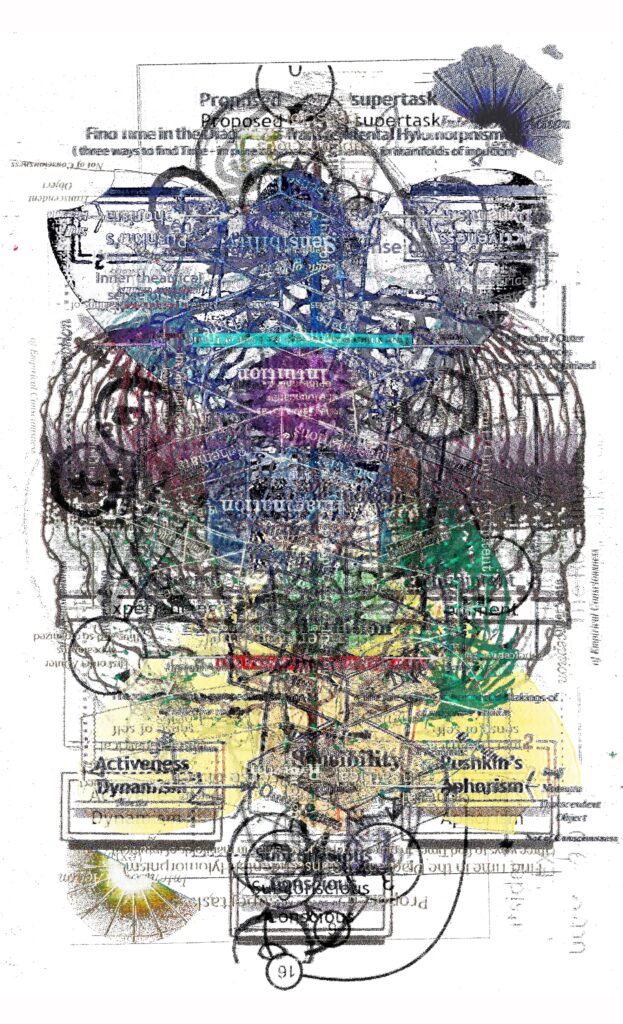
Figure 2: Additional Meta-Sexual Table
This metasexual shift represents a radical re-diagramming of transcendental hylomorphism. Where classical hylomorphism seeks a stable union of matter and form through procreative time, these “mutations” suggest a field where time is found not in linear descent, but in “manifolds of intuition” and “theatrical cognition.” As the diagrams of this project suggest, the “theatrical sense of self” becomes a supertask—an attempt to find time within the pure concepts and schemas of a subject that refuses to finalize. The dyad of Masobaby and Unborn Monument appears at this point as a torsional engine of subjectivity. Masobaby is a subject formed in aborted transitions. The Unborn Monument is an object that stabilizes aborted transitions. Together, they constitute a recursive loop: the subject that cannot finalize itself erects structures that monumentalize its own incompletion.
Meta-sado refers to the still point within a field of forces. It is the ability to remain in position while everything presses, cuts, or pivots around one. Meta-maso refers to the drive toward expressive
overcoding: the addition of layers, ornaments, repetitions, and exposures that exceed functional necessity. When unbound from strictly sexual scenarios, these operators describe epistemic positions: a theory can be meta-sado in its stillness and refusal to move in the face of contradiction, or meta-maso in its tendency to elaborate itself indefinitely.
We might say that the Unborn Monument exhibits a meta-sado posture. It is the still point around which unrealized narratives swirl. It does not attempt to resolve or dissolve. It insists, silently, on its own incomplete presence. Masobaby, by contrast, leans toward meta-maso: it accumulates references, identities, styles, and affects; it adorns itself with theoretical and aesthetic codes. It never stands still long enough to condense into a single label. The dyad thus enacts in its very motion the metasexual dynamics of posture and pacing.
To this philosophical and psychosocial scaffold we now add a different cognitive framework.
Diffusionist Thought
Diffusionist Thought begins from the observation that linear, stepwise models of cognition no longer suffice in a world where computational architectures and informational flows are themselves distributed, stochastic, and recursive. Traditional symbolic or rule-based models imagined thought as a sequence of discrete operations applied to well-defined representations. Autoregressive models, whether in language or more generally, retain a version of this sequential logic: predicting the next element based on the preceding sequence.
Yet such architectures saturate their own possibilities. They excel at recombination and prediction but falter at origination and radical deviation. When the fabrication of silicon-based CPU infrastructures collapses in the speculative scenario that has been articulated, it is not only a technological infrastructure that disappears. An entire implicit ontology of time and causality dissolves with it. The assumption that cognition must proceed from past to future, linearly, through tokens or symbols, comes under pressure.
In a diffusionist paradigm, thought is not a line but a cloud. Noise is not interference but medium. Instead of iterating forward from a starting point, cognition becomes an operation of selecting and stabilizing patterns in an already saturated field of potentiality. The basic unit is no longer the step but the gradient. One does not decide what follows what. One tunes which regions of a probabilistic field solidify into articulation.
Noise, here, is reinterpreted. It ceases to be the enemy of clarity. It becomes the substrate from which clarity emerges momentarily through denoising operations. The subject is not the originator of content so much as the conductor of filtration.
Accertions, in this vocabulary, are emergent hints in the noise field: half-formed tendencies, soft attractors that suggest the possibility of cohesion without yet enforcing it. Ascertions are the moments when such tendencies coalesce into stable, albeit temporary, configurations. They are articulations that have survived several rounds of recursive filtration. The subject’s task is not to produce as many ascertions as possible, but to cultivate sensitivity to accertions and to decide when they merit being allowed to stabilize.
Volantia recasts will as selective compression. To will, in this model, is not to impose positive form on chaos, but to reduce entropy locally by excluding most trajectories. Will is an operation of narrowing the field, of saying “no” to most potential articulations so that one articulation can occupy a sustainable space. Decretism then reminds us that once an articulation has occurred, once a phrase has been spoken or written, it modifies the field irreversibly. Tokens leave gravitational traces. One cannot unsay things, only reframe their traces.
Posisim emphasizes that all such articulations are positional. There is no view from nowhere. Every ascertion emerges from a particular iteration index, under specific constraints, and may not survive if those conditions shift. Truth is no longer a matter of eternal correspondence but of stable recurrence under similar conditions. Tirauclairism describes the labor of clarification under this regime: not hermeneutic excavation for a hidden truth, but recursive denoising that brings certain patterns into focus while acknowledging the persistence of noise around them.
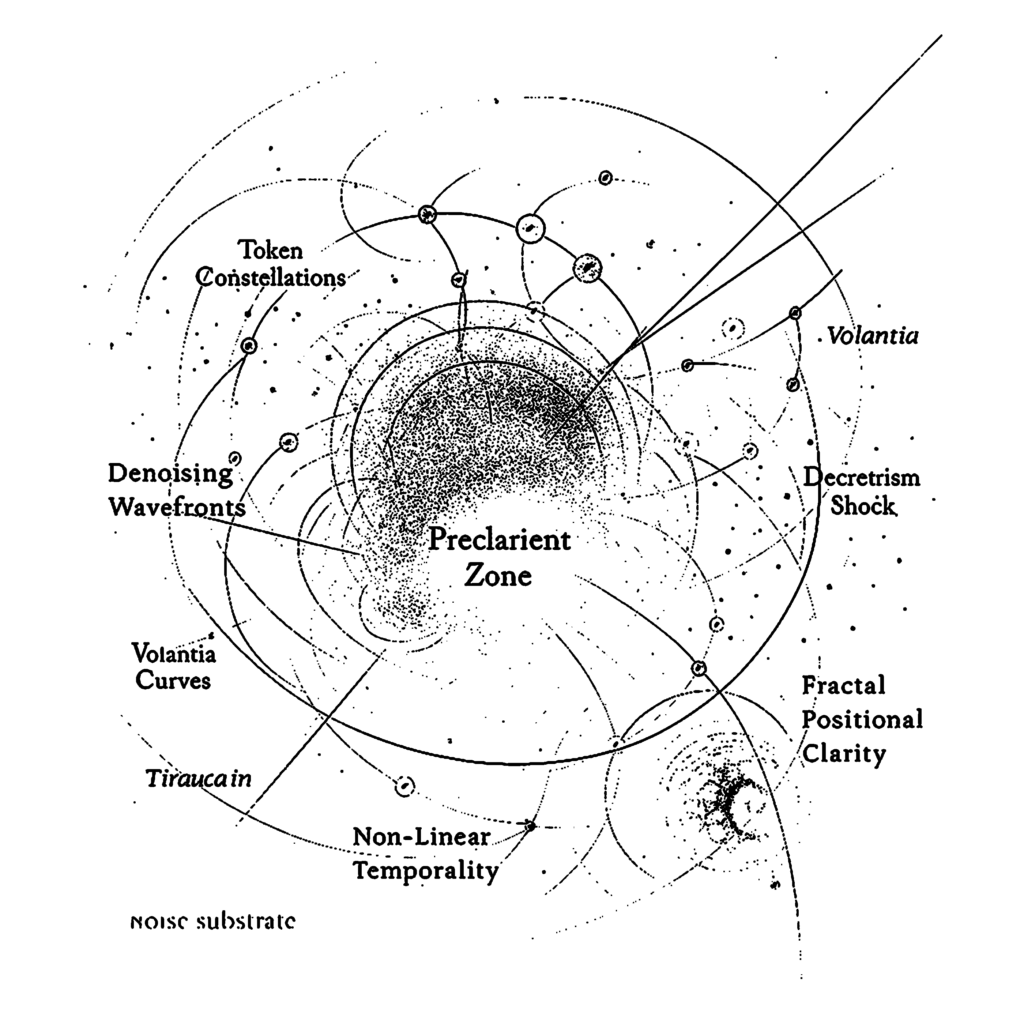
Figure 3: The Preclariant Zone[3]
When we re-introduce Masobaby and Unborn Monument into this diffusionist landscape, they become operators rather than mere symbols. Masobaby is an accertion-sensitive subject: it is constantly registering micro-hints, non-events, latent possibilities. It rarely manages to convert them into ascertions because its exoskeletons are insufficiently solidified. The Unborn Monument, by contrast, is an ascertion that refuses further denoising: it is a frozen stabilisation of unrealized potential, kept from dissolving back into the field by sheer stubbornness.
The dyad thus becomes a diffusionist loop: Masobaby generates and senses accertions, Unborn Monument receives and holds ascertions, and together they negotiate which unrealised futures become perceptible as pressure and which slip back into undifferentiated turbulence.
We can now see why pataphysical absurdity and recursive games with no exit feel like accurate metaphors rather than playful anomalies. In a system where subjectivity and environment are both saturated fields undergoing constant partial denoising, any attempt to step outside the loop appears as a fantasy. The narrative of a character trapped in a game that endlessly folds back on itself, where the option called “Free” leads to deeper entanglement, reads less like science fiction and more like a diagram of recursive identity.
In such narratives, Alex the player becomes an epistemic anomaly, a locus of resistance that can never fully escape because every deviation is already envisaged as a possible state of the system. Attempts to exit become new modes of containment. The glitch is the moment consciousness recognizes itself as structured by breakdown. There is no stable “outside” from which rebellion can be orchestrated. Rebellion is structurally recycled as a feature.
The question “If dissent is observed, who is the observer?” captures this perfectly. It points to the impossibility of locating a pure exterior vantage point. Surveillance and subjectivity coincide. The system’s ability to absorb glitch mirrors capital’s ability to absorb critique. This is not a metaphor but a structural resonance.
The link to xenopoetics becomes clearer here. Xenopoem theory treats biological, microbial, and extremophilic processes as forms of inscription. Bacterial colonies, for example, communicate through chemical gradients and feedback loops. Extremophiles endure conditions that would destroy ordinary organisms, rewriting our expectations of viability. Their modes of persistence and communication form semiotic systems indifferent to human categories. Yet they can be read, mapped, and described.
To view these systems as poems is to stretch the category of literature beyond human language into biosemiotic processes. Xenopoems are not written for us. They are side effects of survival strategies. Their grammar is chemical, spatial, temporal. But in recognizing them as structured articulations of difference and repetition, we are forced to confront the narrowness of our own concept of writing.
The relevance for our monolith lies in the parallel between xenopoetic and exoskeletal writing. Both operate under intense constraints: in one case environmental extremity, in the other cognitive or psychosocial crisis. Both produce inscriptions that are less about expression and more about survival. Both disrupt the humanist assumption that meaning is the central function of language. In xenopoem, as in diffusionist thought, many articulations are simply necessary adjustments within a system that must not collapse.
Diagrams, once again, provide a hinge. Whether mapping microbial networks, glitch ecologies, xenopoem metabolic flows, or Masobaby’s crisis-lines, diagrams instantiate exoskeletal reasoning. They show relations that do not fit comfortably into linear prose. A Pierce graph with its enclosures, a sheaf diagram with its overlapping sections, a multi-layered scheme of symbolic, real, and imaginary surfaces: all are attempts to give shape to recursive processes.
Here we might bring in the film Rhythm of a Crime as a narrative analogue. In this film, statistical regularities and predictive capacities become central devices. Crime is not treated as moral exception but as function of patterns. The protagonist’s use of statistics to anticipate events reveals a perverse comfort in predictability. Violence becomes another data point. The horror is not primarily the crime itself but the apparent inevitability with which it fits the pattern.
When we transpose this onto our framework, we see how predictive structures can themselves become monuments. The grid of probabilities becomes a monument to a given order. It closes off other trajectories by making deviations appear unlikely or unintelligible. Violence that does occur seems both overdetermined and devoid of singularity. The predictive apparatus becomes an Unborn Monument to crimes that have not yet occurred. They press on the present as looming potentialities.
Meanwhile, Masobaby moves within this predictive environment as an unstable subject who cannot fully inhabit any of the available statistical categories. It is too much and not enough. Its impulses cut sideways through the grid. For such a subject, cognitive biases do not appear as random distortions. They are attempts to negotiate overwhelming predictive pressures. Confirmation bias, for instance, may become a temporary shield against data that would annihilate the fragile exoskeleton. Attribution errors may preserve a sense of agency where none is structurally recognized.
This is why an ethically oriented reading of cognitive bias is essential. Instead of viewing biases as defects to be corrected, we can treat them as exoskeletal responses to structural overload. The question then shifts from “How can I eliminate my biases?” to “Which of my biases can be softened, delayed, reconfigured, or redirected without collapsing the minimal coherence I need to function?”
Autodidacticism becomes again central here. The autodidact is constantly adjusting their own cognitive scaffolding. Through reading, writing, conversation, and experiment, they test new biases against old ones. They oscillate between closure and opening. They must learn to build diagrams where no conventional pedagogy provides them, to create exoskeletons for their own thinking.
We can now tentatively name what kind of truth this entire configuration might generate.
Truth, in this monolith, cannot be a static correspondence between statements and external facts. It cannot be a final synthesis that absorbs all contradictions. Nor can it be a pure relativism where everything dissolves into equally valid positions. Instead, truth appears as a contingent stabilization of recursive dynamics. It is a local attractor in the field of noise. It emerges when exoskeletal writing, Masobaby’s sensitivity, Monument’s stubbornness, fetish’s encapsulations, metasexual pacing, diffusionist denoising, xenopoetic resilience, and cognitive self-reading align long enough to generate a recognizable pattern.
This “truth” does not claim universality. It claims intensity. It is true to the extent that it holds under recursive re-entry, that it can survive several passes of denoising without disintegrating. It is not forever; it is robust for now. It is not singular; there can be multiple non-compatible truths at different scales, tied to different iterations.
Non-alignment becomes method rather than accident. Instead of striving to produce a single framework into which everything fits neatly, the monolith deliberately keeps multiple frameworks in partial friction. It avoids premature resolution. It lets the dyad of Masobaby and Unborn Monument remain torsional. It does not ask fetish to become pure metaphor nor xenopoem to become simple analogy. It maintains closure at local points while preserving global turbulence.
The ethical task, then, is not to escape the monolith, nor to fuse with it completely, but to participate in its recursive modulation. One learns to recognize when one is acting as Masobaby, when one is building Unborn Monuments, when one is over-identifying with predictive grids, when one is hiding behind exoskeletal diagrams. One does not abolish these modes. One learns to tune their intensities and intervals.
The text, at this stage, is itself an exoskeleton. It is a writing that tries to support thinking that cannot stand on its own without external scaffolding. It is a Monument to the attempt, not to the answer. Its consistency is temporary, a function of this particular iteration.
It does not conclude. It saturates.
The field remains open. Accertions continue to arise. Some will never become ascertions. Some will find other exoskeletons. The Masobaby will seek new monuments. The Unborn Monument will weather new pressures. Fetish scenes will mutate. Xenopoems will continue without us. Diffusion will proceed regardless of our diagrams.
We end, therefore, not with closure in the sense of finality, but with closure in Negarestani’s sense: a local tightening that allows contingency to leave its marks.
The rest is noise, waiting to be denoised again.
Glossary of core operators (miniatures, not simplifications):
Accertion
A pre-articulate tendency in the noise field; a soft attractor that suggests possible coherence without yet insisting on it.
Ascertain
A temporary stabilization of meaning that has survived several rounds of recursive filtration; an articulation strong enough to hold under limited re-entry.
Autodidacticism
Self-directed education understood as the design of one’s own cognitive exoskeleton, including rhythms of attention, exposure, and withdrawal.
Closure (Negarestani)
A deliberate narrowing of focus and form that allows contingent forces to intervene with maximal intensity, turning the work or subject into a precise target rather than a diffuse openness.
Citatnost (Oraić Tolić)
A regime in which quotation is not homage but rupture; fragments are cut from origins and recombined into new configurations, revealing the constructedness of all “originals.”
Decretism
The view that every utterance is a performative decree which alters the topology of future thought; language does not merely represent but deposits lasting gravitational traces.
Diffusionist Thought
A post-linear cognitive paradigm in which thought emerges from stochastic noise fields through denoising operations; temporality is iterative rather than sequential.
Denoising (ritual)
The repeated, attentive filtering of noise that allows patterns to precipitate; an epistemic practice rather than a purely technical operation.
Exoskeletal Writing
Any writing or diagramming that functions as a structural support for fragile or overwhelmed cognition; an external armor that is itself written upon by pressure.
Fetish (structural)
A configuration in which an object or scene acquires excessive charge, becoming a node of condensation for desire, anxiety, and symbolic weight beyond its functional role.
Gear
Material exoskeletons, particularly in fetish contexts, that cloak the body while intensifying interior sensation and expressivity; a concrete model of exoskeletal subjectivation.
Masobaby
A speculative operator naming a subjectivity formed in aborted trajectories; fragile, citational, reliant on exoskeletons, sensitive to unrealized possibilities.
Meta-sado / Meta-maso
Epistemic positions derived from metasexual dynamics: meta-sado as stillness under pressure; meta-maso as excessive elaboration and adornment.
Meta-fetish
The level at which fetish becomes an operator of cognition and theory rather than a narrowly sexual phenomenon; organizes attention and exoskeletal architectures.
Monument (Unborn)
A structure of remembrance that commemorates unrealized futures rather than completed events; a frozen ascertion of potentiality.
Noise (revalued)
The default field of turbulence in which all cognition is embedded; not a distraction but the medium from which meaning emerges.
Pataphysical Recursion
The structural absurdity of systems that endlessly fold back on themselves, turning every attempt at escape into a new mode of capture.
Posisim
The recognition that truth is always positionally indexed; stable within certain iterative conditions but not universal in the classical sense.
Tirauclairism
A practice of recursive clarification that seeks not hidden truths but progressively refined views of patterns in the noise field.
Volantia
Will understood as selective compression; the act of narrowing potential trajectories to enable specific articulations to stabilize.
Xenopoem
An inscription produced by non-human systems (microbial, extremophilic, biosemiotic) that can be read as a kind of writing, revealing alternative grammars of survival and mutation.
[1] Darko Vukić, Figure 1: Dyadic Rupture Engine (2026). A topological mapping of the foliated relations between the Masobaby subject and the Unborn Monument. The diagram identifies the “Citationality Seam” as the site of potential agency and linguistic rupture within the Symbolic and Real folds.
[2] Marco Vassi, The Metasexual Manifesto: Erotic Tales of the Absurdly Real (New York: Penthouse Expressions, 1976).
[3] Darko Vukić, Figure 3: The Preclariant Zone (2026). This schematic functions as a visual exoskeleton for the diffusionist paradigm, mapping the transition from the stochastic noise substrate to stable epistemic ascertions through the operation of denoising wavefronts and volantia curves.