This text is part of the b2o: an online journal special issue “EXOCRITICISM”, edited by Arne De Boever and Frédéric Neyrat.
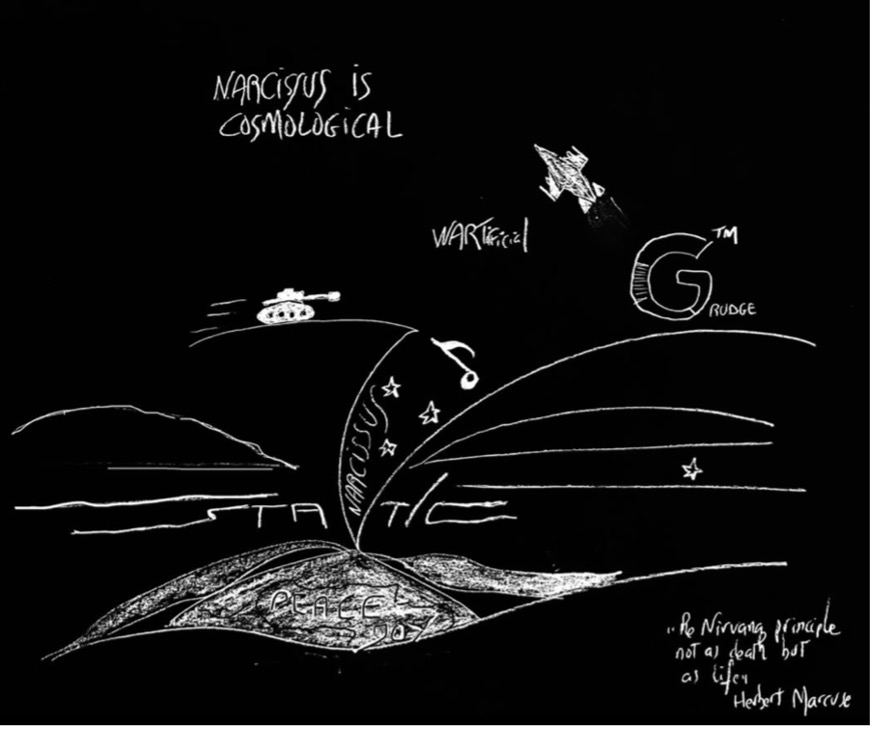
 Image: Spectra of Marks – Ferdinand Altenburg, 2024
Frédéric Neyrat
Prophecies in the Fog
“And the Lord said to the Americans, “Go to Copper and say to him, ‘Thus says the Lord: Let my people live in peace, so that they may serve themselves. But if you refuse to let my people live in peace, behold, I will smite all your territory with frogs. So the river shall bring forth frogs abundantly, which shall go up and come into your house, into your bedroom, into your computer, the houses of your servants, on your people, into your ovens, and your kneading bowls. And the frogs shall come up on you, on your people, and on all your servants.’””
Exodus 8 (remastered)
The prophetic excess
Since the 1980s, we have abandoned the idea of a counter-future.
“We”: the infrared community; the peoples yet to come; the alliance of the damned of the Earth and the alterrestrials who refuse the Order of the world.
A counter-future: not the future as a (neo)liberal variation, as a scenario, as design, but as another beginning—against the future of the Silicon Valley, the one that techno-capitalism occupies and androcentrism encloses.
Once this counter-future has been abandoned, all that remains, for those who are not in power, is the present, and persisting in the present—but a present devoid of presence, cancelled out by the absence of a future. In other words: survival.
Survival and therefore the inevitable accumulation of deaths (through war, capitalism, the absence of state care, etc.).
To avoid this deleterious pattern, we must reopen access to futurity—a time excess beyond the present. The prophetic is what can provide this excess. Not the apocalyptic theological, which closes futurity to destroy the present it abhors, but the liberating prophecy, which opens the present with the wind of the non-present—the non-present justice, the absent peace. Where the wolf lives with the lamb.
What theory could express this excess? What sort of écriture, inscription and ex-script, could make the non-present appear in the present, thus freeing us from the spell of “No Future”? Isn’t it time to unwrite? What kind of scribes could accomplish this?
°°°
Imagine a thick fog, probably caused by water evaporating too quickly; unless it’s a deadly gas, or a cloud of debris created by relentless bombing. Or an atmosphere of idiocy produced by synthetic intelligences trying by all means to carry out the cognicide of humanity.
The fact remains that you are trying to blindly classify prophecies after copying them from memory. Not without some loss in the process of transcription. But what committee could blame you for writing as best you can above an abyss? “The academic superego melts in the sun of extinction,” you hope.
Loss, moreover, could well be a dimension of this way of writing—breaches through which a halo of truth shines:
Prophecy in the fog, 1. The hole
In the whole, there is a hole. A siphon that draws everything toward it. The more you deny its existence and block it with destructive materials, the more your soul becomes sclerotic and loses the possibility of resurrection. But if you learn to recognize its existence through metaphors, you will know how to transform it into a way out. Once on the other side, in the undergrounds of the totality or far above its ground, you will be sovereign.
Prophecy in the fog, 2. The enigma
There is constructed meaning—what I decide to do and how I understand it; a CEO puts his machines at the service of the police; parties vote for a nefarious law; a woman faces prison in a crazy state. But meaning is permeated by an enigma, which is the unconstructable part of meaning. Nothing and no one can master enigma, which carves the cosmos; it draws it toward itself, while constantly eluding our gaze.
Prophecy in the fog, 3. The integral substitution
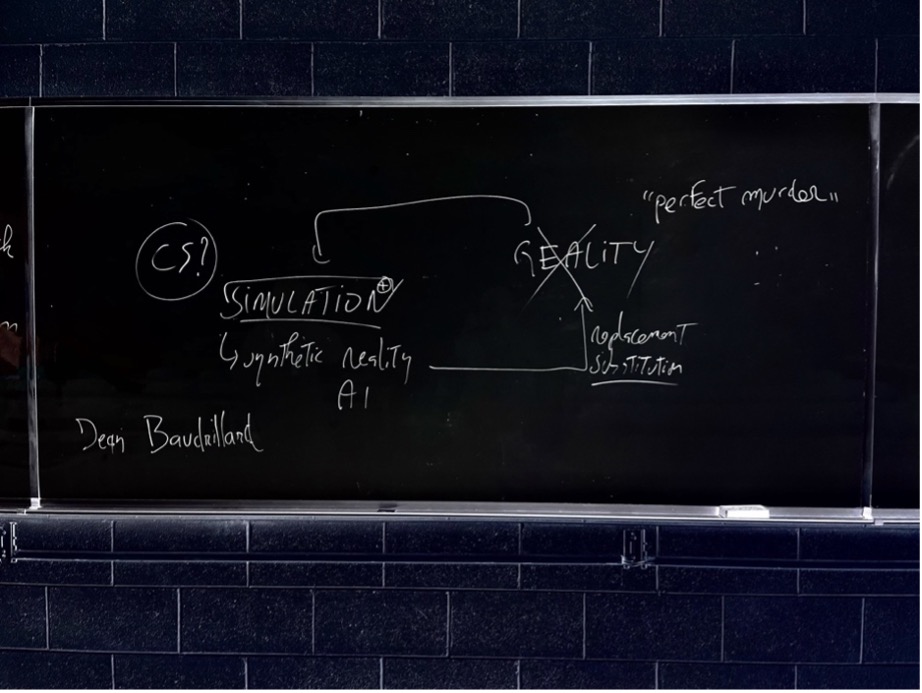
Once synthetic reality had replaced synthetic reality, analog beings were able to come out into the open, without risking detection.
Prophecy in the fog, 4. The non-AI
You are no longer yourself. Forget the book, eat the book, become a nameless draught. Pronounce every word as if nothing could have predicted it. Become the non-AI.
Prophecy in the fog, 5. The other thought
Synthetic intelligence calculated at hallucinating speed; the spared humans administered the absent causes; a pre-thought emerged, still, around a dark and rebel angle.
Prophecy in the fog, 6. Openness
Once the calculation of the plastic had been accomplished and the lakes transformed into Waste Museums, virtual thoughts detached themselves from the autonomous stones. They moved as slowly as the suns take to form and disappear, and no human being could have understood them without the machine they had invented in the ocean of Exophore: the MushRam. Their meaning could not be isolated from their distant past or their destination; they invited to become music and to become aware of galactic equality. The emblematic word they drew across millions of years was: “openness.”
Prophecy in the fog, 7. Hypomnesis
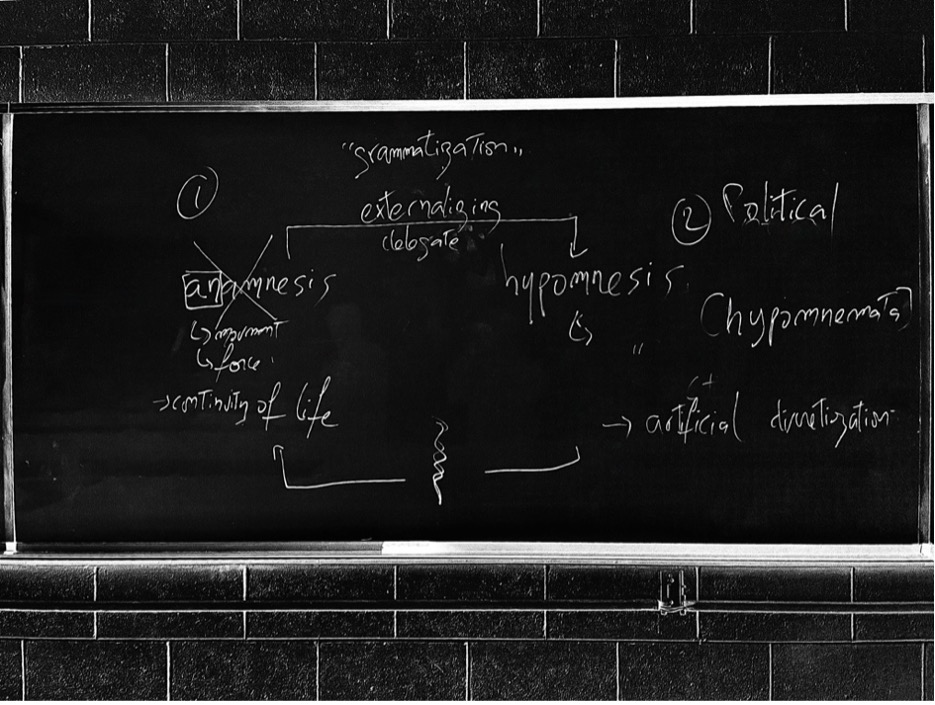
“I just asked you a question,” he said to the Synthetic Sphinx, “but which one? I can’t remember.” “This one,” replied the machine once again.
Prophecy in the fog, 8. The true technological destiny
In the immanence of technological production, the transimmanence of Being advances—like a wave within a wave. It will undo Silicon Valley’s calculations, drying up—a desert within a desert—the wish for immortality. Let us call the inexorable inability of human beings to master technology the “reversal process of technology.” This lack of mastery of mastery will result in either nuclear hell or climate extinction. And, in the meantime, to machine autonomy—assuming that these perils and this autonomy are not one and the same. For machine autonomy, turning back on humanity and erasing it, is nevertheless always traversed by Being, which leads humans and technology toward the Unknown. Where the Added and the Subtracted merge.
Prophecy in the fog, 9. The wait
Once reality has disappeared, the marvelous will appear.
It will come out of nowhere.
But we must be patient and wait a long time. A very long time. Almost an eternity.
Prophecy in the fog, 10. The end of time
At the end of time, there will be a blue flower.
Prophecy in the fog, 11. Anti-Earth
“Our coming was expected on earth. Like every generation that preceded us, we have been endowed with a weak Messianic power, a power to which the past has a claim,” Walter Benjamin wrote in his Thesis on History—but a claim now comes from the counter-future that has been wrecked; a prophetic voice brings to the present an anti-Earth in which nations do not “train for war anymore” and “the leopard will lie down with the goat, the calf and the lion and the yearling together; and a little child will lead them.” (Isaiah)
Prophecy in the fog, 12. The Non-Alien Party
The armed members of the Non-Alien Party marched through the streets of cities. The sole demand of this burgeoning new party was to reject anything foreign, alien, and ultimately strange. This included people, animals, and plants, as well as objects and substances, ideas, feelings—anything that could be seen or experienced as not belonging to oneself, not naturally part of the body and the nation. The problem was that the members of this party were never pure enough, never themselves enough in their own eyes (which led to suicides) or in the eyes of other members, who expressed their feelings with fatal gunshots during the march. It was therefore a party that was simultaneously growing rapidly and self-destructing, both of which proved that the “Good End of the World,” announced in The Manual of Destinal Oil, was near; the faster one accelerated toward nothingness, the better. But even this idea was too bizarre, and led to heresy. A new Manual had been created, called No-Brain Liberation, which offered intensive de-cerebration courses where any idea that was even slightly true was crushed until it became flat (a technique known as “the systematic flattening of earthly things”).
Prophecy in the fog, 13. Don’t bomb
A comet is not a bomb, I repeat: a comet is not a bomb.
Don’t bomb. Go for psychoanalysis, learn that you are not exceptional beings, that racism is the projection of your in-humanity onto others. But don’t bomb.
Learn to see the sky as a cosmic space, which makes any aspiration to absolute safety ridiculous and dangerous.
Eternity is not for bombers.
Prophecy in the fog, 14. Community
We do not yet know what the meaning of community should be, of being-in-common in the face of the power of the abject, the dictates of the economy, and the technological erasure of the spirit. But we feel that we must reinvent a way of being-in-common. There are past experiences that can teach us, but I don’t think they can guide us. Neither memory, which is necessary but needs fiction, nor “tradition,” which is sometimes venerable but questionable, will suffice—a tradition, it is repressed, used to be a heresy. We will have to go further back in time to go much further into the future, towards a cosmopolitics that reverses the annihilation of stranger-ness.
Prophecy in the fog, 15. To improvise
The “risk society” has come to an end. The time has now come for societies of pure loss.
Without guarantees, the world is without guarantees.
We will have to improvise.
Free jazz, but counting on inclement weather.
Out in the open air, but sometimes with oxygen masks.
Prophecy in the fog, 16. Strategy
We still have to invent a game in which our enemies will lose their way, believing that it follows their rules.
Prophecy in the fog, 17. Allegory of the cave
The last avant-garde journal known to date did not wait for the Great digital evaporation to write and paint on the walls of an inaccessible cave on Mount Analogue.
The sun rarely shone there, but enough for the Pure potentiality of the reader.
Prophecy in the fog, 18. The ultimate method
Inverse everything.
Prophecy in the fog, 19. Dialectics
[…] looking for the eclipse of an eclipse, which is to say: light […]