This text is part of the b2o: an online journal special issue “EXOCRITICISM”, edited by Arne De Boever and Frédéric Neyrat.
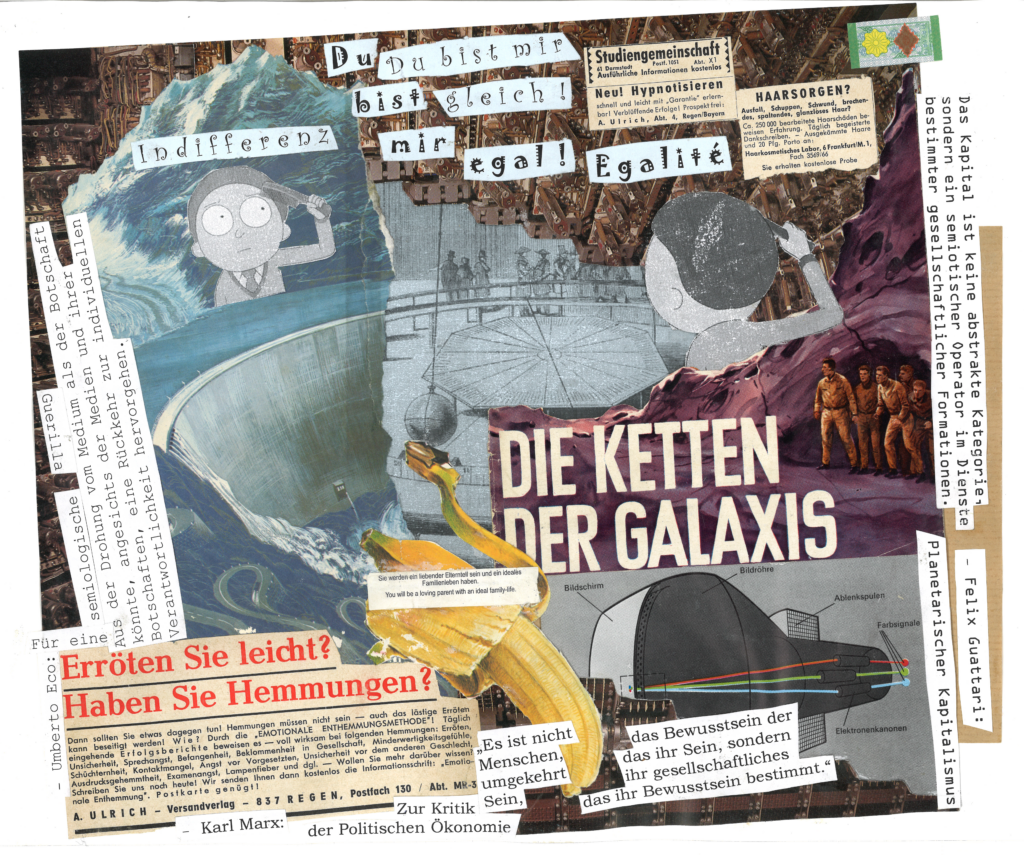 Image: Identitarian Indolence – Ferdinand Altenburg, 2023
Sometimes on The Teletubbies[1]
Brian Evenson
Sometimes on The Teletubbies toys seem to be just ordinary toys: a pink and blue scooter, an orange ball, a black and white hat, a red bag. One of these toys is assigned to each individual within the microsociety, and no more. There is only one of everything, four toys in all, and there are only four individuals. Sometimes these toys are played with by the individual to whom they have been assigned, at other times they are co-opted temporarily by another individual. Other toys appear, are played with, and then quickly disappear. Generally these other toys are toys that are not a part of the society per se, but rather interlopers or intruders.
Sometimes the monitoring force that seems to be harbored somewhere beneath the ground (perhaps because insufficient resistance to radioactivity or some inefficiency when faced with the planet’s atmosphere) extends its submarine-like periscope directly through the dirt or through the floor of the “facility”—or whatever one chooses to call the artificial structure in which the microsociety resides. How this is done is perplexing: the ground or floor seems undamaged once the periscope retracts. And rather than being a periscope exactly, it appears to be a stylized voice pipe or a loudspeaker. This force controls the society, though at times the individuals are reluctant to obey it. Perhaps the facility is carceral in nature, and this force is their jailor, if this is the sort of incarceration scenario that demands a jailor. Another force, this one seemingly above ground, housed atop a long thin pole and apparently powered by wind—unless this is merely a relay tower for a force housed altogether elsewhere—seems attuned to the society in a different way. It casts a pink static into the air and calls the four individuals to the top of a hill where, as they writhe, they receive signals that manifest in the form of sounds and images displayed directly on their skin.
This is assuming that what covers their body is, in fact, skin. One should be cautious about making assumptions of any kind regarding these individuals. It is not skin of a sort I am familiar with. Perhaps a carapace of some kind, or a sheath.
These body-displayed images seem to offer the record of a lost civilization. Sometimes they display a series of toys—a toy “farm” for instance, complete with “horses” and “cows” and “sheep” and a “turkey”, with an intelligent creature of a nature other than that of the members of the society providing commentary—toys that are different in form and number than anything the members of the society possess. The four individuals constituting this society enjoy watching these images, and always insist that the mysterious force rebroadcast them again immediately onto their bodies by shouting the words “Again! Again!” At times the force complies, at other times it does not.
As for their usual toys, they initially seem to be merely ordinary toys—and indeed they are until the moment when, abruptly, they are not. Consider Tinky Winky’s bag, which he designates at times as “Tinky Winky’s special bag,” referring to himself always in the third person. Subjective and objective pronouns do not exist within this society: the individuals are always referred to only by their proper names, though possessive pronouns do assign a gender to them. This red bag is able not only to hold objects that are small enough to fit within it, but, in addition, to hold objects far too large for it. Indeed, the bag seems a sort of multi-dimensional hole, and though it is little bigger than a purse or handbag, it can contain the other three toys: the large orange ball (Lala’s Ball), the hat apparently made of real or simulated Holstein hide (Dipsy’s Hat), and the pink-and-blue scooter (Po’s scooter). It seems to have infinite dimensions—everything placed within it fits—though it also retains the weight of the objects, so that if all three other toys are put inside, the special bag toy can no longer be moved, as if there is always conservation of mass. It is good for storing toys, but not for transporting them.
This is not the only quality of the special bag, not the only thing that makes it special. It is also an inscription device. If you sing a song into the bag, it preserves it, repeating the song when the bag is opened. But if you try to preserve too many songs, they become hopelessly jumbled. There is something sinister about the bag, and one has to wonder if Tinky Winky is fully aware of what he is carrying.
#
The videos broadcasted on the belly skin of individuals within this society reveal the play patterns and toys of a lost civilization, but these are not the only toys to impinge on the society from the outside. We are witnessing a liminal culture, which is apparently being observed by an advanced or future civilization: the latter sometimes sends objects which can be (and always are by the society) interpreted as toys.
These objects suddenly appear, always queued by a disembodied voice saying “One day in Teletubbyland, something appeared from far away.” One moment, the landscape is devoid of the toy, and then, suddenly, there it is, palpable and present, suggesting some sort of brief and most likely deliberate and even calibrated slip in the space-time continuum. When these toys appear, they make a sound that is specific to the kind of object they are, but muted, as if the object is in mild pain. These toys can be, for instance, “mittens”, or a “door”, or a “tooter”. They are always colored blue and pink, and in this they resemble Po’s scooter—which suggests that the same civilization that provided the scooter, the blue and pink civilization, is also offering the society these other technologies, even if only temporarily. Other objects that are not toys possess these same colors and are perhaps technology from the same civilization as well: the blue table the local society eats at for instance, or the two machines that make the only food we ever see the society eat: the “tubby toast” machine and the “tubby custard” machine. Are these indications of a caretaker civilization that oversees the society? Is it the same civilization that seemingly lives in the ground below them and communicates only through loudspeaker-periscopes?
And what of the civilization or civilizations that originally provided the non-blue-and-pink objects: orange ball, Holstein hat, red special bag? What has become of it (or them)? Does it (or do they) no longer exist?
#
The Case of the Mittens
When the mittens appear, they are found by Tinky Winky. “What’s that?” he asks, to which the disembodied voice responds “It was a pair of mittens.” The tense is odd here, as if the event seems to have occurred in the past, even though Tinky Winky is living the event concurrently, as we observe him. “Mittens!” he declares and then stands there unmoving until he is told, “Tinky Winky put the mittens on.” Again, past tense, but this does not stop him from putting the mittens on in the present, which is in fact the future in relation to when the statement was uttered.
At first, he affixes them to his ears, but whether this is because he is playfully rebelling against the proper use of the technology or because he honestly does not understand how mittens are meant to be deployed is never clear. In this world, with these beings, either seems possible. The disembodied voice gently scolds him, this time in present tense, and he removes the mittens to try again.
Through means that are beyond my understanding, Tinky Winky manages to affix the mittens to his knees. This is a strange and baffling moment. I have tried to imitate this with a number of pairs of mittens but have never succeeded. I can only conclude that either there is something about these particular mittens or something about Tinky Winky himself that makes it possible. He is again gently scolded by the disembodied voice for doing this.
At last he affixes the mittens over his hands, and receives praise from the disembodied voice: “That’s right, Tinky Winky. Mittens go on your hands.”
Dancing follows, along with slow, hypnotic gyrations of the mitten-encased hands. A moment later Po arrives on her pink-and-blue scooter, as if drawn by the pinkness and blueness of the mittens, and the mittens are relinquished to her. She encases her own hands in them, claps for a time, “And then,” the disembodied voice tells us, “the mittens disappeared.” Indeed, they do, vanishing off Po’s hands in mid-clap.
These mittens will never be seen again.
#
The Case of the Door
It is Po who stumbles upon the door, which, like the mittens, appears out of nowhere from one moment to the next, summoned by that same soothing but sinister disembodied voice. The door is in the middle of a meadow, freestanding, not attached to a structure.
The individual known as Po approaches the door on foot, without her scooter. “What’s that?” she asks, and is told by the same disembodied voice in the same inappropriate past tense, “It was a door!”
At this point, a sort of mind control may well occur. “Po opened the door,” the voice indicates, which seems a sort of trigger phrase that makes Po open the door in the present. Po repeats this same phrase, poorly, mutilating the English language—clearly not her native tongue—and then proceeds to make the phrase an accurate descriptor of events: she opens the door, laughing and giggling and repeating the phrase.
The world on the other side of the door seems to be the same as the world on this side of the door, as we would expect from a door not attached to a structure. In other words, the door is meaningless. It does not separate inside from outside, but is instead surrounded by the outside on all sides.
Or is it?
“Po went through the door,” commands the voice. And indeed, Po does.
“Po shut the door,” commands the voice. And Po does, hiding herself from us on the opposite side.
It is at this moment that the true and dreadful nature of the door begins to be revealed. Another individual, Lala, comes along, sees the door, asks what it is, and prepares to open it. Lala, despite approaching the door from the side upon which we suspect Po to be standing, does not acknowledge Po or even seem to realize she is there. A moment later, when Lala knocks on the door, Po answers and invites him in, closing the door behind him. Lala’s surprise and pleasure when he sees Po suggests that Po was not on the other side of the door at all, but rather in a world that can be accessed only by going through the door, a world that seems to be identical to this world, but is not.
A moment later, Dipsy appears. Like Lala, he notices the door but does not seem to notice either Lala or Po who should, by all rights, be on the other side of the door. Commanded by the voice, Dipsy knocks on the door, and Lala and Po answer. Upon the disembodied voice’s command, all three go through the door, shutting it behind them.
Tinky Winky, the final member of the society, appears. The same process is repeated: no awareness of the other three initially, then knocking and passing through. All four are gone. “And then,” the disembodied voice tells us, “the door disappeared.”
My theory is that because this is an instructional recording rather than an actual happening, the four individuals are still present once the door disappears. It is meant to teach us, the viewers, to go through any buildingless portal we find, to teach us how to do so, to suggest it is a kind of game. It is meant to make it so we cannot help but turn the handle rather than flee, and then enter.
But will we be found behind the door once it disappears?
I do not believe so. I believe that like the door, we will simply be gone, and never be seen again.
#
The Case of the Tooter
The final object I will discuss is designated the tooter. The tooter is essentially the rolled-up mouthpiece-equipped party favor known as the noisemaker, but massive and perhaps semi-sentient. It appears, as do the other objects, from far away, with the strangled noise that asserts its manifestation into this particular reality. It is found, again by Po. Po, at first, riding her scooter, does not notice it, but the object asserts itself, making its noise anew, less strangled this time.
“Po,” the disembodied voice tells us, “got off her scooter and blew the little tooter”—again that same confusion of tenses. Po is helpless to do anything but obey.
The tooter, blown, extends to a tremendous length. Indeed, it is longer than Po herself. This suggests that the lung capacity for these individuals (if it is proper to think of these individuals as having lungs per se) is enormous, unnaturally so.
When Lala appears, we begin to discover that this is no ordinary object. Instead, it is an object that seems to adapt itself to each user and their ability to expel air from the frozen opening in their face. Lala, a more developed and mature specimen, “decided to give the tooter a very big blow,” we are told by the disembodied voice, and a moment later Lala does so.
The tooter seems, impossibly, to extend for dozens of meters, only ceasing when its feathery, noisy end comes into contact with the posterior of another individual, Tinky Winky. Tinky Winky quite understandably desires to see the object demonstrated again. Lala obliges, but this time the object only extends to the same length that it did that first time with Po, despite the force with which Lala blows. The magic of the toy, by which I mean the technology of the object, apparently has to be renewed. Or perhaps, so we suspect, it can be activated only once per individual.
Tinky Winky takes the tooter and blows on it, a “very, very big blow.” Again, the unusual nature of the object is activated and it travels even farther, knocking off the hat of the final individual of the society, Dipsy, before rolling back up. Dipsy, unlike Tinky Winky, does not immediately trace his way back to the other three, and thus leaves Tinky Winky in possession of the tooter. Tinky Winky decides to give the tooter a “very, very, very big blow.”
We might expect, as with Lala, that nothing extraordinary will happen, that the object will not activate a second time. But, in fact, it does activate, as if Tinky Winky’s decision to add an extra “very” to the size of his blow is enough. Or perhaps this process is controlled from beginning to end by the disembodied voice. Perhaps the disembodied voice is making the decision as to whether the tooter will extend in a normal fashion or in a more disturbing and impossible way. We do not know what forces are controlling the seeming flexibility of objects in this terrifying universe. The individuals do not know either, but they do not seem to care.
And then, as suddenly as it has come, the tooter disappears. We will never see the tooter again.
[1] “Sometimes on The Teletubbies” first appeared in Brian Evenson, Salt Lake City (Berlin: Sacred Parasite, 2025), in a limited-edition of 300 copies.