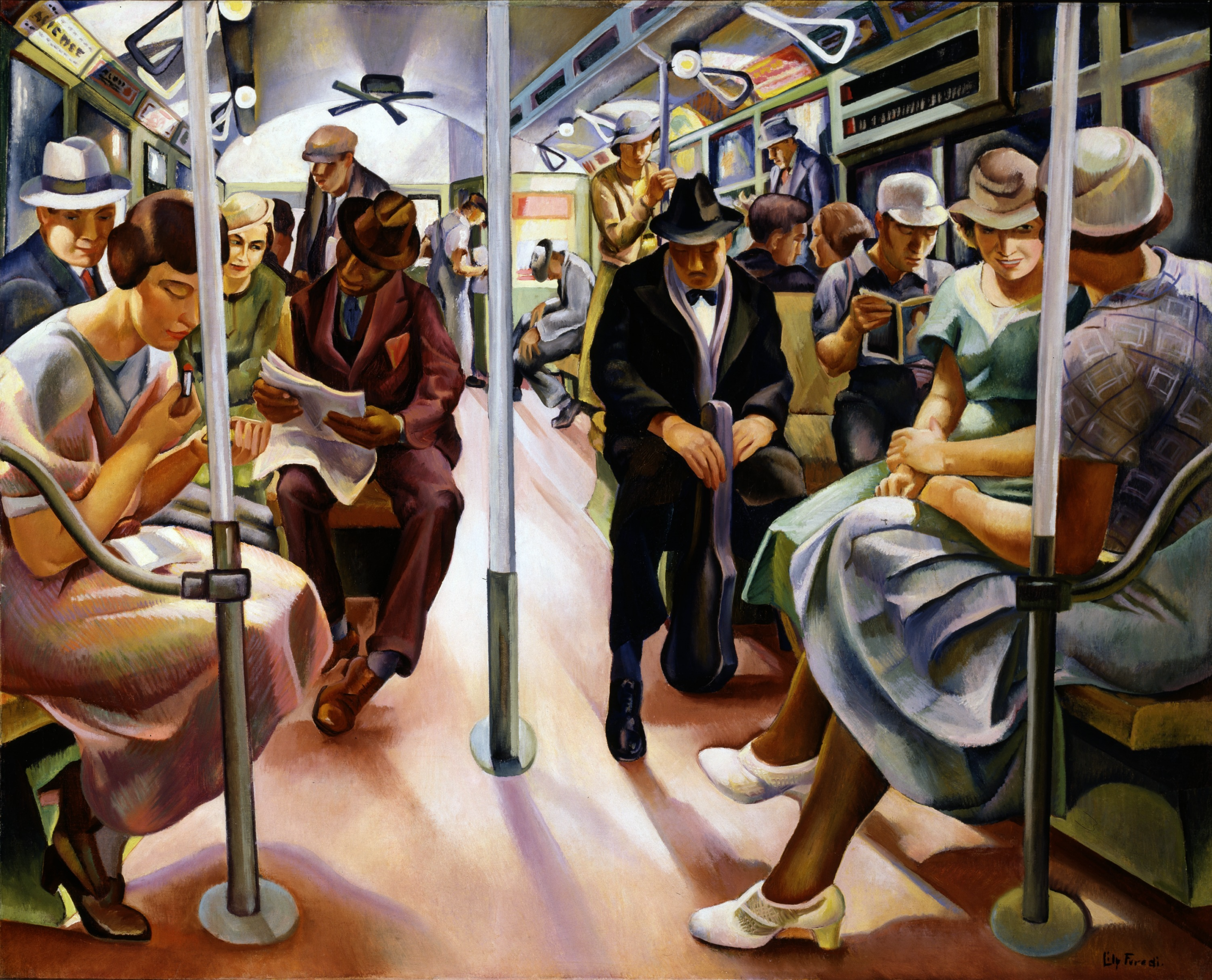
This post is part of a dossier that features materials that were generated at, or in the aftermath of, the “Experiments in Listening” conference that boundary 2 co-organized with the California Institute of the Arts and the University of Southern California in January 2025.
In Defense of Tuning Out: The Captive Audience and Public Sound
Sean Koa Seu
“Democrats in Congress refuse to fund the federal government, and because of this, many of our operations are impacted, and most of our TSA employees are working without pay,” a voice drones over loudspeakers mounted above the security checkpoint. “Our hope is that Democrats will soon recognize the importance of opening the government.”
If you were traveling in the United States by plane during the 2025 government shutdown, you may have encountered this extraordinary announcement by Secretary of Homeland Security Kristi Noem. The video, produced by the Department of Homeland Security (DHS) and disseminated via the Transportation Security Administration (TSA), is simply Noem as a talking head (Skores and Park 2025). The real message—that the Democratic Party is to blame for the pay freeze of government employees—is disseminated through the Secretary’s words, over speakers, via sound.
Within a line at a TSA security checkpoint, this sound is difficult to get away from. Human hearing is the most uncontrollable of the senses. Unlike seeing, which allows us to avert our gaze, or look the other way, or shut or shield or lower our eyes (or even turn a blind one), our hearing is mostly mandatory (barring, of course, earplugs, which merely dampen sound; or noise cancellation, a very recent technology which interferes with soundwaves before they can hit one’s eardrums.) Even in sleep our ears are still active; sound offers few opportunities for refusal. It impresses upon us whether we welcome it or not. Which begs the question: how does inescapable sound quietly (or loudly!) affect our capacity for freedom itself?
In 1952, the Supreme Court of the United States was confronted with exactly this question. In Public Utilities Commission of the District of Columbia v. Pollak (1952) 343 U.S. 451, the Court was to decide whether or not the Capital Transit Company had the right to broadcast sound during its operations. By 1949, the company had installed loudspeakers within many of its train cars and had contracted with WWDC-FM to broadcast music, announcements, and commercial advertising.
Franklin Pollak and Guy Martin, two Capital Transit riders, believed that the loudspeaker system violated their First and Fifth Amendment rights. They argued that the First Amendment, which protects freedom of speech and freedom of association, is violated when sound dominates a public space, creating a situation in which passengers must “compete against the [radio] programs in order to be heard” (Public Utilities Commission v. Pollak, 343 U.S. 451, 463 (1952)). As for the Fifth Amendment, which protects all persons from deprivation of life, liberty, or property without due process, Pollak and Martin contended that forcing them to listen to a radio program deprived them of their right to privacy, and therefore their liberty, unilaterally.
I do not wish to complete a full legal analysis of the court proceedings here. After all, the Court ultimately ruled seven–one in favor of the Public Utilities Commission, granting it the right to broadcast sound in public train cars. (Justice Frankfurter abstained due to his own position as a “victim” in the case—he, too, was a transit rider.) The majority did not contend that the freedoms guaranteed by the Fifth Amendment applied in public space to the same extent as private space, instead arguing that in public freedom was regulated by the “mutual limitations” of all involved, including passengers, train conductors, and vehicle owners (464). It also did not believe that the First Amendment was violated—it did not consider the music, announcements, or commercial advertising to be “objectionable propaganda,” nor did it believe the sound interfered with the public’s ability to converse (463).
Still, the noise generated by this case helps us think practically through freedom’s expression in public. It is more than just “freedom from unnecessary impositions on the senses,” as the Columbia Law Review once opined (“Transit Broadcasting” 1951: 109). For what the court expressed was that freedom—liberty—was only guaranteed in the privacy of one’s own home. In public, we can and should expect freedom to be mediated. The mandated sound, precisely because of its ubiquity, is a mediating tactic; impossible to ignore, yet justified because it intrudes not on private life, but on public space. But isn’t the condition for freedom itself a public one? For what does freedom mean if we cannot defend our public spaces from a totalizing sensorium?
“Without a politically guaranteed public realm, freedom lacks the worldly space to make its appearance” (Arendt 2006: 147). According to Hannah Arendt, freedom requires public witness because it is, essentially, a capacity for action. Instead of being an expression of will (which Arendt argues, is an internal private reckoning) the capacity for action is a condition, also known as “the free man’s status, which enabled him to move, get away from home, to go out into the world and meet other people in deed and word” (147). This status allowed free people to commit free actions—actions liberated from the necessities of life. But in order for these free actions to appear in the world, they had to be witnessed by other free people. Therefore, freedom’s appearance as a tangible thing is not an innate quality of a private individual, but rather the sum of the capacity for action and the others’ ability to see (or hear) that action. Furthermore, both terms are environmental; they are determined not by the actor nor the audience, but the set on which they are staged.
Arendt’s bar for this staged public realm is a high one—and we might ask ourselves whether or not transit systems like airports or busways should or should not be sites of public displays of freedom. What I would like to discuss here is the tendency of recorded sound to foreclose the possibility of any space’s publicness. It is a type of enclosure; it transforms shared space into a managed sensorium where freedom is preemptively extinguished.
So let’s imagine the streetcar. Or the TSA line. If we think of freedom as a capacity for free action, then we must agree that the imposition of amplified sound is a rather effective way of intervening in, if not completely quelling, this action. It is not the same as a sign announcing train regulations, or a visual advertisement for food delivery, from which I may turn my gaze at will. The way sound is processed is simultaneous; sounds produced at the same time cannot be differentiated from one another easily. One must usually choose a sound to process, and that can be very difficult in the presence of another interrupting or louder sound. As far as a witness to free action goes, it is difficult to witness more than one sonic action at a time; often, we default to the loudest actor. As far as producing sound, a human actor can hardly compete with an amplified sound system, even if you can technically hear them; and, even then, the content of their voice must contend with, and ultimately be shaped by, the quality of the soundscape in which they are speaking.
I do not disagree with the Court’s assessment that, in public, one encounters mutual limitations. In the cafeteria, or on the sidewalk, the rumbles of traffic and the conversations of other members of the public often interfere with one’s own ability to communicate. And the world does not have the proper technology of a stage, with lights and curtains telling a delineated audience where to look. Indeed, there is no delineated audience; since freedom requires free witnesses, it follows that free people must negotiate with one another for attention. I do not bristle at the mariachis on the A train, nor the woman at the terminal gate loudly discussing her business plans in Detroit.
No, the troubling notion is not competition with others’ sounds in general, but about competition with an amplified mandated sound—whether or not the sound is partisan propaganda or merely muzak. This is because these sounds are not produced by free and responsible actors, actors who can choose to cede their time, actors who can be held accountable for their words and deeds, actors who have the capacity to witness me back should I choose to respond, interrupt, or shout over them. No, the sounds produced here are the sounds of an automated system, an environmental design attribute meant to stifle any action without taking an action itself. The sound does not stop if I ask it politely, nor if I yelp. It is designed to address without being addressable. While the mariachis might play over me, we are all free actors competing for witness, and so the limitation is truly mutual. The automated recording does not constitute a mutual limitation in this sense; only I am limited, the recording has no limitations because it is not an actor.
But what of the agency who designed the sound? Surely Capital Transit has an opportunity to speak as the owner of the public utility? And surely the DHS should be able to play recorded sounds in general, as long as they don’t violate the Hatch Act. Again, I do not mean to make a legal analysis—court precedent for what constitutes protected speech by private citizens and non-citizens, government workers at all levels, and government agencies is complex and often opaque. What I am concerned with is whether or not an automated sound recording of any kind, played in the absence of the person who authorizes it, is actually an enactment of freedom of speech. I say no.
For if freedom is defined by our capacity to act, then it is bound up in our ability to perform the unexpected, the new. “Freedom,” says Arendt, “was experienced in spontaneity” (164). A pre-recorded sound cannot, by definition, be spontaneous. It cannot interrupt “the process in whose framework it occurs” (168). It is not enough for a free action to simply replicate automatic processes. Free actions must begin something new. The fact that these recordings are automatic disbar them from the realm for free action. There is no room for the miraculous to occur. Only those people in a public space—those who can both witness and be witnessed—have a true claim to that freedom. Any voice that cannot be interrupted on account of its own relentless technological apparatus impedes on the freedoms of others without offering any negotiation in return.
For a brief moment in 1953, it seemed like public opinion would overrule the Supreme Court. According to Time, after concerted efforts by public groups and an onslaught of newspaper editorials, “bus broadcasts have already been abandoned in St. Louis and Omaha, will be dropped this week in Washington and Cincinnati, are losing money in Tacoma, WA, Worcester, MA and Trenton, NJ” (“Radio: Privacy Regained” 1953). Still, although many public transit systems may have relented in the moment, the case set a precedent that publicly broadcast sound was not a violation of one’s freedom per se. Hence why most objections to Secretary Noem’s clearly partisan video criticized the announcement’s content, not the sound itself.
Perhaps it’s time to turn to the case’s sole dissenter, Justice Douglas, who, in his opinion, argued that “the right to be let alone is indeed the beginning of all freedom” (Pollak, 343 U.S. at 467). Although we cannot know why Justice Douglas failed to convince his fellow magistrates, we can speculate—the right to privacy within a public space has obvious legal and philosophical contradictions, even to those of us unversed in the intricacies of law. I point this out only to highlight the efficacy of Arendt’s own framework, which does not assert that recorded sound violates privacy, only that it forecloses a public space’s capacity for freedom. Still, Douglas remains prescient:
When we force people to listen to another’s ideas, we give the propagandist a powerful weapon. Today it is a business enterprise working out a radio program under the auspices of government. Tomorrow it may be a dominant political or religious group. Today the purpose is benign; there is no invidious cast to the programs. But the vice is inherent in the system. Once privacy is invaded, privacy is gone. Once a man is forced to submit to one type of radio program, he can be forced to submit to another. It may be but a short step from a cultural program to a political program. (Pollak, 343 U.S. at 469)
The vice is inherent in the system. Not only because we are forced to submit—we may be—but because we cannot carry out our own free actions. Because their sound forecloses that very public space which makes freedom possible at all. That is the unique trouble—and the power—of the ubiquity of sound. It is not enough to stop our ears in private. We let them drone over us at our peril.
Sean Koa Seu is a writer, dramaturg, and critic. He holds an MA in Aesthetics and Politics from CalArts. His writing has appeared in Contemporary Art Review Los Angeles, The Rebis, and Mid-Cult. His zine LA Plays Itself was commissioned by Departure Lounge and presented at the L.A. Art Book Fair.
References
Arendt, Hannah. 2006. “What is Freedom?” In Between Past and Future, 142–169. London: Penguin Classics.
Public Utilities Commission of the District of Columbia v. Pollak. 1952. 343 U.S. 451.
“Radio: Privacy Regained.” 1953. Time, June 1. time.com/archive/6797444/radio-privacy-regained/.
Skores, Alexandra, and Hanna Park. 2025. “Multiple Airports Refuse to Play Kristi Noem Video That Blames Democrats for Government Shutdown.” CNN, October 15. www.cnn.com/2025/10/13/us/kristi-noem-tsa-video.
“Transit Broadcasting: The Problem of the Captive Audience.” 1951. Columbia Law Review 51 (1): 108–18. www.jstor.org/stable/1118681.