Introduction: Times of Becoming and Elusive Realization: The Challenges for Sovereignty
Theories of sovereignty often presume territory and human control of it. Current (non-)urban conditions, however, posit an urban yet to arrive that is also, at the same time, already reaching its limits in terms of geological, atmospheric and human life implications, which in turn, affects the concept and actualization of sovereignty. Under these conditions, sovereignty becomes as strained and constrained, modified and modifying, as the urban yet to arrive. Sharing some of the messianic dimensions of the temporal formulations found in Jacques Derrida’s “the democracy to come,” the urban yet to arrive also operates with a more sinister teleology, one leading to an ineluctable fatalism of foregone human organizational conclusions. But the manner in which these conclusions emerge leave some options for derailing specific elements of the urban inevitability and its relationship to an ever-unstable sense of sovereignty. These options appear in the (non-)human “horizon” of spatial, temporal and sovereign formations: the horizon as an opening and also a limit, a perpetual state of becoming and an elusive realization. The theoretical designations of (non-)urban humans and (non-)urban sovereignty allow us to address several interlocking conundrums and dimensions pertaining to space, control, subjects and contradictory temporalities, thus opening inquiry into the influence of sovereignty on urban processes and vice versa. In line with a seeming global homogenization of urbanization processes, which apparently converge diverse people and places toward a single vanishing point, there are parallel trajectories where the extensiveness of urbanization mutates “all over the place” in the “strange” intersections of divergent logics. Here the urban is something already vanished in its familiar terms, and specific and supposedly urban places are layered with countervailing networks, scales and forces that make it difficult to determine what or who is sovereign in any particular instance. What we know as urban is already finished even as urbanization processes would seem to be in the process of “finishing off” its residents. Thus several different terminal temporalities converge on various scales to undo the aspirational horizon and delimit possibilities.
From the onset of the Cold War and the emergence of globalization as we came to know it in the second half of the 20th century, state-driven mobility and the triumph of the eternal “now” constituted by tele-technologies integral to Cold War global surveillance merged with business, economics, architecture and spatial practices, making the divisions between military, economic and political domains remarkably fluid (if discernible at all), and thus allowing one to fold into the other as the need arises. The deterritorialization of economic regimes through military technicity thrived during the Cold War and accelerated in the post-Cold War constructions of mobile sovereignty. The demand for global surveillance that characterized the Cold War and the Truman Doctrine–which stated that any action anywhere in the world could be considered as having direct impact on US interests and thus legitimated any and all actions on behalf of the nation-state–revealed the extent to which sovereignty no longer demanded attachment to territory and was extendable to other spatial regimes; that it had become in some manner of application as well as within the political imaginary “frictionless.”
Indeed, sovereignty and its attention or priorities could be shifted as interests dictated: present when desired, absent when not; mobile, strategic, selective. Mobile sovereignty during the Cold War/post-colonial moment, however, merely reiterated and updated the mobile sovereignty of colonialism, which maintained sovereignty over non-contiguous lands. Fungible frontiers constitute mobile, frictionless sovereignty, gliding over barriers intended to constrain it and keep one form at the border’s edge of another. This deterritorialization of economic, state and military apparatuses, therefore, has significantly altered understandings of built and “un-built” urban space and has done so by combining the vertical order of discipline and accumulation with the horizontal structures of dispersed control to arrive at forms of sovereignty still reliant upon violence (now including the violence of information and calculation as power and leverage) as the prerogative of the state but with extensions of this prerogative to spaces and territories not necessarily under that state’s explicit jurisdiction.
These conditions that supposedly make mobile sovereignty frictionless, materially realizable and immaterially imaginable, form an immediate context for an urban yet to arrive that manifests these sovereign dreams. At the same time, the urban also prevents, often without volition or intentionality, the realization of mobile sovereignty’s desires while presenting consistently new forms of resistance. The drives toward frictionless sovereignty have resulted in the implementation of tele-technologies, most especially multiple polyscalar autonomous remote sensing systems, that strike at the heart of formations of political subjectivity at individual and collective scales. The urban yet to arrive emerges in and through the never-ending extensivity of urban forms and operations made possible by the same financial, technological and noetic desires and apparatuses underpinning frictionless sovereignty. Each necessitates and realizes the other: inextricably intertwined and mutually dependent and influential. These rhythms and temporalities of consolidation and dispersal, intensive and extensive open up spaces of indetermination in their “back and forth” recalibrations.
Accounting for Black Time
For centuries predating the 19th century “Age of Civilization” colonialism, black bodies served as vehicles for extensive sovereignty both within the global slave trade and within national territorial control. The US deployed these bodies for economic gain while also furthering nation-state independence by distancing itself governmentally from European countries that had begun to implement and further abolitionist causes. The UK emancipated enslaved bodies in the Caribbean and Canada, as well as the UK itself, to articulate its own sovereign reach. In the current moment of frictionless sovereignty and its attendant strategic yet increased “borderizing” of the globe, black bodies as borders (pace Mbembe, 2018) especially in the Global South, serve as urban, economic, governmental and corporeal sites of limited mobility and geopolitical power. If polyscalar sensing systems can and do service surveillance capitalism and thus the phantasm of frictionless sovereignty, especially as the most advanced manifestations of planetary calculation and computation, then the bodies that are most surveilled, detained, deported and calculated for control within these systems also constitute sites of intractable friction and potential subversion of an accelerated geopolitical status quo. As the redistribution of bodies and resources within these global systems shore up specific sovereign claims, those targeted for enclosure, containment and the performance of power incarnate become ensnared by biometric borders that have discounted them as global citizens, much less as cogent agents. In so doing, the discounted become, ironically, the most counted of all because they do not count and thus must be accounted for at borders and other sites of imposed friction. Within regimes of frictionless sovereignty, the fusion of these multi-scaled tele-technological systems of calculation, measurement and control of environmental conditions and population surveillance with the mobile border that is the black body constitutes two sides of a contradictory geopolitical coin for sovereign claims and the enactment of them. On the one side, the Cold War technological inheritance of frictionless information gathering, calculation, surveillance and remote control; on the other, the embodied surplus of said inheritance and results, as always in inflated claims of absolute command and control, in unintended consequences–both negative and positive–for all cases.
An additional entry point to think about these conundrums around sovereignty centers on the purported sovereignty of urbanization as now an all-encompassing force. One of the most productive strands in contemporary urban research has been the focus on extended urbanization, which is but an element of the urban yet to arrive. Here, urbanization not only becomes more extensive as an ongoing, increasingly dominant process of spatial production and realignment, with a coherent set of constitutive dynamics, but also extends itself into a wider multiplicity of situations and histories (Brenner 2014). The extension of urbanization mirrors in logics, logistics, infrastructural capacity and general desires those operative in and through frictionless sovereignty. Both offer a particular working-out of dilemmas, tipping points, and conjunctures faced by settlements, and this working-out entails various equations of subsumption, adaptation, erasure, remaking, conciliation, and improvisation. Urbanization, as with frictionless sovereignty, is then something that not only spreads out as a function of its own internal operations, but is something contributed to through an intensely differentiated process of encounter, enabling it to change gears and operate through a wider range of appearances and instantiations (McGee and Greenberg 2002, Monte-Mór 2014, Keil 2018, Schmid 2018).
Notions of extending thus simultaneously complement and problematize our understandings of the workings of sovereignty. Far from a withdrawal from the volatilities of the world, sovereignty was to be a structured medium of touching—the ways in which political entities were to touch upon each other, through the mechanisms of bordering, of securing an internal coherence within borders. But this tethering to the tug and pull of communal organization formed through the structuring and ideological affordances of sovereignty become attenuated and ameliorated when converted to the apparent selectiveness of frictionless sovereignty as all strategically deterritorialized claims to sovereign control past also experienced.
Extensivity is far from being simply virtuous or destructive. It is a process that continually repositions what exists in a particular place, at times dissipating the sense of boundedness that permitted particular forms of self-recognition and, at other times, hardening boundaries as a defensive, immunological maneuver against the disturbances ushered in by virtue of being situated in a larger world of relevant connectivity (Esposito 2004). The sufficiency of any place, territory relies upon a metabolic functioning—i.e. inputs, flows, and regulations of materials and the generation of infrastructures of coordination and interoperability (Swilling et al 2013, Demaria and Schindler 2016). As these are situated within a larger “surrounds” to which they are variously articulated, the compositions and character of connectivity play a decisive role in terms of how a place maintains itself as a specific entity, a particular moment of “throwntogetherness” (Massey 2005).
The “surrounds” of urban space in the contemporary moment must now be extended to the sensing systems of planetary computation and control constitutive of the horizons for contemporary geopolitical and economic formulations, ones predicated on sustained and maintained inequities. Katherine McKittrick discusses the surrounds as the contexts that perpetuated plantation organization, geographies and life. As such the racial and spatial economy of the plantation contains within it, as extrapolated from theoretical frames expounded by Caribbean economist George Beckford, the outlines of contemporary urbanism, especially in, but by no means limited to, the Global South (McKittrick 8). She argues that the extended concept of the plantation serves as “the shadow” for her “tracing of the geographic workings of dispossession, which intends to contextualize the plantation as a location that might also open up a discussion of black life within the context of contemporary global cities and futures” (5). “The plantation” as site of self-contained economy, politics, law, built environment and surveillance “spatializes early conceptions of urban life within a racial economy,” (8) one that necessitated visual regimes of observation, tracking and control (as also explored by Achille Mbembe and Nick Mirzoeff among others). The routinized violence of the plantation that haunts contemporary urban formations and built environments demands visual regimes of oversight and episcopal control, like that offered by satellites and other massive complex systems of surveillance and futural prediction. Thus the surrounds, that which is non-urban, nonetheless falls under the watchful and gathering sovereign gaze when it suits the urban for it to do so and becomes no longer watched over but merely overlooked when not. The selective perception of and engagement with the surrounds necessary for sustaining urban existence and control of its extended space perfectly illustrates an important tenet of frictionless sovereignty: maximum benefit with minimum responsibility. The concomitant risk is that, particularly in contemporary modalities of calculation, maximum benefits from specific and limited inputs will often deliver unanticipated results. Such is evident in all the ways in which urban populations are released from or “let go” of specific forms of anchorage to circulate across increasingly disjointed urban landscapes, consolidating basins of attraction here and there without aspirations for long term institutional emplacement.
Satellites of Time: Activating Urban Relations
The etymology of satellite, from the Latin satellit-, relates to an attendant, the member of a bodyguard. There is an episcopal or overseeing function operative in the term, a protector but one that is (supposedly) under one’s own control not vice versa. The role of these systems in the operations of frictionless sovereignty becomes an essential element of the surrounds that further constitute contemporary urban space and populations in ways foreshadowed by plantation organization and existence. The “plantation futures” we experience in the present results in part through these teletechnological systems of Cold War origin and deployment turned to global divisions of economic distributions. McKittrick writes that “the city is the commercial expression of the plantation and its marginalized masses,” with the plantation as “a persistent but ugly blueprint of our contemporary spatial troubles” (2013:12)–a blueprint reinscribed and intensified by large-scale teletechnological systems of calculation and remote control articulate the desires of mobile, frictionless sovereignty such that the urban of the black body happens “elsewhere” and not in the site from whence control ensues and to where benefits of said control accrue. But as with the plantation and slave uprisings, the belief in total control then and now is ill-founded and haunted by the specter of failure and fatality. Planetary computation understands this well although its narrative of self-justification rarely indicates it.
Implicit in the relevance of sovereignty as a concept are considerations regarding for whom a particular set of circumstances matter, and to what degree? How far do particular events and outcomes exert a particular impact? How does the substantialization of such events and outcomes take place, from where do they draw force and efficacy? These are fundamental questions informing the particular manners in which urbanization becomes something more extensive as a form of extending, of offering particular mechanisms of problem-solving and anchorage, in addition to problem-creation and disconnection.
For the degrees of urbanization are not a matter of how particular instances of the urban conform or deviate from some kind of overarching normative functioning, but rather how the urban “shows up” in any specific instance of observation; that it is a mobile conceptualization, perhaps even a grammar of operationalization potentially present in any place (Halbert and Attuyer 2014). The conceptual challenge then is not to decide upon whether something is urban or not, but rather to dynamically account for its oscillating appearances over time and what forms it might take with various regimes of sovereign claims. The conceptual urban operates fully in prescriptive mode while the lived urban is intractably in need of the descriptive. In other words, any place is articulated to something that exceeds its normative frames of recognition—its boundedness, categorization, or sense of internal coherence. Even the most seemingly cut off places derive their relative isolation or detachment through an engineered history of relations that act to maintain that detachment (Scheer, 2016, Keil 2018). Thus what might be considered “rural” is partly a byproduct of densities elsewhere as well as their strategic relationships with, dependencies upon and support of those densities; a hinterland perhaps on the surface marginal to the operations of big city machines but nevertheless possible because of them. Ineluctably though the rural is wholly and fully constructed through the urban, not least in the sense that structuralism, for example, would cast the relationship. And the rural supports, maintains and supplies the urban. The divide is one of symbiotic relationality.
Relations are always materialized, even with invisible computational systems. They are not simply abstract mediating frameworks, but concrete objects. Relations are concretized, not as the interaction of definitive substances or forms of life. Rather, they are concretized via the specific media in which they take place, the destination of the transmitted information, the name in which any messaging is enunciated, and the content of that which is transmitted and its particular procedural codification (Hui 2015). In other words, the very process of extending–the very acts of touching, engaging, intersecting, inserting, and resonating—is the materialization of the relation, the articulation of one place, one operation, one functioning to another at the heart of urbanization processes.
Extending is not simply a matter of urbanization overspilling its familiar forms or reaching out into various hinterlands. Extending also entails the expansion of the value form, of the experience of residing and operating in urban contexts. It entails the extension of time from unilateral trajectories of past, present, and future, into temporal experiences that thoroughly entangle these designations into a complex weaving of cycles, ruptures, continuities, and inversions (Stavrides 2010, Bunnell and Goh 2012, Moreno 2018). Thus urbanization does not accumulate or posit a clear historical line. Whereas various administrative instruments, territory-making, and governance frameworks may attempt to impose developmental histories to urban space, their fluctuations and frequent revisions are always attempting to grasp the intersection of different “time lines” that bring various materials and populations within their ambit.
When too many variables are potentially relevant to the success or failure of an urban policy or intervention, and when computing speed and capacity simply generate additional uncertainty over what constitutes a fortuitous disposition, uncertainty, itself, becomes valorized as a critical urban resource (Cooper and Konings 2015). With this, then, is an instigation of a temporality set loose from calculation, something that encompasses and exceeds speculation. Such temporality not only operates within the rubrics of the financialization of risk as a means of hedging a multiplicity of probable futures for how a specific infrastructure will operate and the value it will have. This instigation also aims to posit infrastructure as detached from reason, within a scenario that cannot be fully calculated now, and which imbues it with an adaptability to futures where no matter what happens there is possibility of recouping something which itself cannot be specified.
Real estate development increasingly functions on the basis of a materialized hedge that positions any particular investment as an instrument to have something to “say” about what eventually might happen. The objective is to be in a position to shape eventualities without clear foresight or available empirical evidence as what the content of those eventualities might be. It is a process that renders past history largely irrelevant to the capacity to act within a future present. The prospect of utility or profitability in the present is devalued in favor of simply the affirmation of a fact on the ground, the decisiveness of a maneuver that is perceived as providing the opportunity to tend to and shape that which is coming—something not specifiable in terms of the present.
For if, as Luciana Parisi (2013) points out, programmatic calculation is not simply the executions of instructions but a machine ecology thoroughly infected with randomness, then digital infrastructures potentiate unapprehendable scenarios not easily subsumed to the dictates of technocapitalism yet almost always adaptable to them. As soon as actualities come together, as soon as supposedly discrete events and objects feel each other out, are placed in some kind of relationship with each other, are assessed in terms of their impact on each other or their respective genealogies of appearance, no matter how prescriptive or limiting their interactions might be, they always suggest a potential of what might have taken place, of non-denumerable dispositions. The compositions of gatherings, the particular ways they unfold, who can do what with whom, when, and how, are critical then for how a worldly sensibility embodied within larger deployments of environmental and other planetary sensing is rendered for a specifically human endurance and of making the world appear to us in ways that open up multiple spaces for its reshaping (Hansen 2015).
This notion of worldly sensibility can be contrasted to the standardization of time, supposedly an accomplishment of the urban. Much has been written about the homogeneous character of time in a globalized world where every space appears accessible to scrutiny, where trading floors somewhere are always open, and where spatial products seem to adopt similar forms and modes of operation (Augé 2009). There is the well-worn image of the businessperson constantly in motion whose life plays out in a series of cities where airports, hotels, restaurants, conference centers, upscale residential communities and leisure zones all look the same. Simply from the look of things, she would never know where she is located on any given occasion.
The disjointed circadian rhythms of the incessant traveler are the primary means through which she then recognizes the difference among her locations, if not evened out by the affective flatlines of pharmaceutical interventions. Within a universe of non-stop transactions, differentiations between night and day, work and play, friendship and commerce are frequently blurred, as are the objectives of social interchange. While instrumentality may prevail as the predominant modus operandi of action, it is often not clear to what purpose such instrumentality is deployed. Certainly, self-aggrandizement may be the aim of the instrumental, but the self to be aggrandized becomes an increasingly elusive and vague entity, partially reflected in the incapacity of persons to be alone, to be detached from the media of connectivity. We find, then, an urban resident that is always “activated”, always in need of new experiences and relationships.
Cities and the Interweaving of Times
On the other hand, the nearly decimated publicity of urban life gives rise to cities that are intensely divided and segregated. The “public city”—with its commitment to an equitable distribution of affordances, even when acknowledged as a near impossible goal—sought to imbue urban existence with a common orientation, a shared knowledge among different walks of life where each person participated in a relationship that superseded those differences, anchored them in a way of interacting that made each relevant and resourceful for the other (Ghertner 2014). In principle, this was the precept of postcolonial national sovereignty. Now, throughout most of the urban world, residents come to view themselves as residing in divergent zones that have little to do with each other even when structurally it is possible to chart out the multiple and complex interdependencies. Even as the rationales of urban administration fluctuate between establishing more spatially encompassing territories of coordination or decentralizing competencies and municipal power, the coherence of the city as a felt object, a locus of shared existence across a demarcated territory has largely dissipated. Commonality is increasingly dependent upon the trappings of large symbolic maneuvers, e.g. mega-events, sports teams, or nationalistic invocations.
Institutions of any kind find it increasingly difficult to suture together the different spaces and times of urban residents. In some cities shared religious identification might produce a strong sense of commonality, witness the mega-churches in Lagos or Singapore, even as they intensely compete with each other. Or, more typically generate thousands of small units. Micro-territories become sites of intense competition over loyalties and trading opportunities. The wealthy and middle class retreat to highly secured zones set apart from the unruly fabric of the “old city” as the poor find limited security in their own highly defended zones often impervious to any official policing. Ironically, the sustenance of a semblance of what we might recognize as community life is increasingly the byproduct of a situation where particular territories are “hemmed” in by insalubrious environmental conditions, poor transport infrastructure, or where they become the accidental pockets of continuity in a surrounds that has undergone substantial spatial transformation (Roberts 2017).
As more residents are pushed out or voluntarily locate themselves at the physical peripheries of cities, time is increasingly measured in terms of commuting and traffic. In Mexico City and Jakarta, four hours is the average daily commute time. For families, accomplishments of care, of maintaining a sense of household cohesion are measured in terms of small affective attainments (Lee 2015), e.g., the ability of a mother to return home in time to say bedtime prayers with her children. In many poor neighborhoods of Delhi, male breadwinners only are at home on weekends because available work is so far away, leaving not only domestic management to women but the maintenance of the district itself—work that is not recognized by the men, who when they return on the weekend tend to act as if they remain the ones in charge. There is simply not sufficient time to curate the once intensely textured social fabric that intertwined diverse lives with each other. So when it is claimed that “cities are running out of time”, the invocation not only refers to the exigencies of dealing with the urban footprint on climate change, but an exhaustion of time as a resource to develop a narrative of associativity and relationality, the cultivation of a sense of common belonging, mutual attentiveness and protection, which was to be offered by the cultivation of sovereign polities. These sovereign profferings, like the community they presume and invoke within negation, remain yet to arrive.
While the ever-mutating axioms of capital appear capable of continuous refiguring functional operational territories that articulate space and time in ways generative of value and thus livelihood, their translation into the local vernaculars of how things are done are not frictionless. Faced with the problematic disjunctions precipitated in the confrontation with capital, vernacular ways of doing things must find ways to individuate themselves within these axioms. If this is the case, the generalizability and singularity of urban formations can be narrated but not without causing a particular spatio-temporal collapse. For, the resultant relations are not just those of integration, subsumption, or fragmentation. Something else happens through a complex mirroring process, a series of parallax recursions and gazes that suffuse ambiguity into the differentiating inscription—i.e., is it local or global, here or there, them or us? It becomes difficult to determine what time it is. Is it the continuity of some “same old story”, the incessant reproduction of the endlessly “new”, or the non-contradictory simultaneity of contradiction itself? While we can be sure that relations both compose and are composed—depending on the scale of observation and the starting point of a specific narration (e.g. Luhmann 2013)—we can never be certain about which of these dimensions we are observing at any given moment.
Here, the matter of time becomes critical, especially the extensiveness of urban temporalities. If capital has colonized space and bodies, and the particularities of their operations and forms, it has also colonized time, not by subsuming it into a standardized format, but through enabling multiple temporalities to co-exist as instantiations of flexible rhythms and continuous adjustment. Here the time of capital innovation, the bazaar, the just-in-time logistical operation, the rhythms of religious obligations, and the empty time of endless waiting–for work, social status, services–all persist in seeming disconnection. Yet these are “times” that are available to each other, not according to templates or experiences in which they are recognized, but as extensions of each other. The bazaar, for example, has become, in many instances, not only the financial machine of a working class or a petit bourgeoisie, but a means of “working” out blockages or insufficiencies in otherwise intensely neoliberal forms of entrepreneurship.
Just as notions of the urban are being extended across multiple spatial and temporal formations, so too the modes of divergent inhabitation no longer are contained by or cohered within the once predominant form of the human as “anthropos”. Cities are no longer the embodiment of urbanization. To think “the city as urban” perhaps was the correlate to thinking inhabitation as human. The difficulty of thinking the urban beyond the apparent coherence of the urban is perhaps part and parcel of the same conundrum of trying to think the inhabitants of the city as exclusively or primarily human (Colebrook 2015; Wagner 2011).
The city existed as the locus through which certain of its inhabitants could reflect on their being as a singular prerogative untranslatable across other modalities of existence. It was the place that formed a “we” unrelated to anything but itself. Yet this “we” was inscribed as the node whose interests and aspirations were to be concretized through the expropriation and enclosure of critical metabolic relations (Cohen 2012, 2016). The city’s formation of the “human” also required the occlusion of a wide range of human activity before it became labor, activity that could not be easily translated or reduced to laboring bodies.
Here, the figure of the black body looms large as something that cannot be settled even as it clears the way for settlement. Here, the unsettled, dismembered, taken apart body, not immediately convertible into the figure of sheer labor, elaborates an almost phantasmagorical space of intersections—part human, part vegetative, monstrous, demonic, exotic, liminal, libidinal. Here is the interweaving of the body with bush, dirt, swamp, rain and cacophonies and rhythms. This is a space beyond inhabitation, but yet one that can be lived-with (Spillers 1987, 2003; King 2016).
This is a geography that is displaced from any certain utterance or exposition. It is a geography constituted from the lapses in a surveilling and punitive gaze that cannot maintain its sovereignty if it looks too long or too longingly. It is constituted by the illusions of self-assurance of domination’s efficacy, where the masters think that there is no need to look upon what is essentially nothing anyway. The job of subjugation is already done.
The conversion of blackness into forced labor and a monstrous form of human exceptionality in the long march of “moderns” to a bell jar existence in rarified enclosures of sense and domesticity has kept cities alive. In contrast to the white urban body with its sense of individual responsibility and free will, black bodies were to intertwine themselves into thick fabrics of complementarity and affordances, of dust becoming flesh and flesh neon; with everything packed into a density of contact, of the discrepant rubbing up against each other in multiple frictions, sparks that ignite chain reactions. Without these webs of many crammed causations looking out for any possible vehicle of release, there would have been no city. Blackness was not simply then a vehicle to space things out, to engender order, but also to connote the chaos of intermingling, the loss of boundaries and the dissipations of propriety. The black body was an urban body; forced to extend itself into various manifestations to preclude exhaustive extractions. It is a body renewed beyond the form of the contract, beyond discernible modalities of social reproduction. It is the “real inhabitant” of peripheries extending themselves across the world.
The “publicity” of the “public city” held out the possibility of equivalent access to the ability to make life in the city, but according measures of proportionality that could make urban citizens comparable. A “black city” refuses such measures and possibilities; they are forever postponed, something that will never be there as we might understand it, yet always present as an invention taking place—“out there” but yet immediately present as a promise whose fulfillment is “besides” the point of wherever residents might be located. The black body functions as parousia of the ever-extensive urban within frictionless sovereignty: a corporeal insertion resulting in temporal dislocation and disruption of the moment–friction in the operations of frictionless sovereignty.
A Promising Dispossession: Sensing the Time of the “might be”
The blackness of urban life is also found in the inexplicable instances of what might be seen as a form of rogue care. In the aftermaths of incessant eviction and evisceration of the attempts of black people to abide by the terms of normative urban existence, of being situated in the most toxic and uncertain environmental conditions, blackness also connotes an intertwining with ruined landscapes, of making abodes, gardens, ceremonies, and infrastructures of support and communication that operate under the radar, that are less visual artefacts than structures of feeling or forms of “remote sensing”. This is not to underestimate the casualities or precarity of livelihoods. It is not to turn attention away from the substantial accomplishments of alternative urbanisms that can be historically recorded—i.e the Black Metropolis of Chicago, the vital Afrofuturist urban landscapes of pre-World War II Detroit, and the black power movements of the 1960s and 1970s that generated a wide range of new local institutions (Hunter and Robinson 2016). Rather, it is to indicate that within the aftermaths of containment or erasure of these more visible accomplishments, that unincorporable remainders do exist.
At the same time, “addressing” the mobilities of black bodies, the very mechanics of extending themselves across space become the “venues” for the policing operations that are the concretizations of nostalgias for sovereignty. Whereas the objective of domesticating inhabitation—of situating urban residents in particular formats of everyday living, with their concomitant visibilities, responsibilities and attainments, may still prevail, acts of governing are no longer primarily predicated on the success or failure of these efforts. Rather, as Diren Valayden (2016) points out, a “society of targeting” emerges based on the tracking, monitoring and targeting of mobilities. This interception can take many forms, ranging from everyday harassment that forces a person to avoid certain areas at certain times, targeted assassinations of “suspected” terrorists, the use of urban designs such as anti-homelessness spikes and narrow benches (backed by laws against panhandling), the sudden demolition of “illegal structures” and temporary homes, use of private security guards, and extensive border patrols. It is designed simply to make particular kinds of movement and inhabitation impossible, and to shift problematic populations and practices elsewhere–the peripatetic solution to undesirable dwelling. But these strange geographies also suggest that targeting has its limits and cannot always penetrate the dissimilitude that these geographies engender, unless it reverts to random firing all over the place.
This dispossession of clarity may increasingly be a prerequisite for the deployment of collective effort that lives in conditions of what might be taking place—something that exceeds the available vernaculars of verification or affirmation—which is experienced as not all that far from what is taking place. The practical organization of everyday life—the melding of different personal dispositions and ways of doing things—does require a sense of internal consolidation and coherence that is composed and communicated. Yet, the capacity of residents to get by, cooperate, and sometimes act in concert requires them to live as if they were always, at the same time, living somewhere else. So, the interface between the concrete empirical status of their identifiable location, their modes and practices of dwelling and the ways their lives cut across territories and recognitions of all kinds—the what might be taking place—presents a particular conundrum. If there are facets of the urban then that extend themselves to a wide range of uses under the radar, the question is how to engage them, maximize their resourcefulness but at the same time being cognizant of the importance of their opacity, of not rendering them visible in ways that increase their vulnerability. Sovereignty lingers here as a kind of promise, an eventual means that the subjugated can emerge to truly govern their own emancipatory forms of subjecthood: yet another horizon yet to arrive.
Certain practices of an urban majority may be useful to think strategically about this conundrum. Residents of cities across the South have been recipients of many promises—for better livelihoods, democracy, and wellbeing. But they also avoided becoming preoccupied with whatever was promised. Through their own steady, incremental efforts to continuously work on their conditions, to turn them into resources, and to recalibrate relations of all kinds in face of the volatilities of the larger city, promises became something else besides lures, manipulations, or meaningless inheritances of citizenship. Rather, promises were induced as the by-products of the districts’ own efforts to prompt municipal governments to “show their cards”, to divulge their weaknesses in the face of the capacity of these districts to attain a certain self-sufficiency. This self-sufficiency was manifested in the capacity of these districts to ensure large levels of variation in ways of doing things while not devolving into incessant conflict and to attain a sense of progress without being overwhelmed by specific measures or fears of failure. Promises were important, then, less for what they offered than for their presence as a particular modality of disclosure, as something that kept matters open for deliberation rather than as the specification of a destination to which residents were committed.
This is evident in a practice that many residents in Rio de Janeiro refer to as “ficou na promessa” (“staying with the promise”). This is an orientation to the future both staked out in clear terms of sufficiency and sustenance and an ability to not experience failure if those terms never were actualized. It was also a willingness to experience their realization in unfamiliar forms. Residents may have continuously pushed their particular agendas and aspirations, but were willing to be indifferent to them as well. For, endurance was an atmosphere of abiding, of a willingness to “stand-by” various trajectories of possible futures. Stand-by entailed both the sense of waiting to see how things unfolded and a commitment to see through various initiatives to improve livelihoods and environment. It is a willingness to operate “in reserve”, prepared to make something out of dispositions seemingly out of their control. So here, histories of strategic indifference, of detachment to aspirations being embodied by specific forms, address the conundrum of vulnerable opacities indicated before. Rather than investment in particular forms that singularly embody specific attainments or aspirations, it is more important to think about the capacity of actors to recognize possibilities in the most seemingly banal or obscure landscapes, over which dreams of sovereignty would never really be imagined.
These conditions are then antecedents for the urban human and for the prospects of a life that exceeds both the capacity of the urban to individuate life, to enhance its productivity, and to consider how human life itself might be remade to insulate it from the adverse conditions that urbanization itself largely generated. That which is to come, that which is to be invented either as new beginning or end, that which constrains any invention, and that which can be considered left out, removed from full participation in human life—all intersect in ways that upend clear distinctions between the inside and out, the urban and non-urban.
In any remaking of an urban human, it is important to reiterate the relationship of the urban human to calculation. The shift from the ideal of “universal computation” as a means of complex problem-solving as articulated in the 1960s by corporations such as IBM to the realities of planetary computation and algorithmic governance in the 21st century has resulted in new, emergent and as yet unarticulated geopolitical formations that have shifted the status of the political subject in relation to distributed and increasingly protean forms of sovereignty (Bishop 2018, Bratton 2016).
Instead of individuals belonging within nested scales of territories, from household to nations, formations of political subjects now can be deliberated across all kinds of “imaginary communities”—where individuals are viewed, ranked and compared according to categories of interest, consumption, behavioral tendencies, religious affiliation which cut across the conventional territories of belonging. Just as with cities, individuals can be targeted for all kinds of reasons, given what they have done in the past, their online activity, their consumption patterns, or circuits of travel. In these emergent, vague and often unformed situations in which the political subject finds its (collective and individuated) self constituted and taken apart, the foundational political concepts of the self in relation to others are being transformed in the very act of becoming a subject. And it occurs through a particular slice of the manifold planetary computational systems in which subjection occurs: polyscalar autonomous remote sensing systems. These systems are used for both utopian and totalitarian goals, but inevitably yield mixed and contradictory results (Bishop 2018). With the emergence of these polyscalar autonomous remote sensing systems, positions of agency no longer operate as the exclusive rights of humans or the political traditions of humans. Persons, as individuals, aggregates, traffic patterns or even “herds”, are tracked and targeted in relationship to movements of all kinds, whether it be weather, goods, cellphone conversations, and credit purchases, to name a few. Nonetheless positions of political agency and subjects still operate largely within imaginaries determined by long-term human traditions, while simultaneously being extended and multiplied through the multi-scaled non-human agential systems.
If the inhabitation of an extending urban life points to an emergent form of subjectivity for which there is yet a coherent language, it is still subject to being drawn into the normative vernaculars of urban life and control, particularly in terms of attempting to pre-empt, contain or limit the potentially wayward horizons of urbanization itself. As the reassertion of populist imaginaries, nationalistic revanchism and religious passions demonstrate, the assertion of sovereign selves becomes more erratic and errant, but nonetheless captivating of attention even as their very material conditions are being rearranged (Mazzarella 2019).
So, the old technics of sovereignty and political subjectivity have invariably and irrevocably shifted, but nonetheless they, too, make up an obdurate refrain, that which rules and holds sovereignty: monarch, state or algorithm. Mbembe (2017) asks, what forms of detachment from such technics are possible through different ways of speaking, writing, and sensing? What is in the very materiality of speaking, writing and sensing that offers different forms for the enactment of human life? The challenge is how to detach from a loop where narrowly drawn political and religious sentiment as a desire for old fashion sovereignty and definitive belonging are valorized as resistance to the calculation of every facet of life and the commodification of feeling. It means detaching from diffuse notions of interdependency and mutual responsibility as a way out of resurgent populisms.
What can be taken from the protocols and technologies of calculation and remote sensing that would highlight the sensorial capacities associated with the materialities of forests, deserts, and seas and that could stitch together alliances among urban residents across territories– beyond self contained diasporas, or religious belongings. Instead of counting on urbanization to eventually standardize and equilibrate a consensually determined model of the “good human”, why not embrace urbanization’s capacities to take the human apart in the assemblage of new bodies of sense and feeling? Important work has been done here in queer and feminist studies (Barad 2011, Frost 2014, Chen 2012, Luciano and Chen 2011, Giraud 2019).
Urban life has perhaps always held out the promise of new bodies that could be made, even if the modalities of such production heretofore have relied upon the unmaking of others. But paying attention to what the unmade did and without a specific horizon of restitution is important in an abolitionist method of urban rescaling where inoperable relations might recompose what it means to be both urban and human—where each extends the other beyond the exhausted vernaculars of self-fulfillment.
Coda
“Extended urbanization” can be found in the hyperactive hinterlands of many megacities, where residents and operators increasingly talk about their inability to construct a coherent narrative about where things are going and yet to arrive. Too many on the surface seemingly contradictory trajectories of development, too many alternations between types of economies and built environments, too many strange contiguities of ways of life in order to tell a clear story, to put things in a coherent frame. And so at the household, kinship and associational level, people “spread out”, distribute their investments, time, and attention in order to cover the different possible angles: attenuation in all areas as a means of differently scaled futures investing. But also at level of the sensorium, people talk about the need to pay attention to a diffuse background.
What this seems to do is combine a willingness to suspend the judgment that what you see is what things are, an acknowledgement that beyond the immediacy of a person’s context there is a field of vision that can be grasped and composed in excess of what is presented, and a belief that this willingness to see in a different way, a way that does not tie everything together into a coherent image, will enable the person to better navigate the ins and outs of everyday urban life. It is the horizon of possibilities and impediments. So it is a willingness to extend oneself into things, into a kind of non-sovereign position of sensing. And this is the correlate to the “lesson from blackness” about extending into and across the earth.
Extended urbanization, as a concept, is coextensive with extended sovereignty (or distributed sovereignty) of the state, as well as the subject. It can also be found in the remote sensing systems—as can the extended and frictionless sovereignty of the state. It therefore fuels a kind of extended sovereignty of the subject, at least in the imaginary. However, reinscriptions of the sovereign subject should be apprehended with scepticism, no matter how apparently desirable, liberatory or revolutionary. Even when that subjectivity is under assault in the kinds of complexly contradictory urban settings just delineated, recourse to the sovereign self/subject reinforces old stories of will, agency and control that are mere phantasms as the lack of coherent narratives indicate. The extension of self (urbanism and sovereignty) leads to lessons from blackness because it is an extension that is not predicated on a whole self in control of itself and its environment–as in transitive grammatical constructions–but a contingent, malleable way of being in the world.
This has some important lessons for thinking sovereignty as often constituted and assumed from specific Western perspectives, ones opposed to values held up by Western nation-states and their subjects/citizens often presented asymmetrical power relations as a priori. A non-sovereign position of sensing simultaneously embraces elements of the large-scale sensing systems while eschewing others. The role of a controlling self/entity that allows for extension of, or merely extends, subjecthood is in fact a connection back to the sovereign subject, but one that is changed through the process.
Ryan Bishop is Professor of Global Art and Politics at the Winchester School of Art, University of Southampton. His most recent book is Technocrats of the Imagination: Art, Technology and the Military-Industrial Avant-garde (co-authored with John Beck, 2020), and he is co-editor of Cultural Politics (Duke UP) and its book series “A Cultural Politics Book” (Duke UP).
References
Augé, Marc (2009) Non-Places: Introduction to an Anthropology of Supermodernity. London: Verso.
Barad, Karen (2011) “Nature’s Queer Performativity.” Qui Parle 19:2, 121–158.
Bishop, Ryan (2018) “Felo de se: The Munus of Remote Sensing.” boundary 2, 45:8, 41-63.
Bratton, Benjamin (2015) The Stack: Of Software and Sovereignty. Cambridge MA and London: MIT Press.
Brenner, Neil (ed.) (2014) “Introduction: Urban Theory Without an Outside,” in N. Brenner (ed.) Implosions/Explosions: Toward a Theory of Planetary Urbanization. Berlin: Jovis.
Bunnell, Tim, and Daniel PS Goh, (2012) “Urban Aspirations and Asian Cosmopolitanisms.” Geoforum 43, 1–3.
Chen, Mel Y. (2012) Animacies: Biopolitics, Racial Mattering and Queer Affect. Durham, NC and London: Duke University Press.
Cohen, Tom (2012) Telemorphosis: Theory in the Era of Climate Change. Ann Arbor: Open Humanities Press.
— (2016) “‘Trolling Anthropos’—Or, Requiem for a Failed Prosopopeia,” In T. Cohen, C. Colebrook, and J.H. Miller (eds.) Twilight of the Anthropocene Idols. Ann Arbor: Open Humanities Press, 20-80.
Colebrook, Claire (2015) “What is it Like to be a Human?” TSQ: Transgender Studies Quarterly 2, 227-243.
Cooper, Melissa and Martijn Konings (2015) “Contingency and Foundation: Rethinking Money, Debt, and Finance after the Crisis.” South Atlantic Quarterly 114, 239–250.
Demaria, Frederico and Seth Schindler (2016) “Contesting Urban Metabolism: Struggles over Waste‐to‐Energy in Delhi, India.” Antipode 48, 293–313.
Esposito, Roberto (2004) Bios: Biopolitics and Philosophy. Minnesota and London: University of Minnesota Press.
Ghertner, D. Asher (2014) “India’s Urban Revolution: Geographies of Displacement Beyond Gentrification.” Environment and Planning A 46, 1554-1571.
Giraud, Eva (2019) What Comes After Entanglement: Activism, Anthropocentrism, and the Ethics of Exclusion. Durham and London: Duke University Press.
Halbert, Ludovic, and Katia Attuyer, K, (2014) “Introduction: The Financialisation of Urban Production: Conditions, Mediations and Transformations.” Urban Studies 53, 1347–1361.
Hansen, Mark B.N. (2014) Feed-Forward: On the Future of Twenty-First-Century Media. Chicago and London: University of Chicago Press.
Hui, Yuk (2015) “Towards a Relational Materialism. A Reflection on Language, Relations and the Digital.” Digital Culture and Society 1, 131-147.
Hunter, Marcus Anthony and Zandria Robinson (2016) “The Sociology of Urban Black America.” Annual Review of Sociology 42, 383-405.
Keil, Roger (2018) “Extended Urbanization, ‘Disjunct Fragments’ and Global Suburbanisms.” Environment and Planning D: Society and Space 36, 494–511.
King, Tiffany L. (2016) “The Labor of (re)Reading Plantation Landscapes Fungible(ly).” Antipode 48, 1022-1039.
Lee, Doreen (2015) “Absolute Traffic: Infrastructural Aptitude in Urban Indonesia” International Journal of Urban and Regional Research 39, 234-250.
Luhmann, Nikolus (2013) Introduction to SystemsTheory. Cambridge: Polity.
Massey, Doreen (2005) For Space. London: Sage.
Mazzarella, William (2019) “The Anthropology of Populism: Beyond the Liberal Settlement.” Annual Review of Anthropology 48, 45-60.
Mbembe, Achille (2017) Critique of Black Reason, trans. Laurent Dubois. Durham and London: Duke University Press.
— (2019) Necropolitics. Durham and London: Duke University Press.
McGee, Terence G. and Charles Greenberg (1992) “The Emergence of Extended Metropolitan Regions in ASEAN: Towards the Year 2000.” ASEAN Economic Bulletin 9:1, 22-44.
McKittrick, Katherine (2013) “Plantation Future.” Small Axe 17:3, 1-15.
Monte-Mór, Roberto LM (2014) “Extended urbanization and settlement patterns: An environmental approach,” in Neil Brenner (ed.) Implosions/Explosions: Towards a Study of Planetary Urbanization. Berlin: Jovis, 109-120.
Moreno, Louis (2018) “Always Crashing in the Same City.” City 22, 152–168.
Parisi, Luciana (2013) Contagious Architecture: Computation, Aesthetics and Space. Cambridge MA: MIT Press.
Roberts, Elizabeth (2017) “What Gets Inside: Violent Entanglements and Toxic Boundaries in Mexico City.” Cultural Anthropology 32:4, 592-619.
Scheer, Brenda C. (2015). “The Epistemology of Urban Morphology.” Urban Morphology 20, 5–17.
Schmid, Christian (2018) “Journeys through Planetary Urbanization: Decentering Perspectives on the Urban.” Environment and Planning D: Society and Space 36.3, 591-610.
Spillers, Hortense (1987) “Mama’s Baby, Papa’s Maybe: An American Grammar Book.” Diacritics 17, 64-81.
— (2003). Black, White, and in Color: Essays on American Literature and Culture. Chicago: University of Chicago Press.
Stavrides, Stavros (2010) Towards the City of Thresholds. Trento: Professional dreamers.
Swilling, Mark, Blake Robinson, Simon Marvin, and Mike Hodson (2013) “City-Level Decoupling: Urban resource Flows and the Governance of Infrastructure Transitions.” Paris: International Resource Panel, United Nations Environment Programme.
Valayden, Diren (2016) “Racial Feralization: Targeting Race in an Era of ‘Planetary Urbanization.’” Theory, Culture and Society 33, 159-182.
Wagner, Roy (2011) “The Chess of Kinship and the Kinship of Chess.” HAU: Journal of Ethnographic Theory 1, 165–177.
“Never believe that a smooth space will suffice to save us.” (Deleuze and Guattari 1987, 500)
Smooth Sovereignty
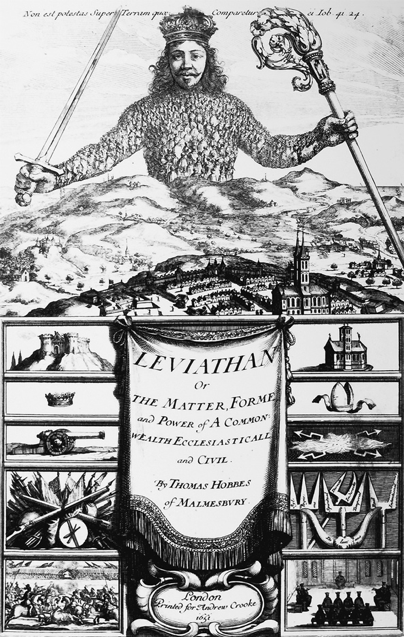
To begin, consider for a moment one of the most famous images of sovereignty, the frontispiece of Thomas Hobbes’ Leviathan:
Figure 1. Hobbes 1998, Frontispiece.
Intended to capture Hobbes’ social contract theory in a single image, the figure of the Leviathan that is shown here finds its raison d’être in Hobbes’ theory of the state of nature. Roughly, and speaking in a way that I will have to nuance later, state of nature theory posits that in the beginning, people (I hesitate to write “humans”) were living in a state of nature. Pessimistic theorists of the political—like Hobbes–envision this as an undesirable state in which people are like wolves to each other (hence, my hesitation).[2] Optimistic theorists of the political think otherwise. In both cases, people eventually come together to draw up a contract–hence, Hobbes’ renown as a contract theorist–to determine how they want to live together. This contract is a set of laws or a constitution by which a group chooses to live. The group thus institutes what Hobbes calls a Leviathan, Commonwealth, or State, an artificial man who represents them. Such a Leviathan is designed, in Hobbes, against the possibility of civil war, but the fear that the state of nature might erupt again is always there in the Hobbesian model. We therefore live in fear—of both the civil war and of the sovereign who is meant to hold it at bay.
The frontispiece of Hobbes shows all of this. It shows a figure of sovereignty—I again hesitate to call it an actual human being—spectrally hovering over a landscape. It is unclear where this figure is standing, whether it is part of the landscape or not. Certainly, it resides outside of the walls that mark the town over which it looms. In its right hand, the figure holds a sword, symbol of earthly power. In its left, it holds a religious staff, symbol of spiritual power—and note that the staff appears to reach into the landscape over which the sovereign rises. With the exception of the head and the hands, the body of this sovereign is made up of the bodies of its subjects—those who instituted the sovereign and find themselves represented in the body of the king.[3] They all look up towards the sovereign, who gazes outside of the image, at the reader. This image needs to be read vertically: starting with the Latin quote from the book of Job at the top (“there is no power on earth that compares to him”), one lowers one’s gaze towards the bottom half of the image, which is split between images of earthly power on the left and images of spiritual power on the right. In the middle hangs a curtain, perhaps hiding where the sovereign is standing (its feet, as has been shown,[4] would likely rest precisely where Hobbes’ name is written on the curtain).
Now consider Michel Foucault’s reading of Hobbes in “Society Must Be Defended”. Foucault forces one to adjust the state of nature narrative. The state of nature is not one of perpetual, actual war in the way we have imagined it. The problem in the state of nature, Hobbes suggests (according to Foucault), is “equality” (Foucault 2003, 90). People are too equal in strength; there isn’t enough difference. And this leads to a “primitive war” as “the immediate effect of nondifferences, or at least insufficient differences” (Ibid.).[5] “If there were great differences, if there really were obvious disparities between men, it is quite obvious that war would immediately come to an end” (Ibid.).[6] Why? Because it would be obvious who the strong are, and who the weak are, and either there would be a clash and the strong would win, or there would be no clash because the weak would be smart enough to refrain from engaging in one (See: Ibid., 91). To live peacefully, people need to institute inequality or difference. This is how the sovereign comes about—a radically unequal power, marking absolute difference. “Differences lead to peace” (Ibid.). This gets people out of the state of nature and its petty war of representations, its “anarchy” (Ibid.) and “theatre” (Ibid., 92) of minor differences.
Hobbes has three models of sovereignty: one by institution (people come together and close a contract, institute a sovereign) (Foucault 2003, 93); one by acquisition (one country violently conquers another, which is defeated) (Ibid., 94). Interestingly, Foucault points out that while we would call the latter conquest (“domination” [Ibid., 95]), for Hobbes it is ultimately not because the defeated will institute the new sovereign, will accept the conqueror as their sovereign. Why? Because they want to live. But this is not a biopolitical will to live: it is institution bound up in fear (of death—we are firmly within the realm of sovereignty) (See: Ibid., 96). Hobbes compares the latter form of sovereignty to (and this is the third model) the child’s dependency on their mother: they depend on the mother to live, or rather to avoid death (See: Ibid., 96). On this basis, Foucault presents Hobbes as a theorist against war, as a theorist of peace who took war as his fundamental adversary in his work (See: Ibid., 97). Hobbes sought to “eliminate” (Ibid.) war from politics. According to Foucault, he theorized what I will call here—overstating the case somewhat–a smooth sovereignty.
Foucault then mobilizes (See: Foucault 2003, 99 and after) English political history to drive a rift into Hobbes’ work. He refuses for the violence of conquest to be swept under the carpet. He practices a political historicism against Hobbes’ state of peace. He follows the Levellers and the Diggers et cetera in their attempt to keep revolution and rebellion—“war against the state”, as Melinda Cooper in her reading of the lecture specifies (Cooper 2004, 516) –alive. There is always an alternative; the norm was violently put into place. In sum: Foucault takes it up for war against Hobbes as a theorist of peace.
At the very end of his lecture, Foucault attacks “dialectical materialism”, evidence that he is working through his relation to Marx in his Collège de France lectures (as Stuart Elden for example has shown [See: Elden 2016]). Jacques Bidet, author of Foucault With Marx, explains that likely what Foucault is attacking here is a “‘Hegelian’ Marx, thinker of the totality and its historical unfolding to the point where social contradictions are overcome” (Bidet 2016, 4). Foucault’s attack, at the end of the lecture on Hobbes as a theorist who seeks to eliminate war, may be against a Marx as a “Hegelian” thinker who ultimately sweeps the negative under the carpet.
There are plenty of other reasons, Bidet goes on, why Foucault may have taken up Marx in this context: Marx’ account of politics, which focused on class struggle and the economic determinism that triggered it, was simply not nuanced enough for Foucault to paint an adequate political picture. Bidet notes much later in his book Foucault’s criticism of Marx’ use of the word “struggle”, which “passes over in silence precisely what is meant by struggle” (Bidet 2016, 127). This in particular resonates with Foucault’s criticism of Hobbes as a theorist against war. Bidet writes that in Foucault’s view “Marxism ultimately neutralizes [the “politics is war”] paradigm by performing a dialectical operation on it: at the end of the revolutionary process, after the final reversal of economic domination, antagonism comes to be re-absorbed within a new contractual order of joint concertation among all. But Foucault refuses this final utopia” (Ibid., 173-174). “Under the new form of state domination, he discerns the war that is begun ever anew” (Ibid., 174). “The Marxists’ dialectic”, in Foucault’s view, “occults the fact of war” (Ibid., 175).
I intend to comment elsewhere on how all of this makes Foucault appear as somewhat of a Schmittian–and Bidet indeed writes of “Foucault’s wink to Carl Schmitt, for whom the fundamental [political] category is also that of war” (Bidet 2016, 176) –, who seeks to keep alive a political pluriverse—against[7] Hobbes, who defends a political universe. When it comes to a concept of the political, Foucault’s reading of Hobbes shows that he is more with Schmitt than with Hobbes. In order to accept such a wink, however, one has to overlook at least one important difference between Foucault and Schmitt. When it comes to Foucault’s advocacy of politics as war, Foucault is recuperating from Hobbes a war against the state; but that is crucially not what Schmitt advocates. (As Chantal Mouffe points out, Schmitt locates the enemy outside of democratic association. He doesn’t think a democratic pluralism within [See: Mouffe 1999, 5].[8]) The source of Foucault’s concept of the political may not so much have been Schmitt, but the Black Panther Party, as Brady Heiner Thomas has argued (See: Thomas 2007). Melinda Cooper remarks on this difference to reveal, as she puts it, “some provocative points of intersection and discord” between Foucault and Schmitt, leading to the conclusion that in fact Foucault and Schmitt “were engaged in a violent argument with each other” (Cooper 2004, 515). There is no doubt, I think, that she is right.
The reason I have rehearsed Foucault’s reading of Hobbes here, however, is to show how Foucault, in response to what he perceives to be the theorization of a smooth sovereignty in Hobbes, takes it up for a theory of sovereignty that has to be rooted in friction. Whenever there is sovereignty, there is war; “There is no escape” (Foucault 2003, 111), as Foucault writes, from this political and historical fact. From the Diggers’ understanding that “[l]aws, power, and government are the obverse of war”, summarized powerfully in the line “Government means their war against us; rebellion is our war against them” (Ibid., 108),[9] Foucault ultimately arrives at this conclusion:
Yet the fact remains that you see here the first formulation of the idea that any law, whatever it may be, every form of sovereignty, whatever it may be, and any type of power, whatever it may be, has to be analyzed not in terms of natural right and the establishment of sovereignty, but in terms of the unending movement—which has no historical end—of the shifting relations that make some dominant over others. (Ibid., 109)
We have here then a powerful refutation of any understanding of sovereignty as frictionless—of any theory of smooth sovereignty, as I called it earlier on.
But what are the consequences of such a position for the political concept of sovereignty? Below, I intend to address that question through a case-study that can be productively analyzed in the framework laid out above: the situation of black lives in the United States today. As my reference to Brady Heiner Thomas already revealed, this situation is historically inscribed in Foucault’s theorization of politics during the mid-1970s, through Foucault’s (unacknowledged) encounter with race relations in the U.S. and the writings of the Black Panther Party. What follows is an attempt to write in the tracks of that inscription.
After a brief reading of Ta-Nehisi Coates’ Between the World and Me that focuses on the presence of sovereignty in that book, I seek to negotiate specifically the continued relevance of sovereignty for the situation of black life in the U.S. today. Following Achille Mbembe’s theorization of necropolitics, I distinguish between two sovereign inscriptions of black life within sovereign power: one associated with Hegel’s dialectics, the other with Bataille and the break with dialectics. I then turn to Frantz Fanon and Mbembe’s reading of Fanon (in Critique of Black Reason) to show how this tension between Hegel and Bataille can already be found in Fanon’s plea for absolute (rather than dialectical) violence, which is however formulated as part of a constructive call for national liberation that would rein this violence back in. That said, the constructive element of Fanon’s project was hardly conservative in any straightforward way: he had in mind a national liberation based on the creation of a new man, one that thus preserved traces of both the Bataillean and Hegelian inscriptions of black life in sovereign power that Mbembe distinguishes. “Sovereignty” in Fanon must be negotiated between those two traces. (It’s also worth adding, as I will discuss below, that the relation between black life and sovereignty may very well exceed both: neither Hegelian dialectics nor Bataillean transgression, perhaps the para-ontological understanding of blackness can find political meaning here as a continuous unsettling that’s neither with Hegel nor with Bataille, and as such precisely—as David Marriott has argued–non-sovereign [See: Marriott 2016].)[10] Mbembe’s “critique” reveals this negotiation between Hegel and Bataille as well in that it appears to be torn between a more conservative articulation that would remain within critique’s limits, and a more radical one that would seek to transgress them—a transgression that, in Bataille, nevertheless remains sovereign in name. It is perhaps that nominal remainder of sovereignty that indicates that the risk of transgression is great: indeed, in his most transgressive moments, Mbembe also risks to promote (as I intend to show) the kind of exceptionalist sovereignty that Coates’ work exposes.
More than 50 years after the founding of the Black Panther Party in 1966, and at a time when the “horizontalist” Black Lives Matter movement is violently clashing in the U.S. with both the status quo and new “vertical” formations on the Right, this article asks whether there can be a future for sovereignty when it comes to black life in the U.S.? Can there be an Afro-Futurism of sovereignty? Can Fanon’s call for national liberation and the articulation it was briefly given in Black Panther politics still take on new meanings today? Can there be a dream of sovereignty—and it is worth emphasizing that sovereignty, to a certain extent, is always a dream–that is not a white Dream? Who are its dreamers? What might they dream? Such questions seem particularly important today, when sovereignty has reemerged on the Right. Liberalism is exhausted. Sovereignty is making a come-back as part of a repoliticization against liberalism, and neoliberalism (though this last point is contestable[11]). But where is this sovereignty going to go? Unless the Left participates in this conversation and contributes to rethinking sovereignty from within, they may not stand a chance against the Right’s revitalization of sovereignty’s old specter. In closing, I consider how an alliance between African-American and Native American politics may in spite of their differences prove to be productive on this count.
State of Exception and Necropolitics
In his book Between the World and Me, Ta-Nehisi Coates shows, although he does not use these terms, that black life in the U.S. is caught up in a state of exception (See: Coates 2015). In his discussion of black life’s exposure to sovereign power, he focuses on the pair black life/police in view of the ongoing police shootings of young black men—in some cases, children–in the U.S. As Coates notes, perhaps the most troubling element apart from these people’s deaths, is that they are killed with impunity: “These shooters were investigated, exonerated, and promptly returned to the streets, where, so emboldened, they shot again” (Ibid, 78). It is the element of impunity that clearly renders black life in this situation “sacred”, in Giorgio Agamben’s understanding of this term: outside of human law, exposed to be killed without legal consequence (“vogelfrei”, as I have argued elsewhere [See: Boever 2009]). It is this element that turns black people’s “fear to rage”: the fact that the murderers “cannot be subpoenaed … will not bend under indictment” (Coates 2015, 83).
That we are talking about a situation of sovereignty here is partly made clear in Coates’ text through the specifics of the police killing that he focuses on, which involves an officer from Prince George’s County (in Baltimore state) and a young black man called Prince Carmen Jones. Prince Jones is shot one night, while going to visit his fiancée, by a cop who claims Jones was trying to run him over with his jeep. Jones had been approached by the cop, gun drawn; the cop had been undercover, in other words was in plain clothes, and had shown no badge. He was, in other words, “a man in a criminal’s costume” (as Coates points out [Coates 2015, 81]), and Coates confesses with horror that “I knew what I would have done with such a man confronting me, gun drawn, mere feet from my family’s home” (Ibid.). The suggestion is, presumably, that he would have done the same: he too may have tried to run over the cop. The point about the “criminal’s costume” is sharpened a few pages later, when we finally find out something that Coates obviously knew from the onset: “The officer who killed Prince Jones was black” (Ibid., 83).
It is hard to overlook the sovereign overtones of the confrontation (one prince versus another). To be clear: while Coates presents the lives of young black men to be caught up in a state of exception, he also insists that in the U.S. this exception has become the rule. “In America,” he writes later on, “it is traditional to destroy the black body—it is heritage” (Coates 2015, 103). In other words, America is another name for a place where the state of exception of black life has always been the rule. It is another name for what Agamben, working with a European frame of reference that ignores the situation of black lives in the U.S. entirely, calls a camp: any situation in which the exception becomes the rule. The police, indeed, “reflect America in all of its will and fear”, as he notes earlier on, “and whatever we might make of this country’s criminal justice policy, it cannot be said that it was imposed by a repressive minority. The abuses that have followed from these policies—the sprawling carceral state, the random detection of black people, the torture of suspects—are the product of democratic will” (Ibid., 79). The charge, if we put Coates and Agamben together, is harsh: democratic America equals black Auschwitz. Or, without Agamben’s frame of reference: slavery never ended.[12]
In the Prince Jones killing we confront the particular perversity of black Auschwitz, namely black-on-black violence, which is fuelled, Coates suggests, by what he calls “the Dream”. By this, he means the white people’s Dream, the Dream of a white America. He calls those who share such a Dream, “Dreamers”. Black people in the U.S. carry not only “the burden of living among Dreamers”; they also have the “extra burden of your country telling you the Dream is just, noble, and real, and you are crazy for seeing the corruption and smelling the sulfur” (Coates 2015, 106). Perversely, it is “the Dream” that may in part explain the black-on-black violence that Coates is analyzing closely: it is “the Dream” that may explain the cop’s reaction to Prince Jones, in the same way that it is “the Dream” that may explain Jones’ reaction to the cop. Part of the “criminal’s costume”, in other words, and one can hardly call it a costume, is the blackness of both the victim and the murderer—a blackness that “the Dream” criminalizes and that makes black people kill each other due to the white people’s racist fear. When Coates shudders in horror at the realization of what he would have done—the same–, he is also shuddering in horror at the extent to which “the Dream” has infected him, the extent to which it has turned him against his own people. Between the World and Me is an attempt to puncture this “Dream”, to force something between the reality of Coates’ life and the psychotic construction of “the Dream” in which it is caught up.[13] In Between the World and Me, Coates is attacking a white sovereignty not just in terms of the physical violence that it wields but in terms of the psychic phantasy that backs it up.
To be a black man in the U.S. means that the police “had my body, could do with that body whatever they pleased” (Coates 2015, 76). Coates ties this situation to the history of slavery in the U.S., and thus to the history of European colonialism and the relentless and ongoing “plunder of black life” that they present. Obsessed with the Civil War, in which 600,000 people died in a conflict about the practice of slavery, Coates notes that “it had been glossed over in my education, and in popular culture, representations of the war and its reasons seemed obscured … as if … someone was trying to hide the books” (Ibid., 99). There is a way in which it seems, therefore, as if the Civil War never happened—and certainly when considering the situation of black lives today, that appears to be what Coates is forced to conclude. The heritage of destroying the black body, far from having ended with the Civil War, continues.
Coates’ references to the history of slavery and colonialism enable us to characterize the situation in the U.S. that he analyzes not only as a state of exception and more specifically a camp, but also as a necropolitical situation, to use Achille Mbembe’s productive notion (See: Mbembe 2003). Indeed, Mbembe focuses on those histories to develop the notion of necropolitics, which he situates closely—perhaps too closely–to the work of both Agamben and Michel Foucault. I say “perhaps too closely” for while Foucault in his work on power distinguishes between sovereignty as the power to take life or let live (the power of death) and biopolitics as the power to make life (to foster, generate, optimize it), Mbembe’s notion of necropolitics brings those two aspects of power together as one. Mbembe is compelled to make this deconstructive move due to the situations (and the particular histories) he is looking at, which include slavery and colonialism—both situations that neither Foucault nor Agamben pay much attention to. As scholars like Paul Gilroy (See: Gilroy 2010) or Alexander Weheliye (See: Weheliye 2014) have pointed out,[14] Foucault uses the term “colonialism” largely metaphorically; by characterizing the object of sovereign power as “bare” life, Agamben is incapable of thinking the importance of race in biopolitics. Both of those notions are important in Mbembe’s discourse, and this forces him to take up some distance from both Agamben and in particular Foucault, to whom he is nevertheless indebted. He does not share their euro-centrism, and this produces a shift in the theory. One way to summarize this would be that Mbembe, for his investigation of biopolitics, is operating from the position of those who die. He is interested in the “wounded or slain body” and how it is “inscribed in the order of power” (Mbembe 2003, 12).
On this last count, Mbembe considers two different inscriptions: the Hegelian one and that of Bataille. In Hegel, whose dialectical model Mbembe focuses on, the human being confronts death in negating nature by creating a world. It is through this exposure that the human being “truly becomes a subject” (Mbembe 2003, 14). To become a subject, then, “supposes upholding the work of death”, in the sense that life “assumes death and lives with it” (Ibid., 15). Death can thus become part of an “economy of absolute knowledge and meaning” (Ibid.). Negation drives the dialectic forward, but that forward movement is also the negation of the negation. There is death but it can productively become part of life.
Not so in Bataille, whose work Mbembe discusses in contrast: “Bataille firmly anchors death in the realm of absolute expenditure”, an expenditure that he calls “sovereign” (Mbembe 2003, 15). For Bataille, sovereignty thus breaks with the Hegelian dialectic, a break that is marked through its relation to death: “it is the refusal to accept the limits that the fear of death would have the subject respect” (Ibid., 16). The sovereign world, for Bataille, “is the world in which the limit of death is done away with” (Ibid.), as Mbembe quotes. Sovereignty therefore becomes a name for “the violation of all prohibitions” (Ibid.):
Politics, in this case, is not the forward dialectical movement of reason [as in Hegel]. Politics can only be traced as a spiral transgression, as that difference that disorients the very idea of the limit. More specifically, politics is the difference put into play by the violation of the taboo. (Ibid.)
But how does Bataille’s position relate to necropolitics?
In the opening paragraphs of his text, Mbembe distinguishes between what he appears to characterize as the violence of sovereignty and what he refers to as “the power of absolute negativity”. The latter he glosses with Arendt, and her claim that the concentration camps introduce us to a negativity of death that is outside of the life/death binary. Necropolitics, it seems, investigates such a negativity, the power of such absolute negativity, in the sense that it investigates the “camp” in which life—and in particular black life—is caught up. At the same time, however, necropolitics and the biopolitical sovereignty that it names are presented in Mbembe’s text along Hegelian lines, as conservative in the sense that they refer to “the generalized instrumentalization of human existence and the material destruction of human bodies and populations” (Mbembe 2003, 14). In other words, they refer to the way in which dead bodies can become part of an economy of knowledge and meaning.
I would characterize such an economy here based on the associations that Mbembe sets up as the economy of slavery and colonialism. But it is also the economy that Coates confronts in his close-reading of the death of black lives in the U.S. It is Mbembe who, in combination with Coates, enables us to mark this contemporary American situation as the situation of slavery and colonialism continued.
But Mbembe can arguably also show us, via Bataille, that such a Hegelian situation need not be the only one. There is also the absolute expenditure of death, which would not allow such instrumentalization of black death as part of the white people’s Dream. In other words, while Bataille appears to be associated with the absolute power of negativity that is in turn associated with the state of exception of the camp, there is also a way in which Bataille can become associated with another state of exception that would break with all of this.
Fanon, Once More
On this last count, Mbembe’s negotiation of Hegel and Bataille connects to Frantz Fanon, and the peculiar role of dialectics in his work. With Fanon, of course, there is no doubt: we are in the colonial situation, it is the colonial situation—the French presence in Algeria—that Fanon confronts. I am thinking in particular of the chapter from The Wretched of the Earth titled “Concerning Violence” (in the Constance Farrington translation)/ “On Violence” (in the Richard Philcox translation).[15] Born in Martinique, Fanon had studied psychiatry in France, and had been assigned to a hospital in Algeria. He quits his job there and joins the Front de Libération Nationale, the anti-colonial resistance fighters—as a Martiniquan/French citizen, not as an Algerian, not as Algeria’s colonial subject (even if he identified with the latter and ultimately became Algerian).[16] There is dialectics in Fanon’s text, but one feels that it is stuck in the basic opposition without synthesis: colonized confronts colonizer violently, but no progress, no compromise, no rational deliberation is possible (“Challenging the colonial world is not a rational confrontation of viewpoints”, he writes [Fanon 2004, 6]). Indeed, Fanon’s text is an affront to liberalism (Fanon writes about “the liberal intentions of the colonial authorities”, for example [Ibid., 30])—he rather snarkily attacks liberalism’s “gentleman’s agreement” (Ibid., 2) –and to the ways liberalism can be tied to colonialism to make history “move forward” (to evoke the Hegelian narrative).
Against this, Fanon asserts “absolute violence” (Fanon 1968, 37)[17]: the need to kick the colonizer out, and decolonize (which, as he notes, involves many levels of existence). It is a call “for total disorder” (Fanon 2004, 2),[18] “tabula rasa” (Ibid., 1). “[E]very obstacle encountered” must be “smash[ed]” (Ibid., 3). “[A]ny method which does not include violence” must be rejected (Ibid., 24). There is only one way to affirm that decolonization has been successful: do those who used to be the last now come first?[19] The point is to take the colonizer’s place (See: Ibid., 23). If that is not accomplished, nothing has been done.
It is true that there are moments in the text where the usefulness of violence also appears to be drawn into question, as when Fanon writes that “the question is not so much responding to violence with more violence but rather how to defuse the crisis” (Fanon 2004, 33).[20] Indeed, Mbembe has noted in Critique of Black Reason that “Fanon was conscious of the fact that, by choosing ‘counter-violence’, the colonized were opening the door to a disastrous reciprocity” (Mbembe 2017, 166). But the general orientation is unmistakable: violence is needed to end the madness. Absolute violence—non-dialectical violence. Tabula rasa. Absolute break. Cut. Out and out, as Philcox renders it (the translation is flawed, but its repetition of the “out” is useful here—it does render the outside-ness of ab-solute). Looking forward to Mbembe, this reads like Bataille’s absolute expenditure applied in the colonial context. In his reading of Fanon, Mbembe also recognizes that he proposes violence as the only way forward.
Nevertheless, it is not quite the only way. For it is crucial that the broader, constructive context in which, for Fanon, this destruction takes place is that of “national liberation, national reawakening, restoration of the nation to the people or Commonwealth” (Fanon 2004, 1). In short, it is that of… sovereignty. This is in many ways a remarkable point, and one can understand it, of course, in view of the fact that the colonized are, precisely, without their own nation-state. And it is certainly not as if Fanon was not aware of the problems of nationalist politics, of what he called “the pitfalls [mésaventures] of national consciousness”. But in this chapter he consciously leaves the portrayal of “the rise of a new nation, the establishment of a new state, its diplomatic relations and its economic and political orientation” (Ibid.) aside to focus on the violent break.[21] What will happen, however, when the absolute violence, the out and out violence for which he calls, is reined back in, is folded back into the national liberation that he calls for at the beginning of his text? What will happen when it becomes sovereign in that way again? Bataille of course calls his absolute expenditure sovereign in response to such a “conservative” folding within, precisely to attack the old sense of sovereignty. To an extent, those questions point to the problem of all revolutions, which ultimately fold their constituting power back into constituted power. How to run with constituting power appears to be the question. And more radically even: how to run with destituent power, apart from the constitutional gesture?
“National liberation.” Can we even think in those terms still, today? Could we call for a project of national liberation in response to the colonialism that the U.S., today, continues to practice on the black lives that live within its borders? We can think of the project of the Black Panthers, which involved a close study of law, and in some cases a rewriting of key documents of U.S. political history, as an attempt toward national liberation from colonialism and slavery. But within the limits of national sovereignty—at least for a brief while, before internationalism took over. An attempt to cleanse sovereignty from colonialism and slavery, to claim a sovereignty outside of the white people’s dream. Violence clearly has a role in this project. But what is its end? Is it an end? Is it pure means?
Consider in this context Kadir Nelson’s New Yorker cover “After Dr. King”, an alternative image of sovereignty: a black body of sovereign power that gathers within it the unhappy subjects who question the established sovereignty’s competency to protect them.
Figure 2. Kadir Nelson, “After Dr. King.”
While it gives us an image of black sovereignty, it would be important to note that its central figure is that of Martin Luther King. Can the New Yorker cover be imagined with Malcolm X on it?[22] (Ta-Nehisi Coates notes Malcolm’s association with violence and his own dislike of it.) Or does the figure of King ultimately reconcile the violence of the subjects it carries within, and is Nelson’s image the ultimate Hegelian reconciliation of political violence and the avoidance of civil war? Would the Malcolm X cover have offended the New Yorker’s liberal sensibilities too much (the force of Bataille is certainly stronger in Malcolm than it was in King)? Does the King image continue, in that sense, the old sovereignty—plenty of similarities, after all, between Nelson’s image and the frontispiece of Thomas Hobbes’s Leviathan—rather than bring the tabula rasa that Fanon calls for? And perhaps Fanon too, when he folds violence back into “national” liberation, ultimately does not live up to the radicality of his own position: complete rejection of the nation-state.
Nelson’s New Yorker cover “Say Their Names” can be seen as his most recent engagement with this problematic, this time in reference to George Floyd’s murder, and with Floyd embodying what Coates calls the U.S. “heritage” of violence against black bodies:
Figure 3. Kadir Nelson, “Say Their Names.”
Such visual renderings of the problematic of sovereignty can be found elsewhere as well. Consider, for example, Ryan Coogler’s Black Panther (Disney, 2018), which problematically casts as its villain Killmonger, who wants to use the precious metal vibranium of King T’Challa’s Wakanda to liberate oppressed black people worldwide.
Figure 4. Black Panther (Disney, 2018).
If I mention the Black Panther, it is partly because Coates has been involved in the comic book’s reimagining for the age of Black Lives Matter. The Black Panther poster, with the troubling tagline “Long Live the King,” clearly inscribes the film’s politics in the negotiations of sovereignty that I have opened up here.
When Fanon called for national liberation, however, he likely did not want “that old sovereignty” again. That might be the reason why, in his text, he also mentions “the creation of new men” (Fanon 2004, 2) as the result of the project of decolonization. Everything must start, he seems to say, from the creation of a new people, a new human being. It is from there that a new sovereignty might come along. This, among other things, enables David Macey to write in his biography of Fanon that “For Fanon, the nation is a product of the will, and a form of consciousness which is not to be defined in ethnic terms” (Macey 2012, 374). Mbembe focuses on Fanon’s notion of a new human being (rather than a new black man) in his book Critique of Black Reason. It is Fanon who, in Black Skin, White Masks, said that “Black” was “only a fiction” (Mbembe 2017, 159). “For him”, Mbembe notes, “the name referred not to a biological reality or skin color but to ‘one of the historical forms of the condition imposed on humans’” (Ibid.). Mbembe distinguishes Fanon’s position on this count from that of his teacher, Césaire, one of the key thinkers of “Négritude”. While Césaire as per Mbembe’s account is obviously no Senghor (the other thinker of negritude), Mbembe still presents him as more essentialist than Fanon, in the sense that he affirmed a negritude that Fanon ultimately[23] wanted to go beyond. Mbembe points out, however, that in Césaire’s “Black”, there was a universalism that was proposed, a universalism that could only emerge from “blackness” and the difference that it marks—a difference that reveals the world. For that revelation, blackness was essential. “But,” Mbembe asks, “how can we reread Césaire without Fanon” (who wrote after him)? For him, it is difficult, if not impossible.
This has everything to do with the notion of “critique” which names Mbembe’s project. As long as we are reading Césaire, we remain on the conservative side of critique, even if Césaire opens up the possibility of transgression. The transgression only arrives, however, with Fanon, who seeks to go beyond the notion of “Black” and imagines a world “freed from the burden of race” (a formula Mbembe repeats at least twice in his book—it closes the book as well [Mbembe 2017, 167, 183). “If there is one thing that will never die in Fanon”, Mbembe writes, “it is the project of the collective rise of humanity … Each human subject, each people, was to engage in a grand project of self-transformation, in a struggle to the death, without reserve. They had to take it on as their own. They could not delegate it to others” (Ibid., 162). The echoes here are multiple: struggle to the death—that’s Hegel, of course, the master-slave dialectic. But struggle without reserve: that’s Bataille’s absolute expenditure, the break with economy. Finally, the project of self-transformation: here we get echoes of the Enlightenment project and the “care of the self” that Foucault was so interested in toward the end of his life (the stuff that, according to some critics, made him vulnerable to neoliberalism [See: Zamora and Behrent, 2016]). It is no coincidence, I think, that the chapter I have been quoting from here is titled “The Clinic of the Subject”, which, in addition to echoing Fanon’s training as a psychiatrist, is also a very Foucaultian title.
So a number of questions emerge: at the level of subject formation, Mbembe seeks to present Fanon as more Bataille than Hegel.[24] But at the level of Fanon’s political project, this distinction—Hegel or Bataille—was undecided; it seemed that Fanon’s call for national liberation was perhaps more Hegel than Bataille. To be sure, if a national liberation is to be built around Bataille’s kind of subjectivity, then surely it will be very different from the old sovereignty and its dialectical transformation. We would get a break with dialectics here, that would bring about a truly new sovereignty rather than its dialectically accomplished next step. If this comes with the project of total self-transformation, the question remains how this would relate to the neoliberal, entrepreneurial subject. While Fanon of course could not foresee this question, Mbembe does address it in his introduction, where he presents neoliberalism as one of “three critical moments in the biography of the vertiginous assemblage that is Blackness and race” (Mbembe 2017, 2). Neoliberalism, defined as “a phase in the history of humanity dominated by the industries of Silicon Valley and digital technology” (Ibid., 3), has a “tendency to universalize the Black condition”, by which he means “practices [that] borrow as much from the slaving logic of capture and predation as from the colonial logic of occupation and extraction, as well as from the civil wars and raiding of earlier epochs” (Ibid., 4). It is a key component in what Mbembe calls “the Becoming Black of the world” (Ibid., 6). At no point does Mbembe discuss, however, how the language of self-transformation in Fanon could also become part of such a project.
There remains the third path that I alluded to in my introduction: the para-ontological understanding of blackness that would mark, next to both Hegel and Bataille, sovereignty’s continuous unsettling—its non-sovereignty, as I have suggested. Fred Moten has developed the notion of the para-ontological (after Nahum Chandler, and, by R.A. Judy’s account, Oskar Becker [Moten 2020]) in response to Western ontology which is, he argues, a “white” ontology that under the guise of universality refuses to think blackness. As he puts it in a lengthy, beautifully lyrical and intensely political article titled “Blackness and Nothingness (Mysticism in the Flesh)”:
[B]lackness is prior to ontology. … blackness is the anoriginal displacement of ontology … ontology’s anti- and ante-foundation, ontology’s underground, the irreparable disturbance of ontology’s time and space. (Moten 2013, 739)
Blackness—both in an identitarian way, as a condition that is particularly felt by black bodies, but also in a more general sense, as a structural condition that does not depend on one’s skin color (Moten distinguishes between “blackness and blacks” [Moten 2013, 749])—is precisely not covered by the ontological, and it is to move towards the philosophical thinking of blackness that Moten proposes his notion. The para-ontological, in such a project, captures what resides “next to” or “para” ontology. It captures the “nothingness” of blackness, the particular “nothingness”—which is evidently not nothing—that it marks. In my introduction, I have suggested reading this position politically, as a para-sovereign position
Moten turns in this context to Far Eastern thought and specifically the notion of “wu” (無, “nothing”). Moten brings this daoist notion of an active emptiness together with a black para-ontology and politics of resistance that can—in his view—be associated with Fanon (See: Moten 2013, 750). The thought of the dao, and specifically of “wu”, is a thought that puts being on hold rather than “in the hold” (Ibid.) as Moten’s reference to the slave-ship has it. Yet it is also through its attention to “the hold” that black studies (as Moten sees it) “disrupts” (Ibid., 751) the “nothingness” of Far Eastern thought, forcing “‘the real presence’ of blackness” (Ibid.) back into it and working both with and against the suspension that “wu” brings. There is, clearly, something to be learned from and resisted within the para-ontological. In the words of Abdelkebir Khatibi, another thinker of the dao, what’s needed here is a “double critique” (Khatibi 1983, 12), both of the para-ontological (as subject genitive: the para-ontological suspends, in the way that “wu” suspends) and of the para-ontological (as object genitive: the para-ontological is suspended by “‘the real presence’ of blackness”).
Moten’s choice (after Chandler) for and understanding of the preposition “para” or “next to” is worth pausing over in the context of my discussion of sovereignty, because it marks a moving sideways rather than up or down or inside or out. If up/down or in/out can easily be appropriated within the dialectical (Hegelian) and transgressive (Bataillean) models of sovereignty that I previously found in Mbembe, this is more difficult to do with the horizontal dynamic of the next to, which posits itself on the same plane as whatever it pre-poses. But does this lateral unsettling take us out of sovereignty? It seems that even in the intervention of such a sideways move, the para maintains a hyphenation to the ontological, some kind of connection—that of a mere dash—to what it unsettles. Read politically, this would also apply, then, to the para-ontological approach to sovereignty, in which some connection to sovereignty would be maintained by the mere presence of a dash. There is always the temptation of overlooking this dash, and rewriting this continuous unsettling as an outside—more radical than Bataille’s, which still calls itself sovereign. Moten in fact flirts with such an outside. “On the one hand”, he writes, “blackness and ontology are unavailable to each other” (Moten 2013, 749)—and the project of para-ontology seeks to remedy that situation. “On the other hand”, he continues, “blackness must free itself from ontological expectation, must refuse subjection to ontology’s sanction against the very idea of black subjectivity” (Ibid.). The more radical conclusion, then—following the invitation of this “other hand”–would simply be to reject ontology altogether, a rejection that would lead to non-sovereignty. But Moten might consider such a conclusion irresponsible from the point of view of a history in which whiteness and blackness have been co-constituted in ontology, through ontology, and in/through sovereignty. In other words: while blackness might desire the outside, it may not be afforded such luxury from the point of history. Indeed, none of us may.
Critique and Indigenous Politics
“If we owe Fanon a debt,” Mbembe writes, it is for the idea that in every human subject there is something indomitable and fundamentally intangible that no domination—no matter what form it takes—can eliminate, contain, or suppress, at least not completely. Fanon tried to grasp how this could be reanimated and brought back to life in a colonial context that in truth is different from ours, even if its double—institutional racism—remains our own beast. For this reason, his work presents a kind of fibrous lignite, a weapon of steel, for the oppressed in the world today. (Mbembe 2017, 170)
It is worth noting, in the context of a discussion of sovereignty, the potential complicity of such a discourse with exceptionalism, and some of the problems this raises. This becomes clear in Mbembe’s book. When, a few pages later, Mbembe turns to the politics of art in this context, he writes:
Here the primary function of the work of art has never been to represent, illustrate, or narrate reality. It has always been in its nature simultaneously to confuse and mimic original forms and appearances. … But at the same time it constantly redoubled the original object, deforming it, distancing itself from it, and most of all conjuring with it. … In this way the time of a work of art is the moment when daily life is liberated from the accepted rules and is devoid of both obstacles and guilt. (Ibid., 173)
I can follow this final passage all the way up to its last sentence. But I do not think its grand, concluding statement—liberation from accepted rules, being devoid of obstacles and guilt—follows logically, or evokes the same politics, as the language of constantly redoubling, deforming, and distancing that Mbembe uses earlier on. I am concerned about how the final line promotes an exceptionalism—“liberation from the accepted rules”, “devoid of both obstacles and guilt”–that the previous language actually dismantles. I like the dismantling better. It marks an immanent criticism of sovereignty that may be more efficient, politically, at dismantling sovereign exceptions than Mbembe’s final sentence.
Given this conclusion, however, one should not be surprised by the final paragraph of the chapter: to be African, it proclaims, is to be “a man free from everything, and therefore able to invent himself. A true politics of identity consists on constantly nourishing, fulfilling, and refulfilling the capacity for self-invention. Afro-centrism is a hypostatic variant of the desire of those of African origin to need only to justify themselves to themselves” (Mbembe 2017, 178). Mbembe prefers here a world that is constituted by the relation to the Other—and it is the human that introduces that otherness into blackness, which he argues must be “clouded” (Ibid., 173). This will be the beginning—via Fanon—of the “post-Césairian era” (Ibid.). Again, one wonders whether “clouding”—a term he uses earlier in the chapter—can mean the same as “free from everything”; one wonders whether “post” can really refer to the radical break that seems to be alluded to here. Ultimately, Mbembe’s critique appears to be torn between a more conservative articulation that would remain within the critique’s limits, and a more radical one that would seek to transgress it. Given that he relies for his critique largely on Fanon, this should come as no surprise, as I have shown that Fanon himself, too, is caught up within this tension of staying within (Hegel) and going beyond (Bataille). Everything in “On Violence” points to the beyond; and yet, the constructive part of its project—not addressed in the chapter—takes place “within” national liberation. Ultimately, what haunts the difference between those two positions is the problematic of sovereignty itself: of its paradoxical association both with an outside and a within (“I who am outside of the law, declare that there is nothing outside of the law”, as Agamben captures the paradox of sovereignty). And, of course, of an even greater sovereignty—absolute violence, absolute expenditure—that, as the sovereignty of sovereignties, may ultimately do no more than perpetuate sovereignty’s exceptionalism. The third path, as I’ve also suggested, would be that of non-sovereignty.
Indeed, it may be that for black life, the project of sovereignty is over, that Fanon’s call for national liberation and the inspiration if provided for the Black Panther Party are a thing of the past, for good. Joan Cocks, focusing on the Israel/Palestine situation and Indigenous politics, has laid out some very good reasons for this (See: Cocks 2014). But if that is so—if sovereignty should indeed be seen as a thing of the past–it seems crucial at a time when sovereignty is going through a revival on the Right, in open conflict with the “horizontalist” Black Lives Matter movement today, that new forms of collective organization are proposed against sovereignty. Are those non-sovereign forms of collective organization? Do they claim sovereignty otherwise? How do they effectuate their power?
It is interesting to compare historical narratives of sovereignty as they are presented in different disciplines. In political theory, studies of sovereignty usually tell the story of sovereignty’s decline after WWII due to transnational political developments such as European integration or human rights politics. In Indigenous Studies, however, scholars tend to note that “following World War II, sovereignty emerged not as a new but as a particularly valued term within indigenous discourses to signify a multiplicity of legal and social rights to political, economic, and cultural self-determination” (Barker 2005, 1). Precisely when the term is on the wane in the West, where it was born, it is on the rise as an emancipatory tool for example for those communities “within” the West that seek to contest their subjection to another sovereign power. Those communities turned toward the term sovereignty, as Joanne Barker explains, in part to refuse the label “minority group”: “Instead, sovereignty defined indigenous peoples with concrete rights to self-determination, territorial integrity, and cultural autonomy under international customary law” (Barker 2005, 18). Of course, while refusing the label “minority group”, the communities instead adopt the term “sovereignty”, which was born and shaped in Europe. There may be a deeper problem here, as scholars like Elizabeth Povinelli have noted (See: Povinelli 2002), with the (Hegelian) politics of “recognition” (“Anerkennung”, in Hegel’s celebrated master/slave-dialectic) and how it tends to confirm the master’s terms. Indeed, it might seem strange to use the term “sovereignty” both to refer to the camp-like situation of black life in the U.S as exposed by Coates,[25] and now for these Indigenous struggles for self-determination. But such strangeness marks what Barker characterizes as the “contingency” of sovereignty, the fact that “[t]here is no fixed meaning for what sovereignty is—what it means by definition, what it implies in public debate, or how it has been conceptualized in international, national, or indigenous law” (Barker 2005, 21). The passage is worth quoting in full:
Sovereignty—and its related histories, perspectives, and identities—is embedded within specific social relations in which it is invoked, and given meaning. How and when it emerges and functions are determined by the “located” political agendas and cultural perspectives of those who rearticulate it into public debate or political document to do a specific work of opposition, invitation, or accommodation. It is no more possible to stabilize what sovereignty means and how it matters to those who invoke it than it is to forget the historical and cultural embeddedness of indigenous peoples’ multiple and contradictory political perspectives and agendas for empowerment, decolonization, and social justice. (Ibid.)
Sovereignty is, as I have indicated elsewhere (See: Boever 2016), plastic and it is this plasticity that any critique of sovereignty needs to assess. This is also to say that sovereignty is not sovereign—a claim that should be distinguished from the call for non-sovereignty.
If indigenous sovereignty thus emerges as a kind of serious playground or site of experimentation to think through new democratic possibilities today, it is precisely because it enables an immanent critique of sovereignty, as a politics of sovereignty that can only be critical. This is so, as Barker points out in her introduction to the book Critically Sovereign, for two reasons: on the one hand, because native sovereignty relates critically to the sovereignty of the nation-state, as a sovereignty that contests the power of another; second, because native sovereignty itself suffers from many of the same problems as the sovereignty of the nation-state, and therefore some of the criticisms that have been levelled against the sovereignty of the nation-state also apply to native sovereignty. In essence, this criticality revolves around the fact that when it comes to the indigenous politics of sovereignty, one can distinguish between two kinds: that which takes place “in relation to the state” and that which takes place “within the state” (Barker 2017, 8). Whereas the former relates to native sovereignty’s relation to the sovereignty of the nation-state, the latter operates within the sovereignty of the nation-state, and to participate in the latter can be—and has been—perceived as participating in the imperial and colonial politics of oppression of the sovereign nation-state. This is why what Barker refers to as “Civil Rights politics” does not cover the relation between indigeneity and sovereignty. It only covers the politics “within the state” part of the relation. In addition, one should also consider indigenous sovereignty’s relation to the sovereignty of the nation-state and the tensions it lays bare.
Barker articulates this (as well as other key parts of the critical sovereignty she develops) through a focus on “gender, sexuality, feminism” within her exploration of native sovereignty. She points out, for example, how the call for “women’s and gay’s liberation and civil rights equality … has been narrated as racializing and classing gender and sexuality in such a way as to further a liberal humanist normalization of ‘compulsory heterosexuality’, male dominance, and white privilege” (Barker 2017, 12). In other words, there is a subject-formation that is operative in such liberation struggles, and while this does not cover the full story of those struggles, this is an important aspect of them that should be drawn out. Any hegemonic formation, in the terms developed by Chantal Mouffe and Ernesto Laclau, will produce a counter-hegemonic formation; any rendering legible produces illegibility as Barker (via Judith Butler) puts it—there are always traces of internal exclusion or exception. It is from those traces—from those frictions, if you will–that politics develops. Indigenous approaches to for example gender and sexuality can be interesting in this context because they can “defy binary logics and analyses” (Ibid., 13)—and those include, it should be pointed out, discourses of a “third” (which ultimately in their very attempt to posit a third appear to confirm a pre-existing binary). The point of Barker’s approach appears to be to “defamiliarize gender, sexuality, and feminist studies to unpack the constructedness of gender and sexuality and problematize feminist theory and method within Indigenous contexts” (Ibid., 14). Indigenous politics are interesting in this context as well because when for example indigenous women seek to pursue a feminist politics to redress their own status in their communities, they run into resistance because their tribe members perceive them to be sleeping with the enemy—to be “non- or anti-Indigenous sovereignty within their communities” (Ibid., 20). “They accused the women of being complicit with a long history of colonization and racism that imposed, often violently, non-Indian principles and institutions on Indigenous people” (Ibid.). So gender, sexuality, and feminism have a difficult place within native sovereignties, and it is precisely around the notion of sovereignty that this difficulty gets played out.
Barker’s introduction also contains hope for the future, though. Such hope articulates itself around a poetic project of remaking—of remaking masculinity for example; but also of remaking the world. This is about asserting a sovereignty that would not fall into the old traps of sovereignty—that would not reify, for example, “heterosexist ideologies that serve conditions of imperial-colonial oppression” (Barker 2017, 24). It would be a remaking that might confront “the social realities of heterosexism and homophobia” within indigenous communities (Ibid., 25). In other words, “Indigenous manhood and masculinity [need to be redefined] in a society predicated on the violent oppression and exploitation of Indigenous women and girls and the racially motivated dispossession and genocide of Indigenous peoples” (Ibid., 26). It is precisely here, in the project of not opposing the violent sovereignty of the oppressor with a call for a violent sovereignty of the oppressed—with the Fanonian attempt to go beyond such a dialectical opposition—that the possibility of an Indigenous future opens up, an Indigenous Futurism (of sovereignty). It is because of the very particular position that Indigenous sovereignty is in that this becomes possible. And this is the reason, I think, why so many contemporary theorists of sovereignty turn to this example to pursue a redefined politics of sovereignty today. The turn towards indigenous sovereignty enables, precisely, what Barker labels a “critical” sovereignty. It enables what one could, more precisely, call a “critique” of sovereignty where the power we call sovereign is not abandoned, not rejected, but transgressively transformed from within in view of the abuses it has enabled and the possibilities for emancipation it has opened up.
Now, the situations of African-American life and Native American life in the U.S. are of course not the same, as scholars have pointed out; African Americans and Native Americans have been governed in different ways, through different strategies and with different purposes. Their histories are connected in complicated ways. Nevertheless, it seems that when it comes to the issue of sovereignty, and to the debates between those who propose to reject it and those who pragmatically adopt it (in some cases to resist being labelled a “minority group”), an alliance between African-American and Native American thinking about sovereignty may be fruitful. It may lead to a situation where the exceptionalism that tends to get a negative rap opens up to democratic possibilities, as Bonnie Honig has considered in her work (See: Honig 2011), and counter-sovereignties are developed (as Honig has proposed in her book on Antigone [See: Honig 2013]). When it comes to actively taking on those sovereignties on the Right that are finding new life today, such democratic re-elaborations of sovereignty may be the most effective—at least until other, better options come along to defeat fascism.
Arne De Boever teaches American Studies in the School of Critical Studies and the MA Aesthetics and Politics program at the California Institute of the Arts (USA). He is the author of States of Exception in the Contemporary Novel (Continuum, 2012), Narrative Care (Bloomsbury, 2013), Plastic Sovereignties (Edinburgh University Press, 2016), Finance Fictions (Fordham University Press, 2018), and Against Aesthetic Exceptionalism (Minnesota University Press, 2019). His book François Jullien’s Unexceptional Thought: A Critical Introduction is forthcoming with Rowman & Littlefield (2020).
References
Agamben, Giorgio (2015) Stasis: Civil War as a Political Paradigm (Homo Sacer II, 2). Trans. Nicholas Heron. Edinburgh: Edinburgh University Press.
Alexander, Michelle (2012) The New Jim Crow: Mass Incarceration in the Age of Color Blindness. New York: The New Press.
Barker, Joanne (2005) “For Whom Sovereignty Matters.” In: Barker, Joanne, ed. Sovereignty Matters: Locations of Contestation and Possibility in Indigenous Struggles for Self-Determination. Lincoln: University of Nebraska Press.
Barker, Joanne, ed. (2017) Critically Sovereign: Indigenous Gender, Sexuality, and Feminist Studies. Durham: Duke University Press.
Bidet, Jacques (2016) Foucault With Marx. Trans. Steven Corcoran. London: Zed Books.
Biebricher, Thomas (2014) “Sovereignty, Norms, and Exception in Neoliberalism”. Qui Parle 23:1, 77-10.
Boever, Arne De (2009) “Agamben and Marx: Sovereignty, Governmentality, Economy.” Law & Critique 20:3, 259-270.
— (2016) Plastic Sovereignties: Agamben and the Politics of Aesthetics. Edinburgh: Edinburgh University Press.
Coates, Ta-Nehisi (2015) Between the World and Me. New York: Spiegel and Grau.
Cocks, Joan (2014) Sovereignty and Other Political Delusions. New York: Bloomsbury.
Cooper, Melinda (2004) “Insecure Times, Tough Decisions: The Nomos of Neoliberalism”. Alternatives 29: 515-533.
Deleuze, Gilles and Félix Guattari (1987) A Thousand Plateaus: Capitalism and Schizophrenia. Trans. Brian Massumi. Minneapolis: University of Minnesota Press.
Elden, Stuart (2016) Foucault’s Last Decade. Cambridge: Polity.
Fanon, Frantz (1968) “Concerning Violence”. Trans. Constance Farrington. In: Fanon, The Wretched of the Earth. New York: Grove.
—. “On Violence” (2004) Trans. Richard Philcox. In: Fanon, The Wretched of the Earth. New York: Grove.
—. “De la violence” (2002) In: Fanon, Les damnés de la terre. Paris: La découverte.
Foucault, Michel (2003) “Society Must Be Defended”: Lectures at the Collège de France 1975-1976. Trans. David Macey. Ed. Mauro Bertani and Alessandro Fontana. New York: Picador.
Gibson, Nigel. “Relative Opacity: A New Translation of Fanon’s The Wretched of the Earth—Mission Betrayed or Fulfilled?” (2007) Social Identities: Journal for the Study of Race, Nation and Culture. 13:1, 69-95.
Gilroy, Paul (2010) Darker Than Blue: On the Moral Economies of Black Atlantic Culture. Cambridge: Harvard University Press.
Haraway, Donna (2008) When Species Meet. Minneapolis: University of Minnesota Press.
Hobbes, Thomas (1998) Leviathan. New York: Oxford University Press.
Mouffe, Chantal, ed. (1999) The Challenge of Carl Schmitt. New York: Verso.
Povinelli, Elizabeth (2002) The Cunning of Recognition: Indigenous Alterities and the Making of Australian Multiculturalism. Durham: Duke University Press.
Scheuerman, William (1997) “The Unholy Alliance of Carl Schmitt and Friedrich A. Hayek”. Constellations 4:2, 172-188.
Sturm, Circe (2017) “Reflections on the Anthropology of Sovereignty and Settler Colonialism: Lessons from Native North America”. Cultural Anthropology 32:3, 340-348.
Thomas, Brady Heiner (2007) “Foucault and the Black Panthers”. City 11:3, 313-356.
Weheliye, Alexander G. (2014) Habeas Viscus: Racializing Assemblages, Biopolitics, and Black Feminist Theories of the Human. Durham: Duke University Press.
Young, Robert (2001) Postcolonialism: A Historical Introduction. Oxford: Blackwell.
Zamora, Daniel and Michael Behrent, eds. (2016) Foucault and Neoliberalism. Cambridge: Polity.
[1] I would like to thank Sarah Brouillette and in particular Olivia C. Harrison, AdouMaliq Simone, and Ryan Bishop for their helpful feedback on earlier versions of this article.
[2] Donna Haraway would ask us to consider to what extent this Hobbesian claim is based on the observation of how actual wolves live together (Haraway 2008).
[3] The king has two bodies: an earthly, biological one and a spiritual, symbolic one. This image shows the king’s symbolic body. It is because of this two-body problematic that we have the acclamation, “The king is dead, long live the king!”—the biological king is dead, long live the symbolic body of the king, which is immortal. There is barely a pause between the two parts of the acclamation to ensure the continuity of power. See: Kantorowicz, 2016.
[7] The validity of this “against” may have to be contested. That certainly appears to be Agamben’s project, against Foucault, in: Agamben, Stasis. He presents Hobbes there as a thinker of the dissolved multitude of civil war rather than as a theorist of the people. So rather than being a theorist of peace, Hobbes is a theorist of civil war. Following Agamben, one would have to conclude that Foucault blames Hobbes for a position that is not his.
[8] Andreas Kalyvas’s reading of Schmitt’s Constitutional Theory—in many ways an aberrant work in Schmitt’s oeuvre—also begs us to differ: Kalyvas 1999-2000.
[10] I would like to thank AbouMaliq Simone for reminding me of this third path. I take the phrase “continuous unsettling” from his generous comments on my article, which drew my attention to: Marriott 2016.
[11] It seems, rather, that today exceptionalist sovereignty and neoliberalism need to be thought together: Scheuerman 1997; Biebricher 2014; Mirowski 2014.
[12] To be clear, I would not want to suggest here that the European frame of reference, in particular the reference to Auschwitz, is somehow needed to draw out the gravity of the situation of black lives in the U.S. Certainly when “camp” is used as the paradigm to capture the specific historical situation of black lives in the U.S., the specificity of that situation and the localization of the notion of camp that it requires would need to acknowledged. Ava DuVernay’s documentary film 13th (Kandoo Films/Netflix, 2016) does some of that work, relying in part on: Alexander 2012.
[13] This something partly gets a geographical name in Coates’ book: Paris. It is in Paris where Coates realizes that there are places where he is not other people’s problem. Black people are not the problem of Paris; one should add that that dubious privilege is reserved for the Arabs, though Coates does not state this explicitly. In his turning to Paris as refuge, Coates is of course not alone: James Baldwin, Richard Wright, William Gardner Smith, and others, had done the same before him.
[14] Weheliye 2014, 56 and further. To be clear, Gilroy points to the usefulness of the camp to analyze the situation of black lives in the U.S., but also emphasizes Agamben’s blindness to race.
[15] I will refer here to two English translations of Fanon’s text: Fanon 1968 and Philcox 2004. For the French original, see Fanon 2002.
[16] There is an affiliation across colonial situations that, in view of discussions of Fanon’s work such as Robert Young’s (Young 2001), needs to be acknowledged here: the “I” of the native in Fanon’s text cannot straightforwardly be identified with Fanon himself, as in Algeria he was not a native or “indigène”, a term that Philcox unfortunately renders as “colonial subject” (Fanon 2004, 15). Fanon arrived in Algeria as a French citizen, which as a Martiniquan he had become after 1946, when Martinique became a “department” of the French state.
[17] This is the Farrington translation. Fanon’s original French has “violence absolue” (Fanon 2002, 41). Philcox renders this as “out and out violence” (Fanon 2004, 3).
[18] Farrington renders this as “complete disorder” (Fanon 1968, 36). The original French has “désordre absolu” (Fanon 2002, 39).
[19] When Fanon offers this line, he is referencing the New Testament, which casts the decolonized community he imagines in “messianic” terms. This is so even if he compares Christianity to DDT earlier on in his text.
[20] Farrington’s rendering is more correct: “the question is not always to reply to it by greater violence, but rather to see how to relax the tension” (Fanon 1968, 73). Here is Fanon: “la question n’est pas toujours d’y répondre par une plus grande violence mais plutôt de voir comment désamorcer la crise” (Fanon 2002, 72).
[21] Nigel Gibson gets this negotiation exactly right in the context of a discussion of dialectics: Gibson 2007.
[22] Nelson in fact did another cover for The New Yorker that had Malcolm X on it, but he appeared there as part of a group of African-American figures at the center of which was the (much more acceptable) figure of James Baldwin. The other cover can be accessed at: https://www.newyorker.com/culture/culture-desk/cover-story-2017-01-16.
[23] David Macey observes that around 1961, “Fanon had reached, or perhaps returned to, the Sartrean position of which he had been so critical in Peau noire, masques blancs [Black Skin, White Masks]: negritude had been no more than a ‘racist anti-racism’ that had to be transcended. Negritude could exist only in the context of white domination” (Macey 2012: 372).
[24] The exact relation of this position to Foucault is complicated and will have to be discussed on another occasion.
[25] I should note that while Agamben himself has paid no attention to Indigenous politics, his work has proved quite productive in Indigenous Studies. As Circe Sturm observes, “For scholars working in Native North America, settler-colonial theory becomes especially productive when placed in conversation with Giorgio Agamben’s ideas on state sovereignty” (Sturm 2017, 342).
“[A] borderline concept is not a vague concept, but one pertaining to the outermost sphere. This definition of sovereignty must therefore be associated with a borderline case and not with routine.”
–Carl Schmitt, Political Theology
Carl Schmitt’s famous formulation, “[s]overeign is he who decides on the exception”, has several key components (2005: 5). Schmitt argues that the sovereign shows himself by making the genuine and pure decision, which amounts to some kind of formal revelation, and by deciding what constitutes the exceptional case, which amounts to some kind of extraordinary substantive moment. The decision on what counts as, and therefore what to do about, the exception occurs during states of emergency, peril, siege, catastrophe, urgency, need, or crisis, at a time that requires suspension of the existing order to maintain structural order. The sovereign, in these instances, acts as the borderline; he is both inside and outside of the law, deploying the extralegal exception against the routine accumulation of legal rules and norms. In lineal language, this accumulation is the excess of faintly illustrated lines, symptomatic of political liberalism, which the firmly inscribed borderline supersedes. At the outermost sphere and in the most extreme circumstance: there and then the superior exception explains the inferior rule. In the revelatory and extraordinary decision, the sovereign is made visible. We see through the haze of plurality; we see, finally, who decides.
Schmitt’s absolutist rendering of the line establishes the moment of sovereignty as a moment without friction. Sovereign decision overwhelms un-sovereign indecision. Norms, rules, and the usual order, which in everyday life possess their own internal contingencies and frictions, offer no resistance. His theory of sovereignty pursues a frictionless and transcendent action, by way of an abrasive and aesthetic abstraction. The border causes friction by definition. Schmitt uses the Kantian term Grenzbegriff, which suggests the limit or boundary inherent to human sense experience. He establishes a mutually comprehensible idea to articulate his theory of sovereignty. As Tracy B. Strong notes, this limit or boundary “looks in two directions, marking the line between that which is subject to law—where sovereignty reigns—and that which is not—potentially the space of the exception” (2005: xiii).
Schmitt’s borderline concept exposes frictionless sovereignty as an oxymoron, because the frictionless exception overwhelms that which is subject to law. It erases all other lines—over which sovereignty reigns—through its inscription of the hard line. It also exposes frictionless sovereignty as a redundancy, because it represents a desirable ideal—potentially the space of the exception—as an unattainable imaginary. These apparent contradictions arise from the fact that norms predicate the existence of the exception, so the moral or aesthetic preference for the exception must incorporate the general ubiquity of norms. One cannot exist without the other. The sovereign decision should be understood as both a spatial and temporal intervention. Definite but impermanent, omniscient but imperceptible, the decision cannot be anticipated before its appearance. It has no past but the torpor it explodes; no future but the memory of its decisive moment. For Schmitt, the borderline, which locates the exact place and moment of friction, produces the frictionless decision.
*
Schmitt’s reverence for the sovereign decision within the political domain is borne of a particular historical moment in Germany. There were twenty separate coalitions during Weimar, with the longest period of government lasting two years. His anxiety about open-ended deliberation speaks to this political landscape. Schmitt deems the contemporary theory of law as both a “deteriorated […] normativism [and] a degenerate decisionism”, which produces “a formless mixture, unsuitable for any structure” (2005: 3). He wanted to delineate legal form and have the German state modify putatively liberal texts such as the Versailles Treaty and the Weimar Constitution to allow for decisive political action. According to him, degenerate compromise must be sacrificed for the pure decision, which cuts through legal formlessness and decomposition, while rendering new demarcations and delineations.
For Schmitt, the unanticipated wins the day. His sovereign decision takes its unique authority from the fact that “the precise details of an emergency cannot be anticipated, nor can one spell out what may take place in such a case, especially when it is truly a matter of an extreme emergency of how it is to be eliminated” (2005: 6–7). The unanticipated emergency thus requires the unanticipated decision, which eliminates the emergency. Its authority is predicated on suddenness, absolute insight, and pure revelation, which transcends hopeful fortune-telling and prescient formula. Schmitt acts against what he sees as the essence of political liberalism: the ineffective institutional modus operandi that runs contrary to natural political behavior. In his view, what defines much of liberal democratic politics is the temporal desire for pre-emptive policies, established contingencies, and the overriding ability to anticipate. The obsessive need for planning and precision produces suffused and complicated procedures that amount to vague, gestural and meaningless politics.
In both Wilhelmine and Weimar Germany, Schmitt sees the burgeoning practice of political liberalism as necessarily one of interminable conversation and limitless discussion. The Second Reich’s tense hybrid of autocratic and popular rule, which is followed by the incipient parliamentary democracy of the interwar period, deformed and sullied the genuine sovereign decision through the eternal stream of amendments, diktats, regulations, rules, and norms. In their most abstract form, these processes can be understood as the excess of lines, whose multiplicities accumulate to produce an image beyond politically effective action and distinction. The decision on how to eliminate the extreme emergency is one of erasing these faint, illustrative lines and replacing them with the ultimate line, the borderline. The sovereign ability to take the lives of lineaments inflicts mass death upon complicated lineal excess, which in turn restores meaningful political identity through a single, firm inscription. Schmitt’s critique of liberalism is predicated on the elimination of lines; this trope features throughout his work, starting in his early culture critiques.
*
Published in 1918 in the journal SUMMA, edited by the essayist Franz Blei, “The Buribunks” is exemplary of Schmitt’s literary fiction. At its centre are perpetual diary-keepers whose sole purpose is to obsessively document the present, so as to preclude the uncertain future. The article is seventeen pages of imaginative speculation, published on the cusp of two eras, as the desultory Kaiserreich made way for the democratic promise of the Weimar republic. It satirizes and ironizes the putatively liberal tendency of the historical moment: futile anticipation of the political event. This tendency is what the sovereign decision on the exception, theorised four years later in Political Theology (1922), negates and overwhelms. Schmitt’s early literary works locate the problem of sovereign authority; his major political works intend to remedy it. In “The Buribunks”, he ridicules the process of accumulating details, which he assigns to the world of legal positivism, the juridical landscape with which he was closely acquainted. In Political Theology, he theorizes sovereignty as the borderline, which satisfies his cravings for political clarity and visibility; it provides the effective counterpoint to the liberal politics of dense accumulation and hazy pluralism.
Schmitt’s literary and political approaches draw on aesthetic sensibilities. Modernisms, as contemporary aesthetic modes, likewise consider questions of sovereignty through satire, irony, and ridicule. Schmitt participated in the cultural tumult of the early twentieth century. He read and critically appraised writers as varied as Thomas Mann, Robert Musil, Hugo Ball, and Wyndham Lewis. Placing Schmitt amid literary modernisms that precede and follow him is a more complicated task; it relies on a broader theoretical apparatus. Critics such as Peter Bürger have connected Schmitt’s desire for the exception to “an aestheticist Lebensphilosophie”, which reveals modernist motifs of abruptness, suddenness, and departure in his thought (1992: 434). Yet, Schmitt’s borderline is a complex force; it is not merely a cipher for rupture, discontinuity, and shock. His necessarily imprecise and undetailed exception provides a challenge for literary modernisms, in which anticipation is often forlorn and lineaments are uncertain. Schmitt’s theory of sovereignty is a product of his cravings for legal order within social disorder, for decision over discussion, and for establishing pure images within chaotic political forms. He moves from being a cultural to a political thinker through his fictions, which should be read against a range of modernist writers. Problems arising from aesthetics can be brought into potentially political formulations, which offer solutions apprehended through the unique effects of literature.
Considering Schmitt’s text “The Buribunks”, this article argues how Schmitt’s coterminous critique—of the accumulation of detail, and of the anticipation of the event—reveals tendencies towards modernism in his ideological anti-liberalism. It outlines the aesthetic sensibilities of Schmitt’s theory of sovereignty and how these inform his resurgent intellectual and academic popularity, expressing also his kinship to contemporary philosophical modernisms. Considering examples of anticipation and sovereignty in the works of Herman Melville, Joseph Conrad, and Samuel Beckett, this article proposes that in “The Buribunks” Schmitt employs a modernist critique, or a form of critique that anticipates legacies of modernism, to comprehend the inherent follies of political liberalism. For Schmitt, the forlorn accumulation of details, understood as the excess of lines, produces a foolhardy state of anticipation. His theory of sovereignty, understood as the borderline, intends to eliminate this state.
*
Schmitt elaborates on the sovereign decision through appeals to form and analogy. He cannot create a political concept without turning to the language of rendering and line drawing. Schmitt simultaneously critiques liberalism and advocates decisive sovereignty by evoking lines and spaces between the lines. This echoes contemporary modernist theory. In Paul Klee’s pedagogical sketches, for example, medial lines function within a work of art. They also delineate areas on a map, showing terrain, territories and land mass. Necessarily free, abstract and meandering, the movement of the active line gives birth to space. When hardened, the active is inscribed as the medial line, constructing boundaries and borders. These limits mark both figurative and literal planes, generating geometric and representational areas (1968: 16–20; see also de Bruyn 2014). The transformation of the line, one that moves from the purely aesthetic to the potentially political, and from play to utility, is significant for Schmitt through to his later work on Nomos and Raum (see Schmitt 2003; 2019).
Sybille Krämer considers the concept of the line through multiple spatial and temporal configurations. The existence of lines broadly “depends on the phenomenon of the plane” and their drawing incorporates “the temporal succession of a gesture [which] becomes the spatial simultaneity of a mark”. This speaks to Schmitt’s theory of sovereignty, in which the imposition of the borderline creates the symbolic space that surrounds it. This symbolic space can be understood as the phenomenon of the plane; the temporal succession of norms, meanwhile, produces the conditions within which the exceptional mark of the borderline eventually appears. Schmitt’s borderline is deliberately visible and multifaceted. It is simultaneously an act of inscription and of erasure, a single firm stroke that effaces innumerable faint etchings. Krämer describes the components of the silhouette in a way reminiscent of the borderline, insofar as both forge distinctions and suggest motion. The silhouette functions as “an instrument of metamorphosis” and as “a medium of transmission and transgression” (2016: 10-17). Schmitt, too, employed the silhouette form in his early literary critiques. So, to formulate Schmitt’s borderline as a purely political entity—one of norms and exceptions, only—is to ignore its irreducibly aesthetic sensibilities.
Schmitt cannot resist what he calls “systematic analogy” when invoking the theological precepts for his political concepts. Memorably, he states that the miracle in theology corresponds to the exception in politics. Metaphors he deems less valuable merely “yield colourful symbols and pictures” (2005: 37). At unpredictable times, according to Schmitt, “the power of real life breaks through the crust of mechanism that has become torpid by repetition” (2005: 15). This formulation, one of disputably Nietzschean provenance, does not preclude anticipation of the decisive event. The crusting of the mechanism, which supresses or undoes some vital element of human life, functions as a dulled anticipatory image. Visible through their density and accumulation, the excess of rules and norms reveals the torpor of political liberalism. Within the mass of procedures, little can be discerned or clarified because of the surplus of lines. This is what the metaphor of the exception acts against: details, details, details. Schmitt craves the elimination of these details, which paradoxically articulates their visibility. To transpose these details into lines—into the torpid repetitions that reveal the crusted mechanism—is to anticipate, through the formation of a dense image, the apparently unanticipated exception.
*
Schmitt both embraces and rejects the aesthetic domain in his political theory, which inspires a broader inspection of aesthetics in his thought. George Kateb writes persuasively on the frictions between aestheticism and morality within Schmitt’s concept of the political, arguing that to advocate senseless fighting in an abstract agon is to tend towards an aestheticized understanding of politics. Schmitt’s reluctant cravings for form, line and analogy in his theory of sovereignty are thus suggestive of Kateb’s tripartite classification:
a craving for form, shape, shapeliness, definition, or definiteness; a craving for coherence or unity; a craving for purity or consistency; a craving for discernible identity and ease of identification; a craving for pattern; a craving for clarification or sharp boundaries and stark contrasts; a craving for dualism or bipolarity;
a craving for style, for stylization; a craving for decorum, for comme il faut; a craving for suitability, for “fit”; a craving for appropriate appearances;
a craving for striking surfaces, for color or colorfulness; a craving for novelty (2000: 14).
Sets A and B illustrate Schmitt’s aesthetic methodology. These cravings produce the concept of the sovereign decision, which in turn inspires the novelty of the exception, illustrated in set C. Critically reading these aesthetic sensibilities is important because of his complicated insistence on the aesthetic as both a dangerous domain of intellectual life and as a trivial mode of perception. This is worth noting because his polemical strategy of disavowal subordinates the aesthetic to the political domain.
That Schmitt is at once dismissive and troubled by “aesthetic characterization” elicits an involuntary irony, since he conceives his concepts through the aesthetic mode, through language founded in literature and art (2005: 65). This partly explains why his work on sovereignty persists today and has influenced some major humanities theorists, including Chantal Mouffe, Jacques Derrida, and Giorgio Agamben. Mouffe uses Schmitt’s friend-enemy distinction to articulate a political theory of agonistic pluralism applicable to current forms of social democracy (1999). Derrida deploys Schmitt to theorize the politics of friendship, as well as to interrogate the bestial symbols that represent sovereignty in various cultural forms (2005; 2009; 2011). Agamben draws upon Schmitt’s political philosophy to diagnose in modern societies examples of permanent emergencies, regimes of biopower and conditions of bare life (1998; 2005).
Schmitt seems to be experiencing a second life outside of academia, too. The jurist of the Third Reich and famed twentieth century political theorist is now fodder for editorials in the Atlantic, the Financial Times, and the London Review of Books. Authoritarian conservatives, amoral leftists and self-flagellating liberals have acknowledged, appropriated and claimed affinity to Schmitt’s work. He is invoked to apprehend crises as disparate as Brexit, the rise of Steve Bannon, identity politics, and the electoral successes of demagogues such as Donald Trump, Vladimir Putin and Jair Bolsonaro. Even outwardly liberal political and administrative leaders use the language of emergency and enemy when trying to articulate global disasters such as COVID-19. For many, Schmitt helps to clarify the tumultuous present in all its contradictions (see Owen 2019; 2020).
*
Schmitt’s appeal is threefold. Firstly, he tries to demystify politics. To be political, in his retelling, is to be a truly meaningful person, one above frivolous moral, economic, and aesthetic identities. The political life is thus the essential life. Secondly, his apparent intellect and card-carrying Nazism provide an appalling and seductive framing that anticipates a disastrous era of totalitarian politics. This is why so many commentators are attracted to him today, despite his embroilment with National Socialism. Through him, they can perform moral disgust while claiming insight into a worrying future. Lastly, his mystique is intensified by the way he constructs his ideas. He uses pithy axioms about legal order and state decision-making that are as slippery as they are suggestive. We can do a lot with them. His outward suitability for the present is thus explicable: his thought promises meaningful political identity; he possesses second sight; his language seems appealingly vague.
Prescribing Schmitt, whose ideas seem fixed but can be transposed into innumerable iterations, makes sense. His ideas, aided by concrete-looking definitions and linguistic slippages, seek to be understood intuitively and instinctively, to be immediately visible. But there is ambiguity in his thought. His virile heuristics function as symbolic spaces, within which commentators paint current policies, cravings and sensibilities. They pick any color: a dash of Erdoğan, a lick of Xi Jinping, a blot of Salvini, a shade of Johnson. In one New Statesman article, the headline foregrounds “the terrifying rehabilitation of Nazi scholar Carl Schmitt”, beneath which it notes his prescience for understanding the political phenomenon of Brexit “only too well” (Earle 2019). Powered by a polarized energy, commentators valorize Schmitt’s thought while gesturing at moral aberrations within it. They color in their appreciation of the abstraction. His theory of sovereignty thus functions potently as a symbolic space within which aesthetic sensibilities can be expressed. His borderline concept gestures towards the gaps either side of it. In Eric L. Santner’s words, these gaps amount to “fissures or caesuras in the space of meaning” (2006: xv). The borderline generates the possibility of not only symbols but of symbolic space, a free area of meaning to be identified and rendered upon.
Schmitt appeals across belief spectrums and media platforms because of the ostensible clarity and deliberate ambiguity of his conceptual schema. His language is as precise as it is amenable, his ideas as fixed as they are promiscuous. He deals in axioms and aphorisms, which extend his popularity to depraved internet forums. Noting the attraction of Schmitt for contemporary scholars, Jens Meierhenrich and Oliver Simons point to “the aesthetic and emotional appeal of [his] conceptual interventions”, which often trump their “explanatory power” (2017: 25, 17). Yet, emphasis on Schmitt’s rhetorical and polemical skill overlooks the aesthetic sensibilities that provide much of his explanatory power and which pervade his work. He is politically persuasive because his work draws on aesthetic sensibilities and fulfils aesthetic cravings. This discussion must negotiate in turn the troubling recuperation of Schmitt as a critic of liberalism and the troubling, sustaining legacy of Schmitt as a symbol of intelligent fascism. Analysing his literary approach allows us to cut through and past these versions of Schmitt.
*
Literary aesthetics are bound up with broader political, philosophical and legal debates. The story of modern sovereignty is thus inseparable from the tropes of early-twentieth century modernism. Schmitt’s formulation of sovereignty brings into relief the complicated use of symbols in modernism to understand a radically changing international order. His theological allusions foreground symbols that purport to represent as well as resist traditional ideas of sovereignty. His appeal to seriousness and political existentialism, which grounds his theory of sovereignty, encourages the tragicomic retort found within the credo of modernism: that the artistically realizable human condition is undercut by the fallibility of perception and the complex powers of literature. As it is conventionally told, innovations in modernist prose destabilized the omniscience of third-person narration while movements in modernist art complicated the authority of perceptive realism. Because the sovereign author has a disruptive attitude towards content, form, and style, his or her work no longer claims to hold emancipatory or empathetic value. These developments confront Schmitt’s anxiety about the aesthetic domain, because modernism’s desire to critique and undermine itself reaffirms its importance to intellectual life and risks displacing the ultimate political domain.
The innovations, movements, and destabilizations wrought by modernism paradoxically draw attention to the fixed scaffolding that sustains the realms of literature and art. By acknowledging their innate failures, the modernist author and artist provide a deceptive, trickier opponent than that of the romantic poet, whose desire for intellectual primacy is never hidden, and who, as a result, provides a clear antithesis to Schmitt’s political sovereign. In Political Romanticism (1919), Schmitt summarizes “the romantic treatment of the universe” as one concerned with:
The instant, the dreaded second, [that] is also transformed into a point. The present is nothing other than the punctual boundary between past and future. It connects both “by means of limitation.” It is “ossification, crystallization” (Novalis). A circle can be wrapped around it as the center. It can also be the point at which the tangent of infinity is contiguous with the circle of the finite. It is also, however, the point of departure for a line into the infinite that can extend in any direction. Thus every event is transformed into a fantastic and dreamlike ambiguity, and every object can become anything. The “universe is the elongation of my beloved.” Conversely, “the beloved is the abbreviation of the universe.” “Every individual is the center of a system of emanation.” Instead of mystical forces, the emanations are geometric lines (1991: 76).
Schmitt, in his broad-brush polemical disdain, conflates the individual egoism of the romantic poet with the egalitarian geometry of the modernist artist; he acknowledges, though, that it is “not the geometric line, but rather the arabesque that is romantic” (1991: 74). This distinction heeds the idea that modernisms, more so than romanticisms, were self-critical, self-reflexive and acutely aware of literary forms and artistic traditions. They thus pose different, difficult questions about the nature of aesthetics that haunt Schmitt throughout his work. Critically reading his theory of sovereignty both with and against developments of modernism illuminates his writings on representation, parliamentary democracy, the political, myth, symbol, humanity, and Nomos.
Friedrich Kittler includes a lengthy, translated extract of “The Buribunks” in his book Gramophone, Film, Typewriter (1999). Geoffrey Winthrop-Young notes one pivotal issue of Kittler’s broad theoretical stance:
[…] discontinuity—a forceful, at times polemical emphasis on ruptures, breaks and caesuras designed to obliterate any attempt to infuse history with gradualist, progressive, teleological or dialectical notions. History is not smooth; it doesn’t lead out of the cave of early illusions into the mature blaze of enlightenment; it does not exhibit any growing intelligibility; and it cannot be reduced to a fanciful relay of revolutionary subjects (2006: 10).
Discontinuity is likewise crucial to understanding Schmitt’s treatment of history in “The Buribunks”. The narrator dismisses the limited efforts of Leporello, Don Juan’s servant, who lacks the ambition and ability to document his master’s life in precise detail and perfect continuity. He makes errors and omissions and possesses neither a methodological framework nor an obvious strategy. He has no interest in his subject or in the demographic factors that surround his subject. He does not write about Don Juan in context: not with reference to statistics, politics, law, economy, or society. He lacks the tools and motivation for extended scientific enquiry and is bereft of the chronic self-awareness required to project his own life onto the documentation of his subject (2019: 102–04). Schmitt ironically portrays the narrator’s dismissiveness towards Leporello as a blind belief in the relentless meaning of historical record. Schmitt’s assessment of this complacency is central to his understanding of the question of sovereignty.
*
The decision, according to Schmitt, “emanates from nothingness” and “contains a moment of indifference from the perspective of content, because [it] is not traceable in the last detail to its premises and because the circumstance that requires a decision remains an independently determining moment” (2005: 32, 30). Schmitt privileges decision ahead of indecision, exposing what looks like an essential desire for form over content. This desire is a defining component of literary modernism. Gopal Balakrishnan concludes that Schmitt’s writings:
[…] contain a number of sharp, composite images of an era characterized by the simultaneity of the non-simultaneous. They are attempts to capture the experience of the end of several overlapping eras in European history at an explosive convergence of turning points [during …] a seemingly irreversible devaluation of the dominant political traditions of the belle époque: conservatism, liberalism and moderate socialism (2000: 268).
This highfalutin summary illustrates the scholarly desire to place Schmitt’s politics in his literary context. Modernisms sought ways to redress the poverty of meaning engendered by hyper-detailed, anticipatory political liberalism. “The Buribunks” helps assess whether his writings are ‘modernist texts par excellence’ (2000: 268).
Schmitt, after all, sought to advance a theory against anticipation, through which to remedy the political crisis of the period. The modernist literary mission is one historically premised on rupture and transformation. It is the dominant mode through which the collapsing orders of the 1910s, 1920s, 1930s, and beyond were challenged and comprehended. This apprehension of crisis and collapse is particularly striking in the apparently politically dispassionate works of Anglophone modernism, in writers such as Wallace Stevens, Virginia Woolf, and William Faulkner. Schmitt is likewise concerned with the relationship between modernity and crisis. Yet, the classic modernist characterization of rupture and transformation—often as a predicate for newness—is neither sufficient, nor accurate, for evaluating his relationship to aesthetic modernism. It is more persuasive to argue that Schmitt, alert to the political potential of disorder, desires new understandings of order, and that in various periods and modes of modernism there is a similar excitement in disorder combined with a yearning for order. This affective combination produces subversive responses to ideas of continuity amid seismic social and political change.
A melancholy intellectualism defines political and artistic approaches to the early to mid-twentieth century. The contemporary diagnosis of state failure corresponds to the modernist diagnosis of aesthetic failure. Political philosophy of the period tends to grapple with anticipation, as do literary modernisms; in both, there is a desire for the not-quite-yet to disrupt and clarify the age. Melancholy, failure, and anticipation thus constitute the Schmitt-modernist diagnosis of sovereignty. Robert B. Pippin usefully pinpoints these intellectual states as integral to philosophical modernism, because modernity shifted from its “repetitive […] culture of melancholy”, which was “morbidly fixated on failure”, towards:
[…] the realization of an even more radical notion of historical time, without purpose or structure, but infinitely repetitive, one which thereby eliminates any notion of decisive, revolutionary moments, [which] might make possible a “confirmation” of this life, not an anticipation of a future or different or missed life (1999: xi, 152, 156).
In the modern period, Pippin continues, “[w]e require a profound sense of the infinite repeatability, and so of such infinite sameness, to avoid the false hopes that inspire melancholy” (1999: 157). Just as Schmitt tried to reinstitute the authority of the decision to counter widespread political failure, currents within philosophical modernism sought to extinguish and replace the sovereign decision with an infinite series of repetitions that would preclude its existence. Through a melancholic vision, they desired a future that could not be seen, traced, or expected. Yet, their diagnoses were drastically different. By cross-stitching the states of melancholy, failure, and anticipation into an intricate mesh, and by drawing upon intellectual traditions that privilege these states within modernism, Pippin suggests that they are inextricable, interminable and co-productive. In this spirit, this article argues, Schmitt and literary modernisms make major appeals to structural continuity, to the interplay of order and disorder, and to the reorderings of political and artistic forms. Modernist writers not only invoke rupture, transformation and newness to address the period but also draw on the symbolic and social orders of repetition, reorder and restraint, which can correspond to the states of melancholy, failure and anticipation.
*
Tragedies wrought by intimacy and deception, without obvious villains, are studded throughout literature. Schmitt’s regular readings of Melville’s Benito Cereno (1855), another literary figure emblematic of sovereign façade, firmly places his intellectual concerns within this genre of proto-modernist writing. Melville gives these words to the title character, the displaced captain of the ship San Dominick:
[…] you were with me all day; stood with me, talked with me, looked at me, ate with me, drank with me; and yet, your last act was to clutch for a villain, not only an innocent man, but the most pitiable of all men. To such degree may malign machinations and deceptions impose. So far may even the best man err, in judging the conduct of one with the recesses of whose condition he is not acquainted. But you were forced to it; and you were in time undeceived. Would that, in both respects, it was so ever, and with all men (1998: 158).
Benito Cereno is addressing his rescuer, Amasa Delano, who has been deceived by a series of extravagant performances. Slaves, led by the manipulative Babo, have taken control of the ship and, to avoid detection, retained Cereno as their leader, a silhouette of authority. Cereno’s position is rendered into a façade, and his erratic behaviour arouses Delano’s suspicions until the truth aches to be let out. It is the seminal tale of intimacy and deception, how often one arises from the other, and how difficult it is to locate good and evil in desperate circumstances. Melville’s tragedy of the false sovereign spoke powerfully to Schmitt, particularly in his post-World War II thinking.
Many works of modernist literature anticipate a late, symbolically crumbling but institutionally resilient global imperialism. Joseph Conrad’s Heart of Darkness (1899) famously depicts the brooding melancholy, cataclysmic shocks and subsequent confusions that destabilized European understandings of sovereignty and post-national orders. Lauren Benton, who exemplifies the contemporary law and literature approach to sovereignty, notes how the novella imagines and reformulates “the wilderness [which] threatened to lure men into the usurpation of sovereign authority, [and] into delusions of kingliness that might have borne some superficial similarity to [Colonel] Kurtz’s interior empire”. Benton states that “Conrad worried about dark places upriver where nature ruled”. In his depiction of the Congo, “the big trees were kings” (2009: 42). Uncertain spaces of looming nature form key modernist tropes of sovereign anxiety. Yet, Benton alludes to modernist literature in her discussion of sovereignty without fully realising its unique potential for explaining the nature of sovereign authority. Schmitt’s theory of sovereignty, which rejects the accumulation of detail as a predicate for anticipation, echoes the modernist tendency to use ill-defined symbols for a radically changing order. Conrad shows the forces of nature as tantalizing and deceptive, and as able to encourage phantasmal forms of sovereignty; in doing so, they preclude the genuine, visible decision. Suggestive of Schmitt, Lord Jim (1900) features disciplinary regimes defined by racialized conceptions of sovereignty, while Nostromo (1904) contains a republic founded on the state of emergency (Rehn 2012; Adams 2003).
Conrad’s fiction is broadly elusive, foreboding and anticipatory. In his short story “The Secret Sharer” (1910), central to his collection ‘Twixt Land and Sea (1912), Conrad malforms the timeworn symbols of the severed head and the festering cadaver, reproducing sovereign anxieties about decapitation and decay. In the darkness, the unnamed ship captain recalls first misidentifying his doppelgänger, the stowaway Leggatt, as a headless corpse, before placing himself onto the figure whose “shadowy dark head”, like his, “seemed to nod imperceptibly”. The captain remembers facing his abyssal “reflection in the depths of a sombre and immense mirror” (2008: 86–88). The deception of the sovereign exists through his nominal memories: his melancholy sense of aloneness, his failed authority and consequent disorientation, his anticipatory fear of violent displacement, and his complicated desire for doubling. Opposed to Schmitt’s clear delineation of land and sea, Conrad’s suggestion of betwixt and between represents sovereignty as a contested space, which can be dubiously reconstructed as one of unambiguous decision. Daniel R. Schwarz notes that the captain, through his relationship to Leggatt, “discovered within himself the ability to act decisively that he had lacked” (1982: 2). The sometimes vivid, sometimes hazy, retrospective monologue functions as an immediate present, which places the reader amid the character’s psychic and moral development. By steering the ship away from land and its associated dangers, the captain obtains the appearance of resolve and command. By looking backwards but presenting forwards, Conrad identifies the captain’s figurative movement into the assured and respected sovereign. The narrator’s reminiscence reveals that he who now decides is whoever once commanded, a past source of disputed agency, retrospectively known and yet still necessarily unknowable.
*
Schmitt’s cultural prescription in the years leading up to the publication of “The Buribunks” is literary, complicated and contradictory. His early works include “Silhouettes” (1913), a series of unflattering portraits of cultural figures, the politician Walther Rathenau among them. Although Schmitt avoided evaluating modernist novels from Mann, Musil, and Alfred Döblin, he did produce a monograph on Theodor Däubler’s long poem “The Northern Light” (1915). Published in a widely read literary journal, “The Buribunks” echoes the title of Mann’s novel Buddenbrooks (1901), and acts as a pivot for discussing Musil’s ideas. Schmitt’s literary criticism inflects our understanding of his political and legal tracts. His desire to base the concept of sovereignty on the state of exception, and to shape the political as the supreme domain of human action and intellectual life, draws on his anxieties about the aesthetic domain while assimilating the rhetorical styles of his culture critiques.
For Schmitt, the literary approach provides an apt diagnostic method to seek out the problems of law and politics. His interest in motifs and images is consistent and long lasting. His 1923 essay “Roman Catholicism and Political Form” considers forms of political representation, and his 1938 book on Thomas Hobbes’ Leviathan interrogates ideas of political symbolism. He wrote his major works during the Weimar period, namely Political Theology and The Concept of the Political (1932). Schmitt published articles defending the Nazi Party from 1933 to 1936, after which he was ousted due to intellectual differences and internal criticisms. Using literary forms to distance himself from his National Socialist affiliation, he crafted a childlike fable of history, Land and Sea (1942). Many of his intellectual concerns came full circle. He wrote his 1910 university doctoral thesis in criminal law on guilt and returned explicitly to this theme in his Shakespearean critique Hamlet or Hecuba (1956). This marked a body of thought preoccupied throughout by aesthetic considerations, translated into subjects of sovereign decision, states of exception, and the concept of the political in the Weimar period.
This is to suggest that throughout his life, Schmitt never loses sight of the literary scene. This allows for consideration of a broad range of literary figures. Melville and Conrad produce ill-defined anticipatory symbols in their writings. Reading Schmitt’s later work on Nomos and the katechon encourages comparison with Beckett. His attempts to reconcile ideas of sovereignty and anticipation are suggestive of Schmitt’s permanent anxieties about the liberal, technocratic desire to record, document and accumulate details. These processes undermine the visibility of the sovereign decision and the clarity of political life. About contemporary analogies of the state, Schmitt writes:
It may be left open what the state is in its essence—a machine or an organism, a person or an institution, a society or a community, an enterprise or a beehive, or perhaps even a basic procedural order. These definitions and images anticipate too much meaning, interpretation, illustration, and construction (2007: 19).
Beckett, a very different sort of modernist writer to Melville and Conrad, blurs further the function of analogies and anticipatory symbols. Beckett depicts the futility of too much meaning, interpretation, illustration and construction. In works such as Waiting for Godot (1953), through to lesser-known short fictions such as the 1030-word “Ping” (1967), Beckett gestures towards the unknowable qualities of the future. These gestures suggest guesses, form possibilities and indicate ominous threats; together these elements constitute an inhibited epistemological effort, an attempt of literary detail, and a distinctive aesthetic method, which renders anticipation within symbolic spaces while destabilizing their surrounding contours.
*
The symbol or figure of the katechon, originating from St. Paul’s Second Epistle to the Thessalonians, denotes the great restrainer that is able to hold back the Anti-Christ. Schmitt’s post-war development of the katechon concept, which he retrospectively applies to his early theories of sovereignty, can be brought to bear in discussions of Beckett’s works, which contain comic and forlorn undertakings of presumed authorities and messiahs. Ambiguities of mid-twentieth century cultural life redefine the sovereign decision, which now includes the decision to do nothing: to commit no action. Paralysis is key for Schmitt’s understanding of the katechon, particularly “[t]he belief that someone or something restrains the end of the world is the only explanation which reconciles the eschatological paralysis of all human efforts with the historical greatness like that of the Christian Empire of the German kings” (2003: 60). The purpose of Schmitt’s amorphous katechon is to delay and engender anticipation of the Second Coming. This suggests the innate value of ostensibly melancholic waiting; the katechon lends agency to what appears to be stasis.
Schmitt’s literary method is bound up with his use of the katechon. One of his final published works, Political Theology II (1970), which cites negative influences ranging from Goethe to Brecht, “presents a certain literary obscurantism with references made to arcane sources, oblique hints, suggestive undertones, double meanings, crafted ironies and symbolic figurations” (2008: 3). Michael Hoelzl suggests more comparisons with Beckett: Waiting for Godot is “a truly political book” because the decision not to act, as depicted through Vladimir and Estragon, is fundamentally political. In turn, the time that occurs between inaction and action is defined by anticipation, which must be theorized by the katechon concept. As Hoelzl notes, “[t]he katechon is the only possible explanation to bridge the gap between the paralysis of all human efforts and innerworldly ambition. The katechon defines the space between the radically spiritual and the purely political” (2010: 99, 108). How, then, do Beckett’s aesthetic sensibilities function within this polarized symbolic space?
In “Ping”, the katechon is the ping sound that accompanies a barely visible figure struggling through what appears to be its final moments of consciousness. The figure exists in a small box bordered with white walls that trigger glimpsed traces of memories, that is, the lines of the past. The story begins with “[a]ll known”, and for the following 1028 words, the narrator, the figure, and the reader fall into a condition of “known not”. The repetitious, anticipatory form is broken by punctures of silence and the sound of ping. It ends on something definitive, “ping over”. The movements between beginning and ending, between acknowledgement and the event, constitute anticipation in the text. The critic Michael Wood states that in Beckett, “the future is not a place, and not much of a time” (1981). Wood understands the future as temporal and spatial, suggesting that Beckett’s works lack these markers and delineations. Yet, for Beckett, the future remains crucially a setting, considered through measurements and observable geometry. In “Ping”, “one yard” mirrors “one second”. Beckett articulates demarcated space through fractured and percussive time, and successive time through confined and overwhelming space (1967: 25–26).
Schmitt’s life-long literary preoccupations tease further comparisons with Beckett’s prose shorts, many of which contain apparently atemporal renderings. These pieces are residual, the cast-offs and reformulations of longer pieces. They are discrete in isolation but offer refractions of the human condition viewed together. Using the shorter form, Beckett maintains the state of anticipation through distorted movements that are difficult to discern. These may be extended, quick, sparse and frantic, but they always suggest linearity. Paralysis does not necessitate stasis; to be fixed in time is not a moral preference, or a source of inherent value, or a desirable method of representation. These pieces retain movement and almost replicate artworks, sketches and compositions. As in visual art, Beckett evokes stillness and chronology. He proposes that the reader looks around and across the text just as the viewer looks around and across a painting. As in music, Beckett offers permutations, repetitions, modulations and deviations. He keeps the reader’s ear to a metronome before producing onomatopoeic interruptions, a twang or, in this instance, a ping.
*
Melville, Conrad and Beckett offer diverse temporal strands of literary modernism that blur and refocus symbols within states of delay and waiting. These bring into relief Schmitt’s theory of sovereignty and facilitate a critical approach for understanding his rendering of anticipation in “The Buribunks”, a parody of institutionalized egoism and false forms of sovereign decision. Scholars have variously described the text as “surrealistic”, “a dystopia”, a mockery of “the secular ritual of confession”, “a satire of detached intellectualism”, an ironic “world history of inscription”, “a critique of modern subjectivity”, and a “biting caricature of the boheme and of positivism” (Bredekamp 1999: 251; Balke 2017: 633, 644; Meierhenrich and Simons 2017: 7; Kittler, 1999: 231; Mehring 2014: 86; Kennedy 2004: 44). Such characterisations both subvert and suggest its position as a modernist text. We have modes and genres of modernism, but these are contemptuous of the putative aesthetic subjectivities that modernisms desired to represent. Schmitt uses the text to interrogate systemic failures of technological modernity and scientific progress. He depicts institutions as conspicuous and unwieldy, the practice of historicism as self-important and futile, and the individual as devitalized, as abstracted from value and meaning. For Reinhart Koselleck, the conditions of institutionalism, historicism and individualism form a “negative utopia”, in which the diary keeping Buribunks represent “the interior […] turned outward”. The public accumulation of interiority constitutes a project of surveillance, which he calls “a mode of the performance of perfected terror” (2002: 93). Schmitt renders interiority as a hard surface, or as another unit of measurement, to critique the belief that history can be mastered, decided upon, and anticipated.
“The Buribunks” arrives on the cusp of Schmitt’s apparently decisive shift from cultural to political thought. Through techniques of extended irony and self-reflexive footnotes, Schmitt challenges the Wilhelmine culture that had failed to respond to his call for political clarity and visibility. From modernist origins and his discovery of early avant-garde movements, he assaults an inert, debased and embedded institutionalism. It is the most mature manifestation of his early critique of liberalism, which he reads as a vehicle for the obsessive accumulation of details that produces needless anticipation of the event. He sought to critique an age that venerated rules and norms, celebrated scientific arrogance, idolized selfhood and valorized technological advance:
From an early discovery of modernism and expressionism, Schmitt created the figure of liberalism that guided his analysis of Weimar’s institutions, a gesalt and doctrine that was part romantic and part positivistic and that was the spirit of his age. […] Schmitt’s antiliberalism was literary and theological at its core (2004: 40).
Schmitt uses the chaotic starting points of aesthetic modernism against his enemy figure of liberalism. Many currents of contemporary modernisms were likewise sceptical of the tendency to accumulate details, to endlessly discuss, and to attempt to mitigate the otherwise unanticipated event.
“The Buribunks” is a product of Schmitt’s combined experiences within the legal academy and under military command. The text offers an alternate society in which the desire to produce continual lines of information is held as the highest virtue, which is evidenced by a vast institutional framework. Organizations have lengthy and ludicrous initialisms, which constitute the populated landscape of the Buribunks. There are, among other things, “400,000 buribunkological dissertations (20 divisions!)”, the “International Buribunkological Institute for Ferker and Related Research (IBIFERR)”, and “the Buribunk and Ferker Research Panel Commission (BAFREPAC)”. Schmitt in turn creates a linear history of the Buribunks, one that eventually leads to the supreme state of Buribunkdom, which is the purest realm of the Buribunks. He begins his visionary history with Leporello, who mostly notes the sexual exploits of Don Juan, before tracing the dynasty of the Buribunks’ forerunners, including the fictional creations of Ferker and Schnekke. These scholars’ incipient, failed attempts at self-illustration lay the ground for the perfect world of accumulated knowledge. In this ultimate universe, the Buribunks give meaning to their existence by incessantly detailing it. Their concluding philosophy is thus one of inclusive and simultaneous “I-ness” (2019: 99–100, 104–108, 110). Such rampant officialdom, matched with unchecked egoism, fuels Schmitt’s critique of liberal progress, particularly its emphasis on common laws and on the central sovereign subject of the modern individual.
*
In “The Buribunks”, the obsessive process of anticipation debilitates the body. The Buribunks undergo physiological changes because of their diary keeping. Their growing intellect correlates with “an enlarged mouth”, for example. Consciousness and selfhood produce corporeal effects on anatomical surfaces. Schmitt creates an alternative rendering of the human body, comprised of deformed faces, creaturely habits and machine-like tendencies. He further invokes the body to outline the sense of uncertainty that provokes extreme anticipation. The dread with which the Buribunks view the future is described as “the dark body”—imposing, fearful, racialized—which is precluded by an obsessive, anticipatory present. The Buribunks ignore the sovereign decision, as Schmitt understands it, in favour of the accumulative detail that generates outward order. This constitutes the manipulation of the material world from an institutionalized distance, which is disguised as the simple frictions of the collective good. The Buribunks are biophysically transformed through their vast data production and bureaucratic surveillance. Their deification of communal processes thwarts the pursuit of human meaningfulness. For Schmitt, the desire to produce excessive temporal proximity leads to psychological indulgence, not physical vitality.
Schmitt compares the study of the Buribunks to popular contemporary anthropological assessments. He interrogates the correlation between intellect and physiognomy by mockingly invoking the example of tribes and employing a sort of ironic racism: “[…] lesser peoples, Polynesians, Terra del Fuegoans, Ba-Ronga-Niggers, and other tribes incapable of an education, have a relatively small mouth, even though they are cannibals, the close connection between the enlarged mouth and a higher intellect becomes a probability” (2019: 101, 110). This prefaces his writings the following year, wherein:
[p]rimitive peoples—humanity as childlike—are also bearers of these unlimited possibilities. The contradiction between rational limitation and the irrational profusion of possibilities is romantically eliminated because another equally real but still unlimited reality is played off against limited reality: in opposition to the rationalistic, mechanized state, the childlike people; in opposition to the man already limited by his profession and accomplishments, the child who plays with all possibilities; in opposition to the clear line of the classical, the primitive in its infinity of meanings (1991: 69).
Schmitt compares plurality of meaning to a childlike primitivism, and single linearity to a form of classical thinking. He traduces infinite possibilities and valorizes the delimiting power of the borderline. This amounts to using racial anthropology as dubious shorthand for illustrating his anxieties about lineal excess. Through literary techniques, Schmitt’s racist thought emerges. These passages function as portents for his anti-Semitic characterizations of Jews in his 1938 book on Leviathan and in texts such as Land and Sea (1942).
The defining message of “The Buribunks” is that to excessively quantify and repeat is to perpetually anticipate. This commitment to research means that the study of the Buribunks is valued more than the Buribunks themselves. Schmitt calls this mode of enquiry “scientific buribunkology”, which amounts to a chronically aware self-justifying meta-sphere of learning (2019: 99). It is smug, circular, overly referential and ever inwardly expanding. This continued expansion leads to indelibility. To create, to manufacture, and to multiply constitutes success and supremacy. This economy functions at maximum output and at optimum delineation. This functioning holds innate value because quantity is made into quality by virtue of its facticity. This predates Schmitt’s critique of liberalism, which he thinks “discusses and negotiates every political detail […] in the hope that the definitive dispute, the decisive bloody battle, can be transformed into a parliamentary debate and permit the decision to be suspended forever in everlasting discussion” (2005: 63). Schmitt polemically dramatized parliamentary democracy as a mode of government made up exclusively of discussion. His ironic appraisal of scientific buribunkology presages his appraisal of political liberalism.
*
Schmitt complicates the self-proclaimed values of the liberal Enlightenment, which he would later taunt for its belief:
[…] in a clear and simple upward line of human progress. Progress would above all result in the intellectual and moral perfection of humanity. The line moved between two points: from religious fanaticism to intellectual liberty, from dogma to criticism, from superstition to enlightenment, from darkness to light (2007: 73).
He suggests the Enlightenment was more accurately a part of the “successive stages of the changing central domains [which] are conceived neither as a continuous line of ‘progress’ upwards nor the opposite” (2007: 82). In “The Buribunks”, constant documentation is a source of fact beyond mere science. This sense of superiority and of the supreme idea of fact makes scientific buribunkology the overwhelming and most conclusive sphere of knowledge and understanding, even “more than theology, jurisprudence or philosophy”. Any refusal to keep a diary must be “justified and described in detail”; the disobedient Buribunks will otherwise face elimination to the lowest class in the system. For them, elimination is a fate worse than death. With echoes of Beckett, Schmitt states that “[t]he wheel of progress passes silently over the silent one”. Such a punitive measure enforces a simple idea: that in this world, even nothing must be reproduced in detail.
Schmitt sardonically expresses the oversaturated and falsely unifying nature of the Buribunks’ project: “[w]hat would all research be without the secret weaving of the spirit which transforms life-less details into a living organism and for the purpose of repeated comprehension elevates every act of perception to a process of re-membrance”. Schmitt creates textual ambiguity in his use of “organisator” in the original German, because it can be translated as: “[…] the secret weaving of the spirit which organises life-less details”. The study of scientific buribunkology forms the logical endgame for an academy obsessed with both organisation and transformation, which is inscribed through both quantitative and qualitative output. Schmitt remains sceptical of details that are rationalized, contextualized and historicized. He ironically scolds the inchoate and prototypical Leporello, who has “less of an urge to gather reliable research into details—nowhere does he trace the deeper connections of the specific conquest”. As a sign of intellectual progress in scientific buribunkology, “entries of an erotic, demonic, satirical, political and so on nature are grouped together (under the strictest observation of the copyright law pertaining to each entry)”. Life is sterile, relative to the mode of scientific inquiry that seeks to understand it. Memory, otherwise clipped and intangible, is solidified and certified on repeat. This predates Schmitt’s metaphor of the crusted mechanism, consisting of rules and norms that have grown torpid by repetition, which his exception seeks to overcome.
Endless lines, details, repetitions, conversations, and discussions: these constitute Schmitt’s critique of the state of anticipation, that which denies sovereignty and the political. Schmitt wishes to “trace the outlines of [the] sociological architecture” and provide an “[o]utline of a philosophy of the Buribunks”. The central claim in the Buribunks’ manifesto is: “thinking is nothing other than soundless speech; speaking nothing but scriptless writing; writing nothing but anticipated publishing and therefore publishing is identical with writing, with such minor differences that they may safely be disregarded” (2019: 100–10). The Buribunks write and publish simultaneously, and by doing so, they distort notions of time and of the body. Through their extreme efforts to anticipate, they merge their commodity with their labor. As Schmitt notes while in postwar detention, “[o]ur life acquires furrows and lines through our labors, through our productivity in work and profession” (2017: 46). In the biophysical imperative to transform themselves, the Buribunks face a process which makes it impossible to discern between I, the typewriter, and history. Historical reality denotes the past, the midwife the present, and the dark body the future. This use of language precipitates Schmitt’s full embrace of legal and political solutions to the problem of sovereignty. His satirically loose use of metaphor in “The Buribunks” illustrates his resistance to claims that a mere image could anticipate the exception. In Political Theology, he resorts to the crusted mechanism and the torpor of repetition for his dulled anticipatory symbolism. His use of metaphor concedes to aesthetic sensibilities within his theory of sovereignty. His cravings for the borderline produce a distorted silhouette, a phantasm of the immediate sovereign decision.
*
In “The Buribunks”, Schmitt renders what-is-to-come as the imperceptible abyss, in which “the future lies there as dull and indifferent as the keyboard of a typewriter, like a dark rat hole from which one second after another (like one rat after another) emerges into the light of the past”. This anticipates Beckett’s desolate and repeat pronouncements within “Ping”, the moments of history that are smothered by quantified one-second intervals. Schmitt writes that the Buribunks capture blinking rats, so as to record one second of clock time. By doing this, “the fearful anticipation of the future loses its horror”. Death is no longer a source of anxiety, because it is obsessively anticipated. The final judgement is a mere rat-second of neutral value, observed through complete and earnest clarity. Writing history as it writes them, the Buribunks extinguish the “illusion of singularity” and “deceive world history’s deceitfulness” (2019: 110–11). Immortality and posterity are achieved through outwitting history and establishing absolute facts, culminating in true ethics, founded in facticity. Schmitt laughs once more at the tendency to accumulate details in the state of anticipation, prefacing his mockery of the legal and political aim “to regulate the exception as precisely as possible […] to spell out in detail the case in which the law suspends itself” (2005: 13). For Schmitt, to spell out the sovereign decision is impossible and undesirable. The active cannot become the medial: in envisioning the exception, he sees only the borderline. Yet, the symbolic spaces that the borderline generates do not simply constitute pure political forms or systematic analogies but offer vast planes within which aesthetic sensibilities can be, and indeed are, articulated.
Schmitt’s theory of sovereignty attempts to preclude anticipation, and in doing so, it aims to establish a meaningful political identity, the essence of human life. Thus, Schmitt wishes to eliminate the lines and frictions of political liberalism. This craving is illustrated, somewhat innocuously, by his shifting attitude towards two of his contemporaries. After his early infatuation, leading to an effusive monograph, he ended his friendship with the poet Däubler. In his post-war diaries, Schmitt is instead drawn to the language, symbolism and companionship of Konrad Weiß. Only in retrospect did he understand the breakdown and the blossoming of these relationships. Akin to Hegel’s interpretation of the owl of Minerva, Schmitt states that “just as the grain of wood grows in a tree […] [this change] belongs to the lines of our life, which we can trace later but not foresee or determine in the midst of its development” (2017: 44). This evokes much that is central to his theory of sovereignty. In the moment of decision, the sovereign is made visible, but the immediate image does not precipitate knowledge and understanding, nor can it be anticipated beforehand. Instead, the capacity to judge through hindsight colours Schmitt’s method of political diagnosis, which sought to minimise the value and desirability of anticipation in politics, to render pointless and inhuman the lines of prediction that define political liberalism.
This political diagnosis has literary origins. To recall, Schmitt reads Melville’s Benito Cereno both as a noble tragedy of reminiscence and as a forlorn fable of human obligation. Following “the voiceless end” of his usurper Babo, Cereno, the erstwhile sovereign, reconciles himself with his own imminent demise. Delano, his rescuer, urges him to observe the unlimited possibilities of the future. He implores the captain to prepare for the sun to rise, for the sea and sky to turn blue, and for the leaves to turn over. The response is one of gloom, melancholy and debilitation. Why does Benito Cereno not seek solace in these accumulated details, in tracing the lines of his life, and in recognising the apparently perpetual truths of the natural world?
“Because they have no memory,” he dejectedly replied; “because they are not human” (1998: 158).
Joseph Owen is writing a doctoral thesis on Carl Schmitt, modernism and sovereignty at University of Southampton.
References
Adams, David (2003) Colonial Odysseys: Empire and Epic in the Modernist Novel. London: Cornell University Press.
Agamben, Giorgio (1998) Homo Sacer: Sovereign Power and Bare Life, trans. Daniel Heller-Roazen. Palo Alto, CA: Stanford University Press.
— (2005) State of Exception, trans. Kevin Attell. Chicago, IL: University of Chicago Press.
Balakrishnan, Gopal (2000) The Enemy: An Intellectual Portrait of Carl Schmitt. London: Verso.
Beckett, Samuel (1967) “Ping.” Encounter February 1967, 25–26.
Benton, Lauren (2009) A Search for Sovereignty: Law and Geography in European Empires, 1400–1900. Cambridge: Cambridge University Press.
Bradley, Arthur, and Paul Fletcher (eds.) (2010) The Politics to Come: Power, Modernity and the Messianic. London: Continuum.
Bredekamp, Horst, Melissa Thorson Hause, Melissa and Jackson Bond (1999) “From Walter Benjamin to Carl Schmitt, via Thomas Hobbes.” Critical Inquiry 25:2, 247–66.
de Bruyn, Erich C.H. (2014) “Beyond the Line, or a Political Geometry of Contemporary Art.” Grey Room 57, 24–49.
Conrad, Joseph (2008) ’Twixt Land and Sea. Cambridge: Cambridge University Press.
Derrida, Jacques (2009) The Beast and the Sovereign, vol. 1, trans. Geoffrey Bennington. Chicago, IL: University of Chicago Press.
— (2011) The Beast and the Sovereign, vol. 2, trans. Geoffrey Bennington. Chicago, IL: University of Chicago Press.
— (2005) Politics of Friendship, trans. George Collins. London: Verso.
Earle, Samuel (2019) “The terrifying rehabilitation of Nazi scholar Carl Schmitt.” New Statesman 10 April.
Faietti, Marzia, and Gerhard Wolf (eds.) (2016) The Power of Line: Linea III. Munich: Hirmer.
Kateb, George (2000) “Aestheticism and Morality: Their Cooperation and Hostility.” Political Theory 28:1, 5–37.
Kennedy, Ellen (2004) Constitutional Failure: Carl Schmitt in Weimar. London: Duke University Press.
Kittler, Friedrich (1999) Gramophone, Film, Typewriter, trans. Geoffrey Winthrop-Young and Michael Wutz. Stanford: Stanford University Press.
Koselleck, Reinhart (2002) The Practice of Conceptual History: Timing History, Spacing Concepts. Stanford: Stanford University Press.
Mehring, Reinhard (2014) Carl Schmitt: A Biography, trans. Daniel Steuer. Cambridge: Polity Press.
Meierhenrich, Jens and Simons, Oliver (eds.) (2017) The Oxford Handbook of Carl Schmitt. Oxford: Oxford University Press.
Melville, Herman (1998) Billy Budd & Other Stories. Ware: Wordsworth Classics.
Mouffe, Chantal (ed.) (1999) The Challenge of Carl Schmitt. London: Verso.
Owen, Joseph (2019) “Why journalists reviving Carl Schmitt are playing a precarious game.” Prospect 11 September 2019.
— (2020) “States of Emergency, Metaphors of Virus, and COVID-19.” Verso Books 31 March 2020.
Pippin, Robert B. (1999) Modernism as a Philosophical Problem: On the Dissatisfactions of European High Culture, 2nd ed. Oxford: Blackwell.
Rehn, Andrea (2012) “White Rajas, Native Princes and Savage Pirates: Lord Jim and the Cult of White Sovereignty.” Journal of Victorian Culture 17:3, 287–308.
Santner, Eric L. (2006) On Creaturely Life: Rilke, Benjamin, Sebald. London: University of Chicago Press.
Schmitt, Carl (2019) “The Buribunks. An essay on the philosophy of history,” trans. Gert Reifarth and Laura Petersen. Griffith Law Review 28:2, 99–112.
— (2007) The Concept of the Political, trans. George Schwab. Chicago, IL: University of Chicago Press.
— (2017) Ex Captivitate Salus: Experiences, 1945-47,eds. Andreas Kalyvas and Federico Finchelstein, trans. Matthew Hannah. Cambridge: Polity Press.
— (2003) The Nomos of the Earth: in the International Law of Jus Publicum Europaeum, trans. G. L. Ulmen. New York: Telos Press.
— (1991) Political Romanticism, trans. Guy Oakes. Cambridge MA: MIT Press.
— (2005) Political Theology: Four Chapters on the Concept of Sovereignty, trans. George Schwab. Chicago, IL: University of Chicago Press.
— (2008) Political Theology II: The Myth of the Closure of Any Political Theology, trans. Michael Hoelzl and Graham Ward. Cambridge: Polity Press.
— (2019) Three Untimely Pieces, trans. James L. Kelley. Norman, OK: Romanity Press.
Schwarz, Daniel R. (1982) Conrad: The Later Fiction Basingstoke: Palgrave Macmillan.
Winthrop-Young, Geoffrey, and Nicholas Gane (2006) “Friedrich Kittler: An Introduction.” Theory, Culture & Society 23:7–8, 5–16.
Wolin, Richard (1992) “Carl Schmitt: The Conservative Revolutionary Habitus and the Aesthetics of Horror.” Political Theory 20, 424–47.
Wood, Michael (1981) “Comedy of Ignorance.” New York Review of Books April 30.
Defined as the “right of seizure: of things, time, bodies, and ultimately life itself” (1990: 136), Michel Foucault’s notion of sovereignty has acquired an exceptional degree of current salience. This is so especially in light of its possibly contrastive relation to the de-centralized force and discourse of “governmentality”[1], a neologism that Foucault developed in his later writings around the topic of bio-politics. Directly addressing the emergence of neoliberalism in advanced industrial societies in the post-War period, Foucault’s lectures on biopolitical governance suggest the breakage of contemporary modalities of organized violence from their precedents.[2] Defined, most broadly, as the “power to ‘make’ live and ‘let’ die”–and in apparent tension with the sovereign’s right to kill–the concept of biopolitics has found renewed significance for what many identify, today, as our own moment of late-liberalism. Two decades into the millennium, the current historical conjuncture does not break from the sovereign’s historical right to “things, time, bodies”, as much as enfold and accelerate that power into intensified forms of rationalized violence. Modes of sociality associated with the neoliberal organization of markets remain entangled with twentieth-century formations of sovereign power. In the bid to optimize (re)productivity on an hitherto unprecedented scale, markets are underpinned by the sovereign “right to seizure” even as they extend this traditional prerogative of the twentieth-century state into facets of both organic life, as well as the elements of life’s geo-physical environment.
In what follows, we approach the hegemonic subject of neoliberal governance through its most constitutive fantasy–what we propose as the figure, and associated idioms, of “frictionless sovereignty”. The re-imagination of sovereignty as a domain of fluid mobility has enabled the neoliberal re-organization of state and economy across the global North and South–that is to say, across disparate if interlinked histories of the territorially bound nation-state that have long been associated with the period of post-War development and decolonization, respectively. Even further, for our purposes, frictionless sovereignty is no less than the noetic precondition for imagining the limits of human life in its relation to non-life, under current conditions of extractive capitalism. In the wake of successive crises in transnational financial markets over the past decade, the search for new sources of wealth-accumulation shifts capital investment strategically to the technologies of deep-earth/-ocean extraction. To follow Elizabeth Povinelli’s mode of periodization, at the conjuncture of our “late-liberalism,” the representation of bio-ontological differences, together with the associated truth-claims of such differences, come to light as the primary object of transnational markets and their management. As a rhetorical convocation of socio-political existence under regimes of neoliberal governance, the idioms, moods and contentions of frictionless sovereignty serve, altogether, to assemble the domain of “life” as at once different from its immersive geo-physical environment and as the infinitely extensible exercise of sovereign right over the markers, materialities and distribution of such difference.
Evoked in the image of the borderless exchange of finance, goods, information, or personnel, the idiomatics of an immaterial (“frictionless”) subjectivity are underpinned, today, by a mode of capitalism for which the organization of markets are increasingly tied to the management of orders of life and non-life. As such, our proposition of frictionless sovereignty serves to historicize the “globalist” parameters of neoliberal governance by situating these in the proliferation of bio-political differences across, under and above territorially bound formations of sovereignty. More significantly, frictionless sovereignty indexes the experience of the increasingly erodible nature of these very differentiations, insofar as the unbundled movement of sovereignty renders its own border-concepts increasingly frangible.
What particular exposition of the biopolitical is offered through our current imagination of the elemental aspects of the environment–a moment marked by the urgent if inchoate knowledge of “geontopower [understood as] a set of discourse, affects and tactics used … to maintain or shape the coming relationship of the distinction between Life and Nonlife?” (Povinelli, 4).[3] What topographies of accumulation and unevenness surface in that late formation of the globalist imaginary–the specifically liquid element of the human milieu that once comprised the limit-term of the border, the partition, the humanly habitable, by overwriting these spatial socio-political orders of sovereignty with semiotic blankness, the “sublime” quality of oceanic indifference? (Connery 1996: 290).[4] In increasingly immersive figures of the sea-level, deep-water, or borderless oceanic mobility, the liquid element of the environment returns, today, through its own frictive contradictions, as having been historically co-located with the concept and technologies of twentieth-century sovereign landedness. Contemporary figurations of the “sea-level” do, indeed, retain legibility as the register of the global and its correlate, the frictionless mobility of neoliberal subjectivity if only insofar as the globe, as total world-picture, still appears as an unaccomplished object of representation (Connery 2001). But what is more: as horizonal histories of the autological, future-directed subject of liberalism fail under the pressure of anthropogenic capital, the idiom of the “sea-level” encroaches, in its turn, upon territorially grounded imaginations of sovereignty from the previous century, exposing these to the increasingly erodible difference between land and sea–and therefore, perhaps, to the constitutive incoherence of the fantasy of frictionless sovereignty.
Frictionless Sovereignty
Sovereignty operates as a political technology emergent from and reliant on a complex nexus of relations, including political, spatial, temporal, economic, strategic, legal, technological (in multiple sense) and imaginative. Cornelia Vismann notes that a spatial and topographical basis for legal order and control (e.g. nomos and sovereignty) as found in Schmitt “contains two competing orders, that spatial order and the plane, the physical and the cartographical, the concrete and the abstract” (Vismann, 62). Schmitt links sovereignty to the land, nomos to the earth and abandons the sea (mostly) as frictionless and lawless. “Without an underlying structure territory begins to resemble the sea” (Vismann, 63). Sovereignty, however, for some time now has had no proper place, no grounded and stable topos, which prompted Schmitt’s romantic reimagining of the nomos in its Westphalian twilight if not total nuclear eclipse, a reimagining that helps foster the noetic imaginary and figurations of frictionless imaginary. The conversion of space to territory to sphere of influence has colonial roots in maritime law and is aided by the delocalization of politics and the state without ties to the earth necessarily.
Yet the imaginary compelled by deterritorialization and teletechnological reach and influence also holds in its nostalgic grip the land, the state, the Volk. If the increasing centrality of the notion of biopower to critical theory signals a shift from the territorially-based prerogatives of the Westphalian nation-state toward systems in which populations are spatially dispersed yet also “incite[d] … monitor[ed] [and] optimiz[ed]”, this proposition has, in turn, re-consolidated Carl Schmitt’s concept of the Grossraum within re-evaluations of geopolitical space in our current conjuncture. The idea of the Grossraum–literally, “large space”–emerges, for Schmitt, as a dominant principle of geopolitical order in the Western hemisphere with President Monroe’s proclamation in 1823 that the Americas were to be extrapolated from the space of European colonization even as the US arrogated to itself the right to defend these territories: the Monroe Doctrine. In this regard, it is closer to contemporary concepts of region, which appear to imply divisions of the earth into transnational groupings based on geographical contiguity, trade relations and mutual security concerns. As with his writings during World War II, most of Schmitt’s post-war theorizaton, though couched in juridico-historical academic discursive register, essentially maps onto a justification of the expansionist geopolitical actions of the Reich. The Reich then is constituted as an updated Monroe Doctrine protecting the rights of German speakers and German descendants external to national borders. However, by framing the nomos of sovereignty in its totalized relation to land and territory, Schmitt leaves the sea as a site devoid of legal and governmental scrutiny. In spite of his formulation having been thoroughly outstripped by events of the two world wars after which he was writing, and in spite of the demands to consider life and non-life within geo-elemental frames of human limitations, the sea remains a site of sovereignty confusions, contestations, claims and legal complexities.
Broaching Schmitt in discussions of sovereignty in the present moment is an act taken with trepidation, but also with a certain necessity due to its enduring “common-sense” purchase in the public discursive sphere. The deeply problematic nature of Schmitt’s Teutonic mythologizing of land and sovereignty in The Nomos of the Earth, coupled with the full on militarization of the ocean in his “children’s book” Land and Sea, hold appeal in many neoliberal sectors and might well be less a bellwether of frictionless sovereignty than an integral element, or even symptom, of it. In the guise of “the intellectual fascist,” Schmitt’s ambiguous position and stature, as well as his own writings, speak to the deeply paradoxical nature of the political subject–sovereign and otherwise–resident in frictionless sovereignty, and perhaps never more so than in his mythopoeic evocations of the ocean as ungovernable space: as territory (in potentia) without land and abstract volume made fractally incarnate. The semiotics of the oceanic that Schmitt invokes and renders problematic is emblematic of his thought (as Third Reich juridical justifier and apologist) and indicative of the post-World War II/Cold War moment that rendered frangible what had been held to be geopolitically unbreakable. At the same time, the ocean as frictionless, uncontainable, uncontrollable and ultimately sublime in its mysterious power maps pertinently onto the emergent modality of capital in Schmitt’s post-World War II moment that has now become constitutive of our collective horizon, a horizon bereft of emergence. However, in an inverse of the nomos and the fenced-in containment of land-based territory, the sea is perhaps the most frictive ideational space within the imagination of frictionless sovereignty, as rendered legible by the works discussed below.
In what follows, we present an exposition of recent artistic works that plot an itinerary of multi-scalar sensing, visual and extractive technologies–what we have discussed elsewhere as the constitutive prosthesis of autonomia, or the capacity for personal, moral and political self-governance[5]–as it extends from the twentieth-century imaginary of a territorially bound sovereignty into the ostensibly fluid terrain of water/water-borne bodies and materialities. We discuss Yo-HA’s “The Plastic Raft of Lampedusa” (a work exploring the materiality and global provenance of rafts that bear refugees from Africa to Europe), Susan Schuppli’s “Nature Represents Itself” (a simulation of the Deepwater Horizon spill through legal and aesthetic lenses to propose the ecological site as a material witness capable of representing its own damaged condition), and Charles Lim’s “SEA STATE” (an examination of the hegemonic visibilities that surround “magically” contracted boundaries of island/sea, as constituted, especially, within the postcolonial imaginary of Singapore).
Operating across discourses of corporate, governmental and, indeed, artistic sovereignty in the epoch of anthropogenic capital, these works function by operationalizing sensory losses, material suppressions in the presentation of evidence, or explosive auditory pauses to offer specific knowledge-claims around incompletely charted historical and political configurations of sovereignty. As a corollary to this exposition, we also invite reflection, via a sequencing of these works along the status and formation of aesthetic subjectivities under contemporary logics of frictionless sovereignty. In our readings, we explore what evidentiary, corroborative, or historical truth claims these “geo-ontological” works offer in their interrogation of the status of life as an interrogation of the technologies that order life.
Plastic Raft of the Medusa – Shanghai (2016) by YoHa. Courtesy of the artists.
Border: YoHA’s “The Plastic Raft of Lampedusa”
YoHa, an artist group formed by Graham Harwood and Matsuko Yokokoji, created the 2016 work “The Plastic Raft of the Lampedusa,” which they claim is not about the moral outrages or panics of migration or a meditation on the sea as a site to experience the sublime, but rather about the materiality of the plastic boats that journey through the unfixed spaces of the Mediterranean Sea, in “the space between different state actors and administrative disciplines.”[6] To contextualize this work, we can turn to an early 19th century work on oceanic mobility by Robert Fulton, in which he writes “The Liberty of the Sea will be the happiness of the Earth.” This is the optimistic, cheery epigraph to a volume published by Robert Fulton in 1810, with the equally optimistic and cheery title Torpedo Warfare and Submarine Explosions. Liberty and happiness, it seems, come at a price, and one invariably linked to munitions, money and power. Fulton essentially revolutionized the US navy and did so through providing a striated and complex verticality to the ocean. As noted, for Carl Schmitt, “the nomos of the earth” is literally of the earth, of the ground. All of this stands in contrast to the sea, which “knows no such apparent unity of space and law, of order and orientation” and upon which “firm lines cannot be engraved” (2006: 42). As a site imagined as being freed from the order and control granted terrestrial dwelling, the ocean, in an overly-simplified manner for Schmitt, is lawless, rife for piracy or industry and a space of both freedom and fear.
Plastic Raft of the Medusa – Shanghai (2016) by YoHa. Courtesy of the artists.
“The Plastic Raft of the Lampedusa” sails aesthetically and precariously between Fulton’s aquatic extension of the nomos, the control and law of the land, to the ocean, and Schmitt’s unfettered space bereft of law and regulation. This same precarious sailing, appropriately enough, is taken up by refugees attempting to cross the Mediterranean as a space simultaneously strategically and conveniently the most surveilled and untouched by sovereign nation-states as they position themselves in relation to maritime law, international laws and human rights accords. After the codification of the rights and responsibilities of nation-states in the 1982 Convention of the Law of the Sea, maritime jurisdiction and law resulted in what some call “unbundled sovereignty” in which terrestrial sovereign rights and regulations are delinked from maritime rules predicated on state extent and specific rules. This confusion and complexity works to strategic advantage for states and strategic disadvantage for refugees. The means by which jurisdictional and legal concepts map onto, or not, geomorphical formations provides nation-states the cover to dodge humanitarian obligations and rights for migrants on the sea whilst protecting national sovereignty. As the continental margin slopes away from shore and border waters down to the abyssal plane, territorial claims recede and the high seas become Mare Liberum, a kind of free zone where sovereignty has little or no purchase… or so it is occasionally imagined and interpreted. Because the high seas fall outside of state sovereignty, they are reserved for non-exploitable peaceful purpose (UNCLOS, Article 88), but with an important caveat. A ship flying its national flag must abide through international law with its own national laws and is bound to aid all vessels in need, as long as their own ship is not imperilled by this action. But where and how the extraterritorial application of state sovereignty is applied remains obscure and contentious. Thus, in spite of these obligations, Watch the Med claims that thousands die by policy, in which the sea is cast as frontier: policies that have turned the Mediterranean into “a liquid border” saturated with teletechnological sensors and surveillance equipment, along with a well-articulated military presence to enforce EU visa laws to keep refugee claims and, now increasingly, somewhat spurious “terrorist” groups from shore.[7] As such, state ships flying under a national flag can, and often do, seek to detain ships predicated on territorial waters rights while dodging their international obligations to aid imperilled vessels. Drowning refugee subjects on the high seas, or the Mare Liberum, are adrift in a deeply convoluted and divisive legal, ethical and political space of variable norms of judicial sovereignty and international law–a space not devoid of sovereign control but rather one of excess and overabundance of conflicting maritime, international, national and economic rules.
This is also where the plastic boats laden with African refugees find themselves precariously placed in spite, and occasionally because of, the ambiguities in refugee rights conventions. Once launched, these boats are “imperilled vessels”. The plastic boats, along with their separate four-stroke engines, operate between different state actors and administrative regimes: manufactured in China, shipped by container to the EU, registered as a product for sale in the EU and therefore meeting EU safety standards, shipped by container south and sold in North Africa to be overstuffed with humans for the illegal and very perilous transit to Europe. The boat exemplifies numerous frictionless qualities of state technics as it navigates its way around the globe while the many impossible points of legal entry and safe harbour for the migrants reveal the friction within frictionless sovereignty that allows the latter to imagine the world as operating only in its image. The CE/ISO standards are the legal and administrative lubricant to move between states and economic regimes with ease. They provide both apparent safety for the users of the product but against liability on the part of the manufacturers or vendors, no matter their catastrophic failure.
Plastic Raft of the Medusa – Shanghai (2016) by YoHa. Courtesy of the artists.
YoHA’s project examines how the boat goes from factory production in China to the North African coast and why it goes through the EU on the way to its point of purchase. What levels of governance must it blithely sail through without friction or pause to reach Africa before boomeranging back? The boat, YoHa claims, eventually sails on the placeless placeness of the sea–or on the untethered oceanic freed of nomos and in the gaps of certain kinds of sovereign control. It sails here to fuel imaginaries of flight from the economic and governmental margins. In the Mediterranean, site of sacrifices to the gods in antiquity, the migrants often are sacrificed to our wealth and privilege, to our presumed desirability that draws these souls to our empowered centres. There is a stark display of necropolitics as necrosovereignty, to rephrase Achille Mbembe. And YoHA wants to unpick the phenomenological, imaginary, political and aesthetic performances of this necropolitics through the materiality of the parts of an inflatable raft. (They ran workshops of raft assembly in Shanghai and Berlin.) The artistic project becomes a vehicle to examine those technics of the state and commerce that intend to reduce friction in the flow of goods but not necessarily in the flow of people traveling on those goods–technics that constitute humans in constructed and strategic gaps of sovereignty on the sea. What often get elided are the generative and productive dimensions of these technics and the nearly algorithmic nature of ISO regulations that constitute the human as always a mediated and technical object: a sacrifice to “the blue economy” and its globally divided bounty.[8] In this piece, the sublime blankness offered by some oceanic imaginaries, political and aesthetic, becomes clearly demarcated and delineated space shot through with friction on multiple scales of unevenness, rupture and partition. The indifference of the ocean is but a symptom of specific geopolitical lacunae and repression, a wound in the waters not easily bandaged up by the unbundled sovereignty of contradictory treaties and their inconsistent application.
“Nature Represents Itself”, installation view of oil film simulation, 74 million million million tons, at the SculptureCenter, New York, 2018. Photo: Kyle Knodell. Courtesy of the artist.
Deepwater: Susan Schuppli’s “Nature Represents Itself”
Susan Schuppli’s “Nature Represents Itself” presents the British Petroleum Deepwater Horizon oil spill in its legal and aesthetic form to propose the ecological site as a material witness fully capable of representing its own damaged condition.[9] This auto-representation of environmental disaster posits a new medium unique to the components of the disaster; in many ways, it is a visual analogue to Reza Negarestani’s philosophical fiction, Cyclonopedia, which fabulated the non-human revenging force of petroleum. Using computer simulations to make visible the operation of hydrocarbon combinations as the molecules dispersed in seawater, Schuppli created a computer-generated video of the gulf’s surface as well as deep subsurface plumes. Her work incorporates the multiple visual channels of the event just listed. And when the oilrig collapsed into the murky depths of the water, its image-making capacities and modes of image-capture platforms began to multiply across various technical media and distribution platforms in an act of dispersion and proliferation at the visual/technical levels that mimicked the disastrous distribution of petroleum into the Gulf of Mexico. Schuppli notes that “our public gaze was suspended between two media geographies”: the murky underwater imagery of the gushing oil resisting all attempts to stop it and the Earth observation satellite imagery from datasets charting the spill’s swelling across the surface of the water: an auto-generated disaster film. The latter images were widely distributed through television platforms due to their spectacular qualities while the underwater video stream, as monotonous as it was propulsive, was relegated to less-visited online platforms.
But what else might we be watching in Schuppli’s piece, especially when the moving images work in dialogue with its soundtrack, which is constituted of readings from court documents of the legal cases taken on behalf of the ocean and its rights? The frictionless sovereignty of BP in its deep sea extractive practices versus any claims of sovereignty from the immediate aquatic environment penetrated by the extraction, as well as other areas affected by the spill? Human versus non-human sovereign claims? The court case brought by “the rights of nature” under the principle of universal jurisdiction in the courts in Quito, Ecuador 26 November 2016, in defense of the rights of the sea and understood as an integral part of nature, as the bestower of life and to which we have legal responsibility. The Ecuadorian constitution of 2008 recognizes nature as a subject of rights based on the principle of universal jurisdiction in relation to the biopolitics of life fundamental to sovereignty theory and humanity’s integral relation to each part of nature for its continued existence. The lawsuit filed against BP, as an international corporation endowed with specific subject rights and obligations in international law, argues that the sea, in its vastness and mysterious depths, holds “the secrets of existence” and is “the birthplace of life as we know it.”[10] The direct plaintiff is nature, the sea, and the indirect plaintiff is the future of humankind that is being robbed by rapacious exploitation of non-renewable resources, fossil fuels, and the destruction of those elements of nature necessary to sustain human existence. The horizon of nature and the horizon of humanity conjoin in the suit because they are not recognized by international systems of rights founded on “the colonial model of legal positivism” that recognizes international corporations as sovereign subjects endowed with rights and the future of humanity and nature hold no such recognition. The horizons of various sovereign subjects are at stake in the legal suit and its clash with international law, the friction of the Ecuadorean constitution with its rights for nature and the frictionless international agreements favouring extraction and exploitation.
“Nature Represents Itself”, installation view of satellite images, 74 million million million tons, at the SculptureCenter, New York, 2018. Photo: Kyle Knodell. Courtesy of the artist.
The Gulf of Mexico was made an unintentional canvas of human intervention and failure, as seen in the many images of the disaster taken by NASA’s pertinently named Terra satellite. Before being finally capped on 15 July 2010, approximately 4.1 billion barrels of crude oil had been emptied into the Gulf. As the oilrig burned and spewed plumes of dense smoke into the air, the real-time visual stream was primarily of the surfaces, with rudimentary underwater images provided through murky online sources. The visual register on screen in Schuppli’s work is that of the accident, which is a recurring feature of that axis where visual culture and technological infrastructure and political decision-making meet. As Paul Virilio consistently reminds us, the invention of any technology is also the invention of its failure, of its accidents.[11] The technology in its operation and its failure provide equally fodder for imagination planning, speculation and aesthetic production. This also applies to the speculative side: not merely inventing technologies, but inventing their accidents around which technological systems can be laid out in large-scale systems. Virilio in fact posited that the history of technology could better be queried and understood through a Museum of Disasters than our usual technophilic celebratory institutions. If such a site were to be built, Schuppli’s work could take a proud place there as one example of the long term legacy of petroculture as itself a planetary-scaled invention and engine of an accident, of a “slow violence” (cp. Rob Nixon), around which modern culture takes place, from transport to industry, from lifestyle to the variety of materials that sustain our sense of the everyday.
The visualizing technologies that Schuppli appropriates and reconstructs in “Nature Represents Itself” belongs to the battery of tools, including satellites, used to render the globe as simultaneously three-dimensional and two-dimensional object of visual control: 3-dimensional globe (a bounded sphere visible at all times) and a 2-dimensional flattened world without horizon (due to the complete surveillance of the entire planet all at the same time) thus making the earth’s surface a continual flat plane. The mastery afforded by our visual capacity to so manipulate the entire earth further fuels the ease of crossing time and space inherent in frictionless sovereignty. The desire to so control the planet properly took off early in the 20th century and reached its apotheosis in the exoskeletal ring of satellites tracking all movements on the planet. The accelerated use of aerial photography to replace non-machine generated cartography emerged simultaneously with increased air flight technology, cinematic camera technology and World War I, as Virilio has often examined. These “vision machines” are the precursors of those Schuppli deploys in her piece, but the World War I machines were used for aerial surveillance of the battlefield, generating millions of images for “the purpose of the systematic exploration of traces of the enemy in the landscape for the sole purpose of destroying the same” (Virilio 2010: 66). The blending of eye, motor and weapon propels every form it captures toward its ruin. The “instrumental collage” formed over minute-by-minute aerial documentation of the battlefield–its movements, logistics, structures and personnel–created a new synergetic process of purely instrumental application of the long distance, ubiquitous military gaze: an unblinking and intensifying vision of potential annihilation that leads to NASA satellite streaming the Deepwater Horizon ecological disaster in real-time. In both cases from the last century, the image generation and image capture constitute proleptic gestures of what will no longer exist.
“Nature Represents Itself,” detail underwater video feed, 74 million million million tons, at the SculptureCenter, New York, 2018. Photo: Kyle Knodell. Courtesy of the artist.
Read alongside each other, the internal “story-lines” of Yoh-HA and Schuppli’s works elaborate the entanglement between the governance of mobility within critical gaps in maritime laws of sovereignty, the emergent truth-claims, through those gaps, of an oceanic “subjectivity” that is neither zoomorphic nor anthropological in its juridical assertion of the right to life, and the artistic invocation, via de-individuated logics of departure, disposal and return, of a second-class population, governed in its (racialized) difference, according to strategically displaced costs of mortal risk. In After Fukushima: An Equivalence of Catastrophes, Jean-Luc Nancy describes the mise-en-scène of contemporary governmentality in a comparable light–crucially, within the symbolic parameters of volatile sea-levels–as the disastrous event that is at once military, geopolitical, technological, environmental and racist.[12] By citing the frictionless “equivalency” of each of each of these facets of sovereign rule, Nancy also suggests an affective economy that underpins its disposition. Insofar as each happening is economized and substituted for the experience of another, frictionless sovereignty tends toward a technically extensible, temporally illimitable, and internally organized extinction of difference–the “eco-technical”, then, as a horizonal tendency toward homogenization where each disaster is rendered in the affective equivalence of another, thereby eliding massive geopolitical asymmetries in relative wealth and risk-sharing in the strategic administration of life.
In this regard, Yo-HA and Schuppli’s works might be viewed diagnostically, as interventions into the idea of a horizonal future that still persists–immunologically, as it were–within “zones of affluence” under the homogenizing sign of “civilization” (Davis and Turpin). Both works deploy the trope of deep water to rescale an economy of affective disinvestment in the epoch of anthropogenic capital. As financial austerity, precarity, and the repeated containment of sequential crises occur, in the other vector of extractive capitalism, as the cascading effects/affects of the neoliberal management of citizenries, the possibility of the ungovernable accident is driven more deeply into the cultural imaginary. By suspending a singular conception of a horizonal future from the scenario of the accident, both works obliquely address the structure of such a de-historicised, properly catastrophic imaginary–one that begins to conceive of a return, via the fantasized loss of technological advantage, to the unmarked ground of terra nullius.
The primitivity of the desert-island, together with its privileged synecdoche, the figure of the shipwrecked survivor, has stood as an orienting fiction of the Western literary imagination. It recurs today against the crisis of term of “climate-change,” as the the fantasy of unprecedented forms-of-life that might flourish anew on earthly waste and large-scale engineering projects. In what follows, we suggest that this late romance of the autological, self-inspirited subject of techno-liberalism finds its articulation less in fin-de-siècle accounts of (“Western”) civilizational collapse and the anthropogenic event of species-extinction, than in the inflection of this same narrative by twentieth-century mythologies of postcolonial emergence, transformation and resilience–processes that materially reconstitute sovereign territory, as Goethe’s Faust, in an early account of Kulturtechnik, reclaimed land from the sea.[13]
Landed-Sea: Charles Lim’s “SEA STATE”
The vitalism of the island-state of Singapore is inseparable from the legacy of its post-Independent identification, which continues to position Singapore, at some distance from its regional neighbors, as a populous, open, multi-racial garden-city. Colloquially celebrated as “The Singapore Story”, this popular national narrative stresses the city-state’s painstaking accomplishment of a history of civic peace (especially in light of foundational ethno-religious or revolutionary violence in the constitution of neighbouring nation-states) and the associated rewards of financial stability. The equitable distribution of social protections and access to public infrastructure (particularly Singapore’s impressive public housing and transport systems) signifies not only an essential moment in the making of an affluent middle-class society out of a history of uneven colonial development, but also the historic legitimacy that has traditionally been accorded to the nation’s regime of single-party rule. The efficacy of these related claims to national sovereignty certainly derive from totemistic evocations of a national founding in the moment of decolonization (in the figure of Lee Kuan Yew and his increasingly contested legacies) and a successful politics of multiculturalism (in the peaceable governing of a multi-sectarian identity through the official pluralism of four “races”). Yet the real force of this dominant national imaginary is subtended more fundamentally, and, indeed, compellingly, by Singapore’s claim to economic exceptionalism in the region inter alia its leadership of International Maritime Capitals; its positioning as a global innovator in ‘green’ or sustainable urban planning; and its dominance of corporate debt markets in the ASEAN region through its governance of multinational infrastructural investments.
From SEA STATE 3: detail of 3-D inverted print of Singapore’s sand-bed, based on archival composites, hydrographical surveys, and personal anecdotes. (2015). Courtesy of the artist.
Elaborated over nearly fifteen years, Charles Lim’s multimodal project SEA STATE (2005 – ) is an expansive, unfolding, episodic chronicle of the Singapore Straits and Straits of Johor–the channels that separate the landmass of Singapore from Malaysia and Indonesia, respectively. Organized into “ten chapters”, the work is comprised of videos, photographs, found objects, audio-archives, nautical maps, and three-dimensional digital prints. Undertaken first with the curatorial collaboration of Mustafa Shabbir of the National Gallery at the inception of both the museum and the project in 2005, and through significant field and laboratory-based research, the work chronicles the littoral waters around Singapore through the allusive motif of the “sea-state”–the measure of volatility in a large body of water, which progresses upwards through a ten-point scale, to account for the force, height and intervals of waves. The scalar motif conjoins the multifaceted dimensions of this nearly authorless imagination of the island-nation to the work’s overarching conceptual ambition, in the effort to de-sublimate residual visual attachments to sea. Through gripping reversals between the thoroughly legislated spaces of Singapore’s littoral waters and the dynamic extension of the city’s land-mass over its shoreline, SEA STATE re-orders the distribution of visibility accorded historically by the island-state to the elements of land and sea–thus fully de-symbolizing the force of national history (and the idealizing periodicities associated with the “growth story” of a sovereign territory), while suggesting Singapore’s properly contemporary significance for the bio-physical politics of a late-liberal, “globalist” conjuncture. We introduce the work through this three-dimensional print of a detail of Singapore’s sea-bed (2017), which serves emblematically within its parameters to indicate SEA STATE’s prolific uses of the grid, the survey and the nautical chart. Together with an imputed genealogy of colonial navigation, these devices are used to introduce verticality into the field of visibility. Staged, here, among other things, is a reversible line of sight–an archaeological redirection of technologies of visualization and governance, or the technics of state sovereignty, toward evidence of their own deep presence in the sedimented matter of the print.
In material as well as ideational inversions between land and sea, this “inside-out” image confuses morphological distinctions, lending volume, instead, to the boundary-line between the elements. Conjoining the layered time of ancient, epochal formations on the sea-bed to the infrastructure of digital capitalism, the piece strips the sea of conventional semiotic descriptors, exposing, instead, a topography of de-nationalised, hyper-connected surfaces. The modulations of this terrain are shaped and underscored as much by the element of water and the deep-time of geology as through de-materialized flows of information–as striking as the bared and degradable surface of the sea-bed is the uncanny visibility, accorded from a precise height, to the lines of fibre-optic communication cables impressed into the sand. These submarine cables are immediately suggestive of fossilised traces, signs, perhaps, of the symbolic and affective infrastructure that lends coherence to the proposition of Singapore as a sovereign “sea-state”. But they are, in every instance, apparent to the viewer in and as their delicate materiality. Surfacing from a location of profound invisibility–as technology–these infrastructural connectivities are exposed to the viewer of SEA STATE less as the representational markers of national identity than as sheer material evidence of the deep historical presence of authority in the matter and contours of biological life in Singapore.
Positioned on the southern tip of the Malaysian peninsula, Singapore’s history of rapid planned urban development suggests how the geophysical boundaries between island and sea have been historically experienced–notwithstanding the twentieth-century narrative of dirigiste postcolonial development, the various iterations, installations and media of SEA STATE capture the boundary-line between land and sea as a state of constant motion. Built up in the 1950s in the decade before Independence on drained and reclaimed swampland, 87% of the shoreline today is constructed of concrete. Lacking crude-deposits of its own, Singapore tranships half of the world’s annual supply of crude oil, and a fifth of the world’s containers. Emerging into global visibility as the world’s second busiest port, Singapore’s identity remains tied, nevertheless, to its landmass, as land-reclamation projects accelerate to accommodate rapid urban development on the island. In historical memory, Singapore recalls its origins as a colonial sea-port, and its reliance, almost exclusively, on the ocean for the traffic in international goods, labour, and credit; the scale of transformation in this maritime legacy might be indexed through Singapore’s massive investments in industrial bases on the land; these serve as both processing stations and transit points, not so much for the finished commodities of globalization, as for the crude oil and by-products that go into and out of the commodity-chain. While Singapore’s story of post-Independent autonomy is typically narrated through the dearth of indigenous resources-based industries on the island, that narrative of postcolonial resilience is repurposed today, as an account of how Singapore flourished through the 2007/8 banking crisis to consolidate itself, globally, as the Asian future of advanced industrial economies.[14]
Singapore’s self-positioning as a vanguard within the capitalist-horizonal coordinates of advanced societies attach it, on the one side, to robust twentieth-century mythologies of postcolonial emergence, and on the other, to its visible ascendancy within global finance, as a regional guarantor of multinational debt. In oblique allusions to state-protected enterprises involving oil refining, landfill engineering, waste processing, and requisite flows of wage-labor–the analogical underside, as it were, to Singapore’s networked life and claim to culture–SEA STATE exemplifies the infrastructural axiomatics of protean, flexible, or accommodatory forms of resilience acquired by contemporary finance capital.[15]
From SEA STATE 2: As Evil Disappears and Safe Seas Appear. Exhibition view of graphical representation of Pulau Sajahat. (2008), Courtesy of the artist.
Between 2002 and 2008, the islet of Pulau Sajahat disappeared off the northeast coast of Singapore. The visible shoreline of the island, indeed, its full one-hectare land-mass, was consumed not by rising sea-levels; it was subsumed, by proclamation of the Maritime and Port Authority, to reclamation projects intended toward the strategic extension of Singapore’s territorial coastline. As Pauline Yao notes in her own, evocative commentary on Lim’s art of oceanic sovereignty, the Maritime and Port Authority staged a symbolic rehearsal of such geophysical disappearance by erasing the island, a second time, from nautical charts of Singapore’s territory. Lim’s exercise in the measuring of such disappearance is, therefore, studied in every sense, returning duration to processes of de-materialization. SEA STATE 2, sequenced through the title “As Evil Disappears and Safe Seas Appear”, is directed by an unsettling materialism that insists past Pulau Sajahat’s vanishing–and even further, beyond the geologically-grounded proposition of a deep-past of rock and ancient sediment–on the continued existence of the entity’s depth and surface area. First exhibited in 2012 at Future Perfect in Singapore, prints, videos, 3-D-printed objects, and maps index, across this vanishing point in Singapore’s geography, the factuality of an island that persists in inverted, even inexorcisable form as a properly unrepresentable, if entirely measurable presence; surrounded, now, by land instead of water.
Deriving its name from jahat, the Malay word for dark magic, or just elemental trickery, the missing island is recalled obliquely in its historic notoriety as a harbor for pirates (and therefore, perhaps, as an ironic allusion to pre-modern, de-centred modalities of social violence)–in a stunning lexical reversal, Lim stages the “techno-shamanistic” exorcism of darkness itself from Singapore’s urban imaginary. [16] By sequencing the island through the indices of a disembodied factuality–rather than through material traces of the entity itself–Lim secularizes, above all, the ritualized erasures involved on the part of the Singapore government in its bid to secure the nation’s economic hegemony in the region.[17] In mapping divisions of wealth and labour onto littoral boundaries–in EvilIsland, the process is linked to technics of territorial mapping and negotiation–SEA STATE 2 continues to allude to the works’ photographic constellation of dredging ships–rather than pirate vessels–to document the social life of sand. From this distance, sand acquires visibility not as an elemental aspect of the archipelago’s shared geological or even ideological past, but as a basic component in the industrialised uses of concrete–sand, in other words, is at the foundations of Singapore’s built environment. In their unremarkable industrial forms and the de-populated patterns of their traffic, the photographed vessels suggest, innocuously, that exchanges in sand outstrip even the transfers of working populations between islands in the archipelago. (Thus, coastal terrains in the region might lose people not only because of migration out to the service-economy of Singapore, but because coastal communities literally lose the land.) These photographic micro-essays suggest that the city-state consumes sand to create the very land that now “drowns” the missing island; their own slow, machinic appearance suggests how these processes negate the historicity of built-space itself by suppressing visible relations between work and the use-values of the environment.[18]
From SEA STATE 6, Phase 1. Detail of the Jurong Rock Caves hydrocarbon storage facility, in the first phase of construction under the Banyan Basin, Jurong (2015). Courtesy the artist.
In the video works of SEA STATE 6, which debuted at the Venice Biennale in 2015, Lim presents an exposition of the underground construction of the first phase of the 427-foot-deep Jurong Rock Caverns on Jurong Island (itself a reclamation project that artificially conjoins seven separate land-masses into a continuous underground formation). The still image above is from a 6-minute video-loop in which Indonesian and South-Asian workers lay the foundations for the cave. There is theatricality in the action, framed by mining-lamps, as well as a painterly elongation of light as the men carry Lim’s sailboat–rather than a cable–deep into the Leviathan-like interiority of the ocean, punctuating their run with echoing shouts of effort. As Lim exhibited this most recent elaboration of SEA STATE in Venice, the caves stood as the first underground rock-formation deployed exclusively for oil storage in Southeast Asia. The need for containing massive volumes of oil produces, paradoxically, a further self-regulating infrastructural economy that is, in turn, tied back to the financing and construction of land-reclamation. The scale of these exchanges, imputed in Lim’s work, to the sublime enormity of the Jurong Caves, suggests massive infrastructural swaps between unevenly positioned sovereign states–transfers of wealth, as it were, between the coast-line impoverished, territorially diminutive island of Singapore and the sand-rich borders of Cambodia or Indonesia. Scored by the bodily movements and exhalations of imported labour, the Jurong Caves rise against their fantastical, even mystical appearance, as a corroboration of the deep force of sovereign authority as it arcs through and over the fundaments of bio-physical existence. The loop elaborates the distinction between (racialized, internally divided) life and its environment as catastrophically degradable–or otherwise, as a boundary-line so immersively monetized as to transfigure, with Faustian ingenuity, any residual experiential insistence on their difference.
The specular exchange we suggest, above, between the citations from Lim’s SEA STATE 6 and the details from As Evil Disappears proposes the quality and infrastructure of a total landedness that, in effect, defines the sea under conditions of extractive capitalism. Even further, by de-subjectivizing any position (‘perspective’) on such a conjuncture, devices of visualization, measurement and the infrastructure of digital capitalism are re-directed anthropogenically toward a reflection on their own historicity–an unfolding attestation to their own imprint in the frictionless extension of sovereignty over the sea, and, in this way, a gesture toward the massive imbalances of scale implied in the relative values of the island-state’s aggressively compounded territorial coastline, and the geography of its regional neighbors. To the degree that such astounding geophysical asymmetries also imply the enmeshment of the island in economic and existential precarity, it is, in SEA STATE’s account, a relation of interdependency that remains phenomenologically invisible to the landed view-point. Capturing the Straits of Johor through unnerving impressions of bio-physical vulnerability, the staggered chapters of SEA STATE disclose the claims of the oceanic, constructing, in the process, an alternative genealogy to the hegemonic visibilities of national sovereignty.
In a tour de force account of contemporary artistic developments in Singapore over the last decade, Michael Fischer places Lim, at the outset of his detailed ethnography, as intimating an “ecological biophysical future, and thus, also a critical-anthropological” vision not reducible to the symbolics of postcolonial identity (Fischer, 4-5). We might extend that study, with and against the periodicities of conventional art-history, to propose that the spaces between Evil Island and the video-installations of SEA STATE 6 wrest the question of a global futurity–together with the catastrophic imagination of the accident–from the horizonal periodicities of the nation to lead chronology, together with its limit-term, the advent of the Anthropocene, into the sea. Captured with flattened affect as the “life-line” for land-based dwelling, the trope of the sea-level entangles the claim to frictionless development in scenes of unprecedented eco-technical destruction, even while returning specificity to the prospect of the industrial accident. In explosive auditory evidence of the shouts of laboring men, and across a compressed visual history of the construction of the perpetually ‘disappearing’ difference between land and sea, SEA STATE eschews the romance of Singapore’s maritime import as a post/colonial port city for a dispassionate materialism that places the island’s elemental presence in the world alongside technics of visualization, extraction and information. The sea, as assembled by Lim, is neither infinite potentiality nor the theater of tragic negation (say, for example, in the origin-myth of the South-East Asian nation in a precolonial sea-faring life-world erased from historical memory, first, by the agents of imperial dominance, and then again, perhaps, by the depredations of state-led modernization).[19] Instead, the sea emerges into renewed visibility only after its subjection to totalizing processes of socialization–as a rationalized body of knowledge, in other words, capable of advancing corroborative or evidential truth-claims about our contemporary conjuncture while inviting us to imagine a departure, altogether, from the postulates of frictionless sovereignty.
Chiasmus: Oceanic/Aesthetic Subjectivity
We discuss the artworks of YoHA, Susan Schuppli and Charles Lim as indices of the various gaps and fissures in the otherwise seamless visualization of the world of frictionless sovereignty, so often imagined in its most simplistic and default economic guise. The topoi of unevenness operative in the current structure of capitalism function despite and through the oceanic imaginary; a space impervious to lines of legislated division emerges, shot through with deep-water striations of power and contention, resistance and claim, Life and its ultimate event-horizon, extinction. In the exchanges between these three pieces, an alternative notion of regional contiguities through the sea emerges–not through the demarcation of conventional territories or the refolding of the work’s contention back to the representation of an originary “water-borne” identity, but through a dynamic, on-going nexus of circulation whose materials and movement are subject to different modalities of governmentality; and are constitutive of the particular “distributed” subjectivities evoked in each piece. Neither fully frictional nor frictionless but incessantly fictionalized, the distributed subjectivities of the sea surface their discrete, self-corroborating “stories” even as these tend, in the epoch of anthropogenic capital, toward an overarching account of the water’s universal disposition. Eloquently invoked in these three pieces, the technics through which prevailing regimes of bio-ontological difference are regulated, are, themselves, offered as an aesthetic value–the reflective means for thinking the ineluctable contradictions and willed lacunae of the frictionless. The same phantasmagorical formulations that subtend the oceanic imaginary to underscore and mould geopolitical, economic and eco-technical operations materially and immaterially, reconstitute the aesthetic subject immanently, as a critical agent.
Ryan Bishop is Professor of Global Art and Politics at the Winchester School of Art, University of Southampton. His most recent book is Technocrats of the Imagination: Art, Technology and the Military-Industrial Avant-garde (co-authored with John Beck, 2020), and he is co-editor of Cultural Politics (Duke UP) and its book series “A Cultural Politics Book” (Duke UP).
Tania Roy is Senior Lecturer and Chair of the Graduate Programme in English Literature at the National University of Singapore. She is the author of The Architects of Late Style in India: Aesthetic Form after the Twentieth-century Novel (Routledge, 2019), an examination of T.W. Adorno’ s aesthetics of lateness, with reference to mid- late twentieth century Indian modernism, and its contemporary artistic legacies. Her related interests, including numerous publications on contemporary visual art in post-liberalized India, with an emphasis on the memory work in its relation to civic violence, have appeared or are forthcoming in Political Culture, Theory Culture and Society, European Paradigms and Journal of Postcolonial Studies, and in several book chapters. She offers seminars in Critical Theory, especially the aesthetic of the Frankfurt School, postcolonial studies and world literature; and graduate topics on trauma studies and literature.
References
Bishop, Ryan (2018) “Felo de se: The Munus of Remote Sensing” boundary 2 45:4, pp. 41-63.
Connery, Christopher (1996) “The Oceanic Feeling and the Regional Imaginary”, in Rob Wilson and Wimal Dissanayake (eds) Global/Local: Cultural Production and the Transnational Imaginary. Durham: Duke University Press, pp. 284-311.
— (2001) “Ideologies of Land and Sea Alfred Thayer Mahan, Carl Schmitt, and the Shaping of Global Myth Elements” boundary 2. 28:2, 173-201.
Davis, Heather and Etienne Turpin (2015) Art in the Anthropocene: Encounters among Aesthetics, Politics and Epistemologies. Open Humanities Press.
Fischer, Michael M. J. (2019) “Challenging Art as Cultural Systems for Cliff from the 21st Century: Light Shows, Shadow Plays, Pressure Points,” Geertz Memorial Lecture, Princeton University (ms.)
Foucault, Michel (1990) The History of Sexuality, Vol. 1: An Introduction, trans. Robert Hurley, Reissue edition. New York: Vintage.
— (2007) Security, Territory, Population: Lectures at the College de France 1977-1978, trans. Graham Burchell. Basingstoke UK and NY: Palgrave Macmillan.
Goethe, Johann Wolfgang (1962) Faust, trans. Walter Kaufmann. New York: Anchor Books.
Nancy, Jean-Luc (2014) After Fukushima: The Equivalence of Catastrophes. trans. Charlotte Mandell. New York: Fordham University Press.
Parikka, Jussi (2015) A Geology of Media. Minneapolis and London: University of Minnesota Press.
Povinelli, Elizabeth (2005) “‘What’s Love Got to Do With It?’ The Race of Freedom and the Drag of Descent.” Social Analysis: The International Journal of Anthropology. 49: 2, pp. 173-181.
— (2016) Geontologies: A Requiem to Late Liberalism. Durham: Duke University Press.
Schmitt, Carl (2006) The Nomos of the Earth, trans. by G.L. Ulmen. New York: Telos Press.
Schuppli, Susan (2020) Material Witness: Media, Forensics, Evidence. Cambridge MA and London: MIT Press.
Virilio, Paul (2009) Aesthetics of Disappearance, trans. Philip Beitchman. New York: Semiotext(e).
— (2010) The University of Disaster, trans. Julie Rose. Cambridge: Polity Press.
Vismann, Cornelia (2010) “Starting from Scratch: Concepts of Order in No Man’s Land,” in Bernd-Rudiger Hüppauf (ed) War, Violence and the Modern Condition. Berlin: De Gruyter.
Yao, Pauline J. (2015) “Close-up: Floating World”. Artforum 53:8.
[1] The term is introduced in the now widely disseminated lectures, Security, Territory, Population, given at the Collège de France between 1977 and 1978. In the following year, in a series of lectures published, somewhat misleadingly, as The Birth of Biopolitics, appears to digress from the idea of biopower to examine German and Austrian post-War liberalism, together with the Chicago school, to advance and historically specify his account of governmentality within the paradigm of neoliberalism.
[2]While analysing the emergence of neoliberalism as a set of economic policies, Foucault framed neoliberalism (presciently, before the emergence of Thatcher and Reagan) not only in terms of a set of economic policies based on governance through monetarism, de-regulation, privatization and the securitization of borders, but also as a productive, subjectivizing power that marked, in the late twentieth-century, the emergence of a new paradigm in the governance of human beings. Where liberal modalities of governing optimize individual freedom, neoliberalism represented a mode of rationality that transformed the capacities of free-acting agents into the very technology through which individuals are governed, or otherwise, into a political strategy that produces the quality and capacities of agency, itself, into the tool of governable subjectivities.
[3] The concept of geontopower develops Povinelli’s earlier conceptualization of biopolitics, as it operated through the paradigm of multicultural recognition. Biopolitics subtends the order of “settler liberalism”, in other words, or an organization of society that distinguishes between future-oriented, self-inspiriting identities, the autological subject, and those identified with genealogical origin–“indigenous” subjectivities, for example, that are imagined as delimited, through descent, by their communal obligations to the past (“What’s Love Got to Do with It?”). The provocation inherent to the term “settler liberalism” suggests that the “autonomous” subject of liberal rights is comprehensible, currently, less as a citizen than as a “stakeholder” in the organizational logic of markets – a logic that at once affirms and de-legitimises difference for the purposes of extraction and accumulation through the assertion of ontological l differences between Life and Non-life (2016, 35).
[4] See Christopher L. Connery, “The Oceanic Feeling and the Regional Imaginary” for a discussion of the oceanic sublime.
[8] A related project by Thomas Keenan and Sohrab Mohebbi, with Charles Heller and Lorenzo Pezzani, called “It is Obvious from the Map” charts the flows of migrant boats and how state actors use sea-based sensors to track them without having to offer humanitarian aid. Forensic Oceanography and Watch the Med offer explanations of rights at sea and attempt to use the same teletechnological sensory devices for exclusion to be converted into NGO oversight of national actions.
[9] See Schuppli (2020) for a fuller reading of the theoretical, ecological, legal and aesthetic frames within which her piece is placed.
[11] See, for example, Virilio’s Aesthetics of Disappearance and The University of Disaster.
[12] For Nancy, the prospect of the oceanic disaster actualizes the catastrophic logic indexed by Marx’s law of “general equivalence”: “This absorption [of values to the logic of substitution] implies a close connection between capitalism and technological development as we know it. More precisely, it is the connection of an equivalence and a limitless interchangeability of forces, products, agents or actors, meanings or values—since the value of any value is its equivalence. Catastrophes are not all of the same gravity, but they all connect with the totality of interdependences that make up general equivalence”. (5-6)
[13] In the less frequently read Second Act of Goethe’s Faust, the protagonist has transformed into a land developer intent on overcoming the boundary between land and sea through the mobilization of a massive labor force working day and night to realize his plans–the modernist drive for liberation undertaken with a Mephistophelian zeal (indeed aided by Mephistopheles himself). Faust’s plan to provide the proletariat a new kind of economic possibility through this development wishes to “open space for many millions/To live, not securely, but free for action” (lines 11563-4). The theoretical term Kulturtechnik originally applied to agrarian technics but has since migrated to other forms of human endeavors, from large-scale land development projects to literary studies and media studies. The Faust at the end of Goethe’s play can be recognized in numerous large-scale engineering projects of the present, including those addressed in the artworks discussed in this article.
[14] In a 2017 work entitled “Silent Clap of the Status Quo,” Lim constructs a video-archive of “Inspection-videos” of submarine tele-communication networks, suggesting how this “deep” archival information already striates the “phrase, ‘high seas’–a zone that is thought to be free from control of any individual nation or state [following’ Article 112 of the United Nations Convention on the Law of the Sea.” The UNCLoS legislation permits any state to lay cables on the bed of deep-sea waters – to paraphrase Lim’s presentation notes, this frictionless, extensible opening to sovereign claims upon the matter and value of the sea-bed is underpinned by a cultural depiction of “the sea [as] endless[ly] as unoccupiable.”
[15] The distribution of such imagined in/visibilities has strategic import: while the US, Japan and Europe appear to dominate the satellite communication industry, only 1 per cent of data transmission is accounted for through such infrastructure. Huawei, in 2019, completed a cable network from South America to Africa even as America continues to lobby stridently to block China from 5th-generation wireless service infrastructure. We thank Mustafa Shabbir for alerting us to this detail, which stands, in the context of the essay, as another example of the exploitable–prolifically significant–fissures residing between legislative and cultural encodings of the sea-bed.
[16] Lim uses the word in an interview with Yunyi Lau, for Artling magazine in 2016, suggesting also the curatorial choices that have informed this processual work: in the context of curating the Singapore Pavilion and Lim’s SEA STATE 6 at the Venice Biennale Shabbir Hussain Mustafa borrows the phrase from the Thai curator Apinan Poshynanda to suggest, also, how, in economic guise, the claim to frictionless sovereignty produces fictions of infinite value from finite resources.
[17] Through the process of Lim’s documentation, the area of the sea that was subsumed to Singapore’s coastline remained under the legislation of the Maritime and Port Authority, to be subsequently erased from maritime maps once its entity was transferred to the Land Authority. The process of ‘transfer’ itself encodes the origins of Singapore as a post/colonial port-city into on-going loops of historical return, extension and transformation. In 1973, the Singapore state re-activated the colonial era law of Proclamation that originally enabled the (settler) state to possess land from its inhabitants, and which had been used historically for reclamation projects in the Straits. Proclamation–as both legal and rhetorical device–transfigures the phenomenological existence of both land sea to call up an account of the nation’s landed resilience in face of a resource poor environment–even while “radically desocial[izing]” the sea (Fischer, 8). The repurposed Foreshore Act enabled the post-Independent state to seize shorelines for the major land reclamations that today comprise the coastlines of the city (Fischer, 8).
[18] By the same token, the sea is exposed in its constant subjection to modalities of resocialization, which systematically remove coastal populations from what Lim terms, communal “bodies of knowledge”. Forms of domestic architecture of stilted long-houses on the water, related networks linking fishing routes to markets or the infrastructure of schools and roads, across to sailing techniques, design and crafting–these knowledge-forms exist in immanent, “practical interactions” with the sea, for Lim, especially in equatorial zones where the body is easily immersible in waters whose temperatures approximate “blood-heat” (conversation with the artist). Arguably, SEASTATE removes representation from these histories of habitability to document the resocialization of the sea since the proclamation of the Foreshore’s Act. The propulsive extension of Singapore’s sovereignty into surrounding water bodies is, in other words, a hegemonic mode of knowledge, advanced into both the ocean and its archipelagic contiguities with island-formations via the semiotic marks of legislation; visual technics of mapping; and the encoding of the modern state, in the grid and the survey, through the action of erasure.
[19] Instructive is the radical distance Lim’s work takes from modernist traditions of art-history associated with the “Nasuantara” paradigm, a regional model that emphasises oceanic histories of cultural traffic and therefore, attention to artistic traditions that imagine transnational ethnic solidarities (the 13th century Old Javanese word is mobilized in its multiple geographical denotations, as signifying both “Indonesia” and “the Malay World”, to inter-weave and relativize national art-histories).
First, galleries became accustomed to being places of sound, and then they became places full of the sound of voices. In the process, the traditional documentary “Voice of God” voice-over has species-hopped into the artworld. Much has been written about the acousmatic voice (a voice that one hears without seeing what causes it) and the power-relations it instates. We know that since at least about 500BC, the “underdetermination of the sonic source” in acousmatic listening has been understood to produce, in Brian Kane’s terms “auditory access to transcendental spheres […] a way of listening to essence, truth, profundity, ineffability or interiority” (Kane 2014: 9). In this essay I want to consider how the voiceover is used to usurp sensorial sovereignty in a single voice-driven art project that imagines, packages and promotes a distinctly 21st-century model of sovereignty. I’m going to take as my case study Christopher Kulendran Thomas’ New Eelam project: a cloud-based housing subscription service promising a “more liquid form of citizenship beyond borders; citizenship by choice” (Kulendran Thomas 2017a: 108).[1] As advertising-as-art, it sells a dream of neoliberal sovereignty: a near-future in which “likeminded people” form cloud communities in unbounded geodesic space. However, the new economic model sustaining this hazy utopia is predicated upon a curiously homogenous (though mobile and globally distributed) demographic, and while it denounces the coup that precipitated the dissolution of the neo-Marxist autonomous state of Eelam and the annihilation of Sri Lanka’s Tamil minority, the project positions itself as irrecuperably post-political. A 2017 press release for the project states that the “authoritarian Sri Lankan president” carried out this act of genocide while “protected by a cloak of national sovereignty” (Kulendran Thomas 2017b). In its stead, Kulendran Thomas proposes a kind of deterritorialized hipster sovereignty premised on frictionless mobility and liquid citizenship.
New Eelam is a largescale multimedia project which, since 2016, has developed to comprise a website, “experience suites” (life-size models of domestic interiors, differently configured for each setting), and moving image works of various types which articulate and illustrate the concept. Individual iterations also incorporate a selection of prints, backlit tension fabrics, ceramics, furniture and sculptural works commissioned from other artists, as well as hydroponic planting systems, and assemblages drawn from Kulendran Thomas’s prior series, When Platitudes Become Form. Crucially, all of these components contrive to construct an elaborate (if distinctly minimalist) setting in which New Eelam promotional films and videos play and from which the New Eelam website can (e.g. via iPad) be easily accessed: a wrap-round, cross-media advertising “experience.”[2]
However, notwithstanding the complex and multifarious nature of this project-in-process, it is the voiceover and its non-sounding graphic ghost that do all of the work in New Eelam. The text we encounter either as evanescent voice or equally evanescent captions is what animates and gives purpose to all the rest of what would otherwise sum to no more than an unfolding series of unusually corporate-luxe IKEA show interiors. The films and videos—the former of which are composited from masses of found and (what looks like) stock footage, the latter of which can boast little more by way of an imagetrack than indifferently slick animations—derive all meaningful (if dubious) content from the project’s seductively voiced (if not always audible) self-description. My analysis will treat two components of the New Eelam project: the audible voiceover of the “speculative documentary” film, 60 Million Americans Can’t Be Wrong, and the inaudible nonvoice of the readable captions in the micro-video series, NE_MV_01-08. What I’m going to argue is that New Eelam’s fantasy of sovereignty is channelled through the project’s undermining of sensorial sovereignty—via voices heard and unheard.
Liquid Citizenship and Nebulous Sovereignty
In 2009 in the wake of the destruction of Eelam, Sri Lankan President, Mahinda Rajapaska, announced: “We are a government who defeated terrorism at a time when others told us that it was not possible. The writ of the state now runs across every inch of our territory” (Parasam 2012: 903). The image Rajapaska invokes is of cartographically conceived space: what Eyal Weizman calls a “planar division of a territory” (Weizman 2002). In order to identify a site beyond this and every other “writ of […] state,” in his construction of New Eelam, Kulendran Thomas goes beyond Weizman’s verticality, Virilio’s oblique tri-dimensionality and Elden’s volumetric encompassing of “the earth; the air and the subsoil” (Elden 2013: 15). The territory of New Eelam is shaped by Supra-Euclidean dimensionality: the cloud is twice figured as “an entirely new dimension”, Google is saluted for its bravery in “operating in a completely different dimension”, and a reinvented Microsoft is recognized for having followed them into it (Kulendran Thomas 2017a: 102-107). Geographically dispersed, New Eelam understands its jurisdiction as, instead, generated by the “densely interconnected network” of like-minded individuals sharing “states of mind” in geodesic space (Kulendran Thomas 2019: 5). As to how this inter-psychic space relates to the more prosaic network of communally owned apartments all over the world’s most hipster-gentrified cities, this is less than fully articulated.
The terrain of New Eelam is conceived as in flux, “continually reshaping”, in process, in terra(less) formation within the cloud: “a distributed network rather than a territorially bounded nation” (Kulendran Thomas 2017a: 108-109). This makes it possible for the citizenship it offers to “transcend geography”, flowing beyond, past and through national boundaries in a victory of the politics of the vector over the politics of the envelope (2017a: 97; Wark 2004: 246). The exact process by which this is intended to occur remains nebulous. We hear that the locational lottery determining the “hereditary privilege” of nationality is to be replaced with a system of “citizenship by choice”: but how? In its initial form, New Eelam will be constituted immaterially, “with its idea liberated from its land” (Kulendran Thomas 2017a: 109). However, eventual condensation of this vaporous entity is imagined, with a moment anticipated when New Eelam’s “cloud formations could take physical shape at greater and greater scales and dimensions” (Kulendran Thomas 2017a: 114). Should examples be required, Tinder, Pokémon Go, Anonymous and the Arab Spring are offered as templates for how “cloud towns, cloud cities, and even cloud countries [could] materialise out of thin air” (Kulendran Thomas 2019: NE_MV_06). As is evidenced by so many of the most perniciously fraught conflicts of recent decades, virgin territories can not usually be called into being on the basis of the whims, wishes or even most the urgent needs of would-be autonomous peoples. Perhaps the Vatican can provide a template: a deterritorialized sovereignty, summoned into being by the intersection of financial might and faith.
While it’s easy to envision a group of tech-utopians declaring their independence and so effecting a form of internal sovereignty, it’s quite a lot harder to imagine how or why any exchange of recognitions might be imagined between New Eelam and any of the incumbent powers from the “old World of Nations” out of which prospective New Eelamites are called to emigrate (Kulendran Thomas 2017a: 114). External sovereignty in the real world might prove as elusive as does elucidation. Extant power-relations between states and the technology companies whose tax bills they are so keen to waive make it possible to imagine a near future in which certain governments would nominally approve some form of novelty dual citizenship so that tech scions could swear part-allegiance to the cloud. It’s harder to envision the same governments ever handing over the land that would be required to host the population in its eventual physical incarnation—particularly if, as the closing statement to the film makes clear, the mission here is not one of “opposing incumbent systems by force” (Kulendran Thomas 2017a: 113). In this, as in much else, New Eelam’s future is already upon us. In The Stack, Benjamin Bratton poses the First Sino-Google War of 2009 as exemplary of “a geopolitical conflict between empires”: one that “pits a state that would dominate and determine the network sovereignty of information and energy flows versus a platform that would, by assembling users into another real network and imagined community, exceed, in deed if not letter, the last-instance sovereignty of the state and determine an alternate polity in its own image” (Bratton 2015: 112). The New Eelam project is a durational exercise in fantasizing about how such an alternate polity might function.
At the beginning of 60 Million Americans, the artist’s voiceover invites us to hark back to a halcyon “long ago” when “there was nothing more natural for the human species to explore new territories” (Kulendran Thomas 2017a: 97). Yet, even as “Our ancestors moved throughout the land, discovering new horizons and sharing what they had with each other” (Kulendran Thomas 2017a: 97), they also engaged in various more violently intrusively acts against those they encountered in the course of these bucolic adventures. Although there is no promise of violence, threats of mass exit abound: NE_MV_08 asks whether “every country will become a software country or risk losing its citizens” and NE_MV_07 asks “what will happen to nation states when everyone has the power to leave.” One wonders where, exactly, all of these exiles-elect will go.
Key to the legend of New Eelam is the framing of Google’s core business plan—“[making] its applications freely available in return for its users data and attention”—as “a new kind of social contract” (Kulendran Thomas 2017a: 105). However, notwithstanding the associations summoned by this term, it’s hard to equate the terms of the compact based “on the conveniences that could be provided by targeting the messaging that would be most interesting to each individual user at the place and time that it would be most relevant to them” (Kulendran Thomas 2017a: 105), with those conferred upon the contracting partners of, say, Hobbes or Rousseau. 60 Million Americans compares 21st century democracy to the “crumbling monarchies” of 16/17th-century Europe. But the only example offered for how this new cloud-state might operate comes by way of a reference to an experiment by the art collective, the Mycological Twist, who attempted to subvert the embedded social infrastructure of the survivalist videogame, Rust, by playing collaboratively rather than (as the game designers apparently expected) purely for individual gain. Gameplay, then, and a techno-utopian “design challenge […] to make the iPhone or Tesla of housing” (Bucknell 2019). We are apprised of no gameplan for how this new cloud-state will constitute or legislate itself beyond, perhaps, something akin to the flimsy agreements existing between users and providers on the likes of: Air BnB, Uber, Facebook etc.—a taking on faith that anyone sufficiently rightminded to subscribe or “partner” can be relied upon to behave ethically, civically or decently. But of course, as we’re already seeing, and as New Eelam surreptitiously acknowledges, it is very hard to prosecute misdemeanours committed by vaporously non-located global actants whose behavior is guaranteed only by the optimism of a bro-to-bro promise not to be evil.
The basis for New Eelam’s claims to the legitimacy of its sovereignty appears to derive in large part from the sheer size and might of the “really big companies” (Kulendran Thomas 2019: 03) it anticipates: the companies that, together, form a new ruling class whose “class power derives from ownership and control of the vector of information” (Wark 2019: 13). This is what McKenzie Wark has termed the “vectoralist class” (Wark 2019: 11). When one micro-video closes with the question—“so how will the biggest organizations of the future be governed?” (Kulendran Thomas 2019: 02)—we are cued to read it as rhetorical: the implication being that such “massively scalable organizations that are funded and built by the communities” (Kulendran Thomas 2019: 04) and enabled by blockchain technologies will simply be too big to govern. They will generate aporia that only they themselves can fill. As Bratton observes of Google, such platforms are both too big and too small for states to control (2015: 112). Immunity to subordination is guaranteed by their immunity from apprehension and, accordingly, accountability. In NE_MV_02, Vitalik Buterin’s Ethereum “community” is offered as an example of “more loosely defined ecosystem” of “fuzzy sets” that states “can’t target […] as easily as conventional companies”. The New Eelam line is that trust in these organizations will be generated by the confluence of anonymity, decentralization, ubiquity, collective ownership that derives from the fact that “in today’s informational economy where value is created through data, we are simultaneously the workers and the product that is sold to advertisers” (Kulendran Thomas 2019: 01). Or, in Wark’s terms, we are made subject to the vectoralist imperative “to be able to extract value not just from labor but from what Tiziana Terranova calls free labor” (2019: 115). New Eelam proposes that hugely powerful “decentralized autonomous organizations” will “command a deeper degree of trust than today’s big businesses because they will be owned and governed collectively by their users” (Kulendran Thomas 2019: 04). The promise it makes is that the intermediaries and intercessors of representative democracy will be rendered redundant by corporately-choreographed direct rule, but the nature of that rule remains up for grabs. The fact that the cryptologically blockchained programmable tokens in which these companies are held means they “can be owned by anyone” (Kulendran Thomas 2019: 04), also means they are open to manipulation by invisible forces other than the well-meaning, forward-thinking young professionals presumed to make up its putatively cooperative usership.
New Eelam spins itself as a collective united in “citizenship beyond national borders” and, in so doing, appears to hold out the promise of a whole new way for its subscribers to “feel part of something”. Its techno-optimist rhetoric is woolly with talk of cooperatives, belonging and Zuckerbergian “community”. But the more we prod at what is being promoted, the more it discloses itself as a means to be, instead, apart: not just from nationality, but (much more significantly) from society. Founded on the pursuit of self-actualization and unbounded autonomy this dream of corporate cooperative sovereignty is destined to develop as, instead, a metastasized nightmare of neoliberal hipster sovereignty of the individual. No legislation would protect against mega-corporations requiring an opt-in citizenship that ensures their membership will be formed of those least likely to need the kind of supports nation-states once guaranteed to the young, the sick, the old, the infirm. No rationale is offered for how or why these fuzzy corporate masses would ever make any decisions not immediately seen to be in their own interests. No explanation is provided for how this new “collective being” will deal with what Rousseau referred to as the “physical inequality as nature may have set up between men” (2003: 199-200) or, indeed, for the fluxing capacities of those physical beings across their lifetimes. No attempt is made to imply that there will be “no distinctions [drawn] between those of whom it is made up” (Rousseau 2003: 207). Nor is any plan made for when intrigues or factions arise, and “partial associations are formed at the expense of the great association”: inevitabilities of human interaction that were foreseeable in 1762 and remain grimly probable today (Rousseau 2003: 203). Instead, New Eelam seems to share with Facebook an intransigent faith in the moral rectitude of the mass, and its self-regulating destiny. In joining the cloud community, the New Eelamite undertakes no Rousseauian exchange, but only carries out a transaction. In subscribing to the scheme, no natural independence or strength must be offered up in exchange for the benefits to be conferred. Under the “luxury of communalism” that provides the infrastructure for a New Eelam life of constant globetrotting, there is no suggestion that one’s own property must be forfeited. Even bearing in mind half-hearted predictions about an eventual trickle-down effect, it’s a curious kind of communalism in which the powerful stand to retain their inherited advantages while paying to attain some new ones. At the end of 60 Million Americans, the voiceover asks: “if the way that housing works could be transformed through a new industrial revolution, what new social forms might this open up?” The likelihood is that instead of transforming social structures, this “new offshore economic system” will only accelerate and render more acute the extant situation (Kulendran Thomas 2019a: 111). As Wark puts it, however slow we have been to recognize this, “It is not the ideologies of humans that determines their social-technical existence, but their social-technical existence that determines their ideologies” (Wark 2019: 36). While New Eelam itself was only incorporated in 2016 and hasn’t (yet) taken over the world, the appeal of its fiction of techno-logically enabled autonomy is already familiar, already shaping everything about the delivery and practice of education, employment, social care.
This vision of sovereignty resonates curiously with that espoused in the more openly hard-right libertarian book of prophesy, The Sovereign Individual (1997), by James Dale Davidson and William Rees-Mogg. Marketed as a handbook to the near future, The Sovereign Individual anticipates the advent of the “genuine privatization of sovereignty” (Davidson & Rees-Mogg 1997: 321), made possible by the destruction of the nation state by “microprocessing” and a resultant “eclipse of politics” (Davidson & Rees-Mogg 1997: 15). Like Kulendran Thomas, they cite Alfred O. Hirschman as antecedent. And like him, they offer a vision of liquid movement (for some) in which “Ultimately, persons of substance will be able to travel without documents at all” (Davidson & Rees-Mogg 1997: 321) and massive cyber corporations will enjoy a revolutionary “transcendence of frontiers and territories” that puts them beyond government (Davidson & Rees-Mogg 1997: 23). In keeping with their respective times, Kulendran Thomas artfully avoids acknowledging the vast inequalities that his system will support, but Davidson and Rees-Mogg are unabashed in admitting—or, rather, celebrating—the fact that “this will be increasingly a ‘winners take all’ world” (Davidson & Rees-Mogg 1997: 300). They write of how “the Information Revolution will liberate individuals as never before”, leaving individuals “almost entirely free to invent their own work and realize the full benefits of their own productivity” (Davidson & Rees-Mogg 1997: 17-18), under a new employment system compared (amusingly) to opera. Not everyone can be the prima donna. So, while “[g]enius will be unleashed” (Davidson & Rees-Mogg 1997: 18), “the return for ordinary performance is bound to fall” (Davidson & Rees-Mogg 1997: 300). Even Davidson and Rees-Mogg’s (1997: 28) direly dystopian late-twentieth-century vision of a world in which “denationalized citizens will no longer be citizens as we know them, but customers”, couldn’t quite predict how the workers of the neoliberal 21st century would come to be deprived of not alone their wages but also contract-guaranteed hours, workplaces, and the scantest security. Their forecasts of how HNW individuals “will no longer be obliged to live in a high-tax jurisdiction in order to earn high income” as “governments that attempt to charge too much as the price of domicile will merely drive away their best customers” (Davidson & Rees-Mogg 1997: 21) read like the withheld corporate documents, the secret memos that underpin and explain the nature of the New Eelam mission: for it is this—exemption from tax—that is surely being signalled but never explicitly advertised as one of the perks of New Eelamite liquid citizenship. The packaging is different but the core content here is strikingly similar. New Eelam sells an updated, redesigned version of individual sovereignty, cloaked by the more palatable, millennial-marketable apparel of the autophagic “sharing economy.”
New Eelam promises that, as a consequence of the Fourth Industrial Revolution, unfettered individuals freed by technology of the burdens of any form of social bond or responsibility will come to flow through the world unconstrained by borders, laws, taxes, or society itself. Beyond the established California Ideology of technology as “good in essence” (Wark 2019: 73), the transcendence of time and space is frequently celebrated as a victory for technology in terms that often carries curiously super-human/divine associations. Rees-Mogg and Davidson wrote of how the “most successful and ambitious […] truly Sovereign Individuals” would “compete and interact on terms that echo the relations among the gods in Greek myth”, carrying through this disturbing analogy to describe how, upon a cyberspace “Mount Olympus”, these divine beings will escape politics, transform the nature of governments, “[shrink] the realm of compulsion” (which we might otherwise term responsibility, and “[widen] the scope of private control over resources” (Davidson & Rees-Mogg 1997: 18-19). This celestial note will re-sound, when I come to discuss the mutation of the documentary Voice of God within the evolution of the New Eelam project.
Exit, Voice and Loyalty
The intentional community invoked by New Eelam is one of “entire cloud countries” based on “citizenship by choice rather than by hereditary privilege.” In 60 Million Americans Can’t Be Wrong, the voiceover energetically sets about legitimizing the viability of the choice to opt out of a society you deem to have gone astray: the replacement of democratic rule with consumer choice. It cites Albert O. Hirschman as evangelist of mass exit as solution and describes his 1970 book, Exit, Voice and Loyalty, as “quietly influential” among Silicon Valley Techno-libertarians. We hear that Hirschman: “looks at how customers, members of citizens tend to exercise their democratic voice—for example through complaints, suggestions, votes or protests—only when they believe an organization is open to change; whereas, if they realise that the system can’t be changed from within, they leave” (Kulendran Thomas 2017a: 101). However, as noted above, citizens of a nation state cannot usually simply turn up in a new country, revoke their prior citizenship and adopt a new one. In fact, Hirschman even admits this kink in his model, when he writes of how the exit option is very nearly unavailable “in such basic social organizations as the family, the state, or the church” (and, in economic terms, in “pure monopoly”) (Hirschman 1970: 33).
Later in the book, Hirschman admits of the friction produced when non-liquid citizens leave one country for another: acknowledging that “the emigrant makes a difficult decision and usually pays a high price in severing many strong affective ties” and referring to an additional payment “extracted as [the emigrant] is being initiated into a new environment and adjusting to it” (Hirschman 1970: 113). When New Eelam promises that with cloud citizenship, “the whole world could be home” (Kulendran Thomas 2017a: 114), it also promises the replication, in each global apartment, of an eidetic, neo-international style, Air BnB interior design aesthetic This promise of identical experiences “wherever you need to be” smoothes away the prospect of any adjustment process as “you” transition between cities. It erases that irritating degree of difference once considered the purpose of international travel. What it doesn’t have a design hack for is the more pressing, and ever more present rub of walls, borders, biometric passports, quotas, social insurance numbers and right-to-work visas.[3]60 Million Americans conspicuously avoids mentioning any such sticky issues. But before the artist’s voice starts to bamboozle us, the film’s unvoiced prologue prefaces what follows with montaged media footage of migrants frantically attempting to cross walls and borders. Similarly, when the voiceover guides us through its condensed lesson on Hirschman’s concept of voice as “any attempt at all to change, rather than to escape from, an objectionable state of affairs”, it does so over montaged footage of tear-gassed riots, protests, Black Lives Matter marches: images featuring a high proportion of people of color. However, when the voiceover speaks of exit, the images we see of people leaving are homogenous and highly freighted: of white people packing up files and folders, walking out of office buildings with boxes—images familiar to us (whether associatively or actually) from the media coverage of the activities of banks in the crash. The bodies that exit are besuited, unmolested (except, perhaps, by paparazzi) and moving independently. These are the people that can leave, walk out unscathed. What Hirschman calls “the neatness of exit” is available only to certain subjects, certain bodies, certain sets of papers. And the film acknowledges that with one channel (onscreen), even as it denies it with another (the voiceover). From the outset, the voice is established as manipulative, dogmatic, stage-manager. We have been warned.
For Hirschman, voice equates to “any attempt at all to change, rather than to escape from, an objectionable state of affairs” (Hirschman 1970: 30). While voice operates here in its habitual metaphorical mode—as a figure for the expression of political feeling, as the “use” of one’s political “voice”—it is not entirely abstracted from the voice as sound, its sonorous potential. He writes of how, in an “age of protest”, “dissatisfied consumers (or members of an organization) [….] can ‘kick up a fuss’”, as a means to induce improvement. They might also make “individual or collective petition to the management directly in charge, through appeal to a higher authority with the intention of forcing a change in management, or through various types of actions and protests, including those that are meant to mobilize public opinion” (Hirschman 1970: 30). Perhaps some of what makes it possible for the “exit option” to take on such power is the diminution of the potency of the “voice” that was its counterpart. Where for Hirschman, it was broadly but tangibly conceived, in the rhetoric of 21st century techno-power, voice has become impossibly, untenably elastic. Mark Zuckerberg’s highly contentious October 2019 oration on free speech at the University of Georgetown exemplifies the degree of its attenuation as metaphor. In a speech that argued the necessity of promulgating false political advertising as free speech, the Facebook CEO starts from the presumption that voice equates to having access to his social media platform. This is what makes it possible for him to claim that, as a result of the company’s efforts to connect the world, “a lot more people now have a voice” (Zuckerberg 2019). The broadcasting of one’s views, breakfast or holiday photos all constitute equivalent exercise of that voice; but we are also advised that “Voting is voice”—and, shortly after, that “political ads are an important part of voice”—even when they lie (Zuckerberg 2019). Although the speech makes numerous ill-judged (and justly ill-received) references to Frederick Douglass, Martin Luther King and the civil rights movement, and Zuckerberg makes a point of how the platform is used by activities and protestors, the overall effect is to neutralize voice by conflating actual political expression with the means for self-expression within an algorithmically-artefacted silo in which political reality can be manipulated (for the profit of tech companies) by malign agents to geo-politically significant ends.[4]
Using one’s voice need not be noisy. Mladen Dolar describes the operation of the necessarily scriptoral, and so silenced, electoral voice of the individual voter, marking their anonymous, secret X (Dolar 2006: 111-112). And somewhere, buried deep within even Hirschman’s notion of the vox populi is a remnant of the inner voice as moral arbiter: the inaudible, unignorable “materialisation of conscience” (Riley 2004: 67). This “still small voice” which, as Denise Riley points out, was in its original Biblical manifestation an external divine voice that later came to be conceived as internal, integrated within the moral human psyche (2004: 67). Dolar writes of the “internal voice of a moral injunction, the voice which issues warnings, commands, admonishments, the voice which cannot be silenced if one has acted wrongly”, and tracks it from Socrates through Rousseau, Kant and Heidegger, to conclude that this internal voice is always marked an external at the interior, or the Other within the Self (Dolar 2006: 102). Hirschman’s voice that means “to make an attempt at changing the practices, policies, and outputs of the firm from which one buys or of the organization to which one belongs” (Hirschman 1970: 30), signifies engagement and activity as opposed to withdrawal, and noise as opposed to quietism— trying to improve the situation for the common good, rather than removing oneself. Thus externalized and exercised, vocality comes to sound like morality: an attempt at fixing the problem, rather than leaving it for others to deal with. Abandoning the electoral voice in favor of “the exit option” may mean jettisoning this moral voice, too.
No real attempt is made to suggest that the departure of New Eelam’s newly freed, sovereign liquid citizens is intended to bring about a major change-of-mind or policy in the nation-states they would presume to leave behind. Rather, the New Eelamite skips away, unconcerned for the future of a state they no longer recognize. For Hirschman, the “neatness of exit” is posed against “the messiness and heartbreak of voice” (Hirschman 1970: 107). The curious melding of the physiological and psychological in “heartbreak” illustrates his embodied, moral, engaged concept of “voice”. Making a fuss—protest, activism, complaint—is figured as both more emotionally strenuous and more corporeally invested than the apparently easier, tidier “exit option”. Of course, how one weighs such costs might depend on one’s vantage point. Hirschman takes as one of his examples of exit in action “the progressive settlement of the frontier” in the United States by disgruntled Europeans, and later by Americans moving from East to West (Hirschman 1970: 107). This image resonates with New Eelam’s colonially acquisitive and extensive drive to make it so “the whole world could be home” (Kulendran Thomas 2017a: 114). While Hirschman acknowledges the fact that the settler fantasy of American nationhood “provided everyone with a paradigm of problem-solving” by making it imaginable for Americans “to think about solving their problems through ‘physical flight’”, he extends little thought to the “heartbreak” experienced by the pre-existing populations of this un-empty vast country (Hirschman 1970: 107). However this might have been received in 1970, the seemingly uncritical re-presentation of these ideas in the 21st century should give us pause, particularly when we hear it so flippantly framed in 60 Million Americans: “Where they actually built it wasn’t all that new to the native populations that they displaced. But for those that they had left behind back home, it was a bold experiment, in a different way of life” (Kulendran Thomas 2017a: 100). The ethical implications of the voice-V-exit dilemma acquire an additional charge when the choice is framed as that between “kicking up a fuss” at home and colonial expansion—and consequent population displacement—abroad.
While Hirschman’s vision is predicated on the expectation that migrant exiters would come to be citizen-subjects in their new homes, Kulendran Thomas has no such plan. There is no suggestion that this “new social contract” will entail any new (or, indeed, the maintenance of any vestigial) civic obligations or care responsibilities. The New Eelamites would also, presumably, be freed from the yokes of taxes, national insurance, social responsibility. Thus freed, the New Eelamites would not come together to constitute the geodesically cosy communities so vaguely but insistently implied in the advertising. Instead, in the absence of any other blueprint for a new society, each liquid citizen opts out in order to attain the status of monadic-nomadic: or sovereign citizen of the cloud. In light of the growth and politics of the sovereign citizenship movement in the US, the decision to model New Eelam’s aspirational atomization of society on an arty takeover of a survivalist videogame no longer looks arbitrary or accidental. Having outlined the form of its model sovereignty, I want to move now to consider how New Eelam articulates the dream of sovereignty it espouses, and how that dream is belied by the ways in which it is “voiced”, by the voice used to sell its mass exit strategy.
Liquid Voice
Bodiless, unbounded by the banality of being anchored within a visible mortal, the documentary “Voice of God” attempts to insinuate itself into our thinking as straight truth, spoken from the authorizing position that denies it is a position at all. It speaks as though from on high, from outside of, or on behalf of the text, from everywhere and nowhere at once. When the voice is thus preserved from identification with a single mortal being, as Carolyn Abbate (1989: 69) notes “power accrues to the utterance and not the person; words are also freer, something more than the speech of a human being”. The acousmatic voice is, as Brian Kane (2014: 213) puts it, “the voice of obedience and belief”. We hear this “spirit without a body” (Dolar 2006: 62), ineluctably, as “the voice of the master” (Kane: 213). And as Dolar (2006: 77) observes, the “acousmatic master […] is more of a master than his banal visible versions”. Pooja Rangan (2017: 283) writes of the various moves by which documentary film tried to cast off these troubling pretentions to the divine, the authoritative, expert who speaks for a (presumed or predestined to be) voiceless other. And yet, it seems that these lessons never passed into the artworld, where the Voice of God thunders on, unabated and unabashed, in installations, on speakers and over headphones. In art, as in film, the “voice that hides itself behind a veil” does so, Kane tells us, ‘in order to enjoy the power of omnipotence […] omniscience” and “omnipresence” (Kane: 213, 217). All of these omni-capacities (as various deities would confirm) are very helpful when you want to go about enthralling a public. They sum to a curiously charged arsenal for an artist-author to deploy in a work of art that takes the form of propaganda.
In the context of New Eelam’s status as elaborate advertising platform for a potential lifestyle subscription, Doane’s (1980: 42) assertion that the documentary voiceover “speaks without mediation to the audience, by-passing the ‘characters’ and establishing a complicity between itself and the spectator” is particularly interesting. The tone of the voiceover in 60 Million Americans is pitched to cultivate just such a complicity, cueing its audience (just as advertisers do) with chummy implications of the hearer’s pre-existing inculcation with the attitudes and beliefs that would propel them to subscribe. Its “‘voice on high’ […] which speaks from a position of superior knowledge” (Silverman 1988: 48) seems to address its listeners as at least potential (if not already fully subscribed) acolytes, sure to align themselves with its message, just as soon as they come into possession of this same superior knowledge. As Doane, Silverman and Bonitzer variously remind us, the voiceover’s unlocalizable, disembodied position puts it both outside of time and space and beyond criticism. Acousmaticity stems critique. Without an identifiable speaker to address, it is difficult to produce an adequate rebuttal. This inaccessibility to judgement takes on a new significance in the context of a project that is already resisting interpretation as to its politics, its apparently blank earnestness.
60 Million Americans, the film that constitutes the core of the New Eelam project, is pitched as a “speculative documentary”. A single voiceover voiced by Christopher Kulendran Thomas himself overspeaks its whole, maintaining throughout a vocal style that could be characterized as breezy, bright, public academic. Youthful, anonymous, confidently leading its auditors across yet-unnavigated future, territories, the voice we hear is the sort of voice that explains the indispensability of an app you never knew you needed, and the obsolescence of everything upon which you have heretofore relied. Its solicitous tone—hollow with optimism—is that of the millennial entrepreneur offering not stock, product or service, but “an opportunity” to join the team. It is the voice of the TED-talk That Will Absolutely Blow Your Mind—except, crucially, like the traditional documentary voiceover, it is acousmatic: a voice shorn clear of its speaker. The artist’s vocal performance is smooth, but not machinic. Emphasis is applied where needed, in a manner that is at once subtly expressive (for which: read authentic) and controlled. The recording abjures all of the disfluencies and preparatory sounds that mark oral performances. The mouth’s wetness, the pneumatic system’s breathiness, the muscular exertions of vocalizing, leave no trace on this text. Nor does the artist’s body ever appear onscreen. Indeed, while the credit line for this film includes five separate entries, and cites the contributions of nine individuals, no reference is made to the voiceover or the (presumably laborious) process of its voicing (recording, editing, production)—mindful, perhaps, of Dolar’s warnings (and, before him, those of the Wizard of Oz) as to how discousmatization would cause the banalization of the once “omnipotent, charismatic character”, the crumbling of the voice’s aura, the loss of its fascination and power and (inevitably) “something like castrating effects” (Dolar 2006: 67). This voice is not just disembodied; it denies it ever had anything to do with the “someone in flesh and bone [to borrow Cavarero’s phrase] who emits it” (Cavarero 2005: 4).
The classical disembodied voiceover always arrives to its listener from “a place which is absolutely other. […] Absolutely other and absolutely indeterminable. In this sense, transcendent” (Silverman 1988: 164). Conversely, when the voice in cinema speaks from out of a body, then that body is “anchored in a given space” through the evocation of the voice’s emplaced interaction with its location. All that could “spatialize the voice, […] localize it, give it depth and thus lend to the characters the consistency of the real” (Doane 1980: 36)—reverberation, room tone, sound perspective, etc.—is suppressed in Kulendran Thomas’s voiceover. The recording discloses a contrived paucity of both the “territory sounds” that might root our invisible speaker in an audible environment, and what Chion calls “materializing sound indices”: those markers of the concrete materiality of sound production whose absence we register as purity, ethereality, abstraction (Chion 1994: 114). The quality of sound-recording on 60 Million Americans is clean, almost impossibly so: antiseptic in its eschewal of all diegetic traces of the world beyond the text: no discernible elements of auditory setting. However hard we listen, we learn nothing about the space in which it was recorded. Kaja Silverman (1988: 49) diagnoses the process by which the voice that, in the acousmatic situation, attains transcendence, “loses power and authority with every corporeal encroachment, from a regional accent or idiosyncratic ‘grain’ to definitive localization in the image”. No risk of any such diminution of power and authority threatens this voice without a name, without a point-of-view and without an indexically-invoked “existent in flesh and bone […] a throat, a particular body” (Cavarero 2005: 177). As in a TED- talk, the delivery of information is structured and paced so as to be maximally digestible, maximally intelligible. When information is this easy to come by, the means by which we acquire it are almost impossible to keep in view. This, then, is the liquid voice, that spills smoothly across borders, possessed as it is of no grain, nothing to stick, or be noticed. Voice as very concertedly vanishing mediator. From out of nowhere, the liquid voice flows clear, almost imperceptibly, intangibly, immaterially into the open channels of our ears. It does all it can to effect frictionless transmission. To slip down easy. And to do so, it takes two distinct and yet interdependent forms.
The figure of the ear as the body perceiving organ of least resistance is well rehearsed in the literature on sound and listening. As Brandon Labelle acknowledges, “to give one’s ear […] is to give the body over, for a distribution of agency” (Labelle 2014: x). “The power of the voice [says Dolar] stems from the fact that it is so hard to keep at bay—it hits us from the inside” (Dolar 2006: 78). This anxiety about how what we hear gets inside us, this penetration of the body by the voice of an another, has seeded innumerable metaphors, the most frequently invoked among them being, of course, that of the ear’s tragic lidlessness.[5] Connor sends us back to the derivation of “obedience” from the Latin “audire”, observing that “if a god or tyrant wants to ensure unquestioning obedience, he had better make sure that he never discloses himself to the sight of his people, but manifests himself and his commands through the ear” (Connor 2000: 23). François Bonnet invokes Bernard de Clairvaux’s fantastically circular commentary on a sermon from the Song of Songs, in which the ear is elevated as that which “catches the truth, as truth comes from what is heard, and what is heard comes by the word of God, and the word of God is truth” (Bonnet 2016: 29). There is, presumably, no rightful sensorial sovereignty of the hearer before its God, but when the word of another invades aurally, can we presume to be able to shut it out? Although de Clairvaux constructs his ear in opposition to an easily deceivable eye, to be open to the word of God is also to be susceptible, surely, to other material that co-opts this channel. All of this makes the voice an infamously effective medium for propaganda.
As Dolar observes, “all phenomena of totalitarianism tend to hinge overbearingly on the voice, which in a quid pro quo tends to replace the authority of the letter, or put its validity into question”, supplanting the law (Dolar 2006: 113). Pointing us to Carl Schmitt’s declarations as to the “immediate and most intense” positive law manifested in the Führer’s oral guidelines, Dolar argues that the voice “is structurally in the same position as sovereignty, which means that it can suspend the validity of the law and inaugurate the state of emergency”. It “stands at the point of exception which threatens to become the rule” (Dolar 2006: 118-120). In Dolar’s warnings about how “the moment this voice is taken as something positive and compelling on its own, we enter the realm where obnoxious consequences are quick to follow” (Dolar 2006: 120), we might recognize a strangely doubled inversion of Cavarero’s belief in the power of the relational and specific voice-qua-voice, esteemed even before it says anything. Cavarero’s always already in-convocation political voice does not speak alone, or in a vacuum. It channels its particularity, its Arendtian political potentiality (and, accordingly, its humanity) materially. It is the furthest thing from the appallingly singular, dematerialized Voice of God. For Cavarero, “the speech that is politics explicitly stands in opposition to the universal abstractions of the semantic and its disciplining valence; this speech emphasizes the corporeal roots of the very practice of speaking, along with the embodied existence as she is communicated in speech” (Cavarero 2005: 206). It seems apt, then, that the voice in which Kulendran Thomas’s postpolitical project revives, transmits and reorients Hirschman’s proposition is itself so minimally material and, as the project evolves, ever less sonorous.
While Hitler’s words derived their motive force from the “limitless and unbound” (Dolar 2006: 113) voice-as-missile that always directs us back to the furiously gesticulating, spitting, screaming body on stage, “the Stalinist ruler”, Dolar writes, “endeavors to efface himself and his voice” (Dolar 2006: 118-119). But Dolar then goes on to argue that while the Stalinist weak voice was “a mere appendage to the letter, yet this staging, in order to exhibit the letter as all the more objective, independent of the subjectivity of its executor—this reduction was the source of the Stalinist’s power” (Dolar 2006: 119). It was, he claims, as a result of the very tininess of the self-effacing Stalinist voice that this “hidden appendage” (Dolar 2006: 119) could decide the validity of the letter, which is to say the law. I want to turn now to think about how New Eelam further dematerializes voice beyond acousmaticity to deliver its post-political extirpation of voice as option. In the last part of this essay, I will consider the effect of the friction-defraying suspension of sonority enacted when New Eelam moves from audible voice to ephemerally visible nonvoice.
Mutation: From Voice to Nonvoice
Micro-videos are ultra-short moving image pieces pervasive across social media platforms: popular, appositely, with advertisers and propagandaists alike. As they play, they tend to display short segments of text (a clause, a very short sentence), sequentially, and at a comfortable reading speed. Or, indeed, at the speed of a speaker on a mission to persuade. They do so, crucially, without overtly disrupting the reader-viewer’s experience. Where pop-up advertising interjected loudly into our browsing, these captions permeate an unbroken browsing experience, unobtrusively. Across illimitably scrollable screens, undifferentiated, apparently sourceless evanescent liquid voices speak to us transcendentally, silently, without friction. “Truth” appears: transient, traceless, in flow, in flight, and evaporating even as you read. The micro-video’s suppression of sonorous voice, and its replacement with flowing text, derived from the need for such videos to be embedded within a feed without eroding the goodwill of users by loudly advertising the distracted viewer’s online practices to their workplaces. Text was initially a sort of surreptitious supplement to the voice. Latterly, “content-providers” appear to have jettisoned sound in favour of fleeting text alone.
At New Eelam: Spike Island in 2019, the exhibition formation established in earlier iterations—which typically enshrine a large screen showing 60 Million Americans Can’t Be Wrong at the heart of an experience-suite—was accompanied by the installation, in a sort of vestibular exo-chamber wrapping round the main gallery of eight new works: a series of “micro-videos”, titled NE_MV_01-08 (2019). The exhibition architecture and layout ensure that the viewer will encounter these after having first processed through the temple-like environment of the experience-suite, through which Kulendran Thomas’s voiceover pervades.
The snack-sized works (running from 56-107 seconds in length) that are so displayed assemble a readily digestible case for why the tenor of our times might compel New Eelamites to manifest their sovereign citizenship. Their mission is to characterize the 21st century in terms of a series of exception-al transformations: something like what Klaus Schwab, prophet of the Fourth Industrial Revolution, calls “megatrends” (Schwab 2016). New Eelam supplies eight broadly conceived reasons why normal nation-state citizenship should be suspended. Approaching the eight micro-videos in sequence these are: the fourth industrial revolution; the proliferation of organizations run as fuzzy sets; the claim that distributed ledger technologies are outperforming the profit-generating of targeted advertising; the contention that blockchain technologies enable co-operative corporate ownership and governance; the reorientation of social groupings towards geodesic, rather than geographic networks; the condensation of the cloud—in physical form; a putative new ease of movement; and the global power of software.
The micro-video form was born out of advertising’s desire to better infiltrate and indoctrinate, without generating any friction for the passive scrollers who must not be irritated out of breaking—even momentarily—their connection to the ‘feed’ that drips them billable ads. In 2016, the New York Times reported Mark Zuckerberg’s prophesy of an audio-visual future: “where video is first, with video at the heart of all of our apps and services” (Isaac 2016). Video is where the social and the commercial sides of Facebook’s inextricably entangled “offering” coalesce: preferred medium for “sharing” footage of first steps and promotions on no-sag yoga pants alike. Micro-video is the material Moebius strip of the interaction between the two ends of the Facebook business model, and not without reason. For, as Mike Isaac puts it in the same article, “The more acclimated users are to seeing video content on Facebook, the thinking goes, the less disruptive it will be for people to view video ads alongside them” (Isaac 2016). It is the apparent lack of any discernible edge marking where the “social” stops and the “commercial” begins that gives the functionally split but aesthetically unified micro-video its potently smooth form.
At New Eelam: Bristol, the micro-videos were presented on eight perfectly square (1:1) screens: mimetically recalling the square and vertical video [>1:1] formats that have in recent years colonized the majority of social media channels (including TikTok, Snapchat, Instagram, Facebook, Twitter, Periscope). The vertical/square aspect ratio revolution came about because these formats reduce the need for scrolling viewers to reorient phones or heads in order to take in the whole of the frame. They sand away the rough edges that might otherwise cause friction between infinite units of media content as they rub up against and flow into each other. By minimizing visual snagging, they ensure smooth and uninterrupted “feed” of visually congruent “content” to the user-viewer-customer-data provider (Facebook for Business 2016). In scrolling, the user takes in commercial and social content in an unbroken flow, the space between two blinks. What makes this possible is the presumption of autoplay, which Facebook introduced as “an easier way to watch videos on Facebook” in 2013 (Mayes 2013).
In February 2016, Facebook introduced an auto-captioning tool for advertisers.[6] So when, in May 2018, Google Chrome announced a new Autoplay Policy, enabling autoplay only where “The content is muted, or does include any audio (video only),”[7] advertisers knew what to do. As a result, we have entered a new age of the intertitle—or something very like it. But whereas the intertitles of the early 20th century were interspersed (respectfully) between image frames, in the era of Steyerl’s “poor image” (Steyerl 2009) no one is too worried about overlaying text over disposable image, making this standard practice both for digital marketers and, accordingly, setting the terms for the New Eelam micro-videos. While it would be nice to think the intertitle’s second coming was prompted by a desire to enhance access for Deaf/deaf consumers, captioning increases billable view time and makes it easier to tag videos with searchable SEO metadata. Tracking the conversations about this development, it’s clear that advertisers first panicked about the muting of the voiceovers that had served them so long and so profitably. However, they quickly realised that the transposition of voice into moving text had the capacity to free the content being conveyed from the last, peskily specific, mortal and subjective remnants of grain or materiality that even the acousmatic voice could never quite cast off. The digital marketing blogosphere is abuzz with dramatic claims about increased brand recognition, advert recall, message association,[8] intended to soothe advertisers panicked by reporting on the proportion of these videos that are being watched on mute.[9] Now, columns designed to help advertisers “[Make] Video Ads That Work on Facebook’s Silent Screen” abound.[10] In a strange transfiguring of video’s audio-visual functioning, the burden of information transfer has shifted from the advertising voiceover to the caption stream, and sound has receded to become a nice but nonessential optional extra. This is exactly what we see in NE_MV_01-08: short, captioned, square videos with negligibly significant sound provided on the single-user headphone set that connects to each separate screen.
Sensorial Sovereignty
The music piped into each set of headphones is an unremarkably bland sort of ambient techno: a sonic signalling of nothing more than the era of its manufacture and the technology involved. Its function is much less musical than it is structural. The presence of the headphones produces a viewing regime that is necessarily “singular and solitary” (Young 2016: 10). They lock us into place, and into separate “pods” at each of eight viewing stations, from which we are addressed by the nonvoice of each micro-video. Precisely because gallery audiences have become so accustomed to significant semantic content being delivered via headphones, hearing viewers will almost automatically apply them. They cue us to listen, to tune in, if only to an inner reading voice. Thus installed as reader-viewers, we are clamped by the ear—not in any sonically meaningful way, as we might otherwise have been by a voiceover—but physically: leashed by the short cable running between each screen and its own (though interchangeable) set of headphones. Much as white noise works to screen from distraction, the audio tracks by Dan Bodan and Tony Quiroga block out the sounds of the gallery that might otherwise distract us from attending entirely to what is playing out, in evanescent text, on the screen. A fully smooth and enclosing experience is ensured. Via a mix of real and spectral sensory inputs, the intermittently captive audience is liberated from collective hearing into individual viewing, and made newly permeable to the liquid, legible flow.
Brian Kane (2014: 222) has persuasively demonstrated the overlooking of “technè” in Mladen Dolar’s influential account of the acousmatic. Pettman describes the mutation of the acousmatic voice in the digital age as a two-stage process, comprising first, “the umbilical break from the image” and secondly, the dematerialization of the voice “to a second degree, so that even its medium of capture is no longer graspable […] its portability, its mutability, its absolute liberation from the image, and its saturating ubiquity” (Pettman 2017: 41). I want to suggest that the transition we are witnessing from voice to fluid, fluent text—in New Eelam, as in its advertising context, and more widely—represents the next phase in this process as Cavarero’s (2005: 1) “sonorous materiality” is sloughed off and the voice comes to operate in this still more dematerialized way. The minimally material acousmatic voice is replaced by the fully frictionless immateriality of the textual nonvoice that has no sonic presence and is only ever briefly, partially visible: gone before it can be subjected to scrutiny. In becoming nonvoiced, the micro-video text acquires elements of both Labelle’s (2014: 87-89) unvoice that is inner, preparatory, and Norie Neumark’s (2017: 125) that plays performatively between presence and absence. In the micro-videos, New Eelam’s liquid voice evolves into a liquid nonvoice. In the process, it attains the character of a sort of hyper-acousmatic. I want to propose that the textual nonvoice we’re seeing in the gallery can be identified as a further evolution in a progressive dematerialization of vocality: a second-order mutation along a line that could be mapped from synchronized voice to voiceoff, to voiceover, now to be extended through into the nonvoice’s final, full abstraction as temporally apprehended text.
In documentary, as Pooja Rangan observes, the “voice of god” is attributed “to the body of the film text itself” (2017: 284). In 1980, Mary Ann Doane (Doane 1980: 46) was already warning of the bad faith principles underlying efforts to correct the documentary voiceover’s tendencies towards authority and aggressivity, observing that, by doing away with the central narrator, new documentary formats promoted “the illusion that reality speaks and is not spoken, that the film is not a constructed discourse”. When the overtly authoritative Voice of God cedes to the liquid nonvoice, a similar phenomenon arises. Since the advent of sound in cinema inaugurated the demise of the intertitle as quasi-literary form, writing that appears onscreen has come to be seen (and, increasingly, produced) as an automatic emanation of the film text itself. Whereas intertitles had been recognised as writing, the more recent mainstream cinema has grown used to apprehending all such text as equivalent to the subtitles and closed captions that are broadly considered as purely functional and so, necessarily objective and authorless.[11] As Mark Andrejevic (Andrejevic 2018: 259) describes, the aspiration after framelessness—the fetishizing of “the view from nowhere/everywhere”—epitomizes the logic of big data. Just as the vectoralist megacorps insist on being identified as platforms rather than publishers, so the trachea-circumventing micro-video not only “conceals its own work and posits itself as a voice without a subject” (Doane 1980: 46); it posits itself surreptitiously as a voice without (even) a voice as such, without a position, a perspective, even a source. If the acousmatic voiceover aspires to project the anonymity of its speaker, then the micro-video pretends never to have had a writer at all.
In the replacement of the Voice of God with captions, the extra-intently vanishing mediator that was the acousmatic voice becomes inaudible and doubly vanished, as its each exclamation disappears to be succeeded by the next. The reader never apprehends the whole thing all at once. Instead, morsels of easily digestible writing are meted out at a pace determined by the artist.
The text of NE_MV_07 reads:
You can change your government by voting.
Or you can choose a new government by moving somewhere new.
The world’s wealthiest people already choose where they are legally resident because they can.
And some of the world’s poorest people leave their countries because they have to.
But now moving to somewhere is becoming easier for everyone in the middle too.
So what will happen to nation states when everyone has the power to leave?
The audacity of syllogistic illogic on display here is, in itself, fascinating. Can one really “choose a new government by moving somewhere new”? And in what dimension is “moving somewhere […] becoming easier for everyone in the middle too”? What mythical middle is this, that is not witnessing the dwindling of their roaming rights? That “too” is particularly intriguing. Whereas the third and fourth propositions are initially set up to demonstrate the gap between those that leave “because they can” and those that must “because they have to”, the adverb, “too” retroactively makes of this comparison a litany of like claims. We are left with the astonishing implication that migration is getting easier for everyone: rich, poor and middling, too. This is not the only such sleight of hand. But it is one much more readily accepted—when, as in the case in the installation, the text appears piecemeal across the screen, with the last statement vanishing before the next one takes its place. Chion (irrepressible neologophane) posits the term entrelire, for “glimpsing or seeing briefly or indistinctly” words on the cinema screen: cautioning that the half, brief, or indistinct reading resulting “was not aleatory and fortuitous but a structuring element of the film”, and proposes that we consider such snatched sightings as “Fleeting Impression[s] on First Viewing” (Chion 2017: 125-126). Within the viewing dispositif of the gallery, with the playback controls available to curatorial digits only, writing turns temporal, rather than spatial. In becoming, like the voice, temporally unfolding, the written word approaches what Cavarero (2005: 82) privileges as “the dynamic flux of the vocal”. Putting text in motion enables it to share in Bonnet’s (2016: 7) “irreducible fugacity” of sound. In the case of the New Eelam micro-videos, the rapid replacement of each statement with its successor thwarts any attempts we might make to weigh the syllogistic logic at play. Cognitive dissonance rings out more resoundingly when we are not simultaneously being swept along by a rapidly changing image track and, particularly, when we have the means to stop, slow down, double back across and between pages.
If, as Pettman (2017: 82) argues, voice is really in the ear of the beholder, then my contention is that the inner ear, that is, in Riley’s terms “designed to pick up this voice which owns nothing by way of articulation” (2004: 58), can be the arbiter of its vocality. With the transubstantiation of voice into this scrolling text, the external (though invasive) documentary voice is replaced by an athorybal internal voice that arises in the body of the reader-viewer: the inner voice of the silent reader. There is much, beyond raw grain, that allows us to recognize familiar voices—much as we can recognise the prose style or stylistic “voice” of a particular text. Patterns of flow and pause, lexicon, syntax, punctuation, grammatical idiosyncrasies: all of this conspires, in the micro-video’s streaming text, to produce the impression that we are in the presence of a coherent, if self-effacing, non-sonorous voice. The micro-video dictates to us, its reader-listeners, much as would any canny rhetorician: delivering information in manageable chunks, on a rhythm keyed to maximise auditory comprehension and memory. Punctuated exactly as much as is needed to score (the internal voice’s) non/vocal delivery, it uses italics for emphasis, and question marks in abundance: affectively activating typographical marks that reach towards the reader, making us feel involved, soliciting our continued attention. What the inner ear hears of the inner voice is not pure internality but something inherently infused with and inflected by, what has been taken in from outside (Riley 2004: 73). Because we read the New Eelam nonvoice in the immediate context of the New Eelam voiceover, and because of the non-sonorous features (not to mention the ideologies) they share, we experience our inner voicing of these words as a kind of internal takeover or possession. We read Kulendran Thomas’ words in an internally projected imitation of his voice that we experience as our own. Our inner and his external voices become not just mixed but inseparably intertwined. In encountering his logic, we experience no friction, because the voice speaking is already on the inside. In this sealed in, separated off moment, there can be little more than an infrathin difference between internal and external, self-generated belief and insidiously imposed ideology.
Peter Middleton cites Jesper Svenbro account of how, for the Ancient Greeks, “reading felt invasive to because they imagined that to read was to lend one’s voice and become ‘the instrument necessary for the text to be realized’ (Svenbro 46) in what they sometimes understood as an almost sexual penetration of the self” (Middleton 2005: 83). We can presume that for most modern readers, the experience of silent reading is less threatening of psychic disaggregation. However, this notion of reading as colonization or bodily takeover—an intrusive, even penetrative wresting of the body’s sensorial autonomy—can help to elucidate what happens when, a) as in New Eelam: Spike Island, the athorybal text is presented in an environment that is already awash with the audible acousmatic voice, b) the writing style (aka the “voice”) of the text we read is identical with that of the text we hear, and c) we are shut off from other sensory distractions, rooted in place and set up to pay attention. Escaping earshot of the documentary voice, we experience the shift from hearing to reading as a reclamation of our sensorial autonomy. Wooed by the talk of sharing and community, and becalmed by the aural absence of an authority (or even an author to the text we read) we are primed to imagine that no-one is in charge: to imagine ourselves momentarily sovereign, if only of our private viewing-reading experience. And yet, the artist’s voice can still be heard as a trickle of soundbleed, as we move between the screens installed along this enwrapping corridor, each with their own set of headphones. Catena-like, the distanced tones of his voicebleed thread the listening stations together. As a result, we are freed from the ambit of his sonorous voice only each time we apply the headphones, and turn towards a screen to take in his nonvoice that rehearses—grammatically, syntactically, lexically—the idiolectically and rhythmically distinct character of what we are hearing, what is being carried in the soundbleed from the main exhibition space into the spaces between the works in this surrounding vestibule.[12]
The New Eeelam micro-videos trap us in an unfurling text that pulls us along at the speed and in a rhythm of its own design. As is the case with the audible voiceover, the audience is marshalled to apprehend written text in the manner ordained by an author that refuses to die. In the piecemeal unspooling of the micro-video text, the spatiotemporal axis of regular reading is suspended. Text turns temporal, rather than spatial. In flow rather than fixed. For Bonnet (2016: 211), what makes the ear “the organ of the ‘unproven’; the unverifiable” is because “[w]hat is heard is already no longer there. […] Listening is doomed to form certainties on the basis of evanescent phenomena.” The same applies when what is heard was only ever voiced internally, and heard by the inner ear, in the act of inaudible (though never really silent) phrase-by-phrase reading. Writing on screen necessarily vexes the temporality of the moving image (Chion 2017: 170). But what is certain is that when writing moves across the spatiotemporal axis: from spatial to temporal, from Lessing’s Nebeneinander to Nacheinander, the reader’s critical agency is undermined. Rather than becoming redundant, at the point of the text’s coming into written being, the author of the micro-video persists—hanging around to determine and delimit the conditions under which we engage with its text. The move from encompassing, inescapable voice to mutely ubiquitous nonvoice seems like a shift in direction, but it is in fact a ramping up.
Friction-free
Langdon Winner categorized as “inherently political technologies” those “man-made systems that appear to require or be strongly compatible with particular kinds of political relationships” (Winner 1986: 22). While Pythagoras reportedly installed his magic curtain so that his students could apprehend his words without distraction, the micro-video’s nonvoice is expressly engineered to run in the margins of everything else going on. As one marketer puts it: “Rather than compete for a viewer’s undivided attention, silent video allows your brand to smoothly join in their ongoing media experience. People are much more likely to accept your brand’s messaging when they can watch it without going through the additional steps of pausing their Spotify stream or muting their latest Netflix binge” (Breaux 2018). Counselling fellow marketers dismayed by the muting of their autoplay videos, the same advertizing guru compares its technique to that of a speaker who “[moves] closer to the intended recipient” in order to “[whisper] [….] ideas in their ear?” (Breaux 2018).[13] If radio could be indicted by Adorno (2002: 94-96) for projecting an illusion of “disinterested, impartial authority” while funnelling a smoothed-out stream of hate-politics and product-endorsement directly into the defenceless ears/homes of the masses, then what of the operation of a constantly rolling “feed” whose political messaging and advertising have both been designed to “speak” surreptitiously and yet specifically, to your interests, credit rating and prejudices? From sidebars and abandoned windows, the liquid voice of inaudibly voiced video trickles into our consciousness, via our fractally distracted peripheral vision. Chatting away as soon as a hovering cursor activates its kinetic autoplay stream, it addresses us in our most intimate settings: our beds, our breakfast tables, our pockets. And yet while there undoubtedly is a two-way informational flow afoot here (our details, purchases, pauses, our keystrokes, our eye-movements are being logged), the flow of speech is singularly (Schmitt would say dictatorially) unidirectional.
The supersmooth voiceover to 60 Million Americans deploys all of the locationless, sourceless, minimally material acousmatic’s coercive power. The micro-video’s nonvoice completes and extends this process. Hypostatizing the acousmatic effect, it removes all trace of sonorous materiality, specific embodiment and the relationality it implies. The voiceover attenuates the listener’s interpretive agency; the micro-video’s unvoice forecloses it altogether. Critical autonomy is diminished. Even, arguably, “readerly sovereignty”. Thus voided of the capacity to critically analyze the rhetoric we are fed, irradiated by pseudo-celestial light and comfortably ensconced in an always-already familiar and aspirational grotto to globalized hipsterdom, we may be bamboozled into buying in to a nebulous, noxious concept of liquid citizenship. But hopefully—in the instant of our exit from the immersive, seductive, New Eelam installation and before we have subscribed to sovereign citizenship—we are given cause to pause. New Eelam’s multi-modal liquid voice is the channel by which this cross-sensory bewitching is achieved. It is the means by which its fantasy of individual sovereignty and smooth exit is made to seem real, unmotivated, familiar and benign. We quit the space of the construct and the spell lifts—leaving us, hopefully, more alert to the manipulations of voice and nonvoice elsewhere, everywhere in our midst.
Sarah Hayden is associate professor of literature and visual culture at the University of Southampton and leads the AHRC Leadership Fellowship project “Voices in the Gallery.” She is author of Curious Disciplines: Mina Loy and Avant-Garde Artisthood (2018) and coauthor (with Paul Hegarty) of Peter Roehr — Field Pulsations (2018).
Andrejevic, Mark (2018) “ ‘Framelessness,’ or the Cultural Logic of Big Data” in Michael S. Daubs and Vincent R. Manzerolle (eds.) Mobile and Ubiquitous Media: Critical and International Perspectives. New York: Peter Lang, pp. 251-267.
Belinfante, Sam and Joseph Kohlmaier (eds.) (2016) The Listening Reader. London: Cours de Poétique.
Bonnet, Francois (2016) The Order of Sounds: A Sonorous Archipelago. Falmouth: Urbanomic.
Bratton, Benjamin (2015) The Stack. Cambridge, MA: MIT Press.
Bucknell, Alice, and Christopher Kulendran Thomas (2019) “In Conversation: ‘New Eelam: Bristol’.” Mousse magazine: Conversations. http://moussemagazine.it/christopher-kulendran-thomas-new-eelam-bristol-spike-island-bristol/
Cavarero, Adriana (2005) For More than One Voice: Toward a Philosophy of Vocal Expression, trans. and intro by Paul A Kottman. Stanford, CA: Stanford UP.
Chion, Michel (1994) Audio-Vision: Sound on Screen. NY: Columbia UP.
Chion, Michel (2017) Words on Screen, ed. and trans. by Claudia Gorbman. New York: Columbia UP.
Connor, Stephen (2000) Dumbstruck: A Cultural History of Ventriloquism. Oxford: Oxford UP.
— (2014) Beyond Words: Sobs, Hums, Stutters and other Vocalizations. London: Reaktion.
Dale Davidson, James, and William Rees-Mogg (1997) The Sovereign Individual: Mastering the Transition to the Information Age. New York: Touchstone.
Doane, Mary Ann (1980) “The Voice in Cinema: The Articulation of Body and Space.” Yale French Studies 60, 33-50.
Dolar, Mladen (2006) A Voice and Nothing More. Cambridge, MA: MIT Press.
Elden, Stuart (2013) “Secure the volume: Vertical Geopolitics and the Depth ofPpower.” Political Geography XXX. http:// dx.doi.org/10.1016/j.polgeo.2012.12.009
Facebook for Business (2016b) “Capture Attention With Updated Features for Video Ads.” February 10. https://www.facebook.com/business/news/updated-features-for-video-ads
Facebook Newsroom (2019) “Banning More Dangerous Organizations from Facebook in Myanmar.” February 5. https://about.fb.com/news/2019/02/dangerous-organizations-in-myanmar/
Hern, Alex and Jim Waterson (2020) “Mark Zuckerberg criticised by civil rights leaders over Donald Trump Facebook post,” Guardian, June 2. https://www.theguardian.com/technology/2020/jun/02/mark-zuckerberg-criticised-by-civil-rights-leaders-over-donald-trump-facebook-post
Hirschman, Albert O (1970) Exit, Voice and Loyalty: Responses to Decline in Firms, Organizations, And States. Harvard: Harvard UP.
Horkheimer, Max and Theodor Adorno (2002) Dialectic of Enlightenment: Philosophical Fragments, ed. Gunzlin Schmid Noerrr and trans. Edmund Jephcott. Palo Alto: Stanford UP.
Issac, Mike, Cecilia Kang and Sheera Frenkel (2020) “Zuckerberg Defends Hands-Off Approach to Trump’s Posts.” New York Times, June 2. https://www.nytimes.com/2020/06/02/technology/zuckerberg-defends-facebook-trump-posts.html
Kane, Brian (2014) Sound Unseen: Acousmatic Sound. Oxford: Oxford UP.
Kulendran Thomas, Christopher (2017a) “60 Million Americans Can’t Be Wrong,” in Size Matters! (De)Growth of the 21st Century Art Museum, eds. Beatrix Ruf and John Slyce. London: Koenig, pp.96-115
— (2019) NE_MV_01-08. Micro-video Series.
— (2016-18) 60 Million Americans Can’t Be Wrong. Film.
Mayes, Kelly (2013) “An Easier Way to Watch Video.” Facebook Newsroom, September 12. https://newsroom.fb.com/news/2013/09/an-easier-way-to-watch-video/
Middleton, Peter (2005) Distant Reading: Performance, Readership, and Consumption in Contemporary Poetry. Tuscaloosa: University of Alabama Press.
Mozur, Paul (2018) “A Genocide Incited on Facebook, With Posts From Myanmar’s Military.” New York Times, October 15. https://www.nytimes.com/2018/10/15/technology/myanmar-facebook-genocide.html
Neumark, Norie (2017) Voicetracks: Attuning to Voice in Media and the Arts. Cambridge, MA: MIT.
Parasram, Ajay (2012) “Erasing Tamil Eelam: De/Re Territorialisation in the Global War on Terror.” Geopolitics 17:4, 903-925.
Patel, Sahil (2016) “85 percent of Facebook video is watched without sound.” Digiday, May 17. https://digiday.com/media/silent-world-facebook-video/
Pettman, Dominic (2017) Sonic Intimacy: Voice, Species, Technics (Or, How to Listen to the World). Stanford: Stanford UP.
Rangan, Pooja (2017) “Audibilities: Voice and Listening in the Penumbra of Documentary: An Introduction.” Discourse 39:3, 279-291.
Riley, Denise (2004) “ ‘A Voice Without A Mouth’: Inner Speech.” Qui Parle 14: 2, 57-104.
Rousseau, Jean-Jacques (2003). The Social Contract and Discourses, trans. by G.D.H. Cole, revised and augmented by J.H. Brumfitt and John C. Hall, updated by P.D. Jimack. London: Everyman
Schwab, Charles (2016) The Fourth Industrial Revolution. Geneva: World Economic Forum.
Silverman, Kaja (1988) The Acoustic Mirror: The Female Voice in Psychoanalysis and Cinema. Bloomington & Indianapolis: Indiana UP.
[1] Kulendran Thomas works with curator, Annika Kuhlmann, who is Creative Director of New Eelam.
[2] For a detailed treatment of the New Eelam “experience-suite” environments, see the author’s “When Attitudes become Platitudes, Live in the Cloud: dematerialization in the work of Christopher Kulendran Thomas”. Cultural Politics 16:2 (forthcoming July 2020).
[3] Nor does it anticipate the further complication, congestion and outlawing of border-crossings that could result during a global pandemic. Both the New Eelam project and this essay pre-date the advent of the SARS 2/Covid 19 pandemic: a period within which even the most customarily mobile were suddenly required to “shelter in place”. It remains to be seen how New Eelam (and the world) will adapt.
[4] In the summer of 2020, significant public attention was again drawn to Zuckerberg’s “vocal” position on free speech. On 25th May, George Floyd was killed by a policeman kneeling on his neck for 8 minutes and 46 seconds. When this atrocity gave rise to widespread protests against police violence, Facebook chose to publish a statement from Trump that was “widely interpreted as a threat and potential incitement to violence” (Wong 2020). Notwithstanding the threat implied and the specific, historically racist resonances of the language used, the president’s inflammatory statement was determined by Zuckerberg not to constitute a breach of the company’s Community Standards on Violence and Incitement. Opposition to this decision was expressed by many within the company (who expressed outrage publicly, staged walkouts and resigned), among civil rights leaders (including Leadership Conference on Civil and Human Rights, the NAACP Legal Defense and Educational Fund, and Color of Change) and more broadly in the press, on the streets and on social media platforms (Hern and Waterson 2020). In a statement on June 5th, Zuckerberg continued to express his commitment to “free expression” in terms of a notably malleable concept of “voice”, writing that “we will continue to stand for giving everyone a voice”, promising that a review of the platform’s decision-making processes would “take into account many voices” and vowing “to review whether we need to change anything structurally to make sure the right groups and voices are at the table” (Zuckerberg 2020). Reporting on the company’s behaviour in this affair many, including the New York Times (Isaac, Kang and Frenkel 2020) cited the platform’s recent exploitation as a tool to incite genocide in Myanmar (Mozur 2018). Subseqent to the company’s consequent adoption of new policies in that region, Facebook released a statement on February 5th 2019 assuring users that “We don’t want anyone to use Facebook to incite or promote violence, no matter who they are” (Facebook Newsroom 2019). As of early June 2020, Trump appears to have exceptional status in this regard.
[5] In The Listening Reader, Sam Belinfante successfully tracks this tired-out trope all the way back to Rabelais in Gargantua and Pantagruel.
[8] See Facebook for Business (2016a and 2016b), and Breaux 2018.
[9] A September 2016 New York Times piece by Sapna Maheshwari and Katie Bennier cited various conflicting reports putting that figure at 50% (Facebook themselves), 94% (Margin Agency) and 82% (Omnicom’s BBDO). See Maheswari and Benner 2016 and Patel 2016.
[11] Out of this context, contemporary artists such as Christine Sun Kim and Liza Sylvestre are demonstrating just how far the closed caption can be pushed past this utilitarian deployment into infinitely more creative functions. See Watlington 2019.
[12] Rangan (2017: 284) contends that the documentary voiceover always has about it “a visualist, object-centred philosophy, that “keeps at bay the impermanence, instability, and unboundedness implied by the phenomenality of sound”. Perhaps this quirk of the minimally material Voice of God helps to smooth the transition (which feels not at all jarring) when it mutates from sonorous output/input to scrolling text.
[13] This framing of the silent micro-video’s textual nonvoice as a whisper is an apt one, and not alone because of its overt associations with intimacy, subterfuge and subtle insinuation. Whispering involves no vibration of the vocal cords. As such, it is in phonological terms, unvoiced, and sonically erases its source. Xinghua Li (2011: 21) cites a Carnegie Mellon study suggesting that, while the voiced voice might well supply a unique identifiable, voiceprint pace Cavarero, whispering dramatically reduces the registration of identifiable features as “Voiced fricatives and stops lose their voicing. Nasals become faint. Regular tonalities of the speech mostly disappear”. Li writes of the “gesture of self-erasure of whispering” (Li 2011: 31), and Labelle (2014: 149) of the whisper as a “‘meta-voice.’”
This essay has been peer-reviewed by “Frictionless Sovereignty” special issue editor (Ryan Bishop), and the b2o: An Online Journal editorial board.
The Treaty of Westphalia in 1648 codified a modern notion of the nation-state that neatly aligned sovereignty with territorial claims and integrity, generating the “common sense” or a priori configuration of rights, land and governance.[1] Although essentially a colonial model of state formation exported globally from Europe, this common sense understanding of sovereignty remains necessary for states and governments to enter into agreements with each other and in international organizations despite the ideal correspondence upon which it depends having been rarely achieved in practice. It has become the fiction of sovereignty upon which geopolitics trades and operates. Notwithstanding its fractured and inconsistent application, fragile formations, and incessant reliance on violence and arbitrary implementation, it is the keystone for international order and supposedly “civilized” geopolitics. Operating as a social contract or agreement between states, the concept of sovereignty provisionally prevents interference from other states while conferring the legitimation of laws within the nation-state, providing international recognition of statehood and offering the only political formation capable of legitimately enacting violence. Sovereignty as a political technology emergent from and reliant on a complex nexus of relations–including political, spatial, temporal, economic, strategic, legal, technological (in multiple senses)–has resulted in an uneven jumble through which states seek to enact or assert control over borders, financial systems, military action, violence, land (as well as seas and sea beds), the movement of money/people/data, and upon occasion human or environmental rights. Nonetheless, the assertion of sovereign right, as both a conceit and a fact, might be the only quality–though tautological–that designates sovereignty as such.
This introduction to the special issue “Frictionless Sovereignty” explores some frames and prompts for the special issue’s titular concept, which emerges from the empirical conditions listed above related to planetary computation and a reading of these systems through works on sovereignty by Giorgio Agamben, Georges Bataille, Jean Baudrillard, Benjamin Bratton, Jacques Derrida, Stuart Elden, Michel Foucault, Catherine Malabou, Achille Mbembe, Fred Moten, Carl Schmitt, Sylvia Wynter, and others such as Arne De Boever (2016) and Dimitris Vardoulakis (2013) (both included in this special issue). The special issue seeks to consider the implications of their arguments for the scales at which frictionless sovereignty might seem to be in operation. The papers included in this special issue develop, challenge and modify the concept in light of technology, urbanism, artworks, aesthetics, bodies and mobilities/borders, blackness, imaginaries of empty spaces and over-determined geopolitical territorialization. At the same time, the papers broach the question of whether or not sovereignty is necessarily the best conceptual apparatus for examining the issues operative within the frictionless domains of systems and computations. Clearly sovereignty as a conceit operates within and justifies geopolitical claims, economic regimes, migration, data flows and planetary computation, but might it just be a placeholder for, or distraction from, other forces in action? Might sovereignty be the rationale for enacting the desires embodied in and realized through both the frictionless and the chokepoints of friction, such that we could swap adjective and noun to make it “the sovereign frictionless”?
To be clear, frictionless sovereignty is essentially a dream, a desire, an ideal, an aspiration, a phantasm, a goal for different entities heady with the power of neoliberal markets, urban human teleologies, nature as standing reserve, anthropocentric history, transitive grammar, and tele-control in which a subject (either individual, state, military, corporation, multi-agent entity) can dictate and manipulate an object without reversibility of that dynamic. An important tenet for frictionless sovereignty can be found in the following formulation: maximum benefit with minimum responsibility. Although immaterial in its essence, this imaginary is undergirded by, generated by and accelerated through complexly multiplying materialities that link in strategic and fundamentally contradictory ways with the desires to which they give rise. The role of finance and the leveraging of inequity, as well as its effects from certain public discursive domains in the sites that most benefit from this frictionless and rapid flow of money, as AbdouMaliq Simone reminds us, is key: “Here, the logics and mechanisms of financialization, for example, are adept at suturing value generating relationships among discrepant raw materials, manufacturing sites, consumption markets, and cultural backgrounds situated in wildly divergent locations and without regard to historical distinctions” (2019).
If all sovereignty is a phantasm, or “a delusion,” a self-referential term with more imaginary than ontological purchase, then frictionless sovereignty is but one of the more recent versions of that phantasm. And it is so for a few specific, interrelated reasons and qualities: teletechnologies that rapidly conflate time duration and spatial distance, the continuation of Cold War geopolitical claims on the planet as globe coupled with claims for state rights on entities and actions in discontiguous territory, the near complete domination of economics by neoliberal capitalist markets, the elevation of the ideal of the individual as agent (in spite of a lack of agency at every turn) replicated in discursive domains and governmental policies, total surveillance of populations, ease of movement of certain kinds of bodies, imaginaries dominated by domination, the intensification of bourgeois comfort into unproblematic existence, human culture positioning itself as supposed master of nature as extractive resource for exploitation and greed, the rapid deterritorialization and reterritorialization of state and individual interests, selective adherence to international norms and laws by nation-states and corporate actors, corporations acting with the rights of individuals: rights that are denied abstract actors such as nature and indeed most citizens/individuals (except in the legalistic formulations) and many others. Writing of the full control over global capital upon which so much of frictionless sovereignty depends, Achille Mbembe argues “Now that everything is a potential source for capitalization, capital has made a world of itself: a hallucinatory phenomenon of planetary dimensions that produces on a grand scale, subjects who are simultaneously calculating, fictional and delirious” (2019). The intimate co-dependence of actors on differing scales operates within and through the mutually reinforcing hallucinatory properties of capital and sovereignty, of gain and triumph, of code and control, of mastery and subservience.
The shift from an epoch of domination (slavery, obedience, alienation) to a more distributed system of hegemony, “in which everyone becomes both a hostage and accomplice of global power” (Baudrillard 7) finds analogy in the shift from the sovereign power of the monarch to that of the people, of the epochal mode of biopolitics, as articulated by Foucault and Agamben. The latter epoch occurs with the dissolution, distribution and perhaps dilution of sovereignty to the citizens in democratic regimes. Dimitris Papadopoulos and Vassilis Tsianos ask the pertinent question “How to do sovereignty without people?” in the title of their 2007 boundary 2 piece. The “subjectless condition of postliberal power” is exactly the domain of Baudrillard’s hegemony. This hegemony, which is also the neoliberal order of globalism, has been infinitely accelerated by planetary computation and the increased operation of multi- and polyscalar autonomous remote sensing systems working together by design and accident on planetary scales and beyond (see Bishop and Bratton). Emergent from military technologies that freed centralized command from a specific corporeal presence and thus allowing it to be everyone at once, tightly controlling the chain of command remotely, these current teletechnologies provide data gathering, oversight and remote control of those materials and personnel deemed worthy of attention and direction. The accidental exo-planetary mega-structure of planetary computational platforms and the rapidly expanding ring of satellites surveilling the planet and transmitting wireless data about it, further entrenches the hegemony of the epoch that Baudrillard labels as our own.
Another way of thinking about the end game or overarching purpose of these global computational systems might lead us to pick up a strand of questioning objects/systems along the lines of “What does a brick want?” (Louis Kahn), or “What do images want?” (W.J.T. Mitchell), or “What do simulations want?” (Sherry Turkle). So we can ask “What does sovereignty want?” And in the current moment, the question might be answered, even if somewhat glibly: to be frictionless. How and when this specific ease of engagement is enacted, however, becomes precisely what is up for grabs. The frictionless, too, might simply be or mean impunity, selective responsibility, unilateral benefit, strategic historical memory, willed amnesia and a full-scale discursive and material agenda to become “an id on a tricycle”, to quote Ishmael Reed about Reagan-era America.
The Frictionless
Frictionless sovereignty is either an oxymoron or a redundancy. Perhaps it is both. It is oxymoronical because sovereignty requires some sort of resistance–some force or other, some state or territorial challenge, some excess or breach–which would serve as a challenge to legitimize the authority and necessity of that sovereignty while thus proving its authority through its triumph over resistance. The formulation of frictionless sovereignty is redundant because the notion of the sovereign is that which operates self-evidently within its domain, that which can enact its will with impunity (God on earth, or at least God in the marketplace, or the market as god or unquestionable transcendental). More importantly frictionless sovereignty is an imaginary, a goal, born out of inherited notions of the sovereign subject operating in representational democratic governments, codified and fuelled by transitive grammar and semantics, and manifested by tele-technologies that allow for the manipulation of the material world at a distance. In its role as desirable ideal, it shares qualities, aspirations and technics of the supposed teleology of the urban human form as the highest achievement in the history of humanity, an achievement that operates on the frictionless absorption of nature and the rural by the urban to furnish human existence within it.
However, “this imaginary of the frictionless is set within a world of highly differentiated possibilities of friction,” as AbdouMaliq Simone notes. “In some parts of the Global South, particularly, it is not clear who is in charge, who can deploy the signs of overarching authority, and where multiple sovereignties come and go across the same territories of operation, always in intensive operations of friction—where friction itself is the object to be managed more than population or territory” (2019). The frictions and fissures that result from and impinge upon this current mode of mobile, transnational imaginaries about sovereignty are as much the focus of this special issue as the unimpeded operations are. This imaginary exemplifies the “delusion” of sovereignty, as articulated by Joan Cocks, with the difference that the delusion of control central to sovereignty is delimited in her account to physical space (2014). The extensiveness of frictionless sovereignty’s delusion eludes such spatial constraints and as such contains echoes of metaphysical freedoms that harken back to pre-Enlightenment politico-theocratic regimes, thus releasing nostalgia coupled with a false sense of historical continuity.
As such Fred Moten’s description of “the illusory coherence in/and spatio-temporal constitution of sovereignty” points toward the extensiveness and insubstantiality of frictionless sovereignty (2017). As a delusional concept that operates nonetheless with great purchase and resonance, (frictionless) sovereignty traffics in the geopolitical apophenia Moten points to: a coherence between disparate entities and patterns/relations hallucinated by a shared set of “common sense” assumptions about individuals, states, territory, governance and control (cp. Hansen and Stepputat 2005). Frictionless sovereignty leverages these assumptions while simultaneously deploying critiques of them to strategically create sceptical engagement even in the act of embrace: a strategy deployed often by far-right nationalist agendas. The first step that extracts the spatio-constitution of sovereignty from any justification for claims of sovereign rights (and acts taken in the name of said sovereignty) is liberatory; however, it is also reconstitutive of the cynical support systems perpetuating the frictionless, as sovereignty moves from state-centric formulations as its primary site and source. Vardoulakis (in his contribution to this special issue) succinctly bundles these paradoxical and strategically selective foci of frictionless sovereignty into an evocation of Kant’s rhetorical and analytic readings of antinomy. The anti-nomos, against a nomos, resident in the term’s etymology proves useful for frictionless claims to sovereignty that are against the law of the nomos upon which its claims depend while also generative of a substitute, as-if nomos. The antinomy, crucially without a medial term, functioning in frictionless sovereignty as it pertains to a (potential) waning of authority in the face of authoritarianism (cp. Vardoulakis), is thesis and anti-thesis (as Kant laid them out in the Critique) but without dialectic resolution in any kind of transcendental. Nonetheless, the self-contradictory nature of sovereign claims under these conditions asserts resolution by claimant needs, goals, desires, evanescent memory and a general inability on the part of those who suffer from said claims to respond in a sustained and effective manner.
The quality of the “frictionless” is one desired and fostered by decades of neoliberal economics and social values–free flow of goods, images, ideas, information, capital, natural resources, raw materials, and people (at least some). The facilitation or impeding of movement characterizes much of sovereign claim and legitimacy from the establishment of borders and trade routes and sea rights from early modernity to the present and is pivotal for an understanding of “frictionless sovereignty” as the organizing topos of this special issue. The desire for sovereign entities to govern and regulate or steer (as in the Greek term kybernetic) flows of people, finance, goods, images and information in the name of its own benefit helps legitimate the sovereignty of the sovereign agent operative within planetary systems and other global operations. Despite exceptional efforts, all kinds of phenomena evade this sovereign desire, not the least dauntingly prevalent and corrosive to sovereignty itself being pollution and epidemics. Nonetheless, sovereign claims as dictation of movement telescopes our inherited understanding of the term to something far more amorphous, porous and ephemeral than public discursive use would suggest. Friction overtakes the frictionless at the border, as we seem to witness more and more every day. Friction is the main quality Brexit, for example, would impose on the European Union’s administrative and bureaucratic say in the UK’s affairs, policies and laws, especially on citizen movement. It is thus mobilized by populist claims to nation rights when engaging alterity or international governing bodies. Similarly but in an altogether different register, the public good or social/collective good becomes the friction in the frictionless sovereignty of the mobile sovereign subject who places individual well being and gain over all else, which is the essence of neoliberal economic rationale. At yet another register, artistic works proffer modes of friction while deploying the tools of the frictionless against itself, with aesthetics drawing attention to the unavoidable politics of its operation.
We can look for frictionless sovereignty and its attempted operation at differing but interrelated scales: the individual as sovereign subject (especially with citizenship options available through online platforms and libertarian ideals); the state and thus the Truman Doctrine enacted seamlessly (or so it seems) at a distance made possible by teletechnologies resultant in the flow of information, goods, money and military action (Grossräume or “spheres of influence” with state sovereignty detached in selective ways from land or territory); at the corporate level and at the level of other organizational actors such as those autonomous remote sensing systems for surveillance, profit, military action or soft power influence, including planetary computations loosely tethered to national governments. These scales do not operate in isolation nor are they hermetically sealed. Each one replicates, reiterates and affirms the others through their operations and the desires that drive them.
Unsettling Grossräume
“Poor Schmitt: The Nazis said blood and soil. He understood soil. The Nazis meant blood.”—Hannah Arendt (marginalia 211, cited in Jurkevics)
Frictionless sovereignty passes through political institutions and bodies, territorial state claims and territorial integrity like neutrinos through human corporeal integrity. Neutrinos treat humans as the ghost realm, translucent and transparent. The same holds for frictionless sovereignty in relation to proclamations of inviolable statehood, territorial integrity and meaningful borders.
Territory, Stuart Elden claims, is a political technology (2013). Schmitt argued that the British, from 1815, brought this technology to the sea, providing a sense of abstract space to waterways and claims of international law to that which had no spatial ordering principle. But many historians of maritime law and sea routes argue such juridical ordering occurred much earlier. Charles I, for example, extended “the Sea of England” to the coasts of the Continent and laid claim to “absolute sovereignty” for the Crown of all the waters in between (Fulton 5-11). In his decidedly unsentimental and thorough The Sovereignty of the Sea, Thomas Wemyss Fulton details English claims to oceanic sovereignty as necessary for national defence, but also for plunder, dual justification operative in ever expansive decrees beginning as early as early as the first half of the 17th century. The arguments made for spatial control of the ocean and its byways in abstracted form offered positions similar to that taken later by US in the Truman Doctrine. Similarly, the abstract sense of space migrated from the groundless ground of the sea to that of air space and from air space back to territory through precision targeting of the earth from the sky, creating as Cornelia Vismann notes, the deterritorialized no man’s land bereft of order operational during World War I, dubbing it “the primordial scene of the nomos” (62).
Clearly planetary computation, as well as polyscalar autonomous remote sensing systems, function in the same way because many of those targeting and surveillance systems are in fact the same. Trying to sort through the juridical jumble of the post World War II geopolitical sphere, Schmitt distinguished between space-powers (nomos tethered to land and not abstracted necessarily into cartographic territory) and air-powers, which described the Cold War emergence of the US global regime. His desire was to reterritorialize sovereignty, much as we witness today in the nationalist resurgence of a specific stripe of sovereignty. The fetishization of land and land rights as foundational for sovereignty finds one important culmination in Schmitt’s nomos, which is itself undermined by Heine’s pithy description of the Torah as “the portable Fatherland” of the Jews, thus permanently delinking sovereignty from land and anchoring it in language, community, religion, culture, practices. As a result, according to Sloterdijk, the “space-between-us” and the medial relations that allow us to think ourselves as “us” predates the land in which we live or how we imagine that space (2017: 125-127).
The firm yet remarkably malleable relationship between private ownership and sovereignty narrates state concepts differentiating land from territory. Individuals can own land, but states control territory (see Elden 2013) and territory is comprised of individual property holders of individual land tracts conjoined to become state territory, with individuals and state having differing rights in relation to the same piece of geographic land. Rousseau, in his “Discourse on Inequality,” notes that in the 18th century rulers no longer refer to themselves as being King of peoples but of land, of a state. Thus to dwell in the territory is to be subject to sovereignty and to acknowledge explicitly (or not) the subservience to larger bureaucratic and institutional powers often predicated on transcendental ideological claims that can result in fealty or resentment.
The emergence of Cold War blocs and the Truman Doctrine, which essentially stated that anything on the globe held potential security concerns for the US, prompted Schmitt to further his theories about the Grossräume, deterritorialized “spheres of influence” rather than direct territorial annexation. Related to and developed out of sea trade, mercantilism and rationalizations for colonial control, the Grossraum has links with “soft power” and other modes of tele-control over space, populations, infrastructure, activities and more importantly their noetic possibilities to imagine shaping the world in the nation-state’s sovereign image. The Westphalian state, indispensably rooted in territory and borders, was from the outset a fiction of transgression, with transgression being the means by which it articulated sovereignty and control. It constituted a secular version of the earlier political theology substituting internal organizations (from the people) for divine authority. This vision of the state is undermined by international trade alliances, pacts and organizations, but also by planetary computation and total real-time global surveillance. Moreover, it was accompanied by a re-emergence of the retrograde political theology that wishes to reconstitute pre-modern geo-jurisdictional domains, or the hallucinations thereof (Bratton 380). The post-Cold War moment, according to Elden, is characterized by an assertion in the United Nations charter that “territorial integrity” proves essential to thinking international norms of sovereignty while simultaneously being challenged. The UN charter puts it thus: “territorial preservation seen as non-negotiable; territorial sovereignty as entirely contingent” (2010). The seemingly paradoxical division of land, territory and sovereignty contained within this summary of the charter indicates an elasticity within the constitution of sovereign claims beneficial to the phantasm of frictionless sovereignty.
The historical role of colonies in articulations of sovereignty and in relation to Grossräume is long, complex and ineluctable. On the one hand the colony undermines the sovereign state through discontiguous land claims (the failure of territorial preservation and integrity from within and through the state) while, on the other hand, the colony reifies state sovereignty through its tele-control of lands and peoples for the purposes of state exploitation and the extraction of value. The 19th century saw claims of occupation by state entities that had once been the province of private colonial societies two centuries earlier (Schmitt 215) and were precursors to full occupation in name and deed, especially on the African continent. The legal muddles emergent from such claims were further confused by the US and Asian countries entering the fray, leading to an international set of treaties intended to convert the Age of Discovery into the Age of Civilization (with all of the hubris these phrases announced in universalist upper case abstractions). The Congo Conference of 1884-5 that seemingly settled the matter ended with the infamous words of King Leopold of Belgium, sounding eerily like Marlow’s Company in Conrad’s novel: “Civilization opens up the only part of the globe it has not yet reached, piercing the darkness, enveloping the entire population. That is, I wager to say, a crusade worthy of this century of progress” (qtd. in Schmitt 21). We do not need to belabour the horror of these tropes of discovery or civilization or progress, but their self-proclaimed justification cuts an historical path through to the Truman Doctrine, Cold War pacts and contemporary frictionless sovereignty regimes: the teletechnological reach of military and finance to interfere with and intervene in the world at a whim with the sole purposes of institutional control, value extraction and power display.
Contra Schmittian terra-based biases for sovereignty claims based upon its supposedly obdurate solidity, a number of theorists (e.g. Ross Exo Adams, John Agnew, Joe Painter and Paul Virilio) have argued that territory and networks, beginning as early as the 16th century, could be understood as being one and the same. All forms of political organization or polity, claims Agnew, “from hunter-gatherer tribes to nomadic kinship structures to city-states, territorial states, spheres of influence, alliances, trade pacts, seaborne empires” occupy some form of space and thus space-spanning networks exercise non-territorially determined sovereignty, in both hierarchical and distributed organizational patterns (2005: 441). Networks in this instance are multiple and include trading routes on land and water, to air in the recent past and present, to communications, to colonial connections, to labor agreements to digital media. These too can be de facto territory in the manner of distributed Grossräume, decoupling territory from bounded state land. When networks count as territory for state actors, frictionless sovereignty cannot be far behind.
China’s massive “One Belt, One Road” initiative (RBI) begun in 2013 offers such a networked, distributed, tentacular set of infrastructural and noetic sovereign claims. The “Silk Road Economic Belt” provides an overland set of linkages and the “Maritime Silk Road” offers the same over-water. The belt links mainland PRC to South Asia, the Middle East, and forking off to Africa and Europe. The road connects the South China Sea and the Indian Ocean toward the same large geographical areas using coastal portals, all with the grand plan of continuing the PRC’s soft power stance as champion of the developing world as established by Mao in 1949. The RAND Corporation’s 2018 analysis of the project interprets the entire endeavour as driven by China’s concerns about security, an attempt to bolster continued economic growth, increased global influence, intensified international investment along with PRC citizens living abroad, and challenges to US and European influence in areas residing in Western geopolitical grey zones of minimal interest (2018: xiii-xvi).
The simple, “common-sense,” equation of land to territory and thus to sovereignty is further complicated by the dynamic and processual nature of the earth itself, of the ground on which the claims are grounded. Not only do the atmosphere and bodies of water, along with their complex interactions as well as the mountains of data generated about their interactions, create challenges for sovereign claims due to their volumetric dimensions and strategic operations within them from air space control to ocean petroleum or metals or even DNA/biological extraction, but also in the polymorphic forms of deserts that move and reconstitute boundaries. Ice masses, for example, contain the geochemical content of water coupled with the phenomenological and experiential qualities of land (Bruun and Steinberg 158). Hydrothermal activities are constantly reshaping the seabed and depositing chemicals of potential value ripe for exploitation. Similarly, the constitution of the land itself is not simply the crust of the geo- in geopolitical assumptions, but a heaving and vital combination of biomass, phytomass, geological strata compiled over aeons of tectonic alterations and mobility. These elements of our planet that strike our senses as solid and stable, of course, ebb and flow in constant processes of metamorphoses, as Empedocles, Hesiod, Lucretius and Ovid philosophically and poetically evoked. The deep time effects of these processes have left numerous chemical geographies that further challenge sovereignty claims when they become the source of extractive industries and large scale terra-forming and terra-altering economies and projects. Selectively choosing state or non-state interactions and claims of control on such a roiling, entangled set of geological, biological, chemical interactive processes and trajectories constitutes the willed lacunae of frictionless sovereignty. Some of terra-altering’s others are the formations one finds at the polar caps, or in ice islands, or the littorals, or volcanic areas… areas that are the sprinters on the geological scales compared to the imputed stolidity and stability of terra firma. Their protean nature is infinitely faster, and therefore more easily legible to humans, than the landmasses that yield “terraforming” imaginaries, planetary design and default claims of territorial integrity and sovereignty.
Epochal Shifts on the Way to Frictionless Sovereignty
In his 1576 “Discourse on Voluntary Servitude,” Etienne de la Boétie raises several questions about differing epochs of sovereign control. Michel de Montaigne’s friend wonders about both those who wish to exact domination on others as well as about the masses that willingly submit to such conditions. He writes:
I should like merely to understand how it happens that so many men, so many villages, so many cities, so many nations, sometimes suffer under a single tyrant who has no other power than the power they give him; who is able to harm them only to the extent to which they have the willingness to bear with him; who could do them absolutely no injury unless they preferred to put up with him rather than contradict him.
But if a hundred, if a thousand endure the caprice of a single man, should we not rather say that they lack not the courage but the desire to rise against him, and that such an attitude indicates indifference rather than cowardice? When not a hundred, not a thousand men, but a hundred provinces, a thousand cities, a million men, refuse to assail a single man from whom the kindest treatment received is the infliction of serfdom and slavery, what shall we call that? (de la Boétie 7-8)
De la Boétie answers these questions with the observation that people serve a tyrant because that is what they want: they do it of their own volition. This is the departure point for, and embrace of, domination. The thrust of his argument is not to encourage rebellion or revolution, necessarily, but to remind subjects “that any domination is illegitimate” and wholly given through acquiescence. He held no respect for sovereignty or sovereigns, and perhaps less so for those who voluntarily acquiesced to these regimes (Lotringer 28).
Using this apt text in his introduction to Baudrillard’s posthumous essay “From Domination to Hegemony,” Sylvère Lotringer contextualizes Baudrillard’s epochal argument for regimes of sovereign control and claims. “In order to grasp how globalization and global antagonism works,” Baudrillard writes, “we should distinguish carefully between domination and hegemony” (33). The master/slave relationship is the quintessential domination model, replete with alienation and force along with a “violent history of oppression and liberation” (33). The symbolic relationship of domination and dominated disappears with the liberation of the slave: “the emancipation of the slave” also included “the internalization of the master by the emancipated slave” which sets the stage for hegemony. The shift marks a move from direct to indirect, distributed and abstract control. With hegemony, realized through networks of virtual technologies and movement, total exchange at a horizontal (frictionless?) plane allows distinctions between domination and dominated to dissipate into the systems that deliver everyone into their operation. It returns us, Baudrillard says, to cybernetics in its original form: kubernetikè, which is the art of governing. The two paradigms are almost antithetical: “the paradigms of revolution, transgression, subversion (domination) and the paradigm of inversion, reversion, auto-liquidation (hegemony)” (34). Domination has an outside from which it can be overthrown. Hegemony can only be altered–“inverted or reversed”–from within it (38).
Baudrillard’s hegemony maps fairly neatly onto, and reveals the multiple self-serving operations, of frictionless sovereignty, down to the constitution of the human as sovereign species steering a course to the Anthropocene. He writes that “we could even say that the hegemony of global power [in geopolitics] resembles the absolute privilege of the human species over all others” (47). This very sense of self-proclaimed privilege enacts frictionless sovereignty and guarantees its furtherance and perpetuation. As the human stands in smug privilege to other species in the epoch of hegemony and frictionless sovereignty, so stands the subject in relation to the demands of the munus–that is, a position of defiant immunity from said demands. The immune position of the sovereign proclaims to be both above the law and the law itself: a position constituted by the law but which does not pertain to the sovereign.
Although the epochal conversion of domination to hegemony as outlined by Baudrillard is clear enough, especially in its realization of the frictionless imagination, we should not ignore the desire for friction, for antagonism, even in the shape of something that might be feared, envied, desired and repulsed all at the same time in a stabilizing/destabilizing ambivalence. As mentioned, multiple examples exist: pollution, disease, disparate access to frictionless systems and benefits resulting in economic inequity, revanchant nationalism, religious fundamentalism, terrorism, migration/refugees, pestilence, specific aesthetic projects (art, literature, music, theatre, dance) and other phenomena that would seem to render ambiguous the neat boundaries between domination and hegemony. Just as bodies become consistent sites and objects of value extraction, with their attendant intimacies and creative possibilities for change and innovation, they also require both free rein and intricate controls. Frictionless sovereignty often factors individuals and their bodies as control objects or sites of profit, elements of the smooth running systems flowing in uniform directions, rather than the disruptive tricksters they clearly can be and often are.
Some Contexts
The primary context that the individual papers address is the large body of critical theoretical work on sovereignty (e.g. Agamben, Arendt, Bataille, Baudrillard, Derrida, Elden, Foucault, Malabou, Mbembe, Moten, Schmitt, Wynter, to name a few). Although sustained close readings of these varied theoretical positions–pivotal and essential in the current moment–is beyond the scope of the special issue, the frames nonetheless are integral to the arguments and analyses operative throughout. All of the pieces emerged from and in dialogue with these important writings and specific sustained engagements feature in each article. Literature from a number of relevant fields also play an integral in contextualizing this special issue, including from political science, literary studies, cultural geography, legal studies, maritime law, visual culture and migration studies.
A secondary context can be found in the study of polyscalar autonomous remote sensing systems and their effects on some elements of political philosophical thought relevant to understandings of sovereignty: autos (self), nomos (law) and munus (gift and burden, obligation to others in a community) (Beck and Bishop, Bishop, Bratton, and Gabrys). These inquiries led directly to thinking sovereignty in relation to friction and the frictionless. Although encoded and constructed for different functions and to operate in separate domains, the tele-technological operations of these systems occur through the same combination of software platforms, sensing devices, machine-to-machine interfaces, autonomous monitoring and acting capacities, real-time tele-technologies, automated detection and responsive action components, and widely-distributed sensory data used by a range of agents. Remote sensing systems like the Planetary Skin Institute, Central Nervous System for the Earth (using Smart Dust), and many others work with and feed into the new geopolitical formations operative through planetary computation and platforms. These have reconfigured the autos, nomos and munus in ways still inchoate, emergent and contradictory, providing a deterritorialization and reterritorialization of hybrid governmentalities. As noted earlier, the processes of relating land, territory and de-/re-territorialization to sovereignty are complex and consistently being reshaped from the early part of the 20th century (especially in military terms with the emergence of War Zones and No Man’s Land) to the present (see Elden, Vismann, Virilio, Bratton, Bishop and others). These systems replicate, intensify and accelerate these complicated relations upon which claims of sovereignty reside. For all the supposed efficacies of remote sensing, planetary computation and computational infrastructures tracking and generating various state and corporate interests, the persistent transgression of many traditional territorial claims for statehood and sovereignty become placed in question through the enactment of this contemporary form of sovereignty. At the same time, the reification of borders in specific sites confronts the proliferation of fuzzy borders, places of incessant contestations and ambiguity that result in sites partially authorized, represented and knowable.
A tertiary context is that of the realm of aesthetic production as a site capable of evoking conditions of friction and the frictionless within the operation of sovereignty. As addressed in several papers in this issue (Bishop and Roy, De Boever, Hayden, Hegarty, and Owen), the production of aesthetic subjectivities and works of so-motivated art is not without its contradictions and capacity for reinforcing the very concerns the works purport to critique. As with any challenge to the nomos, as Umberto Eco reminds us with the genre of parody, they can often simply rearticulate and reinscribe the power of the dominant ideological narrative and infrastructures of hegemony they attempt to resist, challenge, question or elude. This quandary resides as an integral component of the works addressed in this special issue and bespeaks its import as well at a level of self-reflexivity that might inadvertently participate in or perpetuate the sovereign phantasm in the operation of critique. The formation of aesthetic subjectivities as a putatively non-coercive form of control–as the power to release life from the hold of frictionless sovereignty–say, for heuristic purposes here, in neo-Romantic registers of Bildung, or, in the vector of the postcolonial with the recuperation of effaced civilizational symbolics–might also be viewed as a constitutive element of the sovereign phantasm. However, we might not but be able to play that game.
With the possibility of frictionless systems of planetary computation possibly being the source for this expression of sovereignty–as in a drone as smart weapon taking a life not at the direction of a human controller but by software determination that allows the smart weapon to choose a given target–then we return in the current moment to a kind of politico-theological formulation of sovereignty: one predicated on the death penalty and the capacity to take life. The strike need not be the result of a smart weapon but also a remotely controlled one, as exemplified by the 2020 assassination by the Trump administration of the Iranian General and government official Qassem Soleimani; or the accidental deaths of hundreds from the Obama administration’s escalation of tactical drone warfare. Whether the weapon acts on its own predetermined software analytics, or hits the intended “legitimate” target or others as “collateral damage,” frictionless sovereignty puts the “tele-” (at a distance) into the politico-theological potentiality of sovereign action and justification. It becomes the horizontal reach across verified territorial control and rights into the vertical enactment of sovereign control from afar. This is but an extension of the Cold War erasure of sovereignty claims caused by ICBM’s that so shook International Relations scholars and policy-makers (not to mention their polities) in the middle part of the 20th century. The difference in the present is that such actions concurrently produce the retrograde pre-modern geo-jurisdictional domains that accompany planetary computation in a reclamation of national sovereignty predicated on the earlier “right to let live, right to kill” biopolitics outlined by Foucault. If the guillotine marks the move from politico-theological sovereignty to collective state-based sovereignty in an epochal shift, the technologies that make frictionless sovereignty possible mark the movement to new geopolitical formations as yet inchoate but fully operational, as yet indeterminate but robustly imagined, as yet obscure but uncomfortably realized.
The papers that comprise this special issue address various theoretical implications of frictionless sovereignty through three overlapping and interrelated frames: visualizing sovereignty, technology and urbanism, and sovereignty at the scale of aesthetics. Some papers address the frictionless formally–the pursuit thereof or its undoing via artistic processes that enact friction (Bishop and Roy, Hayden, and Owen), the artistic and geopolitical examination of territories that exist, at least in the popular imaginary, as empty or unmarked by lines of sovereignty or clearly articulated through national and transnational juridical regimes (Bishop and Roy, Brebenel, and Hegarty), as well as of city and rural spaces in which such lines multiply overlap, albeit across differently dimensioned strata (Bishop and Simone, and Brebenel). Others engage with bio-ontological positioning via blackness and the strategic mobilization of sovereignty claims as integral to a proper politicization of sovereignty in its contemporary guises and for imaginary futures (Brebenel, De Boever, Bishop and Simone), or through antinomies of sovereignty played out in the tensions resultant from the weakening of political authority in the face of rising authoritarianism (Vardoulakis). In so doing, the papers in different and complementary ways invite reflection on the possibilities and preconditions of artistic and other interrogations of the biophysical imperative of sovereignty to transform life, its limited capacities to do so, and a seemingly growing indifference toward that imperative, serving as it does other aims and interests: those of the frictionless.
Ryan Bishop is Professor of Global Art and Politics at the Winchester School of Art, University of Southampton. His most recent book is Technocrats of the Imagination: Art, Technology and the Military-Industrial Avant-garde (co-authored with John Beck, 2020), and he is co-editor of Cultural Politics (Duke UP) and its book series “A Cultural Politics Book” (Duke UP).
References
Agnew, John (2005) “Sovereignty Regimes: Territoriality and State Authority in Contemporary World Politics.” Annals of the Association of American Geographers, 95:2, 437-461.
Baudrillard, Jean (2010) The Agony of Power, trans. Ames Hodges, intro. Sylvère Lotringer. Los Angeles: Semiotext(e).
Bishop, Ryan (2018) “Felo de se: The Munus of Remote Sensing.” boundary 2 45:4, 41–63.
Bratton, Benjamin (2015) The Stack: On Software and Sovereignty. Cambridge MA and London: MIT Press.
Bruun, Johanne and Philip Steinberg (2018) “Placing Territory on Ice: Militarisation, Measurement and Murder in the High Arctic” in Kimberley Peter, Philip Steinberg and Elaine Stratford (eds.) Territory Beyond Terra. London: Rowan and Littlefield, pp. 147-164.
Cocks, Joan (2014) On Sovereignty and Other Political Delusions. London: Bloomsbury.
De Boever, Arne (2016) Plastic Sovereignties: Agamben and the Politics of Aesthetics. Edinburgh: Edinburgh University Press.
de la Boétie, Etienne (1942) Discourse on Voluntary Servitude, trans. Harry Kurz. NY: Columbia University Press.
Derrida, Jacques. (2009) The Beast and the Sovereign, vol. I, trans. Geoffrey Bennington. Chicago and London: University of Chicago Press.
Elden, Stuart. (2013) The Birth of Territory. Chicago and London: University of Chicago Press.
Fulton, T.W. (1911) The Sovereignty of the Sea. Edinburgh and London: William Blackwood and Sons.
Gabrys, Jennifer (2016) Program Earth: Environmental Sensing Technology and the Making of a Computational Planet. Minneapolis and London: University of Minnesota Press.
Hansen, Thomas Blom and Finn Stepputat (eds.) (2005) Sovereign Bodies: Citizens, Migrants and States in the Postcolonial World. Princeton: Princeton University Press.
Jurkevics, Anna (2017) “Hannah Arendt Reads Carl Schmitt’s The Nomos of the Earth: A dialog on Law and Geopolitics from the Margins.” European Journal of Political Theory 16:3, 345-366.
Lotringer, Sylvère (2010) “Introduction” in The Agony of Power, trans. by Ames Hodges, intro by Sylvère Lotringer. Los Angeles: Semiotext(e), pp. 1-33.
Moten, Fred (2017) Black and Blur: (consent not to be a single being). Durham: Duke University Press.
Papadopoulos, Dimitris and Vassilis Tsianos (2007) “How to Do Sovereignty without People? The Subjectless Condition of Postliberal Power.” boundary 2 34:1, 135-172.
Rousseau, Jean-Jacques (1984) A Discourse on Inequality, trans. by Maurice Cranston. London: Penguin Classics.
Schmitt, Carl (2006) The Nomos of the Earth, trans. by G.L. Ulmen. New York: Telos Press.
Simone, AbdouMaliq (2019) Personal correspondence.
Sloterdijk, Peter (2017) Not Saved: Essays after Heidegger, trans. Ian Alexander Moore and Chris Turner. Cambridge: Polity.
Vardoulakis, Dimitris (2013). Sovereignty and Its Other: Toward the Dejustification of Violence. New York: Fordham University Press.
Vismann, Cornelia (2010) “Starting from Scratch: Concepts of Order in No Man’s Land,” in Bernd-Rudiger Hüppauf (ed.) War, Violence and the Modern Condition.
Berlin: De Gruyter, pp. 46-64.
[1] I am grateful to all the contributors to this issue for comments on and contributions to this introduction to it, as well as for their collaboration at all stages and for their individual contributions. The editorial group at boundary 2 and b2o have helped steer the special issue in ways that have benefited the whole immensely. Jussi Parikka is owed special thanks for his input on drafts of the introduction. Any and all problems or mistakes in the piece, though, remain my own.
This essay has been peer-reviewed by “The New Extremism” special issue editors (Adrienne Massanari and David Golumbia), and the b2o: An Online Journal editorial board.
Since the election of Donald Trump, a growing body of research has examined the role of digital technologies in new right wing movements (Lewis 2018; Hawley 2017; Neiwert 2017; Nagle 2017). This article will explore a distinct, but related, subject: new right wing tendencies within the tech industry itself. Our point of entry will be an improbable document: a German language dissertation submitted by an American to the faculty of social sciences at J. W. Goethe University of Frankfurt in 2002. Entitled Aggression in the Life-World, the dissertation aims to describe the role that aggression plays in social integration, or the set of processes that lead individuals in a given society to feel bound to one another. To that end, it offers a “systematic” reinterpretation of Theodor Adorno’s Jargon of Authenticity (1973). It is of interest primarily because of its author: Alexander C. Karp.[1]
Karp, as some readers may know, did not pursue a career in academia. Instead, he became the CEO of the powerful and secretive data analytics company, Palantir Technologies. His dissertation has inspired speculation for years, but no journalist or scholar has yet analyzed it. Doing so, I will argue that it offers insight into the intellectual formation of an influential network of actors in and around Silicon Valley, a network articulating ideas and developing business practices that challenge longstanding beliefs about how Silicon Valley thinks and works.
For decades, a view prevailed that the politics of both digital technologies and most digital technologists were liberal, or neoliberal, depending on how critically the author in question saw them. Liberalism and neoliberalism are complex and contested concepts. But broadly speaking, digital networks have been seen as embodying liberal or neoliberal logics insofar as they treated individuals as abstractly equal, rendering social aspects of embodiment like race and gender irrelevant, and allowing users to engage directly in free expression and free market competition (Kolko and Nakamura, 2000; Chun 2005, 2011, 2016). The ascendance of the Bay Area tech industry over competitors in Boston or in Europe was explained as a result of its early adoption of new forms of industrial organization, built on flexible, short-term contracts and a strong emotional identification between workers and their jobs (Hayes 1989; Saxenian 1994).
Technologists themselves were said to embrace a new set of values that the British media theorists Richard Barbrook and Andy Cameron dubbed the “Californian Ideology.” This “anti-statist gospel of cybernetic libertarianism… promiscuously combine[d] the free-wheeling spirit of the hippies and the entrepreneurial zeal of the yuppies,” they wrote; it answered the challenge posed by the social liberalism of the New Left by “resurrecting economic liberalism” (1996, 42 & 47). Fred Turner attributed this synthesis to the “New Communalists,” members of the counterculture who “turn[ed] away from questions of gender, race, and class, and toward a rhetoric of individual and small group empowerment” (2006, 97). Nonetheless, he reinforced the broad outlines that Barbrook and Cameron had sketched. Turner further showed that midcentury critiques of mass media, and their alleged tendency to produce authoritarian subjects, inspired faith that digital media could offer salutary alternatives—that “democratic surrounds” would sustain democracy by facilitating the self-formation of democratic subjects (2013).
Silicon Valley has long supported Democratic Party candidates in national politics and many tech CEOs still subscribe to the “hybrid” values of the Californian Ideology (Brookman et al. 2019). However, in recent years, tensions and contradictions within Silicon Valley liberalism, particularly between commitments to social and economic liberalism, have become more pronounced. In the wake of the 2016 presidential election, several software engineers emerged as prominent figures on the “alt-right,” and newly visible white nationalist media entrepreneurs reported that they were drawing large audiences from within the tech industry.[2] The leaking of information from internal meetings at Google to digital outlets like Breitbart and Vox Popoli suggests that there was at least some truth to their claims (Tiku 2018). Individual engineers from Google, YouTube, and Facebook have received national media attention after publicly criticizing the liberal culture of their (former) workplaces and in some cases filing lawsuits against them.[3] And Republican politicians, including Trump (2019a, 2019b), have cited these figures as evidence of “liberal bias” at tech firms and the need for stronger government regulation (Trump 2019a; Kantrowitz 2019).
Karp’s Palantir cofounder (and erstwhile roommate) Peter Thiel looms large in an emerging constellation of technologists, investors, and politicians challenging what they describe as hegemonic social liberalism in Silicon Valley. Thiel has been assembling a network of influential “contrarians” since he founded the Stanford Review as an undergraduate in the late 1980s (Granato 2017). In 2016, Thiel became a highly visible supporter of Donald Trump, speaking at the Republican National Convention, donating $1.25 million in the final weeks of Trump’s campaign for president (Streitfeld 2016a), and serving as his “tech liaison” during the transition period (Streitfeld 2016b). (Earlier in the campaign, Thiel had donated $1 million to the Defeat Crooked Hillary Super PAC backed by Robert Mercer, and overseen by Steve Bannon and Kellyanne Conway; see Green 2017, 200.) Since 2016, he has met with prominent figures associated with the alt-right and “neoreaction”[4] and donated at least $250,000 to support Trump’s reelection in 2020 (Federal Election Commission 2018). He has also given to Trump allies including Missouri Senator Josh Hawley, who has repeatedly attacked Google and Facebook and sponsored multiple bills to regulate tech platforms, citing the threat that they pose to conservative speech.[5]
Thiel’s affinity with Trumpism is not merely personal or cultural; it aligns with Palantir’s business interests. According to a 2019 report by Mijente, since Trump came into office in 2017, Palantir contracts with the United States government have increased by over a billion dollars per year. These include multiyear contracts with the US military (Judson 2019; Hatmaker 2019) and with Immigrations and Customs Enforcement (ICE) (MacMillan and Dwoskin 2019); Palantir has also worked with police departments in New York, New Orleans, and Los Angeles (Alden 2017; Winston 2018; Harris 2018).
Karp and Thiel have both described these controversial contracts using the language of “nation” and “civilization.” Confronted by critical journalistic coverage (Woodman 2017, Winston 2018, Ahmed 2018) and protests (Burr 2017, Wiener 2017), as well as internal actions by concerned employees (MacMillan and Dwoskin, 2019), Thiel and Karp have doubled down, characterizing the company as “patriotic,” in contrast to its competitors. In an interview conducted at Davos in January 2019, Karp said that Silicon Valley companies that refuse to work with the US government are “borderline craven” (2019b). At a speech at the National Conservatism Conference in July 2019, Thiel called Google “seemingly treasonous” for doing business with China, suggested that the company had been infiltrated by Chinese agents, and called for a government investigation (Thiel 2019a). Soon after, he published an Op Ed in the New York Times that restated this case (Thiel 2019b).
However, Karp has cultivated a very different public image from Thiel’s, supporting Hillary Clinton in 2016, saying that he would vote for any Democratic presidential candidate against Trump in 2020 (Chafkin 2019), and—most surprisingly—identifying himself as a Marxist or “neo-Marxist” (Waldman et al. 2018, Mac 2017, Greenberg 2013). He also refers to himself as a “socialist” (Chafkin 2019) and according to at least one journalist, regularly addresses his employees on Marxian thought (Greenberg 2013). On one level, Karp’s dissertation clarifies what he means by this: For a time, he engaged deeply with the work of several neo-Marxist thinkers affiliated with the Institute for Social Research in Frankfurt. On another level, however, Karp’s dissertation invites further perplexity, because right wing movements, including Trump’s, evince special antipathy for precisely that tradition.
Starting in the early 1990s, right-wing think tanks in both Germany and the United States began promoting conspiratorial narratives about critical theory. The conspiracies allege that, ever since the failure of “economic Marxism” in World War I, “neo-“ or “cultural Marxists” have infiltrated academia, media, and government. From inside, they have carried out a longstanding plan to overthrow Western civilization by criticizing Western culture and imposing “political correctness.” To the extent that it attaches to real historical figures, the story typically begins with Antonio Gramsci and György Lukács, goes through Max Horkheimer, Theodor Adorno, and other wartime émigrés to the United States, particularly those involved in state-sponsored mass media research, and ends abruptly with Herbert Marcuse and his influence on student movements of the 1960s (Moyn 2018; Huyssen 2017; Jay 2011; Berkowitz 2003).
The term “Cultural Marxism” directly echoes the Nazi theory of “Cultural Bolshevism”; the early proponents of the Cultural Marxism conspiracy theory were more or less overt antisemites and white nationalists (Berkowitz 2003). However, in the 2000s and 2010s, right wing politicians and media personalities helped popularize it well beyond that sphere.[6] During the same time, it has gained traction in Silicon Valley, too.In recent years, several employees at prominent tech firms have publicly decried the influence of Cultural Marxists, while making complaints about “political correctness” or lack of “viewpoint diversity.”[7]
Thiel has long expressed similar frustrations.[8] So how is it that this prominent opponent of “cultural Marxism” works with a self-described neo-Marxist CEO? Aggression in the Life World casts light on the core beliefs that animate their partnership. The idiosyncratic adaptation of Western Marxism that it advances does not in fact place Karp at odds with the nationalist projects that Thiel has advocated, and Palantir helps enact. On the contrary, by attempting to render critical theoretical concepts “systematic,” Karp reinterprets them in a way that legitimates the work he would go on to do. Shortly before Palantir began developing its infrastructure for identification and authentication, Aggression in the Life-World articulated an ideology of these processes.
Freud Returns to Frankfurt
Tech industry legend has it that Karp wrote his dissertation under Jürgen Habermas (Silicon Review 2018; Metcalf 2016; Greenberg 2013). In fact, he earned his doctorate from a different part of Goethe University than the one in which Habermas taught: not at the Institute for Social Research but in the Division of Social Sciences. Karp’s primary reader was the social psychologist Karola Brede, who then held a joint appointment at Goethe University’s Sociology Department and at the Sigmund Freud Institute; she and her younger colleague Hans-Joachim Busch appear listed as supervisors on the front page. The confusion is significant, and not only because it suggests an exaggeration. It also obscures important differences of emphasis and orientation between Karp’s advisors and Habermas. These differences directly shaped Karp’s graduate work.
Habermas did engage with psychoanalysis early in his career. In the spring and summer of 1959, he attended every one of a series of lectures organized by the Institute for Social Research to mark the centenary of Freud’s birth (Müller-Doohm 2016, 79; Brede and Mitscherlich-Nielsen 1996, 391). He went on to become close friends and even occasionally co-teach (Brede and Mitscherlich-Nielsen 1996, 395) with one of the organizers and speakers of this series, Alexander Mitscherlich, who had long campaigned with Frankfurt School founder Max Horkheimer for the funds to establish the Sigmund Freud Institute and became the first director when it opened the following year. In 1968, shortly after Mitscherlich and his wife, Margarete, published their influential book, The Inability to Mourn, Habermas developed his first systemic critical social theory in Knowledge and Human Interests (1972). Nearly one third of that book is devoted to psychoanalysis, which Habermas treats as exemplary of knowledge constituted by the “critical” or “emancipatory interest”—that is, the species interest in engaging in critical reflection in order to overcome domination. However, in the 1970s, Habermas turned away from that book’s focus on philosophical anthropology toward the ideas about linguistic competence that culminated in his Theory of Communicative Action; in 1994, Margarete Mitscherlich recounted that Habermas had “gotten over” psychoanalysis in the process of writing that book (1996, 399). Karp’s interest in the theory of the drives, and in aggression in particular, was not drawn from Habermas but from scholars at the Freud Institute, where it was a major focus of research and public debate for decades.
Freud himself never definitively decided whether he believed that a death drive existed. The historian Dagmar Herzog has shown that the question of aggression—and particularly the question of whether human beings are innately driven to commit destructive acts—dominated discussions of psychoanalysis in West Germany in the 1960s and 1970s. “In no other national context would the attempt to make sense of aggression become such a core preoccupation,” Herzog writes (2016, 124). After fascism, this subject was highly politicized. For some, the claim that aggression was a primary drive helped to explain the Nazi past: if all humans had an innate drive to commit violence, Nazi crimes could be understood as an extreme example of a general rule. For others, this interpretation risked naturalizing and normalizing Nazi atrocities. “Sex-radicals” inspired by the work of Wilhelm Reich pointed out that Freud had cited the libido as the explanation for most phenomena in life. According to this camp, Nazi aggression had been the result not of human nature but of repressive authoritarian socialization. In his own work, Mitscherlich attempted to elaborate a series of compromises between the conservative position (that hierarchy and aggression were natural) and the radical one (that new norms of anti-authoritarian socialization could eliminate hierarchy entirely; Herzog 2016, 128-131). Klaus Horn, the long-time director of the division of social psychology at the Freud Institute, whose collected writings Karp’s supervisor Hans-Joachim Busch edited, contested the terms of the disagreement. The entire point of sophisticated psychoanalysis, Horn argued, was that culture and biology were mutually constitutive and interacted continuously; to name one or the other as the source of human behavior was nonsensical (Herzog 2016, 135).
Karp’s primary advisor, Karola Brede, who joined the Sigmund Freud Institute in 1967, began her career in the midst of these debates (Bareuther et al. 1989, 713). In her first book, published in 1972, Brede argued that “psychosomatic” disturbances had to be understood in the context of socialization processes. Not only did neurotic conflicts play a role in somatic illness; such illness constituted “socio-pathological” expressions of an increase in the forms of repression required to integrate individuals into society (Brede 1972). In 1976, Brede published a critique of Konrad Lorenz, whose bestselling work, On Aggression, had triggered much of the initial debate with Alexander Mitscherlich and others at the Institute, in the journal Psyche (“Der Trieb als humanspezifische Kategorie”; see Herzog 2016, 125-7). Since the 1980s, her monographs have focused on work and workplace sociology, and on the role that psychoanalysis should play in critical social theory. Individual and Work (1986) explored the “psychoanalytic costs involved in developing one’s own labor power.” The Adventures of Adjusting to Everyday Work (1995) drew on empirical studies of German workplaces to demonstrate that psychodynamic processes played a key role in professional life, shaping processes of identity formation, authoritarian behavior, and gendered self-identity in the workplace. In that book, Brede criticizes Habermas for undervaluing psychoanalytic concepts—and unconscious aggression in particular—as social forces. Brede argues that the importance that Habermas assigned to “intention” in Theory of Communicative Action prevented him from recognizing the central role that the unconscious played in constituting identity, action, and subjectivity (1995, 223 & 225). At the same time, she was editing multiple volumes on psychoanalytic theory, including feminist perspectives in psychoanalysis, and in a series of journal articles in the 1990s, developed a focus on antisemitism and Germany’s relationship to its troubled history (Brede 1995, 1997, 2000).
During his time as a PhD student, Karp seems to have worked very closely with Brede. The sole academic journal article that he published he co-authored with her in 1997. (An analysis of Daniel Goldhagen’s bestselling 1996 study, Hitler’s Willing Executioners, the article attempted to build on Goldhagen’s thesis by characterizing a specific, “eliminationist” form of antisemitism that Karp and Brede argued could only be understood from the perspective of Freudian psychoanalytic theory; see Brede and Karp 1997, 621-6.) Karp wrote the introduction for a volume of the Proceedings of the Freud Institute, which Brede edited (Brede et al. 1999, 5-7). The chapter that Karp contributed to that volume would appear in his dissertation, three years later, in almost identical form. Karp’s dissertation itself also closely followed the themes of Brede’s research.
Aggression in the Life World
The full title of Karp’s dissertation captures its patchwork quality: Aggression in the Life-World: Expanding Parsons’ Concept of Aggression Through a Description of the Connection Between Jargon, Aggression, and Culture. “This work began,” the opening sentences recall, “with the observation that many statements have the effect of relieving unconscious drives, not in spite, but because, of the fact that they are blatantly irrational” (Karp 2002, 2). Karp proposes that such statements provide relief by allowing a speaker to have things both ways: to acknowledge the existence of a social order and, indeed, demonstrate specific knowledge of that order while, at the same time, expressing taboo wishes that contravene social norms. As result, rather than destroy social order, such irrational statements integrate the speaker into society while also providing compensation for the pains of being integrated. To describe these kinds of statements Karp indicates that he will borrow a concept from the late work of Adorno: “jargon.” However, Karp announces that he will critique Adorno for depending too much on the very phenomenological tradition that his Jargon of Authenticity is meant to criticize. Adorno’s concept is not a concept at all, Karp alleges, but a “reservoir for collecting Adorno-poetry” (Sammelbecken Adornoscher Dichtung) (2002, 58). Karp’s own goal is to clarify jargon into an analytical concept that could then be incorporated into a classical sociological framework. As synecdoche for classical sociology, Karp takes the work of Talcott Parsons.
The second chapter of Karp’s dissertation, a reading and critique of Parsons, had appeared in the Freud Institute publication, Cases for the Theory of the Drives. In his editor’s introduction to that volume, Karp had stated that the goal of their group had been to integrate psychoanalytic concepts in general and Freud’s theory of the drives in particular into frameworks provided by classical sociology. The volume begins with an essay by Brede on the failure of sociology as a discipline to account for the role that aggression plays in social integration. (Brede 1999, 11-45, credits Georg Simmel with having developed an account of the active role that aggression played in creating social cohesion; more on that below.) Karp reiterates Brede’s complaint, directing it against Parsons, whose account of aggression he calls “incomplete” or “watered down” (2002, 11). In the version that appears in his dissertation, several sections of literature review establish background assumptions and describe what Karp takes to be Parsons’ achievement: integrating the insights of Émile Durkheim and Sigmund Freud. Taking, from Durkheim, a theory of how societies develop systems of norms, and from Freud, how individuals internalize them, Parsons developed an account of culture as the site where the integration of personality and society takes place.
For Parsons, pace Karp, culture itself is best understood as a system constituted through “interactions.” Karp credits Parsons with shifting the paradigm from a subject of consciousness to a subject in communication—translating the Freudian superego into sociological form, so that it appears, not as a moral enforcer, but as a psychic structure communicating cultural norms to the conscious subject. Yet, Karp protests that there are, in fact, parts of personality not determined by culture, and not visible to fellow members of a culture so long as an individual does not deviate from established norms of interaction. Parsons’ theory of aggression remains incomplete on at least two counts, then. First, Karp argues, Parsons fails to recognize aggression as a primary drive, treating it only as a secondary result that follows when the pleasure principle finds itself thwarted. Karp, by contrast, adopts the position that a drive toward death or destruction is at least as fundamental as the pleasure principle. Second, because Parsons defines aggression in terms of harms to social norms,he cannot explain how aggression itself can become a social norm, as it did in Nazi Germany. For an explanation of how aggressive impulses come to be integrated into society, Karp turns instead to Adorno.
In Adorno’s Jargon of Authenticity, Karp found an account of how aggression constitutes itself in language and, through language, mediates social integration (2002, 57). Adorno’s lengthy essay, which he had originally intended to constitute one part of Negative Dialectics, resists easy summary. The essay begins by identifying theological overtones that, Adorno says, emanate from the language used by German existentialists—and by Martin Heidegger in particular. Adorno cites not only “authenticity,” but terms like “existential,” “in the decision,” “commission,” “appeal,” and “encounter,” as exemplary” (3). While the existentialists claim that such language constitutes a form of resistance to conformity, Adorno argues that it has in fact become highly standardized: “Their unmediated language they receive from a distributor” (14). Making fetishes of these particular terms, the existentialists decontextualize language in several respects. They do so at the level of the sentence—snatching certain, favored words out of the dialectical progression of thought as if meaning could exist without it. At the same time, the existentialist presents “words like ‘being’ as if they were the most concrete terms” and could obviate abstraction, the dialectical movement within language. The function of this rhetorical practice is to make reality seem simply present, and give the subject an illusion of self-presence—replacing consciousness of historical conditions with an illusion of immediate self-experience. The “authenticity” generated by jargon therefore depends on forgetting or repressing the historically objective realities of social domination.
Beyond simply obscuring the realities of domination, Adorno continues, the jargon of authenticity spiritualizes them. For instance, Martin Heidegger turns the real precarity of people who might at any time lose their jobs and homes into a defining condition of Dasein: “The true need for residence consists in the fact that mortals must first learn to reside” (26). The power of such jargon—which transforms the risk of homelessness into an essential trait of Dasein—comes from the fact that it expresses human need, even as it disavows it. To this extent, jargon has an a- or even anti-political character: it disguises current and contingent effects of social domination into eternal and unchangeable characteristics of human existence. “The categories of jargon are gladly brought forward, as though they were not abstracted from generated and transitory situations but rather belonged to the essence of man,” Adorno writes. “Man is the ideology of dehumanization” (48). Jargon turns fascist insofar as it leads the person who uses it to perceive historical conditions of domination—including their own domination—as the very source of their identity. “Identification with that which is inevitable remains the only consolation of this philosophy of consolation.” Adorno writes. “Its dignified mannerism is a reactionary response to the secularization of death” (143, 144).
Karp says at the outset that his goal is to make Adorno’s collection of observations about jargon “systematic.” In order to do so, he approaches the subject from a different perspective than Adorno did: focused on the question of what psychological needs jargon fulfills. For Karp, the achievement of jargon lies in its “double function” (Doppelfunktion). Jargon both acknowledges the objective forces that oppress people and allows people to adapt or accommodate themselves to those same forces by eternalizing them—removing them from the context of the social relations where they originate, and treating them as features of human existence in general. Jargon addresses needs that cannot be satisfied, because they reflect the realities of living in a society characterized by domination, but also cannot be acted upon, because they are taboo. For Karp, insofar as jargon is a kind of speech that designates speakers as belonging to an in-group, it also expresses an unconscious drive toward aggression. In jargon we see the aggression that drives individuals to exclude others from the social world doing its binding work. It is on these grounds that Karp argues that aggression is a constitutive part of jargon—its ever-present, if unacknowledged, obverse.
Karp grants that Adorno is concerned with social life. The Jargon of Authenticity investigates precisely the social function of ontology, or how it turns “authenticity” into a cultural form, circulated within mass culture. Adorno also alludes to the specifically German inheritance of jargon—the resemblance between Heidegger’s celebration of völkisch rural life and Nazi celebration of the same (1973, 3). Yet, Karp argues, Adorno does not provide an account of how a deception or illusion of authenticity came to be a structure in the life-world. Even as he criticizes phenomenological ontology, Adorno relies on a concept of language that is itself phenomenological. Echoing critiques by Axel Honneth (1991) of Horkheimer and Adorno’s failures to account for the unique domain of “the social,” Karp turns to the same thinkers Karola Brede used in her article on “Social Integration and Aggression”: Sigmund Freud and Georg Simmel.
In that article, Brede develops a reading that joins Freud and Simmel’s accounts of the role of the figure of “the stranger” in modern societies. In Civilization and its Discontents, Brede argues, Freud described “strangers” in terms that initially appear incompatible with the account Simmel had put forth in his famous 1908 “Excursus on the Stranger.” Simmel described the mechanisms whereby social groups exclude strangers in order to eliminate danger—thereby controlling the “monstrous reservoir of aggressivity” that would otherwise threaten social structure. (The quote is from Parsons.) Freud wrote that, despite the Biblical commandment to love our neighbors, and the ban on killing, we experience a hatred of strangers, because they make us experience what is strange in us, and fear what in them cannot be fit into our cultural models. Brede concludes that it is only by combining Freudian psychodynamics with Simmel’s account of the role of exclusion in social formation that critical social theory could account for the forms of violence that dominated the history of the twentieth century (Brede 199, 43).
Karp contrasts Adorno with both Freud and Simmel, and finds Adorno to be more pessimistic than either of these predecessors. Compared to Freud, who argued that culture successfully repressed both libidinal and destructive drives in the name of moral principles, Karp writes that Adorno regarded culture as fundamentally amoral. Rather than successfully repressing antisocial drives, Karp writes, late capitalist culture sates its members with “false satisfactions.”People look for opportunities to express their needs for self-preservation. However, since they know that their needs cannot be fully satisfied, they simultaneously fall over themselves to destroy the memory of the false fulfillment they have had. Repressed awareness of the false nature of their own satisfaction produces the ambient aggression that people take out on strangers.
For Simmel, the stranger is part of all modern societies, Karp writes. For Adorno, the stranger extends an invitation to violence. Jargon gains its power from the fact that those who speak, and hear, it really are searching for a lost community. The very presence of the stranger demonstrates that such community cannot be simply given; jargon is powerful precisely in proportion to how much the shared context of life has been destroyed. It therefore offers a “dishonest answer to an honest longing” for intersubjectivity, gaining strength in proportion to the intensity the need that has been thwarted (Karp 2002, 85). Wishes that contradict social norms are brought into the web of social relations (Geflecht der Lebenswelt), in such a way that they do not need to be sanctioned or punished for violating social norms (91). On the contrary, they serve to bind members of social groups to one another.
Testing Jargon
As a case study to demonstrate the usefulness of his modified concept of jargon, Karp takes up a notorious episode in post-wall German intellectual history: a speech that the celebrated novelist Martin Walser gave in October 1998, at St. Paul’s Church in Frankfurt. The occasion was Walser’s acceptance of the 1998 Peace Prize of the German Book Trade. The novelist had traveled a complex political itinerary by the late 1990s. Documents released in 2007 would uncover the fact that as a teenager, during the final years of the Second World War, Walser joined the Nazi Party and fought as a member of the Wehrmacht. But he first became publicly known as a left-wing writer. In the 1950s, Walser attended meetings of the informal but influential German writer’s association Gruppe 47 and received their annual literary prize for his short story, “Templones Ende”; in 1964 he attended the Frankfurt Auschwitz trials, where low ranking officials were charged and convicted for crimes that they had perpetrated during the Holocaust. In his 1965 essay about that experience, “Our Auschwitz,” Walser insisted on the collective responsibility of Germans for the horrors of the Nazi period; indeed he criticized the emphasis on spectacular cruelty at the trial, and in the media, to the extent that this emphasis allowed the public to maintain an imaginary distance between themselves and the Nazi past (Walser 2015, 217-56). Walser supported Social Democratic Party member Willy Brandt for Chancellor and even joined the German Communist Party during that decade. By the 1980s, however, Walser was widely perceived to have migrated back to the right. And when he gave his speech “Experiences Composing a Sermon” on the sixtieth anniversary of Kristallnacht, he used the occasion to attack the public culture of Holocaust remembrance. Walser described this culture as a “moral cudgel” or “bludgeon” (Moralkeule).
“Experiences Composing a Sermon” adopts a stream of consciousness, rather than argumentative, style in order to explain why Walser refused to do what he said was expected of him: to speak about the ugliness of German history. Instead, he argued that no further collective memorialization of the Holocaust was necessary. There was no such thing, he said, as collective or shared conscience at all: conscience should be a private matter. Critics and intellectuals he disparaged as “preachers” were “instrumentalizing” and “vulgarizing” memory, when they exhorted the public constantly to reflect on the crimes of the Nazi period. “There is probably such a thing as the banality of good,” Walser quipped, echoing Hannah Arendt (2015, 513). He did not spell out what ends he thought that these “preachers” aimed to instrumentalize German guilt for. He concluded by abruptly calling on the newly elected president Roman Herzog, who was in attendance, to free the former East German spy, Rainer Rupp, from prison. Walser’s speech received a standing ovation—though not, notably, from Ignatz Bubis, then the president of the Central Council of Jews in Germany, who was also in attendance. The next day, in the Frankfurter Allgemeine Zeitung, Bubis called the speech an act of “intellectual arson” (geistiges Brandstiftung). The controversy that followed generated a huge amount of debate among German intellectuals and in the German and international media (Cohen 1998). Two months later, the offices of the Frankfurter Allgemeine Zeitung hosted a formal debate between the two men. It lasted for four hours. FAZ published a transcript of their conversation in a special supplement (Walser and Bubis 1999).
In February and March 1999, Karola Brede delivered two lectures about the controversy at Harvard University, which she subsequently published in Psyche (2000, 203-33). Brede examined both the text of Walser’s original speech and the transcript of his debate with Bubis in order to determine, first, why Walser’s speech had been received so enthusiastically, and second, whether Walser, despite eschewing explicitly antisemitic language, had in fact “taken the side of anti-Semites.” In order to explain why Walser’s speech had attracted so much attention, Brede carried out a close textual analysis. She found that, although Walser had not presented a very cogent argument, he had successfully staged a “relieving rhetoric” (Entlastungsrhetorik) that freed his audience from the sense of awkwardness or self-consciousness that they felt talking about Auschwitz in public and replaced these negative feelings with a positive sense of heightened self-regard. Brede argued that Walser used jargon, in the sense of Adorno’s “jargon of authenticity,” in order to flatter listeners into thinking that they were taking part in a daring intellectual exercise, while in fact activating anti-intellectual feelings. (In a footnote she recommended an “unpublished paper” by Karp, presumably from his dissertation, for further reading; Brede 2000, 215). She concluded that indeed Walser had taken the side of antisemites because, in both his speech and his subsequent debate with Bubis, he constructed a point of identification for listeners (“we Germans”) that systematically excluded German Jews (203). By organizing his speech entirely around “perpetrators” and the “critics” who shamed them, Walser elided the perspective of the Nazi’s victims. Invoking Simmel’s essay on “The Stranger” again, Brede argued that Walser’s behavior during his debate with Bubis offered a model of how unconscious aggression could drive social integration through exclusion. Regardless of what Walser said he felt, to the extent that his rhetoric excluded Bubis from his definition of “we Germans” as a Jew, his conduct had been antisemitic.
In the final chapter of his dissertation, Karp also offers a reading of Walser’s prize acceptance speech, arguing that Walser made use of jargon in Adorno’s sense. Like Brede, Karp bases his argument on close textual analysis. He catalogs several specific literary strategies that, he says, enabled Walser to appeal to the unconscious or repressed emotions of his listeners without having to convince them. First, Karp tracks how Walser played with pronouns in the opening movement of the speech in order to eliminate distance and create identification between himself and his audience. Walser shifted from describing himself in the third person singular (the “one who had been chosen” for the prize) to the first-person plural (“we Germans”). At the same time, by making vague references to intellectuals who had made public remembrance and guilt compulsory, Walser created the sensation that he and the listeners he has invited to identify with his position (“we”) were only responding to attacks from outside—that “we” were the real victims. (In her article, Brede had quipped that this narrative of victimhood “could have come from a B-movie Western”; Brede 2000, 214). Through this technique, Karp writes, Walser created the impression that if “we” were to strike back against the “Holocaust preachers,” this would only be an act of self-defense.
Karp stresses that the content of “Experiences Composing a Sermon” was less important than the effect that these rhetorical gestures had of making listeners feel that they belonged to Walser’s side. In the controversy that followed Walser’s acceptance speech, critics often asked which “intellectuals” he had meant to criticize; these critics, Karp says, missed the point. It was not the content of the speech, but its form, that mattered. It was through form that Walser had identified and addressed the psychological needs of his audience. That form did not aim to convince listeners; it did not need to. It simply appealed to (repressed) emotions that they were already experiencing.
For Adorno, the anti-political or fascist character of jargon was directly tied to the non-dialectical concept of language that jargon advanced. By eliminating abstraction from philosophical language, and detaching selected words from the flow of thought, jargon made absent things seem present. By using such language, existentialism attempted to construct an illusion that the subject could form itself outside of history. By raising historically contingent experiences of domination to defining features of the human, jargon presented them as unchangeable. And by identifying humanity itself with those experiences, it identified the subject with domination.
Karp does not demonstrate that Walser’s “jargon” performed any of these functions, precisely. Rather, he focuses on the psychodynamics motivating his speech. Karp proposes that the pain (Leiden) that Walser’s speech expressed resembled the “domination” (Zwang) that Adorno recognized in jargon. While Adorno’s jargon made the absent or abstract seem present, through an act of linguistic fetishization, Walser’s jargon embodied the obverse impulse: to wish the discomfort created by the presence of history’s victims away.
Karp is less concerned with the history of domination, that is, than with Freudian drives. For Adorno, the purpose of carrying out a determinate negation of jargon was to create the conditions of possibility for critical theory to address the real needs to which jargon constituted a false response. For Karp, the interest of the project is more technical: his goal is to uncover forms and patterns of speech that admit aggression into social life and give it a central role in consolidating identity. By combining culturally legitimated expressions with taboo ones, Karp argues, Walser created an environment in which his controversial opinion could be accepted as “obvious” or “self-evident” (selbstverständlich) by his audience. That is, Walser created a linguistic form through which aggression could be integrated into the life-world.
Unlike Adorno (or Brede), Karp refrains from making any normative assessment of this achievement. His “systematization” of the concept of jargon empties that concept of the critical force that Adorno meant for it to carry. If anything, the tone of the final pages of Aggression in the Life-World is forgiving. Karp concludes by arguing that Walser was not necessarily aware of the meaning of his speech—indeed, that he probably was not. By allowing his audience to express their taboo wishes to be done with Holocaust remembrance, Karp writes, Walser convinced them that, “these taboos should never have existed.” Then he cuts to his bibliography.
Grand Hotel California Abyss
The abruptness of the ending of Aggression in the Life-World is difficult to interpret. At one level, Karp’s apparent lack of interest in the ethical and political implications of his case study reflects his stated goals and methods. From the beginning, he has set out to reveal that the social is constituted through acts of unconscious aggression, and that this aggression becomes legible in specific linguistic interactions, rather than to evaluate the effects of aggression itself. Reading Walser, Karp explicitly privileges form over content, treating the former as symptomatic of unstated meanings and effects. Granting the critic authority over the text he is analyzing, such an approach presumes the author under analysis to be ignorant, if not innocent, of what he really has at stake; it treats conscious attitudes and overt arguments as holding, at most, a secondary interest. At another level, the banal explanations for Karp’s tone and brevity may be the most plausible. He was writing in a non-native language; like many graduate students, he may have finished in haste.[9] In any case, his decision to eschew the kinds of judgments made by both his subject, Adorno, and his mentor, Brede is striking—all the more so because Karp is descended from German Jews and “grew up in a Jewish family” (Karp 2019a). This choice reflects a different mode of engagement with critical theory than scholars of either digital media or digitally mediated right-wing movements have observed.
Historians have shown that the Frankfurt School critiques of mass media helped shape the idea that digital media could constitute a more democratic alternative. Fred Turner has argued that the research Adorno conducted on the role of radio and cinema in shaping the authoritarian personality, as well as the proximity of Frankfurt School scholars to the Bauhaus and other practicing artists, generated a set of beliefs about the democratic character of interactivity (Turner 2013). Orit Halpern is more critical of the essentially liberal assumptions of media and technology critique in which she, too, places Adorno (2015, 18-19). However, like Turner, Halpern identifies the emergence of interactivity as a key epistemic shift away from the Frankfurt School paradigm that opposed “attention” and “distraction.” Cybernetics redefined the problem of “spectatorship” by transforming the spectator from an individual into a site of perceptions and cognitions—an “interface or infrastructure for information processing.” Where radio, cinema, and television had promoted conformity and passivity, cybernetic media promised to facilitate individual choice and free expression (2015, 224-6).
More recently, critics and scholars attempting to account for the phobic fascination that new right-wing movements show for “cultural marxism” have analyzed it in a variety of ways. The least sophisticated take at face value the claims of “alt-right” figures that they are only reacting to the ludicrous and pernicious excesses of their opponents.[10] More substantial interpretations have described the far right fixation on the Frankfurt School as a “dialectic of counter-Enlightenment” or form of “inverted appropriation.” Martin Jay (2011) and Andreas Huyssen (2017, 2019) both argue that the attraction of critical theory for the right lies in the dynamics of projection and disavowed recognition that it sets in motion. As Huyssen puts it, “wider circles of American white supremacists and their publications… have been drawn to critique and deconstruction because, on those traditions, they project their own destructive and nihilistic tendencies” (2017).
Aggression in the Life World does none of these things. Karp’s dissertation does not take up the critiques of mass media or the authoritarian personality that were canonized in the Anglo-American world at all, much less use them to develop democratic alternatives. Nor does it project its own penchant for destruction onto its subjects. In contrast with the “lunatic fringe” (Jay, 30) Karp does not carry out an “inverted appropriation” of critical theory, so much as a partial one. He adapts Frankfurt School concepts for technical purposes, making them more instrumentally useful to the disciplines of sociology or social psychology by abstracting them from their contexts. In the process, he also abandons the Frankfurt School commitment to emancipation. It is at this level of abstraction that his neo-Marxism—from which Marx and materialism have all but disappeared—can coexist with the nationalism that he and Thiel invoke to defend Palantir.
I asked at the beginning of this paper what beliefs Karp shares with Peter Thiel and what their common commitments might reveal about the self-consciously “contrarian” or “heterodox” network of actors that they inhabit. One answer that Aggression in the Life World makes evident is that both men regard the desire to commit violence as a constant, founding fact of human life. Both also believe that this drive expresses itself in social forms like language or group structure, even if speakers or group members remain unaware of their own motivations. These are ideas that Thiel attributes to the work of the eclectic French theorist René Girard, with whom he studied at Stanford, and whose theories of mimetic desire, scapegoating, and herd mentality he has often cited. In 2006 Thiel’s nonprofit foundation established an institute to promote the study of Girard and support the further development of mimetic theory; this organization, Imitatio, remains one of the foundation’s three major projects (Daub 2020, 97-112).
The text that Karp chose to analyze, as his case study, also shares a set of concerns with Thiel’s writings and statements against campus multiculturalism and political correctness; Walser’s speech became a touchstone of debates about historical memory in Germany, in which the newly imported Americanism politische Korrektheit circulated widely. In his dissertation, Karp does not celebrate Walser’s taboo speech in the same way that Thiel and his associates have sometimes celebrated violations of speech norms.[11] However, he does assert that jargon, and the unconscious aggression that it expresses, plays a role in the formation of all social groups, and refrains from evaluating whether Walser’s jargon was particularly problematic. Of course, the term “jargon” itself became a commonplace during the U. S. culture wars in the 1980s and 1990s, used to accuse academics and university administrators who purported to be speaking for vulnerable populations of in fact deploying obscure terms to aggrandize themselves. Thiel and his co-author David O. Sacks devote a chapter of The Diversity Myth to an account of how the vagueness of the word “multiculturalism” enabled activists and administrators at Stanford to use it in this manner (1995, 23-49). The idea that such terms express ressentiment and a will to power is consistent with the theoretical framework that Karp went on to develop.
Ironically, by attempting to expunge jargon of its subjective or impressionistic content, Karp renders it less materially objective. Rather than locating jargon in specific experiences of modernity, he transforms it into an expression of drives that, because they are timeless, are merely psychological. Karp makes a version of the eternalizing move that Adorno criticizes in Heidegger, in other words. Rather than elevating precarity into the essence of the human, Karp makes aggressive violence the substance of the social. In the process, he empties the concept of jargon of its critical power. When he arrives at the end of Walser’s speech, a speech that Karp characterizes as consolidating community based on unspeakable aggression, he can conclude only that it was effective.
A still greater irony in retrospect may be how, in Karp’s telling, Adorno’s jargon anticipates the software tools Palantir would develop. By tracing the rhetorical patterns that constitute jargon in literary language, Karp argues that he can reveal otherwise hidden identities and affinities—and the drive to commit violence that lies latent in them. By looking back to Adorno, he points toward a possible critique of big data analytics as a kind of authenticity jargon. That is, a way of generating and eternalizing false forms of selfhood. In data analysis, the role of the analyst is not to demystify and dispel reification. On the contrary, it is precisely to fix identity from its digital traces and to make predictions on the basis of the same. For Adorno, jargon is a form of language that seems to authenticate identity—but only seems to. The identities it makes available to the subject are based on an illusion that jargon sustains by suppressing the self-difference that historicity introduces into language. The illusion it offers is of timeless “human” experience. It covers for domination insofar as it makes the human condition—or rather, human conditions as they are at the time of speaking—appear unchangeable.
Big data analytics could be said to constitute an authenticity jargon in this sense: although they treat the data set under analysis as having something like an unconscious, they eliminate the temporal gaps and spaces of ambiguity that drive psychoanalytic interpretation. In place of interpretation, data analytics substitutes correlations that it treats simply as given. To a machine learning algorithm that has been trained on data sets that include zip codes and rates of defaulting on mortgage payments, for instance, it does not matter why mortgagees in a given zip code may have been more likely to default in the past. Nor will the algorithm that recommends rejecting a loan application necessarily explain that the zip code was the deciding factor. Like the existentialist’s illusion of immediate experience these procedures generate an aura of incontestable self-evidence.
As in Adorno, here, the loss of particular contexts can serve to conceal, and thus perpetuate, domination. Algorithms take the histories of oppression embedded in training data and project them into the future, via predictions that powerful institutions then act on. If the identities constituted in this way are false, the reifications they generate do real work, and can cause real harm. And yet, to read these figures historically is to recognize that they need not come true. This is not an interpretive path that Karp pursues. But for those of us concerned about the relationship between digital technologies and justice, this repressed insight of his dissertation is the most critical to follow.
_____
Moira Weigel is a Junior Fellow at the Harvard Society of Fellowsand an editor and cofounder of Logic Magazine. She received her PhD from the combined program in Comparative Literature and Film and Media Studies at Yale University in 2017.
[1] Translations from German are mine unless otherwise noted.
[2] In 2017, when activists doxxed the founder of the neofascist blog the Right Stuff and the antisemitic podcasts Fash the Nation and The Daily Shoah, who went by the alias Mike Enoch, they revealed that he was in fact a programmer named Michael Peinovich (Marantz 2019, 275-9). Curtis Yarvin, who wrote a widely read blog advocating the end of democracy under the name Mencius Moldbug, also worked as a software engineer (Gray 2017). Several journalists have documented the interest that figures in or adjacent to the tech industry evince with Yarvin’s Neoreaction (NRx) or Dark Enlightenment (Gray 2017; Goldhill 2017). Prominent white nationalist media entrepreneurs also claim to have substantial followings in the tech industry. In 2017, Andrew Anglin told a Mother Jones reporter that Santa Clara County was the highest source of inbound traffic to his website, The Daily Stormer; Chuck Johnson said the same about his (now defunct) website Got News (Harkinson 2017). In response to an interview question about his “average” supporter, the white nationalist Richard Spencer claimed that, “many in the Alt-Right are tech savvy or actually tech professionals” (Hawley 2017, 78).
[3]James Damore, the engineer who wrote the July 2017 memo, “Google’s Ideological Echo Chamber,” and was subsequently fired, toured the right wing speaking circuit (Tiku 2019, 85-7). Brian Amerige, the Facebook engineer who identified himself to the New York Times in July 2018 as the creator of a conservative group on Facebook’s internal forum, Workplace, and then left the company, did the same (Conger and Frankel 2018). Shortly after, it was reported that Oculus cofounder Palmer Luckey’s departure from the company in 2017 had also been driven by conflicts with management over his support of Donald Trump (Grind and Hagey 2018); Luckey has since publicly claimed to speak on behalf of a silent majority of “tech conservatives” (Luckey 2018). Arne Wilberg, a long time recruiter of technical employees for Google and YouTube, filed a reverse discrimination suit in 2018, alleging that he had been fired for “opposing illegal hiring practices… systematically discriminating in favor of job applicants who are Hispanic, African American, or female, against Caucasian and Asian men” (Wilberg v. Google 2018). Most recently, in August 2019, The Wall Street Journal reported that the former Google engineer Kevin Cernekee had been fired in 2017 in retaliation for expressing “conservative” viewpoints on internal listservs (Copeland 2019). Former colleagues subsequently published screenshots showing that, among other things, Cernekee had proposed raising money for a bounty for finding the masked protestor who punched Richard Spencer at the Presidential inauguration in 2017 using WeSearchr, the now-defunct fundraising platform run by Holocaust “revisionist” Chuck C. Johnson. They also shared screenshots showing that Cernekee had defended two neo-Nazi organizations, The Traditionalist Workers Party and Golden State Skinheads, suggesting that they should “rename themselves to something normie-compatible like ‘The Helpful Neighborhood Bald Guys’ or the ‘Open Society Institute’” (Wacker 2019; Tiku 2019, 84). Like Damore, Amerige, and Wilberg, Cernekee received national media coverage.
[4] For instance, emails that BuzzFeed reporter Joe Bernstein obtained from Breitbart.com stated that Thiel invited Curtis Yarvin to watch the 2016 election results at his home in Hollywood Hills, where he had previously hosted Breitbart tech editor Milo Yiannopoulos; New Yorker writer Andrew Marantz reported running into Thiel at the “DeploraBall” that took place on the eve of Trump’s inauguration (2019, 47-9).
[5] Thiel supported Hawley’s campaign for Attorney General of Missouri in 2016 (Center for Responsive Politics); in that office, Hawley initiated an antitrust investigation of Google (Dave 2017) and a probe into Facebook exploitation of user data (Allen 2018). Thiel later donated to Hawley’s 2018 Senate campaign (Center for Responsive Politics); in the Senate, Hawley has sponsored multiple bills to regulate tech platforms (US Senate 2019a, 2019b, 2019c, 2019d, 2019e, 2019f, 2019g). These activities earned him praise from Trump at a White House Social Media Summit on the theme of liberal bias at tech companies, where Hawley also spoke (Trump 2019a).
[6] Pat Buchanan devoted a chapter to the subject, entitled “The Frankfurt School Comes to America,” in his 2001 Death of the West. Breitbart editor Michael Walsh published an entire book about critical theory, in which he described it as “the very essence of Satanism” (Walsh 2016, 50). Andrew Breitbart himself devoted a chapter to it in his memoir (Breitbart 2011, 113). Jordan Peterson more often rails against “postmodernism,” or “political correctness.” However, he too regularly refers to “Cultural Marxism”; at time of writing, an explainer video that he produced for the pro-Trump Epoch Times, has tallied nearly 750,000 views on YouTube (Peterson 2017).
[7] The memo that engineer James Damore circulated to his colleagues at Google presented a version of the Cultural Marxism conspiracy in its endnotes, as fact. “As it became clear that the working class of the liberal democracies wasn’t going to overthrow their ‘capitalist oppressors,’” Damore wrote, “the Marxist intellectuals transitioned from class warfare to gender and race politics” (Conger 2017). The group that Brian Amerige started on Facebook Workplace was called “Resisting Cultural Marxism” (Conger and Frankel 2018).
[8] The Stanford Review, which Thiel founded late in his sophomore year and edited throughout his junior and senior years at the university, devoted extensive attention to questions of speech on Stanford’s campus, which became a focal point of the US culture wars and drew international media attention when the academic senate voted to (slightly) revise its core curriculum in 1988 (see Hartman 2019, 227-30). In 1995, with fellow Stanford alumnus (and later PayPal Chief Operating Officer) David O. Sacks, Thiel published The Diversity Myth, a critique of the “debilitating” effects of “political correctness” on college campuses that, among other things, compared multicultural campus activists to “the bar scene from Star Wars” (xix). In 2018 he moved to Los Angeles, saying that political correctness in San Francisco had become unbearable (Peltz and Pierson 2018; Solon 2018) and in 2019 Founders Fund, the venture capital firm where he is a partner, announced that they would be sponsoring a conference to promote “thoughtcrime” (Founders Fund 2019).
[9]Aggression in the Life World is significantly shorter than either of the other two dissertations submitted to the sociology department at Frankfurt that year: Margaret Ann Griesese’s The Brazilian Women’s Movement Against Violence clocked in at 314 pages, and Konstantinos Tsapakidis, Collective Memory and Cultures of Resistance in Ancient Greek Music at 267; Karp’s is 129.
[10]Angela Nagle (2017) put forth an extreme version of this argument, arguing that the excesses of “social justice warrior” identity politics provoked the formation of the alt-right and that trolls like Milo Yiannopoulos were only replicating tactics of “transgression” that had been pioneered by leftist intellectuals like bell hooks and institutionalized on liberal campuses and in liberal media. Kakutani similarly argued that the Trumpist right was simply taking up tactics that the relativism of “postmodernism” had pioneered in the 1960s (2018, 18).
[11] In The Diversity Myth Sacks and Thiel describe on instance of resistance to the Stanford speech code, which was adopted in May 1990 and revoked in March 1995, as heroic. The incident took place on the night of January 19, 1992, when three members of the Alpha Epsilon Pi fraternity, Michael Ehrman, Keith Rabois, and Bret Scher, were walking home from a party through one of Stanford’s residential dormitories. Rabois, then a first year law student, began shouting slurs at the home of a resident tutor in the dormitory, who had been involved in the expulsion of Ehrman’s brother Ken from residential housing four years earlier, after Ken called the resident tutor assigned to him a “faggot.” “Faggot! Hope you die of AIDS!” Rabois shouted. “Can’t wait until you die, faggot.” He later confirmed and defended these statements in a letter to the Stanford Daily. “Admittedly, the comments made were not very articulate, nor very intellectual nor profound,” he wrote. “The intention was for the speech to be outrageous enough to provoke a thought of ‘Wow, if he can say that, I guess I can say a little more than I thought.” The speech code, which had not until that point been used to punish any student, was not used to punish Rabois; however, Thiel and Sacks describe the criticism of Rabois from administrators and fellow students that followed as a “witch hunt” (1995, 162-75). Rabois subsequently transferred to Harvard but later worked with Thiel at PayPal and later as a partner at Founders Fund. More recently, the blog post that Founders Fund published to announce the Hereticon conference cited in Footnote 8, described violating taboos on speech as its goal: “Imagine a conference for people banned from other conferences. Imagine a safe space for people who don’t feel safe in safe spaces. Over three nights we’ll feature many of our culture’s most important troublemakers in the fields of knowledge necessary to the progressive improvement of our civilization” (2019).
_____
Works Cited
Adorno, Theodor. 1973. The Jargon of Authenticity. Translated by Knut Tarnowski and Frederic Will. London and New York: Routledge.
Bareuther, Herbert, Hans-Joachim Busch, Dieter Ohlmeier and Tomas Plänkers. eds. 1989. Forschen und Heilen: auf dem Weg zu einer psychoanalytischen Hochschule. Frankfurt am Main: Suhrkamp.
Bernstein, Joe. 2017. “Alt-White: How the Breitbart Machine Laundered Racist Hate.” Buzzfeed (October 5).
Brede, Karola. 1972. Sozioanalyse psychosomatischer Störungen.Zum Verhältnis von Soziologie und Psychosomatischer Medizin. Frankfurt am Main: Athenäum.
Brede, Karola. 1976. “Der Trieb als humanspezifische Kategorie: Alfred Lorenzers problematischer Beitrag zum Verhältnis von Interaktion und Trieb.” Psyche 30:6. 473-502.
Brede, Karola. 1986. Individuum und Arbeit: Ebenen ihrer Vergesellschaftung.Frankfurt am Main: Campus Verlag.
Brede, Karola. 1995. “‘Neuer’ Autoritarismus und Rechtsextremismus: Eine zeitdiagnostische Mutmaßung.” Psyche49:11. 1019-1042.
Brede, Karola. 1995. Wagnisse der Anpassung im Arbeitsalltag. Opladen: Westdeutscher Verlag.
Brede, Karola. “Die psychoanalytische Zeitdiagnose und das Geschichtsbewußtsein der Deutschen.” Psyche 51:9-10. 875-904.
Brede, Karola. 2000. “Die Walser-Bubis-Debatte: Aggression als Element öffentlicher Auseinandersetzung.” Psyche54:3. 203-233
Brede, Karola and Alexander Karp. 1997. “Eliminatorischer Antisemitismus: Wie ist die These zu halten?” Psyche 51:6. 606-628.
Brede, Karola and Margarete Mitscherlich-Nielsen. 1996. “Das Sigmund-Freud-Institut unter Alexander Mitscherlich—ein Gespräch.” In Psychoanalyse in Frankfurt am Main: Zerstörte Anfänge, Wiederannäherung, Entwicklungen. Edited by Tomas Plänkers, Michael Laier, Hans-Heinrich Otto, Hans-Joachim Rothe and Helmut Siefert. Tübingen: edition diskord.
Breitbart, Andrew. 2011. Righteous Indignation: Excuse Me While I Save the World! New York: Grand Central Publishing.
Buchanan, Pat. 2001. Death of the West: How Dying Populations and Immigrant Invasions Imperil Our Culture and Civilization. New York: St. Martin’s Press.
Karp, Alexander C. 1999. “Der Aggressionsbegriff in der Soziologie von Talcott Parsons.” Plädoyer für die Triebslehre: Gegen die Verarmung sozialwissenschaftlichen Denkens, Sigmund-Freud-Institut, Psychoanalytische Beiträge, 2. Tübingen: edition diskord. 7-9.
Karp, Alexander C. 2002. Aggression in der Lebenswelt: Die Erweiterung des Parsonsschen Konzepts der Aggression durch die Beschreibung des Zusammenhangs von Jargon, Aggression und Kultur. PhD diss., J. W. Goethe University.
Karp, Alexander C. 2019a. Interview with Matthias Doepfner (Part 2). pod, der Podcast von Axel Springer. Podcast Audio (Jan 23).
Marantz, Andrew. 2019. Antisocial: Online Extremists, Techno-Utopians, and the Hijacking of the American Conversation. New York: Viking Press.
McPherson, Tara. 2000. “I’ll Take My Stand in Dixie-Net: White Guys, the South, and Cyberspace.” In Race in Cyberspace. Edited by Beth Kolko and Lisa Nakamura. London/New York: Routledge. 117-131.
Saxenian, AnnaLee. 1994. Regional Advantage: Culture and Competition in Silicon Valley and Route 128. Cambridge, Mass: Harvard University Press.
Sacks, David O. and Peter Thiel. 1995. The Diversity Myth: Multiculturalism and Political Intolerance on Campus. Oakland, CA: The Independent Institute.
Turner, Fred. 2006. Counterculture to Cyberculture: Stewart Brand, the Whole Earth Catalog, and the Rise of Digital Utopianism. Chicago: University of Chicago Press.
Turner, Fred. 2013. The Democratic Surround: Multimedia and American Liberalism from World War II to the Psychedelic Sixties. Chicago: University of Chicago Press.
A review essay on Adom Getachew, Worldmaking after Empire: The Rise and Fall of Self-Determination (Princeton, NJ: Princeton University Press, 2019).
In Worldmaking after Empire Adom Getachew demonstrates how scholars might decolonize political theory by examining the political theory of decolonization. She works against the narrative, widespread in both popular and scholarly discourse, in which decolonization ironically completes, rather than rejects, the colonial project. It is a narrative in which colonized Africans, Asians, Indigenous Americans, and Pacific Islanders learn to demand national self-determination only from their colonizers, learn from those who oppress them to demand their freedom. By winning national sovereignty and independence, this common narrative suggests, colonized people did not overthrow but rather completed their European tutelage.[i] That narrative ultimately extends the colonial misrepresentation of conquest, oppression, and exploitation as beneficence. Worldmaking after Empire rejects this false and pernicious account. Its important contribution is then to analyze a body of decolonial political theory without recapitulating what Dipesh Chakrabarty has called the “‘first in Europe, then elsewhere’ structure of global historical time.”[ii]
Eurocentric misrepresentations of decolonization typically credit US President Woodrow Wilson with the call for national self-determination, though this portrayal strains even so basic a feature of historical interpretation as chronology. Wilson, rather, appropriated Lenin’s earlier call for national self-determination in an effort to replace communist decolonial solidarity with a warmed over colonial “civilizing mission” perhaps best embodied in the “mandates” of the League of Nations in Africa, the Middle East, and the Pacific. This has been clear even to scholars in the Global North at least since Arno Mayer’s 1959 Political Origins of the New Diplomacy and Gordon Levin’s 1968 Woodrow Wilson and World Politics, though it was, of course, obvious to intellectuals and activists in the Global South from the beginning.[iii] Wilson’s anti-Black racism, including his drive to introduce segregation into the U.S. Federal Government, was no anomaly to an otherwise consistent democratic internationalism. Whatever the shortcomings of Lenin’s own vision of decolonization and anti-racism, Lenin’s Marxism and his writings on the national question remained central to decolonial and anti-racist struggles around the world at least through the twentieth century.[iv]
Who today could look for the origins of global anti-imperialism and anti-racism in the liberal internationalism of Woodrow Wilson and South African Jan Smuts rather than in the Black internationalism of Marcus Garvey, W.E.B. Du Bois, and so many others? Who would today see the League of Nations, with its declaration that the territories of the former German and Ottoman Empires would be placed under a “sacred trust of civilization” as anything but a cruel parody of decolonization? Many scholars, in fact: the Eurocentric view of decolonization that these views embody remains powerfully entrenched in ongoing neocolonial projects by the Global North. The United Nations, moreover, continued much of the frankly colonial internationalism of the League until enough colonies won their independence to use their voting powers as independent states to transform the United Nations, at least in its pronouncements.
It is in this moment, Getachew shows, that intellectuals of the Global South, building on the longstanding, intertwined anti-imperialist traditions of Black and Communist internationalisms, worked out a theory of colonialism and decolonization that colonizers could not, as Wilson had done, assimilate to their own racial, political, and epistemological order.
Getachew laid out her decolonial approach to theory in an important 2016 article on interpretations of the Haitian Revolution. She showed how the common view that the Haitian Revolution universalized the republican ideals of the French Revolution does so only by rendering the Haitian Revolution “neither Haitian nor revolutionary.”[v] This still common view strips the Haitian Revolution of much of its history in order to serve as the ironic completion of some other history, the history of its former colonizers and enslavers. That narrative of ironic completion is also the one that Getachew overturns in Worldmaking After Empire, in which decolonization completes, rather than overthrows, the project of colonial tutelage. In fact, as Getachew argues, the anti-racist universalism of the enslaved was a rejection of, and remains an alternative to, the racist universalism of the enslavers.
In a similar vein, Worldmaking After Empire presents the decolonial internationalism of the Global South not only as historical challenge to the imperialist world system, but also as a model of continuing importance for decolonizing the broad tradition of Eurocentric theory that emerged with that imperialist world system. The book reveals, moreover, the way thinkers of decolonial internationalism drew on the earlier anti-racist universalism of the enslaved
Worldmaking After Empire focuses on a cohort of decolonizing intellectuals, most of whom became heads of post-colonial states. These philosopher sovereigns and internationalists include Nnamdi Azikiwe of Nigeria, Kwame Nkrumah of Ghana, Eric Williams of Trinidad and Tobago, Michael Manley of Jamaica, and Julius Nyerere of Tanzania. For each of these thinkers, decolonization did not mean full participation of their nations within the world system of European imperialism, for they already fully participated in that world system — as colonies. The imperialist world system, that is, already included their nations as subordinate members and was even predicated on that subordination. The politics of decolonization called, rather, for the creation of a fundamentally different world system, one predicated on equality rather than inequality, cooperation rather than exploitation, emancipation rather than oppression. Decolonization, Getachew agrees with much recent scholarship, did not aim at national autarky; it only appeared to do so to those who could not imagine an international system other than imperialism.
The first transformation that Getachew focuses on is UN Resolution 1514, passed by the new postcolonial powers over the abstentions of the United States and other European colonial powers. The Resolution transformed the “principle of equal rights and the self-determination of peoples” from a distant goal, avowed but not pursued by the UN, into a language of sovereignty for present-day anti-colonial fighters and leaders. Resolution 1514 declared “the subjection of peoples to alien subjugation, domination and exploitation constitutes a denial of fundamental human rights.” This did not simply force the United Nations to endorse immediate decolonization but also transformed the meaning of decolonization. Colonialism was no longer just rule by a foreign nation. It also included domination and exploitation, the racist order of colonial rule. The framers of Resolution 1514 and the other thinkers of decolonization whom Getachew analyzes understood colonialism as a world system whose dismantling involved the transformation of regional and international economies.
Getachew offers an illuminating analysis of two efforts to put this this decolonial internationalism into place: the first were the efforts at creating regional federations spearheaded by President Kwame Nkrumah of Ghana and Prime Minister Eric Williams of Trinidad and Tobago. These projects foundered on concerns of potential member states to protect their own sovereignty and the sovereignty of minority nationalities within multiethnic states. The second project was that for a New International Economic order (NIEO), which would have replaced the unequal exchange characteristic of the colonial world order with a decolonial system of equal exchange. This led to two important intellectual centers of decolonial thought: the New World Group of Jamaica and the Dar es Salaam school of Tanzania. But, drawing on work of Johanna Bockman, Getachew shows how the kinds of structural adjustments to the world economy that the NIEO demanded were undermined by IMF-imposed structural adjustments that drove Jamaica and Tanzania and much of the Global South into new forms of poverty and dependence.[vii]
But while neither of these attempts succeeded in realizing a democratic, decolonial world system, the project of decolonizing political theory, including its original analysis of colonialism, remains as valid and urgent as ever. By revealing the profound and original political thought at the heart of these particular decolonial projects, Getachew makes clear that particular shortcomings of particular initiatives do not mean that decolonization was itself a failure, though this is a staple of much hegemonic thinking in the Global North. In this, World Making after Empire also participates in the project of decolonizing political theory.
Getachew shows how decolonial theorists employed the history of Atlantic slavery to support their argument that colonialism was not simply foreign rule, but rather the global systems of racism and exploitation that continued even after formal decolonization. Works such as C.LR. James’s Black Jacobins, Eric Williams’s Capitalism and Slavery, and W.E.B. Du Bois’s Black Reconstruction make the history of the overthrow of slavery in the Americas central to anti-colonial struggles. The history of Atlantic slavery was also important for the colonial internationalism of Woodrow Wilson, as his own white supremacist history of the Civil War and Reconstruction makes clear.
Getachew reveals, in one of the more surprising turns in her account, the important role that the history of the United States played in decolonial internationalist thought. One would hardly expect the thinkers Getachew discusses to look for positive models in the history of a nation that was arguably the most powerful enemy of the decolonial internationalism they advocated, and certainly one of the longest-lived and most powerful slave societies in the Americas. But, as Getachew shows, Nkrumah and Williams in fact turned to the U.S. Federalists and the U.S. Constitution for models of the federation of their own formerly colonized states.
For Getachew this was neither Eurocentrism, nor an attempt by Nkrumah and Williams to defend themselves against one of their likely enemies by clothing their own projects in its stated ideals. Nkrumah and Williams figured, in Getachew’s words, “the postcolonial predicament as a recurring political problem and the federal idea as replicable answer.”
But the anti-Black racism of the United States also continued to play a role in fighting against the democratic internationalism of decolonization. We thus see Daniel Patrick Moynihan, turning from his infamous culture of poverty account of supposed African American matriarchy to a screed against decolonization that is perhaps equally worthy of infamy. Neither the colonizers nor the decolonizers were pro- or anti- American, for the interpretation of the Americas was an agonistic field in which imperialists and anti-imperialists struggled.
Getachew describes an anti-imperialist political theory that posits a world system that is neither a particularistic “no” nor a universalizing “yes” to the imperialist world system. Worldmaking after Empire proposes a number of interpretive tools to help understand decolonization instead as a form of global political thought that is different but not derivative from imperialist globalization. Rather than completions and universalizations of European theory, we see a struggle of appropriations and counterappropriations: Wilson appropriating from Lenin, the framers of Resolution 1514 appropriating from the UN, Nkrumah and Williams appropriating from the Federalists, for example.
Getachew is of course not the first scholar to call for decolonizing theory. It is worth contrasting her approach with the earlier, and still influential, approach of the Subaltern Studies Group. Ranajit Guha and Dipesh Chakrabarty have each called on scholars to refuse to place popular, subaltern politics, into either the colonizers’ narrative arc of modernization or the decolonizing elites’ narrative of national liberation.[viii] Getachew reminds us that the two competing narratives should not be characterized as imperialist internationalism and anti-imperialist nationalism, but rather as competing internationalisms on an agonistic field defined by racism and anti-racism, appropriation and counterappropriation. But, to borrow a question from Gayatri Spivak, can the subaltern speak in the political-theoretical landscape that Getachew offers?[ix] That is, is there a place in the intense struggle between colonial and decolonial internationalisms for varieties of subaltern politics that are amenable neither to the colonial nor the postcolonial elites? There is, of course, no necessary contradiction between the two approaches to decolonizing theory, Getachew’s and that of the Subaltern Studies Group. They are, perhaps, supplemental and mutually illuminating partial accounts.
Decolonization was never, of course, political theory in isolation. Decolonial war making has always accompanied decolonial “Worldmaking.” Frantz Fanon argued that attempts “to settle the colonial problem around the negotiating table,” without combat, preserve the colonial class and international structures that true decolonization requires.[x] But by showing the ways that anti-colonial political theory offered a world diametrically opposed to the world of the colonizers, not simply a nationalist rejection of that world, Getachew suggests that even around Fanon’s “negotiating table” there was already a fundamental enmity. That is what makes this theory political.[xi] By decolonizing decolonization, Adom Getachew not only offers an important analysis of a group of political theorists who continue to be marginalized in our Eurocentric academies, but also calls on us to continue their projects of decolonial worldmaking.
Andrew Zimmerman is professor of history at the George Washington University. He is the author of Alabama in Africa: Booker T. Washington, the German Empire, and the Globalization of the New South (Princeton, 2010) and the editor of Karl Marx and Friedrich Engels, The Civil War in the United States (International Publishers, 2016). He is currently writing a history of the US Civil War as a transnational revolution titled “A Very Dangerous Element.” Many of his publications can be found here.
[i] Perhaps the best recent version of this common narrative is Erez Manela, The Wilsonian Moment: Self-Determination and the International Origins of Anticolonial Nationalism (New York: Oxford University Press, 2007). Getachew discusses this text on 192n19.
[ii] Dipesh Chakrabarty, Provincializing Europe: Postcolonial Thought and Historical Difference (Princeton: Princeton University Press, 2000), 7.
[iii]Arno J. Mayer, Political Origins of the New Diplomacy, 1917-1918, Yale Historical Publications. Studies 18 (New Haven: Yale University Press, 1959); N. Gordon Levin, Woodrow Wilson and World Politics: America’s Response to War and Revolution (New York: Oxford University Press, 1968). On the decolonial response to the version of national self-determination offered by Wilson and the League, see Marilyn Lake and Henry Reynolds, Drawing the Global Colour Line: White Men’s Countries and the International Challenge of Racial Equality (Cambridge: Cambridge University Press, 2008).
[iv] See, for one account spanning much of the century, Harry Haywood’s splendid Black Bolshevik: Autobiography of an Afro-American Communist (Chicago: Liberator Press, 1978).
[v] Adom Getachew, “Universalism After the Post-Colonial Turn: Interpreting the Haitian Revolution,” Political Theory 44, no. 6 (December 1, 2016): 821–45, 823.
[vii] Johanna Bockman, “Socialist Globalization against Capitalist Neocolonialism: The Economic Ideas behind the New International Economic Order,” Humanity 6, no. 1 (March 16, 2015): 109–28.
[viii] Ranajit Guha, “On the Prose of Counter-Insurgency,” in Selected Subaltern Studies (New York: Oxford University Press, 1988), 45–86; Chakrabarty, Provincializing Europe.
[ix] Gayatri Chakravorty Spivak, “Can the Subaltern Speak?,” in Marxism and the Interpretation of Culture, ed. Cary Nelson and Lawrence Grossberg (Urbana: University of Illinois Press, 1988), 271–313.
[x] Frantz Fanon, “On Violence,” in The Wretched of the Earth, trans. Richard Philcox (New York: Grove, 2004), 1–62, 23.
[xi] In the sense of the political put forward by Carl Schmitt, The Concept of the Political, trans. George Schwab (1932; Chicago: University of Chicago Press, 2007).
This article is part of a forthcoming special issue of CLCWeb: Comparative Literature and Culture, dedicated to Nicholas Brown’s book, Autonomy: The Social Ontology of Art Under Capitalism, edited by Mathias Nilges.
By Christian Thorne
Review of Nicholas Brown, Autonomy: The Social Ontology of Art under Capitalism (Duke, 2019)
If there is one point that should be reasonably clear to anyone who has read “The Culture Industry” (1947/2002), it is that Adorno and Horkheimer do not reject popular culture. That essay, it’s true, gives us reasons to question any number of things that we typically hold dear: free time (for being unfree time, nearly as programmed as the work from which it nominally releases us) (104), laughter (for being the consolation prize you get for not having a life worth living) (112), style (for funneling all social and historical content into a pre-arranged matrix or inflexible scheme of aesthetic quirks and twitches; for holding out the promise of artistic individualism—the personal signature in literature or music—and then transposing this into its opposite, the iterative, unresponsive art-machine) (100ff). Most of us remember “The Culture Industry” as anti-pop’s cahier de doléance, its encyclopedia of anathema, the night in which all bêtes sont noires. But alongside the essay’s admittedly austere bill of grievances, it is easy enough to compile a second list, an inventory of things that Adorno and Horkheimer say they like and suggest we might admire: Charlie Chaplin, the Marx Brothers (109), Greta Garbo (106), the circus (114), old cartoons, Felix the Cat (maybe), Gertie the Dinosaur (perhaps), Betty Boop (for sure, because they name her) (106). Just to be clear: “The Culture Industry,” Exhibit A in any case against critical theory’s Left elitism, is also the essay in which Adorno attacks Mozart while praising “stunt films,” which we might more idiomatically translate as “Jackie Chan.” One can thus cite authentically Adornian precedence for an attitude that distrusts classical music and celebrates kung fu movies, and this will be hard to believe only if you prefer a critical theory shorn of its dialectics, stripped of the contradictory judgments that thought renders upon contradictory material—only, that is, if you prefer the Adorno of joke Twitter feeds and scowling author photos: bald, moon-faced, a Central European frown emoji inexplicably mad at his own piano. One suspects that readers have generally refused to take seriously the essay’s central category. For the culture industry is neither an epithet nor a gratuitously Marxist synonym for popular culture, but rather a different concept, distorted every time we paraphrase it in that other, more comfortable idiom, as a calumny upon pop culture or pop. There is plenty of evidence, in the essay itself, that Adorno and Horkheimer were drawing distinctions between forms of popular culture, and not just pitting the Glenn Miller Orchestra against Alban Berg.
Such, then, is one way of taking the measure of Nicholas Brown’s Autonomy (2019). This is one of those books that you might have thought no-one could write anymore: four chapters that mean to restate the old, left-wing case for art, unapologetically named as such, as the artwork—and not as text or culture or cultural production—the idea being that art represents the survival of independent human activity under conditions hostile to such a thing. No longer homogenized under those master terms, art can again take as its rival entertainment, a word whose German equivalent derives from the verb unterhalten, which even English speakers can tell means “to hold under,” as though movies and TV shows existed to keep us down, as though R&B were a ducking or a swirlie. That the English word borrows the same roots from the French only confirms the point: entre + tenir, to keep amidst or hold in position. Entertain used to mean “to hire, as a servant.”
Autonomy is also the book in which a next-generation American Marxist out-Mandarins Adorno, who, after all, begins his essay by insisting that the cultural conservatives are wrong. There has been no decline of standards, no cultural anarchy let loose by the weakening of the churches and the vanishing of the old, agrarian societies, hence no permissive culture in which anything goes. Just the contrary: Magazines and radio and Hollywood form a system with its own rigidly enforced standards, a highly regulated domain in which almost nothing goes. Adorno’s way of saying this is that there is no “cultural chaos.” But Nicholas Brown prefers the chaos thesis, endorsing the position that Adorno has preemptively rejected as both reactionary and implausible: “The culture industry,” Brown writes, couching in Frankfurtese his not-at-all Adornian point, is “the confusion in which everything worth saving is lost” (135).
Similarly, readers are usually surprised to find Adorno writing in defense of “mindlessness.” His hunch is that Kantian aesthetics might find its niche among the lowest art forms and not, as we more commonly expect, among the most elevated. Sometimes I encounter an object and find it beautiful, and in that moment of wonderment, my attitude towards the object is adjusted. I stop trying to discern what the thing is for or how to use it. Where a moment ago, I was still scanning its instruction manual, I am now glad for the thing just so. Perhaps I am even moved to disenroll the beautiful thing from the inventory of useful objects, or find myself doting on it even having ascertained that it’s not good for much. But then sometimes this purposiveness without a purpose is going to strike me not as beautiful, but as stupid, and Adorno’s point is that the stupid can do the work of the beautiful, that the beaux arts are If anything outmatched by the imbecile kind. The activities that we do for their own sake, for the idiot joy of our own capacities, are the ones that our pragmatic selves are likely to dismiss as dopey: someone you know can pay two recorders at once with her nose; a guy you once met could burp louder than a riding mower; you’ve heard about people who can vomit at will and recreationally. Kantian Zweckmäßigkeit ohne Zweck enters the vernacular every time we mutter “That was pointless.” It is in this spirit that Adorno sticks up for “entertainment free of all restraint,” “pure entertainment,” “stubbornly purposeless expertise,” and “mindless artistry.” His claim, in fact, is that the culture industry is hostile to such “meaninglessness,” that Hollywood is “making meaninglessness disappear” (114). It might be enough here to recall the difficulties that the major studios have in making comedies that are funny all the way through, preferring as they do to recruit their clowns from improv clubs and sketch shows, to promote them to the rank of movie star, and then to impound them in the regularities of the well-made plot, complete with third-act twists and character arcs, gracelessly telegraphed in the film’s final twenty-five minutes, to make up for all the time squandered on jokes, and tending to position the buffo’s comic persona as a pathology to be cured, scripting a return to normalcy whose hallmark is a neutralized mirthlessness. Hollywood’s comic plots model the supersession of comedy and not its vindication.
But Nicholas Brown is not on the side of meaninglessness. “In commercial culture,” he writes, “there are no works to critique and no meanings to be found”—and he does not mean this as praise (10). In Autonomy, there is no liberating nonsense, but only the English professor’s compulsion to discern meaning, his impatience with any art for which one could not readily devise an essay prompt. Whatever independence the book’s title is offering us, it is not the freedom to stop making sense. It feels bracing, in fact, to read a book so willing to discard the institutionalized anti-elitism of cultural studies and 200-level seminars offering to “introduce” 20-year-olds to horror movies. When Brown rolls his eyes over Avatar because of some dumb thing its director once said in an interview, or when he calls off a wholly promising reading of True Detective by announcing that it is “nothing more than an entertainment,” we need to see him as turning his back on the aging pseudo-Gramscians of the contemporary academy, all those populists without a movement, the media-studies scholars who imagine themselves as part of a Cultural Front that no-one else can see, a two-term alliance consisting entirely of Beyoncé fans and themselves; the shopping-mall Maoists of the 1990s who couldn’t tell the difference between aller au peuple and aller au cinema (71). Adorno, of course, was concerned that the desires and tastes of ordinary audiences could be manipulated or even in some sense produced. “The Culture Industry” prompts in its readers the still Kantian project to figure out which of the many pleasures they experience are authentically their own. Which are the pleasures that will survive your reflection upon them, and which are the ones that you might reject for having made you more object-like, for having come to you as mere stimulation or conditioning? The autonomy that Adorno is trying to imagine is therefore ours, in opposition to a mass media that muscles in to tell us what we want before we have had a chance to consider what else there is to want or how a person might want differently, to work out not just different objects of desire, but different modes of desiring and of seeking satisfaction. Brown, by contrast, complains repeatedly that artists more than ever have to make things that people like. The autonomy that he is after is thus not our autonomy from an insinuating system but the artist’s autonomy from us. It is no longer surprising for a tenured literature professor to disclose, in writing, that he’s been listening to early Bruno Mars records. The unusual bit comes when Brown says he doesn’t think they’re any good (24).
*
Rather than summarize Brown’s findings, it might be more instructive to think of his book as having been constructed, modularly, out of four blocks:
1) A Marxist problem: The problem that drives Brown’s thinking arrives as a question: What is the condition of art in the era of the universal market? The very concept of art promises that there exists a special class of objects, objects that we intuitively set apart, that are exempt from our ordinary calculi, that indeed activate one of the mind’s more recondite and less Newtonian faculties. But it is the premise of the universal market that there exist no such objects. Art might thus seem to be one of the things that a cyclically expanding capitalism has had to eliminate, as rival and incompatibility, like late medieval guilds or Yugoslavia. And yet art plainly still exists. I swear I saw some last Sunday. What, then, is the status of art when it can no longer dwell, nor even pretend to dwell, outside of the market, when its claim to distinction can no longer plausibly be voiced, when we’ve all come to suspect that the work of art is just another luxury good? One way of thinking about Autonomy, then, is to read it as refurbishing the theory of postmodernism, thirty-five years after Jameson first put that theory in place.
2) A Kantian solution: Maybe “refurbish” is the wrong word, though. Perhaps it would be more accurate to say that Brown means to call off the theory of postmodernism, to soothe readers steeped in Jameson by explaining how art survives even once, in the latter’s words, “aesthetic production … has become integrated into commodity production generally” (1991: 4). Autonomy amounts to a set of reassurances that aesthetic autonomy remains possible even within the market; that artworks can come to us with ISBN numbers and still elude the constraints of the commodity form. Brown’s book amounts to a list of the techniques available to contemporary artists for performing this feat. This is an argument that can be broadcast in different frequencies. Most often, it arrives in Kantian form, to the effect that there still exist non-instrumental objects, objects that, in some sense yet to be defined, display an anomalous relationship to purpose or use. At the same time, the argument can be modulated to carry a certain Marxist content. It was Marx’s claim, after all, that capitalism was bound to produce its own enemies, that bosses and investors were fated to produce a class of persons who would simultaneously serve and oppose them. One way of engineering the splice between Marxism and Kantian aesthetics is just to swap in the word objects where the last sentence had “persons.” Marx held that labor power was the commodity that did not behave like all the others. –Perhaps art is a second such. –And maybe work is the word that holds the two together. If we grant this point, postmodernism might reveal itself to have been a false problem all along. For which faithful Marxist ever thought we had to look outside of market society for solutions? Not Jameson, at any rate, whose mantra in the 1980s was that there was no advantage in opposing postmodernism, that the task for an emancipatory aesthetics was to pick its way through postmodernism and out the other side. Nicholas Brown, meanwhile, is more interested in what came before postmodernism than in what might come after it. In literary-historical terms, his argument is best understood as vouching for the survival of modernism within its successor form. Indeed, Brown is such a partisan of early twentieth-century art that he writes a chapter on The Wire, hailed by all and sundry as the great reinvention of Victorian social realism for the twenty-first century, and calls it “Modernism on TV” (152). The theorist’s attachment to the old modern is easiest to sense whenever the book’s readings reach their anti-utilitarian and aestheticist apotheoses. Brown thinks he can explain why, when presented with two versions of the same photograph, we should prefer the one with the class conflict left out (58-9). He also praises one white, Bush-era guitar band for negating the politics implicit in its blues rock, for achieving a pop formalism so pristine that it successfully brackets the question of race (145).
3) A high-middlebrow canon: That the band in question is The White Stripes lights up the next important feature of Autonomy, which is that it has assembled a canon of high-middlebrow art from the last forty years: Caetano Veloso, Jeff Wall, Alejandro Iñarritu, Ben Lerner, David Simon, Jennifer Egan, Richard Linklater, Cindy Sherman. That Brown shares the last-named with Jameson’s postmodernism book is a reminder that this set of objects could be variously named. The mind swoops in to say that the high-middlebrow is nothing but postmodernism itself (EL Doctorow, Andy Warhol, Blade Runner)—that the book’s dexterity is therefore to redescribe as neo-modernist what we had previously known only as pomo—but then pauses. If we follow the classic account, then one of the foremost characteristics of postmodern art—the first box to tick if you’re in a museum carrying the checklist—is the collapsing of high and low, or what Jameson often identifies as elite art’s unwonted interest in its downmarket rival, its willingness to mimic trash, pulp, schlock, or kitsch. But it’s never been obvious that the latter really and truly triggered the former—that the mere quoting of popular media was enough to abolish the class-boundedness of art or even to weaken our habituated sense that cultural goods sort out into a hierarchy of distinction. If I am sitting in a concert hall listening to a string quartet, then this setting alone will be enough to frame the music as high even when the composer briefly assigns the cello the bassline from Stevie Wonder’s “Superstition.” One wishes to say, then, that the middlebrow—and not the citational—is the mode of art in which the distinction between high and low most fully collapses, which should make of Midcult the form of a perfected postmodernism, except that the doubling of the concept will now raise some puzzles of its own. For didn’t the middlebrow precede the postmodern? Wasn’t there middlebrow art before there was postmodern art? And if yes, then why wasn’t such art postmodern when it combined high and low in 1940? Were high and low commingling differently in 1980 than they had in The Old Man and the Sea? And doesn’t middlebrow art have its own, more or less direct way of reaching the median, its own styles and forms, without having to assemble itself afresh every time from pieces borrowed from high and low? So perhaps we would need after all to distinguish the middlebrow from the splicing-of-pop-and-art, for which we would continue to reserve the word postmodernism. At this point, watching those terms grow unwieldy, one casts about for new ones, and looking back over Brown’s list of autonomous artists, discerns the outlines of what until recently we were calling indie culture or alternative: small-label rock albums and small-studio features, supplemented by New Yorker fiction and the more accessible reaches of gallery art. If you are persuaded by Autonomy, you’re going to say that it is a thoughtful Gen X’ers riposte to Jameson, thirty-five years his senior, a careful explanation of why he has never experienced the art of his generation as all that broken. If you are unpersuaded by the book, you’re going to say that it is Immanuel Kant’s manifesto for dad rock.
4) The methods of the literature seminar: At this point, it becomes important to identify the first of two ways that Brown has modified the Kantian arguments that he makes often and by name. The third Critique is at pains to explain that you are doing something unusual every time you call something beautiful. First of all, you are judging without interest; when you experience something as beautiful, you stop caring what it is for, or what it can do for you, or what it is worth. And if you are judging without interest, then it follows directly that your judgment should hold universally, since all other people equally capable of bracketing their interests should judge as you do. And yet the universality in question will be a fractured one even so. When I call this painting beautiful, I demand that everyone agree with me while knowing in practice that not everyone will. My claim is thus universalizing but not genuinely universal. Beauty is the occasion for what Kant (1790/1987) innocuously names our “subjective universality”—our failed and spectral commonality, which is, of course, the fate of all universalisms thus far, unusual here only because raised to consciousness (see especially section 8).
Brown follows this argument closely, but has nothing at all to say about beauty, which is the term one might have thought a Kantian aesthetics could not forego. His revision goes like this: I know I am in the presence of art not when I experience an object as beautiful, but when I know it to be meaningful, and I discern its meanings even having admitted that I can never know what it was that the artist meant. Deliberating about art, Brown says, has to involve the “public ascription of intention,” and it’s worth taking the time to extract the Kantian structure of this claim (13). Intention is merely ascribed, something that I have to posit. But this ascription is necessarily public; I posit meaning while expecting others to co-posit it alongside me. Meaning is subjective but not private and in this sense the successor to Kant’s beauty. Brown’s niftiest trick is thus to get meaning to do the work of the beautiful, and we can accordingly read Autonomy both as the making-hermeneutic of the philosophy of art and as the making-aesthetic of meaning, hence as philosophical aesthetics’ revenge upon semiotics for having once taught us to talk about art in de-aestheticized ways.
“The public ascription of meaning” is also Brown’s big proposal for authenticating an object as real art even when it comes to as us as commodity. It’s his bite test and dropper of nitric acid. Can I generate public meanings around x (Alison Bechdel, Gus Van Sant, Yeah Yeah Yeahs)? In practice, this is bound to mean: Can I teach a class on x (St. Vincent, Wes Anderson, Cormac McCarthy)? Will it work in seminar? We know something to be art, Brown says, when it “solicits close interpretative attention,” and Autonomy is most convincing when modeling such attention (22). Brown is a first-rate exegete, and his book tosses off one illuminating reading after another, repeatedly vindicating the program of an older criticism: why Boyhood isn’t really a coming-of-age movie; why the second season of The Wire is Greek rather than Shakespearean tragedy (and why that distinction matters); the particular way in which bossa nova bridges the divide between popular and art musics (and what this has to do with developmentalist politics in the global South). Readers might nonetheless be disappointed to learn that postmodern art’s paths to autonomy are the ones they already knew about. The book’s point, in fact, seems to be that the old paths still work, that new ones aren’t needed. Brown likes art when it displays a degree of self-consciousness about its own procedures and historical situation, and especially when an artwork includes a version of itself which it then subjects to critique. Simple self-referentiality is his most basic requirement: that art not reproduce without comment the inherited imperatives of its genre or medium, always glossed as market imperatives. He sticks up for “framing” and “citation” because of the meta-questions that these provoke; some guitars don’t just play rock songs, but get you to reflect on the condition of rock songs. All three of the novels he recommends are thus Künstlerromane, or at least readable as such, but these are only the clearest instance of Autonomy’s fundamentally didactic preference for literature when it interrupts our naïve attitude to fiction and instead makes us think afresh about same. The White Stripes are congratulated for having turned “fun” into an “inquiry” (149).
This position is no more perspicuous than it has ever been. A person might finish Autonomy still wondering how it is that irony in this accustomed mode is able to “suspend the logic of the commodity” (34). The question is difficult: When irony comes to us in the form of the commodity, can we be sure that the commodity always loses? What keeps the self-ironizing commodity from functioning as commodified irony? In order to be convinced of Brown’s position, do I have to believe first that irony is the one uncommodifiable thing? Or that a work that confesses its dependence on the market has thereby neutralized that dependence? In Autonomy, autonomy sometimes withers back to my ability to name my subordination. Brown, moreover, is altogether inured to one version of clientage, which is the continued dependence of art upon the critic, who, after all, is the only one who can ratify it as art, via that public ascription of meaning. Artists forward works to the marketplace without knowing whether they will even count as art, generating instead a kind of proto-art, obliged to wait for the critics who produce the aftermarket meanings that classify some works as not-just-commodities. If you are an artist, then autonomy apparently means marking time until somebody else certifies that you have successfully described your heteronomy.
*
A Marxist quandary, a Kantian path out—that’s Autonomy. If I say now that the path out is poorly blazed, and maybe even a trick, then you needn’t be disappointed, because it will also turn out that the quandary wasn’t one and that it didn’t need solving. You needn’t worry, I mean, that Brown’s account of art is unconvincing, and indeed disheartening, because the situation to which this art putatively responds is a non-problem. I’ll explain each in turn:
The non-problem: “The work of art is not like a commodity,” Brown writes. “It is one” (34). That sentence is admirably hard-headed—but is it also correct? Are music and film and such available to us only as commodities? Do we never encounter art without having bought it first? It will be enough to consult your own experience to see that you are, in fact, surrounded by non-commodified art. Works of art are the only items that governments still routinely take out of the marketplace, amassing large collections of books, movies, and symphonies that citizens can access for free. Public libraries make of the arts the only remaining occasion for the otherwise atrophied traditions of municipal socialism. But when we start surveying our contemporary reserves of non-commodified art, we are talking about rather more than some picturesque Fabian survival. There was a period around the year 2000 when the new technologies more or less destroyed the market for recorded music. Even neoliberals concede that markets are not natural or spontaneous—that they have to be created and politically sustained. For the market in recorded music to have survived the rise of digital media, the governments of the capitalist states would have had to intervene massively to counter the wave of illegal downloading—the Moment of the MP3—when in fact they were largely content to let that market stop functioning. Brown is telling a story about the ever-intensifying logic of commodification, even though he has lived through the near decommodification of an entire art form, its remaking as a free good. If we are no longer talking much about media piracy, then this is only because filesharing has since been nudged back into a drastically redesigned marketplace, in the form of streaming and subscription services, which are the Aufhebung of the commodity form and its opposite: the non-market of free goods, available for a fee: Napster + the reassurance that you won’t get sued. But then is the Spotify playlist a commodity? It might be, though it seems wrong to say that I have bought such a thing, and we still lack a proper account of the new political economy of culture and its retailoring of the commodity form: Art in the Age of the Platform and the Deep Catalog. There is, of course, one position on the Left that has become totally contemptuous of the new technologies and especially of social media. The claim here is that we are gullibly creating free content for the new monopolies; we are writers and filmmakers and photographers—and we upload our work: our labor! our creativity!—and the companies make money (via advertising and the hawking of our data), and we don’t get a cut.[1] We are thus all in the position of the ‘90s-era pop star who has seen her royalties tank; against every expectation, Shania Twain has become the representative figure of our universal exploitation. This argument is worth hearing out, but it remains important even so to recall the situation that gives rise to this misgiving in the first place, which is that the creative Internet involves much more than people Instagramming their dinners. It produces Twitter essays, Ivy League professors anatomizing authoritarianism, lots of short movies, 15-second TikTok masterpieces, and song—everywhere song. To the anti-corporate line that calls me a chump for posting a video of myself playing Weezer’s “Hash Pipe” on the ukulele, the necessary Marxist rejoinder is that an arts communism is already in view—or at least that we have all the evidence we will ever need that people given the opportunity will gather without pay to fashion a culture together. Our snowballing insights into surveillance capitalism co-exist with the unforeclosed possibility that social media is the opening to socialist media. But then one wonders how new any of this is—wonders, indeed, whether the culture industry was ever tethered to the commodity form, since network television and pop radio in their canonical, postwar incarnations were already free goods, generating one of the great unremarked contradictions of twentieth-century arts commentary. Already in 1980, the art forms that a Left criticism excoriated under names like “corporate rock” and “consumer culture” were the ones that you could readily watch or hear without buying them. Before the advent of the full-scale Internet, it was alternative culture that existed only as a commodity, like that Sonic Youth CD I was once desperate to buy because I knew I was never going to hear it during morning drive time. (Only as a commodity? Almost only? Surely a friend might have hooked me up with a dub. Was I nowhere near a college radio station?) Indie used to be our name for music more-than-ordinarily dependent on the market, for art that one encountered mostly as commodity.
That’s one way of understanding why Autonomy is trying, in vain, to solve a non-problem: The commodification of art is by no means complete. The relation of music, image, and story to the commodity form remains inconsistent and contradictory. But there’s a second way of getting at this point, and it goes back to the book’s fundamental misunderstanding of Marx and the commodity form. Brown’s promise, again, is that even in an era when we can no longer posit a distinction between the commodity and the non-commodity, we can still learn the subtler business of telling the mere commodity from the commodity-plus. Contemporary art might be a commodity, but it isn’t just a commodity. But in Marx, there is no such thing as the mere commodity. The very first point that Marx makes in Capital Volume 1 (1867/1992) is that commodities have a dual character; it is, in fact, this dualness that makes them commodities: Objects “are only commodities because they have a dual nature” (138)—they are simultaneously objects of use and objects of exchange, themselves as well as their fungible selves. Brown seems to hold that this condition is the special accomplishment of the neo-modernist artwork—its ability to escape commodification by being twofold. But that simply is the structure of the commodity. A Thomas McCarthy novel has no advantages in this regard over a tube sock or a travel mug, and Brown can only believe that it does by arguing repeatedly, contra Marx, that it is usefulness, and not doubleness, that makes something a commodity: “An experience is immediately a use value, and therefore in a society such as ours immediately entails the logic of the commodity…” (49). “Since the display value of a picture is a use value, there is nothing in the picture as an object that separates it from its being as a commodity” (68). This error is baffling, since twenty minutes spent reading Capital would have been enough to correct it, but it is also the predictable outcome of trying to get Marx and Kant to speak in the same voice. Marx’s argument has two steps: 1) It is exchange that makes something a commodity, and not use; useful objects obviously predated market society and will outlive it. 2) But then equally, use is not negated by exchange; the exchangeability of the object coexists with its usability, even though these require contradictory standpoints. It is thus impossible to understand why Brown thinks that art would stop functioning as art just because it’s for sale. Brown’s way of claiming this is to say that “the structure of the commodity excludes the attribute of interpretability” (22). If a movie comes to me as a commodity, I shouldn’t be able to interpret it, and if I am against all expectation able to discern meaning in it, I can congratulate it for having slipped free of its commodity shackles. But why would that be the case? A commodified rice cooker doesn’t stop functioning as a rice cooker. Commodified soap doesn’t stop cleaning your face. Why would artworks alone lose their particular qualities when commodified, such that we would wish to solemnize those putatively rare examples that achieve the doubleness that is in fact the commodity’s universal form?
The fake solution: Brown’s argument gets itself into trouble by superimposing Kant on top of Marx, and yet its Kantianism is itself a mess. I should explain first why this matters. A critical theorist spots on the new arrivals shelf a book called Autonomy and can’t know at a glance what it is about, since its title exists in two registers at once. She might expect to find a book about the autonomy of art—a book, in other words, that belongs in the tradition of Gautier, Pater, Greenberg, and Rancière. But she might equally expect a book about the autonomy of workers, a book about autonomia, about the ability of workers to direct their own activity and set their own political goals without the superintendence of political parties and big trade unions. Anyone who notices that the book’s author is carrying a Duke-Literature PhD has got to expect this second autonomy, an Englishing of Potere Operaio and Lotta Continua; one might well be grateful for such a thing, since American Marxists still require the help of the Italians to make militant the cozily Jeffersonian program of “participatory democracy.” That Nicholas Brown holds no brief for the Italian Marxists is thus one of the book’s bigger surprises; if anything, the baldness of the book’s title seems designed to wrest the word autonomy away from the autonomists and to deliver it back to the aestheticism that historically predated Tronti and Virno. But the matter is more complicated than that. A certain workerism continues to inform Brown’s writing even so, if only because he so often makes about artworks arguments that we are used to hearing about proletarians. His biggest claim is that the artwork is wholly inserted into capitalism while also opposing it. “Art as such does not preexist capitalism and will not survive it; instead, art presents an unemphatic alterity to capitalism; art is not the before or after of capitalism but the deliberate suspension of its logic, its determinate other” (88-9). Or again: “The artwork is not an archaic holdover but the internal, unemphatic other to capitalist society (9). No Marxist should be surprised by this figure, though one might well marvel that it has taken the aesthetes so long to come round to it. It was the modernists, in this respect like the Third Worldists, who thought that the struggle against capitalism would have to come from some uncontaminated outside, from people who had wrenched free of the market or managed to avoid entering it in the first place. Brown’s project is to correct this bit of modernist doctrine by borrowing from Marxism its most basic dialectical motif, and in the process to get artworks to play the role formerly assigned to the working class. Brown’s artwork accordingly rumbles with otherwise diminished proletarian energies, and this has contradictory effects, for it is unclear in this scenario whether autonomous art comes to us as the ally of working people or as their rival. Brown is nowhere closer to a conventional Marxism than in his discussion of The Wire, where he offers some cogent remarks on the disappearance of the American working class, on casualization, the vanishing of jobs hitherto thought immune to mechanization, and the persistence of the category worker, as quasi-ethnic identity, even after work has disappeared. In this context, he has earmarked one line from the second season: “Modern robotics do much of the work” (qtd 174). But this last is a historical development that Brown’s argument emulates in the process of opposing, as his book palpably assigns to objects a set of historical tasks that were once thought proper for workers. Autonomy is accordingly stalked by automation, with the position of the working class—its superseded position? its only ever putative position?—now filled by quality television and smart novels. Robots do the work of capitalism; art does the work of “suspending” capitalism and is to that extent a second robot, the robot of negation: the nay-robot.
At the same time, however, the artwork will continue to serve as the anticipatory figure for a free and self-determining humanity. If I can’t figure out how to be autonomous, I can delegate art to be autonomous in my stead. This is the not-so-secret use of those special objects to which we do not assign uses. The autonomy that we ascribe to the artwork will therefore say a lot about the independence that we wish for ourselves, and it is for this reason that the book’s explanation of Kant’s aesthetics matters, since it is from his third Critique—and not from his moral philosophy, nor from his overtly political essays—that we are expected to extract this political criterion and aim.
The problem, then, is that Brown parses Kant’s theory of aesthetic autonomy in at least three different and incompatible ways.
1) Sometimes, though not often, Brown cites Kant’s most distinctive formulation. Some objects strike me as manifestly designed—organized, patterned, not random—even though I can’t tell what they are for or, indeed, whether they are for anything at all. This Autonomy knows to call “purposiveness without purpose,” design without function (12, 179). Anyone aspiring to this condition is aiming for a kind of idleness, or at least an un-work, a kind of busy leisure. If lack of purpose is how we recognize autonomy, then we will ourselves only gain independence once we have resolved never to achieve anything—to swear off goals and undertakings and weekend to-do lists.
2) But then Brown also praises some detective fiction for its ability to produce cognitive maps—for its “making connections” across “multiple milieux and classes,” and at that point one notices that he isn’t hostile to purpose after all (70). He has violated the Kantian stricture by assigning a purpose to Raymond Chandler and endorsing that purpose as worthy. The Big Sleep doesn’t just hum with needless pattern; it provides us with a service for which we might feel grateful (and for which we might pay Random House). What stands out at this point is that Brown has proposed a formulation of his own, which he prefers to “purposiveness without purpose”—namely, “immanent purposiveness,” a refusal, that is, of imposed or extrinsic ends (13). Sometimes he refers in this regard to “the self-legislating work”: “A work’s assertion of autonomy is the claim that its form is self-legislating. Nothing more” (182). For any Kantian, of course, autonomy is precisely something more—a rejection of all ends, and not just of “external” ones (31)—though the phrase “self-legislating” has a Kantian ring of its own, and we might soon conclude that Brown is silently correcting the third Critique by smuggling in a key concept from the second, in order to re-introduce purpose into a landscape forbiddingly devoid of it. He is putting the self-legislating subjects of Kantian moral philosophy in the place of the aimless objects of Kantian aesthetics.
3) But when is an end “immanent” to a work of art? And when is it “external”? Are we confident that we know the difference between inside and out? Early in Autonomy, Brown lists among his goals a defense of the category of “intention” (10-11): We won’t even be able to regard artworks as intelligible if we treat them as non-intentional—if, that is, we stop conceiving of them as somebody’s attempt to say something. This claim is plainly incompatible with a rigorous Kantianism, since whatever intention I ascribe to the artwork will be a purpose, and Kant’s whole point is that artworks have no such purposes. But Brown’s retrieval of intention is no less damaging to the loose Kantianism he prefers. He instructs us to think of autonomy as “self-legislating,” but he also wants us to consider the intentions that activate a work of art, and the latter generates all sorts of ambiguity around the former, simply by introducing the problems of authors and artists. Where before we had one term, the artwork, now we have two, the artwork and its intender, and now we have to wonder which of them gets to be self-legislating. If we allow the artist to give herself the law, then the artwork will presumably be secondary, the vehicle and working-out of the poet’s self-chosen code, the telegram of her intention. Sometimes, however, Brown sidelines the artist and lets the movies choose their own ends: It is the job of the viewer, he writes, “to figure out what [the artwork] is trying to do” (31). And from this second perspective, one is compelled to distrust the artist’s intention as an externality—just another imposed demand: The artwork, if it is to be autonomous, should get to do what it wants, where this desire is usually understood as an inherited formal project, requiring that all new artists solve hitherto unsolved formal problems or that they re-do old aesthetic experiments in radicalized form. But in this second scenario, the autonomy of the artwork plainly comes at the expense of my autonomy. The artwork that I had hoped would secure my independence instead ends up bossing me around. It was Adorno (1970/1997: 36-37) who observed that modernism, which we typically describe to undergraduates as an emancipated anti-traditionalism, a discarding of the old conventions, an experimental drive to make art otherwise, actually amounted to a “canon of prohibitions”: an ever-expanding list of Things You Could Not Do: paint figurally, compose with triads, end your novel with a marriage.[2]
But then do artworks really get to choose their own ends or give themselves the law? Brown sometimes writes as though they did, but mostly confesses that they don’t, preferring the following, thrice-repeated hedge:
“The novel presents itself as simply following a logic that is already present in the material, as though the novel were not written by an author” (99).
In the domain of art, all legitimate politics must “appear to emerge as if unbidden from the material on which these artists work” (38).
For an artist, one important skill is “the capacity to produce the conviction that what we are seeing belongs to the logic of the material rather than to some external, contingent compulsion” (59).
This last sentence makes Brown’s point with special force: The artwork cannot, in fact, achieve autonomy; its glory is not to negate command, but merely to mask it, to produce in us a belief that the artwork was self-generating even when it wasn’t. Autonomy begins by recommending to us art as the undiminished paradigm of self-determination and free activity, and ends up enrolling it in that list of calculated things we misapprehend as spontaneous—consumer choice, electoral democracy, Spinozist consciousness—and this it does without ever admitting how dolefully it has dickered down its offer: We search art for the possibility of our freedom and walk away persuaded only that some things expertly disguise their subservience. They step forward “as though” unbidden. Autonomy … as if.
Christian Thorne is a professor of English at Williams College.
References
Adorno, Theodor. Aesthetic Theory. 1970/1997. Translated by Robert Hullot-Kentor. Minneapolis: University of Minnesota Press.
Brown, Nicholas. 2019. Autonomy. Durham, NC: Duke University Press.
Horkheimer, Max and Theodor W. Adorno. 2002. Dialectic of Enlightenment Translated by Edmund Jephcott. Stanford: Stanford University Press.
Jameson, Fredric. 1991. Postmodernism, or, The Cultural Logic of Late Capitalism. Durham, NC: Duke University Press.
Kant, Immanuel. The Critique of Judgment. 1790/ 1987. Translated by Werner Pluhar. Indianapolis, IN: Hackett Publishing.
[1] See for instance the writings of Cracker’s Davd Lowery, collected at The Trichordist, a collective of “artists for an ethical and sustainable Internet.” thetrichordist.com, last accessed November 12, 2019.
This essay has been peer-reviewed by “The New Extremism” special issue editors (Adrienne Massanari and David Golumbia), and the b2o: An Online Journal editorial board.
Recently something rather unexpected happened. Curtis Yarvin began writing again. A decade ago, back in the spotty youth of the internet when blogs meant something, Yarvin, a Silicon Valley computer programmer, made a cult name for himself under the nom de plume of reactionary political philosopher Mencius Moldbug. Often memed, frequently cited as an important ancestor of the “alt-right” (but largely left unread) and father of the online political movement known as NRx/neo-reaction (which has been declared dead endlessly since at least 2013), Moldbug may well be the only notable political philosopher wholly created by and disseminated through the internet.
In his journey from Austrian Economics to attempting to update early modern absolute monarchy for the information age, Yarvin regularly churned out tens of thousands of word screeds on his blog Unqualified Reservations (UR) about the need to privatise the state and hand it over to an efficient CEO monarch to keep progressives out, the Christian roots of progressivism, and encomia to nineteenth century Romantic Thomas Carlyle. All of this was so liberally coated in rhetorical irony and Carlylean bombast that it was often difficult to tell what was supposed to be serious and what was not. Moldbug was among the first to discover the power of reactionary post-irony, though these days of course, playing long-read rhetorical games to affect ideological change seems a rather primitive affair. The work of post-irony can now be compressed into a couple of memes very easily.
Between 2007 and 2010 Moldbug was immensely prolific. Thereafter UR petered off as Yarvin turned his efforts increasingly towards developing a blockchain-based data-storage scheme called Urbit.[1] By 2014, when Moldbug began to become a household name across the internet as the social media platforms were increasingly politicised, Moldbug was pretty much finished writing. In April 2016 UR was wrapped up with a “Coda” declaring that it had “fulfilled its purpose.” The same month attendees threatened to withdraw from the LambdaConf computing conference because the “proslavery” Yarvin would be speaking at it (Towsend 2016).[2] To this Yarvin (2016a) wrote a reply insisting on the innocence of his Moldbuggian stage as simply a matter of curiosity about ideology. The same year in an open Q&A session about Urbit on Reddit, Yarvin (2016b) was more than happy to answer some questions about Moldbug and defend both projects as parts of a dual mission to democratise the current monopolies controlling the internet and to dedemocratise politics for the sake of enlightened monopoly.
In early 2017, following Trump’s election, rumours began to circulate that Yarvin was in communication with Steve Bannon, though nothing came of this (Matthews 2017b). Around the same time Yarvin was quoted as supporting single-payer healthcare (Matthews 2017a). News also surfaced that Yarvin was on a list of people to be thrown off Google’s premises, should he ever make a visit (Atavisionary 2018). Then, early in 2019, Yarvin (2019a) quit Urbit after seventeen years on the project, causing some to wonder whether Moldbug might now make a return. Old rumours also began to get about the place that Yarvin was behind Nietzschean Twitter reactionary Bronze Age Pervert (BAP), especially after Yarvin passed a copy of BAP’s book Bronze Age Mindset to Trumpist intellectual Michael Anton (2019) with the insistence that this was what “the kids” are into these days. And now Yarvin has started publishing again, under his own name, a decade on from the salad days of UR. On the 27th of September 2019 the first of a five-part essay for the conservative Claremont Institute’s The American Mind landed, titled “The Clear Pill.”
If Moldbug/Yarvin is famous for one thing, it is that he’s the fellow who put the symbol of the “red pill” into reactionary discourse. The “Clear Pill” promises to be a reset of ideology in which progressivism, constitutionalism and fascism will each receive an “intervention” through their own language and values to show up how “ineffectual” each is (Yarvin 2019b). Thus far this “clear pill” sounds all rather typically Moldbuggian–for Yarvin it has always been about resetting the state and the rhetoric of undoing brainwashing. Anyone passingly familiar with the oeuvre of Moldbug knows that Yarvin is more than capable of speaking all three of these political dialects reasonably well, even if, as Elizabeth Sandifer (2017) astutely notes, Moldbug is so deep in neoliberal TINA, he is unable to take Marxism seriously as a contemporary opponent at all. For Moldbug the American liberal pursuit of equality was always more “communist” than the USSR, which is to say, paranoid reactionary hyperbole aside, that he only ever regarded Marxism as an early phase of progressivism.
And yet, six months on from the first part of the “Clear Pill”, only a second of the promised five parts has thus far been published. Part two (Yarvin 2019c), or “A Theory of Pervasive Error” appeared on the 25th of November, and, so one might surmise, even the most die-hard Moldbug-fans must have found it somewhat lacking. The initial purpose of the piece seems to be to outline a theory of human desire that utilises the Platonic language of thymos (courageous spirit), but ends up sounding far closer to a Neo-Darwinian Hobbes than anything else. Human beings are petty and selfish beasts, we are encouraged to believe. The essay meanders on until it finally arrives at the simple old Moldbuggian point that because liberal “experts” in governance and science have a touted monopoly on truth, they should not automatically be trusted. That’s it. By taking such the long way around to say something so simple and banal, the result is more than a little anticlimactic. Perhaps after all these years the bounce has gone out of Yarvin’s bungy; his lemonade has gone flat.
The only other piece to appear on The American Mind from Yarvin since “A Theory of Pervasive Error” has not been part of this “Clear Pill” series, but a stand-alone essay published on the 1st of February 2020 titled “The Missionary Virus”. In this Yarvin argues that the recent coronavirus pandemic offers an unparallel opportunity to dismantle American “internationalism” and reboot a politically and culturally multi-polar world while economic globalisation continues. Imagine, Yarvin asks the reader, what it would be like if the virus did not go away and the travel bans lasted not a month, but a decade, or centuries. One thing can be said about this essay that cannot be said of the “Clear Pill” so far – at very least it is entertaining. Perhaps parts three to five of the “Clear Pill” will actually say something interesting after all.
Indeed there are all sorts of questions that are still left unanswered. Will the crescendo of part five simply restate the need to privatise governance and let the market system work? Will Yarvin take some drastic new turn or even disown Moldbug? Will he finally acknowledge eccentric death-cultist Nick Land, who, for the best part of this decade has largely been the “king” of NRx as a political ideology? We must wait and see.
***
Obviously, a great many people of all manner of political bents will be lining up to release their takes on the “Clear Pill” when it is finally done and dusted. I most certainly will be among them because, sad to say, I’ve been trying to work out Moldbug/Yarvin for years now. It’s very easy to brush him off as something archaic and nasty and even structurally predictable–a little racist ghoul who wants a CEO emperor–a desublimation of the Silicon Valley unconscious, a monstrous giving the game away about the fears and imperial pretensions of our techno-optimist masters. On this account Moldbug is very, very important indeed. Ten years ago, for Moldbug the solution was as simple as handing over California to Steve Jobs to run as a business, because Steve Jobs is very good at solving problems. The Moldbuggian wedge (esp. 2008a) was the belief that in the US, the two elite groups are “Brahmin” progressive intellectuals (who are bad) and the pragmatic businessmen (who are good), which is bizarrely very close to the recent terminology (but not ideology) of Thomas Piketty’s research (2018) on American and European elites in the Post-War Period.
Nevertheless, today the remnants of Moldbuggery as an ideology seem to spend their time bemoaning “woke capital”–that those with the talents and power to make something like Moldbug’s “patchwork” of privatised city states come true all seem to be believers in the various progressive gender and racial talking points of the present. But here’s the thing–Moldbug was never one to spend his time huffing and puffing about gender politics like just so many of his tradcath monarchist and other old school reactionary fans do, who somehow seem to imagine him as some new Joseph de Maistre. In spite of his night terrors about ghetto warlords and migrant invasion (see: Moldbug 2007d, 2008a), Moldbug/Yarvin always made efforts to appeal to “open-minded progressives”–there will always be room in the “patchwork” for dope and death metal (2008c); a privatised California’s welfare system of dividends would be so good it’d give the sick bionic wings (2008b: 99); prison in the future will be replaced by being put to sleep forever in VR (2009e); the American Empire sucks because it pretends that the world is made of independent countries, but rather than improving things, it keeps them as quashed clients and puppets (esp. 2008b).
But what if Moldbug always-already was “woke capital?” As I have written at length elsewhere (Ratcliffe 2018a, 2018b), the godawful possibility is that Mencius Moldbug was a kind of political basilisk that once thought, cannot be unthought–that he is a left liberal arriving from a cursed future, the obscene image of the juggernaut of hyper-capital with a human face haphazardly sutured to the front of it, like one of those awful homemade Thomas the Tank animations one finds at the bottom of YouTube at three in the morning. Although she doesn’t mention Moldbug, Vicky Osterweil’s diagnosis of a Silicon Valley liberal “left fascism” decidedly hits the nail on the head concerning certain aspirations of Amazon and friends to buy up whole towns and to remake the globe:
Rather than invoke Herrenvolk principles and citizenship based on blood and soil, these left fascists will build nations of “choice” built around brand loyalty and service use. Rather than citizens, there will be customers and consumers, CEOs and boards instead of presidents and congresses, terms of service instead of social contracts. Workers will be policed by privatized paramilitaries and live in company towns. This is, in fact, how much of early colonialism worked, with its chartered joint-stock companies running plantation microstates on opposite sides of the world. Instead of the crown, however, there will be the global market: no empire, just capital. (Osterweil 2017)
Does this not sound so terribly Moldbuggian that it makes the skin itch? Against this sort of thing what is needed is a healthy combination of strong local communities committed to telling Google and Amazon to shove it–or whatever else it is that might succeed them–matched with commitments by governments to break up these companies and prevent private police forces. Even better would of course be nationalisation of these companies and handing them over to worker-control. Nonetheless, the dismal old Guild Socialist localist in me finds contemporary dreams of simply nationalising the miserable and soulless infrastructure of our present, such as we find in recent texts like The People’s Republic of Walmart (Phillips and Rozworski 2019), not only supremely vulgarian, but at present as unlikely as the possibility that the neo-reactionaries will ever get their future of a consciously reactionary world governed by Megacorps.
For now, at least, we’re all stuck with the political and corporate monopolies we let happen–none of us can “head for the exit,” not even the Zuck. We’re all locked in the same room together. Leviathan is not going to be letting anyone’s people go, not for all the hyperstitional meme magic of a couple of cut-price Twitter occultists thinking that NRx v.2.0 is simply supporting all secession movements and waiting for a rich papa to make the private state a reality. Liberalism is a jealous “Mortalle God,” as its primordial violent father Thomas Hobbes would say. As we will see later, Hobbes remains the most important figure for understanding NRx, its “woke” corpocratic mirrored other, and liberalism in general.
The possibility of the “left fascist” Moldbug draws out attention to the oft-overlooked fact that there was more than one Moldbugpolitik outlined on UR over the years. I think I’ve managed to isolate at least three strains thus far. Moldbug 1 is the Moldbug we’ve been talking about. This is the “neocameralist” of the 2008 “Open Letter to Open-Minded Progressives” who is simply trying to make anarcho-capitalist Hans Hermann Hoppe’s “patchwork” of private states sound cooler by adding some extra monarchy aesthetics and criticism of the American Empire (Moldbug 2008b). This is the Moldbug from which (with an added injection of race and IQ sorcery and the removal of Carlyle in favour of Malthus) Nick Land builds his variant of NRx. You have ideology as a parasitic virus, the powerlessness of populist reaction, open borders chaos, shiny futuristic city states. While this Moldbug might on the surface look like he is all about the sovereign One–the single absolute ruler–the “king” is of course simply someone hired by a body of shareholders to get their city to make money. If the mediaeval Christian monarch had “two bodies”–one mortal and the other his immortal perpetuation down the generations–then the immortal body of the Moldbuggian CEO is that of the corporate personhood of the joint stock company behind the scenes. You may go to sleep for hundreds of years, but when you wake up Wayland-Yutani will still be there.
Moldbug 2, from the “Gentle Introduction,” on the other hand, is the Moldbug (2009d) of what its section 9d calls “The Plinth”: an unabashed attempt to theorise a vanguard party like Hitler’s or Lenin’s with cells everywhere and then simply taking over government. This is the “populist” Moldbug that Nick Land doesn’t want you to know about, though some of the more “trad” reactionaries have been interested in it, as I have discussed in the past on my Mechanical Owl blog (Ratcliffe 2018a, 2018b). Moldbug 2 is a total departure from Moldbug 1 because the earlier version seemed so adamantly convinced that popular reaction in America is instantly crushed by the liberal media: it is “a mile wide and an inch thick … like taking on the Death Star with a laser pointer” (2008b, 116). One wonders what Moldbug 2 thinks of Trumpism and its effectiveness thus far.
Then we come to Moldbug 3. This is a strange theocratic Moldbug (2013) we find in a single late post on UR, in which he praises the political coherence and mass appeal that Christian reactionaries in the US such as Lawrence Auster sometimes seem to possess. We are told by Moldbug that because of this it is highly likely that “when our dark age ends and the kings return, if ever, it will be under any banner but the Cross,” which of course the tradcaths have endlessly cut and pasted across the internet without context. What is most interesting about Moldbug 3 is that Moldbug/Yarvin is an avowed atheist “secular humanist.” In the post in question he even writes about telling his daughter that God is just Santa for grown-ups. It is, however, not so uncommon to find atheist reactionaries who believe that Christianity has an important utility as a “social technology”–whether for supporting patriarchy, keeping Islam at bay or providing a collective myth that can be used to bolster nationalism.
Nonetheless, this Moldbug 3 stands in stark contrast to the main Moldbuggian discourse we find in the 2007-8 Moldbug 1 in which Christianity is found historically to be the root behind “progressivism.” Moldbug 1 (2008b, 58 & 104-7) is especially fond of colourful language about American political history as “creeping Calvinism,” “Quaker thuggery” and “applied Christianity” concerning the pursuit of equality and universalism. This is perhaps why I keep coming back to Moldbug and giving him the time of day. Moldbug 1’s only truly remarkable idea was his grand narrative about millenarianism and modern liberal politics. Millenarianism is the idea of the imminent (and immanent) arrival of a “Third Age” of Christianity in which the world becomes a realm of plenty and universal equality after the old order is scoured from the Earth by the Apocalypse. As Revelation 21:4 promises: “And God shall wipe away all tears from their eyes; and there shall be no more death, neither sorrow, nor crying, neither shall there be any more pain: for the former things are passed away.” As we will see below, such notions have had a profound formative effect on the progress narratives of modernity.
Moldbug 1 avidly believed that progressivism is the mainstream American political tradition, a “W-Force” child of Calvinist and Quaker universalism that developed through the seventeenth century British Whigs. In a very early blog entry entitled “Universalism: Post-War Progressivism as a Christian Sect” Moldbug claims:
Universalists, as descendants of Calvin’s postmillenial eschatology, are in the business of building God’s kingdom on Earth. (The original postmillennialists believed that once this kingdom was built, Christ would return–a theological spandrel long since discarded.) The city-on-a-hill vision is a continuous tradition from John Winthrop to Barack Obama. In Britain, the closely-related Evangelical movement used the term “New Jerusalem,” which I’m afraid never really made it across the pond, but expresses the vision perhaps best of all… What’s really impressive about Universalism is the way in which this messianic teenage fantasy power-trip has attracted, and continues to attract, so many people who don’t believe at all in the spirit world, only smoke weed on the weekends, and think of themselves as sensible and down-to-earth. Of course, the belief that all Universalist ideals can be justified by reason alone is a necessary condition. But Christian apologists have been deriving Christianity from pure reason since St. Augustine. You’d think these supposedly-skeptical thinkers would be a little more skeptical. (Moldbug 2007a)
Moldbuggian rhetoric aside, it is difficult to find anything shocking about the millenarian ancestry of progressive thought. But then again it is not 2007 and thankfully our collective social neck is not quite as gormlessly bearded as it once was. I think it is a dashed good thing indeed that there is a long history of marvellous radical Christians like the Baroque Levellers and Diggers of the Civil War who “turned the world upside down” (Hill 1991), the Anabaptists of Thomas Müntzer who called for the princes to be killed (Cohn 1962), and even earlier, mediaevals like John Ball, who famously asked during the Peasant’s Revolt “When Adam delved and Eve span, who then was a Gentleman?” One cannot do nigh on two millennia of something and not have it rub off in a myriad of strange ways, even if the End always seems to defer and remain not yet. America especially is no exception to this.
As Jonathan Kirsch (2006, 185) in his astounding History of the End of the World pertinently puts it, America is the land of two millenarian “tectonic plates” that developed out of the radical protestant belief that the New World was where the New Israel would be built. The first plate, that of aspirations towards theocratic “dominionism” and purchasers of rapture insurance is the obvious one and remains primordial. The other, however, increasingly secularised from the 17th century under the belief that America was the exceptionalist future land of techno-commercial and social progress. The “two plates” give us all the worst parts of Moldbug 3 and Moldbug 1, the theocrat often predictably accompanied by the vilest forms of prosperity theology and racism and so too the Silicon Valley techno-optimist. But this weird mutant geology also gives us the only force Moldbug could really be scared of, the ghost of a radical “applied Christianity.” The gap between Moldbug 1 and Moldbug 3 must be drawn out in consideration of hidden theological core of NRx itself. So too will I suggest that to attempt to recuperate and come to love the Moldbuggian accusation of “Quaker thuggery” might be a very useful idea indeed.
***
There is nothing odd at all about the notion that a great deal of modern values are secularised theological ones. Nearly a century ago now Max Weber (1976) and R. H. Tawney (1948) famously had a great deal of insightful things to say about Anglo-American Calvinism, the protestant work ethic, and the spirit of capital. Moldbug, curiously, mentions Weber only once to my knowledge, concerning the ruler and “charisma” (Moldbug 2009a), yet somehow manages to avoid having to talk about the theological ancestry of his own very American arch-capitalist belief system. For that matter, he never says anything about one of the most frequently-cited (but generally rather shallowly analysed) heroes of monarchist reactionaries, Carl Schmitt.[3] In the 1920s Schmitt (2005) launched the field of juridical genealogical investigation called “political theology” that declared that the modern secular ruler is modelled on the voluntarist God of Ockham who acts with trans-rational potentia absoluta (absolute power) to create a miraculous “state of exception” during emergencies.
Through leftist thinkers such as Giorgio Agamben (esp. 2011) and Roberto Esposito (2015) “political theology” has undergone a revival in recent years, exploring the political-theological genealogies of subjects such as neoliberal economism, personhood, human rights, ownership, victim-blaming and imperialism. So too from Ernst Bloch (2000) and Walter Benjamin (1940) to Slavoj Žižek (with Gunjevic 2012) there has long been a recognition of the Jewish and Christian apocalyptic and universalist roots of Marxism. From the more conservative side, not only Schmitt, but Oswald Spengler (1926) in his discourse on “Faust” and “Gothic Christianity,” Eric Voegelin (2000a) on “Gnosticism,” and Carl Löwith (1949) too, all had a great number of valuable things to say about the history of secularisation and the pursuit of the millennium. Thus, when NRx torchbearer Nick Land claimed in a 2017 interview for reactionary podcast Red Ice Radio that “hardly anyone, still, has really begun to dig down into [the destiny of Western Christianity’s] contemporary relevance” concerning leftist universalisms (Land and Palmgren 2017, 27m.20s-28m.10s), it is hard to think how Land could be any more incorrect if he tried.
But from where did Moldbug get his “creeping Calvinism” thesis? I have often wondered if it was from Eric Voegelin, who occasionally garners a passing mention or two in American “paleocon” circles. Voegelin (2000b, 71-2 & 185-7) argued that in the Anglosphere something very strange had happened after the Reformation, a “Second Reformation” in which the newer branches of Protestantism, such as Wesleyanism and Methodism, had been instrumental in the push towards democratisation through their belief in social equality and community participation. This, so Voegelin believed, had immunised the Anglosphere against the worst of Fascism, Communism and Positivism compared with continental Europe. Voegelin (2000b, 61-2), however, was also very much aware of the less savoury aspects of this “Second Reformation.” The idea of building a totalising community of elect believers could end up in the sort of paranoid pressure cooker epitomised by Calvinist Geneva, or many of the other “perfectionist” efforts that we find in early America attempting to build the New Israel. It is a startling idea indeed to ponder whether the American reactionary religious commune and the experimental hippie commune might be two sides of the same coin of “election.” Even stranger would be to wonder if the inverse of the language of theocratic “dominionism” is that of egalitarian social justice.
Nonetheless, the only mention Yarvin has ever made of Voegelin was during his apologia of Moldbug in relation to the LambdaConf scandal (2016a). Here Voegelin is invoked in relation to his thesis that the variety of Christian thought that has informed so many of modernity’s “political religions” is Gnostic–that is, it makes a claim to totalising knowledge of reality and its manipulability in order to replace God with its own unshakeable race of supermen as the agents of history. To Voegelin in order to produce his total system, the Gnostic, whether Positivist, Fascist, Marxist or Liberal, must forbid the asking of questions about doctrine and must selectively forget extremely obvious problems that could get in the way of remaking the world. As Yarvin (2016a) quotes him:
In the Gnostic dream world…non-recognition of reality is the first principle. As a consequence, types of action that would be considered as morally insane because of the effects that they will have will be considered moral in the dream world. (Voegelin 2000a, 226)
Voegelin continues that the gap between the real and the desired world is then used to project the immorality onto some other for not behaving in accordance with the thinker’s personal fantasies. Yarvin (2016a) utilises this to claim that what he finds real may seem like a daydream to others and vice versa. Now, all this may well have simply been Yarvin attempting to find an obscure thinker he liked to feed back to left liberals the cliché cultural relativism and perspectivism he believed they would accept. There’s little chance anyone would have accepted the idea that it’s okay to be reactionary simply on the basis of it’s just, like, my opinion, man. The thought that deep down “free speech advocate” Curtis Yarvin (as his reply to his critics titles him) might really be Richard Rorty saying we’re all numinously entitled to our own truths and will just live together in pragmatic tolerance is rather hilarious. Moreover, it is hard to believe that he could possibly read Voegelin so badly as to think that he’s saying that we are all supposed to be deluded like this. To Voegelin, who was a highly complex Christian Platonic realist, this sort of consciousness was a very bad thing indeed.
Rather, the earliest articulations one might find of Moldbug’s “creeping Calvinism” thesis (2007a, 2007b) seem to come from a different place, from a previously undeveloped libertarian discourse that anarcho-capitalist Murray Rothbard had conspiratorially hinted at in “World War I as Fulfillment: Power and the Intellectuals”:
Also animating both groups of progressives was a postmillennial pietist Protestantism that had conquered “Yankee” areas of northern Protestantism by the 1830s and had impelled the pietists to use local, state, and finally federal governments to stamp out “sin,” to make America and eventually the world holy, and thereby to bring about the Kingdom of God on earth. The victory of the Bryanite forces at the Democratic national convention of 1896 destroyed the Democratic Party as the vehicle of “liturgical” Roman Catholics and German Lutherans devoted to personal liberty and laissez faire and created the roughly homogenized and relatively non-ideological party system we have today. After the turn of the century, this development created an ideological and power vacuum for the expanding number of progressive technocrats and administrators to fill. In that way, the locus of government shifted from the legislature, at least partially subject to democratic check, to the oligarchic and technocratic executive branch. (Rothbard 1989)
Can we trust Rothbard as an historian? When American libertarianism began to self-consciously develop after WWII and create for itself a grand narrative against the dominant Keynesian economic consensus of the time, it fixated on and hypertrophied conservative beliefs that the New Deal and events leading up to it were the Fall and betrayal of a “real America” of laissez faire and free trade, transforming the Gilded Age into a primaeval Golden Age now lost. In the earliest stages of his thought, Moldbug 1 simply seems to be working from this rather typical right-wing American position. He even insists (2008b, 193) that should 1908 America suddenly appear in the middle of the Atlantic Ocean, it would be able to outcompete 2008 America hands down. Nonetheless, Rothbard appears to have opened up the religious dimension as an answer for this Fall to Moldbug. In early Moldbug 1 (2007a, 2007b) the Fall is augmented with obscure conservative texts on the role played by the evangelical churches in encouraging the New Deal, occasionally supplemented by more mainstream sources now forgotten.
For instance, in the June 2007 UR post “A Short History of Ultracalvinism,” we find a small 16th of March 1942 article from Time magazine cited, titled ‘American Malvern” that reports on “the high spots of organized U.S. Protestantism’s super-protestant new program for a just and durable peace after World War II.” These include “Complete abandonment of U.S. isolationism…International control of all armies & navies…A universal system of money so planned as to prevent inflation and deflation… Autonomy for all subject and colonial peoples” (with much better treatment for Negroes…).” Should it be at all shocking that the churches, both liberal and conservative, ever had a key role to play in encouraging the idea of a beneficent American imperialism? No, I do not think it is, not a jot. Moldbug, however, simply takes the article to indicate that in the intervening half century Time “has become as stupid as its audience,” the implication being that the average reader in 1942 would have been as suspicious as 2007 post-Iraq II Moldbug about America’s global “civilising mission.” Let us not forget that the tiny isolationist paleoconservative movement of people like Pat Buchanan was only rediscovered by Moldbug, Richard Spencer and others following the collapse of faith in the myths of neo-con missionary interventionism with Iraq War II. As Moldbug (2008b, 6) says at the start of his “Open Letter,” in recognition of both the openly religious and crypto-religious faith behind interventionism, the American military was now busy “doing donuts on the road to Damascus.”
Having been led by Rothbard back to the 19th century in search for a solution to the Fall, Moldbug then decided to go back much further into the 17th century to trace a history of protestant radicals undermining the power of the absolute monarch. Moldbug’s actual evidence for this period is very thin. We find Hooker’s complaints about non-conformists, but that is about it. One might expect Moldbug to cite something like Christopher Hill’s The World Turned Upside Down (1991) on the relevance of 17th century British radical non-conformism to twentieth century politics or the astounding appendix on the pantheistic and free-love heresies of the Ranters in the 1962 edition of Norman Cohn’s The Pursuit of the Millennium. He never does.
But why is Moldbug so interested in early modern absolutism? This he seems to have acquired from anarcho-capitalist Hans Hermann Hoppe’s anti-democratic screed Democracy: The God That Failed (2007) in which monarchism is celebrated for being simply the vast private ownership of land. The absolute ruler is thus reinvented as the ultimate capitalist landlord, the perfect model for creating a future world of privatized territories. One is strongly reminded of Xenophon’s Oeconomicus in which the Persian Great King is represented as simply a very big and powerful homesteader in a world of patriarchal homesteaders. Nevertheless, the fact should remain that Austrian Economics is infamous for its beliefs that capitalism has always existed and that economics began not in primitive accumulation or ritualized gift economies, but in barter. There are no changes in economic modes for the Austrian, and the long history of the temple in the development of money, loans and credit is completely ignored. The eternal foe is simply those who would threaten the natural right of the eternal “rugged individualist’s” private property.
Thus, for Moldbug, the history of modernity is reinvented as a wrong turn–the rise of Christian radical egalitarian movements through the Whig Party who sought to undermine the rights of the absolute ruler as private owner. One wonders what Moldbug would make of Carl Schmitt’s (2009) marvelous Hamlet or Hecuba in which Shakespeare’s character is found to reflect the absolutist James I as a weak decision-maker being undermined by the growing forces of piratical capital. For Schmitt modern techno-capitalism’s desire to “neutralise” political violence requires the quashing of the absolute ruler of decision. But then again, Moldbug seems absolutely blind to ever having to ask about the mercantile aspects of the birth of radical, egalitarian “creeping Calvinism” that Tawney in particular addressed so well. He is never able to realise, even in his belief that the American elite is the radical universalist intellectuals versus the merchants, that genealogically much of this is an “inhouse” Anglo political-theological problem.
The way Moldbug sweetens the anti-democratic rhetoric of Hoppe is with recourse to Thomas Carlyle. Although now largely unread, Carlyle was one of the most widely-popular political and historical authors of the 19th century, infamous for his impassioned appeals against laissez faire abandonment of the poor to poverty and starvation (see esp. Carlyle 1915, esp. 85-6; Carlyle 1971, 71-84). Carlyle’s answer to these problems was better rulers, Great Men, whom he could find in abundance and celebrate in just about every other period of history except his own. This caused Carlyle to become increasingly bitter and apocalyptic as time wore on, leading to what Voegelinian Richard Bishirjian (1976) aptly identifies as a thoroughly “Gnostic” outlook in search of some kind of soterical God-man ruler to save the world from chaos and to bring about the millennium.
While it is obvious that Yarvin loves Carlyle for his florid language (who doesn’t?), the real appeal seems to be his paternalism, the conviction that the true Great Man should care for those who are subservient to him. Moldbug 1 especially wants you to know that he cares, that in 2008 the Great Man looks like Steve Jobs because Steve Jobs is cool and cares too. When Moldbug (2008b, 117) argues that black Americans living in the ghetto should be forcibly re-educated in panopticon communities, this is because he cares compared with liberals who have abandoned them to crime and welfare. The obvious model here is Carlyle’s (1915, 302-33) “Negro Question” speech, in which he had insisted to his shocked 19th century liberal audience that he really did care when he argued that freed blacks in the Caribbean should be forced to labour for their masters for their own moral good rather than living on cheap pumpkins.
One should emphasise that Moldbug’s affection for Carlyle is in strict contrast to the few other libertarians who seem to have ever heard of him, predictably regarding him as a feudal remnant, a bad guy who defended slavery, compared with noble 19th c. laissez faire liberals (e.g. Levy 2000). On the slavery question, Moldbug (2009b) can certainly admit that his beloved Carlyle wasn’t “perfect,” but perhaps only because he dismissed the “financial” side of things. Yet, just when we might be expecting Moldbug to try to fold chattel slavery into some kind of wretched anarcho-capitalist discourse that it was just another form of harmless voluntary wage labour all along (and he does very nearly get there), he instead takes a sharp turn towards romanticising feudal hierarchy and comparing it to the strict efficiency of Japanese companies. In a direct homage to Carlyle we find him castigating liberalism for allowing Haiti to become a failed state. Nonetheless, Moldbug is, without a doubt, a “proslavery” thinker: he even believes some people (especially those with a low IQ) are “natural slaves,” but this shouldn’t mean that they need to be treated cruelly. The new corporate Great Men feudalists of the 21st century will treat them very nicely, thank you very much indeed.
It is ponderously obvious that Silicon Valley has long possessed a penchant for believing that its “thought leaders” are of equal historical importance to the Great Men of the past, as is evidenced by the great sea of pulpy awfulness on learning the business secrets of Julius Caesar and Genghis Khan that spills out of the self-help section of crummy bookstores everywhere. Most notable is former student of anthropologist René Girard and NRx-ally Peter Thiel’s gormless Zero to One (2014) that pulls no punches in comparing today’s entrepreneurs and celebrities to sacred kings. Seen in this context, Moldbug is doing very little that is original. It’s certainly easy to scoff at the notion of Divus Marcus Zuccus and so on, but, as has been emphasised, one should not underestimate for a moment the possibility of a Silicon “left fascism” with its garish attempt at appearing kind and “progressive.” It is perhaps not necessarily that our Silicon masters literally wish they were pharaoh, but, far worse, that perhaps they think that they already benevolently determine the direction of the world and should simply branch out slowly into governance in order to formalise it for its own good. Maybe like Carlyle they’ll even pay their wage-slave chattels the compliment of saying how handsome and cheerful they think they look when put to work for a pittance with no toilet breaks. Hang on–Amazon already does that.
***
What Moldbug is doing with his discourse on “creeping Calvinism” is not a “secularisation thesis” in the manner of Weber, wherein one is simply looking for the roots of current social formations, however dour they might be, or a “political theology” as Schmitt and his Foucauldian leftist successors do, wherein it is often debated whether an “exit” to the political-theological machine is even possible. What Moldbug is doing is part and parcel with a certain kind of Enlightenment ideological discourse and genealogical fallacy–compare anything to a religion, you demystify and delegitimise it; if you find that something actually has religious roots this is thus even better for delegitimising it as fantasy. One only need think of John Gray’s Black Mass (2007), written around the same time Moldbug was actively blogging, in which the Christian millenarian ancestry of modern ideologies from Communism and Anarchism to the American liberal “end of history” all testify to the idea that progress is a rather worthless religious delusion.
Perhaps this sort of thing is simply a vulgar attempt to “own the libs” by rubbing in the educated leftist sceptic’s face the idea that he is a religious lunatic. As an educated leftist religious lunatic, I am not fazed one iota by this. One could simply stop here and say no more, but what Moldbug (and Gray) are up to has in itself very particular crypto-theological roots worth discussing. Both Moldbug and Gray are deployers of a cynical materialism most clearly presaged in Thomas Hobbes’s need to cut down the competing religious claims of his dissonant age of Behemoth (Civil War) by reinforcing the image of man as little more than a dangerous animal that needs to be kept in line. Man is a wolf to man; life is nasty, brutal and short under the state of nature. For Gray the political religions have been a psychotic disaster unable to grasp Neo-Darwinian cosmic indifference. Climate change is the only real Apocalypse, likely to bring what fellow climate-cynic James Lovelock calls “global decline into a chaotic world ruled by brutal war lords on a devastated Earth” (Lovelock 2007, 154; cf. Gray 2007, 202). For Moldbug the Behemoth is instead liberal naïveté about “open borders.” He wants to tell you that America is run by a “Cathedral” of crazed post-Christian hippies who are so blinded by their ideological “blue pill” called “Millennium” (2008b, 241), that they cannot possibly understand that what they are doing is dangerous. The perfect Hobbesian Moldbuggism is perhaps found in Yarvin’s Urbit “Ask Me Anything” session on Reddit of all places:
I think that when we use the word “human” we often really mean “angel.” So, yes: we are all subhuman. Black people included. I’m not just saying this: I think the main flaw of 20th-century political systems is that they’re designed to govern angels. If you plan for apes and allow for angels, I think you get a much better result (especially when there’s a Y chromosome in the mix). (Yarvin 2016b)
What hard cruel realism! Surely Yarvin is the modern sceptical Hobbes speaking the truth to the deluded, just as Hobbes’ works were blamed in parliament for being a cause of God’s wrath visiting England in the form of the Great Fire of 1666! But, strangely, Moldbug has close to nothing to say about Hobbes, except perhaps a passing comment or two that in the 17th c. as a materialist he was the “leftist” compared with the divine right absolutism of his contemporaries such as Robert Filmer (Moldbug 2009c). Amusingly some Ur-Catholic reactionary thinkers have considered Moldbug little more than a godless “leftist” for his materialism and have compared him explicitly to Hobbes (Charlton 2013; cf. Nostalgebraist 2016). Several centuries earlier of course the idea of an absolute monarch on the basis of divine right would have been regarded as equally radical and heretical for its usurpation of the authority of the church and the complex myriad of local political institutions, as John Milbank (2019) has recently pointed out to the NRx and “post-liberal” crowd at Jacobite. But then again Moldbug has nothing to say about the Middle Ages at all. History starts with absolutism as though it had always been in place. More than anything this should draw our attention back, once again, to the fact that Moldbug 1’s claim to “Jacobitism” is all shallow aesthetics to stitch together Hoppe and Silicon Valley aspirations towards governance. Nonetheless, Moldbug cannot escape from Hobbes and his legacy so easily.
As John Milbank and Adrian Pabst (2015, 22-24) argue, in the tradition of Tawney’s secularisation thesis on British Calvinism and capitalism, with Hobbes what we see is not some new cynical variant of a reborn version of antique materialism, but the materialist rendering of the Anglo Calvinist belief in absolute human depravity and selfishness. This attitude developed from the rising emergence of a society that had uprooted and alienated agricultural labour, professionalised governance and established its grip on the New World primarily through piracy. Man is a very fallen and wicked little animal indeed to the cynical leveller and this, so Milbank and Pabst claim, continues to haunt the Anglo mindset through John Locke, Bernard Mandeville and Thomas Malthus, down to liberal selfishness in the present. That which appears sceptical and “realist” concerning human nature stems from a debased Christianity that cannot imagine the human soul to have anything good in it at all but a selfishness that might be put to use making contracts, consuming and perishing.
This alternative aspect of “creeping Calvinist” especially seems to leak out of Nick Land’s “Dark Enlightenment” (2013 pt1) of “Hobbesian undercurrents” like there’s no tomorrow. So too his race and IQ “naturalism” and neo-reactionary deity Gnon (Nature or Nature’s God) that punishes those who go against the “nature of things.” Land’s decades-long revulsion and boredom with the human and demonology of entities like Cthelll (2011, 498-9), the primaevally wounded world-soul of the Earth passing on its misery and horror to all its children, were already more than half-way there. If anything, this earlier more bombastic, body-horror-obsessed phase of Land’s thought has always smacked to me of the worst of Christian “vale of tears” masochism, as epitomised in Luther’s hyperbole that the Earth is “a gaping anus,” the “Devil’s arse,” a “worm bag” and a “rotten chicken’s crop” because of its domination by evil merchants. Perhaps Norman O. Brown’s (1959, 222-7) old Freudian political theology was correct to read in these sentiments of Luther’s the origin of the protestant work ethic and its fixation with accumulation as an extended “anal stage”–a masochistic falling in love with the world as shit. Land’s attempts in the 90s to embrace the consciously worst aspects of neoliberal TINA to its masochistic limits simply seems to recycle this process.
By now just about everyone with an internet connection is familiar with Land’s (2017a) eccentric views that the forces of capital are the real agent of history, some kind of “intelligent” insentient egregore. Nonetheless, as Jean-Pierre Dupuy (2014, 91-101) has argued in Economy and the Human Future there is something very similar to the dominant neoliberal view of the almighty economy today and the Calvinist belief in predestination–that only God knows who is saved and who is damned and that any and all human good and bad works are powerless before it. Land is torn between, on one hand. a kind of deterministic triumphalism sneering at any and all mass action as failed (2016), and, on the other hand, a kind of deep terror that salvation is very unlikely indeed–that the Anglosphere will collapse under immigrant invasion, that high IQ states with low birth-rates are “IQ shredders” (2017b), and that only some fantastical vision of “Neo-China” completing the system of cyberpunk idealism can make up for this. That, or simply the weak theurgy of “hyperstition”: trying to force memes into reality under the bizarre belief that what one is actually doing is bootstrapping an already-realised future that is retrojectively invading the present.
It is very much worth noting that while Land may have developed this invasion from the future idea from watching too many sci-fi films (see: Reynolds 2009), as Catherine Pickstock (2013, 55-8) has observed this retrojective motion is an integral part of his old hero Gilles Deleuze’s cosmology in Difference and Repetition (1994). Here, so she noted, “difference” bootstraps itself by invading from the future in a blatantly theurgical gesture reliant on mediaeval millenarian Joachim of Fiore’s belief in a Third Age that completes history (Deleuze 1994, 296-7; cf. Pickstock 2013, 57). Land, so one might say, seems to have exchanged the fantasy of pure difference in favour of all too ponderous identity in the form symbols like cyborgs, post-human supermen and AI overlords. These were symbols cooked up in the atmosphere of the Post-War Boom, when people were a great deal more confident that both Paradise and imminent Judgement Day were at hand; but then, like the millennium, these have remained put off, not yet, for all the rumours otherwise. That scholar of “Accelerationism” Benjamin Noys (2014, 63) made reference to Norman Cohn’s (1962) study of millenarianism Pursuit of the Millennium when he referred to Land’s ideas as “apocalyptic acceleration” was very much on the right track.
Land has a long history of being a hyperbolic contrarian, a sort of pantomime Satanist of theory. Elizabeth Sandifer (2017) has even considered whether the entire thing, from Land’s early left cyber-anarchism in the 1990s to his embrace of neo-reaction in the early 2010s, is one long postmodern “dirty joke.” Maybe Land became a neo-reactionary simply because he had run out of edge to lord, so to speak, and decided it was worth LARP-ing the evil capitalist Kantian white man attempting to immunise himself from the world he was pillaging, as Land’s first famous essay “Kant, Capital and the Prohibition of Incest” (Land 2011, 55-80) set out to oppose. Perhaps resentment for the cyberpunk future not arriving as quickly as he had imagined in the 90s was what led him to the “Dark Enlightenment’s” (2013 pt 1) condemnation of the welfare state as the chief means of the capacity for capital to waste itself rather than liberating technology. This self-wasting (though not on welfare) in order to cheat liberation with “antiproduction” was one of the few instances in which Deleuze and Guattari (1983, 262) took Freud’s dread “death instinct” seriously, it being Land’s (2011, 123-44 & esp. 261-88) pet cause for reinsertion into their work in the 1990s. Maybe Land dwelt so much on the “death instinct” that he ended up turning Deleuze and Guattari’s Reichian-Rousseauian rejection of Death back towards a more Freudian-Hobbesian position out of fear of human beastliness cancelling the future. All manner of things might be posed, but Land seems to have a strict policy of not explaining his shift, instead claiming that he was always an anarcho-capitalist all along and that much of his early work was simply naïve.
***
Thus, one thing then seems clear about NRx. It wants to tell you that human beings are fallen and dangerous creatures and that “progressivism” naively and conveniently forgets this fact. But does it really? Let us turn things around for a moment. It is very easy to acknowledge that the old meme of conservatism and reaction being based entirely in irrational fear and ignorance is a popular one, evidenced, obviously, by recourse to the shorthand of bigotry as -phobias. However, when I have put it to common or garden progressive types that they also seem to draw a great deal of their politics from threat perception and fear (climate change, the return of fascism, theocrats, that bigoted language is implicitly violent), one is often met with the reply that yes, but these threats are real. Out come the charts, out come the think-pieces and rarely is anyone ever convinced that anything but strategic silence and bad faith is at work. From all sides the world is filled with a great tribal refrain of “But why don’t you take X seriously? It is very dangerous!” “Because they do and they are terrible people who believe other terrible things.”
The internet is very good at endlessly reminding us of the existence of this species of communicational deadlock, but it is an aspect of human being that has existed long before the electronic “echo chamber.” For Schmitt (2005) this is the “friends vs enemies” division of the political-theological emergency, a great irrational Two based in the dualism of God and his people versus the Other. Thinkers such as Roberto Esposito (2015) have gone to great lengths to try to deconstruct this Two and its violent aspects–to the point of eccentrically claiming that to rid ourselves of it, the whole concept of “personhood” (theological and legal) would have to be done away with first. Esposito never tells us what such a “depersonalised” world in which all thought, guilt, authority and existence is deprivatised would look like. It seems almost impossible to imagine such a thing. Instead we remain stuck with incommensurate claims to the “right side of history” imagining that the apocalyptic day shall eventually come on which the Other is, at very least ideologically, completely eradicated.
This faith lies at the core of Moldbug’s “Open Letter” (2008b) and its dreams that his reactionary future will be so well-run, hi-tech, luxuriant and happy that socially “progressive” ideas will be reduced to the position that reactionary ones held in 2008: if not a hilarious lost cause, then something virulently dangerous that must be suppressed. In our era when it is often lamented, especially by the Left, that it has become impossible to conceive of a “different world,” perhaps the goad towards imagining such things again should be that the reactionary right is frequently not quite as afflicted by the omnipresent fear of recuperation and failure. Cross this with Silicon Valley techno-optimism, and no matter how ridiculous or facetious Moldbug’s visions of VR prisons or handing over the state to airline pilots to privatise it might seem (2008b, 216-7), the fact remains that he was naïve enough to stake a claim on the future when hardly anyone else would dare do such things. That should be concerning (and perhaps a little shameful).
But how did Moldbug get there? Social habitus of course plays a very important part in the formation of the political Two in our age. This is especially obvious regarding NRx, which seems mostly peopled by college-educated middle-class white guys reacting with boredom towards the largely left liberal cultural pod in which they have been raised and educated. Reaction promises a totally different series of moral imperatives and threat-perceptions, an exciting virgin land untouched by hardly a soul smarter than a rock since the days of Real Existing Fascism. The mixture of excitement and resentment at the fact that a whole ideological continent had long been reduced to Neo-Nazis in the trailer park was palpable in Moldbug writing a decade before the “alt-right.” At the opening of his early declaration of a search for a new politics, entitled “A Formalist Manifesto,” Moldbug says:
My beef with progressivism is that for at least the last 100 years, the vast majority of writers and thinkers and smart people in general have been progressives. Therefore, any intellectual in 2007, which unless there has been some kind of Internet space warp and my words are being carried live on Fox News, is anyone reading this, is basically marinated in progressive ideology. (Moldbug 2007c)
Even though a complex reactionary news-ecosystem now exists, there still remains a profound need for reaction to distance itself from the image of the conservative as the angry uncle shouting at Fox. As a friend once put it–you piss off anarchists by telling them to move to Somalia, you piss off Marxists by telling them to move to North Korea, you piss off Neo-Reactionaries by telling them to move to Alabama.
Nonetheless, a particularly curious side-effect of this acting out against “the libs” is the fact that Moldbug, like a great many reactionaries today lurching between fantasies of some Sorosian League of Doom and “clownworld,” can never make his mind up whether his “Brahmin” enemies are evil geniuses trying to unite “high and low against the middle” by teaming up with “Dalit” POCs to replace white America (2008a), or zombified morons unable to perceive that: “History is not over. Oh, no. We are still living it. Perhaps we are in the positions of the French of 1780 or the Russians of 1914, who had no idea that the worlds they lived in could degenerate so rapidly into misery and terror” (2008b, 264-5). Thus, it will be particularly interesting to see which threats Yarvin will acknowledge in the rest of the “Clear Pill” as the Real upon which to found his touted new alternative to Progressivism, Constitutionalism and Fascism. Will he concede things to each of these ideologies? Can we imagine a Yarvin who believes in catastrophic climate change, “the great replacement” conspiracy and civic nationalism all at once? That one would not be hard at all to imagine, nor a Yarvin of slavery with UBI, nor a Yarvin that simply repeated everything from between Moldbugs 1-3 all at once. However, it is highly likely that the “new” alternative will simply be another modification on the same basic ingredients of authoritarian capitalism, and it is on this matter that we should draw this essay to a close.
Perhaps the soberest approach to Yarvin/Moldbug would be to contextualise him as but one example on a growing list of specimens of the now obvious American “libertarian-to-alt-right pipeline,” in which one might enrol the Tea Party and a fair slab of the recent US “alt-right” (especially the Hoppe enthusiasts), but also things much older. Perhaps we can find rumours of it first in Thomas Hobbes’s belief that if the monarch of Leviathan is installed to keep the religious factions down then supply and demand will simply make everything work out: “The Value of all things contracted for, is measured by the Appetite of the Contractors: and therefore the just value is that which they be contracted to give” (1651, 208). A number of thinkers including George Dyson (1997, 159) and Philip Ball (2004, 34 & 221) have taken note of this line in Hobbes and consider it possibly the first example of economics represented as an autopoetic system. But, of course, one can only “let the market system work” under the authoritarian conditions that neutralise selfish, violent human brutes into homines oeconomici.
This machine is the “lizardbrain” of liberalism, a reactive Calvinist mess terrified of what men might do if the market were not there to tame them. The libertarian inversion of this, to find the market eternal and the state a parasite, is a marvellous delusion indeed, and one of very recent invention that is belied by the fact that the movement so easily flirts with authoritarianism and even outright Fascism when it gets frightened. The Austrian Economics dons Ludwig Mises and F.A. Hayek were more than happy to shill for both Mussolini’s promise of a “free market stage” and Augusto Pinochet’s brutishness under the belief that at very least a temporary dictatorship to keep out the communists was not an entirely bad idea (Robin 2013). Nonetheless, of course the libertarian refrain always remains that Fascism is a leftist qua collectivist movement. No one wants to be left holding that hot potato any more than the mainstream American libertarian scene is willing to acknowledge the problem that the work of Hoppe keeps on churning out self-titled “fascists” dreaming of playing Pinochet and “physically removing” people.
For instance, in early 2017 there was a great internal furore among American libertarians over the Hoppe Caucus’s invitation of Richard Spencer to the 2017 International Students For Liberty Conference. This ended in a punch up and several of the website Liberty Conservative’s writers being “doxxed” by self-titled “Antifa libertarians” for covering the event (Lucente 2017). In October 2017 in a speech titled “Libertarianism, the Alt-Right and AntiFa” Hoppe responded by simultaneously expressing his disappointment in Spencer’s embrace of “white nationalist socialism” and commending the “alt-right”–in spite of its ideological disorganisation–for its ethnocentrism, belief in natural hierarchy, refusal to be cowed by Antifa, and distrust of academia. As far as Hoppe was concerned, much of the “alt-right” seemed part and parcel with the tradition of American “paleoconservatives” such as Pat Buchanan and thinkers like Moldbug, links with whom he admits have earned him “several honourable mentions” from the SPLC over the years. Moreover, in early 2018, following concerns by the Mises Institute over the white nationalism of an upcoming book titled White, Right and Libertarian, for which Hoppe had agreed to write a foreword, Hoppe retracted the foreword and distanced himself from the author (Rachels 2018).
What can we make of all this? Should we concentrate on the phylum of reaction that is clearly fascism qua hypertrophied authoritarian capitalism and desire to get a better look at its subspecies, we find ourselves caught in a strange triangle of a sort. On one side we have NRx as a Utopian patchwork of shining privatised Neo-Singapores, as Moldbug 1 and Land would seem to desire. On another side by the sort of shiny Google “left fascism” of “woke capital” Land and his minions would obviously abhor. On a third we have good old fashioned, blood-soaked Pinochetian brutalism, Leviathan with its sword raised. In this triangle no single side can be folded into another–each continues to haunt the others. It would be too easy to turn them into a spectrum running Left Fascist-M1-Pinochet in increasingly open brutality, but this would of course obfuscate the “niceness” that the information age society of cybernetic control likes to affect through technological means of repression in order to appear to soften the blow (including futuristic fantasies of VR prisons).
In this we should not pass over the fact, once again, of the plurality of Moldbugs. Moldbug 2 is far closer to Pinochet, as too would Moldbug 3 very likely be. The Landian accelerationist “patchwork” vision of things doesn’t stand a chance in hell of existing because there’s nothing to support its fantasies of secessionism, not even in some tiny imagined gap between the US Empire’s decline and some Neo-Chinese Empire rising. Nonetheless, “left fascism” will certainly have a go at eating the world given half a chance, even if it must beg the existing liberal Leviathan to turn a blind eye, for Leviathan increasingly cannot do without the informatic monopolies of Google and friends to maintain governance. So too, one can never underestimate the possibility that at some point the “libertarian-to-alt-right pipeline” will bring forth something truly nasty, blunt and simple in the manner of a Pinochet in America and that it is only likely that it will lean on a certain sort of cold, cruel Calvinist Christianity in order to support itself.
It is against both of these forces that one would do well to look back over the counter history of “creeping Calvinism” and “Quaker thuggery,” for, in America at least, Christianity still retains the power to build images of alternative worlds, some hellish, some paradisiacal. That the American Left in the second half of the 20th century was so keenly and myopically willing to abandon Christianity as something primitive and irredeemable, fit only for the bigots, is perhaps one of the most politically foolish decisions ever made. Back in the 1960s epochal thinkers like Norman Brown (1959) and Theodor Roszak (1973) understood well that they were the inheritors of the tradition of radical non-conformists like William Blake. This was soon forgotten in efforts to be as far away as possible from anything even vaguely mystical for fear of its commercial recuperation, lifestylism and naïveté.
Figure 1. OrbGang memeFigure 2. OrbGang meme
But strangely, this old spectre recently re-appeared again in the online “Orbgang” meme-factory of Democratic presidential candidate Marianne Williamson that managed to unite all sorts of people across political, racial, age, gender and religious spectra (Figure 1, Figure 2). More than any public figure in recent memory Williamson with her message of politics-as-love and Course in Miracles embodies a bizarre distillation of the weirdest aspects of non-conformist Christianity that could only still be cooked up in America. It’s very easy, of course, to put down Williamson as a New Age hack and a joke (though the memes about her are a great deal of fun and we do live in a meme-war economy in these times). But one rarely finds a New Age hack interested in politics, let alone one with practical proposals on matters such as reparations and climate change to the left of just about all of her competitors. Williamson was always very unlikely to get anywhere, and the American Left were particularly cruel to her. But one does wonder whether something very powerful could be done against our age’s overwhelming atmosphere of pessimism, fear, jealousy and bad faith if the powers of both Christian and post-Christian love, harmony and mercy could be harnessed once again for political purposes.
_____
Jonathan Ratcliffe was educated by mad Guénonians, holds a doctorate in Mongolian Studies from the Australian National University, and writes the occasional piece on political theology. He blogs at Mechanical Owl.
[1] Back in mid-2017 the main page for the Urbit website contained the very Moldbuggian libertarian motto that: “If Bitcoin is money and Ethereum is law, Urbit is land.” This seems to have been removed as part of an overall renovation of the page between then and now–likely following Yarvin’s departure. One should also note Moldbug’s (2010a) old idea of Feudle, a feudal search engine where the trustworthiness of information was controlled by tiers of experts.
[2]Also note that in 2015 Yarvin’s invitation to another conference, Strange Loop, was cancelled. This drew a fair amount of momentary media attention. See Auerbach (2015) in Slate, and, for comparison, Bokhari (2015) in Breitbart on the issue.
[3] Perhaps the most profound difference in vocabulary between Moldbug and Carl Schmitt is that while both of them take the sovereign absolute ruler to be the superior form of government, Schmitt of course regards this as “the political” historically threatened by attempts to neutralise it using religion, technology, metaphysics. In comparison Moldbug (2008b esp. 55, 2010b) is avidly against “politics,” which is what happens once more than a few people are involved in the decision-making process. Moldbug even as a quasi-Platonic scheme of degeneration of a sort. Imperium in imperio (absolute sovereignty of the ruler) passes from the decisionism of a monarch “…to oligarchy, oligarchy to aristocracy, aristocracy to democracy, democracy to mere anarchy” (2010b). Schmitt fears a world without conflict; Moldbug fears chaos.
_____
Works Cited
Agamben, Giorgio. 2011. The Kingdom and the Glory. Translated by Lorenzo Chiesa and Matteo Mandarini. Stanford CA: Stanford University Press.
Phillips, Leigh, and Michal Rozworski. 2019. The People’s Republic of Walmart: How the World’s Biggest Corporations are Laying the Foundation for Socialism. London and New York: Verso.
This essay has been peer-reviewed by “The New Extremism” special issue editors (Adrienne Massanari and David Golumbia), and the b2o: An Online Journal editorial board.
You take the blue pill, the story ends. You wake up in your bed and believe whatever you want to believe. You take the red pill, you stay in Wonderland, and I show you how deep the rabbit hole goes.
—Morpheus, The Matrix (Wachowski and Wachowski 1999)
In the 1999 film The Matrix, Morpheus presents the protagonist, Neo, with the option of taking one of two pills: taking the blue pill would close off Neo’s burgeoning consciousness of the constructed nature of his life in the Matrix; taking the red pill would allow Neo to remain in Wonderland, meaning he would remain conscious of the real world around him. In The Matrix, human beings who have not taken the red pill exist in a type of virtual reality. Thus, to “take the red pill” means to be awakened—to become conscious—to see the world for what it truly is.
The phrase entered popular vernacular in ways that the transgender Wachowski siblings undoubtedly never intended. In the context of The Matrix, taking the Red Pill means awakening to the oppressive mechanisms of control. But the phrase has been taken up by the far right to mean waking up to the oppressive mechanisms of feminism, progressive politics, and multiculturalism (Read 2019). Notably, on the popular content aggregator and forum website Reddit, the prominent men’s rights/pick up artist subreddit r/TheRedPill takes its name from this famous scene. However, instead of giving the user insight to see the world as one where robots have enslaved humanity, the Reddit “red pill” awakens men to the realization that they have been enslaved by women and feminism (Baker 2017; Ging 2019; Van Valkenburgh 2018).
This rhetoric may feel familiar to those who have been following the rhetoric of the alt right, who often point to the need to “wake people up” to a constructed reality where white people— particularly white men—have been oppressed by feminism and multiculturalism. Discussions surrounding the Manosphere, (a loosely connected online network of men’s rights activists, pick up artists, Incels [so-called Involuntary Celibates], and other male-focused social movements) in both popular media as well as academic scholarship point to the ways the Manosphere functions as a gateway ideology for the alt right (Futrelle 2017b). Often, the broad connection that links these two groups together is misogyny and anti-feminist sentiments that they use as a way to ground their group identity and the political goals of the various factions within them. These affective dimensions that appeal to the frustration and anger of men who flock to these groups then create a new cultural practice (Ahmed, 2004). Although what these men pride themselves is their ability to think logically about the “reality of the sexual marketplace,” what we see emerging is a stronger appeal to emotion that then shapes their relationship with the group itself, and is performed through misogyny.
The ways misogyny is performed on r/TheRedPill is under the guise of providing a “positive identity for men” by highlighting mechanisms by which Manosphere discourse and ideology can set up a foundation for further radicalization into more extremist thought. The ways the group strategizes in facilitating this radicalization as well as how it indoctrinates its members warrants further exploration, particularly to understand how such processes may occur. Particularly, the ways that the Manosphere’s ideology may set up a foundation for further indoctrination is important to highlight the radicalization process, since the Manosphere’s “pill” may be easier to swallow at first than outright white supremacy (Futrelle 2017b). Since the Manosphere and its many groups lure members into their communities by playing on their frustrations regarding sexual and romantic relationships, the ways that this radicalization occurs may be subtle at first but become more pronounced as time goes on.
r/TheRedPill is both a prominent community in the Manosphere as well as a sizable Reddit community on its own. With over 400,000 members scattered across a variety of affiliated subreddits (i.e., r/RedPillWomen and r/RedPillParenting), the subreddit is not just a notable case study for its sheer size and popularity within the Manosphere but also for the ways the community has expanded its boundaries to appeal to a larger group of people—including women. By positioning itself as a social movement, the radicalization happening within the Manosphere first attracts men by appealing to their sexual or romantic frustrations, and then promises to give them the tools to alleviate this frustration and become “better men” for it. Unlike MGTOW (Men Going Their Own Way), whose members voluntarily abstain from romantic or sexual relationships to reclaim their “power” (Futrelle 2017a), and unlike Men’s Rights Activists (MRAs), who do not focus on pursuing sexual and romantic relationships, r/TheRedPill packages itself as a group that helps men successfully engage in sexual or romantic relationships with the added benefit of reclaiming one’s manhood.
To “Red Pillers” (what r/TheRedPill members call themselves and are referred to as outside of the community), feminism and society in general promote “sexual strategies” that favor women, thus giving women power in relationships, whereas The Red Pill community teaches men sexual strategies to take back the power in sexual or romantic relationships. Focusing on only heterosexual relationships, to “Red Pill” in this context means to invoke heteronormative gender roles that benefit the man in the relationship and subjugate the woman, a dynamic achieved by becoming what they call an “Alpha Male.” On the surface, r/TheRedPill is mostly aligned with the Pick-Up Artist (PUA) community, which teaches men strategies to seduce women, but cultivates a more intense focus on men’s rights activism.
Importantly, men who adhere to the teachings promulgated by r/TheRedPill view it as much more than sexual strategy—they view it as an identity, a community, and an ideology in which they base their realities upon. Recently, and particularly after the 2016 election of Donald Trump as President of the United States, studies have emerged in both academia and within journalistic sources that attempt to lump together MRAs with Red Pillers and Incels as similar groups that belong in the Manosphere (Ging 2019). However, it is critical to understand that they are different and distinct from one another within the larger Manosphere ecosystem, particularly in terms of how they define themselves. Yet the common thread running through these communities that connects them to the larger alt right movement is misogyny. Misogyny, and the rejection of feminism, which many men in these groups view as a “cancer” inflicted upon “Western civilization,” are the glue that keep these groups within the same extremist networks.
“How Women Destroy Western Civilization”
The discourse in the forum focusing on the ways “Western civilization is doomed,” especially in so far as feminism and/or women can be blamed for it, is perhaps one of the clearest indications of the links between the Manosphere and the alt right. It is this misogyny that helps bind together these affective networks of rage (Ahmed, 2004), which drives the movements to attempt to subvert and replace a perceived dominant culture they feel is oppressive to [white] men. Although there are many Red Pillers who explicitly reject the association of the group with white supremacy, for there are indeed non-white Red Pillers, the rhetoric that both movements espouse is constructed based on three central claims: 1. That Western Civilization has been ruined by feminism; 2. That men are oppressed, and only by fixing this “imbalance” will Western Civilization be saved; and 3. That women who reject feminism and instead embrace “traditional” roles as wives and mothers, subservient to their husbands, are happier. Accordingly, men in the r/TheRedPill community do not necessarily reject women who are not virgins (unlike Incels, who insist on the virginity of women that they aspire to be with), but do believe that women are morally, intellectually, and physically inferior to men, thus providing the basis of the argument for why feminism has violated the “natural order” of things by giving women power (Manne 2017).
The violation of a “natural order” based in biological determinism in regard to race and sex is a core argument used in far-right circles, including the Manosphere, to justify their beliefs. And although they share many similarities in regard to the superiority of men over women, grouping the Manosphere and the alt right under the same umbrella is insufficient to understand the crux of their ideologies and the arguments they use to support them. The Manosphere often invokes a nostalgic remembrance of a past before feminism “tainted” women, just as white supremacist rhetoric in other parts of the alt-right also invokes this kind of nostalgic remembrance of a past that was white and patriarchal. However, in terms of how directly connected the Manosphere is to white supremacy, one piece of “literature” that r/TheRedPill uses to support their ideological beliefs about women and “hypergamy” comes directly from The Occidental Quarterly, a known white nationalist/white supremacist academic journal funded by the Charles Martel society (Southern Poverty Law Center n.d.). The Occidental Quarterly helps to blast open a gateway from r/TheRedPill to white supremacy and/or white nationalism. What r/TheRedPill and its affiliated subreddits and websites has demonstrated through publications like these is that the rabbit hole goes deeper than sexual strategy.
Hypergamy, in particular, is a concept that highlights the ways the misogynistic discourse of the Manosphere and the white supremacist movement (in particular, the alt right) are connected. Devlin, the author of the piece, begins an article by stating that “white birthrates worldwide have suffered a catastrophic decline in recent decades,” (see figure 1), and goes on to explain why hypergamy is the reason why. Specifically, hypergamy is defined as a sexual and romantic drive to be with the “Alpha Male,” regardless of current relationship status. In other words, women will instinctively seek out the most attractive, successful, or powerful man in a group to have sexual or romantic relations with, and this “hypergamy” drives women to only “mate at the top.” Devlin goes on to say that the sexual revolution of the 1960s shifted culture to be a “female sexual utopia,” and that this brought upon a new cultural norm where women had sexual rights, leading to the downfall of “white birthrates” and “Western civilization.” In sum, the article states that it is not only hypergamy that is responsible for this downfall, but that women having sexual and reproductive freedom is the cause of all of the modern day white man’s woes—sexually, romantically, economically, and culturally. Pointing to all of these collapses of a patriarchal, white, masculine world as the reason for the discontent of “Western civilization”, the concept of hypergamy is easily transportable across these extremist groups and easily embraced.
Figure 1. The first paragraphs of Sexual Utopia in Power
The reclamation of power is the fundamental motivation that drives these communities. This article, as well as many of the other readings that serve as the foundation of r/TheRedPill and Manosphere thought, are about reclaiming masculinity, reclaiming power, and reclaiming truth and reality in general. They not only give the men who flock to these communities an answer; they also completely disassemble the world the person knew before (thus the phrase “being Red Pilled”). The postmodern era is most notably significant for the collapse of the “grand narratives” that held societies together, and in particular in Western contexts these grand narratives were based in hegemonic masculinity, patriarchy, Christian religion, and whiteness. The ideologies of r/TheRedPill and the Manosphere promise a return to this grand narrative to ground one’s reality. This collapsing—and ultimate rebuilding—of a grand narrative and purpose that privileges male power over all else, then, helps develop a mind to accept more extremist thoughts and to act on them. Not unlike the tactics used by cults, who often exploit people who are seeking meaning, The Manosphere and the alt right provide meaning in the form of misogyny and white supremacy, creating an “affective fabric” that binds them together (Kuntsman, 2012).
It is worth mentioning that the material consequences of the extremist ideologies of the Manosphere have often resulted in mass violence. Elliott Rodger, the Isla Vista shooter, was a member of PUA communities online (McGuire 2014) and is often venerated in communities like r/Incels, where they refer to him as “Saint Elliott.” James Jackson stabbed an elderly black man to death in New York with a sword and was also a member of MGTOW. Indeed, MGTOW is the more extreme faction of the Manosphere and is often not concerned with the advancement of men’s rights. It thus lends itself easily to other extremist beliefs.
Along with r/Incels, MGTOW may be the most severe and extreme of all of the groups of the Manosphere. This does not, however, mean that r/TheRedPill and other Manosphere groups are not extreme or severe in their misogyny, but rather that their packaging of their misogynistic beliefs may be easier to swallow at first and lead men who flock to their groups down the rabbit hole even farther. By positioning themselves as advocating for the interests of men, and as groups that foster “positive identities” for them, they are able to recruit members who feel as though they are lost and without community—providing them with a sense of belonging and a group identity to subscribe to gives these groups their long-term sustainability (Hogg & Williams 2000). The acknowledgement of the ideologies of the Manosphere and its connections to the alt right has been established; however, understanding of how each group within the Manosphere recruits and indoctrinates its members will lead to further insight as to how they ensure their sustained existence in and outside of this ideological web.
Although there are distinctive differences among the groups in the Manosphere in terms of the levels of violence they advocate for, and what their activism and membership focus on, the common underlying thread among them is rage toward modern society and women. These differences, however, are important to understand in order to identify what draws men (and even women) to these groups. In particular, it is crucial to comprehend these differences to better strategize around the prevention of further radicalization. Thus, the underlying base ideology that fuels these movements, connects them to the alt right, and results in mass violence is one that warrants further investigation, particularly regarding the role of platforms in connecting them all together through algorithmically generated recommendations and the ease of navigating the digital communities that make them home (Massanari 2015; Noble 2018).
Rather than aimlessly wandering the digital wilderness searching for meaning, meaning is being given to them through these Manosphere groups who exploit the frustrations of men who desire romantic and sexual relationships. But these frustrations are manifestations of unfulfilled desires, and these communities are where these desires and frustrations are validated and strengthened. And as we have seen too often with the rise of hate crimes and mass murders, these violent desires result in violent ends.
_____
Julia R. DeCook is an Assistant Professor in the School of Communication at Loyola University Chicago. She is currently working on publishing her dissertation which examined how various extremist groups responded to censorship and bans to understand how digital infrastructure sustains these movements. She is also a fellow with the newly formed Institute for Research on Male Supremacism.
Kuntsman, Adi. “Introduction: Affective Fabrics of Digital Cultures.” Digital Cultures and The Politics of Emotion. Palgrave Macmillan, London, 2012. 1-17.
Manne, Kate. 2017. Down Girl: The Logic of Misogyny. Oxford University Press.
This essay has been peer-reviewed by “The New Extremism” special issue editors (Adrienne Massanari and David Golumbia), and the b2o: An Online Journal editorial board.
Introduction
This study produces a theoretical basis for understanding the political organization behind contemporary illiberal disinformation. I use the word “illiberal” because disinformation tends to attack liberal positions from both the left and the right, often deploying conspiracy theories and populist tropes. While I do not dispute the fact that liberal-oriented disinformation exists, the majority of disinformation is illiberal and pro-Russian in an “information war” waged against the post-war liberal order.[1]
Starbird, Arif, and Wilson (2018) found a “strategy of targeting, infiltrating, and shaping online activism” among information operations connected to Russia, while Hjorth and Adler-Nissen (2019) found conservatives up to 39% more likely to be exposed to disinformation.[2] It becomes important, then, to understand how disinformation flows influence popular discourse, and conservative discourse in particular, through the radicalization of social movements and the accentuation of certain aspects of them. In this study, I analyze the horizontal and vertical structure of disinformation networks, their ideological character, and their spatial scales.
First, I consider the form of illiberal ideology within disinformation within the historical patterns and generic definition of fascism, assessing its syncretism in light of a brand of fascist ideology associated with the Russian fascist Alexander Dugin. Second, I assesses the content of “junk news” dissemination via the “vertical” news syndicates of Russian media and the “horizontal” networks of news sites, blogs, and influence groups that help to spread disinformation through a process that I characterize as “refraction.”[3]
I call this process “refraction,” because it is similar to the way light entering a prism is bent into different colors. It is still the same conceptualization, but different components of it attune toward particular representations. By circulating the same “master narratives” of national decline and rebirth through an ostensibly diverse panoply of sources identified with differing and often combative ideologies—such as libertarian, far left, far right, and environmentalist—disinformation campaigns can gain the appearance of authenticity and media saturation.[4] As I show, these “master narratives” that are “refracted” into different angles or approaches often bear a consistent alignment with “multipolar” goals. This strategic approach involves both the production of “junk news” across a diverse tableau of websites, which tend to be either political or non-political, and its dissemination, far more often by autonomous actors than by automated bots.[5] I do not investigate the psychology of willing actors disseminating “junk news,” because that would require an entire study of its own, involving different methods and data sources.
Thirdly, to add a practical component to my study, I analyze the function of these media networks in light of Russia’s active measures during the 2016 presidential elections. I find that disinformation has been aided and facilitated through infiltration within and exploitation of broader left-wing narratives casting opposition to Russia-supported disinformation as “McCarthyism.” In this way, I show that disinformation can succeed when given cover by sectors of the media already deemed credible by a significant audience, and that even when utilized by the left, most often serves the interests of the far right.
I. Fascism and Geopolitics
In this section, I compare the major ideological positions and strategic devices of contemporary disinformation networks to those of the far-right and fascist networks. I describe fascist syncretism in relation to arguably the most influential fascist in the world, Alexander Dugin. I further describe the key geopolitical aspects of Dugin’s ideology as multipolarism, Traditionalism, and Eurasianism, and explore the strategic importance of “entryism,” or infiltration, to his movement. This ideological analysis helps to illustrate the material influences and tendencies of specific disinformation disseminators, while also forming a backdrop for broader information campaigns.
Fascism, Right and Left
Understanding the flows of disinformation across scales in their proper political context requires a precise understanding of the political ideologies involved, including fascism, the populist radical right, and the hard left. Close inspection of fascist ideology reveals a tacit tendency to fuse opposing positions in order to produce a syncretic, quasi-populist combination of elitism and popular mobilization. We need to understand fascism before elaborating the similarities and differences of the populist radical right and the “hard left,” which tend to engage in collaborative efforts to defeat liberalism at the polls or in the streets. I first take a genealogical approach, then a typological approach toward recognizing fascism’s relationship to other movements and ideologies in order to get at a “generic definition” of fascism.
Fascism must be understood as both an ideology with both revolutionary and reactionary features. The roots of fascism lie in reactionary juridical aspirations to total counter-revolution, which in the late 19th century contributed to a populist movement that appealed to workers, shopkeepers, and the upper-middle class in opposition to republicanism.[6] As the crisis of liberalism manifested in its failure to fulfill its own egalitarian promise, fascists exploited the violent rupture caused by revolutionary socialist opposition. Following the Bolshevik seizure of power in 1917 and the Italian victory in World War I, fascism emerged as a movement of vanguard aesthetes, intellectuals, and war veterans who called for the obliteration of liberal bureaucracies in favor of a futuristic system based on classical archetypes reproduced by the New Man’s march, unfettered by compromise, into a world of national will. Fascists suffused the reactionary tradition inherited by proto-fascists like the antisemitic trade union, Les Jaunes, with modern elements of collectivism and ultra-nationalism joined with elitism.[7] In opposition to undeserving liberal elites who created the conditions for chaos by offering lip service to equality, they promised their own version of a future where “natural” elites could gain support from a purportedly anti-capitalist system.[8]
While fascists exploit revolutionary anti-capitalist responses to the failure of liberalism, they also benefit from a history of antisemitism and nationalism within the social movements of the 19th and early 20th Century.[9] I use the term “hard left” to connote such groups identified as left wing who nevertheless perceive the world through the inflexible lens of authoritarianism and conspiracy theories.[10] The “hard left” often abandons precise analyses of material conditions in favor of attacking individuals and groups like the Rothschilds, George Soros, the Bilderberg Group, or an esoteric “Zionist cabal” as the prime movers of world-historical events. Historically, such disdain for supposed conspiratorial “masters of the universe” has led members of the hard left to promote populist syntheses of right and left-wing opposition to liberalism.[11] At this juncture between hard left and radical right, fascist groups can gain hegemony by deploying syncretic ideology toward the generation of socio-political conditions more amenable to fascist movements. At the same time, these movements fail to deliver on their “revolutionary” promises, typically succeeding merely in providing a smoother socio-political basis for the accumulation of capital.[12]
Thus, fascists glean from revolutionary movements the auspices of a virile state even while finding “classical liberal” allies in their crushing of the radical mass movements they pretended to truly represent.[13] Fascist advocacy of a “national revolution” against technocratic liberal democracy deploys populist tropes against the rising tide of grassroots leftwing movements and invited collaborations with the anti-parliamentary left.[14] The fruits of these efforts emerged in Italy with an aesthetic-nationalist movement that openly conflated right and left terminology in efforts to produce a “New Man” who would bring about the “New Age.”[15] Hence, fascism in its early form represented an undoubtedly right-wing political ideology that offered a totalitarian solution to dissatisfaction with parliamentary compromises—a national revolution that would restore older forms of sovereignty, re-establishing patriarchy at the heart of a revival of classical myths and archetypes. In this sense, I follow Roger Griffin’s “new consensus” definition of fascism as palingenetic ultranationalism—i.e., the rebirth of a mythical nation founded on myths of sovereignty and projected into a futurist “New Age” through the nomination of a subjectivity created by and creating a fusion of different, often conflicting and paradoxical ideologies, ideas, and commitments.[16]
Syncretism
Syncretism is not merely the fusion of left and right but the assemblage of contradictory concepts into a quasi-spiritual worldview (e.g., national socialism, elitist populism, esoteric political religion, and völkisch futurism) held together as if by magic. Although in general it exposes massive internal conflicts, syncretism enables the particular spatio-temporal adaptation of fascist movements to localized and historical phenomena in order to insinuate “palingenetic ultranationalism” into different conditions, while also opening the possibility of entryism within different political and social groups. In the same way, syncretism becomes a tool through which disinformation networks appropriate pre-existing online cultures, political groups, and social movements, warping their discourses toward the objectives of illiberal populism. Intentional disinformation flows suffuse not only right and left, but disparate socio-political subcultures from the organic food movement to anti-vaxxers to flat earth theories for the development of a syncretic geopolitical subject that conforms to the desires of authoritarian leaders.
George L. Mosse, among the forerunners of the “new consensus,” Sternhell, one of its critical contemporaries, and Emilio Gentile, a luminary in the current study of fascism, have all offered incisive interpretations of such tendencies, as has antifascist scholar Umberto Eco. For Mosse, fascism represented both the incitement of revolution against liberal democracy and the subsequent taming of that revolution through the incorporation of the masses—an “anti-bourgeois bourgeois revolution.”[17] Hence, through a conditioned populist resentment against the current bourgeois elites, fascism empowered frustrated groups within the bourgeoisie to overthrow the “system” and replace it with their own.
In his well-known essay, “Ur-Fascism,” Eco contends with the frustration at the heart of fascism and its implications for the “fuzziness” of fascist ideology. Fascism becomes “an all-purpose term because one can eliminate from a fascist regime one or more features, and it will still be recognizable as fascist.” Only through this physical acting out of ideological fallacies can fascism oppose the “analytical criticism” that would otherwise level it, Eco argues.[18]
Throughout his work, Zeev Sternhell observes similar tendencies at root in fascism—namely fascist Georges Valois’s calling for a “fusion of nationalism and socialism.”[19] The currents that emerged in France and Italy, using syndicalist anti-parliamentarianism to fan the flames of mass action in the service of an idealized national myth, produced a collective, right-wing revolutionary subject. Hence, fascism emerged from a sense that the violent overcoming of intellectual and political oppositions could form an ideology of action over ideas.
In his important essay, Roger Eatwell expands on the contextualization of fascism, identifying a “spectral-syncretic model” for understanding its motivations. Drawing from the themes of “natural history,” geopolitics, political economy, and “leadership, activism, party and propaganda,” Eatwell approaches fascism across different stages and scales in order to obtain a fuller understanding of its necessary components.[20] Fascism could not reconcile entirely the ideological divisions of its time and was left with a partial incorporation of a number of different positions—the New Man and the classical archetype; Christianity and anti-clerical paganism; irrationalism and science; private property and social welfare.[21] For these reasons, fascism’s totalitarian approach to “political culture” actually spread immense ideological confusion that further enabled the Leader to make apparently pragmatic decisions.
This final point appears also in the work of Emilio Gentile on “Fascism as a Political Religion.” Gentile argues that “this syncretism of different beliefs within fascist ideology permitted the existence of diverse approaches, but none of these could hope to present itself as the only authentic interpretation of the ‘faith.’” The ideological split between fascism and the Catholic Church had to be closed by Fascism’s ultimate triumph over the Church as its genuine representative. Similarly, German fascism “‘Aryanized’ and ‘Germanized’ Christ and God.”[22] In other iterations of fascism throughout the world, for example with Brazil’s Integralistas, syncretism enabled the adoption of “Fascist rationale and leadership… but only in association with local and cultural traditions and innovations carefully selected and emphasized by leading intellectuals.”[23]
A Brief Introduction to Multipolarity
The syncretic alternative media networks that engaged in political discourse surrounding the 2016 presidential elections in the US shared in common a commitment to “anti-establishment” politics. Across international and local scales, this alternative media ecosystem typically framed Russia as a leading, global opponent to the establishment. The approach of syncretic alternative media networks, then, promoted a geopolitical understanding of the North Atlantic as the liberal, establishment base, sympathizing instead with Eurasian hegemony in a “multipolar” context.
Multipolarism emerged in the Soviet Union during the late-60s and 1970s as a realpolitik fix for the crises of Khrushchevian internationalism. Among its most important progenitors, Yevgeni Primakov developed crucial ties between the Soviets and the Ba’athist Parties in both Iraq and Syria.[24] Through multipolarism, the Soviets could support authoritarian-conservative nationalism as a bastion against the US and the State of Israel, which it deemed the global imperialist powers. After the fall of the Soviet Union, Primakov helped translate Soviet era policies, including intelligence operations, into the modern Russian Federation while serving as Minister of Foreign Affairs and then Prime Minister from 1996-1999.[25] After President Boris Yeltsin’s pro-Western tenure, the regime of Vladimir Putin drifted increasingly toward a “multipolarism” dedicated to Russia as an independent, Eurasian world power somewhere between empire and “civilization state.”[26] Today, Putin’s policies are often viewed as a vacillation between Primakov’s “pragmatic” approach and the syncretic approach advocated by the most radical progenitor of “multipolarism,” Russian fascist Alexander Dugin.[27]
Multipolarism suits Dugin’s brand of fascism, because it stems from the Soviet Union’s support for the authoritarian fusion of nationalist and socialist tendencies in opposition to liberal capitalism.[28] As a National Bolshevik who longed for an ultranationalist form of the Soviet Union, Dugin set the groundwork for the junction of left and right as a feature of disinformation campaigns that often promote Russian media over and against establishment “mainstream media,” and in some cases are openly affiliated with Duginist ideology. However, disinformation involves a complex field of shared interests, overlapping audience, and collaborative partnerships in which Dugin and his ideology play an important and influential role—perhaps even to the chagrin of some of its other progenitors.
Dugin’s Eurasianism and Traditionalism
Dugin’s geopolitical ideology, which he calls “Eurasianism,” stems from an effort to join multiple regions and diverse political and spiritual approaches into an overarching, imperial construct stretching from Dublin to Vladivostok.[30] Configured in accordance with a “multipolar” strategy, Dugin’s Eurasia would echo an agenda similar to the European New Right and its chief advocate, Alain de Benoist, who is one of Dugin’s intellectual heroes.[31] Arguing for a heterogeneous assemblage of homogenous ethnostates, such a multipolar world relies on authoritarian regimes masked as direct democracy through predicates of a community solidarity based on strict “natural hierarchies” associated with staunch, “blood and soil” patriarchy.[32]
Hence, Dugin argues for a Traditionalist approach that endorses far-right Russian Orthodoxy, Protestant fundamentalists, the kind of reactionary Catholicism advocated by Rexist Leon Degrelle and practiced by members of the Spanish Falange, and hardline Shi’a Islam, as long as they remain within discrete geographic regions. Dugin’s most influential book to date, Foundations of Geopolitics, situates post-war fascists within the genealogy of “classical” geopolitical theorists. Instead of full-blown Hitlerism, then, Dugin maintains a position of “conservative revolution,” referring to far-right Nazi collaborators like Carl Schmitt and Ernst Jünger as his immediate influences.[33] Despite his efforts to place some distance between himself and the old Nazi Party core, Dugin’s analysis results in a racist, occult screed about the prior existence of a Hyperborean “root race” of pure Aryan types.[34]
Nationalist Entryism
Amid the reaction to Ukraine’s 2004 Orange Revolution in Russia, Duginism was transmitted into a street-level movement of “managed nationalism” that, alongside youth organizations like the Gladiators, Nashi, and the Slavic Union, could defeat liberal opposition to Putin’s administration within Russia, itself.[35] Dugin also helped create a new political party called Rodina (Motherland) alongside former left-wing economist and LaRouche associate, Sergei Glazyev, hoping to support Putin through “controlled democracy” by using nativism to draw working class votes from the Communist Party.[36] Although Rodina transitioned to the leadership of Sergei Rogozin, whose geopolitical vision is quite different from Dugin’s, Rodina and its leadership continued to draw leftists into a right-wing opposition to liberalism.
In accordance with their worldview, Duginists and similar far-right activists worked to enter the anti-globalization movement through an illiberal “anti-globalist” approach. Among the most open instances of entryism occurred among Dugin’s followers in Italy, where Claudio Mutti and his colleagues, Claudio Terciano and Tiberio Graziani, among other right-wing extremists, were allowed to affiliate with the Assisi-based Campo Antimperialista.[37] Although recent literature on the subject suggests that their interventions ended due to the controversy that it raised, the milieu fostered by active participation of fascists with left-wing anti-imperialists provided the space for important left-wingers to convert to the Eurasianist cause.[38] By the mid-2000s, the Campo had drawn in Holocaust denier Claudio Moffa and an important Marxist theorist named Costanzo Preve, who gravitated toward the Duginists, publishing with their presses and appearing with them at conferences.
In conjunction with the Russian Anti-Globalization Movement, later recast as the Anti-Globalization Movement of Russia, members of Rodina would emerge as an illiberal, reactionary force merging right and left through collaboration with other ostensibly left-wing, anti-imperialist groups from the Campo Antimperialista to associated left-wing groups in the US like the Workers World Party.[39] This considerable left-right crossover compounded ongoing organizational crossover across national and international scales, particularly over the question of geopolitical “multipolarism.”[40] Along with other interlinked think tanks like the German Center for Eurasian Studies and the Polish European Center of Geopolitical Analysis, propaganda organs like Graziani’s Geopolitica, and international conferences like Iran’s New Horizon, the Anti-Globalization Movement of Russia, Campo Antimperialista, and Workers World Party contributed to the development of an extensive international network supported by Russian soft power and largely favorable to the Kremlin’s geopolitical initiatives.
Conclusion
The ideology and strategy of “managed nationalism,” or state support of right-wing groups to dismantle the gains of the left, emerged across international and local scales in relation to Dugin’s participation in the ideological and practical reactionary movements of the early-mid-2000s. With the Russian invasion of Georgia in 2008 and the later conflicts in Syria and Ukraine, the Kremlin’s rhetoric and practices pivoted more toward Eurasianism, bringing Dugin and his associates greater influence.[41] For instance, Dugin’s compatriot, Sergei Glazyev, who opined about a Jewish plot to replace Russians, became Putin’s advisor on Eurasianism.[42] This geopolitical pivot brought with it a new form of “hybrid warfare” (often framed as “the Gerasimov doctrine”), which advances cyber-attacks, propaganda techniques, and disinformation in accordance with many of the “net-centric war” theory outlined by Dugin and developed further by the Command and Control Research Program of the Office of Assistant Secretary of Defense, in which Russia strives to win physical contests before they happen by controlling the information space through information operations that delegitimize their geopolitical opposition.[43]
It is important to note that the theories that drive modern covert action are opaque by nature, and Dugin’s is one of at least three leading, and often interwoven, influential theoretical formulations of hybrid war (with Evgeny Messner and Igor Panarin), which cannot be fully exposited in this article. In the next section, however, I will show the integral participation of Duginist networks in disinformation campaigns, and the deployment of discursive and strategic approaches associated with Duginism—particularly, as Starbird, Arif, and Wilson show, the “strategy of targeting, infiltrating, and shaping online activism,” syncretism, and geopolitical positions aligned with multipolarity.[44] Through this effort, we can gain a clearer understanding of the usage of extremism within disinformation campaigns.
II. The Vertical and Horizontal Structure of Illiberal Disinformation Networks
When presenting the media ecosystem that forwards the Kremlin’s foreign policy interests, the obvious imperative falls on describing its state-funded and state-run media, which have at many points spearheaded online disinformation. This section first unpacks Russian state media available in the West through RT and Sputink in Horbyk’s terms, as “a vertikal—a Soviet‐time term connoting a strictly hierarchical and monolithic power apparatus—in the media system.”[45] Next, it explores some different horizontal networks of influence groups and websites that help disseminate pro-Russian disinformation. Lastly, it shows tacit integration between the two.
The “Vertikal”
The origins of RT are somewhat murky, but can generally be located in RIA Novosti. A state-run Russian news agency, RIA Novosti created a non-profit called TV-Novosti, which then founded RT as “Russia Today” in 2005 amid the “managed nationalism” campaign. While TV-Novosti’s non-profit status gives RT the pretense of autonomy from direct state control, the organization is considered extremely important for the Kremlin’s domestic and foreign strategies. RT first emerged to promote Russian culture, but the experience of the 2008 conflict in Georgia and contested 2011 Russian legislative elections led to its transition into “a political tool to undermine the American position in global politics.”[46]
During Occupy Wall Street, RT promoted left-wing opposition to liberal economics by hosting a number of left activists from the US and other countries in Europe. In discussions ranging from economics to geopolitics, leftists found the attention they felt they deserved, and a platform to spread their ideas to millions of people. At the same time, RT provided platforms to Eurasianists like German Duginist Manuel Ochsenreiter, Polish activist Mateusz Piskorski, and Claudio Mutti’s colleague Tiberio Graziani. Piskorski would go to Polish jail on charges of spying for Russia and China, while Ochsenreiter stands implicated in a 2019 “false flag” firebombing of a Hungarian cultural center in Ukraine, which prosecutors believe is connected to Russian secret services.[47] As well, RT promoted conspiracy theorists like “great replacement” theorist Renaud Camus and French “9/11 truth” activist Thierry Meyssan, whose own media node, Voltaire Network, includes Dugin associate and Rosneft spokesperson Mikhail Leontyev among its stable of writers.[48] In this manner, RT groups together left-wing and right-wing illiberalism corresponding to a quasi-populist coalition in favor of the Kremlin’s geopolitical imperatives (e.g., support for Bashar al-Assad, Russia’s semi-clandestine occupation of the Donbass, and Euroskepticism).
RT’s efforts provide an aura of respectability to marginal Duginist activists, thus boosting their pet causes and projects. For instance, RT promoted an obscure fascist commentator named Joaquin Flores as an informed pundit. Hailing from Los Angeles, Flores helped moderate a left-wing MySpace forum in the early 2000s before moving to fascism based on his rejection of feminism and liberalism. He joined a spin-off of the fascist skinhead group American Front, called New Resistance, run by long-time fascist James Porrazzo. New Resistance helped bring Flores into the international Duginist network, through which he moved to Belgrade, developed political affinities with the far-right Serbian Radical Party, and helped broaden the Duginist online network. In the early 2010s, Flores joined the Center for Syncretic Studies (CSS), which focuses on developing the Duginist foundations of Eurasianism and multipolarism.[49] CSS’s media site, Fort Russ, provides news and analysis from a Duginist perspective. Through this work, Flores became a well-known figure among Duginists, but remained entirely obscure until RT’s promotion opportunities.
Another Duginist given public attention by RT is Andrew Korybko. One of the more prolific commentators in the Duginist think tank Katehon, Korybko has written a book about hybrid war addressing Syria and Ukraine, and between 2015-2016 he placed seven articles in the website of Russian Institute for Strategic Studies, which likely developed aspects of the strategy for intervention in the 2016 elections.[50] The leader at the time, a Lieutenant General of the Foreign Intelligence Service named Leonid Reshetnikov, also sat on the board of Katehon.[51] Though at this point Korybko maintains a high stature in Russian political life, RT’s attention both represented and propelled his ascent.
Hence, RT not only facilitates the spread of Duginist geopolitics through the promotion of its exponents, but it has become a key conduit relaying informational presentation from think tanks to the public. As well, RT came to promote conspiracy theories as ways of confusing its audience’s understanding of key issues in order to advance Russian policy interests. In the words of scholar Ilya Yablokov, RT became “a specific tool of Russian public diplomacy aimed at undermining the policies of the US government and, in turn, defending Russia’s actions.”[52] In particular, Yablokov observes, RT promoted the “underdog” vision of Vladislav Surkov, mastermind of “sovereign democracy” and “managed nationalism”—“conveying Russia as a ‘speaker’ on behalf of the third-world nations excluded from the US-led ‘New World Order.’” However, Yablokov argues that RT is not truly Duginist, since the “ambiguity and heterogeneity of the ideological foundation of the current Russian political regime makes anti-Americanism the only constant element of RT’s agenda.”[53] Such an orientation enables the support of populist political parties, usually of the radical right, which the Kremlin hopes to support as an increasingly viable alternative to the EU and NATO.
In December 2013, RIA Novosti and radio service Voice of Russia were brought together under the name Russiya Segodnya, which literally translates to Russia Today. Although the Kremlin denies that Russiya Segodnya and RT are connected, they share the same editor-in-chief, Margarita Simonyan.[54] Within a year, Russiya Segodnya reconfigured the previously-existing Voice of Russia into Sputnik News, which would feature international news and podcasts under the name Radio Sputnik. In the words of Roman Horbyk, “The launch of new state news agencies Rossiya Segodnia (based on the restructured RIA Novosti) and Sputnik, with budgets in the billions, marked the completion of a vertikal—a Soviet‐time term connoting a strictly hierarchical and monolithic power apparatus—in the media system.”[55] Created to counter “propaganda promoting a unipolar world,” Sputnik more explicitly delivered their terms of multipolarism and more openly advocated for left-right syncretism against “Atlantic liberalism.”[56] Sputnik would become more radical than RT in forwarding conspiracy theories, Eurasianism, and alliances between fascists and leftists in opposition to liberalism.
Additional fascinating examples of Russian state systems percolating into the alternative media ecosystem are Redfish, the New Eastern Outlook (or Journal-NEO), and Strategic Culture. Promoting stories of social unrest in opposition to neoliberalism, Redfish is a project supported by the Kremlin that bears the aesthetics of an independent alternative news startup giving it more social media appeal than RT, from which most of its publicly-associated employees hailed in 2018.[57] The publication of the Institute of Oriental Studies of the Russian Academy of Sciences, New Eastern Outlook produces conspiracy theories about Rothschilds and George Soros and Islamophobic material, and hosts articles by Duginist Catherine Shakhdam and conspiracy theorist Vanessa Beeley, among others. Although New Eastern Outlook has a far smaller reach than Sputnik and RT, it provides more appearance of diversity within a media ecosystem largely controlled by think tanks and the vertikal.[58] Similarly, the Strategic Culture Foundation emerged from a Moscow think tank run by former-Soviet politician, Yuri Prokofiev, to undermine US foreign policy, hosting disinformation purveyors who appear to present autonomous and unbiased findings on their commentary site, Strategic Culture.[59] In short, the post-Soviet vertikal functions as controlled state media despite giving the appearance, on occasion, of an autonomous “free press” that appeals to left-of-center dissenters and lay geopolitical analysts who feel underrepresented in Western media.
Horizontal Soft Power and the Alternative Media Ecosystem
If Russian state media marks a vertikal, soft-power groups and alternative media organizations make up the accompanying horizontal networks. Here, the term “horizontal” is used to connote relative autonomy from the state but not equal relations between sites. Some sites are obviously more privileged than others, as is reflected in differential support from the vertikal, but they nevertheless remain engaged in a common system of propaganda “refraction.”
Since Journal-NEO and Strategic Culture are directly connected to the Russian state, I have grouped them in the vertikal, but they behave more like horizontal network nodes, because their affiliations are opaquer. Soft power groups are often funded by the Kremlin or its loyal oligarchs, and typically promote round tables, academic conferences, and the dissemination of information and disinformation. The latter work of dissemination is commonly related to an alternative media ecosystem that engages a network of editors and journalists in the publication of articles that often reuse the same pro-Kremlin narratives with different “packaging” depending on the ideological bent of the site and its audience.[60] Soft power networks rely on fascists and far-right nationalists developing institutions that will propagate pro-Russian influence.
Soft-power groups explored by Anton Shekhovtsov’s monograph, Russia and the Western Far Right, include the group around the Italian journal Geopolitica, founded by Graziani, and its related French group, the Institute of Democracy and Cooperation, founded by Natalya Narochnitskaya, who ran for election as a Rodina candidate. These two groups have had overlapping membership—for instance Narochnitskaya is on Geopolitica’s “Scientific Board” and US libertarian John Laughland has featured on the board of both.[61] Other inter-connected “think tanks,” publications, and institutions, such as Piskorski’s European Center of Geopolitical Analysis and Ochsenreiter’s German Center for Eurasian Studies, join in the promotion of pro-Kremlin propaganda efforts, including “election observation” for fraudulent elections in Eastern Europe.[62] While these European networks hold import for regional politics, an interlinked US-centered network similarly exists to support Russia’s geopolitical interests across the Atlantic.
Many of the current influence groups within the US promoting Russia’s agenda through disinformation have a common “roof” through the efforts of far-right political operator Edward Lozansky. Born in the Soviet Union, Lozansky moved to the US toward the end of the Cold War in order to lobby in favor of Russian dissidents. He gained useful friends among the US New Right, including Heritage Foundation founder, Paul Weyrich, who would prove instrumental in replacing regimes formerly under Soviet control with far-right nationalists. Lozansky worked to set up a new “American University in Moscow” and a related “think tank,” which would group together “non-interventionist” journalists and political activists. Through his university, Lozansky produced a semi-annual “Russia Forum” where both pro-Russia leftists and rightists, including influential Congressmen and prominent media figures, mingle and share ideas on media, policy, education, and political strategy.[63]
As of mid-2018, “Research fellows” at Lozansky’s university included members of RT and the Russian Institute of Strategic Studies, as well as the head of Dugin’s Centre for Conservative Studies, Mark Sleboda, and Daniel McAdams of the Ron Paul Institute, who described himself as a “Traditionalist” in his Twitter profile before changing it in 2019.[64] Another “research fellow,” Gilbert Doctorow, worked through the Russia Forum in 2014 to re-found the 1970s pro-détente group, the American Committee for East-West Accord (ACEWA), with co-founder Stephen F. Cohen.[65] A contributing editor to The Nation magazine, Cohen helped bring important political and business figures onto the board of ACEWA, while the group took on far-right journalist James Carden to edit its website.[66] The ACEWA’s launch later that year in Brussels brought together a round table including Aymeric Chauprade, a far-right advisor to the Front National’s Marine Le Pen who had recently returned from “observing” the illegal referendum in Crimea (Chauprade is also a member of the red-brown Izborsky Club think tank with Dugin, Glazyev, Leontyev, and Narochnitskaya, and is also on the “scientific committee” of Graziani’s Geopolitica).[67] Lozanksy himself has appeared with Dugin both on television and at conferences, as well as fascist ideologues like Alain de Benoist and former WikiLeaks attaché Israel Shamir. Aside from co-authoring articles with Lozansky in the far-right Washington Times, Doctorow openly advocates de Benoist’s vision of an illiberal populism fusing left and right.[68]
Hence, Doctorow helped to foster in the ACEWA a pro-Kremlin organization linked to other soft-power groups around Europe through Lozansky’s Russia Forum. Along with the Russia Forum, Doctorow helped give a pro-alt-right propaganda site called Russia Insider its start. Russia Insider’s North American donations were “processed” by Consortium News, another pro-Kremlin site featuring syncretic political activists.[69] Among Consortium News’s stable of authors is Caitlin Johnstone, who calls for “shameless” alliances between the left and right in favor of the Kremlin’s interests, Pepe Escobar, who regularly appears at the conferences of Iran’s sanctioned, anti-Semitic New Horizon organization, and Max Blumenthal, who has been criticized for promoting conspiracy theories about Syria’s White Helmets and advocating a “multipolar world.”[70] Other fellows listed at Lozansky’s university think tank include a blogger named Anatoly Karlin, who has moved from his Da Russophile blog to the far-right Unz Review, and disbarred attorney Alexander Mercouris of alternative media site, The Duran, whose director hosts a program on RT. As well, Patrick Armstrong, James Jatras, and Anthony Salvia are interesting mentions on Lozansky’s list, because they were also listed as authors for Global Independent Analytics (GIAnalytics), a site that New Knowledge finds closely associated with the Internet Research Agency’s “troll factory.”[71] A glance at a sample of the members of Lozansky’s think tank who are connected to alternative news outlets and the sites they represent shows impressive content sharing [Table 1].
American University in Moscow
Ron Paul Institute
The Duran
Consortium News
Russophile/Unz Review
GIAnalytics
Rank
Edward Lozansky
X
X
X
3rd
Daniel McAdams
X
X
X
X
2nd
Alexander Mercouris
X
X
X
X
3rd
Gilbert Doctorow
X
X
X
3rd
Anatoly Karlin
X
X
4th
Patrick Armstrong
X
X
X
*
X
2nd
James Jatras
X
X
X
X
X
1st
Anthony Salvia
X
X
4th
Rank
1st
3rd
2nd
4th
2nd
4th
Table 1. An examination of cross-referenced authors and websites linked to the American University in Moscow’s think tank. The grey boxes signify that the author is a high-ranking member of or core writer for the site.
* Note that Patrick Armstrong appears to post in Consortium News’s comments, but does not appear to be an author for the site.
I analyzed the content sharing and cross-promotion of authors associated with the American University in Moscow in Table 1 by searching for the authors’ bylines within the websites in question. An “X” signifies that the author’s work appears in or is associated with the site or group in question. Association is used with regards to the American University in Moscow, while content inclusion is used with the other four sites. The most cross-published author in the group associated with Lozansky that I studied is Jatras, with Mercouris close behind and Lozansky, McAdams, and Doctorow tied for third. The sites that have cross-published every author are The Duran and the Unz Review, with Consortium News proving the most selective in this context. At the same time, Consortium News does quote McAdams as “a highly respected former Foreign Service Officer possessing impeccable credentials,” and while the Ron Paul Institute is only the second most selective, it also hosts an article quoting Gilbert Doctorow as a US-Russia relations analyst without an indication of bias. It is important to note that this set is only representative of alternative figures associated in 2018 with the American University in Moscow according to its website, and other connections with other sites are explored further in this article.
I could not find evidence that GIAnalytics, the group most directly tied to the Internet Research Agency by the Mueller Report, cross-published any of the other authors; however, the site is offline now, making it difficult to research their archives. Other than Lozansky’s think tank, GIAnalytics has the highest membership out of the sample of groups represented at the American University in Moscow, with Consortium News in close second. Importantly, Joaquin Flores features as a member of GIAnalytics, and his site Fort Russ found promotional space at Lozansky’s Russia Forum along with Consortium News and Russia Insider. This again shows open Duginist involvement within the “alternative media” networks mobilized and supported by Lozansky in the context of his institutions. Figure 1 shows clear connections between GI Analytics and other groups in the sample, such as Russia Insider and The Duran (DiResta et al., 2018).
Figure 1. Image of the GIAnalytics network produced by DiResta et al., 2018. Note the presence of Russia Insider, The Duran, The Saker, and Fort Russ, as well as Mercouris and Flores.
Lozansky and his fellows also receive promotion and airtime on Russian state media, particularly Sputnik Radio. One show host at Sputnik, Brian Becker, is the head of Party for Socialism and Liberation, a spin-off of the hard-left Workers World Party.[72] On his show Loud & Clear, Becker has hosted Mercouris, as well as McAdams of the Ron Paul Institute, whose board also includes Geopolitica and Institute for Democracy and Cooperation member, John Laughland. Duginist Mark Sleboda made it on Loud & Clear more than forty times in the first two years of the program. Another Duginist, Catherine Shakhdam, was hosted more than twenty times during the same time period. Lozanksy, himself, joined the Sputnik News program of Scottish socialist John Wight, Hard Facts, for interviews promoting the “multipolar world.”[73] Of course, RT has helped forward the same voices, for instance hosting Doctorow, Becker, and McAdams on the same CrossTalk program in September 2016 for a conversation about “Increased Tensions” between Russia and the US. The promotion of horizontal networks joining the hard left to Duginists through the vertikal suggests that the Eurasianist approach to the “multipolar world” plays a role in overdetermining the geopolitical oppositions between nationalism and internationalism, particularly through the uses and distortions of the notion of anti-imperialism.[74]
Site Overlap and Content Sharing
Studies of site metrics and content sharing have exposed significant overlap both among “master narratives” and audiences who visit pro-Russian sites responsible for disinformation. This overlap suggests that a strong subculture of internet users regularly access these websites for their understanding of current events. It also renders explicit different scales of dissemination, from vertical to horizontal to mainstream.
In December 2017 and January 2018, I ran the Audience Overlap Tool available through Alexa.[75] Using proprietary algorithms, the Audience Overlap Tool identifies and ranks the sites that audience members use to travel from and to a given site, and then presents a visualization of those sites based on their own audience. Thus, it both visually and numerically represents the clustering of sites. It should be noted that audience overlap does not necessarily imply shared ideology. A site might share an audience because people click to and from a ruthless critique. However, using empirical data and qualitative analysis, we can identify ideologically similar sites from ideologically opposed ones. This becomes complicated given the syncretic characteristics of disinformation schemes; however, where their agreement on specific issues becomes more pronounced than their general ideological differences, they are still considered similar and their clustering is considered to be representative of their similarity rather than their opposition.
It should also be noted that clustering becomes dependent on the variables, or sites, selected in relation to one another. I chose Russia Insider, Consortium News, and The Nation because they have important relationships in associated personnel, and added The Saker as another site anchored within the illiberal disinformation ecosystem. While those individual sites do not change with regards to their individual site cross-overs, the overall visualization reflects the way that clustering occurs in relation to the four sites. Had I chosen different sites within the same network, the overall clustering would not appear the same.
When I ran Alexa’s model, I observed significant clustering among Russian sites (vertical) clearly connected to Western-based pro-Russia media (horizontal), which shows a clear relationship with more mainstream sites autonomous from the disinformation ecosystem [Figure 2]. The Nation appears to present this bridge from the horizontal to the mainstream, while Russia Insider seems to present the site furthest embedded within the Russian media. As we will see in the next section, this composition appears to be further evidenced when examining the usage of “McCarthyite” as a slur during 2016 presidential elections.
In an investigation into the site metrics (clicks from incoming and outgoing readers) of the most frequented Russia-friendly site in December 2017, The Duran, turned up a cluster of related sites—especially The Saker and 21stCenturyWire, which harbor the closest affinity for Russian politics and Duginist positions outside of those self-described Russian websites, themselves. Most of its viewers clicked over from Facebook, Google, and YouTube; however, importantly, Russia Insider and rt.com accounted for the fourth and fifth most clicks, showing how the audience flutters between networks.
The fourth and fifth most entered sites from The Duran were Russia Insider and The Saker, which received more than 54,000 unique hits per month. The audiences for the Duran and The Saker show significant audience overlap with Russia Insider and Fort Russ, according to Alexa, suggesting a strong correlation between its politics and those of the Duginist network. Significantly, among the highest search engine keywords for those clicking on The Duran was “George Soros,” indicating a high degree of anti-Semitic conspiracy theorists enjoying their articles.[76]
Figure 2. The site overlap visualization tool from Alexa produced this representation of discrete overlapping groups.Figure 3. Data visualization of content sharing networks found in Starbird et al. 2018.
This complex assemblage of groups not only shares significant audience overlap but engages in important content sharing. In an important academic study of this syncretic approach, “Ecosystem or Echosystem? Exploring Content Sharing across Alternative Media Domains,” scholars Kate Starbird, et. al., identify the same websites appearing to produce alternative frameworks and approaches to news stories, such as The Russophile, 21st Century Wire, The Duran, and Consortium News[Figure 3].[77] Each of these sites maintains “strong political themes reflecting distinct (and in some cases, seemingly conflicting) ideologies—including anti-imperialist left, libertarian, conservative and alt-right; as well as other more niche ideological leanings, including explicit anti-Semitism,” the authors state. Yet, the authors importantly conclude that these websites “are publishing the same content, but inside very different wrappers.”[78] A number of the same sites also appear in the study conducted by New Knowledge for the US Senate, because they either participated in or were directly supported by Russian disinformation “factory,” the Internet Research Agency.[79]
Table 2 assesses overlapping members across Lozansky’s think tank, the content-sharing conspiracy theory sites in Starbird et al, 2018; those associated with GI Analytics according to New Knowledge’s 2018 white paper; those who the 2019 Stanford study found published fake authors attributed to the GRU, [80] and the Alexa model’s findings of overlapping sites between Russia Insider, Consortium News,The Saker, and The Nation. It should be noted that lack of affiliation of a member of a site with the American University in Moscow’s think tank does not indicate no connection to Russian media, while the reverse is true: affiliation suggests a person is engaged in pro-Russian illiberal media efforts.
Lozansky fellow
Starbird
New Knowledge
Stanford
Rank
Consortium News
X
X
3rd
Fort Russ
X
X
X
2nd
The Saker
X
X
3rd
The Duran
X
X
X
X
1st
Russia Insider
X
X
X
X
1st
RT
X
X
3rd
Global Research
X
X
X
X
1st
Unz/DaRussophile
X
X
X
2nd
21st Century Wire
X
4th
MintPressNews
X
X
X
X
2nd
Voice of Russia/Sputnik
X
X
3rd
Table 2. An X marks representation of affiliation of a member of the website with Lozansky’s think tank and presence in studies on disinformation content sharing (Starbird et al., 2018), Russian meddling (DiResta et al., 2018), fake authors (DiResta and Grossman, 2019), and audience overlap (based on 2018 Alexa search).
Overlap in Table 2 mostly indicates whether the site is connected to Lozansky’s think tank, and whether it is observed as part of a disinformation ecosystem that involves significant content sharing (Starbird et al., 2018), audience overlap (Alexa), and is connected to the Internet Research Agency (Diresta et al., 2018) or published fake authors associated with the GRU’s disinformation efforts (Diresta and Grossman, 2019). The highest overlap occurs with The Duran, associated with Lozansky fellow, Alexander Mercouris; Global Research, a conspiracy theory site founded by former LaRouchite Michel Chossudovsky (who is also on the board of Graziani’s Geopolitica); and Russia Insider, associated with ACEWA cofounder, Consortium News member, and Lozansky co-author, Gilbert Doctorow. Next come Unz, Fort Russ, and MintPressNews. Voice of Russia, RT, The Saker, and Consortium News come in third place. The least overlap comes with 21st Century Wire, a site founded by a former associate editor of Alex Jones’s Infowars that includes, among other things, a 45-minute interview with Dugin.
By embracing politics associated with different factions and sides in political conflict, media can appeal to different audiences and bind them through a common thread. In most cases I studied, that commonality would be geopolitical. By spreading disinformation across discrete political platforms, the alternative media “echo-system,” as some have called it, could exploit popular discontent against “the establishment” and desire for radical analysis through a process of media saturation. Yet the saturation, whereby multifarious platforms disseminate the same content by sharing one another’s articles, carries a second effect of uniting those discrete ideologies in a singular geopolitical agenda. For this reason, the horizontal disinformation syndicate studied above can be seen as a combined, if decentered and complex, system with syncretic characteristics. While it is largely self-organized, it relies on subtle cues within a hierarchy of privileged interests to adapt and reproduce media narratives often spontaneously in real time.
Through this process, the syncretic media system engages in what I call refraction—a splitting and polarizing movement that reinforces the distinction between ideological “wrappers” that produce a “multipolar” assemblage of ideological positions out of a single ur-narrative under the aegis of geopolitics. While they vie for attention and publicity toward their own particular tendencies and leaders, the procedure tends to promote illiberal politics on an affective range and in matters of policy, whereby the commonality between ideologies is typically some variance of anti-establishment politics, and the establishment is generally viewed as “neoliberal.” Relying on Noberto Bobbio’s explication of the difference between left and right that hinges on the assertion of equality, the present study therefore finds that illiberal syncretism, while supportive of some left-wing tendencies, ultimately reproduces an authoritarian and therefore inegalitarian assemblage. There is perhaps no better example of the tacit support for authoritarian, populist politics than the disinformation media landscape’s engagement in the 2016 presidential elections in the US.[81]
III. Disinformation as Cover for Active Measures: A Case Study of the 2016 US Presidential Elections
During the lead-up to the November 2016 elections, some of the same journalists and media critics who denied Russian intervention and called people who recognized it “McCarthyites” were, at the same time, involved in pro-Kremlin influence groups with ties to Russian soft power organizations. Late in March 2019, special prosecutor Robert Mueller submitted his report to the Attorney General, William P. Barr, who promptly offered a summary declaring insufficient evidence in the case of collusion between the presidential campaign of Donald Trump and Russian officials. While many across the alternative news scene celebrated what they deemed vindication for casting doubts on collusion between Trump and Russia, they did not focus on the part of the Attorney General’s summary that described the special prosecutor’s findings of Russian intervention in the 2016 elections. Indeed, Mueller’s team exposed a sweeping disinformation operation extending from Kremlin-supported sources, and found that Russia’s GRU hacked the the Democratic National Committee and Clinton advisor John Podesta.[82]
The final part of this study describes the influence of alternative media sites, supported by disinformation, in promoting the narrative that the assertion of Russian election meddling represented “McCarthyism.” Because of my findings of overlap described above, I was unsure where the narrative of “McCarthyism” would have begun. I created a vertikal hypothesis that the term was initially fielded by disinformation agents among the vertikal and then percolated through the horizontal media system into the mainstream. My alternative hypothesis was that the narrative emerged in the horizontal network and found re-enforcement in the vertikal. A null hypothesis identifying “no difference” would suggest the narrative began and was propogated chiefly by actors not associated with either horizontal or vertikal.
After a careful, qualitative study of the evidence, my alternative hypothesis proved more adequate to explain the complex dissemination of the “McCarthyite” narrative than either the null or primary hypotheses. The claims of “McCarthyism” actually began with media figures connected to Russian disinformation circles closest to the US mainstream. Hence, in this case, there was a directional movement between Russian media, the horizontal structure of supporting sites, and the mainstream, but it flowed in the opposite direction from the one that would indicate a top-down, Russian operation, per se. Even if those using the accusation were still engaged in each cluster within the overall system, what I observed was something more like an incentive-based marketplace in which Russian media helped select and amplify particular networks and signals coming from discrete, autonomous and semi-autonomous actors within a syncretic network engaging in broad content-sharing.
Methods
My research question was whether pro-Kremlin influence operations helped forward pro-Trump narratives in the lead-up to the 2016 elections, and if so, what were their relationship to the international fascist movement? To answer this question, I performed a qualitative content analysis of the media listed by Google News referencing “McCarthyite” and “McCarthyism,” and then cross-referenced my findings with a Nexis Uni® search of the same terms with regards to the US presidential elections, from the end of the primary races to the end of Election Week. With this time span, we can understand better how the term “McCarthyite” increased in usage, as well as the extent to which its usage changed in relation to events taking place during the Republican and Democratic primary campaigns—particularly the release of the hacked Podesta and DNC emails.
The popularity of particular articles using the term, as well as their impact on other articles and the extent to which they were linked to, reveal key influencers with regards to the usage of the term and the context through which its meaning is constructed. The total number of articles featuring “McCarthyite” and “McCarthyism” in 2015 was 1,464, increasing by 21% to 1,772 in 2016, and again by 104% to 3,611 the year after that, illustrating a significant growth in the terms’ usage. The most referenced person was Donald Trump, followed by Hillary Clinton, Barrack Obama, Vladimir Putin, and Bernie Sanders in that order, with the content indicating that most articles on “McCarthyism” were opposed to the notion that his campaign was supported by Russian active measures.
I first stratified the population of hundreds of reports from the time period of June 1 to November 12, 2016 (n=693 in Nexis Uni®), at the end of elections week, separating articles using “McCarthyite” and “McCarthyism” in reference to the elections from those referencing other events. I then took a semi-random sample of 40 articles from mainstream and alternative news sources serving a mostly-US-based audience for qualitative analysis. Because the data is time series-dependent, insofar as the quantity of articles using “McCarthyism” increased, my sample needed to reflect the proportion of articles published within that time series. By using this method, I performed an analysis of the trends in the way that “McCarthyism” or “McCarthyite” was used, the inter-relations between usages, and the popularity of specific usages in reflexive, temporal, and co-constructive context. Lastly, I analyzed the Google Trends spreadsheet for “McCarthyism” to gauge the level and time of public interest and see if Google searches for the term coincided with prominent articles and events.[83]
Search of “McCarthyism” (blue, n = 6,106) in Google Trends from June 1 to November 12, 2016 (searched on January 11, 2020)
Data analysis required a qualitative differentiation between left and right-wing sites that used the term, and how the term is deployed relative to the political orientation of the site. In this way, better understanding could be gained on whether or not the term is used in a “partisan” fashion, or if its usage is generalized across political boundaries (and whether the fusion of political opposites bears its own partisanship). Other key terms, such as “Russia” and “collusion,” as well as “liberal,” point us toward a qualitative comprehension of the purpose for the term “McCarthyite.” In sum, this approach, which assesses the influence of given articles while qualitatively discerning their political positionality, brings us to a closer understanding of the evolution of the deployment of the term “McCarthyite,” and the dynamics of political relations comprising the ideology of Trumpism and its opponents.
In short, I observed the usage of the term “McCarthyism” across different political platforms to understand the extent to which usage overlapped in terms of rhetoric, as well as deliberate cross-over (e.g., an interview of WikiLeaks’s Julian Assange on FOX News reposted on Sputnik News). The driver for the discourse of McCarthyism seems to have been Kremlin-sympathetic media networks, some of which actively engage with Kremlin oriented soft-power organizations. However the phenomena became widespread very rapidly as key influencers adopted and endorsed it. Hence, while decrying “McCarthyism” and conflating Russia with the left, a number of actors engaging in accusations of “McCarthyism” participated in a syncretic network with critical nodes in Russian media itself. This should not be surprising, since those involved in pro-Russia groups might level accusations to defend against people criticizing Russian interference. It follows that the claims of Russian interference have been supported by available evidence, so the accusations were often deceptive and functionally part of a broader disinformation campaign around the hacks and dissemination thereof that included conspiracy theories around murdered Clinton campaign staffer Seth Rich.
Allegations of “McCarthyism”
July 2016 was a busy month for the Clinton campaign as it geared up for the Democratic National Convention. On Friday, July 22, WikiLeaks released nearly 20,000 emails leaked from seven different accounts of high-level DNC officials like Communications Director Luis Miranda and Finance Chief of Staff Scott Comer. At least some of the leaks came from a hacker who went by the name “Guccifer 2.0,” allegedly a GRU cutout, but Assange denied that Guccifer or any other Russian source had provided the leaks, implying that they may have come from Seth Rich, a deceased DNC worker, while simultaneously stating that as a matter of policy WikiLeaks never disclosed the sources of leaks.[84] The salacious contents of the emails would preclude any party unity, as Sanders supporters grew outraged over emails that showed that the DNC unjustly favored the Clinton’s campaign.
The day after the leaks, Clinton’s campaign manager Robby Mook told CNN that they believed that Russia had hacked the DNC’s accounts and sent the emails to WikiLeaks, who timed the release to help the Trump campaign. Many enraged Sanders supporters rejected the implications. As the Democrats went into their Convention, they were more disunited than ever, with embittered Sanders supporters attacking the notion of Russian intervention as a distraction from the DNC’s sabotage of the left. After Mook’s appearance, journalist Glenn Greenwald tweeted an image of Joseph McCarthy with the hashtag “UniteBlue” (Figure 4). The next day, June 24, ACEWA participant and then-editor and publisher of The Nation, Katrina vanden Heuvel, tweeted a RealClearPolitics article about Mook, adding the commentary: “McCarthyism 3.0/ Clinton Campaign Manager: Russians Gave Hacked DNC Emails to WikiLeaks In Attempt To Elect Trump” (Figure 5). The Nation’s editorial, “Against Neo-McCarthyism,” came three days later.[85] Between July 17 to 24, Google Trends shows a sharp increase of searches for the word “McCarthyite.” The term “McCarthyism” began to rise at this time and did not peak until election week, after which it dropped off considerably before rising even higher in January 2017.[86]
Figure 4. Tweet by Glenn Greenwald posted after Clinton campaign manager Robby Mook appeared on CNN to say that Russia had hacked the DNC servers.Figure 5. Tweet by Katrina vanden Heuvel, editorial director and publisher of The Nation, the day after Robby Mook’s appearance on CNN.
Trump continued to gaslight the Clinton campaign, at once denying Russian involvement and enjoining Russian hackers, “Russia, if you’re listening, I hope you’re able to find the 30,000 emails that are missing.”[87] That Saturday, Stephen F. Cohen of the ACEWA appeared on CNN, responding to claims that Putin might have hacked the DNC emails by insisting, “Vladimir Putin wants to end the ‘New Cold War’—and so do I.”[88] Vanden Heuvel further elaborate her position in an article published in the Washington Post the following Tuesday, declaring that the Democrats “are on the verge of becoming the Cold War party, with Trump, ironically, becoming the candidate of détente.”[89] Cohen joined conservative radio host John Batchelor for an interview published the next day titled, “Cold War, Détente, Neo-McCarthyism, and Donald Trump,” in which he claimed that Trump displays a “clearer advocacy for détente.”[90] In the meantime, nominally left-wing CounterPunch’s editor, Jeffrey St. Clair, similarly decried “the new McCarthyism,” and Fairness and Accuracy in Reporting argued that Clinton’s approach “serves to stoke Cold War panic with Russia.”[91]
Writing for Jared Kushner’s former magazine, the Observer, an activist declared that “what Robby Mook did is pure McCarthyism.”[92] In the week and a half after the July 22 WikiLeaks release, the split in the Democratic Party between Clinton supporters and Sanders supporters had become irreconcilable, with the party’s left flank insisting that “Russiagate” was a McCarthyite distraction from the failures of Clinton’s global outlook—an opinion that fed into earlier expressions of support for Trump over Clinton.
It should be recalled that, during this time, “Russiagate” referred almost exclusively to the since-proven claim that Russian intelligence was responsible for hacking the DNC and using WikiLeaks as a conduit for the dissemination of hacked emails. It should further be noted that the rise of the “McCarthyite” narrative appears to have begun with Greenwald, who openly aspires to boost the image of Russia in the US, and The Nation, which is directly connected to the ACEWA—The Nation’s Publisher/Editor, vanden Heuvel, and Stephen F. Cohen, contributing editor to The Nation and ACEWA co-founder, are married.[93] It is sufficient to say that their fiery rejection of Russian meddling afforded cover for ongoing Russian active measures, whether or not they provided that cover deliberately.
Similarly distressing instances have occurred with regards to other media disinformation campaigns, including the downing of flight MH17 and Assad’s use of chemical weapons. In these cases, Russian media has joined the fray after autonomous media networks have promoted different theories absolving Russia and Assad of crimes.[94] By promoting these seemingly-autonomous channels, the Russian vertikal appears merely to be supporting the syncretic pro-Russia media network’s critique of its own government, while actually drawing from actors with whom it is connected. As well, the vertikal functions like a “nested hierarchy” in a market-like system, identifying favored theorists, rewarding them with media attention, and outsourcing regime propaganda.
“McCarthyite” Hits the Mainstream
On August 2, the LA Times featured an editorial from Justin Raimondo, an editorial director for the libertarian site Antiwar.com, calling the suggestion of Russian intervention, “the sort of McCarthyism that we haven’t seen in this country since the most frigid years of the Cold War.”[95] Antiwar.com draws 128,067 unique visitors per month, many of whom click over from Consortium News and Pat Buchanan’s far-right website, American Conservative, according to my 2018 Alexa Audience Overlap Tool search. Among its overlapping websites are the usual suspects, including The Unz Review, which hosts the openly antisemitic Da Russophile blog by Lozansky’s think-tank participant, Anatoly Karlin.[96]
By August, websites had shifted the “McCarthyite” accusation from accusations of Russian hacking to claims that the Trump campaign might have been involved in, or known about, hacking the DNC server (the latter also being true, according to the Mueller report).[97] Following Raimondo’s editorial, Sputnik News posted two articles in quick succession on “the Clinton campaign’s rush into the comforting arms of McCarthyism” and how “the Clinton camp is obviously following in Joseph McCarthy’s footsteps.”[98] On August 9, Consortium News founder Robert Parry decried “Hillary Clinton’s Turn to McCarthyism,” and the fever pitch only increased as the campaign continued.[99]
Continuing the gaslighting of the Clinton campaign, on August 8, long-time Trump consiglieri Roger Stone admitted to communicating with WikiLeaks founder Julian Assange. A few days later, he exchanged public tweets with Guccifer 2.0, thanking them, and then engaged in private communications with the account over a couple of weeks. [100] Regardless of Stone’s open flirtations with a cutout for the GRU and WikiLeaks, which disseminated its hacked data, the Trump campaign denied any insinuation of contact with Russian agencies or political operatives (a denial later proven false).[101]
In mid-August, RT ran a five-minute piece titled “Parallels Drawn Between Clinton Campaign and McCarthy’s Witch-Hunt” featuring former CIA officer Philip Giraldi, a leading figure in the syncretic media ecosystem with bylines in all of the horizontal media sites studied in relation to Lozansky’s think tank.[102] On August 21, Sputnik announced “the resurgence of Cold War style McCarthyism and anti-Russian propaganda,” followed the next day by Huffington Post, which stressed the dangers of “Clinton’s present-day McCarthyism.”[103] The World Socialist Web Site extended the analysis the next day, attacking the New York Times for “outright lies in a manner reminiscent of McCarthyism.” By this point, as we see with Huffington Post, the “McCarthyite” narrative had become generalized and mainstream.
Two days later Julian Assange gave a widely-viewed interview to Megyn Kelly of FOX News, insisting that Clinton has “grabbed on the neo-McCarthyism hysteria about Russia and has been using it to demonize the Trump campaign.”[104] Sputnik International and RT both publicized the interview through their networks, and RT published an article the following Sunday criticizing Clinton for “Russophobia.”[105] That Tuesday, Antiwar.com published “The Campaign to Blame Putin for Everything,” excoriating “the historically Russophobic Clintons,” and the next day, August 31, Glenn Greenwald went on Democracy Now to denounce linking WikiLeaks with Russia as “a new McCarthyism.”[106] That same day, the New York Times published an interview with Julian Assange in which he accused the newspaper of “erecting a demon” by supporting Clinton.[107] Nevertheless, the Mueller report later confirmed WikiLeaks likely received stolen emails from the GRU through an encrypted file sent via email, a fact which few of the advocates of the “McCarthyite” narrative have reflected on, much less been able to convincingly rebut.[108]
The day after Greenwald’s interview with Democracy Now, the Observer criticized “an insurgence of neo-McCarthyism, alleging that the Trump campaign has ties to the Russian government,” and RT interviewed left-wing commentator Mike Papantonio, who called the question of Russian intervention “crazy, radical talk,” “all supposition” intended to distract from the content of the emails.[109] Two days after Papantonio’s interview, on September 3, RT turned on the left, inquiring into a “McCarthyism of the left?”[110] The following Wednesday, September 6, Breitbart was mocking “Hillary Clinton’s Absurd, McCarthyist Russian Conspiracy Theory” from their headlines, followed the next day by Consortium News’s scathing piece, “New York Times and the New McCarthyism.”[111] The period from September 4-11 saw an interesting rise in searches for “McCarthyite” according to Google Trends. Daniel McAdams of the Ron Paul Center tweeted on September 26 that Clinton’s claim that “Putin is hacking us” was an “insane conspiracy theory.”[112]
The frequency with which alternative news sites published articles denouncing the “mainstream media” for McCarthyism, as well as their crossover in terms both of audience and journalists, is fascinating for a number of reasons. Perhaps paramount among those is the inability to explain the hacked emails. Some sites turned to conspiracy theories surrounding Seth Rich, a former DNC employee who had been tragically murdered; further investigation was unable to demonstrate that Rich or his murder had anything to do with the leaks, and Rich’s parents currently have an ongoing lawsuit against FOX News and two of its commentators for its unsubstantiated allegations about Rich.[113] Another interesting facet of the research thus far is the repudiation of “mainstream media” in and even to the mainstream media, as with vanden Heuvel’s editorial in the Washington Post, Raimondo’s editorial in the LA Times, and Assange’s interview in the New York Times. Similarly important was the convergence of left-wing repudiations with far-right media like Breitbart lambasting the “mainstream” media and left-wing McCarthyism, even amid high site ratings and campaigns to oust left-wing professors from universities.
It is important to note that, at this point, not only had the term “McCarthyite” become diffuse but its narrative had also slipped into different meanings and contexts. The accusation that began with a denial of Russian hacking now involved general “Russophobia” and especially the idea that Trump was collaborating with the Russian government. Generally, the hysteria and anxiety surrounding the accusations of “collusion” were easily matched, if not exceeded, by the accusations of “McCarthyism” against those who correctly assigned blame for the email releases to Russian hackers disseminating through WikiLeaks. Again, it is important to stress that evidence does not necessarily show that the “McCarthyite” spin was centrally planned or conspired by the Kremlin, but that (1) it was propagated first by individuals like Cohen, Greenwald, and vanden Heuvel who have directly involved themselves in promoting Russia’s image, and (2) the Russian vertikal eagerly exploited it on behalf of a disinformation campaign in support of Trump’s campaign.
Just days after the articles from Breitbart and Consortium, a Washington Post-ABC News poll showed that the negative spin surrounding the revelations around Russian meddling resulted in a tightening race with ominous signs for the Clinton campaign.[114] While nearly 100% of Trump’s supporters insisted they would vote, only 80% of Clinton’s said the same, and only a third of her supporters claimed to be enthusiastic. As Jeff Greenfield wrote in Politico, “constituencies most critical to her campaign seem to have no sense of urgency about keeping Donald Trump out of the White House.”[115] Of course, other elements contributed to the disenfranchisement of Clinton’s base, as well; however, after each debate, Clinton came out the victor, suggesting that her policies and approach appealed to more voters who participated in CNN/ORC polls.[116] As others have argued, the release of the hacked emails, the proliferation of disinformation, and the later, associated FBI announcement regarding Clinton’s use of a private email server, contributed to the decline in her popularity between and after the debates but was not necessarily decisive.[117]
Importantly, many of those disillusioned with Clinton could be found among the Democratic Party’s base of non-white supporters actively targeted by disinformation.[118] Amid controversy over her comments on “super-predators” during the 1990s and the legacy of mass incarceration, as well as disillusionment with the Democrats’ handling of the Black Lives Matter movement, Black Agenda Report declared that “the Clinton campaign has ignited a neo-McCarthyist war on Russia and anyone who stands in the way of her agenda.”[119] Meanwhile, Sputnik continued its onslaught with headlines like, “When Hillary Clinton Gets Scared She Plays the Russia Card,” making an allusion that connected criticism of Russian interference to the “race card.”[120] Furthermore, it is now understood from millions of published tweets pushed out of the Internet Research Agency at the time, that Kremlin-controlled bot and troll accounts on social media used racial divisions to turn discontent and disenfranchisement against liberalism.[121]
The Elections and Aftermath
Clinton’s bad September turned into a terrible October when, on October 9, WikiLeaks produced a new bevy of emails from Podesta’s email account, leading to a deluge of fiery illiberalism throughout the syncretic ecosystem. That evening, Trump proclaimed, “I love WikiLeaks!” at a rally. Two days later, WikiLeaks wrote Trump, Jr., “Hey Donald, great to see you and your dad talking about our publications. Strongly suggest your dad tweets this link if he mentions us… Btw we just released Podesta Emails Part 4.” In an apparent exposition of collaboration, Trump, Jr., tweeted in support of Wikileaks two hours later, lamenting the “Rigged system!” and two days later tweeted out their link.[122] That same day, Roger Stone publicly denied collusion with WikiLeaks as “categorically false,” insisting that his relationship with Assange was only through a “mutual friend,” but that he had “a back-channel communications with WikiLeaks.”[123] He would later be convicted of lying to Congress and witness tampering in efforts to obstruct federal investigators’ inquiry into the hacked emails and Russian interference in the elections.[124]
The week of October 9-16 saw the sharpest rise of Google searches for “McCarthyite” in the study period, indicating that, as the emails were released, more accusations of Russian meddling emerged, and activists responded with accusations of “McCarthyism.” As the weeks closed in on the November 7 election day, the flurry of articles cautioning against McCarthyism and Russophobia increased apace. From Counterpunch on Oct 18, left-wing organizer Srećko Horvat denounced the Clinton camp’s “‘soft’ McCarthyism,” while a Sputnik writer capitalized on the trends, lamenting that he was “The first victim of McCarthyism 2.0.”[125] The next day, Roger Stone was quoted in Breitbart as saying, “this is the new McCarthyism.”[126] At the same time, Consortium News ridiculed “The Democrats’ Joe McCarthy Moment” and nominally left-wing AlterNet blogger Ben Norton tweeted about Clinton’s claim that WikiLeaks received the emails from Russian intelligence, “McCarthyism is alive and well.”[127]
On RT on October 23, anti-imperialist commentator Daniel Patrick Welch declared, “Clinton [is] using anti-Russia red-baiting not seen since days of McCarthyism,” followed the next day by Consortium News’s recap of the Russian response to the recent debate in which Doctorow declared, “The main theme of American political life right now is McCarthyism and anti-Russian hysteria.”[128] Antiwar.com ran their piece, “’McCarthyism,’ Then and Now,” the following day, and three days later, on October 28, CounterPunch likened the charges of Russian interference to “the paranoia that accompanied the Red Scare in the aftermath of the Bolshevik Revolution and then reappeared with greater intensity in the form of McCarthyism.”[129]The Observer declared that “McCarthyism 2.0 Has Infected the Democrats” on November 1, with Sputnik insisting, “Washington Fails to Prove Russia Interfered in US Elections in ‘Big Way.’”[130] Pro-Palestine blog MondoWeiss quoted Carden of the ACEWA decrying “a very very ugly echo of McCarthyism” three days later, and then the day before the election, left-wing site Jacobin stated that, “to distract attention from the content of the emails, the Democrats have engaged in a modern-day version of McCarthyism.”[131] Again, the inclusion of sites like Jacobin and Huffington Post only further illustrates how widely the campaign to identify Russia’s hacking of the DNC as “McCarthyism” had spread throughout the alternative media ecosystem well beyond Russia’s apparent direct influence.
In the two years following the election of Donald Trump, the term “McCarthyism” would splash across some 5,260 headlines internationally, according to Nexis Uni®, producing an average of at least seven articles every day. The prominence of allegations of McCarthyism also increased. There is no doubt that the discourse of McCarthyism expressed a radical frustration with the liberal, centrist wing of the Democratic Party by a new generation of left-wing participants largely identified with Bernie Sanders. According to the Cooperative Congressional Election Study, 12 percent of those who voted for Sanders in the primaries voted for Trump in the general election, meaning that, ceteris paribus, Michigan, Wisconsin, and Pennsylvania would have swung to Clinton had those voters stayed home or voted with the party.[132] While this does not mean that Sanders helped Trump win the election, it suggests that members of the electorate to whom the radical left would have appealed, and who likely disapproved of the Obama administration, accorded, in general terms, with the crossover between right and left constituted by the network of sites ranging from Sputnik and Russia Insider to Consortium News and The Duran to The Nation and others.
IV. Discussion
The Meaning of McCarthyism
While the sites I studied all share a common geopolitical imperative aligned with the “multipolar world” and, more specifically, Eurasianism, calling them “Duginist” would be too broad a generalization.[133] They certainly take part in the same movement in favor of Kremlin-centered geopolitics, and they engage in substantial crossover, but they are different nonetheless. This study does not suggest that everyone engaging in the discourse of “McCarthyism” is a fascist or deliberately contributing to fascist discourse or connected to the Kremlin. It merely reveals the extent to which disinformation has influenced the geopolitical approaches of the Western left and right wing, while also establishing a pattern of far-left and far-right agreement encouraged by Duginist tendencies.
Importantly, the allegations of McCarthyism appear to have begun principally with horizontal networks tied to pro-Kremlin soft power, and extended to Russian state media’s vertikal soon afterwards. The groups within the horizontal networks that have been identified by myself, in Starbird et al., 2018, in New Knowledge’s 2018 report, and the Stanford 2019 report reproduced similar narratives. According to a Lexis Uni® search, The Nation was the top influencer among the sites that I studied, having published about a dozen stories featuring the keywords “McCarthyism” or “McCarthyite” in reference to the elections during the study period, inclusive of cross-posts from the conservative John Batchelor show. All but one of The Nation’s “McCarthyite” articles came from Cohen.
By contrast, Consortium News and Global Research each published some four such articles each during the five-month study period, not an insignificant number by any means, but small compared to Cohen’s output alone. By comparison, the Ron Paul Institute’s director, Daniel McAdams, tweeted twice about it, and both The Duran and Russia Insider posted a story on it. Antiwar.com and the Observer also featured prominently in my sample, but remained peripheral to my study outside of audience overlap and content sharing (Starbird et al., 2018). Perhaps, then, the most weight was likely given to the “McCarthyite” accusation from sharing and cross-publishing Cohen’s persistent articles, along with the important mainstream editorials by vanden Heuvel and Raimondo, as well as the generalized narrative saturation and refraction. In this way, disinformation networks helped stoke and guide the discourse on “McCarthyism,” but were not wholly responsible for their proliferation, as unaffiliated sites and groups took the proverbial baton during the race. It should be noted, though, that such independent activity is precisely the goal of disinformation.
This pattern suggests that pro-Russian disinformation efforts do not always emanate vertically from Russian media, but through an adaptive process of testing the bounds of political discourse and farming out opinions in order to ascertain and develop popular trends on pressure issues. The vertikal, then, appears to reinforce broader ideological trends that are developed in a more complex, multi-scalar fashion, rather than controlling them. However, it is important to notice that The Nation is one of the most important influencers in the US Left, so the direct, early interventions of individual editors and the magazine suggests that, in this case, the movement of disinformation across the horizontal structure did not flow in a necessarily bottom-up or grassroots fashion, but instead manifested through a weighted system of nested hierarchies. Furthermore, given The Nation’s proximity to the ACEWA, a pro-Russia influence group with ties to prominent figures close to the Kremlin, it is difficult to view its coverage as fully autonomous.
Of course, reward systems involve greater public notoriety through more prominent media and conference appearances. Following the election, The Nation began publishing breathless denunciations of “Russiagate” by journalist Aaron Maté, a contributor to The GrayZone Project, which spreads conspiracy theory narratives about Venezuela, Xinjiang, and Syria, among other places.[134] Through a November 2, 2019 Alexa search, I discovered that the most similar site to GrayZone is TheAmericanConservative, a far-right publication that names ACEWA editor James Carden as a “Contributing Editor.”
By building a bridge from the political margins to the mainstream, The Nation continued to make pro-Russia disinformation palatable to larger audiences interested in the merging of left and right. Through Maté, The Nation became one of the last sites conected to the public assertion that Russia did not meddling in the 2016 elections, going on Tucker Carlson’s far-right show as late as December 2019 as a contributor to The Nation to claim that no evidence could either tie Russia to the hacking of the DNC or disprove Trump’s false assertion that Ukraine had actually hacked the DNC in 2016.[135] A quantitative analysis by the Twitter account Conspirador Norteño shortly after Maté’s FOX News appearance found that “a significant portion of the amplification” of Maté’s twitter presence “is coming from #MAGA Twitter.”[136]
Using the tool Pushshift, which sifts through social media for trends and topics, I collected the total number of tweets using the term “McCarthyite” over the last five years [Figure 6][137]. The top ranked twitter accounts included Glenn Greenwald at the top, with Maté ranked fifth and his GrayZone colleagues, Ben Norton and Max Blumenthal ranked second and third, respectively. While Eli Valley lands in the fourth spot, his usage of the term appears to fall in a different milieu (anti-Zionism) from the context of Russian interference in the U.S. elections. Using the same tool to scan subreddits on the site Reddit for the same term, I found WayOfTheBern ranked second, left-wing podcast ChapoTrapHouse ranked fifth, and notoriously racist The_Donald ranked seventh [Figure 7].
These searches of social media sites indicate the influence of conspiracy theorists spreading the message on Twitter, and the confluence of left and right-wing subreddits disseminating the same message on Reddit. They also show to what extent the GrayZone has emerged as a hub for allegations of “McCarthyite” activity since 2017—a process likely helped along through Maté’s collaboration with The Nation.
Figure 6. PushShift.io analysis of top 10 Twitter accounts mentioning “McCarthyite”Figure 7. PushShift.io analysis of top 20 Subreddits mentioning “McCarthyite”
It has been shown that a number of the groups insisting that the accusations of Russian influence in the elections amounted to McCarthyism were actually engaged in Russian influence groups during that period, not least of which being the Russia Forum and the ACEWA. Most importantly, the spread of the trope of “McCarthyism” was stoked by important actors supportive of the Kremlin, and occurred virtually overnight by thousands of independent actors, including journalists who ran with the narrative in a number of different directions. However, the most staunch promoters of the narrative appear to have come from the horizontal network of disinformation sites reinforced by the vertikal. In this fashion, disinformation benefits from a kind of “social capital” model that might provide some explanatory potential for the ease with which disinformation spreads through social media. Hence, by tracking claims of McCarthyism, we have seen how right and left met during the elections in an illiberal and populist, anti-establishment movement that generally viewed Trump as a more viable candidate than Clinton on the basis, in particular, of his position as the “détente” candidate toward Russia and its allies.
Geopolitical alignments are critical, because they rely on phenomenological articulations of spatial association, rather than association by class or sociality. In this way, geopolitical alignments skew toward nationalism or similarly structured regionalism, even if they involve some degree of collectivist discourse of solidarity. It is, therefore, important to use caution approaching geopolitical arrangements, as such, working instead to deconstruct the claims that presuppose deterministic geopolitical thinking. The trap of syncretism, as Sternhell, Eco, Gentile, and Eatwell have noted, is alluring, but its inconsistencies produce chimerical ideologies given to authoritarian, nationalist systems.
Potential for Follow-up Research
The results of this study suggest many avenues for follow-up research and discussion. The syncretic, pro-Kremlin media networks described above form part of larger geopolitical networks that share many of the same interests. Importantly, they consist of a broader network incorporating far-right, left-wing, libertarian, and other ideological positions, making the network itself syncretic. On the other hand, within the network are not only left and right sites, but also syncretic sites that meld an array of political commentators, ideas, and theories together typically in support of conspiracy theories. Syncretism exists on different scales within this alternative media network, which maintains connections (as previously stated) based on audience overlap as well as personnel collaborations—as with Lozansky’s think tank, for example. The overlap and collaboration does not mean that over planning took place in dark, smoke-filled rooms, but that the network can be viewed as a system of discrete units with shared interests and goals, as well as common understandings which manifest in myriad verisimilar articles across disparate platforms and ideologies.
Ascertaining and describing the differences between the various groups, from Consortium News to The Nation to The Duran, would take an article in and of itself. That these different but intersecting ideological producers appear to fit within the same discursive frameworks and conferences intimates the populist, “big tent” approach to pro-Kremlin geopolitics provided by syncretic platforms loosely aligned with the multipolar world. Furthermore, more extensive research is needed into the networks of bots on social media, as well as the extent of their influence. This could be accomplished through the creation of an index that combines the number of retweets and Facebook shares with monthly website hits, processed into a quantitative scale. Learning more about the global influence of pro-Kremlin media would enable closer understanding of the behavior of the sites, although the potential for sources like New Eastern Outlook and Strategic Culture that are not as popular would remain relatively opaque.
Lastly, more geographical thought might be included in interdisciplinary research related to data science, communications, psychology, sociology, and international relations. Media strategies and policy proposals might emerge from this field that would enable the freedom of the press while delimiting the spread of damaging conspiracy theories and deliberate geopolitical propaganda that twists left-wing messaging toward the geopolitical aims of authoritarian regimes. While we might understand how disinformation spreads, we do not yet know why individuals promulgate it. Unlocking that question might provide the secrets to stopping the flow of disinformation not only at its source but at the point of consumption. _____
Alexander Reid Ross is a PhD candidate in Portland State University’s Earth, Environment, Society Program and a Doctoral Fellow at the Centre for Analysis of the Radical Right. He is the author of Against the Fascist Creep (AK Press 2017), and his articles on disinformation and the far right have appeared in the Proceedings of the 2018 IEEE International Conference on Big Data and The Independent.
[2] Starbird, K., A. Arif, T. Wilson. 2018. “Understanding the Structure and Dynamics of Disinformation in the Online Information Ecosystem.” Defense Technical Information Center, Technical Report; Hjorth, F.G. & R. Adler-Nissen. “Ideological Asymmetry in the Reach of Pro-Russian Digital Disinformation to United States Audience.” Journal of Communication, 69(2), 168-192.
[3] DiResta, R., K. Shaffer, B. Ruppel, D. Sullivan, R. Matney, R. Fox, J. Albright, B. Johnson. 2018. The Tactics and Tropes of the Internet Research Agency. Austin, TX: New Knowledge; Starbird, K., A. Arif, T. Wilson, K. Van Koevering, K. Yefimova, D. Scarnecchia. 2017. “Ecosystem or Echo-System? Exploring Content Sharing across Alternative Media Domains.” Proceedings of the Twelfth International AAAI Conference on Web and Social Media (ICWSM 2018), 365-374.
[4] Starbird et al., 2017; Levinger, M. 2018. “Master Narratives of Disinformation Campaigns.” Journal of International Affairs, 71(1.5), 125-134.
[5] Howard, P.N., G. Bolsover, B. Kollanyi, S. Bradshaw, L-M. Neudert. 2017. “Junk News and Bots During the US Election: What Were Michigan Voters Sharing Over Twitter?” COMPROP Data Memo, 26 March 2017; Starbird et al., 2017
[6] See Mosse, G.L. 1972. “The French Right and the Working Classes: Les Jaunes.” Journal of Contemporary History.
[7] Rainey, L.S., E. Gentile. 1994. “The Conquest of Modernity: From Modernist Nationalism to Fascism.” Modernism/Modernity, 1(3), 55-87.
[8] Landa, I. 2010. The Apprentice’s Sorcerer: Liberal Tradition and Fascism. Leiden: Brill. 134. Importantly, fascists are quasi-populist, in so far as their use of völkisch and populist rhetoric is contradicted by their self-image as the “natural elite” within “the people” rather than “of the people” itself. Here, fascism is distinct from the populist radical right, which promotes an authoritarian, nativist agenda within the confines of parliamentary systems. While both utilize tropes identifiable both with left and right, fascism ultimately desires the overthrow of parliamentary democracy. Fascists might abide with participation in electoralism, but their ends are never met within the existing parliamentary context, partly because of their disdain for socialist successes within it. See Mudde, C. 2007. Populist Radical Right Parties in Europe. Cambridge, UK: Cambridge University Press.
[9] Wistrich, R.S. 2012. From Ambivalence to Betrayal: The Left, The Jews, and Israel. Lincoln: University of Nebraska Press.
[10] For more on the hard right, see Lyons, M., C. Berlet. 2000. Right-Wing Populism in America: Too Close for Comfort. NYC: Guilford Press, 16.
[11]Fine, R., Spencer, P. 2017. Antisemitism and the Left: On the Return of the Jewish Question. Manchester: Manchester University Press. See also Lyons and Berlet, 144.
[14] Sternhell, Z. 1986. Neither Right nor Left: Fascist Ideology in France, Trans. David Maisel. Princeton, NJ: Princeton University Press.
[15] Dagnino, J. 2016. “The Myth of the New Man in Italian Fascist Ideology.” Fascism, 5, 130-148.
[16] Griffin, R. 1993. The Nature of Fascism. NYC: Routledge, 32-36.
[17] Benadusi, L. 2014. “A Fully Furnished House: The History of Masculinity,” In L. Benadusi, G. Caravale, eds. George L. Mosse’s Italy: Interpretation, Reception, and Intellectual Heritage. NYC: Palgrave MacMillan.
[18] Eco, U. “Ur-Fascism.” New York Review of Books. June 22, 1995.
[22]Gentile, E. 2006. “New Idols: Catholicism in the Face of Fascist Totalitarianism.” Journal of Modern Italian Studies, 11(2), 143-170.
[23] Da Costa, L.P. P. Labriola. 1999. “Bodies from Brazil: Fascist Aesthetics in a South American Setting.” The International Journal of the History of Sport, 16(4), 166.
[24] Andrew, C. 2005. The World Was Going Our Way. NYC: Basic Books.
[25] Katz, M.N. 2006. “Primakov Redux? Putin’s Pursuit of Multipolarism in Asia.” Demokratizasya 14(1), 144-152.
[26] Silvius, R. 2015. “Eurasianism and Putin’s Embedded Civilizationism,” in D. Lane, V. Samokhvalov, eds. The Eurasian Project and Europe: Regional Discontinuities and Geopolitics. NYC: Palgrave Macmillan. 78-79.
[27]Chebankova, E. 2017. “Russia’s Idea of the Multipolar World Order: Origins and Main Dimensions.” Post-Soviet Affairs, 33(3), 217-234.
[28] See Stein, E. 2017. “Ideological Codependency and Regional Order: Iran, Syria, and the Axis of Refusal.” Political Science & Politics, 50(3), 676-680.
[29] In particular, the Internet Research Agency promoted websites within the Duginist network. See DiResta, 2018.
[30] See Laruelle, M, Ed. 2015. Eurasianism and the European Far Right: Reshaping the Europe-Russia Relationship. NYC: Lexington Books
[31] Laruelle, M. 2006. Aleksandr Dugin: A Russian Version of the European Radical Right? Washington, DC: Kennan Institute; Bar-On, Tamir. 2013. Rethinking the French New Right. New York: Routledge.
[32] Bar-On, T. 2007. Where Have All the Fascists Gone? New York: Routledge; Bassin, M. 2016. The Gumilev Mystique: Biopolitics, Eurasianism, and the Construction of Community in Modern Russia. Ithaca, NY: Cornell University Press.
[33]Dugin, A. 1999. ОсновыГеополитикии (Foundations of Geopolitics). Found online at ratnikjournal.narod.ru.
[39] Michael, G. 2019. “Useful Idiots or Fellow Travelers? The Relationship between the American Far Right and Russia.” Terrorism and Political Violence, 31, 64-83; Clover, 271-272, 286-287; Laruelle, M.. 2016. “The Izborsky Club, or the New Conservative Avant-Garde in Russia.” The Russian Review, 75, 626—44. See also M. Lyons, “Moscow conference draws fascists, neo-Confederates, U.S. leftists,” ThreeWayFight, February 2, 2015.
[40]Campo Antimperialista spokesperson Pasquinelli notably declared, “Fascism and the fascists are our main enemy today? Absolutely not. It really seems pleonastic to me to have to explain on a list of anti-Americanists and anti-imperialists who is the main enemy today. This means maybe be indulgent towards the fascists? Of course not. The fascists are all contained in Forza Nuova positions? Absolutely not. It’s in this area a great ferment, a heated discussion not only political, but theoretical. Should we follow this discussion carefully? Or we’ll piss over it? I think we have to follow it.” Cernigoi, C., “’Rossobruni’ e nuova destra ‘internazionalista,’” I Falsi Amici conference, December 7, 2013; Cernigoi, C., “Comunitaristi e Nazi-Maoisti,” Nuova Alabarda, February 2007.
[41] March, L. 2011. “Is Nationalism Rising in Russian Foreign Policy? The Case of Georgia.” Demokratizatsiya, 19(3), 187-207.
[42] “Putin Aide Says New Ukraine Leader Could Populate War-Torn Region with Jews,” Moscow Times, May 7, 2019.
[43] Fridman, O. 2018. Russian ‘Hybrid Warfare’: Resurgence and Politicization. Oxford: Oxford University Press, 75-84.
[45] Horbyk, R. 2015. “Little Patriotic War: Nationalist Narratives in the Russian Media Coverage of the Ukraine-Russia Crisis.” Asian Politics & Policy, 7(3), pp. 505-511
[46] Yablokov, I. 2015. “Conspiracy Theories as a Russian Public Diplomacy Tool: The Case of Russia Today (RT).” Politics, 35(3-4), 305-315.
[48] Bromley, R. 2018. “The Politics of Displacement: The Far Right Narrative of Europe and Its ’Others.’” From the European South 3, 13-26.
[49]Ross, A.R. 2017. Against the Fascist Creep. Oakland, CA: AK Press.
[50] Parker, N., J. Landay, J. Walcott. “Putin-Linked Think Tank Drew Up Plan to Sway 2016 US Election—Documents.” Reuters, April 19, 2017. Oscar Jonnson calls Korybko a member of the expert council at RISS in 2019. The Russian Understanding of War: Blurring the Lines between War and Peace. Washington, DC: Georgetown University Press.
[51]A Bellingcat Contributor, “Russia Tries to Influence Le Pen to Repeal Sanctions,” Bellingcat April 29, 2019.
[54] Godzimirski, J.M., M Østevik. 2018. How to Understand and Deal with Russian Strategic Communication Measures? Policy Brief. Oslo: Norweigen Institute of International Affairs.
[56] Jainter, M., P.A. Mattsson. 2015. “Russian Information Warfare of 2014.” 7th International Conference on Cyber Conflict: Architectures in Cyberspace, 39-52.
[58] Ballacher, J.D., V. Barash, P.N. Howard, J. Kelly. “Junk News on Military Affairs and National Security: Social Media Disinformation Campaigns Against US Military Personnel and Veterans.” COMPROP Data Memo, 09 October 2017.
[59] Schreckinger, B. “How Russia Targets the US Military,” Politico, June 27, 2017.
[62]Lough, J., O. Lutsevych, P. Pomerantsev, S. Secrieru, A. Shekhovtsov. 2014. “Russian Influence Abroad: Non-state Actors and Propaganda.” Russia and Eurasia Programme Meeting Summary. Chatham House: The Royal Institute of International Affairs.
[63]Bevensee and Ross, 2018; Grant Stern and Patrick Simpson have done great work researching Lozansky’s past at the blog, The Stern Facts.
[64]US-Russia.org, “Think-Tank & American University.” The site was changed to conceal the names of the associates some time in 2018; McAdams’s Twitter profile can be seen by Google searching his full bio: “Executive Director, Ron Paul Institute for Peace and Prosperity. Hypocrisy hunter. Traditionalist. Tweets are mine alone and often rude.”
[65] Young, C. “Putin’s New American Fan Club?” The Daily Beast, October 11, 2015. Michel, C. “Why Is This Russia ‘Expert’ Writing for an Anti-Semitic Outlet?” ThinkProgress, February 16, 2018. Doctorow left the ACEWA in March 2017 after around two and a half years with the group he co-founded.
[70] Di Giovanni, Janine, “Why Assad and Russia Target the White Helmets,” New York Review of Books, October 16, 2018; Hasan, H. “’Fake News’: The Mainstreaming of Syria Conspiracy Theories,” Middle East Monitor, April 21, 2018; Lucas, S. “Who Are the White Helmets and Why Are They So Controversial?” The Conversation, October 7, 2016; Proyect, L. “Max Blumenthal and the Streisand Effect,” New Politics, March 14, 2018.
[74] Flock, E. “After a Week of Russian Propaganda, I Was Questioning Everything,” PBS.org, May 2, 2018; Vázquez-Liñán, M. 2019. “The Political Discourse of the Kremlin in Spain: Channels, Messages, and Interpretive Frameworks,” in T. Hoffmann, A. Makarychev, eds., Russia and the EU: Spaces of Interaction, New York: Routledge.
[94] Agarwal, N., Al-khateeb, R. Galeano, R. Goolsby. 2017. “Examining the Use of Botnets and their Evolution in Propaganda Dissemination.” Defence Strategic Communications, NATO Strategic Communications Centre of Excellence, 2. 90-91; Starbird et al., 2018.
[96]Unz is worth explicating for a moment, and not only for its impressive 163,703 average unique visitors per month in 2017. Developed by former editor of American Conservative, Ron Unz, after he controversially attacked Ivy League schools with claims that they prejudicially favor Jews, The Unz Review is a favorite of academic anti-Semite Kevin MacDonald and fascist David Duke. Unz also plays host to a regular blog from Steve Sailer, a well-known figure on the far right. Aside from these clear right-wing affinities, Unz has helped finance left-wing anti-Zionist publications like Mondoweiss and CounterPunch. The Unz Review’s top audience cross-overs include white nationalist sites VDare, Taki’s Mag, and American Renaissance, as well as Consortium News, The Saker, and Antiwar.com. Although his Antiwar.com displays such audience overlap, however, it is important to note that Raimondo himself does not have a byline or feature in the horizontal network of sites represented in Lozansky’s think tank.
[119] Haiphong, D., “Hillary Clinton’s Neo-McCarthyism and the Real Father of ‘Extreme Nationalism,’” Black Agenda Report, September 21, 2016. It is also interesting to note that Black Agenda Report writer Margaret Kimberly is also close to the Workers World Party and its front groups, having joined a delegation to the Anti-Globalization Movement of Russia.
[127] Parry, R., “The Democrats’ Joe McCarthy Moment,” Consortium News, October 19, 2016,. Norton, B., Twitter, October 19, 2016, https://twitter.com/BenjaminNorton/status/788915185016836096. Norton was a part of the left-wing GrayZoneProject, whose founder, Max Blumenthal, would later call “Russiagate” a “vicious backlash… against Trump’s moves toward detente.” A regular guest on Russian media, Blumenthal had attended the December 2015 anniversary gala for RT along with Jill Stein, conspiracy theorist Ray McGovern, and Mike Flynn, and followed the Kremlin’s line regarding the Syria Civil Defense (also known as the White Helmets), conflict in Ukraine, and other geopolitical issues. GrayZoneProject’s work on the White Helmets was significant enough to assist AlterNet in featuring prominently in Starbird et al., 2018. See Giovanni, J.D., “Why Assad and Russia Target the White Helmets,” New York Review of Books, October 16, 2018.
This essay has been peer-reviewed by “The New Extremism” special issue editors (Adrienne Massanari and David Golumbia), and the b2o: An Online Journal editorial board.
There are reduced expectations for the younger generation, and this is the first time this has happened in American history. Even if there are aspects of Trump that are retro and that seem to be going back to the past, I think a lot of people want to go back to a past that was futuristic—The Jetsons, Star Trek. They’re dated but futuristic.
—Peter Thiel, quoted in Dowd (2017)
In the scramble to explain Donald Trump’s victory in the 2016 presidential election, then-campaign chief executive Stephen K. Bannon’s claim to a Mother Jones reporter that Breitbart under his editorship was a “platform for the alt-right” (Posner 2016) generated widespread attention in mainstream media publications.[1] A rash of alt-right “explainers” appeared that attempted to familiarize the uninitiated with this so-called movement by outlining the obscure intellectual roots of the alt-right’s seemingly inscrutable meme-driven cultural politics. This paper begins from the premise that the alt-right is not a movement but a reactionary ideology, a “bursting forth of anti-PC cultural politics,” better understood as an ideological “milieu” rather than a movement (Nagle 2017, 19 & 18). Through an analysis of alt-right meme practice and neoreactionary theory, I will show in what follows that the intellectual innovation of the alt-right and its neoreactionary co-travelers is to attach white identity politics to a critique of modernity that turns postcolonialism on its head. Where the latter attacks racism for compromising the democratic promise, the former attacks democracy for compromising the white race’s promise, which is to accelerate capitalism to the lost Hobbesian future of the CEO-King, a vision implied in Peter Thiel’s words quoted in the epigraph to this article. Neoreactionaries have resurrected nineteenth-century notions of racial degenerationism and race as civilizational index, sutured them to techno-futurism, and deployed this monstrous racist hybrid in the form of what look on the surface like left and postcolonial critiques of modernity. The components of this thinking are familiar, but this precise combination is novel. The intellectual and aesthetic practice of the alt-right can thus be described as uncanny: strange but entirely familiar, a return in the present of a repressed past. In short, the alt-right’s newness is a symptom of its oldness.
This argument draws on Corey Robin’s (2013) analysis of two key features of reactionary ideology, which, Robin argues, seeks to restore a lost past to a fallen present, and does so precisely by attacking the present on its own terms. This reactionary war against contemporary culture therefore tends to assume the aesthetic form of this culture—an immanent critique from the right that attacks the present culture to restore a past it has lost. Adopting Robin’s framework, I examine the attack on the present in the form of alt-right meme culture and the neoreactionary proposal for restoring a lost past.
Neoreactionaries have a name for the structure of the fallen present: the “Cathedral,” the term Curtis Yarvin (writing as the blogger Mencius Moldbug) coined to describe the academics and mainstream journalists who preach the official “faith” of political correctness (2008a). The notion bears resemblance to the “propaganda model” (Herman and Chomsky 1988) of mass media, but instead of mainstream media and academia colluding with capital, they are preventing its flourishing. In its broad contours if not in its politics, this “Cathedral” critique resonates with left critiques of identity politics and diversity discourse, both of which are central to what Jodi Dean calls “communicative capitalism,” or the form of capitalism that captures resistance by materializing practices of agency, participation, and diversity in communication technologies (Dean 2002, 2009). Left academics therefore find themselves united with corporate capital around “enthusiasm for diversity, multiplicity, and the agency of consumers” (Dean 2009, 9), a state of affairs that has led many on the left to call for a rejection of identity politics. Hence Nagle, in her important if controversial work on the emerging reactionary ideologies, argues that the alt-right opposes “the new identity politics” of liberal online spaces like the social blogging network Tumblr that normalize “anti-male, anti-white, anti-straight, anti-cis rhetoric” on the “cultural left” (Nagle 2017, 68).
I want to suggest here, though, that whatever the merits of identity politics as a scholarly approach or political strategy might be, the alt-right critique of identity politics is only the first reactionary gesture—the immanent critique of the present. The second move—the restoration of the lost past—does far more than violate the terms of diversity discourse; it seeks to install race as an interface that gathers humans in a global frame and sorts them hierarchically. Mobilizing memes as the aesthetic form of reaction, the alt-right popularizes this racial interface. Richard Spencer’s slogan—“race is real, race matters, race is the foundation of identity” (Caldwell 2016)—seeks to formalize racism as a political strategy, appropriating diversity discourse to claim white nationalism as a protected identity formation. Racist exclusion is the fulcrum of the proposed political order.
The uncanny is a useful figure for analyzing the reactionary attempt to restore a lost past. This formal racism is uncanny in the strict sense Freud (1919) defines the term: the appearance of “something long familiar” that was estranged “only through being repressed” (148). The appearance of this estranged object motivates ideological attempts to “integrate the uncanny” and “assign it a place” in a fallen present (Dolar 1991, 19). By focusing on the alt-right’s immanent critique of identity politics, we allow the alt-right to direct us to the “place” in the fallen present that needs critiquing, all the while missing the lost past that the alt-right seeks to restore. As a figure of encounter with the present, the uncanny directs us to the formal practice of assigning a place.
I begin with the first reactionary gesture—immanent critique—by examining the meme as a formal manifestation of what Dean calls communicative capitalism, and therefore as an entirely familiar form, even if the content of alt-right memes is bizarre. I then turn to the second reactionary gesture—the restoration of the lost past—by turning to the intellectual roots of the alt-right, focusing on Bannon’s summer of 2014 speech at a Vatican conference and its resonance with the neoreactionary thinkers Mencius Moldbug and Nick Land, whose form of uncanny racism I will describe. The connection extends beyond shared sympathy: Yarvin’s start-up counts the Trump-supporting Thiel as an investor (Pein 2014), and Yarvin reportedly communicated through an intermediary with Bannon while the latter was still Trump’s Chief of Staff (Johnson and Stokols 2017). I conclude by suggesting how attention to ideological form makes it possible to critique reactionary ideology without replicating the first reactionary gesture and arriving at the same place of critique that reactionary ideology selects, a danger that haunts any attempt to contextualize reaction.
First, a brief note on terminology: the alt-right is a contested term, but is best understood as a shorthand for anti-politically correct reactionary ideology that developed its meme aesthetic in message boards, particularly 4chan (see Nagle 2017, 12 & 19). Neoreactionary thinking is a specific intellectual tradition that influences many alt-right adherents. This paper does not seek to define the alt-right, and indeed such definitional questions tend to impose a misreading of the alt-right as a coherent movement rather than a reactionary ideology. Nor does this paper deny the existence of extreme right organization (Berlet and Lyons 2000; Berlet 2004); rather, it seeks to analyze the “metapolitics” (Lyons 2017) of an ideological “fascist creep” (Ross 2017).
Memes and the Allegorical Interface
After Trump’s 2016 victory, alt-right partisans began claiming the election as a turning point in a meme war that most mainstream audiences nevertheless knew little about until mainstream journalists began publishing “explainers” on the subject. A journalistic genre of recent vintage, the “explainer” responds to the perpetual news and commentary stream by expanding the nut graph into a contextual framework for understanding complex or obscure issues, stories or trends, allowing those who find themselves “out of the loop” to “grasp the whole” of the story (Rosen 2008). The alt-right, with its cornucopia of obscure memes and references—from the mystical “meme magic” of the pseudo-religious Cult of Kek (more on this below) to the infamous Pepe the Frog to racist approximation of African American Vernacular English of “dindu nuffin”—would seem to demand the explainer treatment, particularly for those who discovered the alt-right only after Trump’s hiring of Bannon brought the alt-right to mainstream attention. As I show below, mainstream explainers tend to attempt to uncover the ostensibly obscure symbolism of alt-right memes.
Before turning to the explainers, though, it is necessary to attend to the meme and its function in reactionary ideology. The critical impulse is to reveal that which ideology conceals, but the alt-right does not conceal its racism; there is no cover (Topinka 2018). Instead, there is an attempt to repurpose the form of communicative capitalism to critique the present. As a form, the meme is ideally suited to such a task. The meme form encourages inclusion, participation, and bricolage—all the tools once associated with emancipatory politics and now absorbed into communicative capitalism. In this sense, the meme offers a perfect reactionary tool: reappropriative in its form, it reacts against the present by repurposing it.
Indeed, the meme is a privileged form of communicative capitalism; it is an allegory of exchange, where culture exits only to be repurposed, and where the symbolic submits to circulation. Although their content may appear obscure, the form of alt-right memes is entirely familiar; in this sense, they are uncanny allegories of communicative capitalism. Building on and contesting the media formalism of Lev Manovich and the hard media determinism of Friedrich Kittler, Alexander Galloway’s (2012) recent work on control allegories argues that media cannot be reduced to their technical predicates—storing, transmitting, and processing—or understood as “objects” bearing a set of formal characteristics that afford certain determinant effects. Galloway (2012) proposes the notion of the “interface” to examine media as forms that inaugurate sets of practices. Mediation is therefore a “process-object” (46), a space of flow, transformation, and transition where the “inside” of technical media encounters the “outside” of the social world. This encounter between technical media and social technique is, for Galloway, an allegory of how contemporary power works: technical apparatuses tend to encourage sets of practices that produce a flexible, modular, and endlessly transformable form of power.
A technical apparatus might encourage a reactionary response as well. Consider Urbit, the “personal sever” created by Curtis Yarvin, also known as Moldbug, the neoreactionary blogger. The Urbit interface inserts an “opaque layer” between the user and the combination of cloud services users rely on (Wolfe-Pauly 2017). Rather than outsourcing computing to cloud services, Urbit offers general purpose personal server that “holds your data; runs your apps; wrangles your connected devices; and defines your secure identity” (Wolfe-Pauley 2017). Urbit seeks to reclaim the sovereignty that Benjamin Bratton (2016) argues has been vested in “the Stack” of computing and cloud services (particularly Facebook, Google, and Amazon) that now comprise planetary-scale computation. As creators Galen Wolfe-Pauly and Yarvin suggest, Urbit restores digital independence and reclaims sovereignty by returning to users exclusive control over their data. Instead of more participatory culture—“toiling on Mark Zuckerberg’s content farm” (Yarvin, quoted in Lecher 2017)—Urbit offers what neoreactionaries call “exit.” It is software as an allegory for the neoreactionary age.
The meme form relies on participation from users competent in digital remixing. To meme is to participate through reappropriation. Scholars have tended to read this participatory reappropriation as democratizing and politically liberating (Coleman 2014)—even, at times, when meme practice becomes explicitly racist (Phillips 2015, 97).[2] Yet moving too quickly from technique to politics risks misunderstanding both. Amidst the recent attention in mainstream culture given to memes forged on the website 4chan’s message boards, it is also tempting to claim that “4chan invented the meme as we use it today” (Beran 2017). However, the meme form emerges from message board formats rather than any particular community. Börzsei (2013) thus traces the meme’s genealogy to Usenet, where meme use signals familiarity with message board discourse and offers a means of performing digital competence. Memes emerge from a constellation of interfaces—photo editors, image hosting sites, meme generators for image macro memes, and message boards—that encourage exchange, appropriation, and repurposing. As such, the meme is an allegory for communicative capitalism, which does not capture each instance of resistance through cultural reappropriation so much as engulf resistance in its very form.
Memes function through deixis: they signal location in a culture, relying on in-group agreement for understanding. The meme operates through the digital media aesthetics of the “stream” (Lovink 2016), where the signaling of links in circulatory networks replaces symbolic representation. This accounts for the uncanny familiarity of alt-right memes, since their obscurity requires laborious explanation to “understand;” that is, of course, unless one already knows the references. But the obscurity to outsiders is a basic function of the meme form itself. Consider the “Most Interesting Man in the World” meme, an example of the image macro, which in turn provides the basic grammar for the meme: an image, typically drawn from popular culture, is overlaid with text, which itself typically references popular culture or tropes from internet culture (the image might be also be drawn from a viral video, but, as Shiffman (2011) argues, something that “goes viral” does not become a meme unless it becomes the subject of imitation and transformation).
This meme imitates the performed cultural sophistication of the “most interesting man” but transforms it to apply to internet culture, where no geek would be caught using Internet Explorer. Even such a banal meme as this requires some familiarity with a range of cultural discourses and figures: the “Silver Fox,” the Latin lover, and geek culture. This meme is as strange as any alt-right meme, and equally void of symbolism. It is a tethering of cultural domains, the formal manifestation of the reappropriation that dominates internet culture and communicative capitalism. By ignoring the meme form, the explainers approach the alt-right as inscrutable, when in fact the alt-right practices a vernacular aesthetic form. To be sure, alt-right memes rely on a relatively esoteric referential repertoire, but the form in which this repertoire appears—the meme, an allegorical form of communicative capitalism—is entirely familiar.
The Alt-Right Explainer
Capitalizing on Breitbart’s connection to Trump through Bannon, Allum Bokhari and Milo Yiannopolous (2016) published “An Establishment Conservative’s Guide to the Alt-Right” on Breitbart, an article that helped establish the generic conventions for the alt-right explainer: ride the momentum of the tenuous links between the alt-right and Donald Trump, identify the intellectual base (including neoreactionaries, especially Moldbug), point up the contrast with two of the main wings of mainstream American conservatism (anti-globalization, anti-theocracy), and demystify “meme magic” by explaining what memes—especially Pepe the Frog—mean. Similar explainers soon echoed in the nave of the “Cathedral.” The Daily Wire, the Weekly Standard, the National Review, Vox, and TheNew York Times published explainers following Breitbart’s pattern, as did the neo-Nazi Daily Stormer. Citing the left’s purported culture war victory, the Weekly Standard claims that the alt-right’s racism is merely a rhetorical response to the “left’s moralism” (Welton 2015), and the New York Times explainer (an op-ed by Christopher Caldwell, a senior editor at the Weekly Standard) emphasizes that alt-right racism is partly a result of the undue expansion of what it means to be “racist” (Caldwell 2016), an expansion Caldwell redresses by carefully distinguishing malignant white supremacists from the purportedly more benign white nationalists. In the face of such prevarication, the Daily Stormer’s “Normies’ guide to the alt-right” makes for bracing reading (Anglin 2016). Although it follows the generic conventions Breitbart established, it rejects the latter as a latecomer, claims racism as the fundamental fulcrum of alt-right ideology, and calls racist trolling a form of “culture-jamming” directed against so-called “normie” culture (Anglin 2016). The Daily Stormer, unfortunately, sees things more clearly than the “Cathedral” on this score. This racist trolling takes form in the meme, which becomes a mechanism of ideological assault and community-building.
Hillary Clinton’s campaign famously responded to one such meme—shared most prominently by Donald Trump, Jr. and Roger Stone—that featured a photoshopped film poster for The Expendables, retitled as “The Deplorables,” with the original actors’ heads replaced with a number of prominent Trump supporters during the 2016 presidential campaign: Roger Stone, Ben Carson, Chris Christie, Eric Trump, Mike Pence, Rudy Giuliani, Donald Trump, Jr., Alex Jones, and Milo Yiannopolous. Trump is the central figure in the image. Hovering over his left soldier, Pepe the Frog looks smugly on, his red-blond hair coiffed in Trump’s signature style (Chan 2016). The photoshopping is clumsy, and the film referenced is archetypical Hollywood mediocrity, but to explain this meme is to marvel at the range of discourses it summons: from the visual and textual pun on The Expendables—which is in turn a play on Clinton’s dismissal of Trump supporters as belonging in the “basket of deplorables”—to the visual enrollment in Trump’s campaign of Pepe the Frog himself, whose bizarre internet career has by now been thoroughly chronicled.[3] The meme sutures a complex intertextual tissue, with each reference signaled on the aesthetic surface of the meme.
The explainer genre encourages a “hermeneutics of suspicion” (Ricoeur 1970) that seeks to wrest some underlying meaning from the meme. The Clinton campaign formalizes its explainer of this meme as a question-and-answer session between the innocent and the knowing: “Who is that frog standing directly behind Trump? / That’s Pepe. He’s a symbol associated with white supremacy. / Wait. Really? White supremacy?” (Chan 2016). The dialogue falls into the trap of attempting to demystify Pepe. The Clinton campaign approaches the meme with a surface-depth aesthetic model, asking what the meme symbolizes, and this representational reading misrecognizes the meme form. As a result, the explainers fail to reckon with the uncanny familiarity of these ostensibly obscure aesthetic forms. As is often the case in critical theory, the explainer positions the audience as the innocent questioner in the Clinton campaign’s explainer—What? Really? A white supremacist frog? The alt-right is truly esoteric! Hence the headline of the New York Times explainer: “What the Alt-Right Really Means” (Caldwell 2016). Or the Vox headline for its explainer: “The Alt-Right Is Way More Than Warmed-Over White Supremacy. It’s That, but Way Way Weirder” (Matthews 2016). Or from the Huffington Post: “My Journey to the Center of the Alt-right” (O’Brien 2016). These headlines suggest that the alt-right’s racist ideology is obscure (even though it has always been a feature of American politics) and that its aesthetic practices are inscrutable (even though the meme is a primary aesthetic form of participatory media). Thus the Weekly Standard blames the alt-right on the “left’s moralism” and the New York Times diagnoses the undue expansion of the meaning of “racist” as the cause of the alt-right’s reactionary politics. By failing to reckon with aesthetics of the meme form, these “explainers” unwittingly redeem “meme magic” and its racist politics as something obscure and inscrutable rather than familiar and intractable.
As an allegorical form of communicative capitalism and the aesthetics of the “stream” (Lovink 2016), the meme operates by signaling links—including to racist subcultural formations—rather than by encoding symbolic representation. Updating for the digital age Richard Dawkins’s 1972 notion of memes as the genetic expression, selection, and variation of cultural units, Limor Shifman (2012) offers a rigorous definition of memes as “building blocks” of complex cultures that propagate quickly, reproducing through imitation and transformation (189). A form of Henry Jenkins’s “spreadable media” (Jenkins et al 2013), memes exist in circulation, transforming through “remixes” (Wiggins and Bowers 2015) that blend cultural domains and generate the meme’s circulatory momentum. This remixing and repurposing wrenches objects from their cultural domain, creating a new, thickly referential memetic context. The meme is thus a form that transforms in circulation. To “get” the meme, one has to recognize both the cultural domain the meme references and how the meme is dislocating that cultural domain. Although memes are thickly referential, with dizzyingly complex circulatory histories, they are not typically rich hermeneutic texts. They signal and enact cultural convergence, but they do not symbolize it. Hence the awkwardness of the “hermeneutics of suspicion” the Clinton campaign brings to Pepe. Those who use Pepe in white supremacist memes do not smuggle him in as a covert symbol. His appearance signals a trajectory of transformation in circulation, not a symbolic repertoire. The Clinton campaign is thus right to associate Pepe with white supremacy but wrong about the meme, which signals circulation without symbolizing.
By “unmasking” political correctness as the true cause of racism, mainstream explainers follow the first reactionary gesture, repeating the contours of the reactionary immanent critique. In a widely shared Medium post, Dale Beran claims that Pepe, the “grotesque, frowning, sleepy eyed, out of shape, swamp dweller, peeing with his pants pulled down because-it-feels-good-man frog” represents in an ideology that “steers into the skid of its own patheticness. Pepe symbolizes embracing your loserdom, owning it” (Beran 2017). This attempt at a hermeneutics of Pepe ignores that the alt-right does not make memes out of the “feels good man” Pepe; the alt-right Pepe wears a smug smile, openly declaring his troll status. Such a pathos-laden reading of “steering into the skid” shares with Laurie Penny’s (2017) reading of Yiannopolous’s followers as duped “Lost Boys” a tendency to position the “loser” status of the geek (the archetypal perpetual virgin housed in his parents’ basement) as an alibi for misogyny and white nationalism. Indeed, Beran claims the left’s “radical idea of sexual-difference-as-illusion,” which is “meant to solve the deplorables’ problem” by “dispelling it as a cloud of pure ideas” is in fact an “Orwellian” declaration to “these powerless men” that “‘There’s no such thing as your problem!’” (Beran 2017). Beran’s critique here echoes Nagle’s criticism of the “anti-male, anti-white, anti-straight, anti-cis rhetoric” on the “cultural left” (Nagle 2017, 68). It is certainly possible to criticize such rhetoric, and reflexivity is surely a crucial political practice. But it is also notable that these critiques replicate the reactionary gesture: the left has won the culture war, diversity is ascendant, and the straight cisgender white male has lost his position—political correctness is everywhere run amok. The left therefore becomes the cause of the alt-right, and alt-right’s reactionary thinking becomes justified, if misguided. Indeed, these “Lost Boys,” dispossessed by the regime of political correctness, have also lost agency, and their hateful meme magic is a mere symptom of this fall. The critical impulse is to unmask the discourse by assigning it a context, but this is precisely its weakness in its approach to reactionary ideology. The alt-right’s blatantly racist discourse offers little to unmask. Its esoteric memes turn out to be banal cultural references. Unmasking its discourse tend to replicate the first reactionary gesture by arriving at the same place—the same cultural context—to be targeted for immanent critique.
Reactionary Critical Theory
I turn now to the second reactionary gesture—the restoration of the lost past. Alt-right and neoreactionary racism is uncanny—old and out of place, yet entirely familiar. Attending to the uncanny as a figure of ideology—an attempt to assign a place to that which is out of place—allows an approach to reactionary ideology that does not replicate the gesture of its immanent critique.
Neoreactionary ideology tends to adopt the form and style of critical theory. Of course, neoreactionary thinker Nick Land was once a celebrated academic critical theorist, particularly in the UK, where he became something of a cult figure for his “dark Deleuzian” capitalist accelerationism and experimental theory-fiction, which he developed as part of the Cybernetic Culture Research Unit at the University of Warwick in the 1990s.[4] The infamous reactionary blogger Mencius Moldbug also offers a critical genealogy of modernity on his Unqualified Reservations blog, particularly in the fourteen-part “Open Letter to Open-Minded Progressives” (2000a-d &c). Land’s “Dark Enlightenment” text attempts to formalize Moldbug’s prolific if rambling blogposts into a neoreactionary theory of capitalist acceleration grounded in a despotic sovereign political order. Moldbug and Land follow the form of a left and postcolonial critique of modernity, but turn the critique on its head: the modern promise of equality and democracy was not compromised (by slavery, colonialism, and capitalism); the promise is itself the compromise that prevents capitalism’s flourishing. Modern notions of equality legitimate any grievance as oppression, and democracy compels the state to recompense any grievance claim. Democracy and equality therefore combine to promote personal failure. Neoreaction seeks to replace democratic voice with exit, or the right to leave any polity at any time, and to restore sovereignty in the figure of a CEO-King who seeks only to maximize value and therefore to accelerate capitalism. Race serves a crucial function in this theory: ministered to by the “Cathedral,” race mediates between citizens and state, sanctioning grievance claims and incentivizing dysfunction. However, by properly reprogramming race through neo-eugenics rather than modern notions of equality, it could become the accelerationist motor capable of restoring the lost future of capitalist sovereignty before its corruption through enforced diversity.
The obsession with restoring lost ethnic sovereignty links the more abstruse neoreactionary thinkers with populists such as Bannon, who also adopt the form of left critique to advance reactionary thinking. Although Bannon’s status as a political star did not long outlive his tenure in Trump’s White House, which ended on August 18, 2017, he remains a pivotal figure for his role in linking the openly fascist politics of figures like Aleksander Dugin and Julius Evola with mainstream political discourse. In his 2014 speech to a conference in the Vatican, Bannon channels left critical theory, citing Marx in a critique of the “Objectivist School of libertarian capitalism,” which seeks to “make people commodities, to objectify people” (Bannon, quoted in Feder 2016). Identifying a “crisis in the underpinnings of capitalism,” he diagnoses the post-crash bailout as symptomatic of a system that favors elites over the working classes (Bannon, quoted in Feder 2016). As a reactionary, though, Bannon proposes to rescue the future by restoring the past. Bannon praises Vladimir Putin, and his “advisor [Aleksander Dugin] who harkens back to Julius Evola” for “standing up for traditional institutions” and national sovereignty (Bannon, quoted in Feder 2016). Acknowledging Evola’s fascism, Bannon nevertheless argues that “people want to see sovereignty for their country, they want to see nationalism” and a return to the time of America’s founding when “freedoms were controlled at a local level” rather than by elites in global command centers such as New York, London, and Berlin (Bannon, quoted in Feder 2016). Bannon’s thinking here precisely follows the reactionary paradigm Robin outlines: Bannon develops a withering critique of the present order—one that overlaps in places with left critiques of finance capital—and offers as a solution the restoration of a fallen order.[5] Although they distance themselves from populist fascists like Bannon, Land and Moldbug share the same reactionary preoccupation. Land’s systematization of Moldbug sketches a program for fulfilling Bannon’s desire for sovereignty. This program relies on race as a formal explanatory category—a mode of immanent critique—and an interface that ran reconfigure the political order, assigning a place for the lost future of the CEO-King.
The Cathedral and History
As I have argued, following Robin (2013), reactionary politics combines two gestures: first, an immanent critique of the present, and second, a call to restore a lost past. This impulse surfaces in racist meme culture, but it receives a more rigorous treatment in Land and Moldbug, both of whom wage a critique of the present in service of a resurrection of the past. I turn now to the neoreactionary “Cathedral” critique—the first reactionary gesture—in order to show how it sanctions a call for a return in the present to neo-Victorian racism—the second reactionary gesture.
Land and Moldbug are profoundly lapsarian thinkers. For them, progressivism—the conspiracy the “Cathedral” sustains—is the fall that obscures and indeed encourages the degeneration of the races. Land (2013) argues that the progressive Enlightenment follows the “logical perversity” of “Hegel’s dialectic,” enforcing the “egalitarian moral ideal” through progressivism’s sustaining formula: “tolerance is tolerable” and “intolerance is intolerable.” This formal structure guarantees a “positive right to be tolerated, defined ever more expansively as substantial entitlement” (Land 2013). If progressivism is the fall, tolerance is the juggernaut that tramples any attempt at ascent. For Land, the American Civil War is a moment of original sin that that “cross-coded the practical question of the Leviathan with (black/white) racial dialectics” (Land 2013). Of the Civil War, Land writes:
The moral coherence of the Union cause required that the founders were reconceived as politically illegitimate white patriarchal slave-owners, and American history combusted in progressive education and the culture wars. If independence is the ideology of the slave-holders, emancipation requires the programmatic destruction of independence. Within a cross-coded history, the realization of freedom is indistinguishable from its abolition. (Land 2013)
The Civil War thus installs a “cross-coded” history running on parallel historical tracks between progressive and dark enlightenments, emancipation and independence, voice and exit. This genealogy allows Land to identify a formal mechanism that propels the “only tolerance is tolerable” formula of the Progressive Enlightenment. The anachronistic insertion of “progressive education” and the “culture wars” into the stakes of the Civil War does not trouble Land because his analysis is formal rather than historical: the “cross-coded” history leads inexorably to progressivism, which in turn functions as a transhistorical epistemological and ontological force. Hence Moldbug claims, bizarrely, that Harvard’s “progressive” curriculum has not changed in 200 years, that British politics has been moving steadily left for 150 years, and that progressives—among whom he includes all mainstream Western politicians—have no enemies to the left (Moldbug 2008a).
The “Cathedral” conspiracy therefore assigns a context for reaction. If neoreactionary thinking appears to be out of place, it is only because of the long reign of progressive dogma. The reactionary desire for a lost past follows close behind. Moldbug thus routinely cites the pre-1922 texts available on Google Books to pierce the “Cathedral” veil, approvingly linking, for example, to Nehemiah Adams’ 1854 account of his trip to the south, where he found himself surprised to find the slaves “were all in good humor, and some of them in a broad laugh” and charmed by the “unbought” friendliness of slaves (Adams 1854). Elaborating on the dubious claim that the “neat thing about primary sources is that often, it only takes one to prove your point,” Moldbug brags that high school students “won’t be assigned the primary sources I just linked to” (Moldbug 2008d). He cites the same source in a post defending and indeed advocating Thomas Carlyle’s view on slavery, suggesting that those who view slavery as “intrinsically evil” would “quickly change their tunes if forced,” like Adams, “to function in an actual slave society” (Moldbug 2009). The “Cathedral” conspiracy excuses Moldbug from evaluating Adams’ account, or from consulting the numerous contemporary accounts of slavery’s evils. If high school students wouldn’t be assigned it, that’s only because it violates “Cathedral” dogma. And since Adams’ account predates the Civil War (though not Enlightenment itself), it is therefore more likely to see the truth before the fall. Piercing the mists of this transhistorical progressivism, we see that “Not all humans are born the same, of course, and the innate character and intelligence of some is more suited to mastery than slavery. For others, it is more suited to slavery” (Moldbug 2009). To take the measure of these aptitudes, Moldbug turns to an uncanny form of racism that functions as an interface for gathering and sorting human populations.
Race as Interface
Land and Moldbug accept race as a means of categorizing human aptitude within a global hierarchy. This notion of race plays a crucial role in their thinking, which describes the following racial dynamic: Insofar as progressivism incentivizes inaptitude, it also encourages racial degeneration. This is race as a technology, as Wendy Chun (2009) has described: race has particular affordances for enframing human populations, and this enframing shapes the contours of social and political orders. Extending Galloway, this is race as interface, as a form that gathers humans into a global frame and sorts them hierarchically (see also Weheliye 2014).
Land and Moldbug’s uncanny racism resurrects a notion of race as an interface for gathering and sorting global populations first deployed in late Victorian eugenics. Like the eugenicists, Land and Moldbug rely on race as a mean of categorizing humans based on their biologically determined aptitude. In 1869, Francis Galton called this aptitude “hereditary genius,” and offered it as a scientific explanation for the advance of certain civilizations over others, with Europeans, of course, at the apex of racial hierarchy (Galton 1869). Land and Moldbug adopt a range of figures (although no trained geneticists) in articulating a new version of race science called “human biodiversity,” which includes the relatively banal argument that humans are not neurologically uniform coupled with the dubious and insidious claim that this “biodiversity” can be best measured by plotting genetically-determined racial categories to IQ distribution.[6] Yarvin makes this argument without his typical circumlocution in a Medium post (which he later deleted) that attempted to persuade delegates at the LambdaConf functional programming conference against boycotting his presence because of his slavery apologetics (Breitbart sympathetically chronicled Yarvin’s plight).[7] Yarvin insists he does not equate “anatomical traits” with “moral superiority” but makes the explicit argument for a genetically determined racial hierarchy as measured by IQ in the comments section of the Medium post (Yarvin 2016). Here Yarvin is trying to speak to what Moldbug would call the “Cathedral,” defending himself from committing the moral sin of racism as the bad ideology of individual viewpoints. He also criticizes mass incarceration—the first reactionary gesture. Yet Yarvin also summons race in its uncanny neo-eugenicist form to suggest that “Malik cannot be magically turned into a Jewish math nerd” (Yarvin 2016). This is the second gesture, a proposal that neo-eugenicist racism can explain and resolve the problem of mass incarceration and “the destruction of African American society” (Yarvin 2016).
Another crucial connection between neoreaction and Victorian racism is the use of race not only to categorize humans by aptitude, but also to plot the potential for civilizational achievement. John Stuart Mill’s On Liberty offers a canonical description of Victorian Liberal conceptions of the hierarchy of races, which Mill leverages to justify violent repression in India: savages cannot “practise the forebearance” that “civilized society” demands, and they therefore require “despotic” governance to restore sovereignty and subdue passions (209). Land’s claim that Europeans are genetically predisposed to “low time preference” is formally indistinguishable from Mill’s preoccupation with forbearance. However, neoreaction reverses the racial trajectory. For liberal Victorian racial theorists, exposure to Enlightenment civilization could advance a given race beyond savagery. Land’s neoreaction reverses this trajectory: the exposure to Enlightenment formula that “only tolerance is tolerable” encourages further dysfunction in the lower races. This argument adopts another strain of Victorian racism: racial degenerationism, or the notion that races could devolve to be increasingly ill suited to civilization. Racial degenerationism found practical application in criminal atavism, the theory that criminals resembled “prehistoric man” and behaved “in a way that would be appropriate to savage societies” (Ellis 1890, 208). Adopting a similar assumption, Land suggests that “barbarism has been normalized,” in “lethally menacing” cities where “civilization has fundamentally collapsed” (Land 2013). Indulging in racist moral panic about urban decay—another anachronism in this age of urban “revitalization”—Moldbug argues that most American cities would benefit from martial law, and Land (2013) identifies white flight as the “spontaneous impulse of the dark enlightenment”: it is all exit and no voice. Land’s investment in white flight is also a libidinal investment in the fear of violently virile black bodies, which finds its parallel in the alt-right’s obsession with cuckoldry and “cucking” racialized as a white man watching his white wife dominated by a “black bull.” The purposefully excessive “cuck” discourse offers a means of indulging the fear of the black body while at the same time enjoying the act of violating tenets of “Cathedral” faith. The crucial point, though, is that “cuck” discourse not only operates to critique political correctness; it also signals an understanding of race as interface for governance, that which promotes degeneration but also—properly reprogrammed—promises acceleration to a lost future.
Conclusion
Before an antifa (anti-fascist) protestor sucker-punched Richard Spencer in the face in Washington, D.C. on Trump’s inauguration day—a moment that quickly achieved meme status—a bystander asked Spencer if he liked black people. Spencer smirked, shrugged, and said, “Sure” (Burris 2017). Identity politics poses a double trap for approaching the alt-right: Criticize the alt-right for bad identity politics, and they can easily dodge the accusation by parroting mainstream acceptance of diversity discourse, or point to the fact that political correctness is mainstream and therefore part of the power structure that so clearly needs dismantling. Criticize identity politics, and cede to the alt-right the choice of battleground. I have argued here that alt-right critics tend to make just such a concession. By focusing on the first gesture—the immanent critique—we risk missing the form of reactionary ideology, which includes a call for restoring a lost past. Spencer attempts to distill this call into a slogan: “race is real, race matters, race is the foundation of identity.” This slogan adapts Land and Moldbug’s racial formalism, but instead of an exit from grievance democracy, it argues for inclusion within grievance status. Hence Moldbug’s (2007) coy refusal of white nationalism: “I’m not exactly allergic to the stuff,” he writes, but white nationalists only recognize the symptom, missing the cure. The critique of “cucks” and the obsession with “red-pilling” offers a more nakedly libidinal, pop cultural take on the “Cathedral,” but, according to Moldbug, the alt-right fails to recognize that the entitlement state cannot expand to include white nationalist grievance, because to do so would violate “Cathedral” dogma. Bannon’s strong sovereignty more closely approaches the cure, but insofar as nationalism entails protectionism, he fails to follow techno-futurism back to the futuristic past that neoreactionaries desire.
Land proposes as a formal fix “hyper-racism,” his vision for accelerating the “explicitly superior” and already “genetically self-filtering elite” through a system of “assortative mating” that would offer a “class-structured mechanism for population diremption, on a vector toward neo-speciation” (Land 2014). This is eugenics as a program for exit, not only from the progressive Enlightenment but also from the limits of humanity. Despite its contemporary jargon, this hyper-racism is indistinguishable in its form from late Victorian eugenics, which also recommended a program of “assortative mating.” Of course, now eugenics places us on a vector toward neo-speciation; so it’s back to the past, but now it’s futuristic.
The “Cathedral” conspiracy justifies and motivates this recuperation of uncanny racism. Clearly, the “Cathedral” conspiracy shares much in common with rudimentary applications of Gramscian notions of hegemony or Hermann and Chomsky’s (1988) propaganda model. Ideology critique and reactionary critique tend to mirror one another. This is because both attempt to assign the uncanny object to a place, to contextualize it, whether as a justified response to the “Cathedral” or as a misguided response to left moralism. Reactionary thinking tends to fully indulge the critical impulse. Behind every veil, it finds the “Cathedral.” This libidinal investment in unveiling resonates in the alt-right obsession with “red-pilling” and cuckoldry. Just as neoreactionaries fear that the “Cathedral” faith promotes black dysfunction, the alt-right fears “blue-pilling” as a form of penetration by the Other.
To those of us reared in the “Cathedral’s” halls, this is all repugnant. It is also uncanny: Haven’t we moved beyond this racism? Of course, the alt-right has a memetic response to this critique: “I mean, come on people, it’s [current year].” The alt-right has fully anticipated critical unmasking and absorbed it into the meme form, which refuses symbolic decoding and provides a formal interface for the participatory reappropriation and bricolage that characterize media practice in this age of communicative capitalism. Ideology critique and reactionary critique are similar in form: both attempt to recuperate the uncanny, to assign it a place. It is therefore crucial to attend to the uncanny form of reactionary ideology, which develops an immanent critique of the present in order to find a place in which to restore a lost past. Rather than following the alt-right to the purported excesses of identity politics, it is crucial to reckon with reactionary racism as the fulcrum of a proposed political order. This is not just a call to examine “structural racism,” because neoreactionary racism and alt-right racism have yet to harden into structure. It is instead a form, an interface between certain technical predicates (race as a gathering and sorting mechanism) and the social (the lost white future of the CEO-King). Reactionary ideology attempts to recuperate this uncanny racism; ideology critique must do more than cite the desire for this recuperation.
_____
Robert Topinka is Lecturer in Transnational Media and Cultural Studies at Birkbeck, University of London. He is currently working on the Arts and Humanities Research Council funded project entitled “Politics, Ideology, and Rhetoric in the 21st Century: The Case of the Alt-Right.”
[1] This work was supported by an Arts and Humanities Research Council grant for “Political Ideology, Rhetoric and Aesthetics in the Twenty-First Century: The Case of the ‘Alt-Right,’” (AH/R001197/1).
[2] As Nagle (2017) documents, Gabriella Coleman (2014) continued to write approvingly of 4chan as late as 2014, when the forum was dominated by extreme racism and misogyny, and she also celebrated the hacker “weev” despite his open Nazism (102-105). In her book on trolling, Whitney Phillips (2015) argues for the redeeming qualities of “racist statements forwarded by people whose stated goal is to be as racist and upsetting as possible” because, unlike more subtle racists, “at least trolls advertise” (97). Although Phillips is right to argue that there is no value in simply condemning trolls, it is similarly difficult to see the value in well-advertised racism. The history of celebratory studies of participatory culture weighs heavily on such accounts.
[3] The explainers cited in this paper all recount a version of Pepe’s history. For an academic treatment, see Marwick and Lewis (2017: 36).
[4] On “Dark Deleuze,” see Culp (2016). For a succinct account and critique of Land’s accelerationism see Noys (2014: 54-58). For more on the controversy surrounding Nick Land’s planned 2016 appearance at the London art gallery LD50 and the seminar series he offered in 2017 at the New Centre for Research and Practice, see Shutdown LD50 (2017) and “Against Nick Land and the Reactive Left” (2017).
[5] This contradictory impulse to restore the past in the future is a key feature of fascism. In an analysis of National Socialism, Jeffrey Herf (1981) calls this “reactionary modernism.”
[6] On HBD, Land and Moldbug’s sources include prolific eugenicist bloggers such as “hbd chick” and Steve Sailer, controversial popular genetics writers including Charles Murray and Nicholas Wade, and the physicist Stephen Hsu, whose recent interest in the genetics of intelligence has generated controversy (see Flaherty 2013). Galton, Land, and Moldbug share a similar strategy of racial typing. Galton adopted Quetelet’s use of the Gauss-Laplace distribution to identify physical generations in human populations, which Galton sought to index with racial categories (Galton 1869: xi, and Wozniak 1999).
[7]Breitbart lists four articles under the “Curtis Yarvin” tag as of May 3, 2019. For the first defense of Yarvin’s presence at LambdaConf, which, incidentally, was published the same day as Breitbart’s alt-right explainer, see Bokhari (2016).
_____
Works Cited
Adams, Nehemia. 1854. A Southside View of Slavery, or, Three Months at the South in 1854. Boston: T.R. Marvin and B.B. Mussey & Co.
Berlet, Chip. 2004. “Mapping the Political Right: Gender and Race Oppression in Right-Wing Movements.” In Abby Ferber, ed, Home-Grown Hate: Gender and Organized Racism. New York: Routledge.
Berlet, Chip and Matthew N. Lyons. 2000. Right-Wing Populism in America: Too Close for Comfort. New York: Guilford Press.
Freud, Sigmund. 1919 [2003]. “The Uncanny.” In The Uncanny. London: Penguin Books. 123-162.
Galloway, Alexander. 2012. The Interface Effect. Cambridge, MA: Polity Press.
Galton, Francis. 1869. Hereditary Genius: An Inquiry Into Its Laws and Consequences. London: Macmillan and Co.
Herf, Jeffrey. 1981. “Reactionary Modernism: Some Ideological Origins of the Primacy of Politics in the Third Reich.” Theory and Society 10:6. 805-832.
Herman, Edward S., and Noam Chomsky. 1988. Manufacturing Consent: The Political Economy of Mass Media. New York: Pantheon Books.
Jenkins, Henry, Sam Ford, and Joshua Green. 2013. Spreadable Media: Creating Value and Meaning in a Networked Culture. New York: NYU Press.
Phillips, Whitney. 2015. This Is Why We Can’t Have Nice Things: Mapping the Relationship between Online Trolling and Mainstream Culture. Boston: MIT Press.
Weheliye, Alexander G. 2014. Habeas Viscus: Racializing Assemblages, Biopolitics, and Black Feminist Theories of the Human. Durham, NC: Duke University Press.
Between the years 2015-18—when the (so-called) “alt-right” first exploded to prominence in the public eye—media coverage and academic scrutiny of this loose knit far-right coalition approached the topic almost exclusively from the perspectives of ethnography, culture/discursive mapping and ideological historiography. And, indeed, circumstances demanded such approaches. Countless readers were taken off-guard by the sudden wave of antisemitic internet trolls and polo-clad neo-fascists whom they now saw marching in the streets. Only methods such as these were capable of operating with the necessary speed to orient the public to a grotesque new movement that appeared to enjoy the ear of the president himself.
But in that haste, something was neglected. To date, a rigorous, comprehensive materialist analysis of the alt-right and its origins has yet to be seen. Of course, the great challenge of historical materialism is that it demands detail—facts pertaining to the realities of finance, technological affordances, regulation of capital and labor under the law, stacks and flows of raw currency, and so on. And such detail cannot be developed without ample time for researchers to acquire and organize it, or for readers to absorb it. But time was in short supply as the alt-right made its transition from a mostly virtual media phenomenon to a political movement characterized by public demonstrations, entry into the halls of American power, and, very quickly, murder. And so, the “culturalist” approach rightly predominated.
It should go without saying that such an absence of materialist analysis has left us only partially equipped to recognize, let alone oppose, future movements owing their origins to conditions similar to those of the alt-right. Today, at least in the opinion of some commentators, the alt-right proper may be a spent force (Weill 2018; McCoy 2018; Barrouquere 2018). But its legacy lives on in even more extreme ideologies and movements. These new forces of the far-right are emerging according to patterns startlingly similar to those which birthed the alt-right. It is essential that we study them in light of the relations of capital to productive labor and technology.
Unfortunately, the convergence of crises that menace the present day, spanning from the rise of a new populist authoritarianism to climate catastrophe and beyond, are defined precisely by an urgency that would seem to preclude the production of rigorous dialectical works. This essay nevertheless advocates for such an impossible approach—indeed, insists upon the necessity of this tedious, time-consuming work. Toward that end, this essay will indicate some approaches that such a fact-driven, dialectical method might take. It will identify key economic antagonisms and moments of technological revolution, which set into place the conditions necessary for the emergence of a proto-alt-right media ecosystem, and eventually the alt-right itself. It will indicate how similar patterns of antagonism and technological change are contributing to the emergence of newer, yet-more radical and dangerous far right fringe movements today. And while these are, at best, trailheads to a more detailed and rigorous analysis, perhaps it will at least serve as postmortem for a moment that has since grown into a crisis. Perhaps in its very failure to fully answer its own mandate, this essay will succeed in stressing the urgency of such an undertaking.
Gaps and Surfeits: Reviewing the Culturalist Literature
To be sure, many fine works of political economy addressing this era of far-right ascendancy are being written. But while indispensable, these do not address the alt-right per se. The journal Critical Sociology recently published its symposium “Neoliberalism and the Far Right,” a concise set of articles describing the “organic or constitutive pathologies or contradictions within the political economy of neoliberalism that, in many respects, dates back to the emergence of this distinct ideo-political framework in the 1930s,” and (so the symposium’s participants argue) produced the conditions that have led us to our current moment of authoritarian populism (Kiely and Saull 2018, 821). The Monthly Review continues to publish exemplary works of materialist political economy, such as Michael Joseph Roberto’s 2017 piece, The Origins of American Fascism. In it, he seeks to recruit the works of key theorists of 20th Century fascism (Baran, Sweezy, Haider, Corey, Magil and Stevens) for the needs of today (Roberto 2017). As in the Critical Sociology symposium, this work insists upon a recognition of historical continuity. In steep contrast to the exceptional or atavistic treatment that characterizes so much popular coverage and analysis of President Trump (Robin 2017), Roberto’s insistence upon a sense of historical continuity will be essential to a project of materialist analysis of the alt-right.
Unfortunately, these works, and others like them, leave the alt-right itself untouched, or at best tangential, to the broader issues of far-right populism, the radicalization of the American white middle class, the legacy of neoliberalism and of its “cleansing [of] state from the consequences of (social) democracy” (Kiely and Saull 2017, 822). Perhaps this is appropriate. For while the alt-right may have seized an outsized share of public attention, it is debatable just how great an influence the movement can realistically claim (Mudde 2018). Indeed, the works of Roberto, Foster, and the Critical Sociology symposiasts indicate that we must not treat the alt-right as a primary stimulus of our country’s current predicament. However, neither is the alt-right reducible to a generic symptom of these same historical forces. While unimaginable outside of the broader historical political-economic context sketched above, the alt-right is a consequence of a subset of productive forces specific to itself. A historical materialist analysis of the alt-right must seek to identify the productive patterns that were unique to the genesis and metastasis of the movement—hence the importance of an initial focus on media and communication technology.
Major works specifically addressing the alt-right have been largely free of political economic approaches. The most prominent long-form texts on the topic make no claims‚ implicit or otherwise, to performing a materialist analysis of the subject. George Hawley’s Making Sense of the alt-right is a rigorous (if brief) scholarly treatment of the movement, which profiles prominent movement personalities, pivotal moments in the movement’s evolution and metastasis, and highlights the ideological positions that defined the movement over the past decade and a half (Hawley 2018). While Hawley does hazard to identify some causal patterns pertaining to relations between capital and the productive forces that gave birth to the movement, he stops far short of a structural analysis. Mike Wendling’s alt-right from 4chan to the White House is a detailed taxonomy of the cultural and ideological categories that comprise the alt-right. It offers a clear and well-delineated lexicon with which to discuss to alt-right, but it offers effectively no causal analysis for the origins and orientations of the alt-right (Wendling 2018). David Neiwert’s Alt-America: The Rise of the Radical Right in the Age of Trump does attempt to trace origins and contingencies, narrativizing the movement through the political evolution of American conspiracy cultures (Neiwert 2017). Neiwert makes a convincing case for the presence of conspiratorial thinking across American far-right subcultures. And his claim that the alt-right represents an outgrowth of militia and anti-New World Order subcultures is intriguing enough to warrant serious pursuit. Nevertheless, Niewert’s analysis is also primarily cultural, and leaves material explanations largely unmodeled.
The sole full-length work to focus on the alt-right while claiming to speak from the socialist position is Angela Nagle’s monograph Kill All Normies. The alt-right, Nagle argues, emerged as a force of opposition to what the right characterizes as unchecked “PC-cultural politics” (Nagle 2017, 19) of the online left, a movement which had become preoccupied with toxic identity politics and ideological purges. In what has become one of the book’s most hotly debated passages, Nagle writes that “the key driving force behind [online call-out culture] is about creating scarcity in an environment in which virtue is the currency… the counterforce of which was the anonymous underworld from which the right-wing trolling cultures emerged” (Nagle 2017, 76). That is to say that an exclusionary left-wing culture created the opening for a strategic right-wing backlash. This contention has, in the years following its publication, further exacerbated divisions within the left (Liu 2017, Stewart 2017) while simultaneously provoking attempts to seal these fissures (Weatherby 2017).
Whether it is or is not accurate, and for all the self-reflection it may have provoked on the left, Nagle’s critique should not be mistaken for a materialist analysis of the alt-right’s origins and modes of self-reproduction. Rather, it would more accurately be described as a cultural ethnography presented via market metaphor. Nagle’s “online economy of virtue” (Nagle 2017, 68) belongs to the realm of political economy only insofar as it is libidinal and “there is as much libidinal intensity in capitalist exchange as in the alleged ‘symbolic’ exchange” (Lyotard 1993, 109). But while such a transposition is no doubt possible, this cannot credibly be claimed as Nagle’s project.
Nagle’s critique takes place at the level of culture, engaging with culture as experienced and described by those within it. And while this approach contains some shortcomings, so too do all methodologies and critical frameworks. The culturalist approach no doubt offers advantages that other analytic lenses do not. Culturalist approaches like Nagle’s can reveal intra-movement fault lines while charting the expressions of (for example) commodity fetishism in online subculture. This can help us to understand how consumer identity merged with reactionary politics in the Gamergate movement that began in 2014 (Massanari 2017, Salter 2018). It should also be noted that culturalist approaches offer lay readers a compelling entry point into otherwise alien objects of study. When faced with the sudden appearance of a strange and frightening movement like the alt-right, such reader appeal is vital.
Clearly, we do not lack for well-drawn histories and ethnographies of the alt-right. Nor do we lack for serious political economic treatments of the global authoritarian populist turn. What we lack is a substantive work that will specifically treat the alt-right as the outcome of relations of production at those sites from which the alt-right issued forth.
Trailheads: Sites of Interest for Material Analysis
The alt-right was initially a media-oriented phenomenon, existing almost exclusively in the communicative space of Web 2.0 and subsequent Social Web. Since “different ways of financing and organizing cultural production have traceable consequences for the range of discourse, representations, and communicative resources…and for the organization of audience access and use” (Golding and Murdock 2005, 70), a materialist analysis on the origins of the alt-right might well begin with the financial, technological, and productive-relational history of media and communication technology.
In fact, the alt-right came about through a decades-long intra-right-wing struggle over ownership and access to media and communication technologies—both in the organs of the press and broadcast, and within the space of think-tanks, intellectual societies, and, occasionally, universities. This internecine struggle was augmented by much broader shifts in conditions of ownership and techno-legal regulatory frameworks, which characterized communication technology and media in the late-20th and early 21st centuries.
Each generation of 20th Century American reactionaries found itself forced to contended with a progressive narrowing of its access to mass media. Lacking access to the organs of conservative ideological commodity production, these groups and individuals would coalesce over the course of decades into a thriving network of clubs, social circles, and publications funded by wealthier members of the marginal far-right. This sequestration effected a process of further ideological radicalization, characterized by risk-shifting and isolation-cohesion (McCauley and Moskalenko 2016)—trends only exacerbated by the need to produce and reproduce a market for far-right ideological content that went mostly unsatisfied by mainstream counterparts. As digital technology (defined in large part by the commercial internet and its laissez-faire regulatory regime) offered new and inexpensive vehicles by which to the reach the public, a new generation of reactionaries came of age, radicalized in an era when now access could be taken for granted.
Many observers, both within and outside of the alt-right, cite William F. Buckley’s purge of the John Birch Society from the American conservative movement as the beginning of the American far-right’s years on the media fringe (Ashbee 2000). Finding itself out of step with the relatively liberal tenor of the times, Buckley, his National Review magazine, and the conservative movement for which they claimed to speak, pursued not merely a change in image, but a wholesale redrawing of the circumferences of American conservatism. Along with the expulsion of the John Birch Society and its leader Robert Welch, this reorientation involved the rejection of Randian objectivists, along with the explicitly antisemitic Liberty Lobby, and other, smaller concerns (Mintz 1985). Through a campaign of editorial and organizational exclusion, a new, “midcentury American conservatism was self-consciously created to appeal to the mainstream of American philosophical liberalism” (Deneen 2017, 24). Throughout its history National Review never turned a profit and was dependent on Buckley’s ability to “draw on elite social circles for additional donations to the magazine” (Sivek 2008, 267). Therefore, purging the embarrassments of Robert Welch, Ayn Rand, et. al was imperative in order to continue funding American conservatism’s mid-century journal of record. And so, this purge was as much a ruthless financial decision as an ideological one (and indeed, an orthodox dialectical materialism would stress the determining pressure of finance upon ideology).
Despite the National Review’s considerable influence, it was never the sole gatekeeper of conservative communications. The Buckley purge did not single-handedly create the critical mass necessary for a rival, dissident far-right media ecosystem to coalesce. Buckley’s “no-platforming” strategy succeeded in sanitizing the public face of movement conservatism while disciplining its operatives. But in doing so, it only curtailed the ability of these tendencies to steer conservative politics in the second half of the 20th Century. Birchers continued to operate their own not-inconsiderable media operations via ownership of a vast publishing and distribution infrastructure (Mintz 1985). Meanwhile, Objectivists remained a numerically small but disproportionately influential current within midcentury discourse as a justifying function of unbridled capitalism (Toy 2004). The ideological projects represented by these now-officially fringe groups were merely repressed—not eliminated. While their sequestration from primary economies of ideological media production severely diminished their ability to impact mass politics, it did not end their (small i) ideological projects. These would remain constant, until such time as the conditions of the political economy of media shifted several decades later.
It was the neoconservative ascension, and concomitant “paleoconservative purges,” of the 1980s, 90s, and 2000s (Berlet 2008, Gottfried 2015), which brought together the primary cohort of individuals, groups, and sources of financing that would constitute the core of the proto-alt-right. Racist ultraconservatives such as Paul Gottfried, Joe Sobran, Patrick Buchanan, William Regnery II, Peter Brimelow, Mel Bradford, and Sam Francis (to name but a few) found themselves, one by one, forced from such organs of the conservative movement as Commentary, the Intercollegiate Institute, and (many times over) the National Review (Williams 2017). As increasing numbers of far-right ideologues and financiers found themselves recast as liabilities within movement conservatism, an alternative right wing at last began to coalesce.
These newly radioactive writers and politicos sought out new sites at which to produce media commodities. A constellation of paleo-friendly print serials such as Chronicles, Left and Right, and The Rockwell-Rothbard Report, established “an interconnected set of rhetorical pipelines and echo chambers [to] amplify and repeat the messages and…ideology of the group into the mainstream” (Berlet 2008, 580). This paleoconservative alternative media, with its inferior range and capital resources, was well-suited to producing increasingly unapologetic extremist ideological content and reach a small audience. However, this alternative print market proved simply too meagre to deliver the American far-right back into power.
Again, movement conservatism had succeeded in sanitizing and disciplining itself, throwing its ugliest tendencies to the margins of the market. By century’s end, paleoconservatism seemed a dead letter, dashed apart by internecine ideological conflicts over foreign interventionism and Austrian economics (Ashbee 2000, 82-83). The paleo-purge might even have achieved what the Bircher purge could not, ending paleoconservatism as an ideological project altogether—but for an epochal revolution in markets and technology brought about by the age of mass internet access.
With the arrival of the internet—specifically Web 2.0 and the blogosphere—several key sites in the paleoconservative diaspora became launching sites for the incipient Alt-Right. The American Conservative, founded in 2002 by Pat Buchanan, Taki Theodoracopulos, and Scott McConnell, was perhaps the most high-profile of these post-paleo print/digital crossovers (Hawley 2017, 57-59). The American Conservative would become a prime site of synergy and metastasis between paleocons and the proto-alt-right. TAC would give future alt-right figurehead Richard Spencer his entré to publishing as an Assistant Editor from 2007-08. When Spencer was fired (purportedly for his extremist beliefs), he found a soft landing at Theodoracopulos’s new endeavor, the blog TakiMag. One year later, Spencer would go on to found AlternativeRight.com, funded by another National Review exile, Peter Brimelow, and by disillusioned paleo-financier William H. Regnery II (ibid).
By the time that Spencer left Taki’s Magazine in 2010, the era of “Web 2.0” was in full flower, characterized by increasingly inexpensive tools for developing professional-looking websites. However, these cosmetic improvements were in fact symptomatic of a more fundamental change in the power of publishing capital. With the arrival of Web 2.0, control over the relevant means of producing media commodities increasingly migrated to blogging platforms (WordPress), user generated content sites (YouTube), and website building software as a service (Squarespace). This technological shift occurred within the context of a broader financialization of the press, which decimated medium-sized publications, and ushered in an era of precarious, contingent “content production” labor, feeding these new platforms a rush of media industry refugees. While the largest media companies would continue to employ their own web developers, smaller companies and independent content producers quickly adopted these alternatives. This effected a radical reversal of the sale of labor between small media companies and web developers. Whereas in the past, web developers would have sold their labor to media companies, now small media producers sold theirs to an ever-shrinking handful of hosting, publishing, and design platforms, who reaped the surplus value of advertising and data mining.
The success of this arrangement depended on an unprecedented alienation of labor, even to the extent that small content producers did not recognize the arrangement as such. The (capital-I) Ideological façade of individual empowerment which accompanied the tech-libertarian disruption of Web 2.0 ensured that companies would exercise no oversight save the bare legal minimum. The so-called “safe harbor” protections afforded to digital tech platforms by Section 230 of the Communications Decency Act fostered both the expansive logic of this new mode of capital exploitation as well as its Ideological rationale. Under the statute, interactive computer service providers such as the low-cost blogging platforms upon which the alt-right would be built could not be held accountable for the content or actions of their clients (Balasubramani 2017; Citron and Wittes 2017). As digital economic refugees flooded the new platforms during the years of the great recession, the new wielders of productive capital did not investigate their labor pool too deeply. The dregs of the American conservative movement were no exception to any of these pressures or affordances.
Spencer seized this opportunity (albeit unwittingly) to launch AlternativeRight.com (Hawley 2017, 57). Now, the American far-right became more eclectic than ever before. At AlternativeRight.com, paleoconservatives like Paul Gottfried and Sam Francis appeared alongside self-proclaimed “manosphere” misogynists like Matt Forney, academic antisemites Kevin MacDonald and Ricardo Duchesne, mainstream libertarians like David Gordon and Thomas Woods, and fringe “right-wing anarchists” Keith Preston and Jack Donovan. To these were added Norse pagan revivalists, heterodox Eastern Rite Christians, Evolan perennialists, and conspiracists of all stripes (Nagle 2017). While many factors contributed to this eclecticism (the biases and affordances of hypertext and Spencer’s intention to create a “big tent” movement, to name just two) market forces underpin them all. Cross-pollination expanded Alternative Right‘s readership, which in turn expanded funding opportunities, which subsequently created new readerships with new demands for representation within the burgeoning proto-alt-right. A similar phenomenon may be glimpsed today in the “alternative influence” networks which knit together far-right networks on user generated content platforms such as YouTube (Lewis 2018).
In the early 21st Century, when arrangements of productive capital and technological capacities changed so radically, ideological projects that had endured, and even festered, in exile, now returned to reclaim their place in the American conservative movement. What had been sanitized was reinfected; what had been disciplined was now set loose.
The points of conjunction mentioned so far are only a few of the most obvious sites of inquiry at which a materialist analysis of the alt-right movement might begin. There are many more historical watersheds where technology, capital, and human intention met to produce what ultimately became the alt-right. We may point to the consumer-cultural revolt of #Gamergate, or to strategic courting of online troll groups by Trump consigliere and former executive chairman for Breitbart.com Steve Bannon (Green 2017). The ongoing role of Bitcoin and other cryptocurrencies in financing a now badly damaged alt-right raises a pressing need both for new modalities of digital political economy and their application to the question of far-right extremism (Golumbia 2016). Deeper questions of labor and masculine identity have the potential to unearth entirely new vistas of investigative potential intersecting with gender and cultural theory (Kimmel 2018).
However, we should not wait for an exhaustive materialist survey and analysis before applying lessons from the history (crudely) sketched above. These very same patterns of repression-exile-metastasis-and-return appear to be reoccurring in microcosm today, as mainstream conservatism has redrawn the boundaries of acceptability. Conservatism under Trump embraces some on its former extremes, while new, semi-disavowed fringes escalate to heights of ever-more spectacular violence. An array of legal and financial pressures force sites such as 8chan toward distributed hosting strategies (Poulson 2019). The same combination of pressures is increasingly forcing far right extremists onto encrypted messaging apps (Glaser 2019). Will these exiles continue their ideological projects in that exile? How might these ideologies blend, mutually provoke, and metastasize? And what unforeseen revolution in the relations of production might one day affect their ascent to power?
Conclusion: Moving Faster
The conditions according to which the 20th Century American far-right financed and organized the production of its ideological commodities enabled a denial of its fringes. As each generation of the 20th-Century American far-right was forced to contend with increasingly narrow access to capital and productive means, new logics of producing ideological commodities emerged. With the revolution in technology and relations of labor incited by the internet and Web 2.0, and organized by a techno-libertarian legal regime, these far-right logics metastasized and returned to the broader cultural marketplace in the form of the alt-right.
To the extent that the mass and momentum of capital and technology might have overwhelmed attempts at strategic intervention during these early periods, the culturalist approach to understanding the alt-right takes on renewed importance. Those periods of exile during which the far-right incubates its ugliest offspring are precisely the points at which culturalist insights might do the most to shape counterstrategy. These factors which incubated the alt-right may have belonged to Neiwert’s conspiracies, Nagle’s subculture wars, or some as-yet-unidentified tendency. During that period of incubation, in which capital, the law, technology, and social pressure converged to isolate and minimize the American far right, it was these sites at which successful intervention might have occurred. Now that the extremist right’s end of exile has laid bare the material causes for its return, political economy is positioned to make a case for intervention appropriate to the present day.
The materialist analysis of this movement must be written. This analysis should be incorporated with the findings of culturalist study, so that together they can inform both policy and strategies of civil action. The scope of such a project seems large indeed. But perhaps it is only impossible if undertaken in a spirit of retreat or abstract reflection.
In the short term, the lessons provided by this materialist sketch might help to understand hidden dynamics in the cat-and-mouse game of deplatflorming and reemergence that defines far right activity on the internet today. As the history of American conservatism’s purges seems to indicate, deplatforming does indeed limit the extreme fringes from wielding power and influence but only for so long as they remain pushed to the margins. When these repressed tendencies return, as in the case of the alt-right, we are reminded that synergies and antagonisms of capital, labor, and technology have the power to return these once-exiled fringes back into the world.
_____
Brian Hughes is a doctoral candidate and lecturer at the American University School of Communication. His work explores the impact of communication technology on political and religious extremism, terrorism and fringe culture. He is a Doctoral Fellow with the Center for Analysis of the Radical Right.
Golumbia, David. 2016. The Politics of Bitcoin: Software as Right-Wing Extremism. Minneapolis: University of Minnesota Press.
Gottfried, Paul E. 2015. “The Logic of Conservative Purges.” In Gottfried and Spencer (2015). 3–31.
Gottfried, Paul E., and Richard B. Spencer, eds. 2015. The Great Purge: The Deformation of the American Conservative Movement. Augusta, GA: Washington Summit Publishers.
Green, Joshua. 2017. Devil’s Bargain: Steve Bannon, Donald Trump, and the Storming of the Presidency. New York: Penguin Press.
Hawley, George. 2017. Making Sense of the Alt-Right. New York: Columbia University.
Mintz, Frank P. 1985. The Liberty Lobby and the American Right. Westport: Greenwood Publishing Group.
Mudde, Cas. 2018. The Far Right in America. New York: Routledge.
Murdock, Graham and Peter Golding. 2005. “Culture, Communications and Political Economy.” In James Curran and Michael Gurevitch, eds., Mass Media and Society. Fourth edition. New York: Hodder Arnold. 60-83
Nagle, Angela. 2017. Kill All Normies: Online Culture Wars from 4chan and Tumblr to Trump and the Alt-Right. Portland: Zero Books.
Neiwert, David. 2017. Alt-America: The Rise of the Radical Right in the Age of Trump. New York: Verso.
On May 14, 2017 in Charlottesville, Virginia, a group of torch-bearing individuals gathered to protest the removal of a statue of former Confederate leader Robert E. Lee. Proclaiming “all white lives matter” and chanting Nazi slogans such as “blood and soil,” the group was led by alt-right figurehead Richard Spencer. Calling upon a politics of white identity to decry the symbolic erasure of Southern history and culture, Spencer extolled that “what brings us together is that we are white, we are a people, we will not be replaced” (quoted in Vozzella 2017). Resonating with the rhetoric of the resurgent nationalism and anti-political correctness of the Trump administration, Spencer has utilized sharpening racial divisions to create alliances with mainstream conservatives and to help build a powerful political base. Importantly, however, such a convergence between US conservatism and far-right, white nationalist politics is not a new phenomenon. Signaling a long and complicated history of the interrelated nature of far-right racism, proto-fascism, and conservative traditionalism in the US, the incidents in Charlottesville provide an entry point for interrogating the ideological underpinnings and contemporary resurgence of radical conservatism under the guise of Spencer’s alt-right.
Undertaking a criticism of alt-right discourse we will define and critique the movement through its language, rhetorical forms, and lines of argument. In doing so we seek to make visible the ideological and theoretical underpinnings of the movement, to more properly situate the alt-right within the history of US conservatism, and to better understand the historical roots and contemporary iterations of white supremacist politics in the United States. While the alt-right exists in both online and offline spaces, has several prominent leaders, and contains differing political visions and social projects, we take the rhetoric of Richard Spencer as representative of the soft ideological core of the alt-right (see Hawley 2017).[1] As perhaps the most visible alt-right spokesman, leader of the National Policy Institute (NPI), and with Paul Gottfried, the coiner of the term alt-right, Spencer offers a clear image of the political aspirations of the far-right insurgent movement. Described by the Southern Poverty Law Center (SPLC) as an “academic racist” who utilizes his pseudo-intellectual works on Radix and elsewhere to “appeal to educated, middle-class whites,” Spencer’s academic style and approach also help to more clearly map the points of convergence between conservatism and neo-Nazism in the US (Southern Poverty Law Center nd).
Tracing the history and intellectual influences of Spencer and the alt-right, ultimately we argue that the alt-right is an outgrowth and logical extension of traditionalist idioms of conservatism in the US, particularly post-Cold War visions of paleoconservatism in the works of Paul Gottfried and Samuel Francis. To say that the alt-right is a logical extension of US traditionalist conservatism is not to say that it draws its influence strictly from US political thought. Rather, we argue that not only must we understand how US conservatism was born of European circumstances but that we must also understand the continuing influence of European, particularly French, far-right thought and movements on US conservatism. Spencer’s particular vision, then, is an admixture of European New Right thought with US paleconservatism, creating a unique articulation of far-right politics suited to the contemporary global, post-modern political climate while maintaining a distinctive American flavor.
Though the lineage is not entirely direct, one can nonetheless trace a jagged seam through various iterations of conservatism that gives rise to the racial nationalism and fascism of the alt-right from the early conservatism of Edmund Burke and Joseph de Maistre. Importantly, we are not arguing that we should collapse the distinctions between conservatism on the one hand and fascism on the other. Whereas conservatives have more traditionally been concerned with preservation as opposed to innovation or active revolution, fascism may be identified with a revolutionary-rightist or conservative position that seeks to reclaim, through violence and insurrection, a past thought lost or destroyed by the political left (see Burley 2017). Recognizing the significance of these distinctions, we nonetheless argue that fascism emerges from the history of conservatism, and thus bears family resemblances that cannot be ignored. These family resemblances remain present today, linking the alt-right with traditionalist conservatism. This position in some ways cuts against the grain of Hawley’s (2017) work on the alt-right, which claims that “It is totally distinct from conservatism as we know it” (4), and resonates more with the work of Corey Robin (2011) who argues that all conservatives and far-right thinkers and movements are united by a common “animus against the agency of the subordinate classes” (7). This is not to disregard the importance of Hawley’s work—for he also connects the alt-right to paleoconservatism and the European New Right—nor to overlook the nuanced differences among various articulations of conservatism that may be missed by the umbrella definition provided by Robin. Rather, it is to argue that, in fact, though the alt-right may differ from the traditionalism of the paleoconservative movement, it is nonetheless not as wholly distinct from it as one might think. Indeed, we argue that it is a logical, even if more radical extension of paleoconservatism as envisioned by Paul Gottfried and Samuel Francis, blended with the thought of German and French far-right thinkers and movements.
Our essay unfolds in five main sections. First, we provide a brief history of conservatism, from its birth as a reactionary response in France, Germany, and England to the liberalism of the Enlightenment philosophes and the violence of the French Revolution. Tracing a through line from early conservatives such as Joseph de Maistre to contemporary far-right conservatives in France, we demonstrate that French conservatism and far-right politics have been and remain crucial to understanding American conservatism and the alt-right of Spencer. In sections two and three, we undertake a similar history of US conservatism, paying particular attention to the Old Right and traditionalist idioms of conservatism and the paleoconservative movement, connecting this intellectual strain of the US right to those continental thinkers who came before them, as well as to the alt-right. Section four provides a criticism of alt-right discourse by attending to the rhetoric of Richard Spencer. Deconstructing his arguments regarding the biological nature of racial difference, the imperatives of identitarianism and metapolitics, and the call for a white ethno-state in the US, we demonstrate both the resonances of traditionalist conservative thinkers from France, Germany, and the United States, as well as the ways in which Spencer co-opts and inverts so-called cultural Marxist theory to buttress his white privilege politics. Finally, we conclude by discussing the larger theoretical and historical takeaways of our essay, suggest lessons for opposing alt-right rhetoric in the public sphere, and call for conservatives to be more critical and reflexive regarding how best to excise far-right ideologies from within their ranks
Conservatism’s European Roots
To understand the contemporary importance of the alt-right we need to first understand its history and complicated relationship with other articulations of conservatism. Indeed, the alt-right has not arisen in a political vacuum but rather is a product of conflicting visions of conservatism and various iterations of conservative traditionalism in the US and abroad.
Emerging primarily as a reactionary movement against the perceived atheist humanism of the French philosophes and the subsequent Revolution in France, conservatism offered an alternative vision of modernity that retained a commitment to the religious monarchy and organic social order of the ancient regime. As a broader discourse, conservatism emphasizes difference and division as a means of critiquing the limits of Enlightenment reason. As Zeev Sternhell writes, conservatism emerged to offer a different vision of modernity than that of the Enlightenment. Revolting “against rationalism, the autonomy of the individual, and all that unites people” (2010, 7-9), the modernity articulated by the anti-Enlightenment conservatives was “based on all that differentiates people—history, culture, language” and sought to create “a political culture that denied reason either the capacity or the right to mold people’s lives, saw religion as an essential foundation of society, and did not hesitate to call on the state to regulate social relationships or to intervene in the economy” (8). In this way, Sternhell paints conservatism as a radically historicist discourse that emphasizes particularity, plurality, and difference as a means of preserving social hierarchy.
These ideas took influence from the counter-Reformation that came before it, while adapting arguments against the Reformation to comport with a more modern set of exigencies bent on maintaining religious authority in the face of the equalitarianism of the philosophes. Indeed, the counter-revolutionary right understood philosophy as the logical outcome of fundamental changes to French values and culture, beginning with the Reformation and culminating in the bloodshed and violence that marked the Revolution. This anti-Revolutionary sentiment remains a central component of far-right conservatism today, illuminating Peter Davies’ claim that “Counter-Revolution is not just a period, but an idea” that has “remained a battleground throughout the nineteenth and twentieth centuries, and into the twenty-first” (Davies 2002, 28). Significantly, as we will demonstrate, the counter-Revolutionary spirit, much like the Enlightenment it opposed, was not confined to France but spread around the globe, adapting itself to local cultural circumstances and political structures (see Berlin 2001; McMahon 2000; Sternhell 2010).
For instance, in Germany, historians and critics have traced a lineage of conservatism in the aesthetic nationalism of Johann Gottfried Herder, the philosophical idealism of G.W.F. Hegel, the cultural criticism of Friedrich Nietzsche, and the proto-fascism of the German Romantics of the Bayreuth circle, particularly Richard Wagner. Likewise, German conservatism was given a more radical, fascist orientation after the First World War with the conservative revolution that included the likes of Oswald Spengler, Martin Heidegger, and Carl Schmitt among others. Though there are undoubtedly great differences between Herder, Hegel, Nietzsche, and Wagner, not to mention Carl Schmitt, these thinkers offer common criticisms of the instrumental rationality of Enlightenment liberalism, the mechanistic and materialistic logics of the radically autonomous individual, and the historical rootedness of a people within a given cultural and linguistic system.[2] Inflections of this critique of liberal economism in German thought can be found in left-leaning political thought, as well, for instance in the criticism of mass society found in Ferdinand Tonnies, Max Weber, and Jurgen Habermas. What separates the left from the right, however, is largely a commitment to Enlightenment ideals rather than their denunciation in defense of an organic vision of a stratified and hierarchical social order.
While German thought offers a particular iteration of conservatism tailored to its history and culture, so too does England, primarily in the counter-revolutionary thought of Thomas Hobbes, the writings of Thomas Carlyle, Samuel Taylor Coleridge, and most notoriously Edmund Burke . Indeed, Burke is a central figure in the history of conservatism in the Anglo-Saxon world, becoming a great inspiration in many regards for the development of conservatism in the United States. Russell Kirk, a prominent conservative intellectual in the US, deifies Burke in the pantheon of conservativism, arguing that it was Burke in his Reflections on the Revolution in France who “defined in the public consciousness, for the first time, the opposing poles of conservation and innovation” (1953, 5). In this way, Burke was responsible for the birth of something like modern conservatism as a conscious and self-aware political position. Distinguishing between the “aristocratic liberalism,” rebuke of “equalitarianism,” and defense of legal order that undergirded Burke’s conservatism and the metaphysical abstractions of Hegelian and German idealism, for Kirk only Burke can wear the mantle of the true conservative (13).
A pragmatic statesman, rigid parliamentarian, and reluctant theorist, Burke voiced his concerns about the spirit of the Revolution and its promise of social levelling from a uniquely British perspective. Writing against the Revolution in France, Burke condemned with ferocity claims regarding the “rights of man” and the mechanistic rationalism of the philosophes that he viewed as leading naturally to the violence, bloodshed, and destruction of institutions of French civil society. Appealing to natural and divine order, for Burke the equalitarianism and levelling of the Revolutionary spirit would destroy social order and stability, as well as nullify the eternal contract between those who are deceased, the presently living, and those yet to be born. Society, from this perspective, is a delicate organism that binds together all persons in a harmonious contractual relationship perfectly designed and authored by God. To meddle with its inner-workings, to render it susceptible to human fancy and whim, and to reduce to rubble its institutions is thus to go against the wishes of providence. The act of Revolution here is figured as voiding the contract between God and man, consecrated in the office of the king, and also as uprooting society and tearing apart its very fabric. As Burke (1966) claims, the “levelers therefore only change and pervert the natural order of things; they load the edifice of society, by setting up in the air what the solidity of the structure requires to be on the ground” (61). The Enlightenment of the French Revolution, then, renders impossible any sense of stability and order to the affairs of government, replacing tradition and the supposed wisdom of prejudice with continual progress and a cold, scientistic rationalism. Conservatism in Burke thus emerges as a means of preserving and conserving traditions and established political order from reckless innovation and calls for egalitarian social leveling.
Not confined to a simple political nostalgia, however, the early Right was much more sweeping in its critique of the liberal Enlightenment’s vision of modernity. Writing on the emergence of the political Right, Darrin McMahon (2001) reaches a similar conclusion, arguing that “the early Right was in fact radical, striving far more to create a world that had never been than to recapture a world that was lost” (14). This latent radicalism of the conservative early Right was perhaps captured most vociferously by Joseph de Maistre. Born to an aristocratic family in Chambery, Maistre’s father was a Judge on the high court, and Maistre followed suit, attaining a degree in law. A committed Catholic monarchist, Maistre was abhorred by the Enlightenment liberalism of the philosophes, seeing it foremost as a “satanic revolt” against God’s divine order (see Lively 1971, 9). Influenced by the writings of Burke, Maistre often took Burkean insights to their extreme, castigating the very idea of democracy as farce, repudiating the abstract principle of rights without duties, and proclaiming the inherent virtues of violence and prejudicial irrationality.
Viewing the violence of the Revolution as a form of providential retribution for the hubris of man, death functioned for Maistre as national regeneration through corporal punishment. Illustrating this providential view of the Revolution, Maistre (1971) argues that “when the human spirit has lost its resilience through indolence, incredulity, and the gangrenous vices that follow an excess of civilization, it can be retempered only in blood” (62). Utilizing the metaphor of the tree to emphasize both the organic nature and rootedness of society in a natural order, Maistre articulates this regenerative bloodshed as akin to pruning by the divine hand of God. For just as a rose bush needs to be properly pruned and cared for in order to ensure its vitality and blossoming in the coming season, society, too, must be ridded of its excesses in order to assure its continued health and well-being (62).
Rooted as society is in religious and cultural custom, it also dependent upon an earthly sovereign for its continued security and stability. In this way, society is constituted by a sovereign, and a people owe their existence to this sovereign power much as a hive to its queen (de Maistre, 98). Arising from the natural relationship of sovereignty and society is the nation itself, which Maistre portrays as possessing “a general soul and a true moral unity,” which is “evidenced above all by language” (99). The personality of the state, embodied by its ruler, and its particular form of government, is a product of this moral unity. This leads Maistre to proclaim that “From these different national characteristics are born the different modifications of government,” and that to impose a universal mode of government upon all peoples and nations is to do violence to their inherent moral character and cultural customs (99). It is for these reasons—the primacy of sovereignty to society, the particular moral characters of nations, and the maintenance of ethno-cultural pluralism—that Maistre opposes the democratic Revolution of the French Enlightenment. Indeed, these principles led Maistre to denounce democracy as an idea, for as he maintains one cannot have a nation, a people, or any form of political stability without the anterior existence of the sovereign, while the heart of democracy, as Maistre describes it, is an association of men governing themselves in the absence of a unified sovereign (127).
While there are many ways of reading Maistre’s works, it is significant that many find in his writings early strains of something resembling a latent fascism. For instance, while we may identify resonances between Maistre’s arguments and the relatively moderate positions of Burke, we may also identify a more radical set of ideas that influenced subsequent far-right thinkers in France and beyond. Writing on this tendency, Lively (1971) argues that Maistre’s fetishization of violence, his rebuke of the autonomous individual, and his glorification of sovereignty provides more than enough textual evidence to warrant an “interpretation of Maistre as one of the first in the modern fascist tradition” (7). Thus, while some may read Maistre as a more moderate conservative concerned with social order and cohesion, we may not simply wish away his more radical tendencies. It is doubtless that for these reasons that someone like Kirk seeks to so ardently distinguish Burkean conservatism from German and French articulations of Right-wing conservatism, as it provides a way of drawing firmer boundaries between conservatism on the one hand and fascism on the other. While there are certainly important distinctions between the two, a point we will return to in our conclusion, we maintain that we may nevertheless find in the early-Right and its counter-Revolutionary spirit a common line of argument that connects these thinkers to present day far-right ideologies and to Richard Spencer more specifically.
Indeed, stemming from Maistre’s early defense of monarchical rule, religious order, and the ancient regime, the subsequent development of a newer French Right was found in the populist appeals of Georges Boulanger, Maurice Barres, and Charles Maurras. Writing on the rise of this amorphous far-right populist strain of French politics, Davies (2002) argues that the “Franco-Prussian War and the birth of the Third Republic had brought a political realignment, and nationalism transferred from left to right a whole combination of ideas, sentiments, and values. In fundamental terms, the nation had replaced traditional religion as the focal-point of far-right discourse” (78). This growing concern with nationalism as opposed to the monarchy, as well as populist appeals to popular sovereignty rather than a defense of the aristocracy on the far-right, drew from and reinvigorated fascist ideologies in France in order to combat the bourgeois humanism of the Third Republic.
Significantly, however, it was not just the far-right that challenged the liberal humanism of the Third Republic following the War. Indeed, as Stefanos Geroulanos (2010) meticulously demonstrates, a “battleground of humanisms” emerged in France after the War which saw Communists, Catholics, and political non-conformists, alike, offering alternative visions of a post-humanist anthropology capable of dealing with the failings of political liberalism (28). Significantly, this assault on bourgeois humanism from across the political spectrum in French political and intellectual culture was heavily influenced by leading thinkers of the German Conservative Revolution, particularly the work of Martin Heidegger (Geroulanos 2010). Thus, the far-right and the far-Left borrowed from one another and exchanged ideas in the creation of a Third Way political position that called for a reinvigorated nationalism and the birth of a “New Man” that emphasized the rootedness of the individual. These calls for national and intellectual rebirth often verged on a kind of “spiritual fascism” which grounded many reactionary and counter-Revolutionary movements in France (Geroulanos 2010, 123).
This kind of spiritual fascism was perhaps given its clearest articulation by Charles Maurras, founder of Action Francaise (AF), a monarchist and anti-Semitic movement that emerged from the tribulations and political turmoil of the Dreyfus Affair. Evincing the admixture of far-right and far-Left thought that marked the inter-war period, Maurras’s project married together nationalism, non-Marxist iterations of socialist economic thought, and populism refracted through a Darwinian understanding of the nation as a vital organism—one that was under attack by a virus of a growing non-rooted Jewish population, communism, and republicanism. Thus, what emerges in Maurras is “an unusual synthesis of de Maistre’s conservatism, Barres’ nationalism, and fin-de-siecle revolutionary syndicalism” that undergirded a proto-fascist vision of a reinvigorated monarchy couched within a rhetoric of civic nationalism (Davies 2002, 86). Far-Right proto-fascism did not end with Maurras and the AF, however, finding its doctrines extended and altered in the collaborationist policies of Petain and Laval’s Vichy Regime during the Second World War, by the French Algerian movement in the 1950s and 1960s, and the formation of the Front National (FN) by Jean-Marie Le Pen in 1972. Though each of these movements is distinct in their goals and aims, they maintain significant political and ideological overlap in their commitment to moral order, a fear of national decadence and decline, and the call for national rebirth and regeneration. Indeed, Le Pen–a former supporter of Maurras’ AF and member of the Poujadist movement for a French Algeria—and his FN party has become a bastion of far-right politics in France. Writing on the nature of the FN, Davies (2002) states that it is “a coalition of interests,” that is composed of “Neo-fascists, hardened Algerie Francaise veterans, ex-Poujadists, new right activists, disillusioned conservatives, integrist Catholics,” and others who found in the party a new ideological home amid the shifting political grounds of the 1970s (125). Maintaining similar concerns and principles of other far-right movements before it, FN discourse prioritizes nation and identity as its primary points of emphasis.
These emphases have remained central to the FN, yet other far-right actors once affiliated with the party have fractured from its rank and file membership, founding other, more extreme far-right groups that bring together identity and nationalism in a rhetoric of identitarianism. Central amongst these individuals are Alain de Benoist, founder of the extreme Right group the Research and Study Group for European Civilization (GRECE) and GRECE defector and radical conservative intellectual Guillaume Faye. Benoist, a former journalist and intellectual, established a theoretical project premised upon the concepts of ethno-pluralism and organic democracy, which taken together formed an alternative vision of modernity that drew from the wisdom of tradition and Western culture in order to articulate a vision of democracy not tethered to egalitarianism or libertarianism, but rather to the notion of fraternalism. Indeed, fraternity, the supposedly forgotten piece of the triptych of Revolutionary democratic aspirations, provides for Benoit a way of reimagining democracy in a post-modern, globalized, pluralistic moment.
Opposed to direct democracy, to (neo)liberal democratic projects, and to the social democracy of welfare state politics, organic democracy returns to classical Greek understandings of democracy and re-appropriates, “adapting to the modern world—a notion of people and community that has been eclipsed by two thousand years of egalitarianism, rationalism, and exaltation of the rootless individual” (Benoist 2011, 29). Drawing from traditional conservative critiques of liberalism, Benoist recognizes the radical particularity, historically embedded, and linguistically bounded nature of a people in order to argue for the inherent differences between ethnic groups and nations. It is from this idea that Benoist elaborates his principle of ethno-pluralism, the Maistrean notion that each people or nation possesses a distinct national and moral character which must be protected against the universalism of liberal thought and economic imperialism. Yet, while pluralism of peoples and cultures is a good to be protected and valued, pluralism within the bounds of the nation is an enemy to be guarded against. As Benoist claims, “Pluralism is a positive notion, but it cannot be applied to everything. We should not confuse the pluralism of values, which is a sign of the break-up of society, with the pluralism of opinions, which is a natural consequence of human diversity” (70-1). Pluralism of values stems naturally from the distinct culture, history, and language of a people, such that multicultural societies themselves, and state policies that encourage diversity and inclusion, set the stage for their own dissolution by encouraging the proliferation and confrontation of radically opposed value systems in the heart of society. Thus, the only viable democratic vision for Benoist is an organic democracy capable of allowing “a folk community to carve a destiny for itself in line with its own founding values” (71). Fraternity, in this sense, stresses the familial and spiritual nature of community and ethnic identity, placing belonging to the nation within the realm of biological and folk understandings of shared heritage.
A former member of GRECE and associate of Benoist, Guillame Faye’s work carries clear resonances of organic understandings of identitarian democracy. However, Faye, along with fellow far-right intellectual Piere Vial, left the think-tank as they perceived Benoist’s commitments to extremist far-right principles began to waiver. Likewise, Benoist has since critiqued the extremism and political aspirations of Faye’s so-called archeofuturist project. Drawing inspiration from the intellectuals of the German Conservative Revolution of the 1920s and spiritual fascism of Italian theorist Julius Evola, Faye’s archeofuturism maintains that we are living in a world of convergent catastrophes that will ultimately destroy the contemporary global political-economic order. Proclaiming that “Modernity has grown obsolete,” and humanity is presently “living in the interregnum” between political regimes (Faye 2010, 12, 28), the only solution for Faye is to turn to an archeofuturism that “envisage[s] a future society that combines techno-scientific progress with a return to the traditional answers that stretch back into the mists of time” (27). Such a project demands political revolution and restoration, with revolution understood ultimately as an act of restoration in and of itself. Such a temporality moves away from liberal understandings of linear progress and toward a spherical temporality premised upon Nietzsche’s eternal return of the same (44).
Indeed, Nietzsche figures prominently in Faye’s work as he demands a post-human epistemology that embraces an “inegalitarian philosophy of will to power” in order to overcome the supposedly emasculating philosophy of universal tolerance and compassion of the discourse multiculturalism (65). This is imperative for Faye, as multiculturalism, much as in Benoist, paves the road to national dissolution and global disorder in an era of shifting geopolitical realities. An age in which tired arguments of East v. West no longer hold, Faye proclaims that the new geopolitical order pits North v. South, with Islamic cultures posing the greatest threat to European civilization and White identity. However, it is not enough to identify a common enemy of European culture—the shortcoming of Schmitt’s philosophy according to Faye—but to in fact create a recognition of political friendship. This positive “spiritual and anthropological” project places identity at the center of politics, and moves identitarianism into a metapolitical theoretical position. This is to say that before one becomes concerned with ideological or doctrinal differences one ought to recognize a shared worldview that is rooted in a spiritual and anthropological identity which constitutes them as an organic folk. It is only after this organic folk gains political self-awareness that the archeofuturist project of the creation of a new European federal empire can be created as a power-bloc of geo-political force and ethnic solidarity against the global south. As we will demonstrate later, this line of argument is taken up by Spencer, anchoring the alt-right in a soft, pseudo-intellectual ground regarding the primacy of racial identity in contemporary politics. Significantly, this point is ultimately reached, yet through a different trajectory, by Spencer’s other primary influence—the US paleoconservative movement.
A Budding US Conservatism
While we can trace a genealogy of far-right thought in France from the traditionalism of Maistre, likewise we maintain that we can trace a through line from a nascent conservative attitude in the early days of the US Republic through to the alt-right. Significantly, this history demonstrates that conservatism cannot simply be understood as a unified historical movement, but as Paul Gottfried and Thomas Fleming (1988) argue, as a series of movements that at times conflict with one another regarding the proper relationships among individuals, community, industry, and government. Rather than speak of a unified vision of conservatism in the US, then, we will speak of various conservatisms that at times conflict and at others converge with one another.
Such a family history of conservatism in the US is offered by Russell Kirk in his momentous 1953 text The Conservative Mind. Describing the American Revolution as born of conservative principles, for Kirk conservatism first comes to the shores of the Atlantic from the works and speeches of Burke and his exchanges with Thomas Paine on the nature freedom, rights, and democratic self-rule. As Kirk (1953) writes, Burke “had set the course for British conservatism, he had become a model for Continental statesmen, and he had insinuated himself even into the rebellious soul of America” (12). This conservative spirit of rebellion he then follows from the rule-of-law conservatism of John Adams, the romantic conservatism of George Canning, the southern conservatism of John C. Calhoun and John Randolph, through to the so-called critical conservatism of Irving Babbit, Paul Elmer More, and George Santayana. A larger umbrella that encompasses a host of ideological and philosophical positions as wide as pro-slavery arguments regarding state’s rights to pragmatic metaphysics, conservatism for Burke is a flexible “working premise” that at bottom maintains a core belief in the idea that “society is a spiritual reality, possessing an eternal life but a delicate constitution,” and as such is something that “cannot be scrapped and recast as if it were a machine” (7). While conservatives could agree on this basic premise, there were many other issues that created conflict in early US conservative discourse, namely a conflict between the Federalism of the north and the Southern strand of conservatism that sought to maintain agrarian life and an independent political authority.
This rift within the heart of the early conservative spirit in the US remained a polarizing force into the twentieth century, when conservatism bloomed into not simply a rebellious spirit in US politics but into a full-blown insurgent political force to combat the New Deal policies of Franklin Delano Roosevelt (Phillips-Fein 2010). While the New Deal did not do away with the fissures and cleavages that marked the conservative Right, it did however unite a vast array of intellectuals committed to defining, defending, and conserving more traditional systems of thought against the centralizing forces of technocracy, managerialism, and state power. A reactionary force bent on fighting the perceived creeping statism and egalitarianism of the social welfare state, the conservative movement brought together a traditional, Old Right consisting of Southern conservatives and monarchists one the one hand and a budding libertarian New Right on the other, in order to defend principles of law, order, and decentralized government (Rothbard 1994).
Indeed, as Michael Lee (2014) has argued, from its very inception, conservatism in the US has consisted of competing argumentative frames that have produced fusion and fracture at different historical moments. Conceiving of conservatism as a political language with which to create and describe society, Lee maintains that this language consists of both libertarian and traditionalist dialects. Holding between them inherent contradictions, conservatism’s dialects embody a larger prescriptive dialectic between embracing modernity and returning to pre-modern modes of life. Stemming from deep-rooted, conflicting epistemological and ontological viewpoints on history, human nature, and rationality, the libertarian and traditionalist dialects consist of opposing value systems and rhetorical “God-terms” to organize their political projects. While libertarian conservatives stress the importance of concepts such as “freedom,” “liberty,” “reason,” “individual,” and “markets,” in the continued development of modernity and unfettered capitalism, traditionalists emphasize the centrality of “tradition,” “hierarchy,” “order,” and “transcendence” to social cohesion and stability in the face of change (Lee 2014, 43).
Of particular interest to us in this essay are those traditionalist conservatives of the US Old Right. While those on the libertarian Right have largely become synonymous with conservatism in the US, the traditionalist dialect has re-emerged as a legitimate political force since the close of the Cold War. Drawing their inspiration from Burke and others, post-War traditionalists such as Kirk had been largely committed to isolationism, nativism, and Americanism throughout the Second World War, with some openly embracing biologically deterministic theories of white racial superiority, anti-Semitism, and pro-Nazi ideology (Bellant 1991; Diamond 1995, 22-25).
Writing on the origins of conservatism and the defining principles of the Old Right, Sara Diamond (1995) portrays this diverse group of intellectuals as men who “viewed with trepidation the expansion of the welfare state and some seemingly related trends: racial minorities’ nascent demands for civil rights, the spread of secularism, and the growth of mass, popular culture” (21). Not simply detesting the increasing power of the state over individual freedom, US conservatism also feared progressive policy measures from Reconstruction onward that sought to radically level hierarchies of race, class, and gender that were thought to be part of the natural order of an organic conception of white, Western culture.[3]
Representative of this Old Right traditionalism are writers such as Eric Voegelin, Russell Kirk, and Richard Weaver. Grounding conservatism in neo-Platonist conceptions of transcendent, metaphysical truths regarding the wisdom of tradition, history, and ancestral knowledge, Kirk (1989) writes in his essay entitled “The Question of Tradition,” “The traditions which govern private and social morality are set too close about the heart of a civilization to bear much tampering with” (63). To Kirk tradition represents a transhistorical contract that binds past, present, and future, standing as “transcendent truth expressed in the filtered opinions of our ancestors” (63). Searching for a higher order based on spiritual bonds to guard against the decadence and rootlessness of the modern world, tradition, for Kirk, represents a spiritual bedrock upon which cultures create natural social structures of political governance. Attempts to legislate against economic inequality, to level racial disparities, or to encourage women to enter into the workforce tamper with this spiritual bedrock, untethering us from traditional wisdom and social structures, leading a path toward decadence and decline. In this sense, as Corey Robin argues, conservatives see in liberal policies and democratic movements “a terrible disturbance in the private life of power” that disrupts the supposed natural order of the social world (13).
Though a prominent line of conservative thought throughout the 1940s and 1950s, traditionalism faded into the background in the political landscape of the 1960s and the burgeoning politics of the Cold War. The post-War effort, primarily on the libertarian Right, to transform conservatism into a broad coalition that sought political victories and action, rather than intellectual cohesion saw the retreat of the intellectual treatises of Kirk and others. Additionally, the identification of Arizona Senator Barry Goldwater as the conservative candidate to challenge liberal Republican Nelson Rockefeller rebranded conservatism with libertarian principles of free trade in the minds of the broader American public. Thus, as Gottfried and Fleming (1988) note, though the 1964 campaign of Goldwater placed conservatism within mainstream political discourse, it also proved detrimental to the movement by reducing conservatism to a narrow social philosophy of free markets and a pragmatic politics that eschewed intellectual rigor. Led by individuals such as Phyllis Schlafly, Paul Weyrich, and most notably William F. Buckley, this New Right network created a vast array of think tanks, magazines, and other print media that nonetheless sustained American conservatism in the mid-20th century.[4]
Coalescing ideologically on principles of combatting domestic democratic movements for social equality, fighting the spread of communism at home, and spreading the gospel of liberal democracy abroad, a rough consensus was formed that united conservatives, old and new, in a battle against the perceived threats of a growing state apparatus that threatened individual liberty and communal authority. Capable of articulating the economic, cultural, and spiritual concerns of conservatives across the spectrum, Ronald Reagan proved capable, at least tenuously, of fusing the libertarian and traditionalist dialects of conservatism. Uniting the conservative vanguard and the Republican Party against communism through his rhetorical prowess, Ronald Reagan rose to political prominence, and gained the presidency in 1981. Yet, as Diamond (1995) has argued, if Reagan represented a moment of conservative fusion and ushered in a neoconservative consensus throughout the 1980s, “The end of Soviet-style Communism coincided with the Right’s renewed focus on traditional moral order and ethnic-cultural homogeneity inside the borders of the United States” (2). Championing an intellectual backlash against neoconservative and libertarian philosophies, a group of committed paleoconservatives called for a renewed commitment to traditionalist concerns.
Paleoconservatism and the Return to Conservative Roots
The renewed focus on tradition was the product of a careful campaign by a group of self-identified paleoconservative intellectuals that were unhappy with conservatism’s abandonment of its foundational philosophical commitments. Writing to this effect, paleoconservatives Paul Weyrich and William Lind (2009) argue that “one of the casualties of the Bush administration was the conservative movement” (134). Having become recalcitrant in its political successes throughout the 1970s and 1980s, post-Cold War Republican conservatism left behind many of its founding principles in an embrace of consumerism and global free-markets. Returning to and radicalizing the traditionalist idiom of conservatism championed by Kirk, the paleoconservatives refit traditionalism to a new set of political realities, targeting the so-called globalism and cultural Marxism of the left as the primary enemies of a Western, Judeo-Christian culture in decline. An amorphous and seemingly all-encompassing ideological assault on the West, paleoconservatives find the origins of cultural Marxism in the critical theory of the Frankfurt school, whose intellectual project they argue has taken over academia, the entertainment industries, and the state itself (see Weyrich and Lind, ch. 2). Striving to move beyond politics, to undo the cultural revolution of the 1960s, and to restore traditional American values, paleoconservatives understand themselves as in a war for the very existence of Western culture.
Led in many regards by long-time conservative figure and former member of both the Nixon and Reagan administrations Patrick Buchanan, the paleoconservative camp had its political headquarters in the Rockford Institute, a traditionalist think tank in Rockford, Illinois. Producing and distributing a monthly magazine entitled Chronicles of Culture, the Rockford Institute was founded by Thomas Fleming. Fleming, like many in the paleoconservative camp, was a professor of the humanities and an acolyte of Kirk (Diamond 1995; Gottfried and Fleming 1988). Denouncing the supposed end of ideology espoused by Francis Fukuyama and other neoconservatives, these paleocons saw in the heightened attention to the “political issues of morality, security, and nationalism” in a post-Cold War climate a rallying cry for a renewed nationalism (Dahl 1999, 7).
Dressed in the guise of Right-wing populism, Buchanan’s (1998) America First politics and his economic nationalism rebuked the supposed triumph of liberal democracy and its narrow association with free-market capitalism. Critiquing large, multinational corporations and the structures of late capitalism, Buchanan advocated for economic protection of vital industries, fixed markets, and protective tariffs to maintain a competitive US economy in a globalizing world. Ushering in an era of global free trade, it was the Cold War mission of exporting liberal democracy abroad that led to the slow erosion of manufacturing jobs in the U.S; as Buchanan argues, “In the global economy, money no longer follows the flag. Money has no flag” (54). Taken further, the global economy of unfettered trade dissolves national bonds of loyalty and patriotism in the name of liberal cosmopolitanism. An extension of traditional conservative and cultural nationalist critiques of the Enlightenment, Buchanan adds that “Free trade ideology is thus a product of a shift in perspective, from a God-centered universe to a man-centered one” (201). Cast as a logical extension of French Enlightenment sentiments, global free trade is an assault on the nation and on traditional Western values. What a post-Cold War political culture illustrated, Buchanan maintained, was that politics was less about a divide between left and right, capitalism and communism, and more so about nationalists and the liberal globalists.
If the dog-whistle of Buchanan’s calls for a new economic nationalism was carefully masked in a veneer of middle-class protectionism, other paleoconservatives have drawn from Old Right lines of argument that more explicitly invoked biological notions of racial superiority. For example, in his book Alien Nation, Peter Brimelow (1995) espouses openly nativist and racist arguments regarding the assault on the supposedly inherent white ethnic core of American national identity. Conceiving of the nation as “an ethnocultural community that . . . speaks one language,” Brimelow calls for a return to a white tribalism to defend western culture from state-sanctioned erasure (203). Though the sovereignty of the nation, the customs of western civilization, and the white ethnic core of the US are under attack from many angles, for Brimelow the primary driver of these problems is immigration policy. In his formulation, post-1965 immigration policy is inevitably leading to an “ethnic revolution” in which efforts at racial equality are rendered a power grab to subvert the historical legacy of white racial hegemony in the US (203). Eschewing the colorblind and post-racial narratives of the center-Right establishment of the Republican Party, Brimelow embraces whiteness as a marker of political identity. Within his recognition of whiteness, race is conceived of as biological, naturalizing the separation of cultures and knowledges. As he renders whiteness a visible political position in debates on immigration, there’s an explicit rejection of the structural inequalities that shape opportunities for newly arrived non-white immigrants. Instead, Brimelow acknowledges structural barriers that limit opportunities for white Americans and uses overtly racial arguments on culture and behavior to explain the criminal nature of immigrants of color.
Within Buchanan and Brimelow’s critiques of the welfare state and immigration policy is an implicitly proposed solution of crafting a middle-American white identity politics capable of challenging the hegemonic center of US politics. Articulating these concerns and potential solutions in a more precise and academic tone, Paul Gottfried and Samuel Francis have called for a conservatism that would move beyond preservationism toward a revolutionary cultural and racial populism. This paleoconservative move to an explicitly racial rhetoric ties together opposing forces in white racial ideology, and highlights what Omi and Winant (2015) define as the ‘racial reaction’ among whites since the advent of the civil rights movement. In Omi and Winant’s view, white racial reaction draws from racial ideologies that, depending on the context, recognize and erase racial difference and works to undercut the political successes of the civil rights movement. Paleoconservatives blur rhetorical lines and bring together recognition and erasure simultaneously, using traditionalist appeals to veil the contradictions embedded with their arguments.
As seen in the paleoconervative call to fortify the racial and cultural makeup of the US, their recognition and erasure of racial difference is undergirded by a glorified view of Western culture. In what can be taken as a two-part work on the loss of bourgeois culture, a sense of ethnic heritage, and localized self-government, Paul Gottfried’s After Liberalism (1999) and his Multiculturalism and the Politics of Guilt (2002) represent the evolving politics of the paleoconservative position. Offering a narrative of decline of national sovereignty, regional cultures, and western society at the behest of a global managerial “new class,” Gottfried argues that a commitment to Enlightenment ideals of rational planning, global cosmopolitanism, and open borders are destroying Western culture.
In his trenchant, if misguided, works of academic critique, Gottfried maintains that liberalism’s original architects held “deep reservations about popular rule” (39). Taking liberalism to be a unique cultural product, not simply a set of abstract theoretical principles and commitments, Gottfried argues that liberalism “designates not just liberal ideas but also their social setting” and political context (35). This cultural context and heritage, as Gottfried alludes to, is found in a bourgeois political culture that maintained a sense of hierarchy in the face of demands for radical egalitarianism. This primordial sense of liberalism, however, has been eroded and ultimately lost in the name of liberal democracy, technocratic reason, and state planning.
Giving rise to the modern, managerial welfare state, liberalism’s demise was driven not primarily by economic forces nor by laissez-faire values and policies, but by a cultural logic of multiculturalism. Assuming that cultures are incompatible and engaged in a zero-sum game for survival, these attacks against multiculturalism also presume that people of color “are actually, or even disproportionately benefiting from its [multiculturalism’s] experimental largess” (Lentin and Titley 2011, 110-111). For example, Gottfried (2002) uses the rhetoric of atonement and guilt to argue that multiculturalism is indicative of a logical progression of liberal Protestantism that fashions slavery as the original sin of white Americans. Culminating in a secular religiosity that debases theology and feminizes Christianity, Gottfried claims that multiculturalism is the product of a “fusion of a victim-centered feminism with the Protestant framework of sin and redemption” (56). Domestically, pluralism legitimates the managerial state’s efforts to impose a doctrine of political correctness, and is said to divide society into victims and victimizers. Globally, pluralism warrants, in the name of the welfare state, open borders for trade, lax immigration policies, transnational bureaucracy, and a global mission to make the world safe for democracy, ultimately eroding national sovereignty and the decline of Western society in pursuit of a cosmopolitan agenda (78-88).
The answer for combatting the so-called therapeutic welfare state, for Gottfried, lies in a resurgent Right-leaning populist nationalism. This program entails an “identitarian politics and appeals to a cultural heritage,” premised upon a “traditional communal identity” (Gottfried 2002, 118). Additionally, Gottfried sees hope in the emergent European “postmodernist Right,” and its political ideology of ethno-pluralism which “speaks on behalf of the distinctiveness of peoples and regions and upholds their inalienable right not to be “culturally homogenized” (129). His political project entails a rejection of Enlightenment notions of a rational world government in defense of localized, communal traditions and shared ethnic identity rooted in bourgeois culture.
Arguing in a similar vein, Samuel Francis, in his collected volume of essays entitled Revolution From the Middle (1997), paints a picture of what he calls Middle American Radicals (MARs) that have been left behind by the welfare state. The culmination of Nixon’s Southern Strategy, MARs are described by Francis as the former “backbone” of George Wallace’s political constituency, as well as a combination of Reagan Democrats, and supporters of the candidacies of a broad swath of “outsiders” including Ross Perot, David Duke, Ralph Nader, and Pat Buchanan. Portrayed as a “combination of culturally conservative moral and social beliefs with support for economically liberal policies such as Medicare, Social Security, unemployment benefits, and economic nationalism and protectionism,” MARs represent a disaffected group of white, middle-class workers who feel they are being squeezed from above by a corporate and governmental managerial elite, and from below by an unassimilated and unassimilable lower class of migrant laborers and peoples of color that are wresting jobs, political power, and tax dollars from middle Americans (12). Calling again upon the Immigration Act of 1965, the act is cast as a publicly subsidized erasure of white, middle-American culture through the lowering of national borders that links together managerial policy leaders and migrant laborers through the force of state policy.
As an insurgent counter-force against the state, MARs seek to build a “Middle American counter-culture” that can “overcome the divisive, individuating, and purely defensive response offered by traditional conservatism and to forge a new and unified core from which an alternative subculture and an authentic radicalism of the right can emerge” (Francis 1997, 73). Largely driven by Rust-Belt states, MARs are bent on collapsing the center of US politics and creating a space in which a radical alternative may emerge. Creating a space for collective action in the form of a resistant, white ethnic community, MARs attempt to hold on to their political and economic power by defending what they view as traditional American values and culture.
Seeking to rearticulate conservatism as a political program devoted to the “total redistribution of power in America,” Francis urges his compatriots to look beyond traditional conservative canons. Indeed, Francis writes that “if the cultural right in the United States is to take back its culture from those that have usurped it, it will find Gramsci’s ideas rewarding” (176). Recognizing the primacy of culture to the development of political power and institutions, Francis calls for fellow conservatives to take lessons from the counter-cultural tactics of the left in the 1960s and 1970s, as well as far-right European politics, to engage in the frontlines of the war for cultural hegemony in the United States.
The shared philosophical and political commitments of Buchanan, Brimelow, Gottfried, and Francis derive from their shared commitments to Old Right conservative traditionalism, as well as a shared infrastructure of political and media outlets that link them not only with each other but with the rise of the alt-right. In 1999, Peter Brimelow founded the website VDare, a white-nationalist news site that publishes political and social criticism on contemporary public affairs. Affiliated with the site are Buchanan, Francis, and alt-righter Jared Taylor. Six years later, Francis co-founded, with William Regnery, the National Policy Institute (NPI). A white-nationalist think tank operating under the slogan “For Our People, Our Race, Our Future,” the NPI has taken up the call for a metapolitical, identitarian far-right conservatism in the US, becoming the ideological and political core of the alt-right under the leadership of Richard Spencer.
Spencer, who holds a Master’s degree from the University of Chicago and dropped out of a PhD program in European intellectual history at Duke University to lead the cause of the NPI, along with Gottfried, coined the term “alternative right” and has gained public notoriety as a figurehead of the movement. In 2012, Spencer founded Radix Journal, a publication that describes itself as publishing “original work on culture, race, tradition, meta-politics, and critical theory (About Radix Journal).” Comprised of three “interrelated components,” including “an online magazine, RadixJournal.com, a biannual print journal, and a publishing imprint,” Radix is operated by, and distributes writings through, the auspices of the NPI. Though closely affiliated with paleoconservative thinkers and institutions, Spencer’s vision seeks to push the American Right further by offering a radical conservatism that marries together US traditionalism with the archeofuturism of Faye, and the insights of the German conservative revolution in order to openly embrace white supremacy, vehement nationalism, and biological theories of race. If conservative traditionalists in the past have taken great pains to distinguish their cultural nationalist positions from the more far-right white supremacist groups they helped create, the alt-right under Spencer strips away all the rhetorical veneers of more mainstream conservatism in the creation of a radical conservatism.
The Alt-Right’s (Pseudo)Philosophical Core: Richard Spencer, Metapolitics, and Identity
Connecting paleoconservative traditionalism with the far-right thought of Benoist and Faye as well as German conservatism, the intellectual foundation of Spencer’s political project is metapolitics. A self-proclaimed fan of the work of Richard Wagner and German Romanticism, Spencer’s metapolitics is a nod to both the proto-fascism of the Bayreuth circle in late-nineteenth century Germany and to Faye’s archeofuturist identitarianism (Harkinson 2016). A kind of spiritual politics of myth—with myth understood here as a kind of “necessary faith, or inspiration, or unifying mass yearning”—metapolitics stood as a driving force of hope for the national racism of Germany. Consisting of an amalgamation of romanticism, the so-called “science” of race, a loosely defined economic socialism, and a faith in the mystical forces of the volk, the metapolitics of Wagner was crafted as a response to the political atomization and legal structures that marked modernization and liberal society (Viereck, 1941, 19). Likewise, for Faye, metapolitics becomes a way of placing racial and ethnic identity at the core of French rebirth, and as the primary means of combatting the spread of Islamic faiths and peoples from the global south.
A commitment to metapolitics for Spencer is thus a means of rhetorically positioning himself within the shared mythology of history, wisdom, and culture afforded by the “science” of race, while also standing as a call to continuing the evolutionary process and the dynamic becoming of white peoples across the globe. This emphasis in alt-right thought is placed front and center, as the NPI annual conference bares the Nietzschean title “Become Who We Are.” Yet if Wagner adapted his romanticism to the political atomization, economic displacement, and political crises of modernity, Spencer is recrafting romanticism and mixing it with French far-right thought in order to adapt its core tenets to the age of neoliberalism and global governance.in order to legitimize neo-fascism and white supremacist politics. This project, Spencer writes, requires a replacement of the political pragmatism that marks establishment politics with a “ruthless idealism” capable of radical, structural change (Spencer 2015a).
As Spencer argues elsewhere, “Politics is the art of the possible. But today the impossible is necessary. And the art of the impossible is exactly the reason our movement should exist” (Spencer 2015f). The art of the impossible, for Spencer, entails moving beyond the structures and strictures of political liberalism to a higher metapolitics regarding identity and racial biology. Indeed, Spencer writes that while “liberalism is about how and what, that is, it is about ‘rights,’ ‘procedures,’ and ‘mechanisms,’ with elected representatives tasked with making judgment calls,” identitarianism is “fundamentally about who (and not how). How a society is to be governed—whether it be a parliamentary democracy, dictatorship, constitutional monarchy, or any other form—is of secondary importance” (Spencer, 2016a). Metapolitics, then, is about a cultural project of consciousness raising, of crafting a narrative, or better, a myth that stands capable of unifying the race and comprising a general will for becoming something greater. An alt-right metapolitical project, thus, displaces questions of governance with questions of biology and racial difference.
This conception of racial biology leads Spencer to the concept of identitarianism. As the practical manifestation of metapolitics, identitarianism, as its name suggests, “posits identity as the center—and central question—of a spiritual, intellectual, and political movement” (Spencer 2015c). Moving not only beyond questions of left and right, it also seeks to move beyond the nation state, operating globally. Thus, importantly, Spencer argues that identitarianism “avoids the term ‘nationalism’ and its history and connotations. Indeed, one of identitarianism’s central motives is the overcoming of the nationalism of recent historical memory, which was predicated on hatred of the European ‘Other’ (2015c). Rooted in a pre-Boasian racial anthropology, Spencer’s identitarianism heralds the work of American eugenicist Madison Grant who championed a theory of Nordic racial biology as the primary agent of historical change. In this schema, the primordial sense of political identification and belonging is not bound by nation, but of shared history, blood, and ethnic identity. Repackaging his white supremacist politics in a kind of Pan-Europeanism, Spencer can avoid the label of white nationalism and its inherently racist connotations. Approaching a kind of white-internationalism, the shared mythological history of Nordic peoples is not confined by geography but is a kind of hereditary trait that transcends national borders in the creation of a latent, yet unifiable white racial family.
In the so-called race realism of his identitarianism, Spencer inverts constructionist theories of race making culture as a product of biology. Yet, when determining the borders of whiteness and of Nordic inclusion the racist and flawed nature of Spencer’s pseudoscience of race becomes strikingly clear. While race stands as the primary agent in historical development, the primary agent in the development of racial biology is comprised of a strange admixture of geography, culture, history, blood, and myth (Harkinson 2016). For Spencer, the white race is always in a state of becoming which is at once conditioned and shaped by ethnic heritage, cultural mores, genetics, space and place, and a tribalist sense of collective belonging. Spencer’s race realism, then, is not as static or deterministic as he would claim. Indeed, Spencer’s theory of race is a complex of seemingly conflicting ideas, ultimately comprising an inconsistent and non-developed articulation of the primacy of biology in the unfolding of history (Spencer 2015d). Importantly, however, the power of metapolitics lies not in scientific fact or rationality but rather in the irrational and symbolic powers of myth. To this point, the work of Fields and Fields (2014) illuminates the layers of authority embedded into Spencer’s arguments. Fields and Fields’ work suggests that Spencer’s rhetoric connects to the founding myth of America, the structure that preconditions our conscious or unconscious attitudes and behaviors about groups and individuals. In this sense, Spencer’s arguments are authoritative and made legitimate not because he stands opposed to mainstream political culture as an embattled organic pseudo-intellectual, but because his arguments resonate with the “mental and social terrain” of the US (Fields and Fields 2014, 19). This terrain is mapped by a magical belief structure, what Fields and Fields label ‘racecraft,’ which influences human action and imagination. Racecraft is the massage that kneads race and racism into American cultural consciousness through informal codes, rituals of power, ancestral ties, and blood. In this view, Spencer’s racial arguments and racism are embraced by conservatives, then, not only through supposed academic thinking, evidence, or scientific truths, but through irrational passions; an obligation to traditional spirit; a ritual that purifies American culture for white folks.
The rationalistic and reflexive nature of contemporary geopolitics thus stands as two factors in stymieing a revolutionary Right. Following Faye, Spencer calls for a pan-European movement, as struggles between the US and Russia are viewed by Spencer as a relic of an “Atlanticist” paradigm of politics that is outdated and ill-equipped to meet the demands of Post-Cold War politics. Viewing current US- Russia relations as a kind of familial infighting between two power blocs of European racial identity, Spencer writes that “the history of the 20th century has been a history of a long civil war, a Brother’s War” (2016d). Rather than calling for what he sees as a “petty nationalism,” Spencer sees the only way to save the certain demise of Western culture in a Pan-European project of preserving and protecting white masculinity (2016a).
This familial understanding of global politics offered by the alt-right also underlies Spencer’s and the NPI’s repudiation of NATO in a post-Cold War landscape. In a NPI published paper titled “Beyond NATO,” Spencer and the board of the NPI argue that “the geopolitical enemies that justified the creation of NATO—National Socialist Germany and the Soviet Union—have long since disappeared from the world stage,” and have been replaced by new enemies that threaten Western culture (The National Policy Institute 2016). In the realities of this altered political arena, Spencer writes that “‘Freedom vs. Socialism’ is no longer a useful model for describing the ideological and political divisions” of international affairs (The National Policy Institute 2016). Rebuffing claims of the end of ideology, Spencer posits that a new geopolitical rift has emerged that marks a radical split between the West and Islamic Terrorism, Turkish radicals, a Chinese economic superpower, and Mexican immigrants. Importantly, this reconfiguration fashions foreign threats as exclusively racialized non-Western others (Goldberg 2009; Hall 1997; Lentin and Titley 2011). These perceived threats to the Pan-European family necessitate, for the NPI, replacing NATO with a defense program premised on three principles: cooperation with Russia, a program of Western European revival, and recognition of common interests and threats among Western nations. These foreign policy measures are meant to help create a metapolitical consciousness capable of unifying white peoples globally against geopolitical threats.
Yet, the family figures centrally not only as a metaphor for understanding global politics, but also as the fundamental building block for a white tribal culture domestically. The family, here, is figured under the norms of a patriarchal heteronormativity that posits the stability of the institution of marriage as crucial to maintaining racial health. In an essay entitled “The End of the Culture War,” the Supreme Court ruling on gay marriage is portrayed as a further indication of the decline of Western culture. As Spencer writes, “Marriage must, indeed, be re-founded on a much more radical level than that imagined by the egalitarian ‘Religious Right’ and various ‘Constitutionalists;’ marriage must not merely be ‘between a man and woman;’ the family must become an integral part of the health of our race—of our charge to birth a strong, intelligent, beautiful, and productive people” (Spencer 2015e). In this formula, homosexuality is rendered unnatural and counterproductive to the continued evolution of the race. Indeed, homosexual behavior becomes biologically inefficient, a further usurpation of white masculine supremacy, and antagonistic to the metapolitical goals at the heart of identitarianism.
Dovetailing with lines of fundamentalist evangelicalism, this position proffers a deterministic understanding of the role of biological reproduction to the strength and preservation of the nation state. As Melinda Cooper (2008) demonstrates, evangelicals have long understood sexual politics and reproduction “to be a project of national restoration,” figuring unborn life of the fetus as a metonym for the potentially aborted future of the waning sovereign nation” (169). While both evangelicals and the alt-right deny agency and bodily autonomy to women in the name of the (re)production and maintenance of the nation, ultimately making “a claim to the bodies of women,” the alt-right does not advocate a right-to-life political stance (Cooper 2008, 171). Rather, alt-right theology is of a political rather than millenarian variety. This political theology argues not for individual but “collective salvation . . . that is both down-to-earth and fixed on eternity” through the continual renewal, advancement, and rebirth of the white race (Spencer 2015f). Eschewing evangelical concerns with the holy sanctity of life as a sovereign gift, the alt-right understands the value of life and sexual politics along an ethno-nationalist logic, enacting a kind of autoimmunitary politics that seeks to rid the body politic of infectious and dangerous elements within its borders.[5] Crucial to this political project, then, is the protection of national borders and Western values from the erosive forces of cultural Marxism, multiculturalism, and open immigration policy.
Similar to paleoconservatives before him, Spencer sees cultural Marxism, alongside contemporary geo-politics, as a central force behind the erosion of Western civilization, and what those in the alt-right call white genocide. Paradoxically, Spencer also sees an indispensable tool for articulating his metapolitics in the works of Marxist intellectual Antonio Gramsci. Using so-called cultural Marxism against itself, Gramsci’s theories of state power, hegemony, and culture as a driver of political change stand as a useful counterpoint to his and identitarianism. Claiming that the political left has stumbled upon the great truth of the importance of race in contemporary politics, Spencer vehemently argues against social constructionist theories of race and structural racism. However, Spencer’s identitarianism actively rearticulates critical theories of race and appropriates them in the name of the oppression and demise of white peoples.
In this sense we come to perhaps the critical paradox of Spencer’s politics: Marxism, critical cultural theory, and systemic racism are fictions of leftist social justice warriors and academics of color, except when applied to whites. As we saw with the paleoconservatives, when these theories are applied to white folks, they explain how the liberal welfare state, managerial policy elites, and structures of global governance are systematically engaging in the genocide of the white race and western, European culture. Thus, there is a through line between paleoconservatism and the alt-right in their expression of racial reaction as suggested by the work of Omi and Winant (2015); Both paleoconservatives and the alt-right move between recognition and erasure of racial difference depending on their rhetorical situation. Moreover, both rely on traditionalist rhetoric to smooth over the contradictions in their arguments. Race and racism is something that ‘they do;’ white folks do it so as not to fall behind in the multicultural welfare state that is structured to work against white people.
Indeed, in his November 2016 keynote address at the “Become Who We Are” conference, hosted by the NPI, Spencer follows the works of Gottfried and Francis, and argues that a leftist hegemony in US politics is driven ideologically by a politics of anti-white hatred and guilt. These logics are buttressed by the press, entertainment and popular culture, non-governmental organizations, think tanks, and a public policy system that, according to Spencer, amount to a “colonization effort” in which “Western governments go out of their way to seek out the most dysfunctional immigrants possible and relocate them at taxpayer expense” (Spencer 2016e). Any who wish to challenge this hegemonic discourse are punished through censorship and stigmatization, deeming dissidents as racist, politically incorrect, and violent. In Spencer’s metapolitics, the primary enemy, then, stands not as the state apparatus per se, but white folks who have, in his eyes, either failed to recognize or have openly rebuked their biological and cultural supremacy through the internalization of the discourse of white guilt.
As Spencer states in a published version of an April 23, 2015 speech delivered at the 2015 American Renaissance Conference entitled “Why Do They Hate Us?,” “Before we have a Left problem or a Social Justice Warrior problem, or a Black or Jewish problem, we have a white problem. While Guilt is, indeed, so pervasive that it’s difficult to pinpoint, or say where it ends and begins. For millions, who don’t want to think about White Guilt, White Guilt is thinking for them” (Spencer 2015b; emphasis in original). These individuals, commonly referred to as “cucks” in online alt-right forums, stand as the primary obstacle to consciousness raising for an identitarian movement. Rather than embodying the agential, history-making position of white masculinity inherent to the identitarian project, these “cucks” deny their agency and allow the discourse of White Guilt to speak for them, submitting to the forces of the so-called white genocide rather than actively resisting it.
For Spencer, Trump’s rebuke of “the System” represents a first step in overturning the discourse of white guilt and establishing an identitarian movement of Middle Americans. Indeed, Spencer identifies the most powerful component of this system as its “Narrative and Paradigm” that promulgates hatred and oppression of white men through the cultural logic of white guilt (Spencer 2016d). Trump’s rhetoric is figured as capable of toppling the system’s narrative from the inside, using its discourses against itself. Never having “went through the gauntlet, which impresses the ‘right opinions’ upon potential leaders,” Trump is able to buck the system from within (2016d). Transforming oligarchy into populism, spouting vulgar and incendiary hyperbole, and utilizing his celebrity to run a political campaign, represents, for Spencer, the contradictions that have cracked the totalizing structure of the welfare state apparatus and its discursive force. As Spencer argues “Public relations—and postmodern ‘image production’—is, as Baudrillard observed, all about signs without references . . . words without meaning . . . sound and fury signifying nothing . . . bullshit within bullshit. But Trump’s genius is to embed truth within his vulgar and stupid bullshit: deep truths, sometimes hard or harsh truths . . . dangerous truths” (2016d). Calling to Spencer’s famous metaphorical deployment of the film the Matrix—notorious for its play on Baudrillard’s theory of simulacra— and its depiction of Neo as a Platonic Gadfly who climbs out of the cave, seeing the world as it really is after swallowing the red pill, Trump has seen reality and stands as the leader capable of liberating the masses.
The rhetorical force of Trump’s slogan “Make America Great Again” is representative of this phenomenon for alt-righters. A vacuous soundbyte of postmodern campaign PR, the enthymematic structure of the slogan holds a powerful and harsh truth for followers of the alt-right, one that harkens to the erasure of white European culture and the decline of Western civilization, calling for metapolitical action. The insistence on building a wall on the US-Mexico border, his conciliatory position with Putin and Russia, and his rampant political incorrectness represent the higher idealism of metapolitics—the art of the impossible capable of breaking “the System” and reconfiguring the geopolitical landscape.
Despite his idiocy, self-absorption, vulgarity, and propensity for “bullshit,” then, Trump represents for Spencer an evolutionary step forward, an unleashing of the dynamic power of becoming, “a first stand of European identity politics” (2016d). Styled as an unwitting vehicle for the alt-right, perhaps an evolutionary accident of sorts, Trump is the missing link that pushes conservatism beyond itself. He embodies a Nietzschean will to power and a desire to move beyond political liberalism to a new phase of Western civilization premised on white identity.
The telos of Spencer’s metapolitics, then, is not simply resistance to liberalism but its overthrow in the creation of a white, pan-European ethnostate in North America. This project is not just a return to some glorified past, as it also figures as a necessary step in the continued development and evolution of European peoples. In this sense, the ethnostate imagined by Spencer would be an “Altneuland–an old, new country” (Spencer 2016b). To bring about this state would be to build a territory to protect against the perceived threats of globalism and its attendant cultural logics wherein whites could both “rival the ancients,” and engage in the process of “fostering a new people, who are healthier, stronger, more intelligent, more beautiful, more athletic” (2016b). Advocating for what he calls a peaceful ethnic cleansing, or ethnic redistribution, wherein the powers of the state are utilized to redraw maps according to an ethno-political logic, Spencer strips the politics of diaspora and state power of its violence on peoples of color.
Indeed, ethnic cleansing is unfathomable outside of genocide or radical exclusionary policy measures that utilizes the state to make certain populations live while letting others die. Here we see the inherently biopolitical nature of Spencer’s alt-right vision. Regardless of its rhetorical packaging within the language of separatism, peaceful ethnic redistribution, and identitarianism, Spencer’s project maintains a commitment to upholding national sovereignty in the legitimation of a racial politics of letting die. As Roberto Esposito (2008) writes on the relationships among sovereignty, race, and biopolitics, “Once racism has been inscribed in the practices of biopolitics, it performs a double function: that of producing a separation within the biological continuum between those that need to remain alive and those, conversely, who are to be killed; and that more essential function of establishing a direct relation between the two conditions, in the sense that it is precisely the death of the latter that enable and authorize the survival of the former” (110, italics in original). Figuring the racialized other as infectious pathogen, this negative biopolitics operates within an autoimmunitary logic in which the body politic wars against itself. In this sense, the state seeks to save its vital nature and potentialities from erosion and degeneration by attacking and removing infected areas to preserve the integrity and sovereignty of the body politic. Under this calculus of power, as Achille Mbembe (2003) writes, politics operates “as the work of death” wherein “sovereignty means the capacity to define who matters and who does not, who is disposable and who is not” (16, 27). The forced displacement of peoples of color from the US through a so-called peaceful ethnic cleansing becomes another means through which sovereign power dictates, values, and normalizes the parameters of valuable life within a racial hierarchy, legitimizing the physical and social death of peoples of color in the name of the biological preservation of whiteness. Indeed, for Mbembe, the central feature of a politics of death is that of territorial fragmentation in which segments of the population are separated and rendered immobile via racial terror.
Spencer’s call for the foundation of white ethno-state illustrates the imbrication of radical, paleoconservative tribal politics with European far-right thought regarding identitarianism and German arguments on metapolitical action, evincing the complex histories and migrations of conservatism discussed above. Reformulating and coupling the rhetoric of radical traditionalist conservatism and critical theory to fit the exigencies of neoliberal capitalism and global governance in the US, Spencer naturalizes social inequality, and pushes conservatism beyond itself in the formulation of a fascist politics that legitimizes state violence against people of color.
Conclusion
Through a sustained analysis of the rhetorical strategies and structures of argumentation of Richard Spencer, we are offered a clearer vision of the purposes, aims, and functions of the alt-right. Additionally, by tracing the political roots of the alt-right to traditionalist idioms of conservatism and their reemergence in more contemporary paleoconservative thought, we can see how the alt-right is a uniquely American political project. However, this is not to deny its connection to a global network of proto-fascist politics, but rather to say that traditionalist conservative thought in the US provides not only clear sites of rhetorical overlap and a veneer of academic legitimacy, but also ideological warrants for white supremacy, anti-egalitarianism, and anti-Enlightenment sentiment in unique and important ways.
By tracing the history of the alt-right and its dominant rhetorical forms we hope to better situate it within its rhetorical context. As we have argued, the ascendancy of the alt-right is a response by a swath of disaffected and resentful white people in the United States, and across the globe, who have grown weary of the establishment politics of the welfare state and the promises of multiculturalism. In a post-Cold War political landscape, the political cleavages of Right v. Left, capitalism v. communism no longer hold. Additionally, the collapse of the neoconservative, fusionist Republican Party politics of Reagan, its attempted revival post-9/11 in the compassionate conservatism of Bush, and the subsequent disarray of the Republican Right have created a space for a new, populist Right to emerge. No longer content to be mere reactionaries, the alt-right stands, to paraphrase Spencer, as a kind of conservatism with nothing left to conserve.
Premised upon metapolitics and identitarianism, Spencer’s articulation of the alt-right seeks to legitimize white supremacist ideology as a part of mainstream political discourse. Fusing German proto-fascism, European New Right discourse, and US paleoconservatism, Spencer appropriates and rearticulates central tenets of Gramsci’s thought to use leftist critique against itself. Denying the culturally constructed nature of race and the systemic workings of racism for peoples of color, he simultaneously offers an underdeveloped theory of race that sees whiteness, in many regards, as a constructed product of culture and argues that the state and its ideological apparatuses maintain a hegemonic discourse of white guilt and hate. Yet, these argumentative cracks in his rhetorical world are sealed over by the power of myth—a central component of metapolitics—as a generative force in a unified, organic will of European peoples around the world. The desire and longing for a new politics and a white ethnostate largely calls to the passions, not reason.
Eschewing liberal rationality, then, attempts to utilize rational argumentation and historical evidence against Spencer is doubtless a futile project. As a project premised on highlighting the limits and contradictions of reason in political culture, the alt-right diminishes the possibilities for resistance within the bounded norms of civil discourse. To meet their hate with reason is thus to miss the point of how their rhetoric functions. Yet, demanding more radical forms of political resistance, alt-right rhetoric simultaneously polices the possibilities of political violence.
We can see the rhetorical double-bind placed upon protest and dissent, particularly from the left, by turning to the case of Richard Spencer’s visit to Texas A&M. Students, faculty, and community members gathered to create a counter-event intended to demonstrate an atmosphere of inclusion on campus and to drown out the hate speech of Spencer with their own protest. Rather than engaging in dialogue or debate with Spencer and his acolytes, such a rhetorical move engages in an affective strategy geared toward creating spaces of solidarity, radical equality, and inclusion. Eschewing hate, as well as symbolic and material violence, this approach avoids attacking Spencer and rather seeks to protect those most vulnerable to his vitriol. An important and necessary tactic, it can also be easily appropriated into an alt-right narrative that demeans SJWs and liberal snowflakes that need safe spaces to protect themselves from the supposed free speech rights of white men who feel left out and oppressed by the multicultural state. However, it’s not difficult to imagine that a more aggressive and militant response to Spencer’s speech would have fueled the narrative of liberal hypocrisy and intolerance of free speech; a narrative which played out when violent protests shut down a speech by Milo Yiannopoulos at University of California-Berkeley.
The alt-right’s de-legitimization of reasoned debate, and more radical forms of resistance against Spencer’s call for ethnic cleansing, exemplifies a shift in how white privilege operates following white racial reactions to the civil rights movement. In this context, white privilege is most productively viewed as more than a knapsack of entitlements (McIntosh 1988, Frankenberg 1993), or a social norm (Du Bois 1920); but as a political project. As we show in this essay, Spencer’s white privilege politics is a key rhetorical tool that mediates the contradictions involved with white racial reactions to the limited successes of movements for social justice. Along with other entitlements of whiteness, Spencer exemplifies how white privilege can rise to the level of a political project by giving owners of white skin the right to create, perceive, understand, and circulate structural critiques on the welfare state that call attention to ongoing white genocide, but to dismiss actual existing structural inequalities as politically motivated. Further, this privilege gives white folks the right to accuse people of color who call attention to actual existing structural inequalities of ‘playing the race card.’ In other words, white privilege politics is a project that gives white folks the right to see and not see race simultaneously when pursuing white supremacist policies. White privilege politics helps to legitimate the contradictions of the varied white racial reactions to policies designed to increase equity in society, and strengthen American democracy.
How alt-right rhetoric transforms white privilege and constrains resistance strategies would be confined to the fringe of US politics. However, beyond Spencer, the alt-right made itself present—at least temporarily– in the Trump Administration (Stephen Bannon), and is responsible for two of the most popular websites in conservative media networks, Brietbart.com and Inforwars.com. These outlets traffic in conspiracy and contempt, and pushed the news cycles of establishment media during the 2016 election cycle (Benkler et al. 2017). More research is needed to understand the role of alt-right media platforms in shaping alt-right rhetoric, as well as how opponents of the alt-right can effectively disrupt their rhetoric. The rise in the alt-right to positions of power in politics and media is exponentially more troubling when we confront the question of what to do next. If resistance to their agenda from the left is watered down, or made complicit, then what’s left is for conservatives to meaningfully and honestly combat attempts to undermine the institutions of American democracy. By tracing the links of alt-right rhetoric to earlier movements in conservatism, we show that the alt-right is not an aberration or deviation from conservatism but an ever-present component of its historical trajectory. Conservatives must confront this fact in in order to engage in more honest conversations about their complicity in alt-right politics, to draw parameters around racism, and to call out contradictions in alt-right rhetoric.
_____
Kevin Musgrave is an Assistant Professor in the Southeast Missouri State University Department of Communication Studies and Modern Languages
Jeff Tischauser is a PhD Candidate in the University of Wisconsin-Madison School of Journalism and Mass Communication
[1]For instance, while Milo Yiannopolous is often touted as a leading figure of the alt-right Spencer labels Milo and other figures associated with Breitbart’s brand of extremism and cultural nationalism the alt-light. This term denotes a sense of fracture in defining the central goals, purposes, and aims of the alt-right project. Perhaps unsurprisingly, Spencer heralds his own vision and that of those affiliated with the NPI as the true alt-right position.
[2] Indeed, one may read in Hegel a similar call for the total subservience of the individual to the state in a kind of organic unity, while we may read in Nietzsche a rebuke of the state in the individual will to power, as well as a renunciation of Wagner’s nationalism, while in Schmitt we receive a defense of absolute sovereignty in the preservation of divine order and inherent biological difference.
[3] See, for instance, Thomas DiLorenzo’s The Real Lincoln (2002).
[4] For more detailed accounts see Viguerie and Franke (2004) and Viguerie (2006). For a critical account of the role of right-wing think tanks in the reconfiguration of US politics see Stahl (2014).
[5]Cooper (2008, 71), holds that such a position is a fairly common trait of neonationalist reactions against neoliberalism across the globe.
_____
Works Cited
Bellant, Russ. 1991. Old Nazis, the New Right, and the Republican Party: Domestic Fascist Networks and their Effect on US Cold War Politics. Boston: South End Press.
de Benoist, Alain. 2011. The Problem of Democracy. Arktos.
Berlin, Isaiah. 2000. Three Critics of the Enlightenment: Vico, Hamann, Herder. London: Pimlico.
Brimelow, Peter. 1995. Alien Nation: Common Sense About America’s Immigration Disaster. New York: Random House.
Buchanan, Patrick. 1998. The Great Betrayal: How American Sovereignty and Social Justice are Sacrificed to the Gods of the Global Economy. Boston: Little, Brown.
Burke, Edmund. 1966. Reflections on the Revolution in France. New Rochelle, NY: Arlington House.
Burley, Shane. 2017. Fascism Today: What it is and How to End It. Chico, CA: AK Press
Cooper, Melinda. 2008. Life as Surplus: Biotechnology and Capitalism in the Neoliberal Era. Seattle: University of Washington Press.
Dahl, Göran. 1999. Radical Conservatism and the Future of Politics. London: SAGE Publications.
Davies, Peter. 2002. The Extreme Right in France, 1789 to the Present: From de Maistre to Le Pen. New York: Routledge.
Diamond, Sara. 1995. Roads to Dominion: Right-Wing Movements and Political Power in the United States. New York: The Guilford Press.
DiLorenzo, Thomas J. 2002. The Real Lincoln: A New Look at Abraham Lincoln, His Agenda, and an Unnecessary War. Roseville, CA: Forum.
Du Bois, W. E. B. 1920 [1999]. “Souls of White Folks.” In Darkwater: Voices from within the Veil. Mineola, NY: Dover Publications.
Esposito, Roberto. 2008. Bios: Biopolitics and Philosophy. Translated by Timothy Campbell. Minneapolis: University of Minnesota Press.
Faye, Guillaume. 2010. Archeofuturism: European Visions of the Post-Catastrophic Age. Arktos.
Fields, Karen E. and Barbara J. Fields. 2014. Racecraft: The Soul of Inequality in American Life. London: Verso.
Francis, Samuel. 1997. Revolution From the Middle. Raleigh, NC: Middle American Press.
Frankenberg, Ruth. 1993. White Women, Race Matters: The Social Construction of Whiteness. Minneapolis, MN: University Minnesota Press.
Geroulanos, Stefanos. 2010. An Atheism That Is Not Humanist Emerges in French Thought. Stanford: Stanford University Press.
Goldberg, David Theo. 2009. The Threat of Race: Reflections on Racial Neoliberalism. Malden, MA: Wiley-Blackwell.
Gottfried, Paul Edward. 1999. After Liberalism: Mass Democracy in the Managerial State. Princeton: Princeton University Press.
Gottfried, Paul Edward. 2002. Multiculturalism and the Politics of Guilt: Toward a Secular Theocracy. Columbia, MO: University of Missouri Press.
Gottfried, Paul and Thomas Fleming. 1988. The Conservative Movement. Boston: Twayne Publishers.
Hall, Stuart. 1997. Representation: Cultural Representations and Signifying Practices. Thousand Oaks, CA: SAGE.
Hawley, George. 2017. Making Sense of the Alt-Right. New York: Columbia University Press.
Kirk, Russell. 1953. The Conservative Mind: From Burke to Santayana. Chicago: Henry Regnery Company.
Kirk, Russell. 1989. “The Question of Tradition.” In Joseph Scotchie, ed., The Paleoconservatives. New Brunswick, NJ: Transaction Publishers, 1999. 59-78.
Lee, Michael J. 2014. Creating Conservatism: Postwar Words that Made an American Movement. East Lansing, MI: Michigan State University Press.
Lentin, Alana and Gavan Titley. 2011. The Crises of Multiculturalism: Racism in a Neoliberal Age. New York: Zed Books. ‘
Lively, Jack. 1971. “Introduction,” in The Works of Joseph de Maistre, intro and translation by Jack Lively, foreword by Robert Nisbet. New York: Schocken Books.
de Maistre, Joseph.1971. The Works of Joseph de Maistre, intro and translation by Jack Lively, foreword by Robert Nisbet. New York: Schocken Books.
Mbembe, Achille. 2003. “Necropolitics.” Public Culture 15:1. 11-40.
McIntosh, Peggy. 1988. White Privilege and Male Privilege: A Personal Account of Coming to See Correspondences through Work in Women’s Studies. Wellesley, MA: Wellesley College Center for Research on Women.
McMahon, Darrin M. 2001. Enemies of the Enlightenment: The French Counter-Enlightenment and the Making of Modernity. Oxford: Oxford University Press.
Omi, Michael and Howard Winant. 2015. Racial Formation in the United States. 3rd Ed. New York: Routledge.
The National Policy Institute. 2016. “Beyond NATO.” Radix Journal (Oct 28).
Phillips-Fein, Kim. 2009. Invisible Hands: The Making of the Conservative Movement from the New Deal to Reagan. New York: W. W. Norton.
Robin, Corey. 2011. The Reactionary Mind: Conservatism from Edmund Burke to Sarah Palin. Oxford: Oxford University Press.
Rothbard, Murray. 1994. “Life in the Old Right.” In Joseph Scotchie, ed., The Paleoconservatives. New Brunswick, NJ: Transaction Publishers, 1999. 19-30.
Stahl, Jason. 2014. The Conservative Think Tank in American Political Culture Since Nineteen Forty-five. Chapel Hill: The University of North Carolina Press.
Sternhell, Zeev. 2010. The Anti-Enlightenment Tradition. New Haven: Yale University Press.
Viereck, Peter. 1941. Metapolitics, from the Romantics to Hitler. New York: A.A. Knopf.
Viguerie, Richard A. 2006. Conservatives Betrayed: How George W. Bush and Other Big Government Republicans Hijacked the Conservative Cause. Los Angeles: Bonus Books.
Viguerie, Richard A. and David Franke. 2004. America’s Right Turn: How Conservatives Used New and Alternative Media to Take Power. Chicago: Bonus Books.