b2o: boundary 2 online

The b2o Review is a non-peer reviewed publication, published and edited by the boundary 2 editorial collective and specific topic editors, featuring book reviews, interventions, videos, and collaborative projects.  

  • Futures of American Studies Institute: States of American Studies

    Futures of American Studies Institute: States of American Studies

    banner american studies

    Don Pease and The Futures of American Studies Institute readies for the summer institute from June 16-22:

    The seventeenth year of the Institute is the fifth of a five-year focus on “State(s) of American Studies.” The term “state(s)” in the title is intended to refer at once to the “state” as an object of analysis, to the state as an imagined addressee and interlocutor for Americanist scholarship, as well as to the re-configured state(s) of the fields and areas of inquiry in American Studies both inside and outside the United States. As such, we are inviting both scholars well known as “Americanists” internationally and those whose theoretical frameworks, objects of study, and disciplinary inclinations promise to transform the field’s self- understanding.

    Hit the jump for details.

    2014C_Dartmouth_Futures

  • Anti-Zionism as Antisemitism

    Anti-Zionism as Antisemitism

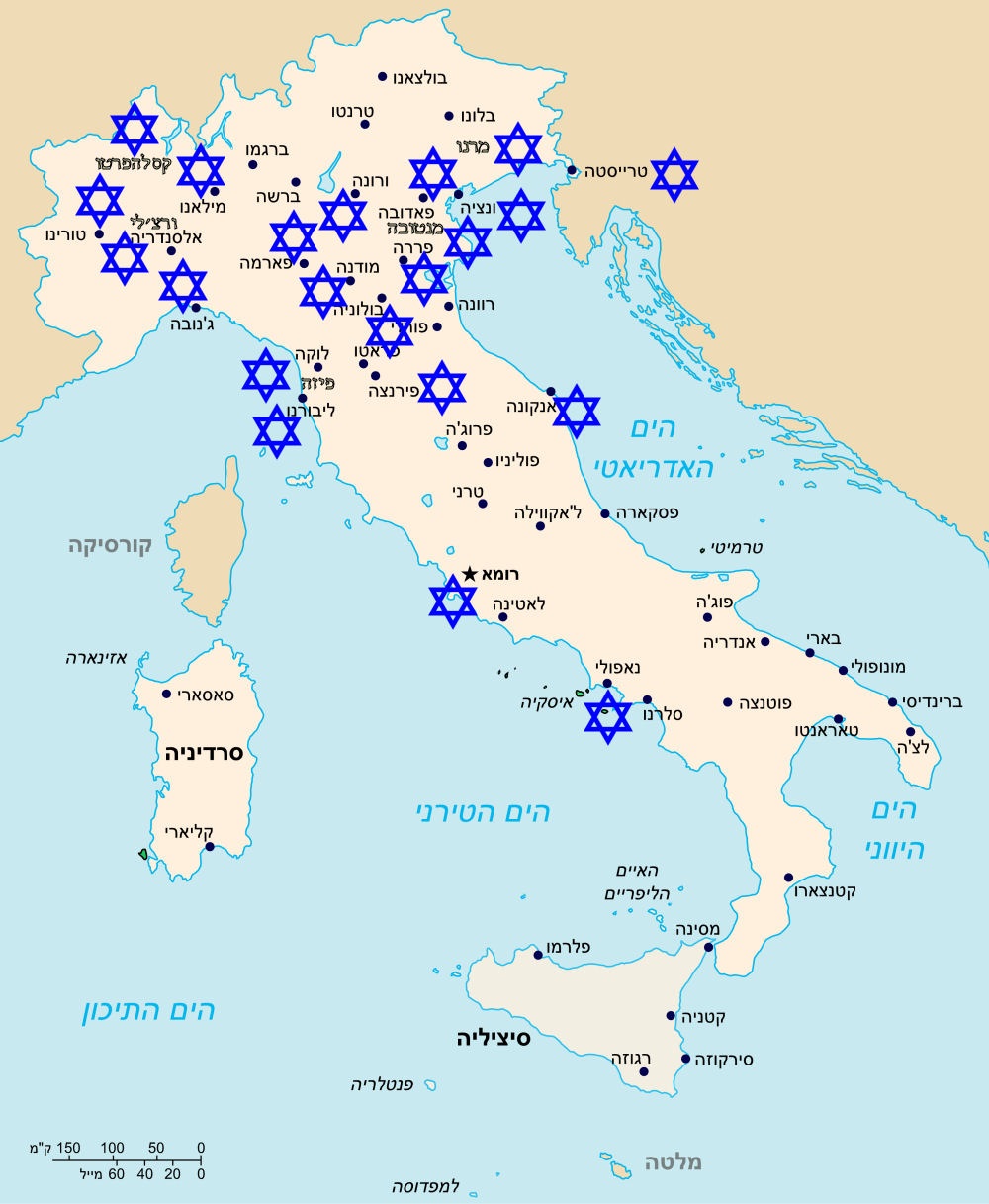
    imageThe Case of Italy,

    an intervention by John Champagne

    ~

    In several recent essays and articles on the relationship between Italian Jews in the diaspora and contemporary Israeli political and military actions toward the Palestinians, an interesting series of contradictions emerge. In some instances, critique of the military policies of the state of Israel is equated with antisemitism, even when that critique is proffered by Italian Jews. The argument, presented, for example, by Ugo Volli in his “Zionism: a Word that not Everyone Understands,” is that there is a connection between military and political attacks on Israel and what he terms a worldwide and constant economic and cultural campaign of de-legitimation and demonization of that state.1 Volli further contends that these two are directed not simply at Israelis, but at all Jews. “For this reason,” writes Volli, “there is no fundamental distinction between antizionism and antisemitism, between hate for Israel and for the Jews. All of this is well noted and not worth explaining here in greater detail.”2 This position dates from at least July of 1982, when, in response to critiques of the Israeli invasion of Lebanon voiced by Italian Jews in the diaspora, Jewish journalist Rosellina Balbi published in La Repubblica “Davide, discolpati!” an article defending Israel’s actions as defensive rather than offensive.3 In this article, Balbi equated antizionism with antisemitism by noting that any critique of the state of Israel has punctually provoked across Europe “tremors of anti-semitism.” Just a few months later, Italian war correspondent Oriana Fallaci suggested to an audience at Harvard that no one in the US will speak out against Israel because of “the contemporary fear of being blackmailed with the accusation of hating the Jews.”4

    A professor of Semiotics at the Università degli Studi di Torino and self-described political activist, Volli is also a journalist who has written for major Italian dailies as well as informazionecoretta.com, an Italian website whose stated goal is to guarantee that the public receives correct information on Israel.5 Antisemitism is a frequent theme in Volli’s work. Most recently, for example, he has argued that “history shows that antisemitism generates hatred of Israel, and not the inverse.”6 Such a position leads Volli to conclude that “the European Left” is antisemitic, as is “almost a third of the population” in Croatia, Belgium, and Spain.7

    Volli’s “Zionism” appeared in Shalom, the official monthly magazine of information and culture of the Comunità Ebraica di Roma.8 But who is the audience to which his article is directed? The word Comunità (with a capital C) is perhaps best translated as “Congregation.” It has a structure and a constitution.9 As the statutes of the Union of the Jewish Italian Communities (of which the Roman Comunità is a member) explain, in order to fully avail one’s-self of the resources of the Comunità, one must be an official member.10 The process is formalized via a declaration of one’s Jewishness.11 This declaration can be challenged, in which case, one can file an appeal.12 Under the advice of the rabbi, the consiglio or parliament – a body of twenty eight representatives elected directly by the members of the Comunità every four years – has the final say.13 Specific processes are also outlined for formally leaving the Comunità.14

    The history of the structure of the Italian Jewish Communities is a complex one. It encompasses a great span of time, including both Renaissance ghetto life, wherein Jews practicing different “rites” – not only the familiar Sephardic and Ashkenazi, but also the Italian, Sicilian, Levantine, and Catalan rites– were required to worship in a single synagogue. Another significant moment was Fascism, when all forms of religious worship were legally organized and regulated as part of the overall fascicization of Italian society.15 Royal Decree n.1731 of October 30, 1930, created the Union of Italian-Jewish Communities (Unione delle Comunità Israelitiche Italiane,) which represented Italian Judaism in its relations with the state.16

    The term “comunità,” however, can also refer to the English “community.” When one speaks of the Jewish “comunità,” therefore, one might be using the term in this looser sense. This might include, for example, non-religious Italian Jews, or out of town Jews attending the synagogue or other events presented by the Comunità’s museum and archive, or someone like Natalia Ginzburg – who, although ultimately converting to Catholicism, understood her Judaism as what one writer has called a “moral identity” – or even atheist Jews like the scientist Rita Levi-Montalcini.17 And while the Comunità is officially Orthodox, not all of its members keep kosher, for example, or wear the yarmulke outside of Temple.

    Writing in Shalom, Volli would appear to be addressing an audience composed of both the Comunità and the community, as well as non Jews. Many of the latter have contact with the Comunità via its museum in particular, which anticipates audiences from all over the world. Wall text and brochures, for example, are in Italian, Hebrew, and English, and both English and Italian tours of the two synagogues housed in the museum are provided daily. The tour guides inform the museum goers about the existence of Shalom, and copies of the magazine are available free.

    Noting in passing that, on the left, there are “numerous noted intellectuals of Jewish origin actively marshaled against the existence of Israel, from [Noam] Chomski to [Ilan] Pappé to Judith Butler,” as well as less aggressive (and, according to the author, therefore more insidious) organizations like J Street and its European counterpart, J Call, Volli ends his article by calling for a continuing defense of Zionism. He particularly cites for approbation critiques of Israel appearing recently in the official organs of the Italian Jewish press. In Volli’s eyes, to be Jewish is – or should be – to support the state of Israel. (While Volli claims only to be speaking against those who seek the dismantling of the state, in attacking J Street, an organization that explicitly calls for a two-state solution, he tips his hand.)

    However, the assumption that all Italian Jews are somehow representative of the state of Israel – a conclusion that would seem to follow logically from Volli’s argument – is also labeled antisemitism by other Jewish intellectuals working in the Italian academy today. For example, Marianna Scherini, doctor of research in Anthropology, History and Theory of Culture at the Università di Siena, begins her argument that, in their coverage of the 1982 war, both the Italian leftist press and the Italian daily newspapers offered converging, critical analyses of Israel, with a discussion of a new (post-war) antisemitism that is specifically anti-Israeli in its content.18 Due to the aforementioned war in Lebanon and the accompanying massacre of Palestinians in the refuge camps of Sabra and Shatila, 1982 was a particularly painful moment for the Italian Jewish community. Perpetrated by Christian Phalangists assisted by the Israel military, the massacre was publicly critiqued by some Italian Jewish intellectuals – most notably, Primo Levi – and followed in Rome by the bombing by terrorists of the Great Synagogue. (In fact, even prior to the massacre, the invasion had been condemned by Levi and several other intellectuals, including Franco Belgrado, Edith Bruck, Ugo Caffaz, Miriam Cohen, Natalia Ginzburg, David Meghnagi, and Luca Levi.)19

    The synagogue bombing resulted in the death of a child, Stefano Gay Tache. The killing took place on the holiday of of Shemini (also spelled Shmini) Atzeret (also spelled Azzeret), which the English version of the catalog of the Jewish Museum of Rome states is “a day when children receiving [sic] a public blessing.”20 Since the bombing, the Great Synagogue can only be visited via guided tours led by volunteers, who typically reference the attack. A B’nai B’rith Europe webpage repeats the claim that the attack took place when “a service of blessing for children was being held,” though it suggests that this attack “was perpetrated opposite the Grand Synagogue in Rome.”21 In fact, the blessing referenced occurs not on Shemini Atzeret but rather on the next day, Simchat Torah. In Israel, however, these holidays are celebrated on the same day. Regardless of this discrepancy, 1982 is sometimes cited as marking a definitive split between Italian Jews and the Italian left.22

    Scherini concludes her essay by arguing that both the Italian leftist press and the dailies tended to isolate Israeli actions from their political and historical context23 and to show no interest in the specific politics of the Palestinians,24 as well as to equate Israeli actions in Lebanon with the Shoah and suggest a transformation of Israeli Jews from victims to perpetrators of a contemporary persecution of the Palestinian people (196).25 She then explicitly links contemporary, post-war antisemitism with her contention that, “in the period under examination [1982] Israel constitutes a virtual ‘Jewish collective’ in the imagination of the Italian daily press.”26 According to the author, the treating of Israel as “the mirror through which to observe Italian Jews, and vice versa” and corollary homogenizing of all Jews is an instance of antisemitism.27

    A third position: some Italian Jewish intellectuals draw a relationship between contemporary antisemitism and the position, espoused by some Western intellectuals, that Israel represents the logical outcome, taken to its furthest point, of Western imperial expansion. This connection is suggested briefly by historian Guri Schwarz, who was a 2013-2014 Viterbi Visiting Professor at UCLA’s Center for Jewish Studies. Schwarz’s contention is that, in labeling Israel a kind of “worst case scenario,” Western antisemitism arises from a fear of the proximity of the self to the Other, a rejection of the Other in the self.28 That is, antisemitism arises from the fear that Jews are too similar to “the rest of us.” Schwarz’s argument unfortunately de-historicizes the trope, which appears to have arisen in the wake of the ’67 war . It found its condition of possibility in the linking of this war to then contemporary US imperial expansion in southeast Asia, as noted in Andrea Becherucci’s analysis of the coverage of the ’67 war in three left-wing Italian journals (119).29

    Beyond the fact that all three of these positions seem to foreclose, to varying degrees, any critique whatsoever of the military policies of the state of Israel, they also circumvent any discussion of the historical contradictions of a secular religious state. Clearly, the idea of a Jewish state is a product of the nineteenth century. It is historically linked to the “importation” to Europe, from the US and Latin America, of the model of the Enlightenment (secular) nation-state and overdetermined by (post-war) Cold War Western interests. This refusal to historicize Israel results in the particular double-bind that Israel on the one has the right to act as all other states – that is, to take both defensive and offensive action against perceived threats; this was the very argument debated in the diasporic community in 1982, with the invasion of Lebanon, perceived by some as Israel’s first offensive war30 – and that Israel is a “special case” – i.e., a state that, owing to the historical circumstances of its founding, is not subject to international law and the dictates of the UN, for example.

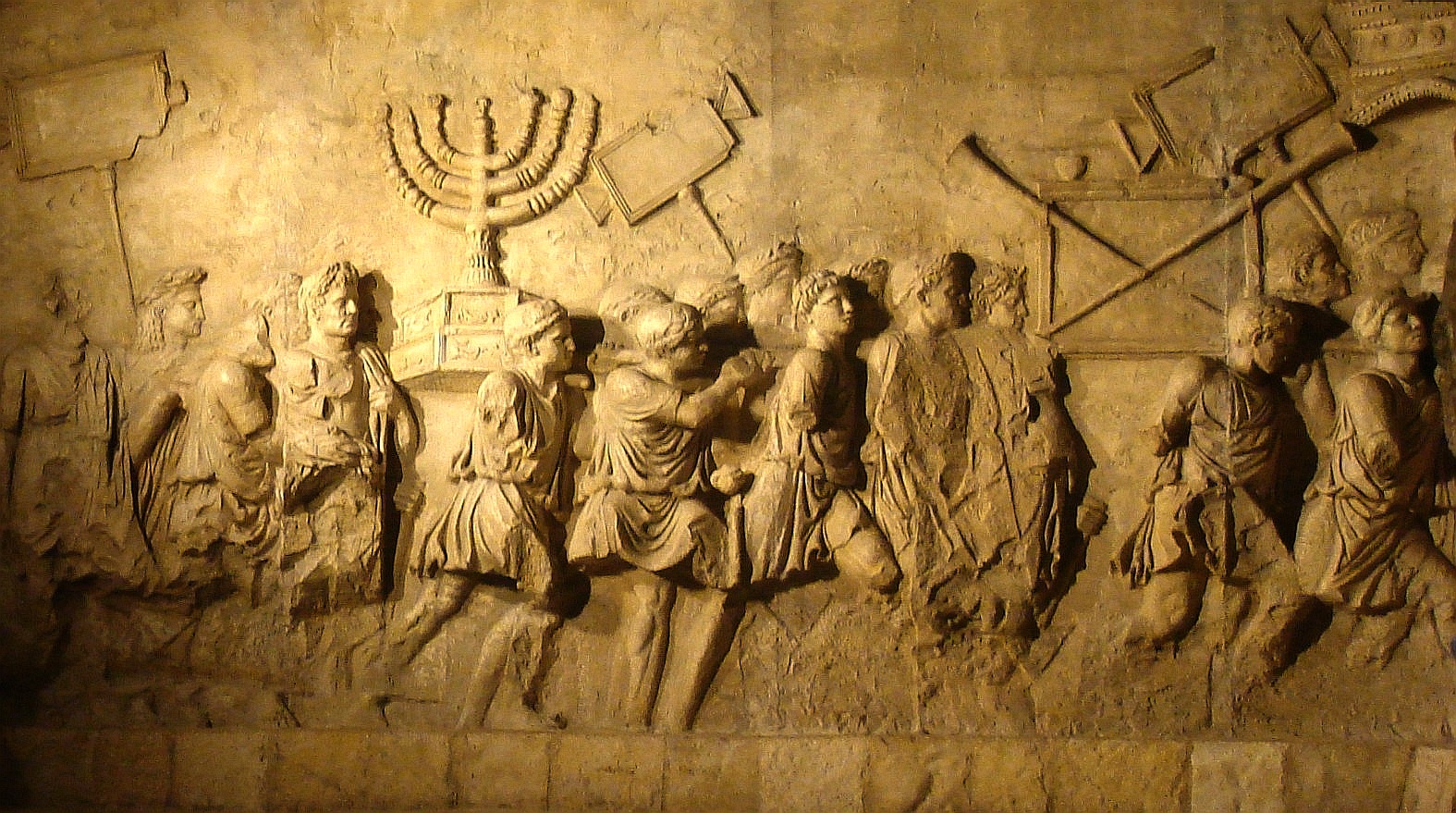
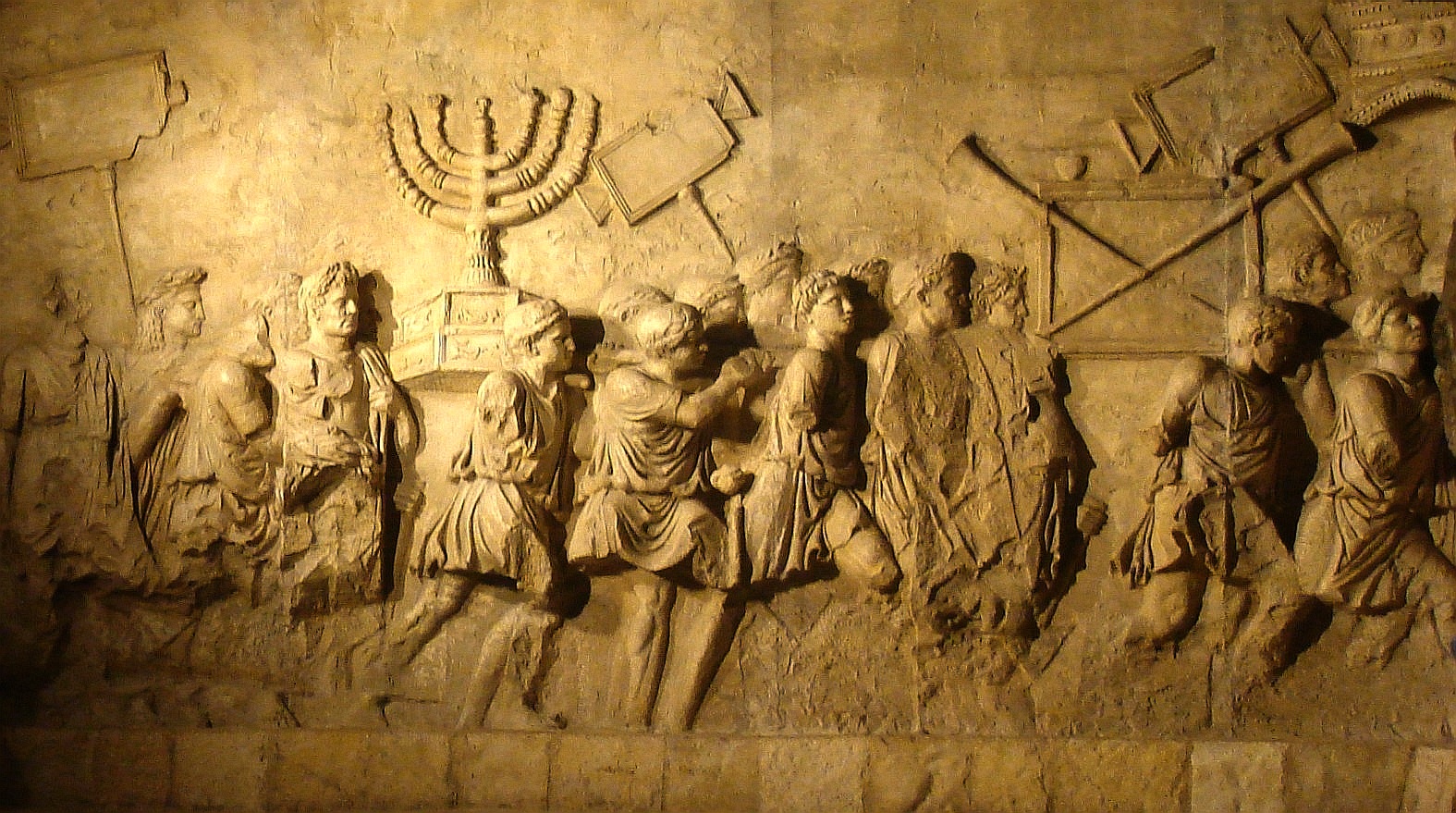
    As for the tension between the religious and the secular, an emblematic example is the insistence by some Italian Jews that the Jewish presence in Italy dates from 161BCE because the first book of Maccabees says so. (It may in fact date from earlier, as the Tunisian Jewish community dates itself, at least anecdotally, to the first diaspora, for example.) This in turn raises the question of how one writes the history of what is understood to be eternal – a problem that leads some scholars to argue that Jewish historiography finds its conditions of possibility in the Haskalah, nineteenth century Jewish Enlightenment (Yerushalmi). In Italy, the problem of how to write Jewish history is further complicated by the fact that the reform movement only recently came to Italy, and so the Roman Comunità is “officially” Orthodox.image31 This means that, in the Jewish Museum of Rome’s presentation of the history of the Jews, Biblical events for which there is little archaeological evidence are intermixed with such historically verifiable events as the destruction of the second Temple, commemorated in the Roman forum’s Arch of Titus.

    In drawing attention to the irresolvable tensions between the religious and the secular that necessarily inform the idea of a Jewish state, I am not suggesting, as Schwarz fears its antisemitic critics do, that Israel is “any worse” than the US in regard to ignoring the UN, for example. In fact, we know well that by virtue of its (declining) world hegemony, the US often chastises other states for breaking international law while itself flouting that law. I am suggesting, however, that, while no one would in all likelihood accuse US intellectuals who critique US foreign policy of being, say “racist,” the creation of a Jewish state has historically insured that any critique of that state will be equated in some quarters with antisemitism, even a critique produced by Jews, and that there seems to be a kind of willed refusal of some Italian Jewish intellectuals to work through this contradiction – a contradiction that finds one of its conditions of possibility in the modern “racialization” of Judaism that occurs via Nazi and Fascist antisemitism and its links to eugenics. Both Italian Fascism and Nazism deployed this antisemitism in an effort to invent national subjects, the Jew being the Other against which both Italian and German identities hoped to consolidate themselves and ward off their precarious histories.

    As its corollary, scholars who maintain that antizionism equals antisemitism must treat the latter itself as ahistorical – that is, as if there is no significant difference between pre-modern and modern forms of antisemitism. Rather than understand Italian Zionism as a kind of Foucauldian counter-discourse made possible by nineteenth century antisemitism and the antisemitic policies of Mussolini’s regime so well documented by Michele Sarfatti, Italian Jews who support unwaveringly the military policies of Israel today must construct their Comunità as always already Zionist.32 This, despite the fact that it is well known that many Jews who participated in the early years of post-Unification Italy were critical of Zionism and that, “before the Racial Laws of 1938, Italian Zionism was essentially the fruit of actions by a group of rabbis.”33

    A further corollary is that the term anti-zionism can refer both to a critique of the policies of the state of Israel and calls for its dismantling or even destruction. Volli himself argues that even at least one of those Italian Jewish authors he chastises admit (Volli’s word) that “for the great majority of Italian Jews, Israel remains an ideal and a patrimony to defend.” Interestingly, Volli uses patrimonio and not, for example stato,the former having connotations of both monetary and, more typically in Italian cultural discourse, connotations related to artistry, history, and heritage.

    Meanwhile, according to its own discourse about itself, at least as presented by its institutions such as the Jewish Museum of Rome, the cause of the shrinking of the Italian Jewish community is attributed not to any discontent with the Comunità’s refusal to critique Israeli military policies (and its insistent presentation of itself to the larger public as always having been supportive of Zionism) nor the lack in Rome of a thriving Italian Jewish reform movement but rather to mixed marriages. What the events of 1982 have produced is apparently an unhealable rift between the Italian left and the official representatives of the Italian Jewish Comunità.

    The problem of who exactly is an Italian Jew is further exacerbated by the fact that Italian Jews have lived their identities in ways far more complex than either of the crude terms “assimilation” or its opposite – autonomy? non-incorporation? – can signify. As long ago as 1985, Primo Levi “defended” himself from the charge, made in the US magazine Commentary, that he was assimilated, with the simple rejoinder, “I am. There does not exist in the Diaspora Jews who are not, to greater or lesser degrees: if only for the fact of speaking the language in which they live. I claim, for myself and for everyone, the right to choose the level of assimilation that is best suited to their culture and their surroundings.”34

    So, while, clearly, Italian Jews – both those who are official members of the Comunità and those who live their Judaism in a variety of different ways – hold varying opinions on the current military policies of the state of Israel, it is next to impossible to produce a critique of the state of Israel as a state without calling up the specter of antisemitism. That is, once a state is defined by Judaism, antisemitism is the necessary and irreducible outcome of any critique of Israel. As long as a critique of the very idea of the nation-state is part and parcel of leftist politics, and Israel continues to define itself as the (and not even a) Jewish state, critique of Israel will equal antisemitism, as least as it is defined by the aforementioned Italian Jewish intellectuals. These historical conditions create a particularly painful situation for those Italian Jews on the left, as they may feel as if they have no place in any Italian Jewish Comunità.

    Furthermore, once a Jewish state has been created in the lands formerly also inhabited by Palestinians, the only possible logical corollary is the formation of a Palestinian state. This, again, is irreducible; the logical outcome of the Palestinian diaspora is a Palestinian state. Thus the contradictory position of a global left that on the one hand engages in a critique of statehood and on the other argues for a Palestinian state. This is not hypocrisy or bad faith; it is a position overdetermined by history.

    These historical contradictions make it extremely difficult even to write of the relationship between Italian Jewry, Israel, and Zionism, and the historiographical problems of locating a post-war Jewish resistance to Zionism are substantial, since the keeper of the official records is the Comunità (which has an archive). Yet another problem bequeathed by Italian history: prior to the Shoah, Zionism was understood by many Italian Jews to be equivalent not to a call for Jewish statehood but rather philanthropic support for poor Jews in the Levant; even in the post-war years, the number of Italian Jews who immigrated to Israel was relatively minimal. Volli’s argument that Zionism is a word that not everyone understands is exactly (and not just figuratively) correct; for history has rendered it undecidable. The only way “out,” even provisionally, of this impasse, is further work on the history of Italian Judaism, and by parties who work scrupulously to make their interests as visible as they can. Unfortunately, an initial review of the debates in Italian Judaism around the events of 1982 reveals how little progress has been made on the issue of the rights of the Palestinian to self-determination – a phrase used by Levi and his co-signers in their response to the invasion of Lebanon.

    As Robert Esposito suggests, part of the problem with the term “community” is that it is almost always imagined as something that is possessed in common, something that can therefore be “lost” and re-found.35 Using an etymological approach, Esposito instead argues for a focus on the munus in community:

    the munus is the obligation that is contracted with respect to the other and that invites a suitable release from the obligation. The gratitude that demands new donations [italics in the original]. . . . It doesn’t by any means imply the stability of a possession and even less the acquisitive dynamic of something earned, but loss, subtraction, transfer.36

    Loss, subtraction, transfer – these are terms that have a very specific historical resonance to both Jews and Palestinians in the diaspora.37 While Israel’s current leaders are engaged in an extended grabbing of land – and, without a trace of irony, some members of the diasporic Libyan Jewish community in Rome protest that they have never been compensated for the land they were forced by Gaddafi to leave behind – Jewish memory keeps alive a tradition of hospitality to the stranger. Whether or not that tradition can survive the violence of nationalism is yet to be determined.

    _____

    John Champagne‘s research is in the area of Comparative Cultural Studies, with a focus on the representation of Gender and Sexuality in modernist film and literature. He currently teaches at Penn State Erie, the Behrend College, and as a Fulbright recipient, he spent the 2006–07 school year teaching American Studies in Tunisia at the University of La Manouba. He is the author of four books, including Aesthetic Modernism and Masculinity in Fascist Italy (London and NY: Routledge, 2013).

    _____

    notes:
    1. Volli, “Sionism: una parola che non tutti capiscono,” Shalom, June 2013: 18. Unless otherwise indicated, all translations are mine.
    Back to the essay

    2. Ibid
    Back to the essay

    3. Rosellina Balbi, “Davide, discolpati!” La Repubblica 7.135 (July 6, 1982): 20.
    Back to the essay

    4. Oriana Fallaci, “Scuola di politica,” Il mio cuore è più stanco della mia voce (Milano: Rizzoli, 2013), 82. Fallaci’s remarks were made at a conference at the Harvard Institute of Politics entitled “Politics and War” on September 23, 1982 – one week after the massacre of Sabra and Shatila, to which she referred in her talk several times. Earlier that year, Fallaci had traveled to Beirut to interview then Colonel Ariel Sharon. The interview was published in the September 6, 1982 issue of L’Europeo.
    Back to the essay

    5. “Chi siamo,” informazionecoretta.com, accessed May 19, 2014, http://www.informazionecorretta.com/main.php?sez=130.
    Back to the essay

    6. Ugo Volli, “Il potenziale del genocidio 19/05/2014,” informazionecoretta.com, accessed May 19, 2014, http://www.informazionecorretta.com/main.php?mediaId=&sez=280&id=53466
    Back to the essay

    7. Ibid. Volli is drawing his conclusions from the results of a global test of antisemitism developed by the Anti-Defamation League. On this test, see “About the Survey,” ADL Global 100, accessed May 19, 2014, http://global100.adl.org/about
    Back to the essay

    8. For the magazine’s website, see Shalom, Mensile Ebraico di Informazione e Cultura, accessed May 20, 2014. http://www.shalom.it
    Back to the essay

    9. “Consiglio della Communità Ebraica di Roma,” March 31, 1993, http://www.romaebraica.it/wp-content/uploads/2010/07/Regolamento-CER.pdf
    Back to the essay

    10. Art. 2.2, “Iscrizione alla Comunità,” Statuto dell’ Unione delle Comunità Ebraiche Italiane, accessed May 20, 2014, http://www.romaebraica.it/wp-content/uploads/2010/07/Statuto-UCEI1.pdf
    Back to the essay

    11. “formalizzata con esplicita dichiarazione o deriva da atti concludenti.” See Art.2.1, “Iscrizione.”
    Back to the essay

    12. Art.2.3, “Iscrizione.”
    Back to the essay

    13. On the structure of the Comunità, see “La C.E.R.” Comunità Ebraica di Roma, accessed May 20, 2014, http://www.romaebraica.it/cer-comunita-ebraica-roma/
    Back to the essay

    14. Art. 2.4, “Iscrizione.”
    Back to the essay

    15. “Italian” refers to those Jews who have historically inhabited the Italian peninsula since antiquity; a synagogue has been discovered, for example, at Ostia, Antica, thought to date from the reign of Claudius. On the synagogue, see Lee I. Levine, The Ancient Synagogue, The First Thousand Years (New Haven: Yale University Press, 2000.
    Back to the essay

    16. Guri Schwarz, After Mussolini, Jewish Life and Jewish Memories in Post-Fascist Italy, trans. Giovanni Noor Mazhar (London Vallentine Mitchell, 2012), 21. The association survived the postwar period, lasting until 1987; ibid., 22. Its name was changed to the present Unione delle Comunità Ebraiche Italiane in 1989.
    Back to the essay

    17. On Ginzburg, see Nadia Castronuovo, Natalia Ginzburg, Jewishness as Moral Identity (Leicester: Troubador, 2010).
    Back to the essay

    18. Marianna Scherini, “L’imagine di Israele nella stampa quotidiana Italiana: la guerra del Libano (septembre 1982), ” “Roma e Gerusalemme,” Israele nella vita politica e culturale italiana, Marcell Simoni e Arutro Marzano, eds, (Genova: ECIG, 2010), 177-99.
    Back to the essay

    19. Franco Belgrado, Edith Bruck, Ugo Caffaz, Miriam Cohen, Natalia Ginzburg, Primo Levi, David Meghnagi, and Luca Zevi, “Perché Israele si ritiri,” La Repubblica 7.123 (June 16, 1982): 10. The letter argued, “The destiny of the Israelian democracy rests in fact inseparably tied to the prospect of peace with the Palestinian people and reciprocal recognition.” Also, contra Volli, the letter fears that the invasion will in fact give rise to “a new antisemitism.”
    Back to the essay

    20. Di Castro, Daniela, Treasures of the Jewish Museum of Rome, (Rome: Araldo De Luca, 2010.), 19.
    Back to the essay

    21. B’nai B’rith Europe, “The Stefano Gay Tache Lodge in Rome,” accessed April 20, 2014, .
    Back to the essay

    22. Matteo Di Figlia, Israele e la Sinistra (Roma: Donzelli 2012) 121.
    Back to the essay

    23. Scherini, “L’imagine,” 195.
    Back to the essay

    24. Ibid., 195-96. Contra Scherini, both Levi and Fallaci were critical of Yasar Arafat, for example. See Primo Levi, “Chi ha coraggio a Gerusalemme?” Opere, 1171-72, reprinted from La Stampa, 24 June 1982, and Fallaci, “Scuola,” 78.
    Back to the essay

    25. Scherini, “L’imagine,” 196.
    Back to the essay

    26. Ibid., 197.
    Back to the essay

    27. Ibid.
    Back to the essay

    28. See the concluding chapter of Schwarz, After Mussolini.
    Back to the essay

    29. Andrea Becherucci, “Vicere la guerra e perdere la pace. Israele e la guerra dei Sei Giorni in tre riviste della sinistra Italiana: “Il Ponte,” “L’Astrolabio,” e “Rinascita,” “Roma e Gerusalemme,” Israele, 119.
    Back to the essay

    30. In the wake of years of international protest against the US war in Vietnam, Balbi disingenuously asked, in July of 1982, “Why is it only Israel that is judged by criteria not applied to other States? Why this visceral prejudice?” Balbi, “Davide,” 20. While the war in Vietnam might have been far from Balbi’s memory, this was not the case for some of her fellow Italians who analogized the invasion of Lebanon to Vietnam; see, for example, Fallaci, “Scuola,” 73, in which the writer compared the bombing of Lebanon (which occurred prior to the massacre at Sabra and Shatila) to Vietnam and Hué.
    Back to the essay

    31. Associated with The World Union for Progressive Judaism, reform congregations currently exist in Florence and Milan (where there are two). For links to the websites of these communities, see “The World Union for Progressive Judaism, Worldwide Congregations, Europe,” accessed May 19, 2014, http://wupj.org/Congregations/Europe.asp. Lev Chadash of Milan, the first reform congregation, dates from 2001. http://lnx.levchadash.info/index.php?option=com_content&task=view&id=10&Itemid=13; Volli was for a period of time its president. Rome maintains a Beth Hillel group for Jewish Pluralism.
    Back to the essay

    32. Michele Sarfatti, The Jews in Mussolini’s Italy: from Equality to Persecution (Madison: University of Wisconsin Press, 2006). On Jewish life during the fascist period, see also Alexander Stille, Benevolence and Betrayal, Five Italian Jewish Families Under Fascism (New York, NY: Picador, 2003).
    Back to the essay

    33. Dan Segre, “Ebrei Italiani in Israele,” in Identità e Storia degli Ebrei, ed. David Bidussa, Enrica Collettti Pischel, and Rafaella Scardi (Milano: Franco Angelli, 2000): 190.
    Back to the essay

    34. Primo Levi, “Gli Ebrei Italiani,” in Opere, Vol 2., ed. Marco Belpoliti (Turin: Einaudi, 1997), 1293.
    Back to the essay

    35. Roberto Esposito, Comunitas, the Origin and Destiny of Community, trans. Timothy Campbell (Stanford: Stanford University Press, 2010). For an excellent, brief introduction to Esposito’s ideas, see Alexander D. Barder, review of Roberto Esposito, Communitas, Philosophy in Review 31, no. 1 (2011): 29-32.
    Back to the essay

    36. Ibid., 5.
    Back to the essay

    37. On the 27th of June, 1982, Levi was interviewed by Alberto Stabile of La Repubblica. While resisting the positing of an analogy between Hitler’s “Final Solution” and “the quite violent and quite terrible things that the Israelis are doing today,” Levi nevertheless argued, “A recent Palestinian diaspora exists that has something in common with the diaspora of two thousand years ago.” Cited in Domenica Scarpa and Irene Soave, “A 25 anni della scomparsa, Le vere parole di Levi,” Il Sole 24 Ore, April 8, 2012, http://80.241.231.25/ucei/PDF/2012/2012-04-08/2012040821380709.pdf. The authors, however, get the date of the interview wrong, writing that it occurred on June 28.
    Back to the essay

  • Literature and Politics

    Literature and Politics

    Henry Veggian establishes Literature & Politics review:

    imageWhat intellectual traditions, political movements, writers and critics shape our understanding of the relationships between literature and politics in the United States? By what means do we identify such things, and to what ends? And how do these questions and others invite us to consider emergent configurations of critical thought? What possible futures might they suggest?

    The Literature & Politics section of The b2 Review solicits and invites original book reviews from interested contributors. We ask reviewers to evaluate critical works that consider how literary writers and writings engage forms of political thought, philosophy, history and action, as well as to evaluate figures, studies and traditions concerned with the dynamics between politics and the literary arts.

    We ask for reviews of an intermediate length but word count is not as important as style; we ask that you write reviews for the specialist as well as for the interested reader. Reviews will appear on the boundary 2 website.

    Please contact boundary 2 for further inquiry.

    –Henry Veggian

  • Feminist Emancipation and Performance in Russia

    Feminist Emancipation and Performance in Russia

    Pussy Riot Meets Judith Butler and Rosi Braidotti

    ~

    Organized and published by The First Supper Symposium: “creating spaces for female voices in the art world.”

    Previous: Performing Philosophy: Masha Gessen’s Words Will Break Cement (The Passion of Pussy Riot).

  • The People’s Platform by Astra Taylor

    The People’s Platform by Astra Taylor

    image

    Or is it? : Astra Taylor’s The People’s Platform

    Review by Zachary Loeb

    ~

    Imagine not using the Internet for twenty-four hours.

    Really: no Internet from dawn to dawn.

    Take a moment to think through the wide range of devices you would have to turn off and services you would have to avoid to succeed in such a challenge. While a single day without going online may not represent too outlandish an ordeal such an endeavor would still require some social and economic gymnastics. From the way we communicate with friends to the way we order food to the way we turn in assignments for school or complete tasks in our jobs – our lives have become thoroughly entangled with the Internet. Whether its power and control are overt or subtle the Internet has come to wield an impressive amount of influence over our lives.

    All of which should serve to raise a discomforting question – so, who is in control of the Internet? Is the Internet a fantastically democratic space that puts the power back in the hands of people? Is the Internet a sly mechanism for vesting more power in the hands of the already powerful, whilst distracting people with a steady stream of kitschy content and discounted consumerism? Or, is the Internet a space relying on levels of oft-unseen material infrastructures with a range of positive and negative potentialities? These are the questions that Astra Taylor attempts to untangle in her book The People’s Platform: Taking Back Power and Culture in the Digital Age (Metropolitan Books, 2014). It is the rare example of a book where the title itself forms a thesis statement of sorts: the Internet was and can be a platform for the people but this potential has been perverted, and thus there needs to be a “taking back” of power (and culture).

    At the outset Taylor locates her critique in the space between the fawning of the “techno-optimists” and the grousing of the “techno-skeptics.” Far from trying to assume a “neutral” stance, Taylor couches her discussion of the “techno” by stepping back to consider the social, political, and economic forces that shape the “techno” reality that inspires optimism and skepticism. Taylor, therefore, does not build her argument upon a discussion of the Internet as such but builds her argument around a discussion of the Internet as it is and as it could be. Unfortunately the “as it currently is” of this “new media” evinces that: “Corporate power and the quest for profit are as fundamental to new media as old.” (8)

    Thus Taylor sets up the conundrum of the Internet – it is at once a media platform with a great deal of democratic potential, and yet this potential has been continually appropriated for bureaucratic, technocratic, and indeed plutocratic purposes.

    Over the course of The People’s Platform Taylor moves from one aspect of the Internet (and its related material infrastructures) to another – touching upon a range of issues from the Internet’s history, to copyright and the way it has undermined “cultural creators” ability to earn a living, the way the Internet persuades and controls, across the issues of journalism and e-waste, to the ways in which the Internet can replicate the misogyny and racism of the offline world.

    With her background as a documentary filmmaker (she directed the film The Examined Life [which is excellent]) Taylor is skilled in cutting deftly from one topic to the next, though this particular experience also gives her cause to dwell at length upon the matter of how culture is created and supported in the digital age. Indeed as a maker of independent films Taylor is particularly attuned to the challenges of making culturally valuable content in a time when free copies spread rapidly on-line. Here too Taylor demonstrates the link to larger economic forces – there are still highly successful “stars” and occasional stories of “from nowhere” success, but the result is largely that those attempting to eke out a nominal subsistence find it increasingly challenging to do so.

    As the Internet becomes the principle means of dissemination of material “cultural creators” find themselves bound to a system wherein the ultimate remuneration rarely accrues back to them. Likewise the rash of profit-driven mergers and shifting revenue streams has resulted in a steady erosion of the journalistic field. It is not – as Taylor argues – that there is a lack of committed “cultural creators” and journalists working today, it is that they are finding it increasingly difficult to sustain their efforts. The Internet, as Taylor describes it, is certainly making many people enormously wealthy but those made wealthy are more likely to be platform owners (think Google or Facebook) than those who fill those platforms with the informational content that makes them valuable.

    Though the Internet may have its roots in massive public investment and though the value of the Internet is a result of the labor of Internet users (example: Facebook makes money by selling advertisements based on the work you put it in on your profile), the Internet as it is now is often less of an alternative to society than it is a replication. The biases of the offline world are replicated in the digital realm, as Taylor puts it:

    “While the Internet offers marginalized groups powerful and potentially world-changing opportunities to meet and act together, new technologies also magnify inequality, reinforcing elements of the old order. Networks do not eradicate power: they distribute it in different ways, shuffling hierarchies and producing new mechanisms of exclusion.” (108)

    Thus, the Internet – often under the guise of promoting anonymity – can be a site for an explosion of misogyny, racism, classism, and an elitism blossoming from a “more-technologically-skilled-than-thou” position. There are certainly many “marginalized groups” and individuals trying to use the Internet to battle their historical silencing, but for every social justice minded video there is a comment section seething with the grunts of trolls. Meanwhile behind this all stand the same wealthy corporate interests that enjoyed privileged positions before the rise of the Internet. These corporate forces can wield the power they gain from the Internet to steer and persuade Internet users in such a way that the “curated experience” of the Internet is increasingly another way of saying, “what a major corporation thinks you (should) want.”

    image

    Breaking through the ethereal airs of the Internet, Taylor also grounds her argument in the material realities of the digital realm. While it is true that more and more people are increasingly online, Taylor emphasizes that there are still many without access and that the high-speed access enjoyed by some is not had by one and all. Furthermore, all of this access, all of these fanciful devices, all of these democratic dreams are reliant upon a physical infrastructure shot through with dangerous mining conditions, wretched laboring facilities, and toxic dumps where discarded devices eventually go to decay. Those who are able to enjoy the Internet as a positive feature in their day to day life are rarely the same people who worked in the mines, the assembly plants, or who will have to live on the land that has been blighted by e-waste.

    While Taylor refuses to ignore the many downsides associated with the Internet age she remains fixed on its positive potential. The book concludes without offering a simplistic list of solutions but nevertheless ends with a sense that those who care about the Internet’s non-corporate potential need to work to build a “sustainable digital future” (183). Though there are certainly powerful interests profiting from the current state of the Internet the fact remains that (in a historical sense) the Internet is rather young, and there is still time to challenge the shape it is taking. Considering what needs to be done, Taylor notes: “The solutions we need require collective, political action.” (218)

    It is a suggestion that carries a sentiment that people can band together to reassert control over the online commons that are steadily being enclosed by corporate interests. By considering the Internet as a public utility (a point being discussed at the moment in regards to Net Neutrality) and by focusing on democratic values instead of financial values – it may be possible for people to reverse (or at least slow) the corporate wave which is washing over the Internet.

    After all, the Internet is the result of massive public investment, why is it that it has been delivered into corporate hands? Ultimately, Taylor concludes (in a chapter titled “In Defense of the Commons: A Manifesto for Sustainable Culture”) that if people want the Internet to be a “people’s platform” that they will have to organize and fight for it (“collective, political”). In a time when the Internet is an important feature of society, it makes a difference if the Internet is an open “people’s platform” or a highly (if subtly) controlled corporate theme park. “The People’s Platform” requires people who care to raise their voices…such as the people who have read Astra Taylor’s book, perhaps.

    * * * * *

    With The People’s Platform Astra Taylor has made an effective and interesting contribution to the discussion around the nature of the Internet and its future. By emphasizing a political and economic critique she is able to pull the Internet away from a utopian fantasy in order to analyze it in terms of the competing forces that have shaped (and continue to shape) it. The perspective that Taylor brings, as a documentary filmmaker, allows her to drop the journalistic façade of objectivity in order to genuinely and forcefully engage with issues pertaining to the compensation of cultural creators in the age of digital dissemination. Whilst the sections that Taylor writes on the level of misogyny one encounters online and the section on e-waste make this book particularly noteworthy. Though each chapter of The People’s Platform could likely be extended into an entire book, it is in their interconnections that Taylor is able to demonstrate the layers of interconnected issues that are making such a mess of the Internet today. For the problem facing the online realm is not just corporate control – it is a slew of issues that need to be recognized in total (and in their interconnected nature) if any type of response is to be mounted.

    Though The People’s Platform is ostensibly about a conflict regarding the future of the Internet, the book is itself a site of conflicting sentiments. Though Taylor – at the outset – aims to avoid aligning herself with the “cheerleaders of progress” or “the prophets of doom” (4) the book that emerges is one that is in the stands of the “cheerleaders of progress” (even if with slight misgivings about being in those stands). The book’s title suggests that even with all of the problems associated with the Internet it still represents something promising, something worth fighting to “take back.” It is a point that is particularly troublesome to consider after Taylor’s description of labor conditions and e-waste. For one of the main questions that emerges towards the end of Taylor’s book – though it is not one she directly poses – makes problematic the book’s title, that question being: which “people” are being described in “the people’s platform?”

    image

    It may be tempting to answer such a question with a simplistic “well, all of the people” yet such a response is inadequate in light of the way that Taylor’s book clearly discusses the layers of control and dominance one finds surrounding the Internet. Can the Internet be “the people’s platform” for writers, journalists, documentary filmmakers, and activists with access to digital tools? Sure. But what of those described in the e-waste chapter – people living in oppressive conditions and toiling in factories where building digital devices puts them at risk of cancer or disassembling such devices poisons them and their families? Those people count as well, but those upon whom “the people’s platform” is built seem to be crushed beneath it, not able to get on top of it – to stand on “the people’s platform” is to stand on the hunched shoulders of others. It is true that Taylor takes this into account in emphasizing that something needs to be done to recognize and rectify this matter – but insofar as the material tools “the people” use to reach the Internet are built upon the repression and oppression of other people, it sours the very notion of the Internet as “the people’s platform.”

    This in turn raises another question: what would a genuine “people’s platform” look like? In the conclusion to the book Taylor attempts to answer this question by arguing for political action and increased democratic control over the Internet; however, one can easily imagine classifying the Internet as a “public utility” without doing anything to change the laboring conditions of those who build devices. Indeed, the darkly amusing element of The People’s Platform is that Taylor answers this question brilliantly on the second page of her book and then spends the following two hundred and thirty pages ignoring this answer.

    Taylor begins The People’s Platform with an anecdote about her youth in the pre-Internet (or pre-high speed Internet) era, wherein she recalls working on a small personally assembled magazine (a “zine”) which she would then have printed and distribute to friends and a variety of local shops. Looking back upon her time making zines, Taylor writes:
    “Today any kid with a smartphone and a message has the potential to reach more people with the push of a button that I did during two years of self-publishing.” (2)

    These lines from Taylor come only a sentence after she considers how her access to easy photocopying (for her zine) made it easier for her than it had been for earlier would-be publishers. Indeed, Taylor recalls:

    “a veteran political organizer told me how he and his friends had to sell blood in order to raise the funds to buy a mimeograph machine so they could make a newsletter in the early sixties.” (2)

    There are a few subtle moments in the above lines (from the second page of Taylor’s book) that say far more about a “people’s platform” than they let on. It is true that a smartphone gives a person “the potential to reach more people” but as the rest of Taylor’s book makes clear – it is not necessarily the case that people really do “reach more people” online. There are certainly wild success stories, but for “any kid” their reach with their smartphone may not be much greater than the number of people reachable with a photocopied zine. Furthermore, the zine audience might have been more engaged and receptive than the idle scanner of Tweets or Facebook updates – the smartphone may deliver more potential but actually achieve less.

    Nevertheless, the key aspects is Taylor’s comment about the “veteran political organizer” – this organizer (“and his friends”) were able to “buy a mimeograph machine so they could make a newsletter.” Is this different from buying a laptop computer, Internet access, and a domain name? Actually? Yes. Yes, it is. For once those newsletter makers bought the mimeograph machine they were in control of it – they did not need to worry about its Terms of Service changing, about pop-up advertisements, about their movements being tracked through the device, about the NSA having installed a convenient backdoor – and frankly there’s a good chance that the mimeograph machine they purchased had a much longer life than any laptop they would purchase today. Again – they bought and were able to control the means for disseminating their message, one cannot truly buy all of the means necessary for disseminating an online message (when one includes cable, ISP providers, etc…).

    The case of the mimeograph machine and the Internet is the question of what types of technologies represent genuine people’s platforms and which result in potential “people’s platforms” (note the quotation marks)? This is not to say that mimeograph machines are perfect (after all somebody did build that machine) but when considering technology in a democratic sense it is important to puzzle over whether or not (to borrow Lewis Mumford’s terminology) the tool itself is “authoritarian” or “democratic.” The way the Internet appears in Taylor’s book – with its massive infrastructure, propensity for centralized control, material reality built upon toxic materials – should at the very least make one question to what extent the Internet is genuinely a democratic “people’s” tool. Or, whether or not it is simply such a tool for those who are able to enjoy the bulk of the benefits and a minimum of the downsides. Taylor clearly does not want to be accused of being a “prophet of doom” – or of being a prophet for profit – but the sad result is that she jumps over the genuine people’s platform she describes on the second page in favor of building an argument for a platform that, by book’s end, seems to hardly be one for “the people” in any but a narrow sense of “the people.”

    The People’s Platform: Taking Back Power and Culture in the Digital Age is a well written, solidly researched, and effectively argued book that raises many valuable questions. The book offers no simplistic panaceas but instead forces the reader to think through the issues – oftentimes by forcing them to confront uncomfortable facts about digital technologies (such as e-waste). As Taylor uncovers and discusses issue after bias after challenge regarding the Internet the question that haunts her text is whether or not the platform she is describing – the Internet – is really worthy of being called “The People’s Platform”? If so, to which “people” does this apply?

    The People’s Platform is well worth reading – but it is not the end of the conversation. It is the beginning of the conversation.

    And it is a conversation that is desperately needed.

    __

    The People’s Platform: Taking Back Power and Culture in the Digital Age
    by Astra Taylor
    Metropolitan Books, 2014

    __

    Zachary Loeb is a writer, activist, librarian, and terrible accordion player. He earned his MSIS from the University of Texas at Austin, and is currently working towards an MA in the Media, Culture, and Communications department at NYU. His research areas include media refusal and resistance to technology, ethical implications of technology, alternative forms of technology, and libraries as models of resistance. Using the moniker “The Luddbrarian” Loeb writes at the blog librarianshipwreck, which is where this review originally appeared.

  • Exploring New Boundaries in Gender and Sexuality Studies

    Exploring New Boundaries in Gender and Sexuality Studies

    Petra Dierkes-Thrun commits The b2 Review to a focus on Gender & Sexuality:

    image

    It is with great pleasure that I have agreed to join the collective as an advisory editor to launch a new online initiative for Gender and Sexuality Studies for The b2 Review. While boundary 2 has a longstanding interest in the best scholarly work of any kind, it is both fitting and necessary that gender and sexuality become a more obvious area of interest for the journal’s intellectual inquiry. The new Gender and Sexuality section aims to provide a flexible and mobile platform for the discussion of important new work both in feminist and LGBTQ studies. We will publish brief essays on current trends or events, interviews, and reviews of interesting books and other projects (including digital ones), keeping in mind boundary 2’s commitment to identifying and pinpointing important contemporary intellectual, conceptual and performative topics and trends that affect society at large.

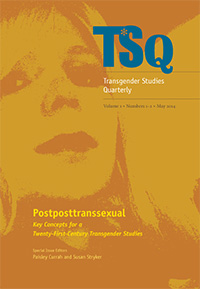
    Our first project, a collage in memory and tribute to the late queer, critical race, and performance studies scholar José Esteban Muñoz, was already published in March. This month, we offer Alice E. Underwood’s book review of Masha Gessen’s journalistic work on the Russian feminist punk rock collective Pussy Riot, whose famous trial and incarceration highlighted troublesome trends and anti-feminist attitudes in Putin’s contemporary Russia. Upcoming projects include an interview with professor and activist Susan Stryker concerning recent trends in transgender studies at the University of Arizona and in academia in general, as well as the historical and conceptual relationship between trans theory and queer theory. Further future topics for our Gender and Sexuality section will include the recent networked digital turn in the academic research and teaching of feminist, gender and sexuality, including their intersections with critical race and postcolonial studies, as well as digital pedagogy.

    As more new topics and ideas start influencing the journal’s scope and focus, we embrace a wide variety of topics, theoretical approaches, ideas and interests, and warmly welcome readers’ suggestions. Contact boundary 2 with inquiries.

    -Petra Dierkes-Thrun

  • Words Will Break Cement: The Passion of Pussy Riot by Masha Gessen

    Words Will Break Cement: The Passion of Pussy Riot by Masha Gessen

    image

    Performing Philosophy: Masha Gessen’s Words Will Break Cement

    Review by Alice E.M. Underwood

    ~

    As an established voice speaking against Putin’s increasingly authoritarian actions, Russian journalist Masha Gessen emphasizes in her new book Words Will Break Cement: The Passion of Pussy Riot the ideological tension between culture and politics in the president’s attempt to reestablish Russia’s global power status. The book offers a biographical portrait of Nadya Tolokonnikova, Ekaterina Samusevich, and Maria Alyokhina, the three Pussy Riot members whose faces were hidden behind neon balaclavas during their punk performance in Moscow’s Cathedral of Christ the Savior, and who became familiar to the world during their subsequent trial. Gessen’s book was published at a turning point in Russia’s behavior on the world stage: weeks after Putin’s pardon of the two imprisoned Pussy Riot members, immediately prior to the Sochi Olympics, and against the backdrop of escalating tensions in Ukraine. Given Gessen’s record of critiquing Putinist repression of civil society, particularly surrounding questions of gender and sexuality, the book adds to the conversation on resistance to authoritarian regimes. Words Will Break Cement will likely appeal to a mixed audience: general readers curious about the formation and motivations of this guerrilla-style punk rock art collective, as well as scholars interested in unmasking the theory underlying Pussy Riot’s attempts to deconstruct both epistemological and political systems of power.

    While the structure of Gessen’s portrait would benefit from tighter organization, her work is thorough in illustrating the philosophical development and political motives that brought the group together, and in explaining why those ideals got them arrested. The book is comprised of three sections: “Becoming Pussy Riot,” which pictures the lives of Pussy Riot’s three most prominent members prior to their emergence on the international stage; “Prayer and Response,” describing their infamous action in the Cathedral of Christ the Savior and its aftermath; and “Punishment,” which covers their post-trial lives. Each section interrogates the role of art and ideas in producing social change, and Gessen often cites her subjects citing theory. While her thesis regarding the intellectual foundation of Pussy Riot’s message might benefit from her own deeper engagement with the works that shape the punk rockers’ philosophy, she covers the impressive expanse of Pussy Riot’s library, which encompasses the Russian canon, queer theory, German existentialism, biblical scholarship, Soviet dissidence, and Moscow Conceptualism.

    image

    The frequency of Gessen’s references to these diverse intellectual camps demonstrates the significance she attributes to their role in Pussy Riot’s artistic philosophy. Meditations on the search for truth in face of a political system founded on hypocrisy and lies abound in the court statements, personal correspondences, and conversations among Pussy Riot members that Gessen reports. Their engagement of classical and contemporary philosophy contrasts the inflexible worldview characterizing the discourse of political realism and nationalism Putin uses to bolster Russia’s Great Power status. This “language of lies,” as Gessen puts it, has discredited “the language of confrontation itself” (35). Her corollary to this—“There were no words left”—suggests that donning bright balaclavas and dresses and screaming punk rock lyrics is the next step from such politically imposed aphasia.

    Though not treating them extensively, Gessen finds in the traditions of dissidence and Conceptualism useful analogues for artistic movements that entail the disturbance of dominant epistemologies through aesthetic or performative practices, a key notion underlying Pussy Riot’s motives. The book’s first part, “Becoming Pussy Riot,” describes how Nadya Tolokonnikova, as a disenchanted philosophy student at Moscow State University, found meaning in Conceptualist art’s methods of “confronting the lie” (35) of public rhetoric. She joined the performance art collective Voina (War), which targeted consumerism and political corruption through performances in public spaces, and there encountered Kat, a computer programmer-turned-photographer. The two collaborated on several Voina actions, but soon became disenchanted with the misogynist tone taken in some of the group’s political performances (a conflict Gessen does not go into) and split to form their own group. There they were joined by Maria, an environmental activist studying at the Institute of Journalism and Literature, whose statement “We are forever serving life rather than living life” (qtd. 82) highlights the complacency—even complicity—within Russian society that the three united to combat.

    Gessen’s account of Pussy Riot’s development and early actions demonstrates the importance of ethics and the quest for self-education that propelled each of the group’s members toward opposition through art, and ultimately toward each other. The background on these three—with an occasional mention of participants deemed more peripheral—gains critical dimension through Gessen’s focus on their goal of staging actions that would make political statements, but with such outlandish aesthetics that even the mainstream opposition movement wouldn’t know what to think.

    This method was best—and most famously—exemplified by Pussy Riot’s Cathedral action, which targeted the collusion of Church and State and the superficiality of piety characterizing post-Soviet Russia. The site of their action, the Cathedral of Christ the Savior, was demolished during the Soviet period; since Yeltsin rebuilt it in the 1990s—one of his most popular moves, despite the tremendous cost at a time of economic depression—it has symbolized the renewed preeminence of Russian Orthodoxy. It has also become a site for politicians to perform piety and church dignitaries to benefit from ill-gotten political gains, however. Gessen is careful to justify Pussy Riot’s actions just as the group did: their aim was not to desecrate the church, but to show how it is “already being desecrated” (113) by the corruption of religious and political leaders.

    Pussy Riot in Christ the Saviour Cathedral. Photography by Mitya Aleshkovsky
    Pussy Riot in Christ the Saviour Cathedral. Photography by Mitya Aleshkovsky

    Gessen builds suspense toward the infamous action in the Cathedral and Nadya, Kat, and Maria’s frantic work to produce the video clip of the performance that same evening. Her account of their collaboration, the initial media storm, and their subsequent experience of going into hiding provides behind-the-scenes insight about the group’s shifting dynamic as the three were propelled onto the world stage. Despite Gessen’s suspenseful account of the events leading to their arrest, it is curious that an argument whose focus is the art and words of Pussy Riot does not spend more time explaining the thinking behind the song that led to their incarceration. “Punk Prayer”’s paradoxical blend of punk rock and hymn is as jarring stylistically as lyrically. Of Pussy Riot’s songs, it is unique in highlighting the state’s violence and corruption without making an explicit call to action—with the exception of the direct pleas to Virgin Mary, Mother of God, to “chase Putin out” and to “become a feminist”—while other songs contain such provocative commands as “Kill the sexist,” “Fuck the leaders,” or at least, “Occupy the square, make the takeover peaceful.” One wonders why Gessen does not provide a closer reading of “Punk Prayer,” whose lyrics reveal careful composition emphasizing the Patriarch’s collusion with Putin as well as the human rights violations practiced by the regime and supported by the Church.

    In the section about Pussy Riot’s trial—the book’s strongest part—Gessen compellingly stresses the surreal nature of the legislative process in post-Soviet Russia. Based on the charge of “hooliganism motivated by religious hatred,” the prosecution focused their case on Pussy Riot’s disrespect to the Russian Orthodox religion and consistently dodged the defendants’ attempts to explain their political motives. Gessen, who attended the trial, repeatedly likens the event to a poorly staged performance and to the show trials of dissidents under the Soviet regime. She portrays such political trials as following two typical trajectories: defendants attempt to fight for justice despite their awareness of the complete lack of due process, or they treat the trial as a farce and attempt to uncover its corrupt practices while making their own political point. Pussy Riot’s lawyers’ tactic of drawing attention to the trial’s legislative failings ended up “exacerbating the travesty” (185), in Gessen’s estimation, while Nadya, Maria, and Kat used the platform to deconstruct the logic of the charges (especially Kat and Maria, who became familiar with the penal code). Their ability to point to the absurdity of the system appealed to their international audience, if not to the civil servants within the Khamovnichesky Courthouse. Their closing statements, which Gessen reprints in full, provide poignant and useful insights for the reader. Nadya, citing historical cases of artists condemned for speaking against the regime, argues for “acting and living politically” (196) under the urge to always be seeking the truth. Maria condemns the Putinist power structure which teaches people to “live on autopilot” (211), unable to act or even think for themselves. Kat focuses on the space of the Cathedral itself as symbol of political strategy and aesthetic instrument for Putin’s consolidation of power, ending with the words, “We have won because the system cannot hide the repressive nature of this trial” (220).

    It is a Pyrrhic victory, however: the women are sentenced to two years hard labor. Kat ends up having her sentence commuted to a suspension, while Maria carefully documents human rights violations in the penal colony and Nadya vacillates between similar lobbying, hunger strikes, and the desire to return to the comfort of philosophy. The author also describes her own visit to Nadya’s prison colony, and their reported conversation contains perhaps the clearest argument regarding Pussy Riot’s attempt to politicize the notion of “truth” by subverting state-controlled language through iconoclastic, if not incomprehensible, art forms. Gessen’s insertion into just the type of philosophical conversation that threads through the entire book underscores her thesis that Pussy Riot’s concept-driven political art has the potential to foster change because of its solid metaphysical foundation.

    While Gessen impeccably illustrates the farce of the trials, the fear of the penal colonies, and the corruption and hypocrisy that characterize much of contemporary Russian society, one is left thinking that this book could have pushed further into larger questions of feminism and culture. Many Russians perceive feminism not as a movement for equity and understanding, but rather as a rabid extremism infecting women with the desire to kill men and unravel the very fabric of society—a claim that seems substantiated by a glance at Pussy Riot’s lyrics. Further, unconventional expressions of gender and sexuality are at the center of the movement, unorthodoxies that most Russians prefer not to confront. Both features represent the incursion of “Western” ideals of liberal democracy and civil rights that are all but anathema to Putin’s government and the propaganda machine that sustains it. Indeed, as Gessen notes in a recent op-ed titled “Russia is Remaking Itself as the Leader of the Anti-Western World,” Putin often lambasts such values as inherently anti-Russian: “The ‘so-called tolerance’ [Putin] mention[s] as the key feature of Western civilization is…nothing but a slide into immorality.”[i] Gessen’s book incisively contrasts that “so-called tolerance” to the Russian justice system, perhaps best summarized in Alyokhina’s closing statement: “For me, only this trial can rightly be referred to as ‘so-called’” (qtd. 216).

    As a Russian journalist whose move to the US was at least in part politically motivated, Masha Gessen is well positioned to explain to her presumably mainly American audience some specifics of Russian culture that make the case of Pussy Riot so perplexing. Though she might have better clarified certain cultural disparities in Words Will Break Cement, overall she does succeed in painting a powerful picture of a Russia endangered by its monolithic condemnation of difference. Her account of Pussy Riot’s performance and prosecution exemplifies the role of state control over culture that has bolstered the nationalist and realist discourse Putin has used to justify his most recent moves to consolidate power. Under a system so cemented in ideology, one fears for the present and future potential of words—or even Conceptualist feminist punk rock—to break through.

    _____

    Alice E.M. Underwood is in the Ph.D. Program in the Comparative Literature Department at Stanford University. Her research addresses the intersections of poetics, sexuality, and political resistance in twentieth-century narrative prose, particularly in Russia and Latin America.

    _____

    Update, 29 May

    Pussy Riot Meets Judith Butler and Rosi Braidotti

    Organized and published by The First Supper Symposium: “creating spaces for female voices in the art world.”

  • Great American Author Series: A Political Companion to Herman Melville

    Great American Author Series: A Political Companion to Herman Melville

    Herman_Melville

    “…getting the ship under weigh…”: A Political Companion to Herman Melville

    by Trisha Brady
    ~

    Critical interpretations addressing the political content of Herman Melville’s works are often traced back to the 1960s and the scholarship of Alan Heimert, Charles Foster, and Willie Weathers who wrote on Moby-Dick (1851). Current scholars, including those anthologized in Jason Frank’s A Political Companion to Herman Melville (2013), cannot resist pursuing Melville’s oeuvre in ways that make Melville and the political questions raised by his texts present for readers today. But, what comes of these endeavors? One only has to consider Andrew Delbanco’s Melville: His World and Work (2005) to find an answer. Referring to Benjamin Barber’s comment on Benito Cereno, Delbanco writes: “Today, one recognizes in Benito Cereno a prophetic vision of … ‘American innocence so opaque in the face of evil that it seems equally insensible to slavery and the rebellion against slavery’—the kind of moral opacity that seems still to afflict America as it lumbers through the world creating enemies whose enmity it does not begin to understand”.1 Delbanco, here, makes an indirect critique of an America lumbering under the foreign policy of George W. Bush and his administration that reveals his own preoccupations while writing his book, preoccupations that are clearly outlined in the introduction and in his discussion of references to Moby-Dick made by the late Edward Said and others who were critical of the Bush administration’s responses to the 9/11 attacks (Delbanco 13). Whether Melville indicts as Delbanco does is up for discussion, but Delbanco is correct in contending that we, readers and scholars, tend to create “a steady stream of new Melvilles, all of whom seem somehow able to keep up with the preoccupations of the moment …” (Delbanco 12-13). Thus, it is no surprise that Jason Frank quotes C. L. R. James’s notion that Melville’s prophetic vision captures “the world in which we live” (qtd. in Frank 17) in his introduction to A Political Companion to Herman Melville (2013). Frank is aware of the pitfalls of ‘presentism,’ however, and says readers should approach efforts to translate Melville’s work into “clarified and systematic political theory” with skepticism though he contends Melville’s works “provoke us” to contemplate “the pressing issues of our political life,” such as “empire, freedom, race, progress, memory, violence, individualism, democracy, war, and law.”2

    640px-Herman_Melville_Square_Street_Sign

    In his introduction, Frank notes that this collection of essays on Melville’s fiction and poetry is “dedicated solely to [Melville’s] political thought,” and that the premise for his introduction rests on the notion that “political theory’s neglect of Melville has impoverished our understanding not only of American political thought in the nineteenth century, but of the American political tradition itself” (1-2). I am not certain, however, that political theorists have neglected Melville. One only has to peruse the bibliography of “Works on Melville’s Politics” at the end of the collection to find a lengthy list of criticism by scholars who engage Melville, including but not limited to texts by Gilles Deleuze, Wai Chee Dimock, Donald Pease, and Brook Thomas. Perhaps, Frank feels theorists in the field of Political Science have neglected Melville. If so, this collection addresses that since a majority of the authors included in the collection are professors of politics (Political Science, Political Ethics, and Political Theory).

    The collection begins with analyses of Typee (1846) and Omoo (1847) and ends with Billy Budd (1924). The fourteen anthologized essays (and the multiple Melvilles we are presented with) are given a chronological arrangement that follows the order of the publication of Melville’s works. Frank suggests this allows essays discussing the same Melville text to be juxtaposed while also giving readers the ability to note the range and preoccupations of Melville’s works. In addition, several of the authors make direct references to other essays within the collection in an effort to rhetorically shape the volume and make the collection cohere by referring readers to other essays within the collection. George Shulman’s essay entitled “Chasing the Whale: Moby-Dick as Political Theory” aptly represents Frank’s aims for the collection along with the value of Melville’s political thought and use of tragedy when he contends that Moby-Dick creates an “alter-world … a fictional space or place at once related to and removed from ‘reality,’ in which to stage a tragedy—at once modern and American—of democratic dignity” (71). In this sense, Schulman sees Melville’s whale tale as an “artful speech act” as well as “a form of meditation” that engages an audience or readers and allows a political community to reflect upon its “core axioms, constitutive practices, and fateful decisions” (71). Thus, readers’ attempts at meaning-making bind literary art and political theory (See Shulman’s footnote on Wendy Brown’s “At the Edge: The Future of Political Theory” on page 99). And, in this endeavor to interpret, Melville’s readers confront Melville’s attempt “to wrestle with affirmation and the imperatives of action” along with “the dilemmas of human agency in a world of ‘mortal inter-indebtedness’” (Frank 9).

    ~
    In this endeavor to interpret, Melville’s readers confront Melville’s attempt “to wrestle with affirmation and the imperatives of action” along with “the dilemmas of human agency in a world of ‘mortal inter-indebtedness’” (Frank 9).
    ~

    Essays by Sophia Mehic, Roger W. Hecht, Shannon L. Mariotti, Lawrie Balfour, Thomas Dumm, and—to an extent—Susan McWilliams further elaborate on Melville as a critic of American traditions and culture that threaten democracy. The essays in the collection do not skirt the debates and tensions that marked American politics and culture in the nineteenth century, nor do they all concur with the representation of Melville’s political thoughts put forward by Frank and Shulman. For example, Kennan Ferguson suggests Melville offers readers an American version of colonialism that reifies discourses of conquest and domination. In addition, Roger Berkowitz, Jason Frank, and Jennifer L. Culbert note a growing skepticism regarding the ground for American democratic politics in Melville’s works that encourages readers to critically engage the very paradoxes of the democratic axioms and laws the nation was founded upon. Frank and Culbert reflect upon authoritative relations and the problem of ‘measured forms’ while Berkowitz considers collective loss and sorrow as the condition of possibility for a new ground for national unity that allows for the exchange of feelings and the formation of affective bonds in Melville’s Civil War poetry. And, Kevin Attell’s “Language and Labor, Silence and Stasis: Bartleby among the Philosophers” takes a step in the theoretical direction Melville scholars must explore by summarizing rigorous theoretical engagements with “Bartleby, the Scrivener: A Story of Wall Street” (1853) by Gilles Deleuze, Jacques Derrida, Michael Hardt and Antonio Negri, Giorgio Agamben, and Slavoj Žižek.

    The collection achieves its aim of engaging Melville’s political contemplations and the ambiguities of his thought although it is largely devoted to analyses of Melville’s major works of fiction. This reader’s main complaint is that the breadth of the collection undermines the editor’s particular aim and focus. Still, the collection offers readers a range of interdisciplinary and critical essays on Melville’s work and should be commended for the various approaches to the political content of Melville’s works. Only two of the essays in the edition were published previously; thus, the essays offer scholars in the field of Melville Studies and theorists “new” essays from a number of academics in Political Science with a few representatives from English and American Studies. This companion attempts to give us a representation of a Melville whose literary and political preoccupations are still relevant because they are encapsulated within narratives that value “dispersal—multiple and overlapping perspectives, movement across surfaces,” and make us question modern notions of progress and its political functions (Frank 64), empire, American liberalism, individualism, and violence.

    Herman_Melville_1860

    “Critical and imaginative works,” according to Kenneth Burke, “are answers to questions posed by the situation in which they arose. They are not merely answers, they are strategic … stylized answers,” that “size up the situations, name their structure and outstanding ingredients, and name them in a way that contains an attitude towards them.”3 (1, 3). With Burke’s notion of critical and imaginative works in mind, we can consider Melville’s literature as it represents questions and possible answers to political issues and situations relevant to the American Renaissance. Melville’s particular themes and poetics are private in origin, but this collection sheds light on the imperatives of Melville as writer and the political dimensions of his works, which refract and meditate on the conflicts of the nineteenth-century on a formal and rhetorical level that produces a multiplicity of meanings. The relationship of Melville’s literary art to the political and social world outside of it may remain unresolved or even ambiguous, but in the process of interpretation, we reflect upon our responses to Melville’s political romances. For, as Michael Rogin contends in Subversive Genealogy: The Politics and Art of Herman Melville (1983), the relationship between American politics and American art is one in which “American literature took on critical, political functions in the absence of a realist politics, but that absence … influenced the form of the critical literature itself” so that it “reflected society in a distorting lens” that “generated and exposed social divisions,” even when authors attempted to obscure those divisions (19). 4
    __________

    Trisha Brady (Ph.D., SUNY, Buffalo) is an Assistant Professor of English Language and Literature at BMCC, CUNY.
    __________

    1. Delbanco, Andrew. Melville: His World and Work. New York: Vintage, 2006. 242.
    Back to essay

    2. Frank, Jason, ed. A Political Companion to Herman Melville. Lexington: University Press of Kentucky, 2013. 17.
    Back to essay

    3. Burke, Kenneth. The Philosophy of Literary Form: Studies in Symbolic Action, 2d ed. Baton Rouge: Louisiana State University Press, 1967. 1,3.
    Back to essay

    4. Rogin, Michael Paul. Subversive Genealogy: The Politics and Art of Herman Melville. New York: Knopf, 1983. 19.
    Back to essay

  • The Digital Turn

    The Digital Turn

    800px-Culture_d'amandiers

    David Golumbia and The b2 Review look to digital culture

    ~
    I am pleased and honored to have been asked by the editors of boundary 2 to inaugurate a new section on digital culture for The b2 Review.

    The editors asked me to write a couple of sentences for the print journal to indicate the direction the new section will take, which I’ve included here:

    In the new section of the b2 Review, we’ll be bringing the same level of critical intelligence and insight—and some of the same voices—to the study of digital culture that boundary 2 has long brought to other areas of literary and cultural studies. Our main focus will be on scholarly books about digital technology and culture, but we will also branch out to articles, legal proceedings, videos, social media, digital humanities projects, and other emerging digital forms.

    While some might think it late in the day for boundary 2 to be joining the game of digital cultural criticism, I take the time lag between the moment at which thoroughgoing digitization became an unavoidable reality (sometime during the 1990s) and the first of the major literary studies journals to dedicate part of itself to digital culture as indicative of a welcome and necessary caution with regard to the breathless enthusiasm of digital utopianism. As humanists our primary intellectual commitment is to the deeply embedded texts, figures, and themes that constitute human culture, and precisely the intensity and thoroughgoing nature of the putative digital revolution must give somebody pause—and if not humanists, who?

    Today, the most overt mark of the digital in humanities scholarship goes by the name Digital Humanities, but it remains notable how little interaction there is between the rest of literary studies and that which comes under the DH rubric. That lack of interaction goes in both directions: DH scholars rarely cite or engage directly with the work the rest of us do, and the rest of literary studies rarely cites DH work, especially when DH is taken in its “narrow” or most heavily quantitative form. The enterprises seem, at times, to be entirely at odds, and the rhetoric of the digital enthusiasts who populate DH does little to forestall this impression. Indeed, my own membership in the field of DH has long been a vexed question, despite being one of the first English professors in the country to be hired to a position for which the primary specialization was explicitly indicated as Digital Humanities (at the University of Virginia in 2003), and despite being a humanist whose primary area is “digital studies,” and the inability of scholars “to be” or “not to be” members of a field in which they work is one of the several ways that DH does not resemble other developments in the always-changing world of literary studies.

    800px-054_Culture_de_fraises_en_hauteur_et_sous_serre_à_Plougastel

    Earlier this month, along with my colleague Jennifer Rhee, I organized a symposium called Critical Approaches to Digital Humanities sponsored by the MATX PhD program at Virginia Commonwealth University, where Prof. Rhee and I teach in the English Department. One of the conference participants, Fiona Barnett of Duke and HASTAC, prepared a Storify version of the Twitter activity at the symposium that provides some sense of the proceedings. While it followed on the heels and was continuous with panels such as the ‘Dark Side of the Digital Humanities’ at the 2013 MLA Annual Convention, and several at recent American Studies Association Conventions, among others, this was to our knowledge the first standalone DH event that resembled other humanities conferences as they are conducted today. Issues of race, class, gender, sexuality, and ability were primary; cultural representation and its relation to (or lack of relation to) identity politics was of primary concern; close reading of texts both likely and unlikely figured prominently; the presenters were diverse along several different axes. This arose not out of deliberate planning so much as organically from the speakers whose work spoke to the questions we wanted to raise.

    I mention the symposium to draw attention to what I think it represents, and what the launching of a digital culture section by boundary 2 also represents: the considered turning of the great ship of humanistic study toward the digital. For too long enthusiasts alone have been able to stake out this territory and claim special and even exclusive insight with regard to the digital, following typical “hacker” or cyberlibertarian assertions about the irrelevance of any work that does not proceed directly out of knowledge of the computer. That such claims could even be taken seriously has, I think, produced a kind of stunned silence on the part of many humanists, because it is both so confrontational and so antithetical to the remit of the literary humanities from comparative philology to the New Criticism to deconstruction, feminism and queer theory. That the core of the literary humanities as represented by so august an institution as boundary 2 should turn its attention there both validates the sense of digital enthusiasts of the medium’s importance, but should also provoke them toward a responsibility toward the project and history of the humanities that, so far, many of them have treated with a disregard that at times might be characterized as cavalier.

    -David Golumbia

    Browse All Digital Studies Reviews

  • Great American Author Series: A Political Companion to Ralph Waldo Emerson

    Great American Author Series: A Political Companion to Ralph Waldo Emerson

    Emerson3_cropped

    The Prodigal Political Emerson

    by Sarah Blythe
    ~

    Much like the other volumes in the series, the chief aim of A Political Companion to Emerson is to challenge the notion that a particular author is much more politically minded than past scholarship has allowed. Ralph Waldo Emerson was no stranger to such censure, even within his own lifetime. The most biting assessment comes from fellow author, Rebecca Harding Davis, who reflected on her interactions with Emerson and his “Atlantic coterie” in her 1904 cultural memoir, Bits of Gossip. She describes the coterie as thinking “they were guiding the real world,” while in fact “they stood quite outside of it, and never would see what it was.”1 Of Emerson as an individual, she had only this chilly assessment: “He took from each man his drop of stored honey, and after that the man counted for no more to him than any other robbed bee.”2 This version of Emerson—the alienated dreamer, or worse, the intellectual vampire—is certainly unfair but not altogether groundless. Some of Emerson’s writings can be off-putting at times, especially when taken out of context. Most famously, in Emerson’s hymn to nonconformity—“Self-Reliance”—the transcendentalist professes such a radical disavowal of social obligations in pursuit of genius that his individualism seemingly transforms into something akin to an unfeeling libertarianism. He first proclaims he will “shun father and mother and wife and brother” when his genius calls, writing on “the lintels of the door-post, Whim,” and in the next breath flippantly disregards his obligation to the poor: “Are they my poor?”3 But to suggest that Emerson is simply coldly rejecting his social obligations or taking an apolitical stance is to willfully misunderstand him.

    518px-Daguerreotype_Lydia_Jackson_Emerson_and_Edward_Waldo_Emerson_1840

    The primary achievement of A Political Companion to Emerson, then, is in righting this complicated, and oft-skewed version of the famous transcendentalist. As several of the critics in this volume point out, Emerson is posturing here. He aims for shock in his attack on “the thousandfold Relief Societies” that merely conform instead of reform and thus offer relief to no one.4 Ever the “reluctant reformer” (as Lawrence Buell terms him in his recent biography), this younger, 3more idealistic Emerson ultimately confirms his commitment to self-reliance even when faced with the pragmatic realities of slavery and other social injustices later in life.5 It is only after his death that Emerson became increasingly estranged from these moments of political activism. Defanged of his radical politics and abolitionist stance beginning with Holmes’s and Cabot’s biographies in the 1880s, this depoliticized version of Emerson was perpetuated by critics through the 1980s, who tended to emphasize his passive self-reliant (and apolitical) individualism, as volume editors Alan M. Levine and Daniel S. Malachuk highlight in their lengthy introduction (16-17). Within this context, Emerson is a prime candidate for sustained political study, the first of its kind in Emerson studies.

    Youthful scholars more familiar with Emerson criticism of the last twenty years will be surprised that he was ever so roughly handled by late-nineteenth- and earlier twentieth century Emerson scholars. It may seem strange to image an author, who wrote so movingly about abolition, de-politicized first by his contemporaries and later by the academy. Some readers might even question the value of pushing against such fossilized scholarship. However, working through A Political Companion to Ralph Waldo Emerson, from its “classic” re-readings of Emerson’s political mind from the 1990s through more current twenty-first century scholarship, readers will perceive not just a dynamic picture of the famous transcendentalist’s political mind, but also a multi-vocal intellectual history of political scholarship on Emerson. As a political companion, the collection sketches the complicated and sometimes contradictory development of Emerson’s political thinking as much as the complicated and contradictory development of scholarly uses of Emerson’s political thinking. Dissonant and melodious, frustrating and engaging, the authors and texts thankfully do not present an explicit or clear picture of Emerson’s politics; but nor should they. The selected authors instead rub up against each other, praising and censuring accordingly, but never quite coming to consensus, forming the kind of dissensus that Emerson would heartily approve.

    A substantial volume (thirteen essays in all), the book is divided into four sections beginning with four “classic” texts on Emerson by notable political theorists and philosophers: William Carey McWilliams, Judith Shklar, George Kateb and Stanely Cavell. In choosing a chapter from McWilliams’s formidable 1973 study of national manhood, The Idea of Fraternity in America, to begin their collection, Levine and Malachuk forward a version (albeit mild) of the apolitical Emerson the volume is designed to contradict. But this is done to effect. McWilliams argues that Emerson wasn’t so much an apolitical thinker but a political idealist who believed that human progress would eventually abolish slavery and the United States would become a “political brotherhood.” For McWilliams, Emerson “firmly believed that progress did not require a movement; it was written in the motion of nature, and would come of itself” (46). Because the political brotherhood was inevitable, Emerson was able to eschew politics, McWilliams maintains. While McWilliams briefly concedes that Emerson’s rhetorical use of fraternity has allowed numerous critics to cast Emerson as a philosopher of democracy, he ultimately concludes that, “Emerson’s was a doctrine of activity, individualistic romanticism, not democracy” (48-9). Emerson, then, is not a champion of democracy but of individualism in such a reading. McWilliams’s essay may seem out of place given the aim of this volume, but it represents an important shift from previous attacks on Emerson’s self-reliant individualism: McWilliams does not completely depoliticize Emerson but instead makes him politically passive. It is this version of Emerson’s political passivism that later essays in this volume vividly confront.

    The second “classic” text by Judith Shklar likewise reconsiders the notion that Emerson’s individualism was at odds with democracy. Where McWilliams sees in Emersonian thinking a call for a progressive political brotherhood, Shklar finds reconciliation between democracy and individualism in Emerson’s skepticism. Focusing on Representative Men and “Self-Reliance,” Shklar suggests that skepticism and democracy were joined in Emerson’s mind because individuals participating in a democracy necessarily have doubts about the opinions of fellow citizens (65-66). But Emerson’s purpose in writing Representative Men is not merely to praise Montaigne’s skepticism, Shklar maintains, but to demonstrate the “absolute necessity of great men for revealing the possibilities of reason, imagination, discovery, and beauty” without “begrudging the great men their glory, not because he was small minded but because an uncritical belief in great people was not compatible with his democratic convictions” (59). Because Emerson thought we were all reformers, there must be doubts, Shklar ultimately insists.

    220px-Ralph_Waldo_Emerson_ca1857_retouched

    Shklar’s essay is in many ways a platform for her working out of her own political theory to contend with the current problems of American democracy and has been used as such by fellow political theorists. Shklar finds redemption in political skepticism. In this sense, the editors might have been better served using Sacvan Bercovitch’s “Emerson, Individualism, and the Ambiguities of Dissent” (published in 1990) in the South Atlantic Quarterly instead of Shklar’s more politically provocative piece. Bercovitch’s essay comes to roughly the same conclusion—finding in Emersonian thinking a space for dissent within a democratic consensus—and has had a greater impact on American literary studies than Shklar’s treatise.

    The final two authors in this first section—Cavell and Kateb—are most aptly selected. In Buell’s fitting assessment, “No one has written more searchingly about Emerson’s theory of self-reliance than George Kateb.”6 As the essay selected for this volume demonstrates, Kateb has come to understand Emerson’s self-reliance as promoting an individualism that works within instead of against democracy. Emerson’s problem with democracy, as Kateb notes, is that it requires “association,” which has the potential to disturb self-reliance. But since Emerson calls for self-reform in his self-reliance, Kateb finds in Emerson a means to defend the individual against institutional regulation. Elsewhere Kateb calls this means “negative individuality,” or the kind of character that disobeys unjust conventions and laws.7 The resulting struggle for self-reliance, in Kateb’s estimation, “is a struggle against being used” (87). Stanley Cavell is also invested in the philosophical matter of instrumentalism, but he finds a more suitable answer in Emerson’s skepticism or his “averse thinking” as the title suggests, connecting Emerson directly to the philosophy of Heidegger and Nietzsche. That said, much like Shklar’s skepticism, Cavell’s “averse thinking” has had more impact in philosophy and political theory than Emerson studies or the study of American literature but it is a worthy inclusion none-the-less.

    Part 2 of this volume is ambiguously titled “Emerson’s Self-Reliance Properly Understood,” but it might be better identified as “Emerson’s Self-Reliance and the Politics of Slavery.” The three essays contained in it look more carefully at Emerson’s self-reliance in the context of a democracy that suffers slavery, arguably the most troubling aspect of Emerson’s writings. Jack Turner, James H. Read, and to a lesser extent Len Gougeon, each explore Emerson’s philosophy of self-reliance in conjunction with slavery and social reform. Both Turner and Read call attention to Emerson’s increasingly public abolitionist stance beginning with the passing of the Fugitive Slave Law of 1850 precisely because it made him and every other northern explicitly complicit to slavery, an institution which likewise denied slave and master the ability to realize self-reliance.

    ~
    Dissonant and melodious, frustrating and engaging, the authors and texts thankfully do not present an explicit or clear picture of Emerson’s politics; but nor should they.
    ~

    In Turner’s careful reading of Emerson’s “ethics of citizenship,” he discerns a “complex interplay” of two key ideas: self-reliance and complicity (126-7). While Turner is attentive to the fact that Emerson never addressed these two terms directly (complicity and self-reliance), he finds in Emerson’s antislavery writings and his abolitionist activities a clear demonstration of his (Emerson’s) belief in their incompatibility, for complicity is just another name for conformity. Turner is likewise careful to not exaggerate Emerson’s activism, noting that he was reluctant to speak out about slavery until the Fugitive Slave Law required more action of him. In the end, Turner finds in Emerson’s ethics of citizenship “a politics of self-reliance that allows for moral compromise” and “a promising model for meeting the contemporary challenge of civic engagement (142).

    Moving from Turner’s ethics of citizenship, Gougen and Read focus on the complicating factors informing Emerson’s self-reliance as well as his changing relation to the abolition movement as new laws began to force citizens into conformity and complicity with the institution of slavery. Clearly the traumatic events of the mid-nineteenth century troubled Emerson’s definition of self-reliance. Emerson responded, Read claims, by embracing John Brown and his radical politics and speaking out against slavery more vociferously. Both acts are deeply political for Read: speaking out against slavery in antebellum America was tantamount to taking action against it (162). In this context, Emerson’s self-reliance becomes a model for moral compromise and a means of taking action against slavery “without along the way compromising or suffocating one’s own intellectual and practical self-reliance” (153). But most importantly, Read contributes a picture of Emerson as a growing intellectual mind who recognized the limits of his self-reliant philosophy later in life and strove to reconcile these limits in a democracy that denied self-reliance to slave and master alike. Along these lines, Gougeon looks beyond Emerson’s self-reliant treatise to see how Emerson used his transcendental philosophy in the service of social reform. This philosophy allows for every person (regardless of race) to participate in the universal (the “Over-Soul”) “providing the basis for both individual self-reliance and a collective identity” (186). For Gougeon, Emersonian social reform may begin with the individual, but it does not end there; self-reform leads to social reform. And, like Read and Turner, Gougeon also highlights Emerson’s evolving transcendental thinking, demonstrating a commitment to “rotation” and “becoming.”

    Part 3 of the collection is dedicated to probing Emerson’s transcendental philosophy in an effort to recover Emerson’s transcendentalism without setting it apart from his political philosophy. As numerous critics in this volume note, Emerson has been as much denuded of his transcendental philosophy as his political philosophy. The essays put forward in this section, then, “retranscendentalize” Emerson whilst they repoliticize his thinking, locating in Emersonian transcendentalism no opposition to political engagement. Alan M. Levine grapples with Emerson’s skepticism, concluding that Emerson’s doubt was fundamental to his transcendental beliefs, while Daniel S. Malachuk battles past scholarship that has effectively detranscendentalized Emerson, obscuring the commitment to equality in his transcendental thinking. Finally, Shannon L. Mariotti examines Emerson’s metaphors of vision, questioning his ability to see problems clearly with transcendental sight. Noting a change in his thinking around 1844, Mariotti concludes that Emerson came to question the validity of his transcendental vision, ultimately finding a middle ground in his transcendental visual practice of “focal distancing.” Mariotti’s essay ultimately explores a version of Emersonian political theory that reconciles his transcendental idealism with the practicalities of social reform.

    The fourth and final section is also the most knotty, designed to cast Emerson as a devout liberal (or progressive) democrat. While Emerson’s progressive democratic leanings are undeniable (Buell goes so far as to claim Emerson personified the Union ideal for moderates as well as progressives during the Civil War), the three contributors concluding this volume emphasize (or perhaps over-emphasize) certain aspects of liberal democracy said to be embraced by Emerson.8

    1280px-Ralph_Waldo_Emerson's_study

    Neal Dolan’s recent account of Emerson’s theories of commerce aims to reinterpret our understanding of his vision of liberal democracy. In doing so, Dolan offers a new interpretation of Emerson’s use of the language of ownership, commerce, and property. At once muddled and overly rigid, Dolan’s argument maintains that Emerson uses the language of property and commerce to “symbolically resolve a cultural dilemma” between old world economics and new world economics (344). For Dolan, Emerson championed America’s liberal democratic values against European feudal-aristocratic social systems on the one hand; on the other, he was weary of the American tendency to “reduce all relationships to marketplace calculations” (344). Dolan concludes that “Emerson inflected this economic idiom in distinctive ways in an attempt to raise his audiences understanding of their rightful property, and thus of their rightful selves, to a yet higher, more spiritual, and more ecstatic plane” (345). However, in interpreting Emerson’s economic idioms within the context of “Puritanism, the Scottish Enlightenment, and the full emergence of a market economy in antebellum America,” Dolan strips Emerson (and his contemporary transcendentalists) of his more radical politics in order to frame the transcendentalist as a pro-capitalist liberal democrat (345). This version of Emerson is not only unpalatable but also largely incorrect. One must remember that Emerson rubbed elbows with Orestes Brownson, who espoused a brand of socialism in the 1830s that Marx would make famous a decade later. This is not to suggest that Emerson was as radical a socialist as Marx or even Brownson (no need to rush-order your Che Emerson t-shirts), but I would challenge Dolan’s assertion that Emerson was “pro-market” during his “supposedly radical phase” in both action and thought (361). As evidence for this claim, Dolan first points out that Emerson “participated” in market-capitalism to the extent that he marketed himself (the action). He then offers a problematic reading of a passage from “Politics,” in which Emerson makes the outrageous assertion that “while the rights of all as persons are equal…their rights in Property are very unequal” (the thought). If taken at face value, this evidence is indeed damning, but here Dolan fails to recognize Emerson’s posturing as a mechanism for criticizing a political system of which he was often skeptical.

    In contrast to Dolan’s interest in property, Jason Frank probes Emerson’s understanding of representation and representativeness in order to demonstrate the democratic importance the “representative man.” For Frank, Emerson’s representative men are not departures from his philosophy of self-reliance because “they elicit the transformative capacities of democratic constituencies forever in the midst of a process” (385). Because there is a distinct relational dynamic between the representative and the represented according to Frank, “this relation stimulates perfectionist transformation” not at odds with Emerson’s theory of self-reliance. The final essay by G. Borden Flannigan likewise reassesses Emerson’s commitment to excellence in the face of liberal democracy in “Representative Men,” but does so by stressing his debt to Plato and Aristotle.

    In reading this collection of essays one gets the sense that Emerson was not an explicitly political thinker; nor was he an explicitly apolitical thinker. He might be best represented as an evocative thinker, a philosopher (often a political philosopher), a humanist, and of course a transcendentalist. He thought carefully and “becomingly” (in an Emersonian sense) about the world in which he inhabited. It is therefore difficult to locate his philosophy—political or otherwise—in just one text or at just one moment in his life. When Emerson wrote, “rotation is the law of nature” in Representative Men, he is not dwelling on physical laws of change; his meaning is social and political, suggesting process, progress, and most importantly change over time on a personal level as much as a national level. And since we now readily accept that personal is political, this volume, along with this series, reminds us never to regard any thinker as wholly removed from the political sphere.

    __________

    Sarah Blythe is a PhD Candidate in the Department of English at UNC Chapel Hill. Tentatively titled “Juicy Effects,” her doctoral dissertation examines the excessive florid and floral rhetoric populating the American short story in the decades straddling the Civil War.
    __________

    Notes
    1. Davis, Rebecca Harding. Bits of Gossip. Boston: Houghton, Mifflin & Co., 1904. 33.
    Back to essay

    2. Ibid. 46.
    Back to essay

    3. Emerson, R.W. “Self-Reliance.”
    Back to essay

    4. Ibid.
    Back to essay

    5. Buell, Laurence. Emerson. Cambridge; Harvard UP, 2004.
    Back to essay

    6. Ibid. 158.
    Back to essay

    7. Kateb, George. The Inner Ocean: Individualism and Democratic Culture. Ithica: Cornell UP, 1992.
    Back to essay

    8. Buell. Op. Cit. 206.
    Back to essay