b2o

  • Richard Hill — The Root Causes of Internet Fragmentation

    Richard Hill — The Root Causes of Internet Fragmentation


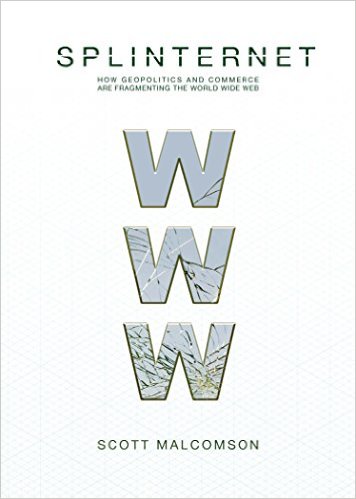
    a review of Scott Malcomson, Splinternet: How Geopolitics and Commerce Are Fragmenting the World Wide Web
      (OR Books, 2016)
    by Richard Hill
    ~

    The implicit premise of this valuable book is that “we study the past to understand the present; we understand the present to guide the future.” In that light, the book makes a valuable contribution by offering a sound and detailed historical survey of aspects of the Internet which are not well-known nor easily accessible outside the realms of dedicated internet research. However, as explained below, the author has not covered some important aspects of the past and thus the work is incomplete as a guide to the future. This should not be taken as criticism, but as a call for the author, or other scholars, to complete the work.

    The book starts by describing how modern computers and computer networks evolved from the industrialization of war and in particular due to the advantages that could be gained by automating the complex mathematical calculations required for ballistics on the one hand (computers) and by speeding up communications between elements of armed forces on the other hand (networks). Given the effectiveness of ICTs for war, belligerents before, during, and after World War II heavily funded research and development of those technologies in the military context, even if much of the research was outsourced to the private sector.

    Malcomson documents how the early founders of what we now call computer science were based in the USA and were closely associated with US military efforts: “the development of digital computing was principally an unintended byproduct of efforts to improve the accuracy of gunfire against moving targets” (49).

    Chapter 1 ends with an account of how Cold War military concerns (especially so-called mutual assured destruction by nuclear weapons) led to the development of packet switched networks in order to interconnect powerful computers: ARPANET, which evolved to become the Internet.

    Chapter 2 explores a different, but equally important, facet of Internet history: the influence of the anti-authoritarian hacker culture, which started with early computer enthusiasts, and fully developed in the 1970s and 1980s, in particular in the West Coast (most famously documented in Steven Levy’s 1984 book Hackers: Heroes of the Computer Revolution). The book explains the origins of the venture capitalism that largely drove the development of ICTs (including the Internet) as private risk capital replaced state funding for research and development in ICTs.

    The book documents the development of the geek culture’s view that computers and networks should be “an instrument of personal liberation and create a frictionless, alternative world free from the oppressing state” (101). Malcomson explains how this led to the belief that the Internet should not be subject to normal laws, culminating in Barlow’s well known utopian “Declaration of the Independence of Cyberspace,” and explains how such ideas could not, and did not survive. The chapter concludes: “The subculture had lost the battle. Governments and large corporations would now shape the Internet” (137). But, as the book notes later (171), it was in fact primarily one government, the US government, that shaped the Internet. And, as Shawn Powers and Michael Jablonski explain in The Real Cyberwar, the US used its influence to further its own geopolitical and global economic goals.

    Chapter 3 explores the effects of globalization, the weakening of American power, the rise of competing powers, and the resulting tensions regarding US dominance of ICTs in general and the Internet in particular. It also covers the rise of policing of the Internet induced by fear of “terrorists, pedophiles, drug dealers, and money launderers” (153).

    We have come full circle: a technology initially designed for war is now once again used by the military to achieve its aims, the so-called “war on terror.” So there is a tension between three different forces, all of which were fundamental to the development of ICTs (including the Internet): the government, military, and security apparatus; more-or-less anarchic technologists; and dominant for-profit companies (which may have started small, but can quickly become very large and dominant – at least for a few years until they are displaced by newcomers).

    As the subtitle indicates, the book is mostly about the World Wide Web, so some of the other aspects of the history of the Internet are not covered. For example, there is no mention of the very significant commercial and political battles that took place between proponents of the Internet and proponents of the Open Systems Interconnection (OSI) suite of standards; this is a pity, because the residual effects of those battles are still being felt today. Nor does the book explore the reasons for and effects of the transition of the management of the Internet from the US Department of Defense to the US Department of Commerce (even if it correctly notes that the chief interest of the Clinton administration “was in a thriving Internet that would lead to new industries and economic growth” [133]).

    Malcomson explains well how there were four groups competing for influence in the late 1990s: technologists, the private sector, the US government, and other governments, and notes how the US government was in an impossible situation, since it could not credibly argue simultaneously that other governments (or intergovernmental organizations such as the ITU) should not influence the Internet while it itself formally supervised the management and administration of the domain name system (DNS). However, he does not explain how the origins of the DNS, its subsequent development, or how its management and administration were unilaterally hijacked by the US, leading to much of the international tension that has bedeviled discussions on Internet governance since 1998.

    Regarding the World Wide Web, the book does not discuss how the end-to-end principle and its premise of secure end devices resulted in unforeseen consequences (such as spam, cybercrime, and cyberattacks) when unsecure personal computers became the dominant device connected via the Internet. Nor does it discuss how the lack of billing mechanisms in the Internet protocol suite has led to the rise of advertising as the sole revenue generation mechanism and the consequences of that development.

    The book analyses the splintering (elsewhere called fragmentation) brought about by the widespread adoption of proprietary systems operating system and their associated “apps”, and by mass surveillance. As Malcomson puts the matter, mass surveillance “was fatal to the universality of the web, because major web companies were and are global but cannot be both global and subject to the intricate agendas of US intelligence and defense institutions, whose purpose is to defend national interests, not universal interests” (160).

    However, the book does not discuss in any depth other sources of splintering, such as calls by some governments for national control over some portions of the Internet, or violations of network neutrality, or zero rating. Yet the book notes that the topic of network neutrality had been raised by Vice President Gore as early as 1993: “Without provisions for open access, the companies that own the networks could use their control of the networks to ensure that their customers only have access to their programming. We have already seen cases where cable company owners have used their monopoly control of their networks to exclude programming that competes with their own. Our legislation will contain strong safeguards against such behavior” (124). As we know, the laws called for in the last sentence were never implemented, and it was only in 2015 that the Federal Communication Commission imposed network neutrality. Malcomson could have used his deep knowledge of the history of the Internet to explain why Gore’s vision was not realized, no doubt because of the tensions mentioned above between the groups competing for influence.

    The book concludes that the Internet will increasingly cease to be “an entirely cross border enterprise”(190), but that the benefits of interoperability will result in a global infrastructure being preserved, so that “a fragmented Internet will retain aspects of universality” (197).

    As mentioned above, the book provides an excellent account of much of the historical origins of the World Wide Web and the disparate forces involved in its creation. The book would be even more valuable if it built on that account to analyze more deeply and put into context trends (which it does mention) other than splintering, such as the growing conflict between Apple, Google et al. who want no restrictions on data collection and encryption (so that they can continue to collect and monetize data), governments who want no encryption so they can censor and/or surveil, and governments who recognize that privacy is a human right, that privacy rules should be strengthened, and that end-users should have full ownership and control of their data.

    Readers keen to understand the negative economic impacts of the Internet should read Dan Schiller’s Digital Depression, and readers keen to understand the negative impacts of the Internet on democracy should read Robert McChesney’s Digital Disconnect. This might lead some to believe that we have would up exactly where we didn’t want to be: “government-driven, corporate-interest driven, profit-driven, monopoly-driven.” The citation (from Lyman Chapin, one of the founders of the Internet Society), found on p. 132 of Malcomson’s book, dates back to 1991, and it reflects what the technologists of the time wanted to avoid.

    To conclude, it is worth noting the quotation on page 57 from Norbert Wiener: “Just as the skilled carpenter, the skilled mechanic, the skilled dressmaker have in some degree survived the first industrial revolution, so the skilled scientist and the skilled administrator might survive the second [the cybernetic revolution]. However, taking the second revolution as accomplished, the average human of mediocre attainments has nothing to sell that is worth anyone’s money to buy. The answer, of course, is to have a society based on human values other than buying and selling.”

    Wiener thus foresaw the current fundamental trends and dilemmas that have been well documented and analyzed by Robert McChesney and John Nichols in their new book People Get Ready: The Fight Against a Jobless Economy and a Citizenless Democracy (Nation Books, 2016).

    There can be no doubt that the current trends are largely conditioned by the early history of ICTs (and in particular of the Internet) and its roots in military applications. Thus Splinternet is a valuable source of material that should be carefully considered by all who are involved in Internet policy matters.
    _____

    Richard Hill is President of the Association for Proper internet Governance, and was formerly a senior official at the International Telecommunication Union (ITU). He has been involved in internet governance issues since the inception of the internet and is now an activist in that area, speaking, publishing, and contributing to discussions in various forums. Among other works he is the author of The New International Telecommunication Regulations and the Internet: A Commentary and Legislative History (Springer, 2014). He writes frequently about internet governance issues for The b2 Review Digital Studies magazine.
    Back to the essay

  • How We Think About Technology (Without Thinking About Politics)

    How We Think About Technology (Without Thinking About Politics)

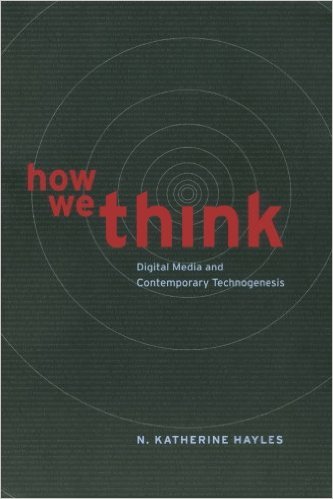
    N. Katherine Hayles, How We Think: Digital Media and Contemporary Technogenesis (Chicago, 2012)a review of N. Katherine Hayles, How We Think: Digital Media and Contemporary Technogenesis (Chicago, 2012)
    by R. Joshua Scannell

    ~

    In How We Think, N Katherine Hayles addresses a number of increasingly urgent problems facing both the humanities in general and scholars of digital culture in particular. In keeping with the research interests she has explored at least since 2002’s Writing Machines (MIT Press), Hayles examines the intersection of digital technologies and humanities practice to argue that contemporary transformations in the orientation of the University (and elsewhere) are attributable to shifts that ubiquitous digital culture have engendered in embodied cognition. She calls this process of mutual evolution between the computer and the human technogenesis (a term that is mostly widely associated with the work of Bernard Stiegler, although Hayles’s theories often aim in a different direction from Stiegler’s). Hayles argues that technogenesis is the basis for the reorientation of the academy, including students, away from established humanistic practices like close reading. Put another way, not only have we become posthuman (as Hayles discusses in her landmark 1999 University of Chicago Press book, How We Became Posthuman: Virtual Bodies in Cybernetics, Literature, and Informatics), but our brains have begun to evolve to think with computers specifically and digital media generally. Rather than a rearguard eulogy for the humanities that was, Hayles advocates for an opening of the humanities to digital dromology; she sees the Digital Humanities as a particularly fertile ground from which to reimagine the humanities generally.

    Hayles is an exceptional scholar, and while her theory of technogenesis is not particularly novel, she articulates it with a clarity and elegance that are welcome and useful in a field that is often cluttered with good ideas, unintelligibly argued. Her close engagement with work across a range of disciplines – from Hegelian philosophy of mind (Catherine Malabou) to theories of semiosis and new media (Lev Manovich) to experimental literary production – grounds an argument about the necessity of transmedial engagement in an effective praxis. Moreover, she ably shifts generic gears over the course of a relatively short manuscript, moving from quasi-ethnographic engagement with University administrators, to media archaeology a la Friedrich Kittler, to contemporary literary theory, with grace. Her critique of the humanities that is, therefore, doubles as a praxis: she is actually producing the discipline-flouting work that she calls on her colleagues to pursue.

    The debate about the death and/or future of the humanities is weather worn, but Hayles’s theory of technogenesis as a platform for engaging in it is a welcome change. For Hayles, the technogenetic argument centers on temporality, and the multiple temporalities embedded in computer processing and human experience. She envisions this relation as cybernetic, in which computer and human are integrated as a system through the feedback loops of their coemergent temporalities. So, computers speed up human responses, which lag behind innovations, which prompt beta test cycles at quicker rates, which demand humans to behave affectively, nonconsciously. The recursive relationship between human duration and machine temporality effectively mutates both. Humanities professors might complain that their students cannot read “closely” like they used to, but for Hayles this is a fault of those disciplines to imagine methods in step with technological changes. Instead of digital media making us “dumber” by reducing our attention spans, as Nicholas Carr argues, Hayles claims that the movement towards what she calls “hyper reading” is an ontological and biological fact of embodied cognition in the age of digital media. If “how we think” were posed as a question, the answer would be: bodily, quickly, cursorily, affectively, non-consciously.

    Hayles argues that this doesn’t imply an eliminative teleology of human capacity, but rather an opportunity to think through novel, expansive interventions into this cyborg loop. We may be thinking (and feeling, and experiencing) differently than we used to, but this remains a fact of human existence. Digital media has shifted the ontics of our technogenetic reality, but it has not fundamentally altered its ontology. Morphological biology, in fact, entails ontological stability. To be human, and to think like one, is to be with machines, and to think with them. The kids, in other words, are all right.

    This sort of quasi-Derridean or Stieglerian Hegelianism is obviously not uncommon in media theory. As Hayles deploys it, this disposition provides a powerful framework for thinking through the relationship of humans and machines without ontological reductivism on either end. Moreover, she engages this theory in a resolutely material fashion, evading the enervating tendency of many theorists in the humanities to reduce actually existing material processes to metaphor and semiosis. Her engagement with Malabou’s work on brain plasticity is particularly useful here. Malabou has argued that the choice facing the intellectual in the age of contemporary capitalism is between plasticity and self-fashioning. Plasticity is a quintessential demand of contemporary capitalism, whereas self-fashioning opens up radical possibilities for intervention. The distinction between these two potentialities, however, is unclear – and therefore demands an ideological commitment to the latter. Hayles is right to point out that this dialectic insufficiently accounts for the myriad ways in which we are engaged with media, and are in fact produced, bodily, by it.

    But while Hayles’ critique is compelling, the responses she posits may be less so. Against what she sees as Malabou’s snide rejection of the potential of media, she argues

    It is precisely because contemporary technogenesis posits a strong connection between ongoing dynamic adaptation of technics and humans that multiple points of intervention open up. These include making new media…adapting present media to subversive ends…using digital media to reenvision academic practices, environments and strategies…and crafting reflexive representations of media self fashionings…that call attention to their own status as media, in the process raising our awareness of both the possibilities and dangers of such self-fashioning. (83)

    With the exception of the ambiguous labor done by the word “subversive,” this reads like a catalog of demands made by administrators seeking to offload ever-greater numbers of students into MOOCs. This is unfortunately indicative of what is, throughout the book, a basic failure to engage with the political economics of “digital media and contemporary technogenesis.” Not every book must explicitly be political, and there is little more ponderous than the obligatory, token consideration of “the political” that so many media scholars feel compelled to make. And yet, this is a text that claims to explain “how” “we” “think” under post-industrial, cognitive capitalism, and so the lack of this engagement cannot help but show.

    Universities across the country are collapsing due to lack of funding, students are practically reduced to debt bondage to cope with the costs of a desperately near-compulsory higher education that fails to deliver economic promises, “disruptive” deployment of digital media has conjured teratic corporate behemoths that all presume to “make the world a better place” on the backs of extraordinarily exploited workforces. There is no way for an account of the relationship between the human and the digital in this capitalist context not to be political. Given the general failure of the book to take these issues seriously, it is unsurprising that two of Hayles’ central suggestions for addressing the crisis in the humanities are 1) to use voluntary, hobbyist labor to do the intensive research that will serve as the data pool for digital humanities scholars and 2) to increasingly develop University partnerships with major digital conglomerates like Google.

    This reads like a cost-cutting administrator’s fever dream because, in the chapter in which Hayles promulgates novel (one might say “disruptive”) ideas for how best to move the humanities forward, she only speaks to administrators. There is no consideration of labor in this call for the reformation of the humanities. Given the enormous amount of writing that has been done on affective capitalism (Clough 2008), digital labor (Scholz 2012), emotional labor (Van Kleaf 2015), and so many other iterations of exploitation under digital capitalism, it boggles the mind a bit to see an embrace of the Mechanical Turk as a model for the future university.

    While it may be true that humanities education is in crisis – that it lacks funding, that its methods don’t connect with students, that it increasingly must justify its existence on economic grounds – it is unclear that any of these aspects of the crisis are attributable to a lack of engagement with the potentials of digital media, or the recognition that humans are evolving with our computers. All of these crises are just as plausibly attributable to what, among many others, Chandra Mohanty identified ten years ago as the emergence of the corporate university, and the concomitant transformation of the mission of the university from one of fostering democratic discourse to one of maximizing capital (Mohanty 2003). In other words, we might as easily attribute the crisis to the tightening command that contemporary capitalist institutions have over the logic of the university.

    Humanities departments are underfunded precisely because they cannot – almost by definition – justify their existence on monetary grounds. When students are not only acculturated, but are compelled by financial realities and debt, to understand the university as a credentialing institution capable of guaranteeing certain baseline waged occupations – then it is no surprise that they are uninterested in “close reading” of texts. Or, rather, it might be true that students’ “hyperreading” is a consequence of their cognitive evolution with machines. But it is also just as plausibly a consequence of the fact that students often are working full time jobs while taking on full time (or more) course loads. They do not have the time or inclination to read long, difficult texts closely. They do not have the time or inclination because of the consolidating paradigm around what labor, and particularly their labor, is worth. Why pay for a researcher when you can get a hobbyist to do it for free? Why pay for a humanities line when Google and Wikipedia can deliver everything an institution might need to know?

    In a political economy in which Amazon’s reduction of human employees to algorithmically-managed meat wagons is increasingly diagrammatic and “innovative” in industries from service to criminal justice to education, the proposals Hayles is making to ensure the future of the university seem more fifth columnary that emancipatory.

    This stance also evacuates much-needed context from what are otherwise thoroughly interesting, well-crafted arguments. This is particularly true of How We Think’s engagement with Lev Manovich’s claims regarding narrative and database. Speaking reductively, in The Language of New Media (MIT Press, 2001), Manovich argued that under there are two major communicative forms: narrative and database. Narrative, in his telling, is more or less linear, and dependent on human agency to be sensible. Novels and films, despite many modernist efforts to subvert this, tend toward narrative. The database, as opposed to the narrative, arranges information according to patterns, and does not depend on a diachronic point-to-point communicative flow to be intelligible. Rather, the database exists in multiple temporalities, with the accumulation of data for rhizomatic recall of seemingly unrelated information producing improbable patterns of knowledge production. Historically, he argues, narrative has dominated. But with the increasing digitization of cultural output, the database will more and more replace narrative.

    Manovich’s dichotomy of media has been both influential and roundly criticized (not least by Manovich himself in Software Takes Command, Bloomsbury 2013) Hayles convincingly takes it to task for being reductive and instituting a teleology of cultural forms that isn’t borne out by cultural practice. Narrative, obviously, hasn’t gone anywhere. Hayles extends this critique by considering the distinctive ways space and time are mobilized by database and narrative formations. Databases, she argues, depend on interoperability between different software platforms that need to access the stored information. In the case of geographical information services and global positioning services, this interoperability depends on some sort of universal standard against which all information can be measured. Thus, Cartesian space and time are inevitably inserted into database logics, depriving them of the capacity for liveliness. That is to say that the need to standardize the units that measure space and time in machine-readable databases imposes a conceptual grid on the world that is creatively limiting. Narrative, on the other hand, does not depend on interoperability, and therefore does not have an absolute referent against which it must make itself intelligible. Given this, it is capable of complex and variegated temporalities not available to databases. Databases, she concludes, can only operate within spatial parameters, while narrative can represent time in different, more creative ways.

    As an expansion and corrective to Manovich, this argument is compelling. Displacing his teleology and infusing it with a critique of the spatio-temporal work of database technologies and their organization of cultural knowledge is crucial. Hayles bases her claim on a detailed and fascinating comparison between the coding requirements of relational databanks and object-oriented databanks. But, somewhat surprisingly, she takes these different programming language models and metonymizes them as social realities. Temporality in the construction of objects transmutes into temporality as a philosophical category. It’s unclear how this leap holds without an attendant sociopolitical critique. But it is impossible to talk about the cultural logic of computation without talking about the social context in which this computation emerges. In other words, it is absolutely true that the “spatializing” techniques of coders (like clustering) render data points as spatial within the context of the data bank. But it is not an immediately logical leap to then claim that therefore databases as a cultural form are spatial and not temporal.

    Further, in the context of contemporary data science, Hayles’s claims about interoperability are at least somewhat puzzling. Interoperability and standardized referents might be a theoretical necessity for databases to be useful, but the ever-inflating markets around “big data,” data analytics, insights, overcoming data siloing, edge computing, etc, demonstrate quite categorically that interoperability-in-general is not only non-existent, but is productively non-existent. That is to say, there are enormous industries that have developed precisely around efforts to synthesize information generated and stored across non-interoperable datasets. Moreover, data analytics companies provide insights almost entirely based on their capacity to track improbably data patterns and resonances across unlikely temporalities.

    Far from a Cartesian world of absolute space and time, contemporary data science is a quite posthuman enterprise in committing machine learning to stretch, bend and strobe space and time in order to generate the possibility of bankable information. This is both theoretically true in the sense of setting algorithms to work sorting, sifting and analyzing truly incomprehensible amounts of data and materially true in the sense of the massive amount of capital and labor that is invested in building, powering, cooling, staffing and securing data centers. Moreover, the amount of data “in the cloud” has become so massive that analytics companies have quite literally reterritorialized information– particularly trades specializing in high frequency trading, which practice “co- location,” locating data centers geographically closer   the sites from which they will be accessed in order to maximize processing speed.

    Data science functions much like financial derivatives do (Martin 2015). Value in the present is hedged against the probable future spatiotemporal organization of software and material infrastructures capable of rendering a possibly profitable bundling of information in the immediate future. That may not be narrative, but it is certainly temporal. It is a temporality spurred by the queer fluxes of capital.

    All of which circles back to the title of the book. Hayles sets out to explain How We Think. A scholar with such an impeccable track record for pathbreaking analyses of the relationship of the human to technology is setting a high bar for herself with such a goal. In an era in which (in no small part due to her work) it is increasingly unclear who we are, what thinking is or how it happens, it may be an impossible bar to meet. Hayles does an admirable job of trying to inject new paradigms into a narrow academic debate about the future of the humanities. Ultimately, however, there is more resting on the question than the book can account for, not least the livelihoods and futures of her current and future colleagues.
    _____

    R Joshua Scannell is a PhD candidate in sociology at the CUNY Graduate Center. His current research looks at the political economic relations between predictive policing programs and urban informatics systems in New York City. He is the author of Cities: Unauthorized Resistance and Uncertain Sovereignty in the Urban World (Paradigm/Routledge, 2012).

    Back to the essay
    _____

    Patricia T. Clough. 2008. “The Affective Turn.” Theory Culture and Society 25(1) 1-22

    N. Katherine Hayles. 2002. Writing Machines. Cambridge: MIT Press

    N. Katherine Hayles. 1999. How We Became Posthuman: Virtual Bodies in Cybernetics, Literature, and Informatics. Chicago: University of Chicago Press

    Catherine Malabou. 2008. What Should We Do with Our Brain? New York: Fordham University Press

    Lev Manovich. 2001. The Language of New Media. Cambridge: MIT Press.

    Lev Manovich. 2009. Software Takes Command. London: Bloomsbury

    Randy Martin. 2015. Knowledge LTD: Toward a Social Logic of the Derivative. Philadelphia: Temple University Press

    Chandra Mohanty. 2003. Feminism Without Borders: Decolonizing Theory, Practicing Solidarity. Durham: Duke University Press.

    Trebor Scholz, ed. 2012. Digital Labor: The Internet as Playground and Factory. New York: Routledge

    Bernard Stiegler. 1998. Technics and Time, 1: The Fault of Epimetheus. Palo Alto: Stanford University Press

    Kara Van Cleaf. 2015. “Of Woman Born to Mommy Blogged: The Journey from the Personal as Political to the Personal as Commodity.” Women’s Studies Quarterly 43(3/4) 247-265

    Back to the essay

  • Trickster Makes This Web: The Ambiguous Politics of Anonymous

    Trickster Makes This Web: The Ambiguous Politics of Anonymous

    Hacker, Hoaxer, Whistleblower, Spy
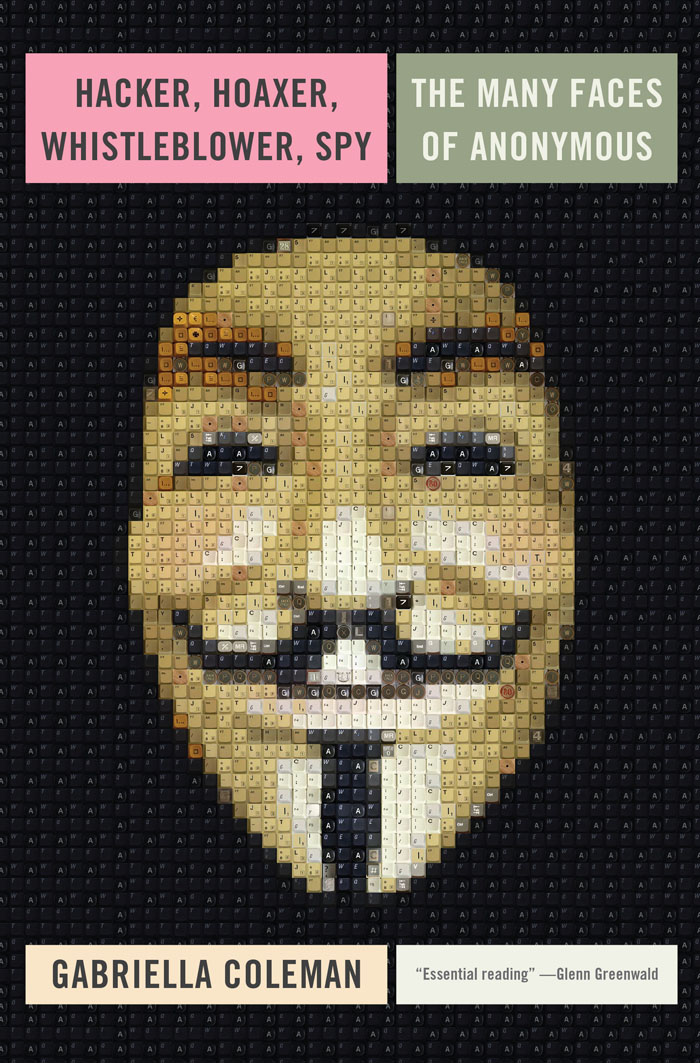
    a review of Gabriella Coleman, Hacker, Hoaxer, Whistleblower, Spy: The Many Faces of Anonymous (Verso, 2014)
    by Gavin Mueller
    ~

    Gabriella Coleman’s Hacker, Hoaxer, Whistleblower, Spy (HHWS) tackles a difficult and pressing subject: the amorphous hacker organization Anonymous. The book is not a strictly academic work. Rather, it unfolds as a rather lively history of a subculture of geeks, peppered with snippets of cultural theory and autobiographical portions. As someone interested in a more sustained theoretical exposition of Anonymous’s organizing and politics, I was a bit disappointed, though Coleman has opted for a more readable style. In fact, this is the book’s best asset. However, while containing a number of insights of interest to the general reader, the book ultimately falters as an assessment of Anonymous’s political orientation, or the state of hacker politics in general.

    Coleman begins with a discussion of online trolling, a common antagonistic online cultural practice; many Anons cut their troll teeth at the notorious 4chan message board. Trolling aims to create “lulz,” a kind of digital schadenfreude produced by pranks, insults and misrepresentations. According to Coleman, the lulz are “a form of cultural differentiation and a tool or weapon used to attack, humiliate, and defame” rooted in the use of “inside jokes” of those steeped in the codes of Internet culture (32). Coleman argues that the lulz has a deeper significance: they “puncture the consensus around our politics and ethics, our social lives and our aesthetic sensibilities.” But trolling can be better understood through an offline frame of reference: hazing. Trolling is a means by which geeks have historically policed the boundaries of the subcultural corners of the Internet. If you can survive the epithets and obscene pictures, you might be able to hang. That trolling often takes the form of misogynist, racist and homophobic language is unsurprising: early Net culture was predominantly white and male, a demographic fact which overdetermines the shape of resentment towards “newbies” (or in 4chan’s unapologetically offensive argot, “newfags”). The lulz is joy that builds community, but almost always at someone else’s expense.

    Coleman, drawing upon her background as an anthropologist, conceptualizes the troll as an instantiation of the trickster archetype which recurs throughout mythology and folklore. Tricksters, she argues, like trolls and Anonymous, are liminal figures who defy norms and revel in causing chaos. This kind of application of theory is a common technique in cultural studies, where seemingly apolitical or even anti-social transgressions, like punk rock or skateboarding, can be politicized with a dash of Bakhtin or de Certeau. Here it creates difficulties. There is one major difference between the spider spirit Anansi and Coleman’s main informant on trolling, the white supremacist hacker weev: Anansi is fictional, while weev is a real person who writes op-eds for neo-Nazi websites. The trickster archetype, a concept crafted for comparative structural analysis of mythology, does little to explain the actually existing social practice of trolling. Instead it renders it more complicated, ambiguous, and uncertain. These difficulties are compounded as the analysis moves to Anonymous. Anonymous doesn’t merely enact a submerged politics via style or symbols. It engages in explicitly political projects, complete with manifestos, though Coleman continues to return to transgression as one of its salient features.

    The trolls of 4chan, from which Anonymous emerged, developed a culture of compulsory anonymity. In part, this was technological: unlike other message boards and social media, posting on 4chan requires no lasting profile, no consistent presence. But there was also a cultural element to this. Identifying oneself is strongly discouraged in the community. Fittingly, its major trolling weapon is doxing: revealing personal information to facilitate further harassment offline (prank calls, death threats, embarrassment in front of employers). As Whitney Phillips argues, online trolling often acts as a kind of media critique: by enforcing anonymity and rejecting fame or notoriety, Anons oppose the now-dominant dynamics of social media and personal branding which have colonized much of the web, and threaten their cherished subcultural practices, which are more adequately enshrined in formats such as image boards and IRC. In this way, Anonymous deploys technological means to thwart the dominant social practices of technology, a kind of wired Luddism. Such practices proliferate in the communities of the computer underground, which is steeped in an omnipresent prelapsarian nostalgia since at least the “eternal September” of the early 1990s.

    HHWS’s overarching narrative is the emergence of Anonymous out of the cesspits of 4chan and into political consciousness: trolling for justice instead of lulz. The compulsory anonymity of 4chan, in part, determined Anonymous’s organizational form: Anonymous lacks formal membership, instead formed from entirely ad hoc affiliations. The brand itself can be selectively deployed or disavowed, leading to much argumentation and confusion. Coleman provides an insider perspective on how actions are launched: there is debate, occasionally a rough consensus, and then activity, though several times individuals opt to begin an action, dragging along a number of other participants of varying degrees of reluctance. Tactics are formalized in an experimental, impromptu way. In this, I recognized the way actions formed in the Occupy encampments. Anonymous, as Coleman shows, was an early Occupy Wall Street booster, and her analysis highlights the connection between the Occupy form and the networked forms of sociality exemplified by Anonymous. After reading Coleman’s account, I am much more convinced of Anonymous’s importance to the movement. Likewise, many criticisms of Occupy could also be levelled at Anonymous; Coleman cites Jo Freeman’s “The Tyranny of Structurelessness” as one candidate.

    If Anonymous can be said to have a coherent political vision, it is one rooted in civil liberties, particularly freedom of speech and opposition censorship efforts. Indeed, Coleman earns the trust of several hackers by her affiliation with the Electronic Frontier Foundation, nominally the digital equivalent to the ACLU (though some object to this parallel, due in part to EFF’s strong ties to industry). Geek politics, from Anonymous to Wikileaks to the Pirate Bay, are a weaponized form of the mantra “information wants to be free.” Anonymous’s causes seem fit these concerns perfectly: Scientology’s litigious means of protecting its secrets provoked its wrath, as did the voluntary withdrawal of services to Wikileaks by PayPal and Mastercard, and the Bay Area Rapid Transit police’s blacking out of cell phone signals to scuttle a protest.

    I’ve referred to Anonymous as geeks rather than hackers deliberately. Hackers — skilled individuals who can break into protected systems — participate in Anonymous, but many of the Anons pulled from 4chan are merely pranksters with above-average knowledge of the Internet and computing. This gets the organization in quite a bit of trouble when it engages in the political tactic of most interest to Coleman, the distributed denial of service (DDoS) attack. A DDoS floods a website with requests, overwhelming its servers. This technique has captured the imaginations of a number of scholars, including Coleman, with its resemblance to offline direct action like pickets and occupations. However, the AnonOps organizers falsely claimed that their DDoS app, the Low-Orbit Ion Cannon, ensured user anonymity, leading to a number of Anons facing serious criminal charges. Coleman curiously places the blame for this startling breach of operational security on journalists writing about AnonOps, rather on the organizers themselves. Furthermore, many DDoS attacks, including those launched by Anonymous, have relied on botnets, which draw power from hundreds of hijacked computers, bears little resemblance to any kind of democratic initiative. Of course, this isn’t to say that the harsh punishments meted out to Anons under the auspices of the Computer Fraud and Abuse Act are warranted, but that political tactics must be subjected to scrutiny.

    Coleman argues that Anonymous outgrew its narrow civil libertarian agenda with its involvement in the Arab Spring: “No longer was the group bound to Internet-y issues like censorship and file-sharing” (148). However, by her own account, it is opposition to censorship which truly animates the group. The #OpTunisia manifesto (Anonymous names its actions with the prefix “Op,” for operations, along with the ubiquitous Twitter-based hashtag) states plainly, “Any organization involved in censorship will be targeted” (ibid). Anons were especially animated by the complete shut-off of the Internet in Tunisia and Egypt, actions which shattered the notion of the Internet as a space controlled by geeks, not governments. Anonymous operations launched against corporations did not oppose capitalist exploitation but fought corporate restrictions on online conduct. These are laudable goals, but also limited ones, and are often compatible with Silicon Valley companies, as illustrated by the Google-friendly anti-SOPA/PIPA protests.

    Coleman is eager to distance Anonymous from the libertarian philosophies rife in geek and hacker circles, but its politics are rarely incompatible with such a perspective. The most recent Guy Fawkes Day protest I witnessed in Washington, D.C., full of mask-wearing Anons, displayed a number of slogans emerging from the Ron Paul camp, “End the Fed” prominent among them. There is no accounting for this in HHWS. It is clear that political differences among Anons exists, and that any analysis must be nuanced. But Coleman’s description of this nuance ultimately doesn’t delineate the political positions within the group and how they coalesce, opting to elide these differences in favor of a more protean focus on “transgression.” In this way, she is able to provide a conceptual coherence for Anonymous, albeit at the expense of a detailed examination of the actual politics of its members. In the final analysis, “Anonymous became a generalized symbol for dissent, a medium to channel deep disenchantment… basically, with anything” (399).

    As political concerns overtake the lulz, Anonymous wavers as smaller militant hacker crews LulzSec and AntiSec take the fore, doxing white hat security executives, leaking documents, and defacing websites. This frustrates Coleman: “Anonymous had been exciting to me for a specific reason: it was the largest and most populist disruptive grassroots movement the Internet had, up to that time, fomented. But it felt, suddenly like AnonOps/Anonymous was slipping into a more familiar state of hacker-vanguardism” (302). Yet it is at this moment that Coleman offers a revealing account of hacker ideology: its alignment with the philosophy of Friedrich Nietzsche. From 4chan’s trolls scoffing at morality and decency, to hackers disregarding technical and legal restraints to accessing information, to the collective’s general rejection any standard form of accountability, Anonymous truly seems to posit itself as beyond good and evil. Coleman herself confesses to being “overtly romantic” as she supplies alibis for the group’s moral and strategic failures (it is, after all, incredibly difficult for an ethnographer to criticize her informants). But Nietzsche was a profoundly undemocratic thinker, whose avowed elitism should cast more of a disturbing shadow over the progressive potentials behind hacker groups than it does for Coleman, who embraces the ability of hackers to “cast off — at least momentarily — the shackles of normativity and attain greatness” (275). Coleman’s previous work on free software programmers convincingly makes the case for a Nietzschean current running through hacker culture; I am considerably more skeptical than she is about the liberal democratic viewpoint this engenders.

    Ultimately, Coleman concludes that Anonymous cannot work as a substitute for existing organizations, but that its tactics should be taken up by other political formations: “The urgent question is how to promote cross-pollination” between Anonymous and more formalized structures (374). This may be warranted, but there needs to be a fuller accounting of the drawbacks to Anonymous. Because anyone can fly its flag, and because its actions are guided by talented and charismatic individuals working in secret, Anonymous is ripe for infiltration. Historically, hackers have proven to be easy for law enforcement and corporations to co-opt, not the least because of the ferocious rivalries amongst hackers themselves. Tactics are also ambiguous. A DDoS can be used by anti-corporate activists, or by corporations against their rivals and enemies. Document dumps can ruin a diplomatic initiative, or a woman’s social life. Public square occupations can be used to advocate for democracy, or as a platform for anti-democratic coups. Currently, a lot of the same geek energy behind Anonymous has been devoted to the misogynist vendetta GamerGate (in a Reddit AMA, Coleman adopted a diplomatic tone, referring to GamerGate as “a damn Gordian knot”). Without a steady sense of Anonymous’s actual political commitments, outside of free speech, it is difficult to do much more than marvel at the novelty of their media presence (which wears thinner with each overwrought communique). With Hoaxer, Hacker, Whistleblower, Spy, Coleman has offered a readable account of recent hacker history, but I remain unconvinced of Anonymous’s political potential.

    _____

    Gavin Mueller (@gavinsaywhat) is a PhD candidate in cultural studies at George Mason University, and an editor at Jacobin and Viewpoint Magazine.

    Back to the essay