b2o

  • Devin Griffiths: Untimely Historicism

    Devin Griffiths: Untimely Historicism

    by Devin Griffiths

    This essay was peer-reviewed by the editorial board of b2o: an online journal.

    The organizers of the V21 Colloquium in Chicago invited my panel to “theorize the present,” by way of Friedrich Nietzsche’s critical account of historicism, On the Uses and Disadvantages of History for Life (1874). The problem is that I don’t think we’ve sufficiently theorized the past. In particular, I’m not sure that this contrast between the present (and its theories) and the past (by way of historicism) is fruitful without a fuller sense of how nineteenth-century historicism worked. This is part of the challenge of the “V21” mashup: how do features of the “Victorian” period operate in the 21st century? The critical and controversial account of “positivist historicism” that occupies the first four theses of the V21 Manifesto (V21 Collective 2015) suggests (in the spirit of Nietzsche) that nineteenth-century historicism was “bland,” and remains so today. But the nineteenth century gave birth to several different kinds of historicism, various “styles of reasoning” (as Ian Hacking has put it (1992)), that continue to enliven and shape our thinking about the past. Here I want to suggest — by way of Nietzsche’s essay — what a more comprehensive grasp of nineteenth-century historicism offers today.[i]

    Nietzsche’s main argument, which censures an unreflective nationalism that sees history in terms of progress or achievement, aligns closely with the critique of Enlightenment historicism that Chakrabarty has given (2000: 244-9), and for that matter, that Karl Popper gave in The Poverty of Historicism (1957). These accounts closely link unitary narratives of progress, identified by Herbert Butterfield as a “Whig interpretation of history” that emerged after 1688 (Butterfield 1965: 11-12), with the “stadial” historicism of the Scottish Enlightenment, described by O’Brien as “a natural process of development in which societies undergo change through successive stages based on different modes of subsistence,” and typified in the writings of Adam Smith, Adam Ferguson, and Alexander Tytler (O’Brien 1993: 53). But I think we should set both progressive and stadial history aside — not because they aren’t important — but because they’re a legacy of Enlightenment thinking. Even if both remained major styles of C19 history, they don’t get at the emergent modes of historicism that more precisely characterize the nineteenth century and its claim on us. Insofar as we are Victorianists (and for that matter, Romanticists or Modernists), we need to ask: what are the historicisms peculiar to our period?

    Nietzsche is a case in point. On the Uses and Disadvantages of History for Life, the second of Nietzsche’s four “Untimely Meditations,” extends upon the critical account of progressive history given in David Strauss: the Confessor and the Writer (1873), anatomizing specific schools of a “mighty historical movement” that was the pride of contemporary German scholarship (Nietzsche, 1997: 59). The taxonomy Nietzsche offers is not important here (though, in his analysis, “monumental” history has both progressive and stadial features). What is striking is that this taxonomy does not include the mode of historicism Nietzsche deploys in the essay, a strategy of critical juxtaposition and differentiation that makes such taxonomies possible. Yet Nietzsche recognizes his own strategy as a mode of historical reasoning rooted in his study of ancient literature. As he acknowledges in the forward, “I do not know what meaning classical studies could have for our time if they were not untimely — that is to say, acting counter to our time and thereby acting on our time and, let us hope, for the benefit of a time to come” (Nietzsche 1997: 60, emphasis added). This startling admission embraces historicism, not simply as an object of critique within David Strauss or On the Use and Abuse of History, but as the critical location of the “untimely” itself — an untimely historicism, produced through an oppositional reading of the past, that grounds Nietzsche’s critical method.

    Here we recognize the seeds of Nietzsche’s genealogical approach, a way of using historical juxtaposition to expose the discontinuities of history. As reworked by Foucault, this contrastive strategy continues to condition historical scholarship (see Foucault 1980: 139-64). The important point is that this is still a kind of historicism, an untimely historicism that emerges in the nineteenth century, and which continues to shape the collection of strategies and critical methods we invoke when we theorize the past.

    This is the nineteenth-century historicism that we need to account for. Conveniently for me, Nietzsche’s formulation bumps into my own work, which recognizes untimely historicism as one feature of the wider comparative turn in nineteenth-century thinking about history. In my view, various nineteenth-century genres of the past — from economic history, to natural history, to historical fiction — collaborated in formulating a new comparative historicism; one that refurbished analogy as an analytic that considered the multiplicity of narratives that constitute the past, and connect the past to an uneven present (see Griffiths, 2016). This stood, and continues to stand in our critical practice, in contrast to an Enlightenment emphasis upon unitary narratives — whether those unitary narratives tell a story of progress or assume a universal pattern of transformation. Comparative historicism provided a way to think, within history, about the patterns of the many rather than the coherence of the one. Rather than narrative, the pattern between narratives; rather than the whole, relations and distinctions between and within wholes. Insofar as this furnished a way of reading history comparatively, in terms of differentiation and juxtaposition, Nietzsche was as much a nineteenth-century inheritor of this style of historical reasoning as Charles Darwin, Charles Dickens, or Karl Marx (Griffiths 2013).

    Comparative historicism continues to shape our work. It connects the study of homologies between text and historical context (as Alan Liu points notes, the constitutive analogies of New Historicism (1989)) to the study of repetition and filiation across time and space (say, Wai Chee Dimock’s fractals (2006)).[ii] It underwrites various methods of relational interpretation, from Shu-mei Shih’s “relational comparison” (2013) to the analogies of “identity/difference” that, in Andrew Cole’s view, organized dialectical thought and, by these means, gave “birth” to modern critical theory (2014: 35).[iii] The point is not just that all theories are embedded in history, but that much of critical thought is founded on thinking about history comparatively. Hence our constant use of analogy’s vocabulary in our own writing, whether formulated in terms of analogy or its usual cognates: homology, allegory, metaphorization, alignment, relation, and reflection. Rather than singular plots, we emphasize parallelism, divergence, correspondence, filiation, exclusions, and alternatives. Rather than wholes, we speak of assemblages, relations, mixtures, networks, family resemblances, multiple centers, and multiple peripheries.

    The Chicago V21 conference was bracing, warm, and characterized by lively disagreement. At the end of the day, no one really seemed to believe that historicism and theory are in opposition, least of all in our writing and teaching. My claim here is that we can better see why this must be so if we recognize, within nineteenth-century historicism, a key resource for contemporary theory. To read C19 historicism this way is to ask for the timely recognition that it’s both part of our present and a stubborn but resourceful part of our C21 future.

    This paper was first presented at the V21 Colloquium at the University of Chicago. I am grateful for our discussions at that gathering.

    References

    Beiser, Frederick C. 2011. The German Historicist Tradition. Oxford: Oxford University Press.

    Chakrabarty, Dipesh. 2000. Provincializing Europe: Postcolonial Thought and Historical Difference. Princeton, N.J.: Princeton University Press.

    Cole, Andrew. 2014. The Birth of Theory. Chicago: University of Chicago Press.

    Dimock, Wai-Chee. 2006. Through Other Continents: American Literature Across Deep Time. Princeton: Princeton University Press.

    Foucault, Michel. 1980. “Nietzsche, Genealogy, History.” In Language, Counter-Memory, Practice. Ithaca: Cornell University Press.

    Glissant, Édouard. 1997. Poetics of Relation. Translated by Betsy Wing. Ann Arbor: University of Michigan Press.

    Griffiths, Devin. 2013. “The Comparative History of A Tale of Two Cities.” ELH 80, no. 3: 811-38.

    Griffiths, Devin. 2016. The Age of Analogy: Science and Literature Between the Darwins. Baltimore: Johns Hopkins University Press.

    Hacking, Ian. 1992. “Statistical Language, Statistical Truth and Statistical Reason: The Self-Authentication of a Style of Scientific Reasoning.” In The Social Dimensions of Science, edited by Ernan McMullin, 130-57. Notre Dame, Ind.: University of Notre Dame Press.

    Heringman, Noah. 2013. Sciences of Antiquity: Romantic Antiquarianism, Natural History, and Knowledge Work. Oxford: Oxford University Press.

    Liu, Alan. 1989. “The Power of Formalism: The New Historicism.” ELH 56, no. 4: 721-71.

    O’Brien, Karen. 1993. “Between Enlightenment and Stadial History.” Journal for Eighteenth-Century Studies 16, no. 1: 53-64.

    Manning, Susan. 2010. “Antiquarianism, the Scottish Science of Man, and the Emergence of Modern Disciplinarity.” In Scotland and the Borders of Romanticism, edited by Leith Davis, Ian Duncan, and Janet Sorensen, 57-76. New York: Cambridge University Press.

    Nietzsche, Friedrich. 1997. “On the Uses and Disadvantages of History for Life.” In Untimely Meditations, translated by R. J. Hollingdale, edited by Daniel Breazeale. New York: Cambridge University Press.

    Popper, Karl. 1957. The Poverty of Historicism. Boston: Beacon Press.

    Shih, Shu-Mei. 2013. “Comparison as Relation.” In Comparison: Theories, Approaches, Uses, edited by Rita Felski and Susan Stanford Friedman, 79-98. Baltimore: Johns Hopkins University Press.

    V21 Collective. 2015. “Manifesto of the V21 Collective.” v21collective.org/manifesto-of-the-v21-collective-ten-theses.

    Notes

    [i] The other main object of the historicist critique is the idea of a history for its own sake, which the Manifesto describes as “bland antiquarianism” (V21 Collective 2015). I think this is misplaced. As Manning (2010) has shown, the comic figure of the antiquarian long served to justify more “philosophic” or “scientific” approaches to history. Yet Heringman (2013) has recently explored how antiquarianism developed sophisticated critical methodologies that continue to shape our understanding of the past. More generally, this critique (which Nietzsche also takes up) capitalizes on the notion of historicism as a fantasy of immersion, an escape into the minutiae of the past, sometimes given in shorthand as the ambition to tell the past (as Leopold von Ranke put it) “as things actually happened.” Yet, far from expressing a naïve faith in the historian’s craft, Ranke’s famous statement was a caution against reading the past as a precursor to the present. His point was that the past is “actually” radically different from the present; its autonomy and complexity demand respect (see Beiser 2011: 268-77).

    [ii] As Liu puts it, “What is merely ‘convenient’ in a resemblance between context and text (in Foucault’s sense of contiguity) soon seems an emulation; emulation is compounded in analogy; and, before we know it, analogy seems magical ‘sympathy’: a quasi-magical action of resemblance between text and context” (Liu 1989: 743).

    [iii] Shih derives the concept of relational comparison from Glissant (1997).

    CONTRIBUTOR’S NOTE

    Devin Griffiths is Assistant Professor of English at the University of Southern California.  His book The Age of Analogy: Science and Literature Between the Darwins is forthcoming from Johns Hopkins UP.

  • Daniel Wright: Unhistorical Reading and Mutual Playing

    Daniel Wright: Unhistorical Reading and Mutual Playing

    by Daniel Wright

    This essay was peer-reviewed by the editorial board of b2o: an online journal.

    In what follows, I aim to read Nietzsche’s essay “On the Uses and Disadvantages of History for Life” unhistorically—that is, I want to avoid falling into the trap that catches Nietzsche himself, as he laments that he rails against an excessive attachment to history only by writing the history of that attachment. What would it mean, Nietzsche wonders, to take loving as an alternative to knowing? To take, in other words, the messy incoherence and the ineffable singularity of love as an alternative to the knowledge that promises ordered lines and networks and shared, shareable vocabularies? Most specifically, Nietzsche sets us a difficult task when it comes to love: to love the historical and the unhistorical equally. History, for Nietzsche, appears as the law-giving Father “who preserves and reveres” (Nietzsche 1997: 72), whose job is “imposing limits” (64); but just as we must offer that father loving obedience, we also must love the unhistorical aspect of our existence, figured as the succoring Mother who is an “envelope,” a fecund “atmosphere” (64), but also the “animal … contained in the present, like a number without any awkward fraction left over” (61). This animal mother, the warm-blooded unhistorical embrace that holds the body together so that those awkward fractions can’t break off and fall away, is of course a difficult mother to love, because so vaguely omnipresent: an environment in which I move rather than a discrete object. History, on the other hand, is similarly difficult to love. We only really know the historical past, Nietzsche argues, as a melancholic introjection of something forever lost but nonetheless achingly loved—imagined as those “indigestible stones of knowledge” that we carry in our guts, “rumbling about inside” as ill-formed and indigestible content, or as “a snake that has swallowed rabbits whole and now lies in the sun and avoids all necessary movement” (78).

    History, in other words, appears to protect the shape of our collective existence by ingesting the knowledge of the past and holding it safe, preserving it inside, but in the end this historical impulse “no longer conserves life but mummifies it” (75). Nietzsche figures historical knowing in this essay as a threat to love, because the imperative to take in and hold fast to the facts of history would also require us “to take everything objectively, to grow angry at nothing, to love nothing, to understand everything” (105); it would “cut off the strongest instincts of youth, its fire, its defiance, unselfishness and love” (115). Nietzsche asks us to love (or to defy, or to misunderstand, or understand too narrowly, or set fire to) rather than only to know, to play with history and to use it for life only within the warming, protecting, fertilizing atmosphere of the unhistorical. What kind of reading of the past can Nietzsche’s theory of the unhistorical model for us literary critics, whose practices of close reading always precariously balance the knowledge of history with the playful love of the unhistorical?

    When I read a novel or a poem or a philosophical treatise, pen in hand, it gives me something—many things: it instigates, it sets boundaries, it prompts, it moves me in predictable and then unpredictable ways. The marks I make with that pen do not, ideally, impose a shape upon the text or simply trace and make visible shapes and lines of demarcation that exist there already as a limited set of ghostly potentialities. Those marks do not really mark the text, in other words, but rather interact with it, enjoining it to play. In those moments when reading scintillates and when the pen seems to move freely—circling, underlining, starring, annotating—the text also makes marks in me. We move each other in turns, according to an improvised system of rules. We observe, most of the time, a propriety in our mutual contact, except when the energy of the game overtakes us and we play, for a moment, rough-and-tumble, or we provoke too pointedly, so that tears fall or laughter (sometimes pained and sometimes giddy) provides relief.

    D. W. Winnicott, for example, explaining his commitment to the use of play in the psychoanalysis of children, insists that the power of play lies in its refusal of traditional, unilateral structures of interpretation. Instead of the analyst who responds to the free associations of a patient by transforming that formless mess into a coherent interpretation, we have the analyst whose interpretations are careful, cooperative, and provisional. Winnicott believes that this is the only way to allow the patient the freedom of honesty and spontaneity, rather than the feeling that she is simply complying with the interpretive narrative of an analyst who seems already to have her figured out:

    Interpretation outside the ripeness of the material is indoctrination and produces compliance. … A corollary is that resistance arises out of interpretation given outside of the area of overlap of the patient’s and the analyst’s playing together. Interpretation when the patient has no capacity to play is simply not useful, or causes confusion. When there is mutual playing, then interpretation … can carry the therapeutic work forward. This playing has to be spontaneous, and not compliant or acquiescent, if psychotherapy is to be done. (Winnicott 2005: 68, original emphasis) [1]

    I am committed to a bold and unapologetic application of Nietzsche’s model of unhistorical love, and Winnicott’s theory (related, I think) of “mutual playing” to the practice of close reading that we as literary critics engage in almost every day. A novel or poem cannot be made compliant; it is capable of responding to me spontaneously; its shape changes as my shape changes; the rules of the game are self-sustaining and yet flexible, designed to allow for free-wheeling, interactive movement. My own impulse to retheorize our uses of history, to remain skeptical of historical knowledge and its potential to calcify, speaks to a deeper desire to perform close reading differently, to take it personally but at the same time to develop robust methods by which taking it personally can also take it public—by which my play with the text, my love of history and unhistory, can conserve rather than mummify the details of my own idiosyncratic absorption in the Victorian past.

    References

    Nietzsche, Friedrich. “On the Uses and Disadvantages of History for Life.” Translated by R. J. Hollingdale. In Untimely Meditations, edited by Daniel Breazeale, 57-124. Cambridge, UK: Cambridge University Press, 1997.

    Winnicott, D. W. Playing and Reality. New York: Routledge, 2005.

    Notes

    [1] D. W. Winnicott, Playing and Reality (New York: Routledge, 2005), 68, original emphasis.

    CONTRIBUTOR’S NOTE

    Daniel Wright is Assistant Professor of English at the University of Toronto. He recently completed a book manuscript, Bad Logic: Reasoning about Desire in the Victorian Novel.

  • Eleanor Courtemanche: “Too Many Nietzsches”

    Eleanor Courtemanche: “Too Many Nietzsches”

    by Eleanor Courtemanche

    This essay was peer-reviewed by the editorial board of b2o: an online journal.

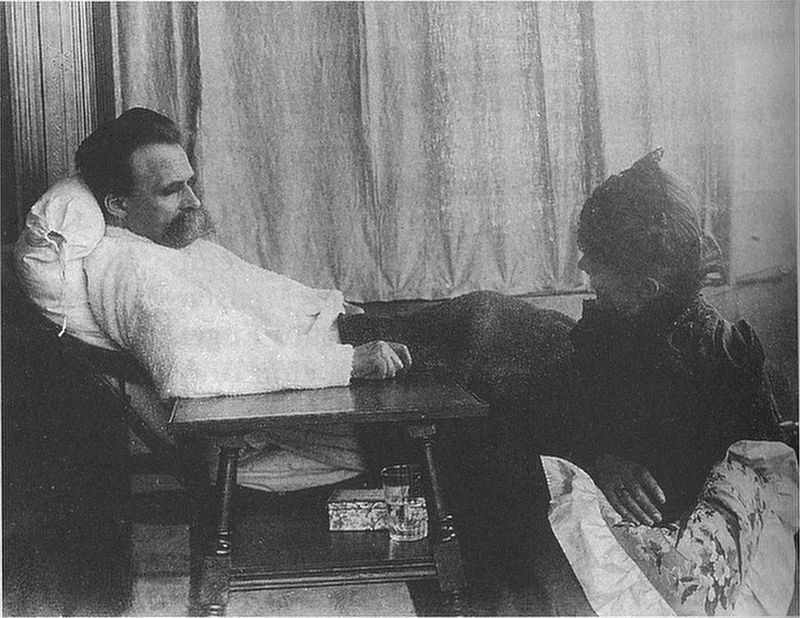
    Even if we wanted to—and I’m not sure we really do, at this conference—it would be hard to read Nietzsche from a purely historicist perspective. Nietzsche casts a powerful shadow on his own futurity; we cannot but read him through subsequent history, what Megan Ward has called the “historical middle, the period between the Victorians and ourselves” (Ward 2015). Part of good scholarship, as cultural critics know, is to try to avoid dismissing Nietzsche merely because the Nazis loved him. For that misfortune we blame his anti-Semitic sister Elisabeth Förster-Nietzsche, who dressed Nietzsche up in a classical-looking toga and invited guests to gawk at the genius, in Weimar in the 1890s after his brain had been eaten away by syphilis (MacIntyre 1992). Or perhaps he didn’t have syphilis at all—an article from 2003 alleges that the explanation of Nietzsche’s dementia as syphilis was a smear by anti-Nazis after WWII, and that in fact Nietzsche might have died of a brain tumor (Matthews). The existentialists reclaimed Nietzsche after the war and popularized him in Walter Kaufmann’s translations, with introductions that were later considered too apologetic by politically more stringent cultural critics. And it’s hard to talk about Nietzsche at the University of Chicago without disturbing the shade of Leo Strauss, who may (or may not!) have created a neo-Gnostic cult of esoteric insider wisdom, training up elite cadres at Chicago and Claremont, that has given American neoconservatives the Nietzschean über-confidence to treat democracy as a noble lie for consumption by the masses (Waite 1996).

    Or do we see Nietzsche as a friend and antecedent, merely one of the paragons of the hermeneutics of suspicion, forerunner of Foucault’s vision of power as dispersed and all-pervasive—and hence, in a development he would no doubt despise, the ancestor of our politically-informed “suspicious readings” that see lurking imperialism and heteronormativity everywhere? Our allegiance to this legacy of suspicious reading on some level legitimates the recent turn to historicist critique, as well as our reconsideration of that critique today.

    As Victorianists, we should theoretically pay attention to none of those things. We should be trying to peel back the layers of post-hoc myth, antiquarian reverence, and political toxicity to figure out what Nietzsche meant at the time he was writing, in 1874, in the wake of German unification (an event that actually does inform Nietzsche’s whole essay). However, despite all our careful attention to the past, there is one aspect of Victorian writing we seem blind to and can’t properly describe: its lingering Platonism, with its constant appeals to something higher, purer and more noble, which we see everywhere in this essay despite Nietzsche’s reputation for anti-metaphysics. After WWII, I think, this idealism was purged from our scholarship, marking a clear distance between our values as cultural critics and those of the nineteenth century.

    I personally have yet another layer of historical experience that clouds my vision here: my very first public conference paper, as a first-year grad student at Cornell in April 1992, was on this essay, “On the Use and Abuse of History for Life,” at conference on Nietzsche organized by Geoff Waite. Although I haven’t been able to access the MacWrite file, which is lost to the ages, I squirrelled away the original talk (entitled “The Boundaries of the Cultural Organism”) in a file I’ve been carrying around for unexamined sentimental reasons since then. This talk is amazing for me to read today, because, in defiance of everything I now tell my own grad students, I analyzed no sources at all outside the original text. Back then, I was so naïve that I just read Nietzsche’s essay itself and traced its component paradoxes. Nietzsche’s essay lends itself beautifully to being deconstructed: as I pointed out in my paper, in this essay you can’t actually tell the difference between the malady and the cure; the man who is merely affecting tranquility and the artist whose calm demeanor masks inner flashing life; the overripe and the not-yet-ripe; vulgar egoism and noble selfishness; the culture that has successfully internalized all barbarian attacks and forged them into something new (that is, the Greeks) versus the culture that is merely a hapless cosmopolitan aggregate (that is, the newly unified German nation). I’m sort of amazed I used to write like this—it feels kind of raw despite its sophistication. My whole paper just assumes philosophy is worth analyzing and analyzes it. Perhaps the current practice of elaborate historicism will seem just as alien to critical readers in twenty or thirty years.

    There are many horizons of ignorance in Nietzsche’s essay, arranged to protect some kernel of irrational stupidity that he thinks is crucial to cultural health, but that no scholar can really defend. Sorry, Nietzsche—humans just do want to know more than we should. But the essay’s eloquent yearning to know better, to know more usefully in relation to our own lives, and with fewer veils, conventions, and compromises—that part of “On the Use and Abuse of History for Life” has not gone out of date.

    References

    MacIntyre, Ben. 1992. Forgotten Fatherland: The Search for Elisabeth Nietzsche. New York, Farrar Strauss & Giroux.

    Matthews, Robert. 2003. “‘Madness’ of Nietzsche was cancer not syphilis.” The Telegraph, May 4. http://www.telegraph.co.uk/education/3313279/Madness-of-Nietzsche-was-cancer-not-syphilis.html.

    Waite, Geoff. 1996. Nietzsche’s Corps/e: Aesthetics, Politics, Prophecy, or, The Spectacular Technoculture of Everyday Life. Durham, NC: Duke UP.

    Ward, Megan. 2015. “Theorizing the Historical Middle.” V21 Collective (blog), June 1. http://v21collective.org/megan-ward-theorizing-the-historical-middle/

    CONTRIBUTOR’S NOTE

    Eleanor Courtemanche is Associate Professor of English, Comparative Literature, and German at the University of Illinois at Urbana-Champaign. Her book The ‘Invisible Hand’ and British Fiction, 1818-1860: Adam Smith, Political Economy, and the Genre of Realism was published in 2011.

  • Emily Steinlight: Untimely Dickens

    Emily Steinlight: Untimely Dickens

    by Emily Steinlight

    This essay was peer-reviewed by the editorial board of b2o: an online journal.

    I’m taking “Bleak House Today” as an invitation to think about the place of the present both in Victorian studies and in the peculiar form of Dickens’s novel: the ways in which Bleak House calls on a sense of contemporaneity, partly though a narrative structure where historical time is always out of joint, past and present tenses taking turns but keeping their distance. This novel’s mode of occupying and refracting the present has often tempted readers to resituate its today-ness in another historical conjuncture or another art form. I’m thinking, for example, of Sergei Eisenstein’s classic essay, “Dickens, Griffith, and the Film Today,” which in 1944 brought Dickens into a different present than our own by crediting him with inventing montage (1977: 195-255). By juxtaposing non-contiguous spaces in narrative and thus shattering the frame of a discreet spatiotemporal situation, the argument runs, Dickens’s technique made modern cinema possible—from D. W. Griffith to the experiments of a Soviet avant-garde, including Dziga Vertov and Eisenstein himself. With V21 in mind, this intentionally anachronistic claim makes me wonder whether Dickens’s novel, which seems so consummately of its time, might lend itself to anachronism, or even to an engagement with the untimely—and, if so, what that untimeliness can do for us. In considering this novel’s untimeliness, I’m of course channeling Nietzsche’s definition: “acting counter to our time and thereby acting on our time and, let us hope, for the benefit of a time to come” (Nietzsche 1997 [1874]: 60).

    For now, I’ll turn to just one register of that untimeliness: the novel’s split narration, divided between Esther’s personal voice, recounting past experience from a safe biographical distance, and the impersonal narrative, with its polyphonic mix of styles and tempos, panning across the city in the present tense to map a far larger social world than Esther or any individual can grasp, and shifting focalization away from the protagonist. I’d like to consider the political logic of what this form does, first, to the organization of time on which plot and history alike rely, and second, to the function of character. With regard to time, the tense shifts between past and present have an estranging effect on narrative as well as historical process. The present in which Dickens drops us is both deeply mired in natural-historical time and explosively out of time. The novel’s classic opening gives us a street scene we can very roughly date by the industrial soot half-illuminated by gas lamps, but all its chronotopes summon the pre- and post-historical: on the one hand, geological strata of a ground formed by human movement and struggle in urban space, layers of mud mimicking the process of capital accumulation (building up “at compound interest”), yet apparently primeval, as if “the waters had but newly retired from the face of the earth”; on the other, smoky darkness evoking “the death of the sun” and the thermodynamic end of the solar system (Dickens 2003 [1852-53]: 13). I’m curious how this consciousness of a vast temporal scale beyond human history, yet rendered in the present tense, would line up with Frederic Jameson’s account of the narrative reflux in realist fiction between two distinct orders of temporality: the time of the event—the chronological succession of past-present-future—and the time of affect, linked to a suspended, impersonal present. (Surprisingly, given his focus on tenses and temporality in Antinomies of Realism, Jameson doesn’t discuss the present-tense narration in Bleak House when the text comes up in passing.) What makes realism dialectical, he suggests, is the gap between those orders of time, and the consequent standoff between “destiny” and “the eternal present” (Jameson 2015: 18). The novel form falls apart if this tension gets resolved. Perhaps serial fiction holds open this space in a distinctive way, since on first reading, the future is literally unwritten.

    It sounds, initially, like that suspended present is where freedom from determinacy becomes possible. But fiction’s will to inhabit present time reappears as a problem for Jameson. The realist novel’s presentism, he suggests, inheres in its commitment to the exposition of the contemporary, which reveals the form’s ideological character: realism “requires a conviction as to the massive weight and persistence of the present as such, and an aesthetic need to avoid recognition of deep structural social change … and contradictory tendencies within the social order” (145). Antinomies is a fascinating book, but I’m not so sure about this claim. It flows from a critical model that charges realism with rationalizing a new status quo by denying historical change. As against that model, I want to stress the political dynamism of the world Dickens’s narrative constructs. At the level of material description, Bleak House offers up a stratigraphic record of deep structural change in process; at the level of form, its plot mobilizes a set of contrary political demands, which collide and throw off sparks as they do.

    This dynamism relies on the way the novel’s two narrative systems mediate between character-subject and social order. Critics have often seen in the dualistic structure of Bleak House a certain ideology of form. For Audrey Jaffe, in Vanishing Points, omniscient narration is the novel’s Lacanian Big Other, a site for the fantasy of total knowledge; for D.A. Miller, it’s the literary equivalent of surveillance (Jaffe 1991, Miller 1988). There’s a word I’m struck by, though, in Miller’s book: speaking of another realist novel in the introduction to The Novel and the Police, he writes that its narrator’s sympathy for the suffering it inflicts on characters is credible “only in an arrangement that keeps the function of narration separate from the casualties operating in the narrative” (1988: 25). “Casualties” is an apt term precisely because it pinpoints what’s missing from Miller’s model. The form of power that disavows agency for its “casualties” isn’t surveillance at all; it’s more like laissez-faire. In Bleak House, the prevailing forms of governance operate less by a totalized and invasive disciplinary gaze than by programmatic inaction: letting things happen as though their causes were past the reach of human agency. The constable who repeatedly orders Jo to “move on,” when asked where exactly the homeless boy should move to, replies, “my instructions don’t go to that” (Dickens 2003: 308). Even in its direct, law-enforcing forms, policing intervenes by enacting a broader policy of non-intervention: vagrancy isn’t allowed here, go continue your vagrancy elsewhere. This may be one of the reasons Bleak House resonates with us today—why it evokes the Malthusian austerity policies we’ve seen (again) since the 2008 crash, the dismantling of welfare systems for several decades prior, and perhaps what Zygmunt Bauman unsettlingly describes as the irony of modernization: that the production of wealth in capitalist societies entails the global mass production of what appears as “‘human waste,’ or more correctly, wasted humans” (2004: 5).

    Giving a figure like Jo a name and narrative space doesn’t remove him from what Malthus called surplus population—but this surplus, strangely, comes closer to capturing the novel’s subject than any individual character. For all Esther’s insistence on evaluating fellow characters as individuals linked by personal obligation, the other narrative compulsively generates scores of figures, mass bodies, abstract numbers that don’t sustain characterization. The first human subjects we encounter, preceded by muddy dogs and horses, are just pedestrians in general, like “tens of thousands” before them; “chance people on the bridges” lost in fog (Dickens 2003: 13); in Chancery, “eighteen of Mr. Tangle’s learned friends,” each with eighteen hundred pages of legal briefs (18); the population of Tom-all-Alone’s infesting London “in maggot numbers” (256); crowds flashing by Snagsby “like a dream of horrible faces” (358)—everywhere, more life than Dickens has time to characterize, count, or name. (Alex Woloch’s work is important here in stressing the saturation of character-space, which in his reading yields unequal divisions of attention and human complexity.) This is why, looking at the digital character maps created at Franco Moretti’s Stanford Literary Lab, I’m not sure whether such infographics capture a network of relationships in the text or just affirm what’s already taken as given: that character is a consistent unit, analogous to the individual person. There’s a distinct too-muchness at work in Dickens’s writing that makes characterization complicit in the process of crowding rather than a means of setting individuals apart from masses. Bleak House turns that demographic excess into a political force: something like what Jacques Rancière would call the count of the uncounted, a throwing off of the proportion between subjects and social places that politics requires. I suspect that the dizzying scalar shifts within this novel between a materially accumulating present, multiple historical pasts, and signs of geological and planetary time contribute pretty centrally to this disproportioning—but we can leave that for discussion.

    References

    Bauman, Zygmunt. 2004. Wasted Lives: Modernity and Its Outcasts. Cambridge: Polity.

    Dickens, Charles. 2003 [1852-53]. Bleak House. Edited by Nicola Bradbury. London: Penguin.

    Eisenstein, Sergei. 1977 [1944]. “Dickens, Griffith, and the Film Today.” In Film Form: Essays in Film Theory, edited and translated by Jay Leyda, 195-255. San Diego: Harcourt.

    Jaffe, Audrey. 1991. Vanishing Points: Dickens, Narrative, and the Subject of Omniscience. Berkeley: University of California Press.

    Jameson, Fredric. 2015. The Antinomies of Realism. London: Verso.

    Miller, D. A. 1988. The Novel and the Police. Berkeley: University of California Press.

    Nietzsche, Friedrich. 1997 [1874]. “On the Uses and Disadvantages of History for Life.” In Untimely Meditations, edited by Daniel Breazeale, translated by R. J. Hollingdale, 59-123. Cambridge: Cambridge University Press.

    Woloch, Alex. 2003. The One vs. the Many: Minor Characters and the Space of the Protagonist in the Novel. Princeton: Princeton University Press.


    CONTRIBUTOR’S NOTE

    Emily Steinlight is Stephen M. Gorn Family Assistant Professor of English at the University of Pennsylvania.  She recently completed a manuscript, The Biopolitical Imagination: Literary Form and the Politics of Population.

  • Elisha Cohn: Bleakness

    Elisha Cohn: Bleakness

    by Elisha Cohn

    This essay was peer-reviewed by the editorial board of b2o: an online journal.

    I was intrigued by the choice of Bleak House as V21’s representative novel, how the audacious, even pugnacious, and enterprising mood of this collective critical gesture resonates with or against the bleakness of Bleak House, a novel that invites attention to affective atmosphere. What is that bleakness? How does it emanate, and what does it do? More self-reflexively, how do the critical paradigms that newly attune us to atmosphere or mood reimagine the novel’s project, as they also ask us to consider the ethos of our own? Prompted by influential critics whose careers begin in Victorian studies (Miller 1988; Sedgwick 2002; Anderson 2006; Felski 2008), I hope to think about the mood of critical discourse to emphasize the conditions that allow knowledge and value to come into view. Ours is a field that drew considerable energy from the hermeneutics of suspicion, thanks to the Victorian novel’s pervasively social vision. But perhaps thanks also to Victorian literature’s continual, dialectical evaluation and reevaluation of individual perspectives within living systems, it has also brought us important work on the affects that accompany specific forms of theory. So how does the bleakness of Bleak House inflect today’s project—its reparative status, its aura of regenerative optimism, or intrepidity?

    Mood is said to lack a telos in itself; Jonathan Flatley defines it as “a kind of affective atmosphere, … in which intentions are formed, projects pursued, and particular affects can attach to particular objects” (Flatley 2008: 19). But mood has a paradoxical status: if philosophy positions it as a precondition for thought or action, it is also associated (in Dickens and elsewhere) with stasis, particularly the stasis of melancholy. We tend to understand narrative as structured by the temporal framework of plot and event, but mood offers a vocabulary for what evades this forward drive, deferring or blocking plots of coming-to-knowledge. Mood, then, might offer an importantly minimalist way of indicating a narrative mode––but also a critical motive––that declines the desire for mastery.

    In the case of Bleak House mood or atmosphere might be said to reformulate narrative conventions associated with emotional fulfillment and the production of knowledge by working as a textual effect. Bleakness flows among characters rather than belong to any of them individually, permeates even the not-character of the omniscient narrative voice, suffuses the polluted fog that flows from London to the suburbs, the “filthy air of our prosperous England” that John Ruskin was so appalled to find represented in fiction. Esther assures us that John Jarndyce has transformed the affective character of the house he inhabits, but bleakness lingers, an intransigent, if low-key, global effect. Implicitly, the institutions (houses, destroyed houses, courtrooms) that shape sociability do so not only by mapping out pathways and blocking off windows of relation, but by making those circuits of relation palpable as feeling. The map of London the novel creates archives these circuits of attractions and repulsions, hurts and pleasures. But because these feelings register bleakly, they elude recognition, purpose, or object. Bleakness reaches outward, too, to the implied reader––it constitutes a secret in which, à la Snagsby, the reader is a “partaker, and yet … not a sharer,” not consciously implicated but creepingly registering effects (Dickens 2003 [1852-53]: 607). If we cannot attribute or contain bleakness to any one character, if it instead responds to the distorting pressures of a system without being presented as adequate motivation to launch a critique of that system, how does this diffusive state affect the role of knowledge in the plot? The project of producing critical knowledge of the text?

    By suspending the importance of outcomes, the less than revelatory quality of mood lights up how Dickens’s novel, even qua detective novel, thwarts the production of stable knowledge. In Esther’s narrative, atmosphere pulls against the plot of her growth, development, and avowed identity. This formal reticence might appear to suggest that her style reflects her post-traumatic consciousness, its holes of unspeakability signaling the presence of wounds that cannot be more directly owned. But the atmosphere is also due to more than her avowed self-effacement because it becomes a general narrative principle, infusing even the illustrations. In the third-person, present-tense narrative it evokes an ongoing, systemic process never to be completed and not located in or attributable to any one consciousness or agent. So atmosphere” speaks to Dickens’s interest in Bleak House in privileging feeling and mood over plot, event, or revelation.

    I propose one specific consequence of moodiness in Bleak House for V21’s context. The novel’s atmospherics provide a way of thinking about feeling—even and especially about critical feeling—as shared but nonteleological. The role of this concept in the novel—at least as our present critical vocabulary for mood would configure it—speaks back to the critical project in less than fully optimistic or energizing, yet valuable, ways. I would recognize that my own interest in novelistic mood partakes of same atmospherics of deferral within Bleak House itself; I see a resonance between the novel’s deferral of the final potencies of self-reflection and my own desire to find it there. Thus I would question whether my theoretical bent toward the inassimilable, the incommensurable, and the least instrumental aspects of the text too willingly accepts the marginalization within the academy of the kind of knowledge the humanities are supposed to produce. Yet I think this sense of deferral, and its lack of triumphalism, also might allow us to quietly value the practices of repeated readings performed not only by experts, but also by Dickensians who revisit novels not to definitively gain a purchase on the world—to effect political revelations; to transform perceptions, forms of knowledge, or communities—but to experience a world. So while we might draw on the idea of atmosphere to stress the efficacy of the text in attuning its readers to new sensations and sympathies, nonetheless, I would desist from offering a too-confident model of what these bleaker feelings allow us to know.

    References

    Anderson, Amanda. 2006. The Way We Argue Now: A Study in the Cultures of Theory. Princeton, NJ: Princeton University Press.

    Dickens, Charles. 2003 [1852-53]. Bleak House, ed. Nicola Bradbury. London: Penguin.

    Felski, Rita. The Uses of Literature. London: Blackwell.

    Flatley, Jonathan. 2008. Affective Mapping: Melancholia and the Politics of Modernism. Cambridge, MA: Harvard University Press.

    Miller, D. A. 1988. The Novel and the Police. Berkeley, CA: University of California Press.

    Sedgwick, Eve Kosofsky. Touching Feeling: Affect, Pedagogy, Performativity. Durham, NC: Duke University Press.

    CONTRIBUTOR’S NOTE

    Elisha Cohn is Assistant Professor of English at Cornell University and the author of Still Life: Suspended Development in the Victorian Novel (2015).

  • Jonathan Farina: On the Genealogy of “Deportment”: Being Present in Bleak House

    Jonathan Farina: On the Genealogy of “Deportment”: Being Present in Bleak House

    by Jonathan Farina

    This essay was peer-reviewed by the editorial board of b2o: an online journal

    My title puns on Nietzsche’s On the Genealogy of Morals, a work of skeptical philology that aspires to liberate the future by recasting western values as products of a history of distorting or inverting human greatness. Etymological history, the genealogy of words, promises a novel articulation of what counts as good and bad. Nietzsche idealizes ruminative, philological reading, “that venerable art,” as he puts it in Daybreak, “which demands of its votaries one thing above all: to go aside, to take time, to become still, to become slow – it is a goldsmith’s art and connoisseurship of the word which has nothing but delicate, cautious work to do and achieves nothing if it does not achieve it lento” (1975: 5). Slow historicism, then, but neither positivist nor antiquarian, as some modern scholarship has been described: for Nietzsche, “for precisely this [slowness]”, philology

    is more necessary than ever today, by precisely this means does it entice and enchant us the most, in the midst of an age of ‘work,’ that is to say, of hurry, of indecent and perspiring haste, which wants to ‘get everything done’ at once, including every old or new book: this art does not so easily get anything done, it teaches to read well, that is to say, to read slowly, deeply, looking cautiously before and aft, with reservations, with doors left open, with delicate eyes and fingers. (1975: 5)

    For all its velocity, Dickens’s prose rewards and even personifies Nietzsche’s slow philology. Bleak House, in particular, exemplifies how we might practice a poststructuralist, materialist philology that reanimates the past embedded in the present. And, given the late fad for mindfulness and being present, never mind the topic of this inaugural V21 symposium, “presence” is not a bad word with which to start.

    Alert as Dickens is to expressions, by turns axiomatic and idiotic, idiomatic and idiosyncratic, including Bart Smallweed’s “I don’t know but what I will have another” and Snagsby’s “not to put too fine a point on it”; alert to portmanteau words like wiglomeration, and to professional discourses, slang, and puns, to “gammon” and “spinach,” Dickens offers plenty of fodder for philological rumination to rehistoricizes our present word by word (1977: 249, 180). The earliest criticism of Bleak House, favorable and unfavorable, distinguishes the prose style or “manner” of Dickens for its reducibility to small, iterative phrases, “the queerest catch-word,” as Henry Chorley called it, or “congeries of oddities of phrase, manner, gesticulation, dress, countenance, or limb,” in the words of James Stothert (Collins 1986: 280, 279, 294). Critics remarked on how these portable phrases indexed the present, mediated “current table-talk or our current literature,” as David Masson said (Masson 1875: 257-8). This facility translating mannerisms into currency, to condense attitudes into fungible expressions, makes Dickens’s style thematize presentism.

    Indeed, the word “presence” serves many times as a synonym for manner and personality in the novel: Mrs. Snagsby, for instance, has a “dentistical presence,” ready to pull the “tender double tooth” of a secret she suspects her husband of holding; and Kenge, for another, has “conversational presence” (Dickens 1977: 316, 760), and so on. With 43 instances of “presence,” 250 uses of “manner,” and a chapter on and thematic investment in “deportment,” Bleak House dwells on the way style and manners coalesce to mediate our temporal experience of and presence in or bearing toward the world. Manner, deportment, composure, disposition, presence, and style: these performances of temporality are miniature fictions with which individuals inhabit times and places and relations that often clash with the actual present, the actual times and places and relations their bodies occupy. Assuming a characterological stance against the imperatives of the present, “presence” and “deportment” are modes of embodied critique. As such, they personify how the philological plenitude of other words readily offer, in their connotations and histories, a critique of the present.

    From Kenge’s own system-cementing trowel-wave of the hand to Snagsby’s variously expressive coughs, from Esther’s emphatic humility to Bart Smallweed’s injunction at the legal triumvirate’s sexually-charged lunch at the Slap-Bang— “and don’t you forget the stuffing, Polly!”—telling mannerisms and multivalent words abound in Bleak House (1977: 247).  But for polemic purposes let me stick with “deportment” as a salient example. Bleak House recognizes the “currency” of the word, that is, its relevance and fashionable circulation in the present, even as it foregrounds its historicity and ambiguity. Tale the moving reunion of George Rouncewell and Sir Leicester Dedlock: waiting for Bucket to reclaim runaway Lady Dedlock, George offers his “arms to raise … up” the debilitated Sir Leicester, who in turn raises George from despondency: “‘You have been a soldier,” he observes, non-sequitur, “‘and a faithful one’” (Dickens 1977: 696). At the Dedlock’s London home, just where we might think George’s typically awkward manner might put him out-of-place, the soldier shines. He humbly parries Sir Leicester’s praise: “I have done my duty under discipline, and it was the least I could do” (Dickens 1977: 696). He has felt uncomfortable everywhere else, he protests his unfitness for other modes of life (especially the domestic industrial married future exemplified in his brother), but here amidst a fading aristocratic dinosaur George’s deportment reciprocates and makes meaningful Sir Leicester’s, about which Dickens says, “He is very ill, but he makes his present stand against distress of mind and body, most courageously” (Dickens 1977: 694). “Present” here works as both adjective and noun: through his presence, that is to say, through his bearing, he makes present circumstances appear closer to his ideal temporality and structure of feeling. His presence, then, as a sort of regulative fiction, contests his present reality as he and George concurrently revisit the past in their minds and manners.[i]

    George and Sir Leicester—odd models, to be sure—might thereby personify here the potential work an interpretative philology might do in reanimating the present with the past. Where traditional philology sought to fix the correct meaning of a word, a reinvigorated, Nietzschean version would eschew determination. As John Hamilton has written, an interpretative philology

    may provide a privileged means for holding determinations at bay, for perpetuating community and its constitutive communication, not by fixing a word’s properties conceptually, with sovereign authority, disciplinary control, or tired complacency, but rather by pursuing its transit through time and across cultures and thereby allowing it to be translated, over and over again, on the basis of its very untranslatability. (Hamilton 2013: 21)

    In this scene of exemplary deportment, marked by gestures more than words, Dickens nearly redeems an erstwhile unlovable aristocrat, whose virtue accrues to his loving insistence that words and manners remain constant: “I revoke no disposition I have made in her favour. I abridge nothing I have ever bestowed on her. I am on unaltered terms with her” (Dickens 1977: 698).[ii] At the same time, however, the narrative acknowledges the terrific contingency of our reception of these “terms”: “His formal array of words,” the novel says of Sir Leicester’s forgiveness, “might have at any other time, as it has often had, something ludicrous in it; but at this time, it is serious and affecting. His noble earnestness, his fidelity, his gallant shielding of her, his generous conquest of his own wrong and his own pride for her sake, are simply honourable, manly, and true,” and “the lustre of such qualities,” Dickens adds, lest we impugn something decidedly aristocratic to the act, are available to the “commonest mechanic” and “the best-born gentleman” alike (1977: 698). Mannerisms and words that are ludicrous early in the novel thus recur “serious and affecting” “at this time.”

    The scene complicates the novel’s preceding travesty of deportment personified in “Old Mr. Turveydrop,” about whom Caddy tells Esther, “No, he don’t teach anything in particular … But his Deportment is beautiful” (Dickens 1977: 169). Turveydrop caricatures the universal “dandyism” and agency of “fashion” that Bleak House disparages, but Turveydrop’s problem isn’t deportment itself so much as his own bad deportment, marked by ill-fitting clothes as much as by his maladjustment to the people around him: he is disposed to a trivial, fantastic, nostalgic version of his past (a fleeting encounter with the Prince Regent) rather than to a meaningful fictional past—like the “Young England” that suits George and Sir Leicester—or the present needs that Esther answers. Like Mrs. Jellyby’s telescopic philanthropy, more literally still like Smallweed on his litter, Turveydrop’s deportment carries him away with himself from the circle that deserves his attention, his caring presence. In his vanity, Turveydrop mocks style as a lack of substance and a deformity of truth, as Dickens makes plain with his overstretched outfit. Turveydrop, like the Prince Regent before him, has no sense of deportment, and his son and Caddy both misrecognize the correlation between deportment as Turveydrop practices it and presence, a characterological bearing toward time, as exhibited by others.

    Genuine deportment constitutes a mode of speech and manner that carries one away from oneself so as to connect to other personages and times. “Deportment”: the nominative form, as the OED says, of deport, a late 15th-century self-reflexive verb meaning “to behave (oneself),” derives from the 12th-century French verb déporter, whose provocative range of meanings includes to be patient, to dally and even to take one’s specifically sexual pleasure with. Deportment thus shares much with Nietzsche’s notion of slow and deep philology, with its pleasures in dallying. The word combines amusement with stability, remaining, delaying, and tarrying of the sort Sir Leicester does as his time declines. Such tarrying originates in the root word “portus,” for harbor, as in to harbor a feeling. And so deportment evokes not just a person’s manner, but also a tendency to hospitality, to protect, cheer, comfort, and console.

    And yet the prefix “de” means “from” or “off” and with the Latin root word “portare,” “to carry,” this implies an attitude of detachment, impartiality, and impersonality, a coldness and superficiality. The subtle difference, if any, between comportment and deportment inheres in the direction of bearing, or carrying: deportment denominates an orientation away from oneself and to the public whereas comportment, while still a form of behavior, stresses one’s togetherness, integrity, or self-maintenance. Yet another philological detail, a tasteless joke, suggests that for Dickens’s milieu, deportment was decidedly physical: one of the fake book spines Dickens authored and ordered for his office at Gad’s Hill was “Miss Biffin on Deportment.” Miss Sarah Wight Biffin was a well-known painter born with no arms and only vestigial legs; she was 37” tall. Modern readers might also carry the connotation of reverse immigration, being deported from a country, but the “old lady of the censorious countenance” in the novel brings that up, too: “‘the father must be garnished and tricked out,’ said the old lady,” of Turveydrop, “‘because of his deportment. I’d deport him! Transport him would be better!” (Dickens 1977: 173). Transport, like deport, had the same double valence as a term of movement of people and goods as well as of feeling and disposition.

    Aptly, then, Michel de Certeau invokes “countless tiny deportations” to describe walking, his paradigm for the everyday practices by which people exert their freedom and creativity as they actualize given places like the city into productive spaces of their own (1988: 103). For de Certeau, “The moving about that the city multiplies and concentrates makes the city itself an immense social experience of lacking a place—an experience that is, to be sure, broken up into countless tiny deportations (displacements and walks), compensated for by the relationships and intersections of these exoduses that intertwine and create an urban fabric” (1988: 103). Turveydrop caricatures not just a belated dandyism, then, but also personifies the way Dickens’s characters all inhabit spaces obliquely different, in temporality, ideology, and attention, from the places they occupy. Turveydrop’s deportment condenses and highlights the “countless tiny deportations” by which characters’ presence differs from the circumstantial present they inhabit. Given how de Certeau extends walking as a metaphor for reading, I want to suggest that these deportations, too, might model how a certain poststructuralist philology might license our freedom from the historical place given by the texts we read.

    Despite his inanity, Turveydrop models the most telling function of deportment: he inspires belief.  His wife “had, to the last, believed in him and had, on her death-bed, in the most moving terms, confided him to their son as one who had an inextinguishable claim upon him and whom he could never regard with too much pride and deference. The son, inheriting his mother’s belief, and having the deportment always before him, had lived and grown in the same faith … and looked up to him with veneration on the old imaginary pinnacle” (Dickens 1977: 173). The style of a text, at the level of diction but also of syntax, trope, and genre, constitutes its deportment or presence; it is the medium by which it moves readers to belief. Considering style as an index of what Steven Shapin calls “epistemological decorum,” the conventions recognized as guarantors of knowledge, we can not only see how Dickens’s world knew and felt in a traditional historicist sense, but also how we might reimagine how and what we can know and feel—how we are disposed toward the world. If we, as a profession, are to inhabit the past, then our deportment, our orientation to the present, cannot be like Turveydrop’s, a blind nostalgia, but instead ought to take up the likes of George and even Sir Leicester and, like Nietzsche, rearticulate alternative values as critiques of our imperfect present. While he values upheld by these odd bedfellows are unlikely to be the ones we uphold, their manifestation as a presence, as a tarrying against the stubborn often inhuman agencies of the present, is nevertheless moving. And it models, I think, how philology of a poststructuralist sort, however old-fashioned, might still translate our present concerns into past forms for a better and believable future.

    References

    Collins, Philip, ed. 1986. Dickens: The Critical Heritage. London: Routledge and Kegan Paul.

    De Certeau, Michel. 1988. The Practice of Everyday Life. Translated by Steven Randall. Berkeley: University of California Press.

    Dickens, Charles. Bleak House. Edited by George Ford and Sylvère Monod. New York: W. W. Norton & Co.

    Hamilton, John T. 2013. Security: Politics, Humanity, and the Philology of Care. Princeton University Press.

    Masson, David. 1875. British Novelists and their Styles: Being a Critical Sketch of the History of  British Prose Fiction (1859). Boston: D. Lothrop and Co.

    Nietzsche, Freidrich. 1997. Daybreak: Thoughts on the Prejudices of Morality. Edited by Maudemarie Clark and Brian Leiter; translated by R. J. Hollingdale. Cambridge, UK: Cambridge University Press.

    Notes

    [i] “Unaltered Terms” certainly has temporal parameters, and this scene generates enormous tension by moving slowly in the slow indoor space of the chapter while we know, outside its cozy confines Bucket and Esther chase Lady Dedlock for dear life in the snow and slush. The mutual deference George shares with Sir Leicester, toward whom he repeatedly, stiffly bows, likewise accompanies mutual nostalgic reveries: “The different times when they were both young men … and looked at one another down at Chesney Wold, arise before them both, and soften them both” (Dickens 1977: 697), Dickens writes. The residual manners of a bygone era mediate and soften an otherwise discomfiting present and even a terrifying future. Mrs. Rouncewell recognizes accordingly that Sir Leicester, in refusing candles and keeping the curtains open, “is striving to uphold the fiction with himself that it is not growing late” in more senses than one (Dickens 1977: 699): he is holding open hope for Lady Dedlock’s return but also for the survival of a system of manners, a disposition that favored him, to be sure, but which nevertheless also comforts George who craves the discipline that his friend Bagnet always claims to maintain with his wife, who’s clearly in charge. In rejecting his brother’s offer of employment or even partnership, George rejects the paradox Hegel ascribes to the bourgeois, who must work for another because work arises only from external constraint but who can only work for themselves because they have no masters. The passage personifies the tragic backwardness of Disraeli’s “Young England,” which imagined that recovering paternalistic, feudal values would somehow produce a different future, then, even as it also indulges in and valorizes the ethos of Disraeli’s practical historicism. George and Sir Leicester are comfortable in the past.

    [ii] Bleak House introduces Sir Leicester in a way that seems to mock his mannerisms as contrived, pompous, and cold, but it emphasizes from the beginning their stability:

    He is of a worthy presence, with his light-grey hair and whiskers, his fine shirt-frill, his pure-white waistcoat, and his blue coat with bright buttons always buttoned. He is ceremonious, stately, most polite on every occasion to my Lady, and holds her personal attractions in the highest estimation. His gallantry to my Lady, which has never changed since he courted her, is the one little touch of romantic fancy in him. (Dickens 1977: 12)

    If this seems to fan the flames of the “dandyism” that pervades the novel’s world of religion, politics, law, and sociality, Dickens undercuts it immediately, “Indeed, he married her for love” (1977: 12).

    CONTRIBUTOR’S NOTE

    Jonathan Farina is Associate Professor of English at Seton Hall University.  His book Everyday Words and the Character of Prose in Nineteenth-Century Britain is forthcoming from Cambridge UP.

  • David Sweeney Coombs: Dickens’ Resonance

    David Sweeney Coombs: Dickens’ Resonance

    by David Sweeney Coombs

    This essay was peer-reviewed by the editorial board of b2o: an online journal.

    Within the lexicon of contemporary criticism, “resonance” is a term that is often marshaled to designate a loose, heuristic sort of presentism. For an example, look no further than the critical blurbs promoting recent editions of Bleak House, where A. A. Gill declares the novel “one of the few [Dickens] stories that has modern resonance: the tale of a never-ending court case can be seen—if you squint—as the precursor of Kafka and Orwell.”[i] We don’t need to agree with this judgment to note how the acoustic register of resonance gives way to the visual here at just the moment that the sentence moves from the airy declaration that Bleak House is still relevant to the specification of a literary genealogy to substantiate that claim. The virtue of resonance is typically understood to lie in that airiness. We use the term to posit unspecified or as yet mostly speculative connections between apparently very different objects—like an 1853 novel and the legal black sites of the twentieth and early twenty-first centuries. Resonance, that is, lets us say that we feel the reverberations when we still can’t say exactly why. Hence the term appears rarely in articles and monographs, which aspire to rigor and precision, but frequently in the more informal discussions at scholarly conferences. Despite its informality, resonance, I want to suggest, offers us a potentially precise way of thinking about the form of Bleak House and the way the novel and our readings of it fold together different temporalities.

    Bleak House famously combines antithetical narrative modes, most signally by alternating between third-person narration in the present tense and first-person narration in the past tense.[ii] One of the effects is a torsion between the formal boundedness of Esther’s first-person narrative, centered in a single character retrospectively relating the events that shaped her life’s development (and thus the process by which she came into being as narrator), and the open-endedness of the third-person narration, which jumps from place to place and character to character in a present tense filled with all the present’s sense of ongoing possibilities.[iii] With uncanny prescience, Bleak House in this way overlays two theories of the novel: the (then still soon-to-emerge) Victorian physiological novel theory described by Nicholas Dames, which conceived of the novel as a temporal unfolding akin to music; and the Jamesian novel theory of Percy Lubbock and the New Critics, which understood the novel instead as a sculptured, well-wrought whole. While Bleak House’s third-person narrator unfolds a stream of events, Esther’s task as narrator is to sort and arrange her own fugitive impressions retrospectively in a way that strikingly resembles the work of Lubbock’s critical reader, who, having finished reading a novel, must similarly put together a stable, clearly outlined form out of the “moving stream of impressions, paid out of the volume in a slender thread as we turn the pages” (1921: 14).

    Esther, Lubbock might say, has to turn music into sculpture, but Bleak House figures Esther’s activity and its own formal division using a different analogy: the acoustics of houses. Consider the description of Lady Dedlock’s reaction to the news that Esther, her secret illegitimate daughter taken away at birth, is still alive. Shouldn’t her anguished cry rock the foundations of the Dedlock estate, Chesney Wold, the novel melodramatically asks before concluding, “No. Words, sobs, and cries, are but air; and air is so shut in and shut out throughout the house in town, that sounds need be uttered trumpet-tongued indeed by my Lady in her chamber, to carry any faint vibration to Sir Leicester’s ears; and yet this cry is in the house, going upward from a wild figure on its knees” (1996: 433). Here, aerial waves carry Lady Dedlock’s words, but the wave-form carries Dickens’ words too. Published and read in installments, the form of Dickens’ novel is, like a wave, defined by sequence and periodicity.[iv] In Bleak House, however, the wave-form’s diffusive circulation also takes on a more ominous quality, operating as a pattern of dispersal in the disclosure of Lady Dedlock’s secret and the confusion and entropic disorder propagated by Chancery, including the miasmic spread of disease (likewise through the air). Houses, on the other hand, can shut in and shut out waves more or less artfully, and the novel’s canniest household artist is its signature domestic woman, Esther, who is not only an angel but also an actual housekeeper. As her jingling keys continually remind us, Esther the housekeeper regulates flows within Bleak House like a veritable Maxwell’s Demon. What if we understood Esther’s narration in a similar way, not as transforming a music-like sequence of events into a static visual form, but as a kind of acoustic sorting that amplifies and silences (shutting in and shutting out) by turns?

    Among other things, we might then pick up on the ways that Bleak House resonates with a major scientific reassessment of the nature of musical tones then underway, one that complicates Dames’ (2007: 10-11) suggestion that physiological criticism understood the novel exclusively in terms of musical sequence, of melody or rhythm as opposed to harmony. In the early 1830s, Gustav Hällstrom began experiments with a siren, a new instrument emitting pulses of air through a series of holes on a rotating disk. While each pulse is separately audible when the disk is rotating slowly, at increased speeds the pulsations run together into a continuous tone. Hällstrom’s work led scientists to reduce tones to pure periodicity—pure sequence—but by the time Bleak House appeared, this theory was on the verge of being demolished by Hermann von Helmholtz in the single most influential scientific text on music in the nineteenth century, On the Sensations of Tone as a Physiological Basis for the Theory of Music. Helmholtz was convinced that the particular quality of a tone (its timbre) is determined by the superposition of several soundwaves with different frequencies. Starting in 1855, he had devised a series of special resonators that vibrated with just one frequency of a tone, prolonging that one particular wave in a compound wave-form while silencing the others. In this way, Helmholtz’s resonators made it possible for him to perform a fine-grained analysis of sound. “Resonance,” Stephan Vogel (1993:281) notes, “became the fundamental concept in Helmholtz’s research program.”[v] His experiments with resonators, including, evocatively, the human mouth as a resonant cavity, led him to his famous resonance theory of hearing, which conceived of hearing as the result of thousands of platelets in the ear each vibrating in response to one frequency across the spectrum of audible sound. Both an experimental method and an explanatory theory, resonance shifted the science of acoustics from melody to harmony, from a theory of music as periodic succession—one damn pulse after another—towards a theory of music as constituted by the layering of different temporalities.

    Bleak House layers temporalities in a way that is attuned with the temporal complexity of resonance. Helmholtz’s resonators revealed the complexity of tones by isolating one part of it, extending that one wave while letting the rest fall silent. His resonators thus functioned very much like the musical technique of suspension, where one note in a chord is prolonged into the next chord of a piece’s harmonic development. The resonance of Bleak House asks us to do something similar—to mark through our own reverberations the continuity as well as the discontinuity between past and present. Dickens’ resonance, that is to say, invites us to read as strategic presentists.

    References

    Agathocleous, Tanya. Urban Realism and the Cosmopolitan Imagination in the Nineteenth Century. 2011. Cambridge: Cambridge University Press.

    Dames, Nicholas. The Physiology of the Novel. 2007. Oxford: Oxford University Press.

    Dickens, Charles. Bleak House. 1996. Oxford: Oxford University Press.

    Levine, Caroline. Forms: Whole, Rhythm, Hierarchy, Network. 2015. Princeton: Princeton University Press.

    Lubbock, Percy. The Craft of Fiction. 1921. London: Jonathan Cape.

    MacDuffie, Allen. Victorian Literature, Energy, and the Ecological Imagination. 2014. Cambridge: Cambridge University Press.

    Picker, John. Victorian Soundscapes. 2003. Oxford: Oxford University Press.

    Vogel, Stephen. 1993. “Sensations of Tone, Perceptions of Sound, and Empiricism.” In Hermann von Helmholtz and the Foundations of Nineteenth-Century Science, edited by David Cahan, 259-287. Berkeley: University of California Press.

    Von Helmholtz, Hermann. 1954. On the Sensations of Tone as a Physiological Basis for the Theory of Music. Translated by Alexander J. Ellis. New York: Dover.

    Notes

    [i] Gill’s blurb appears in several different online iterations of promotional materials for the novel. For one example, see “Bleak House Editorial Reviews.” Random House Books Australia. http://www.randomhouse.com.au/books/charles-dickens/bleak-house-9780099511458.aspx (accessed February 10, 2016).

    [ii] But this is not the only way it does so. Tanya Agathocleous, for instance, observes that the novel combines the techniques of the panorama with those of the sketch to present a “kind of time-elapsed panorama,” an overview of Victorian London accumulated through momentary glimpses rather than seen instantaneously (2011: 111).

    [iii] This torsion goes some way towards explaining the divided critical opinions on the coherence of Bleak House, which tend to see the novel as either ultimately formally bounded and enclosed or impossibly diffusive. In a recent instance, we can see readings of the novel by Caroline Levine and Allen MacDuffie fall out on this question even as both conceptualize the novel as a network. Levine (2015: 130) reads Bleak House as embodying all the radical open-endedness of the network-form while MacDuffie, reading the eventual emergence of the network-form over the course of the novel as a conservative retreat from the scathing environmental critique that opens it, remarks disappointedly that “what initially looked like an overwhelming sea of people turns out to be a large, but manageable network” (2014: 112).

    [iv] Further, Dickens had a lifelong interest in Charles Babbage’s theories of sound waves as circulating endlessly through the air, which, John Picker (2003: 15-40) suggests, promised Dickens a kind of indefinite circulation for his own authorial voice.


    CONTRIBUTOR’S NOTE

    David Sweeney Coombs is assistant professor of English at Clemson University. He is currently at work on a book examining the Victorian literary response to the distinction drawn between sensation and perception by the nineteenth-century human sciences. 


  • Elaine Auyoung: On Reading Bleak House

    Elaine Auyoung: On Reading Bleak House

    by Elaine Auyoung

    This essay was peer-reviewed by the editorial board of b2o: an online journal.

    I want to call attention not so much to what seems newly radical about Bleak House but rather to how we can use a new critical approach to illuminate what reading Dickens has involved all along. Although major accounts of nineteenth-century fiction and especially of Bleak House have made powerful claims about what novels do to their readers, what readers actually do when they read Bleak House largely remains a black box on the periphery of literary studies. When J. Hillis Miller (2002: 18) describes his phenomenological experience of reading a novel, he says that the text “comes alive as a kind of internal theater that seems in a strange way independent of the words on the page.” Miller reaches for this naïve, metaphoric vocabulary because critics lack more precise methods for articulating how novelists direct readers to conceive of fictional persons, places, and incidents that are less like the sentences on the page and more like the perceptual world.

    The Victorian psychologist Alexander Bain (1855: 590) offered an account of something like the phenomenon that Miller describes, distinguishing between retaining the exact words used to describe a landscape and retaining a mental conception of the landscape itself. In the past twenty-five years, contemporary psychologists of text comprehension have developed more elaborate versions of Bain’s idea. According to their prevailing model, readers seeking to comprehend a sentence from Bleak House (Dickens 1996: 406) about Mr. Snagsby “carving the first slice of the leg of mutton baked with potatoes” rely on the words on the page as a set of instructions or verbal cues (see Graesser, Millis, and Zwaan 1997). These cues prompt readers to retrieve their existing background knowledge, such as what a potato is or how to perform the act of carving, in order to form mental representations of what is described. In other words, Dickens provides verbal cues that exist in dynamic relation with the embodied, social, and affective knowledge that readers have acquired from their own everyday lives. From this perspective, literary experience seems less like practice or programming for real life than one of the payoffs of our quotidian labor as embodied beings moving through the world.

    This is not to suggest that readers pause to imagine for themselves all the details of the Snagsby kitchen, but only that, as part of comprehending a text, readers necessarily come away with mental content that is more like the physical world than like the printed text. Of course, no two reading acts are ever exactly the same, which means that examining the processes that reading involves necessarily takes place at a certain level of abstraction. Knowing more about these processes, however, can actually help us understand how history influences the reading experience in a more sensitive way. For instance, the amount of background knowledge that many readers have about the Bible has changed dramatically since the Victorian period, but the fact that retrieving background knowledge plays a role in reading comprehension has not changed on the same time scale (see Elfenbein 2016).

    One of the payoffs of understanding the reading process in a more intricate way is that it allows us to recover the phenomenological effects of specific novelistic techniques. For example, Bleak House permits readers to come to know some aspects of the implied fictional world in exceptionally durable ways. When readers claim that fictional persons or incidents in the novel seem “lifelike” or “feels real,” they are not confused about the novel’s ontological status; nor are they necessarily making a judgment about the plausibility or historical accuracy of the text. Rather, what can be sufficient for readers to claim that some aspect of Bleak House “feels real” is the unexpected ease with which they are able to respond to, remember, and reflect on the fictional world. In short, the seemingly naïve claim that a novel “feels real” is an aesthetic judgment that reflects the reader’s ability to retrieve information about the fictional persons and scenes that the text describes. Making this central but under-recognized component of realist aesthetics available to critical examination is just one of the critical payoffs of attending to the dynamic relationship between literary technique and the mental acts that novel readers are able to perform.

    References

    Bain, Alexander. 1855. The Senses and the Intellect. London: John W. Parker and Son.

    Graesser, Arthur C., Keith K. Millis, and Rolf A. Zwaan. 1997. “Discourse Comprehension.”Annual Review of Psychology 48: 163-189.

    Dickens, Charles. 1996. Bleak House. Ed. Nicola Bradbury. London: Penguin. (Orig. pub. 1852-1853)

    Elfenbein, Andrew. 2016. The Gist of Reading (Department of English, University of Minnesota, Twin Cities).

    Miller, J. Hillis. 2002. On Literature. London: Routledge.


    CONTRIBUTOR’S NOTE

    Elaine Auyoung is Assistant Professor of English at the University of Minnesota, Twin Cities.  She recently completed a manuscript, “Reading for the World: The Experience of Realist Fiction.”

  • Megan Ward: Charles Dickens in 1948

    Megan Ward: Charles Dickens in 1948

    by Megan Ward

    This essay was peer-reviewed by the editorial board of b2o: an online journal.

    Understanding how Bleak House resonates through time typically means understanding its echoes in the present moment. What, though, about the other futures of the Victorian novel that are our pasts? Today, I will mount a short argument for the place of Dickensian form in the long history of information systems. Though excellent analyses by scholars such as Anna Gibson, Jonathan Grossman, Caroline Levine, and Franco Moretti demonstrate the networked form of Dickens’s novels, they tend either to think of the network as historical context (the railway) or universal form (hubs and nodes) (Gibson 2015, Grossman 2012, Levine 2015, Moretti 2011). Instead, I wish to invoke Claude Shannon’s 1948 articulation of information theory, a mid-twentieth-century system that acts as both afterlife and model for the linked, predictive structures of Dickensian character.

    Shannon’s innovation was to assess information as a measure of predictability rather than as specific pieces of knowledge. By measuring information in bits, Shannon divorced information from meaning. Predictability, for Shannon, measures of our ability to foretell the next signal based on what has come before, what Shannon calls measuring the “residue of influence” from one signal to the next (Shannon 1948: 15). Famously flat, Dickens’s characters have been both critiqued and rehabilitated on the question of predictability; as E.M. Forster famously pronounced, “If it never surprises, it is flat” (1974 [1927]: 118). But Forster’s idea of predictability measures individual interiority – measures knowledge, secrets, and revelations – while Shannon’s informatic understanding of predictability proves a better match for the networked form of Bleak House. By re-reading Dickens’s so-called flat characters as systems of networked predictability, we can see how the novel works to produce a system of unpredictable intimacies as information moves and imprints, leaving Shannon’s “residue”s.

    Two brief examples: Lady Dedlock’s bootlegged portrait, which moves from Chesney Wold to a printed annual to the wall of the law clerk Jobling suggests we can actually know a character intimately from the circulation of a superficial image. Lady Dedlock’s “speaking likeness” generates not just the false intimacy we might attribute to the surface (or social media) but becomes a way of knowing and being known, instantiating her relationship to Esther and even, eventually, becoming a version of Esther herself, at least in Guppy’s formulation of Esther as the “image imprinted on my art.” (Dickens, 1996 [1863]: 470, 429).

    Usually offered as evidence of predictability, Dickensian characters’ famous catch-phrases also work to connect characters in surprising ways across the text – and, in doing so, up-ends the very definition of predictability. For instance, Skimpole’s protestation that he is merely “such a mirthful child” connects him to the “graver childhood” of Charley, the perennially aged Smallweeds, and Esther, who becomes prematurely aged when John Jarndyce proposes that she reminds him of “the little old woman of the child’s (I don’t mean Skimpole’s) rhyme” (Dickens, 1996 [1863]: 226, 11). Skimpole’s abandonment of his own family – “all children” – links to the child he abandons, Jo, and to Lady Dedlock’s substitution of Rosa “my child” for Esther (Dickens, 1996 [1863]: 624, 421). Not simply a verbal tic, Skimpole’s “childishness” complicates the sense of knowing and being known usually attributed to unfolding interiority by attenuating these qualities across a system of circulating, widely-imprinting characters (Dickens, 1996 [1863]: 624).

    Reading Bleak House through Shannon’s measure of predictability thus upsets the hierarchy of round over flat characters, of ineffable interiority over corporeal tic, even as it accounts for the vast fields of characters in the Victorian multi-plot novel. By historicizing the information system as a Victorian future that is also our past, we begin to re-think the entanglements of history and form – our literary forms may need theories that come from other histories. In articulating information theory in 1948, Shannon occupies the heart of what I recently termed the under-examined “historical middle.” In that middle lies the future of Bleak House, the past of the internet, and the present of informatic form.

    References

    Dickens, Charles. (1853) 1996. Bleak House. Ed. Stephen Gill. Oxford: Oxford University, Press.

    Gibson, Anna. 2015. “Our Mutual Friend and Network Form.” NOVEL: A Forum on Fiction 48, no. 1, 63-84. novel.dukejournals.org.ezproxy.proxy.library.oregonstate.edu/content/48/1/63

    Grossman, Jonathan. 2012. Charles Dickens’s Networks: Public Transport and the Novel. Oxford: Oxford University Press.

    Levine, Caroline. 2015. Forms: Whole, Rhythm, Hierarchy, Network. Princeton and Oxford: Princeton University Press.

    Morretti, Franco. 2011. “Network Theory, Plot Analysis.” New Left Review no. 68: 80-102. newleftreview.org/II/68/franco-moretti-network-theory-plot-analysis

    Shannon, Claude. 1948. “A Mathematical Theory of Communication.” The Bell System Technical Journal 27: 379-423, 623-656.

    CONTRIBUTOR’S NOTE

    Megan Ward is assistant professor of English at Oregon State University. She is currently completing a book manuscript, Human Reproductions: Victorian Realist Character and Artificial Intelligence.

  • Anna Kornbluh and Benjamin Morgan: Introduction: Presentism, Form, and the Future of History

    Anna Kornbluh and Benjamin Morgan: Introduction: Presentism, Form, and the Future of History

    by Anna Kornbluh and Benjamin Morgan

    This essay was peer-reviewed by the editorial board of b2o: an online journal.

    In the spring of 2015, the V21 Collective launched with a collectively authored manifesto, signed by twenty-two affiliates, which called for the field of Victorian Studies to intensify inquiries into method, aesthetic form, and the contemporary purchase of nineteenth-century thought. The manifesto garnered many responses within and beyond the field, responses that explored the validity of “presentism” as a scholarly ethos; ongoing renovations of formalism as interpretive method; and the continued predominance of historicism within literary and cultural studies of the British nineteenth century. These conversations became the basis for a community of V21 affiliates, which held its first meeting in Chicago in Fall 2015. Twenty-nine mostly early-career Victorianists spoke at the conference, which was anchored by four established scholars within the field: Isabel Hofmyer, Caroline Levine, Bruce Robbins, and Alex Woloch. The event, comprised of workshops, roundtables, and extended periods of open discussion, was attended by over 100 participants from around the country. This special issue represents the collaborative efforts of that community to move forward the conversations and questions catalyzed by V21’s initial intervention. We are honored to partner with boundary 2 Online to bring our experimental symposium format to their experimental publication platform.  The questions that came to organize the symposium and that organize this special issue are unapologetically large: Why read canonical novels today? What ongoing and unmet challenges to conventional disciplinary configurations and field methodologies are posed by the conceptual and political problem of the enormity and persistence of empire? What role can philosophies of history play in invigorating historiographic methodologies?  How can we return major 19th-century theorists including Nietzsche, Marx, and Freud to the center of Victorian Studies?  What are best practices of engaged, consequential, and political literary and cultural criticism today?  For each workshop, shared texts played a central role, foregrounding questions of canonicity, close reading, philosophical commentary, and imperial print culture; the event was thus structured around a project of collective reading that provided a starting point for hypotheses, interventions, and experimental thought. This issue presents in an online print format the spurs toward thought that ignited the symposium, with the hope of stimulating further debate and engagement.

    The conference theme–“Presentism, Form, and the Future of History”–will call to mind some of the liveliest debates in literary studies today: debates about how we read now, about the resurgence of form and formalism, about claims for and against posthistorical and postcritical interpretation, about the viability of the literary-historical period in the context of queer time or deep time. If the stakes of these conversations subtend work in many fields in literary studies, they are especially acute for those whose academic work touches on the nineteenth century. This is a period that is distant enough that it takes some pedagogical work to help students imaginatively inhabit a world where you got your novels in bits and pieces over the course of a year, but close enough that these same students often find great readerly pleasure in minimally annotated Penguin editions. There is something uncanny in this simultaneous proximity and distance which extends to Victorian forms and institutions beyond the novel. To study the nineteenth century is to be struck almost daily by the sense that it never really went away: ours is also a gilded age of income inequality, of financial speculation, of de facto debtor’s prisons, of capitalist exploitation, of global inequity, of misplaced faith in evolutionary psychology, of widespread reliance on coal-based energy. It is strange but true that the best novel about the 2008 financial crisis was written by Anthony Trollope in 1875. And it is equally strange but true that some of the best contemporary writing on television is done by experts on nineteenth-century narrative. The acronym “V21” represents an aspiration to notice these resonances and theorize them more robustly. Victorian studies for the twenty first century, one imagines, would require close attention to the Victorian qualities of the twenty-first century.

    But it is precisely because this is easier said than done, an easy gesture to make in the epilogue of a book or in the opening remarks for a symposium, that the V21 collective decided to make questions about historical consciousness and its unpredictable relationships with literary form central to our first meeting. To begin: what if were were to understand “presentism” not as an error, but as a robust interpretive mode? This is deeply counterintuitive: presentism usually designates a lack of historical consciousness, not a variety of it. Presentism commonly names the deformation of our objects of study in our own image, a failure to live up to the alien historical specificity of past documents and things and ideas. But addressing presentism as a strategy rather than as a mistake allows us to ask whether the reasonable distrust of underdeveloped historical awareness may lead us to retrench too readily in notions of historical difference. We might wonder, with Caroline Levine, whether even those critics most avowedly committed to historicism don’t in fact arrive at their objects of study out of an interest in how those objects, as she puts it, have “implications beyond [their] own time” (Levine 2015: xii). We might also wonder whether some kind of presentism isn’t what has made it possible for Bruce Robbins to bring literary criticism to bear acutely on the social and political matters that concern us most, whether these are cosmopolitanism in the age of globalization or upward mobility in an era when it has become increasingly scarce.

    This was, in part, Foucault’s point when he said that Discipline and Punish aspired to give not a “history of the past” but a “history of the present,” a present then most prominently marked for Foucault by the prison riots of the early 1970s (Foucault 1995: 31). We know what that genealogical project looks like—but what does it mean to speak about “the future of history”? If this phrase might at first sound like nothing more than an unnecessarily convoluted way of saying “now,” it might also begin to remind us of the many theories and philosophies of the temporal strangeness of the contemporary: Benjamin’s angel of history; Jameson’s “always historicize”; Gadamer’s fusion of horizons; Nietzsche’s ruminating cows. Each of these tropes involves an awareness that what it is to think historically cannot be predetermined. V21 has occasionally been labeled “anti-historicist” or slotted into one side of a tired and tiresome history-versus-theory binary, but this strikes us as possible only if one forgets that pastness must always be theorized. What responsible historian or historicist has ever thought of history simply as “the things that happened”? “The future of history” is an invitation to think anew about how our scholarship might resituate and reinterpret the status of the historical. What if, for instance, with Antoinette Burton and Isabel Hofmeyr, one were to come at the history of empire from the seemingly oblique angle of the history of the book? One might arrive not only at a more historically accurate account of empire as a “slow burn” rather than a rise and fall; one might also encounter new models to think with: empire as assemblage; book not as an object but as a dispersed and dispersing event (Burton and Hofmeyr 2014: 23).

    Within a certain idiom, one could rephrase Burton and Hofmeyr’s important point by saying that the British empire and the physical book share the “form” of an assemblage. The stakes of putting it this way would be to make both book and empire disciplinarily available to those whose arena of intellectual expertise is the analysis of form. One name for such people is literary scholars. If we are often seen as disciplinary vagrants with no real home—and even if we often welcome this characterization—it is worth asking who else could conceptualize the inner workings of character space and character systems with the nuance of someone like Alex Woloch: the fine modulations of attention demanded by overpopulated narratives; the structural and syntactical qualities of textual mediations of the real. The analysis of form, as it tarries with internal complexity and structure, can easily become a suspect practice when the term “formalism” is seen as just a shade of meaning away from aestheticism—forgetting the real rather than studying its mediation. But it is exactly for this reason that it is worth reclaiming the value of a way of knowing that has often been understood as the distinctive disciplinary marker of literary studies.

    The first cluster of interventions presented here, under the rubric “Bleak House Today,” addresses the fundamental question of what Victorian literature has to offer the present. The roundtable considers how the novel’s formalizations of temporal dissonance, sound and sonance, virtuality, presence and contemporaneity immanently theorize the historicism-presentism continuum.  The second cluster, “Theorizing the Present,” turns to one of the nineteenth century’s most complex and intriguing treatments of historical consciousness, Nietzsche’s essay “On the Uses and Disadvantages of History for Life.” Across the six pieces published here, Nietzsche comes into view as a writer who both reveals dispositions toward the past to be attachments or passions and, simultaneously, stylistically evades containment within linear history. “The Way We Write Now” presents five short essays that were workshopped by attendees, which share an aspiration to find indirect, utopian, kinky, or recursive paths joining the Victorian and the contemporary. Such paths are found in explorations of the archive as fetish, of the immediacies and repetitions of literary tradition, and of the ecological persistence of the nineteenth century. “Empire and Unfielding” underscores the tension between conventional scholarly fields and the study of empire, staking out experimental field-syntheses and field-traversals through the nexus of book history, close reading, comparative literature, discourse analysis, political theory,  and speaking truth to imperial brutality.  Interventions in this cluster underscore the necessity for juxtaposing the canonical and the marginal, the historical and the literary, the past and the present. Returning to a more familiar academic genre with a keynote lecture, Bruce Robbins offers one model of the very consequentialism missing in the current vogue for factism.  “On the Non-representation of Atrocity” articulates enlarged time scales, comparative criticism, and the social impact of aesthetic representation with situated critique of violence and the ideologies that suborn it; for Robbins, studying representation in the past must conduce to fresh queries of how the present comparably distributes the avowable and the unsayable.  The end of the symposium pivots toward diverse future trajectories of reflection on presentism, form, and the future of history, illuminated by Elaine Hadley.  We hope that this special issue will itself serve as another exhortation to future engagement, as its own opening of speculative possibilities. V21, which welcomes new affiliates, currently facilitates a series of international reading groups, publication clusters, conference streams, syllabus sharing, and book roundtables, and is eager for new debates. We tweet @v21collective.

    References

    Levine, Caroline. 2015. Forms: Whole, Rhythm, Hierarchy, Network. Princeton: Princeton University Press.

    Foucault, Michel. 1995. Discipline and Punish: The Birth of the Prison. New York: Vintage.

    Burton, Antoinette M., and Isabel Hofmeyr. 2014. “Introduction: The Spine of Empire? Books and the Making of an Imperial Commons.” In Ten Books That Shaped the British Empire: Creating an Imperial Commons, edited by Antoinette M. Burton and Isabel Hofmeyr, 1-28. Durham, NC: Duke University Press.


    CONTRIBUTORS’ NOTES

    Benjamin Morgan is Assistant Professor of English at the University of Chicago.  His book The Outward Mind: Materialist Aesthetics in Victorian Science and Literature is forthcoming from the University of Chicago Press.

    Anna Kornbluh is Associate Professor of English at the University of Illinois, Chicago.  She is the author of Realizing Capital: Financial and Psychic Economies in Victorian Form (Fordham UP, 2014) and is currently completing a manuscript The Order of Forms: Realism, Formalism, and Social Space.

  • Alex Woloch: Bleak House: 19, 20, 21

    Alex Woloch: Bleak House: 19, 20, 21

    by Alex Woloch

    This essay was peer-reviewed by the editorial board of b2o: an online journal.

    We probably all have a list of courses that we’ve dreamed up but never taught and high up in my list of this would be a course that we might call (somewhat ironically) “Children of Bleak House”: texts that don’t only feature multiple narrators but, more peculiarly, oscillate between a first- and third-person voice. The four “rules” of this particular subset are that there must be two, and no more than two narrative voices; that they occupy these distinct and opposed grammatical modes; that they both persist, in the novel; and that the text alternates between them, without ever fusing them together or providing a clear master frame. Some of the examples I conjured up – based almost entirely on the random encounters that I happened to have — were Simone de Beauvoir’s 1953 The Mandarins, George Perec’s W or The Memory of Childhood (1970) and Mario Vargas Llosa’s The Storyteller (1987). Any number of texts might edge the category but there is something significant about these particularly neat examples. The aesthetic here seems at once artificial and implacable, trivial and profound. Most of the examples occur after the experimental provenance of the novel has been fought for, secured and even banalized. It is not surprising, in 1953, 1970, or 1987 to read a novel with this kind of back-and-forth: on the contrary, these novels are all playing “the rules of the game.” At the same time, there is no word I know of for this category — it is not particularly Google-able – since “double narrative” or “dual narrators” is much too general: it doesn’t capture the jarring dissonance between first- and third-person, in particular.

    The situation is complicated in the case of Bleak House, which is arguably, and merely because of its historical position, a much more experimental text. Or is it less experimental than the other examples? On the one hand, the text’s singularity is remarkable. No other Dickens novel, of course, had this strange structure. But did any other Victorian novel have it, or any novel, of any kind, before 1853? What text is less beholden to the precedents of genre – even as this core innovation speaks, paradoxically, to the basic condition of the novel, as genre, torn between first- and third-personness? To see this feature of the novel is also to see how Bleak House is a theory of the novel. And yet this feature was in many ways unseen; this “remarkable” singularity was, as critics have noted, largely unremarked: by Dickens, by his reviewers, or in nineteenth- and early twentieth-century criticism. Thus Philip Collins concludes in The Critical Heritage that “Dickens’s experiment in [dual-narration] was little discussed;” and Jacob Korg, in his 1968 introduction to an anthology of Bleak House criticism, concurs that “The arrangement was accepted without much question by his contemporaries.” Korg continues, in what seems to me an apt summary of the basic problem: “But modern readers, who feel that the angle from which a story is told may play a crucial part in determining its shape and meaning, cannot escape the sense that the split in Dickens’s narrative method creates a corresponding fissure in the vision presented by the novel” (Korg 1968, 15).

    When do the two voices in Bleak House become visible, as voices, as structure, as form, as “fissure”? What does it mean for us, as “modern readers,” that this perspective on the novel is at once historically contingent and yet, as Korg suggests, “[in]escap[able]”? (What does it mean that in 1853 this novel’s narrative originality was so marked, or so formal, as to not be recognizable at all?) The initial invisibility of Bleak House’s form struck me as a productive node, or knot, for thinking about some of the questions that the V21 manifesto poses. From one perspective, such invisibility might dramatize what this manifesto calls a “fetishization of the archival,” which I take to mean, among other things, a faith that the accumulation of more complete historical knowledge can reliably work to secure literary and critical understanding. Here is an instance, instead, of radical “untimeliness,” of a quality in the text that, as Korg says, “we cannot escape,” but that can only be recognized by accepting and inhabiting our difference from the text’s own historical coordinates. Moreover, the quality that is invisible here — within history — is nothing other than literary form itself: to grapple with the relative inattention to the double voice of Bleak House in 1853 (and for much longer) would also be an instance of “recentering formal analysis as the province of literary critical knowing.”

    Korg’s brief comment casts Bleak House structure itself as negative – as a “split” and a “fissure” – and it also points to another crucial dimension of Bleak House. This is the way that the novel does not merely exhibit, but seems to internalize, its narrative condition. What begins, quite evidently, as a “narrative split” (visible on the surface of the discourse) travels — with that implacable quality I noted — into a “corresponding” “fissure” at the heart of the novel’s “vision.” Versions of this correspondence – and of such disturbing “fissure” – abound in criticism of Bleak House: from my perspective, it is the self-evident starting point for any thinking about the novel. Every intuition I have about this text accords with what we could call a radical internalization of its narrative principle. This is most obvious perhaps in the felt qualities of first- and third-person voice in Bleak House. The third-person is not just omniscient but locked into an absolute present-tense. Here is a secondary innovation that also seems unprecedented (had any novel been written in this kind of present tense before?) and yet, also, largely unnoticed. The first-person narrative, likewise, activates the uncanniness of its narrative mode by introducing a narrator who strains so hard against, and thus accentuates, the brutally subjective ground of first-personness. Here too we encounter another great discovery in twentieth-century criticism, beginning with Alex Zwerdling’s 1973 “Esther Summerson Rehabilitated” and continuing in a chain of dark, formally-nuanced, Esther-centered readings by critics like Caroline Dever, Kevin McLaughlin, Alexander Welsh. One way to understand this split structure, indeed, is as it facilitates subjective and objective extremes that would otherwise be untenable; and certainly the rhythm of reading Bleak House can involve a strange process of catch and release, of claustrophobia (even suffocation) and disorienting relief, that is motored around the swivels between one narrative and the other.

    At the same time, and despite such almost physiological absorption of the novel’s technique, the invisibility of Bleak House structure – this strangely belated emergence of the object that we now see – must surely disorient our formal certainties as well. To track the rise of attention to the “dual narrative,” in the twentieth-century, is inevitably to see how deeply our own academic knowledge of Bleak House is intertwined with the consolidation of modernist aesthetics, most generally, and Jamesian narrative theory, more particularly: protocols that also underwrite twentieth-century academic criticism writ large. Here an article like “Point of View in Dickens,” from the 1950 PMLA, would, if it didn’t exist (it does) have to be invented. (Jamesian aesthetics is tossed around here in the same confident, au courant way as a PMLA article today might dispatch or use Ranciere). It seems clear, in fact, that a kind of reification, in the mid-twentieth century — of “point-of-view,” “voice,” and “spatial form” (deployed deftly in fact by Korg) – help allow us to see Bleak House for what it is, or, at least, for what we take it to be. Perhaps the utopian horizon here would be to imagine that we could work our way back into — or forward toward – an aesthetic perspective in which the dual narrative would disappear? Or in which form operates unlicensed and unregistered, more wildly and unofficially, covertly, unconsciously, unhardened by these neo-Jamesian categories? In this way, there is something in the Victorian blindness that might be incredibly productive: to be uncertain about how or when form starts also means we can be less limited or restrained in demarcating where form might end.


    CONTRIBUTOR’S NOTE

    Alex Woloch is Professor and Chair of English at Stanford University.  He is the author of The One Versus The Many: Minor Characters and the Space of the Protagonist (Princeton UP, 2003) and Or Orwell (Harvard UP, 2015).

  • Charles Bernstein –– Foreword and Backward

    Charles Bernstein –– Foreword and Backward

    by Charles Bernstein

    boundary 2 is proud to present Charles Bernstein’s foreword to Tracie Morris’s new book, Handholding 5 Ways (New York: Kore Press, 2016).

    For the last two decades, Tracie Morris has been transfiguring the relation of text to performance and word to sound. Such iconic Morris works as “Slave Sho to Video aka Black but Beautiful” and “Chain Gang” are scoreless sound poems, originating in improvised live performance. At the same time, Morris has published text-based work in Intermission (1998) and Rhyme Scheme (2012). Hand-Holding is the first collection of Morris’s work to present a full spectrum of her approaches to poetry. This is not so much a collection of poems, as conventionally understood, as a display of the possibilities for poetry. Each work here is not just in a different style or form but rather explores different aspects poetry as a medium: re-sounding, re-vising, resonating, re-calling, re-performing, re-imaginings. In Hand-Holding the medium is messaged so that troglodyte binaries like politics and aesthetics, original and translation, and oral and written go the way of Plato’s cave by way of Niagara Falls.

    In her first recordings, Morris was already crossing the Rubicon between spoken word and sound poetry, showing that the river was only skin deep. In one of the two revisionist versions of a major modernist poem in this collection, Morris returns to the magnum opus of modernist sound poetry, Kurt Schwitters’s “Ursonate” (1922-1932). For “Resonatae” Morris does not perform Schwitters’s score; rather, she collaborates with the signal recording of the work by Schwitters’s son Ernst. You don’t hear Ernst’s recording in Morris’s work, but she is taking her cue from this performance. Because Morris has dispensed with the written (alphabetic) score, she is able to improvise, loop, extend, and re-perform “Ursonate” in a way that sets her performance apart. Her tempo is at half the pace of Christian Bök’s magnificent, athletic version, which has become a classic of the sound poetry repertory. “Resonatae” re-spatializes the pitch of “Ursonate” as she re-forms its rhythms, creating a meditative, interior space that makes a resonant contrast to Bök; indeed to fully understand the achievement of Morris and Bök, you need to listen to both.[1] While Bök’s performance creates a concave acoustic space, Morris creates a convex one. This becomes especially poignant midway in the performance, when rather than create a percussive rhythm with phonemes popping against one another, Morris practically lapses into speech, into talking, into direct address. “Resonatae” is a brilliant charm, deepening and extending this modernist classic in a way comparable to Glenn Gould’s revisionist Bach.

    Listen to the first minute of “Resonate” (the full recording is 41 minutes).

    “Eyes Wide Shut” is another thing entirely. This poem invents a new medium for poetry, based on recent adaption by some American poets of Japanese “benshi” (live narration for silent films). “Eyes Wide Shut” provides a new commentary track for the Stanley Kubrick movie: the audio file synchs with the full movie, while the printed poem is a sort of paratext or microfiche version. The two versions of the work are incommensurable; or maybe the relation is like a song lyric to a song. Listening to the audio track alone, the experience is of long silences, with voice suddenly breaking into the silence.

    “Songs and Other Sevens,” like “Eyes Wide Shut,” is a commentary on a movie, John Akomfrah’s1993 documentary, Seven Songs for Malcolm X. Morris again provides two discrepant versions: one on the page, one as a sound recording. In this case, the audio is not meant to accompany the film but to provide a shadow version of the text (or perhaps it is the other way around and the text is the ghost of the audio). Listening to the audio track, the silences stand out as much as the sound in a way that undercuts the rhetorical momentum associated with poetry performance. Morris makes the space between the lines palpable. The neutrality of voice brings to mind the French poet Claude Royet-Journoud’s desire for a lack of acoustic resonance in a reading (Royet-Journoud employs a timer to insert non-rhythmic silences between cut-up phrases). With this frame established, the alphabetic poem seems non-linear: you can read it backward or move around in it, sample it.

    All that silence is made explicit by “5’05,” Morris transcription/transposition of the John Cage classic “4’33,” where Cage frames a silence that is filled with ambient sound as well as with the sound of listening. Morris records sound as space: rooms, which like stanzas, can be a place to breath or an enclosure that closes you off from the world.

    “If I Reviewed Her,” Morris’s reworking of Gertrude Stein’s Tender Buttons (1914) is a textual tour-de-force and the perfect bookend to her Schwitters: two towering modernist classics startlingly transformed. Stein: thou art translated! There is some connection to Harryette Mullens’s Trimmings or perhaps to say that Trimmings is a touchstone for what is done in “If I Reviewed Her,” Morris affords much cultural surround to her Stein variations and impromptus: Shakespeare and Williams, Yiddish and Broadway. She gives Stein back her accents, entering into a dialog with a work that veers toward soliloquy. Crucially, Morris re-sutures Stein’s relation to blackness, which Stein was unable, given her time, to come to terms with: “What she said here is unfortunate. It isn’t fortune and it isn’t innate. I’ll leave it there but it was a disappointment. I’ll say that. (She won’t.) A ‘white old chat churner’ after all.”

    Listen to the first minute of “If I Reviewed Her” (the full recording is 1 hour and 44 minutes).

    In “If I Reviewed Her” Morris asks the two central questions for Handholding: “What’s a room?” and “What’s an heirloom?”

    She doesn’t show, she tells.

    Charles Bernstein

    June 10, 2015

    Carroll Gardens

    [1] Listen to Bök’s superb performance, along with Ernst Schwitters’s hauntingly beautiful one, at PennSound.

    Of Related Interest

    boundary 2’s 2015 “Dossier on Race and Writing,” ed. Dawn Lundy Martin

    Tracie Morris, “Rakim’s Performativity” from boundary 2 (2009)

  • Peter E. Gordon — The Authoritarian Personality Revisited:  Reading Adorno in the Age of Trump

    Peter E. Gordon — The Authoritarian Personality Revisited: Reading Adorno in the Age of Trump

    Peter E. Gordon

    Just a few months ago, in mid-January, 2016, the online magazine Politico published a report with the title: “One Weird Trait that Predicts Whether You’re a Trump Supporter.”

    If I asked you what most defines Donald Trump supporters, what would you say? They’re white? They’re poor? They’re uneducated? You’d be wrong. In fact, I’ve found a single statistically significant variable predicts whether a voter supports Trump—and it’s not race, income or education levels: It’s authoritarianism. That’s right, Trump’s electoral strength—and his staying power—have been buoyed, above all, by Americans with authoritarian inclinations. And because of the prevalence of authoritarians in the American electorate, among Democrats as well as Republicans, it’s very possible that Trump’s fan base will continue to grow. (MacWilliams 2016)

    The author of this report, Matthew MacWilliams, is the founder of MacWilliams Sanders, a political communications firm, and he is also a doctoral candidate in political science at the University of Massachusetts, Amherst, where he is writing his dissertation about authoritarianism. Having conducted a national poll of 1,800 registered voters of varying political allegiance, MacWilliams reports that “education, income, gender, age, ideology and religiosity had no significant bearing on a Republican voter’s preferred candidate.” Edging out even “fear of terrorism,” one statistical variable rose to the top in McWilliams’s study as the distinguishing mark of a Trump supporter:  authoritarianism, which, McWilliams noted, was “one of the most widely studied ideas” in the social sciences. Authoritarians, he explains, are inclined to “obey.”  They “rally to and follow strong leaders. And they respond aggressively to outsiders, especially when they feel threatened.”

    Political pollsters have missed this key component of Trump’s support because they simply don’t include questions about authoritarianism in their polls. In addition to the typical battery of demographic, horse race, thermometer-scale and policy questions, my poll asked a set of four simple survey questions that political scientists have employed since 1992 to measure inclination toward authoritarianism. These questions pertain to child-rearing: whether it is more important for the voter to have a child who is respectful or independent; obedient or self-reliant; well-behaved or considerate; and well-mannered or curious. Respondents who pick the first option in each of these questions are strongly authoritarian. Based on these questions, Trump was the only candidate—Republican or Democrat—whose support among authoritarians was statistically significant. It is time for those who would appeal to our better angels to take his insurgency seriously and stop dismissing his supporters as a small band of the dispossessed. Trump support is firmly rooted in American authoritarianism and, once awakened, it is a force to be reckoned with. That means it’s also time for political pollsters to take authoritarianism seriously and begin measuring it in their polls. (MacWilliams 2016)

    Although the tone of political urgency in the above report may invite skepticism, we should still try to hear its distant echo of earlier research in social psychology spanning more than half a century.  To grasp the implications of such research, it is crucial to recall the original aims of the landmark study that was published in 1950 as The Authoritarian Personality (Adorno et al. 1982 [1950])1. In what follows, I want to examine some of those aims, focusing on its premises and its possible missteps. To do so I also want to explore Adorno’s specific contributions, in part by taking the time to revisit his own written remarks, especially those which ultimately did not find their way into the published version of the study. My hope is that by reading Adorno again, we might discern how Trump at once instantiates the category of the “authoritarian personality” but also challenges its meaning. The AP study, I will suggest, contained two distinct lines of argument.  The first of these arguments qualified as the “official” discovery of the research program, and its basic message is the one MacWilliams identified in the passages quoted above, namely, it claimed to have identified a new “psychological type.”  The second argument was rather more sobering and radical in its implications: it suggested that the authoritarian personality signified not merely a type but rather an emergent and generalized feature of modern society as such.

    Historical and Theoretical Premises

    At the time Adorno and Horkheimer were first approached by the American Jewish Committee to conduct research on anti-Semitism, the two men had just completed the initial draft of Dialectic of Enlightenment, the so-called “philosophical fragments,” in which Adorno and Horkheimer laid out a grandiose genealogy of instrumental reason spanning all of human history, from ancient myth to modern fascism. Composed in a highly abstract idiom with literary readings of Homer’s Odyssey and de Sade’s Juliette, the Dialectic remained at a great remove from empirical commentary except perhaps for its damning chapter that examined the “culture industry” as the culminating phase in the liquidation of critical consciousness in modern society. (Adorno and Horkheimer 2007: 94-136) It is all the more ironic that Adorno’s biographer Stefan Muller-Doohm suggests that we might read The Authoritarian Personality as “a continuation of the Dialectic of Enlightenment by other means.” (Müller-Doohm 2009: 292) It is also worth noting that, through this study, both Adorno and Horkheimer came to a deepened admiration for the empiricist methods of the American social sciences.  The truth of the matter, however, is that Adorno’s collaboration with American social scientists exposed lines of tension that were never fully resolved.

    In 1945 when the project was just getting off the ground, Adorno was living in Los Angeles, and he would travel every two weeks up to San Francisco to convene with his colleagues. These included Else-Frenkel Brunswik, a Polish-born Else refugee from Nazi Germany who had trained in Vienna as a psychoanalyst and served as a research associate in the Berkeley study; R. Nevitt Sanford, a Berkeley Professor of psychology, and finally Daniel Levinson, at that time a research student at Berkeley and later a professor of psychology at Yale. Especially for those who harbored personal fears regarding the possible emergence of anti-Semitism in the United States, the support from the AJC came at a moment of deep anxiety, and we should not be surprised that these researchers brought to their task a twofold commitment to social scientific precision and a passionate belief in the necessity of defending the values of American democracy. Animating the study was the conviction that it should be possible to measure not just actively fascist commitment but fascism as a latent or explicit trait of consciousness. On the first page of the introduction, the authors explained:

    The research to be reported in this volume was guided by the following major hypothesis: that the political, economic, and social convictions of an individual often form a broad and coherent pattern, as if bound together by a “mentality” or “spirit,” and that this pattern is an expression of deep-lying trends in his personality. The major concern was with the potentially fascistic individual, one whose structure is such as to render him particular susceptible to anti-democratic propaganda. […] there was no difficulty in finding subjects whose outlook was such as to indicate that they would readily accept fascism if it should become a strong or respectable social movement. (Adorno et al. 1982 [1950]: 1)

    To measure this latent potential the research team developed questionnaires that were distributed to a total of 2099 subjects (found mainly in the Bay Area, but also in Los Angeles, Oregon, and Washington DC). The questionnaires were designed to map subject responses on four separate scales: the A-S Scale (to measure anti-Semitism); the E-Scale (ethnocentrism); the Politico-Economic Conservatism scale (which was designed to measure conservative ideological commitment so as to distinguish genuine from so-called “pseudo-conservatives”); and finally, the F-Scale (mapping potential for fascism). This last metric was supposed to pick out a distinctive attitudinal structure called “authoritarianism,” which consisted in nine characteristics:

    • Conventionalism. Rigid adherence to conventional, middle-class values.
    • Authoritarian submission. Submissive, uncritical attitude toward idealized moral authorities of the ingroup.
    • Authoritarian aggression. Tendency to be on the lookout for, and to condemn, reject, and punish people who violate conventional values.
    • Anti-intraception. Opposition to the subjective, the imaginative, the tender-minded.
    • Superstition and stereotypy. The belief in mystical determinants of the individual’s fate; the disposition to think in rigid categories.
    • Power and “toughness.” Preoccupation with the dominance-submission, strong-weak, leader-follower dimension, identification with power-figures; overemphasis on the conventionalized attributes of the ego; exaggerated assertion of strength and toughness.
    • Destructiveness and cynicism. Generalized hostility, vilification of the human.
    • Projectivity. The disposition to believe that wild and dangerous things go on in the world; the projection outwards of unconscious emotional impulses.
    • Sex. Exaggerated concern with sexual “goings-on.” (Adorno et al. 1982 [1950]: 228)

    “These variables,” the authors wrote, “were thought of as going together to form a single syndrome, a more or less enduring structure in the person that renders him receptive to antidemocratic propaganda.” The assumption animating this study, in other words, was that it should be possible to develop a profile of the sort of personality structure that would be predictive of high-scoring reports in terms of anti-democratic belief (ethnocentrism, anti-Semitism, and political-economic ideology) but without resorting in the questionnaires to explicit mention of these topics. The PEC scale was soon set aside, because its correlations with the E and A-S scales were not sufficiently high. (Adorno et al. 1982 [1950]: 194) “What was needed, “the researchers explained, “was a collection of items each of which was correlated with A-S and E but which did not come from an area ordinarily covered in discussions of political, economic, and social matters.” This would provide a portrait of latent characterological features that could under certain circumstances be awakened for fascist political ends. The F scale, the researchers explained, “attempts to measure the potentially antidemocratic personality” (Adorno et al. 1982 [1950]: 157).

    The AP Study represents one of the most significant attempts to correlate political ideology with psychoanalysis.  But it was not the first venture by the Frankfurt School into empirical social psychology. Already in the 1920s Erich Fromm had conducted empirical research on the political attitudes of the working class in Germany (Fromm 1984). Then, in the mid-1930s, borrowing from Freud and especially from the “character-analysis” of Wilhelm Reich, Fromm collaborated with Herbert Marcuse and Max Horkheimer on the Studies on Authority and the Family, laying bear a psychoanalytically inflected portrait of the “sado-masochistic character” prone to fascism. (Reich 1980 [1933]; Horkheimer et al. 1936). Such studies drew their energy from the frustrated hope of an historical materialism that had expected a natural alliance between the working class and revolutionary consciousness.  The scandal of a working class that moved against its own ostensibly objective interests could only be made intelligible by measuring the depths of subjective consciousness and reaching for the language of psychopathology. All of these studies moved in the dialectical space between sociology and psychoanalysis, guided by the critical ambition that one might develop, without reductionism, a correlation between objective socioeconomic conditions and subjective features of individual personalities (Jay 1973: 113-142, 219-252). But sustaining a genuinely dialectical understanding of the relation between the psychological and the social clearly remained a great difficulty. As later critics would observe, the AP study seemed to commit and unwarranted reification of consciousness when they announced in the book’s opening pages that they had identified nothing less than a “new anthropological type” (Adorno et al. 1982 [1950]: ix).

    In the foreword co-authored by Max Horkheimer and Samuel H. Flowerman (the two co-directors of the broader series, Studies in Prejudice, sponsored by the AJC), one can detect a certain embarrassment regarding the dominance of individual consciousness as an independent variable.  “It may strike that reader,” they wrote,” that we have placed undue stress on the personal and the psychological rather than upon the social aspect of prejudice.  This is not due to a personal preference for psychological analysis nor to a failure to see that the cause of irrational hostility is in the last instance to be found in social frustration and injustice.  Our aim is not merely to describe prejudice but to explain it in order to help in its eradication. […] Eradication means re-education.  And education in a strict sense is by its nature personal and psychological.” Even if it could be justified by practical aims, they argued, the emphasis on individual psychology would need to be supplemented by more research into the social and historical conditions that explain both the emergence and the prevalence of the new anthropological type.  Although the present studies were “essentially psychological in nature,” Horkheimer and Flowerman acknowledged that one had to explain all individual behavior “in terms of social antecedents.”  “The individual in vaccuo, they declared, “is but an artifact” (Adorno et al. 1982 [1950]: ix).

    And yet it seems fair to say that the very notion of an authoritarian personality or character worked against sociological explanation, discouraging an account of individual human psychology as a social artifact. Instead of enforcing a dialectical image of the relation between the psychological and the social, it tended to reify the psychological as the antecedent condition, thereby diminishing what was for critical theory a sine qua non for all interdisciplinary labor joining sociology to psychoanalysis. The recent work by MacWilliams (which reflects formidable research effort and should not be lightly dismissed) would appear to reflect this understanding of psychology as the prior explanatory variable because of the way it tries to isolate “authoritarianism,” as if it were a stable category for sociological analysis prior to other affiliations or identifying social factors. This is not to fault MacWilliams himself, who in this respect is surely confronting one of the most challenging dilemmas in the human sciences, traceable as far back as the 19th century studies in moral statistics and Durkheim’s efforts to correlate even the most interior distress of suicide with sociological trends. MacWilliams is hardly alone in following this line of research and he is unlikely to be the last.  As Thomas Wheatland notes, The Authoritarian Personality “enjoyed a major impact on the history of sociology” (Wheatland 2009: 257). Just five years after its publication in 1950 it had inspired at least 64 related studies and a host of commentary. The Dutch sociologist Jos Meloen notes that over four decades, from 1950 to 1990, Psychological Abstracts listed more than two thousand published studies on authoritarianism, while citations to the original study the research group identified as “Adorno et. al.” would also soar beyond two thousand (Meloen 1991: 119-127).

    To be sure, the AP study has never lacked for detractors.  Especially during the cold war, criticism of the AP study grew fierce in part because of the Frankfurt-School affiliations of the larger “Studies in Prejudice” research programme. Critics such as the University of Chicago sociologist Edward Shils charged the authors with political bias because they failed to acknowledge the possibility of “left-wing authoritarianism” (Jay 1973: 248-250). Such accusations assumed a more ominous tone when McCarthyism descended upon the Berkeley faculty, targeting R. Nevitt Sanford (one of the original AP authors) who was dismissed for his refusal to sign the loyalty oath. (Together with forty-five other non-signers, Sanford brought the case to court; he was reinstated to his post by the end of 1952.) Others have criticized the study on methodological grounds.  The Rutgers sociologist John Levi Martin called it “probably the most deeply flawed work of prominence in political psychology” (Martin 2001: 1). Its fatal error in his opinion was due the way it marries nominalist research procedures (based on the quantified empirical ranking of responses) with a realist specification of types (based on the a priori belief that human psychology divides up into distinctive profiles). The essential charge here is that of confirmation bias, that the research team knew in advance what they were looking for and devised the questionnaires only to pick out the relevant psychological types. Despite ongoing controversies over its legitimacy, however, the original study merits our attention especially today, when the spectacle of American politics invites anxious comparison to the political trends of an earlier age.  The question that deserves our consideration now is whether the political problems now looming before us in the United States actually permit us to mobilize concepts that were first developed in the study of the Authoritarian Personality more than a half century ago, and whether Adorno’s own contributions to that study retain any explanatory power after more than half a century.

    Adorno’s Role in the AP-Study

    When confronted with the findings of an empirical research program, the facile conclusion for the critical theorist is to invoke the half-imagined specter of American positivism as if this were sufficient to dismiss any partnership with the qualitative and quantitative social sciences.  In fact, Adorno enjoyed himself during his collaboration with the Berkeley psychologists, and many years later, in 1986, Nevitt Sanford wrote in a brief comment on the early study that “Adorno was a most stimulating intellectual companion.  He had what seemed to us a profound grasp of psychoanalytic theory, complete familiarity with the ins and outs of German fascism and, not least, a boundless supply of off-color jokes.”  Less humorously, but theoretically of greater import, Sanford explained that Adorno “was very helpful when it came to thinking up items for the F scale.  More than that […] his joining our staff ‘led to an expansion and deepening of our work.’  It may well have been under the influence of Adorno that I wrote in the concluding chapter of AP: “The modification of the potentially fascist structure cannot be achieved by psychological means alone. The task is comparable to that of eliminating neurosis, or delinquency, or nationalism from the world.  These are the products of the total organization of society and are to be changed only as that society is changed” (Sanford 1986: 209-214; quoting Adorno et al, 1982 [1950]: 975).

    Sanford’s favorable memories of collaboration with Adorno helps to qualify the sometimes exaggerated image of the Frankfurt School theorists as unrepentant mandarins who suffered during their American exile in a state of intellectual isolation.2 Against this impression, we have Adorno’s own letter to Horkheimer (written in November 1944) when he had first joined the Berkeley group and was helping them to craft the F-Scale by drawing upon the Anti-Semitism chapter from Dialectic of Enlightenment. “I have distilled a number of questions by means of a kind of translation from the “Elements of Anti-Semitism,” Adorno wrote, adding. “It was all a lot of fun” (Müller-Doohm 2009: 296).

    Just how Adorno found amusement in this effort is something that may deserve more scrutiny. But rather than dwelling on this point I will suggest that we focus our attention on a different sort of problem that afflicted the AP study without ever coming into sharp relief. The problem is whether it is plausible to identify something like a “personality” at all. Needless to say this is somewhat distinct from the classical question of sociological or psychological reduction or whether in the relation between sociological and psychological conditions either one of them should be granted greater explanatory force. Sanford himself acknowledged that it was Adorno who encouraged him to see the phenomenon of the authoritarian personality within the dialectical matrix of prior sociological conditions.  But even here Sanford omits a deeper and more challenging theoretical question as to the status of individual psychology.  To bring this theoretical question into view, we must direct our attention to an unintended irony that ran through the entire study from beginning to end.

    Although The Authoritarian Personality was a multi-authored work, individual chapters were assigned to different members in the research group. Adorno himself wrote Chapter XII which bore the title “Types and Syndromes,” and the following passage in particular warrants further scrutiny:

    Our typology has to be a critical typology in the sense that it comprehends the typification of men itself as a social function. The more rigid a type, the more deeply does he show the hallmarks of social rubber stamps. This is in accordance with the characterization of our high scorer by traits such as rigidity and stereotypical thinking.  Here lies the ultimate principle of our whole typology.  Its major dichotomy lies in the question of whether a person is standardized himself and thinks in a standardized way, or whether he is truly “individualized” and opposes standardization in the sphere of human experience.  The individual types will be specific configurations within this general division.  The latter differentiates prima facie between high and low scorers.  At closer view, however, it also affects the low scorers themselves: the more they are “typified” themselves, the more they express unwittingly the fascist potential within themselves. (Adorno et al. 1982 [1950]: 351; my emphasis)

    In the passage above, a certain irony comes into view, even if it remains only partially recognized and thematically underdeveloped. In Adorno’s suggestion—that a given person may be either “standardized” and “think” in a standardized way or may instead “oppose” standardization—we may detect a self-reflexivity problem. The distinction risks measuring the high-scoring subject on the F-scale against a triumphalist image of the true individual who is apparently immune to typological thinking. Only the “high scoring” individual is prone to stereotypical thinking. The distinction itself, in other words, looks at social reality from the perspective the high-scoring subject rather than the true individual.  This opens up the possibility of a vicious circle or self-referential paradox where the principle that animates the study becomes trapped in its own diagnostic.  If stereotypical thinking involves the reduction of differentiated persons to quasi-natural kinds, one cannot help but wonder if the social psychological method of the study itself has not deployed the very technique it marks as a pathology.

    To rescue the research study from this self-referential diagnosis we need to recognize that (from Adorno’s perspective) the very category of a “true individual” was beginning to vanish from social reality. This rather sobering suggestion makes only an intermittent appearance in the published study; it comes most to the fore as a defense against the criticism that the study had produced a set of reified psychological types. It should not surprise us that even these suggestions appear only in the “Types and Syndromes” chapter authored by Adorno himself. “The critique of typology,” he wrote, “should not neglect the fact that large numbers of people are no longer, or rather never were, “individuals” in the sense of traditional nineteenth-century philosophy.”  What appeared to be a flaw in research method could be described as a flaw in the social order itself: “There is reason to look for psychological types,” Adorno explained, “because the world in which we live is typed and “produces” different “types” of persons” (Adorno et al. 1982 [1950]: 349).

    For Adorno, it was misleading to identify a new “anthropological type” alongside others that could be ranked on a scale of differing styles of psychology or “character” (the latter being the term Adorno preferred).  After all, the drive to identify psychological types was itself a symptom of typological thinking and therefore betrayed the very same penchant for standardization that it claimed to criticize in social reality.  At the same time, however, such a research agenda corresponded to emergent patterns in contemporary social reality.  Modern patterns of economic exchange and commoditized cultural experience meant that genuine individuals were gradually being reduced to social types, and this developing feature of society itself served as a realist justification for a research agenda that methodologically compressed individuals into recognizable social types.  Lurking in this argument, however, was a far more radical claim that identified stereotypical thinking and authoritarianism with general features of the modern social order itself:  This is the largely-unstated implication of Adorno’s phrase (quoted above): “The world in which we live is typed.”  This crucial suggestion, however, remained barely legible in the published version of The Authoritarian Personality, chiefly because the official study represented a compromise between various legitimate if competing research agendas.  The social psychologists who had collaborated with Adorno were clearly less inclined to accept the historicized and sociological metamorphosis of psychoanalytic doctrine that Adorno and Horkheimer had developed as representatives of the European and Marxist-oriented tradition of critical theory. Nor could the “practical” and democratic-educative purposes of the AP-Study (written in the American context and imprinted with an American spirit of social possibility) easily accommodate the rather grim if not totalizing indictment of modernity that had become by this stage a principled theoretical stance for the two co-authors of the Dialectic of Enlightenment.

    The disparity of opinion between the American Jewish Committee and the Frankfurt School becomes evident if we consult the private letter which Max Horkheimer sent to Herbert Marcuse as early as July, 17, 1943, that is, well before the Berkeley research project had commenced:

    The problem of Antisemitism is much more complicated than I thought in the beginning. I don’t have to tell you that I don’t believe in psychology as in a means to solve a problem of such seriousness. I did not change a bit my skepticism towards that discipline. Also, the term psychology as I use it in the project stands for anthropology and anthropology for the theory of man as he has developed under the conditions of antagonistic society. It is my intention to study the presence of the scheme of domination in the so-called psychological life, the instincts as well as the thoughts of men. The tendencies in people which make them susceptible to propaganda for terror are themselves the result of terror, physical and spiritual, actual and potential oppression. If we could succeed in describing the patterns, according to which domination operates even in the remotest domains of the mind, we would have done a worthwhile job. But to achieve this one must study a great deal of the silly psychological literature and if you could see my notes. . . you would probably think I have gone crazy myself. 3

    Such complaints suggest that Horkheimer, like Adorno, must have moderated many of his more radical opinions so as to achieve some measure of comity with his American colleagues.   There remained a marked disagreement between the researchers’ thesis of a distinctively authoritarian “type” and the Frankfurt School’s more global indictment of modern society.

    Adorno’s Unpublished “Remarks”

    These more global implications are best understood if one consults the 1948 theoretical comment that Adorno authored alone with the title, “Remarks on The Authoritarian Personality,” a brief essay that Adorno originally meant to include in the published volume but did not manage to push past the other editors. The “Remarks” have remained unpublished even today and we lack a recorded explanation as to why they did not appear in the finished text; but the likely answer becomes apparent once we examine their content. On the very first page Adorno takes care to emphasize the problem of prior sociological conditioning.  “Our probing into prejudice is devoted to subjective aspects,” he explains. “We are not analyzing objective social forces which produce and reproduce bigotry, such as economic and historical determinants.  Even short-term factors like propaganda do not enter into the picture per se, though a number of major hypotheses stem from propaganda analyses carried out by the Institute of Social Research. All of the stimuli enhancing prejudice, and even the entire cultural climate—imbued with minority stereotypes as it is—are regarded as presuppositions.  Their effect upon our subjects is not followed up; we remain, so to say, in the realm of “reactions,” not of stimuli” (Adorno 1948: 1).

    Needless to say, this was a remarkable statement of methodological dissent, as it suggested a far more generalized indictment of pathologies that afflicted not only individuals but what Adorno called the “entire cultural climate.”  According to this line of analysis, social psychology could hardly suffice as a research method if it contented itself with the mere aggregation of individualized psychological profiles, when the general trend of social standardization was actually weakening the individual psyche.  “We are convinced,” Adorno explained, “that the ultimate source of prejudice has to be sought in social factors which are incomparably stronger than the “psyche” of any one individual involved.  This assumption is corroborated by the results of the study itself, insofar as it shows that conformity to values implicitly promoted by the “objective spirit” of today’s American society is one of the major traits of our high-scoring subjects.”  Resisting the temptation of isolating a distinctively authoritarian personality, Adorno concluded that anti-Semitism, fascism, and authoritarianism were due to “the total structure of our society” (Adorno 1948: 11).

    Such criticism regarding the “objective spirit” of the contemporary United States may have reflected Adorno’s own personal sense of alienation as a European in exile.  But we cannot dismiss his remarks as mere reflexes of biography or signs of cultural elitism. Rather, his remarks identify a far-reaching methodological critique of what he calls the “democratic bias” in quantified social-scientific inquiry in which validity becomes little more than a precipitate of mass-opinion.  The correlation between subjective patterns of belief and objective features of the social order, in other words, cannot be derived reductively through the aggregation of subjective mentality without reproducing the subjectivist ideology of the market economy itself, in which the success of a commodity is said to derive from nothing more than the quantified individual desires of the consumer:

    Thus we fully realize that limiting the study to subjective aspects is not without its dangers.  Our detailed analysis of subjective patterns does not mean that, in our opinion, prejudice can be explained in such terms.  On the contrary, we regard the analysis of objective social forces which engender prejudice as the most pressing issue in contemporary research into anti-minority bias.  The relative negligence with which this task is treated throughout American research is due to its “democratic bias,” to the idea that socially valid scientific findings can be gained only by sampling a vast number of people on whose opinions and attitudes depends what is going to happen—just as success or failure of a commodity offered on the market supposedly depends on the mentality of the buyer. (Adorno 1948: 1-2)

    For Adorno, then, the individualistic or “democratic” strategy of aggregative social research reproduces a fetishistic understanding of society as the aggregate of subjective opinion, a correlation that would only hold if society were actually composed of substantive “individuals.” But Adorno challenges precisely this premise as ideological, corresponding to a historical phase that has been surpassed. In his analysis the “high-scoring” individual appears less as a case of social pathology than as an emergent social norm:

    Methodologically, a not insignificant result of our study is the suspicion that the aforementioned assumption does no longer hold true. Our high-scoring subjects do not seem to behave as autonomous units whose decisions are important for their own fate as well as that of society, but rather as submissive centers of reactions, looking for the conventional “thing to do,” and riding what they consider “the wave of the future.” This observation seems to fall in line with the economic tendency towards gradual disappearance of the free market and the adaptation of man to the slowly emerging new condition.  Research following the conventional patterns of investigation into public opinion may easily reach the point where the orthodox concept of what people feel, want, and do, proves to be obsolete. (Adorno 1948: 1-2)

    For Adorno, the high-scoring subjects could no longer be dismissed as exceptional.  Rather, they became paradigmatic or intensified instances of trends that were increasingly visible across the whole of modern society.  In this sense they were more “true” than the true individuals whose low scores implied a greater capacity to resist the allures of fascist propaganda.  “As far as the timeliness of “highs” and “lows” is concerned,” Adorno wrote, “our finding that the “highs” conform more thoroughly to the prevailing cultural climate and are—at least superficially—better adjusted than the “lows,” seems to indicate that, measured by standards of the status quo, they are also more characteristic of the present historical situation” (Adorno 1948: 2).

    Such remarks were clearly more radical in their implications than the AP research program could allow. For if the concept of “what people feel, want, and do” had lost its traction as a descriptive instrument for individual-psychological phenomena, this was the case only because the object it meant to describe—the individual psyche—was actually beginning to dissolve.  Ironically, this objective dissolution of the strong or bourgeois “self” suggested that psychoanalysis itself was beginning to lose its salience whereas the behaviorist’s reductive model of the self as a mere “bundle of reflexes” was assuming the status of objective truth:  “It may be a function of our study,” Adorno observed, “to point out the limitations of psychological determinants in modern man and their replacement by omnipotent social adjustment, which, psychologically viewed, is retrogressive, and, at the same time, comes close to the behaviorists’ concept of man as a bundle of conditioned reflexes” (Adorno 1948: 27-29).

    The general trend of society was thus one of “retrogression” that pointed away from genuine individuality and toward an increase in social behavior that the AP study identified with “high” scores. “Today,” Adorno explained, “men tend to become transformed into “social agencies” and to lose the qualities of independence and resistance which used to define the old concept of the individual.  The traditional dichotomy between objective social forces and individuals, which we maintain methodologically, thus loses some of its substance (Adorno 1948: 29). The dissolution of the older, psychoanalytic model of the self under the pressure of social standardization thus implied an undialectical fusion between subject and object—between psyche and society—a trend that seemed to confirm Adorno and Horkheimer’s broader thesis regarding the rise of an “affirmative” social order in which individual resistance had become virtually impossible.  “[W]e may at least venture the hypothesis,” Adorno observed, “that the psychology of the contemporary anti-semite in a way presupposes the end of psychology itself” (Adorno 1948: 28).

    It should not surprise us that the collaborative research team did not include these remarks in the published text of The Authoritarian Personality.  For if Adorno was right, then the very notion of individual psychology had to be treated with deepest skepticism.  Even psychoanalysis in his view promoted the model of an integrated and separable personality, but while this expressed the sociological truth of the nineteenth century bourgeoisie it was no longer adequate for understanding the dynamics of a fully integrated modern social order.  In this respect even psychoanalysis was objectively false and, in cleaving to a model of autonomous depth, it was ideological in the technical sense.  The low-scoring individual on the F-scale was therefore for Adorno a kind of remnant of society verging on disappearance. The penchant for stereotyping that was ostensibly an affliction of a distinctively authoritarian personality was therefore in fact due to the stereotyping of consciousness that in modern society had become the social norm.  It was this far more general characterization that moved Adorno to declare that: “People are inevitably as irrational as the world in which they live” (Adorno 1948: 13).  Even if psychoanalysis still held up to society the unrealized ideal of an autonomous individual, the power of the culture industry and the stereotyping of everyday life made this ideal increasingly marginal if not a kind of utopian impossibility.  As the power of society intruded upon the individual, the very paranoia of authoritarianism expressed, though without critical awareness, a truth about current social conditions that was in a way far more accurate than the psychoanalytic ideal.  It was Leo Lowenthal who observed that mass culture was “psychoanalysis in reverse.”  For Adorno this reversal was not isolated to an authoritarian personality; it had become a generalized sociological fact. This argument implied a dialectical overcoming of the AP research agenda, pressing beyond even the interdisciplinary communion of sociology and psychology toward an indictment of the very premises of psychology itself.

    Psychoanalysis and Fascist Propaganda

    Adorno’s grim perspective on the prospects for social psychology may explain why the “Remarks” were not included in the published 1950 text of The Authoritarian Personality.  But it may also deepen our appreciation for the essay Adorno published just a year later in the volume, Psychoanalysis and the Social Sciences under the title, “Freudian Theory and the Pattern of Fascist Propaganda.” Here Adorno states emphatically and in apparent contradiction to the AP Study that “fascism as such is not a psychological issue” (Adorno 1987 [1951]: 135). For “only an explicit theory of society, by far transcending the range of psychology, can fully answer the question raised here [regarding fascism’s group-psychological efficacy]” (Adorno 1987 [1951]: 134). The essay actually reads as if it were meant to revoke the strongly psychological interpretation of fascism to which he had contributed just a year before.  Its internal dialogue with the AP-Study becomes most apparent when Adorno explains that fascism “relies absolutely on the total structure as well as on each particular trait of the authoritarian character which is itself the product of an internalization of the irrational aspects of modern society” (Adorno 1987 [1951]: 134). For Adorno the AP-Study had mistakenly reversed the directionality of causation in its theory of fascism.  Rather than affirming the authoritarian personality as the actual source of its appeal, Adorno insisted that an authoritarian “character” be seen as the introjection of an irrational society.  “Psychological dispositions do not actually cause fascism,” Adorno explained.  “Rather, fascism defines a psychological area which can be successfully exploited by the forces which promote it for entirely nonpsychological reasons of self-interest” (Adorno 1987 [1951]: 135).

    Notwithstanding this apparent disavowal of psychological causation, however, we also find in this essay some of Adorno’s more prescient insights regarding the psychological techniques and experiences serve to mobilize or inspire the fascist crowd.  Most pertinent of all is Adorno’s insight, following Freud, into the strange sense of artifice and theatricality that undercuts any liberal theory of mass “barbarism.” It is not that fascism is somehow uncivilized, or a symptom of genuine regression.  Rather, in the rallies and speeches that serve as the crucial vehicles of fascist propaganda, spectators partake in an illusion of full participation, and they experience the fantasy of their own regression to a state of uncivilized or desublimated ecstasy, even while they recognize the fact that this regression is little more than a performance.  Borrowing from Freud’s analysis of group psychology, Adorno characterizes this phenomenon as an “artificial regression” (Adorno 1987 [1951]: 135, my emphasis).

    The category of “phoniness” applies to the leaders well as to the act of identification on the part of the masses and their supposed frenzy and hysteria.  Just as little as people believe in the depth of their hearts that the Jews are the devil, do they completely believe in the leader.  They do not really identify themselves with him but act this identification, perform their own enthusiasm, and thus participate in their leader’s performance.  It is through this performance that they strike a balance between their continuously mobilized instinctual urges and the historical stage of enlightenment they have reached, and which cannot be revoked arbitrarily (Adorno 1987 [1951]: 136-137).

    That this identification is phony should be obvious from the very fact that the fascist leader wields a privileged power wholly unlike the crowd that longs for identification:

    Even the fascist leader’s startling symptoms of inferiority, his resemblance to ham actors and asocial psychopaths, is […] anticipated in Freud’s theory. For the sake of those parts of the follower’s narcissistic libido that have not been thrown into the leader image but remain attached to the follower’s own ego, the superman must still resemble the follower and appear as his “enlargement.” Accordingly, one of the basic devices of personalized fascist propaganda is the concept of the “great little man,” a person who suggest both omnipotence and the idea that he is just one of the folks, a plain, red-blooded American, untainted by material or spiritual wealth. Psychological ambivalence helps to work a social miracle. The leader image gratifies the follower’s twofold wish to submit to authority and to be the authority himself. (Adorno 1987 [1951]: 127)

    In this analysis fascism becomes simultaneously truth and untruth: On the one hand, it holds out to the masses the promise of a collective release from the constraints of bourgeois civilization with its demand that all instinct (and perhaps especially violence) submit to a pathological repression. Condemning this repression as pathological, it presents itself as the “honest” or “forthright” acknowledgement of everything one is not supposed to say or do.  On the other hand, it offers merely the performance of this release through the fantasy of an identification with a leader who offers both the experience of masochistic submission and the illusion that he is just like his followers.  This is fascism’s “social miracle,” which, like all miracles, serves as a dream of redemption without providing any actual transformation from the social conditions of unhappiness.  Fascism thus promotes “identification with the existent,” a strategy which aligns it (as Adorno explains elsewhere) with the ideological underpinnings of Heidegger’s philosophy (Adorno 1987 [1951]: 135; Gordon 2016).

    DJT, or, the Culture Industry as Politics

    In the foregoing exposition, I have explored some of the complications in the notion of an “authoritarian personality,” and, more specifically, I have laid out some of the ways that Adorno dissented from the official thesis of the 1950 research programme.  Throughout this exposition I have aimed to recover, though chiefly through indirection, some of the themes of Adorno’s analysis that may have some bearing on our interpretation of current political phenomena in the United States.  More specifically, I have tried to suggest that the notion of an “authoritarian personality” may not prove adequate.  For what Adorno was identifying in fascism was not a structure of psychology or a political precipitate of a psychological disposition. Rather, it was a generalized feature of the social order itself.  Trumpism, if we can call it that, is far more than Donald Trump, though it is perhaps also far less than the specter of “fascism” that is sometimes invoked anxiously by his political critics.  If Adorno was right, if his initial insights still obtain, we might conclude as follows.

    Trumpism is not anchored in a specific species of personality that can be distinguished from other personalities and placed on a scale from which the critic with an ostensibly healthy psychology is somehow immune.  Nor is it confined to the right-wing fringe of the Republican Party, so that those who self-identify with the left might congratulate themselves that they are not the ones who are responsible for its creation.  Nor can it be explained as the Frankenstein’s monster of a racism that was once deployed cynically as a dog-whistle by both the Republican and Democratic parties, and that now expresses itself without embarrassment with plainspoken American candor. Most of all Trumpism is not the mere upsurge of an angry populism that has taken elites by surprise.

    All of these theories may explain some aspects of the Trump phenomenon, which is sufficiently complex as to defeat any single framework of analysis. Each of them, in fact, may hold a special appeal in different precincts of criticism. For the truth is that Trumpism holds a powerful fascination for its critics precisely because it serves as an object for our negative self-definition.  For his admiring crowds, Trump is refreshing precisely for his ineloquence, for his swagger and for the allusions to violence that typically remain at the level of tough-talk though at times spill over into real action.  But for his opponents, Trump seems to occasion a kind of hypereloquence, as if one could perform through language the mind’s distance from mindlessness.  For whatever it is, Trumpism is not us, and that is its hidden consolation. This is the moment of dishonesty in political criticism, that it forges a negative cathexis against the enemy who permits us better to define who we are.  Trump is indeed entertainment but not only for those whom it entertains. If Trump enchants his supporters, he awakens a no less powerful fascination for the critics who loathe him since love and loathing are only two sides of the same coin.

    The real importance in Adorno’s criticism, I would suggest, is the fact that he refused to identify such social pathologies with specific personalities or social groups. Refusing the consolation of a “scale” that places the critic at the furthest remove from the object of criticism, Adorno had already glimpsed the emergence of a social order that would do away with the consolation of the scale altogether, marking all of society with the pathology its liberal critics would reserve only for others. Trumpism, though it masquerades as society’s rebellion against its own unfreedom, represents not an actual rebellion but the standardization of rebellion and the saturation of consciousness by media forms.

    If Adorno was right, then Trumpism cannot be interpreted as an instance of a personality or a psychology; it would have to be recognized as the thoughtlessness of the entire culture. But it is a thoughtlessness and a penchant for standardization that today marks not just Trump and his followers but nearly all forms of culture, and nearly all forms of discourse. The eclipse of serious journalism by punchy soundbites and outraged tweets, and the polarized, standardized reflection of opinion into forms of humor and theatricalized outrage within narrow niche-markets makes the category of individual thought increasingly unreal.  This is true on the left as well as the right, and it is especially noteworthy once we countenance what passes for political discourses today.  Instead of a public sphere we have what Habermas long ago called the re-feudalization of society and the mere performance of publicity before an abject public that has grown accustomed to inaction.  The new media forms have devolved into entertainment, and instead of critical discourse we see the spectacle of a commentariat, across the ideological spectrum, that prefers outrage over complexity and dismisses dialectical uncertainty for the narcissistic affirmation of self-consistent ideologies each of which is parceled out to its own private cable network.  Expression is displacing critique.  It should astonish us more than it does that so many people now confess to learning about the news through comedy shows, where audiences can experience their convictions only with the an ironist’s laughter. A strange phenomenon of half-belief has seized consciousness, as if ignorance were tinged with the knowingness and shame that ideology enables not actual criticism but mere thoughtlessness.  A critical public sphere would involve argument rather than irony.  But publicity today has shattered into a series of niche markets within which one swoons to ones preferred slogan and one already knows what one knows.  Name just about any political position and what sociologists call “pillarization”—or what the Frankfurt School called “ticket” thinking—will predict almost without fail a full suite of opinions. This is as true for enthusiasts in the Democratic Party as it is for the zealots who support Trump.  This phenomenon of standardization through the mass media signifies not the return of fascism but the dissolution of critical consciousness itself, and it heralds the slow emergence of something rather different than political struggle:  the mediatized enactment of politics in quotation marks where all political substance is slowly being drained away.

    This, I think, is why the phenomenon of Trumpism remains so difficult to comprehend.  As Adorno recognized long ago, there is a kind of artifice to this rebellion that belongs less to what we used to call political reality than it does reality television.  It is true that Trump says outrageous things and that (as his champions might say) “he tells it like it is.”  But the strange aspect to this candor is that one cannot get over the impression that he hardly means what he says.  He is as likely to reverse his opinion the next moment and deny what he has just said.  Even those who support him will say that one shouldn’t take offense because this is just Trump being Trump.  When he “tells it like it is” the authenticity of his performance is precisely the performance of authenticity, rather than the candor of somebody who is announcing without embarrassment what everyone already thinks.  With the casual bluster of a talk-radio host, attitude displaces meaning, and the telling displaces what is told.  It is true, of course, that Trump constantly invokes political correctness as an evil force of liberal repression, and it is therefore tempting to consider him a kind of impresario for what liberalism has repressed. But Trumpism is less the “undoing” of repression than he is an event of political theater in which everyone gets to experience the apparent dismantling of repression without actually changing anything. Even his unabashed misogyny, racism, and demagogic remarks about Muslims merely recapitulate a repertoire of stereotyped attitudes that have long characterized American public discourse.  Too easily condemned as exceptional, Trump’s exceptional “vulgarity” is actually not exceptional at all:  it is a symptom of a culture that has succumbed to the thoughtlessness of received typologies.  Hence the importance of Adorno’s remark that the authoritarian personality represents not a pathology from which others can claim immunity.  It represents “the total structure of our society” (Adorno 1948: 11). What I am trying to suggest is that if Trumpism seems to belie the research categories of The Authoritarian Personality we might do better by turning to the Frankfurt School’s analysis of the culture industry. Trumpism itself, one could argue, is just another name for the culture industry, where the performance of undoing repression serves as a means for continuing on precisely as before.

    Now, if one were to ask how this ever happened, one would have to admit that its patterns stretch back in time well before our current age. It was anticipated already in the televised Nixon-Kennedy debates where performance mattered as much as ideology; it was anticipated in the strange phenomenon of Ronald Reagan, who had the habit of quoting lines from his own Hollywood films through which he kept alive a fantasy of a vanished America (Rogin 1988). Contemporary American society has taken up this habit of repetition with a vengeance: Television screens now proliferate our daily lives: they flash at us both at the airport and at the gas-station pump, and political campaigns are exercises in the focus-group engineering of slogans that crowds shout back in unison as if they were repeating the beloved chorus of a popular song. The strategy of “message-testing” through focus-groups has become a pervasive and obligatory feature of mass-politics as in mass-produced music (Tringali 2010). The evacuation of content from politics and the emergence of a de-substantialized and mediatized performance of political forms is something that is not really new at all. But it has now reached such a point of extremity that we should hardly be surprised that a man who owes most of his seeming reality to “reality television” has managed to triumph where the grey eminences of “real” political experience have failed.  Trumpism is politics in quotation marks, but ours is an age in which the quotation mark has reshaped not only political experience but experience as such.

    At this juncture the comparison to fascism begins to break down. To be sure, to call something “fascist” can serve many purposes. It is a familiar custom of political rhetoric (“Godwin’s law”) that the Nazism analogy functions less as description than as expression:  it expresses an emergency and it expresses alarm.  I share in the general feeling of alarm. But whatever Trumpism may be, it is not the fascism of a personality type, or a fascism that would necessarily enact what it threatens. It is the political consequence of a mediatized public sphere in which politics in the substantive sense is giving way to the commodification of politics, and politicians themselves are scrutinized less for their policies than for their so-called “brands.” It would be hard to deny, of course, that many items from the original list of features describing the authoritarian personality map all too easily onto Trumpism, especially its chauvinism and swagger, and its “tough-minded” style. (Curiously, sexual repression would seem to be a point of discontinuity:  Trump has traded the older American convention of sexual moralism for sexual boasting, a change that has not inhibited his growing appeal among American evangelicals.)  But such a list may remind us that the original fascist movements of the last century were already on their way to becoming a politics of mere form.  If the comparison to fascism remains valid today, it may have less to do with specific points of ideology than with the replacement of ideology by a simplified language of self-promotion that now characterizes all politics in an era of mass communication.  To the authors of Dialectic of Enlightenment the comparison between fascism and advertising was already self-evident: “The blind and rapidly spreading repetition of designated words links advertising to the totalitarian slogan. The layer of experience which made words human like those who spoke them has been stripped away, and in its prompt appropriation language takes on the coldness which hitherto was peculiar to billboards and the advertising sections of newspapers” (Adorno and Horkheimer 2007: 135).

    All of the above may invite skepticism. In the most recent decades the Frankfurt School’s analysis of the culture industry has admittedly lost much of its luster, no doubt in part because its extreme fatalism harmonizes so poorly with democratic sensibilities.  But it is questionable (if commonplace) principle that one is permitted to refute a line of social criticism simply because it is felt to be an affront to one’s political aspirations. Adorno himself, we should recall, anticipated precisely this kind of resistance in his remarks on the “democratic bias” in social research.  But he could hardly have anticipated the strange phenomenon whereby his own name would circulate as a commodity (in the form, for example, of Eric Jarosinski’s satirical book, Nein, which sports an image of Adorno on the cover and probably sells far more copies than any book by Adorno himself).  It was Adorno’s greatest misfortune that some of his most memorable aphorisms would survive him only to become a series of quotable clichés. In an ironic turn he might have appreciated, the culture industry today has taken its final vengeance by penetrating the realm of criticism itself, transforming intellectuals themselves into paragons of late-capitalist celebrity (Gray 2012).4 “In psychoanalysis,” Adorno observed, “nothing is true except the exaggerations.” This very aperçu is itself an exaggeration and it ranks among the most readily abused phrases in the Adornian archive.  But today it may call for revision. After all, psychoanalytic categories remain valid only so long as we can plausibly speak of the psyche as a real referent.  But what passes for politics today in the United States has its etiology not in determinate forms of psychological character but rather in modes of mindless spectacle that may awaken doubt as to whether the “mind” remains a useful category of political analysis.

    But precisely this insight (which I have admittedly stated with some exaggeration) may permit us to retain at least a core insight of the original research agenda from fifty years ago.  It was a guiding premise of the Frankfurt School that one might develop through psychoanalysis a correlation between individual psychology and ideological commitment.  But later efforts to revise the idea of the authoritarian personality may have neglected the more radical insight that Adorno wished to inject into the research agenda, namely, that psychological character itself is conditional upon historically variant social and culture forms.  Rather than tracing the occurrence of an authoritarian consciousness, we might want to trace that authoritarianism to a standardization of consciousness that today leaves no precinct of our culture unmarked.  This might alert us to the far more unsettling and ironic proposition that today both realms—the political and the psychological—are threatened with dissolution.  Seen from this perspective, the attempt to describe Trumpism with the pathologizing language of character types only works as a defense against the deeper possibility that Trump, far from being a violation of the norm, may actually signify an emergent norm of the social order as such.  If any of the foregoing is correct, then we should countenance the sobering proposition that, even if Trump himself should suffer an electoral defeat, the social phenomena that made him possible can be expected to grow only more powerful in the future.

    Peter E. Gordon is Amabel B. James Professor of History, Faculty Affiliate in the Department of German, and Faculty Affiliate in the Department of Philosophy at Harvard University.  He is the author of many books, including Adorno and Existence (forthcoming fall, 2016).

    References

    Adorno, Theodor W.  1948. “Remarks on The Authoritarian Personality.Max Horkheimer archive; Universitätsbibliothek, Goethe Universität. http://sammlungen.ub.uni-frankfurt.de/horkheimer/content/zoom/6323018?zoom=1&lat=1600&lon=1000&layers=B.

    Adorno, Theodor W.  1987 [1951]. “Freudian Theory and the Pattern of Fascist Propaganda.” In The Essential Frankfurt School Reader, edited by Andrew Arato and Eike Gebhardt, 118-137. New York: Continuum Books.

    Adorno, Theodor W. and Horkheimer, Max. 2007. Dialectic of Enlightenment: Philosophical Fragments, translated by Edmund Jephcott. Redwood City, CA: Stanford University Press.

    Adorno, Theodor W. et al.  1982 [1950].  The Authoritarian Personality. Studies in Prejudice, edited by Max Horkheimer and Samuel H. Flowerman. New York: W.W. Norton & Company.

    Fromm, Erich. 1984. The Working Class in Weimar Germany. A Psychological and Sociological Study, translated by Barbara Weinberger.  Leamington Spa, UK: Berg Publishers.

    Gordon, Peter E.  2016. Adorno and Existence. Cambridge, MA: Harvard University Press.

    Gray, John.  2012. “The Violent Visions of Slavoj Žižek,” The New York Review of Books, July 12.

    Horkheimer, Max et al. (1936) Studien über Autorität und Familie. / Studies on authority and the family. Vol 5. Schriften des Instituts für Sozialforschung, 1936.

    Jay, Martin. 1973.  The Dialectical Imagination:  A History of the Frankfurt School and the Institute for Social Research 1923-1950.  Boston: Little, Brown.

    MacWilliams, Matthew. 2016. “One Weird Trait that Predicts Whether You’re a Trump Supporter.” Politico. http://www.politico.com/magazine/story/2016/01/donald-trump-2016-authoritarian-213533

    Martin, John Levi. 2001. “The Authoritarian Personality, 50 Years Later: What Lessons Are There for Political Psychology?”  Political Psychology 22, no. 1: 1-26.

    Meloen, Jos. 1991.  “The Fortieth Anniversary of ‘The Authoritarian Personality.’” Politics and the Individual 1, no. 1: 119-127.

    Müller-Doohm, Stefan.  2009.  Adorno:  A Biography, translated by  Rodney Livingstone. Malden, MA: Polity Press.

    Reich, Wilhelm. 1980 [1933]. The Mass Psychology of Fascism  [Die Massenpsychologie des Fascismus]. New York: Farrar, Straus and Giroux.

    Rogin, Michael. 1988. Ronald Reagan The Movie And Other Episodes in Political Demonology. Berkeley, CA: University of California Press.

    Sanford, Nevitt. 1986. “A Personal Account of the Study of Authoritarianism:  Comment on Samuelson.” Journal of Social Issues 42, no. 1: 209-214.

    Tringali, Brian C.  2010. “Message-Testing in the Twenty-First Century. In The Routledge Handbook of Political Management, edited by Dennis W. Johnson. 113-125.  New York: Routledge.

    Wheatland, Thomas. 2009. The Frankfurt School in Exile.  Minneapolis:  University of Minnesota Press.

    Notes

    1. Adorno et al., The Authoritarian Personality. Studies in Prejudice. Max Horkheimer and Samuel H. Flowerman, eds. Published with the support of the American Jewish Committee (New York: Harper, 1950). Republished in an abridged edition. (New York: W.W. Norton; 1982). I quote from the (more accessible) abridged version except where indicated. Back to the essay

    2. Crucial insight into the early and promising phase of conversation between the émigré intellectuals and American social scientists can be found in Thomas Wheatland, The Frankfurt School in Exile (Minneapolis: University of Minnesota Press, April 2009) and in Wheatland, “Franz L. Neumann: Negotiating Political Exile,” in “More Atlantic Crossings?: The Postwar Atlantic Community,” German Historical Institute Bulletin Supplement, edited by Jan Logemann and Mary Nolan (New York: Cambridge University Press, 2014). Back to the essay

    3. The letter is reproduced in the excellent study by Thomas Wheatland, The Frankfurt School in Exile. (Minneapolis:  The University of Minnesota Press, 2009), 244. Wheatland concludes that “it would appear that Horkheimer and Adorno may never have fully bought into the premises and methodology underlying The Authoritarian Personality. If I am correct, Adorno’s utterances that undercut the project are probably closer to his actual position own the topic, and his contributions to the book are an accommodation to American research, as well as to the pragmatic aims of the AJC and American social scientific collaborators.” (Thomas Wheatland; private correspondence, 31 May 2016). Back to the essay

    4.For a related diagnosis of this phenomenon, one might consider John Gray’s remarks about Slavoj Žižek: “The role of global public intellectual Žižek performs has emerged along with a media apparatus and a culture of celebrity that are integral to the current model of capitalist expansion.” John Gray, “The Violent Visions of Slavoj Žižek,” The New York Review of Books (July 12, 2012). Back to the essay

    This paper was originally written as the opening morning lecture on the occasion of the 40th anniversary of the School of Criticism and Theory, in a day-long series of talks on “Criticism and Theory in an Age of Populism,” which convened at Harvard University on 29 April, 2016.  My sincere thanks are due most of all to Homi Babha and Hent de Vries for the invitation to present these remarks. I would also like to thank the assembled audience for their comments on the public lecture. For the written version, I also received exceptionally helpful comments from Judith Surkis, Martin Jay, Thomas Wheatland, Espen Hammer, Lawrence Glickman, and Jason Stanley.  Needless to say all shortcomings in the current text are wholly my own responsibility.