b2o

b2o: an online journal is an online-only, peer-reviewed journal published by the boundary 2 editorial collective, with a standalone Editorial Board.

  • Emma Lezberg and Christian Thorne — “Always a Picture Too Big to See”: The Missing Maps of Immigrant Fiction

    Emma Lezberg and Christian Thorne — “Always a Picture Too Big to See”: The Missing Maps of Immigrant Fiction

    This article has been peer-reviewed by the b2o editorial board. It is part of a dossier of texts on Amitav Ghosh’s The Great Derangement. boundary 2 also published a conversation between J. Daniel Elam and Amitav Ghosh in March 2017.

    by Emma Lezberg & Christian Thorne

    Literary theorist Ursula Heise and novelist Amitav Ghosh share a vision for contemporary fiction: they both consider it crucial that narrative, in an age of intensified interconnection, address global concerns.[1] Heise asks how art can “foster an understanding of how a wide variety of both natural and cultural places and processes are connected and shape each other around the world, and how human impact affects and changes this connectedness” (Sense of Place 21). Ghosh specifies Heise’s request: where will we find the tools to write about climate change on the scale the problem demands?

    Both Heise and Ghosh, as Heise herself notes, are picking up the inquiry Fredric Jameson raised decades ago: both are, we might say, searching for a way out of postmodernism. Jameson identifies a certain problem generated by late capitalism: “the incapacity of our minds, at least at present, to map the great global, multinational and decentred communicational network in which we find ourselves caught as individual subjects” (“Postmodernism and Consumer Society” 16). Our lives are increasingly shaped by global processes inaccessible to our senses. Yet Jameson argues that our artistic moment is characterized precisely by its inability to make sense of the world-system as a whole:

    [T]he phenomenological experience of the individual subject—traditionally, the supreme raw materials of the work of art—becomes limited to a tiny corner of the social world, a fixed-camera view of a certain section of London or the countryside or whatever. But the truth of that experience no longer coincides with the place in which it takes place. The truth of that limited daily experience of London lies, rather, in India or Jamaica or Hong Kong[.…] Yet those structural coordinates are no longer accessible to immediate lived experience[…]” (“Cognitive Mapping” 349)

    This contradiction, Jameson concludes, “poses tremendous and crippling problems for a work of art” (“Cognitive Mapping” 349). In order to deal meaningfully with London, India, Jamaica, and Hong Kong in a single work and reveal the links between them, aesthetic representations would need to achieve some innovative reconciliation of subjective experience with structural reality.

    Heise and Ghosh are among the only theorists of the novel to rise to Jameson’s challenge, ingenuously and at face value. They diverge, however, around the innovations they would recommend. Ghosh, indeed, isn’t sure whether there is anything to recommend. He pegs the alarming absence of climate-change fiction on the mechanics of fiction writing itself. Settings in literature, Ghosh writes, are “constructed out of discontinuities” in such a way that “connections to the world beyond are inevitably made to recede” (59). Yet “the earth of the Anthropocene is precisely a world of insistent, inescapable continuities, animated by forces that are nothing if not inconceivably vast” (62). Our literary techniques thus seem ill-suited to address our contemporary world.

    A specification is in order. It is the realist novel that Ghosh is holding up for inspection and that he finds wanting, for he agrees with Margaret Atwood that “the Anthropocene resists science fiction: it is precisely not the imagined ‘other’ world apart from ours” that demands our attention, nor are problems like climate change “located in another ‘time’ or another ‘dimension’” (72-73). At this last statement, Heise balks, for it is precisely the “speculative approaches” that she believes will make possible a global storytelling. She thinks Atwood and Ghosh “fundamentally misunderstand the ‘elsewheres’ of science fiction,” which Jameson himself has argued are simply our own world presented as “the past of a future yet to come,” something readers “have no trouble” recognizing (Heise, “Climate Stories”). If this is true, then Heise sees no reason to look elsewhere. If science fiction “satisfactorily addresses the challenges of narrating the Anthropocene,” with “[n]one of the constraints” of conventional novels, “why should we care whether the mainstream novel does” the same (Heise, “Climate Stories”)?

    In this essay, we will not take a stance on the accomplishment of science fiction. We do believe, however, that the realist novel deserves a second chance, if only because cognitive mapping is what social realism has always promised to deliver: novels of totality and interconnection, novels that map extensive sociohistorical networks and reveal the animating connections between points. Admittedly, the totalities that the Lukácsian novel maps—the “worlds” of a Balzac, Tolstoy, Scott, or Cooper—are not properly worlds at all. Indeed, one need only become minimally acquainted with Lukács to notice that he deploys the words “totality” and “nation” all but interchangeably (The Historical Novel). Yet when Heise writes that allegory is “hard to avoid in representations of the whole planet,” does she really mean that it is impossible—that allegory is obligatory (Sense of Place 21)? If one seeks a contemporary literature that engages with the world, it does seem worth examining whether it can do so in a fashion continuous with ordinary experience, and not just in disguise.

    One way forward is to examine the merits of a particular genre within realist fiction, one that appears well-suited for expanding the geographical scope of the novel beyond the cities and nation-states of the novel tradition: immigrant fiction, that signature genre of the last half-century claiming transnational migration, and thereby the linkages between states, as its very subject.[2] Instead of shrinking the world to fit into the London neighborhood already in the camera’s frame, why not move the camera or indeed buy a wider lens? Instead of forcing the Thames to stand in for oceans, why not cross actual oceans? Just as the Lukácsian protagonist mediates between parties in a historical conflict, revealing the forces that underlie a moment in national history, so the migrant could perhaps mediate between nations, as neo-Waverley, disclosing at least part of the structure underpinning multinational capitalism (The Historical Novel).[3] We should not, admittedly, expect immigrant fiction to deal with the entire world-system: the immigrant journey is generally only two-term, and the world-system clearly has more nodes than that. But even a two-term journey would deal not only transnationally but also relationally; unlike travel fiction, to name a close cousin, which tends to represent nations additively, as a mere list, immigrant fiction would likely be interested in transnational connections. In addition, the immigrant is often departing a lower-income or peripheral country for a wealthier country in the old imperial core, and this should enable the immigrant novel to represent not just any transnational relationship but a tellingly uneven one, revealing conditions of global dominance that characterize our world-system. A question poses itself: might this genre remedy the crisis of contemporary narrative that Heise and Ghosh have articulated, and might it do so without relying on full-blown allegory?

    In 1981, William Boelhower offered an early account of the genre’s narrative structure, proposing the following as its “macroproposition” (4): “An immigrant protagonist(s), representing an ethnic world view, comes to America with great expectations, and through a series of trials is led to reconsider them in terms of his final status” (5). The novels, he contends, revolve around three structural moments: Expectation, Contact, and Resolution, each taking America as its focus. The Expectation is of the New World, the Contact is with the New World, and the Resolution—the protagonist’s “final status”—is a settlement with New World society, usually in the form of assimilation (5).[4] To this extent at least, the setting of Boelhower’s immigrant novel is America, with the Old World featuring mainly through the protagonist’s “ethnic world view”—by which he seems to mean a set of non-American attitudes and dispositions.

    But Boelhower’s theory is in many respects outdated, as contemporary authors have sought to question and complicate a mass readership’s likely assumptions about the immigrant experience. Boelhower notes that it is “essential[…]that the protagonists be foreign-born” (6), while many of the most lauded immigrant novels written since[5] take as their protagonists children of immigrants, not immigrants themselves. He insists that “[t]he reasons for immigrating[…]are expressed in all immigrant novels and are an essential part of the narrative model” (Boelhower 6), even though in contemporary narratives—as we will see later—the protagonist’s ignorance of his family’s, and sometimes even his own, immigration history is often an crucial point. In many recent immigrant novels, the stage of “Expectation” is heavily downplayed or denied completely; characters begin the novel already disillusioned with America, not expecting all that much.[6] And it is also not the case that all contemporary immigrant novels allow America to monopolize their settings. There is a considerable amount of variety on this front, among which we can draw one core distinction: those set (almost) exclusively in one country, and those that opt for multiple settings in more than one nation.

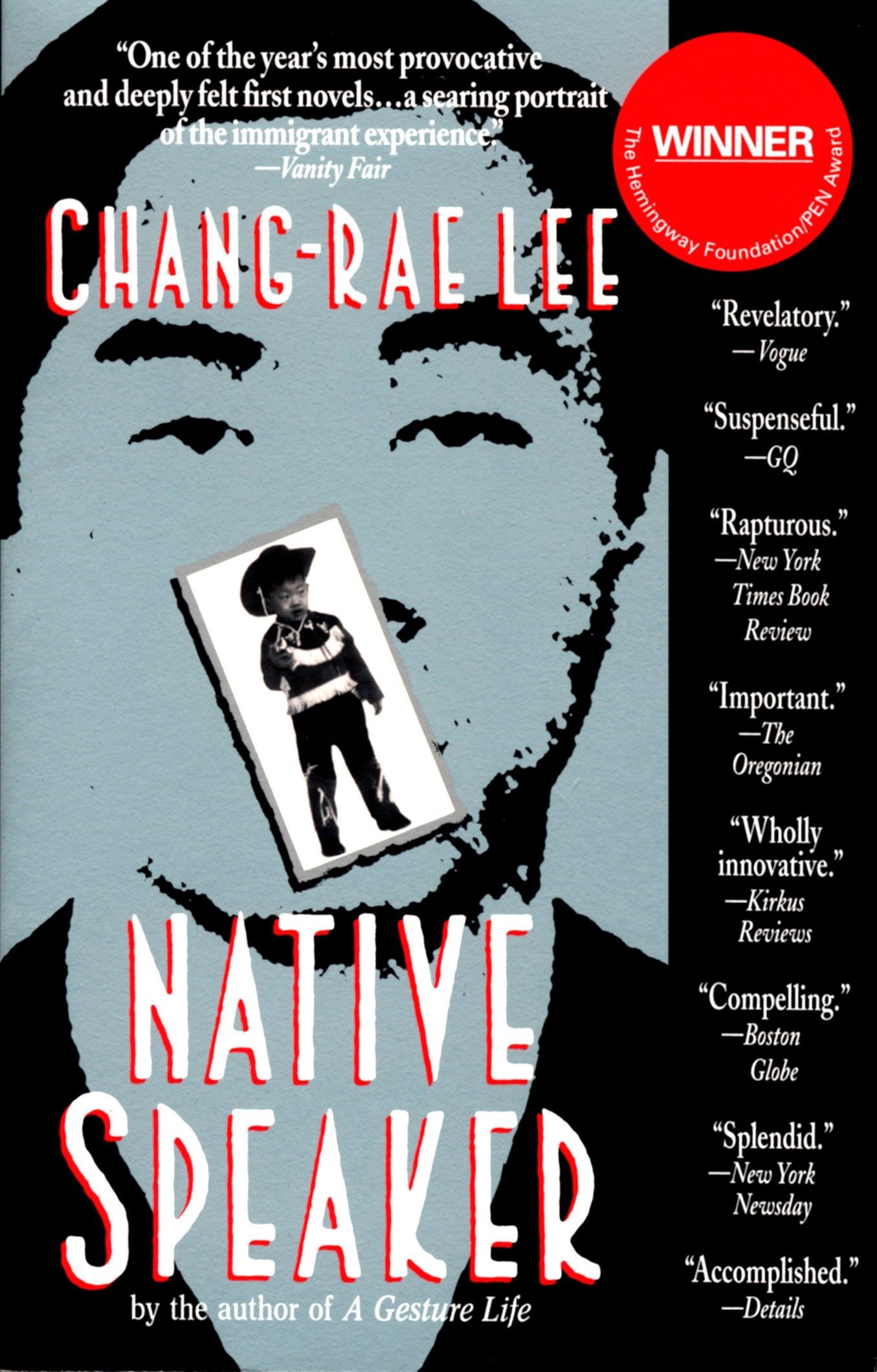
    One important type of immigrant novel, therefore, takes place in the destination country: Tortilla Curtain by T.C. Boyle, The Namesake by Jhumpa Lahiri, Native Speaker by Chang-rae Lee, White Teeth by Zadie Smith, The Beautiful Things that Heaven Bears by Dinaw Mengestu, and Call it Sleep by Henry Roth, to name a few.[7] Many of these novels excel at uncovering the workings and contradictions of metropolitan (American or British) society. Native Speaker, whose Korean-American protagonist—the child of an immigrant—assists on a politician’s campaign, expertly exposes the underlying racial tensions in New York City. Tortilla Curtain—following a destitute undocumented couple and a middle-class native-born couple living in the same suburb of Los Angeles—puts immigration-related tensions into stark focus, revealing the xenophobia and racism lying just under the surface of most “liberal” American towns. The protagonist in The Beautiful Things that Heaven Bears says himself how important it is to consider his city, D.C., “not in fragments or pieces, but as a unified whole” (Mengestu 173). That is a novel proclaiming its Lukácsian intentions in maximally quotable form.

    Yet these novels exclude the country of origin from the narrative in myriad ways. Boelhower had pointed out that “[a]lthough there is usually a clear journey sequence in the immigrant novel[…]it may be present as a flashback or a digression” (6). Contemporary immigrant novels are less likely to include such a sequence, in flashback or not, and they tend to open after the immigration has already taken place. This brings us to a strange and altogether counterintuitive realization: immigrant novels tend to erase, or at least bury, the very migration—the very interstitial, transnational connection—that nominally defines the genre. In this way, the immigrant narrative is reduced to the assimilation narrative (which is sometimes a failed assimilation narrative); the immigrant’s story begins when he disembarks from the plane or when she crosses the border. This aligns, of course, with America’s idealized conception of the immigrant-with-no-past, who sheds her history and is reborn in a new land.[8]

    Because these novels commence after the journey, narrative time spent in the country of origin tends to be minimal, and details sparsely shared. Some do not feature the country of origin at all, as in Native Speaker, whose protagonist, Henry, has never left the United States and has heard little about Korea from his parents. We never read his parents’ backstory—Henry himself “never learned the exact reason [his father] chose to come to America,” and only heard his father mention “something about the ‘big network’ in Korean business, how someone from the rural regions of the country could only get so far in Seoul” (Lee 57)—nor are we let into the pre-history of his family’s immigrant housekeeper or his father’s old friends who come to visit.[9] Tortilla Curtain, which features two migrant protagonists, is nevertheless similar in this respect: the novel opens several weeks after the undocumented couple has reached America from their native Mexico, and all we hear about the latter is one mention of the country’s forty percent unemployment rate (Boyle 199), a few remarks on men going north for migrant work (see 50, for example), and a couple of tightly drawn vignettes: the wife’s father killing an opossum (20), for example, or villagers firing pistols at the sky during a bad storm (129-130). We see this same pattern in Call it Sleep, which begins with the immigrant protagonists disembarking in America. Europe, their point of origin, is “the other side” (Roth 10), a “world somewhere, somewhere else” (23), and although the child narrator, David, thinks “[a]nything about the old land was always worth listening to” (33), we nevertheless rarely overhear these conversations with him. There are moments when “[c]onversation touched on many subjects[…]from this land to the old land and back again to this,” but the reader is sent away from the table (Roth 31). When David’s father tells him that he ate cornmeal as a child, David remarks that “that was one of the few facts that David had ever learnt of his father’s boyhood” (Roth 209). And when David’s mother finally tells an extended story of her young adulthood prior to her immigration, most of it is in Polish and therefore incomprehensible to David, and not transcribed for us (Roth 194-204).

    This reluctance to cross oceans and borders extends even to a number of immigrant novels whose characters travel back to their home countries. Here we can look to White Teeth and The Namesake as two striking examples. White Teeth might give us hope for a binational mapping, as one of the novel’s fathers sends his son, Magid, to live for years with his extended family in his native Bangladesh; the omniscient narrator head-hops between characters and ranges widely in time and space; and the book has the trapping of a family saga, tracking three generations of characters. The narrator briefly follows Magid across the ocean to make the point that Magid in Bangladesh and his twin brother in England are cosmically connected (“tied together like a cat’s cradle,” to be precise: both boys narrowly escape very different kinds of disasters at exactly the same time, halfway across the world (Smith 220)), which gives us only more reason to expect that the novel might follow both boys. And yet, even with all indications pointing to Bangladeshi interludes in White Teeth, Magid, after that one paragraph, disappears from the narrative for his eight years abroad, our only knowledge of him coming from the letters he sends to his parents—until he finally returns to London, at which point the narrator promptly regains interest in his story and begins inhabiting his mind fairly extensively. The only time the narrator travels beyond England is in brief flashbacks of Samad, Magid’s father, and his friend Archie during World War II, serving in Greece and Bulgaria (for the longest series of flashbacks, see Smith 83-122). At the end of the novel, we are told that Irie, her husband Joshua, and her grandmother Hortense will visit Jamaica, Hortense’s birthplace, yet all we get are the words, “a snapshot seven years hence of Irie, Joshua, and Hortense sitting by a Caribbean sea” (Smith 541); the novel declines to so much as describe the snapshot to which it alludes.

    The Namesake, like White Teeth, also enjoys an omniscient narrator that inhabits the minds of both immigrants and their children. It, too, concerns itself with tracing effects back to their causes. The novel opens eighteen months after a Bengali couple has immigrated from Calcutta, India to Cambridge, Massachusetts, but, when the wife’s mother dies, the couple boards a plane with their infant son, about to fly “for the first time in his life across the world” for the funeral (Lahiri 47). Yet when we flip the page to the next chapter, we do not find ourselves across the world. Instead, the narrative has jumped forward two years, skipping their visit to Calcutta entirely. We are told that the family henceforth visits Calcutta every few years, “six or eight weeks passing like a dream” each time—but for the reader, passing in this one sentence (Lahiri 64). By the time the son, Gogol, is ten years old, “he has been to Calcutta three more times,” yet all we are told is his astonishment at seeing so many Gangulis—his last name—in the telephone book (Lahiri 67). Later in the novel, the narrative does follow the family to Calcutta on the husband’s sabbatical. Yet the eight months pass in less than eight pages. Gogol finds it impossible to keep up with cross-country training on the congested streets, so he “surrender[s] to confinement,” which means that we learn much more about the relatives’ households than we do about the postcolonial city of four million around him (Lahiri 83). Later, when his girlfriend’s mother asks Gogol, “What’s Calcutta like? Is it beautiful?”, the question takes him by surprise: “He is accustomed to people asking about the poverty, about the beggars” (Lahiri 134). Yet we readers were never shown the beggars or introduced to the poverty; we learned little more than that the weather is warm and that people sleep under mosquito nets. Tellingly, although the word “world” comes up frequently in the novel, it consistently refers to some much smaller totality: a nation, an ethnic group, or even just a campus.[10]

    At the very least, then, we can conclude that a good many immigrant novels do not provide the multinational mapping for which Heise is looking. Myriad strategies combine to render the Old World beyond narration. The novels commence after the characters have left it behind. Protagonists, especially those who are children of immigrants or were young when their families emigrated, may be genuinely ignorant of it. References to it, even if numerous, are vague, cloaked in nostalgia or distant generalities. If the characters travel, whether in flashback or in the main narrative, time is condensed into brief recaps, and we manage to learn disproportionately little about it. We can attribute this at least partially to the psychologizing impulse of many of these novels: even when the narrative brings us to Calcutta, say, it focuses on the characters’ minds rather than the city that surrounds them. For all these reasons, these narratives neglect to bring the other country into analytic view, running dry when they might otherwise turn transnational. They may take from the realist tradition a certain appetite for sociohistorical explanation, but this appetite does not extend overseas. The Beautiful Things that Heaven Bears astutely sums up the position in which these novels find themselves: the protagonist used to be able to keep both the Ethiopian and the American calendars in his mind, but “as the years accumulated, it became harder and harder to remember that there were two halves to the narrative” (Mengestu 153).

    One might protest that a novel need not have an expanded setting to deal with expansive forces. Why can global dynamics not be adequately addressed “from the scale of a single neighborhood” (Kirsch 25)?[11] Yet the pattern these novels reveal should caution us against such an approach. These immigrant novels—with circumscribed settings that are, as Ghosh suggests, “constructed out of discontinuities” (59)—tend to make intelligible only the effects of global forces and movements, leaving their causes mysterious. Forces originating outside that spatial scope, such as the forces that led these characters to immigrate, become mere events, mere “things that happen,” without explanation—which then turns every Old Country into the same narrative abstraction that requires no specification, the black box for which lonely immigrants pine and to which an occasional twin brother can indefinitely disappear.[12]

    This is a point worth pausing on, for we must make clear that these immigrant novels do not erase the country of origin, however much they bury it. Quite the contrary: the Old World tends to loom quite large, determining much more in the narratives than merely Boelhower’s “ethnic world view.” In White Teeth, it is on Bangladesh that Magid’s father pins all his hopes for his son, and it is Jamaica that persistently occupies the imagination of Irie, the daughter of a West Indian immigrant, in the second half of the novel. In The Namesake, Bengal comes up constantly even when the story hunkers down in the United States: we hear mention of the snacks sold on Calcutta sidewalks (Lahiri 1), the tea sold on Bengali trains (112), the funerals performed for Bengal’s dead (70). In The Beautiful Things that Heaven Bears, the protagonist and his two friends, all immigrants from Africa, play the “coup game” to the point of obsession—I name the leader of an African coup, you guess with which country he is associated (see Mengestu 7, for example); the protagonist “searche[s] for familiarity” and catches “glimpses of home” everywhere in D.C. (Mengestu 175-76), and his friend is similarly wont to see “flashes of the continent wherever he went” (100). But insofar as the country of origin occupies a prominent place in the narrative, it does so as a suspended question mark, a skeptical gap, an absent cause, inserted only to prevent causal regress. A familiar smell here, the name of a politician there—but no sense of the larger society and how these isolated details fit together. The eight-month trip to Calcutta is “quickly shed, quickly forgotten[…]irrelevant to their lives” (Lahiri 88).[13] Jamaica is a “blank page”—“somewhere quite fictional” (Smith 400, 402). Ethiopia, though it is the country that nursed him, seems “conjured, the fictitious dreams of a hyperactive and lonely imagination” (Mengestu 96). We know the country of origin is important, that it is where the story really began, but it is not accessible to us—because even if the characters grew up there, even if they return occasionally to visit, it is no longer truly accessible to them.

    These narratives, therefore, tend perhaps unexpectedly to announce and problematize their own self-imposed limits. We might, in this sense, venture to call these immigrant novels postmodern, in that they self-consciously draw attention to—and then fail to resolve—the epistemological crisis Jameson has identified. Tortilla Curtain says explicitly that “it was crazy to think you could detach yourself from the rest of the world” (Boyle 32)—yet the rest of the world is nevertheless unreachable. In Native Speaker: “no one is smart enough to see the whole world. There’s always a picture too big to see” (Lee 46). In White Teeth: characters feel “tiny and rootless,” with miniscule “significance in the Greater Scheme of Things” (Smith 11)[14] and yet with the dream to “make sense of the world” (366). And without getting too far ahead of ourselves, we can say that slogans such as these will appear even in immigrant novels that feature the home country more substantially, though we cannot yet say whether those do more to resolve the dilemma than these do. In The Brief Wondrous Life of Oscar Wao: “The world! It was what she desired with her entire heart, but how could she achieve it?” (Díaz 113) In The Russian Debutante’s Handbook: he “considered yet again his own relative loss of place in this world” (Shteyngart 408). In Americanah: “She felt like a small ball, adrift and alone. The world was a big, big place and she was so tiny, so insignificant” (Adichie 190).

    This crisis of mapping is not only articulated on the geographic front, as an inability to locate the subject in space, but also on the historical front as an inability to locate the subject in time. We see this most prominently in the genre’s metaconcern for storytelling: of the twelve immigrant novels referenced in this essay, chosen because high-profile, eight include major characters (and five feature protagonists) who are writers or professors.[15] Characters are maddened by their inability to tell a story in its totality, a story of totality: “if you’re looking for a full story, I don’t have it” (Díaz 243); “my point is that this is not the full story.[… F]ull stories are as rare as honesty, precious as diamonds” (Smith 252); “There’s more to the story. There always is to a true story” (Alvarez 102); “You understand I am collapsing all time now so that it fits in what’s left in the hollow of my story?” (Alvarez 289); his “problem” is that “he wanted to tell the entire history of the Congo,” believing that “[n]othing can be left out” and that “[t]he poem must be able to contain it all” (Mengestu 170-71). Beginnings and endings of the tales these characters tell are self-consciously artificial and vexed: “the question is how far back do you want? How far will do?” (Smith 83); “this is no movie and there is no fucking end to it, just as there is no fucking beginning” (Smith 464); “maybe I should start there[…o]r is this where the story begins[?]” (Mengestu 127); “the end is simply the beginning of an even longer story” (Smith 540-41). In certain cases, this inability to find The Beginning is explicitly glossed as the inability to access the home country: for example, “the particular magic of homeland, its particular spell over Irie, was that it sounded like a beginning. The beginningest of beginnings” (Smith 402), only to be followed up a few pages later with, “if you could take them back to the source of the river, to the start of the story, to the homeland… But she didn’t say that, because[…]it was as useless as chasing your own shadow” (Smith 407). And narrators meditate on the force that “sphinxes[…]all attempts at narrative reconstruction” (Díaz 243), most memorably with The Russian Debutante’s Handbook’s assertion that “You’ll need three omniscient narrators to cobble together half a narrative” (Shteyngart 364). In all these ways, the novels routinely reflect on their own fabrication and their own restraints. And as an additional layer of self-awareness, several of the novels that may prove best at transnational mapping—Oscar Wao, Americanah, and The Russian Debutante’s Handbook—mention postmodernism explicitly and, in the last instance, treat it as a major narrative concern.[16]

    Which brings us, then, to the second type of immigrant novel: those that do engage forthrightly with multiple regions on the globe. These are novels like Americanah by Chimamanda Ngozi Adichie, Garcia Girls by Julia Alvarez, No Telephone to Heaven by Michelle Cliff, Breath, Eyes, Memory by Edwidge Danticat, The Brief Wondrous Life of Oscar Wao by Junot Díaz, and The Russian Debutante’s Handbook by Gary Shteyngart. Nearly all allow us inside multiple characters’ heads and refuse neatly linear narratives.[17] All are told looking back on events at a delay and are self-conscious about the mediated nature of their tales. And all show their protagonists crossing oceans—in fact, all do so more than once—and spend significant narrative time in one or more countries in addition to the U.S. That first set of immigrant novels proved consonant with classical social realism: a realism of one nation, in which the rest of the world registers only as narrative uncertainty. This second set, by contrast, successfully brings at least two remote locations into view, and thus has the potential, at least, to make intelligible the lopsided relationships that characterize our global order. Yet at least three problems persist—and we will want to examine them carefully.

    First, in expanding geographic scope to include multiple locations, some end up slackening the demands of realism in each. We can see this in particular with Danticat’s Breath, Eyes, Memory, which follows its protagonist, Sophie, from Haiti to America and back again for an extended visit. Haiti is viscerally present—beggars, prostitutes, soldiers, bribes (for example, Danticat 228)—in a way that Mexico or Bengal or Jamaica in the novels described above are not. Yet consistently, the narrative brings up some highly-charged political event that is clearly the symptom of a larger process, but, rather than broadening its scope to bring the structure into view, immediately narrows its focus instead to the psychological or the familial. For example, right before Sophie will join her mother in America, the narrative describes in gory detail what seems to be a government crackdown on a student protest. We are provided no context or explanation—and when her aunt yanks her to safety and asks, “Do you see what you are leaving?”, Sophie merely replies, “I know I am leaving you” (Danticat 34). Danticat may want us to feel the confusion of the child narrator in this moment, but when Sophie returns to Haiti as an adult and a friend comes running to tell her that the macoutes, the dictator’s militia, killed a villager, we are once again not given any context for this state violence. Instead, the sobbing friend declares, “That’s why I need to go [i.e. emigrate],” and Sophie’s grandmother voices the exact pattern we are noticing: “A poor man is dead and all you can think about is your journey” (Danticat 138).[18]

    We see this pivot to the micro scale even more strikingly when we are allowed to listen to a group of Haitian-American men “talking politics” (Danticat 54). Their argument mentions such topics as the Haitian konbit system, Vietnamese refugees resettled in the United States, and America’s military intervention in Haiti in the early twentieth century. Yet the exposition that follows does not explain what the konbit system is, who the “boat people” are, and what the military occupation entailed and why it was undertaken—the last of which, especially, has mighty relevance for the dynamics the characters face. Instead, the narrator interjects, “For some of us, arguing is a sport,” before going on to describe the “colorful language” used in the marketplace in Haiti and the dynamics between Sophie’s mother and her mother’s boyfriend (Danticat 54). The novel collides with loaded and wholly pertinent transnational phenomena only to bounce elsewhere.

    Danticat has written what has deservedly become known as one of the most ambitious and powerful narratives on the Haitian-American immigrant experience, and her deprioritization of extended narration and structural exegesis—which, no less than sociological analysis, would require embedding “individual biography in the larger matrix of culture, history, and political economy” (Farmer 41)[19]—may be precisely what enables her relatively short novel to so masterfully trace the impacts of trauma across oceans and generations. But this does leave her treatment of both Haiti and America only lightly ethnographic, and the countries are distinguished almost exclusively by which important people in Sophie’s life happen to live in each.[20] A reviewer credits Danticat with “evoking the pace and character of Creole life, the feel of both village and farm communities” (“Breath, Eyes, Memory”). Precisely: a pace, a feel, but not a network. She gives us a sense of how life in both places is lived but chooses not to probe the underlying mechanisms of the societies, even when the plot invites or even, in certain instances of state violence, begs for explanation—for significantly, Danticat does not avoid bumping up against such topics and thus indicates their relevance to the story she is telling, making the reader aware of the limits the novel is hitting. We need not follow Heise in her search for novels that map transnationally, but if we do, we should recognize that while the first group of immigrant novels we examined mapped but were not transnational, this novel, though transnational, is not particularly interested in mapping.

    A second impulse in these novels that resists transnational mapping is what we can call “split-screen” realism. Garcia Girls exemplifies this tendency. Alvarez’s novel backtracks chapter by chapter in narrative time from the Garcia sisters’ adult lives in the United States to their childhood in the Dominican Republic—and in between, their hasty emigration from the D.R. when their father’s plot against the government is suspected. The novel examines America only scenically (as in Breath, Eyes, Memory), but when the setting moves to the Dominican Republic, we not only get a sense of the fear Trujillo and his SIM elicit but also how the dictatorship goes about its business: its method of interrogating children and servants first, for example, and the way SIM agents can be intimidated by “big men” with American connections. The novel applies a realist impulse to multiple nations—is this not what we have been looking for?

    Not quite, in fact. Our hope was to find a novel that transcended the horizon of the nation: that zoomed out to view each country as a node in a larger global network. What it seems that Garcia Girls has given us instead is multiple distinct networks, each still delineated by national boundaries and tied together only by the sisters’ journey. We are missing the connections between nations. It is surprising for a novel concerned equally with the United States and the Dominican Republic to not once mention the D.R.’s occupation by U.S. forces, Trujillo’s training with the U.S. Marines, or any of the numerous incidents involving both countries that occur within the novel’s narrative time (1989-1956): Trujillo’s abduction of Jesús Galíndez in New York City, rumors of CIA involvement in Trujillo’s assassination, or (especially) the second U.S. invasion of the island in 1965. The sole connection, alluded to only once, is the uncle’s job as a CIA agent organizing against Trujillo (“his consulship is only a front—Vic is, in fact, a CIA agent whose orders changed midstream from organize the underground and get that SOB out to hold your horses, let’s take a second look around to see what’s best for us” (Alvarez 217)), which raises all sorts of questions the novel chooses not to answer: How did Vic gain that position? Who changed his orders? Why is the CIA involved in the first place? Instead of examining the relationship between the U.S. and the D.R.—one characterized by a vast power imbalance, and one in which the global struggle between capitalism and communism dictated many terms—the novel considers the sisters’ journey as a migration between one network and another, not between nodes in one total network. Alvarez has provided us not with a mobile camera, but with two fixed cameras, each with national scope.

    Finally, a third problem: while “split-screen” novels like Garcia Girls seem uninterested in mediation, other novels, like Shteyngart’s The Russian Debutante’s Handbook, are perhaps overly stuck on mediation. A prerequisite for mapping a society—and Lukács is especially keen on this point—is that the protagonist must bring different parts of society into human contact (The Historical Novel). The character must leave abuela’s kitchen and become acquainted with individuals from different backgrounds, classes, and affiliations—which might help explain why so many classically realist immigrant novels focused on America bring a wealthy, native-born WASP family into close proximity with the immigrant protagonist,[21] and one reason why a novel like Breath, Eyes, Memory does not map: the protagonist spends almost the entire book in one of three houses, and both Haiti and America become defined more by the people who happen to live there than by sociopolitical characteristics of the nations at large.[22] In The Russian Debutante’s Handbook, we do get an initial description of Prava when the protagonist Vladimir tours: we see the quarters of the city, the smokestacks, the Austrian bank and German car dealership, and The Foot, the remains of an enormous statue to Stalin. Yet because of Vladimir’s assignment to cheat Prava’s expats in a Ponzi scheme, most of the characters we meet in the city are American expats. In fact, the only exception might be the babushkas, the old women protesting around The Foot. Vladimir, newly arrived in Russia, remarks to an acquaintance, “I’m still a little out of it as far as the locals go.” The friend’s reply? “Forget about them.[…] This is an American town” (Shteyngart 204).

    Thus, although Vladimir spends 300 pages narrating how this miniature society functions, what we miss entirely is the rest of Russian society; we finish the novel with the impression that Prava is populated solely by thugs, expats, and a few old ladies still quoting Marx. The impulse to map is there, but the subject proves elusive: Shteyngart is so preoccupied with the bridge that he neglects the land on one side of that bridge, and so his efforts to represent this transnational connection actually detract from his engagement with Russia. The Russia we find is also quite stereotyped: to be “russified” in Shteyngart’s telling is to add gunfire, car alarms, and a red carpet (Shteyngart 178). Along the lines of the immigrant novel’s postmodern character, we might even say that The Russian Debutante’s Handbook provides not a map of Russian society but a pastiche of a map, endowing the Russian present “with the spell and distance of a glossy mirage” (Jameson, “The Cultural Logic” 21). In both these ways, Russia is pushed to the margins. This results in an unexpected universalizing of the novel’s Russia: the Emma Lazarus Immigrant Absorption Society in New York City is once referred to as “that nonprofit gulag” (Shteyngart 107), and an immigrant early on in the novel insists to Vladimir, “Everywhere is Russia.[…] Everywhere you go…Russia” (10). But more generally, as the above remark about the “American” town suggests, we can track an equating of the First, Second, and Third Worlds in all directions: the immigration office is likened on the first page of the novel to a “sad Third World government office” (Shteyngart 3); later, a barkeep in a Soviet town speaks “in near-perfect English, as if the waves of the Pacific were stroking the sands of Malibu outside” (417-18).

    We can see, then, that most immigrant novels do not provide anything like the global representation for which Heise, Ghosh, and Jameson are searching. Yet a few immigrant novels do avoid all of these tendencies, revealing how the narrative theme of immigration can—even if it does not always—enable realism to map at scales larger than the nation. Adichie’s Americanah offers a multiplot that follows one character from Nigeria to America and back and a second from Nigeria to England and back, while also delving deeply into issues of race, gender, and class in each nation; including detailed conversations about transnational connections (such as visa applications, rich Americans giving charity to African countries, and asylum seekers crossing into Europe); and, despite the title of the novel, never allowing the expat community to crowd out Nigeria.[23] Cliff’s No Telephone to Heaven, in which Clare travels from Jamaica to America to Europe and back to Jamaica, draws up a network of various characters connected to one another across the world; examines postcolonialism in Jamaica, Jim Crow in America, and the National Front in London; and is interested from the start in how, say, the guns used by Jamaican militants were made in America and the ganja they are growing will be exported to America. And Díaz’s The Brief Wondrous Life of Oscar Wao, which follows Oscar and his family back and forth between the Dominican Republic and the United States, begins with the fukú curse that connects generations and continents; has Oscar meet Dominican individuals across social strata (most memorably, the prostitute with whom he falls in love); and includes not just exposition that functions as internal footnotes, but actual footnotes—snarky and engaging—on Dominican, and Dominican-American, politics.

    We can track several patterns in these exemplars at the level of content. First, as we have discussed earlier, they all narrate a substantial period prior to immigration, which helps avoid an erasure of the home country. Second, they all follow multiple characters—each partner in a couple in Americanah, several generations in a family in Oscar Wao, or a whole network of family members and acquaintances in No Telephone to Heaven—which grants the novel easier access to multiple locations and multiple journeys.[24] Finally, all feature returnees: protagonists who immigrate and end up, by the novel’s conclusion, back in their countries of origin.[25] These protagonists reject the assimilation that, in other immigrant novels, threatens to crowd out the journey, and they can arrive at each shore with the fresh and pseudo-objective perspective of a stranger, which may encourage reflection on the inner workings of the societies. These novels are, paradoxically, in their own way anti-immigrant, steeped in misgivings about the purported terminus of the immigrant journey and ultimately rejecting it. Yet if they are not immigrant literature proper, we can call them migrant literature, which “focus[es] on characters for whom America is a stage of life rather than a final destination” (Kirsch 62). This makes clear the distinctive potential they hold: with America limited to one stage among several, the rest of the world has room to come into view.

    These, then, seem to be the novels we have been looking for. Yet one major complication remains, one more deep-rooted and structural than the others—revealing perhaps less about the internal limits of these novels than about the onerous, perhaps even excessive, demands of the cognitive mapping project itself. We can approach this final hurdle by way of a puzzle in Oscar Wao.


    Near the end of Díaz’s novel—after the narrator has provided us footnote after footnote, after the characters have traveled back and forth between the Dominican Republic and the United States, after we have followed three generations and come to see the continuities—we find Oscar on a visit to Santo Domingo. Under the heading “Oscar Goes Native” comes one sentence that takes up almost three pages. It is too long to cite in full, but we would not do it justice if we did not quote a substantial length. Here, then, are some excerpts:

    After his initial homecoming week, after he’d been taken to a bunch of sights by his cousins, after he’d gotten somewhat used to the scorching weather and the surprise of waking up to the roosters[…]after he refused to succumb to that whisper that all long-term immigrants carry inside themselves, the whisper that says You do not belong[…]after he’d given out all his taxi money to beggars and had to call his cousin Pedro Pablo to pick him up, after he’d watched shirtless shoeless seven-year-olds fighting each other for the scraps he’d left on his plate at an outdoor café[…]after a skeletal vieja grabbed both his hands and begged him for a penny, after his sister had said, You think that’s bad, you should see the bateys[…]after he’d gotten somewhat used to the surreal whirligig that was life in La Capital—the guaguas, the cops, the mind-boggling poverty, the Dunkin’ Donuts, the beggars, the Haitians selling roasted peanuts at the intersections, the mind-boggling poverty, the asshole tourists hogging up all the beaches, the Xica de Silva novelas where homegirl got naked every five seconds that Lola and his female cousins were cracked on, the afternoon walks on the Conde, the mind-boggling poverty, the snarl of streets and rusting zinc shacks that were the barrios populares, the masses of niggers he waded through every day who ran him over if he stood still, the skinny watchmen standing in front of stores with their brokedown shotguns, the music, the raunchy jokes heard on the streets, the mind-boggling poverty[…]—[…]after he stopped marveling at the amount of political propaganda plastered up on every spare wall — ladrones, his mother announced, one and all — after the touched-in-the-head tio who’d been tortured during Balaguer’s reign came over and got into a heated political argument with Carlos Moya[…]after he’d seen his first Haitians kicked off a guagua because niggers claimed they “smelled,”[…]he decided suddenly and without warning to stay on the Island for the rest of the summer with his mother and his tío. (Díaz 276-78)

    Oscar seems to be doing for Santo Domingo what a reader with a taste for realism might wish the children in The Namesake had done for Calcutta: leave the family home and uncover the economic, political, and cultural dynamics of the city for us. Yet this is not, in fact, explanatory narration, and may not be narration at all, but rather its opposite: the chaos of unmediated subjective experience whirling around Oscar without offering the tools to make sense of it all. The sentence drags on, with enough repetition, that the reader might start to think, I get it already! Yet Díaz is insisting that we do not get it. The poverty of La Capital remains “mind-boggling” even after seeing it many times. Oscar, and we, cannot wrap our minds around it—cannot, we might say, cognitively map it. The repetition unto excess is a symptom of maplessness.

    But Díaz has provided us with enough context—on the Trujillo regime, on corruption, on U.S. intervention—to be able to account for the poverty in Santo Domingo. The narrative, judged on its own terms, should have little trouble incorporating this sight into the network it has succeeded in drawing up. Oscar, too, knows much of the information we now do: the opening footnote of the novel begins, “For those of you who missed your mandatory two seconds of Dominican history,” implying that the Dominican-American characters know much more than the reader on topics such as this (Díaz 2). So why should the poverty be mind-boggling, either to us or to him? Is it not precisely what we would expect to see, understanding the history and politics Díaz himself has taught us? Either the novel, after achieving an unusually ambitious feat, is professing not to have done so, thus perplexingly selling itself short and denying its own accomplishment; or, alternatively, it is professing that the very feat—the elucidation of global connections—is itself an insufficient one. The task itself, as challenging as it may be, is somehow not ambitious enough.

    And it is here, with this mind-boggling repetition of “mind-boggling,” that Díaz helps us to notice something unsettled even in Jameson’s prose, and perhaps to clarify Jameson’s project. Jameson begins his essay on cognitive mapping by advocating a return to the “pedagogical function of a work of art” (Jameson, “Cognitive Mapping” 347). Yet elsewhere in his writing, he makes clear that he is not looking for didacticism. Drawing on Althusser’s distinction between science and ideology, Jameson states:

    The existential—the positioning of the individual subject, the experience of daily life, the monadic “point of view” on the world to which we are necessarily, as biological subjects, restricted—is in Althusser’s formula implicitly opposed to the realm of abstract knowledge.[…] What is affirmed is not that we cannot know the world and its totality in some abstract or “scientific” way[…]but merely that it was unrepresentable, which is a very different matter. The Althusserian formula, in other words, designates a gap, a rift, between existential experiencewa and scientific knowledge. Ideology has then the function of somehow inventing a way of articulating those two distinct dimensions with each other. (Jameson, “The Cultural Logic” 53)

    Cognitive mapping is meant to inhabit the same gap as Althusser’s ideology. The mapping Jameson desires, then, is not an abstract account of the world. It is instead a “representation,” or what he elsewhere calls a “figuration”: some aesthetic that can reveal the world-system in its structural reality through the subjective point of view. Jameson, in other words, is not asking for the novel to lecture us about globalization. He is asking for the novel to represent characters’ experiences of global forces in such a way as to make those forces understandable.

    Previously, we searched the immigrant novels closest to this ideal for strategies at the level of content. We found that they all begin prior to immigration, follow multiple characters, and center their narratives around returnees. But we have not yet inquired at the level of form: What formal techniques enable these novels to engage with, and reveal the links between, multiple nations? How, precisely, are they bringing the world into view? On these questions hangs the crucial one. These novels are transnational, and they draw up networks—but what innovations do they offer at the level of representation?

    The key features we discover, when we look to formal strategies, turn out to introduce high levels of mediation, freeing the novel in those moments from the bounds of experiential subjectivity—and leaning away from representation and toward didacticism. Americanah introduces the transnational politics mentioned earlier—visas, international charities, refugee crises—by recording long dinner conversations, and comments on how race and class operate transnationally through one character’s pages-long blog posts. No Telephone to Heaven introduces the effects of past colonization on the Jamaican landscape by beginning with a dictionary definition of “ruinate” (Cliff 1); at another point, it quotes a New York Times description of Jamaica (Cliff 200). The “national” immigrant novels discussed earlier use these same techniques to a lesser degree when they do gesture beyond America. For example, White Teeth quotes the Reader’s Digest Encyclopedia’s entry on “Bengali” (Smith 236), the Oxford English Dictionary’s definition of “Pandy” (Smith 251)[26] and television news anchors discussing the Berlin Wall (Smith 240), providing what little transnationalism is present. In Native Speaker, a politician’s speech includes commentary on American race relations as well as some history of the Japanese colonization of Korea—one of the only mentions of Korean history in the entire novel (Lee 153). In a number of these novels, like in Americanah, discussions between intellectuals are transcribed as if from a microphone. The Brief Wondrous Life of Oscar Wao simply takes this trend one step further, providing sociopolitical context not just in distinct quotations but through actual footnotes—not even attempting to incorporate them into the body of the narrative. Three striking corollaries follow.

    First, list the techniques we have just identified—lectures, dictionary definitions, speeches, blog posts, footnotes—and we come to an arresting realization: these novels only seem to map when they are themselves least novelistic. We can ask, then: if what we desire is information on Trujillo’s regime, why not open up a history textbook? If we want to learn about race relations, why not find an actual blog on the subject, rather than a fake blog-within-a-novel? Of course literature can generate associations around mere information in ways that most footnotes and blog posts and dinner conversations do not. At the very least, they are written in character. But can we really claim the pedagogical function as a novelistic achievement if the novel must shrug off its own form to accomplish this?

    Second, the achievement of these exemplars is precisely pedagogical, not in fact representational in the sense Jameson was after. These features hardly form the link he recommended between subjective experience and abstract information; they simply insert passages of abstract information into plots otherwise governed by subjective experience, putting the narratives on pause as they do so. In Americanah, for example, some of Adichie’s blog posts are quoted in order to be treated in the narrative, as when a post about a friend—a young woman with “Unknown Sources of Wealth”—angers her, leading the protagonist to take down the post and drive over to her friend’s house to apologize (Adichie 521). But others come at the end of chapters, distinct from the storyline around them.[27]

    Third and lastly, this separation not only arises within the stories, but actually manifests on the very pages of these novels. Indentations and white space set apart dictionary definitions and blog posts from the rest of the prose. And if these features put the narratives on pause, then Díaz’s footnotes, as well as Cliff’s glossary (an item much less common in immigrant novels than one might expect; of the twelve novels discussed, only this one can boast a glossary), do so to a different degree entirely, making the disjunction truly disturbing to the reader. In Oscar Wao, there will be a footnote next to a name in a character’s dialogue, and we will have to choose whether to finish the paragraph (in which case we are reading without knowing the referent of that unfamiliar name) or jump immediately to the bottom of the page, in which case we have vaulted out of the conversation (out of the realm of the subjective) and into the realm of the abstract. Similarly, while most immigrant novels ensure that the rough meaning of non-English phrases is discernable from context—and if not, find a way to translate them for us, like having a character ask what a word means so that others will “represent” it[28]No Telephone to Heaven includes untranslated slang without clear context clues, forcing the reader to suspend the story to flip to the back of the book instead of gleaning the meaning organically.[29]

    This is, of course, what our everyday experience is really like. We are inescapably restricted to the “monadic ‘point of view’” (Jameson, “The Cultural Logic” 53). Jameson characterizes postmodernism as “a situation in which we can say that if individual experience is authentic, then it cannot be true; and that if a scientific or cognitive model of the same content is true, then it escapes individual experience” (“Cognitive Mapping” 349). There is, again, a contradiction between experience and reality. And these immigrant novelists are underscoring the fissure rather than attempting to bridge it, separating the two on the page and forcing us to prioritize one over the other. The very form of their novels articulates the crisis of mapping.

    And it is in this context that we can make sense of that long montage towards the end of Oscar Wao. Díaz may have given us enough information about American and Dominican societies that the poverty of a Third World country oppressed by a dictator and exploited by the international hegemon should not confound us. Yet when Oscar, and we readers, are confronted with the actual beggars on the streets—with children struggling over our table scraps, with an old woman pleading for a single penny—we find ourselves unable to assimilate these experiential data into our mental schema. In Díaz, the causes of this poverty come as it were pre-explained, and yet the reality remains fragmented and inexplicable, unintegrated into a larger, explanatory whole.

    We are now in a position to specify more precisely the project of cognitive mapping: a synthesis of the experience of and explanation for global forces. This, we should note, imposes three criteria for judging a novel in this particular regard (which Jameson himself emphasizes is not intended to displace other aesthetics; after all, art has always had “a great many distinct and incommensurable functions” (“Cognitive Mapping” 347)). First, the content of the novel needs to be transnational; second, the novel must routinely reach for explanation; and third, the novel must incorporate that explanation into the narrative itself, rather than setting it apart as learned discourse. It turns out that immigrant novels, a genre we might expect to be inclined toward such a project, almost never hit these marks. Some, like Danticat’s Breath, Eyes, Memory, do not contain a strong explanatory impulse; they focus almost exclusively on the experience side of the binary, even when that experience seems incomprehensible without context, and even when—like with the men talking politics in the restaurant—such explanation is relegated just offstage. And a great many other immigrant novels are not particularly interested in the globe at all: the majority because they are confined to a single nation; others because, though multinational, they still take the nation as the unit of analysis and do not examine the connections between nations, as in Alvarez’s Garcia Girls; and still others because they reduce one or more nations to their connections with other nations, as in Shteyngart’s The Russian Debutante’s Handbook. The few that do manage to transcend the nation and include both experience and explanation—Americanah, Oscar Wao, No Telephone to Heaven—nevertheless keep the two largely distinct, even to the extent of separating them formally. And the problem with that, as one character in White Teeth insists, is that if you are looking for full stories, “epic” stories,[30] “[y]ou don’t find them in the dictionary” (Smith 252)—not even, we can add, in dictionaries within novels. The result is that characters like Oscar cannot apply their knowledge to their first-order experience, with the suggestion that we readers, too, may not be able to. A work of explanatory realism frets that explanatory realism is not enough.

    We find ourselves, then, with three possibilities, three potential verdicts on the project of cognitive mapping. We will take each in turn.

    We might conclude, first, that all three stipulations of the cognitive mapping project are desirable and at least potentially feasible. The immigrant novels we have analyzed have, admittedly, not reached this standard. Perhaps we simply need to read more of them, or look back to science fiction, or find another genre entirely—but Heise, Ghosh, and Jameson have articulated a program worth undertaking.

    This hinges on whether there is something about representation as such that we should value, something missing when experience and explanation are simply placed side-by-side and not synthesized. Whether the narrator imparts context directly to readers in what we can call “soundtrack information” (such as Balzac’s self-footnoting or Díaz’s footnotes), or alternatively, like a stage play, the novel limits itself to “diegetic information” (such as dinner conversations or TV news, in which the source of the information is present to the characters), the novel has still not achieved representation proper: both techniques simply provide us with passages of abstract, scientific information, sandwiched between involving episodes of story. Yet if Jameson is right that between experience and explanation there is, at best, a gap or a rift, and at worst, a contradiction, then simply providing us with both does not allow us to apply one to the other.

    And why should this task of reconciling the two seem pressing? The “aesthetic of cognitive mapping” is ultimately seeking to “endow the individual subject with some new heightened sense of its place in the global system” (Jameson, “The Cultural Logic” 54). This is what multinational capitalism has robbed us of, with the “hyperspace” of advanced modernity having “transcend[ed] the capacities of the individual human body to locate itself, to organize its immediate surroundings perceptually, and to map cognitively its position in a mappable external world” (Jameson, “Postmodernism and Consumer Society” 15-16). Locating oneself, of course, necessarily involves a relation between the monadic point of view and the abstract grid—and didacticism in any form can only give us the grid, not the relation between the two.[31] Mere description, in this view, may be able to teach us about our world but cannot help us locate ourselves within it.

    This is Oscar’s dilemma: he has access to his own experience as well as a working model of the external world, and yet he is still no closer to locating his position within it—and so he is unable to organize his immediate surroundings, resulting in that barrage of sensations. Without an understanding of his own positioning, he is also unable to catalyze change: he “give[s] out all his taxi money to beggars” and yet cannot make a dent. We see this too in No Telephone to Heaven, the novel that of them all probably comes closest to a synthesis. After insisting (echoing Mengestu’s protagonist who cannot hold onto both halves of the narrative), that “we will have to make the choice. Cast our lot. Cyaan [Can’t] live split. Not in this world,” Clare’s friend tells her in a long didactic passage about the canefields around them and the history of slavery in the region. “I am sorry to preach,” the friend says. Then comes Clare’s impatient mental response: “And what am I supposed to do about it?” (Cliff 131-33). Clare cannot access both Jamaica and the West at once—she will, as her friend says, be forced to choose—and being told about the impact of the global slave trade on her local surroundings does not help her understand her place in the world.

    Of course Oscar and Clare are powerless, goes this argument: a textbook explanation of the world, uninformed by our own experience, is irrelevant to us. The alternative is also true: a detailed account of our experience, uninformed by our place in the world, is not reliably connected to the world around us. What representing the world-system would grant us is a way “to grasp our positioning as individual and collective subjects and regain a capacity to act and struggle which is at present neutralized by our spatial as well as our social confusion” (Jameson, “The Cultural Logic” 54). This is what novels can do that textbooks and encyclopedia entries cannot: help us grasp our positioning in a system so we can recognize the system as the product of our collective agency. And this is what none of these immigrant novels, for all their achievement, fully attain, committed as they are to didacticism.

    So what would an immigrant novel that truly represents a multinational slice of our world-system look like? If the crisis under late capitalism is that we cannot experience the truth of our world, then this is what we should ask the novel to do. Characters must not be told the big picture, as diegetic techniques allow, but rather must come to glean the big picture in their everyday lives. We see a glimmer of this in No Telephone to Heaven, with Clare at the end of the novel fixated on understanding her place in the world, and being moved to action because of her rootedness in place. Her friend had told her earlier, “Cyaan [Cannot] live on this island and not understand how it work, how the world work” (Cliff 123). Although she cannot, ultimately, understand how the world works simply from seeing the effects of multinational capitalism in one location, Clare is from then on working to glean an understanding of the world as she moves through it, which is precisely the impulse such a novel would need.

    We could choose to hold out for a novel such as this. But that is not the only possibility. We might decide, second, to embrace the first two stipulations of cognitive mapping—global content and setting, and explanatory impulse—but reject the third, concluding that we are mistaken to demand a synthesis of explanation with subjective narration. We can come at this view from two angles. Either (the optimistic view) the synthesis of experience and explanation is unnecessary, even undesirable, which means that some of the immigrant novels we have identified do, more or less, achieve something worth defending; or, alternatively (the pessimistic view), the synthesis is in fact impossible, however desirable we find it. Either way, we will end up rejecting a synthesis as the goal.

    Perhaps, in support of the optimistic view, the division of explanation from narrative that we see in these last immigrant novels should not bother us at all. If this is what it takes to transcend the national scale, why not be satisfied? Immigrant novels might be especially drawn to explanation, as they cannot rely on their readers to recall their mandatory two seconds of Dominican (Haitian, Bengali, etc.) history. “To teach, to move, to delight” (Jameson, “Cognitive Mapping” 347)—the novel does all three—why ask it to do all three at once? There are at least three reasons why one might condone, even embrace, this didactic impulse without desiring any synthesis at all.

    First, one of our worries had been that if transnationalism only enters at moments when novels adopt other literary modes, this could be a sign that the novel as a genre really is incapable of engaging with global issues. If a novel, so this argument went, has to quote an encyclopedia to bring up Dominican-American political relations, don’t call what it is doing novelistic innovation; it has simply given up its novelness and let an entirely different medium intrude. Yet the tendency of these immigrant novels to provide explanation via embedded media is not contrary, in fact, to traditional novelistic technique. Rather, the form’s willingness to incorporate other genres into its prose is itself a key feature of the novel, and immigrant novels only “heighten the qualities of mixture that theorists of the novel have long described as fundamental to the genre” (Miller 201).[32] Canonical novels routinely feature snippets of poetry, epistolary correspondences, radio broadcasts. Why not blog posts or encyclopedia entries or, finally, footnotes? The inclusion of other genre impulses is, itself, novelistic, and finding new ways to embed media may be enough of an innovation.

    Second, reaching for didacticism too has been a common novelistic impulse. Nominally, Lukácsian mapping is supposed to take place via narration, carried by characters. And as it is, the didactic passages in these immigrant novels are more aligned with Lukács’s denigrated “description” than his venerated “narration” (“Narrate or Describe?”). Yet many of his own exemplars do not live up to his standard, comfortable as they are with explanatory passages that fall out of narration. Indeed, canonical social realist novels routinely snub the “show, don’t tell” rule. We might consider James Fenimore Cooper and Lukács’s own beloved Walter Scott, who typically open their books with pages of scene-setting and background before introducing a single character. Or the no-less-Lukácsian Balzac, whose narrator has been known to write that it is “necessary to pause here” to detail the geography of an old city, “without which account it will not be possible to understand” one of the characters (32). This is basically an in-line footnote; Díaz’s actual footnotes simply take what proves to be a wholly common novelistic impulse to its page-formatting conclusion.[33] If we are simply looking for a social realism capable of bringing into view extended social networks, then we are not necessarily looking for Jameson’s integrated representation. We, like Lukács, may simply be looking for authors who make art out of social explanation—a task at which these last immigrant novels excel.

    Finally, we may not merely wish to tolerate description, because it has happened to be successful in other novels; we might in fact argue that the novel’s ability to tell rather than show is one of its greatest assets. Fledgling novelists are often told to “think of your book as a movie or a stage play” (Morrill). If an audience couldn’t see it or hear it, it is telling—don’t put it in. But novels are not movies or plays; why limit them as if they were? Why should prose fiction give up the huge advantage it has over visual narrative: namely, that it can deliver context non-scenically?

    If we are convinced by these arguments—if readers are perfectly capable of applying the knowledge they glean from “internal footnotes” to the rest of the narrative, so long as they are provided with both—then we need not look any further: these last immigrant novels we have identified have, in fact, with the help of a thinking reader, achieved the desired reconciliation of experience with structural reality. We have been making too much of Oscar’s confusion.

    There is, of course, the pessimistic alternative: that the synthesis is desirable, that there is something important these novels are lacking, and yet the task is simply hopeless. In this view, the best these novels can do is provide experience and explanation side-by-side; they are incapable, even with interpretive help, of synthesizing the two. If we take seriously Jameson’s insistence that there is a gap, even a contradiction, between experience and reality, then we might reasonably conclude that readers cannot be expected to apply the didactic information a novel provides to make sense of the narrative. And when it comes to global matters, it may simply be too much to expect novelists to reconcile that contradiction either. The crisis of contemporary narrative in this case remains, and the immigrant novels we have analyzed only showcase this. But they have gotten as close as they can to fostering the global understandings Heise desires.

    Whichever of these we choose—that the synthesis is undesirable, or that it is desirable but impossible—we end up with the same verdict: that we should stop creating a novelistic imperative out of cognitive mapping. Whether literature cannot manage it, or literature has already managed it with the readers’ help, or we do not even want it in the first place, there is no reason we should insist on Jameson’s stronger claim that the task of literature is to bridge subjective experience and structural reality. All we might ask is that literature find ways to incorporate both.

    So far, our two possible verdicts on cognitive mapping assume that at least the first two stipulations are worthwhile: that we ought to desire spatially expansive content, and that we ought to look for literature that is inclined to teach us about that content. But there is also a third potential verdict that rejects these assumptions.

    We might decide, lastly, to reject more than one, even all three, of the stipulations of the cognitive mapping project, and conclude that we are mistaken to even desire global explanation from literature. If even immigrant novels, which we might expect to excel at such a project, turn out not to meet the three stipulations named above, then perhaps the stipulations themselves are misguided and ultimately not useful. This is a conclusion open to us to draw. It would seem to depend on our valuation of the social realist tradition, which has historically placed an emphasis on the pedagogical function of art, but which has also tended to uncritically celebrate unifying projects. Whether social realism can be harnessed to other ends, and whether it can be expanded to a global scale without destroying particularities—as we saw occur in many of these immigrant novels, with every Old Country despecified to serve the same narrative purpose, or with Haiti or Russia becoming just another America—is an essential consideration. Full stories, according to a protagonist in White Teeth, “are like the stories God tells: full of impossibly particular information” (Smith 252). If he is right, then this project might tend uncomfortably toward the imperial gaze. There is the feasibility concern: perhaps novelists cannot possibly play God, in which case supposedly full stories will consistently, upon inspection, turn out to be quite narrow. And there is the normative concern: should novelists be aiming to play God at all?

    We end, then, with a recognition that the conclusion we draw from this analysis of immigrant literature depends almost entirely on our theoretical commitments: on what we believe literature is for, and what we want the novel in particular to accomplish. If we believe that novels are best suited for revealing the particularity of experience, or if we prize different sorts of explanations from the kind mapping solicits, then we will derive from this essay a questioning of the standard itself, and will consider Oscar’s mind-bogglement not a puzzle at all, but a reflection of our condition in a globalized world—a condition literature can usefully articulate, but is not meant to solve. If we believe that novels are best suited for description—if their ability to tell, not just show, is their prized feature—then we will be pleased with the last few immigrant novels we explored, and hopeful about the potential of social realism. And if we believe that novels are best suited for integrated representation—and for representing, in particular, a reality that includes a great many global phenomena—then we may be able to take clues from a few of these immigrant novels, but the search, in a variety of genres, will be far from over.


    Emma Lezberg is a senior undergraduate majoring in critical theory at Williams College. Her current research examines how figures of scale (local/global, small/big) are deployed in debates around agriculture and food production.

    Christian Thorne is a professor of English at Williams College.


    Works Cited

    Adichie, Chimamanda Ngozi. Americanah. Anchor Books, a division of Random House LLC, 2014.

    Alvarez, Julia. How the Garcia Girls Lost Their Accents. Alonquin Books, 1991.

    Balzac, Honoré de. Lost Illusions. Caxton, 1898.

    Barnard, Rita. “Fictions of the Global.” Theories of the Novel Now, Part I, special issue of NOVEL: A Forum on Fiction, vol. 42, no. 2, 2009, pp. 207-15.

    Bethune, Brian. “Q&A: Author Viet Thanh Nguyen on the ghosts that haunt refugees.”

    Maclean’s, 27 Feb. 2017, www.macleans.ca/culture/books/qa-author-viet-thanh-nguyen-on-the-ghosts-that-haunt-refugees. Accessed May 2018.

    Boelhower, William Q. “The Immigrant Novel as Genre.” Tension and Form, special issue of MELUS, vol. 8, no. 1, 1981, pp. 3-13.

    Boyle, T.C. The Tortilla Curtain. Viking Press, 1995.

    “Breath, Eyes, Memory.” Publisher’s Weekly, www.publishersweekly.com/978-1-56947-005-3. Accessed Aug. 2018.

    Cliff, Michelle. No Telephone to Heaven. Dutton, 1987.

    Daily-Bruckner, Katie. “Reimagining Genre in the Contemporary Immigrant Novel.” The

    Poetics of Genre in the Contemporary Novel, edited by Tim Lanzendörfer, Lexington Books, 2016, pp. 219-36.

    Danticat, Edwidge. Breath, Eyes, Memory. Vintage Books, 1994.

    Díaz, Junot. The Brief Wondrous Life of Oscar Wao. Riverhead Books, 2007.

    Farmer, Paul. “On Suffering and Structural Violence.” Pathologies of Power: Health, Human Rights, and the New War on the Poor, University of California Press, 2003, pp. 29-50.

    Ghosh, Amitav. The Great Derangement: Climate Change and the Unthinkable. University of Chicago Press, 2016.

    Glesener, Jeanne. “Migration Literature as a New World Literature? An overview of the main arguments.” Aix Marseille University, cielam.univ-amu.fr/node/1983.

    Goldberg, Jonah. “Immigrants Are Americans Who Are Born in the Wrong Place.” New York Times, 29 May 2018.

    Hallemeier, Katherine. “‘To Be From the Country of the People Who Gave’: National Allegory and the United States of Adichie’s Americanah.” Studies in the Novel, vol. 47, no. 2, 2015, pp. 231-45.

    Heise, Ursula K. “Climate Stories: Review of Amitav Ghosh’s ‘The Great Derangement.’” Boundary 2, 19 Feb. 2018.

    Heise, Ursula K. Sense of Place and Sense of Planet: The Environmental Imagination of the Global. New York, Oxford University Press, 2008.

    Jameson, Fredric. “Cognitive Mapping.” Marxism and the Interpretation of Culture, edited by Cary Nelson and Lawrence Grossberg, University of Illinois Press, 1988, pp. 347-57.

    Jameson, Fredric. “Postmodernism and Consumer Society.” The Cultural Turn: Selected Writing on the Postmodern, 1983-1998. London, Verso, 1998, pp. 1-20.

    Jameson, Fredric. “The Cultural Logic of Late Capitalism,” Postmodernism, or, The Cultural

    Logic of Late Capitalism. Durham, Duke University Press, 1991, pp. 1-54.

    Jameson, Fredric. The Political Unconscious: Narrative as a Socially Symbolic Act. Cornell University Press, 1981.

    Kirsch, Adam. The Global Novel: Writing the World in the 21st Century. Columbia Global Reports, 2016.

    Lahiri, Jhumpa. The Namesake. Houghton Mifflin Harcourt, 2004.

    Lee, Chang-rae. Native Speaker. Riverhead Books, 1995.

    Lukács, Georg. “Narrate or Describe?” Writer and Critic: and Other Essays. Edited and

    Translated by Arthur Kahn, Grosset & Dunlap, 1971, pp. 110-148.

    Lukács, Georg. The Historical Novel. London, Merlin Press, 1962.

    Mengestu, Dinaw. The Beautiful Things that Heaven Bears. Riverhead Books, 2007.

    Miller, Joshua L. “The Immigrant Novel.” The Oxford History of the Novel in English: The

    American Novel 1870-1940, edited by Priscilla Wald and Michael A. Elliott, vol. 6, New York, Oxford University Press, 2014, pp. 200-17.

    Morrill, Stephanie. “How to SHOW your story instead of telling it.” Go Teen Writers, 14 Apr. 2014, goteenwriters.blogspot.com/2014/04/how-to-show-your-story-instead-of.html. Accessed Aug. 2018.

    “Naturalization Oath of Allegiance to the United States of America.” U.S. Citizenship and

    Immigration Services, 25 June 2014, www.uscis.gov/us-citizenship/naturalization-test/naturalization-oath-allegiance-united-states-america. Accessed Aug. 2018.

    Roth, Henry. Call It Sleep. New York, Robert O. Ballou, 1934.

    Shteyngart, Gary. The Russian Debutante’s Handbook. Riverhead Books, 2003.

    Smith, Zadie. White Teeth. New York, Penguin Books, 2001.

    “Solutions.” United Nations High Commissioner for Refugees, www.unhcr.org/solutions.html. Accessed Sept. 2019.

    Thorne, Christian. “Grassy-Green Sea.” Early Modern Culture, no. 5, 2006, emc.eserver.org/1-5/thorne.html.

    Thorne, Christian. “Providence in the Early Novel, or Accident if You Please.” Modern Language Quarterly, vol. 64, no. 3, 2003, pp. 323-347.

    Thorne, Christian. “The Sea is Not a Place; or Putting the World Back into World Literature.” Boundary 2, vol. 40, no. 2, 2013, pp. 53-79.

    Wallerstein, Immanuel. World-Systems Analysis: An Introduction. Duke University Press, 2004.

    [1] This essay was co-written by Emma Lezberg and Christian Thorne, with Emma Lezberg as lead author. Christian Thorne generated the initial questions. Emma Lezberg did all of the research, generating the essay’s literary judgments and arguments in conversation with Christian Thorne. She also produced two major drafts of the essay, each of which Christian Thorne revised.

    [2] We have chosen to focus in this essay on immigrant fiction to the exclusion of refugee fiction, variously considered an alternate genre or a sub-genre, because we suspect that refugee fiction contains its own dynamics which may contribute more, or at least differently, to the cognitive mapping project. Refugee novels may be more likely to follow characters during their migrations, and rather than being limited primarily to two nations (sending and receiving), refugees may travel through a number of nations or be formally resettled through Third Country Resettlement (“Solutions”). On the other hand, the impact of trauma—certainly not absent in these immigrant novels, but perhaps more ubiquitous in refugee novels—may complicate the narratives in ways that puncture any potential map. At the very least, refugee fiction deserves its own essay to investigate these various considerations. As refugee novelist Viet Thanh Nguyen says in a 2017 interview, explaining his conscious effort to write refugee literature that is not immigrant literature, “I don’t think they’re the same.[…] Immigrants who voluntarily come to a country have already made a decision to assimilate to one degree or another.[…] But refugees, especially in their early years, are still caught up in the experience that made them refugees.[…] They’re much more oriented towards the past and towards the country of origin” (Bethune).

    [3] For a brief analysis of how migrant literature has been characterized as a “new world literature,” see Glesener. Glesener concludes, “World literature studies will find in migration literature the necessary material to further research on cosmopolitanism[….]”

    [4] Joshua Miller, in his sweeping analysis of nineteenth and early twentieth-century immigrant novels, writes that “the ‘immigrant novel’ has been understood as a tale of arrival to a New World,” a tale of “optimism and obstacles” (200).

    [5] To name a few that will be discussed in this article: The Brief Wondrous Life of Oscar Wao by Junot Díaz, Native Speaker by Chang-rae Lee, and The Namesake by Jhumpa Lahiri.

    [6] For example, Chang-rae Lee’s Native Speaker denies that immigrants arrive in America with idealistic expectations, and chides us for assuming so: “Not one of them thinks these streets are paved with gold. This remains our own fancy.[…] They know they will come here and live eight or nine to a room and earn ten dollars a day, maybe save five” (335).

    [7] Call it Sleep is, in fact, one of the novels Boelhower mentions in his analysis, but we also bring it up here—both because of its enduring prominence and because it beautifully illustrates, as we hope to show, how the homeland can be rendered inaccessible in narratives such as these.

    [8] The American oath of allegiance makes aspiring citizens vow to “renounce and abjure all allegiance and fidelity to any foreign prince, potentate, state, or sovereignty, of whom or which I have heretofore been a subject or citizen” (“Naturalization Oath”). Journalists in left-wing newspapers write op-eds titled “Immigrants are Americans Who are Born in the Wrong Place” (Goldberg). Refugee resettlement agencies, community-based nonprofits, and government agencies offer immigration services under their “New Americans” programs: to name just a few, Jewish Family Service of Western Massachusetts, Queens Library, Center for New Americans in the Pioneer Valley, One America in Washington, Paul & Daisy Soros Fellowships for New Americans, and the Citizenship for New Americans Program (CNAP) in Massachusetts.

    [9] The only time anyone describes living in Korea is when Henry reviews what he has learned about a Korean-American politician’s immigration history: one paragraph involving family members killed in the Korean War and immigration to America as a houseboy (Lee 210-11). Yet we later find out that this politician has been keeping enormous secrets, leading us to question even the little information about Korea we might have been able to glean from this short passage.

    [10] When someone on a train asks Gogol’s father, Ashoke, “Seen much of this world?” and Ashoke begins naming places in India, the man responds, “Not this world[…] England. America[…] Have you considered going there?” (15). The word is again used regionally when, at the end of the novel, we are told that Gogol’s mother will “dwell, as his father does, in a separate world,” which means she will be moving back to Calcutta (289). Even more often, “world” refers to even smaller entities. For example, the narrator names four addresses, two in India and two in America, and remarks about Gogol’s mother, “That had been her world” (160). Gogol’s wife feels sick over the death of a departmental administrative assistant at the university, who was “so marginal and yet so central to her world” (255). The university campus is called “the confined, picturesque universe that had been his father’s world for most of the past twenty-five years” (183). And of Gogol and his first wife, the narrator admits, “They had both sought comfort in each other, and in their shared world, perhaps for the sake of novelty, or out of the fear that that world was slowly dying” (284).

    [11] Kirsch writes, “A global novel can be one that sees humanity on the level of the species, so that its problems and prospects can only be dealt with on the scale of the whole planet; or it can start from the scale of a single neighborhood, showing how even the most constrained of lives are affected by worldwide movements” (25).

    [12] For more on Things That Just Happen, see Thorne, “Providence in the Early Novel,” and “The Sea is Not a Place.”

    [13] This quote describes the children of the family upon returning to America, but the novel gives the immigrant parents similar sentiments. Home from another one of their trips to Calcutta, “there is nothing to remind them” of where they’ve been; “in spite of the hundred or so relatives they’ve just seen, they feel as if they are the only Gangulis in the world” (Lahiri 64). In these few sentences, the other side of the world is made extraneous and is pushed to the margins.

    [14] That significance “could be figured along familiar ratios”: “Pebble: Beach. Raindrop: Ocean. Needle: Haystack” (Smith 11).

    [15] Protagonists: Oscar in Oscar Wao, Vladimir in Russian Debutante’s Handbook, Ifemelu in Americanah, Delaney in Tortilla Curtain, and Yolanda in Garcia Girls. Others: Ashoke in The Namesake, Marcus in White Teeth, Judith in The Beautiful Things that Heaven Bears. Oscar Wao and possibly Garcia Girls are supposed to have been written by characters in their narratives. And this is not including Henry in Native Speaker, who as part of his job as an operative writes up detailed stories of subjects’ lives, also enabling the novel to reflect upon storytelling.

    [16] In Díaz, see 144 and 294. In Adichie, see 154. In Shteyngart, see 82, 180, 244, and 357 for “postmodernism”; see also 270 for “semiotics” and 316 for “poststructuralists.” Marxism, in the end, ends up saving the protagonist’s life in Shteyngart.

    [17] The exception is Breath, Eyes, Memory.

    [18] The next section does provide one paragraph describing how the macoutes routinely enter a house and demand food and women, but it still does not probe the state dynamics that encourage this, and the explanation only lasts a few sentences.

    [19] Paul Farmer insists that “it is one thing to make sense of extreme suffering—a universal activity, really—and quite another to explain it” (41). Drawing from Wallerstein, he argues that individual life experiences in Haiti require explanation, and that these “local understandings must be embedded, in turn, in the historical system of which Haiti is a part” (Farmer 41): precisely the preoccupation of this essay. Why one would turn to literature rather than anthropology for this purpose is another question, one we will take up at the end of this essay.

    [20] In Native Speaker, when Henry’s wife suggests to his father that the Korean neighborhood in New York City must be like the old country, his father corrects her, explaining “how if she looked carefully at the people she’d see the extra spring in their steps” just from the knowledge that “[t]his is an American street” (Lee 282-83). Breath, Eyes, Memory refuses to grant America such power, and likens the origin and destination countries: Haiti is simply where her aunt lives, while America is where her mother, and later her husband, live. Sophie’s first reaction upon seeing her mother in America, noting her scarred and sunburned fingers, is “It was as though she had never stopped working in the cane fields after all” (Danticat 42). Later, when Sophie returns with her daughter to visit Haiti, her aunt asks her, “Is it really as grand as they say, New York?” When Sophie replies, “It’s a place where you can lose yourself easily,” her aunt admits, “Grand or not grand, I am losing myself here too” (Danticat 103-04).

    [21] Usually this comes in the form of a partner, whose family “adopts” the protagonist and teaches him or her about America. For Americanah, it’s Curt and Kimberly. For The Namesake, it’s Maxine. For White Teeth, it’s the Chalfen family: “She wanted to “merge with them. She wanted their Englishness.[…] She was crossing borders, sneaking into England[…]wearing somebody else’s uniform or somebody else’s skin” (Smith 328). For Russian Debutante’s Handbook, it’s Fran: “what he really wanted to do[…]was to become Manhattanite Francesca Ruocco” (Shteyngart 83). For The Beautiful Things that Heaven Bears, it’s Judith. And Tortilla Curtain simply gives the white, native-born Mossbacher couple their own points of view.

    [22] See footnote 20.

    [23] Admittedly, Americanah does not pursue Nigerian politics even the few times it gestures at governmental affairs. For example, Ifemelu’s Aunty Uju dates a man termed The General, and although we know he is high up in the Nigerian government, we do not learn anything about what he does. And the one time a coup is mentioned, the novel does not recount for us anything about the current government, the attempted coup, or what led up to it; all we get is, “on the same day as the failed coup, while the traders who lived downstairs were crying because the coup would have saved Nigeria and market women would have been given cabinet positions[…]” (Adichie 52). One might also note that “[w]hile Americanah stands as a self-consciously global novel, as metonymically encapsulated by Ifemelu’s transnational blogging, questions of global economic history appear marginal to the novel’s central love story” (Hallemeier 236). For example, there is no mention of the economic recession, even as Ifemelu is quitting jobs and pursuing freelance writing. Yet while this may certainly be read as “deliberately undermining expectations that the African novel is always already politically-oriented” (Hallemeier 236), we would point out that these are exceptions to what is on the whole a very politically-oriented novel; to suggest that there is an “absence of overt politics in Americanah” (Kirsch 67) is to skip over the many conversations between characters on overtly political topics.

    [24] As Rita Barnard points out, the point of view of the literature which concerned Benedict Anderson “must transcend that of a single individual” to create even a national imaginary, let alone a global one (207). See Barnard for a consideration of how Anderson’s account might be adapted for the purpose of imagining global novels.

    [25] See Daily-Bruckner for the argument that there is “a discernable, emerging pattern of waning allegiance to America within twenty-first century American immigrant narratives” (219). She also notes, “The immigrant novel has been transformed in order to tell a story that is otherwise too large for traditional narrative conventions” (233).

    [26] Mangal Pandy was the sepoy who began the Indian Mutiny of 1857-59.

    [27] See Adichie 227-28, 253-54, 264-66, 273-75 for examples.

    [28] For example, when a tía in Garcia Girls uses the word “antojo,” Alvarez has the protagonist ask her what the word means, and the novel spends a full page having characters impart its meaning, blowing out their cheeks to indicate that it is food-related and giving examples of when one might use the word (8).

    [29] Díaz does, similar to Cliff, include many full sentences of untranslated Spanish, but does not even offer a glossary, requiring us to turn to a dictionary or the internet. And Google Translate is often unhelpful, necessitating a more laborious search; readers have in fact created an online annotated Oscar Wao that includes translations and references. It is interesting that Díaz includes footnotes for historical and political explanation but not for translations or his many sci-fi references. It is as if, in these cases, Díaz is saying: the world doesn’t give you a dictionary (or, subjective experience does not provide its own map)—why should I?

    [30] On the epic’s potential for global storytelling, see Thorne, “Grassy-Green Sea.”

    [31] Along these lines, Heise regrets that a particular novelist’s “narrative technique, for the most part, reverts to the ‘outside’ view of the globe that was symbolized in the 1960s by the image of the Blue Planet, rather than suggesting how this perspective might formally be integrated with the multiple different viewpoints and approaches that, as theories of cosmopolitanism would insist, go into the making of images of the global” (Sense of Place 177).

    [32] Miller notes that immigrant novels have long tended to “innovate through overt translation and recombination of features from diverse sources” (201).

    [33] See Jameson, The Political Unconscious 34 on the self-footnoting novel.

  • Kevin Musgrave and Jeff Tischauser — Radical Traditionalism, Metapolitics, and Identitarianism: The Rhetoric of Richard Spencer

    Kevin Musgrave and Jeff Tischauser — Radical Traditionalism, Metapolitics, and Identitarianism: The Rhetoric of Richard Spencer

    Kevin Musgrave and Jeff Tischauser

    Introduction

    On May 14, 2017 in Charlottesville, Virginia, a group of torch-bearing individuals gathered to protest the removal of a statue of former Confederate leader Robert E. Lee. Proclaiming “all white lives matter” and chanting Nazi slogans such as “blood and soil,” the group was led by alt-right figurehead Richard Spencer. Calling upon a politics of white identity to decry the symbolic erasure of Southern history and culture, Spencer extolled that “what brings us together is that we are white, we are a people, we will not be replaced” (quoted in Vozzella 2017). Resonating with the rhetoric of the resurgent nationalism and anti-political correctness of the Trump administration, Spencer has utilized sharpening racial divisions to create alliances with mainstream conservatives and to help build a powerful political base. Importantly, however, such a convergence between US conservatism and far-right, white nationalist politics is not a new phenomenon. Signaling a long and complicated history of the interrelated nature of far-right racism, proto-fascism, and conservative traditionalism in the US, the incidents in Charlottesville provide an entry point for interrogating the ideological underpinnings and contemporary resurgence of radical conservatism under the guise of Spencer’s alt-right.

    Undertaking a criticism of alt-right discourse we will define and critique the movement through its language, rhetorical forms, and lines of argument. In doing so we seek to make visible the ideological and theoretical underpinnings of the movement, to more properly situate the alt-right within the history of US conservatism, and to better understand the historical roots and contemporary iterations of white supremacist politics in the United States. While the alt-right exists in both online and offline spaces, has several prominent leaders, and contains differing political visions and social projects, we take the rhetoric of Richard Spencer as representative of the soft ideological core of the alt-right (see Hawley 2017).[1] As perhaps the most visible alt-right spokesman, leader of the National Policy Institute (NPI), and with Paul Gottfried, the coiner of the term alt-right, Spencer offers a clear image of the political aspirations of the far-right insurgent movement. Described by the Southern Poverty Law Center (SPLC) as an “academic racist” who utilizes his pseudo-intellectual works on Radix and elsewhere to “appeal to educated, middle-class whites,” Spencer’s academic style and approach also help to more clearly map the points of convergence between conservatism and neo-Nazism in the US (Southern Poverty Law Center nd).

    Tracing the history and intellectual influences of Spencer and the alt-right, ultimately we argue that the alt-right is an outgrowth and logical extension of traditionalist idioms of conservatism in the US, particularly post-Cold War visions of paleoconservatism in the works of Paul Gottfried and Samuel Francis. To say that the alt-right is a logical extension of US traditionalist conservatism is not to say that it draws its influence strictly from US political thought. Rather, we argue that not only must we understand how US conservatism was born of European circumstances but that we must also understand the continuing influence of European, particularly French, far-right thought and movements on US conservatism. Spencer’s particular vision, then, is an admixture of European New Right thought with US paleconservatism, creating a unique articulation of far-right politics suited to the contemporary global, post-modern political climate while maintaining a distinctive American flavor.

    Though the lineage is not entirely direct, one can nonetheless trace a jagged seam through various iterations of conservatism that gives rise to the racial nationalism and fascism of the alt-right from the early conservatism of Edmund Burke and Joseph de Maistre. Importantly, we are not arguing that we should collapse the distinctions between conservatism on the one hand and fascism on the other. Whereas conservatives have more traditionally been concerned with preservation as opposed to innovation or active revolution, fascism may be identified with a revolutionary-rightist or conservative position that seeks to reclaim, through violence and insurrection, a past thought lost or destroyed by the political left (see Burley 2017). Recognizing the significance of these distinctions, we nonetheless argue that fascism emerges from the history of conservatism, and thus bears family resemblances that cannot be ignored. These family resemblances remain present today, linking the alt-right with traditionalist conservatism. This position in some ways cuts against the grain of Hawley’s (2017) work on the alt-right, which claims that “It is totally distinct from conservatism as we know it” (4), and resonates more with the work of Corey Robin (2011) who argues that all conservatives and far-right thinkers and movements are united by a common “animus against the agency of the subordinate classes” (7). This is not to disregard the importance of Hawley’s work—for he also connects the alt-right to paleoconservatism and the European New Right—nor to overlook the nuanced differences  among various articulations of conservatism that may be missed by the umbrella definition provided by Robin. Rather, it is to argue that, in fact, though the alt-right may differ from the traditionalism of the paleoconservative movement, it is nonetheless not as wholly distinct from it as one might think. Indeed, we argue that it is a logical, even if more radical extension of paleoconservatism as envisioned by Paul Gottfried and Samuel Francis, blended with the thought of German and French far-right thinkers and movements.

    Our essay unfolds in five main sections. First, we provide a brief history of conservatism, from its birth as a reactionary response in France, Germany, and England to the liberalism of the Enlightenment philosophes and the violence of the French Revolution. Tracing a through line from early conservatives such as Joseph de Maistre to contemporary far-right conservatives in France, we demonstrate that French conservatism and far-right politics have been and remain crucial to understanding American conservatism and the alt-right of Spencer. In sections two and three, we undertake a similar history of US conservatism, paying particular attention to the Old Right and traditionalist idioms of conservatism and the paleoconservative movement, connecting this intellectual strain of the US right to those continental thinkers who came before them, as well as to the alt-right. Section four provides a criticism of alt-right discourse by attending to the rhetoric of Richard Spencer. Deconstructing his arguments regarding the biological nature of racial difference, the imperatives of identitarianism and metapolitics, and the call for a white ethno-state in the US, we demonstrate both the resonances of traditionalist conservative thinkers from France, Germany, and the United States, as well as the ways in which Spencer co-opts and inverts so-called cultural Marxist theory to buttress his white privilege politics. Finally, we conclude by discussing the larger theoretical and historical takeaways of our essay, suggest lessons for opposing alt-right rhetoric in the public sphere, and call for conservatives to be more critical and reflexive regarding how best to excise far-right ideologies from within their ranks

    Conservatism’s European Roots

    To understand the contemporary importance of the alt-right we need to first understand its history and complicated relationship with other articulations of conservatism. Indeed, the alt-right has not arisen in a political vacuum but rather is a product of conflicting visions of conservatism and various iterations of conservative traditionalism in the US and abroad.

    Emerging primarily as a reactionary movement against the perceived atheist humanism of the French philosophes and the subsequent Revolution in France, conservatism offered an alternative vision of modernity that retained a commitment to the religious monarchy and organic social order of the ancient regime. As a broader discourse, conservatism emphasizes difference and division as a means of critiquing the limits of Enlightenment reason. As Zeev Sternhell writes, conservatism emerged to offer a different vision of modernity than that of the Enlightenment. Revolting “against rationalism, the autonomy of the individual, and all that unites people” (2010, 7-9), the modernity articulated by the anti-Enlightenment conservatives was “based on all that differentiates people—history, culture, language” and sought to create “a political culture that denied reason either the capacity or the right to mold people’s lives, saw religion as an essential foundation of society, and did not hesitate to call on the state to regulate social relationships or to intervene in the economy” (8). In this way, Sternhell paints conservatism as a radically historicist discourse that emphasizes particularity, plurality, and difference as a means of preserving social hierarchy.

    These ideas took influence from the counter-Reformation that came before it, while adapting arguments against the Reformation to comport with a more modern set of exigencies bent on maintaining religious authority in the face of the equalitarianism of the philosophes. Indeed, the counter-revolutionary right understood philosophy as the logical outcome of fundamental changes to French values and culture, beginning with the Reformation and culminating in the bloodshed and violence that marked the Revolution. This anti-Revolutionary sentiment remains a central component of far-right conservatism today, illuminating Peter Davies’ claim that “Counter-Revolution is not just a period, but an idea” that has “remained a battleground throughout the nineteenth and twentieth centuries, and into the twenty-first” (Davies 2002, 28). Significantly, as we will demonstrate, the counter-Revolutionary spirit, much like the Enlightenment it opposed, was not confined to France but spread around the globe, adapting itself to local cultural circumstances and political structures (see Berlin 2001; McMahon 2000; Sternhell 2010).

    For instance, in Germany, historians and critics have traced a lineage of conservatism in the aesthetic nationalism of Johann Gottfried Herder, the philosophical idealism of G.W.F. Hegel, the cultural criticism of Friedrich Nietzsche, and the proto-fascism of the German Romantics of the Bayreuth circle, particularly Richard Wagner. Likewise, German conservatism was given a more radical, fascist orientation after the First World War with the conservative revolution that included the likes of Oswald Spengler, Martin Heidegger, and Carl Schmitt among others. Though there are undoubtedly great differences between Herder, Hegel, Nietzsche, and Wagner, not to mention Carl Schmitt, these thinkers offer common criticisms of the instrumental rationality of Enlightenment liberalism, the mechanistic and materialistic logics of the radically autonomous individual, and the historical rootedness of a people within a given cultural and linguistic system.[2] Inflections of this critique of liberal economism in German thought can be found in left-leaning political thought, as well, for instance in the criticism of mass society found in Ferdinand Tonnies, Max Weber, and Jurgen Habermas. What separates the left from the right, however, is largely a commitment to Enlightenment ideals rather than their denunciation in defense of an organic vision of a stratified and hierarchical social order.

    While German thought offers a particular iteration of conservatism tailored to its history and culture, so too does England, primarily in the counter-revolutionary thought of Thomas Hobbes,  the writings of Thomas Carlyle, Samuel Taylor Coleridge, and most notoriously Edmund Burke . Indeed, Burke is a central figure in the history of conservatism in the Anglo-Saxon world, becoming a great inspiration in many regards for the development of conservatism in the United States. Russell Kirk, a prominent conservative intellectual in the US, deifies Burke in the pantheon of conservativism, arguing that it was Burke in his Reflections on the Revolution in France who “defined in the public consciousness, for the first time, the opposing poles of conservation and innovation” (1953, 5). In this way, Burke was responsible for the birth of something like modern conservatism as a conscious and self-aware political position. Distinguishing between the “aristocratic liberalism,” rebuke of “equalitarianism,” and defense of legal order that undergirded Burke’s conservatism and the metaphysical abstractions of Hegelian and German idealism, for Kirk only Burke can wear the mantle of the true conservative (13).

    A pragmatic statesman, rigid parliamentarian, and reluctant theorist, Burke voiced his concerns about the spirit of the Revolution and its promise of social levelling from a uniquely British perspective. Writing against the Revolution in France, Burke condemned with ferocity claims regarding the “rights of man” and the mechanistic rationalism of the philosophes that he viewed as leading naturally to the violence, bloodshed, and destruction of institutions of French civil society. Appealing to natural and divine order, for Burke the equalitarianism and levelling of the Revolutionary spirit would destroy social order and stability, as well as nullify the eternal contract between those who are deceased, the presently living, and those yet to be born. Society, from this perspective, is a delicate organism that binds together all persons in a harmonious contractual relationship perfectly designed and authored by God. To meddle with its inner-workings, to render it susceptible to human fancy and whim, and to reduce to rubble its institutions is thus to go against the wishes of providence. The act of Revolution here is figured as voiding the contract between God and man, consecrated in the office of the king, and also as uprooting society and tearing apart its very fabric. As Burke (1966) claims, the “levelers therefore only change and pervert the natural order of things; they load the edifice of society, by setting up in the air what the solidity of the structure requires to be on the ground” (61). The Enlightenment of the French Revolution, then, renders impossible any sense of stability and order to the affairs of government, replacing tradition and the supposed wisdom of prejudice with continual progress and a cold, scientistic rationalism. Conservatism in Burke thus emerges as a means of preserving and conserving traditions and established political order from reckless innovation and calls for egalitarian social leveling.

    Not confined to a simple political nostalgia, however, the early Right was much more sweeping in its critique of the liberal Enlightenment’s vision of modernity. Writing on the emergence of the political Right, Darrin McMahon (2001) reaches a similar conclusion, arguing that “the early Right was in fact radical, striving far more to create a world that had never been than to recapture a world that was lost” (14). This latent radicalism of the conservative early Right was perhaps captured most vociferously by Joseph de Maistre. Born to an aristocratic family in Chambery, Maistre’s father was a Judge on the high court, and Maistre followed suit, attaining a degree in law. A committed Catholic monarchist, Maistre was abhorred by the Enlightenment liberalism of the philosophes, seeing it foremost as a “satanic revolt” against God’s divine order (see Lively 1971, 9). Influenced by the writings of Burke, Maistre often took Burkean insights to their extreme, castigating the very idea of democracy as farce, repudiating the abstract principle of rights without duties, and proclaiming the inherent virtues of violence and prejudicial irrationality.

    Viewing the violence of the Revolution as a form of providential retribution for the hubris of man, death functioned for Maistre as national regeneration through corporal punishment. Illustrating this providential view of the Revolution, Maistre (1971) argues that “when the human spirit has lost its resilience through indolence, incredulity, and the gangrenous vices that follow an excess of civilization, it can be retempered only in blood” (62). Utilizing the metaphor of the tree to emphasize both the organic nature and rootedness of society in a natural order, Maistre articulates this regenerative bloodshed as akin to pruning by the divine hand of God. For just as a rose bush needs to be properly pruned and cared for in order to ensure its vitality and blossoming in the coming season, society, too, must be ridded of its excesses in order to assure its continued health and well-being (62).

    Rooted as society is in religious and cultural custom, it also dependent upon an earthly sovereign for its continued security and stability. In this way, society is constituted by a sovereign, and a people owe their existence to this sovereign power much as a hive to its queen (de Maistre, 98). Arising from the natural relationship of sovereignty and society is the nation itself, which Maistre portrays as possessing “a general soul and a true moral unity,” which is “evidenced above all by language” (99). The personality of the state, embodied by its ruler, and its particular form of government, is a product of this moral unity. This leads Maistre to proclaim that “From these different national characteristics are born the different modifications of government,” and that to impose a universal mode of government upon all peoples and nations is to do violence to their inherent moral character and cultural customs (99). It is for these reasons—the primacy of sovereignty to society, the particular moral characters of nations, and the maintenance of ethno-cultural pluralism—that Maistre opposes the democratic Revolution of the French Enlightenment. Indeed, these principles led Maistre to denounce democracy as an idea, for as he maintains one cannot have a nation, a people, or any form of political stability without the anterior existence of the sovereign, while the heart of democracy, as Maistre describes it, is an association of men governing themselves in the absence of a unified sovereign (127).

    While there are many ways of reading Maistre’s works, it is significant that many find in his writings early strains of something resembling a latent fascism. For instance, while we may identify resonances between Maistre’s arguments and the relatively moderate positions of Burke, we may also identify a more radical set of ideas that influenced subsequent far-right thinkers in France and beyond. Writing on this tendency, Lively (1971) argues that Maistre’s fetishization of violence, his rebuke of the autonomous individual, and his glorification of sovereignty provides more than enough textual evidence to warrant an “interpretation of Maistre as one of the first in the modern fascist tradition” (7). Thus, while some may read Maistre as a more moderate conservative concerned with social order and cohesion, we may not simply wish away his more radical tendencies. It is doubtless that for these reasons that someone like Kirk seeks to so ardently distinguish Burkean conservatism from German and French articulations of Right-wing conservatism, as it provides a way of drawing firmer boundaries between conservatism on the one hand and fascism on the other. While there are certainly important distinctions between the two, a point we will return to in our conclusion, we maintain that we may nevertheless find in the early-Right and its counter-Revolutionary spirit a common line of argument that connects these thinkers to present day far-right ideologies and to Richard Spencer more specifically.

    Indeed, stemming from Maistre’s early defense of monarchical rule, religious order, and the ancient regime, the subsequent development of a newer French Right was found in the populist appeals of Georges Boulanger, Maurice Barres, and Charles Maurras. Writing on the rise of this amorphous far-right populist strain of French politics, Davies (2002)  argues that the “Franco-Prussian War and the birth of the Third Republic had brought a political realignment, and nationalism transferred from left to right a whole combination of ideas, sentiments, and values. In fundamental terms, the nation had replaced traditional religion as the focal-point of far-right discourse” (78). This growing concern with nationalism as opposed to the monarchy, as well as populist appeals to popular sovereignty rather than a defense of the aristocracy on the far-right, drew from and reinvigorated fascist ideologies in France in order to combat the bourgeois humanism of the Third Republic.

    Significantly, however, it was not just the far-right that challenged the liberal humanism of the Third Republic following the War. Indeed, as Stefanos Geroulanos (2010) meticulously demonstrates, a “battleground of humanisms” emerged in France after the War which saw Communists, Catholics, and political non-conformists, alike, offering alternative visions of a post-humanist anthropology capable of dealing with the failings of political liberalism (28). Significantly, this assault on bourgeois humanism from across the political spectrum in French political and intellectual culture was heavily influenced by leading thinkers of the German Conservative Revolution, particularly the work of Martin Heidegger (Geroulanos 2010). Thus, the far-right and the far-Left borrowed from one another and exchanged ideas in the creation of a Third Way political position that called for a reinvigorated nationalism and the birth of a “New Man” that emphasized the rootedness of the individual. These calls for national and intellectual rebirth often verged on a kind of “spiritual fascism” which grounded many reactionary and counter-Revolutionary movements in France (Geroulanos 2010, 123).

    This kind of spiritual fascism was perhaps given its clearest articulation by Charles Maurras, founder of Action Francaise (AF), a monarchist and anti-Semitic movement that emerged from the tribulations and political turmoil of the Dreyfus Affair. Evincing the admixture of far-right and far-Left thought that marked the inter-war period, Maurras’s project married together nationalism, non-Marxist iterations of socialist economic thought, and populism refracted through a Darwinian understanding of the nation as a vital organism—one that was under attack by a virus of a growing non-rooted Jewish population, communism, and republicanism. Thus, what emerges in Maurras is “an unusual synthesis of de Maistre’s conservatism, Barres’ nationalism, and fin-de-siecle revolutionary syndicalism” that undergirded a proto-fascist vision of a reinvigorated monarchy couched within a rhetoric of civic nationalism (Davies 2002, 86). Far-Right proto-fascism did not end with Maurras and the AF, however, finding its doctrines extended and altered in the collaborationist policies of Petain and Laval’s Vichy Regime during the Second World War, by the French Algerian movement in the 1950s and 1960s, and the formation of the Front National (FN) by Jean-Marie Le Pen in 1972. Though each of these movements is distinct in their goals and aims, they maintain significant political and ideological overlap in their commitment to moral order, a fear of national decadence and decline, and the call for national rebirth and regeneration. Indeed, Le Pen–a former supporter of Maurras’ AF and member of the Poujadist movement for a French Algeria—and his FN party has become a bastion of far-right politics in France. Writing on the nature of the FN, Davies (2002) states that it is “a coalition of interests,” that is composed of “Neo-fascists, hardened Algerie Francaise veterans, ex-Poujadists, new right activists, disillusioned conservatives, integrist Catholics,” and others who found in the party a new ideological home amid the shifting political grounds of the 1970s (125). Maintaining similar concerns and principles of other far-right movements before it, FN discourse prioritizes nation and identity as its primary points of emphasis.

    These emphases have remained central to the FN, yet other far-right actors once affiliated with the party have fractured from its rank and file membership, founding other, more extreme far-right groups that bring together identity and nationalism in a rhetoric of identitarianism. Central amongst these individuals are Alain de Benoist, founder of the extreme Right group the Research and Study Group for European Civilization (GRECE) and GRECE defector and radical conservative intellectual Guillaume Faye. Benoist, a former journalist and intellectual, established a theoretical project premised upon the concepts of ethno-pluralism and organic democracy, which taken together formed an alternative vision of modernity that drew from the wisdom of tradition and Western culture in order to articulate a vision of democracy not tethered to egalitarianism or libertarianism, but rather to the notion of fraternalism. Indeed, fraternity, the supposedly forgotten piece of the triptych of Revolutionary democratic aspirations, provides for Benoit a way of reimagining democracy in a post-modern, globalized, pluralistic moment.

    Opposed to direct democracy, to (neo)liberal democratic projects, and to the social democracy of welfare state politics, organic democracy returns to classical Greek understandings of democracy and re-appropriates, “adapting to the modern world—a notion of people and community that has been eclipsed by two thousand years of egalitarianism, rationalism, and exaltation of the rootless individual” (Benoist 2011, 29). Drawing from traditional conservative critiques of liberalism, Benoist recognizes the radical particularity, historically embedded, and linguistically bounded nature of a people in order to argue for the inherent differences between ethnic groups and nations. It is from this idea that Benoist elaborates his principle of ethno-pluralism, the Maistrean notion that each people or nation possesses a distinct national and moral character which must be protected against the universalism of liberal thought and economic imperialism. Yet, while pluralism of peoples and cultures is a good to be protected and valued, pluralism within the bounds of the nation is an enemy to be guarded against. As Benoist claims, “Pluralism is a positive notion, but it cannot be applied to everything. We should not confuse the pluralism of values, which is a sign of the break-up of society, with the pluralism of opinions, which is a natural consequence of human diversity” (70-1). Pluralism of values stems naturally from the distinct culture, history, and language of a people, such that multicultural societies themselves, and state policies that encourage diversity and inclusion, set the stage for their own dissolution by encouraging the proliferation and confrontation of radically opposed value systems in the heart of society. Thus, the only viable democratic vision for Benoist is an organic democracy capable of allowing “a folk community to carve a destiny for itself in line with its own founding values” (71). Fraternity, in this sense, stresses the familial and spiritual nature of community and ethnic identity, placing belonging to the nation within the realm of biological and folk understandings of shared heritage.

    A former member of GRECE and associate of Benoist, Guillame Faye’s work carries clear resonances of organic understandings of identitarian democracy. However, Faye, along with fellow far-right intellectual Piere Vial, left the think-tank as they perceived Benoist’s commitments to extremist far-right principles began to waiver. Likewise, Benoist has since critiqued the extremism and political aspirations of Faye’s so-called archeofuturist project. Drawing inspiration from the intellectuals of the German Conservative Revolution of the 1920s and spiritual fascism of Italian theorist Julius Evola, Faye’s archeofuturism maintains that we are living in a world of convergent catastrophes that will ultimately destroy the contemporary global political-economic order. Proclaiming that “Modernity has grown obsolete,” and humanity is presently “living in the interregnum” between political regimes (Faye 2010, 12, 28), the only solution for Faye is to turn to an archeofuturism that “envisage[s] a future society that combines techno-scientific progress with a return to the traditional answers that stretch back into the mists of time” (27). Such a project demands political revolution and restoration, with revolution understood ultimately as an act of restoration in and of itself. Such a temporality moves away from liberal understandings of linear progress and toward a spherical temporality premised upon Nietzsche’s eternal return of the same (44).

    Indeed, Nietzsche figures prominently in Faye’s work as he demands a post-human epistemology that embraces an “inegalitarian philosophy of will to power” in order to overcome the supposedly emasculating philosophy of universal tolerance and compassion of the discourse multiculturalism (65). This is imperative for Faye, as multiculturalism, much as in Benoist, paves the road to national dissolution and global disorder in an era of shifting geopolitical realities. An age in which tired arguments of East v. West no longer hold, Faye proclaims that the new geopolitical order pits North v. South, with Islamic cultures posing the greatest threat to European civilization and White identity. However, it is not enough to identify a common enemy of European culture—the shortcoming of Schmitt’s philosophy according to Faye—but to in fact create a recognition of political friendship. This positive “spiritual and anthropological” project places identity at the center of politics, and moves identitarianism into a metapolitical theoretical position. This is to say that before one becomes concerned with ideological or doctrinal differences one ought to recognize a shared worldview that is rooted in a spiritual and anthropological identity which constitutes them as an organic folk. It is only after this organic folk gains political self-awareness that the archeofuturist project of the creation of a new European federal empire can be created as a power-bloc of geo-political force and ethnic solidarity against the global south. As we will demonstrate later, this line of argument is taken up by Spencer, anchoring the alt-right in a soft, pseudo-intellectual ground regarding the primacy of racial identity in contemporary politics. Significantly, this point is ultimately reached, yet through a different trajectory, by Spencer’s other primary influence—the US paleoconservative movement.

    A Budding US Conservatism

    While we can trace a genealogy of far-right thought in France from the traditionalism of Maistre, likewise we maintain that we can trace a through line from a nascent conservative attitude in the early days of the US Republic through to the alt-right. Significantly, this history demonstrates that conservatism cannot simply be understood as a unified historical movement, but as Paul Gottfried and Thomas Fleming (1988) argue, as a series of movements that at times conflict with one another regarding the proper relationships among individuals, community, industry, and government. Rather than speak of a unified vision of conservatism in the US, then, we will speak of various conservatisms that at times conflict and at others converge with one another.

    Such a family history of conservatism in the US is offered by Russell Kirk in his momentous 1953 text The Conservative Mind. Describing the American Revolution as born of conservative principles, for Kirk conservatism first comes to the shores of the Atlantic from the works and speeches of Burke and his exchanges with Thomas Paine on the nature freedom, rights, and democratic self-rule. As Kirk (1953) writes, Burke “had set the course for British conservatism, he had become a model for Continental statesmen, and he had insinuated himself even into the rebellious soul of America” (12). This conservative spirit of rebellion he then follows from the rule-of-law conservatism of John Adams, the romantic conservatism of George Canning, the southern conservatism of John C. Calhoun and John Randolph, through to the so-called critical conservatism of Irving Babbit, Paul Elmer More, and George Santayana. A larger umbrella that encompasses a host of ideological and philosophical positions as wide as pro-slavery arguments regarding state’s rights to pragmatic metaphysics, conservatism for Burke is a flexible “working premise” that at bottom maintains a core belief in the idea that “society is a spiritual reality, possessing an eternal life but a delicate constitution,” and as such is something that “cannot be scrapped and recast as if it were a machine” (7). While conservatives could agree on this basic premise, there were many other issues that created conflict in early US conservative discourse, namely a conflict between the Federalism of the north and the Southern strand of conservatism that sought to maintain agrarian life and an independent political authority.

    This rift within the heart of the early conservative spirit in the US remained a polarizing force into the twentieth century, when conservatism bloomed into not simply a rebellious spirit in US politics but into a full-blown insurgent political force to combat the New Deal policies of Franklin Delano Roosevelt (Phillips-Fein 2010). While the New Deal did not do away with the fissures and cleavages that marked the conservative Right, it did however unite a vast array of intellectuals committed to defining, defending, and conserving more traditional systems of thought against the centralizing forces of technocracy, managerialism, and state power. A reactionary force bent on fighting the perceived creeping statism and egalitarianism of the social welfare state, the conservative movement brought together a traditional, Old Right consisting of Southern conservatives and monarchists one the one hand and a budding libertarian New Right on the other, in order to defend principles of law, order, and decentralized government (Rothbard 1994).

    Indeed, as Michael Lee (2014) has argued, from its very inception, conservatism in the US has consisted of competing argumentative frames that have produced fusion and fracture at different historical moments. Conceiving of conservatism as a political language with which to create and describe society, Lee maintains that this language consists of both libertarian and traditionalist dialects. Holding between them inherent contradictions, conservatism’s dialects embody a larger prescriptive dialectic between embracing modernity and returning to pre-modern modes of life. Stemming from deep-rooted, conflicting epistemological and ontological viewpoints on history, human nature, and rationality, the libertarian and traditionalist dialects consist of opposing value systems and rhetorical “God-terms” to organize their political projects. While libertarian conservatives stress the importance of concepts such as “freedom,” “liberty,” “reason,” “individual,” and “markets,” in the continued development of modernity and unfettered capitalism, traditionalists emphasize the centrality of “tradition,” “hierarchy,” “order,” and “transcendence” to social cohesion and stability in the face of change (Lee 2014, 43).

    Of particular interest to us in this essay are those traditionalist conservatives of the US Old Right. While those on the libertarian Right have largely become synonymous with conservatism in the US, the traditionalist dialect has re-emerged as a legitimate political force since the close of the Cold War. Drawing their inspiration from Burke and others, post-War traditionalists such as Kirk had been largely committed to isolationism, nativism, and Americanism throughout the Second World War, with some openly embracing biologically deterministic theories of white racial superiority, anti-Semitism, and pro-Nazi ideology (Bellant 1991; Diamond 1995, 22-25).

    Writing on the origins of conservatism and the defining principles of the Old Right, Sara Diamond (1995) portrays this diverse group of intellectuals as men who “viewed with trepidation the expansion of the welfare state and some seemingly related trends: racial minorities’ nascent demands for civil rights, the spread of secularism, and the growth of mass, popular culture” (21). Not simply detesting the increasing power of the state over individual freedom, US conservatism also feared progressive policy measures from Reconstruction onward that sought to radically level hierarchies of race, class, and gender that were thought to be part of the natural order of an organic conception of white, Western culture.[3]

    Representative of this Old Right traditionalism are writers such as Eric Voegelin, Russell Kirk, and Richard Weaver. Grounding conservatism in neo-Platonist conceptions of transcendent, metaphysical truths regarding the wisdom of tradition, history, and ancestral knowledge, Kirk (1989) writes in his essay entitled “The Question of Tradition,” “The traditions which govern private and social morality are set too close about the heart of a civilization to bear much tampering with” (63). To Kirk tradition represents a transhistorical contract that binds past, present, and future, standing as “transcendent truth expressed in the filtered opinions of our ancestors” (63). Searching for a higher order based on spiritual bonds to guard against the decadence and rootlessness of the modern world, tradition, for Kirk, represents a spiritual bedrock upon which cultures create natural social structures of political governance. Attempts to legislate against economic inequality, to level racial disparities, or to encourage women to enter into the workforce tamper with this spiritual bedrock, untethering us from traditional wisdom and social structures, leading a path toward decadence and decline. In this sense, as Corey Robin argues, conservatives see in liberal policies and democratic movements “a terrible disturbance in the private life of power” that disrupts the supposed natural order of the social world (13).

    Though a prominent line of conservative thought throughout the 1940s and 1950s, traditionalism faded into the background in the political landscape of the 1960s and the burgeoning politics of the Cold War. The post-War effort, primarily on the libertarian Right, to transform conservatism into a broad coalition that sought political victories and action, rather than intellectual cohesion saw the retreat of the intellectual treatises of Kirk and others. Additionally, the identification of Arizona Senator Barry Goldwater as the conservative candidate to challenge liberal Republican Nelson Rockefeller rebranded conservatism with libertarian principles of free trade in the minds of the broader American public. Thus, as Gottfried and Fleming (1988) note, though the 1964 campaign of Goldwater placed conservatism within mainstream political discourse, it also proved detrimental to the movement by reducing conservatism to a narrow social philosophy of free markets and a pragmatic politics that eschewed intellectual rigor. Led by individuals such as Phyllis Schlafly, Paul Weyrich, and most notably William F. Buckley, this New Right network created a vast array of think tanks, magazines, and other print media that nonetheless sustained American conservatism in the mid-20th century.[4]

    Coalescing ideologically on principles of combatting domestic democratic movements for social equality, fighting the spread of communism at home, and spreading the gospel of liberal democracy abroad, a rough consensus was formed that united conservatives, old and new, in a battle against the perceived threats of a growing state apparatus that threatened individual liberty and communal authority. Capable of articulating the economic, cultural, and spiritual concerns of conservatives across the spectrum, Ronald Reagan proved capable, at least tenuously, of fusing the libertarian and traditionalist dialects of conservatism. Uniting the conservative vanguard and the Republican Party against communism through his rhetorical prowess, Ronald Reagan rose to political prominence, and gained the presidency in 1981. Yet, as Diamond (1995) has argued, if Reagan represented a moment of conservative fusion and ushered in a neoconservative consensus throughout the 1980s, “The end of Soviet-style Communism coincided with the Right’s renewed focus on traditional moral order and ethnic-cultural homogeneity inside the borders of the United States” (2). Championing an intellectual backlash against neoconservative and libertarian philosophies, a group of committed paleoconservatives called for a renewed commitment to traditionalist concerns.

    Paleoconservatism and the Return to Conservative Roots

    The renewed focus on tradition was the product of a careful campaign by a group of self-identified paleoconservative intellectuals that were unhappy with conservatism’s abandonment of its foundational philosophical commitments. Writing to this effect, paleoconservatives Paul Weyrich and William Lind (2009) argue that “one of the casualties of the Bush administration was the conservative movement” (134). Having become recalcitrant in its political successes throughout the 1970s and 1980s, post-Cold War Republican conservatism left behind many of its founding principles in an embrace of consumerism and global free-markets. Returning to and radicalizing the traditionalist idiom of conservatism championed by Kirk, the paleoconservatives refit traditionalism to a new set of political realities, targeting the so-called globalism and cultural Marxism of the left as the primary enemies of a Western, Judeo-Christian culture in decline. An amorphous and seemingly all-encompassing ideological assault on the West, paleoconservatives find the origins of cultural Marxism in the critical theory of the Frankfurt school, whose intellectual project they argue has taken over academia, the entertainment industries, and the state itself (see Weyrich and Lind, ch. 2). Striving to move beyond politics, to undo the cultural revolution of the 1960s, and to restore traditional American values, paleoconservatives understand themselves as in a war for the very existence of Western culture.

    Led in many regards by long-time conservative figure and former member of both the Nixon and Reagan administrations Patrick Buchanan, the paleoconservative camp had its political headquarters in the Rockford Institute, a traditionalist think tank in Rockford, Illinois. Producing and distributing a monthly magazine entitled Chronicles of Culture, the Rockford Institute was founded by Thomas Fleming. Fleming, like many in the paleoconservative camp, was a professor of the humanities and an acolyte of Kirk (Diamond 1995; Gottfried and Fleming 1988). Denouncing the supposed end of ideology espoused by Francis Fukuyama and other neoconservatives, these paleocons saw in the heightened attention to the “political issues of morality, security, and nationalism” in a post-Cold War climate a rallying cry for a renewed nationalism (Dahl 1999, 7).

    Dressed in the guise of Right-wing populism, Buchanan’s (1998) America First politics and his economic nationalism rebuked the supposed triumph of liberal democracy and its narrow association with free-market capitalism. Critiquing large, multinational corporations and the structures of late capitalism, Buchanan advocated for economic protection of vital industries, fixed markets, and protective tariffs to maintain a competitive US economy in a globalizing world. Ushering in an era of global free trade, it was the Cold War mission of exporting liberal democracy abroad that led to the slow erosion of manufacturing jobs in the U.S; as Buchanan argues, “In the global economy, money no longer follows the flag. Money has no flag” (54). Taken further, the global economy of unfettered trade dissolves national bonds of loyalty and patriotism in the name of liberal cosmopolitanism. An extension of traditional conservative and cultural nationalist critiques of the Enlightenment, Buchanan adds that “Free trade ideology is thus a product of a shift in perspective, from a God-centered universe to a man-centered one” (201). Cast as a logical extension of French Enlightenment sentiments, global free trade is an assault on the nation and on traditional Western values. What a post-Cold War political culture illustrated, Buchanan maintained, was that politics was less about a divide between left and right, capitalism and communism, and more so about nationalists and the liberal globalists.

    If the dog-whistle of Buchanan’s calls for a new economic nationalism was carefully masked in a veneer of middle-class protectionism, other paleoconservatives have drawn from Old Right lines of argument that more explicitly invoked biological notions of racial superiority. For example, in his book Alien Nation, Peter Brimelow (1995) espouses openly nativist and racist arguments regarding the assault on the supposedly inherent white ethnic core of American national identity. Conceiving of the nation as “an ethnocultural community that . . . speaks one language,” Brimelow calls for a return to a white tribalism to defend western culture from state-sanctioned erasure (203). Though the sovereignty of the nation, the customs of western civilization, and the white ethnic core of the US are under attack from many angles, for Brimelow the primary driver of these problems is immigration policy. In his formulation, post-1965 immigration policy is inevitably leading to an “ethnic revolution” in which efforts at racial equality are rendered a power grab to subvert the historical legacy of white racial hegemony in the US (203). Eschewing the colorblind and post-racial narratives of the center-Right establishment of the Republican Party, Brimelow embraces whiteness as a marker of political identity. Within his recognition of whiteness, race is conceived of as biological, naturalizing the separation of cultures and knowledges. As he renders whiteness a visible political position in debates on immigration, there’s an explicit rejection of the structural inequalities that shape opportunities for newly arrived non-white immigrants. Instead, Brimelow acknowledges structural barriers that limit opportunities for white Americans and uses overtly racial arguments on culture and behavior to explain the criminal nature of immigrants of color.

    Within Buchanan and Brimelow’s critiques of the welfare state and immigration policy is an implicitly proposed solution of crafting a middle-American white identity politics capable of challenging the hegemonic center of US politics. Articulating these concerns and potential solutions in a more precise and academic tone, Paul Gottfried and Samuel Francis have called for a conservatism that would move beyond preservationism toward a revolutionary cultural and racial populism. This paleoconservative move to an explicitly racial rhetoric ties together opposing forces in white racial ideology, and highlights what Omi and Winant (2015) define as the ‘racial reaction’ among whites since the advent of the civil rights movement. In Omi and Winant’s view, white racial reaction draws from racial ideologies that, depending on the context, recognize and erase racial difference and works to undercut the political successes of the civil rights movement. Paleoconservatives blur rhetorical lines and bring together recognition and erasure simultaneously, using traditionalist appeals to veil the contradictions embedded with their arguments.

    As seen in the paleoconervative call to fortify the racial and cultural makeup of the US, their recognition and erasure of racial difference is undergirded by a glorified view of Western culture. In what can be taken as a two-part work on the loss of bourgeois culture, a sense of ethnic heritage, and localized self-government, Paul Gottfried’s After Liberalism (1999) and his Multiculturalism and the Politics of Guilt (2002) represent the evolving politics of the paleoconservative position. Offering a narrative of decline of national sovereignty, regional cultures, and western society at the behest of a global managerial “new class,” Gottfried argues that a commitment to Enlightenment ideals of rational planning, global cosmopolitanism, and open borders are destroying Western culture.

    In his trenchant, if misguided, works of academic critique, Gottfried maintains that liberalism’s original architects held “deep reservations about popular rule” (39). Taking liberalism to be a unique cultural product, not simply a set of abstract theoretical principles and commitments, Gottfried argues that liberalism “designates not just liberal ideas but also their social setting” and political context (35). This cultural context and heritage, as Gottfried alludes to, is found in a bourgeois political culture that maintained a sense of hierarchy in the face of demands for radical egalitarianism. This primordial sense of liberalism, however, has been eroded and ultimately lost in the name of liberal democracy, technocratic reason, and state planning.

    Giving rise to the modern, managerial welfare state, liberalism’s demise was driven not primarily by economic forces nor by laissez-faire values and policies, but by a cultural logic of multiculturalism. Assuming that cultures are incompatible and engaged in a zero-sum game for survival, these attacks against multiculturalism also presume that people of color “are actually, or even disproportionately benefiting from its [multiculturalism’s] experimental largess” (Lentin and Titley 2011, 110-111). For example, Gottfried (2002) uses the rhetoric of atonement and guilt to argue that multiculturalism is indicative of a logical progression of liberal Protestantism that fashions slavery as the original sin of white Americans. Culminating in a secular religiosity that debases theology and feminizes Christianity, Gottfried claims that multiculturalism is the product of a “fusion of a victim-centered feminism with the Protestant framework of sin and redemption” (56). Domestically, pluralism legitimates the managerial state’s efforts to impose a doctrine of political correctness, and is said to divide society into victims and victimizers. Globally, pluralism warrants, in the name of the welfare state, open borders for trade, lax immigration policies, transnational bureaucracy, and a global mission to make the world safe for democracy, ultimately eroding national sovereignty and the decline of Western society in pursuit of a cosmopolitan agenda (78-88).

    The answer for combatting the so-called therapeutic welfare state, for Gottfried, lies in a resurgent Right-leaning populist nationalism. This program entails an “identitarian politics and appeals to a cultural heritage,” premised upon a “traditional communal identity” (Gottfried 2002, 118). Additionally, Gottfried sees hope in the emergent European “postmodernist Right,” and its political ideology of ethno-pluralism which “speaks on behalf of the distinctiveness of peoples and regions and upholds their inalienable right not to be “culturally homogenized” (129). His political project entails a rejection of Enlightenment notions of a rational world government in defense of localized, communal traditions and shared ethnic identity rooted in bourgeois culture.

    Arguing in a similar vein, Samuel Francis, in his collected volume of essays entitled Revolution From the Middle (1997), paints a picture of what he calls Middle American Radicals (MARs) that have been left behind by the welfare state. The culmination of Nixon’s Southern Strategy, MARs are described by Francis as the former “backbone” of George Wallace’s political constituency, as well as a combination of Reagan Democrats, and supporters of the candidacies of a broad swath of “outsiders” including Ross Perot, David Duke, Ralph Nader, and Pat Buchanan. Portrayed as a “combination of culturally conservative moral and social beliefs with support for economically liberal policies such as Medicare, Social Security, unemployment benefits, and economic nationalism and protectionism,” MARs represent a disaffected group of white, middle-class workers who feel they are being squeezed from above by a corporate and governmental managerial elite, and from below by an unassimilated and unassimilable lower class of migrant laborers and peoples of color that are wresting jobs, political power, and tax dollars from middle Americans (12). Calling again upon the Immigration Act of 1965, the act is cast as a publicly subsidized erasure of white, middle-American culture through the lowering of national borders that links together managerial policy leaders and migrant laborers through the force of state policy.

    As an insurgent counter-force against the state, MARs seek to build a “Middle American counter-culture” that can “overcome the divisive, individuating, and purely defensive response offered by traditional conservatism and to forge a new and unified core from which an alternative subculture and an authentic radicalism of the right can emerge” (Francis 1997, 73). Largely driven by Rust-Belt states, MARs are bent on collapsing the center of US politics and creating a space in which a radical alternative may emerge. Creating a space for collective action in the form of a resistant, white ethnic community, MARs attempt to hold on to their political and economic power by defending what they view as traditional American values and culture.

    Seeking to rearticulate conservatism as a political program devoted to the “total redistribution of power in America,” Francis urges his compatriots to look beyond traditional conservative canons. Indeed, Francis writes that “if the cultural right in the United States is to take back its culture from those that have usurped it, it will find Gramsci’s ideas rewarding” (176). Recognizing the primacy of culture to the development of political power and institutions, Francis calls for fellow conservatives to take lessons from the counter-cultural tactics of the left in the 1960s and 1970s, as well as far-right European politics, to engage in the frontlines of the war for cultural hegemony in the United States.

    The shared philosophical and political commitments of Buchanan, Brimelow, Gottfried, and Francis derive from their shared commitments to Old Right conservative traditionalism, as well as a shared infrastructure of political and media outlets that link them not only with each other but with the rise of the alt-right. In 1999, Peter Brimelow founded the website VDare, a white-nationalist news site that publishes political and social criticism on contemporary public affairs. Affiliated with the site are Buchanan, Francis, and alt-righter Jared Taylor. Six years later, Francis co-founded, with William Regnery, the National Policy Institute (NPI). A white-nationalist think tank operating under the slogan “For Our People, Our Race, Our Future,” the NPI has taken up the call for a metapolitical, identitarian far-right conservatism in the US, becoming the ideological and political core of the alt-right under the leadership of Richard Spencer.

    Spencer, who holds a Master’s degree from the University of Chicago and dropped out of a PhD program in European intellectual history at Duke University to lead the cause of the NPI, along with Gottfried, coined the term “alternative right” and has gained public notoriety as a figurehead of the movement. In 2012, Spencer founded Radix Journal, a publication that describes itself as publishing “original work on culture, race, tradition, meta-politics, and critical theory (About Radix Journal).” Comprised of three “interrelated components,” including “an online magazine, RadixJournal.com, a biannual print journal, and a publishing imprint,” Radix is operated by, and distributes writings through, the auspices of the NPI. Though closely affiliated with paleoconservative thinkers and institutions, Spencer’s vision seeks to push the American Right further by offering a radical conservatism that marries together US traditionalism with the archeofuturism of Faye, and the insights of the German conservative revolution in order to openly embrace white supremacy, vehement nationalism, and biological theories of race. If conservative traditionalists in the past have taken great pains to distinguish their cultural nationalist positions from the more far-right white supremacist groups they helped create, the alt-right under Spencer strips away all the rhetorical veneers of more mainstream conservatism in the creation of a radical conservatism.

    The Alt-Right’s (Pseudo)Philosophical Core: Richard Spencer, Metapolitics, and Identity

    Connecting paleoconservative traditionalism with the far-right thought of Benoist and Faye as well as German conservatism, the intellectual foundation of Spencer’s political project is metapolitics. A self-proclaimed fan of the work of Richard Wagner and German Romanticism, Spencer’s metapolitics is a nod to both the proto-fascism of the Bayreuth circle in late-nineteenth century Germany and to Faye’s archeofuturist identitarianism (Harkinson 2016). A kind of spiritual politics of myth—with myth understood here as a kind of “necessary faith, or inspiration, or unifying mass yearning”—metapolitics stood as a driving force of hope for the national racism of Germany. Consisting of an amalgamation of romanticism, the so-called “science” of race, a loosely defined economic socialism, and a faith in the mystical forces of the volk, the metapolitics of Wagner was crafted as a response to the political atomization and legal structures that marked modernization and liberal society (Viereck, 1941, 19). Likewise, for Faye, metapolitics becomes a way of placing racial and ethnic identity at the core of French rebirth, and as the primary means of combatting the spread of Islamic faiths and peoples from the global south.

    A commitment to metapolitics for Spencer is thus a means of rhetorically positioning himself within the shared mythology of history, wisdom, and culture afforded by the “science” of race, while also standing as a call to continuing the evolutionary process and the dynamic becoming of white peoples across the globe. This emphasis in alt-right thought is placed front and center, as the NPI annual conference bares the Nietzschean title “Become Who We Are.” Yet if Wagner adapted his romanticism to the political atomization, economic displacement, and political crises of modernity, Spencer is recrafting romanticism and mixing it with French far-right thought in order to adapt its core tenets to the age of neoliberalism and global governance.in order to legitimize neo-fascism and white supremacist politics. This project, Spencer writes, requires a replacement of the political pragmatism that marks establishment politics with a “ruthless idealism” capable of radical, structural change (Spencer 2015a).

    As Spencer argues elsewhere, “Politics is the art of the possible. But today the impossible is necessary. And the art of the impossible is exactly the reason our movement should exist” (Spencer 2015f). The art of the impossible, for Spencer, entails moving beyond the structures and strictures of political liberalism to a higher metapolitics regarding identity and racial biology. Indeed, Spencer writes that while “liberalism is about how and what, that is, it is about ‘rights,’ ‘procedures,’ and ‘mechanisms,’ with elected representatives tasked with making judgment calls,” identitarianism is “fundamentally about who (and not how). How a society is to be governed—whether it be a parliamentary democracy, dictatorship, constitutional monarchy, or any other form—is of secondary importance” (Spencer, 2016a). Metapolitics, then, is about a cultural project of consciousness raising, of crafting a narrative, or better, a myth that stands capable of unifying the race and comprising a general will for becoming something greater. An alt-right metapolitical project, thus, displaces questions of governance with questions of biology and racial difference.

    This conception of racial biology leads Spencer to the concept of identitarianism. As the practical manifestation of metapolitics, identitarianism, as its name suggests, “posits identity as the center—and central question—of a spiritual, intellectual, and political movement” (Spencer 2015c). Moving not only beyond questions of left and right, it also seeks to move beyond the nation state, operating globally. Thus, importantly, Spencer argues that identitarianism “avoids the term ‘nationalism’ and its history and connotations. Indeed, one of identitarianism’s central motives is the overcoming of the nationalism of recent historical memory, which was predicated on hatred of the European ‘Other’ (2015c). Rooted in a pre-Boasian racial anthropology, Spencer’s identitarianism heralds the work of American eugenicist Madison Grant who championed a theory of Nordic racial biology as the primary agent of historical change. In this schema, the primordial sense of political identification and belonging is not bound by nation, but of shared history, blood, and ethnic identity. Repackaging his white supremacist politics in a kind of Pan-Europeanism, Spencer can avoid the label of white nationalism and its inherently racist connotations. Approaching a kind of white-internationalism, the shared mythological history of Nordic peoples is not confined by geography but is a kind of hereditary trait that transcends national borders in the creation of a latent, yet unifiable white racial family.

    In the so-called race realism of his identitarianism, Spencer inverts constructionist theories of race making culture as a product of biology. Yet, when determining the borders of whiteness and of Nordic inclusion the racist and flawed nature of Spencer’s pseudoscience of race becomes strikingly clear. While race stands as the primary agent in historical development, the primary agent in the development of racial biology is comprised of a strange admixture of geography, culture, history, blood, and myth (Harkinson 2016). For Spencer, the white race is always in a state of becoming which is at once conditioned and shaped by ethnic heritage, cultural mores, genetics, space and place, and a tribalist sense of collective belonging. Spencer’s race realism, then, is not as static or deterministic as he would claim. Indeed, Spencer’s theory of race is a complex of seemingly conflicting ideas, ultimately comprising an inconsistent and non-developed articulation of the primacy of biology in the unfolding of history (Spencer 2015d). Importantly, however, the power of metapolitics lies not in scientific fact or rationality but rather in the irrational and symbolic powers of myth. To this point, the work of Fields and Fields (2014) illuminates the layers of authority embedded into Spencer’s arguments. Fields and Fields’ work suggests that Spencer’s rhetoric connects to the founding myth of America, the structure that preconditions our conscious or unconscious attitudes and behaviors about groups and individuals. In this sense, Spencer’s arguments are authoritative and made legitimate not because he stands opposed to mainstream political culture as an embattled organic pseudo-intellectual, but because his arguments resonate with the “mental and social terrain” of the US (Fields and Fields 2014, 19). This terrain is mapped by a magical belief structure, what Fields and Fields label ‘racecraft,’ which influences human action and imagination. Racecraft is the massage that kneads race and racism into American cultural consciousness through informal codes, rituals of power, ancestral ties, and blood. In this view, Spencer’s racial arguments and racism are embraced by conservatives, then, not only through supposed academic thinking, evidence, or scientific truths, but through irrational passions; an obligation to traditional spirit; a ritual that purifies American culture for white folks.

    The rationalistic and reflexive nature of contemporary geopolitics thus stands as two factors in stymieing a revolutionary Right. Following Faye, Spencer calls for a pan-European movement, as struggles between the US and Russia are viewed by Spencer as a relic of an “Atlanticist” paradigm of politics that is outdated and ill-equipped to meet the demands of Post-Cold War politics. Viewing current US- Russia relations as a kind of familial infighting between two power blocs of European racial identity, Spencer writes that “the history of the 20th century has been a history of a long civil war, a Brother’s War” (2016d). Rather than calling for what he sees as a “petty nationalism,” Spencer sees the only way to save the certain demise of Western culture in a Pan-European project of preserving and protecting white masculinity (2016a).

    This familial understanding of global politics offered by the alt-right also underlies Spencer’s and the NPI’s repudiation of NATO in a post-Cold War landscape. In a NPI published paper titled “Beyond NATO,” Spencer and the board of the NPI argue that “the geopolitical enemies that justified the creation of NATO—National Socialist Germany and the Soviet Union—have long since disappeared from the world stage,” and have been replaced by new enemies that threaten Western culture (The National Policy Institute 2016). In the realities of this altered political arena, Spencer writes that “‘Freedom vs. Socialism’ is no longer a useful model for describing the ideological and political divisions” of international affairs (The National Policy Institute 2016). Rebuffing claims of the end of ideology, Spencer posits that a new geopolitical rift has emerged that marks a radical split between the West and Islamic Terrorism, Turkish radicals, a Chinese economic superpower, and Mexican immigrants. Importantly, this reconfiguration fashions foreign threats as exclusively racialized non-Western others (Goldberg 2009; Hall 1997; Lentin and Titley 2011). These perceived threats to the Pan-European family necessitate, for the NPI, replacing NATO with a defense program premised on three principles: cooperation with Russia, a program of Western European revival, and recognition of common interests and threats among Western nations. These foreign policy measures are meant to help create a metapolitical consciousness capable of unifying white peoples globally against geopolitical threats.

    Yet, the family figures centrally not only as a metaphor for understanding global politics, but also as the fundamental building block for a white tribal culture domestically. The family, here, is figured under the norms of a patriarchal heteronormativity that posits the stability of the institution of marriage as crucial to maintaining racial health. In an essay entitled “The End of the Culture War,” the Supreme Court ruling on gay marriage is portrayed as a further indication of the decline of Western culture. As Spencer writes, “Marriage must, indeed, be re-founded on a much more radical level than that imagined by the egalitarian ‘Religious Right’ and various ‘Constitutionalists;’ marriage must not merely be ‘between a man and woman;’ the family must become an integral part of the health of our race—of our charge to birth a strong, intelligent, beautiful, and productive people” (Spencer 2015e). In this formula, homosexuality is rendered unnatural and counterproductive to the continued evolution of the race. Indeed, homosexual behavior becomes biologically inefficient, a further usurpation of white masculine supremacy, and antagonistic to the metapolitical goals at the heart of identitarianism.

    Dovetailing with lines of fundamentalist evangelicalism, this position proffers a deterministic understanding of the role of biological reproduction to the strength and preservation of the nation state. As Melinda Cooper (2008) demonstrates, evangelicals have long understood sexual politics and reproduction “to be a project of national restoration,” figuring unborn life of the fetus as a metonym for the potentially aborted future of the waning sovereign nation” (169). While both evangelicals and the alt-right deny agency and bodily autonomy to women in the name of the (re)production and maintenance of the nation, ultimately making “a claim to the bodies of women,” the alt-right does not advocate a right-to-life political stance (Cooper 2008, 171). Rather, alt-right theology is of a political rather than millenarian variety. This political theology argues not for individual but “collective salvation . . . that is both down-to-earth and fixed on eternity” through the continual renewal, advancement, and rebirth of the white race (Spencer 2015f). Eschewing evangelical concerns with the holy sanctity of life as a sovereign gift, the alt-right understands the value of life and sexual politics along an ethno-nationalist logic, enacting a kind of autoimmunitary politics that seeks to rid the body politic of infectious and dangerous elements within its borders.[5] Crucial to this political project, then, is the protection of national borders and Western values from the erosive forces of cultural Marxism, multiculturalism, and open immigration policy.

    Similar to paleoconservatives before him, Spencer sees cultural Marxism, alongside contemporary geo-politics, as a central force behind the erosion of Western civilization, and what those in the alt-right call white genocide. Paradoxically, Spencer also sees an indispensable tool for articulating his metapolitics in the works of Marxist intellectual Antonio Gramsci. Using so-called cultural Marxism against itself, Gramsci’s theories of state power, hegemony, and culture as a driver of political change stand as a useful counterpoint to his and identitarianism. Claiming that the political left has stumbled upon the great truth of the importance of race in contemporary politics, Spencer vehemently argues against social constructionist theories of race and structural racism. However, Spencer’s identitarianism actively rearticulates critical theories of race and appropriates them in the name of the oppression and demise of white peoples.

    In this sense we come to perhaps the critical paradox of Spencer’s politics: Marxism, critical cultural theory, and systemic racism are fictions of leftist social justice warriors and academics of color, except when applied to whites. As we saw with the paleoconservatives, when these theories are applied to white folks, they explain how the liberal welfare state, managerial policy elites, and structures of global governance are systematically engaging in the genocide of the white race and western, European culture. Thus, there is a through line between paleoconservatism and the alt-right in their expression of racial reaction as suggested by the work of Omi and Winant (2015); Both paleoconservatives and the alt-right move between recognition and erasure of racial difference depending on their rhetorical situation. Moreover, both rely on traditionalist rhetoric to smooth over the contradictions in their arguments. Race and racism is something that ‘they do;’ white folks do it so as not to fall behind in the multicultural welfare state that is structured to work against white people.

    Indeed, in his November 2016 keynote address at the “Become Who We Are” conference, hosted by the NPI, Spencer follows the works of Gottfried and Francis, and argues that a leftist hegemony in US politics is driven ideologically by a politics of anti-white hatred and guilt. These logics are buttressed by the press, entertainment and popular culture, non-governmental organizations, think tanks, and a public policy system that, according to Spencer, amount to a “colonization effort” in which “Western governments go out of their way to seek out the most dysfunctional immigrants possible and relocate them at taxpayer expense” (Spencer 2016e). Any who wish to challenge this hegemonic discourse are punished through censorship and stigmatization, deeming dissidents as racist, politically incorrect, and violent. In Spencer’s metapolitics, the primary enemy, then, stands not as the state apparatus per se, but white folks who have, in his eyes, either failed to recognize or have openly rebuked their biological and cultural supremacy through the internalization of the discourse of white guilt.

    As Spencer states in a published version of an April 23, 2015 speech delivered at the 2015 American Renaissance Conference entitled “Why Do They Hate Us?,” “Before we have a Left problem or a Social Justice Warrior problem, or a Black or Jewish problem, we have a white problem. While Guilt is, indeed, so pervasive that it’s difficult to pinpoint, or say where it ends and begins. For millions, who don’t want to think about White Guilt, White Guilt is thinking for them” (Spencer 2015b; emphasis in original). These individuals, commonly referred to as “cucks” in online alt-right forums, stand as the primary obstacle to consciousness raising for an identitarian movement. Rather than embodying the agential, history-making position of white masculinity inherent to the identitarian project, these “cucks” deny their agency and allow the discourse of White Guilt to speak for them, submitting to the forces of the so-called white genocide rather than actively resisting it.

    For Spencer, Trump’s rebuke of “the System” represents a first step in overturning the discourse of white guilt and establishing an identitarian movement of Middle Americans. Indeed, Spencer identifies the most powerful component of this system as its “Narrative and Paradigm” that promulgates hatred and oppression of white men through the cultural logic of white guilt (Spencer 2016d). Trump’s rhetoric is figured as capable of toppling the system’s narrative from the inside, using its discourses against itself. Never having “went through the gauntlet, which impresses the ‘right opinions’ upon potential leaders,” Trump is able to buck the system from within (2016d). Transforming oligarchy into populism, spouting vulgar and incendiary hyperbole, and utilizing his celebrity to run a political campaign, represents, for Spencer, the contradictions that have cracked the totalizing structure of the welfare state apparatus and its discursive force. As Spencer argues “Public relations—and postmodern ‘image production’—is, as Baudrillard observed, all about signs without references . . . words without meaning . . . sound and fury signifying nothing . . . bullshit within bullshit. But Trump’s genius is to embed truth within his vulgar and stupid bullshit: deep truths, sometimes hard or harsh truths . . . dangerous truths” (2016d). Calling to Spencer’s famous metaphorical deployment of the film the Matrix—notorious for its play on Baudrillard’s theory of simulacra— and its depiction of Neo as a Platonic Gadfly who climbs out of the cave, seeing the world as it really is after swallowing the red pill, Trump has seen reality and stands as the leader capable of liberating the masses.

    The rhetorical force of Trump’s slogan “Make America Great Again” is representative of this phenomenon for alt-righters. A vacuous soundbyte of postmodern campaign PR, the enthymematic structure of the slogan holds a powerful and harsh truth for followers of the alt-right, one that harkens to the erasure of white European culture and the decline of Western civilization, calling for metapolitical action. The insistence on building a wall on the US-Mexico border, his conciliatory position with Putin and Russia, and his rampant political incorrectness represent the higher idealism of metapolitics—the art of the impossible capable of breaking “the System” and reconfiguring the geopolitical landscape.

    Despite his idiocy, self-absorption, vulgarity, and propensity for “bullshit,” then, Trump represents for Spencer an evolutionary step forward, an unleashing of the dynamic power of becoming, “a first stand of European identity politics” (2016d). Styled as an unwitting vehicle for the alt-right, perhaps an evolutionary accident of sorts, Trump is the missing link that pushes conservatism beyond itself. He embodies a Nietzschean will to power and a desire to move beyond political liberalism to a new phase of Western civilization premised on white identity.

    The telos of Spencer’s metapolitics, then, is not simply resistance to liberalism but its overthrow in the creation of a white, pan-European ethnostate in North America. This project is not just a return to some glorified past, as it also figures as a necessary step in the continued development and evolution of European peoples. In this sense, the ethnostate imagined by Spencer would be an “Altneuland–an old, new country” (Spencer 2016b). To bring about this state would be to build a territory to protect against the perceived threats of globalism and its attendant cultural logics wherein whites could both “rival the ancients,” and engage in the process of “fostering a new people, who are healthier, stronger, more intelligent, more beautiful, more athletic” (2016b). Advocating for what he calls a peaceful ethnic cleansing, or ethnic redistribution, wherein the powers of the state are utilized to redraw maps according to an ethno-political logic, Spencer strips the politics of diaspora and state power of its violence on peoples of color.

    Indeed, ethnic cleansing is unfathomable outside of genocide or radical exclusionary policy measures that utilizes the state to make certain populations live while letting others die. Here we see the inherently biopolitical nature of Spencer’s alt-right vision. Regardless of its rhetorical packaging within the language of separatism, peaceful ethnic redistribution, and identitarianism, Spencer’s project maintains a commitment to upholding national sovereignty in the legitimation of a racial politics of letting die. As Roberto Esposito (2008) writes on the relationships among sovereignty, race, and biopolitics, “Once racism has been inscribed in the practices of biopolitics, it performs a double function: that of producing a separation within the biological continuum between those that need to remain alive and those, conversely, who are to be killed; and that more essential function of establishing a direct relation between the two conditions, in the sense that it is precisely the death of the latter that enable and authorize the survival of the former” (110, italics in original). Figuring the racialized other as infectious pathogen, this negative biopolitics operates within an autoimmunitary logic in which the body politic wars against itself. In this sense, the state seeks to save its vital nature and potentialities from erosion and degeneration by attacking and removing infected areas to preserve the integrity and sovereignty of the body politic. Under this calculus of power, as Achille Mbembe (2003) writes, politics operates “as the work of death” wherein “sovereignty means the capacity to define who matters and who does not, who is disposable and who is not” (16, 27). The forced displacement of peoples of color from the US through a so-called peaceful ethnic cleansing becomes another means through which sovereign power dictates, values, and normalizes the parameters of valuable life within a racial hierarchy, legitimizing the physical and social death of peoples of color in the name of the biological preservation of whiteness. Indeed, for Mbembe, the central feature of a politics of death is that of territorial fragmentation in which segments of the population are separated and rendered immobile via racial terror.

    Spencer’s call for the foundation of white ethno-state illustrates the imbrication of radical, paleoconservative tribal politics with European far-right thought regarding identitarianism and German arguments on metapolitical action, evincing the complex histories and migrations of conservatism discussed above. Reformulating and coupling the rhetoric of radical traditionalist conservatism and critical theory to fit the exigencies of neoliberal capitalism and global governance in the US, Spencer naturalizes social inequality, and pushes conservatism beyond itself in the formulation of a fascist politics that legitimizes state violence against people of color.

    Conclusion

    Through a sustained analysis of the rhetorical strategies and structures of argumentation of Richard Spencer, we are offered a clearer vision of the purposes, aims, and functions of the alt-right. Additionally, by tracing the political roots of the alt-right to traditionalist idioms of conservatism and their reemergence in more contemporary paleoconservative thought, we can see how the alt-right is a uniquely American political project. However, this is not to deny its connection to a global network of proto-fascist politics, but rather to say that traditionalist conservative thought in the US provides not only clear sites of rhetorical overlap and a veneer of academic legitimacy, but also ideological warrants for white supremacy, anti-egalitarianism, and anti-Enlightenment sentiment in unique and important ways.

    By tracing the history of the alt-right and its dominant rhetorical forms we hope to better situate it within its rhetorical context. As we have argued, the ascendancy of the alt-right is a response by a swath of disaffected and resentful white people in the United States, and across the globe, who have grown weary of the establishment politics of the welfare state and the promises of multiculturalism. In a post-Cold War political landscape, the political cleavages of Right v. Left, capitalism v. communism no longer hold. Additionally, the collapse of the neoconservative, fusionist Republican Party politics of Reagan, its attempted revival post-9/11 in the compassionate conservatism of Bush, and the subsequent disarray of the Republican Right have created a space for a new, populist Right to emerge. No longer content to be mere reactionaries, the alt-right stands, to paraphrase Spencer, as a kind of conservatism with nothing left to conserve.

    Premised upon metapolitics and identitarianism, Spencer’s articulation of the alt-right seeks to legitimize white supremacist ideology as a part of mainstream political discourse. Fusing German proto-fascism, European New Right discourse, and US paleoconservatism, Spencer appropriates and rearticulates central tenets of Gramsci’s thought to use leftist critique against itself. Denying the culturally constructed nature of race and the systemic workings of racism for peoples of color, he simultaneously offers an underdeveloped theory of race that sees whiteness, in many regards, as a constructed product of culture and argues that the state and its ideological apparatuses maintain a hegemonic discourse of white guilt and hate. Yet, these argumentative cracks in his rhetorical world are sealed over by the power of myth—a central component of metapolitics—as a generative force in a unified, organic will of European peoples around the world. The desire and longing for a new politics and a white ethnostate largely calls to the passions, not reason.

    Eschewing liberal rationality, then, attempts to utilize rational argumentation and historical evidence against Spencer is doubtless a futile project. As a project premised on highlighting the limits and contradictions of reason in political culture, the alt-right diminishes the possibilities for resistance within the bounded norms of civil discourse. To meet their hate with reason is thus to miss the point of how their rhetoric functions. Yet, demanding more radical forms of political resistance, alt-right rhetoric simultaneously polices the possibilities of political violence.

    We can see the rhetorical double-bind placed upon protest and dissent, particularly from the left, by turning to the case of Richard Spencer’s visit to Texas A&M. Students, faculty, and community members gathered to create a counter-event intended to demonstrate an atmosphere of inclusion on campus and to drown out the hate speech of Spencer with their own protest. Rather than engaging in dialogue or debate with Spencer and his acolytes, such a rhetorical move engages in an affective strategy geared toward creating spaces of solidarity, radical equality, and inclusion. Eschewing hate, as well as symbolic and material violence, this approach avoids attacking Spencer and rather seeks to protect those most vulnerable to his vitriol. An important and necessary tactic, it can also be easily appropriated into an alt-right narrative that demeans SJWs and liberal snowflakes that need safe spaces to protect themselves from the supposed free speech rights of white men who feel left out and oppressed by the multicultural state. However, it’s not difficult to imagine that a more aggressive and militant response to Spencer’s speech would have fueled the narrative of liberal hypocrisy and intolerance of free speech; a narrative which played out when violent protests shut down a speech by Milo Yiannopoulos at University of California-Berkeley.

    The alt-right’s de-legitimization of reasoned debate, and more radical forms of resistance against Spencer’s call for ethnic cleansing, exemplifies a shift in how white privilege operates following white racial reactions to the civil rights movement. In this context, white privilege is most productively viewed as more than a knapsack of entitlements (McIntosh 1988, Frankenberg 1993), or a social norm (Du Bois 1920); but as a political project. As we show in this essay, Spencer’s white privilege politics is a key rhetorical tool that mediates the contradictions involved with white racial reactions to the limited successes of movements for social justice. Along with other entitlements of whiteness, Spencer exemplifies how white privilege can rise to the level of a political project by giving owners of white skin the right to create, perceive, understand, and circulate structural critiques on the welfare state that call attention to ongoing white genocide, but to dismiss actual existing structural inequalities as politically motivated. Further, this privilege gives white folks the right to accuse people of color who call attention to actual existing structural inequalities of ‘playing the race card.’ In other words, white privilege politics is a project that gives white folks the right to see and not see race simultaneously when pursuing white supremacist policies. White privilege politics helps to legitimate the contradictions of the varied white racial reactions to policies designed to increase equity in society, and strengthen American democracy.

    How alt-right rhetoric transforms white privilege and constrains resistance strategies would be confined to the fringe of US politics. However, beyond Spencer, the alt-right made itself present—at least temporarily– in the Trump Administration (Stephen Bannon), and is responsible for two of the most popular websites in conservative media networks, Brietbart.com and Inforwars.com. These outlets traffic in conspiracy and contempt, and pushed the news cycles of establishment media during the 2016 election cycle (Benkler et al. 2017). More research is needed to understand the role of alt-right media platforms in shaping alt-right rhetoric, as well as how opponents of the alt-right can effectively disrupt their rhetoric. The rise in the alt-right to positions of power in politics and media is exponentially more troubling when we confront the question of what to do next. If resistance to their agenda from the left is watered down, or made complicit, then what’s left is for conservatives to meaningfully and honestly combat attempts to undermine the institutions of American democracy. By tracing the links of alt-right rhetoric to earlier movements in conservatism, we show that the alt-right is not an aberration or deviation from conservatism but an ever-present component of its historical trajectory. Conservatives must confront this fact in in order to engage in more honest conversations about their complicity in alt-right politics, to draw parameters around racism, and to call out contradictions in alt-right rhetoric.

    _____

    Kevin Musgrave is an Assistant Professor in the Southeast Missouri State University Department of Communication Studies and Modern Languages

    Jeff Tischauser is a PhD Candidate in the University of Wisconsin-Madison School of Journalism and Mass Communication

    Back to the essay

    _____

    Notes

    [1] For instance, while Milo Yiannopolous is often touted as a leading figure of the alt-right Spencer labels Milo and other figures associated with Breitbart’s brand of extremism and cultural nationalism the alt-light. This term denotes a sense of fracture in defining the central goals, purposes, and aims of the alt-right project. Perhaps unsurprisingly, Spencer heralds his own vision and that of those affiliated with the NPI as the true alt-right position.

    [2] Indeed, one may read in Hegel a similar call for the total subservience of the individual to the state in a kind of organic unity, while we may read in Nietzsche a rebuke of the state in the individual will to power, as well as a renunciation of Wagner’s nationalism, while in Schmitt we receive a defense of absolute sovereignty in the preservation of divine order and inherent biological difference.

    [3] See, for instance, Thomas DiLorenzo’s The Real Lincoln (2002).

    [4] For more detailed accounts see Viguerie and Franke (2004) and Viguerie (2006). For a critical account of the role of right-wing think tanks in the reconfiguration of US politics see Stahl (2014).

    [5] Cooper (2008, 71), holds that such a position is a fairly common trait of neonationalist reactions against neoliberalism across the globe.

    _____

    Works Cited

    • Bellant, Russ. 1991. Old Nazis, the New Right, and the Republican Party: Domestic Fascist Networks and their Effect on US Cold War Politics. Boston: South End Press.
    • Benkler, Yochai et al. 2017. “Study: Breitbart-Led Right-Wing Media Ecosystem Altered Broader Media Agenda.” Columbia Journalism Review.
    • de Benoist, Alain. 2011. The Problem of Democracy. Arktos.
    • Berlin, Isaiah. 2000. Three Critics of the Enlightenment: Vico, Hamann, Herder. London: Pimlico.
    • Brimelow, Peter. 1995. Alien Nation: Common Sense About America’s Immigration Disaster. New York: Random House.
    • Buchanan, Patrick. 1998. The Great Betrayal: How American Sovereignty and Social Justice are Sacrificed to the Gods of the Global Economy. Boston: Little, Brown.
    • Burke, Edmund. 1966. Reflections on the Revolution in France. New Rochelle, NY: Arlington House.
    • Burley, Shane. 2017. Fascism Today: What it is and How to End It. Chico, CA: AK Press
    • Cooper, Melinda. 2008. Life as Surplus: Biotechnology and Capitalism in the Neoliberal Era. Seattle: University of Washington Press.
    • Dahl, Göran. 1999. Radical Conservatism and the Future of Politics. London: SAGE Publications.
    • Davies, Peter. 2002. The Extreme Right in France, 1789 to the Present: From de Maistre to Le Pen. New York: Routledge.
    • Diamond, Sara. 1995. Roads to Dominion: Right-Wing Movements and Political Power in the United States. New York: The Guilford Press.
    • DiLorenzo, Thomas J. 2002. The Real Lincoln: A New Look at Abraham Lincoln, His Agenda, and an Unnecessary War. Roseville, CA: Forum.
    • Du Bois, W. E. B. 1920 [1999]. “Souls of White Folks.” In Darkwater: Voices from within the Veil. Mineola, NY: Dover Publications.
    • Esposito, Roberto. 2008. Bios: Biopolitics and Philosophy. Translated by Timothy Campbell. Minneapolis: University of Minnesota Press.
    • Faye, Guillaume. 2010. Archeofuturism: European Visions of the Post-Catastrophic Age. Arktos.
    • Fields, Karen E. and Barbara J. Fields. 2014. Racecraft: The Soul of Inequality in American Life. London: Verso.
    • Francis, Samuel. 1997. Revolution From the Middle. Raleigh, NC: Middle American Press.
    • Frankenberg, Ruth. 1993. White Women, Race Matters: The Social Construction of Whiteness. Minneapolis, MN: University Minnesota Press.
    • Geroulanos, Stefanos. 2010. An Atheism That Is Not Humanist Emerges in French Thought. Stanford: Stanford University Press.
    • Goldberg, David Theo. 2009. The Threat of Race: Reflections on Racial Neoliberalism. Malden, MA: Wiley-Blackwell.
    • Gottfried, Paul Edward. 1999. After Liberalism: Mass Democracy in the Managerial State. Princeton: Princeton University Press.
    • Gottfried, Paul Edward. 2002. Multiculturalism and the Politics of Guilt: Toward a Secular Theocracy. Columbia, MO: University of Missouri Press.
    • Gottfried, Paul and Thomas Fleming. 1988. The Conservative Movement. Boston: Twayne Publishers.
    • Hall, Stuart. 1997. Representation: Cultural Representations and Signifying Practices. Thousand Oaks, CA: SAGE.
    • Harkinson, Josh. 2016. “Meet the White Nationalist Trying to Ride the Trump Train to Lasting Power.” Mother Jones (Oct 27).
    • Hawley, George. 2017. Making Sense of the Alt-Right. New York: Columbia University Press.
    • Kirk, Russell. 1953. The Conservative Mind: From Burke to Santayana. Chicago: Henry Regnery Company.
    • Kirk, Russell. 1989. “The Question of Tradition.” In Joseph Scotchie, ed., The Paleoconservatives. New Brunswick, NJ: Transaction Publishers, 1999. 59-78.
    • Lee, Michael J. 2014. Creating Conservatism: Postwar Words that Made an American Movement. East Lansing, MI: Michigan State University Press.
    • Lentin, Alana and Gavan Titley. 2011. The Crises of Multiculturalism: Racism in a Neoliberal Age. New York: Zed Books. ‘
    • Lively, Jack. 1971. “Introduction,” in The Works of Joseph de Maistre, intro and translation by Jack Lively, foreword by Robert Nisbet. New York: Schocken Books.
    • de Maistre, Joseph.1971. The Works of Joseph de Maistre, intro and translation by Jack Lively, foreword by Robert Nisbet. New York: Schocken Books.
    • Mbembe, Achille. 2003. “Necropolitics.” Public Culture 15:1. 11-40.
    • McIntosh, Peggy. 1988. White Privilege and Male Privilege: A Personal Account of Coming to See Correspondences through Work in Women’s Studies. Wellesley, MA: Wellesley College Center for Research on Women.
    • McMahon, Darrin M. 2001. Enemies of the Enlightenment: The French Counter-Enlightenment and the Making of Modernity. Oxford: Oxford University Press.
    • Omi, Michael and Howard Winant. 2015. Racial Formation in the United States. 3rd  Ed. New York: Routledge.
    • The National Policy Institute. 2016.  “Beyond NATO.” Radix Journal (Oct 28).
    • Phillips-Fein, Kim. 2009. Invisible Hands: The Making of the Conservative Movement from the New Deal to Reagan. New York: W. W. Norton.
    • Robin, Corey. 2011. The Reactionary Mind: Conservatism from Edmund Burke to Sarah Palin. Oxford: Oxford University Press.
    • Rothbard, Murray. 1994. “Life in the Old Right.” In Joseph Scotchie, ed., The Paleoconservatives. New Brunswick, NJ: Transaction Publishers, 1999. 19-30.
    • Southern Poverty Law Center. nd. “Richard Bertrand Spencer.”
    • Spencer, Richard. 2015a. “Beyond Conservatism.” Radix Journal (Apr 10).
    • Spencer, Richard. 2015b. “Why Do They Hate Us?Radix Journal (Apr 23).
    • Spencer, Richard. 2015c. “Identitarianism—A Conversation Starter.Radix Journal (Jun 15).
    • Spencer, Richard. 2015d. “The Metapolitics of America.” Radix Journal (Jul 4).
    • Spencer, Richard. 2015e. “The End of the Culture War.Radix Journal (Jun 26).
    • Spencer, Richard. 2015f. “Political Theology.” Radix Journal (Dec 31).
    • Spencer, Richard. 2016a. “Exiled.” Radix Journal (Jul 14).
    • Spencer, Richard. 2016b. “Facing the Future as a Minority.” Radix Journal (Sep 28).
    • Spencer, Richard. 2016c. “Madison Grant and the American Nation.” Radix Journal (Oct 7).
    • Spencer, Richard. 2016d. “The Napoleon of the Current Year.” Radix Journal (Nov 3).
    • Spencer, Richard. 2016e. “Long Live the Emperor.” Radix Journal (Nov 21).
    • Stahl, Jason. 2014. The Conservative Think Tank in American Political Culture Since Nineteen Forty-five. Chapel Hill: The University of North Carolina Press.
    • Sternhell, Zeev. 2010. The Anti-Enlightenment Tradition. New Haven: Yale University Press.
    • Viereck, Peter. 1941. Metapolitics, from the Romantics to Hitler. New York: A.A. Knopf.
    • Viguerie, Richard A. 2006. Conservatives Betrayed: How George W. Bush and Other Big Government Republicans Hijacked the Conservative Cause. Los Angeles: Bonus Books.
    • Viguerie, Richard A. and David Franke. 2004. America’s Right Turn: How Conservatives Used New and Alternative Media to Take Power. Chicago: Bonus Books.
    • Vozzella, Laura. 2017. “White Nationalist Richard Spencer Leads Torch-Bearing Protestors Defending Lee Statue.” Washington Post (May 14).
    • Weyrich, Paul M. and William S. Lind. 2009. The Next Conservatism. South Bend, IN: St. Augustine’s Press.
  • Sarah T. Roberts and Mél Hogan — Left Behind: Futurist Fetishists, Prepping and the Abandonment of Earth

    Sarah T. Roberts and Mél Hogan — Left Behind: Futurist Fetishists, Prepping and the Abandonment of Earth

    Sarah T. Roberts and Mél Hogan

    This essay has been peer-reviewed by “The New Extremism” special issue editors (Adrienne Massanari and David Golumbia), and the b2o: An Online Journal editorial board.

    “You know, I hear all these rich guys, for some reason they love space. So they’re rich. I said, ‘let them send the rockets up. What the hell do we have to do it, right?’”

    — US President Donald Trump, Aug 15 2019 campaign rally,
    Manchester NH (quoted in FOXBusiness 2019)

    1. Preppers, the Rapture and on Being “Left Behind”

    At the turn of the millennium, an unexpected success took the mainstream publishing industry completely off-guard. A series of science fiction novels published by a tiny Christian press and depicting the end of the world from a distinctly Christian fundamentalist perspective became a massive, best-selling hit (McAlister 2003). Its themes of survival following a catastrophic global event were not foreign to the universe of science fiction literature; doomsday scenarios resulting in flight from one’s home planet to a celestial otherworld via space travel have served as plot devices in countless books, films and video games. Yet something about the Left Behind series (LaHaye and Jenkins 1995) was distinct.

    That novelty in this case hinged upon the fact that the dystopian doomsday scenario in question was taken directly from an evangelical Christian Biblical interpretation of the Rapture, the New Testament prophecy that says that believers of Christ would be delivered en masse to Heaven while non-believers would be left to fend for themselves in a ravaged, evil-infected world. Despite, or perhaps because of, its overt Christian Evangelical bent, the series was both a massive commercial success and a cultural phenomenon. Drawing on its Evangelical underpinnings, the series located evil at a point of origin true to its theology and politics: as reported by SF Gate at the height of the its popularity, in 2006, “in [the Left Behind series], set in perfectly apocalyptic New York City, the Antichrist is personified by fictional Romanian Nicolae Carpathia, secretary-general of the United Nations and a People magazine ‘Sexiest Man Alive’” (Lelchuk and Writer 2006).

    The series went on to spawn a popular, albeit technically flawed, video game (and sequels), in which the conceit is to convert as many non-believers as possible and save them from post-Armageddon eternal terrestrial doom. It also led to the production of several films, the first batch starring former sitcom actor and Evangelical Christian Kirk Cameron, followed by an attempted 2014 reboot featuring Nicolas Cage. Whatever the medium, the heroes of the franchise were no Luddites; indeed, as American Studies scholar Melani McAlister remarked in her expansive essay on the cultural meaning of Left Behind:

    LaHaye and Jenkins establish their characters as more modern than modern. Making the most of the fact that the events they describe must necessarily be the future (though a rather near-term future, in their view), the novels present a world in which our Tribulation Force members are unfailingly knowledgeable about, and outfitted with, an impressive array of the best possible equipment, from guns to high-end SUVs, from Gulfstream jets to the ‘computer without limitations’ ordered by the Tribulation Force from an underground dealer. (McAlister 2003, 783)

    The Rapture is a religious event, key to understanding Evangelical Christian theology and practice. But in the Left Behind series, it is also a secular global disaster, which requires skill, determination, tech and ideological dedication to survive. Those who remain on Earth wait for their own opportunity to be spirited away, newly transformed into fully committed believers, to a Christian heaven.

    Figure 1. Box art for the Left Behind: Eternal Forces video game, depicting the Christian Rapture over New York City.
    Figure 1. Box art for the Left Behind: Eternal Forces video game, depicting the Christian Rapture over New York City.

    While the Left Behind franchise reflects a profoundly sectarian Evangelical Christian eschatology, preoccupation with the coming of end times, whether Christian or secular versions, has become more commonplace and concomitantly more socially acceptable in 21st century American culture—on the rise, however, since the mid-20th century’s preoccupation with escape from nuclear annihilation by a paradoxical technological arms race. This new social acceptability has been enhanced by worsening economic, environmental and social conditions, and bolstered by technological developments designed to accommodate a dystopian, resource-poor future marked by global war, environmental chaos, famine, and/or the end of sustainable human life.

    What Left Behind did to prepare the Evangelical American psyche for coming horror has been replicated in material form: to prepare for a variety of nightmarish end-times eventualities, people have built bunkers, stockpiled food, hoarded weapons and created structures (many in the form below-ground bunkers, but also silos, geodesic domes and other improbable architectural masterworks) intended to offer the latest technological innovations that can support inhabitants in a variety of post-apocalyptic scenarios.[1] Many are elaborate and spare no innovation or expense to provide for the inhabitants’ creature comforts and well-being as the world above disintegrates into chaos and ruin.

    There is historical precedence for this new end-of-days prepping, grounded in the mid-20th century Cold War nuclear fallout shelters. A recent article in The Atlantic on the new luxury prepping phenomenon begins with this historical observation: “On July 25, 1961, President John F. Kennedy spoke to the American people of a need ‘new to our shores’ for emergency preparedness, including fallout shelters. The bunkers of that era—Brutalist, cement, with foldout beds and stockpiled food—were designed to protect families in the event that the Cold War turned hot” (Rowen 2017). Decades on, these early escape rooms, and the anxieties that had provoked them, had largely melted away, their remnants anachronistic oddities of another time.

    One of this article’s authors recalls childhood afternoons in the 1980s playing in a bomb shelter built off a friend’s basement, which had fallen into disuse, never having been deployed in the context of the man-made disaster scenario of post-nuclear holocaust survival. It was a physically and emotionally uncomfortable reminder from another era, lined in cold concrete cinder blocks and plywood bunks. Nonetheless, its builders had gone to pains to decorate and had painted on the cement walls, cheerily but ominously, a wooded nature landscape scene that, aboveground, would have been all but assuredly vaporized, were its builders actually ensconced inside it for the long haul and using it for its intended purpose.

    Figure 2. A friendly cartoon turtle provides advice to the American public during the Cold War era in a film for school-aged children, “Duck and Cover” (Rizzo 1951)
    Figure 2. A friendly cartoon turtle provides advice to the American public during the Cold War era in a film for school-aged children, “Duck and Cover” (Archer Productions 1951)

    In the post-9/11, economically depressed and socially divided America, disaster preparedness has been experiencing a comeback. A new prepper phenomenon has even become the fodder of media empires: Doomsday Preppers, a reality program, airing on cable’s National Geographic Channel from 2011 through 2014, was a ratings hit (National Geographic Channel 2014), which subsequently spawned a number of lookalikes on other networks (Genzlinger 2012). As depicted on these programs, the preppers of the paranoid post-millennium come in all orientations and political persuasions, but lean toward the right of the political spectrum, with strains of individualism and lack of faith in government the predominating common threads among them. A fondness for weaponry of all kinds—but particularly for guns— and means of self-defense are often at the center of the preparations and infrastructure, so that the prepared may defend themselves not only against an enemy, but also against those who were not so well prepared for calamity and unwisely attempt to seek material support or other assistance from their neighbors.

    Indeed, it is the very preparation involving the arming of one’s self and family in the face of impending disaster that serves as a culture of its own; the gun culture prevalent in the United States is frequently overlaid with prepper culture and, itself, serves as a focal point of strong community formations. The group known as “America’s Largest Right-Wing Militia,” the Georgia III% Security Force, is depicted intimately in VICE’s “Guns in America” series (III% Security Force nd). As explained by VICE, this group “is inspired by the unfounded claim that only three percent of colonists fought against the British in the American Revolution” (VICE 2017). The Georgia Three Percenters fight against what they perceive as attacks on the Second Amendment to the United States Constitution, protecting the people’s right to bear arms. To prepare for what they believe is an imminent war, they gather monthly to train and discuss strategies. This group, led by White, rural working-class people, was especially active in the months leading up to the 2016 US elections, convinced that Hillary Clinton was “plotting to take them [their guns] away” (Zucchino 2016), a likelihood that had no basis in demonstrable fact.

    Despite its overwhelming association with White culture and people, the group has complicated racial politics, as often eluded to by the militia’s leader Chris Hill in the VICE profile. On camera, Hill explains: “we’re not racist, we’re against racism… we’re against supremacy of all kind—fuck it all—we’re all created equal, but until people can get that fucking message we must be prepared to defend ourselves and each other” (VICE 2017). Who the enemy is remains forever ideological, conceptual, and a perfect opportunity to play with guns to protect a future imaginary of their own making.

    The hoarding of guns and a lust to use them are the organizing principles of Mel Bernstein’s life; he is described in numerous media accounts (and also self-styled) as the “most armed man in America” (Koenigs 2017). Bernstein collects, rents and sells military-style vehicles and weapons from his 260-acre compound (called “Dragonland”) in Colorado Springs. He also runs a paintball park, motocross park, military museum, gun shop and shooting ranges.

    One of the 3 percent of Americans who own half the country’s guns (Ingraham 2016). ABC News recently aired a short profile on Bernstein (Koenigs 2017), focusing on his extreme nostalgia and sense of loneliness: five years ago, his wife was killed by a smoke bomb on their property during the filming of reality-TV pilot for the Discovery Channel. He now lives with four human-sized dolls, all of which he has named (Jennifer, Betty, Jill, and one unnamed in the clip), dressed in feminine attire, and posed in the nostalgic 1950s-style diner that is his kitchen. Bernstein legally owns more than 4000 weapons; his bedroom is lined with M16s and assault rifles, sawed-off shotguns, and handguns—but it is the mannequins that push people to question his sanity.

    Figure 3. Bernstein in his home with one of four doll companions (clip from Koenigs 2017)
    Figure 3. Bernstein in his home with one of four doll companions (clip from Koenigs 2017)

    The appeal of groups and individuals like the III% militia, Bernstein, and reality TV preppers as the subjects of programs—and their shared overlapping interest in and certainty of near-future impending global calamity—is due in part to the ingenuity with which they conceive and execute their survival goals. Enjoyment, however, often comes with that dose of schadenfreude or superiority endemic to reality TV, undergirded by a tacit mocking of its subjects at all times (Papacharissi & Mendelson 2007; Reiss & Wiltz 2004). In aggregate, a great deal of the appeal lies in looking in on crazy zealots, ridiculous obsessives, and eccentrics who spend their families’ life savings and all of their time burrowing in their backyards or hoarding non-perishables. The unresolved issue at the root of the entire enterprise, as the New York Times preppers TV article points out, is the question of who would even want to survive the disasters for which the preppers are prepping (Genzlinger 2012). For many of the preppers, it is the singular focus on prepping itself from which they derive the satisfaction that blurs so easily into religious fervor. The TV preppers’ solutions to anxieties for the future must always be counterbalanced for viewers by a sense of ridicule and unease provoked by the necessary obsessiveness it takes to plan for disasters that may never come—a global electromagnetic pulse, alien invasion, total environmental collapse, or the need to survive until the rapturous wave arrives to call them to the next stage of existence.

    While these eccentric, yet mostly unheralded (prior to their profiles on TV) people are easily made the object of humor or scorn through programs like Ultimate Preppers or ABC’s feature on Bernstein, stories about social and financial elites’ machinations in these directions are offered up without the same sort of skepticism. From Steve Bannon to Elon Musk, or from Biosphere 2 to SpaceX, the elite can afford passion projects of immense scale unavailable to even the most ingenious TV prepper. Rather than resolve issues on earth, they look to the stars and into our cells. Perhaps they know something others do not. Feminist philosopher Rosi Braidotti offers a diagnosis:

    The new necro-technologies operate in a social climate dominated by a political economy of nostalgia and paranoia on the one hand, and euphoria or exaltation on the other. This manic-depressive condition enacts a number of variations: from the fear of the imminent disaster, the catastrophe just waiting to happen, to hurricane Katrina or the next environmental accident. (Braidotti 2012, 9-10)

    Braidotti draws our attention to the contexts of disaster and how they shape lived experiences in imagined geographies and temporalities—tangible, but made-up; real, but fabricated. For Braidotti, and for philosopher of science Isabelle Stengers, ecological crises induce a cold panic that can be harnessed by technologically and economically élite “Guardians” (Stengers 2015, 27) to offer up a series of seemingly viable non-choices as choices and non-solutions as solutions. Technocratic problem-solving continues to adhere foremost to free-market ideology, which endeavors to maintain or deepen status quo power dynamics, unequal global economies, and to allow for social collapse, all due to a pathological resistance to state- or community-imposed regulation and limits. Because American culture equates money and power with morality and leadership, Stengers suggests that the outcome is a no-choice choice ultimately “between barbarism and barbarism” (Wark 2015), with people and planet held hostage to corporations and those who benefit from them.

    Whether Earth’s collapse will come due resource extraction, environmental destruction, or war (or a combination thereof), the technocratic élite are not only both predisposed and poised to start anew somehow and somewhere else well beyond the backyard bunker but may even welcome or initiate it by way of inaction in the face of destruction on Earth. The outcome of any such cataclysmic, Earth-destroying catastrophes would yield a Rapture of its own, with the secular believers delivered to a futuristic beyond, and the rest who did not believe, or could not afford to, left behind.

    2. The Worse the Better: Accelerationism and Nihilism

    Accelerationism (from the right) is a theoretical counter-proposal to resistance (from the left); a destabilizing force for fighting the ills of capitalism. As Benjamin Noys summarizes it in his Malign Velocities (2014):

    Instead of rejecting the increasing tempo of capitalist production [proponents] argue that we should embrace and accelerate it. We haven’t seen anything yet as regards what speed can do. Such a counsel seems to be one of cynicism, suggesting we come to terms with capitalism as a dynamic of increasing value by actively becoming hyper-capitalist subjects. What interests me is a further turn of the screw of this narrative: the only way out of capitalism is to take it further, to follow its lines of flight or deterritorialization to the absolute end, to speed-up beyond the limits of production and so to rupture the limit of capital itself. (Noys 2014, i)

    Accelerationism proposes that we collectively let things unravel to their full extent – socially, politically, economically, environmentally–by stoking, rather than seeking to mitigate–the forces that drive us toward devastation. In the accelerationist imaginary, the future is not about harm reduction, limits or restoration; rather it is a politics driving toward an endgame of the totalizing undoing of capitalism by capitalism.

    Accelerationism locates resistance to capitalism as a byproduct of capitalism itself that by its nature reproduces it, and that such resistance can never fully stand outside of it to fight it, or really even be complete. It also suggests a foregone and nihilist conclusion to the contemporary status of global humanity, which, it asserts, was completely and inextricably captured within the capitalist orbit. It is thus an ideology offering no new ideas or no possibility for meaningful change beyond the total, inevitable collapse of the global system. In its early instantiations, accelerationism was a declaration about capitalism as a kind of alien invader from the future (Mackay 2012). It sees the outcome of late-stage capitalism as pushed by growth and profit to the point of spectacular self-destruction, an outcome that it welcomes.

    Accelerationism as a political philosophy, with its goal of bringing about the end of the status quo (capitalism) by accelerating the world into full-blown crisis, has adherents on the left. Some leftists identify with the anti-capitalist endgame and see accelerationism as a means to implement a radical call for anti-work, full automation, and so on (Terranova 2014).[2] Yet, more significantly, it seems to have been taken up by the right, the outcome of a certain nihilism rooted in a sense of inevitability about the end of the world as we know it—due to environmental failures, natural (man-made) disasters and global warming, and so on—and a science fiction-influenced, technologically-driven fascination with concepts of spaceward expansionism, extraction and conquest. This right-wing strain is most commonly identified with Nick Land, once of the Cybernetic Culture Research Unit, or Ccru, at the University of Warwick (UK).

    As his editor and onetime student Robin Mackay explains in the introduction to a collection of Land’s writings, “Marxists in particular were outraged by Land’s aggressive championing of the sociopathic heresy urging the ‘ever more uninhibited marketization of the processes that are tearing down the social field’—[hence] the acceleration, rather than the critique, of Capitalism’s disintegration of society” (Land 2017, 3).

    Capitalism demands competition, which, in turn, relies on technological deployments, which, in turn, rely on the exploitation of cheap nature and labor, and reliable but unequal global flows (Moore 2014). Humans are not at the center, they merely serve toward the rendering of a technofuture, and then become superfluous. According to Alex Williams, in Nick Land’s envisioning of a post-capitalist future, “the human can eventually be discarded as mere drag to an abstract planetary intelligence rapidly constructing itself from the bricolaged fragments of former civilisations” (Williams 2013, 2). As for Land, he left his university post and has retreated to Shanghai to ruminate and produce paranoid speculative fiction with an accelerationist bent, his erstwhile right-curious politics having fully morphed into open and unabashed fascism.

    In sum, what accelerationism as a political philosophy offers its adherents is a profoundly nihilistic view that suspends any hope in the ability of humans to intercede meaningfully in the world as it is. Instead, it hangs its hopes on an End Times of its own, awaiting a sort of secular Rapture that compels acolytes to not only await, but celebrate, the inevitable unravelling of the social order and collapse of the world as we know it For many, its proponents would claim, the worse things get, the better. Sound familiar?

    When viewed through the dual lens of prepperdom and nihilistic accelerationism—both of which hold out for global disaster with a certain amount of titillation and glee—the large-scale projects for which techno-élites like Musk have become famous can be seen in another light entirely: as dismal, fatalistic projects that have given up any faith (pun intended) in the ability to resolve the human condition or life on Earth, in general, or perhaps, even more specifically, that there would be inherent value in such an effort at all. Indeed, the projects promoted by this technocratic élite do not scope into something favorable for a majority of the world’s inhabitants or life as we now know it; instead, they are so narrowly aimed as to solve very little about the ruinous conditions for vast swaths of the world’s population and, in many cases, quite literally seek to abandon Earth entirely.

    Examples such Musk’s investments in SpaceX, his ruminations that we are all likely living in a computer simulation, or the desire to colonize Mars, all point toward his belief that life on Earth is largely unsalvageable; his billions of dollars of wealth and his unfettered access to resources therefore follow suit. In this regard, a recent musing from him on Twitter takes on an ominous undertone; his idle, passive musing about migrant children placed in cages in detention centers by the Trump Administration proposes no solution, no alternative, no call to act. Perhaps, in accordance with his world view, he sees no reason to. The game has already been lost and those in the know have moved on.

    Figure 4. Elon Musk makes non-committal remarks on the situation of migrant children placed in detention, removed from parents and, in some cases, housed in cages and pens, under Trump Administration policy. In subsequent tweets, he defends his tweet by stating that he is one of the ACLU’s top donors (Musk, 2018)
    Figure 4. Elon Musk makes non-committal remarks on the situation of migrant children placed in detention, removed from parents and, in some cases, housed in cages and pens, under Trump Administration policy. In subsequent tweets, he defends his tweet by stating that he is one of the ACLU’s top donors (Musk, 2018)

    3. Dreaming of Post-Earth

    In the billionaire kingmaker class, Musk is not alone in his post-Earth predilection. Indeed, he is one of several of his echelon looking cynically to science fiction and the après-apocalypse, fantasizing about outlandish ways to spend–and make–profits via projects that deepen long-standing commitments to Western supremacy and colonization, albeit with a futuristic bent. At the 2016 Republican National Convention that heralded the political ascendency of Donald Trump, PayPal billionaire and Gawker/journalism foe Peter Thiel (Thompson 2018) hailed the conquest of Mars as a worthier endeavor than wars in the Middle East. In doing so, Thiel inadvertently showed his ideological hand by invoking both as equivalent games of conquest (Daily Beast 2016). Other projects in this vein include Biosphere 2 (once the province of former Trump advisor and professional propagandist Steve Bannon), HI-SEAS, Apple’s new “Spaceship” headquarters, and the NSA’s Star Trek-inspired control room, all of which posit various offworld-oriented technological solutions to a dying future. It is a future in which capitalism has already played out the dissolution of democracy and social equalities, favoring a libertarian fend-for-yourself approach for those who remain– and those who remain, according to these projects, are overwhelmingly White, wealthy able-bodied people of the Global North.

    Figure 5. NSA’s Star Trek-inspired “Information Dominance Center” (see Greenwald, 2013)
    Figure 5. NSA’s Star Trek-inspired “Information Dominance Center” (source: Greenwald 2013)

    Biosphere 2 was an architectural and ecology project launched in the early 1990s, privately funded by the Texas oil billionaire “ecopreneur” Edward Bass, who, given his industry, likely had certain expertise and foresight related to impending ecological collapse (Atlas Obscura 2013; “Biosphere 2” 2003). Based on science-fiction and architectural futurist concepts of fully-enclosed and self-sufficient human habitation environments known as “arcologies” (Plunkett 2011), Biosphere 2 was an attempt to create Earth-like living conditions within a container–what some early media reports described as “life in a bottle” (Turner 2011). The underlying conceit was that such living habitats would become necessary on Earth or on other planets, after life on this one could no longer be sustained.

    Figure 6: An array of arcologies for players to build, as depicted in the video game SimCity 2000, released in 1993 by game publisher Maxis. http://simcity.wikia.com/wiki/Arcology
    Figure 6. An array of arcologies for players to build, as depicted in the video game SimCity 2000, released in 1993 by game publisher Maxis (Source: Simcity wiki)

    The project quickly failed on many fronts, at which point future Breitbart News Editor-in-Chief Steven Bannon, at the time a former Goldman Sachs investment banker specializing in media and entertainment investments, was asked to come in to financially salvage the project (Jardin 2016). During this period, Biosphere 2 spiraled down from a quasi-legitimate scientific endeavor into a tourist spectacle, sharing more in common with Xanadu Computerized Houses of the Future (Dells Travel 2014) than legitimate empirical scientific research; lawsuits ensued in short order (Murphy 2016).

    While Bannon claimed publicly that the Biosphere 2 experiment had been to study the effects of CO2 emissions and climate change in real-time, rather than merely through computer simulation, the entire project became one of fake science, with its focus repeatedly shifting to any story of innovation that could be packaged for the media.

    Figure 7. One of several foam futuristic dome structures known as “Xanadu House of Tomorrow” located in tourist destinations across the United States from 1980 until the mid-1990s; this one was located in Kissimmee, Florida. Photo credit: Wollewoox, under Attribution-Share Alike 4.0 International license.
    Figure 7. One of several foam futuristic dome structures known as “Xanadu House of Tomorrow” located in tourist destinations across the United States from 1980 until the mid-1990s; this one was located in Kissimmee, Florida. (Source: Wikipedia)

    In a similar case of earthbound arcologies meant to imagine a future framed by offworld life, the volunteer crew of the latest NASA Hawai’i Space Exploration Analog and Simulation (HI-SEAS) mission remained cloistered for eight months as part of a study to learn how astronauts might interact and problem-solve during long deployments. In HI-SEAS, six volunteers inhabited a fake Mars colony, playing the part of astronauts. Project chronicler Lynn Levy described the project as planning “for the day when the dress rehearsals are over, and we blast off for real” (Gimlet Media, 2018). Here too, however, participants were kept busy with scientific homework: “The HI-SEAS site has Mars-like geology which allows crews to perform high-fidelity geological field work and add to the realism of the mission simulation” (HI-SEAS, n.d.).

    It is worthy of note that the HI-SEAS site was chosen for its environmental similarities to Mars, but seemingly without any acknowledgment of the irony that the make-believe colony is located on the very much contested and already colonized island of Hawai’i, where active protests are now underway to impede the placement of further telescopic equipment used for astronomical observation atop sacred mountains.

    Figure 8. A HI-SEAS "fake Mars" project astronaut. (Source: Hersher 2016)
    Figure 8. A HI-SEAS “fake Mars” project astronaut. (Source: Hersher 2016)

    A nod to offworld architecture and otherworldly craft was resonant too, in the design of both Apple’s new “Spaceship” headquarters and the NSA’s control room. Both structures were characterized by design demonstrating the desire to have not only control over but also a front row seat to the apocalypse . The new Apple campus, shaped like a flying saucer (or perhaps the ouroboros-like literal form of its longtime “infinite loop” street address) has all the amenities of a city, becoming, much like Star Trek’s Starship Enterprise or a fully-enclosed archology, its own world-within-a-vessel. It operates like a spaceship that has landed on earth rather than one about to take off, and by design uses its surroundings to anchor itself for future generations. The spaceship is surrounded by a thick layer of trees, mostly apricot, maintains a thousand bikes on the site for workers to get around, and has its own energy center that runs mostly off-grid. The spaceship aesthetic and panoptic/open floor work spaces reinstate order and hierarchy through structural and embedded surveillance while suggesting freedom of movement and action. Ample amenities are designed to keep workers on-site and productive, ideally for longer than an eight-hour workday, recalling the company towns of the 18th, 19th and 20th centuries. Not to be outdone, both Google and Facebook have announced employee housing near their expansive campuses (Stangel 2017), in partial response to extraordinary housing costs in Silicon Valley (created by the demand from their own workers).

    Figure 9. Concept drawing of Apple’s new “Spaceship” headquarters. (Source: Techboss24, http://techboss24.blogspot.com/2013/11/apples-new-spaceship-campus-see-unseen.html
    Figure 9. Concept drawing of Apple’s new “Spaceship” headquarters. (Source: Techboss24)

    The unbroken circle design of the building creates an inside vs. outside protected space for Apple employees in much the same way that projects from 1950s fallout shelters to Biosphere 2 have sought to seal off a group of the chosen from the others who must remain outside the walls. Indeed, just as the skies part to allow ascendency to Heaven of God’s anointed on the cover of the Left Behind video game (as seen in figure 1), the artistic rendering of the Apple Spaceship shows a similar break in the clouds and sunlight beaming down on its infinite loop.

    The appeal of science fiction fantasy has been taken up by government agencies, too. In contrast to the Chilean “Synco” or “Project Cybersyn” of the 1970s, which used cybernetic aesthetics to create a work room to respond to economic crises in real time (Medina 2011), the former National Security Agency (NSA) Chief Keith Alexander’s had constructed an “Information Dominance Center” war room (Greenwald 2013). For Chile’s socialist President, Salvador Allende, ‘revolutionary computing’ meant putting workers in control of decisions (Medina 2006, 574–575). This socialist project stands in contrast to the “Information Dominance Center” designed to allow the USA’s NSA virtually one-man control over an increasingly vast network of surreptitious surveillance and data gathering.

    In the case of both Big Tech and governmental surveillance agencies, undergirding a commitment to the inevitable and imminent time after Earth is the appeal of science fiction aesthetics, concepts and projects, all aimed toward the new goal of having new places and opportunities to conquer, colonize and dominate post-Earth. SpaceX’s goal is to land a person on Mars; closer to home are other instantiations of futuristic fantasy, from the NSA’s Star Trek-inspired control room to Apple’s Spaceship. Hermetically-sealed scientists and volunteers roleplay in extreme environments to ready themselves for off-world living. In all of these examples, the playing out of “accelerationism” is both a chronological and technological acceleration, as well as the strategic buying and use of remaining time–to hide, prepare and come up with exit strategies.

    What makes these cases so compelling is that they often inadvertently show the élites’ cynical, hubristic and pessimistic hand, a tell that gives away the fact that their technological propositions cannot salvage life on Earth for the masses, and, even worse, that they are no longer interested in trying. These projects all cater to the right’s accelerationist rationale that it is too late to act, too late to come together for collective decision-making, and too late to care, all while disavowing the powerful agency that has gone into making those beliefs into fact (such as in the case of the fossil fuel magnate who bankrolled Biosphere2). The investment is therefore into a future for the prepared and worthy few, and damnation for the rest.

    Conclusion: Prepping for Pleasure and for Profit

    For this special issue of b2o, we have explored Musk’s SpaceX, the NSA’s control room, Biosphere 2, HI-SEAS, and Apple’s new “Spaceship” headquarters. In them, we find deep political, ideological and even theological deployments of technology concerned with escape from planet Earth. These projects and structures necessarily downplay and deny their impetus: the deleterious, long-term effects of human-induced, industrial-scale problems such as resource extraction, environmental destruction, and war. The common throughline to these projects is the often unarticulated and disturbing conceit that the viability of Earth to sustain a high quality of life for élites, and, by extension, for the vast majority of the population is no longer assured. In such a scenario, escape to the stars, as best imagined in Cold War-era pulp science fiction, should not only be welcomed but perhaps hastened; a secular Rapture or “Left Behind” for Dawkins-esque technofetishists who pray at the altar of “disruption” and “innovation.”

    Linked theoretically, conceptually, and politically, both to each other and to their unacknowledged or obfuscated ideological origins in accelerationism and nihilism, these endeavors, and their proponents in government and technology sectors, represent the ultimate preppers, ready to start anew somehow and somewhere else: in a self-contained unit like Biosphere 2 or HI-SEAS, on the newly discovered “habitable” planets, or on Mars.

    Nick Land’s accelerationist vision of society is one already lost to any means of human intervention ; as such, we should let the process unfold as society proceeds toward inevitable collapse, in order to start anew. It is a grim End Times vision of Biblical proportions; what it lacks in evangelical Christianity it makes up for in a totalizing world view demanding adherence rising to zealotry.

    For those who are not solely hypercapitalist zealot-purists of a Landian variety and yet are attracted to futurist projects (but a few of which we have catalogued here), acceleration towards cataclysm, as articulated through large-scale prepper projects for an off-World future, has its own draw and proposes its own alluring rewards: the economic incentives of colonization, resource control and a rush to develop, own and extract post-Earth is expected to pay off, financially and figuratively. Woe be unto the rest of us who do not heed the signs and find ourselves left behind.

    _____

    Sarah T. Roberts is assistant professor in the department of information studies at UCLA. Her book, Behind the Screen: Content Moderation in the Shadows of Social Media, is out now from Yale University Press.

    Mél Hogan is assistant professor of Environmental Media at the University of Calgary. She is writing a book about genomic media and DNA data storage in the cloud.

    Back to the essay

    _____

    Notes

    [1] It is worth noting that geodesic domes were the province and product of Buckminster Fuller, whom Stewart Brand, early Silicon Valley champion and counterculture hero, credited as the inspiration behind his Whole Earth Catalog. Fred Turner, in his chronicle of this period and culture, writes “in retrospect, it is easy to understand Fuller’s appeal to cold war American youth…he simultaneously embraced the pleasures and power associated with the products of technocracy and offered his audiences a way to avoid becoming technocratic drones. Moreover, according to Fuller, the proper deployment of information and technology could literally save the human species from annihilation” (Turner 2010, 57)

    [2] See also Shukaitis (2009): “one could argue that through much of leftist politics runs the notion of an apocalyptic moment, of some magical event (usually revolution), followed by the creation of a new and better world” (97).

    _____

    Works Cited

  • Stefano Ercolino — GN-z11, Homesickness for Ice, and Literary Theory

    Stefano Ercolino — GN-z11, Homesickness for Ice, and Literary Theory

    by Stefano Ercolino

    I.

    GN-z11 is the most distant galaxy observed from Earth so far. On March 3rd, 2016, NASA published an image of it taken from the Hubble Space Telescope (HST), the result of a systematic observation of deep space undertaken by an international team of researchers led by Pascal Oesch of the Observatoire de Genève.

    The same month, in The Astrophysical Journal,[1] Oesch and his colleagues described GN-z11 as a galaxy with a redshift[2] of 11.09, the highest ever recorded, exceeding by a large margin the record of 8.86 that had previously been held by EGSY8p7, another distant galaxy.

    In the image made available by Hubble’s infrared Wide Field Camera 3 (known as HST>WFC3/IR), GN-z11 has the appearance of a dishomogeneous object, one with irregular borders and an archipelagic or broken spiral shape (fig. 1). Hubble photographs the galaxy within a period understood to be between the end of the Dark Ages of the universe and the beginning of the Epoch of Reionization, approximately 400 million years after the Big Bang. Situated 13.4 billion light years from us, GN-z11 is a young and relatively modestly-sized galaxy, twenty-five times smaller than the Milky Way, populated by few stars and, given its reduced dimensions, unusually luminous, likely due to the intensity of its star formation.

    Fig. 1. GN-z11 (HST>WFC3/IR).

    Let’s behold the Ursa Major (fig. 2). GN-z11 lies there, invisible, near the Ursa’s tail, north of Megrez and Alioth, stars δ and ε of the constellation.[3] Let’s behold the Ursa Major and the space extending from Megrez and Alioth. Let’s mentally isolate this space, and imagine being able to zoom so far as to make Megrez and Alioth leave our field of vision.[4] Let’s push ourselves even further, heading gently toward the northern celestial pole, penetrating the void between the stars and galaxies that we see lighting up in the distance, growing near, and finally vanishing behind us as we venture further into deep space. In that blind, dark emptiness, impossibly distant, infinitely beyond our own galaxy—that is where GN-z11 resides. What lies beyond is unknown to us. At the moment, GN-z11 is the ultimate limit of the visible, of the knowable.

    Fig. 2. Ursa Major.

    Triangulating the data of various observations carried out by the WFC3/IR and the Wide Field Channel of Hubble’s Advanced Camera for Surveys (HST>ACS/WFC), we can locate GN-z11 in a directly neighboring region of space (fig. 3).

    Fig. 3. GN-z11 (HST>ACS/WFC and WFC3/IR).

    Some of us might feel a sensation of melancholy in contemplating, in the top-right quadrant of the image, the apparent void at the center of the pointer meant to reveal GN-z11’s position, from which branches off, almost miraculously, the widening of the galaxy; a void that seems to unveil only absence, and no presence at all. Others may perceive, in addition, a particular beauty in that impression of the void, in that illusory, seemingly unnamable abyss: a remote beauty—mute, cold, intact. The same melancholy and beauty that some might feel watching the indecipherable, ectoplasmic outline of GN-z11 in Hubble’s WFC3/IR shutter.


    II.

    In a famous passage of his Philosophical Investigations, Ludwig Wittgenstein speaks of a “conflict” [Widerstreit] between the “rough ground” [de(r) rauh(e) Boden] of “actual language” [die tatsächliche Sprache] and the “crystalline purity of logic” [die Kristallreinheit der Logik] that, over thirty years earlier, had animated the overall project of his Tractatus Logico-Philosophicus.[5] The world of formal logic is described as an ideal, slippery ice-world in which it is impossible to walk, as it is frictionless. For the posthumous Wittgenstein of the Philosophical Investigations, it is precisely re-learning how to walk that is more important than anything: the reintroduction of friction and the anticipation of imperfection are necessary for a full and complete awareness of the reality of language. This made perfect sense in 1945, when Part I of the Philosophical Investigations was almost complete, and all the more so after, and even to this very day—in philosophy, as in all humanistic disciplines that, in their histories, have experienced tensions between formalist and contextualist paradigms of all sorts.

    And yet, something of the cold, early twentieth-century beauty of the Tractatus seems to filter through and permeate the Philosophical Investigations, too. At the beginning of the 1990s, in the final scene of Wittgenstein, Derek Jarman stages, in an existential register, the passage from the first to the second phase of the Austrian philosopher’s thought. Partly modifying Terry Eagleton’s screenplay, Jarman illustrates the passage to the Philosophical Investigations through a fable told by John Maynard Keynes on Wittgenstein’s deathbed. Keynes tells of a very smart young man who “dreamed of reducing the world to pure logic.” The young man was so bright that he succeeded, making of the world a magnificent, endless, shimmering expanse of ice, void of any “imperfection and indeterminacy.” Moved by the desire to explore this land of ice, he realized, however, that he was unable to move even one step without falling: “[…] he had forgotten about friction. The ice was smooth and level and stainless, but you couldn’t walk there.” The young man cried bitterly. Growing and becoming an old wise man, he realized that “roughness and ambiguity aren’t imperfections” but, rather, what makes the world what it is, and that one cannot simply leave this fact aside and still hope to understand the world. Nonetheless, “[t]hough he had come to like the idea of the rough ground, he couldn’t bring himself to live there”; “something in him was still homesick for the ice,” for that lost world of his youth in which “everything was radiant and absolute and relentless.” The old man lived, in fact, “marooned between earth and ice, at home in neither. And this was the cause of all his grief.”[6]


    III.

    The shots of GN-z11 and the mental image of the perfect, remote ice-world of the young Wittgenstein might provoke in some of us an aesthetic experience defined by a deaf sensation of distance and loss.

    There is a pure, absolute, and regressive beauty in GN-z11 and in the endless surface of ice created by the young Wittgenstein as imagined by Jarman. A beauty that is perhaps, for some, desirable once again; a beauty that seems to speak of a truth and that could play a role in a reflection on the practice of literary theory.

    In its way, the literary theory of the second half of the twentieth century was, broadly speaking, dominated by the late Wittgenstein’s impulse to return to the “rough ground.” In the messy frame of post-structuralism, at least in the way it came to occupy a hegemonic position within Anglo-Saxon academic culture, the gradual falling out of favor of several (though not all) of the theoretical cornerstones of New Criticism, structuralism and, along with it, Russian formalism—the noble, early twentieth-century matrix of many successive literary-theoretical formalist approaches—was widespread. And equally widespread was the colonization of the major theoretical paradigms of the twentieth-century, psychoanalysis and Marxism above all, by the prêt-à-porter philosophical radicalism of Theory.[7]

    Still within Anglo-Saxon academic culture, the affirmation of cultural and postcolonial studies in the 1970s, of New Historicism at the start of the 1980s, of Queer Theory and eco-criticism in the mid-1980s and early 1990s, and of the field of study of World Literature at the end of the 1990s and the start of the 2000s, initiated and then enabled a process involving the revision and fluidifying of many (though not all) of the axioms of twentieth-century literary theory and of critical-theoretical orthodoxies that had begun to be seen as constraints. A process of revision and fluidifying that has introduced a new and long-awaited pluralism onto the scene of literary theory, which, historically and conceptually speaking, should undoubtedly be considered an achievement.

    Nonetheless, there comes a moment when, if it is prolonged in an excessive and not sufficiently critical way, the reiteration of the reasons and results of certain achievements can become rote, can become habit. What happens, then, is that these same achievements end up being themselves seen as constraints. And when history and generational distances make one lose contact with the deep roots of a form of thought, with the first, most successful results of those critical-theoretical achievements, they can come to seem empty or otherwise passé. For some, this is what is taking place, or should be taking place, in literary theory today.

    It has been the case for some time now that the so-called “rough ground” on which post-structuralism had long prospered has transformed into a swamp in which it has become almost impossible to move. That is, we have come to a point in which pluralism no longer means merely cultural and cognitive richness, but also, if not especially, a form of paralysis. In order to be able to advance again, then, to be able to once again produce new knowledge, some may feel the need to start again from a solid surface and from solid categories. Some may feel, in other words, the necessity to oppose themselves once again to friction of any and all kinds, to strategically reduce the complexity of facts and multiplicity of interpretations to well-ordered shards of crystal and ice, to the clarity and harmonious motion of planets in a void. To be clear, this would hardly be done in the name of that historically forgetful and ideologically compromised form of positivism that has been the protagonist of many (not all, fortunately) major recent developments in literary theory in the context of cognitive literary studies and digital humanities, and that tends—intrinsically, but not innocently—to naturalize its own premises.

    What all this amounts to is a “homesickness for ice,” a mental state and feeling of loss that makes itself into an epistemological hypothesis and develops in the fullest awareness of its regressive and “constructed” character—its “false” character, as Adorno would say—but also with the belief that it is absolutely indispensable to return to speaking of cultural objects and well-defined problems. In other words, what emerges for some is the need to go back to moving in a world that is in some sense Cartesian, governed by a logic that is newly, forcedly differential, in which spaces go back to being vertical, as well as horizontal, one in which all distances are traversable and—at least ideally—measurable. Fearing the discipline’s collapse, there is for some an urgency to try to overcome the non-hierarchical and totalizing logic of indistinction, the soul of deconstruction that had pervaded a great deal of literary theory in the latter half of the twentieth century and beyond, depriving it of essential epistemological bases that would allow it to develop in alternative directions, thus making it lose its force as model and as an at least potentially utopian force.


    IV.

    In dialogue with Gianluigi Simonetti about his most recent poetry collection, La pura superficie,[8] Guido Mazzoni takes up an expression coined by Stefano Colangelo,[9] describing the rewritings of Wallace Stevens present in the collection as a “distant radio station [una stazione-radio lontana],” one that allows the reader to “locate the book within a neo-modernist literary region,” to which Mazzoni thinks of himself as belonging. Despite being aware of its historical distance and the fact that, living in another epoch, modernism cannot be “precisely reinstated,” he nonetheless believes that the “radio station” of modernism “transmits to us still,” adding, almost timidly, “at least for me.” And not only for him.

    Some time ago, Le parole e le cose published an excerpt of the Italian edition of The Novel-Essay, 1884-1947 and chose Black Square, Black Circle, Black Cross by Kazimir Malevich as a cover image (fig. 4).[10]

    Fig. 4. Kazimir Malevich, Black Square, Black Circle, Black Cross (1923)

    The choice of this series by the founder of the Suprematist school of abstract art, shown at the Venice Biennale in 1924, seemed particularly meaningful, since it appeared to refer, albeit subtly, to an important aspect of the book, one shared in part by The Maximalist Novel—an early-twentieth-century geometric tension. A geometric “tension,” not just, strictly speaking, a mere “geometry.” The square, the circle, and the cross in Malevich’s series are all slightly irregular and not perfectly centered on the canvas. The recurring imperfection of the geometric figures represented in the abstract works of the Russian master is a detail that would seem to allude to a type of neo-formalism that The Novel-Essay put forth, suspended between the nostalgia for a form of literary theory and a way of conceiving literary history that is essentially modern, and the awareness of the untimeliness of bringing it back in a way that would just revive its spirit when compared to the (ineluctable) epistemological pluralism and (deliberate) methodological eclecticism of the book, both markedly postmodern and, thus, foreign to that neo-formalist character. In other words, a neo-formalism that takes seriously the fact that it does not come from nothing, and, thus, does not itself fall back into nothing.

    Already in the 1980s, at a time when the international landscape of literary theory was characterized by a pronounced pluralism, and up until the 2000s and 2010s, some of the best literary theorists and literary historians, often (unsurprisingly) European, have expressed—in different and, at times, strongly idiosyncratic terms—a shared sense of unease toward post-structuralist theories and methods, in continuity with a fundamentally modern theoretical tradition outside of which, in a more or less conflictual way, they have refused to locate their own work. Consider, to name a few examples, Franco Moretti’s works, from The Way of the World (English ed., 1987) to The Bourgeois (2013), Francesco Orlando’s Obsolete Objects in the Literary Imagination (English ed., 2006), Thomas Pavel’s The Lives of the Novel (English ed., 2013), as well as Mazzoni’s Theory of the Novel (English ed., 2017).

    Whether we speak of neo-formalism or neo-modernism, in a given case, is of relative importance. Instead, the most important aspect is the family resemblance one notices reading these texts, the both regressive and modern “homesickness for ice” that seems to permeate them, albeit in diverse ways. It is the persistence of what we might call a strong critical-theoretical self, the attempt, in literary theory and criticism, to aspire once again, despite it all, to that “grand style”[11] Friedrich Nietzsche had already considered unattainable in his own time—which he perceived as an era of decadence—and yet one that nonetheless would influence some of the greatest achievements of modernist and post-modernist literature (from the novel-essay to the maximalist novel, from the poetry of Ezra Pound and T. S. Eliot to that of Czeslaw Milosz and Joseph Brodsky), and of the literary theory and criticism of the first half of the twentieth century (from Viktor Shklovsky to György Lukács, from Mikhail Bakhtin to Erich Auerbach and Ian Watt).

    Today, the modern world is both historically and axiologically distant from the one in which we live, and its revival and renewal is both unthinkable, as well as, in some respects, undesirable. The modern world is indeed a “distant radio station,” it’s true. Just like Gn-z11 is distant, infinitely distant, from the Earth. Yet not so distant, not so buried in the darkness of the northern sky, that it keeps someone from feeling the impulse or need to look toward the sky and imagine that galaxy’s light.

    It is here, from this point, that perhaps literary theory could begin anew, from the gesture of lifting one’s gaze and from that impossible but necessary desire for light.


    This essay has been translated into English by Dylan Montanari.

    Stefano Ercolino is Assistant Professor of Comparative Literature at Ca’ Foscari University of Venice. He taught at Yonsei University’s Underwood International College, and has been a Visiting Professor at the University of Manchester, DAAD Postdoctoral Fellow at Freie Universität Berlin, and Fulbright Scholar at Stanford University. He is the author of The Novel-Essay, 1884-1947 and The Maximalist Novel: From Thomas Pynchon’s “Gravity’s Rainbow” to Roberto Bolaño’s “2666.


    [1] P. A. Oesch, G. Brammer, P. G. van Dokkum, G. D. Illingworth, R. J. Bouwens, I. Labbé, M. Franx, I. Momcheva, M. L. N. Ashby, G. G. Fazio, V. Gonzalez, B. Holden, D. Magee, R. E. Skelton, R. Smit, L. R. Spitler, M. Trenti, and S. P. Willner, “A Remarkably Luminous Galaxy at z = 11.1 Measured with Hubble Space Telescope Grism Spectroscopy,” The Astrophysical Journal 819, no. 2 (2016): 129.

    [2] Tied to the Doppler effect, redshift refers to the displacement of an astronomical object’s spectrum toward increasingly long (hence, red) wavelengths. The greater the displacement, the greater the distance and velocity with which the object moves away from the observer.

    [3] Megrez is the top-left vertex of Ursa’s quadrilateral, the base of the tail. Alioth is the tail’s third star, counting from left to right.

    [4] As can be seen here, for example: http://hubblesite.org/video/798.

    [5] L. Wittgenstein, Philosophical Investigations [1953], eds. G. E. M. Anscombe and R. Rhees, trans. G. E. M. Anscombe (Oxford: Blackwell, 1997), 46.

    [6] T. Eagleton and D. Jarman, Wittgenstein: The Terry Eagleton Script, the Derek Jarman Film (London: BFI, 1993), 142. See https://www.youtube.com/watch?v=7TM0zA2_5UE.

    [7] See B. Carnevali, “Against Theory,” The Brooklyn Rail, 1 September 2016, available online at https://brooklynrail.org/2016/09/criticspage/against-theory.

    [8] G. Simonetti, “Mondi e superfici: Un dialogo con Guido Mazzoni,” Nuovi argomenti, 30 October 2017, available online at http://www.nuoviargomenti.net/poesie/mondi-e-superfici-un-dialogo-con-guido-mazzoni/.

    [9] S. Colangelo, “Le cose che arrivano, senza protezioni,” Alias domenica, 8 October 2017, available online at https://www.donzelli.it/download.php?id=VTJGc2RHVmtYMStLL3o4Wm80ZjhGRHlnck9nWW13QlZ1dXRzR21OVVBkST0=.

    [10] S. Ercolino, “Il romanzo-saggio,” Le parole e le cose, 25 June 2017, available online at http://www.leparoleelecose.it/?p=28115.

    [11] “The greatness of an artist cannot be measured by the “beautiful feelings” he arouses […]. But according to the degree to which he approaches the grand style [(s)ondern nach dem Grade, in dem er sich dem großen Stile nähert], to which he is capable of the grand style. This style has this in common with great passion, that it disdains to please; that it forgets to persuade; that it commands; that it wills [daß er befiehlt; daß er will]—To become master of the chaos one is; to compel one’s chaos to become form: to become logical, simple, unambiguous, mathematics, law—that is the grand ambition here.—It repels; such men of force are no longer loved—a desert spreads around them, a silence, a fear as in the presence of some great sacrilege—All the arts know such aspirants to the grand style […]”; Friedrich Nietzsche, The Will to Power [1906], ed. Walter Kaufmann, trans. Walter Kaufmann and R. J. Hollingdale (New York: Vintage, 1968), 443–44; Friedrich Nietzsche, Nachgelassene Fragmente, 1887–1889. Kritische Studienausgabe, eds. G. Colli and M. Montinari, vol. 13 (Munich/Berlin-New York: DTV/de Gruyter, 1999), 246–47.

  • “Dennis Erasmus” — Containment Breach: 4chan’s /pol/ and the Failed Logic of “Safe Spaces” for Far-Right Ideology

    “Dennis Erasmus” — Containment Breach: 4chan’s /pol/ and the Failed Logic of “Safe Spaces” for Far-Right Ideology

    “Dennis Erasmus”

    This essay has been peer-reviewed by “The New Extremism” special issue editors (Adrienne Massanari and David Golumbia), and the b2o: An Online Journal editorial board.

    Author’s Note: This article was written prior to the events of the deadly far-right riot in Charlottesville, Virginia, on August 11-12, 2017. Footnotes have been added with updated information where it is possible or necessary, but it has otherwise been largely unchanged.

    Introduction

    This piece is a discussion of one place on the internet where the far right meets, formulates their propaganda and campaigns, and ultimately reproduces and refines its ideology.

    4chan’s Politically Incorrect image board (like other 4chan boards, regularly referred to by the last portion of its URL, “/pol/”) is one of the most popular boards on the highly active and gently-moderated website, as well as a major online hub for far-right politics, memes, and coordinated harassment campaigns. Unlike most of the hobby-oriented boards on 4chan, /pol/ came into its current form through a series of board deletions and restorations with the intent of improving the discourse of the hobby boards by restricting unrelated political discussion, often of a bigoted nature, to a single location on the website. /pol/ is thus often referred to as a “containment board” with the understanding that far-right content is meant to be kept in that single forum.

    After deleting the /new/ – News board on January 17, 2011, /pol/ – Politically Incorrect was added to the website on November 10, 2011. 4chan’s original owner (and current Google employee) Christopher Poole (alias “moot”) deleted /new/ for having a disproportionately high proportion of racist discussion. In Poole’s words:

    As for /new/, anybody who used it knows exactly why it was removed. When I re-added the board last year, I made a note that if it devolved into /stormfront/, I’d remove it. It did — ages ago. Now it’s gone, as promised.[1]

    “/stormfront/” is a reference to Stormfront.org, one of the oldest and largest white supremacist forums on the internet. Stormfront was founded by a former KKK leader and is listed as an extremist group by the Southern Poverty Law Center (Southern Poverty Law Center 2017c).

    Despite once showing this commitment to maintaining a news board that was not dominated by far-right content, /pol/ nevertheless followed suit and gained a reputation as a haven for white supremacist politics (Dewey 2014).

    While there was the intention to keep political discussion contained in /pol/, far-right politics is a frequent theme on the other major discussion boards on the website and has come to be strongly associated with 4chan in general.

    The Logic of Containment

    The nature of 4chan means that for every new thread created, an old thread “falls off” of the website and is deleted or archived. Because of its high worldwide popularity and the fast pace of discussion, it has sometimes been viewed as necessary to split up boards into specific topics so that the rate of thread creation does not prematurely end productive, on-topic, ongoing conversations.

    The most significant example of a topic requiring “containment” is perhaps My Little Pony. The premiere of the 2010 animated series My Little Pony: Friendship is Magic led to a surge of interest in the franchise and a major fan following composed largely of young adult males (covered extensively in the media as “bronies”), 4chan’s key demographic (Whatisabrony.com 2017).

    Posters who wished to discuss other cartoons on the /co/ – Comics and Cartoons board were often left feeling crowded out by the intense and rapid pace of the large and excited fanbase that was only interested in discussing ponies. After months of complaints, a new board, /mlp/ – My Little Pony, was opened to accommodate both fans and detractors by giving the franchise a dedicated platform for discussion. For the most part, fans have been happy to stay and discuss the series among one another. There is also a site-wide rule that pony-related discussion must be confined in /mlp/, and while enforcement of the rules of 4chan is notoriously lax, this has mostly been applied (4chan 2017).

    A similar approach has been taken for several other popular hobbies; for instance, the creation of /vp/ – Pokémon for all media—be it video games, comics, or television—related to the very popular Japanese franchise.

    A common opinion on 4chan is that /pol/ serves as a “containment board” for the neo-Nazi, racist, and other far-right interests of many who use the website (Anonymous /q/ poster 2012). Someone who posts a blatantly political message on the /tv/ – Television and Film board, for instance, may be told “go back to your containment board.” One could argue, as well, that the popular and rarely moderated /b/ – Random board was originally a “containment board” for all of the off-topic discussion that would otherwise have derailed the specific niche or hobby boards.

    Moderators as Humans

    Jay Irwin, a moderator of 4chan and an advertising technology professional, wrote an article for The Observer.[2] The piece was published April 25, 2017, arguing that unwelcome “liberal agenda” in entertainment was serving to inspire greater conservatism on 4chan’s traditionally apolitical boards. Generalizations about the nature of 4chan’s userbase can be difficult, but Irwin’s status as a moderator means he has the ability to remove certain discussion threads while allowing others to flourish, shaping the discourse and apparent consensus of the website’s users.

    Irwin’s writing in The Observer shows a clear personal distaste for what he perceives as a liberal political agenda: in this specific case, Bill Nye’s assertion, backed up by today’s scientific consensus regarding human biology, that gender is a spectrum and not a binary:

    The show shuns any scientific approach to these topics, despite selling itself—and Bill Nye—as rigorously reason-based. Rather than providing evidence for the multitude of claims made on the show by Nye and his guests, the series relies on the kind of appeals to emotion one would expect in a gender studies class…The response on /tv/ was swift. The most historically apolitical 4channers are almost unanimously and vehemently opposed to the liberal agenda and lack of science on display in what is billed as a science talk show. Scores of 4chan users who have always avoided and discouraged political conversations have expressed horror at what they see as a significant uptick in the entertainment industry’s attempts to indoctrinate viewers with leftist ideology. (Irwin 2017)

    As Irwin believes the users of /tv/ are becoming less tolerant of liberal media, he expects them to also become warmer to far-right ideas and discussions that they once would have dismissed as off-topic and out of place on a television and film discussion board. Whether or not this is true of the /tv/ userbase, his obvious bias in favor of these ideas is able to inform the moderation that is applied when determining just how “off-topic” an anti-liberal thread might be.

    On the other end of the spectrum, a 4chan moderator was previously removed from the moderation team after issuing a warning against a user with explicitly political reasoning. In the aftermath of the December 2, 2016 fatal fire at the Ghost Ship warehouse, an artist’s space and venue in Oakland, California that killed thirty-six people, users of /pol/ attempted to organize a campaign to shut down DIY (“Do-it-yourself”) spaces across the United States by reporting noncompliance with fire codes to local authorities, in order to “crush the radical left” (KnowYourMeme 2017). As another moderator confirmed in a thread on /qa/, the board designed for discussions about 4chan, the fired moderator clearly stated their belief that the campaign to shut down DIY spaces is an attack on marginalized communities by neo-Nazis. (Anonymous##Mod 2016).

    The anti-DIY campaign is a clear example of the kind of “brigading”—use of /pol/ as an organizational and propaganda hub for right-wing political activities on other sites or in real life—that regularly occurs on the mostly-anonymous imageboard. The fired moderator’s error was not having an political agenda—as Irwin’s writing in The Observer demonstrates, he has an agenda of his own—but expressing it directly. They could have done as Irwin has the capacity to do, selectively deleting threads not to their liking with no justification required, so as to continue to maintain a facade of neutrality that is so important for the financially struggling site’s brand.

    He Will Not Divide Us

    Another such example of brigading activities would be the harassment surrounding the art project “He Will Not Divide Us” (HWNDU) by Shia LaBeouf, Nastja Säde Rönkkö & Luke Turner. Launched during the inauguration of President Trump on January 20, 2017, the project was to broadcast a 24-hour live stream for four years from outside of the Museum of the Moving Image in New York City. LaBeouf was frequently at the location leading crowds in relatively inoffensive chants: “he will not divide us,” and the like.

    LaBeouf, Rönkkö & Turner, HE WILL NOT DIVIDE US (2017)
    LaBeouf, Rönkkö & Turner, HE WILL NOT DIVIDE US (2017). Image source: Nylon

    Within a day, threads calling for raids against the exhibit on /pol/ were amassing hundreds of replies, with suggestions ranging from leaving booby-trapped racist posters taped on top of razor blades so as to cut people who tried to remove them, to simply sending in “the right wing death squads” (Anonymous /pol/ poster 2017). Notably, in part because it was noted by the /pol/ brigaders, two of the three HWNDU artists, LaBeouf and Turner, are Jewish.

    Raid participants who coordinated on /pol/ and other far-right websites flashed white nationalist paraphernalia, neo-Nazi tattoos, and within five days of opening, directly told LaBeouf “Hitler did nothing wrong” while he was present at the exhibit (Horton 2017). LaBeouf was later arrested and charged with misdemeanor assault against one of the people who went to his art exhibit with the intent of disrupting it, though the charges were later dismissed (France 2017).

    On February 10, less than a month into the intended four-year run of the project, the Museum of the Moving Image released a statement declaring its intent to shut down HWNDU, perhaps at the urging of the NYPD, which had to dedicate resources to monitoring the space after regular clashes:

    The installation created a serious and ongoing public safety hazard for the museum, its visitors, its staff, local residents and businesses. The installation had become a flashpoint for violence and was disrupted from its original intent. While the installation began constructively, it deteriorated markedly after one of the artists was arrested at the site of the installation and ultimately necessitated this action. (Saad 2017)

    High-profile liberal advocates of free speech causes did not draw attention to the implications of a Jewish artist’s exhibit being cancelled due to constant harassment by neo-Nazis and other far-right elements. New York magazine’s Jonathan Chait, one of the most high-profile liberal opponents of “politically correct” suppression of speech, spent his time policing the limits of discourse by criticizing anti-fascist political activists (Chait 2017). The American Civil Liberties Union spent its energy defending former right-wing celebrity and noted pederasty advocate Milo Yiannopoulos against his critics (NPR 2017).

    Containment Failure

    Among those who sincerely believed themselves to be politically neutral or at least not far-right, 4chan’s leadership was mistaken to view far-right politics as simply another hobby, rather than the basis of an ideology.

    Ideology is not easily compartmentalized. Unlike a hobby, an ideology has the power to follow its adherents into all areas of their lives. Whether that ideology is cultivated in a “safe space” that is digital or physical, it is nonetheless brought with its possessor out into the world.

    Attempting to contain far-right ideology in physical and virtual spaces provides its followers with one of the essential requirements it needs to thrive and contribute to society’s reactionary movements.

    By way of comparison, the users of /mlp/ or other successful containment boards do not use their discussion space to organize raids and targeted harassment campaigns because, basically, hobbies do not traditionally have antagonists (with Gamergate being a notable exception). Adherents to far-right ideology, on the other hand, see liberal protesters, Hollywood activists, “cultural Marxists,” “globalist Jews,” white people comfortable with interracial marriages, black and brown people of all persuasions, and anti-fascist street fighters to be in direct opposition to their interests. When gathered with like-minded people, they will discuss the urgency of combating these forces and, if possible, encourage one another to act against these enemies.

    It seems obvious that a board which has been documented organizing campaigns to harass a Jewish artist until his art exhibit is shut down, or to attempt to force the closure of spaces they believe belong to the “far left,” is anything but contained.

    If anything, the DIY venue example shows exactly how the average /pol/ user views designated ideological spaces: leftists will use those venues to organize, they assert, and if we take that away, we can decrease their capacity. If a DIY venue meant the leftists would be contained, then it would be advantageous for them to remain and let leftists keep talking among themselves. Rather, the far-right /pol/ userbase demonstrates through their actions that they believe leftists use their political spaces in the same way as they do, as a base for launching attacks against their enemies.

    Countdown: What Comes Next

    The political right in the United States remains divided in tactics, aesthetics, and capacity.

    Footage surfaced of a June 10, 2017 rally in Houston, Texas, of an alt-right activist being choked by an Oath Keeper—a member of a right-wing paramilitary organization—following a disagreement (Kragie and Lewis 2017). The alt-right activist is clearly signaling his affiliation with the internet-fueled right one might find in or inspired by /pol/, displaying posters that represent several recognizable 4chan memes (Pepe, Wojak/”feels guy”, Baneposting), in addition to neo-Nazi imagery (a stylized SS in the words “The Fire Rises,” an American flag modified to contain the Nazi-associated Black Sun or Sonnenrad). Which element of his approach provoked the ire of the Oathkeepers—identified by the SPLC as one of the largest anti-government organizations in the country—is not clear (Southern Poverty Law Center 2017b). The differences between the far-right inspired by 4chan and the paramilitary far-right mostly derived from ex-military and ex-police may be mostly aesthetic, but these differences nonetheless matter.[3]

    None of this is to discount the threat to life posed by the young and awkward meme-spouting members of the far-right. Brandon Russell, aged 21, was found in possession of bomb-making materials including explosive chemicals and radioactive materials, and arrested by authorities in Florida. He admitted his affiliation with an online neo-nazi group called Atom Waffen, German for “Atomic weapon,” an SPLC-identified hate group (Southern Poverty Law Center 2017a).

    Russell was not found due to an investigation into terroristic far-right groups, but because of a bizarre series of events in which one of his three roommates, who claimed to have originally shared the neo-Nazi beliefs of the others, allegedly converted to Islam and murdered the other two for disrespecting his new faith. Police only found Russell’s bomb and radioactive materials while examining this crime scene (Elfrink 2017).

    The Trump regime and its Department of Justice, then headed by Jefferson Beauregard Sessions, indicated that it plans to cut off what little funding has been directed towards investigating far-right and white supremacist extremist groups, instead focusing purely on the specter of Islamic extremism (Pasha-Robinson 2017).

    By several metrics, far-right terrorism is a greater threat to Americans than terrorism connected to Islamism, and seems on track to maintain this record (Parkin et al. 2017).

    A federal judge ruled that Russell, who was found to own a framed photograph of Oklahoma City bomber Timothy McVeigh—whose ammonium nitrate bomb killed 168 people in 1995—may be released on bond, writing that there was no evidence that he used or planned to use a homemade radioactive bomb (Phillips 2017). Admitted affiliation with neo-Nazi ideology, which glorifies a regime known for massacring leftists, minorities, and Jews, was not taken as evidence of a desire to maim or kill leftists, minorities, or Jews.

    Just like the well-intentioned 4chan moderators who believed in the compartmentalization or “containability” of ideology, U.S. Magistrate Judge Thomas McCoun III seemed to believe that neo-Nazi ideology is little more than a hobby that can be pursued separately from one’s procurement and assembly of chemical bombs. McCoun did not consider that far-right politics is not a simple interest, but produces a worldview that generates answers to why one assembles a dirty bomb and how it is ultimately used.

    Judge McCoun only changed his mind and revoked the order to grant Russell bail after seeing video testimony from Russell’s former roommate, who claimed Russell planned to use a radioactive bomb to attack a nuclear power plant in Florida with the intention of irradiating ocean water and wiping out “parts of the Eastern Seaboard” (Sullivan 2017). Living with other neo-Nazis, it seems, gave Russell the confidence and safe space he needed to plan to carry out a McVeigh-style attack to inflict massive loss of life.[4]

    Finally, one should note that Russell, who may still be free were it not for the brash murders allegedly committed by his roommate, is also a member of the Florida National Guard. The internet far-right may look and sound quite differently from the paramilitary Oathkeepers today, but that difference may change in time, as well.

    _____

    Dennis Erasmus (pseudonym) (@erasmusNYT) lived in Charlottesville, Virginia for six years prior to 2016. He has studied political theory and was active on 4chan for roughly eight years.

    Back to the essay

    _____

    Notes
    [1] Statement posted by moot on Nov at the /tmp/ board at http://content.4chan.org/tmp/r9knew.txt, and previously archived at the Webcite 4chan archive http://www.webcitation.org/6159jR9pC, and accessed by the author on July 9, 2017. The archive was deleted in early 2019.

    [2] The New York Observer, now a web-only publication, came under the ownership of Jared Kushner, President Donald J. Trump’s son-in-law, in 2006. The Observer is one of relatively few papers to have endorsed Trump during the 2016 Republican primary.

    [3] The alt-right activist who said “these are good memes” is supposedly William Fears, who was present at the Charlottesville 2017 riot and was arrested later that year in connection with a shooting directed at anti-racist protesters in Florida. While Fears’ brother plead guilty to accessory after the fact for attempted first degree murder, charges were dropped against Fears so he could be extradited for Texas for hitting and choking his ex-girlfriend. See Brett Barrouquere, “Texas Judge Hikes Bond on White Supremacist William Fears” (SPLC, Apr 17, 2018) and Brett Barrouquere, “Cops Say Richard Spencer Supporter William Fears IV Choked Girlfriend Days Before Florida Shooting” (SPLC, Jan 23, 2018).

    [4] Russell pled guilty to possession of a unlicensed destructive device and improper storage of explosive materials. He was sentenced to five years in prison. U.S. District Judge Susan Bucklew said “it’s a difficult case” and that Russell seemed “like a very smart young man.” See “Florida Neo-Nazi Leader Gets 5 Years for Having Explosive Material” (AP, Jan 9, 2018).
    _____

    Works Cited


  • Leif Weatherby — Irony and Redundancy: The Alt Right, Media Manipulation, and German Idealism

    Leif Weatherby — Irony and Redundancy: The Alt Right, Media Manipulation, and German Idealism

    Leif Weatherby

    This essay has been peer-reviewed by “The New Extremism” special issue editors (Adrienne Massanari and David Golumbia), and the b2o: An Online Journal editorial board.

    Take three minutes to watch this clip from a rally in New York City just after the 2016 presidential election.[i] In the impromptu interview, we learn that Donald Trump is going to “raise the ancient city of Thule” and “complete the system of German Idealism.” In what follows, I’m going to interpret what the troll in the video—known only by his twitter handle, @kantbot2000—is doing here. It involves Donald Trump, German Idealism, metaphysics, social media, and above all irony. It’s a diagnosis of the current relationship between mediated speech and politics. I’ll come back to Kantbot presently, but first I want to lay the scene he’s intervening in.

    A small but deeply networked group of self-identifying trolls and content-producers has used the apparently unlikely rubric of German philosophy to diagnose our media-rhetorical situation. There’s less talk of trolls now than there was in 2017, but that doesn’t mean they’re gone.[ii] Take the recent self-introductory op-ed by Brazil’s incoming foreign minister, Ernesto Araùjo, which bizarrely accuses Ludwig Wittgenstein of undermining the nationalist identity of Brazilians (and everyone else). YouTube remains the global channel of this Alt Right[iii] media game, as Andre Pagliarini has documented: one Olavo de Carvalho, whose channel is dedicated to the peculiar philosophical obsessions of the global Alt Right, is probably responsible for this foreign minister taking the position, apparently intended as policy, “I don’t like Wittgenstein,” and possibly for his appointment in the first place. The intellectuals playing this game hold that Marxist and postmodern theory caused the political world to take its present shape, and argue that a wide variety of theoretical tools should be reappropriated to the Alt Right. This situation presents a challenge to the intellectual Left on both epistemological and political grounds.

    The core claim of this group—one I think we should take seriously—is that mediated speech is essential to politics. In a way, this claim is self-fulfilling. Araùjo, for example, imagines that Wittgenstein’s alleged relativism is politically efficacious; Wittgenstein arrives pre-packaged by the YouTube phenomenon Carvalho; Araùjo’s very appointment seems to have been the result of Carvalho’s influence. That this tight ideological loop should realize itself by means of social media is not surprising. But in our shockingly naïve public political discussions—at least in the US—emphasis on the constitutive role of rhetoric and theory appears singular. I’m going to argue that a crucial element of this scene is a new tone and practice of irony that permeates the political. This political irony is an artefact of 2016, most directly, but it lurks quite clearly beneath our politics today. And to be clear, the self-styled irony of this group is never at odds with a wide variety of deeply held, and usually vile, beliefs. This is because irony and seriousness are not, and have never been, mutually exclusive. The idea that the two cannot cohabit is one of the more obvious weak points of our attempt to get an analytical foothold on the global Alt Right—to do so, we must traverse the den of irony.

    Irony has always been a difficult concept, slippery to the point of being undefinable. It usually means something like “when the actual meaning is the complete opposite from the literal meaning,” as Ethan Hawke tells Wynona Ryder in 1994’s Reality Bites. Ryder’s plaint, “I know it when I see it” points to just how many questions this definition raises. What counts as a “complete opposite”? What is the channel—rhetorical, physical, or otherwise—by which this dual expression can occur? What does it mean that what we express can contain not only implicit or connotative content, but can in fact make our speech contradict itself to some communicative effect? And for our purposes, what does it mean when this type of question embeds itself in political communication?

    Virtually every major treatment of irony since antiquity—from Aristotle to Paul de Man—acknowledges these difficulties. Quintilian gives us the standard definition: that the meaning of a statement is in contradiction to what it literally extends to its listener. But he still equivocates about its source:

    eo vero genere, quo contraria ostenduntur, ironia est; illusionem vocant. quae aut pronuntiatione intelligitur aut persona aut rei nature; nam, si qua earum verbis dissentit, apparet diversam esse orationi voluntatem. Quanquam id plurimis id tropis accidit, ut intersit, quid de quoque dicatur, quia quoddicitur alibi verum est.

    On the other hand, that class of allegory in which the meaning is contrary to that suggested by the words, involve an element of irony, or, as our rhetoricians call it, illusio. This is made evident to the understanding either by the delivery, the character of the speaker or the nature of the subject. For if any one of these three is out of keeping with the words, it at once becomes clear that the intention of the speaker is other than what he actually says. In the majority of tropes it is, however, important to bear in mind not merely what is said, but about whom it is said, since what is said may in another context be literally true. (Quintilian 1920, book VIII, section 6, 53-55)

    Speaker, ideation, context, addressee—all of these are potential sources for the contradiction. In other words, irony is not limited to the intentional use of contradiction, to a wit deploying irony to produce an effect. Irony slips out of precise definition even in the version that held sway for more than a millennium in the Western tradition.

    I’m going to argue in what follows that irony of a specific kind has re-opened what seemed a closed channel between speech and politics. Certain functions of digital, and specifically social, media enable this kind of irony, because the very notion of a digital “code” entailed a kind of material irony to begin with. This type of irony can be manipulated, but also exceeds anyone’s intention, and can be activated accidentally (this part of the theory of irony comes from the German Romantic Friedrich Schlegel, as we will see). It not only amplifies messages, but does so by resignifying, exploiting certain capacities of social media. Donald Trump is the master practitioner of this irony, and Kantbot, I’ll propose, is its media theorist. With this irony, political communication has exited the neoliberal speech regime; the question is how the Left responds.

    i. “Donald Trump Will Complete the System of German Idealism”

    Let’s return to our video. Kantbot is trolling—hard. There’s obvious irony in the claim that Trump will “complete the system of German Idealism,” the philosophical network that began with Immanuel Kant’s Critique of Pure Reason (1781) and ended (at least on Kantbot’s account) only in the 1840s with Friedrich Schelling’s philosophy of mythology. Kant is best known for having cut a middle path between empiricism and rationalism. He argued that our knowledge is spontaneous and autonomous, not derived from what we observe but combined with that observation and molded into a nature that is distinctly ours, a nature to which we “give the law,” set off from a world of “things in themselves” about which we can never know anything. This philosophy touched off what G.W.F. Hegel called a “revolution,” one that extended to every area of human knowledge and activity. History itself, Hegel would famously claim, was the forward march of spirit, or Geist, the logical unfolding of self-differentiating concepts that constituted nature, history, and institutions (including the state). Schelling, Hegel’s one-time roommate, had deep reservations about this triumphalist narrative, reserving a place for the irrational, the unseen, the mythological, in the process of history. Hegel, according to a legend propagated by his students, finished his 1807 Phenomenology of Spirit while listening to the guns of the battle of Auerstedt-Jena, where Napoleon defeated the Germans and brought a final end to the Holy Roman Empire. Hegel saw himself as the philosopher of Napoleon’s moment, at least in 1807; Kantbot sees himself as the Hegel to Donald Trump (more on this below).

    Rumor has it that Kantbot is an accountant in NYC, although no one has been able to doxx him yet. His twitter has more than 26,000 followers at the time of writing. This modest fame is complemented by a deep lateral network among the biggest stars on the Far Right. To my eye he has made little progress in gaining fame—but also in developing his theory, on which he has recently promised a book “soon”—in the last year. Conservative media reported that he was interviewed by the FBI in 2018. His newest line of thought involves “hate hoaxes” and questioning why he can’t say the n-word—a regression to platitudes of the extremist Right that have been around for decades, as David Neiwert has extensively documented (Neiwert 2017). Sprinkled between these are exterminationist fantasies—about “Spinozists.” He toggles between conspiracy, especially of the false-flag variety, hate-speech-flirtation, and analysis. He has recently started a podcast. The whole presentation is saturated in irony and deadly serious:

    Asked how he identifies politically, Kantbot recently claimed to be a “Stalinist, a TERF, and a Black Nationalist.” Mike Cernovich, the Alt Right leader who runs the website Danger and Play, has been known to ask Kantbot for advice. There is also an indirect connection between Kantbot and “Neoreaction” or NRx, a brand of “accelerationism” which itself is only blurrily constituted by the blog-work of Curtis Yarvin, aka Mencius Moldbug and enthusiasm for the philosophy of Nick Land (another reader of Kant). Kantbot also “debated” White Nationalist thought leader Richard Spencer, presenting the spectacle of Spencer, who wrote a Masters thesis on Adorno’s interpretation of Wagner, listening thoughtfully to Kantbot’s explanation of Kant’s rejection of Johann Gottfried Herder, rather than the body count, as the reason to reject Marxism.

    When conservative pundit Ann Coulter got into a twitter feud with Delta over a seat reassignment, Kantbot came to her defense. She retweeted the captioned image below, which was then featured on Breitbart News in an article called “Zuckerberg 2020 Would be a Dream Come True for Republicans.”

    Kantbot’s partner-in-crime, @logo-daedalus (the very young guy in the maroon hat in the video) has recently jumped on a minor fresh wave of ironist political memeing in support of UBI-focused presidential candidate, Andrew Yang – #yanggang. He was once asked by Cernovich if he had read Michael Walsh’s book, The Devil’s Pleasure Palace: The Cult of Critical Theory and the Subversion of the West:

    The autodidact intellectualism of this Alt Right dynamic duo—Kantbot and Logodaedalus—illustrates several roles irony plays in the relationship between media and politics. Kantbot and Logodaedalus see themselves as the avant-garde of a counterculture on the brink of a civilizational shift, participating in the sudden proliferation of “decline of the West” narratives. They alternate targets on Twitter, and think of themselves as “producers of content” above all. To produce content, according to them, is to produce ideology. Kantbot is singularly obsessed the period between about 1770 and 1830 in Germany. He thinks of this period as the source of all subsequent intellectual endeavor, the only period of real philosophy—a thesis he shares with Slavoj Žižek (Žižek 1993).

    This notion has been treated monographically by Eckart Förster in The Twenty-Five Years of Philosophy, a book Kantbot listed in May of 2017 under “current investigations.” His twist on the thesis is that German Idealism is saturated in a form of irony. German Idealism never makes culture political as such. Politics comes from a culture that’s more capacious than any politics, so any relation between the two is refracted by a deep difference that appears, when they are brought together, as irony. Marxism, and all that proceeds from Marxism, including contemporary Leftism, is a deviation from this path.


    This reading of German Idealism is a search for the metaphysical origins of a common conspiracy theory in the Breitbart wing of the Right called “cultural Marxism” (the idea predates Breibart: see Jay 2011; Huyssen 2017; Berkowitz 2003. Walsh’s 2017 The Devil’s Pleasure Palace, which LogoDaedalus mocked to Cernovich, is one of the touchstones of this theory). Breitbart’s own account states that there is a relatively straight line from Hegel’s celebration of the state to Marx’s communism to Woodrow Wilson’s and Franklin Delano Roosevelt’s communitarianism—and on to critical theory of Theodor W. Adorno and Herbert Marcuse (this is the actual “cultural Marxism,” one supposes), Saul Alinsky’s community organizing, and (surprise!) Barack Obama’s as well (Breitbart 2011, 105-37). The phrase “cultural Marxism” is a play on the Nazi phrase “cultural Bolshevism,” a conspiracy theory that targeted Jews as alleged spies and collaborators of Stalin’s Russia. The anti-Semitism is only slightly more concealed in the updated version. The idea is that Adorno and Marcuse took control of the cultural matrix of the United States and made the country “culturally communist.” In this theory, individual freedom is always second to an oppressive community in the contemporary US. Between Breitbart’s adoption of critical theory and NRx (see Haider 2017; Beckett 2017; Noys 2014)—not to mention the global expansion of this family of theories by figures like Carvalho—it’s clear that the “Alt Right” is a theory-deep assemblage. The theory is never just analysis, though. It’s always a question of intervention, or media manipulation (see Marwick and Lewis 2017).

    Breitbart himself liked to capture this blend in his slogan “politics is downstream from culture.” Breitbart’s news organization implicitly cedes the theoretical point to Adorno and Marcuse, trying to build cultural hegemony in the online era. Reform the cultural, dominate the politics—all on the basis of narrative and media manipulation. For the Alt Right, politics isn’t “online” or “not,” but will always be both.

    In mid-August of 2017, a flap in the National Security Council was caused by a memo, probably penned by staffer Rich Higgins (who reportedly has ties to Cernovich), that appeared to accuse then National Security Adviser, H. R. McMaster, of supporting or at least tolerating Cultural Marxism’s attempt to undermine Trump through narrative (see Winter and Groll 2017). Higgins and other staffers associated with the memo were fired, a fact which Trump learned from Sean Hannity and which made him “furious.” The memo, about which the president “gushed,” defines “the successful outcome of cultural Marxism [as] a bureaucratic state beholden to no one, certainly not the American people. With no rule of law considerations outside those that further deep state power, the deep state truly becomes, as Hegel advocated, god bestriding the earth” (Higgins 2017). Hegel defined the state as the goal of all social activity, the highest form of human institution or “objective spirit.” Years later, it is still Trump vs. the state, in its belated thrall to Adorno, Marcuse, and (somehow) Hegel. Politics is downstream from German Idealism.

    Kantbot’s aspiration was to expand and deepen the theory of this kind of critical manipulation of the media—but he wants to rehabilitate Hegel. In Kantbot’s work we begin to glimpse how irony plays a role in this manipulation. Irony is play with the very possibility of signification in the first place. Inflected through digital media—code and platform—it becomes not just play but its own expression of the interface between culture and politics, overlapping with one of the driving questions of the German cultural renaissance around 1800. Kantbot, in other words, diagnosed and (at least at one time) aspired to practice a particularly sophisticated combination of rhetorical and media theory as political speech in social media.

    Consider this tweet:


    After an innocuous webcomic frog became infamous in 2016, after the Clinton campaign denounced its use and the Anti-Defamation League took the extraordinary step of adding the meme to its Hate Database, Pepe the Frog gained a kind of cult status. Kantbot’s reading of the phenomenon is that the “point is demonstration of power to control meaning of sign in modern media environment.” If this sounds like French Theory, then one “Johannes Schmitt” (whose profile thumbnail appears to be an SS officer) agrees. “Starting to sound like Derrida,” he wrote. To which Kantbot responds, momentously: “*schiller.”


    The asterisk-correction contains multitudes. Kantbot is only too happy to jettison the “theory,” but insists that the manipulation of the sign in its relation to the media environment maintains and alters the balance between culture and politics. Friedrich Schiller, whose classical aesthetic theory claims just this, is a recurrent figure for Kantbot. The idea, it appears, is to create a culture that is beyond politics and from which politics can be downstream. To that end, Kantbot opened his own online venue, the “Autistic Mercury,” named after Der teutsche Merkur, one of the German Enlightenment’s central organs.[iv] For Schiller, there was a “play drive” that mediated between “form” and “content” drives. It preserved the autonomy of art and culture and had the potential to transform the political space, but only indirectly. Kantbot wants to imitate the composite culture of the era of Kant, Schiller, and Hegel—just as they built their classicism on Johann Winckelmann’s famous doctrine that an autonomous and inimitable culture must be built on imitation of the Greeks. Schiller was suggesting that art could prevent another post-revolutionary Terror like the one that had engulfed France. Kantbot is suggesting that the metaphysics of communication—signs as both rhetoric and mediation—could resurrect a cultural vitality that got lost somewhere along the path from Marx to the present. Donald Trump is the instrument of that transformation, but its full expression requires more than DC politics. It requires (online) culture of the kind the campaign unleashed but the presidency has done little more than to maintain. (Kantbot uses Schiller for his media analysis too, as we will see.) Spencer and Kanbot agreed during their “debate” that perhaps Trump had done enough before he was president to justify the disappointing outcomes of his actual presidency. Conservative policy-making earns little more than scorn from this crowd, if it is detached from the putative real work of building the Alt Right avant-garde.


    According to one commenter on YouTube, Kantbot is “the troll philosopher of the kek era.” Kek is the god of the trolls. His name is based on a transposition of the letters LOL in the massively-multiplayer online role-playing game World of Warcraft. “KEK” is what the enemy sees when you laugh out loud to someone on your team, in an intuitively crackable code that was made into an idol to worship. Kek—a half-fake demi-God—illustrates the balance between irony and ontology in the rhetorical media practice known as trolling.


    The name of the idol, it turned out, was also the name of an actual ancient Egyptian demi-god (KEK), a phenomenon that confirmed his divine status, in an example of so-called “meme magic.” Meme magic is when—often by praying to KEK or relying on a numerological system based on the random numbers assigned to users of 4Chan and other message boards—something that exists only online manifests IRL, “in real life” (Burton 2016). Examples include Hillary Clinton’s illness in the late stages of the campaign (widely and falsely rumored—e.g. by Cernovich—before a real yet minor illness was confirmed), and of course Donald Trump’s actual election. Meme magic is everywhere: it names the channel between online and offline.

    Meme magic is both drenched in irony and deeply ontological. What is meant is just “for the lulz,” while what is said is magic. This is irony of the rhetorical kind—right up until it works. The case in point is the election, where the result, and whether the trolls helped, hovers between reality and magic. First there is meme generation, usually playfully ironic. Something happens that resembles the meme. Then the irony is retroactively assigned a magical function. But statements about meme magic are themselves ironic. They use the contradiction between reality and rhetoric (between Clinton’s predicted illness and her actual pneumonia) as the generator of a second-order irony (the claim that Trump’s election was caused by memes is itself a meme). It’s tempting to see this just as a juvenile game, but we shouldn’t dismiss the way the irony scales between the different levels of content-production and interpretation. Irony is rhetorical and ontological at once. We shouldn’t believe in meme magic, but we should take this recursive ironizing function very seriously indeed. It is this kind of irony that Kantbot diagnoses in Trump’s manipulation of the media.

    ii. Coding Irony: Friedrich Schlegel, Claude Shannon, and Twitter

    The ongoing inability of the international press to cover Donald Trump in a way that measures the impact of his statements rather than their content stems from this use of irony. We’ve gotten used to fake news and hyperbolic tweets—so used to these that we’re missing the irony that’s built in. Every time Trump denies something about collusion or says something about the coal industry that’s patently false, he’s exploiting the difference between two sets of truth-valuations that conflict with one another (e.g. racism and pacifism). That splits his audience—something that the splitting of the message in irony allows—and works both to fight his “enemies” and to build solidarity in his base. Trump has changed the media’s overall expression, making not his statements but the very relation between content and platform ironic. This objective form of media irony is not to be confused with “wit.” Donald Trump is not “witty.” He is, however, a master of irony as a tool for manipulation built into the way digital media allow signification to occur. He is the master of an expanded sense of irony that runs throughout the history of its theory.

    When White Nationalists descended on Charlottesville, Virginia, on August 11, 2017, leading to the death of one counter-protester the next day, Trump dragged his feet in naming “racism.” He did, eventually, condemn the groups by name—prefacing his statements with a short consideration of the economy, a dog-whistle about what comes first (actually racism, for which “economy” has become an erstwhile cipher). In the interim, however, his condemnations of violence “as such” led Spencer to tweet this:

    Of course, two days later, Trump would explicitly blame the “Alt Left” for violence it did not commit. Before that, however, Spencer’s irony here relied on Trump’s previous—malicious—irony. By condemning “all” violence when only one kind of violence was at issue, Trump was attempting to split the signal of his speech. The idea was to let the racists know that they could continue through condemnation of their actions that pays lip service to the non-violent ideal of the liberal media. Spencer gleefully used the internal contradiction of Trump’s speech, calling attention to the side of the message that was supposed to be “hidden.” Even the apparently non-ironic condemnation of “both sides” exploited a contradiction not in the statement itself, but in the way it is interpreted by different outlets and political communities. Trump’s invocation of the “Alt Left” confirmed the suspicions of those on the Right, panics the Center, and all but forced the Left to adopt the term. The filter bubbles, meanwhile, allowed this single message to deliver contradictory meanings on different news sites—one reason headlines across the political spectrum are often identical as statements, but opposite in patent intent. Making the dog whistle audible, however, doesn’t spell the “end of the ironic Nazi,” as Brian Feldman commented (Feldman 2017). It just means that the irony isn’t opposed to but instead part of the politics. Today this form of irony is enabled and constituted by digital media, and it’s not going away. It forms an irreducible part of the new political situation, one that we ignore or deny at our own peril.

    Irony isn’t just intentional wit, in other words—as Quintilian already knew. One reason we nevertheless tend to confuse wit and irony is that the expansion of irony beyond the realm of rhetoric—usually dated to Romanticism, which also falls into Kantbot’s period of obsession—made irony into a category of psychology and style. Most treatments of irony take this as an assumption: modern life is drenched in the stuff, so it isn’t “just” a trope (Behler 1990). But it is a feeling, one that you get from Weird Twitter but also from the constant stream of Facebooks announcements about leaving Facebook. Quintilian already points the way beyond this gestural understanding. The problem is the source of the contradiction. It is not obvious what allows for contradiction, where it can occur, what conditions satisfy it, and thus form the basis for irony. If the source is dynamic, unstable, then the concept of irony, as Paul de Man pointed out long ago, is not really a concept at all (de Man 1996).

    The theoretician of irony who most squarely accounts for its embeddedness in material and media conditions is Friedrich Schlegel. In nearly all cases, Schlegel writes, irony serves to reinforce or sharpen some message by means of the reflexivity of language: by contradicting the point, it calls it that much more vividly to mind. (Remember when Trump said, in the 2016 debates, that he refused to invoke Bill Clinton’s sexual history for Chelsea’s sake?) But there is another, more curious type:

    The first and most distinguished [kind of irony] of all is coarse irony; to be found most often in the actual nature of things and which is one of its most generally distributed substances [in der wirklichen Natur der Dinge und ist einer ihrer allgemein verbreitetsten Stoffe]; it is most at home in the history of humanity (Schlegel 1958-, 368).


    In other words, irony is not merely the drawing of attention to formal or material conditions of the situation of communication, but also a widely distributed “substance” or capacity in material. Twitter irony finds this substance in the platform and its underlying code, as we will see. If irony is both material and rhetorical, this means that its use is an activation of a potential in the interface between meaning and matter. This could allow, in principle, an intervention into the conditions of signification. In this sense, irony is the rhetorical term for what we could call coding, the tailoring of language to channels in technologies of transmission. Twitter reproduces an irony that built into any attempt to code language, as we are about to see. And it’s the overlap of code, irony, and politics that Kantbot marshals Hegel to address.

    Coded irony—irony that is both rhetorical and digitally enabled—exploded onto the political scene in 2016 through Twitter. Twitter was the medium through which the political element of the messageboards has broken through (not least because of Trump’s nearly 60 million followers, even if nearly half of them are bots). It is far from the only politicized social medium, as a growing literature is describing (Philips and Milner, 2017; Phillips 2016; Milner 2016; Goerzen 2017). But it has been a primary site of the intimacy of media and politics over the course of 2016 and 2017, and I think that has something to do with twitter itself, and with the relationship between encoded communications and irony.

    Take this retweet, which captures a great deal about Twitter:

    “Kim Kierkegaardashian,” or @KimKierkegaard, joined twitter in June 2012 and has about 259,00 followers at the time of writing. The account mashes up Kardashian’s self- and brand-sales oriented tweet style with the proto-existentialism of Søren Kierkegaard. Take, for example, an early tweet from 8 July, 2012: “I have majorly fallen off my workout-eating plan! AND it’s summer! But to despair over sin is to sink deeper into it.” The account sticks close to Kardashian’s actual tweets and Kierkegaard’s actual words. In the tweet above, from April 2017, @KimKierkegaard has retweeted Kardashian herself incidentally formulating one of Kierkegaard’s central ideas in the proprietary language of social media. “Omg” as shorthand takes the already nearly entirely secular phrase “oh my god” and collapses any trace of transcendence. The retweet therefore returns us to the opposite extreme, in which anxiety points us to the finitude of human existence in Kierkegaard. If we know how to read this, it is a performance of that other Kierkegaardian bellwether, irony.

    If you were to encounter Kardashian’s tweet without the retweet, there would be no irony at all. In the retweet, the tweet is presented as an object and resignified as its opposite. Note that this is a two-way street: until November 2009, there were no retweets. Before then, one had to type “RT” and then paste the original tweet in. Twitter responded, piloting a button that allows the re-presentation of a tweet (Stone 2009). This has vastly contributed to the sense of irony, since the speaker is also split between two sources, such that many accounts have some version of “RTs not endorsements” in their description. Perhaps political scandal is so often attached to RTs because the source as well as the content can be construed in multiple different and often contradictory ways. Schlegel would have noted that this is a case where irony swallows the speaker’s authority over it. That situation was forced into the code by the speech, not the other way around.

    I’d like to call the retweet a resignificatory device, distinct from amplificatory. Amplificatory signaling cannibalizes a bit of redundancy in the algorithm: the more times your video has been seen on YouTube, the more likely it is to be recommended (although the story is more complicated than that). Retweets certainly amplify the original message, but they also reproduce it under another name. They have the ability to resignify—as the “repost” function on Facebook also does, to some extent.[v] Resignificatory signaling takes the unequivocal messages at the heart of the very notion of “code” and makes them rhetorical, while retaining their visual identity. Of course, no message is without an effect on its receiver—a point that information theory made long ago. But the apparent physical identity of the tweet and the retweet forces the rhetorical aspect of the message to the fore. In doing so, it draws explicit attention to the deep irony embedded in encoded messages of any kind.

    Twitter was originally written in the object-oriented programming language and module-view-controller (MVC) framework Ruby on Rails, and the code matters. Object-oriented languages allow any term to be treated either as an object or as an expression, making Shannon’s observations on language operational.[vi] The retweet is an embedding of this ability to switch any term between these two basic functions. We can do this in language, of course (that’s why object-oriented languages are useful). But when the retweet is presented not as copy-pasted but as a visual reproduction of the original tweet, the expressive nature of the original tweet is made an object, imitating the capacity of the coding language. In other words, Twitter has come to incorporate the object-oriented logic of its programming language in its capacity to signify. At the level of speech, anything can be an object on Twitter—on your phone, you literally touch it and it presents itself. Most things can be resignified through one more touch, and if not they can be screencapped and retweeted (for example, the number of followers one has, a since-deleted tweet, etc.). Once something has come to signify in the medium, it can be infinitely resignified.

    When, as in a retweet, an expression is made into an object of another expression, its meaning is altered. This is because its source is altered. A statement of any kind requires the notion that someone has made that statement. This means that a retweet, by making an expression into an object, exemplifies the contradiction between subject and object—the very contradiction on which Kant had based his revolutionary philosophy. Twitter is fitted, and has been throughout its existence retrofitted, to generalize this speech situation. It is the platform of the subject-object dialectic, as Hegel might have put it. By presenting subject and object in a single statement—the retweet as expression and object all at once—Twitter embodies what rhetorical theory has called irony since the ancients. It is irony as code. This irony resignifies and amplifies the rhetorical irony of the dog whistle, the troll, the President.

    Coding is an encounter between two sets of material conditions: the structure of a language, and the capacity of a channel. This was captured in truly general form for the first time in Claude Shannon’s famous 1948 paper, “A Mathematical Theory of Communication,” in which the following diagram is given:

    Shannon’s achievement was a general formula for the relation between the structure of the source and the noise in the channel.[vii] If the set of symbols can be fitted to signals complex or articulated enough to arrive through the noise, then nearly frictionless communication could be engineered. The source—his preferred example was written English—had a structure that limited its “entropy.” If you’re looking at one letter in English, for example, and you have to guess what the next one will be, you theoretically have 26 choices (including a space). But the likelihood, if the letter you’re looking at is, for example, “q,” that the next letter will be “u” is very high. The likelihood for “x” is extremely low. The higher likelihood is called “redundancy,” a limitation on the absolute measure of chaos, or entropy, that the number of elements imposes. No source for communication can be entirely random, because without patterns of one kind or another we can’t recognize what’s being communicated.[viii]

    We tend to confuse entropy and the noise in the channel, and it is crucial to see that they are not the same thing. The channel is noisy, while the source is entropic. There is, of course, entropy in the channel—everything is subject to the second law of thermodynamics, without exception. But “entropy” is not in any way comparable to noise in Shannon, because “entropy” is a way of describing the conditional restraints on any structured source for communication, like the English language, the set of ideas in the brain, or what have you. Entropy is a way to describe the opposite of redundancy in the source, it expresses probability rather than the slow disintegration, the “heat death,” with which it is usually associated.[ix] If redundancy = 1, we have a kind of absolute rule or pure pattern. Redundancy works syntactically, too: “then” or “there” after the phrase “see you” is a high-level redundancy that is coded into SMS services.

    This is what Shannon calls a “conditional restraint” on the theoretical absolute entropy (based on number of total parts), or freedom in choosing a message. It is also the basis for autocorrect technologies, which obviously have semantic effects, as the genre of autocorrect bloopers demonstrates.

    A large portion of Shannon’s paper is taken up with calculating the redundancy of written English, which he determines to be nearly 50%, meaning that half the letters can be removed from most sentences or distorted without disturbing our ability to understand them.[x]

    The general process of coding, by Shannon’s lights, is a manipulation of the relationship between the structure of the source and the capacity of the channel as a dynamic interaction between two sets of evolving rules. Shannon’s statement that the “semantic aspects” of messages were “irrelevant to the engineering problem” has often been taken to mean he played fast and loose with the concept of language (see Hayles 1999; but see also Liu 2010; and for the complex history of Shannon’s reception Floridi 2010). But rarely does anyone ask exactly what Shannon did mean, or at least conceptually sketch out, in his approach to language. It’s worth pointing to the crucial role that source-structure redundancy plays in his theory, since it cuts close to Schlegel’s notion of material irony.

    Neither the source nor the channel is static. The scene of coding is open to restructuring at both ends. English is evolving; even its statistical structure changes over time. The channels, and the codes use to fit source to them, are evolving too. There is no guarantee that integrated circuits will remain the hardware of the future. They did not yet exist when Shannon published his theory.

    This point can be hard to see in today’s world, where we encounter opaque packets of already-established code at every turn. It would have been less hard to see for Shannon and those who followed him, since nothing was standardized, let alone commercialized, in 1948. But no amount of stack accretion can change the fact that mediated communication rests on the dynamic relation between relative entropy in the source and the way the channel is built.

    Redundancy points to this dynamic by its very nature. If there is absolute redundancy, nothing is communicated, because we already know the message with 100% certainty. With no redundancy, no message arrives at all. In between these two extremes, messages are internally objectified or doubled, but differ slightly from one another, in order to be communicable. In other words, every interpretable signal is a retweet. Redundancy, which stabilizes communicability by providing pattern, also ensures that the rules are dynamic. There is no fully redundant message. Every message is between 0 and 1, and this is what allows it to function as expression or object. Twitter imitates the rules of source structure, showing that communication is the locale where formal and material constraints encounter one another. It illustrates this principle of communication by programming it into the platform as a foundational principle. Twitter exemplifies the dynamic situation of coding as Shannon defined it. Signification is resignification.

    If rhetoric is embedded this deeply into the very notion of code, then it must possess the capacity to change the situation of communication, as Schlegel suggested. But it cannot do this by fiat or by meme magic. The retweeted “this anxiety omg” hardly stands to change the statistical structure of English much. It can, however, point to the dynamic material condition of mediated signification in general, something Warren Weaver, who wrote a popularizing introduction to Shannon’s work, acknowledged:

    anyone would agree that the probability is low for such a sequence of words as “Constantinople fishing nasty pink.” Incidentally, it is low, but not zero; for it is perfectly possible to think of a passage in which one sentence closes with “Constantinople fishing,” and the next begins with “Nasty pink.” And we might observe in passing that the unlikely four-word sequence under discussion has occurred in a single good English sentence, namely the one above. (Shannon and Weaver 1964, 11)

    There is no further reflection in Weaver’s essay on this passage, but then, that is the nature of irony. By including the phrase “Constantinople fishing nasty pink” in the English language, Weaver has shifted its entropic structure, however slightly. This shift is marginal to our ability to communicate (I am amplifying it very slightly right now, as all speech acts do), but some shifts are larger-scale, like the introduction of a word or concept, or the rise of a system of notions that orient individuals and communities (ideology). These shifts always have the characteristic that Weaver points to here, which is that they double as expressions and objects. This doubling is a kind of generalized redundancy—or capacity for irony—built into semiotic systems, material irony flashing up into the rhetorical irony it enables. That is a Romantic notion enshrined in a founding document of the digital age.

    Now we can see one reason that retweeting is often the source of scandal. A retweet or repetition of content ramifies the original redundancy of the message and fragments the message’s effect. This is not to say it undermines that effect. Instead, it uses the redundancy in the source and the noise in the channel to split the message according to any one of the factors that Quintilian announced: speaker, audience, context. In the retweet, this effect is distributed across more than one of these areas, producing more than one contrary item, or internally multiple irony. Take Trump’s summer 2016 tweet of this anti-Semitic attack on Clinton—not a proper retweet, but a resignfication of the same sort:


    The scandal that ensued mostly involved the source of the original content (white supremacists), and Trump skated through the incident by claiming that it wasn’t anti-Semitic anyway, it was a sheriff’s star, and that he had only “retweeted” the content. In disavowing the content in separate and seemingly contradictory ways,[xi] he signaled that he was still committed to its content to his base, while maintaining that he wasn’t at the level of statement. The effect was repeated again and again, and is a fundamental part of our government now. Trump’s positions are neither new nor interesting. What’s new is the way he amplifies his rhetorical maneuvers in social media. It is the exploitation of irony—not wit, not snark, not sarcasm—at the level of redundancy to maintain a signal that is internally split in multiple ways. This is not bad faith or stupidity; it’s an invasion of politics by irony. It’s also a kind of end to the neoliberal speech regime.

    iii. Irony and Politics after 2016, or Uncommunicative Capitalism

    The channel between speech and politics is open—again. That channel is saturated in irony, of a kind we are not used to thinking about. In 2003, following what were widely billed as the largest demonstrations in the history of the world, with tens of millions gathering in the streets globally to resist the George W. Bush administration’s stated intent to go to war, the United States did just that, invading Iraq on 20 March of that year. The consequences of that war have yet to be fully assessed. But while it is clear that we are living in its long foreign policy shadow, the seemingly momentous events of 2016 echo 2003 in a different way. 2016 was the year that blew open the neoliberal pax between the media, speech, and politics.

    No amount of noise could prevent the invasion of Iraq. As Jodi Dean has shown, “communicative capitalism” ensured that the circulation of signs was autotelic, proliferating language and ideology sealed off from the politics of events like war or even domestic policy. She writes that:

    In communicative capitalism, however, the use value of a message is less important than its exchange value, its contribution to a larger pool, flow or circulation of content. A contribution need not be understood; it need only be repeated, reproduced, forwarded. Circulation is the context, the condition for the acceptance or rejection of a contribution… Some contributions make a difference. But more significant is the system, the communicative network. (Dean 2005, 56)

    This situation no longer entirely holds. Dean’s brilliant analysis—along with those of many others who diagnosed the situation of media and politics in neoliberalism (e.g. Fisher 2009; Liu 2004)—forms the basis for understanding what we are living through and in now, even as the situation has changed. The notion that the invasion of Iraq could have been stopped by the protests recalls the optimism about speech’s effect on national politics of the New Left in the 1960s and after (begging the important question of whether the parallel protests against the Vietnam War played a causal role in its end). That model of speech is no longer entirely in force. Dean’s notion of a kind of metastatic media with few if any contributions that “make a difference” politically has yielded to a concerted effort to break through that isolation, to manipulate the circulatory media to make a difference. We live with communicative capitalism, but added to it is the possibility of complex rhetorical manipulation, a political possibility that resides in the irony of the very channels that made capitalism communicative in the first place.

    We know that authoritarianism engages in a kind of double-speak, talks out of “both sides of its mouth,” uses the dog whistle. It might be unusual to think of this set of techniques as irony—but I think we have to. Trump doesn’t just dog-whistle, he sends cleanly separate messages to differing effect through the same statement, as he did after Charlottesville. This technique keeps the media he is so hostile to on the hook, since their click rates are dependent on covering whatever extreme statement he’d made that day. The constant and confused coverage this led to was then a separate signal sent through the same line—by means of the contradiction between humility and vanity, and between content and effect—to his own followers. In other words, he doesn’t use Twitter only to amplify his message, but to resignify it internally. Resignificatory media allows irony to create a vector of efficacy through political discourse. That is not exactly “communicative capitalism,” but something more like the field-manipulations recently described by Johanna Drucker: affective, indirect, non-linear (Drucker 2018). Irony happens to be the tool that is not instrumental, a non-linear weapon, a kind of material-rhetorical wave one can ride but not control. As Quinn Slobodian has been arguing, we have in no way left the neoliberal era in economics. But perhaps we have left its speech regime behind. If so, that is a matter of strategic urgency for the Left.

    iv. Hegelian Media Theory

    The new Right is years ahead on this score, in practice but also in analysis. In one of the first pieces in what has become a truly staggering wave of coverage of the NRx movement, Rosie Gray interviewed Kantbot extensively (Gray 2017). Gray’s main target was the troll Mencius Moldbug (Curtis Yarvin) whose political philosophy blends the Enlightenment absolutism of Frederick the Great with a kind of avant-garde corporatism in which the state is run not on the model of a corporation but as a corporation. On the Alt Right, the German Enlightenment is unavoidable.

    In his prose, Kantbot can be quite serious, even theoretical. He responded to Gray’s article in a Medium post with a long quotation from Schiller’s 1784 “The Theater as Moral Institution” as its epigraph (Kanbot 2017b). For Schiller, one had to imitate the literary classics to become inimitable. And he thought the best means of transmission would be the theater, with its live audience and electric atmosphere. The Enlightenment theater, as Kantbot writes, “was not only a source of entertainment, but also one of radical political education.”

    Schiller argued that the stage educated more deeply than secular law or morality, that its horizon extended farther into the true vocation of the human. Culture educates where the law cannot. Schiller, it turns out, also thought that politics is downstream from culture. Kantbot finds, in other words, a source in Enlightenment literary theory for Breitbart’s signature claim. That means that narrative is crucial to political control. But Kantbot extends the point from narrative to the medium in which narrative is told.

    Schiller gives us reason to think that the arrangement of the medium—its physical layout, the possibilities but also the limits of its mechanisms of transmission—is also crucial to cultural politics (this is why it makes sense to him to replace a follower’s reference to Derrida with “*schiller”). He writes that “The theater is the common channel through which the light of wisdom streams down from the thoughtful, better part of society, spreading thence in mild beams throughout the entire state.” Story needs to be embedded in a politically effective channel, and politically-minded content-producers should pay attention to the way that channel works, what it can do that another means of communication—say, the novel—can’t.

    Kantbot argues that social media is the new Enlightenment Stage. When Schiller writes that the stage is the “common channel” for light and wisdom, he’s using what would later become Shannon’s term—in German, der Kanal. Schiller thought the channel of the stage was suited to tempering barbarisms (both unenlightened “savagery” and post-enlightened Terrors like Robespierre’s). For him, story in the proper medium could carry information and shape habits and tendencies, influencing politics indirectly, eventually creating an “aesthetic state.” That is the role that social media have today, according to Kantbot. In other words, the constraints of a putatively biological gender or race are secondary to their articulation through the utterly complex web of irony-saturated social media. Those media allow the categories in the first place, but are so complex as to impose their own constraint on freedom. For those on the Alt Right, accepting and overcoming that constraint is the task of the individual—even if it is often assigned mostly to non-white or non-male individuals, while white males achieve freedom through complaint. Consistency aside, however, the notion that media form their own constraint on freedom, and the tool for accepting and overcoming that constraint is irony, runs deep.

    Kantbot goes on to use Schiller to critique Gray’s actual article about NRx: “Though the Altright [sic] is viewed primarily as a political movement, a concrete ideology organizing an array of extreme political positions on the issues of our time, I believe that understanding it is a cultural phenomena [sic], rather than a purely political one, can be an equally valuable way of conceptualizing it. It is here that the journos stumble, as this goes directly to what newspapers and magazines have struggled to grasp in the 21st century: the role of social media in the future of mass communication.” It is Trump’s retrofitting of social media—and now the mass media as well—to his own ends that demonstrates, and therefore completes, the system of German Idealism. Content production on social media is political because it is the locus of the interface between irony and ontology, where meme magic also resides. This allows the Alt Right to sync what we have long taken to be a liberal form of speech (irony) with extremist political commitments that seem to conflict with the very rhetorical gesture. Misogyny and racism have re-entered the public sphere. They’ve done so not in spite of but with the explicit help of ironic manipulations of media.

    The trolls sync this transformation of the media with misogynist ontology. Both are construed as constraints in the forward march of Trump, Kek, and culture in general. One disturbing version of the essentialist suggestion for understanding how Trump will complete the system of German Idealism comes from one “Jef Costello” (a troll named for a character in Alain Delon’s 1967 film, Le Samouraï)

    Ironically, Hegel himself gave us the formula for understanding exactly what must occur in the next stage of history. In his Philosophy of Right, Hegel spoke of freedom as “willing our determination.” That means affirming the social conditions that make the array of options we have to choose from in life possible. We don’t choose that array, indeed we are determined by those social conditions. But within those conditions we are free to choose among certain options. Really, it can’t be any other way. Hegel, however, only spoke of willing our determination by social conditions. Let us enlarge this to include biological conditions, and other sorts of factors. As Collin Cleary has written: Thus, for example, the cure for the West’s radical feminism is for the feminist to recognize that the biological conditions that make her a woman—with a woman’s mind, emotions, and drives—cannot be denied and are not an oppressive “other.” They are the parameters within which she can realize who she is and seek satisfaction in life. No one can be free of some set of parameters or other; life is about realizing ourselves and our potentials within those parameters.

    As Hegel correctly saw, we are the only beings in the universe who seek self-awareness, and our history is the history of our self-realization through increased self-understanding. The next phase of history will be one in which we reject liberalism’s chimerical notion of freedom as infinite, unlimited self-determination, and seek self-realization through embracing our finitude. Like it or not, this next phase in human history is now being shepherded by Donald Trump—as unlikely a World-Historical Individual as there ever was. But there you have it. Yes! Donald Trump will complete the system of German Idealism. (Costello 2017)

    Note the regular features of this interpretation: it is a nature-forward argument about social categories, universalist in application, misogynist in structure, and ultra-intellectual. Constraint is shifted not only from the social into the natural, but also back into the social again. The poststructuralist phrase “embracing our finitude” (put into the emphatic italics of Theory) underscores the reversal from semiotics to ontology by way of German Idealism. Trump, it seems, will help us realize our natural places in an old-world order even while pushing the vanguard trolls forward into the utopian future. In contrast to Kantbot’s own content, this reading lacks irony. That is not to say that the anti-Gender Studies and generally viciously misogynist agenda of the Alt Right is not being amplified throughout the globe, as we increasingly hear. But this dry analysis lack the lacks the manipulative capacity that understanding social media in German Idealist terms brings with it. It does not resignify.

    Costello’s understanding is crude compared with that of Kantbot himself. The constraints, for Kantbot, are not primarily those of a naturalized gender, but instead the semiotic or rhetorical structure of the media through which any naturalization flows. The media are not likely, in this vision, to end any gender regimes—but recognizing that such regimes are contingent on representation and the manipulation of signs has never been the sole property of the Left. That manipulation implies a constrained, rather than an absolute, understanding of freedom. This constraint is an important theoretical element of the Alt Right, and in some sense they are correct to call on Hegel for it. Their thinking wavers—again, ironically—between essentialism about things like gender and race, and an understanding of constraint as primarily constituted by the media.

    Kantbot mixes his andrism and his media critique seamlessly. The trolls have some of their deepest roots in internet misogyny, including so-called Men Right’s Activism and the hashtag #redpill. The red pill that Neo takes in The Matrix to exit the collective illusion is here compared to “waking up” from the “culturally Marxist” feminism that inflects the putative communism that pervades contemporary US culture. Here is Kantbot’s version:

    The tweet elides any difference between corporate diversity culture and the Left feminism that would also critique it, but that is precisely the point. Irony does not undermine (it rather bolsters) serious misogyny. When Angela Nagle’s book, Kill All Normies: Online Culture Wars from 4Chan and Tumblr to Trump and the Alt-Right, touched off a seemingly endless Left-on-Left hot-take war, Kantbot responded with his own review of the book (since taken down). This review contains a plea for a “nuanced” understanding of Eliot Rodger, who killed six people in Southern California in 2014 as “retribution” for women rejecting him sexually.[xii] We can’t allow (justified) disgust at this kind of content to blind us to the ongoing irony—not jokes, not wit, not snark—that enables this vile ideology. In many ways, the irony that persists in the heart of this darkness allows Kantbot and his ilk to take the Left more seriously than the Left takes the Right. Gender is a crucial, but hardly the only, arena in which the Alt Right’s combination of essentialist ontology and media irony is fighting the intellectual Left.

    In the sub-subculture known as Men Going Their Own Way, or MGTOW, the term “volcel” came to prominence in recent years. “Volcel” means “voluntarily celibate,” or entirely ridding one’s existence of the need for or reliance on women. The trolls responded to this term with the notion of an “incel,” someone “involuntarily celibate,” in a characteristically self-deprecating move. Again, this is irony: none of the trolls actually want to be celibate, but they claim a kind of joy in signs by recoding the ridiculous bitterness of the Volcel.

    Literalizing the irony already partly present in this discourse, sometime in the fall of 2016 the trolls started calling the Left –in particular the members of the podcast team Chapo Trap House and the journalist and cultural theorist Sam Kriss (since accused of sexual harassment)—“ironycels.” The precise definition wavers, but seems to be that the Leftists are failures at irony, “irony-celibate,” even “involuntarily incapable of irony.”

    Because the original phrase is split between voluntary and involuntary, this has given rise to reappropriations, for example Kriss’s, in which “doing too much irony” earns you literal celibacy.

    Kantbot has commented extensively, both in articles and on podcasts, on this controversy. He and Kriss have even gone head-to-head.[xiii]


    In the ironycel debate, it has become clear that Kantbot thinks that socialism has kneecapped the Left, but only sentimentally. The same goes for actual conservatism, which has prevented the Right from embracing its new counterculture. Leaving behind old ideologies is a symptom for standing at the vanguard of a civilizational shift. It is that shift that makes sense of the phrase “Trump will Complete the System of German Idealism.”

    The Left, LogoDaedalus intoned on a podcast, is “metaphysically stuck in the Bush era.” I take this to mean that the Left is caught in an endless cycle of recriminations about the neoliberal model of politics, even as that model has begun to become outdated. Kantbot writes, in an article called “Chapo Traphouse Will Never Be Edgy”:

    Capturing the counterculture changes nothing, it is only by the diligent and careful application of it that anything can be changed. Not politics though. When political ends are selected for aesthetic means, the mismatch spells stagnation. Counterculture, as part of culture, can only change culture, nothing outside of that realm, and the truth of culture which is to be restored and regained is not a political truth, but an aesthetic one involving the ultimate truth value of the narratives which pervade our lived social reality. Politics are always downstream. (Kantbot 2017a)

    Citing Breitbart’s motto, Kantbot argues that continents of theory separate him and LogoDaedalus from the Left. That politics is downstream from culture is precisely what Marx—and by extension, the contemporary Left—could not understand. On several recent podcasts, Kantbot has made just this argument, that the German Enlightenment struck a balance between the “vitality of aesthetics” and political engagement that the Left lost in the generation after Hegel.

    Kantbot has decided, against virtually every Hegel reader since Hegel and even against Hegel himself, that the system of German Idealism is ironic in its deep structure. It’s not a move we can afford to take lightly. This irony, generalized as Schlegel would have it, manipulates the formal and meta settings of communicative situations and thus is at the incipient point of any solidarity. It gathers community through mediation even as it rejects those not in the know. It sits at the membrane of the filter bubble, and—correctly used—has the potential to break or reform the bubble. To be clear, I am not saying that Kantbot has done this work. It is primarily Donald Trump, according to Kantbot’s own argument, who has done this work. But this is exactly what it means to play Hegel to Trump’s Napoleon: to provide the metaphysics for the historical moment, which happens to be the moment where social media and politics combine. Philosophy begins only after an early-morning sleepless tweetstorm once again determines a news cycle. Irony takes its proper place, as Schlegel had suggested, in human history, becoming a political weapon meant to manipulate communication.

    Kantbot was the media theorist of Trump’s ironic moment. The channeling of affect is irreducible, but not unchangeable: this is both the result of some steps we can only wish we’d taken in theory and used in politics before the Alt Right got there, and the actual core of what we might call Alt Right Media Theory. When they say “the Left can’t meme,” in other words, they’re accusing the socialist Left of being anti-intellectual about the way we communicate now, about the conditions and possibilities of social media’s amplifications of the capacity called irony that is baked in to cognition and speech so deeply that we can barely define it even partially. That would match the sense of medium we get from looking at Shannon again, and the raw material possibility with which Schlegel infused the notion of irony.

    This insight, along with its political activation, might have been the preserve of Western Marxism or the other critical theories that succeeded it. Why have we allowed the Alt Right to pick up our tools?

    Kantbot takes obvious pleasure in the irony of using poststructuralist tools, and claiming in a contrarian way that they really derive from a broadly construed German Enlightenment that includes Romanticism and Idealism. Irony constitutes both that Enlightenment itself, on this reading, and the attitude towards it on the part of the content-producers, the German Idealist Trolls. It doesn’t matter if Breitbart was right about the Frankfurt School, or if the Neoreactionaries are right about capitalism. They are not practicing what Hegel called “representational thinking,” in which the goal is to capture a picture of the world that is adequate to it. They are practicing a form of conceptual thinking, which in Hegel’s terms is that thought that is embedded in, constituted by, and substantially active within the causal chain of substance, expression, and history.[xiv] That is the irony of Hegel’s reincarnation after the end of history.

    In media analysis and rhetorical analysis, we often hear the word “materiality” used as a substitute for durability, something that is not easy to manipulate. What is material, it is implied, is a stabilizing factor that allows us to understand the field of play in which signification occurs. Dean’s analysis of the Iraq War does just this, showing the relationship of signs and politics that undermines the aspirational content of political speech in neoliberalism. It is a crucial move, and Dean’s analysis remains deeply informative. But its type—and even the word “material,” used in this sense—is, not to put too fine a point on it, neo-Kantian: it seeks conditions and forms that undergird spectra of possibility. To this the Alt Right has lodged a Hegelian eppur si muove, borrowing techniques that were developed by Marxists and poststructuralists and German Idealists, and remaking the world of mediated discourse. That is a political emergency in which the humanities have a special role to play—but only if we can dispense with political and academic in-fighting and turn our focus to our opponents. What Mark Fisher once called the “Vampire castle” of the Left on social media is its own kind of constraint on our progress (Fisher 2013). One solvent for it is irony in the expanded field of social media—not jokes, not snark, but dedicated theoretical investigation and exploitation of the rhetorical features of our systems of communication. The situation of mediated communication is part of the objective conjuncture of the present, one that the humanities and the Left cannot afford to ignore, and cannot avoid by claiming not to participate. The alternative to engagement is to cede the understanding, and quite possibly the curve, of civilization, to the global Alt Right.

    _____

    Leif Weatherby is Associate Professor of German and founder of the Digital Theory Lab at NYU. He is working on a book about cybernetics and German Idealism.

    Back to the essay

    _____

    Notes
    [i] Video here. The comment thread on the video generated a series of unlikely slogans for 2020: “MAKE TRANSCENDENTAL IDENTITY GREAT AGAIN,” “Make German Idealism real again,” and the ideological non sequitur “Make dialectical materialism great again.”

    [ii] Neiwert (2017) tracks the rise of extreme Right violence and media dissemination from the 1990s to the present, and is particularly good on the ways in which these movements engage in complex “double-talk” and meta-signaling techniques, including irony in the case of the Pepe meme.

    [iii] I’m going to use this term throughout, and refer readers to Chip Berlet’s useful resource: I’m hoping this article builds on a kind of loose consensus that the Alt Right “talks out of both sides of its mouth,” perhaps best crystallized in the term “dog whistle.” Since 2016, we’ve seen a lot of regular whistling, bigotry without disguise, alongside the rise of the type of irony I’m analyzing here.

    [iv] There is, in this wing of the Online Right, a self-styled “autism” that stands for being misunderstood and isolated.

    [v] Thanks to Moira Weigel for a productive exchange on this point.

    [vi] See the excellent critique of object-oriented ontologies on the basis of their similarities with object-oriented programming languages in Galloway 2013. Irony is precisely the condition that does not reproduce code representationally, but instead shares a crucial condition with it.

    [vii] The paper is a point of inspiration and constant return for Friedrich Kittler, who uses this diagram to demonstrate the dependence of culture on media, which, as his famous quip goes, “determine our situation.” Kittler 1999, xxxix.

    [viii] This kind of redundancy is conceptually separate from signal redundancy, like the strengthening or reduplicating of electrical impulses in telegraph wires. The latter redundancy is likely the first that comes to mind, but it is not the only kind Shannon theorized.

    [ix] This is because Shannon adopts Ludwig Boltzmann’s probabilistic formula for entropy. The formula certainly suggests the slow simplification of material structure, but this is irrelevant to the communications engineering problem, which exists only so long as there are the very complex structures called humans and their languages and communications technologies.

    [x] Shannon presented these findings at one of the later Macy Conferences, the symposia that founded the movement called “cybernetics.” For an excellent account of what Shannon called “Printed English,” see Liu 2010, 39-99.

    [xi] The disavowal follows Freud’s famous “kettle logic” fairly precisely. In describing disavowal of unconscious drives unacceptable to the ego and its censor, Freud used the example of a friend who returns a borrowed kettle broken, and goes on to claim that 1) it was undamaged when he returned it, 2) it was already damaged when he borrowed it, and 3) he never borrowed it in the first place. Zizek often uses this logic to analyze political events, as in Zizek 2005. Its ironic structure usually goes unremarked.

    [xii] Kantbot, “Angela Nagle’s Wild Ride,” http://thermidormag.com/angela-nagles-wild-ride/, visited August 15, 2017—link currently broken.

    [xiii] Kantbot does in fact write fiction, almost all of which is science-fiction-adjacent retoolings of narrative from German Classicism and Romanticism. The best example is his reworking of E.T.A. Hoffmann’s “A New Year’s Eve Adventure,” “Chic Necromancy,” Kantbot 2017c.

    [xiv] I have not yet seen a use of Louis Althusser’s distinction between representation and “theory” (which relies on Hegel’s distinction) on the Alt Right, but it matches their practice quite precisely.

    _____

    Works Cited

    • Beckett, Andy. 2017. “Accelerationism: How a Fringe Philosophy Predicted the Future We Live In.” The Guardian (May 11).
    • Behler, Ernst. 1990. Irony and the Discourse of Modernity. Seattle: University of Washington.
    • Berkowitz, Bill. 2003. “ ‘Cultural Marxism’ Catching On.” Southern Poverty Law Center.
    • Breitbart, Andrew. 2011. Righteous Indignation: Excuse Me While I Save the World! New York: Hachette.
    • Burton, Tara. 2016. “Apocalypse Whatever: The Making of a Racist, Sexist Religion of Nihilism on 4chan.” Real Life Mag (Dec 13).
    • Costello, Jef. 2017. “Trump Will Complete the System of German Idealism!” Counter-Currents Publishing (Mar 10).
    • de Man, Paul. 1996. “The Concept of Irony.” In de Man, Aesthetic Ideology. Minneapolis: University of Minnesota. 163-185.
    • Dean, Jodi. 2005. “Communicative Capitalism: Circulation and the Foreclosure of Politics.” Cultural Politics 1:1. 51-74.
    • Drucker, Johanna. The General Theory of Social Relativity. Vancouver: The Elephants.
    • Feldman, Brian. 2017. “The ‘Ironic’ Nazi is Coming to an End.” New York Magazine.
    • Fisher, Mark. 2009. Capitalist Realism: Is There No Alternative? London: Zer0.
    • Fisher, Mark. 2013. “Exiting the Vampire Castle.” Open Democracy (Nov 24).
    • Floridi, Luciano. 2010. Information: A Very Short Introduction. Oxford: Oxford.
    • Galloway, Alexander. 2013. “The Poverty of Philosophy: Realism and Post-Fordism.” Critical Inquiry 39:2. 347-66.
    • Goerzen, Matt. 2017. “Notes Towards the Memes of Production.” texte zur kunst (Jun).
    • Gray, Rosie. 2017. “Behind the Internet’s Dark Anti-Democracy Movement.” The Atlantic (Feb 10).
    • Haider, Shuja. 2017. “The Darkness at the End of the Tunnel: Artificial Intelligence and Neorreaction.” Viewpoint Magazine.
    • Hayles, N. Katherine. 1999. How We Became Posthuman: Virtual Bodies in Cybernetics, Literature, and Informatics. Chicago: University of Chicago Press.
    • Higgins, Richard. 2017. “POTUS and Political Warfare.” National Security Council Memo.
    • Huyssen, Andreas. 2017. “Breitbart, Bannon, Trump, and the Frankfurt School.” Public Seminar (Sep 28).
    • Jay, Martin. 2011. “Dialectic of Counter-Enlightenment: The Frankfurt School as Scapegoat of the Lunatic Fringe.” Salmagundi 168/169 (Fall 2010-Winter 2011). 30-40. Excerpt at Canisa.Org.
    • Kantbot (as Edward Waverly). 2017a. “Chapo Traphouse Will Never Be Edgy
    • Kantbot. 2017b. “All the Techcomm Blogger’s Men.” Medium.
    • Kantbot. 2017c. “Chic Necromancy.” Medium.
    • Kittler, Friedrich. 1999. Gramophone, Film, Typewriter. Translated by Geoffrey Winthrop-Young and Michael Wutz. Stanford: Stanford University Press.
    • Liu, Alan. 2004. “Transcendental Data: Toward a Cultural History and Aesthetics of the New Encoded Discourse.” Critical Inquiry 31:1. 49-84.
    • Liu, Lydia. 2010. The Freudian Robot: Digital Media and the Future of the Unconscious. Chicago: University of Chicago Press.
    • Marwick, Alice and Rebecca Lewis. 2017. “Media Manipulation and Disinformation Online.” Data & Society.
    • Milner, Ryan. 2016. The World Made Meme: Public Conversations and Participatory Media. Cambridge: MIT.
    • Neiwert, David. 2017. Alt-America: The Rise of the Radical Right in the Age of Trump. New York: Verso.
    • Noys, Benjamin. 2014. Malign Velocities: Accelerationism and Capitalism. London: Zer0.
    • Phillips, Whitney and Ryan M. Milner. 2017. The Ambivalent Internet: Mischief, Oddity, and Antagonism Online. Cambridge: Polity.
    • Phillips, Whitney. 2016. This is Why We Can’t Have Nice Things: Mapping the Relationship between Online Trolling and Mainstream Culture. Cambridge: The MIT Press.
    • Quintilian. 1920. Institutio Oratoria, Book VIII, section 6, 53-55.
    • Schlegel, Friedrich. 1958–. Kritische Friedrich-Schlegel-Ausgabe. Vol. II. Edited by Ernst Behler, Jean Jacques Anstett, and Hans Eichner. Munich: Schöningh.
    • Shannon, Claude, and Warren Weaver. 1964. The Mathematical Theory of Communication. Urbana: University of Illinois Press.
    • Stone, Biz. 2009. “Retweet Limited Rollout.” Press release. Twitter (Nov 6).
    • Walsh, Michael. 2017. The Devil’s Pleasure Palace: The Cult of Critical Theory and the Subversion of the West. New York: Encounter Books.
    • Winter, Jana and Elias Groll. 2017. “Here’s the Memo that Blew Up the NSC.” Foreign Policy (Aug 10).
    • Žižek, Slavoj. 1993. Tarrying with the Negative: Kant, Hegel and the Critique of Ideology. Durham: Duke, 1993.
    • Žižek, Slavoj. 2005. Iraq: The Borrowed Kettle. New York: Verso.


  • Dominic Pettman — The Species Without Qualities: Critical Media Theory and the Posthumanities

    Dominic Pettman — The Species Without Qualities: Critical Media Theory and the Posthumanities

    By Dominic Pettman

    This article has been peer-reviewed by the b2o editorial board.

     At what point can we confidently say that an emerging field, or nexus of fields, has “arrived” into the academy? When there are conferences dedicated to it? When there are book series bearing the name, backed by university presses? When there are job descriptions that mention it? When there are actual degrees offered in it, as opposed to occasional classes, splashed across departments? Or when some other criteria or metric invented by institutional historians or pragmatic administrators has been satisfied? Some humanities disciplines appear to be etched forever on Mount Olympus – history, literature, philosophy (even as some departments bearing these names are being closed, absorbed, or otherwise threatened with obsolescence). When we take the long view, fields and disciplines coalesce, crystallize, evolve, calcify, and crumble. Consider how “rhetoric” is no longer a monolithic institutionalized discourse unto itself, and yet the dust of its unceremonious toppling can be found in the offices and lecture halls of so many different fields. In contrast, “cinema studies,” for instance, has been taught for nearly a century, and yet continues to fight for its own legitimacy in certain ivory halls. (“Gender Studies” has a similar fugitive relationship to the academy, sometimes being dissolved into different departments and programs, even as it enjoys a “critical mass” of student interest and faculty commitment. As do so many others.) Taken as a whole, “the humanities” have been under siege for several decades now, and something else seems to be emerging from the glowing ashes, something we might loosely label the “posthumanities.”[i] Whether this new formation will be just another field folded within the humanities, or whether it augurs the end, and subsequent renewal, of an entire tradition, remains to be seen. It is an interesting moment, however, for the arrival of the posthumanities, given that there is not yet a degree or department in this field, but a vital hive of courses, programs, conferences, and publications creating and inhabiting this new terrain.

    This arrival has been a long time coming, to be sure; staggered, inconsistent, and unevenly distributed. Some might date a posthumanities orientation as beginning with Kant, and his rather tentative, equivocal anthropology. Others with the challenges to our sense of self-mastery and world dominion offered by La Mettrie, Nietzsche, Darwin, or Freud. And still others might pinpoint the decisive moment as recently as the usherings of Donna Haraway, N. Kathryn Hayles, Bruno Latour, Friedrich Kittler, and Karen Barad, with their expansion of the humanist frame to include cyborgs, animals, ghosts, objects, and subatomic particles. But however, and whenever, we choose to fix the date of induction, the posthumanities represent an unprecedented re-orientation of knowledge – and constellation of new practices – that promise to make an enormous contribution to the ongoing enterprise of self-understanding writ large. (Whereby self-understanding is the essential foundation for navigating alterity, in all its most telling or pressing forms.) More specifically, the posthumanities pay special attention to our relationship to relationships; including and especially the relationship to our tools (which themselves are conscientiously helping to reveal new relationships, as well as often rendering older relationships – say, with viruses or carbon – in a new light).

    Knowledge is a transductive process, much as we have repressed this fact over the past few centuries. It is not a package passed from person to person, but a system which produces the nodes in the network – you and I – through the very process of circulation. (Or “sharing,” in today’s terminology.) Just as Nietzsche believed that our writing tools are at work, influencing our thoughts, the posthumanities – here considered a singular assemblage – is alert to the active role that technology and media play in structuring, presenting, and representing our thoughts to ourselves and each other. In doing so, this endeavor is involved in a type of media studies that is both expansive and intensive, potentially leading into every nook and corner of human investigation and exploration. The question of media (for instance, “how do different technologies determine or influence human habits in certain ways?”) evolves and expands to become more the question of mediation itself (such as, “how are human habits enframed by apparatuses of all kinds, both material and not?”). What we know, and how we know it, is now framed within a productively destabilizing ontology. We can no longer presume who the “we” is that manifests the privileged place of knowing. (Even if such certainty was rarely as certain as it seems, on closer inspection.) By opening up the “we” to alien, prosthetic elements, right from the origin of our own species-being, the posthumanities allows a more capacious – and arguably more accurate – understanding of world history, and the subjects of its jagged trajectories.

    In simpler terms, if the posthuman is the name we give to the recognition that the human has always been an inherently technical creature, then the posthumanities registers the fact that we are not so much the rational animal, as the mediated animal. Everything we do, think, and communicate is always already mediated. Hence the new global interest in media studies, as something that goes far beyond the analysis of the structures and contents of communications and entertainment industries, to the very heart of our own, semiotically saturated, being.

    The humanities today are a cluster of disciplines, approaches, sensibilities, values, questions, techniques, and conceptual lenses, designed to help us navigate the perplexing business of being human in a modern world (that is, a world that will be significantly different when we leave it, than when we are born into it; in contrast to our pre-modern ancestors). The humanities might thus be considered a discursive engine for producing interpretation, critique, and the ongoing evaluation of values.[ii] Reading the past – which does not mean only reading texts in the Archive, but also objects and artificial fossils of all kinds – is a necessary condition for orienting ourselves in time and space: a capacity that some critics (notably Bernard Stiegler) believe that we are swiftly losing; becoming existentially disoriented, and unable to sustain or contribute to the trans-generational human project. The humanities have built their reputation and authority on their ability to act as not just a moral compass for our kind, but an aesthetic astrolabe and ethical protractor. By paying close attention to language, and other semiotic systems, which allow the encoding and decoding of experience, and subsequent life-lessons, the humanities are engaged with both the transfer and production of knowledge across epochs. They are concerned with not just interpreting and understanding the “transgenerational loops” that make up one’s identity, direction, and purpose, but actively maintaining them, while also forging new ones, according to new desires, imperatives, contexts, and goals.

    Some would thus contend, myself included, that the humanities (again, speaking in the singular) has been engaged in “media studies” since its inception, avant la lettre. (Consider John Ruskin and Lewis Mumford on architecture, or even Leonardo da Vinci on the virtual technics of war.) On the other hand, one could also conduct a “media studies” style revisionist history of the humanities themselves: pointing to the technologies, organs, and innovations that allowed this novel abstract entity to coalesce and then continue within its own globalizing conatus (writing materials, pedagogic architectures, libraries, sailing ships, colonial communication channels, etc.).

    Media Studies

    Media Studies, as a quasi-discipline in the university (speaking in the North American context) emerged out of the broadcast-based soil of Communications Departments, the post-war discourse of cybernetics, the emphasis on formal structures in the work of the Toronto School, the rise and rise of cinema studies, as well as McLuhan’s meta-literary insistence on technological ecologies.

    “Media studies” is currently one of the most capacious interdisciplinary spaces in the academy, which is why it attracts so many refugees from scholars who feel cramped by their own parent discipline. As with English departments in the 1980s and 1990s, before many lifted the drawbridge in the new millennium, Media Studies departments tend to house a diverse group of thinkers and makers – from journalists, to filmmakers and videographers, to podcasters to sound studies scholars, to cinephiles, theorists, designers, analysts, fetishists, feminists, activists, fans, and a new strain of archaeologists. This is its strength, and its potential weakness. The rise of the “studies” model – as with Cultural Studies, Gender Studies, Food Studies, etc. – exhibits a growing interest in clustering work around an object of study, rather than a specific approach or methodology. This can lead to very exciting, paradigm-shifting work. But it can also result in a Babel of different agendas and registers, which often only coalesce in the eyes of administrators or in wishful phantom student demographics, rather than according to any specific internal logic or organizing principle. This collective – and only partially coherent – endeavor, it is true, threatens to fall apart. (Especially as the other, more established and traditional disciplines wake up to the importance of media to their own legacy and mission, and begin to annex parts of the former domain of Media Studies, sometimes reinventing the wheel in the process.) But in the meantime, the effort to keep this big tent upright has produced some vital ideas and exciting subfields. The very fact that we are obliged to repeatedly ask, “what is Media Studies?” bodes well for the increasing understanding of its object (or rather many objects . . . and vectors), since this is an ongoing, generative question. (And in this sense, McLuhan’s famous title, “Understanding Media,” was as much an asymptotic challenge, as a simple description of his project.)

    Indeed, in an age of fake news, meme farms, bitcoin, smart-phones, and tweeting presidents, the other disciplines can no longer ignore the importance of media. They can no longer pretend that it has only a prosthetic relationship to human concerns, but is rather constitutive of them. (Something media scholars have always been aware of.) I might hasten to add, however, that when we take the long view, this new disciplinary interest in technics makes perfect sense, given that media studies has itself incorporated concepts and methods from disciplines which preceded it. I’m thinking here of historians like Joseph Needham, Fernand Braudel, and Wolfgang Schivelbusch; anthropologists like Gregory Bateson and André Leroi-Gourhan, sociologists like Manuel Castells and Jean Baudrillard, political scientists like Langdon Winner, and philosophers, such as Martin Heidegger, Gilbert Simondon, Gilles Deleuze. (Not to forget Plato, of course, whose famous cave is still de rigeur for week one of any Introduction to Media Studies course.) It is also necessary to remember that much contemporary media studies also leans heavily on the Frankfurt School, French poststructuralists, and the Birmingham Cultural Studies school.

    In short, Media Studies is at a very interesting cross-roads, given that we can no longer assume we all agree, or even instinctively know, what counts as “media.” Everything can be considered an enabler of mediation (even objects or phenomena that seem to stubbornly refuse or even discourage communication; such as black boxes or censorship regimes). I myself have written about love as a technology, and taught a course on food as a cultural medium. The challenge is thus to find and nurture the solar principle, or principles, around which our common questions and concerns can revolve.

    What is the difference between media studies and the philosophy of technology? Or an anthropology of communication? Or a material history infrastructures? All of these approaches have something significant to contribute to the study of media. But then what makes media studies distinctive? The difference, I would venture, is that media studies begins with the object, or the vector. It begins with the in-between; the interface; the threshold. Nothing is taken for granted, when it comes to considering communication or “impact.” Indeed, the arguments offered by the traditional humanities and social sciences do indeed look very different when we zoom in on the material arrangements that underpin great social changes or cultural shifts. (McLuhan on the epochal shift afforded by the horse-stirrup-knight-lance assemblage is a classic example here.)[iii]

    Hence the new interest in “media archaeology” and what Siegfried Zielinski calls “the deep time of the media.”[iv] The pre-Columbian quipu of the Inca – a collection of fibrous and colorful knots – in hindsight, appear to be precursors to databases or indexes. And for a popular media historian, like Tom Standage, the telegraph can be called the Victorian Internet (just as it becomes possible to tell the tale of so-called “social media” over three millennia).[v] Indeed, history looks very different when we view it from the point of view of the technologies that enabled it. (I’m thinking of Manuel de Landa’s “robot historian,” who narrates the evolution of war from the perspective of different types of weapon, rather than the people they killed.)[vi] As this example suggests, there is a danger of evacuating, or at marginalizing, humans, when we focus on media. I would argue, however, that this kind of decentering is crucial if we are to in fact relocate the human in a more measured, ethical – and, dare I say, even cosmically accurate – way.

    This brings us back to the posthumanities; in which the “post” is not merely a chronological fact of coming afterwards, but a kind of ruptured continuity, mutated legacy, or even instructive haunting. As with postcolonialism, postmodernism, or the posthuman, we can never get fully “past the post,” as it were. The key term continues by its very presence, as something supposedly transcended or left behind, but persisting nevertheless, leaving its traces; continuing to inform and permeate the present and the future. The claim here is that the posthumanities, far from rendering the traditional humanities obsolete, reinvents them, giving them a new lease on life.

    Critical Media Theory

    One avatar of the posthumanities is that young branch of media studies known as “critical media theory,” of which I consider my own work just one example. Critical Media Theory relies heavily on the legacy, methods, and ethical spirit of the humanities; but does so with a keen (and rather urgent) sense of its short-comings and blind-spots, in the age of the anthropocene.

    Critical Media Theory complicates McLuhan’s definition of media as “the extensions of man,” just as McLuhan himself, at times, recognized man may be extensions of media. (As when he impishly suggested that human beings could be considered “the sex organs of the machine world.”)[vii] Media is thus posited as ubiquitous, atmospheric, perhaps even elemental. From this perspective, the media is not just newspapers and televisions and cell-phones, but perhaps even the environment itself (as John Durham Peters, Jussi Parikka, and Shannon Mattern have argued).[viii] This approach renders the nature/culture divide moot, as we begin to see the use of organic media in the natural world (for instance, cetaceans using sonic communication, or cuttlefish signaling to each other through the phasing of colors, and so on). Critical media theory thus dovetails in some interesting ways with the new interest in “environmental humanities,” as the natural sciences open up new doors, and indeed vast new territories, for the study of media. (Hence the uptick in interest in the work of Estonian biologist Jakob von Uexkull, who emphasized – and even tried to represent – the different perceptive environments, or umwelten, of different species.)[ix]

    Again, the question concerning media shifts from being one primarily about epistemology (“what we know, and how we know it?”), to one principally about ontology (“what is this thing that thinks it knows, and on what basis does it make this assumption?”). Critical Media Theory explicitly acknowledges the difficulty that media studies has had recognizing its proper object from within itself (and thus actively seeks perspectives from other intellectual umwelten, such as systems theory, biology, art history, process philosophy, science and technology studies, etc.). It is also less concerned with issues of representation (or ideology), than the scaffolding which allows ideological effects to circulate at scales and speeds previously unconsidered. (Think of flash-trading, CRISPR gene technologies, 3D printing, or high speed algorithms.) At one time, literary theory, for instance, felt it had a strong handle on “media” as a fledgling discipline, because of its own profound grasp of the mechanics of narrative. But this is no use when it comes to the examples I just mentioned. And even in the mid-twentieth century, in the case of cinema, attention to narrative does not account for the subtle but real differences between, say, Technicolor and Color-by-Deluxe.[x] Critical Media Theory thus aims to be both hyper-timely (keeping up with cutting-edge innovations, like block-chain or biotech), and also deliberately untimely (in appreciating the longer and larger context from which all innovations emerge and are received).

    Indeed, new media always emerge from, and are encountered within, a cultural milieu or matrix. For me, cultural studies and media studies are a mobius strip, tracing the often seamless distinctions between form and content, infrastructure and ideology. The wager of Critical Media Theory is that by asking more fundamental, theoretical questions – as well as forging unexpected new ones – it is possible to more directly and usefully engage with the unstable and unpredictable landscape of media.

    We should therefore never assume we really know, in a positivist sense, what technology is, or what our relationship to it is (as if these are static or timeless). Indeed, some of the most provocative and arresting work being done in this area suggests that the human body is itself an exquisite form of immanent prosthetic technics. (I’m thinking especially of the work of David Wills, who is associated with the school of “originary technicity.”)[xi]

    Which brings us back, once again, to the posthumanities.

    The Posthumanities

    Forced into a nutshell, the posthumanities describe the humanities after the human. As mentioned already, however, this does not mean that we simply do away with the human, as if we could, even if we wanted to. Rather, it obliges us to reconsider the project of the humanities after the human has become a problem twice condensed. (According to the logic in which the humanities were always concerned with delineating the ambiguities of our species-being.) The difference in this case is that rather than exploring the enigma of ourselves from a solid, anthropocentric perch – with a goal of enlightenment, self-understanding, actualization, cosmopolitan concord, and secular salvation – the posthumanities revisits the human scene with a great diversity of perspectives, intentions, and agendas; as well as with new de- and re-constructive instincts.

    One critique of “the posthuman turn” is that it allegedly moves the critical and political goal-posts at a crucial moment in the ongoing battle for social justice. The struggle to be recognized as fully human, by those subjectivities deemed historically not-quite, are now – in a fashionable twist of circumstance, authorized by the most enfranchised – revealed to be naïve, misguided, or moot. While it is true that a certain (white, masculinist) strain of posthuman thought exists – one that reeks of the Promethean (with social-Darwinist resonances), usually operating under the name of “transhumanism” – this is primarily a preemptive reflex against the ascendent deconstruction or critique of humanist chauvinism. Transhumanism, or macho posthumanism, attempts to augment or fortify the imagined community of the human, in a kind of engineered identity panic. It is thus a far cry from the kind of anti-foundational project of radical co-belonging that I am trying to trace here. Questioning the category of inclusion (“the human”) is, ultimately, a more effective political project than trying to measure up to rigged (racist, sexist) criteria. Moreover, it abolishes the power-position of prime arbiter, judge, or taxonomist. One can decide for oneself what forms of being and belonging are most important, as well as owning and defining the terms of one’s own becoming (as we see in cultural movements like queer negativity, afrofuturism, or afropessimism).[xii] Indeed, posthumanities opens the halls and meeting rooms of the academy to those figures previously deemed “bad subjects”: women, the non-white, the indigenous, the poor, the queer, the differently abled (both physically and cognitively), the aesthetically inclined, the affectively attuned, the non-human, the cybernetic, and even the essentially electronic. The posthumanities is thus emphatically not just about expanding the possible topics on which a scholar might turn their attention, but expanding the frame to allow many different types of intellect contribute to the conversation, ask new questions, bring new experiences, new bibliographies, as well as new tools, perspectives, methods, and motivations. Man cedes the stage to the multitude. The anthropos, to the anthropotechnical milieu.

    But if the human is no longer the substrate or goal of the humanities, what might it be? How might we refigure our sense of shared species-being, far beyond the narrow, ethnocentric, phallic, logocentric template that clings on to this day? (Questions now associated with the remarkable work of Sylvia Wynter.)[xiii] Indeed, we may consider the human to be “the species without qualities”: a creature with no clear defining feature, other than its deep need to find a stable definition and raison d’etre for itself. Bernard Stiegler calls this state of originary lack, at the core of our own sense of self and purpose, “the default of being.”[xiv] He argues that the human is posthuman from the very beginning, and not a recent historical development, since we started using tools from our origins as prosthetic means to compensate for that which we lacked. (Freud would come to call us, with a heavy dose or irony, “prosthetic gods,” on account of this paradoxical Promethean promise and dependence.) As such, the human is a kind of negative space, on which we project our own fantasies of essence (rather than the messy business of provisional and local becoming). Giorgio Agamben notes that Linnaeus himself, the father of taxonomy, could not muster up any positive attribute of the human to distinguish itself from the other hominids, other than its ability to point at itself, and give itself a name.[xv] (The shadow of Eden thus looms long over the scientific method.) Agamben called our attempts to use logic and discourse to give ourselves unique qualities “the anthropological machine,” a cultural device for sorting the human from the non-human according to redundant criteria. (Or better yet, for producing the human from extra-human or infra-human materials.) We could thus conceive of “humanity” in similar terms to the nation-state, as an “imagined community” or “consensual hallucination.” (I have elsewhere argued that human exceptionalism is akin to American exceptionalism. Certainly, there is no denying that this country is different and unique. But whether that is something to celebrate or emulate? Well . . .)

    In any case, the posthumanities embraces these shaky foundations, rather than try to repress or deny them. It considers the ongoing identity crisis called “humanity” – what I called “human error,” the erroneous assumption that we are, simply and self-evidently human – into an opportunity. [xvi] As John Gray notes, there is no such thing as “humanity,” only humans.[xvii] And as Peter Sloterdijk insists, a person who grows up in front of a computer is different to someone with a book.[xviii] (A reality that we teachers are obliged to confront every day, as our students seem to represent not so much a generation gap, as an interspecies divide, thanks to the cognitive monopoly of smartphones.) If the humanities were largely preoccupied with the question, “Why is the human?,” the posthumanities asks, “Where is the human? How is the human? When is, or was, the human?”[xix]

    Two names in particular deserve mention, as helping to establish and promote the practice and ethos of the posthumanities: Cary Wolfe and Rosi Braidotti. Cary Wolfe edits an influential series with this name, and dedicated to this idea.[xx] And the working assumption here, to quote the publisher’s website, is that, “traditional humanism is no longer adequate to understand the human’s entangled, complex relations with animals, the environment, and technology.”[xxi] The posthumanities is thus animated, and held together, by the tension between a conception of the posthuman as primarily historical, on the one hand, and philosophical, on the other. The challenge is certainly not to nail down the precise date when we stopped being fully, organic humans – or to anticipate one in the future – but to appreciate the ongoing co-evolution of our species with our machines, liberated from a specific, moralistic origin story or teleology. If, to paraphrase Bruno Latour, “we have never been human,” then we give ourselves greater license and latitude to attend to the task of both self-redefinition, and reorientation towards manifold Others with whom we are intrinsically entangled. Rosi Braidotti is the other most visible champion of the posthumanities, which she rightly believes to be an intrinsically feminist project.[xxii] Braidotti is in fact on the brink of publishing a co-edited collection exploring the posthumanities as an emerging meta-discipline, or sequel to the humanities.[xxiii]

    Both Wolfe and Braidotti have been criticized, however, for simply using humanities methods – and established academic protocols and privileges – to examine the posthuman, rather than following their own rhetoric to its logical conclusion (i.e., radical new methods and approaches). For the posthumanities to be more than simply a description of a new field of study – rather than a comprehensive reboot of the humanities themselves – we need to be creative and rather brave, especially when it comes to questioning our own habits of both mind and deed. As an unnamed spokesperson for The Center for Disruptive Media notes: “[I]f knowledge and research are the result of complex processes involving both human and non-human objects and actants, what does this mean for politics and ethics? In short, how can we perform knowledge-making practices differently, to the point where we actually begin to take on (rather than take for granted, repress or ignore) the implications of the posthuman for how we live, work and act as academics and researchers? What can the humanities become in all these entangled constellations?”[xxiv]

    In any case, both the humanities and the posthumanities situate themselves “after the human,” in at least two senses: the first, after we became posthuman hundreds of thousands of years ago, wielding flint and bone; and after in the sense of, “in pursuit of,” as a figure beyond the horizon, that we have not yet been able to become, blocked by our own sense of previous or automatic accomplishment. (What Derrida called, “the messianic without a Messiah.”[xxv] A trope that also brings to mind Gandhi’s famous quip, “What do I think about Western Civilization? I think it would be a good idea.” We might say the same of the human.)

    I myself have sought the elusive “human element” in places where we most expect to find it: love, free will, the voice, the deliberate gesture, and the application of intentional attention.[xxvi] However, I have yet to find it. Rather than an exceptional human element, I have encountered complex symbiotic iterations of the organic and the machinic, which themselves produce forms of intelligence, some of which then, belatedly, recognize themselves as human. (Following the lines of a type of real-world geometry I call “the cybernetic triangle”; that is, the trialectic overlaps and distinctions between humans, animals, and machines.)[xxvii] This is why I consider the media – again, broadly defined – as a vanity mirror for our ongoing fragile sense of self. We use words, images, and sounds in flattering ways to reinforce our ever-threatened sense of species-being (even, and especially, when we are admonishing ourselves for not living up to our true “humanity”). This is a masochistic tic which makes us feel simultaneously inadequate, guilty, compassionate, at least latently humane, and thus (ultimately) absolved. In doing so, we continue to exclude, ignore, demean, neglect, and exploit, those who we do not deem to measure up to full humanity (not forgetting this is the subject of the humanities). Hence, once again, the need for the posthumanities. To shine a light on those who were obliged to remain obscured in darkness precisely to reflect our own portraits of humanhood.

    A Gesture of Conclusion

    If the humanities are a technology or discursive machine for producing the kind of subject that would recognize itself in the process of such an interpellation (secular, rational, individual etc.), and act accordingly, the posthumanities are a new perspective on this process, being especially attentive to different kinds of subjectivities, environments, and ways of thinking and being. The posthumanities “remediates” the humanities for a more inclusive mission, while also “premediating” the kinds of (as yet unknown) knowledges which the new millennium so urgently calls us to respond.[xxviii] As such, it is not just a feminist project, but an anti-colonial one.

    Just before I mentioned “the deliberate gesture” as another place that I sought to find the so-called human element, only to encounter a strange alloy of animality, technics, and the negentropic byproduct of their often agonistic entanglement. (Something others might call intelligence, or semiotic tendencies.) As humans, and humanities scholars, we are deeply interested in our own gestures. And yet the closer one looks, the clearer that it becomes that we require prosthetic implements, and other non-human agents, in order to make them. This irony is something that media theorist Vilem Flusser was extremely sensitive to, as he detailed many key gestures that we cherish, including the gesture of writing, photographing, smoking a pipe, and even turning a mask around.[xxix] (The New York Times, on the day I wrote this paragraph, ran a story on the new gestures that the latest iPhone coaxes from its increasingly creaturely consumers.)[xxx]

    Flusser believed that human gestures have been alienated and constricted by modernity, or rather by our stagnant “posthistorical” condition, and that while gestures are not themselves free, something about freedom is still expressed in them.[xxxi] How might we relate to technology in an active way, not simply adapting, or even submitting, to the subtle violence of its protocols and subliminal imperatives? (For instance, the rise of so-called “racist technologies,” in which the biases of programmers is coded into the algorithm; as with face-matching software, or into the medium itself, as with Kodak film.)[xxxii] Such a question needs to be addressed from a posthumanist perspective if we are not to simply lapse into a nostalgic, romantic, neo-Luddite position (which assumes, naively, that the human somehow predated technics, before being contaminated by it).

    In collaboration with historian, Carla Nappi, I will be soon publishing a book called Metagestures, in which we enlist the rather novel methodology of “fictioning,” as a way to pay a different kind of attention to primary sources, which in turn, creates different kinds of knowing.[xxxiii] Together we went through Flusser’s inventory of gestures, one by one, and then built short stories of our own – miniature worlds, in fact – in which his ideas are reanimated, repurposed, and redeployed. In doing so, we gained a new understanding of, to quote Nappi, “the ways that materiality and material experience emerge out of relations and relationships.”[xxxiv] This collaborative practice also forced a deeper appreciation of the process whereby “the kind of orientations that relate bodies in space and time leave traces in our documents.”[xxxv] Metagestures is thus an attempt to go beyond a default theoretical response to a theoretical text, by centering play, poetics, collaboration, and creative experimentation.

    Indeed, there is an emerging wave of writing from academics who feel enervated by the same intellectual – well – gestures; and who seek to import new voices, strategies, conceits, and genres into our discursive worlds.[xxxvi] This project is one such example of this new wave, originally inspired by Vilem Flusser’s own willingness to go beyond the conventions of the analytical essay towards more speculative and mischievous projects (of which his Vampyroteuthis Infernalis – a philosophical treatise on the ontology of the giant squid – is his most famous example).[xxxvii] Metagestures was thus born from a dual effort to approach scholarly life as an art practice; and the hope is that it will inspire others in turn to treat so-called primary sources with a different kind of attention and intention.

    I finish with this example not only as an instance of a (not uncontroversial) technique that practitioners of the posthumanities might use – in their own projects, and for their own purposes – but also in the hopeful, utopian spirit of Flusser himself. Since, despite all evidence to the contrary, this postmodern Renaissance man believed that our gestures, no matter how small, modest, or fleeting, contain the seeds to transform a rather dire global technical-political situation into something more, well, perhaps not “human,” but certainly more thoughtful, open, attentive, creative, generous, ingenious, instructive, seductive, and free.

    The earlier attempts to challenge the hegemony of so-called Man, or an exclusivist understanding of humanity (such as the one now under the umbrella of cultural studies), tended to consider the media as an object or site to be analyzed, exposed, deconstructed. The posthumanities, especially in the guise of critical media theory, consider media to be part of the DNA of the human. (Indeed, DNA is itself a case of natural-technics, now open to cultural interventions.) The humanist is now rendered humanish. I’ve defined the posthumanities as the humanities after the human. It therefore seeks to help forge a new post-ideological notion of the human, or at least clear a conceptual space for the hitherto elusive human to emerge. Not in order to catch, identify, and tag such a specimen, but to better appreciate the manifold ways in which human beings can be human. (But not only human.) What some call “hominization” is thus not the carrying forward, like a flickering flame, of the metaphysical, hypocritical essence of our kind. Rather it is the cooperative process by which we construct new machines for dismantling patriarchy, white supremacy, predatory capitalism, the factory farming system, and all the other firewalls we have constructed against a truly inclusive and compassionate project of human becoming.


    Dominic Pettman is Professor of Culture & Media at the New School for Social Research and Eugene Lang College. He is the author of numerous books on technology, humans, and other animals; including Creaturely Love (Minnesota) and Sonic Intimacy (Stanford). His forthcoming book Metagestures, co-written with Carla Nappi, will be published by Punctum Press in March.


    NOTES

    [i] In retrospect, a patient historian of ideas and institutions may be able to piece together the puzzle of why the posthumanities emerged where and when it did so. Writing in the midst of this emergence, however, we might simply note that one of the main motivations driving this particular train is the urgency with which any sense or security of an actual existing future is now threatened by climate change, environmental devastation, plundernomics, and other factors which seem to be canceling the very taken-for-granted temporality on which transgenerational intellectual work depends. The posthumanities is thus a pragmatic (perhaps even partly cynical) attempt to keep genuine interdisciplinary thought alive, in an eco-system in which scholars are encouraged to bunker down in established canons and disciplines to survive; as well as being a more idealist and ambitious attempt to provide real answers to extremely complex and pressing problems. (After-Auschwitz and after-Hiroshima, so to speak, but before whatever name we will be giving to the next spectacular anthropogenic catastrophe; even as the latter mostly unfolds as an insidious and imperceptible “slow” or distributed form of violence and suffering.)

    [ii] For an interesting recent taking stock of this ever-green theme, see Simon During, “The Idea of the Humanities,” unpublished, but available, http://www.academia.edu/34926361/The_idea_of_the_humanities_2017_

    [iii] Marshall McLuhan, War and Peace in the Global Village (San Francisco: Hardwired, 1997), pp.27-31.

    [iv] Siegfried Zielinski, Deep Time of the Media: Toward an Archaeology of Hearing and Seeing by Technical Means (Cambridge, MA: MIT Press, 2008).

    [v] Tom Standage, The Victorian Internet: The Remarkable Story of the Telegraph and the Nineteenth Century’s On-line Pioneers (New York: Bloomsbury, 2014). See also, Tom Standage, Writing on the Wall: Social Media – The First 2,000 Years (New York: Bloomsbury, 2014).

    [vi] Manuel de Landa, War in the Age of Intelligent Machines (New York: Zone, 1991). For my own riff on this theme, see “Some Remarks on the Legacy of Madame Francine Descartes – First Lady and Historian of the Robocene – on the Occasion of 500 Years Since her Unlawful Watery Execution,” Public Domain Review, https://publicdomainreview.org/conjectures/some-remarks-on-the-legacy-of-madame-francine-descartes/ (accessed June 11, 2018).

    [vii] Marshall McLuhan, Understanding Media: The Extensions of Man (Cambridge, MA: MIT Press, 1994), p.46.

    [viii] John Durham Peters, The Marvelous Clouds: Toward a Philosophy of Elemental Media (Chicago: University of Chicago Press, 2016).

    Jussi Parikka, A Geology of Media (Minneapolis: University of Minnesota Press, 2015).

    Shannon Mattern, Code and Clay, Data and Dirt: Five Thousand Years of Urban Media (Minneapolis: University of Minnesota Press, 2017).

    [ix] Jakob von Uexküll, A Foray into the Worlds of Animals and Humans: with A Theory of Meaning (Minneapolis: University of Minnesota Press, 2010).

    [x] An observation I owe to McKenzie Wark, in conversation.

    [xi] David Wills, Dorsality: Thinking Back through Technology and Politics (Minneapolis: University of Minnesota Press, 2008). See also Arthur Bradley & Louis Armand (eds.), Technicity (Prague: Litteraria Pragensia, 2014).

    [xii] See Lee Edelman, No Future: Queer Theory and the Death Drive (Durham: Duke University Press, 2004), and Alexander G. Weheliye, Habeas Viscus: Racializing Assemblages, Biopolitics, and Black Feminist Theories of the Human (Durham: Duke University Press, 2014), among many others.

    [xiii] Sylvia Wynter, On Being Human as Praxis (edited by Katherine McKittrick), (Durham: Duke University Press, 2015).

    [xiv] Bernard Stiegler, Technics and Time 1: The Fault of Epimetheus (Stanford, Calif.: Stanford University Press, 1998).

    [xv] Giorgio Agamben, The Open: Man and Animal (Stanford, Calif.: Stanford University Press, 2004).

    [xvi] See my book, Human Error: Species-Being and Media Machines (Minneapolis: University of Minnesota Press, 2012).

    [xvii] John Gray, Straw Dogs: Thoughts on Animals and Humans (London: Granta, 2003), p.12.

    [xviii] Peter Sloterdijk, “Rules for the Human Zoo: A Response to the Letter on Humanism,” Environment & Planning: Society & Space, 27: 1, 2009.

    [xix] Geoffrey Winthrop-Young has touched on these questions, especially as they relate to the subfield of “cultural techniques.” (For example, in early agrarian times, fences, pens, and gates performed and reinforced the animal/human distinction.) See “Cultural Techniques: Preliminary Remarks,” Theory, Culture & Society, 30(6), 2013, pp.3-19.

    [xx] Wolfe is also the author of the widely-cited What is Posthumanism? (Minneapolis: University of Minnesota Press, 2009).

    [xxi] See https://www.upress.umn.edu/book-division/series/posthumanities (accessed June 11, 2018).

    [xxii] Rosi Braidotti, The Posthuman (Cambridge: Polity, 2013).

    [xxiii] Cecilia Asberg & Rosi Braidotti (eds.), A Feminist Companion to the Posthumanities (New York: Springer, 2018).

    [xxiv] “Disrupting the Humanities: Radical Methodologies for the Posthumanities,” seminar (2015), hosted by the Center for Disruptive Media and Coventry University. https://openreflections.wordpress.com/2015/02/24/2953/

    [xxv] Jacques Derrida, Specters of Marx: The State of the Debt, The Work of Mourning & the New International (London & New York: Routledge, 2006).

    [xxvi] For love and the human, see both Love and Other Technologies: Retrofitting Eros for the Information Age (New York: Fordham, 2006) and Creaturely Love: How Desire Makes Us More, and Less, Than Human (Minneapolis: University of Minnesota Press, 2017). For a discussion of free-will, see “The Orc and the Penguin,” in Look at the Bunny: Totem, Taboo, Technology (Wincheter, UK: Zero Books, 2013). For my consideration of the voice, see Sonic Intimacy: Voice, Species, Technics (Palo Alto: Stanford University Press, 2017). For a meditation on the deliberate gesture, see Metagestures (Punctum, 2019). And for my take on intentional attention, see Infinite Distraction: Paying Attention to Social Media (Cambridge, UK: Polity, 2016).

    [xxvii] See Human Error, especially pp.5-8.

    [xxviii] See Jay Bolter and Richard Grusin, Remediation: Understanding New Media (Cambridge, MA: MIT Press, 2000), as well as Richard Grusin, Premediation: Affect and Mediality After 9/11 (New York: Palgrave MacMillan, 2010).

    [xxix] Vilem Flusser, Gestures (Minneapolis: University of Minnesota Press, 2014).

    [xxx] Ann-Marie Alcántara, “All the New Gestures You’re About to Learn on the iPhone X, New York Times, December 26, 2017. https://www.nytimes.com/2017/12/26/smarter-living/using-iphone-x.html

    [xxxi] Vilem Flusser, Post-History (Minneapolis: Univocal, 2013).

    [xxxii] See, for instance, Genevieve Yue, “China Girls on the Margins of Cinema,” October 153 (Summer 2015), pp. 96–116.

    [xxxiii] Carla Nappi & Dominic Pettman, Metagestures (Punctum, forthcoming 2019).

    [xxxiv] Carla Nappi, “Metamorphoses: Fictioning and the Historian’s Craft,” PMLA 133.1 (2018), pp.160-165.

    [xxxv] ibid.

    [xxxvi] See, for instance, the new journal, Thresholds (openthresholds.org), and the presentations and workshops on “collaboration, engagement, attention,” hosted by Lauren Berlant and Kathleen Stewart (such as, https://www.gc.cuny.edu/All-GC-Events/Calendar/Detail?id=44099)

    [xxxvii] Vilem Flusser, Vampyroteuthis Infernalis: A Treatise, with a Report by the Institut Scientifique de Recherche Paranaturaliste (Minneapolis: University of Minnesota Press, 2012).

  • Gil Z. Hochberg — Between Orientalisms: Derrida, Cixous, and the Specter of the Arab Jew

    Gil Z. Hochberg — Between Orientalisms: Derrida, Cixous, and the Specter of the Arab Jew

    This essay is part of a dossier on The Maghreb after Orientalism.


    A Judeo-Franco-Maghrebian genealogy does not clarify everything, far from it,

                       but can I ever explain anything without it?

    Jacques Derrida, “To Have Lived, and to Remember, as an Algerian”


    To depart (so as) not to arrive from Algeria is also, incalculably, a way of not

                          having broken with Algeria

    Hélène Cixous, “My Algeriance, in other words: to depart not to arrive

    from Algeria”


    Algeria is an unfinished story, no doubt for Algerians, but also for France. And for all those who cannot but continue to think through Algeria’s recent and long history of colonialism, as they think not only about Algeria and France but also about modernity, military occupation, Orientalism, Europe, armed resistance, war, and also about Zionism, Jews and Arabs, Palestine, missed opportunities, and possible outcomes. So much and more is contained in the name “Algeria”.

    In the mid 1990s both Jacques Derrida and Hélène Cixous began to write about “Algeria” (about their “Algeria”), each investing in a writing both autobiographical and politically contemplative.[1] In their writings—primarily Le monolinguisme de l’autre ou la prothèse d’origine (The Monolingualism of the Other) (Derrida [1996] 1998)), Mon algériance” (“My Algeriance”), “Stigmata, or Job the dog” (both printed in Cixous’s 1998 Stigmata Escaping Texts), and “Bare Feet” (Cixous 2001)—“Algeria” is a specific place: their place of birth, a nation with a particularly violent and complex history of colonial occupation, but also a name and figure of speech hosting a vast and explosive web of memories, desires, attachments, fears, projections, and identifications both personal and public.

    Derrida’s Monolingualism of the Other is a short reflection on the relationship between language and mastery, identity, citizenship, and colonialism. It is also an intervention into the legacy of the relations between Arabs, Jews, and “Europe” under the conditions of French colonialism in the Maghreb, and above all a commentary about the still contested figure of the Arab Jew.[2] Derrida focuses on the particular case of Maghrebi Jews (Jews of Algeria who were granted French citizenship in 1870, lost their French citizenship under the Vichy regime in October 1940, and regained it in 1943) to talk about matters of possession and being possessed by language, memory, culture, religion, and ethnicity. But Derrida both tells and doesn’t tell the story of Algerian Jews. He both tells and doesn’t tell his story as an Algerian Jew, when he speaks of his “nostalgeria” and of his “independence from Algeria” (1998: 52) and of a “French Jewish child from Algeria” (1998: 49).

    Cixous’s writings about Algeria similarly focus on her experience as a Jew, holding an outsider position in colonial Algeria, to which she belongs only through the direct touch of dust: “a sort of invisible belonging to the land to which I am bound by my atoms without nationality” (1998a: 154). Like Derrida, she centers on the drama of citizenship experienced by herself and other Jews of Algeria (“in 1940 we were thrown out as Jews” (1998a: 213). This is the pretext for her broader focus on being “at home, nowhere” (1998a: 155) and the history of colonial Algeria as a history of “brutal Algeriad . . . crudely fashioned by the demon of Coloniality” (1998a: 156).

    “Algeria” is for both thinkers a way to speak the past in(to) the present, the personal in(to) the public, Algeria in(to) France, and the “Jew” (or the forbidden “J” to borrow Cixous’s expression)[3] in(to) the colonial drama as a third member along with the Arab and the French. It is also a way to speak of loss, of exile, of the limits of national belonging, the limits of origins and narratives of origins, possessing, and possession.

    Both Derrida and Cixous came to “Algeria” late in their lives and writing careers. Their upbringing in colonized Algeria was for the most part absent from their texts until they began to write semi-autobiographies; until, that is, they turned their personal memories and narratives into new modes of political intervention. Indeed, as long as the two prolific writers were engaged in deconstructing Western philosophical metaphysics (Derrida) and advocating “feminine writing” (écriture féminine) (Cixous), they were unquestionably recognized as “French”: deconstruction was French; feminine writing was very French. But to continue to undo European hegemony without questioning “Europe” from its margins (and not only from “within,” by means of deconstructing key European texts) had become by the mid 1990s truly impossible. Certainly in France, which was watching the ongoing civil war in Algeria, while facing a whole series of heated legal debates about “immigration” in France itself. The critical need to question French identity and destabilize French language and citizenship is what led Derrida and Cixous “back to Algeria,” as a site (a memory, a place, a time, a past, and a future) through which to rethink the meaning of being European, and, more specifically, French.

    Addressing the “traumatizing brutality of what is called the colonial war” Derrida, in a later text (“To Have Lived, and to Remember, as an Algerian”) writes: “some, including myself, experienced it from both sides, if I may say so” (Chérif 2008: 35). Writing from both sides, as it were, and from neither, is what Cixous’s and Derrida’s texts about Algeria perform textually by centering on the impossible figure of the Arab Jew. A figure that has become and then “become undone” through the not-so-subtle mechanisms of partition exercised by the French colonial administration. The “Franco-Maghrebi” is Derrida’s name for himself as the French-speaking-Maghrebi-Jew, who as such, is from Algeria but not of Algerian nationality, and who is a French citizen (at times) but who is not, cannot be, quite French. This Jew, not quite Algerian, certainly not quite Arab, can only appear in relation to French (language, citizenship, identity) given the colonial conditions dividing populations by ethnicities and policing language acquisition and national affiliations. The missing figure of the Arab Jew, the fact of its missing, the making of its impossibility, is, however, at the heart of The Monolingualism of the Other just as it is the nexus of Cixous’s Algerian texts. It is the ghostly impossible figure, whose impossibility haunts the historical narrative of colonialism told, most commonly, in terms of a binary division between two positions. In this case: colonizer and colonized, French and Arab, French and Arabic. Accounting for the impossibility of the Arab Jew in Algeria, Cixous writes: “There was not enough time. . . . There was no time. (If there had been time between Arabs and ourselves . . . the two destinal durations would have found themselves in concordance at a certain moment)” (Cixous 1998: 184).

    Writing about their Algerian origins, about their early years in Algeria, about their childhood memories, and also about their becoming French (but never quite French); about their relationship to the French language, French citizenship, and writing (in French); but also about their Jewishness, about being Jewish, about being not-quite Jewish, and certainly not quite Algerian, but also not fully French. This is the similar manner in which Derrida and Cixous write about colonialism: about the colonialisms embedded in language (Derrida) but most certainly about French colonialism and its impact on them, on their own writings, on Jews, on Arabs, and on the making of the Arab Jew in Algeria. Colonialism is at the center of their texts, in the sense that is it said to be responsible for it all: responsible for everything that shaped their own personal experiences, responsible for the matrix of life in Algeria, and responsible for their writing—its content and its style. French colonialism created fractures between Arabs and Jews; it is responsible for the misery of most indigenous Algerians, and for the creation of “the Jew” as a specific figure of difference and alterity: at times more French than the Arab and other times less French, even less French than the Arab. In the context of French colonial Algeria, “Jew” is always already in relationship to Frenchness: “now we were Jews,” “now we were French” “now we were Jewfrench” (Cixous 1998b: 189).

    Within this profound exposition of the nature of French colonialism in the Maghreb, Derrida and Cixous focus on the very unhappy triangle: the French, the Arab, and the Jew (“an utterly unworkable junction” (Cixous 1998b: 183). I have written elsewhere about the mobilization of animosity between Jews and Arabs/Muslims in Europe in the service of “Europe” as (Christian) secular protector (Hochberg 2006). Here it is sufficient to say that the manufactured rivalry between Jews and Arabs created under French colonial conditions is not a side narrative or a minor outcome but a profound and central aspect of the colonial structure as such. A structure very much still in operation, as a recent text by Houria Bouteldja, Whites, Jews, and Us (2016) reminds us. Regarding the ambiguous position of the Jew in France today, Bouteldja cleverly observes that the Jews are “on the one hand, dhimmis of the Republic to satisfy the internal needs of the nation state, and on the other, Senegalese riflemen to satisfy the needs of Western imperialism” (55-56, original italics). As observed by Ben Ratskoff, “the phrase ‘dhimmis of the Republic’ paints France with its own Orientalist brush—as pre-modern, religious, oppressive—and suggests that, despite their so-called emancipation, the functional role of Jews in Europe has not changed. At the same time, Jews are made into ‘Senegalese riflemen,’ the colonized colonizers to whom the perpetuation of imperial violence is outsourced” (2018).[4]

    Derrida and Cixous’s texts invite us to see how colonialism and, more specifically, Orientalism create the “Jew” (as a double agent, both dhimmi and Senegalese rifleman) and at the same time create the impossibility of the “Arab Jew.” In a recent essay (delivered as a lecture), Ella Shohat shows that this process involves the ongoing production of the Jew as “less Arab” and “more French.” She calls this process “the de-orientalization of Jews” and locates it, like Derrida and Cixous, in the midst of the French colonial drama in Algeria (Shohat 2016).[5] In Orientalism, Edward Said already argued that Orientalism was responsible first for bonding Jews and Muslims together under the rubric of “Semites”—subjects of Orientalist study readily understandable in view of their primitive origins—and later for setting these two figures apart as different kinds of Orientals, managed differently by colonial forces (1979: 234). If Orientalism sometimes brings Jews and Muslims or Jews and Arabs together and sometimes sets them apart, Derrida and Cixous’s texts invite us to follow the production of what, in her analysis of French nineteenth century painting, Shohat calls “the split Arab/Jew figure” in becoming. (See Fig. 1-3) Examining French Orientalist representations of Jews from North Africa and the Middle East, Shohat demonstrates how these images tend to be familiar Orientalist images, with no distinction made between Jews and Arabs. “When and how,” she asks, do we begin to see the “Arab Jew” as a distinct figure of Orientalist imagination and colonial control? Her answer, based on a survey of Orientalist paintings, is that this happens only in the early twentieth century, “when Jews in Algeria suddenly appear to have a lighter skin tone than Muslims, and Jewish women appear without head covers.” Around the 1930s, she notes, Jews begin to be visualized as modernized, and Jewish women begin to look more French. “The split of the Jew and the Arab/Muslim is a product of the colonial area,” she concludes. “It is a cut that has not even begun to heal.” <Figures 1-3 about here>

    Cixous and Derrida write about this cut. They write from the place of this cut. They write from this cut and as its outcome. They write as Jews-already-not-Arabs, already (almost) French. They try to recapture the becoming of this writing position without, however, naturalizing any pre-given identity positions (i.e., “Jew,” “Arab,” “French,” “native”). Writing about identities in becoming, about Jews becoming less Arab and more French, both writers attempt to write from a different position: not “as a Jew” or “as an Algerian” or “as a French person.” Their writing seeks to undo these identities while recognizing they cannot be undone: “Certain Jews truly wanted to love France. But it was a love by force. We wanted to love Algeria. But it was too early or too late” (Cixous 1998a: 163).

    The focus on the Jew, which is obviously an autobiographic detail, is not just that. It is also an opportunity to speak a different language: to speak from within the colonial cut and within the Orientalist operation as both an outcome and a resistant trace. To speak not the language of historicity, not the language of the law, not even the language of literature, but a language of a cut as prefigured through the figure of the always already impossible Arab Jew. Stigmata, “the fertile wound” (Cixous 1998b: 182).

    The term Orientalism is not a term either Derrida or Cixous use. Said’s work Orientalism is similarly missing from Derrida and Cixous’s autobiographical texts. And this is perhaps not surprising. Said’s style and framework of analysis are utterly foreign to their writings. Orientalism doesn’t leave a lot of room for thinking in the spaces between binaries and that is precisely what both Cixous and Derrida do, albeit differently. If anything, one could say that both Cixous and Derrida, at times, mobilize an overtly Orientalist language to talk about France, Algeria, Arabs, and Jews (see, for instance, Cixous’s “unshakable certainty that ‘the Arabs’ were the true offspring of this dusty and perfumed soil” or her observation: “when I walked barefoot with my brother on the hot trails of Oran, I felt the sole of my body caressed by the welcoming palms of the country’s ancient dead…” (Cixous 1998a: 153)). But they recognize these Orientalist words as French (“the word Arab belonged to French colonialism” (Cixous 1998b: 183)). Orientalism is a borrowed framework, a borrowed language, a borrowed way of speaking and thinking but not an escapable one per se. Certainly not when speaking from the place of the cut. Not when speaking of the becoming of the separation and the making of the Jew and of the Arab.[6]

    For Cixous, Algeria is primarily a stage on which the colonial drama unfolds: a “perfumed theater, salt, jasmine, orange blossoms, where violent plays were staged” (1998a, 155), where “the scene was always war” (1998a: 156). And on this stage there are roles and positions: “one said: ‘the Arabs,’ ‘the French,’” everyone was forced to play “in the play, with a false identity” (1998a: 156). The colonial stage produces caricature figures. People said: “the Arabs and the French, and also the Jews and the Catholics” (1998a: 156). Names, words, identities have limited freedom on the colonial stage, and very little room for innovation. Thus we get “Fatma,” the Arab maid, the “dirty Jew,” the Frenchman, and the “little Arabs” (1998a: 164). Against this discursive, linguistic, and political fixation—the outcome of colonial administration and Orientalist imagination—but also from within it, Cixous and Derrida attempt to generate a discourse that highlights instability, fragmentation, ambiguity, and loss in the figure of the always already displaced and the always already lost: lost home, lost Jew, lost Arab, and lost Algeria. As a result, we are left with a discourse that is both more intimate and less (overtly) political than the carefully measured discourse commonly modeled on the analysis of Orientalism.

    But I would like to suggest that writing from the place of the cut is an unwritten chapter in Orientalism. Said’s theory, because it insists on a macro-political notion of history and a structural analysis of binary power positions, leaves little room for nuances, differences, and liminal positions that speak from the place of the cut. It is not simply that Derrida and Cixous’s texts bring in, as it where, the missing Maghreb, or the missing figure of the (impossible) Arab Jew and thus complicate an otherwise more coherent, binary formulation of colonial power. It is also that, unlike the discourse of the Arab Jew, developed for example in the writings of Albert Memmi (not just in La statue de sel but in his later essays such as “Who is the Arab Jew?”),[7] Derrida and Cixous’s Arab Jew is not so much a figure (an ethnic figure), but the theoretical elaboration on the production of this historical figure as an impossibility brought about by colonialism and Orientalism. A melancholic underlining precondition that runs through the Orientalist discourse and remains both key to the Orientalist dualistic imagination and invisible in its centrality.

    I am not suggesting that the Arab Jew is central to Orientalism, which presents a rather coherent picture of the Orient, often conflating “Arab” and “Muslim.” And yet this figure is not marginal to the text either. It is a figure that demonstrates the triangulated operation within the (Orientalist) binary imagination. Reading Cixous’s and Derrida’s impossible Arab Jew into Said’s book is not only to challenge its binary structure, criticized by many in the past (Homi Bhabhba 1994, Ali Behdad 1994, Lisa Lowe 1991). It is also to develop a different language, one whose power resides in its ambivalence and non-identitarianism. A language which certainly can sound and read as self-centered, beautified, and sublimated (perhaps too French?) but which gains its importance from its ability to speak from the cut and about the cut.

    The Arab Jew here is a figure of political failure and a failed figure. And this failure itself, visited and revisited as loss, impossibility, “fertile wound” and the outcome of Orientalist imagination is also to gesture towards a different future. One that takes a leap of faith away from but also back to the binary and structured world of fantasy-making reality, which Said left us with forty years ago; a fertile ground from which to “depart (so as) not to arrive from.”


    Gil Hochberg is Ransford Professor of Hebrew and Comparative Literature, and Middle East Studies at Columbia University. Her first book, In Spite of Partition: Jews, Arabs, and the Limits of Separatist Imagination (2007), examines the complex relationship between the signifiers “Arab” and “Jew” in contemporary Jewish and Arab literatures. Her most recent book, Visual Occupations: Vision and Visibility in a Conflict Zone (2015), is a study of the visual politics of the Israeli-Palestinian conflict. She is currently writing a book on art, archives and the production of the future.


    References

    Ahluwalia, Pal. 2010. Out of Africa: Post-Structuralism’s Colonial Roots. London and New    York: Routledge.

    Behdad, Ali. 1994. Belated Travelers: Orientalism in the Age of Colonial Dissolution. Duke: Duke University Press.

    Bhabha, Homi. 1994. The Location of Culture. New York: Routledge.

    Bouteldja, Houria. [2016] 2017. Whites, Jews, and Us: Toward a Politics of Revolutionary Love. Translated by Rachel Valinsky. South Pasadena : Semiotext(e).

    Chérif, Mustapha. 2008. Islam and the West: A Conversation with Jacques Derrida. Translated by Teresa Lavender Fagan. Chicago: University of Chicago Press.

    Chow, Rey. 2001. “How (the) Inscrutable Chinese Led to Globalized Theory.” PMLA 116, no. 1: 69-74.

    Cixous, Hélène. 1998a. Mon algériance” (“My Algeriance”). In Stigmata Escaping Texts, 153-172. New York: Routledge.

    ——-. 1998b. “Stigmata, or Job the dog.” In Stigmata Escaping Texts, 181-194. New York: Routledge.

    ——–. [1999] 2001. An Algerian Childhood: A Collection of Autobiographical Narratives. Translated by Marjolijn de Jager. St. Paul, MN: Ruminator Books.

    Derrida, Jacques. [1996] 1998. Monolingualism of the Other, or, The Prosthesis of Origin. Translated by Patrick Mensah. Stanford: Stanford University Press.

    Di Cesare, Donatella Ester. 2012. Utopia of Understanding: Between Babel and Auschwitz. Translated by Niall Keane. Albany: SUNY Press.

    Egéa-Kuehne, Denise. 2001. “La langue de l’autre au croisement des cultures: Derrida et Le Monolinguisme de l’autre.” In Changements politiques et statut des langues: histoire et épistémologie, 1780–1945, edited by Marie-Christine Kok Escalle and Francine Melka, 175-98. Amsterdam: Rodopi.

    Herzog, Annabel. 2009. “‘Monolingualism’ or the Language of God: Scholem and Derrida on Hebrew and Politics.” Modern Judaism 29, no. 2: 226–38.

    Hiddleston, Jane. 2010. Poststructuralism and Postcoloniality: The Anxiety of Theory. Liverpool: Liverpool University Press.

    Hochberg, Gil Z. 2007. In Spite of Partition: Jews, Arabs and the Limits of Separatist       Imagination. Princeton: Princeton University Press.

    ——.  2016. “‘Remembering Semitism’ or ‘On the Prospect of Re-Membering the            Semites.’” ReOrient 1, no. 2: 192–223.

    Memmi, Albert. [1953] 1972. La Statue de sel. Paris: Gallimard. Translated by Edouard Roditi as The Pillar of Salt (Boston: Beacon Press, 1992).

    Laroussi, Farid. 2016. Postcolonial Counterpoint: Orientalism, France, and the Maghreb  Toronto: University of Toronto Press.

    Lowe, Lisa. 1991. Critical Terrains: French and British Orientalisms. Ithaca and London: Cornell University Press.

    Naas, Michael. 2009. Derrida from Now On. New York: Fordham University Press.

    Quayson, Ato. 2000. “Postcolonialism and Postmodernism.” In A Companion to Postcolonial
    Studies, edited by Henry Schwarz and Sangeeta Ray, 87-111. Oxford: Blackwell.

    Ratskoff, Ben. 2018. “Liberation Utopias: Houria Bouteldja on Feminism, Anti-Semitism, and the Politics of Decolonization.” Los Angeles Review of Books, April 5.       lareviewofbooks.org/article/liberation-utopias-houria-bouteldja-on-feminism-anti-semitism-and-the-politics-of-decolonization/

    Saito, Naoko. 2009. “Beyond Monolingualism: Philosophy as Translation and the Understanding of Other Cultures.” Ethics and Education 4, no. 2: 131–39.

    Shohat, Ella. 2016. “Orientalist Genealogies: The Split Arab/Jew Figure Revisited.” Paper presented at the Qattan Foundation in London, November 17, 2015. Video recording available at vimeo.com/154166534.

    Young, Robert. 1990. White Mythologies: Writing History and the West. London and New York: Routledge.


    [1] Not everyone welcomed this intervention. And some accused the French intellectuals for “asserting their authority over Algeria” and for ignoring “hard political questions” by choosing instead to write about their personal and privileged experiences and not about colonialism and its impact on the majority of the colonized people. See for example Laroussi (2016: 65).

    [2] For readings of Monolingualism see, among many others: Di Cesare 2012; Naas 2008; Saito 2009; Egéa-Kuehne 2012; and Herzog 2009.

    [3] “During the war . . . the word that begins with ‘j’ was not spoken it was a forbidden, dangerous poisonous word. . . . My mother . . . never said the word Jew in the street. Naïve, she said that a J. Exorcism. Taboo” (Cixous 1998a: 156).

    [4] Dhimmis are non-Muslims under protection of Muslim law. The protection was historically extended to the “Peoples of the Book” (Ahl al-Kitab), which included Jews, Christians, and sometimes Zoroastrians and Hindus. Protection, communal self-government, and freedom of religious practice were provided to dhimmis in return for tax. Dhimmis were also placed under restrictions and regulations in dress, occupation, and residence. The Senegalese riflemen (tirailleurs sénégalais) were among the many colonized peoples allured to serve in the French army during the First World War. By 1918, France had recruited some 192,000 tirailleurs from French West Africa, mostly from Senegal. It was only last year that France finally recognized a handful of these men and granted them French citizenship.

    [5] At the time of writing this essay, Shohat was preparing her essay for publication but had not yet published a written version. A video recording of a talk version of the paper, “Orientalist Genealogies: The Split Arab /Jew Figure Revisited,” is available online at vimeo.com/154166534.

    [6] It would be easy to do one of two things: 1. To accuse Derrida and Cixous of Orientalism. Their writings render themselves easily to such accusation. The most elaborate critique of Derrida’s Orientalism is famously provided by Rey Chow. Accounting for Derrida’s representation of Chinese writing in Of Grammatology, Chow deconstructs Derrida’s own European Orientalist approach. Derrida’s seminal text of deconstruction, she argues, orientalizes Chinese writing as an ideographic language and represents it as the West’s other, which as such escapes scrutiny. The East thus becomes represented by “a spectre, a kind of living dead that must, in his philosophizing, be preserved in its spectrality to remain a Utopian inspiration” (Chow 2001: 72). Cixous too has been blamed more than once, especially in her writings about Algeria. Farid Laroussi, for example, argues that Cixous’s very description of the Arab Jew is based on “an archaic type of Orientalism” (Laroussi 2016: 65). 2. The opposite tendency is to praise Derrida and Cixous (perhaps Deconstruction as such) for generating new ways of thinking and writing that directly challenge Orientalism, confront the superiority of the West, and disable the homogeneity of its “other,” the Orient. Since the early 1990s, several studies have emphasized the deep theoretical and political connections between deconstruction and postcolonialism. In 1990, Robert Young argued that at the heart of French deconstruction one finds “Algeria” as a postcolonial event. He famously opens his White Mythologies by proposing that “if so-called ‘so-called post-structuralism’ is the product of a single historical event, then that moment is probably not May 1968 but rather the Algerian War of Independence—no doubt itself both a symptom and a product” (Young 1990: 1). Since then, several critics have made similar arguments and connections. See, for example, Ahluwalia 2010 and Quayson 2000.

    [7] In this sense these texts both continue and break away from the legacy of Albert Memmi, whose memoir The Pillar of Salt was perhaps the first to document the colonial tragedy in North Africa (Tunis in this case) through the figure of the Arab/Berber Jew as the failed figure of in-betweenness: indigenous but not quite, westernized but not enough. Memmi’s fragmented, displaced, exiled protagonist, Alexandre Mordekhai Benillouche, is a tragic anti-hero and a true victim of colonial estrangement. Several years later Memmi would publish his essay on the impossibility of the Arab Jew, “Why we are not Arab Jews,” concluding that despite the end of colonialism, the figure of the indigenous Arab Jew is not and can no longer be, a possibility. As is well known, Memmi would also become, over the years, an adamant supporter of Zionism, despite choosing to live in France himself. Both Derrida and Cixous follow Memmi’s legacy in many ways, in their own autobiographical writings about Algeria, but they break away from his determined position, replacing it with ambiguity and open-ended futures. While Memmi presents a tragic image of displacement and exile, Derrida and Cixous, each in their own way, celebrate exile, displacement and the position of the outsider (with no mother tongue and no sense of belonging) as a privileged critical position. And as a position from which colonialism may appear not as a coherent subject matter based on monolithic power binarism but as a system based on the creation and generation of differences within. For a comprehensive reading of Memmi’s novel and other writings on the figure of the Arab Jew, see my chapter dedicated to his work (Hochberg 2007: 20-43).

  • Madeleine Dobie — Edward Said on The Battle of Algiers: The Maghreb, Palestine and Anti-Colonial Aesthetics

    Madeleine Dobie — Edward Said on The Battle of Algiers: The Maghreb, Palestine and Anti-Colonial Aesthetics

    This essay is part of a dossier on The Maghreb after Orientalism.

    Among the many commentaries devoted to The Battle of Algiers, a film widely hailed as a classic of anti-colonial cinema and perhaps the most significant political film since Battleship Potemkin, are Edward Said’s essay, “The Quest for Gillo Pontecorvo,” published in the volume Reflections on Exile (Said 2000) and his contributions to a documentary, Pontecorvo: the Dictatorship of Truth, which is included among the bonus features of the Criterion Collection’s 2004 remastering of the film (Curtis 1992). Both pieces draw on a conversation between Said and Gillo Pontecorvo that took place at the director’s Rome apartment in 1988. The encounter between one of the foremost scholars of cultural imperialism and the most celebrated filmic portrayal of anti-colonial revolt would seem to be an ideal pairing. Battle of Algiers, after all, exemplifies the interweaving of politics and aesthetics that is the central concern of Said’s work. Yet in the end, the match-up falls short. Curiously, Said says little about either the film or the Algerian War of Independence as a watershed moment in the history of decolonization. Instead, both his essay and the documentary focus on the film’s Italian director, exploring the reasons for his relatively low productivity and what Said clearly perceived as his failure to make a film about the struggle of the Palestinian people. As the title of his essay announces, instead of focusing on the filmic object before him, Said embarks on a “quest” to understand the director’s artistic conflicts. Below, I consider this missed encounter from several perspectives, situating it in both the wider context of Said’s work and in relation to broader questions raised in colonial/postcolonial and Middle East studies.

    Battle of Algiers (1966) is the product of a remarkable, perhaps unique partnership between a film maker and a cohort of political actors. Though it is often portrayed as the masterwork of Gillo Pontecorvo or, albeit less often, as the most significant aesthetic achievement of Algerian national cinema, it was in fact a product of collaboration and negotiation. While imprisoned in France, Saadi Yacef, commander of the Front de libération nationale (FLN) forces in Algiers during the ‘Battle of Algiers’—the dramatic standoff between French paratroopers and Algerian militants that ran from late 1956 to the fall of 1957—wrote a memoir revisiting events that had captured the imagination of people in and beyond Algeria (Yacef 1962). After his release at the end of the war, Yacef, who as a child had adored movies, wrote a film treatment based on his memoir and pitched it to some of the leading Italian directors of the day. Rejected by Francesco Rosi and Luchino Visconti, he met with interest from Pontecorvo, a left-wing film-maker who had already visited Algeria with his longtime collaborator, the screenwriter Franco Solinas, with the goal of making a film about the Algerian revolution.  Pontecorvo initially planned to foreground the perspective of a French paratrooper. Though this might seem to be a surprising angle given that Pontecorvo had led the antifascist militia in Milan in the 1940s, it is consistent with his previous film, Kapo (1960), which explored the Holocaust from the viewpoint of a young Jewish girl who, under a borrowed identity, becomes a guard in a concentration camp. These somewhat unexpected perspectives reflected, among other things, the director’s commitment to exploring the political and psychological investments of actors on all sides of a violent conflict.

    The meeting of Yacef and Pontecorvo yielded a film that was neither the version of events offered in the former’s treatment—which Pontecorvo and Solinas dismissed as wooden and purely ideological—nor the execution of the latter’s initial plan to examine the internal conflicts of a French soldier, an angle that Yacef could not have embraced. If the artistic choices of the film—the casting of non-professional actors, the imitation of the style of newsreel and the iconic soundtrack by Ennio Morricone—must be credited to the Italian team, Yacef, backed by the newly installed FLN government, provided historical detail as well as logistical support and much of the funding. In recognition of this collaboration, the film was registered as a co-production between the Rome-based company, Igor Film and Yacef’s startup, Casbah Film.[1]

    This merger of different perspectives and contributions disappears in Said’s commentaries, which treat the film as a pure product of Pontecorvo’s cinematic vision and political consciousness. While the documentary The Dictatorship of Truth includes sections on the director’s important collaborations with Franco Solinas, Ennio Morricone and cinematographer Marcello Gatti, it says next to nothing about the involvement of Algerians, noting only that one of the non-actors hired to perform in the film happened to be the former commander of the FLN in Algiers! Said speculates that several scenes may have been based on Pontecorvo’s experiences, twenty years earlier, as a leader of the Partisans in Milan, missing the seemingly obvious point that his Algerian collaborators had just lived through the events that were reenacted in the film, some of which are remembered in Yacef’s memoir.

    Said’s neglect of the Algerian roots of Battle of Algiers in favor of the creative process of its European director reflect broader emphases and exclusions of his work. My observations about these tendencies, will, however, be ventured less with the goal of criticizing Said—already the object of so many critiques as well as a great deal of veneration—than to highlight wider patterns in the scholarship devoted to the Middle East and North Africa and to the interfaces of colonialism and culture. I argue that Said’s approach illustrates a dominant reception of Battle of Algiers as a monument to decolonization as an international political movement, a take that is certainly not ‘wrong,’ but which underrepresents the film’s specific rconnection to Algerian nationalism (Daulatzai, 2016). In Said’s case, I suggest that this reading was shaped by a deep-seated reticence toward nationalism and preference for internationalist and exilic politics and culture. I also highlight the difficult relationship between—to put things rather schematically—anti-colonialism and postcolonialism, decolonization and decoloniality as these modes of intellectual and political engagement are reflected in Said’s engagement with the cultural productions of non-Western writers and artists.


    1. Locating Decolonization: the Maghreb and the Middle East

    The fact that Said finds little to say about Battle of Algiers as a product and account of Algerian nationalism at first glance mirrors the broader geopolitical compass of his work. Algeria, and indeed the entire Maghreb region are scarcely mentioned in Orientalism (Said 1978), Said’s pioneering study of European discourses about the Arab and Muslim East. The travel narratives, political treatises and novels examined in this seminal work bear for the most part on Egypt, the Mashrek and India, not the French colonies of North Africa. In a particularly glaring omission, Said states that “by the time of the Bandung Conference in 1955 almost all of the Orient had gained its political independence from the Western empires” (1978: 104), overlooking the war in Algeria, which raged until 1962 and which was the region’s most significant episode of anti-colonial violence. This seeming blind spot in relation to the Maghreb is, however, not limited to Said. To put it in context, we need to consider the relationship between colonialism and Orientalism, at least in the French context, as well as the contours and divisions of the contemporary academic landscape.

    Orientalism posits a direct connection between colonial history and Orientalist representation.That is to say, Said claims that European authors wrote obsessively about the regions that their nations were in the process of occupying and governing. Yet, at least in the case of French history and literature, there was actually something of a disconnect between the colonial occupation of North Africa and the most prevalent subjects of Orientalist literature and art. Though a few French-language artists and writers traveled to and/or wrote about the Maghreb (Eugène Delacroix, Eugène Fromentin, Théophile Gautier, and Isabelle Eberhardt are among the main examples), many more visited and fantasized about Egypt, Turkey and the lands of the ‘Levant.’ For example, neither of the French writers who are most central to Said’s analysis—Gérard de Nerval and Gustave Flaubert—visited or wrote about France’s most important colony. In my book Foreign Bodies, where I discuss this ‘displacement,’ I suggest that one explanation is that colonial rule and the hybrid social and cultural forms to which it gave rise militated against the exotic tendencies of Orientalism (Dobie 2001: 4-6). The upshot is that Said devotes more time to French works about Egypt than to texts that represent Algeria.

    If the Maghreb is relatively marginal to orientalist discourse, it has also been neglected in the intersecting fields of Middle East Arabic literary studies as they have developed in and beyond United States. Built around the Cold-War model of area studies, American departments of Middle East studies have foregrounded the regions and issues that are of greatest strategic interest to the United States, notably Israel, Palestine, Egypt and the nations of the Persian Gulf. Language has also been an important factor in this distribution. Shaped by the history of British colonialism, these regions share a legacy of English, particularly in sectors such as education and culture. The Maghreb, by contrast, bears the distinctive imprint of French colonialism and French remains an important language of communication and administration. Though language is clearly not an impermeable barrier to cultural exchange or to scholarship, its role in shaping academic fields and areas of scholarly expertise shouldn’t be underestimated. Many leading specialists of Algeria are based in French studies or history departments rather than in Middle East Studies programs. Only since 2011, when events in Tunisia and Libya ignited the ‘Arab spring,’ has the Maghreb begun to come into focus as an important terrain for research on democracy, religion and the role of civil society.


    1. Algeria, Palestine and the Pitfalls of Nationalism

    But if at first it seems possible to connect Said’s curious silence on the Algerian context of Battle of Algiers to the broader marginality of the Maghreb within Orientalism and the field of Middle East studies, a more extensive reading of his work yields a more complex picture. Though Algeria doesn’t receive much attention in Orientalism, it is discussed in a number of other texts, including many interviews and the final chapter of Culture and Imperialism, in which  the Emir Abdelkader—the 19th-century leader of resistance to the French conquest—and Frantz Fanon are invoked as examples of anti-colonial resistance. Fanon was a frequent point of reference for Said, and indeed furnished one of his main examples of the politically-engaged intellectual. Considering these various texts together, I think it can be said that Algeria played two different and, in some ways, opposed roles in Said’s thought. On the one hand, it offered an important point of comparison with the Palestinian national struggle. On the other, it provided an illustration of the failings of nationalism.

    In relation to Palestine, Algeria represents primarily a source of hope: the promise of a successful overthrow of colonial occupation. In an interview with Timothy Appleby, Said noted, for example, that although the French always proclaimed that would never leave Algeria, they ultimately did (Said 1986a). In imagining how an end to the occupation of Palestinian lands might occur he emphasized that while he didn’t endorse terrorism, he did support territorial resistance on the model of the Algerian revolution. In another interview, with Bruce Robbins, Said compared the protests of the Palestinian Intifada to “scenes from The Battle of Algiers” (Said 1998: 325).

    The comparison between the two situations and Said’s apparent hope for an Algerian-style reversal of entrenched colonial domination in Palestine hovers in the background of his discussion of Pontecorvo’s career. As we have seen, Said frames his encounter with Pontecorvo and his work as a “quest” to understand why, after making two of the most important films about “politically engendered violence,” Battle of Algiers and Burn! [Queimada!], which depicts a slave revolt in Cuba, he didn’t achieve a third success. He goes so far as to say that he is “haunted” by the question of Pontecorvo’s disappearance from public view and speculates about the impediments that may have forestalled subsequent projects. He characterizes Ogro, the director’s 1979 film about Basque nationalists, as much too tentative, a failing that he attributes to the tense political situation in Italy at the time. Finally, he wonders why Pontecorvo abandoned a project on the Palestinian Intifada that would have been the “logical contemporary extension” of his work in Battle of Algiers (Said 2000: 289).

    Said conversation with Pontecorvo’s about Palestine during their 1988 interview, seems, at least from Said’s account, to have been strained. He reports that Pontecorvo accepted his characterization of the Israel-Palestine relationship as a colonial situation, but then disagreed with almost everything else that he said about it. Said recalls airing the idea that Battle of Algiers was possible because the Algerian revolution had been successful and that a parallel European film about the Palestinians couldn’t be made since the conflict remained unresolved. Pontecorvo disgreed, venturing that it would be possible to make a film about a failure, but observed that the situation between Israelis and Palestinians was more complicated and less clear-cut than that of the French in Algeria. Unhappy with this response, Said, in turn, replied that “to us it is clear.” As the exchange continued, Said asked Pontecorvo whether being Jewish affected his judgment of the situation and Pontecorvo testily insisted tthat it did not prevent him from fully grasping the Palestinians’ perspective  (Said 2000: 290). Said ends the essay by acknowledging that the interview was tense and highlighting the paradoxes of a man who, in his eyes, sublimated politics to music and image and who was unable to carry his political engagement into the present (Said 2000: 291). This summary of Pontecorvo’s artistic and political dilemmas is clearly mediated by Said’s own preoccupations and probably reveals more about the critic than about the director. The issues that Said flags, i.e. the tensions between aesthetics and politics, were central to his own intellectual project and loom large in most critical readings of his work. Returning to the question of the presence/absence of Algeria in Said’s work, I would say that the interview, as replayed in the essay, illustrates a dynamic by which Algeria primarily came into focus as a counterpart to the Palestinian conflict.

    If Said saw Algeria as a model of decolonization that the Palestinians could potentially emulate, he also deployed it as a repoussoir: an example of failed nationalism and indeed of the failings of nationalism. Though he certainly acknowledged the crucial role of nationalism in forging the political solidarity required to overthrow colonial rule, he also expressed deep reservations about its propensity to suppress internal difference and to become a theology or a fetish. “For all its success—indeed because of its success—in ridding many territories of their colonial overlords, nationalism remains a deeply problematic enterprise,” he observes in Culture and Imperialism (Said 1993: 223). In this and other works, Said contrasts what he regards as the narrow identitarianism of nationalism with “a more generous and pluralistic vision of the world.” He invariably prefers this hybrid, exilic or contrapuntal vision to separatist or nativist creeds and he repeatedly contests the conflation of nationalism and political independence with emancipation (Said 1993: 277).

    Said indeed goes so far as to identify nationalism as one of the principal foundations of modern political authoritarianism. Drawing on Fanon’s analysis of the deviations of national consciousness in the postcolonial state and on Eqbal Ahmad’s reflections on the “pathologies of power,” he observes that colonial domination was often replaced by class domination at the hands of new post-colonial elites (Ahmad 1981). Algeria furnished one of his main examples of this kind of derailment. He described it unsparingly as “a one-party state with dictatorial rule and . . . an uncompromising fundamentalist opposition” (Said 1993: 226). He indeed went so far as to characterize the Front islamique du salut, the Islamist opposition party founded in the late 1980s, as the dialectical opposite of the degraded nationalist party (Said 1996). In the final chapter of Culture and Imperialism, which delves into the history of opposition to colonialism, Said contrasts the campaign waged against the French conquest by the Emir AbdelKader with the later militancy of Fanon. Whereas the former’s resistance was grounded in Sufi-inspired nativism (Said 1993: 332), Fanon, for whom Said expresses deep admiration, came to Algeria, and thus to nationalism, as an outsider. As this contrast illustrates, Said’s ambivalence toward nationalism was interwoven with his stance in favor of (a cautiously defined) secularism and his distaste for the merger of political and religious fundamentalisms.

    Battle of Algiers is, of course, on one level a film about nationalism, though it can and often has also been approached more broadly as a celebration of popular resistance to power. To approach it as a film specifically about Algerian history is to be forced to confront the downward turn of Algerian nationalism starting with the rapid transformation of the FLN from nationalist insurgency to authoritarian, single-party regime. The almost unbearable character of this transition may be one reason why Said, like so many other viewers, elected to approach the film through a wider lens as a monument to the international movement of decolonization.


    1. The Auteur and Collective Politics

    If Said’s reading of Battle of Algiers as the product of the genius of a European director reflects his complex relation to the Maghreb, Algeria and its history of nationalism, it also illustrates signature elements of his critical methodology, notably his belief in the value of great works and his fascination with the complex figure of the engaged intellectual. Meditations on the dilemmas and private and public struggles of Gramsci, Foucault and Fanon, among other major thinkers, appear throughout Said’s work. This attentiveness to the relationship between political activism and the biographical context of the production of ideas was interwoven with his concern with the often unacknowledged relationship between academic disciplines and politics, a concern first articulated in Orientalism (Said 1978: 6-12). It was certainly also a reflection of his own bifurcated position as a literary scholar and unofficial spokesperson for the Palestinian cause. His perception of Battle of Algiers as a manifestation of Pontecorvo’s aesthetic vision and political history was in many ways consistent with these wider preoccupations.

    One of the recurrent elements of Said’s reflections on the engaged intellectual is the contrast that he draws between Michel Foucault and Frantz Fanon (Said 1993: 335, Said 1985: 39-40). Though Foucault’s concept of the discursive formation provides one of the theoretical scaffolds of Orientalism, the French thinker’s model of power circulating through society is—as many critics have observed—hard to reconcile with Said’s emphasis on the top-down exercise of colonial domination. Said himself quickly recognized this problem and gradually distanced himself from the work of Foucault, whom he characterized as brilliantly inventive but increasingly apolitical, interested in the “micro-physics” of power but lacking a theory of and even a real interest in resistance (Said 1993: 29). In his writing, this portrait of Foucault is often supported by a counter-image of Fanon, whom Said came to embrace as an intellectual and political model. Somewhat reductively, Said painted Foucault as an individualist, preoccupied with the meaning of power for the self, the body and identity, while acclaiming Fanon as the advocate of a collective politics that transcends the individual (Said 1986b: 51).

    Given this judgment, it’s somewhat ironic that Said approaches Battle of Algiers, which was both the fruit of a collaboration and a representation of collective political solidarity through the exclusive lens of its meaning within Pontecorvo’s career. Pontecorvo and screenwriter Franco Solinas were well acquainted with Fanon’s work, and traces and even paraphrases of Wretched of the Earth can be found throughout the film, from the opening sequence on the divided colonial city to the portrayal of women’s politicization and the representation of nationalism as a vehicle for anti-colonialism (Srivastava 2006). Strangely, however, Said’s commentary neglects the film’s depiction of the collective politics of protest theorized by Fanon. His literary methodology, constructed around his admiration for great writers, was fundamentally in conflict in this instance with his political vision.


    1. The Battle of Algiers and ‘The Voyage In’

    One of the most common criticisms leveled at Orientalism has been that in describing the prison of dominant representations, Said leaves no room for alternative, non-European perspectives or for voices raised in resistance. In responding to this objection, Said often noted that he was a specialist of European literature and not, say, the Arabic literary tradition. But he also took the opportunity to take a conceptual stance by rejecting the idea of replacing the canon of European works with a counter-canon of non-European literature (Sprinker 1992). But if Said offers explanations for this rejection of alternative and counter canons, his work at times seems to betray an attachment to European culture that simply precludes awareness of other traditions. Take, for example, his observation that Pontecorvo’s take on cinéma vérité had a profound influence on subsequent political filmmakers such as Bernardo Bertolucci, Costa-Gavras and Oliver Stone—all European or American directors (Curtis 1992). Though he could have included in this list figures such as the Egyptian Khaled Youssef or the Algerian Mohammed Lakhdar-Hamina (who worked with Pontecorvo’s cinematographer, Marcello Gatti), these names apparently didn’t come to mind.

    Instead of mapping disparate world traditions, Said writes about the grafting of anti-colonial and Third-Worldist visions such as those of Fanon onto the thought of European thinkers such as Hegel and Marx. One of his terms for this hybridization of political theory—the counterpart to European representations of other parts of the world—is the “voyage in.” In Said’s eyes, modern world culture is shaped by exchanges and cross-pollinations, yet bears, above all, the mark of engagement with European influences. This perspective, aligned with his theory of “contrapuntal” culture and “exilic” consciousness, is at once celebratory and tragic. If Said consistently expresses a preference for the hybrid or creolized over the presumed purity of the “native,” he also acknowledges the anguish involved in repurposing European epistemologies to critique European hegemony.

    I would propose that, although Said clearly didn’t see it that way, Battle of Algiers can be seen as an example of the “voyage in.” Saadi Yacef, the revolutionary turned film producer, was a movie lover who thought that the aesthetic techniques of Italian neorealist cinema could be marshaled to memorialize the struggle for Algerian independence. The alchemy of his partnership with Pontecorvo played an important role in turning his country’s revolution into a world historical event. It would not be an exaggeration to say that the film put Algiers on the map of revolutionaries from the Black Panthers to the Red Army Faction. The fact that Said saw the film as an example of European political film-making rather than as a merger of different motives, experiences and political visions, exposes the always fragile boundary between the recognition and celebration of postcolonial hybridity and the re-canonization of European culture.


    Madeleine Dobie is Professor of French at Columbia University. Her publications include Foreign Bodies: Gender, Language, and Culture in French Orientalism (2001), Trading Places: Colonization and Slavery in Eighteenth-Century French Culture (2010) and, with historian Myriam Cottias, a critical re-edition of two mid twentieth-century novels by the Martinican writer, Mayotte Capécia (2012). She is currently working on a monograph titled After Violence, about literature and cinema since the Algerian Black Decade. Her piece, “The Battle of Algiers at 50: From ’60s Radicalism to the Classrooms of West Point,” appeared in The LA Review of Books in September 2016.


    References

    Ahmad, Eqbal. 1981. “The Neo-Fascist State: Notes on the Pathology of Power in the Third World.” Arab Studies Quarterly 3, no. 2: 170-180.

    Bensmaïl, Malek, dir. 2017. La Bataille d’Alger: un film dans l’histoire.

    Algeria/France/Switzerland: Ina, Ciné+, Histoire, Imago, Radio­te­le­vione Svizera, Hikayet Films, Al Jazeera, Radio-Canada/RDI

    Curtis, Oliver, dir. 1992. Pontecorvo: the Dictatorship of Truth. United Kingdom: Channel Four and Bandung Films.

    Daulatzai, Sohail. 2016. Fifty Years of “The Battle of Algiers”: Past as Prologue. Minneapolis: University of Minnestoa Press.

    Dobie, Madeleine. 2001. Foreign Bodies: Gender, Language and Culture in French Orientalism Stanford: Stanford University Press.

    Fanon, Frantz. 1968. Les damnés de la terre. Paris: Maspero.

    Pontecorvo, Gillo, dir. 1966. The Battle of Algiers. Italy and Algeria: Igor Film and Casbah Film.

    Said, Edward. 1978. Orientalism. New York: Vintage.

    —. 1985. “In the Shadow of the West” Interview with Jonathan Crary and Phil Mariani, Wedge. Reprinted in Power, Politics and Culture: Interviews with Edward W. Said, edited by Edward Said and Gauri Viswanathan, 39-53. New York: Pantheon.

    —. 1986a. “Can an Arab and a Jewish State Coexist?” Interview with Timothy Appleby, The Globe and Mail. Reprinted in Power, Politics and Culture, 287-291.

    —. 1986b. “Overlapping Territories; the World, the Text and the Critic” Interview with Gary Hentzi and Anne McClintock. Critical Text. Reprinted in Power, Politics and Culture, 53-68.

    —. 1993. Culture and Imperialism. New York: Knopf.

    —.1996. “Language, History and the Production of Knowledge.” Interview with

    Gauri Viswanathan.” Reprinted in Power, Politics and Culture, 262-279.

    —. 1998. “American Intellectuals and Middle-East Politics.” Interview with Bruce

    Robbins, Social Text. Reprinted in Power, Politics and Culture, 323-342.

    —. 2000. “The Quest for Gillo Pontecorvo.” In Reflections on Exile and Other Essays, 282-292. Cambridge, MA: Harvard.

    Srivatava, Neelam. 2005. “Anti-colonial Vioelnce and the ‘Dictatorship of Truth’ in the Films of Gillo Pontecorvo. An Interview.” Interventions 7, no. 1 : 97-106.

    Yacef, Saadi, 1962. Souvenirs de la Bataille d’Alger, décembre 1956-septembre 1957. Paris: Julliard.

    Sprinker, Michael and Jennifer Wicke. 1992. “Interview with Edward Said.” In Edward Said, a Critical Reader, edited by Michael Sprinker, 221-264. Cambridge, MA: Blackwell.


    I would like to thank Marco and Simone Pontecorvo and Malek Bensmaïl for their help with the preparation of this essay.

    [1] A new documentary about The Battle of Algiers reveals that Yacef was given a large sum in cash by the FLN leadership, which saw him as a potential political threat and was therefore eager to divert his attention to international film-making (Bensmaïl, 2017).


  • Brian T. Edwards — Hollywood Orientalism and the Maghreb

    Brian T. Edwards — Hollywood Orientalism and the Maghreb

    This essay is part of a dossier on The Maghreb after Orientalism.

    The provocation for this dossier is a critical examination of what it might mean that Edward Said neglected, even ignored, the Maghreb in his 1978 masterpiece Orientalism. Or, more productively, given that Said teaches us to understand world “areas” as politically constructed categories, what it might have meant to his argument had he given extended consideration to a region (al-maghrib, French North Africa­) that has a particularly complex relationship to colonialism and representation. As I’ll argue below, cinema—both foreign and domestic—has been particularly important to representations of the Maghreb. Moreover, Hollywood film was central to the US encounter with the Arab world at a turning point in political history. So as we cast our eye backward on Said’s work on its 40-year anniversary, I inquire about artistic medium and wonder whether Said’s silence on the Maghreb is related to his silence on cinema. In other words, is there a particular relationship between the Maghreb, Orientalism, and cinema? And what in turn would extended attention to cinema mean to understanding the way Orientalism operated in the US and American cultural production in Orientalism

    In a piece written for Interview in 1989, Edward Said rhapsodized about Johnny Weissmuller, the swimmer-turned-actor who played Tarzan in a dozen movies during the 1930s and 1940s. In the Hungarian-born, German-American Weissmuller’s interpretation, Said saw a representation of exile that exceeded the literary character created by Edgar Rice Burroughs. “[A]nyone who saw Weissmuller in his prime can associate Tarzan only with his portrayal,” he wrote. “Weissmuller’s apeman was a genuinely mythic figure, a pure Hollywood product” (Said 2000: 328).

    Years later, in a 1998 interview with Sut Jhally, Edward Said made another notable reference to Hollywood, describing the joy with which he watched movies as a child:

    Growing up in the Middle East . . . [I] used to delight in films on the Arabian Nights, you know done by Hollywood producers . . . with Jon Hall and Maria Montez and Sabu. I mean they were talking about [the] part of the world that I lived in but it had this kind of exotic, magical quality which was what we call today Hollywood. So there was that whole repertory of the sheiks in the desert and galloping around and the scimitars and the dancing girls and all of that.[1]

    The next year, in his memoir Out of Place, Said elaborated on his youthful fascination with cinema as a source of stories and referred to Saturday afternoons spent at the Cairo cinemahouse. “It was very odd,” Said comments, “but it did not occur to me that the cinematic Aladdin, Ali Baba, and Sinbad, whose genies, Baghdad cronies, and sultans I completely possessed in the fantasies I counterpointed with my lessons, all had American accents, spoke no Arabic, and ate mysterious foods—perhaps ‘sweetmeats,’ or was it more like stew, rice, lamb cutlets?—that I could never quite make out.”[2]

    Given Said’s fanboy appreciation of Hollywood colonial fantasies and his interest in the literary representation of the “pleasures of imperialism,” it is perhaps surprising that cinema plays such a minor role in Orientalism or his work in general.[3] Indeed, outside a reference to “Valentino’s Sheik,” a mention of newsreels, and a comment about “caricatures propagated in the popular culture,” cinema is not present in the 1978 masterwork (287, 290). To be sure, in interviews Said would frequently make references to popular culture and media, including television, but feature-length films do not figure in his otherwise capacious analysis.

    Rather than take Said to task for yet another lacuna, we should wonder whether his relative silence on cinema in Orientalism is dictated by the historical arc of his argument, a critical distaste for popular culture, or is otherwise meaningful. The historical explanation is compelling enough: Said anchors Orientalism in the late-eighteenth and nineteenth centuries, only at the end of which does cinema begin to emerge. Napoleon’s 1798 invasion of Egypt is a key episode for Said, particularly notable since the French imperial conquest was accompanied by a massive scholarly project. Said’s archive of Orientalism is rich in poetry, fiction, anthropology, scholarship, and painting, and he is clearly more interested in rich, textual discourse than popular ephemera. Gérard de Nerval and Eugène Delacroix are central; Valentino and Sabu are not.

    Let us consider when cinema arrives on the scene. Historians of film point to the 1890s as the decade when cinema was invented—the projection of short films by the Lumière Brothers in Paris in 1895 was a signal event. Scholars who have attended to the history of ways of seeing and looking have charted earlier urban forms (the panaroma painting, the shopping arcade) which make the arrival of cinema and its dramatically different manner of representation seem less starkly disruptive (Anne Friedberg 1993; Jonathan Crary 1990).  Despite the arrival of this new form, feature-length films, such as the massively popular The Sheik (1921) and Foreign Legion pictures such as Beau Geste (1926; remade famously in 1939, and several times later), were some time off, after the Great War of 1914-18.

    Still, given the extent to which Said focuses on twentieth-century US forms of domination in the final, 120-page chapter, it is somewhat surprising that Orientalism pays no attention to the most prevalent and dominant form of cultural production during the so-called “American century.” A decade later, his extended and subtle reading of Weissmuller’s essentially mute portrayal of Tarzan—in sharp distinction to the highly literate character in Burroughs’s novels—demonstrates Said’s sense that cinema is notably and profoundly different as a representational medium. Thus the lack of attention to cinema in Orientalism is both lamentable and provocative, since it suggests that Orientalism may follow different logics when it appears in the seventh art. And given the dominance Hollywood would come to exert globally, and the ways in which American audiences gravitated to visual media (both film and television) for entertainment in the second half of the twentieth century, splicing cinema out would seem to limit our understanding of how the US managed its emerging relationship to the colonial world. That films set in the Maghreb are central to this bibilography (from The Sheik and its sequels, to desert romances such as The Garden of Allah and Morocco and Foreign Legion pictures in the 1920s and 1930s to Casablanca and desert war films during the 1940s and beyond) is not, I’ll argue, incidental.

    There are different ways to understand the importance of film to Orientalism. For my purposes I want to outline two distinct, but related, aspects. First, in the early 20th century, cinema takes its place in the chronology of dominant forms of artistic production. And second, cinema has an intimate relationship to the history of empire, and to postcolonial forms of domination. These may be separated. In a famous passage, Said notes: “The period of immense advance in the institutions and content of Orientalism coincides exactly with the period of unparalleled European expansion; from 1815 to 1914 European direct colonial dominion expanded from about 35 percent of the earth’s surface to about 85 percent of it” (1978: 41). During the height of Orientalism, as Said periodizes it, the dominant form of narrative cultural production is the novel, followed by travel literature. Precisely when European imperial power is at its apex, a new challenger arrives, both in geopolitical and cultural terms. Cinema emerges as a new technology and form of entertainment at the height of the colonial project and will itself become the dominant form of narrative cultural production just as the United States is emerging as a hegemonic power. By the time of World War II, when what Said calls American “ascendancy” on the global scene is secured, the Hollywood studio system has been established as a global corporate power. In what ways would Hollywood’s representation of the so-called Orient reflect the particularities of US neo-imperialism? In what ways would cinema help to create the logics of the postcolonial, neoliberal order?

    We can create bibliographies to buttress both the chronological and the neo-imperial approaches to film and Orientalism I have outlined above. Ella Shohat and Robert Stam’s Unthinking Eurocentrism (1994) took an extended look at what they called tropes of empire in cinema, including extended examination of mummy films and the theme of archeology as Orientalism. Matthew Bernstein and Gaylyn Studlar (1997), in the introduction to their important collection Visions of the East: Orientalism in Film, argued that Said’s discourse analysis could be extended to film. In her contribution to that same collection, Antonia Lant (1997) noted the fascination with Egypt, mummies, and pharaohs in very early cinema. Such work provides us with an implicit bridge from the late Victorian novels that Said was so effective at analyzing (such as Kipling’s Kim, 1900-1901) to the new medium, and helps us build the case for the chronological approach.

    Another group of scholars, emerging from American studies in the wake of Amy Kaplan and Donald Pease’s watershed collection Cultures of United States Imperialism, with its call for attention to particular forms of US American colonialism, help build a different sort of case that focuses more on American political ascendancy. This approach tends to pick up with the post-WWII period. Melani McAlister’s important Epic Encounters: Culture, Media, and US Interests in the Middle East since 1945 (2001) incorporates a brilliant analysis of Biblical epics in the early cold war. McAlister shows how the portrayal of the Holy Land in Cecil B. DeMille’s Ten Commandments (1956) crafted a vision of American supremacy that channeled rising religious sentiments in the US, suturing American power with the contemporary Middle East reimagined in Biblical terms. As the American postwar economy boomed, a Hollywood version of the Orientalist trope of superfluity overlapped with the popular fascination with American “abundance” as source of the nation’s newfound economic and political strength, melding the technicolor representation of the Orient with Hollywood’s prowess (Edwards, 2001). In the 1950s, Hollywood studios harnessed the sumptuousness of the imagined Orient in lush films to attract audiences to cinema houses as the rise of television posed a commercial threat. In this sense, Hollywood Orientalism served a decidedly domestic purpose. In a similar vein, Christina Klein’s Cold War Orientalism: Asia in the Middlebrow Imagination, 1945-1961 (2003) made a case not only for extending Said’s model to Asia and the Pacific, as the US-Soviet confrontation took on a global scale, but into cinema and popular, “middlebrow” culture. Klein’s analysis includes Reader’s Digest, James Michener, and film musicals such as South Pacific and The King and I, which she argued proffered lessons about international integration to a mass public.

    But if the early cold war saw a spate of Biblical epics, Arabian Nights musicals, and historical romances as spaces to work out domestic questions, the films that emerged during and/or depicted World War II’s North African campaign have a more complex legacy. Here is where cinema and Hollywood’s Maghreb both enhance and extend Said’s account of Orientalism most directly. After the November 1942 landings on the Moroccan and Algerian coast (known as Operation Torch), mass numbers of American GIs entered the war for the first time. The American public back home were forced to come to terms with new locations on a world map that were both completely foreign and somehow familiar from Hollywood films from previous decades (references to The Sheik and Beau Geste were frequent in the press). Hollywood war films set in the Maghreb and produced and released during the war juxtaposed figurations of the desert and geopolitical ambitions of the United States during the North African Campaign. General George S. Patton himself, who led the Operation Torch landings at Casablanca, expressed his sense that the land he had “taken” by military means in November 1942 would “be worth a million to Hollywood.” He was quickly proven prescient when Warner Brothers released Casablanca three weeks later (Edwards, 2005).

    At first blush, the 1942 Warner Brothers film Casablanca would seem to offer evidence for Said’s case that the continuities of Orientalism carry over into the period of American ascendency. “The old Orientalism was broken into many parts; yet all of them still served the traditional Orientalist dogmas” (Said 1978: 284). In this sense, Casablanca is arguably the best example of high American Orientalism because it imagines a handoff from French colonial power to American models of domination (“I think this is the beginning of a beautiful friendship,” Rick says famously to Louis Renault, the fictional Vichy prefect of police as they stroll off into a foggy studio set). Although Said does not discuss the film, it would seem to lend itself to this sort of analysis, the transfer of power from one empire to another. Indeed, Hollywood and the Maghreb were at the center of how Americans came to understand “the Arab,” and Casablanca itself, as one of the most successful films in Hollywood history, would become a familiar touchstone. And yet we should also see in Casablanca how it figures a shift in the representational mode of Orientalism itself. Even while Casablanca represents the geopolitical transition from French late-colonialism to postcolonial US patronage in its story and characters, the temporal logics of cinema as medium constituted a distinctly American version of Orientalism.

    Casablanca is in this regard the ur-text of American Orientalism because it expressed in celluloid the collision of military occupation and cultural representation, not only within the plot of the film, in which an American casino owner moves from disinterested businessman to wartime political commitment, but also by taking place within a temporality particular to cinema. (The song “As Time Goes By” is shorthand for this temporality.) Beyond Rick’s narrative arc, the studio’s sense that representation on film is akin to ownership is key to the emerging US relationship to Europe’s former colonies. Rick’s disjointed sense of what time he occupies in occupied Morocco (“If it’s December 1941 in Casablanca, what time is it in New York?”) and the famous repetition of Sam’s performance of the theme song operate on a logic of what I call global racial time:  the assumption that Arabs and Africans in the global South were at a temporal remove from residents of the United States (see Edwards, 2005, chapter 1). This temporality underlies what would emerge as neoliberalism. The canonical Hollywood film set in an occupied Maghreb suggests that cinema does more than merely repeat and extend British and French Orientalism, but that it innovates too.

    That Casablanca quickly became a Hollywood blockbuster in large part because of the coincidence of the US military landings at Casablanca in November 1942 and the interest in the region created by the subsequent North African campaign leads to a further aspect of how cinema creates a distinct form of Orientalism. The film, shot on California stage sets, quickly became equated with the city. The distance or difference between Casablanca and Casablanca was quickly obscured by the success of the movie. Four years later, Warner Brothers tried to discourage the Marx Brothers from entitling their final film A Night in Casablanca. Warner Bros. made the spurious claim that they held a copyright on the word Casablanca. (Groucho Marx responded by claiming that he and his siblings therefore controlled the word brothers and went ahead with the project.) But what begins as a strange joke emerges as a neoliberal reality as location shooting expanded substantially in subsequent decades. Morocco itself would stand in for a wide range of Middle Eastern or “Oriental” locations: the ksar of Ait Benhaddou, on the road between Marrakech and Ouarzazate, would provide the backdrops for both Aqaba in Lawrence of Arabia (1962) and the lost Biblical cities of Sodom and Gomorrah (1962); the area outside Ouarzazate stood in for Tibet in Kundun (1997); Marrakech was Cairo and the desert near Erfoud was Egypt’s Valley of the Kings in The Mummy (1999); Casablanca substituted for Tehran and Beirut in Syriana (2005). One “Oriental” location could substitute for the rest by the Hollywood logics of Orientalism. And as neoliberal arrangements emerged to perpetuate the pattern, Atlas Corporation Studios was founded in Ouarzazate in 1983 by a Moroccan entrepreneur and has been partner to a long list of Hollywood productions since then.

    With the advent of the digital age, beginning in the 1990s, another epistemic shift would take place, which goes beyond the purview of this essay. YouTube became an important platform in Morocco within which Moroccans themselves could represent life around them, including in some sensational and influential exposés of police corruption (the so-called Sniper of Targuist) and practices of homosexuality (the notorious Larache wedding videos) (see Edwards, 2016). Here the shift in modes toward YouTube suggests a way to understand the neoliberal relationship between Morocco and the US as a new chapter in Orientalism itself. In the 21st century, digital circulation and an interactive relationship of individual users to media allows for a more dynamic relationship to representation. However, new media and the ability of structurally disempowered amateur filmmakers to share their work with large audiences is not simply liberating, despite the claims of so-called “cyber-utopianists.” The global rise of social media as a space for sharing images and film clips dovetails too with virulent strands of nationalism, and the rapidity and range with which digital technology allows messages to circulate has at times exacerbated some of the tendencies latent in Orientalism. During the 2016 presidential campaign, Donald Trump leveraged traditions of Orientalism in his call for a Muslim ban and in his excoriation of Khizr and Ghazala Khan, the parents of a US soldier killed in Iraq in 2004 who criticized Trump at the Democratic National Convention (see Edwards, 2018). The ways in which Orientalism survives and mutates in the digital age ushers in a new stage, as the technologies and their logics intersect with the geopolitical concerns that are at the center of representations of Arab and Muslim peoples and places. In order to come to an understanding of those present conjunctures, we must see the transitional stage of Hollywood Orientalism for both its own continuities and ruptures with the previous, colonialist mode.


    Brian T. Edwards is Professor of English and Dean of the School of Liberal Arts at Tulane University. Prior to moving to Tulane in 2018, he was on the faculty of Northwestern University, where he was the Crown Professor in Middle East Studies and the founding director of the Program in Middle East and North African Studies. He is the author of Morocco Bound: Disorienting America’s Maghreb, from Casablanca to the Marrakech Express (2005), After the American Century: The Ends of US Culture in the Middle East (2016), and co-editor of Globalizing American Studies (2010).


    References

    Crary, Jonathan. 1990. Techniques of the Observer: on Vision and Modernity in the Nineteenth Century. Cambridge, MA: MIT Press.

    Edwards, Brian T. 2001. “Yankee Pashas and Buried Women: Containing Abundance in 1950s Hollywood Orientalism.” Film & History 31, no. 2: 13-24.

    —. 2005. Morocco Bound: Disorienting America’s Maghreb, from Casablanca to the Marrakech Express. Durham, NC: Duke University Press.

    —. 2016. After the American Century: The Ends of US Culture in the Middle East. New York: Columbia University Press.

    —. 2018. “Trump from Reality TV to Twitter, or the Selfie-Determination of Nations,” Arizona Quarterly 74, no. 3: 25-45.

    Friedberg, Anne. 1993. Window Shopping: Cinema and the Postmodern. University of California Press.

    Kaplan, Amy and Donald Pease, eds. 1993. Cultures of United States Imperialism. Durham, NC: Duke University Press.

    Klein, Christina. 2003. Cold War Orientalism: Asia in the Middlebrow Imagination, 1945-1961. Berkeley and Los Angeles: University of California Press.

    Lant, Antonia. 1997. “The Curse of the Pharaoh, or How Cinema Contracted Egyptomania,” in Visions of the East: Orientalism in Film, edited by Studlar and Bernstein, 69-98 (New Brunswick, NJ: Rutgers University Press).

    McAlister, Melani. 2001. Epic Encounters: Culture, Media, and US Interests in the Middle East since 1945. Berkeley and Los Angeles: University of California Press.

    Said, Edward W. 1978. Orientalism. New York: Pantheon.

    —. (1989) 2000.  “Jungle Calling.” In Reflections on Exile, and Other Essays, 327-36. Cambridge, MA: Harvard University Press.

    —. 1993. Culture and Imperialism. New York: Knopf.

    Shohat, Ella and Robert Stam. 1994. Unthinking Eurocentrism: Multiculturalism and the Media. London and New York: Routledge.

    Studlar, Gaylyn and Matthew Bernstein. 1997. Visions of the East: Orientalism in Film. New Brunswick, NJ: Rutgers University Press.


    [1] “Edward Said: On ‘Orientalism,’” dir. Sut Jhally, Northampton, MA: Media Education Foundation, 1998. Transcript available at: http://www.mediaed.org/transcripts/Edward-Said-On-Orientalism-Transcript.pdf

    [2] Edward W. Said, Out of Place: A Memoir (New York: Alfred A. Knopf, 1999), 34.

    [3] Said’s chapter on Kipling’s Kim in Culture and Imperialism is called “The Pleasures of Imperialism” (Said 1993: 132-62).

  • Olivia C. Harrison — Maghreb as Method

    Olivia C. Harrison — Maghreb as Method

    This essay is part of a dossier on The Maghreb after Orientalism.


     “Se décoloniser, c’est cette chance de la pensée.”

    (Decolonization is this chance of thought.)

    Abdelkebir Khatibi, “Pensée-autre”[1] 

    al-maghrib

    Unlike North Africa, the expression most commonly used in English to refer to the westernmost part of the Arabic-speaking world, al-maghrib is a term that is attested in medieval Arabic historiography, in the expression jazirat al-maghrib (island of the Maghreb), which gives Algeria (al-jaza’ir, the islands) its poetic name (Adelson 2012; Brown 1997: 8). A pre-colonial Arabic term, al-maghrib is in this sense indigenous to the region it names, although it has gradually been eclipsed since the anti-colonial period by the framework of the nation-state, and compromised by postcolonial territorial conflicts.[i] And yet as Edward Said’s work teaches us, there is no doubt that, as an area of study, Maghreb studies took shape within Orientalist, colonial, and anti-colonial discourses. Transliterated in French, the proper name used in this dossier, Maghreb (with a hard /g/ and guttural rolled /r/), betrays the fact that many of its contributors discovered Moroccan, Algerian, and Tunisian literature as students of French literature. Despite a welcome shift away from an unexamined focus on French-language classics alone (Kateb Yacine, Assia Djebar, Tahar Ben Jelloun), Maghreb literature scholars still work primarily on French-language texts, with a secondary emphasis on Arabic, Tamazight (Berber), Spanish, and Italian-language works. In David Seddon’s pithy formulation, “the colonial experience created the Maghrib as a European periphery” (2000: 198). The Maghreb has, in turn, always been a marginal sub-specialty within the Eurocentric discipline of French and Francophone studies, when it has been included at all. It remains marginal, too, in the fields of Middle East and Arabic studies, a paradoxical result of the relative success of French acculturation, particularly in Algeria (Rouighi 2012). If the Maghreb remains our preferred “unit of analysis,” how can we, Maghreb scholars, acknowledge the troubled history of the production of the term (Brown 1997)? And if, heeding Said, we remain suspicious of an area studies approach to the Maghreb, what work must we do to denaturalize our own object of study?

    Following Edward Said’s call to “methodological self-consciousness” and philological rigor (2003, 326), I begin this essay with a reflection on the proper name al-maghrib, a name that does not appear in his landmark work Orientalism even though its phantasmatic image, eloquently captured in Eugène Delacroix’s 1832 painting Femmes d’Alger dans leur appartement (Women of Algiers in their Apartment), pervades much of the Orientalist discourse Said examines in that book. My aim is not to fault Said for omitting the Maghreb from his study of Orientalism. Instead, I will take this omission as an invitation to read between the lines of Orientalism and across his oeuvre for traces of al-maghrib, as it is imagined contrapuntally by the Moroccan writer Abdelkebir Khatibi, whose critique of Orientalism rivals that of Said in scope and ambition as a “horizon of thinking.”[ii] To paraphrase what Said famously said about the Orient (2003, xviii): the Maghreb does not exist; and yet it can be imagined otherwise, according to what Khatibi calls “une pensée-autre” (an other-thinking, 1983: 12) – that is, as decolonial method. Said and Khatibi never met or corresponded, nor do they seem to have had much interest in each other’s writings.[iii] Reading their Maghrebi and Palestinians writings together nevertheless sheds important light on the decolonial stakes of their projects: in particular, their insistence on decolonization as an unfinished process aimed at both foreign control (imperial or neocolonial) and the internal exclusions of ethno-nationalism.

    Surprisingly, given Said’s decades-long engagement with the Palestinian question, Palestine is conspicuously absent from Orientalism. As we will see, Khatibi’s writings on the Maghreb are, in turn, haunted by the figure of Palestine. This essay connects these two elusive figures, Palestine and the Maghreb, and argues that they are in fact central to the critique of colonialism offered in Said’s and Khatibi’s oeuvre. Picking up from the conclusion of Orientalism, which gestures toward the “‘decolonializing’ new departures in so-called area studies” (325), and Khatibi’s reflections on the Maghreb and Palestine as “horizons of thinking,” I read Said and Khatibi through the lens of what Françoise Lionnet and Shu-mei Shih call “transcolonialism”: the myriad connections linking formerly and still colonized peoples across imperial formations, in this case, the Maghreb and Palestine (2005: 11).[iv] I end the essay with a reading of the second book in Said’s Orientalist trilogy, The Question of Palestine, which pioneered transcolonialism as a decolonizing methodology, decades before the term came into use in academia. This essay is an attempt to think the Maghreb through Palestine, after Said and Khatibi, and thus elucidate the stakes of transcolonial critique in a present too quickly characterized as postcolonial.


    The Maghreb as Horizon of Thinking

    Exile, displacement, strangeness, foreignness, West, Occident… These are some of the words derived from the trilateral Arabic root gh/r/b, which gives us the place name al-maghrib, the westernmost part of the Arabic-speaking world, stretching, in most accounts, from Tunisia in the east to Morocco in the west.[v] And yet al-maghrib remains a most fluid and slippery place name. Like the cardinal direction to which it refers, it is a relative term, one that invites relational thinking: west in relation to what, or whom? A syntagmatic unit denoting location (place names in Arabic are formed by placing the letter “meem” before the trilateral root: ma-gha-ra-ba) al-maghrib is also a trope, a common place, metonymically, a crossroads of continents, languages, cultural spheres, histories.

    As those familiar with the work of the Moroccan writer Abdelkebir Khatibi will be quick to recognize, my reading of the Maghreb as a relational metaphor is based on his influential writings on the Maghreb, and in particular “Le Maghreb comme horizon de pensée” (“The Maghreb as Horizon of Thinking”). Written for a 1977 special issue of Les Temps Modernes devoted to the then precarious project of Maghrebi unity, this important essay is best known in its final, augmented form as “Pensée-autre” (“Other-Thinking”), published in 1983 in Khatibi’s landmark collection of essays, Maghreb pluriel (Plural Maghreb). If I begin with the first and least well-known version of this essay, it is because it makes explicit the stakes of what Khatibi calls double critique, and the proximity of this method to that developed by Said in his writings on imperialism, from Orientalism to his posthumous essay “On Jean Genet” (2006).

    In their brief introductory remarks to “Du Maghreb,” co-editors Khatibi, Noureddine Abdi, and Abdelwahab Meddeb (Moroccan, Algerian, and Tunisian, respectively) co-sign a declaration that clarifies their intent, beyond ideological and other differences, to think “a radical Maghreb”: “le Maghreb radical demeure impensé. Radical dans le double sens du mot: racines et rupture” (a radical Maghreb remains unthought. Radical in the dual sense of the term: roots and rupture). The language of the opening editorial is unmistakably Khatibian: “Tel écart tourné vers la pensée de la différence, nommons-le Maghreb” (We call Maghreb this deviation turned toward a thinking of difference (1977: 5).) Written against the backdrop of an accelerating contest between the Moroccan state and the Western Sahara – which continues, fifty years later, to fight for independence – Khatibi’s essay imagines the Maghreb as a site of “double critique”:

    Critique des deux métaphysiques, de leur face à face. En fait, un choix, un seul choix est possible: penser le Maroc tel qu’il est, comme un site topographique entre l’Orient et l’Occident. Le Maroc, en tant qu’horizon de pensée, est encore innommable. (Critique of both metaphysics, of their confrontation. In fact, there is no choice. We must think Morocco as it is, as a topographical site between the Orient and the West. As a horizon of thinking, Morocco remains unnamable.) (1977: 20)

    The slippage from the titular Maghreb of the essay to Morocco as horizon of thinking in this passage betrays one of the ambiguities of the term al-maghrib, which in modern-day parlance is commonly used to designate the nation-state of Morocco (the official name of the country is al-mamlaka al-maghribiya, the Maghrebi Kingdom). Whether or not this slippage was intentional, Khatibi corrected it in the expanded version of the essay, replacing Morocco with the Maghreb in the corresponding paragraph (1983: 38-39).

    But I want to focus on another variation that in fact narrows the scope of Khatibi’s double critique: the occlusion of Palestine from Khatibi’s imagined Maghreb. In “Le Maghreb comme horizon de pensée,” Khatibi’s articulation of the Maghreb as a site of double critique immediately follows an unambiguous condemnation of what, in his writings on nationalism, Said would call “the export of identity” (2006: 85), here applied not to the Maghreb, but to Palestine:

    Et il y a d’autres écarts, d’autres ruptures qui déchaînent la violence des uns et des autres. L’identité aveugle et la différence sauvage en sont des démonstrations visibles à coup de mitraillette. Au nom de l’unité communautaire des Arabes, on massacre la Palestine. (And there are other deviations, other ruptures that unleash the violence of this or that party, as evidenced by the machine gun fire of absolute identity and savage difference. In the name of the communal identity of the Arabs, Palestine is slaughtered.) (1977: 20)

    Khatibi’s articulation of double critique makes very clear that the brand of “savage difference” exemplified by Black September, the massacre of thousands of Palestinian feda’in and civilians by Jordanian troops, is a dialectical, if circuitous response to the savage difference of colonialism.[vi] Unnamed in the expanded version of this essay, Palestine in “Pensée-autre” is replaced by a vague mention of “examples all over the Arab and Iranian world,” weakening the thrust of Khatibi’s critique of imperialism as the export of identity (1983: 38).

    Khatibi had already written an eloquent book about Palestine, Vomito blanco: le sionisme et la conscience malheureuse (Vomito Blanco: Zionism and Unhappy Consciousness, 1974), which, like Said’s Question of Palestine, takes aim at Western and Israeli exceptionalism, and advocates in unambiguous terms for “a secular and democratic state in Palestine for Arabs and Jews” (Said 1980: 220; see Khatibi 1974: 14). Like Said’s Palestine, Khatibi’s Maghreb is not, in fact, a region or area. It is rather an idea, or even a methodology, akin to the two-pronged process that Said poses as the condition for decolonization in his readings of Frantz Fanon: “Liberation as a process and not a goal contained automatically by the newly independent nations (Said 1993: 274). Maghreb as method, then. Palestine is, in Said’s writings, another name for this process.


    Palestine as metaphor[vii]

    Palestine plays a cardinal role in Khatibi’s theorization of the Maghreb as a “horizon of thinking,” as a “method” enabling the double critique of Western colonialism and Arab nationalism. In what follows, I argue that the Maghreb and Palestine function in much the same way in Said’s work, and this despite the omission of both figures from Orientalism. Toward the end of the first chapter of the book, “The Scope of Orientalism,” Said makes the puzzling assertion that, by the 1955 Bandung Conference that marked the birth of the Third World project, “the entire Orient had gained its political independence from the Western empires” (2003: 104).[viii] A quick look at the roster of countries invited to participate in the Asian-African Conference held in Bandung, Indonesia in April of that year reveals that this was not the case, as Said knew only too well: absent are Morocco and Tunisia, which were on the cusp of independence; Algeria, then in the early stages of one of the bloodiest wars of decolonization; and Palestine, which had no autonomous political representation at the time. And although Vietnam – which, unlike the Maghreb, Said does include in the purview of the Orient (2003: 41) – was present, its hard-won independence from France was being sorely contested by the ascendant US empire.

    It is remarkable that the one and only mention of anti-colonialism and decolonization in Orientalism so clearly excludes both the Maghreb and Palestine, if not from the “scope” of Said’s project then from the map of decolonization – even if, as Ann Laura Stoler rightly insists, the much less commented upon third chapter of the book, “Orientalism Now,” which takes up nearly half of the tome, takes direct aim at US and Israeli imperial exceptionalism (Stoler 2016: 42-45).[ix] If, in the above quote, Said gives the somewhat cavalier impression that direct colonial rule of “the Orient” ended in 1955, in “Orientalism Now” and, even more explicitly in Culture and Imperialism, he makes it very clear that “imperialism did not end, did not suddenly become ‘past,’ once decolonization had set in motion the dismantling of the classical empires” (1993: 282). But it is in the book he published immediately after Orientalism, The Question of Palestine (1979) – which, along with Covering Islam (1981), he conceived as part of a trilogy on the modern relationship between the Arab world and the West (Said 1997: xlix) – that the stakes of Said’s double critique are most urgently felt.

    The Question of Palestine begins with a paradox. If one of Said’s principal aims is, pace Golda Meir, to demonstrate that Palestine exists, one of the most compelling aspects of the book is its exploration of Palestine as utopia. “In a very literal way the Palestinian predicament since 1948 is that to be a Palestinian at all has been to live in a utopia, a nonplace, of some sort” (1992: 124). Rooted in the tragedy of Palestinian dispossession, Palestine as nonplace offers a paradoxical “chance of thinking” (Khatibi 1983: 16), capturing what Said would later call the process of liberation (as opposed to liberation as a telos or goal). “At its best,” Said writes in Culture and Imperialism, “the culture of opposition and resistance suggests a theoretical alternative and a practical method for reconceiving human experience in non-imperialist terms” (1993: 276). This is, Said claims, what explains the enduring allure of Palestine for what he calls “the nonwhite world.” For the Egyptians and the Iranians Said mentions in 1979, for the Tunisians and Syrians of the twenty teens, the protestors at Standing Rock, and the activists of Black Lives Matter, Palestine continues to serve as “rallying cry . . .  and symbol for struggle against social injustice”:

    There is an awareness in the nonwhite world that the tendency of modern politics to rule over masses of people as transferable, silent, and politically neutral populations has a specific illustration in what has happened to the Palestinians—and what in different ways is happening to the citizens of newly independent, formerly colonial territories ruled over by antidemocratic army regimes. The idea of resistance gets content and muscle from Palestine; more usefully, resistance gets detail and a positively new approach to the microphysics of oppression from Palestine. If we think of Palestine as both a place to be returned to and an entirely new place, a vision partially of a restored past and of a novel future, perhaps even a historical disaster transformed into a hope for a different future, we will understand the word better. (1992: 125, original italics)

    Despite his insistence throughout The Question of Palestine on the uniqueness of the Palestinian predicament – and in particular the “burden of interpretation” placed on Palestinians by virtue of the fact “that the state preventing us from having a future of our own has already provided a future for its own unhappy people” (122) – Palestine is also, in Said’s account, exemplary of the colonial condition, writ large to include “the tendency of modern politics to rule over masses of people as transferable, silent, and politically neutral populations.” If direct colonial rule is the principal target of the first two chapters of Orientalism, Said’s oeuvre as a whole diagnoses “the question of minorities” (Fanon 1968: 80; Mufti 2007), the abuses of postcolonial authoritarian regimes, and the accelerating phenomenon of mass migration as by-products of European imperialism. Palestine crystallizes the link between direct colonial rule (ongoing in Israel-Palestine) and the fallout from imperialism, from authoritarian postcolonial regimes buttressed by Western powers in the name of security to the mass population transfer from south to north. The link between the Palestinian predicament and the condition of migrants and refugees would become even more apparent in subsequent decades, prompting Said to write, in Culture and Imperialism, that “it is one of the unhappiest characteristics of the age to have produced more refugees, migrants, displaced persons, and exiles than ever before in history, most of them as an accompaniment to and, ironically enough, as afterthoughts of great post-colonial and imperial conflicts” (1993: 332).

    Writing about The Question of Palestine some forty years after its publication, Stoler expands on Said’s remarks about Palestine’s paradoxical exemplarity: “This is not to argue that Palestine is the Ur-colonial situation or that Israel is the quintessential colonial state. Instead, it is to see how the dispossession of the Palestinians articulates the so carefully crafted and normalized segregationist policies used to achieve it, providing a window onto forms of duress that are less visible elsewhere, forms that in Palestine are being made acutely resonant and recognizable” (2016: 54). Palestine as method reminds us that the colonial is not past, whether we are speaking of “classic” forms of colonial rule or the less easily diagnosable phenomenon of mass migration.


    Toward a Transcolonial Reading of Edward Said

    My objective, in this essay, has been to activate hidden links across the formerly and still colonized world, in this case between the Maghreb and Palestine, in a renewed critique of colonialism. Reading Said’s landmark book against the grain of The Question of Palestine and Khatibi’s Maghrebi and Palestinian writings also throws into sharper relief the anti-colonial critique of Orientalism, which Said insisted, in his 1994 preface, was aimed not only at the colonial past but more pervasively at “the immense distortion introduced by empire” from the time of colonial conquest to the purportedly postcolonial present (2003: xxii). Although the Maghreb is not named in Orientalism, and although Palestine is evinced from Khatibi’s “Pensée-autre,” Said and Khatibi offer Palestine and the Maghreb as horizons of thinking against the still “redoubtable durability” of Orientalism, imperialism, and other exports of identity (Said 2003: 6). Or, as Said put it in the central chapter of Culture and Imperialism: “How can a non- or post-imperialist history be written that is not naively utopian or hopelessly pessimistic, given the continuing embroiled actuality of domination in the Third World?” (1993: 280). In the wake of the uprisings that rippled from Tunisia to Egypt, Syria and beyond in the twenty-teens, and the ongoing dislocations bracketed under the expression “refugee” or “migrant crisis,” we would do well to respond to Said’s call with a view not just to the past, but to the future, the still uncompromised space of utopia. In this analysis, Palestine and the Maghreb are not simply areas or geographical referents. As method, the Maghreb and Palestine represent a “chance of thinking,” or what Khatibi names “decolonization.”


    Olivia C. Harrison is Associate Professor of French and Comparative Literature at the University of Southern California. She is the author of Transcolonial Maghreb: Imagining Palestine in the Era of Decolonization (2016) and co-editor of Souffles-Anfas: A Critical Anthology from the Moroccan Journal of Culture and Politics (2016). Her manuscript-in-progress, Banlieue Palestine: Indigenous Critique in Postcolonial France, charts the emergence of the Palestinian question in France, from the anti-racist movements of the late 1960s to contemporary art and activism. Her most recent article, forthcoming from diacritics, examines the recuperation of minority discourses by the French far and alt right.


    References

    Abdi, Noureddine, Abdelkebir Khatibi, and Abdelwahab Meddeb. 1977. Introduction to special issue, “Du Maghreb.” Les Temps Modernes 375 bis: 5-6.

    Adelson, Sheldon. 2012. “British and US Use and Misuse of the Term ‘Middle East’.” In Is There a Middle East? The Evolution of a Concept, edited by Michael E. Bonine, Abbas Amanat, and Michael Ezekiel Gasper, 36-55. Stanford: Stanford University Press.

    Anidjar, Gil. 2006. “Secularism.” Critical Inquiry 33, no. 1: 52-77.

    Brown, L. Carl. 1997. “Maghrib Historiography: The Unit of Analysis Problem.” In The Maghrib in Question: Essays in History and Historiography, edited by Michel Le Gall and Kenneth Perkins, 4-16. Austin: University of Texas Press.

    Chen, Kuan-Hsing. 2010. Asia as Method: Toward Deimperialization. Durham, NC: Duke University Press.

    Darwish, Mahmoud. 1997. La Palestine comme métaphore. Translated by Elias Sanbar and Simone Bitton. Paris: Actes Sud.

    Fanon, Frantz. (1963) 1968. The Wretched of the Earth. Translated by Constance Farrington. New York: Grove Press.

    Khatibi, Abdelkebir. 1983. “Pensée-autre.” In Maghreb pluriel, 9-39. Paris: Denoël.

    —. 1977. “Le Maghreb comme horizon de pensée.” Les Temps Modernes 375 bis: 7-20.

    —. 1974. Vomito blanco: le sionisme et la conscience malheureuse. Paris: Union Générale d’Editions.

    Lionnet, Françoise. 2011. “Counterpoint and Double Critique in Edward Said and Abdelkebir

    Khatibi: A Transcolonial Comparison.” In A Companion to Comparative Literature, edited by Ali Behdad and Dominic Thomas, 388-407. Oxford: Wiley-Blackwell.

    — and Shu-mei Shih. 2005. “Thinking through the Minor, Transnationally.” In Minor Transnationalism, edited by Lionnet and Shih, 1-23. Durham, NC: Duke University Press.

    Mufti, Aamir R. 2009. Enlightenment in the Colony: The Jewish Question and the Crisis of Postcolonial Culture. Princeton: Princeton University Press.

    —. 1998. “Auberbach in Istanbul: Edward Said, Secular Criticism, and the Question of Minority Culture.” Critical Inquiry 25, no. 1: 95-125.

    Robbins, Bruce. 1994. “Secularism, Elitism, Progress, and Other Transgressions: On Edward Said’s ‘Voyage In’.” Social Text 40: 25-37.

    Rouighi, Ramzi. 2012. “Why Are There No Middle Easterners in the Maghrib?” In Is There a Middle East? The Evolution of a Concept, edited by Michael E. Bonine, Abbas Amanat, and Michael Ezekiel Gasper, 100-116. Stanford: Stanford University Press.

    Said, Edward. 2006. “On Jean Genet.” In On Late Style, 73-90. New York: Vintage Books.

    —. 1993. Culture and Imperialism. New York: Knopf.

    —. (1981). 1997. Covering Islam: How the Media and the Experts Determine How We See the

    Rest of the World. New York: Vintage Books.

    —. (1979) 1992. The Question of Palestine. New York: Vintage Books.

    —. (1978) 2003. Orientalism. New York, Vintage Books.

    Seddon, David. 2000. “Dreams and Disappointments: Postcolonial Constructions of ‘The Maghrib’.” In Beyond Colonialism and Nationalism in the Maghrib: History, Culture, and Politics, edited by Ali Abdullatif Ahmida, 197-232. New York: Palgrave.

    Stoler, Ann Laura. 2016. Duress: Imperial Durabilities in Our Times. Durham, NC: Duke University Press.


    [i] To the extent that one considers the Arabic language to be indigenous to northwest Africa. Many Amazigh, or Berber, activists would not. Before the Islamization of the Maghreb in the late seventh century A.D., the populations of the region spoke dialects of the Afroasiatic language Tamazight.

    [ii] I am riffing off the title of a recent book similarly concerned with questioning the assumptions of area studies while exploiting the full potential of a decolonial retooling of the area studies model, Kuan-Hsing Chen’s Asia as Method (2010).

    [iii] Said disparaged Khatibi as a “peripheral” figure, “a kind of Moroccan equivalent of Derrida,” in a 1998 interview published in Al-Jadid (cited in Lionnet 2011: 399). This essay builds on Françoise Lionnet’s article on Said and Khatibi, which explores the “uncanny similarities” and “telling differences” in the trajectories, writings, and reception of these exilic thinkers (2011: 389).

    [iv] The expression “imperial formations” is Ann Laura Stoler’s: “I use the term ‘imperial formations’ . . . as an alternative to empire . . . to signal the temporal stretch and recursive recalibrations to which we could be looking” (2016: 56).

    [v] Different sources have, at times, included present-day Libya, Mauritania, the contested Western Sahara, and what was known, until 1492, as Al-Andalus in the region known as al-maghrib.

    [vi] Said offers a similar critique of the dialectical response to colonial racism toward the end of Culture and Imperialism: “[The] worst and most paradoxical gift [of imperialism] was to allow people to believe that they were only, mainly, exclusively, white, or Black, or Western, or Oriental” (336). There lies, for Said, the importance of dissident French writer Jean Genet’s thinking on the Maghreb and Palestine: “Above all, given Genet’s choice of sites like Algeria and Palestine, identity is the process by which the stronger culture, and the more developed society, imposes itself violently upon those who, by the same identity process, are decreed to be a lesser people. Imperialism is the export of identity” (2006: 85). While I share Gil Anidjar’s misgivings about the use of the term secular in a postcolonial context (2006), I am building here on the important insights offered by Bruce Robbins and Aamir R. Mufti who, in different ways, argue that for Said, “secular criticism” is one of the names of anti-identitarian critique (Robbins 1994: 26-27; Mufti 1998: 106-107). One of the virtues of “double critique,” compared with “secular criticism,” is that it allows Khatibi not only to avoid the risk of Orientalist dualities (Islam versus the secular West) but performatively to deconstruct them as well.

    [vii] I am borrowing Mahmoud Darwish’s felicitous expression, “la Palestine comme métaphore,” from the title of a collection of interviews with the late Palestinian poet (1997).

    [viii] As critics have noted, “the Orient” is a slippery term in Orientalism. If Said insisted again and again that he was writing about the phantasmatic Orient of Orientalism rather than an actual place, he also used the term in empirical terms, as in the above passage, to designate a geographic area, albeit one with fluid borders.

    [ix] Stoler forcefully argues that Said’s unsparing critiques of US and Israeli imperialism were ironically sidelined by the field Orientalism helped launch, postcolonial studies: “Was not the field of (post)colonial studies (and an entire multidisciplinary initiative to document colonial situations and their effects) made safe for scholarship from its very beginning by an occlusive process that, among other things, held the two texts, Orientalism and The Question of Palestine, apart?” (2016: 53).


  • David Fieni — ‘Hold to poetic knowledge without creating a fetish’, or How to Resist Disfiguring the Maghreb in Theory

    David Fieni — ‘Hold to poetic knowledge without creating a fetish’, or How to Resist Disfiguring the Maghreb in Theory

    This essay is part of a dossier on The Maghreb after Orientalism.

    In his free verse anti-manifesto from 1976, Class Warrior – Taoist Style, Abdelkebir Khatibi warns readers against the dangers of turning metaphor into an idée fixe, challenging them to “hold to poetic knowledge without creating a fetish” (2017: 17).  Such a formulation sums up one core impulse of Khatibi’s body of work, which activates the opaque force of language in the elaboration of a decolonial idiom that shutters back and forth between critique and poetics.  This injunction also offers a productive frame for understanding a central task of Edward Said’s Orientalism, namely the imperative of detailing the violence involved in the figuration of worldly experience.  Thinking through the legacy of Said’s groundbreaking study forty years after its publication, and particularly the book’s continued relevance both in the Maghreb and for critical work about the Maghreb, prompts us to ask how critique today can resist turning knowledge about the Maghreb – poetic or otherwise – into a fetish.  In what follows, I work through some of the ramifications of this confluence of Khatibi and Said regarding figuration and knowledge as it relates to the disciplines of Francophone studies, comparative literature, and postcolonial criticism.

    In “Counterpoint and Double Critique in Edward Said and Abdelkebir Khatibi: A Transcolonial Comparison,” Françoise Lionnet makes a welcome call for a renewed interest in Khatibi’s work for comparative critique, and more specifically, for the study of postcolonial and transnational literatures.  She reexamines Khatibi’s critical writing, focusing on the key chapters in Maghreb Pluriel (Plural Maghreb), alongside the work of Edward Said.  Lionnet begins by comparing Khatibi’s “double-critique” and Said’s practice of “contrapuntal reading,” but ends with an appraisal of the two authors’ different approaches to the critical practice of contrepoint. She argues that while both thinkers should be lauded for having opened new avenues of reading, rendering minor or marginalized voices audible amidst the din of colonial and neo-colonial babble, Khatibi ultimately offers a more convincing model for critique:

    Therein I believe lies the principal difference between Khatibi and Said: for although Said is interested in how “a particular type of research and knowledge begins to build up” allowing for the study of culture “as contrapuntal ensembles” of hybrid identities (Said, 1993: p. 52), ultimately he can only address their common ground of translatability, whereas Khatibi wants to allow for an as-yet-unthought exteriority beyond the “archeology of silence” that represses other languages, genders, and peoples in their unheard difference.  For Said, what is translatable is that which is discernible within the overall arrangements of literary and musical high culture as the site of a historic face-off between the imperial west and those who resist its claims in their “disparities and discrepancies” (Said, 1993: p. 114) which must eventually come to order and harmony, as in the musical interplay or counterpoint of the concert performance.  (Lionnet 2012: 404, original italics) 

    Whereas Said’s model of contrapuntal reading, first announced at the end of Culture and Imperialism (1993), would seem to betray his excessive concern for “high culture” which would somehow determine what has value for academic research, Khatibi’s understanding of contrepoint, Lionnet points out, takes its lead not from Western classical music, but rather from the work of weaving and sewing, such as that done by Moroccan carpet makers.  While such a claim does have a certain appeal—that Khatibi’s weaving metaphor draws upon local practices while honoring women’s work—Lionnet’s contention here also dismisses what is distinctive about Said’s understanding of counterpoint, namely its capacity to elaborate the very historical processes through which knowledge is “built up” in specific languages but not in others.

    Indeed, there are valuable reasons to pursue the kind of argument Lionnet hints at here.  For instance, one could read Khatibi’s insistence on the contrepoint specific to Moroccan carpet making as an invention of technique that would not simply be borrowed from so-called “Western” techniques or procedures of thought (from Nietzsche to Derrida, say).  In this scenario, one might understand the way that Khatibi articulates his thought in relation to the work of Moroccan women who weave carpets not as a mode of filling “foreign” theory with local content, but rather as a way of elaborating a practice of portable reading.  Yet Lionnet does not base her argument on such an interpretation.  Instead, she simply misreads Said’s notion of contrapuntal critique and offers Khatibi’s contrepoint of weaving in its place as a self-evidently superior critical model.  The question thus becomes: are Khatibi’s transversal intersemiotics—developed through readings of carpets, tattoos, literature, calligraphy, proverbs, and jokes from Moroccan and Islamic contexts—only good for reading Moroccan, Maghrebi, minor, or marginal cultural artifacts?  In other words, can Arab(ic), Islamic, or Maghrebi theory travel?  Can it travel to the self-appointed “centers” (the metropole or capital)—and there constitute itself as an exilic territory? (Fig. 1)

    Figure 1. Tuareg carpet. Photo by David Fieni.

    While there may be any number of contingent reasons for preferring the contrepoint of a carpet to that of a fugue, I am not entirely convinced that there is anything inherent to a beautiful Moroccan carpet that would necessarily make it a better theoretical model for transnational and transcolonial comparison than a Bach fugue.  The inverse of such an affirmation would also of course be true: namely, that nothing guarantees that the hermeneutic resources of a Bach fugue would be superior to those contained within a Moroccan carpet.  After all, in his text on the intersemiotics of such carpets, Khatibi set out “to study this imagination in the space of the carpet, as one studies a page of Aristotle, with the same seriousness, exposing aesthetic theories dedicated to the imaginary and the symbolic” (d’étudier cette imagination dans l’espace du tapis, comme on étudie une page d’Aristote, avec le même sérieux, en exposant des théories esthétiques, consacrées à l’imaginaire et à la symbolique (Merino 2013: 123-4)).

    This constellation of texts points in the direction of a contrapuntal double critique, which would short circuit close reading with distant reading, making selective use of the kind of poststructuralist tools that Khatibi himself develops and repurposes, but would not stop there.  Rather, such a critique would instead continue to listen for the “unheard differences” that are both interior and exterior to the texts and cultural products under consideration.  It is Said, I would argue, even more than Khatibi who prompts us to take this historical step back from the object of our analysis.  A valuable instance of this kind of reading can be seen in Aamir Mufti’s Forget English! Orientalisms and World Literatures (2016), which understands Said’s philology as a kind of contrapuntal close reading that emphasizes precisely the processes of historical sedimentation which operate at multiple levels within the text and outside of it.

    Taking a contrapuntal double critique seriously would mean examining the textual self-disappropriation that Khatibi discusses, which also animates his experiments with simultaneity, with distance and closeness. It would also mean stepping back to think about the continuing predominance of dispossessed languages and discourses which Said, as well as Khatibi himself, both foregrounded in their work.[1]  So instead of a “bad,” Western counterpoint (Said and Bach) versus a “good,” Maghrebi contrepoint (Khatibi and the Moroccan carpet), we have instead two competing modes of simultaneity.  On the one hand, there is Khatibi’s singular kind of espacement, what he calls “le tissage par la syntaxe” (weaving through syntax), a practice more on the side of superimposition, of interference or static, capable of opening up an exilic form of “hostage” within the text.  On the other hand, we have Saidian simultaneity, which is perhaps more temporally and historically oriented, less about resolution, to be sure, than perpetual disruption. Like exile, the simultaneity of Saidian counterpoint plays along the seams of what he calls an “unhealable rift” (Said 2000: 175), concerning itself with the historical dimensions of planetary relations.  “Exile,” Said writes, “is life led outside habitual order. It is nomadic, decentered, contrapuntal; but no sooner does one get accustomed to it than its unsettling force erupts anew” (Said 2000: 186).

    So we might therefore say that Said’s notion of counterpoint is primarily but not exclusively temporal-historical in nature, bound to musical forms of expression, which serve as a theoretical point of departure.  It imagines renewable reading practices that can attempt to account for mobile structures of silencing as well as echo-chamber effects and divergent variations on multiple themes that seem to all be happening at once, although they are in fact each played in accordance with their own distinct time signatures.  This critique—or shape of critique—occurs alongside and at the same time as Khatibi’s somewhat more spatial understanding of counterpoint, perhaps more akin to weaving or sewing, and, in particular, articulated in places in relation to the art of Moroccan rug making.  What, then, might a contrapuntal double critique look and sound like?

    Khatibi’s own reflections on exile, francophonie, pseudonymy, and syntax can open up further paths of such future reading.  Let us first consider what he has to say about the linked questions of literary and linguistic forms of hostage, hospitality, and self-dispossession.  In “The Name and the Pseudonym,” Khatibi examines the particular case of “Francophone writers”:

    The literature whose name we bear, whatever our origin, citizenship, or nationality, has been forced, through a particular poetic exercise and work, to constitute a territory that belongs to nobody, but which politics seize like private property, and so well that in certain public sessions one gets the rather curious sense that the “Francophones” are a community of hostages.  But who and what holds them hostage? (Khatibi 2008: 115-6)

    Francophone writers write under the constraint of the utopian condition of “their” language.  This is a pre-existing condition of so-called “Francophone” literature, which in turn becomes a point of arrival for a philosophical meditation on languages in the plural.  For Khatibi, the Francophone writer is caught in an interstitial space, between the no-where of utopia and the political instrumentalization of languages.  Instead of answering the questions he asks at the end of this passage, Khatibi evokes the “weaving through syntax” that allows him to “widen the space of hospitality” in his “own” text:

    It is syntax that is my aim, my point of connection and the wake I leave in the time of each vocable.  Syntax: a unification in movement of the target language.  Thanks to this simultaneous translation, to this process of grafting, I record what returns to me from memory without forced reservation.  In this way, I investigate the forces of silence between languages, the erasure of traces and their rest stops, their becoming ash.  So if I sing the praises of syntax, it is because it widens the space of hospitality where the writer is received in his own text as a guest, in the shadow of the writer. (2008: 116)

    For Khatibi, syntax is the privileged site of poetic procedures: internal, simultaneous translation, the grafting of diverse elements, and “the erasure of traces.”  It allows him to bypass the impasses of philological sedimentation and the symbolic politicization of language.  He confesses to feeling “an affinity with a language . . . stronger than the sentiment of belonging” (117), and in general, his work aims to sabotage any deterministic relationship between language and ownership, between language and property, provoking a perpetual rupture in the pact between language and the nation.  Writing in the “language of the other” is always an act of “self-disappropriation” for Khatibi, but also a way of asserting that “language is not property.”  One could say that Khatibi here agrees with Derrida and the notion of “monolingualism” being a “prosthesis” for an origin that is always irrecuperable and lost to memory and language.  But Khatibi describes, performs, and traces the seams that mark the disappropriation of this monolanguage, moving from “monolanguage” to “bi-language” and beyond.

    But we cannot stop here, because within the synchronic virtual silences of these texts we find diachronic silences, determined by the historical process of the silencing or accumulation of languages and knowledge practices.  This process is precisely what, in a forthcoming book, I explore under the title of Decadent Orientalisms: a colonial politics that institutes the study of comparative languages and literatures, including those of “the Orient,” under the very sign of these languages’ supposed decadence, and, ultimately, their disappearance.  This kind of Orientalism is both descriptive and prescriptive: an apparatus that functions by breaking down, that integrates only to disintegrate.  The ambivalent nature of this apparatus prompts us to also pay attention to the philological context at work here, even when reading texts as fragmented and radically decentered as those of Khatibi.  The armes miraculeuses (miraculous weapons, Césaire 1970) of the Khatibian text “record” the memory of other languages, and the author “investigate[s] the forces of silence between languages.” The fact that this investigation takes place in French remains a significant element of the inscription of silence in history and in the world that this text performs, however.  Are dialectal Arabic or Tamazight at liberty to circulate in the same global spaces and think according to the same techniques or procedures as can French?  The virtual apparition of other languages and signifying practices in the Francophone text coincides precisely with their marginalization, with their virtualization.  The disappropriation Khatibi writes about is thus haunted by the politics of assimilation and the colonial notion of francophonie as instances of attempts at diversity in French.  The French language remains a world in itself, a “littérature-monde” (to allude to the title of the 2007 book by Michel Le Bris and Jean Rouaud), just as “Global English” or “Anglophone Literature”—rubrics that serve to satisfy the demands for diversity put on the canon.  This means that rendering French heterogeneous and non-identical to itself is inseparable from a homogenization of textual practices and procedures of thought into the “globalized” form of a monolingual “world literature.”  Should we borrow a rhetorical move from Derrida, and boldly affirm that Khatibi is in fact the most “minor-transnational” of all Francophone writers?  (This performatively ironic assertion about Khatibi’s “identity” comes from Derrida’s lecture on “la francophonie outside of France,” published in Le Monolinguisme de l’autre, where he declares himself “the most Franco-Maghrebian” of the pair (Derrida and Khatibi), and possibly even “the only Franco-Maghrebian” (Derrida 1996: 29, original italics).)  After all, from the perspective of the hexagon or North American French studies, Khatibi’s texts might be said to satisfy a certain demand for otherness, opening out onto the Arabic language, Moroccan popular culture, and Islamic mystical traditions without requiring any Arabic whatsoever from the critic.  Such a claim is less a critique of Khatibi than of certain critical approaches to Francophone literature in the Maghreb.  Thus the challenge of reading Khatibi today, and, by extension, the challenge for a field such as Francophone studies, is to acknowledge the extraordinary diversity of rhetorical techniques employed in these texts without celebrating this as diversity tout court, without fetishizing this poetic knowledge.  As with Khatibi and Francophone studies, so, too, with comparative literature.

    Another way of framing this argument is that Arabic calligraphy, darija, Tamazight, and other local practices (tattooing, proverbs, jokes, etc.)—those things that serve as the poles that Khatibi uses to make French or Francophone practices render their static and generate the opacity or interference of the intersign—may well have a higher redemption value in the “world republic of letters” when uttered in French.  That is, the self-disappropriation that Khatibi transforms into something like a virtue of literary asceticism borders on complicity with the forms of disappropriation that are also still very much operative in the world literary system, albeit in a more brutal and far less theoretical way.  The asymmetrical structures of the institutions of world literature, relating to, among other things, values attached to certain so-called “global” languages, the system of consecration by which an author from the margins must be recognized and praised by writers, critics, and publishing houses at the center (Paris, London, New York, etc.) continue to regulate who reads and writes what and in what languages.  I do not point out the obvious facts of the situation in order to pass judgment on Francophone writers from the Maghreb such as Khatibi.  Quite the opposite: I would say that it is precisely because Khatibi has taken this problematic of language conflict further than any other writer of his generation that we must not stop at a celebratory appraisal of his singular rhetorical inventions—which is a common strategy when reading writers “from the margins”—nor is it advisable to transform this singularity into a theoretical model to follow.

    Khatibi himself urges us to do the same.  Likewise, Said did not turn contrapuntal reading into a critical fetish the way that Lionnet wants to do with contrepoint.  One is reminded here of the scarcely hidden Orientalism at the heart of Pascale Casanova’s La république mondiale des lettres (World Republic of Letters 1999), which begins with a discussion of Henry James’s “The Figure in the Carpet,” which Casanova uses to illustrate the critical revelations that can follow a change of one’s vantage point, yet is cited in a book that repeatedly reinforces the centrality of Paris to the entire planetary institution of literature.  In contrast, Said insisted that counterpoint function as a relational operation one performs on the archive, a means of radically decentering the T-O map of Orientalist faith.  Instead of taking hard-won poetic knowledge as a fixed point of departure for further theorization about the Maghreb, Khatibi and Said prompt us to trace the figures projected onto the Maghreb (by both Orientalist and purportedly anti-Orientalist writers) back to the violence and erasure that these figures simultaneously elide and generate.  Such is one possible path through the epistemological minefield that Orientalist knowledge has left scattered in language and thought.

    The kind of “poetic knowledge” that Khatibi offers, then, is a disruptive force that operates according to the relational logic of “survival in transformation” (Khatibi 1983: 17).  Against this, Orientalism does not simply put forth a figure or a set of figures, but rather sets in motion an epistemological apparatus that is constantly adapting to changing conditions of geopolitics and cultural economies of representation and knowledge production.  This is one cause of what I call the decay of Orientalism: it must retain a core set of axioms while at the same time changing its modes and tenor.  Which brings us to perhaps the most urgent point of all: that Orientalism itself must not become a monolithic theoretical model, but must rather be leveraged as a relational tool responsive to adaptations and even cooptations of actors and agents of settler-colonialism and neo-imperialism in an Orientalist mode.  If thinking about Said’s larger project now in relation to the Maghreb reveals the ways that Orientalism itself is a metaphor, it also cautions us to wield the figurative violence it produces without turning it into a fetish.

    Measuring the core impulse of Orientalism against the historical mutations it undergoes is one way of renewing the potential of the decolonial project articulated by both Said and Khatibi.  But one may also measure other modalities of relation against Orientalism; Edouard Glissant’s elaborations of the philosophies and poetics of relation spring immediately to mind (1990; 2009), as do other examples, such as Lionnet and Shu-mei Shih’s Minor Transnationalism (2005), or the transcolonial Maghreb elaborated by Olivia C. Harrison in her book (2016) and her contribution to this dossier.  In its jarring mélange of Marx and Lao Tzu, playing with Sufi metaphors in French, Khatibi’s Class Warrior – Taoist Style engineers a mutually disorienting mode of relation that demonstrates one escape route from the postcolonial impasse of Francophonie haunted by revenant Orientalism.  Bypassing France in all ways but the language of the poem, Khatibi’s verse articulates a perpetual revolt in a language that effects a disappropriation on multiple planes: of French and Arabic poetic traditions, of the committed decolonial writer’s fetishized Marxian verbiage, and of language as a guarantor of identity.  Khatibi’s turn to Chinese Taoism engineers modalities of poetic knowledge that imagine ways of short-circuiting the master metaphors of Orientalism.  In a similar vein, contemporary Moroccan Arabic haiku turn to Japanese poetics to defamiliarize Arabic poetic form while inventing a new ecopoetic idiom.  Both instances take readers into emerging possibilities of a new kind of contrapuntal reading.  The Arabic haiku movement, which has flourished especially in Oujda (Nasri 2017), a city often considered to be on the margins of Moroccan cultural production, represents a contemporary instance of the kind of “poetic knowledge” articulated in Khatibi’s poem.  Haiku by poet Sameh Derouich perform a similar self-disappropriation of Arabic poetics while improvising an ecopoetics of literary, linguistic, and environmental relation.  Derouich’s work is just one example of cultural production in the Maghreb flourishing blissfully beyond Orientalist master tropes and epistemological prisons.

    Let me end, then, with two poems by Derouich which resonate, albeit in a quietly vital way, with what Abdellatif Laâbi called the “seismic pathways of freedom” of future poetry (1969: 43).  The first haiku deliberately blindfolds the poet’s eyes to figurative language, and the second intuits something like the political will of the social from falling leaves.

    With my metaphor blindfolded           ma‘suba al-majaz

    I look at you,                                      anthuru ilayk

    Oh almond blossoms!                        ya azhar al-lawz

    (2016: 55)

    Without authorization,            bidun tarkhis

    Autumn leaves                        tatajamharu

    Assemble.                               awraq al-kharif

    (24).[2]

    By disabling poetic figuration and its distortions, Derouich stages the event of poetic knowledge as an elucidation of complex experience, where private and public, familiar and unfamiliar, mediated and immediate, words and things traverse each other.  If the first poem offers a moment of lucidity that is both open to the reader and utterly inaccessible, the second haiku affirms the primacy of this non-figurative lucidity.  Whatever aesthetic or political theory one wishes to milk from the almond blossoms or extract from the autumn leaves, these poems suggest, will necessarily be derivative and secondary.  In this way do Derouich’s poems set flowers and trees native to the Mediterranean into a naturalized poetic form bereft of any sentimental indigenizing theory.


    David Fieni is Assistant Professor of French at the State University of New York, Oneonta. He is the author of Decadent Orientalisms: Configuring the Decay of Colonial Modernity in French and Arabic (forthcoming 2019) and translator of Laurent Dubreuil’s Empire of Language (2013). Fieni has co-edited special journal issues on “The Global Checkpoint” and on the Moroccan writer Abdelkebir Khatibi. His work has appeared in diacritics, boundary 2, PMLA, and Expressions Maghrébines.


    References

    Casanova, Pascale.  1999.  La république mondiale des lettres.  Paris: Seuil.

    Césaire, Aimé. 1970. Les armes miraculeuses. Paris: Gallimard.

    Derouich, Sameh.  2016.  100 Haiku.  (n.p.): Literary Convoy Publications.

    Derrida, Jacques.  1996.  Le monolinguisme de l’autre, ou la prothèse d’origine.  Paris: Galilée.

    Glissant, Édouard.  2009.  Philosophie de la relation: poésie en étendue.  Paris: Gallimard.

    —.  1990. Poétique de la relation.  Paris: Gallimard.

    Harrison, Olivia C.  2016.  Transcolonial Maghreb: Imagining Palestine in the Era of Decolonization.  Stanford: Stanford University Press.

    Khatibi, Abdelkebir. La blessure du nom propre.  Paris: Denoël, 1974.

    —.  2017.  Class Warrior–Taoist Style.  Trans. Matt Reeck.  Middletow: Wesleyan University Press.

    —.  1995.  Du signe à l’image: le tapis marocain, Casablanca: Lak International.

    —.  1995.  “Incipits.”  Du bilinguisme.  Ed. Jillal Benanni.  Paris: Denoel.

    —.  2010.  “The Language of the Other: Testimonial Exercises,” Introduction by David Fieni, trans. Catherine Porter.  PMLA, 125.4, October (2010), 1006.

    —.   2008.  Œuvres de Abdelkebir Khatibi, III: Essais.  Paris: La Différence.

    Laâbi, Abdelatif.  1969-1970. “Les singes éléctroniques.” Souffles 16-17.  Casablanca: Editions les croisées des Chemins, n.d.

    Lionnet, Françoise. 2011.  “Counterpoint and Double Critique in Edward Said and Abdelkebir

    Khatibi: A Transcolonial Comparison.”  In A Companion to Comparative Literature, edited by Ali Behdad and Dominic Thomas, 388-407.  Oxford: Wiley-Blackwell.

    — and Shu-mei Shih, eds. 2005.  Minor Transnationalism.  Durham, NC: Duke University Press.

    Merino, Leonor.  “Pour Abdelkebir Khatibi: Le visage de la terre est déjà recouvert des yeux de tant de bien-aimés disparus.”  Interview with Abdelkebir Khatibi.  Abdelkebir Khatibi, intersigne, special issue of Expressions maghrébines, David Fieni and Laurent Dubreuil, eds. 12.1 (Summer 2013), 121-4.

    Mufti, Aamir.  2016. Forget English!  Orientalisms and World Literatures.  Cambridge: Harvard University Press.

    Nasri, Chourouq.  2017.  “Poetry as Resistance: An Ecocritical Reading of Sameh Derouich’s Haiku.”  Ikhtilaf: Journal of Critical Humanities and Social Studies. 1 (Fall): 59-69. http://identityanddifference.org/wp-content/uploads/2017/12/Chourouq-Nasri-Poetry-As-Resistance-Nasri.pdf

    Said, Edward.  1993.  Culture and Imperialism. New York: Knopf.

    —.  1979.  Orientalism.  New York: Vintage Books.

    —-. 2000.  Reflections on Exile.  Cambridge: Harvard University Press.


    This essay includes material that has been translated and modified from David Fieni, “Désappropriation de soi et poétique de l’intersigne chez Khatibi,” Expressions maghrébines 12, no. 2 (2013): 1-17.

    [1] One thinks immediately, for example, of Khatibi’s essay on Jacques Berque, “L’Orientalisme désorienté” from 1976, two years before Said’s Orientalism.

    [2] The haiku in this collection appear in the original Arabic alongside translations into French, Spanish, and English.  Mourad El Khatibi, Abdlekebir Khatibi’s nephew, did the translations into English.  I have slightly modified the first translation and kept the second poem as published.

  • Susan Slyomovics — “The Ethnologist-Spy Was Hanged, at That Time We Were a Little Savage”: Anthropology in Algeria with Habib Tengour

    Susan Slyomovics — “The Ethnologist-Spy Was Hanged, at That Time We Were a Little Savage”: Anthropology in Algeria with Habib Tengour

    This essay is part of a dossier on The Maghreb after Orientalism

    Il fut pendu l’ethnologue-espion, writes poet-novelist-anthropologist Habib Tengour, En ce temps-là nous étions un peu sauvages (1976 : 131).[1] Tengour’s sly voicing of the violent indigene consigning ethnology to the gallows asks us to rethink authority and expertise in the social sciences. Tengour was born in Mostaganem in 1947, a town he registers in rhymed Algerian Arabic as vingt-sept makla we sket, “zip code twenty-seven food and silence” (2012: 36). His father Mohamed Tengour was a member of the Parti du Peuple Algérien (PPA) and head of the Organisation secrète (OS) for the Mostaganem region, both crucial entities to the formation of the Front de Libération Nationale (FLN). Twice arrested and imprisoned for nationalist political activities, Mohamed Tengour was banished from his home region. Forced to relocate to France, he resumed activities on behalf of an independent Algeria and brought his family to Paris.[2]

    Figure 1. At his father’s tomb, 2015. Habib Tengour (front left), his uncle Ghali (front right) and uncle’s friend (back). Photo by Mansour Benchehida. Reproduced by permission of Mansour Benchehida and Habib Tengour

    Raised and educated between Algeria and France, Habib Tengour will crisscross the Mediterranean Sea calling himself Ulysses, another consummate ethnographer whose life depends on fieldwork and literature in a quest for a restoration to homeland and identity (Yelles 2012): “My name is Ulysses I am 22 years old and I am doing sociology because I failed law” (Je m’appelle ULYSSE j’ai vingt-deux ans je fais de la sociologie parce que j’ai echoué en Droit) (9). He returns to Algeria in 1972 to complete military service, then becomes director of the newly established Institute of Social Sciences at the University of Constantine. He resigns in 1975 in opposition to proliferating provincial university graduate programs created in the absence of trained social sciences professors, each new one producing “a parody of Lin Biao! Encircling the cities by the countryside. That’s a little how the University of Algiers was gradually encircled by provincial universities” (1995: 71-72).

    A year before Tengour’s homecoming, Mohammed Seddik Benyahia, a member of Algeria’s first provisional government and minister of higher education and research from 1971-77, declares that ethnologie, “contaminated by colonialism,” must be “submitted to a process of decolonization.”[3] A forerunner document to Benyahia’s call was the Tripoli Plan of 1962 elaborated by the National Council of the Algerian Revolution (CNRA) on the eve of independence. Dismantling former European settler colonial structures called for more appropriate post-independence measures of redress and reconstruction than ethnology imparts:

    French colonialists undertook, by war, extermination, looting and confiscation, to systematically destroy the Algerian nation and society. More than a mere colonial conquest to ensure control of the country’s natural wealth, this enterprise sought, by all means, to substitute foreign settlement for the autochthonous people. (Colonna 1972: 260)

    The French conquests of Algeria in 1830, Tunisia in 1881, and Morocco in 1912 also resulted in France establishing journals, institutes, scholarly organizations and universities instigated by metropolitan exigencies over its overseas colonies. France was the preeminent social scientific model for the Maghreb and the Maghreb contributed to shaping French social sciences (Slyomovics 2013). The Commission Scientifique de l’Algérie (1839-41), modeled on Napoleon’s scientific expedition to Egypt, was created to map Algeria’s culture and geography, as were the 1904 Mission Scientifique to Morocco and the creation of the French institute in Cairo in 1909. In 1925, the Institut d’Ethnologie in Paris established by Marcel Mauss, Lucien Lévy-Bruhl, and Paul Rivet arrived on the social science scene at the apogee of close to one hundred years of research on the native following in the wake of military officers and colonial civil servants whom Bourdieu calls ethnologues spontanés, “spontaneous ethnologists” (Mammeri 1985: 8). Engaged in ethnology, folklore, and collecting on behalf of metropolitan museums, Tengour’s legions of ethnologist-spies were effective in spoliating native material and intangible cultures.

    Anthropology, according to Talal Asad (who prefigured Edward Said’s critique of the West’s Orientalism), is an intellectual agent of colonialism inevitably embedded in hegemonic and imperial power relations because “the world also determines how anthropology will apprehend it” (1973: 12). And that ethnographic world of inquiry ended, dissipating the colonial regime of Francophone scientific researchers in the Maghreb enraptured by North African ethnology (Slyomovics 2014). It is not surprising, therefore, that postcolonial theory owes a debt to Maghreb-based thinkers. Among them on any list are Abdelkebir Khatibi, Albert Memmi, Abdelmalek Sayad, Paul Sebag, Abdelkader Zghal, Habib Tengour, Jacques Derrida, Pierre Bourdieu, and Frantz Fanon, all “provincializing” Europe (Chakrabarty 2000) from the Mediterranean’s North African shores.

    Following Benyahia’s call to boycott ethnology, debates swirled around a post-independence anthropology inquiring, in fact, what is to be done? Would linking the identity of the indigenous social scientist to the discipline of anthropology produce more relevant, less universalizing, unbiased “Arab social science”? Or another intellectual path, should Islamic and Arab sources reanimate social theories derived from the fourteenth-century Maghrebi thinker Ibn Khaldun? (Morsy et al. 1991: 81-115). What if decolonizing the social sciences in Algeria became the means to hijack and manipulate the path of Arabization (ta’rib), thereby blocking progressive movements such as student or Berberophone rights, as Tengour suggests? (1995: 68) In contrast to tortuous attempts throughout the Arab world to reconcile nascent academic social sciences with Western Orientalist anthropology, at least on the official level, Algerian authorities said no. Ethnology was banned outright at the twenty-fourth International Conference of Sociology in Algiers in March 1974:

    Ethnology fully participated in the colonial system. Created by colonialism, it accepted its presuppositions. You might even say it served as an ideology for this system. . . . Decolonization has scientific aspects. The rejection of ethnology as a discipline of study specific to developing countries is one of them. As a method and an ideology, it has developed a logic and thus it constitutes a scientific danger, an ideological screen between the social reality of third world countries and those who want to study them. (L’ethnologie a participé totalement du système colonial, dont elle est la création et dont elle a accepté les présupposés. Elle tenait même lieu à la limite d’idéologie à ce système. . . . La décolonisation a des aspects scientifiques. Le rejet d’ethnologie comme discipline d’étude propre aux pays en voie de développements en est un. . . . Comme méthode et comme idéologie elle a développé une logique et par là même elle constitue un danger scientifique, un écran idéologique entre la réalité sociale des pays du tiers monde et ceux qui veulent les étudier. (Mammeri 1989 : 18))


    A Detour

    It is worth recalling that one of the largest colonial resettlement programs occurred in wartime Algeria (1954-62), merely a dozen years before Benyahia spoke out. To dismantle peasant support for independence fighters, approximately one quarter of the indigenous rural population was displaced. The French military process of forcible removal was overseen by the army’s Specialized Administrative Sections (Sections Administratives Spécialisées, SAS). Officers apprenticed in so-called Muslim sociology were charged with the study of villagers before and after resettlement. Social science was implicated, as early as Émile Durkheim’s The Division of Labor in Society that depicted an Algerian traditional Kabyle society frozen in premodernity: “The Hebrews remained in it [segmentary social organization] to a late date and the Kabyles never passed beyond it” (Durkheim 1997 [1893], 175-178). The French army, attentive to lessons in Durkheimian sociology on tribal solidarities, imbibed Orientalist perversions of fourteenth-century thinker Ibn Khaldun in which forced sedentarization and relocation consolidated their state power (Mamdani 2017). French Algeria’s wholesale destruction of a rural agrarian world through land dispossession was updated to align with wartime scorched earth policies, then cynically relabeled modernization. A significant portion of Algerian society endured internal exile and immiseration on a vast scale as victims of controlled experiments to discover the viability of the so-called pacification programs in regroupement camps that were never more than outdoor prisons (Omouri 2001; Henni 2018). The recurring figure of the embedded anthropologist within the military is not new. Moreover, it could be said that Benyahia was operating well within Durkheimian paradigms: in France, ethnology and sociology were intertwined, thus eerily presaging Benyahia’s judgments about ethnologie versus sociologie despite Durkheim’s attempts to distinguish sociology as meta-theorizing from ethnology’s empirical data-driven practices:

    The customs, beliefs, institutions of peoples are matters too profound to be judged like this, so lightly. This is why sociology must focus its research primarily on societies that can be studied from genuine historical documents, while ethnographic information should be used only to corroborate and, to a certain extent, illuminate precedents. (Durkheim [1895] 1975, 1: 76-81)

    Presciently, this Algerian post-independence rejection of ethnology, understood by Benyahia as a body of knowledge predicated on the colonizer’s description to better police the population, had been foretold by Albert Memmi. Refusal is a rite of decolonization:

    We then witness a reversal of terms. Assimilation being abandoned, the colonized’s liberation must be carried out through a recovery of self and of autonomous dignity. Attempts at imitating the colonizer required self-denial; the colonizer’s rejection is the indispensable prelude to self-discovery. That accusing and annihilating image must be shaken off; oppression must be attacked boldly since it is impossible to go around it. After having been rejected for so long by the colonizer, the day has come when it is the colonized who must refuse the colonizer. . . . Henceforth, the colonizer adopts a negative approach. . . . He does without tobacco if it bears the colonialist’s stamp! These are pressure methods and economic sanctions, but they are, equally, sacrificial rites of colonization. (Memmi 1965: 172-173)

    Benyahia maintained an equipoise between rejecting colonial ethnology and establishing a comprehensive pedagogical program from kindergarten to conservatory and an advanced research institute for the study and preservation of Algeria’s magnificant heritage of Arab-Andalusian music. His advocacy for “decolonizing the social sciences” along with the rise of critical reissues of colonial-era ethnography, which led to reassessing Algeria’s colonial-era anthropology, cast Bourdieu, whose Algeria writings continue to be published posthumously to this day, as a key figure. Bourdieu founded an Algerian association of research in demography, economy and sociology; he collaborated and coauthored important studies with his colleague Abdelmalek Sayad; and his military experiences in wartime Algeria for the information services of the French army and the French government statistics office in Algiers led to discussions about instrumentalizing ethnographic research. Bourdieu and Sayad’s angry depictions of French Algeria’s wartime forced dislocations resulted in a publication ban of their book, Le déracinement (The Uprooting) that lasted until after the Algerian War of Independence. They describe the pauperization of Kabyle farmers herded into “regroupment” camps by the French military, “as if the colonizer instinctively found the ethnological law in which the reorganization of the habitat, a projection of the most fundamental structures of culture, leads to a generalized transformation of the cultural system. . . . The politics of regroupment, a pathological response to the deadly crisis of the colonial system, brings to light the pathological intent that inhabits the colonial system” (Comme si le colonisateur retrouvait d’instinct la loi ethnologique qui veut que la réorganisation de l’habitat, projection des structures les plus fondamentales de la culture, entraîne une transformation généralisée du système culturel. . . . La politique de regroupement, réponse pathologique à la crise mortelle du système colonial, fait éclater au grand jour l’intention pathologique qui habitait le système colonial (Bourdieu and Sayad 1964 : 26-27)). While describing the army’s strategies to coerce, supply, and rehearse informants in camps, Bourdieu takes note of the natives, perennially under investigation, who resisted their French questioners despite an “atmosphere of police inquisition and psychological action” (Bourdieu 1963: 261). Defying the social scientist under colonialism transforms into a fixation against ethnology.

    Bourdieu himself began as an ethnologist later announcing a switch to sociology. Reductively speaking, physical anthropology was “anthropologie” while empirical fieldwork research in the human sciences was “ethnologie” in France, its analogue in England “social anthropology” and “cultural anthropology” in the US. In many Anglophone academic environments, the latter two melded into “sociocultural anthropology.” Even in France, Georges Balandier, among the founders of the Centre d’études sociologiques (Center for studies in sociology) in 1946, called for more convergences (Balandier 1948; Siebaud 2006).


    “The Poetic Discovery of the Real”

    If the terms ethnology, sociology, folklore and anthropology are often deployed interchangeably, in turn, Tengour’s poetic discovery of the real (1985: 13) and deadpan black humor play with the overlapping homophony of the word “social.” In This Particular Tartar 2 (1997–1998), his sociologist persona is mistaken for a social worker by a Tartar stranded in Paris. The Tartar, a recurring protagonist in the Tengourian corpus, becomes the exonym for Western social science in its petty bureaucratic actualizations; he is coded the migrant perennially flooding Europe like his fierce ancestral hordes, “invaders from the East whom they called, without distinction, Tartars” (2010: 122):

    The city planning bureau asked me to interview him in the context of a study on gypsies and other travelers.

    This particular Tartar distrusts sociologists. I think he confuses us with social workers.

    My interview was limited to brief questions/answers.

    I didnʼt succeed in getting a serviceable life story out of him.

    I had read up on the Tartars beforehand, to help me establish contact.

    He didnʼt appreciate my empathy. (130)

    Unlike long-standing Orientalist studies from anthropology, folklore and ethnology about so-called “primitive” non-European peoples, languages and customs, sociology in Algeria was considered less tainted by the colonizer’s cultural depredations (Ben Naoum 2002). Mobilized on behalf of practical socioeconomic and political orientations and marching to state-inflected parameters on proletarianization, pauperization, unemployment, and shantytowns, post-independence Algerian sociology was brought to bear on topics such as development, detribalization, migration, newly launched agricultural programs, urbanization and industrialization (Madoui 2007).

    In 1985, the year Tengour obtained a French doctorate in ethnology, Algeria was in the midst of state-mandated programs ensuring university teaching in Modern Standard Arabic, MSA (al-‘arabiya al-mu‘asira), no one’s native tongue and as yet linguistically lesser in the face of Algerians’ trilingual usage of Algerian Arabic (darija), French, and Amazigh/Berber languages. More government interventions followed the ban on ethnology and mandated Arabic in university social sciences faculties. Algeria’s Minister of Higher Education Abdelhak Rafik Brerhi, following a recommendation of FLN chief Mohamed-Cherif Messadia, proposed an addendum to mandated FLN party membership for state employees. A 1985 directive added a provision that professors disrespecting the regime’s political choices were liable to court actions and lawsuits, followed by decrees not only mandating MSA’s preeminence but attempting to substitute English for French. Although research conducted within Algeria has never been isolated from Western paradigms, political sociologist Lahouari Addi concludes that because university critics of the regime like himself were either in exile or teaching outside the country, government strictures on political and linguistic allegiances became moot in the face of the brain drain of Algerian intellectuals (Addi 1991 and 2002: 71-77 and Ayoub 2000).

    Likewise, ethnographic studies of the tribe were taboo in Algeria during decades of the FLN single-party state (1962-89). Although tribal values were admired, the tribe as a social institution was deemed archaic and divisive. Research on Algeria’s tribes shows that despite interventions through mass education and compulsory army service, the tribe is not in opposition to the Algerian state but remains an important sociopolitical entity, hence a worthy object of study (Hachmaoui 2012; Ben Hounet 2008; Tengour 1980: 1985). In his own way, Tengour intervenes in the debate about what is to be done with ethnology in his doctoral thesis on the Beni Zeroual tribal confederations of the Chlef plain surrounding his Mostaganem home region. His ethnological propositions move away from static social science categories about la tribu towards a complex story of doubled and parallel origins, one in which the Beni Zeroual tribe’s history counterintuitively does not reside in the powerful eponymous founding ancestor figure. Unlike Algerians in Paris whose connections to any tribal group solidarity has melted away in the world of the banlieues (housing projects on the outskirts of French cities where migrant workers were concentrated), Tengour’s hypothesis is instead that, in Algeria, this fabled past was and is sustained by the local patron saint, the marabout. As Tengour unfolds generations of tribal formations, he recounts the inevitable subdividing of the tribe (qabila) into the fraction (ferqa), then further devolving into sub-fractions, clans and extended households. For him, only the last stage exhibits genuine value in terms of economic, social, and affective kinship. This means that if the tribe exists in name through reference to their eponymous ancestor Zeroual, it does so primarily to attach descendants to imagined Arab and Arabian peninsular origins. Intervening disruptive factors in the Maghreb’s history were long-standing, fluid pre-colonial affiliations and cross-border tribal movement frozen by subsequent French colonial insistence on naming, registering and refashioning tribal structures (1985: 139-142). Such factors lead Tengour to place the tribe’s memory, history, and very soul in the hands of the non-tribal marabout. These saintly spiritual leaders, whose descendants to this day transmit the tribe’s written history orally, are uniquely able to trace origins to Arab progenitors and wandering Sufi adepts, all the while ministering to the Beni Zeroual, who are in fact not Arabs, according to Tengour, but rather Arabized Berbers (1982). Taken to its conclusion, Tengour’s thesis reconfigures the marabout as an imaginative storyteller, religious leader, and tribal ethnologist, the one who does not belong to the tribe, irrespective of the tribe as imaginary traditional system or colonially distorted institution. The marabout does so by preserving written history, thereby keeping alive publicly and orally for the tribe its own genealogy and origins. Finally, the question is not if tribal lineages are socially imagined and culturally invented, but rather who tells the tale of segmenting lineages and who listens. Writing and history, story and voice, tribe and tribal memory, storytelling and identity are structurally and productively inverted. Most of all, nothing memorable is lost in Gens de Mosta, Tengour’s hometown chronicles where his concept of cultural memory is on offer to his younger, skeptical narrator by another storyteller, Allal, the venerable mujahid, communist, and International Brigade fighter:

    Figure 2. Tengour home in Tigditt neighborhood, Mostaganem, June 20, 2018. Photo by Susan Slyomovics

    Open your ears wide and remember what you are told. And learn to tell a story … a people never forgets what’s essential to its being. No people can be fucked all the time! Memory is a very complicated thing. In fact nothing ever is really lost. Memory works in the shadows. It loves secrecy. Apparent forgetfulness is its refuge during hard times. It waits for its hour to come and while the stomach is rumbling it does not stop digging. There isn’t only what’s written down that remains. Spoken words also leave traces. (2011 [1997]: 214)

    Collective embodied forms of recognition, acceptance, and transmission that are performatively enacted by the storyteller need not entirely align with official social worldviews of the Algerian nation-state, but artfully circumvent them while giving narrative pleasure to the listener.


    Doubling and Exile: Both Ethnologist and Novelist

    Tengour turned back to France in the early nineties to teach at the University of Evry until his retirement in 2017, believing that “there exists a divided space called the Maghreb but the Maghrebian is always elsewhere. And that’s where he makes himself come true” (2011: 262). His departure from the Algerian academy coincided with the onset of the “Black Decade” (decénnie noire) and internal strife beginning in the early 1990s. Tengour’s “elsewhere” highlights cultural hybridity and ambivalence, métissage and dichotomy, rupture and orphanhood, schizophrenia and doubles that continue to bind and underpin those who engage simultaneously in literary and ethnographic writings about the Maghreb. Such doubling and multilingual heritages are historically conjoined to displacement and exile for Algerian writers. As Maghrebi intellectuals move between the homeland and the metropole of the former colonizer, familiar tropes of splitting and separation emerge: Malek Chebel invokes “Algerian schizophrenias” (1995: 287) reminiscent of Albert Memmi who, three decades earlier, picked at the “painful discord within oneself” (le douloureux décalage d’avec soi), a cleavage that measures the self in relation to a colonizer forever deemed the model or its antithesis (1965: 140). Abdelkebir Khatibi seems to solve these conundrums of the formerly colonized writer from the Maghreb region by evoking an initial positive role as producers of the “ethnographic novel. . . . The novel as a witness to its era, in a period of oppression and the absence of a free press, the novel plays the role of informant” (le roman ethnographique . . . un témoignage sur une époque ; en période d’oppression et en l’absence d’une presse nationale non officielle, il peut jouer le rôle d’informateur (Khatibi 1968 : 28)). While Khatibi sees the ethnographic novel genealogically as a necessary early literary stage, Réda Bensmaïa argues powerfully against any continued tendency to view Maghrebi works not as literary creations worth considering for their innovative style and language but as “ethnographic evidence” extraneous to some hypothetical French literary canon (Bensmaïa 2003: 7). For literary critic Zineb Ali Benali, it seems that the evident richness of post-independence studies in linguistics, sociology, and history from and about the Maghreb results in studies that do not reach beyond local North African university circuits to wider publics. Consequently, “the novel is more than an informant” writes Ali Benali returning to Khatibi’s famous formulation, “it is the nation’s archivist. . . . We can then say that fiction is a sort of an archivoir for a story not yet, or insufficiently, unlocked” (Le roman, cet archiviste de l’histoire. . . . On pourra alors dire que la fiction est une sorte ‘d’archivoir’ pour une histoire non encore, ou insuffisamment, déverrouillée (Ali Benali 2003)).
    Does that mean that literary realism is the vehicle for the native just as scientific inquiry into the life of the native is for European ethnographers? Through poetry, performance, and prose as well as anthropology, Tengour belongs to a stellar lineage in which generations of Algerian novelists and poets consider contemporary social science topics even as they conduct fieldwork in ethnology and oral literature. Assia Djebar, for example, appears as an ethnologist of the intimate, everyday interior worlds of women, visually documenting stories, festivals, and songs of women in her film, La nouba des femmes du Mont Chenoua (The Nouba of the Women of Mount Chenoua) (1977). Other notable ethnologist-novelists are Mouloud Mammeri and Mouloud Feraoun. A recent literary phenomenon is Amara Lakhous, novelist and anthropologist trained at the Sapienza University of Rome. His book, Clash of Civilizations over an Elevator in Piazza Vittorio was originally published in 2003 in Arabic, Kayfa tarda min al-ziba duna ‘an tawdak (How to Be Breastfed by a She-Wolf Without Being Bitten). Recast by the author into Italian, it is now widely read in English translation (2008). When asked about his writing process, the multilingual self-translating Lakhous explains how he moves from right to left on the page just as he maintains a south-to-north cross-Mediterranean presence:

    I wrote the first version of Divorzio all’Islamica a viale Marconi (Divorce Islamic Style)which was published in 2010, in Italian (I work on multiple versions — for example, Clash of Civilizations . . . had about twenty versions). When I finished — as you know, in Arabic you write from right to left — I divided the file and made two tables: Italian text on the left and Arabic text on the right. I have a multi-language keyboard, so I can go from one language to the other. And I would look at the Italian text, and write in Arabic, and if I found something that seemed more convincing as an image in Italian, I would change it. So the two texts were born together, and published within a month of one another: the Arabic text was published in August and the Italian text in September. They’re twins. (Ray 2014)


    Ethnographic Surrealism

    Looking back thirty years on a career in ethnology and literature, Tengour reflects on his “taste for fieldwork” and “listening to the other” combined with “poetic impetus” and “discipline and rigor essential to grasp things”: “Je me suis spécialisé en anthropologie par goût du terrain et aussi pour être à l’écoute de l’autre. Il y a dans la posture de l’anthropologue un maintien qui permet l’élan poétique tout en obligeant le regard à une discipline et une rigueur indispensables à la saisie des choses” (Agour 2008). His lifelong engagement with anthropology emphasizes local and historical terrains that do not confine him to the role of informant or mere chronicler of his Algerian interlocutors. He navigates the spaces of social science with exceptional autonomy and surrealist subversion, by turns wildly innovative and corrosively comic. Tengour’s influential manifesto “Maghrebin Surrealism” (2011 [1981]: 261-269) is intertextually alive to surrealist antecedents. He layers a “homage” to André Breton embedding the latter’s definition of surrealism in italics in his own text to guide him to “the actual functioning of thought. Dictated by thought, in the absence of any control exercised by reason, exempt from any aesthetic or moral concern” (Breton 1924 in Tengour 1981: 269). This practice finds echoes in anthropology exemplified in the concept of “ethnographic surrealism” as defined by James Clifford:

    To state the contrast schematically, ethnographic humanism begins with the different and renders it (through naming, classifying, describing, interpreting) comprehensible. It familiarizes. A surrealist practice, on the other hand, attacks the familiar, provoking the irruption of otherness—the unexpected. The two attitudes presuppose one another; both are elements within a complex process that generates cultural meanings, definitions of self and other (1981: 562).

    Tengour’s ethnographic attitude is shaped by surrealism and shapes it in turn. Consider that his initial fieldwork and teaching forays were framed by Benyahia’s illocutionary speech act against ethnology. That an academic field was made off limits is surely as surrealist as any Breton manifesto. Beyond ill-conceived, widely disregarded nation-building diktats by higher education bureaucrats, Tengour’s arguments about ethnographic participant-observations are infused with “the unbearable limits of a dailyness so difficult to bear.” Besides, he notes that given Algeria’s post-independence trajectories, who needs writers to chase after fictional madmen to populate their Maghrebi novels?

    I council the reasonable man to go sit by the river and he will see pass by all the madmen he ever wanted to meet; provided that he live long enough. All Maghrebians know the subversive power of madness; their artists (with rare exceptions) know it less well than they do, as shown by the sugary and lukewarm use they make of it in their works trying to compel the unbearable limits of a dailyness so difficult to bear.

    The madman, the mahbûl, the medjnûn, the dervish, the makhbût, the msaqqaf, the mtaktak, etcetera, belongs to folklore, alas. This reduction reveals the narrowness of the outlook. . . . The Algerians in particular — are seduced by the image of the madman: he is thought to speak what had been silenced. In most cases we are dealing with postcard-madmen (colonial exoticism was fond of this sort of postcard), boring and pompous. (Tengour 2011 [1981]: 263)

    Tengour follows through with a multitude of research and writing projects in which Maghrebi Sufism is where “surrealist subversion asserts itself . . . there where the exterior observer sees only heresy, sexual dissoluteness, coarse language, incoherent acts, etcetera.” All that might be labeled spiritually heterodox or ethnographically unworthy – the particularity of North African Sufism, the textures of his childhood Tigditt Mostaganem neighborhood, Algeria’s magnificent gut-wrenching rai music – these are Tengour’s fields of inquiry. While Breton’s manifesto ends with “existence is elsewhere,” Tengour’s remake of a modernist rhetorical genre will posit “that despite my perverse attachment to art, it is ‘elsewhere’ that I hope to sojourn,” a narrative flourish that enticed him toward ethnography. 

    Susan Slyomovics is Distinguished Professor of Anthropology and Near Eastern Languages and Cultures at the University of California, Los Angeles. Her current research
    project is on the fates of French colonial monuments in Algeria. She is editor of several
    volumes and the author of How to Accept German Reparations (2014), The Performance of Human Rights in Morocco (2005), and The Object of Memory: Arab and Jew Narrate the Palestinian Village (1998).

    References

    Addi, Lahouari. 1991. “Peut-il exister une sociologie politique en Algérie?” Revue Peuples méditerranéens 54-55 : 221-27.

    —. 2002. Sociologie et anthropologie chez Pierre Bourdieu. Paris: La Découverte.

    Agour, Bachir. 2008. “Habib Tengour : On écrit parce qu’on a quelque chose à dire, du moins on le croit,” Le Soir d’Algérie, June 19: https://www.lesoirdalgerie.com/articles/2008/06/19/article.php?sid=69803&cid=31

    Ali Benali, Zineb. 2003. “Le roman, cet archiviste de l’histoire,” Insaniyat 21:

    https://journals.openedition.org/insaniyat/7320

    Archives nationales d’outre-mer (ANOM) 5 H1/106/ Oranie.

    Asad, Talal, ed. 1973. Anthropology and the Colonial Encounter. London: Ithaca.

    Balandier, Georges. 1948. “Recherches de convergences entre psychologie, sociologie et ethnologie,” Les Études philosophiques n.s. 3, nos. 3 and 4 : 281–92.

    Ben Hounet, Yazid. 2008. “Gérer la tribu ?” Cahiers d’études africaines 191: http://journals.openedition.org/etudesafricaines/11982

    Ben Naoum, Ahmed. 2002. “L’anthropodycée coloniale dans la perception officielle de l’anthropologie en Algérie.” In Quel devenir pour l’anthropologie en Algérie? edited by Nadir Maarouf, Faouzi and Khedidja Adel, 47-56. Oran: Éditions CRASC.

    Bensmaïa, Réda. 2003. Experimental nations, or, The Invention of the Maghreb. Translated by Alyson Waters. Princeton, N.J.: Princeton University Press.

    Bourdieu, Pierre. 1963. “Étude sociologique.” In Travail et travailleurs en Algérie by Alain Darbel, Jean-Paul Rivet, Claude Seibel, and Pierre Bourdieu, 253-562. Paris: Mouton.

    Bourdieu, Pierre and Abdelmalek Sayad. 1964. Le déracinement: La crise de l’agriculture traditionnelle en Algérie. Paris: Éditions de Minuit.

    Breton, André. 1972 [1924]. Manifestoes of surrealism. Ann Arbor: University of Michigan Press.

    Chebel, Malek. 1995. “Schizophrénies algériennes,” Peuples Méditerranéens 70-71 : 287-92.

    Clifford, James. 1981. “On Ethnographic Surrealism,” Comparative Studies in Society and History 23, no. 4: 539-64.

    Conseil national révolutionnaire algérien (CNRA). 1962. “Projet de Programme pour la réalisation de la révolution démocratique populaire.” Congress of Tripoli, June: http://www.el-mouradia.dz/francais/symbole/textes/tripoli.htm

    Colonna, Fanny. 1972. “Une fonction coloniale de l’ethnographie dans l’Algérie de l’entre deux-guerres: La programmation des élites moyennes,” Libyca 20: 259–67.

    Djebar, Assia. 1977. La nouba des femmes du Mont Chenoua. The Algerian Television; written and directed by Assia Djebar. Distributed by New York : Women Make Movies, 115 minutes.

    Durkheim, Émile. 1997 [1893]. The Division of Labour in Society. New York: Free Press.

    —. 1975 [1895]. “L’état actuel des études sociologiques en France.” In Textes, vol. I, 73-108. Paris, Éditions de Minuit.

    Hachmaoui, Mohamed. 2012. “Y-a-t-il des tribus dans l’urne?” Cahiers d’études africaines 205: 103-63.

    Henni, Samia. 2018. Architecture of Counterrevolution: The French Army in Northern Algeria. Zurich: gTa Verlag.

    Khatibi, Abdelkebir. 1968. Le Roman maghrébin. Paris: Maspero.

    Lakhous, Amara. 2008. Clash of Civilizations over an Elevator in Piazza Vittorio. Translated from the Italian by Ann Goldstein. New York: Europa.

    Madoui, Mohamed. 2007. “Les sciences sociales en Algérie. Regards sur les usages de la sociologie,” Sociologies pratiques 15, no. 2 : 149-60.

    Mamdani, Mahmood. 2017. “Reading Ibn Khaldun in Kampala,” Journal of Historical Sociology 30: 7-26.

    Mammeri, Mouloud. 1985. “Du bon usage de l’ethnologie: entretien avec Pierre Bourdieu,” Awal: Cahiers d’Études Berbères 1: 7-29.

    —. 1989. “Une expérience de recherche anthropologique en Algérie,” Awal: Cahiers d’Études Berbères 5: 15-23.

    Memmi, Albert. 1965 [1957]. The Colonizer and the Colonized. Translated by Howard Greenfeld. New York: Orion Press.

    Morsy, Soheir, Cynthia Nelson, Reem Saad, and Hania Sholkamy. 1991. “Anthropology and the Call for Indigenization of Social Science in the Arab World.” In The Contemporary Study of the Arab World, edited by Earl T. Sullivan and Jaqueline S. Ismael, 81-115. Edmonton, Alberta: The University of Alberta Press.

    Omouri, Noara. 2001. “Les Sections Administratives Spécialisées et les sciences sociales: Études et actions sociales de terrain des officiers SAS et des personnels des Affaires algériennes.” In Militaires et guérillas dans la guerre d’Algérie, edited by Jean-Charles Jauffret and Maurice Vaïse, 383-98. Paris: Éditions Complexe.

    Ray, Meredith K. 2014. “Interview with Amara Lakhous.” Full Stop:
    http://www.full-stop.net/2014/04/09/interviews/meredith-k-ray/amara-lakhous/

    Siebeud, Emanuelle. 2006. “Ethnographie, ethnologie et africanisme: La ‘disciplinarisation’ de l’ethnologie française dans le premier tiers du XXe siècle.” In Qu’est-ce qu’une discipline? edited by Jean Boutier, Jean-Claude Passeron, and Jacques Revel, 229-45. Paris: Éditions de l’EHESS.

    Slyomovics, Susan. 2013. “State of the State of the Art Studies: An Introduction to the Anthropology of the Middle East and North Africa. In The Anthropology of the Middle East and North Africa: Into the New Millennium, edited by Sherine Hafez and Susan Slyomovics, 3-22. Bloomington: Indiana University Press.

    —. 2014. “Algerian Women’s Būqālah Poems: Cultural Politics, Oral Literature and Anti-Colonial Resistance,” Journal of Arabic Literature 45: 145-68.

    Tengour, Habib. 1976. Tapapakitaques. Paris: Oswald.

    —. 1980. “L’Ancêtre fondateur dans la tradition orale maghrébine,” Peuples méditerranéens 17: 67-75.

    —. 1980. “La notion de tribu en Algérie.” Cirta 4: 2-6.

    —. 1981. “Le surréalisme maghrébin,” Peuples méditerranéens 17: 77-81.

    —. 1985. “Spatialités maghrébines traditionelles, Étude d’un cas: les Béni-Zéroual.” PhD dissertation, University of Paris VII.

    —. 1995. “Le fourvoiement des élites: entretien,” Intersignes 10: 67-78.

    —. 1997. Gens de Mosta. Arles: Actes Sud / Sindbad.

    —. 2010. “This Particular Tartar.” Translated by Marilyn Hacker. Virginia Quarterly Review 86, no. 3: 122–31.

    —. 2011. “Exile is my Trade”: The Habib Tengour Reader. Translated by Pierre Joris. Boston: Black Widow Press. https://issuu.com/pjoris/docs/exile_is_my_trade

    —. 2012. Dans le soulèvement: Algérie et retours. Paris: Éditions de la Différence.

    Yelles, Mourad. 2003. “Introduction.” In Habib Tengour ou l’ancre et la vague, edited by Mourad Yelles. Paris: Karthala.

    —. 2012. “‘Personne, voilà mon nom’: jeux de masques et fictions identitaires chez Habib Tengour,” Expressions maghrébines 11, no. 1: 43–58


    [1] For texts not translated into English, translations are mine. Otherwise, in-text references are to English translations by Pierre Joris (Tengour 2011) or Marilyn Hacker (Tengour 2010), neither year reflecting Tengour’s original publication dates.

    [2] Habib Tengour, personal communication with the author, July 1, 2018, and Archives nationales d’outre-mer, 5H1 106 Oranie.

    [3] Until E. E. Evans-Pritchard’s The Sanusi of Cyrenaica (1949), Anglophone anthropology of the Middle East and North Africa had been equally castigated as “folklorism and trait distribution surveys of a more naïve anthropology” (Slyomovics 2013: 9).

  • Olivia C. Harrison — Introduction: Dossier ‘The Maghreb After Orientalism’

    Olivia C. Harrison — Introduction: Dossier ‘The Maghreb After Orientalism’

    In his path-breaking book Orientalism (1978), Said does not mention the Maghreb by name (al-maghrib, “the place of the setting sun” in Arabic, a region designating northwest Africa, and in particular the French former colonies of Morocco, Algeria, and Tunisia), even though French Orientalism and imperialism play, alongside their British and American counterparts, a lead role in producing what Said calls “the Orient.” Said is deliberately vague in delimiting the contours of this much fantasized region. After all, the Orient is not a place, but rather “an idea that has a history and a tradition of thought, imagery and vocabulary,” as he was continuously at pains to explain (Said 2003: 4). And yet the absence of even an imagined Maghreb in Said’s account of Orientalism – Delacroix’s paintings, Théophile Gautier’s sketches and stories, Malek Alloula’s collection of “harem” postcards – is all the more striking by virtue of the fact that the vast archive he mobilizes, beginning with Napoleon Bonaparte’s 1798 invasion of Egypt and the “takeover of North Africa” that ensued, is in large part a French colonial one, stretching from the Atlantic coast of Africa to the Pacific shores of Indochina (Said 2003: xxii). As wryly noted by an otherwise sympathetic critic, “an Algerian . . . could not possibly have written a study of Orientalism and neglected completely, as Said neglects, the French relation to North Africa” (Musallam 1979: 22). And although Said does not detail what he calls “the dialectical response” to imperialism in Orientalism (2003: 104), anti-colonial writings from France’s colonies, and in particular from the Maghreb – by Frantz Fanon, Albert Memmi, and Abdelkebir Khatibi, among others – have been seminal to the development of the field Said’s work helped launch in the English-speaking world: postcolonial studies.

    Said in part redressed this imbalance in his sequel to Orientalism, Culture and Imperialism, a book that supplements his analysis of imperialist representations – including Albert Camus’s Algerian writings – with a renewed focus on “resistance against empire” by the likes of Aimé Césaire, Fanon, and Abdallah Laroui (1993: xii). And yet the Maghreb remains peripheral in Said’s work, symptomatic not only of the vicissitudes of biographical origins and itineraries, but also, as Françoise Lionnet has suggested, of “the long imperial history of conflicting Anglophone and Francophone spheres of political and cultural influence in relation to the Arab civilizations of the Maghreb and the Mashriq” (2011: 399). Said’s Palestinian and Egyptian background, and his location in the English-language academy, partly explain his critical orientation toward the Arab east (al-mashriq). With the exception of Laroui, whom Said cites at several points, and a brief if admiring mention of “the decolonizing literature of the time, whether French or Arab – Germaine Tillion, Kateb Yacine, Fanon, or Genet” at the end of his long analysis of Albert Camus’s Algerian writings, there is little evidence of a sustained engagement with Maghrebi literature and theory in Culture and Imperialism (Said 1993: 185).

    It is not our task to fault Said with yet another critical lacuna on empirical grounds. Much ink has been spilt on the absence of the German, Russian, Spanish, etc., empires in Orientalism, despite Said’s explicit insistence that his focus was on methodology rather than exhaustiveness (Said 2003: 4). Our aim, rather, is to imagine what conclusions Said might have drawn had he more fully engaged with Maghrebi anti-colonial literature and theory. What can the Maghreb teach us about Orientalism, and Orientalism? In turn, and equally important, Said’s work continues to ask crucial and difficult questions of Maghreb scholars. In light of his deconstruction of naturalized areas of study, what are the stakes of our ongoing commitment to an area studies model born out of Orientalism and the Cold War era shift to American ascendency? What does the Maghreb, as frame of analysis, enable, and what does it foreclose?

    For those of us who work on the Maghreb, one of the most important lessons of Said’s Orientalism is what he called “methodological self-consciousness”: the call to interrogate, denaturalize, and historicize the borders of the regions we study (2003: 326). If Said was not the first to draw attention to the colonial production of areas of study – Mohamed Sahli, Laroui, Mohammad Abed Al-Jabiri, and Khatibi are some of his Maghrebi predecessors – Orientalism has had by far the greatest impact in terms of global reach and academic dissemination, a feature of the unequal translation and distribution of intellectual capital, no doubt, but also of Said’s preternatural capacity to synthesize an encyclopedic amount of scholarship into forceful, and often polemical, argument. Translated into more than thirty languages, Said’s best-known work has become an unavoidable reference for students of the Maghreb, from Colombia to Japan – and this despite the fact that Orientalism overlooks the Maghreb in locating the stretch of European imperialism “from the eastern shores of the Mediterranean to Indochina and Malaysia” (41).

    In this dossier, we ask what it would mean to think the Maghreb after Orientalism, forty years after the publication of a work that invites us to denaturalize our disciplinary formations and areas of specialization. “After” is here both a marker of the time that has elapsed since the publication of Said’s watershed book, and an acknowledgment of the debt owed in Maghreb studies to Said. With a nod to Ali Behdad’s 1994 special issue of L’Esprit Créateur, “Orientalism after Orientalism,” we also seek to supplement, expand, and critique some of the tenets of Orientalism. As a number of scholars working in the wake of Said have shown, the Maghreb is in a number of ways exemplary of the colonial condition, from the production of ethno-racial identities in the colonial laboratory (Lorcin 2014, Anidjar 2003, Hochberg 2009) to the occlusion of the colonial past (Stora 2005, Shepard 2006) and the transfer of legal and discursive practices of governmentality from colony to metropole (Hajjat 2012, Le Cour Grandmaison 2010). Since Said’s untimely passing, the Maghreb has come into view in spectacular fashion. In the wake of the mass popular movements ignited in Tunisia in 2010 and the refugee crisis still unfolding before us, how might a renewed focus on the Maghreb allow to us to revisit and update Orientalism? Expanding our focus yet further, what might Said have made of the shift of geopolitical gravity away from Europe and the United States – a shift he already acknowledged in Culture and Imperialism, without elaborating upon its consequences for our understanding of cultural imperialism (1993: 284)? The essays published in this dossier seek to explore the critical role of the Maghreb in understanding, and undermining, the political, military, and epistemic forces that Said bracketed under the term Orientalism.

    Said was not the first to expose the imperial workings of what Moroccan poet Adbellatif Laâbi called “colonial science”: the disciplines that make up the field of Orientalism (1967: 3). In her essay, Susan Slyomovics uncovers a rich archive of efforts to decolonize the social sciences in the Maghreb, from official appeals to ban ethnology in Algeria and Pierre Bourdieu’s damning sociology of colonial Algeria, to the playful writings of Habib Tengour and the literary criticism of Khatibi. David Fieni takes up Khatibi’s essays and poetry to offer a Saidian model of “portable theory.” Against the idea that theoretical paradigms originate in a particular place (Europe, say, or the Maghreb), Khatibi’s “transversal intersemiotics” become an invitation to think across colonial cartographies – metropole and colony – without losing sight of the power differential that produced them as discrete sites. This transcolonial methodology animates Olivia C. Harrison’s essay, which turns to Khatibi’s writings on the Maghreb as a “horizon of thinking” and Said’s notion of Palestine as “utopia” to elucidate a neglected dimension of Orientalism: Said’s attachment to decolonization as an ongoing process, one that requires anti-colonial critique in the present.

    The next two essays in the dossier take up a medium that is absent from Orientalism, but was nevertheless important to Said: film. Brian T. Edwards tracks the coincidence of American ascendancy and Orientalist representations in Hollywood, starting with the 1942 film Casablanca, which ushers in new forms of Orientalist representation even as it rescripts classic tropes. Madeleine Dobie elaborates on Said’s paradoxical relationship to the Maghreb in her essay on the iconic film of the Algerian revolution, Battle of Algiers. If the Maghreb is absent from Orientalism, Said’s public comments on Gillo Pontecorvo’s film make clear the importance he attached to Algeria as both model of decolonization and admonition against unrestrained nationalism.

    Algeria is, in this sense too, a figure for Said’s Palestine, even though he did not locate the separation of the twin figures of the Semite – the Arab and the Jew – in the Maghreb. Reflecting on Hélène Cixous’s and Jacques Derrida’s notion of “the cut” that separates Arab and Jew, Gil Z. Hochberg concludes this dossier by reading the “impossible figure” of the Arab Jew into Orientalism to supplement, and complicate, Said’s critique of colonial discourse.

    Written forty years after Said’s field-defining book, the essays in this dossier reflect a deep engagement with his thinking, sketching in broad strokes several areas of research on “the Maghreb after Orientalism.”


    Olivia C. Harrison is Associate Professor of French and Comparative Literature at the University of Southern California. She is the author of Transcolonial Maghreb: Imagining Palestine in the Era of Decolonization (2016) and co-editor of Souffles-Anfas: A Critical Anthology from the Moroccan Journal of Culture and Politics (2016). Her manuscript-in-progress, Banlieue Palestine: Indigenous Critique in Postcolonial France, charts the emergence of the Palestinian question in France, from the anti-racist movements of the late 1960s to contemporary art and activism. Her most recent article, forthcoming from diacritics, examines the recuperation of minority discourses by the French far and alt right.


    References

    Alloula, Malek. 1987. The Colonial Harem. Translated by Myrna Godzich and Vlad Godzich. Manchester: Manchester University Press.

    Anidjar, Gil. 2003. The Jew, the Arab: A History of the Enemy. Stanford: Stanford University Press.

    Behdad, Ali. 1994. “Orientalism after Orientalism.” L’Esprit Créateur 34 (2): 3-11.

    Gautier, Théophile. (1845) 1973. Voyage pittoresque en Algérie. Geneva: Droz.

    Hajjat, Abdellali. 2012. Les frontières de l’“identité nationale”: l’injonction à l’assimilation en France métropolitaine et coloniale. Paris: La Découverte.

    Hochberg, Gil. 2007. In Spite of Partition: Jews, Arabs, and the Limits of the Separatist Imagination. Princeton: Princeton University Press.

    Laâbi, Abdellatif. 1967. “Le gâchis.” Souffles 7-8: 1-14.

    Le Cour Grandmaison, Olivier. 2010. De l’indigénat. Anatomie d’un “monstre” juridique: le droit colonial en Algérie et dans l’empire colonial français. Paris: Zones.

    Lionnet, Françoise. 2011. “Counterpoint and Double Critique in Edward Said and Abdelkebir Khatibi: A Transcolonial Comparison.” In A Companion to Comparative Literature, edited by Ali Behdad and Dominic Thomas, 388-407. Oxford: Wiley-Blackwell.

    Musallam, Basim. 1979. “Power and Knowledge.” MERIP Reports 79: 19-26.

    Lorcin, Patricia. (1995) 2014. Imperial Identities: Stereotyping, Prejudice and Race in Colonial Algeria. Lincoln: University of Nebraska Press.

    Said, Edward. 1993. Culture and Imperialism. New York: Knopf.

    —. (1978) 2003. Orientalism. New York: Vintage.

    Shepard, Todd. 2006. The Invention of Decolonization: The Algerian War and the Remaking of France. Ithaca: Cornell University Press.

    Stora, Benjamin. (1992) 2005. La gangrène et l’oubli: la mémoire de la guerre d’Algérie. Paris: La Découverte.

  • Ross Posnock — “Trust in one’s nakedness”  James Baldwin’s Sophistication

    Ross Posnock — “Trust in one’s nakedness” James Baldwin’s Sophistication

    by Ross Posnock

    I will begin with a brief passage from the contemporary American poet and essayist Douglas Crase’s 2004 memoir of the mid-20th century botanist/aesthetes Dwight Ripley and Rupert Barneby, who launched their pursuit of “plants in the North American desert” from what he—Crase—calls an “improbably sophisticated base.”

    The baroque furnishings of Rupert’s loft, the Surrealist paintings, the books in too many languages and especially those in English—not so much Auden and Isherwood, but Firbank and Corvo, the three Sitwells, the whole privileged cohort of Harold Acton, Evelyn Waugh, Nancy Mitford, Henry Green and Anthony Powell—put me on guard. Prominent on one shelf was Memoirs of an Aesthete, perhaps the best known of Harold Acton’s titles, which in those days stood out to me mainly for the awkward rhyme it cast from aesthete to effete, and which practically advertised that here was a library written by and for the frivolous, the highbrow, the undemocratic, and the epicene (2004: 23, 90).

    Though his unease speaks for itself, Crase also voices familiar American anxieties that “sophistication” triggers. Saddled with the scent of British decadence, “sophistication” has never entered the literary critical lexicon. Indeed it has never been a contender, and now less so than ever given the furious political rage against elites. But the word merits reexamination in discussing an author of whom it was said (notoriously, by Norman Mailer) that “even the best of his paragraphs are sprayed with perfume,”  (1992: 471) of whom, at his funeral, “his aestheticism and ultra-sophistication” were noted, on the way to a concession that “Jimmy was a civil rights leader” too. The speaker, Amiri Baraka, did not dwell on “sophistication” but implicitly set it against the political—a predictable binary that James Baldwin did not endorse (1991: 453).

    In an event that begs to be read as an allegory of Baldwinian sophistication receiving its public due—in England, appropriately enough–in 1965 he debates at the Cambridge Union William F. Buckley, that veritable caricature of American patrician capital S “Sophistication”—he of the silkily disdainful ornate vocabulary and orotund cadences. Easily available on You Tube, the debate shows Baldwin not only triumphing, but producing in Buckley the grimaces and sneers and other facial contortions that signal the latter’s unhappy consciousness that suddenly he does not own aristocratic poise and British intonation, that a usurper, an upstart, is in his midst, an unaccountable mocking black double replete with Oxonian intonation. At one point Buckley snidely comments on this—“in The Fire Next Time he speaks without a British accent which he used for you tonight”–evidently unnerved that what he assumed was his own vocal signature is not his alone. As if Baldwin has “stolen” his voice!

    What we might call the “setting”—the frame—of Baldwin’s sophistication is a fluid ease of movement, inevitably arousing controversy, between countries and classes and realms—the impoverished young expat improvising a life all over Paris, the apocalyptic voice of the civil rights movement, the famous author comfortably making his way in the wealthy celebrity world of global literary stardom, the gracious host at his final home in the village of St Paul de Vence in the South of France, all the while keeping the  Harlem hometown “street” credibility and charisma that even Baraka admitted he never lost. What Baldwin once wrote of Duke Ellington—that he was “able to move, without missing a beat or manifesting the slightest uneasiness, from Harlem cornbread to Buckingham Palace caviar and back again, ad infinitum–” describes the ease of his own interracial and class movements (1998: 673). This mobility of Baldwin’s is usually called “cosmopolitanism,” a word suggested by Baraka’s “ultra-sophistication”; but the latter does not reduce to the former. Whereas “cosmopolitan” is abstract, keeps us at a distance, is necessarily a political statement about one’s relation to nation, “sophistication” may be or become political but is first a mode of physically being in the world, the texture and surface displayed in clothes, carriage, voice, gesture: in presence, in sum.

    But the presence of sophistication troubles our deeply American fantasy of transparent identity: “she would be what she appeared and she would appear what she was,” as that lover of sincerity the young Isabel Archer describes herself (1995: 56). Behind Isabel’s ideal is an intellectual genealogy worth sketching here, even roughly, for it is decisive in shaping the status of American sophistication as an oxymoron. I call her fantasy deeply American but its romantic individualism recalls Jean Jacques Rousseau’s declaration early in the First Discourse (1750):  “how pleasant it would be to live among us if exterior appearance were always a reflection of the heart’s disposition.” Society, however, spoils the chance for such immediacy, for our “much vaunted urbanity” requires we don “false veil of politeness,” demands the suggestion of a manner and a style—often found in the “richness of attire” and “elegance” of a “man of taste” (1964: 37). Rousseau would have us cast all this off.  He draws out the class implications in his Confessions: “Among the people…natural feeling makes itself heard,” whereas in the “highest ranks of all it is absolutely stifled, and beneath a mask of feeling it is always self-interest or vanity that speaks” (1953: 144). To minimize vanity he recommends wearing the “clothes of a farmer,” an outfit shorn of “ornamentation”-–the enemy of “virtue, which is the strength and vigor of the soul. The good man is an athlete who likes to compete in the nude” (1964: 37-38). To the “vile ornaments” that help comprise “urbanity” Rousseau opposes the rustic “virtue” of nakedness. Although romanticism, esteeming the feeling heart’s urgent expression, is conventionally opposed to another foundational American logic, Puritanism, with its root suspicion of untrammeled subjectivity, in this context both share an anti-materialist, debunking asceticism, as if impatient “to wipe away the rubble of culture and get to the bottom of things” (to borrow Adorno’s words about another foe of “mediating functions” Thorstein Veblen) (1981: 84, 91).  One way to explain this convergence is that Rousseau, born in Geneva, the laboratory of John Calvin, inevitably felt this shaping influence, especially in his early writings. The First Discourse is animated by a skepticism not only of “the rubble of culture” but also of “this herd called society”—as if to acknowledge the primacy of social bonds—indeed relationality itself–represents a fall into inauthenticity (Rousseau 38). In other words, it is difficult to resist naming Rousseauism, inadvertently acting in concert with Puritanism, as a crucial tool in the conceptual arraignment of sophistication as un-American.

    The Confessions is the autobiography of a flagrant anti-sophisticate, thereby affirming its author’s self-description as a paragon of sincerity and honesty. He copiously illustrates his farcical romantic adventures and the ineptitude of his social performances– his appearance of slow-wittedness and “stupidity” made conversation a particular torture in the drawing rooms of Paris. Rousseau also reveals himself as an adept shape-shifter and impostor when the occasion required. But the Rousseau who helped shape mythic American self-identity is not a man of contradictions–staging his anti-theatricality, his sly stupidity. This Rousseau was put aside for the flattened opposite—champion of the natural as the ground of virtuous being.  “Ground” here is not only figurative but literal. For the vastness of American land—the “spirit of place”—(as D.H. Lawrence put it and Charles Olson on Melville would reaffirm) facilitates visceral assent to the US as Nature’s Nation (a title of a book by Perry Miller, who attributed the phrase to Emerson). Scott Fitzgerald rehearses this recognition scene in one of American literature’s canonical moments, the end of The Great Gatsby (1925) where the eyes of the Dutch sailors’ watch in awed wonder the “fresh, green breast of the new world.” But the moment is “transitory, enchanted.” No sooner has Fitzgerald evoked this Eden then he has the trees “pandering” in whispers, trees soon to vanish into lumber for building mansions. Two years before Gatsby Lawrence had been jeeringly contemptuous: “The land of the free! This, the land of the free! Why, if I say anything that displeases them, the free mob will lynch me, and that’s my freedom.” In no other country, says Lawrence, does the individual have such “abject fear of his fellow countrymen.”  The fear undergirds the “myth of the essential white America,” which, he famously concludes, rests on “the essential American soul”: “hard, cold, stoic, isolate and a killer. It has never yet melted” (1977: 9, 68).

    But the unflattering exposure by literary men of what the American rhetoric of mythic nature and natural man conceals had no chance to prevail against the perennially potent spell cast the previous century by geographical sublimity and the “manifest destiny” it was held to embody. This phrase (of 1845) had caught the spirit of an ambition to colonize nature expansively under the auspices of a romantic nationalism that had started with Thomas Jefferson, great admirer of Rousseau. The success of that geographical effort was more than matched by the ideological colonization of Nature, turning it into America’s birthright, a crucial fantasy in building our massive bias towards triumphalism and self-congratulation. These dispositions, seemingly benign, are actually anxious defenses fueled by hostility to various forms of New World otherness—be they “savages,” witches, antinomians, African–Americans and indigent Europeans, many of the latter conscripted to indentured servitude. They all trigger the reflex branding–“unnatural.” While Rousseau, himself a commoner and insistent outsider on many levels, did not intend this discriminatory effect, his purism tends to function this way, given his commitment to transparency’s absolute value even as a doomed project, a fixation that Jean Starobinski explored half a century ago. As disseminated in the new Eden, seeds of Rousseauvian purism cultivate a host of durable and pernicious dichotomies, all keeping our native anti-intellectualism and its attendant pathologies flourishing, including abiding suspicion of the urban and urbanity in general, and pious veneration of the simple life.

    The motor of that suspicion is an unspoken assumption that to possess or compose a manner or style opens up a psychic split or gap fatal to the self-identity that is the basis of sincerity.  “One no longer dares to appear as he is,” laments Rousseau (1964, 38).  He calls that fatal gap “reflection” and eventually regards it “the root of all evil,” the enemy of the immediacy of first impulses; with reflection comes our exile from the natural world ruled by instinct (Starobinski, 1988: 207).  Perhaps this fall into the reflective mediacy of manner or self-fashioning still retains residues of guilt in the sophisticated, manifested in the fact that sophistication is difficult to talk about. Save for Daisy Buchannan in The Great Gatsby, one feels uncomfortable proclaiming one’s sophistication, it sounds…unsophisticated, as if the ban on talking about one’s sophistication obeys the logic of sincerity’s pre-reflective transparency. A hint of defensiveness, of anxiety–suggesting sincerity’s priority–attaches to our relation to sophistication. This hints at an abiding tension between sophistication and self-consciousness, a tension with a long history in aesthetic/cultural theory. We will look at some of this history below while also noting late in the essay that, like Rousseau, Baldwin too elects nakedness as a desirable state of being, yet he does so without warring against urbanity. Indeed urbanity is enabling for Baldwin. 200 years after Rousseau, in the freedom of Paris, the city the philosopher enjoyed only against his will, regarding it as the mecca of phoniness, Baldwin finds the opportunity to fall in love, daring to make real what terrifies Jim Crow America: the ideal of colorblind intimacy. What he learns is that “people do not fall in love according to their color”: nakedness “has no color” (1998: 366).  Fusing what Rousseau sets in conflict—the urbane and romantic–Baldwin is spared the neurosis inherent in Rousseauvian mystique. Of one its products, 1950s Beat romantic primitivism, Baldwin had this to say about what he called its “mystique”: “No one is more dangerous than he who imagines himself pure in heart: for his purity, by definition, is unassailable” (1998: 277).

    Baldwin’s timeliness seems to be ratified on a daily basis, but the best known evidence, in addition to academic conferences, books, and a journal now devoted to him, are Raoul Peck’s acclaimed film I Am Not Your Negro (2017) and novelist Jesmyn Ward’s The Fire This Time (2016), her edited collection of essays by young black writers musing upon and updating Baldwin’s apocalyptic warnings of 1963.  And there is the rise to international prominence of bestselling essayist and memoirist Ta-Nehisi Coates as a media darling, the writer Toni Morrison proclaimed “heir” to Baldwin as America’s “conscience.” Yet their differences are more striking than similarities: with his carefully managed self-image as a man of virtuous organic solidarity, Coates seems almost the “anti-sophisticate” compared to the expatriate, hedonistic cosmopolitan he venerates. Another dissonance: Raul Peck’s film is full of stirring clips of Baldwin’s public presence but gives little hint of his unsettling skepticism about what we ordinarily mean by race and identity. So for all his ubiquity Baldwin is still out of focus for us. Imagine the dilemma of earlier commentators grappling with his recalcitrance to familiar categories. The culture had to devise ways to “package” Baldwin.

    Ebony gave it a shot in a cautiously admiring 1961 article titled “the angriest young man.” Baldwin granted his anger but distinguished it from bitterness. “I could be described as bitter if I hated white people, which I don’t.” He tells Ebony-–prime arbiter of black bourgeoisie taste and standards; “Why Negroes Don’t Like Eartha Kitt” appeared in a 1954 issuehe tells them “with a smile, ‘I am what you might call a drinking man although I don’t start the day with a shot of scotch.’” This is because he is sleeping in the morning, since his writing time commences after midnight. “He has few close friends but a wide circle of acquaintances, mostly in the arts.” Ebony leaves it at that. Maintenance of Black Dignity is their raison d’etre. “Angriest” and “slim, sardonic, pleasure loving” bachelor will have to suffice; beneath this language beckon matters best left unmentioned (Morrison, 1961: 23-30).

    This reticence makes a good deal of sense in 1961 and is an unintended tribute to Baldwin’s inassimilable being. Sophistication’s constitutive oddness suits Baldwin because his self-fashioning was unprecedented and unprecedentedly odd: a high school graduate from Harlem, who never attended college, small in stature, with frog-eyes, as his step-father had often told him, whose speaking voice sounded like that of the British actor Leslie Howard (to borrow Darryl Pinckney’s remark), whose homosexuality was an open secret (he regarded the word as descriptive of acts, not identity), whose essayistic voice sounded unraced, whose prose style was the envy of the New York intellectuals in whose journals he would precociously publish. Of his intricate syntax and elaborate, exalted cadences, F.W. Dupee remarked in the inaugural review of the inaugural issue of the New York Review of Books: “Nobody in democratic America writes sentences like this anymore. It suggests the ideal prose of an ideal literary community, some aristocratic France of one’s dreams” (1963: 2). “Aristocrat” was in fact a word Baldwin employed; as we will see near this essay’s conclusion, he stripped it of its usual sense of entitlement, rewriting it as a synonym for a certain kind of calm, unflappable public action.

    Baldwin’s conspicuous artifice suggests that he understood identity as did his revered Henry James—as precisely unnatural, not a given determined by biology or social class but rather as “the way in which one puts oneself together…an invented reality” comprised of a “great number of elements” (2011:89). This may be the cornerstone of his sophistication.  He assembled himself with no small measure of audacity, in the process shattering received expectations of blackness, of masculinity, of intellectuality, of sophistication. If forced to find a single word to sum up the assemblage named James Baldwin it might be “freak,” a word he used in 1972 to describe himself (1998: 363). “Sophisticated freak” if forced to find two words.

    Baldwin’s poise, as the video of the Cambridge debate with Buckley shows, made him a natural for television, a medium he would master early as a key technology in his rise to celebrity. He shares a comparable level of televisual mastery with the country’s most famous sophisticate circa 1960—the new young President. Indeed Edmund Wilson had made the comparison. Of Baldwin in late 1962, Wilson notes in his diary: “We heard him give a lecture at Brandeis. … He seems to have taken over some of President Kennedy’s manner at his press conferences, leaning forward, listening intently & seriously, answering right away and without hesitation…in such a way as to be sure he has the sympathy of his listener” (1993: 168-169). Baldwin’s poise in public is powerful because it is in the service of his intellectual dexterity: it allows him calmly, carefully–and at the same time passionately–to make arguments, demanding that his audience listen to his terms, his logic, his critique, never using sentimentality or other glib tactics to win people over. (Sentimentality, he says, is always an “aversion to experience”). He never flatters; or wants to be loved. “’Elegant’ was the word that Mary McCarthy kept coming back to in connection with Baldwin, in her 1989 memorial tribute. From our vantage, three decades after his death, Baldwin’s elegance is founded on a certain measure of impersonality, an immunity to our culture of hype and ingratiation which makes him seem from another time, a lost world.

    Here I want to pause: I will return to Baldwin after taking a wider, longer view to dilate upon some of the points raised above about the peculiarities of “sophistication.”

    This is how the ‘sophisticated’ talk about sophistication: they don’t. When the topic comes up one meets blankness, disavowal, dismissal, or a request to change the subject.  So when the former editor of The New Yorker magazine, author of books on ballet and on Sarah Bernhardt, and head of the esteemed publishing firm Alfred Knopf, Robert Gottlieb, was asked about sophistication he dismissed it, had nothing to say about it. The most he would concede of a famously sophisticated personage and a good friend of his—Irene Mayer Selznick—was that she was “classy. “ When his interlocutor presented him with Kenneth Tynan’s verdict—that American sophistication is an oxymoron– he agreed.  Sophistication is Noel Coward, Gottlieb added, a British thing. In a 1971 diary entry Kenneth Tynan, the English bon vivant, drama critic and essayist wrote:

    American talent does not survive sophistication. It needs to preserve a certain naivete, a hayseed element, even a touch of the child, and the primitive, if it is to retain its juice & energy. This is true of Huckleberry Finn, of Scott Fitzgerald (always an outsider in Paris & the Cote D’Azur), of Hemingway (with the boyish braggarty of his virility cult), of the out-of-towners who founded and wrote for The New Yorker, [Harold Ross et al], of Ring Lardner’s ingrained & obsessive provincialisms, of Whitman, Sherwood Anderson, Runyon, John Ford…When urban sophistication lays its hands on the American artist, it is like frost on a bud…. When US talent goes elegant, NY really becomes…a ‘road-company Europe’. Exception: Cole Porter is about the only one I can think of” (2002: 74)

    One might read this hymn to the hayseed sophisticate as Tynan’s rendition of the effects of American anti-intellectualism, our chronic condition that seems hard to separate from a consideration of American sophistication. When we ponder why in America sophistication is “frost on the bud” the most obvious suspect is our native Puritanism. Its unease with and suspicion of art—indeed with subjectivity itself—encouraged a “plain style” that by the late 19th century turned into the reign of literary “realism,” a genre that minimized artifice and maximized fidelity to facts (especially those that confirmed bourgeois verities).  H.L. Mencken, the most influential critic of the 1920s, made “the Puritan” his all-purpose epithet to describe American culture’s obedience to “Boston notions of English notions of what is nice” (1987: 6). Though no Puritan, Emerson shares their impatience with novels and in “Art” says that the actual art object has a certain “paltriness” compared to living human expression: “the sweetest music is not in the oratorio, but in the human voice.” “Reality hunger” is still said to be our insatiable craving, one that distrusts the power of imagination. Whereas sophistication, starting with its etymology, points in the opposite direction: The OED reports: as verb: sophisticate: “to mix with some foreign or inferior substance,” “to render impure,“ “to render artificial, to deprive of simplicity, in respect of manners or ideas”) as noun: sophistication: “the use or employment of sophistry…falsification; disingenuous alteration or perversion of something; conversion into some less genuine form.” Only by 1850 appears “the quality or fact of being sophisticated; especially  (a) worldly wisdom or experience; subtlety, discrimination, refinement; (b) knowledge, expertise, in some technical subject.”  The OED lists not a single “‘positive’ definition of the term sophistication…It is not so much that the meaning of the term shifts from negative to positive as that the negative meaning persists within the positive, with the result that even the most celebratory invocations of sophistication as worldliness remain haunted by the guilty sense of sophistication as a deviation from, even a crime against, nature,” as Joseph Litvak observes in his excellent Strange Gourmets: Sophistication, Theory, and the Novel (1997: 4).

    All this baggage, etymological and otherwise, burdens sophistication’s life in Nature’s Nation: our homegrown art forms–plain style and literary “realism”–are anxious anti-art art forms that make “sophistication” a target to shoot against: decadent affectation and exhibitionism but also a symptom of undemocratic (East coast) elitism. Bashing it will always be a sure fire political applause line. From this soil grew the suspicions that have, for instance, long shadowed Henry James. “ ‘Art’ in our Protestant communities” is still regarded as “vaguely injurious,” James wrote in 1884, as he was beginning to break with canons of realism and to ignore strictures of Victorian moralizing (1984: 47).

    But if our Puritan induced national unease with art and artfulness encourages looking askance at sophistication, our other pillar, capitalism, champions it as a motor of cultural commodity acquisitiveness.  The “culture philistine,” a phrase made famous, if not invented by, Nietzsche, is one who confuses self-cultivation with culture and depends on being in the know, keeping up with the latest.  Every product—from cars to university press books to haute couture and cuisine–depends on advertising exhibiting this year’s version of sophistication to instigate the envy and anxiety that creates desire, otherwise the market would grind to a halt. The 1950s were a boom-time for sophistication; two new technologies–the paperback revolution, the LP record–made high culture goods unprecedentedly available to an aspiring middle class. New performers emerged—late night radio hosts, stand up comedians and cartoonists purveying “sick” humor and political satire (Jules Feiffer, Mort Sahl, Lenny Bruce), beatnik poets and black jazz musicians in Village clubs. And that witty parody and embodiment of sophistication as predatory worldliness: Eartha Kitt. They were all part of a thirst for urban and urbane extremity to cut against the torpor of “the tranquilized fifties” (Robert Lowell’s phrase), a rage that Mailer caught in The White Negro, itself a manifesto for a new hipster lexicon of sophistication.  While denying it to black people: “the Negro, all exceptions admitted, could rarely afford the sophisticated inhibitions of civilization, and so he kept for his survival the art of the primitive” (1992: 341).

    Without using the Nietzschean term, Baldwin comments on the “culture philistine” in a 1959 essay on mass culture. “The aim of the people who rise to a high cultural level—who rise, that is, into the middle class—is precisely comfort for the body and the mind.” But the modernist books and records they consume are bent not on comfort but on “disturbing the peace—which is still the only method by which the mind can be improved.” These culture goods tended to be sold and purchased as markers of status, they “bear witness… to the attainment of a certain level of economic stability and a certain thin measure of sophistication. But art and ideas come out of the passion and torment of experience: it is impossible to have a real relationship to the first if one’s aim is to be protected from the second” (2011: 4). Here “thin” “sophistication” functions as a species of protection, on a par with white American “innocence,” a key target in The Fire Next Time.  Ironically, in 1964 Baldwin would be accused of trafficking in “thin” sophistication—called a “show-biz moralist” “given over to fame and ambition,” betraying a “once courageous and beautiful dissent” (Brustein, 1964). All because he refused to know his place (as our black moral conscience) and collaborated with fashion photographer Richard Avedon, his high school friend, on an expensive coffee table book that brought together Avedon’s photographs of American celebrities and anonymous mental patients, with Baldwin’s essay “Nothing Personal.” This critique would hardly be the last nagging effort to hold the high living Baldwin to ascetic standards.

    How, in the US, does sophistication “thicken” to become something other than bourgeois insulation or the antithesis to passionate experience, something other than self-conscious manner, pretension or snobbery?  The answer is obvious: it must become natural, to invoke that All-American panacea. Thomas Jefferson posited a “natural aristocracy among men” grounded in “virtue and talent,” to replace “an artificial aristocracy founded on wealth and birth, without either virtue or talents”; analogously, one could speak of a “natural” sophistication manifested in ease of embodiment, a nonchalance enacted in deed and air and bearing  (1988: 388). Hence the “sophisticated” don’t talk about sophistication; they are busy being sophisticated. But Jefferson’s upholding of the “natural” couldn’t predict that the word and idea would become an American fetish, an impoverishing ideology promoting, as noted earlier, an array of evils, among them racialist thinking as well as anti-intellectualism and ahistoricism. Within the social and cultural environment in which American sophistication is performed the ideology of the natural rules, fomenting hostility and suspicion, external and internalized, inevitably deforming those performances.  Think of the founding editor of The New Yorker, the aggressively philistine Harold Ross, (whom Dorothy Parker called a “monolith of unsophistication”); or Mencken, national arbiter of sophistication who couldn’t bear New York, preferring his native Baltimore, where he lived with his mother; or Sinclair Lewis, often playing in public the role of a bumptious bounder in the style of his George F. Babbitt: these are three of the 1920s “martyrs” of American sophistication.

    When we leave the US we discover that the natural and sophistication remain linked, but dialectically rather than antithetically.  I am thinking of Italian Renaissance authors in the 16th century instructing aspiring courtiers to conceal the artifice of manner behind apparent simplicity. To do so was to practice sprezzatura–a word coined by Castiglione in The Book of the Courtier (1528)–his neologism designed to instruct those at court “to conceal all art and make whatever is done or said appear to be without effort and almost without any thought about it…Much grace comes of this…. Art, or any intent effort, if it is disclosed, deprives everything of grace” (2002: 32).  Castiglione’s dialogues recommended “that cool disinvoltura”–ease—“of those who seem in words, in laughter, in posture not to care” (33).

    Unlike the US fetish of the natural, which claims it as a veritable birthright, the Italian and French theorists of taste and deportment and art do not simply celebrate the natural but turn it inside out, preserving the natural by denaturalizing it, as the making of a manner becomes the appearance of the spontaneous. So compelling to readers was this crafting of an artless art, (itself subject to all sorts of deceit, since lack of affectation can itself be affected, a perennial possibility The Book of the Courtier discusses) so compelling did readers find it that they tended to ignore Castiglione’s elite court context: the book was “mistaken” by many as ”a practical handbook of manners” (Javitch, 2002: vii).  Dr Johnson in the late eighteenth century praised it as the “best book that was ever written on good breeding” (qtd. Burke, 1995: 390).  The dandy Beau Brummell tacitly states its logic:  “If John Bull turns around to look at you, you are not well dressed; but either too stiff, too tight, or too fashionable” (qtd. Kelly, 2006: 5). The reclusive genius, poet and essayist Giacomo Leopardi, reprises the paradoxes of sprezzatura in his vast notebook Zibaldone, (composed in 1817-1832) in the course of a critique of Romanticism’s effort directly to recover the primitive. Regarding creating the impression of naturalness and spontaneity, “which ought to appear achieved with supreme lack of effort,” without “any show of artifice and arduousness,” Leopardi says that in fact such impressions “are the daughters of art alone, those which cannot be achieved except through study…are most difficult to get the habit of, the last to be achieved, and of such a kind that even having acquired the habit, it is impossible to put into practice without extreme exertion” (2015:  1258, # 3048).

    Sprezzatura is etymologically connected to heedlessness—of art, of danger, of ostentation—which is less a complacent neglect or ignoring than a masterful ease, a refusal to let anxiety enter, as Paolo D’Angelo has recently observed in his book on artem celare (art concealing art). French classical thinkers, like Bouhours in the 17th century, were concerned with cognate concepts that similarly resist transparent definition– concepts such as delicacy and grace. They define themselves as a “Je ne sais quoi.”  This phrase—“I don’t know what”—names a refusal to name and thereby make self-conscious and subject to preordained fixed rules behavior that eludes cognitive clarity, that instead relies on the charm of surprise. Readers of Bourdieu’s Distinction will recall that it draws on the great seventeenth-century French debates over taste between the learned academics—seeking to ground art in rules–and the mondain—aristocrats “who refused to be bound by precept, made their pleasure their guide, and pursued the infinitesimal nuances which make up ‘je ne sais quoi,’” debates that Bourdieu calls “a permanent struggle” appearing in every age (1984: 70). Like the growing new field of aesthetics, sophistication flew under the radar of rationalism or intellectual judgment, with their appeal to objective criteria, measures, proportions (D’Angelo, 2018: 121). “Nothing is liked more in nature than what is liked without knowing precisely why,” noted Father Bouhours of the delicacy of grace (qtd. D’Angelo 122). “Urbanity”—derived from urbanitas, the Roman ideal of refinement–is used in 1644 as “a scarcely perceptible impression… it can be felt but not seen… It is the science of conversation”  (Barnouw, 1993: 57). Eluding rules and language, these new concepts rely on nuances of social interaction, a subtlety palpable and felt, understood but only intuitively, attuned to the unique flow of interaction.

    This demotion of language and of rational cognition orients the new aesthetic perspective on sensibility in the late 17th century. Christoph Menke in his book Force: A Fundamental Concept of Aesthetic Anthropology notes that Leibniz distinguishes between rational and sensible cognition; the rational is based on definitions and the sensible is based on examples, and of the latter we must say that they are ‘Je ne sais quoi’: in other words, “I know something even though I do not know it with the precision of a definition” (2012: 15). Adds Menke: “by distinguishing between the ability to know and the ability to define, Leibniz transforms the domain of the senses into an object that is open to epistemological inquiry: the object of ‘aesthetics’” (15). Leibniz, Menke notes, supports his claim that we have reasons in the form of examples—embodiments–rather than definitions for our “sensible cognitions” by appealing to the practice of painters and other artists. They have the ability to judge correctly whether something has been done badly or well but are “unable to give a reason for their judgment.” Of work they dislike, all they tend to say is –“’it lacks something, I know not what.’” Artists’ responses show that “sensible perceptions and judgments can be called ‘correct’ without being clear and distinct and, thus, without our defining the criteria by which the perceptions and judgments are being made” (16).   The phrase “clear and distinct” nods to Descartes’ criterion for knowledge and signals Leibniz’s liberation from it, via his respect for artists’ intuitive knowledge.

    It seems we have gone far afield from Baldwin. But have we? Consider his statement from 1959:

    “What the times demand, and in an unprecedented fashion,” Baldwin says, “is that one be—not seem—outrageous, independent, anarchical. That one be thoroughly disciplined—as a means of being spontaneous” (2011: 9). The first part of this exhortation is couched in the rhetoric of authenticity impatient with appearance  (“be–not seem”). But Baldwin complicates this Isabel Archer stance by insisting that discipline—self-conscious control–releases the spontaneity of outrage and anarchy.  In effect he is preserving the natural by denaturalizing it, to repeat the logic of sophistication’s constitutive paradox, its artless artfulness. Baldwin’s grasp of sophistication’s logic is mediated at least in part by Henry James, who taught him that being an American is a “complex fate,” the quotation Baldwin uses to launch the opening essay of Nobody Knows My Name.  (The Portrait of a Lady and The Ambassadors were Baldwin’s two favorite James novels, ones he taught during his teaching stints and also wrote about. In 1968 when asked what book he would recommend to a Black Power militant he replied The Princess Casamassima) (Leeming 1994: 300).  Fascinating James from the start is how American spectacles of naturalness or innocence also depend on what he calls “the pervasive mystery of style”: at the heart of  “Daisy Miller,” for instance, is the mystifying question of just how sophisticated is the heroine’s naivete, how cunning her social affronts– this young woman from Schenectady is enjoying herself in Rome.

    My basic claim in what follows is that the word and concept “sophistication” is crucial if we would appreciate Baldwin’s intricate performance in “The Black Boy Looks at the White Boy,” his self-described “love letter” to Norman Mailer (that first appeared in Esquire, May 1961). In its depiction of the relation of a black to white writer, the essay is nothing less than unprecedented and its audacity merits the admittedly vexed angle of vision that “sophistication” affords.

    In “The Black Boy Looks at the White Boy” Baldwin’s shattering of expectations starts with the second sentence when he casually remarks that his essay is a “love letter.”  First of all, what in the world is Baldwin doing writing a “love letter” to Mailer, author, four years earlier, of the often outrageous racial primitivism of The White Negro?  Baldwin should be coming out with both guns blazing. “Love letter” disconcerts, to put it mildly. In 1961 it would carry more than a whiff of transgressive shock with its hint of interracial homosexual relations. In an interview after the Baldwin essay came out, Mailer said: “he had me strong where I wasn’t strong and weak where I wasn’t weak.” Rachel Cohen reads this as evidence that Mailer was “upset” by Baldwin’s phrase “love letter” and “would have preferred to have been praised for his violence than for his tenderness, or that he was uncomfortable with the idea that Baldwin was a little in love with him or the implication that he might be a little in love with Baldwin” (2004: 239).  These then scandalous implications may partly be why the phrase “love letter” is usually ignored and the essay is best known for Baldwin’s contempt for hipsters and beats. The “downright impenetrable” nonsense he finds in “The White Negro”—Mailer relies on “borrowed heirlooms” of white male sexual fantasy  “so antique” that Baldwin is shocked that “at this late hour” they should be “stepping off the A train”—is dismaying, but what is more, Baldwin is “baffled by the passion with which Norman appeared to be imitating so many people inferior to himself, i.e. Kerouac and all the other Suzuki rhythm boys.” What is Mailer, whose best work is subtle and complex and tough, “doing, slumming so outrageously, in such a dreary crowd?” (1998: 277).

    The opening of “The Black Boy Looks at the White Boy” presents a not so innocent abroad: Baldwin recollects enjoying himself in a Paris living room the evening he first met Mailer. Though the enjoyment is mixed with wariness, for the bristling Baldwin (“I was extremely worried about my career”, i.e. “fighting for my life”) has met his equal: ”Norman and I are alike in this, that we both tend to suspect others of putting us down, and we strike before we‘re struck.”  The high-strung Baldwin describes himself as ready to rumble:  “I was then (and I have not changed much) a very tight, tense, lean, abnormally ambitious, abnormally intelligent, and hungry black cat”  (269). In Norman he faces his opposite (and double): “two lean cats, one white and one black, met in a French living room. I had heard of him, he had heard of me. And here we were, suddenly, circling around each other. We liked each other at once, but each was frightened that the other would pull rank. He could have pulled rank on me because he was more famous and had more money and also because he was white; but I could have pulled rank on him precisely because I was black and knew more about that periphery he so helplessly maligns in The White Negro than he could ever hope to know” (270). But no sooner has Baldwin invoked this macho standoff  (as if the New York intellectuals meet West Side Story, the reigning Broadway hit of the day) then he denaturalizes it:  “Already you see, we were trapped in our roles and our attitudes: the toughest kid on the block was meeting the toughest kid on the block. I think that both of us were pretty wary of this grueling and thankless role, I know that I am.”  But extricating oneself is easier said than done: “one does not cease playing a role simply because one has begun to understand it.”  These roles—preordained clichés that taboo the unexpected– are at once survival strategies and “fulfill something in our personalities” while also imposed by “the world” to “trap and immobilize you.” To outwit, or at least mitigate, the force of these reifications Baldwin will practice what he calls a “watchful, mocking distance” (270-271).

    He first exerts that mocking distance upon “the prison of masculinity,” a target he had already critiqued in a 1954 essay on Andre Gide (231). But with Mailer Baldwin finds himself caught up again in the dreary American routine of macho posturing, for the author of “the White Negro” insists on it. The “myth of the sexuality of the Negroes which Norman, like so many others, refuses to give up” is a myth that comes with a high cost: it “means that one pays, in one’s own personality, for the sexual insecurity of others.”  This makes the “relationship” of a “black boy to a white boy” a “very complex thing” (270). Baldwin has to “pay” for Mailer’s obsession by submitting to the straitjacket of  “toughest kid on the block” enraged at infantile white “innocence” and its “weird nostalgia” for “the breast that has been taken away.”  But now Baldwin grants that “time and love have modified my tough-boy lack of charity” (270). Love—his warm affection for Mailer—turns the racial/sexual battleground, which had been threatening to dominate, into one strand the essay weaves into the “love letter” it is. In a startling intimacy of address, Baldwin says:  I take Norman “very seriously, he is very dear to me,” and “the night we met, we stayed up very late, and did a great deal of drinking and shouting. But beneath all the shouting and the posing and the mutual showing off, something very wonderful was happening. I was aware of a new and warm presence in my life, for I had met someone I wanted to know, who wanted to know me” (269, 271).

    Though “I am a black boy from the Harlem streets, and Norman is a middle-class Jew,” Norman is “very dear” not least because, like Baldwin, he started as an outsider to the literary establishment, who embarked on a “terrifying adventure,” beginning from nowhere, to become a famous American writer.  With success comes incessant demand for new product. So the daily question is how to sustain the pace while keeping “despair” away as one sits alone at the typewriter.  The temptation to leave one’s desk is hard to resist, especially when the “real world” offers seductions—“opportunities”—“to be good, to be active and effective, to be admired and central and apparently loved” (274). After having “fought so hard to wrest from the world fame and money and love,” Baldwin is now left wondering (with Peggy Lee): is that all there is? “Here I was, at thirty-two, finding my notoriety hard to bear” [Baldwin’s fame was to blossom with the publication two years later of The Fire Next Time]. But I “could not undo the journey which had made of me such a strange man and brought me to such a strange place” (273).

    The “strange place” is American literary celebrity, a jet set society founded on the international prestige of literature in the fifties and sixties, and already a relic of the past by the time Baldwin died in 1987. In that world fraternal rivalry and competition among peers are the coin of the realm.  Baldwin and Mailer are fond of each other while convinced of one another’s distinct limitations (black jazz musicians “really liked Norman” but “did not for an instant consider him as being even remotely ‘hip’… They thought he was a real sweet ofay cat, but a little frantic” (272) (this last word noting the fatal want of ease that is a sine qua non of sophistication); Mailer tells us in “Some Notes on the Talent in the Room” that Baldwin not only perfumes his pages but pulls his punches, is “incapable of saying ‘Fuck you’ to the reader” ((1992: 471). Baldwin learns this verdict in the living room of James Jones’s Paris apartment; Bill Styron is also there and “the three of us sat in Jim’s living room, reading aloud, in a kind of drunken, masochistic fascination, Norman’s judgment of our personalities and our work.” The “condescension” of the judgment “infuriated” Baldwin, but he soon cools down, realizing how “childish” are Mailer’s remarks. “No one can be more lewdly vicious” than an “imitation libertine,” he says of Norman (277).

    But the trading of insults should not distract us from the essay’s deeper, more daring move—publishing the interracial friendship of co-workers in the kingdom of American celebrity culture (to adapt Du Bois). Theirs is an intimacy founded on resemblance, which is why Baldwin says at the outset: “I have no right to talk about Norman without risking a distinctly chilly self-exposure.” They share life lived at a high altitude, a life of jostling camaraderie that for Baldwin was also a realm of equality. After all, one can be competitive only with someone you have already recognized as an equal. The two men both “get a big bang out of being the center of attention” and enjoy together the beach at Provincetown, and both collect an ‘entourage” “pitifully far beneath” them, and both face the conundrum that afflicts the famous (if not only them): how can I be released from “the prison of my own egocentricity?”

    Although “celebrity,” like “sophistication,” usually sums up for reflexive moralists the serpents in the garden of American innocence, the postwar world of American literary/cultural celebrity inhabited by a Baldwin, an Ellison, a Duke Ellington (among other paragons of style) was a new kind of aristocracy and furnished respite from the invidiousness of Jim Crow. For the price of entry neither whiteness nor blackness mattered, only success (“fame and money and love”) as measure and proof of one’s fulfillment of the ambition, shared by Baldwin and Mailer, to make a revolution in consciousness. This lofty goal required as many readers as possible, as much public “exposure” as possible—Baldwin achieved the cover of Time Magazine—and kept one busy making the endless rounds, among them Hugh Hefner’s Playboy mansion or David Susskind’s “Open End” talk show.  Baldwin said it was hard at a certain point to resist the “show business” of American celebrity.  He succumbed at times, we have seen; and Mailer did too. So by the end of the essay, when he learns that Norman is running for Mayor of New York, Baldwin says: “It’s not your job.”  “You son of a bitch, you’re copping out” because you are one of a very few who “might help to excavate the buried consciousness of this country” (283).

    Loyalty to the demands of one’s “job”—a nexus of aesthetic, ethical and political imperatives—is what Baldwin calls “responsibility.” And he demands it in a moment mixed with the anger and the respect and fraternal affection of one professional for another, both of whom are now on the inside of the global literary world, flirting with its constant lure of fatal capitulation to destructive narcissism. “The Black Boy Looks at the White Boy” permits us to see the rude candor of truth telling, the coercive masculine rituals, the envy and combat, the pleasure, the glamour, and affection, while insisting on ethical, political, aesthetic seriousness, in sum: commitment to one’s job. Rather than privileging this last quality, Baldwin’s sophistication exposes the whole panoply, calmly keeps all of this tumult in play by upholding “a kind of watchful, mocking distance between oneself as one appears to be and oneself as one actually is” (271). In other words, by banishing the Isabel Archer fantasy of transparency, he instead takes as a given the immobilizing roles—cliches and other forms of hyper-legibility that foreclose experience–that are the traps the world sets. Then he is able to let his “mocking“ self-consciousness function as the ”discipline” that unlocks these traps and releases the ease of his unprecedented performance of sophistication embodied in his “love letter” to Norman Mailer.

    As a kind of coda, I want to ask from whence did his sophistication come; that is, how did Baldwin become Baldwin?  As if in answer he pointed to improvisation.  I “had to make” myself “up” as I “went along,” he notes in “Black Boy Looks at the White Boy,” since “the world had prepared no place for you, and if the world had its way, no place would ever exist” (279).  Luckily, he had a guide, had been “taken in hand,” “escorted into the world,” as a ten year old, “by a young white schoolteacher, a beautiful woman, very important to me” (480).  Orilla “Bill” Miller conducted his aesthetic education, gave him “books to read and talked to me about the books, and about the world…and took me to see plays and films, plays and films to which no one else would have dreamed of taking a ten-year-old boy. I loved her, of course, with a child’s love; didn’t understand half of what she said, but remembered it; and it stood me in good stead later” (480). But it was what Bill Miller did not say but came to embody that most counted. Her cultivation of sophisticated taste in her protégé was important, but even more so was her whiteness. “It is certainly partly because of her, who arrived in my terrifying life so soon, that I never really managed to hate white people.”  Like Bette Davis–with her “pop-eyes popping,” who “when she moved, she moved just like a nigger”–proving that a rich white movie star could also be ugly (“She’s uglier than me!”) hence not inherently Other, Bill Miller fractured the sense of whiteness as the menacing monolithic enemy. In her bohemianism and radicalism, in her reliability and compassion and concern, she was not white for Baldwin in the way all other white people were. Her “difference,” he now realizes, had a “profound and bewildering effect on my mind…. From Miss Miller, therefore, I began to suspect that white people did not act as they did because they were white, but for some other reason. She too was treated like a nigger, especially by the cops, and she had no love for landlords” (482, 481).

    In her human goodness Bill Miller demystified “color” as an explanation for racism and planted the seed of Baldwin’s famous, seminal statement near the end of The Fire Next Time that “color is not a human or a personal reality; it is a political reality. But this is a distinction so extremely hard to make that the West has not been able to make it yet” (345-346). In other words, in conducting his aesthetic education, Bill Miller simultaneously politicized her precocious student. The political for Baldwin is close to the pragmatic for it involves asking oneself: what use can be made of the facts as we find them. What “use” can be made of my “strangeness,” my experiences, the “American Negro past,” he asks himself (345). And this habit of interrogation helped him avoid surrendering to white supremacy, avoid turning it into a fetish feeding boundless rage, which makes one sound, in this “racist country,”  “familiar and even comforting,” the “familiar rage confirming the reality of white power” (412).

    To temper one’s potentially devouring rage against white supremacy as all-powerful, and impervious, allows pragmatic, political moves. He salutes as “aristocrats” the black actors who make them. Baldwin uses the word to honor the endurance of black children calmly walking through vicious mobs to get to school.  Near the end of The Fire Next Time, he writes:  “The Negro boys and girls who are facing mobs today come out of a long line of improbable aristocrats—the only genuine aristocrats this country has produced…They were hewing out of the mountain of white supremacy the stone of their individuality…. I am proud of these people [here he is speaking also of “the unsung army” of black people who helped secure funds for black schools] not because of their color but because of their intelligence and their spiritual force and their beauty” (343-344).  They are “genuine aristocrats” because in their poise and sophistication they embody not only the “great spiritual resilience not to hate the hater,” but they also make something out of the condition in which they are embedded. They use it, “hewing” their inwardness, their individuality, “out of the mountain of white supremacy.”  Baldwin suggests that the capacity for making is not only a political but an aesthetic practice when tells his nephew at the end of his letter that begins The Fire Next Time, “You come from a long line of great poets, some of the greatest poets since Homer.” Poets, like aristocratic political actors, are precisely makers (poeisis), creators, who are transforming obdurate realities (294).

    Baldwin practiced the aristocratic making that he preached, using his experience to discover how the delusion of color functioned “as a weapon” to hide one’s “nakedness” and hence to thwart one’s capacity to love. Implicitly referring to his own life of loving white and black people, women and men, Baldwin remarks, “Love” is the “key” to “life itself,” a precious entrance that starts with self-knowledge. Intimacy pries “open the trap of color” to expose one’s “nakedness,” which has no color. “One must accept one’s nakedness”; this can come as “news only to those who have never covered, or been covered by, another naked human being” (366).  The other trap, the other flight from nakedness, was fixed identity (of race, of sexual preference). Identity is of course unavoidable but all depends on how one wears it. “Identity would seem to be the garment with which one covers the nakedness of the self: in which case, it is best that the garment be loose, a little like the robes of the desert, through which robes one’s nakedness can always be felt, and, sometimes, discerned. This trust in one’s nakedness is all that gives one the power to change one’s robes” (537).  To “trust in one’s nakedness”: such poise is not a Rousseauvian pursuit of transparency but rather the ultimate sophistication, emptying the word of its usual armor and artifice. Let this remarkable, insufficiently known statement (from The Devil Finds Work, 1976), stand as Baldwin’s distillation of his life and art’s still exhilarating, still daunting, imperative.


    Ross Posnock teaches American literature at Columbia University; his most recent book Renunciation: Writers, Artists and Philosophers who Abandon their Careers (Harvard, 2016) was a TLS Book of the year and short-listed for the Christian Gauss Award.


    References

    Baldwin, James. 1998. Collected Essays. New York: Library of America.

    Baldwin, James.  2011. The Cross of Redemption: Uncollected Writings. New York: Vintage.

    Baraka, Amiri. 1991. The LeRoi Jones/Amiri Baraka Reader. New York: Thunder’s Mouth.

    Barnouw, Jeffrey. 1993. “The Beginning of ‘aesthetics’ and the Leibnizian conception of sensation.” In Eighteenth-Century Aesthetics and the Reconstruction of Art, edited by P. Mattick, 52-95. Cambridge UK: Cambridge University Press.

    Bourdieu, Pierre. 1984. Distinction. Translated by Richard Nice. Cambridge, MA.: Harvard University Press.

    Brustein, Robert. 1964. “Everybody Knows My Name.” New York Review of Books, December 17.

    Buckley, William. F. 1965. Cambridge Union Debate with James Baldwin. 
    https://www.youtube.com/watch?v=oFeoS41xe7w

    Burke, Peter. 1995. The Fortunes of the Courtier. University Park, PA. Penn State University Press.

    Castiglione, Baldesar. 2002. The Book of the Courtier.  Translated by Charles Singleton. New York: Norton.

    Cohen, Rachel. 2004. A Chance Meeting. New York: Random House.

    Crase, Douglas. 2004. Both: A Portrait in Two Parts. New York, Pantheon.

    D’Angelo, Paolo. 2018. Sprezzatura: Concealing the Effort of Art from Aristotle to Duchamp. New York: Columba University Press.

    Dupee, F.W. 1963. “James Baldwin and the ‘Man.’ New York Review of Books, February 1.

    Fitzgerald, F. Scott. 1925. The Great Gatsby. New York: Scribner’s.

    James, Henry. 1984. Literary Criticism. New York: Library of America.

    Javitch, Daniel. 2002. “Preface.” Castiglione, Baldesar. 2002. The Book of the Courtier.  Translated by Charles Singleton. New York: Norton.

    Jefferson, Thomas. 1988. The Adams-Jefferson Letters. Chapel Hill: University of North Carolina Press.

    Kelly, Ian. 2006. Beau Brummell: The Ultimate Man of Style. New York: Free Press.

    Lawrence, D.H. 1971. Studies in Classic American Literature. London: Penguin.

    Leeming, David. 1994. James Baldwin: A Biography. New York: Knopf

    Leopardi, Giacomo. 2015. Zibaldone. Translated by Michael Caesar and Franco D’Intino et al. New York: Farrar, Straus.

    Litvak, Joseph. 1997. Strange Gourmets: Sophistication, Theory and the Novel. Durham, NC:, Duke University Press.
    McCarthy, Mary. 1989. “A Memory of James Baldwin.” New York Review of Books, May 27.

    Mailer. Norman. 1992. Advertisements for Myself. Cambridge, MA.: Harvard University Press.

    Mencken, H.L. 1987. H.L. Mencken’s Smart Set Criticism. Washington, D.C., Regnery.

    Menke, Christoph. 2012. Force: A Fundamental Concept of Aesthetic AnthropologyTranslated by Gerrit Jackson.  New York: Fordham University Press.

    Morrison, Allan. 1961. “The Angriest Young Man.” Ebony, October.

    Rousseau, Jean–Jacques. 1953. The Confessions. Translated by J.M. Cohen. London, Penguin.

    Rousseau, Jean–Jacques. 1964. The First and Second Discourses. Translated by Roger D. and Judith R. Masters. New York: St. Martin’s.

    Starobinski, Jean. 1988. Jean-Jacques Rousseau: Transparency and Obstruction. Translated by Arthur Goldhammer. Chicago: University of Chicago Press.

    Tynan, Kenneth. 2002. The Diaries of Kenneth Tynan. London: Bloomsbury.

    Wilson, Edmund. 1993. The Sixties: The Last Journal, 1960-1972. New York, Farrar, Straus.