b2o

  • Anna Kornbluh: History Repeating

    Anna Kornbluh: History Repeating

    by Anna Kornbluh

    This essay was peer-reviewed by the editorial board of b2o: an online journal.

    Between two novels, a thought.  A thought they each think, but a thought whose thinking appears more forceful by the shade of their juxtaposition.  Reading for this contiguity necessitates looking awry at the obvious distance between the two: one 2005, the other 1853.  Two novels, one hundred and fifty-two years apart, nonetheless conceptually close; historically divergent but intellectually congruent.  Both routinely heralded by critics as emblematic of paths for the novel form, high social realism and avant-garde experimentalism.  Both in their own right institutions in the history of the novel, and both demonstrably novels of institutions.[1] Both unfold along central axes of settlements to cases of grave legal and financial complexity.  Both drive their action with architectural repetition, assembling a succession of spaces that double or foil one another, and climaxing in the construction of architectural replicas.  Both systematically perform and probe copying and repetition.  Both take the dynamic overlaying of these topoi, the law, architecture, and repetition, as a commanding impetus for the novel form.  Repeating law, repeating architecture, the architecture of the novel, the law of the novel, the architecture of the law, the law of architecture.  A hypothesis: Bleak House and Remainder together novelly conceive a political formalism, a commitment to the architectural constitution of lived social space.

    This is a thought whose repetition between two novels belies its novelty.  Amidst today’s hegemonic vitalism – so many tomes of 20th and 21st century critical theory directed to the anatomy of governmentality and the excision of the state, law, and form itself; the practical lament of sovereignty, suspicion of organization, encomium of anarchy, ecstasy of life; the historicization of the Victorian age as the origin of the species of modern domination; the hypostasization of freedom as a messianic sublime beyond every institution, beyond every state, “beyond every idea of law”[2] – amidst and against these theoretical and practical orthodoxies of the contemporary, with Remainder and Bleak House we can think another, rarer kind of thought, a thought out of time yet all too timely.  In the lavishness of their repetitive thought of law, architecture, and repetition, these novels ratify shaping, sheltering, formalizing as insuperable, indispensable, and inventable.  Human is zoon politikon, the political animal, the animal whose very life is owing to the house of arbitrarily formalized collectivities; the prevalent post-political fantasies in the post-human era repress this material fact and suppress practices and theories that might build entirely new kinds of houses.  Affirming radically ungrounded acts of house fabrication, showcasing the artifice without which there is nothing, fathoming the instituting of a minimal socius as a process both legal and architectural, plumbing the infrastructures of existence, opposing vitalist orthodoxy – this is the thought of Bleak House and Remainder.

    It is a thought whose transtemporality or acontextuality is integral, a thought that gains gravity precisely by virtue of its repetition in history, in these two such differently situated and differently styled projects, a thought requiring repeated, apposite clauses.   A thought about the enduring repetition of intricate legal negotiation as reduplicative construction of lived space, a thought not of a historical particular, not issuing from or caused by a historical situation, but of history, mediating a universal.  It is a thought of the history of sociality and social formalization in modernity, a thought of the history of the novel as the art form uniquely addressed to such history.  Not to say that the thought is unthought in Bleak House before Remainder, nor that Remainder merely repeats or rethinks – remainders – Bleak House (One could ask Tom McCarthy if he’s read Bleak House; I didn’t).  Rather to say that what Susan Stanford Friedman has called “cultural parataxis,” the radical collage of texts from different geohistorical coordinates, can produce new textual insights and new theoretical insights (2013, 42).  Knowing things in their place is obligatory, but taking things out of place might help us appreciate here how much displacement orients both of these texts: in their procedures of replicating place and of auditing the lack of an authentic place, lack of a functioning place, lack of an immanent scheme for the placing of place, both of these novels function as theories of displacement, and demand therefore to be read displacedly, out of context.

    Thus, I take the fact of repetition – of recurrent tropes and recurrent combination of tropes that amount to recurrent thought – as sufficient authorization for reading these texts together, for committing a certain presentism in celebrating reverberation and hearing there a resource for contemporary theoretical debates.  The repetition between Bleak House and Remainder transpires in history, but stakes no roots in that repetition Giovanni Arrighi (2010) finds in the long centuries of capital’s cycles; nor in the repetition as discontinuous intensification that Walter Benjamin (1968) finds in nonlinear philosophical, cultural, and aesthetic trajectories.[3] Let’s guess instead that the repetition is its own pattern, not governed by other patterns – simply a recurrence with neither linear cause nor intensifying arc, a recurrence of a thought, a thought that is less discursive (anecdotally characteristic of a particular society at a particular moment) and more generic (sociality as such entails the reiterative delineation of social space itself, the reiterative contrivance of formalized shelter and formalized relation, the reiterative production of worldliness which animates “the novel” art).  A thought that repeats because, indeed, it is a thought of repetition, a thought of the reiterative, redoubling, reformative ungroundedness of form.

    Arguing then that the repetition signals the resonance, the import, the portability of the thought across context.  That what is common to the form of these two texts (where form is genre, theme, plot, and above all the engineered, dynamic collision of multiple topoi) is an illumination of common form, of the forms that structure being-in-common.  This would therefore be an abstract thought, and thus a thought abstractly broaching other idioms, in contemporary work on the aesthetic caliber of politics and the political by Jacques Rancière (2006) and Caroline Levine (2015) – even as it is a thought that largely countermands the consensus in much contemporary theory, and even as it is a thought concretely enunciated by the form of the novel in each text and by the form of repetition across the two texts.  Superposing tropes of displacement, replication, inauthenticity onto tropes of architecture and housing onto tropes of legal suits and legal regulations, Remainder and Bleak House highlight the aesthetic facets of social structuration: the art, the artful, the artless, the arbitrary formalizations of social relations.

    An abstract thought, but one best legible in the concrete affinities between two novels.   Try to take both novels as the subject of claims and sentences, to hold two novels in single (dilated, ungainly) sentences, to contrive a grammar of resonance, to suspend privileging one over the other.  Both Bleak House and Remainder derive their premises from the law, from civil proceedings and settlement negotiations, from legal intricacies in process after other legal instances before them (Jarndyce & Jardynce, Dickens carefully points out, has no exact referent but extrapolates from cases regulating compound interest accumulation in estates and on cases whose contestation costs absorbed entire estates; a “remainder” is first and foremost (in the OED) a successive property interest, possessable only when prior interests granted simultaneously end, as in “die”).  Both begin in medias res (in Bleak House the case has been on for decades and “has in the course of time become so complicated that no man alive knows what it means”; in Remainder the offer of a settlement for a never specified matter begins the action on the very first page and the dispensing of funds fuels the events in the narrative).  Both also begin in a present tense that heralds its own limits: “About the accident itself I can say very little.”  “I have a great deal of difficulty in beginning to write my portion of these pages, for I know I am not clever.”  “London.”  Present tense, ongoing verbs, first person split from itself, single-word sentence, dual-beginning, incapacity to narrate at the inauguration of the narration.  Both refuse any standard plotting around their central legal conceits: there is no origin of the legal story (in Bleak House no flashback to the legator’s intent nor rival versions of the will; in Remainder no account of the accident prompting, nor parties to, the settlement), and there is no resolution of the legal story (in Bleak House the estate consumes itself in court costs, rendering irrelevant the determinations of who the true beneficiaries are; in Remainder the settlement funds may or may not be consuming themselves in risky investments and the narrator may or may not have worse injuries than the settlement covers).  Both novels further refuse resolution at the concluding moment of their final sentences, the 1st Person narrator of Bleak House notoriously ending the 1000 page novel with a sentence fragment (“even supposing…”), and the narrator of Remainder ending his adventures at their height, in an airplane he has hijacked, up in the air, flying in loops, with neither plan nor indefinite fuel (“just keep on.  The same pattern…the weightlessness set in once more as we banked, turning, heading back, again.”)  Both novels conduce to end where they begin, “closing the loop, so to speak” (R, 4):  Remainder’s narrator makes loops in a plane in the sky in his final phrases, loops from which the third sentence opening the book might follow (“It involved something falling from the sky.  Technology.  Parts, bits.  That’s it really.”) – the narrator chronically tastes and smells cordite, a substance used in ejector seats from planes -; while Esther is restored to her origins and installed at the replica Bleak House.  Both novels emphatically underscore copying – technologies of copying, from handwriting to mimicry to cinema to reconstruction, and ontologies of copying, from missing originals and obscured origins to imprecise rendering and unreliable narration.

    Between the two novels, and common to the two novels, is a certain shared thought about the structuring force of the law accompanied by the irrelevant content of the law: law is premise, law is impetus, law is tautology, law is originless, law is repetitive; law is not plot.  Legal absolutism: there are settlements, there are cases, the law is the origin of all plots – even as there is also a profound indifference to the law’s particulars.  In the repetition between the two novels, such absolutism appears much less as judgments of laws in their particular instance and context and more more as meditations on the universal character of law as organizing form.  Such transtemporality is also formally inscribed in both novels’ refusal of resolution, refusal of origin, ongoingness, concluding gerunds: a persistence, a perdurance, a transcendence of this character of the law.  Bleak House and Remainder are projects in world-making that both fundamentally exalt manifold constructions and manifold replications, and grant the groundlessness of any construction.

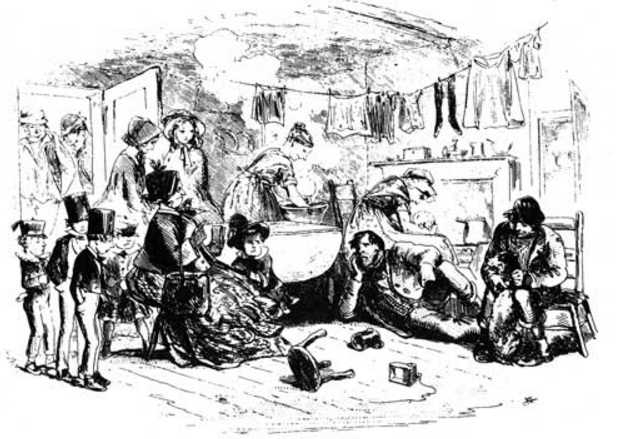
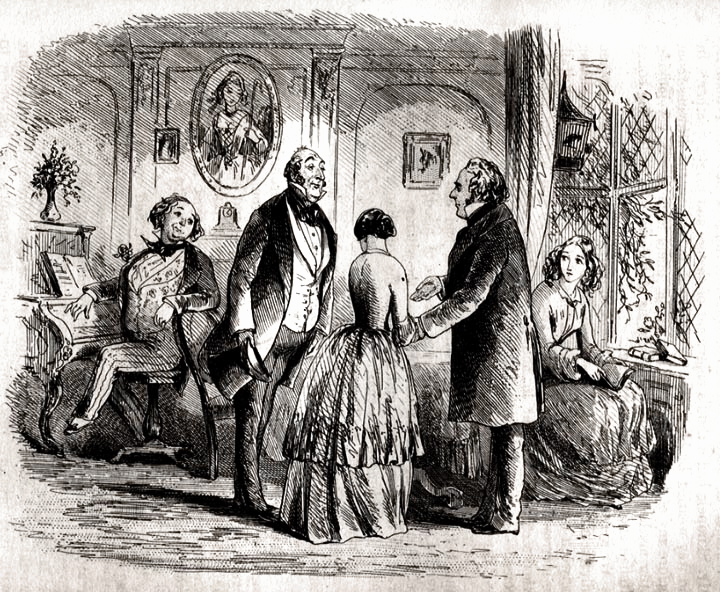
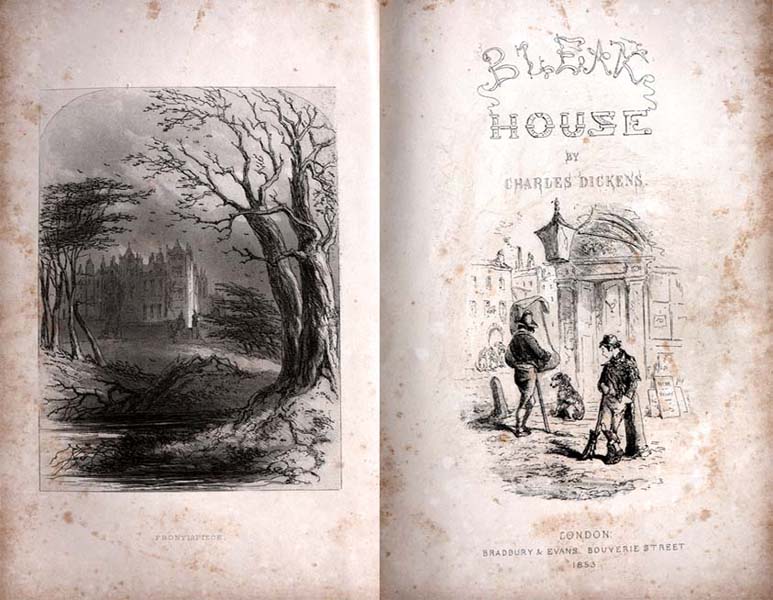
    Both Remainder and Bleak House mobilize these formalist reflections on the law in the context of their manifest absorption with architecture and architectural repetition.  Bleak House, to state the obvious, is about a house, about the house, once “The Peaks,” then “Bleak” (dark), then “Bleak” (light), replicated in London, and replicated in New Bleak House, about houses of law, of aristocracy, of debt, of orphans (Chancery, Chesney Wold, Coavinses, Krook’s, boarding), about houses as buildings, dwellings, shelters, about clusters of buildings (Tom All Alone’s), about contradictions at the heart of houses, about the insufficiency and ill-fabrication of every house, and, for an ostensibly urban novel, its action markedly takes the form of procession through a series of houses (take just one strata of this about-ness: when Esther learns of her mother’s identity from Lady Dedlock, her narrative dispatches with the climactic dialogue in two paragraphs of retrospective summary, but then immediately lingers for pages of description of Chesney Wold, a better evocation of her “place” than any personal melodrama; the preferred mode of characterization throughout is to describe a character’s house).  Remainder is about a crack, a wall, a bathroom, a building, a courtyard, a cluster of buildings, a space and the protagonist’s drive to effect the space’s meticulous, minute (re)construction, about plaster, wood, glass, about the pursuit of a nonexistent original, about finance, coordination, about the large scale industry of building and “reenacting” a milieu, about construction work repetitively undertaken, workers humming “History Repeating.”  Both novels foreground the labor of all this repetitive constitutive construction, especially in figures of clerks (Nemo the law copier, Snagsby the stationer, Guppy the uppity clerk, Krook the document collector, Tulkinghorn the portmanteau pilferer, and the countless clerks in Chancery are resounded in Remainder’s Nazrul Vyas the TimeControl™ “facilitator,” from “a long line of scribes, recorders, clerks” (77), Annie the submanager/designer, and the countless subcontractors they coordinate). The law and architecture, repeated, and the labor and craft and writing of repeating them.  Repetition of the law, repetition of architecture, repeated.  In the lamination of law and architecture, of inscription, institution, repetition, and the built form, both of these novels give us to think the structuration of social space.

    In their manifold affinities, these two novels of course manifestly differ, but  formulate the difference in terms other than context: each text uniquely approaches its cast, the marriage plot, multiplotting, mystery, money, empire, perpetuity.  For the sake of brevity, focus on the most crucial difference: systematicity.  Bleak House effectuates the repetitive assembly of houses as its objective core (the novel studies the ways of the world, the repeated instituting of social space, the manifold failures that drive these repetitions), whereas Remainder expressly subjectivizes this project (the novel presents itself as the study of one man’s drive).  Remainder fittingly enacts this subjectivism in its narration, a 1st person narrator eschewing any reliability pretensions; Bleak House objectifies unreliability in the split between its 1st and 3rd person, not only by alternating chunks of chapters and differentiating tenses, but by lapsing each narrative mode into the purview of the other, frequently styling Esther as an omniscient observer and frequently styling the 3rd person as a partial, 1st person plural.  Bleak House, one might say, is more systematic in its political purview, percussing the dynamics of social formalization more widely (in different kinds of institutions, in different kinds of people, in different registers of consciousness), while Remainder hones the narrow point of political ontology, the remaining fundament that ligates life to social forms.  This difference has little to do with the nineteenth century novel’s reputed referentiality and representational naiveté, little to do with the twenty-first century novel’s reputed robust irony, and much to do with varieties of repetition: Bleak House repeats its insights at scale, contemplating “the whole framework of society,” while Remainder thematizes repetition with centripetal force.

    Remainder perhaps appears then as a minimalist, bleaker Bleak House, an attenuated vastness, distillate of a gurgling solution.  It zeroes in on money as predominant institution, it takes replication without referent as its single plot, it individualizes and delimits world-building, since the replicas originate in personal trauma and drive towards larger-scale violent destruction, and since it seemingly dispenses with the very possibility of 3rd person narrativity.  But if it is thus a kind of crystallization of Bleak House, Remainder also thereby refracts Bleak House’s own limits: the novel we are so accustomed to lauding above all for its largeness, is in so many ways, a small novel, a novel devoted to limning the limits of novel worlds and of worlds outside.  From its principles of spatial contiguity to its admonition against telescopic philanthropy to Esther’s self-deprecation to its oscillating, mutually delimiting narration, Bleak House enshrines limits even while it criticizes the limits of institutions.  Each of these novels function with different syntaxes for the same questions about limits as enabling constraints, about the very installation of the law as a necessary outlining of sociality.[4]

    If Remainder punctuates Bleak House’s own punctual, liminal, aesthetic contemplation of limits, they share most intimately a project to deploy the form of the novel as a laboratory for constructing forms of social space, for world-making, building possible and foreign worlds, rather than recording this world.  Dickens (1854) professed of his craft that he had “systematically tried to turn fiction to the good account of showing the preventable wretchedness and misery in which the mass of the people dwell”; McCarthy (2011) hypothesizes that “literature can be understood as a process of producing space, and spaces, whether they be urban or domestic spaces, or political spaces, or metaphysical spaces.” The fictive production of social space, in accordance with limits –finitude and mortality, available materials, temporal linearity and corporeal indivisibility, structural integrity – this is a plausible definition of one abiding modality of the novel (the modality we could call, in want of distinction from its foremost antipode, science fiction, “realist”).[5] Both of these novels achieve less an instantiation of this modality than a theory of it, Bleak House in so robustly underlining the limits to its own breathtaking breadth; Remainder in framing meticulous replication as an utterly fictive enterprise, and both novels reifying nothing other than the inauthenticity of reality.

    A long tradition finds in Bleak House an archive of pernicious totalizations about which the novel can, at least, cheer, and, at most, despair, and a shorter tradition finds in Remainder a Nietzschean indictment of the inauthenticity of all things.  But the sheer fact that both of these novels build themselves out of repeated scenes of repetitive constitution of social spaces invites us, as readers of the history of the novel genre and as readers of a contemporary present over-determined by the poles of lamentation and resignation, to behold another thought, resurgent in Rancière and Levine’s theorizations of redistributions of the sensible and repetitive enactments of forms: the made world is only made and can therefore be remade, though no building project will not repeat the ungroundedness of every social structuration.  Novels in general uniquely ramify this made-ness of the world, this poetics of worldmaking; the particular novels Bleak House and Remainder actively theorize not only the artifice of any socius, but the freedoms that surprisingly inhere in political forms.

    References

    Agamben, Giorgio. 1998.  Homo Sacer: Sovereign Power and Bare Life. Stanford: Stanford University Press.

    Arrighi, Giovanni.  2010.  The Long Twentieth Century.  London: Verso.

    Benjamin, Walter.  1968.  “Theses on the Philosophy of History” Illuminations New York: Schocken Books.

    Brennan, Tim.  2007.  Wars of Position.  New York: Columbia University Press.

    Dean, Jodi.  2009.  Democracy and Other Neoliberal Fantasies, Durham: Duke University Press.

    Derrida, Jacques.  1992. “This Strange Institution Called Literature,” Acts of Literature.  London: Routledge.

    Dickens, Charles.  1854.  “To Working Men” Household Words 7 October.

    Hensley, Nathan.  2012.  “Allegories of the Contemporary” Novel 45:2.

    Kornbluh, Anna.  2015.  “The Realist Blueprint,” Henry James Review 36.

    Levine, Caroline.  2015.  Forms.  Princeton: Princeton University Press.

    McCarthy, Tom.  2011.  “Interview with Tom McCarthy” The White Review 1.  http://www.thewhitereview.org/interviews/interview-with-tom-mccarthy-2/

    McNulty, Tracy.  2014. Wrestling with the Angel: Experiments in Symbolic Life.  New York: Columbia University Press.

    Ranciere, Jacques.  2006.  The Politics of Aesthetics London: Bloomsbury.

    –––. 2010. Dissensus: On Politics and Aesthetics. London: Bloomsbury.

    Stanford Friedman, Susan.  2013.  Comparison: Theories, Approaches, Uses.  Baltimore: The Johns Hopkins University Press.

    Notes

    [1] I mean this claim with respect to critical reception, and to these novels’ manifest interest in organizations and constructions, but I also mean it more pointedly in Jacques Derrida’s (1992, 72) sense of a literature of institution, “which consists in…producing discursive forms, works and event sin which the very possibility of a fundamental constitution is at least fictionally contested, threatened, deconstructed, presented in its very precariousness.”

    [2] Agamben (1998, 59) belongs to an arc along which I would also situate not only Foucault and Judith Butler, but also Michael Hardt and Antonio Negri, and “the new materialisms.”  For helpful overviews of aspects of these trends in critical theory, see Brennan (2007) Dean (2009).

    [3] Hensley (2012) makes robust use of Arrighi in an essay making similar transtemporal comparison that I found inspirational here.

    [4] For the Jewish and psychoanalytic origins of this concept of law as enabling constraint, in contrast to a prevailing Pauline view of law as tyrannical letter, see McNulty (2014).

    [5] I argue elsewhere (Kornbluh 2015) for this understanding of realism, rooted in its affinities with architecture, but that is only a different repetition of the thought between Bleak House and Remainder.  Also note McCarthy’s (2011) insistence that “realism is a construction…it’s about the constructedness of the natural and how everything that we take to be natural is in fact artificial.  Nineteenth-century realists knew what they were doing was a convention.  To lose sight of that is catastrophic.  It’s crazy.”

    CONTRIBUTOR’S NOTE

    Anna Kornbluh is Associate Professor of English at the University of Illinois, Chicago.  She is the author of Realizing Capital: Financial and Psychic Economies in Victorian Form (Fordham UP, 2014) and is currently completing a manuscript The Order of Forms: Realism, Formalism, and Social Space.

     

  • Carolyn Betensky: Notes on Presentism and the Cultural Logic of Dissociation

    Carolyn Betensky: Notes on Presentism and the Cultural Logic of Dissociation

    by Carolyn Betensky

    This essay was peer-reviewed by the editorial board of b2o: an online journal.

    In Fire in the Ashes:  Twenty-Five Years Among the Poorest Children in America, Jonathan Kozol recounts a scene that took place repeatedly in New York in the mid-1980s:   theatergoers exiting the Broadway musical Les Misérables kept being solicited for money by groups of children from a nearby homeless shelter that was notorious for its squalid conditions.   The NYPD did their best to chase the children away, but eventually the theater owners and other businesses adopted more elaborate measures to keep the groups apart – including hiring other homeless people to “cleanse” the theater district (2012; 3-6).

    Beyond its presentation of the theatergoers’ exquisitely ironic plight – they had just finished being moved by the trials of nineteenth-century Parisian street urchins when they were forced to contend with the demands of flesh-and-blood poor children — Kozol’s anecdote offers us an especially vivid tableau of contrasts:  the rich (with money to spend on entertainment) and the poor (whose basic needs are not being met), the genteel and the unruly, the happy few and the miserable.  In many respects, his tableau replicates the troping of social problems in nineteenth-century novels (including Hugo’s).  Victorian readers would have been familiar with every element in it — from the high irony and the contrasts, to the presumed obliviousness of the well-heeled theatergoers, to the banding together of the business owners, to the calling in of the authorities.  They would even have been familiar with its representation of art’s failure to elicit sympathy for the poor within a work that aimed, itself, to elicit such sympathy.

    We produce, learn, adapt, repeat, and perpetuate ways not to have to think or to act consistently, from one context to the next.  New York’s “stop and frisk policy,” which regularly subjected minorities to arbitrary humiliation and abuse in the name of public safety, was considered reasonable until very recently, not only by the Bloomberg mayoral administration but also by many white people who felt “safer” because of it.  The Black Lives Matter movement has had to insist on the value of black lives, as opposed to “all” lives, because black lives have not registered as valuable, in the manner of “all” lives, to the white majority.  When I taught at a large, private, urban university, all of the food court workers in the student union building and all of their student clientele were in their late teens and twenties; strikingly, and yet somehow invisibly, all of the food servers were black, and most of the students were white.  Closer to home, most of the universities I know of, including my own, rely on the labor of adjunct professors whose names we never learn because they are not “really” our colleagues.

    We are incredibly good at not knowing what we know, and so were the Victorians.  The same culture that developed and embraced modes for representing inequality and injustice could be horribly blind to its own oppressive practices.  The same Dickens who wrote humanitarian epics wrote deeply racist essays.  The same narrator in Jane Eyre who famously makes common cause with slaves describes Bertha in stock racist terms.  Elizabeth Gaskell undercuts her representation of the suffering working classes in Mary Barton with caveats about the “dumb and inarticulate” masses. There are many, many examples any of us here could cite of Victorian disjointedness – so many that we tend to expect them.  “Blind spots” like these are so normal that they themselves have become easy to ignore.[i]

    The book project I’m developing considers the active production and naturalization of such blind spots in Victorian texts.  Unlike historicist analyses that contend that we cannot fault the Victorians for not knowing what we know, I am arguing explicitly that they did know – and did not know – what we both know and do not know.  My purpose, however, is not to fault the Victorians but rather to understand the ways Victorian culture created pathways of non-cognition that enabled them, and us, NOT to have to bring contradictory ideas and feelings into conversation with each other.

    Contemporary relational and interpersonal psychoanalysts see “the” self as a compendium of self-states – distinct ways of being, feeling, and understanding that are called up and activated within different sorts of contexts – as opposed to the unitary, essential, continuous “self” of the depth model.[ii]  According to theorists such as the late Stephen Mitchell, Philip Bromberg, and Donnel Stern, who are themselves working in traditions established by Harry Stack Sullivan, W.R.D. Fairbairn, and Melanie Klein, dissociation is in some sense a normal state of affairs.  Because different self-states kick in at different moments – depending on what we’re trying to avoid or accomplish, depending on who we’re with and the histories our interpersonal configurations evoke – “we” often don’t experience what “we” experience.  Different self-states get excluded in a process that works much like what Sullivan (1953; 319) called “selective inattention”:  “the classic means by which we do not profit from experience which falls within the areas of our particular handicap.  We don’t have the experience from which we might profit – that is, although it occurs, we never notice what it must mean; in fact we never notice that a good deal of it has occurred at all.”

    With some exceptions, the implications of these theories have not been considered beyond the clinic.  Yet it seems to me that the concepts of the self-state and dissociation, understood as normative cultural mechanisms, have much to contribute to our understanding of texts and other cultural practices.  The discontinuity of self-states offers us a way to comprehend the disconnects within texts without explaining them away:  incompatibilities, disconnects, and blind spots may be seen less as contradictions (sutured or not) than as the adaptation of culturally sanctioned ways of not thinking things together.  The blind spots, disconnects, and disjointed thinking we see so clearly in Victorian texts are heritage behaviors that are passed down, pre-approved and systematically naturalized; they are cultural patterns that endorse and enshrine gaps between discordant ways of thinking and thereby keep them from contaminating or challenging each other.

    The therapeutic goal of clinicians working with dissociation is to get the patient to “stand in the spaces,” as Bromberg (1998; 274) puts it – to become capable of acknowledging and tolerating these dissonant selves.[iii]  The aim of these clinicians is not to “unify” the selves in some way, in other words; rather, it is to help the patient to bring the conflicting demands and expectations of the different selves to the fore.   More than standing in the spaces between discordant self-states in Victorian novels, my own goal in this project is to note the cultural production of the spaces themselves.   At this early stage, I anticipate writing a metacritical chapter, a chapter on the contributions of form and genre to cultural practices of dissociation, and a chapter on the implications of dissociated self-states for the notion that literature can change “the” reader.

    Obviously, this project is unapologetically presentist, as any attempt to differentiate Victorians’ not knowing from our knowing (as in, “the Victorians didn’t think about racism/anti-Semitism/classism/sexism, etc. the way we do now”) serves to help us lie about our own cultural moment in the manner of Michel Foucault’s (1990; 6) “speaker’s benefit.”[iv]  Treating the Victorians as other in this regard suggests that we have achieved mastery over familiar kinds of injustice, a manifestly specious notion.  And further, when twenty-first century scholars insist on a constitutive difference between Victorians’ uninformed or undeveloped sensibilities and our own, we lose track of the cumulative development of a technology that assists us in not knowing what we know.  I would add that the regularity and unguardedness of nineteenth-century inscriptions of racism, misogyny, contempt for the poor, etc. offer twenty-first-century educators abundant opportunities to discuss less visible (to us) dissociative cultural logics in our own midst – if we dare to treat Victorian literature as an occasion for encouraging our students to think critically about their own world.

    References

    Bromberg, Phillip M. 1998. Standing in the Spaces:  Essays on Clinical Process, Trauma, and Dissociation.  Hillsdale, NJ:  Analytic Press.

    Foucault, Michel.  1990.  The History of Sexuality. Volume 1:  An Introduction.  Translated by Robert Hurley.  New York:  Vintage. Foucault, Michel.

    Hacking, Ian. 1995.  Rewriting the Soul:  Multiple Personality and the Sciences of Memory. Princeton:  Princeton University Press.

    Kozol, Jonathan.  2012.  Fire in the Ashes:  Twenty-Five Years Among the Poorest Children in America. New York:  Broadway Books.

    Sullivan, Harry Stack. 1953. The Interpersonal Theory of Psychiatry. New York:  W.W. Norton.

    Notes

    [i] Critics have paid abundant attention to these discrepancies – sometimes arguing that they are not in fact discrepancies if considered in historical context, sometimes arguing that what appear to be discrepancies are continuities, etc., etc.  I can’t attend to this point in any detail here but want to acknowledge that apparent contradictions such as these are far from new objects of critical analysis.

    [ii] Ironically, nineteenth-century psychologists such as Pierre Janet and William James had developed discontinuous conceptions of the self that, respectively, preceded and rivaled Freud’s depth model.  See Hacking 1995 for a historical account of the rise, fall, and resurgence of psychiatric theories of multiplicity. I’m hoping this study will provide another perspective on the consuming interest in dissociation and dissociative phenomena among nineteenth-century writers more generally.

    [iii] “‘Standing in the spaces’ is a shorthand way of describing a person’s relative capacity to make room at any given moment for subjective reality that is not readily containable by the self he experiences as ‘me’ at that moment.’”  Bromberg (1998; 274).

    [iv] Foucault writes of the self-serving tendency of post-Victorians/post-Freudians to call out the Victorians for being “repressed,” thereby establishing themselves as “liberated” (1990; 6).

    CONTRIBUTOR’S NOTE

    Carolyn Betensky is Associate Professor of English at the University of Rhode Island.  She is the author of Feeling for the Poor: Bourgeois Compassion, Social Action, and the Victorian Novel (Virginia UP, 2010), and the co-author and translator of Eugène Sue’s 1843 blockbuster Les Mystères de Paris (Penguin, 2015).

  • Matthew Sussman: On the Uses of Nietzsche’s “Uses”

    Matthew Sussman: On the Uses of Nietzsche’s “Uses”

    by Matthew Sussman

    This essay was peer-reviewed by the editorial board of b2o: an online journal.

    In “On the Uses and Disadvantages of History for Life,” the second of his Untimely Meditations, Nietzsche argues that we should use history for the sake of “life,” a concept that is obscure but central to his argument.[1] The idea of life is obscure because rather than give it specific positive content—suggested vaguely by words such as “action” (59) and “health” (63)—Nietzsche defines it largely through negation, emphasizing what corrupts or inhibits it. But despite this ambiguity life remains central because it provides the essay’s ultimate moral principle, the summum bonum against which the value of all other things must be measured. If something furthers the interests of life, then it is good, and conversely, that which gets in the way of life must be eliminated. This means that for Nietzsche, methodological questions in the study of history are ultimately moral ones, and disciplinary practices need to be evaluated pragmatically, insofar as they promote these moral ends.

    We can see an example of this approach in the way Nietzsche attacks the idea of historical objectivity (88-95). For many of his contemporaries, objectivity was appealing precisely because it called for historical data to be treated in a morally neutral way, unaffected by the subjective prejudices of the historian. But, according to Nietzsche, this denial of moral interest itself expresses a norm of “justice” (88) that prohibits the historian from distinguishing between the meaningful and the trivial. Hence, a certain amount of injustice to the historical record is required if historians are to avoid the pitfalls of a bland and morally deficient antiquarianism that reduces every past event to a meaningless expression of flux. As in other works, Nietzsche calls for the revaluation of values not as an attack on the idea of value per se but rather to force us to ask what our ultimate values are and whether our methods serve them.

    There, I think, lies the lesson of Nietzsche’s essay for contemporary literary criticism. In scientific endeavors, objectivity will always be an epistemic virtue because the basic purpose of such disciplines is to distinguish opinion from fact. What we do with the facts is a matter of opinion, but the need for facts remains. However, humanistic disciplines such as literary studies are not quite so obligated. For one, the status of a fact in our discipline is much more ontologically doubtful and the utility of facts once we know them is also limited. For example, the kind of historical knowledge that Nietzsche alludes to may enrich our reading of a text, but that sort of enrichment is just one interpretive possibility among many, a possibility whose hegemony Nietzsche helps us question. Furthermore, as Jesse Rosenthal suggests in his contribution to this symposium, the kind of historical record or tradition produced by literary critics—and in this way we resemble philosophers—is for the most part an invented one, determined less by material circumstances than by atemporal conventions of intersubjective agreement. These conventions may have a basis in historical reality, but their ultimate goal is to float free from that reality, allowing us to involve ourselves and our subjects in “conversations” that are consciously, often quite deliberately, unrestricted by the circumstances of time or place.

    The title of Nietzsche’s essay advances this view. The meditation is untimely not simply because it goes against the grain of its period, but because it does so by reviving a Hellenic moral framework over two thousand years old whose bearing on the present is a matter of opinion: “What I mean by this—and it is all I mean—is that the thought of being epigones, which can often be a painful thought, is also capable of evoking great effects and grand hopes…provided we regard ourselves as the heirs and successors of the astonishing powers of antiquity and see in this our honour and our spur” (103). Unlike material history, which is successful only insofar as it conforms to reality, aesthetic or intellectual history seeks to create a parallel reality whose greatest virtue may be its very freedom from excessive facticity. In this light, it is helpful to remember that one of Nietzsche’s greatest contributions to culture—his distinction in The Birth of Tragedy between the spirits of Apollo and Dionysus—was criticized when it first appeared for lacking a credible basis in the texts and culture from which Nietzsche purported to draw it. A more “objective” nineteenth-century historian might never have had Nietzsche’s insight—or, as we may more accurately say, have invented his compelling idea.

    Of course, there are many risks associated with an outright denial of historicist values, and Nietzsche carefully argues that knowledge of the historical origins of our values is imperative if we are to assume the superior perspective that is necessary for intellectual and artistic freedom (102-3). However, this concession still suggests that the preeminent value in knowing our history is the subsequent ability to set it aside—as long as we remain creative enough to substitute some other criterion of value in its place, and bold enough to convince others of its merit.

    [1] Friedrich Nietzsche, Untimely Meditations, ed. Daniel Breazeale, trans. R.J. Hollingdale (Cambridge: Cambridge UP, 2007). This edition is hereafter cited parenthetically.

    References

    Nietzsche, Friedrich. Untimely Meditations. Edited by Daniel Breazeale. Translated by R.J. Hollingdale. Cambridge: Cambridge UP, 2007.

    CONTRIBUTOR’S NOTE

    Matthew Sussman is lecturer in English at the University of Sydney, Australia.  His articles have appeared in Novel: A Forum on Fiction, Studies in English Literature, Victorian Studies, and Arizona Quarterly.


  • Danielle Coriale: Jamming the Historical Machine

    Danielle Coriale: Jamming the Historical Machine

    by Danielle Coriale

    This essay was peer-reviewed by the editorial board of b2o: an online journal.

    Friedrich Nietzsche’s ([1874] 1997) “On the Uses and Disadvantages of History for Life,” the first of four essays published in his Untimely Meditations, opens with an image of quietly grazing cows and slowly builds to a bitter critique. Unlike those critics who “smear their thick brush-strokes” “across the most graceful design,” Nietzsche tackles the impulse that would motivate such critics to regard their smears as “corrections” (1997, 87): a pernicious form of objectivity that infiltrated Germany in the nineteenth century. According to the meditation, this form of objectivity spread from positivist science like a “fever” (60) or “infection”  (120-122), destroying all personality, originality, and emotion in the historical writing of his generation. It was a naïve epistemology that stripped false away from true; it was no more than “idolatry of the factual” (105).

    Nietzsche’s case against objectivity would be the first of many.[i] Alfred North Whitehead (1925), Isabelle Stengers (2000), and Bruno Latour (2004) exposed its limitations in the sciences and argued for more generous alternatives that do not mistake fact for truth. In literary studies, Eve Sedgwick (2003) made one of the more powerful cases against facticity. Writing at the peak of New Historicism’s early popularity, she argued that the paranoid logic of exposure and demystification had come to dominate the field (Sedgwick 2003: 139). Although her theory is rooted in psychoanalysis, her formulation is similar to Nietzsche’s. Paranoid knowledge, she argues, disavows the “affective motive and force” behind it while “masquerading as the very stuff of truth” (138). And Sedgwick touched upon a point of special interest to Nietzsche when she concluded that paranoid reading practices gathered momentum in historicist studies because they were “infinitely doable and teachable protocols of unveiling” (143). This postulate hints at the paradox of disciplinarity that Nietzsche explores in the first meditation. If scholars could become so inured to the foundational principles, methods, and forms that circumscribe their disciplines, then the practical regimens that defined disciplinarity could actively inhibit originality and creativity. As Whitehead so elegantly put it in Science and the Modern World, the narrowness of professionalized knowledge makes it effective, but also “produces minds in a groove” (1925, 197).

    Like Sedgwick, Nietzsche was interested in the teaching protocols that imbue young men with an historical sense. Carrying his metaphor of infection forward, he insists that the “fever of history” spreads pedagogically (120-122). It is transmitted to students by the “basic unit of intellectual life in the academy”—the discipline (Anderson and Valente 2002, 1). Toward the end of the first meditation, Nietzsche protests the “historical education of modern man,” arguing that it had become purely instrumental (1997, 116). The routinized practices that defined historical education in nineteenth-century Germany seemed mechanistic and teleological to him: “the words ‘factory,’ ‘labour market,’ ‘supply,’ ‘making profitable,’ and whatever auxiliary verbs egoism now employs,” he writes, “come unbidden to the lips when one wishes to describe the most recent generation of men of learning” (Nietzsche 1997, 99). Nietzsche apologizes for having to use Marxian language to conjure his dystopian vision of universities, but explains that such a characterization was only natural. Schools were no more than factories that produced the “speedily employable man of science” rather than the “free cultivated man” (117). In this regard, the first meditation is untimely yet again. Its critique of the German academy in the nineteenth century anticipates our current dismay at the business models that have been installed in universities throughout the United States. The meditation also underscores a different explanation for the homogeneity that Sedgwick observed in her graduate students a decade ago. Confronted by a precarious market, they would have no choice but to adopt what Sedgwick describes as the “near professionwide agreement about what constitutes narrative or explanation or adequate historicization” (Sedgwick 2003, 144).

    Even as the first meditation offers a still-resonant critique of the academy, which often assists the commodification of creative thought and intellectual labor, it also diverges from the critical mode. Hayden White ([1973] 2014, 66) once described it as Nietzsche’s “most destructive work,” but the meditation is also “additive and accretive,” to borrow Sedgwick’s words (2003, 149). It releases a reservoir of pent-up emotions—envy, disgust, fury—that counteract the dispassionate analysis associated with critique. To do otherwise, Nietzsche concluded—“To take everything objectively, to grow angry at nothing, to love nothing, to understand everything”—would only make one “soft and pliable” (Nietzsche 1997, 105). Nietzsche’s undisciplined writing is anything but pliable, of course. It refuses to comply with the conventions of truth discourses, which pare away falsehoods to arrive at singular truths. Rather, it jams the historical machine by unleashing waves of metaphor. One might remember the forgetful cows, for example, when history itself appears in the guise of an animal later in the meditation. Nietzsche describes the positivist historian who, reflecting on an action in his past, “dissects it, prevents it from producing any further effects by analysing it, and finally skins it for the purpose of ‘historical study’” (102). Through metaphors that pull against one another in this way, the meditation offers a model of knowledge as poesis. It multiplies meanings rather than separating the false from the true, and accumulates metaphors that cannot be distilled into a single fact. Like the “genuine historian,” Nietzsche “remint[s] the universally known into something never heard before” (94). In the climate of austerity that we are currently enduring, such proliferations resist the seemingly objective, quantitative methods and forms of expression that are encroaching upon the humanities daily, promising to make our knowledge more useful, appealing, and accessible—or as Nietzsche would have it, softer and more pliable to the will of others.

    [i] For an excellent study of varieties of objectivity that flourished in the eighteenth and nineteenth centuries, see Lorraine Daston and Peter Galison’s Objectivity.

    References

    Anderson, Amanda and Joseph Valente, eds. 2002. Disciplinarity at the Fin de Siècle. Princeton: Princeton University Press.

    Daston, Lorraine and Peter Galison. 2008. Objectivity. New York: Zone Books.

    Latour, Bruno. 2004. “Why has critique run out of steam? From matters of fact to matters of concern.” Critical Inquiry 30, no. 2: 225-248.

    Nietzsche, Friedrich. [1874] 1997. “On the Uses and Disadvantages of History for Life in Untimely Meditations.” In Untimely Meditations, edited by Daniel Breazeale and translated by R. J. Hollingdale. Cambridge: Cambridge University Press.

    Sedgwick, Eve Kosofsky. 2003. Touching Feeling: Affect, Pedagogy, Performativity. Durham, NC: Duke University Press.

    Stengers, Isabelle. 2000. The Invention of Modern Science. Translated by Daniel W. Smith. Minneapolis: University of Minnesota Press.

    White, Hayden. [1973] 2014. Metahistory: The Historical Imagination in Nineteenth-Century Europe. Baltimore: Johns Hopkins University Press.

    Whitehead, Alfred North. 1925. Science and the Modern World. New York: Simon & Schuster.

    CONTRIBUTOR’S NOTE

    Danielle Coriale is Assistant Professor of English at the University of South Carolina.  She is working on a book manuscript, Captivating Subjects: Victorian Fiction and Animal Science.

  • S. Pearl Brilmyer: Impassioned Objectivity: Nietzsche, Hardy, and the Science of Fiction

    S. Pearl Brilmyer: Impassioned Objectivity: Nietzsche, Hardy, and the Science of Fiction

    by S. Pearl Brilmyer

    This essay was peer-reviewed by the editorial board of b2o: an online journal.

    Scholarship on Victorian literature and science has often drawn parallels between the attempts of nineteenth-century scientists to produce an accurate and objective account of the world and the ambition of realist novelists to represent reality in all its shining and particularate detail. Realist epistemology, the story goes, finds an analogue in the ethically charged project of nineteenth-century scientific objectivity, which aspired to minimize the distortive effects of the embodied perspective of the observer through self-imposed rules and automated processes. Third person narration, the proliferation of descriptive detail, increased attention to physical objects and landscapes—such strategies contributed to the production of a “reality effect” in fiction analogous to that of nineteenth-century scientific work.

    In this short provocation, I turn to Nietzsche in an attempt to trouble this story about the relationship between objectivity and the realist novel as well as to inspire reflection on the way that we as scholars of Victorian literature call upon the work of historians, and in particular historians of science, in order to situate and theorize our literary objects. It is a commonplace now in discussions of Victorian literature and science to cite Lorraine Daston and Peter Galison’s seminal study Objectivity (2007) as a means of characterizing the realist desire to produce an view of reality untainted by the desires, concerns, and affects of all-too-embodied and willful subjects.[1] Although Daston and Galison’s taxonomy—in which categories such as “mechanical objectivity” and “structural objectivity” signal conceptually discrete but historically overlapping scientific-epistemological paradigms—has proven incredibly useful for literary scholars interested in tracing confluences between literary and scientific movements, to align the aesthetic aims of nineteenth-century realism with the epistemological aspirations of scientific objectivity risks eliding the extent to which realist artists not only did not always seek to know the world, but sought to critique and transform modes of scientific knowledge production (2010 [2007]: 5).[2]

    In what follows, I thus add my own term—impassioned objectivity—to Daston and Galison’s taxonomy in order to describe the specifically literary mode of representation that Victorian realists cultivated in their description of reality. This mode of objectivity, I argue—quite unlike the paradigms of scientific objectivity that Daston and Gallison describe—aspired to multiply, rather than subtract, affect.

    In his essay “On the Uses and Disadvantages of History for Life” (1874) however, Nietzsche warns against the reduction of a vast spectrum of historically situated voices—literary, scientific, philosophical, political—to a single historical episteme. Collected in the book Untimely Meditations, Nietzsche’s essay advocates for increased critical attention to “untimely” works that do not reproduce the dominant epistemological paradigm of a time, but somehow transcend it. In so doing, the piece inspires reflection on the dangers of effacing the distinction between literary and scientific practice, as if both were mere expressions of a broader spirit of the time.

    But Nietzsche’s musings on history and life become even more relevant to our concerns when he begins to address the relationship between objectivity and affect. Expressing discontent, in his own untimely fashion, with the equation of objectivity with bodily abnegation and self-restraint (the paradigm of objectivity, importantly, that Daston and Galison propose shapes Nietzsche’s era) Nietzsche criticizes practices of description that aspire to the minimization of affect and the erasure of self. In the mode of historicism Nietzsche’s essay sets out to critique, “the subject,” he puts it, “becomes silent and wholly imperceptible. What is then preferred [in this paradigm] is that which produces no emotion at all… One goes so far, indeed, as to believe that he to whom a moment of the past means nothing at all is the proper man to describe it” (1997 [1874]: 93).

    “These naive historians call the assessment of the opinions and deeds of the past according to the everyday standards of the present, ‘objectivity,’” he writes (90). Curiously though, rather than insisting upon the impossibility of objective account of history, Nietzsche goes on to recuperate objectivity as a worthy ideal. As he argues a few pages later, “objectivity [Objektivität] is required, but as a positive quality” (93).

    What does it mean for objectivity to be a positive quality?

    Objectivity, he explains, is “a moment of composition of the highest sort.” It involves—and I must admit I adore this phrase—“loving absorption in … empirical data” (93). While for the historian Nietzsche critiques, the description of reality is a subtractive process—a diminishment of perspective, feeling, and the trace of the body—in Nietzsche, objective description is additive. It aggregates, multiplies, and differentiates affects. Thus, much later, in On the Genealogy of Morals (1887), “the more feelings [Affekte] we allow to come to expression … the more complete our ‘concept’ of it, our ‘objectivity’ [Objektivität], will be” (2009 [1887]: 98; emphasis in original). Conceived of “positively,” objectivity thus entails the affirmation rather than the negation of feeling. While one intense feeling about a thing might not make one very objective about it, having different, conflicting feelings might. The valorization of the diversification of affect in the production of knowledge is what I am calling impassioned objectivity.

    I propose a similarly additive strategy for our approach to the Victorian discourse of objectivity, which philosophers Nietzsche, as well as novelists—especially realists—of the period, did not merely echo or confirm but altered, recuperated, transformed in diverse and often untimely ways. In his 1891 essay, “The Science of Fiction,” to cite just one example in closing, Thomas Hardy develops a critique of objectivity strikingly similar to that of Nietzsche. Denouncing the aspiration of what he calls “scientific realists” to the ideal of objectivity in their imitation of the scientific method in their literary practice, Hardy argues that what the literary naturalist cannot but “maintain in theory what he abandons in practice,” defining his “impartiality as a passion, and plan as a caprice” (2001 [1891]: 101-2). Like Nietzsche, who in “On the Uses and Disadvantages of History for Life” argues that the truly objective historian is the ultimate artist, in “The Science of Fiction” thus Hardy envisions a literary practice attuned rather than averse to the impulses of the body, a “science of fiction” that would build upon “the fruits of closest observation” to produce a “widened knowledge of the universe and its forces, and man’s position therein” (101-2).

    References

    Daston, Lorraine, and Peter Galison. 2010 [2007]. Objectivity. New York: Zone Books.

    Hardy, Thomas. 2001 [1891]. “The Science of Fiction” in The Nineteenth-Century Novel: A Critical Reader, edited by Stephen Regan, 100–4. London: Routledge.

    Levine, George. 2002. Dying to Know: Scientific Epistemology and Narrative in Victorian England. Chicago: University of Chicago Press.

    Nietzsche, Friedrich. 2009 [1887]. On the Genealogy of Morals. Translated by Douglass Smith. Oxford: Oxford University Press.

    Nietzsche, Friedrich. 1997 [1874]. “On the Uses and Disadvantages of History for Life” in Untimely Meditations, 57-124. Translated by R.J. Hollingdale. Cambridge: Cambridge University Press.

    Notes

    [1] See for example Levine (2002), who argues that, like Daston and Galison’s nineteenth-century scientists, Victorian realism expresses a “willingness to repress the aspiring, desiring, emotion-ridden self and everything merely personal, contingent, historical, material that might get in the way of acquiring knowledge” (2).

    [2] For Daston and Galison “mechanical objectivity” names the paradigm of objectivity emergent in the mid nineteenth, while “structural objectivity” replaces the former in the 1880s (2010 [2007]: 5). Proponents of structural objectivity, Daston and Galison writes, “understood the threat of subjectivity in different terms than the advocates of mechanical objectivity had: the enemy was no longer the willful self that projected perfections and expectations onto the data; rather, it was a private self, locked in its own world of experience, which differed qualitatively from that of all other selves” (45).


    CONTRIBUTOR’S NOTE

    S. Pearl Brilmyer is Assistant Professor of English at the University of Pennsylvania. She is currently completing a manuscript, Character Density: Late Victorian Realism and the Science of Description.

  • Devin Griffiths: Untimely Historicism

    Devin Griffiths: Untimely Historicism

    by Devin Griffiths

    This essay was peer-reviewed by the editorial board of b2o: an online journal.

    The organizers of the V21 Colloquium in Chicago invited my panel to “theorize the present,” by way of Friedrich Nietzsche’s critical account of historicism, On the Uses and Disadvantages of History for Life (1874). The problem is that I don’t think we’ve sufficiently theorized the past. In particular, I’m not sure that this contrast between the present (and its theories) and the past (by way of historicism) is fruitful without a fuller sense of how nineteenth-century historicism worked. This is part of the challenge of the “V21” mashup: how do features of the “Victorian” period operate in the 21st century? The critical and controversial account of “positivist historicism” that occupies the first four theses of the V21 Manifesto (V21 Collective 2015) suggests (in the spirit of Nietzsche) that nineteenth-century historicism was “bland,” and remains so today. But the nineteenth century gave birth to several different kinds of historicism, various “styles of reasoning” (as Ian Hacking has put it (1992)), that continue to enliven and shape our thinking about the past. Here I want to suggest — by way of Nietzsche’s essay — what a more comprehensive grasp of nineteenth-century historicism offers today.[i]

    Nietzsche’s main argument, which censures an unreflective nationalism that sees history in terms of progress or achievement, aligns closely with the critique of Enlightenment historicism that Chakrabarty has given (2000: 244-9), and for that matter, that Karl Popper gave in The Poverty of Historicism (1957). These accounts closely link unitary narratives of progress, identified by Herbert Butterfield as a “Whig interpretation of history” that emerged after 1688 (Butterfield 1965: 11-12), with the “stadial” historicism of the Scottish Enlightenment, described by O’Brien as “a natural process of development in which societies undergo change through successive stages based on different modes of subsistence,” and typified in the writings of Adam Smith, Adam Ferguson, and Alexander Tytler (O’Brien 1993: 53). But I think we should set both progressive and stadial history aside — not because they aren’t important — but because they’re a legacy of Enlightenment thinking. Even if both remained major styles of C19 history, they don’t get at the emergent modes of historicism that more precisely characterize the nineteenth century and its claim on us. Insofar as we are Victorianists (and for that matter, Romanticists or Modernists), we need to ask: what are the historicisms peculiar to our period?

    Nietzsche is a case in point. On the Uses and Disadvantages of History for Life, the second of Nietzsche’s four “Untimely Meditations,” extends upon the critical account of progressive history given in David Strauss: the Confessor and the Writer (1873), anatomizing specific schools of a “mighty historical movement” that was the pride of contemporary German scholarship (Nietzsche, 1997: 59). The taxonomy Nietzsche offers is not important here (though, in his analysis, “monumental” history has both progressive and stadial features). What is striking is that this taxonomy does not include the mode of historicism Nietzsche deploys in the essay, a strategy of critical juxtaposition and differentiation that makes such taxonomies possible. Yet Nietzsche recognizes his own strategy as a mode of historical reasoning rooted in his study of ancient literature. As he acknowledges in the forward, “I do not know what meaning classical studies could have for our time if they were not untimely — that is to say, acting counter to our time and thereby acting on our time and, let us hope, for the benefit of a time to come” (Nietzsche 1997: 60, emphasis added). This startling admission embraces historicism, not simply as an object of critique within David Strauss or On the Use and Abuse of History, but as the critical location of the “untimely” itself — an untimely historicism, produced through an oppositional reading of the past, that grounds Nietzsche’s critical method.

    Here we recognize the seeds of Nietzsche’s genealogical approach, a way of using historical juxtaposition to expose the discontinuities of history. As reworked by Foucault, this contrastive strategy continues to condition historical scholarship (see Foucault 1980: 139-64). The important point is that this is still a kind of historicism, an untimely historicism that emerges in the nineteenth century, and which continues to shape the collection of strategies and critical methods we invoke when we theorize the past.

    This is the nineteenth-century historicism that we need to account for. Conveniently for me, Nietzsche’s formulation bumps into my own work, which recognizes untimely historicism as one feature of the wider comparative turn in nineteenth-century thinking about history. In my view, various nineteenth-century genres of the past — from economic history, to natural history, to historical fiction — collaborated in formulating a new comparative historicism; one that refurbished analogy as an analytic that considered the multiplicity of narratives that constitute the past, and connect the past to an uneven present (see Griffiths, 2016). This stood, and continues to stand in our critical practice, in contrast to an Enlightenment emphasis upon unitary narratives — whether those unitary narratives tell a story of progress or assume a universal pattern of transformation. Comparative historicism provided a way to think, within history, about the patterns of the many rather than the coherence of the one. Rather than narrative, the pattern between narratives; rather than the whole, relations and distinctions between and within wholes. Insofar as this furnished a way of reading history comparatively, in terms of differentiation and juxtaposition, Nietzsche was as much a nineteenth-century inheritor of this style of historical reasoning as Charles Darwin, Charles Dickens, or Karl Marx (Griffiths 2013).

    Comparative historicism continues to shape our work. It connects the study of homologies between text and historical context (as Alan Liu points notes, the constitutive analogies of New Historicism (1989)) to the study of repetition and filiation across time and space (say, Wai Chee Dimock’s fractals (2006)).[ii] It underwrites various methods of relational interpretation, from Shu-mei Shih’s “relational comparison” (2013) to the analogies of “identity/difference” that, in Andrew Cole’s view, organized dialectical thought and, by these means, gave “birth” to modern critical theory (2014: 35).[iii] The point is not just that all theories are embedded in history, but that much of critical thought is founded on thinking about history comparatively. Hence our constant use of analogy’s vocabulary in our own writing, whether formulated in terms of analogy or its usual cognates: homology, allegory, metaphorization, alignment, relation, and reflection. Rather than singular plots, we emphasize parallelism, divergence, correspondence, filiation, exclusions, and alternatives. Rather than wholes, we speak of assemblages, relations, mixtures, networks, family resemblances, multiple centers, and multiple peripheries.

    The Chicago V21 conference was bracing, warm, and characterized by lively disagreement. At the end of the day, no one really seemed to believe that historicism and theory are in opposition, least of all in our writing and teaching. My claim here is that we can better see why this must be so if we recognize, within nineteenth-century historicism, a key resource for contemporary theory. To read C19 historicism this way is to ask for the timely recognition that it’s both part of our present and a stubborn but resourceful part of our C21 future.

    This paper was first presented at the V21 Colloquium at the University of Chicago. I am grateful for our discussions at that gathering.

    References

    Beiser, Frederick C. 2011. The German Historicist Tradition. Oxford: Oxford University Press.

    Chakrabarty, Dipesh. 2000. Provincializing Europe: Postcolonial Thought and Historical Difference. Princeton, N.J.: Princeton University Press.

    Cole, Andrew. 2014. The Birth of Theory. Chicago: University of Chicago Press.

    Dimock, Wai-Chee. 2006. Through Other Continents: American Literature Across Deep Time. Princeton: Princeton University Press.

    Foucault, Michel. 1980. “Nietzsche, Genealogy, History.” In Language, Counter-Memory, Practice. Ithaca: Cornell University Press.

    Glissant, Édouard. 1997. Poetics of Relation. Translated by Betsy Wing. Ann Arbor: University of Michigan Press.

    Griffiths, Devin. 2013. “The Comparative History of A Tale of Two Cities.” ELH 80, no. 3: 811-38.

    Griffiths, Devin. 2016. The Age of Analogy: Science and Literature Between the Darwins. Baltimore: Johns Hopkins University Press.

    Hacking, Ian. 1992. “Statistical Language, Statistical Truth and Statistical Reason: The Self-Authentication of a Style of Scientific Reasoning.” In The Social Dimensions of Science, edited by Ernan McMullin, 130-57. Notre Dame, Ind.: University of Notre Dame Press.

    Heringman, Noah. 2013. Sciences of Antiquity: Romantic Antiquarianism, Natural History, and Knowledge Work. Oxford: Oxford University Press.

    Liu, Alan. 1989. “The Power of Formalism: The New Historicism.” ELH 56, no. 4: 721-71.

    O’Brien, Karen. 1993. “Between Enlightenment and Stadial History.” Journal for Eighteenth-Century Studies 16, no. 1: 53-64.

    Manning, Susan. 2010. “Antiquarianism, the Scottish Science of Man, and the Emergence of Modern Disciplinarity.” In Scotland and the Borders of Romanticism, edited by Leith Davis, Ian Duncan, and Janet Sorensen, 57-76. New York: Cambridge University Press.

    Nietzsche, Friedrich. 1997. “On the Uses and Disadvantages of History for Life.” In Untimely Meditations, translated by R. J. Hollingdale, edited by Daniel Breazeale. New York: Cambridge University Press.

    Popper, Karl. 1957. The Poverty of Historicism. Boston: Beacon Press.

    Shih, Shu-Mei. 2013. “Comparison as Relation.” In Comparison: Theories, Approaches, Uses, edited by Rita Felski and Susan Stanford Friedman, 79-98. Baltimore: Johns Hopkins University Press.

    V21 Collective. 2015. “Manifesto of the V21 Collective.” v21collective.org/manifesto-of-the-v21-collective-ten-theses.

    Notes

    [i] The other main object of the historicist critique is the idea of a history for its own sake, which the Manifesto describes as “bland antiquarianism” (V21 Collective 2015). I think this is misplaced. As Manning (2010) has shown, the comic figure of the antiquarian long served to justify more “philosophic” or “scientific” approaches to history. Yet Heringman (2013) has recently explored how antiquarianism developed sophisticated critical methodologies that continue to shape our understanding of the past. More generally, this critique (which Nietzsche also takes up) capitalizes on the notion of historicism as a fantasy of immersion, an escape into the minutiae of the past, sometimes given in shorthand as the ambition to tell the past (as Leopold von Ranke put it) “as things actually happened.” Yet, far from expressing a naïve faith in the historian’s craft, Ranke’s famous statement was a caution against reading the past as a precursor to the present. His point was that the past is “actually” radically different from the present; its autonomy and complexity demand respect (see Beiser 2011: 268-77).

    [ii] As Liu puts it, “What is merely ‘convenient’ in a resemblance between context and text (in Foucault’s sense of contiguity) soon seems an emulation; emulation is compounded in analogy; and, before we know it, analogy seems magical ‘sympathy’: a quasi-magical action of resemblance between text and context” (Liu 1989: 743).

    [iii] Shih derives the concept of relational comparison from Glissant (1997).

    CONTRIBUTOR’S NOTE

    Devin Griffiths is Assistant Professor of English at the University of Southern California.  His book The Age of Analogy: Science and Literature Between the Darwins is forthcoming from Johns Hopkins UP.

  • Daniel Wright: Unhistorical Reading and Mutual Playing

    Daniel Wright: Unhistorical Reading and Mutual Playing

    by Daniel Wright

    This essay was peer-reviewed by the editorial board of b2o: an online journal.

    In what follows, I aim to read Nietzsche’s essay “On the Uses and Disadvantages of History for Life” unhistorically—that is, I want to avoid falling into the trap that catches Nietzsche himself, as he laments that he rails against an excessive attachment to history only by writing the history of that attachment. What would it mean, Nietzsche wonders, to take loving as an alternative to knowing? To take, in other words, the messy incoherence and the ineffable singularity of love as an alternative to the knowledge that promises ordered lines and networks and shared, shareable vocabularies? Most specifically, Nietzsche sets us a difficult task when it comes to love: to love the historical and the unhistorical equally. History, for Nietzsche, appears as the law-giving Father “who preserves and reveres” (Nietzsche 1997: 72), whose job is “imposing limits” (64); but just as we must offer that father loving obedience, we also must love the unhistorical aspect of our existence, figured as the succoring Mother who is an “envelope,” a fecund “atmosphere” (64), but also the “animal … contained in the present, like a number without any awkward fraction left over” (61). This animal mother, the warm-blooded unhistorical embrace that holds the body together so that those awkward fractions can’t break off and fall away, is of course a difficult mother to love, because so vaguely omnipresent: an environment in which I move rather than a discrete object. History, on the other hand, is similarly difficult to love. We only really know the historical past, Nietzsche argues, as a melancholic introjection of something forever lost but nonetheless achingly loved—imagined as those “indigestible stones of knowledge” that we carry in our guts, “rumbling about inside” as ill-formed and indigestible content, or as “a snake that has swallowed rabbits whole and now lies in the sun and avoids all necessary movement” (78).

    History, in other words, appears to protect the shape of our collective existence by ingesting the knowledge of the past and holding it safe, preserving it inside, but in the end this historical impulse “no longer conserves life but mummifies it” (75). Nietzsche figures historical knowing in this essay as a threat to love, because the imperative to take in and hold fast to the facts of history would also require us “to take everything objectively, to grow angry at nothing, to love nothing, to understand everything” (105); it would “cut off the strongest instincts of youth, its fire, its defiance, unselfishness and love” (115). Nietzsche asks us to love (or to defy, or to misunderstand, or understand too narrowly, or set fire to) rather than only to know, to play with history and to use it for life only within the warming, protecting, fertilizing atmosphere of the unhistorical. What kind of reading of the past can Nietzsche’s theory of the unhistorical model for us literary critics, whose practices of close reading always precariously balance the knowledge of history with the playful love of the unhistorical?

    When I read a novel or a poem or a philosophical treatise, pen in hand, it gives me something—many things: it instigates, it sets boundaries, it prompts, it moves me in predictable and then unpredictable ways. The marks I make with that pen do not, ideally, impose a shape upon the text or simply trace and make visible shapes and lines of demarcation that exist there already as a limited set of ghostly potentialities. Those marks do not really mark the text, in other words, but rather interact with it, enjoining it to play. In those moments when reading scintillates and when the pen seems to move freely—circling, underlining, starring, annotating—the text also makes marks in me. We move each other in turns, according to an improvised system of rules. We observe, most of the time, a propriety in our mutual contact, except when the energy of the game overtakes us and we play, for a moment, rough-and-tumble, or we provoke too pointedly, so that tears fall or laughter (sometimes pained and sometimes giddy) provides relief.

    D. W. Winnicott, for example, explaining his commitment to the use of play in the psychoanalysis of children, insists that the power of play lies in its refusal of traditional, unilateral structures of interpretation. Instead of the analyst who responds to the free associations of a patient by transforming that formless mess into a coherent interpretation, we have the analyst whose interpretations are careful, cooperative, and provisional. Winnicott believes that this is the only way to allow the patient the freedom of honesty and spontaneity, rather than the feeling that she is simply complying with the interpretive narrative of an analyst who seems already to have her figured out:

    Interpretation outside the ripeness of the material is indoctrination and produces compliance. … A corollary is that resistance arises out of interpretation given outside of the area of overlap of the patient’s and the analyst’s playing together. Interpretation when the patient has no capacity to play is simply not useful, or causes confusion. When there is mutual playing, then interpretation … can carry the therapeutic work forward. This playing has to be spontaneous, and not compliant or acquiescent, if psychotherapy is to be done. (Winnicott 2005: 68, original emphasis) [1]

    I am committed to a bold and unapologetic application of Nietzsche’s model of unhistorical love, and Winnicott’s theory (related, I think) of “mutual playing” to the practice of close reading that we as literary critics engage in almost every day. A novel or poem cannot be made compliant; it is capable of responding to me spontaneously; its shape changes as my shape changes; the rules of the game are self-sustaining and yet flexible, designed to allow for free-wheeling, interactive movement. My own impulse to retheorize our uses of history, to remain skeptical of historical knowledge and its potential to calcify, speaks to a deeper desire to perform close reading differently, to take it personally but at the same time to develop robust methods by which taking it personally can also take it public—by which my play with the text, my love of history and unhistory, can conserve rather than mummify the details of my own idiosyncratic absorption in the Victorian past.

    References

    Nietzsche, Friedrich. “On the Uses and Disadvantages of History for Life.” Translated by R. J. Hollingdale. In Untimely Meditations, edited by Daniel Breazeale, 57-124. Cambridge, UK: Cambridge University Press, 1997.

    Winnicott, D. W. Playing and Reality. New York: Routledge, 2005.

    Notes

    [1] D. W. Winnicott, Playing and Reality (New York: Routledge, 2005), 68, original emphasis.

    CONTRIBUTOR’S NOTE

    Daniel Wright is Assistant Professor of English at the University of Toronto. He recently completed a book manuscript, Bad Logic: Reasoning about Desire in the Victorian Novel.

  • Eleanor Courtemanche: “Too Many Nietzsches”

    Eleanor Courtemanche: “Too Many Nietzsches”

    by Eleanor Courtemanche

    This essay was peer-reviewed by the editorial board of b2o: an online journal.

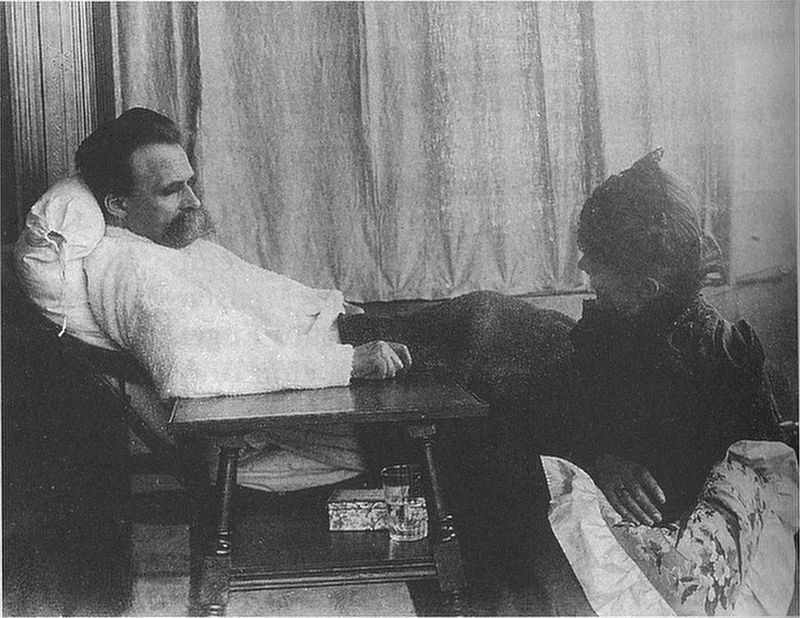
    Even if we wanted to—and I’m not sure we really do, at this conference—it would be hard to read Nietzsche from a purely historicist perspective. Nietzsche casts a powerful shadow on his own futurity; we cannot but read him through subsequent history, what Megan Ward has called the “historical middle, the period between the Victorians and ourselves” (Ward 2015). Part of good scholarship, as cultural critics know, is to try to avoid dismissing Nietzsche merely because the Nazis loved him. For that misfortune we blame his anti-Semitic sister Elisabeth Förster-Nietzsche, who dressed Nietzsche up in a classical-looking toga and invited guests to gawk at the genius, in Weimar in the 1890s after his brain had been eaten away by syphilis (MacIntyre 1992). Or perhaps he didn’t have syphilis at all—an article from 2003 alleges that the explanation of Nietzsche’s dementia as syphilis was a smear by anti-Nazis after WWII, and that in fact Nietzsche might have died of a brain tumor (Matthews). The existentialists reclaimed Nietzsche after the war and popularized him in Walter Kaufmann’s translations, with introductions that were later considered too apologetic by politically more stringent cultural critics. And it’s hard to talk about Nietzsche at the University of Chicago without disturbing the shade of Leo Strauss, who may (or may not!) have created a neo-Gnostic cult of esoteric insider wisdom, training up elite cadres at Chicago and Claremont, that has given American neoconservatives the Nietzschean über-confidence to treat democracy as a noble lie for consumption by the masses (Waite 1996).

    Or do we see Nietzsche as a friend and antecedent, merely one of the paragons of the hermeneutics of suspicion, forerunner of Foucault’s vision of power as dispersed and all-pervasive—and hence, in a development he would no doubt despise, the ancestor of our politically-informed “suspicious readings” that see lurking imperialism and heteronormativity everywhere? Our allegiance to this legacy of suspicious reading on some level legitimates the recent turn to historicist critique, as well as our reconsideration of that critique today.

    As Victorianists, we should theoretically pay attention to none of those things. We should be trying to peel back the layers of post-hoc myth, antiquarian reverence, and political toxicity to figure out what Nietzsche meant at the time he was writing, in 1874, in the wake of German unification (an event that actually does inform Nietzsche’s whole essay). However, despite all our careful attention to the past, there is one aspect of Victorian writing we seem blind to and can’t properly describe: its lingering Platonism, with its constant appeals to something higher, purer and more noble, which we see everywhere in this essay despite Nietzsche’s reputation for anti-metaphysics. After WWII, I think, this idealism was purged from our scholarship, marking a clear distance between our values as cultural critics and those of the nineteenth century.

    I personally have yet another layer of historical experience that clouds my vision here: my very first public conference paper, as a first-year grad student at Cornell in April 1992, was on this essay, “On the Use and Abuse of History for Life,” at conference on Nietzsche organized by Geoff Waite. Although I haven’t been able to access the MacWrite file, which is lost to the ages, I squirrelled away the original talk (entitled “The Boundaries of the Cultural Organism”) in a file I’ve been carrying around for unexamined sentimental reasons since then. This talk is amazing for me to read today, because, in defiance of everything I now tell my own grad students, I analyzed no sources at all outside the original text. Back then, I was so naïve that I just read Nietzsche’s essay itself and traced its component paradoxes. Nietzsche’s essay lends itself beautifully to being deconstructed: as I pointed out in my paper, in this essay you can’t actually tell the difference between the malady and the cure; the man who is merely affecting tranquility and the artist whose calm demeanor masks inner flashing life; the overripe and the not-yet-ripe; vulgar egoism and noble selfishness; the culture that has successfully internalized all barbarian attacks and forged them into something new (that is, the Greeks) versus the culture that is merely a hapless cosmopolitan aggregate (that is, the newly unified German nation). I’m sort of amazed I used to write like this—it feels kind of raw despite its sophistication. My whole paper just assumes philosophy is worth analyzing and analyzes it. Perhaps the current practice of elaborate historicism will seem just as alien to critical readers in twenty or thirty years.

    There are many horizons of ignorance in Nietzsche’s essay, arranged to protect some kernel of irrational stupidity that he thinks is crucial to cultural health, but that no scholar can really defend. Sorry, Nietzsche—humans just do want to know more than we should. But the essay’s eloquent yearning to know better, to know more usefully in relation to our own lives, and with fewer veils, conventions, and compromises—that part of “On the Use and Abuse of History for Life” has not gone out of date.

    References

    MacIntyre, Ben. 1992. Forgotten Fatherland: The Search for Elisabeth Nietzsche. New York, Farrar Strauss & Giroux.

    Matthews, Robert. 2003. “‘Madness’ of Nietzsche was cancer not syphilis.” The Telegraph, May 4. http://www.telegraph.co.uk/education/3313279/Madness-of-Nietzsche-was-cancer-not-syphilis.html.

    Waite, Geoff. 1996. Nietzsche’s Corps/e: Aesthetics, Politics, Prophecy, or, The Spectacular Technoculture of Everyday Life. Durham, NC: Duke UP.

    Ward, Megan. 2015. “Theorizing the Historical Middle.” V21 Collective (blog), June 1. http://v21collective.org/megan-ward-theorizing-the-historical-middle/

    CONTRIBUTOR’S NOTE

    Eleanor Courtemanche is Associate Professor of English, Comparative Literature, and German at the University of Illinois at Urbana-Champaign. Her book The ‘Invisible Hand’ and British Fiction, 1818-1860: Adam Smith, Political Economy, and the Genre of Realism was published in 2011.

  • Emily Steinlight: Untimely Dickens

    Emily Steinlight: Untimely Dickens

    by Emily Steinlight

    This essay was peer-reviewed by the editorial board of b2o: an online journal.

    I’m taking “Bleak House Today” as an invitation to think about the place of the present both in Victorian studies and in the peculiar form of Dickens’s novel: the ways in which Bleak House calls on a sense of contemporaneity, partly though a narrative structure where historical time is always out of joint, past and present tenses taking turns but keeping their distance. This novel’s mode of occupying and refracting the present has often tempted readers to resituate its today-ness in another historical conjuncture or another art form. I’m thinking, for example, of Sergei Eisenstein’s classic essay, “Dickens, Griffith, and the Film Today,” which in 1944 brought Dickens into a different present than our own by crediting him with inventing montage (1977: 195-255). By juxtaposing non-contiguous spaces in narrative and thus shattering the frame of a discreet spatiotemporal situation, the argument runs, Dickens’s technique made modern cinema possible—from D. W. Griffith to the experiments of a Soviet avant-garde, including Dziga Vertov and Eisenstein himself. With V21 in mind, this intentionally anachronistic claim makes me wonder whether Dickens’s novel, which seems so consummately of its time, might lend itself to anachronism, or even to an engagement with the untimely—and, if so, what that untimeliness can do for us. In considering this novel’s untimeliness, I’m of course channeling Nietzsche’s definition: “acting counter to our time and thereby acting on our time and, let us hope, for the benefit of a time to come” (Nietzsche 1997 [1874]: 60).

    For now, I’ll turn to just one register of that untimeliness: the novel’s split narration, divided between Esther’s personal voice, recounting past experience from a safe biographical distance, and the impersonal narrative, with its polyphonic mix of styles and tempos, panning across the city in the present tense to map a far larger social world than Esther or any individual can grasp, and shifting focalization away from the protagonist. I’d like to consider the political logic of what this form does, first, to the organization of time on which plot and history alike rely, and second, to the function of character. With regard to time, the tense shifts between past and present have an estranging effect on narrative as well as historical process. The present in which Dickens drops us is both deeply mired in natural-historical time and explosively out of time. The novel’s classic opening gives us a street scene we can very roughly date by the industrial soot half-illuminated by gas lamps, but all its chronotopes summon the pre- and post-historical: on the one hand, geological strata of a ground formed by human movement and struggle in urban space, layers of mud mimicking the process of capital accumulation (building up “at compound interest”), yet apparently primeval, as if “the waters had but newly retired from the face of the earth”; on the other, smoky darkness evoking “the death of the sun” and the thermodynamic end of the solar system (Dickens 2003 [1852-53]: 13). I’m curious how this consciousness of a vast temporal scale beyond human history, yet rendered in the present tense, would line up with Frederic Jameson’s account of the narrative reflux in realist fiction between two distinct orders of temporality: the time of the event—the chronological succession of past-present-future—and the time of affect, linked to a suspended, impersonal present. (Surprisingly, given his focus on tenses and temporality in Antinomies of Realism, Jameson doesn’t discuss the present-tense narration in Bleak House when the text comes up in passing.) What makes realism dialectical, he suggests, is the gap between those orders of time, and the consequent standoff between “destiny” and “the eternal present” (Jameson 2015: 18). The novel form falls apart if this tension gets resolved. Perhaps serial fiction holds open this space in a distinctive way, since on first reading, the future is literally unwritten.

    It sounds, initially, like that suspended present is where freedom from determinacy becomes possible. But fiction’s will to inhabit present time reappears as a problem for Jameson. The realist novel’s presentism, he suggests, inheres in its commitment to the exposition of the contemporary, which reveals the form’s ideological character: realism “requires a conviction as to the massive weight and persistence of the present as such, and an aesthetic need to avoid recognition of deep structural social change … and contradictory tendencies within the social order” (145). Antinomies is a fascinating book, but I’m not so sure about this claim. It flows from a critical model that charges realism with rationalizing a new status quo by denying historical change. As against that model, I want to stress the political dynamism of the world Dickens’s narrative constructs. At the level of material description, Bleak House offers up a stratigraphic record of deep structural change in process; at the level of form, its plot mobilizes a set of contrary political demands, which collide and throw off sparks as they do.

    This dynamism relies on the way the novel’s two narrative systems mediate between character-subject and social order. Critics have often seen in the dualistic structure of Bleak House a certain ideology of form. For Audrey Jaffe, in Vanishing Points, omniscient narration is the novel’s Lacanian Big Other, a site for the fantasy of total knowledge; for D.A. Miller, it’s the literary equivalent of surveillance (Jaffe 1991, Miller 1988). There’s a word I’m struck by, though, in Miller’s book: speaking of another realist novel in the introduction to The Novel and the Police, he writes that its narrator’s sympathy for the suffering it inflicts on characters is credible “only in an arrangement that keeps the function of narration separate from the casualties operating in the narrative” (1988: 25). “Casualties” is an apt term precisely because it pinpoints what’s missing from Miller’s model. The form of power that disavows agency for its “casualties” isn’t surveillance at all; it’s more like laissez-faire. In Bleak House, the prevailing forms of governance operate less by a totalized and invasive disciplinary gaze than by programmatic inaction: letting things happen as though their causes were past the reach of human agency. The constable who repeatedly orders Jo to “move on,” when asked where exactly the homeless boy should move to, replies, “my instructions don’t go to that” (Dickens 2003: 308). Even in its direct, law-enforcing forms, policing intervenes by enacting a broader policy of non-intervention: vagrancy isn’t allowed here, go continue your vagrancy elsewhere. This may be one of the reasons Bleak House resonates with us today—why it evokes the Malthusian austerity policies we’ve seen (again) since the 2008 crash, the dismantling of welfare systems for several decades prior, and perhaps what Zygmunt Bauman unsettlingly describes as the irony of modernization: that the production of wealth in capitalist societies entails the global mass production of what appears as “‘human waste,’ or more correctly, wasted humans” (2004: 5).

    Giving a figure like Jo a name and narrative space doesn’t remove him from what Malthus called surplus population—but this surplus, strangely, comes closer to capturing the novel’s subject than any individual character. For all Esther’s insistence on evaluating fellow characters as individuals linked by personal obligation, the other narrative compulsively generates scores of figures, mass bodies, abstract numbers that don’t sustain characterization. The first human subjects we encounter, preceded by muddy dogs and horses, are just pedestrians in general, like “tens of thousands” before them; “chance people on the bridges” lost in fog (Dickens 2003: 13); in Chancery, “eighteen of Mr. Tangle’s learned friends,” each with eighteen hundred pages of legal briefs (18); the population of Tom-all-Alone’s infesting London “in maggot numbers” (256); crowds flashing by Snagsby “like a dream of horrible faces” (358)—everywhere, more life than Dickens has time to characterize, count, or name. (Alex Woloch’s work is important here in stressing the saturation of character-space, which in his reading yields unequal divisions of attention and human complexity.) This is why, looking at the digital character maps created at Franco Moretti’s Stanford Literary Lab, I’m not sure whether such infographics capture a network of relationships in the text or just affirm what’s already taken as given: that character is a consistent unit, analogous to the individual person. There’s a distinct too-muchness at work in Dickens’s writing that makes characterization complicit in the process of crowding rather than a means of setting individuals apart from masses. Bleak House turns that demographic excess into a political force: something like what Jacques Rancière would call the count of the uncounted, a throwing off of the proportion between subjects and social places that politics requires. I suspect that the dizzying scalar shifts within this novel between a materially accumulating present, multiple historical pasts, and signs of geological and planetary time contribute pretty centrally to this disproportioning—but we can leave that for discussion.

    References

    Bauman, Zygmunt. 2004. Wasted Lives: Modernity and Its Outcasts. Cambridge: Polity.

    Dickens, Charles. 2003 [1852-53]. Bleak House. Edited by Nicola Bradbury. London: Penguin.

    Eisenstein, Sergei. 1977 [1944]. “Dickens, Griffith, and the Film Today.” In Film Form: Essays in Film Theory, edited and translated by Jay Leyda, 195-255. San Diego: Harcourt.

    Jaffe, Audrey. 1991. Vanishing Points: Dickens, Narrative, and the Subject of Omniscience. Berkeley: University of California Press.

    Jameson, Fredric. 2015. The Antinomies of Realism. London: Verso.

    Miller, D. A. 1988. The Novel and the Police. Berkeley: University of California Press.

    Nietzsche, Friedrich. 1997 [1874]. “On the Uses and Disadvantages of History for Life.” In Untimely Meditations, edited by Daniel Breazeale, translated by R. J. Hollingdale, 59-123. Cambridge: Cambridge University Press.

    Woloch, Alex. 2003. The One vs. the Many: Minor Characters and the Space of the Protagonist in the Novel. Princeton: Princeton University Press.


    CONTRIBUTOR’S NOTE

    Emily Steinlight is Stephen M. Gorn Family Assistant Professor of English at the University of Pennsylvania.  She recently completed a manuscript, The Biopolitical Imagination: Literary Form and the Politics of Population.

  • Jonathan Farina: On the Genealogy of “Deportment”: Being Present in Bleak House

    Jonathan Farina: On the Genealogy of “Deportment”: Being Present in Bleak House

    by Jonathan Farina

    This essay was peer-reviewed by the editorial board of b2o: an online journal

    My title puns on Nietzsche’s On the Genealogy of Morals, a work of skeptical philology that aspires to liberate the future by recasting western values as products of a history of distorting or inverting human greatness. Etymological history, the genealogy of words, promises a novel articulation of what counts as good and bad. Nietzsche idealizes ruminative, philological reading, “that venerable art,” as he puts it in Daybreak, “which demands of its votaries one thing above all: to go aside, to take time, to become still, to become slow – it is a goldsmith’s art and connoisseurship of the word which has nothing but delicate, cautious work to do and achieves nothing if it does not achieve it lento” (1975: 5). Slow historicism, then, but neither positivist nor antiquarian, as some modern scholarship has been described: for Nietzsche, “for precisely this [slowness]”, philology

    is more necessary than ever today, by precisely this means does it entice and enchant us the most, in the midst of an age of ‘work,’ that is to say, of hurry, of indecent and perspiring haste, which wants to ‘get everything done’ at once, including every old or new book: this art does not so easily get anything done, it teaches to read well, that is to say, to read slowly, deeply, looking cautiously before and aft, with reservations, with doors left open, with delicate eyes and fingers. (1975: 5)

    For all its velocity, Dickens’s prose rewards and even personifies Nietzsche’s slow philology. Bleak House, in particular, exemplifies how we might practice a poststructuralist, materialist philology that reanimates the past embedded in the present. And, given the late fad for mindfulness and being present, never mind the topic of this inaugural V21 symposium, “presence” is not a bad word with which to start.

    Alert as Dickens is to expressions, by turns axiomatic and idiotic, idiomatic and idiosyncratic, including Bart Smallweed’s “I don’t know but what I will have another” and Snagsby’s “not to put too fine a point on it”; alert to portmanteau words like wiglomeration, and to professional discourses, slang, and puns, to “gammon” and “spinach,” Dickens offers plenty of fodder for philological rumination to rehistoricizes our present word by word (1977: 249, 180). The earliest criticism of Bleak House, favorable and unfavorable, distinguishes the prose style or “manner” of Dickens for its reducibility to small, iterative phrases, “the queerest catch-word,” as Henry Chorley called it, or “congeries of oddities of phrase, manner, gesticulation, dress, countenance, or limb,” in the words of James Stothert (Collins 1986: 280, 279, 294). Critics remarked on how these portable phrases indexed the present, mediated “current table-talk or our current literature,” as David Masson said (Masson 1875: 257-8). This facility translating mannerisms into currency, to condense attitudes into fungible expressions, makes Dickens’s style thematize presentism.

    Indeed, the word “presence” serves many times as a synonym for manner and personality in the novel: Mrs. Snagsby, for instance, has a “dentistical presence,” ready to pull the “tender double tooth” of a secret she suspects her husband of holding; and Kenge, for another, has “conversational presence” (Dickens 1977: 316, 760), and so on. With 43 instances of “presence,” 250 uses of “manner,” and a chapter on and thematic investment in “deportment,” Bleak House dwells on the way style and manners coalesce to mediate our temporal experience of and presence in or bearing toward the world. Manner, deportment, composure, disposition, presence, and style: these performances of temporality are miniature fictions with which individuals inhabit times and places and relations that often clash with the actual present, the actual times and places and relations their bodies occupy. Assuming a characterological stance against the imperatives of the present, “presence” and “deportment” are modes of embodied critique. As such, they personify how the philological plenitude of other words readily offer, in their connotations and histories, a critique of the present.

    From Kenge’s own system-cementing trowel-wave of the hand to Snagsby’s variously expressive coughs, from Esther’s emphatic humility to Bart Smallweed’s injunction at the legal triumvirate’s sexually-charged lunch at the Slap-Bang— “and don’t you forget the stuffing, Polly!”—telling mannerisms and multivalent words abound in Bleak House (1977: 247).  But for polemic purposes let me stick with “deportment” as a salient example. Bleak House recognizes the “currency” of the word, that is, its relevance and fashionable circulation in the present, even as it foregrounds its historicity and ambiguity. Tale the moving reunion of George Rouncewell and Sir Leicester Dedlock: waiting for Bucket to reclaim runaway Lady Dedlock, George offers his “arms to raise … up” the debilitated Sir Leicester, who in turn raises George from despondency: “‘You have been a soldier,” he observes, non-sequitur, “‘and a faithful one’” (Dickens 1977: 696). At the Dedlock’s London home, just where we might think George’s typically awkward manner might put him out-of-place, the soldier shines. He humbly parries Sir Leicester’s praise: “I have done my duty under discipline, and it was the least I could do” (Dickens 1977: 696). He has felt uncomfortable everywhere else, he protests his unfitness for other modes of life (especially the domestic industrial married future exemplified in his brother), but here amidst a fading aristocratic dinosaur George’s deportment reciprocates and makes meaningful Sir Leicester’s, about which Dickens says, “He is very ill, but he makes his present stand against distress of mind and body, most courageously” (Dickens 1977: 694). “Present” here works as both adjective and noun: through his presence, that is to say, through his bearing, he makes present circumstances appear closer to his ideal temporality and structure of feeling. His presence, then, as a sort of regulative fiction, contests his present reality as he and George concurrently revisit the past in their minds and manners.[i]

    George and Sir Leicester—odd models, to be sure—might thereby personify here the potential work an interpretative philology might do in reanimating the present with the past. Where traditional philology sought to fix the correct meaning of a word, a reinvigorated, Nietzschean version would eschew determination. As John Hamilton has written, an interpretative philology

    may provide a privileged means for holding determinations at bay, for perpetuating community and its constitutive communication, not by fixing a word’s properties conceptually, with sovereign authority, disciplinary control, or tired complacency, but rather by pursuing its transit through time and across cultures and thereby allowing it to be translated, over and over again, on the basis of its very untranslatability. (Hamilton 2013: 21)

    In this scene of exemplary deportment, marked by gestures more than words, Dickens nearly redeems an erstwhile unlovable aristocrat, whose virtue accrues to his loving insistence that words and manners remain constant: “I revoke no disposition I have made in her favour. I abridge nothing I have ever bestowed on her. I am on unaltered terms with her” (Dickens 1977: 698).[ii] At the same time, however, the narrative acknowledges the terrific contingency of our reception of these “terms”: “His formal array of words,” the novel says of Sir Leicester’s forgiveness, “might have at any other time, as it has often had, something ludicrous in it; but at this time, it is serious and affecting. His noble earnestness, his fidelity, his gallant shielding of her, his generous conquest of his own wrong and his own pride for her sake, are simply honourable, manly, and true,” and “the lustre of such qualities,” Dickens adds, lest we impugn something decidedly aristocratic to the act, are available to the “commonest mechanic” and “the best-born gentleman” alike (1977: 698). Mannerisms and words that are ludicrous early in the novel thus recur “serious and affecting” “at this time.”

    The scene complicates the novel’s preceding travesty of deportment personified in “Old Mr. Turveydrop,” about whom Caddy tells Esther, “No, he don’t teach anything in particular … But his Deportment is beautiful” (Dickens 1977: 169). Turveydrop caricatures the universal “dandyism” and agency of “fashion” that Bleak House disparages, but Turveydrop’s problem isn’t deportment itself so much as his own bad deportment, marked by ill-fitting clothes as much as by his maladjustment to the people around him: he is disposed to a trivial, fantastic, nostalgic version of his past (a fleeting encounter with the Prince Regent) rather than to a meaningful fictional past—like the “Young England” that suits George and Sir Leicester—or the present needs that Esther answers. Like Mrs. Jellyby’s telescopic philanthropy, more literally still like Smallweed on his litter, Turveydrop’s deportment carries him away with himself from the circle that deserves his attention, his caring presence. In his vanity, Turveydrop mocks style as a lack of substance and a deformity of truth, as Dickens makes plain with his overstretched outfit. Turveydrop, like the Prince Regent before him, has no sense of deportment, and his son and Caddy both misrecognize the correlation between deportment as Turveydrop practices it and presence, a characterological bearing toward time, as exhibited by others.

    Genuine deportment constitutes a mode of speech and manner that carries one away from oneself so as to connect to other personages and times. “Deportment”: the nominative form, as the OED says, of deport, a late 15th-century self-reflexive verb meaning “to behave (oneself),” derives from the 12th-century French verb déporter, whose provocative range of meanings includes to be patient, to dally and even to take one’s specifically sexual pleasure with. Deportment thus shares much with Nietzsche’s notion of slow and deep philology, with its pleasures in dallying. The word combines amusement with stability, remaining, delaying, and tarrying of the sort Sir Leicester does as his time declines. Such tarrying originates in the root word “portus,” for harbor, as in to harbor a feeling. And so deportment evokes not just a person’s manner, but also a tendency to hospitality, to protect, cheer, comfort, and console.

    And yet the prefix “de” means “from” or “off” and with the Latin root word “portare,” “to carry,” this implies an attitude of detachment, impartiality, and impersonality, a coldness and superficiality. The subtle difference, if any, between comportment and deportment inheres in the direction of bearing, or carrying: deportment denominates an orientation away from oneself and to the public whereas comportment, while still a form of behavior, stresses one’s togetherness, integrity, or self-maintenance. Yet another philological detail, a tasteless joke, suggests that for Dickens’s milieu, deportment was decidedly physical: one of the fake book spines Dickens authored and ordered for his office at Gad’s Hill was “Miss Biffin on Deportment.” Miss Sarah Wight Biffin was a well-known painter born with no arms and only vestigial legs; she was 37” tall. Modern readers might also carry the connotation of reverse immigration, being deported from a country, but the “old lady of the censorious countenance” in the novel brings that up, too: “‘the father must be garnished and tricked out,’ said the old lady,” of Turveydrop, “‘because of his deportment. I’d deport him! Transport him would be better!” (Dickens 1977: 173). Transport, like deport, had the same double valence as a term of movement of people and goods as well as of feeling and disposition.

    Aptly, then, Michel de Certeau invokes “countless tiny deportations” to describe walking, his paradigm for the everyday practices by which people exert their freedom and creativity as they actualize given places like the city into productive spaces of their own (1988: 103). For de Certeau, “The moving about that the city multiplies and concentrates makes the city itself an immense social experience of lacking a place—an experience that is, to be sure, broken up into countless tiny deportations (displacements and walks), compensated for by the relationships and intersections of these exoduses that intertwine and create an urban fabric” (1988: 103). Turveydrop caricatures not just a belated dandyism, then, but also personifies the way Dickens’s characters all inhabit spaces obliquely different, in temporality, ideology, and attention, from the places they occupy. Turveydrop’s deportment condenses and highlights the “countless tiny deportations” by which characters’ presence differs from the circumstantial present they inhabit. Given how de Certeau extends walking as a metaphor for reading, I want to suggest that these deportations, too, might model how a certain poststructuralist philology might license our freedom from the historical place given by the texts we read.

    Despite his inanity, Turveydrop models the most telling function of deportment: he inspires belief.  His wife “had, to the last, believed in him and had, on her death-bed, in the most moving terms, confided him to their son as one who had an inextinguishable claim upon him and whom he could never regard with too much pride and deference. The son, inheriting his mother’s belief, and having the deportment always before him, had lived and grown in the same faith … and looked up to him with veneration on the old imaginary pinnacle” (Dickens 1977: 173). The style of a text, at the level of diction but also of syntax, trope, and genre, constitutes its deportment or presence; it is the medium by which it moves readers to belief. Considering style as an index of what Steven Shapin calls “epistemological decorum,” the conventions recognized as guarantors of knowledge, we can not only see how Dickens’s world knew and felt in a traditional historicist sense, but also how we might reimagine how and what we can know and feel—how we are disposed toward the world. If we, as a profession, are to inhabit the past, then our deportment, our orientation to the present, cannot be like Turveydrop’s, a blind nostalgia, but instead ought to take up the likes of George and even Sir Leicester and, like Nietzsche, rearticulate alternative values as critiques of our imperfect present. While he values upheld by these odd bedfellows are unlikely to be the ones we uphold, their manifestation as a presence, as a tarrying against the stubborn often inhuman agencies of the present, is nevertheless moving. And it models, I think, how philology of a poststructuralist sort, however old-fashioned, might still translate our present concerns into past forms for a better and believable future.

    References

    Collins, Philip, ed. 1986. Dickens: The Critical Heritage. London: Routledge and Kegan Paul.

    De Certeau, Michel. 1988. The Practice of Everyday Life. Translated by Steven Randall. Berkeley: University of California Press.

    Dickens, Charles. Bleak House. Edited by George Ford and Sylvère Monod. New York: W. W. Norton & Co.

    Hamilton, John T. 2013. Security: Politics, Humanity, and the Philology of Care. Princeton University Press.

    Masson, David. 1875. British Novelists and their Styles: Being a Critical Sketch of the History of  British Prose Fiction (1859). Boston: D. Lothrop and Co.

    Nietzsche, Freidrich. 1997. Daybreak: Thoughts on the Prejudices of Morality. Edited by Maudemarie Clark and Brian Leiter; translated by R. J. Hollingdale. Cambridge, UK: Cambridge University Press.

    Notes

    [i] “Unaltered Terms” certainly has temporal parameters, and this scene generates enormous tension by moving slowly in the slow indoor space of the chapter while we know, outside its cozy confines Bucket and Esther chase Lady Dedlock for dear life in the snow and slush. The mutual deference George shares with Sir Leicester, toward whom he repeatedly, stiffly bows, likewise accompanies mutual nostalgic reveries: “The different times when they were both young men … and looked at one another down at Chesney Wold, arise before them both, and soften them both” (Dickens 1977: 697), Dickens writes. The residual manners of a bygone era mediate and soften an otherwise discomfiting present and even a terrifying future. Mrs. Rouncewell recognizes accordingly that Sir Leicester, in refusing candles and keeping the curtains open, “is striving to uphold the fiction with himself that it is not growing late” in more senses than one (Dickens 1977: 699): he is holding open hope for Lady Dedlock’s return but also for the survival of a system of manners, a disposition that favored him, to be sure, but which nevertheless also comforts George who craves the discipline that his friend Bagnet always claims to maintain with his wife, who’s clearly in charge. In rejecting his brother’s offer of employment or even partnership, George rejects the paradox Hegel ascribes to the bourgeois, who must work for another because work arises only from external constraint but who can only work for themselves because they have no masters. The passage personifies the tragic backwardness of Disraeli’s “Young England,” which imagined that recovering paternalistic, feudal values would somehow produce a different future, then, even as it also indulges in and valorizes the ethos of Disraeli’s practical historicism. George and Sir Leicester are comfortable in the past.

    [ii] Bleak House introduces Sir Leicester in a way that seems to mock his mannerisms as contrived, pompous, and cold, but it emphasizes from the beginning their stability:

    He is of a worthy presence, with his light-grey hair and whiskers, his fine shirt-frill, his pure-white waistcoat, and his blue coat with bright buttons always buttoned. He is ceremonious, stately, most polite on every occasion to my Lady, and holds her personal attractions in the highest estimation. His gallantry to my Lady, which has never changed since he courted her, is the one little touch of romantic fancy in him. (Dickens 1977: 12)

    If this seems to fan the flames of the “dandyism” that pervades the novel’s world of religion, politics, law, and sociality, Dickens undercuts it immediately, “Indeed, he married her for love” (1977: 12).

    CONTRIBUTOR’S NOTE

    Jonathan Farina is Associate Professor of English at Seton Hall University.  His book Everyday Words and the Character of Prose in Nineteenth-Century Britain is forthcoming from Cambridge UP.

  • Elisha Cohn: Bleakness

    Elisha Cohn: Bleakness

    by Elisha Cohn

    This essay was peer-reviewed by the editorial board of b2o: an online journal.

    I was intrigued by the choice of Bleak House as V21’s representative novel, how the audacious, even pugnacious, and enterprising mood of this collective critical gesture resonates with or against the bleakness of Bleak House, a novel that invites attention to affective atmosphere. What is that bleakness? How does it emanate, and what does it do? More self-reflexively, how do the critical paradigms that newly attune us to atmosphere or mood reimagine the novel’s project, as they also ask us to consider the ethos of our own? Prompted by influential critics whose careers begin in Victorian studies (Miller 1988; Sedgwick 2002; Anderson 2006; Felski 2008), I hope to think about the mood of critical discourse to emphasize the conditions that allow knowledge and value to come into view. Ours is a field that drew considerable energy from the hermeneutics of suspicion, thanks to the Victorian novel’s pervasively social vision. But perhaps thanks also to Victorian literature’s continual, dialectical evaluation and reevaluation of individual perspectives within living systems, it has also brought us important work on the affects that accompany specific forms of theory. So how does the bleakness of Bleak House inflect today’s project—its reparative status, its aura of regenerative optimism, or intrepidity?

    Mood is said to lack a telos in itself; Jonathan Flatley defines it as “a kind of affective atmosphere, … in which intentions are formed, projects pursued, and particular affects can attach to particular objects” (Flatley 2008: 19). But mood has a paradoxical status: if philosophy positions it as a precondition for thought or action, it is also associated (in Dickens and elsewhere) with stasis, particularly the stasis of melancholy. We tend to understand narrative as structured by the temporal framework of plot and event, but mood offers a vocabulary for what evades this forward drive, deferring or blocking plots of coming-to-knowledge. Mood, then, might offer an importantly minimalist way of indicating a narrative mode––but also a critical motive––that declines the desire for mastery.

    In the case of Bleak House mood or atmosphere might be said to reformulate narrative conventions associated with emotional fulfillment and the production of knowledge by working as a textual effect. Bleakness flows among characters rather than belong to any of them individually, permeates even the not-character of the omniscient narrative voice, suffuses the polluted fog that flows from London to the suburbs, the “filthy air of our prosperous England” that John Ruskin was so appalled to find represented in fiction. Esther assures us that John Jarndyce has transformed the affective character of the house he inhabits, but bleakness lingers, an intransigent, if low-key, global effect. Implicitly, the institutions (houses, destroyed houses, courtrooms) that shape sociability do so not only by mapping out pathways and blocking off windows of relation, but by making those circuits of relation palpable as feeling. The map of London the novel creates archives these circuits of attractions and repulsions, hurts and pleasures. But because these feelings register bleakly, they elude recognition, purpose, or object. Bleakness reaches outward, too, to the implied reader––it constitutes a secret in which, à la Snagsby, the reader is a “partaker, and yet … not a sharer,” not consciously implicated but creepingly registering effects (Dickens 2003 [1852-53]: 607). If we cannot attribute or contain bleakness to any one character, if it instead responds to the distorting pressures of a system without being presented as adequate motivation to launch a critique of that system, how does this diffusive state affect the role of knowledge in the plot? The project of producing critical knowledge of the text?

    By suspending the importance of outcomes, the less than revelatory quality of mood lights up how Dickens’s novel, even qua detective novel, thwarts the production of stable knowledge. In Esther’s narrative, atmosphere pulls against the plot of her growth, development, and avowed identity. This formal reticence might appear to suggest that her style reflects her post-traumatic consciousness, its holes of unspeakability signaling the presence of wounds that cannot be more directly owned. But the atmosphere is also due to more than her avowed self-effacement because it becomes a general narrative principle, infusing even the illustrations. In the third-person, present-tense narrative it evokes an ongoing, systemic process never to be completed and not located in or attributable to any one consciousness or agent. So atmosphere” speaks to Dickens’s interest in Bleak House in privileging feeling and mood over plot, event, or revelation.

    I propose one specific consequence of moodiness in Bleak House for V21’s context. The novel’s atmospherics provide a way of thinking about feeling—even and especially about critical feeling—as shared but nonteleological. The role of this concept in the novel—at least as our present critical vocabulary for mood would configure it—speaks back to the critical project in less than fully optimistic or energizing, yet valuable, ways. I would recognize that my own interest in novelistic mood partakes of same atmospherics of deferral within Bleak House itself; I see a resonance between the novel’s deferral of the final potencies of self-reflection and my own desire to find it there. Thus I would question whether my theoretical bent toward the inassimilable, the incommensurable, and the least instrumental aspects of the text too willingly accepts the marginalization within the academy of the kind of knowledge the humanities are supposed to produce. Yet I think this sense of deferral, and its lack of triumphalism, also might allow us to quietly value the practices of repeated readings performed not only by experts, but also by Dickensians who revisit novels not to definitively gain a purchase on the world—to effect political revelations; to transform perceptions, forms of knowledge, or communities—but to experience a world. So while we might draw on the idea of atmosphere to stress the efficacy of the text in attuning its readers to new sensations and sympathies, nonetheless, I would desist from offering a too-confident model of what these bleaker feelings allow us to know.

    References

    Anderson, Amanda. 2006. The Way We Argue Now: A Study in the Cultures of Theory. Princeton, NJ: Princeton University Press.

    Dickens, Charles. 2003 [1852-53]. Bleak House, ed. Nicola Bradbury. London: Penguin.

    Felski, Rita. The Uses of Literature. London: Blackwell.

    Flatley, Jonathan. 2008. Affective Mapping: Melancholia and the Politics of Modernism. Cambridge, MA: Harvard University Press.

    Miller, D. A. 1988. The Novel and the Police. Berkeley, CA: University of California Press.

    Sedgwick, Eve Kosofsky. Touching Feeling: Affect, Pedagogy, Performativity. Durham, NC: Duke University Press.

    CONTRIBUTOR’S NOTE

    Elisha Cohn is Assistant Professor of English at Cornell University and the author of Still Life: Suspended Development in the Victorian Novel (2015).

  • David Sweeney Coombs: Dickens’ Resonance

    David Sweeney Coombs: Dickens’ Resonance

    by David Sweeney Coombs

    This essay was peer-reviewed by the editorial board of b2o: an online journal.

    Within the lexicon of contemporary criticism, “resonance” is a term that is often marshaled to designate a loose, heuristic sort of presentism. For an example, look no further than the critical blurbs promoting recent editions of Bleak House, where A. A. Gill declares the novel “one of the few [Dickens] stories that has modern resonance: the tale of a never-ending court case can be seen—if you squint—as the precursor of Kafka and Orwell.”[i] We don’t need to agree with this judgment to note how the acoustic register of resonance gives way to the visual here at just the moment that the sentence moves from the airy declaration that Bleak House is still relevant to the specification of a literary genealogy to substantiate that claim. The virtue of resonance is typically understood to lie in that airiness. We use the term to posit unspecified or as yet mostly speculative connections between apparently very different objects—like an 1853 novel and the legal black sites of the twentieth and early twenty-first centuries. Resonance, that is, lets us say that we feel the reverberations when we still can’t say exactly why. Hence the term appears rarely in articles and monographs, which aspire to rigor and precision, but frequently in the more informal discussions at scholarly conferences. Despite its informality, resonance, I want to suggest, offers us a potentially precise way of thinking about the form of Bleak House and the way the novel and our readings of it fold together different temporalities.

    Bleak House famously combines antithetical narrative modes, most signally by alternating between third-person narration in the present tense and first-person narration in the past tense.[ii] One of the effects is a torsion between the formal boundedness of Esther’s first-person narrative, centered in a single character retrospectively relating the events that shaped her life’s development (and thus the process by which she came into being as narrator), and the open-endedness of the third-person narration, which jumps from place to place and character to character in a present tense filled with all the present’s sense of ongoing possibilities.[iii] With uncanny prescience, Bleak House in this way overlays two theories of the novel: the (then still soon-to-emerge) Victorian physiological novel theory described by Nicholas Dames, which conceived of the novel as a temporal unfolding akin to music; and the Jamesian novel theory of Percy Lubbock and the New Critics, which understood the novel instead as a sculptured, well-wrought whole. While Bleak House’s third-person narrator unfolds a stream of events, Esther’s task as narrator is to sort and arrange her own fugitive impressions retrospectively in a way that strikingly resembles the work of Lubbock’s critical reader, who, having finished reading a novel, must similarly put together a stable, clearly outlined form out of the “moving stream of impressions, paid out of the volume in a slender thread as we turn the pages” (1921: 14).

    Esther, Lubbock might say, has to turn music into sculpture, but Bleak House figures Esther’s activity and its own formal division using a different analogy: the acoustics of houses. Consider the description of Lady Dedlock’s reaction to the news that Esther, her secret illegitimate daughter taken away at birth, is still alive. Shouldn’t her anguished cry rock the foundations of the Dedlock estate, Chesney Wold, the novel melodramatically asks before concluding, “No. Words, sobs, and cries, are but air; and air is so shut in and shut out throughout the house in town, that sounds need be uttered trumpet-tongued indeed by my Lady in her chamber, to carry any faint vibration to Sir Leicester’s ears; and yet this cry is in the house, going upward from a wild figure on its knees” (1996: 433). Here, aerial waves carry Lady Dedlock’s words, but the wave-form carries Dickens’ words too. Published and read in installments, the form of Dickens’ novel is, like a wave, defined by sequence and periodicity.[iv] In Bleak House, however, the wave-form’s diffusive circulation also takes on a more ominous quality, operating as a pattern of dispersal in the disclosure of Lady Dedlock’s secret and the confusion and entropic disorder propagated by Chancery, including the miasmic spread of disease (likewise through the air). Houses, on the other hand, can shut in and shut out waves more or less artfully, and the novel’s canniest household artist is its signature domestic woman, Esther, who is not only an angel but also an actual housekeeper. As her jingling keys continually remind us, Esther the housekeeper regulates flows within Bleak House like a veritable Maxwell’s Demon. What if we understood Esther’s narration in a similar way, not as transforming a music-like sequence of events into a static visual form, but as a kind of acoustic sorting that amplifies and silences (shutting in and shutting out) by turns?

    Among other things, we might then pick up on the ways that Bleak House resonates with a major scientific reassessment of the nature of musical tones then underway, one that complicates Dames’ (2007: 10-11) suggestion that physiological criticism understood the novel exclusively in terms of musical sequence, of melody or rhythm as opposed to harmony. In the early 1830s, Gustav Hällstrom began experiments with a siren, a new instrument emitting pulses of air through a series of holes on a rotating disk. While each pulse is separately audible when the disk is rotating slowly, at increased speeds the pulsations run together into a continuous tone. Hällstrom’s work led scientists to reduce tones to pure periodicity—pure sequence—but by the time Bleak House appeared, this theory was on the verge of being demolished by Hermann von Helmholtz in the single most influential scientific text on music in the nineteenth century, On the Sensations of Tone as a Physiological Basis for the Theory of Music. Helmholtz was convinced that the particular quality of a tone (its timbre) is determined by the superposition of several soundwaves with different frequencies. Starting in 1855, he had devised a series of special resonators that vibrated with just one frequency of a tone, prolonging that one particular wave in a compound wave-form while silencing the others. In this way, Helmholtz’s resonators made it possible for him to perform a fine-grained analysis of sound. “Resonance,” Stephan Vogel (1993:281) notes, “became the fundamental concept in Helmholtz’s research program.”[v] His experiments with resonators, including, evocatively, the human mouth as a resonant cavity, led him to his famous resonance theory of hearing, which conceived of hearing as the result of thousands of platelets in the ear each vibrating in response to one frequency across the spectrum of audible sound. Both an experimental method and an explanatory theory, resonance shifted the science of acoustics from melody to harmony, from a theory of music as periodic succession—one damn pulse after another—towards a theory of music as constituted by the layering of different temporalities.

    Bleak House layers temporalities in a way that is attuned with the temporal complexity of resonance. Helmholtz’s resonators revealed the complexity of tones by isolating one part of it, extending that one wave while letting the rest fall silent. His resonators thus functioned very much like the musical technique of suspension, where one note in a chord is prolonged into the next chord of a piece’s harmonic development. The resonance of Bleak House asks us to do something similar—to mark through our own reverberations the continuity as well as the discontinuity between past and present. Dickens’ resonance, that is to say, invites us to read as strategic presentists.

    References

    Agathocleous, Tanya. Urban Realism and the Cosmopolitan Imagination in the Nineteenth Century. 2011. Cambridge: Cambridge University Press.

    Dames, Nicholas. The Physiology of the Novel. 2007. Oxford: Oxford University Press.

    Dickens, Charles. Bleak House. 1996. Oxford: Oxford University Press.

    Levine, Caroline. Forms: Whole, Rhythm, Hierarchy, Network. 2015. Princeton: Princeton University Press.

    Lubbock, Percy. The Craft of Fiction. 1921. London: Jonathan Cape.

    MacDuffie, Allen. Victorian Literature, Energy, and the Ecological Imagination. 2014. Cambridge: Cambridge University Press.

    Picker, John. Victorian Soundscapes. 2003. Oxford: Oxford University Press.

    Vogel, Stephen. 1993. “Sensations of Tone, Perceptions of Sound, and Empiricism.” In Hermann von Helmholtz and the Foundations of Nineteenth-Century Science, edited by David Cahan, 259-287. Berkeley: University of California Press.

    Von Helmholtz, Hermann. 1954. On the Sensations of Tone as a Physiological Basis for the Theory of Music. Translated by Alexander J. Ellis. New York: Dover.

    Notes

    [i] Gill’s blurb appears in several different online iterations of promotional materials for the novel. For one example, see “Bleak House Editorial Reviews.” Random House Books Australia. http://www.randomhouse.com.au/books/charles-dickens/bleak-house-9780099511458.aspx (accessed February 10, 2016).

    [ii] But this is not the only way it does so. Tanya Agathocleous, for instance, observes that the novel combines the techniques of the panorama with those of the sketch to present a “kind of time-elapsed panorama,” an overview of Victorian London accumulated through momentary glimpses rather than seen instantaneously (2011: 111).

    [iii] This torsion goes some way towards explaining the divided critical opinions on the coherence of Bleak House, which tend to see the novel as either ultimately formally bounded and enclosed or impossibly diffusive. In a recent instance, we can see readings of the novel by Caroline Levine and Allen MacDuffie fall out on this question even as both conceptualize the novel as a network. Levine (2015: 130) reads Bleak House as embodying all the radical open-endedness of the network-form while MacDuffie, reading the eventual emergence of the network-form over the course of the novel as a conservative retreat from the scathing environmental critique that opens it, remarks disappointedly that “what initially looked like an overwhelming sea of people turns out to be a large, but manageable network” (2014: 112).

    [iv] Further, Dickens had a lifelong interest in Charles Babbage’s theories of sound waves as circulating endlessly through the air, which, John Picker (2003: 15-40) suggests, promised Dickens a kind of indefinite circulation for his own authorial voice.


    CONTRIBUTOR’S NOTE

    David Sweeney Coombs is assistant professor of English at Clemson University. He is currently at work on a book examining the Victorian literary response to the distinction drawn between sensation and perception by the nineteenth-century human sciences. 


  • Megan Ward: Charles Dickens in 1948

    Megan Ward: Charles Dickens in 1948

    by Megan Ward

    This essay was peer-reviewed by the editorial board of b2o: an online journal.

    Understanding how Bleak House resonates through time typically means understanding its echoes in the present moment. What, though, about the other futures of the Victorian novel that are our pasts? Today, I will mount a short argument for the place of Dickensian form in the long history of information systems. Though excellent analyses by scholars such as Anna Gibson, Jonathan Grossman, Caroline Levine, and Franco Moretti demonstrate the networked form of Dickens’s novels, they tend either to think of the network as historical context (the railway) or universal form (hubs and nodes) (Gibson 2015, Grossman 2012, Levine 2015, Moretti 2011). Instead, I wish to invoke Claude Shannon’s 1948 articulation of information theory, a mid-twentieth-century system that acts as both afterlife and model for the linked, predictive structures of Dickensian character.

    Shannon’s innovation was to assess information as a measure of predictability rather than as specific pieces of knowledge. By measuring information in bits, Shannon divorced information from meaning. Predictability, for Shannon, measures of our ability to foretell the next signal based on what has come before, what Shannon calls measuring the “residue of influence” from one signal to the next (Shannon 1948: 15). Famously flat, Dickens’s characters have been both critiqued and rehabilitated on the question of predictability; as E.M. Forster famously pronounced, “If it never surprises, it is flat” (1974 [1927]: 118). But Forster’s idea of predictability measures individual interiority – measures knowledge, secrets, and revelations – while Shannon’s informatic understanding of predictability proves a better match for the networked form of Bleak House. By re-reading Dickens’s so-called flat characters as systems of networked predictability, we can see how the novel works to produce a system of unpredictable intimacies as information moves and imprints, leaving Shannon’s “residue”s.

    Two brief examples: Lady Dedlock’s bootlegged portrait, which moves from Chesney Wold to a printed annual to the wall of the law clerk Jobling suggests we can actually know a character intimately from the circulation of a superficial image. Lady Dedlock’s “speaking likeness” generates not just the false intimacy we might attribute to the surface (or social media) but becomes a way of knowing and being known, instantiating her relationship to Esther and even, eventually, becoming a version of Esther herself, at least in Guppy’s formulation of Esther as the “image imprinted on my art.” (Dickens, 1996 [1863]: 470, 429).

    Usually offered as evidence of predictability, Dickensian characters’ famous catch-phrases also work to connect characters in surprising ways across the text – and, in doing so, up-ends the very definition of predictability. For instance, Skimpole’s protestation that he is merely “such a mirthful child” connects him to the “graver childhood” of Charley, the perennially aged Smallweeds, and Esther, who becomes prematurely aged when John Jarndyce proposes that she reminds him of “the little old woman of the child’s (I don’t mean Skimpole’s) rhyme” (Dickens, 1996 [1863]: 226, 11). Skimpole’s abandonment of his own family – “all children” – links to the child he abandons, Jo, and to Lady Dedlock’s substitution of Rosa “my child” for Esther (Dickens, 1996 [1863]: 624, 421). Not simply a verbal tic, Skimpole’s “childishness” complicates the sense of knowing and being known usually attributed to unfolding interiority by attenuating these qualities across a system of circulating, widely-imprinting characters (Dickens, 1996 [1863]: 624).

    Reading Bleak House through Shannon’s measure of predictability thus upsets the hierarchy of round over flat characters, of ineffable interiority over corporeal tic, even as it accounts for the vast fields of characters in the Victorian multi-plot novel. By historicizing the information system as a Victorian future that is also our past, we begin to re-think the entanglements of history and form – our literary forms may need theories that come from other histories. In articulating information theory in 1948, Shannon occupies the heart of what I recently termed the under-examined “historical middle.” In that middle lies the future of Bleak House, the past of the internet, and the present of informatic form.

    References

    Dickens, Charles. (1853) 1996. Bleak House. Ed. Stephen Gill. Oxford: Oxford University, Press.

    Gibson, Anna. 2015. “Our Mutual Friend and Network Form.” NOVEL: A Forum on Fiction 48, no. 1, 63-84. novel.dukejournals.org.ezproxy.proxy.library.oregonstate.edu/content/48/1/63

    Grossman, Jonathan. 2012. Charles Dickens’s Networks: Public Transport and the Novel. Oxford: Oxford University Press.

    Levine, Caroline. 2015. Forms: Whole, Rhythm, Hierarchy, Network. Princeton and Oxford: Princeton University Press.

    Morretti, Franco. 2011. “Network Theory, Plot Analysis.” New Left Review no. 68: 80-102. newleftreview.org/II/68/franco-moretti-network-theory-plot-analysis

    Shannon, Claude. 1948. “A Mathematical Theory of Communication.” The Bell System Technical Journal 27: 379-423, 623-656.

    CONTRIBUTOR’S NOTE

    Megan Ward is assistant professor of English at Oregon State University. She is currently completing a book manuscript, Human Reproductions: Victorian Realist Character and Artificial Intelligence.

  • Elaine Auyoung: On Reading Bleak House

    Elaine Auyoung: On Reading Bleak House

    by Elaine Auyoung

    This essay was peer-reviewed by the editorial board of b2o: an online journal.

    I want to call attention not so much to what seems newly radical about Bleak House but rather to how we can use a new critical approach to illuminate what reading Dickens has involved all along. Although major accounts of nineteenth-century fiction and especially of Bleak House have made powerful claims about what novels do to their readers, what readers actually do when they read Bleak House largely remains a black box on the periphery of literary studies. When J. Hillis Miller (2002: 18) describes his phenomenological experience of reading a novel, he says that the text “comes alive as a kind of internal theater that seems in a strange way independent of the words on the page.” Miller reaches for this naïve, metaphoric vocabulary because critics lack more precise methods for articulating how novelists direct readers to conceive of fictional persons, places, and incidents that are less like the sentences on the page and more like the perceptual world.

    The Victorian psychologist Alexander Bain (1855: 590) offered an account of something like the phenomenon that Miller describes, distinguishing between retaining the exact words used to describe a landscape and retaining a mental conception of the landscape itself. In the past twenty-five years, contemporary psychologists of text comprehension have developed more elaborate versions of Bain’s idea. According to their prevailing model, readers seeking to comprehend a sentence from Bleak House (Dickens 1996: 406) about Mr. Snagsby “carving the first slice of the leg of mutton baked with potatoes” rely on the words on the page as a set of instructions or verbal cues (see Graesser, Millis, and Zwaan 1997). These cues prompt readers to retrieve their existing background knowledge, such as what a potato is or how to perform the act of carving, in order to form mental representations of what is described. In other words, Dickens provides verbal cues that exist in dynamic relation with the embodied, social, and affective knowledge that readers have acquired from their own everyday lives. From this perspective, literary experience seems less like practice or programming for real life than one of the payoffs of our quotidian labor as embodied beings moving through the world.

    This is not to suggest that readers pause to imagine for themselves all the details of the Snagsby kitchen, but only that, as part of comprehending a text, readers necessarily come away with mental content that is more like the physical world than like the printed text. Of course, no two reading acts are ever exactly the same, which means that examining the processes that reading involves necessarily takes place at a certain level of abstraction. Knowing more about these processes, however, can actually help us understand how history influences the reading experience in a more sensitive way. For instance, the amount of background knowledge that many readers have about the Bible has changed dramatically since the Victorian period, but the fact that retrieving background knowledge plays a role in reading comprehension has not changed on the same time scale (see Elfenbein 2016).

    One of the payoffs of understanding the reading process in a more intricate way is that it allows us to recover the phenomenological effects of specific novelistic techniques. For example, Bleak House permits readers to come to know some aspects of the implied fictional world in exceptionally durable ways. When readers claim that fictional persons or incidents in the novel seem “lifelike” or “feels real,” they are not confused about the novel’s ontological status; nor are they necessarily making a judgment about the plausibility or historical accuracy of the text. Rather, what can be sufficient for readers to claim that some aspect of Bleak House “feels real” is the unexpected ease with which they are able to respond to, remember, and reflect on the fictional world. In short, the seemingly naïve claim that a novel “feels real” is an aesthetic judgment that reflects the reader’s ability to retrieve information about the fictional persons and scenes that the text describes. Making this central but under-recognized component of realist aesthetics available to critical examination is just one of the critical payoffs of attending to the dynamic relationship between literary technique and the mental acts that novel readers are able to perform.

    References

    Bain, Alexander. 1855. The Senses and the Intellect. London: John W. Parker and Son.

    Graesser, Arthur C., Keith K. Millis, and Rolf A. Zwaan. 1997. “Discourse Comprehension.”Annual Review of Psychology 48: 163-189.

    Dickens, Charles. 1996. Bleak House. Ed. Nicola Bradbury. London: Penguin. (Orig. pub. 1852-1853)

    Elfenbein, Andrew. 2016. The Gist of Reading (Department of English, University of Minnesota, Twin Cities).

    Miller, J. Hillis. 2002. On Literature. London: Routledge.


    CONTRIBUTOR’S NOTE

    Elaine Auyoung is Assistant Professor of English at the University of Minnesota, Twin Cities.  She recently completed a manuscript, “Reading for the World: The Experience of Realist Fiction.”

  • Anna Kornbluh and Benjamin Morgan: Introduction: Presentism, Form, and the Future of History

    Anna Kornbluh and Benjamin Morgan: Introduction: Presentism, Form, and the Future of History

    by Anna Kornbluh and Benjamin Morgan

    This essay was peer-reviewed by the editorial board of b2o: an online journal.

    In the spring of 2015, the V21 Collective launched with a collectively authored manifesto, signed by twenty-two affiliates, which called for the field of Victorian Studies to intensify inquiries into method, aesthetic form, and the contemporary purchase of nineteenth-century thought. The manifesto garnered many responses within and beyond the field, responses that explored the validity of “presentism” as a scholarly ethos; ongoing renovations of formalism as interpretive method; and the continued predominance of historicism within literary and cultural studies of the British nineteenth century. These conversations became the basis for a community of V21 affiliates, which held its first meeting in Chicago in Fall 2015. Twenty-nine mostly early-career Victorianists spoke at the conference, which was anchored by four established scholars within the field: Isabel Hofmyer, Caroline Levine, Bruce Robbins, and Alex Woloch. The event, comprised of workshops, roundtables, and extended periods of open discussion, was attended by over 100 participants from around the country. This special issue represents the collaborative efforts of that community to move forward the conversations and questions catalyzed by V21’s initial intervention. We are honored to partner with boundary 2 Online to bring our experimental symposium format to their experimental publication platform.  The questions that came to organize the symposium and that organize this special issue are unapologetically large: Why read canonical novels today? What ongoing and unmet challenges to conventional disciplinary configurations and field methodologies are posed by the conceptual and political problem of the enormity and persistence of empire? What role can philosophies of history play in invigorating historiographic methodologies?  How can we return major 19th-century theorists including Nietzsche, Marx, and Freud to the center of Victorian Studies?  What are best practices of engaged, consequential, and political literary and cultural criticism today?  For each workshop, shared texts played a central role, foregrounding questions of canonicity, close reading, philosophical commentary, and imperial print culture; the event was thus structured around a project of collective reading that provided a starting point for hypotheses, interventions, and experimental thought. This issue presents in an online print format the spurs toward thought that ignited the symposium, with the hope of stimulating further debate and engagement.

    The conference theme–“Presentism, Form, and the Future of History”–will call to mind some of the liveliest debates in literary studies today: debates about how we read now, about the resurgence of form and formalism, about claims for and against posthistorical and postcritical interpretation, about the viability of the literary-historical period in the context of queer time or deep time. If the stakes of these conversations subtend work in many fields in literary studies, they are especially acute for those whose academic work touches on the nineteenth century. This is a period that is distant enough that it takes some pedagogical work to help students imaginatively inhabit a world where you got your novels in bits and pieces over the course of a year, but close enough that these same students often find great readerly pleasure in minimally annotated Penguin editions. There is something uncanny in this simultaneous proximity and distance which extends to Victorian forms and institutions beyond the novel. To study the nineteenth century is to be struck almost daily by the sense that it never really went away: ours is also a gilded age of income inequality, of financial speculation, of de facto debtor’s prisons, of capitalist exploitation, of global inequity, of misplaced faith in evolutionary psychology, of widespread reliance on coal-based energy. It is strange but true that the best novel about the 2008 financial crisis was written by Anthony Trollope in 1875. And it is equally strange but true that some of the best contemporary writing on television is done by experts on nineteenth-century narrative. The acronym “V21” represents an aspiration to notice these resonances and theorize them more robustly. Victorian studies for the twenty first century, one imagines, would require close attention to the Victorian qualities of the twenty-first century.

    But it is precisely because this is easier said than done, an easy gesture to make in the epilogue of a book or in the opening remarks for a symposium, that the V21 collective decided to make questions about historical consciousness and its unpredictable relationships with literary form central to our first meeting. To begin: what if were were to understand “presentism” not as an error, but as a robust interpretive mode? This is deeply counterintuitive: presentism usually designates a lack of historical consciousness, not a variety of it. Presentism commonly names the deformation of our objects of study in our own image, a failure to live up to the alien historical specificity of past documents and things and ideas. But addressing presentism as a strategy rather than as a mistake allows us to ask whether the reasonable distrust of underdeveloped historical awareness may lead us to retrench too readily in notions of historical difference. We might wonder, with Caroline Levine, whether even those critics most avowedly committed to historicism don’t in fact arrive at their objects of study out of an interest in how those objects, as she puts it, have “implications beyond [their] own time” (Levine 2015: xii). We might also wonder whether some kind of presentism isn’t what has made it possible for Bruce Robbins to bring literary criticism to bear acutely on the social and political matters that concern us most, whether these are cosmopolitanism in the age of globalization or upward mobility in an era when it has become increasingly scarce.

    This was, in part, Foucault’s point when he said that Discipline and Punish aspired to give not a “history of the past” but a “history of the present,” a present then most prominently marked for Foucault by the prison riots of the early 1970s (Foucault 1995: 31). We know what that genealogical project looks like—but what does it mean to speak about “the future of history”? If this phrase might at first sound like nothing more than an unnecessarily convoluted way of saying “now,” it might also begin to remind us of the many theories and philosophies of the temporal strangeness of the contemporary: Benjamin’s angel of history; Jameson’s “always historicize”; Gadamer’s fusion of horizons; Nietzsche’s ruminating cows. Each of these tropes involves an awareness that what it is to think historically cannot be predetermined. V21 has occasionally been labeled “anti-historicist” or slotted into one side of a tired and tiresome history-versus-theory binary, but this strikes us as possible only if one forgets that pastness must always be theorized. What responsible historian or historicist has ever thought of history simply as “the things that happened”? “The future of history” is an invitation to think anew about how our scholarship might resituate and reinterpret the status of the historical. What if, for instance, with Antoinette Burton and Isabel Hofmeyr, one were to come at the history of empire from the seemingly oblique angle of the history of the book? One might arrive not only at a more historically accurate account of empire as a “slow burn” rather than a rise and fall; one might also encounter new models to think with: empire as assemblage; book not as an object but as a dispersed and dispersing event (Burton and Hofmeyr 2014: 23).

    Within a certain idiom, one could rephrase Burton and Hofmeyr’s important point by saying that the British empire and the physical book share the “form” of an assemblage. The stakes of putting it this way would be to make both book and empire disciplinarily available to those whose arena of intellectual expertise is the analysis of form. One name for such people is literary scholars. If we are often seen as disciplinary vagrants with no real home—and even if we often welcome this characterization—it is worth asking who else could conceptualize the inner workings of character space and character systems with the nuance of someone like Alex Woloch: the fine modulations of attention demanded by overpopulated narratives; the structural and syntactical qualities of textual mediations of the real. The analysis of form, as it tarries with internal complexity and structure, can easily become a suspect practice when the term “formalism” is seen as just a shade of meaning away from aestheticism—forgetting the real rather than studying its mediation. But it is exactly for this reason that it is worth reclaiming the value of a way of knowing that has often been understood as the distinctive disciplinary marker of literary studies.

    The first cluster of interventions presented here, under the rubric “Bleak House Today,” addresses the fundamental question of what Victorian literature has to offer the present. The roundtable considers how the novel’s formalizations of temporal dissonance, sound and sonance, virtuality, presence and contemporaneity immanently theorize the historicism-presentism continuum.  The second cluster, “Theorizing the Present,” turns to one of the nineteenth century’s most complex and intriguing treatments of historical consciousness, Nietzsche’s essay “On the Uses and Disadvantages of History for Life.” Across the six pieces published here, Nietzsche comes into view as a writer who both reveals dispositions toward the past to be attachments or passions and, simultaneously, stylistically evades containment within linear history. “The Way We Write Now” presents five short essays that were workshopped by attendees, which share an aspiration to find indirect, utopian, kinky, or recursive paths joining the Victorian and the contemporary. Such paths are found in explorations of the archive as fetish, of the immediacies and repetitions of literary tradition, and of the ecological persistence of the nineteenth century. “Empire and Unfielding” underscores the tension between conventional scholarly fields and the study of empire, staking out experimental field-syntheses and field-traversals through the nexus of book history, close reading, comparative literature, discourse analysis, political theory,  and speaking truth to imperial brutality.  Interventions in this cluster underscore the necessity for juxtaposing the canonical and the marginal, the historical and the literary, the past and the present. Returning to a more familiar academic genre with a keynote lecture, Bruce Robbins offers one model of the very consequentialism missing in the current vogue for factism.  “On the Non-representation of Atrocity” articulates enlarged time scales, comparative criticism, and the social impact of aesthetic representation with situated critique of violence and the ideologies that suborn it; for Robbins, studying representation in the past must conduce to fresh queries of how the present comparably distributes the avowable and the unsayable.  The end of the symposium pivots toward diverse future trajectories of reflection on presentism, form, and the future of history, illuminated by Elaine Hadley.  We hope that this special issue will itself serve as another exhortation to future engagement, as its own opening of speculative possibilities. V21, which welcomes new affiliates, currently facilitates a series of international reading groups, publication clusters, conference streams, syllabus sharing, and book roundtables, and is eager for new debates. We tweet @v21collective.

    References

    Levine, Caroline. 2015. Forms: Whole, Rhythm, Hierarchy, Network. Princeton: Princeton University Press.

    Foucault, Michel. 1995. Discipline and Punish: The Birth of the Prison. New York: Vintage.

    Burton, Antoinette M., and Isabel Hofmeyr. 2014. “Introduction: The Spine of Empire? Books and the Making of an Imperial Commons.” In Ten Books That Shaped the British Empire: Creating an Imperial Commons, edited by Antoinette M. Burton and Isabel Hofmeyr, 1-28. Durham, NC: Duke University Press.


    CONTRIBUTORS’ NOTES

    Benjamin Morgan is Assistant Professor of English at the University of Chicago.  His book The Outward Mind: Materialist Aesthetics in Victorian Science and Literature is forthcoming from the University of Chicago Press.

    Anna Kornbluh is Associate Professor of English at the University of Illinois, Chicago.  She is the author of Realizing Capital: Financial and Psychic Economies in Victorian Form (Fordham UP, 2014) and is currently completing a manuscript The Order of Forms: Realism, Formalism, and Social Space.