b2o

  • Imen Cozzo – Une Lecture Féministe (Post) Colonial Les femmes d’Alger dans leur appartement d’Assia Djebar et Je dois tout à ton oubli de Malika Mokeddem

    Imen Cozzo – Une Lecture Féministe (Post) Colonial Les femmes d’Alger dans leur appartement d’Assia Djebar et Je dois tout à ton oubli de Malika Mokeddem

    Imen Cozzo

    English | العربية

    C’est seulement lorsque vous boirez à la rivière du silence que vous chanterez vraiment. Et quand vous aurez atteint le sommet de la montagne, vous commencerez enfin à monter. Et lorsque la terre réclamera vos membres, alors vous danserez vraiment.

    Khalil Gibran, Un Prophète.

    Dans la guerre de tradition contre la modernité qui déstabilise actuellement la vie sociale et politique de l’Algérie, les actes de violence et les actes de silence répètent le passé colonial[1]. Le silence des femmes algériennes est peut-être un acte involontaire de résistance sociale, culturelle et idéologique, un moyen d’enterrer la vérité atroce et de la sceller dans une tombe oubliée, la fermant au regard du monde. Le silence a été imposé par une réalité coloniale et continue d’être appliqué par une société postcoloniale. Parfois, le silence représente un refus volontaire de parler comme un signe de vertu et d’humilité ; À d’autres moments, c’est une arme pour résister au mal. Pendant la période coloniale, le silence agissait comme un refus de parler la langue de l’oppresseur, comme un acte de résistance à la perte d’identité. Après l’indépendance, de nombreux écrivains algériens ont utilisé le langage du colonisateur pour résister à la régression culturelle et sociale et pour lutter contre la dichotomie entre espaces « intérieurs » et «extérieurs»[2]. Le silence est donc devenu un acte politique par lequel les femmes peuvent subvertir le discours des oppresseurs en conservant leur monde secret.

    Cette lutte féminisée de l’espace, tant dans le domaine public que dans le domaine domestique, a également été confrontée à l’Algérie après avoir acquis son indépendance ; Les politiciens ont été forcés de décider s’il fallait autoriser la présence des femmes dans l’espace public «extérieur» qui était autrefois l’arène du militantisme contre le colonisateur; Ou pour renvoyer les femmes dans l’espace domestique, dans le rôle traditionnel de s’occuper de la famille. Le gouvernement algérien a opté pour cette dernière, refusant le rôle des femmes dans la lutte pour l’indépendance. Les femmes se battaient aux côtés des hommes pour leur liberté, éprouvaient la même violence, la torture, la révolution et la résistance que les hommes. Les femmes, comme Djamila Bouhired[3], se sont révélées égales aux hommes en guerre et, en conséquence, ont cherché à améliorer les conditions sociales d’égalité dans le pays pour lequel elles risquaient leur vie. Cependant, la paix était utopique, en particulier pour les femmes, et comme le pays combattait les conflits internes contre l’extrémisme et la modernité, les femmes continuaient leur lutte pour l’émancipation. Les femmes sont toujours marginalisées par la loi, la tradition et la société à ce jour et sont toujours considérés comme secondaires à l’homme, certainement dans la prise de décision. En outre, l’acceptation de la polygamie par l’Algérie dans le code conservateur de la famille algérien (1984) démontre la réticence du pays à accepter une transformation sociale où le Maroc et la Tunisie suivent des trajectoires très différentes de colonisation et de décolonisation en Algérie.

    Ces remarques concernant la violence et le silence des femmes à l’époque coloniale sont encore d’actualité. Malika Mokeddem appartient à la génération algérienne postcoloniale pour qui la colonisation est une histoire dans le livre de l’histoire. Dans son roman autobiographique publié en 2008, Je dois tout à oublier[4], Mokeddem entre la France et l’Algérie, en comparant cette dernière à la Médée mythique. A l’instar du récit de Mokeddem, les Femmes d’Alger dans leur appartement (1980) d’Assia Djebar[5], traduites en anglais en 1992 sous le titre Femmes d’Alger dans leur appartement, voyagent entre les deux pays en tissant les histoires de femmes musulmanes algériennes et comment elles composent Leur oppression. De plus, les deux textes discutent du silence de la violence contre les femmes. Cet article expose les prémisses des deux auteurs sur « le silence et la violence », « le silence comme viol» et les façons dont leurs protagonistes font face à de telles agonies.

    Dans Femmes d’Alger dans leur appartement, Djebar décrit les massacres et les humiliations des femmes algériennes vécues pendant la guerre d’indépendance algérienne contre les colonisateurs français et la violence interne subséquente. Le texte est composé d’une collection de nouvelles sur le passé et le présent de l’Algérie et s’inspire de la peinture de Delacroix de 1834 du même nom. Ces voix féminines composites sont présentées comme des « murmures fragmentés »[6] que l’écrivain unit en tant que morceaux d’un miroir brisé qui reflète une réalité « souterraine », largement voilée par un discours dominant. Djebar commence son récit par une longue ouverture qui résume son approche, ses thèmes et ses techniques :

    Ces histoires, quelques cadres de référence sur un parcours d’écoute, de 1958 à 1978. Des conversations fragmentées, remémorées, reconstituées […]. J’aurais pu écouter ces voix dans n’importe quelle langue, non écrite, non enregistrée, transmise seulement par des chaînes d’échos et de soupirs. […] Une langue excoriée, de ne jamais être apparue au soleil, d’avoir parfois été entonnée, déclamée, hurlée, dramatisée, mais toujours la bouche et les yeux dans le noir […] ton de voix encore suspendu dans les silences du sérail d’hier […] Les mots du corps voilé, langage qui à son tour a pris le voile depuis si longtemps.[7]

    Les histoires représentent des femmes d’horizons différents : l’intellectuel, le rifi (paysannes), le jeune, l’ancien, le combattant et le silencieux. Les protagonistes de Djebar vivent en Algérie ou en France et subissent une lutte quotidienne avec leurs cicatrices de la guerre d’Indépendance, les tensions internes et l’oppression sociale et politique. Par exemple, Djebar entrelacera l’histoire de la femme du chirurgien éduqué cherchant à aider son ami d’enfance français avec celui de la vieille femme qui porte de l’eau aux bains publics, rappelant ce qu’ils ont enduré et perdu tout au long de leur vie. Bien que différentes, ces femmes partagent des expériences similaires de viol, d’emprisonnement, d’exil, de veuvage, de prostitution et de silence. Le silence de leurs amis, frères et pères, qui, d’après les entretiens et les récits de ces femmes, les tue habituellement, prie leurs assaillants de les tuer ou de les exiler et de les nier Leur famille et leur nom, puis les vendent à la prostitution. La collection d’histoires de 1958 à 1978 explore comment la guerre ravage les femmes.

    Dans le texte, le porteur d’eau de la salle de bains décrit comment les femmes algériennes sont représentées dans la société contemporaine. Dans un courant de conscience à la première personne, l’ouvrière dévoile son fardeau « souterrain » alors qu’elle raconte comment elle a été vendue en mariage à l’âge de treize ans et comment sa vie a été arrachée en servitude perpétuelle avec les joies innombrables qu’elle est refusée. Elle crie en silence : « Où êtes-vous, vous des porte-feux, vous, mes sœurs, qui auraient dû libérer la ville … Le fil de fer barbelé n’obstrue plus les ruelles, orne des fenêtres, des balcons, rien qui s’ouvre sur un espace extérieur ».[8] Elle parle ensuite d’autres abus, exprimant toujours le sens de l’espace et sa fluctuation saisissante entre l’intérieur et l’extérieur.[9]

    Le travail de Djebar cherche à explorer l’identité culturelle algérienne en reconstituant la subjectivité féminine en écrivant des histoires de femmes qui passaient d’une génération à l’autre par voie orale, dialectale ou en utilisant la langue de l’Autre. Pendant des siècles, les femmes ont été enfermées dans un espace confiné et séparé ; Découvrant leurs histoires derrière des portes closes est donc un acte émancipateur, révélant leurs secrets et entendant leurs voix précédemment silencieuses. Par exemple, la protagoniste Anne, qui vit en France, décrit Alger comme suit :

    In this strange city, drunk with the sun, but full of prisons that close from above every street, does every woman live for herself or, above all, for the long chain of women that have been locked in the past, generation after generation, while outside it poured the same light as an unchanging blue, rarely clouded?[10]

    Selon les mots d’Anne, il est difficile de découvrir les voix authentiques des femmes au-delà du silence et de l’isolement auxquels elles sont soumises. En pouvant parler et recréer, ces femmes reprennent possession de l’espace et prennent le contrôle de leur propre regard, se dirigent librement dans l’espace où leurs désirs de libération et de création sont possibles. La liberté de l’œil correspond à sa libération du corps et de l’esprit, indépendamment de l’espace où la personne habite. Le but de Djebar n’est donc pas de « parler au nom de » ou « au sujet », mais des femmes « proches »[11], dans un geste de solidarité auquel Djebar fait appel à toutes les femmes. D’osciller entre la mémoire et sa transcription par des témoins de première main. Ces voix silencieuses visent à conquérir l’espace public en utilisant l’écriture comme une expression de la liberté et du mouvement. En outre, en révélant les secrets de la vie intérieure des protagonistes, Djebar se réapproprie l’image De la femme algérienne et l’expose à la vision du monde.

    L’expérimentation artistique de Djebar et l’utilisation de l’écriture polyphonique représentent peut-être la tentative de déstabiliser le statut de la représentation et sont donc un moyen de redonner à l’image sa nature fluctuante et sa relation avec la fantaisie et l’originalité. Elle joue sur les frontières entre le visible et l’invisible, le dévoilé et le non-dit, la réalité et l’imagination. A travers la récréation et la réécriture, Djebar essaie de reconstituer une image claire du caché et de donner la parole à ceux qui auparavant étaient réduits au silence par les systèmes culturels et politiques qui rendent les femmes invisibles.

    Par le regard de l’Autre, pris dans un espace public extérieur où les femmes paraissent voilées et marginales[12], Djebar introduit ses lecteurs à une réflexion sur le regard. L’analyse devient alors plus spécifique, mettant en évidence le regard occidental en Orient comme femme. Un regard voyeuriste ou curieux reflète toute l’expérience de la colonisation. Par le silence et l’emprisonnement des femmes ou des colonisés, l’Occident exerce ses pouvoirs dans l’interprétation de l’Algérie.

    Cette même idée est explorée dans le Mythe de l’Orient de Rania Kabbani, qui retrace les traits communs possibles des voyageurs occidentaux au Moyen-Orient comme un espace de possibilités :

    L’Europe était charmée par un Orient qui miroitait des perspectives promettant un espace sexuel éloigné des préceptes de la moralité bourgeoise de la métropole. L’Européen a réagi à la rencontre comme un homme pourrait réagir à une femme, en manifestant en manifestant une forte attirance ou une forte répulsion. E. W. Lane a décrit sa première vision de l’Egypte, l’Egypte dont il rêvait depuis l’enfance, ainsi: “Comme je m’approchais du rivage, je me sentais comme un fiancé oriental, sur le point de lever le voile de son épouse”.[13]

    En confrontant l’Orient, le voyageur peut-être inconsciemment, comme le dit Kabbani, « révèle sa préconception du territoire »[14]. Cependant, dans l’analyse qui suit, l’Orient et ses concepts dérivés sont utilisés comme incluant la région nord-africaine. Si, d’un point de vue européen, l’Afrique du Nord est l’Orient ; L’Orient considère le Maghreb comme Occident et représente souvent cette région comme complètement différente du reste du monde arabe en raison des différentes influences des origines berbère, africaine et méditerranéenne. Cette attitude conflictuelle crée une crise d’identité pour les populations hybrides d’Afrique du Nord et conduit à des affrontements politiques et culturels entre les groupes adhérant aux croyances islamiques traditionnelles salafistes et d’autres se sentent naturellement méditerranéens et ne peuvent pas faire face au style de vie Golf.

    Les nombreuses possibilités que l’Orient offre au voyeur colonial semblent inclure la libération des inhibitions occidentales plutôt que l’observation de l’espace réel. Cela signifie que l’Orient est déjà représenté dans l’esprit du voyageur par la tradition occidentale d’écrire sur l’Autre, et ainsi le voyageur ne découvre pas l’Orient pour lui-même. Cette interaction entre l’identité et la différence est souvent confrontée à des écrivains d’Orient. L’espace « mystérieux et exotique » devient l’Autre, qui offre ce que l’endroit propre nie. Néanmoins, l’espace perplexe résiste à l’image de la culture colonisatrice et à son pouvoir de définir et de diffuser. Le concept occidental de l’Orient se fonde, comme l’affirme Abdul JanMohamed, sur l’allégorie manichéenne (voir le monde divisé en contraires mutuellement exclus) : ‘if the West is ordered, rational, masculine, good, then the Orient is chaotic, irrational, feminine, and evil. Simply to reverse this polarizing is to be complicit in its totalizing and identity-destroying power (all is reduced to a set of dichotomies, black or white, etc.)’.[15]

    Les peuples colonisés sont décrits comme inférieurs dans leur nature et dans leurs traditions par le colonisateur “civilisé”, et leur monde est souvent expliqué par une division géographique de la planète, où les gens sont « totalisés » ou « essentialisés » – à travers des concepts tels que La conscience noire, l’âme indienne, l’Arabe, le Bédouin, la culture autochtone, etc. En fait, ce n’est pas une coïncidence que les deux œuvres littéraires considérées comme les plus représentatives de la « rencontre coloniale », La Tempête de Shakespeare (1623) et Robinson Crusoé (1719) de Daniel Defoe, promulguent l’arrivée des Européens dans des territoires inhabités qui ne sont pas réellement Inhabités, et dont ils se déclarent maîtres, privant les peuples indigènes de leur droit sur leur terre. En Orient, le premier impact est différent en ce que les territoires sont partiellement vidés, mais complètement silencieux. En raison de l’écart linguistique, le colonisateur ne peut pas comprendre l’arabe et ses variantes, il écrit des textes basés sur sa perception des indigènes et de leurs terres. En faisant taire leurs sujets, les voyageurs en Afrique du Nord comblent le vide linguistique qui entrave la communication avec les habitants indigènes. En parlant au nom de l’arabe, le colonisateur, incapable d’expliquer certains phénomènes, classe toutes les différences dans l’étiquette de « non civilisé », « a-historique », « archaïque » et barbare.

    Par conséquent, la diffusion d’images spécifiques et négatives de l’Autre a contribué à soutenir le projet colonial, tel qu’expliqué dans l’orientalisme séminal d’Edward Said (1978), un texte fondateur dans le domaine des études postcoloniales[16]. Dans le texte, Said examine une série de documents littéraires, anthropologiques et historiques afin d’éclairer comment l’Occident a tenté de représenter l’Orient comme un Autre silencieux. En disséminant des déclarations prétendument objectives sur l’Orient et en décrivant l’Orient comme inférieur culturel et intellectuellement, l’Occident a pu construire une image de supériorité. Saïd soutient que le discours orientaliste ne doit pas seulement être compris comme un produit du colonialisme, parce que le premier précède celui-ci. Il souligne à maintes reprises que l’orientalisme n’est pas, en soi, causé par le colonialisme, mais affirme également que l’appareil idéologique complexe et la représentation de l’Est par une partie de l’Europe a été l’un des axes majeurs de l’expérience coloniale. Said définit l’orientalisme comme « un style occidental pour dominer, restructurer et avoir autorité sur l’Orient ». Il implique que l’orientalisme est un tissu culturel plutôt qu’un phénomène naturel ou géographique. En fait, l’espace n’est pas seulement créé, mais aussi « orientalisé » par l’Occident, et il essaie donc d’exposer et de dépeindre la revendication parasite sur l’altérité.

    Said a inspiré Homi Bhabha dans son interprétation de l’orientalisme. Les idées de Bhabha rappellent les réflexions de Saïd concernant la manière dont l’Occident intervient dans ce système de représentation en appelant à un examen minutieux des différents discours européens qui représentent « l’Orient » comme une zone raciale, géographique, politique et culturelle uni- que du monde.[17] Bhabha est également d’accord avec la définition de Saïd de l’orientalisme :

    Orientalism very generally is a form of radical realism; anyone employing orientalism, which is the habit for dealing with questions, objects, qualities and regions deemed Oriental, will designate, name, point to, fix what he is talking or thinking about with a word or phrase, which then is considered either to have acquired, or more simply to be reality… The tense they employ is the timeless eternal; they convey an impression of repetition and strength.[18]

    Le réalisme engendré par le discours colonial est l’une des idées clés de l’œuvre de Djebar. Djebar exprime le désir de réécrire l’Algérie, considérant que les atrocités qu’a vécu l’espace ont été amplifiées trois fois quand le sujet est la femme algérienne. Ces femmes algériennes sont réduites au silence et marginalisées par la tradition, la colonisation et le patriarcat. En fait, les femmes sont « orientalisées » et reçoivent un label ou une zone raciale et sexuelle unifiée du monde. Ces femmes sont stigmatisées comme esclaves sexuelles, harem et femmes de plaisir, ignorantes et charmantes, danseuses du ventre, prostituées et inférieures à la chasteté des femmes chrétiennes. C’est ainsi que les femmes maghrébines sont orientées éternellement dans une histoire fixe, incapables d’être poètes, écrivains, enseignants, médecins, dirigeants et rivaliser avec l’intelligence occidentale.

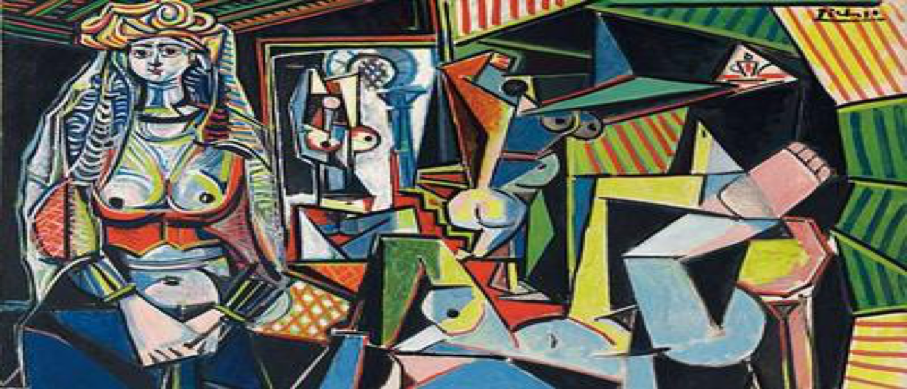
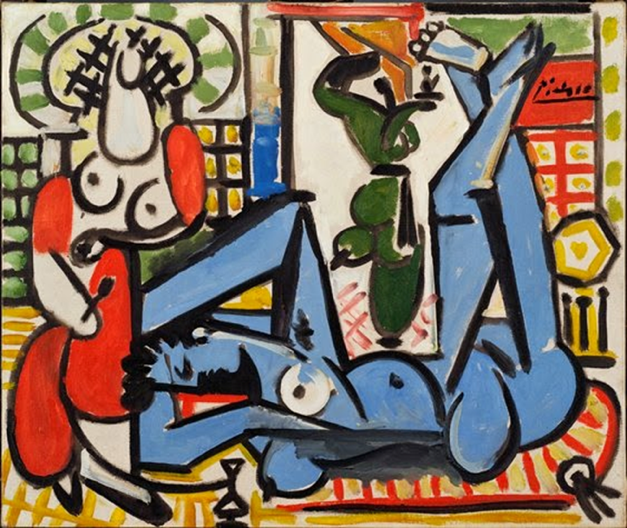
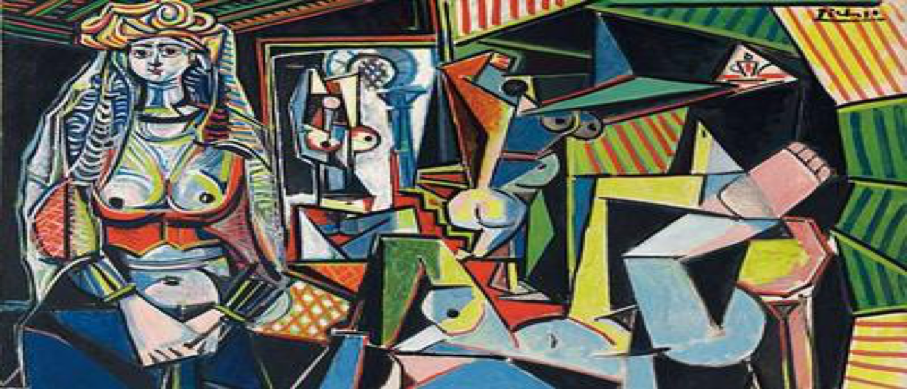
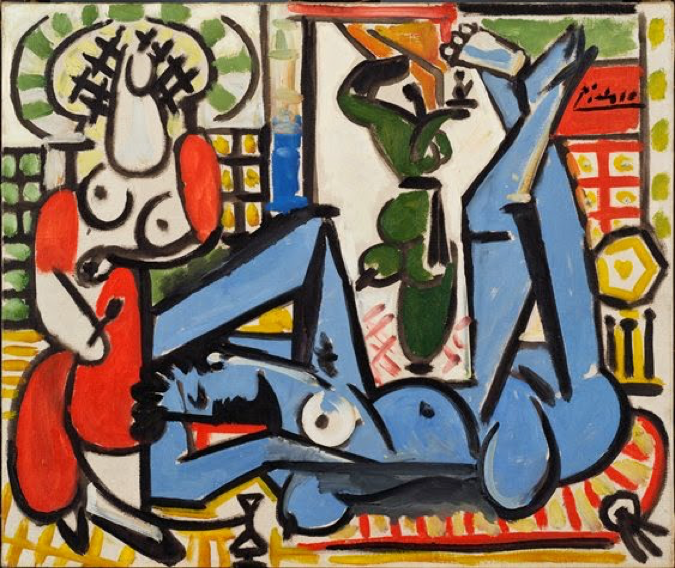
    Djebar consacre toute une section de Femmes d’Alger à Son Appartement pour parler de l’arrivée du peintre français Delacroix à Alger en 1832, où il a l’occasion de découvrir pour la première fois un harem, cet espace où des femmes et des enfants sont rassemblés ‘ Couché au milieu d’un tas de soie et d’or ». Cette expérience inattendue et choquante fera en sorte que, après son retour à Paris, le peintre travaille pendant quelques années sur « l’image de sa mémoire », grâce aux notes qu’il a faites lors de sa visite au harem. Il peint son tableau de « Femmes d’Alger dans leur appartement » en 1834 et un autre en 1849. Djebar analyse les deux œuvres et les compare avec les peintures suivantes créées par Picasso entre 1954 et 1955.

    Pablo Picasso, ‘Les femmes d’Alger, version H’, 1955[19]
    Dans ses tableaux, Delacroix dépeint trois femmes à demi assises, absentes, regardant le vide, enveloppées d’une aura de mystère et de sensualité ; Ils sont surpris par le regard du spectateur et surveillés par celui d’un serviteur noir. Dans leur luxueuse prison, ces femmes sont suspendues ou « figées » dans un silence étrange. Le silence énigmatique de leur regard, montré sur les toiles du peintre français, révèle comment la domination masculine sur le corps féminin s’est poursuivie au cours des siècles, accentuée pendant la domination coloniale comme une forme de défense et de préservation de la culture et de la tradition contre l’arrivée de l’étranger /intrus.

    Djebar réagit à la fixité du regard vers les femmes algériennes dans leur présence suspendue incarnée dans le tableau. Sa réaction est contre la fermeture intellectuelle et l’acte oppressif pour rendre la sous-culture colonisée « fermée, fixée dans le statut colonial, et pris dans le jaune de l’oppression. Présentes et momifiées, elle témoigne contre ses membres. La momification culturelle conduit à une momification de la pensée individuelle », aux termes de Bhabha[20]. Dans la construction de l’histoire coloniale, les femmes sont reléguées à un plus grand silence et à l’invisibilité ; De même, au cœur de la pensée algérienne postcoloniale, le silence est crucial dans la construction de « l’altérité ». Le harem devient une prison qui renforce le jeu voyeuriste orientaliste sur le féminin exotisé. Ce regard métaphoriquement dépouille ces femmes de leur voile traditionnel et ainsi elles deviennent « nues »[21] et sans défense. Après l’indépendance, un passé perçu comme irrémédiablement perdu, où les femmes n’étaient pas seulement autorisées à encourager les hommes dans la bataille mais aussi à se joindre à la lutte, le mâle algérien a repris la même stratégie du colonisateur. Comme Djebar le fait valoir, pour une femme de retirer son voile était équivalent à « être nu ». Les femmes qui essayaient de rejoindre les espaces publics étaient socialement répudiées parce qu’elles refusaient d’être voilées. « La vie publique et le discours public peuvent facilement être comparés à l’entrée dans un territoire hostile, presque exclusivement masculin »[22], où les hommes algériens et même le discours défensif des femmes sur eux-mêmes fournissent souvent au voyeur des armes supplémentaires pour que les femmes évitent d’exprimer leur moi Leur féminité) afin d’éviter d’être vulnérables au réductionnisme et à l’agression physique et verbale »[23].

    En dehors du harem, le voile est à la fois une opportunité pour les femmes de se déplacer librement dans les lieux publics par la soustraction du corps au regard des autres et une forme de contrôle, un signe d’appartenance. Les femmes voilées sont perçues comme un danger, « un voleur possible dans l’espace masculin »[24], et en même temps un objet d’honneur et de dignité masculine. Dans les peintures de Delacroix, le regard silencieux ou absent est généralisé pour couvrir les femmes algériennes pendant la période de colonisation et d’indépendance.

    D’autre part, le regard volé du peintre représente le regard interdit de l’Autre. Le cadre du tableau et l’espace vu par l’œil deviennent alors l’image de l’emprisonnement que Picasso explore dans ses tableaux, créant des lignes volantes, annulant la porte du harem, illuminant la pièce de lumière et dépeignant le corps en mouvement. Quant aux femmes, les différentes versions leur donnent la liberté de se couvrir et d’être nues, de faire face à leur peintre avec un sourire séduisant où d’être un visage sans traits spécifiques. Les traits et l’identité absents ont mis le peintre dans une position silencieuse ; C’est Picasso qui silencie ses pinceaux et donne libre cours à des visages infinis et des fantasmes. Picasso déclare un changement radical de perspective ; Il appelle ses tableaux par lettres alphabétiques en désordre pour que son auditoire lit les lettres à l’intérieur des mouvements et des traits des femmes algériennes qui écrivent des mots différents chaque fois qu’on les regarde. En donnant des interprétations verbales infinies dans ses tableaux, Picasso brise leur silence et crée une réponse.

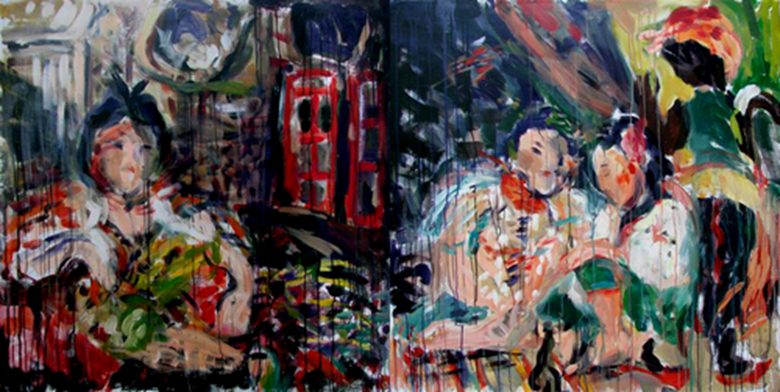
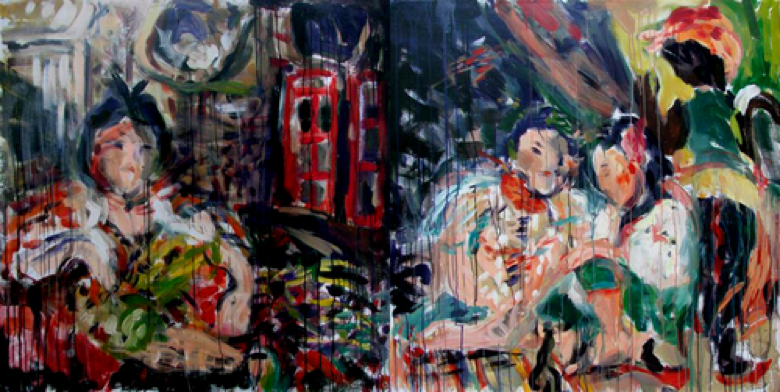
    Yossi Waxman, ‘Femmes d’Alger dans leur appartement,’ 2009.[25]
    En 2009, Yossi Waxman propose une autre interprétation de « Femmes d’Alger dans leur appartement», donnant aux femmes une apparence universelle en combinant leurs caractéristiques physiques. Il mélange les couleurs, finalement les dissoudre comme si emporté par leur importance. Les femmes ne peuvent guère être reconnues comme algériennes. La libération de la condition d’emprisonnement, cependant, ne se produit pas par la conquête de l’espace et la possibilité de mouvement, mais par l’introduction de la parole et le dialogue entre les femmes. Djebar commente :

    De nouvelles femmes d’Alger qui, depuis quelques années, peuvent librement circuler […] ces femmes sont (nous sommes) totalement libres de la relation d’ombre entretenue depuis des siècles avec leur corps ? Ils parlent vraiment, dansent ou pensent …[26]

    Les mêmes idées de dénigrement féminin et d’abus du corps féminin pour une tradition et une religion patriarcales font écho à une autre femme algérienne. En effet, dans le Je deux à l’oubli de Mokeddem, l’image du silence et du viol des femmes est étendue à l’espace français. Le viol est l’arme physique, morale, psychologique et symbolique de la guerre. « Physique » se réfère ici à l’usurpation de l’autorité sur le corps d’une femme; «Morale», à l’association du corps des femmes à l’honneur familial ou tribal; «Psychologique», au sentiment d’infériorité et de perte de contrôle, notamment dans les actes de viol commis par le colonisateur; Et «symbolique», à l’utilisation métaphorique des corps des femmes pour représenter l’Algérie. En imprégnant ces femmes de l ‘« ennemi », la terre sera peuplée par la progéniture de l’ennemi. C’est pourquoi, en temps de guerre, les femmes violées sont tuées par leurs familles, renvoyées à leur agresseur pour être tuées ou vendues à la prostitution. Ces aspects destructeurs du viol en font l’arme la plus dégradante.

    Publié en 2008, Je dois tout oublier met en évidence la situation des femmes en Algérie après les guerres qui ont déchiré le pays au cours du XXe siècle. Dans ce roman, la protagoniste Selma est une pédiatre qui vit en France. Elle est tourmentée par un souvenir soudain de son passé, quand un homme, venu de la banlieue, est venu à son cabinet médical avec l’urgence de sauver la vie de son fils. Elle ne connaît pas l’homme, en dehors d’être immigrant, mais son enfant presque mourant dans ses bras a rappelé un souvenir lointain d’un enfant tué par son parent. Pour la première fois, Selma a un flashback qui l’étourdit et l’oblige à retourner dans sa ville natale et faire face à ses tourments. Dans le processus, elle décide de faire face à sa mère et l’Algérie. Elle redécouvre le viol, le silence et la violence perpétuelle contre les femmes algériennes.

    Dans le roman, le narrateur lutte avec deux figures distinctes qui représentent les difficultés rencontrées par les femmes algériennes : la jeune protagoniste et sa mère. Le narrateur fluctue entre deux extrêmes. D’une part, on voit la femme traditionnelle, représentée notamment par la mère, comme le meilleur rôle que la société algérienne accepte et estime chez les femmes. La mère représente la tradition qui relie la femme virtuelle à sa soumission aux dictats du patriarcat. D’autre part, il y a la jeune femme rebelle, Selma qui est principalement active dans la vie sociale, et qui lutte pour la dignité et l’émancipation.

    Pour Mokeddem, la figure maternelle est fondamentale et symbolique de la manière dont l’Algérie est saisie par une inaction pernicieuse, sapant les efforts des nouvelles générations pour réaliser un développement psychique et culturel approprié. La mère de Selma est analphabète, donc elle est constamment silencieuse, idolâtre du silence. Pour Mokeddem, le manque d’éducation des femmes contribue à expliquer le conflit entre Selma, sa mère et les femmes qui vivent avec elle :

    Elles [les femmes de la famille de Selma] ne travaillent pas. Elles vivent avec leurs enfants chez leur mère. […] Soudain Selma à l’étrange impression de traverser un cimetière pour vivants à mille lieues de toute conscience humaine. […] Le manque d’instruction les maintient ensembles, démunies.[27]

    Dans cet extrait, l’ignorance et l’analphabétisme entravent la relance des femmes. Confinées dans leurs maisons, les femmes maghrébines comme la mère de Selma ne connaissent pas l’évolution historique des femmes en dehors de leur cercle, de leur quartier et de leur pays. Ils sont incapables de percevoir les femmes dans une position sociale puissante ; Des femmes qui décident par elles-mêmes sans demander la permission d’une autorité masculine, d’un père ou d’un frère; Femmes qui vivent leur vie indépendamment d’un soutien masculin. Ils continuent à agir selon la tradition dans les moindres détails quotidiens ; Ils doivent être timides de leur féminité, appelée haya’a, et doivent demander la permission de lever les yeux ou de parler devant leurs parents masculins. C’est pourquoi ils croient à l’immuabilité des temps et des coutumes.[28] La mère de Selma est une prisonnière d’une époque parallèle, incapable de développer une manière de penser divergente parce qu’elle a été conditionnée à percevoir ce mode de vie conservateur comme la seule idéologie appropriée ou correcte pour l’Algérie.

    Dans son roman, Malika Mokeddem montre que l’ignorance est la cause de la réticence de l’Algérie à s’adapter à la société moderne. L’ignorance, précurseur d’une pauvreté généralisée, descend le silence qui caractérise les souvenirs d’enfance de Salma. Le silence accable la vie de ces femmes. Ces femmes transmettent les traditions algériennes à leurs filles et évitent de parler de leurs sentiments, comme si les choses devaient être les mêmes pour toute femme.[29] Les choses devraient arriver en silence pour ces femmes que Mokeddem essaie de secouer. Mokeddem croit au rôle crucial des femmes algériennes dans la lutte pour l’établissement des paramètres et des valeurs de la société algérienne après les tempêtes de la révolution, l’indépendance, le conflit entre le nationalisme, l’extrémisme et la modernité qui ont ouvert la voie à l’inégalité.

    Le roman montre la présence d’une attitude commune de silence qui caractérise le comportement des femmes et le contexte plus général de l’Algérie. Le silence conspirateur et le secret de la mère de Selma sont emblématiques d’une attitude algérienne généralisée destinée à cacher même les crimes les plus odieux. Seul le silence garantit le refuge contre le danger du changement. En fait, le narrateur décrit la relation entre Selma, sa mère et l’Algérie comme une gouvernée par le silence :

    Quand avez-vous passé le temps ensemble ? Toute leur vie, elles n’avaient fait que croiser leur silence. Un silence si vertigineux qu’il les maintenait à distance. S’il n’y en a pas, il n’y en aura pas. Du reste, la mère restée muette devant elle. Il en a toujours été ainsi. N’en a-t-elle pas eu la plus évidente démonstration cette nuit ?[30]

    Tant de violences ont été commises ici sans que jamais justice soit rendue. Tant de traumatismes toujours niés, toujours mis sous le boisseau.[31]

    La mère de Selma a tendance à s’éloigner de la conversation et de la discussion rationnelles. Elle refuse d’avoir un contact avec sa fille qui se sent déjà éloignée, critique à ces croyances patriarcales établies depuis longtemps.

    Le silence n’est pas une solution ; Il ouvre simplement la voie au chaos et aux malentendus. En effet, Mokeddem met en évidence les parallèles entre sa mère et l’Algérie. Le pays est déchiré entre Selma, avec ses idéaux philosophiques occidentaux, et sa mère qui représente les traditions algériennes qui menacent la rénovation et le renouvellement. En effet, Selma se sent intimidée par les mots répugnants de sa mère et considère qu’entre elle et sa mère, “il y a toujours eu un obstacle d’autant plus inquiétant que le sentiment d’une menace vague”.[32] La mère de Selma est décrite comme le protecteur inamovible des piliers de la culture algérienne et rejette la différence. En effet, Selma reconnaît l’Algérie dans sa mère: ‘c’est elle [l’Algérie] qui a fomenté des violences, des exactions avec cette sorte de jouissance destructrice’.[33]

    La rupture qui sépare Selma de sa mère est représentative de l’affrontement entre Selma et son passé et Salma et l’Algérie. Parmi les vertus qu’une bonne mère doit nécessairement posséder, il faut défendre l’honneur, préserver le lien du mariage et observer avec diligence les pratiques religieuses. Si ces valeurs sont menacées, même les crimes les plus odieux peuvent être engagés pour assurer leur protection. La mère de Selma va tuer son nouveau-né, parce qu’il était le fruit d’une liaison extra-conjugale. La révélation est dure pour Selma parce que c’est son oncle qui a violé sa sœur. En fait, la mère répète une phrase particulièrement emblématique : « qu’est-ce que tu veux qu’on fasse ? On était bien obligé de tout étouffer ![34]

    La mère de Selma est incapable de comprendre les questions posées par sa fille parce que les deux femmes ont des croyances incompatibles. Selma a choisi de ne pas vivre dans sa terre natale mais d’échapper à l’abus et à la violence à la France. Sa mère, cependant, doit défendre la tradition et lutter contre la modernité en ce qui concerne les questions de genre et de sexualité. Il est intéressant de noter que la mère de Selma n’utilise pas le pronom de la première personne « je » au cours de sa confession. Elle préfère le pronom impersonnel « on » parce que ce n’est pas un acte dicté par une condamnation individuelle, mais un acte nécessaire imposé pour protéger l’honneur. L’acte de taire culmine dans l’assassinat du nouveau-né :

    La main de la mère qui s’empare d’un blanc d’oreiller, l’applique sur le visage du nourrisson allongé par terre auprès de la tante Zahia et qui appuie, appuie. Cette main qui pèse sur le coussin et maintient la pression. Les spasmes, à peine perceptibles, du bébé ligoté par les langes qui le sanglent de la racine des bras à la pointe des pieds. Le cri muet des yeux de Zahia qui semble tout figer.[35]

    Médée, emblème de la colère et symbole du filicide, est la figure mythique à laquelle Mokeddem compare l’Algérie. L’Algérie est Médée parce qu’elle étouffe ses filles et ne leur donne aucune protection. Dans le Complexe de Médée (2006) Rita El Khayat[36] compare la mère à la sorcière Medea pour déstabiliser les croyances patriarcales détenues par les femmes. En réfléchissant à la relation entre les mères et les filles méditerranéennes, El Khayat propose une idée de la féminité et de la maternité liées à la violence et au meurtre; Tandis que Mokeddem voit dans la tradition et que l’Algérie qui la conserve et ces mères qui transmettent aveuglément le miroir de Medea. El Khayat réfléchit donc sur la maternité violente à travers l’évocation du mythe grec de Médée. Médée devient le symbole de la brutalité et du meurtre d’une mère. Pour Selma, Médée devient la mère et le pays:

    L’image de Médée hante Selma. Elle s’est imposée dès que celle du meurtre est venue lui dessiller les yeux lors de cette brusque restauration de sa mémoire. Mais comment risquer la comparaison quand la mère comme la tante feraient si pâle figure aux côtes de Médée? […] Médée méprise souverainement la notion du mal et tue pour se venger d’un époux et des puissants avec lesquels ce dernier fait alliance. Elle leur inflige un supplice radical et s’en vante. […] Seules la honte et la menace du déshonneur ont présidé à la décision familiale d’un meurtre. La mère n’en a été que l’exécutante. […] En vérité, c’est au pays tout entier, à l’Algérie, que sied le rôle de Médée. [C’est elle] qui a assassiné les uns, exilé les autres, fait incinérer des bébés dans des fours, abandonnant d’autres enfants avec d’indicibles blessures. Elle continue à se mutiler en reléguant la moitié de sa population, les femmes, au rang de sous-individus dans les textes de sa loi.[37]

    L’Algérie apparaît aux yeux de l’écrivain comme une terre despotique. Pour Mokeddem, l’Algérie est la réincarnation de Médée: enchanteresse, puissante, meurtrière et impitoyable. La pensée de l’invariable terre algérienne accompagne toutes les femmes qui, comme Selma, ont choisi l’exil en silence. S’ils continuent à y vivre, cela signifie qu’ils accepteront l’Algérie en silence.

    De plus, il est intéressant de noter que l’interprétation de Malika Mokeddem rejette toute forme d’enracinement nationaliste, exprimée par la majorité des auteurs postcoloniaux. Malika Mokeddem quitte l’Algérie pour se réfugier en France, mais elle ne considère pas la France comme son lieu d’exil. L’écrivain veut être sans-abri, apatride, dans une ville d’un Indistinct ailleurs. Si l’Orient de Saïd est une arène de conflits et d’être déstabilisant, où les femmes sont soumises au colonisateur patriarcal et colonisées, des femmes comme Djebar et Mokeddem s’enfuiront pour un espace hybride d’identité où il ne pourrait y avoir de terrain fixe et un discours unique.

    En conclusion, le silence des femmes est un thème courant dans la littérature algérienne. Dans le Je dois tout à ton oubli de Mokeddem, le silence est critiqué comme un acte d’acceptation et de soumission, sinon la perpétuation de cette même tradition oppressive. Dans Djebar, les femmes d’Alger dans leur appartement, la représentation du silence est donnée une lecture colonialiste et son interprétation plus tard explosive de Picasso est considéré comme un acte émancipateur des femmes algériennes d’aujourd’hui. Ainsi, entre la tradition, la colonisation et le patriarcat, les femmes algériennes subissent l’acte violent du silence et du viol ; Pourtant beaucoup d’entre eux, comme la mère de Selma, perpétuent l’absence et le déplacement.

    [1] La présence française en Algérie a duré de 1830 à 1962.

    [2] Amel Grami, «Genre et guerre», «Narration et traduction du viol et de la violence en temps de guerre: le rôle des langues», Université de Birmingham, 10 octobre 2014.

    [3] Une militante algérienne de premier plan et membre du FLN qui s’est opposée à la domination coloniale française.

    [4] Malika Mokeddem, Je dois tout à ton oubli (Paris: Bernard Grasset, 2008).

    [5] Assia Djebar, Femmes d’Alger dans leur appartement (Paris: Éditions des femmes, 1980).

    [6] Djebar, Femme, 1.

    [7] Djebar, Femme, 1.

    [8] Djebar, Women of Algiers in Their Apartment, p. 44.

    [9] Lucy A. Armstrong, ‘The Segregated Gaze: Assia Djebar’s Women of Algiers in Their Apartment’, <http://www.africanwriterstrust.org/the-segregated-gaze-assia-djebars-women-of-algiers-in-their-apartment/> [accessed 24 March 2016].

    [10] Djebar, Women, p. 66.

    [11] Djebar, Women, p. 14.

    [12] Assia Djebar, Ces voix qui m´assiègent : en marge de ma francophonie (Montréal : Presses de l’Université de Montréal, 1999), p. 107.

    [13] Rania Kabbani, Europe’s Myth of the Orient, (London: Pandora Press, 1986), p. 67.

    [14] Kabbani, Europe’s, p. 67.

    [15] Abdul JanMohamed and S. X. Goudie, ‘Theory, Practice and the Intellectual: A Conversation with Abdul R. JanMohamed’, <http://english.chass.ncsu.edu/jouvert/v1i2/GOUDIE.HTM> [accessed 13 September 2014].

    [16] Edward Said, Orientalism (New York: Pantheon Books, 1978).

    [17] Homi Bhabha, ‘The Other Question’, p. 6, http://courses.washington.edu/com597j/pdfs/bhabha_the%20other%20question.pdf [accessed 24 March 2016].

    [18] Bhabha, p. 8.

    [19] Pablo Picasso, ‘Les femmes d’Alger, version H’, 1955, <http://search.it.online.fr/covers/?m=1849> [accessed 12 December 2015].

    [20] Bhabha, p. 9.

    [21] Rafika Merini, Two Major Francophone Women Writers, Assia Djébar and Leïla Sebbar A Thematic Study of Their Works (New York: Peter Lang, 1999), p. 2.

    [22] Merini, p. 3.

    [23] Merini, p. 3.

    [24] Djebar, Women, p. 165.

    [25] Yossi Waxman, ‘Femmes d’Alger dans leur appartement’, 2009, http://www.newmasterartist.com/artist/yossi-waxman/artworks  [accessed 12 December 2015].

    [26] Djebar, Women of Algiers in Their Apartment, p. 14.

    [27] Mokeddem, p. 68.

    [28] Kelly Debra, Autobiography and Independence: Selfhood and Creativity in North African Postcolonial Writing in French (Liverpool: Liverpool University Press, 2007), p. 286.

    [29] Mokeddem, p. 85.

    [30] Mokeddem, p. 85.

    [31] Mokeddem, p. 86.

    [32] Mokeddem, p. 88

    [33] Mokeddem, p. 92

    [34] Mokeddem, p. 71.

    [35] Mokeddem, p. 11.

    [36] Rita El Khayat, Il complesso di Medea Le madri mediterranee, (Naples: L’ancora del Mediterraneo, 2006).

    [37] Mokeddem, p. 84-5.

  • Anissa Daoudi – L’intraduisibilité de l’Algérie durant la décennie noire

    Anissa Daoudi – L’intraduisibilité de l’Algérie durant la décennie noire

    Anissa Daoudi

    Englishالعربية

     «ةة  est notre potence, accrochée par un dieu imaginaire, créé par les hommes selon leur imagination

    La citation ci-dessus m’est dédiée par l’écrivaine algérienne Fadhila Al Farouq dans mon propre exemplaire de son roman intitulée تاء الخجل « Taa al khajal »Taa al Khajal1 (2005).

    La lettre arabe «taa marbuta» ou « TAA fermée » est le principal indicateur du genre féminin en langue arabe. Dans sa version initiale, elle apparaît généralement comme un cercle sous deux points, lة). a version manuscrite d’ Al Farouq possède deux lignes inclinées émergentes des deux côtés (ô 2 ), ce qui, en fait, ressemble à un nœud  de bourreau. pour elle, la lettre (δ) représente un nœud autour du cou d’une femme. Elle utilise aussi « notre » pour désigner toutes les femmes arabes sans exception. Elle désigne par le nœud comme un outil «artificiel» imaginaire créé par la fantaisie de l’homme pour représenter Dieu ou la religion en général. Al Farouq utilise la «taa fermée »ة ة comme une métaphore désignant la société fermée où elle vit. Le cercle constituant le blocage de sa société, où les gens tournent en rond, sans trouver un moyen pour se libérer des contraintes sociales , : une suggestion d’une impasse, une vision très pessimiste, car elle élimine la possibilité d’espérer un changement.

    Le roman d’Al Farouq a été traduit en français par La Honte au Féminin (2009)3.. Le titre en français évoque des questions sur la traduction en général et sur le transfert des concepts, plutôt que des problématiques relatives aux mots ou aux phrases, ou au texte source et au texte cible. . La version traduite en français opte pour ‘F’ pour le mot français ‘feminin’. Or, cette lettre n’a pas la même connotation de la «taa »ة ة  à la forme d’un cercle, déformant le concept.

    Al Farouq consacre un chapitre entier à la question du genre féminin en langue arabe, sa signification symbolique et son impact sur la politique du genre. Elle donne droit au chapitre ” ” تاء مربوطة لا غير” تاء مربوطة لا غير “, « Ta’marbuta la ghaira,’un taa fermé /ةة/’/.et rien d’autre », qui a été traduit en français comme «F fermée et rien d’autre ». La version traduite en « F » pour « féminin » est une interprétation directe alphabétique de la langue d’origine. Cependant, ce que l’auteur veut transmettre est la signification indirecte et symbolique du cercle dans le taa fermé / ة ة / ‘ . . Se référant à   une situation sans issue, Al Farouq n’implique pas la notion du cercle comme symbolique de quelque chose qui est entier, complet, idéal et éternel, mais comme quelque chose qui n’a ni de fin ni de début.

    Le lecteur d’Al Farouq doit comprendre que le sens est celui de la société algérienne fermée. Cependant, l’interprétation directe alphabétique, se rapporte au discours sur la langue arabe et sur le féminisme, en soulignant la masculinité de l’arabe par sa grammaire. Ce n’est guère une nouvelle question : ce point a été déjà abordé par des chercheurs tels que, Yousra Muqaddam 4 , Zuleikha Abou Richa 5 et Al Abdellah Ghadhami 6 . Ils commencent tous par le système grammatical arabe et ses indicateurs féminins pour déconstruire le système masculin patriarcal plus large dans leurs sociétés. . L’exemple de Al Farouq et bien d’autres, qui font l’objet d’étude de cet article, porte sur « l’intraduisible » de l’ Algérie, conformément au titre d’Apter (2006: 94).

    Plus précisément, cet article met en avant «l’intraduisibilité» de l’Algérie au cours des années 1990, connu sous le nom de la « décennie noire » au cours de laquelle le pays a sombré dans la tourmente. «L’intraduisible » de l’Algérie existe non seulement au niveau linguistique, (manque d’équivalence ou de contresens) mais aussi au pluriel «les intraduisiblités » qui seront expliquées.

    Alors que la notion du «non traduit» de l’Algérie est le thème dominant, l’article traite d’une phase où l’Algérie est passée sous le radar durant toute une décennie. C’est une période historique, de laquelle on ne connaît que très peu. Plus important encore, on mentionne très peu le rôle des femmes dans le conflit, survivantes ou militantes soient-elles.

    Cet article a ainsi trois objectifs, le premier consiste à mettre en évidence les récits de femmes algériennes de la «Décennie Noire» à travers différents médiums, interviews personnelles et production culturelle (romans, mémoires et témoignages) dans les deux langues de travail de l’Algérie Arabe et Français. Le second est de contester la conception de l’intraduisibilité comme notion homogène et de montrer,   à travers l’étude de cas de l’Algérie, qu’il existeraient plusieurs «non traduits»  (dans certains cas interdépendants) favorisant, en même temps, la «traduction» comme récits inquiétants. Le troisième consiste à s’engager dans le discours mondial, de présenter les femmes non comme victimes ou survivantes, mais comme «participantes puissantes, actives et significatives dans les zones de conflit» (Daphna – Tekoak et Harel – Shalev, 2016: 2).

    Violences au féminin et intraduisibilité

    Le présent article attache une attention particulière à un thème peu traité,  un thème lié aux récits de violence sexuelle à savoir le viol ;. la première hypothèse que l’on pourrait considérer, en cas de «viol» en particulier dans les pays conservateurs traditionnels comme l’Algérie, est que l’on traite d’un cas de «non-transparence culturelle». Cet article met cependant, en exergue certains stéréotypes et montre que le «viol» est une question délicate, un phénomène universel considéré comme sensible en raison de sa nature.

    L’Algérie est un pays qui a subi des violences de toutes sortes sous le système colonial français, où les femmes ont été victimes de violences sexuelles par le colonisateur, toutefois dans les années 1990, l’auteur n’était pas le français, mais le «frère» algérien… Ce soi-disant « frère » violait, torturait et tuait selon une autre idéologie, une idéologie qui traduit le « viol» comme connu à cette époque moderne en « sabi »7, concept issu des temps des croisades signifiant l’acte de la violence sexuelle contre les femmes de foi différente, capturées dans la guerre.

     Apter le designe comme une «intraduisibilité sacrale ou théologique» la difficulté pour elle reste relative à l’intraduisible sacral, elle avance qu’elle . n’a guère de   prétention à résoudre la question, mais qu’elle essaye de s’assurer qu’elle soit reconnue comme un principal défi heuristique. ( Apter, 2013: 14) .

    Un phénomène bien connu que certains penseurs arabes ont cherché à étudier en  essayant de trouver des réponses le concernant tels    Al Jabiri, Al Aroui, Arkoun et bien d’ autres dans la période Nahdha tels que Al Tahtawi 8 .

    Le concept de l’intraduisibilité est fréquemment utilisé dans la théorie de la traduction d’une manière homogène. la classification d’une gamme d’intraduisibilité, pas nécessairement dans un ordre quelconque, avance le concept plus loin et ouvre une discussion plus approfondie.. Il répond également à un manque de précision lié au concept.

     Les idées et les exemples discutés dans chaque partie agissent comme des suggestions quant à la façon dont on peut comprendre et classer les non-adaptations. La discussion s’inspire des domaines de la linguistique, de la sémantique, des théories du langage, du pouvoir, et de la littérature pour explorer des textes où l’intraduisibilité est présente. Les cinq catégories présentées ne répondent pas toutes à la question de savoir pourquoi l’Algérie est intraduisible, mais tiennent compte des raisons les plus pertinentes pour la non-transparence. Le linguicide, comme une des raisons de l’intraduisibilité, est mis au défi en mettant en évidence un élément crucial, qui est l’élimination du dialecte algérien et son rôle crucial dans le silence de la population ainsi que l’éruption du conflit entre les Arabophones, Francophone et berbérophone. Intellocide, qui est le ciblage et le meurtre d’intellectuels algériens dans les années 1990, est soutenu par des entretiens personnels, des témoignages, des romans et des films pour donner des exemples concrets qui contestent les récits officiels.

    .Le linguicide et l’intellocide en Algérie sont présentés comme des motifs interdépendants de l’intraduisibilité, qui sont également des raisons directes pour lesquelles des transitions externes se produisent dans le cas de ce pays. Mettre l’accent sur les différentes classifications du concept d’intraduisibilité signifierait une compréhension plus claire en théorie et en pratique.

    Contexte théorique

    Une grande partie du discours récent dans les études de traduction porte sur la question du «non traduit» (Apter, 2013), les discussions vont de  ‘tout est traduisible et transférable d’une langue à une autre’ (Bellos et Jean-Jacques Lecercle), à ‘toute traduction est nécessaire mais condamnée à l’échec en raison de la  nature irréalisable de la tâche’  (Barbara Cassin), tout est intraduisible, (livre d’Apter contre la littérature mondiale: sur la politique de intraduisibilité, 2013).

    .L’idée d’Apter est basée sur le rejet de l’hypothèse que tout peut « être traduit, échangé ou substitué dans un idiome global accessible » (Apter, 2013). Elle demande à ses lecteurs de considérer le concept d’intraduisible, en se référant comme elle le dit aux « épineuses, des moments frustrants de la dissonance culturelle et d’incompréhension – comme la clé de la traduction et de l’engagement interculturel » (ibid), elle considère les mots comme faisant partie d’un système entier dans lequel leurs significations dépendent de leur relation les uns avec les autres, tout comme Ferdinand de Saussure le fait.

    Elle prend ensuite cette idée pour préciser les différences significatives de pensée conditionnées par la langue et la culture. Pour elle et pour Cassin, les problèmes rencontrés par les traducteurs sont un champ fertile   d’enquêtes   approfondies, l’ «intraduisibilité», ici, est perçue comme un concept dynamique et nécessaire. Il est considéré comme une plate-forme à partir de laquelle les discours hégémoniques sont contestés. Malgré les tentatives d’Apter pour fournir des exemples d’intraduisibilité, d’autres travaux sont encore nécessaires pour catégoriser les types de «non-traduisances», afin d’éviter l’hypothèse de l’homogénéité de la «non-transparence» et de fournir plus de précision.

    Dans son chapitre, « intraduisible de l’Algérie: La politique de linguicide »,  Apter (2006) va analyser l’intraduisibilité de l’Algérie sans nommer de typologies. L’article vise à combler ce manque de précision et présente de nouvelles dynamiques et de nouveaux types de «non traduits» spécifiques au cas algérien, mais cela pourrait également s’appliquer à d’autres cas de «non-traduit».

    En effet le présent article traite non seulement des typologies supposées qui permettent de comprendre les raisons de l’intraduisibilité, mais aussi met en exergue les différents moyens par lesquels elles pourraient apparaitre, tels que des romans, des témoignages et des interviews personnelles en arabe, en berbère et en Français. Cette combinaison de langues est un cas pratique du multilinguisme en Algérie qui fournit à la fois des idées théoriques et des situations pratiques qui peuvent être utiles aux traducteurs.

    Le premier type de «non traduit» concerne dans la plupart du temps des aspects linguistiques qui rendent un texte «intraduisible» d’une langue à une l’autre. L’accent est mis sur les incapacités structurelles du langage, où les mots et leurs significations sont analysés comme éléments secondaires. Par exemple, « l’intraduisible des motifs sonores créés par des phonèmes, mots et phrases d’un texte dans sa langue d’origine » (Gleeson, 2015: 3).

    Le deuxième type est le «non traduit» culturel, qui est le plus souvent rencontré par les traducteurs. Ici, le défi est non seulement de trouver un équivalent en termes de sens, de terminologie et / ou d’expression idiomatique qui correspond à la langue cible, mais pourrait parfois être plus profond et ce en cas d’absence de concepts dans la langue / culture cible ou qui pourraient exister mais avec des connotations différentes.

    L’intransigeance culturelle pour cet article est censée débuter par le thème de la violence sexuelle qui est inévitablement un tabou de la culture arabo-musulmane traditionnelle. Cependant, la sensibilité du thème est «universelle». En d’autres termes, le poids culturel attribué au mot «viol» dans la plupart des cultures musulmanes ainsi que dans le reste du monde peut être difficile à traduire. La difficulté vient de la connotation historique dans les sociétés islamiques, le mot / concept « viol » a été accueilli et encouragé en temps de guerre comme dans le cas de / sabi / (voir note 6 ci – dessus). Le viol est également souvent associé à la virginité féminine et est chargé de connotations qui font de la traduction une tâche difficile. Le troisième type est l’«intraduisibilité théologique» pour laquelle la traduction vers ou de l’arabe est un bon exemple. Apter fait référence au livre de l’éminent penseur marocain Abdelfateh Kilito, tu ne parleras pas ma langue9   qui montre que l’arabe est considérée comme une langue sacrée et donc, selon Kilito 10 , toute tentative de traduction pourrait conduire à une mauvaise interprétation et une traduction erronée. Les arguments de Kilito sur la langue et son caractère sacré ont été au cœur du débat depuis des décennies dans la plupart des disciplines. Bien que Kilito intègre ce type sous l’intraduisible culturel 11 , je soutiens que l’origine des difficultés réside dans le fossé linguistique entre l’arabe classique et l’arabe moderne. Dans cet article, je m’attèlerai à démontrer que  C’’est à cause du caractère sacré de la langue et de l’absence du développement du langage que les «intraduisiblités» se produisent et persistent malgré la modernité.

    Il faut dire les voix contre le caractère sacré de la langue ont été marginalisées à l’instar d’Al-Jābirī et de Laroui, qui pensent que la voie à suivre pour que l’Arabe prospère et se développe   serait justement la rupture avec   le «passé glorieux» et   sa séparation du Coran.

    Dans son livre ‘Why Arab are the Arabs not Free?  The Politics of writing’ Moustapha Safouan (2007: 49), démontre la relation de force entre l’arabe classique et l’ écriture tout au long de l’histoire islamique. Il dit:

    « on est l’une des civilisations créatrices de  l’ écriture il y a plus de cinq mille ans, l’état l’a monopolisée et en a fait un art ésotérique réservé à ses scribes ». Il ajoute que « écrire dans une langue sacrée sinon « supérieure », influencerait  les idées ont été de la même constitué comme un domaine distinct auquel les gens ordinaires n’avaient pas accès. Le résultat est que l’Etat pouvait éliminer de façon sûre les écrivains qui osaient contredire les orthodoxies dominantes, et que les auteurs, tout comme les anciens scribes, ne pouvaient guerre survivre dans l’ordre établi »

    Cela implique que le vernaculaire est considéré comme «faible» et continue d’être utilisé uniquement pour les pratiques orales. Safouan (2007: 94) pense que “l’un des principaux désastres du Moyen-Orient est qu’il n’a jamais connu le principe de l’humanisme linguistique réintroduit en Europe par Dante au cours du moyen âge et intensifié plus tard grâce à la Réforme et à la création de la nation européenne “. Dans un même contexte, le cas algérien sera présenté avec des exemples (interviews, romans, témoignages et mémoires) du dialecte algérien ainsi que du Berbère, qui ont été mis en silence pour une génération entière dans l’Algérie postcolonial. 

    Le “non traduit externe” est lié à la contextualisation qui affecte un texte sans tenir compte de son contenu linguistique. .Les facteurs externes peuvent ainsi être sous deux formes, la première qui est une forme douce est relative à ce que Toury décrit comme « rôle social» du traducteur qui consiste à remplir une fonction spécifiée par la communauté. La deuxième en est une forme dure  Gleeson (2015), parle d’une forme plus complexe, comme ce que Bassnett (2002) appelle le flux de traduction «unidirectionnel». .Bassnett soulève Ici, la question des relations de force entre le colonisé et le colonisateur.

    La traduction a été utilisée comme instrument pour coloniser et priver les colonisés de leurs voix. Elle renforce cette hiérarchie de puissance (ibid, 387). Dans le même ordre d’idées, Venuti soutient que le pouvoir colonial joue un rôle important dans le maintien de l’hégémonie dans la traduction (Venuti, 1998:01). Carli Coetzee (2013) donne l’exemple de l’Afrique du Sud où une grande partie de la traduction vise à étendre et à affirmer le privilège monolingue en traduisant les langues africaines vers anglais, elle suggère un «flux inverse», En d’autres termes, elle soutient le refus de traduire des langues africaines vers l’anglais afin de déstabiliser l’hégémonie de la langue anglaise. En Algérie et dans d’autres pays d’Afrique du Nord, comme la Tunisie et le Maroc, l’hégémonie repose sur la domination de la langue française sur les langues autochtones.

    J’avance que La traduction en anglais, en berbère et / ou en dialecte arabe local élargirait le lectorat et aiderait à démanteler les langues hégémoniques en Algérie (Arabe standard et français).

    Dans cet article, ces classifications ne sont pas dans un ordre particulier, l’intraduisibilité linguistique par exemple, est justifiée en termes de situation linguistique en Algérie dépassant les limites de la langue pour analyser une question beaucoup plus profonde relative   à l’Algérie, à savoir le linguicide ; par ailleurs lié à ceci est un sujet connu sous le nom d”intellocide’ qui, comme je le précise ci-dessous, pourrait être abordé par les deux classifications. L’important dans cet article est ce que j’appelle «l’intraduisibilité de l’Indescriptible», qui concerne la formulation et la traduction des mots   pouvant décrire et transmettre des sentiments liés à des expériences sensibles et douloureuses comme le viol.  .Cette incapacité de traduire le traumatisme en mots est liée à l’incapacité   de comprendre ce qui se passe,   à l’instar de l’Algérie des années 1990..

    Pour illustrer les différents types d’intraduisibilité, l’Algérie est considérée comme une étude de cas dans la section suivante.

    «L’Algérie intraduisible»

     Linguicide Algérien

    Le titre de cette partie est emprunté  au chapitre de Apter “Untranslatable’ Algeria: The politics of Linguicide” « l’intraduisiblité de l’Algérie : La politique du linguicide » dans son livre: The Translation Zone: A New Comparative Literature (2006) ; ainsi je mettrai  la lumière sur ce qui fait de l’ Algérie « intraduisible », en commençant par le linguicide (ibid) et ses racines examinant   les idées d’Apter ,et ce en décorticant  les couches complexes du conflit linguistique en Algérie approfondissant  la  dichotomie des arabophones contre les francophones   en incluant    les dialectes régionaux et le Tamazight. Cela   illustrerait  Il s’agit non seulement d’analyser les  conséquences et les répercussions   de la «question linguistique» sur l’ensemble de la société algérienne après l’indépendance,  mais aussi d’autres  facteurs critiques, tels que la parution des lois ayant eu de directes répercussions  sur les années 1990 et les années suivantes,    Ce qui a causé entre autres, l’instabilité de la situation actuelle en Algérie.

    Je soulignerai dans cette partie Le «non traduit» de tout un pays et ce à travers la «question de langue» telle qu’elle est toujours appelée quand il s’agit de l’Algérie (Treacy, 2013: 402)..En effet le terme est issu du français et nous emmène directement   à faire le point sur la langue comme soi-disant une caractéristique unificatrice de toute nation.

    En Algérie cependant, et après l’indépendance en 1962, le pays est entré dans un champ de bataille entre différentes idéologies nationalistes et islamistes, certains préconisant le retour à une identité arabo-musulmane stricte,   d’autres revendiquant cette résistance, comme les Berbères et les francophones qui ont eu besoin de temps pour s’adapter au nouveau mouvement d’arabisation 12 . La « question de langue »13 était au centre des différents discours dans les décennies précédant l’indépendance. Le pays a vu des tentatives multiples – et parfois contradictoires – de contrôler la langue algérienne.

    Alors que le discour, d’arabisation avait tous les éléments de réussite, il est devenu un élément central de discorde, en raison de la marginalisation des Berbères 14 ,  citoyens indigènes de l’Algérie, ainsi que la grande majorité des Algériens   francophone.   Le système éducatif utiliser le français en tant que moyen d’enseignement    avant d’être considéré par la rhétorique politique révolutionnaire comme langue d’ennemi qui devrait être éradiquée.

    Le projet d’arabisation était responsable de la plupart des « intraduisiblités » de la nouvelle Algérie indépendante, et de placer une génération en exil dans leur propre pays, car utiliser le français était considéré comme trahir le sentiment nationaliste, connu sous le nom du panarabe et qui prenait de l’envergure non seulement en Algérie mais dans toute la région arabe.

    Dans son roman Mémoire de la chair, Ahlem Mosteghanmi (1985) commença par les mots suivants :

    « À la mémoire de Malek Haddad, fils de Constantine, qui a juré après l’indépendance de l’Algérie de ne pas écrire dans une langue qui n’est pas la sienne. .Il est mort par la puissance de son silence pour devenir un martyr de la langue arabe et le premier écrivain à mourir silencieux, affligé et passionné en son nom “.

    .Mostaghanemi, une éminente écrivaine algérienne, a choisi de lancer son roman rappelant le monde de Malek Haddad, le célèbre écrivain francophone et beaucoup d’autres victimes du linguicide postcolonial Algérien.  Malek Hadad a refusé d’écrire dans la langue coloniale et est mort de silence. De même que Malek Hadded qui a été assassiné par la page blanche, Le Blanc de l’Algérie de Assia Djebar (1995) (Le Blanc algérien) plaide pour la même page blanche. The white in her title refers to the unwritten pages of Algerian history. Le blanc dans son titre fait référence aux pages non écrites de l’histoire algérienne. Il se réfère à la révolution qui a échoué, mais qui doit être écrite dans une nouvelle langue qui doit encore être convenue. Le problème de la langue la préoccupation première pour Djebar qui rêvait  d’une société polyglotte  conforme à la situation multiculturelle de l’Algérie. Djebar, comme Hiddleston (2005: 3) avance que

     « l’utilisation de son écriture pour découvrir le multilinguisme opprimé et la créativité multi-culturelle de l’ art algérien et de la littérature, et pour créer un récit de deuil qui encapsule de façon appropriée les horreurs difficiles à résoudre des discours officiels et idéologiques.

    Djebar a utilisé le français, la langue présumée laïque, pour se battre et se déconnecter de l’idéologie monolingue revendiquée par les islamistes. Pour elle, « une nation est un ensemble complet de langues et cela est particulièrement vrai pour l’Algérie » (Šukys, 2004: 117).

    Anne-Emmanuelle Berger (2002: 72) trouve le parallèle de Gilbert Grandguillaume entre ce qui est arrivé aux Algériennes et ce qui est arrivé à la langue algérienne en Algérie autonome. Un parallèle véridique, en  en dépit de la contribution remarquable des femmes algériennes à la guerre de Libération et les « mesures audacieuses qu’elles ont prises  dans la sphère publique (un processus décrit par Frantz Fanon ( 1959  ) dans son article  « l’Algérie se Dévoile», Grandguillaume nous rappelle les multiples façons à travers  lesquelles l’Algérie indépendante cherchait à renvoyer  les femmes à l’intérieur de chez elles à les confiner dans la sphère domestique»(Berger, 2007: 72).

    Le parallèle est établi entre l’ arabe dialectal et le « dévoilé » des femmes algériennes  qui sont à l’instar de la langue  qu’elles parlent à l’intérieur et à l’extérieur de la maison avec leurs collègues algériens , un symbole ou une métonymie de la «véritable algérianité» (ibid). Pourtant quand il s’agit de l’usage formel de l’arabe, c’est le dialectal qui est envoyé à la maison, dans un sens « voilée », confinée à l’espace privé. Bien que l’arabe standard (SA), connu sous le nom fusha est la langue officielle pour l’écriture, les dialectes régionaux appelés « ammiya sont quant à eux utilisés de façon informelle sous la forme parlée seulement16 .

    Cette imposition de l’arabe standard en Algérie, ou le mouvement d’arabisation, vise non seulement à éradiquer le français, mais aussi les langues autochtones comme le berbère. Cette idéologie remonte à l’Association des oulémas algériens 17 un mouvement, des années 1930 de lutte contre le colonialisme et   qui a fait de l’islam  la religion de l’Algérie et de l’arabe son unique   langue.

    Dans Bleu, Blanc, Vert (2006), Maissa Bey, une autre écrivaine francophone, rappelle l’ère postcoloniale et narre la situation linguistique de l’Algérie et sa relation étroite   avec le nationalisme.. Le roman remet en question le projet d’arabisation, et considère son imposition comme une forme de persévérance de certains modes coloniaux de domination (se référant à la politique de francisation 18). Ali, le personnage principal du roman appartenant à la génération des Algériens qui ont opté pour rester et étudier dans le pays, dit :

    « Il y a ceux qui ont étudié dans les pays frères, en Egypte, en Syrie, en Irak et en Jordanie … Ceux qui, comme moi sont restés en Algérie, enseignés par des enseignants, le français pour la plupart, mais sous la direction d’un Ministre algérien, et conformément à ses directives. Où est le problème ? ” (Bey, 2006: 145).

    .La citation montre des problèmes complexes liés à l’authenticité, au nationalisme et à l’Arabité.  Le pays a été divisé en francophones appelés HizbFransaHizb Fransa : Le parti de la France  et en  arabophones qui sont des Algériens enseignés dans des pays «frères» ou par des enseignants d’états arabes  ramenés pour arabiser le pays certains étaient des Egyptiens, sympathisants ou membres actifs du Mouvement des Frères musulmans.

    .Cette division linguistique a continué à affecter les intellectuels et les artistes d’expression berbère et française dans le soulèvement des années 1980 et dans la guerre civile des années 1990.

    .Fadhila Al Farouq, une écrivaine berbère arabophone a écrit dans une interview personnelle en octobre 2014, qu’elle se sentait piégée entre sa langue maternelle berbère et la langue qu’elle utilisait pour l’écriture : l’arabe en l’occurrence.She says: “Elle dit

     J’ai maintenant commencé à haïr l’arabe … Je me sens piégée, Je ne peux pas publier dans la langue avec laquelle j’ai été élevé le Tamazight) et je ne peux pas en français non plus … mon seul moyen est l’arabe qui m’a été imposé à un âge très précoce à l’école primaire..Je parlais Berbère uniquement en privé avec un ami en cachette. J’ai senti la douleur de l’ablation de mes racines à Arris19ma langue Tamazight (Chaoui) pour me retrouver dans un nouvel environnement (école) forcé de parler arabe.

     »  Elle ajoute : ” Tamazight, pour moi, était pour la sphère privée »”. “.

    Ceci est illustré dans son roman. La victime Yamina est une femme berbère des Aurès, de même que le narrateur dans le roman qui dit :

    “ابتسمت لها “ابتسمت لها ، , و اقتربت منها أكثر و حدثتها بالشاوية ” “

    I smiled at her andI came closer to her and spoke to her in Chaouia20” « Je lui ai souris, et je me suis approchée d’elle et lui ai parlé en Chaoui20 »

    “ Yamina dit: ” لو كنت من غير أهلي لما حدثتك عن شيء لو كنت من غير أهلي لما حدثتك عن شيء ” “

    « Si vous n’étiez pas de ma famille, je ne vous aurais pas dit quoi que ce soit »

    . Les mots viennent spontanément et sans effort. But the language issue escalated to become a source and means of fear. Mais le problème de la langue est devenu une source de peur. Comme Apter fait valoir à juste titre :

     « la crainte d’accusation de blasphème et d’apostasie. La peur de la fatwa délivrée unilatéralement par des islamistes de ligne dure contre ceux qui interprètent «littéralement» les références coraniques ; et enfin, la peur de la mort »(Apter, 2006: 95).

    Ceux qui ont échappé aux menaces de mort sont devenus des réfugiés politiques en France, ils ont quitté la scène culturelle en Algérie, laissant place aux extrémistes pour mettre en œuvre l’islamisation du pays.

    Intellocide algérien

    Tahar Djaout, était l’un des premiers intellectuels assassiné, en 1993. Rédacteur en chef du journal francophone El Watan, et coordonnateur de la revue Ruptures, la décision consciente de Djaout d’écrire en français était de se révolter contre l’oppression de l’identité berbère imposée par la Projet d’arabisation. Le français devient pour lui comme pour Djebar, une langue de protestation, “Djaout divorce explicitement de l’identité nationale, utilise la littérature et le journalisme pour inventer de nouveaux paysages et pour concevoir des idées alternatives” (Hiddleston, 2005: 8).

    Cette décision lui a coûté, et à beaucoup d’autres écrivains francophones, la vie dans ce que Bensmaia (1997: 86) appelle «nettoyage intellectuel». Pour les islamistes, il était clair que toute opposition à leur ordre du jour signifierait la mort, comme l’a déclaré Mourad Si Ahmed, connu sous le nom Djamel Al Afghani, l’auteur de cette phrase terrible : « Les journalistes qui font la guerre sur l’ Islam avec leurs stylos périront par nos épées ». 21  La liste comprend : Tahar Djaout, Youcef Sebti, Abdelkader Alloula, Lounes Matoub et beaucoup d’autres considérés comme infidèles. Women journalists were also targeted. Les femmes journalistes ont également été ciblées. Salima Tlemçani une célèbre journaliste dit:

    « Pour vous retrouver sur une liste de journalistes condamnés à mort a été très difficile à supporter et vivre. vous finissez par admettre que vous allez mourir, votre seul souhait est un décès immédiat. sans souffrance, égorgée avec un couteau non-pointu, torturée, ou encore violé ou autre . Pendant 10 ans, oui, j’ai eu peur. Peur de perdre un membre de la famille, tué à cause de moi..J’ai vécu avec peur de me retrouver entre les mains d’un groupe terroriste. J’ai vécu avec crainte d’aller au bureau et apprendre la mort d’un collègue, assassiné. Lorsque le geste le plus banal, comme pour aller acheter des croissants à côté,  devient dangereux, c’est   fini ». 22

    Cela dit, Benoune (2013: 126) évoque Belhouchet (journaliste d’el Watan connu par son franc-parler et  qui a été témoin de l’assassinat de ses collègues) qui  affirme sa détermination à continuer à travailler malgré toutes les atrocités “il a décidé, lui et ses collègues survivants de sortir l’edition  du lendemain coûte que coûte,  à l’honneur de ceux assainés à leurs bureaux, “.Cette détermination et ce défi est le thème central d’un film d’Abderahim Laloui, présenté dans lapartie suivante.

    Dans le cadre de ma collecte de données, j’ai participé à un événement intitulé «Notre Mémoire, Notre combat » organisé par Djazairouna les 1er et 2 novembre 2016, dans lequel trois films ont été choisis. ‘Mémoires de Scènes’ (2016) a été l’un des films sélectionnés réalisé par Abderahim Laloui). Il raconte une histoire qui se déroule au début de ce qu’on appelle la «décennie noire des années 1990», une periode où l’Algérie a été témoin d’une violence extrême. Le film retrace la vie d’Azzedine, un journaliste qui aime le théâtre et prépare une adaptation de la célèbre pièce de Molière «Tartuffe». Aidé par un groupe d’amis (tous des acteurs amateurs), il commence les répétitions au théâtre de la ville. Le maire de la ville, un fanatique, essaie de les arrêter. Cependant, Azzedine et ses amis ont décidé de rester ensemble et d’ignorer les menaces qui leur sont adressées. Yousra, la femme d’Azzedine, qui joue également un rôle dans la pièce, essaie de rassurer son mari et de créer un climat de sérénité au sein de sa famille. L’histoire fluctue entre les «tartufferies» et la vie quotidienne de cette troupe amatrice de théâtre. Après plusieurs mois de préparation et de répétition, c’est le jour de la présentation, alors que le casting attend l’arrivée d’Azzedine et de sa femme, on entend la douloureuse nouvelle de leur assassinat.

    La pièce retrace le fil des évènements du début des années 1990 en se référant à l’assassinat des grands de la scène culturelle, à savoir le journaliste et écrivain Tahar Djaout et le réalisateur Abdelkader Alloula. Le film est joué par des acteurs algériens célèbres, a l’instar de  Farida Saboundji et Chafia Boudraa. Lors d’un entretien avec le co-scénariste M. Benkamla (24.03.17), j’ai découvert que le projet du film a démarré en 2006 et n’a pu être réalisé qu’en 2016 en raison des difficultés.

     « Intraduisibilité » de l’indicible

    Cette section met l’accent sur un autre type d’L’intraduisibilité qui est souvent considéré comme une chose acquise et qui n’est pas lié au transfert d’une langue à une autre. Ce type aborde une typologie plus complexe se rapportant à l’acte traductionnel du traumatisme en mots. Il s’agit d’analyse des textes représentant l’acte traductionnel d’un traumatisme. La traduction dans ce contexte est utilisée dans son sens le plus large et ne reflète pas uniquement l’acte de transformation d’un texte d’une langue source à une autre cible, mais aussi l’acte de transmettre, de véhiculer et de convertir des sentiments et en mots. Quand on aborde un acte traductionnel d’un traumatisme, une activité traductionnelle intralinguistique s’effectue ; c’est l’acte de convertir l’inimaginable en mots dans la même langue. Il s’agit de l’indescriptible, qui n’est pas nécessairement irreprésentable» (El Nossery et Hubbell, 2013). Par conséquent, il est possible de représenter l’indescriptible ; mais tel que Nietzsche et Bergson l’indiquent : « je pense qu’il est illusoire de croire que nous pouvons sentir ou même imaginer une douleur qui n’a pas été personnellement endurée et que notre capacité est limitée à l’observer avec une attention accrue» (cité par El Nossery (ibid: 11).

    L’indicible ou « l’intraduisible», en d’autres termes, ce qui ne pourrait être traduit par des mots notamment quand il s’agit de l’expérience personnelle d’une personne, est, le moins que l’on puisse dire, compliqué, mais parler au nom de quelqu’un d’autre est illusoire, tel qu’indiqué ci-dessus. Cependant, ce qui n’est pas illusoire est les moyens imaginatifs à travers desquels les écrivains représentent un traumatisme et non pas forcément par un lexique lié à la douleur, mais aussi par «l’esthétique du chaos» (ibid).

    Dans son roman Taa Al Khajal (2005), considéré comme étant le premier roman à avoir abordé la question du viol dans les années 1990, Al Farouq met l’accent sur la structure polyrythmique et polyphonique des voix du corps et sur la répétition syntaxique de l’événement traumatique (ibid), quand elle dit :

    وحدهن المغتصبات يعرفن معنى انتهاك الجسد, و انتهاك الأنا .

    وحدهن يعرفن وصمة العار, وحدهن يعرفن التشرد, والدعارة

    والانتحار, وحدهن يعرفن الفتاوى التي أباحت “الاغتصاب “

    « Seules les femmes violées savent ce que signifie une violation du corps, une violation de l’égo. Elles seules connaissent la honte, l’itinérance et la prostitution et le suicide ; elles seules connaissent les fatwa ayant autorisé le «viol»

    Le style d’Al Farouq se transforme en un style fragmenté dans la citation ci-dessus et se caractérise par la répétition et les phrases inachevées. La disposition des lignes l’une après l’autre est semblable à un poème plutôt qu’à une prose. Elle opte pour une ellipse surchargée de mots défiant une culture qui considère que la prostitution et la virginité un tabou et défie une fatwa pour exprimer le non-dit au sujet du viol comme tabou. En évoquant le mot fatwa, Al Farouq émet des doutes, de ce fait, sur l’intégrité de l’institution religieuse.

    Tel que mentionné ci-dessus, le mot “viol” en arabe est placé entre des guillemets  ” الاغتصاب”, vu qu’il représente un terme controversé dans la culture arabe et que l’écrivaine voulait préciser qu’il a différentes connotations dans la terminologie islamique. On trouve des mots en arabe classique permettant la violation des femmes, tel que « Sabi », «  Jihad al nikah » [1]et autres qui ont réapparu ces dernières années, par exemple, les femmes de Yazidi détenues comme des esclaves sexuelles et avant cela, en Algérie dans les années 1990.

    Pour Al Farouq, il n’y avait qu’un seul mot qui reflète le sens de tous ces termes. C’est ” الاغتصاب “(Viol) et aucun autre, tel qu’indiqué dans la citation ci-dessus. Al Farouq aurait pu utiliser d’autres mots de sa langue maternelle, dialecte berbère et algérien. L’utilisation de la langue standard vise à le distinguer de la langue commune utilisée par les Algériens. Concrètement, l’utilisation de l’arabe standard dans la plupart des régions arabophones est un ” code exclusif maîtrisé par quelques intellectuels et pas par la masse de population ” (Bassiouney, 2014) et ce, vu qu’elle n’est pas une langue parlée et est différente des dialectes. L’utilisation par Al Farouq de l’arabe standard indique le pouvoir symbolique de l’institution religieuse et la façon dont elle manipule la société en dissimulant des mots comme le viol. Là, « l’intraduisibilité théologique » (Apter, 2013) n’est pas uniquement due à la complexité de la langue, mais aussi aux interprétations théologiques qui lui sont associées.

    Dans le chapitre quatre de son roman, intitulé : « دعاء الكارثة » (Prière pour la catastrophe), Al Farouq attaque directement l’institution religieuse, plus précisément la mosquée, pour incitation à la violence. Elle raconte ensuite les nouveaux discours de genre qui appellent à la ségrégation entre les Algériens, entre ceux qui suivent le parti islamique (Front Islamique du Salut, FIS) et le reste de la population. Elle va, plus loin, en considérant le FIS comme une nouvelle mode. Al Farouq dit :


    الناس هنا لا يخالفون ما تقوله المآذن حتى حين قالت :

    ” اللهم زن بناتهم “.

    قالوا: آمين

    وحتى حين قالت

    ” اللهم يتم أولادهم “

    قالوا: آمين

    وحتى حين قالت :

    ” اللهم رمل نساءهم “.

    قالوا: آمين

    كانوا قد اصيبوا بحمى جبهة الانقاذ, فغنوا جميعا بعيون مغمضة دعاء الكارثة .

    Elle ajoute:

    كانت موضة جبهة الانقاذ …

    Les gens ici ne s’opposent pas à ce que disent les Minarets, même lorsqu’ils prient :

    “O Allah, prostituez leurs filles”.

    Ils disent : Amen

    Même, quand ils ont dit :

    “O Allah, orphelinez leurs enfants “

    Ils disent: Amen

    Et même quand ils ont dit :

    “O Allah, rendez leurs femmes veuves “

    Ils disent: Amen

    Tous ont été atteints de la fièvre du FIS. Ils ont tous chanté avec des yeux aveugles la prière pour le désastre.

    Elle ajoute :

    C’était la mode du FIS.

    Ce qui précède illustre les discours religieux en Algérie durant les années 1990 et surtout sur la «question féminine», tel qu’il est fait référence en Algérie (la question féminine). Le discours «d’autrui» dans la prière différencie clairement entre «nous» représentant les hommes de la religion et   «eux», les laïques et parfois impliquant les non-musulmans. La multiplicité des discours sur la femme dans l’islam n’est pas nouvelle ; il y a toujours ceux qui appellent au retour de la charia et ceux qui appellent à la réforme du droit civil et à une idéologie laïque claire. La Tunisie était une remarquable exception où le président Bourguiba a interdit la charia et a appliqué le droit civil en 1956. Cette diversité de discours contribue à la croissance des écritures fondées sur le genre.

    Les écritures des femmes en Algérie comparées à la littérature dominée par les hommes, offrent, tel que suggéré par Brinda (2014: 27) « des perspectives qui féminisent et compliquent l’historicité algérienne et de la subjectivité postcoloniale». Elle ajoute:

    «les auteurs algériens dissipent la représentation monolithique des femmes comme étant des victimes passives de l’idéologie coloniale, nationaliste et religieuse. De même, ils montrent comment l’éthique masculiniste de guerre a ravagé le corps féminin et l’histoire des femmes par la violence, le silence et l’exclusion». Après l’indépendance, les écrivaines algériennes ont accepté la mission de donner la parole à leurs collègues algériennes qui ne pouvaient pas écrire, parmi lesquelles Assia Djebar, Malika Mokeddem, Leïla Sebbar, Maïssa Bey, Nina Bouraoui et bien d’autres encore. Ces écrivaines ont appris la leçon que « le silence est un crime», tel qu’indiqué par Miriam Cooke dans son livre « Les femmes et l’histoire de guerre » (1996: 8).

    L’incapacité de traduire ou « l’intraduisibilité» des sentiments de traumatisme et de douleur en mots est équivalent à la résistance à comprendre ce qui se passe autour de nous. Cette intraduisibilité n’est pas limitée à une langue ou à une autre, mais elle est universelle. Le livre de Judith Herman  « Trauma and Recovery » (1992) analyse l’universalité des effets du traumatisme et présente un langage qui discute du traumatisme du viol. Son travail a ramené dans la sphère publique une question considérée depuis longtemps comme un tabou. Contrairement à El Nossery et Hubbell (2013), qui croient, tel que mentionné ci-dessus, que le l’indicible n’est pas forcément irreprésentable », les études de traumatisme sont « caractérisées par l’irreprésentabilité, l’inexpressivité et l’incapacité à être assimilées dans le récit: pour Cathy Caruth ( 1996), par exemple, le traumatisme est connu uniquement de la façon dont il revient à hanter un individu, souvent plusieurs années après l’événement original “(Kelly et Rye, 2009: 48).

    Appuyant l’argument de Caruth, ce n’est qu’après près de vingt ans qu’un seul témoin survivant a décidé de raconter et pour la première fois, le massacre perpétré par les fondamentalistes islamiques, sur 12 enseignantes originaires de l’ouest d’Algérie (près de Sidi Bel Abbes). Le seul survivant de ce carnage était le chauffeur de minibus, qui a été intentionnellement gardé pour que l’horreur puisse être racontée en détail. Les enseignantes étaient des jeunes femmes ; la plus âgée n’avait pas encore quarante ans. Pour Sidi Bel Abbes, l’affaire représente un profond traumatisme culturel.

    « Contrairement à un traumatisme psychologique ou physique, impliquant une blessure et une grande expérience émotionnelle de peine par un individu, le traumatisme culturel fait référence à une perte dramatique d’identité et de sens, une déchirure dans le tissu social, affectant un groupe de personnes qui a atteint un certain degré de cohésion».

    En ce sens, le traumatisme n’est pas uniquement individuel mais collectif. On peut aussi l’appeler «traumatisme national». Eyrman (2001: 2) dit que « Arthur Neal (1998) définit un « traumatisme national », selon ses « effets durables » et comme étant lié à des événements, comme un fait qui ne peut pas être facilement écarté et qui jouera encore et encore à la conscience individuelle pour qu’il devient, par la suite, bien ancré dans la mémoire collective ».

     Le meurtre des enseignants a été rappelé chaque mois de septembre par certaines organisations, telles que Djzairouna, Réseau Wassyla, SOS Disparus, Observatoire Violence Femme OVIF et quelques autres relevant du secteur de l’éducation, bien que la loi d’amnistie (1999-2005) interdît la commémoration de la «Décennie noire». Dans une interview personnelle en date du  27 septembre 2016, le chauffeur se souvient de l’événement, en disant :

    « Je roulais lentement, comme d’habitude. Une fois atteint le sommet d’une pente, à 7 km environ d’Ain Adden allant à Sfisef, avec 6 enseignantes et un enseignant à bord, je me suis … tombé dans un faux barrage  tendu par des terroristes qui avaient déjà arrêté quatre autres voitures, dont une portant 5 enseignants ». Il ajoute: « Un terroriste a couru vers moi en montrant son ‘Mahchoucha’ et a crié que je devrais me garer à droite. Il m’a ordonné de descendre du véhicule, de lui remettre les clés et de rejoindre le groupe de personnes qui se sont rassemblées à l’autre côté. Ensuite, les autres terroristes ont abattu les 5 enseignants qui se trouvaient dans l’autre véhicule pour les mettre dans le mien avec les autres enseignants, après avoir volés leurs sacs et bijoux …. Ils ont d’abord décidé de les immoler, après leur avoir jeté du carburant. Tandis que certains étaient en train de préparer le carburant, un autre assoiffé du sang a changé d’avis et décidé de les tuer.

    Quand ils étaient tous regroupés, Sabeur a choisi de tenter une évasion, de sauter et de se diriger vers la forêt. Hélas, il fut frappé par de coups de feu et par la suite, abattu. Les autres assassins ont tué les 11 enseignants sans pitié. À ce moment, je n’ai pas entendu les cris et les hurlements. L’opération a duré près de dix minutes, une durée suffisante pour transformer  tout l’espace en une mare de sang. J’ai quitté l’endroit. Avant de nous libérer, les terroristes « prêchèrent »  que nous ne devions absolument pas parler des tueries et surtout ne pas voter. J’ai pris la route comme un robot, étourdi, mentalement et physiquement détruit, me demandant si c’était juste un cauchemar et je me réveillais ou une triste réalité! “(27/09/2016).

    Le témoignage du chauffeur, une personne ordinaire qui effectuait un voyage comme de coutume à Sfisef, un village situé au nord-ouest de l’Algérie, est convaincant. Vingt ans plus tard, il décrit vivement l’incident horrible dans l’incrédulité. Il se demande toujours si l’incident brutal était juste un cauchemar. D’une certaine manière, cette incrédulité provient de l’incapacité de comprendre ce qui s’est passé et d’admettre l’incident. C’est une incompréhensibilité de la réalité qui offre moins de mots, pour contourner son intraduisibilité, le cas échéant. Le fait qu’il soit le seul survivant veut dire qu’il soit le témoin unique de ce qui s’est passé, ce qui s’ajoute au fardeau de la narration de l’histoire et de la traduction de sa douleur en mots.

    Pour Anne Whitehead, cité dans Kelly et Ryle (2009: 48), « Cependant, par sa même nature de créativité, innovation, procédés et techniques littéraires, la fiction est en mesure de représenter ce qui ne peut pas être représenté par des récits conventionnels historiques, culturels et autobiographiques “.

    Le meurtre des enseignants a été traduit en diverses formes de production culturelle, comme le film El Manara par Belkacem Hadjadj. Djebar a été parmi les premiers à réagir à l’assassinat des enseignants dans ses nouvelles « Oran , Langue Morte » (1997). Dans un chapitre intitulé « La Femme en Morceaux»   Atyka, une enseignante de français dans un lycée décide de raconter à ses élèves un conte des Mille et une nuits quand quatre hommes armés firent irruption dans la classe et l’exécutèrent devant les enfants. Atyka était accusée d’enseigner des histoires obscènes aux enfants.

    Il y a lieu de noter que le choix de Djebar de la forme du récit comme de Mille et une nuits avec Shehrazade comme narrateur a été largement utilisé dans la littérature algérienne. Le concept de «retour au passé», que les islamistes ont proclamé pour opprimer les femmes, est employé par cette dernière pour évoquer des souvenirs de violence contre les femmes à travers le passé musulman et le présent. Elle dépeint le passé intraduisible à travers un présent similaire intraduisible pour affirmer qu’il est nécessaire de rompre avec la tradition de la violence. Plus important encore, elle dépeint le passé comme «intraduisible» dans le présent d’aujourd’hui. Walter Benjamin fait référence à ce fait, comme «l’intraduisibilité culturelle», ce qui signifie l’incapacité de traduire automatiquement le passé dans nos activités quotidiennes, sans remédier à cette question. Dans le cas de l’Algérie, l’«intraduisibilité culturelle» concerne l’incapacité de comprendre un passé qui dénote soit un avenir de violence, soit aucun avenir. 

    L’intraduisibilité pour Djebar est la raison qui l’amène à écrire et à traduire ses idées et ses sentiments en mots, en rendant le passé traumatique représentable. Elle sait que les arts littéraires et visuels peuvent être des mécanismes pour transmettre ce qui peut être indescriptible ou intraduisible. La littérature et les arts peuvent témoigner pour ceux qui ne peuvent s’exprimer et les aider à rejoindre leurs communautés.

    Pour Djebar, ce qui est «traduisible» consigne ces atrocités et empêche le pouvoir d’écrire leur propre histoire, à l’instar de ce qui a été fait pour la Guerre de Libération en 1962. Consciente de l’importance du récit, Djebar a eu besoin de «traduire» des histoires, des moments, des sentiments et de donner des voix, en particulier aux femmes réduites au silence dans toute l’histoire contemporaine d’Algérie. Djebar est bien consciente de sa mission de combiner la littérature avec l’historiographie. Elle est consciente de la tolérance et de multiples interprétations de ses textes littéraires, mais elle sait également que ces textes ont «une certaine intégrité, une inaltérabilité nationale, qui pose un problème fondamental pour la paraphrase et la traduction “(Harrison, 2014: 418). Cette inaltérabilité nationale pour Djebar ne signifie pas l’histoire officielle ; mais simplement la vérité nationale qui a été éclipsée pour les Algériens depuis des décennies. Harrison soutient dans son article «Littérature mondiale : qu’est-ce qu’on perd dans la traduction ? (2014) » :

     « ce n’est pas la  «traductibilité » qui décide ce qui sera traduit. En effet, l’intraduisibilité ou « l’impossibilité » de traduire attire nettement certains traducteurs, et pourrait leur aider à rendre de leurs traductions des œuvres créatifs convaincants ».

    Tel que mentionné, les atrocités vécues en Algérie dans les années 1990 étaient inimaginables. Dans son recueil Nouvelles d’Algerie (1998), et plus particulièrement dans son chapitre intitulé « Corps indicible», Maissa Bey trouve qu’il est impossible de repérer les mots pouvant décrire les horreurs de la jeune fille. Elle dit :

    “Il y a plus que ces mots en moi circulant dans ma tête, se heurtant et blessant ; je dois les arrêter en bâtissant un barrage de pierre, pierre par pierre, en les empêchant de pénétrer “.

    L’impossibilité de trouver des mots, d’achever des phrases, de terminer une idée s’exprime dans les romans de Bey. La voix narrative est sans voix, elle est silencieuse.

    Dans la même veine, Al Farouq, dit:

    ” طوال الطريق و أنا أفكر كيف سأكتب في الموضوع, بأية صيغة, بأي قلب, بأي لغة, بأي قلم? أقلام القرابة لا تحب التعدي “.

    « Tout au long du chemin, je pensais à la façon d’écrire ce sujet, de quelle manière, de quelle langage et par quelle plume ? Les plumes de la parenté n’acceptent pas la transgression »

    Elle ajoute:

    ” كيف هي الكتابة عن أنثى سرقت عذريتها عنوة ؟ “

    “Comment écrire sur une femme dont la virginité lui a été volée par la force ?”

    Il s’agit, maintenant, de passer au-delà de la situation linguistique en Algérie, de la traduction des traumatismes et de la dynamique locale du pays pour discuter de l’intraduisibilité de l’Algérie à l’échelle mondiale. En d’autres termes, répondre à la question suivante : comment l’Algérie est-elle traduite dans le monde ? 

     « Intraduisibilité externe» 

    La faible visibilité de l’Algérie sur le marché mondial de la traduction est très similaire à celle des autres pays arabophones et francophones. En effet, la nature inégale des forces du marché mondial est un sujet qui nécessite une enquête plus approfondie.

    La visibilité sur le marché mondial de la traduction (central versus périphérique)

    “dépend d’abord de la position du pays de son emplacement et de sa langue, et aussi de sa position dans la zone linguistique (centrale contre périphérique, par exemple les États-Unis contre l’Inde pour la zone anglophone), et troisièmement de sa position   nationale (temporellement et / ou symboliquement dominante par rapport à dominée) (Gisèle Sapiro, 2015: 22).

    L’appartenance de la littérature algérienne à deux sources linguistiques (francophones et arabophones), ne contribue pas vraiment à accroître ses chances d’être incluse dans le mouvement de la traduction mondiale de la littérature. Selon Sapiro, entre 1990 et 2003, alors que la littérature française des écrivains français atteignait 858 traductions, seulement 16 titres ont été traduits pour des écrivains algériens. Parmi ces 16 titres, seuls les auteurs comme Assia Djebar, Kateb Yassine, Rachid Mimouni, Mouloud Feraoun, Mohamed Dib et quelques autres sont traduits en anglais. En d’autres termes, la première génération d’écrivains est en grande partie celle qui a été traduite. La même chose s’applique à la littérature arabe dans son ensemble, où les écrivains les plus traduits sont les mieux connus comme le Prix Nobel égyptien Najib Mahfouz, le Soudanais Tayib Saleh et quelques autres. Les travaux de l’algérien Tahar Ouatar ont été traduits en anglais avec d’autres de la première génération d’écrivains algériens en arabe. Les œuvres d’Ahlem Mosteghanemi ont été récemment traduits en anglais. En ce qui concerne la littérature des années 1990 en Algérie, en dépit de son nombre très important, les titres traduits sont très limités, sinon inexistant. Emily Apter (2006 2013), Wail Hasan (2006) et quelques autres chercheurs ont écrit sur «l’intranslabilité» de la littérature arabe et sur la visibilité des mêmes noms qui «sont universellement acclamés, excellents écrivains» (Apter, 2006 , 98).

    En fait, lorsque l’on parle de l’intransigeante Algérie en termes de faible visibilité, on pourrait dire que ce problème existe non seulement en ce qui concerne la traduction en langue dominante (centre et périphérie), mais aussi pour la traduction en arabe depuis le Français, en raison du gouffre  entre les écrivains arabophones et francophones. En d’autres termes, les écrivains algériens francophones, même connus comme Assia Djebar, leurs œuvres ne sont pas traduites en arabe. C’est seulement après leur mort que la traduction en arabe de leurs livres est ordonnée par le ministère algérien de la Culture. En d’autres termes, l’«intranslabilité» de l’Algérie n’est pas seulement externe mais aussi interne. Dans un même contexte, l’écart de connaissances entre la littérature universitaire arabophone et francophone est fragmentaire en raison des contraintes disciplinaires et de la complexité de la situation linguistique en Algérie. C’est pourquoi, le travail académique des écrivains francophones par exemple, ne reflète pas l’image nationale complète en raison de la nature des divisions entre les langues étudiées dans le milieu universitaire.

    Conclusion

    Bien que l’écriture fictive sur les années 1990, d’expression arabe et française, a connu une grande prospérité, la recherche ayant trait à cette époque en Algérie (la décennie noire) notamment celle traitant de la violence sexuelle / le viol restent rares.

     Cela s’expliquerait en grande partie par la loi d’amnistie (1999, 2005) qui interdisait  de se pencher sur la période antérieure. Ces limitations mettent en évidence la nature inhabituelle de la recherche dans cet article.   Il faut, néanmoins, noter que l’écriture fictive en arabe et en français, sur les années 1990 a connu un essor exceptionnel ces deux dernières années.

    Dans cet article, nous avons proposé une étude approfondie du concept du «non traduit» (Apter, 2013) tant du point de vue théorique que pratique. Alors qu’Apter présente le concept de non traduit en tant que notion homogène, nous l’avons élargi en ajoutant des typologies contribuant à illustrer davantage son concept.

    Et ce, à  travers des exemples pratiques de différents moyens tels que des entretiens personnels menés par le chercheur, des romans et des témoignages dans les deux langues de travail en Algérie à savoir le français et l’arabe.  la question de l’intraduisibilité en Algérie, ne se limite pas seulement à la bataille linguistique entre les arabophones, les berbérophones ou les francophones, mais est également utilisée pour illustrer la dynamique du silence dans l’Algérie postcolonial.

    La politique linguistique en Algérie élucide ainsi les manipulations effectuées sous le mouvement d’arabisation en écartant   un groupe ou  un ‘autre.

    Le silence est une forme d’intraduisibilité directement liée au linguicide dans le pays. Sous le motif du mouvement d’arabisation, un certain nombre d’intellectuels francophones et berbérophones ont été tués et d’autres ont cherché refuge en France, ce qui a mené à vider le pays de son élite ou  ce que l’on appelle «l’intellect». L’intraduisibilité théologique abordée aussi dans cet article,  est lié à la relation entre les concepts théologiques et leurs traductions à l’heure actuelle (voir l’exemple de sabi discuté ci-dessus).   La relation entre ce qui peut être traduit ou non n’est pas simple   compte tenu de l’historicité et de la temporalité des concepts. Les intraduisibilité de l’Algérie sont également intensifiées par des facteurs externes en raison de la faible visibilité de la littérature arabe en général et d’algérienne en particulier. Cette faible visibilité ne concerne pas seulement les écrits d’expression arabe, mais aussi ceux du français (littérature francophone). Parmi les auteurs traduits, seuls des auteurs des  premières générations tels que Tahar Wattar (de l’arabe vers l’anglais) et Kateb Yassine (du français vers l’anglais). Le cas de l’Algérie représente un exemple d « intraduisibilité» imposée est infligée par des rapports de force inégaux dans le monde. L’hégémonie de l’anglais, que Bassnett décrit comme «unidirectionnelle» joue un rôle important dans le cas de l’intraduisibilité. Enfin, un type important d’intraduisibilité, qui est au cœur de cet article, est la complexité de traduire les sentiments du traumatisme en mots, les mots utilisés pour représenter et décrire l l’indescriptibles, comme le viol dans une culture   arabo-musulmane ainsi Le «rôle social» du traducteur (Toury, 1993) est lié à la complexité   du  thème  comme le «viol».   ainsi le traducteur se trouve dans une situation similaire à celle de l’écrivain en ce qu’il estime que le texte est intraduisible.

    La classification d’une gamme de non-traduisances, sans suivre d’ordre particulier, fait avancer le concept et ouvre de nouvelles discussions. Les idées et les exemples discutés dans chaque partie agissent comme des suggestions sur la façon de classer les intraduisiblités   Ici, l’intraduisibilité est reconnue comme un concept dynamique, qui peut changer et peut inclure d’autres domaines. La discussion s’inspire des domaines de la linguistique, de la sémantique, des théories du langage, et de la littérature pour présenter des textes où l’intraduisibilité est présente.

    Les remarques finales de cet article sont que le concept d’intraduisibilité est un concept organique qui affecte toutes les langues et un certain nombre de disciplines et toute tentative de discussion sur la façon de le développer ne fera que l’améliorer.

    [1] Jihad al nikah (جهاد النكاح‎‎) refers to the claimed practice in which Sunni women, sympathetic to the Salafi jihadism, travel to the battlefields and are allegedly voluntarily offering themselves to rebels, fighting for the creation of the Islamic Caliphate.  They are expected to be repeatedly in a temporary marriage, serving sexual comfort roles to help boost the fighters’ morale.  The practice in modern states is referred to as legalising ‘prostitution’.


  • Karima Benoune – ‎”Nos ancêtres auraient tué toutes ces femmes” : la signification des viols ‎djihadiste en Algérie des années 1990‎

    Karima Benoune

    Installation par Mustapha Ben Fodil : Maportaliche.

    Englishالعربية

    Mes nuits étaient hantées de tous les cris de ces vestales qu’ils avaient 

    Griffées Molestées Mutilées Mordues Mangées

    VIOLÉES

    ASSASSINÉES…

    Une forêt de mille barbes 

    Barbes barbares

    Viande halal …

    De chaque fragment de mon intimité sort un bâtard

    et de chaque fantasme religieux une infamie [1]

    Mustapha Benfodil


    Le fait de cibler les corps des femmes et de les utiliser comme champ de bataille fait en sorte que le genre est au cœur de la question du terrorisme islamique. Infliger des violences sur le corps des femmes est un moyen de les contrôler et de les terroriser.[2]

    Zahia Smail Salhi


    Comment pouvons-nous agir comme si les années 90 n’avaient jamais existé? [3]

    Cherifa Bouatta

    I.              Introduction: Eches de la “Décennie Noire”

    Le viol et les abus sexuels Durant les conflits armés, comme celui qui a eu lieu en Algérie au cours des années 1990, aux mains de groupes armés non étatiques, ont été parmi les crimes les plus graves au regard du droit international. Comme l’ont noté les Rapporteurs spéciaux des Nations Unies sur la torture, ce traitement constitue une forme de torture, une des  violations les plus elevees parmi le jus cogens des normes du droit international.[4]  Comme l’a réitérée la résolution 2106 du Conseil de sécurité, le viol peut constituer un crime de guerre, un crime contre l’humanité ou même un acte de génocide.[5] Souvent, comme ce fut le cas dans les années 90 en Algérie, ces abus furent accompagnés de mariage forcés, de grossesses forcées et d’esclavage sexuel systématique. [6] En plus des progrès dans notre compréhension de ces pratiques trop souvent communes, il y a eu des avancées légales importantes dans la lutte contre le viol en temps de guerre. Par exemple, bien qu’historiquement les tribunaux internationaux aient bien trop souvent échoué a protéger les femmes victims de viol, ils ont neéanmoins commencé à poursuivre les cas d’abus sexuels dans les conflits armés dans certains pays (malheureusement cela ne concerne pas le traumatisme algérien des années 1990).[7]  Pourtant, malgré les poursuites internationales qui ont eu lieu, les violences sexuelles durant les conflits armés dans de nombreuses régions du monde menées par des hommes de diverses nationalités, d’idéologies et  de coryances religieuses demeurent un fléau répandu[8]  et, comme en Algérie, l’impunité et le silence demeurent la règle plutôt que l’exception.

    Les groupes armés djihadistes contemporains basés dans des pays, allant du Nigéria à l’Irak, sont les héritiers idéologiques de ceux qui ont terrorisé l’Algérie au cours des années 1990. Ils sont parmi ceux qui, autour du monde, pratiquent aujourd’hui le viol systématique et l’esclavage sexuel dans les conflits armés. [9] Ils enlèvent massivements des femmes et de filles en se battant pour ce qu’ils appellent un «État Islamique».[10]  En insistant pour que les femmes soient pures, ils les violent collectivement. Ces atrocités ont eu un écho international avec l’enlèvement des 276 filles Chibok par Boko Haram dans le nord du Nigeria au printemps 2014. [11] Boko Haram a ouvertement revendiqué sa responsabilité: «J’ai enlevé vos filles», a déclaré son chef Abubakar Shekau, souriant, dans une vidéo qui circulait peu de temps après le raid. “Je les vendrai sur le marché, par Allah”. [12] Aussi horrifiants que soient ces événements, ils n’étonnèrent quiconque qui avait suivi de près la situation en Algérie dans années 1990. Sinistrement, ces événements étaient familiers.

    Durant les premières années de ce qu’on nomma la «décennie noire»[13] en Algérie, de 1993 à 1997, des milliers de femmes ont été enlevées par des groupes armés, des  fondamentalistes qui luttaient contre l’Etat algérien. [14] 5000 cas femmes violées  par ces groupes ont été officiellement signalés de 1993 à 1997. [15] Le nombre réel de victimes est considéré par des experts, tels que la journaliste Salima Tlemcani, être considérablement plus élevé. [16]  Cependant, en raison de la stigmatisation sociale en matière de viol en Algérie, ainsi que du climat généralisé d’impunité pour les abus des années 1990, très peu de victimes ont publiquement parlé de leurs expériences. [17]

    Un autre fait regrettable est que très peu d’observateurs internationaux ont suivi ces événements de près, à l’époque ou depuis. Presque aucun documentaire sur ces crimes contre l’humanité ne se trouve dans la littérature anglaise, à l’exception des efforts de certains groupes algériens de défense des droits des femmes, de défenseurs des droits de l’Homme des femmes algériennes (DDHF) et de quelques journalistes algériens, presque personne n’a documenté les atrocités des années 1990. Même les principaux groupes internationaux de défense des Droits de l’Homme ont échoué, [18] aucun d’entre eux n’ayant jamais publié un seul rapport axé sur ce sujet en anglais. [19] Cela signifie que l’histoire de ces atrocités a disparu à l’échelle nationale et internationale et risque d’être mise à l’écart des récits des années 90. Ce serait une injustice à la fois pour ces victimes, mais aussi pour ceux et celles qui risquent aujourd’hui d’être victimes de violences similaires.

    Nous devons documenter cette histoire dans une quête de justice et de reconnaissance, mais nous devons également tirer les leçons des expériences des femmes algériennes qui ont subi des viols djihadistes dans les années 90 afin de mieux lutter contre les abus similaires aujourd’hui. À cette fin, cet article vise sur la base de recherches sur le terrain menées en Algérie, à combler cette lacune, et cela en rendant accessible le travail d’experts algériens sur ce sujet aux lecteurs anglais. La tâche est à la fois de documenter ces atrocités, mais aussi de les interpréter afin de comprendre la signification du viol encore utilisé par les groupes djihadistes aujourd’hui.

    II.            “Il avait droit à toutes les femmes qu’Il Voulait”: Histoire du viol de masse jihadiste en Algérie durant les années 1990.

    Au cours de la «décennie noire», la population majoritairement musulmane d’Algérie a été terrorisée par des groupes armés fondamentalistes qui essayaient de prendre le pouvoir et imposer leur propre versio impitoyable, d’un «État Islamique». Dans ce processus, les djihadistes ont peut-être tué 100 000 à 200 000 personnes. [20] Ils ont ouvertement admis nombre de leurs crimes. “Lorsque vous entendez des tueries et des égorgements dans un village ou une ville”, a expliqué le commandant de GIA, Abou el Moundhir dans le journal international de son groupe, “vous devriez savoir … c’est l’application des communiqués du GIA qui nous ordonnent de faire du bien et de combattre le mal”.[21] Il a assuré aux lecteurs que leurs hommes ne tuaient que “ceux qui méritaient de mourir”. Il ne fait aucun doute que l’État algérien a également eu du sang sur ses mains en ce qui concerne les abus des années 1990 qui comprenaient des exécutions extrajudiciaires, quelque 8 000 disparitions forcées et des cas de torture. Cependant, les atrocités des opposants armés étaient répandues et systématiques, pour utiliser les termes du droit pénal international, et inimaginables. Elles constituaient la majeure partie des actes de violence dans le pays au cours de la «décennie noire».[22]

    Certes, certaines femmes étaient aussi parmi les victimes de l’État, bien qu’elles furent beaucoup moins nombreuses que celles qui étaient systématiquement maltraitées par les fondamentalistes. Comme l’a souligné le Rapporteur spécial des Nations Unies sur la violence à l’égard des femmes en 1998:

    Bien que les hommes et les femmes soient des cibles, et les deux parties sont coupables de violations des droits de l’homme, l’opposition islamique armée réserve un traitement particulièrement severe à l’encontre des femmes qui ne se conforment pas à leurs strictes prescriptions, y compris les femmes non voilées, les professionnelles et les indépendantes, les célibataires ou celles vivant seules. Ils se livrent également à des mariages forcés et à d’autres formes d’enlèvement de femmes vivant dans les zones sous leur contrôle. [23]

    En ce qui concerne les enlèvements mentionnés par le Rapporteur, les femmes kidnappées par les groupes fondamentalistes armés algériens au cours de la «décennie noire» ont été retrouvées le plus souvent mortes – habituellement eégorgées ou leurs corps mutilés. [24] Ces femmes enlevées, qui ont survécu à leurs enlèvements, furent considérées comme «sabayas»,[25] comme faisant partie du butin de guerre et ont été réduites à l’esclavage domestique et sexuel. (Parfois, ells ont été utiliséss en tant que boucliers humains par des terroristes échappant aux forces de sécurité de l’État. [26]). Comme le butin de guerre, les sabayas ont été réparties, les plus attirantes furent d’abord violées d’abord par l’émir ou le commandant du groupe armé, et ensuite passées à d’autres hommes, peut-être jusqu’à 50 hommes ou plus.

    De telles pratiques n’étaient pas dues au hasard, mais étaient plutôt le résultat d’une stratégie ordonnée et explicite. Les viols étaient «systématiques, planifiés et justifiés [ce qui signifie que leurs auteurs et les groupes armés qu’ils servaient ont utilises des  arguments précisément élaborés pour justifier la pratique]»). [27] Par exemple, le commandant du groupe islamique armé Antar Zouabri aurait ordonné à ses hommes de «capturer les partisans des tyrans[28] dans leurs villages,  de les éradiquer, détruire leurs champs, capturer leurs femmes et confisquer leurs biens”. [29]  Tout cela était considéré comme une ” offrande à Dieu “.[30] Avec une ironie tragique, les survivantes de ces viols massifs, elles-mêmes presque entièrement femmes d’héritage musulman, ont souvent déclaré qu’elles utilisaient des arguments religieux pour essayer de convaincre leurs assaillants de s’arrêter, mais en vain. Selon les mots d’une victime appelée Aicha, kidnappée après un massacre dans la ville de Blida dans la région du pays alors connue sous le nom de «Triangle de la mort», lorsque l’ «Emir» est venu la violer, «je l’ai supplié en disant que ce qu’il faisait était un péché. Il m’a poussée violemment au sol et m’a dit qu’il était un mujahid [un guerrier sacré] et avait donc droit à toutes les femmes qu’il voulait”. [31]

    Les années 1994-1995 et 1997 auraient été les pires années en ce qui concerne les attaques contre les femmes.[32] Le bilan documentaire des événements des années 1990 existant se trouve en grande partie en Algérie et comprend des statistiques officielles qui ont été rendues publiques, par le travail des DDHF algériennes qui a largement été achevé dans les années 90 ou peu de temps après, et des compte-rendus par des journalistes algériens – tous incomplets. Le premier viol enregistré lors du conflit a apparemment eu lieu dans la ville de Bouira et, selon la journaliste Abla Cherif, «aussi paradoxal que cela puisse paraître», la victime était la femme d’un Imam qui abritait un groupe d’hommes armés. Ces mêmes hommes ont ensuite violé collectivement la femme identifiée uniquement comme B. Akila. [33]

    De nombreuses journalistes algériennes ont essayé de faire une chronique de ces histoires impensables, risquant leur vie. J’ai longuement interviewé la journaliste algérienne, utilisant le pseudonyme[34] Salima Tlemcani, sur les viols perpétrés par des membres des groupes armés fondamentalistes. Elle avait entrepris une vaste recherche sur ce sujet à l’époque. Tlemcani a décrit l’impact des viols: «Emmener les jeunes filles à peine sorties de la puberté et les violer, des viols pratiquement collectifs, en les gardant comme esclaves sexuels, puis les tuant quand ells tombent enceintes. Et quelles morts horribles. [35] Vous pouvez écrire des livres et des livres … ». En janvier 1995, la militante des droits des femmes, Zazi Sadou, a écrit sur la Une du journal algérien El Watan à propos de celles – qu’elle estime alors à une centaine – qui ont été “enlevées dans une rue, à la porte de l’école, d’un magasin, enlevées devant leurs parents … détenues par des groupes armés terroristes pour offrir un ‘confort de guerrier’ aux pseudo-moujahidines …”. [36] Dans l’article de Sadou, Ouarda (son pseudonym) 17 ans témoigne avoir éteé enlevée dans une rue d’Alger, menacée d’un couteau, poussée loin de la capitale, gardée avec plus d’une douzaine d’autres femmes, brûlée sur ses cuisses avec des cigarettes, violée par plusieurs membres d’un groupe armé djihadiste malgré sa protestation selon laquelle “Dieu condamne cela”. Au point où elle a presque continuellement saigné, soumise à l’esclavage domestique et sexuel, terrorisée pendant des mois, obligée de regarder le meurtre de filles qui ont essayé de s’échapper, et même privée d’eau pour se laver, jusqu’à ce qu’elle fut sauvé plus tard par des villageois vigilants lorsqu’ils ont été déplacés d’un camp à l’autre. [37] Enregistrer ces témoignages et les publier sous sa signature, n’était pas un exploit facile pour Sadou qui était menacée par des groupes armés à l’époque. Toutes ces femmes journalistes ont risqué leur vie pour enregistrer et diffuser ces témoignages. Sadou et Tlemcani m’ont toutes deux dit qu’à l’époque, elles devaient se déplacer d’un endroit à l’autre presque continuellement pour des raisons de sécurité.

    Cherifa Kheddar, le président de Djazairouna, l’Association algérienne des victimes du terrorisme islamiste s’est également mise en danger pour aider les femmes survivantes et les familles au cœur du «Triangle de la mort», la partie la plus dangereuse du pays au cours de ces années. Par conséquent, elle a entendu de nombreux témoignages de viols. Dans une interview détaillée sur le sujet, elle explique l’évolution et l’impact de ces pratiques:

    Cela a commencé en général avec le mariage des terroristes qui étaient clandestins, avec la fille ou les soeurs d’autres terroristes. Cela s’est produit entre eux au début. Au début, une partie de la paysannerie donnait un soutien direct aux islamistes et acceptait quelque peu la notion de mariage temporaire. Ainsi, ces hommes, en particulier des familles de la paysannerie, ont donné leurs propres filles à ces terroristes. [38]

    Elle raconte l’histoire de deux filles qui étaient mariées de cette façon par les membres masculins de la famille. Les filles auraient été torturées et assassinées avec leur mère dans la région de Birtouta, après que, avec le soutien de leur mère, elles aient refusé de se soumettre à ce «mariage». Les parties de leurs corps ont été trouvées largement dispersées sur un terrain.

    Plus tard, selon Kheddar, lorsque les familles commencèrent  à comprendre la nature des groupes terroristes, elles refusèrent de donner leurs filles. À ce stade, «il y a eu beaucoup d’enlèvements de filles avec leurs familles tuées».[39] Elle m’a raconté l’histoire d’un homme qui était amputé et a été tué par les hommes armés qui sont venus enlever toutes ses filles.

    L’homme aurait demandé à ceux qui l’ont assassiné juste avant de le faire: “Pourquoi tu me tuerais? Je ne peux rien faire pour vous arrêter. “Ils lui ont dit qu’ils ne pouvaient pas prendre ses filles pour être leurs esclaves aussi longtemps qu’il serait en vie. Dans ces circonstances, ils ont expliqué, les filles ne seraient pas considérées comme “halal” pour eux. Ils l’ont massacré devant son fils qui se cachait. En un instant, le mari a été assassiné, la grand-mère a été assassinée et les filles ont été enlevées. La mère est devenue folle à la recherche de ses filles pendant de nombreuses années et qui ne sont jamais revenus. [40]

    Alors que la plupart des femmes ont été enlevées d’abord et ensuite violées, d’autres ont été victimes d’abus dans leurs propres maisons. Kheddar raconte l’histoire d’une femme qui a caché sa fille sous le lit lorsque des terroristes sont venus chez elle. “Quand ils ont commencé à la violer, elle a peur qu’ils violent sa fille, elle lui a fait des signes afin qu’elle reste cachée et ne bouge pas, alors qu’ils la violaient. Ils l’ont violée pendant des heures.”[41]

    Ces conséquences tragiques ont été vécues par d’innombrables milliers de familles. Un article publié par le Collectif 95, un éminent groupe de défenseurs des droits des femmes de l’ensemble du Maghreb qui s’est réuni dans le cadre de la quatrième Conférence mondiale des Nations Unies sur les femmes, a produit un rapport en 1999 fortement documenté, suggérant qu’en l’espèce 5000 femmes avaient été soumises à cette pratique. [42] Salima Tlemcani m’a dit en 2010 que, si elle avait déjà mentionné le nombre de 5 000 viols, elle croyait “le nombre beaucoup plus élevé”.[43] Une femme nommée Aicha a déclaré avoir été violée à 50 reprises et avoir compté attentivement les agressions pour ne jamais oublier. [44]  L’Association Rachda, après avoir cité des chiffres, y compris un décompte officiel de 2000 cas de viols, et un chiffre de 8 000 proposé par des groupes de victimes du terrorisme, conclut que

    Ce qui est certain, c’est que nous parlons d’un phénomène sur lequel il est extrêmement difficile d’être précis en raison de la réticence des fonctionnaires à fournir des informations et le refus ou la peur des victimes et de leurs familles de déclarer ouvertement le viol. [45]

    Vus collectivement, ces rapports révèlent que très probablement au moins 8000 femmes, et peut-être beaucoup plus, ont été violées par les groupes armés fondamentalistes algériens en quelques années seulement.

    III.         “Les Vers Mangeront Enfin Ma Honte”: l’État et la société répondent aux Viols

    Les viols ne se sont pas terminés lorsque les agressions physiques se sont arrêtées. Les femmes ont souvent été attaquées à nouveau lorsqu’elles sont retournées dans leurs familles, dont certaines les ont répudiées, ou lorsque la société les a rejetées ou l’État qui a parfois refusé de les reconnaître. Pour Kheddar, une partie de la pression sur ces femmes pour ne pas parler était sociale, et une partie de celle-ci était politique, surtout dans les familles qui avaient, peut-être au début, soutenu les islamistes. [46] D’autres groups de DDHF se concentrent en particulier sur les attitudes sociales sous-jacentes à l’égard de la sexualité. Néanmoins, toutes ces formes d’humiliation se sont exprimées de manière morale, mais aussi de manière logistique et administrative tout aussi débilitantes. Les corps des femmes enceintes et des filles étaient en eux-mêmes des preuves de leur propre «déshonneur», par conséquence, ces femmes et ces filles étaient souvent cachées. Certaines survivantes ont lutté pour obtenir un avortement soit parce qu’elles étaient encore en captivité et qu’il était trop tard pour mettre fin à la grossesse, soit en raison du statut juridique de l’avortement en Algérie; ces femmes sont également devenues victimes de grossesses forcées.

    L’article 72 du code de la santé, surnommé Fatwa de Guidoum d’après le chercheur et  ministre de la Santé, a dénoncé ouvertement et violemment les viols lors d’une réunion en 1995 et s’est engagé à aider les femmes victimes, autorisées à l’avortement “lorsque cela est indispensable pour sauver la vie de la mère ou pour préserver son équilibre psychologique “.[47]  Cependant, une Fatwa émise par le Haut Conseil islamique à Alger en avril 1998 à propos de femmes victimes de viol par les groupes armés fondamentalistes stipulait que, même pour elles « il est interdit d’avorter, sauf en cas d’absolue nécessité, parce que l’avortement est un crime “.[48]  Selon Salima Tlemcani, les médecins ont éventuellement pris le risque d’effectuer des avortements sur certaines de ces femmes malgré le droit algérien. [49]

    De plus, les victimes de viol n’ont pas le statut de victimes du terrorisme ce qui aurait permis aux femmes en question d’être indemnisées par l’État. [50]  (Cet échec vient d’être corrigé par un décret exécutif le 4 février 2014. [51]) Salima Tlemcani relate qu’un fonctionnaire du gouvernement a déclaré que si ces femmes avaient reçu une indemnisation, en tant que victimes d’attentats terroristes ou de personnes qui ont perdu de la famille lors des assassinats de groupes armés, cela équivaudrait à de la prostitution, car il s’agissait de donner aux femmes un salaire pour ce qu’elles avaient souffert. “J’étais interloquée”, se rappelle Tlemcani. [52] Elle a expliqué que certains fonctionnaires locaux se sont engagés à essayer d’aider les femmes victimes individuelles en leur accordant un statut exceptionnel, mais que c’était une rareté.

    Les réponses déficientes aux viols de certaines familles, de certains secteurs de la société et parfois de l’État ont re-victimisé de nombreuses survivantes et ont enveloppé leurs expériences derrière un voile d’opprobre. En fait, la stigmatisation était si intense que Leila Aslaoui a écrit dans son livre d’histoire sur le sort de nombreuses femmes algériennes, intitulé «Coupables», que de la perspective d’une victime «Je dois disparaître pour que les hommes dans ma famille puissent vivre en paix … Ce n’est que sous terre que les vers mangeront enfin ma honte”. [53]

    IV.          Juste qui blasphème quand un viol est perpétré au  nom de Dieu? Obstacles à la Vérité et à la Justice

    Le journaliste / écrivain / artiste algérien Mustapha Benfodil, lui-même victime de la violence fondamentaliste des années 1990, dépeint ouvertement dans son travail la violence de la «décennie noire» et la réalité du viol dans la société algérienne. [54]  Son audacieuse adaptation des mots d’une femme, qui a survécu à une de ces atrocités réelles, a conduit à son installation artistique appelée “Maportaliche (Cela n’a pas d’importance) Écritures”  à être entièrement effacée sur les ordres de l’émir de Sharjah à la Biennale 2011 de Sharjah, l’un des festivals les plus importants du monde arabe. [55] Le directeur du festival a également été congédié pour avoir permis l’affichage de l’installation. Benfodil a ensuite écrit:

    Certains des spectateurs et organisateurs ont critiqué ce texte comme obscène et blasphématoire. En effet, il se peut que les mots et la description puissent être interprétés comme pornographiques. La vérité est que cette séquence est un récit hallucinatoire d’un viol de jeunes femmes par des jihadistes fanatiques, représentant l’islamisme radical connu dans mon pays pendant la guerre civile dans les années 1990. Les mots peuvent être choquants, mais c’est parce que rien n’est plus choquant que le viol lui-même, et tous les mots du monde ne peuvent pas dire la souffrance atroce d’un corps mutilé. Ce qui est dit ici n’est malheureusement pas une fiction. Des milliers de femmes en Algérie ont subi un tel sort pendant le conflit, une vérité qui n’a pas été assez souvent racontée … [56]

    Peu de temps après que le travail de Benfodil ait été détruit parce qu’il comprenait un texte qui a tenté de transmettre cette réalité, un converti musulman britannique appelé Abdal Hakim Murad (Timothy J. Winter),  conférencier de la chaire Sheikh Zayed des études islamiques à l’Université de Cambridge, a attaqué l’artiste algérien dans The Art Newspaper, affirmant que son travail avait un «contenu irréligieux» et était «enraciné dans le rejet moderne du sacré».[57] En Afrique du Nord, où les groupes armés fondamentalistes étaient encore actifs, mais pas à l’échelle des années 1990, ces accusations sont potentiellement dangereuses pour l’artiste. Sans se laisser démonter, Benfodil a répondu:

    Ce texte a été interprété comme une attaque contre l’islam. Permettez-moi de préciser que le discours de Sherifa se réfère à un dieu phallocrate, barbare et fondamentalement liberticide. C’est le dieu du GIA, le groupe islamique armé, cette secte sinistre qui a violé, violenté et massacré des dizaines de milliers de Sherifas au nom d’un paradigme révolutionnaire pathologique, supposé être inspiré par l’éthique coranique. Sans vouloir me justifier, je dois simplement souligner que mon Dieu n’a rien à voir avec les divinités destructrices dévastatrices revendiquées par ces mouvements millénaristes algériens … [58]

    Bien sûr, les viols par groupes prétendant agir au nom de Dieu devraient être considérés comme un blasphème – mais c’est le fait qu’ils sont révélés et dénoncés, ce qui est souvent considéré inacceptable à la fois à l’intérieur du pays et même à l’étranger. Le texte de Benfodil n’est pas une fiction. Il adapte les mots d’une réelle survivante qui décrivait de manière acébaine et hallucinatoire ces agressions sexuelles par ceux qui prétendaient être les guerriers de Dieu comme une expérience de

    “Être béni

    Par la sainte parole pénétrante d’Allah

    Le sperme de ses Prophètes

    Et la saleté de ses apôtres” [59]

    Benfodil ne tentait pas de choquer pour son propre intérêt, mais essayait plutôt d’honnêtement livrer une chronique de la sauvagerie de ce récent passé dans son propre pays, de rappeler en versets les crimes internationaux commis contre les femmes là-bas, et de condamner la tentative d’utiliser le discours religieux pour les justifier. Pourtant, certaines choses sont simplement perçues comme indescriptibles, que ce soit en poésie, en prose ou en témoignage. Au cours de cette recherche, j’ai compris l’utilisation par Benfodil des lettres majuscules dans sa strophe interdite. “VIOLÉE TUÉE “. C’est une proclamation contre ce silence.

    Tout comme il y avait peu d’espace pour dénoncer les viols à la maison ou à l’étranger, il n’y avait pas plus de prise de position ni au niveau international, ni domestique.[60] À l’intérieur du pays, la Charte pour la paix et la réconciliation nationale en 2005 de l’Algérie a codifié l’impunité presque totale pour de nombreux auteurs de la décennie noire, étatiques et non étatiques.[61] “Les deux parties ont décidé de s’amnistier. Les victimes n’ont jamais pu dire un mot à ce sujet “, a souligné l’avocat algérien et le défenseur des droits de la victime, Adnane Bouchaïb. [62]  Le viol – ainsi que les massacres collectifs et l’utilisation d’explosifs dans les lieux publics – n’était pas un crime pour lequel les auteurs étaient censés bénéficier d’une amnistie, conformément à l’article 10 de la Charte. Néanmoins, dans la pratique, la «réconciliation» a suspendu presque tous les processus officiels de recherche de la vérité ou de la responsabilité – même des enquêtes judiciaires sur les fosses communes. La Charte criminalise même certaines formes de débat public sur le conflit. Cela a procuré au pays une amnésie officielle bizarre, alors qu’aucun individu de plus d’une vingtain d’années n’a oublié ce qui s’est passé. Ce paradoxe est très grave pour les familles des victimes. «Maintenant, nous nous trouvons avec d’anciens terroristes, dans de petits villages où tout le monde connaît tout le monde», explique Bouchaïb. Cette pénurie de responsabilité reflète et magnifie le silence social des victimes de viol. Comment peut-on sortir de ces cycles d’effacement et de l’impunité qui en découle?

    Bien qu’il y ait eu des omissions, fermetures et blocages nationaux et internationaux qui ont entouré les viols massifs des années 1990, il y a eu aussi des ouvertures surprenantes que ces atrocités ont permises sur la scène locale. Un des paradoxes intéressants a été décrit par l’avocate algérienne des droits de l’homme Nadia Aït Zai qui dirige le Centre d’information sur les droits des enfants et des femmes. Elle note que, malgré le silence généralisé sur l’esclavage sexuel des années 90, le traumatisme des viols massifs effectué par les fondamentalistes a effectivement ouvert de nouveaux espaces aux DDHF algériens pour parler de toutes les formes de violence à l’égard des femmes, en commençant par la violence sexuelle. “Nous avons commencé”, dit-elle, “de parler de l’autre violence”.Il y a  plus de discussions ouvertes sur les viols commis dans les années 90 que par le passé, ainsi que d’autres sujets tel que  les abus sexuel commis soit dans la famille ou dans la communauté ou même encore ce qui fut commis par les forces françaises pendant la guerre d’indépendance. [63] Par conséquent, le rapport d’un séminaire du ministère algérien de la santé de 2001 soutient que

    Pendant cette période, pour la première fois, certains ont parlé ouvertement de la violence sexuelle à l’égard des femmes et, malgré la peur, la honte et le poids des tabous, une poignée de femmes victimes de violences sexuelles ont osé braver la loi du silence – leurs mots étant relayés par les médias et les associations de femmes pour dénoncer les mauvais traitements qu’elles ont subis. [64]

    Ce travail, comme le souligne le ministère, n’a été possible qu’en raison de la ténacité des journalistes et des DDHF dans un environnement profondément difficile et dangereux. Ce n’est que lorsque l’on commence à voir la discussion très limitée sur les viols des années 90 comme un pas en avant qu’on peut comprendre les obstacles auxquels ont été confrontés les DDHF algériens dans leurs efforts pour documenter les années 90.

    V.            La signification du viol jihadiste

    L’une des façons dont les DDHF algériens ont combattu contre le Groupe islamique armé (GIA) dans les années 90 fut  d’analyser la violence fondamentaliste en termes féministes – en tant que spécialistes des sciences sociales, en tant qu’experts techniques et défenseurs des droits de l’homme. Cette analyse reste instructive aujourd’hui à l’époque de Boko Haram et d’ISIS, mais elle n’est pas consultée à l’échelle internationale dans ce contexte alors qu’elle devrait l’être. Pour l’Association Rachda, l’un des groupes algériens de la DDHF qui a été profondément impliqué dans le projet de documenter et d’opposer les crimes des fondamentalistes en general, et les viols en particulier, les viols massifs commis par les fondamentalistes dans les années 90 étaient l’expression logique de l’idéologie fondamentaliste et de la misogynie. À leur base, des attitudes qui constituaient elles-mêmes des violations des normes du droit international en matière de discrimination et de droits de l’homme. [65]  Ce n’était pas une violence incidente sur le conflit, mais plutôt une forme très spécifique de praxis, idéologiquement motivée. Ces attaques contre les femmes découlent naturellement des agressions antérieures commises par les fondamentalistes algériens sur les femmes algériennes, avant le début du conflit, y compris les veuves qui ne se sont pas remariées et d’autres femmes qui vivent seules. “Cette violence absolue n’est ni un reflet de la folie collective, ni de la perversité ni du sadisme des individus particuliers … mais est la conséquence d’un projet politique dans lequel toutes les pratiques reposent sur des justifications juridico-religieuses”.[66]

    En fait, les fondamentalistes algériens comptent souvent sur une pratique archaïque rarement utilisée dans l’Islam sunnite appelée zaouaj el muta ou mariage temporaire pour justifier les viols. [67] Les victimes sont devenues, brièvement et involontairement, leurs femmes, rendant leurs crimes licites et leur viols un devoir marital. Le mariage forcé a été imposé comme un droit coutumier et est devenu la justification «juridico-religieuse» du viol de masse. Cette tentative de justification a été rejetée par la plupart de la population en Algérie et a outragé les défenseurs des droits des femmes.

    Ces défenseurs des droits des femmes ont également compris que la discrimination sous-jacente et omniprésente contre les femmes dans la société algérienne a facilité les viols et a frustré les efforts visant à les prévenir et à les résoudre. «Si nous commençons par le viol, nous ne pouvons pas en parler sans son histoire et ce qui l’a précédé», affirme Cherifa Kheddar. [68] En particulier, le code de la famille régressif algérien – que les DDHF avaient longtemps opposé parce qu’il réduisait les femmes à des mineurs en situation maritale – avait également rendu le terrain fertile pour les arguments avancés par le GIA sur la légitimité des mariages involontaires. “Maintenant, nous sommes assassinées par les fondamentalistes, mais avant cela, nous avons été assassinées par le code de la famille qui a été approuvé par une Assemblée nationale conservatrice”, a déclaré Ouessila Si Saber, militante du Rallye algérienne des femmes démocratiques (RAFD) en 1994. [69] Les prémisses fondamentales de la violence fondamentaliste contre les femmes sont également à la base du code de la famille: le corps des femmes, leurs enfants, leur travail et leur sexualité doivent être légalement réglementés et contrôlés par les hommes. [70] De nombreuses femmes algériennes ont vivement rejeté les deux versions de cet ordre du jour.

    Les commentateurs féministes algériens ont également noté l’intention “purificatrice” de la violence fondamentaliste en Algérie, qui était unique aux groupes armés non étatiques. Par exemple, la sociologue et la DDHF Dalila Iamarène-Djerbal, documente les nombreuses déclarations faites par le parti politique fondamentaliste connu sous le nom de Front islamique du salut (FIS) à la fois décrivant la nature impie de la société algérienne et demandant expressément le contrôle des femmes afin de éviter le fitna (désordre). [71]  Le FIS, note-t-elle, a assumé la responsabilité de la «purification sociale» et l’a ouvertement déclaré dans son journal Al Munqid. [72] Pour elle, les viols doivent être compris dans le contexte des revendications fondamentalistes pour la ségrégation entre les sexes, pour le voile forcé des femmes, pour les femmes qui ne travaillent pas et dans le contexte d’une violence avant conflit, y compris des assassinats fondamentalistes organisés dans les dortoirs féminins. [73] Pour la psychologue féministe Cherifa Bouatta, la violence fondamentaliste a été enracinée non seulement dans la discrimination à l’égard des femmes, mais aussi dans la détermination takfiri que «personne n’est avec nous, personne n’est accepté, sauf ceux qui ont le même idéal religieux» et la quête pour éliminer les «autres» musulmans («mauvais») et parvenir ainsi à la «pureté raciale, identitaire et religieuse».[74] Les analyses de ces chercheurs et activistes féministes algériens sont rapidement confirmées en lisant un communiqué unique publié par le GIA dans El Djamaa produit à Londres:

    Lorsque vous entendez parler de l’égorgement des femmes, des enfants et des personnes âgées dans les villages, sachez qu’ils sont les alliés des apostats, ou que l’application de communiqués concernant … celles qui ne portent pas le djilbab [long vêtement qui couvre tout le corps] … Il n’y a pas d’opérations indiscriminées ou anarchiques … Nos mujahidin choisissent leurs victimes … Les femmes qui marchent presque nues et qui portent des bijoux, qui portent des parfums et favorisent la prostitution … Si nos ancêtres n’étaient pas morts, ils auraient tué tous ces femmes ou elles auraient pu commencer par nous tuer parce que nous avons permis à ces femmes de se comporter de telle manière. [75]

    Réfléchissant sur de telles attitudes, Salima Tlemcani a expliqué que les groupes armés avaient utilisé le viol des femmes comme méthode de terrorisme en raison du rôle symbolique des femmes dans la société algérienne. “Si vous la touchez, vous enlevez tout …” Elle est la source de la vie, l’honneur de la famille et de tout l’environnement “.[76]  Ce rôle pourrait être horriblement retourné sur la société elle-même comme une arme de ces milices théocratiques.

    Une femme violée devient la honte de toute la famille, la tribu, le quartier. Vous tuez une femme qui ne porte pas le voile, puis le lendemain, tout le quartier le portera parce que personne ne laissera sa femme ou sa fille sortir sans le voile. Ils ont bien pesé les conséquences d’une telle violence sur l’environnement. C’est avec violence que vous poussez les autres à suivre et à intégrer et à adapter le moule qu’ils ont préparé pour la société. [77]

    VI.          Conclusion

    L’histoire du viol des femmes algériennes par des groupes djihadistes il y a maintenant une vingtaine d’années – la façon dont cela s’est passé, la façon dont cela fut négligé, la façon dont les victimes ont été négligées et oubliées – devrait provoquer l’indignation, encore aujourd’hui, parmi la communauté internationale qui a commencé à se réveiller en ce qui concerne la nécessité de lutter contre la violence sexuelle dans les conflits armés au niveau mondial. Cette histoire devrait être également étudiée dans les regions du monde, majoritairement arabes et musulmanes, où une violence similaire se poursuit encore aujourd’hui. Il doit y avoir des appels à la responsabilité à l’échelle internationale, régionale et nationale en ce qui concerne les atrocités des années 1990. Ils sont toujours importants, tant en termes de justice que de prévention. Bien que deux décennies se soient écoulées depuis l’aube de la «décennie noire», il n’est pas trop tard pour l’arc de la justice.

    La question du viol jihadiste est également urgente aujourd’hui. Le soi-disant «État islamique» en 2014 a publié dans son épouvantable journal de langue anglaise Dabiq un article intitulé «Le renouveau de l’esclavage: avant l’heure» dans lequel il défend l’esclavage sexuel des femmes Yazidi, un groupe minoritaire irakien. [78]  Tout comme les groupes fondamentalistes armés algériens, ce soi-dianst etat parle ouvertement des abus contre les femmes, qu’il mène à titre politique. Heureusement, cette nouvelle vague de viols jihadistes et d’esclavage orchestrés ne passent pas inaperçus a l’international. Cependant, ces abus ne peuvent être effectivement arrêtés et ces victimes ne recevront une réparation complète que si nous écoutons les voix des femmes qui l’ont enduré dans le passé et que si nous apprenons les leçons tireées du travail des DDHF algériens qui ont risqué leur vie pour exposer et interpréter ce genre de pratiques.

    De plus, compte tenu des justifications religio-juridiques de ces pratiques spécifiques fondées sur le dogme fondamentaliste musulman qu’elles ont documenté dans les années 90 – propagande de l’atrocité – justification qui continue d’être diffusée aujourd’hui par les héritiers idéologiques du Groupe islamique armé algérien – nous devons aujourd’hui tirer des leçons. Pour lutter contre d’analogues violences contemporaines, nous ne pouvons pas simplement attaquer les symptômes horribles que représentent ces abus. Comme les DDHF algériens ou comme Cherifa Kheddar qui ont insisté, nous devons également guérir la maladie elle-même – à savoir lutter contre l’idéologie fondamentaliste.


    [1] Mustapha Benfodil, The Soliloquy of Cherifa, http://www.wluml.org/node/7090

    [2] Zahia Smail Salhi, Lecture: Gender and Violence in Algeria: Women’s Resistance against the Islamist Femicide, Nov. 1, 2011, disponible à  www.lse.ac.uk/middleEastCentre/Events/ZahiSalhiLecture.doc (“.”)

    [3] Interview avec Cherifa Bouatta, June 20, 2013, Alger, Algérie (notes on file with the author).

    [4] Inter alia, note the discussion in Report of the Special Rapporteur, Mr. Nigel S. Rodley, submitted pursuant to Commission on Human Rights resolution 1992/32, January 12, 1995, E/CN.4/1995/34, paras. 15-24.

    [5] Security Council Resolution 2106, June 24, 2013,  para. 2, available at http://www.un.org/ga/search/view_doc.asp?symbol=S/RES/2106(2013) (adopted unanimously).

    [6] Cet article utilise la même définition de l’esclavage dans son contexte que le Rapporteur spécial des Nations Unies sur le viol systématique, l’esclavage sexuel et les pratiques analogues à l’esclavage pendant les conflits armés dans son rapport de 1998 à la Commission des droits de l’homme. “Conformément à la Convention sur l’esclavage de 1926,« l’esclavage »doit être compris comme étant le statut ou l’état d’une personne sur laquelle s’exerce tout ou partie des pouvoirs attachés au droit de propriété, y compris l’accès sexuel par le viol ou d’autres formes de Violence sexuelle “. Rapport final présenté par Mme Gay J. McDougall, Rapporteur spécial, Viol systématique, esclavage sexuel et pratiques analogues à l’esclavage pendant les conflits armés, E / EN.4 / Sub.2 / 1998/13, 22 juin 1998 , Par. 27. Cette définition est particulièrement appropriée dans un contexte où les groupes armés fondamentalistes croyaient – et ont articulé – que les femmes étaient comme tout autre type de biens tirés de leurs adversaires masculins et devaient être confisqués et divisés en tant que tels.

    [7] Kelly D. Askin, Prosecuting Wartime Rape and Other Gender-Related Crimes Under International Law: Extraordinary Advances, Enduring Obstacles, 21 Berkeley J. Int’l L. 288 (2003).

    [8] Note, e.g., the transnational cases involving American, Serb, Pakistani and Japanese perpetrators documented in the opening of Tamara Tompkins, Prosecuting Rape as a War Crime: Speaking the Unspeakable, 79 Notre Dame L. Rev 845 (1995).

    [9] Par exemple, le Secrétaire général de l’ONU a signalé en 2013 que dans les groupes armés radicaux du Yémen, dont Ansar al-Shari’a, des groupes armés islamistes liés à Al-Qaida dans la péninsule arabique … aurait commis une série de droits de l’homme Les abus, y compris en obligeant les jeunes filles à se marier et, par la suite, à l’esclavage sexuel … ” Sexual violence in conflict, Report of the Secretary General, March 14, 2013,  A/67/792, at para 91.

    [10]  Voir e.g., Yifat Susskind, What will it take to stop ISIS using rape as a weapon of war?,  Feb. 18, 2015, http://www.owfi.info/EN/article/what-will-it-take-to-stop-isis-using-rape-as-a-weapon-of-war/.

    [11] Hundreds march over Nigeria girls school kidnappings, The Guardian,  April 30, 2014, http://www.theguardian.com/world/2014/apr/30/hundreds-march-nigeria-chibok-schoolgirl-kidnappings-boko-haram.  Pour une description des conséquences horribles de ces enlèvements, voir Adam Nossiter, Former Captives in Nigeria Tell of Mass Rapes, New York Times, May 19, 2015 at A1.

    [12] Adam Nossiter, Nigerian Islamist Leader Threatens to Sell Kidnapped Girls, New York Times, May 5, 2014, http://www.nytimes.com/2014/05/06/world/africa/nigeria-kidnapped-girls.html?_r=0.

    [13] Pour une explication plus détaillée de ces événements et des témoignages de la victime de la «décennie noire», voir Karima Bennoune, ‘Your Fatwa Does Not Apply Here: Untold Stories from the Fight Against Muslim Fundamentalism 156-189 (2013). Notez que la terminologie est controversée. Beaucoup d’Algériens préfèrent ne pas utiliser le terme «guerre civile» pour décrire ce qui s’est passé dans les années 1990, mais plutôt «guerre contre les civils». D’autres utilisent ce terme. En tant que sujet de jure, il ne fait aucun doute que l’ampleur et la nature de la violence dans le pays constituaient un conflit armé interne aux fins du droit international humanitaire, atteignant le niveau requis par l’article 3 commun des Conventions de Genève. Cependant, plutôt qu’un “conflit armé … entre les forces armées [de l’état] et … d’autres groupes armés organisés” dans le langage du Protocole additionnel II aux Conventions de Genève, une grande partie de la violence a été dirigée par les groupes armés non étatiques contre la population civile, qui était parfois, mais avec une fréquence plus faible, également soumise à des abus commis par les forces de l’État.

    [14] Marieme Hélie-Lucas, sociologue algérienne qui a fondé le Réseau des femmes vivant sous les lois musulmanes (WLUML), définit les fondamentalismes en général comme des «mouvements politiques de l’extrême droite qui, dans un contexte de mondialisation … manipulent la religion … afin de réaliser leur politique Objectifs. “MA Hélie-Lucas,” Quelle est votre tribu? Les luttes féminines et la construction de la musulmane “dans le Dossier 23/24, éd. Harsh Kapoor (Londres: femmes vivant sous les lois musulmanes (2001), 49, 54. Cette façon de comprendre le phénomène souligne le fait que ces mouvements sont principalement politiques plutôt que spirituels. Même les mots pour décrire les parties dans les années 1990 sont très controversés. Je préfère le «fondamentalisme musulman» et les «groupes armés fondamentalistes» à des alternatives comme «l’islamisme» ou le «radicalisme», même si je peux les utiliser occasionnellement pour la variété ou les citations. La raison pour laquelle je préfère le «fondamentalisme» est qu’il s’applique à travers les limites religieuses des mouvements contemporains dans toutes les grandes traditions religieuses du monde – et pas seulement l’islam, mais aussi le christianisme, l’hindouisme, le judaïsme et d’autres. Ces mouvements sont de plus en plus puissants et posent une variété de problèmes de droits de l’homme, en particulier pour les femmes. Ce problème dépasse les frontières religieuses. Christine Chinkin et Hilary Charlesworth affirment que «l’extrémisme religieux» en général est l’un des deux principaux obstacles à l’avancement des droits humains des femmes à l’ère contemporaine. Hilary Charlesworth et Christine Chinkin, The boundaries of international law: A feminist analysis 249 (2000). L’intégrisme musulman a également ses propres spécificités. C’est l’un des fondamentalismes les plus réellement transnationaux, notoire pour l’omniprésence de ses adhérents et la sophistication et la portée de ses groupes armés. Notez qu’en Algérie, ce que j’appelle les «groupes armés fondamentalistes» sont souvent appelés simplement «terroristes».

    [15] Interview avec Salima Tlemcani, Nov. 24, 2010, Alger, Algérie.

    [16] Id.

    [17] Pour plus d’informations sur cette question, voir Karima Bennoune, That’s Not My Daughter: The Paradoxes of Documenting Jihadist Mass Rape in 1990s Algeria and Beyond, in The Oxford Handbook of Gender and Armed Conflict (Fionnuala Ní Aoláin and Dina Haynes eds., Oxford University Press, forthcoming 2015).

    [18] C’est une manifestation de l’approche imparfaite prise par de nombreuses ONG internationales des droits de l’homme, à propos de la situation en Algérie dans les années 90, qui ont été fortement critiquées par de nombreux défenseurs locaux des droits de l’homme, en particulier les DDHF. Reflétant le biais traditionnel du travail sur des violations dites «privées» (avec toutes ses implications spécifiques relatives au genre), les principaux groupes internationaux des droits de l’homme se sont concentrés sur les abus commis par l’Etat algérien et ont beaucoup moins discuté les abus beaucoup plus répandus par les groupes non étatiques armés. Voir, par exemple, “Repression and violence must end,” Amnesty International, October 1994, MDE 28/08/94, 6; and “Algeria: a human rights crisis,” Amnesty International, AI Index: MDE 28/36/07. Ce paradigme de travail dans le domaine des droits de l’homme n’a commencé à changer que dans les années 1990. Les acteurs internationaux des droits de l’homme n’ont pas non plus transmis la menace posée aux droits de l’homme par l’agenda fondamentaliste lui-même, souvent positionnant les «islamistes» en tant que victimes de l’État. Voir, par exemple, la discussion de ce problème dans Your Fatwa Does Not Apply Here, supra note 13 à 185.

    Cette approche a provoqué une lettre de protestation au secrétaire général d’Amnesty International à l’époque, Pierre Sané, de plusieurs défenseurs des droits de l’homme dans la section algérienne d’Amnesty – y compris les membres fondateurs de la section et les défenseurs des droits des femmes – demandant au groupe de consacrer plus son attention sur les abus des acteurs non étatiques et de ne pas appliquer aux années 1990 le cadre de la Deuxième Guerre mondiale qui ne tient pas en compte de tells abus. Ceux qui ont rédigé la lettre ont ensuite été expulsés de l’organisation. Entretien avec Louisa Aït Hamou, professeur à l’Université d’Alger et membre du réseau Wassila, Alger, Algérie, octobre 2010 (transcription déposée auprès de l’auteur). Comme l’a dit une DDHF, expliquant sa signature de la lettre: «Honnêtement, c’était trop. Ils ont clairement défendu les islamistes en tant que tels. Cela m’a fait mal … Lorsque vous vivez une situation d’horreur, vous ne pouvez pas faire semblant de ne pas voir … Je pensais qu’ils étaient vraiment injustes et que quelque chose de très important s’était produite et qu’ils refusaient de voir. Ils refusaient de changer”. Id.

    [19] Alors que les ONG algériennes de défense des droits de l’homme et les ONG composées de victimes du terrorisme ont documenté ces viols systématiques par les groupes armés fondamentalistes pendant les années 2000 et immédiatement après le calendrier dans lequel elles se sont produites, les principaux groupes internationaux de défense des droits de l’homme ont seulement mentionné la question en passant, en la minimisant et en publiant un seul rapport dédié sur le sujet que j’ai pu localiser. En 1996, Human Rights Watch a suggéré que les «criminels communs» pouvaient être responsables. Rapport mondial 1996: l’Algérie, “Human Rights Watch, accès le 24 août 2012, http://www.hrw.org/reports/1996/WR96/MIDEAST-01.htm#P137_26320. Amnesty International a régulièrement mentionné des «réclamations» au sujet de ces viols, tout en affirmant les abus du gouvernement comme confirmés. En 2004, dans un rapport indirect au comité de la CEDAW des Nations Unies, il a été noté en passant que “des centaines de femmes et de filles aurait été soumises à la violence sexuelle par des groupes armés pendant le conflit interne”. Algeria: Briefing to the Committee on the Elimination of Discrimination Against Women,” Amnesty International, December 2004, AI Index: MDE 28/011/2004, 12.

    [20] Voir discussion in Your Fatwa Does Not Apply Here, supra note 13, at 172.

    [21] Agence France Press, Those who deserve to die, available at http://www.library.cornell.edu/colldev/mideast/3gia.htm.

    [22] Moreover, women victims of the fundamentalists, and female family members of male victims of the armed groups, were often re-victimized by a state that failed to recognize their suffering, or to meet their needs. The same thing was true for the female family members of men who were victims of state abuses.  The dynamics of victimhood were complex and multifarious.  Voir discussion and case studies in Victimes des deux côtés, in Collectif 95 Maghreb Egalité, Violences à l’égard des femmes et violations de leurs droits (Algérie – Maroc-Tunisie), Annual Report 1996-1997, December 1997, at 57-61.

    [23] Report of the Special Rapporteur on violence against women, its causes and consequences, Ms. Radhika Coomaraswamy, submitted in accordance with Commission resolution 1997/44, E/CN.4/1998/54, Jan. 26, 1998, para. 23.

    [24] Violences à l’égard des femmes et violations de leurs droits (Algérie – Maroc-Tunisie), supra note 22, at 57.   For further accounts of these rapes Voir Rachda, Femmes contre l’oubli, Vol. II, at 13-37 (2002); and  Salhi, supra note 2.

    [25] Rachda, Temps de viols et de terrorisme 21 (2004).

    [26] Liess Boukra, Algérie: La terreur sacrée 280 (2002) (translated by the author).

    [27] Temps de viols et de terrorisme, supra note 25 at 13 (translated by the author).

    [28] In the fundamentalist lexicon, the word taghout (tyrants) refers to the regimes of most Muslim majority countries that are deemed insufficiently Islamic.  Note that those to whom they impute such support for the Algerian government often included anyone who did not overtly support the fundamentalists.

    [29] Violences à l’égard des femmes et violations de leurs droits (Algérie – Maroc-Tunisie), supra note 22, at 57 (emphasis added) (translated by the author).

    [30] Id.

    [31] Temps de viols et de terrorisme, supra note 25, at 37.

    [32] Id. at 35.

    [33] Abla Cherif, Femmes Violées: La descente aux enfers, El Watan, Oct. 16, 1994, at 2.

    [34] La famille de Tlemcani a insisté sur le fait qu’elle utilize un nom d’emprunt durant les années 90 en raison du danger intense associé à son travail. Voir discussion dans Your Fatwa Does Not Apply Here, supra note 13 at 140.

    [35] Interview avec Salima Tlemcani, supra note 15.

    [36] Zazi Sadou, Le martyre des femmes violées, El Watan, January 11, 1995, at 1.

    [37] Id. at 3.

    [38] Interview avec Cherifa Kheddar, July 18, 2014 (Algiers, Algeria) (transcription enregistree avec l’auteur).

    [39] Id.

    [40] Id.

    [41] Id.

    [42] Collectif 95 Maghreb Egalité, Al Unf dad al nisa biljazair: Istimal al ilightisab kasilah filharb (Violence against women in Algeria: The use of rape as a weapon of war), in Maghrebin women between symbolic violence and physical violence 101 (1999).

    [43] Interview avec Salima Tlemcani, supra note 15.

    [44] Cité dans Rachda, Le viol et la violence intégristes, in Femmes contre l’oubli, supra note 24 at 27-28.

    [45] Temps de viols et de terrorisme, supra note 25, at 35.

    [46] Interview avec Cherifa Kheddar, July 18, 2014, supra note 38.

    [47] Id. at 93-95.

    [48] Id.

    [49] Interview avec Salima Tlemcani, supra note 15.

    [50] Les femmes violées ont été omis de “L’instruction relative à l’indemnisation des victimes du terrorisme complétant celles du 10 avril 1994 (94/91 et 94/86)”, les procédures d’indemnisation adoptées par le conseil d’administration le 5 février, 1997. Voir Violences à l’égard des femmes et violations de leurs droits (Algérie – Maroc-Tunisie), supra note 20, à 57 ans.

    [51] Voir Hadjer Guenanfa, Les femmes violées par des terroristes reconnues comme victimes, TSA, Fevrier 4, 2014, disponible à http://www.tsa-algerie.com/actualite/item/4738-les-femmes-violees-par-des-terroristes-reconnues-comme-victimes-d-acte-de-terrorisme.

    [52] Interview avec Salima Tlemcani, supra note 15.

    [53] Leila Aslaoui, Coupables 74 (2006).

    [54] Voir, e.g., Mustapha Benfodil, Zarta!(2000); and Mustapha Benfodil, L’archaeologie de chaos (Amoureux) 112-114(2008).

    [55] Voir Coline Miliard, Censored Algerian Artist Mustapha Benfodil on His Part in the Sharjah Biennial Controversy, Avril 14, 2011, Art Info UK,  http://www.blouinartinfo.com/news/story/37461/censored-algerian-artist-mustapha-benfodil-on-his-part-in-the-sharjah-biennial-controversy?page=3#.

    [56] Mustapha Benfodil, Algeria: Art about women raped by fundamentalist armed groups censored, April 6, 2011, disponible à  http://www.wluml.org/node/7089.

    [57] Abdal Hakim Murad, Defend Holy Sensibilities, The Art Newspaper, April 29, 2011, available at http://www.theartnewspaper.com/articles/Defend+holy+sensibilities/23640.

    [58] The Soliloquy of Cherifa, supra note 1.

    [59] Id.

    [60] Il n’y avait que deux exceptions à cela: 1) le Tribunal mondial pour la responsabilité des violations des droits de l’homme des femmes, un tribunal purement organisé par des ONG de femmes sur un large éventail de situations de pays lors de la quatrième Conférence mondiale sur les femmes en 1995, à laquelle Zazi Sadou a témoigné de l’expérience des victimes de violences algériennes. (Voir SANS RÉSERVATION: LE TRIBUNAL DE BEIJING SUR LA RESPONSABILITÉ POUR LES DROITS DE LA FEMME (Niamh Reilly 1996)) et 2) les litiges remarquables mais finalement infructueux apportés aux États-Unis contre le Front islamique du salut et son porte-parole Anwar Haddam par le pionnier de l’ATCA Rhonda Copelon en vertu de la loi Alien Tort Claims Act dans Doe c. Haddam. Voir Karima Bennoune, The Paradoxical Feminist Quest for Remedy: une étude de cas de Jane Doe c. Islamic Salvation Front et Anwar Haddam, 11 Int’l Crim. L. Rev. 579-587 (2011).

    [61]Publié par décret presidentiel  (05-278), Aout 14, 2005, la leégislation habilitante était 06-01 datant du 28 Feévrier, 2006.  Voir discussion in George Joffé, National Reconciliation and General Amnesty in Algeria, 13 Mediterranean Politics 213-228 (2008).

    [62] Voir discussion in Your Fatwa Does Not Apply Here, supra note 13 at 161-162.

    [63] Il est intéressant de noter, par exemple, que l’emblématique Louisette Ighilahriz, vétéran de la guerre d’indépendance, a seulement écrit sur son propre viol aux mains de ses ravisseurs français en 2001. Louisette Ighilahriz, L’ALGÉRIENNE (2001). Cela aurait été à la fois pour des raisons familiales et en raison des événements des années 1990.

    [64] Republique Algerienne Democratique et Populaire, Ministère de la Santé et de la Population, Institut National de Santé Publique, Violences contre les femmes: prise en charge et intersectorialité: Actes du Séminaire, Oct. 27-29, 2001 at 17.

    [65] Temps de viols et de terrorisme , supra note 25 at 44.

    [66] Temps de viols et de terrorisme , supra note 25 at 45.

    [67] See, e.g., Mariage de Jouissance: Une pratique chiite d’un âge révolu, El Watan, Nov. 9, 1994, at 3.

    [68] Interview with Cherifa Kheddar, July 18, 2014, supra note 38.

    [69] Interview with Ouessila Si Saber, November 28, 1994, Algiers, Algeria (notes on file with the author).

    [70] Karima Bennoune, Between Betrayal and Betrayal: Fundamentalism, Family Law and Feminist Struggle in Algeria, 17 Arab Studies Q. 51 (1995).

    [71] Dalila Iamarène-Djerbal, La violence Islamiste contre les femmes, Naqd, No. 22/23, Fall/Winter 2006 at 103, 11.

    [72] Id.

    [73] See Women Living Under Muslim Laws, Compilation of information on the situation in Algeria, Women’s Resistance and Solidarity around the World, N⁰ 1, March 1995.

    [74] Chérifa Bouatta, Les traumatismes collectifs en Algérie 176 (2007).

    [75] Cited in Rachda, Le viol et la violence intégristes, in Femmes contre l’oubli , supra note 24, at 14.

    [76] Interview with Salima Tlemcani, supra note 15.

    [77] Id.

    [78] Islamic State, The Revival of Slavery Before the Hour, Dabiq Magazine, Issue 4, October 2014, at 14-17,  available at http://media.clarionproject.org/files/islamic-state/islamic-state-isis-magazine-Issue-4-the-failed-crusade.pdf.


  • – كريمة بنونكان اسلافنا سيقتلون كل اولئك النساء : معاني الإغتصاب الجهادي في الجزائر في التسعينات

    – كريمة بنون
    كان اسلافنا سيقتلون كل اولئك النساء : معاني الإغتصاب الجهادي في الجزائر في التسعينات

    كريمة بنون –

    كان اسلافنا سيقتلون كل اولئك النساء : معاني الإغتصاب الجهادي في الجزائر في التسعينات

    English | Français

    مصطفى بن فضيل: عمل تركيبي “مابرتاليش” لآ أهمية

    كانت ليالي مملوءة بصراخ كل تلك العذارى البائسات

    و على أجساد الصبايا شظايا النوم التعس

    بعدما قاموا بعضهن و جلدهن و سلخهن وأكلهن و تدنيس شرفهن

    و إغتصابهنّ

    و قتلهن

    غابة من اللحى تحيط بهنّ

    لحى بربرية

    لحى قاحلة

    لحم حلال

    من كل قطعة من أنوثتي يخرج لقيط

    و من كل شوق ديني شيء دنيء 

    مصطفى بن فضيل

    “إنّ إستهداف أجساد النّساء وتحويلها إلى ساحة من ساحات القتال يجعل من الواضح أن الجندر في صلب قضية الإرهاب الإسلامي وإستخدام العنف الجسدي ضدهنّ ليس إلا وسيلةً للسيطرة على المرأة وإرهاب المجتمع”.

    زاهية اسماعيل صالحي

    “كيف يمكننا أن نتصرف وكأن أحداث التسعينيات لم تحدث؟”

      شريفة بو عطة

    مقدمة: أصداء العشرية السوداء

    لقد أصبح القانون الدولي يصنف جرائم الإغتصاب والإعتداءالجنسي في النزاعات المسلحة كأحد أخطر أنواع الجرائم، كتلك التي حدثت في الجزائر في تسعينيات القرن الماضي على أيدي مجموعات مسلحة خارجة عن سيطرة الحكومة. وكما لوحظ من قبل مبعوثي الأمم المتحدة الخاصين المتعاقبين والمعنيين بالتعذيب، فإن هذه المعاملة تعتبر شكلاً من أشكال التعذيب وهو ما يعتبرمن القواعد المتعارف عليها (jus cogens) من انتهاك للأعراف الدولية على أعلى مستوى.  وكما أكد قرار مجلس الأمن رقم 2016، فقد يمكن أن تعتبر جريمة حرب أو جريمة ضد الإنسانية أو حتى إبادة جماعية.  وفي كثير من الأحيان، كما في الحالة الجزائريّة في التسعينيات، تترافق هذا الإنتهاكات مع عدد من الجرائم كالزواج القسري والحمل القسري والعبودية الجنسيّة الممنهجة.

    وبالإضافة إلى التطورات الإيجابية في فهمنا لهذه الممارسات الشائعة، حدثت أيضاً بعض التطورات الإجرائية لمكافحة جرائم الإغتصاب زمن الحروب. فعلى سبيل المثال، بينما فشلت المحاكم الدولية تاريخياً بمناصرة الضحايا من النّساء بشكل شبه كامل نجد بمحاكمة حالات من الإعتداء الجنسي في النزاعات المسلحة في حالات خاصة ببعض البلدان (إلا أنه ومع الأسف لا زالت القضايا الناتجة عن الأزمة الجزائريّة في التسعينيات بعيدة عن إجراءات هذه المحاكم). ولكن على الرغم من المحاكمات الدولية التي حدثت فإن العنف الجنسي فى الصّراعات المسلحة فى مناطق كثيرة من العالم والتي يرتكبها جناة ذكور من جنسيات وإيديولوجيات وأديان مختلفة يبقى ظاهرة منتشرة وبشكل كارثي وتبقى، كما في الجزائر، الحصانة والسكوت  القاعدة وليست الإستثناء.

    وتعتبر جماعات الجهاديين المعاصرين المسلحة من بين مرتكبي جرائم الإغتصاب والإستعباد الجنسي على نحو مُمنهج واسع الإنتشار في مناطق النزاعات المُسلحة حول العالم.  ويشكل هؤلاء الجهاديون المتواجدون في العديد من الدول من نيجريا إلى العراق امتداداً عقائدياً لأولئك الذين أرهبوا الجزائر خلال التسعينيات.  ويقوم هؤلاء في كثير من الأحيان بعملياًت اختطاف جماعية للنساء والفتيات خلال قتالهم من أجل ما يسمونه “الدولة الإسلامية”. وفي حين يشدد هؤلاء على أن المرأة يجب أن تبقى طاهرة ونقية، إلا أنهم يمارسون أفعال الإغتصاب الجماعي ضدهنّ. وقد بدأ الإهتمام بهذه الظاهرة على نطاق دولي واسع لأول مرة إثر قيام حركة بوكو حرام باختطاف 276 فتاة في بلدة تشيبوك في شمال نيجريا في ربيع العام 2014.

    وقد أعلنت حركة بوكو حرام صراحة مسؤوليتها عن هذا الفعل حيث صرح قائد الحركة أبو بكر شيكاو مبتسماً : لقد اختطفت بناتكم” وذلك في مقطع مصور تم تداوله بعد فترة وجيزة من عملية الاختطاف حيث أضاف “والله لأبيعهن في السوق”. وعلى فظاعة هذه الأحداث فإنها لم تكن مفاجاةعلى الإطلاق لأي شخص تابع عن كثب أحداث الجزائرفي التسعينات، فقد كانت هذه الأفعال مألوفة على الرغم من الخوف الذي كانت تنشره.

    فى السنوات الاولى مما بات يعرف “بالعشرية السوداء” في الجزائر فى الفترة من 1993 إلى 1997، تمّ اختطاف الآلاف من النّساء من قبل الجماعات الأصولية المسلحة غير الحكومية والتي كانت تحارب الدولة الجزائريّة. وقد تمّ الإبلاغ رسمياً عن 5000 حالة اغتصاب لنساء من قبل هذه الجماعات بين عامي 1993 و1997. هذا ويرى بعض الخبراء بهذا الشأن من أمثال الصحفية سليمة تلمساني أنّ الرقم الحقيقي أكبر من ذلك. إلا إن وصمة العار المرتبطة بالإغتصاب في الجزائر فضلاً عن انتشار مناخ االإفلات من العقاب على الإنتهاكات التي ارتكبت خلال التسعينيات أدياً إلى أن عدداً قليلاً من الضحايا يتحدثن علناً عن تجاربهنّ.

    ومن المؤسف أن عدداً قليلاً جداً من المراقبين الدوليين تابع هذه الأحداث عن قرب، سواءً وقت حدوثها أو منذ ذلك الحين. وليس هناك من سجل يذكر لتوثيق هذه الجرائم ضد الإنسانية باللغة الإنجليزية. وليس هناك جهود لتوثيق هذا الفصل من الفضائع التي ارتكبت في فترة التسعينيات باستثناء جهود بعض جماعات حقوق المراة في الجزائروبعض النّساء الناشطات في حقوق الإنسان (WHRDs) وعدد قليل من الصحافيين والصحافيات الجزائريين. وحتى جماعات حقوق الإنسان الدولية الكبيرة لم تقم بذلك، فلم تقم أي من تلك المنظمات بنشر أي تقرير حول هذا الموضوع باللغة الإنجليزية. وهذا يعنى ان تاريخ هذه الفظائع قد اختفى محلياً ودولياً، ويخشى أن يتمّ استبعاد هذا الموضوع تماماً من أحداث التسعينيات مما يشكل ظلماً للضحايا وكذلك لأولئك اللواتي يتعرضنَ لأعمال عنف مماثلة في هذه الأيام.

    نحتاج إلى توثيق هذه المرحلة طلباً للعدالة والإقرار بما حدث كما نحتاج أيضاُ لتعلّم الدروس من تجارب النّساء الجزائريات اللواتي تعرضنَ للاغتصاب من قبل الجهاديين في فترة التسعينيات وذلك لدرء خطر التعرض لانتهاكات مماثلة في وقتنا الحالي. وسعياً لذلك، يهدف هذا المقال، بناءً على بحوث ميدانية أجريت فى الجزائر، للعمل على سدّ هذه الفجوة فى السجلات التاريخية من خلال توفير أعمال الخبراء الجزائريين بهذا الشأن باللغة الإنجليزية. حيث سيشمل العمل توثيق هذه الفظائع والقيام بتفسيرها لشرح معنى الإغتصاب الذي تلجاً إليه المجموعات الجهادية هذه الأيام.

    I.     “له الحق في كل مايريد من النّساء”: 

    تاريخ الإغتصاب الجماعي الذي ارتكبه الجهادييون في الجزائر في تسعينيات القرن العشرين

    قامت الجماعات الأصولية المسلحة خلال “العشرية السوداء” بإرهاب الأغلبية المسلمة من الجزائريين للاستيلاء على السلطة وفرض تصورهم عن ” دولة إسلامية” بلا رحمة.  وقد يتراوح عدد من قتله الجهادييون في العملية مابين 100000 و200000 شخص، حيث أعلنوا عن الكثير من جرائمهم. وقد قال أبو المنذر قائد الجماعة الإسلامية المسلحة في صحيفة المجموعة الدولية “عندما تسمع عن قتل وقطع للأعناق في قرية أو بلدة فيجب أن تعلم … بأن ذلك يعد تطبيقا لبيان المجموعة والذي يأمر(نا) أن نقوم بعمل الخير ونقارع الشر.” وأكد للقراء بأنّ رجاله قتلوا “من يستحق الموت”. لاشك أن الدولة الجزائريّة أيضا قد لطخت أيديها بالدماء في أحداث التسعينيات من خلال انتهاكات تشمل الإعدام خارج نطاق القضاء، حوالي 8000 من حالات الاختفاء القسري والتعذيب، إلا أن الفظائع التي ارتكبها معارضوها المسلحين حسب توصيف القانون الجنائي الدولي لايمكن تصورها وحدثت على نطاق واسع وممنهج وشكلت الجزء الأكبر من أعمال العنف التي جرت في البلاد خلال “العقد المظلم”.

    وقد أشار مقرر الأمم المتحدة المعني بمسألة العنف ضد المرأة عام 1998 بأنه من المسلّم به أن بعض النّساء كانوا من بين ضحايا الدولة أيضاً، إلا أن عددهن كان أقل بكثير من عدد اللواتي تعرضنَ للعنف الممنهج على يد الأصوليين.  رغم أن كلا من الرجل والمراة كانا هدفاً لانتهاكات الجانبين المذنبين فيما يتعلق بارتكاب خروقات حقوق الانسان، إلا أن المعارضة الإسلامية المسلحة تعاملت بقسوة شديدة على وجه الخصوص مع النّساء اللاتي لا يمتثلن لاملاءاتها الصارمة، كالنّساء غير المحجبات، والنّساء العاملات، والنّساء المستقلات غير المتزوجات اللاتى يعشن بمفردهن. كما تورطت المعارضة الإسلامية المسلحة في حالات الزواج القسري وغير ذلك من أشكال اختطاف النّساء اللاتي يعشن فى المناطق الواقعة تحت سيطرتها.

    وفيما يتعلق بعملياًت الاختطاف التى ذكرها المقرر الخاص، فإن النّساء اللاتي اختطفتهن الجماعات الإسلامية المسلحة فى الجزائر خلال العقد المظلم كان يعثر عليهن فى معظم الأحيان في وقت لاحق مقتولات – عادة إما مذبوحات أو بأجساد مقطعة. أما أولئك النّساء المختطفات اللاتي نجون من الموت كنّ يعتبرن بمثابة “سبايا” أي كجزء من غنائم الحرب، وتتعرضنَ للاستعباد والاسترقاق الجنسى. (فى بعض الاحيان كنّ يستخدمن دروعاً بشرية من قبل الإرهابيين الهاربين من قوات الأمن التابعة للدولة). وقد كانت السبايا توزع كباقى غنائم الحرب، بحيث تغتصب السبايا الأكثر جاذبية من الأمير أو قائد المجموعة المسلحة أولا قبل أن تنتقل ليتمّ اغتصابها من رجال آخرين قد يصل عددهم إلى خمسين أو أكثر.

    وأضاف أنّ مثل هذه الممارسات لم تكن من قبيل الصدفة بل نتيجة لاستراتيجية واضحة ومنظّمة.  كانت عملياًت الإغتصاب “منهجية ومدروسة ولها ما يبررها [بمعنى أن مرتكبى هذه العملياًت وجماعاتهم المسلحة كانت لديهم حجج مدروسة ومفصلة لتبرير تلك الممارسات.” على سبيل المثال، نُقل عن قائد الجماعة الإسلامية المسلحة عنتر زوابرى بأنه كان قد أمر رجاله “باعتقال أنصار الطغاة فى قراهم والقضاء عليهم وتدمير حقولهم والقبض على نسائهم ومصادرة ممتلكاتهم.” وكان هذا كله يعتبر “قربانا لله”. وللمفارقة المأساوية، فإن النّساء الناجيات من عملياًت الإغتصاب الجماعي تلك وهن بمعظمهن مسلمات، ذكرن في كثير من المرات أنهن كن يستخدمن الحُجج الدّينية لمحاولة إقناع مغتصبيهن بالتوقف عن أفعالهم ولكن دون جدوى. كمّا  ورد على لسان عائشة، إحدى الضحايا، والتي اختطفت بعد مجزرة فى بلدة البليدة في المنطقة التى كانت معروفة آنذاك باسم “مثلث الموت”، بأنه عندما جاء “الأمير” ليغتصبها “توسلتُ إليه وأخبرته بأن ما يفعله خطيئة، إلاّ أنه دفعني بعنف على الأرض، وأخبرنى أنه مجاهد [مقاتل مقدس] وله الحق في كل ما يريد من النّساء”.

     وقد شهدت الفترة بين العامين 1994 و1995 بالإضافة إلى العام 1997 أسوأ الاعتداءات على المرأة. السجل التوثيقي لأحداث التسعينيات موجود بصورة عامة داخل الجزائر نفسها، ويتألف من بعض الإحصاءات الرسمية التى تمّ الاعلان عنها، وعمل مجموعة النّساء المُدافعات عن حقوق الانسان في الجزائر الذي استكمل في تسعينيات القرن العشرين أو بعد ذلك بقليل، وشهادات صحفيين – وكلها غير مكتملة. ويبدو أن أول حالة اغتصاب حدثت خلال الصّراع تم تسجيلها في بلدة البويرة، وتقول الصحفية عبلة شريف “أن المفارقة في الأمر” أن الضحيّة كانت زوجة إمام كان يؤوي مجموعة من الرجال المسلحين، وهم أنفسهم قاموا فيما بعد باغتصاب جماعي لزوجته التي تم التعريف عنها باسم (باء – عقيلة).

    وقد خاطرت العديد من الصحفيات الجزائريات بأنفسهن في محاولتهن تأريخ هذه القصص التي يصعب تصورها. وقد أجريت مقابلة صحفية مطولة مع الصحفية الجزائريّة التي تحمل الاسم المستعار سليمة تلمساني للحديث عن حالات الإغتصاب التي ارتكبها أفراد الجماعة الأصولية المسلحة، وذلك لقيامها في ذلك الوقت ببحث واسع النطاق حول هذا الموضوع، حيث وصفت تلمساني تأثير عملياًت الإغتصاب بقولها: “إن خطف الفتيات الصغيرات اللّاتي بالكاد دخلنَ مرحلة البلوغ واغتصابهنّ بشكل جماعي واسترقاقهن جنسياً وقتلهن في حال حملهن، ويالها من حالات موت مريع، يمكن أن يكتب عنها الكثير الكثير من الكتب ….”. فى كانون الثانى/يناير 1995، كتبت زازي سادو الناشطة فى ميدان حقوق المراة فى الصفحة الاولى من صحيفة “الوطن” الجزائريّة عن تلك الحالات التي – قدرتها حينها بالمئات – وهي حالات “خطف من شارع، أو على باب مدرسة، أو من محل، أو من أمام أهلهم … لتصبحن أسيرات الجماعات الإرهابية المسلحة وذلك لتقديم “أسباب الراحة للمحارب” لأشباه المجاهدين …”. وتورد الصحفية في مقالتها قصة فتاة تحمل الاسم المستعار – أواردة— وتبلغ من العمر 17 عاما، حيث تورد تفاصيل اختطافها من شارع في وسط العاصمة الجزائر تحت تهديد السكين ونقلها بعيداً خارج العاصمة حيث وضعت مع أكثر من 12 أمراًة أخرى وحرق فخذاها بالسجائر واغتصبها عدة أفراد من مجموعة جهادية مسلحة على الرغم من احتجاجها بأن “الله يدين هذا” مما أدى إلى نزفها بشكل شبه دائم، وتعرضت للاستعباد والاسترقاق الجنسي، وتم ترويعها لأشهر وأجبرت على مشاهدة عملياًت قتل لفتيات حاولن الفرار، وحرمت حتى من الماء الكافي للاغتسال، إلى أن تم انقاذها فيما بعد على أيدي بعض القرويين عند نقلها من معسكر لآخر. لم يكن تسجيل هذه الشهادات ونشرها تحت عناوين ثانوية أمراً سهلاً لسادو التي كانت بدورها  تحت التهديد الشديد من قبل الجماعات المسلحة فى ذلك الوقت. كل أولئك الصحفيات خاطرن بحياتهن لتسجيل ونشر هذه الشهادات.  سادو وتلمساني أخبرتاني أنه في ذلك الوقت كان عليهما أن تنتقلا بشكل مستمر من مكان إلى آخر وذلك لأسباب أمنية.

    شريفة خضار، رئيسة الرابطة الجزائريّة لضحايا الإرهاب الإسلامي جزائرنا، عرّضت نفسها هي الأخرى لخطر جسيم لتساعد النّساء الناجيات والعائلات في قلب “مثلث الموت”، أخطر منطقة في البلاد خلال تلك السنوات.  وبناء عليه فقد سمعت أقوالا كثيرة عن مثل حالات الإغتصاب تلك. وقد شرحت في مقابلة مفصلة حول الموضوع تطور وأثر تلك الممارسات:

    بدأ الموضوع بزواج الإرهابيين الذين كانوا يعيشون تحت الأرض بشكل عام من بنات وأخوات إرهابيين آخرين مثلهم. هذا حدث بينهم في بداية الأمر. في البدء، قدم بعض الفلاحين دعما مباشراً للإسلاميين وقبلوا إلى حد ما فكرة الزواج المؤقت، وعليه فقد قدم هؤلاء الرجال الذين كانوا من الفلاحين بشكل خاص بناتهم لأولئك الإرهابيين.  وتتابع فتروي قصة فتاتين قام أفراد عائلتهما من الذكور بتزويجهما بهذه الطريقة.  وحسب ماورد فقد عذبت الفتاتان وقتلتا مع أمهما في منطقة بيرتوته بعد أن رفضتا بدعم من أمهما الخنوع لهذا “الزواج”. وقد تم العثور على اشلائهما متناثرة على مساحة واسعة من الارض.  وحسب ماتقول خضار، بدأت الأسر فى وقت لاحق تفهم طبيعة الجماعات المسلحة وترفض تسليم بناتها لهم.  عندها “حدث الكثير من حالات خطف للفتيات وقتل لعائلاتهن.” وقد روت قصة رجل مبتور الأطراف قتله رجال مسلحون أتوا ليخطفوا كل بناته.  قيل أن الرجل سألهم قبل أن يقتلوه “لمإذا تقتلونني؟ فأنا لاأستطيع عمل شيء لإيقافكم.”فأجابوه أنه لايمكنهم أخذ بناته ليكونوا عبيداً لهم طالما بقي على قيد الحياة، فالبنات لايمكن أن يكونوا “حلالا” لهم طالما بقي هوعلى قيد الحياة.

    ذبحوه أمام إبنه الذي كان مختبئأ.  في لحظة تمّ اغتيال الزوج وإغتيال الجدّة وتمّ إختطاف الفتيات. جنّت الأم وهي تبحث لسنوات طويلة عن بناتها اللاتي لم يعدنّ أبداً.

    وفى حين أنّ معظم النّساء تعرضنَ للاختطاف أولاً ثم للاغتصاب، إلا أنّ أخريات تعرضنَ لللاعتداء وسط بيوتهنّ.  تروي خضراء قصة إمراًة أخفت ابنتها تحت السرير عندما دخل الإرهابيون منزلها: “و بدأوا باغتصابها كانت خائفة أن يقوموا باغتصاب ابنتها فكانت وبينما هي تغتصب تشير لابنتها بأن لاتتحرك وبأن تبقى مكانها، لقد اغتصبوها لساعات “.

    لقد تعرضت آلاف الأُسر التي لايمكنا إحصاؤها لهذه النتائج المأساوية. وقد قدمت ( كوليكتيف 95 )، وهي مجموعة من أبرز المدافعين عن حقوق المرأة من جميع أنحاء المغرب تشكلت في الفترة التي سبقت إنعقاد مؤتمر الأمم المتحدة العالمي الرابع المعني بالمرأة، تقريراً موثقا بشكل كبير في العام 1999 حيث يشير إلى أنه حتى تلك الفترة تعرضت 5000 أمراًة لهذه الممارسة. وقد أخبرتني سليمة تلمساني في عام 2010 أنها أشارت إلى 5000 حالة اغتصاب، ولكنّها اليوم تعتقد أن “العدد أكبر من ذلك بكثير”. إحدى النّساء وتدعى عائشة قالت أنه تم اغتصابها 50 مرة، فهي قد أحصت الاعتداءات بعناية حتى لاتنسى ابداً. وقد خلصت رابطة الراشدة بعد أن أوردت أرقاماً تتضمن 2000 ادعاءا رسميا لحالات اغتصاب و8000 حالة قدمت من مجموعات ضحايا الإرهاب إلى أنه من المؤكد اننا نتحدث عن ظاهرة من الصّعب للغاية ان نكون دقيقين حولها بسبب تحفظ المسؤولين في تقديم المعلومات ورفض الضحايا وعائلاتهم وخوفهم من التصريح علنا عن حالات الإغتصاب .  بالنظر اليها بشكل جماعي، فإن هذه التقارير تجزم بأنه في غضون سنوات قليلة تعرضت 8000 أمراًة على الاقل للاغتصاب من قبل الجماعات الأصولية المسلحة الجزائريّة.

    II.   “أخيرا ستأكل الديدان عاري”:

    رد فعل الدولة والمجتمع تجاه حالات الإغتصاب

    ولم يتوقف الإغتصاب بتوقف الاعتداءات الجسدية، فغالبا ماكانت النّساء تتعرض للاعتداءات مرة أخرى إثر عودتهن إلى عائلاتهنّ، حتى أن بعض العائلات تنكرت لهنّ وتركتهنّ لمجتمع لطالما أدار ظهره لمثل هذه الحالات. كما أن الدولة أيضاً رفضت الاعتراف بهنّ في بعض الاحيان. وحسب قول خضر فإن بعض الضغوط لعدم الحديث في هذه الأمور إجتماعي وبعضها الآخر سياسي، وخاصة في حالة الأسر التي دعمت، ربما في البداية فقط، الإسلاميين.

    وتركز مجموعات أخرى تدافع عن حقوق المرأة بشكل خاص على المواقف الاجتماعية من المواضيع الجنسيّة، وقد ساهم الموقف الأخلاقي من هذه الحالات في إضعاف القضية بالإضافة إلى الطرق اللوجستية والإدارية التي تم التعامل بها مع الموضوع والتي ساهمت في أيضاً في إضعافه.  وقد تم التعامل مع أجساد هؤلاء النّساء والفتيات الحوامل كدليل على “عارهن”، و لذلك كان يتم إخفاؤهن. وقد عانت بعض الناجيات للحصول على الاجهاض إما لكونهن بقين في الأسر حتى تأخر الوقت للقيام بعلمية الإجهاض، أو بسبب الوضع القانوني للإجهاض في الجزائر، وعليه أصبحت هذه النّساء ضحايا أيضا للحمل القسري.

    وقد سمحت المادة 72 من قانون الصحة العامة والتي سميت فتوى غيدوم نسبة إلى وزير الصحة الأكاديمي الذي انتقد بشكل صريح وغاضب الإغتصاب في اجتماع في العام 1995 وأعلن التزامه بمساعدة النّساء الضحايا بالاجهاض “عندما يكون ضروريا لانقاذ حياة الأم و الحفاظ على توازنها النفسي”. إلا أن المجلس الاسلامي الأعلى في الجزائر أصدر فتوى في نيسان/ابريل عام 1998 تخص النّساء ضحايا الإغتصاب من الجماعات الأصولية المسلحة وتنص على أنه حتى في مثل هذه الحالات “يحظر الاجهاض الا للضرورة القصوى، لأن الاجهاض جريمة.” ووفقا لما قالته سليمة تلمساني  فإن بعض الأطباء قد قاموا في بعض الحالات بالتصرف بشكل فردي وخاطروا باجراء إجهاض لبعض تلك النّساء بصرف النظر عن موقف القانون الجزائري من الموضوع.

    وعلاوة على ذلك، لم تُعطَ ضحايا الإغتصاب صفة ضحايا الإرهاب وبالتالي لم يكن لهن الحق في الحصول على تعويض من الدولة. (تم تصحيح هذا الفشل مؤخراً من خلال الأمر التنفيذي الذي صدر في 4 شباط/فبراير من العام 2014). وقد روت سليمة تلمساني عن مسؤول حكومي قوله بأنه لو حصلت هذه النّساء على تعويض مثل ضحايا التفجيرات الإرهابية أو الضحايا الذين اغتالت الجماعات الإرهابية المسلحة أسرهم، فذلك سيكون معادلاً للبغاء، لأنها ستنطوي على دفع أجر للنساء مقابل معاناتهن، وتذكرت تلمساني رد فعلها “لم أستطع أن أتمالك نفسي”، و أوضحت أن بعض المسؤولين المحليين تصرفوا بشكل فردي وأخذوا على عاتقهم محاولة مساعدة بعض الضحايا من النّساء من خلال منحهم وضعا استثنائياً، لكن هذا الأمر كان نادراً.

    لقد حوّلت الاستجابة الضعيفة لحالات الإغتصاب من بعض الأسر وبعض قطاعات المجتمع وحتى الدولة في بعض الاحيان العديد من الناجيات إلى ضحايا مرة أخرى  وأخفت تجاربهم خلف ستار من الخزي. والواقع أن الوصمة كانت شديدة لدرجة جعلت ليلى أصلاوي تكتب في مجموعتها القصصية التي تحمل عنوان “المذنبون” عن معاناة العديد من النّساء الجزائريات، كما لو أنها تحكي لسان حال الضحيّة: “يجب أن أختفي ليعيش رجال عائلتي بسلام … فقط في باطن الأرض ستأكل الديدان عاري أخيرا”.

    III.    من الذي يكفر عندما يرتكب الإغتصاب باسم الله؟: عقبات الوصول إلى الحقيقة والعدالة

    مصطفى بن فضيل، الصحفي والكاتب والفنان الجزائري الذي كان ضحيّة العنف الأصولي في تسعينينات القرن العشرين يصوّر بشكل علني عنف “العشرية السوداء” واقع الإغتصاب في المجتمع الجزائري في أعماله. فقد أدى استخدامه وتكييفه الجريء لكلمات إحدى النّساء الناجيات من أحد تلك الفظائع الحقيقة في لوحته الفنية Maportaliche/ Écritures Sauvages “ليس مهما / كتابات متوحشة” إلى حذف عمله بشكل كامل بناء على أوامر أمير الشارقة من مهرجان الشارقة للعام 2011 الذي يقام كل سنتين وهوأحد أهم المهرجانات في العالم العربي. وقد تمّ فصل مخرج المهرجان لسماحه بعرض العمل. على إثر الحادثة، كتب بن فضيل

    لقد انتقد بعض الحضور وبعض منظمي المهرجان النّص لكونه فاضحا ويحوي على الكفر. يمكن بالفعل أن يتم اعتبار الكلمات والوصف إباحياً، والحقيقة أن هذه القطعة وهي سرد يتصف بالهلوسة لأمراًة شابة تعرضت للاغتصاب من قبل الجهاديين الأصوليين، تمثل الاسلام المتشدد الذي عاشته بلدي خلال الحرب الأهليّة في التسعينيات. قد تكون الكلمات صادمة ولكن لاشي يصدم أكثر من الإغتصاب نفسه، ولايمكن لكل الكلام في العالم أن يعبر عن المعاناة الفظيعة لجثة مشوهة. وللاسف فما يقال هنا ليس ضربا من الخيال، آلاف النّساء الجزائريات تعرضنَ لمثل تلك المعاناة خلال الصّراع، وهي حقيقة لايتم التحدث عنها بالشكل الكافي …

    بعد وقت قصير من إتلاف عمل بن فضيل لاحتوائه على نص حاول أن ينقل الحقيقة، هاجم عبد الحكيم مراد وهو بريطاني اعتنق الاسلام (يعرف ايضا باسم تيموثي جي وينتر) ويعمل محاضراً في قسم الشيخ زايد للدراسات الإسلامية في جامعة كامبريدج الفنان الجزائري في مجلة الفنون مدعياً أن عمله احتوى على “مضمون معاد للدين” وبأنه “يستمد جذوره من الرفض العصري لما هو مقدس”. وتشكل مثل هذه التهم في شمال أفريقيا حيث لاتزال الجماعات الأصوليه المسلحة فاعلة – وإن لم يكن على نطاق واسع كما جرى في التسعينيات – خطرا يحيط بالفنان الذي رد بشجاعة

    لقد تمّ تأويل النّص كهجوم على الإسلام، فاسمحوا لي أن أوضح أن كلام شريفة يشير إلى إله ذكوري و همجي ومدمر للحريات بشكل أساسي، إنه إله الجماعات اإاسلامية المسلحة GIA تلك الطائفة الشريرة التي اغتصبت وانتهكت وارتكبت المجازر بحق الآلاف كشريفة تحت راية النموذج الثوري المرضي، الذي تم استلهامه على حد تعبيرهم من الأخلاق القرآنية. وبدون الحاجة إلى تبرير موقفي، علي هنا وببساطة أن أؤكد أنه لا علاقة لله الذي أؤمن به بالآلهة المدمرة والهدامة التي تتبعها تلك الحركات الجزائريّة…

    وبطبيعة الحال، فإن ارتكاب عملياًت اغتصاب من قبل جماعات تدعي أنها تتصرف باسم الله هو مايجب أن يصنف ككفر، إلا أن كشف هذه الأعمال وإدانتها هو في الحقيقة مايتم اعتباره في معظم الاحيان أمراً غير مقبول وذلك داخل الجزائر وخارجها. إن نص بن فضيل ليس خيالاً، بل هو نص يستخدم  كلمات أمراًة من واقع الحياة نجت بحياتها وهي تصف بشكل قاس وهستيري هذه الاعتداءات الجنسيّة  التي قام بها من يدعون انهم مقاتلو الله بأنها

    “تمت مباركتها

    بكلمة الله المقدسة

    لم يكن بن فضيل يحاول أن يولد الشعور بالصدمة لغرض الصدمة فحسب بل كان يحاول بصدق تسجيل الأعمال الوحشيّة التي تم ارتكابها في الماضي القريب في بلده، ليذكر عن طريق الشعر بالجرائم الدولية التي ارتكبت ضد النّساء هناك، وليدين محاولة استخدام الخطاب الدّيني لتبرير تلك الأفعال. ولكن بعض الامور ينظر اليها على انها لايصح ذكرها. لقد وصلت خلال بحثي إلى فهم سبب استخدام بن فضيل للاحرف الكبيرة في كتابة مقطعه الشعري الممنوع “اغتصاب قتل”، فهو يعلن رفضه لهذا الصمت.

    ومع ضيق المساحة الصغيرة التي من الممكن التنديد فيها بالإغتصاب في داخل البلد وخارجه، اختفت المساءلة فيما يخص ذلك على المستويين المحلي والدولي. ففي داخل الجزائر نظم ميثاق السلم والمصالحة الوطنية فى عام 2005 غطاء للإفلات من العقاب للعديد من الجناة التابعين للحكومة وغير التابعين لها خلال العقد المظلم.  “الطرفان قررا العفو عن بعضهما، ولم يسمح للضحايا بابداء الرأي في هذ الخصوص.” وقد أشار عدنان بو شايب وهو محام جزائري وناشط في مجال حقوق الضحايا أنه لايفترض حسب المادة رقم 10 من الميثاق أن يستفيد الجناة من العفو في حالات الإغتصاب وحالات ارتكاب المجازر الجماعية واستخدام المتفجرات في الاماكن العامة. ومع ذلك، ففي واقع الأمر، عطلت “المصالحة” الحقيقة الرسمية وجميع عملياًت المساءلة بما فيها تحقيقات الطب الشرعي بخصوص المقابر الجماعية. حتى أن الميثاق يجرم بعض أشكال النقاش العام حول الصّراع، مما أدخل البلد في حإلى فقدان رسمي غريب للذاكرة، على الرغم من أن كل من هو فوق سن العشرين لم ينس ما حدث. ويبلغ هذا التناقض أشده لدى عائلات الضحايا، حيث يقول بو شايب “نعيش اليوم مع إرهابيين سابقين في قرى صغيرة حيث الكل يعرف بعضه”. إن ضعف المساءلة يعكس ويعزز صمت ضحايا الإغتصاب الذي فرض عليهم اجتماعيا. كيف يمكن للمرء أن يكسر حلقات محو الذاكرة هذه ومايرافقها من الإفلات من العقاب؟

    مع الإغفال المحلي والدولي ومع الصمت والإغلاق الذي أحاط بحالات الإغتصاب الجماعي لأحداث التسعينيات، كان هناك فتحات مفاجئة أوجدتها تلك الفظائع على الساحة المحلية. فمن المفارقات المثيرة التي تحدثت  عنها محامية حقوق الانسان الجزائريّة ناديا أيتازي والتي تدير مركز المعلومات حول حقوق الأطفال والنّساء، أنه وعلى الرغم من الصمت الواسع حول الاسترقاق الجنسي الذي حدث خلال أحداث التسعينيات، إلا أنّ الصدمة التي خلفتها عملياًت الإغتصاب الجماعي التي ارتكبها الأصوليون فتحت في حقيقة الأمر مجالاً جديداً لمجموعة النّساء المدافعات عن حقوق الانسان في الجزائر للحديث عن كل أشكال العنف ضد النّساء بدءا بالعنف الجنسى. وتقول “بدأنا نتحدث عن العنف الآخر”، فعلى الرغم من الصمت الذي كان، زاد عدد النقاشات المفتوحة حول حالات الإغتصاب التي حدثت في التسعينيات عن النقاشات التي دارت في الماضي عن حالات أخرى من العنف الجنسي الذي كان يحدث ضمن الأسرة والمجتمع أو حتى ذل الذي قامت به القوات الفرنسية خلال حرب الاستقلال. ومن هنا فان التقرير الصادر عن حلقة البحث (السيمينار) التي أجرتها وزارة الصحة الجزائريّة في العام 2001 يقول انه

    خلال هذه الفترة، وللمرة الأولى على الإطلاق، قام البعض بالحديث علانية عن العنف الجنسي ضدّ المرأة وعلى الرغم من الخوف والخزي وثقل المحظورات، تجرّأ عدد صغير من النّساء ضحايا العنف الجنسي على كسر قانون الصمت، وتمّ تناقل كلامه في وسائل الاعلام والجمعيات النسائية للتنديد بسوء المعاملة التي تعرضنَ لها.

    وحسب الوزارة، فإن هذا الشيء لم يمكن ليتحقق لولا صلابة موقف الصحفيين ومجموعة النّساء المدافعات عن حقوق الانسان في بيئة صعبة وخطرة جداً.  فقط حين يشعر المرء أن البدء في مناقشة محدودة للغاية لحالات اغتصاب التسعينيات  بانه خطوة إلى الامام يمكن  حينها تصور العقبات التي واجهتها مجموعة النّساء المدافعات عن حقوق الانسان في الجزائر في جهودهم لتوثيق مأحدث في التسعينيات.

    معنى الإغتصاب الجهادي

    إحدى الطرق التى قارعت بها مجموعة النّساء المدافعات عن حقوق الانسان في الجزائر المجموعة الإسلامية المسلحة في التسعينيات كانت عن طريق تحليل العنف الأصولي باستخدام مصطلحات نسائية (تساوي بين الجنسين)، من وجهة نظر الباحثين الاجتماعيين والخبراء التقنيين والمدافعين عن حقوق الانسان. هذا التحليل لايزال اليوم إرشادياً، في فترة بوكو حرام وتنظيم الدولة الإسلامية، لكن لايستشار دولياً في هذا السّياق. ترى رابطة راشدة، وهي إحدى مجموعات النّساء المدافعات عن حقوق الانسان في الجزائر والتي كانت مشاركة بشكل كبير في مشروع توثيق جرائم الأصوليين بشكل عام وحالات الإغتصاب بشكل خاص والوقوف في وجههم، أن حالات الإغتصاب الجماعي التي ارتكبها الأصوليون في التسعينيات كانت التعبير المنطقي عن فكرهم الأصولي  الذي يتخذ كراهية النّساء اساساً له – هذا الفكر يشكل بحد ذاته انتهاكاً للقانون الدولي ومعايير حقوق الانسان.  لم ينتج هذا العنف عن الصّراع بالصدفة، بل جاء نتيجة التطبيق العملي لفكر محدد. وقد شكلت هذه الهجمات على النّساء امتداداً طبيعيا لهمجات سابقة ارتكبها الأصوليون الجزائريون بحق النّساء الجزائريات قبل بدء الصّراع بمن فيهن الأرامل اللاتي لم يتزوجن بعد وفاة أزواجهنّ ونساء أخريات كن يعشن وحدهن بشكل مستقل. “هذا العنف المطلق لايعكس جنوناً جماعياً ولاشذوذاً ولاساديةً من قبل أشخاص معينين … ولكنه نتيجة المشروع السياسي الذي تستند فيه جميع الممارسات والنظام القضائي إلى مسوغات دينية”.

    والواقع أن الأصوليين فى الجزائر لطالما اعتمدوا ممارسة مهجورة في الاسلام السني (مرفوضة في الإسلام السني) تعرف باسم زواج المتعة أو الزواج المؤقت لتبرير حالات الإغتصاب، فكانت الضحايا تصبح قسراً زوجات لهنّ مهما قصرت المدة وهو مايبيح لهم جرائمهم ويسبغ على الإغتصاب صفة المعاشرة الزوجية. وقد تم فرض الزواج القسري كنوع من القانون العرفى ليشكل مبرراً قضائياً ودينياً للاغتصاب الجماعي. وقد قوبلت محاولة التبرير هذه بالرفض من معظم الجزائريين وبالغضب من المدافعين عن حقوق المرأة.

    كان المدافعون عن حقوق المرأة مدركين أن التمييز المتفشي ضد المرأة في المجتمع الجزائري سهل عملياًت الإغتصاب وأحبط الجهود الرامية إلى منعها ومعالجتها. تقول شريفة خضر أنه “كي نبدأ في الحديث عن الإغتصاب علينا أن نتحدث عن تاريخ الإغتصاب وماسبقه”، وبالأخص قانون الأسرة الجزائري المتردي والذي لطالما حاربته مجموعة النّساء المدافعات عن حقوق الانسان لأنه جعل دور المرأة في الزواج ثانوياً، وجعل التربة خصبة لأطروحات الجماعة الإسلامية المسلحة GIA  حول شرعية الزواج القسري. وقالت أصيلة سي صابر الناشطة في التجمع النسائي الديمقراطي الجزائري (RAFD) عام 1994 “حالياً يتم اغتيالنا من قبل الأصوليين، إلا أنه تم اغتيالنا قبل ذلك من قبل قانون الأسرة الذي أقره التجمع الوطني المحافظ”. ان الفرضيات الأساسيّة للعنف الأصولي ضد المرأة يختفي خلف قانون الأسرة، فاجساد النّساء وأولادهن وعملهن وحياتهن الجنسيّة ينظمها ويتحكم بها الرجال بموجب القانون. وقد رفضت العديد من النّساء الجزائريات وبمرارة كلا الوجهين لهذا البرنامج.

    كما أشارت المعلقات النسويات الجزائريات (المعلقون النسويون) إلى أهداف “التنقية” التي يرمي إليها العنف الأصولي في الجزائر والتى تنفرد بها الجماعات المسلحة غير الحكومية. على سبيل المثال، وثّقت دليلة لامارين جربال المتخصصة في علم الإجتماع تصريحات الحزب السياسي الأصولي المعروف باسم “الجبهة الإسلامية للإنقاذ” FIS  والتي تنتقد الطبيعة الآثمة  للمجتمع الجزائري وتدعو على نحو خاص إلى السيطرة على النّساء لتجنب “الفتنة” (الفوضى).   وتلاحظ أن الجبهة الإسلامية للانقاذ أعطت لنفسها المسؤولية عن “التطهير الإجتماعى” وعبرت عن ذلك علانية في صحيفة (المنقذ) التي تقوم هي باصدارها. وتضيف الباحثة أنه يجب فهم حالات الإغتصاب على خلفية المطالب الأصولية للفصل بين الجنسين وارتداء النّساء لغطاء الرأس (والوجه) كما يجب فهم ذلك على خلفية العنف الذي سبق الصّراع بما في ذلك الهجمات المنظّمة للأصوليين على مهاجع النّساء.  وترى الناشطة النسائية شريفة بو عطى، الأخصائية في علم النفس، أن جذور العنف الأصولي لاتكمن فقط التمييز ضد النّساء بل أيضا في إصرار التكفيرين بأنه “لا أحد معنا، ولانقبل أحداً إلا من كان لديه نفس المفهوم الدّيني” وسعيهم للقضاء على “الآخر” (المسلمون “السيئون”) للوصول إلى “تنقية دينية وعرقية تستند إلى الهويّة”. تثبت صحة تحليلات هؤلاء الباحثين النسائيين والناشطين بسرعة عند النظر إلى البيان الرسمي الذي أصدرته الجماعة الإسلامية المسلحة   GIA في نشرتها “الجماعة” التي صدرت في لندن.

    عندما تسمع عن ذبح أعناق النّساء والأطفال وكبار السن في القرى، فاعلم أنهم حلفاء المرتدين، أو أن ذلك تطبيق للبيان فيما يخص … أولئك اللاتي لايرتدين الحجاب [لباس طويل يغطي كامل الجسم] لا توجد عملياًت عشوائية او فوضوية… فقد اختار المجاهدون ضحاياهم … النّساء اللاتي يتجولن شبه عاريات ويرتدين المجوهرات ويضعن العطورات ويروجن للبغاء … لو كان أجداًدنا على قيد الحياة لقاموا هم بقتل كل هؤلاء النّساء أو لربما قتلونا أولا لأننا سمحنا لأولئك النّساء أن يتصرفن على هذا النحو.

    بعد التفكير ملياً في هذه المواقف، تشرح سليمة تلمساني أن المجموعات المسلحة قامت باستخدام اغتصاب النّساء كوسيلة للإرهاب بسبب رمزية دور المراة فى المجتمع الجزائرى   “إن لمستها تكون قد أخذت كل شيء …. فهي مصدر الحياة وهي شرف الأسرة وهي البيئة بأكملها.” يمكن استخدام هذا الدور بشكل مخيف كسلاح ضد المجتمع نفسه من جانب هذه المليشيات دينية.  بحيث تصبح المرأة المغتصبة عاراً على الأسرة بأكملها وعلى القبيلة وعلى الحي. تقتل امرأة لاترتدي الحجاب فترتدي نساء الحي بأكمله الحجاب في اليوم التالي، ولا يسمح رجل لزوجته أو ابنته بالخروج دونه.  لقد درسوا عواقب هذا العنف على المحيط بشكل جيد. فمن خلال العنف دفعوا الآخرين ليتبعوا ويندمجوا ويتلاءموا مع القالب الذي حضروه للمجتمع.

    IV. الاستنتاج:

    مضى قرابة عشرون سنة على إغتصاب النّساء الجزائريات من قبل المجموعات الجهادية – كيفية وقوع هذه الأحداث وطريقة تجاهلها والإهمال والنسيان التي تعرضت له الضحايا – كل ذلك يجب أن يثير الغضب حتى اليوم في مجتمع دولي قد بدأ للتو بالانتباه إلى ضرورة محاربة  العنف الجنسى فى الصّراعات المسلحة على المستوى العالمى. وينبغى أن تتم دراسة حالات العنف الجنسي في المناطق ذات الغالبية العربيّة والإسلامية فى العالم حيث تنتشر مثل هذه الحالات، ويجب الدعوة  إلى المساءلة الدولية والاقليمية والمحلية للفظائع التي ارتكبت في تسعينيات القرن العشرين، لأن ذلك هام سواء من ناحية العدالة أم من ناحية منع تكرار هذه الحالات. وعلى الرغم من مرور عقدين من الزمان منذ ذروة “عقد الظلام”، لم يفت الأوان على تحقيق العدالة.

    وتُعدّ مسألة الإغتصاب من قبل الجهاديين أمراً ملحا اليوم، فقد أصدرت ماتدعى ب”الدولة الإسلامية” في العام 2014 في صحيفتها المريعة باللغة الإنجليزية “دابق” مقالا عنوانه “إحياء الرق: قبل قيام الساعة” وتتحدث فيها مطولا عن الاسترقاق الجنسي للنساء العراقيات من الأقلية اليزيدية العراقية. وكما الجماعات الأصولية المسلحة في الجزائر فان الدولة الإسلامية تعلن إساءاتها للنساء والتي تقوم بها كسياسة عامة. لحسن الحظ تلقى هذه الموجة الجديدة من الإغتصاب الجهادي المنظم  بعض الإهتمام عالمياً، إلا أنه لنتمكن من إيقاف هذه الانتهاكات بشكل فعال ورد الإعتبار للضحايا وإعادة تأهيلهن يجب أن نستمع إلى أصوات النّساء اللاتي عانين هذا النوع من الانتهاكات، ونتعلم من تجربة مجموعة النّساء المدافعات عن حقوق الانسان في الجزائر WHRDs واللاتي خاطرن بحياتهن لكشف وتحليل هذه الأنواع من الممارسات على  أخطر الجبهات.

    وعلاوة على ذلك، وبالنظر إلى المبررات القضائية والدّينية لهذه الممارسات بعينها والتي ترتكز على عقيدة إسلامية أصولية تم توثيقها في تسعينيات القرن العشرين – الأساس المنطقي لحملة الفظائع التي تستمر في الانتشار اليوم عن طريق ورثة الجماعة الإسلامية المسلحة في الجزائر –  يجب علينا اليوم أن نتعلم الدرس الواضح، بأنه لكي نحارب العنف المعاصر والمماثل لعنف الأمس لا يكفي أن نهاجم فقط الأعراض المروعة التي تمثلها هذه الانتهاكات، وإنما و كما أكد أعضاء من مجموعة النّساء المدافعات عن حقوق الانسان الجزائريّة كشريفة خضار بأنه علينا أن نشفي المرض نفسه – بمكافحة الفكر الأصولي الذي ينتجه.

  • – أنيسة داودي” لا تُرجُمانية الجزائر في “العشرية السوداء

    – أنيسة داودي
    ” لا تُرجُمانية الجزائر في “العشرية السوداء

    أنيسة داودي 

    لا تُرجُمانية الجزائر في “العشرية السوداء”

    English | Français

    “{ة} مشنقتنا التي علّقهاإله وّي صنعه البشر حسب نزواتهم”

    هذا هو الاقتباس الذي دونته الكاتبة الجزائريّة فضيلة الفاروق على نسختي الخاصة من كتابها  تاء الخجل(2005)[1]. في اللغة العربيّة تعد التاء المربوطة {ة}علامة التأنيث الرئيسيّة، ويظهر هذا الحرف عادة على شكل دائرة تعلوها نقطتان (ة). وفي النسخة التي خطتّها الفاروق لي ينبثق من طرفي هذا الحرف خطان مائلان ممّا يجعل الدائرة  تبدو وكأنها أنشوطة حبل مشنقة (التاء المربوطة على شكل حبل مشنقة)[2]. فبالنسبة للكاتبة يمثل هذا الحرف أنشوطة تلفّ عنق النّساء. وهي تستخدم ضمير الجمع “نا” لتشير لجميع النّساء العربيات دون استثناء.  فالكاتبة تؤكد على أنّها أداة صنعها البشر وفقاً لأهواء الرجال لتمثل الله أو الدّين بشكل عام. كما تستخدم الفاروق التاء المربوطة كتعبير مجازي للدلالة على المجتمع المغلق الذي تعيش فيه، وتمثل الدائرة في التاء المربوطة الانغلاق الذي يعيشه المجتمع والذي يرغم الناس على السير في دوائرو حلقات مفرغة للحيلولة دون العثور على مخرج، وتشير إلى أنّ أيّ طريق خارج الدائرة مسدود وهي رؤية تسودها التشاؤم لأنها تلغي أي أمل للتغيير.

    وقد تُرجمت رواية الفاروق إلى اللغة الفرنسية تحت عنوان “عارأنثوي[3]” (2009) [[La Honte Au Féminin) [4]. ويطرح هذا العنوان العديد من التساؤلات حول إمكانية الترجمة بشكل عام وحول إمكانية نقل المفاهيم وليس  فقط الكلمات أو العبارات من النّص الأصلي إلى النّص الهدف.  وتشدّد النسخة المترجمة إلى اللغة الفرنسية على  كلمة “أنثى” كما يتم اختيار الحرف (F) في النسخة المترجمة لنقل التاء المربوطة دلالة على كلمة أنثى بالفرنسية (Féminin). غير أنّ هذه الترجمة تجعل إمكانية تصور الدائرة في التاء المربوطة مستحيلة، وبالتالي تشوه المفهوم المقصود بأكمله. وتخصّص الفاروق فصلاً كاملاً من روايتها لقضية التأنيث في اللغة العربيّة وأهميتها الرمزيّة وكيف تؤثر على سياسات الهويات الجنسيّة. فتعنون الفاروق الفصل ب” تاء مربوطة لا غير”، والذي ترجم إلى اللغة الفرنسية ” أنثى ولا شيء آخر” (F” fermé et rien d’autre).  كما اعتمدت النسخة الفرنسية المترجمة تفسيراً أبجدياً مباشراً للغة الأصل بالأشارة مباشرة لكلمة  “أنثى” . ولكن ما أرادت الكاتبة نقله في النّص الأصلي هو الأهمية الغير مباشرة والرمزية للدائرة في التاء المربوطة والتي تنمَ عن إستحالة وجود مخرج. فهي لا تستخدم الدائرة كمفهوم يرمز إلى الكمال والمثالية والأبدية، بل لترمز لحالةٍ لا بداية ولا نهاية لها. وينبغي لقرّاء الفاروق أن يدركوا أنّ الغرض من ذلك هو الإشارة إلى المجتمع الجزائري المنغلق على نفسه.  ولذلك فإنّ التفسير الأبجدي المباشر، والمتعلق بالخطاب الدائر حول اللغة العربيّة والحركة النسويّة، يسلّط الضوء على ذكورية اللغة العربيّة المتمثلة في قواعد النحو. وهذه ليست قضية جديدة فقد تمّ تناولها من قبل العديد من الباحثين أمثال يسرى مقدّم[5] وزليخة أبو ريشة[6] وعبدالله الغذامي[7]. وجميعهم بدأووا بتحليل قواعد النحو العربيّة وعلامات التأنيث وصولاً للأنظمة الأبوية الذكورية في مجتمعاتهم. و يتناول هذا المقال المثال الذي تطرحه رواية الفاروق وأمثلة شبيهة، ويناقش فكرة “لا ترجمانية” او عدم إمكانية ترجمة الجزائر وهو العنوان المستعار من الباحثة أبتر (أبتر، 2006: 94). ويركز هذا المقال على وجه التحديد على لاترجمانية الجزائر خلال فترة التسعينيات من القرن العشرين والمعروفة بالعشرية السوداء، والتي غاصت خلالها البلاد في حالة فوضى عارمة. ولا ترجمانية الجزائر ليس حكراً على المستوى اللغوي، والمتمثل في عدم توافر المرادفات الدقيقة أو سوء ترجمة،  بل يتناول عدة مستويات ويمكن أن يكون لها عدة تصنيفات كما سأشرح في صلب المقال.

    يقدّم هذا المقال دراسة متعمقة لمفهوم “اللاترجمانية”، والذي كما ذكرتُ طرحته إيميلي أبتر (2013)، ويبرز تحديّات إمكانية تطبيقه عملياً في حالة الجزائر، مما يستدعي الحاجة لتطوير هذا المفهوم. ففي فصلها عن الجزائر، تعرض أبتر مفهوم “اللاترجمانية” كمفهوم متجانس، وتشرح الأسباب الخاصة بالحالة الجزائريّة، فيما يسعى هذا المقال إلى تحدي الإطار الحالي لهذا المفهوم، وإضافة أنماط  اخرى من شأنها المساعدة على إيضاح هذه الفكرة. وقد كانت هناك محاولات عدة لاقتراح أنماط لهذا المفهوم (على سبيل المثال: غليسون، 2015)، والتي من الممكن استخدامها كمراجع، ولكنّها لم تتعدّ حدود اللغة والترجمة، بينما يقترح هذا المقال نظرة أوسع حول إمكانية إسهام أنظمة اللغة أو سياسات اللغة في تصنيف “اللاترجمانية” باستخدام أمثلة عملية، وبالاعتماد على أدوات بحث متنوعة بما فيها المقابلات الشخصية التي أجرتيها والروايات والشهادات باللغتين المستخدمتين في الجزائرأي العربيّة والفرنسية.

    على الرغم من أنّ “لا ترجمانية” الجزائر هي الفكرة الرئيسية، فإنّ هذا المقال يتناول مرحلة غابت فيها الجزائر عن الأنظار لعقد من الزمن، فهي مرحلة تاريخية لا نعرف عنها الكثير. والأهم من ذلك كلّه أنه لم يذكر الشيء الكثير عن دور النّساء في هذا النزاع سواءً كنّ ناجيات حتى لا نستعمل كلمة ضحيات أو مقاتلات. ولهذه المقالة ثلاثة أهداف: الهدف الأول هو إبراز روايات النّساء الجزائريات خلال فترة العشرية السوداء بالاعتماد على وسائل جمع معلومات مختلفة ومقابلات شخصية ووسائط ثقافية (روايات ومذكرات وشهادات)  باللغتين العربيّة والفرنسية. والهدف الثاني هو نقد في مفهوم “اللاترجمانية” كمفهوم متجانس من خلال استخدام الجزائركموضوع بحث، وذلك لإظهار الأنماط المتعددة “للاترجمانية”، وفي الوقت ذاته الترويج لحركة الترجمة كطريقة للسرد قد تكون مثيرة للجدل. والهدف الثالث هو الانخراط في الخطاب العالمي المتمثل في تقديم النّساء ليس كضحيات أو ناجيات، وإنما بصفتهنّ “عضوات مشاركات قادرات وناشطات وذوات أهمية في مناطق النزاع” (دفنة و تاكوك وهارل وشاليف، 2016: 2). وسيركز هذا المقال فيما بعد على موضوع لا يكاد يذكر أو حتى يدرّس ألا وهو الرويات المتعلّقة بالعنف الجنسي في الحروب و تخصيصا الإغتصاب. هذا وإنّ الافتراض الأول الذي يجب أخذه بعين الاعتبار عند التعامل مع الإغتصاب وعلى الأخص في بلد محافظ كالجزائر هو أننا نتعامل مع قضية “لا ترجمانية ثقافية”. لكن هذا المقال يتحدى بعض الصور النمطية، ويشير إلى أنّ الإغتصاب على اعتباره مسألة حساسة هو ظاهرة عالمية، ويتم التعامل معه بما يناسب طبيعته.

    لقد شهدت الجزائر مختلف أنواع العنف خلال فترة الاستعمار الفرنسي بما في ذلك التحرش الجنسي بالنّساء. ولكن خلال فترة التسعينيات من القرن العشرين لم يكن الجاني فرنسي الجنسيّة بل كان “الأخ” الجزائري. وما كان يُدعَى “الأخ” اغتصب وعذّب وقتل وفقاً لأيديولوجية مختلفة تعرف في وقتنا الحالي بالسبي[8]، وهو مصطلح استخدم في فترة الحملات الصليبية، ويسمح بممارسة العنف الجسدي ضد النّساء اللواتي أُسّرن في الحرب وكنّ على ديانة مغايرة. وهنا نطرح اشكالية غياب نقد المفاهيم حسب أزمنة مختلفة وللعلم انّ هذا الطرح ليس بجديد بل هو ما كتب عنه الجابري والعروي و أركون فيما يعرف “بالقطيعة مع التراث” معتمدين على نظريات فوكو والتوسر[9].   الزمن هو أمر بالغ الأهمية في هذا المقال لأنه يفسّر ما أشارت له أبتر ب “اللاترجمانية اللاهوتية”. بالنسبة لأبتر” تكمن الصعوبة في كيفية التعامل مع اللاترجمانية اللاهوتية حرفياً دون أيّة اختزالات علمانية. وأنا لاأدعي بأي شكل من الأشكال أنّ الحل موجود ولكني أضمن بذلك الاعتراف بها كأكبر تحدٍ استدلالي للعلوم الإنسانية التفسيرية” (أبتر، 2013: 14). وهذه مثلما ذكرت ظاهرة شائعة وقد قضى العديد من المفكرين العرب أمثال الجابري والعروي وأركون وكذلك الطهطاوي من عصر النهضة[10] حياتهم في البحث العلمي محاولين إيجاد حلول لها.

    وغالباً ما يستخدم مفهوم اللاترجمانية في تاريخ نظرية الترجمة بطريقة متجانسة. ولكن تصنيف اللاترجمانية ضمن أنماط عديدة، ودون ترتيب، يطورهذا المفهوم بشكل أكبر ويجعله عرضة للنقاش والجدل، وهذا يعود أيضاً إلى عدم دقة هذا المفهوم .إنّ الأفكار والأمثلة التي تمت مناقشتها في كل قسم من هذا المقال هي بمثابة اقتراحات حول كيفية فهم وتصنيف اللاترجمانية ضمن عدة أنماط. وتستند المناقشة إلى مجالات علمية عدة من ضمنها اللغويات، وعلم دلالات اللغة، ونظريات اللغة والسلطة، والأدب لاستقصاء النّصوص التي تتجسد فيها ظاهرة اللاترجمانية. هذا وإنّ الأنماط الخمس التي يعرضها المقال لا تعلّل لاترجمانية الجزائر، ولكن تعرض الأسباب الأكثر صلة بهذا الموضوع. فاللينغويسايد(linguicide)  أو ما أسميه “بالابادة اللغوية” هو أحد أسباب اللاترجمانية والتي يمكن معالجتها من خلال إبراز عنصر حاسم، وهو إقصاء اللهجة الجزائريّة، وكيف لعبت دوراً حاسماً في إسكات الناس، والتسبب في اندلاع الصّراع بين الناطقين بالعربيّة، والناطقين بالفرنسية وأولئك الناطقين بالأمازيغية.  أماّ الإنتيلوسايد  (intellocide)أو ظاهرة اغتيال المثقفين، والذي يستهدف القضاء على المثقف الجزائري في التسعينيات. وللأجل هذا الغرض، استعملت أدوات عدّة لتدعيم الفكرة  من مقابلات شخصية وشهادات وروايات وأفلام لإعطاء أمثلة ملموسة تناقض الروايات الرسميّة. وفي الجزائر، يعدّ هذان السببان أي الإبادة اللغوية وإغتيال المثقفين المتصلان ببعضهما البعض من دوافع اللاترجمانية، والتي هي أيضا أسباب مباشرة تعلّل اللاترجمانية من الخارج أي تعلل اسباب عدم ترجمة/كتابة او نقل المؤسسات الخارجية لما يحدث في الجزائر. ولذلك فإنّ الهدف من تسليط الضوء على الأنماط العديدة لمفهوم اللاترجمانية هو تسهيل عملية فهم أوسع لهذا المفهوم من الناحيتين النظرية والعملية.

    الإطار النظري

    يدور مؤخراً في مجال دراسات الترجمة الكثير من الحديث عن قضية عدم قابليّة الترجمة (أبتر، 2013).  تتراوح هذه النقاشات بين أن كل شيء قابل للترجمة ويمكن نقله من لغة إلى أخرى، كما يدعي (بيلوس وجان جاك ليسيركل Bellos and Jean-Jacques Lecercle) أنه في نهاية المطاف لا يوجد شيء غير قابل للترجمة، وصولاً إلى من يقول بأن جميع محاولات الترجمة ضرورية ولكنّها تتعرض لحتمية  الفشل، وذلك يعود لطبيعة مهمة الترجمة الغير قابلة للتحقيق (باربرا كاسينBarbara Cassin )، كما يذهب البعض للحكم على كل النّصوص بأنها غير قابلة للترجمة (كتاب أبتر: ضد الأدب العالمي: سياسة عدم الترجمة، 2013). تعتمد فكرة أبتر على رفض الافتراض الذي يقول بأنه يمكن لكل شيء إما أن يترجم أو يقايض أو يستبدل بلغة اصطلاحية يمكن لجميع متحدثي اللغات فهمه (أبتر، 2013).  تطلب أبتر من قرّائها أن يعتبروا مفهوم اللاترجمانية اوعدم قابليّة الترجمة مفهوماً يدل على – كما تصفه هي بنفسها “تلك اللحظات الشائكة والمحبطة التي يتخللها التنافر وسوء الفهم الثقافي باعتبار هذه المعوقات هي مفتاح الترجمة والمشاركة بين الثقافات (أبتر، 2013).  كما تعتبر أبتر أن الكلمات جزء من نظام كامل، والذي تعتمد فيه الكلمات على علاقاتها مع بعضها البعض، تماماً كما يعتبرها فرديناند دي سوسور Ferdinand de Saussure.  ثم تأخذ أبتر هذه الفكرة لما هو أبعد من ذلك، حيث أنها تستخدمها لتحدد الاختلافات الكبيرة في الفكر، والتي تكون مشروطة باللغة والثقافة. بالنسبة لأبتر وكذلك كاسين(Cassin)  ، تعتبر الكثير من المشاكل التي يواجهها المترجمون مجالا خصبا لإجراء دراسات بحثية أكثر عمقاً. إنّ مفهوم عدم قابليّة الترجمة يُنظر إليه في هذا البحث على أنه مفهوم ديناميكي وضروري، كما يُعتبر بمثابة المنبر أين تتنافس الخطابات المهيمنة وتتحدى بعضها البعض. وعلى الرغم من محاولات أبتر لتقديم أمثلة على عدم قابليّة الترجمة، لا تزال هناك حاجة إلى مزيد من العمل على إيجاد تصنيفات أدق لحالات اللاترجمانية أوعدم قابليّة الترجمة، وذلك لتجنب الافتراض الشائع الذي يعتبر عدم قابليّة الترجمة كمفهوم متجانس ولاعطاء المزيد من الدقة لهذا المفهوم.

    يقدم الإطار النظري الذي تقترحه هذه المقالة طريقة تعتبر جديدة للنظر لمفهوم اللاترجمانية، مقارنةً بتلك المستخدمة في مجال دراسات الترجمة. وتأخذ هذه المقالة الوضع الجزائري كنموذج،  يمكن من خلاله استيعاب مفهوم عدم قابليّة الترجمة  وزيادة صقله. كما أنّ هذه المقالة تقوم بعرض تفسير جديد لمفهوم اللاترجمانية، وتقدم أمثلة متعددة على مختلف المستويات النّصية والغير النّصية )ما اسميه اللاترجمانتيات(.  تقوم أبتر (2006)، في فصل لها بعنوان “Untranslatable” Algeria: The Politics of Linguicide”، بتحليل أسباب عدم قابليّة ترجمة الجزائر دون تحديد أنواع هذه الأسباب، أو وضعها في فئات معينة. وتسعى هذه المقالة إلى التعامل مع هذا القصور في دقة التصنيف، عن طريق تقديم تصنيفات جديدة لمفهوم عدم قابليّة الترجمة تختص بالحالة الجزائريّة كنموذج، ولكنّها قد تنطبق أيضاً على حالات أخرى من عدم قابليّة الترجمة على لغات اخرى. إنّ هذه المقالة، وعلى غير العادة، لا تتناول التصنيفات التي من المفترض أنها تساعد على فهم أسباب عدم قابليّة الترجمة فحسب، بل أيضاً تركز النقاش على الوسائط و القنوات المختلفة التي تستعمل من خلالها حالات عدم قابليّة الترجمة، مثل الروايات والشهادات والمقابلات الشخصية باللغة العربيّة والبربرية والفرنسية. هذا المزيج من اللغات يعتبر حالة ملموسة لتعدد اللغات في الجزائر، والتي من شأنها أن توفر إطارا من الأفكار النظرية وأيضاً الحالات العملية التي من الممكن أن تكون مفيدة للمترجمين.

    يتمحور النوع الأول من عدم قابليّة الترجمة في معظم الأحيان حول الجوانب اللغوية التي تجعل النّص غير قابل للترجمة من لغة إلى أخرى. وينصب تركيز هذا النوع على الاحتمالات – سواء الممكنة أوالغير ممكنة – التي تخص التراكيب اللغوية، حيث أن هذا النوع من عدم قابليّة الترجمة يتم فيه تحليل الكلمات ومعانيها كعناصر ثانوية. على سبيل المثال، هناك “عدم قابليّة ترجمة أنماط الصوت التي تنشئها وحدات الأصوات في اللغة (phonemes)، وكذلك الكلمات والعبارات التي تنتمي لنص معين في لغته الأصلية” (غليسون، 2015، ص 3). يختص النوع الثاني من عدم قابليّة الترجمة بالجانب الثقافي للمفهوم، ويعتبر الأكثر شيوعاً بين الأنواع التي يواجها المترجمون. يتمثل التحدي في هذه الحالة ليس فقط في العثور على المكافئ من حيث المعنى، والمصطلح، و/أو التعبير الاصطلاحي الذي يعادل اللغة الهدف {المستهدفة}، بل يمتد هذا التحدي في بعض الأحيان إلى ما هو أبعد من هذا، حيث أنه يمكن أن يتمثل في المفاهيم التي قد لا تكون موجودة في اللغة/الثقافة الهدف، أو التي قد تكون متواجدة ولكن تعبّر عن دلالات مختلفة. تحدّد أبتر مصدر الصعوبة هذا في “الاهمية المتباينة التي تعطيها الثقافات للكلمات المشتركة الشائعة” (أبتر، 2013، ص 35).  ومن المفترض أن ينطلق مفهوم عدم قابليّة الترجمة المختصة بالنواحي الثقافية، في هذه المقالة، من موضوع الإغتصاب/العنف الجنسي الحروب، والذي يمثل في الثقافة العربيّة الإسلامية التقليدية أمراً محرماً بشكل قطعي. ومع ذلك، فإن حساسية هذا الموضوع تعتبر أمراً “عالمياً”. وبعبارة أخرى، إنه من الصّعب ترجمة الأهمية الثقافية التي تحملها كلمة “اغتصاب” في معظم الثقافات الإسلامية، وكذلك الأمر بالنسبة لبقية العالم.  أما بالنسبة لهذه المقالة فالإشكالية تنشأ من الدلالة التاريخية لكلمة ومفهوم “اغتصاب” في المجتمعات الإسلامية – كما نعرفها الآن – والتي تعود إلى مفهوم كان موجوداً و مسموحاً به بل بالعكس مشُجع على تداوله في زمن الحرب، كما هو الحال في كلمة ومفهوم /السبي/ (أنظر الحاشية رقم 6 أعلاه).  وكثيراً ما ترتبط كلمة ومفهوم الإغتصاب بعذرية الأنثى، وتحمل دلالات تجعل ترجمتها مهمة صعبة. أما النوع الثالث من عدم قابليّة الترجمة فيختص بالجانب اللاهوتي/الدّيني، والذي تمثل فيه الترجمة من وإلى العربيّة مثالاً جيداً. تشير أبتر إلى كتاب: لن تتكلم لغتي[11] للمفكر المغربي البارز عبد الفتاح كيليطو والذي يشير فيه الى أنّ اللغة العربيّة تعتبر لغة مقدّسة، وبالتالي، وفقاً لكيليطو[12]، فإن أي محاولة لترجمتها يمكن أن تؤدي إلى تحريف للمعنى أوترجمة خاطئة. مثلت حجج كيليطو حول اللغة وقدسيتها لعقود طويلة جوهر النقاش في معظم التخصصات.  في حين أنّ كيليطو يصنف هذا النوع من عدم قابليّة الترجمة ضمن عدم قابليّة الترجمة الثقافية[13]، إلاّ أنني أرى أن أصل المشكلة يرجع إلى الصعوبة التي تكمن في الفجوة اللغوية بين اللغة العربيّة الفصحى  الكلاسكية واللغة العربيّة الفصحى الحديثة. سوف أثبت في هذه المقالة أنّ قدسية اللغة وعدم تطورها هي وراء حدوث حالات عدم قابليّة الترجمة واستمرارية امتناعها، على الرغم من الحداثة.

    ولقد تمّ تهميش الأصوات التي ترتفع ضد قدسية اللغة، فعلى سبيل المثال، كان هناك الجابري والعروي من بين من يعتقدون بأنّ السبيل إلى ازدهار اللغة العربيّة وتطورها يأتي عن طريق قطع الصّلة مع “الماضي المجيد”، والابتعاد عن العلاقة القوية التي تربط اللغة العربيّة بالقرآن. وضّح  الكاتب مصطفى صفوان، في كتابه:  لمإذا العرب ليسوا أحراراً؟ سياسة الكتابة (2007، ص 94) علاقة القوة بين اللغة العربيّة الفصحى من جهة والكتابة من جهة أخرى على امتداد التاريخ الإسلامي.  فيقول مصطفى صفوان: “نحن إحدى الحضارات التي اخترعت الكتابة منذ أكثر من خمسة آلاف سنة. فالدولة اخترعت الكتابة جاعلة إياها فناً مقصتراً على فئة معينة، ومخصصاً للكتاب والناسخين الذين يعملون لديها”. كما يضيف مصطفى صفوان بأنه ” يتمّ تشكيل الكتابة بلغة عالية وعلى نحو مماثل، تلك الأعمال التي تتناول الأفكار، والتي تكون مكتوبة بلغة لها مكانة عالية، إن لم تكن مقدسة، كحقل منفصل عن تلك الحقول المعرفية التي يستطيع الناس العاديون الوصول إليها.  والنتيجة هي أنّ الدولة يمكن أن تقضي بأمان على أي كاتب يتجرأ على معارضة المعتقد التقليدي السائد، وأن الكتّاب تماماً مثل الناسخين القدامى، لا يمكنهم أن ينجوا إلا في كنف النظام القائم”(2007، ص 94). ولا تزال هذه الحيلة القديمة التي تُقدم عليها الدولة مستمرة حتى يومنا هذا (2007، ص 94). وهذا يعني أن اللغة الدارجة يُنظر لها على أنها “أقل مستوى”، ويستمر استخدامها للممارسات المنطوقة فقط  اي اللغة المتحدثة. ويرى مصطفى صفوان أنّ “إحدى الكوارث الرئيسية في الشرق الأوسط هي أنّ المنطقة لم تعرف أبداً مبدأ الإنسانية اللغوية، كتلك التي أعاد تقديمها دانتي في أوربا خلال العصور الوسطى، والتي تركزت فيما بعد بفضل الإصلاح الدّيني وقيام الدول الاوربية”. وتمشياً مع هذا المبدأ، سوف يتم عرض قضية الجزائر بصحبة مجموعة من الأمثلة (كالمقابلات والروايات والشهادات والمُذَكّرات) التي من شأنها أن توضح كيف استعملت اللغة كاداة لاسكات فئات من المجتمع الذي لا يتقن سوى اللهجة الجزائريّة وكذلك اللغة البربرية وهنا أقصد جيلاً كاملاً في الجزائر خلال فترة ما بعد الاستعمار.

    ترتبط عدم قابليّة الترجمة المتعلّقة بالعوامل الخارجية بالسّياق الذي يؤثر على النّص بغض النظر عن محتواه اللغوي. وقد تأخذ هذه العناصر الخارجية شكلاً بسيطاً، كتلك العناصر التي وصفها توري (Tory)  بمفهوم “الدور الاجتماعي” للمترجم والذي يتمثل في “تأديته وظيفة يحددها المجتمع”. ويضيف غليسون (2015) على ذلك أنّ عدم قابليّة الترجمة ذات العوامل الخارجية يمكن أن تأخذ شكلاً صعباً أو بعبارة أخرى، شكلاً أكثر تعقيداً، مثل ما تسميه باسنيت (Bassnett) (2002) التدفق “الأحادي الاتجاه” للترجمة.  وتثير باسنيت في هذا السّياق أنّ مسألة موازين القوة بين المستعمَر والمستعمِر. فالترجمة قد استخدمت كأداة لاستعمار وسلب صوت المستعمَرين.  كما أنّ الترجمة تعزز هذا التسلسل الهرمي للسلطة (نفس المرجع، ص 387).  وفي السّياق نفسه، يرى فينوتي (Venuti)  بأنّ القوة الاستعمارية تلعب دوراً هاماً في الحفاظ على سطوة الترجمة (فينوتي، 1998، ص 1). كما تعطي كارلي كويتزي (Carli Coetzee)  مثالاً للترجمة في جنوب أفريقيا، حيث تهدف جُلّ أعمال الترجمة هناك إلى نشر وتأكيد امتياز أحادية اللغة عن طريق ترجمة اللغات الافريقية إلى اللغة الإنجليزية (كويتزي، 2013).  وتقترح كويتزي مفهوم “التدفق العكسي”، وبعبارة أخرى، تدعم رفض الترجمة من اللغات الافريقية إلى اللغة الإنجليزية. ففي الجزائر ودول أخرى في شمال أفريقيا مثل تونس والمغرب، نجد أن سطوة الترجمة تكمن في هيمنة اللغة الفرنسية على اللغات الأصلية لتلك البلدان.  وأنني أرى أن الترجمة إلى اللغة الإنجليزية، أو البربرية أو/وللهجة العربيّة الدارجة المحلية، من شأنها أن توسع دائرة جمهور القراء وتساعد على تفكيك اللغات المهيمنة في الجزائر (اللغة العربيّة الفصحى المعاصرة واللغة الفرنسية). كما أنّ التصنيفات الواردة في هذه المقالة لا تتبع ترتيباً معيناً، فعلى سبيل المثال، سوف يُتناول مفهوم عدم قابليّة الترجمة الخاص بالجوانب اللغوية من حيث الوضع اللغوي في الجزائر، والذي يتجاوز حدود اللغة لتحليل قضية أشمل نطاقاً تخص الجزائر بالتحديد، وهي قضية اغتيال اللغة أو ” linguicide”. ويرتبط بهذا الأمربموضوعٌ يعرف باسم “intellocide” أو اغتيال المثقفين، وهو مفهوم، كما سأوضح لاحقاً، يمكن أن يندرج تحت كلا حالتي عدم قابليّة الترجمة تلك المختصة بالجانب اللاهوتي/الدّيني وتلك التي تهتم بالعوامل الخارجية، وكما سأشرح كيف يمكن لهاذين المفهومين أن يترابطا ويتداخلا مع بعضهما البعض. إن هذه المقالة تولي اهتماماً كبيراً لما أسميه “عدم قابليّة الترجمة لما لا يمكن وصفه أو التحدث عنه” وهو مفهوم يعبر عن صياغة وترجمة الكلمات التي يمكن أن تصف وتنقل المشاعر المتعلّقة بالتجارب الحساسة والمؤلمة، والتي يمثل الإغتصاب مثالاً لها. وترتبط حالة عدم القدرة على ترجمة الصدمة تلك بعدم المقدرة على فهم واستيعاب ما يحدث، كما كان الحال في الجزائر في التسعينات. يسلط الضوء في القسم التالي على الجزائر كدراسة حالة لبيان أنواع مختلفة من حالات  اللاترجمانية اوعدم قابليّة الترجمة.

    ′لا ترجمانية الجزائر ′

    1.     الإبادة اللغوية في الجزائر أو ” linguicide”

    إنّ عنوان هذا القسم مستعار من فصل أبتر المعنون باسم “الجزائر الغير قابلة للترجمة: سياسة موت/إبادة اللغات” في كتابها الذي يحمل عنوان: نطاق الترجمة: توجّهٌ جديد في الأدب المقارن (2006). سألقي الضوء على الأسباب التي تجعل الجزائر غير قابلة للترجمة، بدءاً بمفهوم الإبادة اللغوية “linguicide” وجذوره.  وسوف أعارض الأفكار التي ناقشتها أبتر من خلال كشف الطبقات المعقدة للصراع اللغوي في الجزائر، وأيضاً عن طريق العمل على توسيع نطاق التفريق الذي قدمته بين متحدثي اللغة العربيّة أو “Arabophones” ومتحدثي اللغة الفرنسية أو “Francophones” ليشمل أيضاً لهجات المناطق وكذلك اللغة الامازيغية.  وهذا من شأنه أن يبيّن ليس فقط تأثيرات مفهوم “قضية اللغة” على كامل المجتمع الجزائري بعد الاستقلال، بل أيضاً يوضح عوامل حاسمة أخرى، مثل إصدار قوانين معينة سبقت أحداث التسعينات في الجزائر، والتي كان لها أيضاً الأثر المباشر في تلك الأحداث وأحداث السنوات التي تلتها، كما ساهمت في حالة عدم الاستقرار التي تشهدها الجزائر حالياً.

    سوف أسلط الضوء في هذا القسم على اللاترجمانية ′عدم قابليّة الترجمة‛ لبلد كامل من خلال مفهوم ′قضية اللغة‛ كما يشار إليه دائماً في سياق الحديث عن الجزائر (تريسي، 2013، ص 402). يرجع أصل هذا المصطلح إلى اللغة الفرنسية ويأخذنا مباشرة إلى مفهوم مفاده أنّ اللغة من المفترض أن تعبر عن سمة موحدة لأي أمة. بيد انّ، في الجزائر وبعد الاستقلال عام 1962، تحولت إلى ساحة معركة أطرافها ممن يحملون أيدولوجيات قومية وإسلامية، فيدعو البعض منهم إلى العودة الى الهوية العربيّة الإسلامية الصارمة، أما الآخرون فيزعمون بأنهم يقاومون التوجه لتلك الهويّة مثل البربر ومتحدثي اللغة الفرنسية (الفرنكوفونيين) الذين احتاجوا لبعض الوقت حتى تكيفوا مع حركة التّعريب الجديدة[14]. إنّ ′قضية اللغة‛[15] كان محورياً في مختلف الخطابات خلال العقود التي أعقبت الاستقلال.  وقد شهدت البلاد محاولات متعددّة – وفي بعض الأحيان متناقضة – لضبط لغة الشعب الجزائري.  في حين أن الخطابات حول مشروع التّعريب كانت تتمتع بعناصر النجاح، إلاّ أنّ المشروع أصبح في الواقع سبباً رئيساً للانقسام والفرقة، حيث بدأ بتهميش البربر[16]، وهم المواطنون الأصليون في الجزائر، وكذلك أهمل الغالبية العظمى من الجزائريين الذين تلقوا تعليماً فرانكوفونياً. وللعلم فقد ظلّ النظام التعلىمي الفرنسي، بما في ذلك استخدام اللغة الفرنسية كوسيلة للتعلىم الوحيد في الجزائر لفترة من الوقت قبل أن يؤطره الخطاب السياسي الثوري كلغة العدو التي ينبغي القضاء عليها.  وكان مشروع التّعريب مسؤولاً عن جزء كبير من اللاترجمانية اوعدم قابليّة ترجمة الجزائر التي كانت مستقلة حديثاً، كما أن المشروع تسبب في نفي جيل كامل بينما هم في بلدهم، حيث أن اللغة الفرنسية كانت تعتبر خيانة للمشاعر القومية، المعروفة باسم القومية العربيّة[17] التي كانت وقتها تنمو ليس في الجزائر فحسب، ولكن أيضاً في المنطقة العربيّة بأسرها. وأحسن مثال نستشهد به هو إهداء رواية أحلام مستغانمي ذاكرة الجسد (1985) الذي يبدأ بالكلمات التالية:

    “إلى مالك حدّاد. .

    ابن قسنطينة الذي أقسم بعد استقلال الجزائر ألاّ يكتب بلغة ليست لغته. .

    فاغتالته الصفحة البيضاء. . ومات متأثّراً بسلطان صمته ليصبح شهيد اللّغة العربيّة، وأول كاتب قرّر أن يموت صمتاً وقهراً وعشقاً لها.”

    إختارت مستغانمي، وهي كاتبة جزائرية بارزة، أن تبدأ روايتها باستحضار عالم مالك حداد، الكاتب الفرنكوفوني الشهير، والعديد من الآخرين الذين كانوا ضحايا الإبادة اللغوية “linguicide” الذي حدث في الجزائر بعد الاستقلال. رفض مالك حداد الكتابة بلغة المستعمِر وتوفّي في صمت. وعلى غرار مالك حداد الذي اغتالته الصفحة البيضاء، ترى آسيا جبار في كتابها Le Blanc de l’Algerie (1995)  (الأبيض الجزائري) نفس الفراغ في الصفحة. فكلمة الأبيض في عنوان كتاب آسيا جبار يشير إلى الصفحات الغير مكتوبة من التاريخ الجزائري. إنها كلمة تشير إلى الثورة الفاشلة التي لا تزال لم تكتب بلغة جديدة بعد، تلك اللغة التي لم يتفق عليها حتى الآن. لقد كانت قضية اللغة قضية محورية لآسيا جبار التي كانت تحلم بمجتمع متعدد اللغات يتناسب مع وضع الجزائر المتعدد الثقافات. وتشير هيدلستون (Hiddleston) (2005، ص 3) إلى أنّ آسيا جبار “تستخدم كتاباتها للكشف عن تعدد اللغات المضطهدة والإبداع متعدد الثقافات في الفن والأدب الجزائري، وتستخدمها كذلك لخلق سرد يمثل حداداً يجسد بشكل مناسب الفظائع المستعصية التي حاولت الخطابات الرسمية والايديولوجية أن تنكرها”. استخدمت آسيا جبار اللغة الفرنسية، لغة العلمانية المفترضة، لقتال الايدولوجية الوحيدة التي يدعيها الاسلاميّون وفصل نفسها عنها. وبالنسبة لآسيا جبار، “الأمة هي حزمة )جملة( كاملة من اللغات وهذا ينطبق بشكل خاص على الجزائر” (شكيس Šukys ، 2004، ص 117).

    وجدت آن إيمانويل بيرغر (2002، ص 72) أنّ علاقة الموازاة التي اقترحتها جيلبرت غراندغيلوم Gilbert) (Grandguillaume  بين ما تعرّضت له المرأة الجزائريّة وما حدث للغة الجزائريّة في جزائر أيام الاستقلال تمثل توازياً حقيقياً بكل ما تعنيه الكلمة من معنى. فعلى الرغم من مساهمة المرأة الجزائريّة الرائعة في حرب التحرير و”الخطوات الجريئة التي اتخذتها وظهورها في المجال العام (وهي عملية وصفها فرانس فانون في مقالته عام 1959 بعنوان “l’Algerie se devoile” )′كشف النقاب عن الجزائر‛)، كل ذلك إلاّ أنّ غراندغيلوم يذكرنا بالوسائل المتعددة التي اتخذتها الجزائر وقت الاستقلال سعياً منها لإعادة النّساء إلى الوطن وحصرهن في المجال الخاص )المنزلي(” (بيرغر، 2007، ص 72). ويكمن رسم حدود الشبه بين اللهجة العربيّة والمرأة العربيّة ′المكشوفة‛ “التي تشبه اللغة التي تتحدث بها داخل وخارج المنزل مع مواطنيها الجزائريين، تمثل رمز أو كناية عن ′الروح الجزائريّة الحقيقة‛” (نفس المرجع). ولكن عندما يتعلق الأمر بالاستخدام الرسمي للغة العربيّة، فإن اللهجة هي التي تُرسل إلى المنزل، بمعنى تصبح ′غير كاشفه أو مخفية‛ مقتصرةً على المساحة الخاصة فقط.  في حين أن اللغة العربيّة الحديثة، والمعروفة ′بالفصحى‛ هي اللغة الرسمية للكتابة، تبقى اللهجات المناطقية والمعروفة باسم ′عامية‛ هي اللغة التي تُستخدم بشكل غير رسمي لغرض الكلام فقط[18]. لا يهدف هذا الإلزام والتكليف باللغة العربيّة الفصحى الحديثة في الجزائر، وهو ما يعرف باسم حركة التّعريب، إلى القضاء على اللغة الفرنسية فحسب، ولكن يمتد أيضاً إلى اللغات الأصلية كالبربرية. تعود هذه الأيدولوجية إلى حركة جمعية العلماء المسلمين الجزائريين[19] والتي بدأت في الثلاثينات من القرن الماضي ضد الاستعمار، والتي ادّعت أنّ “الإسلام هو الدّين في الجزائر واللغة العربيّة هي لغتها الوحيدة”.

    كما ورد ذلك في رواية مايسة باي: أزرق، أبيض أخضر[20] (2006)، وهي روائية جزائرية  فرنكوفونية، تتذكر زمن ما بعد الاستقلال و تروي الوضع اللغوي او ما يعرف بالقضية اللغوية  في الجزائر وتزامنه مع القومية العربيّة.  تتحدى الرواية مشروع التّعريب، وترى بأن فرض العربيّة الفصحى هو للمحافظة على أنماط محددّة من سيطرة الاستعمار (وذلك بالأشارة إلى سياسة الفرنسية[21]). يقول على، وهو الشخصية الرئيسية في الرواية والذي يعدّ من الجيل الجزائري الذي اختار البقاء والدراسة في الدولة اي في الجزائر:

    ” أصبحت الانقسامات ظاهرة اكثر فأكثرفي المحكمة، فهناك من درس في الدول الشقيقة كمصر وسوريا والعراق والأردن … وهناك من هم مثلي وآلاف منهم من بقي في الجزائر وتعلموا على يدي مدرسين الأكثر منهم فرنسي الجنسيّة، ولكن بتعلىمات من الوزير الجزائري، وينفذون و يتقيدوب توجيهاته، فأين هي المشكلة؟ ” (بي، 2006:145).

    يتبين من هذا الاقتباس عدد من المواضيع المعقدّة المتعلّقة بالأصالة والقومية والعربيّة. فلقد انقسمت الدولة إلى اتباع الفرنسية/ الفرنكوفونية (تشير إلى حزب فرنسا/ الحزب الفرنسي)، والمعّربون: وهم الجزائريون الذين تعلموا في الدول الشقيقة أو عن طريق معلمين من الدول العربيّة والذين تمّ إحضارهم لتعريب الدولة، بعضهم كان من مصر ومنهم من كانوا من أعضاء حزب الإخوان المسلمين في مصر أو من المتعاطفين مع الحزب. واستمر هذا الانقسام اللغوي ليأثر على المفكرين والفنانين في إنتفاضة الثمانينيات، والحرب الأهليّة في 1990 وعلى كل من استخدم الفرنسية أو البربرية في تلك الفترة.

    تقول فضيلة الفاروق الكاتبة الجزائريّة أمازيغية الأصل عربيّة القلم في مقابلة شخصية معها (14/10/2014 ) أنها “محاصرة بلغتين و منشطرة بينهما فهي عاجزة عن الكتابة بالأمازيغية كونها تجهل حروفها و فضاؤها محدود. و كونها تكتب باللغة العربيّة فهي تواجه قارئا قاسيا يحاكمها أكثر ممّا يناقشها أدبيا ما جعلها تدخل في علاقة توتر تشوبها الكراهية أحيانا تجاه اللغة. لأن الكاتب باللغة الفرنسية لا يدخل في الغالب في دوامات محاكمته دينياً وأخلاقياً. و تقول لو أنها لم تخضع للتعريب الإجباري بسبب قرار سياسي لما كتبت باللغة العربيّة. إنها تفكر بالأمازيغية (البربرية) وتنقل أفكارها باللغة العربيّة لكن أفكارها حبيسة اللغة و تعطي مثالاً عن روايتها تاء الخجل التي تتناول فيها قضية النّساء المغتصبات في الجزائر خلال العشرية السوداء وهي قضية شائكة لكن الإعلام العربي صنفها على أنها رواية بورنوغرافية…حتى الرواية تحولت إلى ضحيّة.”   وتضيف: ” أحسسْت بألم الاستئصال من جذوري من منطقة آريس ولغتي الشاوية لكي أجد نفسي في بيئة جديدة (المدرسة) مجبرة على استخدام اللغة العربيّة. وتضيف ” تعدّ اللغة البربرية بالنسبة لي بمثابة المجال  الشخصي الخاص والذي يمثل الحميمية والتقارب”، كما هو موضح في روايتها  تاء الخجل، والتي كانت ضحيّة فاروق (ياسمينة) فتاة من البربر من آريس تقول:..

    “ابتسمت لها، واقتربت منها أكثر وحدثتها بالشاوية[22]

        وتقول ياسمينة: “لو كنت من غير أهلي لما حدثتك عن شيء”

     يتحقق التقارب عندما يكون التعبير عن الكلمات بنفس اللغة التي تمّ التفكير فيها، فتخرج الكلمات عفوياً وبدون مجهود، بينما يتسبب حاجز اللغة في خلق مصدر للخوف، وذلك كما تقول أبتر أنّ ” الخوف من الاتهام بازدراء الأديان، من الردّة، من الفتوى التي صدرت من الاسلامين المتشددين ضد هؤلاء الذين فسّروا الآيات القرآنية حرفياً، وأخيراً الخوف من الموت” (أبتر، 2006:95). ولقد رحل من هدّد بالقتل إلى فرنسا كلاجئي سياسي، وخرج من المشهد الثقافي في الجزائر وبالتالي افسح المجال للمتطرفين الإسلامين لفرض الأسلمة في الدولة.

    2.     إغتيالات المثقفين الجزائريين

    الصمت يعني الموت

    إذا تكلمت، فسوف يقتلونك

    إذا صمت، سوف يقتلونك

    فلذلك، تحدث ومت

    الطاهر جاووت

    يُعتبر الطاهر جاووت هومن أول المثقفين الذين تمّ اغتيالهم في 1993، وهو محرّر الصحيفة الفرنسية الوطن ومنسّق “ربتيرز” (Ruptures).  ولقد كان قرار جاووت الكتابة بالفرنسية متعمّداً وذلك للتمرد على كبت الهويّة البربرية والتي تمّت عن طريق فرض مشروع التّعريب. فلقد كانت الفرنسية لجاووت كما كانت لآسيا جبار لغة التمرد و ” جاووت يجرّد الكتابة من الهويّة الوطنية وذلك عن طريق استخدام الأدب والصحافة من خلال إنشاء مشهد جديد واحتواء اللهجات الفردية الأخرى” (هديلستون،2005:8). وعليه، كان هذا القرار سبباً في قتله وقتل العديد من المثقفين الفرنكوفونيين فيما يُطلق عليه بن سماعية (1997:86) “التطهير الفكري /اغتيال المثقفين”. وكان ظاهراً للإسلامين بأنّ أي اعتراض على برنامجهم يعني الموت، وذلك كما صرّح مراد سي أحمد والمعروف باسم جمال الأفغاني وهو مؤلف هذه الجملة السيئة الذكر”الصحفيون الذين يشنون حربا على الإسلام بأقلامهم سيهلكون بسيوفنا”[23].  وكانت هذه القائمة تضم، طاهر جاووت، يوسف سبتي، عبدالقادر علولة، الوناس معطوب وغيرهم كثر من الذين اعتبروا كفاراً. كمّا تمّ استهداف الصحفيات النّساء أيضاً، ففي مقابلة في 15/2/2017 قالت سليمة تلمساني الصحفية المشهورة: “كان من الصّعب تقبّل فكرة أن تكون في قائمة الصحفيين المحكوم عليهم بالموت، فكان عليك ملازمة الموت كظلك كل يوم، وفي نهاية الأمر تتقبل فكرة موتك، وحينها تتمنى أن يكون موتك سريعاُ، بدون عذاب، قطع الرقبة بدون السكين الحادة، بدون التعذيب أو المساس بك أو أي شيء من هذا القبيل.  نعم، كنت خائفة طوال العشر سنوات تلك، الخوف من فقدان أحد أعضاء عائلتي، أو قتلهم بسببي. فلقد عشت  مع الخوف من أجد نفسي في يد هؤلاء المتوحشين والمتعطشين للدم. كما عشت في خوف الذهاب إلى العمل وان أعلم بمقتل أحد الزملاء، وعندما تكون كل حركتك اليومية صعبة، حتى الذهاب للشراء الخبز في الجوار خطر، انتهى كل شيء”[24]. ومع ذلك، تتذكر بنون (2013:126) بلهوشات وهو صحفي في جريدة الوطن والذي شهد اغتيال أحد زملائه ممّا زاد من إصراراه على المضي في العمل على الرغم من كل تلك الأعمال الوحشيّة ” قرر بلهوشات حينها مع كل زملائه الأحياء، وفي شرف كل من قتل على مكتبه بأن يتمّ إصدار عدد اليوم التالي على الرغم من كل ما حدث.” وكان هذا التصميم والتحدي من أهم المواضيع في فيلم عبد الرحيم العلوي.

    شاهدت الفيلم ضمن عملية تجميع البيانات حين حضرتُ حدثاً تم تنظيمه عن طريق جزائرنا في الأول والثاني من نوفمبر 2016، تحت عنوان “ذكرياتنا، نضالنا”، والذي تم من خلاله اختيار ثلاث أفلام ومن بينها كان فلم ذكريات من مشاهد 2016 من إخراج المخرج الجزائري عبد الرحيم العلوي. يروي الفيلم قصة بدأت في العقد الذي يطلق عليه اسم العشرية السوداء ، والذي شهدت الجزائر خلاله عنفاً شديداً.  يروي الفيلم قصة عزالدّين، وهو صحفي يحب المسرح حيث كان يحضر لتبني فكرة مسرحية موليير الشهيرة “طرطوف”. ولقد ساعده العديد من أصدقائه الممثلين الهواة، حيث بدأ التحضيرات للمسرحية في المسرح ولكن عمدة المدنية المتشدد حاول إيقافهم. وعلى الرغم من ذلك، قررّ عزالدّين وأصدقائه التمسك بموقفهم وتجاهل تلك التهديدات. وحاولت يسرا وهي زوجة عزالدّين طمأنة زوجها وبث روح الامان في العائلة. وتتمحور القصة بين طرطروف والحياة اليومية لطاقم المسرحية الهاوي. لكن بعد عدة شهور من التحضيرات والتدريبات، وفي يوم عرض المسرحية وبينما كان الطاقم ينتظر وصول عزالدّين وزوجته، شاع الخبر المحزن باغتيالهم. تمثل المسرحية الحياة في بداية التسعينيات وذلك عن طريق الإشاره إلى اغتيال عدد من أهل الثقافة، مثل طاهر جاووت والمخرج عبد القادر علولة. ويمثل في هذا الفلم ممثلون جزائريون مشهورون، مثل نجمة الأفلام الجزائريّة فريدة صابونجي و شافية بوذراع. وفي مقابلة مع كاتب الحوار المساعد السيد بن كاملة (24/3/2017) يقول أنه وجد بأن مشروع الفيلم بدأ فعليا من 2006 ولم  ينته منه حتى 2016 وذلك للعديد من المصاعب.

    3.-لاترجمانية الغيرمُعلن عنه أو المسكوت عنه

    يتطرق هذا الجزء لنوع آخر من اللاترجمانية والذي غالباً ما يستهان به، وليس له علاقة بالترجمة من لغة إلى أخرى، بل يتعلق بجزئية مختلفة تتمحور حول ترجمة الأحاسيس والمشاعر المؤلمة إلى كلمات.  ونعني بذلك تحويل النّص الذي يترجم الأحاسيس والمشاعر القاسية من أشياء قد لا يتصورها العقل إلى مفردات تفي بالغرض، غير أنّ ذلك قد لا يكون ممكناً لأنه قد يجد لا لها كلمات حتى في نفس اللغة تعبّر بدقّة عمّا يختلج في الصدر من مشاعر.  وتستخدم الترجمة هنا بمفهومها الواسع ليس فقط لترجمة النّص من لغة إلى أخرى، بل لنقل وتصوير المشاعر وتحويلها إلى كلمات. وعندما نخاطب فعل ترجمة  أي  صدمة قد يتعرض لها الانسان في حياته،  يكون نشاط الترجمة في نفس اللغة حيث يكون في نقل اللا متصور إلى كلمات، وذلك لأنه يتعامل مع ما يعتبر سريّا أو شخصيا.  غير أنّ النوصري و هابل (2013) تؤكدان أنّ الغير معلن أو ما قد نسميه المسكوت عنه  ليس بالضرورة غيرقابل للتمثيل.  ولذلك فانّ تصوير الغير معلن أو المسكوت عنه ممكناً  ورغم أنّ  نيتشه وبيرجسون يشددان على أنّه: ” من الوهم أن نعتقد أننا يمكن أن نشعر أو حتى نتخيل الألم الذي لم نشهده شخصياً، وأنّ قدرتنا محدودة على تصور الألم بنفس الانتباه الشديد” (مقتبس من النوصري،11).

    الغير معلن أو المسكوت عنه، أو اللاّمترجم  في معنى آخر هو الذي لا يمكن أن يترجم إلى تجربة شخصية ولكن أن نتكلم بنيابة عن شخص آخر هو شيء وهميّ كما ورد في النّص أعلاه. ولكن ما هو غير وهمي هو قدرة الكتّاب تصور المأساة /الصدمة بطرق مبتكرة ليس بالضرورة من خلال استعمال معجم المتصل بالألم، بل أيضا من خلال ما يسمى “بجمالية الفوضى” والتي قد لا تكون بالضرورة ناتجة عن معاناة حقيقة (المرجع السابق).  وتعدّ رواية الفاروق تاء الخجل (2005) كأول رواية تتطرق الى الإغتصاب في 1990 والذي تتمحور على اصوات  الاجسام والتكرار لأحداث المأساة وذلك حين تقول:

    وحدهنّ المغتصبات يعرفن معنى انتهاك الجسد، وانتهاك الأنا.

    وحدهنّ يعرفن وصمة العار، وحدهنّ يعرفن التشرد، والدعارة

    والانتحار، وحدهنّ يعرفن الفتاوى التي أباحت “الإغتصاب”

    ويتغير أسلوب الفاروق إلى أسلوب متفرق كما في الاقتباس أعلاه، ويتصف بالتكرار وعدم انهاء الجمل، وتصميم الخطوط واحداً تلو الأخر وذلك كتصميم أبيات الشعر وليس كالنّص العادي. اختارت أسلوب الحذف واستخدام مفردات تتحدى الثقافة وتتطرق الى الحرام والفجور، حيث تتحدث عن العذرية وحرمتها، وفتوى الإغتصاب وحرمتها. وباستخدام كلمة “الفتوى”، تقوم الفاروق بزرع الشك في نزاهة المؤسسات الدّينية.

    كما ذكرنا سابقاً، فإنّ كلمة “اغتصاب” في اللغة العربيّة وضعت بين معقوفتين وذلك لأنها كلمة تثير الجدل في الثقافة العربيّة، ولرغبة الكاتبة  في تأكيد معني الكلمة في المصطلحات الإسلامية. ولقد ظهرت مجدداً بعض مفردات في اللغة العربيّة والتي تسهم في انتهاك جسد المرأة مثل (السبي، جهاد النكاح[25]) وغيرها، ويذكرنا الموضوع  بالنّساء اليزيديات على سبيل المثال وبالنّساء الجزائريات اللاتي تمّ القبض عليهن واستعمالهن كعبيد للجنس في تسعينيات القرن الماضي.  فبالنسبة للفاروق، هناك كلمة واحدة فقظ تعبر عنهن جمعيا وهي “الإغتصاب”، وذلك كما هو مشاراليه في الاقتباس أعلاه. لم تستطع الفاروق استخدام أي مفردة أخرى من لغتها الأم البربرية أو لهجتها الجزائريّة.  فاستخدامها الرمزي للغة العربيّة الفصحى إشارة إلى اللغة في حدّ ذاتها {اللغة الفصحى الغير متستعملة من طرف الجزائرين وغيرهم من العرب}، ففي الواقع، انّ استخدام العربيّة الفصحى في معظم الدول العربيّة مقصور على المثقفين وليس عامة الناس (بسيوني، 2014). وذلك لأنّ العربيّة الفصحى هي ليست اللغة المستخدمة في التواصل بل اللهجات المختلفة. وتستخدم الفاروق العربيّة الفصحى لتشيرإلى قوة المؤسسات الدّينية ودورها في التلاعب بالمجتمع عن طريق التمويه كمثلاً عدم استعمال كلمة “اغتصاب”. وهنا تكمن الصعوبة في الترجمة (ابتر 2013) ليس فقط في كونها معقدة بل لأنها مرتبطة بترجمات و تأويلات دينية.

    تعنون الفاروق الفصل الرابع من روايةا  “دعاء الكارثة”، أين تهاجم مباشرة المؤسسات الدّينية، وبشكل خاص المساجد وذلك لبث خطابات العنف. وتربطه مباشرة بالخطاب الجندري الجديد  عن الجنس والذي يدعو إلى عدم الاختلاط في الجزائر،   عدم الاختلاط بين مناصري الحزب الإسلامي وبقية الشعب الجزائري، وتعتبرهذا الخطاب الجديد موضة فتقول:

    الناس هنا لا يخالفون ما تقوله المآذن حتى حين قالت:

    “اللهم زنّ بناتهم”.

    قالوا: آمين

    وحتى حين قالت

    “اللهم يتّم أولادهم”

    قالوا: آمين

    وحتى حين قالت:

    “اللهم  رمّل نساءهم”.

    قالوا: آمين

    كانوا قد أصيبوا بحمى جبهة الإنقاذ، فغنوا جميعا بعيون مغمضة دعاء الكارثة.

    وأضافت

    كانت موضة جبهة الإنقاذ

    تُبين الأبيات السابقة الحوار الدّيني في الجزائر في فترة التسعينيات والأكثر أهمية الحركة النسائية في الجزائر. الحوار الأخر في الدعاء كان بوضوح يفرق ما بين نحن (الناس المتدينين)، وهم العلمانيين وأحيانا الغير مسلمين. إنّ تعدّد الحوار حول النّساء في الإسلام ليس بجديد، فكان هناك العديد من المطالبات لتطبيق الشريعة وتعديل القوانين المدنية ولمجتمع ذا طابع علماني.  كانت تونس حالة استثنائية حيث منع الرئيس بورقيبة تطبيق الشريعة الإسلامية وتطبيق القانون المدني في عام 1950. هذا التنوع من الخطابات ساعد في ازدياد عدد الكتابات المهتمة بالجندر.

    إنّ كتابات النّساء في الجزائر، على عكس الكتابات الذكورية المهيمنة  كمّا تذكر بريندا (2014:27)  “تضفي منظورا جندرياً  يؤنّث ويعقّد التاريخ الجزائري ويعطي نوعاً من الانحيازالنسوي لفترة بعد الاستعمار” وتضيف، “إنّ الكتاب الجزائريين يعطون صورة موحدة عن المرأة  كضحيّة سلبية للاستعمار وللاديولوجيات الوطنية والدّينية، وذلك حتى في طريقة عرضهم لمبادئ  الحرب الرجولية والتي اجتاحت أجساد النّساء و تاريخهن من خلال العنف والإسكات والإبعاد”. فبعد التحرير، بدأت الكاتبات الجزائريات مهمة إعلاء وإيصال أصوات النّساء الجزائريات الغير قادرات على الكتابة ومن بينهن: آسيا جبار، مليكة مقدم، ليلى صبار، ميساء باي، نينا بوراوي وغيرهن كثيرات.  فلقد تعلّم هؤلاء الكاتبات درسا مفاده أنّ “الصمت جريمة” كما قالت مريم كوك في كتابها النّساء وحرب القصة (1996:8).

    إنّ اللاترجمانية المشاعر الصدمة والألم إلى كلمات هو بمثابة مقاومة لفهمنا لما يدور حولنا.  واللاترجمانية هذه لا تقتصر على لغة أو أخرى بل هي امر عام.  وكتاب جوديث هيرمان الصدمة والانتعاش (1992) يحلل الطابع العالمي لأثار الصدمات ويوفر لغة لمناقشة الصدمات الناجمة عن الإغتصاب.  حيث جلب عمل جوديت هيرمان المسألة إلى المجال العام بعدما كانت تُعد من المحرمات لفترة طويلة. وخلافا للنوصري وهوبيل (2013) اللتان تعتقدان كما ذكر آنفا أنّ “الغير معلن عنه أو المسكوت عنه” ليس بالضرورة “غير ممثل”،  فتتميز دراسات الصدمة  (trauma studies) بأنها “غير ممثلة وغير معبر عنها ويغلب عنها عدم إمكانية استيعابها في السرد. وكاثي كاروث (1996) على سبيل المثال تُعرّف الصدمة فقط عندما تعود لمطاردة الفرد وغالبا ما يكون ذلك بعد عدة سنوات بعد من حدوثها” (كيلي و راي 48 :2009)

    وتأكيداً لحجة كاروث، وبعد عشرين عاماً تقريباً، عندما قرر الشاهد والناجي الوحيد الحديث لأول مرة عن “مجزرة المعلمات” حيث لقيت اثنتي عشر معلمة من الجزء الغربي من الجزائر (بالقرب من سيدي بلعباس) حتفهنّ   ذبحاً من طرف الأصوليين الإسلاميين.  وكان الناجي الوحيد من تلك المجزرة هو سائق الحافلة الصغيرة، حيث أخليّ سبيله عمداً حتى يتمكن من سرد تفاصيل الرعب. كانت المعلمات صغيرات بحيث لم تتجاوز أكبرهن الاربعين بعد.    بالنسبة لسيدي بالعباس، فانّ القضية تمثل صدمة ثقافيه عميقة. “على عكس الصدمة النفسية أو الجسدية التي تنطوي على الجرح والتجربة العاطفية الكبيرة التي قد يعيشها الفرد ، فإنّ الصدمة الثقافية تشير إلى فقدان كبير في الهويّة والمعنى، وتهتك بالنسيج الاجتماعي، ممّا يؤثر على مجموعة من الناس حققت درجة من التماسك”  وبهذا المعنى، فإن الصدمة ليست فرديه فحسب بل جماعية أيضا. وقد تسمى أيضا “بالصدمة الوطنية”.  ويرى إيرمان (2001: 2) أنّ  “آرثر نيل (1998) يعرف” الصدمة الوطنية “وفقا لما لها من ” آثار دائمة “، وعلى النحو المتصل  بالأحداث” التي لا يمكن فصلها بسهولة، والتي سيتم تكرره تذكرها مراراً في الوعي الفردي”، لتصبح” متأصلة في الذاكرة الجماعية “.  ونذكر انّ العديد من  المنظمات النسوية، مثل جزائرنا (Djzairouna ) وشبكة وسيلة (Réseau Wassyla) وانقذو المفقودين (SOS Disparus ) ومرصد العنف ضد الإناث (Observatoire Violence Femme OVIF ) ومجموعة أخرى من قطاع التعلىم، تحيّ ذكرى مقتل المعلمات في شهر أيلول / سبتمبر على الرغم من قانون العفو (1999-2005) الذي يحظر على الناس إحياء ذكرى “العشرية السوداء”.

    في مقابلة شخصية في 27 سبتمبر 2016، يتذكر السائق الحدث ويقول:

    “كنت أقود ببطء كالمعتاد وعند وصولي إلى أعلى منحدر على بعد حوالي 7 كم من عين عدن ذاهبا إلى سفيسيف ومعي ست معلمات ومعلم على متن الحافلة جئت … جئت على حاجز وهمي أقامه الإرهابيون حيث سبق وقبضوا على أربع سيارات أخرى بما في ذلك واحدة تحمل خمسة معلمات”.  وأضاف “ركض إرهابي باتجاهي مشيرا إليّ ببندقيته وصرخ بأنه يجب أن أركن إلى اليمين. أمرني بالخروج من السيارة وتسليمه المفاتيح والانضمام إلى مجموعة من الناس تجمعوا على الجانب الآخر. ثم قام الإرهابيون الآخرون بجلب خمسة معلمات كنّ في السيارة الأخرى لوضعهن مع من كان معي، بعدما سلبوهنّ حقائبهن ومجوهراتهن.  في البداية قرروا حرقهن بعد أن رشوا الوقود عليهن. وبينما كان البعض على وشك إعداد الوقود غيّرالرجل المتعطش للدماء رأيه وقرر قتلهن. عندما تم ضم الجميع معاً  اختار صابر محاولة الهروب والقفز بعيداً والتوجه إلى الغابة ولسوء الحظ أصيب برصاصة بندقية و ذبح بعد ذلك.  وقتل الإرهابيون الآخرون الإحدى عشرة معلمة بلا رحمة.  في ذلك الوقت لم أسمع الصرخات والبكاء. استغرقت العملية كلها ما يقرب من عشر دقائق، بحيث تمّ تحويل كل المكان إلى بركة من الدم.  و قبل أن يطلقوا سراحنا، كان الإرهابيون “يعظوننا” وأصروا على أنه يجب أن لا نتحدث مطلقا عن عملياًت القتل وأيضاً لا نشارك في التصويت. اتجهت إلى الطريق وكأنني رجل آلي غائب التفكير محطم عقلياً وجسدياً وأتساءل إذا ما كان كل هذا مجرد كابوس وأنني سأستيقظ، أو أنه حقيقة محزنة!” (27/09/2016).

      إنّ شهادة السائق، وهو شخص عادي كان يقود سيارته في رحلة روتينية إلى سفيسيف، وهي قرية تقع في الجزء الشمالي الغربي من الجزائر وبعد مضي عشرين عاماً، يصف بوضوح الحادثة المروعة وهو غير مصدق لما حدث ولا يزال يتساءل عمّا إذا كان الحادث الوحشي مجرد كابوس.  وحالة الإنكارهذه  تنبع من عدم القدرة على فهم واستيعاب ما حدث.  إنها حالة عدم فهم للواقع، ينتج عنها تعبير بكلمات قليلة إن أمكنه ذلك، ليحاول التغلب على صعوبة ترجمتها. والواقع أنه كان الناجي الوحيد وهذا يعني أنه الشاهد الوحيد على ما حدث، الأمر الذي زاد من عبء سرد القصة وترجمة ألمه إلى كلمات.

    “على الرغم من ذلك، من حيث طبيعة إبداعها، والإبتكار، والأدوات والتقنيات الأدبية، فان الأدب القصصي قادر على تمثيل ما لا يمكن أن يمثله السرد التاريخي والثقافي والسيرة الذاتية التقليدية” كما تقول آن وايتهيد، في كتاب كيلي ورييل (2009:48)

    وقد تُرجم قتل المعلمات فعلا إلى أشكال مختلفة من الإنتاج الثقافي، مثل فيلم (المنارة لبلقاسم حجاج).  وكانت آسيا جبار من بين أول من رد على قتل المعلمات في قصصها القصيرة في رواية وهران، لغة الموت (1997).  وفي فصل يسمى “المرأة المقطعة”. كانت عتيقة، معلمة اللغة الفرنسية في مدرسة ثانوية تقرر أن تخبر طلابها حكاية من ألف ليلة وليلة عندما اقتحم أربعة رجال مسلحين الفصل الدراسي وأعدموها أمام الأطفال في الفصل. حيث اُتهمت عتيقة بتدريس قصص فاحشة للأطفال.  ومن المثير للاهتمام أن نلاحظ  اختيار آسيا جبار للشكل السردي كحكاية من ألف وليله وليلة ترويها شهرزاد، هذا النوع من السرد يستخدم على نطاق واسع في الأدب الجزائري. إنّ مفهوم “العودة إلى الماضي” الذي أعلنه الاسلاميّون من أجل قمع المرأة تستخدمه آسيا جبار لإستحضار ذكريات العنف ضد المرأة في الماضي الإسلامي والحاضر. وتصور آسيا جبارالماضي غير المفصحة عنه بمثيله الحاضر لكي تقول بان هناك حاجه لكسر تقاليد العنف. والأهم من ذلك أنها تصف الماضي بأنه “غير قابل للترجمة” في الوقت الحاضر. ويشير والتر بنيامين إلى هذا باعتباره “ثقافة عدم القدرة على الترجمة ” أو ما أسميه اللاترجمانية والتي تعني عدم القدرة على ترجمة الماضي في أنشطتنا اليومية تلقائياً دون التشكيك فيه.  وتتعلّق “ثقافة عدم القدرة على الترجمة” في الحاله الجزائريّة بفشل فهم الماضي الذي يعني إما مستقبلا معبأ بالعنف أو لا مستقبلا على الإطلاق.

    إنّ عدم القدرة على الترجمة أو اللاترجمانية هو الدافع لآسيا جبار على الكتابة وترجمه أفكارها ومشاعرها إلى كلمات عن طريق جعل صدمات الماضي حاضرة.  وهي تدرك أنّ الفنون الأدبية والبصرية يمكن أن تكون آليات لنقل ما لايمكن ووصفه أو ما لا يمكن ترجمته.  ويمكن أن يشهد الادب والفنون على أولئك الذين لا يستطيعون التعبير عن أنفسهم وقد تساعدهم على إعاده الانضمام إلى مجتمعاتهم المحلية.  بالنسبة لآسيا جبار فانّ “ما يمكن ترجمته” هو تسجيل لتلك الفظائع ومنع السلطة من كتابة روايتها للتاريخ، وهو ما حدث فعلاً مع حرب التحرير عام 1962 وإدراكاً منها لأهميه السرد احتاجت آسيا جبار “لترجمة” القصص واللحظات والمشاعر وإعطاء الفرصة للحديث لا سيما إلى النّساء اللاتي تمّ إسكاتهنّ في جميع مراحل التاريخ الجزائري المعاصر. كانت مدركة تماماً لمهمتها المتمثلة في الجمع بين الأديبة والمؤرخة.  وهي تدرك التسامح والانفتاح على تفسير نصوصها الأدبية ولكنّها في الوقت نفسه لديها الخبرة بما فيه الكفاية لتعرف أن تلك النّصوص “ليست كاملة وأنّ عدم قابليّة المجتمع للتغيير هي التي تخلق مشكلة أساسية لإعادة الصياغة و الترجمة “(هاريسون 2014: 418).

       لا يعني هذا التعثر الوطني لآسيا جبار التاريخ الرسمي فهو يعني ببساطة الحقيقة الوطنية التي حُجبت عن الجزائريين لعقود. يقول هاريسون في مقالته “الأدب العالمي: ما الذي يضيع في الترجمة ؟ (2014) هو” إن ما يمكن ترجمته ليس هو ما يقرر أوما يجب أن يترجم.”  في الواقع إن عدم إمكانية الترجمة أو “استحالة” الترجمة يجذب بوضوح بعض المترجمين ويمكن أن يساعد في جعل تراجمهم أعمال إبداعية “.

    وكما ذُكر آنفا، فإن الفظائع التي عاشها الشعب الجزائري في التسعينيات لا يمكن تصورها. ففي روايتها أخبار الجزائر (1998) تقوم مايسة باي في الفصل المعنون “الجسد الذي لا يوصف” بمحاولة وصف و لكنها تقول أنها وجدت استحالة العثور على كلمات يمكن أن تصف أهوال الفتاه الصغيرة.  فهي تقول:

    “هذا يجعل الكلمات تخرج مني لأقولها ولكني لم أعد أستطيع الكلام  لقد فقدت صوتي.”

    وتضيف: “هناك أكثر من هذه الكلمات بداخلي تنساب إلى رأسي، تتصادم، تؤلمني، لا بد لي من وقفها ببناء سد حجري واحداً تلو الآخر، ومنعها من اختراقه “.

    استحالة العثور على الكلمات، وإنهاء الجمل، وإكمال الفكرة المعبر عنها في روايات مايسة باي يظهر أنّ صوت السرد عاجز وينوب منابه الصمت. وفي نفس السّياق، تقول الفاروق:

    “طوال الطريق و أنا أفكر كيف سأكتب في الموضوع، بأية صيغة، بأي قلب، بأي لغة، بأي قلم؟ أقلام القرابة لا تحب التعدي “.

    وتضيف: ” كيف تكتب عن أنثى سرقت عذريتها عنوة؟ “

    في الجزء التالي سأتجاوز الوضع اللغوي في الجزائر وترجمة حالات من مروا بصدمات والحراك المحلي في البلد لمناقشة عدم القدرة على ترجمة الجزائر للعالم.  بعبارة أخرى سأحاول الإجابة على السؤال: كيف تترجم الجزائر أو لا تترجم إلى العالم؟

    4. لاترجمانية على المستوى الخاريجي

    إنّ ضعف ظهور الجزائر في السوق العالمية للترجمة يشبه إلى حد كبير البلدان الأخرى الناطقة بالعربيّة والناطقة بالفرنسية. والواقع أنّ الطبيعة غير المتكافئة لقوى السوق العالمية موضوع يحتاج إلى مزيد من التحقيق. ويعتمد الظهور”أولا” على موقف البلد من موقعه ولغته في السوق العالمية للترجمة (المركزية مقابل الطرفية/الهامش) وثانياً على موقعها داخل المجال اللغوي (المركزي مقابل الطرفية/الهامش: على سبيل المثال الولايات المتحدة مقابل الهند في مجال الناطقين بالانجليزية ) وثالثاً على موقعها داخل المجال الوطني (المهيمن زمنيا و/ أو رمزيا مقابل المهيمن) (جيزيل صابيرو 2015: 22). وفي حالة الأدب الجزائري فإنّ الانتماء إلى مصدرين لغويين (الناطقين بالفرنسية والعربيّة) لا يساعد على تعزيز فرص إدراجهما ضمن تلك الآداب التي تترجم على الصعيد العالمي.  ووفقا لصابيرو، فقد بلغ الأدب الفرنسي  في الفترة من 1990 إلى  2003 الذي كتبه كتاب فرنسيين 858 ترجمة ولم يكتب الكتّاب الجزائريون سوى ستة عشر عنواناً.  ومن بين الستة عشر عنواناً لم يترجم إلى اللغة الإنجليزية سوى لكتاب  مرموقين مثل آسيا جبار، كاتب ياسين، رشيد ميموني، مولود فرعون، محمد ديب ومجموعة قليلة أخرى. وبعبارة أخرى فإنّ الجيل الأول من الكتاب هو الذي ترجم له أكثر. وينطبق الشيء نفسه على الأدب العربي ككل،  حيث أنّ الكتاب الأكثر ترجمة هم المعروفون جيدا مثل الحائز على جائزة نوبل المصري نجيب محفوظ والسوداني الطيب صالح وعدد قليل من الآخرين. وترجم الطاهر وطار الجزائري إلى الإنجليزية بالإضافة إلى الجيل الأول من الكتاب الجزائريين الذين يكتبون باللغة العربيّة. وقد ترجمت مؤخرا أحلام مستغانمي إلى اللغة الانجليزية.  أما فيما يتعلق بأدب التسعينات فإنّ الجزائر على الرغم من ازدهار الكتابة فإنّ عدد العناوين المترجمة محدود جداً، إن لم يكن معدوماً.  إميلي أبتر (2006) ووائل حسن (2006) وبعض الباحثين الآخرين كتبوا عن “عدم إمكانية الترجمة” للأدب العربي وبروز نفس الأسماء القليلة “المشهود لهم عالمياً بأنهم كتّاب مهرة” (أبتر، 2006 ، 98). في الواقع عندما نتحدث عن “عدم إمكانية الترجمة” في الجزائر من حيث قلة ظهورها يمكن القول بأنّ هذه المشكلة لا تتعلق فقط بالترجمة إلى اللغة المهيمنة (الرئيسية والهامشية) ولكنّها أيضا ذات صله بالترجمة إلى العربيّة من الفرنسية بسبب الهوة بين الكتاب الناطقين بالعربيّة والناطقين بالفرنسية.  وبعبارة أخرى فانّ الكتاب الجزائريين الناطقين بالفرنسية حتى المعروفين منهم مثل آسيا جبار لم يترجموا إلى اللغة العربيّة، بعد وفاتها فقط أمرت وزارة الثقافة الجزائريّة بترجمة كتب أسيا جبار إلى اللغة العربيّة.  بمعنى آخر فإن لا ترجمانية الجزائر تساعد على الانقسام الموجود في الدراسات الاكاديمة  الى دراسات فرنكوفونية و دراسات عربية مما يجعل العمل الأكاديمي منقسم و غير مكتمل.

    الخاتمة

    على الرغم من حدوث طفرة في كتابة القصص الخيالية باللغتين العربيّة والفرنسية، فانّ الأبحاث التي أجريت في التسعينات في الجزائر (العشرية السوداء) التي تتناول مسألة العنف الجنسي أو الإغتصاب نادرة.  ويرجع ذلك إلى حد كبير إلى قانون العفو (1999-2005) الذي يحظر على الناس النظر في تلك الفترة الماضية. وتسلّط هذه القيود الضوء على الطبيعة غير العادية للبحث في هذا المقال بالمقابل. ومن المثير للاهتمام ملاحظة أنّ الكتابة الخيالية عن التسعينات شهدت طفرة في السنوات الأخيرة سواء بالعربيّة وبالفرنسية.

    أقدم في هذه المقالة دراسة موسعة لمفهوم اللاترجمانية (أبتر 2013) من المنظور النظري والعملي.  في حين تقدم أبتر مفهوم عدم إمكانية الترجمة كمفهوم متجانس فأنني قمت بتوسيعه عن طريق إضافة الأنواع التي تساعد على توضيح الفكرة أكثر. ويتمّ ذلك باستخدام أمثلة عملية من وسائل مختلفة مثل المقابلات الشخصية التي أجريتها والروايات والشهادات باللغتين المعمول بهما في الجزائرأي الفرنسية والعربيّة.  فعلى سبيل المثال، عندما يحلّل الوضع اللغوي في الجزائر فانّ مسألة عدم إمكانية الترجمة ليست محصورة في المعركة بين اللغات العربيّة أو الفرنسية أو الأمازيغية فحسب، بل تستخدم أيضا لتوضيح حركات الإسكات وتكميم الأفواه في الجزائر فيما بعد الاستعمار. وأعني بذلك أنّ السياسة اللغوية في الجزائر توضح التلاعب الذي تمّ في إطار حركة التّعريب على سبيل المثال إسكات مجموعة أو أخرى. والإسكات هو شكل من أشكال عدم إمكانية الترجمة المرتبطة مباشره باغتيال اللغة في البلد. و كنتيجة لحركة التّعريب قُتل عدد من المثقفين المتحدثين بالفرنسية والأمازيغية وسعى آخرون إلى اللجوء إلى فرنسا ممّا ساعد على إفراغ البلاد من نخبتها في ما يعرف باسم “اغتيال المثقف”.  اماعدم إمكانية الترجمة الدّينية هو نوع آخر نوقش في هذه المقال والمرتبط بالعلاقة بين المفاهيم الدّينية وترجماتها في الوقت الحاضر (انظر مثال السبي الذي نوقش أنفا)  وفي الواقع أدت التفسيرات الدّينية إلى تفاقم العنف فيما يتعلق بماهية وكيفيه ترجمه المفاهيم أو عدم ترجمتها. وبعبارة أخرى فان العلاقة بين ما يمكن ترجمته ليست سهلة عندما يحصل المرء على الطريقة التي يمكن ترجمتها بها، مع الأخذ في الاعتبار التاريخ وكذلك الطابع الزمني للمفاهيم. كما تتفاقم عدم إمكانية الترجمة في الجزائر بسبب قلّة ظهور الأدب العربي عامة والجزائري بصفه خاصة.  وقلّة الظهور هذه لا تتعلق بالكتابات باللغة العربيّة فحسب، بل أيضا باللغة الفرنسية (الأدب الفرنسي). ومن بين الكتاب المترجم لهم، تُرجم للجيل الأول فقط مثل طاهر وطار(من العربيّة إلي الفرنسية) وكاتب ياسين (من الفرنسية إلى العربيّة). وتمثل حالة الجزائر مثالا على “فرض”  اللاترجمانية أوعدم إمكانية الترجمة التي تسببها علاقات القوه غير المتكافئة في العالم. إنّ هيمنة اللغة الإنجليزية التي تصفها باسنيت بأنها “أحادية الاتجاه” تلعب دورا كبيرا في حالة عدم إمكانية الترجمة.  وأخيرا فانّ  نوعا هاما من عدم إمكانية الترجمة وهو امر أساسي بالنسبة لهذه المقال هو صعوبة ترجمة مشاعر الصدمة إلى كلمات،  الكلمات المستخدمة لتمثيل ووصف ما لا يوصف، مثل الإغتصاب في ثقافة العرب المسلمين.  ويرتبط “الدور الاجتماعي” للمترجم (توري، 1993) بصعوبة ترجمة مواضيع مثل “الإغتصاب”. وأعني بهذا، أنّ المترجم في وضع مماثل للكاتب في أنه قد يرى النّص غير قابل للترجمة.

    إنّ تصنيف مجموعة من عوامل عدم إمكانية الترجمة ولا سيما في أي ترتيب والمضي قدماً في هذا المفهوم وفتح مزيد من النقاش والأفكار والأمثلة التي نوقشت في كل قسم تعتبربمثابة اقتراحات حول كيفية تصنيف عدم إمكانية الترجمة.  وهنا يُعترف بعدم إمكانية الترجمة بوصفها مفهوما حركيا قد يتغير وقد يشمل مجالات أخرى.  وتستند المناقشة إلى مجالات اللسانيات، وعلم دلالات الألفاظ ، ونظريات اللغة والسلطة والأدب لتقديم النّصوص التي تكون فيها عدم إمكانية الترجمة. يهدف التأكيد على التصنيفات المختلفة لمفهوم عدم إمكانية الترجمة الى تسهيل فهم أوضح من الناحية النظرية والعملية والملاحظات الختامية لهذه المقال هي أنّ مفهوم عدم إمكانية الترجمة هو مفهوم أساسي يؤثر على جميع اللغات وعدد من التخصصات وانّ أي محاولة لأثارة المناقشات عن كيفية تطويرها لن تؤدي إلّا إلى تعزيزها.

    [1] ذكرت الكاتبة في المقالة التي أجريت في 14/10/2014 أنّ معظم الأحداث ليست من محض الخيال، بل تستند إلى شهادات جمعتها أثناء عملها في مجال الصحافة

    [2] هذا هو الشكل الأقرب للتاء المربوطة الذي تمكنت من إيجاده ويشبه الأنشوطة

    [3] قد نقول ايضا: عار على الأنثى

    [4] صدرت ترجمة تاء الخجل ، والتي نشرتها دار رياض الريس للكتب والنشر في اللغة العربية عام 2005، من قبل منشورات الاختلاف والدار العربية للعلوم ناشرون في اللغة الفرنسية عام 2009

    [5] يسرى مقدّم (2010) الحريم اللغوي. شركة المطبوعات للتوزيع والنشر

    [6] زليخة أبو ريشة (2009) أنثى اللغة. دار نينوى

    [7] عبدالله محمد الغذامي (2005) تأنيث القصيدة والقارئ المختلف. المركز الثقافي العربي

    [8] لمزيد من المعلومات عن مفهوم السبيّ، بالإمكان الاطلاع على مقالة آمال قرامي المتوفرة في هذا الإصدار

    [9] للمزيد من المعلومات، يرجى الاطلاع على اطروحة د. امبارك حامدي. التراث و اشكالية القطيعة في الفكر الحداثي المغربي. بحث في مواقف الجابري و أركون و العروي. الصادر عن مركز دراسات الوحدة العربية.

    [10] للمزيد من المعلومات، يرجى الاطلاع على: طارق صبري (2013) المواجهات الثقافية في العالم العربي. دار توريس للنشر

    [11]  عبد الفتاح كيليطو. (2008)، (لن تتكلم لغني)، ترجمه من العربية وائل حسن.

    [12]  عندما يذكر كيليطو اللغة العربية، يشير إلى النموذج القياسي للغة العربية (للغة العربية القياسية الحديث).

    [13]  لكي يُفهم هذا الأمر بشكل أدق، يقول حسان أن “كيليطو يسلط الضوء على مشكلة الترجمة الثقافية كعملية تفسيرية وكعنصر أساسي في الدراسات الأدبية المقارنة. ففي قراءات كيليطو المعمقة لكتب الجاحظ، وابن رشد، والصفار، والشدياق، من بين شخصياًت أخرى، نجده يتتبع التحولات في الموقف نحو اللغة والترجمة من قرون الهيمنة الثقافية العربية إلى الفترة المعاصرة، مستجوباً على طول الطريق كيف  تنقل ديناميكية السلطة قراء الأدب عبر المجالات الثقافية واللغوية والسياسية”.

    [14] يعتبر التعريب جزء من حركة أكبر تعمل على إنهاء الاستعمار في الجزائر. ويهدف التعريب إلى فرض اللغة العربية الفصحى المعاصرة/الحديثة على حساب اللغة الفرنسية وغيرها من اللغات المحلية كالأمازيغية. تعكس هذه السياسة اللغوية رؤية أكبر يتبناها قادة عرب/مسلمين الذين يريدون الابتعاد عن ماض الاستعمار والبدء من جديد بإقامة تحالفات مع الدول العربية/الإسلامية.

    [15]  لمزيد من المعلومات حول مفهوم سؤال اللغة، انظر كتاب محمد بن رباح الذي يحمل عنوان: Language Conflict in Algeria  (الصّراع اللغوي في الجزائر) (2013).

    [16]  تعتبر اللغات البربرية لغات الشعوب الأصلية في شمال افريقيا، ويطلق عليها الامازيغية، وهناك عدة تقسيمات داخل اللغة الامازيغية مثل لهجة تشلحيت واللهجة القبائلية (تاقبايليت).

    [17]  القومية العربية هي حركة فكرية وطنية تحتفي بأمجاد الحضارة العربية ولغة وأدب العرب، كما تدعو هذه الحركة إلى التجديد والاتحاد السياسي في العالم العربي.

    [18]  يشير إلى هذه الظاهرة باسم ” diglossia” أو “الازدواجية اللغوية”، وهي تهتم بالوضع اللغوي حيث يوجد نوعان من نفس اللغة تعمل معاً على الوفاء بالوظائف الاجتماعية المختلفة، وتستخدم هاتان اللغتان في نفس المجتمع اللغوي. وللمزيد من المعلومات حول اللغويات الاجتماعية العربية، تقدم ريم بسيوني مخططاً عن الاتجاهات الرئيسية المعنية بظاهرة الازدواجية اللغوية، في كتابها Arabic Sociolinguistics الصادر عام 2013 من دار نشر جامعة ادنبره.

    [19]  تأسست جمعية العلماء المسلمين الجزائريين في عام 1931 على يد عبد الحميد بن باديس وغيرهم من علماء الدّين بغية تثقيف الجزائريين وتعزيز الثقافة العربية الإسلامية والهويّة الوطنية الجزائريّة واحياء وإصلاح الإسلام. والاهم من ذلك كان هدف الجماعة هو الاحتجاج على الاستعمار.

    [20] Blue, Blanc, Vert (2006).

    [21] هي سياسة فرض استخدام اللغة الفرنسية في المجالات السياسية والإدارية والقانونية والتعلىمية وإقصاء اللغة العربية والبربرية للتكون كاللغة الثانوية في الدولة.

    [22] الشاودية هي مجموعة من اللغات البربرية المستخدمة في إقليم أريس في شرق الجزائر و المناطق المحاطة بها

    [23] للمزيد من المعلومات يرجى الرجوع للمصدر التالي: http://www.humanite.fr/retour-sur-le-massacre-huis-clos-des-journalistes-algeriens-564025

    [24] سليمة تلمساني 15/فبراير/2017، للمزيد من المعلومات http://www.valledaostaglocal.it/2017/02/15/leggi-notizia/argomenti/voix-du-monde/articolo/salima-tlemcani-etre-femme-journaliste-en-algerie.html

    [25] جهاد النكاح يشير إلى لجوء النّساء السنيات للتعاطف مع المجاهدين السلف في المعارك والذين يتقومون على تزويج نفسهم طوعا للمجاهدين في سبيل الخليفة الإسلامية، ويتوقع منهم الزواج الدائم الموقت وذلك لتلبية الحاجات الجنسية لرفع معنويات المجاهدين. في العصر الحالي، يطلق على هذه الممارسات الفجور القانوني.

  • – ايمان كوزوقراءة نسوية ما بعدالاستعمارية الي رواية آسيا جبار، “نساء الجزائر في شُقتهن،” و”أدين كل شيء من أجل النسيان” لمليكة مقدم

    – ايمان كوزو
    قراءة نسوية ما بعدالاستعمارية الي رواية آسيا جبار، “نساء الجزائر في شُقتهن،” و”أدين كل شيء من أجل النسيان” لمليكة مقدم

    ايمان كوزو –

    القراءة الأنثوية ما بعد الاستعمار لعمل كل من آسيا جبّار, نساء الجزائر في شقتهنّ‏، ومليكة مقدم, أدين بكل شيءٍ للنسيان

    English | Français

    “نحن لا نستطيع أن نترنم بالأناشيد حتى نكون قد شربنا من نهر الصمت، ولا نستطيع أن نباشر الصعود إلى الجبال حتى نصل إلى بداياتها، ولن نستطيع أن نرقص حتى تتسلم الأرض جميع أعضاء جسمنا.”  جبران خليل جبران – النبي.

    إنّ حرب التراث ضد الحداثة باتت تزعزع الحياة الاجتماعية والسياسية في الجزائر في الوقت الحاضر، وتعيد إلى الأذهان أفعال العنف والصمت في زمان الاستعمار. إن صمت المرأة الجزائريّة ربما يكون فعلاً مقاوماً سواءً اجتماعياً وثقافياً وإيديولوجياً، وهو وسيلة لدفن الحقيقة الفظيعة وإغلاقها في قبر منسي ، وحجبها بعيداً عن أنظار العالم. إن الصمت فرضه واقعٌ استعماريٌ ولا يزال ينفذّه مجتمع ما بعد الاستعمار. في بعض الأحيان، يمثل الصمت رفضاً طوعياً للتحدث، كدلالةٍ على الفضيلة والتواضع؛ وفي أوقات أخرى، هو سلاحٌ لمقاومة الشر. خلال الفترة الاستعمارية، كان الصمت بمثابة رفض التحدث بلغة الظالم، كفعلٍ لمقاومة فقدان الهويّة. بعد الاستقلال، استخدم العديد من الكتاب الجزائريين لغة المستعمر لمقاومة الانحدار الثقافي والاجتماعي ومحاربة الانقسام بين المساحات “الداخلية” و “الخارجية”.

    وهكذا أصبح الصمت عملاً سياسياً يمكن للنساء من خلاله تخريبُ خطاب الظلم من خلال الإبقاء على عالمهن السري.

    وقد واجهت الجزائر أيضاً مساحة النضال المؤنث هذه، المرتبطة بالمجالات العامة والمحلية، بعد حصولها على الاستقلال؛ واضطر السياسيون إلى تقرير ما إذا كانوا سيسمحون بوجود المرأة في الحيز العام “الخارجي” الذي كان يشكل ساحة القتال ضد المستعمر؛ أو إعادة النّساء إلى الفضاء المحلي، إلى الدور التقليدي للأمومة ورعاية الأسرة.

    اختارت الحكومة الجزائريّة الخيار الثاني، متجاهلةً دور المرأة في النضال من أجل الاستقلال. لقد قاتلت النّساء جنباً إلى جنب مع الرجال من أجل الحرية، وقد عانينَ من نفس العنف والتعذيب والثورة والمقاومة مثل الرجال. وقد أثبتت المرأة، مثل جميلة بوحيرد، أنها مساوية للرجل في الحرب، ونتيجةً لذلك، سعت إلى تحسين الظروف الاجتماعية للمساواة في البلد التي من أجلها خاطرت بحياتها. ومع ذلك، كان السلام طوباوياً، وخاصة بالنسبة للنساء، فقد واجهت البلد الصّراع الداخلي ضد التطرف والحداثة، وواصلت النّساء كفاحهم من أجل التحرر. ولا تزال المرأة مهمشة بموجب القانون والتقاليد والمجتمع حتى يومنا هذا وتعتبر دائماً ثانوية بالنسبة للرجال، وبالتأكيد في صنع القرار.

    وعلاوةً على ذلك، فإن استمرار قبول الجزائر لتعدد الزوجات في قانون الأسرة (1984) يدل على عدم رغبة البلد في قبول التحول الاجتماعي؛ حيث يبدو أن المغرب وتونس، اللتين اتبعتا مساراتٍ مختلفةً جداً للاستعمار وإنهاء الاستعمار عن الجزائر، بدتا أكثر استعداداً لاحتضان الحداثة.

    ولا تزال هذه الملاحظات المتعلّقة بالعنف الموجه ضد المرأة وإسكاتها في الفترة الاستعمارية ذات أهميةٍ في الوقت الراهن. تنتمي مليكة مقدم إلى الجيل الجزائري ما بعد الاستعمار الذي يعتبر الاستعمار قصة واحدة في كتاب التاريخ. في رواية سيرتها الذاتية التي نشرت في عام 2008،  أدين بكل شيءٍ للنسيان، تحلّق مقدم بين فرنسا والجزائر، وتقارن هذه الأخيرة مع مدية الأسطورية. وعلى غرار سرد مقدم، فإن عمل آسيا جبار نساء الجزائر في شقتهنّ‏ عام 1980، وترجم إلى اللغة الإنجليزية في عام 1992، حيث تنتقل بين البلدين وتجمع بين قصص النّساء الجزائريات المسلمات وكيفية التعامل معهن واضطهادهن.

    وعلاوة على ذلك، يناقش النّصان إسكات العنف الموجه ضد المرأة. توضح هذه الورقة المقدمات المنطقية لكلتا الكاتبتين حول “الصمت والعنف”، “إسكات الإغتصاب”، والطرق التي يتعامل بها أبطالهم مع مثل هذه الصّراعات.

    تصف جبّار في نساء الجزائر في شقتهنّ‏، المذابح والإهانات التي تعرضت لها المرأة الجزائريّة خلال حرب الاستقلال ضد المستعمر الفرنسي، والعنف الداخلي اللاحق. ويتكون النّص من مجموعة من القصص القصيرة عن الماضي والحاضر في الجزائر، وهي مستوحاة من اللوحة ديلاكروا 1834 والتي تحمل نفس الاسم. يتم عرض هذه الأصوات المؤنثة المركبة على أنها “همهمات… مجزأة” وأن الكاتبة توحدها كقطع مرآة مكسورة تعكس واقع ‘تحت الأرض’، مغطاةٍ بشدة بخطاب سائد. تبدأ جبار سردها مع مقدمة طويلة، تلخص نهجها ومواضيعها وتقنياتها:

    هذه القصص، بضعة أطر مرجعية في رحلة الاستماع، من 1958 إلى 1978. محادثات مجزأة، متذكرة، ومعاد تشكيلها […]. كنت أستمع إلى هذه الأصوات بغض النظر عن اللغة، غير المكتوبة، غير المسجلة، التي تنتقل فقط من خلال سلاسل من أصداء وتنهدات. […]. لغة مشجعة، لم تظهر أبداً تحت ضوء الشمس، غير أنها في بعض الأحيان تكون مرتلة ومخاطبة وفيها عواء ودرامية، ولكن دائما الفم والعينين في الظلام […] نغمات الصوت لا تزال معلقة في صمت الحريم الأمس […] كلمات من الجسم المحجوب، واللغة التي بدورها اتخذت الحجاب لفترة طويلة من الزمن.

    تصورُ القصص النّساء من خلفيات مختلفة: الفكرية، والريفية (نساء الأرياف)، والشباب، والكبار، والمقاتلات والصامتات. تعيش بطلات جبار في الجزائر أو فرنسا ويتحملن صراعاً يومياً مع ندوبهن من حرب الاستقلال والتوترات الداخلية والاضطهاد الاجتماعي والسياسي. على سبيل المثال، تمزج جبار قصة زوجة الجراح المتعلمة التي تسعى لمساعدة صديقة طفولتها الفرنسية مع أمراًة مسنّة تحمل المياه في الحمامات العامة؛ وعلى حد سواء تذكر ما تحملنه وخسرنه طوال حياتهنّ. وعلى الرغم من اختلاف تلك النسوة، فإنهن يشتركن في تجارب متماثلة من الإغتصاب والسجن والنّفي والترمل والبغاء والصمت. إن إسكاتهن ّمن خلال قانونٍ صارمٍ ومجتمعٍ يعززه صمت أصدقائهنّ وإخوانهنّ وآباءهنّ الذين يقتلونهنّ عادةً، وفقاً للمقابلات والروايات لهؤلاء النّساء، ويطلبن من المهاجمين قتلهن أو نفيهن، وإنكارهن من الأسرة واللقب، ومن ثم بيعهنّ إلى البغاء. مجموعة القصص من 1958 إلى 1978 تكشف كيف تدمر الحرب النّساء.

    في النّص، يصف الناقل المائي في الحمام كيف تصور المرأة الجزائريّة في المجتمع المعاصر. في تيار من الوعي في أول شخص، يكشف العامل عن العبء “تحت الأرض” كما يروي كيف أنها تم بيعها في الزواج في سن الثالثة عشر وكيف تمزق حياتها بعيداً في العبودية الدائمة مع أفراح لا نهائية بأنها مرفوضة. أطلقت صرختها من قلب الصمت: “أين أنتنّ، أنتنّ حاملات النار، أنتنّ أخواتي، اللواتي كان ينبغي أن تحررن المدينة … الأسلاك الشائكة لم تعد تعيق الأزقة، وهي الآن تزين النوافذ والشرفات، كل شيء على الإطلاق سيفتح على مساحة خارجية”. ثم تعود للحديث عن انتهاكاتٍ أخرى، معبرةً بشكل دائمٍ عن الإحساس بالمساحة، وتذبذبها الملفت ما بين الداخل والخارج.

    يسعى عمل جبار إلى استكشاف الهويّة الثقافية الجزائريّة، من خلال إعادة بناء الذات الموضوعية للمرأة، من خلال كتابة قصص النّساء التي تنتقل من جيل إلى آخر شفهياً أو باللهجة أو باستخدام لغة الآخر. على مر القرون، كانت النّساء محجوبات في أماكن محصورة منفصلة؛ وإن الكشف عن قصصهنّ من وراء الأبواب المغلقة يعد عملاً تحررياً، يكشف أسرارهنّ ويسمعن أصواتهنّ التي كانت ساكنة سابقاً. فعلى سبيل المثال، تصف البطلة آن، التي تعيش في فرنسا، الجزائر العاصمة على النحو التالي:

    في هذه المدينة الغريبة، المشبعة بالشمس، ولكنها مليئة بالسجون المغلقة من أعلى كل شارع، هل كانت النّساء تعيش لنفسها أو قبل كل شيء، إن تحدثنا عن مجموعة أكبر من النّساء التي قد كانت أسيرةً في الماضي، جيلاً بعد جيل، بينما ظاهرها يسقط نفس الضوء الأزرق غير المتغير، ونادراً ما يكون غائماً؟.

    في كلمات آن، من الصّعب الكشف عن الأصوات الأصيلة للنساء خارج الصمت والعزلة التي يتعرضنَ لها. ومن خلال التمكن من الكلام وإعادة الإحياء، تستعيد هؤلاء النّساء السيطرة على المساحة وتتحكم في النظرة الخاصة بهن، وتتوجهن بحريّة في المساحة حيث يمكن تحقيق رغباتهن في التحرر والإبداع. حريّة العين تتوافق مع تحريرها من الجسم والعقل، بغض النظر عن المكان الذي يسكن فيه الشخص.

    ومن ثم، فإن هدف جبار لا يصبح “التكلم باسم” أو “عن”، ولكن “قريبة” من النّساء، في بادرة تضامن تدعو فيها جبار جميع النّساء، وهذا العمل يجعل جبار تعمل بين الأصوات “السرية” على التذبذب بين الذاكرة ونسخها من خلال الشهود الأوائل، وتهدف هذه الأصوات الصامتة إلى غزو الفضاء العام باستخدام الكتابة كتعبير عن الحريّة والحركة، وعلاوة على ذلك، من خلال الكشف عن أسرار الحياة الداخلية للبطلات، فإن جبار تعيد رسم الصورة عن المرأة الجزائريّة وتعرضها للعالم.

    إن التجريب الفني لجبار واستخدام الكتابة المجسمة ربما يمثل محاولة زعزعة استقرار التمثيل، وبالتالي فهو وسيلة لإعطاء صورة الطبيعة المتقلبة وعلاقتها بالخيال والأصالة. إنها تلعب على الحدود بين المرئية وغير مرئية، المنطوقة وغير المعلنة، والواقع والخيال. من خلال الترفيه وإعادة الكتابة، تحاول جبار إعادة بناء صورة واضحة عن المخفي وإعطاء صوت إلى الإسكات السابق من قبل النظم الثقافية والسياسية التي تجعل المرأة غير مرئية. من خلال نظرة الآخرين، التي تقع في الفضاء العام الخارجي الذي تظهر فيه النّساء محجبات وهامشية، جبار تدخل قراءها إلى التفكير في النظرة؛ ثم يصبح التحليل أكثر تحديداً، وتسلط الضوء على النظرة الغربية على الشرق كأمراًة. نظرة مسلية أو فضولية تعكس التجربة الكاملة للاستعمار. من خلال إسكات وسجن النّساء أو استعمارهن، يمارس الغرب سلطاته في تفسير الجزائر.

    يتم استكشاف هذه الفكرة نفسها في عمل رانيا قباني أسطورة الشرق في أوروبا والتي تتعرف على السمات المشتركة المحتملة للمسافرين الغربيين في الشرق الأوسط كمساحة من الاحتمالات:

    “كانت أوروبا مسحورة من قبل المشرق الذي يتألق مع الإمكانيات التي وعدت بمساحة جنسية من إملاءات الأخلاق البرجوازية للمدينة. رد الفعل الأوروبي على اللقاء كرجل قد يتفاعل مع أمراًة، من خلال إظهار جاذبية قوية أو تنافر قوي. ووصف إي. و. لين أول رؤيته لمصر، مصر التي كان يحلم بها منذ الصغر، فقال: “عندما اقتربت من الشاطئ، شعرت وكأنني عريس شرقي، على وشك رفع حجاب عروسه”.

    في مواجهة الشرق، قد يكون المسافر دون وعي، كما تقول قباني: “يكشف عن مفهومه المسبق للأرض”. ومع ذلك، في التحليل التالي، يتم استخدام المشرق ومفاهيمه المشتقة باعتبارها شاملة لمنطقة شمال أفريقيا. بينما من منظور أوروبي، فإن شمال أفريقيا هو الشرق؛ يعتبر الشرق العربي المغرب (الكلمة العربيّة للغرب) غرباً، وغالباً ما يصور هذه المنطقة على أنها مختلفة تماماً عن بقية العالم العربي بسبب التأثيرات المختلفة من البربر والأفريقية وذوي الأصول المتوسطية. هذا الموقف المتنازع يخلق أزمة هوية للسكان الهجينين في شمال أفريقيا، ويؤدي بالتالي إلى اشتباكات سياسية وثقافية بين الجماعات التي تلتزم المعتقدات الإسلامية التقليدية السلفية، والبعض الآخر يشعرون بطبيعة الحال أنهم السُّكان الأصليين للبحر الأبيض المتوسط، ولا يمكن التعامل مع نمط الحياة المعاصر”.

    ويبدو أن الاحتمالات الكثيرة التي يقدمها الشرق إلى المتلصص الاستعماري تشمل تحرير الموانع الغربية بدلاً من مراقبة الفضاء الحقيقي. وهذا يعني أن الشرق قد رُسم بالفعل في عقل المسافر من خلال التقليد الغربي للكتابة عن الآخر، وبالتالي فإن المسافر لا يكتشف الشرق بنفسه. وكثيراً ما يواجه هذا التفاعل بين الهويّة والاختلاف من قبل كتاب الشرق. يصبح الفضاء “الغامض والغريب” الآخر، الذي يقدم ما ينكر المكان المناسب. ومع ذلك، فإن الفضاء المحير يقاوم صورة الثقافة الاستعمارية وقوتها للتحديد والنشر. ويستند المفهوم الغربي للشرق، كما يجادل عبد الجان محمد، على الرمزية المانوية (رؤية العالم كما ينقسم إلى تناقضات اقصاء متبادل): “فإذا كان الغرب منظماً وعقلانياً ومذكراً وجيداً، فإن الشرق فوضيٌ وغير عقلاني ومؤنثٌ وشريرٌ”. ببساطة لعكس هذا الاستقطاب هو أن تكون متواطئة في مجموعتها وتدميرها السلطة (يتم تخفيض كل ذلك إلى مجموعة من الثنائيات، أسود أو أبيض، الخ).

    إن الشعوب المستعمَرة تُصور بأنها أقل شأناً من حيث طبيعتها وتقاليدها من المستعمر “المتحضر”، وغالباً ما يفسّر عالمها بالتقسيم الجغرافي للكوكب، حيث يكون الناس “مجملين” أو “ضروريين” – من خلال مفاهيم مثل الوعي الأسود، والروح الهندية، والعرب، والبدو، والثقافة الأصلية وما إلى ذلك. في الواقع، ليس من قبيل المصادفة أن المصنفين الأدبيين اللذين يعتبران الأكثر تمثيلاً ل “اللقاء الاستعماري”، شكسبير العاصفة (1623) ودانسون ديفو وروبنسون كروزو (1719)، أحداث وصول الأوروبيين في المناطق غير المأهولة، والتي لم تكن حقاً غير مأهولة، والتي يعلنون أنفسهم فيها كسادة، ويحرمون الشعوب الأصلية من حقهم في أرضهم. في الشرق، التأثير الأول يختلف في أن الأراضي يتم إفراغها جزئياً، ولكن إسكاتها تماماً؛ بسبب الفجوة اللغوية، لا يستطيع المستعمر فهم اللغة العربيّة ومشتقاتها، فهو يكتب النّصوص بناء على تصوره للسكان الأصليين وأرضهم. وفي إسكات مواطنيها، يملأ المسافرون في شمال أفريقيا الفراغ اللغوي الذي يعيق التواصل مع السُّكان الأصليين. من خلال الحديث باسم “العربي” فإن المستعمر غير قادر على تفسير بعض الظواهر، ويصنف كل الاختلافات في تسمية “غير متحضرة” و”غير تاريخية” و”قديمة” وبربرية.

    وبالتالي، فإن نشر صور محددة وسلبية عن الآخر ساعد في الحفاظ على المشروع الاستعماري، كما استكشف في الاستشراق إدوارد سعيد (1978)، نصاً تأسيسياً في مجال الدراسات ما بعد الاستعمارية. في النّص يدرس سعيد مجموعة من الوثائق الأدبية والأنثروبولوجية والتاريخية من أجل إلقاء الضوء على كيفية محاولة الغرب لتمثيل الشرق كالآخر الصامت. ومن خلال نشر بيانات موضوعية مزعومة حول الشرق وتصوير الشرق على أنه أقل ثقافياً وفكرياً، تمكن الغرب من بناء صورة لنفسه من التفوق. ويدعي سعيد أن الخطاب الاستشراقي ينبغي ألا يفهم فقط على أنه نتاج للاستعمار، لأن الأول يسبق هذا الأخير. ويشدد مراراً على أن الاستشراق ليس في حد ذاته ناجماً عن الاستعمار، بل يشير أيضاً إلى أن الجهاز الأيديولوجي المعقد وتمثيل الشرق من جانب جزء من أوروبا كان أحد التوجهات الرئيسية للتجربة الاستعمارية. ويعرف سعيد الاستشراق بأنه “أسلوب غربي للهيمنة، وإعادة الهيكلة، والسيطرة على الشرق”. ويعني أن الاستشراق هو نسيج ثقافي وليس ظاهرة طبيعية أو جغرافية. في الواقع، لا يتم إنشاء الفضاء فقط ولكن أيضاً “الاستشراق” من قبل الغرب، وبالتالي فهو يحاول كشف وتصوير الادعاء الزائف على الآخر.

    واستوحى سعيد من هومي بهابها في تفسيره للاستشراق. إن أفكار بهابها تذكرنا بتأملات سعيد فيما يتعلق بالطريقة التي يتدخل بها الغرب في إطار نظام التمثيل هذا بالدعوة إلى التدقيق في الخطابات الأوروبيّة المتنوعة التي تمثل “الشرق” كمنطقة عرقية وجغرافية وسياسية وثقافية موحدة للعالم ‘. كما يتفق بهابها مع تعريف سعيد الاستشراق:

    الاستشراق بشكل عام هو شكل من أشكال الواقعية الراديكالية. فأي شخص يستخدم الشرقية، وهي العادة للتعامل مع الأسئلة والأشياء والصفات والمناطق التي تعتبر شرقية، سوف تعين الاسم، وتشير إلى إصلاح ما يتحدث أو التفكير في كلمة أو عبارة، والتي تعتبر بعد ذلك إما أن تكون قد اكتسبت، أو ببساطة أكثر أن تكون واقعاً …. والتوتر الذي يستخدمونه هو الأبدية الخالدة؛ فإنها تنقل انطباعاً عن التكرار والقوة.

    الواقعية الناتجة عن الخطاب الاستعماري هي واحدة من الأفكار الرئيسية في عمل جبار. تعبر جبار عن رغبتها في إعادة كتابة الجزائر، معتبرةً أن الفظائع التي ضاعفت المكان الذي تعرضت له ثلاث مرات عندما كان الموضوع هو المرأة الجزائريّة. يتم إسكات هؤلاء النّساء في الجزائر وتهميشهن من خلال التقاليد والاستعمار والبطريركية. وفي الواقع، فإن المرأة “الشرقية” تعطى تسمية أو منطقة عنصرية وجنسية موحدة في العالم. وهؤلاء النّساء يوصمن بوصفهن عبيد جنس وحريم ونساء للمتعة والجهل والساحرات والراقصات والبغايا، وأقل عفةً من النّساء المسيحيات. هكذا كان يتم توجيه النّساء في شمال أفريقيا في تاريخ ثابت، على أنهنّ غير قادرات على أن يكنّ شاعراتٍ وكاتبات ومعلمات وطبيبات وقادة ولديهنّ القدرة على منافسة الذكاء الغربي.

    وتخصص جبار قسماً كاملاً من نساء الجزائر في شقتهنّ‏ للتحدث عن وصول الرسام الفرنسي ديلاكروا في الجزائر العاصمة عام 1832، حيث تتاح له الفرصة لاكتشاف الحريم للمرة الأولى، وهذا المكان الذي تجمع فيه النّساء والأطفال “مستلقين في وسط كومة من الحرير والذهب”. وهذه التجربة غير المتوقعة والصادمة ستضمن أنه بعد عودته إلى باريس، يعمل الرسام لبضع سنوات على ‘صورة ذاكرته’، التي مكنتها الملاحظات التي أدلى بها خلال زيارته للحريم. وهو يرسم لوحته نساء الجزائر في شقتهنّ‏ في عام 1834 وأخرى في عام 1849. تحلل جبار العملين وتقارنهما باللوحات اللاحقة التي رسمها بيكاسو بين عامي 1954 و 1955.

    لوحة بيكاسو نساء الجزائر في شقتهنّ‏ 1955.

    يصور دولاكروا في لوحته ثلاث نساء نصف مستلقيات، غائبات، تنظرن للفراغ، تلفهنّ هالة من الغموض والحسية؛ يفاجئن بنظرة المشاهد ويشرف عليها خادم أسود في سجنهن الفاخر. يتم تعليق هذه النّساء أو تجميدهن في صمت غريب. إن الصمت الغامض لنظرتهن المبين على لوحات الرسام الاسباني يكشف كيف استمرت هيمنة الذكور على الجسد الأنثوي على مر القرون، وبرزت خلال الحكم الاستعماري كشكل من أشكال الدفاع والحفاظ على الثقافة والتقاليد ضد وصول الغريب/الدخيل.

    تتفاعل جبار مع ثبات النظرة نحو المرأة الجزائريّة في وجودها المعلق المتجسد في اللوحة. رد فعلها هو ضد الانغلاق الفكري والفعل القمعي لجعل الثقافة الفرعية المستعمرة ‘مغلقة، ثابتة في الوضع الاستعماري، واشتعلت في قلب القمع. كل من الحاضر والمحنّط، يشهد ضد أعضائها.

    التحنيط الثقافي يؤدي إلى تحنيط “التفكير الفردي “، في عبارة بهابها. وفي عملية صنع التاريخ الاستعماري، تنفى فيه المرأة إلى صمت وتخفي أكبر؛ وبالمثل، في صميم التفكير الجزائري ما بعد الاستعمار، الصمت أمر بالغ الأهمية في بناء “الاختلاف”. الحريم يصبح سجن يعزز للمستشرقين اللعب المتلصص على الأنثى الغريبة. هذه النظرة تجسد مجازياً هؤلاء النّساء من حجابهن التقليدي وهكذا يصبحن “عراة” وعزل. وبعد الاستقلال، كان الماضي ينظر إليه على أنه ضياع لا رجعة فيه، حيث لم يسمح للنساء فقط بتشجيع الرجال في المعركة ولكن أيضاً للانضمام إلى القتال، واستولى الرجل الجزائري على نفس الاستراتيجية من المستعمر. كما تجادل جبار، للمرأة لإزالة الحجاب لها أن تكون بمثابة “الخروج سافرة”. النّساء اللواتي حاولن الانضمام إلى الأماكن العامة رفضن اجتماعياً لأنهن رفضن أن يكونوا محجبات. “يمكن بسهولة مقارنة الحياة العامة والخطاب العام بدخول عدو حصري تقريباً من أراضي العدو الذكور”، حيث الرجال الجزائريين و “حتى الخطاب الدفاعي للمرأة عن أنفسهم في كثير من الأحيان يوفر المتلصص مع أسلحة إضافية لذلك يجب على النّساء تجنب عرض أعماقهن (وأنوثتهن) من أجل تجنب التعرض للتخفيض والعدوان البدني واللفظي “.

    خارج الحريم، الحجاب على حد سواء فرصة للنساء للتحرك بحريّة في الأماكن العامة من خلال الطرح من الجسم إلى نظرة الآخرين وشكل من أشكال السيطرة أو علامة على الانتماء. ينظر إلى النّساء المحجبات على أنهن خطر، “لص ممكن في الفضاء الذكوري”، وفي الوقت نفسه وجوه شرف وكرامة الرجل. في لوحات ديلاكروا، يتم تعميم نظرة صامتة أو غائبة لتغطية المرأة الجزائريّة خلال فترة الاستعمار والاستقلال.

    ومن ناحية أخرى، فإن النظرة المسروقة للرسام تمثل النظرة المحظورة للآخر. ويصبح إطار اللوحة والمساحة التي تراها العين هي صورة السجن الذي يستكشفه بيكاسو في لوحاته، ويخلق خطوطا متحركة، ويغلق باب الحريم، ويضيء الغرفة بالضوء ويصور الجسم في الحركة. أما بالنسبة للنساء، فإن النسخ المختلفة تعطيهن الحريّة في أن تكنّ محجبات، أو أن تكنّ عاريات، وأن تواجهن رسامهن بابتسامة مغرية، أو أن تكن وجهاً بدون ميزات محددة. فالسمات الغائبة والهويّة تضع الرسام في موقف صامت؛ حيث نجد أن بيكاسو أسكت فراشيه وأطلق العنان للوجوه اللانهائية والخيالات الجامحة. بيكاسو يعلن تحولاً جذرياً في المنظور، ويطلق على لوحاته بالحروف الأبجدية في الفوضى بحيث يقرأ جمهوره الرسائل داخل حركات وخصائص المرأة الجزائريّة التي تكتب كلمات مختلفة في كل مرة ينظر إليها المرء. من خلال إعطاء تفسيرات لفظية لانهائية في لوحاته، بيكاسو يكسر صمتهن ويخلق استجابة.

    يوسي واكسمان “نساء الجزائر في شقتهنّ‏” 2009

    في عام 2009، يوسي واكسمان يقدم تفسيراً آخر لـ ” نساء الجزائر في شقتهنّ‏ “، الذي يعطي المرأة مظهراً عالمياً من خلال الجمع بين السمات المادية؛ فهو يمزج الألوان، ويحلها كما لو أنه قد غسلها بعيداً عن قيمتها. ولا يمكن تمييز المرأة على أنها جزائرية. ومع ذلك، فإن التحرر من حالة السجن لا يحدث من خلال غزو المساحة وإمكانية التنقل، ولكن من خلال إدخال الكلام والحوار بين النّساء. فتعلق جبار:

    المرأة الجديدة في الجزائر التي يمكن أن نعممها بحريّة ابتداء من السنوات القليلة الماضية، […] هذه النّساء هي (نحن) بعيدة تماماً عن العلاقة الغامضة التي حافظت لقرون على جسدهم؟ هن يتحدثن حقا، يرقصن، أو يفكرن …

    نفس الأفكار من تشويه الإناث وإساءة استخدام الجسد الأنثوي من أجل تقاليد الأبوية والدّين يردد صداه كاتبة جزائرية أخرى. في الواقع، في عمل مقدم أُدين بكل شيءٍ للنسيان، صورة صمت المرأة والإغتصاب تمتد إلى المساحة الفرنسية. الإغتصاب هو السلاح المادي والأخلاقي والنفسي والرمزي للحرب. “المادي” هنا يشير إلى اغتصاب السلطة على جسم المرأة. ‘الأخلاقي’ إلى ربط جسم المرأة بالشرف العائلي أو القبلي؛ “النفسي” إلى الشعور بالنقص وفقدان السيطرة، ولا سيما في أعمال الإغتصاب التي يرتكبها المستعمر؛ و “الرمزي” إلى الاستخدام المجازي لهيئات المرأة لتمثيل الجزائر. من خلال تخصيب تلك النّساء من “العدو”، ستكون هذه الأرض مأهولة من قِبل ذرية العدو. ولهذا السبب، في وقت الحرب، اغتصبت النّساء من قبل أسرهن، وأعدن إلى المعتدي عليهن ليتم قتلهن أو بيعهن للبغاء. وهذه الجوانب المدمرة من الإغتصاب تجعل منه أكثر الأسلحة مهينة.

    في روايتها الصادرة عام 2008 أدين بكل شيءٍ للنسيان، تسلط مقدم الضوء على وضع المرأة في الجزائر بعد الحروب التي مزقت البلاد خلال القرن العشرين. في هذه الرواية، بطلة الرواية سلمى هي طبيبة أطفال تعيش في فرنسا؛ تعذب بإحياء مفاجئ لماضيها، عندما جاء رجل من الضواحي إلى مكتبها الطبي على وجه الاستعجال لإنقاذ حياة ابنه. هي لا تعرف الرجل، بصرف النظر عن كونه مهاجراً، لكن طفله الذي كان يموت على ذراعيه أحيى ذكريات قديمة عن رضيع قتله والده. لأول مرة، سلمى لديها استرجاع للذكريات يزعجها ويجبرها على العودة إلى مسقط رأسها ومواجهة عذابها. وفي هذه العملية، تقرر أن تواجه والدتها والجزائر. وهي تعيد اكتشاف الإغتصاب والصمت والعنف الدائم ضد المرأة الجزائريّة.

    في الرواية، يكافح الراوي مع شخصيتين متميزتين تمثلان الصعوبات التي تواجهها المرأة الجزائريّة: بطلة الرواية الشابة ووالدتها. يتقلب الراوي بين طرفين متطرفين. فمن ناحية، يرى المرء أن المرأة التقليدية، ولا سيما الأم، هي أفضل دور يقبله المجتمع الجزائري ويقيمه لدى المرأة. الأم تمثل التقليد الذي يربط المرأة الافتراضية وخضوعها للإملاءات الأبوية. من ناحية أخرى، هناك أمراًة شابة متمردة، سلمى الناشطة بشكل رئيسي في الحياة الاجتماعية، والتي تحارب من أجل الكرامة والتحرر.

    وبالنسبة لمقدم، فإن شخصية الأمومة هي جوهرية ورمزية لكيفية أن الجزائر تعاني من التقاعس الخبيث، الذي يقوض جهود الأجيال الجديدة الرامية إلى تحقيق تنمية نفسية وثقافية سليمة. والدة سلمى أمية، وبالتالي فهي صامتة باستمرار، وهي راضخة للصمت. وبالنسبة لمقدم، فإن نقص المرأة في التعلىم يساعد على تفسير الصّراع بين سلمى وأمها والنّساء اللواتي يعشن معها:

    وفي هذا المقتطف، يعيق الجهل والأمية إحياء المرأة. إن النّساء المغاربيات مثل أم سلمى، لا يعرفن التطور التاريخي للنساء خارج دائرتهنّ وحيهنّ وبلدهنّ. وهن غير قادرات على إدراك النّساء في وضع اجتماعي قوي؛ النّساء اللواتي يقررن بأنفسهن دون أن يطلبن إذن من سلطة أو أب أو أخ من الذكور؛ النّساء اللواتي يعشن حياتهن بشكل مستقل عن دعم الذكور. وهنّ يواصلن العمل وفقاً للتقاليد في أكثر التفاصيل اليومية تفاهةً؛ يجب أن تكن خجولات من الأنوثة، ويجب أن تطلبن الإذن لرفع عيونهن أو التحدث أمام أقاربهنّ الذكور. ولذلك فهنّ يؤمنن بعدم استقرار الزمن والعادات. والدة سلمى هي سجينة عصرٍ مواز، غير قادرة على تطوير طريقة متباينة للتفكير لأنها كانت مشرفة على إدراك هذه الطريقة المحافظة للحياة باعتبارها الأيديولوجية المناسبة أو الصحيحة الوحيدة للجزائر.

     وتظهر مليكة مقدم في روايتها أن الجهل هو سبب عزوف الجزائر عن التكيف مع المجتمع الحديث. الجهل، نذير من الفقر المعمم، ينزل الصمت الذي يميز ذكريات الطفولة عند سلمى. الصمت يطغى على حياة هؤلاء النّساء. وهؤلاء النّساء ينقلن التقاليد الجزائريّة إلى بناتهن ويتجنبن الحديث عن مشاعرهن، وكأن الأمور يجب أن تكون هي نفسها بالنسبة لأي أمراًة. يجب أن تحدث الأمور في صمت لهؤلاء النّساء. وتؤمن مقدم بالدور الحاسم الذي تلعبه المرأة الجزائريّة في الكفاح من أجل وضع معالم وقيم المجتمع الجزائري في المستقبل بعد مواجهات الثورة والاستقلال والصّراع بين القومية والتطرف والحداثة التي مهدت الطريق لعدم المساواة والفوارق بين الجنسين.

    وتظهر الرواية وجود موقفٍ مشتركٍ من الصمت الذي يميز سلوك المرأة والسّياق العام للجزائر. والصمت التامري وسرية أم سلمى هو رمز لموقف جزائري واسع النطاق يهدف إلى إخفاء حتى أشنع الجرائم. إن الصمت وحده يضمن الملجأ من خطر التغيير. والواقع أن الراوي يصف العلاقة بين سلمى وأمها والجزائر على أنها محكومة بالصمت:

  • – ريم وارتسيهل للغة أهمية؟ استعراض و استقصاء اللغة والجندر و العنف في أفلام رشيدة، وحريم السيدة عثمان وبركات

    – ريم وارتسي
    هل للغة أهمية؟ استعراض و استقصاء اللغة والجندر و العنف في أفلام رشيدة، وحريم السيدة عثمان وبركات

    ريم وارتسي –

    هل  للغة أهمية؟ استعراض و استقصاء اللغة والجندر و العنف في أفلام رشيدة، وحريم السيدة عثمان وبركات

    English | Français

    يهدف هذا المقال إلى كشف ما تعرّضت له النساء من عنف خلال العشرية السوداء التي شهدتها الجزائر بين عامي 1992 و1999 -تمثل فترة اضطرابات سياسية وإجتماعية- من خلال عدسات الأفلام التي صدرت في تلك الفترة. وتُمثل العشرية السوداء فترة العنف التي وقعت في الجزائر بعد حلّ البرلمان وتوقف الانتخابات في عام1991.  وقد أدت النزاعات التي حدثت بين الجماعات الإسلامية المسلحة وبين الجيش الجزائري إلى إغتيال المدنيين والمثقفين وإلى ترحيل وتهجير السُّكان. فيبحث المقال على كيفية معالجة الأفلام الجزائرية للعنف وعلاقته بالجندر وكيفية استعمالات اللغة كرمز للايديولوجيا.

    رغم أنّ الأفلام تتشكل من خلال الطابع الذاتي للمنج وتتقّيد بالعوائق المادية والزمنية فهي كذلك تتحدّد بالثقافة المنتجة لتلك الأفلام.  فهذه الأخيرة تشكل جزءا من السرد الاجتماعي لفترة زمنية ما وتقدم منظورا يساعد على فهم أثر الأحداث المهمة وعلى فهم الوضع.  فخلال عشرية العنف تفككت هياكل الدولة التي كانت تمول سابقاً الأفلام بسبب الوضعية الغير مستقرة للبلد والتهديدات بالقتل التي كان يتعرض لها صانعو الأفلام  أدّت إلى تقلص ونُدرة عدد الأفلام المُنتجَة في فترة التسعينيات.  فلذلك لا نجد الكثير من الصور التي تجسد تلك الفترة.  ممّا أدى بالمؤرخ “بنيامين ستورا[1] أن يصف الفترة ب “حربٍ بدون صور”. غير أنّ فترة عودة السينما الجزائرية بعد فترة العشرية السوداء إتسمت بظهور إنتاج نسوي ملحوض أين برزت مُخرجات أفلام جزائريات تهتم بقضايا النساء بالدرجة الأولى خاصة ما يتعلق بأمور ما بعد الصدمة.

    فالأفلام التي اخترتها كانت لها حكاياتٌ مختلفة، ويمكن ألا تدرج تحت تسمية “سينما الأزمة”، ولكن كل هذه الأفلام تشترك في ذكرها للأحداث التي عاشتها المرأة في العشرية السوداء.  إخترت ثلاثة أفلامٍ أنتجت بعد مرحلة العشرية السوداء وقد صورت العنف الذي تعرضت له المرأة في تلك المرحلة، وهي: حريم مدام عثمان (ندير مقناش2000)، رشيدة (2002 يمينة بشير شويخ) وبركات (2006 جميلة صحراوي). ولقد اخترت هذه الأفلام لأنها تمثل مراحل زمنيةٍ مختلفةٍ في النزاع. شاركت في إنتاجها شركات إنتاج فرنسية، تلقى بعضها تمويلاً من الدولة الجزائريّة، وجميع هذه الأفلام صورت المرأة كبطلة الفيلم. واستخدمتِ الأفلام لغات مختلفة منها: الفرنسية، واللغة العامية (الدارجة) ومزيج بين (الدارجة والفرنسية). والأسئلة التي تخطر ببالي هي: ماذا أضافت هذه اللغات للشخصياًت الرئيسية في كل من هذه الأفلام؟ وما هي الاختلافات في النّصوص من حيث اختلاف اللغة، وما هو مدى تأثير اللغة الفرنسية والعربيّة على طريقة سرد كلٍّ من هذه الأفلام؟ وكيف ساعد استعمال اللغة في تمهيد الطريق لمشاركة الجنس مع العنف، وقوة العلاقة بينهما؟

    والجدير بالذكر أنّ هذه اللأفلام لا تتناول الفترة فقط بل كما هو الحال  في فيلم حريم مدام عثمان وبركات فهما يسلطان الضوء على أحداث الماضي من خلال تجسيد دورالمجاهدات وهنا نتساءل كيف لتلك الأحداث أن تحفر في الذاكرة ليتم التعبير عنها، وكيف استعملت اللغة من أجل هذه الأغراض.  و يلاحظ الباحث عبدالقادر شرف[2] أنّ الحركات النسائية كانت الأقدر على مجابهة اللاسلاميين والسلطة في فترة العشرية السوداء. ففي الجزء الذي يلي سأسلط الضوء على كيف استطاعت مُخرجات الأفلام ككاتبات وكبطلات في الأفلام أن تجسد ذلك من خلال اللغة التي المُستعملة للتعبيرعن قضاياهن.  ولكن قبل ذلك, أجد أنه يجدر بنا الحديث عن الخطاب الموجود في الجزائر حول اللغة.

    كانت  اللغة أيضا وسيلة لتأسيس الهويّة الوطنية في فترة  ما بعد الإستقلال. ونقول أن نموذج الدولة الجزائريّة المستقلة الحديثة بُني وفقا للمخطط الاستعماري للدولة، عن طريق إعتبارالجزائر كدولة عربية مسلمة: العربيّة الفصحى  أصبحت اللغة الرسمية والإسلام دين الدولة. والهدف من تعزيز الّلغة العربيّة والإسلام هو هدف ثنائي لإدراج الجزائر ضمن القومية العربيّة وإثبات أنّ الجزائريين الذين إستعادو السلطة من الحكم الاستعماري الفرنسي, فحينها كانت اللّغة العربيّة مُهمشة بالرغم من تدريسها في المدارس الفرنسية في وقت من الأوقات (كاللغة أجنبية).  فكانت سياسة فرض اللّغة العربيّة الفصحى في الإدارة العامة والمدارس أي ما يُعرف في وسائل الإعلام بحركة التعريب مكثفة على مدارعقود من خلال النّصوص الرسمية.  و بالتاي كانت حركة التعريب تُعتبر مكسبا سياسيا بالدرجة الأولى.  ويرى باحث اللّسانيات الإجتماعية محمد بن رابح[3] في ترويج الّلغة العربيّة الفصحى وفصلها عن اللّغات الأخرى على مدى سنوات كسياسة متبعة من عدة حكومات كانوا يبحثون عن التحالف لأجل التّعريب بِحتراف و أيضا لمواجهة المتشدّدين الفرانكفونين.

    نحن نعلم أنّ توحيد اللغة هي مركز الخطاب القومي والذي يتعدى الى خطاب رفض ومنع أي شيء له علاقة بالمستعمر. فتقول الباحثة في اللسانيات الاجتماعية كاثرين ميلر[4] أنّ الحكومة الجزائرية كرّست جهودا جبارة للقضاء على اللغات المحلية أكثر ما فعلته مع اللغات الأجنبية.  فلم تكن اللغات الغير عربية تعتبرجزءا من الهوية الوطنية لفترة ما بعد الاستقلال.  وهذه السياسة اتبعها بعض مدراء انتاج الأفلام لكي يتماشوا مع السياسة العامة للتعريب لفترة السبعينيات. أما الكتاب الجزائرين أمثال كاتب ياسين و آسيا جبار و رشيد بوجدرة فقد استعملوا تنوع في اللغات لتحدّي سلطة أُحادية اللغة وأُحادية السلطة وأسطورة بناء الدولة. كما اتبع حذوهم بعض السنمائيين واستعملوا اللغة لمسائلة بناء الدولة وهذا للتاكيد أنّ بناء الدولة ليس له علاقة باللغة. ومن خلال ماعرضناه عن علاقة اللغة بالهوية الوطنية, سنقدم دراسة للأفلام الثلاثة المذكورة آنفا لتوضيح كيف استعملت اللغة في هذه الأفلام لتصدي عنف العشرية السوداء.

    1. رشيدة: الدارجة والهوية الوطنية

    يعدّ فيلم رشيدة أول فيلم من المخرجة  يمينة بشير شويخ و تعتبر هي كاتبة ومخرجة الفيلم الذي تلقى الاهتمام الدولي والعالمي لأنه يوثق لمرحلة سادها التعتيم, مرحلة التسعينيات أين كانت القنابل ُتقذف لتُروع السكان الذين كانوا يعيشون في رعب دائم. فقد مرّ فيلم رشيدة في المهرجانات الدولية كمهرجان “كانوحاز على جائزة ساتياجيت راي  في مهرجان لندن في سنة 2002 وهي السنة التي تمّ فيها اخراج الفيلم في فرنسا و في الجزائر. و قد استقطب ما يقرب 60,000 متفرج في الجزائر و125,000 في فرنسا. ورقم المشاهدة الذي وصل اليه في الجزائر 60,000 متفرج  فهو عال خاصة وأن أقل من عشرة دور سينما بقيت فاتحة أبوابها وقتها. وتذكر يمينة شويخ أن الشعب الجزائرى تأثر بالفيلم لآنه يعبر عمّا أحسه وهذا الصدق في الاحساس لم يحصل منذ فيلم معركة الجزائرفي 1966.

    ولدت يمينة بشير شويخ في سنة 1954. درست لفترة قصيرة جدا في المدرسة الجزائريّة الوطنية للسينما. وكان أول مشوارها في الاشراف على كتابة سيناريوهات لفيلمين جزائريين هما ما ساعد على تكوينها عمر قتلاتو (1976 لمرزاق علواش) ورياح الجنوب (1982 لمحمد لخضر حامينا)[5].  يجدر الاشارة هنا على أنّ عمر قتلاتو أول الأفلام التي استعملت الدارجة ولم يستخدم اللغة العربيّة الفصحى وهذا كان منافيا للممارسات المُوصى بها من قبل الدولة والتي كانت ترعى إنتاج الأفلام. وقد كان فيلم رشيدة أيضا بالدارجة.

    كانت القصص مستوحاة من قصص حقيقية: وفاة المعلمة بالقصبة في الجزائر العاصمة. زكية قصاب التي قُتلت بعد رفضها لوضع قنبلة في مدرستها[6].  بطلة فيلم رشيدة التي تعيش في منطقة الطبقة العاملة مع والدتها المطلقة ولديها وسائل معدودة كما يوضح مشهد واحد أنها لا تمتلك المال لشراء حذاء مستورد. على الرغم من ذلك فإننا نرى أنها لا تخجل من ذلك بل تطمح لشراء الأحذية الجزائريّة فقط. في طريقها إلى المدرسة الابتدائية أين عُينت كمعلمة, قامت مجموعة من المراهقين بتهديدها مستعملين السلاح. كانت تلك المجموعة تطلب منها وضع قنبلة في المدرسة وعند رفضها ذلك بشكل قطعي أصيبت بطلق ناري كاد يؤدي بحياتها إلى الهلاك.  في وسط الهجوم تعرّفت المعلمة على تلميذٍ سابق وبعد أن تعافت، غادرت العاصمة واختبأت مع أمها في قرية نائية حيث كانت تعمل في مدرسة مجاورة. في يومٍ ما، وبعد أن شُفيت من الحادث الذي عاشته, جلست وكانت تهزأ رأسها، مستمعة إلى الأغاني وكانت تعاني من كوابيس الهجمات الإرهابية. وفي نهاية الفيلم، كانت الأحداث تعيد نفسها حيث داهم الإرهاب حفلة زفاف، خطفوا النّساء وقتلوا الأطفال.

     وجدت يمينة بن شويخ صعوبة في إيجاد التمويل وقضت خمس سنوات في جمع الأموال اللازمة للفيلم.  وفي نهاية المطاف تمّ تموله من التلفزيون الفرنسي – الألماني اي ارتي، مؤسسة قان للتأمين  كما تلقت بعض التمويل من وزارة الثقافة والاتصال الجزائرية.  وأكدت شويخ أنّ نفس النص قُدم للجنة الجزائرية للتمويل وهيئات التمويل الأجنبية ممّا يعني أنّ النص لم يخضع للرقابة أو للتعديل لكي يحظى بموافقة المُمولين[7].

    وقدمت شويخ  فيلمها على أنه محاولة لتصوير ما عاشته النساء العاديات من عنف. وقالت أنها تهدف إلى تصوير الحياة ‘البسيطة للفقراء’، الذين عانوا من الإرهاب ولكنهم واجهوا عدم اعترف وسائل الإعلام بهم. فهي إختارت المرأة لتكون البطلة على أرض الواقع لأن: ‘المرأة هي تلك التي تعطي الحياة لا الموت’. وقد أُنتقد فيلم رشيدة من الصحفيين الجزائريين مثل ياسين إيدير[8] والذي اعتبرالفيلم بانه يمتازبالإفراط في تبسيط و تنميط الحالة الجزائرية في وقت الأحداث. كما انتقدت الصحف الجزائرية المكتوبة باللغة العربية مثل جريدة الحوارالفيلم بحجة أنه يعطي صورة مشوهة عن الجزائر:عن البطالة وتهميش الشباب، فشل الدولة في حماية الفقراء والضعفاء، حالة المرأة التي تظهر كضحية النظام الأبوي. فاعتبر صحفي جريدة الحوارأن شويخ متأثرة بالثقافة الغربية و لا تحترم القيم والعادات والتقاليد للبلاد. غير أن الفيلم يصور معاناة أهل القرى من ويلات العنف[9] الذي عاشوه في فترة العشرية السوداء وليس كما يدعون.

     سأركز الآن على مشهدين إثنين لتوضيح إستخدام اللغة. كما سأقدم كذلك صورة تبين كيف تستخدم رشيدة لغة التفاوض لتجد مخرجا من العنف الذي عاشته والصدمة التي ما تزال تعاني منها. يظهر المشهد الأول رشيدة أمام أحد تلاميذها و الذي يسألها ما إذا كانت الجزائر حقاً ‘المدينة البيضاء[10]‘  كما يُشار لها. فترد على أنّ البياض مرتبط بالصفاء والنقاء وأنّ أي مدينة تصبح بيضاء إذاعاش أهلها بحرية ودون خوف وبكرامة.  فتظهر رشيدة و هي تتحرك وتحكي. والتلاميذ ينصتون لها بشكل حيويّ؛ تتبع الكاميرا حركات رشيدة. لقطة طويلة تظهر الفصل كله، ويتمّ تصويررشيدة من الخلف، يركز الجمهورعلى تعابير التلاميذ وهم يستمعون لها. حركة الكاميرا تعزز الشعور بحوار حميم: فهي تشارك المشاهد والتلاميذ أفكارها  وهي تتحرك جسديا وحين تتوقف الكاميرا, تستعيد رشيدة نشاطها المعتاد في الفصل وهي تسأل التلاميذ وتنادي أسماءهم كما تفعل عادة لتسجل حضور التلاميذ.

    يقول الباحث عبدالكافي البيريني أنّ “اللغة العربية” هي اللغة التي تضفي طابعي ‘الجديّة والأهمية لأي موضوع’  في حين ‏أنّ الدارجة هي اللغة التي ‘تستخدم للسرد وإعطاء أمثلة ملموسة’. ومع ذلك، تعكس رشيدة هذا البيان وتستخدم الدارجة لنقل ‏وجهات نظر أيديولوجية.  قبل هذا المشهد، تظهر رشيدة مع زميلها المُدرس وهو يقدمها للفصل. فهو يستخدم اللغة العربية من ‏مغبة شكوى رشيدة منهم . انّ جمعية “اللغة العربية  الفصحى” وسلطتها الذكورية تتناقض مع الطريقة التي تتعامل بها رشيدة ‏مع تلاميذها والتي تدعوهم بها لطرح الأسئلة.  فهناك ربط بين الدارجة وطريقة التعاطف.  واستخدام الدارجة أيضا ‏يجلب الإحساس بحميمية أو بشيء متوقع نظراً لأنها اللغة اليومية المستخدمة في المنزل وخارج المدرسة. فإستخدام الدارجة يخلق القرب ليس فقط مع التلاميذ ولكن أيضا مع المشاهد الجزائري، ويجعل من الواضح أن استعمال الدارجة في رشيدة خيار واع. يتزامن السياق التاريخي للفيلم، في التسعينات، مع تكثيف التعريب وتعزيز “اللغة العربية الفصحى” باعتبارها اللغة الرسمية الوحيدة للخطاب السياسي في وسائل الإعلام والبيانات الرسمية، والمراسلات الدبلوماسية. فتقول فريدة أبو حيدرأنّ الإسلاميين رفضوا الدارجة لأنها لا تمت بصلة بلغة القرآن.  غير أن الدارجة واحدة من اللغات الأم وهي اللغة التي يستعملها الأطفال للتكلم قبل حضورهم إلى المدرسة. فغياب “اللغة العربية الفصحى” من الفيلم مع تصوير لاستعمال الدارجة في المدرسة وفي المنزل، يعطي رشيدة مسافات إيديولوجية من تعليمات السلطة و من الآراء الاسلامية.  ويتناقض المشهد الثاني ليُبرز رشيدة مع معلمة أخرى. يُظهر تصوير المعلمة عن قرب لنرى كثافة و حدّة المناقشة بينهما. فتطلب المعلمة من رشيدة بالدارجة ما إذا كانت متزوجة. ثم تسألها: ‘لماذا لاترتدين الحجاب ؟’. بتجيب رشيدة بخفة دم و تقول أن الطبيب لم توص بذلك. فتغضب المعلمة من الطبيب الذي أعطى لنفسه سلكة أكبر من سلطة الله، وتستشهد بآيات من القرآن الكريم. فترد رشيدة بآية آخرى من القرآن ممّا يدل على اتقانها “اللغة العربية الكلاسيكية” وتعاليم الدين الإسلامي.كما  أنّ إستخدام الدارجة في مشهد الحوار مع رشيدة يعطي نوعا من اللمسة  الطبيعية’ التي تتحول إلى مناقشة، على الرغم من أن الحوار في حدّ ذاته ‏مشبع بالإيديولوجيا. ومع ذلك، عندما يفشل إستخدامها للدارجة في تحقيق التأثير المطلوب على رشيدة، تحاول الزميلة تأكيد ‏التفوق والاستعلاء عنها باستخدام “اللغة العربية الفصحى” مستدلة ببعض الآيات الدينية. تعي رشيدة التأكيدات الضمنية في ‏استخدام زميلتها “اللغة العربيةالفصحى” ويأتي ردّها بدوره في المشهد الثاني مثيرا للجدل ممّا يجلب الانتقادات في انتقد عربية ‏الحوار ردا على رفض رشيدة للحجاب كتمسك بن شويخ بالقيم الغربية.‏

     لقد كان حجاب النساء موقفا سياسيا ودينيا مُتخذا من جانب كل الأطراف الإسلامية، وفي وقت لاحق، الأحزاب الإسلامية المسلحة: و كان عدم تحجب النساء يعني الافتقار إلى القيم الأخلاقية وكان ما يميز ‘المسلمات الحقيقيات’ هوالحجاب من أجل الالتزام بالقوانين الإسلامية و حماية أنفسهم من نظرات الرجال[11].  وتؤيد زميلة رشيدة أن الزواج والحجاب هما ما سيحفظ الأخلاق الحميدة وشرف المرأة. فتؤكد أنّ الحجاب يتوافق مع ‘التواضع، الطاعة والاستقامة الجنسية، وأنّ جميع هذه ‘الصفات’ يُعبرعنها علنا وصراحة بارتداء الحجاب[12]. فهنا قامت الزميلة بقبول وترديد الخطاب حول الحجاب. كما استخدمت خطاب بلاغي للضغط على رشيدة بمزج الدارجة مع “اللغة العربية الفصحى”. ويوضح المشهد الخطابات الأيديولوجيات السياسية المختلفة بين النساء رغم اتحادهن في استعمال الدارجة. ولذلك، فليس هناك انقسام لغوي واضح، بين ممثلي المعارضة للإيديولوجيات السياسية. كما تصورالمناقشة بين رشيدة وزميلتها حياة القرية و تعطي فكرة واضحة عن العلاقات بين الجنسين والتوتر الجنسي والقيم الأبوية: تلتزم المرأة بالحفاظ على عذريتها قبل الزواج وتظهرنساء القرية على انهن تقريبا كلهن محجبات، ويتم فرض مسافة تعزل بين الرجل والمرأة.

     فاطمة هي والدة رشيدة وهي أيضا محجبة.غير أنها  لا تضغط  على رشيدة لارتداء الحجاب. فتستخدم فاطمة اللغة والموسيقى لطمأنة ابنتها لتستطيعاالعيش بسلام في تلك الفترة الحرجة. فبينما كانت الممثلة التي لعبت دو رشيدة ( ابتسام جوادي) غير معروفة للجمهور الجزائري–لأنها كانت لا تزال طالبة في مركز “الدراما الوطنية”, فالممثلة التي لعبت دور والدتها فاطمة (بهية راشدي) فكانت معروفة جدا للجمهور الجزائري. فقد ظهرت راشدي في العديد من المسلسلات التلفزيونية الشعبية والأفلام كما قدمت برنامج طبخ شهير، وكانت أيضا جزءا من “أوركسترا التليفزيون الوطنية” لثلاثين سنة. و لقبتها الصحفية ياسمين ب (الأم الطيبة) نظراً لأنها غالباً ما كانت تلعب دور الأم[13] المحبة. راشدي هي أساسا نجمة تلفزيون، وهذا ما يتفق مع وصف جيمس بينيت ‘للشخصية التلفزيونية ‘ كشخصية تستثمر في  في الصورة المرئية[14] باﻷساس. وفي ذلك يشيربينيت إلى أصالة و أريحية التصرف للنجم التلفزيوني التي تنتج ‘الخلط بين الشخصية التلفزيونية و الشخص والصورة المرئية[15] باﻷساس. فشخصية فاطمة هي ما نسميه بدور راشدي الكلاسيكي والذي يجسد العديد من الميزات الشخصية العامة والخاصة للممثلة. فاطمة من تظهرعلى أنها متدينة, تؤدي صلاتها، وهذا ما يجعلها تتساءل كيف يكون الإرهابيين اسلاميين حقا.  وقالت أنها تستخدم الفكاهة، الأمثال بالدارجة والحكمة الشعبية الجزائرية التقليدية لطمأنة وراحة ابنتها. وكثيراً ما كانت فاطمة تغني الموسيقى الشعبية والتي هي معروفة عند الجمهور الجزائري. أغانيها مستمدة من الشعبي (الموسيقى الشعبية التقليدية الجزائرية) وموسيقى الحوزي. و الحوزي هي الموسيقى الناعمة التي غالباً ما تتسم بكلمات تعبر عن معاناة. وهي تنبع من شمال غرب الجزائر (تلمسان) وتُغنى باللهجة الأصلية. وكثيراً ما تستمع رشيدة للشاب حسني، مغني الراي الشعبي الذي اغتيل أثناء العشرية السوداء. الراي يستعمل مزيج بين الدارجة والفرنسية، و غالبا ما ما يخلط محتوى جنسي مع قصص لمعاناة في الحياة. فقد كان الراي في بداياته ممنوعا على وسائل اعلام الدولة الجزائرية وفي الثمانينات تمت ادانته من الإسلامين كغير أخلاقي[16].

    و تصبح الدارجة والموسيقى بلسم الشفاء الذي يُنقل من خلاله حب الأم. كما تسمح الموسيقى لرشيدة وفاطمة الهروب من الحاضر والحالة التي تعيشان فيها. فالموسيقى هي ما  يفتح لهما لحظات لالتقاط أنفاسهما لأنها تجلب لهما رنينا عاطفيا. واختيار موسيقى ديجيتيك أي التي تحتوي حركات تعبر عن أصوات تشير الى تأثير ما وغير ديجيتيك على حد سواء.  و تستعمل جنبا إلى جنب مع الدارجة والتي تصورالمناظر الطبيعية اليومية والعادات في الجزائر. وعلاوة على ذلك، فإن كل هذا المزج يهدف إلى بناء خطاب يهتم بالممارسات الثقافية للجزائريين الذين يستخدمون الدارجة ويقاومون السياسي والديني للاصولية.

    يُوقظ تطورالفيلم عند رشيدة الوعي السياسي و الذي من خلاله تتهم بغضب الدولة بما تسميه الحقرة كلمة شمال أفريقية ‏مشحونة سياسيا و تستعمل كما هي بالدارجة. وتستخدم للتعبير عن الاستياء تجاه السلطة المؤسسية. وترفض رشيدة أيضا ‏مشروع المصالحة الوطنية ‏. فتتساءل:كيف تغفرإذا كان أولئك الذين حاولوا قتلك لم يطلبوا منك المغفرة؟ ففي نهاية الفيلم،  ‏تظهررشيدة رمزا أو الناطقة باسم فكرة ما على أن تكون مجرد انسان. فالطريقة التي صورت الفيلم، من خلال لقطات طويلة ‏و أخرى مقربة، وبعض مشاهد صورت من وجهة نظرها تخلق مسافة بين المشاهد ورشيدة. ففي الواقع كانت اللقطات ‏الأكثر غضبا أوالتي تعبر عن الصدمة تُصور من وجهة بعيدة عنها. وفي المشهد الأخير تُصور رشيدة عن قرب ‏للتركيزعلى وجهها: و كان ذلك عقب مذبحة إرهابية للسكان المحليين.  في الأخير ترجع رشيدة الى المدرسة وتكتب ‘درس اليوم’ ‏على السبورة قبل أن تظهر وهي تتحدى الكاميرا. ففي تلك اللحظة يستكمل رشيدة مسيرتها الرمزية فتجد بيتا جديدا و‏غاية في الحياة في نفس مدرستها.  فهدف الفيلم ليس تحدّي الوضع اللغوي في الجزائر ولكن المغزى من الفيلم هو أن التغيير في ‏الجزائر سيأتي من طرف النساء و التعليم.‏

    2. بركات!  هل يُمكن لنا نحن (النساء) التحدث إليهم (الإرهابيين)؟

    بركات! هو أول دراما لجميلة صحراوي. ولدت صحراوي (عام 1950) ودرست صناعة الأفلام والتحرير في إيدهيك (المعهد الفرنسي للسينما) وعملت على إنتاج ستة أفلام وثائقية، البعض منها كان عن التعامل مع الحياة في الجزائر أثناء  والذي يعتبر فيلما وثائقيا نسويا حول المجاهدات وغيرهن من النساء الذين قاوموا الإرهاب.‏La Moitié du ciel d’Allah (1995) و بعد العشرية السوداء مثل

    الجزائر، الحياة رغم كل شيءL’Algerie, La vie Quand Meme  و الذي يصور الحياة في قرية قبائلية و تسلط الضوء عن بطالة الشباب ويحتوي على مقابلات مع الشباب باللغة البربرية الأمازيغية  في فترة العشرية السوداء (2001). و تشاركت صحراوي مع سيسيل قرقافتيغ Cecille Vargaftig في كتابة الفيلم. و كان التمويل مشرك فرنسي ألماني أرتي و لم يحصل على تمويل جزائري. فمثل شويخ, تريد صحراوي أن تقضي على الصورة النمطية للمرأة الجزائرية على أنها “مقيدة” و”خادمة مطيعة” مثلما نراه في الأفلام الجزائرية.

    بركات تعني كفاية في الدارجة و الكلمة مرتبطة بحركتين احتجاجيتين. واحدة منهما هي حركة سبعة سنين بركات و التي برزت بعد الاستقلال في 1962 و كانت ردا على فترة الاغتيالات و الصراعات السياسية. أما الحركة الثانية فهي حركة بركات التي تقودها طبيبة شابة ضدّ اعادة ترشيح الرئيس الحالي عبدالعزيز بوتفليقة في 2014. و لاضافة بعض الصدى للكلمة, فهناك ايضا حركة نسائية في الجزائر وفي فرنسا تسمى 20 سنة  بركاتو التي ترفض قانون الأحوال العائلية 1984.

     تروي بركاتقصة الممثلة أمال )رشيدة براكني( التي تبحث عن زوجها المخطوف. أمال, طبيبة تعمل في ضواحي الجزائر في مدينة ساحلية. و من المناقشة في المستشفي نعلم أن زوجها كتب مقالا عن الارهابيين. فتبدأ أمال رحلتها مع الممرضة خديجة وهي الممثلة فطومة بوعماري بعدما ذكر جارها الميكانيكي أن  زوجها في غابة في جبل[17] تحت تصرف الارهابيين. تأخذ خديجة وهي من المجاهدات الذين حملوا السلاح إبّان حرب التحرير سلاحها و حايكها )الغطاء التقليدي للنساء الجزائريات من منطقة العاصمة و هو الوسيلة التي استعملتها الجزائريات للتخبي من المسعمر(.  تخرج خديجة و أمال الى الجبل غير أنهما يتعرضا الى اختطاف من قبل الارهابيين في الطريق. تتعرف خديجة على واحد من الارهابيين فتتحدث معه بالفرنسية والدارجة فقد كان مجاهد معها في الجبل ابان الثورة التحريرية. وتتذكر خديجة انها من أنقذت حياته في الجبل عندما كان جريحا. فبعد الاستقلال أصبح ذلك المجاهد متديّن ولكنه إنظمّ الى الحزب الاسلامي المسلح. و بعد فترة يطلق الارهابي سراحهما ويمضيا في السير حتى يلتقيا برجل عجوز يعيش وحده فياخذهما الى بيته و نعلم منه أنه ايضا فقد أولاده. عندما ترجع أمال و خديجة تكتشفا أن جارهما الميكانيكي هو من خبأ زوج أمال. و في نهاية الفيلم  تجلس خديجة و الرجل العجوز على شاطئ البحر يستمتعان نوع من الحرية و يصيحان معا: بركات بعدما يرمي العجوز بندقية أمال في البحر.

    يمثل الفيلم مواحهة بين خديجة و أمال اللتان تتغلبان عن العنف و تتعرف كل واحدة على الأخرى يشكل أعمق و هما تواجهان أصعب الأمور. فيعطينا الفيلم نظرة جيلين مختلفين للحياة و حتى في الواقع فأمال أي رشيدة براكني جزائرية فرنسية و خديجة أي الممثلة الجزائرية فطومة بوعماري التي غادرت الى فرنسا في فترة العشرية السوداء. شارك الفيلم بركات في مهرجانات عدة و فاز بجائزة مهرجان دبي للآفلام في 2007 و حاز على جوائز أخرى مثل جائزة أحسن سيناريو لمهرجان الأفلام الافريقية في واقدودو في 2007.  غير أن الصحافة العربية و الفرنسية اجمعت أن الفيلم ضعيف و من النوع الرديئ تقنيا و أن الجوائز التي حصل عليها ماهي الآ من أجل جرأته[18] و ليس ابداعه الفني. و كان النقد لاذعا لأن الفيلم في نظر النقاد يسيء الى صورة المجاهدات التي لا يجب أن تقترن بالارهابيين[19]. فيعتمد الخطاب الوطني على تمجيد الثورة و بطولات المجاهدين في قهر العدو. و الملفت للانتباه أن هذه الجرائد لم تشر الى دور المجاهدات في الثورة. فبالنسبة للصحفية فتيحة بوروينة يقوم الفيلم باعطاء صورة مغالطة عن الأمة الجزائرية خاصة عندما يتمّ الايحاء أن الدولة لم تقم بواجبها نحو شعبها.  :ما أن السؤال: من يقتل من؟ و هو سؤال أعيد طرحه كثيرا في العشرية السوداء خاصة في الاعلام الفرنسي في اشارة منهم الى دور الجيش في العمليات الارهابية.

     لم تناقش الصحف العربية استعمال الفرنسية في الفيلم. فتقول الصحفية هند أن التمويل الفرنسي فرض على المخرج استعمال الفرنسية و في حوار مع صحراوي بررت استعمالها للفرنسية و الدارجة علةى انها خصوصية جزائرية[20].  أما الصحفي ياسين أيدير فقد أن استعمال %80 من الحوار كانت بافرنسية مما أفقد النص أصالته[21]. فيضيف أن السرد فقد مصداقيته عندما ظهرت خديجة و أمال تمشيان بدون خوف من الارهاب و خاصة عندما بدأت خديجة في تدخين سيجارتها في الشارع بحرية تامة و أيضا عندما هددّت أمال رجلا ببندقيتها في مقهى عام. فالتدخين قوبل بالنقد على أنه ليس من العادات و التقاليد كما انه ليس محررا للمرأة. فعوض أن يناقش الموضوع الاهم, اقتصر النقد ضد تدخين المرأة في الشارع.

    غير أنّ الملاحظ هو ابداع مزج صورة المسيرة مع الصوت ليعطينا صورا من الطبيعة التي تحتوي على البحر و الجبال و الطرقات الجبلية و هذا التناقض بين جمال الطبيعة وعنف الأحدات يعبر عنه بموسيقى عود علآ , الموسيقي الجزائري الذي تمّ اكتشافه في السبعينيات عندما أذاعت التلفزة  الجزائرية موسيقاه.  أكشف علآ موسيقى هجينة تجمع بين الموسيقى العربية و الافريقية فهو ما يسمي بالفوندو الذي يعبر عن مآسي الفقراء و استعملت في الفيلم لتعبر عن أوقات الشك و القلل عند خديجة وأمال.  أما بالنسبة للغة التي تستعملانها خلال مشيهن في الغابة فهي مزيج من الفرنسية و الدارجة مما يعطيهما نوع من الحرية في الكلام و يجعلهما تتحملان العنف الذي تتلقاه من الارهابيين. فمونيكا هيلر[22] تقول أن مزيج اللغات يضفي صبعة تسلسلية طبيعية في الكلام عند المشي.  وهنا سأركز على كيفية استعمال الانتقال بين اللغات ومزيجها و علاقات القوة في الفيلم و كيف يمتد ذلك مع أجيال مختلفة مثلا بين أمال التي درست طبيبة في فترة ما بعد الاستقلال و خديجة التي عاشت فترة الاستعمار و الاستقلال معا وتتكلم الفرنسية والدارجة. يساعد الانتقال بين اللغات أمال, في مشهد يجمعها مع  خديجة وهما تمشيان, أن تستعمل كلمة “بريكولاج” و هي كلمة فرنسية لتنتقد جيل خديجة على أنه كان يفتقد الى الجدية الصارمة. لكن خديجة ترد عنها قائلة أنه لولا جيل البريكولاج لبقيت أمال و جيلها يمسحون أحذية المستعمر.  غير أنّ أمال تتذكر الارهاب و ما آلت إليه الجزائر قد يجعلها تفضل أن تكون تابعة لفرنسا, ثم تصف الوضع كالاختيار بين الكوليرا والوباء. هناك مشهد أخر أين تظهر خديجة تتحدث بالدارجة و الفرنسية مع بعض بطلاقة حين تصف العلاقة الجندرية الملغمة بالاصولية. فتذكر خديجة أمال بجارها الذي لا ينظر في عينيها مباشرة. هو يعتبر أمال “عريانة” أي عارية  لآنها غير محجبة مما يظهر صورة مزدوجة عن جسد المرأة.  و هذا ما كتبت عنه آن ايمانويل برجر عن دراسة قامت بها عن طالبات جزائريات فوجدت أن جسد المرأة معبر عنه فقط بكلمتين “عارية” أو “محجبة”.[23] فتقول بالنسبة للطالبات “اللباس الاسلامي هو بمثابة محدد للتشابه أو الفرق بين النساء[24]“. و ما ريبة خديجة من نظرات جار أمال الميكانيكي الاّ تعبير عن علاقة خديجة السابقة برفاقها الرجال. فالجار يضع نفسه موضع الواعض غير أن كلمة “مجاهدة” تحمل قدسية معينة ترتبط بفكرة الجهاد في سبيل الله. أمّا استعمال خديجة للحايك فهو لـاكيد فكرتها أنه استعمل من أجل اخفاءهن و ليس بالضرورة هو الذي يضمن الاخلاق. الحايك يرمز للنضال ضد المستعمر فكما يقول فرانس فانون[25] أنّ النساء قاومن المستعمر و لكن ليس كل الجزائريات يقبلن الحايك كلباس لائق و تقليدي. و يضيف برجير أنّ النساء اللواتي يلبسن الحجاب لا يعتبرن أنّ الحايك يرمز لفترة ما قبل الاستعمار وللوجود العثماني[26]. فتعتبر المحجبات أنهن يتقتدين عند إرتدائهن الحجاب أكثر بالأصالة الاسلامية القادمة من الشرق الأوسط و ليست لها علاقة بجزائر ما قبل الاستعمار[27].  و يشير الفيلم أنّ الرهاب لا يقتصر على الاسلاميين المتشددين فقط بل يتعداه الى “المجاهدين” و الناس البسطاء مثل الميكانيكي. و هذه المقاربة نجدها في فيلم رشيدة كذلك. فكان من بينهم مراهقيين يلبسون الزي الغربي و لا يظهر عنهم أنهم يدركون ما يقومون به كما لا يبدو أن ايديولوجيتهم واضحة. أما بالنسبة للغة, فهم لا يستعملون الفصحى, بل الدارجة. وبالتالي فيكون من الخطأ الزجّ بالعراك التقليدي بين الفرنكوفونيين العلمانين والمعربيين الاسلاميين لتفسير فترة العشرية السوداء. فالفيلم يطرح فكرة ازدواجية اللغة في الجزائر ويعتبرها خاصية جزائرية قادرة على التعامل مع الايديولوجيات. فالانتقال بين اللغات يوضح اختلافات اجتماعية سياسية, غير أننا نجد أنّ سبب اختفاء زوج أمال هو كتابته بالفرنسية, فهي تسأل كيف يدينونهم و هم لا يعرفون الفرنسية؟

     أصبحت رمزية اللغة الفرنسية من بين الثيمات المتكررة في الخطاب الاسلامي حتى قبل ما يبدأ العنف. يقول جيل كيبل أنّ علي بلحاج واحد من مؤسسي الجبهة الاسلامية للأنقاذ كان يريد الغاء وجود الفرنسية فكريا و ايديولوجيا وأنه يجد في الدولة “هوية غربية”[28]. فزوج أمال ينتمي الى الجبهة المعارضة للاسلاميين لآنه صحفي فرنكوفوني, رغم أننا لا نعلم محتوى مقاله, فهو ينتمي الى فئة الفرنكوفونيين الذين يحاربون الاسلاميين.  فيقول الهواري عدي[29] أنّ المثقفين الفرنكوفونيين ينتقدون التركيبة التقليدية للمجتمع  في حين أنّ المعربيين ينتقدون الدولة وبدرجة أقل المجتمع فيحاولون خلع الجذور الغربية من الساحات الثقافية والسياسية.  ويضيف عدّي أنّ مشاركة الفرنكوفونيين في الحياة السياسية لم تجن لهم سوى الانفصال عن مجتمعاتهم[30]. ففي العشرية السوداء, في الفترة التي كان يقتل فيها المثقفون الفرنكوفونيون لم تشهد البلاد غضبا عارما في أوساط المواطنين العاديين ممّا يؤكد قلّة تأثير المثقف الفرنكفوني على الحياة العامة.[31]

     يعتبر فيلم بركاتتكملة لعملها السابق الذي تتطرق فيه الى وضعية المرأة الجزائرية. فهي تطرح إشكالية المثقف الجزائري وعلاقته مع مجتمعه وعلاقته مع المرأة. فتظهر هذه الأخيرة أنها الوحيدة التي تقاتل وتناضل من أجل رفع الضيم. و لكن لا يجب أن نعممّ هذه المقولة حتى لا نتصور أن باستطاعة كل النساء مقاومة الاسلاميين بل تقتصر هذه المهمة على اللواتي يتمتعن بالحرية مثل خديجة و أمال. و هذا لا يعني أنهما متفقتان كليا في المواضيع التي تتعلق بالوطنية و الدولة واللغة.

      3. حريم مدام عثمان , الفرنسية و السلطة: هل من رابط “طبيعي”؟

    يعتبر فيلم “حريم مدام عثمان” هو أول عمل سينمائي طويل لنذير مقناش (ولد في 1965) والذي لُقب “بمخرج النّساء” و”المودوفار الجزائري” لأنه يتعمّد التركيز وتسليط الانتباه على وضع المرأة الجزائريّة. وتركز القصة على الجزائر في 1992، ولعبت دور المدام عثمان الممثلة الإسبانية كارمن مورا ويتحدث الدور عن مجاهدة قديمة والتي كانت تسعى للحفاظ على سمعة منزلها الذي تؤجره. وتقول مورا أنّ ذاكرتها عن شدة شخصية أمها في عهد ديكتاتورية فرانكو في اسبانيا هم ما ساعدها في تمثيل و اتقان شخصية مدام عثمان. وقد شارك في التمثيل نخبة من الفنانين المعروفين أمثال الممثلة بيونة التي شاركت في مسلسل الحريق المستوحى من رواية محمّد ديب في1974.

    ويصور الفيلم النّساء وراء أبواب مغلقة، ويستخدم مقناش المساحة بشكلٍ مميزٍ، حيث يقوم بحصر كل أبطال القصة في مواقع محددةٍ فقط، ضمن مساحةٍ محدودة. بينما تعيش النسوة تحت حظر تجولٍ، ومراقبة المدام عثمان. تهرب سكينة (ابنة مدام عثمان) مع ياسمين وهي إحدى المستأجرات من أجل التنفيس عن إحباطهم بعد الضغوطات التي حدثت خلال عرسٍ حضرت فيه كل نساء المنزل، التقت مدام عثمان في العرس بوالدة خطيب سكينة وألغت الخطوبة لأن والدته من مرتبة اجتماعية أقل منهم. ياسمين الجزائريّة المولودة بفرنسا اكتشفت خلال العرس أن زوجها لديه زوجة ثانية وابن. وفي آخر الفيلم تموت سكينة مقتولة بطلقة نارية في حاجزٍ أمنيٍ وهميٍ أقامه الإرهاب، لكن والدتها مقتنعة أنها ماتت مقتولة بطلقةٍ ناريةٍ من طرف الجيش عند حاجزٍ أمنيٍ. ويقوم زوج مدام عثمان الذي رحل لفرنسا بالعودة لدفن ابنته.

    عند تحليل المشهد الأخير تتضح العلاقة بين الجنس واللغة والعنف، حيث يُحضر ضباط الجيش نعش سكينة للمنزل؛ صُورت اللقطة خارج المنزل حيث وضع النعش على الأرض. سطعت الشمس جنباً إلى جنبٍ مع الموقف المأساوي. سأل أحد الضباط ما إذا كان هذا منزل بوشامة (بوشامة زوج مدام عثمان) فأجابته الخادمة :”لا هذا منزل عثمان”. يقرأ الضابط بيان وفاة سكينة، بينما تُعرض لقطة متوسطة الطول للشخصياًت؛ حيث يقف سكان المنزل مجتمعين في جهة قرب الباب بينما يقف زوج مدام في الجهة المقابلة على جانب الطريق مع ضباط الجيش مما يدل على أنه يقف بجانبهم. ويتأكد ذلك عندما يوقّع زوج مدام عثمان وثيقة وفاة ابنته والذي يثبت صحة جانب الضباط من القصة بأن الإرهاب هو من قتلها. تنفي المدام عثمان هذه القصة وتتهم زوجها بالجبن. لمحت مدام عثمان إلى أن الجيش لديه القوة لتلفيق القصة لمصلحتهم والتي يؤيدها زوجها. اللقطة الوحيدة والتي تحدثنا عنها قبلا كانت اللقطة الوحيدة المقربة التي أعطى فيها مقناش الأهمية للحضور الرجالي. أما في اللقطات التالية يتم إهمال الرجال وتتراجع أدوارهم حتى يخرجوا من الشاشة ويهمشوا. تقرر مدام عثمان أن تعيد فتح نعش ابنتها لكن مسؤولي الولاية لا يسمحون لها بذلك، فتهددهم بمسدسها. اللقطة تم تصويرها باللغة الفرنسية:”أنتم حمير” ثم تطلق طلقة من مسدسها في الهواء.

    تستعمل مدام عثمان في المشهد الأخيراللغة وهنا الفرنسية لتفرض سيطرتهابلاضافة للطلقة النارية الي أطلقتها في الهواء.  فيعطي مقناش الحرية المطلقة لمدام عثمان خارج بيتها فهي يستقطب مستأجريها لصالحها كما تستذكر صفتها كمجاهدة بالطريقة التي لا يتوقعها أحد. فاستعمالها للفرنسية و السلاح لم يكونا في الحسبان و هما من مخلفات الحقبة الكولونيالية و تستعملها كطريقة لتحرير نفسها من كليهما و من السلطات الجزائرية وكذلك من إملاءات زوجها. أما من ناحية العربية فقد يخلو الفيلم منها و يستعمل الفرنسية كلغة معروفة, لغة تربط الحاضر بالماضي الكولونيالي.

    الخاتمة؛ ماذا فعلت امهاتنا؟

    حللّت الأفلام الثلاثة في هذا المقال الذي يطرح مختلف التجارب، التصورات والشخصياًت الذين لهم علاقة بظروف المرأة خلال العشرية السوداء في كيفية تعاملها وتحملها للعنف. صرحت الباحثة في اللسانيات الاجتماعية ريم بسيوني أنه في وقت النزاع اللغوي أن الإيديولوجيات تستعمل كسياسة، ودين أو حتى كأسلحة اجتماعية.

    وينطبق تعليق “بسيوني” على دراسة هذه الأفلام: إن إستعمال اللغة يجلب معه انطباعات  ايديولوجية لها علاقة بالعشرية السوداء. يضع عدم استعمال الفصحى في الأفلام المختارة علامة ايديولوجية مميزة. فابتعدت الأفلام المختارة عن اللغة الرسيمية و عن الخطاب الرسمي بل اضافت خطابا و لغة بديلة تمزج و تنتقل بين الفرنسية و الدارجة بطريقة تجعل التكلم عن المرأة و عن العنف يبدو مغايرا.

    يُمثل استعمال الفرنسية نوعا من ممارسة السلطة ونوعا من التمرد والتحرر من سلطة الدولة الأبوية. أما الدارجة فتضفي يتصرفن حسب الضروف التي يعشن فيها. في حريم مدام عثمان أستعملت الفرنسية لفرض سلطة مدام عثمان و غياب العربية كان أيضا عن قصد.  فالفرنسية مرتبطة مستوى اجتماعي عالي و نوع من الليبيرالية على الطريقة الغربية.  غير أن الاستعمال الوحيد للفرنسية يجعل هناك نوع من الطابع والحاجزالثقافي و الايديولوجي الذي تستعمله مدام عثمان لتقيم الجزائر على نحو اللغة و الطبقية الاجتماعية.  في الأخير تكتشف مدام عثمان الخطاب الرسمي فترفضه عندما يتعلق بقضية وفاة ابنتها.

    إرتكزت اللغة الدارجة في الفيلم على الأصالة  على واقعية الأحداث. غيرأنّ رشيدة منعتمن تأكيد سلطتها من خلال الدارجة.  فقد سمحت لها من تأكيد هويتها وانتمائها للوطن أي جزائريتها. أما عن مزج اللغتين مع بعض فولد لغة جديدة و أعطى نظرة لسانية باستطاعتها تحمل إختلاف الايديولوجيات و اختلاف الطبقات الاجتماعية.  بنفس المنطق الذي اتبعه مقناش الذي اعتبر الفرنسية لغة جزائرية.

    تحاول الأفلام الثلاثة بناء صورة للمرأة الجزائرية التي وقفت ضد الاسلاميين , صورة قبل هذه الأفلام, دأب الاعلام الفرنسي على نشرها.  فقد نشرت العديد من الكتب في فرنسا تعالج قضية المرأة والعنف  خاصة في فترة العشرية السوداء و تبرز دور المرأة في المواجهة. تظهر الأفلام نقد النساء لردّ فعل السلطة و تركز على فكرة أن النساء والاسلاميين يمشيان في اتجاهات معاكسة مع التحفض انه في بعض الأحيانلا تكون الأمور واضحة تماما بل تكون معقدة[32].  تقول فريال لعلامي فاتس ان خلال تصدي الجمعيات النسائية للاسلاميين,  وقعت تحت ابتزاز السلطة مما جعلها تبتعد عن مبادئها و أصبحت أقل نقد للسلطة[33].   ما لا تعترف به هذه الأفلام هو وجود نساء ينتمين و يؤيدن الأفكار الاسلامية الأ في فيلم رشيدة أين تظهر زميلتها تنتمي و تدافع عن الاسلاميين.

    تتساءل الأفلام الثلاثة عن مستقبل الجزائر و عن ما تستركه الأمهات للبنات؟  في حريم مدام عثمان تموت الابنة و هذا يمثل بداية للآزمات و الترجيدا التي ستمر بالجزائر و بالتالي يقترح الفيلم نهاية كئيبة و حزينة لمستقبل الجزائر.  أما رشيدة فتستعيد شخصيتها و هويتها و يستفيد من تجارب والدتها رغم التهميش الذي تتعرض له و تبني عليها مستقبلا. أما في فيلم بركات تبقى صورة الأم حاضرة و هي التي ستكمل المعركة و ستلهم ابنتها أمال التي تمثل الجيل الجديد الذي سيستفيد من خبرة و حكمة و تجارب الذين سبقوهم.

    [1] Benjamin Stora, La Guerre invisible: Algérie, années 90 (Paris: Presses de Sciences Po: 2001), 7.

    [2] Abdelkader Cheref, ‘Engendering or Endangering Politics in Algeria? Salima Ghezali, Louisa Hanoune, and Khalida Messaoudi’, Journal of Middle East Women’s Studies, 2 (2006), 60-85 (p. 68).

    [3] Mohamed Benrabah, Language Conflict in Algeria: From colonialism to post-independence (Bristol: Multilingual Matters, 2013), p. 383.

    [4] Catherine Miller, ‘Linguistic Policies and the Issue of Ethno-Linguistic Minorities in the Middle East’, in Islam in the Middle East Studies: Muslims and Minorities, ed. by Akira, Usuki and Hiroshi Kato (Osaka: National Museum of Ethnology, 2003), pp. 149–174 (p.150).

    [5] Both films were popular successes upon their release in Algeria, particularly Omar Gatlato since it described the everyday life of a group of young men, and the film used the specific dialect of Algiers. Omar Gatlato attracted over a million of viewers in 1976. Director Lahkhdar Hamina won the Cannes film festival in 1975 and his second feature received international awards.

    [6] During the black decade the Casbah of Algiers was the place of many terrorist attacks but also the place where Islamists were hiding. This is reminiscent of the anti-colonial struggle when the combatants hid in the Casbah, especially during the ‘Battle of Algiers’.

    [7] <http://www.euromedcafe.org/interview.asp?lang=ing&documentID=696 > [accessed 12 December 2014], < http://ar.qantara.de/content/mqbl-m-lmkhrj-ymyn-bshyr-shwykh-lkl-tryqth-lkhs-fy-ltml-m-lkhsr-wlhzn> [accessed 12 December 2014].

    [8] Olivier Barlet, ‘Interview with Yamina Bachir-Chouikh’, Africultures, 26 September 2002, <http://www.africultures.com/php/index.php?nav=article&no=5607#sthash.UGA9WMCm.dpuf> [accessed 12 December 2014].

    [9] Yacine Idjer, ‘Cinémathèque  Rachida, un autre regard sur le film’, Info Soir, 05 August 2003 ‎‎http://www.djazairess.com/fr/infosoir/1751 [accessed 25 January 2015]‎

    [10] Alger la Blanche is the name given to Algiers for the white colour of the buildings of the Casbah––the Muslim quarter of Algiers under French colonial rule.

    [11] Susan Slyomovics, ‘”Hassiba Ben Bouali, If You Could See Our Algeria”: Women and Public Space in Algeria’, Middle East Report, 92 (1995), 8-13 (p. 10).

    [12] Rod Skilbeck, ‘The Shroud Over Algeria: Femicide, Islamism and the Hijab’, Journal of Arabic, Islamic and Middle Eastern Studies, 2(1995), 43-54 <https://www.library. cornell.edu/colldev/mideast /shroud.htm> [accessed 25 January 2015].

    [13] Yasmine Ben, ‘Bahia Rachedi, Elle fera le rituel de la Omra, portera le voile et se consacrera à ‎l’humanitaire’, Le Maghreb, 02 July 2011.‎

    [14] James Bennett, ‘The Television Personality System: Televisual Stardom Revisited after Film Theory’, Screen, 1 (2008), 32-50 (p. 35).

    [15] Ibid., p. 35.

    [16] Benrabah, p. 147.

    [17] maquis designates the French word for the bush, as utilized by underground or guerilla fighters. During the Algerian war the fighters used to hide in the maquis where military camps were established. The technique was adopted by the Islamic armed factions.

    [18] See articles of Hind O, ‘Deux femmes dans la tourmente. Projection de Barakat! de Djamila Sahraoui à El Mougar’, L’Expression, 11 November 2006, Yasmine Ben, ‘Une légèreté à vous couper le souffle! Sortie de Barakat! de Djamila Sahraoui’, Le Maghreb, 14 November 2006 http: //www.djazairess.com /fr/lemaghreb/173> [accessed 02 February 2015].

    [19] Zahia Mancer, ‘Al Mahzila tataoucel Number One al yaoum bil Jazair wa Barakat! youtouaj bi dhahb fi Dubai’ (‘The farce continues: Number One today in Algeria, and Barakat! crowned with gold in Dubai’, Achourouk , 18 December 2006 <http://www.echoroukonline.com/ara/?news=9900> [accessed 02 February 2015].

    [20] Walid Mebarek, ‘Djamila Sahraoui. Réalisatrice de Barakat: ‘Les choses ressortent’’, El Watan, 15 November 2006.

    [21] Yacine Idjer, ‘Cinéma  «Barakat» en avant-première: deux femmes chez les terroristes’, Info Soir, 10 November 2006< http://www.djazairess.com/fr/infosoir/55698> [accessed 05 February 2015].

    [22] Monica Heller, Code switching: Anthropological and Sociolinguistic Perspectives (New York, London, Berlin: Mouton de Gruyter: 1988), p. 8.

    [23] Anne-Emmanuelle Berger, ‘The Newly Veiled Woman: Irigaray, Specularity, and the Islamic Veil’, Diacritics, 1 (1998), 93-119 (p. 106). Berger makes use in her article of Djamila Saadi’s work : ‘Des Femmes à mots voilés’, Penser l’Algérie Intersignes, 10 (1995), 169-80.

    [24] Ibid.,  p. 106.‎

    [25] Frantz Fanon, ‘L’Algérie se dévoile’, L’an V de la révolution algérienne (Paris: Maspéro, 1960). For a complete analysis of Fanon’s discussion of the haïk, see Berger, pp.106-109.

    [26] Berger, p. 106.

    [27] Ibid.

    [28] Gilles, Kepel, ‘Islamism and the State in Algeria and Egypt’, Daedelus, 124 (1995), 109-127.

    [29] Lahouari Addi, ‘Les Intellectuels qu’on assassine’, Esprit, 208 (1995), 130-138 (p. 131).

    [30] Ibid.

    [31] Ibid, p. 137.

    [32] Constance N. Stadler, ‘Democratisation Reconsidered: the Transformation of Political Culture in Algeria’, The Journal of North African Studies, 3 (1998), 25-45 (p. 34).

    [33] Fériel Lalami-Fatès, ‘Les Associations de femmes algériennes face à la menace islamiste’, Esprit, 208 (1995), 126-129 (p. 127).

  • – آمال قرامي سردية ‘جهاد النكاح’ في مرحلة الانتقال الديمقراطي التونسي

    – آمال قرامي
    سردية ‘جهاد النكاح’ في مرحلة الانتقال الديمقراطي التونسي

    آمال قرامي –

     سردية ‘جهاد النكاح’ في مرحلة الانتقال الديمقراطي التونسي

    English | Français

    نهضت النّساء في كلّ من تونس، ومصر، واليمن، وليبيا وغيرها من البلدان التي عاشت التحولات السياسية-الاجتماعية بأدوار هامّة، وطالبن بحقوقهنّ الاجتماعية والسياسية. واللافت للنظر أنّ هؤلاء صغن خطاباتهن بلغة معاصرة وحداثية تنهل من معين حقوق الإنسان كالعدالة ،والحريّة، والمساواة، والديمقراطية. غير أنّ مرحلة ما بعد “المدّ الثوري” جاءت محمّلة بتحولات تتعارض مع المُثل، والتصورات الأصلية التي كانت قوى التغيير تحلم بها. فما إن حلّت سنة 2013 حتّى تناقلت وسائل الإعلام المحلية والعالمية أحد انعكاسات “رياح التغيير” والمتمثّلة في تضاعف عدد النّساء التونسيات ‘المهاجرات إلى بلاد الشام’. وتكمن غاية هؤلاء من السفر في مؤازرة المقاتلين الإسلاميين نفسيّا وجسديّا بما في ذلك عرض خدمات جنسية عرفت فيما بعد ب ‘جهاد النكاح’ أو الجهاد الجنسي’.

    وقد أثار ‘جهاد النكاح’ جدلاً واسعاً في المجتمع التونسيّ، وكشف عن تباين في الآراء والمواقف. فبينما أنكر عدد من نواب حزب النهضة وجود ما يسمّى ب ‘جهاد النكاح’ متهمين النظام السوري وقوى الثورة المضادة ب ‘صناعة’ هذه الدعاية لتشويه المعارضة السورية من جهة، والترويكا (حزب النهضة، وحزب المؤتمر، وحزب التكتّل) الحاكمة في تونس، من جهة أخرى رأى آخرون أنّ اللواتي انخرطن في ‘جهاد النكاح’ لا يمثلن إلاّ مجموعة قليلة من الشابات اللواتي وقعن ضحيّة التجنيد الدّيني وعملياًت”غسل الدماغ’ ولسن  في الحقيقة إلاّ ضحايا الجهل.

    ولكنّ بيان وزارة الداخلية بشأن سفر مجموعة من الشابات التونسيات  إلى سوريا أكدّ على أن هؤلاء يسافرن بهدف ممارسة ‘ جهاد النكاح’. وفي السّياق نفسه أقرّ بعض الصحفيين بتوصلهم إلى معلومات تشير إلى وجود بعض الحالات وتثبت في الآن نفسه تعقّد هذا الموضوع. ولم يتوقف الأمر عند هذا الحدّ إذ ظلّت وسائل الإعلام المرئية والمكتوبة تنشر أخباراً بشأن انشغال العائلات التي اكتشفت سفر بناتها إلى سوريا بهدف مؤازرة ‘الجهاديين’ في سوريا.

    نروم من خلال هذا العمل الإجابة عن الأسئلة التالية: ما معنى جهاد النكاح؟ وما هي مختلف السرديات التي صيغت حوله إن كانت رسمية أو من صناعة الإعلام أو مرتبطة بشهادات أدلى بها أحد أقرباء الضحايا؟

    الكلمات المفاتيح: الجهاد، النّساء، الجنسانية، الأيديولوجيا

    ما معنى ‘جهاد النكاح’؟

    *تعريف النكاح

    النكاح، بمعنى الزواج هو من المصطلحات المألوفة لدى العرب. فعن عائشة أمّ المؤمنين رواية معروفة حول أنكحة العرب [1] التي كانت شائعة قبل ظهور الإسلام. والناظر في مختلف النّصوص التاريخية والدّينية التي دونت فيما بعد، ينتبه إلى وجود خلاف مذهبي حول نوع من الزواج عرف ب ‘نكاح المتعة ‘إذ اعتبر علماء السنّة أنّ المتعة كانت من الممارسات المسموح بها في حياة الرسول(صلعم) ولكنّه في ما بعد أوقف العمل بها. بيد أنّ علماء الشيعة ألحوا على أنّ الرسول لم يمنع نكاح المتعة مستدلّين على ذلك بعدد من الأحاديث التي وردت في المصادر السنية والشيعية على حدّ سواء. جاء في صحيح مسلم في هذا الصدد :

    وحدثنا الحسن الحلواني حدثنا عبد الرزاق أخبرنا ابن جريج قال قال عطاء قدم جابر بن عبد الله معتمرا فجئناه في منزله فسأله القوم عن أشياء ثم ذكروا المتعة فقال نعم استمتعنا على عهد رسول الله صلى الله عليه وسلم وأبي بكر وعمر.”[2]

    ويذهب بعضهم إلى التأكيد على أنّ الخليفة الثاني عمر بن الخطاب هو الذي أوقف العمل بنكاح المتعة وليس الرسول. ورد في صحيح مسلم في هذا السّياق:” حدثنا محمد بن المثنى وابن بشار قال ابن المثنى حدثنا محمد بن جعفر حدثنا شعبة قال سمعت قتادة يحدث عن أبي نضرة قال كان ابن عباس يامر بالمتعة وكان ابن الزبير ينهى عنها قال فذكرت ذلك لجابر بن عبد الله فقال على يدي دار الحديث تمتعنا مع رسول الله صلى الله عليه وسلم فلما قام عمر قال إن الله كان يحل لرسوله ما شاء بما شاء وإن القرآن قد نزل منازله ف أتموا الحج والعمرة لله كما أمركم الله وأبتوا نكاح هذه النّساء فلن أوتى برجل نكح أمراًة إلى أجل إلا رجمته بالحجارة وحدثنيه زهير بن حرب حدثنا عفان حدثنا همام حدثنا قتادة بهذا الإسناد وقال في الحديث فافصلوا حجكم من عمرتكم فإنه أتم لحجكم وأتم لعمرتكم[3]

    لم يكتف الشيعة بإضفاء الشّرعية على نكاح المتعة بل إنّهم اهتموا بضبط شروطه وأحكامه. ولكنّ هذه الجهود التقنينية لم تحل دون استمرار الجدل حول هذا الموضوع بين مختلف الأيديولوجيات، والمذاهب الفقهية السنية والشيعية. ومن المفيد لفت الانتباه إلى أنّ هذا الجدل حول نكاح المتعة أو زواج المتعة كشف النقاب عن منزلة المرأة في المجتمعات البطريكية ووضّح في ذات الوقت، كيف دافع العلماء عن الامتيازات الذكورية. فمن خلال حماية البنية الاجتماعية ،وتنظيم العلاقات الجنسانية كرّس العلماء حقّهم في مراقبة أجساد النّساء.

    أمّا في العصر الحديث فإنّنا نجد ظهور أنواع جديدة من ‘الزّيجات’ التي تعقد لغاية جنسانية بحتة كالزواج العرفي، ونكاح المسيار ،ونكاح البوي فراندBoy friend وقد استشرت هذه الأشكال الجديدة من الأنكحة في البدء، في البلدان الخليجية كالسعودية، ومصر، واليمن ولكنّها بدأت تظهر مؤخرا في “تونس ما بعد الثورة”. فبدا الزواج العرفي ممارسة مغرية في نظر طلبة الجامعات، وبعض القيادات الإسلامية وغيرهم لأسباب مختلفة. ويعدّ الزواج العرفي بالنسبة إلى الشبّان  المسلمين العرب طريقة مثلى لممارسة الجنس بطريقة حلال و’شرعية’ .والملاحظ أنّ هذه الأنكحة غير موثقة ويتكتم حولها حتى فلا يعلم بها إلاّ النذر من الأصدقاء، ويتفطن الأهل إلى وجودها .

    وبالرغم من أنّ الزواج العرفي يعفي الزوج من الإقامة مع زوجته، ولا يلزمه بالنفقة عليها فإنّ عددا من الشابات يعتقدن أنّ الزواج العرفي هو الحلّ المناسب لمشاكلهن اليومية. ولا غرو أن يعتبر الشبّان الذين يبحثون عن تلبية احتياجاتهم الجنسيّة وليست لهم القدرة على التقيد بما تفرضه مؤسسة الزواج من التزامات بسبب الدراسة، وخاصة في الغرب أو لأسباب اقتصادية أنّ الزواج العرفي هو الذي يسمح لهم ،بأن يعيشوا حياة جنسية عادية لاسيما بعد أن أضفت بعض الهيئات الدّينية في بلدان مختلفة الشّرعية المطلوبة على مثل هذه العلاقات. ففي سنة 1990 اعترف الرئيس الإيراني هاشمي رافسنجاني بحقّ المرأة في الاستمتاع بالجنس معتبرا أنّ من حقّها الشرعي أن تأخذ المبادرة وتعقد زواج متعة. وفي السّياق نفسه أصدر المجمع الفقهي الإسلامي بالسعودية فتوى تنص على أنّ الزواج العرفي وزواج البوي فرند من الأنكحة الحلال.

    غير أنّ أغلب الناشطات الحقوقيات والنسويات في ‘العالم الإسلامي’ يؤكّدن على أنّ هذه الزّيجات هي بمثابة وسائل لتنظيم جنسانية الرجال دون أدنى اهتمام بما تخسره النّساء من حقوق. فلئن كان الرجل مطالبا بتقديم المهر فإنّه ليس مجبرا على النفقة على الزوجة، ولا توارث بينهما .وفق هذا الطرح يعتبر زواج المتعة لا إحياء لممارسات قديمة فقط بل هو تهديد للأسرة وللمرأة بشكل خاصّ. وتذهب بعض الناشطات إلى اعتبار زواج المتعة أو الزواج العرفي …مؤسسة تشجّع على البغاء بل إنّ من النسويات من تذهب إلى أنّ هذه الممارسات تؤكد بما لا يدع مجالا للشكّ على أنّ الرجال هم بالأساس ذوات جنسية وأنّ النّساء هنّ أدوات جنسية.

    *الجهاد

    يميّز العلماء بين نوعين من الجهاد :

    1-الجهاد السلمي داخلياً أو خارجياً، وهو قائم على مجاهدة النفس الأمّارة بالسوء في محاولة لاكتساب صفة المسلم الصالح، والمؤمن الحقيقيّ. كما أنّ هذا الجهاد يتّخذ شكلاً دعوياً، ويعتمد على بذل الجهد في سبيل القيام بالأعمال الخيرية في الدنيا تقرّبا إلى الله.

    2-الجهاد بمعنى القتال إذ يسمح للمسلمين باستعمال القوة والاستعداد العسكري لمواجهة الأعداء في حالة الحرب ،ويندرج هذا القتال في إطار الدفاع عن العقيدة، وهو في حكم الواجب على كلّ مسلم قادر، ويستثنى من ذلك المستضعفون كالشيوخ والنّساء وأصحاب العاهات ،والأطفال .وقد  ورد عن النبي صلى الله عليه وسلم أنّه قال لأصحابه  لمّا رجعوا من الغزو: “رجعنا من الجهاد الأصغر ، إلى الجهاد الأكبر وهو يعني العودة من أرض المعركة إلى الجهاد الأكبر المتمثّل في ضبط النفس ومقاومة النوازع والأهواء.

    والجدير بالذكر أنّ معاني الجهاد توسّعت وتعدّدت على مرّ العقود الأخيرة [4]. فالمتطرّفون كالسلفية الجهادية  على وجه الخصوص، نجحوا في اختزال دلالات الجهاد في القتال، واعتبروه الفريضة الغائبة التي آن أوان إحيائها. ولا مهرب في نظرهم من القيام بهذا الواجب فهو الحلّ الوحيد لإقامة الدولة الإسلامية، والحفاظ عليها. وهكذا يغدو الجهاد لا قتالا من أجل إعلاء شأن الإسلام فحسب بل هو أيضا صراع من أجل الاستحواذ على السلطة. ومنذ الحرب التي شنّت ضدّ أفغانستان ،والعراق، ومؤخرا سوريا صارت الدعوة إلى الجهاد مغرية بالنسبة إلى مئات المتطوعين من العالم الإسلامي، والمسلمين القادمين من مختلف البلدان الغربية . وهؤلاء تبنّوا هذه القضية معتبرين أنّ الجهاد ليس إلاّ فعلا تحريريا يتطلّب مشاركة فعّالة من كلّ المسلمين.

    *جهاد النكاح

       من الثابت أنّه لا وجود لتعريف، ودلالة محدّدة لجهاد النكاح ولا أثر له في التاريخ الإسلامي أو الأدبيات الإسلامية. غاية ما يعثر عليه المرء التعريف الوارد في وكيبيديا والذي يقدّمه عدد من المهتمّين بالموضوع: فهو “جهاد النكاح أو نكاح الجهاد” ،وقد حافظ هذا المصطلح على طابعه الجدلي، وهو يحيل على نساء المذهب السني اللواتي وهبن أنفسهن لمؤازرة المجاهدين من أجل إقامة شرع الله.[5]

       لا غرو أنّ جهاد النكاح ارتبط بفتوى نسبت إلى الشيخ السعودي الوهابي محمّد العريف سنة 2012. فهو الذي طلب من نساء السنة مؤازرة المجاهدين في سوريا “بالرفع من معنوياتهم” . وتكمن الحجة الدّينيّة المقدّمة في هذا الصدد في “أنّ الضرورات تبيح المحظورات” في بعض السّياقات المخصوصة.  وبالرغم من أنّ العريفي أنكر علاقته بهذه الفتوى فإنّ انعكاساتها كانت هامّة. والواقع أنّ إصدار هذه الفتوى لا يعدّ في اعتقادنا، أمراً غريباً إذ ينبغي التذكير بالفتاوى التي صدرت طيلة عقد من الزمن على الأقلّ بشأن النّساء، والتي توضّح مدى تضاعف سلطة العلماء واتّساع تأثيرهم في الناس، وكراهيتهم للنساء. والناظر في هذه الفتاوى يدرك كيف وظّف الدّين لشرعنة كلّ الممارسات التي تهدف إلى إقامة نظام جندري جديد وفرض علاقات اجتماعية جديدة. وعلى هذا الأساس يتحول العنف المبني على أساس الجندر إلى عنف مقبول وشيئا فشيئا مشروع :تشرّع له مثل هذه الخطابات الدّينية.

       وبالرجوع إلى الأحداث الجارية في سوريا نتفطّن إلى أنّ الجهاد باعتباره أنشطة ذكورية قد وطّد ركائز الهيمنة الذكورية . فالرجال القادمون من كلّ أصقاع العالم اندفعوا نحو المعركة، وفي أذهانهم الصور الأصلية archetypal للرجل وللأدوار التي يقوم بها المقاتلون المجاهدون الذين يلتزمون بالدور البطولي، ويضحون بذواتهم في سبيل نصرة الإسلام. وفي المقابل لا يُطلب من النّساء إلاّ النهوض بأدوارهنّ ‘الطبيعية’القائمة على أداء الخدمات بما في ذلك تقديم الخدمة الجنسيّة  والتحول إلى ‘جواري الجنس’.

    ولكن ما هو الدور الموكول إلى المرأة في الجهاد المعاصر؟

    تشير كتب التاريخ إلى أنّ المنظومة الفقهية لم تكن تسمح للنساء بأن يقاتلن باستثناء الحالات التي تكون فيها الأمّة في خطر، ومع ذلك لا نجد منعاً صريحاً لمشاركة المرأة في القتال. ويعلّل الفقهاء منع النّساء من الجهاد بأنّ جهادهن يتمثّل في الحجّ، وطاعة الزوج ،وخدمة الأهل فتلك هي واجبات النّساء. ويذهب الشيعة إلى اعتبار أنّ جهاد المرأة هو في معاناة الزوج، وتحمّل غيرته . ولئن رغب المؤرخون في تهميش الدور الذي اضطلعت به النّساء في الفضاء العام فإنّ النسويات المسلمات والمتخصّصات في تاريخ النّساء أثبتن وجود نساء شاركن في الغزوات .فعلىة مصطفى مبارك جمعت في مؤلفها “صحابيات مجاهدات’ أكثر من سبع وستين  اسما لنساء شاركن في المعارك. فكنّ داعمات للمقاتلين، ومحفّزات لهم، وموفّرات خدمات التطبيب والعون ،وكنّ بالفعل نماذج ،واستطعن انتزاع إعجاب جميع المسلمين. ولكن لم يعرف عنهن تسليم أجسادهن للمجاهدين.

    ولكن ما الذي يمكن استنتاجه من خلال الروايات التاريخيّة؟

    -إنّ مراقبة الذات تعدّ من أوكد الواجبات الأخلاقية المفروضة على كلّ مسلم، وهذا الأمر يتعارض كليّا مع الربط الجديد بين الجهاد باعتباره فعلا في الواقع والجنسانية.

    -إنّ الأمّة ملزمة بحماية النّساء باعتبار أنّه ينظر إليهن على أساس أنّهن ضعيفات بل أكثر من ذلك إنّ ضعفهن هو الذي يبرّر وضعهن تحت المراقبة: مراقبة الأسرة ومراقبة المجتمع ككلّ.

    -يعدّ الجهاد نشاطا مجندرا فالرجل يبذل ثروته ونفسه ،ويضحي بكلّ ما يملك حتى آخر رمق في حياته في سبيل الله. أمّا جهاد المرأة فهو في مساعدة زوجها والأمّة . ومن شأن  هذا التصور  أن يحافظ على المقابلات الثقافية المتضادة: الرجل/الفضاء العام، المرأة/الفضاء الخاص، المرأة/الحياة، الرجل/الموت.

    -توضّح الأدبيات المعادية للمرأة أسباب استبعاد الرجال النّساء من أرض المعركة. فبالنسبة إلى الرجل المقاتل تعدّ حور العين المحفّز الأساسي على الجهاد. أمّا نساء الدنيا  فإنّهن من المعوقات ذلك أنّهن يشددن الرجل إلى الأرض، والحال أنّه منجذب نحو العالم الأخروي والأفضل.

    -إنّ الاطلاع على النّصوص التاريخية ،وخاصّة كتب الجهاد يؤكد على أنّها ليست المرّة الأولى التي يتم فيها سطو الجماعات السياسية والدّينية على مصطلح الجهاد .فعلى امتداد العصور استعمل الجهاد لتبرير مختلف أشكال العنف. وفي أغلب الحالات استعملت الجماعات الإسلامية الجهاد لمواجهة الأنظمة القائمة. ويعتبر عدد من المفكّرين التنويريين أنّ هذا التفسير السيئ لآيات الجهاد يتعارض مع القيم الإسلامية.

    -إنّ المتأمّل في خطب الحبيب بورقيبة حول التنمية في تونس ينتبه إلى مدى إلحاحه على أنّ المعنى الحقيقي للجهاد هو في المكابدة اليومية من أجل تغيير الظروف الاجتماعية، والمساهمة في التقدّم والتنمية. وعندما نستحضر هذا المعنى نرى أنّ جهاد النّساء يجب أن يكون جهادا ضدّ الفقر والأميّة . من كان يتخيّل أنّه بعد أكثر من خمسين سنة من إصدار مجلّة الأحوال الشخصية 1956ستقرّر فئة من التونسيات  السفر إلى بلد المعارك الضارية :سوريا ليتحولن إلى إماء في خدمة مقاتلين يحلمون باستعادة الماضي المظلم ؟فهل هو امر راجع إلى جهل بالنّصوص الدّينيّة أم هو البحث عن هويّة جديدة؟

    2- سرديات متعدّدة وتفسيرات مختلفة   

    *الرواية الرسمية

    ارتبط الإخبار عن وجود ممارسة جهاد النكاح بالجهود التي بذلتها وزارة الداخلية التونسية في إطار مكافحة الإرهاب، ومواجهة الجماعات المتحصّنة بجبل الشعانبي (الوسط الغربي على مقربة من الحدود الجزائريّة) والمنتمية إلى القاعدة بشمال إفريقيا. وقد أقرّت حكومة الترويكا بأنّ هذه الممارسة انطلقت مع بروز بعض الفتيات المساندات للجهاد باعتباره حركة معولمة ثمّ انتشرت بعض ذلك مع تطوع بعض الفتيات لمؤازرة المجاهدين في سوريا.[6] وقد اثير جدل واسع حول هذا الموضوع يوم 13 سبتمبر 2013  بمناسبة مساءلة المجلس التأسيسي لوزير الداخلية آنذاك .وقد صرح ‘بن جدو’ بأنّ مجموعة من التونسيات سافرن إلى سوريا وانخرطن في ممارسة جهاد النكاح وهناك  من مارست الجنس مع عشرين ، وثلاثين وحتى مائة مقاتل. وفي 6 أكتوبر أعلنت الوزارة أنّ من بين هؤلاء الفتيات من عدن إلى تونس وهن حوامل . وقد أكد الوزير على أنّ عددهن لا يتجاوز الخمس عشرة فتاة موضّحاً أنّ من بينهن من أجبرن على ممارسة الجنس مع أكثر من مقاتل [7]وهذا نتيجة من بين نتائج ‘الربيع العربي’ والانتقال الديمقراطي الذي فتح فيه المجال لبروز التطرّف، وشبكات استقطاب الشباب، وتسفيره للجهاد في سوريا إلى جانب المجموعات المعارضة لنظام بشّار بصفة عامّة ثمّ تنظيم داعش على وجه الخصوص، هذا بالإضافة إلى شبكات المتاجرة بالنّساء لغايات جنسية.

    *قصص مجاهدات النكاح وشهاداتهن المنشورة في وسائل الإعلام

    في 30 ماي 2013 استضافت القناة الخاصّة ‘تونسنا’، في برنامج “مرا وعليها الكلام” الذي يخصّص للتعريف بتميّز النّساء في بعض المجالات، فتاة أقرّت بأنّه تمّ تجنيدها للسفر إلى سوريا لتمارس نكاح الجهاد وتؤازر المقاتلين. وقد صرّحت عائشة فتاة العشرين سنة، أنّ أمراًة استقطبتها داخل الجامعة وهي مكلّفة بالاضطلاع بهذا الدور داخل الكليات بهدف تسفير البنات لمؤازرة المقاتلين في سوريا بل أكثر من ذلك تسعى المستقطبة إلى إقناع ضحاياها بأنّهن سيكنّ” شهيدات في سبيل رفع راية الإسلام”. و كانت عائشة مع أربعة عشرة فتاة ممن اقتنعن بالذهاب إلى سوريا لممارسة النكاح. غير أنّ انتباه والد عائشة لهذا المخطط جعله يحاول إقناعها بأنّ مشروع السفر إلى سوريا يتعارض بشدّة مع الرسالة الإسلامية مستعينا في ذلك بقريباته لإرجاعها إلى الرشد.[8]

    وفي يوم 23 جويلية 2014 اعترف ‘جهادي’ رجع إلى تونس يدعى ‘أبو قصي’ في برنامج’ لاباس ‘على قناة الحوار التونسي الخاصّة بأنّ الحكايات التي تروى حول جهاد النكاح صحيحة [9]وفي السّياق نفسه استجوبت بعض وسائل الإعلام المحلية عدداً من العائلات التي فقدت أيّة صلة ببناتها اللواتي ذهبن إلى سوريا وأعلن رئيس جمعيّة العالقين ببلدان النزاع أنيس كوباجي أنّ طريقة استقطاب الفتيات تتم في الانترنت ،وعن طريق عدد من الجمعيات الخيريّة المورّطة في تسفير الفتيات إلى سوريا بهدف مؤازرة المقاتلين.[10]

    وفي السّياق نفسه نشرت بعض الصحف خبر زوج طلّق زوجته قبل سفرهما إلى سوريا حتى يمكّنها من ممارسة جهاد النكاح وانتشر أيضا فيديو على شبكة الانترنت وفي شبكات التواصل الاجتماعي يخبر فيه والدا ‘رحمة’ ذات السبع عشرة سنة  أنّها فرت من بيت عائلتها ذات صباح ، وبلغهما أنّها سافرت إلى سوريا لممارسة جهاد النكاح ِوقد تمكّنت رحمة بعد مدّة من العودة إلى أهلها .وقد حرص هؤلاء على حجبها عن أنظار الصحفيين  مصرّحين أنّ ابنتهم ليست متشدّدة دينيا ولكن وقع التغرير بها إذ تأثرت بالطلبة المنتمين إلى تيار السلفية الجهادية . ولعلّ هؤلاء هم الذين تمكّنوا من إقناعها بضرورة السفر إلى سوريا لمؤازرة المقاتلين .

    وهكذا صار من المعلوم انتشار قصص جهاد النكاح، وانشغلت عدد من الأسر بالتأثير الذي يمارسه الدعاة المتشدّدون ذوو الشخصياًت الكارزماتية على أبنائهم،[11]وهو امر يثبت الدور الهامّ الذي نهضت به وسائل الإعلام في السّياق الجديد التونسي حيث أطلّ الإرهاب برأسه. و لم ينفكّ الإعلام عن متابعة أخبار النّساء اللواتي قدّمن خدمات “للسلفيين الجهاديين” في مختلف المدن والأرياف بما في ذلك الخدمات الجنسيّة، وهو امر يؤكّد على تعاون بعض الناس مع المجموعات السلفية الجهادية.

    غير أنّ ما يسترعي الانتباه فيما نقلته وسائل الأعلام من قصص أنّها ارتبطت بالأساس بالضحايا المغرّر بهن، ولم ترد أيّة شهادة على لسان أمراًة تدافع عن جهاد النكاح وتتبنّاه، وعلى هذا الأساس نعتبر أنّ المقابلات الصحفية المقدّمة في الفضائيات أو المنشورة في بعض الصحف أو في بعض مواقع الانترنت “ضعيفة” وتفتقر إلى المصداقية ويعسر الاحتجاج بها. فالفتيات صورن في الغالب، على أنّهن ضعيفات، ويمكن التلاعب بعقولهن بيسر ، وهنّ يعانين من بعض الأزمات العاطفية ويفتقرن إلى المعرفة المتينة بالنّصوص الدّينية.

    *سردية جهاد النكاح

    يعكس تناول جهاد النكاح في سياق الاستقطاب الحادّ بين الإسلاميين و’العلمانيين ‘في مرحلة الانتقال الديمقراطي حالة من التوتر، والغضب، والتراشق بالتهم ،وأزمة الثقة المتبادلة بين مختلف الفاعلىن السياسيين. فبينما أصرّ قياديو حزب النهضة على إنكار وجود جهاد النكاح تمسّك بعض الأتباع من النهضة بأنّ العلمانيين هم الذين روجوا لهذه الدعاية حجّتهم في ذلك ما نشر في الإعلام العالمي. ففي 7 أكتوبر 2013 نشرت الصحيفة الألمانية دير سبيغل Der Spiegel  أنّ جهاد النكاح في سوريا ليس إلاّ محاولة تضليلية يقوم بها نظام الأسد حتى يبعد الرأي العام العالي عن متابعة الجرائم التي هو بصدد ارتكابها. أمّا ماهر نانا رئيس منظّمة إئتلاف حقوق الإنسان من أجل سوريا فقد صرّح أنّ جهاد النكاح هو مجرد دعاية مضيفاً ‘ قد يكون بحوزة التونسيين بعض الحجج ولكنّي أعتقد أنّ هذه دعاوي باطلة صادرة عن وزارة الداخلية ومرتبطة بأجندا سياسية”[12].

    وإذا عدنا إلى الأحزاب الديمقراطية أو العلمانية تبيّن لنا أنّ موقفها يندرج ضمن انتقاد السياسات التي اعتمدتها النهضة خلال مرحلة الانتقال الديمقراطي  وعلى هذا الأساس اتّهمت القيادات النهضاوية  والجماعات السلفية  التي أسست الجمعيات الخيريّة بأنّ هدفها كان تنظيم سفر عدد كبير من الشبّان إلى سوريا.  وفق هذا الطرح أضحت النّساء ضحايا الجماعات الإسلامية المتشدّدة، وهنّ بحاجة إلينا حتى نحميهن من ‘الآخر’ حتى يتحرّرن، ويصبحن مساويات لبقية التونسيات . وهكذا تحول جهاد النكاح أو العنف الممارس على النّساء إلى موضوع سياسي. وكان على كلّ حزب أن يدافع عن نفسه، وأن يتّهم الحزب الآخر في الآن نفسه.

    إنّ اعتبار المرأة ضحيّة النظام البطريكي والعنف الذكوري ليس أمراً جديداً على مستوى النقاش العامّ، والخطاب الشعبيّ بل إنّه كان مصاحبا لنضال الحركة النسائية، وحركة حقوق الإنسان طيلة قرنين من الزمن. غير أنّ أشكال العنف تنوعت خلال السنتين الأخيرتين (2013-2014) فبرزت صورة المرأة المسلمة التي تقوم بدور جنسيّ. ولهذا السبب يعتبر موقف حزب النهضة القائم على إنكار هذه ‘الظاهرة’ مفهوماً باعتبار أنّ صورة المرأة المنخرطة في جهاد النكاح تشوه صورة المسلمين عموما ،والأحزاب الإسلامية التي وصلت إلى الحكم بصفة خاصّة. ولا يمكن أن يغيب عن ذهننا أنّ حزب النهضة خصّص وقتا كبيرا، و أنفق أموالا طائلة من أجل خلق صورة جديدة  تروج في الغرب على وجه التحديد، ولم تنفك القيادات عن التشبيك مع اللوبيات حتى يتم النظر إلى  حزب النهضة على أساس أنّه’الحزب الإسلامي المعتدل” وقد بذلت القيادات جهدا من أجل خلق مناخ حديد يمكّن التونسيين من العيش معا.

    وبالرغم من  تصريح وزير الشؤون الدّينية نور الدّين الخادمي (المعروف بقربه من الجماعات السلفية،والذي تحوم حوله شبهة تقديم خطبة جمعة يحثّ فيها الشباب على الجهاد في سوريا )بأنّ وزارته ستراقب كلّ الأئمة الذين يشجّعون الشبّان على السفر إلى سوريا فإنّ التونسيين ظلّوا قلقين بشأن الموقف الرسمي للحكومة. وفي أفريل 2013قال مفتي الجمهورية التونسية عثمان البطيخ بلهجة غاضبة إنّ ثلاث عشرة فتاة سافرن إلى سوريا من أجل جهاد النكاح، واستغرب بطيخ من هذه الممارسات، ووصمها بأنّها بغاء وانحراف أخلاقي نتيجة تنشئة فاسدة. ولكن سرعان ما تمت إقالته من منصبه بعد هذا التصريح.[13]

    أمّا فريد الباجي، وهو “شيخ” ديني برز بعد الثورة فقد صرّح لموفد البي بي سي أنّه يعرف عدداً من العائلات التي اكتشفت تورّط بناتها في نكاح الجهاد إمّا بالذهاب إلى جبل الشعانبي حيث يرابض المقاتلون أو السفر إلى سوريا  لمؤازرة ‘الجهاديين’  .والظاهر أنّهن يفعلن ذلك تطبيقا لما ورد في بعض الفتاوى أو لأوامر صادرة عن القيادات في المعارك الدائرة في سوريا.[14]

    وفي نفس السّياق الذي تغلب عليه الضبابية، والتشويش برزت مواقف مختلفة للنسويات وللناشطات الحقوقيات. فمن هؤلاء من اعتبرن أنّ موضوع جهاد النكاح ليس إلاّ حجة دالة على النكوص، والسياسات الرجعية الصادرة عن الإسلاميين. بينما ذهبت أخريات إلى تكريس جهودهن للدفاع عن الضحايا اللواتي يعانين من اضطرابات اجتماعية-نفسية. وعلى هذا الأساس أدرجت هذه الفئة من النّساء في برنامج ضحايا العنف، وهو موقف يعكس هيمنة التصور الحقوقي، وتوظيف كلّ الاستراتجيات التي تهدف إلى تمكين الضحايا.

    لقد تحدثت النسويات عن التحديات التي تواجه النّساء التونسيات بعد الثورة وانتقدن هذه الفئة القليلة من النّساء اللواتي قبلن بأن يتحولن إلى وسائل للترفيه الجنسي، والحال أنّهن ينتمين إلى بلد عرف بتشجيعه لحقوق النّساء ،ومنح فرصة ثمينة للتونسيات حتى يكن أنموذجا في المنطقة، ولكن يبدو أنّ المجتمع التونسي يعيش تحولا على مستوى منظومة القيم : من قيم الحداثة إلى معايير أشدّ محافظة.

    ومن المفيد في هذا السّياق، تحليل بعض الشهادات التي أدلى بها عدد من المقاتلين الذين عادوا إلى تونس بعد أن شاركوا في المعارك الدائرة في سوريا . لقد قبل بعضهم الحديث في وسائل الإعلام عن نمط عيشهم هناك فزعموا أنّ النّساء التونسيات ما عدن يمثلن أنموذجا واستثناء في البلدان العربيّة  في ما يتعلّق بحقوقهن وتحرّرهن . فقد كنّ يمارسن نكاح الجهاد في سوريا مثلهن مثل الأخريات، بل أكثر من ذلك يقرّ عدد من هؤلاء الرجال بأنّهم مارسوا الجنس مع عدد كبير من النّساء. وممّا لاشك فيه أنّ رؤية النّساء الضعيفات اللواتي يكنّ بحاجة إلى حماية يعزّز شعور المقاتلين بالقوة ،ويدعم قدراتهم.

    وإذا حلّلنا بعض روايات الرجال أدركنا أنّ أغلبها يعجّ بالمبالغات، وينوه بالأداء الجنسي المتميّز للمقاتلين. وهذا الأسلوب السردي هو في الواقع، جزء من الخطاب الذي يصرّ فيه أصحابه على أنّهم أصبحوا أبطالا بعد أن عاشوا سنوات من التهميش. وإذا اعتبرنا أنّ القيم الأساسيّة للعسكرة تقوم على “اكتساب السلطة من خلال الآخر” زال العجب. فهؤلاء المقاتلون يدافعون في الواقع، عن التقسيم الصارم بين أدوار الرجال والنّساء، والحدود القائمة على النظام المتضاد: الإيجابي/السلبي، المنطقي/الحسي، العقلي/اللاعقلي، …بهذا المعنى تعدّ الحرب ‘نشاطا ذكوريا’.’ أمّا رعاية الرجال فهي من واجبات النّساء. وممّا لاشك فيه أنّ الجهاديين’ هم بصدد بناء تعريفات محدودة للصفات الذكورية/الأنثوية .ومن خلال  فرض المعايير يدافع هؤلاء عن ايديولوجيا معيّنة بإمكانها أن توفّر لهم مبررات تدعم مأسسة التمييز والعنف ضدّ النّساء. ولا مكان داخل هذه الأيديولوجيا إلاّ لنساء في علاقة عضوية بالرجال باعتبارهن ضعيفات وبحاجة إلى حماية الرجال أو هنّ أجساد في خدمة الاستغلال الجنسي.

    تقول كوليين بورك Colleen Burke:”تحتاج العسكرة إلى أيديولوجيا جندرية بقدر حاجتها إلى الجنود والأسلحة. إنّ العسكرة بحاجة إلى رجال يقبلون ويؤمنون بشدة أنّ أدوارهم تتمثّل في القتال، وهم راغبون في الامتثال  للأوامر حتى وإن كانت تؤدي إلى الموت. كما أنّ العسكرة بحاجة إلى نساء يقبلن أدوارهن ‘الخاصة ‘ التي تكون في علاقة بالرجال، ويضحين بأولادهن من أجل مصلحة البلاد ويحفزنهم على القتال كما أنّهن يكن على استعداد لتلبية احتياجات الجنود الجنسيّة.”[15]

    ولئن نُظر إلى النّساء اللواتي مارسن جهاد النكاح في الغالب، على أنّهن ضحايا الرجال ، وهو أمر لا نشكك في أنّه ينطبق على بعض الحالات، فإنّنا نرجّح أنّ للنساء دوافع متعدّدة للقبول بممارسة جهاد النكاح كالبحث عن متعة المغامرة وهو دافع يتلاءم مع فئة المراهقات .ولكنّه لا يفسّر سبب اختيار هذا النشاط بالذات. وبالاعتماد على المواد التي يتم نشرها في مدونات الفتيات السلفيات التي أمكننا الاطلاع عليها، يلوح أنّ بعضهن يؤمنّ بالأيديولوجيا الدّينية، ويعتقدن أنّ الجهاد يفضي إلى نيل الثواب في الآخرة. وفق هذا الفهم نرجّح أنّ عدم اقتران ممارسة جهاد النكاح بالمقابل المادي يندرج في هذا الإطار الذي يعتبر أنّ من واجب المرأة دعم الرجال الذي يجاهدون في سبيل الله ،ويضحّون بأنفسهم من أجل الأمّة.

    وإذا تأمّلنا في الخطابات التي تهدف إلى استقطاب الفتيات في الانترنت تبيّن لنا أنّها لا ترتكز بالأساس على الحجج الفقهية بل إنّها ببساطة تخاطب الحسّ التضامني لدى الناس. ومن ثمّة نعتقد أنّه ليس غريبا أن تعتقد بعض الفتيات أنّهن إذ يمارسن نكاح الجهاد إنّما يفعلن ذلك بدافع الإيمان بواجب مساعدة المقاتلين وشدّ أزرهم. وإذا دققنا النظر في معاني نكح بان لنا أن نكح المرأة، أي اعتمد عليها، وهو ما يتطابق في نظرنا، مع ما تعتقده بعض الفتيات من أنّهن يقدمن المساعدة.

    لاشكّ أنّ المواد المنشورة في الانترنت توظّف لبناء خطاب هوية إسلامية معولمة، وتلحّ على وحدة الأمّة الإسلامية كما أنّها تركّز على التهديدات الخارجية. وما يلوح من خلال هذه الخطابات وغيرها من الخطابات المماثلة حول الهويّة في الكتابات الجهادية هو سردية الضحيّة التي تبرز معاناة المسلمين في كلّ بلدان العالم. وإذا اعتبرنا أنّ جهاد النكاح هو محاولة لإرساء مجتمع مواز مؤسس على ما يعتقد أنه الشريعة فإنّ الفتيات الممارسات لجهاد النكاح يقدّمن أنفسهن في صورة ‘الناشطات’ الداعمات لمشروع الخلافة ولا يعتبرن أنفسهنّ ضحايا سلبيات.

    والثابت أنّ السرديات المختلفة والشهادات التي أدلت بها بعض النّساء والخطاب الرسمي الصادر عن وزير الداخلية في المجلس التأسيسي 2013 والتغطية الإعلامية لموضوع جهاد النكاح كلّها تؤدي إلى التمييز بين فئتين من النّساء:

    -المجموعة الأولى من الشابات اللواتي اختطفن أو تم تجنيدهن أو أجبرهن أزواجهن على السفر إلى سوريا، وممارسة جهاد النكاح .وهنّ ضحايا الجماعات المتشددة الدّينية ،وكذلك شبكات المتاجرة بالنّساء . ولا يخفى أنّ الفقر ،والجهل ،والتهميش المستشري في بعض الجهات قد ساهم في جعل هؤلاء الفتيات فريسة سهلة بيد المتاجرين بالنّساء.

    -المجموعة الثانية من النّساء تضمّ المقتنعات بأداء دور في الحرب. وهنّ يعتقدن أنّ هبة أجسادهن للمقاتلين ستسمح لهنّ بأن يتحولن إلى مجاهدات ولذلك نراهن يستعملن عبارات ‘أخوات الفراش’ ،ومجاهدات النكاح، ومؤزرات الإخوان.

    لقد أشارت عدّة روايات إلى أنّ من النّساء من تطوعن لخدمة المجاهدين وهبة أجسادهن لهؤلاء سواء أكانوا في الداخل أم في الخارج ويذكّرنا الحديث عن هبة النفس للآخر بما كان معمولا به في مجتمع الدعوة المحمدية ومعترفا به .فقد ذكر عدد من العلماء أنّ من النّساء من عرضن أنفسهن على الرسول راغبات ومتمنيات أن يتزوجهن  بل إنّ الموضوع ورد في الآية القرآنية:” ﴿وأمراًةً مُّؤْمِنَةً إِن وهَبَتْ نَفْسَهَا لِلنَّبِىِّ إِنْ أَرَادَ النَّبِىُّ أَن يَسْتَنكِحَهَا خَالِصَةً لَّكَ﴾الأحزاب 50” وقد فسّره ابن كثير بقوله:” وقوله’وأمراًة مؤمنة إن وهبت نفسها للنبي إن أراد النبي أن يستنكحها، أي : ويحل لك – يأيها النبي – المرأة المؤمنة إذا وهبت نفسها لك أن تتزوجها بغير مهر إن شئت ذلك[16]

    ولا عجب أن تظهر هذه القراءة الحرفية للقرآن في المجتمعات الإسلامية، وأن يسيء البعض فهم المبادئ والركائز التي يقوم عليها الإسلام أو أن يسئ تفسير الآيات ولكن رغبة بعض النّساء في ممارسة جهاد النكاح إرضاء للمقاتلين يثير سؤالا رئيسا: من  المستمتع؟

    بلا شكّ نحن إزاء إعادة تعريف للهوية الفردية فأجساد النّساء التي ظهرت في الفضاء العموميّ متحديات الشرطة في بداية الثورة صارت في متخيّل الجماعات السلفية الجهادية حاضرة باعتبارها أجسادا طيّعة ومذعنة. وهذا البناء الجديد للأنوثة على أساس أنّها مرتبطة بالبيتوتة، والتبعية ،والهشاشة، والافتقار للسلطة …في تونس التي عرفت بأنّها أول بلد يرسي منظومة تحمي حقوق النّساء ،ويمنع تعدّد الزوجات يوضّح لنا مدى قدرة هذه الجماعات المتشدّدة على التحكّم في عقول فئة من النّساء، ويكشف في ذات الوقت عن أزمة الرجولة في بلدان  بعد الثورات.

    ومن خلال استغلال أجساد فئة من النّساء لمتعتهم الجنسيّة الخاصّة يرسّخ المقاتلون مرّة أخرى فكرة تسليع أجساد النّساء، وهم إذ يفعلون ذلك يفضحون مدى خوفهم من الخصاء . ونميل إلى الاعتقاد أنّ اتخاذ بعض الشبّان  قرار المشاركة في الحرب الدائرة في سوريا يتيح لهم فرصة اختبار بديل جديد ونمط آخر للرجولة.وهذه الجماعة من المنحرفين ،والسلفيين ،والسلفيين الجهاديين وغيرهم تمثّل في الواقع،الصورة المثلى للنمط الجديد للرجولة في تونس ،وهي رجولة قائمة على العضلات المفتولة ،والعنف، والاستقلالية، والصفاقة، والانتصار في الحرب المعلنة ضدّ الآخر.

    الخاتمة

    لم يكن موضوع جهاد النكاح من المواضيع المنتظرة في تونس حيث خرجت الجموع إلى الشوارع رافعة مطالب من شأنها أن تحقّق التغيير السياسي والاقتصادي والاجتماعي. ولكن في زمن الحرب كلّ شيء ممكن. لقد أحدث ‘الربيع العربي’  تحولات هامة في الخطابات العربيّة والغربية على حدّ سواء وفي المتخيّل الخاصّ بالذات وبالآخر. وبالعودة إلى هذه الفئة من النّساء التونسيات الراغبات في الاضطلاع بالأدوار التقليدية نتبيّن أنّهن يسعين إلى ترسيخ البطريكية في الفضاء الخاص والفضاء العام. كما أنّهن بصدد تجذير الهيمنة الذكورية  من جهة، وترسيخ منزلة المرأة الخاضعة ، من جهة أخرى.وهنّ إذ يفعلن ذلك يُعدن إنتاج الفضاء العمومي باعتباره فضاء لأداء الرجولة وممارستها. وعلى هذا الأساس  يمكن تفسير العنف الموجّه ضدّ النّساء في مرحلة الانتقال الديمقراطي .وتعرّف دونيز كانديوتي Deniz Kandiyoti هذا العنف الذي استشرى بعد الثورات ضدّ النّساء على أنّه” وسيلة لترميم الذكورة . إنّ العنف بما هو نتيجة للحضور النسائي الهامّ في الفضاء العمومي ليس إلاّ وسيلة ذكورية للتلاعب والضّغط حتى تعود النّساء للقيام بأدوارهن التقليدية التي يفرضها الدّين .[17]

    وحتى نفهم لم شغفت هذه الفئة من التونسيات بممارسة جهاد النكاح؟ وكيف تنظر المجاهدات أو المؤازرات للإخوان إلى أجسادهن؟ وكيف يبنين ذواتهن؟ نرى أنّه من المفيد تحليل بعض صفحات الفايسبوك وبعض المدونات الخاصّة بالسلفيات التونسيات التي تظهر فيها هؤلاء تحت أسماء مستعارة، وموصولة إلى التراث كأم البراء، والخنساء أو تفتخر فيها الواحدة بأنّها”إرهابية وأفتخر”.  إنّ من أهم المواضيع التي تمثّل محور الناقش :الحرب ضدّ الكفّار،ورجال الشرطة ‘الطواغيت’ والأنظمة الكافرة التي لا تطبّق الشريعة .

       وبالإضافة إلى ما سبق تسعى السلفيات التونسيات إلى التماهى مع صورة الاستشهاديات كالفلسطينيات من حماس والشيشانيات وغيرهن ممن ضحّين بأنفسهن مشاركات بذلك في الجهاد. وهذا التماهي يثبت بما لا يدع مجالا للشكّ، أنّ الفتيات يرغبن في أن يتم الاحتفاء بهن مثل المجاهدين. إنّ بعض الفتيات شدّدن الرحال إلى سوريا، والبعض الآخر فضّلن ممارسة جهاد النكاح باعتبارها أنشطة تضمن لهن الثواب. وفي كلتا الحالتين نرى أنّ النّساء يتحولن من أدوار تنحو منحى المساواة والمرئية في الفضاء العامّ إلى أدوار جندرية تقليدية ،وينضممن إلى مؤسسة الحريم باعتبارها فضاء خاصّا . ويلوح أنّ  هذه الفئة من النّساء تثبت آخريتها من خلال الموروث الثقافي، والدّيني، وترسي هويتها السياسية باعتبارها خاضعة ولها أدوار ثانوية، وهي أيضا تابعة للرجال في الجهاد الذي يروم إعادة أمجاد الإسلام.

       ومهما يكن الأمر أكان جهاد النكاح ممارسة فعلىة في الواقع أم رواية مصنوعة فإنّ الموضوع لم يتحول إلى ممارسة قائمة الذات ومقبولة اجتماعياً. وقد أثبت المجتمع التونسي أنّه يقبل فتح النقاش العامّ، وتحليل ‘ظاهرة’ لم يكن أحد يتوقّع حدوثها. وتبقى المسألة المثيرة للانتباه أنّه بالرغم من التجارب الفظيعة التي مرّت بها النّساء اللواتي التحقن بأرض المعركة، وبالرغم من الإدانة الواسعة للموضوع فإنّ نساء أخريات: عربيات وكذلك من البلدان الأوروبيّة أبدين شغفا بممارسة جهاد النكاح.

    [1] حمد بن على بن حجر العسقلاني،فتح الباري شرح صحيح البخاري، دارالريان للتراث،، سنة النشر: 1407هـ / 1986م ، باب النكاح، ص89.

    [2] شرح النووي على مسلم،حديث رقم 1405 دار الخير، سنة النشر: 1416هـ / 1996م،ص4

    http://library.islamweb.net/newlibrary/display_book.php?bk_no=53&ID=616&idfrom=4124&idto=4157&bookid=53&startno=3 

    [3]المصدر نفسه حديث رقم 1217.

    [4] Ben Salem Myriam، “Jihad As A Progressive Concept: The Case of The Tunisian Islamic Movement Al-Nahda”، in، La Violence PolitiqueenTunisie، published by Association Tunisienne D ‘Etudes Politiques، Tunis، June 2013، pp53-68.

    [5] http://en.wikipedia.org/wiki/Sexual_jihad،(accessed 12-2-2015)

    [6] Sara Daniel، TUNISIE. La vérité sur le “djihad sexuel” http://tempsreel.nouvelobs.com/l-enquete-de-l-obs/20131107.OBS4614/tunisie-la-verite-sur-le-djihad-sexuel.html(accessed 7-2-2015)

    [7] Abid Zohra, Tunisie : Le «jihad nikah» oppose les imams au gouvernement, http://www.kapitalis.com/politique/18333-tunisie-le-jihad-nikah-oppose-les-imams-au-gouvernement.html(accessed 4-2-2015). See also http://tunisie14.tn/article/detail/jihad-nikah-au-maximum-une-quinzaine-de-tunisiennes-sont-allees-en-syrie-selon-le-mi

    [8] http://www.tuniscope.com/article/25864/actualites/tunisie/t-t-confessions-545112

    www.youtube.com/watch?v=onWv66_PrQs

    http://directinfo.webmanagercenter.com/2013/09/28/video-jihad-nikah-6-tunisiennes-detenues-par-hezbollah-au-liban/

    [9] ابو قصي مجاهد تونسي عاد إلى تونس وروى في برنامج لاباس حقائق مرعبة -16- 3 2014

    متاح بتاريخ 12-7-2015

    [10] 1.000 Tunisiennes vouées au jihad nikah dans les camps d’Edleb en Syrie, http://www.kapitalis.com/societe/17848-1-000-tunisiennes-vouees-au-jihad-nikah-dans-les-camps-d-edleb-en-syrie.html (accessed 8-2-2015)

    [11] http://www.dailymail.co.uk/news/article-2304128/Tunisian-girls-head-Syria-offer-Islamic-fighters-sexual-jihad.html

    http://ar.webmanagercenter.com/2013/09/25/19088/%

    [12] Avraham, Rachel، “Sexual Jihad is a reality in Syria،” http://www.portmir.org.uk/articles/wahhabism-s-sex-jihad.htm (accessed 9-2-2015)

    [13] أحلام شهبون، الشيخ عثمان بطيخ: جهاد المناكحة ”بغاء” ..و دعوة للفساد ، 19 – 04 – 2013، متاح 22-5-2016

    http://www.turess.com/aljarida/15491

    [14] Tunisie : Le « jihad nikah» oppose les imams au gouvernement; http://www.kapitalis.com/politique/18333-tunisie-le-jihad-nikah-oppose-les-imams-au-gouvernement.html

    [15] Burke, Colleen. “Women and Militarism.” http://wilpf.smilla.li/wpcontent/uploads/2012/10/Unknownyear_Women_and_Militarism.pdf(accessed 9-2-2015)

    [16] تفسير ابن كثير،ص424.

    http://quran.ksu.edu.sa/tafseer/katheer/sura33-aya50.html

    [17]  KANDIYOTI DENIZ،Fear and fury: women and post-revolutionary violence https://www.opendemocracy.net/5050/deniz-kandiyoti/fear-and-fury-women-and-post-revolutionary-violence (accessed 3-2-2015)
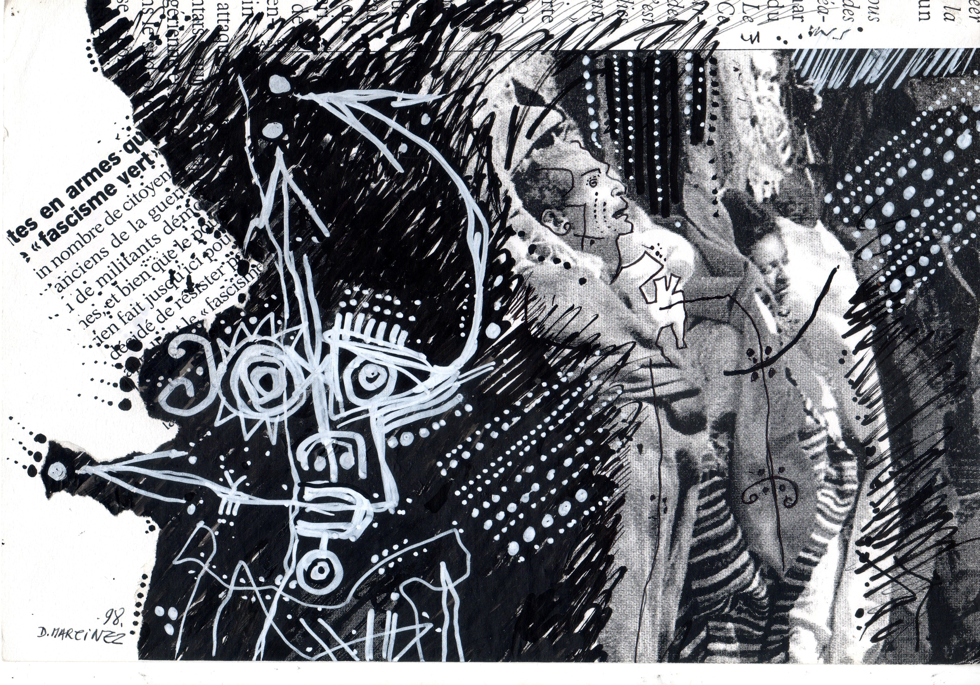
  • – مريم بجاويفي الكلمات تكمن جذور اللغة /وفي الآلام يكمن ولع الإنسان

    – مريم بجاوي
    في الكلمات تكمن جذور اللغة /وفي الآلام يكمن ولع الإنسان

    مريم بجاوي –

    في الكلمات تكمن جذور اللغة /وفي الآلام يكمن ولع الإنسان

    English | French

    “إذا أردت ان تتحكم بالجاهلين فغلّف كل باطل بغلافٍ دينيّ”

    ابن خلدون (مقدمة، 1377)

    مقدمة

    ليس موضوع هذا العدد الخاص، أي العنف الجنسي ضدّ المرأة في زمن الحرب، بظاهرة جديدة، ففي حالات الحروب أو النزاعات أو الإرهاب تكون المرأة هي الضحيّة الأولى. والواقع أن العنف الجنسي الحائق بالمرأة لا يرتبط بعرق ولا دين ولا جماعة معيّنة. وتاريخ العالم يسوق لنا حالاتٍ عدّة من النّساء اللّواتي تعرضنَ للعنف الجنسي، ونأخذ على سبيل المثال سلسلة المآسي الإنسانية التي سجّلها التاريخ عن أعمال العنف الممارسة بحقّ المرأة، كالتّشويه والإغتصاب على يد الجيش الفرنسي في الجزائر خلال حرب التحرير، وكذلك الأمر في ليبيريا ورواندا والكونغو والبوسنة وحديثًا في سوريا. ولا نروم بهذا تطبيع العنف الجنسي ضدّ النّساء، وإنّما نريد التذكير بأنّها ظاهرة عالميّة تاريخيّة.

    لطالما ركّزت المؤلّفات الجزائريّة المحرّرة باللغة الفرنسية، سواء أكانت أعمال كاتب أو كاتبة، على الأوضاع المعيشية للمرأة في الجزائر التي يُنظر إليها كهدف أو ضحيّة أو ببساطة كغنيمة حرب. نشأت هذه الصورة السلبيّة عن المرأة نتيجة السلوك الشوفيني للرّجال والتقاليد الجائرة للتمييز العنصري الذي يتغلغل في صلب المجتمع الجزائري، علاوة على بعض تفسيرات القرآن (التي تَعتبر بعض مدارس الفكر الإسلامية أن لا أساس له من الصحّة بسبب القصص المغال فيها والتي لا أصالة لها).

     تساعد هذه الرؤية التلاعبية للمبادئ الإسلامية على تفسير المقولة المذكورة آنفًا التي تُقدّم الخلاصة النهائية عن المُضطهِدين / المُنتهِكين وأفعالهم السيئة على أرض الإسلام، والتي لا تزال قائمة إلى يومنا هذا. وفي واقع الحال، أفضى الإرهاب الأعمى الذي زجّ بالجزائر في أتون العشريّة السوداء بين 1990 و2002 إلى تمهيد السبيل لانتشار روايات وهمية بالإضافة إلى السرديات السياسية والصحفية. وألمّ الرّعب والهمجيّة السائدين إبان تلك الفترة القاصي والداني، ودفع أشهر الكتّاب حياتهم ثمناً عند شجبهم لتلك الأعمال الإجرامية، من بينهم الكاتب طاهر جاووت ويوسف سبتي وسعيد مقبل وآخرون اضطرّوا لهجرة البلد لنشر أعمالهم التي تعبّر عن رفضهم وتنديدهم، أمثال رشيد بوجدرة، وهو من الأعلى الأصوات المعارضة للأصولية الإسلامية. ياسمينة خضرة كاتب جزائري آخر، ندّد في طليعة أعماله بالعديد من التناقضات والمفارقات داخل المجتمع الجزائري والعالم الإسلامي بصفة عامّة.

    تستند هذه الورقة البحثية على أعمال مايسة باي (اسمها الحقيقي سامية بن عامر) وآسيا جبّار (فاطمة الزهراء إيملاين) التي تدرس ظاهرة العنف المعنوي والنفسي والجسدي الذي تتعرّض له المرأة وحالة الصمت حيال كل ذلك. وقد استعملت الرّوائيتان أسماء مستعارة للتعبير في بلد قمعي ومعاد للمرأة غالبًا. وإذ كانت جبّار مؤلّفة راسخة ومشهورة وعضوا في الأكاديمية الفرنسية منذ 2005، راحت باي تشقّ طريقها في السّاحة الأدبية كردّ فعل على المآسي التي عصفت ببلدها.

    تَدْرُس هذه الورقة البحثية الظّروف الاجتماعية والتاريخية للعنف الجنساني في الجزائر وتُحلّل “السّنوات الدّامية” في مجموعتين من القصص القصيرة:

    Sous le Jasmin، la nuit (2004)[1]   و  Oran، langue morte (2001)،[2]  لـــِباي وجبّار على التوالي. 

    وهما مجموعات خُصّصتا للمرأة، أو بتعبير أدق لِصوتِها الصّامت.

    العنف الجنساني والعنف في الجزائر

    تُقدّم فاطمة الزهراء فرشولــي في رسالتها للدكتوراه المناقشة في سنة 2002 بعنــــــــوان “كتابات آسيا جبّار: ترجمة خطاب الأنثى” ملخّصاً عن وضع المرأة الجزائريّة، وتُعطي أمثلة من نصوص تحصر دور المرأة كموضوع ثانوي يجعلها دائمًا تحت رحمة “ولي امرها من الذكور”. [3]   وهذا الأمر، كما تذهب إليه لوسي بروفوست Lucie Pruvost، يعطي الرجال النفوذ الكامل، ذلك أنهم يجدون في “التفسيرات الذكورية للآيات القياسية في القرآن والشريعة” دليلا يفسّر سلوكهم السائد ذاك. [4] و”جهاد النكاح” للفتيات الجهاديّات التونسيّات مثال صارخ عن ذلك، وهو العار الماثل أمام أعين العالم. ولم تحرّك البلدان الغربية ساكنًا بهذا الشأن خوفًا من الجماعات الإرهابية في أفريقيا والشرق الأوسط.

    وإلى جانب تلك الحجج المضلّلة التي نُسبت إلى الإسلام بغير وجه حق، جاء إصدار ما يمسه الجزائريون “قانون العار”، ألا وهو قانون الأسرة (اﻟﻘﺎﻧﻮن رﻗﻢ. 84. -. 11. اﻟﻤﺆرخ ﻓﻲ. 9. ﻳﻮﻧﻴﻮ ﺳﻨﺔ. 1984). وكان بمثابة نكوص حقيقي. علاوة على أنه يُخالف تمامًا الدستور الجزائري (كل من دستور 1964 و1996).  وهكذا، تعالت الأصوات مجدداً لمناهضة ما يبدو إجحافاً بحق المرأة. كانت تلك أصوات مفكّرين وصحفيّين وكتّاب سعوا إلى تسجيل الفظائع المنسية التي خلّفتها “الحرب القذرة” لسنة 1992، والاستعباد المتواصل للمرأة الجزائريّة.

    مايسة باي وآسيا جبّار

    إذا كانت باي قد خصّصت كل أعمالها لنساء بلدها اللواتي حوصرن في صمت فرضه عليهن المجتمع، فإنها تمكنت من خلال مجموعتها القصصية Sous le Jasmin، la nuit، وعلى وجه الخصوص في القصّة القصــــيرة ‘Nuit et silence’ ، من تجسيد تلك الحقيقة المُشينة عبر اللغة. وهنا، تُحاول إيجاد الكلمات المناسبة لوصف أفعال الإغتصاب العنيفة التي اقترفها أولئك الذين يُصطلح عليهم بــِ “الإرهابيّين” أو “الأصوليين الإسلاميين”. تروي الرّواية قصّة كابوس عاشته فتاة مراهقة ذات 15 سنة، حين قامت جماعة مسلّحة بـِخطفها واغتصابها. حيث تتلاعب الرّوائية بتعقيدات الفعل والصفة لتُحمّلها وصف ما لا يوصف وتسمية ما يستحيل تسميته: ” وهي ترقص من حولي رقصة جهنمية، كل تلك الكلمات التي يصفها القاموس كمترادفات: مجزرة، تقتيل، قتل، مذبحة، كما لو أن تحفر عميقاً في جراحنا فتلتحق بها الصفات: رهيب، فظيع، مروع، لا يُطاق، وحشي، وأكثر من ذلك…. لا تنمحي الأفعال بانمحاء الكلمات” (ص. 56).

    في مشهد مأساوي مؤثّر، تُصبح الفتاة الشابة حاملاً، وترفض طفلها الذي لم يولد بعد : “لا أريد هذا الكائن الذي يتحرّك في أحشائي، لا يمكنني أن أنجب كائنًا قد يشبههم…كائنا يكبر ليكره ويقتل أو يُقتل ” (صفحة 108-109).  قاومت البطلة على الرغم من الصدع الذي تعرّضت له في كينونتها، وجابهت بشجاعة وجرأة التعصّب الدّيني والأذى الذي حاق بها. في هذه الرّواية المؤثرة الشّاهدة، تصف الكاتبة الحدث بدقة (على طريقة بالزاك)، وبنبرة ساخرة نوعاً ما، تنسج تفاصيل الهمجية التي هوت بالجزائر في حالة من السواد، وجعلت من المرأة المسؤولة الوحيدة وإلى الأبد عن كل شرور الأرض.

    كسرت مايسة باي صمت (وهو مصطلح لا ينفك يطاردها في كل كتاباتها) المرأة المغدورة مكممة الفاه، خالقة بذلك أماكن ومساحات لتعبيراتها: ” أثقل اللّيل والصّمت كاهل أجفاني وجبيني المتوجّع، لا أقدر حتى على الحراك، مع أنّني في هذه الليلة لست خائفة ولا جائعة ولا أشعر بالبرد، أريد فقط أن أنام لكني لم أستطع. ليل آرق وصمت رهيب” (ص. 101). تتمسك باي بشجب العذابات التي تعوق تمكين المرأة مستخدمة العديد من أصوات النّساء وأسلوب الأدب “الإلحاحي”، مثلما تُشير إليه في هذا التعبير: “بعد ذلك، تطلّب منّي الأمر يومًا واحداً للشعور بتلك الرّغبة الملحّة في الكلام، في حمل الكلمات كما يُحمل المشعل”. لقد أُخذ مشعل الحريّة من نساء بلدها لزمن طويل. لذلك، فإنّ الكتابة تتيح الفرصة للمؤلفة أن تطرد آلامها ومخاوفها وثورتها، وكذلك الأمر بالنسبة لأمثالها من النّساء الجزائريات. وتضع الكاتبة نصها موضعا لتحديات الذاكرة موحية بأنه لا يمكن للنسيان ولا للصمت أن يعوضا إلا بالأدب، وذلك عن طريق اختيار أسلوب صريح، والتلاعب بالصيغ التراكيبية التي تتحدى خطّ الرواية مثل تكرار الحروف المطبعية.

    رغم أن المجموعة القصصيّة متألفة من إحدى عشرة قصّة صغيرة، كلّ منها بحبكة وتركيب وأطر زمنية وشخصياًت مغايرة، إلّا أن جميعها تصبوا إلى الهدف نفسه: وذلك بالكشف عن الأمراًض الاجتماعية التي قوضت المجتمع الجزائري بسبب المرأة، مصدر كلّ سوء. وبالتالي فإنّ المرأة لازالت وستظلّ محور الخطابات الرّومنسية لكلّ من باي وجبّار، حيث أن كتاباتهما تمثّل “خرقا” و”رمزا للممنوع” والتي لا يمكن لها أن تتاح إلا باتخاذ اسماً مستعاراً وباستعمال “اللغة المتبناة” أي اللغة الفرنسية. ولطالما أثيرت مسألة لغة الآخر، المحتل، المستعمر من قبل الكتاب الجزائريون الذي يكتبون باللغة الفرنسية. على الرغم من أنّ الأدب الجزائري ارتبط ارتباطاً وثيقاً بعملية تحتيم لغوي وثقافي دامت مائة واثنين وثلاثين سنة، فإنّه تبنى لغة موليير بدافع الحاجة في الأساس. وقد كانت الفرنسيّة – المفروضة لكنّها مستأنسة – بمثابة لغة النضال والتمرّد (فرعون، معمري، ديب … الخ) سعياً إلى استرجاع هويّةٍ مخنوقةٍ. وقد استعملت الأجيال اللاحقة من الكتّاب اللغة “الأجنبية”، تلك اللغة “الثانية” دون أية صعوبة، وجدّدوا معاييرها بخصوص البحث الإبداعي الجمالي وصيغ سردية حيوية. تجاوزت مايسة باي وآسيا جبّار، الرّوائيتان المتشبعتان بالثقافة الفرنسية، مشكل اللغة الموروثة من تاريخ بالمتاعب لتخلقا منه أسلوباً أدبياً فريداً من نوعه، أسلوباً صريحاً شاجباً يبوح بما يستحيل بوحه لكي يعطي صوتاً لمن حُرموا منه منذ زمن طويل. كذلك، كان الشغل الشاغل للروائيتين، بغض النظر عن اللغة التي تكتبان بها، هو فك قيود ذلك الصّمت الذي جمّد المرأة المسلمة بصورة عامة والجزائريّة بصفة خاصة في بوتقة الدونية الأبدية، والابتلاء بجميع علل المجتمع.

    وقد وضّحت باي، في مقابلة لها، أسباب اختيارها الكتابة باللغة الفرنسية، إذ يبدو أن قرارها لا يمت بصلة للرغبة في المطالبة بتبني لغة المستعمر بـمنهج براغمتي، فقالت: ” ليس لدي أي مشكلة حيال اللغة الفرنسية لأنني أعتبرها جزء لا يتجزأ من تاريخي الشخصي، ترعرعت في أرض كانت فرنسية وقت ولادتي وطفولتي، لذلك درست اللغة الفرنسية بطبيعة الحال بتشجيع من والدي الذي كان مدرساٌ ومن بين الأوائل المنخرطين في حرب التحرير. اختفى، قُتل على يد من كان يعلّمهم اللغة. هو من علّمني القراءة والكتابة باللغة الفرنسية، ولاحقًا، اكتشفت الأدب الفرنسي، لذلك يمكنني القول كما سبق وقال الكاتب بوجدرة : “لست أنا من اخترت اللغة الفرنسية بل هي اختارتني”. لا أعتبر نفسي معنية بكلّ ما يُثار من جداًل حول اللغة، كون ما يهمني الان هو قول ما أريد قوله (مقابلة جحا، 2008).[5]

    وهكذا، فإنّ علاقة باي باللغة تختلف عن جبّار التي تدعو بشدّة إلى استعمال اللغة الفرنسية لنيل الحريّة التي تعتبرها مُنكرة من خلال اللغة العربيّة. وهي تصف هذه العلاقة المعقّدة في روايتها L’amour، la fantasia (1985)  فيما يلي:

    “كما لو أن اللغة الفرنسية بغتة تملك أعينا، وأعارتني إياهم لأرى الحريّة عن كثب، كما لو أن اللغة الفرنسية أعمت بصيرة عشيرتي، فتمكنت من أن أتحرك بحريّة وأركض بتهور واندفع في كل الشوارع، وأُلحق الهواء الطلق إلى رفاقي الحبساء ولأمهات عائلتي اللواتي عشن حياة الأموات. كما لو…يا للسخرية ! أعلم أن كلّ لغة هي مستودع مظلم لجمع الجثمان والنفايات والقذارة لكن عندما تُواجه لغة المحتل السابق الذي قدم لي زينته وحليّه ووروده التي أعتبرها كالأقحوان الذي يُوضع على المقابر ! [6]

    يمكن مجموعة باي القصصة بعنوان Sous le Jasmin، la nuit أن تُقرأ جنبا إلى جنب مع المجموعة القصصية القصيرة لـجبّار بعنوان Oran، langue morte (2001) التي يدور موضوعها، مثلها مثل رواية باي، حول عنف التعصّب الدّيني الذي حفر ندبة في جبين المجتمع الجزائري في سنوات التسعينات.

    وحققت جبّار، التي وافتها المنية في فبراير 2015، مساراً أدبياً وأكاديمياً ناجحاً للغاية. كتبت العديد من الروايات والقصص القصيرة ومجموعة من القصائد والمسرحيات وسيناريوهات أفلام. ونالت جائزة النقد العالمية في مهرجان بينالي البندقية سنة 1979 عن فيلم “نوبة نساء جبل شنوة” 1977  La Nouba des femmes du Mont Chenoua (1977) وأفضل فيلم تاريخي في مهرجان برلين السينمائي في 1989 عن «الزردة أو الأغاني المنسية» 1979  La Zerda ou les chants de l’oubli (1979). كما تُرجمت أعمالها إلى ثلاث وعشرين لغة. وقد استعملت آسيا جبّار، في سعيها لإخراج صوت المرأة من صمتها ومن الاضطهاد المُمارس بحقّها، اللغة المحكية من خلال دمج أصوات الشهود واستذكار تقاليد العائلات واستحضار نصوص الإسلام والرسول المقدسة خاصة في روايتها «بعيداً عن المدينة المنورة» (1991) Loin de Médine   . علاوة على موضوع العنف والهمجية الذي مسّ المرأة أساسًا والذي نجده في كلّ النّصوص السبعة لرواية “وهران لغة ميتة”  Oran، langue morte، » «  المصور على الغلاف الرابع للرواية.

    تُحاول المرأة البقاء على قيد الحياة في فترة سفك الدماء اليومي الذي عاشته الجزائر خلال العشرية الماضية، بين الجنون القاتل والمقاومة الشرسة. وكما تبيّن لنا النّصوص السبعة من هذه المجموعة القصصية نكتشف بلدًا حطمه العنف، ذلك العنف الذي منحته آسيا جبّار صوتاً في عمل درامي حيث تتمازج الجمالية بالواقع.

     تسعى آسيا جبار، عبر صوت المرأة المهانة والمعنّفة والمغتصبة والموصومة، إلى التذكير بالمآسي التي عصفت بالجزائر، تلك الجزائر التي كانت تعاني من الركود والتخلف الثقافي. حيث يكشف عنوان القصة القصيرة من هذه المجموعة ” زوجة في أشلاء”، جزءا كبيرا من حجم العنف والمعاملة المهينة التي تتعرض له النّساء في الجزائر، فبطلتها تصارع الموت الذي تزرعه أصولية تمتص الحياة، وهي مجبرة على تحمل إيديولوجية مدمرة. ومن المعروف أنّ لجبار قصب السبق بين الروائيين الجزائريين في التركيز على البطولة النسوية في كتاباتها، وأول من أعاد صوت المرأة من خلال شخصياًت رواياتها من النّساء، روايات من قبيل: Loin de Médine، L’Amour، la fantasia “بعيداً عن المدينة المنورة”، “الحب، الفانتازيا” 1985،  Ces voix qui m’assiègent “تلك الأصوات التي تحاصرني” 1999، إضافة إلى النّص موضوع هذه الورقة البحثية، Oran، langue morte “وهران، لغة ميتة”. وفي هذه نصوص، تشكل وضعية المرأة، من صمت الأجداًد إلى موجة الإرهاب الكاسحة، النقطة المركزية للسرد: “وهكذا، أنى لك أن تجد الكلمات التي تعبر بها عن هاته الشجون والأحزان التي لا تعجز الألسن عن النطق بها، تلك العواطف التي تنْدسّ في تفاصيل الحياة اليومية؟ أين تجد الكلمات حينما يسلب العنف والتاريخ المرء صوته، ويتركانه حبيس صمته؟” (ص.43)

    يكمن إبداع آسيا جبار في قدرتها على حبك قصص ضمن أنواع أدبية متعددة، منغمسة في عدد لا يحصر من الموارد الوثائقية والمعالم التاريخية. وهي ترمي من خلال أعمالها في إبراز أصوات المرأة باللغة الفرنسية، لغة الآخر، كما أشارت في: ” أعادتني الكتابة إلى صيحات النّساء الثائرات بصمت”. لقد صاغت في مجموعة القصص القصيرة هذه التزامها التام بقضية هؤلاء النسوة: جداًت أو أمهات أو أخوات أو جارات ممن وصمهن صمت الأجداًد وكان عليهن أن يصمدن في وجه محاولات الأصولية الدّينية لتكميم أفواههن. وتلخص آسيا جبار في خاتمة الكتاب القلق الذي يتخلل كتاباتها والأمل الذي تغرسه رواياتها في روح المرأة الجزائريّة:

    قصة نساء جزائر عصر الظلمات ونساء جزائر اليوم الجديدة. شذرات من الحياة، رويت ونقلت في رحلة ذهاب وإياب، للرحل والركاب، في نقطة عبور، ملاذ يستريح المرء فيه ويتذكر. ليست هذه بمراحل فرار بل عملية تنقل، هي حوارات يتبادلها جزائريون من هنا وهناك. وفجأة، سُلط الضوء على بعض جوانب الحياة ثم حُطمت: لتتبعها صور المطاردة، المحيص ثم الموت. من لمحة أمل، أحيانا، في هذه الليلة الطويلة.

    وعليه تُقدم جبّار للقارئ نصاً تكتنفه المجاوزة ويميّزه كشف المستور عبر مختلف الأنواع النّصيّة المكونة للمجموعة (الروايات والقصص القصيرة والحكايات) وتعدّد الأصوات التي تفتل نسيجاً يشدّد على إقصاء النّساء. ويرد التأكيد على تهميشهم في الاقتباس التالي حيث قال اليتيم في كتاب وهران (ص 40): “لقد ألقيت بخمار والدتي (خالتي) الخشن وصرخت … أنا من أحيا المشهد حينها، أنا من كتبه، حتّى أتمكن أخيراً من تحطيمه”.

    ومثلما قال ب. مارتيني P.Martini (لوكسياس 32):

    لا يَكمُنُ الصمت في الجانب الخارجي من الخطاب السردي، بل هو في الحقيقة جزء لا يتجزأ منه: إذ تشكّل التقطعات في الكلام، والترددات في القصة، والعناصر المطبعية (الحذف أو الفراغات) الخطاب في حد ذاته وتعكس مصاعب القصّ وكمائنه. بل لعله أكثر تعقيدا عندما يصطدم الصمت والكلام للتعبير عن حريّة القول وتأكيدها. في الواقع، ثمّة أمور كثيرة على المحك، ذلك أنّ: “في ظلّ الاضطرابات الحاليّة العابرة، تبحث النّساء عن لغة ما: حيث تضع وتخفي وتعزّز قوة تمرّدها وحياتها في ظل هذه التركيبة المتذبذبة.

    أخيرا، وامتداداً لنصوص الكاتبين، لا تزال «قضية» المرأة وستظل مشكلةً مستمرة تطارد العقول الظلامية والمتخلفة التي تقوض المجتمع.

    ومع ذلك، ثمّة واقع جديد جديرٌ بالذكر. حيث أصدرت الحكومة، بعد سنوات من الإرهاب، قانوناً يقرّ بمعاناة ضحايا الإغتصاب خلال المأساة الوطنية من خلال منحهم تعويضاً يتراوح بين 16000 دج و35000 دج. وقد صدر هذا المرسوم (رقم 14-26 والمؤرخ في 2014/02/02) بعد أكثر من عقد عن المأساة، على خلاف قانون المصالحة الذي يسمح للآلاف من الجلادين بالعيش بجانب ضحاياهم. أما بالنسبة لقانون “العار”، فإنه لا يزال قيد النقاش على طاولة الهيئات التشريعية.

    [1] Maïssa Bey، Sous le jasmin، la nuit (La Tour d’Aigues: Éditions de l’Aube، 2004).

    [2] Assia Djebar، Oran، langue morte (Arles: Actes Sud، 2001).

    [3] F. Z. Ferchouli، ‘The Writing of Assia Djebar: A Translation of Female Speech’، (unpublished doctoral thesis، University of Algiers، 2012)- check this reference.

    [4] Lucie Pruvost، Femmes d’Algérie: société، famille et citoyenneté (Alger : Casbhah Éditions، 2002).

    [5]  Assia Djebar، L’Amour، la fantasia (Paris: J.C. Lattès، 1985)، p. 181.

  • نصوص مختارة

    نصوص مختارة

    فصل من تاء الخجل

    فضيلة الفاروق

    دعاء الكارثة

    “الزّمان هو جرح العرب، إنّهم يرتاحون للماضي”* و قسنطينة لا تتحدث إلاّ بلغة الماضي .

    أعبُر شارع عبّان رمضان و الماضي يتناثر من حولي مع نداء صلاة الظهر: الله أكبر…

    تبدو المآذن غائبة في حلم ما، تعانق البنفسج في السماء، و كأنّها في حالة حب، الناس يرددون ” الله أكبر”

    الناس هنا لا يخالفون ما تقوله المآذن، حتى حين قالت:

    ” اللهمّ زنِّ بناتهم” …قالوا :” آمين”

    و حتى حين قالت: اللّهمّ رمِّل نساءهم” قالوا :” آمين”

    كانوا قد أصيبوا بحمى ” الجبهة الإسلامية للإنقاذ” فغنُّوا جميعا دعاء الكارثة…

    -اللهم زنِّ بناتهم

    – آمين

    – اللهم رمّل نساءهم

    – آمين

    – اللهم يتّم أولادهم

    – أمين !!!

    كانت موضة جبهة الإنقاذ…! صرعة …تغيير…!

    و لهذا تنام ” يمينة” نازفة في المستشفى الجامعي حاملة آثار التغيير.

    و لهذا مئات الزهرات يُغتَصبن، ما باركه الشعب بالدعاء كان يجب أن يصيب الشعب لا غير…!

    غباء مميت…!

    إنتبهت أنّ سيارة كادت تدهسني، و أنا أحاول قطع الطريق.

    تراجعت إلى الخلف مذعورة، أما شتيمة السّائق فقد اخترقت أذني حادّةً مثل سكين.

    كدتُ أغضب، لكن مشوار حزني كان في أوله، فرمقت السّائق بنظرة لا مبالية، و اكتفيت بترديد شيء بيني و بين نفسي ” مسكين…إنّه بلا أخلاق”

    نحن لا نكون مساكين إلا إذا كنا بلا أخلاق.

    هدأت المآذن…

    خفّ الزحام من الطريق…

    طيْرانِ في السّماء تعانقا، و يمينة تغني في رأسي بأنفاسها، إنّها متعبة، و تحلم برؤية الأهل.

    وأنا كل الأهل بالنسبة لها الآن! أي مضيق هذا الذي تلقّفني ؟؟؟

    ها هي المفاجأة التي  لم أكن أنتظرها، أن أدخل عالم المغتصبات لا كصحفية، و لكن كفرد من الأهل، أي شيئ سأكتبه عن يمينة؟ هي الممددة على فرح إسمه أنا؟ هي النّائمة على أمل ليس أكثر من راديو، سأحضره لها أنا، لأني أنا الأهل، و أنا الأقارب، و أنا ابنة اللسان الذي وحّدنا في يوم غير متوقع، و في ظروف غير متوقعة.

    طيلة الطريق و أنا أفكِّر كيف سأكتب عن الموضوع؟ بأيّة صيغة و بأيِّ قلب؟ بأيّة لغة و بأيّ قلم؟ أقلام القرابة لا تحب التّعدِّي .

    أقلام القرابة …

    أقلام الدم الواحد لا تعرف أن تخون!

    فكيف لي أن أخون تلك الأنفاس السّعيدة بحضوري؟ كيف لي أن أخون تلك العيون المعبأة بالثقة؟

    كيف هي الكتابة عن أنثى سُرقت عُذريّتها عنوة؟

    لم أعد أعرف كيف هي الكتابة، لم أعد أعرف ألوان الأقلام

    لم أعد أعرف لون الورق .

    كل شيئ أصبح يشبه هذيان ” راوية” و نزيف ” يمينة…

    كل شيء صار أحمر …دما ..دما …دمًا .

    -لن أكتب الموضوع.. إنتهى الأمر.

    ورقتان  طارتا…

    صديقان إفترقا : – صحّ رشيد …

    -صحّ لعزيز ..آمن عاش ( تحياتي أيها العزيز ..نلتقي إن عشنا)

    انتبهتُ أنّ في عينيها بريق أمل.

    انتبهتُ أنّ قسنطينة قد ازدادت جمالا.

    وأنّ أشجار الصّنوبر بدأت تثرثر، والهواء يعاكس شعر البنات، والحكايات هنا وهناك، بين أطفال المدارس  الرّاكضين  إلى البيوت.

    تمنّيتُ أن أصبحَ طفلة. أن تحملني الرِّيح إلى مدرسة البنات في آريس، أن أركض على الجسرالصغير، أن أصغي لهمسات الصّفصاف، أن أرمي طائرة ورقية من على الجسر و أصفّق حين تعلو و تعلو، و تتحاشى فروع الشجر.

    كانت لعبتي المفضلة أن أصنع أشياء  جميلة بالورق…

    ما زال الورق ضروريا في حياتي، مازلت أصنع به أشيائي الجميلة، و لهذا لن أكتب عن يمينة و لن أسمح للمصور أن يأخذ صورة لحزنها، و يغطي عينيها لئلاّ يعرفها أحد.

    هناك قضايا لا تحلُّها صرخات الجرائد.

    هناك قضايا يحلُّها العدل، القانون، و الضمائر الحية.

    هنا…العدل يصنعه الرجال حسب تصوراتهم الضيقة. فالمادة 336 من قانون العقوبات الجزائري الخاصة بانتهاك العرض تنصُّ على ” معاقبة كل من ارتكب جناية إغتصاب بالسجن المؤقت من خمس إلى عشر سنوات، و إذا وقع هتك العرض ضد قاصرة لم تكمل السادسة عشرة فتكون العقوبة بالسجن المؤقت من عشر إلى عشرين سنة” القانون ليس صارما، مقارنة مع القانون الفرنسي الذي ينصُّ على ظرف مُشَدّد يكمن في التعدي على جسم الضحيّة بالإعتداء الجنسي فترفع العقوبة إلى عشرين سنة نافذة. الرجال هنا يفصّلون الإسلام على أذواقهم.

    فمن يعرف رحمة الإسلام من بين هؤلاء؟

    لا أحد…!

    فالبعض يغتصب النّساء باسمه…و البعض ينبذهن باسمه أيضا.

    و البعض يمنحهن تعويضا ” تافها” من الولاية يعادل ألفي دينار باسمه ( 20 دولارا)

    والبعض ينكر أنهن ضحايا بإسمه، والجمعيات النسائية تستنكر وتصرخ…وجمعيات ضحايا الإرهاب تستنكر وتصرخ…

    و وحدهن المغتصبات يعرفن معنى انتهاك الجسد، و انتهاك الأنا. وحدهن يعرفن وصمة العار، و التشرد و الدعارة و الإنتحار…

    وحدهن يعرفن الفتاوي التي أباحت الإغتصاب:

    ” الأمير هو الذي يهديها..

    لا يُقَبِّلها إلا من أهديت له، و بإذن الأمير.

    لا تُجَرّد من الثياب أمام الأخوة.

    لا يجوز النظر إليها بشهوة. لا تُضرب من الأخوة بل ممن أهديت له، فعليه أن يفعل بها ما يشاء في حدود الشرع.

    إذا كانت سبية هي و أمها، دخلت على أمها، فلا يجوز أن تدخل على أبنتها.

    إذا وطئها الأول فلا يجوز وطؤها إلا بعد أن تستبرئ بحيضة، و تجوز المداعبة مع الغزل.

    إذا كان الأب و إبنه فلا يجوز الدخول على نفس السبية.

    إذا كانت سبية وأختها، فلا يجوز الجمع بينهما مع مجاهد واحد”

    ( عثر على هذه الوثيقة بعد مجزرة بن طلحة و اجتياح الجيش لمنطقة أولاد علاّل، و ثيقة توضح أدبيات الوطء حررت يوم 5 جمادى الأولى 1418هجري و مصدر الفتوى مجهول تماما.

    بشكل ما كنتُ أعرف كل هذه الأشياء، إثر تحقيق سابق قمتُ به. و الناس يعرفون، و رجال القانون يعرفون، لكن من يعرف فظاعة و هول التجربة غير زهرات يعشن اليوم بين أشواك العار و الجنون؟

    أأفضح يمينة؟

    أأفضح نفسي؟

    غدًا سيقول الأقارب والأهل وكل من يعرف اسمي ” هذه إبنة عبد الحفيظ مقران تفضح واحدة منا”

    كيف وصلت بي الأمور إلى هنا؟

    كيف فكّرتُ بهذه الطريقة؟

    طَردتُ كل تلك الأفكار و جلست أمام رئيس التحرير صامتة، يتكلّم و أنا لا أسمعه ثم إقترب و صرخ في وجهي:

    ما بك اليوم؟

    انتفضت و كدت أقول له:

    كيف وصلت إلى هنا؟

    إذ لم أعد أتذكر كيف قطعت كل تلك المسافة من وسط المدينة إلى دار الصحافة.

    نظرتُ إليه بعينين ضائعتين، فقال لي و هو يسحب سيجارة و يحاول إشعالها:

    أين وصلتِ في التحقيق؟

    عدتُ إلى واقعي و سألته: لمَ لا يصلي الناس مثلما كانوا يصلُّون قبل أيام ” الفيس” و يطلبون المغفرة و الرحمة و إحلال السلام؟

    (الفيس: مختصر لحزب الجبهة الإسلامية للإنقاذ)

    توقّف عن الحركة قليلا، أطفأ سيجارته قبل أن يدخّنها، و عاد إلى مكانه ثم قال:

    ما الذي حدث في المستشفى؟

    عدتُ إلى واقعي أكثر و أجبت:

    إنّها مأساة!

    -أكتبيها إذن.

    -لا …

    -نعم؟

    -لا…لن أكتب شيئا عنهن؟

    – لست بوعيك على ما يبدو، هل أنت مريضة اليوم؟

    ابتسمتُ و قلت له:

    -لا ، لستُ مريضة.

    هزّ كتفيه متسائلا:

    -إذن؟؟؟

    -سأكتب عن الدُّعاء.

    – أي دعاء؟

    – دعاء ” الفيس” هل تذكره؟ لقد رُدِّد في كل المساجد أيام الإضرابات، ذلك الذي يقول ” اللهم زنِّ بناتهم، و يتِّم أولادهم، و رمّل نساءهم…إلى آخر الدعاء”  سأسأل الناس الذين رددوه، سأسأل ضمائرهم، أريد أن أعرف مستواهم، هل كانوا يعرفون مإذا يقولون؟ لمإذا انقادوا وراء أئمة ” الفيس” و طلبوا بالإجمال طلبا غريبا كهذا من الله.

    قاطعني رئيس التحرير:

    خالدة…أريد أن تكتبي عن تجربة هؤلاء الفتيات؟

    -لكني كتبت سابقا، قدمت إحصائيات، خمسة آلاف أمراًة أغتصبن منذ العام 1994، قلت أن ألف و سبعمائة أمراًة أغتصبن خارج دائرة الإرهاب، قلتُ أن الوزارة لا تهتم، قلت أن القانون لا يبالي، قلت أن الأهل لا يبالون، طردوا بناتهم بعد عودتهن، قلت أنهن أصبن بالجنون، ذهبن للدعارة ، إنتحرن…هل تحرّك أحد غير خالدة مسعودي و مثيلاتها ( خالدة مسعودي مناضلة نسوية في الجزائر لها كتاب بالفرنسية عنوانه ” أمراًة واقفة”؟

    قاطعني بصوت مرتفع:

    نحن لسنا القانون ..نحن صحافة.

    قاطعته أنا أيضا صارخة:

    نحن سخافة.

    ضرب بقبضته على الطاولة:

    -ما الذي أصابك اليوم؟

    -تخيّل أنّ ابنتك اختطفت ذات ليلة، اغتصبت و حبلت و انجبت عارا، و هي الآن في المستشفى الجامعي تنزف، و أجيء أنا كصحافية لأقول أن إبنة فلان حدث لها كذا و كذا، هل ستقبل؟

    ضحك ساخرا و هو يقترب مني:

    منذ متى ذكرنا أسماء الناس في هكذا حالات؟

    -الحقيقة تكشف الأسماء و الألقاب، لا أحد سيصدقنا إن لم نكتب الحقيقة بأكملها.

    – خالدة إختصري قالها بغضب…

    و بهدوء أجبته : لن أكتب عنهن، سأكتب عن الدعاء.

    أخذ نفسا عميقا لإستعادة هدوئه ثم قال لي و هو يضغط على كل كلمة يقولها:

    -الخطف والإغتصاب أصبحا استراتيجية حربية منذ 1995 وأداة للصراع المسلح بين الجماعات الإسلامية المسلحة والمجتمع الأعزل، كيف سيفهم العالم ما يحدث عندنا إذا لم نكتب نحن عنه؟

    ضحكتُ من كل قلبي :

    تبدو مضحكا …( واصلت بسخرية)  العالم سيقرأ جريدتنا التي لا توزع عشرة آلاف نسخة في الوطن، و لا تصل حتى جيراننا في المغرب و تونس، و لا تدخل الأنترنت ” يا راجل ما تركز معايا” قلتها بلهجة مصرية أكثر سخرية و خرجت.

    فضيلة الفاروق

    تاء التأنيث: انعام بيوض

    She (Feminine ‘She’)

    تاء التأنيث

    On my lips

    sorrow dried up

    Not unlike a breach

    On a petal of rose.

    The petal slept on the breach

    And the breach prevailed.

    From night dawn

    Till dawnset

    I wriggle

    Staring in a face I know

    I scatter like agate seeds

    Their land they forgot.

    Lost their way

    Land is deserted.

    You، Emerging lies

    Uttering a wriggled letter

    From a suspected lips;

    That’s what you are.

    You، a linguistic perfection

    Be fluent.

    Here is a woman، here is she

    With a painful stress on the ‘e’

    Conjugated as a weakened

    A crucified noun.

    Crucifix tool of which

    يبس الحزن على شفتيّ

    كالثلمة في بتل الوردِ

    نام البتل على ثلمته

    سَئِدَ الثُّلْمُ

    أتلوّى من فجرِ الليلِ

    إلى عصرِ الفجرِ

    أتفرّسُ وجهاً أعرفهُ

    انفرطَ كحبّاتِ عقيقٍ

    نَسِيَتْ موطنها

    ضَاعَ الحَبُّ

    وباتَ المَوْطِنُ مهجورًا

    يا أنت…

    إفك يتَمَخَّضُ

    يلفظ حرفاً ملوياً

    مشبوهَ المخرجِ

    هذا أنتَ

    يا ذاكَ الإعجازٌ اللغويُ تفصّحْ

    هذي امرأة

    تتوجَّع همزتُها فوقَ الألف

    هذي امرأة إعربها

    (اسمٌ ناقصٌ مصلوب)

    وعلامةٌ صلبِه

     تاءُ التأنيثِ بآخرهِ

    تاء التأنيثِ بداخلهِ

    تقطر مزجا شهدياً

    لزجاً.

  • – سحر النعاسالفصل الخامس: العنف الجنسي و اقصاء النساء: جندرية حكومة ليبيا الجديدة

    – سحر النعاس
    الفصل الخامس: العنف الجنسي و اقصاء النساء: جندرية حكومة ليبيا الجديدة

    سحر النعاس

    الفصل الخامس: العنف الجنسي و اقصاء النساء: جندرية حكومة ليبيا الجديدة

    English | French

    تواجه المرأة في ليبيا اليوم العديد من التحديات التي تعيق مشاركتها وتمثيلها السياسي والمدني حيث يوفر النظام الأبوي (الذكوري) الجديد Neopatriarchy)) والحرب والصّراع أرضية للعنف القائم على نوع الجنس والعنف الجنسي الذي مازال مستمرًا في أعقاب الحرب (العلي، 2014 وجوراسز، 2013).

     بعد مضي ست سنوات على الانتفاضة يشير الوضع الحالي إلى أنّ ليبيا تتجه إلى أن تكون دولة مُفككة (رولف شوارز 2004)[1] وأنّ حقوق المرأة الليبيّة على حافة الانهيار. فقد تعززت الروابط المؤسسية بين الدولة والدّين بسبب عدم الاستقرار والعنف منذ عام 2011 وكان لذلك أثر مدمرعلى المرأة حيث يتجلى ذلك في خطاب التحرير الذي ألقاه مصطفى عبد الجليل[2]. وينعكس هذا الأثر في الانتكاسة المنهجية لحقوق المرأة تحت ستار ديني وعلاوة على ذلك فإن النظام الأبوي الجديد يعزز ويحافظ على القيم الأبوية التي تجعل المرأة في وضع التبعية وبالتالي يقوم بخلق نظام قمعي من خلال روابط مؤسساتية دينية وأخرى متعلّقة بالقرابة.  ففي مثل هذه الأنظمة تكون النّساء وأجسادهن وسلوكهن الجنسي غالباً رمزاً يُتمسك به كعلامات على هوية الدولة الدّينية والثقافية، هذه التركيبة أو المعادلة كانت موجودة قبل فترة القذافي حيث حافظ عليها وعزّزها لإغراض سياسية.

    سأستكشف في هذه الورقة الترابط بين الجوانب المختلفة لتركيبة الدولة التي تتميز بالنظام الأبوي الجديد وعلاقاتها المؤسسية مع الدّين والقرابة.  كما سألقي الضوء على موقف المرأة الليبيّة ومشاركتها وتمثيلها السياسي والمدني والانهيار السريع لحقوقها منذ عام 2011. أزعم أنّ استئثار الدولة ذات النظام الأبوي الجديد بالدّين وعلاقات القرابة والسلطة الأبوية تلعب دوراً هاماً في تراجع حقوق المرأة الليبيّة وسيكون تركيزي على العلاقات المؤسسية بين الدولة والدّين وأثر ذلك على حقوق المرأة في سياق الصّراع ودولة النظام الأبوي.  كما سأناقش العنف الجنسي كسلاح في الحرب والارتباط بين عسكرة الذكورة وبنية النظام الأبوي الجديد التي تشكل أساسا للعنف القائم على نوع الجنس من خلال تقليل قيمة المرأة وتعزيز التسلسل الهرمي المبني على الفوارق الجنسيّة.  وسأسلط الضوء على مشاركة النّساء الليبيّات في الانتفاضة ضد القذافي عام 2011 والعلاقة بين إقصاء النّساء وطبيعة الانتفاضة كصراع مسلح على السلطة وعلى الموارد الاقتصادية في سياق النظام الأبوي.  كما سأستكشف كيف يمكن للنساء الليبيّات من خلال المشاركة والتمثيل المدني أن ينشئن حراكاً نسائياً ويدفعن بالأجندة النسوية إلى الأجندة السياسية ويتغلبن على عوائق “الأولوية الأمنية”.

    النظام الأبوي الجديد (Neopatriarchy)

    تعريف:

    النظام الأبوي الجديد هو الشكل الحديث لمصطلح السلطة الأبوية (patriarchy) والذي تحدد فيه الحداثة في بعض الجوانب البيروقراطية في الدولة. إنّ مجتمع النظام الأبوي الجديد كما يصفه[3] شرابي: “الهجين، تراكيب تقليدية وشبه عقلانية وإدراكية” كما عرف شرابي نوعين من المجتمعات ذات النظام الأبوي الحديث: محافظ وتقدمي وكلاهما يتشارك في ميزة نفسية رئيسية ألا وهي سيطرة الأب (الأبوية) إذا ما كان رئيس الدولة أو أب الأسرة والذي تكون علاقته مع الدولة أو مع الطفل علاقة عمودية بمعنى علاقة هرمية للسلطة “ويكون وسيطها إجماعفروض أو إكراه.” شرابي 1988

     النظام الأبوي والحداثة

    أحد العوامل الرئيسية في تشكيل الحداثة هو التحول الرأسمالي المستقل والثورة الصناعية في المصطلح الثوري لماركس والذي قاد إلي إزالة الفوارق الطبقية وخلق علاقات اجتماعية أفقية والتي هي أساس الديمقراطية. لم تكن الرأسمالية في منطقة الشرق الأوسط مستقلة ولا ثورية لكي تؤدي إلى تشكيل الحداثة وعلاوة على ذلك فإن غياب التصنيع الحقيقي والاقتصاد الرأسمالي[4] المستقل والعلاقة التابعة وغير المتكافئة بين الغرب كقوة استعمارية مسيطرة ومنطقة مُستعمرة تتميز بتشكيل الدول ذات النظم الأبوية في حقبة ما بعد الاستعمار التي وصفها شرابي قائلا: “الزواج بين الامبريالية والنظام الأبوي “[5].

    الدول ذات النظام الأبوي الجديد في الشرق الأوسط وشمال أفريقيا:

    وقال شرابي إن تشكيل الدول ذات الطابع الأبوي الجديد في منطقة الشرق الأوسط وشمال أفريقيا شَكلّه الاحتكاك مع الحداثة الغربية في أوائل القرن العشرين[6]. وقد تأسست الحداثة الغربية على طمس النظام القديم للتقاليد والسلطة الأبوية في أوروبا التي أحدثتها الثورة الصناعية والرأسمالية. الرأسمالية المستقلة في تحليل ماركس لظهور البرجوازية كعامل ثوري أقامت علاقات اجتماعية أفقية[7] جديدة تميزت بتشكيل الحداثة الأوروبيّة. المجتمع الحديث الجديد يحكمه المزاج العلماني العلمي للأفكار التي حلّت محل هيكل الحكم الروحي المزاجي الذي ميز أوروبا الإقطاعية ما قبل الحداثة. ويرى بعض العلماء أنّ الحداثة هي ظواهر أوروبية فريدة. وتستند هذه الفكرة إلى خطاب أساسي ثنائي التفرع يقسم العالم إلى أوروبا “المتحضرة”والآخر[8] “الغير المتحضر”. وفي هذا الخطاب تُحجب العوامل التاريخية والجيوسياسية والاجتماعية والاقتصادية الحاسمة.

    النظام الأبوي الجديد في ليبيا

    تستمد الدولة ذات النظام الأبوي شرعيتها من امتلاك السلطة (شرابي، 1988) إما بالاستيلاء عليها أو أعطائها إياها وفي حالة منطقة الشرق الأوسط وشمال أفريقيا تعتمد سلطة الدولة ذات النظام الأبوي اعتماداً كبيراً في بقائها على أطراف فاعلة خارجية وداخلية.

    العوامل الخارجية

    يعتمد بقاء الدول في الشرق الأوسط ما بعد الاستعمار وخلال فترة الحرب الباردة على علاقاتها مع القوتين العظميين وتتشكل بالمنافسة بينها[9]. وعلى سبيل المثال لا الحصر مصر (أثناء حكم جمال عبد الناصر) والجزائر وسوريا واليمن الجنوبية السابقة وكانت لليبيا علاقات وثيقة مع الاتحاد السوفيتي السابق الذي قدم لها التكنولوجية والدعم والمساعدة العسكرية والسياسية ومن ناحية أخرى كانت ولازالت هنالك علاقات بين الولايات المتحدة والمملكة العربيّة السعودية والأردن والمغرب ومصر (بعد عبد الناصر) ودول خليجية ريعية أخرى وأيضا لها علاقات مع بلدان أوروبا الغربية التي قدمت لهم المساعدات الاقتصادية (في حالة الدول غير الريعية) والعسكرية والتكنولوجية والسياسية وهكذا لا يمكن وصف أي من دول الشرق الأوسط  بأنها دولة حديثة قوية لاعتمادها على القوى العظمى للبقاء ولذلك فإن المراحل والعناصر الأساسيّة في تشكيل الدولة كانت غائبة في حالة الشرق الأوسط. يقول فان كريفلد (1999) لعبت الحرب والتحضير لها دورا[10] أساسياً ومركزياً في تكوين الدولة وتشكيلها في أوروبا الغربية. وعلاوة على ذلك ذكرالعديد من العلماء أن عملية الإعداد للحرب تنطوي على عملية استخراج فعالة للموارد عن طريق آلية بيروقراطية إدارية مؤسساتية لبناء الدولة وبالتالي فانّ الحقوق السياسية وحقوق التمثيل في الحكومة أصبحت جزءا لا يتجزأ من المواطنة التي شملت دافعي الضرائب من مختلف الطبقات الاجتماعية ولم تقتصر على المَلكية أو النخب الحاكمة.  وفي هذا السّياق شُكل مفهوم القومية والمواطنة هوية وقوة الدولة بحيث يكون الفرد مواطنا له حقوقه وعليه واجباته وليس  “موضوعا” مقيدا بواجبات دون حقوق كما هو الحال في الشرق الأوسط.

    يقول كثير من العلماء أنّ تكوين الدولة في الشرق الأوسط ما بعد الاستعمار تشكل على الريعية وللريعية  تأثير عميق على “سياسات الدولة الخارجية وسياسة حقوق الإنسان أو جوانب من التداول على السلطة”[11]. فهى تنشئ تسلسلاً هرمياً للمواطنة تكون فيه الثروة والسلطة السياسية مركزية ولا يمكن أن تصلها الاّ النخب الحاكمة فقط وبالتالي تهميش وحرمان الجماهير، هذا الهيكل السياسي الاستبدادي سيطر على الساحة السياسية في الشرق الأوسط ما بعد الاستعمار.

    في ليبيا، كمثال على الدولة ذات النظام الأبوي الاستبدادي الريعي فان علاقات القذافي الخارجية مع الاتحاد السوفيتي السابق والولايات المتحدة ودول أوروبا الغربية مثل إيطاليا وألمانيا وفرنسا لم تزوده بالمساعدة العسكرية فحسب بل لعبت دوراً حاسماً في مجالات النفط والإنتاج والنقل والتجارة ومن ثمّ مكّنه ذلك من تجميع رأس مال كان حاسما لبقائه في السلطة على مدى أربعة عقود من حكم ليبيا بقبضة من حديد. لم يستخدم  القذافي إيرادات النفط لبناء البنية التحتية في ليبيا أو مؤسسات الدولة مثل التعلىم والصحة والرعاية الاجتماعية ولكن لإنشاء مؤسسات أمنيه تابعه للدولة مهمتها الوحيدة حماية نظامه وضمان بقائه في السلطة.  وقد تم تجاهل سجل وسياسة حقوق الإنسان المروعة خلال حكم القذافي إلى حد كبير على الرغم من علم المجتمع الدولي وكانت علاقات القذافي مع شركات النفط مفتاح قوته حيث طالب بمنح كبيرة وشروط عقود صعبة وبحصوله على النّصيب الأكبر من الإيرادات وهدّد بإغلاق الإنتاج إذا رفضت شركات النفط ذلك.  وكانت العديد من الحقول النفطية الكبيرة تديرها شركات أصغر لضمان قوة مجزأة عند التفاوض في شروط العقد وكسر خناق شركات النفط الكبرى[12].  وأصبحت ليبيا أول بلد نام تحصل على أغلبية الإيرادات من إنتاجه النفطي ولاستعادة العلاقات المقطوعة مع الولايات المتحدة استخدم القذافي موقفه في السلطة للضغط على شركات النفط الأمريكية للتأثير على السياسات الأمريكية.

    بعد الإطاحة بنظام القذافي في عام 2011 لم يكن المُمسكين بالسلطة في ليبيا قادرين على تأمين السيطرة الكاملة على عائدات النفط وأصبح أحد العوامل الرئيسية التي شكلّت نوعية الصّراع في ليبيا.

    العوامل الداخلية

    تعتمد الدولة ذات النظام الأبوي على الدّين والتقاليد والقرابة والقبلية وهي العوامل الداخلية للبقاء أو مواجهة التحديات ويشمل تعريف شرابي للنظام الأبوي عده أشكال من النظم السياسية في الشرق الأوسط وشمال أفريقيا على سبيل المثال: ليبيا (حتى 2011) والجزائر والعراق (حتى 2003) وسوريا وجنوب اليمن سابقا دول اشتراكية استبدادية وإيران والسودان دول متطرفة إسلامية والمملكة العربيّة السعودية والمغرب دول محافظة ذات سلطة أبويه وتركيا وتونس ومصر هي دول بها خصخصة استبدادية[13] وتتقاسم جميع هذه الدول التأثير الثقافي والدّيني الشامل على المدونة الشخصية المرسخة بعمق في القيم الأبوية  ويتشارك الكثيرون في التأثير العميق لثقافة القرابة والقبيلة في الحياة الاجتماعية بالإضافة إلى ذلك كثيرا ما تتعرض حقوق المرأة للخطر وتستخدم كورقه مساومة من الدولة ذات الطابع الأبوي لتوطيد سلطتها وتخضع الهيئات النسائية وسلوكها لمراقبه وتمحيص الدولة للمحافظة على النظام الاجتماعي[14].

    وكانت القوه التي يمتلكها القذافي كزعيم للدولة تهيمن على كل من المجالين الخاص والعام من خلال تلاعبه وسيطرته الكاملة على المؤسسات الدّينية والقبلية وعلاقات القرابة حيث كان أثناء حكمه يمسك بزمام الإيرادات النفطية لاستيعاب المصلحة السياسية لنظامه. وفي غياب الخدمات العامة الكافية والمعدل المعقول للمرتبات تحول الليبيون المحرومون من الانتخابات والفقراء إلى الهيكل الاجتماعي الأساسي للقبيلة والقرابة والدّين والأسرة من أجل البقاء والأمن ومع ذلك فان القذافي تلاعب بالمؤسسات والهياكل الدّينية للحفاظ على سلطته وذلك بتمكين قبائل معينه وحرمان أخرى لضمان ولائهم من خلال إستراتيجيته “الثواب والعقاب” وعلاوة على ذلك بعد أن أعلن الشريعة هي الدستور الوحيد وبعد إدخال قانون الحدود في 1972 شهد تناغم القذافي مع المؤسسة الدّينية تحولا كبيرا خاصة بعد الإعلان الذي أصدره القذافي في زوارة عام 1976 الذي جرد فيه رجال الدّين من حصانتهم وسلطتهم وشن حملة ضدهم[15] ومع ذلك ظل قانون الأسرة الليبيّة متأثر جداً بالشريعة الإسلامية كجانب من العلاقات المؤسسية بين الدولة والدّين وكان إدخال القانون القائم على الشريعة الإسلامية في [16]1970 إيذانا ببداية الشكل الراديكالي المتشدد للنظام الأبوي.[17] وقد استخدم القذافي خطابا محافظا دينيا لخدمة ادعائه بأنه “إمام المسلمين”[18] وهو موقع القوه المطلقة.

    النظام الأبوي وهوية الدولة

    ترك نظام القذافي إرثاً متمثلاً في تركيبة الدولة ذات الطابع الأبوي الجديد وهذا ما ميّز ليبيا ما بعد القذافي. إضافة إلى ذلك فانّ ظهور الإسلام السياسي المقترن بالقيم الأبوية المترسخة يزيد من حد المشاركة والتمثيل السياسي والمدني للمرأة الليبيّة.  كما أنّ الدولة والتركيبة ذات الطابع الأبوي في ليبيا خلال وبعد فتره القذافي تعتمد على الخطاب الدّيني والقبلي والثقافي للمحافظة على السلطة ولخلق دينامية تجعل أي قرار قد يقدّم أو ئؤخر وضع المرأة في التشريعات مرتبط بمدى تأثير القوى المسيطرة على الدولة ذات الطابع الأبوي الجديد. وأدلى مصطفى عبد الجليل رئيس المجلس الانتقالي (2011-2012) ببيان مثير للجدل في 23 أكتوبر 2011 فيما يتعلق برفع جميع القيود القانونية المفروضة على تعدد الزوجات وجاء بيانه كمؤشر للعلاقات المؤسسية بين الدولة والدّين وميزة للدولة الأبوية والذي يمكن أن يؤثر على حقوق المرأة في ليبيا في عهد ما بعد القذافي.  وكما في حالات أخرى فإنّ السيطرة الاستطرادية أو المعنوية والمادية على أجساد النّساء حاسمة في الصّراع على السلطة (العلى وبرات، 2009:93).  في الواقع يستخدم تأديب المرأة وجسدها كأداة من الدولة والجهات الفاعلة من خارج إطار الدولة لتأكيد الهويّة الإسلامية الجديدة للدولة الليبيّة وعرض توجهاتها الإسلامية للشرعية السياسية في ليبيا الجديدة فأجساد النّساء وتصرفاتهن تستخدم كعلامات مميزة لليبيا الجديدة وليبيا القديمة[19].

    السلطة الأبوية الجديدة والقوه السياسية في ليبيا

    كانت العلاقة الحميمة بين الدّين والدولة واضحة في التاريخ الليبي منذ الحكم الملكي السنوسي (1949-1969)[20]، (مارتن،1986) و(ساموت، 1994) و(تاكيه، 2000).  وتشكل الهويّة الإسلامية الشّرعية في السياسية لجميع الجهات الفاعلة السياسية. وشكلّت الثقافة السياسية في الدولة شمال أفريقية (براون،1973  وبارجتر، 2012) قبل وبعد الإطاحة بالقذافي عام 2011. وتستمد هذه الدولة الأبوية شرعيتها من حيازة السلطة (شرابي، 1988)، وبالتالي يمكن التلاعب بالخطاب الثقافي أو القبلي أو الدّيني أو التقليدي لاستيعاب المصلحة الت تحتاجها السياسية للقوة الحاكمة وفي هذا السّياق فانّ الفرد العادي ليس مواطنا بل موضوعا مستبعدا من الساحة السياسية ومن صنع القرار ونتيجة لذلك ومن أجل البقاء يبحث عن الأمن من الهياكل الاجتماعية الأساسيّة: كالأسرة والقبيلة والطائفة الدّينية.  وفضلا عن ذلك، فان من بين الجوانب المميزة للدول ذات النظام الأبوي تعزيز القيم الأبوية والهياكل الاجتماعية من خلال النظام القانوني المشوه الذي يتشكل من الخطاب القبلي والدّيني وصلة القرابة لهيمنة الذكورية.  وبالتالي فانّ أجسام النّساء وسلوكهن تخضع لمراقبه الدولة وتدقيقها تحت ستار ديني وثقافي بوصفها حامله الأسرة أو المجتمع المحلي أو شرف المجتمع.

    كان القذافي في ليبيا بصفته زعيماً للدولة ذات الطابع الأبوي يملك السلطة النهائية ويهيمن على المجالين الخاص والعام من خلال تلاعبه والسيطرة الكاملة على المؤسسات الدّينية والقبلية وصلات القرابة والموارد الطبيعية وعلاوة على ذلك فان سياسات الباب المفتوح (سامموت،1994 ، تاكيه،2000 ، عاشور، 2011) التي تبناها القذافي للبقاء تحت ضغط دولي بعد عشر سنوات من العقوبات والعزلة أتاحت فرصة جيدة لانتشار وإحياء الخطاب الإسلامي المحافظ في ليبيا.  وسمح القذافي بعودة المنشقين من الإسلام السياسي من المنفي وأطلق سراح سجناءهم كخطوة استراتيجية للمحافظة على سلطته بعد اتفاق 2008 بين سيف الإسلام والجماعة الإسلامية الليبيّة المقاتلة(LIFG)  والذي نددت فيه الجماعة بالعنف والجهاد المسلح مقابل عدم الملاحقة القانونية[21]. وقد ترّسخ هذا الخطاب المحافظ في المساجد منذ اتفاق 2008 مع التركيز على أعاده بناء الآداب والقواعد الاجتماعية.  هذا الشأن مماثل في حركة المساجد في مصر التي ركزت على إحياء الخطاب الإسلامي الذي يهدف إلى الاستعاضة عن الإسلام المعتدل السائد بالإسلام المحافظ والتعاليم المتشدّدة كإطار مرجعي (محمود، 2005، احمد،  2011 والخولي، 2002) وهذا الخطاب يضع المرأة في موقف ثانوي جداً في المجتمع ويعزز القيم الأبوية.

    المرأة في المجتمع الأبوي الجديد.

    تعزز الدولة الأبوية وتحافظ على القيم الأبوية والتسلسل الهرمي المبني على الفوارق الجنسيّة من خلال روابطها المؤسسية بالدّين والقرابة والقانون العرفي (شارراد، 2001)[22] على الرغم من أن العديد من النّساء في الشرق الأوسط يتحصلن على التعلىم والعمل إلا أن التعابير والأدوار التقليدية للجنسين تضع المرأة في وضع التبعية.  وفضلاً عن ذلك، فان الروابط المؤسسية بين الدولة القائمة على السلطة الأبوية الجديدة والدّين تحدد موقع المرأة وحقوقها وفي بلدان الأغلبية المسلمة يُقاس أثر الروابط المؤسسية بين الدولة والدّين على حقوق المرأة بالشّرعية السياسية للدين وبعبارة أخرى كلما شجعت الدولة إدماج التعلىم الدّيني في الدساتير والتشريعات كلّما قلّت حقوق المرأة وتتجلى هذه المعادلة في قانون الأسرة[23] المستند إلى الشريعة.  فهذه الأخيرة أي الشريعة تُعتبر مفهوما مُبهما ويمكن تفسيرها بطرق متعددة فان استخدامها بوصفها المصدر الوحيد للتشريعات في قانون الأسرة تمنح الدولة سلطة غير محدودة للسيطرة على النّساء وأجسادهن وسلوكهن الجنسي تحت ستار ديني (حسيني، 1996، 2006، 2009، هامزيتش وحسيني، 2010).  فالقرابة والعلاقة بين الجنسين هي أساس الشريعة كما يقول شاراد: “إنّ الجانب الأكثر وضوحا في قانون الأسرة الإسلامي يتعلّق بالعلاقات بين الجنسين ويضع قانون الأسرة الإسلامي المرأة في مركز التبعية بمنح الرجل السلطة على المرأة ليس كزوج فقط بل كولّي ايضا”[24].

    ويمنح نظام الوصاية الذي لا يزال يُنفذ في بعض البلدان ذات الأغلبية المسلمة الوصي الذكر الحق والسلطة في التحكم في المرأة وفي حقها في التنقل والحقوق الجنسيّة والإنجابية وفي أي خيارات رئيسيه في حياتها وكان حصول المرأة على التعلىم تحت حكم القذافي والعمل غير محدود رغم ذلك فان المرأة في مجال قانون الأسرة والأحوال الشخصية لا تستطيع ممارسة العديد من حقوقها وحتى بعد الإصلاح الذي أُدخل على المادة 10 من القانون 1984 والذي بموجبه لا يملك الوصي الذكر أيّ سلطة لرفض زواج أمراًة عمرها 20 عاما أو المادة 21 من الوثيقة الخضراء (2011 [Refworld)[25 الذي يحظر فيه الزواج القسري فانه يمكن أن يقوم الوصي الذكر باتمام الزواج بصورة قانونية في غياب العروس.  وفيما يتعلّق بفسخ الزواج لا تتمتع المرأة بنفس الحقوق التي يتمتع بها الرجل لا سيما الحقوق الاقتصادية والحقوق والواجبات المتساوية.  والمرأة بوصفها مواطنة تفتقر إلى الحقوق الأساسيّة مثل الحق في منح جنسيتها لأطفالها والحق في الزواج مرة ثانية دون أن تفقد حضانة أطفالها. و منه نجد أنّ  قانون الوصاية وقانون منع المرأة من نقل جنسيتها إلى أطفالها يُبيّن كيف عزّز القذافي القيّم الأبوية مثل السلطة الذكورية والسيادة الأبوية.  وعلى الرغم من أنّ وصاية الذكور مقيّدة بالسن والموافقة فإنها تترك فجوة كبيرة للتلاعب وتعرّض النّساء والفتيات لمختلف أشكال الانتهاكات[26].  ولا تتمتع النّساء بالحماية من العنف القائم على نوع الجنس كما لا يتمتعن بنفس حقوق نظرائهن من الذكور. ولم تتجاوز المشاركة السياسية للمرأة الليبيّة وتمثيلها 2% (العبيدي، 2007). ولأغراض[27] خاصة بالقذافي قرب المرأة من النظام ليجعلها تحمل وصمةاجتماعية.

    التمثيل السياسي للمرأة في ليبيا بعد القذافي

    حصلت المرأة في الانتخابات البرلمانية الأولي التي عقدت في ليبيا في 2012 على أكثر من %16[28] من إجمالي المقاعد في المؤتمر الوطني العام وهذا لم يسبق له مثيل في التاريخ الليبي، غير أن التمثيل السياسي للمرأة شكّله الصّراع على السلطة بين المجموعات المتنافسة ومن ثمّ فان المطالب السياسية العدائية مثّل تحديًا للمرأة في المؤتمر الوطني العام وانقسم المؤتمر الوطني العام بين قوتين سياسيتين: الإخوان المسلمين وحلفائهم من الأعضاء المستقلين وكثير منهم أعضاء من الجماعة الإسلامية المقاتلة[29] ومن جهة أخرى تحالف القوى الوطنية ويستخدم الأعضاء الذكور الترهيب والتهديد لإسكات النّساء في المؤتمر الوطني العام[30].

    يعطي التمثيل السياسي الموضوعي للمرأة مصالح واحتياجات المرأة (سيليس وتشايلدز، 2011 ص 3 ).  لم يتم نقاش قضايا المرأة في المؤتمر الوطني العام أو في اللجان الفرعية حيث يوجد 15 لجنة فرعية وتتناول كل لجنة فرعية مجالا تشريعيا وتختص كل منها بوزارة حكومية. غير انه لا توجد لجنه فرعية للمرأة وخصص ملف المرأة للجنة الفرعية لحقوق الإنسان وكان في هذه اللجنة الفرعية 8 نساء من بين أعضائها الخمسة عشر غير أنه لم يتم  تناول أي من القضايا الرئيسية المتعلّقة بالمرأة المقترحة من طرف النّساء الثماني للمناقشة. أما فيما يخص القضايا الرئيسية مثل: العنف المنزلي والعنف الجنسي ضد النّساء والفتيات وقانون الأسرة التمييزي واختطاف الناشطات أو الحرمان الاقتصادي للمرأة لم تناقش ولم تثر للنقاش، وقد تناولت اللجنة الفرعية ملفات أخرى مثل تعويض الجرحى من المقاتلين الثوار وأسر الشهداء والتعذيب في سجون الجماعات المسلحة وعند سؤالهن عن عدم اهتمام المرأة بجدول أعمال اللجنة الفرعية لحقوق الإنسان وجهت معظم النّساء الأعضاء في الرابطة التي أجريت مقابلات معهن اللوم على المجتمع المدني لعدم الإبلاغ عن قضايا المرأة واحتياجاتها ومن ناحية أخرى تشكو الجماعات والمنظمات النسائية من الإمكانية المحدودة للوصول إلى المؤتمر الوطني العام ويذكرن أنّ اقتراحهن الحصول على مقاعد مراقبين في المؤتمر الوطني العام قد رفض.

    تتشارك كل النّساء الأعضاء في حزب الإخوان المسلمين نفس المعتقدات المتعلّقة بوضع المرأة في علاقة السلطة بين الجنسين في المؤتمر الوطني العام. وتستبعد في البلدان التي يحكمها الإسلام السياسي النّساء المدافاعات على النسوية من الساحة السياسية فعلى سبيل المثال كانت العضوات في البرلمان المصري أثناء حكم مرسي من النّساء المنتميات إلى حزب الإخوان المسلمين معروفه بتصريحاتهن المناهضة وبكراهيتهن للمرأة مثل بيان عزة الجرف ضدّ المساواة بين الجنسين واتفاقية القضاء على جميع أشكال التمييز ضد المرأة (راديو محطة مصر، 2012 وأخبار البلد)[31].

     أظهرت العضوات الواحد والعشرون في المؤتمر الوطني الانتقالي التي أجريت مقابلات معهن بين عامي 2012 و2013 بعض التنوع من الوقوف تماما ضدّ المساواة بين الجنسين والإشادة بالمثالين السوداني والصومالي لرفض اتفاقية القضاء على جميع أشكال التمييز ضد المرأة إلى نقيض ذلك تماما حيث الدعم الكامل لجميع اتفاقيات الأمم المتحدة المتعلّقة بحقوق الإنسان والمرأة.  وكانت هذه جميع الآراء والمبادئ التي تحتفظ بها عضوات من نفس الحزب السياسي ويظهر هذا الفروق الدقيقة في وجهات النظر السياسية المستقلة والشخصية بدلا من تأييد إيديولوجية حزبهن. وفي المسائل المتعلّقة بالمساواة بين الجنسين والمرأة اتبعت عضوات الإخوان المسلمين في المؤتمر الوطني العام بصوره صارمة سياسة الحزب وبالتالي فان تمثيلهن السياسي شكله انتماءهن للحزب، غير أن عضوات الجماعة الإسلامية المقاتلة لم تظهرن خطابا موحدًا يتعلق بقضايا المرأة فكانت مواقفهم بشأن نفس القضايا مختلفة ومتناقضة في بعض الحالات.

    كان أداء المرأة عموما في المؤتمر الوطني العام جديرا بالإعجاب مع مراعاة التحديات التي تواجهها، ولديها الشجاعة للطعن في القضايا الخلافية مثل التعذيب في السجون والنزاع بين المليشيات المسلحة الذي أدى إلى قتل المدنيين والتصويت لصالح قانون العزل[32] والجدير بالذكر أنّ العضوالوحيد في المؤتمر الوطني الليبي الذي رفض بدل السكن البالغ 45 دينارا ليبياً هي فريحة البرقاوي وهي عضوة في درنة.

    الدستور الجنساني

    تواجه المرأة في ليبيا، بالإضافة إلى النزاع الدائر في مجتمعهن، تمييزًا دستوريًا ومؤسسيًا وفي 24 ديسمبر 2014 وهو الذكرى الثالثة والستون لاستقلال ليبيا نشرت الهيئة التأسيسية لصياغة الدستور المسودة الأولى للدستور الجديد ويعكس المشروع كلا من السلطة الأبوية (شرابي، 1988) للدولة وسوء تمثيل المرأة في الهيئة التأسيسية لصياغة الدستور كما تمّ التغاضي عن قضايا مثل المواطنة والعنف والمساواة أو التهميش أو تجاهلها تماما في المشروع.

    وتنص المادة 8 (1 و 2) على أنّ الشريعة هي المصدر الوحيد للتشريعات وأنّ الدولة ملزمة بسن تشريعات تمنع نشر المذاهب المنافية للإسلام (هيئة صياغة الدستور-ليبيا ، 2014) ونضع في اعتبارنا أنّ العديد من القوى المحافظة في ليبيا ترى أنّ اتفاقيات الأمم المتحدة تقضي بالقضاء على جميع أشكال التمييز ضد المرأة ضد الإسلام كما تنص المادة 32 على أنّ الدولة مسؤولة على دعم ورعاية الأمومة والطفولة وضمان التوفيق بين أسر النّساء وواجبات العمل وبعبارة أخرى فإن ضمان مسؤوليات المرأة في العمل لا تتخطى مسؤولياتها الأسرية والأمومة (المرجع نفسه) كما تذكر دينيز كانيوتي: “كانت مشاركة المرأة في المجال العام محدودة بحدود السلوك الأنثوي المقبول ثقافيا وتمّ ممارسة الضّغط على النّساء من أجل التعبير عن مصالحهن الخاصة ضمن المصطلحات التي حددها الخطاب  الوطني القومي” (1996: 6).  وفي حالة المرأة الليبيّة تُحدد هذه الشروط من قبل الدولة الأبوية الجديدة ويُشكّلها الخطاب الدّيني، غير أنه في المشروع الأخير الذي نُشر في 16 ابريل 2017 أُزيلت المادة 32.  وعلاوة على ذلك تنص المادة 50 على ما يلي: “الدولة مُلزمة ومُلتزمة بدعم المرأة ورعايتها وسنّ قوانين لحمايتها ورفع مكانتها في المجتمع والقضاء على الثقافة السلبية والأعراف الاجتماعية التي تنتقص من كرامتها وتحظر التمييز ضدّها وتضمن حقها في التمثيل في الانتخابات وتوفير الفرص لها في جميع الميادين و دعم حقوقها المكتسبة “.

    حريّة التنقل

    تنص المادة 14 من الإعلان الدستوري المؤقت لسنة 2011 على أن “تكفل الدولة حريّة الرأي وحريّة الفرد والتعبير الجماعي وحريّة البحث العلمي وحريّة الاتصال وحريّة الصحافة ووسائط الإعلام والطباعة والنشر وحريّة التنقل وحريّة التجمع والتظاهر السلمي وهذا لا يتعارض مع القانون” وقد واجهت حريّة المرأة الليبيّة في التنقل تحديا في فبراير 2017 عندما أصدر الحاكم العسكري لبلدة البيضاء وهي بلدة صغيرة في شمال شرق ليبيا الجنرال عبد الرازق الناظورى قانونا يمنع النّساء دون سن الستين من السفر بدون ولي امر الذكر (محرم) واستخدام المصطلح الدّيني (محرم) يعطي الصبغة الدّينية والشّرعية على القانون وعندما سئل الجنرال الناظوري في مقابلة مع تلفزيون ليبيا عن سبب إصدار هذا المنع قال إنه امر أمن وطني وادعى أن العديد من النّساء الليبيّات اللواتي يتلقين دعوات من المنظمات الدولية لحضور المؤتمرات وورش العمل يمكن أن تجندها الوكالات الدولية باعتبارها جواسيس وقد أجبر الجنرال الناظورى فيما بعد على تأجيل تنفيذ القانون بسبب حملة واسعة ضده ويوضح ذلك كيف تضعف حقوق المرأة من خلال الروابط المؤسسية بين الدّين والدولة وكيف أن استيلاء الدولة على الدّين يشكل أداة سياسية للسيطرة على المرأة.

    الحرب الجنسانية

    هذا التجييش هو من أجل توجيه الرجال إلى التعبيرات العدوانية المفرطة في الذكورة فهم مُعبئين’ ذلك من شأنه تسهيل قدراتهم القاتلة والإباحية.” (ماما، 2014)

    تؤدي الحروب وعسكرة الذكورة إلى تعزيز الأدوار الأبوية والتقليدية المبنية على الفوارق الجنسيّة وعلى الهويّة واضطهاد المرأة.  وخلال ثورة 17 فبراير 2011 وعلى الرغم من مشاركة المرأة الليبيّة الحاسمة والكاملة في الثورة تم تأنيث الإغتصاب كسلاح من أسلحة الحرب من خلال التركيز على النّساء كضحايا الإغتصاب وبالتالي تم تصويرهن على أنهن ضحايا مستضعفات معرضات للعنف الجنسي وفي حاجة إلى “حماية الذكور” (يونغ، 2003) من قبل الرجل الليبي المناضل.

    إنّ العدوان ألذكوري العسکري -وهو سمة الثورة اللیبیة- خلق وعزز ثنائیة الھویة الجنسانية: الذكور الأقوياء والعدائيون ضد الضحیة المرأة الأنثى الضعیفة وكثيرا ما تشكل الذاتية في التمايز الجنساني ونزع الانسانية من او المرأة الضحيّة العلاقة بين الجنسين في فترة ما بعد النزاع (ماما، 2014).  وتمّ تعزيز التسلسل الهرمي بين الجنسين من خلال ظهور خطاب ديني محافظ وعلاقاته المؤسسية مع الدولة الأبوية فبيان مصطفى عبد الجليل المثير للجدل في عام 2011 وحظر السفر الذي أصدره الحاكم العسكري في فبراير 2017 يعكسان كلاً من المفهوم الجنساني لدولة يتم فيها الاستيلاء على المرأة بشكل منهجي واستهدافهن واستبعادها من المجال العام وهذا التجريد للنساء الليبيّات له جذوره في هيكل النظام الأبوي للدولة الليبيّة وعلاقاتها المؤسسية بالخطاب الدّيني طوال تاريخ ما بعد الاستعمار في ليبيا.

    العنف الجنسي واستبعاد النّساء: الدولة الليبيّة الجديدة الجنسانية

    وقد اتسمت أعمال القتال التي دامت ستة أشهر في ليبيا في عام 2011 بالإطاحة بأحد أكثر الديكتاتوريات وحشيّة في المنطقة بالعنف الجنسي.  وكان العنف الجنسي الممنهج الذي زُعم أن قوات القذافي ارتكبه خلال القتال عام 2011 قد استغل سياسياً لإسقاط نظام القذافي وكانت الأدلة على العنف الجنسي الجماعي المنظم نادرة ومع ذلك فقد استرعى لويس مورينو أوكامبو رئيس الادعاء العام انتباه محكمة الجنائية الدولية إلى قيام القذافي بنشر الإغتصاب كوسيلة من وسائل الحرب وذلك في يونيو 2011 عندما أعلن أن هناك أدله على أن القذافي امر جنوده باغتصاب النّساء.  وفي 27 يونيو 2011 أصدرت المحكمة الجنائية الدولية أمراً بإلقاء القبض على القذافي وقد أدى ذلك دوراً هاماً في إنهاء نظام القذافي حيث أجبر على عزلته وشجع القبائل والبلدات الليبيّة على تغيير ولائها.  وقال مورينو أوكامبو في تقرير قدّم إلى مجلس الأمن التابع للأمم المتحدة في نوفمبر 2011 إن “الإغتصاب يعتبر في ليبيا من أخطر الجرائم التي لا تؤثر على الضحيّة فحسب بل أيضا على الأسرة والمجتمع ويمكن أن تؤدي إلى الانتقام والعنف القائم على الشرف “(ويجر، 2012) ومع ذلك فإنّ النطاق الكامل للعنف الجنسي خلال النزاع لا يزال غير معروف وأن الغموض الذي يحيط حقائق وأساطير قضايا الإغتصاب في ليبيا يكاد يكون من المستحيل حله بسبب الصّراع المسلح المستمر وانعدام الأمن وثقافة العار المرتبطة بالإغتصاب في ليبيا. كذلك فقد ردع الخوف الكثير من النّساء والرجال من الإبلاغ عن مثل هذه الجرائم أو الحصول على المساعدة والدعم الذي يحتاجون إليه بشدة.

    ومع ذلك تم توثيق بعض حالات الإغتصاب التي ارتكبتها قوات القذافي وقد عثر المتمردون ضد القذافي على تسجيلات فيديو للاغتصاب التي تستخدمها قوات القذافي لنشر الخوف بين المجتمعات والقبائل غير أن العنف الجنسي وإقصاء المرأة الليبيّة لم ينتهيا بعد الإطاحة بالقذافي وعلى العكس من ذلك فإن الهجمات الانتقامية ضدّ المدن التي يعتقد أنها ساندت القذافي مثل تاورغاء وبن وليد والمشاسية أدت إلى الاعتقال التعسفي لمئات أو حتى آلاف الأشخاص الذين لا يزال معظمهم في مراكز احتجاز في جميع أنحاء البلاد.  ويوجد أعلى تركيز للمحتجزين المرتبطين بالنزاع ويبلغ حوالي 2700 بما فيهم النّساء في حوالي سبعة مرافق في مصراتة دون أي سيطرة حكوميه حيث يزعم حدوث التعذيب والإغتصاب والوفاة (هيومان رايتس ووتش، 2014).

    وفي مرحلة ما بعد القذافي زاد العنف ضد المرأة واتخذ أشكالاً مختلفة بالإضافة إلى فقدان النّساء لحقوقهن القليلة جداً التي اكتسبنها تحت حكم القذافي حيث لا تتمتع المرأة الليبيّة اليوم بنفس الحقوق الدستورية والمواطنة التي يتمتع بها الرجل. وعلاوة على ذلك تواجه النّساء السياسيات والناشطات الليبيّات حملة منظّمة من التخويف والاغتيال والتشريد القسري لإسكاتهن وأدّت عوامل عديدة أدوارا مختلفة في إقصاء المرأة مثل ظهور الخطاب الدّيني المحافظ وانتشار المليشيات المسلحة والصّراع على السلطة وعلى الموارد بين مختلف مراكز السلطة التي أشاعت الفوضى وعدم الاستقرار اللذين اتسمت بهما الانتفاضة الليبيّة وقد اثر عدم الاستقرار على المرأة لا سيما الناشطات والسياسيات وبالتالي فان حياه المرأة الليبيّة وسلامتها وكرامتها وحريتها والعديد من حقوقها الدستورية والإنسانية الأخرى تتعرض للخطر وتدفعها إلى الهامش بسبب خطاب “أولوية الاستقرار”.

    الإغتصاب كسلاح حرب في حرب 2011

    تعتبر المرأة في المجتمعات الأبوية علامة الهويّة الثقافية والدّينية والجماعية الأصيلة للأمة أو المجتمع المحلي (كانديوتي 1991 ا و1991  ب و1992 و1998). و هي “منتجة” الأمة  (يوفال ديفيس 1997).  ويتم التحكم في أجسادهن وحقوقهن الإنجابية من قبل المجتمع والدولة كما ينظر إليهن على أنهن ملكية جماعية وتصبح حياتهن الجنسيّة وسلوكهن الجنسي علامة على الشرف الجماعي ففي مثل هذا الخطاب يتم وصف النّساء المغتصبات على أنهن “سلع تالفة” يجب القضاء عليها أو “إصلاحها”.  التقيت في ديسمبر2011 بشابة ليبية اعتقلتها شرطة القذافي واحتجزت قبل أسابيع من إطلاق سراحها على يد المتمردين في أغسطس 2011 بعد تحرير طرابلس من قوات القذافي قالت لي إنها لم تتعرض للاغتصاب ولكن لأنها ظهرت على شاشة التلفاز تتحدث عن تجربتها في سجن القذافي حيث تعرضت للتعذيب افترض الناس أنها تعرضت للاغتصاب وبالتالي وصفت بأنها واحدة من المغتصبات وتضيف أنها قُصفت بمكالمات هاتفية من منظمات المجتمع المدني بنيه إقناعها بالزواج من أي من الأخوة المبتورين لاستعادة شرفها وشرف أسرتها ووصفت كيف طاردتها تلك المنظمات واستخدمت الترهيب والتهديدات لإرغامها على الموافقة على الزواج وهي تدعي أن هذه المؤسسات ضغطت بشدة على الفتيات اللواتي اغتصبن للموافقة على هذا الزواج وأنهن يستخدمن التهديدات في كثير من الحالات ويقولون أنهم يريدون حماية النّساء لا سيما المغتصبات منهن من أن يتبعن طريق غير أخلاقي بعد فقدان العذرية.

    وقد تمّ العثور على العديد من حالات الإغتصاب التي تم الإبلاغ عنها خلال الأشهر الستة من الحرب وقصص حبوب الفياجرا التي مع ميليشيات القذافي وانتشرت على نطاق عالمي، ويمنع العار العديد من الرجال والنّساء والفتيات من الإبلاغ عن الإغتصاب ووثقت منظمه هيومن رايتس ووتش 10 حالات من الإغتصاب الجماعي الظاهر والاعتداء الجنسي على الرجال والنّساء من جانب قوات القذافي اثناء النزاع بما في ذلك محتجزون وتبين جميع هذه الحالات الوحشيّة للاغتصاب عندما يستخدم كسلاح من أسلحه الحرب (هيومان رايتس ووتش، 2011).

    وقد أُستخدم التهديد بالإغتصاب لنشر الخوف لمنع المدن من الانضمام إلى الثورة وإرغامها على تحويل ولاءها وحتى اليوم لم ترفع قضية اغتصاب واحدة إلى المحكمة في ليبيا منذ 2011 وعلاوة على ذلك اعتمد المجلس الوطني الانتقالي في 2 مايو القانون 38 المؤرخ 17 فبراير 2012 الذي تعفي فيه المادة الرابعة المتمردين من الثوار من الجرائم التي ارتكبوها أثناء الحرب أو بعدها غير أن المرصد المعني بنوع الجنس في الازمات وهو منظمه غير حكوميه ليبية مارست الضّغط لجعل الإغتصاب أثناء النزاع جريمة حرب في ليبيا.  وقد أعد وزير العدل مشروع القانون وقدّمه إلى المؤتمر الوطني العام في نوفمبر 2013 ولكن لم يُصدّق عليه قط. قابلتُ سعاد وحيدة، مديرة مرصد الخاص بنوع الجنس في الأزمات التي شرحت كيف أن مشروع القانون يضع الإغتصاب كسلاح حرب يستهدف المجتمع ككل وليس النّساء فقط وهي تعتقد أن تأنيث الإغتصاب في حالات النزاع يزيد من إيذاء المرأة ويقلّل من الحقائق الحاسمة بشان الإغتصاب كسلاح من أسلحه الحرب، فالضرر الذي لا يمكن إصلاحه والإلهاء الذي يتعارض معه لا يقتصر على الضحايا وأُسرهم فحسب بل إنّ مجتمعاتهم تجعل منه أرخص أسلحة الحرب وأكثرها فعالية. إن استخدام كاميرات الهاتف الخلوي لتصوير جرائم الإغتصاب التي ارتكبتها قوات القذافي لم يكن فقط للتذكير المرئي بهذا الانتصار بل لتحجيم العدو من خلال التأكيد القوة على “ممتلكاتهم” وبنشر صور ضحايا الإغتصاب علنا لاهانة أسرهم وبلداتهم والمجتمعات المحلية وينظر إلى النّساء والفتيات والفتيان على انهم ممتلكات المهزومين التي يمكن أن يكتسبها المنتصر (جوراسز  1342011:)

    أثر الصّراع على المرأة في ليبيا

    تُظهر حالة النّساء في العديد من المجتمعات المتضررة من النزاع – مثل العراق وأفغانستان والسودان وسوريا وليبيا – كيف يمكن للمرأة أن تخسر الكثير من حقوقها الدستورية والاجتماعية إن لم يكن كلها أثناء و/ أو بعد النزاع على يد الحكام القدامى والجدد (العلى 2005 والعلى وبرات، 2007 وهيل، 2000).  وقد شجّع النزاع والحرب إلى جانب ظهور الإسلام السياسي في ما يسمى ببلدان “الربيع العربي” على انتشار العنف الجنسي والمبني على الفروق الجنسيّة وإطالة أمده إلى فترات ما بعد النزاع.  وبالإضافة إلى الإغتصاب والاتجار بالجنس والبغاء القسري فإن محاولات دسترة العنف القائم على نوع الجنس ضد النّساء والفتيات تحت ستار ديني هي خصائص فترات الصّراع وما بعد الصّراع في ليبيا ومصر وسوريا وتونس وهي الأشكال الأقل بروزا للاعتداء والعنف الجنسيين والقائمين على نوع الجنس. أنّ إضفاء الصبغة الدستورية على الإغتصاب الزوجي وزواج الأطفال وحرمان المرأة من حقوقها الجنسيّة والإنجابية وتقييد المرأة في المجال الخاص وتقييد حركتها وقانون اللباس الإلزامي والانتقاص من الحقوق الاقتصادية والسياسية للمرأة كلها أشكال مختلفة للعنف القائم على نوع الجنس الذي تواجهه النّساء والفتيات في ظل الحكم العسكري والدّيني.

    وتبين حالة أفغانستان بعد هزيمة الاتحاد السوفيتي على أيدي المجاهدين وحلفاءهم الأمريكيين كيف يمكن للعنف ضد المرأة أن يتخذ أشكالا عديدة بما في ذلك التمييز الدستوري بين الجنسين كما تصف كاندييوتي ما يلي:

    كان الضرر الذي ألحقته مراسيم طالبان واسع النطاق فبينما كان 70% من المدرسين في السابق أي ما يقرب نصف الموظفين المدنيين و40% من الأطباء كنّا من النّساء ومنعن تماما من العمل بأجر بما في ذلك التجارة ومنعن من مغادره منازلهن بدون محرم (أي قريب ذكر) وبالنسبة لأرامل الحرب اللائي أصبحن المعيل الوحيد لأسرهن فإن ذلك يعني زيادة مستويات العوز التي تدفع الكثيرات للتسول أو البغاء ” (كانديوتي، 2005).

    الصّراعات والحروب المسلحة لا تهيئ مناخاً مناسباً لاستمرار العنف الجنسي في فترات انتقاليّة فحسب بل تشجع أيضا أشكالا مختلفة من العنف الجنسي والعنف القائم على نوع الجنس ضد النّساء والفتيات وتخلق أشكالا مختلفة منها.  كانت عسكرة الثورة الليبيّة مؤشراً على زيادة العنف ضد النّساء والرجال خلال وبعد ستة أشهر من الانتفاضة وكان التحرش الجنسي في الشوارع والجامعات وأماكن العمل ولا زال مصحوبا بحملة دعاة واسعة النطاق لفرض اللباس الإسلامي من خلال منشورات ونشرات لصور ما يُدعى أنه اللباس الإسلامي للمرأة في المكاتب العامّة والجامعات والمستشفيات وعلى شبكة الإنترنت.  ومنذ أن أعلنت الدولة الإسلامية (داعش) وجودها في ليبيا تكثفت حملة العنف ضد المرأة لا سيما الناشطات،  ففي 25 يونيو 2014 اغتيلت سلوى بوقعيقيص في منزلها في بنغازي بعد أن شاركت في الانتخابات العامة في ليبيا في الوقت الذي كانت فيه بنغازي معقل الجماعات المسلحة الجهادية أنصار الشريعة (وهي فرع من تنظيم القاعدة الذي أعلن ولائه لتنظيم داعش في نوفمبر 2014) والتي ادعت مسؤوليتها عن حملة القتل التي تستهدف الجيش والقضاة والناشطين والجدير بالذكر أنّ سلوى شاركت في العديد من المظاهرات ضدّ الميليشيات المسلحة والتطرف في بنغازي وخاصة أنصار الشريعة.

    وفي 18 يوليو اغتيلت فريحة البيركاوي وهي عضو سابق في المؤتمر الوطني العام في سيارتها في بلدتها درنة حيث أصبحت درنة منذ عام 2011 معقلاً قوياً لأنصار الشريعة.  وقد قُتل في 20 نوفمبر 2014 في منطقه حي الأندلس في طرابلس طالبة طب في السنة الثالثة وقال شهود عيان أنّ سيارة سوداء طاردتها قبل أن تطلق خمس رصاصات عليها أثناء قيادتها أصابت إحدى الرصاصات رأسها مما جعلها تفقد السيطرة على سيارتها واصطدمت بالجداًر وفي اليوم نفسه قتلت أمراًة أخرى في نفس المنطقة في طرابلس.  وكانت كلتا الشابتين يقدن سيارتهن وقت إطلاق النار ولم يكن يرتدين غطاء رأس وجاءت هذه الحوادث بعد أيام من تعهد أنصار الشريعة في درنة وطرابلس بالولاء للدولة الإسلامية (داعش) والخليفة البغدادي ولا يمكن للمرء أن يري مثل هذه الحادثة على انها مصادفة عندما يصدر الاسلاميّون دعوات لمنع النّساء من القيادة في درنة لأنهم أعلنوا أن درنة هي دوله أسلامية في مايو 2014 كما أكد نشطاء من درنة.

    وقد أدى استهداف المرأة وحملة الإرهاب التي أطلقها المتطرفون إلى إسكاتهن وإلى اقتصارهن على بيوتهنّ وحرمانهن من حقوق الإنسان الأساسيّة وقد شجع ذلك أيضا الوضع في طرابلس اليوم حيث أصبحت المدينة تحت سيطرة الميليشيات وفروعها من المؤتمر الوطني العام المنتهية صلاحيته وحكومته غير الشّرعية منذ يوليو 2014 ويمكن وصف هذه الوضع بأنه كاريثي مع اندلاع القتال وانتشار أعمال القتل والقمع الوحشي للمدافعين عن حقوق الإنسان والنّساء وقد فر العديد من الناشطين لا سيما النّساء إلى بلدان مجاورة مثل تونس ومصر حيث يواجهون المجهول بدون موارد.

    خاتمة

    إنّ سيطرة القذافي على الدّين والنظام الأبوي حرم المرأة من التمتع بالمواطنة الكاملة والمتساوية وحدّ من مشاركتها وتمثيلها في الحياة العامة ومن ثم فإن النّساء الليبيّات اليوم يكافحنَ ضد ارثه. أربعه عقود من الاضطهاد الممنهج للمرأة خلال حكم القذافي سواء استخدامها كمتاع جنسي لإغراض عسكرية “مصرح به” أو كضحيّة محطمة أو وصمة عار اجتماعي حيث ويوضعن في دور أعادة التأهيل التي لا تتمتع بأي حقوق أو كرامة، أن لصفة الاضطهاد المُمنهج هذه تأثيرًا عميقًا على وضع المرأة اليوم في ليبيا بعد القذافي ولتفكيك هذا النظام تحتاج المرأة إلى تفكيك السلطة الأبوية الجديدة وجذورها المترسخة بعمق في القيم الأبوية. تظاهرت في فبراير 2011 النّساء الليبيّات ضد ديكتاتورية القذافي من أجل أحداث تحول من شأنه أن يجلب الديمقراطية والازدهار الذي يطمحن إليه والسّعي للتحول الذي ينهي القمع والفقر وعدم المساواة ولكن ما جاء بعد القذافي كان بعيداً عما كن يطمحن إليه بالإضافة إلى العنف والصّراع شهدن انتكاسة منظّمة لحقوقهن تحت ستار ديني واليوم يواجهن نفس نظام القمع إن لم يكن أسوأ.

    وأصبحت أجساد النّساء الليبيّات وسلوكهن علامة على الهويّة الدّينية الجديدة للدولة وأصبح الاعتماد على الدّين والقرابة من جانب القوة الجديدة لتحقيق مكاسب سياسيّة يضر بحقوق المرأة وأدى الصّراع والحرب إلى دفع مصالح المرأة وحقها إلى الهامش على أنهما أقل أهمية من الاستقرار وتواجه النّساء الناشطات اليوم النّفي أو الاغتيال غير انه منذ 2011 دخلت المرأة الليبيّة الحيز العام وشكلت مجموعات من المجتمع المدني بأعداد غير مسبوقة وخلال الانتفاضة بدأت العديد من الجماعات النسائية في الظهور في شكل جمعيات خيرية واقتصرت أهدافها على أعمال الإغاثة الرامية إلى جمع الأموال للاجئين الليبيين في تونس والمقاتلين على خط المواجهة  ولكن بعد التحرير في أكتوبر 2011 بدأت هذه الجماعات تتشكل وبدأت مصالحها وهوياتها تتبلور.

    وخلال العقود الأربعة من حكم القذافي لم تتمتع المرأة الليبيّة بأي من حقوقها الأساسيّة مثل حريّة التعبير وحريّة التظاهر وحريّة التجمع والأحزاب السياسية والجمعيات أو أي من العناصر التي تشمل المجتمع المدني ويرجع ذلك إلى غياب المرجع الدستوري الذي يتم فيه تعريف وحماية الحقوق المدنية للفرد حيث هدم القذافي الدستور الليبي القديم بعد أن استولى على السلطة في عام 1969 وهكذا لم يكن هناك مجتمع مدني مستقل خلال حكم القذافي ولا يزال غير مستقل تماما بعد انتفاضة عام 2011.

    منذ انتخابات عام 2012 وعلى الرغم من أن هنالك 33 أمراًة في المؤتمر الوطني العام فقدت النّساء في ليبيا الكثير مما حصلن عليه تحت حكم القذافي، إن تعدد الزوجات الآن خال من جميع القيود المفروضة عليه قبل ويحظر على المرأة الليبيّة أن تتزوج من غير الليبيين وأصبح المجال العام معادياً جداً للمرأة، كما أن الخدمات القليلة جداً لضحايا العنف القائم على نوع الجنس قد اختفت تماماً، ولم يتم تمثيل مصالح المرأة واحتياجاتها في المؤتمر الوطني العام ولم تناقش المبادرات المتعلّقة بالسياسات المتعلّقة بقانون الأسرة والعنف ضد المرأة أو لفت انتباه إلى المؤتمر الوطني العام لهذه الأمور من الأعضاء النّساء. وهكذا يمكن وصف التمثيل السياسي لأعضاء المؤتمر الوطني العام النّساء تمثيل شكلي وليس تمثيل جوهري حيث أن العوامل التي يتشكل بها هذا التمثيل ترتبط بشكل كبير بالإسلام السياسي وأسلمة المجتمع الليبي منذ انتشار القيم الإسلامية وانتعاشها في المنطقة خلال العقدين الأخيرين من القرن الماضي ومن الناحية الإيديولوجية فإن معظم النّساء اللواتي تمت مقابلتهن يشاركن نفس المعتقدات الدّينية بغض النظر عن انتماءاتهن الحزبية. وعلاوة على ذلك فإن غالبية النّساء في المؤتمر الوطني العام يؤيدن التكامل (complementarity) وليس المساواة الكاملة (total equality) بين الرجال والنّساء وذلك أساسا بسبب فهمهن الخاص للإسلام فهن يعتقدن اعتقادا راسخا بأن المساواة الكاملة ليست إسلامية وبالتالي فهن مترددات في قبول اتفاقيات الأمم المتحدة مثل اتفاقية القضاء على جميع أشكال التمييز ضد المرأة ومع ذلك فقد حدث ذلك نتيجة للحملة العنيفة ضد المساواة بين الجنسين واتفاقيات الأمم المتحدة التي بدأتها قوات الإسلام السياسي منذ انتخابات عام 2012 ولا يوجد أي عضو من أعضاء المؤتمر الوطني العام يفتقر إلى الأهليّة إلا أن الموقف العام تجاه النسوية والمساواة بين الجنسين يتشكل من خلال خطاب الإسلام السياسي، إن التركيز على التكامل بين الجنسين (complementarity) بدلا من المساواة الكلية بين الجنسين (total gender equality) هو محور الخطاب السياسي للإسلام السياسي وهكذا فإن التمثيل السياسي للمرأة يقتصر على العقيدة الإسلامية كإطار مرجعي وقد تعزز هذا الإطار المرجعي من خلال أسلمة الوعي الجماعي للمجتمع بأسره منذ أواخر الثمانينات ولكن أيضا بقوة السلاح والإرهاب في عهد ما بعد القذافي وعلاوة على ذلك فإن قوى الإسلام السياسي منذ الإطاحة بالقذافي تستفيد من سيطرتها على الجماعات المسلحة فهم يسكتون خصومهم باستخدام العنف وخاصة ضد النّساء ولم تحصل منظمات المجتمع المدني والمنظمات غير الحكومية النسائية على أي مساعدة أو دعم من المجلس الانتقالي الوطني أو من الحكومتين المؤقتتين وبالتالي كانت مساعدة الوكالات الإنمائية الدولية مهمة لعملها قبل الانتخابات.

    وقد أدى العمل الجاد وتصميم النّساء في المجتمع المدني والضّغط الدولي لإشراك المرأة في الساحة السياسية إلى مشاركة غير مسبوقة للنساء الليبيّات في انتخابات المؤتمر الوطني العام عام 2012 ويبدو إن جدول أعمال الممولين الدوليين ووكالات التنمية غير واضح ويلزم إجراء المزيد من البحوث في هذا المجال وإن مساعدتهم بعد الانتخابات يمكن أن ينظر إليها على أنها تشتيت للجهود المبذولة لتوحيد المرأة من خلال التسبب في التنافس والموقف التنافسي بين المنظمات غير الحكومية النسائية عندما تدخل عروض للأموال وعلاوة على ذلك فإن العديد من المشاريع الممولة بعد الانتخابات لم تعكس الحاجة الملحة للمرأة الليبيّة في هذه المرحلة من نضالها من أجل المساواة وتتباين نتائج الشراكة بين المنظمات غير الحكومية الليبيّة والشركاء الدوليين وتتوقف على مستوى الوعي لدى النّساء الليبيّات أنفسهن غير أن حركة نسائية قوية ومستقلة غائبة في القضية الليبيّة والمناخ الذي خلقته مشاركة وكالات التنمية الدولية في ليبيا هو أحد العقبات التي تحول دون تشكيل حركة نسائية مستقلة.

    إن انتماء الحزب واضح جداً في التمثيل السياسي للأعضاء النّساء في حزب الإخوان المسلمين حيث تشير الإجابات المتطابقة لسبع أعضاء على أسئلتي إلى انتماء حزبي قوي ومن ناحية أخرى فإن 27 أمراًة من أعضاء المؤتمر الوطني العام من النّساء اللواتي أجريت مقابلات معهن أظهرن بعض التنوع من الوقوف ضد المساواة بين الجنسين بشدة والإشادة بالمثال السوداني والصومالي لرفض اتفاقية القضاء على جميع أشكال التمييز ضد المرأة إلى نقيض ذلك من خلال الدعم الكامل لجميع اتفاقيات الأمم المتحدة المتعلّقة بحقوق الإنسان وحقوق المرأة، هذه آراء ومبادئ تؤمن بها عضوات في نفس الحزب السياسي ومع ذلك فإن للمحافظة الاجتماعية تأثير عميق على التمثيل السياسي للمرأة ومفهوم المساواة على المستوى التشريعي وعلاوة على ذلك فإن النهج النسوي العلماني مرفوض على نطاق واسع -وكما تدل على ذلك النتائج التي توصلت إليها- وستقسم المرأة عندما تكون الوحدة هي الأساس، إن أي محاولة لتحسين حالة المرأة في ليبيا اليوم لن تنجح إلا من خلال مسار واحد: خطاب إسلامي جديد يتحدى الفقه التقليدي ويزيل قداسته للسماح بتفسير معاصر ومساوي للإسلام ففي الحالة الليبيّة النسوية الإسلامية هي المفتاح الوحيد لهزيمة الخطاب المهيمن المبني على الفوارق الجنسيّة للإسلام السياسي.  وإضافة إلى ذلك فإن الخطاب النسوي الإسلامي يرفض التفسير الذكوري والمسيء للنساء من القرآن ويدفع بأن الإسلام الحقيقي يتوافق مع المساواة بين الجنسين وسيكون لهذا الخطاب تأثير على التمثيل السياسي للمرأة في ليبيا بعد القذافي إذا ما اقترنت بحركة نسائية مستقلة وفرص وإرادة سياسية.

    [1] أشير باستخدامي لمصطلح الدولة الفاشلة (déformation ) للوضع الذي تعطلت فيه الدولة عن أداء وظيفتها بسبب الحرب حيث لم يعد بإمكانها تقديم خدماتها الرئيسية لمواطنيها كتوفير الرعاية والأمن والتمثيل لمواطنيها وكما وصفها رالف شوارز حيث قال: ” يجب التمييز بين حالات فشل الدولة وحالات انهيار الدولة حيث يتحطم فيه الإطار المؤسساتي للدولة تماما أو لا تعد الدولة الإقليمية موجودة.”  تشكيل الدولة يظهر في الدول الريعية: قضية الشرق الأوسط، رولف شوارز. 2004. P4 ملاحظة في الحاشية السفلية 8

    [2] في أول يوم في تحریر لیبیا في 23 أکتوبر 2011 في أعقاب الإطاحة بنظام القذافي وبعد شھور من القتال من قبل الثوار اللیبیین أعلن مصطفى عبد الجیل رئیس المجلس الانتقالي الوطني (2011 – 2012) عن رفع القيود المفروضة على تعدد الزوجات التي أدخلها القذافي وأنها ضد الشريعة.

    [3] شرابي “النظام الأبوي الجديد ونظرية المجتمع العربي المشوّه” 1988.

    [4] ومع ذلك فان الرأسمالية في شكلها الحالي من أليبرالية الجديدة ومع ظهور الشركات متعددة الجنسيات التي تهيمن على الاقتصاد العالمي يمكن وصفها بالنظام الإقطاعي الجديد لان وجودها يعتمد إنهاء كل الطبقة البرجوازية أي (الطبقة المتوسطة) التي أسست عليها الحداثة وبالإضافة إلى ذلك لم تعد رؤية ماركس للرأسمالية كعامل ثوري توقف تحقيقها تماما. بدلاً من ذلك ما نراه اليوم هو ما اسماه ويبر ‘القفص الحديدي’ للرأسمالية العقلانية

    [5] شرابي .21

    [6] شرابي “النظام الأبوي الجديد ونظرية المجتمع العربي المشوّه” 1988.

    [7] Marx، Communist Manifesto. Arlington Heights، ILL، Harlan Davidson، 1955

    [8]  إدوارد سعيد، الاستشراق. عام 1978.

    [9] Ian Smart، The Super-Powers and the Middle East. The World Today، Vol. 30، No. 1 (Jan.، 1974)، pp. 4-15: http://www.jstor.org/stable/pdf/40394727.pdf; Paul Thomas Chamberlin “Rethinking the Middle East and North Africa in the Cold War” International Journal of Middle East Studies، Vol. 43، No. 2، Relocating Arab، Nationalism (MAY 2011)، pp. 317-319: http://www.jstor.org/stable/pdf/23017401.pdf

    [10] Martin Van Creveld (1999)، The Rise and Decline of the State. Cambridge: Cambridge University Press; Charles Tilly (1985)، “War Making and State Making as Organized Crime.” In: Peter B. Evans، Peter B. Dietrich Rueschemeyer، and Theda Skocpol (eds.)، Brining the State Back In. Cambridge: Cambridge University Press.

    [11]. Peter Pawelka (1994)، “Die politische Ökonomie der Aussenpolitik im Vorderen Orient” [The Political Economy of Foreign Policy in the Middle East]. In: Orient، Vol. 35/3، pp. 369-390; Rolf Schwarz (2004)، “The Paradox of Sovereignty، Regime Type and Human Rights Compliance.” In: International Journal of Human Rights، Vol. 8 (forthcoming); and Volker Perthes (2001)، “The Political Economy of the Syrian Succession.” In: Survival، Vol. 43/1، pp. 143-154.

    [12] Dirk J. (1998),“Libya Since Independence: Oil and State-building” Tauris:I.B.

    [13] Moughadam.

    [14] Mernissi،1991.

    [15] (Sammut، 1994).

    [16]  الزنا (القانون 70 من 20 أكتوبر 1973)؛ (القانون 6/1994، الذي يحتوي على أقسام ثمانية فقط) أمرت المحاكم إتباع القواعد الكلاسيكية للقصاص والديه في حالات القتل. وأضيفت المادة 407 إلى قانون العقوبات التي تنص على معاقبة الزنا أيضا بالسجن لمدة أقصاها خمس سنوات. حتى عام 1998 لم يكن من الضروري إثبات الجريمة وفقا لقواعد الشريعة الصارمة للشريعة.

    [17]  وتندرج ليبيا أيضا تحت الشكل الاستبدادي الاشتراكي للنظام الأبوي.

    [18] “I am an international leader، the dean of the Arab rulers، the king of kings of Africa and the imam of Muslims، and my international status does not allow me to descend to a lower level” Arab League summit, March 2009. BBC. The Muammar Gaddafi Story/ By Martin Asser, BBC News. 21 October 2011. From the section Africa: http://www.bbc.co.uk/news/world-africa-12688033

    [19] Alnaas & Pratt (2015)

    [20] The Sanussia Order was a Sufi missionary order first established in Mecca in the early nineteen-century and the moved to east Libya where it gained political legitimacy during the Italian occupation of Libya through its resistance to the occupation. King Idriss Sanussi ruled Libya from 1950 until 1969. For more on the history of the Sanussi family. See Martin، 1986; Sammut, 1994; Takeyh, 2000.

    [21] Hans Krech، The Growing Influence of Al-Qaeda on the African Continent.  Africa Spectrum، Vol. 46، No. 2 (2011) 125-137 :  https://www.jstor.org/stable/pdf/41336257.pdf

    [22] Charrad، Mounira M. States and Women’s Rights: The Making of Postcolonial Tunisia، Algeria، and Morocco. Berkeley: University of California Press، 2001.

    [23]. Charrad، Mounira M. States and Women’s Rights: The Making of Postcolonial Tunisia، Algeria، and Morocco. Berkeley: University of California Press, 2001. http://www.public.iastate.edu/~carlos/698Q/readings/charrad.pdf

    [24] Charrad, 2001.

    [25] The Green Charter for human rights was adopted on 12 June 1988 by Gaddafi. (Refworld، 2011)

    [26]  سن الزواج: السن القانونية للزواج 20 سنة للرجال والنّساء ولكن يمكن منح القضاة سلطة تقديرية للزواج دون هذه السن على أساس الفائدة أو الضرورة ومع موافقة الولي. ووفقا لتقرير صادر عن الأمم المتحدة عام 2004 في عام 1995 0.9 فقط من الفتيات بين 15 و 19 سنة في ليبيا كن متزوجة والمطلقات أو الأرامل (مقارنة إلى 39.6 في عام 1973). وتحظر المادة 21 من الوثيقة الخضراء الزواج القسري.

    [27] Al-Naas & Pratt 2015.

    [28] For more see: Alnaas and Pratt: “Women’s Bodies in Post-Revolution Libya: Control and Resistance” in “Rethinking Gender in Revolutions and Resistance: Lessons from the Arab World”، edited by Maha El Said، Lena Meari and Nicola Pratt، London: Zed Books، 2015.

    [29] For more please see: (Alnaas and Pratt، 2015).

    [30] See Alnaas & Pratt (2015).

    [31]  كانت الجرف ضيفا على محطة “محطة مصر” التي تبث على تلفزيون مصر 25 في أكتوبر 2012 عندما أدلت ببيانها حول اتفاقية القضاء على جميع أشكال التمييز ضد المرأة ووصفت كيف يسعى مؤيدوها إلى إلغاء الولاية وتنفيذ المساواة الكاملة بين الرجال والنّساء في الزواج والطلاق والميراث وهو أمر مخالف للشريعة ولن يحدث أبدا في مصر (محطة مصر، 2012). كما ساند الصقار عضو مجلس النواب والمرشح السابق للبرلمان المصري صراحة زواج الأطفال في مقابلة على تلفزيون الحياة (أخبار البلد، 2012)

    [32]  فرض قانون العزل على المؤتمر الوطني العام من قبل بعض القوى لاستبعاد كل من عمل في الحكومة أثناء حكم القذافي ومن تولي أي منصب رسمي. وتحدثت بعض النّساء اللواتي قابلتهن عن التهديدات التي تلقينها للضغط عليهن للتصويت لصالح المواليين إلى كتلة الشهداء التي أنشأها أعضاء الرابطة وأعضاء مستقلون وكثير منهم كانوا أعضاء سابقين في الجماعة الإسلامية المقاتلة.

  • Tom Eyers – The Revenge of Form: Review of C. Levine’s “Forms: Whole, Rhythm, Hierarchy, Network”

    Tom Eyers – The Revenge of Form: Review of C. Levine’s “Forms: Whole, Rhythm, Hierarchy, Network”

    by Tom Eyers

    C. Levine, Forms: Whole, Rhythm, Hierarchy, Network, (Princeton: Princeton University Press, 2015.

    This essay has been peer-reviewed by the boundary 2 editorial collective. 

    In his Literature and Revolution of 1924, Trotsky commented of the then-influential Russian formalism as follows: “The formalists are followers of St. John. They believe that ‘In the beginning was the Word’. But we believe that in the beginning was the deed. The word followed as its phonetic shadow”.[1] A more direct statement of the materialist suspicion of formalist abstraction it would be hard to find. For their part, the individual formalists held significantly different attitudes towards their Marxist rivals, although the following from Viktor Shklovsky reveals in all of its enjoyable snark the contempt that threatened always to leak to the surface: “We are not Marxists, but, if we ever happen to be in need of this utensil…we will not eat with our hands out of sheer spite”.[2] If one group charged the other with a bloodless idealism, the other was as likely to level accusations of vulgar economic reductionism, to be resorted to only when every other method at the feast had been picked over.

    Needless to say, debates as to the relative merits of formalist approaches to literature in comparison to those apparently more attuned to the social and political are hardly new. My decision to begin this essay with Russian formalism was more or less arbitrary; one could, after all, go as far back as Aristotle’s Poetics for the putative origin of what has threatened to become an ossified and intractable stalemate; a gloss of the Lukács-Brecht debates would have been just as apropos. Since 2000, questions of form have reappeared with some urgency in literary studies. By 2007, the ‘new formalism’ was enough of a phenomenon that it merited a comprehensive survey by Marjorie Levinson, published in PMLA.[3] Moreover, recent calls for a return to form have often been couched in a critique of prevailing historicisms. Since the dawn of the ‘new historicism’, itself a reaction against the hyper-formalist attention to paradox that defined deconstruction, obscure parliamentary debates have been as likely to be invoked as explanatory of a text as its use of metaphor or metonymy.

    But are our options truly so limited? Hasn’t the very best of literary theory always combined an attention to trope and figure with a concern for social, political and historical pressures? Perhaps, although there is always a danger that such a surface eclecticism may shade into an alibi for the avoidance of any confrontation with what is specific about literary form, as compared to other forms, as much as it may also encourage a swerve away from asking precisely how, and why, literature is impacted by, and impacts upon, processes that are nonetheless irreducible to it. To say that literature is always-already political surely makes sense on one level, insofar as no instance of cultural production escapes being enabled or disabled by prevailing historical, social and political conditions. But from a different angle of approach, one that I’ll be concerned to flesh out a little in what follows, this apparent commensurability between literary and social forms may well be the result of a prior incommensurability, one that exists as a condition of possibility for the very distinctiveness of the forms in question, no matter how much they be said to intertwine all the way down. To preview, it is these latter, knotty, theoretical problems that the book under review doesn’t quite get to grips with, as deeply impressive as it otherwise is.

    There are many different ways in which one might go about rethinking form in literature, not least because there are numerous distinct ways in which ‘form’ itself might be defined. Despite it being a general category, and heedless of its long and storied philosophical history, ‘form’ in literary studies most often names particular devices: meter, allegory, metaphor, metonymy, voice, diction, and so on. This nominalism results, despite itself, in the production of the most general of general categories, namely ‘literature’ itself, for despite the reigning historicisms of the last few decades, it is still the relative density of a text’s tropic texture that allows us to distinguish it as literary or non-literary in the first place, and this despite the numerous indeterminate cases that one may invoke. Of course, to propose any definition of form is to inevitably produce an account of content, and the resulting dichotomy threatens, in its inflexibility, to obscure as much as it enlightens. As Wellek and Warren had it, way back in the 1940s, “’Content’ and ‘form’ are terms used in too widely different senses for them to be, merely juxtaposed, helpful; indeed, even after careful definition, they too simply dichotomize the work of art. A modern analysis of the work of art has to begin with more complex questions: its mode of existence, its system of strata”.[4]

    It is questionable whether the problem is solved by the mere replacement of one set of ambiguous terms – form, content – with another – ‘system’, ‘strata’. And the problems multiply when one seeks a positive, rather than simply negative, purpose for the reiteration of formalist dilemmas. The negative motives are easy enough to list: most importantly, history, instead of being a question to be answered, has threatened to become a catch-all explanans to be passively assumed, bringing with it an obfuscation of what makes literature, literature. But what of positive motives? What is to be gained by foregrounding form once again, if indeed we can agree on a definition of what ‘form’ is? An avenue to be staunchly avoided, I think, is what could be characterized as a ‘retreat’ into form. Such an impulse, while masquerading as positive – ‘form is where the literary in literature is to be found, and thus it should be the focus of our attention’ – is in fact just one more jerk of the knee, in this instance in response to the supposed politicization of the critical humanities in the last few decades.

    Such a politicization, itself concomitant with the rise of the various historicisms, is to the contrary to be celebrated, not least for giving us a much more capacious sense of the varieties of literatures, and the uneven contexts of their production and reception. In some of the ‘new formalist’ literature[5], it is argued that Marxist criticism in particular has been deaf to form. And yet, anyone who were to seriously study the formalist-Marxist debates in Russia referenced at the outset, or who were to conduct even a cursory reading of the back and forth between Brecht, Lukács, Benjamin and Adorno, who were to immerse themselves in the brief efflorescence of Althusserian criticism, or who were to read just one of Fredric Jameson’s rapidly proliferating books, would find extraordinarily subtle dialectical articulations of form and history, form and politics, form understood to be always-already embedded in multiple precincts of influence, the social awkwardly intercalated with the literary, the historical itself, in its Althusserian reformulation, an already-formal arrangement of overdetermined and contingent boundaries and limits. There are significant drawbacks to all of these approaches, for sure, but a convenient forgetting of their fecundity should hardly serve us well.

    One way forward, one already to be found in nascent form in some of Althusser’s scattered reflections on art and literature[6], would be to insist not only on the historicization of form, but also on the formalization of history. This would involve a simultaneous attention to how particular formal devices have their own, politically-inflected histories – think, for instance, of the political stakes of the debates over the alexandrine in French poetics in the late nineteenth century[7] – and a scrutiny of how those devices performed their own reconfiguration of those historical determinants, making of what might otherwise have been a one-way direction of causal travel an unpredictable and always-singular feedback loop, one that results not in the ‘democratic’ mirage of social and literary forms singing in harmony, but rather in a kind of productive, material dissonance. Sticking with our example from French prosody, consider how, in his ‘Crisis of Verse’, Mallarmé was able to diagnose the apparent stubbornness of French traditionalists’ retaining aspects of the standard sonnet form, while sneaking in aspects of the poetical freedom pursued across the Channel, as itself a kind of radicalism, exploiting the electric tension thus conducted on the page between Racinean restrictions and vers libre.[8] What Mallarmé doesn’t say, but what our putative method might be able to pick up on, is how such impure admixtures of form are themselves capable of arguing for newly sophisticated and ultimately extra-poetic historical and political positions. In this instance, we might speculate that such a commitment to poetic unevenness in the face of the call to absolute experimentation, far from being an instance of Anglophone-like moderation and compromise, was in fact the sign of a much-needed skepticism as to the ability of the lifting of literary restrictions to immediately conjure equivalent freedoms at the level of the social or political; Wordsworth, it could be argued, reached a similar conclusion by the end of his career, albeit with rather more quietist implications, and much, of course, to the dismay of the second generation of British romantics.[9] In some of what follows, I’ll argue that one particular kind of poetic formality, the curious constructedness of poetry, its habits of self-reference, rather than resulting simply in solipsism, produces instead the very transport of poetic form outwards into the nonetheless distinct domains of the social and political.

    Caroline Levine plots a different course, albeit with comparable motives, one widely deserving of praise, if also some not insubstantial criticism. I will begin with a treatment of the theoretical opening pages of the book in question, before turning to her case studies in order to see her method in action. At the very opening of her highly suggestive Forms: Whole, Rhythm, Hierarchy, Network, Levine lays out what a standard formalist analysis of Jane Eyre might look like. A critic embarking on such a reading would attend to “literary techniques both large and small, including the marriage plot, first-person narration, description, free indirect speech, suspense, metaphor, and syntax”.[10] Such an analysis would, it is implied, be likely to exclude social and historical questions. By contrast, Levine’s new formalism would rather trace the often-agonistic parity between those forms seemingly enclosed within the bounds of the literary text, and the forms and structures into which social life sediments. Levine draws our attention to the following passage in Jane Eyre, the action taking place after the ringing of a school bell at Lowood School. The girls “all formed in file, two and two, and in that order descended the stairs”. Responding to a verbal command, the children arrange themselves into “four semicircles, before four chairs, placed at the four tables; all held books in their hands”.[11] Critics, Levine writes, are used to “reading Lowood’s disciplinary order as part of the novel’s content and context…But what are Lowood’s shapes and arrangements – its semicircles, timed durations, and ladders of achievement – if not themselves kinds of form?”.[12]

    This is only an initial example of the methodology employed across the book as a whole, meant perhaps only to set the scene, and Levine meets the first obvious objection rather well. “One might object’, she writes, “that it is a category mistake to use the aesthetic term form to describe the daily routines of a nineteenth century school.”[13] And yet as she rightly points out, ‘form’ as a term has hardly been restricted to aesthetics. Rather, in its very generality, ‘form’ has traveled through politics, through philosophy, through innumerable other domains, and it may nominate a particular object or describe a general property of a class of things. But does this historical usage justify treating with the same analytical brush Brontë’s use of metaphor, say, and her description of the spatial outlines of a social institution? Levine argues her case forcefully, noting that: “it is the work of form to make order. And this means that forms are the stuff of politics”.[14] Thus, Levine’s new formalism, far from shutting out questions of social and political import, will rather widen their pertinence, to include the rhyming couplet as much as the disciplinary enclosure of space or the distribution of self-regulating bodies. As a consequence, “[t]he traditionally troubling gap between the form of the literary text and its content and context dissolves. Formalist analysis turns out to be as valuable to understanding sociopolitical institutions as it is to reading literature. Forms are at work everywhere”.[15]

    But hasn’t a crucial question been elided here? Even as Levine celebrates the ‘dissolving’ of the barrier between text and context, she presumably wouldn’t wish to claim that there is, as a result, absolutely no distinction to be made between the words that make up Brontë’s narrative, and the arrangements of space that are her referent. Presuming this much, we are still to learn how it is that these two very different things are to be explained according to the same, now highly capacious, perhaps too capacious, definition of ‘form’. Even more importantly, how do these different forms come to relate to one another at all? To use a now unfashionable parlance, what is the theory of reference that underpins Levine’s account? One thing is clear: for Levine, there is no unidirectional line of causality from context to text, as in the less reflective of historicist readings; indeed, there is an even more radical argument about causality here that I will come to shortly. We get something of a more positive answer with Levine’s borrowing of the term ‘affordance’ from design theory. Affordances, we’re told, “describe the potential uses or actions latent in materials and designs”. Thus: “[a] fork affords stabbing and scooping. A door-knob affords not only hardness and durability, but also turning, pushing, and pulling”[16], and so on. Forms, on such a reading, are not merely reflective of a prior cause, content, or context; rather, they are active agents in their own right. Even literary forms, in their very abstraction, have affordances, one infers. But one wants to ask again how, precisely, one specific class of forms – literary forms – gain purchase on those other forms that jostle for attention? Or, in Levine’s terms, what are the particular affordances that literature possesses, over and above the material and action-oriented uses to which other forms may be put to use – which is not to say that literature itself may not have its own, specific material and action-oriented consequences? I will return to this question in much of what follows, it being, I would wager, a problem rather often avoided in much recent literary theory.

    The reader may have noticed the distinctly Latourian cast of Levine’s analytical language, and it is a surprise that Bruno Latour is mentioned only twice in the main body of the text. Latour’s ‘actor-network theory’ has made much for decades now of how human and non-human ‘actants’ enroll and resist one another in a great tangle of moves and counter-moves. What I will come to call Levine’s liberal-ecumenical vision of formal complexity shares some of the same limitations inherent to Latour’s anthropologically-inflected social theory. One encounters an especially Latourian inflection when Levine raises the question of causality:

    The first major goal of this book is to show that forms are everywhere structuring and patterning experience, and that this carries serious implications for understanding political communities…In theory, political forms impose their order on our lives, putting us in our places. But in practice, we encounter so many forms that even in the most ordinary daily experience they add up to a complex environment composed of multiple and conflicting modes of organization – forms arranging and containing us, yes, but also competing and colliding and rerouting each other. I will make the case here that no form, however seemingly powerful, causes, dominates, or organizes all others.[17]

    I wonder whether the appeal to the theory/practice dichotomy here is more telling than it might initially appear. Latour has been especially critical of the legacy of theoretical critique, of what we can refer to by shorthand as ‘critical theory’.[18] In Latour’s case, one surmises that this is, in large part, a distaste for Marxism especially, and while Althusser, Gramsci, Jameson, Roberto Schwarz and numerous others have done much to complicate the model of causality inherited in the tradition, it would still be fair to say that doing without a theory of causality at all, as I think is implied by the final sentence above, would be unthinkable for every but the most ‘post’ of ‘post-Marxists’. And for all the usefulness of the language of overdetermination and structural causality, it is hard to imagine a major Marxist work of criticism in the last 50 years or so, from Raymond Williams onwards, that could have gained much analytical purchase without this most central plank of truly critical writing. And one also wishes to ask who, including Marx himself, ever argued for a theory of literature or society that privileged one form apparently able to ‘cause, dominate, or organize all others’?

    Levine’s skepticism goes further. As well as lamenting the reductions of causal analysis, she also draws on Roberto Mangabeira Unger to lament any emphasis on deep structures or hidden ideological causes, ranging herself implicitly in solidarity with the trend for ‘surface reading’ first announced by Stephen Best and Sharon Marcus.[19] Such a structural focus, Levine laments, “limits our attention and our targets to a small number of the most intractable factors, factors so difficult to unsettle that most people abandon the attempt altogether. What if we were to see social life instead as composed of ‘loosely and unevenly collected’ arrangements…?”.[20] Just as Marcus and Best rather crudely mischaracterize the ‘depth reading’ that they wish to contest, so Levine risks recourse to the straw man here. After all, the best of structuralist reading, in both its formalist and Marxist manifestations, understands structure not in monolithic terms, but rather as, precisely, multiply caused and complex. But where structuralism would still, nonetheless, wish to maintain a nuanced but firm rubric of causality, Levine’s ecumenicism – or, to be less generous, eclecticism – threatens, I think, to replace analysis with sophisticated description. The condition of a globalized capitalism is much as she intimates: hyper-sophisticated, hyper-mobile, making little of previously intractable barriers to temporal and spatial transport. But these are also, yes, surface features that frequently obscure the  division of labor that conditions their existence. And what is to be gained by recoding our oppositional languages of analysis in the terms of those phenomena we wish to challenge? Might we further lose what little critical edge literary theory may still, potentially, possess by glossing it in the same, quasi-Deleuzian terms, as the site of what Levine calls “collision” – “the strange encounter between two or more forms that sometimes reroutes intention and ideology”?[21]

    Thus far, I have concentrated only on the opening, general theoretical vision offered in the book. My task now is to test my excitement at Levine’s bold vision and my skepticism as to signal aspects of that vision by reference to her case studies, organized around the central ‘forms’ of wholeness, rhythm, hierarchy and network. Along the way, I will sketch an alternative emphasis, one that may adopt the best of the Marxist tradition while not losing sight of literature’s capacity to absorb and reroute those variables that impinge on it from without.

    Wholes 

    It is fair to say that wholes and totalities have been held in some suspicion in recent theory. One of the strengths of deconstruction, but also surely one of its weaknesses, was its almost-exclusive attention to how seeming unities are, in fact, unstable masks for difference. Levine’s chapter on wholes, the first of her book, is one of its strongest. She acknowledges the usefulness of deconstructing wholes when such unities exclude more than they include, but also observes how “we cannot do without bounded wholes: their power to hold things together is what makes some of the most valuable kinds of political action possible”.[22] I wonder, though, whether this insightful observation, one that would presumably make a virtue of types of more or less hierarchical political organization that have otherwise been unfashionable on the Left for some time, is in tension with Levine’s theoretical commitment to the decentered tessellation of mutually enrolling formal actors. Presumably, Levine would wish to acknowledge and celebrate both possibilities, although it is at this point, at this moment of an all-emcompassing inclusiveness, that the harder, properly political job of decision – of choosing one form or tactic over another – becomes all the more pressing.

    Of particular use in this first chapter, at any rate, is Levine’s demonstration of how a consummate anti-formalism, Mary Poovey’s in this case, must in fact rely upon a tacit commitment to form to ever get off the ground. Poovey has made much of the claim that even post-structuralism had to rely upon forms of totalization and boundedness that it rhetorically set itself against. It is, then, something of a scholarly coup to prove, as Levine decisively does here, that the rather pious historicism that Poovey sometimes risks purveying is as formalist as any other analytical procedure must be. The argument is obvious, for sure, but striking for all that: “It is important to note that Poovey’s book [Making a Social Body] is itself organized by the single containing form that she criticizes: the concept of the social body” and “her central terms – cultural formation, body, domain, economy – are…containers, unifying concepts that can gather together disparate objects and traverse historical periods and contexts”.[23] In some of the more severe historicist criticisms of theory, one sometimes gets the sense that conceptuality itself may be dissolved in the acid bath of the tantalizing historical anecdote or glinting detail; it is useful to be reminded that these accouterments would not be legible without the affordances of form, or, in a more Kantian register that Levine flirts with but never quite commits to, without language’s structural conditions of possibility.

    The positive examples offered by Levine of the affordances of bounded wholes are equally interesting. Taking as her source Elizabeth Gaskell’s Victorian state of the nation novel North and South, Levine contests those critics who have read in the novel’s ending a quintessential example of the suturing function of ideology. Endings are here read as that which cements the novel form as a whole; Levine quotes Terry Eagleton, for instance, who famously located in the neat endings of canonical nineteenth century realism the imposition of artificial bourgeois unity.[24] But as Levine notes, the ‘ending’ or ‘closure’ of the novel’s form is also a beginning and an opening: “what the novel imagines in its conclusion is really not an enclosure at all, but a beginning  – the launching of a series of social and political relationships…that have significance as a model for the nation precisely because they will endure beyond the narrative’s end”.[25] There are, admittedly, a whole host of philosophical problems around the status of fiction that are glossed over here; what does it truly mean, after all, to say that fictional relationships carry on after the conclusion of a novel? It may well be that Levine means to evoke those real social and political relationships that North and South fictionalizes, but this would require a finer theory of fictional reference than is provided here.

    But Levine’s intention is not just to find openness where others have found closure, or to expose open-ended forms where others see only oppressive boundedness. In line with her ecumenicism, openings and closures are allowed to coexist on the page. Of more moment is Levine’s interest in instances where different forms collide. In line with a number of recent critics, North and Soutb is read here as a novel impacted by transatlantic political pressures, etched into the very geographical distribution of the novel’s action. The industrial traffic between the North and the South of England relied in part on the flow of cotton from the antebellum southern US; while Southern England generally supported abolition, as did Gaskell, the North supported the status quo, a geographical inversion that prevents Gaskell, so we’re told, from resolving the different forms that make up her novel. But why?:

    [t]here are at least three forms at work…: the form of the novel’s ending, which offers a set of contracts and agreements that are intended to organize relationships into the future, and the forms of two split nations, each seeking to create unity across differences…there is no way for Gaskell to resolve the bounded shapes of North and South into a satisfying conclusion…In the end, she opts for the unity of her own nation [via the marriage between a Northerner and Southerner at the novel’s conclusion], but she is distressed to find that she has necessarily sacrificed both her own abolitionist commitments and her desire for another nation’s unity along the way.[26]

    It’s an intriguing argument, albeit one made almost entirely with a fairly conventionally imagined notion of historical and social context. Levine’s broader intention to expand our definition of form beyond narrative shape or poetical meter is well taken, but one wishes that she had been more explicit about the specificity of the relationships between the forms she is so keen to trace, whether or not some minimal notion of causality might have helped in the process. Presuming that the geographical arrangement of the United Kingdom is not literally reproduced on the pages of Gaskell’s novel, what happens to such a geography’s political valences when they are filtered, mediated, formalized, through the various micro-displacements of literary language? To answer such a question would require a closer reading than Levine often seems willing to pursue, at least here, perhaps in the fear that doing so would reproduce the ahistoricism of formalisms past. But I wonder whether a sufficiently close reading might, to the contrary, find at moments of apparent formal insularity, of the most solipsistic points of a literary structure, the place at which apparently ‘external’ social or historical variables are transformed, are rendered literary. This, at least, was the intimation of Paul de Man, whose late essays came close to identifying the dihesences of literary form as an especially salutary source from which to trace what the critic explicitly called the ‘materialist’ interruptions of history. Suffice to say, the full consequences of this late turn toward history as a formal instance were muted by de Man’s premature death.[27]


    Rhythm

    Something of this possibility is, nonetheless, explored by Levine in one of the more impressive close readings of the book, a treatment of Elizabeth Barrett Browning’s poetry that concludes the chapter on ‘rhythm’. The republican Barrett Browning’s ‘The Young Queen’ (1837) makes use of the occasion of a royal succession to explore various kinds of temporal passing, or what Levine calls “the organization of temporal experience” in this “national event”.[28] The poem explores how one moment of passing away – in this case a literal one, the king’s death – must be rudely interrupted by another transfer, the passing of power to a new monarch. Multiple rhythms come together in these stanzas: “the moment of death, the ceremonial time of the funeral, the transition from childhood to adulthood, and the abrupt transfer of state power”.[29] But Levine’s attention here is not simply on the social times and spaces evoked by the poem – a focus that threatens to seem one of content, not of form – but it also falls on the formal metrical means by which those phenomena are transformed and refigured on the page. There is no clear cut means by which the meter of the poem supports or undermines its content; as Levine notes, “Barrett Browning opts neither for a highly regular, standardized rhythm, as might celebrate the peaceful transmission of power, nor a jerky and abrupt one, such as might point to the shock of death as an integral part of the institution of the monarchy”.[30]

    Instead, the poet chooses an imperfect but nonetheless regular rhythm, one both redolent of traditional prosody and productively distant from it. This is not, Levine insists, a mere symptom of Barrett Browning’s liberal gradualism, her choice of political reform over revolution, but is rather an attempt to give each distinct social and political tempo evoked by the poem its own space and emphasis, while insisting upon their inextricable intercalation. “We cannot have the peaceful transmission of power without death”, Levine writes; “we cannot bury the measured and respectful ceremony while also waiting for the young queen to feel ready for her new responsibility…The social situation…demands the coexistence of multiple tempos – the simultaneous workings of diverse speeds.”[31] Predictably, perhaps, we’re back to the teeming agon of forms that is the book’s signal motif, almost its theoretical tic. But Levine makes another, more original claim, namely that the awkwardness of the meter renders it “notably incommensurable with the forms of the social world”. “This”, Levine writes, “is a poetry that proclaims the independence of prosody, its refusal to be read as merely epiphenomenal”.[32] But the surprising implication of this is, for Levine, a democracy of forms, each unable to fully dominate the other: “like other rhythms, poetry can impose order on time only in a social context constantly organized and reorganized by other tempos”.[33] Somehow incommensurability shades imperceptibly here into a network of easily commensurable but distinct entities in polite conflict with one another. After all, if this poetic form was truly incommensurable, how could it be ‘reorganized’ by other tempos? Isn’t part of what makes something incommensurable its resistance to influence from those things with which it cannot be made congruent?

    But why should this universalization of agonistic formal interaction result from one form’s bid to assert its contingent independence, its relative autonomy, to coin a phrase? Doesn’t poetic form instead have an unfair advantage over the other forms in question, given that it is, after all, a poem that we’re reading, and not a report or work of journalism? And might this not be a good thing, given that, as readers who have, at least at this putative moment in time, chosen to read a poem rather than, say, a work of political theory, we may wish for something particular, even special, from poetry’s specific capacities? This may be as true for relatively conventional verse such as Barrett Browning’s as it is for poems whose formal properties are more clearly experimental or out of the ordinary. Consider the final, rather overwrought stanza of Barrett Browning’s ‘Cry of the Children’:

    “Pheu pheu, ti prosderkesthe m ommasin, tekna;” 
    [[Alas, alas, why do you gaze at me with your eyes, my children.]]—Medea.

    They look up, with their pale and sunken faces,

          And their look is dread to see,

    For they think you see their angels in their places,

          With eyes meant for Deity ;—

    “How long,” they say, “how long, O cruel nation,

       Will you stand, to move the world, on a child’s heart, —

    Stifle down with a mailed heel its palpitation,

       And tread onward to your throne amid the mart ?

    Our blood splashes upward, O our tyrants,

          And your purple shews your path ;

    But the child’s sob curseth deeper in the silence

          Than the strong man in his wrath![34]

    If, instead of assuming that the poem’s forms mix seamlessly if agonistically with its social referents, we remain faithful instead to Levine’s initial thesis of incommensurability, where might we locate its effects in this concluding stanza? The poem is, clearly enough, a sentimental, state of the nation address, indicting widespread child labor. It is not, on the whole, a poem that has found favor with modern critics, who have, needless to say, preferred irony, indirection, indecision. Dorothy Mermin has called the poem’s meter “awkward” and has lamented the poem’s “appeal to our feelings” as “inartistically explicit”.[35] More recently, Victorianists, Levine included, have sought to redirect attention to the powerful ethical claims that make of the poem a forceful social actor. The poem’s detractors, in other words, make reference to the poem’s form, while its defenders focus on its content. But what if we were to combine the insights of both camps, while stripping Mermin’s commentary of its negative tone? For the meter is, indeed, awkward; the poem resists a lilting or mellifluous rhythm, one that might heighten the poem’s sentimentality while perhaps smoothing off its rather overbearing religiosity, and neither does it adopt a martial thrust, one that may underscore its attempt to rouse action. As Levine rightly notes, the meter is neither here nor there, neither regular nor exactly inconsistent. More technically, the poem is arranged in two lines of iambic pentameter, followed by a line of seven iambic feet, a combination not unlike the ‘poulter’s measure’ identified by the 16th Century poet George Gascoigne, where lines of 12 and 14 syllables alternate.[36]

    The effect of all this, however, is, I think, rather different than that identified by Levine. Where for her, the slight departure from expected form supports the poem’s ecumenical arranging of ‘multiple tempos’ (although I’m not sure one ever quite receives a precise argument as to how this form of mutual support occurs), I would instead argue that the poem’s rhythm grants a distinct sense of artificiality to proceedings. By pointing to itself, even if only subtly, the slightly ungainly tempo of the verse underscores a constructed domain, a domain in-process, the literary itself, which is distinct from, perhaps even incommensurable with, the social forms that the poem pictures and that its defenders, Levine included, tend to dwell on. This doesn’t undermine the punch of its social message; in a strange way, by drawing a trained eye’s attention to the distinction between two kinds of form, Barrett Browning sharpens our sense of both. The very distance between poetic artificiality and the social referent is, I would suggest, what makes us aware of each. This is another way of saying that poetic form isn’t necessarily intended to mean anything, or to support a poem’s themes, whether we think of those themes as its ‘content’ or just as other forms to be traced.[37] To suggest, to the contrary, that the poem merely holds tessellating forms together is, I think, to risk blunting this capacity of the constructedness of poetic form to heighten our apprehension of the difference, even incommensurability, between forms, between the limp of a marginally askew meter, say, and the squalid social spaces of Victorian Britain.

    There is another way to read this inbetweenness of the poem’s form – neither conventional nor quite unconventional – that would locate, in the poem’s avoidance of any ostentatious break with convention, the source of its formal power. Just 50 or so years after the publication of Barrett Browning’s poem, Stephane Mallarmé, in his aforementioned ‘Crisis of Verse’ essay, recommended that poets maintain significant aspects of prior verse forms, only gradually tweaking their tempos in order to accentuate the awkwardness of fit that results. As we’ve already noted, this is for Mallarmé a more radical gesture than an absolute embrace of vers libre, which, by leaving behind any conventional ‘other’ from which to distance itself from, paradoxically deflates its own sense of distinctiveness. By holding the two in nervous tension, Mallarmé implies, one makes of poetry its own distinctive praxis, albeit one not thereby entirely cut off from its referential potential. It is interesting to entertain the thought that, previously and in an apparently much less experimental milieu in England, a Victorian poet might have, consciously or unconsciously, inched along the path to a similar strategy, and quite aside from Manley Hopkins’ own late-Victorian commitment to that other famous eccentric bridge between regular and irregular verse, sprung rhythm.

    Network

    Levine’s tracing of these different forms culminates in a concluding chapter on The Wire, David Simon’s recent and much lauded television series, chronicling overlapping formal and informal economies in Baltimore. The series has been much talked about in academic circles, with various conferences, symposia and articles focusing on its intricate plotting of the consequences of neoliberal urban restructuring, or on its complex relationship to canonical forms of narrative realism.[38] If, as is Levine’s ambition, cultural studies must “take account of what happens when a great many social, political, natural, and aesthetic forms encounter one another”[39], the multilayered character of The Wire, with its aggregation of multiple, internally heterogeneous institutions, scores of characters, and numerous distinct social spaces, would seem an ideal object for such a project. The series emphasizes both the grip that multiple institutional structures have on modern urban experience, and the scandalously uneven distribution of resources that such (post)modern cityscapes afford. Even as the series gleefully adopts and celebrates genre conventions, not least those associated with the cop show, Levine also sees in the series something of an updating of the best of nineteenth century realism; “Not unlike Bleak House”, she writes, “The Wire expands the usual affordances of its medium by intertwining over 100 characters in multiple intricate sequences that overlap and reshape one another”.[40]

    As in the other readings that populate the book, Levine attempts to chart the ways in which forms both enable and frustrate each other’s claims to autonomy. Its status as fiction, far from being a hindrance, in fact allows the construction of a social theory close to the original roots of theoria, to the ambition to extract from a spectacle generalizable knowledge of the world. With an eagle eye, Levine digs deep into the multiple localities or ‘wholes’ that make up the space of The Wire; she is attentive, for instance, to events in the series’ third season, where a police chief creates ‘Hamsterdam’, an unofficial zone of drug legalization that shifts drug sales from their usual spots on street corners into a strictly bounded series of locales. But this apparently isolated and largely hidden social experiment soon rebounds on other enclosed wholes depicted in the series. As Levine writes, “Mayor Clarence Royce is momentarily impressed by the success of the zones, and his delay in shutting them down helps to bring about his defeat in the election, catapulting Tommy Carcetti into leadership of the city and eventually the state”.[41] And thus, multiple intertwined structures – a spatial enclosure licensed illegally by a policeman operating outside his jurisdiction, the official police bureaucracy, the media, interlaced local and extra-local political hierarchies – collide, with effects as complex as the original interaction of the forms in question.

    Here, a specified and local space – the free drug zone – fans outwards in influence, with the other forms it interacts with responding in turn. All of this one would concede, but in order to pass from sophisticated description to analysis, at least some recognition of underlying impetus, of causal push, is surely necessary. Levine makes passing reference to those scholars who have read The Wire, even in its commitment to local particularity, as an allegory of contemporary hyper-capitalist deracination, but she implies that such a reading would necessarily mute those multiple other forms, those shapes or rhythms not entirely reducible to the economy, that populate the series. But why? To invoke a category such as capitalism is certainly not to deny the ‘affordances’ of local forms, but it is to recognize the dialectical interaction of those forms with an absent totality that, partially but powerfully, structures them in perpetuity. To insist on such interaction as ‘dialectical’ is already to agree with Levine’s insistence that such particularities are capable of resisting, even displacing, their animating frames, but it also pushes us towards asking bigger questions, questions as big as the spaces that The Wire pictures. A theory of causation must, I think, underpin Levine’s account, whether rendered explicit or not, not least because the language of forms ‘colliding’ and ‘intermixing’ already presumes a set of conditions within which such events could occur. My hope is that the details of this account will become clearer in subsequent work.

    It may well be that Levine’s analytical framework is too general to deal with the local causal interactions that she insists are too complex to ‘reduce’. By this I mean that, in approaching any local object of analysis, the language of entanglement and affordance tends, not always but often enough, to obscure the very differences that it sets out to celebrate; the particular threatens to be lost by virtue of a paradoxically static language of generalized difference, one that turns around a few linked adjectives and nouns: ‘complex’, ‘collision’, ‘entangled’, and so on. Consider the following passage, a remark on The Wire’s fourth season, the year that focused in particular on the school system: “Each child’s story emerges out of a complex collision of social forms that can never be limited to one or two dominant social principles – race, economics, the city, the family, politics, the law, or education – but takes shape amid the pressures of all these and their constantly colliding patterns”.[42] Of course, there is never any fixed trajectory to social phenomena, no absolute pattern set in advance that would make the mapping process a foregone conclusion. But in practice, social forms, indeed aesthetic forms, are limited in their trajectories; retrospectively, one is often able to identify dominant factors that caused a particular event or made one thing more likely than another. To insist otherwise is potentially to blunt theory, and disable political action.[43]

    In the penultimate chapter on ‘Networks’, Levine seems to admit as much, as when she writes: “it is clarifying and practical to isolate a single network and pursue its impact, since when networks are thrown together they can seem messy or incoherent. But it is also misleading to treat them as separate”.[44] I would insist that isolating a single or even a small sample of networks and interpreting their causal interaction is not necessarily to risk ‘treating them as separate’. To the contrary, analytical self-selection, even a certain blindness, is foundational to any project of inquiry, and it seems a fair assumption that, with all the constraints of the social and material world, such limitations are inherent there too. For all that, such a disciplined gaze does not require ignorance of the fact that, beyond the borders of one’s analysis, there may well be further connections to be pursued, or latent links to be activated upon the irruption of another social event. And it doesn’t seem overly reductive to claim that the one thing that all the forms delineated in all their messiness in The Wire have in common is their being impacted, for the worst, by the effects of a feral capitalism, one whose contemporary surface complexity should not become an alibi for our losing sight of its increasing definition of, and disproportionately adverse impact upon, the contemporary human condition.

    One final brief comment on The Wire before I conclude. In my take on Levine’s analysis of Barrett Browning’s poetry, I argued that the very separation of poetic form from its referents – in that case, the degraded social spaces of Victorian London – had the effect, far from undermining the poem’s active effect in the world, of instead drawing an ever greater attention to the latter; through a kind of negative mutual constitution, the very disengagement between the two is the key to the sharpness of each. Levine is fairly quick to pass over the generic status of The Wire[45], arguing that a more directly sociological attention to its treatment of political form better gets at its relevance as a cultural object. But might we not expect a similar process of formal disengagement in a television serial that, after all, and in contrast with those who have insisted upon its realism, makes quite the show of its generic borrowings? While I have no space to pursue this claim in any depth, I would suggest here only that the amplified, often absurd, nature of those generic appropriations – think of the exaggerated, cartoonish aspects to lead detective Jimmy McNulty’s self-destruction, a trope of the cop show if ever there was one – only makes the social ‘content’ that much more compelling; as the Russian Formalists who I began with may have put it, these two impulses – formal artifice and social realism – are mutually estranging in The Wire, but this separateness, so warded against in Levine’s analysis, is precisely what makes it such an accomplished televisual reflection on the deformations of capital. Somehow, even the show’s generic investments are warped by its subject matter, becoming outsized, even absurd, absorbing the excesses of the political phenomena in question even at points of apparent generic self-reference and pastiche. But those same generic investments are what inoculates the show against the ‘state of the nation’ piety that afflicts Barrett Browning’s ‘Cry of the Children’.

    Conclusion

    For all of my quibbles with the details of Levine’s new formalism, this impeccably well- written and always provocative book should initiate a serious and sustained debate in the Humanities. For too long, previously critical forms of historicism have threatened to repeat the errors of older historical methods, and one way of clawing back that criticality may be to reacquaint ourselves with the potential of formal analysis, in the process reinventing it anew. The temptation to be avoided, as I suggested at the outset, is a retreat into form, the foregrounding of reassuringly abstract figures or techniques at the expense of political salience and social relevance. But equally troublesome would be the assumption that abstraction and formality are inherently apolitical and ahistorical. One of this book’s many virtues is its activist insistence on the political effectivity of forms, of how we are conditioned, limited and enabled by multiple formal shapes and rhythms. But there is further work to be done, not least on tracing with a keen theoretical eye the ways and means by which different forms interact, in inherently uneven spaces of political, historical and aesthetic action and inaction. I remain unconvinced that assuming this interaction a priori is quite enough, and it may as a consequence be necessary to resurrect that most unfashionable of things, a theory of reference. Caroline Levine has made some crucial first steps in that direction here, and one hopes that this volume’s ambition won’t remain an exception to the regrettable over-specialization of contemporary Humanities scholarship.

    Notes

    [1] L. Trotsky, Literature and Revolution, ed. William Keach, (Chicago: Haymarket Books, 2005), 153. Quoted in V. Erlich, Russian Formalism: History-Doctrine, (New Haven: Yale University Press, 1981), 104.

    [2] Viktor Shklovsky quoted in V. Erlich, Russian Formalism: History-Doctrine, 109.

    [3] M. Levinson, ‘What is New Formalism?’ in PMLA, 122.2, March 2007, 558-569.

    [4] R. Wellek and A. Warren, Theory of Literature, (Orlando: Harcourt, 1956), 28.

    [5] A special edition of Representations entitled ‘Surface Reading’, edited by Stephen Best and Sharon Marcus, pursued this line of argument. See Representations, 108.1, Fall 2009.

    [6] See, in particular, L. Althusser, ‘The “Piccolo Teatro”: Bertolazzi and Brecht’ in For Marx, trans. Ben Brewster, (London: Verso, 2005), 129-153 and L. Althusser, ‘A Letter on Art in Reply to André Daspre’ in Lenin and Philosophy and Other Essays, trans. Ben Brewster, (London: New Left Books, 1971), 221-229.

    [7] See S. Felman, ‘Education and Crisis, or the Vicissitudes of Teaching’ in S. Felman and D. Laub, Testimony: Crises of Witnessing in Literature, Psychoanalysis, and History, (London: Routledge, 1992), 1-57.

    [8] S. Mallarmé, ‘Crisis of Verse’ in V. Leitch (ed.), Norton Anthology of Theory and Criticism, (New York: Norton, 2001), 841-851.

    [9] I pursue the implications of these ideas in my Speculative Formalism: Literature, Theory, and the Critical Present, (Evanston, Ill.: Northwestern University Press, 2017), and in a forthcoming book with the title Romantic Abstractions: Materiality, Figurality, Historical Time.

    [10] C. Levine, Forms: Whole, Rhythm, Hierarchy, Network, (Princeton: Princeton University Press, 2015), 1.

    [11] Ibid.

    [12] Ibid., 2.

    [13] Ibid.

    [14] Ibid.

    [15] Ibid.

    [16] Ibid., 6.

    [17] Ibid., 16.

    [18] B. Latour, ‘Why Has Critique Run out of Steam? From Matters of Fact to Matters of Concern’, Critical Inquiry 30, Winter 2004, 225-248.

    [19] S. Best and S. Marcus, ‘Surface Reading: An Introduction’, Representations, 108.1, Fall 2009, 1-21. It is noteworthy that Best and Marcus attribute a quote in this article to Freud, when it is in fact to be found in the work of Carlo Ginzburg. It would be unkind to suggest that such a lapse might be an immediate consequence of rejecting critical practices of reading, but the danger at least should be registered.

    [20] C. Levine, Forms, 17.

    [21] Ibid., 18.

    [22] Ibid., 27.

    [23] Ibid., 33-34.

    [24] T. Eagleton, Myths of Power: A Marxist Study of the Brontës, (New York: Palgrave Macmillan, 2005; reprint), 32.

    [25] C. Levine, Forms, 41.

    [26] Ibid., 42.

    [27] See, in particular, the essays collected in P. de Man, Aesthetic Ideology, ed. Andrzej Warminski, (Minneapolis: University of Minnesota Press, 1996). For work that extends these insights in productive directions, see A. Warminski, Material Inscriptions: Rhetorical Reading in Theory and Practice, (Edinburgh: Edinburgh University Press, 2013).

    [28] C. Levine, Forms, 75.

    [29] Ibid., 77.

    [30] Ibid., 78.

    [31] Ibid., 79.

    [32] Ibid., 79.

    [33] Ibid., 80.

    [34] The poem was originally published in the August 1843 edition of Blackwood’s Edinburgh magazine. The full poem is available to read at the Poetry Foundation website: http://www.poetryfoundation.org/poem/172981.

    [35] D. Mermin, Elizabeth Barrett Browning: The Origins of a New Poetry, (Chicago: The University of Chicago Press, 1989), 96. Quoted in P. Henry, ‘The Sentimental Artistry of Barrett Browning’s “The Cry of the Children”’, Victorian Poetry, 49.4, Winter 2011, 535.

    [36] C. Levine, Forms, 78.

    [37] Jonathan Culler has recently reaffirmed how “rhythm, repetition, sound patterning [are] independent elements that need not be subordinated to meaning and whose significance may even lie in a resistance to semantic recuperation”. See J. Culler, Theory of the Lyric, (Cambridge, Mass.: Harvard University Press, 2015), 8.

    [38] See in particular the special edition of Criticism devoted to The Wire. Criticism, 52.3-4, Summer/Fall 2010.

    [39] C. Levine, Forms, 132.

    [40] Ibid., 134.

    [41] Ibid., 137.

    [42] Ibid., 133.

    [43] This is partly the argument of Carolyn Lesjak’s ‘Reading Dialectically’, a crucial article that takes up the argument of Levine’s original article on form ‘Strategic Formalism’; the latter is cited in note 5. A more sustained attention to Lesjak’s argument in this subsequent book would, I think, have been helpful, although one imagines that the appearance of Lesjak’s argument only two years before the publication of Levine’s book set practical limits to Levine’s engagement here. Nonetheless, Lesjak does receive passing mention. See C. Lesjak, ‘Reading Dialectically’, Criticism, 55.2, 2013, Article 3 and C. Levine, Forms, 18.

    [44] C. Levine, Forms, 114.

    [45] The most accomplished genre analysis to date, one referenced briefly if largely negatively by Levine, is F. Jameson, ‘Realism and Utopia in The Wire’, Criticism, 52.4, 2010, 359-372.

  • Olga V. Solovieva – Memory in Forgetful Times: Review of Svetlana Alexievich’s “Secondhand Time: The Last of the Soviets”

    Olga V. Solovieva – Memory in Forgetful Times: Review of Svetlana Alexievich’s “Secondhand Time: The Last of the Soviets”

    by Olga V. Solovieva

    This essay has been peer-reviewed by the boundary 2 editorial collective.

    One day when I was growing up in the Soviet Russia of the 1970s-80s, my grandmother pointed to the watchman of our dacha neighborhood in Abramtsevo. He used to work for the NKVD (the infamous secret police, predecessor of the KGB, now FSB) she said, so if ever one needed a sick pet to be shot, he could be asked to do the distressing job with unflinching professionalism. I don’t know what exactly triggered this conversation but it must have made an impression because I still remember well the image of a lean, dry old man in a uniformly grey linen outfit and a flat grey cap. He always walked around the neighborhood with a determined fast pace, leaning slightly forward, with his little grey eyes always focused on something in front of him and his narrow face frozen into a strange glassy smile. His hand clutched a rifle which he always carried in one arm, just above his knee, parallel to the ground. You could see him often in the summer making his rounds. He cut a strange figure in our peaceful retreat, and that day my grandmother must have been answering a question of mine.

    His name was Svistun, which translates into English as “whistler,” a typical criminal-argot nickname for an NKVD executioner. Our street, lined with dachas belonging to the members of the Association of Composers, segued into a street with bigger dachas and much bigger plots of land, which belonged to former employees of the NKVD. Most of them had long since retired and died by the time I was growing up. Svistun, who must have been in his 80s, was the last survivor. One summer he wasn’t seen anymore, and we heard that he had died, too. But the snapshot of his dark shadow sliding past the garden fences on a sunny summer day has stayed with me as a vestige of my own late witness to an excruciating period of Russian history which, as it turns out, tragically, has not become history yet, but continues haunting our present.

    Svetlana Alexievich’s last book Время Секонд Хэнд (2013), published in English translation by Random House in 2016 as Secondhand Time: The Last of the Soviets, conjured up this image of Svistun, along with so many similar memories which are as much personal as they are collective for every person of my generation who grew up in the Soviet Union and still remembers such bleak specters from the past whose quiet pursuits of everyday life were eerily suggestive of the Stalinist rule of terror. The surreal enmeshment of past and present, of victims and persecutors in the Soviet society would have been unbearable were it not covered up by the cloying optimism of Soviet ideology. Through Alexievich’s book we witness the human cost of this ideology’s formation as well as of its demise.

    Secondhand Time is the last in the author’s series of five investigations of the psychological make-up of the Soviet people, which she shows was conditioned by perpetual war. She has written about the Second World War as remembered by female veterans and by orphaned children, about the Afghanistan war, and about the traumatic Chernobyl disaster, combated in a war-like manner. The finale deals with the dissolution of the Soviet Union, inducing multiple civil wars in the former Soviet republics, military stand-offs in the constitutional crises of 1991 and 1993, and the war-like criminality and terrorist attacks of today.

    Set next to the rest of Alexievich’s output, this book stands out for its much wider historical scope: We hear the voices of people who survived the Stalinist labor camps of the 1930s, lived through the Second World War, and experienced postwar Soviet and then post-Soviet history, up to the present. Alexievich arranges this vast material so as to yield a unique insight into the failure of the post-Soviet democratization. “It is in the human being that everything happens,” she says in the prologue to her book “Remarks of an Accomplice,” and further explains that she is interested in tracing an emotional history of the Soviet people because “[h]istory is only interested in facts, and emotions stay out of bounds. It is unusual to take them into history. I look at the world through the eyes of a humanist, not a historian. I take wonder in human beings…” (2013: 11).

    Her wonder at human beings allows the author to reveal how deeply the psychological and social operation of ideology is rooted in human nature, which she sees as an important factor in preventing the former Soviet citizens’ recovery from the totalitarian mind-set. In her Nobel Prize acceptance speech “On the Battle Lost,” Alexievich lamented this failure:

    I will take the liberty of saying that we missed the chance we had in the 1990s. The question was posed: what kind of country should we have? A strong country, or a worthy one where people can live decently? We chose the former – a strong country. Once again we are living in an era of power. Russians are fighting Ukrainians. Their brothers. My father is Belarusian, my mother, Ukrainian. That’s the way it is for many people. Russian planes are bombing Syria… A time full of hope has been replaced by a time of fear. The era has turned around and headed back in time. The time we live in now is second-hand… (2015: 21, https://www.nobelprize.org/nobel_prizes/literature/laureates/2015/alexievich-lecture_en.html).

    The “battle lost” of the Nobel Prize lecture title is a double metaphor. The phrase is drawn from Varlam Shalamov, a writer and gulag survivor, whom Alexievich quotes as follows: “I was a participant in the colossal battle, a battle that was lost, for the genuine renewal of humanity” (2015: 7). In her lecture, however, Alexievich uses Varlamov’s expression in relation to another defeat, that of the post-Soviet recovery and democratization. The achievement of Secondhand Time consists in conveying how tightly these two defeats are interconnected.

    The book offers an ironic spin on Varlamov’s dismay about the dictatorial hijacking of the 1917 revolution which led to the failure of the “genuine renewal of humanity.” It shows that the Stalinist genocide of the Soviet population, quite to the contrary, did lead to the emergence of a genuinely new, ideologically mutated human species, whom Alexievich, following common parlance, calls homo sovieticus and who, due to its very psychological make-up, was doomed to lose the battle for self-determination in the ideologically neutral, formalist proceduralism of democracy.

    What went into the formation of the Soviet psychology is best illustrated by the story of the architect Anna M-aya who grew up in a labor camp where her mother was imprisoned during the Stalinist rule of terror. When the beginning of perestroika made possible the recoveries of the gulag past, Anna felt drawn back to the site of her childhood in the Karaganda steppes of Kazakhstan. Upon her arrival, she learned that the former prison barracks had been torn down to give space to a new settlement that was built quite literally on thousands of human bones. Every spring, when the ground thaws, bones resurface in the residents’ potato beds. The residents throw them into the ditches between the beds and crush them with their boots.

    In Karaganda, Anna M-aya saw how former prisoners and guards continued living side by side in a prison city, as if in a gulag without walls: strangely bound by their shared history and – paradoxically – by their unrelenting dedication to the Soviet ideology. Like them, despite the harrowing experience of her camp childhood, Anna was emotionally invested in the Soviet version of history. In the camp, she tells the author, she was taught to love Stalin.

    Shaping the new socialist man on the premises of Marxist ideology was a brutal affair. A similar project of social anthropology in its national-socialist version was revealingly called Zucht, or “grafting,” where a natural branch of a tree is cut off in order to be replaced with a different species. The NKVD was literally performing such a grafting. The detectives, the survivors remember, were pressing for denunciations of “clever ones,” people who not necessarily opposed the regime but could be expected to resist it by reason of their education or natural intelligence.

    The “clever ones” (умные), even though the expression was used sarcastically, were precisely the type targeted for extermination. Their offspring, we learn from many stories, was like Anna M-aya especially prone to ideological indoctrination as an effect of their protective mimicry, of psychological coping mechanisms, or simply due to isolation and the impossibility of imagining an alternative. Children of those arrested were not allowed to stay behind with relatives but were sent along– babies to the camps, older children to schools. They often received new names in order to preclude future family reunification.

    The imprisoned parents were replaced with the Homeland (as mother) and Stalin (as father). Under conditions of hunger, fear, and dehumanization, no terrifying details of which Alexievich spares the reader, an ideology oriented toward the glowing future offered a psychological survival device. Only the emotional history of a traumatized people could explain how the persecutions of Stalinist rule shored up rather than undermined the longevity of the Soviet regime.

    Anna M-aya’s story, standing in for millions of similar stories, casts Soviet ideology as the Stockholm syndrome of an entrapped nation. When that ideology collapsed in the period of perestroika, what disappeared with it was precisely the last defense which had given victims as well as perpetrators a sense that an exalted purpose reigned over the unimaginable horrors they went through together.

    In this book as in her others, Alexievich is interested in the representation of suffering. Here it is the suffering of perestroika’s losers. “Socialism ended but we stayed” is the recurrent theme of the book. “Our country doesn’t exist and will never exist again, but we are still here… old and appalling… with horrific memories and prosecuted eyes… We are here!” exclaims Anna M-aya. “Soviet zombies!” (2013: 268). Her return to the Karaganda steppes, become a vast anonymous graveyard with here and there a nameless cross sinking into the ground, vividly stages the existential blow of the removal of ideological defenses. While wandering in the steppes, Anna begins to faint, stumbling to the ground while embracing an anonymous grave marker (possibly her father’s?). At this moment, the vanished shining future leaves behind only the consciousness of futile victimhood.

    The interviews collected in the book fall into two historical periods: The first part, “Consolation of the Apocalypse,” focuses on 1991-2001, that is, from the dissolution of the Soviet Union in December 1991 to the ascent of Vladimir Putin to power in 2000. The second part spans the years 2001-2012, the period of consolidation of new authoritarian rule under Putin. Symmetrically, both parts open with a medley of anonymous voices drawn “from the noise in the streets and the conversations in the kitchen”: individual stories emerge for a while from the mass, then recede into it again. This compositional device highlights the entanglement of the individual and the collective, suggesting that any other voice could have been singled out to yield its similar individual story.

    But the interview material also undergoes a literary transfiguration through the author’s editing, titles, and composition. Alexievich entitles a group of fragmentary interviews assembled in the first part of the book “Ten Stories in a Red Setting,” thus signaling their ideological underpinnings, whereas “Ten Stories without a Setting” in the second part, subtitled “The Enchantment of the Void,” point to the ideological vacuum that followed.

    The voiding of the past of homo sovieticus portrayed in this book has been brought about, ironically, by what were supposed to be the liberating reforms of perestroika. That the economic reforms were badly executed is a matter of common knowledge. (See, for example, Perry Anderson’s review, “Russia’s Managed Democracy,” London Review of Books 29:2, January 25, 2007, available at https://www.lrb.co.uk/v29/n02/perry-anderson/russias-managed-democracy). Alexievich shows that above all they were psychologically misguided. From 1985, under the auspices of glasnost’, the newspapers were abruptly filled with photographs of anonymous mass graves, vivid testimonies to the horrible crimes committed by the Soviet regime. The avalanche of historical revelations in the press was so jarringly at odds with official historiography that in 1988 my high school’s graduation exam in contemporary history was cancelled. No one knew any more how to evaluate and grade students’ knowledge of Soviet history.

    The revelations of such crimes, however, led neither to reparations for the victims nor to official admission of wrongdoing by the government, either of which would have created a tangible and conclusive act of mourning and brought a sense of closure and moral judgment. An official condemnation of crimes would hardly be possible without condemning the ideological reversal of all the values that made them possible in the first place. But for decades the ideology in the name of which the crimes were committed had also sustained the survivors. The resulting cognitive dissonance and ethical limbo produced precisely that existential despair which Anna M-ay voiced to Alexievich.

    The book’s epigraph, taken from The Days of Our Death, David Rousset’s memoir about the National Socialist death camps, captures the nature of the Soviet legacy: “Victim and executioner are equally ignoble; the lesson of the camps is brotherhood in abjection.” With the disappearance of ideological justification, “the last of the Soviets” were left with nothing but abjection. It is this ultimate trauma that Alexievich with astonishing endurance captures in her book. In the words of Anna’s son: “We all live in different countries, although this is all Russia. But we are monstrously connected with each other. Monstrously! Everyone feels betrayed…” (2013: 284).

    Through her signature technique of montage, Alexievich conveys the intellectual and emotional confusion of the post-Soviet time while organizing her interview fragments into a coherent thesis about the fatal continuity and interdependence of Soviet and post-Soviet suffering. The resulting collage drives home the idea that the former Soviet citizens have not yet emerged from Stalinism’s division of the whole population into prisoners and prison guards. Quite to the contrary, the bottled-up vestiges of the gulag sensibility were shaken up and erupted with new vigor through the cracks of the dissolving Soviet empire into the post-Soviet everyday life.

    The most disturbing aspect of post-gulag existence is that hidden mutual resentment among the citizens which has led to the sadistic, irrational criminality characteristic of post-Soviet public space, and continued dividing the society into executioners and victims. One vividly terrifying example is the 1988 pogrom of Armenians in the city of Sumgait in Azerbaijan, an episode of extreme violence and inventive torture embedded within an account of the Baku pogroms of 1990 told by the Armenian refugee Margarita K.

    Alexievich provides little historical context, but it is worth pointing out that industrial Sumgait is one of many former camp cities, the core population of which grew from the former prisoners and their guards. Environmental pollution from chemical plants resulted in a child mortality so high as to merit a special cemetery. By 1988, according to statistics, every fifth citizen had at least one criminal conviction. Maybe it is no coincidence that the ethnic extermination of Armenians, who were perceived as more cultured and well-off, spearheaded and instigated by former Azerbaijani apparatchiks now striving for ethnic purity, found its willing executioners in this particular place.

    Alexievich chooses and arranges the material so as to show that the terror tradition of extrajudicial killings of 1930s continued during the war in the mutual exterminations of Soviet citizens and in the practice of partisans and Belarusian peasants who, like the Germans, robbed, raped and killed Jews. It survived further in the Soviet army with its denigrating practice of hazing (dedovshchina). It metamorphosed into post-Soviet ethnic killings and almost annual terrorist attacks; it is present in police and skinheads who ruthlessly exploit, rob, kill and rape with impunity Tadzhik guest workers; it has survived in abuse of children and domestic violence against women. “When the big dragon died, many small dragons reappeared,” Alexievich says in an interview. All these recorded forms of brutality and victimhood in the post-Soviet period mirror Stalinism’s naked face after the ideological decorum of internationalism and Soviet solidarity has evaporated.

    Alexievich’s endeavor is comparable to the ideology-critique of the Frankfurt School, especially its investigations of the roots and insidious afterlife of totalitarianism in the social and economic structures of postwar Germany. Her book participates in the work of coming to terms with the Soviet past as well as the present. The postwar Germans called this Vergangenheitsbewältigung, the overcoming of the past. In her ideology-critical impetus, she analyzes the causes of a great social catastrophe and the factors which continue to impede complete social and political recovery. Her unique achievement is to disclose the nature of totalitarianism, not from the analytical distance of a sociological perspective or philosophical reflection but from within the human being. The emotionally overwhelming power of her historical account stems from the immediacy of the voices represented.

    The most excruciating detail of Anna M-aya’s story is not even the resurfacing of bones but (characteristically and self-reflexively in regard to Alexievich’s own poetics) the return of the voice. Anna M-aya goes to find a former prison guard in the children’s ward who derived special psychological pleasure from torturing toddlers by badmouthing their imprisoned mothers: “Your mother is bad,” she used to tell them, “but I’m good!” After so many years, Anna M-aya couldn’t recognize her, but the moment the old woman started speaking, she could not but recognize her voice: “Your mother is bad…” The voice was ingrained into her memories for life and stayed there although everything else changed.

    This episode explains Alexievich’s preference for oral history with its insidious, almost unconscious, forms of memory hiding in spoken language itself, in the grain of the voice, in intonations. With her inevitable Dictaphone, she seeks to capture the most deeply hidden emotional dimensions of Soviet history and then builds them in an aural equivalent of cinematic montage into the powerfully expressive constructs of her books.

    Bela Shayevich has managed the excruciating task of rendering Secondhand Time into English: “Translating Alexievich is difficult – not only do I face the reader’s task of braving murder, suicide, deprivation, and war along with Alexievich’s protagonists, I must tell these stories in the first person, taking on the voices of trauma. It is a lonely task, putting anguish into words while not being able to help the people speaking. It’s a relief at least to know their voices will be heard” (2015). To make heard the voices of suffering is Alexievich’s humanitarian goal. She seeks out the injured, humiliated, and downtrodden, wins their trust, and incites them to speak. “This is an expression of love, with the intention being to show that you are relevant for me” (Griffin, Block 2013: 167).

    Her practical form of love recalls the social mission urged by liberation theology: “to accompany, to be close, and to mitigate the suffering of individuals.” When one of her interlocutors, the Armenian refugee Margarita K., shows her dismay that the emigration authorities don’t believe her love story with her Azerbaijani husband, Alexievich steps into her story answering: “I believe… […] I grew up in the same country as you. I believe!” Then she adds in parenthesis: “(We both cry.)”

    In the climactic moment of the book, Alexievich literally descends into the underworld of Tadzhik guest-workers living in the dark basements of Moscow high-rises. Only in this episode do extensive authorial remarks occur, describing the burrowed tunnels through which Alexievich passes with her crew. Abjection cannot go deeper than this in contemporary Russian society. In the atmosphere of Russia’s blossoming racism and islamophobia, her journey into this invisible world of the most unprotected, vulnerable human beings to hear and record their stories is a descent into hell.

    Alexievich’s unwavering affirmation of love for her downtrodden subjects signals her commitment to the task of redeeming the country. (The liberation theologian Gustavo Gutiérrez defined sin as “the refusal to love.”) This redemption starts with the task of understanding “what happened to us.” This understanding however comes not from the individual insights of the interviewed subjects, but from their authorial figuration. This aesthetically and ethically difficult task is Alexievich’s alone.

    The individual voices collected in the book don’t reflect much on the causes of their suffering. Rather, they capture the confused sensibility of an epoch. In the conversation with Natalia Igrunova which concludes the Russian-language edition of the book, Alexievich observes that in her characters’ stories “all ideas, words are from a stranger’s shoulder, as if of yesterday, worn-out. Nobody knows how things should be, what would help us, and everyone falls back on what they used to know some time ago, on what has been lived by somebody, on old experience” (2013: 503).

    In fact, many familiar topoi resurface in the discussion of the dissolution of the Soviet Union: the exchange of Soviet idealism for commercialism; the confusion of freedom with social Darwinism; the human cost of the dismantling of the social safety net; the question of who is to blame for the Stalinist repressions– the dictator himself, or his willing executioners; the failure of social and political reforms, and the metamorphosis of apparatchiks into oligarchs. But all these themes, in the end, are just subspecies of the major continuous complaint about the lack of mourning which was drowned out by the agitation of consumerism.

    This complaint is second-hand, too. It was famously captured already in 1975 in the title of Margaret and Alexander Mitchell’s study, Inability to Mourn, dealing with similar phenomenon of displacement of mourning through consumerism in postwar Germany. Alexievich strives to respond by performing the actual task of memory and mourning. She captures the voices with their second-hand tunes and arranges them into a dirge which fills the post-Soviet ideological emptiness with the religious sensibility of a mourning ritual. But her ultimate task is to transform the outpouring of emotion into a collective process of thinking-through. This transformation is possible thanks to the literary dimension of Alexievich’s work — the choices of composition and imagery that give shape to the verbal material collected.

    For example, the story of the mysterious suicide of fourteen-year-old Igor Poglazov, told by his mother, is entitled “About Alms of Remembrance and Desire for Meaning.” Neither family nor friends can figure out what really triggered the boy’s decision to die. His mother, a schoolteacher of literature, blames her son’s strange obsession with death on the glorification of heroic self-sacrifice in Soviet education. She refers specifically to Gorki’s romantic revolutionary parable “The Burning Heart of Danko,” where the Promethean figure Danko tears the heart from his chest to give warmth to his people. However, the boy’s morbid interest in funerals, ending with his own suicide in the toilet of his parents’ apartment, seems to have little in common with Danko’s revolutionary death for a cause.

    Alexievich includes the story as a symbol of the hopelessness of the perestroika generation. To achieve this effect, she adds several brief interviews with the boy’s classmates: ten years after Igor’s suicide, his surviving friends have either turned into passive, depressed alcoholics or fallen victim to the mafia while trying to conduct a business. Igor’s aimless death comes to stand for what the author sees as the failure of a generation. The excruciating pain of a mother who lost her son is displayed to the reader as a literary device that helps signify something beyond her loss itself. Whatever the theme, Igor’s story is not an end in itself but serves another cause. At this moment, as at many similar ones, the reader can’t but recoil from such appropriation of suffering.

    Inevitably, one comes to think of the historical counter-examples of documentary witness to human pain which are ethically unambiguous. The Holocaust video archive at the Jewish Museum in Berlin lets the survivors tell their stories in full, without interruption or editing for artistic effect. The census of victims of the Cultural Revolution in China assembled by Youqin Wang gives names, dates, and carefully recorded personal stories of suffering, persecution and death without transfiguring them artistically. (See Jake Smith, “Cultural Revelations,” The University of Chicago Magazine (Winter 17), available at https://mag.uchicago.edu/law-policy-society/cultural-revelations.) But Alexievich wants not just to record the voices but also to express her vision, to show, as she says, “what is behind it” through a meta-language of montage. The choice of this technique might be what throws a shadow of ethical ambiguity over her endeavor.

    Montage is a brutal, forceful technique of highlighting and pointing, a spatial technique which interrupts the flow of narration. By freezing the pieces of reality into images it inevitably tends to fetishize. Since what is fetishized here is pain and emotional exposure, one is at times reminded of the sculptured plastinated corpses of Body Worlds. Skinned, with exposed muscles, they stand sometimes holding their own intestines at arm’s length – artworks made from human suffering (some of the raw corpses apparently are supplied by prisons in China).

    Alexievich explains that “her theme is the metaphysical mystery of human life that ended up in the grinding-mill of history,” but it is an eerie image of the frozen corpses standing in the prison yard all winter long as glittering icy statues that stays with the reader as an image which self-reflexively captures the book’s poetics. Despite Alexievich’s claims that her book is not just a collection of horrors, sometimes it is difficult to ward off precisely that impression. The greatest challenge of her work is the clash of humanitarian intent with artistic implementation. The “mass-ornament” displayed here becomes an ideological liability for the author’s ideology-critical project.

    And yet, despite all its excesses of horror, this book is more optimistic than Alexievich’s other works. We meet characters who in various ways represent what can be called “freedom”—such as Gavhar Dzhuraeva, the director of the Migration and Law Center at the Moscow Foundation “Tadzhikistan” who rescues the kidnapped, illegally arrested, and endangered Tadzhiks out of the hands of police and skinheads. We read about a woman who leaves her happy family to marry a convict whom she thinks she saw in a dream when she was sixteen. Put at the end of the book, this story (previously the subject of a film by the documentary film-maker Irina Vassilyeva) is remarkable in its symbolism of the pursuit of redemptive love for a murderer. One can discern there a call for facing up to the past and going on a journey of understanding.

    And finally, at the very end of the book, we hear from an Everywoman who doesn’t care about the ideological wars of the past but mostly about the basic needs of survival. Ideological emptiness, we understand, can also feel like liberation: “Have you seen my lilacs? I go out at night to look at them – they glow. I’ll just stand there admiring them. Here, let me cut you a bouquet…” These are the last words of the book.

    Published in Russian in 2013 when Vladimir Putin’s rule seemed to be faltering, the book seemed to have a conclusive quality. Alexievich announced in an interview that her next book would be about love. Now, she wants to start building. “But we start coming to and realize ourselves in the world. Nobody wants to live forever in the ruins, one wants to build something out of rubble.” Unexpectedly, after its publication, Secondhand Time acquired a prophetic status, in its raising the question of what it meant to be “secondhand.” Alexievich’s theme of the post-Soviet ideological vacuum suggests the plausibility of the restoration of dictatorship on the premises of national-orthodox chauvinism under the former KGB officer Vladimir Putin, and clarifies why this restoration of totalitarian rule coincides with a new ostentatious worship of Stalin, whose name had been subject to a damnatio memoriae in the Soviet Union since the dictator’s death in 1953.

    Alexievich’s book attests to the collective trauma of the Russian population—the very trauma that Mr. Putin decided to exploit today to stay in power at all costs. In his speech about the annexation of Crimea (March 18, 2014), Putin signaled new mass persecutions by offering a new category of enemy for those who don’t support him: the “national traitor.” The term, of course, comes from Hitler’s Mein Kampf, where it was applied to the signers of the Treaty of Versailles and, by extension, for anybody standing in the way of Hitler’s vision of German grandeur; this was noticed right away. Mr. Putin also characterized Russian dissidents as a “fifth column” of saboteurs, using another expression of fascist origin. (Mikhail Iampolski, “Totalitarian Speech: Putin’s “National Traitors,” available at http://jordanrussiacenter.org/news/totalitarian-speech-putins-justification-annexation-crimea/#.U7wYfxa4nFI). This new spin on the Stalinist phrase “enemy of the people” was calculated to send a chill. Once that Pavlovian bell rang out, a country that had suffered through a century of severe abuse froze in protective mimicry. For precisely this reason, Lev Schlossberg, representative in the regional assembly of Pskov, attacked the very terms that Putin had put at the disposal of state officials:

    In the last weeks, for the first time in decades, the high officials have started talking again about “enemies of the people,” “enemies of Russia,” “fifth column,” and “traitors.” Another attempt at restoring a dictatorship at the beginning of the twenty-first century means that the state again becomes a machine for suppressing dissent. This fact in itself is very disquieting for society because any revival of the historical matrix of repressions against dissent shows that the Russian state is again ready to exterminate the part of the population which doesn’t agree with it. Our country has already once paid a very high price for attempts of this kind, but it looks like once more there are people who want to repeat it. (Lev Schlossberg, speech at the Pskov Assembly, March 27, 2014; my transcription and translation from Russian], available at https://www.youtube.com/watch?v=0YjZX9WBs-Y)

    In the post-Soviet choice between a “strong” nation and a “worthy” one, Alexievich opted for the latter, a country based on the rule of law, human and civil rights, expertise, and civil-society institutions. Individually, single-handedly, against all odds, she has continued working towards this goal. But contrary to Alexievich’s hopeful expectation, looking at the lilacs turned out to be not the first step of rebuilding from the rubble but a new sign of political escapism. We hear her sense of disappointment in the Nobel Prize lecture of 2015, the year when Perm-36, the gulag museum dedicated to the victims of Stalinist persecution, was officially repurposed to celebrate the patriotic work of the NKVD. Alexievich helps us understand how the economic and social injustice that has befallen the homo sovieticus had ultimately led to this new ideological entrapment. “The ‘Red’ man wasn’t able to enter the kingdom of freedom he had dreamed of around his kitchen table. Russia was divided up without him, and he was left with nothing. Humiliated and robbed. Aggressive and dangerous” (2015: 17-18).

    The English translation of Alexievich’s book couldn’t be timelier for the American readers. The slogan “Make America Great Again” expresses the desire for an uncanny secondhand time like the one Russia suffers through now, a yearning to return to a past before civil and human rights, before labor rights, before women’s suffrage and reproductive rights, indeed even before the freedom of speech and separation of church and state which the American constitution guaranteed its citizens after breaking from English patronage. In its unscrupulous cynicism and psychological abuse, this vision of greatness is akin to that of the greatness of Stalinism. Alexievich’s book shows the human cost of totalitarianism and its long-lasting repercussions. Americans seem to be slipping toward a future from which the former Soviet citizens have been struggling to emerge. Alexievich offers a preview of what they may expect.

    References

    Aleksievich, Svetlana. Vremya Second Hand. Moskva: Vremya, 2013. The translation from Russian is mine.

    Alexievich, Svetlana. “On the Battle Lost,” Nobel Lecture, December 7, 2015, available at https://www.nobelprize.org/nobel_prizes/literature/laureates/2015/alexievich-lecture_en.html.

    Griffin, Michael and Jennie Weiss Block, eds., In the Company of the Poor: Conversations with Dr. Paul Framer and Fr. Gustavo, Gutiérrez. Maryknoll, NY: Orbis Books, 2013.

    Shayevich, Bela. “Svetlana Alexievich builds individual voices into a mighty chorus,” The Guardian, bookblog, 10/08/2015, available at https://www.theguardian.com/books/booksblog/2015/oct/08/svetlana-alexievich-builds-individual-voices-into-a-mighty-chorus

  • Brian Meeks: Jamaican Roads Not Taken: or a Big “What If” in Stuart Hall’s Life

    Brian Meeks: Jamaican Roads Not Taken: or a Big “What If” in Stuart Hall’s Life

    by Brian Meeks

    This essay has been peer-reviewed by the b2o editorial collective. It is part of a dossier on Stuart Hall. 

    A Lost Moment

    There is an intriguing quote in Kuan-Hsing Chen’s 1996 interview with Stuart Hall, in which Stuart, in response to Chen’s question/comment “But you never tried to exercise your intellectual power back home”,  responds:

    There have been moments when I have intervened in my home parts. At a certain point, before 1968, I was engaged with dialogue with the people I knew in that generation, principally to try to resolve the difference between a black Marxist grouping and a black nationalist tendency. I said, you ought to be talking to one another. The black Marxists were looking for the Jamaican proletariat, but there were no heavy industries in Jamaica; and they were not listening to the cultural revolutionary thrust of the black nationalists and Rastafarians, who were developing a more persuasive cultural, or subjective language. But essentially, I never tried to play a major political role there. (Morley and Chen 1996:501-2; see also MacCabe 2008:17)

    He explains this through his recognition that he had found both a personal space – marriage to Catherine – and a political space, as a collaborator in the British New Left and that Jamaica herself, in the transition to independence, had become a somewhat different society, breaking with the past, making it somewhat easier for him to leave and that these were coincident with the domestic and political changes in his own life.

    This conscious sense of not seeking to intervene in a changed political space with which he no longer felt intimately familiar was captured when both Tony Bogues (Bogues 2015: 177-193) and I met with Stuart separately in 2003 to encourage him to attend the Centre for Caribbean Thought’s conference that we were planning in his honor the following year.  His response to both of us was that, yes, he was born in Jamaica, but it would be difficult to describe himself as a ‘Caribbean intellectual’ and therefore, was it appropriate to include him in a series of conferences honoring key contributors to Caribbean thought?  In the end we managed to convince him to attend and that being from the Caribbean and with much of his critical formation occurring here, he was very much a Caribbean intellectual. The 2004 conference turned out to be a remarkable event (see Meeks 2007) in which Hall ‘came home’ and found, as it were, not only his Jamaican and Caribbean audience, but that there was already some younger scholars who were drawn to his work. On balance though, beyond the cognoscenti, Hall’s work was in the period after 1968 to which he referred – the period of the popular upsurge of radical politics in the region – right up until the moment of our conference, still largely unknown. I knew of  Stuart as a brilliant Jamaican because he had been my Dad’s classmate at Jamaica College and as one of the School’s Rhodes Scholars, I recognized his name inscribed along with that of Norman Manley and others on the long blackboards outside the neo-gothic Simms building at school. But it was not until the mid-Eighties that I had heard anything about his work and I read my first Hall article long after finishing my PhD thesis in 1988.

    Thus, aside from the tantalizing intervention quoted above, his name and more so his thinking, were largely unknown to the generation of Sixty-Eight, those who were tossed into politics after the infamous exclusion of Walter Rodney on his return home to Kingston from the 1968 Montreal Congress of Black Writers (see Austin 2013:22).  The intense, one-day Black Power riots which followed the police tear-gassing of the student protest in support of Rodney, signaled the beginning of a decade and a half process of radicalization which led to the 1970 ‘Black Power Revolution’ in Trinidad and Tobago, the election of the Michael Manley government in Jamaica in 1972 and the Grenada Revolution of 1979-1983. (See Ryan and Stewart 1995; Quinn 2014)

    The Generation of Sixty-Eight

    Another famous Anglo-Caribbean expatriate thinker of the Left – C.L.R. James – was certainly better known and influenced a generation of Caribbean scholars, (Meeks and Girvan 2010:4) but in terms of a substantial impact on the theoretical orientation, form, strategy and tactics of the burgeoning movement, Jamesian ideas were, at best, marginal.[1] (Mars 1998:31-61) There was the Antigua Caribbean Liberation Movement (ACLM) in Antigua, under the leadership of the Jamesian Tim Hector and the Working People’s Alliance (WPA) in Guyana, where Rodney himself, before his assassination (in 1980), Rupert Roopnarine, Eusi Kwayana and others, sought to build a more independent left.  Other Jamesian tendencies included the Revolutionary Marxist Collective (RMC) in Jamaica, the New Beginning Movement (NBM) in Trinidad and the Movement for Assemblies of the People (MAP) in Grenada. Only MAP would emerge to play a central role in the evolving political landscape, but only after its merger with JEWEL (Joint Endeavour for Welfare, Education and Liberation) to form the Marxist-Leninist New Jewel Movement (NJM), later to become the vanguard party of the Grenadian Revolution.

    Thus, by the mid-Seventies, most of the independent, radical trends had either been eclipsed by or converted to one or another variant of what I refer to here as ‘Caribbean Marxism-Leninism’. I use this notion in order both to avoid a simplistic reductionism of compressing all Marxist trends and simultaneously to tease out and identify the specific characteristics of the parties and movements which came to dominate the Caribbean Left. These parties included the Cheddi Jagan-led People’s Progressive Party (PPP) of Guyana, which had held office and been excluded from power twice by the British, but remained bedeviled by the ethnic question and its partisan rootedness in the East Indian bloc; (see Palmer, 2010) the Movement for National Liberation (MONALI) in Barbados; the Youlou Liberation Movement (YULIMO) in St Vincent; the Workers Revolutionary Movement (WRM) in St Lucia and the Dominica Liberation Movement (DLM). However, the two most significant, aside from the PPP, were the Workers Party of Jamaica (WPJ) and the NJM.

    The WPJ, despite dominating what constituted the Jamaican Left outside of Manley’s governing People’s National Party (PNP), failed to gain any significant electoral support in the elections-driven Jamaican political system. It nonetheless accumulated significant influence through its almost hegemonic control over a generation of activist students and scholars at the University of the West Indies Mona campus, its informal linkages to the left in the PNP regime and most importantly and in the end most damagingly, its close connections and influence within the NJM.  The NJM for its part, not only became part of the opposition alliance following the 1976 elections, but the leader of the Party, Maurice Bishop became the constitutional Leader of the Opposition. Three years later, with the successful overthrow of the Eric Gairy regime, Bishop would become Prime Minister of the People’s Revolutionary Government (PRG) of Grenada for the next four and a half years. The Grenadian Revolution ended tragically with open divisions surrounding questions of leadership in the Party leading to the October 1983 arrest of Bishop, his release by an incensed crowd of supporters, his attempt to wrest control of the military fort, a clash with the military which remained loyal to the Party and his execution along with some of his closest supporters, at the hands of his own soldiers. (See Meeks 1993; Lewis 1987; Marable 1987; Puri 2011 and Scott 2014)

    This tragic and unprecedented end to the Grenadian Revolution which also signaled the demise of an organized and vibrant Caribbean left, has led to heated, often recriminatory interventions seeking to explain and understand how it could have happened.  Most analyses, including, I admit, my own, focus more on personalities, leadership, structures and the supporting or denying of purported conspiracies. Thus, Bobby Clarke, not untypically, blames Bernard Coard, Bishop’s Deputy Prime Minister, whom he argues, without further elaboration of this emotive notion and its applicability in this context, had been influenced by the ‘Stalinist’ Trevor Munroe (Meeks 2014:113). In one of the more thoughtful attempts to come to terms with the tragic sequence of events, G.K. Lewis, however, along with recognizing the dangers inherent in military overthrows and ‘the mixture of revolution and armed force’ (Lewis 1987:162) also raises warnings about the danger of mechanically applying Leninist approaches to party organization in entirely different historical contexts to that of Russia in 1917. (167)

    It is in the spirit of Lewis’s attempt to understand the theoretical weaknesses and lacunae in the NJM and by implication in Caribbean Marxism-Leninism[2]  that I want to proceed with the following hypothetical exercise, by counterpoising critical features of Caribbean Marxism-Leninism with Stuart Hall’s career-long and profoundly humanist engagement with Marxism through the avenue of the conjuncture.  I want to suggest that it was precisely a perspective like Hall’s that might have provided an effective counterpoint to the damaging, authoritarian features of Caribbean Marxism-Leninism. An approach like his was missing in Jamaica and this absence contributed to the de facto emergence of particularly wooden and dogmatic theories that came to dominate the Jamaican and other critical components of the Caribbean Left and contributed in no small measure to the tragedy of the Grenada Revolution.

    Hall’s Core

    I begin by suggesting that unlike positions taken by Rojek and certainly Mills in his critique of Hall’s approach to race (see Rojek 2003; Meeks 2007:120-148) and despite recognizing an evolution, particularly a shift from an earlier more Gramscian inflection to a later, more discursive approach, there is an evident and consistent[3] core to Hall’s oeuvre that includes the following elements:

    1. Unlike some post-Marxian perspectives, Hall throughout his mature writing continues to place critical importance on capital and of ‘material conditions’ generally, in the shaping of the contemporary world. Thus in his 1988 essay “The Toad in the Garden; Thatcherism Among the Theorists”, while recognizing that there is no “univocal” way in which class interests are expressed, he nonetheless underlines that “…class interest, class position, and material factors are useful, even necessary, starting points in the analysis of any ideological formation.” (Hall 1998: 45) And in his 2007 interview with Colin MacCabe, he reminds him of the importance of the tendencies in capital to concentrate wealth and shape intellectual expression: “…global capitalism is an incredibly dynamic system. And it’s capable of destroying one whole set of industries in order to create another set. Incredible. This is capitalism in its most global, dynamic form, but it is not all that secure. It’s standing on the top of huge debt and financial problems. And I can’t believe those problems won’t come eventually to find their political, critical, countercultural, intellectual expression. We’re just in the bad half of the Kondratiev cycle!” (MacCabe 2008:42)
    2. Nonetheless, he discounts the mechanical notion of any direct cause and effect relationship between material conditions and so-called superstructural spheres. Social and cultural life, Hall has consistently argued, is not only mediated and articulated away from the ‘forces of production’, but particularly in the contemporary era of intensified media engagement, the internet and the image, this autonomy is even more enhanced. “This approach replaces the notion of fixed ideological meanings and class-ascribed ideologies with the concepts of ideological terrains of struggle and the task of ideological transformation. It is the general movement in this direction, away from an abstract general theory of ideology, and towards the more concrete analysis of how, in particular historical situations, ideas ‘organize human masses, and create the terrain on which men move, acquire consciousness of their position, struggle etc.” (Hall 1996: 41)
    3. Specifically, in relation to classes and organized systems of domination, he opposes the mechanical approach inherent in certain Marxisms, which assume an automatic connection, for instance, between working classes and socialist ideas, or ruling classes and ruling ideas. Hegemony, Hall insists, emerge through complex processes of articulation and interpellation: “Ideas only become effective if they do, in the end, connect with a particular constellation of social forces. In that sense, ideological struggle is part of the general social struggle for mastery and leadership – in short for hegemony. But ‘hegemony’ in Gramsci’s sense requires, not the simple escalation of a whole class to power, with its fully formed ‘philosophy’, but the process by which a historical bloc is constructed and the ascendancy of that bloc is secured. So the way we conceptualize the relationship between ‘ruling ideas’ and ‘ruling classes’ is best thought in terms of the processes of ‘hegemonic domination’. (43-4)
    4. He is fully appreciative of and utilizes effectively Gramsci’s notion of organic philosophy as the contradictory yet critically important way of thinking utilized by ‘ordinary’ people. This philosophy or common sense, he asserts, has within it elements of conservatism and of progress towards something new, and by implication must be engaged with from an approach of critical respect. “But what exactly is common sense? It is a form of ‘everyday thinking’ which offers us frameworks of meaning with which to make sense of the world. It is a form of popular, easily-available knowledge which contains no complicated ideas…It works intuitively, without forethought or reflection. It is pragmatic and empirical…” (Hall and O’Shea 2013:8) This approach, I suggest, is at the heart of Hall’s outlook, because it not only suggests his deep respect for ordinary people and their perspectives, but underwrites his open, non-hierarchical approach to politics.
    5. Closely wedded to this and elaborated in more detail in his iconic essay ‘What is this Black in Black Popular culture’ is a consistent anti-essentialist grain. The essay is itself a paean against the elevating of racial or cultural blackness as a bulwark against racism. Hall first argues that we need to deconstruct racism itself and appreciate that it is not static in order to also appreciate that anti-racist thinking cannot afford to become a victim of the same essentialist thinking that makes racism abhorrent: “The moment the signifier ‘black’ is torn from its historical, cultural and political embedding and lodged in a biologically constituted racial category, we valorize, by inversion, the very ground of the racism we are trying to deconstruct”. (Morley and Chen 1996: 472)
    6. Hall’s perspective is always elaborated through an approach that can be called ‘thinking through the conjuncture’. Again, he usefully adopts Gramsci’s notion of the social conjuncture as the array of articulated social forces, ideas and culturally tendencies in a given moment, as a particularly effective and robust lens with which to view and understand contemporary reality. It allowed him, captured most famously with Martin Jacques in his characterization of ‘New Times’ to appreciate the changing social relations in Britain in the Eighties and to theorize and predict the rise of Thatcherism and Neo-Liberalism: “If ‘post-Fordism’ exists then it is as much a description of cultural as of economic change. Indeed, that distinction is now quite useless. Culture has ceased (if ever it was-which I doubt) to be a decorative addendum to the ‘hard world’ of production and things, the icing on the cake of the material world. The word is now as ‘material’ as the world. Through design, technology and styling, ‘aesthetics’ has already penetrated the world of modern production. Through marketing, layout and style, the ‘image’ provides the mode of representation and fictional narrativization of the body on which so much of modern consumption depends. Modern culture is relentlessly material in its practices and modes of production. (233)
    7. I end with Hall’s far less referenced perspectives on international politics, which are critically important for our purposes. These were forged at the time of the crushing by the Soviet Army of the Hungarian Revolution (see Blackburn 2014: 77; Derbyshire, 2012) and the Khrushchev revelations concerning the brutal, authoritarian nature of Stalin’s rule. These I suggest, inoculated him against any romantic view of the Soviet Union as the fountainhead of ‘really existing socialism’ and any illusion that the USSR was the automatic bulwark of defense against imperialism for the newly independent countries. It also forced him, along with many of his generation who formed the British New Left, on to the back foot in order to rethink Marxism from the ground up, without a set of already successful prescriptions just waiting to be applied and with a willing and able physician standing ready in the wings.

    We can best summarize the heart and essence of Hall’s work through the words of one of his critics. Despite his expressed reservations as to whether his academic preoccupations could ever be converted into a genuine praxis, Chris Rojek nonetheless generously proposes that “Hall’s politics favors widening access, exercising compassion, encouraging collaboration and achieving social inclusion”. (Rojek 2003: 193) Many of these features were either absent or incorporated into hierarchies of authority and exclusion in both the theoretical approaches and application of 1970s Caribbean Marxism-Leninism.

    Caribbean Marxism-Leninism

    To begin with Hall’s international perspectives first, it is fair to say that Caribbean Marxism-Leninism, if nothing else, held a remarkably un-historic view of the Soviet Union, leaping across time from the glory moments of the 1917 October Revolution, via the Red Army’s heroic defense and victories against Nazi Germany to the contemporary (1970s-80s) period. Elided entirely is mention of the brutality of collectivization, the Stalin show trials, Trotsky’s assassination or any reference to Khrushchev’s revelations about Stalin after his death. No mention, of course, is made of the Hungarian events or of the much more contemporary Czechoslovakian Spring and Soviet invasion of 1968. Two quotes from Trevor Munroe’s booklet Social Classes and National Liberation, derived from a series of ‘socialism lectures’ given to students in the early Seventies, suggests the tone and tenor of the times. In relation to the significance of the Soviet Union:

    The Russian Revolution, therefore, did these three things: mash down the colonial system, mash down feudal exploitation and mash down capitalist exploitation in one-sixth of the world in October of 1917; and on those foundations began to build a new life, a new society in which no class lived on the backs of the labor of any other class…The great October Socialist Revolution broke forever and ever the monopoly of the capitalist class on power and when I say power, I mean every kind of power. (Munroe 1983: 29-30)

    And on the relationship between ‘socialism’ (i.e. the Soviet Union and its allied countries) and the National Liberation Movement:

    The very existence of socialism is the biggest help to the National Liberation Movement, even when the leaders of particular countries under imperialism completely reject and are totally against socialism, it is still the biggest help to the whole area of National Liberation…Therefore, we say that the alliance between socialism and National Liberation is a natural thing because socialism is the biggest force against imperialism and imperialism is the block to National Liberation. (33)

    Looking back now on this simplistic, severely edited version of history to which many young, otherwise thoughtful students and young people in the Caribbean were so easily won, the search for the reasons as to why is not easily answered, but among them I suggest:

    1. The decisive defeat of the Left in Jamaica in the Fifties with the expulsion of the four leaders of that tendency (the Four H’s) from the PNP. This effectively silenced debates around Marxism and its role in national liberation for two decades (see Bertram 2016:231-240) and particularly at a moment in the fifties when Hall and many others were forging their radical perspective, but in the full glare of Hungary and of Khrushchev’s famous speech.
    2. The banning of Left-Wing literature in Jamaica in the Sixties, which made virtually all radical literature contraband, along with the emerging Black Power literature (and tragi-comically, Anna Sewell’s novel ‘Black Beauty’ among them!)
    3. The re-emergence of legal Marxist literature in the Seventies, following the election of Manley to power in 1972, but with titles and ideas drawn almost exclusively from the Soviet presses, Novosti and Progress. Thus, works by Brutents, Ulyanovsky and others on national liberation and the role of the Socialist countries, which were written precisely to eliminate swathes of contemporary history, were the only easily available literature and became the dominant sources of information for this eager and thirsty generation.
    4. The example of neighboring Cuba in which the Soviet Union had given generous support was interpreted as an exemplary instance of ‘proletarian internationalism’ and in which it was assumed that the Soviet Union would replicate this assistance in each and every instance in which there was a revolution against imperialism.
    5. The stance of Maoist China particularly in its attitude to liberation movements in this period is also relevant. As the potential alternative pole of “really existing socialism”, China might have provided an option for radically oriented youth to coalesce around. However, on almost all the touchstone questions, whether support for North Vietnam, choice of allies in the liberation movements against Portuguese colonialism, or solidarity with the Cuban Revolution, the Chinese supported positions and movements which seemed to place them on the wrong side of history. The default position was support for the Soviets, who were solidly behind Vietnam, the Cubans, the MPLA, FRELIMO, the PAIGC and others.

    The overall effect of this was the emergence of an intellectual mindset which was less concerned with the fine-grained understanding of the local situation, the broad terrains of ideological struggle and how these interacted with the international, (indeed, a Hallian, conjunctural approach,) as it was convinced that the arrow of history had already been launched and was on its straight and accurate flight.  From such a vantage point, events were already overdetermined by the revealing truths of Marxism-Leninism and the social and political leaps and advances of really existing socialism. All that was required was to make the local revolution, if a revolutionary situation emerged and join the stream of the victorious worldwide socialist and national liberation movements.

    In contrast to Hall’s conception of organic philosophy and the need to respectfully engage in a conversation, with the inevitable elements of give and take, Caribbean Marxism-Leninism overtly adopted the notion that the majority of the working class was backward, both culturally and ideologically and thus needed to be taught and guided by the advanced elements. So, in the WPJ booklet The Working Class Party: Principles and Standards the conclusion is drawn that:

    So the first thing we need to understand about the position of the working class in capitalist society and the effects of capitalism on the working class and on the working people is that the system itself makes the vast sections of the working class backward at the same time as it makes a small section advanced. (Munroe 1983: 15)

    This led inevitably to the corollary that the party, the vanguard, had to be the instrument to bring consciousness to the majority of backward workers, best exemplified in Maurice Bishop’s oft-quoted 1982 “Line of March for the Party” speech to NJM cadres:

    And the fifth point, the building of the Party, because again it is the Party that has to be at the head of the process, acting as representatives of the working people and in particular, the working class. That is the only way it can be because the working class does not have the ideological development or experience to build socialism on its own. The Party has to be there to ensure that the necessary steps and measures are taken. And it is our primary responsibility to prepare and train the working class for what their historic mission will be later on down the road. That is why the Party has to be built and built rapidly, through the bringing in the first sons and daughters of the working class. (Seabury and McDougall 1984: 73)

    Reading this speech again after many years, its deeply patronizing essence is even more evident. Indeed, Bishop’s invocation here goes beyond the typical vanguardist argument, in the suggestion that the party in this instance is not just the vehicle of the advanced workers, but a substitute for them, until such time as they can be brought into the organization and educated up to the required advanced standing. If there is any central feature then of Caribbean Marxism-Leninism that might be teased out for closer scrutiny, it is this hierarchical structuring of levels of consciousness with its implications of the necessity for tutelage and guidance, not only from the advanced workers – the more ‘Leninist’ formulation – but in the absence altogether of ‘advanced workers’ from the party, that is the undisguised tutelage of the intellectual stratum. Surely, this leads as night follows day, to the Grenada crisis of 1983. The Party derogated the right to modify its leadership structure at will, including the effective demoting of the leader and Prime Minister to joint leader, without any reference to the population and to what it might think. This led to a series of events which have been adequately discussed elsewhere and need not be repeated, marching in lockstep fashion, to Bishop’s death, the US-led invasion and the end of radical Caribbean politics for a generation.

    What If?

    As this short essay began, somewhere during the Nineteen Sixties, Stuart Hall took a decision to lay his bed permanently in the United Kingdom, where he helped to build the formidable discipline of cultural studies at Birmingham, thereby influencing a generation of scholars in the UK and contributing immeasurably to critical global political and cultural discourse in Britain, Europe, the USA and beyond. The enigmatic question of course, which can never be answered, is what would have been the outcome had he brought his formidable intellect and his remarkably fluid and democratic theoretical approaches to bear on his own Jamaica of the 1960s, the very country in which a popular upheaval with region-wide consequences was ignited in 1968. What would the radical movement of the Seventies have looked like with a Stuart Hall contending with some of the more dogmatic, hierarchical and wooden perspectives that came to dominate in the radical Jamaican space? Perhaps it might have made little difference, (as indeed was the case with CLR James and his supporters across the Anglophone Caribbean) as the international environment may well have weighed decisively in favor of the rise of pro-Soviet, Marxist-Leninist tendencies that did, in fact briefly gain momentum and enjoyed their moment in the sun. But perhaps with his prestige and fluency and his possessing the undoubted, if ironic cachet of being a Rhodes Scholar, Stuart Hall, returning from the United Kingdom, might have been taken seriously and might have influenced the emergence of a more flexible, open, radical and popular movement in Jamaica. What would this have meant for the course of events in that country and more so, for the entire Caribbean, including, most of all Grenada, where the Gairy regime had created a political opening and the groundwork had already been laid for more insurrectionary forms? History evidently didn’t follow this course, but it is worthwhile to muse about the far-reaching consequences if it had.

    Brian Meeks is professor and chair of Africana Studies at Brown University. He has published many books and edited collections on Caribbean Revolutions, Caribbean thought and questions of hegemony and power in contemporary Caribbean politics. He taught at the University of the West Indies, Mona campus for many years.

    References

    Austin, David. 2010. “Vanguards and Masses: Global lessons from the Grenadian Revolution.” In Learning from the Ground Up: Global Perspectives on Social Movements and Knowledge Production edited by Aziz Choudry and Dip Kapoor, 173-189. New York: Palgrave Macmillan.

    Austin, David. 2013. Fear of a Black Nation: Race, Sex and Security in Sixties Montreal. Toronto: Between the Lines.

    Bertram, Arnold. 2016. N.W. Manley and the Making of Modern Jamaica. Kingston. Arawak Publications.

    Bishop, Maurice. 1984. “Line of March for the Party.” In The Grenada Papers, edited by Paul Seabury and Walter A. McDougall, 59-88. San Francisco: Institute for Contemporary Studies.

    Blackburn, Robin. 2014. “Stuart Hall: 1932-2014.” New Left Review 86, March-April 75-93.

    Bogues, Anthony. 2015. “Stuart Hall and the World We Live In.” Social and Economic Studies 64:2, 177-193.

    Chen, Kuan-Hsing. 1996. “The Formation of a Diasporic Intellectual: An Interview with Stuart Hall.” Stuart Hall: Critical Dialogues in Cultural Studies, edited by David Morley and Kuan-Hsing Chen, 501-2. London and New York: Routledge.

    Clarke, Robert. 2014. “Statement on Grenada by Robert “Bobby” Clarke October 14, 2009.” Cited in Brian Meeks Critical Interventions in Caribbean Politics and Theory, 113. Jackson. University Press of Mississippi.

    Derbyshire, Jonathan. 2012. “Stuart Hall: We Need to Talk About Englishness.” New Statesman August 23 www.newstatesman.com

    Girvan, Norman. 2010. “New World and its Critics.” In The Thought of New World: The Quest for Decolonisation, edited by Brian Meeks and Norman Girvan. Ian Randle Publishers: Kingston and Miami.

    Hall, Stuart and Allan O’Shea. 2013. “Common Sense Neoliberalism.” Soundings, 55, Winter. 8-24.

    Hall, Stuart. 1988. “The Toad in the Garden: Thatcherism among the Theorists”. In Marxism and the Interpretation of Culture edited by Carey Nelson and Lawrence Grossberg, 35-73. Urbana and Chicago: The University of Illinois Press.

    Hall, Stuart. 1996. “The Meaning of New Times.” In Stuart Hall: Critical Dialogues. Morley and Chen eds. 225-237.

    Hall, Stuart. 1996. “The Problem of Ideology: Marxism without Guarantees.” In Stuart Hall: Critical Dialogues in Cultural Studies, edited by David Morley and Kuan-Hsing Chen, 25-46. London and New York: Routledge.

    Hall, Stuart. 1996. “What is this Black in Black Popular Culture?” In Stuart Hall: Critical Dialogues. Morley and Chen eds. 465-475.

    Lewis, Gordon K. 1987. Grenada: The Jewel Despoiled. Baltimore and London: The Johns Hopkins University Press.

    MacCabe, Colin. 2008. “An Interview with Stuart Hall: December 2007.” Critical Quarterly 50 nos. 1-2.

    Marable, Manning. 1987. African and Caribbean Politics: from Kwame Nkrumah to Maurice Bishop. London: Verso.

    Mars, Perry. 1998. Ideology and Change: The Transformation of the Caribbean Left. Kingston: The University of the West Indies Press.

    Meeks, Brian ed. 2007. Culture, Politics, Race and Diaspora: The Thought of Stuart Hall. Kingston: Ian Randle Publishers and London: Lawrence and Wishart.

    Meeks, Brian. 1993. Caribbean Revolutions and Revolutionary Theory: An Assessment of Cuba, Nicaragua and Grenada. London and Basingstoke: Macmillan Caribbean.

    Meeks, Brian. 1996. Radical Caribbean: from Black Power to Abu Bakr. Kingston: The University of the West Indies Press.

    Mills, Charles. 2007. “Stuart Hall’s Changing Representation of “Race.” In Culture, Politics, Race and Diaspora: The Thought of Stuart Hall, edited by Brian Meeks, 120-148, Kingston: Ian Randle publishers.

    Munroe, Trevor. 1983. Social Classes and National Liberation in Jamaica. Kingston: Workers Party of Jamaica.

    Puri, Shalini. 2014. The Grenadian Revolution in the Caribbean Present: Operation Urgent Memory. New York: Palgrave Macmillan.

    Quinn, Kate ed. 2014. Black Power in the Caribbean. Gainesville Fl. The University Press of Florida.

    Rojek, Chris. 2003. Stuart Hall. Cambridge: Polity Press.

    Ryan, Selwyn and Taimoon Stewart eds. 1995. The Black Power Revolution 1970: A Retrospective. Trinidad: ISER.

    Scott, David. 2014. Omens of Adversity: Tragedy, Time, Memory, Justice. Durham: Duke University Press.

    Notes

    [1] James’s notions of a non-vanguardist, spontaneous movement of the people had some initial influence particularly through the Antiguan, Grenadian and Trinidadian movements, but as I have argued elsewhere, James had no developed strategy for insurrection, beyond the advocacy of popular spontaneous uprising. When an insurrectionary situation arose, as in Grenada between 1974 and 1979, the NJM therefore turned to the old playbook of the underground vanguard, which turned out to be an effective tool for overthrowing the Gairy regime, but not for popular rule in the aftermath. The other factor was the clearly compelling international situation, in which, in the seventies Cuba, based on booming sugar prices seemed to be thriving, the Vietnamese had liberated their country and the liberation movements had achieved independence through guerrilla warfare in Angola, Guinea Bissau and Mozambique. All were led by Marxist-Leninist parties, raising significantly the cachet of this trend. See Meeks 1996: 72 ;1993: 178 and Austin 2010: 173-189)

    [2] I want to nuance Perry Mars’s argument in which he suggests that the weaknesses that led to the demise of the Caribbean Left lay more in questions of leadership, than ideology. There is much truth and indeed, I am invested in the argument that it was the leadership and its failures which contributed immeasurably to the crisis in Grenada with its debilitating impact on the Left in general. However, the role of ideology has been underplayed, or presented as a stock word or phrase, such as ‘Leninism’ or sometimes even ‘Pol Potism’ which unfortunately is a lazy alternative to more careful analysis. Ideology in the end informed the leadership and shaped the framework and boundaries of their decision-making. It thus needs far more careful scrutiny in the new round of scholarship that will eventually appear on this period. (Mars 1998: 162)

    [3] Both Chris Rojek and Charles Mills can be considered as among Hall’s more respectful critics, acknowledging what they consider his important theoretical advances yet remaining weary as to whether, in the case of Rojek, his emphases on difference and anti-essentialism have not undercut the ability of his project to have an impact on real political life. Rojek asks, “Can difference be the basis for effective political agency?” (Rojek 2003:187) Charles Mills’ misgivings include the suggestion that Hall’s fabled eclecticism, in seeking, for instance, to utilize both Gramscian notions of hegemony with its implications of a dominant class/bloc and Foucauldian notions of dispersed power, may in the end be incompatible. He pleads “How could it be possible to test and verify or falsify a theoretical mélange with so many conflicting components?” (Meeks 2007: 141) the detailed exploration of these genuine questions certainly remains legitimate, but go somewhat beyond the purposes of this short engagement.

  • Victoria J. Collis-Buthelezi: On Stuart Hall and the Caribbean

    Victoria J. Collis-Buthelezi: On Stuart Hall and the Caribbean

    by Victoria J. Collis-Buthelezi

    This essay has been peer-reviewed by the b2o editorial collective. It is the first entry in a dossier on Stuart Hall. 

    As an itinerant Caribbean scholar, I have been profoundly shaped by Stuart Hall. Much of this is legible to me, but so much is not; Hall’s mode of intellectual practice (conjuncture, strategy, contingency, articulation) imprinted on many of us as if by osmosis. My generation of anglophone Caribbean children were taught literature of the Caribbean for O’Levels; we were introduced to Shakespeare through The Tempest, encouraged to read it from our postcolonial, national situation. Kamau Brathwaite’s nation-language informed our literary education; C. L. R. James’s “literary history” of the Haitian Revolution shaped our engagement with West Indian History; and Hall’s notion of what he has called the “cultural question” permeated our social studies. These were not the only intellectuals who shaped my generation’s schooling in the 1990s, but I name them to give some sense of the difference between the anglophone Caribbean schoolroom of my own generation from those of previous generations. We were at least a decade into independence.[i] If nothing else, Hall should live in the pantheon of anglophone Caribbean (West Indian) intellectual-activists I was taught to revere as child. When C. L. R. James passed away in 1989 I was not yet a teenager, but I remember the nation[ii] mourning. Pride seemed to burst forth from every chest about how far one of our bright boys[iii] had gone. There was a sadness that he was no longer amongst us, even if many of my generation struggled to reconcile the image of the frail man we saw on Trinidad and Tobago Television[iv] (TTT) with Pan-African revolt or the vigor of West Indian cricket at its revolutionary zenith. This kind of celebration of a local boy (or girl) who makes it overseas is not uncommon in small places, island spaces, “Caribbean Spaces” (Kincaid 1988; Boyce Davies 2013). As calypsonian David Rudder told us in his Windies anthem for the 1987 Cricket World Cup, “Rally Round the West Indies,” we live in “a divided world that don’t need islands no more”; so asserting Caribbean identity and filiality is about claiming intellectual, metaphysical, and geographic space as it shifts, translocates or erodes in our present. But if in 1989 there seemed to be ample space allotted for mourning James as a Caribbean intellectual, in 2014 the scene of mourning for Hall, a great island scholarship boy himself, was more subdued.

    At the 2013 Callaloo conference (held at Oxford University, where Hall was a Rhodes Scholar in 1951) the question was posed if another C. L. R. James were possible.[v] The question, I think, was about the conditions of possibility in the Caribbean (at home and in diaspora?) for such another intellectual to emerge. The reply was no. I wondered why not. Was Stuart Hall not such a one? I remembered the Channel Four interview Hall did of James; it could be read as a kind of passing of the torch from one to the next, James to Hall. It was clearly born of more than a desire to ask a few questions of the man for a curious British public. If that imperative was there, there was also what can be understood to be the desire to talk to another son of the (anglophone) Caribbean soil, familiar with that terrain before independence and the nation-state. A profoundly, uniquely Caribbean moment.[vi] Hall after all was a radical Caribbean intellectual who was arguably Jamesian in a way—deeply knowledgeable on a range of subjects but whose breadth of inquiry is born of a “particular” Caribbean time and place.[vii] Without making this about some kind of closed monarchy with the crown passing from James to Hall to Sylvia Wynter to … I want to think about what figures such as they, but namely Hall and James, mean to the region, and the ways in which they seemed unable to find room for themselves in their island homelands, especially as intellectuals. If these island-spaces incubated their curiosity and promiscuous reading, they were also not the spaces in which they seemed to think that their radical and black radical politics could be sustained. Often this has been understood to say something about the UK and the US in the case of James, and the UK in the case of Hall. Not wrongly so; there were British anti-immigrant policies that resulted in case of the Mangrove Nine in 1970—in which nine West Indian immigrants were charged for protesting police brutality and the targeting of the West Indian restaurant, Mangrove—or the Brixton Riots of the 1980s, 1990s and most recently 2011. As part of the Windrush generation—the West Indian immigrants who moved the UK in the 1950s and ‘60s—Hall came comfortably into himself as a racialized subject alongside many of his fellow windrushers. It is not that he was unaware of racial difference before, but Hall himself acknowledged, he could not easily have been a radical black man in Jamaica. There he was brown, even if too dark for his own mother’s comfort.

    Unlike Hall, Wynter and James attempted return; that is, they traveled back to the (anglophone) Caribbean to make lives for themselves, not only to visit family and friends. Born in 1901, James left Trinidad for England in 1932. Between 1958 to 1962 James resettled in Trinidad at the invitation of his then friend and former student at Queen’s Royal College (QRC), Eric Eustace Williams, author of Capitalism and Slavery (1944) and the first prime minister of independent Trinidad.[viii] he left shortly before Trinidad and Tobago gained independence as a result of their falling out, largely over the collapse of the West Indian Federation (Williams having withdrawn his support with the infamous line that primary school children of my generation had to memorize: “one from ten leaves nought”).[ix] In spite of this, James remained active in Trinidad politics until 1968 and continued to hold a place in the hearts of the people of Trinidad and Tobago, returning for a year in 1980. In the 1980s the people of Trinidad campaigned for the government to honor James with a house, and in 1989 his remains were returned to Trinidad and he was laid to rest in state in Tunapuna, the eastern corridor town where he had been born (Cudjoe 1992: 124).

    Wynter and Hall are born within a few years of each other, in 1928 and 1932 respectively. In 1963, Wynter was appointed assistant lecturer in Hispanic Literature at the University of the West Indies, Mona; she stayed until 1974, when she leaves for a visiting professorship at the University of California, San Diego and then a permanent post at Stanford University in Afro-American Studies and Spanish Literature from 1977. For Wynter, the growing chasm between her intellectual interest and the curricula in Spanish at UWI  made staying untenable; in the US she could teach to the intellectual questions uppermost on her mind (Wynter 2000: 172 – 3).

    I want use the occasion of this dossier commemorating Stuart Hall to think about his place in what we might call the canon of Caribbean thought. As I use the word “canon” in relation to Hall my mind’s eye conjures an image of the great man somewhat discomforted by the supposition that that term could have anything to do with him or his work. Though he began as a literary scholar, Hall left literary studies as a formal home for his intellectual work quite early on in his career—with something like the English literary “canon” at least one of the impetuses of such a change of course. Here I mean canon not in terms of content but a structure of relations. The word “canon” confers authority, power, hierarchy; it deems some texts valuable and worthy of scholarship (those within its borders) and others less valuable (those without its borders). In fact, it is to Hall as one of the progenitors of Cultural Studies, of course, that many of us in literary studies interested in cultural production (not accommodated by the canon, whatever that may be) are indebted. The rise of Cultural Studies helped open up space in most humanities’ disciplines to cross-pollinate our objects of study and challenge our conditions of knowledge production; one could contemplate new media and urban, street culture from literature and sociology. Without question Hall’s stint as editor of New Left Review (1960 – 1962) and authoring and editing texts such s Culture, Media, Language: Working Papers in Cultural Studies, 1972 – 79 (1980), Policing the Crisis: Mugging, the State and Law and Order (1980), and others cemented his place at the heart of the global re-imagining of the university and the humanities from the 1960s – 1980s and gave us new vocabularies for social and cultural critique. Certainly there are many perspectives from which to think through Hall’s body of work and his legacy for the scholars, activists, and every-folk who read him or simply inhabit a world in which terms like “cultural identity, race, and ethnicity” are givens. That these are categories with which we work in today’s humanities, that there is something under the rubric of “cultural studies,” owes much to Hall’s labor. Yet as “cultural studies” itself seems embattled and work on identity, increasingly is denigrated as “identity politics” and even passé, I wonder what the future of such scholarship is. With Hall there was always the assumption of the incomplete work; the article, the radio interview, sites of the unfinished and the urgent, of contingency.

    I am not sure it is fair of me to push the two—Hall with his commitment to the conjuncture, the contingent or “without guarantees” and canon—together. I persevere with canon though, mindful of Hall’s own claim that before Marx hated capitalism “he admired it and respected it”; it was his admiration and respect for it that got him beyond capitalism as it were (Hall 1983: 39). Hall’s admiration, love even, of canonical English literature and literary studies is central to his move beyond it into sociology of literature and cultural studies, maintaining a commitment to the “cultural questions” (Hall, “Politics,” 1997: 146).  I do so because at the heart of this, I think, is question of what is considered valuable to thinking Caribbean or uniquely Caribbean thought as opposed to that of an elsewhere. In other words, “to think something like ‘Caribbean studies’ is already to be inside, to be in a conversation with … what the Caribbean supposedly is, supposedly was” (Scott 2013: 1)[x] My simple premise here is that Hall is not always understood “to be inside…in conversation with” the Caribbean as such. Even when deemed “an extension of” James, Hall is never quite read as Caribbean as much or unquestioningly as the former (Hall 1997).[xi] The question I want to ask then is: what “is…was” the Caribbean of Hall’s work? In asking this question I am taking Hall at his word “that the interest never goes away, the interest in the Caribbean and the interest in race” never dissipated for him, even if it was not always “the most prominent and visible part of [his] work” (Hall, “Politics,” 1997: 155). In my attempt to grapple with Hall’s Caribbean I want to explore two moments that bring the toe together. First, his participation in the conference for Rex Nettleford held in Jamaica in 1996 and his interview in the first issue of Small Axe, to which I have just referred, and immediately after his passing.

    I

    In March 1996 the first Conference on Caribbean Culture was hosted by the faculty of Social Sciences of the University of the West Indies (UWI) and the Institute of Caribbean Studies at the university’s Mona Campus. The conference was held in honor of the choreographer, historian, and then pro vice-chancellor of UWI, Rex Nettleford.[xii] Supposedly eight leading intellectuals were invited to give plenaries, though the program only lists Kamau Brathwaite, Stuart Hall, and George Lamming. The others were: Rex Nettleford himself, Lloyd Best, Erna Brodber, Edward Seaga, and George Rohlehr (Chevannes 1997: iii; see Figure 1. “Draft Program”).

    Figure 1. “Draft Program”

    Michael Manley was to open the conference. The Caribbean Quarterly published their addresses in its March-June 1997 issue as “The Plenaries: Conference On Caribbean Culture In Honour Of Professor Rex Nettleford,”[xiii] with Gordon Rohlehr’s piece replaced by Michael Manley’s (Chevannes 1997: vi). Along with Barry Chevannes’s introduction are the following essays: George Lamming’s opening address, in which Lamming gave an overview of Caribbean/Antillean thought and letters and thanked Nettleford for his contribution to thinking Caribbean culture and making space for a “roots”-derived Caribbean culture; Lloyd Best’s “Independent Thought and Caribbean Freedom: Thirty Years Later”; Stuart Hall’s “Caribbean Culture: Future Trends”; Kamau Brathwaite’s “Rex Nettleford and the Renaissance of Caribbean Culture”; Erna Brodber’s “Re-engineering Blackspace”; Edward Seaga’s “The Significance of Folk Culture in the Development of National Identity”; Rex Nettleford’s “The Continuing Battle for Space—the Caribbean Challenge Final Session”; and, Michael Manley’s “Rex Nettleford: A Revolutionary Spirit.” Thus by the special issue, if not at the conference, two former prime ministers of Jamaica—Edward Seaga and Michael Manley—come together with the poet Brathwaite, the novelists Lamming and Brodber, the literary and cultural critic Rohlehr, Nettleford himself, and Hall. Who is Hall here in this milieu?

    The plenary papers, as they appear in Caribbean Quarterly, make it is clear that not only was Nettleford the person that the gathering was meant to celebrate, but that “culture,” the question of culture, the Caribbean cultural question was also the star. It was the return of culture as a worthy object of study and site of intellectual discourse in the region. That unique gathering of intellectual stars each in their own right:

    represented a powerful symbol of culture coming (back) in from the cold where it had been thrown out by a social science that had lost its bearing and wandered far afield in realms of vanguardism and name-calling; represented, in the thoughtful pronouncement of the Griot Kamau Brathwaite, a healing. (Chevannes 1997: iii)

    The “healing” to which Chevannes referred can be understood as the denigration of the arts and culture—whether highbrow (novels, poetry, art, drama, dance not too identifiable with the laboring classes) or low (kaiso, reggae, steel drums, tassa etc)—and the concomitant valorization of economics, history (of a certain kind) and social sciences meant to credentialize the civil service. Of the eight essays only three do not specifically speak to this moment of reconciliation—Brodber’s, Seaga’s and Manley’s (iii). Seaga seems to have received a different brief from the others. Barry Chevannes, then head of sociology and the main organizer of the conference, explains in his introduction that everyone, except Seaga, was asked to speak to “any issue they felt to be of importance.” Seaga was given a strict brief as “an anthropologist” and “a promoter of native art forms…to address the question of the role of the folk in the formation of national identity” (iii). Seaga, as such, makes no reference to Nettleford or what others seem to view as the rebirth of the cultural in the Caribbean context, at least of the anglophone Caribbean context. Brodber tackles the question of completing the emancipation begun in 1834/8; so that while her interest is in the “Caribbean cultural” as it were, it is less in the study of culture in the Caribbean and the social sciences as much as the place of culture in liberating black people (Brodber 1997: 70 – 81). Manley speaks of the two groups (social scientists and cultural practioners/critics) coming together for the conference, but never mentions that they were ever divided (Manley 1997: 96 – 100); the split between the two groups features in all other submissions.

    In Kamau Brathwaite’s own words, the conference was a Caribbean first:

    [The] first time in our 500 yrs of post Columbian history that we have such a happenin—there was P R in 1958, Carifesta 72 in Guyana & these are LANDMARKS too, but        mainly as PERFORMANCES—distillations & enactments—of the culture. This is the first time we have a concentrated comprehensive reflexion on it. Put together, the two streams strands events begin create an IMAGE of ourselves.(Brathwaithe 1997: 36)

    If the conference were a ritual undertaken for healing, it was not to heal the rift between disciplines, but actual persons, namely “Nettleford & the social scientists, who, as this Conference indicates, have come the long road backround to a recognition—i hope—of the centrality of culture to our functional reality & where how why we are ourselves in the world” (50).

    George Lamming explained it thus:

    the West Indian historian is not an active and informing influence in the popular consciousness. The language of economic advisers conveys little or no meaning to people outside their immediate circle of colleagues. Novelists function without a substantial and      continuing reading class—even among the certified graduates of the region’s university. This literature has hardly aroused the active interest of many who make up the political intelligentsia. (Lamming 1997: 12)

    Social science (economists) and culture (historians or novelists) suffer from a split; the economists are incomprehensible to though who are not economists and the novelists rarely write for those at home in the region as they do not provide a reliable and regular readership.

    In “Independent Thought and Caribbean Freedom: Thirty Years Later,”[xiv] Lloyd Best argued that what was needed was a turn to the creative arts, for only they “will here open up the philosophical as well as the scientific questions” (Best 1997: 24). He submitted that the crisis that beset the social sciences as the twenty-first century was to emerge was:

    a failure at the bottom of which is the epistemological question. How do the Caribbean people learn about themselves and for their own purposes with the resources they now have? How does a community,a tribe, a race, a State, a nation, a people, save itself from impending damnation? How does a culture escape from itself? How does a system generate its own fertility?

    The first thing would be to plumb the dimensions of our own predicament. In the  case of the social sciences, had we fixed the manifestations of dislocated personality, plantation economy, segmented multi-ethnic society and submerged subversive culture in their common historical matrix, I doubt we would have had to follow the disciplinary specializations of the European tradition, multiplied the overheads, and confused the heads of the students in the bargain—by compelling them to add Marshallian or Keynesian economics to Parsonian, Weberian or Marxian sociology, to Malinovskyesque anthropology and to the Westminster political science of Mill, all of which are premised on a different set of institutions—all of which are set in a different landscape. You can see why I am advocating an extra-disciplinary approach, a Caribbean approach. (Best 1997: 24)

    Best’s contention seems to be that such a split between the social sciences and the arts in the Caribbean occurred because the model of the university and knowledge production was simply transplanted from the UK, with no real consideration as to how to grow a Caribbean derived model. Attention and genuine incorporation of the creative arts and the humanities across (higher) education was his proposed solution.

    But if Nettleford, culture, and a new moment of significance for cultural in the Caribbean are the chief, named protagonists, Hall seems an implied one. Lloyd Best names Hall as one of his predecessor, declaring that though

    [t]he whole world knows my great teachers…to have been Gocking, Demas, Brathwaite and James…What even Stuart Hall may not know is that it all began at Richmond Road in Oxford where Demas was his [Hall’s] housemate and where Stuart’s New Left Review … I make bold to say we need other conferences mounted on the work of both William Demas and Stuart Hall … (17)

    Best makes known the hitherto little known fact that his own thought is indebted to Hall. Best is, of course, one of the most widely read anglophone Caribbean scholars as knowing the Caribbean condition; and there he stood, during this quintessentially, uniquely moment in the study of culture from/in the Caribbean paying homage to Hall, calling for a similar (conference on Caribbean Culture?) in honor of Hall’s work.

    Yet in his essay, “Caribbean Culture: Future Trends,” perhaps fittingly, meant to gesture at the next frontier, the next conjuncture, he seems to refuse that potential moment of canonization. By the time Hall gave his plenary, Best had already given his; this is evidenced by Hall’s assertion that he “think[s] about these questions in the context of rereading that marve[l]ous essay to which interestingly Lloyd Best referred this morning” (Hall 1997: 25). After thanking Nettleford for the invitation and his scholarship, Hall commences, telling his audience that he was “asked to say something about the future and in that context it has to be something about how Caribbean culture travels, it being itself the product of an enforced travelling, but also well travelled” (25). He stages his distance from that Caribbean scene, perhaps reminding the audience of what Best may have made them forget for the time:

    I have got to figure out how to talk about that because I have lived out of the region for most of my adult life and therefore what I have observed at close hand and worked amongst our people from the Caribbean, from the African Caribbean Diaspora, especially, who helped undertake a second migration, a ‘double diasporization’, I would call it. (25)

    He will not make mention of his time on Caribbean Voices, the BBC program that gave most of the writers now considered synonymous with (modern) anglophone Caribbean literature—V. S. Naipaul, Andrew Salkey, Samuel Selvon, Derek Walcott, George Lamming—work for Caribbean periodicals such as Bim or Savacou. Erased are the frequent trips he made to Jamaica (home?) from the 1970s onward (after the cultural revolution of the 1960s makes brown, middle class existence no longer easy or tenable).[xv] The documentaries on the Caribbean expunged. His participation in the Caribbean Artists Movement (CAM, 1966 – 1972) unmentioned (See Walmsley 1992). In fact, according to Anne Walmsley’s account of the second CAM conference (August 31 – September 2, 1968), Hall’s contribution shaped much of the rest of the conference. At least two of these show Hall thinking the Caribbean with diaspora. The first being that, “[t]he Afro-West Indian has had a kind of clarification of experience in the last decade in Britain that the West Indian at home, with the neocolonial regimes, has not had.” Secondly, his contention, following John La Rose, that “the West Indian had been obliged to define himself in global terms, in terms of movements of black peoples throughout the world” (164). Thus in 1968 we begin to hear the outlines of engagement with diaspora, race, and articulation in relation to the anglophone Caribbean community(ies) in the UK, years before Policing the Crisis or “Race, Articulation, and Societies Structured in Dominance.”[xvi]

    But in 1996, Hall refuses any of these enunciations that would give his audience definitive and consistent confirmation of his investment in the Caribbean. Instead he wants to use diaspora to problematize theorizations of Caribbean “roots” and “routes” (Hall 1997: 27). It is the “discrepancy between some of the ways in which we still think about culture and in which we still live and practise it” that Hall chooses, “want[s],” to address in his plenary (27).

    He ends, provocatively, informing us that only through “retranscription (by resignification)” can diasporic culture occur and sustain itself (33). He urges his audience to hold on to

    … a notion of the diasporic which lives with the notion of dissemination, of the        scattering. The seed has gone out. It is not going to come back to its original ecology. It now has to learn to live in new climates in other soils. It has to learn to resist pests that it never resisted before.

    The one thing you do not get in nature is a clone. It’s not given to repeat itself as it   was, because to repeat itself would be to die. It’s going to use its new ecology to construct a culture of a different kind. It is going to live with dissemination. It knows that unless we have made the return to our symbolic home in our hearts and minds we will never know who we are, but it knows at the same time that you can’t go home again. (33; italics mine)

    What does it mean that one “can’t go home again?” And how to apply that to the discussion of Caribbean culture that is its scene of presentation?

    II

    I don’t want to psychologize Hall, but I want to put in conversation his notion of being unable to “go home again” and his interview for the first issue of Small Axe that Hall would have given shortly after this address.[xvii] The interview stages a much more explicit set of interventions about the Caribbean as a formative space for Hall and an object of his study. It is possible that this is more function of genre. It allows for another kind of engagement it is by definition dialogic, two people looking for each other; the plenary on Caribbean Culture calls for a kind of declaration of a self and subjectivity that is less provisional.  In another 1997 interview, Caryl Phillips asks him how he feels about the Caribbean, and Hall speaks of “home” in less definitive terms than the final lines of “Caribbean Culture: Future Trends.” “No,” he says to Phillips:

    I don’t feel detachment from [the Caribbean]. I maintain that terrible ambiguity about home. I never know it. I never know what question I’m being asked when I’m asked about home. On the other hand, when I go home I know it’s not my home. And I know it’s not my home principally because it’s a small place and all the people that I was at school with are still there, and all have had a different life from mine, I can literally see the divergence. I can’t possibly recapitulate the way in which they have lived the first 30 years of independence. I didn’t live them like that. It’s not an odd question of whether you can be friends or not, it just, it’s formed us differently. (Hall 1997)

    Hall here is ambiguous about the Caribbean, Jamaica, as his home. It is not simply that he is unsure of his answer; he is uncertain of what he is being asked when asked of the Caribbean as “home.”

    As far as Caribbean scholarship the Small Axe interview ushers in a moment. Hall’s is the first interview of a series of interviews of Caribbean intellectuals born in the 1920s, 1930s, and 1940s that Scott undertakes.[xviii] It appears in the first issue of a journal that has forged a frontier zone in the field over the last while (in two years it will be twenty). At its inception, this moment of birth of which Hall is made a part, the journal was meant to “fashio[n] a vernacular idiom of criticism,” taking up the charge from older outfits such as Lloyd Best’s New World Quarterly and Kamau Brathwaite’s Savacou. Interestingly, Hall was a part of each—Best claims his in this 1996 moment as a kind of third (if silent) parent; Hall attended the conferences of the Caribbean Artists Movement and wrote for Savacou; and he is chosen as the first Caribbean intellectual to be interviewed for Small Axe.

    There is a fascinating elliptical moment in the interview; allow me to quote from it at length:

    David Scott (DS): … Clearly there you are thinking about the Caribbean. This is     the middle to late ‘70s, yes. What is prompting that rethinking of the Caribbean?

    Stuart Hall (SH): Well I suppose what is prompting it is the sense that ll that was   bubbling up in the ‘60s has had a very profound impact on Caribbean societies. It’s a very different place. And its a place that I can re-ground in my o[w]n mind in a way that I’d sort of decided that I couldn’t re-ground the old Caribbean like that. By the ‘70s I start to come back more often. Mainly to visit family. I don’t come back for official purposes. There is a long period in the ‘60s when having taken the decision I don’t come very much.

    DS: Do you lecture here when you come back in the ‘70s?

    SH: Hardly ever.

    DS: Is your work known among intellectuals here?

    SH: No, no. Not very much. And it doesn’t feel relevant to me to tell them about it.

    DS: No, sure, that I can understand. But certainly the way . . . .

    SH: They still don’t . . . .

    DS: I know they still don’t . . . .

    SH: I’m not complaining about it.

    DS: Yes, but I am. (Hall, “Politics,” 1997: 155)

    Here is Hall, interviewed for the first issue of Small Axe, a journal committed to a critical tradition in Caribbean studies, largely concerned with Caribbean thought. This set of exchanges between Hall and Scott is riddled with the unsaid. Scott keeps the question of the (anglophone) Caribbean ever present; Hall seems to want this. If Hall’s address of the future of study of Caribbean Culture does not disavow that “[i]t is perhaps too little remembered … that Stuart Hall is a Jamaican and a West Indian whose work has been informed by some of the journeys and debates that constitute this region as a zone of history, culture, and politics,” he does do so in the interview (Hall, “Politics,” 1997: 141). Yet much as the interview tells us about Hall’s development as a (anglophone) Caribbean intellectual and his sustained interest in the region, the ellipses perform a withholding that makes the answer to our very question of Hall’s place in the canon of Caribbean thought, most especially the “why” of it, elusive. And, perhaps, even an acceptance of his lot as a kind of second-class citizen in the pecking order of the home-based academy. What was intended to follow “the way”? Don’t they still do? Is it the way that Hall is marginalized in the region, or the way that he is celebrated elsewhere? Is it that “intellectuals here” still don’t read him, or acknowledge him? The first suggests lack of awareness, knowledge of Hall and his work, his theoretical interventions; the latter suggests a refusal that articulates critique either of scholarly practice (either in terms of concepts or the general eclecticism of Hall’s oeuvre) or geographic location (that he never settles and works from back home and in this way in strong contrast to Lloyd Best, Rex Nettleford, Barry Chevannes and even Brathwaite and Lamming who work from ‘home’ for periods).

    III

    Let us leave the 1996 conference and interview for a moment and look at the ways in which Hall has been memorialized since his passing. By now it should go without saying that I am interested in the ways in which he has, or has not been, honored from the Caribbean or Caribbean-centered spaces and platforms.

    In her review for the Caribbean Review of Books of John Akomfrah’s documentary, The Stuart Hall Project, Annie Paul writes:

    It never fails to astonish me how little Hall and his path-breaking work are known back here in the Caribbean, where he comes from—in Jamaica, where he was born and raised, for instance, he’s a complete nonentity. For those not in the know: Hall is a globally renowned intellectual (an “intellectual rock star,” as one publication has referred to him), a founding editor of New Left Review, and more famously the main progenitor of the influential field of cultural studies. Arising in the 1960s, this interdisciplinary juggernaut that signalled the advent of postmodern scholarship rapidly gained popularity, dealing a body-blow to traditional academic disciplines from sociology to political science to literature, and completely rewriting the scope of intellectual work worldwide. That it only arrived at the University of the West Indies in the 1990s is a measure of what a well-kept secret Hall remains in these parts. (Paul 2013)

    Paul, of course, is correct: Hall’s scholarship so profoundly influenced the ways in which we study human experience globally—in terms of subjectivity, power, identity formation, home and diaspora to name but a few—yet continues to be “a well-kept secret in [the Caribbean]”; and this persistent secrecy around Hall is a barometer of something. The paucity of elegies, eulogies or memorials in Caribbean or Caribbean-centric outlets since his passing continues the occlusion of Hall from the region and tells us something not only about Hall’s own sense of who he was, and where he belonged in relation to the island of his birth, but also speaks to his Caribbean legacy, his place in Caribbean thought, and what exactly the Caribbean is now, maybe what it is becoming.

    By my count five pieces emerged from the Caribbean or Caribbean-focused sources after Hall’s homegoing. These were: two obituaries; an announcement by the Trinidad and Tobago Film Festival as well as a free screening of The Stuart Hall Project (the Tuesday after he passed);[xix] a moving, searing letter from the editor of Small Axe (Scott 2014) and a special section of that same journal titled “The Gift of Stuart Hall”; and a tribute from the Centre for Caribbean Thought. I want to focus on those that speak explicitly to Hall and the Caribbean.

    In their tribute from the Centre for Caribbean Thought, Brian Meeks, Anthony Bogues and Rupert Lewis, assert:

    that Hall did not  return “home” like … George Lamming, or Sylvia Wynter (who returned for a while) and others did not mean that he was not Caribbean. What it meant was that the Caribbean was now working through a different geographical and cultural location. (Bogues, Lewis & Meeks 2014: 128)

    This was preceded by Meeks’s singular celebration of Hall almost a week before in the Jamaica Gleaner, “Rediscovering Stuart Hall” (Meeks 2014). He tries to attend to the relatively subdued nature of the local response, or lack thereof, in the week of Hall’s passing. Meeks explains that it “should not, maybe, be surprising” that there is such quiet (it took local newspaper several days to pick up the news) as Hall had not lived in Jamaica in over six decades (Meeks 2014). But, for Meeks, Hall’s diasporic existence has little to do with Jamaicans’ ignorance of him, rather such lack of awareness “says more of national inattention to ideas and the people who generate them.” He ends with an invitation to the Hall’s alma mater, Jamaica College, or the government to honor Hall.

    But in “Stuart Hall Roots an Legacy” Carolyn Cooper, professor of literary and cultural studies at UWI, Mona, goes directly to the question of Hall having never returned home. Writing in Jamaican patois, in Chaka-Chaka Spelling and again in Prapa-Prapa Spellin, she brings the question of Hall’s place of domicile to the fore. She asks:

    So wa mek Stuart Hall never come back a yard? Im did visit. But im live out im life a Inglan. Inna 1997, im do one interview wid Caryl Phillips, one next Oxford man weh     born a St Kitts an go a England when im a four month ‘old’. Phillips aks Hall di said same question: “The time you were leaving Oxford—1957—was exactly the same time that there was a potential for great change in the Caribbean. It was the beginning of the short-lived federation among the islands. Why did you choose not to go back?” Hall gi two answer: “There was no need to hurry back, because by then federation was a dead idea.” Dead fi true. An CARICOM no hearty to dat … See di next answer ya: “But there’s a second reason which is more personal. You see, I came from this peculiar coloured middle class in Jamaica which was oriented toward Britain … I didn’t want to go back to that. To have a job as a lawyer with my family close at hand, watching over me, I couldn’t bear it. I’d always meant to go home, but I’d always had reservations about becoming a member of that class.”

    Di problem a no so-so class. Plenty colour did mix up inna it. Hall do one next interview inna 2007 wid one journalist, Tim Adams. Hear wa im seh: “I was always the blackest member of my family and I knew it from the moment I was born. My sister said: ‘Where did you get this coolie baby from?’ Not black baby, you will note, but low-class Indian.” Seet deh now! Good ting Stuart Hall never bodder come back ya so. Im might as well tan a England.[xx]

    For Cooper Hall’s legacy is haunted by the incomplete return. It is not that Hall’s ideas were too big for ‘home’ as Meeks hints, but rather there it is color and class questions that disrupt Hall’s return at least in 1957. In this way his not a Caribbean existence simply in another geographic location, but a flight from the color politics of Jamaica, an escape.

    For his part Hall does offer several, varied reasons for his decision to settle in the UK. If Caryl Phillips is told that it had everything to do with the death of the West Indian Federation, Hall makes plain his unwillingness (like Claude McKay’s Bita Plant[xxi]) to be sucked into brown, respectable middle class society. He also speaks of the ‘problem’ of his own skin color—decidedly darker than other members of his family—in terms of having easy relations with his family (most of whom were of lighter skin color). In other words Hall might not disagree with Cooper that the question was not only one of class, but profoundly of color.

    Yet it seems to me that there is also something of a discomfort, a worry in that earlier moment of the 1996 conference that may add another dimension. In other words, I want to take Hall at his word that the interest, his interest, in the Caribbean never goes away. And, if so, the seeming finality of his “Caribbean Culture: Future Trends” suggests that he can never be a Caribbean intellectual, he can never really be part of that canon. At the same time I think there is a desire (expressed in the dialogic spaces of the interviews) to suture, to make a return.

    As editor of Caribbean Reasonings: Culture, Politics, Race, and Diaspora—The Thought of Stuart Hall and one of the organizers of the third Caribbean Reasonings conference held in 2004 in honor of Hall out of that collection emerged, Meeks has been integral in plotting Hall’s return to the intellectual terrain of contemporary Jamaica and the Caribbean academy. In his introduction to that collection, Meeks contends that it was only after giving the keynote for the conference, and receiving a standing ovation, that, Meeks writes in his introduction to the text, “Hall, after more than half a century, had at last, come home” (Meeks 2007).

    If that conference was the coming to fruition of what Lloyd Best suggested in 1996, that Hall and his work be the subject of a conference meant to honor him, it was also a retake on that earlier moment in which Hall’s name was placed on the roll under Caribbean intellectual and he stayed clear of answering too loudly in the affirmative. In his talk to the 2004 conference in his honor he tells the crowd that he nearly back out; what business did he have at that point in his career to claim “to be a Caribbean intellectual?” (Hall 2007). But rather than attempt to shake off the label like so many participles of dust, Hall took hold of it, laid claim to it. I would not say that he did so at last, because I suspect in his quieter more private moments he may have accepted the label (remember his time with the Caribbean Artists Movement?). Instead I will say that this talk is the occasion for him to do so publicly, in the haloed halls of the University of the West Indies. Here Hall revises the origin myths about how Cultural Studies started; in essence he leaves literature and turns to Cultural Studies because he “had to confront the problem of trying to understand what Caribbean culture was and what my relationship” (Hall 2007). He may not have a deep investment in the postcolonial project of “nation-building,” but in that regard he is not alone—many of his generation bemoaned the nation state. It is not only that Hall becomes black in there, but he forges community with fellow West Indians he may never have doon amongst other West Indians:

    London streets — one more turn in the story of the Middle Passage and a critical moment in the formation of another displaced black diaspora — I resolved to go back, to read, read about, try to understand and to make a part of me the culture which had made me and from which I could never — and no longer wished — to escape. (Hall 2007)

    He speaks of himself as one of many other Jamaicans and anglophone Caribbean folk making their way in that work, rather than an isolated, rare individual. Diaspora becomes a kind of double-bind that ties on to home and the world, here and there. Diaspora here is not only that state which induces and produces a kind of homelessness, it also makes home. Diaspora not a way to disavow one home as one tries, if never succeeding valiant in the effort, to make another one’s new home. It is an uneven and imbalanced dance between the locations. It is in this understanding of diaspora Hall finds his Caribbean. Or rather lets the rest of us see it; he has been wrestling with it all the while, the interest always there. His entire career becoming in some ways “[his] very long way of trying to answer the question, in what sense can [he] be ‘a Caribbean intellectual’?” (Hall 2007).

    Travel well.

    Contributor’s Note

    Victoria J. Collis-Buthelezi is lecturer of African Diaspora and African literature and theory in the English Department at the University of Cape Town. Her current book project is Empire, Nation, Diaspora: The Making of Modern Black Intellectual Culture.

    References

    Best, Lloyd. 1997. “Independent Thought and Caribbean Freedom: Thirty Years Later,” in special issue “The Plenaries: Conference on Caribbean Culture in Honour of Professor          Rex Nettleford.” Caribbean Quarterly, 43, no. 1/2: 16 – 24.

    __________.. 1997. “The Vocation of a Caribbean Intellectual: An Interview with Lloyd Best,”             interview by David Scott. Small Axe 1: 119 – 139.

    __________.. 1967. “Independent Thought and Caribbean Freedom,” New World Quarterly      (Croptime): 13 – 35.

    Bogues, Anthony, Rupert Lewis and Brian Meeks. 2014. “Stuart Hall, Caribbean Thought and the World We Live in.” Caribbean Quarterly, 60, no. 1: 128.

    __________.. 2002. “Michael Manley, Equality and the Jamaican Labour Movement,” in special           issue” Michael Manley: A Voice at the Workplace,” Caribbean Quarterly, 48, no. 1: 77 – 93.

    Brathwaite, Kamau. 1997. “Rex Nettleford and the Renaissance of Caribbean Culture,” in special issue “The Plenaries: Conference on Caribbean Culture in Honour of Professor Rex Nettleford.” Caribbean Quarterly, 43, no. 1/2: 34 – 69.

    Brodber, Erna. 1997. “Re-engineering Blackspace,” “The Plenaries: Conference on Caribbean Culture in Honour of Professor Rex Nettleford,” Caribbean Quarterly, 43, no. 1/2: 70 – 81.

    Chevannes, Barry. 1997. “Introduction” to special issue “The Plenaries: Conference on       Caribbean Culture in Honour of Professor Rex Nettleford,” Caribbean Quarterly, 43, no.1/2: iii – vi.

    Cooper, Carolyn. “Stuart Hall Roots an Legacy.” Jamaica Gleaner, jamaica-gleaner.com/gleaner/20140216/cleisure/cleisure3.html, accessed December 20, 2014.

    Cudjoe, Selwyn R. 1992. “C. L. R. James Misbound.” Transition, no. 58: 124 – 136.

    Hall, Stuart. 2007. “Epilogue: Through the Prism of an Intellectual Life,” in Caribbean        Reasonings: Culture, Politics, Race, and Diaspora—The Thought of Stuart Hall, edited by Brian Meeks, Kingston and Miami: Ian Randle Publishers. Kindle ebook.

    _________.  1997. “Politics, Strategy, Contingency: An Interview with Stuart Hall,” by David       Scott. Small Axe, no. 1: 141 – 159.

    _________. 1997. “Caribbean a Culture: Future Trends,” in special issue “The Plenaries:    Conference On Caribbean Culture in Honour of Professor Rex Nettleford.” Caribbean    Quarterly, 43, no. 1/2: 25 – 33.

    _________. 1997. Interview with Caryl Phillips. Bomb: A Quarterly Arts and Culture Magazine   58, http://bombmagazine.org/article/2030/stuart-hall, accessed August 28, 2015.

    _________. 1983. “For a Marxism without Guarantees.” Australian Left Review 83: 38 – 43.

    _________. 1980. “Race, Articulation, and Societies Structured in Dominance,” in Sociological      Theories: Race and Colonialism. Paris: UNESCO, 16–60.

    Lamming, George. 1997. “Opening Address,” in special issue “The Plenaries: Conference on Caribbean Culture in Honour of Professor Rex Nettleford.” Caribbean Quarterly, 43, no. 1/2: 1 – 15.

    Manley, Michael. 1997. “Rex Nettleford: A Revolutionary Spirit,” in special issue “The      Plenaries: Conference On Caribbean Culture In Honour Of Professor Rex Nettleford.”            Caribbean Quarterly, 43, no. 1/2: 96 – 100.

    Meeks, Brian. February 12, 2014. “Rediscovering Stuart Hall.” Jamaica Gleaner, jamaica-gleaner.com/gleaner/20140212/cleisure/cleisure1.html, accessed December 20, 2014.

    _________. 2007. “Introduction: Return of a Native Sun,” in Caribbean Reasonings: Culture, Politics, Race, and Diaspora—The Thought of Stuart Hall, edited by Brian Meeks, . Kingston and Miami: Ian Randle Publishers. Kindle ebook.

    Paul, Annie. 2013. “Towards the Next Conjuncture.” Caribbean Review of Books,   caribbeanreviewofbooks.com/crb-archive/30-november-2013/towards-the-next-           conjecture/, accessed May 20, 2015.

    Walmsey, Anne. 1992. Caribbean Artists Movement, 1966 –1972: A Literary and Cultural History. London and Port of Spain: New Beacon Books.

    Wynter, Sylvia. 2000. “The Re-enactment of Humanism: An Interview with Sylvia Wynter,” interview by David Scott. Small Axe, no. 8: 119 – 207.

    Seaga, Edward. 1997. “The Significance of Folk Culture in the Development of National     Identity,” in special issue “The Plenaries: Conference on Caribbean Culture in Honour of Professor Rex Nettleford.” Caribbean Quarterly, 43, no. 1/2: 82 – 89.

    Scott, David. 2014. “The Last Conjuncture.” Small Axe, 18, no. 2 44: vii – x.

    _________. 2013. “On the Question of Caribbean Studies,” introduction to special issue on “What is Caribbean Studies?” Small Axe, Volume 17, Number 2 41: 1 – 7.

    _________. 2005. Interview with Stuart Hall. Bomb: A Quarterly Arts and Culture Magazine 90,   http://bombmagazine.org/article/2711/david-scott, accessed July 10, 2015.

    “Draft Program.” 1996. Conference on Caribbean Culture in Honour of Professor Rex Nettleford.

    “Film Festival Hosts Free Tribute Screening of The Stuart Hall Project.” 2014. http:// www.ttfilmfestival.com/2014/02/festival-hosts-free-tribute-screening-stuart-hall-project/ .

    Notes

    [i] The island nation-states of the Caribbean gained independence between 1962 (Jamaica and Trinidad andTobago) and 1983 (St. Kitts and Nevis).

    [ii] The Republic of Trinidad and Tobago.

    [iii] James did not win a scholarship to study in the UK as Norman Manley, Eric Williams, Stuart Hall, or many others would, but I include him in this number because he was one of those students (and then teacher) of the prestigious island schools who would have been expected to win one of the island scholarship—a middle-class/lower middle-class boy, as he describes himself in the BBC Channel Four interview he did with Stuart Hall (See James, “C. L. R. James in conversation with Stuart Hall,” Channel 4, 1983-85).

    [iv] The only television station in Trinidad and Tobago until 1991.

    [v] Hortense Spillers asked this of Anthony ‘Tony’ Bogues during his keynote.

    [vi] They spoke of George Padmore and the work he and James did together in the African Bureau.

    [vii] I use “particular” thinking of James’s invocation of the word in his history of the first Pan-African Conference of 1900 in reference to the actions and history of Henry Sylvester Williams as convenor of the conference and a Caribbean intellectual. See James 1984: 236-250.

    [viii] At QRC James also taught V. S. Naipaul.

    [ix] Eric E. Williams says this after Jamaica pulls out of the West Indian Federation in order to justify Trinidad and Tobago’s withdrawal thereafter.

    [x] Scott’s term of choice (represented by the ellipsis in my citation above) is “archive”; he refers to an “archive of thinking” around what Caribbean means. He writes:

    I mean to press the idea, in other words, that to think something like “Caribbean studies” is already to be inside, to be in a conversation with, one dimension or another of the archive of thinking about what the Caribbean supposedly is, supposedly was. (2013: 1)

    Archive, I think, does not quite get at what interests me on the question of Stuart Hall and the Caribbean because as much as archives are products of power, there is some sense that within an archive traces might exist, the archive might hold sources the value of which change over time. The canon on the other hand may change content over time, but that which is within is that which is authorized in particular ways; the archive can contain within its borders items that are not deemed valuable, but that sit there as if waiting to be discovered. In other words, Hall’s work may sit within a Caribbean archive, but it is not considered canonical in Caribbean scholarship.

    [xi] In this essay, to distinguish between the two 1997 interviews I cite Hall’s interview in Small Axe as Hall, “Politics” 1997 and his interview Bomb with Caryl Phillips as Hall 1997.

    [xii] Nettleford remained would become vice-chancellor of UWI (its first graduate to do so) just two years later in 1998 until 2004.

    [xiii] Selected literature papers were also compiled for another special issue of Caribbean Quarterly from the conference. See Caribbean Quarterly, Volume 43, Number 4, Conference on Caribbean Culture in Honour of Professor Rex Nettleford The Literature Papers: A Selection (December 1997).

    [xiv] This is Best’s return to his 1967 piece in the New World Quarterly, “Independent Thought and Caribbean Freedom.” See Lloyd Best, “Independent Thought and Caribbean Freedom.” New World Quarterly (Croptime 1967): 13 – 35.

    [xv] Brown here refers to the mulatto elite. See Anthony Bogues, “Michael Manley, Equality and the Jamaican Labour Movement,” in special issue” Michael Manley: A Voice at the Workplace,” Caribbean Quarterly, 48, no. 1, (2002): 77–93.

    [xvi] See Stuart Hall, “Race, Articulation, and Societies Structured in Dominance,” in Sociological Theories: Race and Colonialism (UNESCO, 1980), reprinted in Black British Cultural Studies: A Reader, ed. Houston A. Baker, Manthia Diawara, and Ruth H. Lindeborg (Chicago: University of Chicago Press, 1996), 16–60.

    [xvii] The interview is dated March 6, 1996. The draft program for the conference show three plenaries scheduled on: Monday, March 4; Tuesday, March 5; and Wednesday March 6 (See “Conference on Caribbean Culture Registration Brochure,” National Library of Jamaica). Hall would have given his plenary on on of those days, those most likely not in the morning slot as scheduled in the draft program since he refers to Best’s paper having been given in morning before his own.

    [xviii] Lloyd Best’s interview also features in the first issue of the journal, and before Hall’s in pagination, but in conversation with Hall again in 2005, Scott says that this was the first interview he did of Hall’s generation of intellectuals for Small Axe. See David Scott, interview with Stuart Hall, Bomb: A Quarterly Arts and Culture Magazine 90 (Winter 2005), http://bombmagazine.org/article/2711/david-scott, accessed July 10, 2015.

    [xix] See http://www.ttfilmfestival.com/2014/02/festival-hosts-free-tribute-screening-stuart-hall-project/ . The documentary has yet to be screened in Jamaica.

    [xx] Translation:

    So what made Stuart Hall never come back home? He visited. But he lived out his life in England. In 1997, he did an interview with Caryl Phillips, another Oxford man who was born in St. Kitts and went to England when he was four months ‘old.’ Phillips asked Hall the same question: “The time you were leaving Oxford—1957—was exactly the same time that there was a potential for great change in the Caribbean. It was the beginning of the short-lived federation among the islands. Why did you choose not to go back?” Hall gave two answers: “There was no need to hurry back, because by then federation was a dead idea.” Dead in truth. An CARICOM is no better … Look at the next answer:  “But there’s a second reason       which is more personal.  You see, I came from this peculiar coloured middle class in Jamaica which was oriented toward Britain … I didn’t want to go back to that. To have a job as a lawyer with my family close at hand, watching over me, I couldn’t bear it. I’d always meant to go home, but I’d always had reservations about becoming a member of that class.”

    The problem is not so much class. Plenty color issues are mixed in. Hall did another interview in 2007 with another journalist, Tim Adams. Listen to what he said: “I was always the blackest member of my family and I knew it from the moment I was born. My sister said: ‘Where did you get this coolie baby from?’ Not black baby, you will note, but low-class Indian.” See there now! Good thing Stuart Hall never bothered to come back here so. He might as well tan in England.

    [xxi] See Claude McKay. Banana Bottom. New York: Harcourt Brace, 1933.