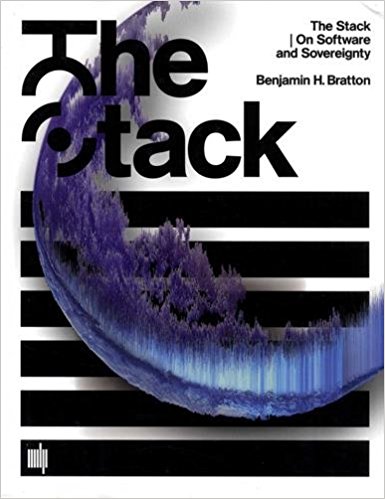
A review of Benjamin Bratton, The Stack: On Software and Sovereignty (MIT Press Press, 2016)
by R. Joshua Scannell
The Stack
Benjamin Bratton’s The Stack: On Software and Sovereignty is an often brilliant and regularly exasperating book. It is a diagnosis of the epochal changes in the relations between software, sovereignty, climate, and capital that underwrite the contemporary condition of digital capitalism and geopolitics. Anybody who is interested in thinking through the imbrication of digital technology with governance ought to read The Stack. There are many arguments that are useful or interesting. But reading it is an endeavor. Sprawling out across 502 densely packed pages, The Stack is nominally a “design brief” for the future. I don’t know that I understand that characterization, no matter how many times I read this tome.
The Stack is chockablock with schematic abstractions. They make sense intuitively or cumulatively without ever clearly coming into focus. This seems to be a deliberate strategy. Early in the book, Bratton describes The Stack–the titular “accidental megastructure” of “planetary computation” that has effectively broken and redesigned, well, everything–as “a blur.” He claims that
Only a blur provides an accurate picture of what is going on now and to come…Our description of a system in advance of its appearance maps what we can see but cannot articulate, on the one hand, versus what we know to articulate but cannot yet see, on the other. (14)
This is also an accurate description of the prevailing sensation one feels working through the text. As Ian Bogost wrote in his review of The Stack for Critical Inquiry, reading the book feels “intense—meandering and severe but also stimulating and surprising. After a while, it was also a bit overwhelming. I’ll take the blame for that—I am not necessarily built for Bratton’s level and volume of scholarly intensity.” I agree on all fronts.
Bratton’s inarguable premise is that the various computational technologies that collectively define the early decades of the 21st century—smart grids, cloud platforms, mobile apps, smart cities, the Internet of Things, automation—are not analytically separable. They are often literally interconnected but, more to the point, they combine to produce a governing architecture that has subsumed older calculative technologies like the nation state, the liberal subject, the human, and the natural. Bratton calls this “accidental megastructure” The Stack.
Bratton argues that The Stack is composed of six “layers,” the earth, the cloud, the city, the address, the interface, and the user. They all indicate more or less what one might expect, but with a counterintuitive (and often Speculative Realist) twist. The earth is the earth but is also a calculation machine. The cloud is “the cloud” but as a chthonic structure of distributed networks and nodal points that reorganize sovereign power and body forth quasi-feudal corporate sovereignties. The City is, well, cities, but not necessarily territorially bounded, formally recognized, or composed of human users. Users are also usually not human. They’re just as often robots or AI scripts. Really they can be anything that works up and down the layers, interacting with platforms (which can be governments) and routed through addresses (which are “every ‘thing’ that can be computed” including “individual units of life, loaded shipping containers, mobile devices, locations of datum in databases, input and output events and enveloped entities of all size and character” [192], etc.).
Each layer is richly thought through and described, though it’s often unclear whether the “layer” in question is “real” or a useful conceptual envelope or both or neither. That distinction is generally untenable, and Bratton would almost certainly reject the dichotomy between the “real” and the “metaphorical.” But it isn’t irrelevant for this project. He argues early on that, contra Marxist thought that understands the state metaphorically as a machine, The Stack is a “machine-as-the-state.” That’s both metaphorical and not. There really are machines that exert sovereign power, and there are plenty of humans in state apparatuses that work for machines. But there aren’t, really, machines that are states. Right?
Moments like these, when The Stack’s concepts productively destabilize given categories (like the state) that have never been coherent enough to justify their power are when the book is at its most compelling. And many of the counterintuitive moves that Bratton makes start and end with real, important insights. For instance, the insistence on the absolute materiality, and the absolute earthiness of The Stack and all of its operations leads Bratton to a thoroughgoing and categorical rejection of the prevailing “idiot language” that frames digital technology as though it exists in a literal “cloud,” or some sort of ethereal “virtual” that is not coincident with the “real” world. Instead, in The Stack, every point of contact between every layer is a material event that transduces and transforms everything else. To this end, he inverts Latour’s famous dictum that there is no global, only local. Instead, The Stack as planetary megastructure means that there is only global. The local is a dead letter. This is an anthropocene geography in which an electron, somewhere, is always firing because a fossil fuel is burning somewhere else. But it is also a post-anthropocene geography because humans are not The Stack’s primary users. The planet itself is a calculation machine, and it is agnostic about human life. So, there is a hybrid sovereignty: The Stack is a “nomos of the earth” in which humans are an afterthought.
A Design for What?
Bratton is at his conceptual best when he is at his weirdest. Cyclonopedic (Negarestani 2008) passages in which the planet slowly morphs into something like HP Lovecraft and HR Geiger’s imaginations fucking in a Peter Thiel fever dream are much more interesting (read: horrifying) than the often perfunctory “real life” examples from “real world” geopolitical trauma, like “The First Sino-Google War of 2009.” But this leads to one of the most obvious shortcomings of the text. It is supposedly a “design brief,” but it’s not clear what or who it is a design brief for.
For Bratton, design
means the structuring of the world in reaction to an accelerated decay and in projective anticipation of a condition that is now only the ghostliest of a virtual present tense. This is a design for accommodating (or refusing to accommodate) the post-whatever-is-melting-into-air and prototyping for pre-what-comes-next: a strategic, groping navigation (however helpless) of the punctuations that bridge between these two. (354)
Design, then, and not theory, because Bratton’s Stack is a speculative document. Given the bewildering and potentially apocalyptic conditions of the present, he wants to extrapolate outwards. What are the heterotopias-to-come? What are the constraints? What are the possibilities? Sounding a familiar frustration with the strictures of academic labor, he argues that this moment requires something more than diagnosis and critique. Rather,
the process by which sovereignty is made more plural becomes a matter of producing more than discoursing: more about pushing, pulling, clicking, eating, modeling, stacking, prototyping, subtracting, regulating, restoring, optimizing, leaving alone, splicing, gardening and evacuating than about reading, examining, insisting, rethinking, reminding, knowing full-well, enacting, finding problematic, and urging. (303)
No doubt. And, not that I don’t share the frustration, but I wonder what a highly technical, 500-page diagnosis of the contemporary state of software and sovereignty published and distributed by an academic press and written for an academic audience is if not discoursing? It seems unlikely that it can serve as a blueprint for any actually-existing power brokers, even though its insights are tremendous. At the risk of sounding cynical, calling The Stack a “design brief” seems like a preemptive move to liberate Bratton from having to seriously engage with the different critical traditions that work to make sense of the world as it is in order to demand something better. This allows for a certain amount of intellectual play that can sometimes feel exhilarating but can just as often read as a dodge—as a way of escaping the ethical and political stakes that inhere in critique.
That is an important elision for a text that is explicitly trying to imagine the geopolitics of the future. Bratton seems to pose The Stack from a nebulous “Left” position that is equally disdainful of the sort of “Folk Politics” that Srnicek and Williams (2015) so loathe and the accelerationist tinge of the Speculative Realists with whom he seems spiritually aligned. This sense of rootlessness sometimes works in Bratton’s favor. There are long stretches in which his cherry picking and remixing ideas from across a bewildering array of schools of thought yields real insights. But just as often, the “design brief” characterization seems to be a way out of thinking the implications of the conjuncture through to their conclusion. There is a breeziness about how Bratton poses futures-as-thought-experiments that is troubling.
For instance, in thinking through the potential impacts of the capacity to measure planetary processes in real time, Bratton suggests that producing a sensible world is not only a process of generalizing measurement and representation. He argues that
the sensibility of the world might be distributed or organized, made infrastructural, and activated to become part of how the landscape understands itself and narrates itself. It is not only a diagnostic image then; it is a tool for geo-politics in formation, emerging from the parametric multiplication and algorithmic conjugation of our surplus projections of worlds to come, perhaps in mimetic accordance with one explicit utopian conception or another, and perhaps not. Nevertheless, the decision between what is and is not governable may arise as much from what the model computational image cannot do as much as what it can. (301, emphasis added)
Reading this, I wanted to know: What explicit utopian project is he thinking about? What are the implications of it going one way and not another? Why mimetic? What does the last bit about what is and is not governable mean? Or, more to the point: who and what is going to get killed if it goes one way and not another? There are a great many instances like this over the course of the book. At the precise moment where analysis might inform an understanding of where The Stack is taking us, Bratton bows out. He’s set down the stakes, and given a couple of ideas about what might happen. I guess that’s what a design brief is meant to do.
Another example, this time concerning the necessity of geoengineering for solving what appears to be an ever-more-imminent climatic auto-apocalypse:
The good news is that we know for certain that short-term “geoengineering” is not only possible but in a way inevitable, but how so? How and by whom does it go, and unfortunately for us the answer (perhaps) must arrive before we can properly articulate the question. For the darker scenarios, macroeconomics completes its metamorphosis into ecophagy, as the discovery of market failures becomes simultaneously the discovery of limits of planetary sinks (e.g., carbon, heat, waste, entropy, populist politics) and vice versa; The Stack becomes our dakhma. The shared condition, if there is one, is the mutual unspeakability and unrecognizability that occupies the seat once reserved for Kantian cosmopolitanism, now just a pre-event reception for a collective death that we will actually be able to witness and experience. (354, emphasis added)
Setting aside the point that it is not at all clear to me that geoengineering is an inevitable or even appropriate (Crist 2017) way out of the anthropocene (or capitalocene? (Moore 2016)) crisis, if the answer for “how and by whom does it go” is to arrive before the question can be properly articulated, then the stack-to-come starts looking a lot like a sort of planetary dictatorship of, well of who? Google? Mark Zuckerberg? In-Q-Tel? Y Combinator? And what exactly is the “populist politics” that sits in the Latourian litany alongside carbon, heat, waste, and entropy as a full “planetary sink”? Does that mean Trump, and all the other globally ascendant right wing “populists?” Or does it mean “populist politics” in the Jonathan Chait sense that can’t differentiate between left and right and therefore sees both political projects as equally dismissible? Does populism include any politics that centers the needs and demands of the public? What are the commitments in this dichotomy? I suppose The Stack wouldn’t particularly care about these sorts of questions. But a human writing a 500-page playbook so that other humans might better understand the world-to-come might be expected to. After all, a choice between geoengineering or collective death might be what the human population of the planet is facing (and for most of the planet’s species, and for a great many of the planet’s human societies, already eliminated or dragged down the road towards it during the current mass extinction, there is no choice), but such a binary doesn’t make for much of a design spec.
One final example, this time on what the political subject of the stack-to-come ought to look like:
We…require, as I have laid out, a redefinition of the political subject in relation to the real operations of the User, one that is based not on homo economicus, parliamentary liberalism, poststructuralist linguistic reduction, or the will to secede into the moral safety of individual privacy and withdrawn from coercion. Instead, this definition should focus on composing and elevating sites of governance from the immediate, suturing interfacial material between subjects, in the stitches and the traces and the folds of interaction between bodies and things at a distance, congealing into different networks demanding very different kinds of platform sovereignty.
If “poststructuralist linguistic reduction” is on the same plane as “parliamentary liberalism” or “homo economicus” as one among several prevailing ideas of the contemporary “political subject,” then I am fairly certain that we are in the realm of academic “theory” rather than geopolitical “design.” The more immediate point is that I do understand what the terms that we ought to abandon mean, and agree that they need to go. But I don’t understand what the redefined political subject looks like. Again, if this is “theory,” then that sort of hand waving is unfortunately often to be expected. But if it’s a design brief—even a speculative one—for the transforming nature of sovereignty and governance, then I would hope for some more clarity on what political subjectivity looks like in The Stack-To-Come.
Or, and this is really the point, I want The Stack to tell me something more about how The Stack participates in the production and extractable circulation of populations marked for death and debility (Puar 2017). And I want to know what, exactly, is so conceptually radical about pointing out that human beings are not at the center of the planetary systems that are driving transformations in geopolitics and sovereignty. After all, hasn’t that been exactly the precondition for the emergence of The Stack? This accidental megastructure born out of the ruthless expansions of digitally driven capitalism is not just working to transform the relationship between “human” and sovereignty. The condition of its emergence is precisely that most planetary homo sapiens are not human, and are therefore disposable and disposited towards premature death. The Stack might be “our” dhakma, if we’re speaking generically as a sort of planetary humanism that cannot but be read as white—or, more accurately, “capacitated.” But the systematic construction of human stratification along lines of race, gender, sex, and ability as precondition for capitalist emergence freights the stack with a more ancient, and ignored, calculus: that of the logistical work that shuttles humans between bodies, cargo, and capital. It is, in other words, the product of an older planetary death machine: what Fred Moten and Stefano Harney (2013) call the “logistics in the hold” that makes The Stack hum along.
The tenor of much of The Stack is redolent of managerial triumphalism. The possibility of apocalypse is always minimized. Bratton offers, a number of times, that he’s optimistic about the future. He is disdainful of the most stringent left critics of Silicon Valley, and he thinks that we’ll probably be able to trust to our engineers and institutions to work out The Stack’s world-destroying kinks. He sounds invested, in other words, in a rhetorical-political mode of thought that, for now, seems to have died on November 9, 2016. So it is not surprising that Bratton opens the book with an anecdote about Hillary Clinton’s vision of the future of world governance.
The Stack begins with a reference to then-Secretary of State Clinton’s 2013 farewell address to the Council on Foreign Relations. In that speech, Clinton argued that the future of international governance requires a “new architecture for this new world, more Frank Gehry than formal Greek.” Unlike the Athenian Agora, which could be held up by “a few strong columns,” contemporary transnational politics is too complicated to rely on stolid architecture, and instead must make use of the type of modular assemblage that “at first might appear haphazard, but in fact, [is] highly intentional and sophisticated” that makes Gehry famous. Bratton interprets her argument as a “half-formed question, what is the architecture of the emergent geopolitics of this software society? What alignments, components, foundations, and apertures?” (Bratton 2016, 13).
For Clinton, future governance must make a choice between Gehry and Agora. The Gehry future is that of the seemingly “haphazard” but “highly intentional and sophisticated” interlocking treaties, non-governmental organizations, super and supra-state technocratic actors working together to coordinate the disparate interests of states and corporations in the service of the smooth circulation of capital across a planetary logistics network. On the other side, a world order held up by “a few strong pillars”—by implication the status quo after the collapse of the Soviet Union, a transnational sovereign apparatus anchored by the United States. The glaring absence in this dichotomy is democracy—or rather its assumed subsumption into American nationalism. Clinton’s Gehry future is a system of government whose machinations are by design opaque to those that would be governed, but whose beneficence is guaranteed by the good will of the powerful. The Agora—the fountainhead of slaveholder democracy—is metaphorically reduced to its pillars, particularly the United States and NATO. Not unlike ancient Athens, it’s democracy as empire.
There is something darkly prophetic of the collapse of the Clintonian world vision, and perversely apposite in Clinton’s rhetorical move to supplant as the proper metaphor for future government Gehry for the Agora. It is unclear why a megalomaniacal corporate starchitecture firm that robs public treasuries blind and facilitates tremendous labor exploitation ought to be the future for which the planet strives.
For better or for worse, The Stack is a book about Clinton. As a “design brief,” it works from a set of ideas about how to understand and govern the relationship between software and sovereignty that were strongly intertwined with the Clinton-Obama political project. That means, abysmally, that it is now also about Trump. And Trump hangs synechdochally over theoretical provocations for what is to be done now that tech has killed the nation-state’s “Westphalian Loop.” This was a knotty question when the book went to press in February 2016 and Gehry seemed ascendant. Now that the Extreme Center’s (Ali 2015) project of tying neoliberal capitalism to non-democratic structures of technocratic governance appears to be collapsing across the planet, Clinton’s “half-formed question” is even knottier. If we’re living through the demise of the Westphalian nation state, then it’s sounding one hell of a murderous death rattle.
Gehry or Agora?
In the brief period between July 21st and November 8 2016, when the United States’ cognoscenti convinced itself that another Clinton regime was inevitable, there was a neatly ordered expectation of how “pragmatic” future governance under a prolonged Democratic regime would work. In the main, the public could look forward to another eight years sunken in a “Gehry-like” neoliberal surround subtended by the technocratic managerialism of the Democratic Party’s right edge. And, while for most of the country and planet, that arrangement didn’t portend much to look forward to, it was at least not explicitly nihilistic in its outlook. The focus on management, and on the deliberate dismantling of the nation state as the primary site of governance in favor of the mesh of transnational agencies and organizations that composed 21st century neoliberalism’s star actants meant that a number of questions about how the world would be arranged were left unsettled.
By end of election week, that future had fractured. The unprecedented amateurishness, decrypted racism, and incomparable misogyny of the Trump campaign portended an administration that most thought couldn’t, or at the very least shouldn’t, be trusted with the enormous power of the American executive. This stood in contrast to Obama, and (perhaps to a lesser extent) to Clinton, who were assumed to be reasonable stewards. This paradoxically helps demonstrate just how much the “rule of law” and governance by administrative norms that theoretically underlie the liberal national state had already deteriorated under Obama and his immediate predecessors—a deterioration that was in many ways made feasible by the innovations of the digital technology sector. As many have pointed out, the command-and-control prerogatives that Obama claimed for the expansion of executive power depended essentially on the public perception of his personal character.
The American people, for instance, could trust planetary drone warfare because Obama claimed to personally vet our secret kill list, and promised to be deliberate and reasonable about its targets. Of course, Obama is merely the most publicly visible part of a kill-chain that puts this discretionary power over life and death in the hands of the executive. The kill-chain is dependent on the power of, and sovereign faith in, digital surveillance and analytics technologies. Obama’s kill-chain, in short, runs on the capacities of an American warfare state—distributed at nodal points across the crust of the earth, and up its Van Allen belts—to read planetary chemical, territorial, and biopolitical fluxes and fluctuations as translatable data that can be packet switched into a binary apparatus of life and death. This is the calculus that Obama conjures when he defines those mobile data points that concatenate into human beings as as “baseball cards” that constitute a “continuing, imminent threat to the American people.” It is the work of planetary sovereignty that rationalizes and capacitates the murderous “fix” and “finish” of the drone program.
In other words, Obama’s personal aura and eminent reasonableness legitimated an essentially unaccountable and non-localizable network of black sites and black ops (Paglen 2009, 2010) that loops backwards and forwards across the drone program’s horizontal regimes of national sovereignty and vertical regimes of cosmic sovereignty. It is, to use Clinton’s framework, a very Frank Gehry power structure. Donald Trump’s election didn’t transform these power dynamics. Instead, his personal qualities made the work of planetary computation in the service of sovereign power to kill suddenly seem dangerous or, perhaps better: unreasonable. Whether President Donald Trump would be so scrupulous as his predecessor in determining the list of humans fit for eradication was (formally speaking) a mystery, but practically a foregone conclusion. But in both presidents’ cases, the dichotomies between global and local, subject and sovereign, human and non-human that are meant to underwrite the nation state’s rights and responsibilities to act are fundamentally blurred.
Likewise, Obama’s federal imprimatur transformed the transparently disturbing decision to pursue mass distribution of privately manufactured surveillance technology – Taser’s police-worn body cameras, for instance – as a reasonable policy response to America’s dependence on heavily armed paramilitary forces to maintain white supremacy and crush the poor. Under Obama and Eric Holder, American liberals broadly trusted that digital criminal justice technologies were crucial for building a better, more responsive, and more responsible justice system. With Jeff Sessions in charge of the Department of Justice, the idea that the technologies that Obama’s Presidential Task Force on 21st Century Policing lauded as crucial for achieving the “transparency” needed to “build community trust” between historically oppressed groups and the police remained plausible instruments of progressive reform suddenly seemed absurd. Predictive policing, ubiquitous smart camera surveillance, and quantitative risk assessments sounded less like a guarantee of civil rights and more like a guarantee of civil rights violations under a president that lauds extrajudicial police power. Trump goes out of his way to confirm these civil libertarian fears, such as when he told Long Island law enforcement that “laws are stacked against you. We’re changing those laws. In the meantime, we need judges for the simplest thing — things that you should be able to do without a judge.”
But, perhaps more to the point, the rollout of these technologies, like the rollouts of the drone program, formalized a transformation in the mechanics of sovereign power that had long been underway. Stripped of the sales pitch and abstracted from the constitutional formalism that ordinarily sets the parameters for discussions of “public safety” technologies, what digital policing technologies do is flatten out the lived and living environment into a computational field. Police-worn body cameras quickly traverse the institutional terrain from a tool meant to secure civil rights against abusive officers into an artificially intelligent weapon that flags facial structures that match with outstanding warrants, that calculates changes in enframed bodily comportment to determine imminent threat to the officer-user, and that captures the observed social field as data privately owned by the public safety industry’s weapons manufacturers. Sovereignty, in this case, travels up and down a Stack of interoperative calculative procedures, with state sanction and human action just another data point in the proper administration of quasi-state violence. After all, it is Axon (formerly Taser), and not a government that controls the servers that their body cams draw on to make real-time assessments of human danger. The state sanctions a human officer’s violence, but the decision-making apparatus that situates the violence is private, and inhuman. Inevitably, the drone war and carceral capitalism collapse into one another, as drones are outfitted with AI designed to identify crowd “violence” from the sky, a vertical parallax to pair with the officer-user’s body worn camera.
Trump’s election seemed to show with a clarity that had hitherto been unavailable for many that wedding the American security apparatus’ planetary sovereignty to twenty years of unchecked libertarian technological triumphalism (even, or especially if in the service of liberal principles like disruption, innovation, efficiency, transparency, convenience, and generally “making the world a better place”) might, in fact, be dangerous. When the Clinton-Obama project collapsed, its assumption that the intertwining of private and state sector digital technologies inherently improves American democracy and economy, and increases individual safety and security looked absurd. The shock of Trump’s election, quickly and self-servingly blamed on Russian agents and Facebook, transformed Silicon Valley’s broadly shared Prometheanism into interrogations into the industry’s infrastructural corrosive toxicity, and its deleterious effect on the liberal national state. If tech would ever come to Jesus, the end of 2016 would have had to be the moment. It did not.
A few days after Trump won election I found myself a fly on the wall in a meeting with mid-level executives for one of the world’s largest technology companies (“The Company”). We were ostensibly brainstorming how to make The Cloud a force for “global good,” but Trump’s ascendancy and all its authoritarian implications made the supposed benefits of cloud computing—efficiency, accessibility, brain-shattering storage capacity—suddenly terrifying. Instead of setting about the dubious task of imagining how a transnational corporation’s efforts to leverage the gatekeeping power over access to the data of millions, and the private control over real-time identification technology (among other things) into heavily monetized semi-feudal quasi-sovereign power could be Globally Good, we talked about Trump.
The Company’s reps worried that, Peter Thiel excepted, tech didn’t have anybody near enough to Trump’s miasmatic fog to sniff out the administration’s intentions. It was Clinton, after all, who saw the future in global information systems. Trump, as we were all so fond of pointing out, didn’t even use a computer. Unlike Clinton, the extent of Trump’s mania for surveillance and despotism was mysterious, if predictable. Nobody knew just how many people of color the administration had in its crosshairs, and The Company reps suggested that the tech world wasn’t sure how complicit it wanted to be in Trump’s explicitly totalitarian project. The execs extemporized on how fundamental the principles of democratic and republican government were to The Company, how committed they were to privacy, and how dangerous the present conjuncture was. As the meeting ground on, reason slowly asphyxiated on a self-evidently implausible bait hook: that it was now both the responsibility and appointed role of American capital, and particularly of the robber barons of Platform Capitalism (Srnicek 2016), to protect Americans from the fascistic grappling of American government. Silicon Valley was going to lead the #resistance against the very state surveillance and overreach that it capacitated, and The Company would lead Silicon Valley. That was the note on which the meeting adjourned.
That’s not how things have played out. A month after that meeting, on December 14, 2016, almost all of Silicon Valley’s largest players sat down at Trump’s technology roundtable. Explaining themselves to an aghast (if credulous) public, tech’s titans argued that it was their goal to steer the new chief executive of American empire towards a maximally tractable gallimaufry of power. This argument, plus over one hundred companies’ decision to sign an amici curiae brief opposing Trump’s first attempt at a travel ban aimed at Muslims, seemed to publicly signal that Silicon Valley was prepared to #resist the most high-profile degradations of contemporary Republican government. But, in April 2017, Gizmodo inevitably reported that those same companies that appointed themselves the front line of defense against depraved executive overreach in fact quietly supported the new Republican president before he took office. The blog found that almost every major concern in the Valley donated tremendously to the Trump administration’s Presidential Inaugural Committee, which was impaneled to plan his sparsely attended inaugural parties. The Company alone donated half a million dollars. Only two tech firms donated more. It seemed an odd way to #resist.
What struck me during the meeting was how weird it was that executives honestly believed a major transnational corporation would lead the political resistance against a president committed to the unfettered ability of American capital to do whatever it wants. What struck me afterward was how easily the boundaries between software and sovereignty blurred. The Company’s executives assumed, ad hoc, that their operation had the power to halt or severely hamper the illiberal policy priorities of government. By contrast, it’s hard to imagine mid-level General Motors executives imagining that they have the capacity or responsibility to safeguard the rights and privileges of the republic. Except in an indirect way, selling cars doesn’t have much to do with the health of state and civil society. But state and civil society is precisely what Silicon Valley has privatized, monetized, and re-sold to the public. But even “state and civil society” is not quite enough. What Silicon Valley endeavors to produce is, pace Bratton, a planetary simulation as prime mover. The goal of digital technology conglomerates is not only to streamline the formal and administrative roles and responsibilities of the state, or to recreate the mythical meeting houses of the public sphere online. Platform capital has as its target the informational infrastructure that makes living on earth seem to make sense, to be sensible. And in that context, it’s commonsensical to imagine software as sovereignty.
And this is the bind that will return us to The Stack. After one and a half relentless years of the Trump presidency, and a ceaseless torrent of public scandals concerning tech companies’ abuse of power, the technocratic managerial optimism that underwrote Clinton’s speech has come to a grinding halt. For the time being, at least, the “seemingly haphazard yet highly intentional and sophisticated” governance structures that Clinton envisioned are not working as they have been pitched. At the same time, the cavalcade of revelations about the depths that technology companies plumb in order to extract value from a polluted public has led many to shed delusions about the ethical or progressive bona fides of an industry built on a collective devotion to Ayn Rand. Silicon Valley is happy to facilitate authoritarianism and Nazism, to drive unprecedented crises of homelessness, to systematically undermine any glimmer of dignity in human labor, to thoroughly toxify public discourse, to entrench and expand carceral capitalism so long as doing so expands the platform, attracts advertising and venture capital, and increases market valuation. As Bratton points out, that’s not a particularly Californian Ideology. It’s The Stack, both Gehry and Agora.
_____
R. Joshua Scannell holds a PhD in Sociology from the CUNY Graduate Center. He teaches sociology and women’s, gender, and sexuality studies at Hunter College, and is currently researching the political economic relations between predictive policing programs and urban informatics systems. He is the author of Cities: Unauthorized Resistance and Uncertain Sovereignty in the Urban World (Paradigm/Routledge, 2012).
Back to the essay
_____
Works Cited
- Ali, Tariq. 2015. The Extreme Center: A Warning. London: Verso
- Crist, Eileen. 2016. “On the Poverty of Our Nomenclature.” In Anthropocene or Capitalocene: Nature, History, and the Crisis of Capitalism, edited by Jason W. Moore, 14-33. Oakland: PM Press
- Harney, Stefano, and Fred Moten. 2013. The Undercommons: Fugitive Planning and Black Study. Brooklyn: Autonomedia.
- Moore, Jason W. 2016. “Anthropocene or Capitolocene? Nature, History, and the Crisis of Capitalism.” In Anthropocene or Capitalocene: Nature, History, and the Crisis of Capitalism, edited by Jason W. Moore, 1-13. Oakland: PM Press
- Negarestani, Reza. 2008. Cyclonopedia: Complicity with Anonymous Materials. Melbourne: re.press
- Paglen, Trevor. 2009. Blank Spots on the Map: The Dark Geography of the Pentagon’s Secrert World. Boston: Dutton Adult
- Paglen, Trevor. 2010. Invisible: Covert Operations and Classified Landscapes. Reading: Aperture Press
- Puar, Jasbir. 2017. The Right to Maim: Debility, Capacity, Disability. Durham: Duke University Press
- Srnicek, Nick. 2016. Platform Capitalism. Boston: Polity Press
- Srnicek, Nick, and Alex Williams. 2016. Inventing the Future: Postcapitalism and a World Without Work. London: Verso.