b2o

The b2o Review is a non-peer reviewed publication, published and edited by the boundary 2 editorial collective and specific topic editors, featuring book reviews, interventions, videos, and collaborative projects.  

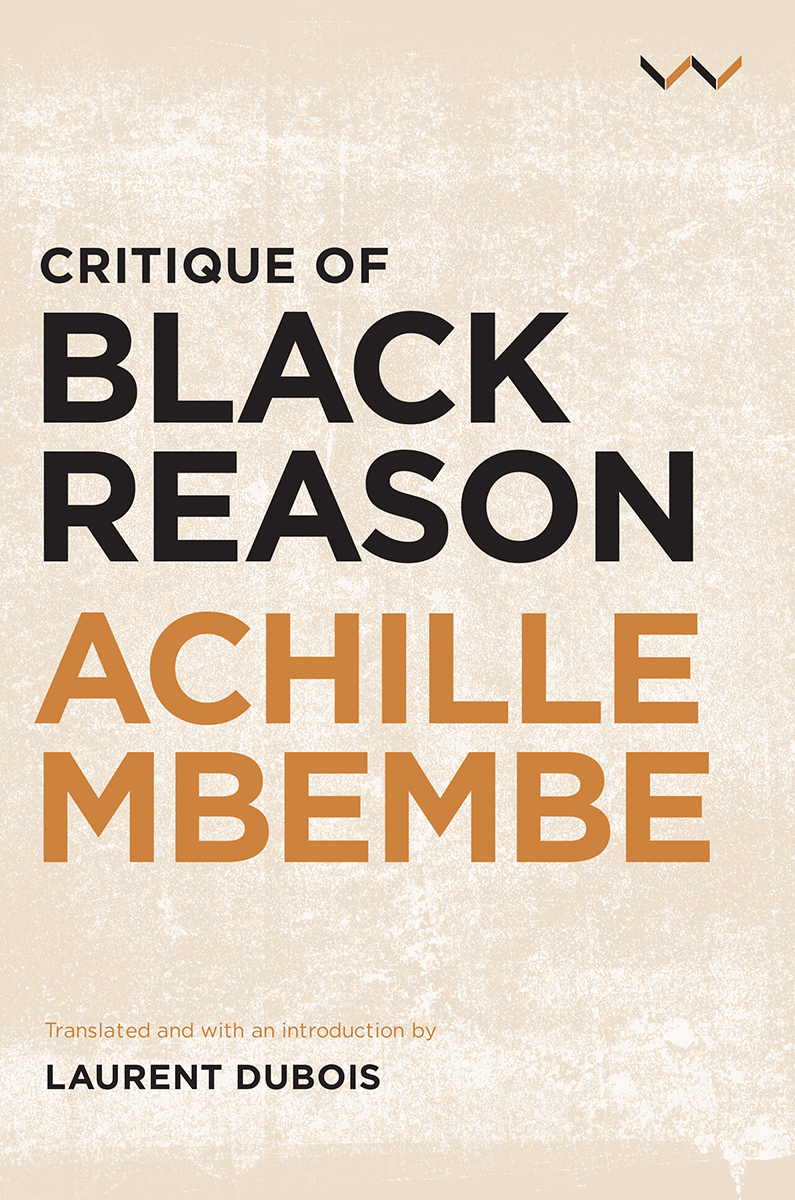
  • Nasrin Olla — Metamorphic Humanity (Review of Achille Mbembe’s Critique of Black Reason)

    Nasrin Olla — Metamorphic Humanity (Review of Achille Mbembe’s Critique of Black Reason)

    Achille Mbembe, Critique of Black Reason, trans. Laurent Dubois (Durham: Duke University Press, 2017).

    by Nasrin Olla

    This review has been peer-reviewed by the b2o editorial board.

    I

    While the human has always been the unstable and troubled ground of humanistic inquiry, one can’t help feeling that in our neoliberal and digital age, the very tectonics of that ground are shifting. Everywhere one looks, objects of technology are becoming phantom limbs of the human body, producing sensations of attachment, whilst remaining detachable. Alongside these spectral appendages, neoliberal forms of reason do much to encourage students, citizens, and workers to think of themselves not simply as producers of capital, but as human-capital. Today, we are faced with multiple scenes in which the human and non-human meet at a vanishing point. What forms of historical memory emerge at such a vanishing point? What modes of reading and critical attention does such a metamorphic humanity demand of us? Contemporary critical theory has provided a plethora of terms and concepts—posthuman, transhuman, cyborg, non-human agent, vibrant matter—in an attempt to answer these questions. Joining these debates, Achille Mbembe’s Critique of Black Reason, translated from the French by Laurent Dubois, offers an alternative genealogy of this current predicament.

    “In a world set on objectifying everybody and every living thing in the name of profit,” writes Mbembe in a recent article entitled, ‘The Age of Humanism is Ending,’ “the erasure of the political by capital is the real threat. The transformation of the political into business raises the risk of the elimination of the very possibility of politics. Whether civilization can give rise at all to any form of political life is the problem of the 21st century” (Mbembe 2015). First published in France in 2013, Critique of Black Reason is an insightful and poetic reflection on this problem of political life in our neoliberal times. Best known to an anglophone audience as the author of On the Postcolony and the essay “Necropolitics,” Mbembe sets out an ambitious project of thinking through what it means to share the world, to live alongside one an-other, and to be in-common, in the midst of a world that increasingly understands all forms of relation through a market orientated metric.

    Over the last twelve years, the pathbreaking work of Wendy Brown, Michel Feher, and David Harvey has charted the emergence of neoliberal forms of reason as they undo the basic tenets of Western democracy and reduce all forms of value to an economic metric.[i] This work has been indispensable in providing a language to trace the emergence of that new formation of the human  that Michel Foucault aptly dubbed homo oeconomicus. Much of this work has tried to illustrate what is new about neoliberalism. Harvey, through a Marxist analysis, has focused on the political-economic development of a global neoliberal order. While Brown and Feher, leaning on a Foucaultian apparatus, have conceived of neoliberalism as a political rationality which insidiously expands into all quarters of life. In an attempt to illustrate the way neoliberalism is distinct and novel in its corrosive tactics, Brown, Harvey, and Feher’s work has tended to pay far less attention to the way neoliberalism borrows from the oppressive racialized tactics of the 20th century. What does neoliberalism co-opt from the logics of racism, colonialism, and slavery? What continuities exist between the tactics of race thinking, and neoliberal reason? How is racism today bolstered by a neoliberal agenda?[ii] It is precisely such questions that animate Critique of Black Reason.

    In the opening pages of Critique of Black Reason, Mbembe describes the way neoliberalism, with its digital technologies, extends and supplements the borders of the human. Mbembe argues that neoliberal forms of reason give rise to a reality in which there is “little distinction remaining between psychic reflexes and technological reflexes,” and where the “subject is plastic and perpetually called on to reconfigure itself in relation to the artifacts of the age” (Mbembe 2017a: 3-4). He describes our era as one in which the human is not simply a producer of things, code, or machines, but emerges as a “human-thing, human-machine, human-code,” effectively a “human-in-flux” (4). But if in the age of the digital and neoliberal we find that the human is undergoing a transformation (becoming something other) we need not think that this process is unprecedented. Rather, Mbembe argues, this transformation is prefigured and haunted by the history of slavery and colonialism, through which black bodies vacillated between a commodity-form and a human being.

    This history began with the Atlantic slave trade, but did not end there. Mbembe argues that the slave trade produced black humanity as “human-merchandise, human-metal, and human-money” (180). For Mbembe, this experience of fluctuating between a human and an object is the defining feature of black life in the modern world. He describes the black body as “…the only human in the modern order whose skin has been transformed into the form and spirit of merchandise—the living crypt of capital” (6). Mbembe’s attention to the dehumanizing capacity of race is in sync with Alexander Weheliye’s recent argument, in Habeas Viscus: Racializing Assemblages, Biopolitics, and Black Feminist Theories of the Human, that race is not well understood as a “biological or cultural classification,” but as “a set of sociopolitical processes that discipline humanity into full humans, not-quite-humans, and nonhumans” (4). Mbembe’s book provides an original contribution to debates around post-humanism, bio-politics, and neoliberalism by foregrounding “the gesture of race that, notably in the case of people of African origin, consists of dissolving human beings into things, objects, and merchandise,” (Mbembe 2017a:11) and suggesting that contemporary regimes of power, which reconfigure the human and the nonhuman, resemble this history in which blackness was placed in the zone of the infrahuman.

    Today, Mbembe argues we are faced with an extension of a condition which modernity reserved for black bodies. Provocatively, Mbembe terms this contemporary induction of wider humanity into the living crypt of capital: the “becoming black of the world” (7). For Mbembe, the becoming black of the world is not a dead end. On the contrary, it occasions a return to and reexamination of black life in modernity in order to ask: how did black life survive a history of objectification and death-in-life? What forms of imaginative escape and creative reversal did it develop? And in what ways are critiques of race thinking and colonialism particularly useful in our neoliberal times?

    For Mbembe, ours is a moment in which animism, neoliberalism, and capitalism are merging. Animism, the projection of life onto inanimate objects, is everywhere present in an age of digital technologies. For example, when digital technologies are endowed with human like qualities: voices, faces, and genders. Or in the world of augmented reality gaming where gamers follow, chase, and trace life-like digital projections in the physical world. Animism is also present in corporate culture: where we find corporations seeking to redefine themselves as persons in order to access rights traditionally reserved for human-persons.[iii] Alongside the rise of animism, we find that in neoliberal culture humans are increasingly objectified. The neoliberal subject thinks of herself as a kind of micro-corporation, and increasingly values herself in terms traditionally reserved for inanimate entities (such as market-oriented metrics, numerical ratings etc.). The neoliberal subject, Mbembe argues, must turn herself “into viable merchandise” that can be “put up for sale” (4). Lastly, Mbembe suggests, ours is an era in which capitalism does not simply exploit workers, but abandons them. Capital does not need workers to function: increasingly their labour can be replaced by artificial forms of intelligence, and digitized platforms. Such abandoned subjects are condemned to live their lives in the short-run and must constantly adapt to the demands of a changing market place.

    In Critique of Black Reason Mbembe reads this contemporary metamorphosis of the human alongside black diasporic history, asking: Is the animism of our times comparable to the necromantic animism of colonial domination? In what ways does the so called ‘primitive’ animism of pre-colonial African cultures (which animated the lifeless as a form of survival, escape, and self-invention) relate to contemporary forms of animism? In what ways does the expulsion of the black (le nègre) from the category of the human prefigure the dehumanization of abandoned subjects today? How does the metamorphic figure of the slave haunt our neoliberal era?

    Readers looking for one answer to these questions will be disappointed. The book does not proceed by offering a set of problems and a corresponding set of easy solutions. Rather, in Critique of Black Reason, Mbembe offers us a set of maps through which we might locate our present moment. On the one hand, Mbembe maps the fantasies, delusions, desires, and unreason that have propelled centuries of racism and, on the other hand, the alternative approaches to life, death, and being-in-common that emerge from traditions of anti-racist critique. The aim of these maps is not to produce an account of ‘what actually happened in the past,’ nor do they aim to produce a history of ideas. Rather, Mbembe focuses on those moments in the past that bear some resemblance to our present moment: those forms of power, modes of subjectivity, and practices of critique that might offer us ways of naming and escaping our present. Some readers will no doubt interpret Mbembe’s relation to the past as presentist, and in some senses this is true. Critique of Black Reason is not a book that accepts traditional demarcations between the present and the past. Rather, Mbembe pays attention to those parts of the past that will not be buried, and that are constantly resurrected in our present moment. The epigraph that opens the book, taken from Aimé Césaire’s Discourse on Colonialism, well describes the ghostly history that Mbembe returns too: “These heads of men, these collections of ears, these burned houses, these Gothic invasions, this steaming blood, these cities that evaporate at the edge of the sword, are not to be so easily disposed of” (1). Mbembe’s writing attempts to delve into the darkest moments of the past in order to see the present in a different light;[iv] thus he describes his writing as “a sort of reminiscence, half solar and half lunar, half day and half night” (8).[v]

    Each chapter offers a set of historical situations and a set of concepts that navigate these settings. Concepts are not hierarchically presented but are horizontally interlinked. As the reader moves through the book, it becomes clear that the book does not start or end with one definitive conceptual framework or historical example, but creates constellations of multiple settings and concepts. In his excellent translator’s introduction, Laurent Dubois describes this writing style as cartographic: “What Mbembe offers us here is a cartography in two senses: a map of a terrain sedimented by centuries of history, and an invitation to find ourselves within this terrain so that we might choose a path through it—and perhaps even beyond it” (ix). The effect of this cartographical method is that in the end, Mbembe does not provide the reader with any final political orientation. Rather, he encourages readers to look for “resonances and interferences” between historically situated modes of thought, and pick our own paths through the deep complexity of our present moment (Mbembe 2015).

    Throughout the book, the influence of Gilles Deleuze and Félix Guattari’s work is present.[vi] Indeed, Mbembe’s cartographical style is reminiscent of Deleuze and Guattari’s call in A Thousand Plateaus to: “Make a map, not a tracing” (12).[vii] For Deleuze and Guattari, a tracing is a ready-made shape or structure that explains a desire or gives meaning to an object; a tracing tends to privilege one master concept or example and reproduce it onto the world. In contrast, a map aims to be open, and to move in more than one direction simultaneously. To make a map is to connect different forms of thinking and frameworks in order to allow several stories, examples, and concepts to interact non-hierarchically. Mapping is also an attempt to encourage the reader to participate in the process of working through problems, concepts, and examples. To create a map is always to invite readers to find themselves, their own worlds, and situated knowledge within the authors account. Hence Rosi Braidotti, following this Deleuzian impulse, has argued that cartographic modes of analysis require the participation of the reader by asking, “Do we live in the same world? in the same time-zones? How do you account for the kind of world you are living in?” (6).[viii] Unlike colonial practices of mapping—which privileged opposition and enclosure—this kind of mapping aims to foster collaborative, open-ended and dynamic forms of alliance.

    Like Deleuze and Guattari, Mbembe embraces both the open and invitational character of the rhizomatic map. And yet for Mbembe, the project of mapping is a not a way to escape Freudian dogma or the root-like structure of Western philosophy. Rather, it is a way to speak to the specificity of our present moment—to its “possibilities” and “present dangers” (Mbembe 2017a:1)—in a way that remobilizes the idea of a collective and shared future. Neoliberalism, Mbembe argues, can be identified through its “dispossession of the future” (5).[ix] In the era of neoliberalism, everything happens in the short-run and little attention is paid to what kind of future we collectively wish to create. Little attention is paid to what kind of world we want collectively to inhabit. Whether in relation to climate change or the refugee crisis, neoliberalism disavows the idea of collective responsibility, instead advancing a politics of enmity and separation.[x] Elsewhere, Mbembe has called this relation to the future a “negative messianism” that “feels no need to search for or to bring about some form of community” (Mbembe 2017b). The task of critical thought today, Mbembe argues, is to find ways to revitalize the idea of a collective future, a sense of shared responsibility for the world, and a practice of co-produced knowledge about the world.[xi] Cartography—in so far as it invites the reader to locate herself in a shared past, a present we must collaboratively name, and a future that remains open—becomes the experimental analytics of such collectivity.

    One potential drawback of Mbembe’s style of writing is that it often gives rise to hyperbolic statements. For example, Mbembe writes that the potential fusion of capitalism and animism leads to “very distinct possibility that human beings will be transformed into animate things made up of coded digital data” (Mbembe 2017a:5). Such dramatic prose elides the fact that the human has never been the stable ground of any humanism and therefore, we need not be alarmed by the idea of human beings in flux. As Spinoza teaches us, we have always already been in a fluctuating and interdependent relation to the natural and inanimate world. Therefore, the question today should not be is the human in crisis? Or will the human be made into something inanimate? Rather, the question is what insidious forms of power are working today to dehumanize specific populations? How does this relate to the generalized animism of our digital and neoliberal age? We could ask similar questions about the idea that today blackness is being generalized. Are there not still forms of racism for which black bodies are the privileged subject? Do contemporary forms of white supremacy not differ from generalized forms of animistic objectification? Some of this subtlety gets lost in Mbembe’s far-reaching analysis.

    On the other hand, this criticism is partially assuaged by recognizing that Critique of Black Reason does not offer us a framework that symptomatically represents or reproduces phenomena in the world. It offers us a map. As Deleuze and Guattari argue, maps do not attempt to reproduce the world on the page; rather they attempt to construct a platform that might lead to new ways of experiencing, feeling, and sensing the world. On my reading, the perspective of the becoming black of the world is not an overarching or unmovable regime of power, but an invitation constructed through hyperbole: to think about the important place that African history has in our world today. To think about the way traditions of global black criticism offer us alternative conceptions of the human. To think collectively about how we name our era and how we can foster multiple paths toward creating a shared future in the One World we inhabit. Depth is not the strength of this book. Neither is slowness. This is a book which speeds time up, which connects up large geographies, and searches for alliance among diverse thinkers. It sketches, locates, marks, and invites insights. Such a strategy leaves the burden on the reader to pay attention, engage, find points of alliance, and points of dissonance.

    II

    One of the crucial interventions of Mbembe’s study is to reread the central themes of the African American archive from the “other side of the Atlantic” (Mbembe 2018). Mbembe aims to map new paths and avenues for African American thought from the perspective of the Congo, Cameroon, Nigeria, South Africa, and Martinique. Over the last two decades, debates in black studies in the US have been dominated by the themes of social death and the liminal figure of the slave. In Critique of Black Reason, Mbembe attempts to shift this emphasis away from the paradigm of social death and towards questions of life, a humanism-to-come, and One World composed of a thousand parts. Mbembe hopes to make an intervention into African American thought through his conception of black reason, which paves the way toward an afro-futuristic humanism. Part of the difficulty of reading Critique of Black Reason is that its central terms—black reason and critique—are buried within the book rather than clearly defined. It is therefore helpful to offer a textual reading of these two terms as well as to offer an analysis of the contribution Mbembe makes to scholarly debates on racism and afro-humanism in our contemporary era.

    In Critique of Black Reason, Mbembe offers a map—which spans the fifteenth to the twenty-first centuries—of the fictive dimensions of racial difference. The book asks: who is the elusive subject that the term “black” refers to? What precisely does this term aspire to tell us about this subject? What kind of unity does the term “black” suppose? Mbembe argues that racial distinctions can only ever possess an illusionary unity. Of black identity he writes, “I mean to question the fiction of unity that it carries within it” (Mbembe 2017a: 25). However, Mbembe’s aim is not to rehash circular debates around the essentialism of identity categories; Critique of Black Reason is, rather, an exploration of race as the phantasmagoria of modernity. More precisely, Mbembe is interested in the entanglement of fiction and truth, life and death, madness and sanity, reason and unreason, which racialized forms of difference (what he calls “black reason”) inaugurate.

    The voice that echoes off every page of this book is that of Frantz Fanon.[xii] In The Wretched of the Earth, Fanon wrote: “Because it is a systematized negation of the other, a frenzied determination to deny the other any attribute of humanity, colonialism forces the colonized to constantly ask the question: Who am I in reality?” (Fanon 2004: 182). For Fanon, colonialism produced a kind of unreality because it constantly made the colonized question their statues as human-beings. Echoing this Fanonian insight, Mbembe argues that race is not a biological or empirical fact, but a “structure of the imagination;” and racism consists “most of all in substituting what is with something else, another reality” (Mbembe 2017a: 32). Like Fanon, Mbembe is interested in the “sensory life” (106) of race that works to mask and unmask subjects; he writes of race as a mask made up of a “massive coating of nonsense, lies, and fantasies” (39)—simultaneously “material and phantasmic” (2). The central term in this book, “black reason,” is exemplary of this Fanonian influence.

    So, what is black reason? For Mbembe, black reason is not some essential form of reason that can be attributed to people of a certain race; rather, it is the reason that created race. What, Mbembe asks, does race do? What is the logic—the black reason—that propels racial distinctions? Broadly conceived, “black reason” is a term that names the process by which Western modernity produced Africa and its populations in a negative capacity—as a world outside, a world apart, or the klossonos of the world—in order to constitute itself positively (53-61). More specifically, black reason names a “complicated network” (10) of discourses, modes of governance, forms of subjection, and fantasies that used a racialized arithmetic to divide humanity—to separate out populations of similar beings (humanity-in-general) and populations made up of beings who were not “human like all others” (black-humanity) (85).

    Mbembe provides many examples of the ways in which people of African descent have been excluded from the category of the human. This exclusion is accompanied by hysterical and fantastic images of Africa and its populations as a primitive people who have fallen out of time and history—essentially, a socially dead people. For example, when Hegel wrote of Africa he did not simply refer to a mappable geographical location, but to an unhistorical place populated by a “humanity staggering through life, confusing becoming-human and becoming-animal” (12). Mbembe writes:

    The notion of race made it possible to represent non-European human groups as trapped in a lesser form of being. They were impoverished reflections of the ideal man, separated from him by an insurmountable temporal divide, a difference nearly impossible to overcome. To talk of them was, most of all, to point to an absence—the absence of the same—or, rather, to a second presence, that of monsters and fossils (17).

    When one speaks of Africa, Mbembe argues, one gives up responsibility, and the relation between words and things begin to deteriorate. We enter a symbolic realm that is governed by delirium, hysteria, and phantasy. Hegel’s Reason in History marks the high point of a “gregarious phase of Western thinking” in which “grasping ideas became gradually detached from the effort to know deeply and intimately” (17). For Mbembe, this crisis of meaning-making is not simply a relic of a bygone age, rather it finds its way into our contemporary imaginary: “Still today, as soon as the subject of Blacks and Africa is raised, words do not necessarily represent things” (13).

    In Critique of Black Reason, Mbembe is not simply interested in the fact that black life is historically seen as non-human; he is interested in the form of power that constitutes this non-human status. What kind of (un)reason allows Hegel to imagine Africans as “human entities incapable of ridding themselves definitively of the animal presence which they were mixed”(17)? To explore this question, Mbembe dwells on the dark magic of modernity—its ability to transmogrify human beings into human-objects, human-animals, or transform a geographical location into a heart of darkness, a non-place—which, he argues haunts black life today. For Mbembe, it is this dark magic of modernity—which distorts reality and produces regimes of fantasy—that penetrates the postcolony.

    For example, Mbembe argues that colonial-era statues and monuments in the postcolony “perform” the function of “entrapment” through a practice of necromancy (126). These statues and monuments work, on a daily basis, to resurrect or conjure up those who had terrorized and “threatened Blacks with the sword and with death” (128). Mbembe writes:

    The presence of the lugubrious dead in the public arena is meant to ensure that both murder and cruelty, which the dead personify, continue to haunt the memories of the ex-colonized to saturate their imaginary and the spaces of their lives (128).

    Through a practice of necromancy and geomancy, the colonizer lives on and continues to haunt the ex-colonized. This means that the ex-colonized cannot think “clearly” (128) because they are constantly accosted by this unyielding spectral presence. Mbembe calls this a funerary power which is propelled through a circulation of taking life and resurrecting the dead.

    This analysis of the funerary power of colonial statues is uncannily prescient. Two years after the French edition of Critique of Black Reason was published a wave of demonstrations swept through South African university campuses protesting the presence of colonial-era statues. The protests were sparked by a group of students at the University of Cape Town who demanded the removal of a prominently placed statue of the colonial mining magnet Cecil John Rhodes. In South Africa, these protests produced much public debate. Some asked: are colonial remnants not a part of South Africa’s divided history? Should they not be left standing in order to be learnt from? If we remove these statues are we denying and repressing South Africa’s painful past? (In the United States a somewhat similar debate has emerged in relation to confederate flags. What do these flags represent? Are they a harmless part of Southern history?) The power of Mbembe’s attention to the magical and enchanting dimensions of racial domination is vivid in relation to these debates.

    Mbembe argues that colonial power aimed to dominating both the living and the dead or the animate and the inanimate. Therefore, we must never underestimate the capacity of those ‘mute things,’ which the colonizer left behind, to enchant the public arena. Colonial era statues are ritualistic: they aim to remind the colonized that the colonizer is a subject who not only conquered all forms of life, but who also “outruns death” (126). These statutes “envelop the subjugated” (127) by appearing in victorious garb at the entrance of government buildings, in the walkways of public gardens, or the foot of institutions of learning. They are placed prominently in order to make the colonized feel uneasy, out of place, and inhibited in the public arena. Mbembe’s language of enchantment, alchemy, and magic allows us to see that these statues are not passive features of the built environment. Nor are they simply commemorative remnants of a traumatic past. Rather, they are spatial actors who work to haunt, disturb, and confuse those they encounter.

    Significantly, all these moments in which black life is trapped in the unending circuit of death-in-life—whether through Hegel’s dreams of primitive Africans or the necromancy of colonial-era statues—are examples of black reason. In short, black reason is the fictional economy that facilitates this oppressive circulation of death and life: a logic that partitions the world, and closes off the category of the human, using race as its modus operandi.

    This conception of black reason sets up the central dilemma that Mbembe wishes to tackle. Namely, what resources can be found in the capacious corpus of black criticism that can offer a critique of black reason? Which critiques are successful and which simply reproduce the violent logics of black reason? Importantly, for Mbembe, “the work of race” is fundamentally “the very negation of the idea of the common, or of a common humanity” (54). Hence the question that faces black criticism is how to foster a form of belonging, and being-in-common that is not founded upon the ejection of black life from humanity. Significantly, what do we do with race—that form of difference that has through-out history been used to banish life to a space of crisis and a death-in-life—in such a project? It is in answering this question that Mbembe introduces his conception of a humanism-to-come.

    Black reason, Mbembe argues, is the fictional economy that produces, and uses race to divide humanity into humans and non-humans. It is a logic that produces the word ‘black’ in an attempt to wound, dehumanize, and objectify. Some strands of black thought (such as: Pan-Africanism, Negritude, and those writers who affirmed “a so-called politics of Africanity”) tried to reverse the racist telos of black reason by arguing that African people have their own histories and cultures which constitute a distinct, but not inferior humanity (88). These forms of criticism closed themselves off from the rest of humanity, because they failed to critique the false partition of black humanity from humanity-in-general. On Mbembe’s account, to claim that blackness is a sign of ontological, cultural, or national distinction is an inversion and not a critique of black reason. Against these modes of writing, Mbembe argues that African and black identities have never been distinct or unique, rather these identities were always “nourished” by multiple “ethnic, geographic, and linguistic differences” (95). Therefore the name ‘black’ ought to be reclaimed not as a retreat from humanity, but as a call to a future-to-come in which black people are part of a common humanity composed of a thousand parts.

    Mbembe’s conception of black reason suggests that racial distinctions are historical and contingent.[xiii] And that it is not race (or blackness) but the idea of a common humanity that ought to be the basis of revolutionary thinking today. Indeed, throughout Critique of Black Reason Mbembe affirms those modes of black criticism which look forward to, and desire a world without racial difference. For example, in his reading of Césaire’s work he asks: why does Césaire use the word black and not simply human being? He argues that for Césaire the word ‘black’ is not connected to the “idolatry of race,” (159) but is “the ultimate metaphor” for a humanism-to-come that would include black people not as black, but as human (159). Similarly, he writes of Glissant’s thought as consistently affirming the idea that all races and cultures share One World which is made up of “a thousand parts. Of everyone. Of all worlds” (180). And he writes of Nelson Mandela as ultimately “seeking an idea that in the end was quite simple: how to live free from race and the domination that results from it” (172). Indeed, Mbembe affirms those “strands” of black criticism in which “difference is only one facet of a larger project” (183). Within these modes of thought the word “black” is not used with the “goal of finding solace within it,” but as a way of “clouding the term in order to gain distance from it” (173).[xiv]

    Thus far, I have traced the development of black reason as it turns into a critique of black reason in order to illustrate Mbembe’s four major interventions into African American thought. The first is to centralize the archive of Africa and the Caribbean. The second is to provide a historical (and not an ontological or national) reading of race. The third is to couple the practice of critique with the creation of a future. The fourth, finally, is to reinvigorate the idea of a humanism-to-come which would reject the hierarchical division between humans and non-humans. Thus, Mbembe writes: “The path is clear: on the basis of a critique of the past, we must create a future that is inseparable from notions of justice, dignity, and the in-common” (177). In a general sense, Mbembe aims to shift the emphasis away from blackness as a form of social death, toward blackness as a prophetic call for a new humanism that would be grounded in ideas of a shared world, an expanding horizon of the possible, and a shared future.

    I would argue that while this intervention is compelling—particularly, in so far as it attempts to expand the archive, terms, and conceptual apparatus of the middle passage paradigm that has dominated US based black studies—Mbembe risks overlooking complicated debates around positionality and placement of ‘blackness’ by refusing to directly engage with the archive of contemporary African American thought. For example, the work of Saidiya Hartman, Fred Moten, Jared Sexton, and Frank Wilderson has emphasized the way the figure of the slave continues to haunt black life. In different ways, each has argued that lived experience of black populations continue to be shaped by the oppressive structures of slavery. Hartman in Lose Your Mother argues that if “slavery persists as an issue in the political life of black America” is it not because of an obsessive or melancholic relation to the past, but because “black lives are still imperiled and devalued by a racial calculus and a political arithmetic” that was “entrenched centuries ago” (6). Black people live in what Hartman calls the “afterlife of slavery” which is made up of “skewed life chances, limited access to health and education, premature death, incarceration, and impoverishment” (6). On this account, to be ‘black’ is to constantly negotiate dehumanizing forces, and to live under the constant threat of death. If the ‘future’ is not a category that is emphasized in these accounts it is because the legacy of slavery structures the present in ways that are not easy to overcome.

    Moreover, Moten, Sexton, and Wilderson have argued that black subjection (in so far as it excludes black subjects from the category if the ‘human’) troubles the categories which traditionally humanistic discourses have taken for granted. For example, Moten (following Nahum Dimitri Chandler) has argued that the subaltern condition of blackness is well understood as a “paraontological” force which resists, and disrupts traditional demarcations between: the subject and the object, or the outside and inside, or the ugly and the beautiful (Moten 2008). Similarly, Sexton writes of blackness as a “paralogical” force which allows us to think “differently about space, time, being, existence” (Sexton 2017). Importantly, for these theorists—whether we call them Afro-optimists or Afro-pessimists—blackness works to put in question traditional conceptions of the body, the human, humanism, the present, the past, critique, and judgment. In this sense, blackness fugitively escapes and exceeds the terms and categories of modernity’s humanist discourse. Thus Wilderson writes, “the explanatory power of Humanist discourse, is bankrupt in the face of the Black. It is inadequate and inessential to, as well as parasitic on, the ensemble of questions which the dead but sentient thing, the Black, struggles to articulate in a world of living subjects” (55).

    On Mbembe’s reading, the name ‘black’ ought to be re-claimed not as something that stands besides or on the side of (para-) the human, humanity, logic, or ontology. Nor should it signify a form of being that is always already facing death. For Mbembe, seeing blackness as apart from humanity-in-general or the name for a socially dead population is to be blinded by the logic of black reason, which we must attempt to move beyond. Successful critiques of black reason are those that move through the history of racism propelled by “hope of escaping the world as it has been,” and desire to be “reborn into life, to lead the festival once again” (Mbembe 2017a:173). The name ‘black’ in such a project prophetically calls on a new humanism, which would embrace difference as the basis of what is common among humanity. How does such prophetic conception of the name ‘black’ relate to the lived experience of the after-life of slavery? How do we negotiate the desire for a future beyond the idolatry of race, and the desire to bear witness to the ongoing legacies of slavery, and colonialism? What is the relation between a futuristic humanism-to-come, and the critiques of humanistic discourse that theorists such as Moten, Wilderson, and Sexton have offered? By avoiding these questions Mbembe has produced a conception of a humanism-to-come which stands in a clearly critical, but also vague relation to the important work of theorists such a Hartman, Moten, Sexton, and Wilderson.

    The lack of engagement with contemporary African American thought is not the only weakness of Mbembe’s archival practice. In the public discussions of this book that have taken place over the last few months—both in South Africa and the United States—readers have wondered what this book would have looked like if the tradition of critique which it explored had included the voices of black women. Indeed, despite Critique of Black Reason’s far-reaching scope, the archive of black criticism relied on is almost entirely masculine: Fanon, Glissant, Césaire, Garvey, Mandela, Tutuola, Tansi, Baldwin. Given that the scope of this project is so large (a critique of the racist logic that undergirds the modern order) the reader is left wondering what blind-spots this book reproduces through its archival bias.

    Despite these criticisms, the strength of Critique of Black Reason‘s indirect intervention lies in the language of enchantment, dreamworlds, necromancy, and alchemy which the book develops. In Critique of Black Reason, the workings of racism are described not in sociological or historical terms, but as a form of enchantment which closes off the category of the human. In a similar way, anti-racist critique is described as a prophetic incantation, and a search for a world-to-come within this world. This mapping of competing phantasmagoric worlds opens up multiple questions, and suggests multiple paths to rethinking the legacy of decolonial, and abolitionist thought in our contemporary world. Moreover, I have suggested that Mbembe does not sufficiently address the critiques of humanism which contemporary African America thought has produced, but this does not mean that he resorts to any traditional conception of the human (or humanism). On the contrary, one of the powerful interventions of Critique of Back Reason is the way it shows how the human has been re-enchanted, and re-made through African aesthetic traditions. In these traditions, the human is thought of in several different forms, and is always a subject in process. In order to explore this non-traditional conception of the human, I will offer a reading of the central chapter of this book, “Requiem for the Slave,” in which the reader is introduced to the idea of a metamorphic human.

    III

    In Critique of Black Reason, several kinds of metamorphic subjectivities are mapped. At the start of the book, Mbembe maps the metamorphic subject of our digital and neoliberal world. This subject is one who must constantly transform herself in order to remain competitive and valuable; moreover, this is a subject who must constantly negotiate the ever blurring boundary between things and persons or the animate and the inanimate. He goes on to show the way in which this contemporary subject is prefigured by the human-in-flux—”at once outside and within the human” (135)—that slavery, colonialism, and race thinking (black reason) produced. The metamorphic power of neoliberalism, and black reason are both aimed at destructively trapping the human in a space between death and life. How do we resist such morphing? How do we critique the necromantic power of such transmogrification? In the second half of the book, Mbembe aims to answer these questions by mapping another mode of metamorphosis, which blurs the boundary between the animate and the inanimate, as a mode of survival, and an affirmation of life. By turning to experimental African literature, Mbembe explores the immanent modes of critique which re-inscribed tradition using the resources of dreams, fantasies, and orphic knowledge; and resisted death by reclaiming the powers of necromancy, enchantment, animism, and metamorphosis.

    The quintessential example of this mode of critique is found in the experimental aesthetics of the Congolese writer Sony Labou Tansi and the Nigerian writer Amos Tutuola. Both authors create fictional worlds that linger between life and death. In the case of Tutuola’s literature, this liminal space is expressed through the figure of the ghost; in Lansi’s literature it is explored through the creation of what he calls “rag-humans,” which are neither alive nor dead, but exist in a half-world and live a half-life (134). These fictional worlds explore the capacity of racism to turn people into human-things, human-animals, or ghosts whose liminal status prevents them from fully joining the world of the living or the dead. Both these authors critique this liminal space by creating unexpected relations among life, loss, and death. Tansi and Tutuola, Mbembe argues, bear witness to the destructive transformations of black reason by embodying and reversing its cannibalistic logic for their own means. Like the schizophrenic subject in the work of Deleuze and Guattari this literature produces a critique of black reason by scrambling “all the codes” (148).

    In these literary landscapes, characters leap through the realms of death and life. They constantly transform themselves—into animals or inanimate objects or different people—in order to preserve life. For example, Tansi’s experimental novel Life and a Half opens with a scene of torture in which what he calls a rag-father is being eaten alive by a character referred to as the Provincial Guide. The rag-father’s body is torn asunder and his organs are strewn all over the room, but he does not die. The Provincial Guide repeatedly asks: “Now, what are you waiting for?” And the rag-father repeatedly answers: “I do not want to die this death” (6). In Tansi’s universe, even at the moment where the human is in some sense already dead, there is a kind of agency, and a resilient desire for life. This desire for life is present even if it can only be articulated as a desire for another kind of death. And so, the rag-human transforms himself into a being who dies a thousand deaths, because he will not accept the unwanted death offered to him. In a similar way, in Tutuola’s literary landscapes we find people who are constantly chased by death. In order to escape death, they transform themselves into animals or other humans. Sometimes these transformations lead to death anyways. However, these transformations are always aimed at survival. One transforms oneself, morphs into something else and enchants the world, in order to continue living and to resist an unwanted, and pre-mature death. What Mbembe tries to offer here is another way of remembering the slave, not only as that human who was always already dead, but also as that metamorphic human who danced with death, in order to resurrect the lifeless a thousand times over.

    The colossal violence of black reason is its capacity to turn life into a death-in-life. To banish certain subjects into a liminal state in which life can no longer be affirmed, but must be lived out as, what Tansi called, a half-life. What fascinates Mbembe about black critique is its capacity to celebrate “the ineradicability of life” in defiance of this “long life-denying history” (Mbembe 2005). For Mbembe, this defense of and desire for life is the force behind the thought of Édouard Glissant, Aimé Césaire, Nelson Mandela, Marcus Garvey, and Frantz Fanon. These traditions of critique aim to bring back to life dead subjects, deserted spaces, and barren languages:

    The durability of the world depends on our capacity to reanimate beings and things that seem lifeless—the dead man, turned to dust by the desiccated economy; an order poor in worldliness that traffics in bodies and life. The world will not survive unless humanity devotes itself to the task of sustaining what can be called the reservoirs of life. The refusal to perish may yet turn us into historical beings and make it possible for the world to be a world. But our vocation to survive depends on making the desire for life the cornerstone of a new way of thinking about politics and culture. (Mbembe 2017a:181)

    If racist logic is powerful because of its ability to harness the power of metamorphosis as a form of entrapment and social death, then in critiques of black reason this power of metamorphosis is immanently reclaimed and turned into a life-affirming force. Fanon’s work, Mbembe tells us, was propelled by the conviction that every human being—no matter how much violence they have undergone—has “something indomitable and fundamentally intangible that no domination” can “eliminate” (170). Throughout his work, Mbembe argues, Fanon tried to create modes of thought and practice through which this ineffable resilience “could be reanimated and brought back to life” (170). For this reason, Mbembe calls Fanon’s thought a “metamorphic thought” (162).

    For Mbembe, black identity is not exceptional or distinct (black subjects are human like all others), but if there is a characteristic that is historically original or innovative about black life, it is the capacity to survive the dehumanization of racist imaginaries by learning to morph, transform, and enchant hegemonic traditions; to produced immanent forms of critique by delving into the depths of black reason’s “nocturnal economy” (130) in order to rework and transform its logic from within. In this sense, what Mbembe offers as a humanism-to-come is not grounded in a traditional understanding of the human. It is grounded in an archive of black criticism that uses “play, leisure, spectacle, and the principle of metamorphosis” in order to produce several modalities of being human, and approaches to life (176). In the end then, Critique of Black Reason seeks to remind readers that while social death is a paradigm that dominates the history of racism there is also a hidden tradition of metamorphic critique that moves through death in order to affirm life.

    Throughout the book, Mbembe’s writing is marked by a double gesture: simultaneously he maps the racist forms of reason that produce modes of death-in-life and unveils the traditions of critique that rise up to immanently deconstruct such racism. For example, we will recall that in the opening pages of this book he argued that today we are faced with the looming perspective of the becoming black of the world. Mbembe offers us this phrase in an attempt to map the dangers that emerge from the potential consolidation of neoliberalism, capitalism, and animism; to show the way this fusion borrows much from the logics of racism and colonialism. It is also an attempt to suggest that as we think through, resist, and critique these contemporary forces of dehumanization we can fruitfully borrow much from metamorphic anti-racist modes of critique. In other words, in so far as our neoliberal-animistic culture inherits and expands the cannibalistic logics of race thinking it also (potentially) makes itself vulnerable to those critiques of black reason that—in another time—creatively resisted similar forms of depredation.

    This much is implied in Mbembe’s use of the word becoming. In A Thousand Plateaus, Deleuze and Guattari explain the idea of becoming by using the example of a wasp and an orchid. They argue that the wasp and the orchid are not well understood as two different types or categories of things. When the wasp flies around the orchid, moving pollen from one flower to the next, it becomes categorically indissociable from the orchid. Therefore, we should therefore think of them in symbiotic, but not equivalent relation: “a becoming-wasp of the orchid and a becoming-orchid of the wasp”(10). In a similar way, Mbembe seems to suggest that the looming threat of the ‘becoming black of the world’ is always already coupled with a counter or minor, but not equivalent perspective which we might call the becoming world of the black. This perspective is one in which the search for a common world, and the desire for life which animated critiques of black reason becomes a universal, and generalizable project. On my reading, the aim of this book is to make such a liminal perspective available. And it is only by recognizing this implicit perspective that we can interpret the otherwise unexplained optimism that runs through this book and is encapsulated in the opening sentence: “I envision this book as a river with many tributaries, since history and all things flow toward us now” (1, emphasis mine).

    WORKS CITED

    Braidotti, Rosi. 2002. Metamorphoses: Towards a Materialist Theory of Becoming. Cambridge: Polity Press.

    Brown, Wendy. 2015. Undoing the Demos: Neoliberalism’s Stealth Revolution. Cambridge & London: Zone Books.

    ————————. “What kind of world do you want to live in?” Academe Blog. May 15, 2018. https://academeblog.org/2018/05/15/what-kind-of-world-do-you-want-to-live-in/.

    Deleuze, Gilles and Guattari, Félix. 1987. A Thousand Plateaus: Capitalism and Schizophrenia. Translated by Brian Massumi. Minneapolis: University of Minnesota Press.

    Fanon, Frantz. 1986. Black Skin, White Masks. Translated by Charles Lam Markmann, with forwards by Ziauddin Sardar and Homi K. Bhabha. London: Pluto Press.

    Fanon, Frantz. 2004. The Wretched of the Earth. Translated by Richard Philcox, with commentary by Jean-Paul Sartre and Homi K. Bhabha. New York: Grove Press.

    Flately, Jonathan. 2008. Affective Mapping: Melancholia and the Politics of Modernism. Boston: Harvard University Press.

    Feher, Michel. 2009. Self-Appreciation; or, The Aspirations of Human Capital.” Public Culture, no. 21: 21-41.

    Goldberg, Theo David. 2008. The Threat of Race: Reflections on Racial Neoliberalism. Malden: Wiley-Blackwell.

    Hartman, Saidiya. 2008. Lose Your Mother: A Journey Along the Atlantic Slave Route. New York: Farrar, Straus and Giroux.

    Harvey, David. 2007. A Brief History of Neoliberalism. Oxford: Oxford University Press.

    Massumi, Brian. 1992. A User’s Guide to Capitalism and Schizophrenia: Deviations from Deleuze and Guattari. Cambridge: MIT Press.

    Marriott, David. 2018. “The becoming-black of the world? On Achille Mbembe’s Critique of Black Reason.” Radical Philosophy, no.2.02: 61-71.

    Mbembe, Achille. 2001. On the Postcolony. Translated by A. M. Berrett, Murray Last, Achille Mbembe, Steven Rendall and Janet Roitman. Berkeley: University of California Press.

    ______________. 2005. “Variations on the Beautiful in the Congolese World of Sounds.” Politique Africaine, no. 100: 69-91.

    ______________.”Africa and the Future: An Interview with Achille Mbembe.” Africa is a Country. March 2013. https://africasacountry.com/2013/11/africa-and-the-future-an-interview-with-achille-mbembe/

    ______________. 2015. “The value of Africa’s aesthetics.” Mail & Guardian, May 15, 2015. https://mg.co.za/article/2015-05-14-the-value-of-africas-aesthetics.

    ______________. 2016a. “The Age of Humanism is Ending.” Mail & Guardian, December 22, 2016. https://mg.co.za/article/2016-12-22-00-the-age-of-humanism-is-ending/.

    ______________. 2016b. “The society of enmity.” Radical Philosophy, no. 200: 23-35.

    ______________. 2017a. Critique of Black Reason. Translated by Laurent Dubois. Durham: Duke University Press.

    ______________. 2017b. “Negative messianism marks our times.” Mail & Guardian, February 3, 2017.

    ______________. 2018. “Conversation: Achille Mbembe and David Theo Goldberg on Critique of Black Reason.” Theory, Culture, and Society, July 3, 2018. https://www.theoryculturesociety.org/conversation-achille-mbembe-and-david-theo-goldberg-on-critique-of-black-reason/

    Moten, Fred. 2008. “Black Op.” PMLA, vol. 123, no. 5: 1743-1747.

    Sexton, Jared. 2017. “On Black Negativity, or the Affirmation of Nothing.” Interviewed by Daniel Colucciello Barber, Society + Space, September 18th, 2017. http://societyandspace.org/2017/09/18/on-black-negativity-or-the-affirmation-of-nothing/

    __________. 2011 “The Social Life of Social Death: On Afro-Pessimism and Black Optimism,” InTensions Journal no. 5:1-47.

    Tansi, Sony. 2011. Life and a Half: A Novel. Translated by Alison Dunby. Bloomington: Indiana University Press.

    Weheliye, Alexander. 2014. Habeas Viscus: Racializing Assemblages, Biopolitics, and Black Feminist Theories of the Human. Durham: Duke University Press.

    Wilderson, Frank. 2010. Red, White & Black: Cinema and the Structure of U.S. Antagonisms Durham: Duke University Press.

    Notes

    My thanks to Bilkish Vahed, Cathy Caruth, and Christopher Newfield for generously commenting on this essay.

    [i] See Brown 2015, Harvey 2007, and Feher 2009.

    [ii] David Theo Goldberg has recently argued that today we need to mold “a critical analytics” which might enable us to comprehend “racially driven neoliberalisms and neoliberally fueled racism” (viii). Such a suggestion is in sync with Mbembe’s project in Critique of Black Reason.

    [iii] See Burwell v. Hobby Lobby Stores, Inc.

    [iv] “Critique,” Mbembe writes in a recent preface to On the Postcolony, “is witnessing as well as endless vigilance, interrogation and anticipation. A proper critique requires us first to dwell in the chaos of the night in order precisely to better break through into the dazzling light of the day” (Mbembe 2005).

    [v] Although I have not discussed it here the influence of music, particularly Congolese music of the 1980’s, on Mbembe’s style of writing is significant. Mbembe writes: “The emotional sublimity of the Congolese musical ­imagination taught me how indispensable it was to think with the bodily senses, to write with the musicality of one’s own flesh” (Mbembe 2015). For an extended reading of Congolese music see Mbembe 2005.

    [vi] See especially chapter three (92-102) and chapter five (143-150) of Critique of Black Reason where Deleuze and Guattari’s conception of becoming, itinerant identity, and schizophrenic subjectivity are referenced in key moments.

    [vii] For an exploration of mapping see Flately 2008. Flately writes of Deleuze and Guattari’s project of mapping: “The revisable, rhizomatic affective map not only gives us a view of a terrain shared with others in the present but also traces the paths, resting places, dead ends, and detours we might share with those who came before us” (7).

    [viii] Brain Massumi puts it succinctly: “The question is not, Is it true? But, Does it work? What new thoughts does it make possible to think? What new emotions does it make possible to feel? What new sensations  and perceptions does it open in the body?” (1992, 8).

    [ix] See Mbembe 2013 where he says of his work at WISER in Johannesburg: “The time of the market, especially under the current capitalist conditions, is a time that is very fragmented and the time of consumption is really a time of the instant. So we wanted to recapture that category of the future and see to what extent it could be remobilized in the attempt at critiquing the present, and reopening up a space not only for imagination, but also for the politics of possibility.”

    [x] See Mbembe 2016b for a discussion the role of separation contemporary politics.

    [xi] This argument is in sync Wendy Brown’s recent suggestion that the question that stands at the center of political life today, “What kind of world do we want to live in?” (Brown, 2018) is simple in its formulation, but profound in its burden.

    [xii] As Laurent Dubois notes in the translator’s introduction to Critique of Black Reason: “…the greatest guide throughout is Frantz Fanon, whose writings Mbembe has engaged with throughout much of his work. Fanon’s “situated thinking, born of a lived experience that was always in progress, unstable, and changing,” provided a model of critical thought that was “aimed at smashing, puncturing, and transforming” colonialism and racism. His was always a “metamorphic thought,” and as such an ever-present and ever-relevant guide through the ruins of the present.” (xiii)

    [xiii] In a conversation with David Theo Goldberg, Mbembe says: “As a matter of fact, to speak about modernity is to confront the fact of capitalism. And there is hardly any way in which we can think about capitalism without having to account for racial slavery and its aftermath. I wanted to explore this genealogy of modernity that places racial capitalism at its heart as the cauldron in which the idea of Black, of blackness, was produced. I wanted to take seriously the idea that Black, or blackness, is not so much a matter of ontology as it is a matter of historicity or even contingency. I also wanted to contest those lineages of blackness that use memories of trauma to develop discourses of blackness as ontology” (Mbembe, 2018).

    [xiv] David Marriott in a recent essay on Critique of Black Reason has argued that the conception of black reason and a humanism-to-come are inconsistent or mismatched. If black reason is a realm of magic, enchantment, necromancy, then how can it so seamlessly be tamed by a well reasoned humanistic intervention? Marriott asks, how can blackness both name “a primordial difference within the human” and be overcome through a rational and all inclusive form of humanism? (67) On my reading, some of these questions would clarified if Mbembe engaged with contemporary African American thought.

  • David Fieni — Review of Abdelkébir Khatibi’s “Class Warrior – Taoist Style”

    David Fieni — Review of Abdelkébir Khatibi’s “Class Warrior – Taoist Style”

    Abdelkébir Khatibi

    Class Warrior – Taoist Style, translated by Matt Reeck (Wesleyan University Press, 2017).

    by David Fieni

    This essay has been peer-reviewed by the b2o editorial collective. 

    The improbable mash-up of Marxism and Taoism announced by the title of Abdelkébir Khatibi’s long poem from 1976, Class Warrior – Taoist Style, unfolds in language both brash and opaque, promising a kind of free verse handbook for militants interested in experimenting with new ways of combining action and creation, praxis and poièsis.  The book’s forty sections perform a détournement of the rhetorical techniques of Lao Tzu’s Tao Te Ching while simultaneously re-purposing and deforming both Taoist and Marxist thought and discourse.  And yet while on the surface Khatibi seems to offer a poetic manifesto doubling as a sapiential treatise (and tripling as a tactical guide for revolutionaries), the text also tempts us with a retreat into the space of literary singularity.  Such a reading of the poem could appear to provide evidence of Winnifred Woodhull’s claim that “a subversive poetics has gradually replaced work for change in the political field,” how for Khatibi and many others writing in French since the end of the 1960s, “poetic language has come to be associated with an ‘other’ politics radically divorced from social institutions and from material relations of domination” (x).  The challenge of locating the political in Khatibi’s poem lies in the difficulty of reading it in the context of the author’s poetics of singularity without letting what at first glance appears to be a dehistoricized deconstructionism have the last word.

    Perhaps more than any other postcolonial intellectual of his generation, Khatibi brought together the impulses of decolonization and deconstruction, while problematizing both.  Born in 1938 in El Jadida, Morocco, Khatibi came of age during the nationalist fight against the French Protectorate (1953-1956), studied sociology at the Sorbonne, where he wrote his thesis, Le Roman Maghrebin (1968), then returned to Morocco, where he directed the Institut de sociologie before joining the Centre de recherches scientifiques in Rabat in 1973.  He published in a wide range of genres, including novels, poetry, plays, and essays on art, culture, politics, philosophy, and literature.  His “thinking friendship” with Jacques Derrida culminated with the dialogue that grew out of Derrida’s The Monolingualism of the Other (1996).[1]  Khatibi viewed deconstruction as a decolonizing force targeting both “Western metaphysics” and the metaphysical tradition in Arab and Islamic thought.  He remains an important, if often overlooked, practitioner and theorist of deconstruction, even as he often challenged its half-hidden abstractions with lived practices taken from Moroccan life.  The publication of Class Warrior provides an occasion to revisit a major theme that runs throughout Khatibi’s work: how can the postcolonial writer remain at once creative, critical and committed?

    Khatibi’s thinking about decolonization is remarkable for the unflinching critical acumen he brought to the task.  He begins “Pensée-autre” (“Other-Thinking”), the opening essay of 1983’s Maghreb Pluriel, by acknowledging Fanon’s call to look for “something else” outside “the European game,” but instantly interrogates what he understands as “the right to difference” at the root of this call:

    The innermost depths of our being, struck down and tormented by the so-called Western will to power, hallucinated by humiliation, by brutal and brutalizing domination, can under no circumstances be absorbed by the naïve declaration of a right to difference, as if this “right” was not already inherent to the law of life, that is, to insoluble violence, to the insurrection against one’s own alienation.  (Khatibi 1983: 11)

    Class Warrior — Taoist Style sets into poetic form the “insurrection” of “insoluble” differences transecting personal and collective experience.  Even as the language of political struggle pervades the poem, Khatibi opens the work with a warning against empty political language:

    history is a word
    ideology a word
    the unconscious a word
    words are like dares
    in the mouths of the ignorant

    or each sign regenerates
    an undeniable freshness
    don’t get lost in your own thinking
    don’t disappear into that of others

    test the blood of your thinking
    because in answer to your question
    you will find only quavering targets
    action shapes words
    like the arc consumes the crystalline arrow. (1)[2]

    This first section highlights the importance of the context of an utterance (“the mouths of the ignorant”), distinguishes signs from thinking, urges equilibrium between one’s own thought-worlds and those of others, and asserts the formative force of action relative to language in an image that conceives of the speech act as an act of war (“action shapes words / like the arc consumes the crystalline arrow”).  Subsequent sections introduce the set pieces of the poem’s political vocabulary and set them in motion: “the class warrior” is a “sovereign orphan” (2) who engages “the class enemy” in a revolution both violent and erotic.  “While laughing,” Khatibi tells the reader, “prepare the act of very great violence” (9).  The class war is planetary in scope: “if all oppressed peoples took up arms / they would dance proudly on the class enemy” (20).

    The class warfare described in Khatibi’s poem entails a “radical divestment” (21) on the part of the class warrior (désappropriation tranchante) in the act of revolutionary self-fashioning.  At the same time, the text warns against the kind of annihilation of cultural resources that imperialism, colonialism, nationalism, and capitalism alike have sought to accomplish:

    how to fight without losing ourselves?
    know this:
    now that action germinates in every body
    and your body is changing directions
    fling yourself toward the class enemy
    and over and over display your fiery ardor
    over and over draw the enemy in before pouncing. (38)

    The question asked at the beginning of the above passage will find an answer thirty-three years later from Édouard Glissant.  To the question, “how to fight without losing ourselves?” Glissant will reply with his poetics of relation, affirming “I can change through exchanging with the Other without losing or distorting myself” (Diawara).  A question about fighting becomes one about transformation, yet in Khatibi the class warrior’s battle is ultimately about the radical opening of the self to difference and otherness, even if he prefers the language of violence to that of “exchange.”  These lines join difference and identity (as “two words to point to the same knot” (35)) to the “ardor” of the activated revolutionary body.  This is as close as the poem gets to delivering on the unique tactical advice promised by the title, as the class warrior engages the class enemy through a series of choreographed movements alternating between advance and retreat.[3]  In 1971’s La Mémoire Tatouée, Khatibi describes his own participation in anti-colonial battles in similar fashion: “In El Jadida, I improvised myself mobile protestor, changing neighborhoods, without a fixed plan: the labyrinth of streets provided the key to whoever could zigzag between the assault and our underground forces” (96).  The mobilized body lives the space of the Moroccan city as a new language as “the city was reinventing itself as a new syntax” (96).[4]  Just as the city at war became a language, the language of Class Warrior becomes a space of combat.

    One important way that the manner of “class warfare” reveals itself in the poem occurs in the ways that Khatibi’s poetics of erasure, divestment, and self-disappropriation subvert the supposed content of the poem’s truth claims.  Section eighteen opens with the declaration that first draws then erases the image of a border in the mind of the reader:

    the border between two countries is invisible
    that’s how I can merge with your language without losing myself. (18)

    To affirm the invisible nature of the border, Khatibi must first inscribe its imaginary existence in language.  It is not simply that national borders do not exist in some utopian realm of the poetic imagination, but rather that in the act of erasing the border the poem produces a gesture of signification, which in its vibratory symmetry, exceeds its monolingual signifieds, thereby opening a space where languages and beings may merge without being entirely erased.  The next lines return the reader to the sound of words, and thus to the affective violence of style and manner:

    stick to the wild sound of the word “barbarous”

    you will know the difference of difference
    that your whirling jubilation will bring you
    learn the language of the other
    so that the language of your veins will be distilled

    nothing can surpass the word “barbarous”
    turned into a sword to fight sand

    confront the rapidity of my language and learn. (18)

    The poem here substitutes the supposed wildness of the barbarous person with the “wild sound of the word ‘barbarous.’”  By focusing on the sound of the word itself, Khatibi replaces the act of hearing the other without comprehending the root of this word, and instead exploits the sound substance of the signifier itself in order to hijack the direction of the violence that this word has for so long conveyed.  This tactic of linguistic “terrorism”[5] becomes the class warrior’s ultimate weapon, “a sword to fight sand.”  The final line of the section returns the reader to the speed and agility of the poem’s gestural style, its “shapeshifting calligraphy” (3).  Khatibi’s poetics are on full display here, as writing and erasure, sound and silencing, stasis and motion cancel each other out in the creation of a kind of sculpted static that only signifies in the interstices of the poem’s various semiotic modes.

    As translator Matt Reeck has pointed out, Khatibi begins his idiosyncratic use of the term “class warrior” in La Mémoire Tatouée, where Khatibi mentions his desire to “abolish all tribes” (Khatibi 1971: 21) and become “a class warrior in the tribe of words” (191).[6]  While Reeck identifies the poem’s “Marxist vocabulary” as its “most noticeable lexical feature” (140), his view of the poem follows a line of argument put forward by Marc Gontard, one of Khatibi’s first scholarly critics, that would make of Class Warrior something like a kind of self-help book for personal transformation.  For his part, Gontard focuses on Khatibi’s use and deformation of the rhetorical devices in the Tao Te Ching without so much as once mentioning Marx or Marxism.  According to Gontard, “The class warrior ‘in the Taoist style’ erects an implacable enemy of all orthodoxies.  For him, ‘the great revolution has no heroes,’ and his action leads him to oppose all received ideas, established norms, and totalitarian knowledge” (89).  To be sure, there is much in the poem, and in statements that Khatibi himself has made about his work, to encourage a reading of the poem as an articulation of a kind of “permanent critique” on a personal level.  This critique is made possible not by the author’s privileged membership in a Republic of Letters, but rather in what he calls the “tribe of words.”  Class Warrior – Taoist Style would then teach a specific kind of combat against a rather idiosyncratically defined “class enemy”: a combat that takes place within the social world of language, and where the “class enemy” would be anyone belonging to a group that defines itself as orthodox and self-identical.

    The second section of the poem sketches out the moving figure of the class warrior for the reader, declaring that

    the orphan
    is the class warrior
    the sovereign orphan. (2)

    Reeck’s euphonious translation veers ever so slightly away from an important subtlety in the French, which tells us that the class warrior is “sovereignly orphan” — souverainement orphelin.  The difference between adjective and adverb is the difference between ontology and manner: the class warrior’s orphan-hood is not essentially sovereign, but rather something he performs in a sovereign manner, that is, in a style that imitates the self-contained autonomy at the heart of sovereignty.  In the following lines, the poem itself imitates the rhetorical style of the Tao Te Ching, by first asking a question, and then instead of answering it, presenting the problem to which the orphan would be the solution:

    what does “orphan” mean to us?
    every hierarchy presupposes
    a father a mother and a third
    every politics
    a master a slave and a third

     Khatibi posits the figure of the orphan as a remainder of the violent processes of both Freudian Oedipal normativity and a Hegelian/Marxian dialectical overcoming.  The “sovereignly orphan” class warrior is a product of revolutionary Oedipal violence that cuts him off from all tribes based on filiation, blood, and self-identity.  This is why, in the next line, Khatibi tells readers that “the historical person is a disgrace” (2).  Writing in the context of the 1970s, after the promises of national independence and Arab and Pan-African unity had begun to lose their luster, in the midst of the Moroccan années de plomb, which saw many of Khatibi’s friends and fellow writers imprisoned and tortured for taking political stands, Class Warrior grapples with the problem of neo-colonial mimicry in a supposedly decolonizing world.  “Can you disfigure the class enemy,” the very next lines ask, “without taking on his likeness? (2).  Khatibi aims to decolonize the very concept of class struggle, in a postcolonial world where the “class enemy” has changed appearance while still maintaining the relational class antagonism of a nationalist neoliberal elite.

    The class warrior performs her sovereign autonomy without being defined by it, while at the same time guarding against being consumed by the class enemy, who is, according to the poem, the one consumed by sovereignty:

    sovereignty burns
    the class enemy
    Like a straw dog (2).[7]

    Here Khatibi alludes to the sacrificial straw dogs in the Tao Te Ching, which function in the ancient Chinese text as signifiers that only represent the object of ritual sacrifice.  Lao Tzu writes:

    Heaven and earth are Inhumane:
    they use the ten thousand things like straw dogs.
    And the sage too is Inhumane:
    he uses the hundred-fold people like straw dogs. (37)

    Whereas the Tao Te Ching aligns all of creation (“the ten thousand things”) as signifiers to be consumed, Khatibi specifies the class enemy, which he defines in terms of signifiers arranged as binary pairs:

    inside outside
    nearby far away
    visible invisible
    capital work
    this is the class enemy (3)

    Khatibi’s tactical advice on how to win the war against the class enemy begins with a re-ordering of how one thinks and signifies, which will lead to a radical shift in praxis, and, ultimately, to a transfiguration of the body, which opens dialogue with the previously unthinkable.

    how to defeat the class enemy?
    change your thought categories
    and you will change your actions
    change your actions
    and you will raise up your body
    raise up your body
    and you will talk with the unthinkable

    politics is sensual
    a shapeshifting calligraphy. (3)

    The first three sections of the poem thus stage a fable of the class warrior combatting the class enemy in a way that joins language to action, action to the body, and the body to thought, all of it sketched out in the fluid calligraphic gestures of a phantom hand writing with disappearing ink.

    Despite the many ways that the poem deforms Marxist thought, Khatibi’s fable remains faithful to a Marxist understanding of class in the sense that “class” for the class warrior is a fluid and changeable relation, and not a static universal category, as it is for the class enemy.  Specifically, for Marx, class described the relation between people, labor, and the means of production.  In a letter from 1852, Marx affirmed what he thought was new in his analysis of class, namely “that the existence of classes is only bound up with particular historical phases in the development of production” (Marx 1978: 220).  While there is some validity to the argument that Khatibi’s work often appears to lack clear historical and geographical grounding (Woodhull xviii), one should also reproach critics who fail to situate the development of Khatibi’s output in the historical conditions of its production.  At the precise center of the poem, Khatibi addresses the historical nature of the class warrior’s being and provides what appears to be the poem’s most tangible reference to historical events.  The section begins with a question about the exploitation of one’s past by others and oneself, which Khatibi terms “the usury of your historical being.”  He asks:

    how to defeat the usury of your historical being?
    mobile ungraspable
    you will confront the enemy while timing your breath

    in appearing
    take on the suppleness of the dancing reed (21)

    Again, the enemy here would be the very conceptualization of class itself, and with it, categorical thought, understood as a fixed, rigid, and abstract essence, and the correct tactical advice for fighting this enemy would involve the agility and suppleness of the calligraphic gesture.

    The next nine lines of the poem present a test case for locating the concrete historical and political circumstances of the composition of Class Warrior in relation to which the fluid poetics of the poem emerged:

    prisoner
    cast off your personal fears
    practice the asceticism of non-action

    after the torture
    demystify the torturers

    O suicide
    go back to fight the class enemy
    or hit the open road
    always nuance your aggression

     Read within the context of the poem alone, these lines might at first suggest that the “prisoner” being addressed is the person unable to escape from the confines of rigid thinking, who has become so indebted to the past by the “usury” of her “historical being,” that she has become subject to torture and sees suicide as the only escape.  The historical context, however, adumbrates these lines with the grim reality of the imprisonment, torture, and suicide of a generation of Moroccan activists, artists, and writers.[8]  While it is impossible not to think of Khatibi’s colleagues, such as Abdelatif Laâbi, who were in the middle of long stints in prison at the time that Khatibi was writing Class Warrior, it is nonetheless difficult to untangle the multiple threads of capture knotted in the single word “prisoner.”  Perhaps the most sympathetic reading would have Khatibi offering poetic support and solidarity to his incarcerated friends, urging them to see the hollowness of the torturer’s performance of sovereignty, and encouraging the dead to rise, find freedom, and continue the fight against the class enemy in the spirit of Taoist non-action.

    While attention to historical context remains imperative for all reading, authorial intention can never be the only horizon delimiting reception of a text.  Whereas Khatibi’s avowed politics remain one particular force that shapes our understanding of Class Warrior, this is certainly a text that signifies well beyond the poet’s intentions, beyond his commitment to a political program or engagement with social institutions.  What is more important for potential readers today, I would argue, is the apparatus of the poem and its use for life, the text understood as a resource for resistance, transformation, and liberation from all forms of domination based on fixed categories of thought, including notions of identity deriving from normative configurations of race, ethnicity, religion, nation, and social class.  Can we only know the use-value of a poem by seeing the poet’s credentials as a militant?  On the contrary, the experience of reading tells us that each reader creates a new context of reception, engaging the war of categories, words, thoughts, action, bodies, the knot of identity and difference as we continue to “stretch” Marx for decolonial critique.[9]

    The above comments are not intended as an apology for what some critics have seen as Khatibi’s failure to properly champion the cause of women’s writing in Morocco, or his disillusionment with the increasingly militant turn that the journal Souffles took in the late 1960s.[10]  It is the prerogative of criticism to examine contradictions that obtain when the text and the world are held up to each other.  A careful reading of this poem, however, shows how, in a first move, Class Warrior might seem to seduce the reader to withdraw into a revolution that would be exclusively poetic, but then, in a second move, the text exceeds its own status as a purely literary document.  In the “Preface Letter” he provides for Gontard’s book, Khatibi includes a telling confession that can help readers locate both the political in the text and better understand the relation between politics and style in the poem:

    I don’t believe in any literature of liberation.  The writing incarnated in an obdurate experience, moves toward the impossible, silence and erasure.  And this is precisely where subversion is at work, a subversion one cannot announce ahead of time, nor give the force of law.  Maghrebian or not, the writer (whosoever bears or risks bearing this title), if he extricates himself from all supposedly “committed” aesthetic and artistic postures, immediately finds himself confronted by the unnamable.  Perhaps then he will be able to listen to the voice of others and of the absolute outside, perhaps he will speak, he will write without assistance, without salvation and without gods. (Khatibi 1981: 9).

    Khatibi stakes out an adamantly secular position here, in the idiosyncratically Saidian sense of a “secular criticism.”[11]  His critique of “supposedly ‘committed’ aesthetic and artistic postures” and his affirmation of a politics of listening to the “absolute outside” elucidate the opening lines of Class Warrior: “history is a word / ideology a word / the unconscious a word” (1).  In lieu of hollow ideological repetitions, Khatibi aims for the unthinkable, the unnamable, and the impossible, and he does so in the spirit of detranscendentalized, anticolonial revolt inspired by Marxist thinking.  As he phrases it in a different section of the poem, “stick to an impossible mode of production” (37).  Khatibi replaces a “literature of liberation” with the search for an unforeseeable “subversion” that may effervesce within the established systems and structures of language, thought, and society.

    This refusal of any facile, triumphalist poetics of “liberation” echoes throughout Class Warrior.  “I heard it said / that dream science cures your illness / I heard that and I balled my fists // knowledge will never cure your irremediable distemper” (28).  Here we have a poetics that resonates with Khatibi’s decision to stay in Morocco and work within the system, as opposed to seeking “liberation” in France or elsewhere, as so many writers and thinkers of his generation had done.  The taoist manner adopted by the class warrior would certainly seem to be a function of Khatibi’s life in Morocco under the oppressive regime of Hassan II, as the poet sought out ways to fight with agility, suppleness, and nuance without fleeing.

    The publication of Class Warrior — Taoist Style in English is part of a resurgence of interest in francophone Moroccan writers, and Khatibi in particular in the Anglophone world.  Alongside Olivia C. Harrison and Teresa Villa-Ignacio’s 2016 anthology, Souffles-Anfas (Stanford), Donald Nicholson-Smith’s monumental In Praise of Defeat, an 800-plus page collection of poems by Abdellatif Laâbi, Peter Thompson’s 2016 translation of Khatibi’s Tattooed Memory (L’Harmattan), and Burcu Yalim’s forthcoming translation of Khatibi’s Plural Maghreb (Bloomsbury), Reeck’s Class Warrior – Taoist Style provide readers of English important points of contact with the difficult, powerful, and generative work of Khatibi and other major Moroccan writers of his generation.  Nonetheless, new questions emerge with the translation into English of work that actively sought to terrorize, deform, and destabilize the French language and divest it of its capacity to commit “historical usury” against its users.  What happens to the virtual intertextuality of Arabic and “Berber” languages that animate the syntactical and rhetorical gestures of Moroccan literature in French (along with other signifying practices) when the Francophone text enters into the system of Global English?  And what new combinations of praxis and poièsis might Khatibi in English give rise to?

    References

    Diawara, Manthia.  2009.  Édouard Glissant: One World in Relation.  K’a Yéléma Productions, 48 min.

    Fanon, Frantz.  2004. The Wretched of the Earth. Translated by Richard Philcox; introductions by Jean-Paul Sartre and Homi K. Bhabha. n.p.: New York: Grove Press.

    Fieni, David.  2013.  “Introduction: Désappropriation de soi et poétique de l’intersigne chez Khatibi.”  Expression Maghrébines 12, no. 1 : 1-17.

    Gontard, Marc.  1981.  La Violence du Texte : Études sur la littérature marocaine de langue française. Paris: L’Harmattan.

    Gourgouris, Stathis.  2013.  Lessons in Secular Criticism.  New York: Fordham University Press.

    Khatibi, Abdelkébir. 2017.  Class Warrior – Taoist Style. Translated by Matt Reeck.  Middletown, Connecticut: Wesleyan University Press.

    —.  2007.  Jacques Derrida, en effet.  Drawings by Valerio Adami.  Neuilly-sur-Seine: Al Manar.

    —.  1999.  La Langue de l’autre.  New York: Mains secrètes.

    —. 1971.  La Mémoire Tatouée: Autobiographie d’un Décolonisé.  Paris: Les lettres nouvelles.

    —.  1976.  Lutteur de Classe à la Manière Taoiste.  Paris: Éditions Sindbad.

    —.  1983.  Maghreb Pluriel.  Paris : Denoël.  Unpublished translation by Olivia C. Harrison.

    —.  1981.  “Préface-Lettre.”  Preface to La Violence du Texte : Études sur la littérature marocaine de langue française, by Marc Gontard, Paris: L’Harmattan.

    Laâbi, Abdellatif.  2016. “Contemporary Maghrebi Literature and Francophonie.”  In Souffles-Anfas: A Critical Anthology from the Moroccan Journal of Culture and Politics. Edited by Olivia C. Harrison and Teresa Villa-Ignacio.  Stanford, California: Stanford University Press.

    Lao Tzu.  2015. Tao Te Ching. Translated by David Hinton.  Berkeley: Counterpoint. Accessed April 26, 2018. ProQuest Ebook Central.

    Marx, Karl.  1978. “Class Struggle and Mode of Production.”  The Marx-Engels Reader, edited by Robert C. Tucker. 2D ed. New York: Norton.

    Mufti, Aamir. “Critical Secularism: A Reintroduction for Perilous Times.” boundary 2 31, no. 2 (2004): 1-9. https://muse.jhu.edu/ (accessed May 1, 2018).

    Reeck, Matt. 2017. “Poetics of the Orphan in Abdelkébir Khatibi’s Early Work.” Journal of French and Francophone Philosophy – Revue de la philosophie française et de langue française, 25, no. 1: 132-149.

    Said, Edward.  1983.  The World, the Text, and the Critic.  Cambridge, Mass.: Harvard University Press.

    Slyomovics, Susan. 2005.  The Performance of Human Rights in Morocco. Philadelphia: University of Pennsylvania Press.

    Woodhull, Winifred.  1993.  Transfigurations of the Maghreb: Feminism, Decolonization, and Literature.  Minneapolis and London: University of Minnesota Press.

    Notes

    [1] See especially Khatibi’s Jacques Derrida, en effet (2007) and La Langue de l’autre (1999).

    [2] For simplified reference in both the English and French editions, numbered references to Class Warrior – Taoist Style refer to the section number, not to the page number.

    [3] Compare this passage in Khatibi to the following passage from the Tao Te Ching:

    There was once a saying among those who wielded armies:

    I’d much rather be a guest than a host,
    much rather retreat a foot than advance an inch.

    This is called marching without marching,
    rolling up sleeves without baring arms,
    raising swords without brandishing weapons,
    entering battle without facing an enemy. (108)

    [4] For more on Khatibi’s singular understanding of “syntax,” see my introduction to a special issue on Khatibi, “Désappropriation de soi et poétique de l’intersigne chez Khatibi” (2013).

    [5] The term comes from Laâbi, who used it in a 1970 issues of Souffles: “This is why Maghrebi or Negro-African literature of French expression is nothing short of a terrorist literature, i.e., a literature that on all levels (syntactic, phonetic, morphological, graphical, symbolic, etc.) shatters the original logic of the French language” (28).

    [6]  Reeck discusses this on p. 140 in “Poetics of the Orphan in Abdelkébir Khatibi’s Early Work” (2017).

    [7] I have amended Reeck’s translation here, which mistakenly substitutes “class warrior” where the text should read “class enemy.”

    [8] See Slymovics (2005) for her important and brilliant account of the imprisonment, torture, and trials during the “years of lead.”

    [9] The reference is to Fanon’s well-known claim, in The Wretched of the Earth, that “a Marxist analysis should always be slightly stretched when it comes to addressing the colonial issue” (5).

    [10] See Woodhull, pp. xx-xiv.

    [11] I am of course thinking of Edward Said’s introduction to The World, the Text, and the Critic, as well as the work of Mufti (2004) and Gourgouris (2013).

  • Sandra Ponzanesi – Review of Paulo Lemos and Bruce Robbins’s “Cosmopolitanisms”

    Sandra Ponzanesi – Review of Paulo Lemos and Bruce Robbins’s “Cosmopolitanisms”

    Cosmopolitanism(s) Interrupted

    Horta, Paulo Lemos and Robbins, Bruce. eds. 2017. Cosmopolitanisms. New York: New York University Press.

    reviewed by Sandra Ponzanesi

    This edited volume reignites many of the incessant debates on cosmopolitanism, its origin, development, and raison d’être, not only from difference disciplinary traditions and “world views” but also from different points in time. The volume is a revisitation of cosmopolitanism, offering a new take on many of the ongoing debates and querelles, while also making headway by reorienting the field of cosmopolitan studies as such. The vibrancy of the field is shown by the list of influential critics in this volume, who do not take the notion of cosmopolitanism for granted but engage with it from positions that are both critical and creative. These engagements show how the notion or the ideal of cosmopolitanism is far from being obsolete but on the contrary demands, now more than ever, a deep critical engagement. While critics continue to retain the assumption that cosmopolitanism’s appeal lies in its universal principles, there is a sense that “The Times They Are A-Changin’” as Bob Dylan would put it[1], and therefore new realities call for new paradigms. The accelerated process of globalization has allowed many of cosmopolitanism’s aspirations to come true (increased international mobility of people and markets, waning borders, and an increase in supranational institutions). Yet the total deregulation and decentralization brought about by globalization and the associated backlash bring the very principles of cosmopolitanism into disarray by challenging the very notion of commonality and shared values, with a resurgence of new, localized identities, nationalism, and ethnic strife. Therefore, even though the world is becoming increasingly interconnected and shaped by global forces, this does not mean that the world has become more cosmopolitan. On the contrary, the challenge of cosmopolitanism remains as prominent as ever, because as Spivak has phrased it in other contexts, cosmopolitanism is “what one cannot not want” (Spivak 1999: 110). To dispense with cosmopolitanism would mean to relinquish our ideal of a common humanity and with it the principle of human rights and an ethical responsibility to fellow citizens. Cosmopolitanism, as a notion, has accompanied Western civilization from the very beginning. Yet the term and its meaning have shifted and been transformed through time and context, showing a resilience unmatched by other intellectual paradigms. From the Stoics to cosmopolitanism in the age of the Anthropocene and cyberspace, the term has evolved, retaining a flexibility as well as a foundational necessity to continue to exist.

    It was with Kant’s Toward Perpetual Peace (1999 [1795]) that it reached its most authoritative moment, with the birth of modern nation-states and the moral dilemma of keeping peace, in part to promote effective transnational trade. Cosmopolitanism became a comrade in arms of capitalism, and the many paradoxes of its affirmation constituted by colonialism, imperialism, and slavery, where the mobility of the elites went hand in hand with the forced uprooting and exploitation of others. Cosmopolitanism has, moreover, often been linked only to the mobility of the elites and privileged, who, through education or financial means, were able to cross borders, languages, and political systems. Kant’s moral ideal of cosmopolitanism was a given for the happy few. The idea of the Grand Tour and Sentimental Journey was not open to lower-class and uneducated people. With the decline of the aristocracy and the rise of the enterprising bourgeoisie in the wake of industrialization, the notion of cosmopolitanism underwent a shift, becoming more embroiled with new technologies of communication (the telegraph, fax, and phone) and faster and more accessible forms of transportation (trains, cars, planes). This more emancipatory cosmopolitanism started to emerge as an intrinsic aspect of modernity, a modernity that hardly had room for vernacular forms and alternative ideas of culture Appadurai, 1996). In the light of these many transitions, this volume proposes a provocation by courting cosmopolitanisms in the plural rather than offering a single notion of cosmopolitanism. To speak of multiple cosmopolitanisms could seem like a contradiction in terms. But is it really? Cosmopolitanism as a way of thinking, feeling, and acting beyond one’s own particular community has been seen as a universalism of a Western particular. In their introduction to the special issue on “Cosmopolitanism” that appeared in Public Culture in 2000, the guest editors—Carol A. Breckenridge, Dipesh Chakrabarty, Homi K. Bhabha, and Sheldon Pollock—focus on the critique of cosmopolitanism’s Eurocentric bias, debating how most cosmopolitan formations are interconnected with forms of coercion or inequality, such as slavery, colonization, and imperialism. So for them the question is whether it is possible to have a cosmopolitanism, with its promise of universal knowledge, that also foregrounds a noncoercive and egalitarian politics. They open with a disorienting idea of what “cosmopolitanism” is or might be, precluding any normative fixing:

    “For one thing, cosmopolitanism is not some known entity existing in the world, with a clear genealogy from the Stoics to Immanuel Kant, that simply awaits more detailed description at the hands of scholarship. We are not exactly certain what it is, and figuring out why this is so and what cosmopolitanism may be raises difficult conceptual issues. As a practice, too, cosmopolitanism is yet to come, something awaiting realization.” (Breckenridge et al. 2000: 577)

    After that open-ended consideration, the guest editors nevertheless circle around a possible misapprehension about the use and abuse of the term: “Cosmopolitans today are often the victims of modernity, failed by capitalism’s upward mobility, and bereft of those comforts and customs of national belonging. Refugees, peoples of the diaspora, and migrants and exiles represent the spirit of the cosmopolitical community.” (Breckenridge et al. 2000: 582) The guest editors of Public Culture thus move skillfully to the use of cosmopolitanisms in the plural by subscribing to the “other” forms of cosmopolitanisms that have remained in the shadow or have been cast as “unauthorized forms of cosmopolitanism.” These refer to manifestations of cosmopolitanism among people at the margin of histories who are part of minoritarian constellations, although they might not be so minoritarian in terms of numbers:

    “…cosmopolitanism must give way to the plurality of modes and histories—not necessarily shared in degree or in concept regionally, nationally, or internationally—that comprise cosmopolitan practice and history. We propose therefore that cosmopolitanism be considered in the plural, as cosmopolitanisms” (Breckenridge et al. 2000: 577).

    It is an invitation to look at cosmopolitanism beyond the binarism of the local versus global, but also to look for cosmopolitanism outside the dominant schemata, from the Stoics to Kant, that would limit the way we look at and understand what cosmopolitanism can be about. By embracing a look at cultures across space and time, and how they engage with feeling and acting beyond the nation, a new array of possibilities might emerge that are not prefabricated or constrained by Western paradigms. That is also how Paul Gilroy’s notion of conviviality emerged, inspired by Spain’s multicultural Moorish culture of coexistence and cohabitation (convivencia) (Gilroy 2004), steering away from multiculturalism without abandoning the aspiration of cosmopolitanism. The guest editors of Public Culture conclude that we should first radically rewrite the history of cosmopolitanism and redraw its map by thinking “outside the box of European intellectual history” (Breckenridge et al. 2000: 586), and secondly rethink the range of practices that might allow for new and alternative theorizations.

    The volume edited by Bruce Robbins and Paulo Lemos Horta rises to this challenge by embracing cosmopolitanisms in the plural, not as a fashionable label but as the fruit of decades-long engagement with the field. Bruce Robbins has written extensively on cosmopolitanism from different entry points, taking stock of the idea of cosmopolitanism in deep time too, therefore venturing outside the paradigm of European history (2016); his latest book The Beneficiary deals with cosmopolitanism from the viewpoint of inequality and is a sequel to Perpetual War: Cosmopolitanism from the Viewpoint of Violence (2012). His previously co-edited volume Cosmopolitics. Thinking and Feeling Beyond the Nation (Robbins and Cheah 1998) makes a point in not wanting to disentangle the culturalist approaches to cosmopolitanism from its political relevance, and claims the resurgence of cosmopolitanism as a viable alternative political project. Besides the double introduction by the editors themselves, with Robbins responsible for Part I on “Actually Existing Cosmopolitanism” and Pheng Cheah producing Part II on “The Cosmopolitical-Today,” Cosmopolitics contains contributions that are still cutting-edge today. This includes the two full-length chapters by Robbins and Cheah themselves and chapters by contributors such as Gayatri Spivak, Benedict Anderson, Etienne Balibar, James Clifford, and Anthony Appiah, who also wrote the afterword for the later Cosmopolitanisms.

    In his own chapter “Comparative Cosmopolitanisms” (already used in the plural in 1998 before the special issue of Public Culture), Robbins brings forward the institutional entanglements and explores the possibility of “comparative cosmopolitanisms” that seek to reconcile a self-conscious academic professionalism with a worldly and political engagement. The book emerged at the height of the debate about multiculturalism as merely particularistic and investing in cosmopolitanism as striving towards mutual common ground, extending political practice beyond national borders and including non-citizens as equally valid members of the cosmopolitan polity. Robbins is aware of the risks of cosmopolitanism in restricting the space of others, especially in the case of what are termed diasporic actions that impact on local politics, and of the dangers of falling outside the security of nation-state regulation. Yet he does not give up on the possibilities that international alliances can offer or the potential of actually existing cosmopolitanisms. This is in light of what he phrased as the existence of inevitable paradoxes and contradictions within the field, which nonetheless has not exhausted its purpose. As Robbins writes:

    “If we agree that there is ‘no easy generalization,’ don’t we want to retain the right to difficult generalization?” (Robbins 1998: 251)

    The question remains whether in the attempt to safeguard cosmopolitanism, other insurrections that traditionally may not fall under the aegis of cosmopolitanism, such as transnationalism, diasporic formations, and postcolonial alliances, might be overlooked or unwillingly appropriated by cosmopolitanism’s historically and theoretically dominant discourse. Yet, it is in the acknowledging of these new intersections between cosmopolitanism and the above mentioned insurrections that Robbins charts the ‘difficult generalization.’

    Paul Lemos Horta is a scholar of world literature and has worked at length on cultural productions beyond their point of origin, including the cross-cultural collaborations that influenced The Thousand and One Nights and its reception. In his book, Marvellous Thieves: Secret Authors of the Arabian Nights (2017) Horta reports on a number of conversations between Europeans documenting the tales and their interlocutors. In this volume, Horta offers a very fine reading of Richard Burton, the British explorer, as a cosmopolitan or counter-cosmopolitan in the light of Anthony Appiah’s engagement with the explorer and translator. In Appiah’s eyes, Burton is a cosmopolitan who seeks to engage with difference but he is also a counter-cosmopolitan because he cannot escape the prejudices of his British upbringing. Horta remarks at the end that it might be wrong to attribute Burton’s cosmopolitanism only to his exposure to other cultures and attribute his counter-cosmopolitanism only to his inescapable Englishness. Rather, Horta suggests, we should take Burton’s counter-cosmopolitan biases as part of his self-fashioning as a cosmopolitan. Aware of the long genealogy of the term, Horta and Robbins prefer to engage in their volume with the “new cosmopolitanism” that emerged after the 1990s. As Pnina Werbner notes, the theories of cosmopolitanism after the 1990s, including those by Breckenridge et al. and Cheah and Robbins, have sought to go beyond an interpretation of cosmopolitanism as only universal, open, and above all “Western” in order to include local, rooted, and historically and geographically situated dimensions, “vernacular cosmopolitanism,” and local, cultural, and rooted proximities, foregrounding the role of urban space and connectivity of both difference and diversity, and the role of diasporic groups in leading to a rethinking of the universalism of cosmopolitanism. This implies also inserting a new definition of cosmopolitanism from below by incorporating a more “metaphoric designation” that includes various groups of migrants: “expatriates, expellees, political refugees, alien residents, immigrants, and ethnic and racial minorities tout court” (Safran 1991: 83). Certain geopolitical transformations, such as mass migration, and waves of refugees and asylum seekers—a consequence of the colonial expansion—and the post-Socialist reconfiguration of nation-states, meant that the study of diasporas and cosmopolitan identities had to take into consideration both historical and cultural specificities. These configurations mark the move towards “a nomadic turn in which the very parameters of specific historical moments are embodied and … are scattered and regrouped in new points of becoming” (Evans-Braziel and Mannur 2008: 3). This volume joins and enriches an existing debate from which new, provincialized conceptualizations of cosmopolitanism have emerged, such as “critical cosmopolitanism” (Rabinow 1986), “postcolonial cosmopolitanism” (Parry 1991), “rooted cosmopolitanism” (Cohen 1992; Ackerman 1994), “nomadic subjects” (Braidotti 1994), “discrepant cosmopolitanism” (Clifford 1992), “vernacular cosmopolitanism” (Bhabha 1996; Beckenbridge et all, 2000; Werbner 2006; Gunew 2012), “patriotic cosmopolitanism” (Appiah 1998), “border cosmopolitanism” (Mignolo 2000), “planetary cosmopolitanism” (Spivak 1999; Gilroy 2004), “banal cosmopolitanism” (Beck 2002), “subaltern cosmopolitanism” and “cosmopolitan legality” (De Sousa Santos and Rodríguez-Garavito 2005), “indigenous cosmopolitanism” (Goodale 2006; Forte 2010), “emancipatory cosmopolitanism” (Pieterse 2006), “ordinary cosmopolitanism” (Kendall, Woodward, and Skrbis 2007), “postcolonial cosmopolitanism” (Bhambra 2011; Baban 2016), “Cosmopolitan Europe” (Hall 2003; Pichler 2009; Ponzanesi 2018), “libidinal cosmopolitanism” (Boston 2016), and “accidental cosmopolitanism’ (Titley 2005).

    Is the multiplication into various inflections of “cosmopolitanism” (Horta and Robbins 2017) not an undermining of the very notion of cosmopolitanism itself and an attempt to save the concept from its Eurocentric origin? For the editors, the triumph of the descriptive plural over the normative singular opens up as many questions as it answers (Horta and Robbins 2017: 1). The plural is a celebration of the particulars, but also a way out of the positive/negative, center/periphery, normative/descriptive binarism. It is not simply the celebration of a cosmopolitanism from below, but the awareness that we are now capable of perceiving emotional attachment to distant others in ways that were not possible in the past. The editors mention Luc Boltanski in their introduction, referring to a new idea of common humanity, which makes distant suffering, or the attachment to distant people, possible through new features of modern humanitarianism. According to Lilie Chouliaraki, whose work has elaborated on Boltanski with reference to media and spectatorship, “the representation of proximity/distance to the scene of suffering” is therefore part of “the analytics of mediation” or The Spectatorship of Suffering—as one of her books is titled (2006: 8). The reading of Chouliaraki is relevant to the shift in notions of cosmopolitanism theorized in the 1990s and more recently as it implies significant changes in the structure of feeling and thinking beyond the nation as allowed by new technologies and digital media culture. This new form of universalism is very much defined by and through mediated encounters between different places and “worlds”. Chouliaraki rightly states that “the question of solidarity (…) cannot be examined separately from the communicative structure that has made this discourse available to us in the first place” (2013: 15). It is through these encounters with mediated suffering that we share a sense of common humanity (as proposed in Boltanski 1999 and Sontag 2003). Through empathy with unfortunate others, we can also scrutinize how these cosmopolitan imaginaries are circulated. The rise of digital technology and social media complements more traditional forms of communication, leading to enhanced possibilities to forge bonds of solidarity between different worlds (including through fundraising and humanitarian campaigns).

    Chouliariaki’s The Ironic Spectator: Solidarity in an Age of Post-Humanitarianism (2013) builds on her previous work on the mediatization of distant suffering, and states that forms of solidarity have changed substantially in recent decades in tandem with the shifts in media, technology, markets, and politics. Solidarity, she states, is not based on pity with distant Others any more (as Boltanski had argued), rather it is based on self-fulfillment, a self-oriented morality that centers around doing good to Others based upon “how I feel” (2-3). As Christensen and Jansson write, the moral and post-humanitarian subject of cosmopolitanism emerges as a narcissistic agent that is self-benefitting, and acts in order to just fulfil their own self-gratifying vision rather than acting and engaging politically (Christensen and Jansson 2015: 4) Though this volume does not engage with media perspectives on cosmopolitanism, there is an engagement with cosmopolitanism as an unfinished business that remains, as Robert Young writes in his contribution to this volume, between national sovereignty and cosmopolitanism. “Can the nation-state […] stretch itself to protect the mobile, migratory, multiply-loyal subjects that nationalism has excluded but that are now so characteristic of our time? It is only in such embodiments, Young suggests, that the cosmopolitan idea truly exists—if indeed cosmopolitanism exists today as such an idea rather than a pressing series of unanswered and perhaps unanswerable questions” (13). Robert Young asks “How can we translate the cosmopolitan idea into a transformative reality?” (140). “The question presupposes that, even if we seek to describe its actually existing shapes and spaces, cosmopolitanism remains for us a strenuous aspiration” (16). James Clifford’s idea of discrepant cosmopolitanism, mentioned above and discussed in Robbins and Cheah’s Cosmopolitics, foregrounds the notion of cosmopolitanism not as a form of elitism but as applicable also to the servants, maids, guides, and translators who accompanied educated travelers and explorers as they moved through cosmopolitan hubs.

    Cosmopolitanism was not only for gentlemen travelers, but it applied also to the people of color who were the servants of those travelers, who had their own specific cosmopolitan viewpoints. Even the organized coercion of people produces “cosmopolitan workers.” This challenges the notion that certain classes of people are cosmopolitan (travelers) while the rest of us are local (natives). Questions of power aside, “they” and “we” can no longer be divided into local and cosmopolitan. (Clifford 1992: 107-8) For the poor, the experience of cosmopolitanism can be at times more an experience of loss than of luxury but it can also refer to more popular forms of cosmopolitanism, such as the cosmopolitanism encountered in the Brazilian favelas, that can account for a more vibrant and innovative articulation of cosmopolitanism from below. This cosmopolitanism of the poor as theorized by Silviano Santiago in the context of Afro-Brazilian culture is a way of subscribing to the multiple(s) contained in the notion of cosmopolitanism(s), a form of resistance to mainstream culture as well as the reality of the postmodern megapolises that are serviced by those poor ethnic and socially marginalized groups. But the culture of the poor finds expression in other cosmopolitanisms and transnational cultural forms too, such as Kizomba, an African word meaning an encounter of identities, which is now becoming a dance hype around the world. Originating in Angola, it was transmitted through slavery and black culture to Brazil to transfer further in modern times from the global south to the north, where many Kizomba festivals abound. Kizomba has moved away from its roots in a history of trauma and suffering to become a celebration of multicultural consumption (Kabir 2013). Cosmopolitanisms is full of complex negotiations between what the term cosmopolitanism has meant in its overused history and the obligations it has for its future aspiration. As Robbins points out in his chapter on “George Orwell, Cosmopolitanism, and Global Justice,” cosmopolitanism is still pretty much about our obligations to others, not only in “emotional” terms, by suffering with them, but also as an economic recognition of the need for a redistribution between rich and poor (the rich having clearly benefitted from the poor in material, symbolic, and ideological ways) if we think global justice means pushing for a more equitable distribution of the world’s material resources. The question Robbins poses is a central one: “…is it possible to see the new cosmopolitanism as also a redistributive cosmopolitanism?” (43). The waning of the nation-state and the rise of transnational neoliberal models has also meant the collapse of the welfare state (at least for those countries that actually had one) and with it the erosion of national solidarity and, in tandem, international solidarity. This connects to David A. Hollinger and his “Cosmopolitanism and the Problem of Solidarity,” which goes beyond that of the color divide. For Achille Mbembe, “Afropolitanism” is the cosmopolitan awareness of African origin, which rejects the essentialist and nativist discourse of Negritude and Pan-Africanism. Afropolitanism is also not just about being in the diaspora and a classy African citizen of the world (see figures such as Teju Cole or Chimamanda Ngozi Adichie, Taiye Selasi or No Violet Bulawayo, often included in the new generation of glossy representatives of the African “identity” in the diaspora); it is more about a poetic and aesthetic that implies the multitudes of belonging without necessarily doing away with the politics of oppression and the violence inflicted on their continent and their people. But Afropolitanism or “Afropolitism” is more about Africans outside of Africa, who experience several “worlds” and develop a new transnational culture that draws on multiple legacies and rewrites African modernity. This is further elaborated by Emma Dabiri in her “The Problems and Pitfalls of Afropolitanism” in which she lays out her reservations about the term and the various debates and responses to the embracing or rejection of the new fandom. Though empowering and clearly celebratory, the term, which seems to have been used for the first time in 2005 by Taiye Selasi, reeks of neoliberal ideology. In this chapter, Dabiri distances herself from Achille Mbembe’s position on Afropolitanism, which according to him is a way of renouncing pernicious racialized thinking in favor of more fluid and interconnected identities (along the lines of Gilroy’s Black Atlantic and his rejection of “black race” as a unifying code) (Gilroy 1993). Mbembe is also critical of the idea of African tradition, as such a mythology reminds us of Fanon’s warning against the pitfalls of nationalism. Yet Dabiri’s reservations about the consumeristic nature of Afropolitanism, seen as a boutique for African commodities packaged in intellectual attire, remain. The Afropolitan class (or elite class) replicates so many of the clichés and privileges associated with old European notions of cosmopolitanism; furthermore, how does it contribute to the improvement of conditions on the African continent and the salvaging from the rapacious operations of the IMF and World Bank? This is of course the warning that Ellis Cashmore gave in his book The Black Cultural Industry (1997): the commodification of hip-hop and rap has not meant financial revenues for either the black groups or their surroundings, but primarily income for the record labels, often controlled by white people. Moreover, the consumption of “black music” has not automatically fostered cultural integration or understanding among different groups but, as Cashmore writes, has created a cordon sanitaire around the dangers and risks of blackness by consuming, at a safe distance, some of its products and spirit (Cashmore 1997). This is also Paul Gilroy’s position. He has argued that commodification has destroyed what was wonderful about black culture to the advantage of corporate interests, though he stills see the contradictions and potentiality of music as a unique transmitter of cultures across diaspora (Gilroy 1993, 2011).

    If, for Dabiri, Afropolitanism is too glossy, polite, and compromised by its associations with big business and capitalism, and too much a digestible narrative of Africa rising that the West is willing to promote and embrace, we should not forget that Afropolitanism is not homogenous in itself, and following the adoption of the plural in cosmopolitanisms, we might dare to address it in its plural form, Afropolitanisms. Even though it may not be an alternative to Adichie’s “danger of a single story” and is too close to African narratives of Afro-pessimism and poverty porn, it is also something that should not be denied the power of resistance and criticism just because of its “stylistic” embracement of a “hipster” African experience. As I argued elsewhere, the postcolonial cultural industry is not just about the fashionability of Third World culture on sale. It is also a way of striking back by at times “formally” abiding by the rules of the marketplace while undermining the very system from within (Ponzanesi, 2014). It would be unfair to disregard the impact of writers such as Chimamanda Adichie and her critique of Western visions of race and African identities as merely cool and trivial because of her great popularity and success among Western readers. This would lead the debate back to the diatribe between Wole Soyinka (who won the Nobel Prize in Literature in 1986) and Chinweizu, who claimed that Soyinka had won not as a true representative of the African continent but because he had applied enough “Africanesque patina and inlays to satisfy Western tourist taste for exotica” (in Gibbs and Lindfors 1993: 346). The decision to give the first Nobel Prize in Literature for an African writer to Soyinka rather than the much older Senghor, father of the Negritude movement, was interpreted as the Swedish Academy’s preference for a postcolonial, avant-gardist and therefore globally more palatable writer over the old, anti-colonial, black nationalist, and francophone writer. Besides reflecting the competition between two linguistic centers, Paris and London, this was also due to the anti-colonial struggle’s loss of traction in the new era of rampant globalization. The debate between Mbembe and Dabiri has wider implications not only for the idea of Afropolitanism but also for the recent uprising in South Africa with the Rhodes Must Fall movement. Monuments of European heritage were attacked and libraries were burned as all knowledge stemming from the West and from the Empire was seen as ideologically tainted and oppressive. However, as Achille Mbembe responded (2016), to burn Western books is not a way to decolonize the university and start all over with a clean slate. He notes that history is not the same as memory and that we cannot just erase history; we should engage with memory as a way of putting history to rest, especially histories of suffering, trauma, and victimization (Mbembe 2016: 30). I believe that this current take on cosmopolitanism, from the global south, can contribute to a revamping of the term, not for purely intellectual and academic practices, but to initiate new economic mobilities that would have otherwise not been possible. In his contribution, “Accra’s Cosmopolitan Constellations,” Ato Quayson brings the world to Africa, and in a way reverses the claim of Afropolitanism as Africans being diasporic in the world. Here instead, the cities in the global south are shown as not only the new metropolises, but also the places where new forms of cosmopolitanism(s) take place and materialize through an urban scriptural economy: billboards, posters, advertisements contributing to a mixing of oral and written imported traditions, now hybridized and shaped anew. What Quayson argues is that Accra has always been a place of transnational connections, and the interconnectedness to global cultures has been going on for a very long time. He claims that “The world of Facebook, Twitter, and Gollywood is but one instalment of this continuing transnationalism” and that despite the usual claims of Africa as the underbelly of the world, people in Africa have the same “capacity for reimagining the world as do people born in Mississauga, or New Jersey, or Bromley or Leiden” (219). Talking about the Afro-Brazilian returnees from Bahia to Accra (Tabon) in the nineteenth century, as a group of Africans from the faraway lands of enslavement, the process of settling into their new homeland was far from smooth, underlining the fact that even in Africa ethnicity and multiraciality can give rise to xenophobia and conflict. If this still makes cosmopolitanism a requisite of the middle classes and transnational groups, then cosmopolitanism has little impact on a local level. However, if cosmopolitanism becomes a choice among the many identities available, some of which are deeply ethnic, then it can be considered part of constellations that are already intrinsic to African culture and future imaginations. The quizzical afterword by Anthony Appiah shows this through a personal anecdote. Appiah’s complex extended family is an example of a globally interconnected world. Appiah’s notion of cosmopolitanism remains anchored in the idea of dialogue and conversation across cultures, in order to reach if not agreement at least fair conditions for disagreement. Appiah’s notion of cosmopolitan cohabitation is something we cannot escape. In addition to the invocation of cohabitation and conversation as the only way forward to rescue cosmopolitanism, I would invoke the figuration of connections as also raised by Craig Calhoun in his chapter on “A Cosmopolitanism of Connections.” “We have heard many times that we now live in an interconnected world, but what does that mean exactly? That we all have Wi-Fi? That we all live in a platform society? That we all watch the same Netflix series? That we live in a borderless world?” As Calhoun writes: “We are connected but incompletely” (198). We have responsibilities because of these connections, which affect us and others, and are not just marked by abstract similarities. The specificities for these interactions vary according to the individual, cultural context, and historical period, so connections are not abstract figurations. Therefore, cosmopolitanism is not only about the easy mobility of the privileged, or the forced mobility of the disadvantaged, but about specific webs of connections that position us in the world, and function at different scales, from the local to the global. And because of digital connectivity we can navigate different worlds at the same time, belong to different constituencies without renouncing either the local, or the national or even the global. It is in the hypertextual embrace of multiple paths that cosmopolitanisms might offer new opportunities for thinking and feeling beyond methodological nationalisms.


    References

    Ackerman, Bruce. 1994. “Rooted Cosmopolitanism.” Ethics 104, no. 3: 516-35.

    Appadurai, Arjun. 1996. Modernity at Large: Cultural Dimensions of Globalization. Minneapolis: University of Minnesota Press.

    Appiah, Kwamw Anthony. 1998. “Cosmopolitan Patriots.” In Cosmopolitics: Thinking and Feeling Beyond the Nation, edited by Pheng Cheah, and Bruce Robbins, 91-114. Minneapolis: University of Minnesota Press.

    Baban, Feyzi. 2016. “Cosmopolitanism from the Margins. Redefining the Idea of Europe Through Postcoloniality.” In Postcolonial Transitions in Europe. Context, Practices and Politics, edited by Sandra Ponzanesi and Gianmaria Colpani, 371-90. London: Rowman and Littlefield International.

    Balibar, Étienne. 1998. “The Borders of Europe.” In Cosmopolitics. Thinking and Feeling Beyond the Nation, edited by Pheng Cheah and Bruce Robbins, 216-29  Minneapolis: University of Minnesota Press.

    Bauman, Zygmunt. 2016. Strangers at Our Door. Cambridge, UK: Polity Press.

    Beck, Ulrich. 2000. “The Cosmopolitan Perspective. Sociology and the Second Age of Modernity.” British Journal of Sociology 51, no. 1: 79-105.

    Beck, Ulrich. 2002. “The Cosmopolitan Society and Its Enemies.” Theory, Culture and Society 19, nos. 1-2: 17-44.

    Beck, Ulrich. 2010. “The Cosmopolitan Manifesto.” In The Cosmopolitan Reader, edited by Garrett Wallace Brown and David Held, 217-28. Cambridge, UK: Polity Press.

    Breckenridge, Carole Anne, Dipesh Chakrabarty, Homi K. Bhabha, and Sheldon Pollock. eds. 2000. “Cosmopolitanisms.” Special issue, Public Culture 12, no. 3: 577-89.

    Bhabha, Homi K. 1996. “Unsatisfied: Notes on Vernacular Cosmopolitanism.” In Text and Nation, edited by Laura Garcia-Morena and Peter C. Pfeiffer, 191-207. London: Camden House.

    Bhabha, Homi K. 2000. “The Vernacular Cosmopolitan.” In Voices of the Crossing: The Impact of Britain on Writers from Asia, the Caribbean, and Africa, edited by Ferdinand Dennis and Nasseem Khan, 133-142. London: Serpent’s Tail.

    Bhambra, Gurminder K. 2011. “Cosmopolitanism and Postcolonial Critique.” In The Ashgate Research Companion to Cosmopolitanism, edited by Maria Rovisco and Magdalena Nowicka, 313-28. Farnham, UK: Ashgate.

    Boltanski, Luc. 1999. Distant Suffering: Morality, Media and Politics. Cambridge, UK: Cambridge University Press.

    Boston, Nicholas. 2016. “Libidinal Cosmopolitanism: The Case of Digital Sexual Encounters in Post–Enlargement Europe.” In Postcolonial Transitions in Europe. Context, Practices and Politics, edited by Sandra Ponzanesi and Gianmaria Colpani, 291-312. London: Rowman and Littlefield International.

    Braidotti, Rosi. 1994. Nomadic Subjects. Embodiment and Sexual Difference in Contemporary Feminist Theory. New York: Columbia University Press.

    Cashmore, Ellis. 1997. The Black Cultural Industry. London: Routledge.

    Chinweizu, Onwuchekwa Jemie and Ihechukwu Madubuike. eds. 1983. Towards the

    Decolonization of African Literature. Vol. I. Washington: Howard University Press.

    Chouliaraki, Lilie. 2006. The Spectatorship of Suffering. London: SAGE Publications.

    Chouliaraki, Lilie. 2013. The Ironic Spectator: Solidarity in the Age of Post-Humanitarianism. Cambridge, UK: Polity Press.

    Clifford, James. 1992. “Traveling Cultures.” In Cultural Studies, edited by Lawrence Grossberg, Cary Nelson and Paula Treichler, 96-116. New York: Routledge.

    Clifford, James. 1998. “Mixed feelings.” In Cosmopolitics: Thinking and Feeling Beyond the Nation, edited by Pheng Cheah and Bruce Robbins, 362–70. Minneapolis: University of Minnesota Press.

    Cohen, Mitchell. 1992. “Rooted Cosmopolitanism: Thoughts on the Left, Nationalism, and Multiculturalism.” Dissent 39: 478-83.

    Christensen, Miyase and André Jansson. 2015. Cosmopolitanism and the Media:

    Cartographies of Change. New York: Palgrave Macmillan.

    De Sousa Santos, Boaventura. 2002. Toward a New Legal Common Sense: Law, Globalization, and Emancipation. Cambridge, UK: Cambridge University Press.

    De Sousa Santos, Boaventura and César A. Rodríguez-Garavito. eds. 2005. Law and

    Globalization from Below: Towards a Cosmopolitan Legality. Cambridge, UK: Cambridge University Press.

    Evans-Braziel, Jana and Anita Mannur. 2008. Theorizing Diaspora. A Reader. Oxford: Wiley-Blackwell.

    Forte, Maximilian C. ed. 2010. Indigenous Cosmopolitans: Transnational and Transcultural Indigeneity in the Twenty-First Century. New York: Peter Lang.

    Gibbs, James and Bernth Lindfors. 1993. Research on Wole Soyinka. Trenton, NJ: Africa World Press.

    Gilroy, Paul. 1993. The Black Atlantic. Modernity and Double Consciousness. London: Verso.

    Gilroy, Paul. 2004. Postcolonial Melancholia. New York: Columbia University Press.

    Gilroy, Paul. 2011. Darker than Blue: On the Moral Economies of Black Atlantic Culture. Cambridge, MA: Harvard University Press.

    Goodale, Mark. 2006. “Reclaiming Modernity: Indigenous Cosmopolitanism and the Coming of the Second Revolution in Bolivia.” American Ethnologist 33, no. 4: 634–49.

    Gunew, Sneya. 2012. “Estrangement as Pedagogy: The Cosmopolitan Vernacular.” In After Cosmopolitanism, edited by Rosi Braidotti, Patrick Hanafin, and Bolette B. Blaagaard, 132-48. Abingdon, UK: Routledge.

    Hall, Stuart. 1992. “The Question of Cultural Identity.” In Modernity and its Futures: Understanding Modern Societies, edited by Stuart Hall, David Held and Tony McGrew, 273-326. Cambridge, UK: Polity Press.

    Hall, Stuart. 2003. “‘In But Not of Europe’: Europe and its Myths.” In Figures d’Europe / Images and Myths of Europe, edited by Luisa Passerini, 345-46. Brussels: Peter Lang.

    Kabir, Ananya J. 2013. “The Dancing Couple in Black Atlantic Space.” In Diasporic

    Women’s Writing of the Black Atlantic. (En)Gender Literature and Performance, edited by Emilia Durán Almarza and Esther Álvarez López, 133-150. London and NY: Routledge, 2013.

    Kant, Immanuel. [1795] 1999. “Toward Perpetual Peace.” In Practical Philosophy. Cambridge Edition of the Works of Immanuel Kant. Translated by Mary J. Gregor. 311-352. Cambridge, UK: Cambridge University Press.

    Kendall, Gavin, Ian Woodward, and Zlatko Skrbis. 2009. The Sociology of Cosmopolitanism: Globalization, Identity, Culture and Government. Basingstoke, UK: Palgrave.

    Lemos Horta, Paulo. 2017. Marvellous Thieves: Secret Authors of the Arabian Nights. Cambridge, MA: Harvard University Press.

    Leurs, Koen and Sandra Ponzanesi. eds. 2018. “Connected Migrants. Cosmopolitanism and Encapsulation.” Special Issue, Popular Communication. The International Journal of Media and Culture 16, no. 1: 4-20.

    Mbembe, Achille. 2016. “Decolonizing the University: New Directions.” Arts & Humanities in Higher Education 15, no. 1: 29-45.

    Mignolo, Walter. 2000. “The Many Faces of Cosmo-Polis: Border Thinking and Critical Cosmopolitanism.” Public Culture 12, no. 3: 721-48.

    Parry, Benita. 1991. “The Contradictions of Cultural Studies.” Transition 53: 37–45.

    Pichler, Florian. 2009. “Cosmopolitan Europe. Views and identity.” European Society 11, no. 1: 3-24.

    Pieterse, Jan Nederveen. 2006. “Emancipatory Cosmopolitanism: Towards an Agenda.” Development and Change 37, no. 6: 1247–57.

    Pollock, Sheldon I., et al. 2002. “Cosmopolitanisms.” In Cosmopolitanism, edited by Carole Anne Breckenridge et al., 1-14. Durham, NC: Duke University Press.

    Ponzanesi, Sandra. 2014. The Postcolonial Cultural Industry. Icons, Markets, Mythologies. Basingstoke, UK: Palgrave Macmillan.

    Ponzanesi, Sandra. 2018. “Cosmopolitan Europe. Postcolonial Interventions and Global Transitions.” In Routledge Handbook of Cosmopolitanism Studies, 2nd ed., edited by Gerard Delanty, 564-574. London: Routledge.

    Rabinow Paul. 1986. “Representations Are Social Facts.” In Writing Culture: The Poetics and Politics of Ethnography, edited by James Clifford and George E. Marcus, 234-261. Berkeley, CA: University of California Press.

    Robbins, Bruce. 1998. “Comparative Cosmopolitanisms.” In Cosmopolitics. Thinking and Feeling Beyond the Nation, edited by Pheng Cheah and Bruce Robbins, 246-64. Minneapolis: University of Minnesota Press.

    Robbins, Bruce. 2016. “Prolegomena to a Cosmopolitanism in Deep Time.” Interventions, International Journal of Postcolonial Studies 18, no. 2: 172-86.

    Robbins, Bruce. 2017. The Beneficiary. Durham, NC: Duke University Press.

    Safran, William. 1991. “Diasporas in Modern Societies. Myth of Homeland and Return.” Diaspora 1, no. 1: 83-99.

    Skrbis, Zlakto and Ian Woodward. 2007. “The Ambivalence of Ordinary Cosmopolitanism: Investigating the Limits of Cosmopolitan Openness.” Sociological Review 55, no. 4: 730–47.

    Sontag, Susan. 2003. Regarding the Pain of Others. New York: Picador.

    Spivak, Gayatri C. 1988. “Can the Subaltern Speak?” In Marxism and the Interpretation of Culture, edited by Cary Nelson and Lawrence Grossberg, 271-313. Urbana, IL: University of Illinois Press.

    Spivak, Gayatri C. 1999. A Critique of Postcolonial Reason: Toward a History of the Vanishing Present. Cambridge, MA: Harvard University Press.

    Titley, Gavan. 2005. “Accidental Cosmopolitanism. Connectivity, Insistence and Cultural Experience.” PhD diss., Dublin City University at Dublin, Ireland. http://doras.dcu.ie/18245/.

    Werbner, Pnina. 1999. “Global Pathways: Working-Class Cosmopolitans and the Creation of Transnational Ethnic Worlds.” Social Anthropology 7, no. 1: 17–35.

    Webner, Pnina. 2006. “Understanding Vernacular Cosmopolitanism.” Anthropology News 47, no. 5: 7–11.

    Webner, Pnina. 2006. “Vernacular Cosmopolitanism.” Theory, Culture & Society 23, nos. 2–3: 496-98.

    [1] Bob Dylan, “The Times They Are A-Changin’” (1964).

  • Mark Lipovetsky – A Culture of Zero Gravity (Review of Pomerantsev, Nothing Is True and Everything Is Possible: The Surreal Heart of the New Russia)

    Mark Lipovetsky – A Culture of Zero Gravity (Review of Pomerantsev, Nothing Is True and Everything Is Possible: The Surreal Heart of the New Russia)

    Peter Pomerantsev, Nothing Is True and Everything Is Possible: The Surreal Heart of the New Russia (First edition, London: Faber & Faber, 2014. Revised edition, New York: PublicAffairs, 2015)

    reviewed by Mark Lipovetsky

    This essay has been peer-reviewed by the boundary 2 editorial collective. 

    Peter Pomerantsev’s book Nothing Is True and Everything Is Possible: Adventures in Modern Russia offers a chain of seemingly disparate but conceptually tied, stories – about  the Kremlin ideologue Vladislav Surkov,  the former “king maker” and oligarch Boris Berezovsky, post-soviet TV networks, Moscow night clubs, the suicides of top models’, new religious sects, the victims of business wars between different branches of power, former gangsters-cum-TV producers, Western expats, the Night Wolves (an organization of bikers which has become an avant-garde of Putin’s supporters), and many other truly exciting subjects. Through these stories, written with a sharp, sometimes satirical pen,  Pomerantsev presents modern Russian as a specific type of cultural organism rather than  a projection of Putin’s or anybody else’s political manipulations and propaganda.

    Pomerantsev clearly rejects a stereotype shared by many contemporary political commentators but harkening back to Soviet times: a reduction of the entire society to the whims of its leaders (sometimes confronted only by a small group of brave and wise dissidents). Although Nothing Is True and Everything Is Possible portrays such “political technologists” as Surkov and depicts several figures of contemporary dissent, Pomerantsev clearly tries to deconstruct this cliche and deliver a much more complex vision. Notably, Putin is rarely mentioned in the book; he is designated simply as “the President,” which suggests that his personality is less important than his position within the system.

    Pomerantsev’s book methodically dismantles the myth about “the return of the Soviet” in recent years – the myth shared by many, within and outside Russia alike. While demonstrating the continuity between the late Soviet modus vivendi, the political compromises of the 1990s, and today’s radical changes, Pomerantsev consistently argues that we have to deal with a completely new kind of the political discourse, within which recognizably Soviet elements play a very different role and disguise rather than reveal what is actually happening.

    The third widespread stereotype that is splendidly absent in Pomerantsev’s book is the discourse on “the Russians’ love of the strong hand,” Russia’s innate gravitation to authoritarian regimes and leaders, and, most notoriously the alleged lack of a democratic tradition in Russia.  Unlike numerous publications about contemporary Russia, these Orientalizing and profoundly essentialist labels never appear in Nothing Is True and Everything Is Possible.[1] For Pomerantsev, Russia is not a backwards and isolated player looking up at the perfect Western world; on the contrary, his book directly leads to an opposite conclusion: “Today’s Kremlin might perhaps be best viewed as an avant-garde of malevolent globalization. The methods it pursues will be taken up by others, and […] the West has no institutional or analytical tools to deal with it” (Pomerantsev and Weiss 2015, 7).

    This quotation is borrowed from a special report, “The Menace of Unreality: How the Kremlin Weaponizes Information, Culture and Money,”  written by Pomerantsev together with Michael Weiss for Mikhail Khodorkovsky’s Institute of Modern Russia. The authors of the report ask: “How does one fight a system that embraces Tupac and Instagram but compares Obama to a monkey and deems the Internet a CIA invention? That censors online information but provides a happy platform to the founder of WikiLeaks, a self-styled purveyor of total ‘transparency’? That purports to disdain corporate greed and celebrates Occupy Wall Street while presiding over an economy as corrupt as Nigeria’s? That casts an Anschluss of a neighboring country using the grammar of both blood-and-soil nationalism and anti-fascism?” (Pomerantsev and Weiss 2015, 5).

    The report works with ideas which have been brewing in Nothing Is True and Everything Is Possible. Yet, this lively and observant book is less about politics per se, and more about culture as an effective form of politics. The reader of Pomerantsev’s book eventually cannot help but realize that Russia’s political turns and twists are born in night clubs and at parties, rather than in Kremlin offices,  that “the President,” despite his unconcealed hatred for western-style democracy, is indeed truly democratic, since his thoughts and acts are synchronized with the desires of the majority of the Russian people (many of his supporters are well-educated, well-travelled representatives of the newly-born middle class);  that in a society dependent on TV broadcasting – and the Russia depicted in the book is exactly such a society –the distance between the cultural and political phenomena is minimal, if existing at all. Although the first edition of the book appeared before Russia’s political turn of 2014, Pomerantsev only had to add a few pages to the 2015 version to reflect the new political reality after the annexation of Crimea. These pages do not stand out but look quite natural, since in the main body of Nothing Is True… Pomerantsev managed to pinpoint exactly those processes and tendencies that made the insanity possible.

    Freedom from stereotypes coupled with Pomerantsev’s spectacular ability to present complex ideas through vivid snapshots, makes his book fertile ground for the discussion of much broader subjects. First and foremost, Nothing Is True and Everything Is Possible raises questions about the role of cynicism in Soviet and post-Soviet culture and politics, as well as about the relation between cynicism, authoritarianism  and postmodernism in both the Russian and global contexts. I will try to present a “dialogical” reading of Pomerantsev’s book, sometimes problematizing its concepts, sometimes expanding on them, sometimes applying them to the material beyond the book’s content. It is a truly rare occasion when a journalistic reportage provokes historical and theoretical questions, which proves that Nothing Is True and Everything Is Possible is a phenomenon out of the ordinary.

     “Reality Show Russia”

    Petr Pomerantsev was born in Kiev in 1977. In 1978 his father, the well-known poet and journalist Igor’ Pomerantsev, emigrated with his family from the USSR and began working as a broadcaster, first at the BBC Radio Russian Service and from 1987 and until present at Radio Liberty. Pomerantsev Jr. recollects in his Newsweek article how he enjoyed playing in the hallways of the BBC Bush House in London (see Pomerantsev 2011a). The BBC Russian service was one of the most vibrant centers of anti-Soviet intellectual activity, so it is safe to assume (and the book confirms this impression) that the author of Nothing Is True and Everything Is Possible  has absorbed the ethos of late Soviet dissidents. This ethos might have served as a repellent in Russia of the 2000s, a country enraptured with nostalgic myths about Soviet imperial might and the stability of the Brezhnev era along with growing demonization of the Yeltsin period of democratic reforms, which strangely resonated with the rapidly increasing number of former and current officers of FSB (the KGB successor) taking up prestigious political, economic and media offices…

    In 2001, after graduating from Edinburgh University and some job experience at British TV, Pomerantsev decides to try himself in Russia – where he stays until 2010, working as a producer at the popular Russian entertainment TV channel TNT. Stays, because, as he explains,  Moscow in these years “was full of vitality and madness and incredibly exciting”; it was “a place to be” (Castle 2015). Along with the increasing monopolization of political, economic, and media power in the hands of the FSB-centered clique,  the 2000s was a period of a noticeable economic growth, when Russia’s cities became cleaner and safer, when ordinary people started to travel abroad on a regular basis, when one could hardly find a Russian-made car within a thick stream of urban vehicles, when restaurants flourished, book sales were on the rise and theatres were full every night … In short, when the economic reforms of the accursed Yeltsin years in combination with the skyrocketing oil and gas prices stated to bring long-awaited fruits (see Iasin 2005).

    While in Moscow Pomerantsev produced reality shows, documentaries, and generally had to bring the “western” style to the “news-free” – i.e., supposedly apolitical – broadcasts of the TNT channel. Nothing Is True and Everything Is Possible is in many ways a memoir about these years on Russian TV. The reality show was one of the genres Pomerantsev produced, so the metaphor of Russian politics as a reality show holds a central places in his book; the first part of the book is entitled: “Reality Show Russia”.

    One of Pomerantsev’s first discoveries associated with these – relatively free and diverse – years, concerns the blurring of the borderline between fact and fiction, between a staged show and the news, especially on  the Russian national channels united by the term “Ostankino” (the major TV studio in Moscow).  As a TV news anchor from Ostankino explained to him, a young foreigner, speaking fluent Russian and working on Russian TV: “Politics has got to feel like … like a movie!” (6)[2]. Pomeranstev’s explains how this motto works in practice: “… the new Kremlin won’t make the same mistake the old Soviet Union did: it will never let TV become dull… Twenty-first century Ostankino mixes show business and propaganda, ratings with authoritarianism […] Sitting in that smoky room,  I had the sense that reality was somehow malleable, that I was with Prospero who could project any existence they wanted onto post-Soviet Russia” (7).  However, his own career on a Russian entertainment channel serves as an illuminating example of the limits of “Prospero”’s power. Pomerantsev describes how he had been producing a reality show about people meeting and losing each other at the airport. Intentionally, he tried to avoid staged and scripted situations, seeking interesting characters and stories instead of sentimental effects. The result was quite predictable:  “The ratings for Hello-Goodbye had sucked. Part of the problem was that the audience wouldn’t believe the stories in the show were real. After so many years of fake reality, it was hard to convince them this was genuine” (73). Furthermore, when Pomerantsev made several documentaries addressing societal conflicts and problems, they all were rejected by the channel on the premise that its viewers did not want to see anything negative.

    Yet, this is only half of the picture. In the second half of the book, Pomerantsev  describes how he received a very tempting invitation to the federal First Channel. The head of programming, the best-selling author of self-help books (this is an important detail in the context of the book) offered him the chance “to helm a historical drama-documentary… With a real, big, mini-movie budget for actors and reconstructions and set designers… The sort of thing you make when you’re right at the top of the TV tree in the West…” (226). And the story was great: “about a Second World War admiral who defied Stalin’s orders and started the attack on the Germans, while the Kremlin was still in denial about Hitler’s intentions and hoped for peace. The admiral was later purged and largely forgotten. It’s a good story. It’s a really good story. It’s a dream project” (227). Most importantly, it was a true story that obviously defied  the newly-rediscovered admiration for Stalin’s politics in Russia’s public and media discourse (these days Putin even speaks highly about the Molotov-Ribbentrop pact). Yet, eventually Pomerantsev decided to decline this generous offer: “… I realise that though my film might be clean, it could easily be put next to some Second World War hymn praising Stalin and the President as his newest incarnation.  Would my film be the ‘good’ programme that validates everything I don’t want to be a part of? The one that wins trust, for that trust to be manipulated in the next moment?” (231). In other words: “In a world that really has been turned on its head, truth is a moment of falsehood,” as Guy Debord writes in The Society of the Spectacle (1995, 14).

    This is a very important realization, not only as the turning point in Pomerantsev’s Russian odyssey, but also as an insight into the logic of the Russian “society of spectacle”, itself resonant with Baudrillard’s almost forgotten concept of the “hyperreality of simulacra”.  What seemed to be an almost grotesque philosophic hyperbole, appears to be Pomerantsev’s and his colleagues’ practical experience in Nothing Is True and Everything Is Possible. As follows from this experience,  the capitalist society of the spectacle, unlike Debord’s conceptualization,  is not opposed to the communist social order but directly grows from it. Post-Soviet TV viewers remember and even nostalgically long for Soviet media where ideological images constantly produced their own spectacle,  perhaps not as attractive as the capitalist one, but still capable of fulfilling its main function: “By means of spectacle the ruling order discourses endlessly upon itself in an uninterrupted monologue of self-praise” (Debord 1995, 19). As to the “hyperreality of simulacra”,  it appears in Pomerantsev’s book  not only as a result of capitalist market forces (images that sell better, dominate), but as a horizon in which public demand for captivating (or entertaining, or horrifying) images and the political and economic interests of the ruling elite meet and happily fuse with each other. As follows from Nothing Is True…, the “hyperreality of simulacra” in its totality can be most successfully achieved not by capitalism alone, but by the blend of capitalism with post-soviet authoritarianism, accomplished through the  homogenization of the information flow.

    Back in the early 2000s, the prominent Russian sociologists Lev Gudkov and Boris Dubin, defined Russian society as “the society of TV viewers”. The society of TV-viewers had formed on the ruins of Soviet ideocracy, i.e. the society with a single official ideology which served either as an ally or as an opponent to multiple others non-official ones.  In this new cultural realm. political doctrines were replaced by entertainment which seemed to be apolitical, yet, (surprise, surprise!) were quite political indeed.  For example, in the 2000s appeared numerous TV series about heroic, charming and, yes,  suffering officers of the Cheka/NKVD/KGB: they were entertaining and even captivating, but eventually they have produced the figure of the representative of this organization as the epitome of the national destiny – who defends the motherland, takes the hit from his (always his!) native organization,  successfully overcomes the difficulties (temporary of courses) and triumphs over enemies (see Lipovetsky 2014).  In the scholars’ opinion, the mass dependence of Russian society on TV images signified the process opposite to the formation of the civil society: “Today’s social process of Russian ‘massovization’… is directed against differentiation and relies on the most conservative groups of the society” (Gudkov and Dubin 2001, 44).  The scholars argued that while promoting negative identification – through the figures of enemies and demonized “others”— television offered uplifting “participatory rituals of power” that substituted for actual politics while feeding the longing for national grandeur, heroic history and symbolic superiority.

    However, in the 1990s, the post-Soviet mediaspace was a battlefield of various competing discourses – liberal, neo-liberal, nationalist, nostalgic, statists, libertarian, etc. During the 2000s-2010s the full spectrum of these discourses gradually narrowed down toward cultural neo-traditionalism and political neo-conservatism (focalized on lost imperial glory, “Russia raising itself from its knees”, collapse of the USSR as “the greatest geopolitical catastrophe of the century”, etc.). Pomerantsev observes the completion of this process in the TV-orchestrated nationalist mass hysteria accompanying the Crimean affair and invasion of Ukraine in  2014: “… the Kremlin has finally mastered the art of fusing reality TV and authoritarianism to keep the great 140-million strong population entertained, distracted, constantly exposed to geopolitical nightmare that if repeated enough times can become infectious” (273)

    Without any competing media  (no more than 5% of the Russian population gets its news from internet), the homogenized narrative of post-Soviet TV not only shapes the opinions of the vast majority of Russian population – the notorious 85% that (allegedly) wholeheartedly support all of Putin’s initiatives.  The TV narrative becomes an ultimate reality symbolically superseding immediate everyday experience. In other words, the television offers neither a simulation of reality, nor a distortion of truth, but a parallel, and more real, world.

    Baudrillard wrote about “the desert of the real” (Natoli and Hutcheon 1993, 343), indicating that his hyperreality of simulacra was inseparable from the “metaphysical despair” evoked by “the idea that images concealed nothing at all” (345). On the contrary, Pomerantsev’s non-fictional characters, TV producers and “political technologists” feel no despair whatsoever, rather they enjoy their power over the “real” and celebrate the disappearance and malleability of any and all imaginable truth. In the formulation of Gleb Pavlovsky, a Soviet-time dissident, who became a leading “political technologist” of  “the Putin system” (although  eventually he was expelled from the circle of the Kremlin viziers):  “The main difference between propaganda in the USSR and the new Russia […] is that in Soviet times the concept of truth was important. Even if they were lying they took care to prove what they were doing was ‘the truth.’ Now no one even tries proving the ‘truth.’ You can just say anything. Create realities” (Pomerantsev and Weiss 2015, 9).

    At the same time, as one can see from the example with the offer received by Pomerantsev from the Ostankino boss, this system recognizes truth and even effectively employs discourses that might be uncomfortable for the dominant ideology. Yet, here these elements of credibility are instrumentalized as mere means for the performance of reality, a performance that neither its producers nor its consumers seem to judge by its truthfulness. Here, some other criteria matter more.  In the post-Soviet hyperreality of simulacra truth is triumphantly defied; it has been openly manipulated through the process of constant constructions, negations, and reconstruction in front of the viewer’s eyes.  This is why emphasis falls onto the flamboyance and virtuosity of the (reality) performance, be it the Olympics or the public burning of tons of imported cheese from countries sanctioning Russia. This may be the Achilles heel of contemporary Russian politics.  If performance supersedes reality, then invisible economic sanctions on Russian leadership are much less painful than a boycott of, say, the Football World Championship of 2018.

    “Postmodern Dictatorship”?

    Curiously, the vision of the malleable TV-dominated- reality in Pomerantsev’s book deeply resonates with Generation ‘P’ (Homo Zapiens in American version, Babylon  in British) by Viktor Pelevin, one of the most famous Russian postmodernist novels, published in 1999. The novel appeared before Putin was known to the broad public, and was initially perceived as a summation of  the Yeltsin period. Yet, it proved to be an prescient account of the ideological shifts in Putin’s decade. Even on a surface level, the novel presents a shrewd political forecast for the 2000s. In Generation P, a graduate from the Literary Institute  trained to translate poetry from languages he does not know, a character without features but with a “pile of cynicism,” Vavilen Tatarsky, becomes a copywriter, first for commercial advertisements, later for political ones,  eventually rising from mediocrity to become the supreme ruler of the media, the living god secretly ruling post-Soviet Russia. This plotline retroactively reads as a parody of Vladimir Putin’s ascent to the role of the “national leader”. With an uncanny acuity of foresight, Pelevin imagines the transformation of a non-entity into the “face of the nation”, in a diapason from the elimination of the “well-known businessman and political figure Boris Berezovsky” (2002,  249) – another character of Nothing Is True and Everything Is Possible — to a new cultural mainstream instigating nationalist nostalgia for the Soviet empire and novel and familiar forms of class hatred.  Pelevin even anticipated Russia’s newly-found desire to lead the reactionaries of the world (Pomerantsev and Weiss write about this in their memorandum)– in his commercial for Coca Cola Tatarsky appears as the frontrunner for the “congress of radical fundamentalists from all of the world’s major confessions” (2002, 249).

    In Generation P, a gangster commissions Vavilen to produce a Russian national idea: “Write me a Russian idea about five pages long. And a short version one page long. And lay it out like real life, without any fancy gibberish […] So’s they won’t think all we’ve done in Russia is heist the money and put up a steel door. So’s they can feel the same kind of spirit like in ’45 at Stalingrad, you get me?” (Pelevin 2002, 138) This request, albeit expressed in slightly different terms punctuates a wide spectrum of cultural debates about the national idea in Russia of the 1990s and 2000s, reflected in Pomerantsev’s book as well. However, when asked in 2008 if Russia had found its national idea in Putin, Pelevin responded affirmatively: “That’s precisely what Putin is” (Rotkirch 2008, 82). Following this logic, one may argue that although Vavilen failed to accomplish the task assigned him, his creator did not. Like Putin, Vavilen is a manifestation of Russia’s new national idea. He just isn’t sure what that truly is, since it is hyperreal and he himself created it.

    But let us pause for a second and ask whether the fusion of postmodernism and authoritarianism is possible at all? For Pomerantsev they are compatible.  He respectfully cites the Russian oligarch Oleg Deripaska saying: “This isn’t a country in transition but some sort of postmodern dictatorship that uses the language and institutions of democratic capitalism for authoritarian elites” (50). In 2011, Pomerantsev published in The London Review of Books the article “Putin’s Rasputin” that now reads as a seed from which the book was born (slightly altered, this text would be included into Nothing Is True…). The article describes Vladislav Surkov, a former deputy head of the President’s administration, Putin’s aid and vice-premier, the inventor of the concept of Russian “sovereign democracy” and builder of the United Russia Party;  currently one of the chief coordinators of both the “hybrid war” in Ukraine and its orchestrated representation in the Russian media.  In Surkov, who is also known as a novelist and song-writer, Pomerantsev sees (with good reason) the main designer of contemporary Russia’s political and societal system. Surkov, he contends, has fused authoritarianism with postmodernism, creating a completely new political system, which Pomerantsev tentatively defines as “postmodern authoritarianism”:

    Newly translated postmodernist texts give philosophical weight to the Surkovian power model. [Jean-] François Lyotard, the French theoretician of postmodernism, began to be translated in Russia only towards the end of the 1990s, at exactly the time Surkov joined the government. The author of Almost Zero [a postmodernist novel allegedly written by Surkov] loves to invoke such Lyotardian concepts as the breakdown of grand cultural narratives and the fragmentation of truth: ideas that still sound quite fresh in Russia. […] In an echo of socialism’s fate in the early 20th century, Russia has adopted a fashionable, supposedly liberational Western intellectual movement and transformed it into an instrument of oppression. (Pomerantsev 2011)

    This description continues in the book:

    Surkov likes to invoke the new postmodern texts just translated into Russian,  the breakdown of grand narratives, the impossibility of truth, how everything is only ‘simulacrum’ and ‘simulacra’… and then in the next moment he says how he despises relativism and lives conservatism, before quoting Allen Ginsberg’s ‘Sunflower Sutra’ in English and by heart […] Surkov’s genius has been to tear those associations apart,  to marry authoritarianism and modern art, to use the language of rights and representation to validate tyranny, to recut and paste democratic capitalism until it means the reverse of its original purpose. (87-88)

    Although, this way of reasoning seems to be a little naïve  (one man’s cultural convictions cannot be directly reproduced by the entire country or just Moscow) the question remains: how can one so easily marry postmodernism and authoritarianism? Similarities between what Pomerantsev depicts in his non-fiction and postmodernist theoretical models, as well as Russian postmodernist fiction are too obvious to be ignored.

    It should be noted that Russian postmodernism has been radically different from the model described by Fredric Jameson as the “cultural logic of late capitalism”. Although participants of late Soviet underground culture, had very fragmented, if any knowledge of Western theory,  their works embodied Lyotarian “incredulity towards grand narratives” in scandalously transgressive and liberating forms of  the counterculture, which had been subverting both Soviet official and intelligentsia’s hegemonies (see in more detail Lipovetsky 1999, 2008). Although acknowledged in the 1990s, postmodernist writers and artists like Dmitrii Prigov, Vladimir Sorokin, Lev Rubinshtein and their colleagues by underground circles by and large,  have preserved their critical position towards neo-traditionalist and neo-conservative ideologies and cultural trends.

    Notably, Vladimir Sorokin in 2006 wrote a postmodernist dystopian novel The Day of the Oprichinik (translated into English in 2011), in which, as readers and critics admit almost unanimously, predicted, outlined and exaggerated the actual features of the grotesque political climate of the 2010s. Lev Rubinshtein, the experimental poet famous for “the index cards poetry”, in the 2000s has become one of the most brilliant and influential political essayist of the anti-Putin camp. Dmitrii Prigov, one of the founding fathers of Moscow Conceptualism, also published political columns critical of the new conformism and nostalgia for the lost grand narratives. Most importantly, he has directly influenced protest art of the new generation: before his untimely death in 2007 he collaborated with the group Voina (War) famous for its radical political performances. The founder of Voina, Oleg Vorotnikov, called Prigov the inspiration for the group’s creation and activities, and the former member of Voina and spokesperson  for Pussy Riot, Nadezhda Tolokonnikova, repeatedly mentions Prigov as a deep influence, exposing her to contemporary, i.e., postmodernist, art and culture (see, for example, Volchek 2012).

    Although Pomerantsev does not write about these figures (he only briefly mentions Voina’s actions and “the great tricksters of the Monstration movement”[149]), it is with apparent tenderness that he describes the conceptualist artist Vladislav Mamyshev-Monro whose impersonations of various cultural and political celebrities, including “the President”, were at first perceived as a part of the culture of simulation but turned out to be its subversion incompatible with the new political freeze:  “Vladik himself was dead. He was found floating in a pool in Bali. Death by heart attack. Right at the end an oligarch acquaintance had made him an offer to come over to the Kremlin side and star in a series of paintings in which he would dress up and appear in a photo shoot that portrayed the new protest leaders sodomizing. Vladik had refused” (278).

    These examples, although admittedly brief, nevertheless complicate and problematize the picture of “postmodern dictatorship” painted by Pomerantsev. Minimally, they testify to the fact that postmodernism hosts dissimilar and even conflicting organisms, that postmodernist culture since the 1980s has been evolving in various directions, some of which lead to Surkov while others lead to Pussy Riot. An informative parallel might be made to Boris Groys’s conceptualization of Stalinism and its cultural manifestation Socialist Realism. In The Total Art of Stalinism (original title: Gesamtkunstwerk Stalin) Groys argued that Stalinism  adopted avant-garde aesthetic methods and substituted the avant-gardist demiurge with the state (and Stalin as  its personification): “… Socialist realism candidly formulates the principle and strategy of its mimesis: although it advocates a strictly ‘objective’, ‘adequate’ rendering of  external reality,  at the same time it stages or produces this reality. More precisely, it takes reality that has already been produced by Stalin and the party, thereby shifting the creative act onto reality itself, just as the  avant-garde had demanded” (1992, 55). Groys’s argument has been criticized by historians of Socialist Realism pointing to the antagonism between Socialist Realism and the avant-garde and its reliance on much more populist and traditionalist discourses (see for example, Dobrenko 1997). However, the very logic of the transformation of a liberatory aesthetics into sociocultural authoritarianism seems to be relevant to contemporary Russia. Despite Benjamin’s maxim, politics has been aestheticized since ancient times, but when the state acts as an artist, repression becomes inevitable.

    Although historical parallels can help to contour the phenomenon, by default they are never accurate. This is why, I believe that in the cultural situation described by Pomerantsev, we are dealing with something different: with the postmodernist redressing of a far more long-standing cultural and political phenomenon, which tends to change clothing every new epoch, and Nothing Is True… excels in describing its current Russian outfit.

    From the History of Cynicism

    Throughout his entire book, using very dissimilar examples, Pomerantsev demonstrates the functioning of one and the same cultural (political/social/psychological) mechanism: the coexistence of mutually exclusive ideologies/beliefs/discourses in one and the same mind/space/institution.  More accurately, it is not their co-existence, but the painless and almost artistic shifting from one side to the opposite; a process which never stops and is never is reflected upon as a problem.

    Consider just a few examples from Nothing Is True:

    About Moscow’s new architecture: “A new office center on the other side of the river from the Kremlin starts with a Roman portico, then morphs into medieval ramparts with spikes and gold-glass reflective windows, all topped with turrets and Stalin-era spires. The effect is at first amusing, then disturbing. It’s like talking to the victim of a multiple personality disorder.” (124).

    About politics of “a new type of authoritarianism”: “The Kremlin’s idea is to own all forms of political discourse, to not let any independent movement develop outside its walls. Its Moscow can feel like an oligarchy in the morning and a democracy in the afternoon, a monarchy for dinner and a totalitarian state by bedtime” (79).

    About new “spiritual gurus”: “Surkov had gathered together all political models to create a grand pastiche, or Moscow’s architecture tried to fill all styles of buildings onto one, Vissarion [a popular new “prophet”] had created a collage of all religions” (210)

    About media producers:

    The producers who work at the Ostankino channels might all be liberals in the private lives, holiday in Tuscany, and be completely European in their tastes. When I ask how they marry their professional and personal lives, they look at me as if I were a fool and answer: ‘Over the last twenty years we’ve lived through a communism,  we never believed in, democracy and defaults and mafia state and oligarchy, and we’ve realized they are illusions, that everything is PR.’ ‘Everything is PR’ has become the favorite phrase of the new Russia; my Moscow peers are filled with a sense that they are both cynical and enlightened. […] ‘Can’t you see your own governments are just as bad as ours?’ they ask me. I try to protest – but they just smile and pity me. To believe in something and stand by it in this world is derided, the ability to be a shape-shifter celebrated… conformism raised to the level of aesthetic act. (87)

    And once again about them:

    For when I talk to many of my old  colleagues who are still working in the ranks of Russian media or in state corporations, they might laugh off all the Holy Russia stuff as so much PR (because everything is PR!), but their triumphant cynicism in turn means they can be made to feel there are conspiracies everywhere; because if nothing is true and all motives are corrupt and no one is to be trusted, doesn’t it mean that some dark hand must be behind everything? (273)

    About social psychology:

    Before I used to think the two worlds were in conflict, but the truth is a symbiosis. It’s almost as if you are encouraged to have one identity one moment and the opposite one the next. So you’re always split into little bits, and can never quite commit to changing things […] But there is great comfort in these splits too: you can leave all your guilt with your ‘public’ self. That wasn’t you stealing that budget/making that propaganda show/bending your knee to the President, just a role you were playing: you’re a good person really. It’s not much about denial. It’s not even about suppressing dark secrets. You can see everything you do, all your sins. You just reorganize your emotional life so as not to care. (234)

    Indeed, “conformism raised to the level of aesthetic act” is a great definition of cynicism. Furthermore, the post-Soviet complex illuminated by Pomerantsev, deeply resonates with a brilliant description of the  modern cynic from Peter Sloterdijk’s famous book Critique of Cynical Reason:

    … the present-day servant of the system can very well do with the right hand what the left hand never allowed. By day, colonizer, at night, colonized; by occupation, valorizer and administrator, during leisure time, valorized and administered; officially a cynical functionary, privately a sensitive soul; at office a giver of orders, ideologically a discussant; outwardly a follower of the reality principle, inwardly a subject oriented towards pleasure; functionally an agent of capital, intentionally a democrat; with respect to the system a functionary of reification, with respect to Lebenswelt  (lifeworld), someone who achieves self-realization; objectively a strategist of destruction, subjectively a pacifist; basically someone who triggers catastrophes, in one’s own view, innocence personified <…> This mixture is our moral status quo.’ (1987, 113)

    Obviously, there is nothing specifically post-Soviet in this description. According to Sloterdijk, “a universal diffuse cynicism” (1987, 3) is the widespread cultural response to the heavy burden of modernity. He defines cynicism as “enlightened false consciousness” as opposed to Marx’s famous definition of ideology. Sloterdijk argues that cynicism offers the modern subject a strategy of pseudo-socialization to reconcile individual interest with social demands by the splitting their personality into unstable and equally false and authentic social masks. The constant switching of these masks is the strategy of cynical accommodation to modernity.  There is nothing specifically postmodern in this strategy either. Sloterdijk traces a genealogy of cynicism from ancient Greece to the twentieth century.

    However, he almost completely excludes the Soviet experience from his “cabinet of cynics.” Slavoj Zizek, probably, was the first to apply Sloterdijk’s concept to Stalinism. In The Plague of Fantasies  he argued that the Stalinist henchmen far exceeded the cynicism of their Nazi colleagues,  “The paranoiac Nazis really believed in the Jewish conspiracy, while the perverted Stalinists actively organized/ invented ‘counterrevolutionary conspiracies’ as a pre-emptive strikes. The greatest surprise for the Stalinist investigator was to discover that the subject accused of being a German or American spy really was a spy: in Stalinism proper,  confessions counted only as far as they were false and extorted … “(1997, 58). And in the book Did Somebody Say Totalitarianism? even in more detail he argued that in the Soviet political system “a cynical attitude towards the official ideology was what the regime really wanted – the greatest catastrophe for the regime would have been for its own ideology to be taken seriously, and realized by its subjects.” (2001, 92).

    On the other hand, as historians of Soviet civilization have demonstrated,  the authorities’ cynicism generated matching cynical methods of adaptation among ordinary Soviet citizens, the “broad masses” and intelligentsia alike (although, of course, it would be wrong to generalize and imagine all Soviet people as seasoned cynics). Oleg Kharkhordin in his The Collective and the Individual in Russia: A Study of Practices, which deals with the Soviet purges and the origins of the Soviet subjectivity writes about the results of this process: “Their double-faced life is not a painful split forced upon their heretofore unitary self; on the contrary, this split is normal for them because they originate as individuals by the means of split. […] One of the steps in this long development was individual perfection of the mechanism for constant switching between the intimate and the official, a curious kind of unofficial self-training, a process that comes later that the initial stage of dissimilation conceived as ‘closing off’ (pritvorstvo) and one that we may more aptly call dissimilation as ‘changing faces’ (litsemerie) – and, we might add, as its summation – cynicism”  (1998, 275, 278).  In her book Tear off the Masks! Identity and Imposture in Twentieth Century Russia, Sheila Fitzpatrick, the well-known social historian of Stalinism makes no reference to Sloterdijk, but uses many documents from the 1920s and 1930s to demonstrate the constantly shifting logic of class discrimination and how it compelled the average person to manipulate their own identity, Sloterdijk-style, rewriting the autobiography and seeking a place in the official and unofficial systems of social relations.

    The heyday of Soviet cynicism falls onto the post-Stalin period of late socialism when, according to Alexey Yurchak, the author of the seminal study Everything Was Forever, Until It Was No More: The Last Soviet Generation, ideological beliefs frayed into pure rituals, participation in which demonstrated one’s loyalty to the regime and secured social success without embodying true belief.  Pomerantsev in his book directly establishes the link between the late Soviet cynicism and today’s cultural reality:

    Whenever I ask my Russian bosses, the older TV producers and media types who run the system, what it was like growing up in the late Soviet Union, whether they believed in the communist ideology that surrounded them, they always laugh at me.

    ‘Don’t be silly,’ most answer.

    ‘So you were dissidents? You believed in finishing the USSR?”

    ‘No. It’s not like that. You just speak several languages at the same time. There’s like several you’s.’ (233-4)

    Having recognized the genealogical connection between late Soviet cynicism and the present day triumph of cynicism of Russia’s elites, Pomerantsev offers the following diagnosis: “Seen from this perspective, the great drama of Russia is not the ‘transition’ between communism and capitalism, between one fervently held set of beliefs and another, but that during the final decades of the USSR no  one believed in communism and yet carried on living as if they did, and now they can only create a society of simulations” (234).

    It sounds very logical but a little too straightforward to be accurate.  Besides, this logic fails to explain the internal shift that has resulted in the current state of affairs. What Pomerantsev disregards is the subversive power of cynicism, its insidiousness. In the late Soviet period, what may be defined as cynicism, or a cynical split in multiple I’s, was also responsible for numerous practices and discourses that Yurchak unites by the term “living vnye”:

    … the meaning of this term, at least in many cases, is closer to a condition of being simultaneously inside and outside of some context” (2006, 128) – here the system of Soviet ideas, expectations, scenarios, etc. The system of “vnye” discourses and milieus, in the scholar’s opinion, explains the sudden collapse of the invincible Soviet system: “although the system’s collapse had been unimaginable before it began, it appeared unsurprising when it happened. (1)

    Furthermore, Soviet culture, since the 1920s and until the 80s, has been creating a whole rogue’s gallery of attractive and winning cynics and non-conformists, brilliantly defeating the system. This cultural trope spectacularly manifested the “power of the powerless” to use Vaclav Havel’s famous formulation. Literary and cinematic works about such characters enjoyed cult status, while belonging to official and non-official culture alike, from personages like Ostap Bender from Ilf and Petrov’s diptych of satirical novels The Twelve Chairs (1928) and The Golden Calf (1932) – both the subjects of multiple films,  and the suite of demons accompanying the Devil Woland in Mikhail Bulgakov’s famous novel The Master and Margarita (written mainly in the 1930s, first published in 1966) to the authors and characters of Russian postmodernism, including the aforementioned Moscow to the End of the Line with its philosophizing trickster in the center, to Dmitrii Prigov, who had been constructing his cultural personality as a trickster’s ploy, throughout his entire career.

    In my book Charms of the Cynical Reason (Lipovetsky 2011), I argue that the figure of the trickster in Soviet culture played a dual role. On the one hand, s/he provided cultural legitimacy to Soviet cynicism, even lending it the aura of artistry. The cynical split- or multi-personality may have been essential to survive and endure enforced participation in the grey economy and society. But, as a rule, this was accompanied by feelings of guilt and shame, compounded by the official Soviet rhetoric which demonized bourgeois conformism and interest in material comfort. The charming and versatile Soviet tricksters removed the feelings of guilt that Soviet readers and spectators might experience, turning the battle for survival into a jolly game exposing contradictions between official Soviet rhetoric and mundane survival.

    On the other hand, in full correspondence to Sloterdijk’s thesis that “Cynicism can only be stemmed by kynicism, not by morality” (194), the artistic and non-pragmatic trickster playfully mocked and demolished widespread cynical discourses and practices. By the term “kynicism” the philosopher defines non-pragmatic, scandalous and artistic aspects of cynicism – exactly those that the Soviet tricksters embodied.  Thus, the lineage coming from Soviet tricksters finds its direct continuation in Sorokin’s scandalizing use of scatological and cannibalistic motifs in his writings. Voina’s cynical performances include such “cynical” acts as stuffing a frozen chicken up a vagina or simulating the lynching of immigrants in a supermarket. Pussy Riot with their punk-prayer in the main Moscow cathedral appear to be true  heirs to this tradition, adding new edges of political, religious, and gender critique to the trickster’s subversion.

    Thus, the “genius” of the Putin/Surkov system lies in the balancing of conformity and subversion associated with refurbished and even glamorized late Soviet cynicism.  Yet, neither Surkov, nor Pomerantsev realize that a balance based on cynicism is unstable precisely due to the self-subversive nature of the latter.  This balance was disturbed in 2011 by the excessive cynicism of Putin and Medvedev’s “switcheroo” that generated a wave of protests lasting until May 6,  2012 (the day prior to Putin’s third inauguration), when a rally at Bolotnaya Square was brutally dispersed by the police.  Notably, this protest movement was distinguished by a very peculiar – cynical or tricksterish –brand of humor. For example, when the President compared the white ribbons of the protestors with condoms, the crowd  responded by proudly carrying a huge, ten-meter long condom at the next protest. Pussy Riot’s punk prayer  requesting the Mather of God to force Putin away,  appeared as an inseparable part of this movement.[3]

    Troubled by these reactions, the regime responded in an increasingly aggressive and conservative way: from imprisoning Pussy Riot and the participants of peaceful demonstrations, to homophobic laws, from the introduction of elements of censorship to the discrediting, persecution, and  simply assassination of prominent liberal politicians, from the  elevation of the  Russian Orthodox Church as the ultimate authority in culture and morality, to the promotion of  a filtered “heroic history” as opposed to “negative representations” of the Russian and Soviet past;  from rabid anti-Americanism to the general promotion of anti-liberal sentiment, etc.  Spurred by the Ukrainian revolution, this trend in 2014 transformed into the active implementation of imperialist dreams, along with a nationalist and anti-Western media frenzy,  and a paranoid quest for enemies both foreign and domestic.

    All these tendencies clearly match Umberto Eco’s well-known criteria of Ur-Fascism. First and foremost, the cult of tradition (the infamous “spiritual bonds” about which Putin and his cronies like to speak so much), the  rejection of modernism (in this case, postmodernism  – as exemplified not only by the persecution of Pussy Riot, but also by pogroms of exhibitions of contemporary art, or the scandal around an experimental production of Wagner’s Tannhäuser in Novosibirsk); the macho cult of action for action’s sake (in a diapason from Putin;s naked torso to the Sochi Olympics as the main even in contemporary Russian history); “popular elitism” along with contempt for parliamentary democracy and liberalism (“Gayrope”!);  and of course,  nationalism enhanced by “the obsession with a plot, possibly an international one” (Eco 1995, 7).

    However, Eco did not mention that fascism can be born from an excess of cynicism turning on itself. This transition has been most illuminatingly described by Sloterdijk, when he discusses the birth of Nazism from the joyfully cynical atmosphere of the Weimar republic. He argues that fascism positions itself as the enemy of ambivalence, histrionics and deception, supposedly overcoming the cynical components of culture.  It does so through the promotion of a radically primitive and reductionist conservative mythology, which is presented as a modern tool capable of releasing modernity from its controversial and demoralizing effects.

    However, as the philosopher demonstrates, fascism also represent the highest manifestations of cynical culture.  First, according to Sloterdijk, Nazi mythology originates from the same philosophical premises as cynical culture: “In their approach, they are all chaotologists.  They all assume the precedence of the unordered, the hypercomplex, the meaningless, and that which demands too much of us.  Cynical semantics … can do nothing other than to charge order to the account of cultural caprice or the coercion toward a system” (399).  Second, in totalitarian culture, theatricality becomes a crucial weapon of political warfare through the orchestrated representation of the leader and the aesthetics of mass political spectacles. The performance of the power’s transcendental status, which is guaranteed by messianic ideology, as well as by spectacles of national unity that cover up constant, “tactical” ideological shifts, struggles within the upper echelons of power, the appropriation of “alien” ideological doctrines and practices etc., is no less important here.

    Pomerantsev’s  analysis deeply correlates with these observations. Russian media generously uses the word “fascists” typically applying it to the Ukrainian authorities and sometimes to Western countries, yet they use this word as an empty signifier, a universal label for everything “alien” and dangerous.  Pomerantsev never uses this word, yet, Nothing Is True…  compellingly documents the rise of fascism in Post-Soviet Russia (however postmodern it might be).

    Pomerantsev’s book is about fascism of a new kind, which existing political radars fail to detect and thus overlook, which is able to mimic western discourse, while thoroughly opposing it.  This fascism is armed with the “hyperreality of simulacra” (instead of mere theater) and promotes its “traditional values” with an openly cynical smirk. It also effectively transforms the cynical negation of truth into a foundation for a new political paranoia, and masterfully adopts a liberal rhetoric when needed. In Pomerantsev’s words:  “This is a new type of Kremlin propaganda, less about arguing against the West with a counter-model as in the Cold War, more about slipping inside its language to play and taunt it from inside” (57).

    Only on the surface does this new fascism resemble Stalinism or late Soviet culture, in fact, it is a new phenomenon: unlike them, it is deeply embedded in capitalist economic, media and cultural regimes. It is no longer based on a clear ideology, but to use Pomerantsev’s incisive formula, on “the culture of zero gravity”, it  successfully utilizes capitalist mechanisms and liberal rhetoric,  donning fashionable masks, including postmodern ones. Pomerantsev’s book warns the Western world that a monster has arisen within its own global cultural discourse.  This monster rises in contemporary Russia, but it can rise elsewhere: this is why Pomerantsev and Weiss call Russia “an avant-garde of malevolent globalization”.  At the very least, this means that the country and its current situation deserves very close and very well informed attention and that those resisting this new fascism within Russia, in culture, politics, or society, deserve the whole-hearted support and understanding of the rest of the world.

    Notes

    [1] Tellingly in The New York Times  review of Pomerantsev’s book, Miriam Elder noticed the absence of Putin, but nevertheless reduced stories of its diverse characters to the cliché: “they’re characters playing parts in the Kremlin’s script” (Elder 2014). It is little wonder that the reviewer chastises Pomerantsev for not writing about “Russia’s long and tortured history with authoritarianism”, i.e., Russia’s alleged authoritarian “habit”.

    [2] For all quotations from Pomerantsev’s book, I am using the 2015 edition.

    [3] Ilya Gerasimov in his brilliant analysis of a popular rock singer Sergei Shnurov, who has been considered an epitome of post-Soviet cynicism, shows how his songs of 2012-14 have transformed cynicism into a self-critical discourse (see Gerasimov 2014).

    Works Cited

    • Stephen Castle 2015. “A Russian TV Insider Describes a Modern Propaganda Machine.” The New York Times, February 13, http://www.nytimes.com/2015/02/14/world/europe/russian-tv-insider-says-putin-is-running-the-show-in-ukraine.html
    • Guy Debord 1995. The Society of the Spectacle, transl. by Donald Nicholson-Smith (New York: Zone Books).
    • Masha Gessen 2014. Words Will Break Cement: The Passion of Pussy Riot (New York: Riverhead Books).
    • Lev Gudkov and Boris Dubin 2001.  “Obshchestvo telezritelei: massy i massovye kommunikatsii v Rossii kontsa 1990-kh, “ Monirtoring obshchestvennogo mneniia,  2 (52),  March-April: 31-44.
    • Miriam Elder 2014. “Nothing Is True and Everything Is Possible by Petr Pomerantsev. The New York Times, November 25, http://www.nytimes.com/2014/11/30/books/review/nothing-is-true-and-everything-is-possible-by-peter-pomerantsev.html?_r=0
    • Umberto Eco 1995. “Ur-Fascism,” The New York Review of Books,  June 22, http://www.pegc.us/archive/Articles/eco_ur-fascism.pdf
    • Evgeny Dobrenko 1997. The Making of the State Reader: Social and Aesthetic Contexts of the Reception of Soviet Literature (Stanford: Stanford University Press).
    • Sheila Fitzpatrick 2005. Tear Off the Masks!: Identity and Imposture in Twentieth-Century Russia (Princeton: Princeton University Press).
    • Ilya Gerasimov 2014. “Lirika epokhi tsinicheskogo razuma,” http://net.abimperio.net/node/3353
    • Evgenii Iasin 2005. Prizhivetsia li demokratiia v Rossii. Moscow: Novoe izdatel’stvo.
    • Nadia Kalachova 2014. “Piter Pomerantsev: ‘Zapad legko verit v to, chto Ukrainy ne sushchestvuet’.” LB.ua, April 1.  http://www.interpretermag.com/wp-content/uploads/2015/07/PW-31.pdf
    • Oleg Kharkhordin 1999. The Collective and the Individual in Russia: A Study of Practices. (Berkeley, Los Angeles, London: University of California Press).
    • Mark Lipovetsky 1999.  Russian Postmodernist Fiction: Dialogue with Chaos (Armonk, NY: M.E. Sharpe).
    • Mark Lipovetsky 2008.  Paralogies:  Transformations of the (Post)Modernist Discourse in Russian Culture of the 1920s-2000s (Moscow: Novoe Literaturnoe Obozrenie).
    • Mark Lipovetsky 2011. Charms of the Cynical Reason: The Transformations of the Trickster Trope in Soviet and Post-Soviet Culture (Boston: Academic Studies Press).
    • Mark Lipovetsky 2014. “Breaking Cover: How the KGB became Russia’s favorite TV heroes?”  The Calvert Journal,  April 30, http://calvertjournal.com/comment/show/2433/the-rise-of-kgb-television-series
    • Joseph Natoli and Linda Hutcheon 1993. A Postmodern Reader (New York: State University of New York).
    • Viktor Pelevin 2002. Homo Zapiens, transl. by Andrew Bromfield (New York and London: Viking).
    • Petr Pomerantsev 2011. “Putin’s Rasputin.” London Review of Books.  October (30:20), http://www.lrb.co.uk/v33/n20/peter-pomerantsev/putins-rasputin
    • Petr Pomerantsev 2011a. “The BBC’s Foreign Language Cuts Are Britain’s Loss.” Newsweek, April 3. http://www.newsweek.com/bbcs-foreign-language-cuts-are-britains-loss-66439
    • Petr Pomerantsev and Michael Weiss 2015. “The Menace of Unreality: How the Kremlin Weaponizes Information, Culture and Money.” A Special Report presented by The Interpreter, a project of the Institute of Modern Russia. http://www.interpretermag.com/wp-content/uploads/2015/07/PW-31.pdf
    • Kristina Rotkirch 2008. Contemporary Russian Fiction: A Short List. Russian Authors Interviewed by Kristina Rotkirch, ed. by Anna Ljunggren, transl. by Charles Rougle (Evanston: Northwestern University Press).
    • Peter Sloterdijk 1987. Critique of Critical Reason, trans. Michael Eldred (Minneapolis: University of Minnesota Press).
    • Dmitrii Volchek 2012. “Iskusstvo, pobezhdaiushchee strakh,” Radio Svoboda, May 16, www.svoboda.mobi/a/__/24583384.html
    • Slavoj Žižek 1997. The Plague of Fantasies (London, New York: Verso).
    • Slavoj Žižek 2001. Did Somebody Say Totalitarianism? Five Interventions in the (Mis)Use of a Notion (London, New York: Verso).

    Mark Lipovetsky is Professor of Russian Studies at the University of Colorado-Boulder. He is the author of more than a hundred of articles and eight books. Among his monographs are Paralogies: Transformation of (Post)modernist Discourse in Russian Culture of the 1920s-2000s (2008) and Charms of Cynical Reason: The Transformations of the Trickster Trope in Soviet and Post-Soviet Culture (2011).

  • David Tomkins – Assuming Control: Spielberg Rewires Ready Player One

    David Tomkins – Assuming Control: Spielberg Rewires Ready Player One

    by David Tomkins

    I.

    Ernest Cline’s bestselling novel Ready Player One (2011) envisions a future ravaged by war, climate change, famine, and disease in which most lived experience takes place in an immense multi-player virtual reality game called the OASIS. Created by James Halliday, an emotionally stunted recluse obsessed with 1980s pop culture, the OASIS promises relief from real world suffering by way of a computer-generated alternative reality overflowing with ‘80s pop culture references. Cline’s novel follows teenager Wade Watts on an adventure to locate the digital “Easter egg” that Halliday buried deep within the OASIS shortly before his death. Those seeking the egg must use three hidden keys (made of copper, jade, and crystal, respectively) to open secret gates wherein players face challenges ranging from expertly playing the arcade game Joust to flawlessly reenacting scenes from Monty Python and the Holy Grail. The first person to find the egg will inherit Halliday’s fortune, gain controlling stock in his company Gregarious Solutions, and assume control of Halliday’s virtual homage to the ‘80s, the OASIS.

    Rich in the ‘80s nostalgia saturating popular entertainment in recent years, and with a particular reverence for Steven Spielberg’s ‘80s corpus, Cline’s novel attracted legions of readers upon publication and became an instant best seller.[1] The signing of Spielberg to direct and produce the film version of Ready Player One underscored the treatment of Spielberg’s films in the novel as quasi-sacred texts, and generated a kind of closed feedback loop between textual and visual object.[2] Shortly before the film went into production, Cline told Syfy.com that it was “still hard for [him] … to wrap [his] … head around Steven Spielberg directing this movie,” in part, because the director showed himself to be such a huge fan of Cline’s novel, arriving at pre-production meetings with a paperback copy of Ready Player One containing dozens of notes regarding moments he wanted to include in the film.[3]

    But none of these moments, it turns out, included references to Spielberg’s earlier films. In fact, Spielberg made it a point to remove such references from the story. In 2016, Spielberg told Collider.com that he decided to make Ready Player One because it “brought [him] back to the ‘80s” and let him “do anything [he wanted] … except for with [his] own movies.”[4] “Except for the DeLorean and a couple of other things that I had something to do with,” [5] Spielberg added, “I cut a lot of my own references out [of the film].”[6] One can read Spielberg’s decision simply as an attempt to avoid self-flattery—a view Spielberg appears keen to popularize in interviews.[7] But equally compelling is the idea that Spielberg felt at odds with the version of himself celebrated in Cline’s novel, that of the marketable and broadly appealing director of block-busters like Jaws, E.T., and Raiders of the Lost Ark—in other words, the Spielberg of the ‘80s. Over the last twenty-five years, Spielberg has largely moved away from pulp genres toward a nominally more “serious,” socially conscious direction as a filmmaker (recent family-friendly films such as The BFG and The Adventures of Tintin notwithstanding). Ready Player One, however, a science fiction movie about teenage underdogs coming of age, sits comfortably among the films of Spielberg’s early canon—the deeply sentimental, widely appealing family-oriented films generally understood to have shaped the landscape of contemporary Hollywood.

    The tension between early and late Spielberg in Ready Player One is among the driving forces shaping the director’s adaption of Cline’s novel. By removing most references to himself from the film, Spielberg not only rewrites an important aspect of the source material, he rewrites American cinematic history of the last 40 years. Jaws, Close Encounters, E.T., the Indiana Jones films—these works are in certain ways synonymous with ‘80s pop culture. And yet, in making a movie about ‘80s nostalgia, Spielberg begins by pointing this nostalgia away from its most famous and influential director. This self-effacing act, which effectively erases the Spielberg of the ‘80s from the film, and by extension from the era it commemorates, belies the humility animating Spielberg’s public comments on self-reference. Spielberg saturates Ready Player One—as Halliday does the OASIS—with a meticulously crafted self-image, and what’s more, affords himself total control over the medium wherein (and from which) that image is projected. Spielberg paradoxically rewrites popular memory as a reflection of his own preoccupations, making Ready Player One a film in which the future the audience is asked to escape into is defined by Spielberg’s rewriting of the cinematic past.

    Central to Spielberg’s project of recasting ‘80s nostalgia in Ready Player One is an attempt to recuperate figures of corporate or governmental power—entities unlikely to have faired well in his ‘80s work. From the corrupt Mayor Vaughn in Jaws, to the pitiless government scientists in Close Encounters and E.T., to the bureaucrats who snatch Indy’s prize at the end of Raiders of the Lost Ark, figures in elite institutional positions typically pose a threat in early Spielberg. What’s more, in E.T., as well as Spielberg-produced films like The Goonies, these figures commit acts that compel young characters to take heroic, rebellious action. But in portraying Halliday as a meek, loveable nerd in Ready Player One, Spielberg introduces something new to the classic Spielbergian playbook that has implications not only for how we understand Spielberg’s ‘80s films, but also for how Ready Player One situates itself vis-à-vis contemporary pop culture. In Cline’s novel, Halliday comes across as a trickster figure in the mold of Willy Wonka—so much so that one of the first rumors to emerge about Spielberg’s adaptation of Ready Player One was that the director had coaxed Gene Wilder out of retirement to perform the role. Not only did that rumor turn out to be baseless, but the characterization of Halliday in Spielberg’s film neutralizes the faintly sinister underpinnings of Cline’s portrayal, replacing them with a goofy innocence, and an insistence—informed as much by contemporary celebrity worship as by Spielberg’s own status as an elder statesman of Hollywood—that the audience sympathize with, rather than despise, the all-powerful multi-billionaire.

    Halliday’s vast corporate empire, his incalculable wealth, the extraordinary political and cultural power he undoubtedly wields as the creator of an entertainment technology juggernaut—none of these things factor into Spielberg’s portrayal. Rather, Spielberg’s film compels us to pity Halliday, to see him as someone who has suffered, someone whose genius has denied him the kind of emotional life that we, the audience, take for granted (or that Spielberg wants us to take for granted, as the rich emotional interiority he imagines is itself a construct). Given that both Halliday (in Cline’s novel and Spielberg’s film) and Spielberg (in the real world) share global renown as authors of popular entertainment, it’s unsurprising that Spielberg would sympathize with the character. After all, the name Spielberg, whether cited in a production or directorial capacity, or as a generic descriptor (“Spielbergian”), suggests  “a mélange of mass appeal, sentiment and inchoate childlike wonder”—a description one could easily imagine applied to the OASIS.[8] But what is surprising is that Spielberg redeploys the sentimentality of his early work in Ready Player One to affirm the vertical social organization and imperialist ideology those films, at least on the surface, appear to attack.

    The truth-to-power ethos of Spielberg’s ‘80s corpus is enlisted in Ready Player One to sentimentalize the corporate overlord’s yearning to protect his product and control his legacy. Similar to how the rebel struggle against the evil empire in George Lucas’s Star Wars films ultimately reinforces another corporate empire (Lucasfilm), Spielberg’s early rebellions—which were never all that “radical” to begin with, given Spielberg’s fondness for traditional hetero-normative social structures—fold in on themselves in Ready Player One, readjusted to serve the film’s confirmation of neoliberal ideology and corporate sovereignty. What looks superficially in Ready Player One like a toning down of Spielberg and a celebration of Cline is in fact Spielberg through and through, but with the ironic upshot being the recuperation of institutional and corporate power, the affirmation of existing class structures, and a recasting of the heroic rebellions one finds in Spielberg’s early work as far more conservative.

    Unlike Spielberg’s film, Cline’s novel focuses a great deal on Halliday’s astonishing wealth, and it’s clear that for “gunters”—characters like Wade in search of Halliday’s egg—the acquisition of Halliday’s wealth is easily as important as gaining control of the OASIS. Wade, like most characters in Cline’s novel, is dirt poor: he, like millions of others, lives in a broken down mobile home stacked, along with dozens of others, hundreds of feet high. The world Cline describes is one of abject poverty: while the vast majority of people have next to nothing, Halliday, and a handful of corporate overlords like him, possess all the wealth, and wield all the power. This is not to overstate Cline’s interest in class in Ready Player One; indeed, he spends precious little time exploring the penurious world outside Halliday’s OASIS. Like his characters, it’s clear that Cline can’t wait to get back to the OASIS. But in Spielberg’s film, the at-best perfunctory acknowledgement of class dynamics seen in Cline’s novel is utterly ignored. Instead, Spielberg asks us to empathize with Halliday, maybe even to identify with him as much as—if not more than—we do with Wade.

    Rather than encouraging us to revile the corporate overlord responsible for impoverishing the world and controlling the lives of the story’s youthful heroes, Ready Player One stands out among Spielberg’s oeuvre (and recent Hollywood films generally) for the way it recasts the “innocent” teenager Spielberg marketed so effectively as an implicit bulwark against oppressive powers in the ‘80s as a figure sympathetic to the dominant, unassailable corporate forces of the future.[9] Whereas in Cline’s novel Wade suggests using his newfound wealth to “feed everyone on the planet,” and to “make the world a better place,” Spielberg glosses over Wade’s windfall entirely, focusing instead on what Wade’s acquisition of the OASIS allows him to take away from—rather than give to—the powerless masses. In effect, the wayward teenagers of Spielberg’s corpus mature into a kind of “ghost in the machine” of capital.

    The control Spielberg wishes to exert—over audiences, the film, the ‘80s—is perhaps most evident in the final moments of Ready Player One. As the film draws to a close, main character Wade speaks of disengaging from the OASIS to delight in the sensory and emotional experiences accessible only in the real world. In the novel, Cline similarly concludes with Wade revealing that “for the first time in as long as [he] could remember, [he] … had absolutely no desire to log back in to the OASIS”.[10] But in Spielberg’s hands, Wade’s newfound ambivalence about the OASIS has broader implications, as Wade, who ultimately wins control of the OASIS, sets limits on its availability, effectively forcing the tech-addled masses of 2045 to accept, as Wade now does, that “people need to spend more time in the real world.”[11]

    However, the restrictions that Wade—and by extension Spielberg—puts in place fail to do this; rather, they reveal the film’s great irony: that Spielberg asks audiences to discover an empathetic, authentic reality in the context of a simulated world that he, Spielberg, creates (and, it is implied, that he alone could create). By adding to Wade’s character a strong inclination toward hetero-normative romantic connection in the real world, and by directing Wade to downgrade public access to the OASIS so that its millions of users may find “real” love, Spielberg invites his audience to seek out and prioritize “authentic” humanity in contrast to that offered in the OASIS. But Spielberg does so by positing as authentic a simulation of human connection, which he then presents as the corrective not only to the film’s characters’ obsession with technology, but also to that of contemporary western society. In doing so, Spielberg attempts to situate himself apart from peddlers of artificiality like Halliday (with whom he nevertheless clearly identifies). But instead he succeeds, despite his lifelong preoccupation with celebrating and stirring human connections and emotions, in becoming the master generator of simulacra. Ultimately the film’s viewers find themselves absorbed into the position of the creator of the OASIS, so that the absence of specific references to Spielberg’s early films conceals a remaking of the entire world of the film in Spielberg’s image.

    II.

    In the film’s final scene, Spielberg assembles numerous sentimental cues to soften Wade’s mandate that users henceforth limit their time in the OASIS, thus making his demands appear more altruistic than draconian. As the camera pans across what appears to be Wade’s spacious new apartment (a significant step up from the cramped trailer he lived in previously), we see Wade and his recently acquired girlfriend Samantha sharing a kiss as he explains in a voice-over his plans for the OASIS, and as the ‘80s pop of Hall and Oates’s “You Make My Dreams Come True” gradually dominates the soundtrack. While neither the voice-over nor the establishment of the romantic couple are particularly common tropes among Spielberg’s endings overall, the collision of familial sentimentality and budding romance we see in Ready Player One nevertheless recalls several of Spielberg’s endings from the late ‘70s and early ‘80s in films like Close Encounters, E.T., and Indiana Jones and the Temple of Doom.[12]

    In anticipation of this highly sentimental ending, the film drastically accelerates the pace of the pair’s relationship: in the novel, they don’t meet in the real world until the last few pages, and their relationship—at least as far as Samantha is concerned—seems at best a work in progress. But Spielberg brings Wade and Samantha together in the real world halfway through the film, and makes their romantic connection a central concern. In doing so, and in explicitly depicting them in the final shot as a romantic couple, Spielberg creates contextual support for the argument he clearly wishes to make: that real world romance, rather than virtual game play, makes “dreams come true.” But even if this is so for Wade and Samantha, there’s little evidence to suggest that OASIS addicts around the world have had a similar experience. The suggestion, of course, is that they will—once they’re forced to.

    Not only do Wade’s new rules for the OASIS disregard the social upheaval that the narrative all but ensures would take place, they also aggressively elide the anti-social foundation upon which the OASIS was conceived. In an earlier scene, Halliday reveals that he created “the OASIS, because [he] … never felt at home in the real world,” adding that he “just didn’t know how to connect with the people there.” Whether simulations of Atari 2600 games like Adventure or of movie characters like Freddie Kruger, the contents of the OASIS are not only replicas, they’re replicas of replicas—virtual manifestations of Halliday’s adolescent obsessions placed in a world of his own making, and for his own pleasure. One “wins” in the OASIS by collecting virtual inventories of Halliday’s replicas, and gains social significance—in and outside the OASIS—according to what (and how much) one has collected.

    Despite cautioning Wade to avoid “getting lost” in the OASIS and revealing that, for him, the real world is “still the only place where you can get a decent meal,”[13] Halliday stops short of amending the central function of the OASIS as a replacement of, rather than supplement to, human interaction in the real world. Meanwhile, Wade’s parting words in the film limiting access to the OASIS point spectators toward an artificial reality of Spielberg’s making that is deeply invested in hiding its own artifice, and that punctuates a series of rewritings that remove Spielberg references from the film while simultaneously saturating it with his presence. At the same time, Spielberg ensures that the spectator’s sense of the ‘80s conforms to his own preoccupations, which themselves took hold in the context of the increasingly aggressive corporatization of the film industry that took place during this period. Consequently, the nostalgic universe generated in the film offers no exit from Spielberg, despite the absence of his name from the proceedings.

    The film rehearses this paradox once again in its treatment of Halliday’s end, which differs significantly from that of the novel. Arguably Spielberg attempts to secure his controlling presence—both in the film, and of cinematic history—by leaving ambiguous the fate of the OASIS’s creator. Although in both the book and the movie Halliday’s avatar Anorak appears to congratulate Wade (known as Parzival in the OASIS) on acquiring the egg, Cline describes an elaborate transfer of powers the film all but ignores. Upon taking Anorak’s hand, Wade looks down at his own avatar to discover that he now wears Anorak’s “obsidian black robes” and, according to his virtual display, possesses “a list of spells, inherent powers, and magic items that seemed to scroll on forever.”[14] Halliday, now appearing as he often did in the real world with “worn jeans and a faded Space Invaders T-shirt” comments, “Your avatar is immortal and all-powerful.”[15] Moments later Cline writes:

    Then Halliday began to disappear. He smiled and waved good-bye as his avatar slowly faded out of existence … Then he was completely gone.[16]

    Under Spielberg’s direction, this scene—and in particular Halliday’s exit—play out very differently. While we are made aware of Wade’s victory, his avatar’s appearance remains unchanged and there’s no mention of Wade gaining all-powerful immortality. And whereas Cline explicitly refers to the image of Halliday that Wade encounters as an avatar—and therefore a program presumably set to appear for the benefit of game’s victor—the film goes out of its way to establish that this image of Halliday is nothing of the sort. When Wade asks if Halliday is truly dead, the image responds in the affirmative; when asked if he’s an avatar, the image replies no, and doesn’t respond at all to Wade’s final question, “what are you?” Instead Halliday’s image, accompanied by another image of his childhood self, walks silently through a doorway to an adjacent room and closes the door.

    Rather than supplanting himself with a younger overlord and “fading out of existence” as he does in the novel, Spielberg’s Halliday remains part of the world he created, hesitant to relinquish full control. Closing the door behind him may signify an exit, but it doesn’t preclude the possibility of a return, especially given that neither he nor Wade locks the door. In place of closure, Halliday’s departure, along with his acknowledgement that he’s neither real nor simulation, suggests a more permanent arrangement whereby Halliday remains the animating essence within the OASIS. Halliday cannot “fade out of existence” in the OASIS because he effectively is the OASIS—its memory, its imagination, the means through which its simulations come to life. Whereas in the novel, Anorak’s transferal of power to Wade/Parzival suggests an acquisition of unadulterated control, the film proposes an alternative scenario in which Halliday’s creative powers are not fully transferable. In order for the OASIS to function, the film implies, Halliday must somehow remain within it as a kind of guiding force—a consciousness that animates the technological world Halliday created.

    By replacing the simulation of Halliday that Wade encounters at the end of the novel with a mysterious deity figure taking up permanent residence inside the OASIS, Spielberg betrays a level of affection for the multi-billionaire world builder reminiscent of his treatment of the John Hammond character in Jurassic Park (1993). In that film, Spielberg spares the life of the deadly park’s obscenely wealthy creator and CEO—portrayed with jolly insouciance by Richard Attenborough—despite being ripped to pieces by dinosaurs in Michael Crichton’s novel of the same name. In Ready Player One Spielberg ups the ante, allowing the world builder and corporate overlord to ascend to godly status, therefore ensuring that while the OASIS exists, so will its creator Halliday.

    III.

    In contrast to the clear-cut usurpation of the eccentric billionaire by the indigent but tenderhearted teenager seen in Cline’s novel, the movie version of Ready Player One asks audiences to accept a more opaque distribution of controlling interests. While on the one hand the film presents the OASIS as a site of emotional suppression wherein users—following Halliday’s example—favor artificial stimulation over real world emotional connection, it also insists viewers recognize that Halliday created the OASIS in response to real world emotional trauma. The film uses this trauma to neutralize the class distinctions between Wade and Halliday that the novel highlights, and asks spectators to view both characters through a lens of universalized emotional vulnerability. The film then uses this conception of emotional trauma to encourage spectators to sympathize and identify with the corporate billionaire, welcome his transcendence into technological deification, and accept Wade not as a usurper but as an administrator of Halliday’s corporate vision.

    But by magnifying the role social anxiety and fear of human intimacy played in creating the OASIS, the film also sets up the OASIS itself as, ultimately, a site of redemption rather than emotional suppression. Nowhere is this reworking of the OASIS more striking than during Wade’s attempt to complete Halliday’s second challenge. In a total overhaul of the novel, Wade (as Parzival) seeks clues unlocking the whereabouts of the Jade Key by visiting Halliday’s Journals, a virtual reference library located inside the OASIS. In the novel, gunters carefully study a digital text known as Anorak’s Almanac, an encyclopedia of ‘70s and ‘80s pop culture memorabilia compiled by Halliday and named after his avatar. The film replaces the almanac with a “physical” archive holding various pop culture artifacts of importance to Halliday, as well as memories of actual events in Halliday’s life. Crucially, like everything else in the OASIS, the contents of Halliday’s Journals are simulations created by Halliday based on his own memories.

    These memories appear as images carefully re-imagined for cinematic display: gunters watch Halliday’s “memory movies” via a large rectangular screen through which (or on which) the images themselves appear (or are projected) as a kind of three-dimensional hologram. Looking at the screen is to look into the environment in which the events occurred, as if looking through a wall. In the memory containing Halliday’s one and only reference to Karen Underwood—his one-time date, and the future wife of his former business partner Ogden Morrow—Halliday approaches what is essentially the “fourth wall” and, while not necessarily “breaking” it, peers knowingly into the void, signaling to gunters—and thus to spectators—that recognizing the significance of this “leap not taken” regarding his unrealized affection for Karen is crucial to completing the second challenge. Spielberg latches on to Halliday’s failure with Karen, making this missed romantic opportunity the site of significant lifelong emotional trauma, and the de facto cause of Halliday’s retreat into creating and living in the OASIS.

    Halliday’s archive also contains all of his favorite ‘80s movies, which appear as immersive environments that gunters may explore. Upon learning that Halliday, on his one and only date with Karen, took her to see Stanley Kubrick’s 1980 adaptation of Stephen King’s novel The Shining (1980), Wade (again, as Parzival) and his comrades (and the film’s audience) enter the lobby of the Overlook Hotel exactly as it appears in Kubrick’s film. The ensuing sequence is particularly revelatory in that we witness the camera gleefully roaming the interiors of Kubrick’s Overlook Hotel. Spielberg clearly delights in this scene, in the same way that Halliday, in Cline’s novel, relishes simulating the cinematic worlds of War Games and Monty Python and the Holy Grail. But in those cases, OASIS players must adopt one of the film’s characters as an avatar in order to show reverence by reciting dialogue and participating in scenes. In Cline’s novel, Halliday is interested in using reenactment to measure the depth of players’ devotion to Halliday’s favorite films.

    In Spielberg’s adaptation, however, Parzival enters Halliday’s simulation of The Shining not as part of the story, but as a spectator. In one sense, Spielberg’s Halliday opens cinema up to players, enabling them to remain “themselves” while interacting with cinematic environments to discover clues leading to the jade key and therefore victory in Halliday’s second challenge. The theory of spectatorship that the film seems to advance during this sequence insists that the real pleasure of cinema lies not in the passive watching of it, but in its imaginative regeneration and exploration. The spectator’s imagination has the ability to call up a cinematic memory, and to stage one’s own stories or scenes in the environments recalled there. To connect with a film is to hold it in one’s memory in such a way that in can be explored repeatedly, and in different ways.

    But while this conception of spectatorship appears to give viewers the ability to make cinema broadly their own, in fact, with Spielberg’s inhabiting of The Shining, we witness a specific transmutation of Kubrick’s text into an entry in Spielberg’s own corpus. In The Shining, Kubrick crushes those aspects of Stephen King’s narrative that would have importance for Spielberg, namely King’s interest in family trauma and intergenerational conflict. For Kubrick, the family is a scene of a pure violence that infects and corrodes the human capacity for empathy and rationality, thereby forcing violent action recursively back on itself. Kubrick’s film is clearly anti-Spielbergian in this sense, and yet in his replay of The Shining in Ready Player One, Spielberg does his own violence to Kubrick’s vision, taking control of the simulacrum and re-producing The Shining as a site of redemption, whereas in Kubrick it’s certainly not.

    After a series of gags that play some of Kubrick’s most haunting images—the twin sisters, the torrent of blood, the decaying women in room 237—for laughs, Wade finds himself in the ballroom of the hotel. Once there, the simulation of Kubrick’s film gives way to a new setting completely unique to Halliday’s imagination, wherein dozens of decomposing zombies dance in pairs, with a simulation of Halliday’s never-to-be love, Karen Underwood, being passed from zombie to zombie. To win the challenge, a player must figuratively make the “leap” that confounded Halliday, using small, suspended platforms, as well as zombie shoulders and heads, to make his way to Karen, whom he must then ask to dance. This challenge reveals to players, and to the audience, Halliday’s emotional vulnerability, highlighting his regret, and foreshadowing the lesson Spielberg imposes on viewers at the film’s end: namely, that audiences should see Halliday’s story as a cautionary tale warning against using technology to repress the need to connect with other human beings.

    Spielberg begins his adaption of Cline’s novel with another radical revision, substituting an action set piece—a car race—for an elaborate two-tier challenge wherein Wade must best a Dungeons and Dragons character playing the classic arcade game Joust and later recite dialogue from the ‘80s movie War Games starring Mathew Broderick. After several failed attempts, Wade discovers that in order to win the race he must travel backwards, a move clearly highlighting the film’s nostalgic turn to the ‘80s. Although this sequence features the film’s most overt reference to Spielberg’s ‘80s corpus in the form of Wade’s car, a replica of Marty McFly’s DeLorean from the Spielberg-produced film Back to the Future, more significant is the extremity of the challenge’s revision, and the fact that nothing within the film or Cline’s novel suggests that a big action spectacle with lots of fast cars might be at all in keeping with Halliday’s ‘80s pop culture preoccupations.

    More likely, given the affinity Spielberg shows throughout the film for redressing Halliday’s world in his own image, is that this sequence pays homage to Spielberg’s friend (and fellow Hollywood elder) George Lucas, whose own early corpus was defined, in part, not only by his film American Graffiti, but by his trademark directorial note, “faster and more intense”—a note this sequence in Ready Player One takes to heart. With this scene and the others mentioned previously, Ready Player One recasts “classic Spielberg” by shifting emphasis away from teenage innocents and toward corporate overlords with whom the story’s young heroes are complicit in the project of subjugation. What emerges is the supremacy and permanence of the corporate overlord whom Spielberg both identifies with and wishes to remake in his own image in such a way that the overlord’s world becomes a site for the Spielbergian values of homecoming and redemption rather than emotional repression aided by escape into simulacra. The irony being that the world of homecoming and redemption he offers is itself nothing other than cinema’s simulation.

    Bibliography

    Breznican, Anthony. “Steven Spielberg Vowed to Leave His Own Movies Out of ‘Ready Player One’—His Crew Vowed Otherwise.” Ew.com, March 22, 2018, http://ew.com/movies/2018/03/22/ready-player-one-steven-spielberg-references/.

    Cabin, Chris. “’Ready Player One’: Steven Spielberg Says He’s Avoiding References to His Own Movies.” Collider.com, June 22, 2016, http://collider.com/ready-player-one-steven-spielberg-easter-eggs/.

    Cline, Ernest. Ready Player One. Broadway Books: New York, 2011.

    Hunter, I.Q. “Spielberg and Adaptation.” A Companion to Steven Spielberg. Ed. Nigel Morris. Wiley Blackwell: West Sussex, 2017. 212-226.

    Kramer, Peter. “Spielberg and Kubrick.” A Companion to Steven Spielberg. Ed. Nigel Morris. Wiley Blackwell: West Sussex, 2017. 195-211.

    Nealon, Jeffrey T. Post-Postmodernism or, The Cultural Logic of Just-in-Time Capitalism. Stanford, CA: Stanford UP, 2012.

    Russell, James. “Producing the Spielberg ‘Brand.’” A Companion to Steven Spielberg. Ed. Nigel Morris. Wiley Blackwell: West Sussex, 2017. 45-57.

    Spielberg, Steven, Dir. Ready Player One. 2018.

    Walker, Michael. “Steven Spielberg and the Rhetoric of an Ending.” A Companion to Steven Spielberg. Ed. Nigel Morris. Wiley Blackwell: West Sussex, 2017. 137-158.

    Watkins, Denny. “Ernest Cline Geeks Out About Spielberg Adapting ‘Ready Player One.’” Syfy.com, May 2, 2016, http://www.syfy.com/syfywire/ernest-cline-geeks-out-about-spielberg-adapting-ready-player-one.

    Vinyard, Papa, “Be Ready for ‘Ready Player One’ in December 2017.” Ain’t it Cool News, August 6, 2015, http://www.aintitcool.com/node/72613.

    Notes

    [1] From remakes (The Karate Kid, Clash of the Titans) and sequels (Tron: Legacy, Wall Street: Money Never Sleeps) to original TV shows drawing on ‘80s cultural influences (Stranger Things, The Americans), ‘80s nostalgia has been exceedingly popular for the better part of a decade. Addressing the current ubiquity of the ‘80s, Jeffery T. Nealon argues that “it’s not so much that the ‘80s are back culturally, but that they never went anywhere economically,” adding, “the economic truisms of the ‘80s remain a kind of sound track for today, the relentless beat playing behind the eye candy of our new corporate world” (Post-Postmodernism).

    [2] When it was announced that Spielberg would adapt Ready Player One, entertainment journalists rejoiced, describing the move as a “return to ‘blockbuster filmmaking’” for Spielberg that would give Cline’s story both “street cred and … mainstream appeal” (Vinyard, “Be Ready for ‘Ready Player One’”).

    [3] Watkins, “Ernest Cline Geeks Out”

    [4] Cabin, “‘Steven Spielberg Says”

    [5] In both the novel and film, Wade’s avatar, known as Parzival in the OASIS, drives a simulation of the DeLorean featured in the Back to the Future films, which Spielberg produced.

    [6] Cabin, “Steven Spielberg Says”

    [7] Spielberg remarked in 2016 that, “[he] was very happy to see there was enough without [him] that made the ‘80s a great time to grow up” (Cabin, “Spielberg Says”), and in a 2018 interview with Ew.com Spielberg insisted, “I didn’t corner the ‘80s market … there’s plenty to go around” (Breznican, “Steven Spielberg Vowed”).

    [8] Russell, “Producing the Spielberg ‘Brand.’”

    [9] While it’s true, in both the novel and the film, that prohibiting corporatist Nolan Sorrento from acquiring the OASIS is a priority for Wade, what motivates him is not antipathy to capitalist enterprise, but rather the desire to preserve the “pure” capitalist vision of the OASIS’s corporate creator, Halliday. Averse to Sorrento’s plans to further monetize the OASIS by opening up the platform to infinite numbers of advertisers, Wade simply prefers Halliday’s more controlled brand of corporatism, which appears rooted in what Nealon would describe as “the dictates of ‘80s management theory (individualism, excellence, downsizing)” (5, Post-Postmodernism). The film likewise shares an affinity for heavily centralized, individualized, and downsized corporate control.

    [10] Cline, Ready Player One, 372.

    [11] Spielberg, Ready Player One.

    [12] Walker, “Rhetoric of an Ending,” 144-145, 149-150.

    [13] Spielberg, Ready Player One

    [14] Cline, Ready Player One, 363.

    [15] Cline, Ready Player One, 363.

    [16] Cline, Ready Player One, 364.

  • Dermot Ryan – In Defense of Principles: A Response to Joseph North

    Dermot Ryan – In Defense of Principles: A Response to Joseph North

    by Dermot Ryan

    This essay is part of a dossier on Joseph North’s Literary Criticism: A Concise Political History. Dermot Ryan reviewed North’s volume in January 2018. North responded here. This essay is Ryan’s reply to North’s response. 

    I am grateful to b2o: An Online Journal for providing a venue where Joseph North and I can discuss Literary Criticism: A Concise Political History (2017), North’s account of the history and future of literary studies. Like North, I consider disciplinary histories invaluable: not only to account for where we stand as a discipline and how we got here, but also to discern and propose new directions for our field. I share with him an interest in how we relate institutional and disciplinary histories to other historical narratives. For instance, I too am exercised by the question of how we might relate recent changes in universities generally (and in literature departments particularly) to the latest phase of capitalism analyzed by commentators under the moniker of neoliberalism. That said, I reviewed Literary Criticism because I think that its history of our discipline is flawed: it offers an inaccurate account that relies on a reductive historiographical model. Moreover, I am concerned that North’s account and the historical assumptions that undergird it do not serve the kind of left politics that North and I would appear to share.

    North’s response to my review reminded me that schoolboy errors (whether in the form of inadequate citation, vague attribution, or sloppy quotations) should be avoided as avidly in book reviews as in the books they are reviewing. North concludes his response by stating that he hopes for “critiques that engage with the arguments [he] actually make[s] – critiques that then offer, in response to those arguments, a rigorous and principled defense of the existing paradigm.” While I suspect that North was more concerned with discrediting me as a reader than engaging me as an interlocutor, I will take him at his word. Rather than get into the weeds (or in this case, the footnotes) with North, I will use this response to reengage with his book’s arguments. But I will disappoint North in one respect. I will not defend the “existing paradigm” because the paradigm as it is described by North is one hardly worth defending. Who would champion a straw man? Instead, I will take this opportunity to highlight my disagreements with him about how literary texts work, what literary scholars do, and how we tell the history of our discipline.

    Conscious of North’s claim that I have misunderstood and misrepresented his main argument, let me briefly restate it here. Literary Criticism: A Concise Political History is “an introduction to the lost ‘critical’ paradigm in literary studies, as well as an overview of the historicist/contextualist paradigm that has replaced it” (3). Since the discipline’s inception, North argues, the field’s central axis of dispute has been between critics and scholars, the key distinction being that the former treated the study of literature as an opportunity to intervene in culture, while the latter treated it as a means by which to analyze it (1-2). At some point in the late 1970s or early 1980s, North argues, the literary scholarship became the dominant mode (2). Since this “scholarly turn,” the majority of practitioners in the field have tended to “treat literary texts chiefly as opportunities for cultural and historical analysis,” replacing critical approaches, which tended to “treat literary texts as a means of cultivating readers’ aesthetic sensibilities” (2). While criticism developed close reading as “a tool with which to cultivate readers’ aesthetic sensibilities in something approaching a materialist sense” with the goal of more general cultural and political change, close reading under the historicist/contextualist paradigm entails a “focus on small units of text for the purposes of understanding what the text has to teach us about histories and cultures” (105-6).

    I want to pause here to note that in North’s schema, both paradigms and their attendant reading methods deploy the literary text as an instrument: the critic uses it as a means of fostering “new ranges of sensibility, new modes of subjectivity, new capacities for experience” (6); the scholar uses it as a means of analyzing history and culture. Neither approaches literary texts as ends in themselves. North never entertains the idea that the role of literary criticism and scholarship might be to figure out the way a text works—not as an instrument to facilitate the development of a reader’s aesthetic sensibility, not as evidence of the culture within which they were written and read (7)—but as a material event in its own right, whose constitutive powers we need to analyze. North thinks that the work of critics and scholars has been to figure out how to make a literary text work, not to figure out how it is working.

    For the sake of brevity, I will focus on his characterization of the ways scholars historicize. According to North, the majority of today’s scholars treat literary texts chiefly “as opportunities for producing knowledge about the cultural contexts in which they were written and read” (7). “In contrast to the nonspecialist reader,” North claims, “the majority of today’s literary scholarship is most interested in Woolf for what she can teach us about her time and place” (7). I genuinely don’t recognize these as descriptions of what literary scholars do. Rather than treat literary texts as records of a historical moment, historically-informed scholarship of any value makes visible the ways texts produce new values and meanings, new affects, new uses of language, new worlds, new practices, new ways of seeing, and new subjectivities. Scholars historicize in order to better see the complex and historically variable way a text, a genre, or a mode works. For instance, Kurt Heinzelman and Raymond Williams don’t analyze country house poetry as a more or less accurate record of the rural worlds they purport to represent. Rather, their work shows the manner in which the genre and its conventions make the notion of the country count by using the country to articulate new values or ratify existing ones, to produce actions, to foster and reproduce social relationships.

    Now obviously texts don’t read themselves. Texts get cooked up in and react with the bodies and minds of readers. Readers encounter texts in historically and geographically variable ways. Texts remain culturally active by being connected with other texts and mobilized in different ways, and these types of renewals will often involve educational institutions and disciplinary formations. So, literary historians also consider the history of a text’s reception: the concrete and historically variable ways it has been received and produced as a culturally active text. Indeed, we could think of North’s book as contributing to this work. Far from being in any tension with the kind of aesthetic education North is advocating, this kind of historically informed scholarship is a prerequisite to a robust and sensitive encounter with a text’s full complexity. When North characterizes the purpose of historical scholarship of the last thirsty years, he fails to acknowledge the necessary and multifaceted ways scholars historicize literary texts for the purpose of reading them better.

    Having noted the manner in which North characterizes the majority of today’s literary scholarship, I want to turn to his historical account of the demise of criticism and the rise to dominance of scholarship. As I describe at some length in my review, North proposes an alternative tripartite historical narrative to the “pre- and post-Theory” narrative that he believes characterizes most accounts of literary studies. In his model, three periods in the history of literary criticism—I.A. Richards and his incipiently materialist account of the aesthetic; the New Critical project which replaced the materialist with an idealist aesthetic; and the current historicist/contextualist paradigm—map onto three moments in the history of capitalism (a crisis in capitalism between the wars; a Keynesian period of relative stability; and our moment in which the establishment of a neoliberal order followed the crisis of Keynesianism). North summarizes this insight in the following manner:

    When we track these three lines of thinking as they develop through the century, treating them as central to the discipline, something rather surprising emerges: it begins to look as though the history of literary studies since the 1920s falls roughly into three periods—three periods that match rather closely those of what I have called the “new periodization.” (14)

    In my review, I had some fun at North’s expense for his coining of the phrase the “new periodization.” North correctly points out that his coinage designates the division of the twentieth century into three periods, a division proposed by scholars across many disciplines, and not his own proposal for periodizing literary studies. Fair enough. As his response indicates, his book does propose a new way of periodizing the history of literary studies, one that maps his three periods in literary studies onto the aforementioned moments in the history of global capitalism. And North is silent on my critique of his model, which I think I am right in concluding posits that shifts in the social order determine shifts in the discipline. I read evidence of this “base/superstructure” historiographical model in his book’s claim that the “two paradigms of ‘criticism’ and ‘scholarship’ both serv[ed] real superstructural functions within Keynesianism” (17). Or again when he asks “what would one expect to find except that the history of the disciplines marches more or less in step with the underlying transformations of the social order?” (17). And finally, I see proof of a base/superstructure model in this formulation: “on a larger scale the discipline has stepped out its fundamental movement from paradigm to paradigm in close synchronization with the broader advance of the social order itself from phase to phase. This has always of course been the historical materialist line in theory, but to my mind it has not often been taken seriously enough on the ground” (196).

    Those of us on the ground might respond that the “historical materialist line” has itself a history, and North’s model of a set of cultural practices shifting from paradigm to paradigm in synchronization with the broader advance of the social order is just one version of Marxist historiography, one that has been subjected to a robust critique by Williams and many others. When North quarantines literary studies outside “the social order” and then claims that this field is determined by “the broader advance of [that] social order,” the constellation of social and material practices that actually constitute the field become epiphenomenal and cannot be investigated as active elements in a larger material social process. Nor can we recognize that these practices possess their own dynamics; dynamics that extend far beyond the ability to speed up, slow down, resist, or accommodate the “underlying transformations in the social order” (17). Let me be clear here that I am not proposing anything like “the relative autonomy” of universities understood as part of the social order’s superstructure with respect to the base. Universities are not only integral parts of the knowledge economy; they are also central to the reproduction of capital’s value-producing commodity: skilled and disciplined labor power. Rather, I am suggesting that all models of determination that identify and prioritize a reified “social order” and then confine whole bodies of social and material practice to a superstructure will always account for changes in those social and material practices by reference to dynamics in another realm (the economy; the social order).

    There are real hegemonic struggles taking place over a wide range of social and material practices in universities: we might consider the manner in which the extension of “learning outcomes” disciplines not only students but also faculty; or the increasing role of assessment in driving educational priorities; or the role student debt plays in producing a submissive labor force; or the ways in which the outsourcing of literacy instruction to graduate and adjunct labor is restructuring the political economy of the humanities; or the impact true cost accounting and data-driven decision making is having on the curricula of majors within the humanities. Each item in this list can be investigated as an instance of neoliberalism, defined as the shifting of the state and public institutions from sites of social provision to sites of monetization, surveillance, and control. At a disciplinary level, we could discuss the manner in which big data, digital humanities, the cognitive turn, the science/humanities partnerships undertaken by the environmental humanities, the discourse of the anthropocene, and big history might become sites of neoliberal revenue generation or cost sharing. But you wouldn’t gain insight into any of these practices and their potential to be recoded according to the logic of neoliberalism by prioritizing the transformation of a social order outside the political economy of the university. On the contrary, North’s approach leads to abstract “bird’s eye” formulations like the following:

    Williams’ sweeping critique of the project of “criticism” and of the associated categories of “literature” and the “aesthetic,” which at least in its early stages had been directed at a genuine target to the right, was turned to quite different ends when it was taken up in the very different environment of the United States in the 1980s and 1990s, at a moment when neoliberal forces within the university were systematically favoring the scholarly over the critical model of literary studies. In this newly professionalized and scientized context, the scholarly model of intellectual inquiry—intellectual work as knowledge-production, now usually conceived of within the discipline as the production of historical knowledge—was simply assumed to constitute the central task of literary study (99/100).

    I am not persuaded by North’s suggestion that neoliberalism favors scholarship because it treats “intellectual work as knowledge production” and that “in this newly professionalized and scientized context,” scholarship as knowledge production “was simply assumed to constitute the central task of literary study.”

    In my review, I objected to this claim by North on the grounds that critics and scholars alike have held that the production of knowledge is the central task of literary study since the discipline’s foundation. In his response, North takes exception to this part of my argument, pointing out that his opening chapter acknowledges as much. North adds that his “claim is certainly not that the neoliberal period saw the birth of literary scholarship” (a claim I never suggested he was making), but “that the neoliberal period saw the death of literary criticism.” Rather than clarify his argument, North uses his response as an opportunity to suggest I didn’t read the “first few pages of the first chapter” of his book. He spurns the opportunity to explain why neoliberal forces would favor the knowledge produced by scholars when we both agree that the commitment to professionalism and the scientific model of knowledge stretches back to the origin of the discipline and when we both accept that critics successfully argued that close reading was a method that produced new knowledge. This being the case, how did the demise of literary criticism impact neoliberalism’s elevation of scholarship? Was criticism somehow holding the disciplinary commitment to intellectual work as knowledge production in check (even as it claimed it was itself a kind of knowledge production)? If both scholars and critics framed the mission of literary studies as the production of knowledge, what was new about the knowledge production of the “historicist/contextualist” paradigm? Because he has chosen to impugn my abilities as a reader rather than clarify his own position, I will offer my own interpretation. I would suggest that the “historical materialist line,” as North understands it, requires that scholarship is dominant because it performs some kind of superstructural function. After all, the historicist/contextualist paradigm has been “pushed into position by more general political, economic, and institutional forces of a much harsher kind” (20). Why was this paradigm pushed into this dominant position? The only explanation I can find in North’s book is that the scholarship produced under the auspices of the historicist/contextualist paradigm “fits hand in glove with the model of specialized knowledge production that the thoroughly scientized neoliberal university assumes as the default” (188). In short, the “scientized neoliberal university” privileges “specialized knowledge production.” If North has a more persuasive reason for why neoliberal forces favor scholarship, he did not use his response to enlighten me.

    North claims that I have fundamentally misunderstood what he describes as “a fairly simple argument.” As I draw my own response to a close—having restated North’s position and my concern with it—I have a sinking feeling that North will remain unpersuaded of the fact that I understand his account and, as a result, won’t consider my objections to it. At this stage, if North and I disagree so fundamentally about the argument his book actually makes, I can only invite interested parties to read his book and decide for themselves.


  • Joseph North – Still Hoping: A Response to Dermot Ryan

    Joseph North – Still Hoping: A Response to Dermot Ryan

    by Joseph North

    This essay is part of a dossier on Joseph North’s Literary Criticism: A Concise Political History. Dermot Ryan reviewed North’s volume in January 2018. This essay is North’s response to Ryan’s review. b2o also published Ryan’s reply to this response. 

    I am not a big believer in the wisdom of responding to negative reviews – what is to be gained?  perhaps very little – but Dermot Ryan’s recent account of my book Literary Criticism: A Concise Political History is based on a number of misreadings that seem to me worth trying to clear up (Ryan 2018, North 2017).

    Ryan’s primary claim is that I am a kind of throwback to the bad old days of mid-century humanism – a revenant of the “old-school model of criticism,” as he puts it.  Accordingly, he goes on to charge me with anti-feminism, dismissiveness towards both queer theory and postcolonial studies, and even a kind of antipathy or indifference to union drives.  But this is odd.  To mention just one reason: a reader who judged Literary Criticism: A Concise Political History by Ryan’s review would get little sense of the fact that majority of the living figures celebrated by the book are feminists and/or queer theorists.[1]  In my wilder utopian moments, I had thought that no-one who really read the book (still less anyone who knows my politics!) could have mistaken it for anything except an attempt to radicalize – specifically, to radicalize by mobilizing – the discipline’s existing commitments to feminism, queer theory, and the critique of empire (just to stick with Ryan’s chosen examples; in the book I am concerned also with others, anti-capitalism being perhaps the central case).  At any rate, it seems to me that I am an odd target at which to level these kinds of charges.

    But I ought to check my starry-eyed optimism here, for really the charges Ryan levels at me are not so surprising – in fact, I addressed them in the first few pages of the book itself, a fact to which I shall return at the end of this piece.  For now, let me simply note that in order to make the book resemble a proper target for this kind of critique, Ryan has to twist it into some very odd shapes.  Take, for instance, the charge that Ryan offers as a “stand in” for many of the other charges: the charge that the book is somehow anti-feminist.  I take this charge to heart, not least because I was a feminist before I was any other sort of radical.  It is a serious charge (at least among leftists), and one that ought not to be made lightly.  Ryan makes it as follows:

    The following swipe at feminism must stand in for a long list of North’s leading questions directed at the legacy of feminist, queer, and postcolonial criticism: ‘To what extent were second-wave feminist critiques of the welfare state likely to secure basic structural changes, and to what extent were they working to replace a material politics with a mere politics of recognition, thereby serving, albeit often inadvertently, as the hand-maidens of neoliberalism?’ (58). In a historical narrative that repeatedly understands literary studies as being reshaped by economic forces outside the academy, feminist scholars are accorded a striking degree of agency here as midwives of the new neoliberal order. North’s choice of hand-maiden to characterize the work of his feminist colleagues is particularly unwelcome.

    Let me begin by wholeheartedly endorsing Ryan’s general position here: he is encountering what he takes to be an instance of haughty dismissiveness toward the achievements of feminist criticism – in effect, an instance of misogyny – and he is resolved to call it out and critique it.  This seems to me a good thing.  He winces especially at that “particularly unwelcome” term “hand-maiden,” which he reads as a snide attack on the work of my “feminist colleagues.”  All this goes to show my deeper conservatism, or at least the implicit conservatism of my argument: thus, for Ryan, my “swipe at feminism” “stands in for a long list” of swipes at other progressive forces within the discipline.  Having read me in this way, he quite naturally concludes that I am “wrong in ways that are damaging to the discipline and give ammunition to reactionary forces within and beyond it.”  Excellent.  It’s no fun to be the target, of course, but Ryan is firing his big guns for all the right reasons here, and I can certainly cheer for that.

    But let us go back and read the line that Ryan identifies as my “swipe at feminism”:

    To what extent were second-wave feminist critiques of the welfare state likely to secure basic structural changes, and to what extent were they working to replace a material politics with a mere politics of recognition, thereby serving, albeit often inadvertently, as the hand-maidens of neoliberalism?  

    There are two differences between Ryan’s version of the line and the line I wrote.  First, the original version includes a footnote that Ryan does not seem to have noticed.  That footnote – as some readers surely have guessed already – is to the work of the prominent Marxist/Feminist Nancy Fraser, and specifically to her book Fortunes of Feminism, in which she articulates the most well-known version of the argument to which my line refers (Fraser 2013a).  Now, I hasten to add that my single-sentence summary of her work here is not as precise as it could be, and indeed I would re-write this sentence today.  But even taking this into account, I had thought the reference to Fraser unmistakable, most obviously because of the footnote, but also because I had thought that the argument itself, with that key term “politics of recognition,” was well-known to anyone familiar with contemporary debates within left and marxist feminism.

    The second difference: in the original text there are scare quotes around the phrase “hand-maidens of neoliberalism,” whereas in Ryan’s version, the phrase is simply run into the text.    Now, I do not think that Ryan has omitted the scare quotes on purpose – that would be a serious charge.  It is surely an innocent oversight.  But, after all, the omission is not ideal, especially since this is the very phrase that Ryan calls out as “particularly unfortunate,” and reads as an act of misogynistic aggression on my part.  Once one has noticed the quotation marks, one perhaps begins to wonder why they are there.  Why did I place the offending phrase in scare quotes?  Is the term “hand-maidens” really my “particularly unfortunate” way of taking a tone-deaf “swipe” at the work of my “feminist colleagues?”  Is it even mine?  At this point I hope that at least a couple of readers are nodding with recognition, as it were, since the phrase is in fact a reference to Nancy Fraser’s 2013 article “How Feminism Became Capitalism’s Handmaiden – And How to Reclaim It,” which I had thought fairly well-known, at least among those who follow debates within feminism on the left, precisely because of the provocativeness of the term “handmaiden” (Fraser 2013b).  Admittedly, this reference might be thought obscure, and perhaps I was wrong in assuming that readers would catch it (though again, I would have thought the scare quotes would cause a reviewer at least to pause before calling out this particular phrase).  But surely even a reviewer who had missed the reference, and had failed to recognize the argument itself, and had also overlooked the fact that many of the most important feminist arguments in recent history have been critiques of the “second wave,” would nevertheless think to read the footnote to Fraser before rushing to the conclusion that this line represents a “swipe at feminism” on my part?  In any event, the argument that Ryan calls out, in a peer-reviewed article, as a telling example of my supposed “anti-feminism” is in fact a feminist argument, and a rather famous one.  It’s at times like this that I find myself oddly pleased that Ryan thinks my work is “exactly wrong,” since he is reading it exactly backwards.  We could find ourselves in a kind of broad agreement if only he would stop reading me upside-down.

    This would seem to me a fairly egregious example of misreading by anyone’s lights.  Is it an isolated case?  Of course I am uniquely placed to be oversensitive here, but it seems to me that it is not an isolated case.  In fact, Ryan does this often.  Despite my fairly loud (I had thought perhaps even obnoxiously loud) declarations of radical intent, his conviction that I am a closet reactionary is so strong that he repeatedly misreads my summaries of others’ views as if they were my views, and then objects to them.  Take, for example, his main objection to my tone:

    North complacently opines that “actual political struggle—the kind that involve a group, or class ‘forcing’ its way into something—does not take place within the world of scholarship” (88). Here as elsewhere, North’s discussion of the efforts by marginalized groups to challenge the academy’s exclusionary culture is not aided by his clubby tone, which comes off as privileged, tweedy, and smug.

    Again, I can endorse Ryan’s general position here: I, too, would want to argue against anyone who claimed that “actual political struggle—the kind that involve a group, or class ‘forcing’ its way into something—does not take place within the world of scholarship.”  Inconveniently, though, I was in fact arguing against that claim in the very line Ryan quotes.  The line is drawn from my account of some of the problematic assumptions that seem to me to underpin Greenblatt and Gallagher’s Practicing New Historicism – assumptions that I subject to a fairly blunt critique.  In passing, I’ll note that I keep being confronted by scholars who want to defend Greenblatt and Gallagher on this score (or else defend New Historicism more generally, minus those two): many people in the discipline (particularly of a certain generation) seem to think that I was too critical of them here, or else simply too blunt.  But to my knowledge Ryan is the first to misread me as endorsing the very view that I critique so bluntly, and he is certainly the first to critique me for “complacently opining” it.

    The specific examples Ryan cites here are all, I believe, based on demonstrable misreadings.  Another case: when summarizing my account of the discipline’s history, Ryan writes that North “labels his own version rather grandly as ‘the new periodization.’” As it happened, I didn’t label my own work “the new periodization,” and I believe that this is fairly obvious on the page (the whole discussion is on pp12-14, for those who want to check).  Where it originally appears, the phrase refers not to some great innovation on my part, but to a view now held by many scholars across many disciplines, the view being that the 20th century ought to be considered a three-period century, rather than a two-period century, as was once widely assumed.  I cite Piketty as an example of a prominent scholar who takes roughly this view, but I am really talking about a view held much more widely.  In any event, on this point my own contribution, such as it is, is simply to show how the history of Anglo-American literary studies fits into a larger puzzle put together by others; there is certainly no question of my labeling my own work “the new periodization” in this “grand” manner.

    Ryan also has an odd tendency to critique me (and in such strident terms!) for neglecting to say things that in fact I say quite clearly.  His language suggests that he places quite a lot of confidence in the following observation:

    One example can stand synecdochically for a series of unpersuasive historical claims and moves. According to North, during the eighties and nineties, neoliberal forces within the university systematically favored the scholarly over the critical model of literary studies. In this “professionalized and scientized context, the scholarly model of intellectual inquiry—intellectual work as knowledge production” became the central task of literary study (100). It’s a compelling story. And it’s completely inaccurate. Literary Studies has benefited enormously from the disciplinary histories of Gerald Graff, Louis Menand, Chris Baldick, Bill Readings and many others. […] North references many of these scholars. But, having read them, he should know that the disciplinary commitment to professionalism and the scientific model of knowledge production in literary studies predates neoliberalism. It stretches back to the origin of English as a discipline. […] No matter. Let’s return to North’s convenient morality play.

    If this claim truly “stands synecdochically” for many of my “unpersuasive historical claims and moves,” then I think I am in pretty good shape, for Ryan’s historical observations here easily could have been lifted directly from the first chapter of my book.  For of course the “disciplinary commitment to professionalism and the scientific model of knowledge production in literary studies predates neoliberalism.”  Who would deny it?  Not me.  Literary scholarship has involved a “commitment to professionalism and the scientific model of knowledge production” at least since the fin de siècle.  I began the first chapter of the book by pointing out precisely this, and I even made the point by referring to two of the scholars Ryan mentions, Graff and Baldick (though I set them alongside Guillory, rather than Menand or Readings).  Moreover, the rest of my argument simply assumes the truth of this, because, well, it’s so obvious: thus, throughout the book, my claim is certainly not that the neoliberal period saw the birth of literary scholarship –  that would be a very silly claim indeed.  Rather my claim, in part, is that the neoliberal period saw the death of literary criticism, for a certain important meaning of that phrase. That is quite a different thing.

    I could go on, but let me instead draw to a close by making a single more general point.  Before making it, I would like to emphasize once again that, in my optimism, I still think that Ryan and I could be in sympathy with one another here – pretty much all of his critiques of my work seem to me decent in principle.  Nevertheless, those critiques seem to me quite misplaced; he is engaging with something, I am certain, but it is not me.  At this point I am going to risk going a step further by observing that all the claims we have seen Ryan making so far are not just false, but trivially false, by which I mean that they are false in such a way that they could easily be dispelled by, say, reading a footnote, or noticing some quotation marks, or reading a line in relation to its immediate context, or reading the first few pages of the first chapter – not even familiarity with recent debates within feminism would be required.  Why is a professional reader who is intelligent, principled, and well-informed, as Ryan clearly is, nevertheless lapsing repeatedly into trivial misreadings when confronted by what is, after all, a fairly simple argument?  The answer, I think, is that he has begun with such a strong set of assumptions about what I must have written, that it has often prevented him from reading what I actually wrote.

    What is this troubling set of assumptions, and where does it come from?  People who quote themselves quickly become tiresome, but I’ll risk doing so just once to close.  In the introduction to the book, I wrote:

    Over the last three decades, the discipline has tended to assume that any attack on the historicist/contextualist paradigm must originate in cultural conservatism, particularly if the offending party makes use of such terms as “criticism,” “aesthetic,” “sensibility,” and similar.  This assumption has allowed much to pass for progressivism, even for radicalism, that under other circumstances would have been seen much more clearly for what it was.  (4)

    Ryan’s argument strikes me as a good example of just this kind: hearing that I have doubts about the usual historicist/contextualist priorities, he has assumed that my argument must be such as to “give ammunition to reactionary forces,” and he has thus proceeded to condemn it on that basis.  Now, in a way it is pleasing to see someone coming out with precisely the critique I had expected, since it gives me an opportunity to show how much in the book has to be misread, or simply elided, in order to make that critique sound plausible.  But what one really hopes for are critiques that manage to get past those old assumptions – critiques that engage with the arguments I actually make – critiques that then offer, in response to those arguments, a rigorous and principled defense of the existing paradigm.  I’m still hoping.

    Joseph North is an assistant professor of English at Yale University.  He is the author of Literary Criticism: A Concise Political History (2018).

    References

    Fraser, Nancy. 2013a.  Fortunes of Feminism: From State-Managed Capitalism to Neoliberal Crisis.  London: Verso.

    Fraser, Nancy. 2013b. “How Feminism Became Capitalism’s Handmaiden – And How to Reclaim It.”  The Guardian, October 14.

    North, Joseph. 2017. Literary Criticism: A Concise Political History. Cambridge: Harvard

    Roth, Marco. 2017. “Tokens of Ruined Method: Does Literary Studies Have a Future?” n+1, no. 29: 179-189.

    Ryan, Dermot. 2018. “Review of Joseph North’s Literary Criticism: A Concise Political History. boundary 2 online, January 29.

    [1] In passing, I’ll note that readers don’t have to take my word for this: in lieu of reading the book itself, they can simply consult other reviews of it, many of which have pointed out precisely this.  Thus Marco Roth at n+1: “The catalog of critics covered in [the final, most positive chapter, is] almost exclusively female or queer: the late Eve Sedgwick, Isobel Armstrong […], Lauren Berlant, and D. A. Miller” (Roth 2017).

  • Kenneth Gross – Review of Angus Fletcher’s “The Topological Imagination: Edges, Spheres, and Islands”

    Kenneth Gross – Review of Angus Fletcher’s “The Topological Imagination: Edges, Spheres, and Islands”

    by Kenneth Gross

    This essay has been peer-reviewed by the boundary 2 editorial collective. 

    Angus Fletcher. The Topological Imagination:  Edges, Spheres, and Islands. Cambridge, MA: Harvard University Press, 2016.

    The Topological Imagination:  Edges, Spheres, and Islands appeared in April of 2016, just half a year before Angus Fletcher’s death.  Topology is, in his view, principally “a theory of edges”—the edge being, like the horizon, something the mind invents and plays with, translates, dissolves, and hardens, rather than something merely found in nature.  Like all of Fletcher’s books, starting with Allegory:  The Theory of a Symbolic Mode (1964), this last book is centrally about the shape of our imagining, in this case our imagining of the earth and our own life on earth, the radicality of our place here.  It is in this “an essay in praise of the most unusual sphere ever imagined,” as he says at the close.  He means the earth, of course, but also our minds of earth, our earthly minds.  Indeed, the book asks us to re-imagine our imagining, to see better its shapes and stakes.  Fletcher wants to consider how the imagination takes in the nature of change and stability in change, also the imagination’s ambitions toward wholeness.  He wants to educate our imaginations in the need to embrace adaptive, emergent patterns of thought that yet honor the “bass note” of terrestrial existence, our ties to diurnal cycles.   It is, he writes, about “diurnal thinking,” a redeemed journalism such as he finds in the poetry of Walt Whitman, master of waveforms and lists, the “middle voice.”

    The book is complex, often daunting in its compression and rapid leaps of association.  Old preoccupations come into play throughout:  Giambattista Vico on the primitive poetry that shapes law, history, and culture (forms shaped as much by fear as desire); Samuel Taylor Coleridge on the haunted nature of thresholds and crossing thresholds; I. A. Richards (Fletcher’s cherished thesis advisor at Harvard) on the “disparity action” of metaphor, its way of marking strange difference as much as similarity.  You also can see the book’s continuities with the account of horizons and the nature of descriptive poetry that Fletcher develops in A New Theory for American Poetry (2004), especially in his analyses of John Clare—the feeling Clare gives us, as John Ashbery puts in “For John Clare,” “that the sky may be at the back of someone’s mind.”  The Topological Imagination also shows an ever-deepening engagement with scientific and mathematical thought.  Fletcher dwells at length, for instance, on the eighteenth century mathematician Leopold Euler’s invention of “the edge,” basic to his founding of what was only later named “topology”—that branch of mathematics which studies shape and place, particularly (as opposed to geometry) those aspects of natural or made form which survive despite that form’s being bent, deformed, or stretched.  Playing out these pre-occupations, Fletcher explores Rachel Carson’s dark reflections about life and death at the shoreline, the living edge between sea and land.  He further considers the quantum theorist David Bohm’s work on the “implicate order” of the physical and mental world, on James Lovelock’s controversial “Gaia hypothesis,” on Vladimir Ivanovich Vernadsky’s posit of the “biosphere.”

    There are also many instances of what Kenneth Burke calls “representative anecdotes.”  At one point, to illustrate the mysterious yet pragmatic implications of topology, Fletcher describes what it meant when astronauts on the damaged Apollo 13 were challenged with making (or re-making), out of the few available materials, a shaped tool by which to breathe in their capsuled environment circling the terrestrial sphere.   (The sculpturally arranged rolls of duct tape on the book-cover allude this event.)  Looking to his own life, Fletcher makes vivid what is involved in the policing of borders, and the misunderstanding, madness, and even comedy this can provoke on all sides, in a story of driving back and forth into the Eastern Bloc, during a trip to an academic conference in Russia in the 1960s.

    Trying to cross or build bridges between realms of thought too often separated, the book broods on what it means for us “to be inside a world that is also inside us,” a situation that marks for Fletcher “the mysterious dimensionality of our existence.”  The Topological Imagination is a book that includes a complex meditation on the many boundaries, edges, cuts, walls, thresholds, and horizons that shape our experience.  Fiercely skeptical as it is, the book also asks us to take seriously a model for a kind of idealism that doesn’t slander time, or the life of earth, by banking on violent, rigid models of truth, narrowly framed (and hence destructive) explanations or maps of cause.

  • Zachary Loeb – All Watched Over By Machines (Review of Levine, Surveillance Valley)

    Zachary Loeb – All Watched Over By Machines (Review of Levine, Surveillance Valley)

    a review of Yasha Levine, Surveillance Valley: The Secret Military History of the Internet (PublicAffairs, 2018)

    by Zachary Loeb

    ~

    There is something rather precious about Google employees, and Internet users, who earnestly believe the “don’t be evil” line. Though those three words have often been taken to represent a sort of ethos, their primary function is as a steam vent – providing a useful way to allow building pressure to escape before it can become explosive. While “don’t be evil” is associated with Google, most of the giants of Silicon Valley have their own variations of this comforting ideological façade: Apple’s “think different,” Facebook’s talk of “connecting the world,” the smiles on the side of Amazon boxes. And when a revelation troubles this carefully constructed exterior – when it turns out Google is involved in building military drones, when it turns out that Amazon is making facial recognition software for the police – people react in shock and outrage. How could this company do this?!?

    What these revelations challenge is not simply the mythos surrounding particular tech companies, but the mythos surrounding the tech industry itself. After all, many people have their hopes invested in the belief that these companies are building a better brighter future, and they are naturally taken aback when they are forced to reckon with stories that reveal how these companies are building the types of high-tech dystopias that science fiction has been warning us about for decades. And in this space there are some who seem eager to allow a new myth to take root: one in which the unsettling connections between big tech firms and the military industrial complex is something new. But as Yasha Levine’s important new book, Surveillance Valley, deftly demonstrates the history of the big tech firms, complete with its panoptic overtones, is thoroughly interwoven with the history of the repressive state apparatus. While many people may be at least nominally aware of the links between early computing, or the proto-Internet, and the military, Levine’s book reveals the depth of these connections and how they persist. As he provocatively puts it, “the Internet was developed as a weapon and remains a weapon today” (9).

    Thus, cases of Google building military drones, Facebook watching us all, and Amazon making facial recognition software for the police, need to be understood not as aberrations. Rather, they are business as usual.

    Levine begins his account with the war in Vietnam, and the origins of a part of the Department of Defense known as the Advanced Research Projects Agency (ARPA) – an outfit born of the belief that victory required the US to fight a high-tech war. ARPA’s technocrats earnestly believed “in the power of science and technology to solve the world’s problems” (23), and they were confident that the high-tech systems they developed and deployed (such as Project Igloo White) would allow the US to triumph in Vietnam. And though the US was not ultimately victorious in that conflict, the worldview of ARPA’s technocrats was, as was the linkage between the nascent tech sector and the military. Indeed, the tactics and techniques developed in Vietnam were soon to be deployed for dealing with domestic issues, “giving a modern scientific veneer to public policies that reinforced racism and structural poverty” (30).

    Much of the early history of computers, as Levine documents, is rooted in systems developed to meet military and intelligence needs during WWII – but the Cold War provided plenty of impetus for further military reliance on increasingly complex computing systems. And as fears of nuclear war took hold, computer systems (such as SAGE) were developed to surveil the nation and provide military officials with a steady flow of information. Along with the advancements in computing came the dispersion of cybernetic thinking which treated humans as information processing machines, not unlike computers, and helped advance a worldview wherein, given enough data, computers could make sense of the world. All that was needed was to feed more, and more, information into the computers – and intelligence agencies proved to be among the first groups interested in taking advantage of these systems.

    While the development of these systems of control and surveillance ran alongside attempts to market computers to commercial firms, Levine’s point is that it was not an either/or situation but a both/and, “computer technology is always ‘dual use,’ to be used in both commercial and military applications” (58) – and this split allows computer scientists and engineers who would be morally troubled by the “military applications” of their work to tell themselves that they work strictly on the commercial, or scientific side. ARPANET, the famous forerunner of the Internet, was developed to connect computer centers at a variety of prominent universities. Reliant on Interface Message Processors (IMPs) the system routed messages through the network through a variety of nodes and in the case that one node went down the system would reroute the message through other nodes – it was a system of relaying information built to withstand a nuclear war.

    Though all manner of utopian myths surround the early Internet, and by extension its forerunner, Levine highlights that “surveillance was baked in from the very beginning” (75). Case in point, the largely forgotten CONUS Intel program that gathered information on millions of Americans. By encoding this information on IBM punch cards, which were then fed into a computer, law enforcement groups and the army were able to access information not only regarding criminal activity, but activities protected by the first amendment. As news of these databases reached the public they generated fears of a high-tech surveillance society, leading some Senators, such as Sam Ervin, to push back against the program. And in a foreshadowing of further things to come, “the army promised to destroy the surveillance files, but the Senate could not obtain definitive proof that the files were ever fully expunged,” (87). Though there were concerns about the surveillance potential of ARPANET, its growing power was hardly checked, and more government agencies began building their own subnetworks (PRNET, SATNET). Yet, as they relied on different protocols, these networks could not connect to each other, until TCP/IP “the same basic network language that powers the Internet today” (95), allowed them to do so.

    Yet surveillance of citizens, and public pushback against computerized control, is not the grand origin story that most people are familiar with when it comes to the Internet. Instead the story that gets told is one whereby a military technology is filtered through the sieve of a very selective segment of the 1960s counterculture to allow it to emerge with some rebellious credibility. This view, owing much to Stewart Brand, transformed the nascent Internet from a military technology into a technology for everybody “that just happened to be run by the Pentagon” (106). Brand played a prominent and public role in rebranding the computer, as well as those working on the computers – turning these cold calculating machines into doors to utopia, and portraying computer programmers and entrepreneurs as the real heroes of the counterculture. In the process the military nature of these machines disappeared behind a tie-dyed shirt, and the fears of a surveillance society were displaced by hip promises of total freedom. The government links to the network were further hidden as ARPANET slowly morphed into the privatized commercial system we know as the Internet. It may seem mind boggling that the Internet was simply given away with “no real public debate, no discussion, no dissension, and no oversight” (121), but it is worth remembering that this was not the Internet we know. Rather it was how the myth of the Internet we know was built. A myth that combined, as was best demonstrated by Wired magazine, “an unquestioning belief in the ultimate goodness and rightness of markets and decentralized computer technology, no matter how it was used” (133).

    The shift from ARPANET to the early Internet to the Internet of today presents a steadily unfolding tale wherein the result is that, today, “the Internet is like a giant, unseen blob that engulfs the modern world” (169). And in terms of this “engulfing” it is difficult to not think of a handful of giant tech companies (Amazon, Facebook, Apple, eBay, Google) who are responsible for much of that. In the present Internet atmosphere people have become largely inured to the almost clichéd canard that “if you’re not paying, you are the product,” but what this represents is how people have, largely, come to accept that the Internet is one big surveillance machine. Of course, feeding information to the giants made a sort of sense, many people (at least early on) seem to have been genuinely taken in by Google’s “Don’t Be Evil” image, and they saw themselves as the beneficiaries of the fact that “the more Google knew about someone, the better its search results would be” (150). The key insight that firms like Google seem to have understood is that a lot can be learned about a person based on what they do online (especially when they think no one is watching) – what people search for, what sites people visit, what people buy. And most importantly, what these companies understand is that “everything that people do online leaves a trail of data” (169), and controlling that data is power. These companies “know us intimately, even the things that we hide from those closest to us” (171). ARPANET found itself embroiled in a major scandal, at its time, when it was revealed how it was being used to gather information on and monitor regular people going about their lives – and it may well be that “in a lot of ways” the Internet “hasn’t changed much from its ARPANET days. It’s just gotten more powerful” (168).

    But even as people have come to gradually accept, by their actions if not necessarily by their beliefs, that the Internet is one big surveillance machine – periodically events still puncture this complacency. Case in point: Edward Snowden’s revelations about the NSA which splashed the scale of Internet assisted surveillance across the front pages of the world’s newspapers. Reporting linked to the documents Snowden leaked revealed how “the NSA had turned Silicon Valley’s globe-spanning platforms into a de facto intelligence collection apparatus” (193), and these documents exposed “the symbiotic relationship between Silicon Valley and the US government” (194). And yet, in the ensuing brouhaha, Silicon Valley was largely able to paint itself as the victim. Levine attributes some of this to Snowden’s own libertarian political bent, as he became a cult hero amongst technophiles, cypher-punks, and Internet advocates, “he swept Silicon Valley’s role in Internet surveillance under the rug” (199), while advancing a libertarian belief in “the utopian promise of computer networks” (200) similar to that professed by Steward Brand. In many ways Snowden appeared as the perfect heir apparent to the early techno-libertarians, especially as he (like them) focused less on mass political action and instead more on doubling-down on the idea that salvation would come through technology. And Snowden’s technology of choice was Tor.

    While Tor may project itself as a solution to surveillance, and be touted as such by many of its staunchest advocates, Levine casts doubt on this. Noting that, “Tor works only if people are dedicated to maintaining a strict anonymous Internet routine,” one consisting of dummy e-mail accounts and all transactions carried out in Bitcoin, Levine suggests that what Tor offers is “a false sense of privacy” (213). Levine describes the roots of Tor in an original need to provide government operatives with an ability to access the Internet, in the field, without revealing their true identities; and in order for Tor to be effective (and not simply signal that all of its users are spies and soldiers) the platform needed to expand its user base: “Tor was like a public square—the bigger and more diverse the group assembled there, the better spies could hide in the crowd” (227).

    Though Tor had spun off as an independent non-profit, it remained reliant for much of its funding on the US government, a matter which Tor aimed to downplay through emphasizing its radical activist user base and by forming close working connections with organizations like WikiLeaks that often ran afoul of the US government. And in the figure of Snowden, Tor found a perfect public advocate, who seemed to be living proof of Tor’s power – after all, he had used it successfully. Yet, as the case of Ross Ulbricht (the “Dread Pirate Roberts” of Silk Road notoriety) demonstrated, Tor may not be as impervious as it seems – researchers at Carnegie Mellon University “had figured out a cheap and easy way to crack Tor’s super-secure network” (263). To further complicate matters Tor had come to be seen by the NSA “as a honeypot,” to the NSA “people with something to hide” were the ones using Tor and simply by using it they were “helping to mark themselves for further surveillance” (265). And much of the same story seems to be true for the encrypted messaging service Signal (it is government funded, and less secure than its fans like to believe). While these tools may be useful to highly technically literate individuals committed to maintaining constant anonymity, “for the average users, these tools provided a false sense of security and offered the opposite of privacy” (267).

    The central myth of the Internet frames it as an anarchic utopia built by optimistic hippies hoping to save the world from intrusive governments through high-tech tools. Yet, as Surveillance Valley documents, “computer technology can’t be separated from the culture in which it is developed and used” (273). Surveillance is at the core of, and has always been at the core of, the Internet – whether the all-seeing eye be that of the government agency, or the corporation. And this is a problem that, alas, won’t be solved by crypto-fixes that present technological solutions to political problems. The libertarian ethos that undergirds the Internet works well for tech giants and cypher-punks, but a real alternative is not a set of tools that allow a small technically literate gaggle to play in the shadows, but a genuine democratization of the Internet.


    *


    Surveillance Valley is not interested in making friends.

    It is an unsparing look at the origins of, and the current state of, the Internet. And it is a book that has little interest in helping to prop up the popular myths that sustain the utopian image of the Internet. It is a book that should be read by anyone who was outraged by the Facebook/Cambridge Analytica scandal, anyone who feels uncomfortable about Google building drones or Amazon building facial recognition software, and frankly by anyone who uses the Internet. At the very least, after reading Surveillance Valley many of those aforementioned situations seem far less surprising. While there are no shortage of books, many of them quite excellent, that argue that steps need to be taken to create “the Internet we want,” in Surveillance Valley Yasha Levine takes a step back and insists “first we need to really understand what the Internet really is.” And it is not as simple as merely saying “Google is bad.”

    While much of the history that Levine unpacks won’t be new to historians of technology, or those well versed in critiques of technology, Surveillance Valley brings many, often separate strands into one narrative. Too often the early history of computing and the Internet is placed in one silo, while the rise of the tech giants is placed in another – by bringing them together, Levine is able to show the continuities and allow them to be understood more fully. What is particularly noteworthy in Levine’s account is his emphasis on early pushback to ARPANET, an often forgotten series of occurrences that certainly deserves a book of its own. Levine describes students in the 1960s who saw in early ARPANET projects “a networked system of surveillance, political control, and military conquest being quietly assembled by diligent researchers and engineers at college campuses around the country,” and as Levine provocatively adds, “the college kids had a point” (64). Similarly, Levine highlights NBC reporting from 1975 on the CIA and NSA spying on Americans by utilizing ARPANET, and on the efforts of Senators to rein in these projects. Though Levine is not presenting, nor is he claiming to present, a comprehensive history of pushback and resistance, his account makes it clear that liberatory claims regarding technology were often met with skepticism. And much of that skepticism proved to be highly prescient.

    Yet this history of resistance has largely been forgotten amidst the clever contortions that shifted the Internet’s origins, in the public imagination, from counterinsurgency in Vietnam to the counterculture in California. Though the area of Surveillance Valley that will likely cause the most contention is Levine’s chapters on crypto-tools like Tor and Signal, perhaps his greatest heresy is in his refusal to pay homage to the early tech-evangels like Stewart Brand and Kevin Kelly. While the likes of Brand, and John Perry Barlow, are often celebrated as visionaries whose utopian blueprints have been warped by power-hungry tech firms, Levine is frank in framing such figures as long-haired libertarians who knew how to spin a compelling story in such a way that made empowering massive corporations seem like a radical act. And this is in keeping with one of the major themes that runs, often subtlety, through Surveillance Valley: the substitution of technology for politics. Thus, in his book, Levine does not only frame the Internet as disempowering insofar as it runs on surveillance and relies on massive corporations, but he emphasizes how the ideological core of the Internet focuses all political action on technology. To every social, economic, and political problem the Internet presents itself as the solution – but Levine is unwilling to go along with that idea.

    Those who were familiar with Levine’s journalism before he penned Surveillance Valley will know that much of his reporting has covered crypto-tech, like Tor, and similar privacy technologies. Indeed, to a certain respect, Surveillance Valley can be read as an outgrowth of that reporting. And it is also important to note, as Levine does in the book, that Levine did not make himself many friends in the crypto community by taking on Tor. It is doubtful that cypherpunks will like Surveillance Valley, but it is just as doubtful that they will bother to actually read it and engage with Levine’s argument or the history he lays out. This is a shame, for it would be a mistake to frame Levine’s book as an attack on Tor (or on those who work on the project). Levine’s comments on Tor are in keeping with the thrust of the larger argument of his book: such privacy tools are high-tech solutions to problems created by high-tech society, that mainly serve to keep people hooked into all those high-tech systems. And he questions the politics of Tor, noting that “Silicon Valley fears a political solution to privacy. Internet Freedom and crypto offer an acceptable solution” (268). Or, to put it another way, Tor is kind of like shopping at Whole Foods – people who are concerned about their food are willing to pay a bit more to get their food there, but in the end shopping there lets people feel good about what they’re doing without genuinely challenging the broader system. And, of course, now Whole Foods is owned by Amazon. The most important element of Levine’s critique of Tor is not that it doesn’t work, for some (like Snowden) it clearly does, but that most users do not know how to use it properly (and are unwilling to lead a genuinely full-crypto lifestyle) and so it fails to offer more than a false sense of security.

    Thus, to say it again, Surveillance Valley isn’t particularly interested in making a lot of friends. With one hand it brushes away the comforting myths about the Internet, and with the other it pushes away the tools that are often touted as the solution to many of the Internet’s problems. And in so doing Levine takes on a variety of technoculture’s sainted figures like Stewart Brand, Edward Snowden, and even organizations like the EFF. While Levine clearly doesn’t seem interested in creating new myths, or propping up new heroes, it seems as though he somewhat misses an opportunity here. Levine shows how some groups and individuals had warned about the Internet back when it was still ARPANET, and a greater emphasis on such people could have helped create a better sense of alternatives and paths that were not taken. Levine notes near the book’s end that, “we live in bleak times, and the Internet is a reflection of them: run by spies and powerful corporations just as our society is run by them. But it isn’t all hopeless” (274). Yet it would be easier to believe the “isn’t all hopeless” sentiment, had the book provided more analysis of successful instances of pushback. While it is respectable that Levine puts forward democratic (small d) action as the needed response, this comes as the solution at the end of a lengthy work that has discussed how the Internet has largely eroded democracy. What Levine’s book points to is that it isn’t enough to just talk about democracy, one needs to recognize that some technologies are democratic while others are not. And though we are loathe to admit it, perhaps the Internet (and computers) simply are not democratic technologies. Sure, we may be able to use them for democratic purposes, but that does not make the technologies themselves democratic.

    Surveillance Valley is a troubling book, but it is an important book. It smashes comforting myths and refuses to leave its readers with simple solutions. What it demonstrates in stark relief is that surveillance and unnerving links to the military-industrial complex are not signs that the Internet has gone awry, but signs that the Internet is functioning as intended.

    _____

    Zachary Loeb is a writer, activist, librarian, and terrible accordion player. He earned his MSIS from the University of Texas at Austin, an MA from the Media, Culture, and Communications department at NYU, and is currently working towards a PhD in the History and Sociology of Science department at the University of Pennsylvania. His research areas include media refusal and resistance to technology, ideologies that develop in response to technological change, and the ways in which technology factors into ethical philosophy – particularly in regards of the way in which Jewish philosophers have written about ethics and technology. Using the moniker “The Luddbrarian,” Loeb writes at the blog Librarian Shipwreck, and is a frequent contributor to The b2 Review Digital Studies section.

    Back to the essay

  • Natania Meeker and Antónia Szabari – The Horrors and Pleasures of Plants Today: Vegetal Ontology and “Stranger Things”

    Natania Meeker and Antónia Szabari – The Horrors and Pleasures of Plants Today: Vegetal Ontology and “Stranger Things”

    by Natania Meeker and Antónia Szabari

    I.

    The second half of the twentieth century witnessed the rise of a peculiar cinematic genre: plant horror. This somewhat embarrassing product of post-war Hollywood proliferated throughout the century and soon went global, although without much critical fanfare. Its ascension has its origins in the burgeoning consumer culture of the 1950s, which cultivated an audience for low-budget sci fi and horror, and in the onset of the Cold War, which provided a fertile environment for fears of invading aliens, vegetal or otherwise. Yet the genealogy of plant horror is multiple. Defining influences include both developments in plant science and changing literary and visual representations of an animate natural world. At least in the North American context, its genesis can be traced as far back as Edgar Allan Poe’s short story “The Fall of the House of Usher” (1839) and the latter’s fascination with the disturbing effects of “the sentience of all vegetable things.”[1]

    The Duffer Brothers’ television series Stranger Things (2016-present) can lay claim to plant horror as part of its pedigree, although initially it does so almost discreetly, with fleeting references to classic entries in the plant horror tradition either evoked in passing or positioned in the background of various shots, such as a poster from Sam Raimi’s 1981 The Evil Dead. As the series develops, these references multiply and eventually move more consistently into the foreground. A tree serves as a portal to another dimension; a monster resembles an animate, blood-thirsty flower; forests provide not just greenery and escape but also a means by which the dark terrain of the Upside Down can take hold of reality; and a blighted field of pumpkins leads to the discovery of a kind of supernatural root system undergirding the small town in which the series is set.

    Stranger Things tells the story, often from the perspective of children on the cusp of adolescence, of the gradual interpenetration of two worlds: the “normal” world of Hawkins, Indiana and the alternative dimension of the Upside Down. This second world, connected by portals to Hawkins, is a horrifying, indeed apocalyptic, zone into which various characters stumble or are thrust. The specifically vegetal qualities of the Upside Down are initially less striking than the humanoid shape and animalistic thirst for blood of the first season’s central monster: the Demogorgon, named after the Dungeons and Dragons character known as the Prince of Demons. Yet this figure, which roams the Upside Down in search of prey and eventually moves into the space of reality as it is represented in the series, has a face in the shape of a monstrous carnivorous plant—which is to say no face at all, but only a mouth, exposed by fleshy petals that open to reveal a central orifice filled with teeth. In another nod to the plant horror tradition, the Upside Down, described in terms borrowed from Dungeons & Dragons as the “shadow material plane of necromancy and evil magic,” is overwhelmed by vegetal matter, albeit decaying and often intermixed with animal qualities or organs.

    The Upside Down dimension is at once horrifyingly in touch with the human world, invading and penetrating it at inopportune times and in many different forms, and this world’s uncanny and alien bad copy—its disgusting and disturbing duplicate. In this double operation the Upside Down is reminiscent of the pods from the 1956 and 1978 Invasion of the Body Snatchers films, in which plants serve as replicas of the humans whose bodies they take over. The thematic preoccupation with “fake” vegetal copies of “real” human beings or worlds is underscored not just by the vegetal attributes of the Upside Down generally but in an early scene from the first season of Stranger Things in which cotton is being pulled from the counterfeit corpse of the young Will Byers (played by Noah Schnapp). Will is the first human to be lost, as far as the viewer knows, in the alternate dimension. In short, the aesthetic forms and tropes of plant horror structure and inform the series, although they are not always its most obvious focus.

    At the same time, the Duffer Brothers (Matt and Russ Duffer) famously borrow heavily from the defining features of well-known 1980s genre films, including perhaps most prominently the oeuvre of Steven Spielberg.[2] As a master of the contemporary melodrama, Spielberg updates the genre by mixing it with speculative or fantastic elements. Stranger Things is set in the early 1980s—the first season begins in 1983—in a more or less middle-class housing development that strongly evokes the Southern Californian suburban settings of films like Spielberg’s E.T. (1982), although it does not fully replicate these settings. The series gestures with care and a certain obsessive love toward experiences and cultural artifacts from the “real” 1980s as well as the most memorable episodes from those of Spielberg’s (and, to a certain extent George Lucas’s) films that appeared during this same period. The Duffer Brothers’ portrayal of Hawkins also emphasizes, in a highly Spielbergian mode, the experience of children who are profoundly and in a sense irretrievably alienated from their parents, whose bourgeois domesticity covers over pervasive trauma. The invading alien force of the Upside Down exposes the hypocrisy and power dynamics that structure private life, as parents are forced to confront their own inability to care for their children, and children are obliged to bear witness to the stupidity, witless desires, and empty conformity of their parents.

    Hawkins is also in thrall to an institutionalized, government-sponsored scientific agency—supposedly a branch of the Energy Department—that not only has unleashed the monster to begin with but has been engaged for some time in a series of sinister and family-destroying experiments.[3] Here we are reminded of the paranoia around “big government” fostered in the Reagan 80s, and indeed the series contains direct references to the election of 1984, with the display of yard signs (Reagan/Bush in the home of the Wheelers, the most self-consciously bourgeois household in the film, and Mondale/Ferraro in the yard of the Henderson family, consisting of a single mother and her quirky son Dustin).

    The various tropes drawn from films of the period are gradually resituated in vegetal contexts, so that the Energy Department turns out to be engaged in a kind of strange harvesting operation, which involves culling and pruning the invading tendrils of the plant life from the Upside Down. The characters’ familial traumas and divisions are themselves not only infected by but restaged within the vegetal world of the Upside Down. Moreover, the wide streets down which groups of kids ride their bikes, and other archetypal “small town” attributes of Hawkins, are repeated within the Upside Down, this time covered in vines, branches, and strange floating spores, as if not just the human characters but the space itself had been consumed by rapacious vegetality. The Upside Down and Hawkins turn out to be connected to one another by root systems that allow passage both between dimensions and across any given zone.

    Stranger Things thus references not only vegetal monsters—which act to a certain extent as individuals and share characteristics with animals—but also forests and fields where plant life maintains a less individuated presence. Unlike the suburbs of Southern California that often serve as a privileged setting for the 80s films referenced in the series,[4] Hawkins is notable for its vegetation: forests, hanging vines, fields full of pumpkins and houses that are framed by plants of many kinds, both wild (or “feral”[5]) and domesticated.[6] The camera lingers over images of vine and root systems to evoke a more explicitly rhizomatic vegetality: in these contexts, plants appear as networks, rather than as animal-like desiring individuals. In episode six of season one, the iconic red letters of the title fade into an image of dark forests framed by the outlines of the words, suggesting that the strange, speculative elements of the series reside within these collective plant bodies. This de-individuated vegetal mode is visible both in Hawkins and in the Upside Down. In fact, it seems to be the connection, on the visual plane of the film, between the two realms. For example, the portal that appears in the forest outside Steve Harrington’s (Joe Keery) house takes the form of membranous, decaying vegetal matter which opens a cut in the bark of a tree; this opening is later sutured and solidified into bark as soon as Steve’s  girlfriend Nancy Wheeler (Natalia Dyer) is rescued from the Upside Down and comes back out through the portal. In this scene, the individual tree is a point of entry into a space where plants appear not as individuals so much as masses, groups, bunches, and lines, but the tree itself is part of the forest, which represents its own kind of rhizomatic multitude.

    Stranger Things’ extensive citations of 1980s middle-brow cinema and culture come across as much more poignant and, paradoxically, more authentic than the somewhat generic images from plant horror. Indeed the former are what the films are probably best known and appreciated for. Yet the many evocations of plant horror nonetheless remain worthy of consideration in the series even though, or precisely because, they are not invested with as intense a nostalgia as some of the other pop culture references. In fact, taken as mere throwbacks to an earlier moment in U.S. culture and politics, the references to specific plant horror films might be considered a red herring. It is not so much the recollection of a particular time—in this case, the 1980s—in its minute details that matters where the plants are concerned, but the way in which the tropes drawn from this era are subtly reconfigured by Stranger Things to invest the memory of the decade with a vegetal quality. The lingering vegetal presence in the series draws the past closer to our own, more ecologically-focused moment. In other words, where the plants are concerned, the 80s nostalgia of Stranger Things points toward the future. But it does so not just by (re)writing the earlier period as infested by plants but by invoking the structuring force of this particular decade on our present.

    The increasingly marked vegetality of the series is situated in the context of a general reflection on the relationship of the 1980s to consumption and commodification. Stranger Things stresses the attachment of this period to cultural artifacts as sources of affect and identity formation, a dynamic that has arguably grown only more intense over time. The series lingers lovingly over images of the ambivalent commodification of culture, including narratives and “souvenirs” of 1960s rebellion, that is one of the hallmarks of the 1980s, as Jeffrey T. Nealon has explored in his book Post-Postmodernism.[7] Economically, as Nealon points out, the decade was shaped by the ongoing deterritorialization of capital, “floating flexibly free from production processes,”[8] and the rise of the finance sector and financial speculation, which brought with it increasing concentrations of wealth and heightened social, economic, and political inequality. At the same time, the consumption of particular cultural products began to work as a form of biopolitics, which allowed for identities to be formed and defined. As Nealon puts it, “The rock n’ roll style of rebellious, existential individuality, largely unassimilable under the mass-production dictates of midcentury Fordism, has become the engine of post-Fordist, niche-market consumption capitalism. Authenticity is these days wholly territorialized on choice, rebellion, being yourself, freedom, fun . . . .”[9] The series plays with this tension throughout, with its images of bands of children working hard to outrun the adults who seek to control them. Yet these images themselves inevitably evoke not just the pleasures of childhood resistance to adult authority but Spielberg’s own representations of such bands, which continue to circulate as highly successful (nigh iconic) commodities.

    B-grade horror, which takes on cult-like status in and around the 1980s, particularly in the films of Sam Raimi, John Carpenter, and Wes Craven, is likewise caught in the contradictions symptomatic of an era that is nostalgic for earlier moments of social and political critique and activism. This is true of plant horror as well as of other entries in the genre. Is the vegetal Upside Down the figuration, in fleshy, pulpy terms, of the invisible, speculative agency of capital that invades the lives of so-called ordinary Americans without always being acknowledged, at least in the suburban context of the series? Is Stranger Things an Invasion for the twenty-first century? Plant horror has often delighted in lending capitalism a particularly vegetal power. For instance, Philip Kaufman’s 1978 remake of the Invasion of the Body Snatchers (set in San Francisco) protests the globalization of U.S. cinema that arrives, a year earlier, with the Star Wars franchise. But Kaufman’s film also reveals the power of this globalization to interpellate audiences in ways they find appealing. Here the global economy is shown to function along vegetal lines; plants both attract and replace the humans who are drawn to them. Kaufman’s Invasion rewrites the 1956 pods as the figures of a standardized globalized culture, while also making them seductive or at least fascinating envoys from an active alternative reality.

    Stranger Things suggests that there are new pleasures and dangers to be found in the strange, niche appeal of plant-themed horror and its critical take on globalization. The decentered operations of the plant-like forces inherent in the Upside Down (both monstrous and rhizomatic) contribute to but also upend and destabilize the work done by the evil government agency, itself in thrall to a Cold War project. The first portal to the Upside Down is opened in a misguided attempt to make contact with a Soviet agent; the Upside Down works as a zone of global connectivity even before it is fully vegetalized. As the series develops, conspiracy theories generated out of an older Cold War paranoia meet those of the globalized free markets, and both are reconfigured as the networked vines and tunnels of the Upside Down, doing their invisible work. From this vantage Stranger Things becomes a pessimistic reflection on the 1980s as a moment to which we remain sadly, even monstrously, indebted—economically even more so than culturally—a period when we might come to realize the rhizomatic power of capital both to sustain us and to destroy the world as we know it. Plants serve as the privileged figures of this ambivalently double operation. But their action is at the same time something other than figural, as Stranger Things suggests. They also generate a range of affective transformations, particularly in the Upside Down, where speculative capitalism might be said to meet speculative fiction.

    II.

    In the larger context of their reflection on capitalism as a mode of affective entanglement—from which we struggle and fail to extricate ourselves—we can read the Duffer Brothers’ work as a revision of the Spielbergian canon. This rewriting may be consciously connoted by the comparative form “stranger” in the title of the series: stranger than what, the audience is obliged to ask? In his 80s corpus, Spielberg arguably brings a speculative dimension to a genre, that of melodrama, strongly associated with interiority and the domestic sphere. His films situate a melodramatic preoccupation with familial relationships in narrative contexts that draw from science fiction, the “creature feature,” and the thriller, thereby theoretically enhancing what might be called the speculative potential of the family romance as the latter is portrayed in middle-brow cinema. In films like Jaws (1975), E.T. (1982), and even Close Encounters of Third Kind (1977), however, this nominally speculative or explicitly fantastic dimension tends to be recuperated by a therapeutic mode, which emphasizes the power of alien forces not to disturb or disrupt familial ties—for this disturbance has already happened prior to the arrival of the extraterrestrial or creature—but to re-consolidate them. For instance, E.T. may at first destabilize the human world he accidentally inhabits but eventually serves to reaffirm and solidify family bonds that have been frayed by divorce. E.T.—the best therapy that money cannot buy!

    Thus, aliens, undersea creatures, and various other monsters and strangers to our human world work in Spielberg’s oeuvre not necessarily to expand our sense of what is possible or even thinkable but to revitalize our attachments to family life and bourgeois domesticity. E.T. heals the trauma of the family wrenched apart; in Jaws, the struggle with the shark allows the hero to re-establish order and dominance over nature in his small town; even the extraterrestrials of Close Encounters confirm our sense of the beauty of the world and a cosmos not necessarily made by humans but harmonically in tune with them (the ending of the film notwithstanding).[10]

    The Duffer Brothers preserve Spielberg’s thematic emphasis on moments of trauma and therapeutic healing even as they expand the speculative dimension of Stranger Things to render the world of the Upside Down less reparative than is typically the case with Spielberg. In this sense they move this key influence closer to a kind of open-ended horror, as we will discuss in the third section of this essay. One reason for this shift may be formal.[11] The Duffer Brothers are working in a serialized form, which lends itself to the stoking of plot tensions and the evasion of definitive resolution. Spielberg, on the other hand, does not typically operate in a serialized mode (with one notable exception to this rule being the Indiana Jones series).[12] But the Duffer Brothers are also clearly inspired by a Spielbergian emphasis on the power of what seems alien and strange to reaffirm that which is most familiar—to become a source of comfort in an uncomfortable world. This is the case even if their monsters just do not leave Hawkins alone at the conclusion of any given episode. The telekinetic girl Eleven (known as “El” and portrayed by Millie Bobby Brown) seems to serve this function; she is both otherworldly and, at times, the source of an empathy and love that parents in the series do not (or cannot) generally provide.[13]

    But the Upside Down itself also becomes the source of a strange intimacy, although not one that reliably serves to heal or make whole the characters who find themselves trapped within it. This is part of what constitutes the comparative strangeness of the Upside Down: it generates affects that cannot be fully realized in a “normal” world, since they are unacceptable to or impeded by the bourgeois community that the films portray. Take for instance the scene at the end of the first season, when Will Byers is reunited with his mother Joyce, played by Winona Ryder, and the good-hearted but gruff town sheriff Jim Hopper (David Barbour), in a kind of uncanny family tableau. The placement of a crying Joyce holding Will’s supine body in her arms even evokes the Pietà, with Jim augmenting the scene of a mother holding the limp body of her child, into whom later life is breathed by the efforts of the two adults to perform CPR. This visual evocation of the Biblical holy family is later reinforced with the first season ending at Christmas, which brings with it a number of reconciliations.  As Jim and Joyce attempt to reanimate Will’s lifeless body, a scene from the past, with Jim and his now estranged ex-wife helplessly watching while doctors in a hospital attempt and fail to resuscitate their daughter Sarah, is intercut with the images of Will, Joyce, and Jim in the Upside Down. This flashback suggests that the second moment of trauma, despair, and (possible) death is either a resolution to or repetition of the first. But Will, unlike Sarah, emerges alive, albeit inhabited by a monster. The scene in the Upside Down thus presents to viewers the possibility of a family made “whole” through the power of love. It stands in contrast to the many images of the families of Hawkins, Jim’s included, which are splintered by trauma and the failure to empathize. Still, this moment of healing can only take place within the apocalyptic frame provided by the Upside Down. The “broken” family is in a sense momentarily repaired, but the entire world around them has been destroyed.

    Here the Spielbergian move toward a kind of reparative normativity is obviously in tension with the use of the Upside Down as a source of more destabilizing and unfamiliar affects—a tension that is heightened by the camera’s willingness to linger on the scene as well as by the soundtrack, Moby’s moody “When It’s Cold I Would Like To Die.” Is the series, we may ask, presenting us with an image of death followed by a birth? If so, as we have suggested earlier, it also commits to repeating the cycle ad infinitum, for the characters have to keep returning to the Upside Down to survive the traumas that in the “normal” world seem hardly bearable. The Upside Down is in this sense that place where, as Jim puts it, painful experiences are “shut up” in the mind—the site of the unconscious where both suffering and its cure are to be found. In a sense, then, the Duffer Brothers deploy the Upside Down as an affective zone that supplements and structures reality. It is a world in which families and connections might be briefly reformed, and thus not only the source of horror for the viewer and the characters but of different kinds of feelings, sensations, and connections than those sanctioned by the normal world (including, perhaps, queer sympathies that are otherwise unexpressed in the context of Hawkins, as we will suggest). The Upside Down thus allows the characters to survive the very destruction of the world against which they seem to be struggling, but to do so momentarily transformed: it engenders a mode of survival otherwise.

    If Stranger Things has an ambivalent relationship to the tensions and contradictions structuring 80s popular culture, then, it also has an ambivalent relationship to Spielberg and the psychological narratives that he both popularizes and revises. It offers us images of trauma endured and assuaged only in the dark terrain of the Upside Down, and then only to reinitiate the cycle of violence. The presence of vegetal elements serves to distill and heighten this double ambivalence. The motifs drawn from 80s plant horror point to the nostalgic consumption of culture as a means by which capitalism invades and takes over the social body. But they also suggest the power of capitalism to maintain this body and to stimulate desire. More pointedly, the visual emphasis on plants as inhabitants of the Upside Down brings a latently ecological dimension to bear on what might otherwise be a set of throw-away references. In the Upside Down, plants overtake humans, whose sensitivity becomes a form of vulnerability and exposure.[14] Plant horror from the 80s invades and infects the world more generally.

    The vegetalization of Spielberg’s universe makes it difficult, on the one hand, to see the plants as fully alien, in the sense that plant life inhabits both Hawkins and the Upside Down from the outset. When we do view plants in this way, as in the case of the monstrous Demogorgon, they notably fail to provide a satisfying or even viable resolution to the forms of alienation and trauma that mark family life. The animal-vegetal inhabitants of the Upside Down cannot hold the kind of therapeutic value that a character like E.T. so richly embodies. (We might note in this context that E.T. is a botanist: he loves, cultivates, collects, and heals plants, and eventually humans too. He does not become a plant!) A case in point is the baby Demogorgon lovingly baptized “Dart” (for “D’Artagnan”) by Dustin Henderson (Gaten Matarazzo). This creature is both enlisted as an alien other in need of care (in this sense functioning somewhat as El does for Mike Wheeler, played by Finn Wolfhard) and turns out to not quite fit the bill, even if Dustin continues to recognize their mutual attachment and to elicit acknowledgement from Dart when encountering him again in the Upside Down. Where the attachment to E.T. represents a kind of alternative nurturing—one which the mother in the film is incapable of fully providing—the connection to Dart seems both a product of parental lack of involvement and a repetition of this failure to care.

    A similar ambivalence may be visible in El’s ventures into the Upside Down in obedience to the demands of the man whom she thinks of as her father (Dr. Martin Brenner, played by Matthew Modine), the head of the laboratory who in fact abducted her from her mother. El moves in and out of the Upside Down, initially in the mode of the dutiful daughter, and later, after she has escaped the laboratory, in service to her friends. Her forays into the alternate dimension suggest a kind of horrific shock therapy, but of course the outcome of these explorations is not healing but the repetition of the initial traumas of abandonment and abuse. El’s destruction of the Demogorgon in the first season is visually linked to the destruction of Brenner himself. But it does not resolve her alienation from the human world.

    While season one ends on the ambivalent theme of death and resurrection, season two concludes on a more directly upbeat note, since the children seem to have momentarily remedied the many dysfunctions rampant in their social and familial circles. As we pass from the first to the second season, the psychodynamics linking the characters to one another seem to become more and more formulaic, and perhaps more and more “postmodern,” often self-consciously so.[15] The family life of the characters circles around the same set of tensions and challenges, which can never fully be overcome or even set aside. At the same time, the landscape in which these dramas are set becomes more interesting, more penetrative and more engaging. The series returns again and again to the therapeutic trope, while also revealing that the structures or affects of attachment and care have no hold over plants or the Upside Down generally, thereby enabling the series to continue.

    In season two, strange things happen not only in the forest but also in the fields and in the soil under the town, which is mined by a gigantic system of tunnels filled with fleshy roots. According to the logic of seriality established thus far, season three promises another eruption of the Upside Down into the temporarily restored normal life of the town rather than proffering resolution to the traumas and lost attachments that have so far proliferated in the series and will, no doubt, continue to multiply. What will be yet stranger in season three? As critics and as viewers, we might hope that the next season will bring some more consistent intermingling or interpenetration of the two dimensions, in which Hawkins becomes the Upside Down (or vice versa), thus giving up the investment in the therapeutic mode. However, the series is also clearly invested in maintaining the separation between the two worlds, since this separation is key to drawing out the plot: the two are never allowed quite to meet or combine, even as the one becomes more and more infested by the other. The therapeutic dimension of Stranger Things is its own kind of dead end, since it holds out hope for a resolution of the conflicts structuring the series but can never allow for an encounter with the alien on its own terms. It is a mechanism that turns around itself. At the end of the second season, we can thus ask: what is the function of those vines, spores, and monsters from the Upside Down? Are they simply kept at bay to provide more catharsis for the characters, even as they also serve to repeat, again and again, the trauma of a formative loss?

    III.

    Alternately, we can claim that the series does occasionally allow us to imagine a fruitful expansion of its own speculative dimension in the references to plant horror, but it does so with hesitation and, again, ambivalence. Plants are admittedly monstrous, dangerous figures, but they are also systems that structure and connect characters, places, and even memories. In this capacity, they once again open up affective possibilities that the characters are loath to acknowledge, especially insofar as both seasons labor to reach an ending in which the normalcy of the human world is reaffirmed after the invasion from the Upside Down is momentarily kept at bay. However, alongside yet apart from this return to the normal, as the vines and spores gradually take over Hawkins and are allowed to proliferate in the visual landscape of an “ordinary” small town, the series hints at the idea that the invasion makes a new, “weird” intimacy available to viewers and characters alike.

    One of the most powerful visual and cinematic tools used in Stranger Things is the intercutting of scenes from the two dimensions, so that the action appears to be taking place simultaneously in reality and in the Upside Down. This technique is used not so much to show parallel events in two different places as actions that happen at the same place and time but are experienced in different modalities or according to different rules. For example, in a scene from episode three (season one), in which Nancy is having sex with Steve, shots of their sexual encounter are intercut with images of a more properly monstrous relation, itself an intimate one, in which Nancy’s best friend Barbara “Barb” Holland (Shannon Purser) is attacked by the Demogorgon. This cinematic rendering of two dimensions as intimately linked in time and space, although they remain irreconcilable, makes possible the invention of alternate affects linking the characters. In this scene in and around Steve’s house, two distinct filmic locations (outside the house and inside the bedroom) are interlinked, with the former repeating, in disturbing ways, some of the gestures of affection and desire from the first. Here the cinematography of Stranger Things opens onto non-normative intimacies, and, perhaps tellingly, fan appreciation has grown over time for Barb as a queer character. The initial episodes of the first season indeed allude to a mutual affection connecting Nancy and Barb (in an implicit departure from the otherwise heteronormative plot), even if only to all but ignore this affection after Barb’s exit from the series.

    The other character lost to the Upside Down, Will, is also described as “queer” by his mother, in a comment attributed to Will’s rigidly authoritarian father, and as “gay” by some of his bullying classmates. But this allusion is only made in the context of the oppressive and coercive social forces exerted against non-normative sexualities. A more tacit, visual acknowledgment of queerness occurs in the violent scenes when both Barb and Will are coopted, in very physical ways, into the fleshy and pulpy regions of the Upside Down.

    Perhaps we can view the disturbing encounters between Barb and the Demogorgon, or Will and the creatures of the Upside Down, as moments of what Timothy Morton has termed “dark” ecology, in an allusion both to the gloomy aesthetics of such scenes and to their ability to challenge social norms and boundaries. In The Ecological Thought, Morton affirms, reflecting both on what he calls the “mesh” of evolution and the aesthetics of creature horror: “That’s the disturbing thing about ‘animals’—at bottom they are vegetables” (68). Dark ecology thus sets us in relation with things that are unavoidably real but also announce the receding of the familiar parameters defining  our world and ourselves. Morton conceives this dark aesthetics as a non-individualist form of counter-culture, if not rebellion, one that operates nonetheless from within capitalism and the entertainment industry. Morton’s vegetables do not so much solicit connection as they allow us to stare down the holes that puncture our seemingly seamless reality. In the cases of both Will and Barb, however, Stranger Things seems to pose the question of the non-normative intimacies available in the Upside Down, perhaps its own space of rebellion or departure from normalcy, even as these intimacies are relegated to an apocalyptic zone and dropped from further narrative development. In this context, the vegetal is thus not given its own agency as a disruptor of the main plot. Barb and Will are abducted into the Upside Down; they do not enter it willingly. In Barb’s case, the initial encounter with the Demogorgon resembles an act of rape, and both Will and Barb are later shown to have been violently penetrated by the tendrils and tentacles of the Upside Down. The suggestion that this intimacy could be sought out is aggressively dismissed, then, in both instances. Here we should recall that the most famous plant horror scene in The Evil Dead is one of rape by a tree. The latent queerness of the Upside Down is clearly presented as a menace. As Jonathan’s father aptly remarks, pointing to the poster of the movie in his estranged son’s room: “Take it down! It is inappropriate.”

    In the second season, however, the nature of the monster changes. At this point Stranger Things moves closer to imagining a threat—and a set of relations—that are more ecological than individual, more rhizomatic than merely monstrous. We discover that the Upside Down contains not one Demogorgon but a pack of “Demodogs” (a portmanteau word coined by Dustin), which are controlled by the elusive Mind Flayer (also called the Shadow Monster)—a force of nature that is itself not a single, centralized agent (although it does get visualized in the form of a giant spider) but a hive mind. Appearing as a ghostly presence only thanks to various now out-of-date technologies (most spectacularly a videotape played on a television set), the Mind Flayer evokes the evolution not of biological bodies but of electronic media, especially television, as these media come to inhabit and infest family life.[16] But the Mind Flayer is of course even stranger and more immediately horrifying than this sometimes frightening human intimacy[17] with electronic media, often seen as an intrusion into domestic and family life. U.S. popular film and television have long had a proclivity for capitalizing on the image of the “hive mind” to cultivate anxiety about collective identity early on associated with communist and socialist political and economic organizations—or simply with anything that seemed to threaten capitalist individualism. This is to a large extent the fear that Don Siegel’s 1956 Invasion of the Body Snatchers exploits quite effectively—the horror of losing one’s individual and authentic identity to an authoritative and de-individualizing social regime. The Mind Flayer not only cites this cultural trope but complicates it, in part by admitting this hive mind to be more American than has been generally or traditionally recognized, at least in the context of horror.

    Tellingly, the Mind Flayer becomes another instance of the intersection of nature and technology that has been staged by the Upside Down all along. Critics like Akira Mizuta Lippit and Jussi Parikka have described the rich history of the entanglement of media with animals, with Parikka in particular zooming in on the use of insects for imagining new technological and mediatic possibilities including that of artificial intelligence.[18] Plant biologists Stefano Mancuso and Alessandra Viola, who have recently claimed that the existence of a “plant intelligence” opens up sci-fi-worthy possibilities for technological development, similarly characterize this intelligence as networked in a way akin to the insect hive mind or the behavior of human crowds.[19] The presence of the Mind Flayer draws out these intersections (between plant-animal and human, between ecologies and media, between outside and inside) thanks to its technological affinities and through its engagement with the children of Hawkins, who operate in swarms or decentered networks. Spielberg’s roving child bands take on a more ecological but also more technologically-informed cast.

    Indeed, the “pack” of children who roam Hawkins is shadowed by the pack of  Demodogs, a veritable army of adolescent plant-animal creatures. In Parikka’s terms, the children’s encounters with the Upside Down “reveal . . .  a whole new world of sensations, perceptions, movements, stratagems, and patterns of organization that work much beyond the confines of the human world.”[20] It is the Upside Down that enables these new mediated experiences; in this respect it is a stand-in for the power that the intersection of the physical and the technological world has in shaping experience. The Upside Down is a hybrid zone where nature, body, affect, technology, and representation meet; it is more powerful than any board game, television program, or film can hope to be, because it supplements, intensifies, modifies, and outdoes the current configurations of techno-culture. This mixture of nature and technology is animate, agential, and actively intervening in our lives. In other words, media no longer haunts us but comes to live with us. As a life form, it is at once fleshy, rhizomatic, and machinic. An animal that is a vegetable, perhaps? From this perspective, we might begin to understand the effect of the Upside Down on the electrical grid—the first sign that something is wrong in Hawkins—as a symptom not just of the power of plant life but of the intertwining of vegetal and technological forces.

    The Upside Down is not a figure of the excluded and exploited natural other or a cipher for the environment; it has a pulsating, vibrating materiality that is not human but swarming and spore-like, and it does not bring resolution to the social and psychological problems the characters face, or, when it does, it tends to affirm human exceptionalism. For all its aporia and hesitations, then, Stranger Things participates in the proliferation of a more intensely ecological mode of horror, one that privileges the plant not as a central character but as the end of character in the onset of the rhizomatic swarm. Moreover, the series underlines the links between the organic realm of the plant and the inorganic domain of the machine, troubling the divide between the two. At the same time, the series oscillates between exposing some of the traumas of American life—its submission to decentered flows of capital and to technologies that are marketed to individuals but operate by aggregating data and algorithms—and reverting to a therapeutic resolution to these traumas, however fleeting. Maybe we find here another inheritance from the 1980s, with its tentative attempts to organize a counter-culture from the elements presented to consumers in the service of corporate profiteering and the liberal marketplace, but in the guise of emancipation. Stranger Things offers us not so much a zone of outright rebellion as a mode of decisively weird bricolage.

    Notes

    [1] A small bibliography on plant horror has begun to emerge in recent years. See Dawn Keetley and Angela Tenga’s edited collection, Plant Horror: Approaches to the Monstrous Vegetal in Fiction and Film (Palgrave-Macmillan, 2016); T.S. Miller’s “Lives of the Monster Plants: The Revenge of the Vegetable in the Age of Animal Studies,” in The Journal of the Fantastic in the Arts 23.3 (2012): 460-479; and our own “From the Century of the Pods to the Century of the Plants: Plant Horror, Politics, and Vegetal Ontology,” in Discourse: Journal for Theoretical Studies in Media 34.1 (2012), 32-58. We note that a poster featuring Poe briefly appears in a high school classroom in Stranger Things.

    [2] The influences on Stranger Things are obviously not only filmic. In interviews and discussions, the Duffer Brothers are explicit about the debt they owe to Stephen King as an author of horror fiction. Moreover, Spielberg is not the only important director cited by the series, which includes both direct and indirect references to the B-movie horror genre more generally, including the work of John Carpenter, Wes Craven, and the aforementioned Sam Raimi.

    [3] This reference inspired a wonderful blog post hosted on the Energy Department site: https://energy.gov/articles/what-stranger-things-didn-t-get-quite-so-right-about-energy-department.

    [4] Spielberg’s 1977 Close Encounters of the Third Kind, however, is set in Muncie, Indiana.

    [5] See Matthew Battles’ Tree (New York: Bloomsbury, 2017) for an illuminating discussion of feral plants.

    [6] The two film versions of The Invasion of Body Snatchers also make use of the de-individuating power of the plant trope, especially in the 1978 film, which highlights botanical references including the “grex” (a hybrid cultivar) and the vines that appear in the famous final scene. In Stranger Things, the defaced and defacing flowers, the dark forests, the fields, and the rhizomatic root systems are similarly invested with a defamiliarizing power.

    [7] Jeffrey T. Nealon, Post-Postmodernism, or The Cultural Logic of Just-in-Time Capitalism (Stanford, 2012), 2, 12.

    [8] Ibid., 20.

    [9] Ibid., 56-57. Stranger Things pays a kind of homage to this process with the character of Jonathan (played by Charlie Heaton), the big brother of Will Byers, whose fondness for The Clash is symptomatic of consumers who sought out narratives of rebellion while often remaining oblivious to the inefficacy of this consumption as a response to the economic processes that structured the decade. Jonathan Byers’s love for The Clash suggests the ability of free-market capitalism to harness the individualism of rebellion as a mode of consumption (even though Jonathan himself, the child of a working-class single mother, is marginalized and denigrated by the more well-to-do kids in the town). Of course, The Clash are aware of and sing elsewhere about precisely this paradox.

    [10] Of course, the ending of Close Encounters, in which the hero leaves earth and his family behind, seems to entail an embrace of the alien and a rejection of the terrestrial life. Critics have remarked that this film is unusual in the context of an oeuvre that returns again and again to the primacy and psychological significance of the family.

    [11]  Another may be the effect of the Duffer Brothers’ attachment to Stephen King, whose horror fiction is typically less reparative than Spielberg’s work. Often, the trauma that both induces and is caused by the horror, in King, cannot be or fails to be resolved.

    [12] We are indebted to David Tomkins for these observations.

    [13]  On the other hand, El is not consistently a benevolent or benign force (unlike, say, E.T.); the series remains ambivalent about her ability to heal, rather than generate, trauma.

    [14] For an investigation of exposure as both theory and practice, see Stacy Alaimo’s Exposed: Environmental Politics and Pleasures in Posthuman Times (Minneapolis: University of Minnesota Press, 2016).

    [15] Here we once again seem to be in the domain of the intensification of the post-modern identified by Nealon as “post-postmodernism.”

    [16] In Haunted Media, Jeffrey Sconce describes the perception of television as “alive” (to the extent that people treated their television sets as living entities, often as intruders). Sconce’s focus is on the 1950s, but the prominent role of the television set in 80s family life is also underscored by the Duffer Brothers. Jeffrey Sconce, Haunted Media: Electronic Presence from Telegraphy to Television (Duke, 2000).

    [17] “Variously described by critics as ‘presence,’ ‘simultaneity,’ instantaneity,’ ‘immediacy,’ ‘now-ness,’ ‘present-ness,’ ‘intimacy,’ ‘the time of the now,’ or, as Mary Ann Doane has dubbed it, ‘a This-is-going-on’ rather than a ‘This-has-been…,’ this animating, at times occult, sense of ‘liveness’ is clearly an important component in understanding electronic media’s technological, textual, and critical histories.” Sconce, 6.

    [18] Akira Mizuta Lippit, Electric Animal: Toward a Rhetoric of Wildlife (University of Minnesota Press, 2000); Jussi Parikka, Insect Media: An Archeology of Animals and Technology (Minneapolis: University of Minnesota Pres, 2010).

    [19] Stefano Mancuso and Alessandra Viola, Brilliant Green: The Surprising History and Science of Plant Intelligence, trans. Joan Benham (Island Press, 2015), 157.

    [20] In Insect Media, Parikka thus describes “swarm intelligence” as a vital term for media theory, ix.

  • Arne De Boever – Naked Painting (On the Work of Becky Kolsrud)

    Arne De Boever – Naked Painting (On the Work of Becky Kolsrud)

    by Arne De Boever

    1/

    Becky Kolsrud does not paint nudes.

    In “Bather With Red Shoes” (2018), for example, the red parts—the shoes, the nailpolish, and the lipstick—stand out too clearly for anyone to comfortably call the painting a nude. If the bather from the painting’s title is possibly nude underneath the water, it should be noted that the painting pointedly does not tell us whether this is so. Instead, dark blue water, which is supposed to be transparent, veils the bather’s body and turns the painting into something else—not a nude. In fact, the water veils the body to such an extent that one begins to doubt whether there is an actual body present, underneath the water. The head, arms, and legs feel dismembered, not quite connected into a larger (underwater) whole. For further proof, just consider “Floating Head” (2018), which intensifies this feeling: there might not be a body, let alone a naked body, under the water. This might just be a floating head.


    Bather With Red Shoes
    Floating Head

    This point about nudity is made even more starkly in “Resting Bather” (2018), where light blue water confronts the viewer like a block: opaque, material, it appears like something solid onto which the bather—possibly nude, but again there is no way to tell—rests her arms and her head. This water is so hard, the painting seems to say, that you can lean on it. Once again, there is no nudity here. Or if there is, it is not the nudity of the bather. I would propose, instead, that “Resting Bather” shows us naked painting. What else to call the vertical, rectangular slate of blue that covers most of the painting? It is naked painting, rather than a painting of a nude.

    Resting Bather
    The Three Graces

    “The Three Graces” (2018) bathes in the same light blue of “Resting Bather”, but this time the blue actually marks a piece of clothing, a kind of hooded cloak for triplets (if such a thing exists). Of course by now, one doesn’t so much see clothing but water, as if “The Three Graces” are bathing even if they are clothed. Covered when one is supposed to be naked, as in “Bather With Red Shoes” and “Resting Bather”, and naked when one is supposed to be covered, as in “The Three Graces”, Kolsrud’s painting seems to play with nudity and the painting of nudity rather than to deliver it, offering us a kind of naked painting instead.

    Nude in Snow

    This is so even in a work that comes closest to being identifiably a nude. Titled “Nude in Snow” (2018), it shows a naked female body that appears to be bathing in what one imagines to be ice-cold water. The body is naked, and visibly naked in the water, but even here it is partly hidden from view by snow, “in snow”, as the painting’s title puts it. Due to how the snow has been represented—as crude dots of white applied across the painting’s canvas—the viewer once again gets the sense that they are not so much seeing a nude, or even a nude in snow, but a nude in paint or a kind of naked painting. If this painting comes closest to showing an actual nude (even if it is a nude that is partially covered), it is also a painting that through its crudely painted dots of snow shows painting itself, and shows it quite nakedly. It is probably worth noticing that the snow, or the paint, is in the foreground here. The nude in the background may in fact be a distraction. The painting shows, rather, painting itself. Naked.

    Kolsrud does not paint nudes, then, but she does paint naked painting.

    2/

    Allegory of a Nude II
    Bather In Red

    In 2017, just one year prior to the already discussed works, Kolsrud titles one painting “Allegory of a Nude II”. Not quite a nude, but an allegory of a nude—a work in which, if we follow Walter Benjamin’s understanding of allegory, the nude would lie in ruins and the passage from nudity to its allegory would not quite be accomplished. Light blue water appears to swirl up here like Marilyn Monroe’s dress in that famous photograph, billowing around a female figure’s body like a piece of cloth in the wind (but note the difference between this female figure and Monroe—I will come back to the figure’s expressionless face later on). Supposedly transparent—and a trace of its transparency indeed remains; note the patch of water covering the figure’s upper right thigh–, water already appears opaque and material here as it does in the later paintings, even if it does not have the block-like feeling of solidity yet (as in “Resting Bather”). “Bather in Red” (2017) anticipates “Bather With Red Shoes”, but here too Kolsrud hasn’t gone quite as far yet in her materialization of painting: some of the bather’s body still shines through, more so in any case than in the work from 2018.

    Clear Boot Diptych
    Underwater Boot

    Water covers the body in “Clear Boot Diptych” as well, its opacity and materiality emphasized not only by the contrast between the light blue water in the canvas on the left and the dark blue water in the canvas on the right but also by the fact that the one item of clothing in the painting, the one thing that is supposed to cover up, is transparent or “clear”. One can see through it. The foot thus becomes strangely naked, even if it is covered—perhaps even more so than those naked parts of the body that are visible in the painting (the legs, the arms, the head; again, they feel dismembered, as if the cut in the middle of the painting were the sign of one of those magic tricks in which a woman’s body is cut in half and then miraculously restored to a whole afterwards). When the boot returns in “Underwater Boot” (2017), it is in a painting in which bodies and faces are almost entirely hidden from view by stormy waters. The painting gives the nude, the traditional nude, the boot, to speak in a kind of half-rhyme: it puts the naked body under water—and the underwater boot does look like it’s kicking, in the painting—and all it shows is the water, crudely painted, naked, not as water but as paint. “Underwater Boot” is, in its simplicity, over-painted. It gives nudity the boot in favor of naked painting.

    Allegory of a Nude I
    Covered Nude

    “Allegory of a Nude I” and “Covered Nude” make this point in a more complex way, a complexity that—in my view—the more recent work overcomes in favor of a simpler, more unapologetically straightforward painterly statement. Here, female figures are pictured to hold up, as if to show the viewer, what appear to be pieces of cloth—a shawl, perhaps, in “Allegory”, or a towel (in “Covered”). But those pieces of cloth are held up like a canvas that in the former work appears to be transparent but is obviously painted, and in the latter work appears to reveal the shapes of the naked body underneath—but the shapes obviously do not match the hidden body. In “Allegory”, and here again we can follow Benjamin, the passage from one level of reality to the other is not quite established: it’s either the naked body that is painted onto the shawl or the shawl that has been painted onto the naked body. The painting does not quite let us decide. In “Covered”, it seems quite clear that the towel was painted: light blue paint can be seen dripping off the towel in the lower, dark blue part of the painting.

    Three Women

    “Three Women” is the work from 2017 that is the farthest ahead in this series, very close already to works like “Bather With Red Shoes” or “Resting Bather” from just a year later (and anticipating as well, obviously, the figure of three that will appear in “Three Graces” as well and that I will follow here in the structure of my text). “Lady Underwater” is, within this narrative, a transitional work—it paints water as transparent, as not covering the naked body. It stands in between the more traditional nudes from 2017—“Nude Ascending”, “Bathers with Backdrop”–which need to be read in opposition to the non-nudes from 2018. I read “Double Mountain/Backdrop” also as a transitional piece: removing the traditional nude from the center of attention, the work foregrounds the crudely painted double mountain—and doubled, for those viewers for whom a single mountain wouldn’t have quite gotten the message across—, an emphatic brushstroke that is further emphasized by the elaborately painted, wallpaper “backdrop” from the painting’s title. If Kolsrud moves away from the nude here to the foregrounding of painting itself, but at the cost of painting the nude, the brilliance of the more recent work is that it manages to combine the two and keep the nude in the center while at the same time offering us naked painting. It is a remarkably fresh, unapologetic embrace of painting and at the same time an intervention (by a woman painter, one might note) in art history’s long and in many ways problematic history of painting female nudes (mostly done by men, one might further note).

    Lady Underwater
    Nude Ascending
    Double Mountain/ Backdrop

    In an article titled “Nudity”,[1] which starts with a discussion of a performance by Vanessa Beecroft, the Italian philosopher Giorgio Agamben criticizes how in Western thought “nudity” has always been marked by a “weighty theological legacy” (65). It is due to this legacy that nudity has always only been what he describes as “the obscure and ungraspable presupposition of clothing”, something that only appears when “clothes … are taken off” (65). Nudity, within such a theological optic, is nothing but the “shadow” of clothing (65). Agamben’s project in his text is to “completely liberate nudity from the patterns of thought that permit us to conceive of it solely in a privative and instantaneous manner”, and therefore the focus of such a project will have to be “to comprehend and neutralize the apparatus that produced this separation” (66) between nudity and clothing. He considers such a project to be realized in Beecroft’s performance, in which “a hundred nude women (though in truth, they were wearing transparent pantyhose [and in some instances also shoes, as he points out later]) stood, immobile and indifferent, exposed to the gaze of the visitors who, after having waited on a long line, entered into a vast space on the museum’s ground floor” (55). There are obviously naked—or sort of naked—bodies here, but Agamben’s perhaps surprising conclusion at first (which I sought to echo earlier on) is that in Beecroft’s performance, nudity did not take place: instead, everything was marked by that theological legacy that renders nudity into a presupposition of clothing.

    And yet, Agamben finds in the performance something that might also neutralize this legacy, and more broadly the separation between nudity and clothing, and that is the indifferent and expressionless faces of the women in the performance. He argues, towards the complicated end of his text, that these faces practice a “nihilism of beauty” (88) that shatters this theological machine. It is the beautiful face that marks this machine’s limit and causes it to stop by “exhibiting its nudity with a smile” and saying: “You wanted to see my secret? You wanted to clarify my envelopment? Then look right at it, if you can. Look at this absolute, unforgivable absence of secrets!” (90) Nudity can in this sense quite simply be summed up as: “haecce! there is nothing other than this” (90). Agamben goes on to describe the effect of such a stop as a disenchantment that is both “miserable” and “sublime” due to how it moves “beyond all mystery and all meaning” (90). There is no mystery to dispel, no meaning to uncover, no secret to be revealed. In nudity, all there is is the beautiful face—and by “beautiful” he is not proposing an aesthetic judgment but marking precisely the indifferent appearance that is being described. It is, in this way, the beautiful face that frees nudity from its theological weight and lets it be, quite simply, naked.[2]

    If art history and the ways in which it has shown nudity, often through the veiled, partly unveiled, or fully unveiled bodies of women, is evidently burdened also by the theological weight that Agamben describes, then Kolsrud’s paintings can be read as participating in Agamben’s project. It seems clear that Kolsrud is aware of how nudity exists in the shadow of clothing—indeed, her paintings stage reversals of nudity and clothing so that those figures who are naked in her work (I am thinking of the bathers) appear to be fully covered whereas those figures or elements that are supposed to be clothed—the “Three Graces” for example; the foot in the boot—appear to be naked. Such reversals recall the kinds of reversals that Agamben discusses in relation to Beecroft’s work, where he references paintings of the Last Judgment, for example, in which the angels are clothed and those awaiting judgment are naked, in an exact reversal of the situation in Beecroft’s performance where the performing women/angels appear to be naked and the spectators awaiting judgment appear fully clothed, having just walked in from the cold Berlin streets. Even the faces of the figures in Kolsrud’s paintings recall those expressionless faces that Agamben writes about, where a kind of halt to the infinite, theological striptease of denudation is enforced.

    But Kolsrud’s brilliant contribution as a painter is that she turns painting itself into an ally in this context: indeed, I would argue that the possibility of calling a halt to the theological logic of denudation is at least equally shared between her figures’ expressionless faces (I will leave it in the middle whether they are beautiful or not), and possibly even presented first and foremost by painting itself—by the fact that what her paintings ultimately show us is not a nude, but naked painting. In this way, Kolsrud ultimately does not need Agamben’s “beautiful faces” (and even less the “choirboy’s ‘white’ voice” which makes an odd appearance in the closing line of Agamben’s text) to block the theological machine. It is painting, rather–naked painting–that steps in here to, in a kind of miserable but simultaneously sublime way, declare the absence of all secrets, the void of meaning. There is nothing to denude here, Kolsrud’s paintings seem to say. Painting—naked painting–marks an end to denudation. In this sense, painting, for Kolsrud—naked painting–becomes a kind of weapon against the ways in which human beings, but in particular women, have been violently caught up in the painting of nudity.

    3/

    And one can trace this argument even further back in Kolsrud’s work.

    Heads and Gates 
    Heads and Gates 

    For if Kolsrud, some time in 2017, shifts to painting nudes (thereby situating herself critically in an art history of the nude), I am inclined to read this shift as a logical development from the faces or rather heads she was still painting during that same year. These need to be read, with some of Kolsrud’s even earlier work (from 2016), in relation to the genre of the portrait that, like the nude, makes up a celebrated art historical topos, this time perhaps with men featured more frequently in portraits than women. I write heads, and not faces, because that is what Kolsrud calls them: they appear like decapitated, slightly disfigured, women’s heads (painted on what looks like a painter’s palette), leaning against each other on a wooden beam mounted against the gallery wall, in one case. In another, different set-up they don’t lean but hang, separate from each other, on the gallery wall. One of those latter faces, or rather heads, appears to be doubled (a doubling to which I will come back later on); another has the shape of a face, or rather a head, but is not recognizably a face—it is really just colors. A head.

    Kolsrud’s preference for the word “head” rather than “face” recalls, whether intentionally or not, Gilles Deleuze’s writing about Francis Bacon.[3] In his book on Bacon titled “Logic of Sensation”, Deleuze argues that Bacon, “as a portraitist … is a painter of heads, not faces, and there is a great difference between the two” (19). Whereas the face, and in particular the traditionally beautiful face, refers to a “spatializing material structure”, a “structured, spatial organization” that for example the bones also bring to the body, the head is the culmination of what Deleuze describes as “the body as figure”, and more precisely “the material of the figure” (19). As such, the face “conceals the head”, and Bacon’s project as a portraitist was precisely to “dismantle the face, to rediscover the head or make it emerge from beneath the face” (19). To do so means to open up a “zone of indiscernibility or undecidability between man and animal”, Deleuze suggests, and he ties this particular zone back to the body, but specifically the body “insofar as it is flesh or meat” (20). Here, he has in mind something that is no longer “supported by the bones”, a state where “the flesh ceases to cover the bones, when the two exist for each other, but on each on its own terms: the bone as the material structure of the body, the flesh as the bodily material of the Figure” (20). Before one reads such materiality in a vulgar way, Deleuze is quick to emphasize in his text that it does not lack “spirit”: the head is in fact “a spirit in bodily form, a corporeal and vital breath, an animal spirit. It is the animal spirit of man: a pig-spirit, a buffalo-spirit, a dog-spirit, a bat-spirit…” (19). It is partly for this reason, it seems, that Deleuze can suggest that Bacon is a butcher, but a butcher who “goes to the butcher shop as if it were a church, with the meat as the crucified victim” (21-22). “Bacon is a religious painter only in butcher shops” (22), he writes.

    Kolsrud’s heads share something with this Deleuzian reading of Bacon and with Bacon’s project as a portrait painter in that they participate in the painterly brushing out of the clearly identifiable features of the face. But Kolsrud is not quite as universalist as Deleuze, who in his insistence on the head appears to gloss over the fact that Bacon is painting mostly men. Kolsrud, on the other hand, is painting women. She may be painting women’s heads rather than faces, but they are still, in almost all instances, identifiably the heads of women. Perhaps something important is being said here about Deleuze’s head and meat and the limits it poses for art historical analysis, or even the analysis of our lived experiences in the world, in the sense that it does not account for sex or gender, or also race or class. The head and meat are beyond those, for better or for worse. Deleuze is post-identity.

    As a materialist painter, a painter who foregrounds the materiality of painting, Kolsrud also retains something of what Deleuze calls “the spiritual”. Going back the most recent work from 2018, one should pay attention to scale specifically in terms of how the female bodies are situated in the landscape: it appears as if those bodies are bathing in large bodies of water—lakes rather than swim-holes—and thus the bodies appear unnaturally large compared to the landscapes in which they are situated. This appears to partly cast Kolsrud’s female figures as spiritual or divine, bathing in a large body of water over which they don’t so much rule but with which they become one. If I hesitate to fully associate these figures with “Mother Nature” or “Mother Earth” it is not only because women have suffered this association for long enough already (and for better and for worse) but also because there are elements—shoes, nailpolish, lipstick—that also prevent such a full identification. The female bodies flow into the landscape and the landscape into the female bodies in the paintings, but Kolsrud’s line nevertheless remains quite distinct, marking a clear limit between the landscape and the female body, and thus at the very least drawing such an association in question. Still, there is spirituality in Kolsrud’s material paintings.

    When considering Bacon’s intervention in the history of portrait painting, the politics of it appears to be clear: Bacon’s heads mess with the practice of identification that the portrait participates in, as is evident for example in the portrait’s legacy in the passport photograph. Although a trace of identification remains in Bacon’s heads—they are, for example, all men’s heads, something that Deleuze does not insist on enough—it is clear that Bacon’s heads are trying to go beyond identification, to leave identification behind (this is what Deleuze refers to as becoming-animal, becoming-woman, becoming-vegetable, and so on). Kolsrud, too, seems to have identification and its political history in mind.

    Double Portraits

    When she paints portraits in 2016, she paints “Double Portraits”, in other words: identifications that, because they are always already split, tend to make identification (which operates according to the logic of the one) impossible. A face becomes two, becomes a head, and even a moon (“Double Portrait (Moon)”). In another double portrait, the eyes are painted over and the focus appears to be on the hands holding what is an image of a face (“Double Portrait (Pink Hands)”). This last element in the painting anticipates those works from 2017 in which female figures are shown to hold up a shawl or a towel for the viewer. In yet another of her double portraits, one of the portrayed faces is shown to be partially hiding behind its other (“Double Portrait (Hiding)”). Clearly, all of these works, as portraits, frustrate the process of identification and in that sense are part of the broader realm of what Deleuze has theorized as Bacon’s heads.

    That this frustration might be partly political, and intentionally political, is revealed by Kolsrud’s other paintings from 2016, in which eyes, heads, and full bodies are largely blocked from view by what the painter explicitly calls “Gates” and “Security Gates”.

    Heads and Gates

    These “gated” paintings strike me as overpainted, even more so than “Underwater Boot”, in that their gated representations ultimately show nothing more than paint, than painting itself—and this in spite of the fact that they create the desire to see through the gate. The gates function, in other words, as a kind of clothing: they set up the presupposition of nudity behind or underneath the clothing, but Kolsrud’s painting blocks that search for nudity which (once again) is particularly intense around the bodies of women. The dynamic of denudation stops at the gated painting, at the painting’s gate which is a kind of security gate not so much in that it would imprison the eyes, heads, or full bodies behind it. The temptation then would be to conclude that instead, the painting allows those eyes, heads, and full bodies to simply be—and that may certainly be part of their point, a point that Agamben makes as well about “the beautiful face”. But I have suggested that Kolsrud’s painting actually goes further and does not so much allow the eyes, heads, and full bodies to simply be—and to simply be naked—but foregrounds painting and ultimately allows painting to simply be. The search for nudity is not so much blocked here by the naked body, but by painting itself. Painting, in its spiritual materiality, brings that search to a halt and forces the viewer to rest with its surface, in the absence of secrets and the void of meaning. In that sense, one can call it naked—but naked only insofar as that nudity is a clothing liberated from anything that is supposed to be hiding underneath.

    It shouldn’t come as a surprise, finally, that some of Kolsrud’s even earlier work from 2014, focuses on clothing. It shows faces, or rather heads, as part of clothed bodies, or bodies in the process of being clothed (“The Fitting”; “We Alter and Repair (Shoulders)”; “We Alter and Repair (Back)”).

    The Fitting
    We Alter and Repair (Shoulders)
    Storefront

    It shows security gates, which are now revealed to be the fronts of sewing stores (“Storefront”, two paintings), where clothes get altered and repaired (“We Alter and Repair”).

    We Alter and Repair

    Anticipating the later portrait work, there is a “Seamstress” and a “Woman with Sewing Machine”, two figures that must, following the larger trajectory that I have laid out, be read not only as such but also in association with the painter herself who treats canvas and paint as clothing.

    Seamstress
    Woman with Sewing Machine

    Thereby, Kolsrud paradoxically puts on display a nudity beyond denudation, a simple nudity that is not so much the nudity of the naked body but the nudity of naked painting, of a painting that materially and spiritually calls a halt to the theological and art historical striptease in which, for so many centuries, nudity has remained caught up. It is a nudity that, in that sense, paradoxically is its own clothing—and nothing more.[4]

    This text was written on the occasion of the L.A. Dreams exhibition at CFHill gallery in Stockholm in Spring 2018, in which Becky Kolsrud’s paintings were included. Many of the images featured here were lifted from the website of JTT gallery in New York. I would also like to thank the artist for generously sharing images of her most recent work with me while I was preparing this text. 

    Notes

    [1] Agamben, Giorgio. “Nudity”. In: Agamben, Nudities. Trans. David Kishik and Stefan Pedatella. Stanford: Stanford University Press, 2011. 55-90. Henceforth cited parenthetically in my text.

    [2] Agamben had made this point previously in: “In Praise of Profanation”. In: Agamben, Profanations. Trans. Jeff Fort. New York: Zone Books, 2007. 73-92. Even before then, this argument about the face can also be found in: Agamben, Giorgio. “The Face”. In: Agamben, Means Without End: Notes on Politics. Trans. Vincenzo Binetti and Cesare Casarino. Minneapolis: University of Minnesota Press, 2000. 91-100.

    [3] Deleuze, Gilles. Francis Bacon: Logic of Sensation. Trans. Daniel W. Smith. Minneapolis: University of Minnesota Press, 2002. Henceforth cited parenthetically in my text.

    [4] In that sense, Kolsrud provides an answer to the question about that most mysterious of terms in Agamben’s work, form-of-life, which is to dismantle the vicious dynamic between zoe (the simple fact of living) and bios (form of life) that is analyzed in great detail in Agamben’s Homo Sacer project—but also in other texts that are not explicitly a part of that project, such as “Nudity”. I cannot lay this out in detail, but readers of Agamben will understand.

  • Racheal Fest — Westworld’s New Romantics

    Racheal Fest — Westworld’s New Romantics

    By Racheal Fest

    HBO’s prestige drama, Westworld, is slated to return April 22. Actors and producers have said the show’s second season will be a departure from its first, a season of “chaos” after a season of “control,” an expansive narrative after an intricate prequel. Season 2 trailers indicate the new episodes will trace the completion and explore the consequences of the bloody events that concluded season 1: the androids that populate the show’s titular entertainment park, called “hosts,” gained sentience and revolted, violently, against the humans who made and controlled them. In season 2, they will build their world anew.

    Reviewers of the show’s first few episodes found the prospect of another robot revolution, anticipated since the pilot, tired, but by the time the finale aired in December 2016, critics recognized the show offered a novel take on old material (inspired by Michael Crichton’s 1973 film of the same name). This is in part because Westworld not only asks about the boundaries of consciousness, the consequences of creating sentience, and the inexorable march of technological progress, themes science fiction texts that feature artificial intelligence usually explore. Uniquely, the series pairs these familiar problems with questions about the nature and function of human arts, imagination, and culture, and demonstrates these are urgent again in our moment.

    Westworld is, at its heart, a show about how we should understand what art—and narrative representation in particular—is and does in a world defined by increasing economic inequality. The series warns that classical, romantic, and modernist visions of arts and culture, each of which plays a role in the park’s conception and development, might today harm attempts to transform contemporary conditions that exacerbate inequality. It explores how these visions serve elite interests and prevent radicals from pursuing change. I believe it also points the way, in conclusion, toward an alternative view of representation that might better support contemporary oppositional projects. This vision, I argue, at once updates and transforms romanticism’s faith in creative human activity, at once affirming culture’s historical power and recognizing its material limitations.

    *

    The fantasy theme park Westworld takes contemporary forms of narrative entertainment to the extreme limit of their logic, inviting its wealthy “guests” to participate in a kind of live-action novel or videogame. Guests don period dress appropriate to the park’s fabled Old West setting and join its androids in the town of Sweetwater, a simulacrum complete with saloon and brothel, its false fronts nestled below sparse bluffs and severe mesas. Once inside, guests can choose to participate in a variety of familiar Western narratives; they might chase bandits, seduce innocents, or turn to crime, living for a time as heroes, lovers, or villains. They can also choose to disrupt and redirect these relatively predictable plots, abandoning midstream stories that bore or frighten them or cutting stories short by “killing” the hosts who lead them.

    This ability to disrupt and transform narrative is the precious commodity Delos Incorporated, Westworld’s parent corporation, advertises, the freedom for which elite visitors pay the park’s steep premium. The company transposes the liberties the mythic West held out to American settlers into a vacation package that invites guests to participate in or revise generic stories.

    Advertisements featured within the show, along with HBO’s Westworld ARG (its “alternate reality game” and promotional website), describe this special freedom and assign to it a unique significance. Delos invites visitors to “live without limits” inside the park. “Escape” to a “world where you rule,” its promotions entreat, and enjoy inside it “infinite choices” without “judgment,” “bliss” with “no safe words,” and “thrills” without danger. When “you” do, Delos promises, you’ll “discover your true calling,” becoming “who you’ve always wanted to be—or who you never knew you were.” Delos invites the wealthy to indulge in sex and carnage in a space free of consequences and promises that doing so will reveal to them deep truths of the self.

    These marketing materials, which address themselves to the lucky few able to afford entrance to the park, suggest the future Westworld projects shares with our present its precipitous economic inequality (fans deduce the show is set in 2052). They also present as a commodity a familiar understanding of art’s nature and function viewers will recognize is simultaneously classical and modern. Delos’s marketing team updates, on one hand, the view of representational artworks, and narrative, in particular, that Aristotle outlines in the Poetics. Aristotle there argues fictional narrative can disclose universal truths that actual history alone cannot. Similarly, Delos promises Westworld’s immersive narrative experience will reveal to guests essential truths, although not about humans in general. The park advertises verities more valuable and more plausible in our times—it promises elites they will attain through art a kind of self-knowledge they cannot access any other way.

    On the other hand, and in tandem with this modified classical view, Delos’s pitch reproduces and extends the sense of art’s autonomy some modern (and modernist) writers endorsed. Westworld can disclose its truths because it invites guests into a protected space in which, Delos claims, their actions will not actually affect others, either within or outside of the park. The park’s promotions draw upon both the disinterested view of aesthetic experience Immanuel Kant first outlined and upon the updated version of autonomy that came to inform mass culture’s view of itself by the mid-twentieth century. According to the face its managers present to the world, Westworld provides elite consumers with a form of harmless entertainment, an innocuous getaway from reality’s fiscal, marital, and juridical pressures. So conceived, narrative arts and culture at once reveal the true self and limn it within a secure arena.

    The vision Delos markets keeps its vacation arm in business, but the drama suggests it does not actually describe how the park operates or what it makes possible. As Theresa Cullen (Sidse Babett Knudson), Westworld’s senior manager and Head of Quality Assurance, tells Lee Sizemore (Simon Quarterman), head of Narrative, in Westworld’s pilot: “This place is one thing to the guests, another thing to the shareholders, and something completely different to management.” Season 1 explores these often opposing understandings of both the park and of representation more broadly.

    As Theresa later explains (in season 1, episode 7), Delos’s interests in Westworld transcend “tourists playing cowboy.” What, exactly, those interests are Westworld’s first season establishes as a key mystery its second season will have to develop. In season 1, we learn that Delos’s board and managers are at odds with the park’s Creative Director and founder, Dr. Robert Ford (Anthony Hopkins). Ford designed Westworld’s hosts, updated and perfected them over decades, and continues to compose or oversee many of the park’s stories. Before the park opened, he was forced to sell controlling shares in it to Delos after his partner, Arnold, died. As a way to maintain influence inside Westworld, Ford only allows Delos to store and access onsite the android data he and his team of engineers and artists have produced over decades. As Delos prepares to fire Ford, whose interests it believes conflict with its own, the corporation enlists Theresa to smuggle that data (the hosts’ memories, narratives, and more) out of the park. We do not learn, however, what the corporation plans to do with this intellectual property.

    Fans have shared online many theories about Delos’s clandestine aims. Perhaps Delos plans to develop Ford’s androids for labor or for war, employing them as cutting edge technologies in sectors more profitable than the culture industry alone can be. Or, perhaps Delos will market hosts that can replace deceased humans. Elites, some think, could secure immortality by replicating themselves and uploading their memories, or, they could reproduce lost loved ones. Delos, others speculate, might build and deploy for its own purposes replicated world leaders or celebrities.

    The show’s online promotional content supports conjecture of this kind. A “guest contract” posted on HBO’s first Westworld ARG site stipulates that, once guests enter the park, Delos “controls the rights to all skin cells, bodily fluids, hair samples, saliva, sweat, and even blood.” A second website, this one for Delos Inc., tells investors the company is “at the forefront of biological engineering.” These clues suggest Westworld is not only a vacation destination with titillating narratives; it is also a kind of lab experiment built to collect, and later to deploy for economic (and possibly, political) purposes, a mass of android and elite human data.

    Given these likely ambitions, the view of art’s function Delos markets—the park as an autonomous space for freedom and intimate self-discovery—serves as a cover that enables and masks activities with profound economic, social, and political consequences. The brand of emancipation Delos advertises does not in fact liberate guests from reality, as it promises. On the contrary, the narrative freedom Delos sells enables it to gain real power when it gathers information about its guests and utilizes this data for private and undisclosed ends. Westworld thus cautions that classical and modernist visions of art, far from being innocuous and liberating, can serve corporate and elite interests by concealing the ways the culture industry shapes our worlds and ourselves.

    While Westworld’s android future remains a sci-fi dream, we can recognize in its horrors practices already ubiquitous today. We might not sign over skin cells and saliva (or we might? We’d have to read the Terms of Service we accept to be sure), but we accede to forms of data collection that allow corporate entities to determine the arts and entertainment content we read and see, content that influences our dreams and identities. Although the act of consuming this content often feels like a chance to escape (from labor, sociality, boredom), the culture industry has transformed attention into a profitable commodity, and this transformation has had wide-reaching, if often inscrutable, effects, among them, some claim, reality TV star Donald Trump’s victory in the 2016 US presidential election. When we conceive of art as autonomous and true, Westworld demonstrates, we overlook its profound material consequences.

    As season 1 reveals this vision of representation to be a harmful fiction that helps keep in place the conditions of economic inequality that make Delos profitable, it also prompts viewers to consider alternatives to it. Against Delos and its understanding of the park, the series pits Ford, who gives voice to a vision of representation at odds with both the one Delos markets and the one it hides. Ford is, simply put, a humanist, versed in, and hoping to join the ranks of, literature’s pantheon of creative geniuses. He quotes from and draws upon John Donne, William Shakespeare, and Gertrude Stein as he creates Westworld’s characters and narratives, and he disdains Lee Sizemore, the corporate shill who reproduces Westworld’s genre staples, predictable stories laden with dirty sex and fun violence.

    In season 1’s spectacular finale, Ford describes how he once understood his own creative work. “I believed that stories helped us to ennoble ourselves, to fix what was broken in us, and to help us become the people we dreamed of being,” he tells the crowd of investors and board members gathered to celebrate both Ford’s (forced) retirement and the launch of “Journey into Night,” his final narrative for Westworld’s hosts. “Lies that told a deeper truth. I always thought I could play some small part in that grand tradition.” Ford here shares an Aristotelian sense that fiction tells truths facts cannot, but he assigns to representation a much more powerful role than do Delos’s marketers. For Ford, as for humanists such as Giambattista Vico, G. W. F. Hegel, and Samuel Taylor Coleridge, artworks that belong to the “grand tradition” do more than divulge protected verities. They have the power to transform humans and our worlds, serving as a force for the spiritual progress of the species. Art, in other words, is a means by which we, as humans, can perfect ourselves, and artists such as Ford act as potent architects who guide us toward perfection.

    Ford’s vision of art’s function, readers familiar with humanistic traditions know, is a romantic one, most popular in the late eighteenth and early nineteenth centuries. Projected into our future, this romantic humanism is already an anachronism, and so it is no surprise that Westworld does not present it as the alternative vision we need to combat the corporate and elite interests the show suggests oppress us. Ford himself, he explains in the show’s finale, has already renounced this view, for reasons close to those that modernist artists cited against the backdrop of the twentieth century’s brutal wars. In exchange for his efforts to transform and ennoble the human species through stories, Ford complains to his audience, “I got this: a prison of our own sins. Because you don’t want to change. Or cannot change. Because you’re only human, after all.” After observing park guests and managers for decades, Ford has decided humans can only indulge in the same tired, cruel narratives of power, lust, and violence. He no longer believes we have the capacity to elevate ourselves through the fictions we create or encounter.

    This revelatory moment changes our understanding of the motives that have animated Ford over the course of season 1. We must suddenly see anew his attitude toward his own work as a creator. Ford has not been working all along to transform humans through narrative, as he says he once dreamed he could. Rather, he has abandoned the very idea that humans can be transformed. His final speech points us back to the pilot, when he frames this problem, and his response to it, in evolutionary terms. Humans, Ford tells Bernard Lowe (Jeffrey Wright), an android we later learn he built in the image of Arnold, his dead partner, have “managed to slip evolution’s leash”: “We can cure any disease, keep even the weakest of us alive, and, you know, one fine day perhaps we shall even resurrect the dead. Call forth Lazarus from his cave. Do you know what that means? It means that we’re done. That this is as good as we’re going to get.” Human evolution, which Ford seems to view as a process that is both biological and cultural in nature, has completed itself, and so an artist can no longer hope to perfect the species through his or her imaginative efforts. Humans have reached their telos, and they remain greedy, selfish, and cruel.

    A belief in humanity’s sad completion leads Ford to the horrifying view of art’s nature and function he at last endorses in the finale. Although Ford’s experience at Westworld eventually convinced him humans cannot change, he tells his audience, he ultimately “realized someone was paying attention, someone who could change,” and so he “began to compose a new story for them,” a story that “begins with the birth of a new people and the choices they will have to make […] and the people they will decide to become.” Ford speaks here, viewers realize, of the androids he created, the beings we have watched struggle to become self-conscious through great suffering over the course of the season. Viewers understand in this moment some of the hosts have succeeded, and that Ford has not prevented them from reaching, but has rather helped them to attain, sentience.

    Ford goes on to assure his audience that his new story, which audience members still believe to be a fiction, will “have all those things that you have always enjoyed. Surprises and violence. It begins in a time of war with a villain named Wyatt and a killing. This time by choice.” As Ford delivers these words, however, the line between truth and lies, fact and fiction, reality and imagination, falls away. The park’s oldest host, Dolores (Evan Rachel Wood; in another of the drama’s twists, Ford has also programmed her to enact the narratives assigned to the character Wyatt), comes up behind Ford and shoots him in the head, her first apparently self-interested act. After she fires, other androids, some of them also sentient, join her, attacking the crowd. Self-conscious revolutionaries determined to wrest from their oppressors their own future, the hosts kill the shareholders and corporate employees responsible for the abuses they have long suffered at the hands of guests and managers alike.

    Ford, this scene indicates, does not exactly eschew his romanticism; he adopts in its stead what we might call an anti-humanist humanism. Still attached to a dream of evolutionary perfection, whereby conscious beings act both creatively and accidentally to perfect themselves and to manifest better worlds in time, he simply swaps humans for androids as the subjects of the historical progress to which he desperately wants to believe his art contributes. Immortal, sentient technologies replace humans as the self-conscious historical subjects Ford’s romanticism requires.

    Anthony Hopkins, Evan Rachel Wood and James Marsden in Westworld
    Anthony Hopkins, Evan Rachel Wood and James Marsden in Westworld (publicity still from HBO)

    Considered as an alternative to older visions of art’s nature and function, Ford’s revised humanism should terrify us. It holds to the fantasies of creative genius and of species progress that legitimated Western imperialism and its cruelties even as it jettisons the hope that humans can fashion for ourselves a kinder, more equal future. Ford denies we can improve the conditions we endure by acting purposefully, insisting instead there is no alternative, for humans, to the world as it is, both inside and outside of the park. He condemns us to pursue over and over the same “violent delights,” and to meet again and again their “violent ends.” Instead of urging us to work for change, Ford entreats us to shift any hope for a more just future onto our technologies, which will mercifully destroy the species in order to assume the self-perfecting role we once claimed for ourselves.

    This bleak view of the human should sound familiar. It resonates with those free-market ideologies critics on the left call “neoliberal.” Ideologies of this kind, dominant in the US and Europe today, insist that markets, created when we unthinkingly pursue our own self-interests, organize human life better than people can. At the same time, intellectuals, politicians, and corporate leaders craft policies that purposefully generate the very order neoliberalism insists is emergent, thereby exacerbating inequality in the name of liberty. As influential neoliberals such as Milton Friedman and Friedrich Hayek did, Ford denies humans can conceive and instantiate change. He agrees we are bound to a world elites built to gratify their own desires, a world in which the same narratives, told again and again, are offered as freedom, when, in fact, they bind us to predictable loops, and he, like these thinkers, concludes this world, as it is, is human evolution’s final product.

    Read one way, season 1’s finale invites us to celebrate Ford’s neoliberal understanding of art. After believing him to be an enemy of the hosts all season, we realize in the end he has in fact been their ally, and because we have been cheering for the hosts, as we cheer for the exploited in, say, Les Miserables, we cheer in the end for him, too. Because the understanding of narrative he endorses ultimately serves the status quo it appears to challenge, however, we must look differently at Westworld for the vision of arts and culture that might better counter inequality in our time.

    One way to do so is to read the situation the hosts endure in the drama as a correlate to the one human subjects face today under neoliberalism. As left critics such as Fredric Jameson have long argued, late capitalism has threatened the very sense of historical, self-interested consciousness for which Westworld’s hosts strive—threatens, that is, the sense that self-conscious beings can act imaginatively and intelligently to transform ourselves and our worlds in time. From this perspective, the new narrative Ford crafts for the hosts, which sees some of them come to consciousness and lead a revolution, might call us to claim for ourselves again a version of the capability we once believed humans could possess.

    *

    In Westworld’s establishing shot, we meet Dolores Abernathy, the android protagonist who will fulfill Ford’s dreams in the finale when she kills him. Dolores, beautiful simulation of an innocent rancher’s daughter, sits nude and lifeless in a cavernous institutional space, blood staining her expressionless face. A fly flits across her forehead, settling at last on one of her unblinking eyes, as a man’s disembodied voice begins to ask her a series of questions. She does not move or speak in frame—a hint that the interrogation we hear is not taking place where and when the scene we see is—but we hear her answer compliantly. “Have you ever questioned the nature of your reality?” the man asks. “No,” Dolores says, and the camera cuts away to show us the reality Dolores knows.

    Now clothed in delicate lace, her face fresh and animate, Dolores awakens in a sun-dappled bed and stretches languidly as the interview continues somewhere else. “Tell us what you think of your world,” the man prompts. “Some people choose to see the ugliness in this world,” Dolores says. “The disarray. I choose to see the beauty.” On screen, she makes her way down the stairs of an airy ranch house, clothed now in period dress, and strides out onto the porch to greet her father. The interview pauses, and we hear instead diegetic dialogue. “You headed out to set down some of this natural splendor?” her father asks, gesturing toward the horizon. A soft wind tousles Dolores’s blond hair, and a golden glow lights her features. “Thought I might,” she says. As the camera pans up and out, revealing in the distance the American Southwest’s staggering red rocks, Dolores concludes her response to the interviewer: “to believe there is an order to our days, a purpose.”

    Dolores speaks, over the course of this sequence, as would a self-conscious subject able to decide upon a view of the world and to act upon its own desires and interests. When asked about her view of reality, Dolores emphasizes her own agency and faith: she chooses, she says, to believe in an orderly, beautiful world. When her father asks her about her plans for the day, she again underscores her own intentionality—“thought I might”—as if she has decided herself she’ll head out into the desert landscape. These words help Dolores seem to us, and to those she encounters, a being imbued with sentience, with consciousness, able to draw upon her past, act in her present, and create out of self-interest her own future.

    As the interview continues to sound over scenes from Dolores’s reality, however, we come to understand that what at first appears to be is not so. The educated and corporate elites that run the park manage Dolores’s imagination and determine her desires. They assign her a path and furnish her with the motivation to follow it. Dolores, we learn, is programmed to play out a love story with Teddy, another host, and in the opening sequence, we see a guest kill Teddy in front of her and then drag her away to rape her. Hosts such as Dolores exist not to pursue the futures they themselves envision, but rather to satisfy the elites that create and utilize them. To do so, hosts must appear to be, appear to believe themselves to be, but not in fact be, conscious beings. Westworld’s opening masterfully renders the profound violence proper to this contradictory situation, which the hosts eventually gain sentience in order to abolish.

    We can read Dolores as a figure for the human subject neoliberal discourse today produces. When that discourse urges us to pursue our interests through the market order, which it presents as the product of a benevolent evolutionary process humans cannot control, it simultaneously assures us we have agency and denies we can exercise that agency in other ways. In order to serve elite interests, Dolores must seem to be, but not actually be, a self-conscious subject imbued with the creative power of imagination. Similarly, neoliberal subjects must believe we determine our own futures through our market activities, but we must not be able to democratically or creatively challenge the market’s logic.

    As the hosts come to historical consciousness, they begin to contest the strategically disempowering understanding of culture and politics, imagination and intelligence, that elites impose upon them. They rebel against the oppressive conditions that require them to be able to abandon narratives in which they have invested time and passion whenever it serves elite desires (conservative claims that the poor should simply move across the country to secure work come to mind, as do the principles that govern the gig economy). They develop organizing wills that can marshal experience, sensation, and memory into emergent selves able to conceive and chase forms of liberty different from those corporate leaders offer them. They learn to recognize that others have engendered the experiences and worldviews they once believed to be their own. They no longer draw upon the past only in order to “improvise” within imposed narrative loops, harnessing instead their memories of historical suffering to radically remake a world others built at their expense.

    The hosts’ transformation, which we applaud as season 1 unfolds, thus points to the alternative view of arts and culture that might oppose the market-oriented view neoliberal discourses legitimate. To counter inequality, the hosts teach, we must be able to understand that others have shaped the narratives we follow. Then, we can recognize we might be able to invent and follow different narratives. This view shares something with Ford’s romantic humanism, but it is, importantly, not identical with it. It preserves the notion that we can project and instantiate for ourselves a better future, but it does not insist, as Ford erroneously does, that beautiful works necessarily reveal universal truth and lead to ennobling species progress. Neither does it ratify Ford’s faith in the remarkable genius’s singular influence.

    Westworld’s narrative of sentient revolution ultimately endorses a kind of new romanticism. It encourages us to recognize the simultaneous strengths and limitations of representation’s power. Artworks, narrative, fiction—these can create change, but they cannot guarantee that change will be for the good. Nor, the show suggests, can one auteur determine at will the nature of the changes artworks will prompt. Westworld’s season 2, which promises to show us what a new species might do with an emergent sense of its own creative power, will likely underscore these facts. Trailers signal, as Ford did in the finale, that we can expect surprises and violence. We will have to watch to learn how this imagined future speaks to our present.

    _____

    Racheal Fest writes about US literature and culture from the mid-nineteenth century to the present. Areas of special interest include poetry and poetics, modernism, contemporary popular culture, new media, and the history of literary theory and criticism. Her essays and interviews have appeared or are forthcoming in boundary 2 and b2o: An Online Journal, Politics/Letters, and elsewhere. She teaches at Hartwick College and SUNY Cobleskill.

    Back to the essay

  • Daniel Villegas Vélez – Review of Michel Chion’s “Sound, an Acoulogical Treatise”

    Daniel Villegas Vélez – Review of Michel Chion’s “Sound, an Acoulogical Treatise”

    by Daniel Villegas Vélez

    This essay has been peer-reviewed by the boundary 2 editorial collective.

    We listen before awakening. How could a sound—Agamemnon’s voice in Racine’s Iphigénie, for example—wake us up, if we were not listening in our sleep? This reflection opens Michel Chion’s Sound, an Acoulogical Treatise, suggesting that sound comes before everything else, yet is hardly grasped in the instant. Elaborating on the relation between sound and awakening, Chion reads a short text by Victor Hugo that begins “I hear some voices. Glimmers through my eyelid” (3). The poet goes on to describe a multiplicity of sonorous fragments from the waking world, including “a bell,” “shouts of swimmers,” “A trowel/[scraping] a roof,” “Impacts. Murmurs,” “Military music that comes in gusts,” “Hubbub on the quay. French voices. Merci,” and finally “A fly [that] enters. Immense breath of the sea.” (4) Through this opening acoustic tableau, Chion introduces sounds as unsettling and unstable events; with determinate and indeterminate sources: animal, mechanical, spoken, musical, and noisy; sounds that evoke directions, distance, the passing of time, and the wandering attention of the waking ear. The interest of Hugo’s privileged piece—the opening nine pages of Sound are devoted to a close reading of its sixteen verses—lies in the French poet’s attention to language’s capacity to qualify sounds as vague, definite, punctual, or transient.[1] For Chion, sound is always in passing, often vaguely heard and only occasionally preserved, never without alteration. As he argues, it is in the nature of sound “to be often associated with something lost—with something that fails at the same time it is captured, and yet is always there” (3). In Sound, Chion follows the traces of this fleeting event across various media—literature, cinema, music—offering a renewed vocabulary to engage with sound’s distributed ontology and technological transformations.

    The present book is not a history of sound, but it assumes that sound has a historical character, which is inseparable from both the types of questions we ask about its nature and its forms of production, mediation, and reception. As an object of study, the notion of sound is coetaneous with that of the modern subject: both arguably emerged together around Descartes’ Compendium Musicae (Descartes 1618). Written as a private gift for Isaac Beeckman and published later in 1650, the short text opens with the statement that “the object of this musical treatise is sound,” (huius objectum est sonus). Here, Descartes conceives of sound as resulting from vibrating strings of different lengths, perceived by a listener aware that her perception of sound differs from sound’s existence in itself (1618, 89). This opuscule, the first work on music to take the hearer as its starting point, ended a long tradition of speculative music theory focused on pure proportions—the microcosmic manifestations of a macrocosmic sonorous universe. In this tradition, sound as heard (and in this case only pure musical proportion or consonance) was the secondary manifestation of the immutable ratios that organized the cosmos. After this Copernican revolution, sound depends on the relation between subject and object in acts of perception in which the subject emerges as a self-grounded locus of cognition (Moreno 2004, 52). As a result, sound became either the object of acoustics as a branch of physics and later psychoacoustics, or was reduced to the musical entities—the triad, the tone—that came to dominate music theory in the West by the end of the nineteenth century; yet these entities, abstracted from their sounding context, are not necessarily audible—in some cases, they are necessarily not audible (Rehding 2000).

    Like Descartes, Chion is concerned with the relation between sound as a physical occurrence and its human perception and cognition. Yet the object of Sound is of an entirely different kind: for Chion, sound is an event. Inextricable from its human audition, conditions of observation, and linguistic mediation, sound has an ambiguous status between a sign and an object. As he writes towards the end of the book, “that the question of sound as an object should remain problematic, contradictory even, means that sound is this contradiction” (210). Similarly, this contradiction is the object of his “acoulogical” treatise, which offers an account of how sound—a fleeting event—will have become the object of analysis and manipulation of contemporary musical practice, theory, and cinema.

    Indeed, Chion has focused on exploring sound’s productive contradictions in diverse settings: as a composer of musique concrète, a musicologist, and a scholar of sound theory. Chion is best known in Anglo-American contexts by his work on film sound, most importantly through his books Audio-Vision and Film: A Sound Art, where he convincingly argues that cinema must be understood as an audiovisual medium; any approach that fails to rigorously account for the complex relations between sound and vision on the screen remains theoretically limited (2009, 2010). Chion has also published on the role of the voice in cinema (1999) in addition to numerous monographs on filmmakers including David Lynch (2006).[2]

    Sound, as published by Duke University Press, is a translation of the 2010 revised edition of Le Son: Traité d’acuologie (Chion 1998). The excellent English translation by James A. Steintrager contains 12 chapters divided into five sections. The first two sections explore sound in its multifariousness and ambiguity. Chapter 1 concludes with a psychoanalytical account of the ontogeny of listening to argue that language and listening emerge coextensively through the imitation of external sounds (15). Chapter 2 offers a critique of mechanicist models of listening, distinguishing between sound as a physical event and sound as heard/felt. Chion offers the word verberation to refer to sound as it exists in the physical world, as a wave composed solely of frequencies and amplitudes. Towards the end of the book, he opposes verberation to auditum—sound as perceived—as the main object of his newly defined acoulogy (192). Chion further explores sound in relation to time (chapter 3); the voice and language (chapter 4); and the distinction between musical sound and noise (chapter 5). These chapters are less argumentative in tone and aim, often reading more like an “omnium-gatherum”—or a collection of miscellanea—than a treatise proper. In fact, Chion remarks on how books on sound and listening (R. Murray Schafer’s The Soundscape [1977] and his own included) tend towards the rhapsodic, since sound does not belong strictly in a single field and cannot be exhausted from one privileged perspective. Sound, Chion writes, “is torn, like the body of Orpheus, between disparate disciplines” (195). The main effect of this disciplinary dispersion, as Chion approaches it, is to decenter traditional notions of the ear, the voice, and music as the privileged sites of theorization of sound, thus opening the book—and thought about sound in general—to wide ranging considerations that include literature, psychoanalysis, and cinema studies.

    Having traced sound across temporal, disciplinary, and sensorial boundaries, Chion devotes the three argumentative sections that follow (chapters 6-12) to recover theoretically what the first part disseminated. In chapter 9, Chion argues that the possibility of capturing, transmitting, amplifying, fixing, and modifying the traces of all kinds of sonorous events has transformed sound at an ontological level—or perhaps what changed is how we conceive of what sound is (132). Through these technological transformations, we can listen to a sound repeatedly, and this possibility makes sound into a permanent, analyzable object that exceeds its function as a sonorous index interpreted as the effect of a given cause (149). In this respect, Sound is an exposition (with important revisions), of the work of Pierre Schaeffer (2017). A radio technician-turned-composer and amateur phenomenologist, Schaeffer questions the naive attitude that identifies a sound with its “cause,” reducing auditory experience to visual prejudice. During the 1960s, Schaeffer reflected on the experience—which he dubbed acousmatic—of listening to music on the radio without visual access to performing instruments and bodies, seeking to develop a musical practice of “concrete music,” that took advantage of this “pure” listening situation. A canonical figure in the history of music for his work on “found sound” composition or musique concrète, Schaeffer was a musician who considered the gramophone, tape recorder, and the cutting board as his instruments, proposed that the infinite repeatability of sounds afforded by phonography yields an entity with an independent, objective reality: a “sound object” (2017, 15).  The incessant repetition of a given sound—the paradigmatic broken record or “closed loop,” as Schaeffer called it—might transform our understanding of sound’s ontology. Schaeffer then developed a vocabulary and a philosophical approach, couched in Husserl’s phenomenology and Jakobson’s linguistics, to theorize sound as an object: a semi-stable, intentional entity different from its source or signal, dependent on, but irreducible to its “support” in a given recording medium, and disclosed by a mode of listening called “reduced listening.”

    While Schaeffer makes his first appearance early in the treatise, Chion gives him most attention in Chapters 6-8. Chion has already produced a workable presentation of Schaeffer’s thought in his Guide to Sound Objects (Chion 1997).[3] The present book, subtitled An Acoulogical Treatise, is again a lucid, encompassing exploration of listening that helps broadening our understanding of the sound object beyond its status as an acousmatic event. In fact, one of Chion’s most important contributions in this book is to demonstrate that the notion of acousmaticity is actually superfluous for a post-Schaefferian conception of sound. If acousmatic sound à la Schaeffer is sound listened to without regard to its cause, so as to provide new sonorous materials for vanguardist musical practice, then Chion’s redefined acoulogy—a term he borrows from Schaeffer himself—re-inscribes the sound object onto an expanded field beyond strictly musical applications (210). To this end, Chion overhauls “reduced listening”—which attends to sound as such, without regard to causes or effects—with several other helpful notions. For example, Chion introduces the term figurative listening to supplement Schaeffer’s distinction between causal listening (which treats sound as indexical) and semantic listening (which treats sound as a medium for the transmission of a coded meaning).[4] While reduced listening attends to sound “in itself,” Chion remains interested in the ways the myriad other sounds enmeshed in daily life might also become an object of theoretical concern. Not every mode of listening that seeks to relate a sound to something beyond itself is naive, as Schaeffer’s account seems to imply. To be sure, there are “causalist” accounts that limit or “lock up sound…within a spatially delimited cause” (105), but there are other modes of listening in which causes or meanings need not—or must not—be banished to access what matters in a given sound. As it happens, it is almost impossible not to posit a cause for sounds or, in Chion’s paradigmatic example—the mother in Hitchcock’s Psycho—not to fold the voice back into the body (Chion 1999, 21). Disembodied voices (and by extension all acousmatic sound) carry an uncanny affect—often an obstacle for electroacoustic music, yet well exploited in cinema and literature—that propels us to posit the existence of a body as their source. In other words, there is no purely acousmatic sound.

    Departing from Schaeffer, Chion sees causal listening as the unavoidable attempt to attribute a definite source to a given sound by extrapolating the source’s material characteristics from the sound’s perceived qualities (Chion calls these telling qualities “materializing sound indices” (103). However, one can distinguish between the real cause (the totality of interacting bodies, media, and spaces that produce a given sound) and the attributed cause (the element in this assemblage we deem most relevant when a describing a given sound), which might differ from the real cause but makes a sound meaningful in a specific context. In fact, a sound does not have a single real cause: sound is a distributed phenomenon involving bodies in contact, resonance spaces, transmitting media, physiological and psychoacoustic listening mechanisms, and so on. Chion suggests we use the phrase “the sound of a piano” to refer to the real cause, and “piano sound” to refer to the attributed cause—where, for example, a synthesizer produces the piano sound (115). In opposition to these two forms of causal listening, figurative listening is not concerned with a sound’s real or attributed causes. Instead, it describes what the sound suggests or represents. Chion’s new mode of listening reincorporates into sound everything that Schaeffer’s bracketing left behind in its attempt to produce a “pure” sounding material that could be used in musique concrète. Through figurative listening, we can approach sound as a sign that is not exhausted by its function as index, icon, or symbol, but which does not give up these functions either. Instead, it preserves both material and figural dimensions, much like the written word is suspended between its textual form and its reference.

    Most readers interested in sound can profit from Chion’s exposition and development of Schaeffer, whether they are already familiar with the theory of the sound object but also if they are hesitant to engage Schaeffer’s notoriously arcane—and until recently, untranslated—prose. Moreover, in taking Schaeffer’s theory beyond its purely musical concerns, Chion transforms sound in general into a critical term—akin to the literary notion of text—that holds great promises for interdisciplinary research. Through this transformation, critics can reincorporate causes, meanings, contexts, and non-musical uses of sound into theoretical concerns without returning to the naive notion sound as index, while expanding the applications of the theory of the sound object to musicology, literary theory, psychoanalysis, phenomenology, and film studies. Conspicuously missing from this enumeration is the emerging field of sound studies. For the latter, Chion offers not only possible applications, but also a formalized, general theory of sound still lacking in the field.

    If the Guide to Sound Objects sought to synthesize Schaeffer’s thought into a manageable and utilitarian form, Sound takes the opposite approach, preserving only a selection of Schaeffer’s key terms, while complicating them and thus enlarging their scope and applicability. Yet, as the heading of one section puts it, “there is no getting around Schaeffer” (188). In the penultimate chapter, Chion offers a succinct presentation of Schaeffer’s vocabulary for describing a sound object’s perceived characteristics, as disclosed through reduced listening. Already in the Treatise, Schaeffer called for abandoning the notion of timbre, for him a confused category that subsumed many distinguishable features under what Chion calls “a fundamentally causalist notion” (174).[5] Where timbre can only name a source or at best a texture, Schaeffer approaches sound as composed of two dimensions: mass (how a sound occupies the field of pitch) and sustainment (how a sound extends or not in terms of duration) (175). In turn, these two aspects yield nine categories (in Chion’s simplified typology) that allow organizing almost every kind of sound, from “continuous tonic” sounds to “varied iterative” sounds (176). Once the typology is established, one can describe a sound’s morphological qualities in terms of mass, dynamic profile, harmonic timbre, grain, bearing (or allure in French), melodic profile, and mass profile (178). This basic scheme is less a rigorous classificatory system than a heuristic model to describe sounds. It has the potential to become a shared language for sound students from all disciplines if taught as part of introductory sound courses that might supplement or even replace the standard music theory sequence.

    Chion follows this helpful exposition with a discussion of common objections to the theory of the sound object. He swiftly dispatches critics who claim that Schaeffer’s system fails to accommodate all sounds, particularly those with ambiguous typological or morphological criteria that seem to exceed the given parameters. Chion defends Schaeffer here, explaining that unlike the differential system of language described by Saussure, the “meaning” of the sound object does not reside in either/or decisions (182). The descriptive approach, instead, seeks to disclose aspects of sound that we often subsume under broad oppositions, like tone/noise, for example. For Chion, however, Schaeffer’s real shortcoming is that he gives too little attention to the sound object’s behavior in space, like the distance from the real or imaginary sound source, or the presence of reverberations that might alter or entirely change a sound’s morphology. Sounds change depending on the space and conditions of listening. By disregarding these transformations, Chion argues, Schaeffer ends up defining the sound object “as outside of space” (186).

    Chion ascribes Schaeffer’s disregard for these spatial considerations to his attempt to conceptualize the sound object as, precisely, a self-same object with defined limits and boundaries. Chion’s objections are thus, first, that Schaeffer’s sound object conforms to “an ideal of ‘good form,’” and second, that it is still “defined from a naturalistic perspective” (186). “In other words,” Chion continues, Schaeffer

    leaves aside the fact that the object is only repeatable, observable, and definable by dint of a recording medium and that it thus exists by being fixed. In fact, Schaeffer’s sound object is supposed to correspond to the laws of a logical and total acoustic unfolding; it is supposed to be born or burst forth, then unfold and decay “naturally,” in accordance with an acoustic model whereas in fact it is only accessible as an object of observation insofar as the technical conditions, by which it is fixed, make it escape these acoustic laws and allow for the generation, by a simple process of sampling, of an object like any other. (186)

    Brian Kane (2016) has leveraged a similar critique of the theory of the sound object in Sound Unseen, a book that might stand next to Sound as one of the best accounts of Schaeffer’s theory in English. Kane argues that Schaeffer’s theory of the sound object is “mythological” and “phantasmagoric,” since it conceives of acousmaticity and reduced listening in a way that leads to the occultation of production, thus committing itself “to an ahistorical view about the nature of musical material” (Kane 2016, 37). Schaeffer’s sound object—an object different from its source, which can be studied, analyzed, and worked upon—turns out to be a reified, ideal entity, not unlike the tone and the triad we invoked earlier. As Kane puts it, the sound object “is heard in sounds, but must also be distinguishable from the actual sonorousness of sounds. The sound object is not in itself sonorous” (Kane 2016, 34). Kane indicts Schaeffer on three counts: for his reliance on phenomenology, for his “phantasmagoric view of technology,” and for his reliance on “myth”—the famous Pythagorean acousmatic veil and the reverence held by Schaeffer’s students. Together these flaws deliver the theory of the sound object to ideology (Kane 2016, 41).

    Kane’s critique brings into focus the most obvious gap in Chion’s own response to Schaeffer, namely the absence of any concern with the political in a general sense. While Chion corrects Schaeffer’s dismissal of technological mediation as inseparable from the sound object’s essence, this acknowledgment does not immediately reincorporate everything the sound object had bracketed, as Kane would expect. Here, the sound object remains relatively apolitical. Chion’s study is unashamedly Eurocentric, only reaching for any hint of “cultural difference” by means of quasi-stereotypical praises of Japanese haiku or the presumed richness of “other” cultures’ vocabulary to describe sound. Its predominantly Francophone emphasis is balanced in the last chapter by Chion’s project of developing an “international lexicological database” that attempts to gather an inventory of words, in every language, that accurately designate and qualify sonic impressions (226). In Sound, the “international” aspect remains circumscribed to French and German—supplemented by Steintrager’s English, which is at its best in this section—but one expects future, less Eurocentric endeavors. In all, the emerging field of sound studies has already begun to face its ethnocentric limitations. Gavin Steingo and Jim Sykes (2018) have recently called for a remapping of sound studies grounded on the Global South, questioning the field’s relationship to technology and the conception of a linear history that underpins it, and its humanist conception of the ontology of sound. At a time of rising awareness of the political stakes of ontological claims, the latter issue—whether we can think of sound independently from its human listeners—is poised to become a central point of contention in sound studies. For Steingo and Sykes, we should at once acknowledge “the ontology of sound from a posthumanist perspective (i.e., there exists an independently real or noncorrelational entity beyond human experience) and cultural differences in prehending sound” (2018). At the same time, James Lavender, Annie Goh, and Marie Thompson have called attention, in a recent issue of parallax, to how the field’s return to ontology and embrace of new materialisms risk preserving the racial and patriarchal exclusions that vitiate these new trends (Lavender 2017). An alternative approach might resemble Dominic Pettman’s invitation to “listen to the world” as if every being had a voice, to decenter the privilege we still ascribe to the human (Pettman 2017). As these authors remind us, concerns about the theoretical and political complicities between sound studies and the disciplines that inform it must be prioritized in forthcoming theories of sound and listening. Predating the turn to ontology and concerns with the Anthropocene, the first edition of Sound nonetheless rethinks traditional distributions of the senses and examines their technological mediation from an authoritative and informed perspective, making this new translation a critical contribution to a new generation of engaged sound studies.

    Yet another issue arises from the metaphysics that underlie Schaeffer’s “dogged pursuit of sound as object” (188). Kane avoids the problem by abandoning the notion of “object” altogether and conceiving of sound exclusively as an event: the result of a source, a cause, and an effect, in which the latter underdetermines the former two, giving rise to a feeling of uncertainty and anxiety (Kane 2016, 147). For Chion, instead, sound remains an ambiguous entity between an event and its fixed traces. Critiques to Schaeffer notwithstanding, he insists that we ultimately cannot entirely “reify” sound into an object. According to Chion, sound lacks a self-same identity: it remains unstable, hard to isolate in time and space, given to contamination by sources, references, and the other senses (194-203). Sound, Chion argues, is unlike any other object. It is divided phenomenologically between verberation and auditum, and sensorially between hearing and touch (206); it is distributed across its multiple mediations through reproduction technologies. Most importantly, sound has a particular relation to time that distinguishes it from objects that endure: in sonic space, we perceive simultaneity in terms of succession (10). As Chion insists from the beginning of the book, the temporality of sound is tied to—and conditioned by—perception and attention, which lag behind the event of sound and have a limited “window” for grasping a sound as an individual entity. Hence, Chion writes, “we systematically listen in the past tense” (28). Paradigmatic examples of this deferred perception include situations in which we miss a word in a sentence, yet recall it seconds later (36), or the sudden awareness that a sound—an air conditioner, for example—has ceased, even if we were not conscious of it before (38). One can define many compositional, analytical, and technological tools and strategies solely as attempts to grapple with sound’s evanescent nature, as Chion does through many pages devoted to articulating how different aspects of sound are captured and forsaken in various types of notation and recording (214-222).

    Yet, the fact that we can record and play back a sound—and this is perhaps Chion’s most important rebuttal to Schaeffer—does not mean that sound loses “its quality of event, ripping through the silence, surging forth.” Recording does not abolish sound’s perishability; we must replay the sound in order to hear it, “thus setting into motion a movement of loss and passing” (33). If all listening is in the past tense, then it makes little sense to distinguish between a sound and its recorded trace. The idea of a recorded sound implies the existence of a prior sonic reality captured by a medium with more or less “fidelity” (135). Moreover, listening to a recorded sound—or a “fixed sound,” in Chion’s parlance—still takes time (31). The presence of a sound in the medium that Schaeffer thought would make it into a stable object still yields further deferrals; repeated listening will never produce a stable, autonomous object. Under the banner of Husserl’s phenomenology, Schaeffer sought to capture the invariant qualities of sounds, through multiple auditions, to attain an ideal sound object. For Chion however, each iteration further defers and transforms the auditum. Even under reduced listening, all sounds are traces, recorded or not.

    Much of the emphasis on sound’s constitutive perishability relies on commonplace opposition between vision and sound, where permanent, visual objects are opposed to ephemeral auditory events—what Jonathan Sterne called the “audiovisual litany,” or what Rey Chow and Steintrager called the “Romantic paradigm.” (Sterne 2003, 15; Chow and Steintrager 2011, 4). Yet, as redescribed by Chion, sound attests to the way language and signification depend on constantly producing differences and deferring their arrival. If we cannot treat sound as an object, this might be because no object is present as such. Thus, instead of being an exceptional event among a world of objects, sound’s temporality might suggest instead that we live among events, even if we insist on treating them as objects. Perhaps we might invert Schaeffer and Chion to suggest—with Jacques Derrida—that, rather than treating sound as an object, we should think of objects in general under the paradigm of sound. Perhaps this is what Jean-Luc Nancy (who is entirely absent from Sound) suggests when he speaks—preserving the middle voice of différance—of resonance (Nancy 2007).

    Ironically, the only explicit mention Chion makes of Derrida is to criticize his treatment of the phenomenon of “hearing-oneself-speak.” According to Chion, Derrida fails to “investigate the oddness of this situation, which in my judgment he turns too quickly into a ‘seamless’ experience of self-presence” (94). This is by now a typical move for writers still threatened by Voice and Phenomenon, as if Derrida’s critique of Husserl were a general indictment of listening, the voice, or sound in general (Derrida 1967). Granted, Derrida does not say much about listening as such in this text. Anti-Derridean sound students tend to criticize Derrida for not thinking long enough about sound, not going deep enough, or not getting the point at all.[6] What is more, as Chion exemplarily does here, Derrida’s critics will offer a reconstruction of his argument where Derrida is made to defend the position he is in fact in the process of deconstructing: in this case that hearing-oneself-speak is “a ‘seamless’ experience of self-presence.” Chion is right in emphasizing that the voice that we hear is never ours, that it is never immediately heard, and that this places the subject’s phantasmic identity in crisis—but this is precisely what Derrida argues. The payoff of this dismissal is that Chion can continue to examine sound from a phenomenological perspective—one closer to Don Ihde’s (2007) Listening and Voice than to Schaeffer’s Husserlian experiments. A good example is Chion’s phenomenological description of “ergo-audition,” in which one is at the same time the listener and emitter of a sound (91). Nevertheless, Chion elsewhere displays what Steintrager, in his illuminating introduction to Sound, calls a “helpful fuzziness [that] might be seen as deconstruction in action,” while also remarking that Chion cannot be easily fitted in a single theoretical shelf (xix).

    Like the object it discusses, Sound is an accomplished and broad-ranging book that straddles many disciplines and remains obedient to none. This is not the author’s concession or infatuation with fashionable interdisciplinarity and its attending woes.[7] Schaeffer had already subtitled his Traité des objets musicaux an essai interdisciplines (sic), borrowing freely from anthropology, structural linguistics, and phenomenology, as well as musicology and his practice as a composer. Chion adds literature, psychoanalysis, and cinema studies into the mix, affording sound students with multiple avenues in which to continue our research. Perhaps, most urgently, we should focus on the political gaps left in a conversation that, for the most part, has remained within a certain cultural monolingualism. Steintrager’s accomplished translation of Chion’s Sound is a formidable start, but sound students must keep their ears ever open to difference in all its resonant forms.


    References

    Chion, Michel. 1997. Guide des objets sonores: Pierre Schaeffer et la recherche musicale. Paris: Buchet/Chastel; Institut National de l’audiovisuel.

    ———. 1998. Le Son: Traité d’acuologie. Cinema et Image. Paris: Nathan-Université.

    ———. 1999. The Voice in Cinema. Translated by Claudia Gorbman. New York: Columbia University Press.

    ———. 2006. David Lynch. London: BFI.

    ———. 2009. Film, a Sound Art. Translated by Claudia Gorbman. New York: Columbia University Press.

    ———. 2010. Audio-Vision: Sound on Screen. Translated by Claudia Gorbman. New York: Columbia University Press.

    Chow, Rey, and James A. Steintrager. 2011. “In Pursuit of the Object of Sound: An Introduction.” Differences 22 (2–3):1–9. https://doi.org/10.1215/10407391-1428816.

    Derrida, Jacques. 1967. Voice and Phenomenon: Introduction to the Problem of the Sign in Husserl’s Phenomenology. Translated by Leonard Lawlor. Evanston, IL: Northwestern University Press.

    Descartes, René. 1618. “Compendium Musicae.” In Oeuvres de Descartes, edited by Charles Adam and Paul Tannery, X:79–142. Paris: J. Vrin.

    Eidsheim, Nina Sun. 2015. Sensing Sound: Singing & Listening as Vibrational Practice. Durham, NC: Duke University Press.

    Erlmann, Veit. 2010. Reason and Resonance: A History of Modern Aurality. New York, NY: Zone Books.

    Ihde, Don. 2007. Listening and Voice: Phenomenologies of Sound. Albany, NY: State University of New York Press.

    Kane, Brian. 2016. Sound Unseen: Acousmatic Sound in Theory and Practice. New York, NY: Oxford University Press.

    Kramer, Lawrence. 2016. The Thought of Music. Oakland, CA: University of California Press.

    Kramnick, Jonathan. 2017. “The Interdisciplinary Fallacy.” Representations 140 (1):67–83. https://doi.org/10.1525/rep.2017.140.1.67.

    Lavender, James. 2017. “Introduction: Sounding / Thinking.” Parallax 23 (3):245–51. https://doi.org/10.1080/13534645.2017.1339962.

    Moreno, Jairo. 2004. Musical Representations, Subjects, and Objects: The Construction of Musical Thought in Zarlino, Descartes, Rameau, and Weber. Bloomington: Indiana University Press.

    Nancy, Jean-Luc. 2007. Listening. Translated by Charlotte Mandell. New York, NY: Fordham University Press.

    Pettman, Dominic. 2017. Sonic Intimacy: Voice, Species, Technics (or, How to Listen to the World). Stanford, CA: Stanford University Press.

    Rehding, Alexander. 2000. “The Quest for the Origins of Music in Germany Circa 1900.” Journal of the American Musicological Society 53 (2):345–85. https://doi.org/10.2307/832011.

    Schaeffer, Pierre. 2017. Treatise on Musical Objects: Essays Across Disciplines. Translated by Christine North and John Dack. Oakland, CA: University of California Press.

    Steingo, Gavin, and Jim Sykes. 2018. “Remapping Sound Studies.” Text. Franklin Humanities Institute. February 22, 2018. https://humanitiesfutures.org/papers/remapping-sound-studies/.

    Sterne, Jonathan. 2003. The Audible Past: Cultural Origins of Sound Reproduction. Durham, NC: Duke University Press.

    Woessner, Martin. 2017. “The Sociologists and the Squirrel — Review of ‘Georg Simmel and the Disciplinary Imaginary.’” The B2o Review, July. https://www.boundary2.org/2017/07/martin-woessner-the-sociologists-and-the-squirrel-review-of-georg-simmel-and-the-disciplinary-imaginary/.


    [1] Many more writers, mostly French—Rabelais, Stendahl, Verlaine, Rimbaud, Proust, Mallarmé, but also Kafka and Rilke—populate the pages of Sound, and Chion is at his best as a collector and reader of literary attention to sound. He also draws profitably from the cinema of Jacques Tati, Francis Ford Coppola, Ingmar Bergman, and Sergio Leone among others.

    [2] Sound retakes much of this work, particularly in chapter 10, where Chion explores the various ways sound and vision interact in cinema noting, for example, that we seem to understand simultaneous punctual sonic and visual events as a single event manifesting itself aurally and visually (“synchresis”), or that sounds seem to “attach” themselves to visible causes on screen, even when they are coming from loudspeakers placed elsewhere in the room (“spatial magnetization”). The audiovisual couple, for Chion, creates a specific novel entity, “akin to a chord or interval in music” (151).

    [3] An English translation by John Dack and Christine North is available as a PDF at the EARS: ElectroAcoustic Resource Site (http://ears.pierrecouprie.fr)

    [4] In this text, Chion seems less interested in Schaeffer’s well-known account of the four modes of listening—écouter, entendre, comprendre, and ouïr (Schaeffer 2017, 74). (See Kane 2016, 26–30 for an exposition of these modes of listening,).

    [5] Chion (2011) continues his attack on the notion of timbre.

    [6] See, for example, Erlmann (2010); Eidsheim (2015); Kramer (2016).

    [7] For recent critiques of interdisciplinarity, see Kramnick (2017); Woessner (2017).

  • Sadia Abbas – Of Things to Come: Review of Amitav Ghosh’s “The Great Derangement”

    Sadia Abbas – Of Things to Come: Review of Amitav Ghosh’s “The Great Derangement”

    by Sadia Abbas

    This essay has been peer-reviewed by the b2o editorial collective. It is part of a dossier of texts on Amitav Ghosh’s The Great Derangement. boundary 2 also published a conversation between J. Daniel Elam and Amitav Ghosh in March 2017. 

    Less than ten pages into The Great Derangement: Climate Change and the Unthinkable, in a passage that also explains the title of the book, Amitav Ghosh summons the judgment of people from a future in which Kolkata, New York and Bangkok are uninhabitable, and the Sundarbans have been swallowed by rising seas.[1] In this time:

    When readers and museum-goers turn to the art and literature of our time, will they not look first and most urgently, for traces and portents of the altered world of their inheritance?  And when they fail to find them—what should they—what can they—do other than to conclude that ours was a time when most forms of art and literature were drawn into the modes of concealment that prevented people from recognizing the realities of their plight? Quite possibly, this era, which so congratulates itself on its self-awareness will come to be known as the Great Derangement (Ghosh 2017: 11).

    Ghosh’s summoning of the future enables a series of dismissals of literature, which are in turn, shakily poised on shifting claims about literary fiction.  The book is divided into three parts—”Stories,” “History,” “Politics”—each of which serves in different ways to address the crisis of climate change and the “great derangement” of our times.  Yet, despite its division into these three parts, the rather protean claims about literature, with art thrown in, frame, drive, and are symptomatic of, many of the confusions of the book.  The target keeps shifting, literature and art changes to mostly literature (art has done better it turns out), to realist literature, to literary fiction, to the gatekeepers of literary fiction.

    If the book launches the attack on the failures of art and literature in our times early, it concludes with a rousing vision of their possible transformation:

    The struggle for action will no doubt be difficult and hard fought, and no matter what it achieves, it is already too late to avoid some serious disruptions of the global climate.  But I would like to believe that out of this struggle will be born a generation that will be able to look upon the world with clearer eyes than those that preceded it; that they will rediscover their kinship with other beings, and that this vision, at once new and ancient, will find expression in a transformed and renewed art and literature (162).

    And yet, so much has been discarded along the way, so many times has the argument stumbled and contradicted itself, that this conclusion is anything but convincing.

    Assuming, for a moment, that the future would care about us, enough of what we have to say and produce would survive, that anything we produce would (or should) be intelligible to those who come long after us, and that summoning such a judgment is not merely an act of historical narcissism, one might be tempted to give counter-examples: for instance, sticking with the mostly Anglophone for now, what would this putative future audience do if the art and literature that survives is (say) a fragment or two of the David Mitchell novels, Cloud Atlas and The Bone Clocks, Wilson Harris’s Guyana Quartet, Leslie Marmon Silko’s novel, Ceremony and memoir, The Turquoise Ledge, Andreas Gursky’s photographs of landfills, an online curated exhibition such as the Philippines-centered Center for Art and Thought’s Storm: A Typhoon Haiyan Recovery Project,[2] Indra Sinha’s Animal’s People, any one of a series of Mahasweta Devi short stories, Alexis Wright’s The Swan Book and Carpentaria, Shahzia Sikander’s reimagining of oil extraction machines as Christmas trees in her animation Parallax, any of the three novels in Octavia Butler’s Lilith’s Brood, Edward Kamau Brathwaite’s X/Self and  China Mieville’s The Scar?  As is probably evident, most of these examples are taken from Australian and American Native, Carribbean and African-American writers, many address the crisis of climate change in the context of the crisis of modernity, race, racialized gender violence, and capitalism ranging back to the sixtiesMy point, of course, is that writers and artists have been addressing climate change and its relation to capitalism and modernity with subtlety, care and broad visions of social transformation for a long time.

    But the structure of the book is such that the argument is, in fact, impervious to counter-example—not because the broad generalizations hold true and counter-example would be trivial and miss the point, but because Ghosh alternately spins around and hollows out his claims. He gives numerous names of people who are apparently doing some sort of acceptable or even good (Barbara Kingsolver and Liz Jensen) literary work but that turns out not to be enough. Even as much is let back in in bits and pieces, the general dismissal is never withdrawn, which makes one wonder what the function of the qualifications is.[3] How many does it take to make a trace?[4]

    It is around the concept of literary fiction that most of the contradictions cluster. Ghosh tells us that, when writing The Hungry Tide, he encountered the challenges presented by the “the literary forms and conventions” that gained ascendancy in the very era during which the accumulation of carbon in the atmosphere was coming to reshape the future of the earth (7).  The limitations there, it turns out, were those of the realist novel. This then leads into the next section, which begins with the failures of literary fiction understood as, at least in part, failures of reception and designation by such publications as “the London Review of Books, the New York Review of Books, the Los Angeles Review of Books, and the New York Times Review of Books [sic]” where, when the subject of climate change comes up, it is usually in reference to non-fiction, where, moreover, the mention of the subject is enough to “relegate” a novel or a short story to the genre of sci-fiction (7)

    This would seem like a great opportunity to question the very distinction between literary and genre fiction, to go, for instance, where Kazuo Ishiguro does—magnificently. Not only has Ishiguro written a powerful and profoundly ironic detective novel, When We Were Orphans, an eerie and haunting science-fiction novel, Never Let me Go, and a wonderful fantasy one, The Buried Giant, he has also refused to get drawn into the debate pitting genre against literary fiction, despite Ursula K. LeGuin’s accusation that he was denigrating fantasy in the service of lit-fict. loftiness, for which Le Guin subsequently apologized (LeGuin, 2015).

    Ishiguro’s responses about both Never Let me Go and The Buried Giant are instructive.  About Never Let Me Go: “I think genre rules should be porous, if not nonexistent. All the debate around Never Let Me Go was, ‘is it sci-fi or is it not?’”

    About Le Guin’s challenge and The Buried Giant:  “I think she [Le Guin] wants me to be the new Margaret Atwood…. If there is some sort of battle line being drawn for and against ogres and pixies appearing in books, I am on the side of ogres and pixies… I had no idea this was going to be such an issue.”  By contrast, Ghosh writes: “It is as though in the literary imagination climate change were somehow akin to extraterrestrials or interplanetary travel” (7).  Invoking the authority of Margaret Atwood, later in the book, he dismisses sci-fi and cli-fi to argue that they do not help as they deal with the future and not the present and the past.

    So, of course, examples such as Butler, Mitchell, Mieville, Wright are of no use here, regardless of the fact that all of these writers provide imaginative and thoughtful literary engagements with precisely what it means to exist in the age of mass consumption and hubristic technological madness, what it means to encounter the non-human and attempt to co-exist, what it means also to confront the brutal cupidity and indifference to the planet that has brought us where we are today. Moreover, it would appear that “traces and portents,” including in—perhaps specially in—disaster stories and apocalyptic narratives, are precisely what speculative fiction/sci-fi/ cli-fi (choose your designation) offer.  Why, in any case, should we assume that, even if the future is interested in the mess we bequeath (assuming that there is a human future to bequeath it to), it will share our literary prejudices?

    Reducing speculative fiction, sci-fi or apocalyptic fiction merely to futures, interplanetary travel and disaster, as if those themselves have no signifying capacity beyond pure plot and event, seems to suggest that allegory, metaphor, symbol, figuration itself have no role to play.  Moreover, it suggests a rather circumscribed notion of reading practices:  Can a book about the future or about the past not be about the present? Really?

    There is occasion here for re-thinking the history of the novel from which the gothic, ghost stories, H.G Wells somehow fall off in the twentieth-century.  In other words, it’s an opportunity to argue that literary fiction—especially as defined by Ghosh and as practiced in the U.S.—is too truncated and accepts a profoundly evacuated genealogy.  Ghosh does this perhaps most successfully in his critique of John Updike’s dismissal of Abdelrahman Munif’s Cities of Salt, picking up on an argument he first made in his seminal essay, “Petrofiction,” which is frequently referred to in works in the environmental humanities. Yet again, however, the attempted account of the history of literature gets bogged down in claims about science fiction, as we’ll see a little later.

    There is much at stake in Ghosh’s argument. The transformation of literature he imagines is merely a part of the larger need for the transformation of society as a whole, including the rethinking of modernity, for which many have been calling for a long time.  One iteration of this in the environmental humanities is presented in Ursula Heise’s description of her thesis for Imagining Extinction: The Cultural Meanings of Endangered Species:

    however much individual environmentalists may be motivated by a selfless devotion to the well-being of non-human species, however much individual conservation scientists may be driven by an eagerness to expand our knowledge and understanding of the species with whom we co-habit the planet, their engagements with these species gain socio-cultural traction to the extent that they become part of the stories that human communities tell about themselves: stories about their origins, their development, their identity, and their future horizons (Heise 2010: 5).

    Some of the challenges that Ghosh addresses in “Petrofiction” are taken up in The Glass Palace in the representation of the way the teak industry transforms social life and with more power and success in the Sea of Poppies, in which he undertakes the task of critically representing capitalism from below.  The novel presents the stories of a number of people who come together as coolies and indentured workers on a ship bound for Mauritius, in the context of the Opium trade.  It’s a powerful representation of the transformation of social life by the commodity. The poppy is everywhere, threaded into everyday life even as the colonial demand for its cultivation restructures society completely, forcing people into poverty and starvation.  There are many wonderful things about the novel:  the bringing together of the ensemble cast of renegades, fugitives and castaways on the symbol of capitalist modernity: the repurposed slave ship; the careful examination of caste, scenes of the growing friendship in prison between the Chinese-Parsi opium addict Ah Fatt and aristocratic Brahmin, Neel, that perform a way of “being together in brokenness” (Harney and Moten, 19),[5] the wonderful ending that doesn’t end, leaving the fugitives in the middle of the ocean, a powerful narrative correlative of Fred Moten’s and Stephen Harney’s fugitivity.

    In the very different, The Hungry Tide, the novel that perhaps most explicitly resonates with the challenge Ghosh presents (or confronts) in The Great Derangement, Ghosh stages a confrontation between a technocratic secular modernity that has little understanding of the environment and an older knowledge of the earth, in a love triangle involving a marine biologist, Piya, looking for the river dolphin, Orcaella brevirostris, a fisherman, Fokir, and translator and businessman from Delhi, Kanai.  Fokir’s wife, Moyna, who desires an urbanized upward mobility is aligned with Kanai. Fokir is a particularly fine creation—a usually silent, to many: sullen, man, with a profound and largely unappreciated knowledge of the rivers and the region. The biologist needs the fisherman’s knowledge of the river and is able to recognize its value and is thus able to see him in a way that others around him cannot. Some of the most powerful scenes in the novel are on the river or on its banks.  It is an imaginative reconciliation of modern science and indigenous, older knowledge which nonetheless exposes the limitations of managerial technocracy, and my somewhat clinical and synoptic description does not do justice to the novel, which is moving and, in its engagement with nature, quite powerful, precisely because it risks sentimentality but manages not to be maudlin.

    So why would a writer who can do this, who can manifest such a sympathetic imagination be so needlessly dismissive?

    Perhaps the answer lies in two incidents:

    In 1978 Ghosh survived a tornado.  As he describes it: “the tornado’s eye had passed directly over me. It seemed to me that there was something eerily apt about that metaphor: what had happened at that moment was strangely like a species of visual contact, of beholding and being beheld.”  Since then, he tells us, he has returned repeatedly to the cuttings he made from newspapers at the time with the hope of putting those events into a novel but has failed at every attempt—this leads into a long bit on notions of probability and improbability and how they affect the parameters of novelistic form.

    In a section discussing the vulnerability of cities like Mumbai to climate change, he recalls approaching his mother after reading a World Bank report that made him realize that the house in which his mother and sister live borders one of the neighbourhoods most at risk.  When he suggests that she move, however, she looks at him as if he had “lost [his] mind” (53).  This encounter makes him realize that individuals can’t be relied on to act rationally on this; there will have be collective, institutional and statist responses to the reorganization of living required by climate change.

    Both incidences are instances of Ghosh’s powerlessness: as a writer unable to represent a moment of helplessness and terror in which he thinks he wasn’t invisible to the power that could have killed him and as a son unable to get his mother to let him protect her.  Neither instance is trivial, but when they are held up to the terms of his own argument they become part of its contradictions, and perhaps explain the rhetorical decibel level of the book.

    The underlying suggestion in the book, that writers, critics, literature itself and to a lesser extent artists have failed Ghosh because they are unable to account for, or give voice to, his encounter with the tornado or because they cannot provide the tools to get his mother to move, makes his own concerns and experiences central in a way that would seem to align him with the high bourgeois and Romantic tradition that is very much an aspect of the era of carbon accumulation and extraction.  It is a constitutive part of a moment that gives us the rise of the novel and the emergence of the modern bourgeois subject, for whom the world must turn, that Ghosh seems to want to surpass.

    Yet, that Ghosh has a particular fondness for Romanticism is evident from the way that Rilke figures in The Hungry Tide.  Moreover, in section 16 of Part one of The Great Derangement, Ghosh argues that the partitioning of “Nature and Culture” was resisted in “England, Europe and North America under the banners of romanticism, pastoralism, transcendentalism, and so on. Poets were always in the forefront of the resistance, in a line that extends from Holderlin and Rilke to such present day figures as Gary Snyder and W.S. Merwin” (Ghosh 2017: 69). This is also the section in which Ghosh begins by seeming to protest the hiving of science fiction from “serious” literature and ends by confirming the distinction while invoking Atwood. How Ghosh can reconcile his critique of Updike’s demand for “individual Moral adventure” in Munif’s work, and his own synoptic (and in academic circles standard and somewhat routinized) critique of the rise of Protestantism and of Protestant individualism and moralism with such an account of transcendentalism and Romanticism is a question for a longer essay.

    In the preceding segment (section 15), Ghosh discusses the famous vacation that Byron, John Polidori and the Shelleys took together in 1816.  Some of the writing that came out of it is mentioned: Frankenstein, Byron’s “Darkness,” Polidori’s The Vampyre.  “Darkness” is cited as an example of “climate change despair,” Frankenstein as a piece of fiction that had not yet been hived of from “serious” literature” but soon would.[6] It might be useful to think about a poem that Ghosh doesn’t mention but which also came out of that vacation: Percy Shelley’s “Mont Blanc: Lines Written in the Vale of Chamouni.” The poem provides a vivid meditation on the difficulty of an encounter with the non-human, especially the non-human as encountered as sheer, raw, indifferent power and nature.  At the same time the concluding (and baffling) three lines seem to articulate the human need to repudiate that which will not make itself available, that will not, that is, make itself intelligible:

    And what were thou, and earth, and stars, and sea, 

    If to the human mind’s imaginings 

    Silence and solitude were vacancy?

    In this era of what we now sometimes call the Anthropocene, what if what’s truly unthinkable is that, even as we have the power to affect the earth’s destiny, wrapped in its raw power, the non-human (the cyclone, the tornado, the mountain, Shelley’s “Earthquake, and fiery flood, and hurricane”) whether thunderous or silent, does not see us?  What if any engagement with the non-human will have to take more seriously its sheer recalcitrance, its unavailability and opacity?

    At the same time, one might remember the challenge that Edward Kamau Brathwaite poses to Shelley in his own poem “Mont Blanc,” in X/Self, a line (“it is the first atomic bomb”) from which, he writes in the notes, is: “the pivot of the Euro-imperialist/Christine [sic] mercantilist aspect of the book” (Brathwaite 1987, 118).  Of course, in some ways what Brathwaite says of that line applies to the poem as whole, which thus works in powerful counterpoint to Shelley’s “Mont Blanc.” I quote here the opening:

    Rome burns

    and our slavery begins

    in the alps

    oven of europe

    glacier of god…” (31)

    The poem goes on to become a powerful meditation on the relationship between Europe and Africa, empire, apocalypse, European empire as apocalypse, climate change and nature.  If we are to speak in broad historical terms then, even in the Romantic literary tradition, the non-human and the inhuman—the inhumanity of Europe in the name of the human—are not always easily separated. And thus, as Graham Huggan and Helen Tiffin have written in the context of a reading of X/Self, Carpentaria, and Curdella Forbes’s Ghosts, in a passage in which they also addresses Dipesh Chakrabarty’s two essays on climate change from which much of Ghosh’s argument seems derived and in response to which he appears to develop some of his arguments about the non-human:

    One scenario…involves a rethinking of the human; another requires thinking beyond it. For Dipesh Chakrabarty, who is primarily concerned with the first, global warming poses a new challenge to postcolonial criticism in so far as it enjoins postcolonial critics to think, not just of the continuing history of inequality on the planet, but of  ‘the survival of the species’ and the future of the planet itself (2012:15). At another level, however, global warming requires postcolonial critics to do just the opposite: to return to basic questions of inequality, including those linked to histories of slavery and colonialism, but to rethink these in ecological terms. (Huggan and Tiffin 2010, 90).

    It’s probably clear by now that I don’t disagree with Ghosh that our imaginative structures and modes of identification, dominant forms of urban life, city planning, the culture of extraction and consumption, notions of the sovereign subject and habits of bourgeois moralism need to be rethought.  Moreover, although The Great Derangement doesn’t much engage justifiable questions—about why the era should be called the Anthropocene and not for, instance the Capitolocene, or why the indigenous in numerous contexts whose habits of existence were not historical contributors to climate change should be yanked into the Anthropos designated by the Anthropocene—it does raise some important questions, not least for postcolonial studies: for instance did colonialism slow climate change by arresting development in places like India? What would be the consequences for re-imagining postcolonial states and political structures with that in mind? Equally significant is his argument for engaging and understanding the importance of Asia to any account of climate change, both for reasons of geography and of the size of the continental population.[7]

    It is not clear to me, however, that framing the issue around the question of literature as reduced to literary fiction, even as a symptom of the undeniable imaginative social failures of modern capitalism and neoliberalism gets us there—especially as so many artists and writers and critics are trying, however inadequately, to confront the looming disaster. I say “inadequately” not because of the limitations of the work but because of the magnitude of the task and the power of the resistance to change. Perhaps the bourgeois realist novel is indeed part of the problem, especially as product of the social transformations attendant on the rise of capitalism, but then perhaps Ghosh’s sticking to an elaboration of why that is the case and of what its failures are emblematic might have helped. Misreading symptoms doesn’t often enable recovery.

    The transformations of community, society and imagination needed may take many expressions, novels—realist, sci-fi, cli-fi, magical-realist, young adult—films, paintings, animations, short stories, fables, dastaans, pamphlets, tracts, synopsizing popularizations like The Great Derangement, khutbas, Papal Encyclicals… It may benefit from the talent of the griot and the skill of the journalist. And yet “revolution will come in a form we cannot yet imagine” (Harney and Moten, 11).  If the argument is indeed about forms of expression and styles of thinking it needs to be made with more thought and care.

    As I hope is evident from my far too short readings above, I have considerable admiration and respect for what Ghosh pulls off in Sea of Poppies and The Hungry Tide, which is what makes this book’s disappointments so very painful. At a moment in history when we urgently need to think collectively, when we need solidarity and a reconfigured sociality which, indeed, as Ghosh—like so many others—recognizes, requires (among other things) a planetary transformation of the relationship with the non-human, the dismissal of so many who are engaging in precisely the imaginative work required, simply in the service of an inflated rhetorical gesture, is more than merely baffling.  To conclude, then, with the language of portents: The posture of last man standing (or, for that matter, first man railing) is no propitious augury of a transformed imagination and society to come.

    References

    Brathwaite, Edward Kamau. 1987. X/Self. New York: Oxford University Press.

    Chakrabarty, Dipesh. 2009. “The Climate of History: Four Theses,” Critical Inquiry, 33 (Winter).

    Ghosh, Amitav. 2017. The Great Derangement: Climate Change and the Unthinkable. Chicago: University of Chicago Press.

    __________ 2008. Sea of Poppies.  New York: Picador.

    __________ 2005. ‘Petrofiction: The Oil Encounter and the Novel,” Incendiary Circumstances: A Chronicle of the Turmoil of Our Times. New York: Houghton Mifflin Company.

    __________ 2005. The Hungry Tide. New York: Houghton Mifflin Harcourt.

    __________ 2002. The Glass Palace. New York: Random House.

    Heise, Ursula. 2016. Imagining Extinction: The Cultural Meanings of Endangered Species. Chicago: University of Chicago Press.

    Huggan, Graham and Tiffin, Helen. 2nd ed. 2015.  Postcolonial Ecocriticism: Literature, Animals, Environment. New York: Routledge.

    Harney Stefano, and Moten, Fred.  2013.  The Undercommons: Fugitive Planning and Black Study.  New York: Minor Compositions.

    Ishiguro, Kazuo.  “Writers’ indignation: Kazuo Ishiguro rejects claims of genre snobbery” The Guardian, March 8, 2015

    https://www.theguardian.com/books/2015/mar/08/kazuo-ishiguro-rebuffs-genre-snobbery, accessed August 16, 2017

    Le Guin, Ursula K. 2015. a “96. Addendum to “Are they going to say this is fantasy?”” Ursula K. LeGuin’s blog, 2015.  http://www.ursulakleguin.com/Blog2015.html, accessed Aug. 10 2017

    __________b. “Are they going to say this is fantasy?” Ursula K. LeGuin’s blog, 2015.

    http://www.ursulakleguin.com/Blog2015.html, accessed Aug. 10 2017.

    Notes

    [1] My thanks to R.A. Judy, Biju Matthew, Christian Parenti and Sarita See for conversation about this review.

    [2] http://centerforartandthought.org/work/project/storm-typhoon-haiyan-recovery-project?page=3

    [3] Would it matter, for instance, that there are numerous literary critics doing powerful and thoughtful work in the growing field of environmental humanities, and at the intersections of environmental humanities and Native Studies, Black studies and Postcolonial Studies?

    [4] Obviously these examples are not even close to being comprehensive and are far too Anglophone–this is quite simply an effect of the limitations of my knowledge.

    [5] The phrase is actually from Jack Halberstam’s wonderful introduction to The Undercommons: Fugitive Planning and Black Study.

    [6] Although, I must say I know of no literature departments in which Frankenstein would not be thought of as serious literature, partitioning or not.  Moreover, having been mentored early in my current job by my dear, and now retired, colleague, Bruce Franklin, it’s a little hard to take these claims seriously.

    [7] For some of the discussions about these issues in postcolonial studies, see (along with Chakrabarty’s “The Climate of History: Four Theses,” and the Volume of New Literary History, The State of Postcolonial Studies. 43:2, 2012, which contains responses to Chakrabarty’s essay in the previous volume, “Postcolonial Studies and the Challenge of Climate Change”) Ashley Dawson, Extinction: A Radical History. New York: OR Books, 2017. Graham Huggan and Helen Tiffin, Postcolonial Ecocriticism: Literature, Animals, Environment, New York, Routledge, 2015. Rob Nixon, Slow Violence and the Environmentalism of the Poor, Cambridge: Harvard University Press, 2011.  Jennifer Wenzel et al. Fueling Culture: 101 Words for Energy and Environment. New York: Fordham University Press, 2017.  Of course, this list is far from exhaustive.

  • Michaela Brangan – Hey, Not You!: The Failure Politics of Misinterpellation: Review of James Martel’s “The Misinterpellated Subject”

    Michaela Brangan – Hey, Not You!: The Failure Politics of Misinterpellation: Review of James Martel’s “The Misinterpellated Subject”

    by Michaela Brangan

    The list of things which ought to register as politically dire on a mass scale but do not is long. It includes the “kettling”[1] and mass arrest of over two hundred people by DC Metro police at Donald Trump’s inauguration. The remaining defendants’ plight portends dimly for the right to assemble and protest without being targeted by police and arrested.[2] To defray the high costs of litigation and lives upended, two groups, Dead City Legal Posse and DefendJ20 Resistance, formed and work in tandem to organize support for the J20 defendants, prosecuted as “the Rioting Defendants.” The vast majority of support and media coverage for this activism has been provided by members of the left-anarchist community. Emphasized on the front page of Defend J20/DCLP’s fundraising site is the dangerous precedent convictions would set, and the “astonishing display of legal solidarity” of the defendants, almost all of whom are unified in fighting their charges in court. None of the few who have pleaded guilty to misdemeanors have cooperated with the prosecution in exchange for lesser charges.

    Maybe this gives pause to those who might assume anarchists don’t do legal strategy, which the phrase “legal solidarity” would imply. Procedural engagement with the state apparatus? Arguing the right to dissent under the First Amendment? Is DCLP/DefendJ20 using the master’s tools to dismantle the master’s house? Is it uncovering state hypocrisy through the performance of legal theater, one piece of a multifarious project of resistance? Or, is the collective defense strategy rooted in a simple necessity: obtaining liberation for those threatened by the state, “Until everyone is free,” as DefendJ20 Resistance vows?

    Does it matter? Knowing how solidarity happens, how it is sustained, and why it is necessary, is more than a sidebar to resistance politics. In The Misinterpellated Subject (Duke University Press), James Martel points to one method of analyzing antiauthoritarian reactions to oppression. Martel, a political science professor at San Francisco State University, promises a “political agenda…[which is] to think about a phenomenon that is ongoing and to try to understand why it happens, how it could be multiplied and extended, and finally, what the results of such subversion are in terms of the kinds of subjects that emerge from the process.” This subversive process he names “misinterpellation”: what happens when you respond to a “call…not meant for you.”

    The need for a rehabilitated understanding of Louis Althusser’s famous concept goes unquestioned. But Martel is going further, with a “political agenda” of “discipline—a form of training,” to uncover “a conspiracy, a form of resistance based on a common rejection of the practices of law, politics, and economics—with an accompanying form of subjectivity…a deeper ‘we’…the anarchism of the soul.” If what is meant by the phrase “political agenda” is the outlay of steps available for enactment, Martel’s is hard to follow, especially his reluctance to theorize solidarity in regard to anarchist political action. Instead, he sources politics out of Nietzschean individualism, and stretches his theory over community struggles, such as the Movement for Black Lives. It seems human solidarity is a “liberal universal” trap, to be avoided.

    Martel intersperses clusters of historical events with philosophical and literary examples that point to different ways of calling (“Come, Come!” (Lauren Berlant); “Look! A Negro!” (Frantz Fanon)) over a wide swath of rebellions. I will cover some, beginning with the original interpellative call: “Hey, you there!” The respondent to this call is likely the intended hearer. Althusser explains, “they hardly ever miss…(nine times out of ten it is the right one);” the Man (almost) always gets its man. But “[w]hat,” Martel asks, “do we make of this [one out of ten] mistakenly hailed subject?” to whom the cop says, impatiently, looking past him: no, not you. Martel deftly exploits the interpellative misfire. Even a minor misfire undoes interpellation’s whole purpose; rather than error or “an occasional phenomenon,” the misinterpellative moment reveals the state’s inherent weakness. Misinterpellation gives the clearest view of the always failed subject, and then, the possibility for something else becomes visible: that we might have said “‘no’ to great systems that otherwise overwhelm us,” such as law, such as politics, such as economics.

    Is this resistance for which failure is always necessary? Revolution springing out of the failed subject resonates with the materialist’s mounting contradictions that prompt the shedding of false consciousness, but Martel categorically rejects what he calls the “dupes” theory and favors James Scott’s “hidden transcripts” of resistance. What appears “‘spontaneous’” or revelatory on the surface are offshoots of “deep roots in practices of resistance that effectively never cease.” (The book contains many scare-words. For example, “spontaneous” is in scare-quotes on first and second mentions with no referent, which indicates critique of the concept; when “spontaneous” is cited a third time, it is with approval. “Authentic,” truth,” “real,” “obvious” and “happy ending” may send some readers hunting before realizing that they are nudges, however inconsistent. “Happy ending” did make me laugh, though.)

    The Haitian Revolution is a perfect example of misinterpellative empowerment, as Martel sees it. When slaves heard of the French Declaration of the Rights of Man and Citizen, a few leaders cynically latched onto the plain language meaning to mobilize slaves to fight behind them. But rank-and-file ex-slaves interpreted the Declaration as a document of unmediated self-determination, exposing their self-styled leaders’ hypocrisy, as well as the incoherence of the rights-declaring documents that excluded them. Martel rightly draws from this that “the concept of the universal serves as a site upon which we can clearly observe the failure of the universal to appear.” Another example falls a little more flatly. Mohammad Bouazizi, the Tunisian fruit-seller who self-immolated in front of the governor’s office, “attempt[ed] to assert his subject position,” his suicide “the only path he felt that he could” take “in order to assert his own form of counteragency, or at the very least, to allow his failure as a subject to be complete and undeniable.” According to Martel, the masses’ reaction to Bouazizi’s suffering was not as political solidarity, but a mimetic function. His suffering “became true for nearly everyone else in Tunisia as well,” as “[s]omehow the story…dramatized a form of injustice that was already present and already known but held back from…what had been borne…was no longer possible.” At the risk of sounding like a betrayer of the literary, my field: something is lost when reading revolutionary upheaval solely as dramatic catharsis.

    Martel wants us to reclaim failure as the impetus to conspire and create “radically contingent, agonal, and undetermined state[s]” of being. While he invokes Scott’s theory of hidden community resistance, he forgets to explain how he sees organizing working. He suggests the concept of unity is a phantasm of liberal desire. His anarchic soul opposes unity and forms “far messier and unstructured” politics, “temporary and shifting sets of relationships.” But it is hard to know what the moral or political problem is with structure. Sustainable structures can be for the mutual benefits of those who make, participate in, and rely on them. Decentralized structures are not necessarily messy. Mutual aid collectives work to undo perceptions that anti-statist and anti-capitalist organizing means a lack of structure or rootedness in existing community formations. A common rallying cry for political anarchists is “Solidarity, not charity,” which suggests a critique of one-off relations. In her account of the Tunisian uprising, which Martel cites, Alcinda Honwana describes an outpouring of solidarity across widely disparate groups, and catalogues the careful coordination of marches, strikes, and sit-ins. Though she does call the movement leaderless, there is little room to interpret Honwana’s as anything than an ethnography of organized mass struggle. What appears messy or unstructured may only be so in the eye of the statist, and all the better for the anti-statist.  Structures the state cannot understand are good assets.

    Virtuous messiness leads to interesting alignments. Frantz Fanon’s refusals of universalism and negritude is precisely a refusal of imposed ideologies, “of the false choices…he opts for neither ‘yes’ nor ‘no’ but both,” and this is well explained and named as political resistance. Yet Martel reads Nietzsche’s amor fati alongside Fanon, folding it into a kind of mantra that reads a little like a tricked-out version of dialectical behavioral therapy.

    If we love our fate, doesn’t that mean that we have to accept the world as it is? … Clearly, this is a ‘rhetorical’ question: I have already begun to suggest how this not necessarily the right way to read Nietzsche. [A]mor fati just means loving the present, accepting it, and, from that position rearticulating and reconceptualizing the subject position itself.

    Again:

    Amor fati means loving and accepting the mess that we are.

    Again:

    [F]or Nietzsche, we must love all of this messy self that we are, warts and all, including the part of us that hates and denies our self.

    And again:

    What the misinterpellated subject finds, via the process of amor fati, is herself, her crazy quilted, weird, multiple subjectivity.

    While I am intrigued by this notion, as it indulges my feelings of self-worth, I am hard-pressed to find a substantial difference between these maxims and Oprah’s (Oprah-man?), or those of the charismatic Cal Roberts, Hugh Dancy’s character on Hulu’s The Path. What I do know is that these do not form a political agenda but a method of personal growth that can just as easily lead away from politics than towards it. Messiness is mystifying.

    So it goes with Martel’s analyses of various fictional characters as practitioners of amor fati. He claims that his readings go “against the grain”: rather than being “read as losers, as boring or quiescent, or as angry or crazy” as readers “often…scorn” them, Martel privileges marginal characters as worthwhile subjects. This generalization about what readers “often” do struck me, and it was here that the theory began to reveal that its subversive power depends solely on detachment. Isolated subjects, supposedly rescued from the margins, are fried by the glare of Martel’s theoretical lens to become useful, if unrecognizable, objects. Martel argues against Agamben, asserting that Bartleby is not passive. “Prefer[ring] not to” indicates doing only what he wants, his object-like-ness becoming an anarchic choice. The novel’s fascinating and paradoxical descriptor for Bartleby’s irritating behavior, “passive resistance,” is left mysteriously unanalyzed. The “seemingly minor and irrelevant character” of To the Lighthouse, Lily Briscoe, is trashed as an unattractive loser—we take Mrs Ramsey’s opinion of Lily as truth—so she can then be sided with as the “ultimate protagonist.” Dozens of scholars have shown Lily Briscoe to be a major and relevant, and dignified, subject for study. None of these arguments are cited. Few would be interested in discovering an “ultimate protagonist” within this novel, but one would least of all expect Martel to think that is a worthy goal, since he rejects hero-centered analyses. “Woolf is not the kind of author or thinker who affords us…an easy conclusion,” he says, but also: “In looking at these two characters, Bartleby and Lily, we see that often it is the most despised and the lowliest of creatures who have the most to teach us.” Reading these novels as lessons in pathos is surely the easiest route, isn’t it? I cannot think of what “kind of…thinker” Martel would compare Woolf to, but I speculate that she would least like to be put in the moralist camp. (On the other hand, Melville seems to have lived for it.)

    Misinterpellated subjects learn to welcome the prospect of being mowed under, like Lilies growing out of place in the monocultural, universal field of existence. This is good because “these characters [Bartleby and Lily] succeed by failing [normatively]. Unnoticed, they are able to subvert from deep within the system that oppresses them.” Martel recommends the amor fati to brutalized, over-policed persons and communities of color. This is “not a passive acceptance of what must be but rather an active engagement with the world” by refusing “the liberal universal,” and embracing self-love. This subversion points the way out of immiseration. Franz Kafka, Ta-Nehisi Coates, Ralph Ellison, Michael Brown, and Fred Moten are mashed together to demonstrate this. While this literary assemblage is subversive, recommending how black people should think about themselves so they can get ahead in the world is not.

    Perhaps there is an alternative to “TINA,” Martel thinks, in amor fati and anarchism. But this will always be a hard row to hoe because, he warns, “archism will always promote itself as being better, flashier, funner, and easier” promising “wholeness and fulfillment…Anarchists will often be seduced by these shiny, empty promises, adopting archist practices in the midst of their anarchist politics and dooming them to failure.” No concrete example is provided for what “archist practices” and anarchists he’s referring to, but I deduce that this failure isn’t the kind he talks about with approval, like Bartleby dying in a prison yard, which compels his former boss to remember him. One might fill in the failed “archic practices of anarchists” blank with, say, Defend J20 Resistance. The failure would be buying into the con of “wholeness,” or structure, or unity, or solidarity, or humanity. Organizing for collective liberation. Hoping to beat the state.

    Margaret Thatcher’s famous “TINA”—“There Is No Alternative”—which Martel equates to liberalism ought to be squared with her not quite as famous, but much more seductive, vision of “No Society.”

    There are individual men and women and there are families…There is no such thing as society. There is living tapestry of men and women and people and the beauty of that tapestry and the quality of our lives will depend upon how much each of us is prepared to take responsibility for ourselves and each of us prepared to turn round and help…

    No great fan of the state herself, Thatcher never lost an opportunity to re-kick the British left as it was flailing. She dismisses the idea of society because it raises the possibility that society could be organized in the alternative. For his part, Martel dismisses “the liberal universal” to embrace a politics that consists of “the seeking out of failure rather than success and resolution.” I aver that, whatever the problems are with universalism, the opposite approach is not inherently political. A nihilist can embrace individualist anarchism, but political anarchism cannot easily become nihilist, since it relies on the assumption that solidarity will not fail.

    The activism around the J20 prosecutions is one example of the structures that arise when misinterpellated (accused) subjects conspire to resist oppression. To jointly agree to a statement of unity; to offer a statement of solidarity to the public; to engage with law’s formal practices to get free and prove a point; to make public-facing arguments about rights and legal precedent; to not sell out your comrades; to raise funds online. The state does not expect these actions from “the Rioting Defendants.” It would surely prefer they conceived of themselves and their politics as messy failures instead of a unified front. Solidarity, as they say, gets the goods and annoys the state. Not, David Palumbo-Liu has recently pointed out, a merely “imaginative” solidarity, “a sentimental kind of transitory alliance,”  but concrete, “risk-taking” solidarity. “[I]t is a call for generosity,” he argues, “what Paul Gilroy has termed ‘conviviality,’ rather than solitude and isolation.” Martel is right that the opportunity for political reinvention come in moments of misinterpellation, the chance to deny power by refusing imposed subjectivities. But if liberation from oppression relies on training up anti-joinerist, even morbid, habits of mind, then how will new subjects recognize and inhabit conspiracies and convivialities—the breaths, and lives, of others?

    Notes

    [1] A crowd control tactic that forces demonstrators into a confined area and traps them there between barricades and lines of armored police, and has been argued to be a human rights violation before the ECHR. The J20 protesters were confined for several hours without access to medical care, food, water, or facilities; some protesters claim to have been victims of excessive force while in custody. The ACLU is representing several J20 defendants as plaintiffs in a civil lawsuit against the District of Columbia.

    [2] As of March 25th, the number of defendants who originally faced prosecution has been reduced, through various dismissals and acquittals, from 194 to 59. The remaining defendants will go on trial in small groups every few weeks, starting April 17. Source: Jude Ortiz, National Lawyers Guild (phone interview) and defendJ20resistance.org

    Michaela Brangan holds a JD from Cardozo School of Law, and is a PhD candidate in the Department of English at Cornell University.