b2o

Search results for: “tong”

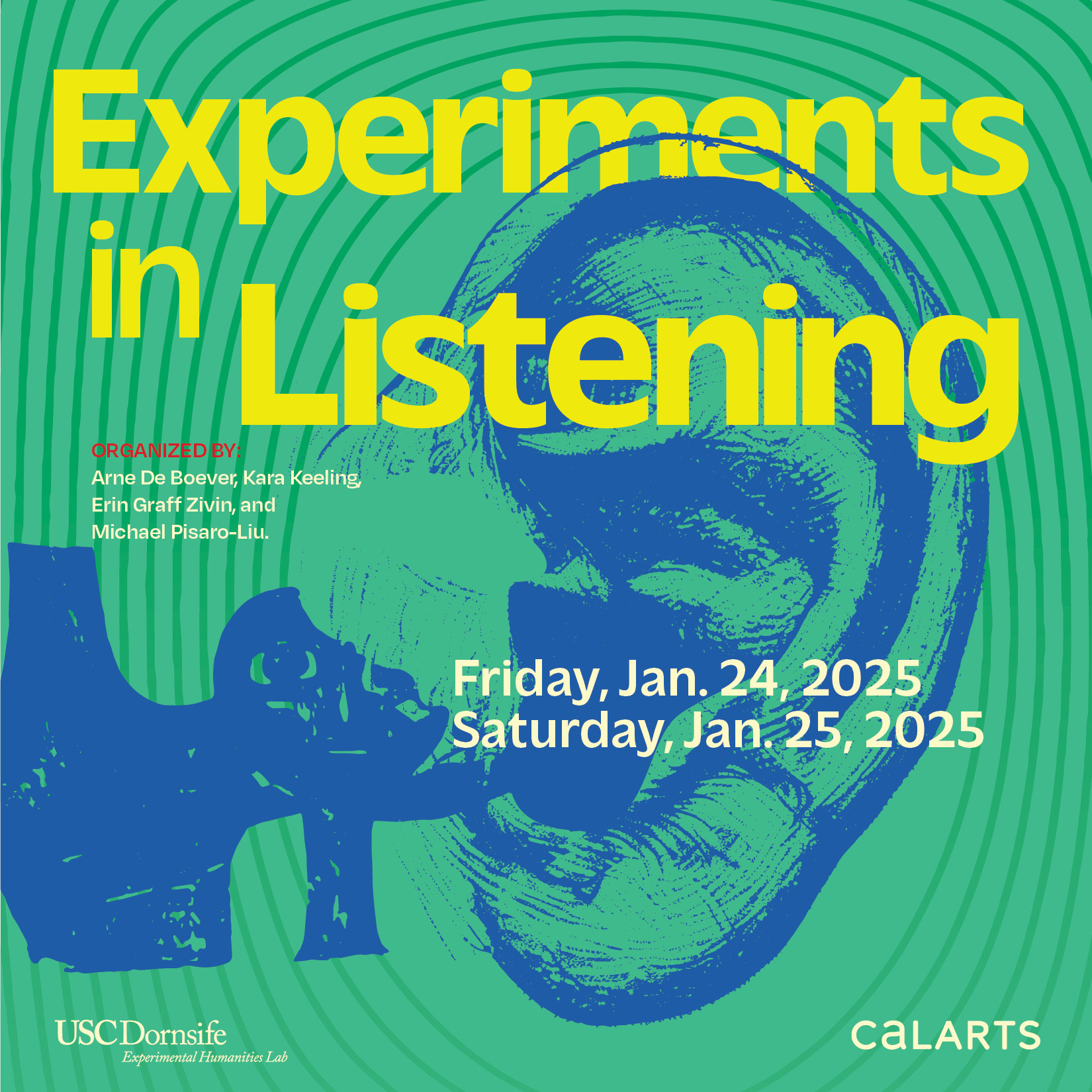
  • Experiments in Listening–boundary 2 annual conference

    Experiments in Listening–boundary 2 annual conference

    **PLEASE NOTE THE LOCATION CHANGE FOR SATURDAY DUE TO THE HUGHES FIRE**

    Experiments in Listening

    Friday, January 24-Saturday January 25, 2025

    University of Southern California and California Institute of the Arts

    Supported by the MA Aesthetics and Politics program and the Herb Alpert School of Music at the California Institute of the Arts; the USC Dornsife Experimental Humanities Lab; the Division of Cinema and Media Studies at USC’s School of Cinematic Arts; and boundary 2: an international journal of literature and culture

    With additional support from the Dean of the School of Critical Studies at CalArts; the USC Dornsife Graduate Dean and Divisional Vice Dean for the Humanities, the USC Department of Comparative Literature, and the USC Department of English. 

    This event is also supported by the Nick England Intercultural Arts Project Grant at CalArts. 

    Organized by Arne De Boever, Kara Keeling, Erin Graff Zivin, and Michael Pisaro-Liu. 

    “To anyone in the habit of thinking with their ears…” Thus begins Theodor W. Adorno’s famous essay “Cultural Criticism and Society”. But what does it mean to think with one’s ears? How does one get into the habit of it? And what are the critical and societal (ethical and political) benefits of thinking with one’s ears?

    “Experiments in Listening” proposes to address these questions starting from the experimental performing arts. Conceived between an arts institute, a university, and a contrarian international journal of literature and culture, the conference seeks to “emancipate the listener” (to riff on Jacques Rancière) into considering their ears as not only aesthetic but also political instruments that are as central to how we think, make, and live as our speech.


    Friday, January 24

    University of Southern California

    10am-12n

    ROOM: USC, Taper Hall of Humanities (THH) 309K

    boundary 2 editorial meeting for boundary 2 editors 

    Lunch for boundary 2 editors and conference speakers

    *

    1:30pm-3:15pm

    ROOM: USC, SCA 112

    Listening session/ Moderator: Erin Graff Zivin 

    Gabrielle Civil, “listening: in and out of place”

    Fumi Okiji, “To Listen Ornamentally” 

    Josh Kun, “Migrant Listening”


    3:30-5:30pm

    ROOM: USC, SCA 112

    Listening session/ Moderator: Kara Keeling

    Michael Ned Holte, “Looking for Air in the Waves”

    Mlondi Zondi, “Sound and Suffering” 

    Leah Feldman, “Azbuka Strikes Back”

    Nina Eidsheim, “Pussy Listening”


    6pm-7:30pm

    Dinner for conference speakers — USC


    8:00-10pm

    ROOM: CalArts DTLA building. 1264 West 1st Street. 

    8pm: Reception

    8:30pm: Screening of Omar Chowdhury, BAN♡ITS (17m22s, 2024) (in progress).

    Out near the porous, lawless eastern border between Bangladesh and India, a diasporic artist returns to make works with a band of washed up ban♡its who are obsessed with Heath Ledger’s Joker. As they comically re-enact their glorified past, we confront the divergent histories and philosophies of peasant banditry and political resistance and its unexpected causes and contexts. The resulting para-fiction questions its authorship and morality and asks: when the art world comes calling, who are the real ban♡its?

    9pm: Performance by Notnef Greco (Deviant Fond and Count G).


    Saturday, January 25

    The REEF building (1933 South Broadway, Los Angeles, California 90007)

    10-11:50am: 

    ROOM: Screening Room, 12th floor 

    Coffee and pastries.

    Listening session/ Performance. Moderator: Arne De Boever

    Arne De Boever, “Silent Music”

    Michael Pisaro-Liu, “Experimental Music Workshop” (1 hour). Performance of Antoine Beuger, Für kurze Zeit geboren: für Spieler/ Hörer (beliebig viele)/ Born for a Short Time: For Performers/ Listeners (as many as you like) (1991). 

    Conference speakers will participate in the performance. Performance will be audio/video-recorded and posted at boundary 2 online. A livestream will be available here. Composer Antoine Beuger will be joining us for the Q&A after the performance via zoom. 

    Lunch for conference speakers–Commons, 12th floor

    1:30pm-3:15pm

    ROOM: Screening Room, 12th floor

    Coffee and pastries.

    Listening session/ Moderator: Kara Keeling

    Gavin Steingo, “Whale Song Recordings”

    Natalie Belisle, “Inclination: The Kinaesthesis of Afro-Latin American Sound”

    Stathis Gourgouris, “The Julius Eastman – Arthur Russell Encounter”


    3:30-5:15pm

    ROOM: Screening Room, 12th floor

    Listening session/ Moderator: Erin Graff Zivin

    Edwin Hill, “On Acoustic Jurisprudence”

    Bruce Robbins, “Listening On Campus” 

    Jonathan Leal, “If Anzaldúa Were a DJ, What Would She Spin?”


    5:30-6:15pm

    ROOM: Screening Room, 12th floor

    Student Theory Slam/ Moderator: Arne De Boever

    Reina Akkoush 

    Jacob Blumberg

    Sean Seu

    Inger Flem Soto


    6:30pm-8pm

    Dinner for conference speakers–Commons, 12th floor


    8pm 

    ROOM: Screening Room, 12th floor

    8pm: Reception

    8:30pm: Tung-Hui Hu, “How to Loop Today”


    Listener Biographies

    Reina Akkoush is an award-winning Lebanese graphic and type designer currently pursuing an MA in Aesthetics and Politics at the California Institute of the Arts. Research interests include Middle Eastern design, Arabic typography, Marxist critical theory, cultural memory and decolonial thought in the global south. 

    Natalie L. Belisle is an Assistant Professor of Spanish and Comparative Literature in the Department of Latin American and Iberian Cultures at the University of Southern California, where her research and teaching focus on contemporary Caribbean and Afro-Latin American literature, cultural production, and aesthetics. Professor Belisle’s first book Caribbean Inhospitality: The Poetics of Strangers at Home will be published by Rutgers University Press in 2025

    Jacob Blumberg is an artist and producer working across the disciplines of music, film, photography, fine art, performance art, and religious art. Global in scope and local in focus, Jacob’s work as a collaborator and creator centers deep listening, voice, and play.

    Arne De Boever teaches American Studies in the School of Critical Studies at the California Institute of the Arts. He is the author of seven books on contemporary fiction and philosophy, as well as numerous articles, reviews, and translations. His new book Post-Exceptionalism: Art After Political Theology was published by Edinburgh University Press in 2025.

    Omar R. Chowdhury is a Bangladeshi artist and filmmaker. He creates para-fictional installations, films and performances that animate the fault lines of diasporic life and its various radical histories. He has had recent presentations and performances at Busan Biennial 2024 (South Korea), Contour Biennial 10 (Mechelen), Dhaka Art Summit, Beursschouwburg (Brussels), De Appel (Amsterdam), and screenings at International Film Festival Rotterdam, Film and Video Umbrella (London), Haus der Kulturen der Welt (Berlin), and Queensland Gallery of Modern Art (Brisbane) for Asia Pacific Triennial 8.

    Gabrielle Civil is a black feminist performance artist, poet, and writer, originally from Detroit, MI. Her most recent performance memoir In & Out of Place (2024), encompasses her time living and making art in Mexico. The aim of her work is to open up space. 

    Nina Eidsheim is a vocalist, sound studies scholar and theorist. She brings extensive knowledge, experience and innovative approaches to practice-based research that focuses on sound and listening. The author of Sensing Sound: Singing and Listening as Vibrational Practice and The Race of Sound: Listening, Timbre, and Vocality in African American Music

    Inger Flem Soto is a doctoral student in Comparative Studies in Literature and Culture at USC. She is interested in issues of sexual difference, continental philosophy, psychoanalysis, and Latin American feminist thought. Her dissertation focuses on the mother figure in Chilean works of literature and philosophy. 

    Stathis Gourgouris is professor of classics, English, and comparative literature and society at Columbia University. He is the author of several books on political philosophy, aesthetics, and poetics, the most recent being Nothing Sacred (2024).

    Edwin Hill is Associate Professor in the Department of French and the Department of American Studies & Ethnicity at the University of Southern California. His research lies at the African diasporic intersections of French and Francophone studies, sound and popular music studies, theories of race.

    Michael Ned Holte is a writer, curator, and educator living in Los Angeles. Since 2009, he has been a member of the faculty of the Program in Art at CalArts, and he currently serves as an Associate Dean of the School of Art. He is the author of Good Listener: Meditations on Music and Pauline Oliveros (Sming Sming Books, 2024). 

    Tung-Hui Hu is a poet and media scholar. He is the author of three books of poetry, most recently Greenhouses, Lighthouses, which grew out of his graduate studies in film, as well as two studies of digital culture, A Prehistory of the Cloud and Digital Lethargy: Dispatches from an Age of Disconnection, an exploration of burnout, isolation, and disempowerment in the digital underclass. 

    Kara Keeling is Professor and Chair of Cinema and Media Studies in the School of Cinematic Arts at the University of Southern California. Keeling is author of Queer Times, Black Futures (New York University Press, 2019) and The Witch’s Flight: The Cinematic, the Black Femme, and the Image of Common Sense (Duke University Press, 2007). 

    Josh Kun is a cultural historian, author, curator, and MacArthur Fellow. He is Professor and Chair in Cross-Cultural Communication in the USC Annenberg School and is the inaugural USC Vice Provost for the Arts.

    Jonathan Leal (he/him) is an Assistant Professor of English at the University of Southern California. He is the author of Dreams in Double Time (Duke University Press, 2023), which received an Honorable Mention for Best Book of History, Criticism, and Culture from the Jazz Journalists Association. His next book, Wild Tongue: A Borderlands Mixtape, is under contract with Duke University Press. 

    Fumi Okiji is Associate Professor of Rhetoric at the University of California, Berkeley. She arrived at the academy by way of the London jazz scene and draws on sound practices to inform her writing. 

    Michael Pisaro-Liu is a guitarist and composer. Recordings of his music can be found on Edition Wandelweiser, erstwhile records, elsewhere music, Potlatch, another timbre, ftarri, winds measure and other labels. Pisaro-Liu is the Director of Composition and Experimental Music at CalArts. 

    Bruce Robbins is Old Dominion Foundation Professor in the Humanities at Columbia University. He is the author of Secular Vocations: Intellectuals, Professionalism, Culture (1993), Perpetual War: Cosmopolitanism from the Viewpoint of Violence (2012), and, most recently, Atrocity: A Literary History (2025).

    Gavin Steingo is a professor in the Department of Music at Princeton University. He is working on a series of books and articles about whales, music, politics, and the environment. 

    Sean Koa Seu practices dramaturgy, theater direction, and production. He has credits with the National Asian American Theatre Company, Transport Group, and Lincoln Center Theater. He produced the short documentary The Victorias, which was acquired by The New Yorker in 2022. 

    Erin Graff Zivin is Professor of Spanish and Portuguese and Comparative Literature at the University of Southern California, where she is Director of the USC Dornsife Experimental Humanities Lab. She is the author of three books—Anarchaeologies: Reading as Misreading (Fordham UP, 2020), Figurative Inquisitions: Conversion, Torture, and Truth in the Luso-Hispanic Atlantic (Northwestern UP, 2014), and The Wandering Signifier: Rhetoric of Jewishness in the Latin American Imaginary (Duke UP, 2008)—and is completing a fourth book entitled “Transmedial Exposure.” 

    Mlondi Zondi (they/he) is an assistant professor of comparative literature at the University of Southern California. In addition to scholarly research, he/they also work in performance and dramaturgy. Mlondi’s writing is forthcoming or has been published in TDR: The Drama Review, ASAP Journal, Liquid Blackness, Contemporary Literature, Text and Performance Quarterly, Mortality, Canadian Journal of African Studies, Safundi, Performance Philosophy, Espace Art Actuel, and Propter Nos.

  • Nitzan Lebovic–Complicity 4 Our Time

    Nitzan Lebovic–Complicity 4 Our Time

    Complicity 4 Our Time

    Nitzan Lebovic

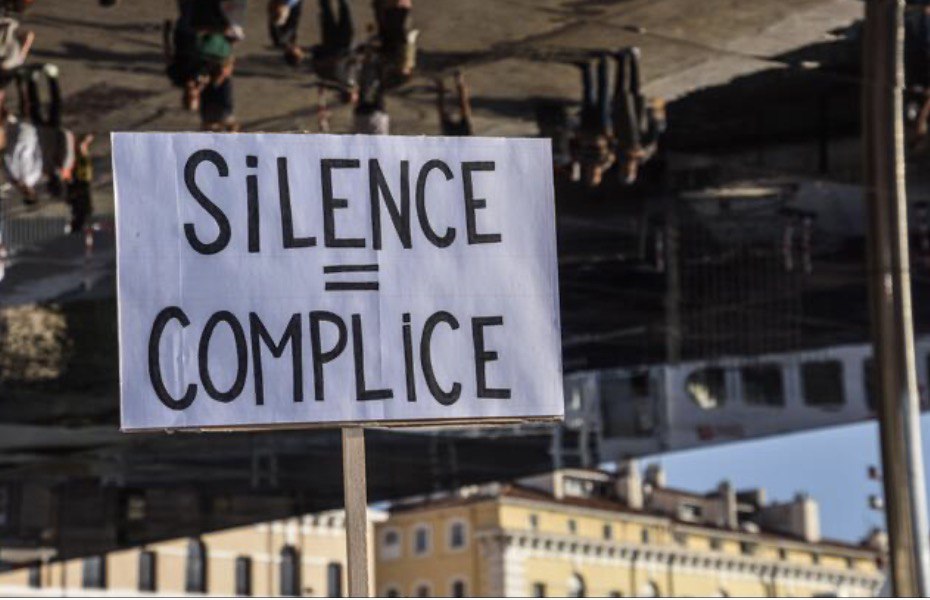
    One buoyant image I’ll remember from the Gaza protests of last spring is the photograph of students at Sciences Po in Paris flashing victory signs over a placard that read “Sciences Po Complice” (Sciences Po is accomplice). The sign hung, alongside a number of Palestinian flags, from the rail outside a university room they had occupied. The protest in Paris followed similar protests, and signs, carried by students in the encampment movement, or activists in the Black Lives Matter protest. Like them, it constituted a rebellion against institutional complicity. The image from Paris was burnt into my memory not only because France has often been identified with the starting point of revolutionary movements, but because it captured a cultural and a discursive shift regarding complicity, a rejection of the politicized opposition between perpetrator and victim, active and passive, action and inaction. But before we discuss the present investment in complicity, what is it, exactly?

    The Word

    The term complicity was first used by Thomas Blount, a reader of Thomas Hobbes’s Leviathan (1651), in his Glossographia, which appeared in 1656. Blount wrote: “Complices: from complex, icis: companions, or partners in evil.”[i] Blount reached back to the 1400s, when the term complicare was current, applying it to the mechanism that enabled the sovereign to overcome the danger of stasis, or civil strife. For Blount, and his friend Hobbes, civil war (1642-1651) and complicity with tyranny were not abstract threats.

    The word did not catch on immediately, but resurfaced in North America, during the early nineteenth century, to describe the accountability of the individual before the law. After 1945 complicity felt different: if for Blount complicity was related to a new understanding of sovereignty and “a complicit multitude for good or/and evil,” after 1945 the word was privatized: In the “subsequent Nuremberg proceedings” against Nazi industrialists and legalists, the military tribunals insisted on linking complicity in genocide to named perpetrators, rather than hosts of complicit actors, or corporations. It was a surprising but wise idea to include “complicity in Genocide” as article IIIe of the Genocide Convention (1948), but the meaning of “complicity” was not explained. Two years later, the US Senate Foreign Relations Subcommittee conditioned its agreement to ratify the Genocide Convention by asking “the words ‘complicity in genocide’ to mean participation before and after the fact…in the commission of the crime of genocide,” so it is clear that the US, or its ally the West German government, cannot be accused of complicity. The Cold War made it necessary to separate the world into good and evil, right and wrong, Americans and Russians. Complicity changed its meaning yet again.

    Once it enters the language of modern power-relations, complicity grows like a fungus,  its etymological mycelia entwining (πλέκω, plékō: weave, tangle) social solidarity, cultural symbols, and political legitimacy. Within each of these elements complicity focuses on a short-term, present-oriented benefit. In other words, the political semantics of complicity follow its historical form as a passive-active entanglement that is always partial, and always hiding in the lowlands dominated by striking peaks. Digging it out means excavating a political mechanism buried deep underground. Complicity thrives where knowledge is suppressed. It spreads in hierarchical systems but is hard to explain if one looks for simple good vs. evil sort of rhetoric.

    Complicit Entanglement

    Complicity is a form of entanglement. It is impossible to understand complicity without knowing something about its context, the before and after of what one is complicit with. The writers who suffered the consequences of World War II knew that. They noticed that complicity proposes a better explanatory framework for atrocities than the usual focus on perpetrators and victims, leaders and the masses, generals and soldiers. The deeply traumatizing experiences the Jewish-Italian author Primo Levi analyzed in his writing, the dark coercive atmosphere the German author Hans Fallada portrayed in his novels, and the “perpetual state” the German-Jewish political thinker Hannah Arendt warned about were not the result of spontaneous acts of violence but the result of a carefully crafted system that made violence a condition. The Nazis made a systematic effort to blind followers to the act, while blaming its victims for it. As Levi wrote in The Drowned and the Saved, while gesturing towards T. S. Eliot, “most Germans behaved in the twelve years of Hitler, in the illusion that not seeing was not knowing, and that not knowing relieved them of their own share of complicity or connivance.” As for the victims, they “bind them with guilt, cover them with blood, compromise them as much as possible. A bond of complicity is thus forged between them and their masters, and there is no turning back.” Indeed, the Nazis made both their subjects and their victims accomplices to the crimes they designed planned and executed. Recent studies show that there were more Ukrainian, Romanian, and Baltic guards, Jewish capos, and simple German soldiers managing the killing than Hitlers, Himmlers, and SS sadists with whips. Said differently, though eruptions of evil tend to be associated with a single person, a single party, a single country, those who endure these crises know they can only happen when countless individuals—with and without jackboots—take on countless different chores. Complicity is moving on a spectrum, not a single static disposition. One can be actively complicit by aiding the criminal action, or passive as a bystander who ignores it and denies any knowledge of it. As Arendt explained, without complicity both totalitarian and liberal systems would break down, their terrorist or consumerist logic sapped of vigor.

    The most famous accounts of the Holocaust are taught as exceptional representations, the experiences of individuals. (We all know the name of Anne Frank.) Levi warned against this when he depicted the concentration camp as a “Grey Zone,” where victims were coerced into committing inhumane acts, with the implication that they shared responsibility with their torturers for what happened in the camps. Fallada’s protagonists experienced an emotional “state of emptiness” that made it possible for them to aid enthusiastic perpetrators, with or without agreeing with their ideology. And Arendt noted, in Eichmann in Jerusalem (1963), the different forms of “banality” with which Eichmann (who we now know was not just powerful but deeply committed anti-Semite)—and the Jewish councils he beat into docility—carried out the orders to transport Europe’s Jews to the death camps. But despite the efforts of some to insist on the uniqueness of their experiences, Levi, Fallada, and Arendt were not alone. Other postwar writers underlined the place of complicity in new forms of politics. In 1959 Eugène Ionesco, the French playwright of Romanian descent, nicknamed complicit behavior “rhinoceritis.” A few years later, Rolf Hochhuth accused Pope Pius XII of collusion with the Nazis (The Deputy, 1963). Shortly thereafter, Peter Weiss’s play The Investigation (1965) presented the accused in the Auschwitz trials as complicit with the Holocaust’s “industrial killing.” Ironically, it is precisely because complicity requires a context and a spectrum of, often conflicting, positions, that literature was quicker to realize its explanatory power.

    The Legacy of Complicity

    The lesson had not been learned. Since 1945, complicity did not just spread but it became the condition of our political lives. During the Cold War, intelligence services offered Nazi criminals impunity and prosperity. Later apartheid in South Africa (1948–94) and the ongoing colonization of Palestinian land (1948-present) met with self-serving justifications, and sometimes open approval, by the international community. By 1989, the anticolonial theorist Mihaela Mihai writes, complicity had turned into a social norm, “interstitial and anchored in a series of practices, relationships, attitudes, and institutions.” That same year, in South Africa the Durban Democratic Association declared, in a pamphlet titled “The State of Emergency Is beyond the Rule of Law,” complicity so evident and its attendant political condition, emergency, so normalized that the very purpose of emergency laws was to encourage complicity. And the Truth and Reconciliation report admitted the failure of the Commission “to spread wide enough its examination of civil society’s complicity in the crimes and misdeeds of the past.”

    One of the outstanding moments of the past year was Jonathan Glazer’s speech at the Oscars. By loitering in the walkway, potting shed, and bedrooms of the Höss family home beside Auschwitz, Glazer’s movie, The Zone of Interest (2023), spotlit the complicity of German civilians—even children—with all that happened on the far side of the garden wall. Philippe Sand’s The Ratline (2021) is dedicated to the family and friends of the Nazi criminal Otto Wächter. Paul Lynch’s Booker Prize–winning novel, Prophet Song (2023), focused on Eilish, a wife and a mother who’s doing her best to ignore a coming civil war, and whose father tells her, “You are lying to me, you are always lying, I knew you would be complicit in this.” All she wants is to close her eyes and nod off, so naturally she is told, “All your life you’ve been asleep, all of us sleeping and now the great waking begins.” Those who see complicity for what it is understand that change cannot occur without a complete shakeup of structures, without removing the agents of complicity from positions of power.

    And let us not neglect the academic discussion of complicity. After a recent wave of headline-grabbing resignations, the leverage elected officials and rich donors wield over university policies can’t be denied, the flipside of which is the presumption that deans, presidents, professors will wordlessly adopt the official line. Recent journal articles attest to the history of academic complicity, a given since neoliberalism brought university accountants to heel. For the political sociologist Thomas Docherty, intellectuals and academic institutions became complicit with power when they abandoned the vocabulary of dissent, adopting instead the lexicon of petty politics, social norms, and economic dictates. As Alice Gast, the president of London’s Imperial College (2014-2021) and a board member of Chevron, put it, professors are expected to behave like “small business owners.” Rather than offer a measured critique, business owners are expected to sell their products to customers.

    Michael Rothberg, an American professor of comparative literature, explains that implication, originated in complicare, forms “a realm where people are entangled in injustices that fall outside the purview of the law and where the categories into which we like to sort the innocent and the guilty become troubled.” John Hamilton, a professor of German and expert in classics at Harvard explains that “The complacent” [from the Latin verb placere “to be pleasing or satisfying”] are too “inappropriately pleased with [themselves] or with a situation to the point where any change, reconsideration, or improvement is dismissed as unnecessary.” He means his fellow academics.

    The historians of the Holocaust Robert Ericksen, Doris Bergen, and more recently Mary Fulbrook, updated the discussion of complicity and “bystanders” by applying it to those within academia who collaborated with the Nazi regime while “considering themselves respectable scholars.” The celebrated philosopher Susan Neiman argued, in recent articles to the New York Review of Books (October 23, November 3, 2023), that German institutions replaced their former complicity with historical anti-Semitism, with the Israeli apartheid. In a recent book, Maya Wind points to the deep and consistent complicity of Israeli universities with the security services and the occupation. Will universities learn the lesson its own faculty is warning them about? Probably not—there’s too much money at stake, as the baffling attacks on its own student bodies, in the different encampments and protest, proves.

    If change will not come from the academic institutions, where could it come from? The legal sociologist Francine Banner explained, “After decades of treating risks to society as stemming from individual bad choices, systems are being called to account for the risks created through processes of disenfranchise[ment]. . . . Complicity is at the forefront of these conversations.”

    The imprint of complicity is too visible to be ignored. After all, article IIIe of the Genocide Convention (1948) denounced “complicity in genocide,” and among those tried at Nuremberg were industrialists and judges deemed complicit in crimes against humanity. But the Genocide Convention did not trigger action against those complicit in genocides, and the big corporations that financed and armed Nazi Germany were acquitted or released with a slap on the wrist. A new branch of international law attempted—and failed—to figure out the right relationship between criminal law and complicity, but as the German legal theorist Helmut Aust explained, a “community-oriented law fails to provide convincing reasons why complicity is no longer to be tolerated in international law,” recommending instead a comprehensive international reform addressing state complicity. In contrast, Francine Banner’s freshly published book recommends a more cautious approach to complicity within the limits Aust identified as “community-oriented,” but also pointed out the failure of the justice system to take on complicity. She acknowledges that recent appointments to and rulings by the United States Supreme Court had led many interpreters to speak of “‘complicit bias,’ a recognition that institutions like courts are not neutral but play a significant role in sustaining inequalities.” So again, who will take complicity by its horns?

    Complicity 4 Our Time

    Complicity, complacency, and bystander are important categories because, as the historian Victoria Barnett observed already two decades ago, “they helped create a world in which genocide was possible.” Discussing “complicity” is not an easy task, and not only because we are not used to thinking of it as a historical category. Complicity adds another layer of institutional complication to an already dark story about the destructive character of humanity. More specifically, the question of complicity is relevant not only to the genocidal violence the US and the EU are currently supporting in the Middle East but to the planetary struggle against climate change. After all, lucrative weapon deals will not help fighting the massive process of desertification large swamps of the world is experiencing, at the moment. Not knowing complicity from dissent will not relieve us of our share of complicity or connivance with more and greater forms of destruction. The students in the encampments have shown us a different path.

    Nitzan Lebovic is Professor of History and the Apter Chair of Holocaust Studies and Ethical Values at Lehigh University. Nitzan published books about the history of life-philosophy and biopolitics, the history of melancholy, nihilism and catastrophe. His forthcoming book is titled Homo Temporalis: German-Jewish Thinkers on Time (Cornell University Press, 2025). For other essays of his about the history of complicity see Comparative Literature and Culture (2019), History & Theory (2021), and the forthcoming “Forms of Complicity: History and Law in the Kastner Affair” (Journal of the History of Ideas, 2025).

    [i] T. Blount, Glossographia; or a Dictionary Interpreting the Hard Words of Whatsoever Language, now used in our refined English Tongue (London, Tho. Newcomb, 1681 [1656]), 148.

  • Darren Byler — Discovering “Terrorists” among “Friends”: Policing in Xinjiang in the 1990s and 2000s

    Darren Byler — Discovering “Terrorists” among “Friends”: Policing in Xinjiang in the 1990s and 2000s

    by Darren Byler

    When Tursun decided to become a police officer in 1992, it seemed like the opportunity of a lifetime.[1] The state had just opened up a pathway for Uyghur high school students who excelled in Mandarin and political theory to study in elite policing academies and other schools in Eastern China (Grose 2019). At the end of the 6 years of training, a secure posting in an urban police department was virtually guaranteed. For someone who came from a village near China’s border with Kazakhstan, it promised a way out of rural poverty and, Tursun believed, a way of creating a more just society. But at the time Tursun was not yet fully aware of the fact that resource disputes between native Uyghurs and newly arrived Han settlers in the desert oases of Southern Xinjiang was one of the reasons why he was being trained to join the Xinjiang police force.

    As I write in my book Terror Capitalism (2022), the intensification of policing in Northwest China, coincided with a development of a Han migrant settlement campaign to “Open up the Northwest.” This campaign which centered on natural resource extraction and industrial farming in the ancestral lands of the Uyghurs in the Southern part of the region precipitated flashes of violence related to land theft, systemic ethnic discrimination and new restrictions on Uyghur autonomy. In April 1990, in the community of Barin, a village near the city of Kashgar, tension over access to irrigation and land, boiled over into a brief farmer-led Uyghur insurgency (Roberts 2020). A detachment of armed police and military arrived within several days and opened fire on the farmers who occupied a community government building armed primarily with hunting rifles and farming tools. Those who I interviewed who were in the surrounding communities at the time said that bodies of the insurgents were loaded in trucks and taken away.

    But there was a more fundamental change in the community beyond the disappearance of those directly involved in the uprising. Now, it appeared, that state authorities viewed the majority of Uyghur villagers in the surrounding communities as “troublemakers” simply because of their ethnicity and their proximity to the farmer uprising. Over the next several months nearly 8000 people were officially arrested (Roberts 2020). Vast numbers of people in the prefecture were forced to attend self-criticism sessions and study political ideology. They were asked to search their hearts and consider how they might have contributed to a lack of loyalty to the Party’s mission to develop and extract regional economic resources for the benefit of “the masses.” Did they consider Uyghur possession of their own lands more important than contributing to the wealth of the county? Didn’t they know that when they questioned the settlement and land distribution policies they were challenging the correctness of the Party?

    Uyghurs in this community said that it felt like the Maoist ideological campaigns that had ended with the Cultural Revolution in 1976 were returning, but that this time they were pointed not at “counterrevolutionary” enemies who supported the “capitalist road,” but rather at Uyghurs who opposed the preferential treatment for Han settlers in the new state-directed export-oriented capitalist economy. They came to understand that they were seen as impediments to the development of what was now becoming an internal settler colony in China’s post-Cold War economic rise. In the new social order, civilization itself was equated with state-led market development. Over the next two decades Uyghurs came to see how a discourse of terrorism could be used to deem them both an internal enemy of the state and of the civilized world in general if they opposed this disempowering form of development (see also Fischer 2013).  As always-already potentially terrorists Uyghurs could be framed by an internal otherness that justified drastic policing measures and eventually led to mass internment and imprisonment. Over time, the specter of the terrorist produced a fear-driven economic and political logic for the state, and the corporations it partnered with, that resulted in billions of dollars of investment in counter-terrorism surveillance in Uyghur communities.

    As social theorist Michael Dutton has argued (2005), since policing in China emerged out of this revolutionary context of the 1950s, rather than, for example, the hunting of slaves as in the United States or the pacification of the working class in Britain, Chinese policing was organized primarily around a friend or enemy distinction—with “friend” (pengyou) figured as the revolutionary masses, or the people, and the enemy figured as foreign imperialists and domestic counterrevolutionaries. Importantly, because of the revolutionary impulse of Chinese policing the latter category of enemies could at times be rehabilitated through education and carceral punishment if they were able to recognize the liberatory potential of socialist mass struggle.[2] They were, regardless of their ethnicity, still potential “compatriots” (tongbao) in the multi-national Chinese revolutionary project. But what happens when such compatriots are deemed “separatists” or “terrorists”? This is the central question this essay will explore.

    Mao’s 1957 essay on the “Correct Handling of Contradictions Among the People,” supplies a rationale for making fine distinctions between enemies and wayward friends. This sorting and productive capacity of policing as a tool of educating and persuading provided an opening for “thought work” (sixiang gongzuo)—communal struggle sessions where those deemed out-of-line proclaimed self-criticisms and professed their new understandings of Maoist thought. Such targeted individuals were often placed under concentrated surveillance in reeducation and labor camps as internal enemies, or at a minimum, they were stigmatized in their home communities and they were viewed as compatriots who had failed in their revolutionary resolve. Their fellow community members were tasked with observing their progress, looking for any slip-up in submissive attitudes. At the end of the Maoist campaigns in 1976, the spectrum of what counted as friend was expanded to include former political prisoners and these “wayward friends” were reunited with the masses through a process called “rehabilitation” (pingfan). This process was organized by “rehabilitation committees” (pingfan weiyuanhui) who considered formal appeals those on watchlists and petitions of family members on their behalf, and organized periods of close surveillance in the communities where the wayward friends returned.

    Throughout the 1980s democracy movements, particularly on college campuses, accompanied an emergence of capitalist production and export-oriented economy. And for a time, it appeared as though the category of the internal enemy was on the verge of disappearing. Then in 1989 that prospect collapsed with the mass killing in Tiananmen Square and subsequent disappearances of thousands of democracy activists—mostly Han college students, but also Uyghur and other ethnic minority young people—all of whom were deemed internal enemies of the state.

    With the violence in Barin in 1990, as noted at the beginning of this essay, a further reorientation of “enemies” and “friends” distinctions toward Muslims in Xinjiang demanded a new police force that was equipped to decode Uyghur opposition to the state—elaborating a new sub-category in the friend-enemy continuum—“separatists” (Ch: fenlie zhuyi zhe; Uy: bölgünchi)—and  the threat it posed toward settler claims to possession of Uyghur lands (Tynen 2020). Over the next decade, teams of state workers, would be tasked with surveilling families in communities where discontentment was most pronounced. As one of these surveillance workers put it, “We worked for months on end without any days off, rummaging through the villages and homes of Uyghur farmers, making lists of names of so called ‘separatists’ and reporting their names to the upper-level officials. As human surveillance workers we searched people’s homes, sometimes even at late night hours, looking for any suspicious books that might be spreading a ‘separatist” ideology’” (Ayup 2022, 27).

    In Xinjiang the term separatist, which emerged in Chinese state discourse in relation to Taiwan’s autonomy in the 1950s, rose to replace the Maoist term “counterrevolutionary” in the 1980s as changing cold war dynamics and the turn toward a market economy following Mao’s death made “national unification” (Ch: guojia tongyi) with Taiwan appear to be more of a possibility. The term was extended by Chinese state discourse beyond Taiwan to discussions in Tibet and Xinjiang in the 1990s in response to the rise to international prominence of the Dali Lama and Tibetan government in exile. As the Dali Lama garnered support in India and the endorsement of international celebrities, the Chinese authorities worried that the Free Tibet movement might spark a “ethnic separatist” revolt within      China’s borders. This fear was given more force with the dissolution of the Soviet Union in December 1991 and the independence of the Central Asian republics. In Xinjiang these factors solidified a shift toward policing the perceived Muslim “separatist” threat (Becquelin 2000).

    Chinese leaders viewed the Barin Uprising as a sign of Uyghur desires for greater self-determination. Increasing Han settlements in Uyghur majority areas had the benefit of both gaining access to natural resources, but also, as a result of the fracturing of the Soviet Union—China’s long-term rival—building new avenues for Chinese markets in Central Asia and attending to the resource needs of Chinese manufacturers. These economic and geopolitical factors precipitated a change in policing in Xinjiang—a change that Tursun, the Uyghur police officer whose story begins this essay, would be a part of.

    But, of course, historical changes are difficult to recognize at first, especially when they are orchestrated behind closed doors in the headquarters of the Ministry of State Security. About the time Tursun graduated from the police academy another major incident occurred. In 1997, near his home village in Ghulja, Uyghurs protested the breakup and arrest of a youth organization that taught Islamic and Uyghur moral behavior and traditions (Roberts 2020). Although the state denies this figure, it is likely that more than 100 Uyghurs were shot in the streets and more than a thousand more were taken away, arbitrarily detained in an opaque process that ranged from “reeducation through hard labor” in camps to more formal imprisonment. Some Uyghurs fled across the border to Central Asia, eventually fleeing to Afghanistan to escape extradition back to China only to be turned over to the U.S. military and sent to Guantanamo Bay where they were eventually released without charge.

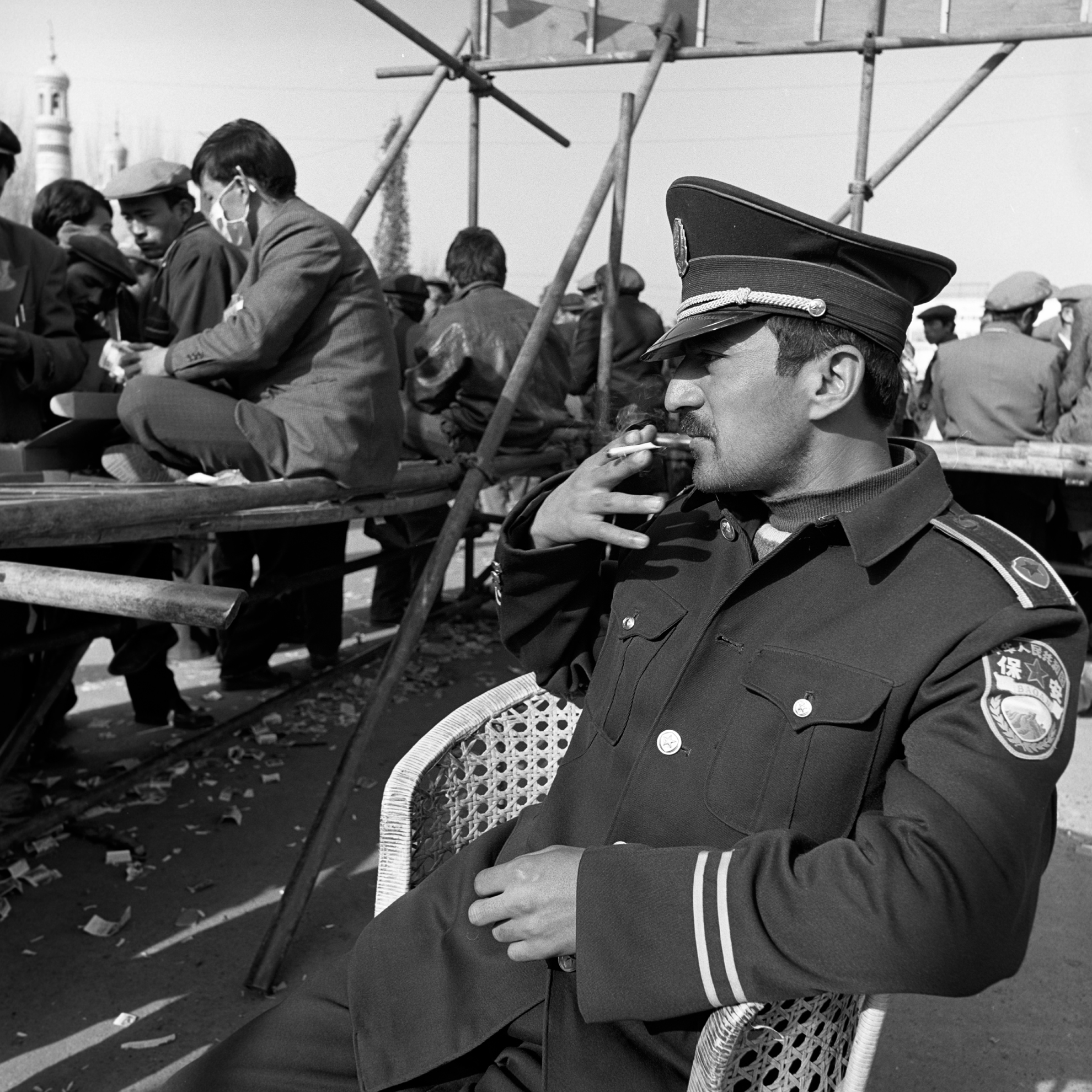
    When Tursun graduated with a degree in policing science in a Chinese-language policing academy the next year, he found himself thrust almost immediately into a hunt for phantom “separatist gangs” like the protestors who organized the marches. Throughout the Xinjiang police force, officers were tasked with implementing a “hard strike campaign”—part of a series of campaigns that would culminate, as I will explain below, in the “People’s War on Terror.”  One of Tursun’s roles was to act as interpreter and translator, turning Chinese language policing science and directives into action in Uyghur communities by interpreting Uyghur confessions for Han police commanders. His beat was nearly exclusively in Uyghur neighborhoods and villages where he was often accompanied by a non-Muslim partner. He was to be the eyes, ears, and voice of the state.

    Then, almost immediately after September 11, 2001, a new category in the friend-enemy continuum was introduced in Chinese policing rhetoric and theory. “Now we were supposed to call them ‘terrorists,’” Tursun told me in Uyghur, interjecting the Chinese word for “terrorist” (Ch: kongbu fenzi). “The vast majority of the groups we found were not separatists or terrorists at all. These were labels we gave to people who committed other crimes, or didn’t commit any crime at all, but who had no one to defend them.” As Gardner Bovingdon (2010) shows in an encyclopedic index of state documents from this period, terrorism charges proliferated in the 2000s with crimes as minor as a Uyghur neighbor accused of stealing a cow from a Han settler being labeled a terrorist activity. Eager to associate the “Uyghur problem” with the Global War on Terror, Chinese officials removed most instances of the term “separatist” from official histories of the 1990s and replaced them with the term “terrorist.” The new term had a different utility. In the post-9/11 context “terrorism” allowed the Chinese state to position itself as an ally to the West and Central Asian republics in the global war against so-called Islamic “extremism” and terrorism. By offering Central Asian republics policing technology, training, and intelligence in addition to infrastructure development projects and trade incentives, Chinese authorities used a security framework to build strategic economic and political relationships that would eventually turn into its ambitious Belt and Road Development Initiative.

    Even more importantly, back in Xinjiang the terrorism label also hardened the “enemy” categorization of Muslims who opposed state-directed development and settlement of their land. No longer were “enemies” viewed simply as counterrevolutionaries or separatists, that is, those who were nevertheless compatriots and who could potentially be rehabilitated.

    For Tursun, “discovering” hidden terrorists became a primary objective. Police units that identified such “gangs” were given large rewards. From Tursun’s perspective, it was as though the policing came to serve a larger disinformation campaign. By “discovering” terrorists, the police units fulfilled their obligation in the crackdown and concealed the structural factors that caused Uyghur protest in the first place. Over and over again Tursun observed or participated in turning informants, forcing them to identify “terrorists,” and using them to break up community networks:

    We had a policy which encouraged people to spy on each other. Often they did this for money, or because we threatened them or their families. Of course we knew that a lot of our tips were just false accusations. Some people did that for money, while some people did that to take revenge on others. But we would arrest people regardless of the truth of information. For example, if four or five people gathered together for activities such as visiting a friend or attending a funeral and someone said it was an illegal gathering to teach Islam or plan violence we would arrest everyone who attended and label the host the ringleader. Everyone knew that at a funeral, people are required to conduct religious rituals. This is normal since Uyghurs are Muslim. But the spy would exaggerate and say it was extremist or terrorist. People who were being accused have no way to prove that they are innocent. Often they ended up being sentenced to 4 or 5 years in prison or “education through hard labor” camps. The informant was given money and we received our commendation. This was so common.

    Tursun found this form of state violence morally repugnant. “Most Uyghurs I met were disgusted by the very idea of terrorism,” he said, “They wanted a peaceful life, a better world for their children.” But he worried that a generation of Uyghur young people who grew up in this atmosphere, where disappearances of Uyghur community leaders became so common, would lash out. Indeed, as Sean Roberts has shown, in some instances the “terrorism” label became a self-fulfilling prophecy (Roberts 2020). While not the norm in Uyghur crimes labelled as terrorism, in a handful of cases in 2013 and 2014, Uyghurs did attack Han civilians in organized suicide attacks. These specific attacks did appear to meet international standards of what constitutes a terrorism crime—though even they may be more appropriately understood to be horrific incidents of mass murder that arise from colonial circumstances. Soon after the terrorism label arrived, Tursun tried to quit his job as an officer. He was told that he needed to serve at least 10 years before he could even begin to consider early retirement. Because he had been granted access to state secrets, quitting would be a slow process. He was told he could be arrested if he quit without a justifiable excuse.

    Over time it became clear that the hopes Tursun had for criminal justice reform would never happen. When he first joined the Public Security Bureau he thought that the presence of college-educated Uyghur officers would help improve the situation. Instead, he saw his fellow Uyghur officers, many of them who he had known for over a decade be worn down by the system. He saw many turn toward alcoholism and become withdrawn from their families. Uyghur police officers were treated with deference and fear by other members of the Uyghur community. It was good to have a friend who was a police officer, since the officer might be able to protect them from the counter-terrorism system by vouching for them. But this friendship was a guarded, political relationship. After all it was a relationship with the eyes and ears of the state, and what stood between being deemed a terrorist-enemy and a friend.

    Even though Tursun was eventually able to leave the Bureau and, through a loophole in the system, escape to Europe, he knows that had he stayed he would have been pressed into service of the mass internment camp system that was put in place in the mid-2010s. “At this point I can’t say that every Uyghur retains some aspect of their humanity,” he said quietly. “Some Uyghur officers will do anything to show their loyalty to the government, no matter what kind of suffering they cause. All they care about are the benefits and power they get from their position. I know there are some Uyghur police who feel bad about the torture that Uyghur detainees are going through now in the camps, but the percentage of those who care are not that high. At this point they are numb.”

    Although policing in China began in a revolutionary moment and was driven at first by Maoist “counterrevolutionary” politics, in the 1990s and 2000s in Northwest China it gave way to colonial-capitalist and counter-terrorism logics that participate in familiar forms of ethno-racialization and dehumanization found in post-9/11 policing systems and counter-terrorism around the world in which Muslims are racialized as deviant others. Although, they emerge from different histories, extrajudicial detention and surveillance of refugees and other unwanted populations from Kashmir, to Palestine, to France and the United States produce similar effects at differential scales (Byler 2022). As China was pulled into a global capitalist economy and the logic of developmentalism settled on a Han-centric mythos of China’s reemergence as a global power, the revolutionary multi-national inclusiveness of China’s framing of political struggle was deeply diminished.

    In 1990s China the Maoist frame of friends and enemies was folded into a concern with “unifying” the country to benefit the masses—understood as the Han majority to the East and the Han settlers who came to the frontier to claim resources for them. Here “friends” came to be those who supported this project, and “enemies” became Uyghur “separatists” who protested these settler claims. Then, in the 2000s, the discourse of Uyghur “separatist” enemies hardened into “terrorists.” Over time, the possibility of full citizenship as “friends” has severely narrowed for Uyghurs. Since 2017, hundreds of thousands of Uyghurs have been warehoused in an expansive prison system for alleged terrorism crimes (Byler 2022). Hundreds of thousands more whose “extremism and terrorism activities are not serious” have been placed in internment camps for reeducation (United Nations 2019). After an intensive period of Chinese language assimilation, ideological indoctrination, and brutal punishment, they are placed in securitized factories where they labor apart from their families and under intensive forms of technological and human surveillance. Together these carceral systems result in the largest internment of a religious minority since World War II. Uyghurs, as always-already “enemy” terrorists have become internal others, marking a turn from compatriot rehabilitation to new policing technologies of control and incarceration derived from global models of the war on terror.

    Darren Byler is an anthropologist and Assistant Professor in the School for International Studies at Simon Fraser University in Vancouver, British Columbia. He is the author of Terror Capitalism: Uyghur Dispossession and Masculinity in a Chinese City and In the Camps: China’s High-Tech Penal Colony. His current research is focused on policing and carceral theory, infrastructure development and global China.

    Works Cited

    Ayup, Abduweli. 2022. The Detainment Factory: A Memoir. Manuscript.

    Becquelin, Nicolas. 2000. “Xinjiang in the Nineties.” The China Journal 44: 65-90.

    Bovingdon, Gardner. 2010. The Uyghurs: Strangers in their own land. Columbia University Press.

    Byler, Darren. 2022. Terror Capitalism: Uyghur Dispossession and Masculinity in a Chinese City. Durham, NC: Duke University Press.

    Dutton, Michael. 2005. Policing Chinese Politics. Durham, NC: Duke University Press.

    Fischer, Andrew Martin. 2013. The disempowered development of Tibet in China: A study in the economics of marginalization. Lexington Books.

    Grose, Timothy. 2019. Negotiating Inseparability in China: The Xinjiang Class and the Dynamics of Uyghur Identity. Hong Kong University Press.

    Roberts, Sean R. 2020. The War on the Uyghurs. Princeton University Press.

    Tynen, Sarah. 2020. “Dispossession and displacement of migrant workers: the impact of state terror and economic development on Uyghurs in urban Xinjiang.” Central Asian Survey 39.3: 303-323.

    United Nations (UN). 2019. Information Received from China on Follow-Up to the Concluding Observations on its Combined Fourteenth to Seventeenth Periodic Reports. 8 October. Geneva: Committee on the Elimination of Racial Discrimination. Available from: undocs.org/CERD/C/CHN/FCO/14-17.

    References

    [1] Although “Tursun” is now living in Europe, he has asked me to use a pseudonym to protect his identity from Chinese authorities and the stigma associated with his past work as Xinjiang police officer.

    [2] Dutton (2005) relies quite heavily on Carl Schmitt’s theorization of political struggle in his analysis of Chinese policing. Scholarship on Maoist intellectual and grassroots history since Dutton’s important contribution to Chinese political theory shows that the generative potential of Maoist framings of revolutionary struggle demands a re-examination of Schmitt’s work and the fascist context it reflects.

  • LI Zhimin and Daniel Braun — The Linking Matters: An International Poetics of Sense-Making and Innovation

    LI Zhimin and Daniel Braun — The Linking Matters: An International Poetics of Sense-Making and Innovation

    by LI Zhimin and Daniel Braun

    This article was peer-reviewed by the boundary 2 Editorial Collective.

    A subtle chain of countless rings

    The next unto the farthest brings;

    The eye reads omens where it goes,

    And speaks all languages the rose;

    And, striving to be man, the worm

    Mounts through all the spires of form.

    ——Ralph Waldo Emerson

    Charles Bernstein has been, of all contemporary American poets, the one who has done the most to bring back those important words and phrases that tend to be “excluded” from circulation.

                                          ——Marjorie Perloff

    When a mother gives an egg to her child and says “egg” at the same time, she is helping her child establish “a link” between language and the world. But what is the nature of this link? As the great Swiss linguist Ferdinand de Saussure explained, langue (by which he meant particular languages, like French, or English, or Mandarin Chinese) is a system of signs which parcels out the world of sense into discretely sayable things. The signs that comprise this system are complex: they are composed of a signifier – the acoustical image, as he called it, that is formed from a combination of a given language’s phonemes – and a signified – the conceptual image or item recalled and indivisibly linked with that string of phonemes. The linguistic sign is not the thing in the world which it names.[1] In the scene described, the mother teaches the child the link between all three elements in a single stroke, bringing the child irrevocably into the world of language – both the particular language, through which this introduction is made, and language in general, what Saussure called langage. Eventually, the child will learn to draw a self-conscious distinction between language and the world which it denominates, between what is sometimes called the linguistic functions of use and mention, as when he refers to ‘egg’: not the reproductive ovum and its nutriment, but the three-letter word spelled /e/g/g/. The creation of these links is the foundation for all human thinking, upon and out of which all of our most complicated thoughts are built. It is from the perspective of these links that we can examine some of the most pressing questions concerning what I will call international poetics, the communication of innovations and norms within and between the poetry of particular languages and cultures, and beyond.[2]

    The best recorded story to demonstrate how the first links between a signified, a signifier, and the real world are created is that of Helen Keller. As she recalled: “As the cool stream gushed over one hand, she spelled into the other the word water, first slowly, then rapidly. I stood still, my whole attention fixed upon the motions of her fingers. Suddenly I felt a misty consciousness as of something forgotten—a thrill of returning thought; and somehow the mystery of language was revealed to me. I knew then that ‘w-a-t-e-r’ meant the wonderful cool something that was flowing over my hand. That living word awakened my soul, gave it light, hope, joy, set it free!”[3 In this passage, Keller vividly describes the moment when “the link” between the word “water”, and the wonderful cool flowing water of the world that was impressed upon on her mind. Though the signifier of the linguistic sign is objective, common to all speakers of a language, the cognitive image to which it is linked, and the emotional associations it bears, are personal, subjective and changeable. The significance of this division between the objective elements of language, and the subjective half to which they are bound and supported, is significant to the study of poetics.

    T.S. Eliot’s theory of an “objective correlative” is a case in point. He states: “The only way of expressing emotion in the form of art is by finding an ‘objective correlative’; in other words, a set of objects, a situation, a chain of events which shall be the formula of that particular emotion; such that when the external facts, which must terminate in sensory experience, are given, the emotion is immediately evoked.”[4] Eliot is correct in suggesting that such an emotion can be “evoked”. However, it is mistaken to assume that “the link” between “the evoker” and “the evoked” is objective. In fact, as exemplified in the case of Helen Keller above, the emotional association with the image of a particular object in one’s mind is formed by a combination of personal experience and collective instruction, the results of which are at once common enough to allow communication among speakers, yet irreducibly individual, and variable among one another, such that we can never know if our signifieds are identical to each other’s. This is indeed one of the great mysteries and miracles of language. Beyond this brute difference of other minds, there are the idiosyncrasies and vagaries of experience that contribute to the formation of our sense of our language. For Helen Keller, the emotional response evoked by the word “water” included the unique joy and enlightenment she experienced when she learned the word. The word retained for her a sense of the discovery of its link to the world. Another reader, one perhaps not deprived of their senses in the way Keller was, might have a completely different emotional response to “a set of objects, a situation, a chain of events,” not only with respect to other readers, but to the artist endeavoring to evoke the objective correlative itself.

    Yet people do share certain common experience, which is what makes Eliot’s theory possible in the first place. All human beings, being human, share certain life experiences and outlooks upon the world that enable them to enjoy the same literary works. The notion of a classic work, enjoyed by people of all nations around the world, is tacit proof of the commonalities across regional differences that make international literary and artistic success possible. People of the same national or cultural background will of course share more personal experience than those of different national or cultural backgrounds. There are artistic works that are highly favored in one culture while not well regarded in others. A good example is the novel A Dream of Red Mansions (《红楼梦》,1744-1754)[5] which is regarded as the best novel ever written in Chinese, yet hardly read in the west.

    Literature often serves a pedagogical function. The degree to which works are read, and continue to enjoy success, often depends on their ability to continue to teach readers something about themselves, and their world. Ezra Pound, another remarkable theorist of literature (and poet), is among the most vociferous exponents of this theory of literary efficacy. He vividly describes the rewards a fruitful reading experience offers as “that sense of sudden liberation; that sense of freedom from time limits and space limits; that sense of sudden growth, which we experience in the presence of the greatest works of art.”[6] Indeed, rewarding reading experiences are those that enlighten and develop our minds, stimulating them to great satisfaction. At the root of any literary judgment, the overall motive force by which literary traditions are sustained, is this affective dimension of reading. To read in an engaged way, to persist in reading, is to be somehow moved by it.

    How does this affective core of reading, which binds traditions and communities together in spite of their differences and distances, hold for the international communication of modern poetry, not least when even the most highly experienced reader of one culture can feel lost in the works of another. Bewilderment occurs not just with respect to the idiomatic sense of another language and culture but, when it comes to poetry especially, the ways in which an artist plays and puns with every level of that language. A story told by the distinguished scholar Huang Yunte about his colleague Zhang Ziqing, is illustrative. Reading Charles Bernstein’s poem “Fear of Flipping,” Zhang persistently asked the poet for the lexical meaning of the words in the poem. Huang explained, “the poet is more invested in the ring of echoes of wall, ball, fall, all, and even the half- rhyming repel, than the lexical meaning of these words. The ricochet of sounds and syllables, creating the titular fear of flipping, like a flip or slip of tongue, looks to walls to keep it inside or floors to hold it up.”[7] In other words, Bernstein is experimenting with the sonic dimension of poetic lines; indeed, one could say that the ‘meaning’ of his verse here is produced by his play effects with the reverberation of rhyming syllables across the poem. Poetic meaning is therefore not restricted to, or even primarily, lexical here. The title of the poem sets the terms for this play by punning on the phrase “fear of falling,” a substitution of one term / phobia for another, which flips the sense of the phrase on its head. The echoing internal rhymes create a verbal image which gives shape and body to this gesture of flipping, retaining the ghost of the original phrase even as it ricochets across the altered soundscape of the lines. This practice will no doubt be recognizable to readers who are familiar with the poetics of the Language School. The play serves as a framework for linking mind and world beyond and between the confines of individual languages, and is definitive of Bernstein’s practice.

    Huang Yunte’s interpretation is not difficult to understand. However, it was wholly foreign to Zhang Ziqing, and would almost certainly be to anyone who did not come to Bernstein’s work with the framework of sound and cognitive play in mind. Modern poetry like his is not unique in being theory-laden – that is, constructed and expounded according to the unique poetics of its practitioners. Nevertheless, modern poetry and poetic theories are two sides of a coin; they stand by working together – all the more so as poetry becomes esoteric in form, further removed from the conventions of ordinary language use, and governed increasingly by rules of composition unique to it. Without knowledge of the theories which govern such an esoteric art, therefore, one can find oneself at sea while reading a modern poem.[8] This is especially true of poetry where innovation does not occur at the lexical level either: indeed, where the poetry at stake is not a matter of lexical play. The divergence of modern poetry from the rules which governed previous traditions – rules of a more subtle kind of artifice intelligible to a broader literate class – has made the dissemination of its doctrines and theories a necessary part of its reception and interpretation. The difficulty a lay but native reader faces with work like Bernstein’s is exacerbated in the international context, where neither fluency in the language of composition, nor education within a broadest concept of the originating culture, can serve as sure guides. It is paramount that Chinese scholars introduce both modern poetry and modern poetic theories together, teaching them as two facets of the same literary phenomenon.

    Many modern poems make good sense in a lot of ways other than the traditional lexical one, which is why they seem quite difficult to understand. T. S. Eliot once said: “We can only say that it appears likely that poets in our civilization, as it exists at present, must be difficult. Our civilization comprehends great variety and complexity, and this variety and complexity, playing upon a refined sensibility, must produce various and complex results. The poet must become more and more comprehensive, more allusive, more indirect, in order to force, to dislocate if necessary, language into his meaning.”[9] Indeed, modern poetry is as difficult to comprehend as modern civilization. The difficulties are comparable, mimetic even, in so far as the poet is driven, in Eliot’s reasoning, by a vocational maxim to both reflect and train the sensibility of his audience to his work through the dislocations of language he performs. The difficulty of modern poetry is a difficulty inherent in its context: modern civilization. What of its value, the other aspect (ever present) of Eliot’s judgment. A difficult poem is good not because it is difficult. In fact, the difficulty of many poems is not that difficulty of modernity refracted, but rather a failure to adequately make sense of the incoherence the poet intuits. It is a subtle difference, one with which Eliot was principally concerned. A difficult poem is good only when it creates one more possibility, “forcing language into meaning,” in an unconventional way. Again,“Fear of Flipping” is exemplary. From the perspective of linking, it is an exploration of more possible ways to make new, and possibly more efficient, thought ways and patterns. The poem’s difficulty is likewise a function of the way in which it is approached. Though Eliot would demur to such a consequentialist proposition, perhaps the test of a difficult poem’s quality may be the very satisfaction of mind, its inspiration and development, that has affectively and cognitively bound generations of poetry readers to one another in a tradition millennia-old, and world-wide.[10]

    What then of the transposition of these difficult poems into foreign contexts. From one perspective, it would be easy to conclude that poems like“Fear of Flipping” simply cannot be translated into Chinese. Semantics are not what a translator ought to target here, yet there are no characters in the Chinese language that reproduce the poem’s soundscape either: wall, ball, fall, all, and repel, are constructions of the sound system of English. Chinese phonology simply does not permit their formation. Yet this perspective is impoverished, for the link the poem creates (the link which is its essential, creative practice and energy) is certainly “translatable.” The poem’s signature effect, its ‘fear of flipping’ so to speak, can be reached in the target language of Chinese, and the minds of readers from this or another culture, like those of its author and his native culture, can be enlightened and developed by a translation which ‘translates’ those effects. From the linking perspective, the reward for reading a poem is to build up some new and better links, so that the minds of its readers can grow. In bringing, i.e., “translating”, poems like “Fear of Flipping” to readers in China, we need to explicate them in detail, line by line, giving more detailed interpretations than what Huang Yunte does in his essay; but we also must consider the general theory and framework of mind that the poem conjures. For it is only by doing both that Chinese readers will be rewarded in their encounter with the difficulty of works like those of Bernstein, or his Language School peers. This is the true project and mission of translation.[11] To deal with such poems that stand closely with the linguistic features of the particular language in which it is written that cannot be replicated in Chinese, the strategy for translation is not to focus on the technical details of linguistic features, but on helping readers in China in understanding the ways, i.e., the frameworks of mind presented in the poems, so that they could not only understand them but also create links in Chinese in the same spirit – and to replicate the features where possible, according to the rules of Chinese.

    Marjorie Perloff has noted: “Charles Bernstein has been, of all contemporary American poets, the one who has done the most to bring back those important words and phrases that tend to be ‘excluded’ from circulation.”[12] In other words, the contribution Bernstein’s works have made is not only to serve an individual reader by promoting his/her intellectual and emotional growth, but also, and more importantly, to serve contemporary American language and culture as a whole. With poems like“Fear of Flipping”, Bernstein has been constructing and reconstructing some delicate links to promote the growth of contemporary American thought capacity. That is to say, his work has contributed to the growth of the thinking capacity of the American cultural being, which, if well “translated”, can help other cultural beings develop in similar, relevant areas too.

    Different from lyrics, narrative works, both in verse and prose, tell stories that define the formation of certain links, as well as the associated emotions, so that they can often be translated in the traditional way. Story travels across cultural borders much more freely than poetic technique.

    In the field of international cultural communications, a mind, or a culture at large, grows in two ways: one is of transplantation, the other of inspiration. The key difference between these two learning ways is that the former offers something that cannot be logically developed out of the exercise of the learner’s own mind or the recipient culture’s institutional self-renewal, while the latter brings something that can be logically achieved by the recipient person or culture.

    Here are a few examples to further demonstrate the difference. When Sun Yat-sen established the Republic of China in 1911, he attempted to “transplant” the whole American political system into China, which was a failure because it did not function well in the Chinese culture by then. After the May Fourth Movement in 1919 (五四运动), the western ideology of free love and free marriage were introduced into China, which inspired many young people, who totally understood them, cherished them and were willingly guided by them, because in Chinese history there had been many people who had fought for their freedom of love and marriage, though they had not developed the theory of these practices to the degree the west had. In some cases, the transplantation model and the inspiration model are combined together, such as in the Socialism with Chinese Characteristics; Socialism was transplanted from the former Soviet Union, while Chinese Characteristics refers largely Chinese people’s own innovation, partly on basis of traditional Chinese political practice, and partly inspired by Western political practices.

    When a Chinese student learns English, s/he needs to learn a vocabulary and a grammar / syntax (words, and the rules for their formation and combination). In this way, his/her mind grows by “transplantation”. When a Chinese scholar learns Charles Bernstein’s poetics, acquiring a totally new way of thinking, it is also of transplantation. Inspiration, by contrast, is the event of learning something that can be interpreted, understood, and made good sense of in the context of one’s already established knowledge. For example, all traditional western poetry, especially Romanticist’s works, such as those by William Wordsworth, can be easily understood by Chinese readers, as they share much of the spirit with traditional Chinese poetry.

    Where do these processes of transplantation and inspiration fit in the current world of international poetics? Among the most interesting instances in the communication of inspirational learning is what one may call mis-interpretive innovation. These are cases defined by a fortunate mistake, in which the application of a norm in the target language and culture to the translation of a work produces something incongruous with the original cultural perspective. One famous example is Ezra Pound’s invention of the “Ideogrammic method”. As Xie Ming said, “This etymological, compositional theory of the ideogram, from which Pound derived his ‘ideogrammic’ method, had an enormous impact on his thinking about poetry and other cultural matters, and on the writing of the Cantos.”[13] The method has influenced many poets in the west: “An American mind, brought to ideographs by an art historian of Spanish descent who had been exposed to Transcendentalism, derived Vorticism, the Cantos, and an ‘ideogrammic method’ that modifies our sense of what Chinese can be.”[14] Indeed, it is for this reason that Pound is said, in a well-known oxymoronic idiom, to have ‘invented Chinese poetry in English”. And yet, as explained on the back cover of the book The Chinese Written Character as a Medium for Poetry, the Chinese language is just a set of signifiers, like the English language or any other languages.[15] This now seems to be common knowledge to most English readers. However, Ezra Pound’s invention of the “Ideogrammic method” made perfect sense in its context, and it was a wonderfully productive method for the composition of his works. It was an extremely valuable invention in poetics in English, inspired indeed.

    There are many more examples of mis-interpretive innovation. Let us offer a personal one. When Li Zhimin was invited to give a talk on Ezra Pound’s lyric “The River-Merchant’s Wife: A Letter”, Li found the other three panelists interpreted the poem as a war poem, the context for which was England’s involvement in WWI.[16] This appeared quite strange to him, as Li had been accustomed to interpretating the poem in the cultural context of its original author, the great Chinese poet Li Bai (701-762). In the traditional Chinese cultural context, this poem is normally taken as a love poem that romanticizes the mutual love and devotion of a young couple, which is considered a key virtue of the family ethics highly valued by Confucianism. Li found his American colleagues’ new (to me) interpretation compelling, making good sense as it does of the historic context in which the poem was translated and read in England. In fact, this new interpretation is inspiring and fascinating, and has contributed to the growth of Li’s understanding of the original and translated poem. What we can see from this example is that poetry not only exists in its original or translated context, but between them, in the historical and cultural rhymes that mutually illuminate diverse regions of the literary tradition.

    Let us give another example that illuminates the importance and shifting influence of context. A famous Chinese scholar prof. Yue Daiyun once held a seminar and discussed a novel entitled “Marriage of Xiao‘erhei (小二黑结婚)” with her American students. In the novel, there is a character named Sanxiangu (三仙姑) who often makes herself up to look more beautiful, which is meant to be inappropriate as she is of the working class, so that the conventional comments in the proletarian literary circle in China on this character is always negative. However, Yue Daiyun found all her American students were supporting Sanxiangu, as they thought there was nothing wrong with her making herself up. On the contrary, they considered Sanxiangu to be an admirable woman, as she seemed to them to love life.[17] Yue Daiyun came to agree with her American students’ comments, and has been retelling their views to her students and colleagues back in China, which is surely a contribution to the interpretation of the character Sanxiangu as well as the whole novel in China.

    The purpose of international interactions is not to make all cultures the same. Rather, international interactions can make all parties more perfect in their own way. We learn from each other in the transplantation model only when there is no alternative. We apply the model of inspirational learning in most cases. The overriding principle to decide whether any international communication is fruitful or not is whether it makes good sense in terms of the recipient individual or culture, indeed, whether it enriches the recipient through the change it rings.

    In the model of inspirational learning, the exchange can move in both directions: the innovative knowledge produced by the recipient may depart from the codes and conscience of the original culture, and yet in doing so inspire something novel in return, within the original culture. With the back and forth of such international communications, human knowledge on the whole is greatly expanded. In fact, the method of international communication, especially of the mind-expanding forms of poetry, is perhaps the best way for humanity to develop itself by diversifying itself: that is, to resist the pull of sameness.

    International interaction follows more or less the same principles in other fields. For example, in the field of politics, China and the West have learned and benefited from each other, and will continue to do so in the future. Jacques Gernet has said: “China furnished the first example of a disciplined, rich, and powerful state which owed nothing to Christianity and seemed to be based on reason and natural law. It thus made a powerful contribution to the formation of modern political thought, and even some of its basic institutions were imitated by Europe.”[18] Indeed, he convincingly argues that what the West has learned from China it has learned in the inspirational model. In return, China has learned a lot from the West as it developed during the modern age, much of which has transformed Chinese society to a great extent, such as in the fields of education, industrialization, urbanization and so on. And again, perhaps in the future, some of modern China’s successful institutions might serve as good examples from which the West might learn, and so on in perpetuity.[19]

    Ralph Waldo Emerson believed that all forms of life are linked: “A subtle chain of countless rings/ The next unto the farthest brings”[20] as he writes in the poem which prefaces his essay “Nature.” Helen Keller’s story about the creation of the link between the signifier “water,” the concept water the signified on her mind, and the water out there in the world, is a story about the origination of thought, without which she would have lived in a kind of intellectual darkness all her life. But the story is general: if human beings could not create links between the world and the world of signs, human beings would have lived in the darkness as well. Without poetry to further enhance these links, or to break and remake them, and without its transposition between languages, in which it is once more remade into a monster of linguistic and cultural confusion (in the etymological sense of this word), our thought would be even darker. The linking is everything; it is, as Emerson reminds us, life itself.

                                              2022/04/18

    _____

    LI Zhimin is “Guangzhou Scholar” Distinguished Professor of English at School of Foreign Studies, Guangzhou University (Guangzhou, China, 510006). He serves as President of Foreign Literature Society of Guangdong Province. His research interests focus upon studies on modern poetics, culture (philosophy) and English Education (Email: washingtonlzm@sina.com).

    Daniel Braun is English Lecturer with Special Honor at School of Foreign Studies, Guangzhou University. He got his PhD in English literature Studies in Princeton University in 2019.

    Back to the essay

    _____

    Notes

    [1] Ferdinand De Saussure, Course in General Linguistics, Trans. Wade Baskin, ed. Charles Bally and Albert Sechehaye (New York: Philosophical Library, 1959), 65-66.

    [2] More discussions on the formation, nature and functioning of such links are made in Li Zhimin’s monograph The Good and the True of Knowledge (Beijing: The People’s Press, 2011) [黎志敏:《知识的“善”与“真”》。北京:人民出版社2011年版。]

    [3] Helen Keller, Story of My Life (C. Rainfield, 2003), 11. This ebook was produced by Project Gutenberg. It is available at: http://www.CherylRainfield.com.

    [4] T. S. Eliot, “Hamlet and His Problems,” in The Sacred Wood: Essays on Poetry and Criticism, ed. T. S. Eliot (London: Methuen, 1920), 92.

    [5] TSAO Hsueh-Chin and Kao Heo, A Dream of Red Mansions, Trans. Yang Hsien-Yi and Gladys Yang (Beijing: Foreign Languages Press, 1994). TSAO Hsueh-Chin and Kao Heo are of the Wade-Giles System. In modern Pinyin system, they are Cao Xueqin and Gao E respectively.

    [6] Ezra Pound, “A Retrospect”. Literary Essays of Ezra Pound, ed. T. S. Eliot (Toronto:George J. Mcleod Ltd., 1968), 4.

    [7] Yunte Huang, “Ten Plus Ways of Reading Charles Bernstein: Improvisations on Aphoristic Cores,” boundary 2: an international journal of literature and culture, Vol. 48, No. 4, 2021, p. 275.

    [8] Please refer to LI Zhimin, “Modern English Poetry: Innovation through Theory,” Foreign Language and Literature Research, Vol. 35, No. 5, 2020, pp. 27-34. [黎志敏:《理论主导下英语诗歌的现代转型》,《外国语文研究》2020年第5期。] In this essay, Li argued that modern poetry and modern poetic theories have to be read side by side to make good sense of both of them.

    [9] T. S. Eliot, “The Metaphysical Poets,” Selected Essays, ed. T. S. Eliot (London: Faber and Faber, 1954), 289.

    [10] Please refer to LI Zhimin, “Innovative Spirit of Modern Poetry: To Develop Human’s Intellectual and Emotional Capacities,” Foreign Languages and Cultures, Vol. 16, No. 2, 2021: 1-8. [黎志敏:《现代诗歌的创新精神》,《外国语言与文化》2021年第2期。] In this essay, Li argues that one major function of modern poetry is to promote the development of human’s intellectual and emotional capacities.

    [11] In fact, this is what we have done in our on-line bilingual course on modern poetry in English. This on-line course can be reached at: https://www.ulearning.cn/course/25598. In this course, Charles Bernstein is invited to have given a talk on an excerpt from Dark City, in which he gives a line to line interpretation. This is indeed the best way to “translate” a difficult modern poem.

    [12] Marjorie Perloff, “Introduction to Charles Bernstein’s Distinguished Wenqin Yao Lectures at Zhejiang University, Hangzhou, Fall 2019,” boundary 2: an international journal of literature and culture. Vol. 48, No. 4, 2021, p. 86.

    [13] Ming Xie, Ezra Pound and the Appropriation of Chinese Poetry: Cathay, Translation, and Imagism (New York and London: Garland Publishing, Inc., 1999), 236-237.

    [14] Hugh Kenner, The Pound Era (London: Faber and Faber, 1972), 162.

    [15] See the note on the back cover in the book: Ernst Fenollosa, The Chinese Written Character as a Medium for Poetry, ed. Ezra Pound (San Francisco: City Lights Books, 1936).

    [16] A discussion of Ezra Pound’s “The River-Merchant’s Wife” by Al Filreis, Emily Harnett, Josephine Park, and Li Zhimin. https://media.sas.upenn.edu/app/public/watch.php?file_id=208367

    [17] Yue Daiyun and others, “Feminism and Literary Criticism,” Free Talks on Literature, No. 6, 1989, p. 19. [乐黛云等:《女权主义与文学批评》,《文学自由谈》1989年第6期。]

    [18] Jacques Gernet, A History of Chinese Civilization, trans. J. R. Foster (Cambridge: Cambridge University Press, 1982), 523.

    [19] Please refer to LI Zhimin, “The One Way Model of Cultural Interaction: Literary Interactions between China and Cambridge,” The Cambridge Quarterly, Vol. 41, No. 1, 2012: 111-127.

    [20] R.W. Emerson, The Essential Writings of Ralph Waldo Emerson. ed. Brooks Atkinson (New York: The Modern Library, 2009), 18.

    _____

    Works Cited

    • Eliot, T. S. “The Metaphysical Poets.” In Selected Essays, edited by T. S. Eliot, 281–291. London: Faber and Faber, 1954.
    • ——. “Hamlet and His Problems.” In The Sacred Wood: Essays on Poetry and Criticism, edited by T. S. Eliot, 87–94. London: Methuen, 1920.
    • Emerson, R.W. The Essential Writings of Ralph Waldo Emerson, edited by Brooks Atkinson. New York: The Modern Library, 2009.
    • Gernet, Jacques. A History of Chinese Civilization, translated by J. R. Foster. Cambridge: Cambridge University Press, 1982.
    • Huang, Yunte. “Ten Plus Ways of Reading Charles Bernstein: Improvisations on Aphoristic Cores.” boundary 2: an international journal of literature and culture, no. 4 (2021): 255–278.
    • Keller, Helen. Story of My Life. C. Rainfield, 2003. This ebook was produced by Project Gutenberg. It is available at: http://www.CherylRainfield.com.
    • Kenner, Hugh, The Pound Era. London: Faber and Faber, 1972.
    • Perloff, Marjorie. “Introduction to Charles Bernstein’s Distinguished Wenqin Yao Lectures at Zhejiang University, Hangzhou, Fall 2019.” boundary 2: an international journal of literature and culture, no. 4 (2021): 85-90.
    • Pound, Ezra. “A Retrospect.” In Literary Essays of Ezra Pound, edited by T. S. Eliot, 3-14. Toronto: George J. Mcleod Ltd., 1968.
    • Saussure, Ferdinand De. Course in General Linguistics, translated by Wade Baskin, edited by Charles Bally and Albert Sechehaye. NY: Philosophical Library, 1959.
    • Xie, Ming. Ezra Pound and the Appropriation of Chinese Poetry: Cathay, Translation, and Imagism. New York and London: Garland Publishing, Inc., 1999.
    • Yue, Daiyun and others. “Feminism and Literary Criticism.” Free Talks on Literature, no. 6 (1989): 18–24.

    _____

    Additional Reading

    Read more about Charles Bernstein’s writing and see responses to translations of his work in the boundary 2 special issue “Charles Bernstein: The Poetry of Idiomatic Insistences” (volume 48, issue 4).

  • Amit R. Baishya — Passions of the Political (Review of Anustup Basu’s Hindutva as Political Monotheism)

    Amit R. Baishya — Passions of the Political (Review of Anustup Basu’s Hindutva as Political Monotheism)

    a review of Anustup Basu, Hindutva as Political Monotheism (Duke, 2020)

    by Amit R. Baishya

    This article was peer-reviewed by the boundary 2 Editorial Collective.

    “In studying its (Hindutva as political monotheism) long genesis, my objective is not to advance toward a prognostic reading of the present…My purpose will instead be to explore, with some degree of speculation, the ground of the present.”

    (Anustup Basu, Hindutva as Political Monotheism, 10)

    The sentences above are crucial for approaching the novelty of Anustup Basu’s approach in his monograph Hindutva as Political Monotheism. Studies of Hindutva usually focus on its historical geneses, its sociological impact, and its anthropological dimensions.[1] Basu’s monograph is a path-breaking attempt to trace its genealogy as a political monotheism. This effort, he says, is not “a presentist elaboration of what we are witnessing now, but a deep search of its (Hindutva’s) historical origins” (2). The key analytical optic he deploys to understand Hindutva as a political monotheism, as an ideology that seeks a “unifying ethnocultural consistency rather than a theological unity,” and as “a monotheme of religiosity rather than religion itself” are the works of the hard-right thinker and one-time Nazi jurist Carl Schmitt (5). Schmitt’s theses on the concept of the political assists Basu in drawing out a “tacit monotheistic imperative in European organic theories of religious and ethnocentric nationhood” that he explores in detail in his first chapter (5). This monotheistic impulse utilizes the colonial epistemological category of “Hinduism” to invent it as a “jealous” political and national identity that eventually colonizes the apparatus of the post-colonial state. In an introduction and four subsequent chapters, Basu traces the development of this monotheistic impulse as a literary and cultural project in the nineteenth and twentieth centuries to its eventual replacement by “Hindutva 2.0”—an advertised and informational experience of urban modernity—in the contemporary period. Basu does not conduct this inquiry by presenting a chronological narrative of the development of core Hindutva ideas; rather, the word “speculation” in the epigraph above signals his eclectic and creative juxtaposition of multiple primary sources to trace a genealogy of Hindutva as a political monotheism.

    Hindutva as Political Monotheism (henceforth Hindutva) locates the search for a fully developed political monotheism in India in relation to two dimensions of inquiry. The first is the colonial epistemological invention of “Hinduism,” the larger arcs of modernity in India, and the drafting and implementation of post-colonial India’s constitution in 1950. The second places the contemporary rise of Hindutva within the broader global crisis of liberalism and the concomitant rise of ethic-national chauvinisms. Two conceptual terms serve as touchstones in the four chapters. The first is axiomatic that is derived from William Connolly’s work on American evangelical-capitalism in Capitalism and Christianity, American Style (2008). The axiomatic, Basu writes, is a “singular religious passion that does not necessarily depend on theological consistency” (5). This observation connects with his argument broached earlier that Hindutva is more about religiosity than about religion per se. He further specifies that the axiomatic is “a techno-social regime of governmentality than simply a theologico-pastoral formation” (5). The second term is parabasis, which he draws from Gayatri Spivak’s Critique of Postcolonial Reason (1999). This term emerges from classical Greek theater and refers to the duration in the play when the actors leave the stage, and the chorus addresses the audience. Basu deploys parabasis to explore the “historical roots of a relatively recent voice of a wider urban consensus beyond usual suspects such as the ardent disciple of (M.S.) Golwalkar or the angry foot soldier of (Narendra) Modi” (9).[2] This urban consensual voice, while constituted by dissonant timbres, converges in crucial aspects to consolidate and sustain “the increasing metropolitan revision of regional eccentricities and the fervor for security and techno-financial growth” (10). The genealogical precedents and rise to prominence of this “electronic Hindu political monotheism,” which surpasses the older impasses of print capitalism, is the central knowledge-object Basu focuses on in Hindutva.

    Chapter One—“Questions Concerning the Hindu Political”—lays the theoretical foundations by elaborating some key concepts from Schmitt’s The Concept of the Political (2007) and Political Theology (2006). The key extension that he makes to Schmitt’s vitalistic conceptualization of the political as the realm defined by the friend-enemy antagonism is by reading it as a “fundamentally monotheistic calling” and not via the German thinker’s observation that all secular concepts are at their base sublimated religious ones (14). This austere notion of the political is a “mythopoetic automaton” that enables the imagination of a unified people and the state only after having “categorically distinguished the believer from the infidel” (14). This “passion” is monotheistic by “secular transposition, because it has to be a singular impelling of devotion to the nation and the state” (14). In the colonial/post-colonial Indian context, this monotheism is conceived by the Hindu right as constitutively Hindu, an axiomatic that is then opposed to rival monotheistic axiomatics like Islam and, to a lesser extent, Christianity. A fiction of a primordial, prepolitical Hindu India is, thus, disseminated which has supposedly survived and persisted despite Islamic, and later, British colonization of what is now a nation-state.

    Basu states that he isn’t interested in an “instrumental” reading of the Indian context in Schmittian terms (23). Schmitt’s theorizations are not used as a mechanical explanatory model applied to the Indian context; rather, his “sparse” invocation is useful in highlighting three important themes of particular pertinence to nation-thinking and imaginaries of sovereignty: “the modern understanding of religion, the romance of the past, and the concomitant monotheistic imperative of political theology” (14).  Basu is interested in mining the connection between Schmitt’s notion of the political and Hindutva for three specific reasons. First, there has been a consistent monotheistic impulse in the discursive invention of “Hinduism” from the nineteenth century onwards. The Abrahamic cast endowed to Hinduism from that period paves the way for its consolidation as a political and nationalist identity that desires the state form. Second, Hindu nationalism is thoroughly Eurocentric and Orientalist at its core, a fact underscored rather risibly, as reported in the news portal The Wire (2021), in a recent revision to the history curriculum of Delhi University where the Mughal emperor Babur’s entry into India is termed “invasion” while the East India Company’s rule is couched under the more benign term “territorial expansion.” Third, when Hindu nationalism became institutionalized as a political movement in the 1920s and 30s, it was directly influenced by European fascisms and Herderian romantic-organicist formulations (17). But what makes Schmitt particularly relevant to Basu’s project is his identification of the passion of “jealousy” as the core of the monotheistic distinction between friend and enemy in the realm of the political. This passion facilitates the imagination of a Hindu India as “an organic whole rather than an associational pact” and is often summoned to judge the contrarian pressures of regionalism or to condemn secularism and federalism in the Indian context (151).

    Let us tarry with some of the distinctive features of Basu’s reading of the passion of “jealousy” in Schmitt awhile. In The Concept of the Political, Schmitt argues that the friend-enemy distinction is the central antagonism in the political sphere. Given Basu’s focus on “grounds,” it is crucial to note the way he distinguishes Schmitt’s friend-enemy antagonism and its relation to sovereign decisionism from the Hobbesian model of decisionism. Hobbes begins from the contractualist fiction and not the primordial time-space that precedes the contract. In contrast, for Schmitt, this primordial is the settlement of the question of friend and enemy. Thus, the friend-enemy antagonism and its settlement prior to social contracts or associations constitutes the very grounds of the political. Basu writes:

    The political is decided by a primal pathology prior to self-conscious peopleness; it…has to be an already-there organic unity. It cannot be associational or contractual precisely because it must express a singular and undivided will before reason and talk can proceed. Schmitt’s political theology therefore necessarily defines the bearer of the political as a monotheistic congregation, jealous of any apostates, pagans or heretics in its midst. (18)

    The passion of jealousy points us towards the chilling imperative that a war for extermination between both parties is possible at any time. The purpose of the state is to respond to this fear at every step. When the juridical resources of the state cannot fulfil this expectation, a “secular miracle” is called for—the exception.[3] This sovereign decision can either be a war against “internal” enemies or a “perpetual civil war as an index of relentless determination or purification” (18). The chilling imperatives of Hindutva as political monotheism, which can be conducted both as a war on internal enemies and a permanent civil war, echo these Schmittian postulations.

    Chapter Two (“The Hindu Nation as Organism”) is the core of Hindutva. This chapter juxtaposes philosopher Bimal Krishna Matilal’s work on Indic “little traditions” with modern Hindutva’s organismic invented “grand” tradition that attempts to subsume a massive plurality of identities via a “unifying ethnocultural consistency rather than a theological unity” (5). Basu deploys Aamir Mufti’s Enlightenment in the Colony (2007) to caution that there is no “pristine truth of pluralism” to contrast with the pristine truth of monotheism—both desires are sullied by the colonial modern. They gesture to a lost excess beyond the organizing frames of colonial taxonomies. But what is missing, Basu writes, in Hindutva discourses is the “critical admission of irony and amnesiac mourning—an understanding of the bygone as necessary fiction with a phantom aspect…” (34). This differentiates Hindutva’s monotheistic search for lost origins from the double consciousness that marks scholars like Matilal, Mufti, and, indeed, works like Hindutva itself.

    In contrast to Hindutva’s modernist desire for a theistic unity and consistency in line with the Abrahamic traditions, Matilal’s works on “little traditions” show that while the numerous South Asian scriptural traditions have “involved themselves with logic and epistemology, religious duties and rituals, metaphysics and soteriology,” they have hardly ever “furnished a constitutive moral worldview” (38). This seeming lack of a constitutive, coherent moral worldview and a massive polyphony of voices within what is called the Hindu tradition has led many Western thinkers to posit that “Indian religion was inseparable from Indian mythology” (Hegel) or that there was “no concept of morality in Sanskrit” (Max Weber) (39-41). To make Hinduism “necessarily Brahminical and resolutely monolingual,” as Hindutva attempts to do, would involve the negation of the dynamic osmosis among the tremendous babble of “little traditions” into a “manufactured and jealous ‘Epic of Traditions’…in order to institute a masculine, Savarna national morality robbed of all errant and queering energies” (41). This is a project still in the making, but one which has become more prominent and public in recent times.

    The other insuperable bottleneck that Hindutva faces is that of caste. While Hindutva discourse insists on the “original Varna as a recognition of merit over birth,” the questions of Jati and Varna are always complicated by plural traditions that are “artisanal, ecological, and based on everyday customs and pieties” (44-6). The problem here lies in Hindutva’s uncritical adoption of the Western anthropological category of religion itself. As Basu says, quoting Matilal: “‘The social reality [called] religion did not exist in ancient or classical India’—at least in a core, etymological root sense of the word, as reliq, or that which binds and relegates” (47). Responding to this absence, Hinduism is invented as a monotheism and as resolutely monolingual by Hindutva. The valorization of Brahminical theodicy in this monolingual reformulation is a manifestation of the desperate desire of Hindutva historicism to respond to and rectify the purported lack posited by the Orientalizing gaze of the big colonizing Other.

    The tour de force in this chapter is Basu’s analysis of the “pieties” of Hindutva discourse and the problems it encounters in endowing the nation an organismic cast. For Hindutva thinkers like MS Golwalkar and Deen Dayal Upadhyay, the Hindu nation in its essence is paradoxically predicated on “terrestrial homogeneity as well as cosmogonic inequity” (32). Once this promised Hindu punyabhumi (consecrated land) is achieved via the revival of Hindu virtue:

    …this nation, in its perfection, will be marked by a balanced metabolism of natural caste patrimony and a principled docility of the lower orders. Citizenship shall be defined by selfless service and sacrifice, not by individual rights and interests. The state here can only be an organic expression of an originary Brahminical peace; it may not be a profane artifice to ward off a natural state of (caste) war. (32)

    This invocation of Brahminical peace and caste war leads directly to Basu’s fascinating consideration of Hindutva’s “primal origin myth” and evocation of “deep time” that he conducts via an elaboration of four themes: “Time and Origins,” “Race and Law,” “Territory, Imaginative Geography, Identity,” and “Language, Countermemory, and Culture.” I won’t go into the details of each theme but will explicate Basu’s theorization of Hindutva “deep time” through a contrast with an interesting moment in a well-known South Asian fictional text. Nirmal, a central character in Amitav Ghosh’s The Hungry Tide (2006), tries to explain how he will attempt to communicate the vastness of geological timescales to a group of rural children in Bengal:

    It’s not just the goddesses—there’s a lot more in common between myth and geology. Look at the size of their heroes, how immense they are—heavenly deities on the one hand, and on the other the titanic stirrings of the earth itself—both equally otherworldly, equally remote from us…And then, of course, there is the scale of time—yugas and epochs, Kaliyug and the Quaternary. And yet—mind this!—in both, these vast durations are telescoped in such a way as to permit the telling of a story. (150)

    Nirmal’s homology between myth and geology shows how the vastness of geological time is conceptualized by different epistemological formations in varied yet comparable ways. As the medievalist Jeffrey J. Cohen (2015) writes—“Every historical period works with the conceptual tools it inherits but is never bound by that heritage to the replication of that which is already known” (83). Nirmal seems to intuitively understand the connection between such different epistemological attempts at comprehending the vastness of temporal scales. He uses this understanding and tries to channel it creatively towards a pedagogical goal—how to make his students grasp the vastness of the temporal scales of geohistory.

    Is the Hindutva homology, or rather the erasure of the gap between myth and history the same as what Nirmal institutes between myth and geology? Time, as Basu says, in its Hindu-Aryan naissance “is geological” (49). Basu succinctly distinguishes imaginaries of temporal scale in Puranic cosmologies and the way Hindutva banalizes them for statist ends. Deep time in Puranic texts is not quantifiable in literal terms, and function as “pure magnitudes to invoke fear, shame and reverence…” (51). Such pure magnitudes create an “existential distance between humans of the present and the Dharmic exemplum” (52). Time-reckoning in the ancient era could simultaneously exist as cyclical in terms of cosmology and linear in terms of the moment of the here and now. The problem with Hindutva thinking lies in “making the two identical, and then vectorizing the whole thing in terms of statist mythography” (52). The complexities of the temporal imaginaries that so invigorate Nirmal to help his students encounter questions of geological scale is rerouted via colonial historiography by Hindutva discourse into “coarse positivisms of rise and fall” (53).  Invocations of deep time in Hindutva discourse is not a contention with different timescales, but a negation of timeliness and metric history, as for example in Golwalkar’s rhetorical flourish that Hindus ruled India for ten thousand years before a “foreigner” set foot in it (54-5). Metric time and history are conceptualized as a form of rupture. The original period of Hindu glory cannot be located within temporal frameworks; instead, history begins with a curving towards Kaliyuga (end times). Secular history is a fall from a myth of origins, while the myth of the golden Hindu past exists in a time before time.

    This conceptualization of deep time before historical time proper is also imagined as a period of Brahminical peace. The invocation of a mythic past in terms of Varna is necessary for Hindutva because it is predicated “in the form of a Jati revenge against Islam, not Jati parity within Hinduism” (56). The monotheme of a jealous Hindu identity ranged against rival axiomatics can only be consolidated by “foreclosing the emergence of countermemories and competing fictions of Jati identity” (56). Deploying Michel Foucault’s ideas on race war from Society must be Defended (2003), Basu argues that for this Hindu monotheme to emerge and to anticipate a possible future when this essence is restored, the link between history and caste-war must be actively denied or forgotten:

    No matter how far back one goes, profane historical knowledge does not present nature, right, order, or peace for Hindutva. Hindutva’s historicism is therefore founded on an idealism that knowledge and truth belong to the order of Brahminical peace; that they cannot belong to the side of violence, miscegenation, and relentless caste war. (62)

    Besides the potential extermination of the enemy and forgetting of caste war, this narrative of Hindu redemption is predicated on the concurrent remembering of an ideal Hindu subject that is “apparently different from the profane, modern one, yet one that is lost in an ever-receding past that in itself cannot be viewed other than through the prism of the modern” (86). This ideal Hindu subject, simultaneously ancient and modern, must be reinstated as sovereign among the plurality of identities in the subcontinent. This is one of the core elements of the Hindutva project.

    Chapter Three—“The Indian Monotheism”—moves away from Hindutva discourse to an analysis of “normative Hinduism,” a secularized, albeit Hinduized, sensus communis that has been the bedrock of the post-colonial nation-state. This discourse of “soft” Hinduness ranges across a spectrum from “benign to sharp.” It also oscillates between a patronizing benevolence towards Islam and a paranoid hauteur directed towards the jealous monotheism of Hindutva (124). In recent decades, Basu writes, this “apparently benign Hinduness has increased its powers as a psychological parabasis for a majoritarian nation” (88).  Chapter Three looks at “discursive antecedents” in the “broader nineteenth-century Indological identification of ‘Hinduism’ and the discourses of Hindu reform, Hindu anthropology, jurisprudence, and history” (7). This “benign” discursive trajectory of a Hindu monotheme has increasingly been replaced with “ritualized pathological expressions” (88). The fact that benign Hinduness and ritualized pathological Hindutva are often substitutable with each other reveal that they are secret sharers drawing from the same wellspring of the Hindu monotheme.

    In terms of specifics, “The Indian Monotheism” considers a broad “constellation of moments”—the Vedantic reform of Raja Rammohan Roy, the literary moment of Bankimchandra Chattopadhyay, Sarvepalli Radhakrishnan’s universalization of the caste question, and the “pacific paternalism” of M.K. Gandhi (146).  Crucial to this discursive project of a “monothematic Hindu becoming in anticipation of the nation-state” is the furnishing of “imagined communities and personages with a subjectivity and a historical agency pertinent to the overall invention of a Hindu past” (147). This occurred in several ways—the elevation of neo-Vedantic monism as a counter to the messy facts of polytheism in Hindu practices (evident, for instance, in the literary interventions of Roy), the institutionalization of the Bhagawad Gita as the holy book of the Hindu people (a reading very prominent in Bankim), and the portrayal of figures like Rama and Krishna as prophetic personages greater than Christ or the Buddha. In each case, the development of the Hindu monotheme necessitated arguments with colonial Reason and the subsumption of ambiguous and scattered elements within the ambit of “antiquarian or monumental” histories that corresponded to nationalistic desires (147). All these moments of argumentation had major differences with Hindutva—for instance, Rammohan Roy’s Hindu monism as universal religion bypassed the passion of jealousy altogether, while Radhakrishnan’s pragmatic defense of Varna differs from the theologico-cosmogonic cast that Hindutva ideologues like Golwalkar posited. What unites them though is the deep desire for a quintessentially Hindu-Indian axiomatic.

    The discussion of the trajectory from Roy to Radhakrishnan is bookended by Hegel’s philosophical critique of the Gita on the one hand and B.R. Ambedkar’s critique of Hinduism on the other. Hegel’s 1827 civilizational diagnosis that the “absence of a monotheistic esprit de corps” in the Gita compromises the nation’s “security in a world of lordship and bondage,” serves as a foil for the intellectual ripostes by Rammohan Roy and Bankim (101). Much more interesting though is Basu’s discussion of Ambedkar’s Jacobin critique of Hinduism. I will highlight one aspect of Ambedkar’s radical critique of Hindu monotheism through a contrast with Radhakrishnan. For Radhakrishnan, caste became a means to contain race conflict in India. The genius of the Indian caste system, for Radhakrishnan, was the prevention and containment of race war (which was supposedly common in all societies) via a process of harmonization rather than the alternatives of enslavement or extermination (129). Caste, thus, is presented as not ontologically unique to Indian society. According to Radhakrishnan, it is a feature of all societies. It is just that it happened to be a practical and harmonious way to stave off race war perfected in the Indian context.  This universalization of the caste question and its specific flowering in Indian climes produced a “democracy of spirit,” although it was not amenable to the accumulation of wealth or political power (129).

    Ambedkar, Basu says, rejects the “naturalistic, race-based exoneration” of caste in the Gandhi-Radhakrishnan trajectory of Hindu reformism. The caste imaginary’s strict adherence to notions of purity and endogamous marriage went against a phenomenology of biological race—a fair-skinned lower caste person would still be ostracized while a dark-skinned Brahmin would not (136). From a political economic perspective, caste was not division of labor, but “a calibrated division of laborers” that could not be encompassed by economism alone (137). The essence of caste does not depend on a naturalistic explanation but is a “sublimation in time” (137). It shifts and mutates in a historical field “pertaining to shifts in custom, culture, production, theology, or the aesthetics of self-making” (137). Caste discrimination was a disciplinary framework that combines “a libidinal economy of desire with a political one of interest” (140). This notion of disciplining the caste other is fundamentally inimical to the idea of democracy that Ambedkar draws from his teacher John Dewey—“…a mode of associated living, of conjoint communicated experience” (142). The problem with Indian nationalism, suffused by reformism of the Gandhi-Radhakrishnan type, is that it short-circuited social revolution in favor of a political one (143). In doing so, “soft” Hinduism suffused with the “lure of temperate Brahminism” became the raison d’etre of the post-colonial state. This constituted the “parabasis of the new Hindu normal” whose affective power rendered the “Indian constitutional revolution passive by foreclosing a constitutional morality” (145). Hegemonic Indian nationalism viewed the spiritual work of the nation as already complete millennia ago—all that was necessary was reform and revival (149). Rare exceptions like Ambedkar and Rabindranath Tagore, whom Basu considers briefly at the end of this chapter, went against the grain of this Hindu-normative common sense.

    Chapter Four—“Hindutva 2.0 as Advertised Monotheism”—considers Hindutva monotheism from the other end of the temporal spectrum: “in terms of millennial mutations in the era of information and globalization” (7). This chapter is a return to familiar turf for readers familiar with Basu’s earlier work on film and media cultures. The two key conceptual terms in this chapter—“Hindutva 2.0” and “advertised modernization”—fuses the analysis of contemporary media ecologies with considerations of affect. Thus, the assemblage of Hindutva 2.0 presumes a “neuropolis of populations” and sustains itself on “industrialized instincts of jealousy and anxiety” (166). As a mediatized phenomenon, predicated on the rapid proliferation of cellphones, the internet and digital technology, it does not depend on some of the established avenues of modernity like newspapers, books or university spaces. It is not dependent on “traditional” orders like shakhas or temples either. Instead, it works “primarily by way of loose, fungible distributions of affect, spectacle and…the substance of the advertised” (158). In an age of Whatsapp forwards, or what is colloquially called the “Whatsapp University,” it hollows out historical consciousness and reduces it to the syncopated form of a meme or a short message that can be forwarded virally. Hindutva 2.0 also establishes new synergies between “being Hindu and neoliberalism, one taking place on a plane of marketable desires and terrors” (158). In doing so, it spreads both soft and hard versions of the Hindu normal across the entire digital spectrum.

    The other key term—advertised modernization—draws on trajectories of affect studies that point towards “a neuropolitics of the twenty-first century in which multidirectional stimulations, attention spans, diversions, ennui, or boredom become potent political factors” (180). “Advertised” is a conceptual metaphor which goes beyond questions of truth and falsehood; instead, it renders “an innocuous ‘take away,’ a ‘feel good’ sensation, or in some cases, a consumable fear” (180). In such an advertised scenario, which is also necessarily majoritarian, there is “no narrative obligation to truth or closure”; rather, it is the affect it evokes and the sense of belonging it creates to a particular brand that counts (180). Probably its most well-known global manifestation in recent times is the “pure gesture” of the Trumpian lie. As is obvious, most of what Trump (or Modi) utter in public can be debunked with minimal fact-checking; yet, for the devout Trump or Modi follower, they operate as “pure gestures advertising a new covenant between tradition and modernity, rather than as dialectical matters of an Aristotleian politics aimed at virtue…” (181). The Trumpian statement itself may be outrageously false, but it comes straight from the heart for legions of acolytes.

    The Trump-Modi performatives also thrive in a changed scenario of the advertisement. The older model of the fifteen to thirty second advertisement emerging from “vertical models of mass culture” is passé. What has taken its place is an “order of convergence marked by nondirectional flows between platforms, instant audience migrations, and corporate cooperation” (181). In this changed scenario, political campaigning itself becomes interactive and is constituted by feedback loops and the processing of data that occur 24/7—consider here, for instance, the use of holograms and selfies during Modi’s 2014 campaign. The political personality becomes a brand that proliferates across a wide mediaverse circumnavigating a multidirectional circuit of affect. Branding, in Basu’s words, “becomes a matter of controlled chaos, leveraged in order to achieve critical densities of affect, recall value, or regularities of reference” (182). In this altered mediascape, the monotheme of Hindutva does not operate through a straightforward invocation of jealousy against the infidel; instead, congregations of believers coalesce in “virtual affinity spaces” that cut across older divides of city and country.

    Basu also provides a contrast between two different historical constellations to outline the specificity of Hindutva 2.0. This contrast is set up through his discussion of the journalist Akshaya Mukul’s book Gita Press and the Making of Hindu India (2015) at the beginning of the chapter. Mukul’s fascinating book received a fillip when he came across the “Poddar papers,” a massive archive of correspondence, pamphlets and manuscripts by, on or written to Hanuman Prasad Poddar, who along with Jaydayal Goyandka founded the Gita Press in Gorakhpur in 1923. Mukul writes:

    As Gita Press stands within striking distance of a century, the only organization that may be said to parallel its success is the Bible Society. No other publishing house in India has marketed religion so successfully. (430)

    Through cheap editions of Hindu religious texts in multiple languages, its Hindi monthly Kalyan (first published in 1927) and its English avatar Kalyana-Kalpataru (first published in 1934), Gita Press made deep inroads throughout India, even into Hindu homes that wouldn’t identify necessarily with Hindutva. Espousing conservative upper caste-Hindu values and functioning as a foot-soldier of the Sangh Parivar, despite its claims that it maintains a safe distance from politics, Gita Press also managed to get a wide spectrum of notable figures of varying ideological proclivities, ranging from Golwalkar to Gandhi, to write for Kalyan. The notable absentee unsurprisingly was Ambedkar, a figure Kalyan was scathingly critical of.  Often deploying what Basu calls a “paranoid style” (155), Gita Press at various times has also effectively deployed the language of hate and insular religious identity.

    While Gita Press is still influential, Basu extensively discusses Mukul’s book to show how Hindutva 2.0 is a massive shift in amplitude in the era of new media forms and the neoliberal order. This is especially evident with the rise of Narendra Modi as a media phenomenon—a process that demonstrated “the advertised realignment of tradition and modernity” for a “virtual Hindu congregation” (182). In this new distributional matrix of information, the divergent energies constituting the virtual Hindu congregation could touch the “Brahminical sensible” [a term Basu reworks from Jacques Ranciere’s idea of the distribution of the sensible from Dissensus (2015)] at various points without being subsumed within a monolingual Hindutva discourse. Basu concretizes the difference between Hindutva 2.0 and the older model of print capitalism thus:

    That older revivalist discourse, as have seen in the case of Gita Press…struggled to subsume the modern disciplines and the physical sciences into an apex Hindu vision. It had to world the caste question afresh in an altered universe of rights, freedoms and irreverent democratic tempers. It attempted, at every turn, to reconcile mythology with history, science and realism, or theodicy with justice. Such discursive efforts—rarely sublime, often ludicrous—have had a long history and continue to this day. However, in this new ecology, they acquire fresh powers of particularization and shooting through. (183)

    The neuropolitical dimension in this new informational ecology enables the collapse of traditional distinctions between city and country and epistemologies like Vedic cosmogony and astrophysics. The public this ecology subsumes can react in a variety of ways within the frame of this Hindu normativity—ranging from indulgence to outright dismissal, from neurosis to humor. But the key difference between this moment and the “traditional” print capitalist one, as Basu says, is that “it can bravely ‘touch upon,’ without obligation, many matters that traditional Hindu nationalist discourse has either avoided or approached gingerly” (183).

    In a broader spectrum of culture, advertised modernity is also evident in the shifts in the fantasy machine of Bollywood in the era of neoliberalization. Basu’s earlier work on the “geo-televisual aesthetic” (2010) is particularly relevant here in mapping these shifts.[4] On the one hand, post-1990 Bollywood films are marked by the gradual disappearance of the rural sphere, the poor, Dalit or Muslim character, and an obliteration of what film scholar Ranjani Mazumdar (2007) calls, the presence of the street; on the other hand, we notice the gradual rise to prominence of what Mazumdar calls the “lifestyle mythology” of the urban elite (143). Basu argues in Hindutva that advertised modernization operates at “the level of colors, saturations, textures, magical transportations, luminosities, and sonorous resonances” by which the “new, urban Hindu elite…[presents]…its life and aspirations as artwork” (191-2).  Vedic and Puranic cosmologies exist side by side with a muscular patriotism and an open (and opulent) celebration of right-wing mythologies as in Sanjay Leela Bhansali’s controversial film Padmavat (2018).

    The underside of this glossy normative Hindu advertised fantasy is the proliferation of gritty, stylish films usually about Bombay’s underbelly. The “encounter” film—which revels in vigilante justice and extrajudicial killing meted out to characters from the underworld—has become a sub-genre in its own right. Basu reads it as a symptom of a persisting fascination with sovereign decisionism and of vigilante violence (especially against Muslims and Dalits, phenomena that spill from reel to real life) in the Indian context. A good example here would be Shimit Amin’s 2004 noir film Ab Tak Chappan (Till Now Fifty-six), which valorizes the life of the “encounter specialist” of the Mumbai Police Force, Daya Nayak. The title refers to the “encounter score” of fifty-six extrajudicial killings that Nayak purportedly participated in.

    This acceptance of extrajudicial violence, of course, is not a new phenomenon in Indian public life as the long and controversial histories of legal instruments like the AFSPA (Armed Forces Special Powers Act) and TADA (Terrorist and Disruptive Activities Act) easily illustrates. What the contemporary “encounter” film does though is to stage the majoritarian desire for sovereign decisionism with a “cool” dressing of the gritty, seductive style of noir. At the level of cultural fantasy, the proliferation of such films signals two things. First, it “presents a metropolitan caste Hindu existence as the only form of life worth living” (199). Islam enters this cultural fantasy only when assimilated into “an overall civic religiosity of the (Hinduized) market” as in the celebration of figures like former President APJ Abdul Kalam or the three superstar Khans—Shahrukh, Aamir and Salman—of Bollywood (199). Otherwise, the Muslim is completely othered. Second, such fantasies also present the “urban caste Hindu existence as the only secure form of life worth living” (200). In this variation of the fantasy, the Muslim becomes the security threat against which society must be defended. As Basu writes, this “perception of Islam as an absolutist ethics is important for the cult of the encounter because it authorizes the state to respond with fearful symmetry and an instant theodicy of its own” (200). The bleed between reel and real could not be more chilling than this.

    No account of the urban Indian fascination with sovereign decisionism can be complete without reference to the current Prime Minister Narendra Modi. In one respect, Modi represents the open vocalization of certain desires that lay immanent before 2014: the fascination with a strong leader, alternative history scenarios where Vallabhbhai Patel or Subhash Chandra Bose led India instead of the “soft” Nehru, and the long-standing admiration for Hitler’s works in many middle-class Indian homes. Basu’s focus, however, is only incrementally with the personality of Modi and more with the images projected of Modi as a media phenomenon. What interests Basu is how the new “congregational plane” of advertised modernization “animated by instantaneous and wide dissemination” effectively negated an old truism about India as a coalition at the altar of Modi’s charismatic aura. At another level, this proliferating form of advertised modernization also brought together two elite urban population categories that had hitherto remained apart. Basu calls these two population subsets the Gentoo (the colonial term for “Hindu” that draws on the Portuguese gentio—pagan) and the Dehat (the Hindi term for rustic). The Gentoo is the technocratic elite enamored with neoliberal development. Within this category there is a spectrum of possibilities: the Gentoo wedded to hard Hindutva, the Gentoo who imagined the metropolitan good life as indistinguishable from Hinduness, and finally, the secular-neoliberal who conditionally supported Modi’s economic “reform” persona without going the whole hog with his cultural nationalist project. The Dehat, on the other hand, was the vernacular elite that emerged from the rich farming and privileged caste groups.

    Before 2014, at best only a provisional and uneasy Gentoo-Dehat coalition could be imagined. The media phenomenon that Modi became from around 2006 onwards with the celebration of the mythologized “Gujarat model of development” brought these two subsets together on the congregational plane. For the Gentoo especially, “Modi was a Dehat who could talk the talk of the Chicago boys and talk it well” (173). The public personality of Modi that was projected coalesced the images of the neoliberal messiah who would turbocharge the Gentoo model of development, the “strong” and decisive Hindu leader who would not compromise on national security against internal and external enemies, and the “saintly” man of sewa (service) who rose above petty politicking and remained untouched by the profanity of corruption. This could not have happened without the new media ecology that was “marked by speedy informational flows and feedback loops independent of traditional institutions of news and veracity” and where “one could freely disperse affects and expressions without disciplinary enunciation or narrative form” (170). In short, Hindutva 2.0 as advertised monotheism.

    Hindutva is an eclectic and multidimensional work that makes major interventions in multiple knowledge-fields like media and cinema studies, religious studies, postcolonial studies, South Asian studies, studies of nationalism and affect studies. Readers of Carl Schmitt can also deploy Basu’s reading of “jealousy” to read the mutation of the German thinker’s later work such as his theorization of the “absolute enemy” in The Theory of the Partisan (2007). Schmitt’s work, written in the wake of guerrilla movements and anticolonial revolutions during the Cold War period, prefigures how the contemporary juridical category of the “terrorist” envisaged as a figure relegated outside the sphere of the law, follows the tracks of earlier legal categorizations like “pirate” or “guerrilla.” Schmitt’s underlying argument that the contemporary partisan (or “terrorist”) is no longer an enemy, but a “satanic pursuer” who attempts to create ex nihilo (quoted in Ulmen 2007, xviii), would be useful to analyze via Basu’s categories of the passion of jealousy and its relation to the primordial settlement of the political.

    Moreover, while anchored strongly in the Indian context, Hindutva also has global relevance. While analyses of phenomena like the Trumpian lie clearly illustrates the broad reach of Basu’s work, his conclusion clearly shows how the insights of Hindutva can be utilized to contend with our current global conjuncture. I highlight one passage from the conclusion as an illustration:

    In a world dominated by a cartel of international banks, a transnational plutocracy, and North Atlantic military powers and their constable states, the nation is no longer the seat of those two immense themes of the liberal tradition: self-determination and the rights of the people. Yet paradoxically, and perhaps precisely because of this, the nation has to be defined as a progressively more insular cosmology of justice. It has to be relentlessly purified and made to close in upon itself; the country has to be at once achieved and repeatedly taken back. (206)

    This paradoxical movement of simultaneous achievement and the repeated taking back of the spectral nation is not limited to Hindutva 2.0 and the rise of Narendra Modi alone. With proper contextualization, these insights can also apply to Trumpian America, Bolsonaro’s Brazil, Duterte’s Philippines, Orban’s Hungary, Putin’s Russia and Erdogan’s Turkey among others. Indeed, as Basu writes, twenty-first century “fascism is about focalizing…intense localisms and threading them into a nationalist politics of rage and revenge banks” (206). The strongman (and it is usually a man, with Marine Le Pen one of the exceptions) is he who cuts through the patina of incessant talk (what Schmitt in an earlier Fascist conjuncture criticized about procedural liberalism) by monopolizing widespread public skepticism about corruption and about information culture. He promises to replenish the masculinity of the nation by simplifying discourse and identifying the enemy clearly.

    That said, I advance one critique of Hindutva from my own location as a scholar of the borderland region of Northeast India. While I grant that Northeast India isn’t the focus of Hindutva, there is a missed opportunity here for framing a more complicated account of the political in the South Asian context. In the first chapter, Basu writes that the specter of the concentration camp “hovers around the National Register of Citizens (NRC) project that the present Hindu nationalist government in India has reactivated in the Indian northeastern state of Assam” (19). I do not disagree that the ruling BJP (Bharatiya Janata Party) has weaponized the NRC as a pan-Indian phenomenon, and that detention centers are a grim reality in Assam today. But the word “reactivated” above, to use Basu’s own terms against himself, seems to make Hindutva the only player in town in Assam (204). The BJP is a relative late entrant into the NRC process. The genealogy of the NRC predates the BJP becoming a major player in this borderland state and has to be located in the complex politics of what the political essayist Sanjib Baruah in In the Name of the Nation (2020) calls a “settlement frontier” of the erstwhile colonial state (47-75). As Ornit Shani (2018) writes in her book on the creation of independent India’s first set of electoral rolls:

    In Assam…ethno nationalist attitudes manifested particularly towards the non-Assamese ‘floating population,’ many of whom are Bengali speaking Hindus from East Pakistan. Local authorities expressed a view of membership from a state that was defined by a descent group and delimited to ‘children of the soil,’ who were eligible to have full rights. Thus, ethno nationalist conceptions were not necessarily on the basis of religion. (72)

    This long history shapes the institutionalization of the NRC as a discriminatory citizenship regime. These facts show that the grounds of the political in such borderland contexts are not exclusively determined by religious binaries and its attendant passion of jealousy familiar to scholars of mainland South Asia.

    To be sure, there have been synergies between ethnonationalism and Hindutva in recent times. But the completion of the NRC process also reveals the faultlines between Hindutva and ethnonationalist politics. When the NRC was published in 2019, for instance, the BJP was disappointed that many Hindus were included in the list. They have recently promised a new, updated NRC. This faultline between Hindutva and ethnonationalism has hardened with the implementation of the CAA (Citizenship Amendment Act) in December 2019 which proposes to give citizenship to Hindu refugees, even though the BJP went on to win a majority in the state elections in 2021. None of these complexities are however mentioned in Basu’s account. In fact, in footnote twenty-five of Chapter One, the only source Basu cites about the NRC is an NPR report. He also writes in that same footnote that after “lying dormant for decades, it (the NRC) became politically relevant once more after Modi came to power” (213). Anyone familiar with Assam’s political scenario would be quick to point out that this discourse has not been dormant in the region at all, and that while Modi’s coming to power may have made it visible to mainstream Indian political discourse, the Northeastern borderlands have long been wrestling with this issue prior to 2014. In comparison to the eclectic historical and theoretical sketch of Hindutva, one is left wishing for a more complex rendering of the political in a borderland space such as Assam in this portion of Basu’s book.

    By way of a conclusion and drawing further from my own location in Northeast Indian studies, I initiate a brief conversation between Basu’s book and another major book on Hindutva that was published recently: Arkotong Longkumer’s ethnographic study The Greater India Experiment (2021). Hindutva is essentially correct, I think, in drawing a genealogy of an urban Hindu normativity. But what about Hindutva’s spread in locales beyond the Gentoo-Dehat urbanscape, especially in places that have been to a large extent inimical to the idea of India such as the borderland Northeastern region?  In his fascinating discussion of Hindutva worldings in the Northeastern region, Longkumer shows how within the larger monotheme of Hindu religiosity that Basu identifies, actual Hindutva practices are defined by shape-shifting and flexible positionalities as it tries to draw the divergent cosmologies of “tribal” religions within its fold. Of particular interest here is how Hindutva actors in Northeast India deploy the language of global indigeneity, polytheism and paganism to show connections between indigenous religions in the region and Hinduism. For instance, Longkumer writes that a 2005 BJP party document titled “Evolution of the BJP,” draws on the works of anthropologists on local and global aspects of indigeneity to argue that:

    …paganism relates, crucially, to local gods and ancestors of the land based on ideas of polytheism…In summing up the basic overlap between paganism and Hinduism, the BJP text says: ‘In a sense at the basic level Hinduism is a pagan religion. As Paganism allows for evolution Hinduism too allows for evolution. Since Paganism is belief in many Gods there is generally no fight over Gods. This is the greatest virtue of Polytheism…Once Hinduism is expressed along these lines, then, it has the potential to relate with other native traditions that are intimately connected to land. (115-16)

    While Hindutva proselytization in Northeast India is still an ongoing and contested process, such sentiments about polytheism are often invoked by Hindutva activists on the field to contest the animosity that monotheistic faiths like Christianity display against “pagan” and animist belief systems. An urban Hindu monotheme that has become dominant with advertised modernity and a flexible deployment of polytheism as a proselytizing strategy in the borderlands—these are two torn halves that do not constitute a whole, but gesture towards a larger and still developing story of why Hindutva has become the dominant political discourse in India today.

    _____

    Amit R. Baishya is Associate Professor of English at the University of Oklahoma. He is the author of Contemporary Literature from Northeast India: Deathworlds, Terror and Survival (Routledge, 2018) and the co-editor of Northeast India: A Place of Relations (Cambridge University Press, 2017), Postcolonial Animalities (Routledge, 2019), and a special issue of the journal Postcolonial Studies titled “Planetary Solidarities: Postcolonial Theory, the Anthropocene and the Nonhuman” (2021-22).

    Back to the essay

    _____

    Notes

    [1] For examples, see Jaffrelot (1995); Hansen (1999); Vanaik (2017).

    [2] M.S. Golwalkar (1906-73) was a prominent early ideologue of the RSS (Rashtriya Swayamsevak Sangh), the apex body in what is called the “Sangh Parivar.”

    [3] Schmitt’s views on the connection between exception and miracles comes out most clearly in his reading of Chapter 37 of Hobbes’ Leviathan in The Leviathan in the State Theory of Thomas Hobbes (1996). Schmitt says—“A miracle is what the sovereign state authority commands its subjects to believe to be a miracle; but also—and here the irony is especially acute—the reverse: Miracles cease when the state forbids them” (55).

    [4] Basu defines the geo-televisual as a cinematic idiom that emerged from the mid-90s onwards and which cannibalized and combined heterogenous elements (MTV, video games, international travel, spiritualism et al) in a “fungible yet sensuous style—one that begins to operate at the level of the tissue and the nerve” (7). We notice an early intimation of the neuropolitical here.

    _____

    Works Cited

    • Amin, Shimit. 2004. Ab Tak Chappan. Mumbai: K Sera Sera, Varma Productions.
    • Baruah, Sanjib. 2020. In the Name of the Nation: India and its Northeast. Stanford, California: Stanford University Press.
    • Basu, Anustup. 2010. Bollywood in the Age of New Media: The Geo-Televisual Aesthetic. Edinburgh: Edinburgh University Press.
    • Bhansali, Sanjay Leela. 2018. Padmaavat. Mumbai: Viacom 18 Motion Pictures.
    • Cohen, Jeffrey J. 2015. Stone: An Ecology of the Inhuman. Minneapolis: University of      Minnesota Press.
    • Connolly, William E. 2008. Christianity and Capitalism, American Style. Durham: Duke University Press.
    • Foucault, Michel. 2003. Society Must be Defended: Lectures at the Collège de France, 1975-76. Translated David Macey. New York: Picador.
    • Author. 2010. “Title” In Editor, ed. Title. Volume: Issue (Month). Place: Publisher. Pages.
    • Ghosh, Amitav. 2006. The Hungry Tide: A Novel. Boston, MA: Mariner Books.
    • Hansen, Thomas Blom. 1999. The Saffron Wave: Democracy and Hindu Nationalism in Modern India. Princeton, N.J.: Princeton University Press.
    • Hobbes, Thomas. 1997. Leviathan. New York: W.W. Norton and Company.
    • Jaffrelot, Christophe. 1995. The Hindu Nationalist Movement in India. New York: Columbia University Press.
    • Longkumer, Arkotong. 2021. The Greater India Experiment: Hindutva and the Northeast. Stanford, California: Stanford University Press.
    • Mazumdar, Ranjani. 2007. Bombay Cinema: An Archive of the City. Minneapolis: University of Minnesota Press.
    • Mufti, Aamir R. 2007. Enlightenment in the Colony: The Jewish Question and the Crisis of Postcolonial Culture. Princeton, N.J.: Princeton University Press.
    • Mukul, Akshaya. 2015. Gita Press and the Making of Modern India. New Delhi: Harper Collins.
    • Ranciere, Jacques. 2015. Dissensus: On Politics and Aesthetics. Translated Steve Corcoran. London: Bloomsbury Academic.
    • Schmitt, Carl. 2005. Political Theology: Four Chapters on the Concept of Sovereignty.     Translated George Schwab. Chicago: University of Chicago Press.
    • —.2007. The Concept of the Political (Expanded Edition). Translated George Schwab. Chicago: University of Chicago Press.
    • —. 1996. The Leviathan in the State Theory of Thomas Hobbes: Meaning and Failure of a Political Symbol. Translated George Schwab. Westport, Conn.: Greenwood Press.
    • —. 2007. The Theory of the Partisan: Intermediate Commentary on the Concept of the    Political. Translated George Ulmen. New York: Telos Press.
    • Shani, Ornit. 2018. How India Became Democratic: Citizenship and the Making of the UniversalnFranchise. Cambridge, U.K.: Cambridge University Press.
    • Spivak, Gayatri C. 1999. A Critique of Postcolonial Reason: Toward a History of the Vanishing Present. Cambridge, Mass: Harvard University Press.
    • “UGC’s New Draft History Syllabus Plays Up Mythology, Faces Allegations of Saffronisation.” The Wire, March 23, 2021. https://thewire.in/education/ugcs-new-draft-history-syllabus-plays-up-mythology-faces-allegations-of-saffronisation.
    • Ulmen, G.L. 2007. “Translator’s Introduction.” The Theory of the Partisan: Intermediate Commentary on the Concept of the Political. New York: Telos Press, ix-xxi.
    • Vanaik, Achin. 2017. The Rise of Hindu Authoritarianism: Secular Claims, Communal Realities. London: Verso.
  • Aamir R. Mufti — Qadri and I: A Personal Remembrance

    Aamir R. Mufti — Qadri and I: A Personal Remembrance

    ~
    Sometime during the last week of May, 2021, my dear friend Qadri Ismail “shuffled off this mortal coil” in his apartment in Minneapolis. He was 59 years old and Professor of English at the University of Minnesota. Shuffled off this mortal coil—this strained and irreverent Shakespearean diction would have, I think, pleased and amused him, because he (like me) had received an early education anchored in a colonial concept of English literature, a concept each of us had learned to revile and treat with heavy irony. But his love of John Donne and the Metaphysical poets, and mine of George Eliot and the Victorian novelists, was abiding. To be willing to love what you also hold in contempt—we recognized this strange cultural attitude in each other more or less instantaneously.

    We met at Columbia University in 1989. I was a first year graduate student in the Department of English and Comparative Literature after abandoning a graduate career in anthropology, and Qadri had just started an MA in international studies as a Fulbright scholar, which he himself abandoned two years later to move to English. Each of us recognized a kindred spirit in the other. We had grown up in different parts of South Asia, fifteen hundred miles and more away from each other and in very different cultural contexts—he in Colombo, me in Karachi. But we shared an almost physical revulsion for the nationalisms and nation-states of our region. As a political reporter and columnist in Sri Lanka, he had lived through the brutal civil war between militants of the Tamil-Hindu minority and the Sinhalese-Buddhist dominated state. And my entire life had been shaped by the partition of British India along religio-national lines many years before my birth, my family having been part of the accompanying transfer of populations.

    I don’t think I’ve known anyone to take writing as a responsibility as seriously as Qadri did, with the possible exception of Edward Said. Soon after we met in New York, the editor of a locally based academic journal (which I later joined) asked Qadri and me to contribute essays concerning the so-called Rushdie Affair, the Islamic protests worldwide against the novelist for writing a novel, The Satanic Verses, which the protestors, and ultimately Ayatollah Khomeini, believed to be blasphemous toward the Prophet of Islam. (The invitation came at the post-midnight tail-end of a party—many of the most memorable experiences involving Qadri came at that witching hour.) I had an MA essay on the topic I could further develop. Qadri wrote from scratch at journalist speed and produced a hard-hitting piece defending Rushdie against his Islamist detractors, but I procrastinated in my usual way, taking months to sort out what I wanted to do with the essay.

    One evening Qadri came for dinner to the Victorian rowhouse in Harlem where I rented a room and, on his way out, stopped in the dark hallway and started berating me for taking so long with the essay. “Why should I bother with you,” he said, “if you’re not going to do your work?” (The definite article and an expletive separated the first two words in that sentence.) It was not a casual remark. It was pointed, meant to have an effect, and effectual it certainly was: it shook me to the core. I returned to the essay with an almost panicked sense of urgency and completed it in a few weeks. It was my first academic publication—so, at the very beginning of my writing career, there was Qadri.

    I was so traumatized by the brutal directness of his chastisement, it took me some time to realize that it was a gesture of friendship, a slap to the back of the head of a friend, an admonition to get my act together for my own sake. Qadri was equally legendary for making new friends with remarkable ease as he was for “abiding by” old ones. I take this phrase from his own writing, where he turned it into a concept of the complex political and ethical responsibilities of Global North scholarship concerning Global South societies.

    This first academic book of his, Abiding by Sri Lanka: On Peace, Place, and Postcoloniality (Minnesota, 2005), examined the ways in which disciplines like history and anthropology conceive of “ethnic conflicts” in postcolonial societies like Sri Lanka and argued that in one way or another, they reproduce and enforce the dominant nationalist approaches to the question of identity and social cohesion. His second work, Culture and Eurocentrism (Rowman & Littlefield, 2015), takes as its focus the concept of culture as it appeared and became established in Anglo-America in the course of the long nineteenth century. Nationalisms worldwide have based their claim to represent society as a whole on the basis of a supposedly shared and uniform culture. Qadri’s work exposed this claim to reveal the colonial origins of the very concept of culture. His death left two more book projects at various stages of completion: one, a study of the U.S. Declaration of Independence as (fascinatingly) an immigrant document, and the other an extended essay, inspired by C.L.R. James’s magisterial book, Beyond a Boundary, on the relation of cricket to Sri Lankan culture and society.

    Despite teaching in the U.S. and publishing his books with American publishers, Qadri seemed to care not a fig about the protocols of professional development in this country. Consequently, I suspect that most gatekeepers of the profession in America are largely unaware of his corpus of writing. But, for the Sri Lankan reading public he addressed often directly in both his journalism and the scholarship, and for a wider group of Global South humanities scholars in many parts of the world—India, Pakistan, Sri Lanka, South Africa—his death means the premature removal from our midst of a first class and uncompromising critical mind.

    He and I never explicitly discussed this, but I like to think that our academic writings constituted something like a shared project: a critique of the cultural claims and hierarchies of majoritarianism and the nation-state, a critique, in fact, of all identitarian logics, and an insistence on honoring the secular and worldly nature of human life. “Minority” was for Qadri, as it is for me, not the affirmation of this or that sectional identity but rather a space for the questioning of dominant ideas and narratives of social life, a space which, in principle, anyone can come to inhabit. Of course we had strong intellectual differences, expressed freely and often, in robust arguments. I felt that his enthusiasm for theoretical critique was not always accompanied by a skepticism about the lack of historical and political self-reflection in the institution of Euro-American theory. And he thought that I was sometimes hopelessly naive in the manner of my continued attachment to questions concerning the aesthetic, the philological, and the historical.

    In our shared New York years, Qadri’s generosity was a fabled thing. Late evenings routinely gravitated toward Qadri’s tiny student apartment. Typically, sometime after midnight a group of us regulars would stagger in, Qadri having also picked up a straggler or two along the way. Then, in no time, after putting on some music, which, in my recollection, was often Bob Marley or Miriam Makeba, he would disappear into the kitchen and eventually produce a beautiful Sri Lankan meal for five, six, seven—a fiery curry, steamed rice or “string hoppers,” yellow “milk daal,” accompanied by a range of sambol and pachadi condiments. Somehow, he managed to do this without missing out on the many conversations going on at once in the apartment. From time to time, he would stomp out of the kitchen and, right arm pointedly raised, forcefully declaim to the entire company his position on the topic of the moment, before returning to work on the meal just as abruptly.

    Qadri Ismail, Aamir R. Mufti, and others, Colombo, Sri Lanka, Jan 2012. Photo: Saloni Mathur)
    Qadri Ismail (R), Aamir R. Mufti (L), and others, Colombo, Sri Lanka, Jan 2012 (Photo: Saloni Mathur)

    He repeatedly told me and others over the years that he loved my beef nihari, a strangely alluring dish tied to the traditional culture of the historical, walled city of Delhi. And I adored these beef, lamb, fish, or chicken curry meals from Sri Lanka. Food was central to our friendship. For someone to “eat my food, machang,” as he often put it, using the beautiful Sri Lankan word for friend, mate, or companion, which he popularized among us—it is used by both Sinhala and Tamil speakers, I believe—was an almost sacred commitment to all the ties and obligations of friendship. At the center of his life, there was this ethics and politics of friendship. If there was anything truly sacred, that was it. It is not an accident that the one word all his non-Sri Lankan friends associate most with him is this (for us) foreign word meaning “friend.”

    The conversations that took place in Qadri’s apartment were addictive and transformational. Funny though it may seem to those who were present, I think it would not be an exaggeration to say that he presided over a salon, but a sort of counter-salon, where discussion took “contrapuntal” form, in Edward Said’s sense of that word, restless and international, ranging across vast distances, histories, cultures. It seemed like we talked about the politics and culture of every nook and cranny of the world. The living room often resembled the forecastle deck of the whaling ship Pequod in Herman Melville’s Moby-Dick: India, Pakistan, Sri Lanka, Malaysia, Ireland, Palestine, South Africa, Singapore, New Zealand, different regions of the U.S., France, England, and many other places—it was as if every corner of the world had sent its representatives.

    I met extraordinary people in that apartment—many, who were simply passing through, only once. As for our cohort of graduate students in different disciplines at Columbia, we were, as I see it, lasting influences on each other’s intellectual lives. These new friends and colleagues were some of the most brilliant people I had ever met, and Qadri brought us all together regularly through his extreme form of conviviality. I think it was an extraordinary and perhaps unrepeatable moment in the history of the English department and the humanities sector of the university. In later years, Said used to speak of this period that way—“when the graduate students started coming,” he would say. Each of us who came up through that period bears a responsibility to live up to its expectations. Qadri certainly did.

    This entire experience of encounters in Qadri’s living room provided a remarkable education about the world, one for which you cannot but be grateful for the rest of your life. I learnt at least as much in these discussions and arguments as I did in the formal graduate seminars, and possibly more. The arguments could be fierce, even ruthless. Everyone had opinions. Of course there was competitiveness, and sometimes, feelings could be hurt. We also had to put up with the overflow from the toxic, baronial conflicts between some of the senior faculty. I personally didn’t care much about any of that and wasn’t affected by it, though that wasn’t true for all of us. In any case, Qadri’s apartment, and our other gathering places, were to a great extent a respite from that silliness. The point of the conversations was to challenge each other, test our ideas, share our bits of knowledge. One evening I flippantly said to a South African visitor I was meeting for the first time, “Afrikaans is the oppressor’s language.” (This was sometime during the transition from the apartheid regime.) The person was of the mixed-race community of Cape Town, and Afrikaans was his native tongue. What I got in response was a fiercely delivered lesson in the politics of language in South Africa, and by implication the colonial politics of language as such, that still informs my thinking on the subject. Qadri was amused by the thrashing I received.

    Despite the accident of naming—to stay with the Moby-Dick analogy—Qadri was almost certainly the Ahab of this motley crew of women and men, than its Ishmael. We always joked about the hint of monomania to his personality, but that singularity of focus was directed toward the possibilities for joy in companionship, the creative energies and drives of human lives. When I met him, I was a bit at sea in the world and had, in particular, lost a creative relationship to my origins in South Asia. It was Qadri and another new friend of this period in my life, of Indian origin, who led me back bit by bit to a critical engagement with the question of origins. It was an incalculable gift for which I shall never stop being grateful to either of them. Like Qadri and I, many of us were displaced from our places of origin and struggling to recalibrate a relationship to home without succumbing to national sentimentality or aspiring to American cosmopolitanism.

    A friend recently said to me that Qadri and I both affected each other’s lives in significant ways. But the truth is that he affected mine profoundly. I don’t know if I ever said that to him directly, though I doubt it. It feels so ridiculous now that we didn’t speak to each other that way, but I desperately hope that he knew it.

    No doubt there was an element of the Rabelaisian about Qadri—big appetites, forceful rejection of primness, propriety, or pomposity, a raucous sense of humor, a fantastically foul mouth. The most baroque cuss involving one’s siblings or parents would leave his lips transformed into a profession of affection, even love. In all these years I didn’t once see anyone whose relatives were being thus maligned not smile or even grin and feel loved. It was commonplace in our relationship that one of us would start laughing in anticipation the very moment it was apparent that the other was about to make a funny remark or start telling an amusing story. Qadri’s spectacularly incongruent nickname for Said was Eddie Baby.

    I mourn my friend, I rage at his absence, I am remorseful for all the missed opportunities. But no one who wishes to honor Qadri’s life can allow themselves to wallow in grief or self-pity for very long, as a mutual friend from Ireland rightly reminded me. Qadri’s real legacy for his friends is his profane love of life, love of friendship and conversation, love of food and the sharing of food. These were, as I see it, at the core of his being and inspired his writing. It is for this I want to remember him.

    I shall never again be able to cook nihari without thinking of Qadri.

  • Ali Behdad — The Afterlife of Orientalism (Review of Leah Feldman’s On the Threshold of Eurasia)

    Ali Behdad — The Afterlife of Orientalism (Review of Leah Feldman’s On the Threshold of Eurasia)

    Review of Leah Feldman, On the Threshold of Eurasia: Revolutionary Poetics in the Caucasus (Ithaca: Cornell University Press, 2018)

    By Ali Behdad

    Edward Said’s 1978 Orientalism has been one of the most influential works in modern literary studies. As a political critique of European representations of the “Orient,” this pioneering text galvanized into existence the vital fields of postcolonial theory and criticism in the United States academy. Orientalism not only riveted the attention of the intellectual establishment on the issue of colonial power by rigorously interrogating the ideological underpinnings of familiar scientific and artistic representations of “otherness” in modern European thought, but it also played a pivotal role in shifting the focus of literary, aesthetic, and cultural criticism from a concern with apolitical formalism to political history. To be sure, from the very moment of its publication, Said’s groundbreaking work attracted more than its fair share of critics. While reactionary commentators such as Bernard Lewis and Robert Irvine[1] attacked Said for misrepresenting the project of Orientalism, the more intellectually rigorous scholars like Ajaz Ahmad and James Clifford challenged Orientalism’s “high humanism,” while taking issue with its use of Foucault’s theory of knowledge-power and indicting its omission of German and Russian Orientalisms.[2]

    Despite this barrage of criticism, Said’s almost singularly generative text inspired a whole new generation of scholars who have developed his critique by exploring its implications in novel, and sometimes unexpected, arenas. Scholarly engagements with Orientalism initially were marked by critical revisionism. Lisa Lowe and I, for example, built on Said’s critique of the complicity of European knowledge about the Middle East in the history of Western colonialism by elaborating the complexities of power relations between French and British Orientalists and their objects of representation.[3] Rejecting the monolithic account of Orientalism as a reductive and one-directional discourse of power, we independently argued that difference, ambivalence, and heterogeneity are the fundamental attributes of Orientalist discourse that have ensured its cultural hegemony and political longevity to this day. Meanwhile other scholars set out to rectify Said’s neglect of German and Russian Orientalisms. For example, while Suzanne Marchand has traced the origins of German Orientalism to Renaissance philology and early modern biblical exegesis to address its development in the context of debates about religion and classical schooling during the nineteenth century,[4] David Schimmelpenninck van der Oye and Michael Kemper have explored Russian and Soviet Orientalisms as ambivalent, and at times anti-imperialist, modes of representation.[5]

    In recent years, scholarly engagement with Said’s Orientalism has been conspicuously marked by methodological and ideological orthodoxy. As Aamir Mufti laments, “At the present moment, at least in literary studies, attention to Orientalism seems to have reverted more or less exclusively to the form of cataloguing representations of this or that social collective in this or that body of Western literature.”[6] Such an approach, Mufti further observes, is partly the consequence of the dominance of an anglophone form of “world literature” in the Euro-American academy that perpetuates the hegemony of English as the language of critique and literary studies. “If Orientalism, despite its wide reputation, remains still a strangely misunderstood and underexplored book,” he explains, “this is possibly because readers in the literary-critical disciplines are generally still not trained to be at ease in at least some of ‘Orientalist’ archives with which it engages, and those readers who are professionally assigned the mastery of those archives in the division of labor in the humanities sometimes respond defensively to its relentless (and occasionally overreaching) criticism of their disciplinary methods and procedures” (28). Considering this predicament, Mufti cogently argues that “the critique of Orientalism must ultimately lead us to the Orientalized spaces themselves” (24).

    Leah Feldman’s On the Threshold of Eurasia[7] offers a compelling example of what the exploration of an “Orientalized space” by a scholar “trained to be at ease” in a non-Western Orientalist archive can productively yield. The book is chronologically organized in two parts. The first “recounts the story of Russian and Muslim cultural interactions” during the revolutionary transition and the second “chronicles the gradual disappearance of heterological networks that connected the Russian, Persian, and Ottoman empires with the creation of new forms of Bolshevik national consciousness” (25, 33-34). At first glance, Feldman’s book appears to be a narrowly focused study of a marginalized, if not marginal, body of literary works by Turkic Muslim writers positioned on the periphery of Russian Empire and Soviet Union, during the revolutionary period from 1905 to 1929 when an alternative or avant-garde Azari literary aesthetic emerged. But the book also offers a nuanced account of an unexamined interplay between Russian Orientalism and anticolonial Marxism. The book provides not only a rich portray of Eurasian literary modernity but “an opportunity to critically assess and develop postcolonial theory to accommodate a world literary scope” (26). In these ways, On the Threshold of Eurasia makes important contributions to recent debates in the field of comparative literature concerning translation studies and world literature.

    If, as Emily Apter urges us to do, one were to “imagine a program for a new comparative literature using translation as a fulcrum,”[8] On the Threshold of Eurasia would provide a perfect example of what such a program would look like. Like Apter, Feldman views translation studies and comparative literature as commensurable in that both challenge monolingualism to engage in transnational literary and cultural exchanges. In first part of the book, Feldman addresses the reception and translations of canonical Russian writers such as Nikolai Gogol and Alexander Pushkin by Azeri writers Celil Memmedquluzade and Mirze Feteli Axundov. In the opening chapter, Feldman adopts Said’s comparative methodology to read Gogol’s parodic prose contrapuntally alongside Memmedquluzade’s free translations to “illustrate the role of Russian imperial literature more broadly in forging cultural connections and anticipating ruptures between the Muslim South Caucasus, the Russian imperial metropole, and the transnational Turkic Muslim world” (41). In 1909, the Azari writer and critic introduced the figure of “Qoqol,” a transliteration of the Russian realist writer’s name, in the satirical, eight-page Azerbaijani periodical, Molla Nesreddin, which he edited. Memmedquluzade’s stories pivot around the figure of Molla Nesreddin, the infamous Sufi wise man-cum-fool, to create at once a parody of the imperial literature and a new literary language that fuses Turkic, Persian, and Russian references. Far from merely reproducing Gogol’s text, or even borrowing his plotlines, Feldman convincingly argues that Memmedquluzade’s translations of the Russian writer’s works constitute a political form of literary appropriation which “reframed Gogol’s critique of tsarist bureaucracy through the colonial context and reinvisioned the imperial canon through this Turkic translation of Russian prose” (45). The story “Qurbaneli Bey,” for example, which is a translation, or more accurately an adaptation, of Gogol’s 1836 short story “The Carriage,” is set in the South Caucasus and draws on Gogol’s formal devices such as sound repetitions and metonymy to satirize the class pretentions of landowning Russified Azari elite. In so doing, the story draws attention to the ways class and imperial power are imbricated in Russia’s periphery. As Feldman demonstrates, Memmedquluzade’s appropriation of Gogol’s “narrative about the Russian provinces in the context of the imperial Caucasus [thus] undermines the authority of the Russian imperial bureaucracy, while it offers a metacommentary on the unequal processes of linguistic and literary exchange that occur in translation” (60).

    In the second chapter, Feldman explores the literary relation of Azeri poets such as Axundov and Abbas Sehhet with Russian Romantic writers like Pushkin and Mikhail Lermontov. If the parodic works of Gogol provided Memmedqulzade with a model of social critique, the works of Russian romantics furnished Azeri poets with a “counterpoint” they used  both to imagine “a new civic identity and modern subjectivity” and to negotiate “the intertwining influences of Russian, Ottoman, and Persian poetics into an ethos of empathy, staged in a sublime Caucasus imaginary on the threshold of revolution” (83, 82). The process of translating the works of Russian romantics in this case entailed a multilingual form of textuality that “blended revolutionary politics with classical forms of mystical poetry” (86). Drawing on Paul Ricoeur’s theory of translation and Mikhail Bakhtin’s notion of chronotope, Feldman discusses Axundov’s and Sehhet’s intertextual dialogues with Russian Orientalists, an engagement that generated “a new type of cultural identity based in part on Russian romantic poetics but oriented toward pan-Turkic and pan-Islamic forms of cultural and civic identity” (86). Sehhet’s 1912 translations of European and Russian classics, for example, appropriated Orientalist representations of Caucuses to “render the figure of the Muslim Other with dignity and heroism in his native tongue” (102). As a scholar equipped with knowledge of several languages, including Russian, Persian, and Azeri Turkish, as well as being trained to work in non-Western archives, Feldman is able to insightfully identify Sehhet’s translations as the site of a multi-lingual exchange that draws on Persian and Ottoman literary forms such as ghazal and qaṣīda to “provide a vision of poetic intuition, which reinscribes the search for esoteric knowledge onto the sublime poetic topography of the Russian orientalist canon” (104). Feldman’s reframing of “Azeri literary modernity through spaces of critical dialogue” can serve as a model for a new comparative literature that avoids encoding the kind of neocolonial geopolitics that Anglo-centric or Franco-centric studies of world literature often do, however inadvertently (110). Complicating the postcolonialist binaries of center/periphery and power/resistance, Feldman’s discussion of the dialogical nature of modern Azeri poetry thoughtfully attends to “the interlingual, intercultural, and intersubjective experience of being in the world of the text exposed at the threshold sites of intertextual dialogue” (119).

    In the second part of On the Threshold of Eurasia, Feldman demonstrates the broader reach of her argument about the heterodoxy of Azeri poetry in the context of the Soviet annexation of its eastern frontier after the October revolution of 1917. Scholars of early Soviet Russia like Michael Kemper and Boris Groys[9] have demonstrated the continuity between Soviet “red Orientalism” and classical Russian Orientalism on the one hand, and pre- and post-revolutionary Russophone aesthetics on the other. Following their lead, Feldman examines the revolutionary vision of literary modernity of Russian and Russophone Azeri writers in Baku where avant-garde Russian poets immigrated during its annexation from 1919-1920 to avoid censorship, and where Azeri poets fashioned a new Turkic poetry marked by a fusion of Marxist-Leninist aesthetics and Arabo-Persian and Ottoman poetic traditions. In chapter 3, Feldman complicates our understanding of Soviet Orientalism which, like its Russian precursor, relied on the work of literary artists, linguists, and social scientists for its discursive power. Drawing on Jacques Rancière’s critical genealogy of avant-garde art and politics in the Politics of Aesthetics, and mining a wide range of Soviet writers and intellectuals, including Sergei Gorodetsky, Velimir Khlebnikov, Viacheslav Ivanov, Tatiana Vechorka, and Grigory Zinoviev, Feldman elucidates the contours of the Janus-faced project of Soviet Orientalism. While much of the scholarship on Soviet Orientalism focuses either on its opposition to the bourgeois Russian tradition of Oriental scholarship or its support for the liberation of East from Euro-American imperialism, Feldman offers a more nuanced understanding of it as a paradoxical discourse that simultaneously celebrates and rejects the past. She shows that much of the Soviet avant-garde poetry produced between 1919 and 1920 relied on a Russian romantic Orientalist imaginary of the Caucasus while simultaneously aiming to create a Muslim communist subjectivity to free the “brave” Caucasian from the shackles of Euro-American imperialism. As Feldman puts it, “while the image of the Caucasus as the center of the new Soviet Orient formally denounced the imperial imaginary, it simultaneously drew on its discursive power to instrumentalize Muslim support for the Bolshevik revolution, mapping imperial Eurasian geopolitics onto a Marxist-Leninist anti imperial ideological platform” (127).

    In the concluding chapter, Feldman engages the formal and ideological ambivalences of post-revolutionary poetry produced by the Azari Writers’ group Red Pens, created by the Soviet Council of Propaganda in 1925. Borrowing Fredric Jameson’s model of narrative as a socially symbolic act, presented in his 1981 The Political Unconscious, Feldman considers a series of works, including Huseyn Cavid’s play Ibis, Nazim Hikmet’s Song of the Sun Drinkers, and Süleyman Rüstam’s From Sadness to Happiness, to trace their role in the formation of a “national Bolshevik political unconscious” and to invent a new Turkic poetics (207). Like their pre-revolutionary counterparts, these poets retained “ties to the romantic symbolism of the Arabo-Persian-Ottoman lyric tradition” (178). Yet, Feldman argues, what distinguishes the works of these writers from those of Memmedqulzade, Axundov and Sehhet is the instrumentality of their art as they repurposed the pan-Turkic oral cultural tradition for propagandist revolutionary purposes. Culturally influenced, if not politically pressured, by the aesthetic materialism of Leon Trotsky and Vladimir Mayakovsky, who considered art a “hammer with which to shape society,”[10] Rüstam and his Red Pen colleagues saw their work as a vehicle to move the supranational Pan-Turkic community towards a Muslim communist future. Both Rüstam and Hikmet, for example, deployed the genre of the Turkic folk ballad to “excite and organize the Muslim worker-reader as central to the creation of postrevolutionary Azeri poetry under the first years of Soviet control” (177).

    In “Traveling Theory,” Said warned us that a theoretical or methodological “breakthrough can become a trap, if it is used uncritically, repetitively, limitlessly,” reiterating Raymond Williams’ prescient observation that “once an idea gains currency because it is clearly effective and powerful, there is every likelihood that during its peregrinations it will be reduced, codified, and institutionalized.”[11] It is ironic, but hardly surprising, that this predicament characterizes much of scholarship that has engaged with Said’s Orientalism. Against this background, reading On the Threshold of Eurasia feels like a breath of fresh air, both intellectually and politically. What is refreshing about Feldman’s book is that it avoids the trap of Saidian orthodoxy which would have resulted in an application of Orientalism to the Eurasian context. Instead, Feldman broadens Said’s theoretical insights by attending to the complex “imbrications of imperial and anti-imperial discourses that animate literary representations across the empire and their role in the formation of Russian and Soviet literary modernity” (26). Reading together the poetic representations of the Caucasus by Azeri and Russian/Soviet writers, Feldman thus provides readers with an intricate understanding of not only the “orientalist vision of Eurasia and its attendant Bolshevik Eastern International but also the ways in which these discourses informed the creation of a modern Turkic literary subjectivity” (215).


    Ali Behdad is John Charles Hillis Professor of Literature, Professor of English and Comparative Literature, and the Director of the Center for Near Eastern Studies at UCLA. He is the author of Belated Travelers: Orientalism in the Age of Colonial Dissolution (Duke University Press, 1994), A Forgetful Nation: On Immigration and Cultural Identity in the United States (Duke University Press, 2005), Camera Orientalis: Reflections on photography of the Middle East (University of Chicago Press, 2016), and the co-editor of A Companion to Comparative Literature (Blackwell, 2011) and Photography’s Orientalism: New Essays on Colonial Representation (Getty Research Institute, 2013).


    [1] Bernard Lewis, “the Question of Orientalism,” Islam and the West, (Oxford/New York: Oxford University Press, 1993), pp. 99-118; Robert Irwin, For Lust of Knowing: The Orientalists and their Enemies, (London: Allen Lane, 2006).

    [2] Ajaz Ahmad, In Theory: Classes, Nations, Literatures (London: Verso, 1992); James Clifford, “On Orientalism,” in Predicaments of Culture (Harvard University Press, 1988), 225–76.

    [3] Lisa Lowe, Critical terrains: French and British Orientalisms (Ithaca: Cornell University Press, 1991); Ali Behdad, Belated Travelers: Orientalism in the Age of Colonial Dissolution (Durham: Duke University Press, 1994).

    [4] Susan Marchand, German Orientalism in the Age of Empire: religion, Race and Scholarship (Cambridge: Cambridge University Press, 2009).

    [5] David Schimmelpenninck van der Oye, Russian Orientalism: Asia in the Russian Mind from Peter the Great to the Emigration (New Haven, CT: Yale University Press, 2010); Michael Kemper, “Red Orientalism: Mikhail Pavlovich and Marxist Oriental Studies in Early Soviet Russia,” Die Welt des Islams 50 (2010): 435-476; Michael Kemper, “The Soviet Discourse on the Origin and Class character of Islam, 1923-1933,” Die Welt des Islams 49 (2009): 1-48.

    [6] Aamir Mufti, Forget English! Orientalisms and World Literature (Cambridge, MA: Harvard University Press, 2016), 23.

    [7] Leah Feldman, On the Threshold of Eurasia: Revolutionary Poetics in the Caucasus (Ithaca: Cornell University Press, 2018).

    [8] Emily Apter, The Translation Zone: A New Comparative Literature (Princeton: Princeton University Press, 2006), 243.

    [9] Michael Kemper, “Red Orientalism: Mikhail Pavlovich and Marxist Oriental Studies in Early Soviet Russia,” Die Welt des Islams 50 (2010): 435-476; Boris Groys, The Total Art of Stalinism, Trans. Charles Rougle, (London: Verso, 2011).

    [10] As Feldman notes, this statement has been attributed to both Bertolt Brecht and Vladimir Mayakovsky, and further elaborated by Leon Trotsky in his 1924 treatise Literature and Revolution, 179. The Azeri post-revolutionary poets, Feldman further observes, were also inspired by the Marxist spiritualism of the Polish polymath Alexander Bogdanov who in his 1918 essay “The Proletariat and Art” theorized the function of art as the “weapon or tool of the social organization of people” (183).

    [11] Edward Said, The World, the Text, and the Critic (Cambridge, MA: Harvard University Press, 1983), 239.

  • Peter Valente — The Body’s Prehistories (Review of Hervé Guibert’s Written in Invisible Ink)

    Peter Valente — The Body’s Prehistories (Review of Hervé Guibert’s Written in Invisible Ink)

    The Body’s Prehistories: On Hervé Guibert’s Written in Invisible Ink

    by Peter Valente

    One of the many pleasures of reading Hervé Guibert’s collection of stories, Written in Invisible Ink (Semiotext(e), 2020), is following his development as a writer from the earliest  stories in this volume, which date from the late 1970s, to the latest (which were collected in 1988’s Mauve Virgin). According to his widow Christine Guibert, he did not write any stories after 1988 and focused more on longer works such as the novel To The Friend Who Did Not Save My Life (1990).[1] Several of the stories published in this present volume have never been published before. Interestingly, the ones collected here, chosen by the translator Jeffrey Zuckerman, coincide with Guibert’s time as a journalist; many of the texts have the journalist’s attention for details that will capture a reader’s attention.

    The stylistic difference between Propaganda Death, the earliest of his books, and the later stories is between the raw passionate writing of the former and the more controlled prose of the latter. Guibert was one of first French writers of “autofiction,”: he used writing from his diary as well as memoir and fiction to complicate the narrative “I.” The writing in Propaganda Death is almost cinematic in its cataloguing of physical violence to the body mixed with an unbridled sexual urge: “My body, due to the effects of lust and pain, has entered a state of theatricality, of climax, that I would like to reproduce in any manner possible: by photo, by video, by audio recording” (27). Its scenes of the savage torturing and disemboweling of the human body, amidst slaughterhouses and hospitals, exhibit the frightening transparency of what lies beneath the skin, revealing its secrets: “no need for candles to brighten this night of the body; its internal transparency illuminates all” (27). In “Final Outrages” Guibert imagines himself as the young girl Ophelia, “stolen away in the bloom of youth by an ailment gnawing slowly at her interior (while making her exterior radiate!)” (81). In “Five Marble Tables”, he writes, imagining himself dead: “I won’t let go of my body, I cling to it, I push out everything I can inside but it all stops immediately, I’m clean forever now, my muscles tear apart, I can’t go back in myself anymore and I leave this deserted place, all the fight gone, all the fury slain” (70). Death in life is imagined as transformative; in a later work, Crazy for Vincent (Semiotext(e), 2017), published in 1989, a year after the latest stories in this volume, Guibert writes: “I struggle with the mystery of the violence of this love…and I tell myself that I would like to describe it with the solemnity of the sacred, as if it were one of the great religious mysteries…I don’t have too many sexual thoughts, of fucking or of defilement, violent hallucinations that would bring sex or lechery into play, but rather the suspended grace of bearing witness to a transfiguration” (85). The thrust of these stories is away from materiality, and toward a refiguring of the male body as a site for spiritual transformation.[2]

    Propaganda Death is also an ecstatic fantasy of destruction, desecration, and horror, calling for nothing less than the annihilation of the petit-bourgeois world through a complete reversal of cherished mores and customs, and its obsession with good hygiene, both physical and mental: “I’d like to smear my gonorrhea over the entire world, infect the planet, contaminate dozens of asses at a go, …my bed every morning is a field of carnage, a slaughterhouse” (51).  He continues: “Let’s open abscesses in all this stupid flesh!…Let’s love ourselves and hate them! Let’s orgasm as we pull our heads from our bodies!” (47). Wayne Koestenbaum writes:

    Filth is Guibert’s passport to infinity. Filth, as literary terrain, belongs to de Sade, but Guibert reroutes s/m through the pastoral landscape of religious interiority, as if ghosted by hungry Simone Weil, or by Wilde’s scarified, Christological denouement. (To skeptics, such spirituality might seem papier-mâché, but I’m a believer.) Guibert sees a cute young man at a party and “instead of imagining his sex or his torso or the taste of his tongue, in spite of myself it’s his excrement I see, inside his intestines.” (Kostenbaum 2020)[3]

    These passionate, anarchic early texts are difficult to read. They are unpolished, raw, unedited, obsessed with the violence of desire, and with orifices; but nevertheless, they are works of great intensity, written when Guibert was 21 years old, and likely to shock a reader into a recognition of his/her own body, and its impermanence, and the weakness of the flesh. They are performance, spectacle, and indeed, propaganda in defense of homosexuality and the violence of desire.

    Guibert seeks to “to uncover my body’s prehistories,” the traces of the animal inside the human. In the story, “Flash Paper,” he writes that while kissing Fernand, he imagines that “Out of the extended, warm pleasure of the kiss came other visions: we were two animals that had met on the terreplein, each from our own half of the forest, two horned beasts, two giant snails, two unhappy hermaphrodites” (Invisible Ink 230-31). And, continuing with this theme in the same story: “His wide-opened eye had awakened mine and did not leave it: we had become insects” (232). He and Fernand are, “two poor shameful animals” (233). Finally, he writes: “we danced like two spider crabs being boiled, destroying everything in their path” (234). The erotic charge of an encounter turns men into animals searching for their release. There is danger and excitement in the kill, the sexual energy of it: “If I fuck him, if I decide to fuck him, it’s first to annihilate him.”[4] This is “no simple sadism…no simple equation of fucking and killing, of penetrating and violating – instead, the wish to fuck or be fucked…is a sensation of being voided, chiseled, scalded, disemboweled. Is this consciousness a queer privilege? Is it shamanistic? Is it in fact not trans or queer or anything of the sort, but simply poetic?” (Kostenbaum 2014). Guibert could certainly be melodramatic, as well as poetic. Sex in his work is theatrical; he plays a game of hide and seek with a reader; but he doesn’t sugar coat desires that are complex or grotesque and this is what makes his work so valuable as a document of honest writing in a time such as ours when the line between truth and falsity has been blurred.                            

    In the section, “Personal Effects” Guibert examines objects rather than bodies and reveals their hidden meanings or forbidden histories. About the “Cat o’Nine Tails”, for instance, he writes: “The cat o’ nine tails has been hung, among the cobwebs dusters, from ceiling hooks, in the dim backroom of the hardware store. It carries within itself, in its unmoving straps, the screams of battered children, it exhales the pleasure of perverted lovers” (Invisible Ink 97). Gloves are a normal part of winter wear or when working in the garden, or in construction et cetera, but Guibert reminds us that “it should never be forgotten that the hands they’re keenest to help are those of thieves and stranglers” (103). With regard to the “vibrating chair,” he notes that the dukes of Pomerania found “extravagant” uses for it, including attaching a large dildo to its seat (107). This section of the book is representative of Guibert’s poetics. As a journalist, he was accustomed to examining the forbidden histories behind things which elude the eye of the observer. In “Newspaper Clipping,” he talks about certain facts concerning the death of a person and cautions about imaginatively reconstructing the scene. “Let’s come back to reality!,” he writes, concluding that “…everything, for now, remains purely hypothetical” (56). The secret will not reveal itself easily and it requires patient and research to reveal a truth perhaps stranger than fiction.

    In the world of these stories, love is essentially a complex power game, where the weak person is always at a disadvantage. Guibert is not a psychological writer, concerned with exploring in depth the subjective feelings of lovers. There is no utopian idea about love in these stories. Love is often deceptive, leading to betrayals and even violence. “For P. Dedication in Invisible Ink,” concerns a young writer who has complex desires toward an older, more established writer, and is called upon to help him write a book. At the end of the story, the young writer speaks of their erotic dynamic in the following way:

    The king of the jungle had been tamed, or maybe it was the lion that subdued its tamer, but one or the other, at his point of submission, attacked the other in hopes of breaking him, and these visits grew increasingly rare. The break-up happened over the course of the seventh year, bit by bit, as if by blows, and neither the assailant nor the stronghold, at risk of breaking their necks, wanted to bow down. (159)

    Love often begins with a kind of “tacit contract” that one or the other eventually betrays. In one of the central stories, “The Sting of Love,” love is imagined as a liquid that is injected in the lover. The story traces its various effects on those who have been “infected” and concludes:

    A happiness so great becomes unbearable unless one is shackled, or better yet, in bed, because the effect of this injected liquid doesn’t end with any climax, it persists all the way into sleep. It is impossible here to determine the specific link between consciousness and dreams. Anyone who wants to fight against this surreptitious transition with conscious effort, who is afraid because the dream, at first still just as wholly gentle, slowly turns into nightmare, flickering with swift animal shapes, anyone who wants to prolong this amorous stupor indefinitely with a second injection is struck with melancholy, as with a tarantula’s bite, and loses speech, nails, job. (135)

    Physical attraction is just as capricious and mysterious and not necessarily the result of erotic language: “We sat facing each other in the small, unlit kitchen, and I immediately felt within his physical presence a sense of elevation, adventure, freedom. The words he had said had nothing overtly erotic about them, but they suddenly, mysteriously had my penis swelling” (182). There is no attempt to seek a reason for his desire which would amount to a kind of defense; Guibert was open about his homosexuality and its relation to danger as well as pleasure. Furthermore, this physical excitement can suddenly turn into potential violence: “two years earlier, walking behind him, I had suddenly wanted to use all my force to hit the back of his neck with the heft of the camera hanging by a strap around my wrist” (178). In “For P. Dedication in Invisible Ink”, Guibert writes, “My feelings about this man were skewed: even as I could have said that I loved him, when I found myself before him, at long last, I wanted to go for his throat” (153).

    Danger extends to sexual encounters in the park. In “A Lover’s Brief Journal,” Guibert relates an incident in the Tuileries, where, after “a guy whispers the word cop,” he and another man get dressed, and leave the park; but Guibert is then assaulted: “the first one punches me in the face, another kicks me in the balls, right after a third guy takes a running start to headbutt me, I fall down, I get back up, I shout for help without thinking about it, they run off, I run in the other direction, I turn around, I see one of them hurrying to pick up the coins that fell out of my pocket, hungry, greedy” (48-49). The violence has as much to do with money as with sexuality: the link here is between capitalist greed and homophobia.  Though capitalism created the material conditions so that both men and women could lead independent sexual lives, it also, at the same time, imposed heterosexual norms on society to create an economic, ideological, and sexual regime, centered in the family. In the present time, when Trump, a symbol of capitalist greed, is seen as a spokesman for the white, heterosexual male, and encourages violence against marginalized groups on the basis of their skin color, religion or sexual preference, it is no surprise that we see a rise in violence against gay and trans men and women.

    For the narrator of “Flash Paper,” love is, “ a voluntary obsession, an unsure decision” (239). But Guibert writes of the man who died in “A Man’s Secrets,” “All the strongholds had collapsed, except for the one protecting love: it left an unchangeable smile on his lips, when exhaustion closed his eyes” (254). And the aging star in “The Desire to Imitate” says, “In this impossibility of love there will have been all the same a little love” (212). In these stories, love and cruelty are woven together; this unholy union was born of Guibert’s hatred of his own body, his self-pity, his anger, his theatricality, his passion for the grotesque. He is attacking bourgeoise values, and inherited ideas about morality, thus turning our assumptions about love and hate upside down. Men who knew him said he was cruel but he hated pity and charity; Marie Darrieussecq writes that he preferred real friendship and despised cowardly people (“Guibert’s Ghost” 2015). For Guibert, true love may be impossible, but all the same, he valued the love that was possible in genuine friendships. He sought the truth in himself by testing the limits of his body and of his desires. In a world where our freedoms are being assaulted by both far right conservatives and neoliberals, a writer like Guibert is necessary and should be read, because he questions our conventional ideas about the nature of sexuality, love and hate.

    Death hovers on the periphery of the stories in Written in Invisible Ink, and is often a central theme, and linked mysteriously with desire. In “Five Marble Tables,” Guibert imagines himself on a laboratory table, communing with other bodies, one of which is a young child. As I suggested earlier on, in the story Guibert feels in some way liberated: “I’m clean forever” (Invisible Ink 70). Guibert speaks of the dream, a kind of death-state in itself, as concealing, “a geography of pleasure, an itinerary with its impasses, its openings, its stairwells, its gulfs, its forbidden directions. Desire is there alone, idealized, freed of all materiality” (75). It can also contain, “desirable monsters,” such as the man whose “suffering was immense” because his “head is four times larger than his body” (129) and who believes the hand that gives him his food through a trapdoor is the hand of God. The monstrous, the forbidden, is a gateway to the spiritual.

    In this palace of desirable monsters are men with “dog’s or wolf’s heads” or with “scales or moss growing on their skin” (129, 128). The animal and the vegetal are mixed and the monstrous appears beautiful. A world based on reason, a human creation, gives over to the animal, the irrational, the monstrous. This space contains an alternate time that exists simultaneously with the real world. In “Posthumous Novel,” one of my favorite stories, Guibert writes of a space where, as a result of a “deatomization effort” in Holland, “countless words, incomplete sentences” are “hanging like clumps off of trees and, broken and sown over the ground” (143). Words are not necessarily attached to sentences but exist alone as fragments. In the story, Guibert writes that when one is travelling by train, one’s thoughts release, “more or less clouded and blinded” words into the air of the surrounding countryside and that they take root in the “roadside dust, a branch shaken by the wind, setting sun” (144). These words or sentences, cast into the world by the living, are “nourishment for the dead…a vital message of what happens in the hereafter” (144). By accessing these “sentences” through “x-raying” the “final trajectories” of the young writer in the story who committed suicide, the author is able to partly reconstruct the dead man’s novel (146). The narrator is like Orpheus, in Cocteau’s film, listening to the transmissions on the radio which are actually the voices of the dead. These words of the dead need to be remembered. History must be remembered in order not to repeat the same mistakes to the point of unconsciousness.

    It is in this forbidden space, this underworld that does not obey the laws of physics, that Guibert, a kind of Orphic figure, is able to imagine a language that is not bound to its materiality; it exists in the air, unrealized, incipient, spiritual, the image of a ghost. It is here where the monstrous, the aborted, the abject thoughts reside, and where the dead dwell. It is a land that “had never been described or transcribed on a map” (220). It is a forbidden and magical place, where one has the “courage to be oneself, to present oneself, and to liberate every secret, to invent them” (150). Guibert wrote this book in “invisible ink,” from that place, as if the stories themselves are only the visible traces of what lies behind them: the sexual encounters that produced them.[5]

    In January, 1988, Guibert was diagnosed with AIDS. As a result, he immediately found himself the focus of media attention and appeared on numerous talk shows. Early in his career, Guibert was openly gay and unashamed of his homosexuality and this, according to his translator Jeffrey Zuckerman, “was not meant as a provocation” but as “a quietly revolutionary stance in line with his particular brand of rebelliousness, in which, to quote a line from the end of “Ghost Image,” ‘secrets have to circulate” (“Translator’s Preface”13). Furthermore, Zuckerman writes, “When I began this project, all of Guibert’s translated novels were out of print – even To the Friend Who Did Not Save My Life. At the time, it felt symbolic yet saddening: if gay rights were moving so steadily forward toward equality with the broader population, why preserve this particular, liminal past? Indeed, such an unprecedented nationwide – and even global – sea change in attitudes toward gay marriage and adoption risked effacing the long struggle that came before it, from Oscar Wilde’s trials and Alan Turing’s cyanide-laced apple to the Stonewall riots and the ACT-UP movement” (“Translator’s Preface” 15). And for this reason, the stories in Written in Invisible Ink are a valuable addition to Guibert’s work in English, and a good starting point for the reader unfamiliar with his work.


    Peter Valente is the author of A Boy Asleep Under the Sun: Versions of Sandro Penna  (Punctum Books 2014), which was nominated for a Lambda award, The Artaud Variations (Spuyten Duyvil 2014), Let the Games Begin: Five Roman Writers (Talisman House 2015) and Catullus Versions (Spuyten Duyvil  2017). He has also published translations from the Italian, Blackout by Nanni Balestrini (Commune Editions 2017) and Whatever the Name by Pierre Lepori (Spuyten Duyvil 2017), Two Novellas: Parthenogenesis & Plague in the Imperial City (Spuyten Duyvil, 2017). He is the co-translator of the chapbook Selected Late Letters of Antonin Artaud, 1945-1947 (Portable Press at Yo-Yo Labs,2014), and has translated the work of Gérard de Nerval, Cesare Viviani, and Pier Paolo Pasolini. His poems, essays, and photographs have appeared or are forthcoming in journals such as Mirage #4/Periodical, First Intensity, Aufgabe, Talisman, Oyster Boy Review, spoKe, and Animal Shelter. His most recent book is a co-translation of Succubations and Incubations: The Selected Letters of Antonin Artaud (1945-1947). Forthcoming is a collection of essays, Essays on the Peripheries (Punctum 2020) and his translation of Guillaume Dustan’s Nicolas Pages (Semiotext(e) 2021).

    Works Cited

    Darrieussecq, Marie. “Guibert’s Ghost.” Tin House, 13 January, 2015: https://tinhouse.com/guiberts-ghost/

    Guibert, Hervé . 2020. Written in Invisible Ink. trans. Jeffrey Zuckerman. Los Angeles:  Semiotext(e).

    —-  2017. Crazy for Vincent. trans Christine Pichini. Los Angeles: Semiotext(e).

    Kostenbaum, Wayne. “The Pleasures of the Text.” Book Forum, June-August, 2014: https://www.bookforum.com/print/2102/herve-guibert-s-unbridled-eroticism-13298

    Zuckerman, Jeffrey. “Translator’s Preface” in Written in Invisible Ink. trans. Jeffrey Zuckerman. Los Angeles:  Semiotext(e), 2020, 1-15.


    Notes

    [1] Guibert married Christine in 1989, so that she could protect his estate and so that the royalty from the sale of his books would go to her children. The publication of the mentioned novel, in which Guibert told the world he had AIDS, caused a scandal because in it he disguised Michel Foucault, who had the same disease, under another name (Muzil). However, the public discovered that this was Foucault; he had been dead for six years (reportedly from cancer) at the time of the publication of Guibert’s book.

    [2] For Bataille, the indulgence in “perversity” also contained a strong drive for the metaphysical, for that which lies beyond the body.

    [3] I would also add Artaud to the list above in his researches into “fecality.”

    [4]Quoted in Kostenbaum, The Pleasures of the Text,” accessed on May 17, 2020, https://www.bookforum.com/print/2102/herve-guibert-s-unbridled-eroticism-13298

    [5] In “A Lover’s Brief Journal,” Guibert writes, “I got completely undressed, I write and that gets me hard, I jerk myself off with one hand…” Hervé Guibert, Written in Invisible Ink, 49.

  • Muneeb Hafiz — What is a Key Worker?

    Muneeb Hafiz — What is a Key Worker?

    This essay is a part of the COVID-19 dossier, edited by Arne De Boever. 

    By Muneeb Hafiz

    In the UK, Black people across England and Wales are more than four times as likely to die from Covid-19 as white people; Bangladeshi and Pakistani people around three and a half times more likely; and those of Indian origin two and a half times as likely. Two thirds of British Bangladeshi men over the age of sixty have a long-term health condition that puts them at particular risk from infection, while underlying health conditions are also especially prevalent among older people of a Pakistani or Black Caribbean background. “Minority” groups are over-represented by as much as 27% in the overall Covid-19 death toll and 63% of the first 106 health and social care staff known to have died from the virus were Black or Asian. Around a third of all working-age people from Black African backgrounds, and over a fifth from Indian backgrounds are employed in “key worker” roles (Office for National Statistics, 2020; Siddique, 2020).

    Body-Capital-Breath

    Across the long night of capitalism, embodiment – skin, flesh, colour, labour – and the struggle to breathe have constituted its fundamental questions (Alcoff, 1999; Weheliye, 2014). Is it not true that in one way or another, in the end, everything brings us back to the body? That whatever our descriptive statement of the human (Wynter, 2003), whatever substance or hue is its form, the absorption of oxygen and release of carbon dioxide, the resuscitation of muscle and tissue, the creation of energy (to live and, more importantly, to work) through a series of dynamic exchanges, is what it all comes down to? Is life not at least in part an essential question of embodiment, and embodiment a question of what constitutes proper life? (Spillers, 2003).

    And, thus, does its opposite, death, not become both an immanent question of how to dispose of the body that has ceased to breathe, and a transcendental question of what happens to the body in the time after it is no longer kept alive? Surely any assault on the body – saying nothing of the many wars on life which plague, and have constituted our modern moment – must have breath as both its affect and effect. Pain, grief, loss, anxiety, exhaustion, disease each having discernible if shifting consequences for one’s breathing.

    What has capitalism – work and its faceless workers, labour and its mystification, multiplying services and its veiled supply chains – been founded upon if not the attempt to master the breath of countless hordes, to mobilise the metabolic and reproductive energies produced, and life sustained by their exhalation? (Hartman, 1997). Taking the long view, with the advent of the New World and the constitutive excrement of its discoveries – genocide, (trans)plantations, ecological catastrophe, disease, psychic, spiritual and familial alienation, human-wood, human-metal – to the appearance of the so-called “industrialised races” (of Europe) some several centuries later, the struggle to breathe of some, and the will to suffocate of others has been a world-founding dialectic (Wallerstein, 2011).

    Capital’s Other

    This back and forth between breath and its suffocation, between beings and those who would spit at them, between peoples simultaneously denied their humanity and put to work precisely on the basis of human creativity, has cleared the terrain, both physical and symbolic, for the assembly-line Products of “Liberty,” “Welfare” and the “Rights of Man” (Lowe, 2015). These gifts of progress are weighed down with the unanswered, unaccounted – though never completely invisible – subjects of the marked; the breath stifled, the beings told that they are not. For the conditions of their possibility (or, production) at home, among those who delegated to themselves sovereign will and the space to breathe, have required whole economies of silhouetted peoples denied their own, and industries of death elsewhere that have been modern Capital’s nuclear power plant.

    There were always Others with whom nothing could be shared or owed, peoples turned into ghosts of an inaudible, imperceptible, delimited condition, despite the essential relation of dependence – or indebtedness – others have to them, and through whom their own lives are sustained. These people have been made to work for another who refuses to see her as such, who, in truth, could never allow cognition of the uneliminable fact of their shared embodiment. While both, ‘human’ (Man) and ‘labourer’ (ghost), require the space to exert energy and breathe, the spectre of the Other becomes also a vehicle for contamination who everywhere – in schools, in hospitals, in custody – challenges the sacred, but always already provincial, boundary of proper life due a share of the world, of the genre of the human constituted under regimes of capital. It is only he who is truly of here that becomes signatory to a contract of care and (re)cognition as an entity owed certain obligations. Those unfortunate Wretcheds over there, or indeed here, that is, the half-subjects of Capital’s bloody service supply chain, whose existence is registered as mere happenstance or as singular function, must instead be spoken for and kept clocking in (Fanon, 2001).

    Despite the work they do and the forms they must fill, with bodies that move and hands that write and feel as well as work, these transients are the subjects par excellence of the application clause, or its internal logic of the exception: If you insist on being here then you must not be seen. If you insist on being seen then you must not be heard. If you insist on being heard then it must be in a tongue and with sentences of our choosing. And if you do indeed pick up this new language of ours then you would do well to forget your mother’s.

    Dark mortalities

    Our moment of mass death and the makeshift morgue, more corpses than we are willing to bring ourselves to count, drives home the inescapable limit of the body and breath. This despite the principle of unequal shares through which certain lives become disproportionately superfluous or at risk, and others naturally secured. To be sure, this virus has brought with it notions of a great levelling (Alexander, 2020). The reality that anyone, anywhere is vulnerable and, thus, its attack on our shared embodiment speaks to a planetary predicament in which each and every human is caught It is this reason that today death is measured as being in excess.

    But just as the breathing or gasping body lives and labours in the midst of certain historical, social, political and economic tendencies, this levelling, which has brought on an hour of autophagy – bodies devouring themselves of the capacity to draw breath and live on – also shares in those tendencies. “Disease is never neutral,” Anne Boyer (2019) has told us, “treatment never not ideological. Mortality never without its politics.” This longstanding politics of mortality, which draws a great separation between the visible person and invisible worker, and has been instituted through industrial progress, its colony, outpost, and tax haven, is the systematic legislation of death and an all-out war on life. The freedom to live and breathe is made possible by many more who cannot.

    It is not clear that this fundamental relation of my life to the death or murder of an Other has left us (Mbembe, 2003). Before the arrival of this virus, humanity – as both physical subject and ethical concept – was already threatened with suffocation (Mbembe, 2020). Entire segments of the earth’s population, entire races caught and mobilised in an intense struggle to breathe when others would have them disappear, or more fittingly under the reign of capitalism, die at work.

    The sharing of tendencies between virus and the worldly context of its transmission, a world not so much of a great levelling but one built on a great separation (Fanon, 1967); of my body, breath and labour kept a world- and time-apart from the Other’s, thus speaks to and amidst certain regimes of erasure. Because of the industries of strangulation upon which the modern world was founded and continues to proceed, that the makeshift morgue has already been a central logic of capitalism, we were always already haunted by the supposed excess (death) of the Other long before this virus’s eruption.

    This disproportionate risk, exposure and perishing to the virus is among peoples already marked, as Black, brown, poor, jobless, homeless, unsettled, resident with no recourse to public funds. That is, names which sanction the deaths of Others whose work sustains life elsewhere, a haunted exchange that should be set in the larger contexts of, and intimacies between, breathing, labouring bodies across time and space.

    The relation of my life to the disproportionate death of an Other, a worker whose ‘key’ status is contingent on his/her ability to labour but whose humanness as worthy of protection has long been in question, speaks to a profound emergency that could never be recognised as such. This is a loss not merely of Black and brown life, of the marked person’s ability to breathe freely. It rather amounts to an exit from a confrontation with the scale of mass death, mapped yesterday onto faraway frontiers and processes of extraction, accumulation, settlement and repopulation, with all the skeletal and geologic spikes that were their castoff, and that today is right here, seeking answers.

    A day after

    The body of the Other has long been drawn as a vehicle for contamination, a haunting figure, who is there but not, who must be kept at bay, locked down but productive, one whose own suffocation or deportation allegedly spells safety for those unmarked. In this negative relation of my body to the breath of the Other, we have never learned how to die, never mind how to live, in a world that was always and remains the only one we have, and which we must share with everything that breathes.

    The contingency of my breathing freely on the stifling of an Other (what is that if not at core a definition of freedom as it arose from colony), bespeaks the pathogenic quality of capitalism. The great levelling of this new virus that is transmitted and kills indiscriminately does its work in a world of deep discrimination. The profound unmooring of untimely death and grief drift through an earthly condition in which the premature death of its simultaneously marked (hypervisible) and neglected (masked) peoples is proposed as the natural order of things.

    It is not a question, then, of pre- and post-COVID. There must be a more expansive notion of the day after. It must be one in which to have a body – at the level of species-being – is to be owed the space to breathe. The delimiting terms of the political sphere, of law and state, capital and its endless abstractions will no longer suffice if we are to learn how to live and die in-common, as occupants of ultimately transitory but visible life (Glissant, 1997). These are questions biospheric in nature and planetary in scale. We are from the very beginning “given over” (Butler, 2004) to the world of an Other – human and natural, this distinction can no longer be allowed to hold – however much their presence is denied. Each of us must now answer to our own names, and are to be held responsible for an Other’s share, for their right to breathe clean air, if this earth is to survive.

    Now it is true that the day after may herald an even greater separation than before, that the relation of the body who lives and breathes to the many more who suffocate and die is deepened as a logic of our world, and given renewed legitimacy through euphemisms of economic recovery, (bio)political security and national integrity.

    Living and dying together, breath and its expiration, however, is an, if not the unassailable surplus of being. Hard as some might try to graft the ephemeral and elementally vulnerable nature of our embodiment to the machine – the birth of the new synthetic-body or object-body or digital-body – living and dying together will remain our lot as beings on this earth-not-of-our-making. At least for now.

    A proper day after will only come through today’s and yesterday’s reckoning, of both its light and dark faces, its breathing and gasping bodies. Until we bring ourselves to confront premature death’s relation to the manmade, though no less extrahuman, factors of race, gender, labour, wealth, citizenship and much more, our existence will be forever haunted by the lives and death of Others; our own bodies weighed down by the breathless who may well be gone but whose body-the-same-as-mine can never truly be denied.


    Muneeb Hafiz is an Associate Lecturer in International Relations at Lancaster University, UK. His current research concerns the intersections between race, subjectivity and ecology.


    Alcoff, Linda Martin. 1999. “Towards a phenomenology of racial embodiment.” Radical Philosophy, no. 95: 15-26.

    Alexander, Ella. “Coronavirus is not a great leveller: we do not suffer the same.” Harper’s Bazaar, 12 April 2020. https://www.harpersbazaar.com/uk/culture/culture-news/a32107262/coronavirus-is-not-a-great-leveller/

    Boyer, Anne. 2019. The Undying: Pain, vulnerability, mortality, medicine, art, time, dreams, data, exhaustion, cancer, and care. New York: Farrar, Straus and Giroux.

    Butler, Judith. 2004. Precarious Life: The Powers of Mourning and Violence. London: Verso.

    Fanon, Frantz. 1967. Black Skin, White Masks. New York: Grove Press.

    Fanon, Frantz. 2001. The Wretched of the Earth. London: Penguin.

    Glissant, Edouard. 1997. Poetics of relation. Ann Arbor: University of Michigan Press.

    Hartman, Saidiya V. 1997. Scenes of Subjection: Terror, Slavery, and Self-Making in Nineteenth-Century America. Oxford: Oxford University Press.

    Lowe, Lisa. 2015. The intimacies of four continents. Durham: Duke University Press.

    Mbembe, Achille. 2003. “Necropolitics.” Public Culture 15, no. 1: 11-40.

    Mbembe, Achille. 2020. “The universal Right to Breathe.” Critical Inquiry, 13 April 2020. https://critinq.wordpress.com/2020/04/13/the-universal-right-to-breathe/

    Office for National Statistics, “Coronavirus (COVID-19) related deaths by ethnic group, England and Wales: 2 March 2020 to 10 April 2020.” ONS, 7 May 2020. https://www.ons.gov.uk/peoplepopulationandcommunity/birthsdeathsandmarriages/deaths/articles/coronavirusrelateddeathsbyethnicgroupenglandandwales/2march2020to10april2020.

    Siddique, Haroon. 2020. “British BAME Covid-19 death rate ‘more than twice that of whites’” The Guardian, 1 May 2020. https://www.theguardian.com/world/2020/may/01/british-bame-covid-19-death-rate-more-than-twice-that-of-whites.

    Spillers, Hortense. 2003. “Mama’s Baby, Papa’s Maybe: An American Grammar Book”, in Black, White, and in Color: Essays on American Literature and Culture, pp. 203–229. Chicago: University of Chicago Press.

    Wallerstein, Immanuel. 2011. The Modern World System. 4 vols. London: University of California Press.

    Weheliye, Alexander G. 2014. Habeas Viscus: Racializing Assemblages, Biopolitics, and Black Feminist Theories of the Human. Durham: Duke University Press.

    Wynter, Sylvia. 2003. “Unsettling the Coloniality of Being/Power/Truth/Freedom: Towards the Human, after Man, Its Overrepresentation. An Argument.” New Centennial Review no. 33: 257-337.

  • Of Human Flesh: An Interview with R.A. Judy by Fred Moten

    Of Human Flesh: An Interview with R.A. Judy by Fred Moten

    This is the second part of an interview of R.A. Judy conducted by Fred Moten in Pittsburgh, Pennsylvania, over the course of two days, May 26-27, 2017. The first half of this interview appears in boundary 2, vol. 47, no. 2 (May 2020): 227-62.


    Fred Moten: I want to return again, now, to the question concerning the fate of (Dis)forming the American Canon. The question of the fate of how it will be read in the future is obviously connected to the question of how it was read when it first came out. So, let’s revisit a little bit the reception and maybe think in a very specific way about the different ways in which it was received in different disciplines and in different intellectual formations.

    RA Judy: Well, yes my earlier response to the same question focused on the idea of the book; that is, how that idea was received or not received in the discipline or field of black studies. In fact, the book had quite a different reception in the fields of cultural studies, comparative literature, and what was then being called critical race studies, or what became known as critical race theory and Africana philosophy. In some sense, this was understandable, given that I am a comparativist, and it was composed as a comparativist essay meant to be a bringing of the issues of what you and I call Black Study into the ambit of comparative literature, even though it ended up being marketed as a particular kind of Afro-centric work, which it never was, at least not in the political or academic position of Afro-centrism. For instance, the first chapter of the book which is a very careful critique and analysis of the formation of black studies, is about the university and the formation of the university, and McGeorge Bundy’s intervention at that important 1977 Yale seminar on Afro-American literary theory, which Henry Louis Gates and Robert Stepto were instrumental in organizing as a sort of laying of the foundation of what would become African American Studies. Bill Readings in his University in Ruins, found that chapter to be an important account, anticipating the neoliberalization of the university as he was trying to analyze it, and his taking it up became important; it led to not only a citation in his book, but other work that I began to do in boundary 2 and elsewhere. So that’s one point of, if you will, positive reception where (Dis)forming was taken up. The fourth chapter, “Kant and the Negro,” got a tremendous amount of positive reception and prominence, and was even been translated into Russian and was published as an essay in Readings’ pioneering online journal Surfaces out of the University of Montreal.[1] And then it got republished by Valentin Mudimbe in the Journal for the Society for African Philosophy in North America (SAPINA) in 2002. “Kant and the Negro” circulated widely and it got a great deal of attention from people like Tommy Lott, and Lucius Outlaw, and Charles Mills. In other words, it was well received and proved to be an important piece in the area of African and Africana philosophy. Lewis Gordon, as a result of that work, and this is when I was still very much involved with the American Philosophical Association, ended up producing one of my pieces in his Fanon Reader.[2] In Cynthia Willett’s Theorizing Multiculturalism, there’s a  prominent piece, “Fanon and the Subject of Experience,”[3] which kind of refers to one of the points I was trying to make yesterday about individuation. I want to read to you, if I may, the opening passage from that 1998 essay:

    If we accept along with Edward Said that was is irreducible and essential to human experience is subjective, and that this experience is also historical, then we are certainly brought to a vexing problem of thought. The problem is how to give an account of the relationship between the subjective and historical. It can be pointed out that Said’s claim is obviously not the polarity of the subjective and the historical, but only that the subjective is historical. It is historical as opposed to being transcendent, either in accordance with the metaphysics of scholasticism and idealism, or the positivist empiricism of scientism. Yet to simply state that subjective experience is also historical, is not only uninteresting, but begs the question, “how is historical experience possible?” The weight of this question increases when we recall the assumption that the subjective is essential to human experience. Whatever may be the relationship between subjective and historical experience, to think the latter without the former is to think an experience that is fundamentally inhuman. Would it then be “experience”? That is, to what extent is our thinking about experience, even about the historical, contingent upon our thinking about the subject?

    This is how, then, I take up the approach to Fanon as bringing us to this question. And we see that already there I’m trying to interrogate the inadequacy of the notion of the subject in accounting for the question of the historical nature of thinking-in-action, and that thinking-in-action always entails what we were talking about yesterday as the individual as discrete multiplicity in action. And how we think about it, and that’s where I’m trying to go with the second book which I’m sure we’ll talk about in a minute, and also the third book with Fanon, but that’s coming out of (Dis)forming as a formulation of individuation. Again, this is in the Willett piece that is an elaboration on what is at the crux of the project in “Kant and the Negro.” That is to say, it’s not that there is no discrete articulation of multiplicity that is fundamental to what we may consider experience, or what others might call the situation or the situational; the question is how we think about it, and whether the current discourse we have of it is adequate or even if its’s possible to still think about it once we dispense with that discourse. I mark the latter by trying to make a differentiation between what I consider the historical formation of bourgeois subjectivity as a particular way of understanding the relationship between thinking and history, of thinking the event, and other formations that I think are inadequately accounted for because we don’t have the language for it, and that’s the point of the current work, is to try to formulate such a language. Tommy Lott, as well found “Kant and the Negro” very important; I ended up doing a piece in his volume, A Companion to African-American Philosophy, and I believe it was called . . . Yes! “Kant and Knowledge of Disappearing Expression.”[4] In that piece I, at Tommy’s invitation, took up the philological problematic that Ben Ali posed as an important case or instance of not really the limitations of Enlightenment theories of the subject, but also as pointing to other possibilities as a concrete instance in Ben Ali’s stories.

    FM: So, this leads me to two questions, one that emerges from this different reception. It has to do with the relationship between black studies and other disciplines, specifically with comparative literature but also with philosophy, and then with mathematics, and, finally, with their convergence. So, the question is what do those disciplines have to do with black studies? How does that relation manifest itself, not only in your work but in a general way? So, that’s one question. The other question, which is connected to it, is this: once one begins to think about the confluence of black study, mathematics, philosophy, how does that coincide with a project, or at least what I take to be part of your project, which is not a renewal or a rescue of the subject of experience but is, rather, a new way of thinking the the relation between individuation, as you have elaborated it here, and historical experience?

    RAJ: I’ll first make a remark about “the subject of experience.” In the Lott piece and in another piece that I did at the invitation of Robert Gooding-Williams in the special issue of the Massachusetts Review he edited, on Du Bois, “Hephaestus Limping, W.E.B. Du Bois and the New Black Aesthetics,”’[5]in which the work of Trey Ellis is my point of reference, I talk about what I designate, the subject of narrativity, as distinct from the subject of experience, or the scientific subject. And in an effort to try to elaborate how I think what’s at play in a whole series of texts, Ellis’ Platitudes and others, the Ben Ali texts, I’ve gone on to other novels and such that are doing this thing, including Darius James’ Negrophobia, and Aṭ-ṭāhir wa ṭṭār’s book that has yet to be translated into English, Tajriba fī al-‘ašq (Experiment in Love) to Ibrahīm al-Konī’s work, and of course Naguib Mahfouz’s Tulāthīya (The Cairo Trilogy). In each of these cases, I’m trying to show that what’s at work is the formulation of a kind of subject, a representation of it; in calling it the subject of narrativity, that’s a precursor to what I referred to yesterday as the subject of semiosis. And in that working through, the thinking of Charles Sanders Peirce is really central and instrumental. I mentioned Vico earlier, and Spinoza, Peirce and Du Bois, these are principal texts for me in the Western tradition, as is al-Ghazālī, as well as the Tunisian writer, al-Mas’adī, as well as Risāla al-ghufrān by al-Ma’arrī, and the work of al-Jāḥiẓ, particularly his Kitāb al-hayawān (Book of the Animals), and Kitāb al-bayan wa a-tabiyīn (Book of Eloquence and Demonstration). This is kind of like my library, as it were. And Peirce, to stay focused on the question about the philosophical and the mathematical, in his effort to try to arrive at a logical-mathematical basis for human knowledge in a very broad sense, which he calls “semiosis” around the same time de Saussure discovers “sémiologie, gives us a very specific conceptualization of community in narrative, community in process, whereby truth is generated in the dynamics of ongoing open-ended signification. I come to Peirce through my formation as a comparativist— Peirce’s work was of some importance in Godzich’s Comparative Literature Core Seminar at the University of Minnesota in a particular kind of engagement with Husserl, Derrida and Lyotard and others who had looked over at Peirce—but more importantly through Du Bois. In reading through Du Bois’ student notebooks, I find clear traces . . . echoes of Peirce.  Although Peirce isn’t named in those note books, Royce, with whom Du Bois studies and whose theory of community he was critically engaged in, was. And Royce expressly admitted he was using Peirce’s semiosis in elaborating his theory of community. This is one of the portals of the mathematical concern for me, with respect to the question of individuation, minus Peirce’s agapism; that is to say, minus Peirce’s teleology. Once again, Du Bois instructed me in a major way; this time to be critical of teleology, understanding the fact that it is the persistence of the teleological that leads to particular ethical impasses, or what I like to call the crisis in and of ontology. A crisis in which the event of the Negro always highlights, always marks the break, the gap, the hole in the ontological project. So, that even the invention of the Negro in seventeenth-century legislation of slavery is an effort to try and fill that gap. And that’s where I begin to situate the question of what you like to call Black Study. Now, that’s my way of thinking, to begin to address your question about the different disciplinary responses. To my recollection something begins to happen around the work of black philosophy in the late 1960s and early 1970s. I’m thinking of the of work Nathaniel Hare and what he began publishing in The Black Scholar from its inaugural issue in November 1969, where we find Sékou Touré’s “A Dialectical Approach to Culture,” and Stanislas Adotevi’s “The Strategy of Culture.” The next year in volume 2, issue 1 of that same journal, we find the remarkably provocative the interview with C. L. R. James, in which he challenges the then prevailing identitarian notion of black study. That same issue had an essay that, at the time—1970 when I was a sophomore in High School still aspiring to be a physicist and astronaut—so caught my attention that I’ve keep a copy of it, S.E. Anderson’s “Mathematics and the Struggle for Black Liberation,” in which he states something to the effect that “Black Studies programs then being instituted were white studies programs in blackface aimed at engendering American patriotism through militant integrationism. What he argued for instead was a revolutionary humanism. My point is there was a radical intellectual tradition that lay the foundations of much of what is being done now as Black Study, that most certainly was foundational to my thinking and work. Essays published in The Black Scholar during the early 1970s that still reverberate with me are

    Abdl-Hakimu Ibn Alkalimat’s “The Ideology of Black Social Science,” Sonia Sanchez’s “Queens of the Universe,” Dennis Forsythe’s “Frantz Fanon: Black Theoretician,” and George Jackson’s “Struggle and the Black Man.” Just as important are people like Cedric Robinson, Tommy Lott and Lucius Outlaw, who are approaching the question of blackness in a vein that I think is a continuation of what Du Bois was trying to do, and what people like Harold Cruse and Alain Locke were trying to do.

    FM: Would you include the folks who were doing a certain kind of theological reflection that at some point came to be known as black liberation theology, people like James Cone, and even his great precursor Howard Thurman? Was that work that you were attuned to at that same time too? Because they were concerned with these kinds of ontological questions as well.

    RAJ: Yes, I was reading James Cone and Howard Thurman; and before that, William Jones’s 1973 book, Is God a White Racist? While they were concerned with the same questions, they were emphatically still invested in the teleological. But yes, I include that, although that part of the reception of (Dis)forming is complicated—I’m thinking of Corey T. Walker’s reading of it— because the canon that they’re trying to form is—what can I say—is around the church, and around the theological questions of the church and the performance of community in the church, the church as community. It is post-secular in a way that (Dis)forming is not. And so, the question of style is an important question for me and the question of the forms that are being explored is an important question for me, and I couldn’t follow them in those forms. Significantly enough, Hortense Spillers does both anticipate and follow because one of Spillers’ earliest concerns is to understand the genealogy of the sermon, in all of its various forms including its forms among early English Protestants and its rhetorical structures. You can see this in what she’s doing with Roland Barthes and the question of structuralism in “Mama’s Baby, Papa’s Maybe.” You can also see it in her essay on Harold Cruse, “The Crisis of the Negro Intellectual; A Post-Date,” a long meditation on the question of style and the analogy between musical style, and the question of whether or not the black intellectual can be capable of a certain kind of thinking, which, by the way, is a very interesting engagement with Althusser and Balibar’s Reading Capital. “America and Powerless Potentialities”[6] considers Spillers’ engagement with these questions along these lines in tandem with Du Bois’ 1890 Harvard commencement speech. So yeah, there’s a certain engagement, but one that is, let us say, appositional, a certain . . .  I have an allergy to the teleological, to the extent that I keep trying to make sure that I can ferret out its persistent or residual workings in my own thinking.

    FM: Yeah, I was thinking of them, just because sometimes when I go back and look at that stuff, it seems like teleology gives them the sniffles sometimes, too, you know?

    RAJ: Cone’s work, for example, has led to a very particular swing over the past 8 years now of trying to reclaim Du Bois as a Christian thinker. I’m thinking, for instance, of work by Jonathon Kahn, who takes into account the arguments of Cone, but also Dolores Williams and Anthony Pinn, in his reading of Du Bois work. Or that of Edward Blum and Phil Zuckerman. The work of Cone and company is there yes, but in a particular kind of way, as that with which I’m flying but out of alignment. On the issue of the disciplines, it’s very interesting that (Dis)forming was well-received by African American philosophers, such as Lott and Outlaw, Paget Henry and Lewis Gordon, Robert Gooding-Williams, Tony Bogues and Charles Mills, all of who are doing significant work, trying to take up these issues, as issues relating to, forgive the phrase, the general human condition. These issues, referring to the problematics of blackness, or black study, where black study is about a particular tradition of thinking and thinking in the world, proved to be quite enabling, and proved to be one of the initial fronts, or at least openings, for a, I don’t want to quite simply say “revitalization” because that gives a certain weight, perhaps disproportionately, to what was happening at San Francisco State in 1968-69, although I think it’s important when you go over the material being generated in the 1980s and 1990s  to bear in mind that that movement in ’68 initiated by the Third World Liberation Front—a coalition of the Black Students Union, the Latin American Students Organization, the Filipino-American Students Organization, and El Renacimiento —was expressly predicated upon Fanon’s understanding of the prospects of a new humanism, and so its ambition was to try to model, what would be broadly speaking, a new humanism, which is why that is going to eventually lead to the creation of what I believe was the first autonomous department of Black Studies and Ethnic Studies under Hare’s directorship. It’s no small matter that the Black Panther Party’s National Minister of Education, George Mason Murray, was central to that movement. So, that initial institution of Black Studies conceived itself, presented itself, and aspired to be a reimagining of the history of humanity along a very specific radical epistemological trajectory. Now, how that gets lost is another question, and we can talk about the difference between San Francisco State in 1968 and the establishment of a black studies program at Yale in the same year. But, to stay focused, I don’t want to say that what Lucius Outlaw, Tommy Lott, Lewis Gordon, Charles Mills, Tony Bogues and others are doing is simply a revival of San Francisco State in 68; although I do think it is taking up that epistemological project. We see this, for instance, with Hussein Bulhan’s 1985 book, Frantz Fanon and the Psychology of Oppression, which was trying to lay down a radical humanist conception of humanity predicated upon psychoanalysis, in that way, taking up Lacan’s anti-philosophy. Not so much the anti-philosophy, but trying to make philosophy do something different, and think about the individual in ways that was more complicated and more adequate than the theory of the subject that people were rallying against. All of those were efforts that come out of Fanon and were expressly thinking about the question of, what you and I call Black Study, as an instantiation of the question of the human, in which the particularities of the style of response of black people to certain things, the forms of thinking that those we call “black” were engaging in, said something, or had resonances, broad resonances. Without, then, just simply assuming to occupy the position of the normative subject, the transcendental subject, into which the hypostatized bourgeois had been placed in the philosophical discourse of the Enlightenment: the convergence of the subject of science with that historical bourgeois subject, or the subject of knowledge with that historical bourgeois subject, or even the subject of experience with that historical bourgeois subject, or even the subject of the spectacle, the subject who is seeing Merleau-Ponty tries to problematize. That Black Study attends to those particularities of style and thinking without trying to simply have the “black” occupy that subject position. The aim, instead, is to open up the project of thinking so that there isn’t that positionality at all. This goes back to what we were talking about earlier as displacement, that the Negro has no place, and is not about making place. But I like your phrasing, the “consistent and intense activity of displacement.” So, they’re doing that, these black philosophers, and they open up a front, they open up a Black Studies, in a way that retrieves the momentum of 68’ in a powerful way. And that work finds a particular institutional toehold. Bulhan will subsequently establish the Frantz Fanon University in Somaliland in, I think, 2010. And at Brown University’s Africana Studies Department, in contrast to what takes place at Temple and the creation of Africana Studies there, will include the work of Lewis Gordon, Tony Bogues, and Paget Henry . . .  So, the reception of (Dis)forming in those quarters was predictable. Those quarters were quarters of important experimentation, that have played no small role in the kind of transformation we have seen in Black Study, where increasingly this kind of work is becoming important. What’s interesting is what begins to occur in this century. One can begin to look at works that you’re starting to produce around 2000, where the revivification of that initial articulation I’m talking about, is taken up in poetic discourse. And in that form, begins to find its way, slowly—and it’s a struggle— into traditional institutional programs of what we now refer to as African American or African Studies. But it only begins to do so, because we’re still looking at a situation, if we look at Harvard, or Yale, or Princeton, or UC San Diego, we’re looking at programs that are still pretty much organized around the sociological model, that aren’t taking up these questions in this way. So that’s how I understand the institutional relationships, the disciplinary relationships, and account for the difference in reception of (Dis)forming.

    FM: The way you’re characterizing this raises a couple of questions for me, because I’m thinking specifically now of a particular work by Du Bois, which you first made available to contemporary readers some years ago, “Sociology Hesitant,” in which it appears to be the case that Du Bois is making a distinction within sociology, or between modes of sociology, or between possible modes of sociological reflection. It is that distinction we talked about a little bit earlier, a distinction regarding the difference between the calculable and the incalculable. My understanding of the essay is that it allows for maybe a couple of different modalities of the sociological, one that operates along a certain kind of positivist axis, and another that would take up what he talks about under the rubric of “the incalculable,” which would allow us to pay attention to these modalities of style you touched on earlier. Well, in that essay he talks about it in relation to the activities of the women’s club, but we could imagine he might also assert those activities as extensions of the church service as a scene in which the exegetical and the devotional are joined and shared. But the point is that there are a couple of different modalities of sociological reflection, one of which would entail something you would talk about under the rubric of the humanistic, or the philosophical, or the literary.

    RAJ: A prefatory remark about how I came to that essay. I just handed you an envelope from the W. E. B. Du Bois Papers at University of Massachusetts, Amherst, dated, as you can see January 20, 1987. At that time, reading through the scholarship on Du Bois, I encountered many references to “Sociology Hesitant,” which reported its being lost. And I wanted to read this piece so badly because of the references. Anyway, in the course of reading through the microfilms of the W.E.B. Du Bois Collection, at the University of Massachusetts Amherst Library, which the University of Minnesota Library owned, I came across a reference to “Sociology Hesitant,” in Robert W. McDonnell’s Guide and found it there in the microfilms. So I wrote the Special Collections and Archives office at Amherst, requesting the certified copy of it you’ve just looked at. I was like blown away when I actually read the essay, and blown away for the reasons that you’re posing right now. This does indeed go to our remarks earlier about individuation and what I was trying to say about the issues of paradox. In “Sociology Hesitant,” which is written in 1904-1905 in the context of the St. Louis world’s fair, Du Bois critiques sociology for a confusion of field and method. He traces that confusion back to Comte’s Positivism which, reducing the dynamics of human action to axiomatic law, postulates society as an abstraction; something that is “measureable . . . in mathematical formula,” as Du Bois puts it. Indeed, a fundamental dictum of Comte’s Positivism is that there is no question whatever which cannot ultimately be reduced, in the final analysis, to a simple question of numbers. And in this regard, we should bear in mind that his sociology entailed two orders of mathematical operations, which he calls “concrete mathematics” and “abstract mathematics” respectively. Du Bois tracks how this axiomatic arithmetization of human action gets deployed in Herbert Spencer’s descriptive sociology, and Franklin Gidding’s theory of consciousness of kind, as well as Gabriel Tarde’s theory of imitation. Regarding these various attempts at reducing human action to mathematical formula, he writes, “The New Humanism of the 19th century was burning with new interest in human deeds: Law, Religion, Education. . . . . A Categorical Imperative pushed all thought toward the paradox; the evident rhythm of all human action; and the evident incalculability in human action.” The phrase, “New Humanism,” translates Friedrich Paulsen’s designation, “Neue Humanismus,” which he also conflated as “Neuhumanismus”,” and so is usually rendered in English as “Neohumanism.” Paulsen coined the term in 1885 to designate the nineteenth century German cultural movement stemming from Wilhelm von Humboldt’s and Friedrich August Wolf’s ideas that classical Greek language and literature was to be studied because of its absolute value as the exemplary representation of the idea of man.” The Neohumanists held that nothing was more important than knowledge of Greek in acquiring self-knowledge (Selbsterkenntnis) and self-education (Selbstbildung). This Hellenophilia, bolstered by Christian Gottlob Heyne’s “scientific” philology, informed Friederich Gauss’s work in the arithmetization of analysis. We know about Du Bois’ German connections. His usage of the phrase strongly suggests that he’s thinking about the arithmetization of analysis, and he talks about what he calls “the paradox of Law and Chance” in terms of physics, and the developments of physics, and those who try to model the social on the physics. He maintains that the very project of the measurement exposes that there is something that is working here that is not measureable, that cannot be reduced to arithmetic expression, pace Comte’s positivist dictum. Du Bois effectively argues that Comte is wrong about mathematics. It does not tell us everything.” What it does is tell us a great deal about the physical world, even the physical nature of the human if we want to bring in the biological. But, while it tells us all of that, what keeps being exposed in the course of its discoveries is something that exceeds it in a way that really echoes Dedekind’s understanding of arithmetic definition and the limit problem, where something else emerges; which is what Du Bois pointedly calls, “the incalculable.” He proposes a different way of doing sociology. He says, “the true students of sociology accept the paradox of . . . the Hypothesis of Law and the Assumption of Chance.” They do not try to resolve this paradox, but rather look at the limit of the measureable and the activity of the incalculable in tandem, to, as it were, measure “the Kantian Absolute and Undetermined Ego.” Du Bois says this rather tongue-in-cheek because he’s continually challenging the Kantian proposition that this ego is not measureable to say that indeed we can say something about it and its traces, we just can’t say it in terms of numbers, we can’t count it. So, his proposition for sociology is one where we have the mathematical working and then we have these other incalculable activities. And in the space of the paradox, the break, he situates, 1) the event of human social organization; 2) that event can be seen from the perspective of a mediating discourse that will help mathematics recognize what it’s doing as an ontological project—which he wants to be critical of—and also will help chance appear in an important dynamic relationship to that ontological project. There is a way in which Du Bois is challenging not only Comte’s basing sociology so absolutely on arithmetic analysis but the predominate trend of statistical sociology—of which he was a leading practitioner, producing the second major statistical sociological study in the English language of an urban population, The Philadelphia Negro, in 1899— for, as he says in a 1956 letter to Herbert Aptheker, “changing man to an automaton and making ethics unmeaning and reform a contradiction in terms.” In that same letter, he effectively summarizes the critique of knowledge in “Sociology Hesitant” as the crux of his life-long intellectual project, or “philosophy,” as he calls it; which he characterizes as the belief that the human mind, human knowledge, and absolute provable truth approach each other like the asymptotes of the hyperbola. Although Du Bois attributes this analogy to lessons learned in High School mathematics, it is also a deployment or reference to the Poincaré asymptote, which is something he would have known very well as one of the premiere statisticians of his moment. The significance of Du Bois’ situating his thinking at the crux of paradox, the crossroad where the measurable and incalculable meet, to his thinking on the Negro is one of the things explored rather carefully in the book manuscript I’ve just finished, Sentient Flesh (Thinking in Disorder/Poiēsis in Black).

    FM: Earlier you expressed a certain kind of critical skepticism with regard to the very idea of a mediating discourse, or a third discursive frame, or a conceptual frame from which to adjudicate between these two.

    RAJ: Yeah, there I depart from Du Bois, hence, my remarks about the sociological, in the sense of the academic discipline.

    FM: So, you’re not advocating or enacting in your work anything like what he might call the “truly sociological.”

    RAJ: No, I am, but not in the sense of a normative disciplinary methodology, a unifying theory. Remember, Du Bois says “true students of sociology embrace the paradox.” I would paraphrase this as “true student of sociality,” because he is expressly arguing against “sociology” for not be capable of adequately studying the dynamic relationship between the ideological elements and the material practices constituting society. Anyways, when he says this, he is pushing against axiomatic absoluteness and not the tendency to generate law or axiomatic definition. The true student of sociality, then, is not hyper-invested in a transcendent disciplinary methodology, but rather in constantly moving along asymptotic lines. In that respect, I’m also taking up something that Du Bois does in his literary work. I offer as example, two texts: “Of the Coming of John,” and Dark Princess. One could pick more, including a wild piece of experimental writing that I found at Fisk back in 2011. In Sentient Flesh, I focus on “Of the Coming of John,” a very rich and important piece. I look at something he’s doing in that literary work, which is different from what he does, or let’s say stands in a particular kind of dynamic relationship to what he’s doing in his theoretical, sociological, political and editorial work. The nature of that relationship is indicated by his remarks in the 1956 Aptheker letter, but it is clarified in a piece that is arguably one of the scattered fragments he’s written that he alludes to there, in which he expressly theorizes the relationship between human mind and provable truth. That piece is the 56 page-long student essay he wrote in 1890 while studying at Harvard, “The Renaissance of Ethics,” for the year-long course, Philosophy VI, taught that year by William James. What one finds in that essay is a very sustained, very cogent critique of the history of modern philosophy from Bacon on. Actually, it begins with scholasticism to lay out what’s at stake in theistic teleology, and then talks about the extent to which the Galilean-Baconian revolution achieves a certain kind of transformation in the area of natural philosophy, the arithmetization of nature, but ethics lags behind. Ethics becomes metaphysics, and metaphysics just continues the teleological, and hence there is no renaissance of ethics that is comparable to what has happened in the physical sciences through arithmetization. Du Bois then claims the ascendency of the novel as evidence of what he calls the demand for a “science of mind” as the basis for a “science of ethics.” What I’m getting at with all of this is that what Du Bois is working towards in his account of the novel— and I would say also in the formal composition of The Souls of Black Folk —is illustrating there’s not so much a confrontation or a tension between, let us say, the mathematical and the poetic, but that they are working together. What I’m trying to point out is that, in Du Bois’ own account and performance, their working together, their relationship is not mediated by a transcendent third disciplinary discourse: the sociological. But rather, their working together is expressed in the activity of intellect-in-action, which is not disciplinary. In fact, I would say it is a thinking-in-disorder, which is what I’m calling “para-semiosis;” where semiosis is not a position—this relates to what I’ve said about the subject of narrativity—but is the activity of signification that is always multiple in its movements, multi-linear, and again even in terms of the individual expressions of elements, they themselves are multiple multiplicities; which are, as you say, “consistent and insistent.”

    FM:  Is what Du Bois calls the science of mind in “The Renaissance of Ethics” differentiated from what he calls true sociology? And if it is, is it differentiated at the level of its objects of analysis?

    RAJ: Yes. And if you look again at “Sociology Hesitant,” he also makes that differentiation. They’re both speculative texts. And he’s calling for a different way of thinking. The distinction, is part of a distinction of his thinking. Du Bois is full of all kinds of contradictions, right? And in trying to follow that distinction, in “Sociology Hesitant,” he’s talking about the prospects of a scholarly discipline, and he’s arguing for the discipline to be better oriented. That’s how he begins. And the reason that discipline is poorly oriented is because it’s grounded in a particular kind of idealism. That’s his charge against Comte and Spencer, against Gidding and Tarde; they’ve postulated a totality, a whole, without any conceptualization of relationships between elements. And so they’re not actually studying the multiplicities that constitute human reality, they’re putting forward an abstraction, and it’s an abstraction that’s driven by Comte’s commitment to number, as I’ve already remarked. So, the discipline has to be corrected if it is to actually consider what is of importance in this moment of modernity and capitalism; and that is the ways in which . . . how socialities are being constituted. Du Bois’ point is to critique sociology, and when he says true students of sociology, he says if you’re going to do sociology, you would have to do it in a way that attends to the paradox. But the moment you begin to do that, then you’re doing something quite different from sociology as we understand it, because that’s going to take you, as it takes him, to questions about epistemology, about what’s the nature of intelligence, what’s the nature of thinking in the world, what is the nature of duty, what, indeed, is our theory of mind. He comes to these questions in “The Renaissance of Ethics” in the course of trying to understand duty in terms of interpersonal relationship, or reciprocity, sociality. What is the good and how do we get at the good? On that score, there is a very subtle, profoundly important move he makes. Taking on Hume’s theory of causality—according to which the human mind, incapable of directly observing causal relations only conceptualizes sequences of events, one following another—Du Bois argues that it’s all about structural process and movement, stressing the point that if one element in the process shifts, the relationship shifts, so that not even sequence is consistently necessary. He offers in illustration a grammatical example. If you change the term “bonus” in the phrase vir bonus (“good man”) to “bona,” the alteration changes the terms of relation—in accordance with Latin grammatical rule, making the adjective in this phrase feminine, bona, dictates that the noun vir (“man”) becomes mulier (“woman”). But this changes a great deal more, given the provenance of the phrase. In classical Latin, vir means interchangeably “hero,” “man,” “grown-man,” and “husband.” Vir bonus, “the good man,” belongs to the discourse of public conduct. In short, vir bonus is the virtuous man of masculine polity. If you feminize this statement of the virtuous political conduct, it becomes something else. This is no offhanded remark on Du Bois’ part—remember that for two years in his first job at Wilberforce, he taught Latin and Greek—and when you explore it in the context of the essay’s topic, renaissance of ethics, what he’s suggesting is a critique of the fundamentals of the millennia-long tradition of virtue ethics. Much of “The Renaissance of Ethics” is committed to deconstructing the phrase, summum bonum (“the highest “good”), which is Cicero’s Latin rendering of the Platonic /Aristotelian Greek term, eudaimonia. He’s saying that we must begin to reimagine what and how we conceive to be the human. He gives considerable emphasis to “how” we conceive; and that’s where the question of duty comes up. It’s in trying to think about how we can think duty that he starts to shift into questions about how we think about intelligence.   Accordingly, he ends up with this call for the need of a science of mind.

    FM: So, are you then saying at a certain point there is a convergence between true sociology and science of mind, insofar as true sociology’s actual object of study is mind?

    RAJ: Yeah. And here’s where he’s following Comte. Comte’s whole positivist science is about epistemology, about the structure of knowledge.  Du Bois point is that Comte is approaching the question of intelligence on a false premise. We have to understand and begin to think about it differently as a practice, which for Du Bois means attending closely to life practices: the multiplicities of discrete things that people do.  He approaches these in a way that’s really quasi-structuralist. Here, there’s an echo of Aristotle, he begins to use Aristotelian terms and movement, beginning from there to track patterns and structures. We’re talking, then, about what is thinking, what is intelligence. What and how are we? So the statement about true students of sociology is somewhat ironic, as well as being critical and corrective. Spencer, Giddings, Tarde, and their respective disciples aren’t true students of sociology, if they were, they would do this. And if they did this, it’s would take them beyond the numeric, beyond just counting.

    FM: So then, is the true student of sociology a scientist of mind?

    RAJ: Well, I’m not prepared to say that. If one took Du Bois at his word, one could, in a certain way, say that. I’m not prepared to say it because there’s a great deal of slippage and movement in both these texts I’m referring to. As I say, they’re speculative. He’s reaching, he’s trying to find a way to give a sort of coherent and adequate expression to what he imagines to be the project. So I’m not prepared to say that the true student of sociology is a cognitive scientist. But I am prepared to say that in Du Bois’ conceptualization of what the nature of the project is, he’s not, in the end, positing sociology as a transcendent mediating discourse that’s going to make mathematics work with poetry. And so what I am saying is that in his performance—and this is where I take a cue for the idea I have of semiosis and para-semiosis—in his performance and the reaching for I’ve just described, in which he’s situating these things in a certain kind of relationship, this is where the thinking is taking place. What he calls intellect-in-action is what he’s reaching for, what he’s performing. What I’m saying, in addendum, is if we focus on intellect-in-action as process, as semiosis, and think about the problematic he is approaching, which is the problematic of blackness, in those terms, we arrive at what I call the poiēsis of blackness. The poiēsis of blackness is itself a process of thinking, of thinking in and with signification. We could very-well consider it a practice of Black Study.

    FM: When we go to look for the poiēsis of blackness, when we seek it out as an object of study, where do we seek it out? In other words, let’s say that there must be slippage between ‘true sociology’ and ‘science of mind’; then, by the same token we could say that in spite of the fact that there is this precarious pathway from one to the other, that precarious pathway is a pathway that Du Bois takes, and that he encourages us to take, so that we are on our way, as it were, towards a science of mind, which would take up and be interested in, and be concerned with, while also enacting in that study, what you’re calling, after Du Bois, intellect-in-action, but what you would also call a poetic sociality. I want to hear you say a little bit more, and be a little bit more emphatic, about what the object of study is or whether there is, in fact, an object of study that can be differentiated from the mode of study. Where do we go to look for this intellect-in-action? Where do we go to look for this black poetic sociality?  Am I right in assuming that where we go to look for it is in what you described earlier as these discrete multiplicities, which we are, in fact, enacting in that search?

    RAJ: The poiēsis of blackness, and this is what I argue Du Bois performs, I want to be emphatic here, is process and object. It’s doing what it’s talking about. As I’ve already said, I paraphrase Du Bois’ term, intellect-in-action, as “thinking- in-action.” Hence, the title of my new book is, Sentient Flesh (Thinking in Disorder/ Poiesis in Black). There is an emphasis on disorder, precisely because this thinking is not already circumscribed—and here I have in mind Heidegger’s notion of the concept’s circumscription by order. But it’s a thinking that occurs in the fluidity of multiplicities, and in its articulation, articulates discrete orders that have a particular life in activity but aren’t eternal. They’re always on their way to the next. This is what Du Bois talks about as the asymptotes of the hyperbola, invoking the continuum hypothesis; that these things approach one another toward infinity without ever touching. Assuming human knowledge and provable absolute truth to be the hyperbola in Du Bois’ analogy, there’s a long discussion we can have about ethics being the point at the center of the hyperbola where the transverse axis, “law,” and the conjugate axis, “chance,” meet. Any such point of conjunction becoming what Comte calls états, “states,” and we can call orders of knowledge.  We might, in that Comtean way, understand these états as expressions that articulate specific institutions— now I’m speaking very much like Vico— that have material traces, that we can call “culture” or “civilization,” we have all kinds of names for these, but that are fundamentally dynamic, and so are not enduring in themselves. What endures is the process. So, the object is precisely these discrete multiplicities at many registers. We could talk about this in terms of sets. But as the object of knowledge and analysis, it is so performatively. One does not come at that object from someplace else, but one is doing the very thing that one is talking about, and so it becomes a way of attending to one’s thinking in action which I’ve called elsewhere “eventful thinking.”

    FM: You just said it is a way for one to attend to one’s thinking in action. But earlier you spoke of thinking-in-action, intellect-in-action, discrete multiplicity, in what might be called set-theoretical terms. Is it, in fact, more accurate to say that it is the individual who is engaged in both the enactment and the study of intellect-in-action?

    RAJ: It’s the individual, as I said in our earlier discussion of this, in relation; and it’s a dynamic relation. So, it’s not the individual standing alone; it’s not the individual as one, but the individual as an articulation of the semiosis in tandem with other individuals. And I put it that way because one must be careful . . .  I’m not arguing for what Husserl calls the transcendental subject, where there is this notion of the articulation of the individual in relation to others, but it’s raised up to another, again, transcendent level at which there is a particular kind of integrity that then filters down. There is no transcendence here. By my reading, there is no transcendent position in what Du Bois is trying to do, and what I’m trying to do with what Du Bois is trying to do. The reason there is no transcendent position in what Du Bois is trying to do specifically, and this is expressly in his work, is because his immediate object of concern is “the Negro.” And he’s trying very hard to understand how the Negro is, what the Negro is.

    FM: When you say “the Negro,” do you mean a Negro?

    RAJ: No. Because Du Bois doesn’t mean a Negro. He’s talking about what one could call an event. And when he’s asking how it is, he’s trying to understand the situation of the event. In other words, he’s trying to understand the ways in which what we would call modernity has articulated this event, and not only what that event is, but how that event is articulated, how that event works, how it acts. What is activity within, around that event? Or to put it differently, this is why when he talks about it in terms of “the souls of black folks,” he’s not being Hegelian, he’s not talking about Geist. He’s concerned with the ways in which that event, in its historical specificity, permits, enables, and encourages particular sorts of activity; and he wants to know what that activity tells us or says about the human condition or possibility. Nahum Chandler talks about situatedness at that level in Du Bois, and what he says it does is, “engenders a paraontological discourse.” I want to avoid, for reasons we can go into, the paraontological. Some of the reason has been indicated in what I’ve been saying about Du Bois’ critique of teleology, his critique of the limitations of number, which has to do with eschewing a very specific investment in a transcendent discourse of being qua being. And I’m thinking very specifically about the provenance of the term “paraontology.” Oskar Becker coins the term, “Paraontologie,” or “paraontology” as a corrective augmentation to Heidegger’s phenomenological analysis. A mathematician, Becker was also one of Husserl’s students, along with Heidegger at Freiburg. In fact, both served as his assistant, and his expectation was that the two of them would continue his phenomenological research, with Heidegger doing so in the human sciences and Becker in the natural sciences. Anyway, Becker coined the term in his 1937 essay, “Transzendenz und Paratranszendenz” (“Transcendence and Paratranscendence”), to counter Heidegger’s displacement of Husserl’s eidetic reduction in favor of the existential analytic. Becker tries to counter Heidegger by reconstructing eidos as the primordial instance when the possibility of interpretation is presented. He calls this primordial presentation of presentation a Paraexistenz, “paraexistence,” and its phenomenological investigation is the Paraontologie, “paraontology.” This is a challenge to Heidegger’s claim that existential analytic of Dasein brings us to fundamental ontology. Becker wishes, thereby, to redeem the possibilities of a super discourse of being qua being. A key element in his argument with Heidegger is the identification of mathematics and ontology. Along those lines, he was making a particular kind of intervention into set theory. When Lacan some years later begins to pick up the issues of set theory before moving onto topology, he deploys a term that is very similar in connotation to Becker’s paraontology, par-être, “the being beside.” But even Lacan’s articulation of par-être, as a way of trying to move against the philosophical discourse of ontology— psychoanalysis as the anti-philosophy—runs the risk, as Lorenzo Chiesa has said, of slipping back into the ontological. Of course we know Badiou, who follows Lacan expressly in this, like Becker, identifies mathematics with ontology, maintaining that while mathematics does not recognize it is ontological in its project, philosophy is there to recognize it and to mediate between it and poetry. This is one of the reasons I have a problem with paraontology, it takes us back to the position wherein the discourse of philosophical ontology is reaffirmed as dominant. While I trouble Chandler’s sense of the situatedness of the Negro generating the discourse of the paraontological, I concur with his gesture to try and find the adequate language to denote the same process I’m calling para-semiosis. This process is what I think he’s reaching for when he says the paraontological. I just wouldn’t want to call it paraontological, I would want to call it precisely para-semiosis, or para-individuation; where, again, it is not the individual as the one, but the way in which the individual— we talked about it in terms of impersonation earlier—is in relationship to others who are being articulated; and their articulation exposes the conjunction of law and chance, as Du Bois would put it. I say, the conjunction of multiplicities of semiosis, or para-semiosis.

    FM: So, when we seek to pay attention to the event of the Negro, or try to understand the way in which the event of the Negro is articulated, what we must seek out and what we are trying to pay attention to are Negroes-in-relation, or a-Negro-in-relation?

    RAJ: I would put it somewhat differently. I wouldn’t say the event of the Negro. I said Du Bois was focused on the Negro as event. He’s very emphatic on using the term, “Negro,” and his emphasis is instructive. In his argument with Roland Barton about it, he’s actually arguing for multiplicity, that the term “Negro” designates multiple multiplicities. It’s a term that in its usage connotes multiplicities; and it connotes the historicity of multiplicities, and that’s why he wants to keep it. And so when I say that the immediate object of his concern is the Negro as event, I mean multiplicities as event. So one can say that Du Bois’ is really concerned with the event. Not the only event, but Negro as event, Negro as an instantiation of event, and in understanding the particularities of that instantiation, we begin to understand the situatedness and the eventfulness of thinking.

    FM: And what do these particularities of instantiation look like? Where do we seek them out? How do we recognize them?

    RAJ: This is where I agree with Du Bois, in the million life practices of those pressed into embodiment as Negro . . .  that flesh which is disciplined and pressed into those bodies, which can purport this eventfulness in all of its historicity, what you would be calling “a Negro,” or in another sense, Negroes, or black. In being so disciplined to embody the event in this way, as Negro, that flesh manifests this eventfulness in its life practices and performances. And we can begin to look at specific discrete forms in dance, juba dance, or the Buzzard Lope dance— something I always talk about because I’m preoccupied with it a bit lately—and, as we talked about earlier, musical forms in which this enactment of eventful thinking is formally immanent. Not only formally but conceptually. I mean that those performing these activities have an expressed poetic knowledge, a technē poiētikē, wherein there is no hard distinction between fleshly performance and conceptualization of being-in-the-world. In other words, the performance articulates a conscious existential orientation. Take, for instance, the Buzzard Lope. Referring back to Bess Lomax Hawes’ 1960 film of the Georgia Sea Island Singers of Sapelo island performing the dance, in her interviews with them, they explain the choreography and what is the significance of what they’re doing in great detail; we would say, they’re theorizing it in a way that exhibits how they are cognizant of the event of the thinking.

    FM: But what’s crucial, what is absolutely essential to this articulation, is the disciplining of flesh into discrete and separable bodies. It seems to me that what you were saying, and I’m trying to make sure I’ve got it straight, is that what’s absolutely essential, or what is a fundamental prerequisite for paying attention to this thinking, or this intellect in action, is a process through which flesh is disciplined. And by disciplined, I take that to mean also separated into individual bodies, which can, then, become an object of analysis and understanding and accounting at the same time that they can also becomes a condition for this other, anti-disciplinary articulation.

    RAJ: And then it becomes an object. Yes, this is central to my thinking. Here I want to mark again a difference between me and Du Bois. For Du Bois, it is an unavoidable irreducible historical event and fact itself; which is the reason why he thinks the Negro is an important instance for understanding how humanity constitutes itself. He talks about this in “My Evolving Program,” where he says something to the effect, “that here we have human beings whose conditions of formation under tremendous violence are a matter of documented record. The juridical discourse is rich; the commercial discourse is rich. And what they’ve done under those circumstances, tells us something about how and what humans are.” This was behind his directing of the projected 100 year Atlanta Study project. When I talk about this in terms of the existential issue of the flesh being disciplined I’m paying very close attention to Spillers’ “Mama’s Baby and Papa’s Maybe” in this regard, because one of the things that I think needs to be attended to in that essay is that there is no moment in which flesh is not already entailed in some sort of semiosis, that it isn’t written upon or written into some order of signification. In other words, that flesh coming out of Africa is not a tabula rasa. There is no such thing as a homo sapiens tabula rasa. By definition, homo sapiens is that creature of semiosis, so it becomes then an issue of multiple orders of signification and semiosis in relationship to one another. And of course in the history of the constitution of the Negro, it becomes one of a putative hierarchy of semiosis and the conceit that it is possible to eradicate other semiosis in the favor of one. The fact that this flesh isn’t tabula rasa, it is always baring some hieroglyphic traces as it were, and we should not confuse those hieroglyphic traces, embodiment, with the flesh. So the flesh does not disappear. Here’s where I’m riffing on Spillers –flesh does not come before the body; flesh is always beside the semiosis. There’s a very particular statement from a 1938 WPA slave narrative that I find very useful, and that is Thomas Windham’s remark: “Us deserve our freedom because us is human flesh,” in which he’s articulating a conceptualization of a taxonomy of flesh, of humanity, in which fleshiness is not a substance underneath in which other things are written over, but it is an ineraseable constitutive element in the articulation of thinking, of being. Also inerasable—think of this in terms of a palimpsest— are all of the various ways in which there has been a writing with the flesh.

    FM: When Windham says, “Us is human flesh,” is this “us” to which he refers, and this “human flesh” to which he refers, didivdual or individual? Or a better way to put it would be, is it separable from itself? In other words, is there discretion in and of the flesh before the imposition of body as a specific modality of semiosis?

    RAJ: I’m not sure I understand your question, if I take it at its face value, either I’m suggesting or you’re construing me as positing the flesh as some sort of ideal substance. I thought I just said it’s not a tabula rasa.

    FM: It doesn’t matter to me if it’s a tabula rasa or not, and I would agree that there’s no flesh independent of semiosis, but we’re talking about a specific semiosis, namely the specific semiosis that imposes upon flesh the discipline of body. The reason I‘m asking the question is because it struck me, though maybe I misunderstood, when you said that when we start to pay attention to whatever you want to call it, black poetic sociality, or intellect- in-action, there’s a specific process by which it comes into relief. And one aspect of that process, which I called crucial—but I’m happy for you to explain why “crucial” is not the right word—is a kind of disciplinary element in which flesh has imposed upon it body, in which flesh has body written onto it or over it. Can you say something more about that process?

    RAJ: When I said “crucial,” I meant crucial for me and not crucial for Du Bois. And I was trying to mark how, for Du Bois, the constitution of the Negro is a historical fact; that here we have a population, to put it poorly, which has been stripped bare, and in that moment of being stripped bare, stripped of its own mythology, stripped of its own symbolic orders, is compelled to embody a whole other set of meanings, which it embodies. What they do in those given bodies is what he wants to focus on as showing what humans can do. I will take “crucial;” I say “crucial” because, for me, the intervention of modernity, the moment in 1662 in Virginia, or in the code of Barbados, or in the Code Noir—all of which expressly as juridical discourses define the Negro body—that is the superimposition of embodiment onto the flesh. Remember the Christian missionary-cum-ethnologist, Maurice Leenhardt’s conversation with the Canaque sculptor, Boesoou, on New Caledonia, where he suggests to Melanesian that Christianity’s gift to their thinking was the concept of the spirit. Boesoou has a retort, something like: “The spirit? Bah! You did not bring the spirit. We already knew the existence of the spirit. We were already proceeding according to the spirit. But what you did bring us was the body.” The spirit he refers to is not the Cartesian qua Christian esprit but the Canaque ko, which circumscribed, let’s say, by marvelous ancestral influx. Leenhardt, of course, misconstrues Boesoou’s retort as confirmation that the Canaque had created a new syncretic understanding of human being, combining the circumspection of ko with the epistemology of Cartesianism. The body becomes clearer as the physical delimitation of the person, who is identified with marvelous ancestral world, or as Leenhardt puts it,” the mythical world.” Roger Bastide will rehearse Leenhardt’s exegesis of Boesoou’s response some twenty-six years later and critique it as being no more than a scholastic reformulation of Aristotle’s notion of matter as the primary principle of individuation. Instead of an affirmation that the Canaque had assumed the Western concept of bodily delimited personhood, Bastide reads in Boessou’s retort affirmation of a continuing Canaque semiosis, in which personhood—personal identity, if you want—is not marked by the frontiers of the body.  Rather, it’s dispersed at the cross-roads of multiple orders of referential signification, semiosis, which, I would say, are in relation to the flesh. In other words, there are multiplicities of hieroglyphics of the flesh, to use Spillers terms, indicating a divisible person akin to Du Bois’ “double-consciousness,” and which should not be confused with psychosis. So, for me it’s crucial, just as it is for Spillers, that “body” ‘belongs to a very specific symbolic order. We can track its genealogy in what we would call loosely the Judeo-Christian tradition, or if you want, Western Modernity; and by the time it gets to the 17th century it has a very specific articulation, which Michel Foucault and Sylvia Wynter have tried to trace for us. And so, yes, that moment is crucial because that moment is a beginning moment; not in terms of origin because, in that invention of body, in imposing it upon the flesh in this way, it does indeed reveal, highlight fleshliness, and the inerasibility of flesh, as well as the inevitability and inerasibility of acts of writing on the flesh.  So that what Spillers calls “African forms” in “Mama’s Baby, Papa’s Maybe,” are semiosis that write the flesh, they don’t write the flesh in terms of body, but they still write the flesh and they don’t go away.

    FM: Yes!

    RAJ: Even though the moment of the Code Noir is meant to completely suppress them. As Barthes would say, whom Spillers is using in that essay, would somehow steal the symbolic significance from those other semiotic orders for its purpose. The fact of theft notwithstanding, it never quite does completely steal it away.  And we know this. To talk about the specifics, when Lucy McKim, William Francis Allen. and Charles P. Ware begin to collect spirituals on the South Carolina Sea Islands during the Civil War, they’re writing in their notes and in their published pieces about how they hear rumors of these worldly songs, or the ways in which looking at those forms that the slaves are performing, there are recognizable Christian traces, structures and forms, but then there’s this other stuff that’s there they call “African,” and their slave informants called “worldly.” Those are indications of not only the continuation of the other semiosis that articulated relation to the flesh, but also a theorization of it in the fact that the informants are saying this is “worldly.” Those early collectors of spirituals borrowed from their informants this sense of, “oh, there are these worldly songs and these work songs that are doing this and that.” Beginning with McKim, who was the first one to actually try to notate the sonics of Negro-song, they all relate a certain “untranslatability” of these worldly forms. She says flat out that she can’t notate them. They are forms and structures and sounds that exceed the laws of musical notations. So we have these express references to the para-semiosis – and that’s why I call it para-semiosis – at work associated with the particularity of those populations called ‘Negro’, and that para-semiosis is brought into relief by the imposition of a body. Yes, it’s crucial, it’s an inaugural moment in the association of those human beings designated and constituted within the political economy of capitalist modernity as “Negro” and the poiēsis of blackness as para-semiosis. But I want to be clear, while the poiēsis of blackness has a particular association with the Negro, as para-semiosis, it is not just particular to the Negro. What is particular to the Negro with respect to para-semiosis is that the imposition of Negro embodiment brings into stark relief—and in a remarkably singular way—para-semiosis as species-activity. Para-semiosis does not begin with the Negro—demonstrably, it is prevalent among the Africans pressed into New World slave bodies, which is why Sidney Mintz called it “pan-Africanization.” I do not mean to suggest para-semiosis is uniquely African, whatever that term connotes, but it is, perhaps distinctively so. Distinctively African para-semiosis notwithstanding, I am in accord with Du Bois: in the very the forcefulness of Negro embodiment, the recognizable persistence of para-semiosis—call it what you may: syncretism, creolization, Africanism, of even poiesis of blackness—is indicative of a species-wide process. To say that poiēsis of blackness equates with pan-Africanization is to mark the historicity of the Negro as a specific embodiment of sentient flesh in space and time. That is to say, the specific situation that instantiates its poiēsis. Yet, insofar as that poiēsis is a function of para-semiosis, it’s a potentiality-of-being that might very-well attend other embodiments of flesh.

    FM: It is part of the general history of the imposition of the body which is brought into relief at this moment as a function of our particularity.

    RAJ: And what interests me tremendously, and here I am now pushing beyond what Du Bois sets out to do, is the fact that those semiosis not only are continually articulated and become part of improvisation, but they are articulated in a way that is consciously about multiplicities, para-semiosis! So, there’s a way of thinking that attends to the event, that is eventful, that does not forget the event, that does not try to re-cast the event as origin, does not try to re-imagine the flesh as a pre-eventful origin to which one can be returned, and does not try to escape the event; but rather, because the imposition of the flesh necessitates a perpetual movement to escape the deadly effects of the body. One way that I talk about this in Sentient Flesh is in terms of the way in which the disciplining of the body is systematized, legalized, and is about what Derrida calls, the cannibalism inherent to capitalism. And there are numerous stories about the practices of consuming these Negro bodies, acts of torture where they’re consumed for the economy, but also acts of simple pleasure. There’s the story of Thomas Jefferson’s nephew by his sister Lucy, Lilburn Lewis, who butchered alive his seventeen-year-old slave, George, in the kitchen-cabin before all his other slaves by cutting off his limbs one by one, starting with the toes, pausing with each cut to give homily to the gathered slave. Returning home, to the Big-House, he then tells his wife, who has asked about the horrific screams she’d heard, that he had never enjoyed himself so well at a ball as he had enjoyed himself that evening.

    FM: This is so interesting. It brings to mind a recent book that I’ve found very instructive, Edward Baptist’s The Half Has Never Been Told. I think what he’s very effective at showing how what he calls “second slavery” is an intensification of both the economic and erotic investment in the imposition, and then in the subsequent subdivision, of so-called black bodies.

    RAJ: And the consumption of them! So the point I‘m making, then, is that precisely while they’re not trying to escape the event, they are in flight from the deadly consequences of embodiment, of the body being consumed. And being in flight, in movement, they continue to articulate eventful thinking. To try and anticipate the question you’re going to raise about specificity and concreteness, Frederick Douglass is upset with what he calls “Juba beating.” He’s scandalized by it because it serves the capitalist consumption of time and of consciousness and it’s barbaric. One of the interesting things about it is that the very thing he doesn’t like is part of what I’m calling “the flight from” that is not escaping the event of the superimposition of body upon flesh, but in fact marking the continuation of other semiosis that is foregrounding the eventfulness of being in the flesh, which is why I take Windham’s remark, “Us is human flesh,” as being very important. Because Juba is about beating the body. Think about it in terms of the story I just told you about Lilburn Lewis. Here we have – and there are many, many stories we know that—here we have a systematic structure that is about disciplining and consuming and torturing the body, beating the body in the service of either commercial consumption or . . .  much of the torturing of the body is simply erotic. And with juba, the bodies that are being treated in this way— again the flesh that has been disciplined to be this body – here they’re beating the body, but they’re beating the body in accordance with another semiosis, that of producing rhythmic sounds for dance. And many of the juba lyrics parody the consumption structure of capital, so they are also resistant. In the performance, they are continuing the eventfulness of being in the flesh, and they’re working the flesh.

    FM: They’re refusing, in a sense.

    RAJ: And in working the flesh in that way, they’re showing that the flesh can be worked, can be written upon in a way that is other than the body.

    FM: It is a refusal of the body, in a sense.

    RAJ: They can’t refuse the body; which is why I call it para-individuation and para-semiosis.

    FM: But I say a refusal of the body in full acknowledgement of the fact that when all is said and done, the body can’t be refused. It’s an ongoing process of refusal that does not produce or finish itself.

    RAJ: I hear what you’re saying. I would agree with that. More than the refusal of the body, however, I want to emphasize the articulation of the eventfulness of writing flesh. The reason I want to emphasize this is because, to give a concrete example, when you listen to Peter Davis—who was one of the performers of the Buzzard Lope reported on by Lydia Parrish and subsequently recorded by both Alan Lomax and Bess Lomax Hawes—talk about what they’re doing with juba and what they’re doing with the Buzzard Lope, he’s presenting the aesthetics that they’re invested in, this is the act of poetic creativity, where they’re generating, transmitting and generating, a way of being.

    FM: It’s an extension and renewal of a semiosis of the flesh.

    RAJ: That is, again, an articulation of those semiosis already there when the semiosis of the body is superimposed on the flesh. Those semiosis have to be modified with the imposition of the body, they have to work with the body. I agree with you about refusal, but I’m wanting to emphasize what it is that they’re creating, that thinking, that eventful thinking; which is something not even more than refusal, but other than refusal. And, it’s in that otherness than refusal; which is my way of seeing in these particulars something of what Fanon talks about in terms of “doing something else.” In that other than refusal, there may—and here I’m again agreeing with Du Bois—there may be there signs of how humans can endure, if you will, capitalist modernity, and that’s why I draw analogies to what happens in Tunis, when the slogan, “Ash-sha‘ab yurīd isqāṭ an-niẓām” (The people want to bring down the regime), which paraphrases a hemistich  from Chebbi’s 1933 poem, Itha a sha‘ab yumān arād al-hiyāh—commonly translated as “Will to Live,” but more literally rendered as “If the People One Day Will to Live”— functions as a way of articulating a certain kind of collectivity in relationship to juba and buzzard lope. They’re doing something very analogous to juba and Buzzard Lope.

    FM: But the reason why it seems that refusal is an appropriate terms is based on my understanding of something you just said which is that what refusal does is both acknowledge the event of embodiment, while at the same time constituting itself as something like what maybe Derrida would call, after Nietzsche, an active forgetting of the event. Because, as you said, there’s no running away form that event that will have arrived, finally, at something else; there is no simple disavowal of that event, and if there is no simple disavowal of that event, then the event is acknowledged at the very moment, and all throughout the endless career of that refusal, which never coalesces into some kind of absolute overcoming. That’s why I was using the term, which, of course, doesn’t preclude your interest in and elucidation of something more or other than refusal. Maybe there’s always something other than or more than a refusal, though refusal is always there, as well.

    RAJ: I’ll accept your account of refusal, and still insist on the particular emphasis I’m giving to the eventfulness of writing flesh. It’s interesting you mention Nietzsche, because in Sentient Flesh, I elaborate on the way in which Du Bois’ 1890 commencement speech critiques the Nietzschean concept and project. First, by paraphrasing Nietzsche very closely in its account of the Teutonic and problematizing the tension or the dyad, Teutonic/submissive, Teutonic/Negro. And then secondly, by foregrounding, at least in my reading of it, the imperative not to forget in the Nietzschean way. So I’m willing to say, yes it is refusing the body, but not forgetting the eventfulness of the imposition of the body, the perpetual imposition of the body, what Tony Bogues refers to as “continual trauma.” But, in that not forgetting, performs other possibilities of being, I’m wanting to avoid the therapeutic gesture of forgetfulness, which for Nietzsche, of course, has to do as well with a need of forgetting the foundational cruelty of man.

    FM: There is something that I have thought about a lot, so I’m interested in whether you think this, too. It comes back to Spillers’ work and specifically “Mama’s Baby, Papa’s Maybe.” What you’re talking about alongside Spillers, you recognize it as something that is explicit in Spillers. But there is something about it that could be mistaken for implicit, which therefore makes it vulnerable to being forgotten. It’s this ongoing semiosis that I won’t say is before, or I won’t say precedes, but that shows up, let’s say, or comes into relief, in another semiosis, which is, in fact, this imposition of body. But so many of the readings of Spillers that have become prominent are readings that are really focused on what she talks about elsewhere in that essay under the rubric, “theft of body.” So I wonder if part of what made the reception of (Dis)forming the American Canon so difficult for Afro-American Studies, or for that particular formation in the academic institution, was that those studies had become so primarily focused on what Spillers refers to as the theft of body, which she associates with slavery. This emerges in another way, much later on, without any reference to or acknowledgment of Spillers’ prior formation of it, in the work of Ta-Nehisi Coates who also speaks of this theft of body.

    RAJ: Yes, this has become a predominant and unfortunate misreading, in my view, of “Mama’s Baby, Papa’s Maybe.” It is explicit, remember she talks about captive and slave bodies. This is very careful phraseology on her part. She’s marking the movement in which the flesh becomes these bodies so that they can be captured. And so the focus becomes on that second move forgetting that no, no, no she’s giving us an account of how this body gets constituted, which is central to the whole piece. And then there’s her elaborate engagement with Barthes; she says she’s talking about Barthes’ theory of myth. And if you go and you read what Barthes has done there and what she’s doing with it, this is exactly what she’s focusing on, the semiosis of the body’s theft of the signification of the flesh, and then from that point on, this becomes the captive enslaved body.

    FM: But there are just so many readings which are so focused on the theft of body, perhaps because “theft of body” is a resonant phrase that has no analogue that shows up in the text say as “imposition of body.” Perhaps the focus on “theft of body,” emerges from the way it resonates with another phrase, “reduction to flesh.”

    RAJ: That reception of Spillers’ essay is less a reception in Black Studies than it becomes a reception in Feminist Studies in Critical Studies, and Sedgwick and Butler and many others who have their own critiques and investments in the problematic of the body, investments that are themselves circumscribed within the discourse of the body; so, they read Spillers accordingly. Nevertheless, Spillers’ is quite explicitly attending to the way the semiosis, the symbolic order of the myth of the body, in Barthian terms, steals the signification of the fleshly semiosis.

    FM: I’m not trying to make the argument that it is not explicit in Spillers. I’m trying to make the argument that it does not manifest itself with regard to a phrase that is easily detachable from the rest of her argument, from the rest of the article. For some reason, the phrase, “theft of the body,” has been detached from the rest of that essay. And similarly, “reduction to flesh” has been detached from the rest of that article. And what I’m trying to suggest is that this tells us something not only about the reception of her essay in 1987, but the reception of your book in 1993. And I’m not talking about the (white) feminist reading or the women’s studies reading, I’m really specifically trying to zero in on something that happened in Afro-American Studies, including in its crucial and foundational feminist iterations. So when I think through the question of the fate of your first book, my hope for the renewal of a reading of it, is tied to my hope for the taking up, in a much more rigorous way, of the analytic of the flesh that Spillers is a part of, that obviously Du Bois is a part of, that you are a fundamental part of. That hope, with regard to a renewed engagement with Spillers, has been borne out in a lot of recent work. One thinks of Alexander Weheliye in particular, but there are many others. So, it makes me think a renewed engagement with (Dis)Forming the American Canon is sure to follow.

    RAJ: I know I’m making a hard case, and I understood your question. When I point to what happens with readers like Sedgwick and Butler, and others along that line, I’m underscoring a fundamental point I make in the opening chapter of (Dis)forming that is a critique of Black Studies, in which I recount the statement made by McGeorge Bundy, in his capacity as president of the Ford Foundation, to those individuals gathered at Yale in 197. What he told them was something to the effect that by instituting the field of Afro-American Studies the way they had, they were subjecting it to the metrics of academic scholarship. That statement was expressly endorsing the way Yale had gone about things, and implicitly differentiating it from the event of rupture at San Francisco State in ‘68 and ‘69, which was about a radical epistemological project breaking up the metrics of the academy, an attempt to reorganize the structures of knowledge in accord with profound dynamic social transformations. The Department of Black and Ethnic Studies at San Francisco State is not about business as usual, it’s about, and this is why they’re expressly invoking Fanon, taking seriously the notion of a new humanism and Fanon’s claim that the European moment is dead and now it is time to attend to our own demons and articulate something else, avoiding tribalism and other forms of reactionary identity such as religious doctrine that pose the greatest threats. In its Yale context, Bundy’s remark is implicitly against that, against the instituting of that. It’s as though he was saying: “No, this African-American Studies is going to be a continuation of the humanities as is.” At which point, what gets instituted is fully in accord with those other disciplinary discourses and it becomes part of the established hierarchical humanities. That continuation, which I refer to as “incorporation” in (Dis)forming, is what I was setting out to trouble, to mark that what was happening in African American Studies, per se, was merely part and parcel of what becomes a certain crises of the humanities in general . . .

    FM: It’s a re-imposition of the body.

    RAJ: . . . and epistemologically, it is continuing that story. So, it’s counter Fanon’s proclamation that the European epistemic moment is over with, and it’s a revivification and continuation of the European epistemic moment. Consequently, we’re forever talking about, frankly, the crisis and redemption of the bourgeois formation: Nativism versus cosmopolitanism, post-secularism, racial qua cultural authenticity versus appropriation, etc. To go back to the San Francisco State University moment, to take up a project like what I’m arguing is at stake in Spillers’ work, in Sylvia Wynter’s work—and I don’t think these gender issues are irrelevant— is to revive in the way in which the philosophers I was talking about earlier, Tommy Lott, Charles Mills, Tony Bogues, Lewis Gordon, and others, to revive that project of epistemic rupture, which would be a transformation of black studies as we know it.

    FM: But this is why I always thought the way Derrida glossed it was pretty cool, because the activity of forgetting is itself more along the lines of what we were talking about before as a kind of consistent and insistent displacement; that insofar as the activity of forgetting persists, it does not produce a thing which is forgotten, or does not produce the forgottenness of the thing. By that same token, the activity of forgetting does in fact manifest itself as memory precisely because it is the condition that allows us to access what comes before the event of embodiment even if at the same time we can never return to the moment of what’s before.

    RAJ: I’m trying to avoid the psychoanalytic accounts. Hence, when I say that with the event of the superimposition of the body, there are residual semiosis, those are residual in relationship, in adaption, to the moment of the event. They’re not before, but they’re brought into relief with the event of the body. It brings into relief the fact that the body is always inscribed upon, or rather that flesh is always written. In this moment of the event of the Negro, the Foulah, say, discovers his “Foulahness.” So, to pick an illustration from (Dis)forming, Kebe can say to Theodore Dwight, “I am not a Negro. You think I am a Negro but I am not a Negro because I speak and write Arabic. I am something else.” Now, what is brought into relief is the process by which another semiosis, in this case Foulahness, somehow as related to Arabic—which is why, then, the Foulah become characterized as the intermediary between the Negro and whatever—is brought into relief but only with the event of embodiment, which is one of the fundamental points I’m trying to make about Ben Ali and Lamen Kebe, and others.

    FM: The question I have now is about the relationship not between “thinking in disorder” and “sentient flesh,” but that between those two things and “subjective experience.” For me, there appears to be a paradox between subjective experience on the one hand, and thinking in disorder and/or sentient flesh, on the other hand. So can you explain to me why it is the case that these things are in fact not paradoxical?

    RAJ: This is a warranted question. In order to answer it I have to go back a bit to what is at stake for me in terms of the history of ideas, or knowledge, in what we’ve been calling “the event,” and specifically the event of the disciplining of the flesh as the body, the event of the Negro. What’s at stake there, and this is one of the points that I elaborate in the third chapter of (Dis)forming, when I start talking about Cugoano’s account of the encounter with the Incas, and Pagden’s account of the crisis that is precipitated by the discovery of the Aztecs. He of course presents this as a profound crisis, and it was, of cosmogony.  A very specific understanding of the order of the universe, predicated on scripture, which dictated that there were first and second order principles grounding the world. The ultimate source for the first order was scriptural truths; the second— physical things like cities of masonry, but also symbolic systems such as complex social hierarchy and structures of knowledge— was necessarily grounded in and affirmed the first. The event of the Aztec challenged that cosmogony because they exhibited the second order principles without the first. And this precipitated a huge crisis, manifested with the publication of Cortes’ letters. I understand that cosmogony in relation to the tradition of philosophical ontology—recall my earlier remarks about Du Bois’ critique of theistic teleology in “The Renaissance of Ethics,” in which he sees the crux of the problem in the historical alignment of Christian theology and Platonic-cum-Aristotelean ontology. Going back to the issue of the event of the Negro, I think it as well as the Aztecs are different moments of the same crisis inherent in the foundational elements of that cosmogony. And it is most specifically inherent in the discourse of philosophical ontology precisely because of its account of the relationship between subjective experience and intelligence, and thinking, and the way in which it posits subjective experience as being grounded in some transcendental or transcendent realm, which gets articulated in different ways in the language. The problem inherent in the discourse of philosophical ontology is that it cannot adequately account for the eventfulness of subjective experience, how subjective experience comes to be in the world and how it relates to the diverse events of the world, what we’re calling multiplicities, except that it has to somehow negate or do violence to those multiplicities in order to subsume everything to its proposition, which is the proposition of the ‘I’, of the one. This tension inherent within the discourse of philosophical ontology presents itself at different moments with different resolutions. What occurs with both the Aztec and the Negro is a solution to that crisis reaching a very particular moment. In the case of the Aztec, of those who come to be designated Amerind, among other things, such as Native Americans—a truly oxymoronic designation—the resolution is lost souls, souls whose redemption through evangelizing mission, whether coercive or persuasive, is divine mandate, thereby rescuing the integrity of the theological cosmogony. In the case of the Negro solution is reached in the context of the emergence of an order of political economy, capitalist modernity, which recalibrates and orders things in ways that are departing from the theological cosmogony. And one of the concrete manifestations of this departure is the enslavement of let’s say people from Africa, and they’re being subjected to a particular kind of very systemic and barbaric regimen of discipline. This generates very real crises: How can we do this to these people? What’s at stake in both these cases is precisely this perpetual crisis within the discourse of ontology, which they bring into relief and which must then be solved. The Amerind, the “Native” and “the Negro” become a solution. The problem is old and foundational, as I say. Aristotle is confronted with it in the Politics. In order to resolve the contradiction of a polis fundamentally grounded in anti-despotism and the necessity of patriarchal despotism in the maintenance of that polis, he has to discover a certain binary hierarchy in nature—which he genders— in order to make a distinction between orders of sentience and reason. Thereby he provides the warrant for the natural slave who is essential for the maintenance of the polis that is the ideal space in which the fulfillment of the human can occur. That’s one iteration of how this crisis is fundamental. It presents itself again, however, with the discovery of the New World, and the imposition of capitalist slavery; and the Negro, as well as the Native, are invented as a solution. So, when the Negro is invented, what comes into relief is the flaw in the philosophical ontology’s way of thinking about the experience and the individual, which is what I have been referring to as the concept of subjective experience. And what we’ve been talking about is the way in which, looking at Windham, there are other semiosis that are antecedent in their expression to that moment of invention and that continue within that moment. The confluence of these semiosis is what I refer to as para-semiosis as the event of thinking with the flesh, which involves or entails processes for articulating individuals who have experience, for lack of a better word, who not only don’t look like the subject who falls into the world, but the very material ways in which they express and articulate—the example given earlier was in ring dances and juba—are distinctively different from that. So the question becomes how do we think about or talk about that, and here’s where I want to use individuation because it foregrounds the semiosis, it is a process of semiosis, a way of trying to think about it in its operations, as opposed to slipping back to thinking about it in terms of what I referred to earlier as “white supremacy,” which would simply be preserving the place of that transcendent subject and filling it with a different color, or a different ethnicity. This, I think, is some of the problem of Black Liberation Theology, or the eschatological based notion of social justice that informs a good deal of one tradition of black resistance. In illustration, let me briefly remark the contrast between Windham’s assertion, “Us is Human Flesh,” and the distinction Frederick Douglass makes between hogs, horses and humans. Douglass is asserting that Negroes deserve liberty because they are transcendent beings, are fundamentally like everyone else. Windham asserts we deserve our liberty because we are human flesh. That’s the distinction I want to make between subjective experience and sentient flesh.  Individuation, and thinking in disorder becomes a way of trying to, first, in the instance of Du Bois because I associate it with Du Bois’ project, recognize, think with, that kind of process. We don’t want to Africanize America, but nor do we want to lose ourselves in America. What is this process? How do we talk about it? What is it doing? Now, I think that ‘Of the coming of John’, and John Jones, and what happens with John Jones there, becomes a way in which he can try to represent in literary terms such an individual, and precisely in the tension Jones has to the congregation of Altamaha and the terms of that tension.

    FM: I guess there’s one other question that I can ask, but you don’t have to answer it if you don’t want to. Insofar as part of what your work entails is a recasting or retooling or reconfiguration of a term like ‘subjective experience’, it also includes a recasting, a reconfiguration, a rescue, whatever you would want to say, of other terms that have been placed under a certain kind of interdiction, like ‘the human’. And so the final question concerns what Nahum Chandler invokes with the term “paleonymy.” Again, I don’t know what the proper word would be—renewal or rescue, or rehabilitation, or re-inhabitation. How do you deal, how are we to deal, with the language of what, and where we’re going through?

    RAJ: A point of clarification and it’s important, it’s my slip, I introduced the term subjective experience when I read the passage from “Fanon and the Subject of Experience.” The point there was to mark a certain trajectory of my thinking and how long I’ve been trying to think through this. Fanon is a very particular point of departure where a certain set of questions about what is the nature of subjective experience and the possibility of its being historical occur and I explore them. I don’t talk about “subjective experience” in that way anymore, especially in Sentient Flesh. I concur with Nahum’s sense of paleonymy. I have a very particular investment in philology, which is part of my interest and training. What interests me is the way in which terms, in their changing connotations, still carry traces of antecedent thinking about certain problems. With regard to “the poetic” and “the human,” for example, poiēsis as a modality of generative creative representation, mimesis, specific to the biological species homo sapiens, is a key concept for the way in which Aristotle tried to define anthropos, what it is to be human. As the Islamicate philosophers understood, taking up the Alexandrian School’s inclusion of the Poetics in the Organon, the issue of poiēsis is related to Aristotle’s effort at addressing a problem that is still with us. That’s the problem of, one could say, the relationship between our thinking, our intelligence, and our fleshliness. As a problem of community or polity, it presents a series of questions. What are we? Why are we here, what is our purpose? How are we to be in relation to one another? In the Politics and Nicomachean Ethics, these questions get addressed in terms of the relationship between reason, structures of knowledge, and virtue, or ethics, putting in play a series of discourses and responses that bring us up to the crucial moment of the imposition, the discipline of the body. And all of those responses, all of those moments are still carrying through and are still in play now. Sometime around 1935-36 Heidegger started his effort at overcoming metaphysic, to which he traced the provenance of the concept of race. More specifically, he discovered the metaphysical basis of thinking about race was in subjectivity. He makes this discover just two-years after cofounding the Kulturpolitische Arbeitsgemeinschaft Deutscher Hochschullehrer,“Political-Cultural Community of German University Professors,” which was organized to regroup those professors and rectors who were committed to a National Socialist renewal of the German university system—and eight-years before Endlösung, “the Final Solution.” An event about which he cannot otherwise speak, and even speaking about it in this evasive way . . . no, because he speaks about it in this evasive way, he draws full attention to his culpability in suborning the ideology behind it. Nevertheless, there’s a critique there of the aspirations of humanism; not humanism as the Greeks articulated, but humanism as it emerges out of the early modern period, which take the Greeks as their model. And precisely because Heidegger’s effort to correct that taking of the Greeks as their model, to go back to the Greeks of his imagination, is tainted, it is instructive. It reveals the deep roots of European racism, which, Black Notebooks notwithstanding, he traces to the Platonic beginnings of what becomes ontology.  Those are moments that are addressing very particular local situations. Albert Murray eloquently explained the general significance of such moments when he describes his coming to realize that all expressions are metaphor, by which, he said, he means poetry. He’s clearly meaning that capacious Greek sense of poiēsis, it’s all art, it’s all creativity, it’s all metaphor. And that includes quantum physics and its attendant mathematical analysis. Murray expressly says that quantum theory understands this, and so it becomes a question of the necessity to constitute orders that are always contingent. This is his argument for the necessity of contingency, and each one of those particular ways of responding are style, and style matters. And the particularities of those styles can have resonance beyond that particular moment. As he says, the social sciences may be able to count and tell us what happened, but it is the metaphor, the poetic that speaks about what is mankind. Baldwin makes a very similar remark in his wonderful 1964 talk on the artist, the task of the artist, where he says that the statistician and the banker and the general may be able to perform all sorts of things but they cannot present to us what we are in the same powerful way that the poet does. So, my persistence in posing the question, who can speak for the human? Or even, how is the human? This is part of the commitment to understanding the multiple situations in which, let us say, human intelligence predicates itself on violence declaring beauty, truth, the good. There can be no generative history of the species if these cancerous growths are banished from sight. We must keep track of their traces. I don’t want to lose track of those traces, and that’s consonant with my notion of para-semiosis. In other words, those questions are still with us, and the controversy around the term is still alive, and it’s a controversy which means it’s unsettled. One particular aspect of its unsettledness, I think, has to do with the fact that, in all of that controversy, there has been disregard or little regard given, except in very specific quarters of black study. How those who were compelled and disciplined to embody Negroness address the question of human being needs to be explored. Not as an object of ethnographic or sociological analysis, or, especially, of primitivist Negrophilia. So that’s my investment, along with Chandler, in the continued commitment, the attentiveness to, the polyvalence, and the resonances, or reverberations to be more precise, of concepts that are attached to terms and the different concepts. And the same thing would apply then to the poetic for the moment along very similar lines. Hence, Windham’s remark, and the way that the tripartite movement you rightly noted is at play. There is there a conceptualization of the human that is useful in its inclusiveness in the same way that the 1805 Haitian constitution will go to extreme extents to forbid the presence of whites on the island, and then exempt Germans and Poles who fought for the cause, and then go on to talk about how Haiti is a family and the state is their father, and that it will now call Haitians ‘black’, and then Dessalines is asserting that Haiti as so named is not just a revolution for this place, but for all oppressed peoples of the world. So there is in that I’m saying an analogous effort to define the human to take up the concept as a broad species encompassing activity, and to name it, and to indeed recognize what is useful in the enlightenment conception of humanitas, which has a very complicated genealogy, and if we go back to Pico Mirandola.[7] who gave us the so-called manifesto of the renaissance, he attributes to the Muslims, to Muhammad. When he asks, ‘What’s the most spectacular spectacle?’, nothing more spectacular than man because of man’s capacity for auto-creativity, etc. etc. That is to mark that ‘humanism’ does not just come from the so-called tainted Greek tradition and its translation, but it comes to a point where we have this idea of a possibility of an inclusive universal species being that eschews, supersedes, family, clan tribe, nation, and if we take Du Bois at his word and his notion of ‘submissive man’ in the 1890 commencement speech, civilization.

    FM: Thanks, man, for everything.


    R.A. Judy is professor of critical and cultural studies in the Department of English at the University of Pittsburgh. He authored the groundbreaking book (Dis)forming the American Canon: The Vernacular of African Arabic American Slave Narrative (1992). His latest book is Sentient Flesh (Thinking in Disorder/Poiēsis in Black) (Duke University Press, 2020).
    Fred Moten teaches in the Department of Performance Studies at New York University. His latest book is all that beauty (Letter Machine Editions, 2019).


    Notes

    [1]. “Kant and the Negro,” Surfaces, 1 (October 1991): 1-64; reprinted in (Society for African Philosophy in North America (SAPINA), ed. Valentin Mudimbe.

    [2]. “Fanon’s Body of Black Experience,” Fanon Reader, ed. Lewis Gordon (London: Blackwell, 1996), 53-73.

    [3]. “Fanon and the Subject of Experience,” Theorizing Multiculturalism: A Guide to the Current Debate, ed. Cynthia Willett (Blackwell, 1998), 301-333.

    [4]. “Kant and Knowledge of Disappearing Expression,” A Companion to African-American Philosophy, ed. Tommy L. Lott and John P. Pittman (London: Blackwell, 2006), 110-124.

    [5]“The New Black Aesthetic and W.E.B. Du Bois, or Hephaestus, Limping,” Massachusetts Review Vol. 35, No. 2, Summer 1994. Eds. Jules Chametzky and Robert Gooding-Williams.

    [6]. “America and Powerless Potentialities,” Theories of American Culture Theories of American Studies, Yearbook of Research in English and American Literature, volume 19, ed. Winfried Fluck and Thomas Claviez (Tübingen: Gunter Narr Verlag, 2003), 129-154.

    [7] Giovanni Pico Della Mirandola, Oration on the Dignity of Man, trans. A. Robert Gaponigri (Washington D.C.: Gateway Editions).


  • About the Local and What All Hold in Common: Belarusian Human Rights Activist Ales Bialiatski in Conversation with Olga V. Solovieva

    About the Local and What All Hold in Common: Belarusian Human Rights Activist Ales Bialiatski in Conversation with Olga V. Solovieva

    Note on Belarus

    Wlad Godzich

    Belarus has not figured prominently, if at all, on most anglophone readers’ attention horizon. Things are beginning to change, and Belarus will prove to be interesting geopolitically and even epistemologically.

    Belarus is a landlocked country in Eastern Europe, bordered by Russia to the East, Poland to the West, Ukraine to the South, and Lithuania and Latvia to the North. It is roughly the size of Spain but has only nine and a half million inhabitants. Forty percent of the land is covered with forests, including the last primeval forest in Europe, shared with Poland. It owes its name to medieval chroniclers who divided the land invaded by Vaerengians (Eastern Vikings), called Rus’, into Black Rus’, White Rus’ and Red Rus’ (Ruthenia in Latin.) The boundaries of these color-coded lands were not clearly established, nor do we know why these three colors were used. Belarus is the contemporary version of White Rus’.

    No country existed under that name in the middle ages, when some of it was ruled by a local dynasty. It was absorbed into the Grand Duchy of Lithuania, and then into the Commonwealth of Poland-Lithuania when the two countries merged. It became an object of contestation between the Grand Duchy of Muscovy and the Commonwealth, with many of the battles between the two fought on its territory. It was eventually absorbed into Muscovy, which took on the name of Russia, with the decline of the Commonwealth. When the Russian Revolution broke out, a Byelorussian Soviet Republic was proclaimed, and this Republic joined the Russian Soviet Federation and the Ukrainian Socialist Republic in the foundation of the Union of Soviet Socialist Republics in 1921. Much of the war between newly independent Poland and the USSR was fought on Byelorussian territory, and large part of the west of it was awarded to the victorious Poles by the Treaty of Brest-Litovsk.

    World War II devastated Byelorussia. Under Hitler’s master plan, all of its land was to be cleared of its inhabitants and then accommodate German settlers in need of Lebensraum. All the cities were levelled to the ground and one third of the population was killed by summary execution, including almost all of the Jews. To this day, mass graves are discovered in the Belarusian forests. Belarus rebuilt its cities during the Cold War and, as a result, has some of the most modern cities in Europe. The capital, Minsk, is particularly well-designed with large avenues, parklands, and an excellent subway system. Belarus became an important industrial producer during this period, with raw materials imported from the rest of the USSR and then resold within it. It became one of the world’s largest manufacturer of heavy agricultural equipment and the foremost producer of tractors.

    The Byelorussian Soviet Socialist Republic retained a largely Stalinist structure and ethos up to the end of the Soviet Union. The breakup of the Soviet Union was legally effected by the signing of the foundational charter of the Commonwealth of Independent States (C.I.S.) with headquarters in Minsk and a Byelorussian as its head. Belarus, as it now called itself, was ruled by Aleksandr Lukashenko who described himself as an “authoritarian.” He rejected all attempts and calls to liberalize his country. He entered into a prolonged negotiation with President Yeltsin of Russia to define the relations between the two countries. In 1997, with Yeltsin very diminished by alcoholism and illness, a treaty was signed. It stipulated that the two countries would form a “Union State,” have a single joint parliament, one defense and foreign affairs policy, free circulation of citizens, and a single currency. A rather long and sloppy document, it cribbed the European Union treaties, with some echoes of the treaty that created the Commonwealth of Poland and Lithuania several centuries earlier. Lukashenko did not hide his ambition to eventually become the President of the Union State, expecting the transition to this position to occur upon Yeltsin’s death. He was taken by surprise by Vladimir Putin’s rise to power. He even went as far as to propose that Putin be Prime Minister of the Union State that he would head. In later years, he claimed it was a joke. What was not a joke was his distrust of Putin.

    Putin began to assert his dominance by tightening the screws on Belarus’ economy, raising the price of oil and gas, among other things. During the Soviet period, Byelorussia refined a great deal of Russian oil that it imported as low cost and then resold to Russia at a handsome profit. Putin viewed this arrangement as a subsidy to Belarus and he kept raising the price of the unrefined oil, and thus breaking Belarus’ growth.

    Putin’s interest is twofold. The extension of NATO deep into Eastern Europe and the Baltics made him fear what he perceived as a policy of encirclement. It was the prospect of NATO and EU membership for Georgia and Ukraine that led him to wage open war on the former, and semi-covert war on the latter (including the annexation of Crimea). Belarus had to return to its historical role of buffer and glacis between Russia and a hostile West. The largest ever anti-NATO maneuvers were staged on Belarusian territory, and over a hundred thousand Russian troops have stayed in Belarus. Putin has asked Lukashenko openly to give Russia a military base, something that Lukashenko has refused.

    Putin’s second interest is personal. By 2024 he will have exhausted his right to stay on as President of Russia legally. For some time now, he has been looking for an escape and he recently proposed amending the Russian Constitution. On the surface, the proposal is surprising: the President would be limited to two terms, whether consecutive or not; his powers would be greatly diminished, with many of them being transferred to a Prime Minister answerable to a greatly reinforced Duma (Parliament). In speeches presenting these proposals, Putin evoked what he called the sad spectacle of the Soviet Union in the eighties when, lacking an orderly mechanism for the transfer of power, it had to go through increasingly ill old leaders waiting for their death. In effect, Putin has coopted the arguments of his opponents. At the same time, he has been holding long and pressing discussions with Lukashenko about the Union State that he now claims must be properly set up. In his view, the Union State, as a new entity, would have to create a new position of Chairman of the Council. In effect, he proposes the return of the Politburo with himself as Chairman for life. Belarusians, including Lukashenko, see this as a step toward the annexation of Belarus within Russia, and his citizens have staged large demonstrations against this prospect. Political demonstrations have been severely repressed by Lukashenko in the past, but these were tolerated, and even surreptitiously encouraged by him. Talks between Putin and Lukashenko have broken down and, by December 31, 2019, Putin cut off oil and gas supplies to Belarus. Their flow has been restored recently when Lukashenko negotiated a makeshift arrangement with Norway (a NATO member.)

    Lukashenko understands his predicament well. He may have a hope of staying in power if he is able to establish quickly good relations with the European Union, an organization that has criticized his constant violation of human and civil rights, the rigging of elections, and his maintenance of the death penalty (the last European country to do so), earning him the description of “the last dictator in Europe.” His immediate goal is to show his own population, as well as the European Union, that he has a plan for a viable Belarus independent of Russia. The central element of this plan is drawn from the history of the Varangians, who sailed from the Baltic to the Black Sea (and the Caspian Sea) to trade with, and occasionally raid and sack,

    Constantinople and its possessions, and the Arab merchants of what is today Azerbaijan. Lukashenko proposes to enlarge an existing canal in Poland, dredging rivers between

    Belarus and central Ukraine and building port facilities on the Black Sea. Belarus has been trading agricultural equipment to Turkey and other nations of the Eastern Mediterranean. It has also developed tourism with the Gulf States, offering mild temperatures and safe surroundings for families during the high-temperature months of the Gulf area. Lukashenko has discussed these plans with the Poles, who seem interested: they are building a Liquid Natural Gas port on the Baltic to bring in American and Norwegian gas, and thus freeing themselves from Russian dependency. He has also held talks with the Ukrainians who are more lukewarm to the idea. Much of the dredging would have to be done in the north of Ukraine in the area of Chernobyl, and the Ukrainian do not see themselves as beneficiaries of the waterway. Lukashenko, with the help of Sweden, has calculated that the canal and river work would cost around six billion Euros, and he has started negotiations with the European Union for this sum. He is aware of the fact that the EU will want action on all the conditions and practices it has condemned. He has not indicated whether he intends to comply with EU demands, stressing instead that he alone can prevent Russian annexation.

    The second part of his strategy is to secure the support of his population, a rather daunting task, given his history of repression and his boasts of being an authoritarian. He has released some prisoners as a gesture of good will. His principal tool is to reinvent himself as a Belarusian nationalist and as the leader of a populist movement. On this score, he is falling back on an established historical force in Central and Eastern European history of nation-building: the defense and illustration of the national language.

    This is where the epistemological dimension of what may be called, by historical analogy, The Belarus Question emerges on the horizon of attention. Language-grounded arguments for national identity and independence were the products of the German-style national philology that emerged in the eighteenth century and became dominant in the nineteenth. The object of this philology was to identify, describe and purify the “true” language that expressed the “real spirit” of a “people.” These ideas were central to the project of German unification and they animated the Romantic view of language. National philology brought together the resources of historical linguistics and literary studies and fostered nationalism. We may want to recall how French philologists, forced to acknowledge the importance of Germanic tribes such as the Franks in the formation of a country named after this tribe, nonetheless argued that only barbaric elements were inherited from this source and they were offset by the rational and harmonious contribution of Gallo-Romans, apparently evident in the Latin derivation of the language.

    Invoking national philology to help create a Belarusian national-populism [no hyphen?] runs quickly into a series of problems: whatever Ruthenian (the preferred designation of philologists) may have been like, its speakers were subjected to forceful acculturation first by the Poles and then by the Russians. The philologists at the universities of Vitebsk and Minsk were trained in German methodology and worked in Russian and saw other “Ruthenian” languages as adjuncts of Russian. We ought to bear in mind that the word ‘ukrainets’ (Ukrainian) designated a nationalist rather than a status. In any case, only one third of the inhabitants of Belarus speak Belarusian at home; the rest speak Russian, with small minorities of Polish, Ukrainian and Lithuanian. Asserting the primacy of Belarusian would require a major effort and many years to succeed.

    The major reason that national philology has been retreating is that its foundations have crumbled. These foundations were ontological: there is a language X, there is a spirit X’, there is a people X”, and therefore there is a nation XXX. All of these claims are fictions: their objects have no ontological status. They are constructs of ideologically driven disciplines. It is not surprising that the Poles, who believe they survived the partitions of Poland thanks to their faith in their language and their religion, have supported Belarusian nationalists living in exile in Poland and broadcasting in Belarusian. The revival/invention of Belarusian is not going to save Lukashenko.

    What could unite the inhabitants of Belarus is a reflection on the exterminating policies of the Nazis in World War II. Unlike the genocides carried out against Jews and Roma, and the killings of homosexuals, political opponents, and disabled—all of which targeted people because of who they were, that is, on the basis of their ontology— the mass massacres of Belarus were carried out on the basis of where people were. The first, “ontological massacres” were entrusted to the SS; the latter “place-based” genocide to the Sonderkomandos (special units) of the Wehrmacht.

    Belarusian, as a language, needs to be described not through an ideal type grammar, but through actual practices and competencies of its speakers. Many areas of the world, from the Middle East to China, would benefit from such an approach. Such areas are inhabited by people who have various levels of competence in the registers and speech genres of more than one ‘language.’ They achieve varying degrees of comprehension and mutual understanding over an area that would best be described through the resources of fuzzy logic rather than clearly delineated maps. Such an approach would bring out the fact that cities are overlaid with many communicational competencies and may well differ from their surroundings.

    The subjective dimension of whereness, i.e. hereness, could well be the starting point for building a sense of community and belonging. This starting point already exists: many people in the lands of Rus’ and beyond describe themselves as “tuteyshe,” a word that means “from here.” They do not invoke borders, boundaries, nation states, languages or religions, but the facticity of location, a location defined by a deictic and therefore portable. Deictics do not have coordinates but they do have horizons.

    About the Local and What All Hold in Common: Belarusian Human Rights Activist Ales Bialiatski in Conversation with Olga V. Solovieva

    This interview took place during the workshop “Cultures of Protest in Contemporary Ukraine, Belarus and Russia” at the Neubauer Collegium for Culture and Society at the University of Chicago, 03/01/2019.

    Transcribed by Ekaterina Lobanova
    Translated by Oliver Okun

    Olga V. Solovieva

    Ales Bialiatksi was born September 25th, 1962, in Vyartsilya, Sortavalskiy District, Karelia, in the Russian Federation. He is a Belarusian human rights activist, a specialist in literature, and an essayist. In 1965 the Bialiatski family returned to the Svietlagorsk District of the Gomel Region of Belarus. Starting in 1982 Ales Bialiatski began taking part in an illegal national-democratic youth movement. In 1984, he completed his studies as a specialist in teaching Belorussian and Russian language literature at Gomelsk University. In that same year he entered the Institute of Literature at AN BSSR in Minsk as a graduate student. In 1985 through 1986 Bialiatski served in the Russian army and simultaneously continued his graduate studies. He became one of the founders of the informal partnerships of young literary specialists, «Тутэйшыя», and actively participated in communal democratic processes during Perestroika. He was one of the organizers of the large-scale civil act known as «Дзяды», in 1988 in Minsk. He was also one of the founders of the first mass protest by the Belorussian People’s Front. In 1989 Bialiatski was elected as the director of the museum of literature Maksim Bogdanovich, and worked there until 1998. In 1990 he became a deputy of the Minsk city council. Bialiatski managed the Human Rights Center «Вeсна», which was engaged in aiding the victims of political repression. In 1998 Bialiatski began working full-time at «Вeсна». He was arrested in 2011 and held in prison until 2014 for his human rights activities. While in prison he received the first human rights award from the European Union Václav Havel. He was nominated several times for a Nobel Peace Prize, and he is the author of eight books.

    Olga Solovieva: Ales, to begin with could you please say a few words about Belarus as a state? Even though it is a large country in the very center of Europe many of our readers don’t know about its existence. It is the classic proverbial elephant in the room. What’s going on here?

    Ales Bialiatksi: Not long ago a huge area in the east that stretched from Brest to Kamchatka was considered one country, and there lived the Soviet people. But, for various reasons, the Soviet Union collapsed and the citizens of Europe realized, much to their surprise, that to the east there were not only Russians, but also countries like Ukraine, Belarus, and Moldova in Eastern Europe, each with its own people, culture, and history. This was the discovery of the Eastern European Atlantis. Throughout the last two-thousand years Belarusians, either independently or in partnership with neighboring peoples made an effort to preserve, establish, and find themselves. They were heavily influenced by their neighbors, who by the way were also influenced by us, but the Belarusians never lost their own identity. Belarus’s development was not simple, and in some historical processes we developed slowly, but we are definitely not outsiders on the map of Europe. While president Lukashenko says that Belarus is the geographical center of Europe, in reality we live along the eastern outskirts of Europe. But Europe itself is made up of such outskirts. Oslo, Lisbon, Istanbul are all on Europe’s outskirts, just as Minsk is.

    The problem is that thanks to the post-Soviet politics of the contemporary Belarusian authorities Belarus has long been a closed country, a reserve or a fragment of the Soviet regime, and a terra incognita for the whole world. It was only in 2018 that the visa system was changed, allowing citizens of the EU and the USA to come to Belarus for one month. That is the beginning of the gradual opening of the country.

    Olga Solovieva: The whole world knows you as a human rights advocate, but you were not educated as a sociologist, a political scientist, or a lawyer, but as a philologist, and a specialist in Belarusian literature. How did you go from literature to human rights advocacy? What is the link between literature and human rights?

    Ales Bialiatksi: It’s natural. Many journalists, and intellectuals with background in humanities end up working in human rights. I’m no exception. Many of my colleagues involved in human rights were also educated in humanities. Actually, the main reason behind human rights activism can be expressed with the rather banal slogan, “let’s make life a little better for the people around us.” This desire to make life better lies at the foundation of all human rights endeavors. Therein lies the motivation for my work. I have been involved with the civil activism for a long time, since I was a student. Back then, in the Soviet Union of the 1970s and 80s, we had groups that tried to stop the processes of denationalization and russification of Belarus. I took part in such groups. They were national-democratic groups. The various values that we searched for and tried to develop were not just nationalist, but also democratic. This connection had always existed. Not long ago I was looking over the documents that we published in the early 80’s. They express an entire series of democratic demands, including freedom of speech, freedom of information, and equal rights. In the Western world these values were so widely accepted, that they are considered incontestable. At the time these values, along with the vision of an independent and democratic Belarus sounded to us like a revolutionary idea. We saw the ideas of independence and democracy as deeply interconnected.

    OS: In Belarus as in many other former Tsarist and then Soviet regions, democracy was understood as the right to national self-determination. But what would guarantee that the national-democratic balance would not turn into nationalism? Consider what happened with such revivals of national consciousness in the post-Soviet Russia and Poland, where the cultivation of national specificity turned into nationalism, chauvinism, and racism. Tatars, Jews, Roma, Russians, and Poles all live in Belarus. Where is their place in the national-democratic model?

    AS: Vasil Bykov, the famous Belarusian writer, a contemporary of ours, who was very concerned with the future of the Belarusian people said, “a large nation’s nationalism inevitably leads to chauvinism, while a small nation’s nationalism is firstly directed towards its own survival among other nations.” The government has a huge responsibility to preserve the rights of minorities. But in today’s Belarus paradoxical things are happening. Mentally, Belarus remains a post-colonial country. Belarusian language and culture continue to die out, just as they did in the Soviet Union. The government does not support or promote the Belarusian national identity, as if we were further constructing the common “Soviet People.” But as I advocate for the development of Belarusian culture, I don’t want the rabid nationalism ever to come to power in Belarusian politics. In prison, where I served my sentence, one of the major rules of co-existence was “live and let live.” I consider this to be the golden rule of uttermost importance to us as citizens of Belarus, as well as in all other situations in life.

    OS: Was your decision to study the Belarusian language and literature in the context of the russification of Belarus a political decision?

    AS: In the beginning, no. I simply wanted to study philology and, above all, Belarusian literature, before we, already as students, came to realize through our experience that the government’s politics was directed towards containment and, in fact, destruction of Belarusian culture and language. The government’s position had an impact on schools and the press (which were generally in Russian), and the study of Belarusian history and culture. The official doctrine was that all peoples would integrate. The official doctrine was about the fusion of all nations. We were taught that all nations will merge into one mythical, large nation of “Soviet citizens.”

    OS: And nevertheless, this mythical Soviet nation was being created on the foundation of the Russian language, and not on some language like Esperanto. By the way, this truly international language was outlawed in the Soviet Union. But Russian, of course, was served up to the people in the form of the Soviet ideological cult of personality. Do you remember Mayakovsky’s verse “I would learn Russian for that alone that Lenin spoke it…”?

    AS: As students of Belarusian philology we did not like this disregard for our culture. We fought back because we understood that with the implementation of this doctrine there would be no place for our and other cultures. This destruction took place right before our eyes and aroused feelings of protest.

    OS: And which language did you grow up speaking?

    AS: Russian. My parents lived in Russia for a long time. My father lived there for twenty-five years and my mother for fifteen years. And when they returned to Belarus they came back to an industrialized city, Svetlogorsk, where they could find work in the 60s. Kindergarten through high school were all in Russian. I heard Belarusian from the older generation. My grandmothers spoke only Belarusian. One of them lived in Russia for twenty-five years, but never stopped speaking Belarusian. My other grandmother didn’t speak Russian at all. She lived in Polesie her whole life. When I would go and visit her when I was five and chatter in Russian, they would laugh. Older women of my grandmother’s generation would put me on the chair and ask, “Sashik, say something in Russian,” and they would laugh because they so rarely heard Russian. So I always had this ancestral connection to the Belarusian language. It was hurtful when I started realizing that this all was vanishing. My parents spoke Russian. My mother resumed speaking Belarusian when I changed to Belarusian.

    OS: What is the difference between Belarusian and Russian? What are the particularities of the Belarusian language? At Moscow State University we learnt that Belarusian was considered a Russian dialect, and only in 1944 earned its status as a separate language.

    AS: That’s complete nonsense. I’ve also read how the state “scholars” of the 19th century wrote about Polish as a Russian dialect. In the medieval state of Belarusians, Lithuanians, and western Ukrainians known as the Grand Duchy of Lithuania, Belarusian was the language of the government, and they conducted all state affairs in Belarusian. Belarusian was the first East-Slavic language in which the Bible was printed. And where did the folklorists hide the tens of thousands of folk songs, fairy tales, sayings, legends written in poetic Belarusian? Was this all put in an archive and forgotten?

    The particularities of all Slavic languages lie in the fact that we all came from rather similar closely related accents and dialects, but that was so long ago! Many common words were preserved, but often these words have entirely different meanings in our languages. For example, the word, благо (good) is добро (good) in Russian.[1] Полночь (midnight) in Russian, as in the middle of the night, is поўнач in Belarusian, which means “north.” Листопад in Russian entails the process of leaves falling, while in Belarusian лістапад means “November.” [2] “Dog,” “medal,” and “steppe” are all masculine in Belarusian, whereas the same words are feminine in Russian. In Belarusian there is no soft “r” (р) or “shch” (щ), sound, but there are “dz” and “dzh” sounds in Belarusian etc. As far as lexicon is concerned Belarusian is much closer to Ukrainian. We understand each other without translation. Perhaps in Belarusian there aren’t as many sonorous sounds as there are in Romance languages, but it is rather soft and with many aspirations. As for pronunciation, Belarusian is somewhere between Russian and Polish. In Belarusian there are very few Old Church Slavonic words, but there are many ancient Slavic words that were long forgotten in other Slavic languages. I very much love the Belarusian language.

    OS: It is interesting that you identify with the Belarusian language of your grandmothers and not with Russian of your parents, the language in which you thought and spoke.

    AB: It was a certain process, but there was also a trigger that led to all this. After my second year at the university, during my travels around Belarus to visit historical memorials, I encountered artists who spoke Belarusian. It was the first time I saw people who weren’t paid to speak Belarusian. Cultured people, artists, who painted and spoke Belarusian. I stood there with my mouth agape. One of the artists turned to me and asked in Belarusian, “what’s your name?” I said, “Sasha.” He replied, “No, you aren’t Sasha, you are Ales.” And ever since I have been Ales.

    I changed to Belarusian when I was nineteen. At the time it was a provocation. In the beginning all of my peers laughed at me, because they knew me as a Russian speaker. In the Belarusian classes we spoke Belarusian, but after class everyone would instantly switch to Russian. Even my good friend, the poet Anatol Sys, would say, “Just give up! You won’t manage it.” All these guys who studied Belarusian philology, like Sys, were from villages and Belarusian was their mother tongue. They always spoke Belarusian. They studied in Belarusian schools. When they went to university they switched to Russian to be like everyone else, or they spoke Trasianka, a mix of Belarusian and Russian. But just in two months everyone was surprised when I had to speak Russian for one reason or another. I started speaking Belarusian alone after that memorable encounter with the artists, but my friends quickly joined in. We formed a group. In our circle there were first just five or six of us. Two years later, by the time we finished our studies at the university there were already about forty people speaking Belarusian.

    By speaking Belarusian my friends and I propagated Belarusian culture. Some professors looked at us askance. Even though Belarusian philology was our official specialization, some professors considered us nationalists. I remember how one professor was outraged and tried to convince me that the future lies in Russian. And what is Belarusian? A return to the past? That was the relationship many had to Belarusian.

    OS: Belarusian is connected with the idea of challenging the Soviet regime and protest. What is Russian associated with? After all you grew up speaking Russian.

    AB: Russian is, first of all, a huge cultural layer – it represents an understanding of things connected with good and evil, with right and wrong, and all that’s connected with classic Russian literature, as a part of European literature. I’ve read through many of the Russian classics many times. But at the same time there was an understanding that Belarusian literature also exists, is quite developed and offers enough material for building one’s character and for grasping some universal human concepts. One could grow and mature as a person by reading it. A rather rich body of literature written in Belarusian was and still is one of the arguments for the Belarusian language. We have medieval literature and modern Belarusian literature, and such authors as Vasil Bykov, Vladimir Karatkevich, Yanka Bryl, Vyacheslav Adamchik, Ivan Shamiakin among dozens and hundreds of others. Literature is what gives languages the right to exist if not for eternity, then at least for a long life, that’s for sure. For me, the switch to the Belarusian platform of world view was a civilizational, cultural, humanitarian, political decision – everything was connected. At one point after university I completely refrained from reading Russian literature in order to better immerse myself in Belarusian culture. To better understand what Belarusian writers were writing and living I needed to limit myself. It was a professional decision.

    OS: In the long run the choice to study Belarusian philology became an act of political dissent. But was Russia and the Russian language, besides being the layer of culture and classics, associated with Soviet ideology?

    AB: It was and still is. Russian was an instrument of Soviet ideology, and that is why it is important to Lukashenko. It is an ideological symbol, like a flag or emblem, Soviet street names, death penalty. It’s a full set of symbols that underline the continuity of the Soviet Union in today’s Belarusian regime.

    OS: This connection brings to mind an analogy. The poet and film director Pierre Paolo Pasolini, as a young man during the Second World War, started studying and eventually writing poetry in Friulian dialect because he considered the literary Italian language to be compromised by the official structures of the government during fascism. It seems to me that your turning to a different language was done in the same spirit.

    AB: That’s not entirely the case, in the sense that I never considered Russian to be “my” language. Belarusian was not an alternative, but a return to my own culture. I quickly realized that opposing this governmental system alone is impossible, and so we started broadening our connections and building a network of likeminded individuals. The artists introduced me to a larger group of students in Minsk who were more focused and active. Our group of students at the university in Gomel joined them. We consciously gathered people who spoke the same language and thought about the same things. We were trying to dig things up from our forbidden Belarusian history and shared it with each other through samizdat (underground publications). The first youth organizations in Minsk were formed in 1978 and 1979. The understanding that we were not alone was very important, and these connections have endured to this day.

    OS: How did the authorities react to this?

    AB: The KGB quickly became interested in our activities because speaking Belarusian at that time was considered suspicious. In the 1930s there were executions, and there was a merciless fight against the Belarusian underground youth organizations in the 1950s. Everything related to the Belarusian language was considered nationalist. There was even such special term as “bourgeois-nationalist.” There was however also a corpus of Soviet Belarusian writers who were permitted to write in Belarusian. Perhaps some of them were not Soviet, but they didn’t demonstrate their sentiments of opposition. The state allowed for one official part of Soviet Belarusian culture, which was kind of Belarusian ghetto.

    OS: And you traveled throughout Belarus in order to study the part of the culture which was not sponsored by the state?

    AB: Yes, so I could see the historical sites. For me it was a blind study of Belarus. At the time there were no normal travel guides. It was all considered unnecessary and was being destroyed. From various small articles I gathered information about where certain monuments and historical sites might be, and I created a route for myself. For a month I traveled around Belarus, either by foot or hitchhiking.

    OS: It is remarkable to see how culture and politics overlap in your personal and Belarusian history, how this purely cultural interest ultimately triggered your conversion to the political activity.

    AB: Yes, during this trip I met these artists who put me in touch with my better organized peers. After a year of contacts with them, I learned about the existence of a political and conspiratorial group with its own structure and rules, whose goal was the independence of Belarus. This was already not a merely cultural goal, nor merely cultural program. They called themselves a political party, but in reality they were just about fifteen people. But they were very motivated. I joined them. We paid membership fees, were buying type writers, and circulating samizdat. We often printed the negatives of photographed banned books. A part of Belarusian literature was banned for one reason or another, and was kept in special archives. Those who had access to them photographed them, and then I brought the negatives to Gomel, where the negatives were printed by red light in bathrooms in the old-fashioned way. We then glued the pages into the covers of permitted Belarusian books and read them like underground literature. This was 1982 to 1984. In 1984 I graduated from the university.

    OS: And was the liberation of Belarus understood as liberation from the Soviet regime, or from Russia?

    AB: Both. We considered liberation as creation of an independent and democratic state. In the 80s dreams of an independent Belarus were completely fantastical, and moreover, very dangerous. If the KGB caught wind of our activities, the whole thing would have ended very badly. We were lucky; in our group there was not a single informant.

    OS: That’s rare.

    AB: Yes indeed, but the KGB was all around us, because one of the goals that we set for ourselves was the formation of “informal” groups. Perestroika began in 1985. I served in the army for a year and a half from 1985 to 1986. When I returned in the autumn of 1986 the situation had completely changed. It wasn’t clear what direction we were headed, but there were already various informal groups and discussion clubs. Rather quickly a network of informal groups covered all of Belarus. in 1987, with just one year of development, there were already over one hundred organizations involved in preserving monuments, folklore, historical research, restoration, ecology, and culture. For example, a group of technology students started publishing a magazine “Студэнцкая думка” (Student Thought). And two young writers and I who were part of our underground group called “Liberation,” created an organization of young Belarusian writers that created quite a stir. The group was rather scandalous and quite successful. At first there were seven of us, but after three months we were eighty strong. We practically gathered everybody in our generation who wanted a change.

    OS: And what did you do?

    AB: It was an explosion of freedom. We traveled around Belarus, listened to lectures, helped with excavations and restorations, took part in ecological protests, and, most importantly, we gathered and discussed our texts, and organized group readings. We called ourselves the Comradeship of Young Literati, “Tuteishye” (Тутэйшые), which in translation means, “those who are from here,” or “locals” (in Russian “тутошние”). Instead of saying that we were Belarusians, we referred to ourselves as simply locals. This meant: “Are we Belarusian? The language is dying out, the culture is in shambles. We are simply locals (tuteyshie), not Belarusians. We’re not yet Belarusians.” At the time that name was also a challenge to others.

    OS: Locals? This name was meant critically to emphasize the lack of identification with the Soviet State on the one hand, and the lack of Belarusian national identity, on the other.

    AB: Yes, locals…  One of our goals was to strike the bell and to awaken a sense of national self-consciousness among Belarusians. We met practically every week and discussed what we could accomplish together, what kind of burning questions we had, the questions that we needed to turn our attention to. That was really important because we didn’t have sufficient education in a political sense, and we didn’t have enough new ideas. The youth organization gave us the opportunity to discuss, create, and publish. Then for the first time we openly proclaimed that we had our own coat of arms, our own non-Soviet flag, and that we had our own rather rich history that was withheld from us.

    OS: Since your “Belarusian platform” was not merely about language, but also about a worldview and civil stance, I would like to ask you about the concrete topics you were interested in as a literary scholar.

    AB: As a specialist in literature, I published several articles about the banned poetry, several dozen poems by the Belarusian classic Yanka Kupala. For the first time in many years, I analyzed the works of Belarusian writers and social activists whose names had been erased from the history of the cultural and political life of Belarus.

    OS: Why did they ban Yanka Kupala’s poetry?

    AB: Because it was anti-Soviet. In 1918 he wanted an independent Belarus. He was very wary of the arrival of the Bolsheviks. When the Bolsheviks were not there he wrote the marching hymns for the Belarusian army. Yanka Kupala wrote also other poems which were banned for touching on this national problematic.

    OS: I would like to ask you about the Perestroika period. What did Perestroika mean for Belarus? How was all this political activity connected with Perestroika? Was it Perestroika that make this all possible?

    AB: Yes. All of our activity became possible within the framework of Perestroika, but it seemed to me that we went a step ahead. The generation before us, born right after the war, were also rather active. But they fell under repressions. When the so-called nationalist groups were discovered in the 70s, some of the activists were fired from work, others were removed from their studies, and they even revoked some scholar’s PhD. It also affected artists and historians. Some were permitted to publish and put on exhibitions, but some were prevented from doing the same. Therefore, there were significantly less activists left from that generation, and psychologically they were impeded by their previous negative experience. In the 1960s and 1970s they were in deep defense and constantly under surveillance. When Perestroika began in the mid-1980s they were very wary, and did not believe it was truly happening. Based on their life experience it was not clear to them where this was all going. As for us, well we weren’t afraid and flew forward, and we tried as best as we could to accomplish and seize this opportunity … Although it wasn’t clear to us either how it would all end. Would they arrest us? Would they stop us, or not? In 1987 and 1988 the situation was still very uncertain. For example, they were expelling me from my graduate program. There was a big meeting at the Belarusian Academy of Sciences where I was a graduate student, and the scholar and writer Ivan Naumenko figuratively said, “I can’t understand how one graduate student could screw up two members of the Academy and eight professors!”

    OS: Why?

    AB: Because in 1988 I was among the organizers of the demonstration called Dzyady (Дзяды), and was detained, brought before a judge, and fined.

    OS: What kind of demonstration was it? Can you explain what Dzyady means, and where you got the idea?

    AB: The word signifies the traditional commemoration of our dead ancestors. It’s an ancient holiday of sorts that we have for the departed loved ones in our region, in Poland, Lithuania, Ukraine, and Belarus. In the 19th century Adam Mickiewicz who was from Novogrudok wrote an entire poem called Dzyady. Evocation of this holiday was one of the ways we used to show the terrifying results of Stalin’s repressions. We first organized a demonstration in 1987. It was fifty years after the mass repressions of 1937, and we demonstrated without state permission. We did however apply for authorization beforehand, but the authorities didn’t even respond. Unexpectedly two hundred people showed up. It was one of the first of those kinds of actions that started to happen in Minsk after a long period of time when nothing was happening.

    OS: How did you get the word out?

    AB: Well, by word of mouth between informal organizations, writers, artists, and among those who were hooked by the idea, a lot of people who heard about it joined in.

    OS: You protested the Stalin era repressions by using a traditional holiday. How did the authorities react to your activities?

    AB: Yes. It was, of course, unexpected. The authorities had to outlaw the holiday. Even though we didn’t officially celebrate it in the Soviet Belarus, it still wasn’t explicitly forbidden in the Soviet times. The authorities did not know how to react. They ended up in a very uncomfortable position. We gathered in the center of Minsk at the monument to Yanka Kupala, and we read the names of the poets who were shot on October 30th, 1937, some writers spoke, one of our older friends sang a song. Our guys from “Tuteishye”  read poetry. It all turned out quite beautifully.

    The next year in 1988 when we started organizing Dzyady, the authorities did not permit our demonstration. We had a month-long fight with the authorities where they tried to somehow prohibit and smear our actions. They formed a security detachment in charge of protecting the monuments in order to control us, and it didn’t work, but in the end they managed to prohibit us. I was one of the organizers along with the poet Anatoly Sys, who also applied for permission for the demonstration. They summoned us to the prosecutor’s office, and officially warned us that we would be held responsible for the possible mass disorder to come. It really felt like they could just imprison us at any moment, provoke some kind of disorder, and that would be it. We put up the announcements all around the city. We secretly printed twelve thousand little invitations somewhere in the institute of physics, where they printed drafts. We had friends there. But the authorities made the mistake of announcing on the radio that our demonstration was prohibited. This is how it became well known from that moment on. As a result, much to our surprise, in 1988 thousands of people came to celebrate Dzyady. The year before, in 1987, only two-hundred people came, but in 1988 ten to twelve thousand people showed up.

    OS: That was already after they opened the NKVD execution site in Kurapaty? [3]

    AB: Yes, that happened soon thereafter. Information about Kurapaty was made public in the summer of 1988. The information was already gathered and prepared a year before. Zenon Poznyak, the man who had been investigating this issue, did not reveal the truth about Kurapaty earlier because he was afraid that all the evidence could be destroyed. He gathered testimony from eye-witnesses from neighboring villages. He gathered material evidence from the digs of the “shadow” diggers, who were probably looking for gold in the mass graves. There were bones along with the rotting clothes of the executed scattered about. But most importantly, his article about Kurapaty was based on the memories of the people who were young at the time, or even young children, and who saw all this with their own eyes. The area was surrounded by tall fences, but children climbed over it, hunting for berries or mushrooms. They would witness the executions, but didn’t speak of it their entire lives. People who lived nearby would hear the gunfire from the executions, and some of them even had family members in the NKVD who took part in the killings. Poznyak gathered dozens of pieces of living evidence and held on to it in absolute secrecy, and once the opportunity arose and the newspaper “Literature and Art” started publishing bolder things during Perestroika, such as banned poetry and information about the repression of writers, he arranged with the editor to publish his materials… When they published his article it was, of course, an explosion.

    OS: It was one of the very first revelations about the execution sites, right?

    AB: At the same time there were findings in Ukraine and Katyn. And it became very topical. But for us it was, of course, the place of foremost significance because the scale of it was enormous. Tens of thousands of people were executed there.

    OS: Did you learn about this from the newspaper?

    AB: Yes, and that newspaper had an edition of twenty or thirty thousand copies, which is pretty large for Belarus. Peole read it to pieces. It was a bestseller, and that information of course significantly changed society. The truth about these mass executions resonated with people in a powerful way. Initially, we didn’t plan to lead the demonstration Dzyady of 1988 to Kurapaty. We gathered at the Moscow Cemetery, where famous Belarusian poets and artists were buried, but the militia dispersed the demonstration with batons and tear gas, and detained dozens of people, including me. It felt like a catastrophe to me, we didn’t even get to hold our rally. However, people organized themselves and divided themselves up; and then one group went to Kurapaty and another group of a few thousand people went to an open field on a hill and held the rally there. There were so many people that militia didn’t know what to do with them.

    The community’s reaction was completely different from what the authorities expected. The dispersion of the rally caused intense indignation and anger, and from that moment one a democratic movement began rapidly developing, quickly becoming a social and political movement that had as its goal the removal of the communists from power. By not admitting their crimes the authorities were in fact confirming that they were the successors of the Stalinist ideological foundations of the 1930s. This was a punch in the government’s gut. Plus, at the time the economic situation was so bad that people had nothing to eat. That combined with the state’s desire to cover up the Chernobyl catastrophe, and our efforts to reveal the true picture of what happened there caused everything to evolve very quickly. This all lead to the signing of the 1991 Belovezha Accords. In 1990 the first elections were held, and a few democratic deputies entered the Supreme Soviet. It was a small group, but they were very active. They managed to force the Supreme Soviet to implement democratic reforms in 1990 and 1991. With the fall of the Soviet Union in 1991 Belarus at last became an independent state.

    This all happened right before our eyes. If in 1987 we were an underground organization, four years later in 1991 the Soviet Union collapsed, and I became a deputy of the Minsk City Council, I was twenty-nine years old. We had real opportunities to influence the general situation of our country at various levels.

    OS: You became known in connection with Kurapaty and through the organization of these demonstrations?

    AB: Well, in narrow circles.

    OS: Clearly the circles weren’t that narrow if you were elected for city council…

    AB: No, it wasn’t because of Kurapaty. First, they elected me as director of the Literary Museum of Maksim Bogdanovich, who was a classic Belarusian writer, and a modernist. People knew me as the director of the museum, of course, because earlier I worked at the Museum of Belarusian Literary History. There was an election campaign throughout the Soviet Union. Directors were elected at all institutions and levels, directors of factories, businesses, collective farms, etc., and so they happened to select me as the director of the museum.

    OS: Did you have to stop your graduate studies then? Or did you complete them?

    AB: In 1989 I completed my graduate course work and wrote a dissertation, but I did not defend it, because I became the director of the museum. I ran for municipal elections as part of the Belarusian People’s Front, which was a social movement for Perestroika, and as the director of the museum. The Belarusian People’s Front was a proto-party, we can’t even call it a party because it contained people with many different political views, but it was a large democratic movement. We actively advocated for our campaign, and people believed us and voted. I was, however, very young, but that’s what it was like back then.

    OS: I am interested in your experience with official state institutions such as the university, academy, and the museum… On the one hand we have these governmental institutions and on the other hand we have your informal cultural-political activism. How did the two coincide? Did they allow you to do all that within these state-sponsored organizations?

    AB: Well, at the university they didn’t come around to expel us by the time we graduated. The KGB did however show up right after our graduation in 1984, but they were too late. They were trying to kick me out of the graduate program at the Academy. But two weeks after they said in a general meeting, “that’s it, you’re expelled!” I went to the director to pick up my documents and he said to me, “just go on working, Ales, go on working.” They played as if they were expelling a black sheep for the Academy’s party committee and for the KGB, but in fact they were protecting me. I was lucky. But the minister of culture didn’t touch me at the museum. I looked at the museum as a platform for realization of my initiatives and ideas.

    The museum is in the center of the city, a great location. And everybody was gathering there, and all kinds of things were done there. Uniates gathered there, along with Christian democrats, democrats, youth organizations, the Belarusian People’s Front, and worker movements, and they even held various kinds of concerts there. In the early years the first independent democratic Belarusian newspapers, “Svoboda” (Freedom) and “Nasha Niva” (Our Pasture), worked there. I allowed all the democratic groups and initiatives to use the museum’s address for legal purposes. Several dozens of NGOs were registered in a small room of just eight square meters. The minister of culture did not bother us. The major thing for them was that we did our work in a professional manner. And we worked well, because I had a young collective that was prepared, educated, and motivated to work hard. We opened new branches of the museum, and installed new expositions and exhibitions. We worked really hard, and others took us as their model. We even did an exposition at the museum of Maksim Bogdanovich in Yaroslavl, where the Bogdanovich family lived at the beginning of the 20th century.

    OS: How did you go from that type of activity to human rights? And why in 1996? At that time you created a human rights center, what was the reason for doing that?

    AB: Already back in 1988 we organized “The Martyrologue of Belarus,” it was an organization dedicated to memorializing the Stalin era repressions. We were collecting information about the repressions. One of the problems our organization was addressing was the question of how to memorialize Kurapaty, and so gathering information, preserving the memory of the repressions, finding survivors and helping them has been part of my work since 1988. Then when I became a deputy of the City Council I joined the city commission for the rehabilitation of the victims of political repressions. We worked on the rehabilitation of the people who, for various reasons, haven’t been rehabilitated yet.

    OS: Did you have access to KGB documents?

    AB: Yes, the access to the documents of the victims was guaranteed by the format of our work. If there was an official request from people, then KGB would give us information about that person, and we would make decision about rehabilitation, and the decision would become legal.

    OS: And now that committee probably doesn’t exist?

    AB: No, that committee has been disbanded as soon as Lukashenko took power. Everything was dissolved.

    OS: But the committee had worked for several years?

    AB: Yes, yes. And while I was a deputy, this all was interesting and important to me, and I took part in it all, but…

    OS: 1996?

    AB: Lukashenko rose to power in 1994…

    OS: And you created a human rights center in 1996?

    AB: Yes, he came to power in 1994, and the repressions began. After the first crackdown on demonstrations in 1988, they practically ceased to combat the demonstrations. There were some clashes with the authorities, for example in 1990 there were an anti-communist demonstration. They opened a criminal case about that demonstration, but they still didn’t disperse it. The first demonstration that they actually dispersed in 1996 was a march called the Chernobyl Way (in Belarusian, Чарнoбыльскі шлях), dedicated to the problem of recovery from the atomic disaster in Chernobyl. These marches took place annually since 1989, when the Belarusian People’s Front raised the Chernobyl issue, and showed that tens of thousands of people were still living on contaminated land, where they shouldn’t have been living. The government was concealing this information, and when these facts were made public it really angered people, and so in 1990-1991 the government was forced to relocate those living on polluted land. From that moment on, the Chernobyl Way march became a tradition, and we held it every year to memorialize the catastrophe in Chernobyl. In 1996 the protest took on an anti-Lukashenko character. About forty-thousand people gathered, which is a pretty large crowd for Minsk, and they mercilessly dispersed it. And yet again we found ourselves in the same situation as we were in 1988. We organized a quick response team to gather information about people who were arrested because they would hide them, and no one knew where they were held. Generally, people were imprisoned on administrative charges, two organizers were imprisoned on criminal charges.

    OS: And what were these charges?

    AB: Public disturbance. “Public disturbance” was a provision of both administrative and criminal law. I attended a few of these legal proceedings as a witness.

    OS: Not long ago Arseny Roginsky, the late director of “The Memorial,” spoke of the direct connection between the historical research and political activism, and about a connection between the collection of facts about the crimes the government committed against its citizens and the fight for a different democratic form of government that respects and defends human rights. This is exactly the connection I see here, the connections between recognizing the rights of those killed in Kurapaty and the political activism recognizing the rights of the living citizens and your human rights work for acknowledging the victims of historical and of contemporary crimes of the government. What was your experience in this human rights organization in 1996? How long has it been around?

    AB: We have been around for twenty-two years. We started to develop it as a public initiative with practically no money at all. We worked for two years as volunteers as we looked for money. I just grabbed a plastic bag and walked around rallies, and people would toss me “bunnies” (money) – that’s what we called Belarusian currency because some animals were printed on it. Bags because of the inflation money was cheap. We would give out this money to the families of the victims of political repressions, because ever since 1996 there was essentially never a time where there were no political prisoners. And that’s how the bitter opposition between civil society and government began, and it continues to this day.

    OS: And the government didn’t object to the existence of this organization?

    AB: It was an informal initiative. At first, in 1997, we registered as a city center. It was possible back then. I still worked as the museum director then, and was detained for the first time in 1997 for 24 hours. Several months after I was released, they summoned me to the ministry and said, “Choose; either you continue your political activities, or you are the director, because we’re being strangled from above.

    OS: And for what reason did they detain you?

    AB: Because we picketed and protested against detaining the activists. They detained me for 24 hours pretty often, or fined me. There were literally dozens of people being detained. I was younger then, and I was eager to fight. The years 1997, 98, 99 and 2000 were very rich in activism.

    OS: Those were very liberal years in Russia.

    AB: Those were terrible years for us. We were losing one position after another, and it all went along with the tightening of laws. They created even harsher laws regarding public activism, dissemination of information, and public organizations. The first re-registration process began in 1999.  But still we continued developing as an organization, because there was such public …

    OS: … support …

    AB: Need, I would say. We simply saw that our work was needed.

    OS: And did you accomplish anything? Did you see any results? Did they release anyone?

    AB: Yes, yes, we even had the opportunity to participate in the legal criminal proceedings as public defenders. But then they forbade us to act in this role. We participated in proceedings, we connected with the defense lawyers, and searched for help for the victims of political repression. In 1998 I definitively left the museum and started to work professionally at the Human Rights Center “Viasna” (Spring). We constantly had problems with the authorities. They searched our offices, confiscated our first computers, and oppressed us in various other ways. But the group of people that had gathered around me were truly brave.

    OS: And how did you financially support this organization? Through donations?

    AB: We received our first grant in 1998. And from then on we searched for legal grant opportunities, whichever we could find. At first it was legal, but eventually the government closed everything and created laws making it impossible. No human rights organization has received a single legal grant since 2000. All of that help is called “humanitarian aid” and it passes through the Office of Presidential Affairs, and nobody ever gets anything. Neither the Helsinki Committee, nor journalist organizations, human rights organizations, nor us for that matter, have received any type of official support.

    OS: Are there many human rights organizations in Belarus?

    AB: There are quite a few because there is a need for such organizations. In spite of the fact that the government is constantly trying to limit us, there are people who take the risk and continue their work, thank God. I’m not just talking about people in our organization, there are others too. Generally, in the last few years young volunteers have become more and more numerous. For a long time there had been a problem that young people simply didn’t show up. They preferred to get involved with political youth organizations, but now they volunteer for various human rights organizations, and that is really good. This is not political activity, but all the same it is activism and what they are doing is real and effective, and people see that.

    OS: And you were the leader of “Viasna”?

    AB: Yes, I am still the chair of this organization. We have a council and regional branches. We are active in sixteen cities all over Belarus. We are always looking for support not just in Minsk, but also in every region in Belarus. That fact is important to us because it gives us the opportunity to gather information about human rights violations, and to monitor elections all throughout the country. We work closely with other human rights organizations. The Belarusian Helsinski Committee has branches in various cities. Then PEN International and the Belarusian Association of Journalists defend the freedom of the press and free speech, along with directly defending journalists themselves. We also work in tandem with other human rights organizations who might not be as strong as we are, but nevertheless are quite active. All of this is important for the creation of an environment that is conducive to human rights. It is easier to kill one single organization, but our statements regarding political prisoners are usually signed by ten to twelve different organizations. When many different human rights organizations all declare someone a political prisoner it is very difficult to refuse such declaration. Working together is crucial for us, and life simply forced us to stick together, and for the time being that is how we carry on.

    OS: What lead to your arrest specifically, … if I may ask?

    AB: Of course. In 2003-2004 the government purged the sector of nongovernment organizations, just as they did in Russia in 2012. In Russia they called them, “foreign agents,” here they withdrew various organizations’ registration and effectively liquidated them. They conducted a concentrated campaign. With the decision of the Supreme Court they eliminated the registration of about three-hundred nongovernmental organizations. And we were affected by this purge. They took away our registration in 2003. As a result, we were yet again an informal organization. For me, psychologically, it was not a catastrophe, because back in the 80s I had experience with exactly the same situation. Back then there was no registration and everything was done de facto.

    OS: Under what pretext did they close your organization?

    AB: They used a rather formal pretext. The government found fault with us for allegedly breaking law as we observed the elections in 2001. Two years went by, and then they took away our registration. We turned to the United Nations Committee on Human Rights. The Committee found the Belarusian Court’s decision to be unfounded. They requested that the Belarusian government renew our registration, but the government, of course, did nothing. They simply ignored the U.N. Committee and their request regarding our registration. In 2006 the Belarusian authorities criminalized activities organized by unregistered organizations, and things suddenly became really dangerous.

    They started to investigate mainly young activists, those involved in informal youth organizations and groups. They still considered whether to harass us or not, but for the time being they didn’t. In 2007-2008 a particularly strong wave of propaganda against us came out in all the government owned means of information, including television, practically implicating us as enemies of the ruling power. But at that same time, in 2007, the government began flirting with the European Union, and Lukashenko was required to release all political prisoners, and so they left us alone as well.

    This is how it went on until the presidential elections of 2010 which ended up in a crackdown on all oppositional parties, and many people were imprisoned. Dozens of criminal proceedings were held against political activists, and in the midst of that mess they did not forget about human rights organizations and set their sights on our organization. The problem was that the financial grants were transferred to our accounts in Poland and Lithuania, and we reported directly to these foreign grant giving foundations and organizations. The KGB gathered information on the accounts that belonged to me and to the deputy director of our organization, Valentine Stefanovich, and the Belarusian Ministry of Justice appealed to the governments of Poland and Lithuania. In Poland the General Prosecutor’s Office dealt with this issue, and in Lithuania the Minister of Justice was responsible for doing the same. The Department of Financial Investigations, responsible for conducting the formal review, ended up receiving this information because there was an agreement between these governments about the information exchange in the struggle against corruption. But it was clear that on the Belarusian site, the KGB was behind the Ministry’s audition request.

    OS: I heard that the Polish government later apologized for this.

    AB: As did the Lithuanian government. They didn’t think that their bureaucratic system under the auspices of the fight against corruption would give up financial information about human rights defenders and their organizations. It was a shock for them too, at least in a political sense. They made an official apology to my wife because I was already in prison.

    OS: And what were the accusations against you?

    AB: Tax evasion, because the money that went to the organization passed through my personal account and through the account of my deputy. Well, at least what they found. The sum found in Valentin Stefanovich’s account was not large enough to constitute a criminal offense. They punished him through an administrative procedure, whereas the sum in my account was larger. They seized all of our grants and the total sum was large enough to incur a criminal offense for tax evasion. However, before the trial they gave me the opportunity to escape.

    OS: Escape, you mean emigrate?

    AB: Yes, they just wanted me to leave. Then they would be able to say that this so-called human rights advocate is actually a vicious criminal, who doesn’t pay taxes, and that’s why he left the country. That is how they wanted to compromise my reputation and the reputation of Viasna, and of all human rights organizations. They waited for a month and a half but I didn’t go anywhere. I didn’t do anything on purpose, because I knew that there would be no way to defend my reputation from abroad. No matter what, you’re guilty, if you ran away. I was happy with the court hearing because it came out that this was all a KGB operation. The financial review at the core of the process was indeed requested by the KGB. The information and the xerocopied documents, their argument was based on, were obtained illegally. We didn’t know that! And the KGB documents were all part of the trial. They showed the documents to me and throughout the trial I had been reading them. The documents demonstrated that the head of the KGB wrote to the state inspection agency: “I am requesting permission to review the computers that were confiscated from the “Viasna” offices. Perhaps you would find information about Bialiatksi and Stefanovich that would serve as the foundation for criminal charges against them.” There were such documents in our case. Everyone was in shock. The trial made it clear that there was a meeting between two KGB officers and a prosecutor where they discussed tactics concerning the review of our accounts. All of this information came to light during the trial, as did the documents proving that money from the Dutch government and from our Swedish partners was given in support of our organization’s activities. Still they considered the money to be part of my personal income, even though on the eve of the trial the Dutch government sent an official letter where they confirmed that they received complete records on how the funds were spent, and had no complaints against us. It also became clear during the trial that the majority of the grant was spent in Lithuania.

    By sending me to prison the government and the KGB thought that they were sending a message to the entire human rights community in Belarus – look, the same will happen to you if you continue. At that time we were very active because dozens of people were sitting in jail. We were crying out in their support at the top of our lungs, appealing to international organizations such as the OSCE, the European Council (even though we are not the members of the European Council), and the European Union, to do something to get our government to release political prisoners.

    OS: Did you return to your literary activities in prison? You published your first book after graduation, and there was a kind of break, or did you continue to write throughout that period?

    AB: There was a while when I stopped writing at all. It felt irrelevant, as if the printed word’s time had passed. Nevertheless in 2006 I published a book Пробежки по берегу Женевского озера (Jogging Along the Shore of Lake Geneva), a collection of essays about human rights work, observations, and various travels – so I was still writing. After ending up in prison I suddenly had the time that I didn’t have before … However, paradoxically, I actually didn’t have much time there at all.

    OS: Imprisoning intelligentsia is dangerous because in prison they start writing … Think of Gramsci…

    AB: If they give them that kind of opportunity, or at least don’t bother them … I was writing and sending off what I wrote in letters, although all letters had to pass through a censoring process, and was sent out with a stamp “checked,” or returned.

    OS: So you wrote in the form of letters?

    AB: Those were letters that I wrote to my colleagues. Two topics were taboo: anything about Lukashenko, or about the prison location, which at first was the pre-trial detention center and then a penal colony. But we were allowed to write, for example, memoires. I practically wrote an entire book-length essay about the troubled period of 2010 before I was imprisoned, more precisely before August 2011. The book was called Ртутное серебро жизни (The Silver Mercury of Life). There was not much there about Lukashenko. If I wrote about him I would mask it by either writing “he” or something similarly ambiguous. I depicted those troubled months, and each moment connected with their efforts to force me out of Belarus, and everything about the arrests, and the crackdowns on demonstrations during elections. I depicted it all in detail. The searches were endless. They searched our offices three times after the elections. They immediately ripped all of our computers right out of our offices the first night after the elections. A month later they raided our offices again. We were on the ground floor, so my colleagues took their laptops and jumped out the windows in a neighboring kitchen. They evacuated. Valentine Stefanovich and I opened the doors together. Much to the surprise of the KBG agents they found an empty room. Afterwards they summoned me to the Attorney General’s office and gave me a warning. Then they searched us again. I was in Vilnius when they searched us that time. I wildly screamed on the phone, “Don’t let them in!” When my colleagues gave phone to a militia man I yelled at him, so he started apologizing, “oh well, they sent us here…” Strange.

    OS: So being imprisoned gave you time to document all this history.

    AB: Yes, and support of my colleagues…

    OS: During your time in prison did your organization continue its work?

    AB: Yes, and this was the strongest moral support for me, because the government’s goal was to destroy our organization, and they failed to do that. The organization remained, and no one left. Everyone continued to work even though they confiscated our office space. The office was registered under my name as personal property, and so they confiscated the apartment. This was a huge challenge for us. We did not know if the organization would survive or not. I did my best to support them through my letters. I would tell them that I was fine. “You guys keep doing your job, and I’ll keep doing mine – sitting in jail.” All that I wrote in prison can be divided into two parts: everything that I wanted to say about literature, because during that time my desire to write about literature came back, and the other part is made up of memories and essays about what was going on in the country. These were memories about the 80’s and 90’s. There I recorded everything that I’m telling you now.

    OS: It is considered that you introduced the term “Belarusian prison literature”?

    AB: I don’t know if I introduced it or not, however I did write about our poets Vladimir Negliaev’s and Aleksandr Feduta’s first books; they were arrested in December of 2010. They wrote their first books in prison, and when I was imprisoned they sent me their books. I received them and wrote a short essay about them, and recalled that in the past other Belarusian writers wrote from prison as far back as in the Tsarist times, not to mention those who wrote from prison under Stalin between the 30’s and the 50’s.

    OS: So Lukashenko, so to say, revitalized this literary genre …

    AB: In that essay I first used the expression “Belarusian prison literature,” and it took on. After that other political activists who had been imprisoned published their memoires. We then started publishing an entire series of Belarusian prison literature. Six books came out, all written by former political prisoners. We started this literary process.

    OS: It is interesting how in your story the development of literature directly intersects with politics, and how in response to politics new genres appear or reappear, just as the genre of “martyrologue” appeared after the discovery of Kurapaty, and how this genre of prison literature came to be…

    AB: That’s not new. A rather large corpus of similar literature exists in Russia, not to mention the books written by Andrey Marchenko, Vladimir Bukovski, Pyotr Grigorenko, and the memoirs of Andrey Sakharov, along with other political prisoners such as Eduard Kuznetsov, and Yuri Orlov among others. They left behind very powerful books that became part of the canon. They aren’t just any ordinary notes. They have been a source of amazement for me for a lont time. I wanted that we also have something similar in order to record what is happening right now, because right now in Belarus this period of political persecutions is not over – it continues. It is vital that this remains in people’s cultural memory.

    OS: You found a kindred spirit in the literature of Russian political dissidents.

    AB: Yes, and not only in Russia. I admired the collection of poetry called Песня прощания (Farewell Song), written by the former Turkmen minister of foreign affairs Batyr Berdiev who was imprisoned in 2002 by the Turkmen government; he then simply disappeared. But he managed to prepare a small collection of poems which by some miracle made it out of the Turkmen prison and was released in Russia. Aesthetically speaking the poems are not strong, Russian, after all, is not his native tongue, and he wrote there under whatever conditions, but this is definitely a literary testament to the hundreds, if not thousands, of political prisoners in Turkmenistan. Almost twenty years went by and still no one knows Batyr Berdiev’s fate; we do not know if he’s alive or dead, imprisoned or free. These things concern our entire post-Soviet community.

    And my Georgian friends. Levan Berdzenishvili, a politician and social activist, wrote his memoirs about the 1980’s. He still managed to experience that period before they imprisoned him for three years. Not long ago, he wrote his memoirs about the 1980’s, and his prison entitled Святая мгла: последние дни ГУЛАГa (The Sacred Darkness: The Final Days of the GULAG). This tradition comes from the severe realities of our lives, starting in the Soviet Union, and then under post-Soviet regimes where a confrontation between civil society and authorities continues to this day.

    During my time in prison I wrote, and wrote, and wrote. Some of what I wrote was published while I was still in prison. Some of it is still coming out now, because my goal was to write at least one page a day. While in prison I worked in a garment factory as a packer, and that took up most of my time. Whether you liked it or not you had to work for eight hours in addition to inspections. We had one day off, Sunday, one day to pull yourself back together. On Sundays there was always something to fix, or clean, or what-have-you. There was almost no free time. I adapted, and had about one or two hours a day, sometimes three, where I responded to letters and managed to write my one page a day.

    OS: Three-hundred and sixty-five pages a year.

    AB: Yes, each year, and I spent almost three years there, so I wrote quite a few pages. That kind of thing doesn’t happen when you’re free.

    OS: It is ironic that your imprisonment not only gave you time to record all of this, but also drew international attention to human rights in Belarus, and to you personally, resulting in you becoming well known throughout the world in addition to receiving many international awards.

    AB: These awards were sent rather as “black spots” to the Belarusian government: “You should do something! You should release political prisoners, and not just Bialiatski, but others too…” These awards were acts of solidarity and pressure on the Belarusian government. I understood perfectly well that the prize wasn’t as much for me as it was a tool to draw attention to human rights issues in Belarus. The same thing happened with Oyub Titiev in Chechnya. In 2018 he received the Václav Havel Human Rights Prize from Europe, and I received the same award earlier in 2013. I was its first laureate. After me my good friend from Azerbaijan Anar Mammadli won the prize. He was involved in monitoring elections and he too spent time in prison. In 2017, before Oyub, the Turkish lawyer Murat Arslan was awarded the prize, who is in prison now. It is a sad prize to win… It turns out that they only give this award to prisoners and those who have seriously suffered….

    OS: All your friends… Your biography gives quite a strong impression of fearlessness from the beginning to the end. Where does this fearlessness come from in a society built on fear?

    AB: Well, it is difficult to talk about fearlessness, because we are all products of the society in which we live. Still there are some compromises that you make in life. They’re there and they’re not going anywhere. Uncompromising people don’t last long in Belarus, or in any authoritarian societies. There system either eats them up or tosses them out.

    OS: But you knew and understood that you could be arrested at any moment during any of your activities…

    AB: I was intensely motivated to change life for the better, and to do my best to at least do something, and that motivation remains to this day, I want to do something more with the time I have.

    OS: Does that motivation come from your family, or just from your personal character?

    AB: I don’t know. Maybe it comes from a little bit of everything, because I wouldn’t say that my family had a strong spirit of opposition. At the same time my family was cold toward the Soviet Union. My mother just laughed the Soviet reality off whenever she could, even though she was a simple worker. My father however perceived the Soviet power as something foreign. They were forced to leave Belarus because practically everything was taken from them. They escaped Belarus because of the famine that occurred in Belarus at the end of the 30’s. My father suffered from serious trauma his whole life, because at one point they had a financially secure life, but then they ended up fighting for survival. I remember how they dragged him to join the party. He was also a worker. They would come and say, “Come, Ustinovich, you’re such outstanding worker.” But he would always refuse: “No, I’m not worthy.” And then he would discuss it with my mother: “They must think I’m an idiot.” As to my mother, it bothered her that he would have to contribute to the party from the worker’s salary.

    OS: The Soviet authorities prohibited any kind of grassroots initiative, along with any kind of activism, and yet your whole life is based on activism and various kinds of initiatives and organizing activities; where does this come from?

    AB: It happened gradually. All of my years at the university were a farewell to the Soviet ideology and customs, which had been hand-fed to us since birth. Everything happened quickly, but unevenly. It was not as if I just woke up as a different person one morning. I was in the communist youth party until 1988, until it almost fell apart. It was my way of compromising with Soviet reality. If I were truly and honestly one-hundred percent anti-Soviet I would have left that party a lot sooner, but I didn’t. What really opened my eyes was stumbling upon the archives where I saw the names of banned writers, like Ales Garun, a wonderful Belarusian poet who wrote at the beginning of the twentieth century. This made an impresssion. Garun was banned because he was a member of the Socialist Revolutionary Party (SR), and one of the members of the Belarusian Military Commission, which was in charge of creating the army of Belarusian People’s Republic in 1918-1920 to protect Belarus as an independent state. He was simply erased from literature and history. No matter that he served ten years of hard labor in the camps under the Tsarist regime. They imprisoned him when he was barely twenty years old for his work in an underground printing house of the Socialist Revolutionary Party in Minsk. No matter that he became a classic of Belarusian literature and the Belarusian literature of the 1920’s all the way until the Stalin era is unimaginable without him. No matter what enormous talent he had, from 1931 to 1988 this writer was simply erased from our culture. He was only published abroad. And there are dozens of other names that met the same fate. Learning about this shocked me. It was clear that we were being robbed of what we should know, of what should be a normal part of our culture. It incited protest.

    OS: Ironically, activism, the desire to change one’s situation was presumably at the foundation of Soviet ideology. Revolutionaries wanted to change the Tsarist regime, and free many national minorities from oppression…  But liberating revolutionary ideas of the pre-Bolshevik Russian Empire ultimately transformed into the rigid Soviet dictatorship. To a certain degree your opposition to Soviet oppression goes back to these liberating, revolutionary ideas of the many revolutionary groups fighting for independence already back in the late nineteenth- early twentieth century…

    AB: Yes, we also wanted to change Belarusian reality but then Lukashenko came over our shoulders…We still have not achieved our desired outcome. For the moment everything remains uncertain.

    OS: Is there any hope?

    AB: Well, yes, of course. But it is a slow process. At the end of the 80’s and the beginning of the 90’s we thought we just needed to take one decisive step forward, then the democrats would take power, and all the changes would be final. We thought everything would go the same way as it did in the Baltic countries and in Poland. We saw it happen. These were all demonstrable examples of positive change, that all took place in countries belonging to the so-called socialist camp. It seemed to us that we just needed a bit more time and then it would all change for us. But no. A significant portion of the population lived under different laws, about which Svetlana Aleksievich wrote in Second Hand Time. The majority of people perceived the collapse of the Soviet Union as a catastrophe. For us it was a liberation; the prison of nations fell apart in the end. We couldn’t imagine that this would happen in our lifetime. But 1994 was like being doused in ice water. It was only then that I understood that we had a long march ahead of us. It was a process of returning to the past. It was clear that Lukashenko came not just for a year or two. So we had to be patient and simply do what we felt we should do, and the rest would be what it would be. He was almost impeached in 1996. History could have drastically changed, but not much depended on us. At that time everything depended on the deputies of the Supreme Soviet, and those who were in charge of making decisions. Unfortunately, they were not able to actively prove themselves, and as a result Lukashenko stayed in power and usurped this power completely. We then understood that this will be a long process, and in an open confrontation one would only lose. It means we needed different methods, based on profound societal changes. If we don’t help society to change, after one Lukashenko will simply come another. We see this happening all the time. When the first Orange Revolution took place in Ukraine President Viktor Yshchenko had all the power to make changes. What exactly kept him from enacting democratic reforms? The elites surrounding him were not ready. And the society did not force him to make these changes, as a result they returned to Yanukovich, who practically led Ukraine to catastrophe.

    OS: Approximately what happened also in Russia…

    AB: And in Syria? Revolutionary spirit passes quickly, but the social problems remain. That is why during the last few years our programs have been directed at supporting democratic activists, education, and at changing such crucial things as the death penalty and torture, which are integral parts of this regime. If changes occur in people’s minds, and in their system of values, only then we will win, but such changes won’t happen in one year’s time. We have to work calmly and diligently and there will be enough work to do for a very long time. Yet again, we see how quickly people return to reactionary positions even in democratic societies in response to problems which have very little to do with you or even your country. One million refugees appear in Europe, and bam! suddenly right parties rise to power. Who would have thought that in France of all places Le Pen’s team would come in second?

    OS: Without conscious solidarity nothing will work out.

    AB: And that is precisely why we continue with our work and will work further.

    OS: Thank you.

    [1] Both words exist in both Belarusian and Russian, but have different meanings.

    [2] In both cases the two words are almost identical, but have different meanings in Belarusian and Russian. For instance in Russian the word “midnight” is almost the same as the Belarusian word for “north.”

    [3] A Stalin era execution site in the forest outside Minsk.

  • Gil Z. Hochberg — Between Orientalisms: Derrida, Cixous, and the Specter of the Arab Jew

    Gil Z. Hochberg — Between Orientalisms: Derrida, Cixous, and the Specter of the Arab Jew

    This essay is part of a dossier on The Maghreb after Orientalism.


    A Judeo-Franco-Maghrebian genealogy does not clarify everything, far from it,

                       but can I ever explain anything without it?

    Jacques Derrida, “To Have Lived, and to Remember, as an Algerian”


    To depart (so as) not to arrive from Algeria is also, incalculably, a way of not

                          having broken with Algeria

    Hélène Cixous, “My Algeriance, in other words: to depart not to arrive

    from Algeria”


    Algeria is an unfinished story, no doubt for Algerians, but also for France. And for all those who cannot but continue to think through Algeria’s recent and long history of colonialism, as they think not only about Algeria and France but also about modernity, military occupation, Orientalism, Europe, armed resistance, war, and also about Zionism, Jews and Arabs, Palestine, missed opportunities, and possible outcomes. So much and more is contained in the name “Algeria”.

    In the mid 1990s both Jacques Derrida and Hélène Cixous began to write about “Algeria” (about their “Algeria”), each investing in a writing both autobiographical and politically contemplative.[1] In their writings—primarily Le monolinguisme de l’autre ou la prothèse d’origine (The Monolingualism of the Other) (Derrida [1996] 1998)), Mon algériance” (“My Algeriance”), “Stigmata, or Job the dog” (both printed in Cixous’s 1998 Stigmata Escaping Texts), and “Bare Feet” (Cixous 2001)—“Algeria” is a specific place: their place of birth, a nation with a particularly violent and complex history of colonial occupation, but also a name and figure of speech hosting a vast and explosive web of memories, desires, attachments, fears, projections, and identifications both personal and public.

    Derrida’s Monolingualism of the Other is a short reflection on the relationship between language and mastery, identity, citizenship, and colonialism. It is also an intervention into the legacy of the relations between Arabs, Jews, and “Europe” under the conditions of French colonialism in the Maghreb, and above all a commentary about the still contested figure of the Arab Jew.[2] Derrida focuses on the particular case of Maghrebi Jews (Jews of Algeria who were granted French citizenship in 1870, lost their French citizenship under the Vichy regime in October 1940, and regained it in 1943) to talk about matters of possession and being possessed by language, memory, culture, religion, and ethnicity. But Derrida both tells and doesn’t tell the story of Algerian Jews. He both tells and doesn’t tell his story as an Algerian Jew, when he speaks of his “nostalgeria” and of his “independence from Algeria” (1998: 52) and of a “French Jewish child from Algeria” (1998: 49).

    Cixous’s writings about Algeria similarly focus on her experience as a Jew, holding an outsider position in colonial Algeria, to which she belongs only through the direct touch of dust: “a sort of invisible belonging to the land to which I am bound by my atoms without nationality” (1998a: 154). Like Derrida, she centers on the drama of citizenship experienced by herself and other Jews of Algeria (“in 1940 we were thrown out as Jews” (1998a: 213). This is the pretext for her broader focus on being “at home, nowhere” (1998a: 155) and the history of colonial Algeria as a history of “brutal Algeriad . . . crudely fashioned by the demon of Coloniality” (1998a: 156).

    “Algeria” is for both thinkers a way to speak the past in(to) the present, the personal in(to) the public, Algeria in(to) France, and the “Jew” (or the forbidden “J” to borrow Cixous’s expression)[3] in(to) the colonial drama as a third member along with the Arab and the French. It is also a way to speak of loss, of exile, of the limits of national belonging, the limits of origins and narratives of origins, possessing, and possession.

    Both Derrida and Cixous came to “Algeria” late in their lives and writing careers. Their upbringing in colonized Algeria was for the most part absent from their texts until they began to write semi-autobiographies; until, that is, they turned their personal memories and narratives into new modes of political intervention. Indeed, as long as the two prolific writers were engaged in deconstructing Western philosophical metaphysics (Derrida) and advocating “feminine writing” (écriture féminine) (Cixous), they were unquestionably recognized as “French”: deconstruction was French; feminine writing was very French. But to continue to undo European hegemony without questioning “Europe” from its margins (and not only from “within,” by means of deconstructing key European texts) had become by the mid 1990s truly impossible. Certainly in France, which was watching the ongoing civil war in Algeria, while facing a whole series of heated legal debates about “immigration” in France itself. The critical need to question French identity and destabilize French language and citizenship is what led Derrida and Cixous “back to Algeria,” as a site (a memory, a place, a time, a past, and a future) through which to rethink the meaning of being European, and, more specifically, French.

    Addressing the “traumatizing brutality of what is called the colonial war” Derrida, in a later text (“To Have Lived, and to Remember, as an Algerian”) writes: “some, including myself, experienced it from both sides, if I may say so” (Chérif 2008: 35). Writing from both sides, as it were, and from neither, is what Cixous’s and Derrida’s texts about Algeria perform textually by centering on the impossible figure of the Arab Jew. A figure that has become and then “become undone” through the not-so-subtle mechanisms of partition exercised by the French colonial administration. The “Franco-Maghrebi” is Derrida’s name for himself as the French-speaking-Maghrebi-Jew, who as such, is from Algeria but not of Algerian nationality, and who is a French citizen (at times) but who is not, cannot be, quite French. This Jew, not quite Algerian, certainly not quite Arab, can only appear in relation to French (language, citizenship, identity) given the colonial conditions dividing populations by ethnicities and policing language acquisition and national affiliations. The missing figure of the Arab Jew, the fact of its missing, the making of its impossibility, is, however, at the heart of The Monolingualism of the Other just as it is the nexus of Cixous’s Algerian texts. It is the ghostly impossible figure, whose impossibility haunts the historical narrative of colonialism told, most commonly, in terms of a binary division between two positions. In this case: colonizer and colonized, French and Arab, French and Arabic. Accounting for the impossibility of the Arab Jew in Algeria, Cixous writes: “There was not enough time. . . . There was no time. (If there had been time between Arabs and ourselves . . . the two destinal durations would have found themselves in concordance at a certain moment)” (Cixous 1998: 184).

    Writing about their Algerian origins, about their early years in Algeria, about their childhood memories, and also about their becoming French (but never quite French); about their relationship to the French language, French citizenship, and writing (in French); but also about their Jewishness, about being Jewish, about being not-quite Jewish, and certainly not quite Algerian, but also not fully French. This is the similar manner in which Derrida and Cixous write about colonialism: about the colonialisms embedded in language (Derrida) but most certainly about French colonialism and its impact on them, on their own writings, on Jews, on Arabs, and on the making of the Arab Jew in Algeria. Colonialism is at the center of their texts, in the sense that is it said to be responsible for it all: responsible for everything that shaped their own personal experiences, responsible for the matrix of life in Algeria, and responsible for their writing—its content and its style. French colonialism created fractures between Arabs and Jews; it is responsible for the misery of most indigenous Algerians, and for the creation of “the Jew” as a specific figure of difference and alterity: at times more French than the Arab and other times less French, even less French than the Arab. In the context of French colonial Algeria, “Jew” is always already in relationship to Frenchness: “now we were Jews,” “now we were French” “now we were Jewfrench” (Cixous 1998b: 189).

    Within this profound exposition of the nature of French colonialism in the Maghreb, Derrida and Cixous focus on the very unhappy triangle: the French, the Arab, and the Jew (“an utterly unworkable junction” (Cixous 1998b: 183). I have written elsewhere about the mobilization of animosity between Jews and Arabs/Muslims in Europe in the service of “Europe” as (Christian) secular protector (Hochberg 2006). Here it is sufficient to say that the manufactured rivalry between Jews and Arabs created under French colonial conditions is not a side narrative or a minor outcome but a profound and central aspect of the colonial structure as such. A structure very much still in operation, as a recent text by Houria Bouteldja, Whites, Jews, and Us (2016) reminds us. Regarding the ambiguous position of the Jew in France today, Bouteldja cleverly observes that the Jews are “on the one hand, dhimmis of the Republic to satisfy the internal needs of the nation state, and on the other, Senegalese riflemen to satisfy the needs of Western imperialism” (55-56, original italics). As observed by Ben Ratskoff, “the phrase ‘dhimmis of the Republic’ paints France with its own Orientalist brush—as pre-modern, religious, oppressive—and suggests that, despite their so-called emancipation, the functional role of Jews in Europe has not changed. At the same time, Jews are made into ‘Senegalese riflemen,’ the colonized colonizers to whom the perpetuation of imperial violence is outsourced” (2018).[4]

    Derrida and Cixous’s texts invite us to see how colonialism and, more specifically, Orientalism create the “Jew” (as a double agent, both dhimmi and Senegalese rifleman) and at the same time create the impossibility of the “Arab Jew.” In a recent essay (delivered as a lecture), Ella Shohat shows that this process involves the ongoing production of the Jew as “less Arab” and “more French.” She calls this process “the de-orientalization of Jews” and locates it, like Derrida and Cixous, in the midst of the French colonial drama in Algeria (Shohat 2016).[5] In Orientalism, Edward Said already argued that Orientalism was responsible first for bonding Jews and Muslims together under the rubric of “Semites”—subjects of Orientalist study readily understandable in view of their primitive origins—and later for setting these two figures apart as different kinds of Orientals, managed differently by colonial forces (1979: 234). If Orientalism sometimes brings Jews and Muslims or Jews and Arabs together and sometimes sets them apart, Derrida and Cixous’s texts invite us to follow the production of what, in her analysis of French nineteenth century painting, Shohat calls “the split Arab/Jew figure” in becoming. (See Fig. 1-3) Examining French Orientalist representations of Jews from North Africa and the Middle East, Shohat demonstrates how these images tend to be familiar Orientalist images, with no distinction made between Jews and Arabs. “When and how,” she asks, do we begin to see the “Arab Jew” as a distinct figure of Orientalist imagination and colonial control? Her answer, based on a survey of Orientalist paintings, is that this happens only in the early twentieth century, “when Jews in Algeria suddenly appear to have a lighter skin tone than Muslims, and Jewish women appear without head covers.” Around the 1930s, she notes, Jews begin to be visualized as modernized, and Jewish women begin to look more French. “The split of the Jew and the Arab/Muslim is a product of the colonial area,” she concludes. “It is a cut that has not even begun to heal.” <Figures 1-3 about here>

    Cixous and Derrida write about this cut. They write from the place of this cut. They write from this cut and as its outcome. They write as Jews-already-not-Arabs, already (almost) French. They try to recapture the becoming of this writing position without, however, naturalizing any pre-given identity positions (i.e., “Jew,” “Arab,” “French,” “native”). Writing about identities in becoming, about Jews becoming less Arab and more French, both writers attempt to write from a different position: not “as a Jew” or “as an Algerian” or “as a French person.” Their writing seeks to undo these identities while recognizing they cannot be undone: “Certain Jews truly wanted to love France. But it was a love by force. We wanted to love Algeria. But it was too early or too late” (Cixous 1998a: 163).

    The focus on the Jew, which is obviously an autobiographic detail, is not just that. It is also an opportunity to speak a different language: to speak from within the colonial cut and within the Orientalist operation as both an outcome and a resistant trace. To speak not the language of historicity, not the language of the law, not even the language of literature, but a language of a cut as prefigured through the figure of the always already impossible Arab Jew. Stigmata, “the fertile wound” (Cixous 1998b: 182).

    The term Orientalism is not a term either Derrida or Cixous use. Said’s work Orientalism is similarly missing from Derrida and Cixous’s autobiographical texts. And this is perhaps not surprising. Said’s style and framework of analysis are utterly foreign to their writings. Orientalism doesn’t leave a lot of room for thinking in the spaces between binaries and that is precisely what both Cixous and Derrida do, albeit differently. If anything, one could say that both Cixous and Derrida, at times, mobilize an overtly Orientalist language to talk about France, Algeria, Arabs, and Jews (see, for instance, Cixous’s “unshakable certainty that ‘the Arabs’ were the true offspring of this dusty and perfumed soil” or her observation: “when I walked barefoot with my brother on the hot trails of Oran, I felt the sole of my body caressed by the welcoming palms of the country’s ancient dead…” (Cixous 1998a: 153)). But they recognize these Orientalist words as French (“the word Arab belonged to French colonialism” (Cixous 1998b: 183)). Orientalism is a borrowed framework, a borrowed language, a borrowed way of speaking and thinking but not an escapable one per se. Certainly not when speaking from the place of the cut. Not when speaking of the becoming of the separation and the making of the Jew and of the Arab.[6]

    For Cixous, Algeria is primarily a stage on which the colonial drama unfolds: a “perfumed theater, salt, jasmine, orange blossoms, where violent plays were staged” (1998a, 155), where “the scene was always war” (1998a: 156). And on this stage there are roles and positions: “one said: ‘the Arabs,’ ‘the French,’” everyone was forced to play “in the play, with a false identity” (1998a: 156). The colonial stage produces caricature figures. People said: “the Arabs and the French, and also the Jews and the Catholics” (1998a: 156). Names, words, identities have limited freedom on the colonial stage, and very little room for innovation. Thus we get “Fatma,” the Arab maid, the “dirty Jew,” the Frenchman, and the “little Arabs” (1998a: 164). Against this discursive, linguistic, and political fixation—the outcome of colonial administration and Orientalist imagination—but also from within it, Cixous and Derrida attempt to generate a discourse that highlights instability, fragmentation, ambiguity, and loss in the figure of the always already displaced and the always already lost: lost home, lost Jew, lost Arab, and lost Algeria. As a result, we are left with a discourse that is both more intimate and less (overtly) political than the carefully measured discourse commonly modeled on the analysis of Orientalism.

    But I would like to suggest that writing from the place of the cut is an unwritten chapter in Orientalism. Said’s theory, because it insists on a macro-political notion of history and a structural analysis of binary power positions, leaves little room for nuances, differences, and liminal positions that speak from the place of the cut. It is not simply that Derrida and Cixous’s texts bring in, as it where, the missing Maghreb, or the missing figure of the (impossible) Arab Jew and thus complicate an otherwise more coherent, binary formulation of colonial power. It is also that, unlike the discourse of the Arab Jew, developed for example in the writings of Albert Memmi (not just in La statue de sel but in his later essays such as “Who is the Arab Jew?”),[7] Derrida and Cixous’s Arab Jew is not so much a figure (an ethnic figure), but the theoretical elaboration on the production of this historical figure as an impossibility brought about by colonialism and Orientalism. A melancholic underlining precondition that runs through the Orientalist discourse and remains both key to the Orientalist dualistic imagination and invisible in its centrality.

    I am not suggesting that the Arab Jew is central to Orientalism, which presents a rather coherent picture of the Orient, often conflating “Arab” and “Muslim.” And yet this figure is not marginal to the text either. It is a figure that demonstrates the triangulated operation within the (Orientalist) binary imagination. Reading Cixous’s and Derrida’s impossible Arab Jew into Said’s book is not only to challenge its binary structure, criticized by many in the past (Homi Bhabhba 1994, Ali Behdad 1994, Lisa Lowe 1991). It is also to develop a different language, one whose power resides in its ambivalence and non-identitarianism. A language which certainly can sound and read as self-centered, beautified, and sublimated (perhaps too French?) but which gains its importance from its ability to speak from the cut and about the cut.

    The Arab Jew here is a figure of political failure and a failed figure. And this failure itself, visited and revisited as loss, impossibility, “fertile wound” and the outcome of Orientalist imagination is also to gesture towards a different future. One that takes a leap of faith away from but also back to the binary and structured world of fantasy-making reality, which Said left us with forty years ago; a fertile ground from which to “depart (so as) not to arrive from.”


    Gil Hochberg is Ransford Professor of Hebrew and Comparative Literature, and Middle East Studies at Columbia University. Her first book, In Spite of Partition: Jews, Arabs, and the Limits of Separatist Imagination (2007), examines the complex relationship between the signifiers “Arab” and “Jew” in contemporary Jewish and Arab literatures. Her most recent book, Visual Occupations: Vision and Visibility in a Conflict Zone (2015), is a study of the visual politics of the Israeli-Palestinian conflict. She is currently writing a book on art, archives and the production of the future.


    References

    Ahluwalia, Pal. 2010. Out of Africa: Post-Structuralism’s Colonial Roots. London and New    York: Routledge.

    Behdad, Ali. 1994. Belated Travelers: Orientalism in the Age of Colonial Dissolution. Duke: Duke University Press.

    Bhabha, Homi. 1994. The Location of Culture. New York: Routledge.

    Bouteldja, Houria. [2016] 2017. Whites, Jews, and Us: Toward a Politics of Revolutionary Love. Translated by Rachel Valinsky. South Pasadena : Semiotext(e).

    Chérif, Mustapha. 2008. Islam and the West: A Conversation with Jacques Derrida. Translated by Teresa Lavender Fagan. Chicago: University of Chicago Press.

    Chow, Rey. 2001. “How (the) Inscrutable Chinese Led to Globalized Theory.” PMLA 116, no. 1: 69-74.

    Cixous, Hélène. 1998a. Mon algériance” (“My Algeriance”). In Stigmata Escaping Texts, 153-172. New York: Routledge.

    ——-. 1998b. “Stigmata, or Job the dog.” In Stigmata Escaping Texts, 181-194. New York: Routledge.

    ——–. [1999] 2001. An Algerian Childhood: A Collection of Autobiographical Narratives. Translated by Marjolijn de Jager. St. Paul, MN: Ruminator Books.

    Derrida, Jacques. [1996] 1998. Monolingualism of the Other, or, The Prosthesis of Origin. Translated by Patrick Mensah. Stanford: Stanford University Press.

    Di Cesare, Donatella Ester. 2012. Utopia of Understanding: Between Babel and Auschwitz. Translated by Niall Keane. Albany: SUNY Press.

    Egéa-Kuehne, Denise. 2001. “La langue de l’autre au croisement des cultures: Derrida et Le Monolinguisme de l’autre.” In Changements politiques et statut des langues: histoire et épistémologie, 1780–1945, edited by Marie-Christine Kok Escalle and Francine Melka, 175-98. Amsterdam: Rodopi.

    Herzog, Annabel. 2009. “‘Monolingualism’ or the Language of God: Scholem and Derrida on Hebrew and Politics.” Modern Judaism 29, no. 2: 226–38.

    Hiddleston, Jane. 2010. Poststructuralism and Postcoloniality: The Anxiety of Theory. Liverpool: Liverpool University Press.

    Hochberg, Gil Z. 2007. In Spite of Partition: Jews, Arabs and the Limits of Separatist       Imagination. Princeton: Princeton University Press.

    ——.  2016. “‘Remembering Semitism’ or ‘On the Prospect of Re-Membering the            Semites.’” ReOrient 1, no. 2: 192–223.

    Memmi, Albert. [1953] 1972. La Statue de sel. Paris: Gallimard. Translated by Edouard Roditi as The Pillar of Salt (Boston: Beacon Press, 1992).

    Laroussi, Farid. 2016. Postcolonial Counterpoint: Orientalism, France, and the Maghreb  Toronto: University of Toronto Press.

    Lowe, Lisa. 1991. Critical Terrains: French and British Orientalisms. Ithaca and London: Cornell University Press.

    Naas, Michael. 2009. Derrida from Now On. New York: Fordham University Press.

    Quayson, Ato. 2000. “Postcolonialism and Postmodernism.” In A Companion to Postcolonial
    Studies, edited by Henry Schwarz and Sangeeta Ray, 87-111. Oxford: Blackwell.

    Ratskoff, Ben. 2018. “Liberation Utopias: Houria Bouteldja on Feminism, Anti-Semitism, and the Politics of Decolonization.” Los Angeles Review of Books, April 5.       lareviewofbooks.org/article/liberation-utopias-houria-bouteldja-on-feminism-anti-semitism-and-the-politics-of-decolonization/

    Saito, Naoko. 2009. “Beyond Monolingualism: Philosophy as Translation and the Understanding of Other Cultures.” Ethics and Education 4, no. 2: 131–39.

    Shohat, Ella. 2016. “Orientalist Genealogies: The Split Arab/Jew Figure Revisited.” Paper presented at the Qattan Foundation in London, November 17, 2015. Video recording available at vimeo.com/154166534.

    Young, Robert. 1990. White Mythologies: Writing History and the West. London and New York: Routledge.


    [1] Not everyone welcomed this intervention. And some accused the French intellectuals for “asserting their authority over Algeria” and for ignoring “hard political questions” by choosing instead to write about their personal and privileged experiences and not about colonialism and its impact on the majority of the colonized people. See for example Laroussi (2016: 65).

    [2] For readings of Monolingualism see, among many others: Di Cesare 2012; Naas 2008; Saito 2009; Egéa-Kuehne 2012; and Herzog 2009.

    [3] “During the war . . . the word that begins with ‘j’ was not spoken it was a forbidden, dangerous poisonous word. . . . My mother . . . never said the word Jew in the street. Naïve, she said that a J. Exorcism. Taboo” (Cixous 1998a: 156).

    [4] Dhimmis are non-Muslims under protection of Muslim law. The protection was historically extended to the “Peoples of the Book” (Ahl al-Kitab), which included Jews, Christians, and sometimes Zoroastrians and Hindus. Protection, communal self-government, and freedom of religious practice were provided to dhimmis in return for tax. Dhimmis were also placed under restrictions and regulations in dress, occupation, and residence. The Senegalese riflemen (tirailleurs sénégalais) were among the many colonized peoples allured to serve in the French army during the First World War. By 1918, France had recruited some 192,000 tirailleurs from French West Africa, mostly from Senegal. It was only last year that France finally recognized a handful of these men and granted them French citizenship.

    [5] At the time of writing this essay, Shohat was preparing her essay for publication but had not yet published a written version. A video recording of a talk version of the paper, “Orientalist Genealogies: The Split Arab /Jew Figure Revisited,” is available online at vimeo.com/154166534.

    [6] It would be easy to do one of two things: 1. To accuse Derrida and Cixous of Orientalism. Their writings render themselves easily to such accusation. The most elaborate critique of Derrida’s Orientalism is famously provided by Rey Chow. Accounting for Derrida’s representation of Chinese writing in Of Grammatology, Chow deconstructs Derrida’s own European Orientalist approach. Derrida’s seminal text of deconstruction, she argues, orientalizes Chinese writing as an ideographic language and represents it as the West’s other, which as such escapes scrutiny. The East thus becomes represented by “a spectre, a kind of living dead that must, in his philosophizing, be preserved in its spectrality to remain a Utopian inspiration” (Chow 2001: 72). Cixous too has been blamed more than once, especially in her writings about Algeria. Farid Laroussi, for example, argues that Cixous’s very description of the Arab Jew is based on “an archaic type of Orientalism” (Laroussi 2016: 65). 2. The opposite tendency is to praise Derrida and Cixous (perhaps Deconstruction as such) for generating new ways of thinking and writing that directly challenge Orientalism, confront the superiority of the West, and disable the homogeneity of its “other,” the Orient. Since the early 1990s, several studies have emphasized the deep theoretical and political connections between deconstruction and postcolonialism. In 1990, Robert Young argued that at the heart of French deconstruction one finds “Algeria” as a postcolonial event. He famously opens his White Mythologies by proposing that “if so-called ‘so-called post-structuralism’ is the product of a single historical event, then that moment is probably not May 1968 but rather the Algerian War of Independence—no doubt itself both a symptom and a product” (Young 1990: 1). Since then, several critics have made similar arguments and connections. See, for example, Ahluwalia 2010 and Quayson 2000.

    [7] In this sense these texts both continue and break away from the legacy of Albert Memmi, whose memoir The Pillar of Salt was perhaps the first to document the colonial tragedy in North Africa (Tunis in this case) through the figure of the Arab/Berber Jew as the failed figure of in-betweenness: indigenous but not quite, westernized but not enough. Memmi’s fragmented, displaced, exiled protagonist, Alexandre Mordekhai Benillouche, is a tragic anti-hero and a true victim of colonial estrangement. Several years later Memmi would publish his essay on the impossibility of the Arab Jew, “Why we are not Arab Jews,” concluding that despite the end of colonialism, the figure of the indigenous Arab Jew is not and can no longer be, a possibility. As is well known, Memmi would also become, over the years, an adamant supporter of Zionism, despite choosing to live in France himself. Both Derrida and Cixous follow Memmi’s legacy in many ways, in their own autobiographical writings about Algeria, but they break away from his determined position, replacing it with ambiguity and open-ended futures. While Memmi presents a tragic image of displacement and exile, Derrida and Cixous, each in their own way, celebrate exile, displacement and the position of the outsider (with no mother tongue and no sense of belonging) as a privileged critical position. And as a position from which colonialism may appear not as a coherent subject matter based on monolithic power binarism but as a system based on the creation and generation of differences within. For a comprehensive reading of Memmi’s novel and other writings on the figure of the Arab Jew, see my chapter dedicated to his work (Hochberg 2007: 20-43).

  • Susan Slyomovics — “The Ethnologist-Spy Was Hanged, at That Time We Were a Little Savage”: Anthropology in Algeria with Habib Tengour

    Susan Slyomovics — “The Ethnologist-Spy Was Hanged, at That Time We Were a Little Savage”: Anthropology in Algeria with Habib Tengour

    This essay is part of a dossier on The Maghreb after Orientalism

    Il fut pendu l’ethnologue-espion, writes poet-novelist-anthropologist Habib Tengour, En ce temps-là nous étions un peu sauvages (1976 : 131).[1] Tengour’s sly voicing of the violent indigene consigning ethnology to the gallows asks us to rethink authority and expertise in the social sciences. Tengour was born in Mostaganem in 1947, a town he registers in rhymed Algerian Arabic as vingt-sept makla we sket, “zip code twenty-seven food and silence” (2012: 36). His father Mohamed Tengour was a member of the Parti du Peuple Algérien (PPA) and head of the Organisation secrète (OS) for the Mostaganem region, both crucial entities to the formation of the Front de Libération Nationale (FLN). Twice arrested and imprisoned for nationalist political activities, Mohamed Tengour was banished from his home region. Forced to relocate to France, he resumed activities on behalf of an independent Algeria and brought his family to Paris.[2]

    Figure 1. At his father’s tomb, 2015. Habib Tengour (front left), his uncle Ghali (front right) and uncle’s friend (back). Photo by Mansour Benchehida. Reproduced by permission of Mansour Benchehida and Habib Tengour

    Raised and educated between Algeria and France, Habib Tengour will crisscross the Mediterranean Sea calling himself Ulysses, another consummate ethnographer whose life depends on fieldwork and literature in a quest for a restoration to homeland and identity (Yelles 2012): “My name is Ulysses I am 22 years old and I am doing sociology because I failed law” (Je m’appelle ULYSSE j’ai vingt-deux ans je fais de la sociologie parce que j’ai echoué en Droit) (9). He returns to Algeria in 1972 to complete military service, then becomes director of the newly established Institute of Social Sciences at the University of Constantine. He resigns in 1975 in opposition to proliferating provincial university graduate programs created in the absence of trained social sciences professors, each new one producing “a parody of Lin Biao! Encircling the cities by the countryside. That’s a little how the University of Algiers was gradually encircled by provincial universities” (1995: 71-72).

    A year before Tengour’s homecoming, Mohammed Seddik Benyahia, a member of Algeria’s first provisional government and minister of higher education and research from 1971-77, declares that ethnologie, “contaminated by colonialism,” must be “submitted to a process of decolonization.”[3] A forerunner document to Benyahia’s call was the Tripoli Plan of 1962 elaborated by the National Council of the Algerian Revolution (CNRA) on the eve of independence. Dismantling former European settler colonial structures called for more appropriate post-independence measures of redress and reconstruction than ethnology imparts:

    French colonialists undertook, by war, extermination, looting and confiscation, to systematically destroy the Algerian nation and society. More than a mere colonial conquest to ensure control of the country’s natural wealth, this enterprise sought, by all means, to substitute foreign settlement for the autochthonous people. (Colonna 1972: 260)

    The French conquests of Algeria in 1830, Tunisia in 1881, and Morocco in 1912 also resulted in France establishing journals, institutes, scholarly organizations and universities instigated by metropolitan exigencies over its overseas colonies. France was the preeminent social scientific model for the Maghreb and the Maghreb contributed to shaping French social sciences (Slyomovics 2013). The Commission Scientifique de l’Algérie (1839-41), modeled on Napoleon’s scientific expedition to Egypt, was created to map Algeria’s culture and geography, as were the 1904 Mission Scientifique to Morocco and the creation of the French institute in Cairo in 1909. In 1925, the Institut d’Ethnologie in Paris established by Marcel Mauss, Lucien Lévy-Bruhl, and Paul Rivet arrived on the social science scene at the apogee of close to one hundred years of research on the native following in the wake of military officers and colonial civil servants whom Bourdieu calls ethnologues spontanés, “spontaneous ethnologists” (Mammeri 1985: 8). Engaged in ethnology, folklore, and collecting on behalf of metropolitan museums, Tengour’s legions of ethnologist-spies were effective in spoliating native material and intangible cultures.

    Anthropology, according to Talal Asad (who prefigured Edward Said’s critique of the West’s Orientalism), is an intellectual agent of colonialism inevitably embedded in hegemonic and imperial power relations because “the world also determines how anthropology will apprehend it” (1973: 12). And that ethnographic world of inquiry ended, dissipating the colonial regime of Francophone scientific researchers in the Maghreb enraptured by North African ethnology (Slyomovics 2014). It is not surprising, therefore, that postcolonial theory owes a debt to Maghreb-based thinkers. Among them on any list are Abdelkebir Khatibi, Albert Memmi, Abdelmalek Sayad, Paul Sebag, Abdelkader Zghal, Habib Tengour, Jacques Derrida, Pierre Bourdieu, and Frantz Fanon, all “provincializing” Europe (Chakrabarty 2000) from the Mediterranean’s North African shores.

    Following Benyahia’s call to boycott ethnology, debates swirled around a post-independence anthropology inquiring, in fact, what is to be done? Would linking the identity of the indigenous social scientist to the discipline of anthropology produce more relevant, less universalizing, unbiased “Arab social science”? Or another intellectual path, should Islamic and Arab sources reanimate social theories derived from the fourteenth-century Maghrebi thinker Ibn Khaldun? (Morsy et al. 1991: 81-115). What if decolonizing the social sciences in Algeria became the means to hijack and manipulate the path of Arabization (ta’rib), thereby blocking progressive movements such as student or Berberophone rights, as Tengour suggests? (1995: 68) In contrast to tortuous attempts throughout the Arab world to reconcile nascent academic social sciences with Western Orientalist anthropology, at least on the official level, Algerian authorities said no. Ethnology was banned outright at the twenty-fourth International Conference of Sociology in Algiers in March 1974:

    Ethnology fully participated in the colonial system. Created by colonialism, it accepted its presuppositions. You might even say it served as an ideology for this system. . . . Decolonization has scientific aspects. The rejection of ethnology as a discipline of study specific to developing countries is one of them. As a method and an ideology, it has developed a logic and thus it constitutes a scientific danger, an ideological screen between the social reality of third world countries and those who want to study them. (L’ethnologie a participé totalement du système colonial, dont elle est la création et dont elle a accepté les présupposés. Elle tenait même lieu à la limite d’idéologie à ce système. . . . La décolonisation a des aspects scientifiques. Le rejet d’ethnologie comme discipline d’étude propre aux pays en voie de développements en est un. . . . Comme méthode et comme idéologie elle a développé une logique et par là même elle constitue un danger scientifique, un écran idéologique entre la réalité sociale des pays du tiers monde et ceux qui veulent les étudier. (Mammeri 1989 : 18))


    A Detour

    It is worth recalling that one of the largest colonial resettlement programs occurred in wartime Algeria (1954-62), merely a dozen years before Benyahia spoke out. To dismantle peasant support for independence fighters, approximately one quarter of the indigenous rural population was displaced. The French military process of forcible removal was overseen by the army’s Specialized Administrative Sections (Sections Administratives Spécialisées, SAS). Officers apprenticed in so-called Muslim sociology were charged with the study of villagers before and after resettlement. Social science was implicated, as early as Émile Durkheim’s The Division of Labor in Society that depicted an Algerian traditional Kabyle society frozen in premodernity: “The Hebrews remained in it [segmentary social organization] to a late date and the Kabyles never passed beyond it” (Durkheim 1997 [1893], 175-178). The French army, attentive to lessons in Durkheimian sociology on tribal solidarities, imbibed Orientalist perversions of fourteenth-century thinker Ibn Khaldun in which forced sedentarization and relocation consolidated their state power (Mamdani 2017). French Algeria’s wholesale destruction of a rural agrarian world through land dispossession was updated to align with wartime scorched earth policies, then cynically relabeled modernization. A significant portion of Algerian society endured internal exile and immiseration on a vast scale as victims of controlled experiments to discover the viability of the so-called pacification programs in regroupement camps that were never more than outdoor prisons (Omouri 2001; Henni 2018). The recurring figure of the embedded anthropologist within the military is not new. Moreover, it could be said that Benyahia was operating well within Durkheimian paradigms: in France, ethnology and sociology were intertwined, thus eerily presaging Benyahia’s judgments about ethnologie versus sociologie despite Durkheim’s attempts to distinguish sociology as meta-theorizing from ethnology’s empirical data-driven practices:

    The customs, beliefs, institutions of peoples are matters too profound to be judged like this, so lightly. This is why sociology must focus its research primarily on societies that can be studied from genuine historical documents, while ethnographic information should be used only to corroborate and, to a certain extent, illuminate precedents. (Durkheim [1895] 1975, 1: 76-81)

    Presciently, this Algerian post-independence rejection of ethnology, understood by Benyahia as a body of knowledge predicated on the colonizer’s description to better police the population, had been foretold by Albert Memmi. Refusal is a rite of decolonization:

    We then witness a reversal of terms. Assimilation being abandoned, the colonized’s liberation must be carried out through a recovery of self and of autonomous dignity. Attempts at imitating the colonizer required self-denial; the colonizer’s rejection is the indispensable prelude to self-discovery. That accusing and annihilating image must be shaken off; oppression must be attacked boldly since it is impossible to go around it. After having been rejected for so long by the colonizer, the day has come when it is the colonized who must refuse the colonizer. . . . Henceforth, the colonizer adopts a negative approach. . . . He does without tobacco if it bears the colonialist’s stamp! These are pressure methods and economic sanctions, but they are, equally, sacrificial rites of colonization. (Memmi 1965: 172-173)

    Benyahia maintained an equipoise between rejecting colonial ethnology and establishing a comprehensive pedagogical program from kindergarten to conservatory and an advanced research institute for the study and preservation of Algeria’s magnificant heritage of Arab-Andalusian music. His advocacy for “decolonizing the social sciences” along with the rise of critical reissues of colonial-era ethnography, which led to reassessing Algeria’s colonial-era anthropology, cast Bourdieu, whose Algeria writings continue to be published posthumously to this day, as a key figure. Bourdieu founded an Algerian association of research in demography, economy and sociology; he collaborated and coauthored important studies with his colleague Abdelmalek Sayad; and his military experiences in wartime Algeria for the information services of the French army and the French government statistics office in Algiers led to discussions about instrumentalizing ethnographic research. Bourdieu and Sayad’s angry depictions of French Algeria’s wartime forced dislocations resulted in a publication ban of their book, Le déracinement (The Uprooting) that lasted until after the Algerian War of Independence. They describe the pauperization of Kabyle farmers herded into “regroupment” camps by the French military, “as if the colonizer instinctively found the ethnological law in which the reorganization of the habitat, a projection of the most fundamental structures of culture, leads to a generalized transformation of the cultural system. . . . The politics of regroupment, a pathological response to the deadly crisis of the colonial system, brings to light the pathological intent that inhabits the colonial system” (Comme si le colonisateur retrouvait d’instinct la loi ethnologique qui veut que la réorganisation de l’habitat, projection des structures les plus fondamentales de la culture, entraîne une transformation généralisée du système culturel. . . . La politique de regroupement, réponse pathologique à la crise mortelle du système colonial, fait éclater au grand jour l’intention pathologique qui habitait le système colonial (Bourdieu and Sayad 1964 : 26-27)). While describing the army’s strategies to coerce, supply, and rehearse informants in camps, Bourdieu takes note of the natives, perennially under investigation, who resisted their French questioners despite an “atmosphere of police inquisition and psychological action” (Bourdieu 1963: 261). Defying the social scientist under colonialism transforms into a fixation against ethnology.

    Bourdieu himself began as an ethnologist later announcing a switch to sociology. Reductively speaking, physical anthropology was “anthropologie” while empirical fieldwork research in the human sciences was “ethnologie” in France, its analogue in England “social anthropology” and “cultural anthropology” in the US. In many Anglophone academic environments, the latter two melded into “sociocultural anthropology.” Even in France, Georges Balandier, among the founders of the Centre d’études sociologiques (Center for studies in sociology) in 1946, called for more convergences (Balandier 1948; Siebaud 2006).


    “The Poetic Discovery of the Real”

    If the terms ethnology, sociology, folklore and anthropology are often deployed interchangeably, in turn, Tengour’s poetic discovery of the real (1985: 13) and deadpan black humor play with the overlapping homophony of the word “social.” In This Particular Tartar 2 (1997–1998), his sociologist persona is mistaken for a social worker by a Tartar stranded in Paris. The Tartar, a recurring protagonist in the Tengourian corpus, becomes the exonym for Western social science in its petty bureaucratic actualizations; he is coded the migrant perennially flooding Europe like his fierce ancestral hordes, “invaders from the East whom they called, without distinction, Tartars” (2010: 122):

    The city planning bureau asked me to interview him in the context of a study on gypsies and other travelers.

    This particular Tartar distrusts sociologists. I think he confuses us with social workers.

    My interview was limited to brief questions/answers.

    I didnʼt succeed in getting a serviceable life story out of him.

    I had read up on the Tartars beforehand, to help me establish contact.

    He didnʼt appreciate my empathy. (130)

    Unlike long-standing Orientalist studies from anthropology, folklore and ethnology about so-called “primitive” non-European peoples, languages and customs, sociology in Algeria was considered less tainted by the colonizer’s cultural depredations (Ben Naoum 2002). Mobilized on behalf of practical socioeconomic and political orientations and marching to state-inflected parameters on proletarianization, pauperization, unemployment, and shantytowns, post-independence Algerian sociology was brought to bear on topics such as development, detribalization, migration, newly launched agricultural programs, urbanization and industrialization (Madoui 2007).

    In 1985, the year Tengour obtained a French doctorate in ethnology, Algeria was in the midst of state-mandated programs ensuring university teaching in Modern Standard Arabic, MSA (al-‘arabiya al-mu‘asira), no one’s native tongue and as yet linguistically lesser in the face of Algerians’ trilingual usage of Algerian Arabic (darija), French, and Amazigh/Berber languages. More government interventions followed the ban on ethnology and mandated Arabic in university social sciences faculties. Algeria’s Minister of Higher Education Abdelhak Rafik Brerhi, following a recommendation of FLN chief Mohamed-Cherif Messadia, proposed an addendum to mandated FLN party membership for state employees. A 1985 directive added a provision that professors disrespecting the regime’s political choices were liable to court actions and lawsuits, followed by decrees not only mandating MSA’s preeminence but attempting to substitute English for French. Although research conducted within Algeria has never been isolated from Western paradigms, political sociologist Lahouari Addi concludes that because university critics of the regime like himself were either in exile or teaching outside the country, government strictures on political and linguistic allegiances became moot in the face of the brain drain of Algerian intellectuals (Addi 1991 and 2002: 71-77 and Ayoub 2000).

    Likewise, ethnographic studies of the tribe were taboo in Algeria during decades of the FLN single-party state (1962-89). Although tribal values were admired, the tribe as a social institution was deemed archaic and divisive. Research on Algeria’s tribes shows that despite interventions through mass education and compulsory army service, the tribe is not in opposition to the Algerian state but remains an important sociopolitical entity, hence a worthy object of study (Hachmaoui 2012; Ben Hounet 2008; Tengour 1980: 1985). In his own way, Tengour intervenes in the debate about what is to be done with ethnology in his doctoral thesis on the Beni Zeroual tribal confederations of the Chlef plain surrounding his Mostaganem home region. His ethnological propositions move away from static social science categories about la tribu towards a complex story of doubled and parallel origins, one in which the Beni Zeroual tribe’s history counterintuitively does not reside in the powerful eponymous founding ancestor figure. Unlike Algerians in Paris whose connections to any tribal group solidarity has melted away in the world of the banlieues (housing projects on the outskirts of French cities where migrant workers were concentrated), Tengour’s hypothesis is instead that, in Algeria, this fabled past was and is sustained by the local patron saint, the marabout. As Tengour unfolds generations of tribal formations, he recounts the inevitable subdividing of the tribe (qabila) into the fraction (ferqa), then further devolving into sub-fractions, clans and extended households. For him, only the last stage exhibits genuine value in terms of economic, social, and affective kinship. This means that if the tribe exists in name through reference to their eponymous ancestor Zeroual, it does so primarily to attach descendants to imagined Arab and Arabian peninsular origins. Intervening disruptive factors in the Maghreb’s history were long-standing, fluid pre-colonial affiliations and cross-border tribal movement frozen by subsequent French colonial insistence on naming, registering and refashioning tribal structures (1985: 139-142). Such factors lead Tengour to place the tribe’s memory, history, and very soul in the hands of the non-tribal marabout. These saintly spiritual leaders, whose descendants to this day transmit the tribe’s written history orally, are uniquely able to trace origins to Arab progenitors and wandering Sufi adepts, all the while ministering to the Beni Zeroual, who are in fact not Arabs, according to Tengour, but rather Arabized Berbers (1982). Taken to its conclusion, Tengour’s thesis reconfigures the marabout as an imaginative storyteller, religious leader, and tribal ethnologist, the one who does not belong to the tribe, irrespective of the tribe as imaginary traditional system or colonially distorted institution. The marabout does so by preserving written history, thereby keeping alive publicly and orally for the tribe its own genealogy and origins. Finally, the question is not if tribal lineages are socially imagined and culturally invented, but rather who tells the tale of segmenting lineages and who listens. Writing and history, story and voice, tribe and tribal memory, storytelling and identity are structurally and productively inverted. Most of all, nothing memorable is lost in Gens de Mosta, Tengour’s hometown chronicles where his concept of cultural memory is on offer to his younger, skeptical narrator by another storyteller, Allal, the venerable mujahid, communist, and International Brigade fighter:

    Figure 2. Tengour home in Tigditt neighborhood, Mostaganem, June 20, 2018. Photo by Susan Slyomovics

    Open your ears wide and remember what you are told. And learn to tell a story … a people never forgets what’s essential to its being. No people can be fucked all the time! Memory is a very complicated thing. In fact nothing ever is really lost. Memory works in the shadows. It loves secrecy. Apparent forgetfulness is its refuge during hard times. It waits for its hour to come and while the stomach is rumbling it does not stop digging. There isn’t only what’s written down that remains. Spoken words also leave traces. (2011 [1997]: 214)

    Collective embodied forms of recognition, acceptance, and transmission that are performatively enacted by the storyteller need not entirely align with official social worldviews of the Algerian nation-state, but artfully circumvent them while giving narrative pleasure to the listener.


    Doubling and Exile: Both Ethnologist and Novelist

    Tengour turned back to France in the early nineties to teach at the University of Evry until his retirement in 2017, believing that “there exists a divided space called the Maghreb but the Maghrebian is always elsewhere. And that’s where he makes himself come true” (2011: 262). His departure from the Algerian academy coincided with the onset of the “Black Decade” (decénnie noire) and internal strife beginning in the early 1990s. Tengour’s “elsewhere” highlights cultural hybridity and ambivalence, métissage and dichotomy, rupture and orphanhood, schizophrenia and doubles that continue to bind and underpin those who engage simultaneously in literary and ethnographic writings about the Maghreb. Such doubling and multilingual heritages are historically conjoined to displacement and exile for Algerian writers. As Maghrebi intellectuals move between the homeland and the metropole of the former colonizer, familiar tropes of splitting and separation emerge: Malek Chebel invokes “Algerian schizophrenias” (1995: 287) reminiscent of Albert Memmi who, three decades earlier, picked at the “painful discord within oneself” (le douloureux décalage d’avec soi), a cleavage that measures the self in relation to a colonizer forever deemed the model or its antithesis (1965: 140). Abdelkebir Khatibi seems to solve these conundrums of the formerly colonized writer from the Maghreb region by evoking an initial positive role as producers of the “ethnographic novel. . . . The novel as a witness to its era, in a period of oppression and the absence of a free press, the novel plays the role of informant” (le roman ethnographique . . . un témoignage sur une époque ; en période d’oppression et en l’absence d’une presse nationale non officielle, il peut jouer le rôle d’informateur (Khatibi 1968 : 28)). While Khatibi sees the ethnographic novel genealogically as a necessary early literary stage, Réda Bensmaïa argues powerfully against any continued tendency to view Maghrebi works not as literary creations worth considering for their innovative style and language but as “ethnographic evidence” extraneous to some hypothetical French literary canon (Bensmaïa 2003: 7). For literary critic Zineb Ali Benali, it seems that the evident richness of post-independence studies in linguistics, sociology, and history from and about the Maghreb results in studies that do not reach beyond local North African university circuits to wider publics. Consequently, “the novel is more than an informant” writes Ali Benali returning to Khatibi’s famous formulation, “it is the nation’s archivist. . . . We can then say that fiction is a sort of an archivoir for a story not yet, or insufficiently, unlocked” (Le roman, cet archiviste de l’histoire. . . . On pourra alors dire que la fiction est une sorte ‘d’archivoir’ pour une histoire non encore, ou insuffisamment, déverrouillée (Ali Benali 2003)).

    Does that mean that literary realism is the vehicle for the native just as scientific inquiry into the life of the native is for European ethnographers? Through poetry, performance, and prose as well as anthropology, Tengour belongs to a stellar lineage in which generations of Algerian novelists and poets consider contemporary social science topics even as they conduct fieldwork in ethnology and oral literature. Assia Djebar, for example, appears as an ethnologist of the intimate, everyday interior worlds of women, visually documenting stories, festivals, and songs of women in her film, La nouba des femmes du Mont Chenoua (The Nouba of the Women of Mount Chenoua) (1977). Other notable ethnologist-novelists are Mouloud Mammeri and Mouloud Feraoun. A recent literary phenomenon is Amara Lakhous, novelist and anthropologist trained at the Sapienza University of Rome. His book, Clash of Civilizations over an Elevator in Piazza Vittorio was originally published in 2003 in Arabic, Kayfa tarda min al-ziba duna ‘an tawdak (How to Be Breastfed by a She-Wolf Without Being Bitten). Recast by the author into Italian, it is now widely read in English translation (2008). When asked about his writing process, the multilingual self-translating Lakhous explains how he moves from right to left on the page just as he maintains a south-to-north cross-Mediterranean presence:

    I wrote the first version of Divorzio all’Islamica a viale Marconi (Divorce Islamic Style)which was published in 2010, in Italian (I work on multiple versions — for example, Clash of Civilizations . . . had about twenty versions). When I finished — as you know, in Arabic you write from right to left — I divided the file and made two tables: Italian text on the left and Arabic text on the right. I have a multi-language keyboard, so I can go from one language to the other. And I would look at the Italian text, and write in Arabic, and if I found something that seemed more convincing as an image in Italian, I would change it. So the two texts were born together, and published within a month of one another: the Arabic text was published in August and the Italian text in September. They’re twins. (Ray 2014)


    Ethnographic Surrealism

    Looking back thirty years on a career in ethnology and literature, Tengour reflects on his “taste for fieldwork” and “listening to the other” combined with “poetic impetus” and “discipline and rigor essential to grasp things”: “Je me suis spécialisé en anthropologie par goût du terrain et aussi pour être à l’écoute de l’autre. Il y a dans la posture de l’anthropologue un maintien qui permet l’élan poétique tout en obligeant le regard à une discipline et une rigueur indispensables à la saisie des choses” (Agour 2008). His lifelong engagement with anthropology emphasizes local and historical terrains that do not confine him to the role of informant or mere chronicler of his Algerian interlocutors. He navigates the spaces of social science with exceptional autonomy and surrealist subversion, by turns wildly innovative and corrosively comic. Tengour’s influential manifesto “Maghrebin Surrealism” (2011 [1981]: 261-269) is intertextually alive to surrealist antecedents. He layers a “homage” to André Breton embedding the latter’s definition of surrealism in italics in his own text to guide him to “the actual functioning of thought. Dictated by thought, in the absence of any control exercised by reason, exempt from any aesthetic or moral concern” (Breton 1924 in Tengour 1981: 269). This practice finds echoes in anthropology exemplified in the concept of “ethnographic surrealism” as defined by James Clifford:

    To state the contrast schematically, ethnographic humanism begins with the different and renders it (through naming, classifying, describing, interpreting) comprehensible. It familiarizes. A surrealist practice, on the other hand, attacks the familiar, provoking the irruption of otherness—the unexpected. The two attitudes presuppose one another; both are elements within a complex process that generates cultural meanings, definitions of self and other (1981: 562).

    Tengour’s ethnographic attitude is shaped by surrealism and shapes it in turn. Consider that his initial fieldwork and teaching forays were framed by Benyahia’s illocutionary speech act against ethnology. That an academic field was made off limits is surely as surrealist as any Breton manifesto. Beyond ill-conceived, widely disregarded nation-building diktats by higher education bureaucrats, Tengour’s arguments about ethnographic participant-observations are infused with “the unbearable limits of a dailyness so difficult to bear.” Besides, he notes that given Algeria’s post-independence trajectories, who needs writers to chase after fictional madmen to populate their Maghrebi novels?

    I council the reasonable man to go sit by the river and he will see pass by all the madmen he ever wanted to meet; provided that he live long enough. All Maghrebians know the subversive power of madness; their artists (with rare exceptions) know it less well than they do, as shown by the sugary and lukewarm use they make of it in their works trying to compel the unbearable limits of a dailyness so difficult to bear.

    The madman, the mahbûl, the medjnûn, the dervish, the makhbût, the msaqqaf, the mtaktak, etcetera, belongs to folklore, alas. This reduction reveals the narrowness of the outlook. . . . The Algerians in particular — are seduced by the image of the madman: he is thought to speak what had been silenced. In most cases we are dealing with postcard-madmen (colonial exoticism was fond of this sort of postcard), boring and pompous. (Tengour 2011 [1981]: 263)

    Tengour follows through with a multitude of research and writing projects in which Maghrebi Sufism is where “surrealist subversion asserts itself . . . there where the exterior observer sees only heresy, sexual dissoluteness, coarse language, incoherent acts, etcetera.” All that might be labeled spiritually heterodox or ethnographically unworthy – the particularity of North African Sufism, the textures of his childhood Tigditt Mostaganem neighborhood, Algeria’s magnificent gut-wrenching rai music – these are Tengour’s fields of inquiry. While Breton’s manifesto ends with “existence is elsewhere,” Tengour’s remake of a modernist rhetorical genre will posit “that despite my perverse attachment to art, it is ‘elsewhere’ that I hope to sojourn,” a narrative flourish that enticed him toward ethnography. 

    Susan Slyomovics is Distinguished Professor of Anthropology and Near Eastern Languages and Cultures at the University of California, Los Angeles. Her current research
    project is on the fates of French colonial monuments in Algeria. She is editor of several
    volumes and the author of How to Accept German Reparations (2014), The Performance of Human Rights in Morocco (2005), and The Object of Memory: Arab and Jew Narrate the Palestinian Village (1998).

    References

    Addi, Lahouari. 1991. “Peut-il exister une sociologie politique en Algérie?” Revue Peuples méditerranéens 54-55 : 221-27.

    —. 2002. Sociologie et anthropologie chez Pierre Bourdieu. Paris: La Découverte.

    Agour, Bachir. 2008. “Habib Tengour : On écrit parce qu’on a quelque chose à dire, du moins on le croit,” Le Soir d’Algérie, June 19: https://www.lesoirdalgerie.com/articles/2008/06/19/article.php?sid=69803&cid=31

    Ali Benali, Zineb. 2003. “Le roman, cet archiviste de l’histoire,” Insaniyat 21:

    https://journals.openedition.org/insaniyat/7320

    Archives nationales d’outre-mer (ANOM) 5 H1/106/ Oranie.

    Asad, Talal, ed. 1973. Anthropology and the Colonial Encounter. London: Ithaca.

    Balandier, Georges. 1948. “Recherches de convergences entre psychologie, sociologie et ethnologie,” Les Études philosophiques n.s. 3, nos. 3 and 4 : 281–92.

    Ben Hounet, Yazid. 2008. “Gérer la tribu ?” Cahiers d’études africaines 191: http://journals.openedition.org/etudesafricaines/11982

    Ben Naoum, Ahmed. 2002. “L’anthropodycée coloniale dans la perception officielle de l’anthropologie en Algérie.” In Quel devenir pour l’anthropologie en Algérie? edited by Nadir Maarouf, Faouzi and Khedidja Adel, 47-56. Oran: Éditions CRASC.

    Bensmaïa, Réda. 2003. Experimental nations, or, The Invention of the Maghreb. Translated by Alyson Waters. Princeton, N.J.: Princeton University Press.

    Bourdieu, Pierre. 1963. “Étude sociologique.” In Travail et travailleurs en Algérie by Alain Darbel, Jean-Paul Rivet, Claude Seibel, and Pierre Bourdieu, 253-562. Paris: Mouton.

    Bourdieu, Pierre and Abdelmalek Sayad. 1964. Le déracinement: La crise de l’agriculture traditionnelle en Algérie. Paris: Éditions de Minuit.

    Breton, André. 1972 [1924]. Manifestoes of surrealism. Ann Arbor: University of Michigan Press.

    Chebel, Malek. 1995. “Schizophrénies algériennes,” Peuples Méditerranéens 70-71 : 287-92.

    Clifford, James. 1981. “On Ethnographic Surrealism,” Comparative Studies in Society and History 23, no. 4: 539-64.

    Conseil national révolutionnaire algérien (CNRA). 1962. “Projet de Programme pour la réalisation de la révolution démocratique populaire.” Congress of Tripoli, June: http://www.el-mouradia.dz/francais/symbole/textes/tripoli.htm

    Colonna, Fanny. 1972. “Une fonction coloniale de l’ethnographie dans l’Algérie de l’entre deux-guerres: La programmation des élites moyennes,” Libyca 20: 259–67.

    Djebar, Assia. 1977. La nouba des femmes du Mont Chenoua. The Algerian Television; written and directed by Assia Djebar. Distributed by New York : Women Make Movies, 115 minutes.

    Durkheim, Émile. 1997 [1893]. The Division of Labour in Society. New York: Free Press.

    —. 1975 [1895]. “L’état actuel des études sociologiques en France.” In Textes, vol. I, 73-108. Paris, Éditions de Minuit.

    Hachmaoui, Mohamed. 2012. “Y-a-t-il des tribus dans l’urne?” Cahiers d’études africaines 205: 103-63.

    Henni, Samia. 2018. Architecture of Counterrevolution: The French Army in Northern Algeria. Zurich: gTa Verlag.

    Khatibi, Abdelkebir. 1968. Le Roman maghrébin. Paris: Maspero.

    Lakhous, Amara. 2008. Clash of Civilizations over an Elevator in Piazza Vittorio. Translated from the Italian by Ann Goldstein. New York: Europa.

    Madoui, Mohamed. 2007. “Les sciences sociales en Algérie. Regards sur les usages de la sociologie,” Sociologies pratiques 15, no. 2 : 149-60.

    Mamdani, Mahmood. 2017. “Reading Ibn Khaldun in Kampala,” Journal of Historical Sociology 30: 7-26.

    Mammeri, Mouloud. 1985. “Du bon usage de l’ethnologie: entretien avec Pierre Bourdieu,” Awal: Cahiers d’Études Berbères 1: 7-29.

    —. 1989. “Une expérience de recherche anthropologique en Algérie,” Awal: Cahiers d’Études Berbères 5: 15-23.

    Memmi, Albert. 1965 [1957]. The Colonizer and the Colonized. Translated by Howard Greenfeld. New York: Orion Press.

    Morsy, Soheir, Cynthia Nelson, Reem Saad, and Hania Sholkamy. 1991. “Anthropology and the Call for Indigenization of Social Science in the Arab World.” In The Contemporary Study of the Arab World, edited by Earl T. Sullivan and Jaqueline S. Ismael, 81-115. Edmonton, Alberta: The University of Alberta Press.

    Omouri, Noara. 2001. “Les Sections Administratives Spécialisées et les sciences sociales: Études et actions sociales de terrain des officiers SAS et des personnels des Affaires algériennes.” In Militaires et guérillas dans la guerre d’Algérie, edited by Jean-Charles Jauffret and Maurice Vaïse, 383-98. Paris: Éditions Complexe.

    Ray, Meredith K. 2014. “Interview with Amara Lakhous.” Full Stop:
    http://www.full-stop.net/2014/04/09/interviews/meredith-k-ray/amara-lakhous/

    Siebeud, Emanuelle. 2006. “Ethnographie, ethnologie et africanisme: La ‘disciplinarisation’ de l’ethnologie française dans le premier tiers du XXe siècle.” In Qu’est-ce qu’une discipline? edited by Jean Boutier, Jean-Claude Passeron, and Jacques Revel, 229-45. Paris: Éditions de l’EHESS.

    Slyomovics, Susan. 2013. “State of the State of the Art Studies: An Introduction to the Anthropology of the Middle East and North Africa. In The Anthropology of the Middle East and North Africa: Into the New Millennium, edited by Sherine Hafez and Susan Slyomovics, 3-22. Bloomington: Indiana University Press.

    —. 2014. “Algerian Women’s Būqālah Poems: Cultural Politics, Oral Literature and Anti-Colonial Resistance,” Journal of Arabic Literature 45: 145-68.

    Tengour, Habib. 1976. Tapapakitaques. Paris: Oswald.

    —. 1980. “L’Ancêtre fondateur dans la tradition orale maghrébine,” Peuples méditerranéens 17: 67-75.

    —. 1980. “La notion de tribu en Algérie.” Cirta 4: 2-6.

    —. 1981. “Le surréalisme maghrébin,” Peuples méditerranéens 17: 77-81.

    —. 1985. “Spatialités maghrébines traditionelles, Étude d’un cas: les Béni-Zéroual.” PhD dissertation, University of Paris VII.

    —. 1995. “Le fourvoiement des élites: entretien,” Intersignes 10: 67-78.

    —. 1997. Gens de Mosta. Arles: Actes Sud / Sindbad.

    —. 2010. “This Particular Tartar.” Translated by Marilyn Hacker. Virginia Quarterly Review 86, no. 3: 122–31.

    —. 2011. “Exile is my Trade”: The Habib Tengour Reader. Translated by Pierre Joris. Boston: Black Widow Press. https://issuu.com/pjoris/docs/exile_is_my_trade

    —. 2012. Dans le soulèvement: Algérie et retours. Paris: Éditions de la Différence.

    Yelles, Mourad. 2003. “Introduction.” In Habib Tengour ou l’ancre et la vague, edited by Mourad Yelles. Paris: Karthala.

    —. 2012. “‘Personne, voilà mon nom’: jeux de masques et fictions identitaires chez Habib Tengour,” Expressions maghrébines 11, no. 1: 43–58


    [1] For texts not translated into English, translations are mine. Otherwise, in-text references are to English translations by Pierre Joris (Tengour 2011) or Marilyn Hacker (Tengour 2010), neither year reflecting Tengour’s original publication dates.

    [2] Habib Tengour, personal communication with the author, July 1, 2018, and Archives nationales d’outre-mer, 5H1 106 Oranie.

    [3] Until E. E. Evans-Pritchard’s The Sanusi of Cyrenaica (1949), Anglophone anthropology of the Middle East and North Africa had been equally castigated as “folklorism and trait distribution surveys of a more naïve anthropology” (Slyomovics 2013: 9).

  • Gretchen Soderlund — Futures of Journalisms Past (or, Pasts of Journalism’s Future)

    Gretchen Soderlund — Futures of Journalisms Past (or, Pasts of Journalism’s Future)

    Gretchen Soderlund

    Journalists might be chroniclers of the present, but two decades of books, conferences, symposia, interviews, talks, special issues, and end-of-year features on the future of news suggests they are also preoccupied with what lies ahead. Still, few of today’s media workers are as prescient as William T. Stead, the English journalist and amateur occultist who came close to predicting the 1912 Titanic disaster twenty years before he died in it. In his 1893 short story, “From the Old World to the New,” a transatlantic ocean liner collides with an iceberg and erupts in flames, leaving the vessel’s desperate passengers clinging to a sheet of ice. Unlike the Titanic, everyone in the story lives. Two passengers on a nearby ship receive telepathic distress signals. One has haunting visions of the accident in her sleep, and the other finds a written plea for help in the handwriting of a friend travelling aboard the sinking ship. The clairvoyants relay this information to their captain, who steers a perilous course through the icebergs and rescues the shipwrecked passengers. In 1893 wireless telegraphy, the early term for radio, did not yet exist (even if, as an idea, it electrified the Victorian imagination). By the time of the Titanic’s maiden voyage, radio was a standard maritime communication device. The technology helped, but was no panacea: the closest ship to receive the Titanic’s SOS signals arrived too late for Stead and many of his fellow passengers.

    Stead was at the forefront of thinking about new technologies as well as his own demise. He also had a keen interest in journalism’s future, one shared by many of today’s news workers. Even people who failed to predict the collision of twentieth-century news models with the Web are now regularly called upon to forecast the profession’s future. Answering the future-of-news question requires experts to project past experience and current knowledge onto a forthcoming period of time. But does this question have a history of its own? Did earlier news workers prognosticate as often and with the same urgency? What anxieties or opportunities provoked past future thought? To answer these questions, I explore some future-oriented predictions, assessments, and directives of nineteenth and twentieth-century reporters, editors, and media entrepreneurs in the United States and England. Their claims about the future of journalism serve as windows into the relationship between technology and news work at different historical moments and offer insights into today’s prognoses.

    The Current Crisis

    In the U.S., mainstream news agencies have been dealt a series of technological, economic, and political blows that have changed the way news is written, distributed, consumed, funded, and understood. Anxiety about the future can be understood in light of three interrelated challenges to the post-World War II information order: twenty years of digital technological disruption, the 2008 economic crisis, and politically and economically motivated challenges to the industrial news media.

    By now it is a truism that screen-based digital technologies have transformed journalism. Newspapers, in particular, have experienced an advertising and readership decline more existentially threatening than the threat posed to print from radio in the 1920s or from television in the 1950s. The net presented a challenge to print media even before it became a major platform for news; in the mid-1990s, Craigslist disrupted the long-standing classified ad revenue streams of daily papers and newspapers (Seamans and Zhu 2013). The incorporation of print news functions into the digital has only intensified since then. Internet saturation in U.S. households is at 84 percent and climbing (Pew Research Center 2015). News consumers are no longer tethered to a small set of news organizations; sixty-two percent read disparate stories they happen across on social media and Twitter feeds and do not subscribe to a single newspaper or news magazine (Gottfried and Shearer 2016).

    Newspapers were already on shaky ground when the 2008 financial crisis struck. Economic downturn coupled with technological displacement led to a crisis of near Darwinian proportions for an industry that had seen outsized profit margins for much of the twentieth century. Closures, bankruptcies, and mergers ensued. Historic papers like the Rocky Mountain News and Ann Arbor News shut their doors, and many other dailies and weeklies reverted to web-only formats (Rogers 2009). Over a hundred papers ceased publication between 2004 and 2016 (Barthel 2016). Papers that endured the techno-economic struggles of the 2000s had to rethink the nature of the news enterprise from the ground up, devising survival strategies in a new Mad Max-style advertising and subscriber-depleted media terrain.

    Journalism never regained its footing after the financial crisis. As a Pew Research Center study suggests, “2015 might as well have been a recession year” for the traditional news media (Barthel 2016). The study paints a grim picture of the news industry. In 2014 and 2015, the number of print media consumers continued to drop. Even revenue from digital ads fell as advertisers migrated to social media sites like Facebook. And full-time jobs in journalism continued their steady decline: today there are 39 percent fewer positions than there were two decades ago. News consumption also began to shift from personal computers to mobile devices. Readers increasingly access news items on their phones, while standing in line, waiting at red lights, and at other spare moments of the day. In a metric-driven world, mobile news consumption has a silver lining: many sites are receiving more visits than before. However, the average mobile-device reader spends less time with each article than they did on PCs (Barthel 2016). Demand for news exists, albeit in ever-smaller and dislocated chunks.

    At the same time, insurgent news entrepreneurs have altered the media field by leveraging weaknesses in the system and taking advantage of emerging technological possibilities. Just as the most successful nineteenth-century “startups” were enabled by new technologies like the steam press that sped up and lowered the cost of printing,[1] today’s media insurgents – people like Matt Drudge, Steve Bannon, the late Andrew Brietbart, and others – moved straight to digital news and data formats without prior institutional baggage. Since initial start-up costs on the Web are low and news production and dissemination is relatively easy, they were able to offer a trimmed-down model of news production that did not require reporting in the strict sense.

    Some of these insurgents imagine a future for news unfettered by past or existing structures. They claim they want to take a sledgehammer to old media, but it really serves as their foil. In the current context, the terms old media, establishment media, and mainstream media are thrown around by new media players jockeying for position in a changing media field. The White House is currently engaged in a hostile yet mutually beneficial battle with mainstream news outlets, and it echoes the position that the news media is a liberal monolith that censors alternative positions.[2] At the same time, establishment journalism is enjoying a period of unpredicted growth due to the Trump bubble, and has been reinventing and reimagining itself as the Fourth Estate in the wake of the 2016 election.

    Future-of news experts reduce professional and public uncertainty in times of flux (Lowery and Shan, 2016). But it is important to note that not all contemporary observers are worried. The late David Carr, for instance, believed Web startups like Buzzfeed would eventually become more like traditional news outlets. “The first thing they do when they get a little money is hire some journalists,” he said in 2014. He was confident news audiences had an intrinsic desire for quality and that the business end of things would eventually sort itself out.

    Similarly, people who express anxieties about the state of journalism are more likely to have experienced journalism as a stable and predictable field, and to have lost something when the old model collapsed. Those who are concerned worry that a digital-age business model will never arise to solve journalism’s funding problem. They worry that automation will replace journalists. They fear ideological bubbles and distracted audiences. They lament eroding legitimacy and credibility in an era of so-called fake news. And they hope prognosticators possess special knowledge or have more crystalline vision than others in the profession. But did past reporters and editors worry about the fate of their profession in the same way?

    The Nineteenth Century

    In the nineteenth century, journalism was a wide-open, experimental field on both sides of the Atlantic. Literacy rates were climbing. Print technologies had improved. Paper was cheaper to produce than ever before. Newspapers, book publishers, and the public were experiencing the power of mass dissemination. By the second half of the nineteenth century, newspapers’ social standing had improved. Some observers believed they were institutions on the ascent that would eventually play a social role on par with educators, clergy, or government officials.

    However, concerns about the accelerated pace of newspaper work, the constant demand for “newness,” and the unremitting imperative to scoop rival papers were refrains in nineteenth-century journalistic commentary. In his biography of Henry Raymond, the journalist and author Augustus Maverick characterized news work in 1840s New York as an unceasing “treadmill”:

    Only those who have been placed upon the treadmill of a daily newspaper in New York know the severity of the strain it imposes on the mental and physical powers. ‘There is no cessation,’ one newsman explained. ‘A good newspaper never publishes that which is technically denominated ‘old news,’ – a phrase so significant in journalism as to be invested with untold horrors. All must be daily fresh, daily complete, daily polished and perfect; else the journal falls into disrepute, is distanced by its rivals, and, becoming ‘dull,’ dies. (1870, 220)

    I will return to the issue of acceleration later in the paper. For now, it is important to note that perceptions of speedup and fears of being outmoded were embedded in the experience of journalism as early as the 1840s.

    Despite journalism’s daily stresses, Maverick felt the quality and legitimacy of papers was on the rise. The press had successfully overcome early-nineteenth century threats to credibility like partisanship and the sensationalism of the penny press, which printed fantastical, fabricated stories like the New York Sun’s Great Moon Hoax. Maverick believed this progress would continue unabated:

    Accepting the promise of the Present, the prospect of the Future brightens. For, as men come to know each other better, through the rapid annihilation of time and space, they will be plunged deeper into affairs of trade and finance and commerce, and be burdened with a thousand cares, – and the Press, as the reflector of the popular mind, will then take a broader view, and reach forth towards a higher aim; becoming, even more than now, the living photograph of the time, the sympathetic adviser, the conservator, regulator, and guide of American society. (1870, 358)

    Maverick envisioned a future in which the press would both facilitate and temper the social changes wrought by connectivity (changes that he analyzed in his 1858 book on the telegraph).

    The same year Maverick predicted a role for the press as guide and advisor in an increasingly complex and interconnected world, William T. Stead began his career as a fledgling reporter. Few journalists tested, challenged, and wielded the power of the press quite like Stead. In his essay “The Future of Journalism” (1887), he envisioned radical and expansive new plans for the press. His own journalistic experiments had convinced him that editors “could become the most permanently influential Englishmen in the Empire.” But to ascend to this level one had to become a “master of the facts – especially the most dominant fact of all, the state of public opinion.” Editors guessed at public opinion, but had no way of gauging it. To remedy this, Stead suggested journalists be allowed twenty-four hour access to everyone “from the Queen downward.” His news workers of the future would be intimately connected to public opinion across the social system. They would have unfettered access to powerful people, which would diminish the unquestioned authority and privacy of the aristocracy.

    Since the system Stead imagined would be impossible for one person to manage, it would be held in place by travelers who would preach the importance of journalistic work with a missionary zeal. The travelers would eventually be “entrusted the further and more delicate duty of collecting the opinions of those who form the public opinion of their locality.” Stead was certain the enactment of his plan would result in the greatest “spiritual and educational and governing agency which England has yet seen.”

    “The Future of Journalism” demonstrates a keen awareness of print’s power in an era of mass distribution and rapid news diffusion. It was grandiose because it imagined a far greater political role for journalists than they would ever possess. In some respects, though, Stead was a superior prognosticator. In 1887, the communications field was undifferentiated. His journalistic travelers and major-generals would ultimately manifest themselves in the twentieth century as pollsters, social scientists, and public relations specialists. But the editor would not sit at the helm, overseeing these efforts. Instead, journalist/editors would report their findings and beliefs, and serve as conduits in the flow of ideas between these professionals and the public. Despite their inadequacies, Stead’s writings on the future were more prescriptive and imaginative than many of today’s commentaries on the topic.

    Twentieth-Century Futures

    Nineteenth-century commentators on the news profession lamented acceleration, railed against partisanship, and decried certain forms of sensationalism, but they also believed in progress. This changed in the twentieth century. Frank Munsey’s career began by selling low-cost magazines and pulp fiction. In 1889 he launched the popular general-interest magazine Munsey’s Magazine, and he went on to amass a fortune between 1900 and 1920 purchasing and selling ten different newspapers, including The New York Daily News, The Boston Journal, and The Washington Times. He was a businessman first and journalist second. Munsey’s contemporaries viewed him as journalism’s undertaker: his very appearance on the scene heralded a newspaper’s demise. His contemporary, Oswald Garrison Villard, described him as “a dealer in dailies – little else and little more” (1923, 81).[3]

    Munsey’s “Journalism of the Future” appeared in 1903 in Munsey’s Magazine. In it, he suggests that the common editors’ refrain about “lack of good men” misses the real problem. The threat facing journalism is not a lack of well-trained workers, but the size of daily papers. Newspapers, which had been expanding since the 1890s, contained more sections, lengthier features, and larger Sunday editions than ever before. As papers grew, readers became rushed. The problem with news circa 1903 was that there was too much to write about and too much to read. Because they had to absorb so much, readers’ attention was at all all-time low (a concern that resonates with today’s news producers). For Munsey, the solution to the problem of the rushed and inattentive reader lay in condensation and conglomeration. Predicting extreme media consolidation long before it occurred, Munsey speculated that within four years (i.e., by 1907) the entire media field would be whittled down to three or four firms that would publish every newspaper, periodical, magazine, and book:

    The journalism of the future will be of a higher order than the journalism of the past or the present. Existing conditions of competition and waste, under individual ownership, make the ideal newspaper impossible. But with a central ownership big enough and strong enough to encompass the whole country, our newspapers can afford to be independent, fearless, and honest. (1903, 830)

    For Munsey, consolidation, quality, and independence are linked through the efficiency and scope of large-scale production and the nationalization of mass audiences. He does not foresee problems caused by monopolization or threats to newspapers from radio. He imagines technology only as it relates to its effects on the productive capacity of print news, which he thought was fettered by local ownership.

    Writing during World War I, Willard Grosvenor Bleyer, founder of the University of Wisconsin journalism school and advocate of professional training, took a more modest view of journalism’s future. His primary concern was wartime press censorship and the spread of propaganda through semi-official news agencies. However, he considered these developments temporary deviations from the normal function of the press in a democratic society: eventually the profession would return to its pre-war normalcy. “The world war,” he wrote, “has given rise to peculiar problems, none of which, however, seems likely to have permanent effects on our newspapers” (1918, 14). Wartime austerity, especially the high price of paper, posed problems for the news industry. But there was a bright side. People wanted news from Europe, so the higher cost of newspapers had not decreased circulation rates.

    Some early-twentieth century observers were concerned about sensationalism and editorial independence or the effects of war on the press, while others worried about the future of democracy in the context of Munsey-wrought newspaper industry mergers. Oswald Villard, writer for The Nation and The NY Evening Post, founder of the American Anti-Imperialist League, and the first treasurer of the National Association for the Advancement of Colored People, argued that consolidation threatened democracy. Most newspapers lacked commercial independence and were beholden to advertisers who limited what they could publish. He was also concerned about the political implications of audience fragmentation: “Not today can one, no matter how trenchant their pen, be in a garret and expect to reach the conscience of a public by seventy millions larger than the America of Garrison and Lincoln.” Villard, however, held out hope that the views of ‘great men’ would find an audience, even if it meant bypassing the press. He did not predict new media forms, but looked back at old ones: “the prophet of the future will make his message heard, if not by a daily, then by a weekly; if not by a weekly, then by pamphleteering in the manner of Alexander Hamilton; if not by pamphleteering then by speech in the market-place” (1923, 315).

    After World War II, journalism experienced a period of stability that gave it an aura of permanence, as if media institutions were constants amidst other economic, social, and cultural changes. Future concerns during this period centered on issues of technology and media consolidation. In 1947, for example, the Hutchins Commission on Freedom of the Press predicted that newspapers would soon be sent from FM radio stations to personal facsimile machines. These devices would print, fold, and deposit them in the hands of U.S. householders each morning (34-45). News workers and industry analysts predicted that technologies as diverse as citizens band radio, cable TV, camcorders, and CD ROMS would, for better or worse, alter the production or consumption of news and either enhance or impede democratic processes (Curran 2010a). In the 1980s and 90s, journalists and media critics pointed to the pernicious effects of monopolization in national and regional markets. They feared the one-newspaper town and the absorption of local newspapers by media franchises. Michael Kinsley recalls that, in the pre-Internet period, “at symposia and seminars on the Future of Newspapers, professional worriers used to worry that these monopoly or near-monopoly newspapers were too powerful for society’s good” (2014).

    Time, Space, and Journalism

    Time is not a natural resource that springs from the Earth, but a cultural and social construct imagined and experienced in multiple ways (Fabien 1983).[4] Some social theorists argue that the sensation of rapid acceleration is a key feature of the modern experience of time (Crary 2013; Rosa 2013). Harmut Rosa, for example, has argued that time compression has reached a point where the hamster wheel or treadmill has become an apt metaphor for modern life. Work speedups and technological immersion are necessary just to maintain social stasis, without the possibility of advancement or breaking free (Rosa 2010). For Rosa and other accelerationists, acceleration leaves you mired in the present, anticipating the future with a sense of dread. The reality is that there is no uniform experience of time; our experience depends upon our position within circuits of information and capital (Sharma 2014). But when it comes to technological and economic speedup, journalism may be the canary in the mine. Reporters like Maverick experienced this treadmill effect as early as the 1840s. In 1918, Francis Leupp described the quickening pace of news work in the electric age:

    We must reckon with the progressive acceleration of the pace of our 20th century life generally. Where we walked in the old times we run in these; where we ambled then, we gallop now. In the age of electric power, high explosives, articulated steel frames, in the larger world; of the long-distance telephone, the taxicab, and the card-index, in the narrower. The problem of existence is reduced to terms of time-measurement. (39)

    Like Maverick, Leupp experienced the dynamism of modern life and the dual pressures of accuracy and speed in journalism.

    It makes sense that journalism would experience the present this way. As the quintessential modern form, news embodies planned obsolescence (Schwartz 1999). Journalism has undergone two centuries of shrinking intervals of newness and relevance: six-months, a week, a day, an hour. With the rise of social media and Twitter, the intervals between news cycles have grown even shorter. In the twentieth century, edition release times and broadcast schedules helped carve the day into identifiable units with firm deadlines. But in a context where news can be posted around the clock and updated every minute, the clock is no longer a structuring device for journalism. Minutes, seconds, and the calendar click-over from one day to the next are the only salient units of time. News stories that were relevant and new last week often seem ancient a week later. A newsworthy event like President Trump pulling out of the Paris climate agreement can feel as distant as the Vietnam War the following week. New communication forms like Twitter coupled with strategies of disinformation and the routinization of scandal shatter perceptions of continuity. What we are experiencing now is not the death of history, as was proclaimed after the fall of the Berlin Wall, but the death of the present. In news, rapid acceleration has amnestic effects, similar to the experience of sleep deprivation.

    If the main time/space vectors in journalism used to be deadlines and beats, the latter may also be losing their importance, giving way to a more fluid cut-and-run style of journalism. For example, the Washington Post’s Chris Cilizza suggests that young reporters should not decline stories saying, “that’s not my beat” (2016). Rather, in a context of dwindling opportunities, journalists should pursue any story available, whether or not it fits into the old-fashioned logic of beat work or the range of competence of individual journalists.[5] But while traditional beats may be losing their cogency, reporters must add a new online “beat” to their repertoire that entails close surveillance of social media and online news, a dynamic that some critics have argued creates a house of mirrors effect in the news industry (Reinemann and Baugut 2013).

    Technology and Uncertainty in the Professions

    Journalism may be the paradigmatic case of a profession imperiled by a new technology, but its concerns about time and technological displacement cannot be generalized to other spheres. Take lawyers, social workers, and physicians. Uncertainty within the legal profession is largely unrelated to the digital. It was caused by the recent financial crisis coupled with the overtraining of new professionals. Jobs for newly minted JDs evaporated during the recession, leading to a decline in the number of law school applicants after 2010. With enrollment down, the future of smaller law schools became uncertain, and many schools lowered admission standards to stay afloat (Olson 2015; Pistone and Horn 2016). The profession has been in crisis, but not because of the Internet, and there is even some evidence that law positions are coming back (Solomon 2015). Uncertainty for social workers began even earlier, when the Clinton administration began dismantling the welfare state. Despite the obvious need for such professionals, government, non-profit, and other social service jobs have seen a quarter-century decline because of deep budgetary cuts that began in the 1990s (Reisch 2013).

    Physicians seem least concerned with the future. They worry more about burnout than they do the fate of their profession. The future is typically invoked in discussions about labor shortages and descriptions of new developments at the intersection of medicine and technology. Articles on the future of medicine routinely tout new developments like 3D printers that can form living cells into new organs (Mellgard 2015). Digitalization has changed many aspects of medicine: electronic medical records and charting alters the way nurses and physicians access information, for instance. But it has not led to credible speculation about replacing physicians with bots. Contrast this with some news workers’ worries about replacement by computer programs like Automated Insight’s narrative generation system, Wordsmith. The Associated Press now employs Wordsmith to do its quarterly earnings reports and other stories, and has become so confident in these auto-generated stories that it runs many of them without prior vetting (the rare human-edited AI story is said to have had “the human touch”) (Miller 2015). Nor have drones been proposed as a viable alternative to human physicians, as they have been for newsgatherer/photojournalists (Etzler 2016).[6]

    In none of these other cases is technology the primary motor of destabilization. The character of future angst in the professions, therefore, is occupation dependent. And journalism, it seems, is uniquely sensitive and vulnerable to technology. Every widely-adopted communications technology – the steam press, radio, the net – has restructured news and led to audience expansion or contraction. In this sense, there is nothing new to journalist’s dependence on and transformation by technologies. The one constant is that journalists work in a field of technological contingency.

    Conclusion: Euphoria and Dysphoria in Journalism

    Visions of the future are also statements about the present. Political and economic conditions, labor concerns, and beliefs about the nature of time are contained within predictive thought. The future of journalism has been asked when a number of possibilities are on the table and when fewer options are imaginable. Sometimes predictions are made when a journalist has a stake in seeing a particular vision enacted. There was no social stasis or treadmill for Munsey, who saw conglomeration as the key to good journalism, or for Stead, who imagined himself as the heroic journalist proselytizer. Both saw themselves as leaders of the free world. Feelings of euphoria and dysphoria, therefore, come and go and are not unique to one era. Nineteenth-century journalists like Stead and Maverick imagined their field’s future and the journalist’s future roles in society. Both were “feeling it,” riding high on the wave of mechanization.

    William T. Stead, 1909 (image source: https://it.wikipedia.org/wiki/William_Thomas_Stead, https://giphy.com/gifs/3XH3YqPpfwmPMxx5Xr)
    William T. Stead, 1909 (image source: Wikipedia and GIPHY

    Social roles are also embedded within occupational visions of the future. Will tomorrow’s journalists be tellers of truth, interpreters of data, shapers of public opinion, informers of policy makers, imaginers of social utopias? Some commentators insist that news must change to remain relevant in the digital age. In a world of abundant facts, reporters should be master interpreters, explaining the “what” and “how” to the public rather than reciting basic information (Cilizza 2016; Stephens 2014). As older models of journalism become outmoded, either by the Web or by computer programs, the hope is that professional journalists will find a niche explaining events. A similar impulse lies behind data-driven journalism, but in this case the journalists refashion themselves as computer workers, scraping the Web for reams of data, interpreting it, and presenting it to audiences in visually and narratively compelling ways. In solutions-based journalism, the reporter is a meta-social worker or public policy specialist, proposing potential solutions to local social problems based on what other locales have found successful.

    There is also an emerging patronage system in which billionaires, foundations, and small donations prop up capital-intensive journalistic forms like investigative journalism. This is a good stopgap measure, and much of the work that has been supported by tech giants like Jeff Bezos, Pierre Omidyar, and others has typically been of high quality. But it begs the question: can journalists write exposés today about the very people and their tech companies who are sponsoring our journalism the way the Ida Tarbell wrote about Standard Oil?

    The social roles future of news experts imagine might come to pass, but not always in the way they expect. Stead’s call for government by journalism, for instance, is certainly embodied in a figure like Breitbart’s Steve Bannon. Although Stead would disagree with his political vision and journalistic practices, Bannon is also “feeling it,” envisioning a future of infinite possibilities.

    Occupational forecasting serves both psychological and pragmatic ends: it reduces anxieties at the same time that it identifies trends to guide present-day action. Because the future is speculative and can only be imagined or modeled, not recreated from memory, artifact, or written record, prediction-based advice runs a high risk of misdirection. We can safely assume that prognosticators will not determine the actual future of journalism. If Stead were really clairvoyant, the Titanic would have been spared and journalism saved. As Robert Heilbroner suggests, prediction is an exercise in futility. It is better to “ask whether it is imaginable… to exercise effective control over the future-shaping forces of Today” (1995, 95). It is only in this sense that discussions of the future and the social experiments they generate do, in fact, transform the field.

    _____

    Gretchen Soderlund is Associate Professor of Media History in the University of Oregon’s School of Journalism and Communication. She is the author of Sex Trafficking, Scandal, and the Transformation of Journalism, 1885-1917 (University of Chicago Press) and editor of Charting, Tracking, and Mapping: New Technologies, Labor, and Surveillance, a special issue of Social Semiotics. Her articles have appeared in such journals as American Quarterly, Feminist Formations, The Communication Review, Humanity, and Critical Studies in Media Communication.

    Back to the essay

    _____

    Acknowledgments

    The author would like to thank Patrick Jones for his comments on an earlier draft of this essay.

    _____

    Notes

    [1] The tremendous success of nineteenth-century self-made owner-editors like Benjamin Day or S.S. McClure can be attributed to innovations in content and funding models. In the 1830s, Day lowered the cost of his newspaper to only a penny, making it affordable to more New Yorkers, and made up for the decreased revenue by selling more advertising space. McClure did the same thing for magazines in the 1890s, selling his publication for a nickel instead of the standard quarter while increasing ad revenue. In doing so, both took advantage of untapped opportunities to reshape the news field in their respective eras.

    [2] Before the 2016 election, this rhetoric united the libertarian left and the right. In a 2014 interview on Democracy Now that, not coincidentally, got positive play in the rightwing media, Glenn Greenwald lambasted Washington Post editors as, “old-style, old-media, pro-government journalists… the kind who have essentially made journalism in the U.S. neutered and impotent and obsolete” (Watson 2014).

    [3] Villard also said of Munsey: “There is not a drop of the reformer’s blood in him; there is in him nothing that cries out in pain in response to the travails of multitudes” (1923, 72).

    [4] The representational features of future thought are also culturally and historically specific (Rosenberg and Harding 2005).

    [5] This more mobile, targeted approach to news production with fewer fixed duties or beats may offer a more varied work experience. But it has labor implications as well: it edges toward freelancing and it may be difficult to say no for reasons beyond beats. Further, reporters may find themselves over their heads in reporting on topics around which they can claim no expertise.

    [6] Indeed, the FAA changed its policy on August 29, 2016 so that journalists do not need pilot’s licenses to fly drones, which will precipitate the increased use of the tool in the future (Etzler 2016).

    _____

    Works Cited

    • Barthel, Michael. 2016. “Newspapers: Fact Sheet.” Pew Research Center (Jun 15).
    • Carr, David. 2014. “NYT’s David Carr on the Future of Journalism.” Youtube interview.
    • Cilizza, Chris. 2016. “The Future of Journalism Is Saying ‘Yes.’ A Lot.” Washington Post (May 23).
    • Crary, Jonathan. 2013. 24/7: Late Capitalism and the Ends of Sleep. Brooklyn, NY: Verso.
    • Curran, James. 2010. “Technology Foretold.” In Natalie Fenton, ed., New Media, Old News: Journalism and Democracy in the Digital Age. London: Sage.
    • Etzler, Allen. 2016. “Exploring the Use of Drones in Journalism.” News Media Alliance (Sep).
    • Fabien, Johannes. 2002. Time and the Other: How Anthropology Makes Its Object. New York: Columbia University Press.
    • Friedhoff, Stefanie. 2015. “David Carr on Teaching and the Future of Journalism.” Boston Globe (Feb 13).
    • Gottfried, Jeffrey and Eliza Shearer. 2016. “News Use Across Social Media Platforms 2016.” Pew Research Center (May 26).
    • Heilbroner, Robert. 1995. Visions of the Future: The Distant Past, Yesterday, Today, Tomorrow. Oxford: Oxford University Press.
    • Kinsley, Michael. 2014. “The Front Page 2.0.” Vanity Fair (Apr 10).
    • Lowrey, Wilson and Zhou Shan. 2016. “Journalism’s Fortune Tellers: Constructing the Future of News.” Journalism. 1-17.
    • Maverick, Augustus. 1870. Henry J. Raymond and the New York Press for Thirty Years: Progress of American Journalism from 1840 to 1870. Hartford, CT: A.S. Hale and Company.
    • McCaskill, Nolan. 2017. “Trump Backs Bannon: ‘The Media is the Opposition Party.’Politico (Jan 27).
    • Mellgard, Peter. 2015. “Medical 3 D Printing Will ‘Enable a New Kind of Future.” The World Post (Jun 22).
    • Miller, Ross. 2015. “AP’s ‘Robot Journalists’ are Writing their own Stories Now.” The Verge (Jan 29).
    • Munsey, Frank. 1903. “Journalism of the Future.” Munsey’s Magazine 28. 823-830.
    • Neel, Patel V. 2015. “Dronalism is the Future of Journalism: The End of Privacy Cuts Both Ways.” Inverse (Sep).
    • Pew Research Center. 2015. “Americans’ Internet Access: Percent of Adults 2000-2015.”
    • Olson, Elizabeth. 2015. “Study Cites Lower Standards in Law School Admissions.” The New York Times (Oct. 26).
    • Pistone, Michele and Michael Horn. 2016. Disrupting Law School: How Disruptive Innovation will Revolutionize the Legal World. Clayton Christenson Institute.
    • Reinemann, Carsten and Philip Baugut. 2014. “German Political Journalism Between Change and Stability.” In Raymond Kuhn and Rasmus Kleis Nielson, eds., Political Journalism in Transition: Western Europe in a Comparative Perspective. New York: Palgrave Macmillan.
    • Reisch, Michael. 2013. “Social Work Education and the Neo-liberal Challenge: The U.S. Response to Increasing Global Inequality.” Social Work Education 32. 715-733.
    • Rescher, Nicholas. 1998. Predicting the Future: An Introduction to the Theory of Forecasting. Albany, NY: State University of New York Press.
    • Rogers, Tony. 2009. “A Timeline of Newspaper Closings and Calamities.” About.com.
    • Rosa, Harmut. 2010. “Full Speed Burnout? From the Pleasures of the Motorcycle to the Bleakness of the Treadmill: The Dual Face of Social Acceleration.” International Journal of Motorcycle Studies 6:1.
    • Rosa, Harmut. 2013. Social Acceleration – A New Theory of Modernity. New York: Columbia University Press.
    • Rosenberg, Daniel & Sandra Harding. 2005. In Daniel Rosenberg and Sandra Harding, eds., “Introduction: Histories of the Future.” Histories of the Future. Durham, NC:Duke University Press.
    • Seamans, Robert & Feng Zhu. 2013. “Responses to Entry in Multi-Sided Markets: The Impact of Craigslist on Local Newspapers.” Management Science 60. 476-493.
    • Sharma, Sarah. 2014. In the Meantime: Temporality and Cultural Politics. Durham, NC: Duke University Press.
    • Schwartz, Vanessa. 1999. Spectacular Realities: Early Mass Culture in Fin-de-Siécle Paris. Oakland, CA: University of California Press.
    • Solomon, Steven Davidoff. 2015. “Law Schools and Industry Show Signs of Life Despite Forecasts of Doom.” The New York Times (Mar 31).
    • Stead, William. 1887. “The Future of Journalism.” Contemporary Review 50. 664-679.
    • Stead, William. 1893. “From Old World to New: or, A Christmas Story of the Chicago Exhibition.” Review of Reviews.
    • Stephens, Mitchell. 2014. Beyond News: The Future of Journalism. New York: Columbia University Press.
    • Villard, Oswald Garrison. 1923. Some Newspapers and Newspaper-Men. New York: Alfred A. Knopf.
    • Watson, Steve. 2014. “Greenwald Slams ‘Neutered And Impotent and Obsolete Media.’Infowars.
  • Annemarie Perez — UndocuDreamers: Public Writing and the Digital Turn

    Annemarie Perez — UndocuDreamers: Public Writing and the Digital Turn

    Annemarie Perez [*]

    The supposition [is] that higher education and schooling in general serve a democratic society by nourishing hearty citizenship.
    – Richard Ohmann (2003)

    What are the risks of writing in public in this digital age? Of being a “speaking” subject in the world of public cyberspace? Physical and legal risks are discussed in work such as Nancy Welch’s (2005) recounting of her student’s encounter with the police for literally posting her poems where bills or poems were not meant to be posted. Weisser recounts a “hallway conversation” about public writing as “shared work, shared successes, and, occasionally, shared commiseration” (2002, xii). Likewise, in writing about blogging in the classroom, Charles Tryon writes about the way blogging with interactions from the public provokes “conversations” about the “relationship between writing and audience,” one that can, at times, be uncomfortable (2006, 130). There is an assumption that when discussing the “risks” of writing in public here in the United States, we instructors are discussing the risks of exercising the rights of citizenship, of first amendment disagreement and discord. Yet the assumption that the speaking subject has first amendment rights, that they possess or can express citizenship, is one which nullifies the risks some students face when they write in public, especially in digital spaces where the audience can be a vast everyone. What is the position of one who writes in public literally without the possibility of citizenship? In the absence of US citizenship, their taking the position of subject, and offering testimony about their situation, protesting it as unjust can provoke not simply abuse, which is disturbing enough, but to threats of legal action against them. Public writing opens them and their families up to threats of reporting, detainment and possible deportation by the government. Given these very real risks, I question whether from a Chicanx studies pedagogy we should be advocating for and instructing our students to express their thoughts on their positions, on their lives, in public.[1] This question feels especially urgent when, given the digital turn, to write in “public” can mean a single tweet results in huge consequences, from public humiliation to the horror of doxxing. To paraphrase Eileen Medeiros, who writes about these risks in another context, “was it all worth a few articles and essays” or, to make it more contemporary, is the risk worth a few blog posts or ‘zines? (2007, 4).

    This said, I was and am convinced about the power and efficacy of having students write in public, especially for Chicanx studies classrooms. Faced with the possibilities offered by the Internet and their effects on the Chicanx studies classroom, my response has been enthusiasm for the electronic, for electronic writing, of their making our discourse public. Chicanx pedagogy is, in part, based on a repudiation of top-down instruction. As a pedagogy, public writing instead advocates bringing the community into the classroom and the classroom into the community. Blogging is an effective way to do this. Especially given the relative lack of Chicanx digital voices on the ‘net, I yearn for my students to own part of the Internet, to be seen and heard. This enthusiasm for having my Chicanx studies students write for the Internet came first out of my final year of dissertation research when I “discovered” that online terms from the Chicano Movement like “Aztlán,” “La Raza” and so on were being used by reactionary racists to (re)define and revise the history of the Chicano Movement as racist and anti-Semitic and were wildly distorting the goals, philosophies, and accomplishments of revolutionary movements. More disturbing, these mis-definitions were well enough linked to appear on the first few pages of search results, inflating their importance and giving them a sense of being “truth” merely by virtue of their being oft repeated. My students’ writings, my thinking went, would change this. Their work, I imagined, would be interventions in the false discourse, changing, via Google hits, what people would find when they entered Chicanx studies terms into their browsers. Besides, I did my undergraduate degree at a university in the midwest without a Chicanx or Latinx studies department. My independent study classes in Chicanx literature were constructed from syllabi for courses I found online. I was, therefore, imagining our public writing being used by people without access to a Chicanx studies classroom to further their own educations.

    Public writing, generally defined as writings for an audience beyond the professor and classroom, can be figured in a variety of ways, but descriptions, especially those in the form of learning objectives and outcomes, tend toward a focus on writing centered around social change and the fostering of citizenship. This concept of “citizenship” is often repeated in composition studies as public writing is discussed as advocacy, as service, as an expression of active citizenship. Indeed the public writer has been figured by theorists as expressions of “citizenship” and an exercise in and demonstration of first amendment rights. Public writing is presented as being, as Christian Weisser wrote, the “discourse of public life,” further writing of his pride in being “a citizen in a self-reforming constitutional democracy” (xiv). Public writing is presented as nurturing citizenship and therefore we are encouraged to foster it in our classrooms, especially in the teaching of writing. Weisser also writes of the teaching of public writing as a “shared” classroom experience, sometimes including hardships, between students and instructors.

    However, this discussion of “citizenship” and the idea of creating it through teaching to me rather disturbingly echoes the idea of assimilation to the dominant culture, an idea that Chicana/o studies pedagogy resists (Perez 1993, 276). Rather than a somewhat nationalistic goal of creating and fostering “citizenship” Chicana/o studies, especially since the 1980s publication and adoption of Gloria Anzaldúa’s Borderlands, has been for a discourse that “explains the social conditions of subjects with hybrid identities” (Elenes 1997, 359). These hybrid identities and the assumption of the position of subjecthood by those who resist the idea of nation is fraught, especially when combined with public writing. As Anzaldúa writes, “[w]ild tongues can’t be tamed, they can only be cut out” (1987, 76). The responses to Chicanx and Latinx students speaking or writing their truth can be demands for their silence.

    My students and my use of public writing via blogging and Twitter was productive through upper division classes I taught on Latina coming of age stories, Chicana feminisms and Chicana/o gothic literature. After four courses taught using blogs created on my WordPress multisite installation with author accounts created for each student, I felt that I had the blogging with students / writing in public / student archiving thing down. My students had always had the option to write pseudonymously, but most had chosen to write under their own names, wanting to create a public digital identity. The blogs were on my domain and identified with their specific university and course. had been contacted by authors (and, in one case, an author’s agent), filmmakers and artists, and other bloggers had linked to our work. My students and I could see we had a small but steady traffic of people accessing student writing with their work being read and seen and, on a few topics, our class pages were on the first pages of a Google search. Therefore, when I was scheduled to teach a broader “Introduction to Chicana/o Studies” course, I decide to apply the same structure: students publicly blogging their writings on a common course blog on issues related to Chicanx studies, to this one hundred level survey course. Although, in keeping with my specialization, the course was humanities heavy with a focus on history, literature and visual art, the syllabus also included a significant amount of work in social science, especially sociology and political science, forming the foundations of Chicanx studies theory. The course engaged a number of themes related to Chicanx social and political identity, focusing a significant amount of work on communities and migrations. The demographics of the course were mixed. In the thirty student class, about half identified as Latina/o. The rest were largely white American, with several European international students.

    As we read about migrations, studying and discussing the politics behind both the immigrant rights May Day marches in Los Angeles and the generations of migrations back and forth across the border, movements of people which long pre-dated the border wall, we also discussed the contemporary protest writings and art creations by the UndocuQueer Movement. In the course of class discussion, sometimes in response to comments their classmates were making that left them feeling that undocumented people were being stereotyped, several students self-disclosed that they were either the children of undocumented migrants or were undocumented themselves. These students discussed their experience of not being citizens of the country they had lived in since young childhood, the fear of deportation they felt for themselves or their parents, and its effect on them. The students also spoke of their hopes for a future in which they, and / or their families, could apply for and receive legal status, become citizens. This self-disclosure and recounting of personal stories had, as had been my experience in previous courses, a significant effect on the other students in the class, especially for those who had never considered the privileges their legal status afforded them. In the process the undocumented students became witnesses and experts, giving testimony. They made it clear they felt empowered by giving voice to their experience and seeing that their disclosures changed the minds of some of their classmates on who was undocumented and what they looked like.

    After seeing the effect the testimonies had in changing the attitudes of their classmates, my undocumented students, especially one who had strongly identified with the UndocuQueer movement (in one case, the student had already participated in demonstrations), began to blog about their experiences, taking issue with stereotypes of migrants and discussing the pain reading or hearing a term like “illegals” could cause. Drawing on the course-assigned examples of writers Anzaldúa and Cherríe Moraga, they used their experiences, their physical bodies, as both evidence and metaphor of the undocumented state of being in-between, not belonging fully to any country or nation. They also wrote of their feelings of invisibility on a majority white campus where equal rights of citizenship were assumed and taken for granted. Their writing was raw and powerful, challenging, passionate and, at times, angry. These student blog posts seemed the classic case of students finding their voices. As an instructor, I was pleased with their work and gave them positive feedback, as did many of their classmates. Yet as their instructor, I was focused on the pedagogy and their learning outcomes relative to the course and had not fully considered the risk they were taking writing their truth in public.

    As part of being instructor and WordPress administrator, I was also moderating comments to the blog. The settings had the blog open to public comments, with the first from any email address being hand moderated in order to prevent spamming. However, for the most part, unless an author we were reading had been alerted via Twitter, comments were between and among students in the course, which gave the course blog the feeling of being an extension of the classroom community, an illusion of privacy and intimacy. Due to this closeness, the fact the posts and comments were all coming from class members, the students and I largely lost sight of the fact we were writing in public, as the space came to feel private. This illusion of privacy was shattered when I got a comment for moderation from what turned out to be a troll demanding “illegals” be deported. Although it was not posted, what I read was an attack on one of my students, hinting the poster had done (or would do) enough digging to identify the student and their family. Not only was the comment was abusive, the commenter claimed to have reported my student to ICE.

    I was reminded of the comment and the violent anger directed at undocumented students, however worthy they might try and prove themselves, again in June 2016 when Mayte Lara Ibarra, an honors high school student in Texas, tweeted her celebration of her status as valedictorian, her high GPA, her honors at graduation, her scholarship to the University of Texas and her undocumented status. While she received many messages of support, she felt forced to remove her tweet due to abuse and threats of deportation by users who claimed to have reported her and her family to Immigration and Customs Enforcement (ICE).

    When I received this comment for moderation, my first response was to go through and change the status of the blog posts testifying about being undocumented to “drafts” and then to contact the students who had self-disclosed their status to let them know about the comment and the threat. I feared for my students and their families. Had I encouraged behavior–public writing–that made them vulnerable? I wondered whether I should I go to my chair for advice. Guilty self-interest was also present. At the time I was an adjunct instructor at this university, hired semester-to-semester to teach individual classes. How would my chair, the department, the university feel about my having put my students at risk to write for a blog on my own domain? Suddenly the “walls” set up by Blackboard, the university’s learning management software, that I had dismissed for being “closed,” looked appealing as I wondered how to manage this threat. Much of the discourse around public writing for the classroom discusses “risk,” but whose risk are we talking about, and how much of it can students take, and, as their instructor, what sort of risks can I be responsible for allowing them to take? Nancy Welch discusses the “attention toward working with students on public writing” as an expression of our belief as instructors that this writing “can matter in tangible ways” (2005, 474), but I questioned whether it could matter enough to be worth tangible risk to my students’ and their families physical bodies at the hands of a nation-state that has detained and deported more than 2.5 million people since 2009 (Gonzalez-Barrera, and Krogstad 2014). While some of the students in this class qualified for Deferred Action for Childhood Arrivals (DACA), giving them something of a shield, their parents, and other members of their families did not all have this protection.

    By contrast, perhaps not surprisingly, my students, all of them first and second year students, felt no risk, or at least were sure they were willing to take the risk associated with the public writing. They did not want their writing taken down or hidden. My students felt they were part of a movement, a moment, to expressly leave the shadows. One even argued that the abusive comment should be posted so they could engage with its author. We discussed the risks. Initially I wanted them to be able to make the choice themselves, did not want to take their voice or power from them. Yet that was not true—what I wanted was for them to choose to take the writing down and absolve me of the responsibility for the danger in which my assignments had placed them. On the other hand though, as I explained to them, the power and responsibility rested with me. I could not conscience putting them at risk on a domain I owned, for doing work I had assigned. They agreed, albeit reluctantly. What I find most shameful in this, it was not their own risk, but their understanding mine, of my position in the department and university, that made them agree I needed to take their writing down. We made their posts password protected, shared the password with the other students for the duration of the class, and the course ended uneasily in our mutual discomfort. Nothing was comfortably resolved at this meeting of immigration law with my students’ bodies and their public writing. At the end of the course, after notifying them so they could save their writing if they wished, I did something I had never done before. I removed the students’—all of the students’—blogging from the Internet by archiving the course blog and removing it from public view.

    As I began to process and analyze what had happened, I wondered what could be done differently. Was there a way to allow my students to write in public yet somehow shield them from these risks? After I presented and discussed this experience at HASTAC in 2015, I was approached with a number of possible solutions, some of which would help. Very generously, one was to allow my next course blog to be on the HASTAC site where commenting requires registration. This was a partial solution that would protect against trolling, but I questioned whether it could it protect my students from identification, from them and their families being reported to the authorities. The answer was no, it could not.

    In 2011, Amy Wan examined traced and problematized the idea of creating citizens and expressing citizenship through the teaching of literacy, a concept which she traces through composition pedagogy, especially as it is expressed on syllabi and through learning objectives. The pedagogy on public writing is imbued with the assumption of citizenship with the production of citizens as a goal of public writing. Taken this way, public writing becomes a duty. Yet there is a problem with this objective of producing citizens and this desire for citizenship when it comes to students in our classes who lack legal citizenship. Anthropology in the 1990s tried to work around and give dignity to those without “full” citizenship by presenting the idea of “cultural citizenship” as a way to refer to shared values of belonging among people without legal citizenship. This was done as a way of trying to de-marginalize the marginalized and reimagine citizenship so no one’s status was second class (Rosaldo 1994, 402). But the situation of undocumented people belies this distinction, however noble and well rooted in social justice its intention. To be undocumented in the United States is to be dispossessed not only of the rights of citizenship, but to have the exercise of either the rights or responsibilities of citizenship through public speaking or writing be taken as incitement against the nation state, with some citizens viewing it as a personal assault.

    This problem of the exercise of rights being seen as incitement is demonstrated by the way the display of the Mexican flag at protests for immigrant rights is seen as a rejection of the United States and refusal of US citizenship, despite the protests themselves being demands or pleas for the creation of a citizenship path. The mere display of Mexico’s flag is read as a provocation, an action which, even when done by citizens, destabilizes citizenship, seems to remove protester’s first amendment rights, and prompts cries that they should “Go back to Mexico,” or, more recently, for the government to “Build a wall.” Latinxs displaying national flags are accused of wanting to conquer (or reconquer) the southwest, reclaiming it from the United States for Mexico. This anxiety about being “conquered” by the growing Latinx population is, perhaps, displaying an anxiety that the southwestern states (what Chicanxs call Aztlán) are not so much a stable part of the conquered body, but an expression of how the idea of “nation” is itself unstable within the US borders. When a non-citizen, a subject sin papeles, writes about the experience of being undocumented, they are faced with a backlash of those who believe their existence, if they are allowed existence in the United States at all, is one without rights, without voice. Any attempt to give voice to their position brings overt threats of government action against their tenuous existence in the US, however strong their cultural ties to the United States. My students writing in public about their undocumented status, are reminded that their bodies are not citizens and, that the right to free speech, the right to write one’s truth in public is one given to citizen subjects.

    This has left me with a paradox. My students should write in public. Part of what they are learning in Chicanx studies is about the importance of their voices, of their experiences and their stories are ones that should be told. Yet, given the risks in discussing migration and immigration through the use of public writing, I wonder how I as an instructor should either encourage or discourage students from writing their lives, their experiences as undocumented migrants, experiences which have touched, every aspect of their lives. From a practical point of view I could set up stricter anonymity so their identities are better shielded. I could have them create their own blogs, thus rather passing the responsibility to them to protect themselves. Or I could make the writing “public” only in the sense of it being public in the space of the classroom by using learning management software to keep it, them, behind a protective wall.

    _____

    Annemarie Perez is an Assistant Professor of Interdisciplinary Studies at California State University Dominguez Hills. Her area specialty is Latina/o literature and culture, with a focus on Chicana feminist writer-editors from 1965-to the present, and digital humanities and digital pedagogy and their intersections and divisions within ethnic and cultural studies. She is writing a book on Chicana feminist editorship using digital research to perform close readings across multiple editions and versions of articles and essays..

    Back to the essay

    _____

    Acknowledgments

    [*] This article is an outgrowth of a paper presented at HASTAC 2015 for a session titled:  DH: Affordances and Limits of Post/Anti/Decolonial and Indigenous Digital Humanities. The other panel presenters were: Roopika Risam (moderator), Siobhan Senier, Micha Cárdenas and Dhanashree Thorat.

    _____

    Notes

    [1] “Chicanx” is a gender neutral, sometimes contested, term of self-identification. I use it to mean someone of Mexican origin, raised in the United States, identifying with a politic of resistance to mainstream US hegemony and an identification with indigenous American cultures.

    _____

    Works Cited

    • Anzaldua, Gloria. 1987. Borderlands/La Frontera: The New Mestiza. San Francisco: Aunt Lute Books.
    • Elenes, C. Alejandra. 1997. “Reclaiming The Borderlands: Chicana/a Identity, Difference, and Critical Pedagogy.” Educational Theory 47:3. 359-75.
    • Gonzalez-Barrera, Ana and Jens Manuel Krogstad. 2014. “U.S. Deportations of Immigrants Reach Record High in 2013.” Pew Research Center.
    • Medeiros, Eileen. 2007. “Public Writing Inside and Outside the Classroom: A Comparative Analysis of Activist Rhetorics.” Dissertations and Master’s Theses. Paper AAI3298371.
    • Moraga, Cherríe. 1983. Loving in the War Years: Lo Que Nunca Pasó Por Sus Labios. Boston, MA: South End Press.
    • Ohmann, Richard. 2003. Politics of Knowledge: The Commercialization of the University, the Professions, and Print Culture. Middleton, CT: Wesleyan University Press.
    • Perez, Laura. 1993. “Opposition and the Education of Chicana/os,” Race Identity and Representation in Education, ed. Cameron McCarthy and Warren Chrichlow. New York: Routledge.
    • Rosaldo, Renato. 1994 “Cultural Citizenship and Educational Democracy.” Cultural Anthropology 9:3. 402-411.
    • Tryon, Charles. 2006. “Writing and Citizenship: Using Blogs to Teach First-Year Composition.” Pedagogy 6:1. 128-132.
    • Wan, Amy J. 2011. “In the Name of Citizenship: The Writing Classroom and the Promise of Citizenship.” College English 74. 28-49.
    • Weisser, Christian R. 2002. Moving Beyond Academic Discourse: Composition Studies and the Public Sphere. Carbondale: Southern Illinois University Press.
    • Welch, Nancy. 2005. “Living Room: Teaching Public Writing in a Post-Publicity Era.”  College Composition and Communication 56:3. 470-492.