This essay is a part of the COVID-19 dossier, edited by Arne De Boever.
by Tony D. Sampson and Jussi Parikka
Up until recently, work on a universal theory of virality seemed to always cut a somewhat marginal figure in media theory. In the early 2000s, when we first started to publish articles referring to digital contagions, immunology, epidemiology and viral networks, it was no surprise to us that although our claim to universality seemed significant, it would remain of ancillary concern to mainstream media theory. After all, media and communication studies were supposed to be about establishing connection; not the opposite of it! We were regularly questioned about our use of a ‘viral metaphor’ and what it meant to the development of a new model of digital media. The hyperbolic focus on viral marketing did not make it any easier for us to argue that there were deeper material levels of virality that required immediate attention.
However, now, all of a sudden, unpredictably, and rather shockingly, viral media stands at the centre of contemporary issues both materially, economically, and socially. In the wake of global uncertainty and anxiety caused by the uncontainable spread of Covid-19, there has been an abrupt move to the viral – from the margin to the middle. As we are all now discovering, Covid-19 is an epochal pandemic. The health and survival of massive scale populations are at stake, engendering panicked political responses and exposing the underlying impact of years of austerity in public policy, not least in healthcare. Virality is, as such, both entirely relevant and resolutely non-metaphorical.
This outbreak has also, understandably, drawn urgent attention to the workings of a viral logics that criss-crosses from biological to cultural, technological and economic contexts. We can now all see how, through sometimes direct experiences, universal virality becomes a techno-social condition of proximity and distance, accident and security, communication and communication breakdown. Indeed, it is in the current context of Covid-19 that our understanding of the movement of people and messages is framed by the logics of quarantine and confinement, security and prevention. Furthermore, virality automates affective reactions and imitative behaviours that relate to different visceral registers of experience compared to those assumed to inform the logic of the market. Which is to say, the mainstream cognitive models that are supposed to support the failing economic model of rational choice (if indeed anyone really ever believed in Homo Economicus) are replaced by seemingly irrational and uncontrollable financial contagion. Moreover, recent outbreaks of panic buying of toilet roll and paracetamol, some of which have been sparked by the global proliferation of Instagram images of empty supermarket shelves, are spreading alongside the early scenes of isolated Italians, impulsively bursting into songs of solidarity and support from their balconies followed up by similar scenes in many other countries and cities. All of these are peculiar contagions because, it would seem, they are interwoven with contagions of psychological fear, anxiety, conspiracy and further financial turmoil; all triggered by the indeterminate spread of Covid-19.
To think these contagions through in a media theory frame is, for a number of reasons, a complex task. We are, after all, dealing with an ecology of technological, biological, and affective realities moving about in strange feedback loops. Contagious agents are not simply biological; their agency always arrives in plurality.
Future predictions are taking place against a backdrop of contested epidemiological models, reliant on, for example, the uncertain thresholds of herd immunity or total social lockdown. Certainly, following a sustained period of comparatively stable risk assessment, mostly based on known knowns and known unknowns, we have just entered a vital, possibly game changing phase in which unknown unknowns will prescribe the near future.
We have to concede that, from the outset, the universality of our viral logics has itself been contested. There have been at least two other models of media virus that we know of. Whether or not it was the first to do seems rather inconsequential now, but Douglas Rushkoff’s Media Virus, published back in 1994, proposed an early viral model that could be harnessed to manipulate the new media. The information-virus, and latter concepts of spreadable media, perceptively challenged the assumed entrenchments of the old ideological state apparatus model of media, pointing toward a novel McLuhanesque participatory culture. We can, perhaps, in retrospect, trace the celebratory nature of this viral logics all the way to the fantasy of revolutionary social media contagions during the Arab Spring.
The second media virus appeared in the early noughties. It was extracted from a few loose remarks made in the latter pages of Richard Dawkins’s neo-Darwinian Selfish Gene thesis of 1976. In Susan Blackmore’s neo-Darwinian Meme Machine, for example, we find a media virus which functions according to an evolutionary algorithm. The neo-Darwinian meme doctrine emerged in various millennial discourses, mostly those associated with the rhetoric of viral marketing and the computer viruses/antivirus arms race. As some viral marketers claimed, contagion may seem accidental, but the pass-on-power of a media message could be memetically encoded (and harnessed) to spread as determined.
The universality of the third media virus – the one we proposed in the early 2000s – was intended to be more theoretically nuanced, certainly in regards to its approach to mechanisms and the question of whom or what does the harnessing. To begin with, our universal virus was more closely aligned to a viral event, or accident of contagion, than it was analogous to, or metaphorically related to, its biological counterpart. We could indeed learn more from the capriciousness of computer viruses than we would by merely looking for analogical relations. As follows, digital contagion provided insights into the modelling of the contagious behaviours of autonomous agents. Similarly, just as computer security became a core focus of digital media practices, the broader implications for virality in network culture also implied the shared legacy with epidemiology and its goal to simulate the spread of diseases. Multi-agent-based modelling was one context where contagions were initially allowed to spread, creating a bifurcated discursive formation between the burgeoning field of artificial life research, on one hand, and the tight link between measures of security and automation, on the other. Along these lines, then, early automated software processes were often grasped as artificial contagions that went beyond the human control of complex computational networks, requiring a further automated immunological response.
Another aim of the universal virus was to reject biological or technological determinism in favour of a transversal contagion. In short, this meant that no one mechanism determined contagion since the relationality and accidentality of the viral event superseded deterministic thinking. Contagious behaviours are not solely predetermined by an evolutionary code, as such. The universal virus also clearly relates to the complex array of unknown unknowns triggered by environmental interactions. Indeed, the vectors of contagion, and any subsequent security response to these environmental conditions, will prove to be effective only after the fact. These are paradoxical environments in which the mode of future predictions, based on existing models and reliant on historical data and assumptions, becomes at odds with the necessary open-ended nature of a shared communication network.
Of course, the story of contagion modelling – either as epidemiological modelling or as conceptualising theoretical models – is not reducible to contemporary network culture. To better grasp the bizarre nature of the kinds of contagious loops we are experiencing with Covid-19, the universal virus also made significant references to nineteenth century contagion theory. Most notably we borrowed from Gabriel Tarde’s society of imitation thesis, which, like Paul Virilio, focused on the accidents of mechanism, rather than a mechanism’s logic. Moreover, Tarde’s imitative social subjects were not the victims, but rather the products of contagion. It is, indeed, in the accidental relations of contagion, that Tarde’s subjects are continuously made and remade.
Like the inexplicable behaviours of crazed shoppers panic buying toilet rolls in recent weeks, the subjectivities that are produced in Tarde’s society of imitation are conspicuously rendered docile sleepwalkers. However, Tarde’s many references to social somnambulism must not be misconstrued as an understanding of society founded entirely on collective stupidity. Importantly, his references to sleepwalking were informed by the absence of a distinction he made between a biological nonconscious inclination and sociocultural tendencies to imitate. In other words, Tarde’s social subjects, including those that were supposed to be making rational economic judgements, are never self-contained. They are both, simultaneously, etched by the affect of others and leaking their own infectious affects. Again, following the logic of the universal virus, recent outbreaks of panic buying and seemingly irrational market trading, are examples of further unpredictable automations of bodies and habits.
Back in early the 2000s, we argued for a universal virus that made a resounding, yet subtle break from established media theory analysis of contagion, doggedly couched in representation. Viruses were not solely metaphorical, figurative or indeed myths that covered up an underlying ideological reality. Following the Covid-19 outbreak, the universal virus can certainly no longer be considered as a conjured-up fantasy, projection, or for that matter, in the current context, a crude biopolitical invention strategically placed to justify measures of containment. Although, for sure, there are multiple levels of political aims at play, not least in terms of the recurring question of immunological borders, the logic of this virus is now, for the time being, the overriding power dynamic. Far from providing a convenient allegory for action, the very real viral event of Covid-19 is currently producing its own reality according to which our habits and worlds must bend and adapt.
Universal viruses are nonrepresentational in the sense that they make their own physical and metaphysical infrastructures of connectivity, while exposing the underlying social strata upon which – as epi–demos – they function. Along these lines, the legal theorist Andreas Philippopoulos-Mihalopoulos contends that Covid-19 presents a Spinozian contagion in terms of how bodies relate to each other and their environment. The “challenge of Covid” is, he argues, “monumentally ethical.” This is because the virus “demands of us to accept a quintessentially Spinozan ethics of positioning, of emplacing one’s body in a geography of awareness of how affects circulate between us and others.”[1] This viral patterning of habit and behaviour is no longer merely a question of homophilic identification (connecting to friends, parents, etc.), but radically expands to modes of connection and disconnection co-determined by collective bodies that are being positioned in relation to each other, to space, to borders, to containment, etc.
The viral patterning of Covid-19 will continue to spur a range of actions, habits, behaviours and affects that might take a hold of bodies in more predictable or previously unimagined ways. Certainly, some of the pegs that fix the future of biopolitical movements of people and messages will no doubt produce more docile sleepwalkers. It is not surprising that the UK government initially opted for a neoliberal version of herd immunity in which collective obligation was pitched alongside business as usual. Even now, in its current state of belated lockdown, the UK’s unequal distribution of Covid testing sees leading political figures and royal family members prioritized over frontline health workers. In the US too, Trump’s reluctance to accept Covid-19’s utter disregard for capitalism seems to be making his country a deadly hub for infection. Indeed, what seems to unify the far-right at this moment is its propensity toward Covid-denial, exemplified by Trump and Bolsonaro’s regime in Brazil. Apparently, sales of guns and ammunition are soaring across the US as fears of Covid-19 prompt bunker mentality and self-protection. It is also the case that the reported spread of the virus has been coupled to an intensification and extension of population racism. In the UK, again, the spread of so-called maskaphobia has led to many Chinese students having to opt between what sociologist Yinxuan Huang calls “two bad choices – insecurity (for coronavirus) and fear (for racism).”[2] Ultimately, urban spaces may well be redefined by state controlled measures of social distancing, on one hand, or these kinds of fear-driven detachments, on the other; both of which clearly contrast with the themes of the classical sociology of cities, which grasped urban spaces as locales of dynamic collective density.
The logic of the universal virus might also produce novel spatiotemporal realities for collective grassroots systems of care. In the wake of Covid-19, we are already witnessing more than the spontaneous emergence of songs of solidarity. Spain is currently nationalizing private hospitals; Iran is releasing political prisoners from jails. These are new spatiotemporal realities produced by Covid-19 that could counter the broader context of what Achille Mbembe has referred to as necropolitics. After the dark refrains of Trump, Brexit and subsequent intensifications of population racism, for example, the horror of Covid-19 might actually clear the way for some kind of large-scale radical reaction that addresses these recent corruptions of the global political scene and its role in quickening climate change and the biodiversity crisis. After the applauding of brave health workers and songs of the shutdown subside, painful social, economic and political struggles will inevitably follow the virus. How these struggles manifest against the shifting backdrop of disciplinary confinement and control by way of statistical inoculation and the abandonment of eradication are yet to be seen.[3] New political assemblages might be triggered, at least temporarily. The question we need to ask now is: what are you doing after the lockdown? We do not mean this to be a catchy social media meme, or indeed a misquotation of Baudrillard, but instead we propose it to be the looming political question we must all face.[4]
Tony D Sampson is a critical theorist with an interest in digital media cultures. His publications include The Spam Book, coedited with Jussi Parikka (Hampton Press, 2009), Virality: Contagion Theory in the Age of Networks (University of Minnesota Press, 2012), The Assemblage Brain: Sense Making in Neuroculture (University of Minnesota Press, 2017) and Affect and Social Media: Emotion, Mediation, Anxiety and Contagion, coedited with Darren Ellis and Stephen Maddison (Rowman and Littlefield, 2018). His next book – A Sleepwalker’s Guide to Social Media – will be published by Polity in July 2020. Sampson also hosts the Affect and Social Media international conferences in east London and is co-founder of the community engagement initiative the Cultural Engine Research Group. He works as a reader in digital media cultures and communication at the University of East London.
Jussi Parikka is Professor at University of Southampton (Winchester School of Art) and Visiting Professor at FAMU at the Academy of Performing Arts, Prague where he leads the project on Operational Images and Visual Culture (2019-2023). In 2019-2020, he is also Visiting Chair of Media Archaeology at University of Udine, Italy. His work has touched on questions of virality and computer accidents in the book Digital Contagions: A Media Archaeology of Computer Viruses (2nd. updated edition 2016, Peter Lang Publishing) and he has addressed questions of ecology and media in books such as Insect Media (University of Minnesota Press, 2010) and A Geology of Media (University of Minnesota Press, 2015). The Lab Book, co-authored with Darren Wershler and Lori Emerson, is forthcoming in 2021 (University of Minnesota Press). Parikka’s site is at http://jussiparikka.net.
In Freiburg 1919, Martin Heidegger explained in a lecture on phenomenology that everyone in the room had a functional relationship to a lectern that stands before him. It is not simply a box but an object that occasions a particular etiquette, something that calls forth certain rituals of social conduct. In a boiler-plate illustration of perspectivism, Heidegger then asked the room to imagine that a “Senegalese Negro” is suddenly planted before them. This troubles the whole arrangement, Heidegger claimed, because he would not know what to make of this lectern at all. Further, there is no way for Heidegger to access his perception, given that “my seeing and that of the Senegalese Negro [Senegalneger] are totally disparate [grundverschieden]” (Heidegger 1987, 72).
The German lectern, a neat stand-in for the enterprise of knowledge production, is possibly meaningful, is a possible object of phenomenological description, only because its value is culturally determined according to pre-existing conditions into which ‘we’ have been ‘thrown’. But something else is at work here. When Heidegger performs this self-imposed delimitation of phenomenology’s remit, blackness gets figured as the horizon-line of philosophical inquiry, marking out a constitutive edge where the study of ‘things in themselves’ falls short, fails to answer a question, or ceases to formulate one. Such epistemic failures flag up the relation between phenomenology and ontology, the region of inquiry towards which Heidegger’s would turn in later work, largely in attempt to address precisely the fundamental underlayers of experience that are resistant, or unavailable, to phenomenological description.
In the past years, Fred Moten has been concerned with parsing the interrelation between blackness and ontology, tacitly interrogating the legacy of Frantz Fanon’s famous claim that “ontology—once it is finally admitted as leaving existence by the wayside—does not permit us to understand the being of the black man” (Fanon 1986). Fanon’s insights have been a provocative starting point for black studies in recent years, particularly for Afro-pessimist thinkers like Jared Sexton and Frank B. Wilderson. According to their purview, blackness is contained precisely within the impasse that Fanon described, within a “political ontology” whose ground is always-already constituted by a refusal of the “being of the black man.” As Wilderson has put it, black people are thereby assigned to “a structural position of noncommunicability” that countersigns the safeguarding of ideal subject-citizens (Wilderson 2010).
The Afro-pessimistic appeal to political ontology has arisen alongside similar tendencies in ‘continental’ political philosophy. Since at least the end of the post-war period, political theorists have struggled with the problem of how to ground their analyses after the expulsion of God, progressivist history, and Enlightenment reason from the philosophical toolkit. In the intervening decades, the task at hand has been to cobble together a framework that holds onto some faith in political praxis while rejecting the predication of that praxis on some transcendental a priori. Heidegger’s ontology has been revived as an antidote to this absence of bannisters (to use Hannah Arendt’s famous phrase). His schematization of groundlessness, contingency, and non-identity of the subject has proven a powerful paradigm for partisans of post-foundationalism. This resurgence of Heideggerian ontology has gained traction enough to have some declare an ‘ontological turn’ (Marchart et al., 2017).
Political ontology has been especially attractive to some anti-liberal theorists for a few reasons. (As Bruno Bosteel’s has noted, though many political ontologists claim to be leftist, there is nothing formally emancipatory about an ontological approach to politics.) From a methodological perspective, toward traditional questions about liberty, justice, or the good life, a political-ontological framework allows for spontaneous human action to become the center of analysis. Ontology ostensibly shifts the political-philosophical gaze towards the conflictual, dynamic, and improvisatory nature of politics ‘on the ground’, serving as rejoinder to liberal political philosophy and its hawk-eye view of the State and its Citizens. In contrast to this liberal paradigm, political ontologists declare a low threshold for what constitutes political action, and thereby pluralize the kinds of possible political subjects. In the words of one if its preeminent theorists: “Every action becomes politics when it at least is touched by antagonism” (Marchart 2010, quoted in Saar 2012).
The ontological character of antagonism is equally important to the Afro-pessimistic framework. According to Wilderson’s influential paradigm, the historical appearance of slavery develops a new “ontological category” whereby political discourses became predicated on grammars of antagonism, “forging a symbiosis between the political ontology of the Human and the social death of Blacks” (Wilderson 2010). Ontology’s refusal to think blackness is thereby inextricable from structural, historical anti-blackness. Yet, in agonistic tandem, Moten has wondered whether the turning of Fanon’s insight into the basis of a ‘political ontology’ has a productive function; if it boxes itself into, and to some extent supports, the world of the “artificial, officially assumed position” it would want to rebuke (Moten 2013a, 741).
To endorse a political ontology that describes the refusal of black being is to support an epistemological regime that participates in co-creating the world after political theory’s image (citizens, power, sovereignty, etc.). Without throwing Afro-pessimism’s envisioning of anti-black racism by the wayside, Moten asks if it is possible to depose the reigning political-ontological framework, a framework wherein “blackness and antiblackness remain in brutally antisocial structural support of one another like the stanchions of an absent bridge of lost desire.” (Moten 2013a, 749). Ontology, from Moten’s standpoint, is not just unable to think antiblackness, but rather produced and given by that incapacity. His task, contra Fanon and contemporary theorists, is then to “refuse subjection to ontology’s sanction against the very idea of black subjectivity,” by exhausting ontology itself (Moten 2013a, 749). What would it mean, Moten asks, “to desire the something other than transcendental subjectivity that is called nothing?” (Moten 2013a, 778)
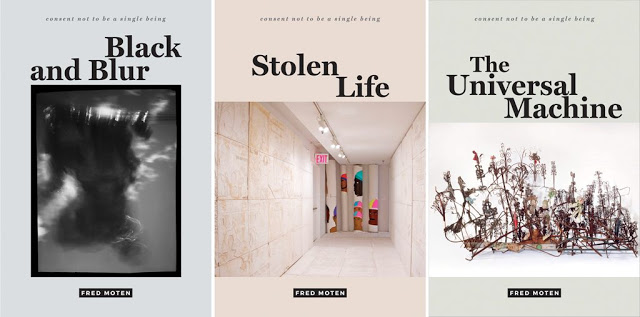
This intervention, and injunction, to ‘exhaust’ ontology’s special claim to ‘the political’ is sustained by Moten’s approach to a form of theoretical writing that re-formulates the task of critical philosophy, while also contesting political ontology’s ‘pessimistic’ aversion to Marxist tradition, showing that one need not dispense with dialectics in favor of static Manichaeism. The following review attempts to trace (by no means comprehensively) how Moten has continued to unfold this argument over the course of more than a decade of writing, collected in the recently-published three-volume series consent not to be a single being (2018), paying particular attention to the way that he intervenes in debates in contemporary political and critical theory.
***
consent not to be a single being, titled after a phrase of Édouard Glissant’s, ranges across an impressive number of disciplines: black studies, performance studies, aesthetics, phenomenology, ontology, ethnomusicology, jazz history, comparative literature, critical theory, etc. Without announcing its intervention as interdisciplinary–Moten deftly renders discipline beside the point. Instead, his “devotional practice” explicitly proceeds with heart, not quite stopping long enough to fix upon, objectify, or possess the shifting locus of study. The goal, in fact, is the contrary. As he writes in the preface to the trilogy’s opener Black and Blur, this is a celebration of the “animaterial operation-in-exhabitation of diffusion and entanglement, marking the displacement of being and singularity” that is blackness (BB, xiii).
As Deleuze and Guattari would have it, liberated desire is difficult to pin down. Unlike popular desire, encoded by the flows of capitalism, liberated desire eludes authority and escapes the “impasse of private fantasy” (Deleuze & Guattari, 2009). Desire’s amorphous capacity is its genius—to get plugged into different outlets, to reemerge through collective expression. You know it, in other words, when you don’t see it. Moten’s books capture something similar. His is a language that resists appropriation but has, paradoxically, become companionable to a great many projects. (One wonders how many reading groups have indebted themselves to Moten and collaborator Stefano Harney’s idea of the “undercommons”; few figures are as dear to activists, academics, and artists alike.) Ultimately, the zeal for Moten says as much about him as it does about our moment—desire for a politics beyond sanctioned discourse, sociality salvaged from social media, and, maybe most of all, some vindication that the lives we create under the noses of capital might already imagine another world.
Harney and Moten’s The Undercommons (2013), a widely shared and beloved book, was marked by an activist lyricism (“I just need you to recognize that this shit is killing you, too, however much more softly, you stupid motherfucker”). The essays of cntbsb similarly pair philosophical questioning with sonorous phrasing. Though Moten aligns himself with the black radical tradition, his particular voice is reminiscent of none of its famous luminaries. Thankfully the right to write like he does is never made the subject of its own analysis. Unlike with Derrida or Spivak or Lacan or Heidegger, resistance to clarity is not in the service of a meta-point about the trace of writing, or the restaging of knowledge’s limit. Rather, as with the jam session, everything is already going on at once. As readers, we’re along for the ride; feeling out the repetitions until they become concepts behind our backs, carrying provisional definitions until they get displaced, rejigged, and transformed anew from page to page.
On the whole, the series is a veneration of friendship and the unproprietary nature of thought. Moten continually lays his cards on the table, and his co-conspirators are called out in the body of the text: he’s “thinking along with” Hartman, “moving by way of” Mackey, “being taught” by Miyoshi and José (Muñoz)—indeed, in an interview, Moten has called this writing a form of name-dropping (Moten 2004).[1] But it’s also an ode to adversaries. We’re told at one point that “Mingus was a genius at showing contempt” (BB, 88) and perhaps the same can be said of Moten himself. Contemporary thinkers like Bryan Wagner, Catherine Malabou, and Eric Santner, Giorgio Agamben are put at affable risk. Paul Gilroy receives exasperated rebuttal in a particularly memorable footnote. Neither do earlier thinkers like Immanuel Kant, Hannah Arendt, Emmanuel Levinas, and Fanon emerge unscathed. They do emerge, however, irreparably transformed.
cntbsb is not the product of one Fred Moten, but the result of an evolution across fifteen-odd years, written for a variety of academic and artist publications that display Moten’s ability to shift genre. Still, each of the books have, if not a particular focus, then something of a mood. Black and Blur concerns the status of creative life (especially visual and musical art) under capitalism. Stolen Life breathes force into the philosophy of subjectivity and acts as a sustained struggle with the kinds of philosophical questions that also animate a range of black thinkers. The Universal Machine offers a rigorous deconstruction of post-war phenomenological thought, pivoting around brilliant engagements with Emmanuel Levinas, Hannah Arendt, and Frantz Fanon. Taken together, the series amounts to a powerful argument for black study—as an analytic, an impetus, a mode, the collective shout from a radical vista, whose bellow requires nothing less than “passionate response” (Moten 2003).
***
Primarily concerned with art, literature, music, performance, and the black radical tradition, Moten’s Black and Blur picks up where In the Break: The Aesthetics of the Black Radical (2003) left off. There are certainly some points of overlap—Cecil Taylor, Charles Mingus, Cedric Robinson and Immanuel Kant are important figures in both. But Black and Blur is not just a continuation, it’s also a corrective. Moten tells us at the outset that the essays collected in the entire series are an attempt to figure out what’s wrong with the opening sentence of In the Break: “the history of blackness is a testament to the fact that objects can and do resist.” That sentence, over which Moten claims to have suffered in the intervening fifteen or so years, should have read: “Performance is the resistance of the object. The history of blackness is a testament to the fact that objects can and do resist.”
What exactly has changed here? Parsing the difference brings us back to the disagreement that Moten has staged with Afro-pessimism. Moten concedes that his original statement “blackness is x” submits to the claim that the study of blackness must necessarily move within the political-ontological field that has already defined blackness as objectivity. In the Afropessimist Frank Wilderson’s words, there is an unbridgeable gap between the ontological status of “the Human as an alienated and exploited subject” and of “Blacks as accumulated and fungible objects” (Wilderson 2010). This realist dichotomy necessarily undergirds any study or analysis of black life. Moten doesn’t totally disagree. He says that the “weight of anti-blackness upon the general project of black study” is also the very thing that animates and enables the “devotional practice” that he wants to put forth (BB, viii).
Still, this is something more than devotional practice. Moten writes:
to be committed to the anti- and ante- categorical predication of blackness—even as such engagement moves by way of what Mackey calls “an eruptive critique of predication’s rickety spin rewound as endowment,” even in order to seek the anticipatory changes that evade what Sadiya Hartman calls “the incompatible predications of the freed”—is to subordinate, by a measure so small that it constitutes measure’s eclipse, the critical analysis of anti-blackness to the celebratory analysis of blackness.” (B&B, viii, emphasis added).
Herein lies the double movement of Moten’s (corrected) project. First he treats critically, and committedly, the way in which blackness is predicated through anti-blackness, but also turns (as Marx did Hegel) that construction on its head. What if, after Nathaniel Mackey, predication was spun back around, so that the ground of the political ontology that gives blackness through anti-blackness could be shifted? This inversion consists in subordinating Afro-pessimism (the critical analysis of anti-blackness), to Moten’s black optimism (the celebratory analysis of blackness). Celebration, then, means seeing how black art predicates. “Mobilized in predication,” Moten writes, “blackness mobilizes predication not only against but also before itself” (BB, viii). One need not begin with the ontological given of anti-blackness then, but see how blackness comes prior to the givenness, how it gives the given.
Illustrating this ‘anoriginality’ by way of movement through black art, literature, and music propels the book forward. The opening chapter “Not-in-Between” is representative here, a kind of synecdoche that contains threads of the argument that are woven through the rest of the text. He moves through Patrice Lumumba, C. L. R James, and Cedric Robinson to outline nothing less than a new post-colonial philosophy of history. Moten takes James’s The Black Jacobins as a form of history-writing that theorizes its own limits by interweaving lyric with the official discourse of historical narrative. James’s lyricism marks the entry of a kind of black radical corrective to Hegelian historical struggle—a transfiguration of “dialect into dialectic.” Moten argues that James’s historico-radical writing is embodied in such “ancient and unprecedented phrasing,” which mark the impossibility of a “return to Africa that is not antifoundationalist but improvisatory of foundations” (BB, 13). Of course, Moten is describing his own combination of verse and prose here too, employing form to ask how one can tell a story without origins, without grounds (and without ontological predication).
Unlike the other two books in consent not to be, Black and Blur consists of many short chapters, some of which were originally written as essays for artist monographs. It’s no coincidence that this is the book has already been taken up by the art world—understandably hungry for something different amidst the long reign of Adorno. Thankfully, Moten has a lot to offer by way of new theoretical horizons, and Adorno explicitly forms the antagonistic point of departure. In one chapter, Adorno’s dismissal of popular music as the functionalist “culinary” byproduct of capital is swallowed up by Moten’s analysis of two cultural products: “Ghetto Superstar” (1998), a single performed by Pras, ODB, and Mya, as well as an attendant novel co-written by Pras and kris ex. The book version contains a scene that mimics almost precisely Louis Althusser’s famous description of interpellation. The protagonist Diamond St. James recognizes an old security guard at his high-school, now community cop, but doesn’t allow himself to be ‘interpellated’ and gives the officer a fake number. In this refusal, Moten argues that Diamond is the “sentient, sounding object of a powerful gaze” and as such a prime example of what Moten has been interested in since In the Break: the “becoming-object of the object, this resistance of performance that is (black) performance.” (BB, 33).
This celebration of the object’s resistance forms the basis of Moten’s disagreement with Adorno. Moten later contests Adorno’s distaste for the infiltration of cinematic qualities–repetition, syncopation, and sequence–into music with an appreciation of Glen Gould’s “montagic” performance an actor and pianist. Yet another chapter continues this line of thought, but this time in tandem with photographic representations of black female bodies. Here Moten takes issue with Adorno’s definition of music as the only ‘temporal’ art, aiming to show how the resistance of the photographic subject embodies the lapse of time through fugitivity. Summing up the thrust of both his debt and contest to Adorno’s aesthetics, Moten responds to Adorno’s famous distaste for jazz exclaiming: “How unfortunate for Adorno that the music one most loathes might best exemplify the fugitive impetus one most loves!” (BB, 85)
After the first half of the book, a kind of breakdown occurs—signaling that the contestation with Adorno is over and we’ve moved (by measure’s eclipse) from the critique of anti-blackness into celebration. The pace runs a bit quicker, with a new numbering scheme that unites subsections through chapters, and formalizes the assembly-like character of the whole enterprise. Now come texts dealing more particularly with the artwork, music, and literature of contemporary figures: Theaster Gates, Thornton Dial, Adrian Piper, Oscar Zeta Acosta, Ben Hall, Rakim, and many others. This is where the party begins, and where Moten is dealing explicitly with what celebration means: “Celebration lets being-special go, but under an absolute duress” he writes. Moten argues that the artwork has no tendency towards redemption, promises no final salvation. Rather art’s worth lies in the permission it grants to cross oneself out, to activate and realize Marx’s living commodity in a way he never imagined—to be, or become, “a changing object called object changers” (BB, 222).
Is this perhaps too optimistic, too crudely dialectical a view of what black art can do? Moten anticipates such contentions in the preface. Speaking to his (pessimistic) detractors, he writes:
Some have been content to invoke the notion of the traumatic event and its repetition to preserve the appeal to the very idea of redress even after it is shown to be impossible. This is the aporia some might think I seek to fill by invoking black art. Jazz does not disappear the problem; it is the problem, and will not disappear. (BB, xii)
Black & Blur is not about recovery, redress, and rejoicing. It is certainly not about ‘uplift’ (the idea is a focus of a chapter in Stolen Life). It is about dwelling in the aporia of slavery as a “philosophically-induced conundrum,” a problem that has been made so by unjustifiable “metaphysical and mechanical assumptions.” Blackness is a problem, Moten tells us, which derives not from “redress’s impossibility” as Afro-pessimists would have it, but rather from the obliteration of commonplace formulations, the overall inordinacy of thought’s self-expression. It is art’s task to illuminate that inordinacy; and it’s the duty of black study to celebrate its effort.
***
Stolen Life takes thought’s limitation as its starting point. After Cedric Robinson’s definition of the black radical tradition as a contestation of Enlightenment, Moten moves through an interrogation of staid philosophical standards to unleash a “radical social imaginary” that flies in the face of traditional political theory. As he writes, wants to effect “the reversal of an all-but-canonical valorization of the political over the social” (SL, xii). Much of the book has to do then with sociality and learning, including an essay drawn from a letter to one of his classes. Another concerns the task of black study. Another powerfully asserts the role of the academy in the Boycott, Divestment, Sanctions movement.
A rare low moment in the series occurs with Moten’s Derridean paean to Avital Ronell. Moten presents fragments of their near-misses and close calls; first as colleagues at Berkeley and, flashing-forward, today at New York University (where Ronell will, amid protest, resume her position this Fall). There is an explicit uneasiness thematized here, and one wonders toward what end, exactly? Moten notes that he’s “embarrassed” to be talking about himself when he should be writing about Ronell, but he’s “incapable of that separation” between him and her. Comparisons between Ronell and his mother abound, complete with Freudian slippages. “All that was just to say that I never have been and never will be either willing or able to separate myself from this paragraph,” Moten writes in close before quoting Ronell’s Telephone Book (SL, 239). Even disregarding the recent revelations of Ronell’s abuse of professorial power, there’s something unsavory here. Surely lots of Moten’s project has to do with the attempt to inject something like care into intellectual life – but at what cost? The essay serves as a reminder that Moten’s intervention takes place against the backdrop of systemic complicity and corruptions in academia; something can’t simply be addressed with “embarrassed” Derridean adoration, but with institutional safety and support that explicitly refuses charismatic models of intellectual intimacy.
Nonetheless, the Ronell episode does not detract much from the main event. If Adorno was the primary target of Black & Blur, Moten is more occupied with Kant’s legacy here. Phantom-like, he also occupies Kant, moving within him to tease out his grittiest internal contradictions and limits, showing the breakage of the outside into his system of philosophical criticism. Moten speaks to the legacy of modern philosophy more generally, with its concomitant models of freedom, justice, knowledge, transcendental subjectivity, cosmopolitanism—the “metaphysical and mechanical presuppositions” whose overturning were prepared in Black and Blur. As he writes in the preface, blackness “anticipates and discomposes the harsh glare of clear-eyed (supposedly, impossibly) originary correction, where enlightenment and darkness, blindness and insight, hypervisibility, converge in the open obscurity of a field of study and a line of flight” (SL, x). Philosophical tradition can be neither corrected nor redeemed; but it can be probed to open out the lines of flight, forms of resistance, that emerge from the parallaxing gaze of black study.
Moten richly thematizes this interplay in the remarkable first chapter “Knowledge of Freedom,” altered from an article originally published in 2004. Following the work of Winfried Menninghaus, he looks at how Kant’s definition of reason admits the existence of an irrational surplus; a notion of rational understanding that requires we “clip the wings” of imagination. According to Moten’s gloss, this sacrifice leads Menninghaus to identify a “politics of curtailment” and policing in Kant that shows how the latter also apprehends “the prior resistance (unruly sociality, anarchic syntax, extrasensical poetics) to that politics it calls into being” (SL, 2). Moten is interested in how Kant is playing himself. He writes:
To engage Kant, our enemy and our friend, is to be held and liberated by the necessity of alternative frequencies, carrying signal and noise, that thinking blackness–which is what it is to be given to the reconstruction of imposition–imposes upon him as well. An already-given remix of the doctrinal enunciation of the end is amplified and he becomes our open instrument. (SL, 10)
How does blackness put pressure on Kant, and how is that pressure self-imposed and presupposed by Kant himself? Sitting with Kant’s philosophy of race can release an alternate frequency of blackness that enables another possible definition of freedom, one that acts in resistance to critical regulation. There is, Moten proposes, a “radical sociality of the imagination” that acts as the spectral prelude to Kant’s carceral philosophy.
By ventriloquizing a “black chant” through Kant, Moten puts forth a vision of what critical theorists might call immanent critique. As Titus Stahl has recently put it, this is the kind of critique that derives “the standards it employs from the object criticized,” an attractive tool of successive generations of Critical Theorists given that it does not need to theorize norms into existence. Thus, immanent critique does not imbue the theorist with the superpower of an Archimedean moral vantage point, but rather uses those immanent to society as a way to parcel out critical judgements (Stahl 2013). Moten writes, in echo: “all that intellectual descent neither opposes nor follows from dissent but, rather, gives it a chance.” We would do well to see the ways in which our inherited concepts give us the tools for dissension.
Moten is, however, resistant to the ways in which critique has also been a vehicle for “sovereign regulation and constitutive correction.” As he writes in the preface, “certain critico-redemptive projects” are content to “submit to a poetics of condensation and displacement when blackness, which already was an was always moving and being moved, stakes its claim as normativity’s condition” (SL, x). In riposte to critical theory, and to Kantian criticism, Moten is asking us where normativity comes from, and if we should truly like to use it as a moral measure. As he states powerfully throughout the book and series, the very conditions for norms and values are predicated and figured through the thought of blackness as pathogen, generativity, irrationality and formlessness. The question then, is of seeing “how the generative breaks into the normative discourses that it found(ed)” (SL, xi), of seeing the escape, insurgency, and “irreducible sociality” of black life which both disrupts and gives the given paradigm.
Moten sharpens this point by pitting himself against historicizing theorists like Bryan Wagner, who has looked at what blackness comes to mean against the backdrop of the law. Wagner has argued that blackness indicates a certain set of qualities that appear when looking at its juridical regulation. As with the appraisal of Afro-pessimist political ontology, Moten argues that there is a category mistake going on. “Being black in Wagner’s more self-contained Fanonian formulation is an anti- or non-subjective condition” that precludes one from having standing in the world system (SL, 24). According to Moten, Wagner et al. have forgotten what Heidegger called the ontological difference between Being and beings, or more precisely, what Chandler calls the paraonotological difference between blackness and black people. “Wagner writes,” Moten says, “from a position that many contemporary critics now occupy, a position structured by this presumed incapacity for ontological resistance.” Such a presumption, or assumption of rigidity, allows theorists to suspend the analysis of ontology and forego any inquiry into “the pressure that blackness puts on both ontology and relation” (SL, 24).
To get at this pressure, Moten invokes Chandler’s paraontological difference to show that the actual standing (the “facticity”) of black people is not the same as the ways in which blackness is seen through the eyes of the state. “The history of blackness,” Moten writes, “can be traced to no such putatively, and paradoxically, originary critical or legal activity. (SL, 28). Following Frege and Mackey’s “eruptive critique of predication’s rickety spin rewound as endowment,” Moten suggests that there is instead something called blackness “that has, itself, in turn, been altered by that to which it refers”—a referent that exists before its naming, a primordial and shifting being – of displacement, generativity, and fugitivity (SL 23). Amid a long lineage of debates in black studies about the status about what kind of ‘thing’ blackness ‘is’, whether it is in Michelle Wright’s words “in the eyes of the beholder or the performer,” Chandler’s paraonotological difference permits both readings simultaneously (Wright 2015).
Still, an unfathomable task remains; that of trying to imagine a phenomenology that moves beyond the relational polarity between self and other, subject and object, sovereign and citizen. These are the binaries that also organize political philosophy, and the ways in which we can possibly imagine ‘agents’ in the first place. Moten notes that the dismantling of such categories has been the focus of a number of thinkers, including Fanon and Merleau-Ponty, Agamben, and most recently Catherine Malabou. Malabou (along with others in the New Materialist vein) has sought to dethrone the concept sovereignty from political philosophy by collapsing the split between the “King’s two bodies,” between the material and transcendental. Yet as Moten persuasively argues, Malabou’s reliance on biology or neuroscience has also inadvertently allowed her theory of “plasticity” to reinscribe the brain as ‘sovereign’ over the body. Who gets to have a body in any case? Who are the ‘we’ who possess ourselves over and against our own bodies? Borrowing instead from Hortense Spiller’s distinction between the body and the flesh, Moten presents a notion of flesh-in-displacement, a kind of reinvigoration or reanimation of (a warily-) humanist materialism. Perhaps we don’t need new-fangled philosophical tools at all, but rather a phenomenology that could finally take seriously the so-called thing in itself that it claims to study.
***
The Universal Machine sets the task of re-imagining post-war phenomenology. It is, in Moten’s words, a “monograph discomposed,” a (Deleuzian) “swarm” containing three essays on Levinas, Arendt and Fanon (UM, ix). In a lucent intervention into the history and legacy of twentieth-century philosophy, Moten returns to those thorny subjects and objects that had troubled him in Stolen Life, whittling phenomenology into an estranging shape rather than discarding it completely. Mobilizing an idea of swarm—an composite of ontology, phenomenology, and politics—Moten’s aim is then a semi-reparative one: “not so much antithetical to the rich set of variations of phenomenological regard; rather, it is phenomenology’s exhaust and exhaustion” (UM, ix).
Moten gives exhaust provisional form. It is embodied by figures who have put forth a “dissident strain in modern phenomenology.” Edmund Husserl, he claims, is phenomenology’s exhaust, so too are Levinas, Arendt, and Fanon. That’s to say that their thinking takes place beyond subjectivity’s pale; they “operate under the shadow of a question concerning humanity that they cannot assume” (UM, xi). As with his critique of Kant’s legacy, Moten argues that phenomenology provides us with all the tools we need to think otherwise. It’s just a matter, after Deleuze’s explication, of exhausting the possible through the art of “the combinatorial” (Deleuze 1995).
The opening chapter of the book takes flight from a remarkable epigraph. In an interview concerning his relation to Heidegger and the phenomenological tradition, Emmanuel Levinas remarks that “the Bible and the Greeks present the only serious issues in human life; everything else is dancing. I think these texts are open to the whole world. There is no racism intended” (UM, 1). In keeping with Deleuze’s combinatorial spirit, Moten considers the implications of this claim in several different directions. First, he asseses Levinas’s Eurocentric conception of the Other, which is tethered to Levinas’s tautological belief in the heritage of the Bible and the Greeks. Levinas’s famous face-to-face encounters, Moten writes, “are mediated by a highly circumscribed textual canon and by whatever force is deployed to open the world to the texts that he declares are open to the world.” (UM, 19).
Moten further explores the consequences of Levinas’s “unintended racism” by looking at the very status of intention in phenomenology. Though phenomenology usually concerns the ‘intentionality’ of human consciousness towards an object – were are always conscious ‘of’ something, or have an experience ‘of’ something – Moten argues that racism resides precisely in a “fundamental unintendeness,” or the failure of phenomenology to attend to the humanity of things (UM, 17). Moten’s injunction to ‘return to the thing’ thereby draws upon other recent attempts to overcome a supposedly recalcitrant Cartesian dualism, especially among theorists working on the proximity between human and animal life like Giorgio Agamben and Eric Santner.
Yet Moten objects to what Santner has conceptualized as “creaturely life”:
If Agamben and Santner are right to suggest an interplay, at the border, between inside and outside, then perhaps it would be, as it were more right to consider that the internal and the external presuppose one another within the general field—or, if you will, the borderless surround, the common underground–of the out from outside. My point is the necessity of imagining a productive difference, a political differing, a differential city or city-ing, that is irreducible to the distinction between friend and enemy. (UM, 41)
Santner, pace Agamben and Heidegger, views the creaturely as the “threshold” at which point life takes on a biopolitical intensity. Moten, in contrast, wants to “identify not with the creaturely life but the stolen life of imagining things” (UM, 57). Moten’s identification permits a different vision; not of a life animated by its entrance into ‘the political,’ but a life that refuses being called into being by a sovereign power. “There is,” he writes, “an insistent previousness that evades the natal occasion of the state’s interpellative call” (UM, 44). In rehearsal of his general dissatisfaction with political ontology, Moten is interested, he clarifies, in “what there is before the throw, before the call” (UM, 34), and demonstrates that this prior refusal is thinkable by engaging with the black radical tradition, conspicuously absent from Agamben’s corpus.
By way of Moten’s discussion of natality, the space of the political, friends and enemies, we also move, necessarily, towards Hannah Arendt. The second chapter presents a vision of her blurred beyond recognition. Building on recent work concerning the force of racism in Arendt’s thought, Moten’s criticism of Arendt is roughly organized through two sets of letters written by her. The first is to Mary McCarthy, in which Arendt privately bemoans the threat posed when “Negros demand their own curriculum without the exacting standards of white society” (UM, 72, letter quoted in Young-Bruehl 2004). This sentiment was also given public form in Arendt’s 1959 essay “Reflections on Little Rock,” which she opens by discussing the famous image of Elizabeth Eckford on her way to school. Arendt writes (and Moten claims we ought to speak of her in the present tense given her hold on American intellectual and political life today), “Under no circumstances would I expose my child to conditions which made it appear as though it wanted to push its way into a group where it was not wanted” (UM, 75).
Moten discusses Eckford’s performance in relation to a performance piece by artist Adrian Piper in 1970, in which she entered famed art bar Max’s Kansas City, letting herself be absorbed into the environment as a “silent, secret, passive object” (Piper quoted in UM, 81), Moten shows that Arendt is incapable of thinking the transformative capacity of dwelling, as Piper does, in a “sly alterity.” What Arendt opposes, and refuses to see, in short, is black study. This was made explicit in On Violence when she expressed a distaste for so-called “soul courses.” But, as Moten argues, this is not just a curricular dispute. Arendt’s opposition is also connected to the ways in which she valorizes and emblematizes a certain kind of intelligence. She insists being intelligent is a moral matter—as she famously said, we have to “think what we are doing.”
This insistence, Moten claims, is connected to yet another: Arendt’s dogged belief that there is something called “politics” that it needs to be thought of in particular ways. A letter written to James Baldwin, in the aftermath of the publication of his “Down at the Cross: Letter from a Region in My Mind” in the 1960s illustrates this. Despite calling his essay a “political event of a very high order,” Arendt claims that Baldwin’s faith in love is misplaced— “in politics,” she writes, “love is a stranger” (UM, 84). Love is not a political concept, Arendt argues. Moten retorts: Baldwin was not a political theorist.
By this point, we are unsure if something called politics can possibly exist, a practice and ritual that would be unthinkable without the presupposition of the modern liberal paradigm. As Moten asks, can political theory ever be severed from Kantian categories—from a critical, critically-delimited notion of what reason itself can do aside from ‘putting itself on trial’? What if our frameworks for interpretation are presumptive beyond repair? The breakdown of all of these questions resounds in a powerful denouement. Moten shifts from the Arendtian polis to the undercommon social realm, by way of a formal innovation that he sometimes calls aesthetic/poetic sociology, or social poetics. It is a turn towards appreciating and celebrating the activities which occur at the “underbreath” of the polis, activities that threaten the “normative order the city can be said to have agreed upon” (UM, 103). It is a science (or art?) of looking at relations of nonrelationality.
I’m wary, at moments, that Moten’s aesthetic-sociological backdoor depends upon the strawman of a totalizing ‘political sphere’ as its counterimage, presented here in terms of rhetorical reliance upon, or a willful caricature of, Arendt as its systematic theorist. This leaves Moten to the simple task of transvaluating the values, flipping Arendt’s hatred of sociality into the non-normativity we should celebrate. (If we want to do away with political ontology, let’s do away too with the idea of an ontological polis!) We are perhaps left to wonder if this approaches a dichotomous political order, achieved in a similar if anterior way to the political ontological equilibrium of Afro-pessimistic realism. If phenomenology is the thing to be revived here, the relation between law and lawlessness, polis and undercommon, could stand to be a bit more dialectical. Does Moten’s thought have room for Geist, or has he rejected a speculative moment in favor of reflection, or perhaps what he calls celebration—the (non-relational) movement, as Hegel described it, from nothing to nothing?
In his embrace of sociology, Moten’s enters into a tradition stretching from Simmel, through Lukács, Adorno, and Habermas, that, as Gillian Rose has pointed out, is haunted by a problematic Kantian-esque construal of ‘the social’ as a value (Wert) in and for itself. By focusing instead on the production of subjective meanings that re-present actuality, sociology (aesthetic, Marxist or otherwise) suppresses the capacity to present actuality; lacking a concept of material contradictions (in law, media, or property relations), it forecloses upon the possibility of conceiving transformative social activity (see Rose 1981).
Moten seems mostly to sense the threat of a non-transfromative sociological pitfall, particularly in the final chapter of the book on Frantz Fanon. In contradistinction to Fanon’s “sociogeny,” the phenomenological tracing of development through social factors, Moten claims his “sociology” (taking after Du Bois) is explicitly about the “sociopoetic cognizance of the real presence of the people in and at their making, where that retrospective ascription of absence that Fanon’s inhabitation of the problematic of damnation…is given in and to a lyrical, analytic poetics of the process of revolutionary transubstantiation” (UM, 228). Sociology as analytic poetics, rather than social analysis full-stop, would seem somewhat to resolve Rose’s concerns about transformative (or transubstantive) activity, but perhaps by falling back on an aestheticized notion of political process (which has a problematic history of its own).
Moten’s discussion of Fanon here is a lightly amended version of his 2013 essay on Afro-pessimism. It groups together the most urgent concerns in the book, if not the series on the whole: the interrelation of ontology, (stolen) social life, and the resistance of the object. Beginning with Fanon’s project of “narrating the history of his own becoming-object,” Moten argues that Fanon disturbs the Heideggerian distinction between dasDing and Dasein. Moten, however, is “most interested in” the beings that are always escaping the ontological binary, who unsettle the very possibility of being accounted for. Moten, in other words, wants to argue for that the problem of the inadequacy of ontology to blackness is actually a problem about the inadequacy of “already given ontologies” (UM, 150). The lived, ontic, social life of blackness is, Moten argues, in constant demand for a different way of articulating being that lives in the impossibility of origins.
Moten’s capacious thinking in this final volume of his series—about foundations, origins, “the political,” Schmittian residues, the impossibility of political theory, and Heidegger’s legacy—also dovetails with recent trends in contemporary European political thought that I mentioned at the beginning of this essay. By way of conclusion, I consider how cntbsb provides powerful critique of some of those tendencies.
***
Despite the flurry of interest, there has been little consensus about what political ontology stands for. Its usage remains broad, having been applied to thinkers like Judith Butler and Charles Taylor alike; it can also appear in ‘strong’ or ‘weak’ forms depending on who you’re looking at. In an attempt to weld together some common traits, Marchart has argued that political ontology, at a metaphilosophical level, inquires after the “fundamental ontological presuppositions that inform political research and theory” (Marchart 2018). It appears, more particularly, when thinkers claim that politics has a structural analogy with Heidegger’s “ontological difference” between Being and beings (Sein and Seinendem).
Pace Carl Schmitt, thinkers like Jean-Luc Nancy, Alain Badiou, Ernesto Laclau, and Giorgio Agamben argue that there is a difference between ‘the political’ and ‘politics’ (le politique/une politique, das Politische/die Politik). Like Heidegger’s Sein, ‘the political’ is what is ineluctably given; it is marked by conflict, exclusion, or better yet by “antagonism” (the term Marchart prefers). Thus, any action against the given or ‘the political’, thinking included, constitutes a political intervention, and constitutes a political subject. In this regard, political ontology emphasizes the latent political nature of every social being.
In compendiums on political ontology, or in the work of theorists they describe, there has been no mention of a similar turn to political ontology in black studies, and its critical function in Afro-pessimism. When political ontology is said to have any relevance to ‘ontic’ matters it is usually, following Heidegger, linked ecological concerns only. How one can think antagonism without centering that concept around an analysis of race, gender, or class is a question that proponents of political ontology have yet to satisfyingly answer, and maybe one that they don’t want to get tied up in at all. One of the self-proclaimed advantages of political ontology is, apparently, that it can transcend the “relativism” and “identity politics” that have taken hold of leftist imaginary in recent years (Strathausen 2009).
Excepting its distaste for the ontic, Moten’s intervention illuminates yet another reason that we might want to be skeptical of political ontology. If Marchart is concerned with the ontological presuppositions that undergird political theory, Moten is concerned with the inverse. How does political theory, or ‘politics’, as a mode of thought concerned with regulating difference, antagonism, the production of an Other, give ontology its grounding? To re-appropriate Heidegger, how is ontology occasioned by a phenomenological refusal to understand Black being? If ontology cannot but move from its denial of world, perhaps its absorption into politics does nothing more than preserve the “officially assumed position.”
This is not to fully discount political ontology in either its continental or Afro-pessimisitic iterations. From Moten’s perspective, there is at least value there as a descriptive framework, as a way of illuminating projects of emancipation that fly by the official eye. But, must political theory – understood properly as: “the remains of hope” – be content to simply interpret the world? Political ontology stalls within the realm metatheoretical description, securing itself as tantamount to an emancipatory opening. Moten offers, on the other hand, a necessarily partial, unfinished conception of theory that can only be met on another side by aesthetics, by poetry, by praxis. For Moten, Marx’s old distinction between interpretation and change remains at play; political ontology clings glibly onto one side of the phrase.
Mimi Howard is a PhD candidate in Politics at the University of Cambridge, writing a dissertation on method and critique in 20th-century German political philosophy.
Acknowledgements
To our Lesekreis “Rehearsal” (Berlin), and to Merve Fejzula for her insightful thoughts and edits.
Works Cited (aside from reviewed work)
Agamben, Giorgio. 2017. The Omnibus Homo Sacer. Stanford: Stanford University Press.
Deleuze, Gilles and Felix Guattari. 2009. “Capitalism: A Very Special Delirum.” In Chasosophy ed. Sylvere Lotringer. New York: Semiotexte.
———. “The Exhausted.” 1995. Trans. Anthony Uhlmann. SubStance 24. 3: 3-28.
Fanon, Frantz. 1986. Black Skin, White Masks. Trans. Charles Lam Markmann. London: Pluto Press.
Heidegger, Martin. 1971. “…Poetically Man Dwells…” in Poetry, Language, Thought, trans. Albert Hofstadter. New York: Harper & Row.
———. 1987. Zur Bestimmung der Philosophie: Gesamtausgabe 56/57. Frankfurt am Main: Vittorio Klostermann.
Marchart, Olivier. 2018. Thinking Antagonism: Political Ontology after Laclau. Edinburgh: Edinburgh University Press.
———. and Mihaela Mihai, Lois McNay, Aletta Norval, Vassilios Paipais, Sergei Prozorov, Mathias Thaler. 2017. “Democracy, critique and the ontological turn,” Contemporary Political Theory 16.4: 501-531.
Moten, Fred and Charles Henry Rowell. 2004. “’Words don’t go there’: An Interview with Fred Moten,” Callaloo 27.4: 954-966.
———. 2013a. “Blackness and Nothingness (Mysticism in the Flesh),” The South Atlantic Quarterly 112.4: 737–80.
———. and Stefano Harney. 2013b. The Undercommons: Fugitive Planning and Black Study. Brooklyn: Autonomedia.
Rose, Gillian. Hegel contra Sociology. 1981. London: Athlone.
Saar, Martin. 2012. “What is Political Ontology?” Krisis 1: 79-83.
Stahl, Titus. 2013. Immanente Kritik. Elemente einer Theorie sozialer Praktiken. Frankfurt am Main: Campus Verlag.
Strathausen, Carsten ed. 2009. A Leftist Ontology: Beyond Relativism and Identity Politics. Minneapolis: University of Minnesota Press.
Taylor, Paul C. 2013. “Bare Ontology and Social Death.” Philosophical Papers 42.3: 369-389.
Wilderson, Frank B. 2010. Red, White and Black. Durham & London: Duke University Press.
Wright, Michelle W. 2015. Physics of Blackness: Beyond the Middle Passage. Minneapolis: University of Minnesota Press.
[1] “In the end, that’s probably all my writing is—dropping names and droppin’ things, like Betty Carter.” In Charles Henry Rowell and Fred Moten, “’Words don’t go there’: An Interview with Fred Moten,” Callaloo 27.4 (2004), 954-966.
This essay has been peer-reviewed by “The New Extremism” special issue editors (Adrienne Massanari and David Golumbia), and the b2o: An Online Journal editorial board.
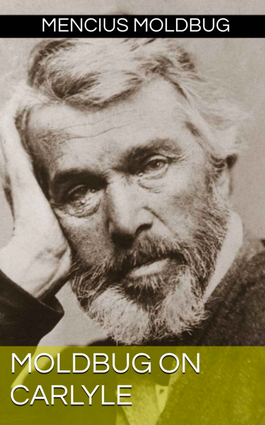
Recently something rather unexpected happened. Curtis Yarvin began writing again. A decade ago, back in the spotty youth of the internet when blogs meant something, Yarvin, a Silicon Valley computer programmer, made a cult name for himself under the nom de plume of reactionary political philosopher Mencius Moldbug. Often memed, frequently cited as an important ancestor of the “alt-right” (but largely left unread) and father of the online political movement known as NRx/neo-reaction (which has been declared dead endlessly since at least 2013), Moldbug may well be the only notable political philosopher wholly created by and disseminated through the internet.
In his journey from Austrian Economics to attempting to update early modern absolute monarchy for the information age, Yarvin regularly churned out tens of thousands of word screeds on his blog Unqualified Reservations (UR) about the need to privatise the state and hand it over to an efficient CEO monarch to keep progressives out, the Christian roots of progressivism, and encomia to nineteenth century Romantic Thomas Carlyle. All of this was so liberally coated in rhetorical irony and Carlylean bombast that it was often difficult to tell what was supposed to be serious and what was not. Moldbug was among the first to discover the power of reactionary post-irony, though these days of course, playing long-read rhetorical games to affect ideological change seems a rather primitive affair. The work of post-irony can now be compressed into a couple of memes very easily.
Between 2007 and 2010 Moldbug was immensely prolific. Thereafter UR petered off as Yarvin turned his efforts increasingly towards developing a blockchain-based data-storage scheme called Urbit.[1] By 2014, when Moldbug began to become a household name across the internet as the social media platforms were increasingly politicised, Moldbug was pretty much finished writing. In April 2016 UR was wrapped up with a “Coda” declaring that it had “fulfilled its purpose.” The same month attendees threatened to withdraw from the LambdaConf computing conference because the “proslavery” Yarvin would be speaking at it (Towsend 2016).[2] To this Yarvin (2016a) wrote a reply insisting on the innocence of his Moldbuggian stage as simply a matter of curiosity about ideology. The same year in an open Q&A session about Urbit on Reddit, Yarvin (2016b) was more than happy to answer some questions about Moldbug and defend both projects as parts of a dual mission to democratise the current monopolies controlling the internet and to dedemocratise politics for the sake of enlightened monopoly.
In early 2017, following Trump’s election, rumours began to circulate that Yarvin was in communication with Steve Bannon, though nothing came of this (Matthews 2017b). Around the same time Yarvin was quoted as supporting single-payer healthcare (Matthews 2017a). News also surfaced that Yarvin was on a list of people to be thrown off Google’s premises, should he ever make a visit (Atavisionary 2018). Then, early in 2019, Yarvin (2019a) quit Urbit after seventeen years on the project, causing some to wonder whether Moldbug might now make a return. Old rumours also began to get about the place that Yarvin was behind Nietzschean Twitter reactionary Bronze Age Pervert (BAP), especially after Yarvin passed a copy of BAP’s book Bronze Age Mindset to Trumpist intellectual Michael Anton (2019) with the insistence that this was what “the kids” are into these days. And now Yarvin has started publishing again, under his own name, a decade on from the salad days of UR. On the 27th of September 2019 the first of a five-part essay for the conservative Claremont Institute’s The American Mind landed, titled “The Clear Pill.”
If Moldbug/Yarvin is famous for one thing, it is that he’s the fellow who put the symbol of the “red pill” into reactionary discourse. The “Clear Pill” promises to be a reset of ideology in which progressivism, constitutionalism and fascism will each receive an “intervention” through their own language and values to show up how “ineffectual” each is (Yarvin 2019b). Thus far this “clear pill” sounds all rather typically Moldbuggian–for Yarvin it has always been about resetting the state and the rhetoric of undoing brainwashing. Anyone passingly familiar with the oeuvre of Moldbug knows that Yarvin is more than capable of speaking all three of these political dialects reasonably well, even if, as Elizabeth Sandifer (2017) astutely notes, Moldbug is so deep in neoliberal TINA, he is unable to take Marxism seriously as a contemporary opponent at all. For Moldbug the American liberal pursuit of equality was always more “communist” than the USSR, which is to say, paranoid reactionary hyperbole aside, that he only ever regarded Marxism as an early phase of progressivism.
And yet, six months on from the first part of the “Clear Pill”, only a second of the promised five parts has thus far been published. Part two (Yarvin 2019c), or “A Theory of Pervasive Error” appeared on the 25th of November, and, so one might surmise, even the most die-hard Moldbug-fans must have found it somewhat lacking. The initial purpose of the piece seems to be to outline a theory of human desire that utilises the Platonic language of thymos (courageous spirit), but ends up sounding far closer to a Neo-Darwinian Hobbes than anything else. Human beings are petty and selfish beasts, we are encouraged to believe. The essay meanders on until it finally arrives at the simple old Moldbuggian point that because liberal “experts” in governance and science have a touted monopoly on truth, they should not automatically be trusted. That’s it. By taking such the long way around to say something so simple and banal, the result is more than a little anticlimactic. Perhaps after all these years the bounce has gone out of Yarvin’s bungy; his lemonade has gone flat.
The only other piece to appear on The American Mind from Yarvin since “A Theory of Pervasive Error” has not been part of this “Clear Pill” series, but a stand-alone essay published on the 1st of February 2020 titled “The Missionary Virus”. In this Yarvin argues that the recent coronavirus pandemic offers an unparallel opportunity to dismantle American “internationalism” and reboot a politically and culturally multi-polar world while economic globalisation continues. Imagine, Yarvin asks the reader, what it would be like if the virus did not go away and the travel bans lasted not a month, but a decade, or centuries. One thing can be said about this essay that cannot be said of the “Clear Pill” so far – at very least it is entertaining. Perhaps parts three to five of the “Clear Pill” will actually say something interesting after all.
Indeed there are all sorts of questions that are still left unanswered. Will the crescendo of part five simply restate the need to privatise governance and let the market system work? Will Yarvin take some drastic new turn or even disown Moldbug? Will he finally acknowledge eccentric death-cultist Nick Land, who, for the best part of this decade has largely been the “king” of NRx as a political ideology? We must wait and see.
***
Obviously, a great many people of all manner of political bents will be lining up to release their takes on the “Clear Pill” when it is finally done and dusted. I most certainly will be among them because, sad to say, I’ve been trying to work out Moldbug/Yarvin for years now. It’s very easy to brush him off as something archaic and nasty and even structurally predictable–a little racist ghoul who wants a CEO emperor–a desublimation of the Silicon Valley unconscious, a monstrous giving the game away about the fears and imperial pretensions of our techno-optimist masters. On this account Moldbug is very, very important indeed. Ten years ago, for Moldbug the solution was as simple as handing over California to Steve Jobs to run as a business, because Steve Jobs is very good at solving problems. The Moldbuggian wedge (esp. 2008a) was the belief that in the US, the two elite groups are “Brahmin” progressive intellectuals (who are bad) and the pragmatic businessmen (who are good), which is bizarrely very close to the recent terminology (but not ideology) of Thomas Piketty’s research (2018) on American and European elites in the Post-War Period.
Nevertheless, today the remnants of Moldbuggery as an ideology seem to spend their time bemoaning “woke capital”–that those with the talents and power to make something like Moldbug’s “patchwork” of privatised city states come true all seem to be believers in the various progressive gender and racial talking points of the present. But here’s the thing–Moldbug was never one to spend his time huffing and puffing about gender politics like just so many of his tradcath monarchist and other old school reactionary fans do, who somehow seem to imagine him as some new Joseph de Maistre. In spite of his night terrors about ghetto warlords and migrant invasion (see: Moldbug 2007d, 2008a), Moldbug/Yarvin always made efforts to appeal to “open-minded progressives”–there will always be room in the “patchwork” for dope and death metal (2008c); a privatised California’s welfare system of dividends would be so good it’d give the sick bionic wings (2008b: 99); prison in the future will be replaced by being put to sleep forever in VR (2009e); the American Empire sucks because it pretends that the world is made of independent countries, but rather than improving things, it keeps them as quashed clients and puppets (esp. 2008b).
But what if Moldbug always-already was “woke capital?” As I have written at length elsewhere (Ratcliffe 2018a, 2018b), the godawful possibility is that Mencius Moldbug was a kind of political basilisk that once thought, cannot be unthought–that he is a left liberal arriving from a cursed future, the obscene image of the juggernaut of hyper-capital with a human face haphazardly sutured to the front of it, like one of those awful homemade Thomas the Tank animations one finds at the bottom of YouTube at three in the morning. Although she doesn’t mention Moldbug, Vicky Osterweil’s diagnosis of a Silicon Valley liberal “left fascism” decidedly hits the nail on the head concerning certain aspirations of Amazon and friends to buy up whole towns and to remake the globe:
Rather than invoke Herrenvolk principles and citizenship based on blood and soil, these left fascists will build nations of “choice” built around brand loyalty and service use. Rather than citizens, there will be customers and consumers, CEOs and boards instead of presidents and congresses, terms of service instead of social contracts. Workers will be policed by privatized paramilitaries and live in company towns. This is, in fact, how much of early colonialism worked, with its chartered joint-stock companies running plantation microstates on opposite sides of the world. Instead of the crown, however, there will be the global market: no empire, just capital. (Osterweil 2017)
Does this not sound so terribly Moldbuggian that it makes the skin itch? Against this sort of thing what is needed is a healthy combination of strong local communities committed to telling Google and Amazon to shove it–or whatever else it is that might succeed them–matched with commitments by governments to break up these companies and prevent private police forces. Even better would of course be nationalisation of these companies and handing them over to worker-control. Nonetheless, the dismal old Guild Socialist localist in me finds contemporary dreams of simply nationalising the miserable and soulless infrastructure of our present, such as we find in recent texts like The People’s Republic of Walmart (Phillips and Rozworski 2019), not only supremely vulgarian, but at present as unlikely as the possibility that the neo-reactionaries will ever get their future of a consciously reactionary world governed by Megacorps.
For now, at least, we’re all stuck with the political and corporate monopolies we let happen–none of us can “head for the exit,” not even the Zuck. We’re all locked in the same room together. Leviathan is not going to be letting anyone’s people go, not for all the hyperstitional meme magic of a couple of cut-price Twitter occultists thinking that NRx v.2.0 is simply supporting all secession movements and waiting for a rich papa to make the private state a reality. Liberalism is a jealous “Mortalle God,” as its primordial violent father Thomas Hobbes would say. As we will see later, Hobbes remains the most important figure for understanding NRx, its “woke” corpocratic mirrored other, and liberalism in general.
The possibility of the “left fascist” Moldbug draws out attention to the oft-overlooked fact that there was more than one Moldbugpolitik outlined on UR over the years. I think I’ve managed to isolate at least three strains thus far. Moldbug 1 is the Moldbug we’ve been talking about. This is the “neocameralist” of the 2008 “Open Letter to Open-Minded Progressives” who is simply trying to make anarcho-capitalist Hans Hermann Hoppe’s “patchwork” of private states sound cooler by adding some extra monarchy aesthetics and criticism of the American Empire (Moldbug 2008b). This is the Moldbug from which (with an added injection of race and IQ sorcery and the removal of Carlyle in favour of Malthus) Nick Land builds his variant of NRx. You have ideology as a parasitic virus, the powerlessness of populist reaction, open borders chaos, shiny futuristic city states. While this Moldbug might on the surface look like he is all about the sovereign One–the single absolute ruler–the “king” is of course simply someone hired by a body of shareholders to get their city to make money. If the mediaeval Christian monarch had “two bodies”–one mortal and the other his immortal perpetuation down the generations–then the immortal body of the Moldbuggian CEO is that of the corporate personhood of the joint stock company behind the scenes. You may go to sleep for hundreds of years, but when you wake up Wayland-Yutani will still be there.
Moldbug 2, from the “Gentle Introduction,” on the other hand, is the Moldbug (2009d) of what its section 9d calls “The Plinth”: an unabashed attempt to theorise a vanguard party like Hitler’s or Lenin’s with cells everywhere and then simply taking over government. This is the “populist” Moldbug that Nick Land doesn’t want you to know about, though some of the more “trad” reactionaries have been interested in it, as I have discussed in the past on my Mechanical Owl blog (Ratcliffe 2018a, 2018b). Moldbug 2 is a total departure from Moldbug 1 because the earlier version seemed so adamantly convinced that popular reaction in America is instantly crushed by the liberal media: it is “a mile wide and an inch thick … like taking on the Death Star with a laser pointer” (2008b, 116). One wonders what Moldbug 2 thinks of Trumpism and its effectiveness thus far.
Then we come to Moldbug 3. This is a strange theocratic Moldbug (2013) we find in a single late post on UR, in which he praises the political coherence and mass appeal that Christian reactionaries in the US such as Lawrence Auster sometimes seem to possess. We are told by Moldbug that because of this it is highly likely that “when our dark age ends and the kings return, if ever, it will be under any banner but the Cross,” which of course the tradcaths have endlessly cut and pasted across the internet without context. What is most interesting about Moldbug 3 is that Moldbug/Yarvin is an avowed atheist “secular humanist.” In the post in question he even writes about telling his daughter that God is just Santa for grown-ups. It is, however, not so uncommon to find atheist reactionaries who believe that Christianity has an important utility as a “social technology”–whether for supporting patriarchy, keeping Islam at bay or providing a collective myth that can be used to bolster nationalism.
Nonetheless, this Moldbug 3 stands in stark contrast to the main Moldbuggian discourse we find in the 2007-8 Moldbug 1 in which Christianity is found historically to be the root behind “progressivism.” Moldbug 1 (2008b, 58 & 104-7) is especially fond of colourful language about American political history as “creeping Calvinism,” “Quaker thuggery” and “applied Christianity” concerning the pursuit of equality and universalism. This is perhaps why I keep coming back to Moldbug and giving him the time of day. Moldbug 1’s only truly remarkable idea was his grand narrative about millenarianism and modern liberal politics. Millenarianism is the idea of the imminent (and immanent) arrival of a “Third Age” of Christianity in which the world becomes a realm of plenty and universal equality after the old order is scoured from the Earth by the Apocalypse. As Revelation 21:4 promises: “And God shall wipe away all tears from their eyes; and there shall be no more death, neither sorrow, nor crying, neither shall there be any more pain: for the former things are passed away.” As we will see below, such notions have had a profound formative effect on the progress narratives of modernity.
Moldbug 1 avidly believed that progressivism is the mainstream American political tradition, a “W-Force” child of Calvinist and Quaker universalism that developed through the seventeenth century British Whigs. In a very early blog entry entitled “Universalism: Post-War Progressivism as a Christian Sect” Moldbug claims:
Universalists, as descendants of Calvin’s postmillenial eschatology, are in the business of building God’s kingdom on Earth. (The original postmillennialists believed that once this kingdom was built, Christ would return–a theological spandrel long since discarded.) The city-on-a-hill vision is a continuous tradition from John Winthrop to Barack Obama. In Britain, the closely-related Evangelical movement used the term “New Jerusalem,” which I’m afraid never really made it across the pond, but expresses the vision perhaps best of all… What’s really impressive about Universalism is the way in which this messianic teenage fantasy power-trip has attracted, and continues to attract, so many people who don’t believe at all in the spirit world, only smoke weed on the weekends, and think of themselves as sensible and down-to-earth. Of course, the belief that all Universalist ideals can be justified by reason alone is a necessary condition. But Christian apologists have been deriving Christianity from pure reason since St. Augustine. You’d think these supposedly-skeptical thinkers would be a little more skeptical. (Moldbug 2007a)
Moldbuggian rhetoric aside, it is difficult to find anything shocking about the millenarian ancestry of progressive thought. But then again it is not 2007 and thankfully our collective social neck is not quite as gormlessly bearded as it once was. I think it is a dashed good thing indeed that there is a long history of marvellous radical Christians like the Baroque Levellers and Diggers of the Civil War who “turned the world upside down” (Hill 1991), the Anabaptists of Thomas Müntzer who called for the princes to be killed (Cohn 1962), and even earlier, mediaevals like John Ball, who famously asked during the Peasant’s Revolt “When Adam delved and Eve span, who then was a Gentleman?” One cannot do nigh on two millennia of something and not have it rub off in a myriad of strange ways, even if the End always seems to defer and remain not yet. America especially is no exception to this.
As Jonathan Kirsch (2006, 185) in his astounding History of the End of the World pertinently puts it, America is the land of two millenarian “tectonic plates” that developed out of the radical protestant belief that the New World was where the New Israel would be built. The first plate, that of aspirations towards theocratic “dominionism” and purchasers of rapture insurance is the obvious one and remains primordial. The other, however, increasingly secularised from the 17th century under the belief that America was the exceptionalist future land of techno-commercial and social progress. The “two plates” give us all the worst parts of Moldbug 3 and Moldbug 1, the theocrat often predictably accompanied by the vilest forms of prosperity theology and racism and so too the Silicon Valley techno-optimist. But this weird mutant geology also gives us the only force Moldbug could really be scared of, the ghost of a radical “applied Christianity.” The gap between Moldbug 1 and Moldbug 3 must be drawn out in consideration of hidden theological core of NRx itself. So too will I suggest that to attempt to recuperate and come to love the Moldbuggian accusation of “Quaker thuggery” might be a very useful idea indeed.
***
There is nothing odd at all about the notion that a great deal of modern values are secularised theological ones. Nearly a century ago now Max Weber (1976) and R. H. Tawney (1948) famously had a great deal of insightful things to say about Anglo-American Calvinism, the protestant work ethic, and the spirit of capital. Moldbug, curiously, mentions Weber only once to my knowledge, concerning the ruler and “charisma” (Moldbug 2009a), yet somehow manages to avoid having to talk about the theological ancestry of his own very American arch-capitalist belief system. For that matter, he never says anything about one of the most frequently-cited (but generally rather shallowly analysed) heroes of monarchist reactionaries, Carl Schmitt.[3] In the 1920s Schmitt (2005) launched the field of juridical genealogical investigation called “political theology” that declared that the modern secular ruler is modelled on the voluntarist God of Ockham who acts with trans-rational potentia absoluta (absolute power) to create a miraculous “state of exception” during emergencies.
Through leftist thinkers such as Giorgio Agamben (esp. 2011) and Roberto Esposito (2015) “political theology” has undergone a revival in recent years, exploring the political-theological genealogies of subjects such as neoliberal economism, personhood, human rights, ownership, victim-blaming and imperialism. So too from Ernst Bloch (2000) and Walter Benjamin (1940) to Slavoj Žižek (with Gunjevic 2012) there has long been a recognition of the Jewish and Christian apocalyptic and universalist roots of Marxism. From the more conservative side, not only Schmitt, but Oswald Spengler (1926) in his discourse on “Faust” and “Gothic Christianity,” Eric Voegelin (2000a) on “Gnosticism,” and Carl Löwith (1949) too, all had a great number of valuable things to say about the history of secularisation and the pursuit of the millennium. Thus, when NRx torchbearer Nick Land claimed in a 2017 interview for reactionary podcast Red Ice Radio that “hardly anyone, still, has really begun to dig down into [the destiny of Western Christianity’s] contemporary relevance” concerning leftist universalisms (Land and Palmgren 2017, 27m.20s-28m.10s), it is hard to think how Land could be any more incorrect if he tried.
But from where did Moldbug get his “creeping Calvinism” thesis? I have often wondered if it was from Eric Voegelin, who occasionally garners a passing mention or two in American “paleocon” circles. Voegelin (2000b, 71-2 & 185-7) argued that in the Anglosphere something very strange had happened after the Reformation, a “Second Reformation” in which the newer branches of Protestantism, such as Wesleyanism and Methodism, had been instrumental in the push towards democratisation through their belief in social equality and community participation. This, so Voegelin believed, had immunised the Anglosphere against the worst of Fascism, Communism and Positivism compared with continental Europe. Voegelin (2000b, 61-2), however, was also very much aware of the less savoury aspects of this “Second Reformation.” The idea of building a totalising community of elect believers could end up in the sort of paranoid pressure cooker epitomised by Calvinist Geneva, or many of the other “perfectionist” efforts that we find in early America attempting to build the New Israel. It is a startling idea indeed to ponder whether the American reactionary religious commune and the experimental hippie commune might be two sides of the same coin of “election.” Even stranger would be to wonder if the inverse of the language of theocratic “dominionism” is that of egalitarian social justice.
Nonetheless, the only mention Yarvin has ever made of Voegelin was during his apologia of Moldbug in relation to the LambdaConf scandal (2016a). Here Voegelin is invoked in relation to his thesis that the variety of Christian thought that has informed so many of modernity’s “political religions” is Gnostic–that is, it makes a claim to totalising knowledge of reality and its manipulability in order to replace God with its own unshakeable race of supermen as the agents of history. To Voegelin in order to produce his total system, the Gnostic, whether Positivist, Fascist, Marxist or Liberal, must forbid the asking of questions about doctrine and must selectively forget extremely obvious problems that could get in the way of remaking the world. As Yarvin (2016a) quotes him:
In the Gnostic dream world…non-recognition of reality is the first principle. As a consequence, types of action that would be considered as morally insane because of the effects that they will have will be considered moral in the dream world. (Voegelin 2000a, 226)
Voegelin continues that the gap between the real and the desired world is then used to project the immorality onto some other for not behaving in accordance with the thinker’s personal fantasies. Yarvin (2016a) utilises this to claim that what he finds real may seem like a daydream to others and vice versa. Now, all this may well have simply been Yarvin attempting to find an obscure thinker he liked to feed back to left liberals the cliché cultural relativism and perspectivism he believed they would accept. There’s little chance anyone would have accepted the idea that it’s okay to be reactionary simply on the basis of it’s just, like, my opinion, man. The thought that deep down “free speech advocate” Curtis Yarvin (as his reply to his critics titles him) might really be Richard Rorty saying we’re all numinously entitled to our own truths and will just live together in pragmatic tolerance is rather hilarious. Moreover, it is hard to believe that he could possibly read Voegelin so badly as to think that he’s saying that we are all supposed to be deluded like this. To Voegelin, who was a highly complex Christian Platonic realist, this sort of consciousness was a very bad thing indeed.
Rather, the earliest articulations one might find of Moldbug’s “creeping Calvinism” thesis (2007a, 2007b) seem to come from a different place, from a previously undeveloped libertarian discourse that anarcho-capitalist Murray Rothbard had conspiratorially hinted at in “World War I as Fulfillment: Power and the Intellectuals”:
Also animating both groups of progressives was a postmillennial pietist Protestantism that had conquered “Yankee” areas of northern Protestantism by the 1830s and had impelled the pietists to use local, state, and finally federal governments to stamp out “sin,” to make America and eventually the world holy, and thereby to bring about the Kingdom of God on earth. The victory of the Bryanite forces at the Democratic national convention of 1896 destroyed the Democratic Party as the vehicle of “liturgical” Roman Catholics and German Lutherans devoted to personal liberty and laissez faire and created the roughly homogenized and relatively non-ideological party system we have today. After the turn of the century, this development created an ideological and power vacuum for the expanding number of progressive technocrats and administrators to fill. In that way, the locus of government shifted from the legislature, at least partially subject to democratic check, to the oligarchic and technocratic executive branch. (Rothbard 1989)
Can we trust Rothbard as an historian? When American libertarianism began to self-consciously develop after WWII and create for itself a grand narrative against the dominant Keynesian economic consensus of the time, it fixated on and hypertrophied conservative beliefs that the New Deal and events leading up to it were the Fall and betrayal of a “real America” of laissez faire and free trade, transforming the Gilded Age into a primaeval Golden Age now lost. In the earliest stages of his thought, Moldbug 1 simply seems to be working from this rather typical right-wing American position. He even insists (2008b, 193) that should 1908 America suddenly appear in the middle of the Atlantic Ocean, it would be able to outcompete 2008 America hands down. Nonetheless, Rothbard appears to have opened up the religious dimension as an answer for this Fall to Moldbug. In early Moldbug 1 (2007a, 2007b) the Fall is augmented with obscure conservative texts on the role played by the evangelical churches in encouraging the New Deal, occasionally supplemented by more mainstream sources now forgotten.
For instance, in the June 2007 UR post “A Short History of Ultracalvinism,” we find a small 16th of March 1942 article from Time magazine cited, titled ‘American Malvern” that reports on “the high spots of organized U.S. Protestantism’s super-protestant new program for a just and durable peace after World War II.” These include “Complete abandonment of U.S. isolationism…International control of all armies & navies…A universal system of money so planned as to prevent inflation and deflation… Autonomy for all subject and colonial peoples” (with much better treatment for Negroes…).” Should it be at all shocking that the churches, both liberal and conservative, ever had a key role to play in encouraging the idea of a beneficent American imperialism? No, I do not think it is, not a jot. Moldbug, however, simply takes the article to indicate that in the intervening half century Time “has become as stupid as its audience,” the implication being that the average reader in 1942 would have been as suspicious as 2007 post-Iraq II Moldbug about America’s global “civilising mission.” Let us not forget that the tiny isolationist paleoconservative movement of people like Pat Buchanan was only rediscovered by Moldbug, Richard Spencer and others following the collapse of faith in the myths of neo-con missionary interventionism with Iraq War II. As Moldbug (2008b, 6) says at the start of his “Open Letter,” in recognition of both the openly religious and crypto-religious faith behind interventionism, the American military was now busy “doing donuts on the road to Damascus.”
Having been led by Rothbard back to the 19th century in search for a solution to the Fall, Moldbug then decided to go back much further into the 17th century to trace a history of protestant radicals undermining the power of the absolute monarch. Moldbug’s actual evidence for this period is very thin. We find Hooker’s complaints about non-conformists, but that is about it. One might expect Moldbug to cite something like Christopher Hill’s The World Turned Upside Down (1991) on the relevance of 17th century British radical non-conformism to twentieth century politics or the astounding appendix on the pantheistic and free-love heresies of the Ranters in the 1962 edition of Norman Cohn’s The Pursuit of the Millennium. He never does.
But why is Moldbug so interested in early modern absolutism? This he seems to have acquired from anarcho-capitalist Hans Hermann Hoppe’s anti-democratic screed Democracy: The God That Failed (2007) in which monarchism is celebrated for being simply the vast private ownership of land. The absolute ruler is thus reinvented as the ultimate capitalist landlord, the perfect model for creating a future world of privatized territories. One is strongly reminded of Xenophon’s Oeconomicus in which the Persian Great King is represented as simply a very big and powerful homesteader in a world of patriarchal homesteaders. Nevertheless, the fact should remain that Austrian Economics is infamous for its beliefs that capitalism has always existed and that economics began not in primitive accumulation or ritualized gift economies, but in barter. There are no changes in economic modes for the Austrian, and the long history of the temple in the development of money, loans and credit is completely ignored. The eternal foe is simply those who would threaten the natural right of the eternal “rugged individualist’s” private property.
Thus, for Moldbug, the history of modernity is reinvented as a wrong turn–the rise of Christian radical egalitarian movements through the Whig Party who sought to undermine the rights of the absolute ruler as private owner. One wonders what Moldbug would make of Carl Schmitt’s (2009) marvelous Hamlet or Hecuba in which Shakespeare’s character is found to reflect the absolutist James I as a weak decision-maker being undermined by the growing forces of piratical capital. For Schmitt modern techno-capitalism’s desire to “neutralise” political violence requires the quashing of the absolute ruler of decision. But then again, Moldbug seems absolutely blind to ever having to ask about the mercantile aspects of the birth of radical, egalitarian “creeping Calvinism” that Tawney in particular addressed so well. He is never able to realise, even in his belief that the American elite is the radical universalist intellectuals versus the merchants, that genealogically much of this is an “inhouse” Anglo political-theological problem.
The way Moldbug sweetens the anti-democratic rhetoric of Hoppe is with recourse to Thomas Carlyle. Although now largely unread, Carlyle was one of the most widely-popular political and historical authors of the 19th century, infamous for his impassioned appeals against laissez faire abandonment of the poor to poverty and starvation (see esp. Carlyle 1915, esp. 85-6; Carlyle 1971, 71-84). Carlyle’s answer to these problems was better rulers, Great Men, whom he could find in abundance and celebrate in just about every other period of history except his own. This caused Carlyle to become increasingly bitter and apocalyptic as time wore on, leading to what Voegelinian Richard Bishirjian (1976) aptly identifies as a thoroughly “Gnostic” outlook in search of some kind of soterical God-man ruler to save the world from chaos and to bring about the millennium.
While it is obvious that Yarvin loves Carlyle for his florid language (who doesn’t?), the real appeal seems to be his paternalism, the conviction that the true Great Man should care for those who are subservient to him. Moldbug 1 especially wants you to know that he cares, that in 2008 the Great Man looks like Steve Jobs because Steve Jobs is cool and cares too. When Moldbug (2008b, 117) argues that black Americans living in the ghetto should be forcibly re-educated in panopticon communities, this is because he cares compared with liberals who have abandoned them to crime and welfare. The obvious model here is Carlyle’s (1915, 302-33) “Negro Question” speech, in which he had insisted to his shocked 19th century liberal audience that he really did care when he argued that freed blacks in the Caribbean should be forced to labour for their masters for their own moral good rather than living on cheap pumpkins.
One should emphasise that Moldbug’s affection for Carlyle is in strict contrast to the few other libertarians who seem to have ever heard of him, predictably regarding him as a feudal remnant, a bad guy who defended slavery, compared with noble 19th c. laissez faire liberals (e.g. Levy 2000). On the slavery question, Moldbug (2009b) can certainly admit that his beloved Carlyle wasn’t “perfect,” but perhaps only because he dismissed the “financial” side of things. Yet, just when we might be expecting Moldbug to try to fold chattel slavery into some kind of wretched anarcho-capitalist discourse that it was just another form of harmless voluntary wage labour all along (and he does very nearly get there), he instead takes a sharp turn towards romanticising feudal hierarchy and comparing it to the strict efficiency of Japanese companies. In a direct homage to Carlyle we find him castigating liberalism for allowing Haiti to become a failed state. Nonetheless, Moldbug is, without a doubt, a “proslavery” thinker: he even believes some people (especially those with a low IQ) are “natural slaves,” but this shouldn’t mean that they need to be treated cruelly. The new corporate Great Men feudalists of the 21st century will treat them very nicely, thank you very much indeed.
It is ponderously obvious that Silicon Valley has long possessed a penchant for believing that its “thought leaders” are of equal historical importance to the Great Men of the past, as is evidenced by the great sea of pulpy awfulness on learning the business secrets of Julius Caesar and Genghis Khan that spills out of the self-help section of crummy bookstores everywhere. Most notable is former student of anthropologist René Girard and NRx-ally Peter Thiel’s gormless Zero to One (2014) that pulls no punches in comparing today’s entrepreneurs and celebrities to sacred kings. Seen in this context, Moldbug is doing very little that is original. It’s certainly easy to scoff at the notion of Divus Marcus Zuccus and so on, but, as has been emphasised, one should not underestimate for a moment the possibility of a Silicon “left fascism” with its garish attempt at appearing kind and “progressive.” It is perhaps not necessarily that our Silicon masters literally wish they were pharaoh, but, far worse, that perhaps they think that they already benevolently determine the direction of the world and should simply branch out slowly into governance in order to formalise it for its own good. Maybe like Carlyle they’ll even pay their wage-slave chattels the compliment of saying how handsome and cheerful they think they look when put to work for a pittance with no toilet breaks. Hang on–Amazon already does that.
***
What Moldbug is doing with his discourse on “creeping Calvinism” is not a “secularisation thesis” in the manner of Weber, wherein one is simply looking for the roots of current social formations, however dour they might be, or a “political theology” as Schmitt and his Foucauldian leftist successors do, wherein it is often debated whether an “exit” to the political-theological machine is even possible. What Moldbug is doing is part and parcel with a certain kind of Enlightenment ideological discourse and genealogical fallacy–compare anything to a religion, you demystify and delegitimise it; if you find that something actually has religious roots this is thus even better for delegitimising it as fantasy. One only need think of John Gray’s Black Mass (2007), written around the same time Moldbug was actively blogging, in which the Christian millenarian ancestry of modern ideologies from Communism and Anarchism to the American liberal “end of history” all testify to the idea that progress is a rather worthless religious delusion.
Perhaps this sort of thing is simply a vulgar attempt to “own the libs” by rubbing in the educated leftist sceptic’s face the idea that he is a religious lunatic. As an educated leftist religious lunatic, I am not fazed one iota by this. One could simply stop here and say no more, but what Moldbug (and Gray) are up to has in itself very particular crypto-theological roots worth discussing. Both Moldbug and Gray are deployers of a cynical materialism most clearly presaged in Thomas Hobbes’s need to cut down the competing religious claims of his dissonant age of Behemoth (Civil War) by reinforcing the image of man as little more than a dangerous animal that needs to be kept in line. Man is a wolf to man; life is nasty, brutal and short under the state of nature. For Gray the political religions have been a psychotic disaster unable to grasp Neo-Darwinian cosmic indifference. Climate change is the only real Apocalypse, likely to bring what fellow climate-cynic James Lovelock calls “global decline into a chaotic world ruled by brutal war lords on a devastated Earth” (Lovelock 2007, 154; cf. Gray 2007, 202). For Moldbug the Behemoth is instead liberal naïveté about “open borders.” He wants to tell you that America is run by a “Cathedral” of crazed post-Christian hippies who are so blinded by their ideological “blue pill” called “Millennium” (2008b, 241), that they cannot possibly understand that what they are doing is dangerous. The perfect Hobbesian Moldbuggism is perhaps found in Yarvin’s Urbit “Ask Me Anything” session on Reddit of all places:
I think that when we use the word “human” we often really mean “angel.” So, yes: we are all subhuman. Black people included. I’m not just saying this: I think the main flaw of 20th-century political systems is that they’re designed to govern angels. If you plan for apes and allow for angels, I think you get a much better result (especially when there’s a Y chromosome in the mix). (Yarvin 2016b)
What hard cruel realism! Surely Yarvin is the modern sceptical Hobbes speaking the truth to the deluded, just as Hobbes’ works were blamed in parliament for being a cause of God’s wrath visiting England in the form of the Great Fire of 1666! But, strangely, Moldbug has close to nothing to say about Hobbes, except perhaps a passing comment or two that in the 17th c. as a materialist he was the “leftist” compared with the divine right absolutism of his contemporaries such as Robert Filmer (Moldbug 2009c). Amusingly some Ur-Catholic reactionary thinkers have considered Moldbug little more than a godless “leftist” for his materialism and have compared him explicitly to Hobbes (Charlton 2013; cf. Nostalgebraist 2016). Several centuries earlier of course the idea of an absolute monarch on the basis of divine right would have been regarded as equally radical and heretical for its usurpation of the authority of the church and the complex myriad of local political institutions, as John Milbank (2019) has recently pointed out to the NRx and “post-liberal” crowd at Jacobite. But then again Moldbug has nothing to say about the Middle Ages at all. History starts with absolutism as though it had always been in place. More than anything this should draw our attention back, once again, to the fact that Moldbug 1’s claim to “Jacobitism” is all shallow aesthetics to stitch together Hoppe and Silicon Valley aspirations towards governance. Nonetheless, Moldbug cannot escape from Hobbes and his legacy so easily.
As John Milbank and Adrian Pabst (2015, 22-24) argue, in the tradition of Tawney’s secularisation thesis on British Calvinism and capitalism, with Hobbes what we see is not some new cynical variant of a reborn version of antique materialism, but the materialist rendering of the Anglo Calvinist belief in absolute human depravity and selfishness. This attitude developed from the rising emergence of a society that had uprooted and alienated agricultural labour, professionalised governance and established its grip on the New World primarily through piracy. Man is a very fallen and wicked little animal indeed to the cynical leveller and this, so Milbank and Pabst claim, continues to haunt the Anglo mindset through John Locke, Bernard Mandeville and Thomas Malthus, down to liberal selfishness in the present. That which appears sceptical and “realist” concerning human nature stems from a debased Christianity that cannot imagine the human soul to have anything good in it at all but a selfishness that might be put to use making contracts, consuming and perishing.
This alternative aspect of “creeping Calvinist” especially seems to leak out of Nick Land’s “Dark Enlightenment” (2013 pt1) of “Hobbesian undercurrents” like there’s no tomorrow. So too his race and IQ “naturalism” and neo-reactionary deity Gnon (Nature or Nature’s God) that punishes those who go against the “nature of things.” Land’s decades-long revulsion and boredom with the human and demonology of entities like Cthelll (2011, 498-9), the primaevally wounded world-soul of the Earth passing on its misery and horror to all its children, were already more than half-way there. If anything, this earlier more bombastic, body-horror-obsessed phase of Land’s thought has always smacked to me of the worst of Christian “vale of tears” masochism, as epitomised in Luther’s hyperbole that the Earth is “a gaping anus,” the “Devil’s arse,” a “worm bag” and a “rotten chicken’s crop” because of its domination by evil merchants. Perhaps Norman O. Brown’s (1959, 222-7) old Freudian political theology was correct to read in these sentiments of Luther’s the origin of the protestant work ethic and its fixation with accumulation as an extended “anal stage”–a masochistic falling in love with the world as shit. Land’s attempts in the 90s to embrace the consciously worst aspects of neoliberal TINA to its masochistic limits simply seems to recycle this process.
By now just about everyone with an internet connection is familiar with Land’s (2017a) eccentric views that the forces of capital are the real agent of history, some kind of “intelligent” insentient egregore. Nonetheless, as Jean-Pierre Dupuy (2014, 91-101) has argued in Economy and the Human Future there is something very similar to the dominant neoliberal view of the almighty economy today and the Calvinist belief in predestination–that only God knows who is saved and who is damned and that any and all human good and bad works are powerless before it. Land is torn between, on one hand. a kind of deterministic triumphalism sneering at any and all mass action as failed (2016), and, on the other hand, a kind of deep terror that salvation is very unlikely indeed–that the Anglosphere will collapse under immigrant invasion, that high IQ states with low birth-rates are “IQ shredders” (2017b), and that only some fantastical vision of “Neo-China” completing the system of cyberpunk idealism can make up for this. That, or simply the weak theurgy of “hyperstition”: trying to force memes into reality under the bizarre belief that what one is actually doing is bootstrapping an already-realised future that is retrojectively invading the present.
It is very much worth noting that while Land may have developed this invasion from the future idea from watching too many sci-fi films (see: Reynolds 2009), as Catherine Pickstock (2013, 55-8) has observed this retrojective motion is an integral part of his old hero Gilles Deleuze’s cosmology in Difference and Repetition (1994). Here, so she noted, “difference” bootstraps itself by invading from the future in a blatantly theurgical gesture reliant on mediaeval millenarian Joachim of Fiore’s belief in a Third Age that completes history (Deleuze 1994, 296-7; cf. Pickstock 2013, 57). Land, so one might say, seems to have exchanged the fantasy of pure difference in favour of all too ponderous identity in the form symbols like cyborgs, post-human supermen and AI overlords. These were symbols cooked up in the atmosphere of the Post-War Boom, when people were a great deal more confident that both Paradise and imminent Judgement Day were at hand; but then, like the millennium, these have remained put off, not yet, for all the rumours otherwise. That scholar of “Accelerationism” Benjamin Noys (2014, 63) made reference to Norman Cohn’s (1962) study of millenarianism Pursuit of the Millennium when he referred to Land’s ideas as “apocalyptic acceleration” was very much on the right track.
Land has a long history of being a hyperbolic contrarian, a sort of pantomime Satanist of theory. Elizabeth Sandifer (2017) has even considered whether the entire thing, from Land’s early left cyber-anarchism in the 1990s to his embrace of neo-reaction in the early 2010s, is one long postmodern “dirty joke.” Maybe Land became a neo-reactionary simply because he had run out of edge to lord, so to speak, and decided it was worth LARP-ing the evil capitalist Kantian white man attempting to immunise himself from the world he was pillaging, as Land’s first famous essay “Kant, Capital and the Prohibition of Incest” (Land 2011, 55-80) set out to oppose. Perhaps resentment for the cyberpunk future not arriving as quickly as he had imagined in the 90s was what led him to the “Dark Enlightenment’s” (2013 pt 1) condemnation of the welfare state as the chief means of the capacity for capital to waste itself rather than liberating technology. This self-wasting (though not on welfare) in order to cheat liberation with “antiproduction” was one of the few instances in which Deleuze and Guattari (1983, 262) took Freud’s dread “death instinct” seriously, it being Land’s (2011, 123-44 & esp. 261-88) pet cause for reinsertion into their work in the 1990s. Maybe Land dwelt so much on the “death instinct” that he ended up turning Deleuze and Guattari’s Reichian-Rousseauian rejection of Death back towards a more Freudian-Hobbesian position out of fear of human beastliness cancelling the future. All manner of things might be posed, but Land seems to have a strict policy of not explaining his shift, instead claiming that he was always an anarcho-capitalist all along and that much of his early work was simply naïve.
***
Thus, one thing then seems clear about NRx. It wants to tell you that human beings are fallen and dangerous creatures and that “progressivism” naively and conveniently forgets this fact. But does it really? Let us turn things around for a moment. It is very easy to acknowledge that the old meme of conservatism and reaction being based entirely in irrational fear and ignorance is a popular one, evidenced, obviously, by recourse to the shorthand of bigotry as -phobias. However, when I have put it to common or garden progressive types that they also seem to draw a great deal of their politics from threat perception and fear (climate change, the return of fascism, theocrats, that bigoted language is implicitly violent), one is often met with the reply that yes, but these threats are real. Out come the charts, out come the think-pieces and rarely is anyone ever convinced that anything but strategic silence and bad faith is at work. From all sides the world is filled with a great tribal refrain of “But why don’t you take X seriously? It is very dangerous!” “Because they do and they are terrible people who believe other terrible things.”
The internet is very good at endlessly reminding us of the existence of this species of communicational deadlock, but it is an aspect of human being that has existed long before the electronic “echo chamber.” For Schmitt (2005) this is the “friends vs enemies” division of the political-theological emergency, a great irrational Two based in the dualism of God and his people versus the Other. Thinkers such as Roberto Esposito (2015) have gone to great lengths to try to deconstruct this Two and its violent aspects–to the point of eccentrically claiming that to rid ourselves of it, the whole concept of “personhood” (theological and legal) would have to be done away with first. Esposito never tells us what such a “depersonalised” world in which all thought, guilt, authority and existence is deprivatised would look like. It seems almost impossible to imagine such a thing. Instead we remain stuck with incommensurate claims to the “right side of history” imagining that the apocalyptic day shall eventually come on which the Other is, at very least ideologically, completely eradicated.
This faith lies at the core of Moldbug’s “Open Letter” (2008b) and its dreams that his reactionary future will be so well-run, hi-tech, luxuriant and happy that socially “progressive” ideas will be reduced to the position that reactionary ones held in 2008: if not a hilarious lost cause, then something virulently dangerous that must be suppressed. In our era when it is often lamented, especially by the Left, that it has become impossible to conceive of a “different world,” perhaps the goad towards imagining such things again should be that the reactionary right is frequently not quite as afflicted by the omnipresent fear of recuperation and failure. Cross this with Silicon Valley techno-optimism, and no matter how ridiculous or facetious Moldbug’s visions of VR prisons or handing over the state to airline pilots to privatise it might seem (2008b, 216-7), the fact remains that he was naïve enough to stake a claim on the future when hardly anyone else would dare do such things. That should be concerning (and perhaps a little shameful).
But how did Moldbug get there? Social habitus of course plays a very important part in the formation of the political Two in our age. This is especially obvious regarding NRx, which seems mostly peopled by college-educated middle-class white guys reacting with boredom towards the largely left liberal cultural pod in which they have been raised and educated. Reaction promises a totally different series of moral imperatives and threat-perceptions, an exciting virgin land untouched by hardly a soul smarter than a rock since the days of Real Existing Fascism. The mixture of excitement and resentment at the fact that a whole ideological continent had long been reduced to Neo-Nazis in the trailer park was palpable in Moldbug writing a decade before the “alt-right.” At the opening of his early declaration of a search for a new politics, entitled “A Formalist Manifesto,” Moldbug says:
My beef with progressivism is that for at least the last 100 years, the vast majority of writers and thinkers and smart people in general have been progressives. Therefore, any intellectual in 2007, which unless there has been some kind of Internet space warp and my words are being carried live on Fox News, is anyone reading this, is basically marinated in progressive ideology. (Moldbug 2007c)
Even though a complex reactionary news-ecosystem now exists, there still remains a profound need for reaction to distance itself from the image of the conservative as the angry uncle shouting at Fox. As a friend once put it–you piss off anarchists by telling them to move to Somalia, you piss off Marxists by telling them to move to North Korea, you piss off Neo-Reactionaries by telling them to move to Alabama.
Nonetheless, a particularly curious side-effect of this acting out against “the libs” is the fact that Moldbug, like a great many reactionaries today lurching between fantasies of some Sorosian League of Doom and “clownworld,” can never make his mind up whether his “Brahmin” enemies are evil geniuses trying to unite “high and low against the middle” by teaming up with “Dalit” POCs to replace white America (2008a), or zombified morons unable to perceive that: “History is not over. Oh, no. We are still living it. Perhaps we are in the positions of the French of 1780 or the Russians of 1914, who had no idea that the worlds they lived in could degenerate so rapidly into misery and terror” (2008b, 264-5). Thus, it will be particularly interesting to see which threats Yarvin will acknowledge in the rest of the “Clear Pill” as the Real upon which to found his touted new alternative to Progressivism, Constitutionalism and Fascism. Will he concede things to each of these ideologies? Can we imagine a Yarvin who believes in catastrophic climate change, “the great replacement” conspiracy and civic nationalism all at once? That one would not be hard at all to imagine, nor a Yarvin of slavery with UBI, nor a Yarvin that simply repeated everything from between Moldbugs 1-3 all at once. However, it is highly likely that the “new” alternative will simply be another modification on the same basic ingredients of authoritarian capitalism, and it is on this matter that we should draw this essay to a close.
Perhaps the soberest approach to Yarvin/Moldbug would be to contextualise him as but one example on a growing list of specimens of the now obvious American “libertarian-to-alt-right pipeline,” in which one might enrol the Tea Party and a fair slab of the recent US “alt-right” (especially the Hoppe enthusiasts), but also things much older. Perhaps we can find rumours of it first in Thomas Hobbes’s belief that if the monarch of Leviathan is installed to keep the religious factions down then supply and demand will simply make everything work out: “The Value of all things contracted for, is measured by the Appetite of the Contractors: and therefore the just value is that which they be contracted to give” (1651, 208). A number of thinkers including George Dyson (1997, 159) and Philip Ball (2004, 34 & 221) have taken note of this line in Hobbes and consider it possibly the first example of economics represented as an autopoetic system. But, of course, one can only “let the market system work” under the authoritarian conditions that neutralise selfish, violent human brutes into homines oeconomici.
This machine is the “lizardbrain” of liberalism, a reactive Calvinist mess terrified of what men might do if the market were not there to tame them. The libertarian inversion of this, to find the market eternal and the state a parasite, is a marvellous delusion indeed, and one of very recent invention that is belied by the fact that the movement so easily flirts with authoritarianism and even outright Fascism when it gets frightened. The Austrian Economics dons Ludwig Mises and F.A. Hayek were more than happy to shill for both Mussolini’s promise of a “free market stage” and Augusto Pinochet’s brutishness under the belief that at very least a temporary dictatorship to keep out the communists was not an entirely bad idea (Robin 2013). Nonetheless, of course the libertarian refrain always remains that Fascism is a leftist qua collectivist movement. No one wants to be left holding that hot potato any more than the mainstream American libertarian scene is willing to acknowledge the problem that the work of Hoppe keeps on churning out self-titled “fascists” dreaming of playing Pinochet and “physically removing” people.
For instance, in early 2017 there was a great internal furore among American libertarians over the Hoppe Caucus’s invitation of Richard Spencer to the 2017 International Students For Liberty Conference. This ended in a punch up and several of the website Liberty Conservative’s writers being “doxxed” by self-titled “Antifa libertarians” for covering the event (Lucente 2017). In October 2017 in a speech titled “Libertarianism, the Alt-Right and AntiFa” Hoppe responded by simultaneously expressing his disappointment in Spencer’s embrace of “white nationalist socialism” and commending the “alt-right”–in spite of its ideological disorganisation–for its ethnocentrism, belief in natural hierarchy, refusal to be cowed by Antifa, and distrust of academia. As far as Hoppe was concerned, much of the “alt-right” seemed part and parcel with the tradition of American “paleoconservatives” such as Pat Buchanan and thinkers like Moldbug, links with whom he admits have earned him “several honourable mentions” from the SPLC over the years. Moreover, in early 2018, following concerns by the Mises Institute over the white nationalism of an upcoming book titled White, Right and Libertarian, for which Hoppe had agreed to write a foreword, Hoppe retracted the foreword and distanced himself from the author (Rachels 2018).
What can we make of all this? Should we concentrate on the phylum of reaction that is clearly fascism qua hypertrophied authoritarian capitalism and desire to get a better look at its subspecies, we find ourselves caught in a strange triangle of a sort. On one side we have NRx as a Utopian patchwork of shining privatised Neo-Singapores, as Moldbug 1 and Land would seem to desire. On another side by the sort of shiny Google “left fascism” of “woke capital” Land and his minions would obviously abhor. On a third we have good old fashioned, blood-soaked Pinochetian brutalism, Leviathan with its sword raised. In this triangle no single side can be folded into another–each continues to haunt the others. It would be too easy to turn them into a spectrum running Left Fascist-M1-Pinochet in increasingly open brutality, but this would of course obfuscate the “niceness” that the information age society of cybernetic control likes to affect through technological means of repression in order to appear to soften the blow (including futuristic fantasies of VR prisons).
In this we should not pass over the fact, once again, of the plurality of Moldbugs. Moldbug 2 is far closer to Pinochet, as too would Moldbug 3 very likely be. The Landian accelerationist “patchwork” vision of things doesn’t stand a chance in hell of existing because there’s nothing to support its fantasies of secessionism, not even in some tiny imagined gap between the US Empire’s decline and some Neo-Chinese Empire rising. Nonetheless, “left fascism” will certainly have a go at eating the world given half a chance, even if it must beg the existing liberal Leviathan to turn a blind eye, for Leviathan increasingly cannot do without the informatic monopolies of Google and friends to maintain governance. So too, one can never underestimate the possibility that at some point the “libertarian-to-alt-right pipeline” will bring forth something truly nasty, blunt and simple in the manner of a Pinochet in America and that it is only likely that it will lean on a certain sort of cold, cruel Calvinist Christianity in order to support itself.
It is against both of these forces that one would do well to look back over the counter history of “creeping Calvinism” and “Quaker thuggery,” for, in America at least, Christianity still retains the power to build images of alternative worlds, some hellish, some paradisiacal. That the American Left in the second half of the 20th century was so keenly and myopically willing to abandon Christianity as something primitive and irredeemable, fit only for the bigots, is perhaps one of the most politically foolish decisions ever made. Back in the 1960s epochal thinkers like Norman Brown (1959) and Theodor Roszak (1973) understood well that they were the inheritors of the tradition of radical non-conformists like William Blake. This was soon forgotten in efforts to be as far away as possible from anything even vaguely mystical for fear of its commercial recuperation, lifestylism and naïveté.
Figure 1. OrbGang memeFigure 2. OrbGang meme
But strangely, this old spectre recently re-appeared again in the online “Orbgang” meme-factory of Democratic presidential candidate Marianne Williamson that managed to unite all sorts of people across political, racial, age, gender and religious spectra (Figure 1, Figure 2). More than any public figure in recent memory Williamson with her message of politics-as-love and Course in Miracles embodies a bizarre distillation of the weirdest aspects of non-conformist Christianity that could only still be cooked up in America. It’s very easy, of course, to put down Williamson as a New Age hack and a joke (though the memes about her are a great deal of fun and we do live in a meme-war economy in these times). But one rarely finds a New Age hack interested in politics, let alone one with practical proposals on matters such as reparations and climate change to the left of just about all of her competitors. Williamson was always very unlikely to get anywhere, and the American Left were particularly cruel to her. But one does wonder whether something very powerful could be done against our age’s overwhelming atmosphere of pessimism, fear, jealousy and bad faith if the powers of both Christian and post-Christian love, harmony and mercy could be harnessed once again for political purposes.
_____
Jonathan Ratcliffe was educated by mad Guénonians, holds a doctorate in Mongolian Studies from the Australian National University, and writes the occasional piece on political theology. He blogs at Mechanical Owl.
[1] Back in mid-2017 the main page for the Urbit website contained the very Moldbuggian libertarian motto that: “If Bitcoin is money and Ethereum is law, Urbit is land.” This seems to have been removed as part of an overall renovation of the page between then and now–likely following Yarvin’s departure. One should also note Moldbug’s (2010a) old idea of Feudle, a feudal search engine where the trustworthiness of information was controlled by tiers of experts.
[2]Also note that in 2015 Yarvin’s invitation to another conference, Strange Loop, was cancelled. This drew a fair amount of momentary media attention. See Auerbach (2015) in Slate, and, for comparison, Bokhari (2015) in Breitbart on the issue.
[3] Perhaps the most profound difference in vocabulary between Moldbug and Carl Schmitt is that while both of them take the sovereign absolute ruler to be the superior form of government, Schmitt of course regards this as “the political” historically threatened by attempts to neutralise it using religion, technology, metaphysics. In comparison Moldbug (2008b esp. 55, 2010b) is avidly against “politics,” which is what happens once more than a few people are involved in the decision-making process. Moldbug even as a quasi-Platonic scheme of degeneration of a sort. Imperium in imperio (absolute sovereignty of the ruler) passes from the decisionism of a monarch “…to oligarchy, oligarchy to aristocracy, aristocracy to democracy, democracy to mere anarchy” (2010b). Schmitt fears a world without conflict; Moldbug fears chaos.
_____
Works Cited
Agamben, Giorgio. 2011. The Kingdom and the Glory. Translated by Lorenzo Chiesa and Matteo Mandarini. Stanford CA: Stanford University Press.
Phillips, Leigh, and Michal Rozworski. 2019. The People’s Republic of Walmart: How the World’s Biggest Corporations are Laying the Foundation for Socialism. London and New York: Verso.
This essay is a part of the COVID-19 dossier, edited by Arne De Boever.
by Nitzan Lebovic
“Nous savions alors que notre séparation était destinée à durer et que
nous devions essayer de nous arranger avec le temps.” (Camus, Le Peste)
Addressing coronavirus disease 2019 is a struggle against time, perhaps the first warning of a future world, or the last our species is going to get before losing to global warming. It is a lesson that is meant to teach us the importance of time, how we’re running out of it.
The spread of the virus and the global response have illustrated how growth and reduction, acceleration and slowing down, belong to the post-postmodern world. From the jet-speed global spread of the virus, with its exponential expansion, to the governmental and local top-down response—a coordinated effort to slow it down, defer its full effects, and stop it—both problem and solution seemed to move to the rhythm of industrialization and globalization. The attempts to contain this catastrophe resonate with biopolitical control: individual isolation, social separation, governmental control, police and medical surveillance. In short, we are living in a new age of catastrophes. Unlike catastrophic world wars caused by late industrialization and mass mobilization, now we experience the catastrophe brought by profit-based consumption and the destruction of our environment and our world, an existential threat imperiling the very idea of human time.
A recent analysis by Tomas Pueyo gave a name to the desperate need for more time: by comparing different instances of the spread of the coronavirus and the effectiveness of the response, Pueyo showed that the single most important factor is the time between what he calls “the Hammer” of forceful suppression of the spread and the creation of an effective vaccine. He calls this interim period “the dance of R” and concludes: “What,” he asks, “is the one thing that matters now?” His answer: “Time.”
Pueyo’s analysis emphasizes time because it looks, first and foremost, at life. Ironically, the philosopher of “bare life” (Zoë), Giorgio Agamben, disagrees with such estimates. A panel of experts headed by Agamben recently scrutinized the national emergencies (in Agambenian terms, the “states of exception”) declared by many governments in order to contain the spread of COVID-19. (For a better translation of Agamben’s “clarifications” see here) In his remarks on the situation, published on February 26, Agamben chose to declare quite dogmatically that any state of emergency, even with lives at stake, was a violation of individual autonomy and the fundamental principles of civil society. After comparing COVID-19 to the flu, he argued that Italians were “faced with the frenetic, irrational, and entirely unfounded emergency measures adopted against an alleged epidemic of coronavirus” and that the “disproportionate response” grew out of “the tendency to use a state of exception as a normal paradigm for government” as well as a “general state of fear” encouraged by Western governments for populist and capitalist reasons. Agamben’s remarks were followed on March 17 by “Clarifications” that made explicit his assumption that “our society no longer believes in anything but naked life.”
These admonitions are not unfounded; populist regimes, from Orbán to Netanyahu and Modi, have already taken to the emergency declarations in order to tighten the screws of control and anti-democratic measures. Yet, Agamben’s two statements also bring to light an unfortunate structural element that is embedded in his theory: a focus on bare life misses the temporality of life. After all, as Schmitt and Agamben have acknowledged, our understanding of bare life assumes the suspension in toto of democratic constitutions (Homo Sacer, 15. Emphasis in the original). Agamben’s recent attack on nuanced analyses such as Pueyo’s “dance of R” proves that his resistance to the idea of sovereignty has blotted out all consideration for life and politics, incidentally identifying an inherent blind spot within his theory. I mean the absence of temporality, or the lack of interest in living time as such. Without a temporal understanding of the biopolitical apparatus, we cannot estimate the dynamics of management and enforcement. We cannot separate a Merkel from a Modi. More specifically, without a temporal analysis of our reality, we have no way to estimate either the spread or the response of the virus. Furthermore, ignoring the temporal dimension causes Agamben to miss a crucial element for contemporary biopolitical critique: the fact that as we run out of time in our search for a better politea we tend to lose sight of our duty as a species to bring our temporal existence—as individuals and as a political community—in line with the planet, as Dipesh Chakrabarty has shown (in History & Theory and Critical Inquiry).
Let me explain this by the use of a political and a historical case. The history of plagues is convincingly theorized, in a biopolitical vein, by the political philosopher Adi Ophir—an English version of its first half is expected next year from Fordham University Press. Ophir believes that disasters have gradually been secularized and biopoliticized. While the first half of the book engages with biblical disasters, the second half traces the modern biopolitical mechanisms accompanying crises such as bubonic plagues. Ophir goes back to Daniel Defoe’s Due Preparations for the Plague, as Well for Soul as Body (1722) and A Journal of the Plague Year (1722), and Jean-Pierre Papon’s De la peste, ou Époques mémorables de ce fléau et les moyens de s’en préserver (The plague, or Memorable times of this pestilence and the means to prevent it, 1799). The texts are well known to historians of science and intellectual historians, who have used them to show a growing pressure to regulate the means of prevention. What is new in Ophir’s analysis is the attention he gives to the biopolitical means as a form of secularization. For him, plagues are a typical case of the secularization of divine authority, something quite different from the liberal presentation of the evolution of the state as a necessary, positive development. (This is in line with Walter Benjamin’s thinking about “divine violence.”) From this perspective, Defoe and Papon demonstrate that political authorities must rely on emergency decrees and a swift enforcement of isolation to manage and contain the spread of highly infectious diseases. Yet during the eighteenth century any effort of that kind triggered the flight of elites from infected areas, with the concomitant surrender of position and authority to the middle class, a power reclaimed once the danger passed. Ophir, following Michel Foucault’s analysis in Security, Territory, Population and Agamben’s in Homo Sacer and State of Exception, presents the typical management of a national population in troubled times as a coupling of governmental carelessness and abuse of power, usually in the service of the economic interests of the elites and the divine legitimacy of the ruler. As the evolution of such state institutions shows, it is often difficult to separate incompetence from abuse and procedural authority from divine one; both grew out of the abandonment and consolidation of power by emergency decrees. How does it help us understand the politics of the plague better? Looking at such governmental mechanisms from a nonliberal, nonprogressive point of view, one cannot help but note the practical importance of intervening to slow the spread of a dangerous virus by implementing “systematic territorialization.” Seclusion, closure, isolation, and surveillance in times of troubles enabled the court—operating from a safe distance—to save lives. From a different angle, the operative question asked by governments—these troubled Defoe and Papon in the eighteenth century—related to “proper abandonment.” “From the perspective of the state, it is clear,” writes Ophir, echoing those early plague chroniclers, “abandonment is a form of containment, and the seclusion of infected areas is . . . temporary and partial, an urgent need of the hour and aimed at saving the state as a whole.” The measures, in simple words, may help saving lives, but the we must be able to block emergency measures and divine-like authority from becoming the rule, once the elite decides it’s time to come back home.
Back to the present, back to Agamben and the problem of leaving out temporality. If the most important question in the present moment is that of gaining time (vis-à-vis both earthly plagues and the environmental apocalypse), then a structural analysis of emergencies cannot suffice. A dogmatic insistence on bare life misses the need to take emergency situations seriously; at certain moment, the Hammer needs to fall, for the benefit of the public. Agamben misses, I believe, the real political point of this situation, which is the critique of “proper abandonment” and the temporary use of biopolitical measures. Simply put, our struggle should not be about an affirmation or a negation of the state of emergency as such, but an attempt to realize when such decrees diverge from the temporality of life, rejecting the temporal democratic principles that follow the logic of the public in toto (demos and ochlos, rather than a separation between the two). This need not be about sovereign territorialization, economic interest, or bare life. Yes, such analysis requires a history and an understanding of procedural processes, but where would we be if not for Foucault’s emphasis on the gradual shaping of the biopolitical apparatus? Without time, we are left with nothing but bare life.
Nitzan Lebovic is an associate professor of history and the Apter Chair of Holocaust Studies and Ethical Values at Lehigh University. He is the author of The Philosophy of Life and Death: Ludwig Klages and the Rise of a Nazi Biopolitics (2013) and Zionism and Melancholy: The Short Life of Israel Zarchi (2019) and the coeditor of The Politics of Nihilism (2014) and Catastrophe: A History and Theory of an Operative Concept (2014) as well as the editor of special issues of Rethinking History (Nihilism), Zmanim: Tel-Aviv University Journal of History (Religion and Power), The New German Critique (Political Theology), Comparative Literature and Culture (Complicity and Dissent), and Political Theology (Prophetic Politics).
Belarus has not figured prominently, if at all, on most anglophone readers’ attention horizon. Things are beginning to change, and Belarus will prove to be interesting geopolitically and even epistemologically.
Belarus is a landlocked country in Eastern Europe, bordered by Russia to the East, Poland to the West, Ukraine to the South, and Lithuania and Latvia to the North. It is roughly the size of Spain but has only nine and a half million inhabitants. Forty percent of the land is covered with forests, including the last primeval forest in Europe, shared with Poland. It owes its name to medieval chroniclers who divided the land invaded by Vaerengians (Eastern Vikings), called Rus’, into Black Rus’, White Rus’ and Red Rus’ (Ruthenia in Latin.) The boundaries of these color-coded lands were not clearly established, nor do we know why these three colors were used. Belarus is the contemporary version of White Rus’.
No country existed under that name in the middle ages, when some of it was ruled by a local dynasty. It was absorbed into the Grand Duchy of Lithuania, and then into the Commonwealth of Poland-Lithuania when the two countries merged. It became an object of contestation between the Grand Duchy of Muscovy and the Commonwealth, with many of the battles between the two fought on its territory. It was eventually absorbed into Muscovy, which took on the name of Russia, with the decline of the Commonwealth. When the Russian Revolution broke out, a Byelorussian Soviet Republic was proclaimed, and this Republic joined the Russian Soviet Federation and the Ukrainian Socialist Republic in the foundation of the Union of Soviet Socialist Republics in 1921. Much of the war between newly independent Poland and the USSR was fought on Byelorussian territory, and large part of the west of it was awarded to the victorious Poles by the Treaty of Brest-Litovsk.
World War II devastated Byelorussia. Under Hitler’s master plan, all of its land was to be cleared of its inhabitants and then accommodate German settlers in need of Lebensraum. All the cities were levelled to the ground and one third of the population was killed by summary execution, including almost all of the Jews. To this day, mass graves are discovered in the Belarusian forests. Belarus rebuilt its cities during the Cold War and, as a result, has some of the most modern cities in Europe. The capital, Minsk, is particularly well-designed with large avenues, parklands, and an excellent subway system. Belarus became an important industrial producer during this period, with raw materials imported from the rest of the USSR and then resold within it. It became one of the world’s largest manufacturer of heavy agricultural equipment and the foremost producer of tractors.
The Byelorussian Soviet Socialist Republic retained a largely Stalinist structure and ethos up to the end of the Soviet Union. The breakup of the Soviet Union was legally effected by the signing of the foundational charter of the Commonwealth of Independent States (C.I.S.) with headquarters in Minsk and a Byelorussian as its head. Belarus, as it now called itself, was ruled by Aleksandr Lukashenko who described himself as an “authoritarian.” He rejected all attempts and calls to liberalize his country. He entered into a prolonged negotiation with President Yeltsin of Russia to define the relations between the two countries. In 1997, with Yeltsin very diminished by alcoholism and illness, a treaty was signed. It stipulated that the two countries would form a “Union State,” have a single joint parliament, one defense and foreign affairs policy, free circulation of citizens, and a single currency. A rather long and sloppy document, it cribbed the European Union treaties, with some echoes of the treaty that created the Commonwealth of Poland and Lithuania several centuries earlier. Lukashenko did not hide his ambition to eventually become the President of the Union State, expecting the transition to this position to occur upon Yeltsin’s death. He was taken by surprise by Vladimir Putin’s rise to power. He even went as far as to propose that Putin be Prime Minister of the Union State that he would head. In later years, he claimed it was a joke. What was not a joke was his distrust of Putin.
Putin began to assert his dominance by tightening the screws on Belarus’ economy, raising the price of oil and gas, among other things. During the Soviet period, Byelorussia refined a great deal of Russian oil that it imported as low cost and then resold to Russia at a handsome profit. Putin viewed this arrangement as a subsidy to Belarus and he kept raising the price of the unrefined oil, and thus breaking Belarus’ growth.
Putin’s interest is twofold. The extension of NATO deep into Eastern Europe and the Baltics made him fear what he perceived as a policy of encirclement. It was the prospect of NATO and EU membership for Georgia and Ukraine that led him to wage open war on the former, and semi-covert war on the latter (including the annexation of Crimea). Belarus had to return to its historical role of buffer and glacis between Russia and a hostile West. The largest ever anti-NATO maneuvers were staged on Belarusian territory, and over a hundred thousand Russian troops have stayed in Belarus. Putin has asked Lukashenko openly to give Russia a military base, something that Lukashenko has refused.
Putin’s second interest is personal. By 2024 he will have exhausted his right to stay on as President of Russia legally. For some time now, he has been looking for an escape and he recently proposed amending the Russian Constitution. On the surface, the proposal is surprising: the President would be limited to two terms, whether consecutive or not; his powers would be greatly diminished, with many of them being transferred to a Prime Minister answerable to a greatly reinforced Duma (Parliament). In speeches presenting these proposals, Putin evoked what he called the sad spectacle of the Soviet Union in the eighties when, lacking an orderly mechanism for the transfer of power, it had to go through increasingly ill old leaders waiting for their death. In effect, Putin has coopted the arguments of his opponents. At the same time, he has been holding long and pressing discussions with Lukashenko about the Union State that he now claims must be properly set up. In his view, the Union State, as a new entity, would have to create a new position of Chairman of the Council. In effect, he proposes the return of the Politburo with himself as Chairman for life. Belarusians, including Lukashenko, see this as a step toward the annexation of Belarus within Russia, and his citizens have staged large demonstrations against this prospect. Political demonstrations have been severely repressed by Lukashenko in the past, but these were tolerated, and even surreptitiously encouraged by him. Talks between Putin and Lukashenko have broken down and, by December 31, 2019, Putin cut off oil and gas supplies to Belarus. Their flow has been restored recently when Lukashenko negotiated a makeshift arrangement with Norway (a NATO member.)
Lukashenko understands his predicament well. He may have a hope of staying in power if he is able to establish quickly good relations with the European Union, an organization that has criticized his constant violation of human and civil rights, the rigging of elections, and his maintenance of the death penalty (the last European country to do so), earning him the description of “the last dictator in Europe.” His immediate goal is to show his own population, as well as the European Union, that he has a plan for a viable Belarus independent of Russia. The central element of this plan is drawn from the history of the Varangians, who sailed from the Baltic to the Black Sea (and the Caspian Sea) to trade with, and occasionally raid and sack,
Constantinople and its possessions, and the Arab merchants of what is today Azerbaijan. Lukashenko proposes to enlarge an existing canal in Poland, dredging rivers between
Belarus and central Ukraine and building port facilities on the Black Sea. Belarus has been trading agricultural equipment to Turkey and other nations of the Eastern Mediterranean. It has also developed tourism with the Gulf States, offering mild temperatures and safe surroundings for families during the high-temperature months of the Gulf area. Lukashenko has discussed these plans with the Poles, who seem interested: they are building a Liquid Natural Gas port on the Baltic to bring in American and Norwegian gas, and thus freeing themselves from Russian dependency. He has also held talks with the Ukrainians who are more lukewarm to the idea. Much of the dredging would have to be done in the north of Ukraine in the area of Chernobyl, and the Ukrainian do not see themselves as beneficiaries of the waterway. Lukashenko, with the help of Sweden, has calculated that the canal and river work would cost around six billion Euros, and he has started negotiations with the European Union for this sum. He is aware of the fact that the EU will want action on all the conditions and practices it has condemned. He has not indicated whether he intends to comply with EU demands, stressing instead that he alone can prevent Russian annexation.
The second part of his strategy is to secure the support of his population, a rather daunting task, given his history of repression and his boasts of being an authoritarian. He has released some prisoners as a gesture of good will. His principal tool is to reinvent himself as a Belarusian nationalist and as the leader of a populist movement. On this score, he is falling back on an established historical force in Central and Eastern European history of nation-building: the defense and illustration of the national language.
This is where the epistemological dimension of what may be called, by historical analogy, The Belarus Question emerges on the horizon of attention. Language-grounded arguments for national identity and independence were the products of the German-style national philology that emerged in the eighteenth century and became dominant in the nineteenth. The object of this philology was to identify, describe and purify the “true” language that expressed the “real spirit” of a “people.” These ideas were central to the project of German unification and they animated the Romantic view of language. National philology brought together the resources of historical linguistics and literary studies and fostered nationalism. We may want to recall how French philologists, forced to acknowledge the importance of Germanic tribes such as the Franks in the formation of a country named after this tribe, nonetheless argued that only barbaric elements were inherited from this source and they were offset by the rational and harmonious contribution of Gallo-Romans, apparently evident in the Latin derivation of the language.
Invoking national philology to help create a Belarusian national-populism [no hyphen?] runs quickly into a series of problems: whatever Ruthenian (the preferred designation of philologists) may have been like, its speakers were subjected to forceful acculturation first by the Poles and then by the Russians. The philologists at the universities of Vitebsk and Minsk were trained in German methodology and worked in Russian and saw other “Ruthenian” languages as adjuncts of Russian. We ought to bear in mind that the word ‘ukrainets’ (Ukrainian) designated a nationalist rather than a status. In any case, only one third of the inhabitants of Belarus speak Belarusian at home; the rest speak Russian, with small minorities of Polish, Ukrainian and Lithuanian. Asserting the primacy of Belarusian would require a major effort and many years to succeed.
The major reason that national philology has been retreating is that its foundations have crumbled. These foundations were ontological: there is a language X, there is a spirit X’, there is a people X”, and therefore there is a nation XXX. All of these claims are fictions: their objects have no ontological status. They are constructs of ideologically driven disciplines. It is not surprising that the Poles, who believe they survived the partitions of Poland thanks to their faith in their language and their religion, have supported Belarusian nationalists living in exile in Poland and broadcasting in Belarusian. The revival/invention of Belarusian is not going to save Lukashenko.
What could unite the inhabitants of Belarus is a reflection on the exterminating policies of the Nazis in World War II. Unlike the genocides carried out against Jews and Roma, and the killings of homosexuals, political opponents, and disabled—all of which targeted people because of who they were, that is, on the basis of their ontology— the mass massacres of Belarus were carried out on the basis of where people were. The first, “ontological massacres” were entrusted to the SS; the latter “place-based” genocide to the Sonderkomandos (special units) of the Wehrmacht.
Belarusian, as a language, needs to be described not through an ideal type grammar, but through actual practices and competencies of its speakers. Many areas of the world, from the Middle East to China, would benefit from such an approach. Such areas are inhabited by people who have various levels of competence in the registers and speech genres of more than one ‘language.’ They achieve varying degrees of comprehension and mutual understanding over an area that would best be described through the resources of fuzzy logic rather than clearly delineated maps. Such an approach would bring out the fact that cities are overlaid with many communicational competencies and may well differ from their surroundings.
The subjective dimension of whereness, i.e. hereness, could well be the starting point for building a sense of community and belonging. This starting point already exists: many people in the lands of Rus’ and beyond describe themselves as “tuteyshe,” a word that means “from here.” They do not invoke borders, boundaries, nation states, languages or religions, but the facticity of location, a location defined by a deictic and therefore portable. Deictics do not have coordinates but they do have horizons.
About the Local and What All Hold in Common: Belarusian Human Rights Activist Ales Bialiatski in Conversation with Olga V. Solovieva
This interview took place during the workshop “Cultures of Protest in Contemporary Ukraine, Belarus and Russia” at the Neubauer Collegium for Culture and Society at the University of Chicago, 03/01/2019.
Transcribed by Ekaterina Lobanova Translated by Oliver Okun
Olga V. Solovieva
Ales Bialiatksi was born September 25th, 1962, in Vyartsilya, Sortavalskiy District, Karelia, in the Russian Federation. He is a Belarusian human rights activist, a specialist in literature, and an essayist. In 1965 the Bialiatski family returned to the Svietlagorsk District of the Gomel Region of Belarus. Starting in 1982 Ales Bialiatski began taking part in an illegal national-democratic youth movement. In 1984, he completed his studies as a specialist in teaching Belorussian and Russian language literature at Gomelsk University. In that same year he entered the Institute of Literature at AN BSSR in Minsk as a graduate student. In 1985 through 1986 Bialiatski served in the Russian army and simultaneously continued his graduate studies. He became one of the founders of the informal partnerships of young literary specialists, «Тутэйшыя», and actively participated in communal democratic processes during Perestroika. He was one of the organizers of the large-scale civil act known as «Дзяды», in 1988 in Minsk. He was also one of the founders of the first mass protest by the Belorussian People’s Front. In 1989 Bialiatski was elected as the director of the museum of literature Maksim Bogdanovich, and worked there until 1998. In 1990 he became a deputy of the Minsk city council. Bialiatski managed the Human Rights Center «Вeсна», which was engaged in aiding the victims of political repression. In 1998 Bialiatski began working full-time at «Вeсна». He was arrested in 2011 and held in prison until 2014 for his human rights activities. While in prison he received the first human rights award from the European Union Václav Havel. He was nominated several times for a Nobel Peace Prize, and he is the author of eight books.
Olga Solovieva: Ales, to begin with could you please say a few words about Belarus as a state? Even though it is a large country in the very center of Europe many of our readers don’t know about its existence. It is the classic proverbial elephant in the room. What’s going on here?
Ales Bialiatksi: Not long ago a huge area in the east that stretched from Brest to Kamchatka was considered one country, and there lived the Soviet people. But, for various reasons, the Soviet Union collapsed and the citizens of Europe realized, much to their surprise, that to the east there were not only Russians, but also countries like Ukraine, Belarus, and Moldova in Eastern Europe, each with its own people, culture, and history. This was the discovery of the Eastern European Atlantis. Throughout the last two-thousand years Belarusians, either independently or in partnership with neighboring peoples made an effort to preserve, establish, and find themselves. They were heavily influenced by their neighbors, who by the way were also influenced by us, but the Belarusians never lost their own identity. Belarus’s development was not simple, and in some historical processes we developed slowly, but we are definitely not outsiders on the map of Europe. While president Lukashenko says that Belarus is the geographical center of Europe, in reality we live along the eastern outskirts of Europe. But Europe itself is made up of such outskirts. Oslo, Lisbon, Istanbul are all on Europe’s outskirts, just as Minsk is.
The problem is that thanks to the post-Soviet politics of the contemporary Belarusian authorities Belarus has long been a closed country, a reserve or a fragment of the Soviet regime, and a terra incognita for the whole world. It was only in 2018 that the visa system was changed, allowing citizens of the EU and the USA to come to Belarus for one month. That is the beginning of the gradual opening of the country.
Olga Solovieva: The whole world knows you as a human rights advocate, but you were not educated as a sociologist, a political scientist, or a lawyer, but as a philologist, and a specialist in Belarusian literature. How did you go from literature to human rights advocacy? What is the link between literature and human rights?
Ales Bialiatksi: It’s natural. Many journalists, and intellectuals with background in humanities end up working in human rights. I’m no exception. Many of my colleagues involved in human rights were also educated in humanities. Actually, the main reason behind human rights activism can be expressed with the rather banal slogan, “let’s make life a little better for the people around us.” This desire to make life better lies at the foundation of all human rights endeavors. Therein lies the motivation for my work. I have been involved with the civil activism for a long time, since I was a student. Back then, in the Soviet Union of the 1970s and 80s, we had groups that tried to stop the processes of denationalization and russification of Belarus. I took part in such groups. They were national-democratic groups. The various values that we searched for and tried to develop were not just nationalist, but also democratic. This connection had always existed. Not long ago I was looking over the documents that we published in the early 80’s. They express an entire series of democratic demands, including freedom of speech, freedom of information, and equal rights. In the Western world these values were so widely accepted, that they are considered incontestable. At the time these values, along with the vision of an independent and democratic Belarus sounded to us like a revolutionary idea. We saw the ideas of independence and democracy as deeply interconnected.
OS: In Belarus as in many other former Tsarist and then Soviet regions, democracy was understood as the right to national self-determination. But what would guarantee that the national-democratic balance would not turn into nationalism? Consider what happened with such revivals of national consciousness in the post-Soviet Russia and Poland, where the cultivation of national specificity turned into nationalism, chauvinism, and racism. Tatars, Jews, Roma, Russians, and Poles all live in Belarus. Where is their place in the national-democratic model?
AS: Vasil Bykov, the famous Belarusian writer, a contemporary of ours, who was very concerned with the future of the Belarusian people said, “a large nation’s nationalism inevitably leads to chauvinism, while a small nation’s nationalism is firstly directed towards its own survival among other nations.” The government has a huge responsibility to preserve the rights of minorities. But in today’s Belarus paradoxical things are happening. Mentally, Belarus remains a post-colonial country. Belarusian language and culture continue to die out, just as they did in the Soviet Union. The government does not support or promote the Belarusian national identity, as if we were further constructing the common “Soviet People.” But as I advocate for the development of Belarusian culture, I don’t want the rabid nationalism ever to come to power in Belarusian politics. In prison, where I served my sentence, one of the major rules of co-existence was “live and let live.” I consider this to be the golden rule of uttermost importance to us as citizens of Belarus, as well as in all other situations in life.
OS: Was your decision to study the Belarusian language and literature in the context of the russification of Belarus a political decision?
AS: In the beginning, no. I simply wanted to study philology and, above all, Belarusian literature, before we, already as students, came to realize through our experience that the government’s politics was directed towards containment and, in fact, destruction of Belarusian culture and language. The government’s position had an impact on schools and the press (which were generally in Russian), and the study of Belarusian history and culture. The official doctrine was that all peoples would integrate. The official doctrine was about the fusion of all nations. We were taught that all nations will merge into one mythical, large nation of “Soviet citizens.”
OS: And nevertheless, this mythical Soviet nation was being created on the foundation of the Russian language, and not on some language like Esperanto. By the way, this truly international language was outlawed in the Soviet Union. But Russian, of course, was served up to the people in the form of the Soviet ideological cult of personality. Do you remember Mayakovsky’s verse “I would learn Russian for that alone that Lenin spoke it…”?
AS: As students of Belarusian philology we did not like this disregard for our culture. We fought back because we understood that with the implementation of this doctrine there would be no place for our and other cultures. This destruction took place right before our eyes and aroused feelings of protest.
OS: And which language did you grow up speaking?
AS: Russian. My parents lived in Russia for a long time. My father lived there for twenty-five years and my mother for fifteen years. And when they returned to Belarus they came back to an industrialized city, Svetlogorsk, where they could find work in the 60s. Kindergarten through high school were all in Russian. I heard Belarusian from the older generation. My grandmothers spoke only Belarusian. One of them lived in Russia for twenty-five years, but never stopped speaking Belarusian. My other grandmother didn’t speak Russian at all. She lived in Polesie her whole life. When I would go and visit her when I was five and chatter in Russian, they would laugh. Older women of my grandmother’s generation would put me on the chair and ask, “Sashik, say something in Russian,” and they would laugh because they so rarely heard Russian. So I always had this ancestral connection to the Belarusian language. It was hurtful when I started realizing that this all was vanishing. My parents spoke Russian. My mother resumed speaking Belarusian when I changed to Belarusian.
OS: What is the difference between Belarusian and Russian? What are the particularities of the Belarusian language? At Moscow State University we learnt that Belarusian was considered a Russian dialect, and only in 1944 earned its status as a separate language.
AS: That’s complete nonsense. I’ve also read how the state “scholars” of the 19th century wrote about Polish as a Russian dialect. In the medieval state of Belarusians, Lithuanians, and western Ukrainians known as the Grand Duchy of Lithuania, Belarusian was the language of the government, and they conducted all state affairs in Belarusian. Belarusian was the first East-Slavic language in which the Bible was printed. And where did the folklorists hide the tens of thousands of folk songs, fairy tales, sayings, legends written in poetic Belarusian? Was this all put in an archive and forgotten?
The particularities of all Slavic languages lie in the fact that we all came from rather similar closely related accents and dialects, but that was so long ago! Many common words were preserved, but often these words have entirely different meanings in our languages. For example, the word, благо (good) is добро (good) in Russian.[1]Полночь (midnight) in Russian, as in the middle of the night, is поўнач in Belarusian, which means “north.” Листопад in Russian entails the process of leaves falling, while in Belarusian лістапад means “November.” [2] “Dog,” “medal,” and “steppe” are all masculine in Belarusian, whereas the same words are feminine in Russian. In Belarusian there is no soft “r” (р) or “shch” (щ), sound, but there are “dz” and “dzh” sounds in Belarusian etc. As far as lexicon is concerned Belarusian is much closer to Ukrainian. We understand each other without translation. Perhaps in Belarusian there aren’t as many sonorous sounds as there are in Romance languages, but it is rather soft and with many aspirations. As for pronunciation, Belarusian is somewhere between Russian and Polish. In Belarusian there are very few Old Church Slavonic words, but there are many ancient Slavic words that were long forgotten in other Slavic languages. I very much love the Belarusian language.
OS: It is interesting that you identify with the Belarusian language of your grandmothers and not with Russian of your parents, the language in which you thought and spoke.
AB: It was a certain process, but there was also a trigger that led to all this. After my second year at the university, during my travels around Belarus to visit historical memorials, I encountered artists who spoke Belarusian. It was the first time I saw people who weren’t paid to speak Belarusian. Cultured people, artists, who painted and spoke Belarusian. I stood there with my mouth agape. One of the artists turned to me and asked in Belarusian, “what’s your name?” I said, “Sasha.” He replied, “No, you aren’t Sasha, you are Ales.” And ever since I have been Ales.
I changed to Belarusian when I was nineteen. At the time it was a provocation. In the beginning all of my peers laughed at me, because they knew me as a Russian speaker. In the Belarusian classes we spoke Belarusian, but after class everyone would instantly switch to Russian. Even my good friend, the poet Anatol Sys, would say, “Just give up! You won’t manage it.” All these guys who studied Belarusian philology, like Sys, were from villages and Belarusian was their mother tongue. They always spoke Belarusian. They studied in Belarusian schools. When they went to university they switched to Russian to be like everyone else, or they spoke Trasianka, a mix of Belarusian and Russian. But just in two months everyone was surprised when I had to speak Russian for one reason or another. I started speaking Belarusian alone after that memorable encounter with the artists, but my friends quickly joined in. We formed a group. In our circle there were first just five or six of us. Two years later, by the time we finished our studies at the university there were already about forty people speaking Belarusian.
By speaking Belarusian my friends and I propagated Belarusian culture. Some professors looked at us askance. Even though Belarusian philology was our official specialization, some professors considered us nationalists. I remember how one professor was outraged and tried to convince me that the future lies in Russian. And what is Belarusian? A return to the past? That was the relationship many had to Belarusian.
OS: Belarusian is connected with the idea of challenging the Soviet regime and protest. What is Russian associated with? After all you grew up speaking Russian.
AB: Russian is, first of all, a huge cultural layer – it represents an understanding of things connected with good and evil, with right and wrong, and all that’s connected with classic Russian literature, as a part of European literature. I’ve read through many of the Russian classics many times. But at the same time there was an understanding that Belarusian literature also exists, is quite developed and offers enough material for building one’s character and for grasping some universal human concepts. One could grow and mature as a person by reading it. A rather rich body of literature written in Belarusian was and still is one of the arguments for the Belarusian language. We have medieval literature and modern Belarusian literature, and such authors as Vasil Bykov, Vladimir Karatkevich, Yanka Bryl, Vyacheslav Adamchik, Ivan Shamiakin among dozens and hundreds of others. Literature is what gives languages the right to exist if not for eternity, then at least for a long life, that’s for sure. For me, the switch to the Belarusian platform of world view was a civilizational, cultural, humanitarian, political decision – everything was connected. At one point after university I completely refrained from reading Russian literature in order to better immerse myself in Belarusian culture. To better understand what Belarusian writers were writing and living I needed to limit myself. It was a professional decision.
OS: In the long run the choice to study Belarusian philology became an act of political dissent. But was Russia and the Russian language, besides being the layer of culture and classics, associated with Soviet ideology?
AB: It was and still is. Russian was an instrument of Soviet ideology, and that is why it is important to Lukashenko. It is an ideological symbol, like a flag or emblem, Soviet street names, death penalty. It’s a full set of symbols that underline the continuity of the Soviet Union in today’s Belarusian regime.
OS: This connection brings to mind an analogy. The poet and film director Pierre Paolo Pasolini, as a young man during the Second World War, started studying and eventually writing poetry in Friulian dialect because he considered the literary Italian language to be compromised by the official structures of the government during fascism. It seems to me that your turning to a different language was done in the same spirit.
AB: That’s not entirely the case, in the sense that I never considered Russian to be “my” language. Belarusian was not an alternative, but a return to my own culture. I quickly realized that opposing this governmental system alone is impossible, and so we started broadening our connections and building a network of likeminded individuals. The artists introduced me to a larger group of students in Minsk who were more focused and active. Our group of students at the university in Gomel joined them. We consciously gathered people who spoke the same language and thought about the same things. We were trying to dig things up from our forbidden Belarusian history and shared it with each other through samizdat (underground publications). The first youth organizations in Minsk were formed in 1978 and 1979. The understanding that we were not alone was very important, and these connections have endured to this day.
OS: How did the authorities react to this?
AB: The KGB quickly became interested in our activities because speaking Belarusian at that time was considered suspicious. In the 1930s there were executions, and there was a merciless fight against the Belarusian underground youth organizations in the 1950s. Everything related to the Belarusian language was considered nationalist. There was even such special term as “bourgeois-nationalist.” There was however also a corpus of Soviet Belarusian writers who were permitted to write in Belarusian. Perhaps some of them were not Soviet, but they didn’t demonstrate their sentiments of opposition. The state allowed for one official part of Soviet Belarusian culture, which was kind of Belarusian ghetto.
OS: And you traveled throughout Belarus in order to study the part of the culture which was not sponsored by the state?
AB: Yes, so I could see the historical sites. For me it was a blind study of Belarus. At the time there were no normal travel guides. It was all considered unnecessary and was being destroyed. From various small articles I gathered information about where certain monuments and historical sites might be, and I created a route for myself. For a month I traveled around Belarus, either by foot or hitchhiking.
OS: It is remarkable to see how culture and politics overlap in your personal and Belarusian history, how this purely cultural interest ultimately triggered your conversion to the political activity.
AB: Yes, during this trip I met these artists who put me in touch with my better organized peers. After a year of contacts with them, I learned about the existence of a political and conspiratorial group with its own structure and rules, whose goal was the independence of Belarus. This was already not a merely cultural goal, nor merely cultural program. They called themselves a political party, but in reality they were just about fifteen people. But they were very motivated. I joined them. We paid membership fees, were buying type writers, and circulating samizdat. We often printed the negatives of photographed banned books. A part of Belarusian literature was banned for one reason or another, and was kept in special archives. Those who had access to them photographed them, and then I brought the negatives to Gomel, where the negatives were printed by red light in bathrooms in the old-fashioned way. We then glued the pages into the covers of permitted Belarusian books and read them like underground literature. This was 1982 to 1984. In 1984 I graduated from the university.
OS: And was the liberation of Belarus understood as liberation from the Soviet regime, or from Russia?
AB: Both. We considered liberation as creation of an independent and democratic state. In the 80s dreams of an independent Belarus were completely fantastical, and moreover, very dangerous. If the KGB caught wind of our activities, the whole thing would have ended very badly. We were lucky; in our group there was not a single informant.
OS: That’s rare.
AB: Yes indeed, but the KGB was all around us, because one of the goals that we set for ourselves was the formation of “informal” groups. Perestroika began in 1985. I served in the army for a year and a half from 1985 to 1986. When I returned in the autumn of 1986 the situation had completely changed. It wasn’t clear what direction we were headed, but there were already various informal groups and discussion clubs. Rather quickly a network of informal groups covered all of Belarus. in 1987, with just one year of development, there were already over one hundred organizations involved in preserving monuments, folklore, historical research, restoration, ecology, and culture. For example, a group of technology students started publishing a magazine “Студэнцкая думка” (Student Thought). And two young writers and I who were part of our underground group called “Liberation,” created an organization of young Belarusian writers that created quite a stir. The group was rather scandalous and quite successful. At first there were seven of us, but after three months we were eighty strong. We practically gathered everybody in our generation who wanted a change.
OS: And what did you do?
AB: It was an explosion of freedom. We traveled around Belarus, listened to lectures, helped with excavations and restorations, took part in ecological protests, and, most importantly, we gathered and discussed our texts, and organized group readings. We called ourselves the Comradeship of Young Literati, “Tuteishye” (Тутэйшые), which in translation means, “those who are from here,” or “locals” (in Russian “тутошние”). Instead of saying that we were Belarusians, we referred to ourselves as simply locals. This meant: “Are we Belarusian? The language is dying out, the culture is in shambles. We are simply locals (tuteyshie), not Belarusians. We’re not yet Belarusians.” At the time that name was also a challenge to others.
OS: Locals? This name was meant critically to emphasize the lack of identification with the Soviet State on the one hand, and the lack of Belarusian national identity, on the other.
AB: Yes, locals… One of our goals was to strike the bell and to awaken a sense of national self-consciousness among Belarusians. We met practically every week and discussed what we could accomplish together, what kind of burning questions we had, the questions that we needed to turn our attention to. That was really important because we didn’t have sufficient education in a political sense, and we didn’t have enough new ideas. The youth organization gave us the opportunity to discuss, create, and publish. Then for the first time we openly proclaimed that we had our own coat of arms, our own non-Soviet flag, and that we had our own rather rich history that was withheld from us.
OS: Since your “Belarusian platform” was not merely about language, but also about a worldview and civil stance, I would like to ask you about the concrete topics you were interested in as a literary scholar.
AB: As a specialist in literature, I published several articles about the banned poetry, several dozen poems by the Belarusian classic Yanka Kupala. For the first time in many years, I analyzed the works of Belarusian writers and social activists whose names had been erased from the history of the cultural and political life of Belarus.
OS: Why did they ban Yanka Kupala’s poetry?
AB: Because it was anti-Soviet. In 1918 he wanted an independent Belarus. He was very wary of the arrival of the Bolsheviks. When the Bolsheviks were not there he wrote the marching hymns for the Belarusian army. Yanka Kupala wrote also other poems which were banned for touching on this national problematic.
OS: I would like to ask you about the Perestroika period. What did Perestroika mean for Belarus? How was all this political activity connected with Perestroika? Was it Perestroika that make this all possible?
AB: Yes. All of our activity became possible within the framework of Perestroika, but it seemed to me that we went a step ahead. The generation before us, born right after the war, were also rather active. But they fell under repressions. When the so-called nationalist groups were discovered in the 70s, some of the activists were fired from work, others were removed from their studies, and they even revoked some scholar’s PhD. It also affected artists and historians. Some were permitted to publish and put on exhibitions, but some were prevented from doing the same. Therefore, there were significantly less activists left from that generation, and psychologically they were impeded by their previous negative experience. In the 1960s and 1970s they were in deep defense and constantly under surveillance. When Perestroika began in the mid-1980s they were very wary, and did not believe it was truly happening. Based on their life experience it was not clear to them where this was all going. As for us, well we weren’t afraid and flew forward, and we tried as best as we could to accomplish and seize this opportunity … Although it wasn’t clear to us either how it would all end. Would they arrest us? Would they stop us, or not? In 1987 and 1988 the situation was still very uncertain. For example, they were expelling me from my graduate program. There was a big meeting at the Belarusian Academy of Sciences where I was a graduate student, and the scholar and writer Ivan Naumenko figuratively said, “I can’t understand how one graduate student could screw up two members of the Academy and eight professors!”
OS: Why?
AB: Because in 1988 I was among the organizers of the demonstration called Dzyady (Дзяды), and was detained, brought before a judge, and fined.
OS: What kind of demonstration was it? Can you explain what Dzyady means, and where you got the idea?
AB: The word signifies the traditional commemoration of our dead ancestors. It’s an ancient holiday of sorts that we have for the departed loved ones in our region, in Poland, Lithuania, Ukraine, and Belarus. In the 19th century Adam Mickiewicz who was from Novogrudok wrote an entire poem called Dzyady. Evocation of this holiday was one of the ways we used to show the terrifying results of Stalin’s repressions. We first organized a demonstration in 1987. It was fifty years after the mass repressions of 1937, and we demonstrated without state permission. We did however apply for authorization beforehand, but the authorities didn’t even respond. Unexpectedly two hundred people showed up. It was one of the first of those kinds of actions that started to happen in Minsk after a long period of time when nothing was happening.
OS: How did you get the word out?
AB: Well, by word of mouth between informal organizations, writers, artists, and among those who were hooked by the idea, a lot of people who heard about it joined in.
OS: You protested the Stalin era repressions by using a traditional holiday. How did the authorities react to your activities?
AB: Yes. It was, of course, unexpected. The authorities had to outlaw the holiday. Even though we didn’t officially celebrate it in the Soviet Belarus, it still wasn’t explicitly forbidden in the Soviet times. The authorities did not know how to react. They ended up in a very uncomfortable position. We gathered in the center of Minsk at the monument to Yanka Kupala, and we read the names of the poets who were shot on October 30th, 1937, some writers spoke, one of our older friends sang a song. Our guys from “Tuteishye” read poetry. It all turned out quite beautifully.
The next year in 1988 when we started organizing Dzyady, the authorities did not permit our demonstration. We had a month-long fight with the authorities where they tried to somehow prohibit and smear our actions. They formed a security detachment in charge of protecting the monuments in order to control us, and it didn’t work, but in the end they managed to prohibit us. I was one of the organizers along with the poet Anatoly Sys, who also applied for permission for the demonstration. They summoned us to the prosecutor’s office, and officially warned us that we would be held responsible for the possible mass disorder to come. It really felt like they could just imprison us at any moment, provoke some kind of disorder, and that would be it. We put up the announcements all around the city. We secretly printed twelve thousand little invitations somewhere in the institute of physics, where they printed drafts. We had friends there. But the authorities made the mistake of announcing on the radio that our demonstration was prohibited. This is how it became well known from that moment on. As a result, much to our surprise, in 1988 thousands of people came to celebrate Dzyady. The year before, in 1987, only two-hundred people came, but in 1988 ten to twelve thousand people showed up.
OS: That was already after they opened the NKVD execution site in Kurapaty? [3]
AB: Yes, that happened soon thereafter. Information about Kurapaty was made public in the summer of 1988. The information was already gathered and prepared a year before. Zenon Poznyak, the man who had been investigating this issue, did not reveal the truth about Kurapaty earlier because he was afraid that all the evidence could be destroyed. He gathered testimony from eye-witnesses from neighboring villages. He gathered material evidence from the digs of the “shadow” diggers, who were probably looking for gold in the mass graves. There were bones along with the rotting clothes of the executed scattered about. But most importantly, his article about Kurapaty was based on the memories of the people who were young at the time, or even young children, and who saw all this with their own eyes. The area was surrounded by tall fences, but children climbed over it, hunting for berries or mushrooms. They would witness the executions, but didn’t speak of it their entire lives. People who lived nearby would hear the gunfire from the executions, and some of them even had family members in the NKVD who took part in the killings. Poznyak gathered dozens of pieces of living evidence and held on to it in absolute secrecy, and once the opportunity arose and the newspaper “Literature and Art” started publishing bolder things during Perestroika, such as banned poetry and information about the repression of writers, he arranged with the editor to publish his materials… When they published his article it was, of course, an explosion.
OS: It was one of the very first revelations about the execution sites, right?
AB: At the same time there were findings in Ukraine and Katyn. And it became very topical. But for us it was, of course, the place of foremost significance because the scale of it was enormous. Tens of thousands of people were executed there.
OS: Did you learn about this from the newspaper?
AB: Yes, and that newspaper had an edition of twenty or thirty thousand copies, which is pretty large for Belarus. Peole read it to pieces. It was a bestseller, and that information of course significantly changed society. The truth about these mass executions resonated with people in a powerful way. Initially, we didn’t plan to lead the demonstration Dzyady of 1988 to Kurapaty. We gathered at the Moscow Cemetery, where famous Belarusian poets and artists were buried, but the militia dispersed the demonstration with batons and tear gas, and detained dozens of people, including me. It felt like a catastrophe to me, we didn’t even get to hold our rally. However, people organized themselves and divided themselves up; and then one group went to Kurapaty and another group of a few thousand people went to an open field on a hill and held the rally there. There were so many people that militia didn’t know what to do with them.
The community’s reaction was completely different from what the authorities expected. The dispersion of the rally caused intense indignation and anger, and from that moment one a democratic movement began rapidly developing, quickly becoming a social and political movement that had as its goal the removal of the communists from power. By not admitting their crimes the authorities were in fact confirming that they were the successors of the Stalinist ideological foundations of the 1930s. This was a punch in the government’s gut. Plus, at the time the economic situation was so bad that people had nothing to eat. That combined with the state’s desire to cover up the Chernobyl catastrophe, and our efforts to reveal the true picture of what happened there caused everything to evolve very quickly. This all lead to the signing of the 1991 Belovezha Accords. In 1990 the first elections were held, and a few democratic deputies entered the Supreme Soviet. It was a small group, but they were very active. They managed to force the Supreme Soviet to implement democratic reforms in 1990 and 1991. With the fall of the Soviet Union in 1991 Belarus at last became an independent state.
This all happened right before our eyes. If in 1987 we were an underground organization, four years later in 1991 the Soviet Union collapsed, and I became a deputy of the Minsk City Council, I was twenty-nine years old. We had real opportunities to influence the general situation of our country at various levels.
OS: You became known in connection with Kurapaty and through the organization of these demonstrations?
AB: Well, in narrow circles.
OS: Clearly the circles weren’t that narrow if you were elected for city council…
AB: No, it wasn’t because of Kurapaty. First, they elected me as director of the Literary Museum of Maksim Bogdanovich, who was a classic Belarusian writer, and a modernist. People knew me as the director of the museum, of course, because earlier I worked at the Museum of Belarusian Literary History. There was an election campaign throughout the Soviet Union. Directors were elected at all institutions and levels, directors of factories, businesses, collective farms, etc., and so they happened to select me as the director of the museum.
OS: Did you have to stop your graduate studies then? Or did you complete them?
AB: In 1989 I completed my graduate course work and wrote a dissertation, but I did not defend it, because I became the director of the museum. I ran for municipal elections as part of the Belarusian People’s Front, which was a social movement for Perestroika, and as the director of the museum. The Belarusian People’s Front was a proto-party, we can’t even call it a party because it contained people with many different political views, but it was a large democratic movement. We actively advocated for our campaign, and people believed us and voted. I was, however, very young, but that’s what it was like back then.
OS: I am interested in your experience with official state institutions such as the university, academy, and the museum… On the one hand we have these governmental institutions and on the other hand we have your informal cultural-political activism. How did the two coincide? Did they allow you to do all that within these state-sponsored organizations?
AB: Well, at the university they didn’t come around to expel us by the time we graduated. The KGB did however show up right after our graduation in 1984, but they were too late. They were trying to kick me out of the graduate program at the Academy. But two weeks after they said in a general meeting, “that’s it, you’re expelled!” I went to the director to pick up my documents and he said to me, “just go on working, Ales, go on working.” They played as if they were expelling a black sheep for the Academy’s party committee and for the KGB, but in fact they were protecting me. I was lucky. But the minister of culture didn’t touch me at the museum. I looked at the museum as a platform for realization of my initiatives and ideas.
The museum is in the center of the city, a great location. And everybody was gathering there, and all kinds of things were done there. Uniates gathered there, along with Christian democrats, democrats, youth organizations, the Belarusian People’s Front, and worker movements, and they even held various kinds of concerts there. In the early years the first independent democratic Belarusian newspapers, “Svoboda” (Freedom) and “Nasha Niva” (Our Pasture), worked there. I allowed all the democratic groups and initiatives to use the museum’s address for legal purposes. Several dozens of NGOs were registered in a small room of just eight square meters. The minister of culture did not bother us. The major thing for them was that we did our work in a professional manner. And we worked well, because I had a young collective that was prepared, educated, and motivated to work hard. We opened new branches of the museum, and installed new expositions and exhibitions. We worked really hard, and others took us as their model. We even did an exposition at the museum of Maksim Bogdanovich in Yaroslavl, where the Bogdanovich family lived at the beginning of the 20th century.
OS: How did you go from that type of activity to human rights? And why in 1996? At that time you created a human rights center, what was the reason for doing that?
AB: Already back in 1988 we organized “The Martyrologue of Belarus,” it was an organization dedicated to memorializing the Stalin era repressions. We were collecting information about the repressions. One of the problems our organization was addressing was the question of how to memorialize Kurapaty, and so gathering information, preserving the memory of the repressions, finding survivors and helping them has been part of my work since 1988. Then when I became a deputy of the City Council I joined the city commission for the rehabilitation of the victims of political repressions. We worked on the rehabilitation of the people who, for various reasons, haven’t been rehabilitated yet.
OS: Did you have access to KGB documents?
AB: Yes, the access to the documents of the victims was guaranteed by the format of our work. If there was an official request from people, then KGB would give us information about that person, and we would make decision about rehabilitation, and the decision would become legal.
OS: And now that committee probably doesn’t exist?
AB: No, that committee has been disbanded as soon as Lukashenko took power. Everything was dissolved.
OS: But the committee had worked for several years?
AB: Yes, yes. And while I was a deputy, this all was interesting and important to me, and I took part in it all, but…
OS: 1996?
AB: Lukashenko rose to power in 1994…
OS: And you created a human rights center in 1996?
AB: Yes, he came to power in 1994, and the repressions began. After the first crackdown on demonstrations in 1988, they practically ceased to combat the demonstrations. There were some clashes with the authorities, for example in 1990 there were an anti-communist demonstration. They opened a criminal case about that demonstration, but they still didn’t disperse it. The first demonstration that they actually dispersed in 1996 was a march called the Chernobyl Way (in Belarusian, Чарнoбыльскішлях), dedicated to the problem of recovery from the atomic disaster in Chernobyl. These marches took place annually since 1989, when the Belarusian People’s Front raised the Chernobyl issue, and showed that tens of thousands of people were still living on contaminated land, where they shouldn’t have been living. The government was concealing this information, and when these facts were made public it really angered people, and so in 1990-1991 the government was forced to relocate those living on polluted land. From that moment on, the Chernobyl Way march became a tradition, and we held it every year to memorialize the catastrophe in Chernobyl. In 1996 the protest took on an anti-Lukashenko character. About forty-thousand people gathered, which is a pretty large crowd for Minsk, and they mercilessly dispersed it. And yet again we found ourselves in the same situation as we were in 1988. We organized a quick response team to gather information about people who were arrested because they would hide them, and no one knew where they were held. Generally, people were imprisoned on administrative charges, two organizers were imprisoned on criminal charges.
OS: And what were these charges?
AB: Public disturbance. “Public disturbance” was a provision of both administrative and criminal law. I attended a few of these legal proceedings as a witness.
OS: Not long ago Arseny Roginsky, the late director of “The Memorial,” spoke of the direct connection between the historical research and political activism, and about a connection between the collection of facts about the crimes the government committed against its citizens and the fight for a different democratic form of government that respects and defends human rights. This is exactly the connection I see here, the connections between recognizing the rights of those killed in Kurapaty and the political activism recognizing the rights of the living citizens and your human rights work for acknowledging the victims of historical and of contemporary crimes of the government. What was your experience in this human rights organization in 1996? How long has it been around?
AB: We have been around for twenty-two years. We started to develop it as a public initiative with practically no money at all. We worked for two years as volunteers as we looked for money. I just grabbed a plastic bag and walked around rallies, and people would toss me “bunnies” (money) – that’s what we called Belarusian currency because some animals were printed on it. Bags because of the inflation money was cheap. We would give out this money to the families of the victims of political repressions, because ever since 1996 there was essentially never a time where there were no political prisoners. And that’s how the bitter opposition between civil society and government began, and it continues to this day.
OS: And the government didn’t object to the existence of this organization?
AB: It was an informal initiative. At first, in 1997, we registered as a city center. It was possible back then. I still worked as the museum director then, and was detained for the first time in 1997 for 24 hours. Several months after I was released, they summoned me to the ministry and said, “Choose; either you continue your political activities, or you are the director, because we’re being strangled from above.
OS: And for what reason did they detain you?
AB: Because we picketed and protested against detaining the activists. They detained me for 24 hours pretty often, or fined me. There were literally dozens of people being detained. I was younger then, and I was eager to fight. The years 1997, 98, 99 and 2000 were very rich in activism.
OS: Those were very liberal years in Russia.
AB: Those were terrible years for us. We were losing one position after another, and it all went along with the tightening of laws. They created even harsher laws regarding public activism, dissemination of information, and public organizations. The first re-registration process began in 1999. But still we continued developing as an organization, because there was such public …
OS: … support …
AB: Need, I would say. We simply saw that our work was needed.
OS: And did you accomplish anything? Did you see any results? Did they release anyone?
AB: Yes, yes, we even had the opportunity to participate in the legal criminal proceedings as public defenders. But then they forbade us to act in this role. We participated in proceedings, we connected with the defense lawyers, and searched for help for the victims of political repression. In 1998 I definitively left the museum and started to work professionally at the Human Rights Center “Viasna” (Spring). We constantly had problems with the authorities. They searched our offices, confiscated our first computers, and oppressed us in various other ways. But the group of people that had gathered around me were truly brave.
OS: And how did you financially support this organization? Through donations?
AB: We received our first grant in 1998. And from then on we searched for legal grant opportunities, whichever we could find. At first it was legal, but eventually the government closed everything and created laws making it impossible. No human rights organization has received a single legal grant since 2000. All of that help is called “humanitarian aid” and it passes through the Office of Presidential Affairs, and nobody ever gets anything. Neither the Helsinki Committee, nor journalist organizations, human rights organizations, nor us for that matter, have received any type of official support.
OS: Are there many human rights organizations in Belarus?
AB: There are quite a few because there is a need for such organizations. In spite of the fact that the government is constantly trying to limit us, there are people who take the risk and continue their work, thank God. I’m not just talking about people in our organization, there are others too. Generally, in the last few years young volunteers have become more and more numerous. For a long time there had been a problem that young people simply didn’t show up. They preferred to get involved with political youth organizations, but now they volunteer for various human rights organizations, and that is really good. This is not political activity, but all the same it is activism and what they are doing is real and effective, and people see that.
OS: And you were the leader of “Viasna”?
AB: Yes, I am still the chair of this organization. We have a council and regional branches. We are active in sixteen cities all over Belarus. We are always looking for support not just in Minsk, but also in every region in Belarus. That fact is important to us because it gives us the opportunity to gather information about human rights violations, and to monitor elections all throughout the country. We work closely with other human rights organizations. The Belarusian Helsinski Committee has branches in various cities. Then PEN International and the Belarusian Association of Journalists defend the freedom of the press and free speech, along with directly defending journalists themselves. We also work in tandem with other human rights organizations who might not be as strong as we are, but nevertheless are quite active. All of this is important for the creation of an environment that is conducive to human rights. It is easier to kill one single organization, but our statements regarding political prisoners are usually signed by ten to twelve different organizations. When many different human rights organizations all declare someone a political prisoner it is very difficult to refuse such declaration. Working together is crucial for us, and life simply forced us to stick together, and for the time being that is how we carry on.
OS: What lead to your arrest specifically, … if I may ask?
AB: Of course. In 2003-2004 the government purged the sector of nongovernment organizations, just as they did in Russia in 2012. In Russia they called them, “foreign agents,” here they withdrew various organizations’ registration and effectively liquidated them. They conducted a concentrated campaign. With the decision of the Supreme Court they eliminated the registration of about three-hundred nongovernmental organizations. And we were affected by this purge. They took away our registration in 2003. As a result, we were yet again an informal organization. For me, psychologically, it was not a catastrophe, because back in the 80s I had experience with exactly the same situation. Back then there was no registration and everything was done de facto.
OS: Under what pretext did they close your organization?
AB: They used a rather formal pretext. The government found fault with us for allegedly breaking law as we observed the elections in 2001. Two years went by, and then they took away our registration. We turned to the United Nations Committee on Human Rights. The Committee found the Belarusian Court’s decision to be unfounded. They requested that the Belarusian government renew our registration, but the government, of course, did nothing. They simply ignored the U.N. Committee and their request regarding our registration. In 2006 the Belarusian authorities criminalized activities organized by unregistered organizations, and things suddenly became really dangerous.
They started to investigate mainly young activists, those involved in informal youth organizations and groups. They still considered whether to harass us or not, but for the time being they didn’t. In 2007-2008 a particularly strong wave of propaganda against us came out in all the government owned means of information, including television, practically implicating us as enemies of the ruling power. But at that same time, in 2007, the government began flirting with the European Union, and Lukashenko was required to release all political prisoners, and so they left us alone as well.
This is how it went on until the presidential elections of 2010 which ended up in a crackdown on all oppositional parties, and many people were imprisoned. Dozens of criminal proceedings were held against political activists, and in the midst of that mess they did not forget about human rights organizations and set their sights on our organization. The problem was that the financial grants were transferred to our accounts in Poland and Lithuania, and we reported directly to these foreign grant giving foundations and organizations. The KGB gathered information on the accounts that belonged to me and to the deputy director of our organization, Valentine Stefanovich, and the Belarusian Ministry of Justice appealed to the governments of Poland and Lithuania. In Poland the General Prosecutor’s Office dealt with this issue, and in Lithuania the Minister of Justice was responsible for doing the same. The Department of Financial Investigations, responsible for conducting the formal review, ended up receiving this information because there was an agreement between these governments about the information exchange in the struggle against corruption. But it was clear that on the Belarusian site, the KGB was behind the Ministry’s audition request.
OS: I heard that the Polish government later apologized for this.
AB: As did the Lithuanian government. They didn’t think that their bureaucratic system under the auspices of the fight against corruption would give up financial information about human rights defenders and their organizations. It was a shock for them too, at least in a political sense. They made an official apology to my wife because I was already in prison.
OS: And what were the accusations against you?
AB: Tax evasion, because the money that went to the organization passed through my personal account and through the account of my deputy. Well, at least what they found. The sum found in Valentin Stefanovich’s account was not large enough to constitute a criminal offense. They punished him through an administrative procedure, whereas the sum in my account was larger. They seized all of our grants and the total sum was large enough to incur a criminal offense for tax evasion. However, before the trial they gave me the opportunity to escape.
OS: Escape, you mean emigrate?
AB: Yes, they just wanted me to leave. Then they would be able to say that this so-called human rights advocate is actually a vicious criminal, who doesn’t pay taxes, and that’s why he left the country. That is how they wanted to compromise my reputation and the reputation of Viasna, and of all human rights organizations. They waited for a month and a half but I didn’t go anywhere. I didn’t do anything on purpose, because I knew that there would be no way to defend my reputation from abroad. No matter what, you’re guilty, if you ran away. I was happy with the court hearing because it came out that this was all a KGB operation. The financial review at the core of the process was indeed requested by the KGB. The information and the xerocopied documents, their argument was based on, were obtained illegally. We didn’t know that! And the KGB documents were all part of the trial. They showed the documents to me and throughout the trial I had been reading them. The documents demonstrated that the head of the KGB wrote to the state inspection agency: “I am requesting permission to review the computers that were confiscated from the “Viasna” offices. Perhaps you would find information about Bialiatksi and Stefanovich that would serve as the foundation for criminal charges against them.” There were such documents in our case. Everyone was in shock. The trial made it clear that there was a meeting between two KGB officers and a prosecutor where they discussed tactics concerning the review of our accounts. All of this information came to light during the trial, as did the documents proving that money from the Dutch government and from our Swedish partners was given in support of our organization’s activities. Still they considered the money to be part of my personal income, even though on the eve of the trial the Dutch government sent an official letter where they confirmed that they received complete records on how the funds were spent, and had no complaints against us. It also became clear during the trial that the majority of the grant was spent in Lithuania.
By sending me to prison the government and the KGB thought that they were sending a message to the entire human rights community in Belarus – look, the same will happen to you if you continue. At that time we were very active because dozens of people were sitting in jail. We were crying out in their support at the top of our lungs, appealing to international organizations such as the OSCE, the European Council (even though we are not the members of the European Council), and the European Union, to do something to get our government to release political prisoners.
OS: Did you return to your literary activities in prison? You published your first book after graduation, and there was a kind of break, or did you continue to write throughout that period?
AB: There was a while when I stopped writing at all. It felt irrelevant, as if the printed word’s time had passed. Nevertheless in 2006 I published a book Пробежки по берегу Женевского озера (Jogging Along the Shore of Lake Geneva), a collection of essays about human rights work, observations, and various travels – so I was still writing. After ending up in prison I suddenly had the time that I didn’t have before … However, paradoxically, I actually didn’t have much time there at all.
OS: Imprisoning intelligentsia is dangerous because in prison they start writing … Think of Gramsci…
AB: If they give them that kind of opportunity, or at least don’t bother them … I was writing and sending off what I wrote in letters, although all letters had to pass through a censoring process, and was sent out with a stamp “checked,” or returned.
OS: So you wrote in the form of letters?
AB: Those were letters that I wrote to my colleagues. Two topics were taboo: anything about Lukashenko, or about the prison location, which at first was the pre-trial detention center and then a penal colony. But we were allowed to write, for example, memoires. I practically wrote an entire book-length essay about the troubled period of 2010 before I was imprisoned, more precisely before August 2011. The book was called Ртутноесереброжизни (The Silver Mercury of Life). There was not much there about Lukashenko. If I wrote about him I would mask it by either writing “he” or something similarly ambiguous. I depicted those troubled months, and each moment connected with their efforts to force me out of Belarus, and everything about the arrests, and the crackdowns on demonstrations during elections. I depicted it all in detail. The searches were endless. They searched our offices three times after the elections. They immediately ripped all of our computers right out of our offices the first night after the elections. A month later they raided our offices again. We were on the ground floor, so my colleagues took their laptops and jumped out the windows in a neighboring kitchen. They evacuated. Valentine Stefanovich and I opened the doors together. Much to the surprise of the KBG agents they found an empty room. Afterwards they summoned me to the Attorney General’s office and gave me a warning. Then they searched us again. I was in Vilnius when they searched us that time. I wildly screamed on the phone, “Don’t let them in!” When my colleagues gave phone to a militia man I yelled at him, so he started apologizing, “oh well, they sent us here…” Strange.
OS: So being imprisoned gave you time to document all this history.
AB: Yes, and support of my colleagues…
OS: During your time in prison did your organization continue its work?
AB: Yes, and this was the strongest moral support for me, because the government’s goal was to destroy our organization, and they failed to do that. The organization remained, and no one left. Everyone continued to work even though they confiscated our office space. The office was registered under my name as personal property, and so they confiscated the apartment. This was a huge challenge for us. We did not know if the organization would survive or not. I did my best to support them through my letters. I would tell them that I was fine. “You guys keep doing your job, and I’ll keep doing mine – sitting in jail.” All that I wrote in prison can be divided into two parts: everything that I wanted to say about literature, because during that time my desire to write about literature came back, and the other part is made up of memories and essays about what was going on in the country. These were memories about the 80’s and 90’s. There I recorded everything that I’m telling you now.
OS: It is considered that you introduced the term “Belarusian prison literature”?
AB: I don’t know if I introduced it or not, however I did write about our poets Vladimir Negliaev’s and Aleksandr Feduta’s first books; they were arrested in December of 2010. They wrote their first books in prison, and when I was imprisoned they sent me their books. I received them and wrote a short essay about them, and recalled that in the past other Belarusian writers wrote from prison as far back as in the Tsarist times, not to mention those who wrote from prison under Stalin between the 30’s and the 50’s.
OS: So Lukashenko, so to say, revitalized this literary genre …
AB: In that essay I first used the expression “Belarusian prison literature,” and it took on. After that other political activists who had been imprisoned published their memoires. We then started publishing an entire series of Belarusian prison literature. Six books came out, all written by former political prisoners. We started this literary process.
OS: It is interesting how in your story the development of literature directly intersects with politics, and how in response to politics new genres appear or reappear, just as the genre of “martyrologue” appeared after the discovery of Kurapaty, and how this genre of prison literature came to be…
AB: That’s not new. A rather large corpus of similar literature exists in Russia, not to mention the books written by Andrey Marchenko, Vladimir Bukovski, Pyotr Grigorenko, and the memoirs of Andrey Sakharov, along with other political prisoners such as Eduard Kuznetsov, and Yuri Orlov among others. They left behind very powerful books that became part of the canon. They aren’t just any ordinary notes. They have been a source of amazement for me for a lont time. I wanted that we also have something similar in order to record what is happening right now, because right now in Belarus this period of political persecutions is not over – it continues. It is vital that this remains in people’s cultural memory.
OS: You found a kindred spirit in the literature of Russian political dissidents.
AB: Yes, and not only in Russia. I admired the collection of poetry called Песня прощания (Farewell Song), written by the former Turkmen minister of foreign affairs Batyr Berdiev who was imprisoned in 2002 by the Turkmen government; he then simply disappeared. But he managed to prepare a small collection of poems which by some miracle made it out of the Turkmen prison and was released in Russia. Aesthetically speaking the poems are not strong, Russian, after all, is not his native tongue, and he wrote there under whatever conditions, but this is definitely a literary testament to the hundreds, if not thousands, of political prisoners in Turkmenistan. Almost twenty years went by and still no one knows Batyr Berdiev’s fate; we do not know if he’s alive or dead, imprisoned or free. These things concern our entire post-Soviet community.
And my Georgian friends. Levan Berdzenishvili, a politician and social activist, wrote his memoirs about the 1980’s. He still managed to experience that period before they imprisoned him for three years. Not long ago, he wrote his memoirs about the 1980’s, and his prison entitled Святая мгла: последние дни ГУЛАГa (The Sacred Darkness: The Final Days of the GULAG). This tradition comes from the severe realities of our lives, starting in the Soviet Union, and then under post-Soviet regimes where a confrontation between civil society and authorities continues to this day.
During my time in prison I wrote, and wrote, and wrote. Some of what I wrote was published while I was still in prison. Some of it is still coming out now, because my goal was to write at least one page a day. While in prison I worked in a garment factory as a packer, and that took up most of my time. Whether you liked it or not you had to work for eight hours in addition to inspections. We had one day off, Sunday, one day to pull yourself back together. On Sundays there was always something to fix, or clean, or what-have-you. There was almost no free time. I adapted, and had about one or two hours a day, sometimes three, where I responded to letters and managed to write my one page a day.
OS: Three-hundred and sixty-five pages a year.
AB: Yes, each year, and I spent almost three years there, so I wrote quite a few pages. That kind of thing doesn’t happen when you’re free.
OS: It is ironic that your imprisonment not only gave you time to record all of this, but also drew international attention to human rights in Belarus, and to you personally, resulting in you becoming well known throughout the world in addition to receiving many international awards.
AB: These awards were sent rather as “black spots” to the Belarusian government: “You should do something! You should release political prisoners, and not just Bialiatski, but others too…” These awards were acts of solidarity and pressure on the Belarusian government. I understood perfectly well that the prize wasn’t as much for me as it was a tool to draw attention to human rights issues in Belarus. The same thing happened with Oyub Titiev in Chechnya. In 2018 he received the Václav Havel Human Rights Prize from Europe, and I received the same award earlier in 2013. I was its first laureate. After me my good friend from Azerbaijan Anar Mammadli won the prize. He was involved in monitoring elections and he too spent time in prison. In 2017, before Oyub, the Turkish lawyer Murat Arslan was awarded the prize, who is in prison now. It is a sad prize to win… It turns out that they only give this award to prisoners and those who have seriously suffered….
OS: All your friends… Your biography gives quite a strong impression of fearlessness from the beginning to the end. Where does this fearlessness come from in a society built on fear?
AB: Well, it is difficult to talk about fearlessness, because we are all products of the society in which we live. Still there are some compromises that you make in life. They’re there and they’re not going anywhere. Uncompromising people don’t last long in Belarus, or in any authoritarian societies. There system either eats them up or tosses them out.
OS: But you knew and understood that you could be arrested at any moment during any of your activities…
AB: I was intensely motivated to change life for the better, and to do my best to at least do something, and that motivation remains to this day, I want to do something more with the time I have.
OS: Does that motivation come from your family, or just from your personal character?
AB: I don’t know. Maybe it comes from a little bit of everything, because I wouldn’t say that my family had a strong spirit of opposition. At the same time my family was cold toward the Soviet Union. My mother just laughed the Soviet reality off whenever she could, even though she was a simple worker. My father however perceived the Soviet power as something foreign. They were forced to leave Belarus because practically everything was taken from them. They escaped Belarus because of the famine that occurred in Belarus at the end of the 30’s. My father suffered from serious trauma his whole life, because at one point they had a financially secure life, but then they ended up fighting for survival. I remember how they dragged him to join the party. He was also a worker. They would come and say, “Come, Ustinovich, you’re such outstanding worker.” But he would always refuse: “No, I’m not worthy.” And then he would discuss it with my mother: “They must think I’m an idiot.” As to my mother, it bothered her that he would have to contribute to the party from the worker’s salary.
OS: The Soviet authorities prohibited any kind of grassroots initiative, along with any kind of activism, and yet your whole life is based on activism and various kinds of initiatives and organizing activities; where does this come from?
AB: It happened gradually. All of my years at the university were a farewell to the Soviet ideology and customs, which had been hand-fed to us since birth. Everything happened quickly, but unevenly. It was not as if I just woke up as a different person one morning. I was in the communist youth party until 1988, until it almost fell apart. It was my way of compromising with Soviet reality. If I were truly and honestly one-hundred percent anti-Soviet I would have left that party a lot sooner, but I didn’t. What really opened my eyes was stumbling upon the archives where I saw the names of banned writers, like Ales Garun, a wonderful Belarusian poet who wrote at the beginning of the twentieth century. This made an impresssion. Garun was banned because he was a member of the Socialist Revolutionary Party (SR), and one of the members of the Belarusian Military Commission, which was in charge of creating the army of Belarusian People’s Republic in 1918-1920 to protect Belarus as an independent state. He was simply erased from literature and history. No matter that he served ten years of hard labor in the camps under the Tsarist regime. They imprisoned him when he was barely twenty years old for his work in an underground printing house of the Socialist Revolutionary Party in Minsk. No matter that he became a classic of Belarusian literature and the Belarusian literature of the 1920’s all the way until the Stalin era is unimaginable without him. No matter what enormous talent he had, from 1931 to 1988 this writer was simply erased from our culture. He was only published abroad. And there are dozens of other names that met the same fate. Learning about this shocked me. It was clear that we were being robbed of what we should know, of what should be a normal part of our culture. It incited protest.
OS: Ironically, activism, the desire to change one’s situation was presumably at the foundation of Soviet ideology. Revolutionaries wanted to change the Tsarist regime, and free many national minorities from oppression… But liberating revolutionary ideas of the pre-Bolshevik Russian Empire ultimately transformed into the rigid Soviet dictatorship. To a certain degree your opposition to Soviet oppression goes back to these liberating, revolutionary ideas of the many revolutionary groups fighting for independence already back in the late nineteenth- early twentieth century…
AB: Yes, we also wanted to change Belarusian reality but then Lukashenko came over our shoulders…We still have not achieved our desired outcome. For the moment everything remains uncertain.
OS: Is there any hope?
AB: Well, yes, of course. But it is a slow process. At the end of the 80’s and the beginning of the 90’s we thought we just needed to take one decisive step forward, then the democrats would take power, and all the changes would be final. We thought everything would go the same way as it did in the Baltic countries and in Poland. We saw it happen. These were all demonstrable examples of positive change, that all took place in countries belonging to the so-called socialist camp. It seemed to us that we just needed a bit more time and then it would all change for us. But no. A significant portion of the population lived under different laws, about which Svetlana Aleksievich wrote in Second Hand Time. The majority of people perceived the collapse of the Soviet Union as a catastrophe. For us it was a liberation; the prison of nations fell apart in the end. We couldn’t imagine that this would happen in our lifetime. But 1994 was like being doused in ice water. It was only then that I understood that we had a long march ahead of us. It was a process of returning to the past. It was clear that Lukashenko came not just for a year or two. So we had to be patient and simply do what we felt we should do, and the rest would be what it would be. He was almost impeached in 1996. History could have drastically changed, but not much depended on us. At that time everything depended on the deputies of the Supreme Soviet, and those who were in charge of making decisions. Unfortunately, they were not able to actively prove themselves, and as a result Lukashenko stayed in power and usurped this power completely. We then understood that this will be a long process, and in an open confrontation one would only lose. It means we needed different methods, based on profound societal changes. If we don’t help society to change, after one Lukashenko will simply come another. We see this happening all the time. When the first Orange Revolution took place in Ukraine President Viktor Yshchenko had all the power to make changes. What exactly kept him from enacting democratic reforms? The elites surrounding him were not ready. And the society did not force him to make these changes, as a result they returned to Yanukovich, who practically led Ukraine to catastrophe.
OS: Approximately what happened also in Russia…
AB: And in Syria? Revolutionary spirit passes quickly, but the social problems remain. That is why during the last few years our programs have been directed at supporting democratic activists, education, and at changing such crucial things as the death penalty and torture, which are integral parts of this regime. If changes occur in people’s minds, and in their system of values, only then we will win, but such changes won’t happen in one year’s time. We have to work calmly and diligently and there will be enough work to do for a very long time. Yet again, we see how quickly people return to reactionary positions even in democratic societies in response to problems which have very little to do with you or even your country. One million refugees appear in Europe, and bam! suddenly right parties rise to power. Who would have thought that in France of all places Le Pen’s team would come in second?
OS: Without conscious solidarity nothing will work out.
AB: And that is precisely why we continue with our work and will work further.
OS: Thank you.
[1] Both words exist in both Belarusian and Russian, but have different meanings.
[2] In both cases the two words are almost identical, but have different meanings in Belarusian and Russian. For instance in Russian the word “midnight” is almost the same as the Belarusian word for “north.”
[3] A Stalin era execution site in the forest outside Minsk.
Shoshana Zuboff’s The Age ofSurveillance Capitalism begins badly: the author’s house burns down. Her home is struck by lightning, it takes Zuboff a few minutes to realize the enormity of the conflagration happening all around her and escape. The book, written after the fire goes out, is a warning about the enormity of the changes kindled while we slept. Zuboff describes a world in which autonomy, agency, and privacy–the walls of her house–are under threat by a corporate apparatus that records everything in order to control behavior. That act of monitoring and recording inaugurates a new era in the development of capitalism that Zuboff believes is destructive of both individual liberty and democratic institutions.
Surveillance Capitalism is the alarm to all of us to get out of the house, lest it burn down all around us. In making this warning however, Zuboff discounts the long history of surveillance outside the middle class enclaves of Europe and the United States and assumes that protecting the privacy of individuals in that same location will solve the problem of surveillance for the Rest.
The house functions as a metaphor throughout the book, first as a warning about how difficult it is to recognize a radical remaking of our world as it is happening: this change is akin to a lightning strike. The second is as an indicator of the kind of world we inhabit: it is a world that could be enhancing of life, instead it treats life as a resource to be extracted. The third uses the idea of house as protection to solve the other two problems.
Zuboff contrasts an early moment of the digitally connected world, an internet of things that was on a closed circuit within one house, to the current moment, where the same devices are wired to the companies that make them. For Zuboff, that difference demonstrates the exponential changes that happened in between the early promise of the internet and its current malformation. Surveillance Capital argues that from the connective potential of the early Internet has come the current dystopian state of affairs, where human behavior is monitored by companies in order to nudge that behavior toward predetermined ends. In this way, Surveillance Capitalism reverses an earlier moment of connectivity boosterism, exemplified by the title of Thomas Friedman’s popular 2005 book, The World is Flat, which celebrated technologically-produced globalization.[1] The decades from the mid to late 2000s witnessed a significant critique of the flat world hypothesis, which could be summed up as an argument for both the vast unevenness of the world, and for the continuous remaking of global tropes into local and varied meanings. Yet, here we are again it seems in 2020, except instead of celebrating flatness, we are sounding the flat alarm.
The book’s very dimensions–it is a doorstop, on purpose–act as an inoculation against the thinness and flatness Zuboff diagnoses as predominant features of our world. Zuboff argues that these features are unprecedented, that they mark an extreme deviation from capitalism as it has been. They therefore require both a new name and new analytic tools. The name
“surveillance capitalism” describes information-gathering enterprises that are unprecedented in human history, and that information, Zuboff writes, is used to predict “our futures for the sake of others’ gain, not ours” (11). As tech companies increasingly use our data to steer behavior towards products and advertising, our ability to experience a deep interiority where we can exercise autonomous choice shrinks. Importantly for Zuboff, these companies collect not just data willingly giving, but the data exhaust that we often unknowingly and unintentionally emit as we move through a world mediated by our devices. Behavioral nudges mark for Zuboff the ultimate endpoint for a capitalism gone awry, a capitalism drives humans to abandon free will in favor of being governed by corporations that use aggregate data about individual interactions to determine future human action.
Zuboff’s flat alarm usefully takes the reader through the philosophical underpinnings of behaviorism, following the work of B.F. Skinner, a psychologist working at Harvard in the mid-twentieth century who believed adjusting human behavior was a matter of changing external environments through positive and negative stimuli, or reinforcements. Zuboff argues that behaviorist attitudes toward the world, considered outré in their time, have moved to the heart of Silicon Valley philosophies of disruption, where they meet a particular kind of mode of capital accumulation driven by the logics of venture, neutrality, and macho meritocracies. The result is a kind of ideology of tools and of making humans into tools, that Zuboff terms instrumentarianism, at once driven to produce companies that are profitable for venture capitalists and investors and to treat human beings as sources of data to be turned toward profitability. Widespread surveillance is a necessary feature of this new world order because it is through that observation of every detail of human life that these companies can amass the data they need to turn a profit by predicting and ultimately controlling, or tuning, human behavior.
Zuboff identifies key figures in the development of surveillance capitalism, including the aforementioned Skinner. Her particular mode of critique tends to focus on CEOs, and Zuboff reads their pronouncements as signs of the legacy of behaviorism in the C-Suites of contemporary firms. Zuboff also spends several chapters situating the critics of these surveillance capitalists as those who need to raise the flat world alarm. She compares this need to both her personal experience with the house fire and the experience of thinkers such as Hanah Arendt writing on totalitarianism. Here, she draws an explicit critique that conjoins totalitarianism and surveillance capital. Zuboff argues that just as totalitarianism was unthinkable as it was unfolding, so too does surveillance capitalism seem an impossible future given how we like to think about human behavior and its governance. Zuboff’s argument here is highly persuasive, since she is suggesting that the critics will always come to realize what it is they are critiquing just before it is too late to do anything about it. She also argues that behaviorism is in some sense the inverse of state-governed totalitarianism, since while totalitarianism attempted to discipline humans from the inside out, surveillance capitalism is agnostic when it comes to interiority–it only deals in and tries to engineer surface effects. For all this ‘neutrality’ over and against belief, it is equally oppressive, because it aims at social domination.
Previous reviews have provided an overview of the chapters in this book; I will not repeat the exercise, except to say that the introduction nicely lays out her overall argument and could be used effectively to broach the topic of surveillance for many audiences. The chapters outlining B.F. Skinner’s imprint on behaviorist ideologies are also useful to provide historical context to the current age, as is the general story of Google’s turn toward profitability as told in Part I. And, yet, the promise of these earlier chapters–particularly the nice turn of phrase, the “‘behavioral means of production” yield in the latter chapters to an impoverished account of our options and of the contradictions at work within tech companies. These lacunae are due at least in part to Zuboff’s choice of revolutionary subject–the middle class consumer.
Toward the end of Surveillance Capitalism, Zuboff rebuilds her house, this time with thicker walls. She uses her house’s regeneration to argue for a philosophical concept she calls the “right to sanctuary,” based largely on the writings of Gaston Bachelard, whose Poetics of Space describes for Zuboff how the shelter of home shapes “many of our most fundamental ways of making sense of experience” (477). Zuboff believes that surveillance capitalists want to bring down all these walls, for the sake of opening up our every action to collection and our every impulse to guidance from above. One might pause here and wonder whether the breaking down of walls is not fundamental to capitalism from the beginning, rather than an aberration of the current age. In other words, does the age of surveillance mark such a radical break from the general thrust of capital’s need to open up new markets and exploit new raw materials? Or, more to the point, for whom does it signify a radical aberration? Posing this question would bring into focus the need to interrogate the complicitness of the very categories of autonomy, agency, and privacy in the extension of capitalism across geographies, and to historicize the production of interiority within that same frame.
Against the contemporary tendency toward effacing the interior life of families and individuals, Zuboff offers sanctuary as the right to protection from surveillance. In this moment, that protection needs thick walls. For Zuboff, those walls need to be built by young people–one gets the sense that she is speaking across these sections to her own children and those of her children’s generation. The problem with describing sanctuary in this way is that it narrows the scope for both understanding the stakes of surveillance and recognizing where the battles for control over data will be fought.
As a broadside, Surveillance Capitalism works through a combination of rhetoric and evidence. Zuboff hopes that a younger generation will fight the watchers for control over their own data. Yet, by addressing largely a well-off, college-educated, and young audience, Zuboff restricts the people who are being asked to take up the cause, and fails to ask the difficult question of what it would take to build a house with thicker walls for everyone.
A persistent concern while reading this book is whether its analysis can encompass otherwheres. The populations that are most at risk under surveillance capitalism include immigrants, minorities, and workers, both within and outside the United States. The framework of data exhaust and its use to predict and govern behavior does not quite illuminate the uses of data collection to track border crossers, “predict” crime, and monitor worker movements inside warehouses. These relationships require an analysis that can get at the overlap between corporate and government surveillance, which Surveillance Capitalism studiously avoids. The book begins with an analysis of a system of exploitation based on turning data into profits, and argues that the new mode of production makes the motor of capitalism shift from products to information, a point well established by previous literature. Given this analysis, it astonishing that the last section of the book returns to a defense of individual rights, without stopping to question whether the ‘hive’ forms of organization that Zuboff finds in the logics of surveillance capital may have been a cooptation of radical kinds of social organizing arranged against a different model of exploitation. Leaderless movements like Occupy should be considered fully when describing hives, along with contemporary initiatives like tech worker cooperatives and technical alternatives like local mesh networks. The possibility that these radical forms of social organization may be subject to cooptation by the actors Zuboff describes never appears in the book. Instead, Zuboff appears to mistranslate theories of the subject that locate agency above or below the level of the individual to political acquiescence to a program of total social control. Without taking the step considering the political potential in ‘hive-like’ social organization, Zuboff’s corrective falls back on notions of individual rights and protections and is unable to imagine a new kind of collective action that moves beyond both individualism and behaviorism. This failure, for instance, skews Zuboff’s arguments toward the familiar ground of data protection as a solution rather than toward the more radical stances of refusal, which question data collection in the first place.
Zuboff’s world is flat. It is a world in which there are Big Others that suck up an undifferentiated public’s data, Others whose objective is to mold our behavior and steal our free will. In this version of flatness, what was once described positively is now described negatively, as if we had collectively turned a rosy-colored smooth world flat black. Yet, how collective is this experience? How will it play out if the solutions we provide rely on bracketing out the question of what kinds of people and communities are afforded the chance to build thicker walls? This calls forth a deeper issue than simply that of a lack of inclusion of other voices in Zuboff’s account. After all, perhaps fixing the surveillance issue through the kinds of rights to sanctuary that Zuboff suggests would also fix the issue for those who are not usually conceived of as mainstream consumers.
Except, historical examples ranging from Simone Browne’s explication of surveillance and slavery in Dark Matters to Achille Mbembe’s articulation of necropolitcs teach us that consumer protection is a thin filament on which to hang protection for all from overweaning surveillance apparati–corporate or otherwise. One could easily imagine a world where the privacy rights of well-heeled Americans are protected, but those of others continue to be violated. To reference one pertinent example, companies who are banking on monetizing data through a contractual relationship where individuals sell the data that they themselves own are simultaneously banking on those who need to sell their data to make money. In other words, as legal scholar Stacy-Ann Elvy notes (2017), in a personal data economy low-income consumers will be incentivized to sell their data without much concern for the conditions of sale, even while those who are well-off will have the means to avoid these incentives, resulting in the illusion of individual control and uneven access to privacy determined by degrees of socioeconomic vulnerability. These individuals will also be exposed to a greater degree of risk that their information will not stay secure.
Simone Browne demonstrates that what we understand as surveillance was developed on and through black bodies, and that these populations of slaves and ex-slaves have developed strategies of avoiding detection, which she calls dark sousveillance. As Browne notes, “routing the study of contemporary surveillance” through the histories of “black enslavement and captivity opens up the possibility for fugitive acts of escape” even while it shows that the normative surveillance of white bodies was built on long histories of experimentations with black bodies (Browne 2015, 164). Achille Mbembe’s scholarship on necropolitics was developed through the insight that some life becomes killable, or in Jasbir Puar’s (2017) memorable phrasing, maimable, at the same time that other life is propagated. Mbembe proposes “necropolitcs” to describe “death worlds” where “death” not life, “is the space where freedom and negotiation happen” where “vast populations are subjected to conditions of life conferring on them the status of living dead” (Mbembe 2003, 40). The right to sanctuary appears to short circuit the spaces where life has already been configured as available for expropriation through perpetual wounding. Crucial to both Browne and Mbembe’s arguments is the insight that the study of the uneven harms of surveillance concomitantly surfaces the tactics of opposition and the archives of the world that provide alternative models of refuge outside the contractual property relationship evoked across the pages of Surveillance Capitalism.
All those considered outside the ambit of individualized rights, including those in territories marked by extrajudicial measures, those deemed illegal, those perennially under threat, those who while at work are unprotected, those in unseen workplaces, and those simply unable to exercise rights to privacy due to law or circumstance, have little place in Zuboff’s analysis. One only has to think of Kashmir, and the access that people with no ties to this place will now have to building houses there, to begin to grasp the contested politics of home-building.[2] Without an acknowledgement of the limits of both the critique of surveillance capitalism and the agents of its proposed solutions, it seems this otherwise promising book will reach the usual audiences and have the usual effect of shoring up some peoples’ and places’ rights even while making the rest of the world and its populations available for experiments in data appropriation.
_____
Sareeta Amrute is Associate Professor of Anthropology at the University of Washington. Her scholarship focuses on contemporary capitalism and ways of working, and particularly on the ways race and class are revisited and remade in sites of new economy work, such as coding and software economies. She is the author of the book Encoding Race, Encoding Class: Indian IT Workers in Berlin (Duke University Press, 2016) and recently published the article “Of Techno-Ethics and Techno-Affects” in Feminist Review.
[1] Friedman (2005) attributes this phrase to Nandan Nilekani, then Co-Chair, of Indian Tech company Infosys (and subsequently Chair of the Unique Identification Authority of India).
[2] Until 2019, Articles 370 and 35A of the Indian Constitution granted the territories of Jammu and Kashmir special status, which allowed the state to keep on it’s books laws restricting who could buy land and property in Kashmir by allowing the territories to define who counted as a permanent resident.. After the abrogation of Article 370, rumors swirled that the rich from Delhi and elsewhere would now be able to purchase holiday homes in the area. See e.g. Devansh Sharma, “All You Need to Know about Buying Property in Jammu and Kashmir“; Parvaiz Bukhari, “Myth No 1 about Article 370: It Prevents Indians from Buying Land in Kashmir.”
_____
Works Cited
Browne, Simone. 2015. Dark Matters: On the Surveillance of Blackness. Durham, NC: Duke University Press.
In Shadowlands, poet and non-fiction writer Anthony McCann writes about the 2016 occupation of the Malheur National Wildlife Refuge (in Eastern Oregon’s remote Harney County) by Ammon Bundy and his followers, a group McCann refers to as “The Bundyites.”McCann, who teaches creative writing at the California Institute of the Arts, describes and analyzes with generous feeling and a razor-sharp intelligence the occupation: its history, politics, philosophical grounds, assumptions, and consequences. The result is a work of in-depth political journalism that helps its readers navigate the current times.
In this interview, literary critic and political theorist Arne De Boever speaks with McCann about the politics of his book. While they share an office at CalArts, the interview was conducted by email as 2019 was coming to an end.
Arne De Boever: We live in complicated times, and Shadowlands strikes me as a book for these times. I struggle to describe the contemporary moment. “Confusing” is a word that comes to mind: it seems many of the old terms no longer make sense—many of them are being reevaluated—and that we haven’t quite come up yet with the new terms that will help us make sense of our situation. It’s no coincidence, I think, that the dictionary and the encyclopedia have become popular book formats recently in this time of disorientation: people need help redefining old terms or designing new ones to navigate the world. Or: people no longer know how to narrate the present. News often reaches us as leaked information, without a framing narrative, as if we’re no longer bothering to understand it all. When/ If narrative is provided, it’s often ideologically slanted, on both the “right” and the “left” (to use two terms that are also under pressure today).
Shadowlands stands out in this situation as a book that does provide a narrative, one that is, I would say, open-minded and honest. It does not bother with many of the traditional distinctions, even if it often goes back to tradition—the foundation of the United States of America, for example. Instead, it describes situations and assesses them, with feeling but especially through careful thinking. In that sense, it’s a rare account, one that’s about the desert but could perhaps also only have come from the desert, from the point of view of a person who’s tried to distance himself to some extent from the madness of the present. Was part of your goal in the book to provide a narration, some kind of orientation, in confusing times?
Anthony McCann: I’d say probably not in a direct way in the sense you describe, though it’s fair to say that I was trying to orient myself in some sense, through description—and descriptive narrative. I envisioned a narrative pinned to the momentum of the occupation tale and stained with its dark but also antic tonalities. I wanted a narrative that described lines, tangled-up narratives really, of political theology, of different kinds of messianic time, of different sovereign and un-sovereign geographies and of the psychic operations of history—of historical ontology. And I did hope that such a narrative would be one story of our present cultural/ political crisis, a story manifesting in deeply resonant landscapes of the American Intermountain West.
Those landscapes, their ecologies, and the relations—and non-relations—of those narratives above—of sovereignty, theology, etc.—to these specific patches of western earth were an important part of what the book needed to describe. If there’s an orientation going on here, I hope that some of it is toward the earth where we dwell, and must learn to dwell better—and I think that does happen at key moments in the high dramas of the Malheur occupation story, where the violence and absurdity of political abstraction manifests as the tragedy, comedy, and suicidal theatre of sovereign geographies as played out in these complex living landscapes, and in the relationships and huge timescales they bring into play. For example, in the very end of the occupation, where we have the settler dream of the Bundyites reduced abjectly to a patch of occupied dirt—their piece of claimed, Sovereign Property—out in the sagebrush, surrounded by the armed men of the State.
Q: Some of our times’ confusion congealed for me around the figure of David Fry, the last man standing at the Malheur Occupation, and one who only agreed to walk out if everyone praised him with a Hallelujah. “How had it come down to David Fry,” you write, “a long haired-young man from the outskirts of Cincinatti who had little to no familiarity with issues of public land? Like many Patriots, he was a libertarian. He was pro-gun rights, anti-abortion, and pro-marijuana legalization. Like Brand and Ryan Payne, he called himself a Messianic Jew—but he was also pro-Islam and liked to cite the Koran. The issue that seemed closest to his heart was the death of the oceans, an ongoing catastrophe he worried had dramatically accelerated with the nuclear disaster at Fukushima. Half-Japanese, Fry was also one of the only nonwhite participants in the occupation. He’d clashed with some of the occupiers over their bigotry; he’d been ready to leave over the issue, but in the end he’d thrown his farewell note in the trash. His friend LaVoy Finicum had helped convince him to stay. LaVoy was the main reason he was here in the first place” (212). Fry seems very lost, and his lost-ness reflects, I think, the lostness of many others today: people are just all over the place, confused in complicated times.
A: And one of the reasons David seems so lost, is that he was literally lost. He had no idea where he was. He had no conception of East Oregon ecologically or historically, and never seems to have developed one. That the occupation—an occupation about land and the history of land use and public land policy—didn’t require this of him or anyone involved—including the national and international media—is symptomatic not just of a curious pathology limited to the Bundyites. It is generalized, I see it everyday, in everyone around me and I see it in myself. We have no idea where we are. We often live in and through our phones, for instance. This is a pathology that has many names. “Property” is one of the names it has in this book. David Fry’s lostness is the alienation involved in making the earth the ground of abstract value, exchangeable economic values, as well as the abstract political theology that the Bundy crew seemed to be extracting from their time on the refuge. If the Bundy thing seemed suicidal in some ways, and it did, it is partly because it is an expression of what we now must accept to be a patently suicidal civilization—and one that certainly does seem lost today. It was fitting—if horrifying—that the end of the occupation consisted of the FBI talking David Fry out of blowing out his brains, while he also argued—at the same time—on his other phone with his allies about the nature of Jesus’ sacrifice. David was arguing that Christ’s death was really a form of suicide, while his comrades were giving the familiar counterargument that Jesus, in choosing sacrifice, had transcended earthly life and therefore really chosen “life”, not death. I happen to think David wasn’t exactly wrong in that moment about Christ—this is something that troubled me throughout my devout early childhood. The form of life Christ chose does seem deathly; eternal, non-earthly—extraterrestrial even. The foundational sacrifice of Jesus, that pain ceremony and its martyrology, remains profoundly operative in our secular cultural and political life, and in our sovereign geographies. That in our panicked present the continued operation of this suicidal/ sacrificial logic manifests in more panicked forms—like the meltdown at Malheur—is probably unsurprising.
Bruno Latour has described really effectively—to my mind—the current political disorientation regarding “right” and “left” and so forth that manifests around the crisis of the earth we are now facing, and which manifests also in the Malheur story and in the seeming political confusion of someone like David Fry. Given that the narrative of progress toward the unified and global is effectively dead, given that modernity has discovered in the climate crisis its real earthly limits, it doesn’t seem strange that the political categories organized around the debate about the meaning and goals of progress have become unmoored. “Right”, “Left”, and “Center”, partake of a certain investment in “Progress” and in certain modes of controlling, channeling progression, or preserving certain local traditional forms of life against its homogenizing force. If “Progress” is over, then our politics tends to become incoherent, because they lack a referent, they lack a future. Latour proposes that what must come to pass is that the earth itself, as a new, enormous actor, up till now insanely unacknowledged in the Modern global order, becomes the new attractor for politics—as opposed to the dream of global progress. Coming “down to Earth” replaces “Progress.” This re-mapping of the political has a certain—perhaps too easy—descriptive elegance. It lends immediate coherence to our mess. With this map we can see that Elon Musk and much of the tech world, Donald Trump, the Koch Brothers, ISIS, American right-wing evangelical Christianity, all manner of business-centrists, et cetera all share an orientation away from the goal of common dwelling on Earth, toward what Latour describes as extra-terrestriality. Whether that non-earth oriented goal is hunkering down with your wealth and your power in the bubble (perhaps walled) that that wealth and power enables you to build around yourself, or whether it means becoming a cyborg in space or dwelling in heaven in eternity, all of it is oriented away from the reality that now confronts capitalist civilization: the imperative to turn toward the earth and toward each other and our fellow non-human creatures as earthlings. We are not space people, almost none of us are billionaires, and none of us are celestial beings passing through this earthly life on our way to a more glorified existence elsewhere, as Malheur occupation leader Ryan Bundy, a devout Latter Day Saint, explicitly describes himself and his brother Ammon in Shadowlands. Those of us among the “we” that, to paraphrase Latour, come to assemble in the feel of the pull of the terrestrial, do not, cannot conceive of our existences in this non-earthly way. How do right and left and center remain relevant categories in this new trajectory—I don’t know. Maybe they can, maybe they cannot. David Fry strikes me as someone pulled in multiple directions by old and new political (and religious) orientations—as most of us are in some way or other, if considerably less dramatically.
Q: Is Shadowlands is a book about American (U.S.) exceptionalism? You start the book by saying that much of what can be found in the book’s account is “disturbing”; but you also note that “the book is a tale of a country where the possibility of a truly dynamic popular democracy has not wholly died a quiet death at the hands of corporate money and power, nor been subsumed in the arena-worship of a post-Nixonian, proto-fascist demagogue. It’s a story where a vision of civic life remains at the core of human purpose and being” (xviii). Did that second dimension of the book always stand out clearly to you, or was it something you arrived at gradually, reluctantly perhaps, maybe even in spite of the assumptions with which you’d entered into this project?
A: Some of my initial concerns, which I think remain among my strongest concerns, had to do with the ways in which what gets called in the language of American Exceptionalism “the American Experiment” is pinned to the Earth making American worlds, territories—sovereign geographies. And also in how people negotiate living in the fiction of the nation, which is a sovereign fiction, with a horribly violent history that is also failing to operate in the present according to its supposed ideals. In one sense the book is concerned, as that quote you cited suggests, with people insisting—in very different ways—that those ideals, those beautiful, exceptionalist words come true. But the book seems and generally always seemed to me to be more concerned with the various (often theologized to some degree) practices through which Americans negotiate their relationships to their nation, to each other and the living earth that sustains them. Because of the nature of the movement at the center of the main events of this book—the Bundyite faction of what is called the Patriot movement—the language of American Exceptionalism is constantly present, which meant I had to engage with it and its uses, and also with its uses by others opposed (like myself) or simply indifferent to the particular anti-federal land program of what I call the Bundy Revolution. Which meant also that I encountered mobilizations—pragmatic and otherwise—of these concepts that were at times quite compelling, at times troubling and confusing, and at other times wild and frankly bizarre. At the same time the world views and ecological and political understandings I often found most compelling omitted or eschewed rhetorics of American Exceptionalism—as in the world views articulated by members of the Burns Paiute tribe who emerged quickly in January 2016 as some of the main and most effective opponents of the Bundy program at Malheur.
Q: Can you talk a bit more within this framework—American exceptionalism—about why you consider the Burns Paiute tribe’s opposition to the Malheur occupation to be so effective? What is it about the tribe’s relation to the land that frustrates “the American experiment”? I’m curious about the terms we might use to describe that opposition.
A: The tribe insisted immediately, with clarity and persistent messaging, that all of us understand that the occupation was basically what I called in Shadowlands “a Neo-Homesteader reenactment.” From the tribe’s perspective, here was a group of armed white men, amped up on nostalgia for the era of the white men who’d wrested the tribes’ land from them in the first place, taking over land that had been absolutely central to the tribe and their ancestors for thousands of years. The Paiute name of the Burns Paiute band—Wadatika—ties them intimately to the territory Ammon and friends had occupied. Wadatika means “eaters of Wada”: wada is seepweed, a type of alkaline marsh plant that in the region grows in the territory of what is now the refuge. Its seeds were a key food source traditionally for the tribe.
When Ammon Bundy said—in one of the first of the occupiers’ picturesque press conferences out in the icy sagebrush—that the group was here to give the land back to “the rightful owners,” he presented the tribe with a perfect entry point into the conflict. The Wadatika didn’t bother addressing in depth the issue of who “the rightful owners” would be. Tribal chair Charlotte Roderique instead used Ammon’s remarks at the tribe’s own packed press conference in the gathering center on their tiny reservation as an occasion to joke about how she’d been preparing her letter of acceptance for the returned territory, before undercutting the laughter in the room with a dry remark: “we know they didn’t mean us, we know they meant themselves.” She followed this with a brief primer on Wadatika history. In the nineteenth century, that history becomes a tale of violent removal, and then the refusal of that removal—a powerful story of attachment, of deep entanglement with the specific land formations and ecologies of Harney County. “We were the ones who came back,” she told me later that year, “nothing could keep us away.”
The story the Wadatika told was one in which no land is equivalent to any other—it’s one where a specific old Juniper tree has the cultural value that outsiders might associate with a ruin, or an artifact. At this deeper, perhaps harder to grasp level, of the Wadatika intervention, the tribe’s entrance into the conflict made the Bundyites look like not just a traveling settler re-enactment camp, but also like extraterrestrials, touching down on Earth from their usual circulation in the ether of the internet, to plant a flag in terrain they knew nothing of at all. Some of Charlotte’s humor at the press conference was dedicated to highlighting this—with joke offers of heading down to the refuge to teach the crew local survival lessons, how to make jackrabbit fur blankets and so on. Meanwhile, out at the occupied compound the Bundyites had begun rooting around in the records of the refuge following the main paths of knowledge they seemed interested in applying to this unknown terrain; the property and land transfer records stored in the files of the Fish and Wildlife Service.
This is one place where the book really lingers with what you frame as “American Exceptionalism”—what I call in the book Ammon’s “beautiful pattern”, borrowing one of his own terms. In Bundy’s “beautiful pattern”—a very nostalgic, and idealized Jacksonian vision of western expansion—land is claimed, settled and turned into the invisible of freedom. Ammon sees this as the proper path of God’s chosen nation, America, homeland of Liberty in the Latter Days of human time—and it was the work of he and his patriot friends at Malheur to restore it.
Q: Yes, what Bundy calls a “beautiful pattern” is definitely part of the disturbing material that can be found in Shadowlands. I’m wondering, on the one hand, if you’d include the tribe’s opposition to the Bundy occupation under what you call, in your book’s opening pages “the possibility of a truly dynamic popular democracy”? “Popular democracy”: does that term, not part of indigenous history, apply in this context?
On the other hand, I’m asking about this because it seems to me that when you hint at “the possibility of a truly dynamic popular democracy”, you’re actually frequently talking about the Bundys. This is something that surprised me in your book. The split between the “disturbing” elements of Shadowlands and its hinting at the “possibility of a truly dynamic popular democracy” seems to match the split between the first and the second parts of your book: your account of the Oregon standoff ends on page 216, and the book then goes on for another 200 plus pages, following the trial of those involved. It’s part one that, by and large, I found the most disturbing; it’s in part two that I found the most indications of hope for a dynamic democratic life—sometimes coming from the Bundys, sometimes coming from elsewhere. You open part two of your book by explicitly recalling the first few pages Shadowlands, when you write that while attending and writing about the trial, “I had a glimpse of another kind of American public life, different from the corporate-dominated one I knew, I saw flickerings of a different kind of nation, a dynamic one that could be lived everywhere, both inside institutions like courts and city halls and also out in the open, in the streets, face-to-face, every day” (220). Sometimes this is described as “a sovereign circus” (220); sometimes you call it, more neutrally, “sovereign practice” (242). Earlier in our conversation, the word “un-sovereign” also came up. Which is it? How to differentiate?
Am I wrong to say—and at some level I can’t believe that I am saying this—that your book also associates aspects of the Bundy revolution with “the possibility of a truly dynamic popular democracy”?
A: I don’t know if this book is a hopeful book about American Democracy—I think that depends on the reader. Which is not to say that the book doesn’t catch glimpses of what a less moribund, more democratic republic might look like. While I’d say that for me personally the more lastingly hopeful moments in Shadowlands re: democracy probably come in the third section and not with the occupiers, the book does catch glimpses of a more vital public life through watching the Bundy Revolution at trial in section two, and later in a month-long anti-private prison protest in the Mojave Desert. Something changed when the occupiers made the jump from the specific earth of Harney County, with its ecology, its complex history—of Natives and Settlers—into the abstract space of federal court, the terrain not of landscapes and bodies in living relation, but of the necro-palimpsests of the Law.
I’d certainly place the successful engagement of the Burns Paiute tribe in the scrum of the occupation in the realm of a vital democracy. Absolutely. That such terms would be foreign to a tribal leader in 1830 or whenever is true, but it is not true now. Charlotte Roderique, Jarvis Kennedy and other tribal leaders adroitly used the platforms the occupation made available to them to mobilize their history and perspective in defense of their tribe’s interest and also the interest of the larger community—non-natives included—in being left to work out their own relations to federal power and the landscapes and ecologies to which most folks who live out there are profoundly attached, if in different registers. In the third section of the book you also get the story of the High Desert Partnership that has gathered erstwhile antagonists into consensus-based groups that ground their work in their common attachment to the local earth of Harney County and have thus made for themselves a new successful political form, capable, since federal agencies are among the participants, in directing federal sovereignty to the enactment of interventions in the troubled ecology of the region’s wetlands, sagebrush steppe, and dry pine forest. This to me, this form, is the one where I would personally locate the most “hope” about a vital democracy in the book—not in the theater of the Bundyites. But there was much of interest in their political theater.
That the Bundyites had seemed to know nothing (and mostly care nothing) about the particular ecologies and histories of Harney County was, to my mind, at the heart of the offense of the occupation. They brought all this calamity and real danger (the situation could have ended so much worse in Harney County than it did, there are a lot of guns out there) to a terrain they didn’t understand or have much interest in understanding beyond how it might give temporary body and power to the set of abstractions they carried with them. It was those abstractions: Freedom, God, Property, which—as theologized as they were in that group (in both explicitly Mormon and more secular ways)—lit them up one and all with the sense of camaraderie and jolly, apocalyptic fervor. And that sometimes seems to have been the real purpose of their whole endeavor, as if they were there merely to fuel those feelings, as if they were extracting their fervor from land to which they were otherwise indifferent, land that when it comes to the refuge, had been home to the Wadatika’s ancestors for thousands of years.
But when they brought their sovereign circus into the space Ammon and others declared was the space they were hoping to get to all along—that space of reified, near extra-terrestrial abstraction that is Federal Court—suddenly I had to admit that the game had changed along with the terrain. Now they were proposing to disrupt the conviction machine that is the justice system, and were also being charged in a way that reinforced dangerous precedents—and potentially set new ones for the prosecution, and potential persecution—of contemporary and future protest movements of all stripes: conspiracy to impede federal officers from doing their duty. To be clear, the charges were being used against the Bundyites in a way that could absolutely make it a federal felony for two people to discuss a plan to do something like stand in the driveway of an ICE detention facility, and shout slogans in the attempt to temporarily halt an ICE vehicle, or discuss a plan to publish the names of ICE officers online in order to shame them. That’s totally the kind of behavior the charge could criminalize should a federal attorney’s office choose to move in this way, or should they be directed to do so by the Attorney General.
And it turned out the Bundyites had some talent and knowledge when it came to bringing life to those necrotic chambers of the Law. Suddenly their histories didn’t seem so entirely faked up—as they had when it came to their narratives about land in Harney County. They had points to make and they made them—and they all coalesced, I’d say, around one major issue. That the judicial system is a key part of the American republic, and that its life depends on the participation of the People, and perhaps even on their assertion there of their ultimate sovereignty. The sovereignty of “We the People” is the core tenet of their movement, and in court it was fascinating to watch them insist on it, and consider alongside that insistence the question of popular sovereignty and whether or not under our Constitution what they were saying about it was true. Under the US Constitution, are the People really sovereign? Or was the patrician intent of the Constitution precisely to dilute and restrain this sovereignty from operating effectively? And has that intent been largely realized? Suddenly in court these were the questions for me—and they are important questions (to put it mildly). They are at the heart of our political crisis, a crisis that’s been building for a long time but exploded in the fall of 2016, which was exactly when the first Malheur trial took place.
If there is anything instructive to be found in Bundyite agitation, and I think there really is, it would be mostly in the agitation itself. It would be in their specific, often successful— and I think actually transferable—tactical efforts to inject public life into the deathly spaces of court. It would not be found anywhere in the content of their specific demands re: public land which are both tiresome and dangerous, being essentially re-iterations of white settler grievance restaged for a post-frontier age.
I also found something very important in the way that their theologized faith in the Constitution exposes how theologized faith in the Constitution really is across demographics; this was brought home for me by how often liberal and centrist voices have sententiously cited the Constitution in recent years, sometimes even producing their own pocket copies of the document—just like the occupiers at Malheur—as a kind of magic talisman against Donald Trump. It turns out the Constitution wasn’t coming to save us any more than Robert Mueller was—it’s a highly flawed, ambiguous document that creates an enormously powerful executive, something that alarmed many people from its very beginnings.
Q:Shadowlands presents much of this Bundyite insistence on sovereignty using the language of “feeling”. Let me ask you about a passage early in the book that addresses political feeling directly. Perhaps you can briefly situate it in the book, and comment on it: “He and his comrades seem to have had a direct, brief experience of what, in political theory terms—terms foreign to the Bundy Revolution—is called Constitutive Power. This is the power to institute a nation and law that in a modern democracy is supposed to be invested, in the final instance, in the citizenry. It’s related to Popular Sovereignty, the name in political thought for the ultimate rule of the People that is central to all notions of democratic republican governance. Constitutive Power and Popular Sovereignty, when they descend from their throne in the lofty realm of political ideas, manifest in human bodies and experience primarily as feeling. It’s a rare emotion. If it is sustained and successful, it is called Revolution.” (31) This is about the transformation of the people—lowercase p—into the People.
At the beginning of part two, you write that “Where in our world did the People properly take place?” (220) was and remains one of your questions in the book.
In your book’s second part, it appears to be especially during the trial, in what you just called “the necrotic chambers of the Law”, that a practice of sovereignty you might actually appreciate comes to life?
A: The first quote you cite is about the experience of sovereignty as an experience of revolution—or the intimation of it—that the Bundyites who were there the big day in April 2014, down in the Toquop Wash (near Bundy Ranch in Bunkerville, Nevada) experienced. This happened two years before the Malheur occupation; it was the moment when federal agents backed down due to the mass of protestors (a number of them militia members armed with long guns) that had gathered to support the Bundy family cause and halted confiscation of the Bundy family cattle for non-payment of grazing fees. (The Bundys had stopped recognizing federal jurisdiction on the public land near their ranch as part of a 20-plus year conflict involving the listing of the desert tortoise as an endangered species, and the growth of Las Vegas, among other things.) This is the foundational moment of the movement, when the people I call Bundyites came into being. (They call themselves “Patriots” if they use any term at all.) The Bundyites I met and the Bundys themselves refer to this moment constantly. (Those who weren’t there that day still refer back to it, visit the wash, post pictures of themselves there, et cetera.) That moment in the wash is what Alain Badiou would call an Event, and the subsequent subjectivation of the faithful—the militants—then birthed, as it does in Badiou’s theoretical model which derives from his reading of St. Paul as well as other sources, a form of life built of faithfulness to that event, to that subjectivation. And the Bundyites are nothing if they are not a messianic band of the faithful, living in their version of the final times where the God-inspired holy document of the Constitution “hangs by a thread.” Mostly the band is united through the connectivity of the internet, but just like many internet-based communities, that online sociality refers always to key face to face encounters—in this instance court cases, protest gatherings, and the famous standoffs at Malheur and Bundy Ranch.
But to the question of sovereignty. The moment of sovereignty the group experienced in that first, foundational event in the wash, to what degree it was illusory or not (they did drive the federal government from American territory for a long time), is an experience or intimation of what we call constitutive power. John Locke, so influential for the founders of the American Republic, wrote that sovereignty resides in the People only in these moments, of abolition and constitution of government. Otherwise, he says that sovereignty, if we are speaking of a republic, lies solely in the legislature. Given the tendency of the Bundyites, or the ones among them who read such things, to quote Locke, this formulation struck me as helpful in describing their activity. They sought out these extreme moments of constitutive—or abolitionary—power in Toquop Wash and at Malheur—and I think that the feeling of agency that was produced in those moments is no small part of why they did so. It’s also why their use of the land of Malheur for their sovereign settler ceremony gave so much offense—I’d say rightfully. They were appropriating territory they knew nothing of, in order to—in the language that Ammon explicitly uses—turn it into “freedom”.
But court was a very different territory. Now they were inside a State that had not at all been abolished. There they were in that big dead—or undead—thing that the State is, manifest as courtrooms and marble and armed marshals and security scans and judges and the churchly hush of the courtroom chamber itself.
When, on the first day of the trial, defendant Ken Medenbach, a chainsaw artist and anti-federal land activist (and now a congressional candidate) from the eastern Cascades, showed up in court with a custom-made shirt with the words of one of perhaps the most interesting court determinations on jury power, the majority opinion of Judge Leventhal in the United States V. Dougherty anti-war protest case of 1972, a decision that’s still basically in effect—it signaled to me as much as the whole court ritual and all that marble did that I was in a new terrain, not in Harney County anymore.
Q: There is a lot on this in the book. Can you briefly explain?
The Leventhal decision essentially states that the people as the jury have the power to determine law—that this power is essential to the functioning of the republic—but that the people need not be, and should not be informed of this power, because they already know it well enough. Leventhal states that added reminders of this power could lead to its abuse and that that abuse would be disastrous for the proper functioning of what I think we have to understand as a secret portion of popular sovereignty stowed away in the procedural folds of the Law. This is the legal situation now. Jurors have the right to judge Law, and the application of the Law in any case—but only if they don’t talk about it. Judges have the right, and most or all do, to sternly remind jurors that they can only judge the facts, but do not have the right to do anything about a jury’s not-guilty verdict.
It’s worth quoting from Leventhal’s decision which came in an appeal of Catholic anti-war protestors who’d vandalized Dow Chemical DC Headquarters in protest of the use of Napalm in Indochina. “Law is a system, and it is also a Language,” Leventhal wrote, “with secondary meanings that may be unrecorded yet are part of its life.” As it worked, he said, the jury system provided “play in the joints that imparts flexibility and avoids undue rigidity … with the jury acting as a ‘safety valve’ in exceptional cases.” As an example of exceptional cases Leventhal gave the federal Fugitive Slave Act, which numerous northern juries had refused to convict under—this had essentially overturned the law in practice in some northern states. Informing the jury of their right would ruin this flexibility, Leventhal says. “The jury knows well enough.”
This secret zone of flexibility where a jury can override the errors of the legislature or the overzealous prosecutor or both is exactly the sort of space that the more Sovereign Citizen-minded of Bundyites sought out (there are many “armchair attorney” types in the movement) as an occult space of popular sovereignty in the Law. This kind of space was where—and in a sense what—many of them seemed to want to be, regardless of if it meant going to federal prison for years for their stand. Ken Medenbach himself seemed especially indifferent to the prospect—it was a lot better than going to jail for drunk driving, he told me, which he said he knew about because he’d done that too.
And when Medenbach and friends were standing up to the increasingly juryless conviction machine of a justice system that incarcerates more people than anyone in the world, my interest, shall we say, took on a different quality and tone. Especially given the nature of the conspiracy charges they faced and how they might be used against dissenters in the future. (And are a bit less likely to be used now, after the failures of federal prosecutors to make them stick in this case.)
Q: So this is when a change happened.
A: What the Bundy crew was arguing for out in the desert strikes me as a huge mistake, one that would actually hurt the constituencies they claim to represent, the small-scale rancher especially, as well as further open up our wondrous remaining public lands to more industrial scale destruction just when climate change is making their ecosystems even more vulnerable. But in court what the Bundyites were fighting was something else: a specific set of charges, dangerous ones. What they were advocating—not taking plea deals, representing yourself, turning the space of the court into a public forum for political debate, empowering the jury to judge the Law and the proper applications of the Law as well as the facts in appropriate moments—were all things that need, to my mind to be considered if we are interested in making our governance structures more life-like, more invested with the energies and needs of the populace to find flexibility and life in the Law as Leventhal’s decision described it.
Q: Yes, that seems right—that’s what the book conveys.
A: I’ve been thinking about all this a lot recently as two deeply committed climate activists–Jessica Reznicek and Ruby Montoya—head to trial in Iowa facing massive federal charges. They are being egregiously overcharged, as is the way of federal prosecutors—who seek to avoid jury trials through intimidating defendants into taking plea deals. This in a case involving desperate sabotage of a number of sites of the Dakota Access Pipeline in the defendants’ home state of Iowa. Reznicek and Montoya were leaders among the Iowa resistance to the pipeline, which runs down from the Dakotas, through Iowa to the Mississippi. The defense they plan to make—the necessity defense—goes right to the same sort of place that the Bundy defense went (if in a very different cause) arguing that the people have a right to intervene in dangerous situations (like climate change) regardless of the law, including in refusing to convict folks for breaking laws that are being unjustly applied. (Curiously, opposition to the DAPL and support of Standing Rock was actually a galvanizing cause among some in the Bundyite crowd, something I think really surprises coastal folks unfamiliar with the complexities and glaring contradictions of Intermountain Western libertarianism.)
Reznicek and Montoya’s acts of sabotage can be seen as attempting to both overcome and draw attention to a huge problem Amitav Ghosh and others have brought attention to in our current political life and in the struggle against all the various forms of Climate Denialism. I mean the way politics tends to be confined to what Ghosh calls “individual moral adventure” if there is no way, in the last instance, to interfere meaningfully in the material infrastructure of power, namely the flow of oil.
While the Bundy movement is mostly climate denialist (though their denialism takes the form of what sometimes seems like a more explicit, apocalyptic and paranoid, acknowledgment of what we are facing than we see among pro-capitalist, nominally Green progressives) they were addressing the problem of the people having no leverage at all, of popular sovereignty being successfully diluted through layers of representation so much so as to be practically inoperative. This brings up a huge historical question in the American context. Is this dilution a result of the Constitution being ignored (as the Bundy Rebels would argue), or is it the actual intention of the original document to dilute popular sovereignty as much as possible? This issue was one that really fascinated me while watching the Bundyites at trial, and becomes pretty important in the final chapter of that trial section, which interrogates, among other things, the phrase “We the People” and whether the document so fetishized by the Bundy crew empowers a popular sovereignty or leaves “the People” essentially deluded by its promise.
A quote that was a touchstone for me in thinking about all this in our contemporary political life comes from 1788, from the public debates leading up to the far from unanimous ratification of the US Constitution. Zephaniah Swift, a Connecticut attorney, early abolitionist and author of America’s first legal dictionary, wrote of the new large voting districts enabled by the new charter, that they (the districts) were “calculated to induce the freeman to imagine themselves at liberty, while they are thus destined to be allured and driven around as if impounded, being at the same time told that nothing confines them, although they have not the powers of escape.” As historian Woody Holton (in whose important work on popular democracy in the Constitutional Era I first came upon this quote) pointed out to me, the impounded cattle metaphor—besides having strange resonance with the Bundy movement and their UR-moment with the Bundy family cows—had special meaning in Connecticut at that time. The young state was a cattle center in those days and protests against the confiscation of the property of impoverished farmers (many of them American Revolutionary War veterans) unable to pay high taxes destined for the coffers of the speculators who’d financed the war at considerable profit, often took the form of the armed liberation of impounded cattle.
Q: That’s fascinating. Your reference to Badiou earlier on—a communist—seems just right and draws out a charge that’s been levelled at Badiou (by Jean-François Lyotard among others): that his theory of the Subject (capital S, who is faithful to an Event etc. as you describe) shares a lot with Carl Schmitt’s theory of the sovereign as whoever decides on the state of exception (Schmitt, it’s worth noting, is usually associated with facism). Part of what interests me in your answers, apart from the specifics that it brings to our attention and that deserve another interview altogether, is the mix of elements here, which is characteristic of your book. There’s the Bundyites; there’s Alain Badiou; there’s John Locke; there’s the climate activists, the Dakota Access Pipeline, and Standing Rock; and there’s Zephaniah Swift, and the cattle. Some of these are combinable, but not all; and not all of each one of these is combinable with all of each other.
I’m wondering if I could present a few quotes to you to draw out some of this improbable mixing—they’re all quotes about sovereignty. You’ll recognize the first from your book; I don’t know if you’ll know the second and third. Let’s do this old-school: don’t look for them online. I’d just like you to comment on how they resonate with your book. I can tell you after where they’re from.
Here’s the first—could you situate it and explain?
“To Jason’s mind, popular sovereignty had by no means been given over to the government in the act of creating it, of constituting it. ‘The power absolutely remains there. The government does not exist without our consent,’ he said. That the founding charter was a contract, to his mind, established certain serious responsibilities—for the people as well as for the government. ‘If it’s a contract, who enforces it? You have rights but only if you claim, use, and defend them. And I claim them, I use them. I show up to be the press.”
A: Sure. Jason, in the above, is Jason Patrick, one of the most intriguing of the people who joined the core group of the Bundy Revolution. Jason’s a roofer from rural Georgia whose fortunes suffered severely in the crash of 2007-2008. When he was a child, his father, a Vietnam veteran, died of agent orange related cancer. Jason explicitly dates his distrust of the federal government and of the US military to this life event. (He personally holds that a standing army is unconstitutional, or has done so in the past—though I’d say he’s eliding anti-militarist tendencies in the early republic with the Constitution, which did provide the circumstances under which a standing army could be and was created.) Politically Jason’s a Ron Paul libertarian, and credits the Paul campaign with getting him involved in politics. Much of his activism has focused on opposition to police militarization, a huge issue for many libertarians. He’s protested about police shootings, SWAT raids, and the acquisition by local rural law enforcement in his area of a bear-cat type armored vehicle—the ridiculousness of which Jason drove home by pointing out that the only injuries suffered by local cops had been self-inflicted accidents. In 2014 he was moved by video of Ammon Bundy being repeatedly tased by Bureau of Land Management officers to travel to Bundy Ranch in Nevada where the Bundy cause became his.
During the Malheur trials he attempted to forge an alliance with Don’t Shoot Portland—a local Black Lives Matter community organization—over shared concerns about police militarization. He was not successful in this effort, as I describe in the book. The leader of Don’t Shoot Portland, Teressa Raiford, now a candidate for mayor in the city, becomes an important character in this part of the book as well.
Teressa’s explanation of why Jason was unable to get the traction he sought with her group is a key moment: she accuses Jason of making the error of thinking that he is his ideas. (“His views are who he thinks he is. He can’t let go of that.”) I think we can see in Jason’s “claim, use and defend” rhetoric above a bit of what Teressa is talking about. The phrase “claim, use and defend”, which is a refrain of the Bundyites, and which Jason liked to repeat in reference to more abstract political goods, like constitutional rights, the right to be the press, etcetera, emerges out of a settler context of land acquisition, and the claiming of things like water rights. Claim, use and defend refers to the sorts of land rights historically only white folks have been able to claim, use and defend, save in exceptional circumstances. That meaning lingers in those words, it is part of their historical being, what they are, beyond and beneath whatever immediate contemporary views regarding protest of police abuse and militarization Jason deploys them in, even if they are in support of the positions and actions of someone like Teressa. Still, I think it’s important to understand that Jason’s opposition to police militarization comes out of much thinking and research and a deep and impressive commitment of the sort few are willing to make. That commitment is a good reminder that dedicated opposition to police militarization, private prisons, mandatory sentencing, and the like comes not only from the left.
Q: Absolutely, and that’s something your book shows clearly. Here’s the second quote, which for me resonates with the first: “As democratic theorists have argued for some time, elections do not fully transfer sovereignty from the populace to its elected representatives—something of popular sovereignty remains nontransferable, marking the outside of the electoral process. If not, there would be no popular means of objecting to corrupt electoral processes. In a sense, the power of the populace remains separate from the power of those elected, even after they have elected them, for only in its separateness can it continue to contest the conditions and results of elections as well as the actions of elected officials. If the sovereignty of the people is fully transferred to, and replaced by, those whom the majority elect, then what is lost are those powers we call critical, those actions we call resistance, and that lived possibility we call revolution.”
A: This sounds a bit like Judith Butler? The prose doesn’t feel translated to me, and it sounds somewhat like what she was saying the last time I saw her speak, which was some time ago, at CalArts.
Q: You’re right, it’s from Butler’s public assemblies book.
A: I see why you’re bringing it up. I’d say it is almost the same argument that Jason is making, but without the American Exceptionalism. (Which is not a superficial distinction, by any means.) But I feel comfortable saying that Jason would agree with this statement. Whether the so-called founding fathers agreed with Judith Butler, Jason Patrick or each other is another story entirely. As is how much those intentions and confusions matter in the end.
Those who opposed the Constitution or were worried about the consolidations of power it enacted helped to push the reading of the “We the People” of the preamble toward a vision of a retained popular sovereignty and to limit just how much the Constitution was able to curb the popular powers of “democracy” which convention delegates had openly considered it their mission to curtail. This is one of the arguments of Unruly Americans and the Origins of the Constitution, historian Woody Holton’s excellent book about the making of the Constitution and its suppression of popular democracy in the early days of the republic.
And yet, pushback from historical opponents and critics of the Constitution notwithstanding, it’s still hard not to see the preamble in the light that Holton casts—as he said when I interviewed him for Shadowlands: “The Preamble starts with a bullshit phrase, ‘We the People’—‘don’t worry, you aren’t going to lose your popular sovereignty.’ But the rest of the preamble consists of very honest phrases about how the federal government is going to assert power over the people… ‘domestic tranquility’ doesn’t mean me sitting by the fireside with my family and my cat.”
Q: Let me give you the third quote, also taken from elsewhere, and also resonant for me in this context: “constituent power … can never exhaust itself into the institutions it has constituted. … a people ‘anterior to and above’ the constitution, that is, the presupposed people behind every democracy, can never quite reduce itself into a people ‘within’ the constitution, that is, into the people that the constitution identifies and recognizes as an institution. A constituent residue will, namely, always remains dormant in the institutions that the people may have constituted, and will re-emerge and activate itself if its political existence becomes threatened.”
A: That seems like it could be a lot of people. “A constituent residue” is what I’d venture the Bundyites imagined themselves personally to be, only they’d say they were simply “The People.” This is quite grandiose of course, claiming to be The People—though maybe it’s fair to say it partakes of a general grandiosity at the heart of politics in action. It takes a lot of nerve to proclaim a version of the People in the hope that that articulation will become a gathering site for a greater flock of living bodies of collective action, feeling and thought. (It wasn’t just because of the important role of real birds in this story that I thought often about flocking behaviors in the writing of this book.)
Because of the emphasis the Bundyites put on the actual text of the US Constitution, I keep returning to the question of whether a retained popular sovereignty or “a constituent residue” is figured in that document, or whether the American charter should be seen as an effort to restrain popular sovereignty to such an extent that it becomes mostly meaningless, as in the Zephaniah Swift quote above. There is certainly much historical and textual evidence to support this latter take. And I think this then dovetails with questions in our own time about how “the People”—whomsoever they might be—are effectively distanced from the levers of real material power in a petroleum-based economy. Still, at certain moments, the more optimistic take of someone like Butler can seem accurate to me as well.
A: The third quote is Panu Minkinnen summarizing Carl Schmitt’s Constitutional Theory, and pointing out that Schmitt’s position can be found in the work of democratic theorists Bruce Ackerman and Jason Frank. It’s not too far from Butler either.
My point is that there is some overlap between Jason Patrick’s discourse, left liberal discourse as it can be found in Butler, and Schmitt’s thinking about democracy. What do we make of this? What does it have to do with our times?
Also, and going to your repeated point about the Constitution’s effort to restrain popular sovereignty: from another point of view, of course, the popular sovereignty that is evoked in the three quotes above appears as “anarchy” (Butler in fact uses this term to characterize what she calls the “interval” between popular and state sovereignty; Schmitt abhorred anarchy so the term certainly couldn’t be used to characterize his position). Does anarchy have a role in your thinking about the Bundys—you suggest that it does at least once in your book (208)? You note that seen from another point of view, the Bundys’ identification with “We the People” appears as “a kind of proto-guerilla insurrection” (37). What’s your position on insurrection? I’m trying to think, somehow, of how Shadowlands relates to The Invisible Committee’s The Coming Insurrection, or Joshua Clover’s Riot Strike Riot’. Is it a criticism of those more radical politics? It seems that at some points in your book, you’re definitely more with the State than with the Bundy insurrection?
A: In response to your first question here—I think this is a time, as Wendy Brown has written of, of a major crisis in sovereignty for democratic republics—maybe this is the political crisis of “neo-liberalism” or “supply-chain capitalism” or whatever you want to call it. As Brown pointed out before we got our wall-building president, one way this manifests is in the right-wing dream of a walled sovereignty, as if the simple reifying magic of a wall could stop national and popular sovereignty from draining away, or being “contaminated” or whatever. I think it also has a lot to do with petroleum and the manufacturing of consent in the petroleum era. People of various political orientations are well aware of how distanced they are from the levers of power, and what the consequences are.
I do remember having conversations with anarchist-oriented friends during the occupation—and my own political yearnings are in anarchistic directions—about how strange it was to see this anti-State insurrection in which we had far more sympathy for the federal position, or for the position of those supporting that position. The Bundy position on land, while it is informed at times by an inchoate theory of the Commons (some even speak of the era of enclosure in England and so forth)—is really a disaster if applied in the current dispensation. There are too many billionaires ready to buy up land from cash-strapped states and localities should federal public land ever be turned over to those entities—and public land transfer to states and counties is the main stated goal of Bundyism. This would result in even further distancing of the rural proletariat from being able to work on and enjoy what are our current public lands, it would be disastrous for ranchers who would lose access to public grazing and it would be terrible for the public at large. Except in isolated cases of enlightened despotism where the billionaire in question locked up the land for conservation, it would be frightful for conversation efforts and all the non-human communities that struggle and thrive in the wildlands of the west. Federal public land is probably America’s greatest single common good, to lose it would have negative consequences on the society that I think would be irremediable.
An abstract or universal position on insurrection is always going to be problematic, especially since I’d say there’s no one—besides an absolutist tyrant (Kill them all! And make sure it really hurts!)—whose position is going to be consistent. Thomas Jefferson comes to mind, because he’s such a presence in Shadowlands. When it came to the desperate rural folks who rose up in Shay’s Rebellion of 1787 against regressive taxation, which targeted poor farmers—often American Revolutionary war veterans—as the source of funds to repay the loans of war speculators, Jefferson’s take was a tolerant, lenient, if patronizing defense of insurrection as an expression of retained popular sovereignty. As he wrote at the time: “What country can preserve its liberties if their rulers are not warned from time to time that their people preserve the spirit of resistance? Let them take arms. The remedy is to set them right as to facts, pardon and pacify them. What signify a few lives lost in a century or two? The tree of liberty must be refreshed from time to time with the blood of patriots and tyrants. It is its natural manure.”
Jefferson is also the figure among the aristocratic leadership of the revolutionary moment who was closest to more populist radicals like Thomas Paine and whose position comes the closest to admiration for what we now think of as anarchism, stating famously that he thought it possible that a society that existed without government might be best, but was “inconsistent with a great degree of population.” But even Jefferson’s position on popular insurrection was deeply inconsistent, and along painfully predictable lines. The enlightened thinker was also a racist slaveowner—and so the man who rebuked his fellow aristocrats for creating an over-powerful executive in the Constitution, who scolded them specifically for—to his mind—using the false justification of the insurrection of Shay’s rebellion in order to create a more powerful and centralized federal government—is also the same man whose deep fear of the successful insurrection in Haiti found him enraged at the minimal diplomatic openness of his far more conservative sometime-friend/ sometimes-enemy John Adams to the government of that new republic. Jefferson remained terrified to his dying day of the prospect of handing enslaved persons what he called “freedom and a dagger.” And, of course, his is far from the only famous “universal” position to reveal itself as actually not universal, but white.
As for anarchism and the Bundyites—yes, they are often described as anarchists. And there is much in their antinomian milieu, and their emphasis on leaderlessness, sharing all and horizontal networks that sounds like some kind of right-wing Christian anarchism. And there are some among them who really bend this way. But the core tenets of the movement, if we take the ideas of Ammon and people like LaVoy Finicum as the core—are really something else, with a long history in the United States. If we listen to somebody like LaVoy—with his notions of governance reduced to the Constitution, private property, and the ownership of guns to enforce mutual neighborliness, we are talking about a fantasy of white frontier democracy. It’s Jacksonian settler democracy—revamped in the contemporary form of a nomadic, internet-based community, an assemblage of political feeling. The ideological parallels to the ideology of Jackson and his populist movements are pretty consistent in the words of the Bundy family and close allies like Finicum. It’s about minimal government, claimable land and the resultant freedom that was absolutely explicitly white and male in Jackson’s day, if it is only implicitly or latently so in the rhetoric of Bundyism—which tries to profess a contemporary version of universality that Jacksonianism most certainly did not.
Q: You mentioned Wendy Brown, whose work explicitly appears in the book. You add a section at the end of your book discussing some of your sources (Giorgio Agamben for example appears there as well, and you and I have discussed Agamben’s work together over the years). I know that some of your recent teaching was closely related to this book—your course on “Magic and the State,” for example. But Shadowlands treads remarkably lightly when it comes to all of that theoretical homework. Was that your choice? Your editor’s? I recall that two advance publications from the book that appeared in the Los Angeles Review of Books were a little heavier on the theory.
A: Yes, those articles did make a few more—if brief—direct references to theorists, not so many really, but a few notable ones. When it came to writing the book, it seemed to me pretty quickly that the story of Malheur and the landscapes and the histories that traverse it were incredibly rich. It seemed to me that I needed to mostly stay in that story—but in a rather ample sense of the story, one that included its places and histories. There is a lot of thinking in the book, but to keep from thinking about the tale too much and too often from outside its own idioms, I wanted a lot of the thinking and primary terms of the book’s thought to emerge from the story, from its words, from its places and from its people, contemporary and historical, living and dead. It seemed to me the book needed to think inside the images and language of the tale, of the landscapes it touched, and the histories it pulled into view; it needed to get with those images and figures and phrases and stay with them.
A much more theoretical book wouldn’t have allowed that to the extent that seemed needed to me. It would have been abstract to a different degree than a more literary approach, and to me this story was partly about the potential dangers of really big abstractions—particularly the set of abstractions Ammon and friends sought to impose on the particular earth and history of Harney County, Oregon.
And I was pleased with how naturally the book found its own terminology in the words of the people in it: “The Beautiful Pattern”, “Communities of Dirt”, etc. So, the limiting of direct, extended and overt engagement with Theory with a capital T and with particular theorists, was a conscious plan of mine from the outset. That said, the work of certain theorists which I’d spent a lot of time unpacking with students at CalArts, proved very helpful in thinking about the story of Malheur as it unfolded.
Q: Michael Taussig’s work was an important reference for you.
A: Yes, Taussig’s work around magical practices of the State—especially his attention to the way State fetishisms congeal around ceremonies and objects which leak an aura of violence—was tremendously helpful in thinking about the lethality and the deathliness of State Magic that so marked the story of Malheur. An example would be in the shooting death of LaVoy Finicum, where the video images of his death became—seen through Patriot movement eyes—the images of a sacrifice in which Finicum, the living, breathing person with all his interesting flesh and blood complications and contradictions, was transformed into a political martyr, into a kind of secular (and not so secular) Holy Name. In the weeks before the combined FBI and Oregon State Police operation in which the leadership of the occupation was taken into custody and in which Finicum was killed, the undergirding teleology of the occupation, its theological drive, seemed to be funneling events toward some kind of culminating sacrifice of this nature. Harney County Sheriff David Ward, commented on this, calling the Bundyites a death cult. I don’t think Dave was wrong in that analysis. The theologized logic of the State is quite deathly and the occupation was dependent on that logic for the meanings—often expressed as intense feelings of community—the occupiers were able to extract from the “standoff” situation and circulate via the internet just through gathering and lingering in the proximity and under the continually building threat of lethal stately punishment. This was the dark side of what one of the wittier occupiers termed “Our Rural Electrification Project.”
The role of violence and death was brought home for me especially in the way patriot supporters of the occupiers flocked to the death site of Finicum in the days after his death—and the way this activity contrasted with the totally different traditionalist approach to sites of violent death described in the book by Burns Paiute Tribal Archeologist Diane Teeman. Diane describes how such sites are to be avoided, or only approached with ritual caution—how they are not sites for the ritual foundation of human geographies, not sites for congregating in and for the planting of flags and such. In the web of relations that traverse a living landscape, and intertwine the living and the dead, death sites are sites of danger for Diane and other Paiute traditionalists. Her take highlighted for me how much sovereign stately geography is pinned to earth with monuments to violent sacrifice of some kind, how deathly that geography is, how dead our official maps are with their unknown soldiers, battle memorials, Dead Father statues, tombs of great leaders, and all those dead Holy Names.
Q: This takes us back to the question of feeling. There is a lot of “feeling” in the book, especially on the side of the Bundys. But you too confess to having some strong feelings—about the land you live in, move through, and write about, for example. At the same time, you’re careful to say at several points in the book that you “disagree” or “agree” with your interlocutors—a choice of words that I read as deliberate, naming a mode of engagement that’s different from the “feelings” that are on display in much of your account. After completing this book, how do you feel about feeling? Is there too much of it out there (or in here, in us?)? Does it eclipse agreement or disagreement? You’re a poet as well, and poetry is sometimes—rightly or wrongly—associated with “feelings,” not so much with agreement/ disagreement. Did you come to this book because of your interest in feeling, and then somehow ended up agreeing and disagreeing in its pages? Was Shadowlands always intended to be a work of non-fiction? Was there a moment where you conceived of it as poetry?
A: I don’t know if I understand “agreement and disagreement” as being distinct from “feeling.” Opinion seems a site where reason often works in the service of passion. I think—and I get this simple argument from David Graeber—that our societal over-investment in our opinions may be partly a symptom of how democracy is impounded in the American Republic at present, or maybe structurally from the beginning as in Zephaniah Swift’s image. Overinvestment in opinion, Graeber suggests, is a symptom of, among other things, alienated voting—of political life being reduced to one gerrymandered vote, or one blue state or red state vote. If one doesn’t believe one actually has influence in the creation of meaningful consensus and collective action all you have is your opinion and you can make your stand for freedom there. I’d say there is some truth to this take and maybe that is why standoffs—and government shutdowns—seem such a political form of our time. I’d venture that in our now regular government shutdowns perhaps we see our legislators—and our media—become expressions of the dead end of opinion that they help to create.
When it comes to Shadowlands, I don’t think I came to the book out of a specific interest in feeling, and I don’t think that the book for me is mainly about agreement or disagreement with any of its parties, though there is plenty of that. As I say more than once in the book, I think the Bundyite position on public land is terrible. My “opinion” on that never changed really, but if the book had been about exposing how Bundy ideas about public land are bad—well—there’s just no book there. They are obviously bad ideas if you are ecologically minded at all. If you think just for a moment about local rural communities, they are also bad. (That’s not the same thing as saying that the federal government’s land management practices are uniformly good, they are certainly not. They are often quite dysfunctional. But that’s just simply widely known throughout the West—and it is one thing everyone, including federal employees, can mostly agree on, even if there is much dispute on the specifics.)
None of this is what’s really interesting about the people who occupied the refuge. More interesting is: why did this set of patently bad ideas—the Bundyite solutions to federal land management conundrums—energize these people, essentially none of them ranchers, in this intense way? “Feeling” is certainly part of the answer. Politics is always about mobilizing currents of feeling and turning them into power, which is one of the reasons I was so struck by occupier Neil Wampler’s figure for what he and his friends were doing: “Rural Electrification.” But more specifically, I found that the answer to what galvanized people about the Bundy thing had to do with the specific sorts of feelings the Bundys were offering, huge religious impulses really. That I found tremendously interesting, especially in the way that religious current connected to the ways history and past theological modes of understanding and being—“sovereign feelings” if you will—remain operative in living persons. All these feelings are surging in our apocalyptic moment. And I think we have to be serious about that: that this is a properly apocalyptic moment. That’s not hyperbole, it’s description. This specific human world we live in in this country will not last, it is not working, despite its present seeming—I’d say illusory—daily (often marginal) functionality, despite its ability still, for the moment, to maintain a large amount of people in relative physical comfort—fed, clothed, et cetera. The psychic discomfort, however, is marked across all sectors of American life.
And how could it not be. We have the return of the repressed past—and the ongoing white backlash that’s characterized our domestic politics since the Civil Rights era—fracturing the amnesia on which American dreams of an ethical freedom and prosperity are based. Meanwhile, dystopian hints of the world to come continually undermine hopes of a just future of shared prosperity—one example would be the realities of large homeless encampments in our largest richest cities, now partly populated, in California and elsewhere, by people displaced by climate change related calamities.
Given all that, I don’t know if I think there is too much feeling going on exactly. I think some people are just having to have more ugly feelings these days about American life than maybe they used to. And certainly the persistent, historical experiences of folks whose voices have been actively excluded from the public sphere, are now being heard with more frequency and amplification.
So I think what we are talking about when we talk about feeling right now is the distribution of feeling and the qualities of feelings in question, and the insistent demands they have on us. To me this seems to have a lot to do with technology on one hand—how present feeling can be made in a super-intimate but also freakily disembodied way through our devices and hyperconnectivity—and also, on the other hand, to have much do with the fact this this country as an idea simply doesn’t work right now, and may never work. The nation is largely built on amnesia and on lies about itself that it needs to believe to function. It seems often that it simply cannot handle its own historical weight. At the same time its economy, like the global economy, depends on ideologies of modernity and progress to not seem like institutionalized brutality, and those ideologies, like the economy itself have been revealed to be unsustainable. The Earth itself as an actor is informing us of this, of the limits of our American civilization. In response some dream of building walls, while others dream of expanding the American frontier myth to Mars—which seems mostly like a fantasy of finding a way to live like settlers inside our phones. Meanwhile in the milieus that flicker through the worlds that the Bundyites emerge from, some are preparing for societal breakdown in apocalyptic prepper or armed militia fantasy modes, or both. The conspiracy images that pass from mouth to mouth—and Facebook page to Facebook page—in that world include stories of how “rural Americans” will soon be rounded up and placed in FEMA camps in service of a global, secular humanist environmentalist agenda. These images—Mars Colony, Border Wall, FEMA Camp—are figures conjured in the various collective minds of a body politic that knows that at least some of the institutional forms of its world are soon to enter their death throes, or be massively transformed. If an American “we” exists, it knows something else is coming. We know that we don’t seem capable of authoring that future with any collective, compassionate, consensus of purpose. And we have a lot of feelings about that. Those feelings cannot be ignored or reasoned away; they must be collectively acknowledged, engaged, sat with and worked through. It’s very difficult to imagine that happening at the moment. Poetry is one place—a very small one!— that some people try to imagine this sitting with/ working through as possible. That said, I never thought to tell the story of Malheur in verse.
Q: One of the things I appreciated most about the book—and this continues our conversation about “feeling”—is that Shadowlands does not include knee-jerk reactions. When people “in your spheres” react to the trial of the Malheur Occupiers conveying “horror and shock”—“How could these guys get off? White privilege strikes again, etc.”—you don’t join “the chorus”. You write that “being at the trial had changed the terms for me—it had become a different battle in a different terrain” (318). Again and again, I was struck reading this book how much careful reading the Malheur Occupation and the trial afterwards requires. It seems only a very good reader could have made sense of it all. Is this part of what you tried to convey in the book? Were you reading the occupation and the trial in part to counter knee-jerk reactions on all sides? Another way of asking this would be: did you ever hope—perhaps in vain—that the book would be able to establish some common ground among more or less reasonable folks? Also—and we can perhaps close with this, we’ve covered a lot of ground: What are some of the reactions you’ve received to the book from people you’ve interviewed, or from the audience at your public readings?
A: Well, I want to be clear that the book does chronicle some of the “knee-jerk” reactions of its narrator, as well as the narrator’s sympathy with certain kinds of reactions—notably in the example you give above. I’m sure I would have seen the verdict in the same way, if I hadn’t been there—especially given how out in the Harney Basin the Bundyites had basically assembled a live-streamed wild-west reenactment of white settlement in a place where the violence of that original settlement was considerable and, crucially, in doing so had positioned themselves in the role of the aggrieved, a move that had become very familiar to anyone paying any attention to Fox News and other reactive expressions of white right wing grievance politics during the Obama years. In the milieu of 2016, without there being much coverage of the trial, and with most folks knowing little of the details of the events of the occupation, it’s understandable many people would have seen the trial results as an offense. Nobody knew, for example, that the federal government had built its case around a key piece of high impact evidence—occupier video footage of a crazy seeming weapons training, with semi-automatic rifles, out in the snowy marshlands of the refuge. It turned out, thanks to the intrepid work of two defense attorneys, Lisa Maxfield and Tiffany Harris, and the hunch of one of the many curious characters among the occupiers—Matthew Deatherage, an anti-Trump libertarian, and Montessori education and Tibetan independence advocate—that the person who led that training in that key piece of video evidence was an FBI informant. This was revealed literally at the very last moment of the trial—the defense tracked down this guy in Vegas and subpoenaed him, and so under oath he was forced to reveal his true identity on the stand. And that was the end of more than a month of testimony. The FBI, through the actions of its paid informant, was essentially leading the weapons training that was the government’s main image and proof of intimidation, and intimidation, specifically the intent to intimidate, was the fundamental issue in the trial, due to the nature of the conspiracy to intimidate charges.
The issue of intimidation is part of why the terrain had changed, now that we were in court. For one, as I said earlier, the use of the conspiracy to intimidate charge in the Malheur trial should probably be seen as potentially ominous by activists of all kinds. Anyone who has been involved in unionization campaigns has likely been accused of “intimidation” –disingenuously I’d say—for the simple act of knocking on doors and asking folks if they wanted to talk about the labor issues involved in the campaign. The Right consistently clamors for Black Lives Matter to be labeled a domestic terrorist organization, for its supposed intimidation of police officers. The president recently called for Antifa and anti-ICE protestors to be designated domestic terrorists, and those calls have been echoed all over the right.
In our political impasses, calling the other side “domestic terrorists” has become alarmingly commonplace. This becomes no less alarming in the light of the actual existence of demented and hateful persons in atomized social networks willing and able to return the historical outbursts of racist genocidal settler violence that accompanied the frontier and the extra-judicial anti-black violence of the reconstruction and Jim Crow eras, into the public spaces of post-frontier America, as in the atrocity committed this past summer in El Paso, or the massacre in Charleston in 2015. Charleston and El Paso are horrors that exhaust our vocabularies—domestic terrorism seems hardly sufficient a name for them, but if domestic terrorism is a thing, surely these are instances of it. At the same time it seems clear to me we have to be careful hurling this legal term around blithely as an epithet, as rhetoric—especially when that rhetoric derives from something as fundamentally troubling as the Patriot Act. And it is the Patriot Act’s definition of domestic terrorism that is behind the President’s and other—bi-partisan—uses of the term. That definition is fairly dependent on “intimidation.” And that’s a slippery word—a really complicated thing when it comes to the Law and the authorized use of the legal violence of law enforcement.
It’s complicated because neither can we say that “intimidation” is something the Law cannot or should not take into account. If we have law and law enforcement it must do this in some way—to prevent people from being threatened and abused in their communities and homes over disagreements political and otherwise, or in the terrifying and often deadly situations of domestic violence that occur daily across the country. But we can see quickly how slippery intimidation becomes as a justification for calling in the armed bodies of the State when we consider how clearly comfortable some persons—usually white—have been and continue to be in calling in the police to intervene in the allegedly “intimidating” presence of black persons, including children. And then this gets trickier when we get into political life, public life, where the issue of popular sovereignty enters. If ICE officers claim they are being “intimidated” by protestors protesting their work at their jobs, I’d say this might be best seen as an attempt to disable the ability of the People to call out the behavior of their government by using a charge of intimidation to intimidate people away from organized action. It’s similar with the often disingenuous charges of “intimidation” against door-to-door canvassers. But that doesn’t mean we can just ignore the issue of “intimidation” whenever the situation is a political speech one. We cannot ignore how extra-judicial intimidation has been central to white supremacy in the American context: a generalized climate of total intimidation, punctuated with cross burnings and actual murder have all been part of the nominally extra-legal effort to enforce, so often very successfully, the supremacy of white being and the priority of white property—including against the legally held property of non-white folks. In the Western context the Paiute of the Great Basin experienced the frontier versions of this kind of violence and intimidation—both in terms of assaults on their reservation and violent vigilante assaults on their individual property rights when individual Natives sought to take up the promise of white property owning freedom on its terms. And this forms the still rather recent—if selectively repressed—historical background of the neo-settler action of the Bundyites at Malheur. This is true even if the occupiers did not see themselves as attempting to intimidate the local citizenry, even if at no point did they engage in armed confrontation with the federal land management officials they were charged with conspiring to intimidate, even if they were able to continually highlight the fact that they were visited daily by lots of local people (often with their children in tow), bringing gifts of food and firewood.
But I want to return to your question and what you said about reading issues and events like the occupation and the trial. I’d probably use the word “description” as opposed to “reading”—but descriptive analysis is really “reading” so reading seems like a fine synonym. I wanted to approach the story in ways that culled out complexities, entanglements, ecologies, and histories with their often painful ironies. And I think the book does that throughout. Whether I have faith—and whether I had it during the writing of the book— that engaged description of this nature can really bring about more consensus-based action among current political foes, I’m not so sure. Maybe the book and its narrator occasionally feel this way as the story takes specific turns and dwells in them. (I don’t see the narrator as being identical to myself, I see him as a site, an object as much as a subject—wherein certain images and figures that emerge from the events can detonate and/ or develop. And where certain ideas or possibilities can have a stage.) Certainly, there are some moments where flickerings of possible collaboration across the so-called partisan divide appear in the book, and yet also many or most of those can be seen also as stories and images of impasse; the story of Jason Patrick of the Bundyites and Teressa Raiford of the Black Lives Matter group Don’t Shoot Portland is maybe the most compelling example. Despite their shared positions on police violence and militarization, and Jason’s support for Teressa and friends’ positions re: the racism of Portland policing, the different histories involved in Jason’s group and Teressa’s group, and the role of race in those histories—and the different notions of freedom involved—made alliance impossible.
The one place where consensus-based action across the famous partisan divide actually happens in the book, is with the High Desert Partnership in Harney County—where conservative ranchers and liberal environmentalists have been able to work with federal land managers on ecological restoration projects. There it is both the exhaustion engendered by decades of political impasse and the shared attachment of all involved to the land of Harney County that has allowed this improbable collaboration to sprout.
I think earthly attachment is also behind the methods of Shadowlands, behind my investment as a writer in embodied description. It seems to me I wrote the book in order to better understand the world I found myself in, in order to dwell better in the specific earthly place, the Intermountain West, where I find myself—and to which I have become profoundly attached.
Q: We’ve talked quite a bit about land. Other non-human beings have an important role in your book: the desert tortoise, and of course the birds that are so prominent in Shadowlands’ third section. As we’re wrapping this up, I’m just looking again at Joan Cocks’ book On Sovereignty and Other Political Delusions, which takes from indigenous politics a criticism of human exceptionalism and a focus on relationality that undermines property as the basic value of sovereignty. Is it from thinking with the tortoise, and the birds, and—ultimately—the land itself that in your view other, perhaps un-sovereign political futures will come about?
A: I’d like to write a book that had considerable narrative momentum, as this book does thanks to the events of the occupation and the trial, where the main character was a landscape, and where its non-human persons were central actors. There are little glimpses of this in Shadowlands—but the book remains pinned fairly tightly to human events and persons.
Critiques of human exceptionalism have been growing in academic and non-academic circles certainly—and here the influence of Native thought, of feminist ecological thought, and of ecological history combined with new work in biology have really successfully undermined the notions of ahistorical nature and species autopoiesis that complement individualist and property oriented human histories. Instead terms like “assemblage”, “entanglement”, “symbiosis”, and “sym-poiesis” emerge across disciplines. (The work of Anna Tsing has been tremendously important to me as I reflect on my experience of the Malheur story—the whole saga can be seen as a story of life in a rural capitalist ruin, to use Tsing’s terminology.)
All these “new” ways of understanding earthly relations certainly help to draw attention to indigenous forms of knowledge which are finally being listened to in more and more sectors—though there’s a very long way to go there. Native perspectives, as well as climate science, ecology and the discoveries being made by biologists in other disciplines, all tend to undermine property as a basic unit of sovereignty—in multiple senses of “property” and “the proper.” The level of relationality that Diane Teeman asks us to contemplate in Shadowlands when she describes Paiute land relationships is totally at odds with white sovereign notions of property in terms of land ownership. It also undermines claims to the proper beyond just the big issue of sovereignty over land. In traditional Paiute practices, sovereignty over one’s self seems a much more complicated thing—one’s power, life force—called “puha” in Paiute—comes from outside, from the landscape, from the snowy mountains, from other non-human creatures, from fire, from everything, the web of relation that is landscape. And this means one’s puha is also part of that landscape, lingering in the things you use and make and the places you’ve acted, creating sites of power and danger—it is all relationality, an ecology that is also cultural and historical.
As a description of earthly life Western science has just been catching up with the profound insights at the heart of Paiute practice—which emerges from a very old culture that learned collectively, collaboratively to cull sustenance—and meaning and joy—from a landscape which outsiders see as frightfully barren. This required centuries of attention to the entanglement of everything. All this kind of wisdom was completely ignored when white sovereign property came to the Intermountain West. Only now is the larger culture just beginning to face the full extent of the ecological catastrophe that that invasion, and all the other forms that invasion took across the globe, was from its beginning—locally and globally.
And maybe this is what the Malheur occupation was ultimately about for me: the intertwining of Stately Sovereignty and private property in the auratic violence that is the secular theology—and sacred geography—of the American Thing. Our American property lines are lines of secular magic traced on the earth by surveyors, secret priests of the invisible church of our settler nation. (It’s important to remember that surveying was the first profession of “the father of the nation,” George Washington, whose illegal real estate speculation in Native land in the Ohio Valley can be seen as a prime motivation for his participation in the American Revolution.) Those survey lines are then reified materially and continually with legal violence and intimidation. This secular transmogrification is the abstraction of the incommensurable earth into scalable, exchangeable portions without regard to the entanglement, to the ecological relationships that are the basis of earthly life. And this abstraction, at the core of modernity, is killing us—if us is “modern” human civilization. It will probably kill us unless we turn in a new direction today. I read the Bundyites as doing the opposite of turning away, doubling down—fetishistically—on property and sovereignty. I read their fetishism not as an anomaly but as an extreme expression of American society at the impasse it currently finds itself in. It’s tremendously difficult to turn away from property and the way it organizes being, it feels impossible. Maybe it feels impossible partly because turning in a new direction also requires a kind of collective dying—and I think this is the often misunderstood argument of Roy Scranton—a dying to the world that has unsustainably and deeply imperfectly sustained (some of) us up till now. This kind of dying may be necessary for new possibilities to finally more fully appear. If this sounds like a religious practice as much as an intellectual, political or aesthetic one, it’s because it probably is. To my mind, any practice of decathexis from unsustainable, Western petroleum culture, also asks human beings to understand birds, tortoises and other living creatures—as well as landscapes themselves—as persons. On the American scene, this is something Native peoples have already been doing for a very long time.
This review has been peer-reviewed by the b2o editorial board.
a review of Colin Dayan, In the Ghost of her Belly (LARB 2019)
by D. Gilson
Death hung around my house. No way around fate, that’s what my mother told me.
“Once something bad happens, it will happen again.”
“My mother’s indifference dismantled my life,” Colin Dayan writes in her new memoir, for “out of the dust and confusion of my childhood, only the desire to escape emerges” (109). In the Belly of Her Ghost (LARB True Stories, 2018) is at turns a gentle meditation on escape and a violent exorcism of that constant, thrumming, haunting Oedipal yank, that tide that brings us back again and again to our mothers. Or, as Saeed Jones ends his own recent memoir, How We Fight for Our Lives (2019), “Our mothers are why we are here” (190). They are, he’s right. How could we, whether we want to or not, ever escape them?
The market of mother-fixated memoirs bubbles over. These include those written by celebrities, such as Melissa Rivers’ The Book of Joan: Tales of Mirth, Mischief, and Manipulation (2015) and Wishful Drinking (2008) by Carrie Fisher. The seminal of the literary memoir itself has often been mother-obsessed, such as Mary Karr’s The Liar’s Club (1995) and Jeannette Walls’ The Glass Castle (2005). Also, gorgeous tomes that break with conventional form, such as the graphic Are You My Mother: A Comic Drama (2012) by Alison Bechdel, or the comic-reveling Running With Scissors (2002) from Augusten Burroughs. There are lyric meditations on mothers in prosody coming from poets, such as Saeed Jones’ aforementioned How We Fight for Our Lives (2019) and The Long Goodbye (2008) by Meghan O’Rourke. There are those memoirs penned by the children of famous literary mothers, like Searching for Mercy Street: My Journey Back to My Mother (1994) by Linda Gray Sexton and I’m Supposed to Protect You From All This (2016) by Nadja Spiegelman. And this is all not to mention the glut of memoirs by mothers themselves.
This list is hardly exhaustive, though even in its brevity, it begs the question: do we need another memoir about a mother, however extraordinary the circumstances between mother and child might have been. I might have been wont to answer, “Probably not,” but then Colin Dayan’s trailblazing memoir arrived in my mailbox, and I’ve been forced to reverse this impulsive answer completely. For Dayan’s slim memoir “doesn’t read like a conventional narrative,” Jane Tompkins explains in her Los Angeles Times review of the book, “It’s about a woman who tries to exorcise the ghost of her deceased mother through writing.” Tompkins is right; In the Belly of Her Ghost is an inherited reckoning. But I want to take the space offered by this longer review to talk about the book’s delightfully complicated existence. For “I know that I will never be free of the past,” Dayan chants, “that it will never quit feeding on the present” (79). Thank God we get to live in Dayan’s menacing, always-feeding, gorgeous, complicated present, a present that cannot shake off the past.
Namely, I believe Colin Dayan’s In the Belly of Her Ghost generatively complicates four questions to which too many memoirs offer ready-made answers: 1) what is a mother? 2) what is a child? 3) what is race? and 4) what is the act of creative nonfiction-ing?
I: What is a mother?
“What has availed
Or failed?
Or will avail?”
—Robert Penn Warren, “Question and Answer”
Penn Warren’s poem is not about mothers or mothering or being mothered. But the questions he asks offer us an interesting entry into considering how the mother functions as a narrative device. Many memoirs celebrate the triumphant mother, the one who has availed; mourn the disastrous mother, the one who has failed; or imagine alternative pasts or futures of the one who will avail. In the Belly of Her Ghost offers no simple progenitor for us to instantly recognize and digest. Instead, Dayan offers us a complex figure who defies our recognition, queers it, and makes us re-approach the mothers in our own lives and in the other texts we consume. Aren’t we all always, after all, consuming mothers one or another? Or perhaps, instead, we find ourselves being consumed?
“Who was the sacrifice,” Dayan wonders, “my mother or me?” (43) The question comes early, but haunts the life, and afterlife, of the memoir, for sacrifice is always central to how Dayan and her mother relate, at times failing to relate, to one another. “As a child, I was in awe of the woman,” Dayan begins, “She laughed at me, screamed at me. She shunned me, but now, dead, she stays close. Sometimes she comes down the wall like a spider” (3). But who was this woman-cum-spider, and who is she still? The web of her identity confuses Dayan, and thus us, and draws one in. This mother was born in Haiti and could never, or would never, articulate her biracialness, though so much of her life was spent attempting to pass for white in public, while privately conjuring the songs of her childhood Caribbean home. Soon after this mother’s family immigrated to New York, she, aged 17, went on a date with man twenty years her senior. This man, “took her to the circus. He tried to teach her to ride horses and eat mussels” (7). Dayan never knows if her mother wanted to go with her father to the circus in the first place, but
That same year, my mother traveled from Brooklyn to a honeymoon in Mexico. They traveled around for two years, then to Nashville and, finally, to Atlanta. The South must have seemed to her like a cross between Haiti and New York. ‘I would have been an actress,’ she told me. ‘Then I met your father.’ But she never stopped acting. She lived to be looked at. (8)
By the time Dayan joined this cross-cultural family – her mother, a biracial Haitian immigrant, and her father, a Jewish immigrant from X – they were living in the cultural capital of the Jim Crow South. They were passing for white, or an acceptable shade of off-white, a type of sacrifice in and of itself that allowed them access to many, if not all, of Atlanta’s institutions. The family’s origin was thus muddled. For “in the south,” Dayan argues, “domesticity and chatter and ease are almost always accompanied by something gross. The sweetest memory depends on the shattered life of whatever is granted neither leisure nor mercy” (30).
We are almost always seeking out our origins, often to our betterment, and often to our detriment. In August of 2019, The New York Times launched the 1619 Project in observation of the 400th anniversary of the first African slaves arriving to Point Comfort, Virginia; the project “aims to reframe the country’s history, understanding 1619 as our true founding, and placing the consequences of slavery and the contributions of black Americans at the very center of the story we tell ourselves about who we are.” This is a worthwhile endeavor, to be sure. Conversely, in late 2018 Democratic presidential contender Elizabeth Warren joined a swath of white Americans taking home DNA tests – such as Ancestry or 23andMe – in attempt to prove valid her claims of “authentic” Native American heritage; CNN reports that Stanford geneticist Carlos Bustamante, who analyzed Warren’s results, “places Warren’s Native American ancestor between six and 10 generations ago, with the report estimating eight generations.” Such focus on race’s chimerical and arbitrary nature is dangerous. Or to echo Cherokee Nation Secretary of State Chuck Hoskin, Jr., “Using a DNA test to lay claim to any connection to the Cherokee Nation or any tribal nation, even vaguely, is inappropriate and wrong. It… [dishonors] legitimate tribal governments and their citizens, whose ancestors are well documented and whose heritage is proven.” On the one hand, our search for our very origin can be a productive act of cultural and artistic reckoning; and on the other, our search can lead us to the abyss of reinforcing the appropriative violence that is certainly one of our American heritages.
Thankfully, Dayan’s In the Belly of Her Ghost does not become the former. And though it is certainly an origin story, the book succeeds, in part, because I believe Dayan is seeking not her origin, per se, but to understand, and to reckon with, the remaining ghost of her mother, or mothers, because, she writes, “the dead remain hidden in us. But from time to time they make themselves known” (127). I say mothers in the plural in the most literal sense possible. For yes, Dayan’s biological mother was the Haitian woman passing for white in Atlanta, the thwarted actress, the doll in a beaded gown who would pass by (and through) Dayan’s ear singing Sinatra or bits of songs in the haunting lilt of French Creole. But there was another mother in Dayan’s life, the one I find too few reviews of the book have given her due. This mother was the charged with keeping the household in order like a fine-tuned engine. This mother was a black woman named Lucille.
“Only two people mattered to me, and they are still on my mind,” Dayan writes (31). One was Thomas, the family’s yardman. And the other? “Lucille, the woman who raised me,” Dayan admits, “and, I almost wrote, ‘the love of my life’” (31). Whereas Dayan’s biological mother was, in many ways, a ghostly figure moving violently through Dayan’s childhood, Lucille offered corollary: “Lucille gave me joy… She taught me the kind of dread that as also desire: the longing to go out of this world and know what can’t be seen” (33). The caricature of the black “mammie” is all-too alive and well in Southern literature; one need only look as far back as Kathryn Stockett’s 2009 book The Help, which became a star-studded film. But even if Lucille might become such a caricature in lesser hands, in Dayan’s thoughtful, careful prose she is the mother Dayan needed — not perfect, but not ghostly, which is to say, present.
“Lucille told me bedtime stories,” (36) Dayan explains, and “she saved me from the Lord’s fury, even though she scared the living daylights out of me” (40). This both-and-ness, the story teller and the fear maker, existed holistically in the relationship between Lucille and Dayan, a mixture I suspect should exist between every mother and child, especially those of the American South. And lest we forget: though Lucille was black, it is clear Dayan was not exactly white, no matter how hard her biological mother tried to hide this fact. Lucille, thankfully to Dayan, did not try to hide this fact, but let the color of their lives pass over them as if it was a quilt not to be hidden away in the humid heat of Atlanta. Lucille “must have known my mother was not really white,” Dayan explains, “but it didn’t matter anyway, and she called me her baby. It was all confused.” The memoir relishes in that confusion – particularly of who is the mother, and of what race even means at every corner – and it is the better for relishing in that very space of perplexity.
And as with her biological mother, Dayan continues to be haunted by Lucille, too, a haunting that places the woman less as family servant, and more as competing matriarch, even in her various reincarnations in the afterlife. “Lucille died,” Dayan writes, “My story begins. She was never gone, but stayed with me in the dirt or in the wind, surprising me just when I thought I had survived the night terrors… She came before me just as she told me she would” (39).
It is perhaps easy to read both mothers as failing, and indeed, in many ways they “fail.” But they also persist, and as Jack Halberstam argues, “if success requires so much effort, then maybe failure is easier in the long run and offers different rewards” (2011: 3). Dayan’s matriarchal origins are so out-of-focus, they fail on the level of absolute knowledge; but is that a failure? Or instead, does the slippery nature of motherhood in In the Belly of Her Ghost offer us different, perhaps better, rewards? In short, yes, resoundedly yes. Or as Dayan’s mother tells her, “We’re in a hole. I cannot exactly catch onto the rope to get out without hurting you. So we’ll never find each other, but maybe there are other ways to make our lives mean something when words are dead” (139). In the Belly of Her Ghost offers us a completely unique and appropriately complex vocabulary to discuss mothers, mothering, and motherhood, a vocabulary we lack because the words are coming to us already dead, and the book, in its conjuring of the ghostly, brings them back to life. And as the slim volume centralizes the ghostliness of mothers, it also brings into question the existence of children.
II: What is a child?
“Between the dark and the daylight,
When the night is beginning to lower,
Comes a pause in the day’s occupations,
That is known as the Children’s Hour.”
—Henry Wadsworth Longfellow, “The Children’s Hour”
Longfellow argues, oddly enough for the nineteenth century, that the night and all its mysteries belong to children. The night, that time full of mystery, yes, but also the unknown, and the unknown danger, and the unknown danger that you know is there and yet cannot name. In In the Belly of Her Ghost, Colin Dayan works in this lineage, queering the line between child and adult, daughter and mother at every turn.
And what is Dayan’s childhood, or better said, how do we come to spiritually experience it? For as Longfellow argues, Dayan’s childhood is lived “between the dark and the daylight.” We know Dayan’s childhood is perpetual, as she is always haunted by both her mother and Lucille, despite how much she ages. And despite where she visits or lives — Philadelphia, New York, Paris, Haiti, Nashville — it is always and forever a Southern childhood of Atlanta. For Dayan, and thus for us, that Southerness is palpable; “pussy and possum,” she writes, almost prays, “that’s about as close as I can get to my sense of the South: sticky, hot, and unusually cruel” (24). The comparison to other great Southern memoirs — especially Dorothy Allison’s semi-autobiographical Bastard Out of Carolina—would be easy to make, given Dayan’s shared focus on the potential and often simultaneous beauty and cruelty of Southern childhoods in their specificity. But whereas Bastard and other memoirs of the Southern canon enlighten readers to that particular brand of Southern poverty, Dayan offers us a unique vision of childhood in the South that I’ve yet to experience: one where glamour is always on the edges.
Glamour rests on the edges like the photographs that punctuate In the Belly of Her Ghost, photographs that, in essence, spawn the writing of the memoir itself, which originates with Dayan receiving her mother’s earthly possessions and sifting through them (almost like a spider, the creatures that also punctuate the memoir). One photograph shows Dayan and mother on the flagstone patio of their northeast Atlanta home. “We look uncomfortable,” Dayan writes, “caught in a pose that tries to appear natural when everything about it is strained” (110). Dayan is dressed in a ballerinas’ outfit, replete with tutu and tiara, a look we are led to believe was not her usual finery. But then there’s her mother, within whom, Dayan describes, a grace and “lightness takes shape, as my eye follows her legs, taut and lean under her tight skirt, up to the hip casually slung, to the right arm, with bangles on the wrist and a cigarette held loosely in her hand” (110). It’s the picture, quite literally, of mid-twentieth-century Southern metropolitan elegance. But of course, for both mother and daughter, that elegance comes at a cost of mysterious measure: “the eyes are strained,” Dayan continues describing her mother, “too much of the eyebrow is plucked, and the face, though beautiful, looks dead, the smile held too long” (110-111). The cost, I suspect, as is the cost in many passing narratives of the American South in particular, is the desire to both belong and to be. Or as Dayan’s father tells her earlier with a sigh, “it’s no good to be too strange in a country you love” (8).
Lucille and Dayan’s mother are not the only ghosts we reckon with here. That child in the ballerina get up, or that same child frying chicken in the kitchen with Lucille, or singing “Dixie” in Mrs. Guptill’s fifth grade class, later to irritate her parents and Lucille by taking the side of Civil Rights activists, that child that is Dayan herself, we reckon with her ghost, too, even though Dayan makes clear that “I hate my own nostalgia, [for] it goes against the grain of everything I believe in” (69). But what do we have beyond our nostalgia in the very act of writing a memoir? How do we answer the question of the children we were, and in many ways, will always be? This perpetual child is complex, admittedly, or as Kathryn Bond Stockton contends, “what a child ‘is’ is a darkening question. The question of the child makes us climb into a cloud… leading us, in moments, to cloudiness and ghostliness surrounding children as figures in time” (2009: 2). In the Belly of the Ghost forces us to face this cloudiness, this ghostliness, however, and shows us that we are all, as Dayan models, children or figures fallen out of time.
Dayan allows us to unpack, consider closely, and make altars of her mother’s things alongside her because she’s not only a child fallen out of time, but, as Dayan confesses, she always “longed for [Mother’s]things as if they might magically transform my childhood irrelevance” (140). We are allowed to journey with her in attempt to transform the very tropes of childhood in literature itself. We are led, all-too-often, to believe that childhood itself is something we grow out of and shed; what is the twisted moral of Peter Pan, after all, if not that we all, every last one of us, must grow up? In the Belly of Her Ghost offers the lingering ghostliness of childhood to which Bond Stockton alludes. It is as if, Dayan seems to be learning, and thus we alongside her, we are playing dress up with decaying clothes, and yet clothes that never leave us entirely. Such as a heavily beaded outfit of her mother’s Dayan finds in a box after her mother’s death. “Things, like ghosts, know what they want,” Dayan writes when she finds the “evening gown and jacket, covered in blue and white sequins… I remembered how it held her body in its weight and beauty. The dress was more alive than my mother’s smile” (141). But when Dayan gives the dress to Goodwill, the dress, her mother, her childhood, is not done with her: “I walked back to the garage. There on the floor lay a small sequined belt. I picked it up and held my mother’s tight little waist in my hand. It is not easy to tell a ghost story that is not meant to frighten” (141). Childhood, like the belt, like the act of playing dress up, wants us to return to it, to be haunted by it, however frightening that prospect might be.
Here, Dayan revels in the ghostliness of her childhood. She continues to live it, to face it, to make more and more life out of it. In the Belly of Her Ghost is “an elegy with a covert manifesto of hope,” Andrea Luka Zimmerman writes. This revelry, of both elegy and hope for the child that was, and yet, remains, is a necessary performance that too many memoirs are unable or not willing to take on. For this mixed-race child of immigrants always and forever on the edges of glamour and ruin is story that needs to be told.
III: What is race?
“The poet invents heroic moments where the pale black ancestor stands up
on behalf of the race… She can see silent spaces
but not what they signify, graphite markings in a forester’s code.”
—Elizabeth Alexander, “Race”
For those of us in the American South, whether by birth or migration, by choice or by necessity, and whether white or black or otherwise, we know race is key, albeit unstable centrality of our identity. Likewise, Roderick A. Ferguson contends that when “analyzed in terms of subjectivity, race helps to locate the ways in which identities are constituted” (207). Races constituted as non-white, at the height of Jim Crow in the South, nonetheless, are particularly analyzed and re-analyzed, subject to a haunting that will follow the body from birth well beyond death. Colin Dayan’s search for the ghost of her family’s — and thus her own — race is perhaps the squeaky mechanism that she must oil again and again. The pulley that, no matter how much she greases it, will not turn smoothly. In this way, In the Belly of Her Ghost becomes both a narrative of passing and of diaspora.
Dayan’s mother, at the bequest of her wealthy husband — a prominent business owner of Atlanta society, perhaps despite his Jewishness — publicly played down her Haitian identity. Thus, her passing as white became a timely desire for Southern ease in the 1940s, ‘50s, and ‘60s. Or as Dayan writes, “this denial of her history was not anything like a grab for white power and privilege, but rather a casual act performed in exchange for a lifestyle of luxury, which just happened to be white,” adding that “this false if stylish veneer killed her spirit and destroyed any chance for happiness” (9). Though it perhaps “destroyed any chance for happiness,” it provided afternoons of sitting with friends in fabulous dresses drinking cocktails and listening to Frank Sinatra. Nights at The Standard Club, an Atlanta golf course and dinner society. But on the flipside of her easy white life, Dayan’s mother had in her employ two distinctly black bodies: Lucille and Thomas. “I hear my mother ringing the bronze bell my father brought back from Czechoslovakia in 1946,” Dayan remembers, “In the morning when she awakened, she called for Lucille to bring her breakfast in bed” (32). So of course, the mother’s passing had a cost not only for herself, but also for those around her, her competing matriarch Lucille, who could never pass as white, especially. But what strikes me in In the Belly of Her Ghost now is the effect her mother’s passing had on Dayan herself.
This young Dayan, who craved, I believe, consciously or not, to align herself with the non-white bodies surrounding her. The Freedom Riders on television. The lunch counter protesters downtown near her father’s store. The Birmingham preachers on the radio. And of course, her other mother, Lucille, with whom Dayan created a secret, exclusive, and magical world all of their own. For, as Dayan recalls, Lucille
figured I was in the enviable position of being not too white or too black, which meant that I could find out more things about such people than she could. That’s how we lived: she told me secrets about how to win the fight and sent me out into the world not exactly like bait, but pretty close to it, like an expendable spy. We waited. Waited until I got old enough to be mostly on my own, and by that time, as she knew, I’d have learned my lesson about which kind of people to fear, when to hate, and when to brawl. (114)
For what are spies if not those who can pass (and what are children if not expendable)? As odd as it may be to claim, part of the magic—that strange concoction of glamour and tragedy always on the edges—of Dayan’s childhood is her role as expendable spy, the one who watches the world around her burn, figurative like Sherman’s Atlanta, and wraps herself “in a bundle of quotations…amulets stored up against my mother’s hatred and what I feared was a curse put on me” (45). For despite living in a seemingly white household, those curses brought from Haiti were always within arm’s reach.
Thus, that house was not only a house of passing, but a house, too, of diaspora. For as Jonathan Boyarin and Daniel Boyarin argue, “diaspora offers an alternative ‘ground’ to that of the territorial state for the intricate and always contentious linkage between cultural identity and political organization” (10). If we think of the nuclear family as an analogue for the territorial state (and on the very micro level, the family surely is, especially a family like Dayan’s with its often warring factions), then cultural identity and political organization were always in flux, at war, and fluid in such a household containing a removed father, an always-acting mother, a set-in-her-ways alternative mother, and a ghostly child, all of whom were constituted of different races. It became a site of diaspora, though one difficult, perhaps impossible, to explain. As Dayan admits, “It is difficult to explain the kind of distortion that such incongruous mixing ushered into my life. I found myself a willing prey to such inconsistency, torn between a singular, sad fantasy of the South and the need to keep on walking on the wrong side of white devils. Either way, I remained haunted by the chimaera of whiteness” (73). Such unclear but persistent haunting marks a very contemporary form of diaspora, for as Brent Hayes Edwards explains, “seen through the lens of diaspora… traditional, even paradigmatic concerns… are thrown into question or rendered peripheral” (78). Whereas Dayan’s parents might have found themselves, as non-white immigrants themselves, aligned with the mid-twentieth-century Civil Rights movements, they rejected their own diaspora. Dayan, however, even as a child, allowed herself to live in that place called Other, in alignment with Lucille, the mother she loved.
And this diasporic life is not something that leaves Dayan as she ages. “Now that I’ve returned to the South,” she writes, having moved to Nashville to become the Robert Penn Warren Professor at Vanderbilt, “an old fear beckons. That’s why Lucille keeps coming back to me. The white men are still tall and proud and their eyes bold and fearless… Their gaze takes me to a place of comfort that I don’t understand” (115). She doesn’t understand that place is a return to the racial questions of her childhood, perhaps, though she concludes that it is “something that gives me a respite from sensing that I don’t belong, that I am not right in my skin… I have a hunch that it has a lot to do with terror. [Those white men] still do not like me” (116). I suspect she will never understand. But I also suspect that this non-understanding of racial being is, in large part, what produced In the Belly of Her Ghost, so in a way, I pray Dayan never reaches the fulfillment of knowing.
IV: What is nonfiction-ing?
“Most nonfiction writers will do well to cling to the ropes of simplicity and clarity.”
—William Zinsser, On Writing Well
For those of us who teach memoir and creative nonfiction more generally, we’ve likely invoked William Zinsser, that monarch of our genre, a duke, perhaps, many times. I certainly have, telling my students, especially in the beginning stages of their sequence of creative writing workshops, to always aim for simplicity and clarity. That it is of paramount importance that your read always, at any moment, understand what is happening. We are not wrong to do this. Young writers often need to focus on simplicity, particularly of sentence structure, and clarity, particularly as they are often wont to, at the learned age of 19 or 20, explore the deep mysteries of their lives upon the page. So on the one hand, we quote William Zinsser and move on to talk about “the best” ways to plot an essay. And though this is sound advice for the beginning writer, as soon as we cross that line from novice to whatever-it-is-we-are-calling-ourselves-who-toil-and-then-publish this murky genre called nonfiction, we often through this advice right out the window (a cliché I would likely tell one of my students to strike).
Let me confess: there are moments within In the Belly of Her Ghost where I am utterly confused. “She answers me,” Dayan writes of her mother, long after her mother’s death, long after the professor is tucked into her Nashville home, “Still, in the morning, hanging by a thread at the edge of the window, she moves when I call her, ‘Hey, mother,’ with a lilt and depth that surprise me” (154). There is a photo of a spider, perhaps twisting in the light coming through that window by which she has built her web, that follows this paragraph. And where most writers would position the spider as a metaphor for their mother, Dayan believes the spider is her mother herself.
This is a surprising move, but one that fills me, so unexpectedly, with an unbridled joy that I cannot adequately express. Within the world of academic creative writers, it is not sexy to admit to a spiritual practice, especially one that, like Dayan’s, is constituted by parts of Christianity and mysticism. Most of us, it seems, are atheists, perhaps agnostics, and our un-belief is legion within the Ivory Tower. But on a very guttural level, I find myself questioning my un-belief through reading and re-reading In the Belly of Her Ghost, for Dayan succeeds in making so beautiful the thing I thought I had lost: that the ghosts of our pasts can haunt us and in turn, comfort us, however oddly, and make us never truly alone. Which is, in a way, a path to which we might, as Dayan so superlatively demonstrates here, approach the act of creative nonfiction-ing itself.
Dayan starts in failure, writing of her mother, and of her own writerly self:
As a child, I was in awe of the woman. She laughed at me, screamed at me. She shunned me, but now, dead, she stays close. Sometimes she comes down the wall like a spider.
For years I’ve been writing her story. Much of it remains incomplete, pages with titles like “The Lady with Camellias,” “A Daughter’s Lament,” or “Blues in the Night.” I tried in vain to forget her, but she has stayed around as close to me as my breath, hovering like dust hanging in the air. (3)
But as we’ve already seen, failure has its own unique benefits. By starting in failure, we are forced, thankfully, to take the spiritual journey this slim memoir requires of us. Lucille told Dayan the year before she died that “you can find God in an outhouse hole” (39). I believe, and how strange it is to even use that verb in this sense, that you can find God in In the Belly of Her Ghost. The ghost story Dayan so fears she is writing only to fright has, in surprising ways a levity we offered in our position as readers, hovering above the photos and the appropriately scattered collection of memories, the talisman and the bits of song in Creole and English, the devil’s bargains and the lord’s surprises and grit of things described so clearly we can almost feel them rough against our thusly bared skin.
Madison Smartt Bell writes of the memoir that “here for the first time [Dayan] turns her rigorous intellect toward her own life, onto her vexed relationship with her mother and subsequent suffering.” Smartt Bell is certainly not wrong, and he joins a chorus of reviewers and blurbers offering similar praise; but I’m thankful for the space this long review essay has provided me because I think most reviewers have overlooked the utter, strange, often funny joys that also underlie the book. The turning of motherhood, and childhood, and race, and the very act of memoir on its head, spinning us something new, a stunning web into which we find ourselves, luckily, caught.
REFERENCES
Boyarin, Jonathan and Daniel Boyarin. 2002. Powers of Diaspora: Two Essays on the Relevance of Jewish Culture. Minneapolis: University of Minnesota Press.
Dayan, Colin. 2018. In the Belly of Her Ghost. Los Angeles: LARB True Stories.
Edwards, Brent Hayes. 2014. “Diaspora.” In Keywords for American Cultural Studies, edited by Bruce Burgett and Glenn Hendler. 76-78. New York: New York University Press.
Ferguson, Roderick A. 2014. “Race.” In Keywords for American Cultural Studies, edited by Bruce Burgett and Glenn Hendler. 207-211. New York: New York University Press.
Halberstam, Jack. 2011. The Queer Art of Failure. Durham, NC: Duke University Press.
Jones, Saeed. 2019. How We Fight for Our Lives: A Memoir. New York: Simon & Schuster.
Stockton, Kathryn Bond. 2009. The Queer Child, or Growing Sideways in the Twentieth Century. Durham, NC: Duke University Press.
This essay has been peer-reviewed by “The New Extremism” special issue editors (Adrienne Massanari and David Golumbia), and the b2o: An Online Journal editorial board.
You take the blue pill, the story ends. You wake up in your bed and believe whatever you want to believe. You take the red pill, you stay in Wonderland, and I show you how deep the rabbit hole goes.
—Morpheus, The Matrix (Wachowski and Wachowski 1999)
In the 1999 film The Matrix, Morpheus presents the protagonist, Neo, with the option of taking one of two pills: taking the blue pill would close off Neo’s burgeoning consciousness of the constructed nature of his life in the Matrix; taking the red pill would allow Neo to remain in Wonderland, meaning he would remain conscious of the real world around him. In The Matrix, human beings who have not taken the red pill exist in a type of virtual reality. Thus, to “take the red pill” means to be awakened—to become conscious—to see the world for what it truly is.
The phrase entered popular vernacular in ways that the transgender Wachowski siblings undoubtedly never intended. In the context of The Matrix, taking the Red Pill means awakening to the oppressive mechanisms of control. But the phrase has been taken up by the far right to mean waking up to the oppressive mechanisms of feminism, progressive politics, and multiculturalism (Read 2019). Notably, on the popular content aggregator and forum website Reddit, the prominent men’s rights/pick up artist subreddit r/TheRedPill takes its name from this famous scene. However, instead of giving the user insight to see the world as one where robots have enslaved humanity, the Reddit “red pill” awakens men to the realization that they have been enslaved by women and feminism (Baker 2017; Ging 2019; Van Valkenburgh 2018).
This rhetoric may feel familiar to those who have been following the rhetoric of the alt right, who often point to the need to “wake people up” to a constructed reality where white people— particularly white men—have been oppressed by feminism and multiculturalism. Discussions surrounding the Manosphere, (a loosely connected online network of men’s rights activists, pick up artists, Incels [so-called Involuntary Celibates], and other male-focused social movements) in both popular media as well as academic scholarship point to the ways the Manosphere functions as a gateway ideology for the alt right (Futrelle 2017b). Often, the broad connection that links these two groups together is misogyny and anti-feminist sentiments that they use as a way to ground their group identity and the political goals of the various factions within them. These affective dimensions that appeal to the frustration and anger of men who flock to these groups then create a new cultural practice (Ahmed, 2004). Although what these men pride themselves is their ability to think logically about the “reality of the sexual marketplace,” what we see emerging is a stronger appeal to emotion that then shapes their relationship with the group itself, and is performed through misogyny.
The ways misogyny is performed on r/TheRedPill is under the guise of providing a “positive identity for men” by highlighting mechanisms by which Manosphere discourse and ideology can set up a foundation for further radicalization into more extremist thought. The ways the group strategizes in facilitating this radicalization as well as how it indoctrinates its members warrants further exploration, particularly to understand how such processes may occur. Particularly, the ways that the Manosphere’s ideology may set up a foundation for further indoctrination is important to highlight the radicalization process, since the Manosphere’s “pill” may be easier to swallow at first than outright white supremacy (Futrelle 2017b). Since the Manosphere and its many groups lure members into their communities by playing on their frustrations regarding sexual and romantic relationships, the ways that this radicalization occurs may be subtle at first but become more pronounced as time goes on.
r/TheRedPill is both a prominent community in the Manosphere as well as a sizable Reddit community on its own. With over 400,000 members scattered across a variety of affiliated subreddits (i.e., r/RedPillWomen and r/RedPillParenting), the subreddit is not just a notable case study for its sheer size and popularity within the Manosphere but also for the ways the community has expanded its boundaries to appeal to a larger group of people—including women. By positioning itself as a social movement, the radicalization happening within the Manosphere first attracts men by appealing to their sexual or romantic frustrations, and then promises to give them the tools to alleviate this frustration and become “better men” for it. Unlike MGTOW (Men Going Their Own Way), whose members voluntarily abstain from romantic or sexual relationships to reclaim their “power” (Futrelle 2017a), and unlike Men’s Rights Activists (MRAs), who do not focus on pursuing sexual and romantic relationships, r/TheRedPill packages itself as a group that helps men successfully engage in sexual or romantic relationships with the added benefit of reclaiming one’s manhood.
To “Red Pillers” (what r/TheRedPill members call themselves and are referred to as outside of the community), feminism and society in general promote “sexual strategies” that favor women, thus giving women power in relationships, whereas The Red Pill community teaches men sexual strategies to take back the power in sexual or romantic relationships. Focusing on only heterosexual relationships, to “Red Pill” in this context means to invoke heteronormative gender roles that benefit the man in the relationship and subjugate the woman, a dynamic achieved by becoming what they call an “Alpha Male.” On the surface, r/TheRedPill is mostly aligned with the Pick-Up Artist (PUA) community, which teaches men strategies to seduce women, but cultivates a more intense focus on men’s rights activism.
Importantly, men who adhere to the teachings promulgated by r/TheRedPill view it as much more than sexual strategy—they view it as an identity, a community, and an ideology in which they base their realities upon. Recently, and particularly after the 2016 election of Donald Trump as President of the United States, studies have emerged in both academia and within journalistic sources that attempt to lump together MRAs with Red Pillers and Incels as similar groups that belong in the Manosphere (Ging 2019). However, it is critical to understand that they are different and distinct from one another within the larger Manosphere ecosystem, particularly in terms of how they define themselves. Yet the common thread running through these communities that connects them to the larger alt right movement is misogyny. Misogyny, and the rejection of feminism, which many men in these groups view as a “cancer” inflicted upon “Western civilization,” are the glue that keep these groups within the same extremist networks.
“How Women Destroy Western Civilization”
The discourse in the forum focusing on the ways “Western civilization is doomed,” especially in so far as feminism and/or women can be blamed for it, is perhaps one of the clearest indications of the links between the Manosphere and the alt right. It is this misogyny that helps bind together these affective networks of rage (Ahmed, 2004), which drives the movements to attempt to subvert and replace a perceived dominant culture they feel is oppressive to [white] men. Although there are many Red Pillers who explicitly reject the association of the group with white supremacy, for there are indeed non-white Red Pillers, the rhetoric that both movements espouse is constructed based on three central claims: 1. That Western Civilization has been ruined by feminism; 2. That men are oppressed, and only by fixing this “imbalance” will Western Civilization be saved; and 3. That women who reject feminism and instead embrace “traditional” roles as wives and mothers, subservient to their husbands, are happier. Accordingly, men in the r/TheRedPill community do not necessarily reject women who are not virgins (unlike Incels, who insist on the virginity of women that they aspire to be with), but do believe that women are morally, intellectually, and physically inferior to men, thus providing the basis of the argument for why feminism has violated the “natural order” of things by giving women power (Manne 2017).
The violation of a “natural order” based in biological determinism in regard to race and sex is a core argument used in far-right circles, including the Manosphere, to justify their beliefs. And although they share many similarities in regard to the superiority of men over women, grouping the Manosphere and the alt right under the same umbrella is insufficient to understand the crux of their ideologies and the arguments they use to support them. The Manosphere often invokes a nostalgic remembrance of a past before feminism “tainted” women, just as white supremacist rhetoric in other parts of the alt-right also invokes this kind of nostalgic remembrance of a past that was white and patriarchal. However, in terms of how directly connected the Manosphere is to white supremacy, one piece of “literature” that r/TheRedPill uses to support their ideological beliefs about women and “hypergamy” comes directly from The Occidental Quarterly, a known white nationalist/white supremacist academic journal funded by the Charles Martel society (Southern Poverty Law Center n.d.). The Occidental Quarterly helps to blast open a gateway from r/TheRedPill to white supremacy and/or white nationalism. What r/TheRedPill and its affiliated subreddits and websites has demonstrated through publications like these is that the rabbit hole goes deeper than sexual strategy.
Hypergamy, in particular, is a concept that highlights the ways the misogynistic discourse of the Manosphere and the white supremacist movement (in particular, the alt right) are connected. Devlin, the author of the piece, begins an article by stating that “white birthrates worldwide have suffered a catastrophic decline in recent decades,” (see figure 1), and goes on to explain why hypergamy is the reason why. Specifically, hypergamy is defined as a sexual and romantic drive to be with the “Alpha Male,” regardless of current relationship status. In other words, women will instinctively seek out the most attractive, successful, or powerful man in a group to have sexual or romantic relations with, and this “hypergamy” drives women to only “mate at the top.” Devlin goes on to say that the sexual revolution of the 1960s shifted culture to be a “female sexual utopia,” and that this brought upon a new cultural norm where women had sexual rights, leading to the downfall of “white birthrates” and “Western civilization.” In sum, the article states that it is not only hypergamy that is responsible for this downfall, but that women having sexual and reproductive freedom is the cause of all of the modern day white man’s woes—sexually, romantically, economically, and culturally. Pointing to all of these collapses of a patriarchal, white, masculine world as the reason for the discontent of “Western civilization”, the concept of hypergamy is easily transportable across these extremist groups and easily embraced.
Figure 1. The first paragraphs of Sexual Utopia in Power
The reclamation of power is the fundamental motivation that drives these communities. This article, as well as many of the other readings that serve as the foundation of r/TheRedPill and Manosphere thought, are about reclaiming masculinity, reclaiming power, and reclaiming truth and reality in general. They not only give the men who flock to these communities an answer; they also completely disassemble the world the person knew before (thus the phrase “being Red Pilled”). The postmodern era is most notably significant for the collapse of the “grand narratives” that held societies together, and in particular in Western contexts these grand narratives were based in hegemonic masculinity, patriarchy, Christian religion, and whiteness. The ideologies of r/TheRedPill and the Manosphere promise a return to this grand narrative to ground one’s reality. This collapsing—and ultimate rebuilding—of a grand narrative and purpose that privileges male power over all else, then, helps develop a mind to accept more extremist thoughts and to act on them. Not unlike the tactics used by cults, who often exploit people who are seeking meaning, The Manosphere and the alt right provide meaning in the form of misogyny and white supremacy, creating an “affective fabric” that binds them together (Kuntsman, 2012).
It is worth mentioning that the material consequences of the extremist ideologies of the Manosphere have often resulted in mass violence. Elliott Rodger, the Isla Vista shooter, was a member of PUA communities online (McGuire 2014) and is often venerated in communities like r/Incels, where they refer to him as “Saint Elliott.” James Jackson stabbed an elderly black man to death in New York with a sword and was also a member of MGTOW. Indeed, MGTOW is the more extreme faction of the Manosphere and is often not concerned with the advancement of men’s rights. It thus lends itself easily to other extremist beliefs.
Along with r/Incels, MGTOW may be the most severe and extreme of all of the groups of the Manosphere. This does not, however, mean that r/TheRedPill and other Manosphere groups are not extreme or severe in their misogyny, but rather that their packaging of their misogynistic beliefs may be easier to swallow at first and lead men who flock to their groups down the rabbit hole even farther. By positioning themselves as advocating for the interests of men, and as groups that foster “positive identities” for them, they are able to recruit members who feel as though they are lost and without community—providing them with a sense of belonging and a group identity to subscribe to gives these groups their long-term sustainability (Hogg & Williams 2000). The acknowledgement of the ideologies of the Manosphere and its connections to the alt right has been established; however, understanding of how each group within the Manosphere recruits and indoctrinates its members will lead to further insight as to how they ensure their sustained existence in and outside of this ideological web.
Although there are distinctive differences among the groups in the Manosphere in terms of the levels of violence they advocate for, and what their activism and membership focus on, the common underlying thread among them is rage toward modern society and women. These differences, however, are important to understand in order to identify what draws men (and even women) to these groups. In particular, it is crucial to comprehend these differences to better strategize around the prevention of further radicalization. Thus, the underlying base ideology that fuels these movements, connects them to the alt right, and results in mass violence is one that warrants further investigation, particularly regarding the role of platforms in connecting them all together through algorithmically generated recommendations and the ease of navigating the digital communities that make them home (Massanari 2015; Noble 2018).
Rather than aimlessly wandering the digital wilderness searching for meaning, meaning is being given to them through these Manosphere groups who exploit the frustrations of men who desire romantic and sexual relationships. But these frustrations are manifestations of unfulfilled desires, and these communities are where these desires and frustrations are validated and strengthened. And as we have seen too often with the rise of hate crimes and mass murders, these violent desires result in violent ends.
_____
Julia R. DeCook is an Assistant Professor in the School of Communication at Loyola University Chicago. She is currently working on publishing her dissertation which examined how various extremist groups responded to censorship and bans to understand how digital infrastructure sustains these movements. She is also a fellow with the newly formed Institute for Research on Male Supremacism.
Kuntsman, Adi. “Introduction: Affective Fabrics of Digital Cultures.” Digital Cultures and The Politics of Emotion. Palgrave Macmillan, London, 2012. 1-17.
Manne, Kate. 2017. Down Girl: The Logic of Misogyny. Oxford University Press.
This essay has been peer-reviewed by “The New Extremism” special issue editors (Adrienne Massanari and David Golumbia), and the b2o: An Online Journal editorial board.
Introduction
This study produces a theoretical basis for understanding the political organization behind contemporary illiberal disinformation. I use the word “illiberal” because disinformation tends to attack liberal positions from both the left and the right, often deploying conspiracy theories and populist tropes. While I do not dispute the fact that liberal-oriented disinformation exists, the majority of disinformation is illiberal and pro-Russian in an “information war” waged against the post-war liberal order.[1]
Starbird, Arif, and Wilson (2018) found a “strategy of targeting, infiltrating, and shaping online activism” among information operations connected to Russia, while Hjorth and Adler-Nissen (2019) found conservatives up to 39% more likely to be exposed to disinformation.[2] It becomes important, then, to understand how disinformation flows influence popular discourse, and conservative discourse in particular, through the radicalization of social movements and the accentuation of certain aspects of them. In this study, I analyze the horizontal and vertical structure of disinformation networks, their ideological character, and their spatial scales.
First, I consider the form of illiberal ideology within disinformation within the historical patterns and generic definition of fascism, assessing its syncretism in light of a brand of fascist ideology associated with the Russian fascist Alexander Dugin. Second, I assesses the content of “junk news” dissemination via the “vertical” news syndicates of Russian media and the “horizontal” networks of news sites, blogs, and influence groups that help to spread disinformation through a process that I characterize as “refraction.”[3]
I call this process “refraction,” because it is similar to the way light entering a prism is bent into different colors. It is still the same conceptualization, but different components of it attune toward particular representations. By circulating the same “master narratives” of national decline and rebirth through an ostensibly diverse panoply of sources identified with differing and often combative ideologies—such as libertarian, far left, far right, and environmentalist—disinformation campaigns can gain the appearance of authenticity and media saturation.[4] As I show, these “master narratives” that are “refracted” into different angles or approaches often bear a consistent alignment with “multipolar” goals. This strategic approach involves both the production of “junk news” across a diverse tableau of websites, which tend to be either political or non-political, and its dissemination, far more often by autonomous actors than by automated bots.[5] I do not investigate the psychology of willing actors disseminating “junk news,” because that would require an entire study of its own, involving different methods and data sources.
Thirdly, to add a practical component to my study, I analyze the function of these media networks in light of Russia’s active measures during the 2016 presidential elections. I find that disinformation has been aided and facilitated through infiltration within and exploitation of broader left-wing narratives casting opposition to Russia-supported disinformation as “McCarthyism.” In this way, I show that disinformation can succeed when given cover by sectors of the media already deemed credible by a significant audience, and that even when utilized by the left, most often serves the interests of the far right.
I. Fascism and Geopolitics
In this section, I compare the major ideological positions and strategic devices of contemporary disinformation networks to those of the far-right and fascist networks. I describe fascist syncretism in relation to arguably the most influential fascist in the world, Alexander Dugin. I further describe the key geopolitical aspects of Dugin’s ideology as multipolarism, Traditionalism, and Eurasianism, and explore the strategic importance of “entryism,” or infiltration, to his movement. This ideological analysis helps to illustrate the material influences and tendencies of specific disinformation disseminators, while also forming a backdrop for broader information campaigns.
Fascism, Right and Left
Understanding the flows of disinformation across scales in their proper political context requires a precise understanding of the political ideologies involved, including fascism, the populist radical right, and the hard left. Close inspection of fascist ideology reveals a tacit tendency to fuse opposing positions in order to produce a syncretic, quasi-populist combination of elitism and popular mobilization. We need to understand fascism before elaborating the similarities and differences of the populist radical right and the “hard left,” which tend to engage in collaborative efforts to defeat liberalism at the polls or in the streets. I first take a genealogical approach, then a typological approach toward recognizing fascism’s relationship to other movements and ideologies in order to get at a “generic definition” of fascism.
Fascism must be understood as both an ideology with both revolutionary and reactionary features. The roots of fascism lie in reactionary juridical aspirations to total counter-revolution, which in the late 19th century contributed to a populist movement that appealed to workers, shopkeepers, and the upper-middle class in opposition to republicanism.[6] As the crisis of liberalism manifested in its failure to fulfill its own egalitarian promise, fascists exploited the violent rupture caused by revolutionary socialist opposition. Following the Bolshevik seizure of power in 1917 and the Italian victory in World War I, fascism emerged as a movement of vanguard aesthetes, intellectuals, and war veterans who called for the obliteration of liberal bureaucracies in favor of a futuristic system based on classical archetypes reproduced by the New Man’s march, unfettered by compromise, into a world of national will. Fascists suffused the reactionary tradition inherited by proto-fascists like the antisemitic trade union, Les Jaunes, with modern elements of collectivism and ultra-nationalism joined with elitism.[7] In opposition to undeserving liberal elites who created the conditions for chaos by offering lip service to equality, they promised their own version of a future where “natural” elites could gain support from a purportedly anti-capitalist system.[8]
While fascists exploit revolutionary anti-capitalist responses to the failure of liberalism, they also benefit from a history of antisemitism and nationalism within the social movements of the 19th and early 20th Century.[9] I use the term “hard left” to connote such groups identified as left wing who nevertheless perceive the world through the inflexible lens of authoritarianism and conspiracy theories.[10] The “hard left” often abandons precise analyses of material conditions in favor of attacking individuals and groups like the Rothschilds, George Soros, the Bilderberg Group, or an esoteric “Zionist cabal” as the prime movers of world-historical events. Historically, such disdain for supposed conspiratorial “masters of the universe” has led members of the hard left to promote populist syntheses of right and left-wing opposition to liberalism.[11] At this juncture between hard left and radical right, fascist groups can gain hegemony by deploying syncretic ideology toward the generation of socio-political conditions more amenable to fascist movements. At the same time, these movements fail to deliver on their “revolutionary” promises, typically succeeding merely in providing a smoother socio-political basis for the accumulation of capital.[12]
Thus, fascists glean from revolutionary movements the auspices of a virile state even while finding “classical liberal” allies in their crushing of the radical mass movements they pretended to truly represent.[13] Fascist advocacy of a “national revolution” against technocratic liberal democracy deploys populist tropes against the rising tide of grassroots leftwing movements and invited collaborations with the anti-parliamentary left.[14] The fruits of these efforts emerged in Italy with an aesthetic-nationalist movement that openly conflated right and left terminology in efforts to produce a “New Man” who would bring about the “New Age.”[15] Hence, fascism in its early form represented an undoubtedly right-wing political ideology that offered a totalitarian solution to dissatisfaction with parliamentary compromises—a national revolution that would restore older forms of sovereignty, re-establishing patriarchy at the heart of a revival of classical myths and archetypes. In this sense, I follow Roger Griffin’s “new consensus” definition of fascism as palingenetic ultranationalism—i.e., the rebirth of a mythical nation founded on myths of sovereignty and projected into a futurist “New Age” through the nomination of a subjectivity created by and creating a fusion of different, often conflicting and paradoxical ideologies, ideas, and commitments.[16]
Syncretism
Syncretism is not merely the fusion of left and right but the assemblage of contradictory concepts into a quasi-spiritual worldview (e.g., national socialism, elitist populism, esoteric political religion, and völkisch futurism) held together as if by magic. Although in general it exposes massive internal conflicts, syncretism enables the particular spatio-temporal adaptation of fascist movements to localized and historical phenomena in order to insinuate “palingenetic ultranationalism” into different conditions, while also opening the possibility of entryism within different political and social groups. In the same way, syncretism becomes a tool through which disinformation networks appropriate pre-existing online cultures, political groups, and social movements, warping their discourses toward the objectives of illiberal populism. Intentional disinformation flows suffuse not only right and left, but disparate socio-political subcultures from the organic food movement to anti-vaxxers to flat earth theories for the development of a syncretic geopolitical subject that conforms to the desires of authoritarian leaders.
George L. Mosse, among the forerunners of the “new consensus,” Sternhell, one of its critical contemporaries, and Emilio Gentile, a luminary in the current study of fascism, have all offered incisive interpretations of such tendencies, as has antifascist scholar Umberto Eco. For Mosse, fascism represented both the incitement of revolution against liberal democracy and the subsequent taming of that revolution through the incorporation of the masses—an “anti-bourgeois bourgeois revolution.”[17] Hence, through a conditioned populist resentment against the current bourgeois elites, fascism empowered frustrated groups within the bourgeoisie to overthrow the “system” and replace it with their own.
In his well-known essay, “Ur-Fascism,” Eco contends with the frustration at the heart of fascism and its implications for the “fuzziness” of fascist ideology. Fascism becomes “an all-purpose term because one can eliminate from a fascist regime one or more features, and it will still be recognizable as fascist.” Only through this physical acting out of ideological fallacies can fascism oppose the “analytical criticism” that would otherwise level it, Eco argues.[18]
Throughout his work, Zeev Sternhell observes similar tendencies at root in fascism—namely fascist Georges Valois’s calling for a “fusion of nationalism and socialism.”[19] The currents that emerged in France and Italy, using syndicalist anti-parliamentarianism to fan the flames of mass action in the service of an idealized national myth, produced a collective, right-wing revolutionary subject. Hence, fascism emerged from a sense that the violent overcoming of intellectual and political oppositions could form an ideology of action over ideas.
In his important essay, Roger Eatwell expands on the contextualization of fascism, identifying a “spectral-syncretic model” for understanding its motivations. Drawing from the themes of “natural history,” geopolitics, political economy, and “leadership, activism, party and propaganda,” Eatwell approaches fascism across different stages and scales in order to obtain a fuller understanding of its necessary components.[20] Fascism could not reconcile entirely the ideological divisions of its time and was left with a partial incorporation of a number of different positions—the New Man and the classical archetype; Christianity and anti-clerical paganism; irrationalism and science; private property and social welfare.[21] For these reasons, fascism’s totalitarian approach to “political culture” actually spread immense ideological confusion that further enabled the Leader to make apparently pragmatic decisions.
This final point appears also in the work of Emilio Gentile on “Fascism as a Political Religion.” Gentile argues that “this syncretism of different beliefs within fascist ideology permitted the existence of diverse approaches, but none of these could hope to present itself as the only authentic interpretation of the ‘faith.’” The ideological split between fascism and the Catholic Church had to be closed by Fascism’s ultimate triumph over the Church as its genuine representative. Similarly, German fascism “‘Aryanized’ and ‘Germanized’ Christ and God.”[22] In other iterations of fascism throughout the world, for example with Brazil’s Integralistas, syncretism enabled the adoption of “Fascist rationale and leadership… but only in association with local and cultural traditions and innovations carefully selected and emphasized by leading intellectuals.”[23]
A Brief Introduction to Multipolarity
The syncretic alternative media networks that engaged in political discourse surrounding the 2016 presidential elections in the US shared in common a commitment to “anti-establishment” politics. Across international and local scales, this alternative media ecosystem typically framed Russia as a leading, global opponent to the establishment. The approach of syncretic alternative media networks, then, promoted a geopolitical understanding of the North Atlantic as the liberal, establishment base, sympathizing instead with Eurasian hegemony in a “multipolar” context.
Multipolarism emerged in the Soviet Union during the late-60s and 1970s as a realpolitik fix for the crises of Khrushchevian internationalism. Among its most important progenitors, Yevgeni Primakov developed crucial ties between the Soviets and the Ba’athist Parties in both Iraq and Syria.[24] Through multipolarism, the Soviets could support authoritarian-conservative nationalism as a bastion against the US and the State of Israel, which it deemed the global imperialist powers. After the fall of the Soviet Union, Primakov helped translate Soviet era policies, including intelligence operations, into the modern Russian Federation while serving as Minister of Foreign Affairs and then Prime Minister from 1996-1999.[25] After President Boris Yeltsin’s pro-Western tenure, the regime of Vladimir Putin drifted increasingly toward a “multipolarism” dedicated to Russia as an independent, Eurasian world power somewhere between empire and “civilization state.”[26] Today, Putin’s policies are often viewed as a vacillation between Primakov’s “pragmatic” approach and the syncretic approach advocated by the most radical progenitor of “multipolarism,” Russian fascist Alexander Dugin.[27]
Multipolarism suits Dugin’s brand of fascism, because it stems from the Soviet Union’s support for the authoritarian fusion of nationalist and socialist tendencies in opposition to liberal capitalism.[28] As a National Bolshevik who longed for an ultranationalist form of the Soviet Union, Dugin set the groundwork for the junction of left and right as a feature of disinformation campaigns that often promote Russian media over and against establishment “mainstream media,” and in some cases are openly affiliated with Duginist ideology. However, disinformation involves a complex field of shared interests, overlapping audience, and collaborative partnerships in which Dugin and his ideology play an important and influential role—perhaps even to the chagrin of some of its other progenitors.
Dugin’s Eurasianism and Traditionalism
Dugin’s geopolitical ideology, which he calls “Eurasianism,” stems from an effort to join multiple regions and diverse political and spiritual approaches into an overarching, imperial construct stretching from Dublin to Vladivostok.[30] Configured in accordance with a “multipolar” strategy, Dugin’s Eurasia would echo an agenda similar to the European New Right and its chief advocate, Alain de Benoist, who is one of Dugin’s intellectual heroes.[31] Arguing for a heterogeneous assemblage of homogenous ethnostates, such a multipolar world relies on authoritarian regimes masked as direct democracy through predicates of a community solidarity based on strict “natural hierarchies” associated with staunch, “blood and soil” patriarchy.[32]
Hence, Dugin argues for a Traditionalist approach that endorses far-right Russian Orthodoxy, Protestant fundamentalists, the kind of reactionary Catholicism advocated by Rexist Leon Degrelle and practiced by members of the Spanish Falange, and hardline Shi’a Islam, as long as they remain within discrete geographic regions. Dugin’s most influential book to date, Foundations of Geopolitics, situates post-war fascists within the genealogy of “classical” geopolitical theorists. Instead of full-blown Hitlerism, then, Dugin maintains a position of “conservative revolution,” referring to far-right Nazi collaborators like Carl Schmitt and Ernst Jünger as his immediate influences.[33] Despite his efforts to place some distance between himself and the old Nazi Party core, Dugin’s analysis results in a racist, occult screed about the prior existence of a Hyperborean “root race” of pure Aryan types.[34]
Nationalist Entryism
Amid the reaction to Ukraine’s 2004 Orange Revolution in Russia, Duginism was transmitted into a street-level movement of “managed nationalism” that, alongside youth organizations like the Gladiators, Nashi, and the Slavic Union, could defeat liberal opposition to Putin’s administration within Russia, itself.[35] Dugin also helped create a new political party called Rodina (Motherland) alongside former left-wing economist and LaRouche associate, Sergei Glazyev, hoping to support Putin through “controlled democracy” by using nativism to draw working class votes from the Communist Party.[36] Although Rodina transitioned to the leadership of Sergei Rogozin, whose geopolitical vision is quite different from Dugin’s, Rodina and its leadership continued to draw leftists into a right-wing opposition to liberalism.
In accordance with their worldview, Duginists and similar far-right activists worked to enter the anti-globalization movement through an illiberal “anti-globalist” approach. Among the most open instances of entryism occurred among Dugin’s followers in Italy, where Claudio Mutti and his colleagues, Claudio Terciano and Tiberio Graziani, among other right-wing extremists, were allowed to affiliate with the Assisi-based Campo Antimperialista.[37] Although recent literature on the subject suggests that their interventions ended due to the controversy that it raised, the milieu fostered by active participation of fascists with left-wing anti-imperialists provided the space for important left-wingers to convert to the Eurasianist cause.[38] By the mid-2000s, the Campo had drawn in Holocaust denier Claudio Moffa and an important Marxist theorist named Costanzo Preve, who gravitated toward the Duginists, publishing with their presses and appearing with them at conferences.
In conjunction with the Russian Anti-Globalization Movement, later recast as the Anti-Globalization Movement of Russia, members of Rodina would emerge as an illiberal, reactionary force merging right and left through collaboration with other ostensibly left-wing, anti-imperialist groups from the Campo Antimperialista to associated left-wing groups in the US like the Workers World Party.[39] This considerable left-right crossover compounded ongoing organizational crossover across national and international scales, particularly over the question of geopolitical “multipolarism.”[40] Along with other interlinked think tanks like the German Center for Eurasian Studies and the Polish European Center of Geopolitical Analysis, propaganda organs like Graziani’s Geopolitica, and international conferences like Iran’s New Horizon, the Anti-Globalization Movement of Russia, Campo Antimperialista, and Workers World Party contributed to the development of an extensive international network supported by Russian soft power and largely favorable to the Kremlin’s geopolitical initiatives.
Conclusion
The ideology and strategy of “managed nationalism,” or state support of right-wing groups to dismantle the gains of the left, emerged across international and local scales in relation to Dugin’s participation in the ideological and practical reactionary movements of the early-mid-2000s. With the Russian invasion of Georgia in 2008 and the later conflicts in Syria and Ukraine, the Kremlin’s rhetoric and practices pivoted more toward Eurasianism, bringing Dugin and his associates greater influence.[41] For instance, Dugin’s compatriot, Sergei Glazyev, who opined about a Jewish plot to replace Russians, became Putin’s advisor on Eurasianism.[42] This geopolitical pivot brought with it a new form of “hybrid warfare” (often framed as “the Gerasimov doctrine”), which advances cyber-attacks, propaganda techniques, and disinformation in accordance with many of the “net-centric war” theory outlined by Dugin and developed further by the Command and Control Research Program of the Office of Assistant Secretary of Defense, in which Russia strives to win physical contests before they happen by controlling the information space through information operations that delegitimize their geopolitical opposition.[43]
It is important to note that the theories that drive modern covert action are opaque by nature, and Dugin’s is one of at least three leading, and often interwoven, influential theoretical formulations of hybrid war (with Evgeny Messner and Igor Panarin), which cannot be fully exposited in this article. In the next section, however, I will show the integral participation of Duginist networks in disinformation campaigns, and the deployment of discursive and strategic approaches associated with Duginism—particularly, as Starbird, Arif, and Wilson show, the “strategy of targeting, infiltrating, and shaping online activism,” syncretism, and geopolitical positions aligned with multipolarity.[44] Through this effort, we can gain a clearer understanding of the usage of extremism within disinformation campaigns.
II. The Vertical and Horizontal Structure of Illiberal Disinformation Networks
When presenting the media ecosystem that forwards the Kremlin’s foreign policy interests, the obvious imperative falls on describing its state-funded and state-run media, which have at many points spearheaded online disinformation. This section first unpacks Russian state media available in the West through RT and Sputink in Horbyk’s terms, as “a vertikal—a Soviet‐time term connoting a strictly hierarchical and monolithic power apparatus—in the media system.”[45] Next, it explores some different horizontal networks of influence groups and websites that help disseminate pro-Russian disinformation. Lastly, it shows tacit integration between the two.
The “Vertikal”
The origins of RT are somewhat murky, but can generally be located in RIA Novosti. A state-run Russian news agency, RIA Novosti created a non-profit called TV-Novosti, which then founded RT as “Russia Today” in 2005 amid the “managed nationalism” campaign. While TV-Novosti’s non-profit status gives RT the pretense of autonomy from direct state control, the organization is considered extremely important for the Kremlin’s domestic and foreign strategies. RT first emerged to promote Russian culture, but the experience of the 2008 conflict in Georgia and contested 2011 Russian legislative elections led to its transition into “a political tool to undermine the American position in global politics.”[46]
During Occupy Wall Street, RT promoted left-wing opposition to liberal economics by hosting a number of left activists from the US and other countries in Europe. In discussions ranging from economics to geopolitics, leftists found the attention they felt they deserved, and a platform to spread their ideas to millions of people. At the same time, RT provided platforms to Eurasianists like German Duginist Manuel Ochsenreiter, Polish activist Mateusz Piskorski, and Claudio Mutti’s colleague Tiberio Graziani. Piskorski would go to Polish jail on charges of spying for Russia and China, while Ochsenreiter stands implicated in a 2019 “false flag” firebombing of a Hungarian cultural center in Ukraine, which prosecutors believe is connected to Russian secret services.[47] As well, RT promoted conspiracy theorists like “great replacement” theorist Renaud Camus and French “9/11 truth” activist Thierry Meyssan, whose own media node, Voltaire Network, includes Dugin associate and Rosneft spokesperson Mikhail Leontyev among its stable of writers.[48] In this manner, RT groups together left-wing and right-wing illiberalism corresponding to a quasi-populist coalition in favor of the Kremlin’s geopolitical imperatives (e.g., support for Bashar al-Assad, Russia’s semi-clandestine occupation of the Donbass, and Euroskepticism).
RT’s efforts provide an aura of respectability to marginal Duginist activists, thus boosting their pet causes and projects. For instance, RT promoted an obscure fascist commentator named Joaquin Flores as an informed pundit. Hailing from Los Angeles, Flores helped moderate a left-wing MySpace forum in the early 2000s before moving to fascism based on his rejection of feminism and liberalism. He joined a spin-off of the fascist skinhead group American Front, called New Resistance, run by long-time fascist James Porrazzo. New Resistance helped bring Flores into the international Duginist network, through which he moved to Belgrade, developed political affinities with the far-right Serbian Radical Party, and helped broaden the Duginist online network. In the early 2010s, Flores joined the Center for Syncretic Studies (CSS), which focuses on developing the Duginist foundations of Eurasianism and multipolarism.[49] CSS’s media site, Fort Russ, provides news and analysis from a Duginist perspective. Through this work, Flores became a well-known figure among Duginists, but remained entirely obscure until RT’s promotion opportunities.
Another Duginist given public attention by RT is Andrew Korybko. One of the more prolific commentators in the Duginist think tank Katehon, Korybko has written a book about hybrid war addressing Syria and Ukraine, and between 2015-2016 he placed seven articles in the website of Russian Institute for Strategic Studies, which likely developed aspects of the strategy for intervention in the 2016 elections.[50] The leader at the time, a Lieutenant General of the Foreign Intelligence Service named Leonid Reshetnikov, also sat on the board of Katehon.[51] Though at this point Korybko maintains a high stature in Russian political life, RT’s attention both represented and propelled his ascent.
Hence, RT not only facilitates the spread of Duginist geopolitics through the promotion of its exponents, but it has become a key conduit relaying informational presentation from think tanks to the public. As well, RT came to promote conspiracy theories as ways of confusing its audience’s understanding of key issues in order to advance Russian policy interests. In the words of scholar Ilya Yablokov, RT became “a specific tool of Russian public diplomacy aimed at undermining the policies of the US government and, in turn, defending Russia’s actions.”[52] In particular, Yablokov observes, RT promoted the “underdog” vision of Vladislav Surkov, mastermind of “sovereign democracy” and “managed nationalism”—“conveying Russia as a ‘speaker’ on behalf of the third-world nations excluded from the US-led ‘New World Order.’” However, Yablokov argues that RT is not truly Duginist, since the “ambiguity and heterogeneity of the ideological foundation of the current Russian political regime makes anti-Americanism the only constant element of RT’s agenda.”[53] Such an orientation enables the support of populist political parties, usually of the radical right, which the Kremlin hopes to support as an increasingly viable alternative to the EU and NATO.
In December 2013, RIA Novosti and radio service Voice of Russia were brought together under the name Russiya Segodnya, which literally translates to Russia Today. Although the Kremlin denies that Russiya Segodnya and RT are connected, they share the same editor-in-chief, Margarita Simonyan.[54] Within a year, Russiya Segodnya reconfigured the previously-existing Voice of Russia into Sputnik News, which would feature international news and podcasts under the name Radio Sputnik. In the words of Roman Horbyk, “The launch of new state news agencies Rossiya Segodnia (based on the restructured RIA Novosti) and Sputnik, with budgets in the billions, marked the completion of a vertikal—a Soviet‐time term connoting a strictly hierarchical and monolithic power apparatus—in the media system.”[55] Created to counter “propaganda promoting a unipolar world,” Sputnik more explicitly delivered their terms of multipolarism and more openly advocated for left-right syncretism against “Atlantic liberalism.”[56] Sputnik would become more radical than RT in forwarding conspiracy theories, Eurasianism, and alliances between fascists and leftists in opposition to liberalism.
Additional fascinating examples of Russian state systems percolating into the alternative media ecosystem are Redfish, the New Eastern Outlook (or Journal-NEO), and Strategic Culture. Promoting stories of social unrest in opposition to neoliberalism, Redfish is a project supported by the Kremlin that bears the aesthetics of an independent alternative news startup giving it more social media appeal than RT, from which most of its publicly-associated employees hailed in 2018.[57] The publication of the Institute of Oriental Studies of the Russian Academy of Sciences, New Eastern Outlook produces conspiracy theories about Rothschilds and George Soros and Islamophobic material, and hosts articles by Duginist Catherine Shakhdam and conspiracy theorist Vanessa Beeley, among others. Although New Eastern Outlook has a far smaller reach than Sputnik and RT, it provides more appearance of diversity within a media ecosystem largely controlled by think tanks and the vertikal.[58] Similarly, the Strategic Culture Foundation emerged from a Moscow think tank run by former-Soviet politician, Yuri Prokofiev, to undermine US foreign policy, hosting disinformation purveyors who appear to present autonomous and unbiased findings on their commentary site, Strategic Culture.[59] In short, the post-Soviet vertikal functions as controlled state media despite giving the appearance, on occasion, of an autonomous “free press” that appeals to left-of-center dissenters and lay geopolitical analysts who feel underrepresented in Western media.
Horizontal Soft Power and the Alternative Media Ecosystem
If Russian state media marks a vertikal, soft-power groups and alternative media organizations make up the accompanying horizontal networks. Here, the term “horizontal” is used to connote relative autonomy from the state but not equal relations between sites. Some sites are obviously more privileged than others, as is reflected in differential support from the vertikal, but they nevertheless remain engaged in a common system of propaganda “refraction.”
Since Journal-NEO and Strategic Culture are directly connected to the Russian state, I have grouped them in the vertikal, but they behave more like horizontal network nodes, because their affiliations are opaquer. Soft power groups are often funded by the Kremlin or its loyal oligarchs, and typically promote round tables, academic conferences, and the dissemination of information and disinformation. The latter work of dissemination is commonly related to an alternative media ecosystem that engages a network of editors and journalists in the publication of articles that often reuse the same pro-Kremlin narratives with different “packaging” depending on the ideological bent of the site and its audience.[60] Soft power networks rely on fascists and far-right nationalists developing institutions that will propagate pro-Russian influence.
Soft-power groups explored by Anton Shekhovtsov’s monograph, Russia and the Western Far Right, include the group around the Italian journal Geopolitica, founded by Graziani, and its related French group, the Institute of Democracy and Cooperation, founded by Natalya Narochnitskaya, who ran for election as a Rodina candidate. These two groups have had overlapping membership—for instance Narochnitskaya is on Geopolitica’s “Scientific Board” and US libertarian John Laughland has featured on the board of both.[61] Other inter-connected “think tanks,” publications, and institutions, such as Piskorski’s European Center of Geopolitical Analysis and Ochsenreiter’s German Center for Eurasian Studies, join in the promotion of pro-Kremlin propaganda efforts, including “election observation” for fraudulent elections in Eastern Europe.[62] While these European networks hold import for regional politics, an interlinked US-centered network similarly exists to support Russia’s geopolitical interests across the Atlantic.
Many of the current influence groups within the US promoting Russia’s agenda through disinformation have a common “roof” through the efforts of far-right political operator Edward Lozansky. Born in the Soviet Union, Lozansky moved to the US toward the end of the Cold War in order to lobby in favor of Russian dissidents. He gained useful friends among the US New Right, including Heritage Foundation founder, Paul Weyrich, who would prove instrumental in replacing regimes formerly under Soviet control with far-right nationalists. Lozansky worked to set up a new “American University in Moscow” and a related “think tank,” which would group together “non-interventionist” journalists and political activists. Through his university, Lozansky produced a semi-annual “Russia Forum” where both pro-Russia leftists and rightists, including influential Congressmen and prominent media figures, mingle and share ideas on media, policy, education, and political strategy.[63]
As of mid-2018, “Research fellows” at Lozansky’s university included members of RT and the Russian Institute of Strategic Studies, as well as the head of Dugin’s Centre for Conservative Studies, Mark Sleboda, and Daniel McAdams of the Ron Paul Institute, who described himself as a “Traditionalist” in his Twitter profile before changing it in 2019.[64] Another “research fellow,” Gilbert Doctorow, worked through the Russia Forum in 2014 to re-found the 1970s pro-détente group, the American Committee for East-West Accord (ACEWA), with co-founder Stephen F. Cohen.[65] A contributing editor to The Nation magazine, Cohen helped bring important political and business figures onto the board of ACEWA, while the group took on far-right journalist James Carden to edit its website.[66] The ACEWA’s launch later that year in Brussels brought together a round table including Aymeric Chauprade, a far-right advisor to the Front National’s Marine Le Pen who had recently returned from “observing” the illegal referendum in Crimea (Chauprade is also a member of the red-brown Izborsky Club think tank with Dugin, Glazyev, Leontyev, and Narochnitskaya, and is also on the “scientific committee” of Graziani’s Geopolitica).[67] Lozanksy himself has appeared with Dugin both on television and at conferences, as well as fascist ideologues like Alain de Benoist and former WikiLeaks attaché Israel Shamir. Aside from co-authoring articles with Lozansky in the far-right Washington Times, Doctorow openly advocates de Benoist’s vision of an illiberal populism fusing left and right.[68]
Hence, Doctorow helped to foster in the ACEWA a pro-Kremlin organization linked to other soft-power groups around Europe through Lozansky’s Russia Forum. Along with the Russia Forum, Doctorow helped give a pro-alt-right propaganda site called Russia Insider its start. Russia Insider’s North American donations were “processed” by Consortium News, another pro-Kremlin site featuring syncretic political activists.[69] Among Consortium News’s stable of authors is Caitlin Johnstone, who calls for “shameless” alliances between the left and right in favor of the Kremlin’s interests, Pepe Escobar, who regularly appears at the conferences of Iran’s sanctioned, anti-Semitic New Horizon organization, and Max Blumenthal, who has been criticized for promoting conspiracy theories about Syria’s White Helmets and advocating a “multipolar world.”[70] Other fellows listed at Lozansky’s university think tank include a blogger named Anatoly Karlin, who has moved from his Da Russophile blog to the far-right Unz Review, and disbarred attorney Alexander Mercouris of alternative media site, The Duran, whose director hosts a program on RT. As well, Patrick Armstrong, James Jatras, and Anthony Salvia are interesting mentions on Lozansky’s list, because they were also listed as authors for Global Independent Analytics (GIAnalytics), a site that New Knowledge finds closely associated with the Internet Research Agency’s “troll factory.”[71] A glance at a sample of the members of Lozansky’s think tank who are connected to alternative news outlets and the sites they represent shows impressive content sharing [Table 1].
American University in Moscow
Ron Paul Institute
The Duran
Consortium News
Russophile/Unz Review
GIAnalytics
Rank
Edward Lozansky
X
X
X
3rd
Daniel McAdams
X
X
X
X
2nd
Alexander Mercouris
X
X
X
X
3rd
Gilbert Doctorow
X
X
X
3rd
Anatoly Karlin
X
X
4th
Patrick Armstrong
X
X
X
*
X
2nd
James Jatras
X
X
X
X
X
1st
Anthony Salvia
X
X
4th
Rank
1st
3rd
2nd
4th
2nd
4th
Table 1. An examination of cross-referenced authors and websites linked to the American University in Moscow’s think tank. The grey boxes signify that the author is a high-ranking member of or core writer for the site.
* Note that Patrick Armstrong appears to post in Consortium News’s comments, but does not appear to be an author for the site.
I analyzed the content sharing and cross-promotion of authors associated with the American University in Moscow in Table 1 by searching for the authors’ bylines within the websites in question. An “X” signifies that the author’s work appears in or is associated with the site or group in question. Association is used with regards to the American University in Moscow, while content inclusion is used with the other four sites. The most cross-published author in the group associated with Lozansky that I studied is Jatras, with Mercouris close behind and Lozansky, McAdams, and Doctorow tied for third. The sites that have cross-published every author are The Duran and the Unz Review, with Consortium News proving the most selective in this context. At the same time, Consortium News does quote McAdams as “a highly respected former Foreign Service Officer possessing impeccable credentials,” and while the Ron Paul Institute is only the second most selective, it also hosts an article quoting Gilbert Doctorow as a US-Russia relations analyst without an indication of bias. It is important to note that this set is only representative of alternative figures associated in 2018 with the American University in Moscow according to its website, and other connections with other sites are explored further in this article.
I could not find evidence that GIAnalytics, the group most directly tied to the Internet Research Agency by the Mueller Report, cross-published any of the other authors; however, the site is offline now, making it difficult to research their archives. Other than Lozansky’s think tank, GIAnalytics has the highest membership out of the sample of groups represented at the American University in Moscow, with Consortium News in close second. Importantly, Joaquin Flores features as a member of GIAnalytics, and his site Fort Russ found promotional space at Lozansky’s Russia Forum along with Consortium News and Russia Insider. This again shows open Duginist involvement within the “alternative media” networks mobilized and supported by Lozansky in the context of his institutions. Figure 1 shows clear connections between GI Analytics and other groups in the sample, such as Russia Insider and The Duran (DiResta et al., 2018).
Figure 1. Image of the GIAnalytics network produced by DiResta et al., 2018. Note the presence of Russia Insider, The Duran, The Saker, and Fort Russ, as well as Mercouris and Flores.
Lozansky and his fellows also receive promotion and airtime on Russian state media, particularly Sputnik Radio. One show host at Sputnik, Brian Becker, is the head of Party for Socialism and Liberation, a spin-off of the hard-left Workers World Party.[72] On his show Loud & Clear, Becker has hosted Mercouris, as well as McAdams of the Ron Paul Institute, whose board also includes Geopolitica and Institute for Democracy and Cooperation member, John Laughland. Duginist Mark Sleboda made it on Loud & Clear more than forty times in the first two years of the program. Another Duginist, Catherine Shakhdam, was hosted more than twenty times during the same time period. Lozanksy, himself, joined the Sputnik News program of Scottish socialist John Wight, Hard Facts, for interviews promoting the “multipolar world.”[73] Of course, RT has helped forward the same voices, for instance hosting Doctorow, Becker, and McAdams on the same CrossTalk program in September 2016 for a conversation about “Increased Tensions” between Russia and the US. The promotion of horizontal networks joining the hard left to Duginists through the vertikal suggests that the Eurasianist approach to the “multipolar world” plays a role in overdetermining the geopolitical oppositions between nationalism and internationalism, particularly through the uses and distortions of the notion of anti-imperialism.[74]
Site Overlap and Content Sharing
Studies of site metrics and content sharing have exposed significant overlap both among “master narratives” and audiences who visit pro-Russian sites responsible for disinformation. This overlap suggests that a strong subculture of internet users regularly access these websites for their understanding of current events. It also renders explicit different scales of dissemination, from vertical to horizontal to mainstream.
In December 2017 and January 2018, I ran the Audience Overlap Tool available through Alexa.[75] Using proprietary algorithms, the Audience Overlap Tool identifies and ranks the sites that audience members use to travel from and to a given site, and then presents a visualization of those sites based on their own audience. Thus, it both visually and numerically represents the clustering of sites. It should be noted that audience overlap does not necessarily imply shared ideology. A site might share an audience because people click to and from a ruthless critique. However, using empirical data and qualitative analysis, we can identify ideologically similar sites from ideologically opposed ones. This becomes complicated given the syncretic characteristics of disinformation schemes; however, where their agreement on specific issues becomes more pronounced than their general ideological differences, they are still considered similar and their clustering is considered to be representative of their similarity rather than their opposition.
It should also be noted that clustering becomes dependent on the variables, or sites, selected in relation to one another. I chose Russia Insider, Consortium News, and The Nation because they have important relationships in associated personnel, and added The Saker as another site anchored within the illiberal disinformation ecosystem. While those individual sites do not change with regards to their individual site cross-overs, the overall visualization reflects the way that clustering occurs in relation to the four sites. Had I chosen different sites within the same network, the overall clustering would not appear the same.
When I ran Alexa’s model, I observed significant clustering among Russian sites (vertical) clearly connected to Western-based pro-Russia media (horizontal), which shows a clear relationship with more mainstream sites autonomous from the disinformation ecosystem [Figure 2]. The Nation appears to present this bridge from the horizontal to the mainstream, while Russia Insider seems to present the site furthest embedded within the Russian media. As we will see in the next section, this composition appears to be further evidenced when examining the usage of “McCarthyite” as a slur during 2016 presidential elections.
In an investigation into the site metrics (clicks from incoming and outgoing readers) of the most frequented Russia-friendly site in December 2017, The Duran, turned up a cluster of related sites—especially The Saker and 21stCenturyWire, which harbor the closest affinity for Russian politics and Duginist positions outside of those self-described Russian websites, themselves. Most of its viewers clicked over from Facebook, Google, and YouTube; however, importantly, Russia Insider and rt.com accounted for the fourth and fifth most clicks, showing how the audience flutters between networks.
The fourth and fifth most entered sites from The Duran were Russia Insider and The Saker, which received more than 54,000 unique hits per month. The audiences for the Duran and The Saker show significant audience overlap with Russia Insider and Fort Russ, according to Alexa, suggesting a strong correlation between its politics and those of the Duginist network. Significantly, among the highest search engine keywords for those clicking on The Duran was “George Soros,” indicating a high degree of anti-Semitic conspiracy theorists enjoying their articles.[76]
Figure 2. The site overlap visualization tool from Alexa produced this representation of discrete overlapping groups.Figure 3. Data visualization of content sharing networks found in Starbird et al. 2018.
This complex assemblage of groups not only shares significant audience overlap but engages in important content sharing. In an important academic study of this syncretic approach, “Ecosystem or Echosystem? Exploring Content Sharing across Alternative Media Domains,” scholars Kate Starbird, et. al., identify the same websites appearing to produce alternative frameworks and approaches to news stories, such as The Russophile, 21st Century Wire, The Duran, and Consortium News[Figure 3].[77] Each of these sites maintains “strong political themes reflecting distinct (and in some cases, seemingly conflicting) ideologies—including anti-imperialist left, libertarian, conservative and alt-right; as well as other more niche ideological leanings, including explicit anti-Semitism,” the authors state. Yet, the authors importantly conclude that these websites “are publishing the same content, but inside very different wrappers.”[78] A number of the same sites also appear in the study conducted by New Knowledge for the US Senate, because they either participated in or were directly supported by Russian disinformation “factory,” the Internet Research Agency.[79]
Table 2 assesses overlapping members across Lozansky’s think tank, the content-sharing conspiracy theory sites in Starbird et al, 2018; those associated with GI Analytics according to New Knowledge’s 2018 white paper; those who the 2019 Stanford study found published fake authors attributed to the GRU, [80] and the Alexa model’s findings of overlapping sites between Russia Insider, Consortium News,The Saker, and The Nation. It should be noted that lack of affiliation of a member of a site with the American University in Moscow’s think tank does not indicate no connection to Russian media, while the reverse is true: affiliation suggests a person is engaged in pro-Russian illiberal media efforts.
Lozansky fellow
Starbird
New Knowledge
Stanford
Rank
Consortium News
X
X
3rd
Fort Russ
X
X
X
2nd
The Saker
X
X
3rd
The Duran
X
X
X
X
1st
Russia Insider
X
X
X
X
1st
RT
X
X
3rd
Global Research
X
X
X
X
1st
Unz/DaRussophile
X
X
X
2nd
21st Century Wire
X
4th
MintPressNews
X
X
X
X
2nd
Voice of Russia/Sputnik
X
X
3rd
Table 2. An X marks representation of affiliation of a member of the website with Lozansky’s think tank and presence in studies on disinformation content sharing (Starbird et al., 2018), Russian meddling (DiResta et al., 2018), fake authors (DiResta and Grossman, 2019), and audience overlap (based on 2018 Alexa search).
Overlap in Table 2 mostly indicates whether the site is connected to Lozansky’s think tank, and whether it is observed as part of a disinformation ecosystem that involves significant content sharing (Starbird et al., 2018), audience overlap (Alexa), and is connected to the Internet Research Agency (Diresta et al., 2018) or published fake authors associated with the GRU’s disinformation efforts (Diresta and Grossman, 2019). The highest overlap occurs with The Duran, associated with Lozansky fellow, Alexander Mercouris; Global Research, a conspiracy theory site founded by former LaRouchite Michel Chossudovsky (who is also on the board of Graziani’s Geopolitica); and Russia Insider, associated with ACEWA cofounder, Consortium News member, and Lozansky co-author, Gilbert Doctorow. Next come Unz, Fort Russ, and MintPressNews. Voice of Russia, RT, The Saker, and Consortium News come in third place. The least overlap comes with 21st Century Wire, a site founded by a former associate editor of Alex Jones’s Infowars that includes, among other things, a 45-minute interview with Dugin.
By embracing politics associated with different factions and sides in political conflict, media can appeal to different audiences and bind them through a common thread. In most cases I studied, that commonality would be geopolitical. By spreading disinformation across discrete political platforms, the alternative media “echo-system,” as some have called it, could exploit popular discontent against “the establishment” and desire for radical analysis through a process of media saturation. Yet the saturation, whereby multifarious platforms disseminate the same content by sharing one another’s articles, carries a second effect of uniting those discrete ideologies in a singular geopolitical agenda. For this reason, the horizontal disinformation syndicate studied above can be seen as a combined, if decentered and complex, system with syncretic characteristics. While it is largely self-organized, it relies on subtle cues within a hierarchy of privileged interests to adapt and reproduce media narratives often spontaneously in real time.
Through this process, the syncretic media system engages in what I call refraction—a splitting and polarizing movement that reinforces the distinction between ideological “wrappers” that produce a “multipolar” assemblage of ideological positions out of a single ur-narrative under the aegis of geopolitics. While they vie for attention and publicity toward their own particular tendencies and leaders, the procedure tends to promote illiberal politics on an affective range and in matters of policy, whereby the commonality between ideologies is typically some variance of anti-establishment politics, and the establishment is generally viewed as “neoliberal.” Relying on Noberto Bobbio’s explication of the difference between left and right that hinges on the assertion of equality, the present study therefore finds that illiberal syncretism, while supportive of some left-wing tendencies, ultimately reproduces an authoritarian and therefore inegalitarian assemblage. There is perhaps no better example of the tacit support for authoritarian, populist politics than the disinformation media landscape’s engagement in the 2016 presidential elections in the US.[81]
III. Disinformation as Cover for Active Measures: A Case Study of the 2016 US Presidential Elections
During the lead-up to the November 2016 elections, some of the same journalists and media critics who denied Russian intervention and called people who recognized it “McCarthyites” were, at the same time, involved in pro-Kremlin influence groups with ties to Russian soft power organizations. Late in March 2019, special prosecutor Robert Mueller submitted his report to the Attorney General, William P. Barr, who promptly offered a summary declaring insufficient evidence in the case of collusion between the presidential campaign of Donald Trump and Russian officials. While many across the alternative news scene celebrated what they deemed vindication for casting doubts on collusion between Trump and Russia, they did not focus on the part of the Attorney General’s summary that described the special prosecutor’s findings of Russian intervention in the 2016 elections. Indeed, Mueller’s team exposed a sweeping disinformation operation extending from Kremlin-supported sources, and found that Russia’s GRU hacked the the Democratic National Committee and Clinton advisor John Podesta.[82]
The final part of this study describes the influence of alternative media sites, supported by disinformation, in promoting the narrative that the assertion of Russian election meddling represented “McCarthyism.” Because of my findings of overlap described above, I was unsure where the narrative of “McCarthyism” would have begun. I created a vertikal hypothesis that the term was initially fielded by disinformation agents among the vertikal and then percolated through the horizontal media system into the mainstream. My alternative hypothesis was that the narrative emerged in the horizontal network and found re-enforcement in the vertikal. A null hypothesis identifying “no difference” would suggest the narrative began and was propogated chiefly by actors not associated with either horizontal or vertikal.
After a careful, qualitative study of the evidence, my alternative hypothesis proved more adequate to explain the complex dissemination of the “McCarthyite” narrative than either the null or primary hypotheses. The claims of “McCarthyism” actually began with media figures connected to Russian disinformation circles closest to the US mainstream. Hence, in this case, there was a directional movement between Russian media, the horizontal structure of supporting sites, and the mainstream, but it flowed in the opposite direction from the one that would indicate a top-down, Russian operation, per se. Even if those using the accusation were still engaged in each cluster within the overall system, what I observed was something more like an incentive-based marketplace in which Russian media helped select and amplify particular networks and signals coming from discrete, autonomous and semi-autonomous actors within a syncretic network engaging in broad content-sharing.
Methods
My research question was whether pro-Kremlin influence operations helped forward pro-Trump narratives in the lead-up to the 2016 elections, and if so, what were their relationship to the international fascist movement? To answer this question, I performed a qualitative content analysis of the media listed by Google News referencing “McCarthyite” and “McCarthyism,” and then cross-referenced my findings with a Nexis Uni® search of the same terms with regards to the US presidential elections, from the end of the primary races to the end of Election Week. With this time span, we can understand better how the term “McCarthyite” increased in usage, as well as the extent to which its usage changed in relation to events taking place during the Republican and Democratic primary campaigns—particularly the release of the hacked Podesta and DNC emails.
The popularity of particular articles using the term, as well as their impact on other articles and the extent to which they were linked to, reveal key influencers with regards to the usage of the term and the context through which its meaning is constructed. The total number of articles featuring “McCarthyite” and “McCarthyism” in 2015 was 1,464, increasing by 21% to 1,772 in 2016, and again by 104% to 3,611 the year after that, illustrating a significant growth in the terms’ usage. The most referenced person was Donald Trump, followed by Hillary Clinton, Barrack Obama, Vladimir Putin, and Bernie Sanders in that order, with the content indicating that most articles on “McCarthyism” were opposed to the notion that his campaign was supported by Russian active measures.
I first stratified the population of hundreds of reports from the time period of June 1 to November 12, 2016 (n=693 in Nexis Uni®), at the end of elections week, separating articles using “McCarthyite” and “McCarthyism” in reference to the elections from those referencing other events. I then took a semi-random sample of 40 articles from mainstream and alternative news sources serving a mostly-US-based audience for qualitative analysis. Because the data is time series-dependent, insofar as the quantity of articles using “McCarthyism” increased, my sample needed to reflect the proportion of articles published within that time series. By using this method, I performed an analysis of the trends in the way that “McCarthyism” or “McCarthyite” was used, the inter-relations between usages, and the popularity of specific usages in reflexive, temporal, and co-constructive context. Lastly, I analyzed the Google Trends spreadsheet for “McCarthyism” to gauge the level and time of public interest and see if Google searches for the term coincided with prominent articles and events.[83]
Search of “McCarthyism” (blue, n = 6,106) in Google Trends from June 1 to November 12, 2016 (searched on January 11, 2020)
Data analysis required a qualitative differentiation between left and right-wing sites that used the term, and how the term is deployed relative to the political orientation of the site. In this way, better understanding could be gained on whether or not the term is used in a “partisan” fashion, or if its usage is generalized across political boundaries (and whether the fusion of political opposites bears its own partisanship). Other key terms, such as “Russia” and “collusion,” as well as “liberal,” point us toward a qualitative comprehension of the purpose for the term “McCarthyite.” In sum, this approach, which assesses the influence of given articles while qualitatively discerning their political positionality, brings us to a closer understanding of the evolution of the deployment of the term “McCarthyite,” and the dynamics of political relations comprising the ideology of Trumpism and its opponents.
In short, I observed the usage of the term “McCarthyism” across different political platforms to understand the extent to which usage overlapped in terms of rhetoric, as well as deliberate cross-over (e.g., an interview of WikiLeaks’s Julian Assange on FOX News reposted on Sputnik News). The driver for the discourse of McCarthyism seems to have been Kremlin-sympathetic media networks, some of which actively engage with Kremlin oriented soft-power organizations. However the phenomena became widespread very rapidly as key influencers adopted and endorsed it. Hence, while decrying “McCarthyism” and conflating Russia with the left, a number of actors engaging in accusations of “McCarthyism” participated in a syncretic network with critical nodes in Russian media itself. This should not be surprising, since those involved in pro-Russia groups might level accusations to defend against people criticizing Russian interference. It follows that the claims of Russian interference have been supported by available evidence, so the accusations were often deceptive and functionally part of a broader disinformation campaign around the hacks and dissemination thereof that included conspiracy theories around murdered Clinton campaign staffer Seth Rich.
Allegations of “McCarthyism”
July 2016 was a busy month for the Clinton campaign as it geared up for the Democratic National Convention. On Friday, July 22, WikiLeaks released nearly 20,000 emails leaked from seven different accounts of high-level DNC officials like Communications Director Luis Miranda and Finance Chief of Staff Scott Comer. At least some of the leaks came from a hacker who went by the name “Guccifer 2.0,” allegedly a GRU cutout, but Assange denied that Guccifer or any other Russian source had provided the leaks, implying that they may have come from Seth Rich, a deceased DNC worker, while simultaneously stating that as a matter of policy WikiLeaks never disclosed the sources of leaks.[84] The salacious contents of the emails would preclude any party unity, as Sanders supporters grew outraged over emails that showed that the DNC unjustly favored the Clinton’s campaign.
The day after the leaks, Clinton’s campaign manager Robby Mook told CNN that they believed that Russia had hacked the DNC’s accounts and sent the emails to WikiLeaks, who timed the release to help the Trump campaign. Many enraged Sanders supporters rejected the implications. As the Democrats went into their Convention, they were more disunited than ever, with embittered Sanders supporters attacking the notion of Russian intervention as a distraction from the DNC’s sabotage of the left. After Mook’s appearance, journalist Glenn Greenwald tweeted an image of Joseph McCarthy with the hashtag “UniteBlue” (Figure 4). The next day, June 24, ACEWA participant and then-editor and publisher of The Nation, Katrina vanden Heuvel, tweeted a RealClearPolitics article about Mook, adding the commentary: “McCarthyism 3.0/ Clinton Campaign Manager: Russians Gave Hacked DNC Emails to WikiLeaks In Attempt To Elect Trump” (Figure 5). The Nation’s editorial, “Against Neo-McCarthyism,” came three days later.[85] Between July 17 to 24, Google Trends shows a sharp increase of searches for the word “McCarthyite.” The term “McCarthyism” began to rise at this time and did not peak until election week, after which it dropped off considerably before rising even higher in January 2017.[86]
Figure 4. Tweet by Glenn Greenwald posted after Clinton campaign manager Robby Mook appeared on CNN to say that Russia had hacked the DNC servers.Figure 5. Tweet by Katrina vanden Heuvel, editorial director and publisher of The Nation, the day after Robby Mook’s appearance on CNN.
Trump continued to gaslight the Clinton campaign, at once denying Russian involvement and enjoining Russian hackers, “Russia, if you’re listening, I hope you’re able to find the 30,000 emails that are missing.”[87] That Saturday, Stephen F. Cohen of the ACEWA appeared on CNN, responding to claims that Putin might have hacked the DNC emails by insisting, “Vladimir Putin wants to end the ‘New Cold War’—and so do I.”[88] Vanden Heuvel further elaborate her position in an article published in the Washington Post the following Tuesday, declaring that the Democrats “are on the verge of becoming the Cold War party, with Trump, ironically, becoming the candidate of détente.”[89] Cohen joined conservative radio host John Batchelor for an interview published the next day titled, “Cold War, Détente, Neo-McCarthyism, and Donald Trump,” in which he claimed that Trump displays a “clearer advocacy for détente.”[90] In the meantime, nominally left-wing CounterPunch’s editor, Jeffrey St. Clair, similarly decried “the new McCarthyism,” and Fairness and Accuracy in Reporting argued that Clinton’s approach “serves to stoke Cold War panic with Russia.”[91]
Writing for Jared Kushner’s former magazine, the Observer, an activist declared that “what Robby Mook did is pure McCarthyism.”[92] In the week and a half after the July 22 WikiLeaks release, the split in the Democratic Party between Clinton supporters and Sanders supporters had become irreconcilable, with the party’s left flank insisting that “Russiagate” was a McCarthyite distraction from the failures of Clinton’s global outlook—an opinion that fed into earlier expressions of support for Trump over Clinton.
It should be recalled that, during this time, “Russiagate” referred almost exclusively to the since-proven claim that Russian intelligence was responsible for hacking the DNC and using WikiLeaks as a conduit for the dissemination of hacked emails. It should further be noted that the rise of the “McCarthyite” narrative appears to have begun with Greenwald, who openly aspires to boost the image of Russia in the US, and The Nation, which is directly connected to the ACEWA—The Nation’s Publisher/Editor, vanden Heuvel, and Stephen F. Cohen, contributing editor to The Nation and ACEWA co-founder, are married.[93] It is sufficient to say that their fiery rejection of Russian meddling afforded cover for ongoing Russian active measures, whether or not they provided that cover deliberately.
Similarly distressing instances have occurred with regards to other media disinformation campaigns, including the downing of flight MH17 and Assad’s use of chemical weapons. In these cases, Russian media has joined the fray after autonomous media networks have promoted different theories absolving Russia and Assad of crimes.[94] By promoting these seemingly-autonomous channels, the Russian vertikal appears merely to be supporting the syncretic pro-Russia media network’s critique of its own government, while actually drawing from actors with whom it is connected. As well, the vertikal functions like a “nested hierarchy” in a market-like system, identifying favored theorists, rewarding them with media attention, and outsourcing regime propaganda.
“McCarthyite” Hits the Mainstream
On August 2, the LA Times featured an editorial from Justin Raimondo, an editorial director for the libertarian site Antiwar.com, calling the suggestion of Russian intervention, “the sort of McCarthyism that we haven’t seen in this country since the most frigid years of the Cold War.”[95] Antiwar.com draws 128,067 unique visitors per month, many of whom click over from Consortium News and Pat Buchanan’s far-right website, American Conservative, according to my 2018 Alexa Audience Overlap Tool search. Among its overlapping websites are the usual suspects, including The Unz Review, which hosts the openly antisemitic Da Russophile blog by Lozansky’s think-tank participant, Anatoly Karlin.[96]
By August, websites had shifted the “McCarthyite” accusation from accusations of Russian hacking to claims that the Trump campaign might have been involved in, or known about, hacking the DNC server (the latter also being true, according to the Mueller report).[97] Following Raimondo’s editorial, Sputnik News posted two articles in quick succession on “the Clinton campaign’s rush into the comforting arms of McCarthyism” and how “the Clinton camp is obviously following in Joseph McCarthy’s footsteps.”[98] On August 9, Consortium News founder Robert Parry decried “Hillary Clinton’s Turn to McCarthyism,” and the fever pitch only increased as the campaign continued.[99]
Continuing the gaslighting of the Clinton campaign, on August 8, long-time Trump consiglieri Roger Stone admitted to communicating with WikiLeaks founder Julian Assange. A few days later, he exchanged public tweets with Guccifer 2.0, thanking them, and then engaged in private communications with the account over a couple of weeks. [100] Regardless of Stone’s open flirtations with a cutout for the GRU and WikiLeaks, which disseminated its hacked data, the Trump campaign denied any insinuation of contact with Russian agencies or political operatives (a denial later proven false).[101]
In mid-August, RT ran a five-minute piece titled “Parallels Drawn Between Clinton Campaign and McCarthy’s Witch-Hunt” featuring former CIA officer Philip Giraldi, a leading figure in the syncretic media ecosystem with bylines in all of the horizontal media sites studied in relation to Lozansky’s think tank.[102] On August 21, Sputnik announced “the resurgence of Cold War style McCarthyism and anti-Russian propaganda,” followed the next day by Huffington Post, which stressed the dangers of “Clinton’s present-day McCarthyism.”[103] The World Socialist Web Site extended the analysis the next day, attacking the New York Times for “outright lies in a manner reminiscent of McCarthyism.” By this point, as we see with Huffington Post, the “McCarthyite” narrative had become generalized and mainstream.
Two days later Julian Assange gave a widely-viewed interview to Megyn Kelly of FOX News, insisting that Clinton has “grabbed on the neo-McCarthyism hysteria about Russia and has been using it to demonize the Trump campaign.”[104] Sputnik International and RT both publicized the interview through their networks, and RT published an article the following Sunday criticizing Clinton for “Russophobia.”[105] That Tuesday, Antiwar.com published “The Campaign to Blame Putin for Everything,” excoriating “the historically Russophobic Clintons,” and the next day, August 31, Glenn Greenwald went on Democracy Now to denounce linking WikiLeaks with Russia as “a new McCarthyism.”[106] That same day, the New York Times published an interview with Julian Assange in which he accused the newspaper of “erecting a demon” by supporting Clinton.[107] Nevertheless, the Mueller report later confirmed WikiLeaks likely received stolen emails from the GRU through an encrypted file sent via email, a fact which few of the advocates of the “McCarthyite” narrative have reflected on, much less been able to convincingly rebut.[108]
The day after Greenwald’s interview with Democracy Now, the Observer criticized “an insurgence of neo-McCarthyism, alleging that the Trump campaign has ties to the Russian government,” and RT interviewed left-wing commentator Mike Papantonio, who called the question of Russian intervention “crazy, radical talk,” “all supposition” intended to distract from the content of the emails.[109] Two days after Papantonio’s interview, on September 3, RT turned on the left, inquiring into a “McCarthyism of the left?”[110] The following Wednesday, September 6, Breitbart was mocking “Hillary Clinton’s Absurd, McCarthyist Russian Conspiracy Theory” from their headlines, followed the next day by Consortium News’s scathing piece, “New York Times and the New McCarthyism.”[111] The period from September 4-11 saw an interesting rise in searches for “McCarthyite” according to Google Trends. Daniel McAdams of the Ron Paul Center tweeted on September 26 that Clinton’s claim that “Putin is hacking us” was an “insane conspiracy theory.”[112]
The frequency with which alternative news sites published articles denouncing the “mainstream media” for McCarthyism, as well as their crossover in terms both of audience and journalists, is fascinating for a number of reasons. Perhaps paramount among those is the inability to explain the hacked emails. Some sites turned to conspiracy theories surrounding Seth Rich, a former DNC employee who had been tragically murdered; further investigation was unable to demonstrate that Rich or his murder had anything to do with the leaks, and Rich’s parents currently have an ongoing lawsuit against FOX News and two of its commentators for its unsubstantiated allegations about Rich.[113] Another interesting facet of the research thus far is the repudiation of “mainstream media” in and even to the mainstream media, as with vanden Heuvel’s editorial in the Washington Post, Raimondo’s editorial in the LA Times, and Assange’s interview in the New York Times. Similarly important was the convergence of left-wing repudiations with far-right media like Breitbart lambasting the “mainstream” media and left-wing McCarthyism, even amid high site ratings and campaigns to oust left-wing professors from universities.
It is important to note that, at this point, not only had the term “McCarthyite” become diffuse but its narrative had also slipped into different meanings and contexts. The accusation that began with a denial of Russian hacking now involved general “Russophobia” and especially the idea that Trump was collaborating with the Russian government. Generally, the hysteria and anxiety surrounding the accusations of “collusion” were easily matched, if not exceeded, by the accusations of “McCarthyism” against those who correctly assigned blame for the email releases to Russian hackers disseminating through WikiLeaks. Again, it is important to stress that evidence does not necessarily show that the “McCarthyite” spin was centrally planned or conspired by the Kremlin, but that (1) it was propagated first by individuals like Cohen, Greenwald, and vanden Heuvel who have directly involved themselves in promoting Russia’s image, and (2) the Russian vertikal eagerly exploited it on behalf of a disinformation campaign in support of Trump’s campaign.
Just days after the articles from Breitbart and Consortium, a Washington Post-ABC News poll showed that the negative spin surrounding the revelations around Russian meddling resulted in a tightening race with ominous signs for the Clinton campaign.[114] While nearly 100% of Trump’s supporters insisted they would vote, only 80% of Clinton’s said the same, and only a third of her supporters claimed to be enthusiastic. As Jeff Greenfield wrote in Politico, “constituencies most critical to her campaign seem to have no sense of urgency about keeping Donald Trump out of the White House.”[115] Of course, other elements contributed to the disenfranchisement of Clinton’s base, as well; however, after each debate, Clinton came out the victor, suggesting that her policies and approach appealed to more voters who participated in CNN/ORC polls.[116] As others have argued, the release of the hacked emails, the proliferation of disinformation, and the later, associated FBI announcement regarding Clinton’s use of a private email server, contributed to the decline in her popularity between and after the debates but was not necessarily decisive.[117]
Importantly, many of those disillusioned with Clinton could be found among the Democratic Party’s base of non-white supporters actively targeted by disinformation.[118] Amid controversy over her comments on “super-predators” during the 1990s and the legacy of mass incarceration, as well as disillusionment with the Democrats’ handling of the Black Lives Matter movement, Black Agenda Report declared that “the Clinton campaign has ignited a neo-McCarthyist war on Russia and anyone who stands in the way of her agenda.”[119] Meanwhile, Sputnik continued its onslaught with headlines like, “When Hillary Clinton Gets Scared She Plays the Russia Card,” making an allusion that connected criticism of Russian interference to the “race card.”[120] Furthermore, it is now understood from millions of published tweets pushed out of the Internet Research Agency at the time, that Kremlin-controlled bot and troll accounts on social media used racial divisions to turn discontent and disenfranchisement against liberalism.[121]
The Elections and Aftermath
Clinton’s bad September turned into a terrible October when, on October 9, WikiLeaks produced a new bevy of emails from Podesta’s email account, leading to a deluge of fiery illiberalism throughout the syncretic ecosystem. That evening, Trump proclaimed, “I love WikiLeaks!” at a rally. Two days later, WikiLeaks wrote Trump, Jr., “Hey Donald, great to see you and your dad talking about our publications. Strongly suggest your dad tweets this link if he mentions us… Btw we just released Podesta Emails Part 4.” In an apparent exposition of collaboration, Trump, Jr., tweeted in support of Wikileaks two hours later, lamenting the “Rigged system!” and two days later tweeted out their link.[122] That same day, Roger Stone publicly denied collusion with WikiLeaks as “categorically false,” insisting that his relationship with Assange was only through a “mutual friend,” but that he had “a back-channel communications with WikiLeaks.”[123] He would later be convicted of lying to Congress and witness tampering in efforts to obstruct federal investigators’ inquiry into the hacked emails and Russian interference in the elections.[124]
The week of October 9-16 saw the sharpest rise of Google searches for “McCarthyite” in the study period, indicating that, as the emails were released, more accusations of Russian meddling emerged, and activists responded with accusations of “McCarthyism.” As the weeks closed in on the November 7 election day, the flurry of articles cautioning against McCarthyism and Russophobia increased apace. From Counterpunch on Oct 18, left-wing organizer Srećko Horvat denounced the Clinton camp’s “‘soft’ McCarthyism,” while a Sputnik writer capitalized on the trends, lamenting that he was “The first victim of McCarthyism 2.0.”[125] The next day, Roger Stone was quoted in Breitbart as saying, “this is the new McCarthyism.”[126] At the same time, Consortium News ridiculed “The Democrats’ Joe McCarthy Moment” and nominally left-wing AlterNet blogger Ben Norton tweeted about Clinton’s claim that WikiLeaks received the emails from Russian intelligence, “McCarthyism is alive and well.”[127]
On RT on October 23, anti-imperialist commentator Daniel Patrick Welch declared, “Clinton [is] using anti-Russia red-baiting not seen since days of McCarthyism,” followed the next day by Consortium News’s recap of the Russian response to the recent debate in which Doctorow declared, “The main theme of American political life right now is McCarthyism and anti-Russian hysteria.”[128] Antiwar.com ran their piece, “’McCarthyism,’ Then and Now,” the following day, and three days later, on October 28, CounterPunch likened the charges of Russian interference to “the paranoia that accompanied the Red Scare in the aftermath of the Bolshevik Revolution and then reappeared with greater intensity in the form of McCarthyism.”[129]The Observer declared that “McCarthyism 2.0 Has Infected the Democrats” on November 1, with Sputnik insisting, “Washington Fails to Prove Russia Interfered in US Elections in ‘Big Way.’”[130] Pro-Palestine blog MondoWeiss quoted Carden of the ACEWA decrying “a very very ugly echo of McCarthyism” three days later, and then the day before the election, left-wing site Jacobin stated that, “to distract attention from the content of the emails, the Democrats have engaged in a modern-day version of McCarthyism.”[131] Again, the inclusion of sites like Jacobin and Huffington Post only further illustrates how widely the campaign to identify Russia’s hacking of the DNC as “McCarthyism” had spread throughout the alternative media ecosystem well beyond Russia’s apparent direct influence.
In the two years following the election of Donald Trump, the term “McCarthyism” would splash across some 5,260 headlines internationally, according to Nexis Uni®, producing an average of at least seven articles every day. The prominence of allegations of McCarthyism also increased. There is no doubt that the discourse of McCarthyism expressed a radical frustration with the liberal, centrist wing of the Democratic Party by a new generation of left-wing participants largely identified with Bernie Sanders. According to the Cooperative Congressional Election Study, 12 percent of those who voted for Sanders in the primaries voted for Trump in the general election, meaning that, ceteris paribus, Michigan, Wisconsin, and Pennsylvania would have swung to Clinton had those voters stayed home or voted with the party.[132] While this does not mean that Sanders helped Trump win the election, it suggests that members of the electorate to whom the radical left would have appealed, and who likely disapproved of the Obama administration, accorded, in general terms, with the crossover between right and left constituted by the network of sites ranging from Sputnik and Russia Insider to Consortium News and The Duran to The Nation and others.
IV. Discussion
The Meaning of McCarthyism
While the sites I studied all share a common geopolitical imperative aligned with the “multipolar world” and, more specifically, Eurasianism, calling them “Duginist” would be too broad a generalization.[133] They certainly take part in the same movement in favor of Kremlin-centered geopolitics, and they engage in substantial crossover, but they are different nonetheless. This study does not suggest that everyone engaging in the discourse of “McCarthyism” is a fascist or deliberately contributing to fascist discourse or connected to the Kremlin. It merely reveals the extent to which disinformation has influenced the geopolitical approaches of the Western left and right wing, while also establishing a pattern of far-left and far-right agreement encouraged by Duginist tendencies.
Importantly, the allegations of McCarthyism appear to have begun principally with horizontal networks tied to pro-Kremlin soft power, and extended to Russian state media’s vertikal soon afterwards. The groups within the horizontal networks that have been identified by myself, in Starbird et al., 2018, in New Knowledge’s 2018 report, and the Stanford 2019 report reproduced similar narratives. According to a Lexis Uni® search, The Nation was the top influencer among the sites that I studied, having published about a dozen stories featuring the keywords “McCarthyism” or “McCarthyite” in reference to the elections during the study period, inclusive of cross-posts from the conservative John Batchelor show. All but one of The Nation’s “McCarthyite” articles came from Cohen.
By contrast, Consortium News and Global Research each published some four such articles each during the five-month study period, not an insignificant number by any means, but small compared to Cohen’s output alone. By comparison, the Ron Paul Institute’s director, Daniel McAdams, tweeted twice about it, and both The Duran and Russia Insider posted a story on it. Antiwar.com and the Observer also featured prominently in my sample, but remained peripheral to my study outside of audience overlap and content sharing (Starbird et al., 2018). Perhaps, then, the most weight was likely given to the “McCarthyite” accusation from sharing and cross-publishing Cohen’s persistent articles, along with the important mainstream editorials by vanden Heuvel and Raimondo, as well as the generalized narrative saturation and refraction. In this way, disinformation networks helped stoke and guide the discourse on “McCarthyism,” but were not wholly responsible for their proliferation, as unaffiliated sites and groups took the proverbial baton during the race. It should be noted, though, that such independent activity is precisely the goal of disinformation.
This pattern suggests that pro-Russian disinformation efforts do not always emanate vertically from Russian media, but through an adaptive process of testing the bounds of political discourse and farming out opinions in order to ascertain and develop popular trends on pressure issues. The vertikal, then, appears to reinforce broader ideological trends that are developed in a more complex, multi-scalar fashion, rather than controlling them. However, it is important to notice that The Nation is one of the most important influencers in the US Left, so the direct, early interventions of individual editors and the magazine suggests that, in this case, the movement of disinformation across the horizontal structure did not flow in a necessarily bottom-up or grassroots fashion, but instead manifested through a weighted system of nested hierarchies. Furthermore, given The Nation’s proximity to the ACEWA, a pro-Russia influence group with ties to prominent figures close to the Kremlin, it is difficult to view its coverage as fully autonomous.
Of course, reward systems involve greater public notoriety through more prominent media and conference appearances. Following the election, The Nation began publishing breathless denunciations of “Russiagate” by journalist Aaron Maté, a contributor to The GrayZone Project, which spreads conspiracy theory narratives about Venezuela, Xinjiang, and Syria, among other places.[134] Through a November 2, 2019 Alexa search, I discovered that the most similar site to GrayZone is TheAmericanConservative, a far-right publication that names ACEWA editor James Carden as a “Contributing Editor.”
By building a bridge from the political margins to the mainstream, The Nation continued to make pro-Russia disinformation palatable to larger audiences interested in the merging of left and right. Through Maté, The Nation became one of the last sites conected to the public assertion that Russia did not meddling in the 2016 elections, going on Tucker Carlson’s far-right show as late as December 2019 as a contributor to The Nation to claim that no evidence could either tie Russia to the hacking of the DNC or disprove Trump’s false assertion that Ukraine had actually hacked the DNC in 2016.[135] A quantitative analysis by the Twitter account Conspirador Norteño shortly after Maté’s FOX News appearance found that “a significant portion of the amplification” of Maté’s twitter presence “is coming from #MAGA Twitter.”[136]
Using the tool Pushshift, which sifts through social media for trends and topics, I collected the total number of tweets using the term “McCarthyite” over the last five years [Figure 6][137]. The top ranked twitter accounts included Glenn Greenwald at the top, with Maté ranked fifth and his GrayZone colleagues, Ben Norton and Max Blumenthal ranked second and third, respectively. While Eli Valley lands in the fourth spot, his usage of the term appears to fall in a different milieu (anti-Zionism) from the context of Russian interference in the U.S. elections. Using the same tool to scan subreddits on the site Reddit for the same term, I found WayOfTheBern ranked second, left-wing podcast ChapoTrapHouse ranked fifth, and notoriously racist The_Donald ranked seventh [Figure 7].
These searches of social media sites indicate the influence of conspiracy theorists spreading the message on Twitter, and the confluence of left and right-wing subreddits disseminating the same message on Reddit. They also show to what extent the GrayZone has emerged as a hub for allegations of “McCarthyite” activity since 2017—a process likely helped along through Maté’s collaboration with The Nation.
Figure 6. PushShift.io analysis of top 10 Twitter accounts mentioning “McCarthyite”Figure 7. PushShift.io analysis of top 20 Subreddits mentioning “McCarthyite”
It has been shown that a number of the groups insisting that the accusations of Russian influence in the elections amounted to McCarthyism were actually engaged in Russian influence groups during that period, not least of which being the Russia Forum and the ACEWA. Most importantly, the spread of the trope of “McCarthyism” was stoked by important actors supportive of the Kremlin, and occurred virtually overnight by thousands of independent actors, including journalists who ran with the narrative in a number of different directions. However, the most staunch promoters of the narrative appear to have come from the horizontal network of disinformation sites reinforced by the vertikal. In this fashion, disinformation benefits from a kind of “social capital” model that might provide some explanatory potential for the ease with which disinformation spreads through social media. Hence, by tracking claims of McCarthyism, we have seen how right and left met during the elections in an illiberal and populist, anti-establishment movement that generally viewed Trump as a more viable candidate than Clinton on the basis, in particular, of his position as the “détente” candidate toward Russia and its allies.
Geopolitical alignments are critical, because they rely on phenomenological articulations of spatial association, rather than association by class or sociality. In this way, geopolitical alignments skew toward nationalism or similarly structured regionalism, even if they involve some degree of collectivist discourse of solidarity. It is, therefore, important to use caution approaching geopolitical arrangements, as such, working instead to deconstruct the claims that presuppose deterministic geopolitical thinking. The trap of syncretism, as Sternhell, Eco, Gentile, and Eatwell have noted, is alluring, but its inconsistencies produce chimerical ideologies given to authoritarian, nationalist systems.
Potential for Follow-up Research
The results of this study suggest many avenues for follow-up research and discussion. The syncretic, pro-Kremlin media networks described above form part of larger geopolitical networks that share many of the same interests. Importantly, they consist of a broader network incorporating far-right, left-wing, libertarian, and other ideological positions, making the network itself syncretic. On the other hand, within the network are not only left and right sites, but also syncretic sites that meld an array of political commentators, ideas, and theories together typically in support of conspiracy theories. Syncretism exists on different scales within this alternative media network, which maintains connections (as previously stated) based on audience overlap as well as personnel collaborations—as with Lozansky’s think tank, for example. The overlap and collaboration does not mean that over planning took place in dark, smoke-filled rooms, but that the network can be viewed as a system of discrete units with shared interests and goals, as well as common understandings which manifest in myriad verisimilar articles across disparate platforms and ideologies.
Ascertaining and describing the differences between the various groups, from Consortium News to The Nation to The Duran, would take an article in and of itself. That these different but intersecting ideological producers appear to fit within the same discursive frameworks and conferences intimates the populist, “big tent” approach to pro-Kremlin geopolitics provided by syncretic platforms loosely aligned with the multipolar world. Furthermore, more extensive research is needed into the networks of bots on social media, as well as the extent of their influence. This could be accomplished through the creation of an index that combines the number of retweets and Facebook shares with monthly website hits, processed into a quantitative scale. Learning more about the global influence of pro-Kremlin media would enable closer understanding of the behavior of the sites, although the potential for sources like New Eastern Outlook and Strategic Culture that are not as popular would remain relatively opaque.
Lastly, more geographical thought might be included in interdisciplinary research related to data science, communications, psychology, sociology, and international relations. Media strategies and policy proposals might emerge from this field that would enable the freedom of the press while delimiting the spread of damaging conspiracy theories and deliberate geopolitical propaganda that twists left-wing messaging toward the geopolitical aims of authoritarian regimes. While we might understand how disinformation spreads, we do not yet know why individuals promulgate it. Unlocking that question might provide the secrets to stopping the flow of disinformation not only at its source but at the point of consumption. _____
Alexander Reid Ross is a PhD candidate in Portland State University’s Earth, Environment, Society Program and a Doctoral Fellow at the Centre for Analysis of the Radical Right. He is the author of Against the Fascist Creep (AK Press 2017), and his articles on disinformation and the far right have appeared in the Proceedings of the 2018 IEEE International Conference on Big Data and The Independent.
[2] Starbird, K., A. Arif, T. Wilson. 2018. “Understanding the Structure and Dynamics of Disinformation in the Online Information Ecosystem.” Defense Technical Information Center, Technical Report; Hjorth, F.G. & R. Adler-Nissen. “Ideological Asymmetry in the Reach of Pro-Russian Digital Disinformation to United States Audience.” Journal of Communication, 69(2), 168-192.
[3] DiResta, R., K. Shaffer, B. Ruppel, D. Sullivan, R. Matney, R. Fox, J. Albright, B. Johnson. 2018. The Tactics and Tropes of the Internet Research Agency. Austin, TX: New Knowledge; Starbird, K., A. Arif, T. Wilson, K. Van Koevering, K. Yefimova, D. Scarnecchia. 2017. “Ecosystem or Echo-System? Exploring Content Sharing across Alternative Media Domains.” Proceedings of the Twelfth International AAAI Conference on Web and Social Media (ICWSM 2018), 365-374.
[4] Starbird et al., 2017; Levinger, M. 2018. “Master Narratives of Disinformation Campaigns.” Journal of International Affairs, 71(1.5), 125-134.
[5] Howard, P.N., G. Bolsover, B. Kollanyi, S. Bradshaw, L-M. Neudert. 2017. “Junk News and Bots During the US Election: What Were Michigan Voters Sharing Over Twitter?” COMPROP Data Memo, 26 March 2017; Starbird et al., 2017
[6] See Mosse, G.L. 1972. “The French Right and the Working Classes: Les Jaunes.” Journal of Contemporary History.
[7] Rainey, L.S., E. Gentile. 1994. “The Conquest of Modernity: From Modernist Nationalism to Fascism.” Modernism/Modernity, 1(3), 55-87.
[8] Landa, I. 2010. The Apprentice’s Sorcerer: Liberal Tradition and Fascism. Leiden: Brill. 134. Importantly, fascists are quasi-populist, in so far as their use of völkisch and populist rhetoric is contradicted by their self-image as the “natural elite” within “the people” rather than “of the people” itself. Here, fascism is distinct from the populist radical right, which promotes an authoritarian, nativist agenda within the confines of parliamentary systems. While both utilize tropes identifiable both with left and right, fascism ultimately desires the overthrow of parliamentary democracy. Fascists might abide with participation in electoralism, but their ends are never met within the existing parliamentary context, partly because of their disdain for socialist successes within it. See Mudde, C. 2007. Populist Radical Right Parties in Europe. Cambridge, UK: Cambridge University Press.
[9] Wistrich, R.S. 2012. From Ambivalence to Betrayal: The Left, The Jews, and Israel. Lincoln: University of Nebraska Press.
[10] For more on the hard right, see Lyons, M., C. Berlet. 2000. Right-Wing Populism in America: Too Close for Comfort. NYC: Guilford Press, 16.
[11]Fine, R., Spencer, P. 2017. Antisemitism and the Left: On the Return of the Jewish Question. Manchester: Manchester University Press. See also Lyons and Berlet, 144.
[14] Sternhell, Z. 1986. Neither Right nor Left: Fascist Ideology in France, Trans. David Maisel. Princeton, NJ: Princeton University Press.
[15] Dagnino, J. 2016. “The Myth of the New Man in Italian Fascist Ideology.” Fascism, 5, 130-148.
[16] Griffin, R. 1993. The Nature of Fascism. NYC: Routledge, 32-36.
[17] Benadusi, L. 2014. “A Fully Furnished House: The History of Masculinity,” In L. Benadusi, G. Caravale, eds. George L. Mosse’s Italy: Interpretation, Reception, and Intellectual Heritage. NYC: Palgrave MacMillan.
[18] Eco, U. “Ur-Fascism.” New York Review of Books. June 22, 1995.
[22]Gentile, E. 2006. “New Idols: Catholicism in the Face of Fascist Totalitarianism.” Journal of Modern Italian Studies, 11(2), 143-170.
[23] Da Costa, L.P. P. Labriola. 1999. “Bodies from Brazil: Fascist Aesthetics in a South American Setting.” The International Journal of the History of Sport, 16(4), 166.
[24] Andrew, C. 2005. The World Was Going Our Way. NYC: Basic Books.
[25] Katz, M.N. 2006. “Primakov Redux? Putin’s Pursuit of Multipolarism in Asia.” Demokratizasya 14(1), 144-152.
[26] Silvius, R. 2015. “Eurasianism and Putin’s Embedded Civilizationism,” in D. Lane, V. Samokhvalov, eds. The Eurasian Project and Europe: Regional Discontinuities and Geopolitics. NYC: Palgrave Macmillan. 78-79.
[27]Chebankova, E. 2017. “Russia’s Idea of the Multipolar World Order: Origins and Main Dimensions.” Post-Soviet Affairs, 33(3), 217-234.
[28] See Stein, E. 2017. “Ideological Codependency and Regional Order: Iran, Syria, and the Axis of Refusal.” Political Science & Politics, 50(3), 676-680.
[29] In particular, the Internet Research Agency promoted websites within the Duginist network. See DiResta, 2018.
[30] See Laruelle, M, Ed. 2015. Eurasianism and the European Far Right: Reshaping the Europe-Russia Relationship. NYC: Lexington Books
[31] Laruelle, M. 2006. Aleksandr Dugin: A Russian Version of the European Radical Right? Washington, DC: Kennan Institute; Bar-On, Tamir. 2013. Rethinking the French New Right. New York: Routledge.
[32] Bar-On, T. 2007. Where Have All the Fascists Gone? New York: Routledge; Bassin, M. 2016. The Gumilev Mystique: Biopolitics, Eurasianism, and the Construction of Community in Modern Russia. Ithaca, NY: Cornell University Press.
[33]Dugin, A. 1999. ОсновыГеополитикии (Foundations of Geopolitics). Found online at ratnikjournal.narod.ru.
[39] Michael, G. 2019. “Useful Idiots or Fellow Travelers? The Relationship between the American Far Right and Russia.” Terrorism and Political Violence, 31, 64-83; Clover, 271-272, 286-287; Laruelle, M.. 2016. “The Izborsky Club, or the New Conservative Avant-Garde in Russia.” The Russian Review, 75, 626—44. See also M. Lyons, “Moscow conference draws fascists, neo-Confederates, U.S. leftists,” ThreeWayFight, February 2, 2015.
[40]Campo Antimperialista spokesperson Pasquinelli notably declared, “Fascism and the fascists are our main enemy today? Absolutely not. It really seems pleonastic to me to have to explain on a list of anti-Americanists and anti-imperialists who is the main enemy today. This means maybe be indulgent towards the fascists? Of course not. The fascists are all contained in Forza Nuova positions? Absolutely not. It’s in this area a great ferment, a heated discussion not only political, but theoretical. Should we follow this discussion carefully? Or we’ll piss over it? I think we have to follow it.” Cernigoi, C., “’Rossobruni’ e nuova destra ‘internazionalista,’” I Falsi Amici conference, December 7, 2013; Cernigoi, C., “Comunitaristi e Nazi-Maoisti,” Nuova Alabarda, February 2007.
[41] March, L. 2011. “Is Nationalism Rising in Russian Foreign Policy? The Case of Georgia.” Demokratizatsiya, 19(3), 187-207.
[42] “Putin Aide Says New Ukraine Leader Could Populate War-Torn Region with Jews,” Moscow Times, May 7, 2019.
[43] Fridman, O. 2018. Russian ‘Hybrid Warfare’: Resurgence and Politicization. Oxford: Oxford University Press, 75-84.
[45] Horbyk, R. 2015. “Little Patriotic War: Nationalist Narratives in the Russian Media Coverage of the Ukraine-Russia Crisis.” Asian Politics & Policy, 7(3), pp. 505-511
[46] Yablokov, I. 2015. “Conspiracy Theories as a Russian Public Diplomacy Tool: The Case of Russia Today (RT).” Politics, 35(3-4), 305-315.
[48] Bromley, R. 2018. “The Politics of Displacement: The Far Right Narrative of Europe and Its ’Others.’” From the European South 3, 13-26.
[49]Ross, A.R. 2017. Against the Fascist Creep. Oakland, CA: AK Press.
[50] Parker, N., J. Landay, J. Walcott. “Putin-Linked Think Tank Drew Up Plan to Sway 2016 US Election—Documents.” Reuters, April 19, 2017. Oscar Jonnson calls Korybko a member of the expert council at RISS in 2019. The Russian Understanding of War: Blurring the Lines between War and Peace. Washington, DC: Georgetown University Press.
[51]A Bellingcat Contributor, “Russia Tries to Influence Le Pen to Repeal Sanctions,” Bellingcat April 29, 2019.
[54] Godzimirski, J.M., M Østevik. 2018. How to Understand and Deal with Russian Strategic Communication Measures? Policy Brief. Oslo: Norweigen Institute of International Affairs.
[56] Jainter, M., P.A. Mattsson. 2015. “Russian Information Warfare of 2014.” 7th International Conference on Cyber Conflict: Architectures in Cyberspace, 39-52.
[58] Ballacher, J.D., V. Barash, P.N. Howard, J. Kelly. “Junk News on Military Affairs and National Security: Social Media Disinformation Campaigns Against US Military Personnel and Veterans.” COMPROP Data Memo, 09 October 2017.
[59] Schreckinger, B. “How Russia Targets the US Military,” Politico, June 27, 2017.
[62]Lough, J., O. Lutsevych, P. Pomerantsev, S. Secrieru, A. Shekhovtsov. 2014. “Russian Influence Abroad: Non-state Actors and Propaganda.” Russia and Eurasia Programme Meeting Summary. Chatham House: The Royal Institute of International Affairs.
[63]Bevensee and Ross, 2018; Grant Stern and Patrick Simpson have done great work researching Lozansky’s past at the blog, The Stern Facts.
[64]US-Russia.org, “Think-Tank & American University.” The site was changed to conceal the names of the associates some time in 2018; McAdams’s Twitter profile can be seen by Google searching his full bio: “Executive Director, Ron Paul Institute for Peace and Prosperity. Hypocrisy hunter. Traditionalist. Tweets are mine alone and often rude.”
[65] Young, C. “Putin’s New American Fan Club?” The Daily Beast, October 11, 2015. Michel, C. “Why Is This Russia ‘Expert’ Writing for an Anti-Semitic Outlet?” ThinkProgress, February 16, 2018. Doctorow left the ACEWA in March 2017 after around two and a half years with the group he co-founded.
[70] Di Giovanni, Janine, “Why Assad and Russia Target the White Helmets,” New York Review of Books, October 16, 2018; Hasan, H. “’Fake News’: The Mainstreaming of Syria Conspiracy Theories,” Middle East Monitor, April 21, 2018; Lucas, S. “Who Are the White Helmets and Why Are They So Controversial?” The Conversation, October 7, 2016; Proyect, L. “Max Blumenthal and the Streisand Effect,” New Politics, March 14, 2018.
[74] Flock, E. “After a Week of Russian Propaganda, I Was Questioning Everything,” PBS.org, May 2, 2018; Vázquez-Liñán, M. 2019. “The Political Discourse of the Kremlin in Spain: Channels, Messages, and Interpretive Frameworks,” in T. Hoffmann, A. Makarychev, eds., Russia and the EU: Spaces of Interaction, New York: Routledge.
[94] Agarwal, N., Al-khateeb, R. Galeano, R. Goolsby. 2017. “Examining the Use of Botnets and their Evolution in Propaganda Dissemination.” Defence Strategic Communications, NATO Strategic Communications Centre of Excellence, 2. 90-91; Starbird et al., 2018.
[96]Unz is worth explicating for a moment, and not only for its impressive 163,703 average unique visitors per month in 2017. Developed by former editor of American Conservative, Ron Unz, after he controversially attacked Ivy League schools with claims that they prejudicially favor Jews, The Unz Review is a favorite of academic anti-Semite Kevin MacDonald and fascist David Duke. Unz also plays host to a regular blog from Steve Sailer, a well-known figure on the far right. Aside from these clear right-wing affinities, Unz has helped finance left-wing anti-Zionist publications like Mondoweiss and CounterPunch. The Unz Review’s top audience cross-overs include white nationalist sites VDare, Taki’s Mag, and American Renaissance, as well as Consortium News, The Saker, and Antiwar.com. Although his Antiwar.com displays such audience overlap, however, it is important to note that Raimondo himself does not have a byline or feature in the horizontal network of sites represented in Lozansky’s think tank.
[119] Haiphong, D., “Hillary Clinton’s Neo-McCarthyism and the Real Father of ‘Extreme Nationalism,’” Black Agenda Report, September 21, 2016. It is also interesting to note that Black Agenda Report writer Margaret Kimberly is also close to the Workers World Party and its front groups, having joined a delegation to the Anti-Globalization Movement of Russia.
[127] Parry, R., “The Democrats’ Joe McCarthy Moment,” Consortium News, October 19, 2016,. Norton, B., Twitter, October 19, 2016, https://twitter.com/BenjaminNorton/status/788915185016836096. Norton was a part of the left-wing GrayZoneProject, whose founder, Max Blumenthal, would later call “Russiagate” a “vicious backlash… against Trump’s moves toward detente.” A regular guest on Russian media, Blumenthal had attended the December 2015 anniversary gala for RT along with Jill Stein, conspiracy theorist Ray McGovern, and Mike Flynn, and followed the Kremlin’s line regarding the Syria Civil Defense (also known as the White Helmets), conflict in Ukraine, and other geopolitical issues. GrayZoneProject’s work on the White Helmets was significant enough to assist AlterNet in featuring prominently in Starbird et al., 2018. See Giovanni, J.D., “Why Assad and Russia Target the White Helmets,” New York Review of Books, October 16, 2018.
During an exchange on my blog in 2014 with an individual named Anonymous—it must have been a very popular baby name at some point—I was told, “Yes, yes, David, show us on the doll where the Internet touched you, because we all know that all evil comes from there.” That discussion was in context to the internet industry’s anti-copyright agenda, but the smugness of the response, lurking behind a concealed identity while making an eye-rolling allusion to sexual assault, is characteristic of the tech-bro culture that dismisses any conversation about the darker aspects of digital life. In fact, I am fairly sure it was the same Anonymous who decided that I had “failed the free speech test” because I wrote encouragingly about the prospect of making the conduct generally referred to as “revenge porn” a federal crime.
Those old exchanges, conducted in the safety of the abstract, came rushing into the foreground while I read attorney Carrie Goldberg’s Nobody’s Victim: Fighting Psychos, Stalkers, Pervs, and Trolls, because Goldberg and her colleagues do not address conduct like “revenge porn” in the abstract: they deal with it as a tangible and terrifying reality. It is at her Brooklyn law firm where the victims of that crime (and other forms of harassment and abuse) arrive shattered, frightened and suicidally desperate to escape the hell their lives have become—often with the push of a button. These are people who can show us exactly how and where the “internet touched” them, and Goldberg’s book is a harrowing tutorial in the various ways online platforms provide opportunity, motive, sanctuary, and even profit for individuals who purposely choose to destroy other human beings.
Nobody’s Victim reads like an anthology of short thriller/horror stories but for the fact that each of the terrorized protagonists is a real person, and far too many of them are children. These infuriating anecdotes are interwoven with the story of Goldberg’s own transformation from a young woman nearly destroyed by predatory men to become, as she puts it, the attorney she needed when she was in trouble. The result is both an inspiring narrative of personal triumph over adversity and a rigorous critique of our inadequate legal framework, which needlessly exacerbates the suffering of people targeted by life-threatening attacks—attacks that were simply not possible before the internet as we know it.
Covering a lot of ground—from stalking to sextortion—Goldberg tells the stories of her archetypal clients, along with her own jaw-dropping experiences, in a voice that pairs the discipline of a lawyer with the passion of a crusader. “We can be the army to take these motherfuckers down,” her introduction concludes, and “What happened to you matters,” is the mantra of her epilogue. It is clear that the central message she wants to convey is one of empowerment for the constituency she represents, but the details are chilling to say the least.
Anyone anywhere can have his or her life torn apart by remote control—i.e. via the web. All the malefactor really needs is basic computer skills, a little too much time on his hands, and a profoundly broken moral compass. Psychos, stalkers, pervs, trolls, and assholes are all specific types of criminals in the “Carrie Goldberg Taxonomy of Offenders.” For instance, the ex-boyfriend who uploads non-consensual intimate images to a revenge-porn site is a psycho, while the site operator, profiting off the misery of others, is an asshole.
As Goldberg notes in Chapter 6, by the year 2014, there were about 3,000 websites dedicated to hosting revenge porn. That is a hell of a lot of guys willing to expose their ex-girlfriends to a range of potential trauma—these include public humiliation, job loss, relationship damage, sexual assault, PTSD, and suicide—simply because their partner broke off the relationship. This volume of men engaging in revenge porn does seem to imply that the existence of the technology itself becomes a motive or rationale for the conduct, but that is perhaps a subject to explore in another post.
One theme that comes through loud and clear for me in Nobody’s Victim—particularly in context to the editorial scope of my blog—is that the individual conduct of the psychos, et al is only slightly less maddening than our systemic failure to protect the victims. As a cyber-policy matter, that means the chronic misinterpretation of Section 230 of the Communications Decency Act as a speech-right protection and a blanket liability shield for online service providers.
Taking on Section 230
Goldberg’s most high-profile client, Matthew Herrick, was the target of a disgruntled ex-boyfriend named Juan Carlos Gutierrez, who tried, via the gay dating app Grindr, to get Herrick at least raped, if not murdered. By creating several Grindr accounts designed to impersonate Herrick, Gutierrez posted invitations to seek him out for rough, “rape-fantasy” sex, including messages that any protests to stop should be taken as “part of the game.” Hundreds of men swarmed into Herrick’s life for more than a year—appearing at his home and work, often becoming verbally or physically aggressive upon discovering that he was not offering what they were looking for.
With Goldberg’s help, Herrick succeeded in getting Gutierrez convicted on felony charges, but what they could never obtain was even the most basic form of assistance from Grindr. You might think it would be at least common courtesy for an internet business to remove accounts that falsely claim to be you—particularly when those accounts are being used to facilitate criminal threats to your safety and livelihood. In fact, the smaller dating app Gutierrez had been using called Scruff eagerly and sympathetically complied with Herrick’s plea for help. But Grindr told him to fuck off by saying, “There’s nothing we can do.”
Herrick, through Goldberg, sued Grindr for “negligence, deceptive business practices and false advertising, intentional and negligent infliction of emotional distress, failure to warn, and negligent misrepresentation.” They lost in both the District Court and in the Second Circuit Court of Appeals, principally because most courts continue to read Section 230 of the CDA as absolute immunity for online service providers. This cognitive dissonance, which chooses to ignore the fact that a matter like Herrick’s plight is wholly unrelated to free speech, is emphasized in an amicus brief that the Electronic Frontier Foundation (EFF) filed in the Second Circuit appeal on behalf of Grindr:
Intermediaries allow Internet users to connect easily with family and friends, follow the news, share opinions and personal experiences, create and share art, and debate politics. Appellant’s efforts to circumvent Section 230’s protections undermine Congress’s goal of encouraging open platforms and robust online speech.
Isn’t that pretty? But what the fuck has any of it got to do with using internet technologies to impersonate someone; to commit libel, slander, or defamation in his/her name; to deploy violent people (or in some cases SWAT teams) against a private individual; or to get someone fired or arrested—and all for the perpetrator’s amusement, vengeance, or profit? None of that conduct is remotely protected by the speech right, and all of it—all of it—infringes the speech rights and other civil liberties of the victims. Perhaps most absurdly, organizations like EFF choose to overlook the fact that the first right being denied to someone in Herrick’s predicament is the right to safely access all those invaluable activities enabled by online “intermediaries.”
No, Grindr did not commit those crimes, but let’s be real. What was Herrick asking Grindr to do? Remove the conduits through which crimes were being committed against him—online accounts pretending to be him. Scruff complied, and I didn’t feel a tremor in the free speech right, did you? If we truly cannot make a legal distinction between Herrick’s circumstances and all that frilly bullshit the EFF likes to repeat ad nauseum, then, we are clearly too stupid to reap the benefits of the internet while mitigating its harms.
Suffice to say, a fight over Section 230 is indeed brewing. As it heats up, Silicon Valley will marshal its seemingly endless resources to defend the status quo, and they will carpet bomb the public with messages that any change to this law will be an existential threat to the internet as we know it. There is some truth to that, of course, but the internet as we know it needs a lot of work. Meanwhile, if anyone is going to win against Big Tech’s juggernaut on this issue, it will be thanks to the leadership of (mostly) women like Carrie Goldberg, her colleagues, and her clients.
It is an unfortunate axiom that policy rarely changes without some constituency suffering harm for a period of time; and those are exactly the people whose stories Goldberg is in a position to tell—in court, in Congress, and to the public. If you read Nobody’s Victim and still insist, like my friend Anonymous, this is all a theoretical debate about anomalous cases, largely mooted by the speech right, there’s a pretty good chance you’re an asshole—if not a psycho, stalker, perv, or troll. And that clock you hear ticking is actually the sound of Carrie Goldberg’s signature high heels heading your way.
_____
David Newhoff is a filmmaker, writer, and communications consultant, and an activist for artist’s rights, especially as they pertain to the erosion of copyright by digital technology companies. He is writing a book about copyright due out in Fall 2020. He writes about these issue frequently as @illusionofmore on Twitter and on the blogThe Illusion of More, on which an earlier version of this review first appeared.
This essay has been peer-reviewed by “The New Extremism” special issue editors (Adrienne Massanari and David Golumbia), and the b2o: An Online Journal editorial board.
There are reduced expectations for the younger generation, and this is the first time this has happened in American history. Even if there are aspects of Trump that are retro and that seem to be going back to the past, I think a lot of people want to go back to a past that was futuristic—The Jetsons, Star Trek. They’re dated but futuristic.
—Peter Thiel, quoted in Dowd (2017)
In the scramble to explain Donald Trump’s victory in the 2016 presidential election, then-campaign chief executive Stephen K. Bannon’s claim to a Mother Jones reporter that Breitbart under his editorship was a “platform for the alt-right” (Posner 2016) generated widespread attention in mainstream media publications.[1] A rash of alt-right “explainers” appeared that attempted to familiarize the uninitiated with this so-called movement by outlining the obscure intellectual roots of the alt-right’s seemingly inscrutable meme-driven cultural politics. This paper begins from the premise that the alt-right is not a movement but a reactionary ideology, a “bursting forth of anti-PC cultural politics,” better understood as an ideological “milieu” rather than a movement (Nagle 2017, 19 & 18). Through an analysis of alt-right meme practice and neoreactionary theory, I will show in what follows that the intellectual innovation of the alt-right and its neoreactionary co-travelers is to attach white identity politics to a critique of modernity that turns postcolonialism on its head. Where the latter attacks racism for compromising the democratic promise, the former attacks democracy for compromising the white race’s promise, which is to accelerate capitalism to the lost Hobbesian future of the CEO-King, a vision implied in Peter Thiel’s words quoted in the epigraph to this article. Neoreactionaries have resurrected nineteenth-century notions of racial degenerationism and race as civilizational index, sutured them to techno-futurism, and deployed this monstrous racist hybrid in the form of what look on the surface like left and postcolonial critiques of modernity. The components of this thinking are familiar, but this precise combination is novel. The intellectual and aesthetic practice of the alt-right can thus be described as uncanny: strange but entirely familiar, a return in the present of a repressed past. In short, the alt-right’s newness is a symptom of its oldness.
This argument draws on Corey Robin’s (2013) analysis of two key features of reactionary ideology, which, Robin argues, seeks to restore a lost past to a fallen present, and does so precisely by attacking the present on its own terms. This reactionary war against contemporary culture therefore tends to assume the aesthetic form of this culture—an immanent critique from the right that attacks the present culture to restore a past it has lost. Adopting Robin’s framework, I examine the attack on the present in the form of alt-right meme culture and the neoreactionary proposal for restoring a lost past.
Neoreactionaries have a name for the structure of the fallen present: the “Cathedral,” the term Curtis Yarvin (writing as the blogger Mencius Moldbug) coined to describe the academics and mainstream journalists who preach the official “faith” of political correctness (2008a). The notion bears resemblance to the “propaganda model” (Herman and Chomsky 1988) of mass media, but instead of mainstream media and academia colluding with capital, they are preventing its flourishing. In its broad contours if not in its politics, this “Cathedral” critique resonates with left critiques of identity politics and diversity discourse, both of which are central to what Jodi Dean calls “communicative capitalism,” or the form of capitalism that captures resistance by materializing practices of agency, participation, and diversity in communication technologies (Dean 2002, 2009). Left academics therefore find themselves united with corporate capital around “enthusiasm for diversity, multiplicity, and the agency of consumers” (Dean 2009, 9), a state of affairs that has led many on the left to call for a rejection of identity politics. Hence Nagle, in her important if controversial work on the emerging reactionary ideologies, argues that the alt-right opposes “the new identity politics” of liberal online spaces like the social blogging network Tumblr that normalize “anti-male, anti-white, anti-straight, anti-cis rhetoric” on the “cultural left” (Nagle 2017, 68).
I want to suggest here, though, that whatever the merits of identity politics as a scholarly approach or political strategy might be, the alt-right critique of identity politics is only the first reactionary gesture—the immanent critique of the present. The second move—the restoration of the lost past—does far more than violate the terms of diversity discourse; it seeks to install race as an interface that gathers humans in a global frame and sorts them hierarchically. Mobilizing memes as the aesthetic form of reaction, the alt-right popularizes this racial interface. Richard Spencer’s slogan—“race is real, race matters, race is the foundation of identity” (Caldwell 2016)—seeks to formalize racism as a political strategy, appropriating diversity discourse to claim white nationalism as a protected identity formation. Racist exclusion is the fulcrum of the proposed political order.
The uncanny is a useful figure for analyzing the reactionary attempt to restore a lost past. This formal racism is uncanny in the strict sense Freud (1919) defines the term: the appearance of “something long familiar” that was estranged “only through being repressed” (148). The appearance of this estranged object motivates ideological attempts to “integrate the uncanny” and “assign it a place” in a fallen present (Dolar 1991, 19). By focusing on the alt-right’s immanent critique of identity politics, we allow the alt-right to direct us to the “place” in the fallen present that needs critiquing, all the while missing the lost past that the alt-right seeks to restore. As a figure of encounter with the present, the uncanny directs us to the formal practice of assigning a place.
I begin with the first reactionary gesture—immanent critique—by examining the meme as a formal manifestation of what Dean calls communicative capitalism, and therefore as an entirely familiar form, even if the content of alt-right memes is bizarre. I then turn to the second reactionary gesture—the restoration of the lost past—by turning to the intellectual roots of the alt-right, focusing on Bannon’s summer of 2014 speech at a Vatican conference and its resonance with the neoreactionary thinkers Mencius Moldbug and Nick Land, whose form of uncanny racism I will describe. The connection extends beyond shared sympathy: Yarvin’s start-up counts the Trump-supporting Thiel as an investor (Pein 2014), and Yarvin reportedly communicated through an intermediary with Bannon while the latter was still Trump’s Chief of Staff (Johnson and Stokols 2017). I conclude by suggesting how attention to ideological form makes it possible to critique reactionary ideology without replicating the first reactionary gesture and arriving at the same place of critique that reactionary ideology selects, a danger that haunts any attempt to contextualize reaction.
First, a brief note on terminology: the alt-right is a contested term, but is best understood as a shorthand for anti-politically correct reactionary ideology that developed its meme aesthetic in message boards, particularly 4chan (see Nagle 2017, 12 & 19). Neoreactionary thinking is a specific intellectual tradition that influences many alt-right adherents. This paper does not seek to define the alt-right, and indeed such definitional questions tend to impose a misreading of the alt-right as a coherent movement rather than a reactionary ideology. Nor does this paper deny the existence of extreme right organization (Berlet and Lyons 2000; Berlet 2004); rather, it seeks to analyze the “metapolitics” (Lyons 2017) of an ideological “fascist creep” (Ross 2017).
Memes and the Allegorical Interface
After Trump’s 2016 victory, alt-right partisans began claiming the election as a turning point in a meme war that most mainstream audiences nevertheless knew little about until mainstream journalists began publishing “explainers” on the subject. A journalistic genre of recent vintage, the “explainer” responds to the perpetual news and commentary stream by expanding the nut graph into a contextual framework for understanding complex or obscure issues, stories or trends, allowing those who find themselves “out of the loop” to “grasp the whole” of the story (Rosen 2008). The alt-right, with its cornucopia of obscure memes and references—from the mystical “meme magic” of the pseudo-religious Cult of Kek (more on this below) to the infamous Pepe the Frog to racist approximation of African American Vernacular English of “dindu nuffin”—would seem to demand the explainer treatment, particularly for those who discovered the alt-right only after Trump’s hiring of Bannon brought the alt-right to mainstream attention. As I show below, mainstream explainers tend to attempt to uncover the ostensibly obscure symbolism of alt-right memes.
Before turning to the explainers, though, it is necessary to attend to the meme and its function in reactionary ideology. The critical impulse is to reveal that which ideology conceals, but the alt-right does not conceal its racism; there is no cover (Topinka 2018). Instead, there is an attempt to repurpose the form of communicative capitalism to critique the present. As a form, the meme is ideally suited to such a task. The meme form encourages inclusion, participation, and bricolage—all the tools once associated with emancipatory politics and now absorbed into communicative capitalism. In this sense, the meme offers a perfect reactionary tool: reappropriative in its form, it reacts against the present by repurposing it.
Indeed, the meme is a privileged form of communicative capitalism; it is an allegory of exchange, where culture exits only to be repurposed, and where the symbolic submits to circulation. Although their content may appear obscure, the form of alt-right memes is entirely familiar; in this sense, they are uncanny allegories of communicative capitalism. Building on and contesting the media formalism of Lev Manovich and the hard media determinism of Friedrich Kittler, Alexander Galloway’s (2012) recent work on control allegories argues that media cannot be reduced to their technical predicates—storing, transmitting, and processing—or understood as “objects” bearing a set of formal characteristics that afford certain determinant effects. Galloway (2012) proposes the notion of the “interface” to examine media as forms that inaugurate sets of practices. Mediation is therefore a “process-object” (46), a space of flow, transformation, and transition where the “inside” of technical media encounters the “outside” of the social world. This encounter between technical media and social technique is, for Galloway, an allegory of how contemporary power works: technical apparatuses tend to encourage sets of practices that produce a flexible, modular, and endlessly transformable form of power.
A technical apparatus might encourage a reactionary response as well. Consider Urbit, the “personal sever” created by Curtis Yarvin, also known as Moldbug, the neoreactionary blogger. The Urbit interface inserts an “opaque layer” between the user and the combination of cloud services users rely on (Wolfe-Pauly 2017). Rather than outsourcing computing to cloud services, Urbit offers general purpose personal server that “holds your data; runs your apps; wrangles your connected devices; and defines your secure identity” (Wolfe-Pauley 2017). Urbit seeks to reclaim the sovereignty that Benjamin Bratton (2016) argues has been vested in “the Stack” of computing and cloud services (particularly Facebook, Google, and Amazon) that now comprise planetary-scale computation. As creators Galen Wolfe-Pauly and Yarvin suggest, Urbit restores digital independence and reclaims sovereignty by returning to users exclusive control over their data. Instead of more participatory culture—“toiling on Mark Zuckerberg’s content farm” (Yarvin, quoted in Lecher 2017)—Urbit offers what neoreactionaries call “exit.” It is software as an allegory for the neoreactionary age.
The meme form relies on participation from users competent in digital remixing. To meme is to participate through reappropriation. Scholars have tended to read this participatory reappropriation as democratizing and politically liberating (Coleman 2014)—even, at times, when meme practice becomes explicitly racist (Phillips 2015, 97).[2] Yet moving too quickly from technique to politics risks misunderstanding both. Amidst the recent attention in mainstream culture given to memes forged on the website 4chan’s message boards, it is also tempting to claim that “4chan invented the meme as we use it today” (Beran 2017). However, the meme form emerges from message board formats rather than any particular community. Börzsei (2013) thus traces the meme’s genealogy to Usenet, where meme use signals familiarity with message board discourse and offers a means of performing digital competence. Memes emerge from a constellation of interfaces—photo editors, image hosting sites, meme generators for image macro memes, and message boards—that encourage exchange, appropriation, and repurposing. As such, the meme is an allegory for communicative capitalism, which does not capture each instance of resistance through cultural reappropriation so much as engulf resistance in its very form.
Memes function through deixis: they signal location in a culture, relying on in-group agreement for understanding. The meme operates through the digital media aesthetics of the “stream” (Lovink 2016), where the signaling of links in circulatory networks replaces symbolic representation. This accounts for the uncanny familiarity of alt-right memes, since their obscurity requires laborious explanation to “understand;” that is, of course, unless one already knows the references. But the obscurity to outsiders is a basic function of the meme form itself. Consider the “Most Interesting Man in the World” meme, an example of the image macro, which in turn provides the basic grammar for the meme: an image, typically drawn from popular culture, is overlaid with text, which itself typically references popular culture or tropes from internet culture (the image might be also be drawn from a viral video, but, as Shiffman (2011) argues, something that “goes viral” does not become a meme unless it becomes the subject of imitation and transformation).
This meme imitates the performed cultural sophistication of the “most interesting man” but transforms it to apply to internet culture, where no geek would be caught using Internet Explorer. Even such a banal meme as this requires some familiarity with a range of cultural discourses and figures: the “Silver Fox,” the Latin lover, and geek culture. This meme is as strange as any alt-right meme, and equally void of symbolism. It is a tethering of cultural domains, the formal manifestation of the reappropriation that dominates internet culture and communicative capitalism. By ignoring the meme form, the explainers approach the alt-right as inscrutable, when in fact the alt-right practices a vernacular aesthetic form. To be sure, alt-right memes rely on a relatively esoteric referential repertoire, but the form in which this repertoire appears—the meme, an allegorical form of communicative capitalism—is entirely familiar.
The Alt-Right Explainer
Capitalizing on Breitbart’s connection to Trump through Bannon, Allum Bokhari and Milo Yiannopolous (2016) published “An Establishment Conservative’s Guide to the Alt-Right” on Breitbart, an article that helped establish the generic conventions for the alt-right explainer: ride the momentum of the tenuous links between the alt-right and Donald Trump, identify the intellectual base (including neoreactionaries, especially Moldbug), point up the contrast with two of the main wings of mainstream American conservatism (anti-globalization, anti-theocracy), and demystify “meme magic” by explaining what memes—especially Pepe the Frog—mean. Similar explainers soon echoed in the nave of the “Cathedral.” The Daily Wire, the Weekly Standard, the National Review, Vox, and TheNew York Times published explainers following Breitbart’s pattern, as did the neo-Nazi Daily Stormer. Citing the left’s purported culture war victory, the Weekly Standard claims that the alt-right’s racism is merely a rhetorical response to the “left’s moralism” (Welton 2015), and the New York Times explainer (an op-ed by Christopher Caldwell, a senior editor at the Weekly Standard) emphasizes that alt-right racism is partly a result of the undue expansion of what it means to be “racist” (Caldwell 2016), an expansion Caldwell redresses by carefully distinguishing malignant white supremacists from the purportedly more benign white nationalists. In the face of such prevarication, the Daily Stormer’s “Normies’ guide to the alt-right” makes for bracing reading (Anglin 2016). Although it follows the generic conventions Breitbart established, it rejects the latter as a latecomer, claims racism as the fundamental fulcrum of alt-right ideology, and calls racist trolling a form of “culture-jamming” directed against so-called “normie” culture (Anglin 2016). The Daily Stormer, unfortunately, sees things more clearly than the “Cathedral” on this score. This racist trolling takes form in the meme, which becomes a mechanism of ideological assault and community-building.
Hillary Clinton’s campaign famously responded to one such meme—shared most prominently by Donald Trump, Jr. and Roger Stone—that featured a photoshopped film poster for The Expendables, retitled as “The Deplorables,” with the original actors’ heads replaced with a number of prominent Trump supporters during the 2016 presidential campaign: Roger Stone, Ben Carson, Chris Christie, Eric Trump, Mike Pence, Rudy Giuliani, Donald Trump, Jr., Alex Jones, and Milo Yiannopolous. Trump is the central figure in the image. Hovering over his left soldier, Pepe the Frog looks smugly on, his red-blond hair coiffed in Trump’s signature style (Chan 2016). The photoshopping is clumsy, and the film referenced is archetypical Hollywood mediocrity, but to explain this meme is to marvel at the range of discourses it summons: from the visual and textual pun on The Expendables—which is in turn a play on Clinton’s dismissal of Trump supporters as belonging in the “basket of deplorables”—to the visual enrollment in Trump’s campaign of Pepe the Frog himself, whose bizarre internet career has by now been thoroughly chronicled.[3] The meme sutures a complex intertextual tissue, with each reference signaled on the aesthetic surface of the meme.
The explainer genre encourages a “hermeneutics of suspicion” (Ricoeur 1970) that seeks to wrest some underlying meaning from the meme. The Clinton campaign formalizes its explainer of this meme as a question-and-answer session between the innocent and the knowing: “Who is that frog standing directly behind Trump? / That’s Pepe. He’s a symbol associated with white supremacy. / Wait. Really? White supremacy?” (Chan 2016). The dialogue falls into the trap of attempting to demystify Pepe. The Clinton campaign approaches the meme with a surface-depth aesthetic model, asking what the meme symbolizes, and this representational reading misrecognizes the meme form. As a result, the explainers fail to reckon with the uncanny familiarity of these ostensibly obscure aesthetic forms. As is often the case in critical theory, the explainer positions the audience as the innocent questioner in the Clinton campaign’s explainer—What? Really? A white supremacist frog? The alt-right is truly esoteric! Hence the headline of the New York Times explainer: “What the Alt-Right Really Means” (Caldwell 2016). Or the Vox headline for its explainer: “The Alt-Right Is Way More Than Warmed-Over White Supremacy. It’s That, but Way Way Weirder” (Matthews 2016). Or from the Huffington Post: “My Journey to the Center of the Alt-right” (O’Brien 2016). These headlines suggest that the alt-right’s racist ideology is obscure (even though it has always been a feature of American politics) and that its aesthetic practices are inscrutable (even though the meme is a primary aesthetic form of participatory media). Thus the Weekly Standard blames the alt-right on the “left’s moralism” and the New York Times diagnoses the undue expansion of the meaning of “racist” as the cause of the alt-right’s reactionary politics. By failing to reckon with aesthetics of the meme form, these “explainers” unwittingly redeem “meme magic” and its racist politics as something obscure and inscrutable rather than familiar and intractable.
As an allegorical form of communicative capitalism and the aesthetics of the “stream” (Lovink 2016), the meme operates by signaling links—including to racist subcultural formations—rather than by encoding symbolic representation. Updating for the digital age Richard Dawkins’s 1972 notion of memes as the genetic expression, selection, and variation of cultural units, Limor Shifman (2012) offers a rigorous definition of memes as “building blocks” of complex cultures that propagate quickly, reproducing through imitation and transformation (189). A form of Henry Jenkins’s “spreadable media” (Jenkins et al 2013), memes exist in circulation, transforming through “remixes” (Wiggins and Bowers 2015) that blend cultural domains and generate the meme’s circulatory momentum. This remixing and repurposing wrenches objects from their cultural domain, creating a new, thickly referential memetic context. The meme is thus a form that transforms in circulation. To “get” the meme, one has to recognize both the cultural domain the meme references and how the meme is dislocating that cultural domain. Although memes are thickly referential, with dizzyingly complex circulatory histories, they are not typically rich hermeneutic texts. They signal and enact cultural convergence, but they do not symbolize it. Hence the awkwardness of the “hermeneutics of suspicion” the Clinton campaign brings to Pepe. Those who use Pepe in white supremacist memes do not smuggle him in as a covert symbol. His appearance signals a trajectory of transformation in circulation, not a symbolic repertoire. The Clinton campaign is thus right to associate Pepe with white supremacy but wrong about the meme, which signals circulation without symbolizing.
By “unmasking” political correctness as the true cause of racism, mainstream explainers follow the first reactionary gesture, repeating the contours of the reactionary immanent critique. In a widely shared Medium post, Dale Beran claims that Pepe, the “grotesque, frowning, sleepy eyed, out of shape, swamp dweller, peeing with his pants pulled down because-it-feels-good-man frog” represents in an ideology that “steers into the skid of its own patheticness. Pepe symbolizes embracing your loserdom, owning it” (Beran 2017). This attempt at a hermeneutics of Pepe ignores that the alt-right does not make memes out of the “feels good man” Pepe; the alt-right Pepe wears a smug smile, openly declaring his troll status. Such a pathos-laden reading of “steering into the skid” shares with Laurie Penny’s (2017) reading of Yiannopolous’s followers as duped “Lost Boys” a tendency to position the “loser” status of the geek (the archetypal perpetual virgin housed in his parents’ basement) as an alibi for misogyny and white nationalism. Indeed, Beran claims the left’s “radical idea of sexual-difference-as-illusion,” which is “meant to solve the deplorables’ problem” by “dispelling it as a cloud of pure ideas” is in fact an “Orwellian” declaration to “these powerless men” that “‘There’s no such thing as your problem!’” (Beran 2017). Beran’s critique here echoes Nagle’s criticism of the “anti-male, anti-white, anti-straight, anti-cis rhetoric” on the “cultural left” (Nagle 2017, 68). It is certainly possible to criticize such rhetoric, and reflexivity is surely a crucial political practice. But it is also notable that these critiques replicate the reactionary gesture: the left has won the culture war, diversity is ascendant, and the straight cisgender white male has lost his position—political correctness is everywhere run amok. The left therefore becomes the cause of the alt-right, and alt-right’s reactionary thinking becomes justified, if misguided. Indeed, these “Lost Boys,” dispossessed by the regime of political correctness, have also lost agency, and their hateful meme magic is a mere symptom of this fall. The critical impulse is to unmask the discourse by assigning it a context, but this is precisely its weakness in its approach to reactionary ideology. The alt-right’s blatantly racist discourse offers little to unmask. Its esoteric memes turn out to be banal cultural references. Unmasking its discourse tend to replicate the first reactionary gesture by arriving at the same place—the same cultural context—to be targeted for immanent critique.
Reactionary Critical Theory
I turn now to the second reactionary gesture—the restoration of the lost past. Alt-right and neoreactionary racism is uncanny—old and out of place, yet entirely familiar. Attending to the uncanny as a figure of ideology—an attempt to assign a place to that which is out of place—allows an approach to reactionary ideology that does not replicate the gesture of its immanent critique.
Neoreactionary ideology tends to adopt the form and style of critical theory. Of course, neoreactionary thinker Nick Land was once a celebrated academic critical theorist, particularly in the UK, where he became something of a cult figure for his “dark Deleuzian” capitalist accelerationism and experimental theory-fiction, which he developed as part of the Cybernetic Culture Research Unit at the University of Warwick in the 1990s.[4] The infamous reactionary blogger Mencius Moldbug also offers a critical genealogy of modernity on his Unqualified Reservations blog, particularly in the fourteen-part “Open Letter to Open-Minded Progressives” (2000a-d &c). Land’s “Dark Enlightenment” text attempts to formalize Moldbug’s prolific if rambling blogposts into a neoreactionary theory of capitalist acceleration grounded in a despotic sovereign political order. Moldbug and Land follow the form of a left and postcolonial critique of modernity, but turn the critique on its head: the modern promise of equality and democracy was not compromised (by slavery, colonialism, and capitalism); the promise is itself the compromise that prevents capitalism’s flourishing. Modern notions of equality legitimate any grievance as oppression, and democracy compels the state to recompense any grievance claim. Democracy and equality therefore combine to promote personal failure. Neoreaction seeks to replace democratic voice with exit, or the right to leave any polity at any time, and to restore sovereignty in the figure of a CEO-King who seeks only to maximize value and therefore to accelerate capitalism. Race serves a crucial function in this theory: ministered to by the “Cathedral,” race mediates between citizens and state, sanctioning grievance claims and incentivizing dysfunction. However, by properly reprogramming race through neo-eugenics rather than modern notions of equality, it could become the accelerationist motor capable of restoring the lost future of capitalist sovereignty before its corruption through enforced diversity.
The obsession with restoring lost ethnic sovereignty links the more abstruse neoreactionary thinkers with populists such as Bannon, who also adopt the form of left critique to advance reactionary thinking. Although Bannon’s status as a political star did not long outlive his tenure in Trump’s White House, which ended on August 18, 2017, he remains a pivotal figure for his role in linking the openly fascist politics of figures like Aleksander Dugin and Julius Evola with mainstream political discourse. In his 2014 speech to a conference in the Vatican, Bannon channels left critical theory, citing Marx in a critique of the “Objectivist School of libertarian capitalism,” which seeks to “make people commodities, to objectify people” (Bannon, quoted in Feder 2016). Identifying a “crisis in the underpinnings of capitalism,” he diagnoses the post-crash bailout as symptomatic of a system that favors elites over the working classes (Bannon, quoted in Feder 2016). As a reactionary, though, Bannon proposes to rescue the future by restoring the past. Bannon praises Vladimir Putin, and his “advisor [Aleksander Dugin] who harkens back to Julius Evola” for “standing up for traditional institutions” and national sovereignty (Bannon, quoted in Feder 2016). Acknowledging Evola’s fascism, Bannon nevertheless argues that “people want to see sovereignty for their country, they want to see nationalism” and a return to the time of America’s founding when “freedoms were controlled at a local level” rather than by elites in global command centers such as New York, London, and Berlin (Bannon, quoted in Feder 2016). Bannon’s thinking here precisely follows the reactionary paradigm Robin outlines: Bannon develops a withering critique of the present order—one that overlaps in places with left critiques of finance capital—and offers as a solution the restoration of a fallen order.[5] Although they distance themselves from populist fascists like Bannon, Land and Moldbug share the same reactionary preoccupation. Land’s systematization of Moldbug sketches a program for fulfilling Bannon’s desire for sovereignty. This program relies on race as a formal explanatory category—a mode of immanent critique—and an interface that ran reconfigure the political order, assigning a place for the lost future of the CEO-King.
The Cathedral and History
As I have argued, following Robin (2013), reactionary politics combines two gestures: first, an immanent critique of the present, and second, a call to restore a lost past. This impulse surfaces in racist meme culture, but it receives a more rigorous treatment in Land and Moldbug, both of whom wage a critique of the present in service of a resurrection of the past. I turn now to the neoreactionary “Cathedral” critique—the first reactionary gesture—in order to show how it sanctions a call for a return in the present to neo-Victorian racism—the second reactionary gesture.
Land and Moldbug are profoundly lapsarian thinkers. For them, progressivism—the conspiracy the “Cathedral” sustains—is the fall that obscures and indeed encourages the degeneration of the races. Land (2013) argues that the progressive Enlightenment follows the “logical perversity” of “Hegel’s dialectic,” enforcing the “egalitarian moral ideal” through progressivism’s sustaining formula: “tolerance is tolerable” and “intolerance is intolerable.” This formal structure guarantees a “positive right to be tolerated, defined ever more expansively as substantial entitlement” (Land 2013). If progressivism is the fall, tolerance is the juggernaut that tramples any attempt at ascent. For Land, the American Civil War is a moment of original sin that that “cross-coded the practical question of the Leviathan with (black/white) racial dialectics” (Land 2013). Of the Civil War, Land writes:
The moral coherence of the Union cause required that the founders were reconceived as politically illegitimate white patriarchal slave-owners, and American history combusted in progressive education and the culture wars. If independence is the ideology of the slave-holders, emancipation requires the programmatic destruction of independence. Within a cross-coded history, the realization of freedom is indistinguishable from its abolition. (Land 2013)
The Civil War thus installs a “cross-coded” history running on parallel historical tracks between progressive and dark enlightenments, emancipation and independence, voice and exit. This genealogy allows Land to identify a formal mechanism that propels the “only tolerance is tolerable” formula of the Progressive Enlightenment. The anachronistic insertion of “progressive education” and the “culture wars” into the stakes of the Civil War does not trouble Land because his analysis is formal rather than historical: the “cross-coded” history leads inexorably to progressivism, which in turn functions as a transhistorical epistemological and ontological force. Hence Moldbug claims, bizarrely, that Harvard’s “progressive” curriculum has not changed in 200 years, that British politics has been moving steadily left for 150 years, and that progressives—among whom he includes all mainstream Western politicians—have no enemies to the left (Moldbug 2008a).
The “Cathedral” conspiracy therefore assigns a context for reaction. If neoreactionary thinking appears to be out of place, it is only because of the long reign of progressive dogma. The reactionary desire for a lost past follows close behind. Moldbug thus routinely cites the pre-1922 texts available on Google Books to pierce the “Cathedral” veil, approvingly linking, for example, to Nehemiah Adams’ 1854 account of his trip to the south, where he found himself surprised to find the slaves “were all in good humor, and some of them in a broad laugh” and charmed by the “unbought” friendliness of slaves (Adams 1854). Elaborating on the dubious claim that the “neat thing about primary sources is that often, it only takes one to prove your point,” Moldbug brags that high school students “won’t be assigned the primary sources I just linked to” (Moldbug 2008d). He cites the same source in a post defending and indeed advocating Thomas Carlyle’s view on slavery, suggesting that those who view slavery as “intrinsically evil” would “quickly change their tunes if forced,” like Adams, “to function in an actual slave society” (Moldbug 2009). The “Cathedral” conspiracy excuses Moldbug from evaluating Adams’ account, or from consulting the numerous contemporary accounts of slavery’s evils. If high school students wouldn’t be assigned it, that’s only because it violates “Cathedral” dogma. And since Adams’ account predates the Civil War (though not Enlightenment itself), it is therefore more likely to see the truth before the fall. Piercing the mists of this transhistorical progressivism, we see that “Not all humans are born the same, of course, and the innate character and intelligence of some is more suited to mastery than slavery. For others, it is more suited to slavery” (Moldbug 2009). To take the measure of these aptitudes, Moldbug turns to an uncanny form of racism that functions as an interface for gathering and sorting human populations.
Race as Interface
Land and Moldbug accept race as a means of categorizing human aptitude within a global hierarchy. This notion of race plays a crucial role in their thinking, which describes the following racial dynamic: Insofar as progressivism incentivizes inaptitude, it also encourages racial degeneration. This is race as a technology, as Wendy Chun (2009) has described: race has particular affordances for enframing human populations, and this enframing shapes the contours of social and political orders. Extending Galloway, this is race as interface, as a form that gathers humans into a global frame and sorts them hierarchically (see also Weheliye 2014).
Land and Moldbug’s uncanny racism resurrects a notion of race as an interface for gathering and sorting global populations first deployed in late Victorian eugenics. Like the eugenicists, Land and Moldbug rely on race as a mean of categorizing humans based on their biologically determined aptitude. In 1869, Francis Galton called this aptitude “hereditary genius,” and offered it as a scientific explanation for the advance of certain civilizations over others, with Europeans, of course, at the apex of racial hierarchy (Galton 1869). Land and Moldbug adopt a range of figures (although no trained geneticists) in articulating a new version of race science called “human biodiversity,” which includes the relatively banal argument that humans are not neurologically uniform coupled with the dubious and insidious claim that this “biodiversity” can be best measured by plotting genetically-determined racial categories to IQ distribution.[6] Yarvin makes this argument without his typical circumlocution in a Medium post (which he later deleted) that attempted to persuade delegates at the LambdaConf functional programming conference against boycotting his presence because of his slavery apologetics (Breitbart sympathetically chronicled Yarvin’s plight).[7] Yarvin insists he does not equate “anatomical traits” with “moral superiority” but makes the explicit argument for a genetically determined racial hierarchy as measured by IQ in the comments section of the Medium post (Yarvin 2016). Here Yarvin is trying to speak to what Moldbug would call the “Cathedral,” defending himself from committing the moral sin of racism as the bad ideology of individual viewpoints. He also criticizes mass incarceration—the first reactionary gesture. Yet Yarvin also summons race in its uncanny neo-eugenicist form to suggest that “Malik cannot be magically turned into a Jewish math nerd” (Yarvin 2016). This is the second gesture, a proposal that neo-eugenicist racism can explain and resolve the problem of mass incarceration and “the destruction of African American society” (Yarvin 2016).
Another crucial connection between neoreaction and Victorian racism is the use of race not only to categorize humans by aptitude, but also to plot the potential for civilizational achievement. John Stuart Mill’s On Liberty offers a canonical description of Victorian Liberal conceptions of the hierarchy of races, which Mill leverages to justify violent repression in India: savages cannot “practise the forebearance” that “civilized society” demands, and they therefore require “despotic” governance to restore sovereignty and subdue passions (209). Land’s claim that Europeans are genetically predisposed to “low time preference” is formally indistinguishable from Mill’s preoccupation with forbearance. However, neoreaction reverses the racial trajectory. For liberal Victorian racial theorists, exposure to Enlightenment civilization could advance a given race beyond savagery. Land’s neoreaction reverses this trajectory: the exposure to Enlightenment formula that “only tolerance is tolerable” encourages further dysfunction in the lower races. This argument adopts another strain of Victorian racism: racial degenerationism, or the notion that races could devolve to be increasingly ill suited to civilization. Racial degenerationism found practical application in criminal atavism, the theory that criminals resembled “prehistoric man” and behaved “in a way that would be appropriate to savage societies” (Ellis 1890, 208). Adopting a similar assumption, Land suggests that “barbarism has been normalized,” in “lethally menacing” cities where “civilization has fundamentally collapsed” (Land 2013). Indulging in racist moral panic about urban decay—another anachronism in this age of urban “revitalization”—Moldbug argues that most American cities would benefit from martial law, and Land (2013) identifies white flight as the “spontaneous impulse of the dark enlightenment”: it is all exit and no voice. Land’s investment in white flight is also a libidinal investment in the fear of violently virile black bodies, which finds its parallel in the alt-right’s obsession with cuckoldry and “cucking” racialized as a white man watching his white wife dominated by a “black bull.” The purposefully excessive “cuck” discourse offers a means of indulging the fear of the black body while at the same time enjoying the act of violating tenets of “Cathedral” faith. The crucial point, though, is that “cuck” discourse not only operates to critique political correctness; it also signals an understanding of race as interface for governance, that which promotes degeneration but also—properly reprogrammed—promises acceleration to a lost future.
Conclusion
Before an antifa (anti-fascist) protestor sucker-punched Richard Spencer in the face in Washington, D.C. on Trump’s inauguration day—a moment that quickly achieved meme status—a bystander asked Spencer if he liked black people. Spencer smirked, shrugged, and said, “Sure” (Burris 2017). Identity politics poses a double trap for approaching the alt-right: Criticize the alt-right for bad identity politics, and they can easily dodge the accusation by parroting mainstream acceptance of diversity discourse, or point to the fact that political correctness is mainstream and therefore part of the power structure that so clearly needs dismantling. Criticize identity politics, and cede to the alt-right the choice of battleground. I have argued here that alt-right critics tend to make just such a concession. By focusing on the first gesture—the immanent critique—we risk missing the form of reactionary ideology, which includes a call for restoring a lost past. Spencer attempts to distill this call into a slogan: “race is real, race matters, race is the foundation of identity.” This slogan adapts Land and Moldbug’s racial formalism, but instead of an exit from grievance democracy, it argues for inclusion within grievance status. Hence Moldbug’s (2007) coy refusal of white nationalism: “I’m not exactly allergic to the stuff,” he writes, but white nationalists only recognize the symptom, missing the cure. The critique of “cucks” and the obsession with “red-pilling” offers a more nakedly libidinal, pop cultural take on the “Cathedral,” but, according to Moldbug, the alt-right fails to recognize that the entitlement state cannot expand to include white nationalist grievance, because to do so would violate “Cathedral” dogma. Bannon’s strong sovereignty more closely approaches the cure, but insofar as nationalism entails protectionism, he fails to follow techno-futurism back to the futuristic past that neoreactionaries desire.
Land proposes as a formal fix “hyper-racism,” his vision for accelerating the “explicitly superior” and already “genetically self-filtering elite” through a system of “assortative mating” that would offer a “class-structured mechanism for population diremption, on a vector toward neo-speciation” (Land 2014). This is eugenics as a program for exit, not only from the progressive Enlightenment but also from the limits of humanity. Despite its contemporary jargon, this hyper-racism is indistinguishable in its form from late Victorian eugenics, which also recommended a program of “assortative mating.” Of course, now eugenics places us on a vector toward neo-speciation; so it’s back to the past, but now it’s futuristic.
The “Cathedral” conspiracy justifies and motivates this recuperation of uncanny racism. Clearly, the “Cathedral” conspiracy shares much in common with rudimentary applications of Gramscian notions of hegemony or Hermann and Chomsky’s (1988) propaganda model. Ideology critique and reactionary critique tend to mirror one another. This is because both attempt to assign the uncanny object to a place, to contextualize it, whether as a justified response to the “Cathedral” or as a misguided response to left moralism. Reactionary thinking tends to fully indulge the critical impulse. Behind every veil, it finds the “Cathedral.” This libidinal investment in unveiling resonates in the alt-right obsession with “red-pilling” and cuckoldry. Just as neoreactionaries fear that the “Cathedral” faith promotes black dysfunction, the alt-right fears “blue-pilling” as a form of penetration by the Other.
To those of us reared in the “Cathedral’s” halls, this is all repugnant. It is also uncanny: Haven’t we moved beyond this racism? Of course, the alt-right has a memetic response to this critique: “I mean, come on people, it’s [current year].” The alt-right has fully anticipated critical unmasking and absorbed it into the meme form, which refuses symbolic decoding and provides a formal interface for the participatory reappropriation and bricolage that characterize media practice in this age of communicative capitalism. Ideology critique and reactionary critique are similar in form: both attempt to recuperate the uncanny, to assign it a place. It is therefore crucial to attend to the uncanny form of reactionary ideology, which develops an immanent critique of the present in order to find a place in which to restore a lost past. Rather than following the alt-right to the purported excesses of identity politics, it is crucial to reckon with reactionary racism as the fulcrum of a proposed political order. This is not just a call to examine “structural racism,” because neoreactionary racism and alt-right racism have yet to harden into structure. It is instead a form, an interface between certain technical predicates (race as a gathering and sorting mechanism) and the social (the lost white future of the CEO-King). Reactionary ideology attempts to recuperate this uncanny racism; ideology critique must do more than cite the desire for this recuperation.
_____
Robert Topinka is Lecturer in Transnational Media and Cultural Studies at Birkbeck, University of London. He is currently working on the Arts and Humanities Research Council funded project entitled “Politics, Ideology, and Rhetoric in the 21st Century: The Case of the Alt-Right.”
[1] This work was supported by an Arts and Humanities Research Council grant for “Political Ideology, Rhetoric and Aesthetics in the Twenty-First Century: The Case of the ‘Alt-Right,’” (AH/R001197/1).
[2] As Nagle (2017) documents, Gabriella Coleman (2014) continued to write approvingly of 4chan as late as 2014, when the forum was dominated by extreme racism and misogyny, and she also celebrated the hacker “weev” despite his open Nazism (102-105). In her book on trolling, Whitney Phillips (2015) argues for the redeeming qualities of “racist statements forwarded by people whose stated goal is to be as racist and upsetting as possible” because, unlike more subtle racists, “at least trolls advertise” (97). Although Phillips is right to argue that there is no value in simply condemning trolls, it is similarly difficult to see the value in well-advertised racism. The history of celebratory studies of participatory culture weighs heavily on such accounts.
[3] The explainers cited in this paper all recount a version of Pepe’s history. For an academic treatment, see Marwick and Lewis (2017: 36).
[4] On “Dark Deleuze,” see Culp (2016). For a succinct account and critique of Land’s accelerationism see Noys (2014: 54-58). For more on the controversy surrounding Nick Land’s planned 2016 appearance at the London art gallery LD50 and the seminar series he offered in 2017 at the New Centre for Research and Practice, see Shutdown LD50 (2017) and “Against Nick Land and the Reactive Left” (2017).
[5] This contradictory impulse to restore the past in the future is a key feature of fascism. In an analysis of National Socialism, Jeffrey Herf (1981) calls this “reactionary modernism.”
[6] On HBD, Land and Moldbug’s sources include prolific eugenicist bloggers such as “hbd chick” and Steve Sailer, controversial popular genetics writers including Charles Murray and Nicholas Wade, and the physicist Stephen Hsu, whose recent interest in the genetics of intelligence has generated controversy (see Flaherty 2013). Galton, Land, and Moldbug share a similar strategy of racial typing. Galton adopted Quetelet’s use of the Gauss-Laplace distribution to identify physical generations in human populations, which Galton sought to index with racial categories (Galton 1869: xi, and Wozniak 1999).
[7]Breitbart lists four articles under the “Curtis Yarvin” tag as of May 3, 2019. For the first defense of Yarvin’s presence at LambdaConf, which, incidentally, was published the same day as Breitbart’s alt-right explainer, see Bokhari (2016).
_____
Works Cited
Adams, Nehemia. 1854. A Southside View of Slavery, or, Three Months at the South in 1854. Boston: T.R. Marvin and B.B. Mussey & Co.
Berlet, Chip. 2004. “Mapping the Political Right: Gender and Race Oppression in Right-Wing Movements.” In Abby Ferber, ed, Home-Grown Hate: Gender and Organized Racism. New York: Routledge.
Berlet, Chip and Matthew N. Lyons. 2000. Right-Wing Populism in America: Too Close for Comfort. New York: Guilford Press.
Freud, Sigmund. 1919 [2003]. “The Uncanny.” In The Uncanny. London: Penguin Books. 123-162.
Galloway, Alexander. 2012. The Interface Effect. Cambridge, MA: Polity Press.
Galton, Francis. 1869. Hereditary Genius: An Inquiry Into Its Laws and Consequences. London: Macmillan and Co.
Herf, Jeffrey. 1981. “Reactionary Modernism: Some Ideological Origins of the Primacy of Politics in the Third Reich.” Theory and Society 10:6. 805-832.
Herman, Edward S., and Noam Chomsky. 1988. Manufacturing Consent: The Political Economy of Mass Media. New York: Pantheon Books.
Jenkins, Henry, Sam Ford, and Joshua Green. 2013. Spreadable Media: Creating Value and Meaning in a Networked Culture. New York: NYU Press.
Phillips, Whitney. 2015. This Is Why We Can’t Have Nice Things: Mapping the Relationship between Online Trolling and Mainstream Culture. Boston: MIT Press.
Weheliye, Alexander G. 2014. Habeas Viscus: Racializing Assemblages, Biopolitics, and Black Feminist Theories of the Human. Durham, NC: Duke University Press.
In presenting the economic part of the U.S “deal of the century” for Israel/Palestine, Jared Kushner managed to describe the woes of the Palestinian economy in great detail without mentioning the Israeli occupation. He invoked a fantasy of economic prosperity for Palestinians as if Israeli forces are not present in Palestinian space. At the same time, the Trump administration moved the US embassy to Jerusalem and recognized Israel’s political sovereignty over the illegally-annexed Syrian Golan Heights, where a new Jewish-only colony, “Trump Heights”, was unveiled. Both US ambassador Friedman and chief negotiator Greenblatt announced their support for the annexation of illegal settlements in the West Bank. This is a masterful application of segregation in the mind: Israel can expand as if Palestine does not exist. Palestine can grow as if there is no occupation.
How did the Israeli military occupation, initially opposed by all the UN member-countries, become normalized to the point that the Israeli and US governments are emboldened to discard the façade of a “temporary” occupation and embrace the idea of a “Greater Israel” apartheid state in which a Jewish minority will rule over a Palestinian majority through undemocratic means and military might? This process of normalizing the occupation was carefully crafted in the boardrooms and offices of economists and statisticians, especially from the OECD, using the legal apparatus of “economic territory” to accept annexation as a de-facto reality.
Statistical borders
It’s been a longtime practice of Israel Central Bureau of Statistics to account for the economic activity of Jewish settlers in the Occupied Palestinian Territory (OPT) and by doing so to extend its statistical borders beyond the Green Line. In the West Bank (including East Jerusalem), it only accounts for the economic activities of the Jewish population, thus racializing Israel statistical borders. The establishment of the Palestinian Central Bureau of Statistics in 1994 was used by the Israeli authorities as an excuse to ignore the vast majority of the population of the OPT, and treat the area as if it were a sparsely-populated Jewish-Israeli region.
This practice became the center of dispute between Israel and the member states of the OECD when Israel negotiated its way to become a member of this exclusive club. The OECD countries did not approve of Israel extending its statistical borders along racial lines. Israel, on the other hand, was not willing to concede the economic overreach of its sovereignty.
Shlomo Yitzhaki, the chairman of the Israeli Central Bureau of Statistics (ICBS) suggested to the OECD that Israel include the Jewish settlement in its national accounts as an EEZ: Exclusive Economic Zone, as a means to resolve the impasse and allow Israel into the OECD.
The EEZ itself came to the world as an international law apparatus that the UN Conference on the Law of the Sea brought to life in 1982. The EEZ was used by the international community as a means to pacify the post-WWII world, with its growing addiction to fossil fuels, by drawing a new set of borders that extend beyond the political borders termed adequately “economic territory.” Since 1994, when the EEZ came into effect, any coastal state on the planet suddenly had two set of borders, political and economic. The latter could extend up to 200 nautical miles into the land lying at the bottom of the sea along its shores. In this territory, named “Exclusive Economic Zones,” a country could assert economic monopoly over the exploitation of fossils now seen as natural resources. It could, as in the case of Norway, exploit these natural resources and form a wealth fund that would guarantee the economic security of its citizens. Or it could outsource the exclusive right to profit from these resources and tax them in return for a percentage of the revenue. It could also give it away for free to a handful of multinational corporations. Lastly, it could leave them be, out of concern for the welfare of the planet and its inhabitants.
Yitzhaki’s unorthodox use of the EEZ terminology that treated the West bank as an ocean and the Israeli settlers as fossils did not change the fact that he was suggesting a segregated racialized statistical approach: in the OPT, only about 600,000 Jewish Israelis would count, and 4.5 million Palestinians would simply not be included in the statistics. The OECD rejected Yitzhaki’s offer, and demanded that Israel send statistics which do not include the OPT at all.
The compromise reached was that Israel would ascend to the OECD in 2010, and within one year would provide the OECD with new statistics that distinguish between Israel in its internationally-recognized borders and the OPT. Israel broke the agreement, and the OECD used its own economists to try to come up with such a segregation. It failed, of course, and ended up publishing reports on Israel exactly as Yitzhaki wanted: they included statistics on all Israeli citizens in Israel and in the OPT, and ignored the 4.5 million Palestinians who live in the OPT and under full Israeli economic control.
Anyone trying to write the story of the segregated economy in the territory of historic Palestine faces several obstacles. Israel continues to violate its agreement with the OECD and does not provide two sets of national accounts, one with and one without the EEZ. In the statistical data that Israel’s CBS shares with the public, the economic activity in Israel’s economic territory is not categorized to activity in the OPT and activity inside Israel, so there is no easy way to calculate statistics on Israel in the bounds of its political borders. Aggregating the national accounts published by the Israeli and the Palestinian Central Bureau of Statistics (PCBS) is not an easy task either, because the ICBS and PCBS use different methodologies, conduct their census in different years, and use different definitions for delineating regions. This is especially apparent in the largest Israeli city and the largest Palestinian city – Jerusalem – which both the ICBS and PCBS claim as part of their economic territory.
The one economy
Israel has a global reputation as a modern country with a booming high-tech economy and excellent education and health systems. On the UN’s Human Development Index, Israel is ranked the 22nd most developed country in the world (as of 2018). This view of the Israeli economy is only made possible by tacitly accepting the segregation embedded in the Israeli political system.
A telling sign of how segregation came to define the Israeli economy was the response in Israel to the first OECD report on Israel from 2010. The report criticized Israel’s segregated education system and the high correlation between religious and ethnic identity and poverty. Prime Minister Netanyahu’s response was “if we discount the Arabs and the Ultra-Orthodox, our situation is excellent!” It should be noted that in his statement he asked to discount not the Palestinians of the OPT, but rather the Arab citizens of the State of Israel, who make up approximately 22% of the population, plus approximately 15% of the population who are Ultra-Orthodox Jews. Netanyahu wishes to present to the world an Israeli economy in which only 63% of the citizens, and only about 42% of the population in the one economy, matter.
What, then, does the statistics of the one economy really look like? What is the average GDP per capita for the whole region of Israel/Palestine? What is the percentage of unemployed people, and of people who live under the poverty line? What is the average working wage? The methodological obstacles which face these seemingly simple questions show how radical the idea of inclusion is, even just from a statistical standpoint. Such calculations require cutting and sewing together nearly incompatible statistical reports that present unsynchronized data collected according to different methodologies.
GDP per capita is perhaps the easiest to measure, although the informal economy, especially in the Gaza Strip, makes the error margins for such a calculation frighteningly wide. The World Bank reports that the total GDP in the OPT (for Palestinians only, not for Israeli colonists) was US $14.7 billion in 2018[i]. The World Bank also reports that in Israel that year (here colonists are counted, but Palestinians in the OPT are not), GDP was US$ 353.3 billion.[ii] If we divide this by the total population of 13,824,813 people (adding together the ICBS and PCBS population estimates for 2018), we arrive at a per-capita GDP of US$26,619. This puts the average prosperity of the one economy somewhere between Kazakhstan and Romania in the world ranking. The difference, of course, is that income and wealth are distributed much less equally in Israel/Palestine than in Kazakhstan and Romania, because upper class Jewish Israelis in northern Tel-Aviv enjoy a lifestyle that is comparable to that of wealthy Europeans and unimaginable to the residents of the Gaza City slums, which are equivalent to Brazilian favelas or impoverished neighborhoods New Delhi. Tel Aviv and Gaza are just a few kilometers away along the same coastline.
When it comes to other economic indicators, such as poverty, unemployment, average wages, etc., the methodological gap is too wide to breach without a team of statisticians and economists.
Conclusion
When the one economy under exclusive Israeli control is discussed, the political debate about Israel/Palestine takes on a completely new perspective. The Oslo Agreements signed in the 1990s have received tremendous support from the international community because they simplified the issue and framed the Palestinian struggle for freedom and human rights as the “Israeli-Palestinian conflict,” as if two nations, two countries, are fighting over a piece of land. The economic reality on the ground calls for a much different perspective: there is only one country. In the entire area only one central bank is allowed to print one currency (bearing the Israeli national symbols). Taxes are controlled and collected by the Israeli Ministry of Finance, and the Palestinian Authority as well as the Hamas government in Gaza are granted limited local autonomy by the Israeli authorities not unlike a municipal council which is entrusted with a limited ability to collect some local taxes and manage a small budget.
Within this economy, divisions run deep and wide. Palestinians in Gaza live in prison-like conditions separated from the rest of the world, but Palestinians in the West Bank are also restricted to strictly controlled enclaves surrounded by apartheid roads and walls, which are traversable to Israeli colonists but not to the native population, which includes millions of people. Even inside “Israel proper” (i.e. the internationally recognized 1967 borders), non-Jewish citizens are subjected to various levels of segregation and discrimination. Moreover, Even Jewish citizens of Israel are living in a highly hierarchical and unequal society, in which ethnicity, religious affiliation, family background, and gender can accurately predict one’s economic prospects.
Every OECD report which comes out under these conditions is contaminated by the realities of Israeli apartheid. Many economists at the OECD do not concern themselves with Israel/Palestine at all. They write about the rising inequality in OECD economies, the importance of investing in education, transparency in taxation, investment in renewable energy, and combating climate change. Each one of these reports presents data based on the lie that in the Israel exclusive economic zone Palestinians do not exist. Even if the impact on the OECD-wide statistics may be small when averaged across all OECD members, there is still a small toll paid by each OECD report, by taking the Israeli statistics at face value and failing to call out segregation.
Dr. Dotan Leshem’s book The Origins of Neoliberalism: Modeling the Economy from Jesus to Foucault was published by Columbia University Press in 2016.
Dr. Shir Hever’s recent book is The Privatization of Israeli Security by Pluto Press, 2017.
The future of education is technological. Necessarily so.
Or that’s what the proponents of ed-tech would want you to believe. In order to prepare students for the future, the practices of teaching and learning – indeed the whole notion of “school” – must embrace tech-centered courseware and curriculum. Education must adopt not only the products but the values of the high tech industry. It must conform to the demands for efficiency, speed, scale.
To resist technology, therefore, is to undermine students’ opportunities. To resist technology is to deny students’ their future.
Or so the story goes.
Shoshana Zuboff weaves a very different tale in her book The Age of Surveillance Capitalism. Its subtitle, The Fight for a Human Future at the New Frontier of Power, underscores her argument that the acquiescence to new digital technologies is detrimental to our futures. These technologies foreclose rather than foster future possibilities.
And that sure seems plausible, what with our social media profiles being scrutinized to adjudicate our immigration status, our fitness trackers being monitored to determine our insurance rates, our reading and viewing habits being manipulated by black-box algorithms, our devices listening in and nudging us as the world seems to totter towards totalitarianism.
We have known for some time now that tech companies extract massive amounts of data from us in order to run (and ostensibly improve) their services. But increasingly, Zuboff contends, these companies are now using our data for much more than that: to shape and modify and predict our behavior – “‘treatments’ or ‘data pellets’ that select good behaviors,” as one ed-tech executive described it to Zuboff. She calls this “behavioral surplus,” a concept that is fundamental to surveillance capitalism, which she argues is a new form of political, economic, and social power that has emerged from the “internet of everything.”
Zuboff draws in part on the work of B. F. Skinner to make her case – his work on behavioral modification of animals, obviously, but also his larger theories about behavioral and social engineering, best articulated perhaps in his novel Walden Two and in his most controversial book Beyond Freedom and Dignity. By shaping our behaviors – through nudges and rewards “data pellets” and the like – technologies circumscribe our ability to make decisions. They impede our “right to the future tense,” Zuboff contends.
Google and Facebook are paradigmatic here, and Zuboff argues that the former was instrumental in discovering the value of behavioral surplus when it began, circa 2003, using user data to fine-tune ad targeting and to make predictions about which ads users would click on. More clicks, of course, led to more revenue, and behavioral surplus became a new and dominant business model, at first for digital advertisers like Google and Facebook but shortly thereafter for all sorts of companies in all sorts of industries.
And that includes ed-tech, of course – most obviously in predictive analytics software that promises to identify struggling students (such as Civitas Learning) and in behavior management software that’s aimed at fostering “a positive school culture” (like ClassDojo).
Google and Facebook, whose executives are clearly the villains of Zuboff’s book, have keen interests in the education market too. The former is much more overt, no doubt, with its Google Suite product offerings and its ubiquitous corporate evangelism. But the latter shouldn’t be ignored, even if it’s seen as simply a consumer-facing product. Mark Zuckerberg is an active education technology investor; Facebook has “learning communities” called Facebook Education; and the company’s engineers helped to build the personalized learning platform for the charter school chain Summit Schools. The kinds of data extraction and behavioral modification that Zuboff identifies as central to surveillance capitalism are part of Google and Facebook’s education efforts, even if laws like COPPA prevent these firms from monetizing the products directly through advertising.
Despite these companies’ influence in education, despite Zuboff’s reliance on B. F. Skinner’s behaviorist theories, and despite her insistence that surveillance capitalists are poised to dominate the future of work – not as a division of labor but as a division of learning – Zuboff has nothing much to say about how education technologies specifically might operate as a key lever in this new form of social and political power that she has identified. (The quotation above from the “data pellet” fellow notwithstanding.)
Of course, I never expect people to write about ed-tech, despite the importance of the field historically to the development of computing and Internet technologies or the theories underpinning them. (B. F. Skinner is certainly a case in point.) Intertwined with the notion that “the future of education is necessarily technological” is the idea that the past and present of education are utterly pre-industrial, and that digital technologies must be used to reshape education (and education technologies) – this rather than recognizing the long, long history of education technologies and the ways in which these have shaped what today’s digital technologies generally have become.
As Zuboff relates the history of surveillance capitalism, she contends that it constitutes a break from previous forms of capitalism (forms that Zuboff seems to suggest were actually quite benign). I don’t buy it. She claims she can pinpoint this break to a specific moment and a particular set of actors, positing that the origin of this new system was Google’s development of AdSense. She does describe a number of other factors at play in the early 2000s that led to the rise of surveillance capitalism: notably, a post–9/11 climate in which the US government was willing to overlook growing privacy concerns about digital technologies and to use them instead to surveil the population in order to predict and prevent terrorism. And there are other threads she traces as well: neoliberalism and the pressures to privatize public institutions and deregulate private ones; individualization and the demands (socially and economically) of consumerism; and behaviorism and Skinner’s theories of operant conditioning and social engineering. While Zuboff does talk at length about how we got here, the “here” of surveillance capitalism, she argues, is a radically new place with new markets and new socioeconomic arrangements:
the competitive dynamics of these new markets drive surveillance capitalists to acquire ever-more-predictive sources of behavioral surplus: our voices, personalities, and emotions. Eventually, surveillance capitalists discovered that the most-predictive behavioral data come from intervening in the state of play in order to nudge, coax, tune, and herd behavior toward profitable outcomes. Competitive pressures produced this shift, in which automated machine processes not only know our behavior but also shape our behavior at scale. With this reorientation from knowledge to power, it is no longer enough to automate information flows about us; the goal now is to automate us. In this phase of surveillance capitalism’s evolution, the means of production are subordinated to an increasingly complex and comprehensive ‘means of behavioral modification.’ In this way, surveillance capitalism births a new species of power that I call instrumentarianism. Instrumentarian power knows and shapes human behavior toward others’ ends. Instead of armaments and armies, it works its will through the automated medium of an increasingly ubiquitous computational architecture of ‘smart’ networked devices, things, and spaces.
As this passage indicates, Zuboff believes (but never states outright) that a Marxist analysis of capitalism is no longer sufficient. And this is incredibly important as it means, for example, that her framework does not address how labor has changed under surveillance capitalism. Because even with the centrality of data extraction and analysis to this new system, there is still work. There are still workers. There is still class and plenty of room for an analysis of class, digital work, and high tech consumerism. Labor – digital or otherwise – remains in conflict with capital. The Age of Surveillance Capitalismas Evgeny Morozov’s lengthy review in The Baffler puts it, might succeed as “a warning against ‘surveillance dataism,’” but largely fails as a theory of capitalism.
Yet the book, while ignoring education technology, might be at its most useful in helping further a criticism of education technology in just those terms: as surveillance technologies, relying on data extraction and behavior modification. (That’s not to say that education technology criticism shouldn’t develop a much more rigorous analysis of labor. Good grief.)
As Zuboff points out, B. F. Skinner “imagined a pervasive ‘technology of behavior’” that would transform all of society but that, at the very least he hoped, would transform education. Today’s corporations might be better equipped to deliver technologies of behavior at scale, but this was already a big business in the 1950s and 1960s. Skinner’s ideas did not only exist in the fantasy of Walden Two. Nor did they operate solely in the psych lab. Behavioral engineering was central to the development of teaching machines; and despite the story that somehow, after Chomsky denounced Skinner in the pages of The New York Review of Books, that no one “did behaviorism” any longer, it remained integral to much of educational computing on into the 1970s and 1980s.
And on and on and on – a more solid through line than the all-of-a-suddenness that Zuboff narrates for the birth of surveillance capitalism. Personalized learning – the kind hyped these days by Mark Zuckerberg and many others in Silicon Valley – is just the latest version of Skinner’s behavioral technology. Personalized learning relies on data extraction and analysis; it urges and rewards students and promises everyone will reach “mastery.” It gives the illusion of freedom and autonomy perhaps – at least in its name; but personalized learning is fundamentally about conditioning and control.
“I suggest that we now face the moment in history,” Zuboff writes, “when the elemental right to the future tense is endangered by a panvasive digital architecture of behavior modification owned and operated by surveillance capital, necessitated by its economic imperatives, and driven by its laws of motion, all for the sake of its guaranteed outcomes.” I’m not so sure that surveillance capitalists are assured of guaranteed outcomes. The manipulation of platforms like Google and Facebook by white supremacists demonstrates that it’s not just the tech companies who are wielding this architecture to their own ends.
Nevertheless, those who work in and work with education technology need to confront and resist this architecture – the “surveillance dataism,” to borrow Morozov’s phrase – even if (especially if) the outcomes promised are purportedly “for the good of the student.”