Donald E. Pease’s talk, “The Cultural Fantasy-Work of Neoliberalism” is now online! Pease gave this talk at b2’s conference, Neoliberalism, Its Ontology and Genealogy: The Work and Context of Philip Mirowski, at the University of Pittsburgh on March 18, 2017.
Political commentators have adopted contradictory interpretive frames – the end of neoliberalism tout court, the end of progressive neo-liberalism, the emergence of quintessential neo-liberalism, the continuation of neo-liberalism by populist, or fascist, or ethno-nationalist means – to describe the significance of Donald Trump’s election. In his talk, Pease borrows conceptual metaphors and quasi-juridical criteria from Philip Mirowski’s Never Let a Serious Crisis get to Waste: How Neoliberalism Survived the Financial Meltdown to sort out and critically evaluate these sundry accounts.
Donald E. Pease is a Professor of English and Comparative Literature at Dartmouth, where he is also the Ted and Helen Geisel Third Century Professor in the Humanities. He is an authority on 19th- and 20th- century American literature and literary theory and founder/director of the Futures of American Studies Institute. He has written numerous books, including most recently Theodor Seuss Geisel (2010), and over 100 articles on figures in American and British literature. He is editor of The New Americanist series, which has transformed the field of American Studies.
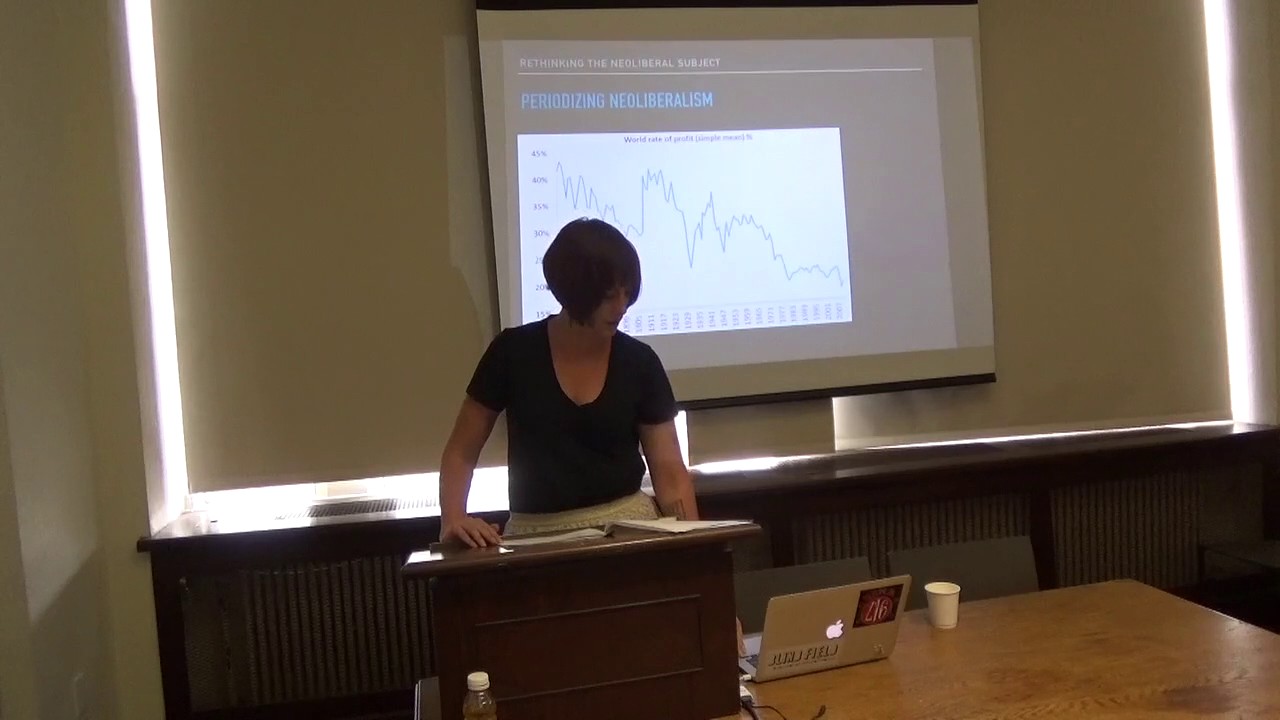
Annie McClanahan’s talk, “Hell Is Truth Seen Too Late” is now online! This lecture was given as part of b2’s conference, Neoliberalism, Its Ontology and Genealogy: The Work and Context of Philip Mirowski, at the University of Pittsburgh on March 18, 2017.
This talk attempts to think critically about the way neoliberalism functions as a periodizing term in cultural and literary studies. It explores the representation of so-called “neoliberal subjectivity”—particularly its association with an ostensibly rich individualism optimistic (if “cruelly” so) about its own entrepreneurial human capital—and argues that this characterization misses what is most quantitatively and qualitatively new about the present. By looking at the way the university has become a privileged site of these critiques, McClanahan argues that accounts of the “neoliberalization” of higher education depend on a historically inaccurate story about the university’s supposedly non-economic past, and also misunderstand the affective and material condition of students today. Turning instead to other sites—the payday loan shop, the homeless encampment, and the prison—she argues for a reframing of how we understand the subjects proper to our current historical epoch.
Annie McClanahan is Assistant Professor of English at UC Irvine. She is the author of Dead Pledges: Debt, Crisis, and 21st Century Culture(2016). She has previously been a System Fellow at the Institute for Research in the Humanities at the University of Wisconsin-Madison, and a Faculty Fellow at Cornell University’s Society for the Humanities and the University of Wisconsin-Milwaukee’s Center for 21st Century Studies. Her research interests include contemporary American literature and culture, economic thought and history, Marxist theory, and theory of the novel.
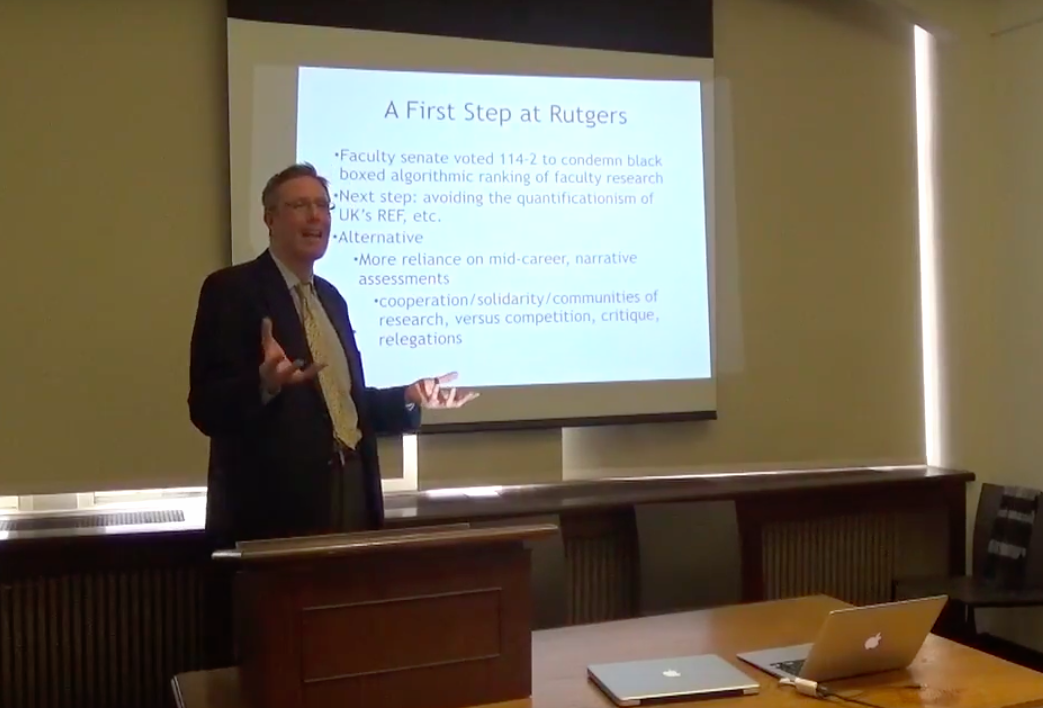
Frank Pasquale’s talk, “Relocating the Knowledge Problem: Preserving Professional Judgment in an Era of Metric Power” is now online! This talk was given as part of b2’s conference, Neoliberalism, Its Ontology and Genealogy: The Work and Context of Philip Mirowski, at the University of Pittsburgh, on March 17, 2017.
Could a robot do your job? For many business leaders, professions like medicine, education, and law are relics, destined to be replaced by some combination of software, artificial intelligence, and Uber-ized, precarious labor. But this disruptive vision of robotization is based on a naïve view of the quality of existing data, and the nature of progress in these fields. Preserving judgment and autonomy in professional work is critical both for humane labor policies, and improving quality in these fields.
Frank Pasquale researches the law of big data, artificial intelligence, and algorithms. He has testified before or advised groups ranging from the Department of Health and Human Services, the House Judiciary Committee, the Federal Trade Commission, and directorates-general of the European Commission. He is the author of The Black Box Society (Harvard University Press, 2015), which has been translated into Chinese, Korean, French, and Serbian. The book developed a social theory of reputation, search, and finance. He has served on the NSF-sponsored Council on Big Data, Ethics, & Society, and the program committees of the Workshop on Data and Algorithmic Transparency and the NIPS Symposium on Machine Learning and the Law. Frank has co-authored a casebook on administrative law and co-authored or authored over 50 scholarly articles. He co-convened the conference “Unlocking the Black Box: The Promise and Limits of Algorithmic Accountability in the Professions” at Yale University. He is now at work on a book tentatively titled Laws of Robotics: The Future of Professionalism in an Era of Automation (under contract to Harvard University Press).
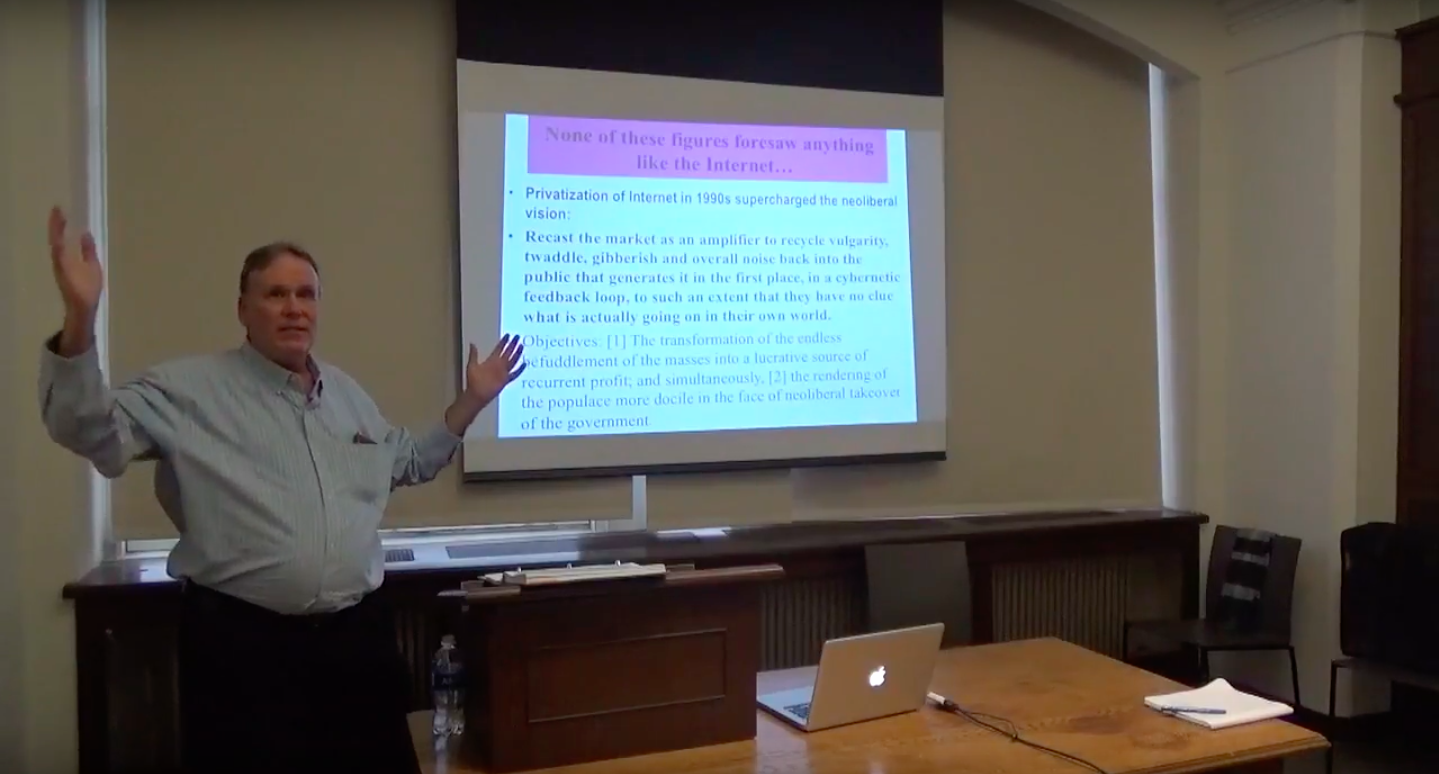
Philip Mirowski’s talk, “Hell Is Truth Seen Too Late” is now online! This was the keynote lecture at b2’s conference, Neoliberalism, Its Ontology and Genealogy: The Work and Context of Philip Mirowski, at the University of Pittsburgh, March 17, 2017.
Critics and analysts of neoliberalism seem to miss one of its key tenets: that markets are better than people when it comes to thinking. This talk explores the consequences of this blind spot for modern Marxists, for ‘fake news’, and for the utopia of ‘open science.’
Philip Mirowski is Carl E. Koch Professor of Economics and Policy Studies and the History and Philosophy of Science at the University of Notre Dame. He is also Director of the Reilly Center for Science, Technology, and Values. He is the author of Never Let a Serious Crisis Go to Waste (2013) and ScienceMart: Privatizing American Science (2011), along with four other books focused on the intersection of economics and science.
All of the talks from b2‘s recent conference, “Neoliberalism, Its Ontology and Genealogy: The Work and Context of Philip Mirowski”, are now posted on our YouTube channel!
In an interview from 2012, Jacques Rancière states in response to a question about the role of dialogue in philosophy:
I don’t believe in the virtue of dialogue in the form of: here’s a thinker, here’s another thinker, they’re going to debate amongst themselves and that’s going to produce something. My idea is that it’s always books that enter into dialogue and not people….Dialogue is never, for me, what it appears to be, which is something like the lightning flash of an encounter, a live exchange.[i]
We should, then, approach the recent Recognition or Disagreement: A Critical Encounter on the Politics of Freedom, Equality, and Identity (Columbia University Press, 2016), with a similarly circumspect attitude.
The core of the book, edited by Katia Genel and Jean-Philippe Deranty, is the debate between Rancière and Axel Honneth that took place at the Institute for Social Research in Frankfurt in June 2009, but it also includes a supplementary text by each author and an essay from each editor. Given that the editors’ essays comprise, at eighty pages, forty-five percent of the text, one should be particularly attentive to the ways in which their interventions shape the reception of the debate that was the book’s occasion. Against the editors, I want to argue here that this debate demonstrates the incompatibility of Honneth’s and Rancière’s respective projects. Moreover, Rancière’s work cannot be reconceptualized in the terms of Honneth’s liberal iteration of critical theory without sacrificing precisely those parts of his thought that are the most inventive, interesting, and politically and intellectually subversive.
My differences with Genel and Deranty can best be summarized through our respective interpretations of Rancière’s claim that, in his critique of Honneth, he has reconstructed a “‘’ [sic] conception of the theory of recognition” (95). In my view, Rancière critically appropriates the terms of “recognition” to show what it would require to become a theory of dissensus and disagreement. Deranty outlines what he takes to be Rancière’s concern with a theory of recognition that ranges from Althusser’s Lesson to Disagreement in order to demonstrate an “in-principle agreement” between Rancière and Honneth (37). First, he argues that many of the examples from Disagreement are based on historical research that Rancière conducted in the 1970s. Then Deranty adduces passages that mention recognition, such as Alain Faure and Rancière’s “Introduction” to La parole ouvrière (1976), where they refer to political struggle as “the desire to be recognized which communicates with the refusal to be despised” (quoted on 38). He also cites an early interpretation of Pierre-Simon Ballanche’s account of the plebeian revolt on Aventine Hill (an episode which also plays a crucial role in the argument of Disagreement) where Rancière writes that the “rebellion was characterized by the fact that it recognized itself as a speaking subject and gave itself a name.”[ii] Rancière continues, though: “Roman patrician power refused to accept that the sounds uttered from the mouths of the plebeians were speech, and that the offspring of their unions should be given the name of a lineage.”[iii] This description has little to do with Honneth’s account of recognition, in which individuals recognize their freedom and the freedom of others as mediated by established social institutions. And then Deranty concedes that “Rancière just disagrees with some of the key concepts used by Honneth,” which undermines the verbal parallels that he draws upon to signal their agreement (36, my emphasis). Indeed, their principled dispute about their respective concepts undermines the very possibility of an “in-principle agreement.” Therefore, to evaluate the relationship between Rancière’s egalitarian politics and Honneth’s theory of recognition we cannot rely on verbal parallels; instead, we must address how the concepts of recognition and disagreement play out in relation to a theory of the political subject, the relation between politics and the political, and problems concerning what Rancière calls “the police” and social normativity.
To address these questions, I will begin with the final essay included in Recognition or Disagreement, Honneth’s “Of the Poverty of Our Liberty: The Greatness and Limits of Hegel’s Doctrine of Ethical Life.” Earlier in the book, Honneth claims that “all kinds of political orders have to give a certain description or legitimation for who is included in the political community,” and, indeed, political philosophy often aims to supply the legitimation for a given society’s norms that decide how and whether individuals and their practices are included or excluded from the political order (115). Hegel, on Honneth’s account, demonstrates the logical and practical coherence of the social objectivity of the various types of individual freedom, that is, how freedom relates, through recognition, to politics, work, and love.
In the book’s concluding essay, Honneth examines, first, how Hegel reconciles two common, subjective concepts of individual freedom within his account of objective freedom as it is realized in ethical life. Both subjective concepts are abstract sides of modern political freedom. For Hegel, the transition to modernity entails conceptualizing social institutions as “making possible the realization of freedom” (160). In other words, on Hegel’s account, individual freedoms are mediated through institutions—and institutions are mediated and produced through the actualization or realization of individual freedoms. Thus, when Hegel reconciles the two subjective concepts of freedom, which approximate what Isaiah Berlin calls negative and positive freedom, he demonstrates that both fail to incorporate the objectivity of freedom as it is embodied in concrete social institutions. According to the “negative” concept of freedom, an individual is free insofar as they are unhindered by the actions of others. While Hegel incorporates this incomplete concept of freedom within his system as “abstract right,” which ensures state protections of individual life, property, and freedom of contract, he faults negative freedom for lacking a positive determination of what the subject can do, socially, with freedom. According to the “positive” concept of freedom, which Hegel largely derives from Kant, the basis of morality is autonomy, the self-legislating and self-reflexive activity of the subject. While this concept of freedom gives a positive foundation to what morality is, it nonetheless remains subjective, lacking a concrete relationship to social objectivity.
These negative and positive concepts of freedom are, therefore, in Hegel’s terms, “merely” subjective, while Hegel aims to demonstrate that individual freedom is objective, that is, reflected and recognized within objective social institutions. This concept of objective freedom is not limited merely to how we understand social institutions. To say that freedom is objective delimits an important intersubjective feature of individual freedom. As Honneth points out, Hegel argues that we cannot rely on Kantian models of autonomy in friendship or love, since the self-limitation of my freedom in the experience of friendship or love is not a self-limitation; it is “precisely that the other person is a condition of realizing my own, self-chosen ends” (164). The realization of a given individual’s freedom entails concrete social situations that implicate the freedom of others, and it is because social institutions mediate our relations with others that they have objective reality. Hegel—and by extension, Honneth—maintains that institutions receive normative justification insofar as they reflect and embody the practices of individuals’ freedoms, and that social institutions, in turn, engender the emergence and expansion of individual freedoms.
Now, one can see why Honneth follows Hegel through the discussion of objective freedom in the doctrine of ethical life: what both the negative and positive subjective concepts of freedom lack is recognition. In our institutions, Honneth suggests, we should be able to recognize not only our own intentions but also the intentions of other subjects. In addition, Hegel identifies three ethical spheres in which each individual’s freedoms are realized in relation to others’: personal relationships, the market economy, and politics. For these reasons, Honneth argues that the “general structure” of Hegel’s doctrine of ethical life, despite some shortcomings, “remains sound even today,” and that this doctrine provides “us with a normative vocabulary that we can use to assess the respective value of the various freedoms we practice” (169; 167). Nonetheless, Honneth also faults Hegel for treating “as sacrosanct” three historically specific institutions as the outcome of the self-realization of objective spirit: the family—“guided by the patriarchal prejudices of his own day”—the capitalist market economy, and constitutional monarchy (171). While Hegel did not explicitly address the possibility that these institutions could be transformed to “make them more amenable to the basic demand for relations of reciprocity among equals,” Honneth contends that Hegel’s account of morality hints toward how political practice can revise social norms and reorganize social institutions to make them more democratic (172). According to Honneth’s revision of Hegel, the inclusion of liberal rights and the possibility for “moral self-positioning” allows for individuals to engage in “morally articulated protest” (174). Thus Honneth allows for a continued moral progress within societies and social institutions to a degree that was not envisioned by Hegel.
*
Despite his Hegelian framework, and despite his debts to the Frankfurt School, Honneth’s project shares some of the central concerns of mainstream Anglo-American political philosophy today: the emphasis on processes of justification and establishing conditions of justice in order to evaluate institutional and normative frameworks. By contrast, Rancière’s political thought shares neither the methods nor goals of mainstream political philosophy. Todd May has already explored in detail the differences between Rancière and mainstream political philosophy (including Rawls, Nozick, Amartya Sen and Iris Marion Young). In May’s account, these political philosophers rely, whether they are proponents or critics of distributive theories of justice, on a concept of “passive equality”: “the creation, preservation, or protection of equality by governmental institutions.”[iv] Rancière, though, makes the stronger polemical claim that political philosophy embeds itself in, and offers justification for, regimes of inequality that he calls “the police” or “policing.” One of the most striking features of Rancière’s work is his claim that what we typically call politics, even in its most democratic forms (voting, deliberation, governance, and popular legitimation), is policing. In Disagreement, Rancière defines the police as:
first an order of bodies that defines the allocation of ways of doing, ways of being, and ways of saying, and sees that those bodies are assigned by name to a particular place and task; it is an order of the visible and the sayable that sees that a particular activity is visible and that another is not, that this speech is understood as discourse and another as noise.[v]
Since this definition of the police sounds very close to the way that Rancière often glosses his concept of “the distribution of the sensible,”[vi] we should specify that policing produces and reproduces relations of inequality, the stratification of roles within a given distribution of the sensible that partition individuals and groups according to inclusion and exclusion, such as those whose task it is to rule and those whose task it is to obey. Moreover, on Rancière’s account, politics—in May’s terms, “active equality”—is a dynamic of collective engagement and revolt that aims to subvert and resist the stratification and coercion of policing and social institutions. Given that Honneth’s account of recognition emphasizes how social institutions mediate and engender individual freedoms, it then follows that in Rancière’s terms Honneth’s theory of recognition would not be an account of politics as much as it is an account—though a progressive one at that—of policing.
And yet, in “Critical Questions on the Theory of Recognition,” his critique of Honneth (and Chapter Three of the book), Rancière does not use the terms “police” or “policing.” Instead, he begins with the conditional hypothesis that his differences with Honneth are best articulated by treating their respective approaches as competing theories of recognition. At the outset, however, he signals his critical intent by suggesting that “the term ‘recognition’ might also emphasize a relationship between already existing entities,” these entities being individuals and established social institutions (83). When, then, Rancière concludes that he’s sketched, through his critique of Honneth, his own theory of recognition, he’s appropriated the language of critical theory to articulate a politics of dissensus and disagreement.
Rancière pursues this hypothesis—that he and Honneth are outlining competing theories of recognition—in order to locate their central points of disagreement. In Disagreement, Rancière defines disagreement (la mésentente) as a specific kind of political challenge to a given order of policing, “a determined kind of speech situation in which one of the interlocutors at once understands [entend] and does not understand [entend] what the other is saying.”[vii] In French, the term la mésentente plays on different connotations of the verb entendre, between “to hear” and “to understand.” On Rancière’s account, the politics of disagreement emerges when the marginalized or oppressed (what he calls “the part with no part”) within a given social order challenge the ways in which society is policed, and often these challenges are phrased in terms that have readily accepted meanings within society. However, politically contentious terms, such as equality, rights, or justice are given inventive new meanings that challenge the normative frameworks of a given regime of policing; the part with no part who are contesting injustice and the police can “hear” the same demands but “understand” entirely different things. Many political theorists lament this ambiguity and aim to define it away. However, Rancière argues that the ambiguity of our contentious terms and ideals makes dissensus possible. That is, this ambiguity makes it possible to identify how these politically contentious terms circulate between policing and politics, how they come to articulate and combat inequality and coercion. For example: justice, for some, means due process and equal consideration before the law, while justice for movements such as Black Lives Matter opens on to both a broad indictment of how so-called due process legitimates injustice against African-Americans who are victims of police violence, and a broader vision of transformative social justice.
In “Critical Questions on the Theory of Recognition,” Rancière uses disagreement in a broader, dialogical sense rather than its specific, political sense. He argues that dialogue—to be truly dialogical—must be an “act of communication [which] is already an act of translation, located on a terrain that we don’t master” (84). Dialogue always involves translation, distortion, but also invention; in terms of philosophy, it means that both interlocutors must think outside of their usual terminology: distortion remains “at the heart of any mutual dialogue, at the heart of the form of universality on which dialogue relies” (84). But Rancière also suggests that dialogue, in its more specific, political sense, requires acknowledging the “asymmetry in positions” between interlocutors. This claim summarizes his differences with Habermas, which he had previously outlined in Disagreement: acknowledging how asymmetry and power distort the ideals of political dialogue entails, in Rancière’s account, a stringent form of universalism that demands philosophers to confront not just institutional barriers to democratic deliberation, but also how the processes of deliberation function to exclude certain forms of political speech and action. Thus Rancière’s critical question: to what degree does Honneth’s theory of recognition rely on the presupposition that the demands of political subjects have always already been mediated by social institutions?
To confront this question, Rancière proposes three working definitions of recognition. Two reflect common usage: on the one hand, recognition means the concurrence of a perception with prior knowledge, as when we recognize a friend, location, or information; on the other hand, recognition in the moral sense designates how we recognize other individuals as autonomous beings like ourselves. In both cases, Rancière notes, “re-cognition” functions as an act of confirmation. He then hypothesizes that recognition could also be conceptualized in the terms of what he calls a distribution of the sensible. Recognition, then, “focuses on the configuration of the field in which things, persons, situations, and arguments can be identified” (85). In this sense, recognition comes prior to any act of confirmation—and the critique of recognition entails disagreement over the conditions in which persons, things, or situations are understood as such.
We could ask, for instance, how is it that a given regime of policing frames some enunciations as political demands against injustice and others as merely subjective complaints or even noise? And we could use an analysis of this situation to attack the broader norms that legitimate this distribution of speech and noise. While Rancière acknowledges that Honneth’s account of recognition “echoes” his own polemical account, he raises a crucial question: to what degree does Honneth’s account rely on the two connotations of the common usage, presuming a stable distribution of the sensible or normative framework that relies on an “identitarian conception of the subject” that conflicts with a “conception of social relations as mutual” or dynamically or socially constructed (85)?
First, Rancière contends that Honneth embraces an “anthropological-psychological” concept of the subject that is heavily indebted to a Hegelian “juridical definition of the person” (87). Thus Honneth’s account of the subject’s struggle for recognition emphasizes the affirmation of self-identity and self-integrity within the intersubjective structure of recognition. In other words, it’s the same integral individual subject who is seeks recognition within a multiplicity of situations related to love, work, or politics. Then, Rancière argues that this juridical model of the integral identity of the subject conflicts with its claim to articulating intersubjective social agency—a point encapsulated in Honneth’s summary of love and recognition in the book: “in friendship and love my experience is precisely that the other person is a condition of my realizing my own, self-chosen ends” (164). To say that love involves two individuals realizing their respective ends and interests through another is overly juridical. To Honneth, Rancière counterposes love as it is found in À la recherche du temps perdu, where Proust describes love as a dynamic and aesthetic construction of an other. Rancière writes:
What appears at the beginning is the confused apparition of a multiplicity, an impersonal patch on a beach. Slowly the patch appears as a group of young girls, but is still a kind of impersonal patch. There are many metamorphoses in that patch, in the multiplicity of young girls, through to the moment when the narrative personifies this impersonal multiplicity, gives it the face of one person, the object of love, Albertine. (88)
Rancière offers this counternarrative to show how our theoretical frameworks delimit the possibilities of social agency that we are able to recognize—a criticism that Honneth subsequently accepts.
Rancière’s attention to this point can perhaps explain how Rancière’s terminology can be alternately powerful and abstract. When he opposes the politics of equality to policing, it readily calls to mind clashes between protestors and cops, though politics cannot be reduced to these terms. However, when he defines those subjects who confront the established order as the part with no part, this definition is far more abstract than saying marginalized and oppressed. But Rancière relies on this level of abstraction in order to avoid delimiting conditions of political agency that could delimit who this part is because it could exclude groups who have yet to emerge and who we cannot foresee.
In general, for Rancière, political subjects are neither self-identical nor self-integral. Instead, political subjects emerge through a dynamic of what he calls disidentification, the rejection of the roles, places, and tasks assigned to bodies within a given regime of policing. We could interpret Proust’s description of love, then, as a metaphor for the dynamic of political subjectivation: political subjects emerge first as a multiplicity, at first an impersonal patch in the social field, until it takes shape through the invention of a name—for instance, #blacklivesmatter or #NoDAPL—for a collective disruption of or rebellion against the police order. Given that all regimes of policing are instantiations of social inequality and coercion, politics is, for Rancière, by definition egalitarian. It is equality, he argues, that leads to a much more exacting concept of universality than an account of politics that neglects the asymmetry between the political subjects who exist by virtue of contesting the social order and the established order of policing. Politics enacts the affirmation of “an equal capacity to discuss common affairs”; in other words, politics enacts the intellectual and political equality of anybody and everybody (93).
The task of political thought is to ascertain how politics involves a “polemical configuration of the universal” (94). The Black Lives Matter movement began with a call for justice for Mike Brown in Ferguson, but, according to Keeanga-Yamahtta Taylor, its next stage involves both “engaging with the social forces that have the capacity to shut down sectors of work or production until our demands to stop police terrorism are met” and movement building through solidarity, which addresses how, while African-Americans “suffer most from the blunt force trauma of the American criminal justice system,” the broader normative framework of “law-and-order politics” functions to oppress the poor in general.[viii] From a standpoint informed by Rancière, the goal of political thought would be to identify the movements and practices that drive “the process of spreading the power of equality” in the here and now, to identify how specific movements involve a polemical force of universality to subvert and combat the normative frameworks of a given police order (94). Far from endorsing a theory of recognition, Rancière has redefined recognition as a politics of dissensus and disagreement.
*
Thus we have good reason to doubt Deranty’s claim of an in-principle agreement between Rancière and Honneth. Indeed, the editors and I reach very different conclusions regarding the significance of this debate because they accept Honneth’s theoretical framework to interpret it, while I refuse to subsume Rancière’s concepts under Honneth’s. The point here, though, is not establishing who has read Rancière or Honneth correctly, but to examine how these interpretations delimit what each thinker believes is politically possible and feasible.
Our first difference concerns the supposed common ground shared by Rancière and Honneth. Though Rancière explicitly chooses to oppose “politics” (la politique), rather than “the political” (le politique) to “the police”, Honneth and the editors equivocate between “politics” and “the political.” However, the terms, especially in French philosophy, are distinct—which means Rancière has made a deliberate conceptual choice.[ix] Politics, on his account, designates a dynamic activity, while “the political” carries the connotation of an original, fundamental political sphere upon which policing has supervened. For Honneth, then, when Rancière discusses equality, he’s describing either an “original definition of the political community” (115) or a political anthropology in which human beings “are constituted by a wish or a desire to be equal to all others,” and this “egalitarian desire…brings about the exceptional moment of politics” (99). In their “Critical Discussion” included in the book, Rancière rightly rebuts both of these characterizations. He holds that if politics takes place, it does so through an egalitarian praxis opposed to the police. To treat Rancière’s politics as a political anthropology, imputing particular desires or motives to political subjects, implies that the debate is about whether human beings are motivated by either a desire for recognition or for equality. We could, in that case, resolve the debate with a political anthropology of desire.
If this is not enough reason to reject Honneth’s way of framing the debate, he also characterizes recognition and disagreement as two complementary forms of struggle with different scopes—but this categorization carries with it an implicit normative claim that recognition is more practical. He argues that Rancière brusquely reduces “the political,” considered as “a stratified normative order of principles of recognition,” to policing (103). Therefore Rancière interprets this stratified normative order too rigidly, when these norms are given to conflicts over their meaning, that is, subject to reinterpretation and revision. For Honneth, the revisability of the normative order allows us to conceive of two types of political intervention: an internal struggle for recognition and an external struggle for recognition. In Honneth’s terms, Rancière focuses exclusively on the external struggle for recognition, which, while it combats the “political order as such,” ignores the “reformist” ambitions of the internal struggle for recognition that aims to reinterpret existing normative principles to make social institutions and their normative frameworks more democratic and inclusive.
But Honneth’s distinction between the internal and external struggles for recognition is not merely descriptive, but also normative: given, he claims, the difficulties in formulating injustice in revolutionary terms, it’s more important in day-to-day politics to “deal with these small projects of redefinition or of reappropriation of the existing modes of political legitimation” (106). Unlike Honneth, Rancière does not prescribe the scope of political struggle within a given situation, since such a prescription functions to legitimate or delegitimize choices we make about what is to be done. These choices cannot be evaluated outside of the context of political struggle itself. But Honneth’s normative preference is part of his philosophical framework: if the freedom of individuals is engendered and mediated by social institutions and norms, and if self-integrity is one of the primary ends of the theory of recognition, then individuals should aim to reform and reinterpret these institutions and norms incrementally.
From Rancière’s perspective, even if we grant that political freedom is sometimes engendered by existing social institutions, this does not entail that all parts of society should recognize these institutions as engendering their freedom. Those who are marginalized and oppressed could just as equally recognize how a given institution has functioned to exclude, marginalize, oppress, or immiserate them. The goal of politics for these political subjects need not or should not be—nor should we prescribe their goal to be—the reform of or formal recognition within these institutions that have historically oppressed them. From Rancière’s standpoint, it is right for the part with no part to combat and transform the very normative principles that legitimate and reinforce these institutions of inequality, and to prescribe reform rather than radical normative transvaluation serves to delegitimize the possibility of formulating and enacting broader goals of political struggle.
Thus while Recognition or Disagreement presents the debate between Rancière and Honneth, it speaks to broader issues about the scope and aims of contemporary political thought. The contrast between Honneth and Rancière ably demonstrates Rancière’s stubborn refusal to engage in the processes of justification valorized by mainstream political theory—indeed, it serves as a stark reminder of how engaging in these problems often, (and in Rancière’s view, always) entails accepting profound social inequalities. However, this book is also important because it shows that if we mainstream Rancière’s work, as Genel and Deranty attempt to do, we lose those parts of his work that are most subversive and inventive—and we are left with only Honneth.
Devin Zane Shaw teaches philosophy at Carleton University. He is the author of Egalitarian Moments: From Descartes to Rancière (Bloomsbury, 2016) and Freedom and Nature in Schelling’s Philosophy of Art (Bloomsbury, 2010).
Notes
[i] Jacques Rancière, The Method of Equality: Interviews with Laurent Jeanpierre and Dork Zabunyan, transl. Julie Rose. Malden: Polity, 2016, p. 183.
[ii] Quoted on 38, but the reference is incomplete. See Rancière, Staging the People: The Proletarian and His Double, transl. David Fernbach. London: Verso, 2011, p. 37.
[iv] Todd May, The Political Thought of Jacques Rancière: Creating Equality. University Park: Pennsylvania State University Press, 2008, p. 3.
[v] Rancière, Disagreement: Politics and Philosophy, transl. Julie Rose. Minneapolis: University of Minnesota Press, 1999, p. 29.
[vi] As Rancière defines it in Recognition or Disagreement, a distribution of the sensible is “a relation between occupations and equipments, between being in a specific space and time, performing specific activities, and being endowed with capacities of seeing, saying, and doing that ‘fit’ those activities. A distribution of the sensible is a set of relations between sense and sense, that is, between a form of sensory experience and an interpretation that makes sense of it. It is a matrix that defines a whole organization of the visible, the sayable, and the thinkable” (136).
The West welcomed East Germany to the end-of-history by flying in David Hasselhoff for Berlin’s New Year celebrations. From the top of the fallen wall, clad in a pulsing light-spangled jacket, Hasselhoff regaled half a million people with the period’s unofficial anthem, “Looking for Freedom.” It is still, to date, one of Germany’s bestselling songs.
Two years earlier, as Margaret Thatcher closed in on her second re-election, Hot Chocolate’s former front man, Errol Brown, had also lent his weight to the liberal cause. During the 1987 Conservative Party Conference, the disco hitmaker stepped up to the podium and led the entire caucus in a rousing rendition of John Lennon’s pop-socialist anthem “Imagine” (Wilson 2013: 41):
Imagine no possessions
I wonder if you can
No need for greed or hunger
A brotherhood of man
Imagine all the people
Sharing all the world
You, you may say I’m a dreamer,
But I’m not the only one
I hope some day you’ll join us
And the world will live as one
Little wonder that irony was the order of the day. Confident in their unassailable position, and wryly indulgent of the counterculture’s crabby idealism, the architects of globalization rested content on their laurels. There was much to celebrate. Liberal democracy had vaulted over the last great hurdle on its pathway to perpetual peace. Francis Fukuyama captured the mood as he sketched out the lineaments of his wildly popular end-of-history thesis:
What we may be witnessing in not just the end of the Cold War, or the passing of a particular period of post-war history, but the end of history as such: that is, the end point of mankind’s ideological evolution and the universalization of Western liberal democracy as the final form of human government. (Fukuyama 1989: 4)
The course of world events allowed Fukuyama to stand by this claim for almost thirty years. Writing in 2007, on the very cusp of the 2008 financial crisis, he offered a confident and largely unqualified reassertion of his fundamental argument:
I believe that the European Union more accurately reflects what the world will look like at the end of history than the contemporary United States. The EU’s attempt to transcend sovereignty and traditional power politics by establishing a transnational rule of law is much more in line with a ‘post-historical’ world than the Americans’ continuing belief in God, national sovereignty, and their military. (Fukuyama 2007)
Yet ten years on – as Fukuyama himself has conceded – the same claim has begun to leave behind a bad taste in the mouth. Walls are in vogue again. And as a fragile European Union teeters on the brink of fragmentation, the new political trajectory of the United States seems the more reliable harbinger of the political futures that await us, futures overshadowed by a resurgence of rightwing authoritarianism and a reactive cascade of unpredictable international statecraft. Indeed, as Trump has ridden a wave of anti-establishment discontent into the White House, “Americans’ continuing belief in God, national sovereignty, and their military” now looms large over the old effort to “transcend sovereignty and traditional power politics by establishing a transnational rule of law.”
Even prior to Brexit and Trump’s election, the new tenor of the times was starting to emerge. As armed guards rolled out the checkpoints and the razor wire, as miles of ad hoc barrier unwound across Europe, it became apparent that the open borders of globalization belonged to another era. The Schengen Agreement was a thing of the past, a bitterly regretted utopian folly. And as the specter of Trump’s “great, great wall” hovered at the outer edge of possibility, it was becoming clearer that other dreams were dying too: You could keep your hungry, your poor, your tired, there was no room for them here.
The truth was, however, these high-walled fever dreams had been under construction for some time. The work had never really stopped. Long before the “great wall” was rumored, and even as the old Iron Curtain came crashing down, the world’s wealthy had peered out from behind their battlements in the sky. This is Mike Davis writing in the mid-1980s:
According to its advance publicity, Trump Castle will be a medievalized Bonaventure, with six coned and crenellated cylinders, plated in gold leaf, and surrounded by a real moat with drawbridges. These current designs for fortified skyscrapers indicate a vogue for battlements not seen since the great armoury boom that followed the Labour Rebellion of 1877. In so doing, they also signal the coercive intent of postmodernist architecture in its ambition, not to hegemonize the city in the fashion of the great modernist buildings, but rather to polarize it into radically antagonistic spaces. (Davis 1985: 112-3)
When Davis wrote, he would probably have been surprised to learn that the proposed owner-occupant of this “medievalised Bonaventure” would one day descend in his golden elevator to lead a populist insurgency against “out-of-touch elites.” He would probably have been less surprised to hear that when he came, he came promising the Rust Belt’s dispossessed fortifications and battlements of their own.
To understand the success of the strategy, and to understand the strange mismatch of class interests that defines the Trump mandate, one has to dig beneath the concrete partitions of the “postmodern” city and search within the rusting husk of the American factory system to grasp the hidden economic imperatives and political contingencies that produced deindustrialization and financialization as coeval phenomenon. Here – as many of us are belatedly beginning to realize – Robert Brenner’s history of postwar economic development proves an indispensable resource.
Much of Brenner’s later work has focused on the turbulent transition from the global economy’s belle époque – the period of unprecedented economic dynamism the lasted from the close of the war to the early 1970s – to the “long downturn” that has followed in its wake. His work has drawn attention to a progressive reallocation of capital investments away from industrial manufacturing and into the so-called FIRE (Finance, Insurance and Real Estate) sector. In Brenner’s account of the history, as emerging industrial economies began contesting American manufacturing market dominance struggle for market share reached such a pitch of intensity that companies became accustomed to operating with radically reduced profit margins.
In response to a corresponding decline in rates of return, investors became shyer of the manufacturing sector and sought to diversify their portfolios. And as fallow capital sought new routes to profit the structural import of the FIRE sector intensified. From the late 1970s through to the first decade of the new millennium the finance industry’s signature methods and investment strategies became more and more computationally sophisticated and systemically pervasive. Among the symptoms of the FIRE sector’s new significance was the rapid reconstitution of urban space that Davis describes. And it was, of course, in the context of the FIRE sector’s expansion that Trump emerged as the popular face of the resurgent real estate industry, whose towering skylines – so adored by Hollywood – became totemic of American greatness in its autumnal phase.
For the better part of three decades, this increasingly baroque financial system succeeded in restoring dynamism to the world economy, propelling the US beyond a sputtering Soviet regime into the position of uncontested global hegemon. And as the oil and stagflation crises retreated from view, it is perhaps not that surprising that faith in the FIRE sector’s new methods became so strong that creditors began to think themselves so cybernetically insured against loss that they lent in increasingly blithe and unstinting fashion.
It was in this climate of technocratic hubris that Fukuyama sketched out his thesis, one that expressed the dominant structure of feeling then prevailing in elite circles: The common sense of the period all but dictated that a universal “evolutionary pattern” was just then culminating in the globalization of liberal democracy, as “technologically driven capitalism … free[ed itself] of internal contradictions” (Fukuyama 1993: 91; xi).
These dreams seem all the more ironic now that one of the FIRE sector’s most notorious figures has begun to wreak havoc with the signal institutions of liberal democracy, questioning the accuracy of the ballot, wielding executive orders in madcap and draconian fashion, intimidating the judiciary, and attempting to bludgeon the free press into abject submission. The ironies deepen when we recall that it was the increasingly risky expansion of the FIRE sector that triggered the 2008 financial crisis, as the securitization of subprime mortgages opened the door to that last round of dispossession that underlies so much of today’s anti-establishment discontent.
The ramifying consequences of the 2008 financial crisis were evident in this electoral cycle as we saw the two candidates periodically breaking away from the familiar battery of appeals to the middle-class homeowner, to take time to address a dispossessed and precariously employed “working class” who had swelled to such an extent that their political significance could no longer be ignored.
Yet in its resurrection the figure of the worker seemed to have undergone a subtle transformation. In its return to the mainstage of electoral politics, talk of the worker functioned less as a metonym for the workers movement, and more as a shorthand for the plight of the downwardly mobile “worker-citizen,” one who could no longer count on social state protections, whose stake in the real estate market was gone or imperiled, but who was still the bearer of the full legal rights and privileges of the citizen.
To understand the increasingly reactionary disposition of this citizen-worker we have to grasp the long downturn’s ongoing effects on the technical and demographic composition of the real economy. This effort again finds us tacking back to the 1970s, to the last great crisis in the capitalist world system, when attempts to restore dynamism to the global economy saw industrial capital fighting to break free of the constraints that social democracy had placed on its agency, unleashing a two-pronged assault on labor. Capital flight saw manufacturing plants flee the blue-collar heartlands, as industry reconstituted its industrial base in the emerging economies where it could exploit a labor force that enjoyed far fewer legal protections. And at one and the same time as the Thatcher and Reagan administrations drove through the legislation that facilitated and policed this new round of capital flight – a series of legislative actions that also undergirded the FIRE sector’s emergence as the new motor of economic dynamism – manufacturers also fended off the labor movement from within, introducing a new round of automation that saw labor’s relative share in the productive process decline, further securing factories against sabotage and slowdown.
Research collective Endnotes sums up the prevailing political fallout of this double-fronted assault:
Industrial output continues to swell, but is no longer associated with rapid increases in industrial employment … In this context, masses of proletarians, particularly in countries with young workforces, are not finding steady work; many of them have been shunted from the labour market, surviving only by means of informal economic activity (Endnotes 2015)
The use of the term “shunted” here evokes the language of Stuart Hall’s Policing the Crisis. And in tracking the early effects of this “shunting from the labour market” Hall identified that the policing of deindustrialization’s dispossessed broke differentially along racial lines. As the economy contracted, white Britons closed ranks, consigning immigrant communities to a greater share of the joblessness that capital flight was leaving behind it. Writing that race was “one of the main mechanisms, by which, inside and outside the work-place itself, th[e] reproduction of an internally divided labour force [was] accomplished” (Hall et al. 1982 [1978]: 346), Hall detailed the advantages that the dominant classes gleaned from these divisions:
The ‘benefits’ … must therefore be reckoned to include not only the direct and indirect exploitation of the colonial economies overseas, and the vital supplement which this colonial work-force made to the indigenous labour force in the period of economic expansion, but also the internal divisions and conflicts which have kept that labour force segregated along racial lines in a period of economic recession and decline – at a time when the unity of the class as a whole, alone, could have pushed the country into an economic ‘solution’ other than that of unemployment, short-time, cuts in the wage packet and the social wage. (Hall et al. 1982: 346)
Having identified these developing tendencies – and their role in keeping the “unity of the class as a whole” at bay – Hall went on to explore how black Britons had begun to adapt to their entrapment in the grey and black economies. Explaining the concept of hustling for the benefit of a predominantly white readership, he wrote:
The hustle is as common, necessary and familiar a survival strategy for ‘colony’ dweller’s as it is alien and strange to those who know nothing of it … Hustlers live by their wits. So they are obliged to move around from one terrain to another, to desert old hustles and set up new ones in order to stay in the game. From time to time, ‘the game’ may involve rackets, pimping, or petty theft. But hustlers are also the people who sustain the connections and keep the infrastructure of ‘colony’ life intact. They are people who always know somebody, who can get things done, have access to scarce goods, who can ‘deal’ and service the less-respectable ‘needs’ of the respectable end of ‘colony’ society. They hang out around the clubs, organise the blues parties, set the domino game up, know what day the illegal white rum distilleries produce. They work the system; they also make it work … When the going is good, hustlers are men about the street with style, visibly displaying their temporary good fortune: ‘cool cats.’ (Hall et al. 1982: 351-2)
Of course in the days since he offered this account, hip hop’s rise to pop cultural dominance has made the swaggering resourcefulness of the hustler part of the cultural fabric of millennial experience. Few under the age of forty are not intimately familiar with hip hop’s virtuosic chronicling of Black America’s experience of the racialized policing of the long downturn. Part of the enduring value of Hall’s work lies in its ability to tie hip hop’s signature tropes and stances to the determinations against which they emerged, as the policing of capital’s real movement subjected the black proletariat to the worst effects of this new round of capital flight and automation.
Indeed, in retrospect, it seems that NWA, rather than Hasselhoff, would have been a fitter avatar of the inequities that globalization scattered in its wake as it ground the labor movement beneath its heel. For while Hasselhoff’s words at the Berlin Wall implied that freedom had descended on the former Soviet bloc in a moment of decisive apotheosis, in NWA’s language freedom was difficult to attain; indeed, it was wrestled from the system in the context of an unremitting struggle with occupying powers determined to maintain existing inequities:
Fucking with me cause I’m a teenager
With a little bit of gold and a pager
Searching my car, looking for the product
Thinking every nigga is selling narcotics
You’d rather see me in the pen
Than me and Lorenzo rolling in a Benz-o
In the crosshairs of the carceral state it was more than evident that history and the struggle for emancipation was far from over.
Still, when Hall sketched out his typology of the hustler he, like Davis, would probably have been surprised by the uncanniness of subsequent developments. For at one and the same time as policing practices trended along the lines he identified – with a massively disproportionate number of black Americans subject to incarceration and unemployment – we also saw hip hop’s hustler swagger its way deep into the heart of the American culture industry. So deep was the penetration that one of hip hop’s most celebrated dons would one day take to the stage of Carnegie Hall, backed by a 36-piece orchestra, in a full tuxedo and tie, to make a boast of a rags-to-riches tale that dwarfed anything that Dickens ever conceived:
Momma ain’t raised no fool
Put me anywhere on God’s green earth,
I’ll triple my worth
Motherfucker, I, will, not, lose
I sell ice in the winter, I sell fire in hell
I am a hustler baby, I’ll sell water to a well
I was born to get cake, move on and switch states
Cop the coupe with the roof, gone and switch plates
The epic scale of Jay Z’s biography – from resourceful street kid slinging rocks on the corner, to owner of music streaming service valued at $600 million – charts one self-defined hustler’s traversal of the vast wealth disparities that have characterized the global economy in the wake of the belle époque.
We might pause for a moment here to consider the sociological significance of hip hop’s massive contemporary appeal. Indeed, it might not be too much of a stretch of the imagination to suggest that part of what has driven these accounts of life in the game to the top of the Hot 100 is precisely the more widespread generalization of the conditions of precarity and disenfranchisement that this genre has spent the bulk of its existence recounting and resisting. As the state continues to scale back on the welfarist commitments of the postwar order, and as yet another wave of automation sees the world system further unable to absorb labour into the productive process, a life in the black or grey economy is a very real prospect for increasing numbers of the world’s people. Endnotes write at another juncture:
The social links that hold people together in the modern world, even if in positions of subjugation, are fraying, and in some places, have broken entirely. All of this is taking place on a planet that is heating up, with concentrations of greenhouse gases rising rapidly since 1950. The connection between global warming and swelling industrial output is clear. The factory system is not the kernel of a future society, but a machine producing no-future. (Endnotes 2015)
A poignant statement in light of the last electoral cycle, as the Trump campaign implicitly configured the 1950s “factory system” as the locus of America’s lost greatness, promising to “return” the US to a weird Disneyland recapitulation of its Fordist heyday. And as Trump’s executive actions against environmental and energy agencies have demonstrated in the weeks since his inauguration, this back-to-the-future ride will not tolerate any slowdown or inhibition of its propulsive thrust toward “no-future.”
Endnotes write that today’s left is prone to approach the worker’s movement with the “latecomers’ melancholy reverence” (Endnotes 2015) – a striking phrase that eerily anticipates Trump’s appeal to America’s erstwhile greatness. And these affinities seem capable of identifying a key problematic that has handed the Rust Belt over to Trump, and the British postindustrial zones to the Leave Campaign. For while the architects of globalization succeeded in decimating the worker’s movement, they were markedly less successful in their efforts to subordinate the sovereignty of the nation state to the rigors of transnational law. And thus as citizen-workers look for protection against immiseration, many seem increasingly willing to approve statist measures to both expel noncitizens who “unfairly compete” for scarce jobs, and introduce protectionist regimes designed to shield the nativist worker from the threat of international competition. Unable to organize themselves in a united internationalist front against exploitation, it is hardly surprising that the downwardly mobile worker-citizens of today are instead willing to fall back on the state’s promises to negotiate favorable “deals” on their behalf.
The background to these tendencies seems to be the declining viability of the global development narrative that has attended postwar international policymaking since the Bretton Woods Agreement. In the context of secular stagnation and economic contraction, advanced economies have been forced to rely on our era’s signature admixture of debt and austerity, scaling back on welfarist provisions even as the nation state continues to function as a macroeconomic stimulator and a guarantor of private property. And increasingly, as development of the world system’s “peripheral” regions also stalls (Barone 2015), the core economies appear to be bracing themselves to resist a rising tide of economic and climate migration. It seems that population growth, economic growth, and industrial productivity have fallen out of sync to such a profound extent that we are increasingly “experiencing modernization of industry without modernity’s attendant social forms: without, that is, the institutional, social, cultural features associated with development, such as universal public education, democratic state institutions” and the humanitarian defense of human rights (Brouillette and Thomas 2016: 511).
Yet rather than identify the newness of this geopolitical situation, political discourse on these matters more often coalesces around an introverted and melancholic nationalism that understands the immiseration of the worker-citizen in relation to vague but impassioned narratives of national decline. It is telling that Trump’s notorious baseball cap evokes the popular affluence of the belle époque through the allusive figure of “greatness,” a sleight of hand that evades the tricky question of how exactly one goes about turning back the clock on the technological development of the forces of production. For even if Trump’s protectionist policies do manage to lure back some manufacturing plants, the fixed to variable capital ratio will not be as favorable as it was back in the days when America was “great,” which is to say, when it was Fordist.
Appeals to the figure of the precarious citizen-worker – more often figured in the guise of Thatcher’s “individual, and his family” – thus became a common feature of both campaigns. Yet in Clinton’s case we witnessed the strange spectacle of an establishment standard-bearer attempting to patch together, ad hoc, a fuzzily defined platform that alternately gestured toward the maintenance of the status quo, and toward the construction of a newly “social democratic” pluralism. Trump, meanwhile, staked out a clearly defined appeal to white nativist protectionism, one that was capable of uniting a large cross section of white America around the prospect of a Fordist “restoration,” one that sought to assert the rights and security of the white worker-citizen in the face of intensifying global economic malaise.
In so doing, the Trump campaign amplified a strategy that has been a mainstay of advanced economies in times of crisis throughout the postwar period. Hall describes this strategy in relation to the structural function that migrant workers performed for British industry from the early-1950s to the mid-1970s:
In the early 1950s, when British industry was expanding and undermanned, labour was sucked in from the surplus labour of the Caribbean and Asian subcontinent. The correlation in this period between numbers of immigrant workers and employment vacancies is uncannily close. In periods of recession, and especially in the present phase, the numbers of immigrants have fallen; fewer are coming in, and a higher proportion of those already here are shunted into unemployment. In short, the ‘supply’ of black labour in employment has risen and fallen in direct relation to the needs of British capital. (Hall et al. 1982: 343)
On the one hand, Trump’s wall, Brexit, and the broader European resistance to the Schengen Agreement, faithfully reproduce the pattern that Hall identified, as global conditions of economic contraction have triggered a rising tide of anti-immigration policies.
Yet what separates the dynamics that Hall describes from those that are unfolding around us now, is the extent to which Trump’s anti-immigration policies are also a feature of a larger enthnonationalist projectionist program, one that signals a full-blooded return to the so-called “beggar-thy-neighbor” economic strategies that last openly prevailed prior to the advent of the Bretton Woods Agreement.
Writing in 1937, British economist Joan Robinson argued that “in times of worldwide unemployment, it is indeed possible for one country to increase its employment and total output by increasing its trade balance at the expense of other countries. She coined the phrase ‘beggar-thy-neighbor’ to describe such policies” (Pasinetti 2008 [1987]). Robinson itemized four beggar-thy-neighbor economic weapons: wage reductions, officially induced exchange depreciation, export subsidies, and import restrictions. In the last month the US government has publicly evoked most, if not all, of these weapons, either accusing other governments of using them against the US, or signaling its intention to use them itself.[i] It is worth stressing that this is more of an escalation of already-existing dynamics than a complete bolt out of the blue – i.e. beggar-thy-neighbor strategies have been quietly on the rise for a decade or more (Barone 2015) – but the additional level of unvarnished aggression that Trump has introduced into the picture cannot but result in further escalations. The underlying dynamic is one in which – under the prevailing conditions of secular stagnation – economic growth risks becoming a zero-sum game, such that the growth of one nation is always talking place at the expense of another.
Here Robinson’s explanation of the likely geopolitical fallout of beggar-thy-neighbor economics is worth remembering. Robinson wrote that “as soon as one country succeeds in increasing its trade balance at the expense of the rest, others retaliate” and among the economic effects of this cycle of retaliation is a reduced volume of international trade (Robinson 1947, 156). There are affective consequences to these cycles of retaliation and these increasingly isolationist tendencies. Indeed, Robinson cautions that such policies can “add fuel to the fire” of economic nationalism, as trade wars push nations to the brink of open hostilities (Robinson 1947: 157).
It should be noted that the intellectual circles that fostered this new ethnonationalism are not averse to an escalation of international armed conflict. Indeed, Steve Bannon is on record as thinking a war with China “inevitable” within the next ten years (Hass 2017). Much like Russia’s Alexander Dugin, Bannon subscribes to a world-historical vision that anticipates the onset of another great war, one that will serve as the crucible from which a revived Judeo-Christian culture will emerge victorious:
But I strongly believe that whatever the causes of the current drive to the caliphate was — and we can debate them, and people can try to deconstruct them — we have to face a very unpleasant fact. And that unpleasant fact is that there is a major war brewing, a war that’s already global. It’s going global in scale, and today’s technology, today’s media, today’s access to weapons of mass destruction, it’s going to lead to a global conflict that I believe has to be confronted today. Every day that we refuse to look at this as what it is, and the scale of it, and really the viciousness of it, will be a day where you will rue that we didn’t act (qtd. Feder 2016)
We are, at this juncture, a long way from the condition of universal post-historical secularism that Fukuyama anticipated. Indeed, the surprisingly pervasive appeal of Dugin and Bannon’s millennial creeds seems to have done much to consolidate Trump’s white American base, where a paranoiac strain of conservative religiosity has gained a powerful foothold. In a widely circulated address to a Vatican conference, Bannon appealed to the old counter-reformation concept of the “Church Militant” in an effort to recruit foot soldiers for an apocalyptic culture war, one that was to unfold, simultaneously, on domestic and geopolitical fronts:
And we’re at the very beginning stages of a very brutal and bloody conflict, of which if the people in this room, the people in the church, do not bind together and really form what I feel is an aspect of the church militant, to really be able to not just stand with our beliefs, but to fight for our beliefs against this new barbarity that’s starting, that will completely eradicate everything that we’ve been bequeathed over the last 2,000, 2,500 years. (qtd. Feder 2016)
On the international stage, the prime bête noire was the “new barbarity” of “jihadist Islamic fascism” (qtd. Feder 2016). Yet in the same speech in which he made use of this profoundly ironic terminology, Bannon also trained his ire on the architects of globalization, producing a strange taxonomy of “capitalisms” that distinguished between the “enlightened capitalism” of the “Judeo-Christian West,” and the new “crony capitalism” of Davos, one that a “younger generation” had “gravitate[d] to under this kind of rubric of personal freedom” (qtd. Feder 2016).
As Bannon’s remarks make plain, conservative America’s Christianity and its post-Fordist nostalgia are now all tangled up in each other in ways that speak both to the impact that automation and deindustrialization have had on traditional gender norms, and to the much more widely pervasive and ambient sense of melancholy that results from living under the setting sun of a declining hegemon. Indeed, there is a case to be made that the extinction of the blue-collar “oedipal wage,” and the corresponding structural obsolescence of the “traditional” nuclear family, have been key catalysts of the US’s culture wars. For while conservatives have targeted changing gender norms as “dangerous” symptom of liberalism’s lapsarian hubris, what is actually taking place is arguably much better understood as another case of all that was solid melting into air. Sarah Brouillette puts the matter this way:
In our current situation of economic turmoil and stagnation, the reproduction of productive labor in couple-based households is no longer a necessity everywhere –indeed, in some countries, the difficulty of keeping people working and keeping the unemployed engaged in work-like activities worries governments greatly, hence conversations about the possibility of a Universal Basic Income. At the same time, an expanding service sector handles some of what used to keep people too busy to develop multiple relationships: housekeeping, childrearing, and elder care, for example. Under these circumstances, it is more possible than ever for ‘alternative’ ways of being to come to the fore, with some even achieving mainstream respectability: think gay marriage, affective disinvestment in parenting, non-couple coparenting, moving back in with your parents, and ‘conscious uncoupling.’ Flip the coin, and the dwindling of the blue-collar industrial workforce, the expansion of domestic and affective caring work in the service sector, and the creeping obsolescence of the traditional nuclear family, have been crucial drivers of the hyper-conservative Men’s Rights Activist or ‘alt-right’ masculinist backlash against changing norms. (Brouillette 2017)
This is not, however, how this would-be Church Militant understands the situation. And under the leadership of figures like Bannon it has taken up the project of trying to discipline gender norms back into alignment with its particular hierarchy of values and prohibitions, a project that reveals a latently theocratic dimension to the American and Russian branches of ethnonationalism.
Indeed, insofar as the Trump administration continues to signal its commitment to a new counter-reformation – via the metonyms of its opposition to abortion, trans rights, and gay marriage, and its virulent hostility to Islam – it can count on a large base of support among white American Christians, many of whom seem willing to overlook the refugee camps, the prisons, and the ecocide, just so long as gender norms and national holidays are better aligned with the niceties of canon law. The Trump era thus seems set to catalyze a struggle for the soul of Christianity, as clericalist traditionalists – ever vulnerable to allure of state power – do battle with a charismatic and decidedly anti-clericalist, anti-capitalist Pope:
In one of the cardinal’s antechambers, amid religious statues and book-lined walls, Cardinal Burke and Mr. Bannon – who is now President Trump’s anti-establishment eminence – bonded over their shared worldview. They saw Islam as threatening to overrun a prostrate West weakened by the erosion of traditional Christian values, and viewed themselves as unjustly ostracized by out-of-touch political elites. ‘When you recognize someone who has sacrificed in order to remain true to his principles and who is fighting the same kind of battles in the cultural arena, in a different section of the battlefield, I’m not surprised there is a meeting of hearts,’ said Benjamin Harnwell, a confidant of Cardinal Burke who arranged the 2014 meeting. (Pierce 2017)
And thus as the Trump admiration attempts to consolidates its base, it seems set to lean hard on the far right flank of conservative Christianity, as it positions its reactionary, xenophobic, and ecocidal mandate as a noble crusade to save “the West” from external and internal enemies. Early signs suggest that attacks on the press and the liberal academy will intensify in the coming days, as Bannon and company turn their attention to the “enemies within.” The structural position of the press and the academy thus seems set to undergo a seismic shift. Accustomed to offering ambivalent but compliant critiques of neoliberal globalism, the principle organs of the bourgeois sociolect now find themselves thrust into a battle that they had thought consigned to the annals of history, undertaking harried resistance on terrain that is not of their own choosing. The radicalization of the press is already underway as we pass through the looking glass into a world where Teen Vogue and Cosmopolitan join TheGuardian in drumming up support for a general strike. And as the Trump administration’s cuts to the NEA and NEH budget take hold, it appears that the liberal humanist academy will have little choice but to join the fray, drawing its post-critical turn to a panicked conclusion.
It seems that for those who have been shielded from the harsher effects of globalization, it is hard not to feel nostalgic for the days when it was possible to indulge – however ambivalently – in Fukuyama’s dream. Where we go from here is extremely unclear, and one obviously feels dwarfed by the massive scale of these developments. But I suspect we should not spend too long grieving the loss of Fukuyama’s political horizon, for it helped to bring us to the place where we now stand, occluding the intensifying inequities that have resulted from the long downturn, developments that have opened the door to this new round of ethnonationalist insurgency. The Trump administration’s erratic brand of nascent fascism is a very real and present danger, one that we would be naive not to resist by whatever means we are able, but we also have to keep firmly in mind that this administration is not the sole source of our problems. We are in the grip of another of the violent and eruptive crises that capitalism has, throughout its long history, repeatedly thrust upon us.
And if we find ourselves still burning a candle for some vestige of that dream of unity that Lennon cribbed from the chauvinistic language of the postwar reconstruction, then that may entail putting ourselves on the line in ways that we have been little accustomed to do in recent years. The fight is coming to us whether we like it or not. And in fighting back we will need to rediscover political horizons that extend far beyond the concerns of the individual and his family.
The value of an individual life a credo they taught us
to instill fear, and inaction, ‘you only live once’
a fog in our eyes, we are
endless as the sea, not separate, we die
a million times a day, we are born
a million times, each breath life and death:
get up, put on your shoes, get
started, someone will finish (di Prima 2007 [1971]: 8)
David Thomas is a Joseph-Armand Bombardier Canada Graduate Scholar in the Department of English at Carleton University. His thesis explores narrative culture in post-workerist Britain, and unfolds around the twin foci of class and climate change.
References
Barone, Barbara. “Protectionism in the G20.” Policy Department, Directorate-General for External Policies. European Union, Belgium: 2015 https://www.academia.edu/12266435/ Protectionism_in_G20_2015_
Brenner, Robert. Economics of Global Turbulence. London: Verso, 2006.
Brouillette, Sarah. “A feminist communist killjoy reads Future Sex,” Public Books. Forthcoming 6 March 2017.
Brouillette, Sarah, and David Thomas. “Forum: Combined and Uneven Development,” Comparative Literature Studies, No 53, 3, 2016.
Carter, Shawn. You Don’t Know. New York: Roc-A-Fella Records, 2001.
Davis, Mike. “Urban Renaissance and the Spirit of Postmodernism,” New Left Review, No. 151, May – June 1985: https://newleftreview.org/I/151/mike-davis-urban-renaissance-and-the-spirit-of-postmodernism
Di Prima, Diane. Revolutionary Letters. San Francisco: Last Gasp of San Francisco, 2007.
Endnotes. “A History of Separation,” Endnotes 4, October 2015: https://endnotes.org.uk/issues/4/en/endnotes-preface
Feder, J. Lester. “This Is How Steve Bannon Sees The Entire World,” Buzzfeed, 16 Nov 2016: https://www.buzzfeed.com/lesterfeder/this-is-how-steve-bannon-sees-the-entire-world?utm_term=.yxR8RK2gV#.sh1Q6P02E
Fukuyama, Francis. “The End of History?” The National Interest, No. 16, 1989: 3-18.
Fukuyama, Francis. The End of History and The Last Man. New York: Harper Perennial, 1993.
Fukuyama, Francis. “The History at the End of History,” Guardian, 3 April 2007: https://www.theguardian.com/commentisfree/2007/apr/03/thehistoryattheendofhist
Haas, Benjamin. “Steve Bannon: We’re going to war in the South China Sea … no doubt,” Guardian, 02 Feb 2017: https://www.theguardian.com/us-news/2017/feb/02/steve-bannon-donald-trump-war-south-china-sea-no-doubt
Hall, Stuart, Chas Critcher, Tony Jefferson, John Clarke, and Brian Roberts. Policing the Crisis: Mugging, the State, and Law and Order. Hong Kong: MacMillan Press, 1982.
Jackson, O’Shea, Andre Romell Young, Lorenzo Jerald Patterson, Harry Lamar III Whitaker.
Fuck Tha Police. Los Angeles: Priority Records, 1988.
Jackson, O’Shea, Andre Romell Young, Lorenzo Jerald Patterson, Harry Lamar III Whitaker.
“Fuck Tha Police Lyrics,” Genius, 24 Feb 2017:https://genius.com/Nwa-fuck-tha-police-lyrics
Lennon, John, and Barrie Carson Turner. Imagine. EMI, 1971.
Pasinetti, Luigi L. “Robinson, Joan Violet (1903–1983).” The New Palgrave Dictionary of Economics. Second Edition. Eds. Steven N. Durlauf and Lawrence E. Blume. Palgrave Macmillan, 2008. The New Palgrave Dictionary of Economics Online. Palgrave Macmillan. 14 February 2017: http://www.dictionaryofeconomics.com/article?id= pde2008_R000166> doi:10.1057/9780230226203.1450
Robinson, Joan. “Beggar-My-Neighbor Remedies for Unemployment,” Essays in the Theory of Employment. Oxford: Basil Blackwell & Mott, 1947: 156-172.
Pierce, Charles C. “For His Next Trick, Steve Bannon Will Undermine the Pope.” Esquire. 07 Feb 2017: http://www.esquire.com/news-politics/politics/news/a52901/bannon-pope-francis/
Wilson, Scot. “Violence and Love (in Which Yoko Ono Encourages Slavoj Zizek to give Peace a Chance).” Violence and the Limits of Representation. Matthews, Graham, and Sam Goodman, eds. New York: Palgrave Macmillan, 2013: 28-48.
Notes
[i] For examples of the Trump administration’s remarks on currency devaluation see:
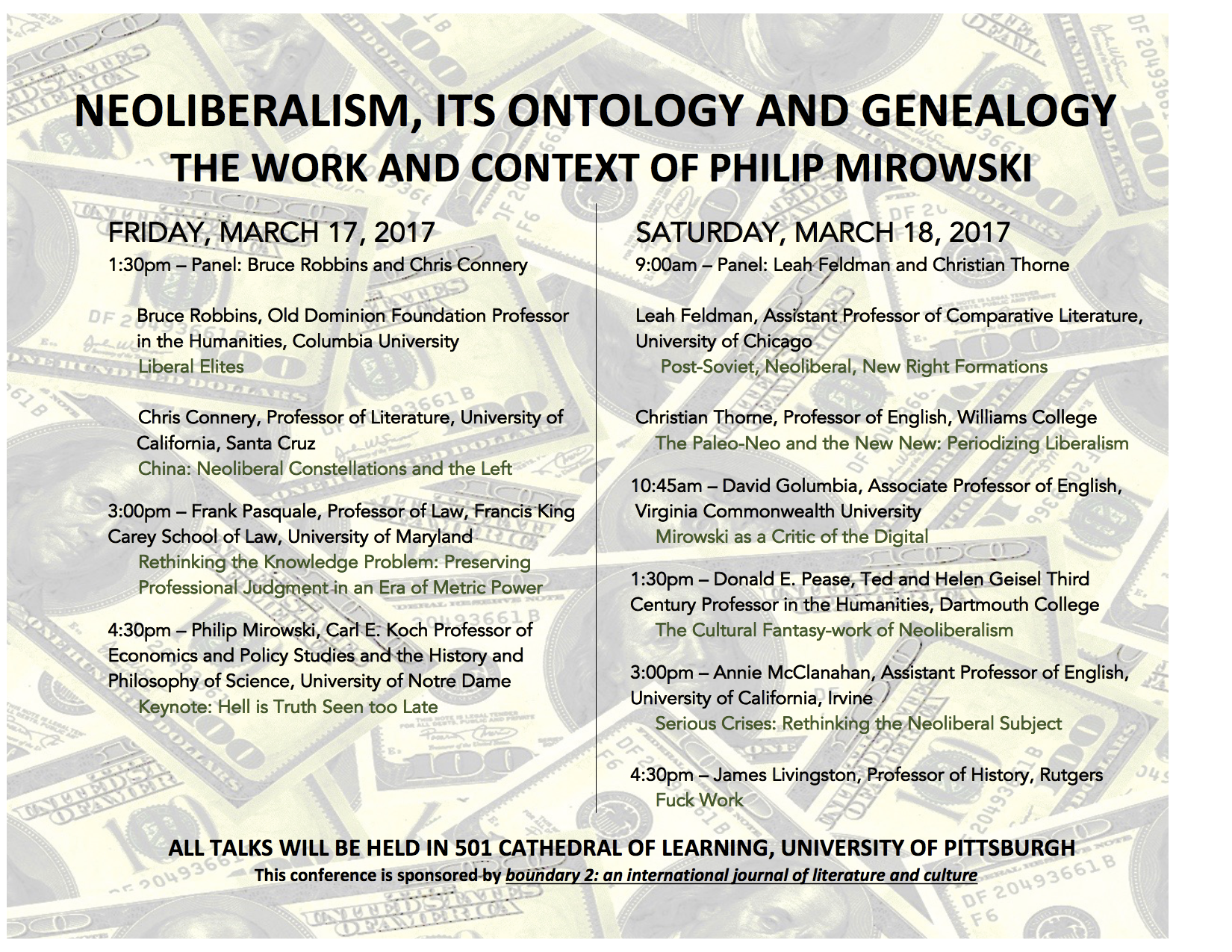
boundary 2 is pleased to announce Neoliberalism, Its Ontology and Genealogy: The Work and Context of Philip Mirowski, a conference at the University of Pittsburgh. All talks will appear on boundary 2’s YouTube channel after the conference.
Schedule
Friday, March 17, 2017
1:30pmEST – Panel: Bruce Robbins and Chris Connery
Liberal Elites – Bruce Robbins, Old Dominion Foundation Professor in the Humanities, Columbia University
China: Neoliberal Constellations and the Left – Chris Connery, Professor of Literature, University of California, Santa Cruz
3:00pmEST – Rethinking the Knowledge Problem: Preserving Professional Judgment in an Era of Metric Power – Frank Pasquale, Professor of Law, Francis King Carey School of Law, University of Maryland
4:30pm EST – Keynote: Hell is Truth Seen Too Late – Philip Mirowski, Carl E. Koch Professor of Economics and Policy Studies and the History of the Philosophy of Science, University of Notre Dame
Saturday, March 18, 2017
9:00am EST – Panel: Leah Feldman and Christian Thorne
Post-Soviet, Neoliberal, New Right Formations – Leah Feldman, Assistant Professor of Comparative Literature, University of Chicago
The Paleo-Neo and the New New: Periodizing Liberalism – Christian Thorne, Professor of English, Williams College
10:45am EST – Mirowski as Critic of the Digital – David Golumbia, Associate Professor of English, Virginia Commonwealth University
1:30pm EST – The Cultural Fantasy-Work of Neoliberalism – Donald E. Pease, Ted and Helen Geisel Third Century Professor in the Humanities, Dartmouth College
3:00pm EST – Serious Crises: Rethinking the Neoliberal Subject – Annie McClanahan, Assistant Professor of English, University of California, Irvine
4:30pm EST – Fuck Work – James Livingston, Professor of History, Rutgers
On March 2, Professor Brian T. Edwards of Northwestern University will give a talk titled Trump, Twitter, Circulation: American Politics as Global Entertainment.
The global circulation of Donald Trump’s political rhetoric ruptured the divide between American popular culture and US politics. This marks the postscript to the “American century,” during which the attractiveness of American culture had positive political benefits for the US. In the age of Trump, the US political system itself became a horrible form of global entertainment.
Professor Edwards will speak at the University of Pittsburgh at 5pm on March 2, 2017 in the Humanities Center (Cathedral of Learning 602). boundary 2 will also livestream the talk here.
This paper was written for “The South and the South,” a conference hosted by Vanderbilt University in May 2016. Its opening questions were generated by Hortense Spillers and other members of the boundary 2 collective.
This essay was peer-reviewed by the editorial board of b2o: an online journal.
What comes to mind when a writer says that he means to comment upon “the South”? Anyone sitting in North America is likely to hear that term, if not further specified, as referring to the southern United States, what we might for now call “Alabama etcetera,” though this is hardly the phrase’s only possible designatum. The other region now routinely denominated “the South”—the other region, I mean, that routinely earns that otherwise ungrammatical capital S—isn’t actually a region at all, but a name for what used to be called “the Third World” or “the developing countries” or “the colonies”: the Global South. The American South, the Global South—as soon as one sees those two terms in the same paragraph, questions start humming. Why does the former Third World bear the same name as Georgia and the Carolinas? Do these have anything to do with one another, conceptually or concretely? Do our perceptions of one bleed into our perceptions of the other? In what sense are they all southern? What are we attributing to a region when we call it southern? Is there such a thing as southness?
With these questions in front of us, I’d like to state a few propositions forthrightly—propositions, in the first instance, about the US South, which might or might not open up to include the global South, too. There are two propositions that I suspect I can get a person to agree with directly, without coaxing, and then a third that will in all likelihood require further elaboration and reflection. I’m going to share a few observations about “the South,” but with the proviso that I mean the phrase and not the place. What I’m wondering is what it means to call some expanse of territory “the South.”
What I need us to see first is that the word “South” is, in the US context and probably most others besides, entirely optional. You might imagine yourself reading these words in Tennessee somewhere, west of the Appalachians. We often refer to that patch of the planet as “the South,” but we could and do call it other things. A person might for instance, feel a certain attachment to the region marked out in burnt orange here:
—or to the dusty pink region here:
Such a person would have a few different choices about what to call either of those contiguities. One of them he could call the slave states; the other he could call the Confederacy or the former Confederacy; or Dixie or Dixieland or maybe the Southeast.
So again, the word South is optional. Second example, in one sentence:
Have you ever noticed that Biafra is only ever referred to as eastern Nigeria?
Third example. Anyone interested in the American South would still do well to read that group of writers variously referred to as the Vanderbilt Agrarians and the Nashville Agrarians and the Tennessee Agrarians and the Southern Agrarians.[1] A small admission: Only Edmund Wilson seems to have called them the Tennessee Agrarians, though that is what he called them.[2] Vanderbilt, Nashville, Tennessee, Southern. The nested redundancy of that list makes especially plain, I think, the elective quality of the word “southern.” Other designations are always available. Nor are these words plain synonyms—not at all. The word “Southern” is doing something slightly different in this formulation than would the words “Vanderbilt” or “Nashville”—it has different effects—and it falls to us to say what these are.
The point that jumps out, of course, is that the South stands here at the end of a spectrum of widening scope, from the pinpoint of Vanderbilt to the eleven-state sectional vastness of the South. But let’s whittle the list back to Nashville vs. Southern, since these are the two main rivals when it comes to placing the Agrarians. We’ll want to register the localizing specificity of the one vs. the relative under-determination of the other. It becomes important here that we not overlook an important point, which is that option #4 does not merely name the widest among the four spaces—from campus to city to state to region. It’s that the word “Southern” doesn’t actually name a place in the same way that these others do.
All I mean is that the South is a non-specific term—the only word on that list that is not a proper name. I would readily grant that even proper names aren’t as specifying as we usually take them to be, but the word “Southern” doesn’t even make a pretense of particularity, or whatever pretense it makes is easily dissipated. The word can’t help but refer beyond itself. A group of scholars, gathered at Vanderbilt in the spring of 2016 to talk about the American South and the global South, called their meeting “The South and the South.” Not all terms repeat so consequentially. There is a Nashville in Michigan, population 1600, but I doubt that a dozen professors have ever gathered to talk about “Nashville and Nashville.” What would it get you? The South and the South, however, gets you Alabama and Ghana. Or Ghana and Alabama. Of course, there’s no way to confirm the sequence. Which, after all, is the base South and which the South prime? The US South and the global South—when we hear the phrase “the South and the South,” do you and I mentally put them in the same order? And couldn’t there be other Souths beyond two? Southern Italy used to be organized into large estates worked by subjugated labor and regarded by Northern reformers as both immoral and an obstacle to national unity. So why not organize a conference on “The South and the South and the South?” Couldn’t il Mezzogiorno be our South double prime? But then where would that leave Okinawa or le Midi or the Saharan Maghreb?
So I’m wondering what happens when we conceptualize a region as “the South.” What happens for that matter when we conceptualize it as “a region”? What I think I can show you is that these terms are both commonplace and problem-laden.
The core claim in all Southern regionalist thinking is that the US South is a distinctive place. This sometimes goes hand in hand with the idea that the North has become a non-place, featureless, generic, that the North is ambient and all-purpose America. And if you believe this last, then the opposition North-versus-South is not exactly a battle between two places, because the South has a special claim on place-ness as such.
What I want to show you is that this last claim is completely untenable, and I want to demonstrate this on something other than empirical grounds, though I’m sure there are ways of making the argument empirically, as well. But my claim is not a factual one—to the effect that Southern distinctiveness has eroded before mass media and the Internet and the strip-mall monoculture. That’s probably true, but it’s a truth you don’t need, because even before you get to the statistics and the comparative sociology, a case is there to be made on conceptual and discursive grounds.
Here, then, is my non-empirical point: When Southern regionalists rise to talk about the South, they inevitably find themselves talking about something else, somewhere else, other places. The South won’t stay fixed. I’m not just saying that it’s hard to tell which states are and aren’t the South, though I’m sure that’s true. Nor am I saying that the South is internally differentiated, such that there are many Souths: the Piedmont, the Black Belt, the Appalachians, the Chesapeake. I’m saying that the South won’t stay still, that the South has a way of leaving the South or of sliding all over the map.
When you go to talk about a region, anything other than a proper name will introduce into your discussion a degree of abstraction, inserting the region into a set, an overlay of universalizing claims, and these will erode the very particularism that you have undertaken to defend. And the South, we know, is not a proper name. Let’s just take a sentence like this one: “The Southern Agrarians were regionalists.” It’s an unexceptional, declarative sort of thing—very much the kind of sentence you could find in an undergraduate essay or in Paul Conkin’s book on the Vanderbilt gang or in Dorman’s Revolt of the Provinces.[3] Again: “The Southern Agrarians were regionalists.” Now that sentence is both descriptively true and a total mess. It contains three semiotically robust terms—regionalist, agrarian, and southern—and if you fix your gaze successively upon each one, it will crumble before you.
The trouble with the word “agrarian” is easily explained. It is both a universal and in its own way a qualifier, referring indiscriminately to any society in which peasants or small farmers predominate, including the great many such societies that have existed outside of Virginia and Louisiana. Just as important, within the immensity of the US South, it refers only to such formations. It doesn’t matter what any given writer thinks he is doing, the drift of the word “agrarian” has always been to link certain subregions of the South to a great many regions outside the South. To any attempt to promote the South qua South, it thus introduces non-identity on two fronts. The word will always point beyond the South, putting pressure on the Vanderbilt poet to prefer Wisconsin (with its 76,000 farms) over North Carolina (with its 48,000). Already springloaded into the word “agrarian,” then, is Donald Davidson’s shock upon realizing that he preferred Vermont to a great many places in the old Confederacy. It harbors the joy of countrysides not your own.
The word “regionalist,” meanwhile, introduces non-identity in even more arid a form. There are two different routes by which the concept of regionalism can betray itself. If I take as my project the defense of some region—the South—then I am declaring myself indifferent to the vast and open-ended list of other localities that could hypothetically command my regard: the Southwest, the Mountain West, the Plains. Each region will negate all other regions, striving to constitute itself as a set of one, hence to cast off the concept that is its double and its defeat. The South exists as a distinct “region” only until you name it as such, at which point it gets crammed into the lumpy sack of places radically unlike itself. Any one region comes at the expense of countless other provinces and districts, and so, too, does the word “region.” Alternately, then, I can vow to defend regionalism as such, any regionalism, just by virtue of its being regional, in which case, of course, I have ensured that I will never, in fact, defend any particular region at all—that’s the second betrayal: regionalism with all its options open. The Southern partisan who calls himself a regionalist has resolved in advance to make common cause with Massachusetts.
Nor does the word “Southern” fare any better. Here are three arguments made on behalf of Southern distinctiveness, trying above all to account for the divergence between North and South.
1) One hears that the South is—or that it was at one point—the only North American instance of a traditional society, the continent’s only guardian of the non-bourgeois virtues. We can sharpen this: Below the Potomac, American society was once dominated by non-commercial and semi-commercial agriculture, and because of this, it incubated a set of priorities that by the standards of Boston or New York seemed downright anti-bourgeois: a society that preferred leisure to work; that preferred aesthetics to efficiency; a society united by myth or religion or shared belief, and not by the contract; a society premised on care and mutuality and not on competition; a society that promoted humility rather than striving and conversation rather than consumption.[4]
2) That’s one argument. Here’s a second. One also hears that the South diverged from the North early on because most of its white immigrants came not from England, but from England’s Celtic periphery. The core of white Southern culture, to which other groups have largely assimilated, has always been Irish and Scottish and Scots-Irish. Even English migrants to the South were more likely to come from the English borderlands and hill country—they were honorary Celts, easily absorbed by a Scottish majority. The task, then, is to give up on our sense of the white South as WASP—to learn to tell the difference between white people, and indeed, the difference between Anglos, whereupon we will be in a position to see that a great many of these latter weren’t actually Anglos at all.[5]
I want to say a few words about why this argument matters, if right. People often wonder why the American myth of national origins gets routed exclusively through New England and the Pilgrims, when the Jamestown settlers beat the godly Northerners to the East Coast by a full decade. And the answer to that question has been easy to find—which is that early Virginia was a kakocracy of all-male, corporate-military misrule, wholly devoid of any principle or mission that didn’t include subordinating the Indians and hoping for gold.[6] If you want the US to have a purpose or program, you have to go through Plymouth Plantation. The usual line is that the first Southerners were just the rapacious side of the English establishment.
But the Celtic thesis modifies this view in a big way. If this line were ever to gain general acceptance, which seems unlikely, then there is much in our histories of colonial North America that would have to change. The claim here is that Southern society hosted an alternate separatism—the separatism of the Celtic diaspora, in a period when the English were stepping up the colonization of their own periphery. It’s not just about Ulster, which is the place around which this argument sometimes gets truncated. The claim, rather, is that pre-enclosure Scotland and un-improved Ireland enjoyed an afterlife in the Southern backcountry—that the older Celtic formations survived longer in the US than they did in Britain or much of Ireland. That idea will then turn some of the major regional conflicts in early US history into a battle of competing British minorities, with neither section forced to play the role of the Anglo-mainstream.
There’s also a whisper of political economy to the Celtic thesis, which begins not by emphasizing culture or folkways, but by emphasizing the unusual features of the backcountry’s pastoralist economy. Settlers in the upland South farmed like the Scots or the Irish or the northwest English, which is to say that they hardly farmed at all, keeping herds on open ranges, resigned in advance to some going missing and others dying, not bothering with barns or winter fodder or market crops or even gardens of any ambition. One could find that claim deeply challenging, since it blows apart generations of talk about Jeffersonian yeomen and the commitments of American republicanism. If this account accurately describes the small farmers of the Southern hill country, then the crackers weren’t yeomen. They were barely even farmers.
3) A third argument holds that the South is different from the North because for much of its history the latter has been an economic dependency of the former. The South was an internal colony, its fortunes largely dictated by Northern capital, hence underdeveloped in the familiar colonial manner: handed over to extractive industries and monocrop exports, its economy staffed by hyper-exploited labor, its railroads and forests and mines largely owned by outsiders who systematically diverted profits out of the region.[7]
Those, then, are three common accounts of what has made the American South distinctive: The South is or was a traditional society, the South is or was Celtic, the South is or was an internal colony.
Let’s go back to the first argument and ask: What happens when you claim that the South was different because it housed a “traditional society”? What does that claim do to the South as a concept? We can answer that question by looking at the footnote that Allen Tate inserted at the very beginning of his contribution to I’ll Take My Stand:
The writer is constrained to point out (with the permission of the other contributors) that in his opinion the general title of this book is not quite true to its aims. It emphasizes the fact of exclusiveness rather than its benefits; it points to a particular home of a spirit that may also have lived elsewhere and that this mansion, in short, was incidentally made with hands.[8]
These two sentences deserve to be restated. Tate is determined to explain right up front that he doesn’t think that he and his fellows should really be focusing on the South. That approach, he says, is too “exclusive,” too tied to a “particular home”; it won’t recruit a general readership. The whole point is that what Tate has consented to misdescribe as the Southern way “may also have lived elsewhere.”
Tate’s words allow us to say something important. Even in the core texts of Southern regionalist thinking, the South is shadowed by an elsewhere, and it is this elsewhere that grows up in the gap between the concept of “the South,” understood as the old Confederacy, and the concept of “traditional society,” which isn’t bound to any region. So this argument, too, hands the Southern intellectual over to a non-regional regionalism. Even in the founding documents of Southern regionalism, its partisans were not, in fact, defending the South. But we can get more specific about this. For intellectuals like Tate, the “elsewhere” has a name.
Tate: “We must be the last Europeans—there being no Europeans in Europe at present.”
Ransom: “The South is unique on this continent for having founded and defended a culture which was according to the European principles of culture.”
Davidson: “The cause of the South was and is the cause of Western civilization itself.”[9]
The pattern is hard to miss: the last Europeans, European principles, Western civilization. Europe, Europe, the West. Richard Weaver was arguing in the 1950s that the Nashville Agrarians were in large part the product of the Rhodes Scholarship. In England, he said, a “suspicion began to dawn that the society they had grown up with in the South was in the main tradition of Western European civilization.”[10] Agrarianism, in other words, was interested in Virginia and Kentucky, true enough, but it was interested in those places as mediated through England. The Vanderbilt Twelve weren’t just Southern, they were Oxbridge Southern.
Let’s not worry too much about the group biography of the Agrarians, though, because conceptually the point is even more compelling, since what we see here is that the South has begun sliding around the compass; it is refusing to stay anchored at 6:00. This entire discourse is what we can call the South as West, and it yields what I would like us to consider a general point: That Southern regionalism typically works by way of geographical conflations of this kind. The non-identity of the South is plainest when it borrows the names of other headings or when one cardinal point reinvents itself as a second. In the Dixie Theogony, the south wind can blow from any direction.
The reader might need more convincing on that last point, so I’ll bring forward another instance. What is the geographical unconscious of the Celtic thesis? It will be enough to scan a passage from the standard citation on that topic:
To understand regional differences in the US, one has to grasp that…
…by virtue of historical accident, the American colonies south and west of Pennsylvania were peopled during the seventeenth and eighteenth centuries mainly by immigrants from the ‘Celtic fringe’ of the British archipelago—the western and northern uplands of England, Wales, the Scottish Highlands and Borders, the Hebrides, and Ireland—and that the culture these people brought with them and to a large extent retained in the New World accounts in considerable measure for the differences between them and the Yankees of New England, most of whom originated in the lowland southeastern half of the island of Britain.[11]
You can see the transposition there. From north to south and south to north. The south was peopled by immigrants from the northern uplands. The Yankees originated in the southern half. What the Celtic thesis celebrates in the South is its Northernness, and this, of course, yields the most complete of the regionalist flippings—a proper dialectical Umschlag, in fact: The South as North. From a certain neo-Confederate perspective, the problem with New England is that it is insufficiently northern. One defends the South in order to safeguard the old boreal ways.
The South as North—of course, that idea is available in a second version, as well. Before the Civil War, the South sent out freelance imperialists in all directions. The planter leadership was not just promoting westward expansion along the lines set down by the Missouri compromise. Many in the South embraced a more general program of Southern, slave-power expansion. Southerners operating independently of the US government tried repeatedly to invade Cuba. A native of Nashville conquered Nicaragua and appointed himself president of that country. Militant planter-politicians had thoughts of uniting with Brazil or perhaps of seizing large sections of the Amazon. A native of Tennessee led the US occupation of the Dominican Republic in 1916. The Secretary of the Navy who presided over the invasion of Haiti in 1915 was from North Carolina. All I mean to say is that the South is a relational term, and that once you pass Key West, the South transposes in one to the north, an imperial north in which there are only Yankees. Any Southerners reading these sentences will have to face up to this. Proud not to be Yankees, they are Yanquis all the same.
So what, then, of the claim that the South has been colonized, that it is the proximate victim of New England imperialism? First, we’ll want to take stock of a sentence that John Crowe Ransom wrote when he was in his 40s: “By poets, religionists, Orientals, and sensitive people, nature is feared and loved.”[12] That sentence appeared in 1929; I’ll Take My Stand was published the following year, and read side by side, it is easy to see that the achievement of that second volume was to add Southerners to the list of nature’s adorers—or indeed, to let the white Southerner absorb those other four positions into himself: the poetic Southerner, the sensitive Southerner, the religious Southerner, the Oriental Southerner. I’ll Take My Stand gives us the Virginian as Chinese aesthete and anchorite or the Tarheel as mandala-painting monk. Just as curious, this appetite for self-Orientalizing is what the new Southern studies most inherits from the Agrarians, precisely when it takes itself to be critical.
There is more than a passing resemblance between some writers of the Southern Renaissance and the characters of novelist Chinua Achebe, who are caught up in the cultural conflict triggered by the growing Westernization of African life.[13]
We’ll want to note: That last sentence was written by James Cobb, a historian at the University of Georgia and one-time president of the Southern Historical Association. Cobb uses the word “Westernization,” from which we need merely work backwards. Faulkner is the writer of the Westernization of the South, which makes of the South a colonized East or generic Orient. Or there’s this, by the Duke historian John Cell:
By the mid-1870s, however, it was clear that the strategy of direct rule [by the North in the defeated South] had failed. But as other imperialists [other than the Yankees]—notably the British in the Indian princely states, Malaya, Nigeria, and elsewhere—have also discovered, the goal of economic hegemony could be achieved as well, and with much less trouble and expense, through subtler forms of indirect political domination.[14]
Or there’s this, by a senior historian at Clemson:
In the following passages by Said, I have substituted the words northern or Yankee for Said’s European, West, and the like, and the words South or southern for Orient, Arab, (Mid)East, and so on.[15]
This last is especially telling, since it entirely candid about the search-and-replace quality of the entire endeavor. Regionalism as a master discourse will attach its claims indiscriminately to any compass point. The arguments remain the same; you just swap in fresh coordinates.
The South as West, the South as North, the South as East. Traveling the rim of the compass, we end up back at South as South, but now this last formulation appears us in changed form, internally riven, no longer simply itself. To wit:
Woodward: “Like republics below the Rio Grande the South was limited largely to the role of a producer of raw materials, a tributary of industrial powers, an economy dominated by absentee owners.”
McWhiney: “John Morgan Dederer claims that ‘the tribal Celtic-Southerner’s culture and folk traits were so compatible with those of the Africans that it took little adaptation for slaves to fit Celtic characteristics around their African practices.’ Many of the Indians of the Old South practiced lifestyles quite similar to those of their Celtic neighbors.”[16]
This is, of course, a second version of the South as colony, but now without the language of the East or the Orient. In this variant, the South gets to keep its name, but is nonetheless doubled by other Souths. In a fit of tribalism and primitivism, the old Confederacy enlists in the ranks of the darker nations. This last should help us see what is most distinctive about Southernism as a discourse, that it produces a contradiction or particular intertwining, enrolling itself simultaneously in the West and the non-West, naming itself the South while also claiming to run true north. The South positions itself as the repository of all Western values, as civilization’s last American garrison, while also embracing an unlikely anti-colonialism. It is in the discourse of the twofold South that the colonizers learn to wrap themselves in the pathos of the colonized. We can spot this most efficiently in the words of Thomas Fleming, a classicist trained at UNC:
The original Klan was a national liberation army made up of [those] who refused to accept their status as a subjugated people.[17]
That is the idiom of white-supremacist Third Worldism, which is the position made possible by the indistinct and never-regional word “South.” The South and the South: Or, the masters enroll themselves in the coalition.
Notes
[1] See I’ll Take My Stand: The South and the Agrarian Tradition, New York: Harper & Brothers, 1930. The title page attributes the book to “Twelve Southerners.” For background, see Paul Conkin’s Southern Agrarians (Knoxville: University of Tennessee Press, 1988).
[2] Edmund Wilson, “Tennessee Agrarians.” New Republic. 29 July, 1931.
[3] In addition to Conkin, see Dorman’s Revolt of the Provinces: The Regionalist Movement in America, 1920-1945 (Chapel Hill: University of North Carolina Press, 1993).
[4] See, for instance, Allen Tate’s “Remarks on the Southern Religion” in I’ll Take My Stand, pp. 155 – 175.
[5] Grady McWhiney’s Cracker Culture: Celtic Ways in the Old South (Tuscaloosa: University of Alabama Press, 1988).
[6] See Edmund Morgan’s American Slavery, American Freedom: The Ordeal of Colonial Virginia (New York: W. W. Norton, 1975).
[7] See, among many others, Natalie Ring’s The Problem South: Region, Empire, and the New Liberal State, 1880 – 1930 (Athens: University of Georgia Press, 2012).
[9] Tate’s letter to Donald Davidson is quoted in Paul Murphy’s Rebuke of History: Southern Agrarians and American Conservative Thought (Chapel Hill: University of North Carolina Press, 2001), p. 66; Ransom in I’ll Take My Stand, p. 3; Davidson, writing in Southern Writers in the Modern World, qtd in Murphy, p. 114.
[10] Richard Weaver, “Agrarianism in Exile” in The Sewanee Review, 58.5 (1950), pp. 586 – 606, quotation p. 588.
It is a truism today that digital technologies are ubiquitous in Western society (and increasingly so for the rest of the globe). With this ubiquity, it seems, comes complexity. This is the gambit of Ubiquitous Computing, Complexity, and Culture (Routledge 2016), a new volume edited by Ulrik Ekman, Jay David Bolter, Lily Díaz, Morten Søndergaard, and Maria Engberg.
There are of course many ways to approach such a large and important topic: from the study of political economy, technology (sometimes leaning towards technological determinism or instrumentalism), discourse and rhetoric, globalization, or art and media. This collection focuses on art and media. In fact, only a small fraction of the chapters do not deal either entirely or mostly with art, art practices, and artists. Similarly, the volume includes a significant number of interviews with artists (six out of the forty-three chapters and editorial introductions). This focus on art and media is both the volume’s strength, and one of its major weaknesses.
By focusing on art, Ubiquitous Computing, Complexity, and Culture pushes the bounds of how we might commonly understand contemporary technology practice and development. For example, in their chapter, Dietmar Offenhuber and Orkan Telhan develop a framework for understanding, and potentially deploying, indexical visualizations for complex interfaces. Offenhuber and Telhan use James Turrell’s art installation Meeting as an example of the conceptual shortening of causal distance between object and representation, as a kind of Peircean index, and one such way to think about systems of representation. Another example of theirs, Natalie Jermijenko’s One Trees installation of one hundred cloned trees, strengthens and complicates the idea of the causal index, since the trees are from identical genetic stock, yet develop in natural and different ways. The uniqueness of the fully-grown trees is a literal “visualization” of their different environments, not unlike a seismograph, a characteristic indexical visualization technology. From these examples, Offenhuber and Telhan conclude that indexical visualizations may offer a fruitful “set of constraints” (300) that the information designer might draw on when developing new interfaces that deal with massive complexity. Many other examples and interrogations of art and art practices throughout the chapters offer unexpected and penetrating analysis into facets of ubiquitous and complex technologies.
MoMA PS1 | James Turrell, Meeting 2016, Photos by Pablo Enriquez
A persistent challenge with art and media analyses of digital technology and computing, however, is that the familiar and convenient epistemological orientation, and the ready comparisons that result, are often to film, cinema, and theater. Studies reliant on this epistemology tend to make a range of interesting yet ultimately illusory observations, which fail to explain the richness and uniqueness of modern information technologies. In my opinion, there are many important ways that film, cinema, and theater are simply not like modern digital technologies. Such an epistemological orientation is, arguably, a consequence of the history of disciplinary allegiances—symptomatic of digital studies and new media studies originating from screen studies—and a proximate cause of Lev Manovich’s agenda-setting Language of New Media (2001), which relished in the mimetic connections resulting from the historical quirk that the most obvious computing technologies tend to have screens.
Because of this orientation, some of the chapters fail to critically engage with technologies, events, and practices largely affecting lived society. A very good artwork may go a long way to exposing social and political activities that might otherwise be invisible or known only to specialists, but it is the role of the critic and the academic to concretize these activities, and draw thick connections between art and “conventional” social issues. Concrete specificity, while avoiding reductionist traps, is the key to avoiding what amounts to belated criticism.
This specificity about social issues might come in the form of engagement with normative aspects of ubiquitous and complex digital technologies. Instead of explaining why surveillance is a feature of modern life (as several chapters do, which is, by now, well-worn academic ground), it might be more useful to ask why consumers and policy-makers alike have turned so quickly to privacy-enhancing technologies as a solution (to be sold by the high-technology industry). In a similar vein, unsexy aspects of wearable technologies (accessibility) now offer potential assistance and perceptual, physical, or cognitive enhancement (as described in Ellis and Goggin’s chapter), alongside unprecedented surveillance and monetization opportunities. Digital infrastructures—both active and failing—now drive a great deal of modern society, but despite their ubiquity, they are hard to see, and therefore, tend not to get much attention. These kinds of banal and invisible—ubiquitous—cases tend not to be captured in the boundary-pushing work of artists, and are underrepresented (though not entirely absent) in the analyses here.
A number of chapters also trade on old canards, such as worrying about information overload, “junk” data whizzing across the Internet, time “wasted” online, online narcissism, business models based on solely on data collection, and “declining” privacy. To the extent that any of these things are empirically true—when viewed contextually and precisely—is somewhat beside the point if we are not offered new analyses or solutions. Otherwise, these kinds of criticisms run the risk of sounding like old people nostalgically complaining about an imagined world before technological or informational ubiquity and complexity. “Traditional” human values might be an important form of study, but not as the pile-on Left-leaning liberal romanticism prevalent in far too many humanistic inquiries of the digital.
Another issue is that some of the chapters seem to be oddly antiquated for a book published in 2016. As we all know, the publication of edited collections can often take longer than anyone would like, but for several chapters, the examples, terminology, and references feel unusually dated. These dated chapters do not necessarily have the advantage of critical distance (in the way that properly historical study does), and neither do they capture the pulse of the current situation—they just feel old.
Before turning to a sample of the truly excellent chapters in this volume, I must pause to make a comment about the book’s physical production. On the back cover, Jussi Parikka calls Ubiquitous Computing, Complexity, and Culture a “massively important volume.” This assessment might have been simplified by just calling it “a massive volume.” Indeed, using some back-of-the-napkin calculations, the 406 dense pages amounts to about 330,000 words. Like cheesecake, sometimes a little bit of something is better than a lot. And, while such a large book might seem like good value, the pragmatics of putting an estimated 330,000 words into a single volume requires considerable care to typesetting and layout, which unfortunately is not the case here. At about 90 characters per line, and 46 lines per page—all set in a single column—the tiny text set on extremely long lines strains even this relatively young reviewer’s eyes and practical comprehension. When trudging through already-dense theory and the obfuscated rhetoric that typically accompanies it (common in this edited collection), the reading experience is often painful. On the positive side, in the middle of the 406 pages of text there are an additional 32 pages of full-color plates, a nice addition and an effective way to highlight the volume’s sympathies in art and media. An extensive index is also included.
Despite my criticisms of the approach of many of the chapters, the book’s typesetting and layout, and the editors’ decision to attempt to collocate so much material in a single volume, there are a number of outstanding chapters, which more than redeem any other weaknesses.
Elaborating on a theme from her 2011 book Programmed Visions (MIT), Wendy H.K. Chun describes why memory, and the ability to forget, is an important aspect to Mark Weiser’s original notion of ubiquitous computing (in his 1991 Scientific American article). (Chun also notes that the word “ubiquitous” comes from “Ubiquitarians,” a Lutherans sect who believed Christ was present ‘everywhere at once’ and therefore invisible.) According to Chun’s reading of Weiser, to get to a state of ubiquitous computing, machines must lose their individualized identity or importance. Therefore, unindividuated computers had to remember, by tracking users, so that users could correspondingly forget (about the technology) and “thus think and live” (161). The long history of computer memory, and its rhetorical emergence out of technical “storage” is an essential aspect to the origins of our current technological landscape. Chun notes that prior to the EDVAC machine (and its strategic alignment to cognitive models of computation), storage was a well understood word, which etymologically suggested an orientation to the future (“stores look toward a future”). Memory, on the other hand, contained within it the act of recall and repetition (recall Meno’s slave in Plato’s dialogue). So, when EDVAC embedded memory within the machine, it changed “memory by making memory storage” (162). In doing so, if we wanted to rehabilitate Weiser’s original image, of being able to “think and live,” we would need to refuse the “deadening of the world brought about by memory as storage and realize the fundamentally collective nature of memory and writing” (162).
Sean Cubitt does an excellent job of exposing the political economy of ubiquitous technologies by focusing on the ways that enclosure and externalization occur in information environments, interrogating the term “information economy.” Cubitt traces the history of enclosures from the alienation of fifteenth-century peasants from their land, the enclosure of skills to produce dead labour in nineteenth-century factories, to the conversion of knowledge into information today, which is subsequently stored in databases and commercialized as intellectual property—alienating individuals from their own knowledge. Accompanying this process are a range of externalizations, predominantly impacting the poor and the indigenous. One of the insightful examples Cubitt offers of this process of externalization is the regulation of radio spectrum in New Zealand, and the subsequent challenge by Maori people who, under the Waitangi Treaty, are entitled to “all forms of commons that pre-existed the European arrival” (218). According to the Maori, radio spectrum is a form of commons, and therefore, the New Zealand government is not permitted to claim exclusive authority to manage the spectrum (as practically all Western governments do). Not content to simply offer critique, Cubitt concludes his chapter with a (very) brief discussion of potential solutions, focusing on the reimagining of peer-to-peer technology by Robert Verzola of the Philippines Green Party. Peer to peer technology, Cubitt tentatively suggests, may help reassert the commons as commonwealth, which might even salvage traditional knowledge from information capitalism.
Katie Ellis and Gerard Goggin discuss the mechanisms of locative technologies for differently-abled people. Ellis and Goggin conclude that devices like the later-model iPhone (not the first release), and the now-maligned Google Glass offer unique value propositions for those engaged in a spectrum of impairment and “complex disability effects” (274). For people who rely on these devices for day-to-day assistance and wayfinding, these devices are ubiquitous in the sense Weiser originally imagined—disappearing from view and becoming integrated into individual lifeworlds.
John Johnston ends the volume as strongly as N. Katherine Hayles’s short foreword opened it, describing the dynamics of “information events” in a world of viral media, big data, and, as he elaborates in an extended example, complex and high-speed financial instruments. Johnston describes how events like the 2010 “Flash Crash,” when the Dow fell nearly a thousand points and lost a trillion dollars and rebounded within five minutes, are essentially uncontrollable and unpredictable. This narrative, Johnston points out, has been detailed before, but Johnston twists the narrative and argues that such a financial system, in its totality, may be “fundamentally resistant to stability and controllability” (389). The reason for this fundamental instability and uncontrollability is that the financial market cannot be understood as a systematic, efficient system of exchange events, which just happens to be problematically coded by high-frequency, automated, and limit-driven technologies today. Rather, the financial market is a “series of different layers of coded flows that are differentiated according to their relative power” (390). By understanding financialization as coded flows, of both power and information, we gain new insight into critical technology that is both ubiquitous and complex.
_____
Quinn DuPont studies the roles of cryptography, cybersecurity, and code in society, and is an active researcher in digital studies, digital humanities, and media studies. He also writes on Bitcoin, cryptocurrencies, and blockchain technologies, and is currently involved in Canadian SCC/ISO blockchain standardization efforts. He has nearly a decade of industry experience as a Senior Information Specialist at IBM, IT consultant, and usability and experience designer.
Albert Camus never considered himself an existentialist. In fact, Camus never exclusively believed in any school of thought. Camus was the consummate outsider, the one who stood apart from those who subscribed to views that forced those subscribers into a narrow ideology, especially when that ideology mixed with violence, something Camus steadfastly resisted. If we had to place Camus into any category it would be that of the humanist caught in the absurd. Camus believed in life over death (without believing in an afterlife), yet this belief did not keep him from contemplating the question of suicide, the only serious philosophical problem confronting us, as he writes in The Myth of Sisyphus. Camus’ humble beginnings in extreme poverty and illiteracy in his native Algeria testify to the power of the human spirit in the face of an indifferent world. When he was awarded the Nobel Prize for Literature in 1957 he expressed reservations and claimed that the prize should have gone to André Malraux, an early influence on his writing. Camus also realized that the Nobel would bring a certain celebrity that would complicate his life, perhaps even sabotaging his art. Add to this his “silence” on the Algerian problem and his very public and acrimonious break with Sartre, and Camus becomes a figure trapped in a world where he is increasingly unable to control his own image. Camus is a problematic figure who is claimed by both the Right and the Left, leaving the man and his writing caught in a political vortex. Focusing on the postcolonial aspect of The Stranger, Edward W. Said writes that Camus “is a moral man in an immoral situation.”[i] When Camus died at the age of 46 in a car accident in 1960, he left the world with the image of the charismatic young man, Bogart-like in his coolness, and still with the promise of great things to come. But a saint he was not. His numerous affairs and constant womanizing, his reluctance to act or speak out against French imperialism in Algeria, his disillusionment with and expulsion from the Communist Party, render him more human than academics might be comfortable with. Camus’ life was full of contradictions, full of silences. Yet, it was precisely from these contradictions and silences that Camus produced one of the most important and widely read books of the twentieth century.
Looking back over the seven decades since the publication of The Stranger, Camus’ reluctance to situate (in the Sartrean sense of the term) himself in the bubble of existentialism, a bubble in which The Stranger and his relationship with Sartre placed him, the novel blazed a path that opened up fields where the absurd might be articulated, contemplated, and confronted from the inside (the modernist bent) rather than from above and beyond, as the canonical novels of the nineteenth century may have done. In her essay “French Existentialism,” Hannah Arendt briefly examines Sartre and Camus’ influence on the “new” movement where novels carry the weight of philosophy. Throughout that essay she also comments on Camus’ reluctance to be labeled an existentialist. “Camus has probably protested against being called an Existentialist because for him the absurdity does not lie in man as such or in the world as such but only in their being thrown together.”[ii] Here we have what is perhaps the most concise and articulate formulation of absurdist philosophy to date. Camus’ definition of absurdity, painstakingly mapped out in Caligula, The Stranger, and The Myth of Sisyphus, is not quite existentialism, but does contain existentialist DNA, especially Kierkegaardian and Dostoevskian (two of Camus’ patron saints) DNA. As Camus remarks in The Myth of Sisyphus: “I can therefore say that the Absurd is not in man (if such a metaphor could have a meaning) nor in the world, but in their presence together.”[iii] Camus’ definition of the absurd is also the epistemological curve in the road separating him from Sartre’s thinking. If Sartre’s philosophy can be distilled into his phrase “Hell is other people,” then Camus’ is a philosophy of the absurd dependent upon relationships among people. On the other hand, Camus’ articulation of the absurd, as we’ve seen above, resides in the relationship of humans with their world.
Together, Sartre and Camus blazed a path where philosophy and art, in this case literature, met, thereby ushering in a new form of the novel, one that would examine existence from a philosophical perspective while making use of a form in which to mold these philosophical perspectives. What emerges from this is a hybrid. According to Randall Collins, “What was identified was a tradition of literary-philosophical hybrids. Sartre and Camus were key formulators of the canon, and themselves archetypes of the career overlap between academic networks and the writers’ market. The phenomenon of existentialism in the 1940s and 1950s added another layer to this overlap.”[iv] But this hybridization was more than a heady cerebral new movement in fiction; this hybrid constituted a new way of thinking about the world, a world that emerged primarily from a particular network of intellectuals at a particular time in Paris. Sartre and Camus are on the crest of this wave of existentialism and their thinking would go on to change the world.
Alice Kaplan’s extraordinary new book Looking for the Stranger: Albert Camus and the Life of a Literary Classic, is a careful and meticulously researched examination of Camus’ 1942 novel. Kaplan is one of the leading scholars of twentieth century French culture and history. She is currently the John M. Masser Professor of French at Yale University where she also received her Ph.D. in French in 1981. She has published seven books, including: French Lessons: A Memoir (1993), The Collaborator: The Trial and Execution of Robert Brasillach (2000), and Dreaming in French: The Paris Years of Jacqueline Bouvier Kennedy, Susan Sontag, and Angela Davis (2012). In 2013 Kaplan edited and provided the introduction to The Algerian Chronicles, a collection of articles and essays Camus wrote from 1939-1958. Kaplan’s edited edition is the first time these writings have appeared in English, so she is no stranger to Camus and his place in twentieth century French culture.
Early on Kaplan claims that Looking for the Stranger is actually a biography of Camus’ best known work, and one of the most famous and widely read texts of the twentieth-century. However, this does not mean that Kaplan foregoes a glimpse into Camus’ life, thus resurrecting the Barthesian “death of the author” debate. Instead, Kaplan goes looking for The Stranger in the author instead of the author in The Stranger; the difference is subtly stunning. In other words, her investigation is more preoccupied with the creative process and its cultural and social context than it is with getting to the author as a god-like figure. Camus always claimed that The Stranger was the second in a three part series exploring the absurd from three different perspectives: a novel (The Stranger), a dramatization (Caligula), and a philosophical work (The Myth of Sisyphus). But The Stranger is hardly a book that needs rescuing from obscurity, nor does Kaplan claim that it does. To date the novel has sold over ten million copies and is still read in over 40 languages. It is still on high school and college syllabi, thus making it required reading for young men and women. In fact, a student’s first encounter with existentialism and the absurd is likely to come from a reading of The Stranger. Instead, she offers us a more comprehensive look into the text, running down every lead, exploring every avenue that might expand our understanding of what makes The Stranger the text that it is.
Kaplan begins by acknowledging the spectacular success of The Stranger, making it one of the most popular and important texts of the twentieth century. She quickly glosses over the critical reaction to The Stranger by pointing out that readings of the novel map some of the most important theoretical lenses that have influenced twentieth century thought. “In fact, you can construct a pretty accurate history of twentieth-century literary criticism by following the successive waves of analysis of The Stranger: existentialism, new criticism, deconstruction, feminism, postcolonial studies” (2). The Stanger, she claims, has influenced thinking of a diverse population that spans generations. Indeed, the remarkable staying power of the novel to remain relevant, perhaps even more relevant now than when it was published, is a feat that its author and its critics at the time could not have foreseen. I am not sure that students continue to read The Stranger with the commitment that they once did, but it is undeniable that the novel still matters, that it still provokes us into thinking, especially in a time when fundamentalism and terrorism are on the rise, and Europe and the United States are flirting with a new form of fascism in the guise of a renewed interest in ridged nationalism. But Kaplan is not necessarily interested in the public and academic reception of The Stranger. Instead, she claims that the novel’s readers and commentators have overlooked something from our reading of the text since its publication: that something is a biography of the novel. “Yet something essential is lacking in our understanding of the author and the book. By concentrating on themes and theories—esthetic, moral, political—critics have taken the very existence of The Stranger for granted” (2-3). She takes the unprecedented, and academically unpopular path that looks into the life of the author and the circumstances that allowed the author at a particular place and time to write one of the most powerful works of world literature. However, it is important to point out that Kaplan sets out to write a biography of the novel, and not the author. In fact, Camus’ life becomes a part of the puzzle that is The Stranger.
Kaplan is not the first to comment on the unlikely success of The Stranger and its problematic birth. She is, however, the first to devote an entire book to an investigation, an investigation that is almost documentary-like in its approach, to the novel from conception to publication and beyond. And she accomplishes this brilliantly. Told in twenty-six short chapters, bookended by a prologue and an epilogue, Kaplan leads us into the depths of the novel in a highly engaging and thought-provoking fashion. In fact, the structure of her book presents its readers with the “life” of the novel, a life that has continued on long after the death of its creator. Drawing from a reservoir of sources, including Camus’ notebooks and her own trips to Algeria, Looking for the Stranger is a scholarly adventure story. As Kaplan claims in her acknowledgements: “I looked for The Stranger in libraries, in archives, in neighborhoods on three continents” (219). Of course, the idea of The Stranger was with her all of the time, but what makes Kaplan’s book so provocative is precisely the lengths she goes to in search of the novel. Kaplan explores The Stranger in three parts: before its publication, during its publication, and after its publication.
In the first chapter Kaplan gives us the image of a young man in front of a bonfire burning various papers that link him to a past, a past that could be dangerous to him and those who know him. But as Kaplan tells it, the young Camus could not bring himself to burn all of his letters and writings. What he saved would act as a cache of material, both physical and remembered, from which he would extract and rework into a slim, simply told tale of a man who fails to cry at his mother’s funeral and, by a series of circumstances, ends up shooting an unnamed Arab on a beach, only to be arrested, tried, convicted and sentenced to death. Yet, the reader is never quite sure if the protagonist is convicted and sentenced to death because of the murder or his refusal to conform to the rules of a society that demands that one cry at one’s mother’s funeral. The image of the bonfire given to us by Kaplan is a powerful one. As we travel with her deeper into her investigation, we learn that the bonfire was a kind of rite Camus needed to perform in order to purge his mind and soul so that he could go on to write what he felt needed to be written—unimpeded by ghosts, but still attentive to their silences, which spoke to and through him.
Throughout the spring of 1940, six years after the bonfire, Camus worked furiously on The Stranger, almost in total isolation holed up in his miserable hotel room in Montmartre, interrupted only to work for five hours a day at Paris-Soir. The twenty-six year old was as cut off from the world as he had ever been. Alone in a foreign city, with German bombs exploding all over France, Camus fought his loneliness and misery by throwing himself into his writing. Not yet divorced from his first wife, Simone Hié, his fiancé Francine Faure refused to accompany him to Paris. The only thing he brought with him was the first chapter of The Stranger and a few of his press clippings. Kaplan: “His sense of separation from everyone he loved put him in a state of mind that was both painful and enabling” (71). Like Camus’ biographer Olivier Todd, Kaplan highlights the importance of Camus’ isolation when he first arrives in Paris. Camus believed that the failure of A Happy Death, his abandoned first novel, was due to his inability to write without interruption. Camus’ isolation in Paris enabled him, out of necessity, to devote all of his attention to The Stranger. Kaplan’s research offers us a marvelous glimpse into the creative process Camus used, or perhaps more accurately, was host to, during his writing of the novel. Kaplan claims that Camus wrote The Stranger almost line for line, as if he were dictating a story he was seeing play out before his eyes. Where he struggled with the writing of A Happy Death,The Stranger seems to have emerged almost fully formed, complete.
However, his writing of The Stranger does not mean that it was without its problems. In fact, the birth of The Stranger was long and fraught with difficulties both internal and external. Until his arrival in Paris, Camus struggled with getting into the narrative, creating a new story, as well as using material from A Happy Death. Interestingly, most reviewers of Kaplan’s book, Robert Zaretsky, himself an accomplished Camus scholar, and John Williams in particular[v], have devoted a majority of their reviews to the shortage of paper in France as the novel was set to go to press. “To say that the very existence of The Stranger was threatened by the material conditions of the war is no exaggeration, since paper supplies were becoming more and more precious. It looked at one point as if Camus would have to supply his own paper stock!” (136). Camus was in Oran with his family at the time, and was happy to help Gallimard with locating paper. The novel came very close to not being published, but paper stock was found at the last minute and Camus was not obliged to supply his own.
Once the novel was published it was met with immediate success. But perhaps its success was not so unusual after all. From the beginning Camus wanted the French publishing world, located in Paris, to represent him. In the chapter “A Jealous Teacher and a Generous Comrade,” Kaplan tells the story of Camus’ almost frantic correspondence with Jean Grenier and Pascal Pia, the teacher and the comrade, respectfully, and their influence on The Stranger in its early stages. More importantly, if Camus were to move from a provincial author to a wider audience, one that would include the whole of Europe and possibly America, he would have to seek publication outside of Algeria. As Kaplan notes: “Yet Paris was still the center of book publishing in France, and if Camus wanted to publish outside Algeria, he’d eventually have to find a way to get his manuscript to the capital” (107). This, it seems to me, provides the necessary evidence that Camus was thinking bigger than his native land. He desired a world stage, a stage that would allow his work to be read by the widest possible public and Gallimard was the publisher that could provide him with that opportunity. In his book The Existentialist Moment: The Rise of Sartre as a Public Intellectual, Patrick Baert illustrates the importance of publishing, especially those publishing houses in Paris, for providing the necessary outlet for ideas. “Intellectual ideas spread mainly through publications. Whether through books, magazines, or articles, publishing is central to the rise of intellectual movements. For such movements to be successful, authors have to be well connected to the main publishers and need to have sufficient freedom and power to be able to write what they want to write.”[vi] The network Gallimard could provide Camus with would plug him into some of the most resonant writers and thinkers of the time. As mentioned above, The Stranger was not just a novel, but also an important piece of a longer meditation on the absurd. Therefore, Camus’ relationship with Gallimard, as Kaplan points out, is a key component to his rise to international prominence. Quite frankly, without Gallimard, The Stranger might not have met with its tremendous success.
Camus’ association with Gallimard was not the only key to his success, however. Gallimard’s star and existentialism’s major voice, Jean-Paul Sartre, also had a lot to do with the success of The Stranger. In his celebrated review of The Stranger, originally published in 1943, Sartre almost single handedly anoints Camus into the French intellectual network, thus solidifying his reputation as a resonant French intellectual. Still, early on in his review Sartre points out that, like its author, The Stranger is a book from “across the sea,” highlighting Camus’ Algerian heritage. Sartre’s generous and insightful review gives a certain intellectual legitimacy to the novel. Sartre: “The Stranger is a classical work, a work of order, written about the absurd and against the absurd.”[vii] This Apollonian form, in the Nietzschean sense, of the novel further reinforces the boundary lines that mark the absurd context, a context that we might fold into the Dionysian, again in the Nietzschean sense.
But it would be a mistake to consider The Stranger a French novel; it is, in almost every sense, an Algerian novel, a novel obsessed with the sun and the sea. What is perhaps closer to the novel’s intention is, at least in part, a Mediterranean world in a colonial context. In other words, the pied noirs who enjoy French citizenship and the protection it offers as opposed to Arab subjectivity. Arab subjectivity is one of the chief criticisms postcolonial scholars hurl at The Stranger and its author. Yet, a purely postcolonial reading of The Stranger severely limits our understanding of the novel. As David Carroll points out, “I would even say that to judge and indict Camus [as Edward Said does] for his “colonialist ideology” is not to read him; it is not to treat his literary texts in terms of the specific questions they actually raise, the contradictions they confront, and the uncertainties and dilemmas they express. It is not to read them in terms of their narrative strategies and complexity. It is to bring everything back to the same political point and ignore or underplay everything that might complicate or refute such a judgment.”[viii] The postcolonial lens that has dominated readings of The Stranger has also relegated it and its creator to a graveyard for Eurocentric authors. Kaplan’s attention to detail, however, locates the nameless murdered Arab in The Stranger in a central, one might even say, privileged, position. Almost from the beginning, Kaplan admits to being nearly obsessed with the figure of the nameless Arab. Indeed, the namelessness of this character is one of the pivotal points in her book. As Kaplan discovers, there was a nameless Arab in Camus’ life, one that would lead him straight to the central scene in The Stranger.
In 2015 Other Press published the English translation of Kamel Daoud’s The Meursault Investigation, a retelling of The Stranger from the point of view of the brother of the Arab killed on the beach by Meursault. Daoud, an Algerian journalist living in Oran, writes for Quotidien d’Oran, a French language newspaper in Algeria. The Meursault Investigation is an interesting book that reads more in the style of Camus’ The Fall than The Stranger. The protagonist, speaking to us in the first person from a bar in Oran, informs us that there are other facts in the case that we did not hear, the chief among these is the name of his brother, Meursault’s victim, Musa: “Who was Musa? He was my brother. That’s what I’m getting at. I want to tell you the story Musa was never able to tell. When you opened the door of this bar, you opened a grave, my young friend” (4). Daoud’s text comes dangerously close to being fan fiction. However, there is something profoundly relevant in the novel. The Meursault Investigation demonstrates a deeper understanding of The Stranger, and Camus’ style. In order to write this book, Daoud proves that he knows The Stranger intimately, and his contribution to the story is, indeed, worthy of consideration. The Meursault Investigation demands to be read, digested, and then read again in the context to the cultural as well as the literary conditions of Algeria before, during, and after its independence.
Kaplan devotes nearly an entire chapter (chapter 26) to Daoud’s novel and the figure of the unnamed Arab who appears in nearly spectral form in The Stranger. She tells us that she had a meeting with Daoud in 2014 in Oran, in which he claimed “we don’t read The Stranger the same way as Americans, French, Algerians” (210). Kaplan’s reading of Daoud’s novel is a revelatory experience for her, and by association, for us. She strategically situates The Meursault Investigation both within and beyond the lens of postcolonial theory.
Kaplan’s research into the source of the killing of the Arab scene in The Stranger is a remarkable piece of journalism. Her investigation led her through the towns and alleyways of Oran, to dusty archives, and populated streets, all despite an Algerian travel advisory for those holding a United States passport. “For two years, I had traveled to places in France and Algeria connected to The Stranger: I had walked down the former rue de Lyon in Algiers, past Camus’s childhood home. With photographer Kays Djilali, I climbed the steep Chemin Sidi Brahim, knocking on doors until we found the House Above the World, now the home of three generations of Kabyle women who speak neither French nor Arabic. With Father Guillaume Michel from Glycines Study Center in Algiers, I drove out to gold and blue vistas of Tipasa. In Paris, I stood in the dreary spot on the hill of Montmartre where Camus wrote in solitude” (211). At the end of the trail is a name: Kaddour Touil, and a story.
Kaplan’s research demonstrates that it is not really Camus the author who haunts The Stranger, but rather it is the specter of Meursault who haunts Camus, both in life and after death. Meursault, as Olivier Todd informs us, is a combination of several people Camus knew. “The character of Meursault was inspired by Camus, Pascal Pia, Pierre Galindo, the Bensoussan brothers, Sauveur Galliero, and Yvonne herself. Marie was not Francine. Camus the writer mastered his novel in a way that Camus the man did not control in his life. Meursault never asked himself any questions, whereas Camus was always examining his actions and motivations.”[ix] Authors routinely use what and who they know for characters and their actions in books, but Camus’ relationship with Meursault seems to be as complicated as that character’s relationship with the reader. Kaplan’s book sheds a new light on the complexities of those relationships.
The Stranger is truly a work of world literature, in the sense that David Damrosch defines the concept.[x] With The Stranger we have an Algerian author who wrote in French but was influenced by Danish, Russian, and German thinking, and was stylistically influenced by American authors like Hemingway and James M. Cain. Alice Kaplan gives us a view of The Stranger that joins a growing chorus of scholarship on the controversial book and its author. She provides keen insight that opens up other avenues of thinking about that book and its author. Camus’ influence seems to be growing, not diminishing as we move deeper into the twenty-first century, and this is needed, especially given the growing resurgence of nationalism and isolationist polices, i.e. Brexit and Trump. Perhaps it’s only literature, and international fiction in particular, that can save us from ourselves. In this age of social media epitomized by the egotistical selfie, international fiction has become more important than ever. Kaplan’s book reminds us that nothing exists in a vacuum, that great works of art come about contextually and pan-culturally. The Stranger might never have been a success without the French existentialist network of the time.
Andrew Martino is Professor of English at Southern New Hampshire University where he also directs the University Honors Program. He has published on contemporary literature and is currently finishing a manuscript on the concept of security in the work of Paul Bowles.
Notes
[i] Edward W. Said. Culture and Imperialism. (New York: Vintage Books, 1994), 174.
[ii] Arendt, Hannah. “French Existentialism.” Essays in Understanding: 1930-1954. (New York: Schocken Books, 1994), 192.
[iii]Albert Camus. The Myth of Sisyphus. Trans. Justin O’Brien. ) New York: Vintage Books, 1991), 30.
[iv] Randall Collins. The Sociology of Philosophies: A Global Theory of Intellectual Change. (Cambridge, Massachusetts: The Belknap Press of Harvard University Press, 2002), 764.
[v] See Zaretsky’s review in Los Angeles Review of Books (https://lareviewofbooks.org/article/biography-zaretsky-kaplan-camus/) and Williams’ review in the New York Times (Sept. 15, 2016).
[vi] Patrick Baert. The Existentialist Moment: The Rise of Sartre as a Public Intellectual. (Cambridge, England: Polity Press, 2015), 138-139.
[vii] Jean-Paul Sartre. “The Stranger Explained.” We Have Only This Life to Live: The Selected Essays of Jean-Paul Sartre 1939-1975. Ed. Ronald Aronson and Adrian Van Den Hoven. (New York: New York Review Books, 2013), 43.
[viii] David Carroll. Albert Camus the Algerian: Colonialism, Terrorism, Justice. (New York: Columbia University Press, 2007), 15.
[ix] Todd, Olivier. Albert Camus: A Life. (New York: Alfred A. Knopf. 1997), 107.
[x] Here I am thinking specifically of Damrosch’s theory of circulation. See David Damrosch’s What is World Literature. (New Jersey: Princeton University Press, 2003) for a full definition of the concept.
The body is the inscribed surface of events (traced by language and dissolved by ideas), the locus of a dissociated Self (adopting the illusion of a substantial unity), and a volume in perpetual disintegration.
– Michel Foucault, “Nietzsche, Genealogy, History”[i]
A troubling and enabling fact about the body is that it is never exactly “here” nor “there.” The existence of the body evades its coincidence with language, with thought, with the I, such that it can be described as “the locus of a dissociated Self.” The body is the self, but it is the self as dissociated. Its existence is an index of the dissociation the self is, of the self’s non-identity with itself, with language, and with thought.
Writing on Nietzsche’s physiological attunement to philosophical thinking, Foucault offers three determinations of the body: 1) the inscribed surface of events; 2) the locus of a dissociated Self; 3) a volume in perpetual disintegration. These determinations abjure the apparent self-evidence of the body’s organic integrity (“the illusion of substantial unity”) in order to consider it as the site of certain operations (inscription, dissociation, disintegration) and as a spatially extended object (surface, locus, volume). The body records events and it instantiates the self’s dissociation. It holds together the dissociated self with those events that traverse it, but the very site of this holding together, its volume, is at the same time coming apart, disintegrating. Language traces events inscribed on the body; ideas dissolve them. Language and ideas separate events from the body, from the surface upon which they are inscribed, exteriorizing their inscription (tracing) or absorbing them into thought (dissolution). The perpetual disintegration of the body is the process by which the surface of its volume ceases to make available such exteriorization or absorption. The disintegration of the body is the gradual coming undone of language and of thought, of the registration of events.
How might we situate art with respect to these determinations of the body? As a practice, art takes place at the boundaries of language and thought: it is involved with language and thought, yet not (only) linguistic or ideational. To describe the body as “a volume in perpetual disintegration” is to consider it formally: disintegration implies a measure of integration, and this measure, considered as volume, is form. Can this disintegration of form be exteriorized? As the body disintegrates, can it produce a double of its disintegration? Or, if not a double, at least a counterpart, a semblable? If philosophy takes place as the conjunction of language and thinking, how can art, at the boundaries of philosophy, disjoin these by doubling the perpetual disintegration of the volume that the body is, by displacing the locus of a dissociated self?
These are the questions that will guide my approach to the art practice of Alexi Kukuljevic,[ii] through which I hope to limn a certain science of the logic of disintegration.
CAPUT MORTUUM
At Caput Mortuum, Kukuljevic’s solo show in 2012, a plaster cast of the artist’s teeth, his bite, sits atop the highest plinth in the room, spray painted gold and titled The Subject-Object (Fig. 1). The cast displays a pronounced overbite, the upper incisors caving in at the center and thus protruding out diagonally at irregular angles. On a plinth behind and to the left, another cast of the same teeth is presented at the opening of the show, this time in frozen black ink resting on a neon green edition of Hegel’s Phänomenologie des Geistes. The piece is titled The Object-Subject (Fig. 2 & 3). As the duration of the opening unfolds, the frozen cast melts into a liquid black pool, soaking the book beneath and forming a minimally differentiated volume of black ink against the background of the black plinth below. Watching over this process of disintegration from the wall above is a silkscreen print of Hegel’s portrait, his forehead exhibiting an unseemly goiter of spray foam with a nail driven through its center, neon green paint seeping from the wounded brow of the great thinker, running over the left eye and down the philosopher’s face across the surface of the print.
Figure 2, The Object-Subject (2012)Figure 3, The Object-Subject (melted)
This configuration establishes a basic dialectic of the artist’s practice. A singular or signature trait of the artist’s embodied subjectivity—his irregular bite—is cast as a sculptural object and presented to the viewer’s eye coated in the color of value, gold. A frozen double of this object, cast in the color of negation and the medium of inscription—black ink—displays the impermanence of its objecthood, the temporal finitude of its form, by melting into an indistinct pool. The subject becomes object on the condition that the object becomes subject, yet the doubling of the object (molded in plaster as well as black ink) enables it to sustain its form even as it melts into fluidity. The formal and fluid excess of this doubling is suggested by the seepage of paint from the pierced surface of Hegel’s printed portrait, as if the provocation of the thinker’s absolute judgment—that “the being of Spirit is a bone” (Hegel 1977 [1807]: 208)—called for a trepanation, by way of verification. Can we find the substance-subject in the skull? In the Phenomenology’s chapter on “Observing Reason,” philosophy reaches the point at which thought thinks its unthinking substrate and thus sublates that substrate as thought. It then becomes the vocation of art to render the residue of this sublation—the persistence of thought’s unthinking body—as the obdurate, curiously inconceivable, condition of its possibility.
Art thus inhabits the disjunction between the highest and the lowest, the spiritual fulfillment of self-comprehending life and the physical function, as Hegel puts it, of taking a piss (210).[iii] From the point of view of philosophy, it “must be regarded as a complete denial of Reason to pass off a bone as the actual existence of consciousness” (205). From the point of view of art, the materials in which consciousness is inscribed are the ineliminable ground of formal specificity. “The body” is a relay between subject and object, but one that cannot simply be “lived.” Thinking itself as a thing that thinks, the thinking thing finds its particularity in the material substrate and remainder of this operation: not just any skull, but this skull; this skull which is, impossibly, “mine.” “My body” is that which is not (quite) either mine or me, yet which is I. The being of Spirit is not just any bone. What dissolves into fluidity through the becoming subject of the object, or resolves into solidity through the becoming object of the subject, is the specificity of these teeth, the irregular contours of this bite, and it is on the condition of encountering resolutely material form that universality can include particularity.
Within the cut between the Subject-Object and the Object-Subject, art tarries with this relay between the specificity of the material particular and its insistence, as specific, within the genericity of the universal. This is one of the rifts that art inhabits.
RIFT
Absolute knowledge requires the reconciliation of subject and object. This is not an option for art. If art knows anything (this is unclear) it is that the subject can not even be reconciled with itself, let alone with the object. The art object is an unreconciled remainder of the rift between the I and the Me. “Me” is the object form of the pronoun “I.” When I say “I,” the “me” is the unfortunate residue of my enunciation. “I = I” enunciates the genesis of the subject, but, for better or for worse (for worse), the subject has a body that remains unequal to the equals sign, that is unreconciled with the I to which it supposedly belongs. There “I” am (me), just when I hoped to be “here.” The golden egg of self-equivalence is held aloft (Fig. 4), supported by the doubled singularity of the irregular bite, by the mold of the split jaw that is the ground of articulation, the structure of the mouth, the condition of enunciation, or “The Limits of Grammar” (as another title has it).
I = I splits into the dissociation of the I and the Me, held together as the body, exteriorized as the art object — the residue of such dissociation. In A Little Game Played Between the I and the Me, Kukuljevic’s contribution to the Nouvelles Vagues show at Palais de Tokyo in 2013 (Fig. 5), the central piece titled TheI and the Me consists of two formally similar but morphologically discrepant sculptural masses, one of which is placed solidly upon a pedestal while the other hangs precariously from its edge, as if having just climbed up on stage or about to fall off.
Figure 4, I = I (2012)
From a speaker within these asymmetrically relational forms, not-quite mirror images, a slow, dry, tired voice emanates into the gallery space:
I say: I, I, I. You say: me. Me say, you. You say: I, I, I. I say, me.
You answer to human. You grind your teeth. You point with the jaundiced nub of a finger. Your jaw drops on its hinge. Your thumbs bend at the joint. You toss word upon word. Live in abstraction. Skip stones. Sip whiskey. Polish silver. Lay claim to the luxury of fine cotton. Vomit champagne. And know how to sharpen the blade.
….
There is an unease in your cadence. Your pace is hobbled. Your bones lack alignment. Your stare a milky grey. That hole in your head oozes something unrefined. Something is making you reach for your nail file. Adjust your posture. (Kukuljevic 2013)
Figure 5, A Little Game Played Between the I and the Me (2013), Installation View
Art is a pastime, a distraction, an indulgence, or a chore, like skipping stones, sipping whiskey, or polishing silver. It is a luxury, a guilty pleasure, like fine cotton or champagne, yet also something of an impediment, a burden, a limp, or perhaps the cane a limp requires. The hangover after the champagne. It is at once a decadent practice and the tick of the uneasy, the correlate of both the hobbled pace and the easy profligacy of the dissolute aristocrat. A goiter. A gouty toe. An overgrowth. Something that makes you reach for your nail file. It can hardly keep its balance on the pedestal upon which it is placed. The I stands firm, but the Me falters. Or the Me pretends to solidity, as the I wavers. Art is the imbalance of their mutual reckoning, their teeter-totter, the milky grey substance of their self-regarding stare, the hinge upon which the jaw issues abstractions, the sharpened blade with which one arm stabs the other.
The rift between the I and the Me is the rift within the I = I, and consciousness of this rift demands its object, “the locus of a dissociated Self,” in order to convey its dissociation. The recognition of this dissociation solicits its displacement. Yet the object into which this locus is displaced must itself be doubled if it is not merely to suggest an exteriorization of the self, but rather the exteriorization of the self’s dissociation. The doubling of the object is the double of the dissociated (rather than unified) subject. Art which knows the riven conditions of its own possibility duplicates the singular form of its object, breeds its replication, demands reiteration, refuses the originality of the origin. Art repeats.
(C8H8)n
Figure 6, The Subject’s Alchemical Residuals (2012), detail
In his sculptural work, Kukuljevic’s preferred material is styrofoam (expanded polystyrene).[iv] The I and the Me, for example, is composed of rectangular polystyrene panels stacked unevenly or clumped together vertically, coated with cement, and globbed with spray foam. Kukuljevic shapes the material by cutting it, burning it with a blowtorch, or melting it away with acetone, a substance with roots in alchemical practices (see Gorman and Doering 1959). Thus, one of The Subject’s Alchemical Residuals (Fig. 6) is a curved wedge of styrofoam with a conical hole melted through its center, the pocked surface around the base of the conical hollow marking the damage done by splashes of the corrosive substance. Like The Subject-Object and The Object-Subject, this might be read as something of a demonstration piece, a formal synechdoche or concentrated reduction of the artist’s concerns and methods, a minimal unit of his practice.
The subject makes a hole in the object, which thus becomes an art object. The hole is not made by digging, by a practice of removal that would merely shift its material off to the side. It is made by dissolution, dissipation, dispersion: the hole itself, not the material subtracted from it, is the visible remainder of its production. What is produced is not a pile but an absence, a negation. The material bears the trace of this negation without remainder; that which remains is spirited away. Thus the art object becomes the residue, the residual, of an act of negation, its damaged remnant. It is an alchemical residual insofar as, qua art object, it has acquired value. Value is acquired by the material remnant of the negation of matter; it is its immaterial companion, inscribed as an absence within the object that makes it art.
If the production of acetone has its roots in premodern alchemical practices, the production of polystyrene (beginning in the 1930s at IG Farben and 1941 at Dow Chemical) can be traced to the emergence of aromatic polymer chemistry, predicated upon Kekulé’s modeling of the benzene ring in 1865, and thus coeval with Marx’s theory of the commodity. The coincidence is merely suggestive, yet the chemical fabrication of organic compounds (“synthesis”) shadows the history of real subsumption and the attendant rise of mass consumption like an uncanny double (see Leslie 2005). Not only industrially produced objects but the molecules of which they are composed become artificial. Marx tells us that
If we subtract the total amount of useful labor of different kinds which is contained in the coat, the linen, etc., a material substratum is always left. This substratum is furnished by nature without human intervention. When man engages in production, he can only proceed as nature does herself, i.e. he can only change the form of the materials. (Marx 1990 [1867]: 133)
This remains the case, but with the rise of chemical synthesis the production of the material substratum itself becomes a matter of labor, such that the only remaining substratum “furnished by nature without human intervention” are atoms of carbon and hydrogen — not even the molecular forms in which these are combined. As if in uncanny response to the metaphorical provocations of Marx’s chemical analogies in the first volume of Capital, the commodity becomes artificial in its very substance. The abstraction of socially necessary labor time saturates not only the object produced from natural materials, but also the molecular structure of the materials themselves, such that even the latter are soaked in the immaterial substance of value.[v] “It is absolutely clear,” writes Marx,
that, by his activity, man changes the forms of materials of nature in such a way as to make them useful to him. The form of wood, for instance, is altered if a table is made out of it. Nevertheless, the table continues to be wood, an ordinary, sensuous thing. But as soon as it emerges as a commodity, it changes into a thing which transcends sensuousness. (163)
Synthetically produced organic compounds, such as polymers, are in this sense not “ordinary sensuous things” (“materials of nature”) but rather materials that already “transcend sensuousness,” materials that are never not already commodities. Not only the process of production but also the materials upon which it works are fully subsumed.
Thus a styrofoam cup is a commodity made of a material that has no “natural” existence outside of the commodity form, as is a polyester dress. So is a rectangular panel or a molded form of expanded polystyrene packaging material, but in this case the relation of the commodity to its consumption is rather curious. Here we are dealing with a commodity whose use value is to protect commodities as they circulate. A consumer buys something else, and some styrofoam comes with it, a necessary if unwanted accompaniment. Indeed, styrofoam packaging is in a particularly abject position insofar as it does not even carry out the other functional purpose of packaging, that of advertising the product within, in the manner of the all important box. Styrofoam is a mere intermediary between the alluring surface of the disposable exterior and the desirable utility of the interior object. A material byproduct of circulation, expanded polystyrene packaging is both invisible at the point of sale and already waste at the point of consumption. Even the consumer’s cat, who loves to sleep in cardboard boxes, wants nothing to do with molded styrofoam once it has been cast aside. Artificial even in its molecular constitution, unwanted by the consumer to whom it is destined, expanded polystyrene packaging is the paradigmatically unnatural detritus of the capitalist transformation of nature.
The rendering of this destitute material as art is its salvation, or one more indignity to which it is subjected. At last, in any case, it is put on display, forming the curious substance of something someone might even buy.
PERSONAE
In the hospital rooms on either side, objects—vases, ashtrays, beds—had looked wet and scary, hardly bothering to cover up their true meanings. They ran a few syringesful into me, and I felt like I’d turned from a light, Styrofoam thing into a person. I held up my hands before my eyes. The hands were as still as a sculpture’s.
– Denis Johnson, Jesus’ Son
“From a light, Styrofoam thing into a person”: Kukuljevic’s art practice reverses this conversion. The movement from person to styrofoam thing is productive not only of sculpture, but also of personae: those artificial figures of personhood through which one presents oneself to the public.
Spending some time at his 2012 solo show, Don’t Be a Dreamer, Mr. Me, one comes to feel an odd sense of consolation among its major pieces: An Orgy of Stupidity (Fig. 7);Idiot (Fig. 8);A Gangrenous Fop (Fig. 9). The titles suggest a shared lack of intelligence, foregrounding a common trait of cognitive degeneracy. Indeed, not much can be expected by way of sparkling conversation from chunks of burned and painted styrofoam. “Everything about the show appears to be unhealthy — mentally and physically,” found one reviewer (Schwartz 2013). It is true, a sojourn among these initially unattractive, mildly poisonous forms seems not to promise the edification of a trip to the gym or the library. Yet one nevertheless develops a certain fondness for them, this cast of characters; an improbable affection gradually accrues in their mere presence.
Deleuze recognized that stupidity is both the enemy of and the condition for philosophical thinking. One thinks in order to combat stupidity, yet in order to begin thinking at all, one has to be stupid. There must be an interruption of the order of the given, of the already known, of what Deleuze called “the image of thought” in order for thought to encounter its own ungroundedness: in order for thought to know that it does not know, and thus begin to think. In order not to be stupid, one has to be stupid: this is a contradiction with which philosophy has been embroiled since Socrates. What Konrad Bayer called “the sixth sense,” says Kukuljevic, involves “knowing when to risk being a dummy” (Kukuljevic, 2013-2014). But Deleuze goes beyond merely knowing when to take this risk, claiming that “Stupidity (not error) constitutes the greatest weakness of thought, but also the source of its highest power in that which forces it to think” (Deleuze 2004 [1968]: 345). Just as “the mechanism of nonsense is the highest finality of sense,” he argues, “the mechanism of stupidity (bétise) is the highest finality of thought” (193).. Do these styrofoam forms impart some of their stupidity to the viewer? Do they thus solicit thinking?
One notes their vaguely anthropomorphic aspect. An Orgy of Stupidity looks like an enormous malformed grey skull accosted by pink spray foam, brooding dull-wittedly upon its table. Holes are melted into the “front” of the piece, resembling hollow eyes, while deeper crevices puncture it behind and below, visible when viewed in the round. Deceptively simple, the formal construction of the piece is in fact carefully articulated. Positioned at the back of the room, the bulk of this sculpture anchors the space, at once drawing the gaze and looking on, surveying the assembled art without having much to say about it. The show seems to turn upon this piece, a dead-head like a humanoid boulder measuring the depth or frivolity of our contemplation, of our chatter, against the taciturn obduracy of its inorganic impassivity.
Figure 7, An Orgy of Stupidity (2012)
While An Orgy of Stupidity rests solidly upon its base, Idiot is propped against a load-bearing column, while the large, roughly rectangular form of A Gangrenous Fop balances upon a single dowel anchored in a styrofoam base resting on a plinth. The fragile support of the latter piece drives home the lightness of what seem to be massive forms, the interior airiness of imposing exteriors, often sealed with a layer of concrete. This counter-intuitive play between the heaviness of surface and the lightness of depth is mediated by the technique and motif of perforation running through Kukuljevic’s practice. It is enacted by his melting away of surfaces in order to bore into sculptural forms and also thematized in wall pieces involving concrete and chair caning (Fig. 10), a material he values for the concomitant complicity and cancellation of surface and depth suggested by its woven form.
Figure 8, Idiot (2009)Figure 9, A Gangrenous Fop (2012)
The surface is more weighty than the interior — that is the sort of judgment one might venture looking at a piece like A Gangrenous Fop, with its lightly balanced heft. Yet the concrete surface itself is punctuated by holes that confuse or undo this distinction, leading us into the form along its surface in pursuit of depth, which thus becomes surface. Likewise, the use of spray foam to combine sculptural masses and to fill in crevices between them suggests an eruption — or at least a slow, coagulating leakage — of the interior. Meanwhile, color mediates this formal dialectic. Synthetic, superficial fluorescent shades seep from interiors or coat their exposed crevices, highlighting absences opened by corrosion, or the white sublation of color constitutes a pure yet perforated surface through which solid grey concrete seeps.
Figure 10, Concrete IV (2012)
If the somewhat familiar sculptural forms (one of them is titled A Human-Like Creature) exhibited at Don’t Be a Dreamer, Mr. Me come to seem sympathetic, perhaps it is because they have been through so much. Punctured, corroded, seeping foam and stained with garish colors, carefully poised or precariously propped up, they have an air of weary endurance about them, as if about to collapse or retire yet in for the long haul by virtue of their molecular inertia and their improbable value as art. They seem fated to be tired for a long time, with no choice but to make a display of themselves. This wry anthropomorphism solicits transferential self-pity, such that a title like Idiot may come to feel like a way of insulting the audience — a rhetorical inclination to which Kukuljevic is happily prone. In the end one takes it well. There is something like a communal self-loathing to be gleaned from such a show, the circulation of self-recognition as the concession of its weary stupidity, its dissolution (Fig. 11).
Given the dissociation of the self, its perpetual disintegration, perhaps an encounter with the stupidity of self-recognition is one among the most precious objects art has to offer — or at least its most sincere gift. It snaps one out of a bland tete-â-tete with oneself, or with another, such that one begins to think. We come to feel affection for the forms that gift takes.
Figure 11, Even Misanthropes Grow Weary (2014)
SMOKE
Figure 12, One or Two Things I Know About A.K. (2012-2013)
Having started with bone, why not end with breath? Both have been said to be spirit. Yet even as Hegel could subsume the materiality of the skull within the ideality of the concept, breath is a materialization of the ineffable. This is a recognition readily available amid a cloud of cigar smoke, which constitutes for Kukuljevic not only a medium in its own right but a method of attunement, a dissociated Stimmung:
Trapped between index and middle finger, a cigar traces a delicate line, its stump more unseemly. However, if held with poise, a cigar is a simple and elegant machine, much like a crowbar, that provides the mind with the material impetus for prying off an impression of the soul, as one peels off a latex mold.
“Each cigar is a snapshot,” he writes, “of the soul’s decomposition” (Kukuljevic 2014). The cigar is a prop, like a sculpture. Yet it is a prop whose substance becomes interchangeable with that of the subject who wields it, to the detriment of both the subject and the object. The cigar is the temporary site of a chiasmus whereby both the subject and the object burn down to a material remainder, the former more slowly than the latter but no less surely. The billowing form of the cloud of smoke “focuses the mind on life’s dissipative march” (Fig. 12).
Marcel Duchamp understood the pitfalls of relating to art primarily through the figure of the object, or “the art object.” For if something is an object, how can it be art? And if it is art, how can it be an object? Implicit in these questions is the immaterial surplus exhaled by any object that comes to be called “art,” the ineffable imprimatur invisibly stamped upon that which the term designates, an imprimatur that converts it into something other than what it is. Duchamp thus focused his attention upon what he called the infra-thin: “when the tobacco smoke smells also of the mouth which exhales it, the two odors marry by infra-thin.” The two odors, he says. Yet this figure of the infra-thin involves not only a marriage of two odors, but also of the object, the subject, and the fumes it exhales, mediated by the corporeal hollow of the mouth. Here the infra-thin is a complex of the subject-object, or the object-subject, which entails not only the ephemeralization of the corporeal but the corporealization of the ephemeral, a physics of the metaphysical and a materialization of the ideal, like “prying off an impression of the soul, as one peels off a latex mold.”
Figure 13, The Physiology of the Cigar, Photogram (2014)
If the smoking of cigars is properly considered part of Kukuljevic’s art practice (evident in his habit of filling the gallery with cigar smoke before openings), the photogram is its saleable analog (Fig. 13 & 14). Like his silkscreen prints of coral, or his wall sculptures with chair caning, his photograms tarry with the perforations constitutive of surface and with the permeability of the object. Just as the cigar burns into ash, a fragile record of its temporal dispersion, the retentional action of the photogram gives us to see the legible transparency of material structure, the ghost of the incorporeal that haunts all bodies.
Figure 14, Torn Vitola, Photogram (2014)
Yet the record of the cigar’s dispersion, its ash, is also its material residue — like styrofoam packaging that arrives alongside the consumer’s commodity. It needs somewhere to end up, to repose, and thus calls not only for the light touch of the photogram but also the hospitable embrace of the ashtray (Fig. 15). The propped up body of the sculpture would then support the papery corpse of the cigar, leaving the viewer to contemplate the degree to which form follows function in the case of so fleshly a friend of the infra-thin. This is the highest form of practicality we will encounter in Kukuljevic’s practice: the making of a place, barely contained within itself, to put the leavings of disintegration. Perhaps “the object” is better understood as such a place — and this is the sort of place, indelicately distended and on the verge of collapse, that the artist might call art.
Figure 15, Ashtray #3 (2015)
Figure 16, Trading Places (2015)
It is in this sense that I view Trading Places (Fig. 16) as a particularly notable piece in Kukuljevic’s oeuvre. Whereas most of the sculptural works are either tenuously propped or heavily settled, this one rests upon a stable base, yet one that is mobile. Its form is again vaguely anthropomorphic, but in this case diminutive — a sidekick of sorts, like Lear’s clever fool or an R2D2 suffering the fate of Tithonus. The figure is burned out, carved away, its interior exposed and its surface rough-hewn, yet its dominant shade is a light azure that lends it a certain celestial freshness amid the charred remains it barely holds together. At the center of the piece, the same thin wood stick that bends under the burden of supporting some of the sculptures in this case holds aloft its own offering, cradled in a bright yellow latex glove, as if in supplication of the viewer. Here, the piece seems to intimate, this is what I have for you.
What is thus presented is a bit of ash, the stump of a cigar, cupped within an indeterminate grey residue. Perhaps this is a present, maybe a presentiment. Sculpture, trading places, offers up a volume in perpetual disintegration as if posing its own question to the viewer, to the body of the subject who is not allowed to touch it: what do you have to offer me?
BIBLIOGRAPHY
Deleuze, Gilles. Difference and Repetition. (1968). Translated by Paul Patton. London: Continuum, 2004
Gorman, Mel and Charles Doering. “History of the Structure of Acetone.” Chymia. 5 (1959): 202-208.
Hegel, G.W.F. Phenomenology of Spirit. (1807). Translated by A.V. Miller. Oxford: Oxford University Press, 1977
Kukuljevic, Alexi. Audio Track, A Little Game Played Between the I and the Me. Nouvelles Vagues, Palais de Tokyo, 2013.
Kukuljevic, Alexi. Exhibition Text for Don’t Be a Dreamer, Mr. Me. (December 6, 2013 – January 19, 2014). http://www.marginalutility.org/exhibitions/2013/alexi-kukuljevic-dont-be-a-dreamer-mr-me/.
Kukuljevic, Alexi. “More or Less Art, More or Less a Commodity, More or Less and Object,More or Less a Subject: The Readymade and the Artist” in The Art of the Concept. Edited by Nathan Brown and Petar Milat. Frakcija 64/65 (2013): 62-70.
Kukuljevic, Alexi. Exhibition Text for You Can’t Rely on the Joke as the Only Mode of Social Relation…. (March 14 – April 30, 2014). http://www.kunsthalle- leipzig.com/kukuljevic.html
Leslie, Esther. Synthetic Worlds: Nature, Art, and the Chemical Industry. London: Reaktion Books, 2005.
Marx, Karl. Capital: Volume 1. (1867). Translated by Ben Fowkes. New York: Penguin, 1990.
Schwartz, C. “Alexi Kukuljevic Dares Not to Dream at Marginal Utility.” Knight Blog (December 10, 2013). http://www.knightfoundation.org/blogs/knightblog/2013/12/10/alexi-kukuljevic-marginal-utility/
NOTES
[i] Thanks to Petar Milat for drawing my attention to this passage.
[ii] Kukuljevic’s work has been included in exhibitions at Tanya Leighton Gallery (Berlin, 2016), Kavi Gupta (Chicago, 2015), Palais de Tokyo (Paris, 2013), De Appel (Amsterdam, 2012), and has been shown in solo exhibitions at Å+ Gallery (Berlin, upcoming 2016), Kunsthalle Leipzig (2014); ICA Philadelphia (2013), Jan Van Eyke Academie (Maastrict, 2013), and SIZ Gallery (Rijeka, 2012). He holds a Ph.D. in Philosophy from Villanova University, where he wrote a dissertation titled “The Renaissance of Ontology: Kant, Heidegger, Deleuze” (2009). He was a researcher at Jan Van Eyke Academie (2012-2013). His book Liquidation World: On Forms of Dissolute Subjectivity is forthcoming with MIT Press. He is the author of an artist’s book, Cracked Fillings, available at alexikukuljevic.com.
[iii] Hegel writes, “The infinite judgement, qua infinite, would be the fulfilment of life that comprehends itself; the consciousness of the infinite judgment that remains at the level of picture-thinking behaves as urination [verhält sich als Pissen]” (210).
[iv] Strictly speaking, “Styrofoam” is the brand name of extruded polystyrene produced exclusively by Dow Chemical, which is used in craft and insulation applications and is usually blue or green. The term is more loosely and commonly applied to expanded polystyrene in general, such as that used for foam cups or molded packaging. Following this common usage, I will refer to expanded polystyrene and styrofoam interchangeably.
[v] Kukuljevic has published an essay on the relationship between the commodity form, the readymade, and the figure of the artist. See Kukuljevic 2013.
‘You really take no account of what happens to us. When I talk to young people of my generation, who are about two or three years older or younger than me, they all say the same: we no longer have the dream to found a family, to have children, or a profession, or ideals, like you did when you were teenagers. That’s all over, because we are sure that we will be the last generation, or one of the last, before the end’
The Shock of the Anthropocene
In the above quote from the novel L’Effondrement du temps by the anonymous writer collective L’impansable, the fifteen year-old Florian addresses the current generation of politicians and more generally of adults responsible for our world and its future (L’impansable 2006). The French philosopher Bernard Stiegler has recently quoted this statement in many of his talks and it also features prominently in his new book Dans la disruption. Comment ne pas devenir fou? (In the disruption – how not to become mad? Stiegler 2016). Florian’s remark reveals a strong sense of melancholia about the arrival of the end. For Stiegler, this is not simply rhetoric. In an interview with the French Newspaper Le Monde on 19 November 2015, shortly after the Paris attacks, Stiegler confesses that “I can no longer sleep during the night, not because of the terrorists but because of worries that my children will no longer have any future” (Stiegler 2015a). What makes Stiegler so sad, and even so pessimistic about the current situation?
As we see it, Stiegler is not exaggerating, but rather telling the truth. It is true that he has been accused of being a pessimist, because of his statements on the future of work, automation, editorialisation, etc. The general excitement about technological developments may give the impression that the world is moving towards a brighter posthumanist or transhumanist future. Many scholars working on technology tend to be easily satisfied with the phenomena emerging out of the new digital infrastructures and hence disregard a fierce critique of technology as a gesture of a Neo-Frankfurt School. Stiegler calls this attitude dénégation (denial). In his new book, Stiegler puts Florian’s accusation on a par with the shocking revelations of global “whistleblowers” like Edward Snowden, Chelsea (formerly Bradley) Manning and Julian Assange and he characterizes it as a parrhesia in the sense made famous by the French philosopher Michel Foucault, i.e., as a “frank and free” saying things as they are, or in other words a frank and courageous speaking of the truth. In this case, the truth of our time is a truth to which, according to Stiegler, virtually everyone prefers to close their eyes since it is too traumatic, inconceivable and appalling. It speaks not just about the possible but even the rather likely and imminent end of humanity, or at least of human civilization as we know it.
What is this truth of our time? Perhaps one can start with its causes, which are multiple: the global climate and ecological crisis, resource depletion, military development, digital industrialization and a runaway consumerism accelerating daily through the intense exploitation of people’s attention and desires – there is a whole range of phenomena that seem to inevitably lead towards an apocalyptic end. If we are not able to reverse these destructive trends, humanity may soon confront its own extinction. The principal task and first duty of philosophy today, according to Stiegler, is to give a response to the parrhesia of Florian. Let’s start by introducing the subject of the Anthropocene and the scientific debates related to it. Many climate scientists[1] talk about a large-scale shift imminent in the Earth’s biosphere whose consequences will be unpredictable but in all likelihood catastrophic, especially if nations do not get together quickly to steer the “anthropogenic impacts” on the biosphere in a more beneficial direction. This mega- or ultra-wicked problem (as it is called in policy circles) is arguably the essence as well as the urgency of what has recently become known as the “Anthropocene”. This term was introduced in 2000 by the Dutch climate scientist and atmospheric chemist Paul Crutzen to identify the new geological era that in his view we have entered at least since the Industrial Revolution in the late 18th century (Crutzen 2002). As his now widely accepted hypothesis stated, “the human” (anthropos in Greek) or at least a certain part of humanity has become the most important geological (f)actor, having more impact on the state of the biosphere than all natural factors together. The human has thereby become de facto and willy-nilly responsible for the biosphere and by implication for its own future fate.
The so-called “great acceleration” that started after World War II is considered to be responsible for finally bringing about what French historians Christophe Bonneuil and Jean-Baptiste Fressoz have called “the shock of the Anthropocene” (Bonneuil and Fressoz 2016): the world-wide dawning of humanity’s largely destructive impact on its own planetary life-support system. The predictions of the consequences of this for humanity in the short and long run vary, but even the Intergovernmental Panel on Climate Change (IPCC), known to represent the rather cautious mainstream view, has been forced to continually adjust its forecasts to more gloomy outcomes. The most extreme predictions, like those of the American ecologist Guy McPherson, foresee a near-term human extinction event within three decades (McPherson 2013).
We would like to address the Anthropocene from both a philosophical and a political perspective. The former concerns the existence and responsibility of humans; the latter the political struggle that we must amplify. The term Anthropocene is ambivalent, since on the one hand, it leads to the illusion that man is back in the center, as one of the scientific researchers remarked during a recent conference entitled “How to think the Anthropocene?[2]”. The researcher proudly stated for the first time after the Copernican revolution, “man” has rediscovered her/his centrality. On the other hand, this revolution is responsible for global warming, the widespread destruction of ecosystems and the alarming loss of biodiversity that some authors (like Elizabeth Kolbert) have called the “sixth mass extinction”, caused this time by human beings themselves (Kolbert 2014). In other words, if it is responsible for putting “man” back in the center, it might also lead to her/his destruction.
But what does this “geological event” of the Anthropocene really mean? Some geologists, or authors who are aligned with the thinking of “deep time”, see the Anthropocene as an insignificant event in comparison to the hundreds of millions years of geological history. The earth is in a constant process of destruction and reconstruction, the extinction of a species is one of those contingent events that carry no significance to the life of the earth. We may want to call this attitude, exemplified for instance in the work of the Dutch geophysiologist Peter Westbroek, geo-centrism or geo-reductionism (Westbroek 1992). The problem is not that such authors are wrong concerning earth science, but rather that they are right; in fact, they are so correct about it that they don’t see the problem.
Marxist authors like Jason Moore, Maurizio Lazzarato and Christian Parenti argue that we should talk about the Capitalocene instead of the Anthropocene since it is not so much “the human” as the capitalist mode of production that is to be held responsible for the current devastation and exhaustion of the Earth’s biosphere (Moore 2016). Like Slavoj Žižek, they promote a more class-oriented view, re-interpreting the Anthropocene as the result of capitalism’s way of organizing nature in the case of Moore, who situates the Anthropocene’s beginning not in the 18th century but in the long 16th century of primitive accumulation and the large-scale land-grabbing by budding capitalists known as the “enclosure of the commons” (Moore 2015). McKenzie Wark, another Marxist author who is nonetheless critical about the notion of the capitalocene (Wark 2015a), develops a “labor perspective” on the epic challenge of the Anthropocene, one that is inspired by the work of early Soviet authors Alexander Bogdanov and Andrey Platonov and feminist theorist Donna Haraway and Californian writer Kim Stanley Robinson (Wark 2015b).
Many authors contest the term Anthropocene also because it suggests the existence of one unitary subject, “the human” or “humanity”, which would be responsible for the current crisis. However, as the German philosopher Peter Sloterdijk jokingly remarked in a recent public debate with Stiegler in Nijmegen in the Netherlands on the 27th of June (Sloterdijk and Stiegler 2016), sending an e-mail to humanity@planet.earth will inevitably yield a delivery failure message: “the human” or “humanity” does not exist. It is also obvious that some parts of humanity, like those belonging to the rich and affluent societies of the West, are much more “guilty” than, say, those fractions who live in the so-called developing world, the cruel fact being that the latter are generally much more affected by the devastating consequences of climate change than the former (in India for instance temperatures have been rising to a sweltering 51 degrees Celsius and many people are expected to die due to extreme heat and drought) (Wyke 2016).
In his 1979 book The Principle of Responsibility, the German philosopher Hans Jonas already warned for the danger of humanity’s self-destruction due to its immense technological power and ability to destroy the planet (Jonas 1985). Jonas called for a new ecological ethic of responsibility and thereby proved himself to be an Anthropocenic thinker avant la lettre. His book was published at the onset of the so-called neoliberal revolution which swept away virtually every environmental policy that had gradually gained more support in the seventies and unleashed a global economic world war in the context of which we are all forced to compete against each-other—a war that is on a fatal collision course with the earthly ecosystem. The big question is whether, and how, we can reverse this process: how we can transform our hugely destructive impact on the earth into a more constructive and responsible one in order to avert the global catastrophe of which the current global crisis is only the prelude? As geobiologist Peter Ward put it in his book The Medea Hypothesis: ‘We are in a box. Ultimately it is a lethal box, a gas chamber or fryer, depending on how things work out. If we are to survive as a species, we will have to do a Houdini act’ (Ward 2015: 141).
Two Proposals for a Reversal: Neganthropocene and Co-immunization
What could be the response to the Anthropocene besides emphasizing responsibility? Or is there a more primary question still: who is responsible for what? Let us look at the diagnoses of two already mentioned thinkers who have both thought extensively about the human-technology relationship in recent decades: Peter Sloterdijk and Bernard Stiegler. Both offer some insights not only into the technological but also the historical and political, and even anthropological problem of the “shock of the Anthropocene”, which could be fundamentally understood as the consequence of neoliberal globalization of technology and capital.
Sloterdijk, who calls himself a “leftist conservative”, is gaining increased attention in the Anglophone world yet is still a relatively marginal figure in it (unlike many of his continental colleagues of the same age and stature). His philosophical perspective is decidedly Nietzschean yet he is also very much influenced by Heidegger, Foucault, Deleuze, and Lacan, as well as the German tradition of philosophical anthropology (for example, Arnold Gehlen, Max Scheler and Helmuth Plessner). He became instantly famous in Europe in 1983 with his explosive debut Critique of Cynical Reason in which he diagnosed the current Zeitgeist as one of “enlightened unhappy consciousness” (with obvious allusions to Hegel) and a systemic hyper-cynicism that he hoped to counter with a new form of non-intellectual, bodily, popular- plebeian, humorous-grotesque, dadaesque and explicitly low-brow “critique”, inspired mainly by the brilliantly shameless performances of Diogenes of Sinope. His was a “critique beyond critique” that he called “kynicism” (with a k) (Sloterdijk 1988).
While in this huge two-volume treatise Sloterdijk still presented himself as an heir of the tradition of critical theory of his principal teachers from the Frankfurt School, notably Adorno, Horkheimer and Bloch, he was clearly a very recalcitrant and ultimately rather unfaithful one. In his 1989 book Eurotaismus. Eine Kritik der politischen Kinetik, a thesis on the postmodern condition and its discontents, he largely exchanged the Frankfurt School for the “Freiburg School” and developed a Heidegger-inspired critique of modernity’s “total mobilization” in terms of a kinetic reinterpretation of the latter’s notion of releasement [Gelassenheit]. In the later chapters of this book he too proved himself to be an Anthropocenic thinker avant la lettre by pointing toward the fragility and finitude of the Earth as the base upon which human cultural-historical projects unfolded. He proclaimed that human culture would have to be increasingly responsible for its maintenance in the future, calling for a global ecological turn of the whole human endeavor (Sloterdijk 1989).
Yet it is only in his monumental Spheres trilogy from 1998-2004 (Sloterdijk 2004), a grand sphero-immunological reinterpretation of the evolution and history of humankind and all the religious and metaphysical systems it produced—in other words, a history that operates from the perspective of humans as self-immunizing creatures who are sphere-building, sphere-abiding and sphere-borne beings–, that Sloterdijk develops a philosophical anthropology that is able to fully account for the anthropocenic condition we are inescapably entering. In particular the post-holistic, plural spherology or polyspherology of co-isolationist co-existence that is developed in the third volume of Spheres titled Foams is eminently suited for considering the human condition in the age of the Anthropocene (Sloterdijk 2016a), as Sloterdijk’s friend Bruno Latour has justly remarked (Latour 2008).
*
Bernard Stiegler started his academic career as a commentator of Martin Heidegger, more specifically on the question of technology in Heidegger’s thought. Unlike Sloterdijk, who takes the question of space and topology in Heidegger’s thought further and has suggested “Being and Space” as an alternative title for his Spheres-project, Stiegler’s work centers on the question of time and time’s relation to technology through what he calls tertiary retention, a notion that completes the circle of Husserl’s theory of retentions and protentions (Stiegler 1998). The tertiary retention is the technically captured trace as well as support of both primary retention (e.g. the melody that is retained in our mind) and secondary retention (e.g. the melody that we can recall tomorrow). For Stiegler the tertiary retention is a supplement as well as “exteriorization” of memory (in the words of French paleoanthropologist André Leroi-Gourhan) through which he attempts to re-read the history of European philosophy as a history of the suppression of the question of technics – as a response to Heidegger’s critique of the forgetting of the question of Being in Western metaphysics. The history of technology for Stiegler could be described as the history of grammatization, a term coined by the French historian and linguist Sylvain Auroux, in which the organic and inorganic organs are configured and reconfigured according to the progress of technological invention (e.g. alphabetic writing, analog writing, digital writing).
Stiegler, who became a philosopher when he was incarcerated in Toulouse for committing several armed bank robberies, is currently director of the Institute of Research and Innovation (IRI), an institute that he established in 2006 in the Centre Georges Pompidou in Paris, and president of the lobby group ars industrialis. Best-known for his magnum opusTechnics and Time, he has more recently dedicated himself to research on digital technologies as our new technical condition and he has developed what he calls a “general organology” (more on this below) to understand the effects on that condition of today’s consumerist capitalism (Stiegler 2010a). He has been a member of the national council for the digital in France. Stiegler’s politics consists in what he (following Plato and Derrida) calls the pharmacology of technology, namely the fact that technology is at the same time good and bad, remedy and poison. The politics of technology is to inhibit the toxicity in favor of the remedy. This also reveals his hope for the positive use of pharmakon as resistance against industrialization based on the exploitation of psycho-power, neuro-plastiticty and the capacity to take care of one’s self and of others (Stiegler 2010b).
Of course, the immediate decarbonization of our economies and a transformation to renewable energy sources should be our first imperative. It could also be the case, as some geologists suggest, that geo-engineering will solve some of the problems that those changes would also address (Steffen et al. 2011). Others propose so-called “third way technologies” for carbon capture to reduce the atmospheric burden of CO2 during the time that is needed for the transition to a carbon-free economy (Flannery 2016). However, what we are now facing is much more than a geo-chemical problem; and indeed it would be naïve to believe that it is only a geological question. We are facing, rather, what Stiegler calls the “entropocene”: the becoming entropic (in the sense of a world-wide exhaustion and ruination) of the biosphere due to what he calls a generalized toxification of all the systems that make up the human habitat on this planet: economic, social, technical, psychological, financial, juridical, educational, etc. (Stiegler 2017). In his view, those systems are all conditioned by a technical milieu which has been massively annexed and exploited by the capitalist industry to promote an evermore nihilistic process of production and consumption that exclusively serves the goal of profit accumulation. Since the technical milieu also encompasses the Earth’s biosphere, this leads to a massive accumulation of entropy that has reached such a scale so as to profoundly disrupt the geochemical processes of the earth.
For Stiegler, humanity is an originally technical phenomenon that is made up of three different organ systems: the psychosomatic organs of human individuals; social organizations; and all kinds of technical organs (Stiegler 2014). Those three organ systems are intimately intertwined and evolve on the basis of changes in the technical organs. And these technical organs must be understood as compensations for an original lack of natural properties. Stiegler has developed the latter point with reference to the story that the sophist told in Plato’s Protagoras, in which the fire stolen by Prometheus is a compensation for the fault of Epimetheus, who forgot to give the human being any skill or property. Stiegler is critical of this compensation or what he also calls supplement. By taking up the concept of the pharmakon from Plato’s Phaedrus and Jacques Derrida’s “Plato’s Pharmacy” (Derrida 1981), he developed further what he calls a “pharmacology” of technology (Stiegler 2011). Technics are understood as pharmaka, i.e., both medicine and poison. New technologies, and one can think of the internet as a digital pharmakon, are initially always toxic and that is why they are in need of “therapies” which can turn the poison into a remedy. Politics, law, education, skill-based labor and professions are for Stiegler domains where such therapies can be developed (Stiegler 2013). Since technological innovation has been delegated totally to the market by neoliberalism and turned into a permanently accelerating process of “innovation for profit”, this therapeutic adoption of technology has become almost impossible, leaving only constant, frenetic, and increasingly blind adaptation. And this is for Stiegler the principal process behind the aggravation of the Anthropocene as entropocene.
An example that may allow readers to imagine how such an entropy is produced is the use of technical organs (e.g. social networks, smart phones, automations, drones, etc.) for marketing and consumerism, which consequently destroy the psycho-somatic organs, since they produce only a drive toward perpetual consumption and no longer cultivate desire and therapeutic investment in skills and objects –– one can think of the addiction to video games or the internet and how they lead to the collapse of established social organizations. That situation systematically diverts attention away from confronting our real situation on this planet. The restructuralization of the economy as exo-somatisation oriented around the digital attention economy, big data and what is called “algorithmic governance” are taking us ever further into the abyss of nihilism. And yet, the internet is potentially also the best instrument at hand for a collective care-taking of the Earth and its inhabitants on a global scale. In Stiegler’s For a New Critique of Political Economy (Stiegler 2010), one of the alternatives put forward is an “economy of contribution”, which proposes to develop technologies which serve the initiation of a new economy of real investment of desire and the fight against the drive-based economy of consumerism. If the drive-based economy ultimately leads to addiction, then the economy of contribution hopes to turn libido into investment. That conversion is fundamentally a question of care: taking care of oneself and others.
The entropocene marks the inability to construct such an economy of care and of libido. Instead, it leads and will continue to lead to the further spread of entropy. The anthropocene presents a global symptom, which cannot and must not be ignored as if it were simply a geological or a mere economical question. In 2015, the summer school of the Pharmakon academy–the philosophy school Stiegler started in 2010 in Epineuil in France–was dedicated to the “affirmation of a neganthropocene”. The neganthropocene argues for a new form of technological development that allows a so-called “bifurcation” – a radical change of direction in the sense of thermodynamics and seeks to produce qualitative differences for individuals as well as social groups. Recently, Stiegler has started a project with the Plaine Commune of Saint-Denis next to Paris to create what he calls a “truly smart city”, the realization of his philosophy for a new economy.
*
Sloterdijk already provided a perceptive and prescient sketch of the global situation of humanity in the epoch of what is now called the Anthropocene in his 1989 treatise Eurotaoismus. Until the dawning of the planetary “limits to growth”, as the famous 1972 report on the discrepancy between global economic expansion and planetary resources issued by the Club of Rome was entitled, the Earth was conceived (and accordingly treated) by a modernizing and industrializing humanity exclusively as the backdrop and unlimited resource fund for its cultural-historical projects. The metaphysical and “antisymbiotic” logic that characterizes the historical drama of mobilization that is modernity is indifferent if not blind to the stage upon which it is enacted. For a humanity that aims to become “master” and possessor of nature, as Descartes’ famous phrase had it, the Earth is reduced to a servant and supplier of material and energetic resources (and it is today still overwhelmingly considered as such by politicians and economists in terms of the “ecosystem services” it provides). It is only when the play starts to ruin the stage, Sloterdijk wrote in Eurotaoismus, that the actors are forced to take another view of both the stage and of themselves. What was once called “nature” and conceived of as an ever reliant, productive, abundant and robust backdrop has been fatally implicated in the maelstrom of human productivism and consumerism – “enframed” by it, as Heidegger would have it – with the destruction of its habitability impending if humanity does not start taking care of it and make it an integral if not central part of its cultural concerns. Referring to a phrase of the late Heidegger, Sloterdijk writes that the Earth can for us no longer be the endlessly patient “building-carrying” one that she was for all of humanity before us. The continued existence of so-called “nature, which we have now uncovered as being just a small and fragile ‘film’ covering a planetary body, can no longer be entrusted to her own autarky (since she has been scientifically exposed and technologically exploited), but will become dependent on us humans” (Sloterdijk 1989). That realization also means the definitive end of any peace of mind in the cosmos, on which all human cultures until now have rested (Davis and Turpin 2015).
In the apocalyptic last chapter of his 2009 book You Must Change Your Life, Sloterdijk claims that the awareness of the fact that we cannot continue our current care-less lifestyles any longer but need to “change our lives” and start “taking care of the whole” is nowadays almost universally shared, forming the quintessence even of today’s Zeitgeist. Arguing that the global crisis shares many characteristics with the ancient God of monotheism, he speculates that this crisis will inevitably initiate, and will have to initiate, nothing less than a global immunological turn, i.e., a revolutionary transformation in the way humans construct and organize their immuno-spheric residence on the planet: “a new world-forming gesture” in terms of a new global project of sphere-construction, understood first of all as a transformation from local to global immunization strategies, from local protectionisms to a “protectionism of the whole” (Sloterdijk 2014a). This will require a “social tipping point” in the awareness, willingness and ability to act collectively as Earthlings.
A viable future for humanity on this planet can therefore only be conceived for Sloterdijk on the basis of constructing a “global co-immunity structure” or a “global immune-design”, infused by a spirit of “co-immunism”, based on the awareness of a shared ecological and immunological situation and the realization that this new situation, which is actually that of the Anthropocene, cannot be dealt with on the basis of the existing local techno-cultural resources only but needs a planet-wide “logic of cooperation” (Sloterdijk 2014a). The technological reversion suggested by Sloterdijk is one that he calls a homeotechnological turn, i.e., a turn from the traditional, largely contra-natural, dominating, Earth-ignoring and Earth-ignorant allotechnological paradigm to a co-natural, non-dominating and Earth-caring homeotechnological paradigm. That also means the reconstruction of the global technosphere from a machine of exploitation and violation of the planetary oikos to an engine that co-operates and co-produces with the Earth’s bio- and atmosphere, an idea that resonates much with Stiegler negentropic turn (Sloterdijk 2015). Like Stiegler, who sometimes tends to identify the anthropocene with Heidegger’s Gestell, i.e., re-interpreted as the Ereignis of the Industrial Revolution as the deployment of the thermodynamic machine (the entropic character of which was not perceived by Heidegger, anymore than he took account of the notion of entropy in his thinking of the physis), Sloterdijk also thinks of the homeotechnological revolution as a benign turn of the Gestell towards a global-ecological “housing” project (Gehäuse) (Sloterdijk 2001).
In a lecture given at the climate conference in Kopenhagen in December 2009, Sloterdijk suggests that a homeotechnological conversion of the human noosphere and technosphere around the Earth, and thus of the institution of a co-operative and co-productive relation of both anthropospheres with the biosphere, might eventually lead to the explication or unconcealing – here meant in the quasi-Heideggerian sense of the term – of a “hybrid-Earth” that is capable of much more than we can now imagine from our still allotechnologically programmed perspective, i.e., a homeotechnologized Earth whose capacities might very well be multiplied to an unimaginable extent (Sloterdijk 2015).
Applying Spinoza’s famous dictum (from his Ethica) that “Nobody knows what a body can do” to the body of the Earth, Sloterdijk makes the wager that a homeotechnological turn of our immuno-spheropoietic being-on-the-planet forms our best and most hopeful answer to the challenge of the anthropocene, thereby referring to the bold ideas of the famous American architect Richard Buckminster Fuller, whose notion of Spaceship Earth as expounded in his 1968 book Operation Manual for Spaceship Earth has had a decisive influence on Sloterdijk’s sphero-immunological perception of the global ecological crisis and the anthropocene (Sloterdijk 2015, 108-9).
As Sloterdijk already emphasizes in the final section of his 1993 book Weltfremdheit, such a global co-immunization project could very well prove to be a challenge that is too big for the anthropos, that is to say: as it currently exists (Sloterdijk 1993). Yet if there is one over-arching insight that runs through all of Sloterdijk’s onto-anthropological reflections, it is that humans are those beings that are always confronted with problems that are far too big for them but that they nevertheless cannot avoid dealing with. This structural burdening with what the tragic Greeks called ta megala, the “big things”, which puts human beings under permanent “growth stress” and/or “format stress” – today unfolding as “planetarization stress” (Sloterdijk 1995) – is what anthropogenesis as hominization and coming-into-the-world through sphero-poietic expansion is all about. And philosophy’s inaugural task is to be the birth-helper of this process of uncanny coming-into-the world (Sloterdijk 1993).
If the human matures by increasing his awareness and responsibility through confrontations with the “big things”, the anthropocenic challenge of creating a global, i.e., planetary co-immunity structure will probably make clear for the very first time, and to all those involved, what “growing up” in its most general sense truly means for humanity (Sloterdijk 1993). Although the anthropos charged with responsibility is still “below the age of maturity” today (Sloterdijk 2015), the challenge of the anthropocene forces him, and provides him with the chance, to assume and acquire the proper maturity.
Although he never gets very specific about the details, Sloterdijk claims that the anthropocene in this sense requires an entirely new, still to be invented mode of “big politics”, one that he designated as “hyperpolitics” in a book entitled Im selben Boot. Versuch über die Hyperpolitik (In the same boat. An Essay on Hyperpolitics) from 1995 that is, like many other books from that period, a preliminary sketch for the Spheres project (Sloterdijk 195). After the “paleopolitics” as the “miracle of the repetition of humans by humans” characteristic of pre-sedentary, pre-agricultural societies, and the “classic politics” of agriculture-based cities and nation-states as the perpetuation of that miracle in larger formats, today’s expansion of humans’ spheropoiesis toward the global, forcing them to live together in even larger formats, calls for a hyperpolitics, i.e., a global “state-athletics” for which there are no traditional examples at hand and for which the existing modes of “national-egoism” politics in fact only act as blockades. As in 1995, we can still observe a huge disproportion between the forces that are necessary and the weaknesses that are available and it seems still all too obvious that “creating jobs on the Titanic” continues to represent the pinnacle of current political intelligence (although piling up debts to continue unbridled consumption is today’s preferred policy). And Sloterdijk’s spot-on remark after the failed Copenhagen climate summit of 2009, that citizens all over the globe should safeguard themselves from their own governments, seems still all too valid after the 2015 Paris summit.
The Herculean, currently impossible task for a coming hyperpolitics is to transform today’s “monster-international of end-users” or the hypermass of “last men with no return” into a global solidarity collective that takes care again of itself and the world and understands itself as a link between its ancestors and its offspring and not egoistically as the exclusive end-user of itself and its own life chances, an important theme Sloterdijk extensively elaborated upon in his 2014 book Die schrecklichen Kinder der Neuzeit. Über das anti-genealogische Experiment der Moderne (The Terrible Children of Modernity. On the Anti-Genealogical Experiment of the Modern Age; Sloterdijk 2014b). As such, hyperpolitics is the first politics of last men and should be understood as the continuation of paleopolitics with other means and on a global scale.
Since human spheropoiesis has gone global and pretends to encompass the entire biosphere, the situation of humanity vis-à-vis the planet has reversed, as Swedish earth system scientist Johan Rockström proclaims, from a “small world, big planet” situation into a “big world, small planet” one (Rockström and Klum 2015). To preserve what he calls a “safe operating space for humanity” within the planetary boundaries, he argues that we are in need of a global governance of the earth system in order to reconnect human techno-cultural systems with the biosphere in a co-constructive fashion. There exists already a “Global Earth Observation System of Systems” (GEOSS), which tracks many key planetary boundary processes. Intelligent and democratic use of such a system might indeed usher in a “good anthropocene” beneficial to all inhabitants of the earth system. It could be one of the supports of the global immune system that is necessary for our collective survival as Sloterdijk claims. Yet it is also important to make sure that life in the anthropocene is not just about sur-vival. It should also be a “good life”, a “life worth living” in Stiegler’s expression.
But how can Sloterdijk’s polyspherology, which takes the visual image of bubbles, be prevented from becoming the soil for fascism? The current refugee problem seems to be the touchstone of the foam theory. In an interview with the German magazine Cicero early this year, Sloterdijk claims that “we haven’t learned the praise of border”, and “The Europeans will sooner or later develop an efficient common border policy. In the long run the territorial imperative prevails. Finally, there is no moral obligation to self-destruction” (Sloterdijk 2016b). For sure, borders define the interiority and exteriority of bubbles, and hence realize such polycosmology; however, they thereby also blur the line between fascism and co-existence. In what sense can we interpret further the concept of co-existence, which recently has appeared in many other works dealing with the anthropocene and ecological crisis? Co-existence implies first of all communication and coalition – a positive concept of immune system under the current pharmacological condition, which stands as the opposite of the Brexit. We will come back to the politics of co-existence later when we address the concept of the “internation” as an alternative political imaginary.
Dealing With the Apocalypse. A New Kind of Politics for the Anthropocene
Let us try to conclude by restating the classic question “what is to be done”? Recently, there has been a lot of discussion about the question of scale and the Anthropocene is a scale problem of the highest order. The well-known American writer Evgeny Morozov has stated in almost all of his recent speeches that there is in fact NO alternative to the current neoliberal model of Silicon Valley – you are “free to use and free to give your data”, because the “Silicon Valley ideology” is so powerful that no individual effort will ever be able to challenge it–only the intervention of a body like the European Union could have a substantial effect. However, he does not see this will happen. On the other hand, British accelerationists like Nick Srnicek and Alex Williams have argued that after Occupy Wallstreet, the resistances or “micropolitics” that continue to spring up everywhere (such as urban gardening or dumpster diving) are not able to “scale up” to really challenge capitalism (Srnicek and Williams 2013). They criticize the individualist moral of the anarchist as a self-limitation as revolutionary force, and therefore fall prey to the appropriation of capitalism (Srnicek and Williams 2016: 29-37). This leaves us in a situation of helplessness, and micropolitics becomes self-consolation par excellence. The authors proposed what they call accelerationist politics inspired by the cybersyn project in the socialist Chili of the early Seventies, namely a socialist appropriation of technology in order to construct what they called a “post-work” economy, which includes 1) full automation, 2) reduction of working week, 3) universal basic income and 4) diminishment of the work ethic (2016: 127). Except for the last point, which is very close to the anarchists, their vision can be superimposed on the agenda of the Chinese Communist Party, which is unfortunately built upon a rather simple if not naïve understanding of technology.
First of all, it still remains to be debated if previous forms of resistance are futile, especially when such claims are no more than pure intellectual activities. Indeed such claims seem like a revival of cynicism for intellectuals to stay in front of the computer and renounce direct actions on the street; and sometimes it seems even grotesque when some respond to such “impasse” by “fully appropriating” Facebook or Google, as if “high technology” has necessarily led to the illusionary “post-capitalism” in the sense of Paul Mason (Mason 2016). A more critical attitude towards the technological acceleration should be taken, which goes beyond the opposition between optimism and pessimism. Both proposals for the neguentropocene and co-immunization should be taken further as concrete political acts. There, realization can only be achieved by going back to the question of the local. Locality is central for both Stiegler and Sloterdijk in terms of resistance against global capitalism, and locality can only be archived through personal contacts and concrete projects, that seem further and further from the grand intellectual revolutionary plots. We don’t pretend to know what is to be done. However, for effectively confronting the Anthropocene, and responding to it in a systematic and scalable way, we would like to propose two points concerning the role of the state and the form of resistance.
If states want to avoid being liquidated by the neoliberal economy, they will have to assume responsibility. We all know that nation-states had no problem whatsoever with intervening after the financial crisis of 2008 when the European banks ran into trouble. It was a moment when European governments undeniably showed that they are still capable of doing things on a global scale – though in the wrong way – in stark contrast to Hardt and Negri’s thesis of the power of Empire and the withering-away of nation-states (Hardt and Negri 2000). It seems that the nation-state should be obliged to take the problem of Anthropocene seriously and act upon it – not just by “going green”, but also by seriously addressing what Stiegler diagnoses as the entropic becoming of our world. However, it is also undeniably true that national governments have become pawns in the hands of global oligarchies and that national sovereignty is de facto eliminated and replaced by the dictates of the financial markets, with the recent fate of Greece being the most pitiable example. How much hope can we still bestow to our governments? And indeed one should be skeptical about them; however at the moment, they are the only institutions besides of transnational enterprises, which can effectively mobilize resources for large-scale projects.
The anti-globalization movement in the late 20th century and first decade of the new millennium has made popular the multitude, yet the silence of the anti-globalization movement in recent years means that the form of micropolitics or artistic gesture proposed by it is no longer effective for dealing with the Anthropocene. By the same token, we already know about the failure of the “third sector” of NGOs, which since the anti-globalization movement haven’t cast any new light on the future. We also know that the post-World War II institution of the United Nations, despite its innumerable programs, doesn’t have any real executive power. Surely one can imagine, as many have done, that in order to form a federal body more powerful than the United Nations, a third world war would have to break out – and if the Anthropocenic situation worsens, such a scenario is not at all unrealistic.
By way of conclusion, we want to gesture toward the possibility of establishing an “internation”, a concept developed by Marcel Mauss in 1920 and recently taken up by Stiegler to propose the constitution of a new form of public power that might be able to defy the forces of capital and guide humanity into another future than the barbaric and intolerable “no future” prescribed by neoliberalism’s TINA (“There is no alternative”) mantra (Stiegler 2015b). Mauss pronounced the article “Nation et internationalisme” in the colloquium “The Problem of Nationality” organized by the Aristotelian Society in London, in which he expressed the urgency that philosophers take an avant-garde approach to the question of nation and internation (Mauss 1920). The increasing economic interdependence after the first world war becomes a “défaut”, based on which Mauss proposed also a “moral interdependence” of mutual-aid as well as the reduction in sovereignty to reduce war. Stiegler took up Mauss’s notion of the internation recently in States of shock (2015b) and interpreted it through the lens of Simondon’s concept of individuation.
Bernard Stiegler. Courtesy of Alchetron
A nation for Stiegler is a project of “collective individuation” through the establishment of a res publica. Internation is a project that takes this process further in order to re-institutionalize the production and dissemination of knowledge in order to re-create the circuits of transindividuation in the sciences that are now dominated by the marketisation and commercialization of knowledge. Stiegler imagines this internation first of all as a project for academics and scholars more generally all over the world (what he calls “interscience”) to unite in resolutely refusing their recruitment in the global economic world war unleashed by neoliberalism and instead sign a global peace treaty, backed up by a new legislative body (Stiegler 2015b).
This should start the re-forging of the digital networks into tools for cooperation and care, and for the elevation of collective intelligence. De facto, this internation already exists (and has existed for a long time) in the form of collaborations among research institutes, schools and universities worldwide. However, the research funding strategies in the past decades in Europe (if not worldwide) have rigidified these collaborations and turned them into zombie-like dogmas. Political visions of researchers are always submitted to the hidden agenda of the market and commercial value (what is called the “valorization agenda”). There is no lack of awareness of this among academics but at the moment there is no effective strategy to act against the market hegemony. The formation of an internation could foster such a strategy. Yet it will have to become explicitly politicized in order to function as a catalyst for the construction of new forms of global socialization and cooperation that could usher in the neganthropocene and bring about a large-scale homeotechnological revolution in the sense of Sloterdijk. The only alternative would be to surrender to the brutal dictates of a consumerist capitalist innovation that will only produce more entropy, impotence and stupidity. In the words of Stiegler, we need to mobilize internation against disindividuation.
The creation of an internation has a meaning for our epoch, and indeed there is an urgency to do so, in view of the destructive nature of the anthropocene and the entropic becoming of the technological world. It is for sure not only the responsibility of intellectuals and universities, and it is for sure that a larger scale of association with sectors and groups outside of university is necessary, but it is also important to reflect on these at the level of locality and localization, according to different orders of magnitude. To pass into act is only a question of perception and action but also, and probably even more profoundly, a process of psychic and collective individuation, which doesn’t come naturally. It takes courage to create such a condition and such a quantum leap. Retrospectively, Mauss’ remark on intellectual courage can therefore still serve as a Mahnruf to contemporary intellectuals:
Why didn’t the philosophers take an avant-garde position on this? They understood it well as it is about founding the doctrine of democracy and nationalities. British and French were ahead of their time, and one shouldn’t forget Kant, Fichte. Why did they choose to stay at the back, and serve the vested interest? (Mauss 1920)
We would finally like to ask here, most likely in deviation from Stiegler’s own intentions, whether it would be possible to conceive of such an internation as an enabling strategy for what Antonio Negri and Judith Revel have called “the invention of the common” (Negri and Revel 2008), i.e. as an intermediate step toward the establishment of a “global commons” of knowledge and capabilities and ultimately a common global authority not only beyond the private but also beyond the public. This return to Negri does not mean that we are proposing to undermine the role of the state, which we have invoked earlier. On the contrary, if the global economy in the past decades has been running on the principle of privatization and marketization, as Slavoj Žižek has rightly argued (Žižek 2009), and if the recent triumph of Donald Trump as well as the Brexit signal a return to a conservative revolution founded on the strengthening of sovereignty and border control, “communization” will be a counter process against the struggling self-preservation of capitalism. In that case, the economy of the commons inscribed in the project of internation could become a vehicle for the creation of a truly global co-immunity structure, and a truly global engine of neguanthropy. But for this to be possible, there should first be a re-orientation of strategies in teaching, research and funding within universities.
References
Barnosky, Anthony D. et al. 2012. “Approaching a state shift in Earth’s biosphere”, Nature, No. 486, 07 June 2012: 52–58
Bonneuil, Christophe and Fressoz, Jean-Baptiste. 2016. The Shock of the Anthropocene. The Earth, History and Us. London:Verso.
Crutzen, Paul. 2002. “Geology of Mankind”, Nature, No. 415, 23, 3 January 2002: 23.
Davis, Heather and Turpin, Etienne. 2015. Art in the Anthropocene: Encounters Among Aesthetics, Politics, Environments and Epistemologies. London: Open Humanities Press.
Derrida, Jacques. 1981. “Plato’s Pharmacy” in Dissemination. Translated by Barbara Johnson. Chicago: University of Chicago Press.
Flannery, Tim. 2016. Atmosphere of Hope. Solutions to the Climate Crisis. London: Penguin.
Hardt, Michael and Negri, Antonio. 2000. Empire. Cambridge: Harvard University Press.
L’impansable. 2006. L’Effondrement du temps. Tome 1, Pénétration. Paris: Le Grand Souffle Editions.
Jonas, Hans. 1985. The Imperative of Responsibility. In Search of an Ethics for the Technological Age. Chicago: University of Chicago Press.
Kolbert, Elizabeth. 2014. The Sixth Extinction: An Unnatural History. London: Bloomsbury.
Latour, B. 2008. “A Cautious Prometheus? A Few StepsToward a Philosophy of Design (with Special Attention to Peter Sloterdijk)”, In Fiona Hackne, Jonathn Glynne and Viv Minto (editors), Proceedings of the 2008 Annual International Conference of the Design History Society – Falmouth, 3-6 September 2009, e-books, Universal Publishers, 2-10.
Mason, Paul. 2016. PostCapitalism: A Guide to Our Future. London: Penguin.
Mauss, Marcel. 1920. « La nation et l’internationalisme. » Communication en français à un colloque: « The Problem of Nationality », Proceedings of the Aristotelien Society, London, 20, 1920, 242-251.
McPherson, G. 2013. Going Dark. Baltimore: Publish America.
Moore, Jason. 2015. Capitalism in the Web of Life: Ecology and the Accumulation of Capital. London: Verso.
Moore, Jason. 2016. Anthropocene or Capitalocene? Nature, History, and the Crisis of Capitalism. Oakland: PM Press.
Negri, Antonio and Revel, Judith. 2008. “Inventing the Common”. Multitudes, 13 May 2008: http://www.generation-online.org/p/fp_revel5.htm
Rockström, Johan and Klum, Mattias. 2015. Big World, Small Planet. Abundance Within Planetary Boundaries. Stockholm: Bokförlaget Max Ström.
Sloterdijk, Peter. 1988. Critique of Cynical Reason. Minneapolis: University of Minnesota Press.
Sloterdijk, Peter. 1989. Eurotaoismus. Eine Kritik der politischen Kinetik. Frankfurt am Main: Suhrkamp.
Sloterdijk, Peter. 1993. Weltfremdheit. Frankfurt am Main: Suhrkamp.
Sloterdijk, Peter. 1995. Im selben Boot. Versuch über die Hyperpolitik. Frankfurt am Main: Suhrkamp.
Sloterdijk, Peter. 2001. Nicht gerettet. Versuche nach Heidegger. Frankfurt am Main: Suhrkamp.
Sloterdijk, Peter. 2009. “Das 21. Jahrhundert beginnt mit dem Debakel vom 19. Dezember 2009”, Süddeutschen Zeitung, 19 December 2009.
Sloterdijk, Peter. 2004. Sphären. Frankfurt am Main: Suhrkamp.
Sloterdijk, Peter. 2014a. You Must Change Your Life. Cambridge-Malden: Polity.
Sloterdijk, Peter. 2014b. Die schrecklichen Kinder der Neuzeit. Über das anti-genealogische Experiment der Moderne. Frankfurt am Main: Suhrkamp.
Sloterdijk, Peter. 2015. Was geschah im 20. Jahrhundert? Frankfurt am Main: Suhrkamp.
Sloterdijk, Peter and Stiegler, Bernard. 2016. “Welcome to the Anthropocene. A Public Debate”, Nijmegen, 27 June 2016: https://www.youtube.com/watch?v=HoxPk4VBbOk
Srnicek, Nick and Alex Williams, 2013. “#ACCELERATE MANIFESTO for an Accelerationist Politics” www.criticallegalthinking.com/2013/05/14/accelerate-manifesto-for-an-accelerationist-politics/
Srnicek, Nick and Alex Williams, 2016. Inventing the Future. London: Verso.
Steffen, Will et al. 2011. “The Anthropocene: From Global Change to Planetary Stewardship”, AMBIO Vol. 40: 739-761.
Stiegler, Bernard. 1998. Technics and Time Vol. 1. The Fault of Epimetheus. Stanford: Stanford University Press.
Stiegler, Bernard. 2010a. Taking Care of Youth and the Generations. Stanford: Stanford University Press.
Stiegler, Bernard. 2010b. For a New Critique of Political Economy. Cambridge-Malden: Polity.
Stiegler, Bernard. 2013. What Makes Life Worth Living. On Pharmacology. Cambridge-Malden: Polity.
Stiegler, Bernard. 2015a. Interview with Le Monde, « Ce n’est qu’en projetant un véritable avenir qu’on pourra combattre Daech http://www.lemonde.fr/emploi/article/2015/11/19/bernard-stiegler-ce-n-est-qu-en-projetant-un-veritable-avenir-qu-on-pourra-combattre-daech_4813660_1698637.html
Stiegler, Bernard. 2015b. States of Shock: Stupidity and Knowledge in the 21st Century. Cambridge-Malden: Polity.
Stiegler, Bernard. 2016. Dans la disruption. Comment ne pas devenir fou? Paris: Le liens qui libérent.
Stiegler, Bernard. 2017. Automatic Society: Volume 1: The Future of Work. Cambridge-Malden: Polity.
Vial, Stephane. 2016. La Fin d’un Philosophe. https://medium.com/@svial/bernard-stiegler-la-fin-dun-philosophe-autrefois-inspirant-ff59c1ac4c8#.d7sqsaa6s
Ward, Peter. 2015. The Medea Hypothesis: Is Life on Earth Ultimately Self-Destructive? Cambridge: Princeton University Press.
Wark, McKenzie. 2015b. Molecular Red. Theory for the Anthropocene. London: Verso.
Westbroek, Peter. 1992. Life as a Geological Force: Dynamics of the Earth. New York: W.W. Norton & Co.
Wyke, Tom. 2016. “Killer heatwave alert after temperature hits a record 51C: More deaths feared as hundreds die and India sees its hottest day on record”, Daily Mail, 20 May 2016.
Žižek, Slavoj. 2009. First As Tragedy, Then As Farce. London: Verso.