Chaos. Authoritarian political figures thrive on manipulating events creating grounds in which liberal normality seems to be one which invites disaster from which the authoritarian can intervene to steady the ship even if heads have to be cracked. But there is a twist to Trump’s political practice, authoritarian figure that he is, his political project now requires constant chaos. Not in order for him and his ruling regime to intervene with any steady hand rather it is about enacting permanent chaos as a tactic of rule first to erode the liberal state and establish the illiberal democratic project and then secondly to create the new political ground after his electoral defeat. Permanent chaos creates situations where the balance of social forces is in constant flux. In a period of crisis, it consolidates and energizes a section of the population that is committed to the authoritarian figure.
Trump has been defeated electorally but Trumpism has not been and there is in Trump’s political eyes the need to reorganize and give it a new lease on life. In enacting this kind of political activity, Trump’s narcissistic personality becomes a political force. Trumpism is a political configuration that is a mosaic of ideas and American political practice. At its foundation is the idea of exclusive white citizenship based upon an interpretation of the 1790 naturalization act, white patriarchy, the reinterpretation of some Christian ideas (for example one Trump supporter proclaimed that the election represented the partial victory of the Great Satan) as well as a long discursive American history in which conspiracy explains all events. This mosaic of ideas rests upon a notion of individual liberty rooted in self-possession untethered from the social (which is why the wearing of masks became a political statement) unless it is an imagined community which can occasionally be called into being, hence the MAGA rallies and their centrality to the Trumpian project. Of course, that imagined community itself is based upon whiteness.
The Trump mantra that “We won but the election was rigged“ fits neatly within the realm of conspiracy theory and calls upon supporters to redouble their efforts the next time. It prepares them for other moves to create chaos. The main purpose of this mantra is not to delegitimize an electoral result but to create the ground for a more protracted struggle based on chaos. The purpose is establish political obstacles for the Biden regime in an effort to unsettle it. There are other actions as well, ones which spell out the character of the Trump regime and the ways it deepens neoliberalism. Thus, for example there is a proposal to fast track a new set of regulations which would speed up lines in the poultry industry and another that would turn workers into independent contractors. All these are efforts to deregulate the liberal state under the guise of unbridled market freedom. We are into unknown political waters in American politics. While many of us focus on the unconventional ways in which the transition is proceeding or not, and fear a coup, Trump and his political friends are seeding the ground for a longer-term struggle in which they will politically further unsettle the American liberal state. So as we think about Trumpism and the current moment where what Stuart Hall calls “class democracies” attempt to stabilize themselves to resume a liberal normal we must be careful not to be carried away with the noise of the tweet, but pay attention to the overall Trumpian political project and how it might unfold in the near future.
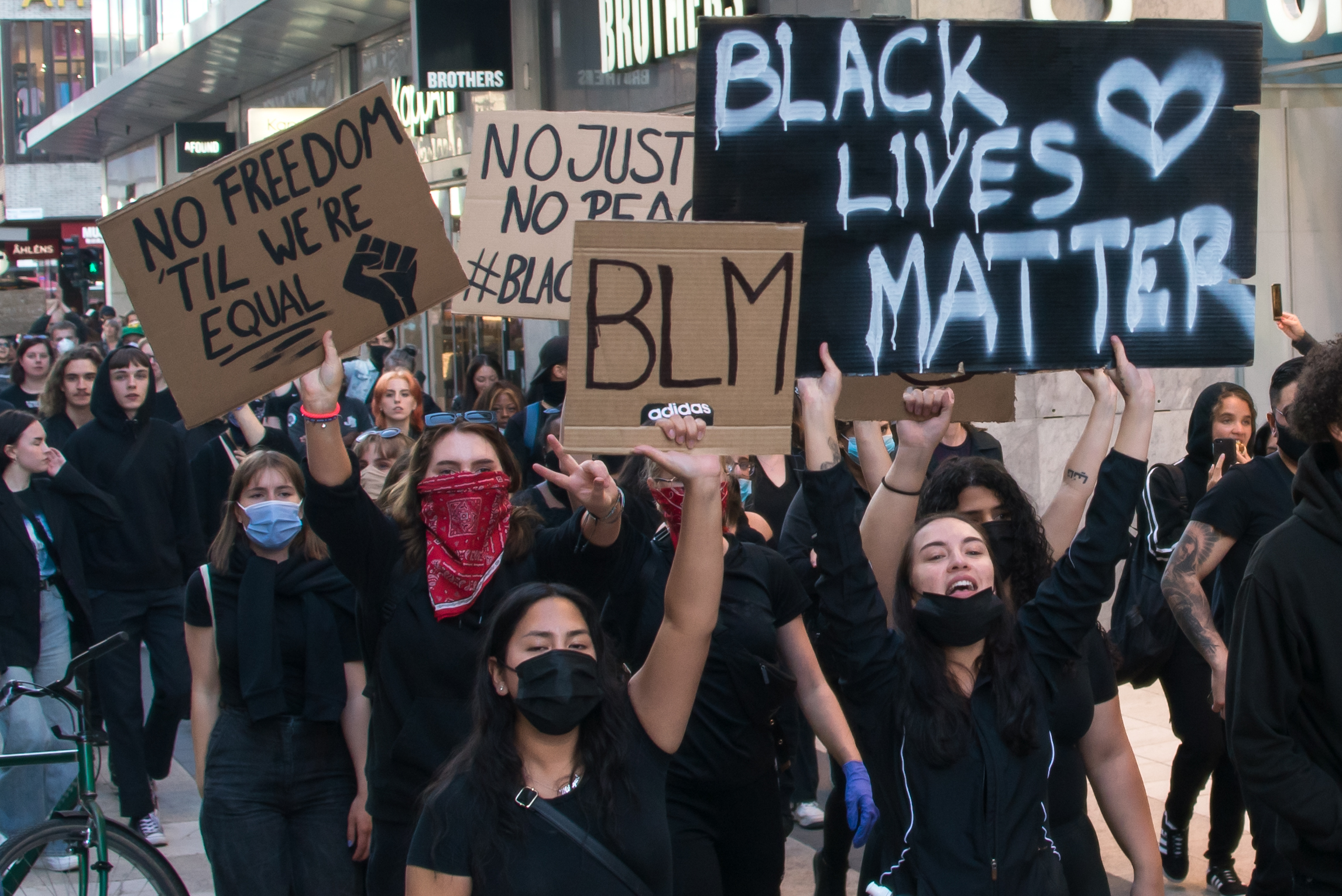
We live in an extraordinary moment. One in which many cross currents tussle for sustained dominance. A moment when armed white supremacy groups make attempts to take over state legislative offices in states like Michigan. One in which the science of contagion is in battle with a myopic individualism in which the wearing of a mask for medical protection becomes a signifier for a political symbolic battle around hegemony. All of this occurs in a moment when there is a historic pandemic, one which should make us as human species reflect on our contemporary ways of life. A pandemic which exposed the structures of the American health system where race and class determine those who will survive and live and those who disproportionately die. In the midst of this crisis, in which lockdowns and shelter in place were every day practices, we witnessed one of the most significant global protests that the world has seen for some time. The protests upended many commentators, shattered many conventional wisdoms about politics and at least for a time punctured the everyday normal many of us had become accustomed to. So what was at the root of this upsurge? And what are its significances? And, therefore, how might we understand it?
In the epigraph to the first chapter of Black Reconstruction (1935), WEB Du Bois writes about “How black men, coming to America … became a central thread to the history of the United States, at once a challenge to its democracy and always an important part of its economic history and social development.” That challenge has historically been the touchstone for both American democracy and its civilization. Racial slavery was a cornerstone of capitalism. It is not that racial slavery laid the foundation for capitalism; rather racial slavery, the plantation slave economy, the African slave trade were themselves practices of capitalism. At the core of the inauguration of capitalism was not the factory system with its wage labor but the slave plantation, unfree labor and a network of credit and debt arrangements. In Debt: The First 5000 years (2011), David Graeber points out how the Atlantic slave trade depended upon a system of debts and credits. Within this system emerged various institutions we now associate with capitalism from bond markets to brokerage houses. There was also the emergence of major companies whose chief functions were linked to slave trade, financing plantations and other aspects of the European colonial project. Here one can refer amongst others to the Dutch West India Company, the French Société de Guinée, and of course, the Royal African Company of England. At the core of what historian Catherine Hall calls this “slavery business” was the African captive who became an enslaved person. The late African American theorist Cedric Robinson called this historical process “racial capitalism.”
The enslaved body as the Caribbean historian Elsa Goveia said was “property in person.” It was a body that produced commodities while it was commodified. The black female enslaved body reproduced this commodification process three times over, as a body producing commodity, while being a commodity and then through sexual violence a reproductive body of enslaved labor. The plantation was a site of generative violence of commodification. Capitalism was inaugurated through the various violences enacted upon the enslaved black body. Exploitation was established upon the foundation of unfree labor. That is the history of capitalism: not a stages theory of transition of societies from one mode of production to another, but rather a historical process of generative violence upon the bodies of the African enslaved. In such a history the body is not secondary, it is the source of the methods, the several ways, of practices which turn the human into an enslaved dehumanized thing. Creating such a historical process, the colonial and planter power needed to construct forms of life, ways of thinking, construct modes of being human that would at least for a time guarantee the full reproduction of a society. To put this another way: exploitation requires forms of domination and the latter requires ideas and practices which the dominant elite and others accepts. This is about the manufacturing of what Gramsci calls “commonsense,” a kind of naturalized underpinning of a society, an ideational glue which holds society together. In slave and colonial societies violence was regularized as a technique of rule because in such societies might was right. And while this was so these orders also ruled by a set of ideas and practices about who was human and who was not.
All nations we know are an “imagined community” and as such we search for what glues bind the nation together. In America, the glue that has bounded the society together is not the fiction of America as an idea, the exception of the “City on the Hill,” rather it has been anti-black racism. What Du Bois calls the “wages of whiteness” became the naturalized commonsense which structured the everyday practices of living. Anti-black racism, has a long history founded within the matrices of the generative violence of the African slave trade; elaborated in plantation slavery through a complex system of customs and legal codes. It was codified in human systems of classification promulgated by European natural historians in the 17th century, mapped by Christian doctrine whereby some human beings had souls and some not; and then, in the 19th century, recodified through the so-called scientific studies of skulls–phrenology–a pseudo-science of the study of the mind in which it was said that Africans were inferior because of the size of their skulls since the brain was located in the skull. And when science made it clear that there was no scientific basis for anti-black racism then culture became a terrain to explain the supposed inferiority of blackness.
So blackness as visual marker produces within the dominant commonsense the death of the black person. Black life becomes disposable, is a lack, has no interiority, it is locked upon itself. As a visual marker, the black body has no escape. Its public presence is an affront, it must be tamed, put back in its place. It must be not allowed to breathe, because breath is life and for the black body to breathe means it has life. This is not primarily an American phenomenon. The history of racial slavery in America, the inauguration of Jim Crow and formal segregation, given the imperial power of America on the world stage created the illusion that there was a special American race problem. Of course, all societies have their own historical specificities, but anti-black racism was not an American feature alone. What Du Bois called the “color line” was embedded in the world because racial slavery and colonialism were parts of a global system which ruled much of the world from the 15th century Columbian voyages onwards. The anti-black racism of European colonial powers drew from racial theories created in America, the Caribbean, the historical encounters between Europe and Africa. South African apartheid drew some of its resources from the structures and practices of American Jim Crow. In all this the black body was the disposable surplus; not the other but the irremediable non-other, that which could not be fully included into the body politic of the given nation. Such an irremediable body, always on the outside, challenges the very meaning of democracy itself. It is why struggles around anti-black racism shake the society, indeed call Western civilization into question.
If we agree historically that the foundation of the capitalist West was racial slavery and colonialism and the accompanying genocide and attempted genocide of the indigenous populations, then what we are witnessing today are the challenges to this foundation. Capitalism is not just an abstract economic system as Marx made clear long ago when he noted that economic relationships are always between people. To rule, to be able to reproduce itself, any social system creates ways of living, modes of being human as it is then understood. Historically and in the present, anti-black racism and the creation of whiteness, of white supremacy was both a way of life and a signifier of being human. It is not just an ideological belief but rather a naturalized commonsense which in many ways functions like a fantasy, one which has material life and consequences. Commonsense as well in part is constructed by the historical understandings of a society about itself. We are, as humans, historical beings that make sense of ourselves through memories of the past. We take from that past to make the self. In societies where the past has been a historical catastrophe, where regularized violence operated as “power in the flesh” making the “human superfluous,” that past becomes a critical way to establish the grounds for inhumane ways of life. America’s unwillingness to confront the fact that it was a slave society since its founding as a British colony; that practices of settler colonialism wreaked havoc on the indigenous population; Europe’s unwillingness to confront its own history as multiple colonial powers now provides a dominant commonsense which structures the present. Yet as the poet and thinker Aimé Césaire noted in 1955: “Between the colonizer and the colonized there is room only for forced labor, intimidation, pressure, the police, taxation, theft, rape, compulsory crops … no human contact, but relations of domination and submission.” This history is elided by European countries. It is a history made visible through the various pacification campaigns, the genocide of the Herero people in Namibia and regular cutting off of the hands of the Congolese people. A history codified through forms of rule which created the African subject into a native and turned various African social and political formations into tribes. However, history lives in the present and becomes memorialized into the public landscapes of monuments. Monuments are an encoded system of public signs which enact meanings in the public domain. So when the Black Lives Matter Movement and those activated by it demand the removal of monuments, they are engaged in a move of symbolic insurgency to get rid of the public landscapes of the everyday historical monumentalization in the present. This happens in America, in South Africa, the UK. And continental Europe cannot escape the fire this time.
So here we are. For over a month there has been in America the single largest protests in America’s history. These protests were ignited by the public lynching of George Floyd who cried out “I can’t breathe,” before being murdered and then died with the words “Mama” on his lips. In that modern lynching scene, for nearly 9 minutes we witnessed the meaning of anti-black racism. Yes, it was the police man who kneeled down on his back and neck. Yes, the American police force were operating like modern day slave catchers. But there was something else and that something else was the casual nonchalance, the non-recognition that Floyd was human. It was the nonchalance that Floyd was just another disposable black body. The daily confrontation between black men and increasingly black women with the police is the nodal point where anti-black racism is most visible. In this nodal point there is no pretense. State authority expresses itself, that might be right, that black life does not matter. This is so in Brazil, in parts of Europe, the Caribbean, America or indeed in parts of Africa. Here ordinary black life does not matter.
After the death of Trayvon Martin, in 2013, a group of black feminists, Patrisse Khan-Cullors, Alicia Garza and Opal Tometi, formed the organization which became known as “Black Lives Matter.” Today the name of the organization has become a political banner igniting the political imagination of both black and white around the world. There is a rich historical current in which black revolts / uprisings have catalyzed various struggles around the world. In the 19th century the dual Haitian revolution inspired Greek anti-colonial figures fighting against the Ottoman Empire when some of them wrote to the Haitian government requesting arms and political support. We recall how what was then called “Negro Revolt”, the black uprisings in the 1960’s, influenced feminist and the anti-war movements around the world. In all this the African American spiritual “We shall overcome” became a clarion political message of many movements. So why, might we ask, does Black Lives Matter at this moment become transformed into a catalytic political banner, one which has engaged the political imagination of thousands? I return to Du Bois.
Racial slavery was the foundation of America and, I would argue, of the making of the modern world. As a form of domination its very core was the double and triple commodification process I addressed earlier. It was about making non-human another human being. As a generative historical process, it lasted for centuries. That is a special form of domination which not only required violence but creating another kind of human being, one who would be surplus and disposable. It also created the conditions for Black struggle to be catalytic, a point the Caribbean historian and radical thinker CLR James made in 1948, when living underground in the USA in the 1940’s he noted in a seminal essay “The Revolutionary Answer to the Negro Problem in the United States that “this independent Negro Movement is able to intervene with terrific force upon the general social and political life of the nation.” Black Lives Matter became a political banner because it challenges continued racial domination, its deep rooted legacies and consequences. It says we are human. It demands that as human the society should be transformed to create new ways of living. It not only therefore exposes police brutality but calls to order the entire historical foundation on which Western civilization rests, which is why getting rid of the historical monuments which venerate the West has become so crucial. While being part of a historic black liberation tradition, BLM political organizational methods have enacted critiques about Black masculinity. Given all this, Black Lives Matter as a political banner is world historic. And here the reader might pause and wonder why? Let us return to the making of the modern world; to the ways in which anti-black racism continues in the after-lives of racial slavery to dominate black life and has done so for centuries. So when there are sustained protests against the institutional and everyday forms of anti- black racism and this happens on the global stage. Is this not world historic? The current global protests are world historic because they confront the entire panoply and edifice that built the modern world. They are also world historic because they posit different methods of political organizing which breaks from previous forms of radical black movements. When the movement demands that monuments which invoke the past that undergirds the present must fall, it draws from the earlier struggles of South African students and the Rhodes Must Fall Movement. It demands abolition, making the word capacious, creating a new political language not just about abolishing prisons but demanding the opening of a new space, invoking the radical imagination to think of new ways of life. If many social and political radical movements have paid attention only to the state and the economy as structures of the present, Black Lives Matter is attentive to the history of the structures and their underlying assumptions and commonsense.
We are indeed in a new moment. Some say this moment feels different in part because the world wide protests have been multiracial, as the image of a lone white woman sitting on the sidewalk in a rural American town with a sign which reads “Black Lives Matter” illuminates. But perhaps what is most different about this moment is that for the first time in a world governed by neoliberalism, one in which as Stuart Hall and Alan O’ Shea put it, there is a neo-liberal commonsense, we are witnessing an uprising which challenges a foundational element of that commonsense. A commonsense in which anti-black racism has been a glue for the American body politic. This is an uprising of the radical imagination which demands abolishing the reproductive structures of the making of the modern world. However, as Stuart Hall makes clear in his work, commonsense is a contested terrain, In every major uprising where elements of the dominant order have been challenged, power when it cannot defeat immediately or ignore the uprising attempts to coopt, to integrate signs and symbols of the upsurge into the dominant thereby gutting them. So the response of many American corporations has been to proclaim support for Black Lives Matter, not the movement but to appropriate the banner turning it into a slogan. So when Amazon proclaimed on its website at the height of the protests that Black Lives Matter it was responding to a popular upsurge it could not ignore. Amazon’s practice was one of appropriation. One of the remarkable features of American power is its ability to quickly gobble up what begins outside of the body politic and then rework it into a hegemony without fundamental changes occurring. This is one aspect of the present moment.
We end where we began, with Du Bois and Black Reconstruction.
In 1935, Du Bois identified in Black Reconstruction a form of politics he called “abolition democracy.” It was, he argued, the necessary radical political framework if the transformation of America was going to occur after the civil war. For Du Bois, “abolition democracy” in his words “pushed towards the dictatorship of Labor”. By then Du Bois in the most radical phase of his intellectual / activist life. Eighty-five years later the black radical imagination has reworked abolition into a demand for new ways of life dismantling the structures which inaugurated the modern world. Fundamental change may not come and at the time of writing this piece, things can be said to be in flux and for sure a revolution is not around the corner. But historically, fundamental change requires the work of the radical imagination, the thinking that a new form of human life is possible. The global Black Lives Matter protests have opened that space. That is its remarkable significance for the current moment.
Anthony Bogues is Asa Messer Professor of Humanities at Brown university where he is the inaugural director of the Center for the Study of Slavery and Justice. He is also a curator.
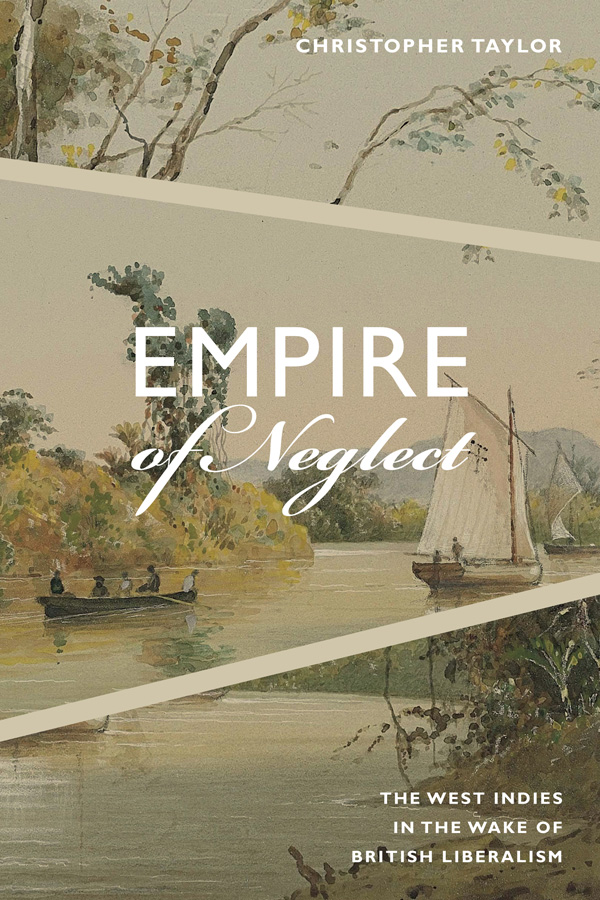
Review of Christopher Taylor, Empire of Neglect: The West Indies in the Wake of British Liberalism (Duke University Press, 2018).
To write about Empire today is of some significance. To connect Empire to the practices of nineteenth century British liberalism is critical. Christopher Taylor’s Empire of Neglect, which argues that in British colonial policy, “liberal freedom becomes a form of liberal neglect,” Taylor, 2018, 3) is thus already doing important work. That it does this through a critical literary lens marks an opening for those of us who think that critical scholarship currently demands an interdisciplinary approach. In the field of political thought/political theory the writings of Uday Metha, Jennifer Pitts and others have laid some grounds for thinking about the ideology of liberalism and its entanglements with the various European colonial projects, particularly the British and French colonial empires. In these studies, the Caribbean—despite being one of the early centers of British colonial rule and site of several conflicts and territorial transfers from one colonial power to the next — is often elided. And, all of this is strange since the Caribbean before the late 1870s scramble for Africa was the venue from which many theories about blackness were formulated. One only has to read Jefferson’s Notes on Virginia to see the copious references to the Jamaican colonial administrator and historian Edward Long’s three volumes on the history of Jamaica published in 1774. Jamaica was considered in the eighteenth century the “best jewel in the British Diadem.” And even after the abolition of slavery there was continued British preoccupation with these former slave societies.
Nineteenth century British political ideas and thought in general were deeply engaged with the Caribbean in the aftermath of the abolition of the slave trade in 1807 and then the ending of the formal social system of racial plantation slavery in 1838. In the words of the 1839 “Memorandum of the West Indian Assemblies” from the Colonial Office, the new key concern for the British colonial policy was the “institutions of the colonies and the new rights given to the negroes” (Cited in Bogues 2018, 156). These rights, which purported to make the once enslaved black population subjects but not citizens would become a contested terrain. All of this was not accidental once we recall that John Stuart Mill argued in Liberty that “despotic government” was acceptable for the colonies until they had arrived at a stage where they could be offered self-government. In this tutelage model of rule, what I have called elsewhere the “ladder of civilization,”(Bogues 2005, 217) there was a profound set of distinctions between being a subject and citizen. Included in these distinctions were issues of suffrage and conception of capacity. The conceptions of capacity meant several things including: political self-rule, mastery over the self, and forms of rationality, all summed in the word character.[i] This conception of capacity became a key element of Anglophone Caribbean anti-colonial thought so that in many of the writings of the newly formed black intelligentsia during this period the frame for anti-colonial thinking was around them having the capacity for self-rule. However, a key issue issue would be who was judging who and therefore what did the color of capacity look like? Part of the strength of Empire of Neglect is to point to how capacity was a problematic terrain of anti-colonial thinking.
Liberalism and colonialism
Often times, in our general thinking about liberalism and empire we focus on the main political thinkers of the period. Yet, as Empire of Neglect reminds us, liberalism was not only wrought through theoretical work; it was constructed as well by colonial practices. And here one is thinking about what colonial power did and how these deeds were then formulated back into liberalism and where that did not happen, how liberalism would create sites of difference in which might was right. Liberalism therefore was not an ideology and theory without practices, but rather within forms of colonial rule it was one in which colonial practice shaped political ideas. Therefore, to tell a more complex story of the history of political thought requires us to probe practices of thought because in any ideological configurations there is a profound relationship between the deed and the word. In trying to grapple with British liberalism in the mid-nineteenth century it behooves us to grapple with the critical issue that faced British colonial power at that time. So one might read Empire of Neglect as working through a form of rule which British colonial policy sought to enact. In the case of the Caribbean, colonial rule was a complex matter because the colonies were slave colonies. Within some Caribbean slave colonies there were local white legislative assemblies that governed the territories. All slave colonies were run by a colonial governor who worked in tandem with the British colonial office that set colonial policy based on British parliamentary decisions. In such contexts violence as an technology of rule was the order of the day.
As stated before, after the abolition of slavery, the crucial question for British colonial policy and politics was: how were these colonies to be ruled now that slavery was abolished? One current of this preoccupation was expressed in the phrase the “new rights of the negroes.” By the 1850s this preoccupation about how the colonies should be ruled became a driver of British colonial policy towards the Caribbean. A figure who represented this drive and wrote many essays about this as an Oxford professor of political economy was Herman Merivale. His essays and speeches brought him some public acclaim and he moved from Oxford to become colonial secretary in the British colonial office.[ii] In the lecture “Colonies without slaves or convicts,” Merivale noted that “the economical objects of colonization are two only: First, to furnish means of bettering their condition to the unemployed, ill–employed, portion of the people of the mother country. Secondly, to create a new market for the trade of the mother country” (Merivale 1842, 33). To create a new market for British trade required creating new subjects who were not slaves. For this to happen, Merivale recommended that the “duties of the colonial government … seem to arrange themselves under two heads – protection and civilization” (155). The idea of this form of rule, which I have called elsewhere “pastoral coloniality” (Bogues 2018, 156) was at the core of British rule of the Caribbean colonies in the immediate post abolition period. This did not mean that when deemed necessary by the colonial governor, the conventional practices of colonial power—that might was right–did not operate, clearly discernible by the actions of Governor Eyre in the aftermath of the 1865 Morant Bay Rebellion.[iii] Also, the black Jamaican was not simply a subject of the British colonial crown but he or she was in the words of Anthony Trollope, “a creole Negro.” This invented subject was in the mind of many British colonial officials different from continental Africans, a difference characterized by Trollope as one made possible by the close proximity of the African enslaved in the Caribbean living closely with and in societies with Europeans (See: Trollope 1860).
The British Caribbean colonies from the abolition of slavery onwards were therefore former slave societies in gestation. Within this context, the Afro-Caribbean person operated on dual grounds partly shaped by the color-class codes of the period. On the one hand, there was the construction of the black ex-slave subject as a “Christian Black.”[iv] This was a subject who would wear the coat of Victorian respectability and who could, in the end and over time, might be considered “civilized.” On the other hand, there were the ways in which many former black slaves created alternative subjectivities as they constituted new forms of culture and alternative Afro-Caribbean religious forms.[v] These latter subjectivities would never be and could never be considered civilized.
An important aspect of the Empire of Neglect is its concern with the figure of the respectable black, the “Christian Black.” Taking its title from the poem England in the West indies; A Neglected and Degenerating Empire by the poet George Reginald Margetson, who hailed from St Kitts, the core arguments of Empire of Neglect are about the ways in which “the Jamaican ex-slave navigated the institution of black life as worthless…[and how] ex-slaves moved through worthlessness to find another horizon of social being that they associated with empire (27). In this argument there is a concern for “imperial belonging” on the part of these ex-slaves. Taylor develops this argument through different readings including that of a pamphlet of an absentee white planter and the novel of Trinidadian intellectual Michel Maxwell Philip. The over-arching point of this book is to illustrate how Caribbean political imageries were constituted in relation to the rise of forms of anti-colonial nationalism as the “political horizon of Caribbean writing.” Yet, I pause here. I do so because black subjectivities in post-slavery Caribbean societies were not homogenous even within the newly emergent black intelligentsia. Because while there was black imperial belonging, there was another current of anti-colonialism one in which forms of black nationalism under various symbolic orders of Afro Caribbean religious-politico forms would appear. Alongside these counter-symbolic forms were mass actions so that in Jamaica in 1884 there was black mass anger which frightened the colonial authorities and by 1895 the dockworkers went on massive strike, one which Dr Robert Love perhaps the most radical black intellectual in the Caribbean at the time suggested was a new marker. All of this pushed the British colonial authorities to increase Indian and Chinese indenture labor schemes. In recalling these moments while Empire of Neglect opens up the space for us to grapple with the complexities of “imperial belonging,” one might also attend to other archives and figures, such as the ordinary Caribbean ex-slave who sought to create different forms of belonging other than that which primarily rested upon an imperial imaginary. Empire of Neglect makes it clear that central to the emergence of a certain kind of Caribbean nationalism is J.J. Thomas’s work and his seminal book Froudacity.
JJ Thomas and the struggle for recognition
Empire of Neglect engages adroitly with the reception of J.J. Thomas’s work in Caribbean intellectual and political history. Following Empire of Neglect, I want to reread Froudacity as a complex anti-colonial text, one in which there is a longing for Britishness or recognition from the British colonial power of capacity, and within this capacity, a desire for some form of Caribbean self-government. In his writings on Thomas, Rupert Lewis makes clear that “the book marks a state of mind that is in direct transition to the ideas which later became known as Garveyism” (Lewis, 54). At the core of this complexity was Thomas’s idea that the Black Anglo-Caribbean person was equal to any British white person. It was an argument about capacity and the readiness of the colonies for forms of internal self-government, if not full independence.[vi] In his 1969 introduction to the republication of Thomas’s book, C.L.R. James noted that James Anthony Froude, the British professor who wrote the book The English in the West Indies: The Bow of Ulysses, to which Thomas had responded, had embarked on this project because he was part of the British intelligentsia opposed to any form of West Indian self-government. Thomas, who read the book in Grenada, wrote a series of articles in response to Froude’s travelogue.[vii]
Christopher Taylor provides us with a nuanced and excellent read of Froudacity. He writes, “Froudacity did not simply cut ties with the empire … it also cut ties with the empire centered political and literary tradition” (232). In one sense, I think this is an accurate assessment, but in another, I wonder if we can think further about the complexity of this kind of anti-colonial thought, predicated as it was on the idea that “we were ready.” On whose terms were we [the Caribbean] ready for self rule? And more importantly, who was ready? Thomas, while exposing the anti-black racism of Froude, simultaneously agrees with one of the markers of anti-black racism of the period, the ways in which the West understood the black sovereign power of the Haitian republic. One nineteenth century current of anti-black racism was the “Haitian Fear.” The idea of black sovereignty expressed through the dual Haitian revolution shook the colonial world. The idea of Haiti, was the worst nightmare for colonial powers and American slave masters.[viii] Liberalism feared Haiti. Many a liberal abolitionist believed that Haiti was the worst example of black freedom. Froude was not an exception to this and raged against the black republic. Thomas, while vindicating the black self, wrote in repose to this anti-black rage, “we saw them free, but perfectly illiterate barbarians, impotent to use the resources of their valour.” In this statement, he repeats what some black figures at the time felt about Haiti. Attempting to mitigate this sentiment, Thomas noted that part of the political difficulties in Haiti had been generated by the mulatto social grouping (Thomas 54). His ambivalences towards Haiti were rooted in a certain respectable black subjectivity created by British colonial power. Here we should remember that Thomas was a schoolmaster. Such a figure was at the pinnacle of what was then considered the “Christian Black.” But Thomas was a complex figure because he wrote the very first defense of the black vernacular languages of the Caribbean and his book, Creole Grammar, remains the starting point for creole linguistics in the Anglophone Caribbean.
In the final chapter of his book, Thomas makes it clear that “the extra – African millions in the Western Hemisphere” will make a significant contribution to what he considers as human development. Interestingly, he deploys the American reconstruction period as an example of this, but elides the racial terror of the period. In all of this, Thomas was attempting to stake out a different ground for Caribbean anti-colonialism and the capacity of the black Caribbean person.[ix] Froude had written that within the Caribbean “there are no people here in the sense of the word and the islands [were] becoming nigger warrens” (Cited in Thomas, 19). J.J. Thomas, learned schoolmaster and respectable Black, was not only deeply offended by this, but in his act of writing in defense of the capacity of the Caribbean black ex-slave, began to formulate the idea of a nation. I would argue that for him, as well for his work, Creole Grammar was in part illuminating capacity, making it clear that this nation in gestation had a language.[x]
Thus, Taylor’s book, in teasing out a sentiment of “imperial belonging,” makes a signal contribution by bringing Thomas as an example of this kind of current. I would argue that this was one hall mark of this Caribbean black intelligentsia—a deep anti-racism combined with a sense of belonging to the British empire while desiring all the rights of citizenship. Thus even in his advocacy for a modicum of internal self-government within the juridical context of a crown colony, Thomas appeals to fact that the black Caribbean subject as outgrown “ the stage of political tutelage” (215). But this capacity or political readiness was not an argument for full independence but rather a call for fuller internal political participation and the end to crown colony government. Perhaps nowhere is this kind of advocacy most pronounced than in the writings of T. E. S. Scholes, an extraordinary figure who wrote two volumes attacking the idea of Black inferiority, The Glimpses of the Ages, or the Superior and Inferior Races So Called, Discussed in the Light of Science and History (1905/1907). Before that he had written the important political economy pamphlet in 1897, “The Sugar Questions of the West Indies.”[xi]
One of the major contributions of Empire of Neglect is to illuminate the political economy circumstances that Thomas and others inhabited. In the eighteenth century, colonial Britain operated economically through a closed system of mercantilism. One effect of industrialization, a process facilitated enormously by Caribbean plantation slavery was the demand by another set of British economic elites for free trade. In such a context the economic frame became a balance between the overseas sale to foreign regions of manufactured goods. Critical to that was the access to raw materials and finance. All this meant that the Caribbean colonies were no longer jewels in the British colonial crown. Thus, the matter of how to rule the newly emancipated ex-slaves occurred within an economic situation in which the core drives of colonial power had shifted from plantation slavery to imperial colonial control and command over new lands, as well as to the construction of the figure of the native in Africa and elsewhere. To put this in another way, deploying Stuart Hall, the conjecture had shifted. Yet, we know that in these kinds of shifts the old does not die but is reworked into new forms. One strength of Empire of Neglect is to mark this historic shift.
It is safe to say that many Afro-Caribbean persons felt the shift but paid no attention. I would argue that, in part, this was due to the growing importance in the late nineteenth century and the early twentieth century of the banana trade, and the emergence of the United States as an economic presence in the region. And here we should recall that by December 1823, the US had promulgated the Monroe doctrine. The doctrine made it clear that Europe should no longer seek new colonies in the Western Hemisphere. It was a clear sign of the beginning of US hegemonic power in the region. By the late nineteenth and early twentieth century the so-called respectable Afro-Caribbean individual would still look to Britain as a place where he or she could make a mark. Thus, for example, between 1931 and 1932 C.L.R. James would first consider migrating to London, while Garvey and Sylvester Williams years earlier would think about moving to the US. One could argue that the migratory patterns of the Caribbean, even as British subjects, was largely directed toward Central America and the US before London recalling that West Indian labor was critical for the building of the Panama Canal and the revitalization of the sugar industry in Cuba in the early 20th century. So, while there were migratory movements in the late 19th and 20th centuries which social grouping went where is an important fact. Here the issue was not so much geography but rather the sense of the neglectful distance, which colonial Britain had so carefully cultivated. So we have a paradox: the Anglophone Caribbean person was still constituted as a British colonial subject and yet those black Caribbean political subjects, who were preoccupied with forms of black consciousness, would find themselves in the US and while they belonged to empire, and also seeing themselves as part of the Black world.[xii]
The rule of Crown Colony
Empire of Neglect provides an important alternative view of the emergence of Caribbean anti-colonialism and its nineteenth century context. One of the central features of British colonial rule in the Caribbean in the aftermath of the Jamaican Morant Bay rebellion in 1865 was the enactment of crown colony government. This form of juridical rule meant that the local white legislative assemblies were abolished. Some of the arguments for their abolishment circled around the sense that sooner rather later the emerging black intelligentsia would begin to clamor for rights and representation in the assemblies. From as early as the 1840s the colonial secretary of state wrote the following letter: “From all I can hear it seems certain that before long the negro population will obtain a preponderating influence in the Assby…[thus] the authority of the Crown should be for the protection of the higher classes be somewhat strengthened” (Cited in Hart, 66). But there were many complexities involved here. How was a liberal colonial government to treat the former black slaves as subjects? What did it mean to be subjects and not citizens? How was rule to be constituted over a black intelligentsia which was rapidly emerging in part through missionary education? Within this context this intelligentsia created forms of anti – racism. A feature of these forms was the ground for racial equality. It meant that the black Caribbean had the capacity for internal self rule. It also meant that as a black diaspora they were better equipped in their minds to redeem Africa.[xiii] This kind of anti-racism in the understanding of many of these figures was compatible with being a citizen of the British colonial empire. Therefore, in many instances their struggles circled around what was considered to be the features of the rights of this citizenship. In this sense one aspect of colonial rule and domination had created a Caribbean black native for whom empire was a form of rule in which they had rights. It is from this perspective that for them empire was neglectful.
By the 1930s, this kind of anti-colonialism would congeal into forms of creole nationalism, a form of political nationalism which would focus on constitutional independence.[xiv] The various currents within this form of anti-colonial nationalism would eschew the ordinary black Jamaican and Caribbean person. For the ordinary black Caribbean person forms of black radical nationalisms dominated life, either through religious practices such as Rastafarianism, through the work of black prophets like Alexander Bedward, or through radical political organizations like the Poor Man’s Land Improvement Association.[xv]
These various forms of anti-colonial nationalisms would tussle with each other even after constitutional independence in the 1960’s and would remain in a political alliance for a brief moment during the Michael Manley regime of the 1970s.[xvi] The importance of Empire of Neglect is that it allows us to revisit a historical period of Caribbean history when the conjuncture was in flux. In its close readings of some of the key texts of the period, it reminds us of another historiography of thought that demands our attention. Finally, it makes plain that the Caribbean continued to be a crucial site, even if a neglected one, for nineteenth century Imperial Britain. In all of this, the Caribbean created various forms of anti-colonial ideas and practices. These included radical anti-colonial ideas that drew from Afro-Caribbean alterative epistemological practices. In moments of what C.L.R. James would call the “fever and fret” of the times, these radical practices would challenge both colonial and post-colonial state formations and its ways of life (James xi). In thinking about mapping the intellectual history and political thought of the region, writers like J.J. Thomas and Maxwell Philips became key figures. However, in the words of Bob Marley, the half is still to be told. Empire of Neglect, in this way, gives us an excellent rendering of the figure of the respectable “Christian black” and his desire for racial vindication and self-government. It is a necessary book.
Anthony Bogues is the Asa Messer Professor of Humanities and Critical Theory and the inaugural director of the Center for the Study of Slavery and Justice at Brown University. He is also a visiting professor and curator at the University of Johannesburg. The author/editor of nine books, he has curated exhibitions in USA, Caribbean, and South Africa. He is currently working on a book titled Black Critique and editing with Bedour Algraa a volume on Sylvia Wynter’s work. He is the co-convener of an Africanand African Diasporic contemporary art project/platform on Black Lives today titled, Imagined New.
[i] For a discussion of this see Stefan Collini, “The Idea of Character in Victorian Political Thought” Transactions of the Royal Historical Society, vol 35, fifth series (1985) 29-50.
[ii] For a discussion about the writings of Merivale, liberalism and nineteenth century Jamaica see Bogues 2018, 150-173. Merivale’s lectures were published as Lectures on colonization and Colonies, delivered before the University of Oxford in1839, 1840 and 1841 (London 1842). As well it should be noted that there is a rich Caribbean historiography which argues that the political contours of the Caribbean were put in place during this period. Emerging from this historiography is the concept posited by Rex Nettleford of the “battle for space.” The argument rests on the idea that within the Anglophone Caribbean there is not a revolutionary political tradition but rather a rebellious one which circles around contestations for space within society. For a historical account of these battles see, Moore and Johnson 2004. One of the most impressive historical text on the practices of the British Empire is Catherine Hall’s Civilizing Subjects: Metropole and Colony in the English Imagination 1830-1867 (2002).
[iii] Of course, the debate within the Jamaica committee then led by John Stuart Mill was indicative of a divide about how to rule the Caribbean. Mill and his colleagues including Charles Darwin argued that the killing of the leadership of the rebellion by the colonial governor without due legal process of trial was an abrogation of the rights of British-Jamaican subjects. Thomas Carlyle and Charles Dickens argued otherwise.
[iv] The idea of the “Christian Black” emerged out of studies of nineteenth century post-slavery Jamaica and complicated the imperial narrative by foregrounding the role of British missionaries sent to Jamaica and the British Caribbean to train the ex-slave in Christianity and civilization. For a discussion of this concept see Russell, 51-58.
[v] For a discussion of these Afro-Caribbean religious forms see Curtin 1955.
[vi] It should be noted that at the core of C.L.R. James’s pamphlet, “The Case for West Indian Self Government” (1933) is the central political argument that West Indians were ready for self-rule. It was an argument against the colonial office which at that time made clear that there was need for more years of preparation before the region could be self-governing.
[vii] It is important to note that Froude and Trollope were travel writers and both had written on South Africa and the Caribbean. Thomas’s response therefore should also be seen as a nationalist response to the colonial gaze which dominated European travel writing at that time.
[viii] For a discussion of this vision of Haiti see the essays in the collection in eds. Dillon and Drexler 2016.
[ix] I think in these views that the anti-colonial figure from Trinidad who follows closely some of the lines of thinking that Thomas lays down is Henry Sylvester Williams who was born in Trinidad in 1869 and by 1897 had formed the African Association in London. In 1901 he and W.E.B. Du Bois organized the first Pan African congress in London. Thomas’s thought moved from a focus on an emancipated ex-slave population to then consider the African diaspora. Williams began by thinking about blacks in the Caribbean and then moved to continental Africa. It is important to note that he lived for a time in Cape Town, South Africa.
[x] For a full and careful reading of J.J. Thomas’s life and work see Smith 2002.
[xi] For a good description of T. E. S. Scholes see Bryan, 47-67.
[xii] It is interesting to note that Garvey seeks to build the UNIA in the US and that George Padmore comes to the US to study at Howard University where he joins the Communist Party before going to Moscow.
[xiii] The idea of the “redemption of Africa” by the African diaspora in the Caribbean has a long history which includes figures of the Haitian revolution like Baron de Vastey, the writer and political personality whose 1814 text is critical in any study of the revolution. I would argue that J.J. Thomas and others belonged to this current who believe that one of the obligations of the African diaspora is to “redeem Africa.” One does not understand the ways in which Africa becomes a signifier in the work of Garvey without not locating it inside this political tradition.
[xiv] I would argue that this kind of anti-racism would then merge with a Brown Jamaican nationalism which emerges with the formation of Sandy Cox and Alexander Dixon’s organization National Club and the newspaper Our Own, which began publication in July 1910. In Grenada in 1883 the newspaper Grenada People also began to advocate for a modicum of self rule and that blacks should be allowed the right to vote and be represented.
[xv] For a discussion of nationalism in Jamaica see Bogues, “ Nationalism and Jamaican Political Thought’ in Kathleen Monteith & Glen Richards ( eds ) Jamaica in Slavery and Freedom: History , Heritage and Culture. 2002, 363-388. For a discussion of the leader of the Poor Man Land Improvement Association see, Rumble 1974. For a exemplary novel that examines the ideas and work of Alexander Bedward see Miller 2016.
[xvi] There has been intense discussion and debate about these nationalisms and how the 1970’s was a transformative moment, from constitutional independence to decolonization, as well as ar national liberation. This is part of a critical oral history project in political thought of the 1970’s that is currently underway in the Caribbean. In the eyes of many, this kind of project is required to fill the gaps of the numerous the scholarly works of the period. Such a project also reimages what kinds of archives can and should be engaged in circumstances when a society is in deep flux and change.
Works Cited:
Merivale, Herman. 1842. Lectures on colonization and Colonies, delivered before the University of Oxford in 1839, 1840 and 1841. London: Longman, Brown, Green, and Longman.
Bogues, Anthony. “John Stuart Mill and the “Negro Question” Race, Colonialism and the Ladder of Civilization.” In Andrew Valls, Race and Racism in Modern Philosophy Cornell University Press, 2005.
Bogues, Anthony. “Liberalism, Colonial Power, Subjectivities and the Technologies of Pastoral Coloniality: The Jamaica Case” in Tim Barringer & Wayne Modest, Victorian Jamaica Duke University Press, 2018
Elizabeth Dilion & Michael Drexler. The Haitian Revolution and the Early United States University of Pennsylvania Press, 2016.
Miller, Kei. 2016. August Town. London: Weidenfeld and Nicolson.
Moore, Brian and Michelle Johnson. 2004. Neither Led nor Driven: Contesting British Colonial Imperialism in Jamaica, 1865-1920. Kingston: University of West Indies Press.
Richard Hart. From Occupation to Impendence ; A Short History of the Peoples of the English Speaking Caribbean (London: Pluto Press, 1998) p. 66.
Rumble, Robert. 1974. “As told to Robert Hill & Richard Small : The Teaching of Robert Rumble – A Jamaican Peasant Leader.” In Education and Black Struggle: Notes from the Colonized World. Cambridge: The Harvard Educational Review.
Smith, Faith. 2002. Creole Recitations, J.J. Thomas and Colonial Formation in the Late 19th century Caribbean. Charlottesville: University of Virginia Press.
Taylor, Christopher. 2018. Empire of Neglect. Durham: Duke University Press.
Thomas, J.J. 1969. Froudacity. London: New Beacon Books.
Trollope, Anthony. 1860. The West Indies and the Spanish Main. London: Chapman and Hall.
Russell, Horace. 1983. “The Emergence of the Christian Black: The Making of a Stereotype.” Jamaica Journal, 16.1: 51-58.
Anthony Bogues, at the introduction of the Ships of Bondage exhibit currently held in the Slave Lodge museum in Cape Town, South Africa (and features studies of the Amistad, the Sally, and the Meermin), speaks of slavery and freedom, representation, the sedimentary foundations of slavery, colonialism, colonial modernity and these historical processes that connected the world (41:56). Beginning with reflections on Toni Morrison’s Beloved and André Brink’s Philida, Professor Bogues asks, “How does one represent slavery?” alluding to the attempt “to represent what sometimes we cannot name,” as he wrestles with the idea of freedom as it pertains to the political, the historical and the practice of being human: his thoughts a direct contribution to what he calls “the public curriculum.”
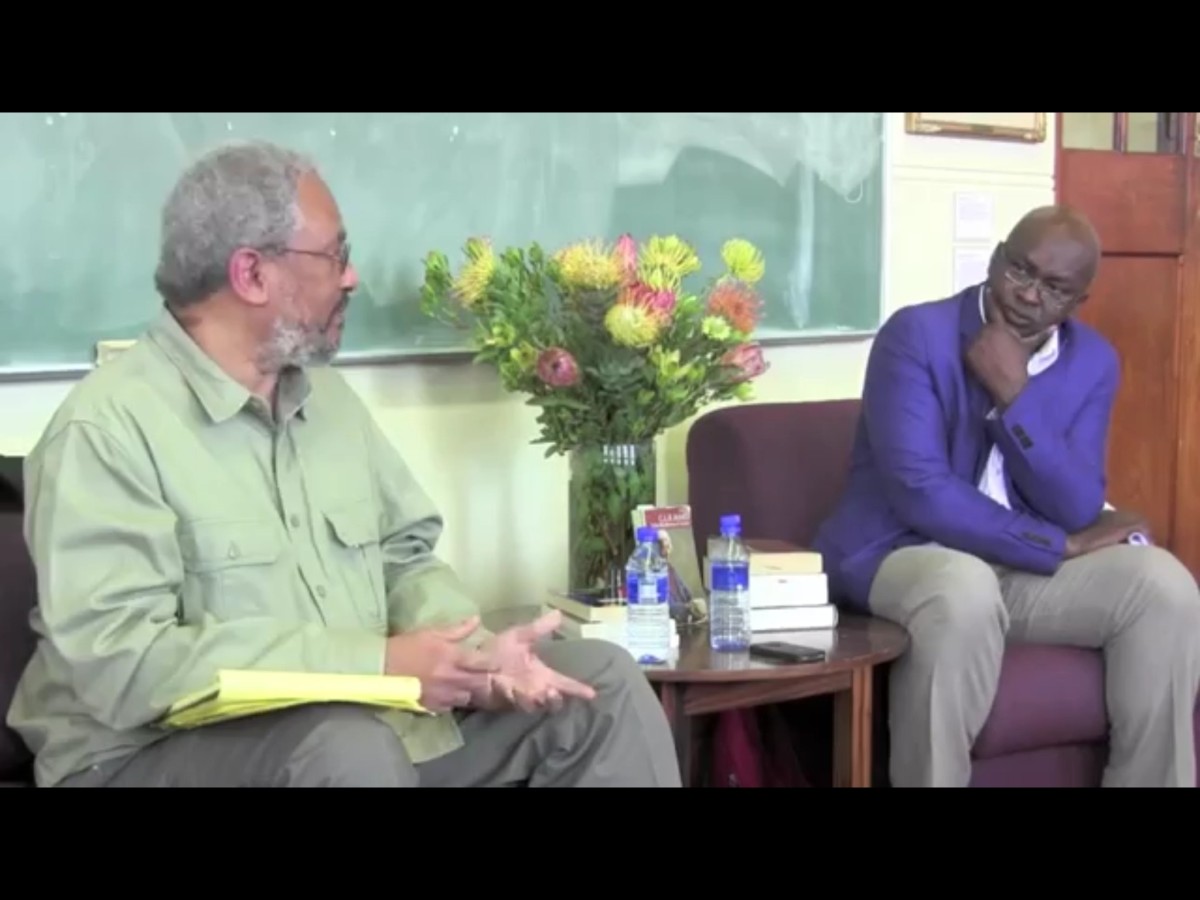
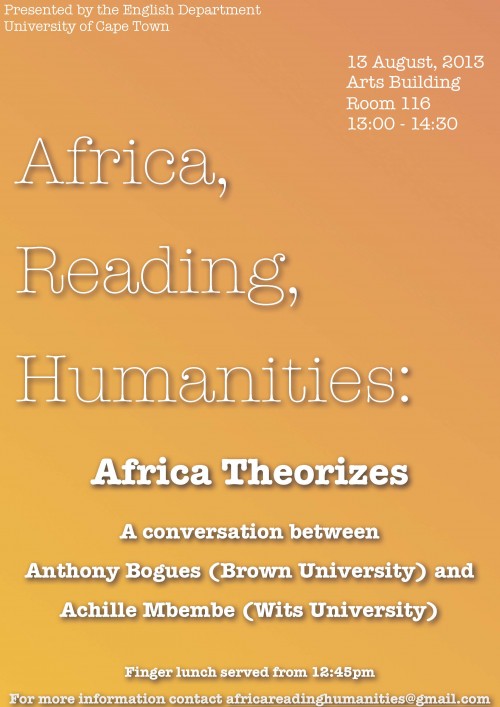
Coverage of The University of Cape Town’s “Africa Theorises” has arrived – a conversation between our esteemed colleague Anthony Bogues and the renowned scholar Achille Mbembe. Topics include the “redrawing of the global intellectual map,” the “flight from theory” and “scientism,” the waning hegemony of the “Western Archive,” the possibilities of “liberty,” and the “modes of being human.”
This dossier reflects on the rise of the right in the United States, and considers how to stop it. Part I is edited by David Golumbia and Paul Bové. Part II is edited by members of the b2o editorial board.
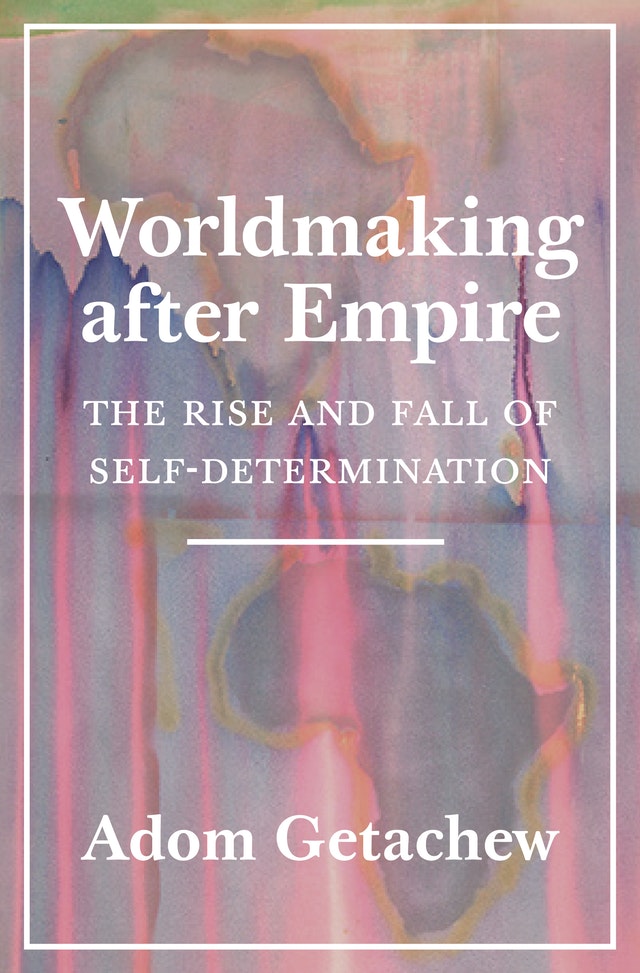
This dossier, edited by Leah Feldman, joins two reviews of books by Adom Getachew and Chris Taylor on empire and worldmaking alongside a dialogue between the two authors that developed out of a co-taught seminar on the “Global Plantation” in 2019. Getachew and Taylor’s dialogue considers the pedagogical, disciplinary, and theoretical challenges of thinking through the global plantation in epistolary form, while reviewers Tony Bogues and Andrew Zimmerman address Getachew’s and Taylor’s books from the vantage of their own archives and disciplinary modes. The form of this cluster, marked by moments of fragmentation, repetition and variation, thus calls for a practice of reading strangely to expose the ways in which placing pedagogy and theory in conversation animates modes of thinking in relation.
This essay has been peer-reviewed by the b2o editorial collective. It is the first entry in a dossier on Stuart Hall.
As an itinerant Caribbean scholar, I have been profoundly shaped by Stuart Hall. Much of this is legible to me, but so much is not; Hall’s mode of intellectual practice (conjuncture, strategy, contingency, articulation) imprinted on many of us as if by osmosis. My generation of anglophone Caribbean children were taught literature of the Caribbean for O’Levels; we were introduced to Shakespeare through The Tempest, encouraged to read it from our postcolonial, national situation. Kamau Brathwaite’s nation-language informed our literary education; C. L. R. James’s “literary history” of the Haitian Revolution shaped our engagement with West Indian History; and Hall’s notion of what he has called the “cultural question” permeated our social studies. These were not the only intellectuals who shaped my generation’s schooling in the 1990s, but I name them to give some sense of the difference between the anglophone Caribbean schoolroom of my own generation from those of previous generations. We were at least a decade into independence.[i] If nothing else, Hall should live in the pantheon of anglophone Caribbean (West Indian) intellectual-activists I was taught to revere as child. When C. L. R. James passed away in 1989 I was not yet a teenager, but I remember the nation[ii] mourning. Pride seemed to burst forth from every chest about how far one of our bright boys[iii] had gone. There was a sadness that he was no longer amongst us, even if many of my generation struggled to reconcile the image of the frail man we saw on Trinidad and Tobago Television[iv] (TTT) with Pan-African revolt or the vigor of West Indian cricket at its revolutionary zenith. This kind of celebration of a local boy (or girl) who makes it overseas is not uncommon in small places, island spaces, “Caribbean Spaces” (Kincaid 1988; Boyce Davies 2013). As calypsonian David Rudder told us in his Windies anthem for the 1987 Cricket World Cup, “Rally Round the West Indies,” we live in “a divided world that don’t need islands no more”; so asserting Caribbean identity and filiality is about claiming intellectual, metaphysical, and geographic space as it shifts, translocates or erodes in our present. But if in 1989 there seemed to be ample space allotted for mourning James as a Caribbean intellectual, in 2014 the scene of mourning for Hall, a great island scholarship boy himself, was more subdued.
At the 2013 Callaloo conference (held at Oxford University, where Hall was a Rhodes Scholar in 1951) the question was posed if another C. L. R. James were possible.[v] The question, I think, was about the conditions of possibility in the Caribbean (at home and in diaspora?) for such another intellectual to emerge. The reply was no. I wondered why not. Was Stuart Hall not such a one? I remembered the Channel Four interview Hall did of James; it could be read as a kind of passing of the torch from one to the next, James to Hall. It was clearly born of more than a desire to ask a few questions of the man for a curious British public. If that imperative was there, there was also what can be understood to be the desire to talk to another son of the (anglophone) Caribbean soil, familiar with that terrain before independence and the nation-state. A profoundly, uniquely Caribbean moment.[vi] Hall after all was a radical Caribbean intellectual who was arguably Jamesian in a way—deeply knowledgeable on a range of subjects but whose breadth of inquiry is born of a “particular” Caribbean time and place.[vii] Without making this about some kind of closed monarchy with the crown passing from James to Hall to Sylvia Wynter to … I want to think about what figures such as they, but namely Hall and James, mean to the region, and the ways in which they seemed unable to find room for themselves in their island homelands, especially as intellectuals. If these island-spaces incubated their curiosity and promiscuous reading, they were also not the spaces in which they seemed to think that their radical and black radical politics could be sustained. Often this has been understood to say something about the UK and the US in the case of James, and the UK in the case of Hall. Not wrongly so; there were British anti-immigrant policies that resulted in case of the Mangrove Nine in 1970—in which nine West Indian immigrants were charged for protesting police brutality and the targeting of the West Indian restaurant, Mangrove—or the Brixton Riots of the 1980s, 1990s and most recently 2011. As part of the Windrush generation—the West Indian immigrants who moved the UK in the 1950s and ‘60s—Hall came comfortably into himself as a racialized subject alongside many of his fellow windrushers. It is not that he was unaware of racial difference before, but Hall himself acknowledged, he could not easily have been a radical black man in Jamaica. There he was brown, even if too dark for his own mother’s comfort.
Unlike Hall, Wynter and James attempted return; that is, they traveled back to the (anglophone) Caribbean to make lives for themselves, not only to visit family and friends. Born in 1901, James left Trinidad for England in 1932. Between 1958 to 1962 James resettled in Trinidad at the invitation of his then friend and former student at Queen’s Royal College (QRC), Eric Eustace Williams, author of Capitalism and Slavery (1944) and the first prime minister of independent Trinidad.[viii] he left shortly before Trinidad and Tobago gained independence as a result of their falling out, largely over the collapse of the West Indian Federation (Williams having withdrawn his support with the infamous line that primary school children of my generation had to memorize: “one from ten leaves nought”).[ix] In spite of this, James remained active in Trinidad politics until 1968 and continued to hold a place in the hearts of the people of Trinidad and Tobago, returning for a year in 1980. In the 1980s the people of Trinidad campaigned for the government to honor James with a house, and in 1989 his remains were returned to Trinidad and he was laid to rest in state in Tunapuna, the eastern corridor town where he had been born (Cudjoe 1992: 124).
Wynter and Hall are born within a few years of each other, in 1928 and 1932 respectively. In 1963, Wynter was appointed assistant lecturer in Hispanic Literature at the University of the West Indies, Mona; she stayed until 1974, when she leaves for a visiting professorship at the University of California, San Diego and then a permanent post at Stanford University in Afro-American Studies and Spanish Literature from 1977. For Wynter, the growing chasm between her intellectual interest and the curricula in Spanish at UWI made staying untenable; in the US she could teach to the intellectual questions uppermost on her mind (Wynter 2000: 172 – 3).
I want use the occasion of this dossier commemorating Stuart Hall to think about his place in what we might call the canon of Caribbean thought. As I use the word “canon” in relation to Hall my mind’s eye conjures an image of the great man somewhat discomforted by the supposition that that term could have anything to do with him or his work. Though he began as a literary scholar, Hall left literary studies as a formal home for his intellectual work quite early on in his career—with something like the English literary “canon” at least one of the impetuses of such a change of course. Here I mean canon not in terms of content but a structure of relations. The word “canon” confers authority, power, hierarchy; it deems some texts valuable and worthy of scholarship (those within its borders) and others less valuable (those without its borders). In fact, it is to Hall as one of the progenitors of Cultural Studies, of course, that many of us in literary studies interested in cultural production (not accommodated by the canon, whatever that may be) are indebted. The rise of Cultural Studies helped open up space in most humanities’ disciplines to cross-pollinate our objects of study and challenge our conditions of knowledge production; one could contemplate new media and urban, street culture from literature and sociology. Without question Hall’s stint as editor of New Left Review (1960 – 1962) and authoring and editing texts such s Culture, Media, Language: Working Papers in Cultural Studies, 1972 – 79 (1980), Policing the Crisis: Mugging, the State and Law and Order (1980), and others cemented his place at the heart of the global re-imagining of the university and the humanities from the 1960s – 1980s and gave us new vocabularies for social and cultural critique. Certainly there are many perspectives from which to think through Hall’s body of work and his legacy for the scholars, activists, and every-folk who read him or simply inhabit a world in which terms like “cultural identity, race, and ethnicity” are givens. That these are categories with which we work in today’s humanities, that there is something under the rubric of “cultural studies,” owes much to Hall’s labor. Yet as “cultural studies” itself seems embattled and work on identity, increasingly is denigrated as “identity politics” and even passé, I wonder what the future of such scholarship is. With Hall there was always the assumption of the incomplete work; the article, the radio interview, sites of the unfinished and the urgent, of contingency.
I am not sure it is fair of me to push the two—Hall with his commitment to the conjuncture, the contingent or “without guarantees” and canon—together. I persevere with canon though, mindful of Hall’s own claim that before Marx hated capitalism “he admired it and respected it”; it was his admiration and respect for it that got him beyond capitalism as it were (Hall 1983: 39). Hall’s admiration, love even, of canonical English literature and literary studies is central to his move beyond it into sociology of literature and cultural studies, maintaining a commitment to the “cultural questions” (Hall, “Politics,” 1997: 146). I do so because at the heart of this, I think, is question of what is considered valuable to thinking Caribbean or uniquely Caribbean thought as opposed to that of an elsewhere. In other words, “to think something like ‘Caribbean studies’ is already to be inside, to be in a conversation with … what the Caribbean supposedly is, supposedly was” (Scott 2013: 1)[x] My simple premise here is that Hall is not always understood “to be inside…in conversation with” the Caribbean as such. Even when deemed “an extension of” James, Hall is never quite read as Caribbean as much or unquestioningly as the former (Hall 1997).[xi] The question I want to ask then is: what “is…was” the Caribbean of Hall’s work? In asking this question I am taking Hall at his word “that the interest never goes away, the interest in the Caribbean and the interest in race” never dissipated for him, even if it was not always “the most prominent and visible part of [his] work” (Hall, “Politics,” 1997: 155). In my attempt to grapple with Hall’s Caribbean I want to explore two moments that bring the toe together. First, his participation in the conference for Rex Nettleford held in Jamaica in 1996 and his interview in the first issue of Small Axe, to which I have just referred, and immediately after his passing.
I
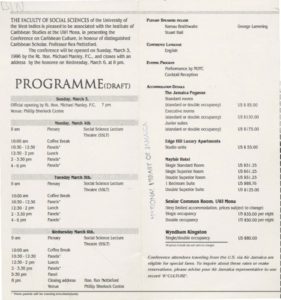
In March 1996 the first Conference on Caribbean Culture was hosted by the faculty of Social Sciences of the University of the West Indies (UWI) and the Institute of Caribbean Studies at the university’s Mona Campus. The conference was held in honor of the choreographer, historian, and then pro vice-chancellor of UWI, Rex Nettleford.[xii] Supposedly eight leading intellectuals were invited to give plenaries, though the program only lists Kamau Brathwaite, Stuart Hall, and George Lamming. The others were: Rex Nettleford himself, Lloyd Best, Erna Brodber, Edward Seaga, and George Rohlehr (Chevannes 1997: iii; see Figure 1. “Draft Program”).
Figure 1. “Draft Program”
Michael Manley was to open the conference. The Caribbean Quarterly published their addresses in its March-June 1997 issue as “The Plenaries: Conference On Caribbean Culture In Honour Of Professor Rex Nettleford,”[xiii] with Gordon Rohlehr’s piece replaced by Michael Manley’s (Chevannes 1997: vi). Along with Barry Chevannes’s introduction are the following essays: George Lamming’s opening address, in which Lamming gave an overview of Caribbean/Antillean thought and letters and thanked Nettleford for his contribution to thinking Caribbean culture and making space for a “roots”-derived Caribbean culture; Lloyd Best’s “Independent Thought and Caribbean Freedom: Thirty Years Later”; Stuart Hall’s “Caribbean Culture: Future Trends”; Kamau Brathwaite’s “Rex Nettleford and the Renaissance of Caribbean Culture”; Erna Brodber’s “Re-engineering Blackspace”; Edward Seaga’s “The Significance of Folk Culture in the Development of National Identity”; Rex Nettleford’s “The Continuing Battle for Space—the Caribbean Challenge Final Session”; and, Michael Manley’s “Rex Nettleford: A Revolutionary Spirit.” Thus by the special issue, if not at the conference, two former prime ministers of Jamaica—Edward Seaga and Michael Manley—come together with the poet Brathwaite, the novelists Lamming and Brodber, the literary and cultural critic Rohlehr, Nettleford himself, and Hall. Who is Hall here in this milieu?
The plenary papers, as they appear in Caribbean Quarterly, make it is clear that not only was Nettleford the person that the gathering was meant to celebrate, but that “culture,” the question of culture, the Caribbean cultural question was also the star. It was the return of culture as a worthy object of study and site of intellectual discourse in the region. That unique gathering of intellectual stars each in their own right:
represented a powerful symbol of culture coming (back) in from the cold where it had been thrown out by a social science that had lost its bearing and wandered far afield in realms of vanguardism and name-calling; represented, in the thoughtful pronouncement of the Griot Kamau Brathwaite, a healing. (Chevannes 1997: iii)
The “healing” to which Chevannes referred can be understood as the denigration of the arts and culture—whether highbrow (novels, poetry, art, drama, dance not too identifiable with the laboring classes) or low (kaiso, reggae, steel drums, tassa etc)—and the concomitant valorization of economics, history (of a certain kind) and social sciences meant to credentialize the civil service. Of the eight essays only three do not specifically speak to this moment of reconciliation—Brodber’s, Seaga’s and Manley’s (iii). Seaga seems to have received a different brief from the others. Barry Chevannes, then head of sociology and the main organizer of the conference, explains in his introduction that everyone, except Seaga, was asked to speak to “any issue they felt to be of importance.” Seaga was given a strict brief as “an anthropologist” and “a promoter of native art forms…to address the question of the role of the folk in the formation of national identity” (iii). Seaga, as such, makes no reference to Nettleford or what others seem to view as the rebirth of the cultural in the Caribbean context, at least of the anglophone Caribbean context. Brodber tackles the question of completing the emancipation begun in 1834/8; so that while her interest is in the “Caribbean cultural” as it were, it is less in the study of culture in the Caribbean and the social sciences as much as the place of culture in liberating black people (Brodber 1997: 70 – 81). Manley speaks of the two groups (social scientists and cultural practioners/critics) coming together for the conference, but never mentions that they were ever divided (Manley 1997: 96 – 100); the split between the two groups features in all other submissions.
In Kamau Brathwaite’s own words, the conference was a Caribbean first:
[The] first time in our 500 yrs of post Columbian history that we have such a happenin—there was P R in 1958, Carifesta 72 in Guyana & these are LANDMARKS too, but mainly as PERFORMANCES—distillations & enactments—of the culture. This is the first time we have a concentrated comprehensive reflexion on it. Put together, the two streams strands events begin create an IMAGE of ourselves.(Brathwaithe 1997: 36)
If the conference were a ritual undertaken for healing, it was not to heal the rift between disciplines, but actual persons, namely “Nettleford & the social scientists, who, as this Conference indicates, have come the long road backround to a recognition—i hope—of the centrality of culture to our functional reality & where how why we are ourselves in the world” (50).
George Lamming explained it thus:
the West Indian historian is not an active and informing influence in the popular consciousness. The language of economic advisers conveys little or no meaning to people outside their immediate circle of colleagues. Novelists function without a substantial and continuing reading class—even among the certified graduates of the region’s university. This literature has hardly aroused the active interest of many who make up the political intelligentsia. (Lamming 1997: 12)
Social science (economists) and culture (historians or novelists) suffer from a split; the economists are incomprehensible to though who are not economists and the novelists rarely write for those at home in the region as they do not provide a reliable and regular readership.
In “Independent Thought and Caribbean Freedom: Thirty Years Later,”[xiv] Lloyd Best argued that what was needed was a turn to the creative arts, for only they “will here open up the philosophical as well as the scientific questions” (Best 1997: 24). He submitted that the crisis that beset the social sciences as the twenty-first century was to emerge was:
a failure at the bottom of which is the epistemological question. How do the Caribbean people learn about themselves and for their own purposes with the resources they now have? How does a community,a tribe, a race, a State, a nation, a people, save itself from impending damnation? How does a culture escape from itself? How does a system generate its own fertility?
The first thing would be to plumb the dimensions of our own predicament. In the case of the social sciences, had we fixed the manifestations of dislocated personality, plantation economy, segmented multi-ethnic society and submerged subversive culture in their common historical matrix, I doubt we would have had to follow the disciplinary specializations of the European tradition, multiplied the overheads, and confused the heads of the students in the bargain—by compelling them to add Marshallian or Keynesian economics to Parsonian, Weberian or Marxian sociology, to Malinovskyesque anthropology and to the Westminster political science of Mill, all of which are premised on a different set of institutions—all of which are set in a different landscape. You can see why I am advocating an extra-disciplinary approach, a Caribbean approach. (Best 1997: 24)
Best’s contention seems to be that such a split between the social sciences and the arts in the Caribbean occurred because the model of the university and knowledge production was simply transplanted from the UK, with no real consideration as to how to grow a Caribbean derived model. Attention and genuine incorporation of the creative arts and the humanities across (higher) education was his proposed solution.
But if Nettleford, culture, and a new moment of significance for cultural in the Caribbean are the chief, named protagonists, Hall seems an implied one. Lloyd Best names Hall as one of his predecessor, declaring that though
[t]he whole world knows my great teachers…to have been Gocking, Demas, Brathwaite and James…What even Stuart Hall may not know is that it all began at Richmond Road in Oxford where Demas was his [Hall’s] housemate and where Stuart’s New Left Review … I make bold to say we need other conferences mounted on the work of both William Demas and Stuart Hall … (17)
Best makes known the hitherto little known fact that his own thought is indebted to Hall. Best is, of course, one of the most widely read anglophone Caribbean scholars as knowing the Caribbean condition; and there he stood, during this quintessentially, uniquely moment in the study of culture from/in the Caribbean paying homage to Hall, calling for a similar (conference on Caribbean Culture?) in honor of Hall’s work.
Yet in his essay, “Caribbean Culture: Future Trends,” perhaps fittingly, meant to gesture at the next frontier, the next conjuncture, he seems to refuse that potential moment of canonization. By the time Hall gave his plenary, Best had already given his; this is evidenced by Hall’s assertion that he “think[s] about these questions in the context of rereading that marve[l]ous essay to which interestingly Lloyd Best referred this morning” (Hall 1997: 25). After thanking Nettleford for the invitation and his scholarship, Hall commences, telling his audience that he was “asked to say something about the future and in that context it has to be something about how Caribbean culture travels, it being itself the product of an enforced travelling, but also well travelled” (25). He stages his distance from that Caribbean scene, perhaps reminding the audience of what Best may have made them forget for the time:
I have got to figure out how to talk about that because I have lived out of the region for most of my adult life and therefore what I have observed at close hand and worked amongst our people from the Caribbean, from the African Caribbean Diaspora, especially, who helped undertake a second migration, a ‘double diasporization’, I would call it. (25)
He will not make mention of his time on Caribbean Voices, the BBC program that gave most of the writers now considered synonymous with (modern) anglophone Caribbean literature—V. S. Naipaul, Andrew Salkey, Samuel Selvon, Derek Walcott, George Lamming—work for Caribbean periodicals such as Bim or Savacou. Erased are the frequent trips he made to Jamaica (home?) from the 1970s onward (after the cultural revolution of the 1960s makes brown, middle class existence no longer easy or tenable).[xv] The documentaries on the Caribbean expunged. His participation in the Caribbean Artists Movement (CAM, 1966 – 1972) unmentioned (See Walmsley 1992). In fact, according to Anne Walmsley’s account of the second CAM conference (August 31 – September 2, 1968), Hall’s contribution shaped much of the rest of the conference. At least two of these show Hall thinking the Caribbean with diaspora. The first being that, “[t]he Afro-West Indian has had a kind of clarification of experience in the last decade in Britain that the West Indian at home, with the neocolonial regimes, has not had.” Secondly, his contention, following John La Rose, that “the West Indian had been obliged to define himself in global terms, in terms of movements of black peoples throughout the world” (164). Thus in 1968 we begin to hear the outlines of engagement with diaspora, race, and articulation in relation to the anglophone Caribbean community(ies) in the UK, years before Policing the Crisis or “Race, Articulation, and Societies Structured in Dominance.”[xvi]
But in 1996, Hall refuses any of these enunciations that would give his audience definitive and consistent confirmation of his investment in the Caribbean. Instead he wants to use diaspora to problematize theorizations of Caribbean “roots” and “routes” (Hall 1997: 27). It is the “discrepancy between some of the ways in which we still think about culture and in which we still live and practise it” that Hall chooses, “want[s],” to address in his plenary (27).
He ends, provocatively, informing us that only through “retranscription (by resignification)” can diasporic culture occur and sustain itself (33). He urges his audience to hold on to
… a notion of the diasporic which lives with the notion of dissemination, of the scattering. The seed has gone out. It is not going to come back to its original ecology. It now has to learn to live in new climates in other soils. It has to learn to resist pests that it never resisted before.
The one thing you do not get in nature is a clone. It’s not given to repeat itself as it was, because to repeat itself would be to die. It’s going to use its new ecology to construct a culture of a different kind. It is going to live with dissemination. It knows that unless we have made the return to our symbolic home in our hearts and minds we will never know who we are, but it knows at the same time that you can’t go home again. (33; italics mine)
What does it mean that one “can’t go home again?” And how to apply that to the discussion of Caribbean culture that is its scene of presentation?
II
I don’t want to psychologize Hall, but I want to put in conversation his notion of being unable to “go home again” and his interview for the first issue of Small Axe that Hall would have given shortly after this address.[xvii] The interview stages a much more explicit set of interventions about the Caribbean as a formative space for Hall and an object of his study. It is possible that this is more function of genre. It allows for another kind of engagement it is by definition dialogic, two people looking for each other; the plenary on Caribbean Culture calls for a kind of declaration of a self and subjectivity that is less provisional. In another 1997 interview, Caryl Phillips asks him how he feels about the Caribbean, and Hall speaks of “home” in less definitive terms than the final lines of “Caribbean Culture: Future Trends.” “No,” he says to Phillips:
I don’t feel detachment from [the Caribbean]. I maintain that terrible ambiguity about home. I never know it. I never know what question I’m being asked when I’m asked about home. On the other hand, when I go home I know it’s not my home. And I know it’s not my home principally because it’s a small place and all the people that I was at school with are still there, and all have had a different life from mine, I can literally see the divergence. I can’t possibly recapitulate the way in which they have lived the first 30 years of independence. I didn’t live them like that. It’s not an odd question of whether you can be friends or not, it just, it’s formed us differently. (Hall 1997)
Hall here is ambiguous about the Caribbean, Jamaica, as his home. It is not simply that he is unsure of his answer; he is uncertain of what he is being asked when asked of the Caribbean as “home.”
As far as Caribbean scholarship the Small Axe interview ushers in a moment. Hall’s is the first interview of a series of interviews of Caribbean intellectuals born in the 1920s, 1930s, and 1940s that Scott undertakes.[xviii] It appears in the first issue of a journal that has forged a frontier zone in the field over the last while (in two years it will be twenty). At its inception, this moment of birth of which Hall is made a part, the journal was meant to “fashio[n] a vernacular idiom of criticism,” taking up the charge from older outfits such as Lloyd Best’s New World Quarterly and Kamau Brathwaite’s Savacou. Interestingly, Hall was a part of each—Best claims his in this 1996 moment as a kind of third (if silent) parent; Hall attended the conferences of the Caribbean Artists Movement and wrote for Savacou; and he is chosen as the first Caribbean intellectual to be interviewed for Small Axe.
There is a fascinating elliptical moment in the interview; allow me to quote from it at length:
David Scott (DS): … Clearly there you are thinking about the Caribbean. This is the middle to late ‘70s, yes. What is prompting that rethinking of the Caribbean?
Stuart Hall (SH): Well I suppose what is prompting it is the sense that ll that was bubbling up in the ‘60s has had a very profound impact on Caribbean societies. It’s a very different place. And its a place that I can re-ground in my o[w]n mind in a way that I’d sort of decided that I couldn’t re-ground the old Caribbean like that. By the ‘70s I start to come back more often. Mainly to visit family. I don’t come back for official purposes. There is a long period in the ‘60s when having taken the decision I don’t come very much.
DS: Do you lecture here when you come back in the ‘70s?
SH: Hardly ever.
DS: Is your work known among intellectuals here?
SH: No, no. Not very much. And it doesn’t feel relevant to me to tell them about it.
DS: No, sure, that I can understand. But certainly the way . . . .
SH: They still don’t . . . .
DS: I know they still don’t . . . .
SH: I’m not complaining about it.
DS: Yes, but I am. (Hall, “Politics,” 1997: 155)
Here is Hall, interviewed for the first issue of Small Axe, a journal committed to a critical tradition in Caribbean studies, largely concerned with Caribbean thought. This set of exchanges between Hall and Scott is riddled with the unsaid. Scott keeps the question of the (anglophone) Caribbean ever present; Hall seems to want this. If Hall’s address of the future of study of Caribbean Culture does not disavow that “[i]t is perhaps too little remembered … that Stuart Hall is a Jamaican and a West Indian whose work has been informed by some of the journeys and debates that constitute this region as a zone of history, culture, and politics,” he does do so in the interview (Hall, “Politics,” 1997: 141). Yet much as the interview tells us about Hall’s development as a (anglophone) Caribbean intellectual and his sustained interest in the region, the ellipses perform a withholding that makes the answer to our very question of Hall’s place in the canon of Caribbean thought, most especially the “why” of it, elusive. And, perhaps, even an acceptance of his lot as a kind of second-class citizen in the pecking order of the home-based academy. What was intended to follow “the way”? Don’t they still do? Is it the way that Hall is marginalized in the region, or the way that he is celebrated elsewhere? Is it that “intellectuals here” still don’t read him, or acknowledge him? The first suggests lack of awareness, knowledge of Hall and his work, his theoretical interventions; the latter suggests a refusal that articulates critique either of scholarly practice (either in terms of concepts or the general eclecticism of Hall’s oeuvre) or geographic location (that he never settles and works from back home and in this way in strong contrast to Lloyd Best, Rex Nettleford, Barry Chevannes and even Brathwaite and Lamming who work from ‘home’ for periods).
III
Let us leave the 1996 conference and interview for a moment and look at the ways in which Hall has been memorialized since his passing. By now it should go without saying that I am interested in the ways in which he has, or has not been, honored from the Caribbean or Caribbean-centered spaces and platforms.
In her review for the Caribbean Review of Books of John Akomfrah’s documentary, The Stuart Hall Project, Annie Paul writes:
It never fails to astonish me how little Hall and his path-breaking work are known back here in the Caribbean, where he comes from—in Jamaica, where he was born and raised, for instance, he’s a complete nonentity. For those not in the know: Hall is a globally renowned intellectual (an “intellectual rock star,” as one publication has referred to him), a founding editor of New Left Review, and more famously the main progenitor of the influential field of cultural studies. Arising in the 1960s, this interdisciplinary juggernaut that signalled the advent of postmodern scholarship rapidly gained popularity, dealing a body-blow to traditional academic disciplines from sociology to political science to literature, and completely rewriting the scope of intellectual work worldwide. That it only arrived at the University of the West Indies in the 1990s is a measure of what a well-kept secret Hall remains in these parts. (Paul 2013)
Paul, of course, is correct: Hall’s scholarship so profoundly influenced the ways in which we study human experience globally—in terms of subjectivity, power, identity formation, home and diaspora to name but a few—yet continues to be “a well-kept secret in [the Caribbean]”; and this persistent secrecy around Hall is a barometer of something. The paucity of elegies, eulogies or memorials in Caribbean or Caribbean-centric outlets since his passing continues the occlusion of Hall from the region and tells us something not only about Hall’s own sense of who he was, and where he belonged in relation to the island of his birth, but also speaks to his Caribbean legacy, his place in Caribbean thought, and what exactly the Caribbean is now, maybe what it is becoming.
By my count five pieces emerged from the Caribbean or Caribbean-focused sources after Hall’s homegoing. These were: two obituaries; an announcement by the Trinidad and Tobago Film Festival as well as a free screening of The Stuart Hall Project (the Tuesday after he passed);[xix] a moving, searing letter from the editor of Small Axe (Scott 2014) and a special section of that same journal titled “The Gift of Stuart Hall”; and a tribute from the Centre for Caribbean Thought. I want to focus on those that speak explicitly to Hall and the Caribbean.
In their tribute from the Centre for Caribbean Thought, Brian Meeks, Anthony Bogues and Rupert Lewis, assert:
that Hall did not return “home” like … George Lamming, or Sylvia Wynter (who returned for a while) and others did not mean that he was not Caribbean. What it meant was that the Caribbean was now working through a different geographical and cultural location. (Bogues, Lewis & Meeks 2014: 128)
This was preceded by Meeks’s singular celebration of Hall almost a week before in the Jamaica Gleaner, “Rediscovering Stuart Hall” (Meeks 2014). He tries to attend to the relatively subdued nature of the local response, or lack thereof, in the week of Hall’s passing. Meeks explains that it “should not, maybe, be surprising” that there is such quiet (it took local newspaper several days to pick up the news) as Hall had not lived in Jamaica in over six decades (Meeks 2014). But, for Meeks, Hall’s diasporic existence has little to do with Jamaicans’ ignorance of him, rather such lack of awareness “says more of national inattention to ideas and the people who generate them.” He ends with an invitation to the Hall’s alma mater, Jamaica College, or the government to honor Hall.
But in “Stuart Hall Roots an Legacy” Carolyn Cooper, professor of literary and cultural studies at UWI, Mona, goes directly to the question of Hall having never returned home. Writing in Jamaican patois, in Chaka-Chaka Spelling and again in Prapa-Prapa Spellin, she brings the question of Hall’s place of domicile to the fore. She asks:
So wa mek Stuart Hall never come back a yard? Im did visit. But im live out im life a Inglan. Inna 1997, im do one interview wid Caryl Phillips, one next Oxford man weh born a St Kitts an go a England when im a four month ‘old’. Phillips aks Hall di said same question: “The time you were leaving Oxford—1957—was exactly the same time that there was a potential for great change in the Caribbean. It was the beginning of the short-lived federation among the islands. Why did you choose not to go back?” Hall gi two answer: “There was no need to hurry back, because by then federation was a dead idea.” Dead fi true. An CARICOM no hearty to dat … See di next answer ya: “But there’s a second reason which is more personal. You see, I came from this peculiar coloured middle class in Jamaica which was oriented toward Britain … I didn’t want to go back to that. To have a job as a lawyer with my family close at hand, watching over me, I couldn’t bear it. I’d always meant to go home, but I’d always had reservations about becoming a member of that class.”
Di problem a no so-so class. Plenty colour did mix up inna it. Hall do one next interview inna 2007 wid one journalist, Tim Adams. Hear wa im seh: “I was always the blackest member of my family and I knew it from the moment I was born. My sister said: ‘Where did you get this coolie baby from?’ Not black baby, you will note, but low-class Indian.” Seet deh now! Good ting Stuart Hall never bodder come back ya so. Im might as well tan a England.[xx]
For Cooper Hall’s legacy is haunted by the incomplete return. It is not that Hall’s ideas were too big for ‘home’ as Meeks hints, but rather there it is color and class questions that disrupt Hall’s return at least in 1957. In this way his not a Caribbean existence simply in another geographic location, but a flight from the color politics of Jamaica, an escape.
For his part Hall does offer several, varied reasons for his decision to settle in the UK. If Caryl Phillips is told that it had everything to do with the death of the West Indian Federation, Hall makes plain his unwillingness (like Claude McKay’s Bita Plant[xxi]) to be sucked into brown, respectable middle class society. He also speaks of the ‘problem’ of his own skin color—decidedly darker than other members of his family—in terms of having easy relations with his family (most of whom were of lighter skin color). In other words Hall might not disagree with Cooper that the question was not only one of class, but profoundly of color.
Yet it seems to me that there is also something of a discomfort, a worry in that earlier moment of the 1996 conference that may add another dimension. In other words, I want to take Hall at his word that the interest, his interest, in the Caribbean never goes away. And, if so, the seeming finality of his “Caribbean Culture: Future Trends” suggests that he can never be a Caribbean intellectual, he can never really be part of that canon. At the same time I think there is a desire (expressed in the dialogic spaces of the interviews) to suture, to make a return.
As editor of Caribbean Reasonings: Culture, Politics, Race, and Diaspora—The Thought of Stuart Hall and one of the organizers of the third Caribbean Reasonings conference held in 2004 in honor of Hall out of that collection emerged, Meeks has been integral in plotting Hall’s return to the intellectual terrain of contemporary Jamaica and the Caribbean academy. In his introduction to that collection, Meeks contends that it was only after giving the keynote for the conference, and receiving a standing ovation, that, Meeks writes in his introduction to the text, “Hall, after more than half a century, had at last, come home” (Meeks 2007).
If that conference was the coming to fruition of what Lloyd Best suggested in 1996, that Hall and his work be the subject of a conference meant to honor him, it was also a retake on that earlier moment in which Hall’s name was placed on the roll under Caribbean intellectual and he stayed clear of answering too loudly in the affirmative. In his talk to the 2004 conference in his honor he tells the crowd that he nearly back out; what business did he have at that point in his career to claim “to be a Caribbean intellectual?” (Hall 2007). But rather than attempt to shake off the label like so many participles of dust, Hall took hold of it, laid claim to it. I would not say that he did so at last, because I suspect in his quieter more private moments he may have accepted the label (remember his time with the Caribbean Artists Movement?). Instead I will say that this talk is the occasion for him to do so publicly, in the haloed halls of the University of the West Indies. Here Hall revises the origin myths about how Cultural Studies started; in essence he leaves literature and turns to Cultural Studies because he “had to confront the problem of trying to understand what Caribbean culture was and what my relationship” (Hall 2007). He may not have a deep investment in the postcolonial project of “nation-building,” but in that regard he is not alone—many of his generation bemoaned the nation state. It is not only that Hall becomes black in there, but he forges community with fellow West Indians he may never have doon amongst other West Indians:
London streets — one more turn in the story of the Middle Passage and a critical moment in the formation of another displaced black diaspora — I resolved to go back, to read, read about, try to understand and to make a part of me the culture which had made me and from which I could never — and no longer wished — to escape. (Hall 2007)
He speaks of himself as one of many other Jamaicans and anglophone Caribbean folk making their way in that work, rather than an isolated, rare individual. Diaspora becomes a kind of double-bind that ties on to home and the world, here and there. Diaspora here is not only that state which induces and produces a kind of homelessness, it also makes home. Diaspora not a way to disavow one home as one tries, if never succeeding valiant in the effort, to make another one’s new home. It is an uneven and imbalanced dance between the locations. It is in this understanding of diaspora Hall finds his Caribbean. Or rather lets the rest of us see it; he has been wrestling with it all the while, the interest always there. His entire career becoming in some ways “[his] very long way of trying to answer the question, in what sense can [he] be ‘a Caribbean intellectual’?” (Hall 2007).
Travel well.
Contributor’s Note
Victoria J. Collis-Buthelezi is lecturer of African Diaspora and African literature and theory in the English Department at the University of Cape Town. Her current book project is Empire, Nation, Diaspora: The Making of Modern Black Intellectual Culture.
References
Best, Lloyd. 1997. “Independent Thought and Caribbean Freedom: Thirty Years Later,” in special issue “The Plenaries: Conference on Caribbean Culture in Honour of Professor Rex Nettleford.” Caribbean Quarterly, 43, no. 1/2: 16 – 24.
__________.. 1997. “The Vocation of a Caribbean Intellectual: An Interview with Lloyd Best,” interview by David Scott. Small Axe 1: 119 – 139.
__________.. 1967. “Independent Thought and Caribbean Freedom,” New World Quarterly (Croptime): 13 – 35.
Bogues, Anthony, Rupert Lewis and Brian Meeks. 2014. “Stuart Hall, Caribbean Thought and the World We Live in.” Caribbean Quarterly, 60, no. 1: 128.
__________.. 2002. “Michael Manley, Equality and the Jamaican Labour Movement,” in special issue” Michael Manley: A Voice at the Workplace,” Caribbean Quarterly, 48, no. 1: 77 – 93.
Brathwaite, Kamau. 1997. “Rex Nettleford and the Renaissance of Caribbean Culture,” in special issue “The Plenaries: Conference on Caribbean Culture in Honour of Professor Rex Nettleford.” Caribbean Quarterly, 43, no. 1/2: 34 – 69.
Brodber, Erna. 1997. “Re-engineering Blackspace,” “The Plenaries: Conference on Caribbean Culture in Honour of Professor Rex Nettleford,” Caribbean Quarterly, 43, no. 1/2: 70 – 81.
Chevannes, Barry. 1997. “Introduction” to special issue “The Plenaries: Conference on Caribbean Culture in Honour of Professor Rex Nettleford,” Caribbean Quarterly, 43, no.1/2: iii – vi.
Cooper, Carolyn. “Stuart Hall Roots an Legacy.” Jamaica Gleaner, jamaica-gleaner.com/gleaner/20140216/cleisure/cleisure3.html, accessed December 20, 2014.
Cudjoe, Selwyn R. 1992. “C. L. R. James Misbound.” Transition, no. 58: 124 – 136.
Hall, Stuart. 2007. “Epilogue: Through the Prism of an Intellectual Life,” in Caribbean Reasonings: Culture, Politics, Race, and Diaspora—The Thought of Stuart Hall, edited by Brian Meeks, Kingston and Miami: Ian Randle Publishers. Kindle ebook.
_________. 1997. “Politics, Strategy, Contingency: An Interview with Stuart Hall,” by David Scott. Small Axe, no. 1: 141 – 159.
_________. 1997. “Caribbean a Culture: Future Trends,” in special issue “The Plenaries: Conference On Caribbean Culture in Honour of Professor Rex Nettleford.” Caribbean Quarterly, 43, no. 1/2: 25 – 33.
_________. 1983. “For a Marxism without Guarantees.” Australian Left Review 83: 38 – 43.
_________. 1980. “Race, Articulation, and Societies Structured in Dominance,” in Sociological Theories: Race and Colonialism. Paris: UNESCO, 16–60.
Lamming, George. 1997. “Opening Address,” in special issue “The Plenaries: Conference on Caribbean Culture in Honour of Professor Rex Nettleford.” Caribbean Quarterly, 43, no. 1/2: 1 – 15.
Manley, Michael. 1997. “Rex Nettleford: A Revolutionary Spirit,” in special issue “The Plenaries: Conference On Caribbean Culture In Honour Of Professor Rex Nettleford.” Caribbean Quarterly, 43, no. 1/2: 96 – 100.
_________. 2007. “Introduction: Return of a Native Sun,” in Caribbean Reasonings: Culture, Politics, Race, and Diaspora—The Thought of Stuart Hall, edited by Brian Meeks, . Kingston and Miami: Ian Randle Publishers. Kindle ebook.
Walmsey, Anne. 1992. Caribbean Artists Movement, 1966 –1972: A Literary and Cultural History. London and Port of Spain: New Beacon Books.
Wynter, Sylvia. 2000. “The Re-enactment of Humanism: An Interview with Sylvia Wynter,” interview by David Scott. Small Axe, no. 8: 119 – 207.
Seaga, Edward. 1997. “The Significance of Folk Culture in the Development of National Identity,” in special issue “The Plenaries: Conference on Caribbean Culture in Honour of Professor Rex Nettleford.” Caribbean Quarterly, 43, no. 1/2: 82 – 89.
Scott, David. 2014. “The Last Conjuncture.” Small Axe, 18, no. 2 44: vii – x.
_________. 2013. “On the Question of Caribbean Studies,” introduction to special issue on “What is Caribbean Studies?” Small Axe, Volume 17, Number 2 41: 1 – 7.
[iii] James did not win a scholarship to study in the UK as Norman Manley, Eric Williams, Stuart Hall, or many others would, but I include him in this number because he was one of those students (and then teacher) of the prestigious island schools who would have been expected to win one of the island scholarship—a middle-class/lower middle-class boy, as he describes himself in the BBC Channel Four interview he did with Stuart Hall (See James, “C. L. R. James in conversation with Stuart Hall,” Channel 4, 1983-85).
[iv] The only television station in Trinidad and Tobago until 1991.
[v] Hortense Spillers asked this of Anthony ‘Tony’ Bogues during his keynote.
[vi] They spoke of George Padmore and the work he and James did together in the African Bureau.
[vii] I use “particular” thinking of James’s invocation of the word in his history of the first Pan-African Conference of 1900 in reference to the actions and history of Henry Sylvester Williams as convenor of the conference and a Caribbean intellectual. See James 1984: 236-250.
[ix] Eric E. Williams says this after Jamaica pulls out of the West Indian Federation in order to justify Trinidad and Tobago’s withdrawal thereafter.
[x] Scott’s term of choice (represented by the ellipsis in my citation above) is “archive”; he refers to an “archive of thinking” around what Caribbean means. He writes:
I mean to press the idea, in other words, that to think something like “Caribbean studies” is already to be inside, to be in a conversation with, one dimension or another of the archive of thinking about what the Caribbean supposedly is, supposedly was. (2013: 1)
Archive, I think, does not quite get at what interests me on the question of Stuart Hall and the Caribbean because as much as archives are products of power, there is some sense that within an archive traces might exist, the archive might hold sources the value of which change over time. The canon on the other hand may change content over time, but that which is within is that which is authorized in particular ways; the archive can contain within its borders items that are not deemed valuable, but that sit there as if waiting to be discovered. In other words, Hall’s work may sit within a Caribbean archive, but it is not considered canonical in Caribbean scholarship.
[xi] In this essay, to distinguish between the two 1997 interviews I cite Hall’s interview in Small Axe as Hall, “Politics” 1997 and his interview Bomb with Caryl Phillips as Hall 1997.
[xii] Nettleford remained would become vice-chancellor of UWI (its first graduate to do so) just two years later in 1998 until 2004.
[xiii] Selected literature papers were also compiled for another special issue of Caribbean Quarterly from the conference. See Caribbean Quarterly, Volume 43, Number 4, Conference on Caribbean Culture in Honour of Professor Rex Nettleford The Literature Papers: A Selection (December 1997).
[xiv] This is Best’s return to his 1967 piece in the New World Quarterly, “Independent Thought and Caribbean Freedom.” See Lloyd Best, “Independent Thought and Caribbean Freedom.” New World Quarterly (Croptime 1967): 13 – 35.
[xv] Brown here refers to the mulatto elite. See Anthony Bogues, “Michael Manley, Equality and the Jamaican Labour Movement,” in special issue” Michael Manley: A Voice at the Workplace,” Caribbean Quarterly, 48, no. 1, (2002): 77–93.
[xvi] See Stuart Hall, “Race, Articulation, and Societies Structured in Dominance,” in Sociological Theories: Race and Colonialism (UNESCO, 1980), reprinted in Black British Cultural Studies: A Reader, ed. Houston A. Baker, Manthia Diawara, and Ruth H. Lindeborg (Chicago: University of Chicago Press, 1996), 16–60.
[xvii] The interview is dated March 6, 1996. The draft program for the conference show three plenaries scheduled on: Monday, March 4; Tuesday, March 5; and Wednesday March 6 (See “Conference on Caribbean Culture Registration Brochure,” National Library of Jamaica). Hall would have given his plenary on on of those days, those most likely not in the morning slot as scheduled in the draft program since he refers to Best’s paper having been given in morning before his own.
[xviii] Lloyd Best’s interview also features in the first issue of the journal, and before Hall’s in pagination, but in conversation with Hall again in 2005, Scott says that this was the first interview he did of Hall’s generation of intellectuals for Small Axe. See David Scott, interview with Stuart Hall, Bomb: A Quarterly Arts and Culture Magazine 90 (Winter 2005), http://bombmagazine.org/article/2711/david-scott, accessed July 10, 2015.
So what made Stuart Hall never come back home? He visited. But he lived out his life in England. In 1997, he did an interview with Caryl Phillips, another Oxford man who was born in St. Kitts and went to England when he was four months ‘old.’ Phillips asked Hall the same question: “The time you were leaving Oxford—1957—was exactly the same time that there was a potential for great change in the Caribbean. It was the beginning of the short-lived federation among the islands. Why did you choose not to go back?” Hall gave two answers: “There was no need to hurry back, because by then federation was a dead idea.” Dead in truth. An CARICOM is no better … Look at the next answer: “But there’s a second reason which is more personal. You see, I came from this peculiar coloured middle class in Jamaica which was oriented toward Britain … I didn’t want to go back to that. To have a job as a lawyer with my family close at hand, watching over me, I couldn’t bear it. I’d always meant to go home, but I’d always had reservations about becoming a member of that class.”
The problem is not so much class. Plenty color issues are mixed in. Hall did another interview in 2007 with another journalist, Tim Adams. Listen to what he said: “I was always the blackest member of my family and I knew it from the moment I was born. My sister said: ‘Where did you get this coolie baby from?’ Not black baby, you will note, but low-class Indian.” See there now! Good thing Stuart Hall never bothered to come back here so. He might as well tan in England.
[xxi] See Claude McKay. Banana Bottom. New York: Harcourt Brace, 1933.
On November 13 and 14, 2015, boundary 2 will host a conference at the University of Pittsburgh on The Militarization of Knowledge. This unique event will bring together distinguished scholars from a variety of disciplines. Click here to watch a livestream.
Our talks will take place at the following times, all Eastern Standard Time.
FRIDAY, 11/13/15
2pm – Operationalizing Basic Research and Scholarship: A System-of-Systems Approach for the Military Application of Knowledge, Carey Balaban, Professor, Departments of Otolaryngology, Neurobiology, Communication Science & Disorders, and Bioengineering, University of Pittsburgh, Director of Center for National Preparedness
3:30pm – Terror, Talk, and Political Management, David Simpson, Distinguished Professor of English, UC Davis
SATURDAY, 11/14/15
9:30am – Of Partisans and Paranoid Experts: How We Came to Think about Terrorism, Julian Bourg, Associate Professor of History, Boston College
11am – The Representation of Atrocity, Bruce Robbins, Old Dominion Foundation Professor in the Humanities, Columbia University
1:15pm – The Militarization of Language, David Golumbia, Associate Professor of English, Virginia Commonwealth University
2:45pm – Military Aesthetics: Technology, Experience, and Late Modern War, Anders Engberg-Pedersen, Associate Professor of Comparative Literature, University of Southern Denmark
4pm – Summary Discussion, led by Jonathan Arac, Mellon Professor of English and Director, Humanities Center, University of Pittsburgh, and Anthony Bogues, Asa Messer Professor of Humanities and Critical Theory, Professor of Africana Studies, Brown University; Director, Center for the Study of Slavery and Justice
Nelson Mandela died on December 5, 2013. Tony Bogues, a member of the boundary 2 Collective, was in South Africa, watching the endless coverage of the news and of Mandela’s life. Bogues had met Mandela during his time with the Jamaican government of Michael Manley, and he has spent considerable time working in South Africa, especially in Cape Town, on questions of freedom, archives, African and African Diaspora intellectual history, and political thought.
At least one generation of intellectuals had stood against apartheid and reflected on Mandela as a political figure of freedom and liberation. Mandela never produced anything equivalent to the political writings of a Gramsci, Fanon, or Césaire. Because of the media and the global support for the struggles he led, Mandela acquired a resonance with effects across the globe. His career, with all its changes, posed challenges for thinking about politics.
It seemed right that boundary 2 should take notice of Mandela and his influence. We decided to gather responses to Mandela as a political figure. b2 issued a call for very brief papers from several spots on the globe and from different generations. Our contributors have given us reason to feel this attempt was a success.
At least one generation of intellectuals had stood against apartheid and reflected on Mandela as a political figure of freedom and liberation. Mandela never produced anything equivalent to the political writings of a Gramsci, Fanon, or Césaire. Because of the media and the global support for the struggles he led, Mandela acquired a resonance with effects across the globe. His career, with all its changes, posed challenges for thinking about politics.